Campaign Mastery helps tabletop RPG GMs knock their players' socks off through tips, how-to articles, and GMing tricks that build memorable campaigns from start to finish.

Comparative Underpinnings Of Campaign


‘Blue Night Sky’ courtesy freeimages.com / D. Carlton

While this article builds on some others that I’ve done here at Campaign Mastery, I didn’t feel it was enough of a sequel to any of them to qualify for the Blog Carnival. But I wanted to remind readers that if you’re thinking of doing so, there’s still time to submit a late entry! I’ll hold off doing the roundup until a week or so into December.

I’ve talked a number of times about campaign themes, at least in general terms, and how to manifest them in the form of campaign plot threads and adventures.

But there’s almost always something more to say when it comes to such a broad topic; anytime that I find a fresh angle on the subject, I can be reliably expected to delve into it once more.

This time around, I was thinking of how I used to write Sci-Fi short stories back when that was something I was playing around with. Not the mechanics of writing, as much as those might be of interest to some of my readers; I’ve discussed that in the past, notably in the course of the two-part (abbreviated) autobiography that I published at Campaign Mastery a few years back (Dice & Life Part 1, Dice & Life Part 2), but about the inspiration sources that I employed, and the similarities and differences between those methodologies and those employed when I created a fantasy campaign. And that led me to consider the other genres of game that I have/do run, and how each adopted a different approach to the problem.

This might well turn out to be far too big a subject to tackle in a single article, so I’m reserving the right to subdivide it! Let’s see how I get on…

Sci-Fi Short Stories

Since I mention it as part of the inspiration for this article, I figured this was the right place to start.

My sci-fi stories always started from the same basic premise: take a contemporary piece of technology and think of a way that it might change and evolve in the future. I particular, was there any sort of alternative method of achieving the same end? Was there some other technology that could be integrated with it, and what would be the impact of doing so?

Once I had the core technology, I looked behind the curtain to the operating principles. How was it different? Why? What were the advantages? What other technological changes could be based on the same fundamental discovery?

Next, I needed a story that was built around the technology. This was always a dramatic situation (in the old sense of the word “drama”) that would proceed differently as a result of the difference in technology. Conflict, desire, relationships – at least one of them was always affected, it was just a matter of discovering the right one. On a number of times, I had multiple choices; about as frequently, only one right answer seemed to present itself.

When multiple choices presented themselves, I listed them all, then used cut-and-paste to rank them in the sequence I thought most likely to give a good story, then picked the top item off the list and worked with it until either it fell apart on me or a story emerged that worked.

Finally, I needed characters, one or more of whom would be the reader’s vector into the story. The combination of protagonists and overall story-line enabled me to work out a plot sequence, and an appropriate way of structuring that plot, incorporating sections to explain the changes in technology in a natural way without lecturing the reader.

That was where the “everyday application” came in; it was usual (with a few exceptions) for the focus of the story to be some other consequence than the one I had initially thought of. By showing the impact of the “everyday technology” in the course of establishing the protagonists, I could explain the technology, preparing the ground for the real story.

Writing the story itself followed.

Okay, with all that established as a baseline, let’s start looking at the different genres of campaign and how the processes compare.

Superhero

My superhero campaigns all start with an underpinning “epic” tale. I then work from the perspective of antagonists and how they would revolve around that underpinning story – what role would they play in it? Generalizing those two things gave me the campaign themes.

Next, I started listing as many different ways in which those themes might be reflected in plotlines, as well as listing as many plot ideas as I could think of.

The plan in such campaigns is always to track the themes to their earliest influences on the PCs. Quite often, in order to establish the characters that I needed, I have to develop introductory plotlines; it often feels contrived to have characters arrive on the game scene in their “final form”.

Splitting things up and establishing all the campaign elements in-game effectively gives every antagonist their own narrative arc, contributing to the “epic quality”. Things always start small and snowball.

I usually find that the process has generated a number of characters which need to be gotten “out of the way” lest they interfere with the underlying “epic”, adding still more threads to the plotline. Sometimes I have to introduce one character to maneuver a second character into the correct status and mindset needed for the “epic” and then introduce a second character whose only function is to remove the facilitating character after he or she has done their work.

Then there are all the plot threads that the PCs bring with them, which also have to be integrated with the plotline, and additional plot sequences that do nothing but help with the pacing, and additional plot sequences that are (at the big-picture level) just “noise” but are too much fun to leave out; and finally, there are plotlines that assist with the relative density of the different types of adventure; I try hard not to have too many “Cosmic” plotlines, or “Mystery” plotlines, or “Magic-oriented” plotlines, or whatever other manner of characterization you can think of, in succession.

I’ve done a feature article in the past about how I sequence these, and another on how I incorporate the personal lives of the characters, so there’s no need to go into that again.

The backbone of the campaign is all about the underlying epic, and the themes that it spawns, and foreshadowing, and the tactical chess-game of setting things up so that the jigsaw pieces will come together in the right way at the right time – and how to keep all that maneuvering opaque to the players until the time is right.

That “epic quality” nevertheless rubs off – every major plotline quickly becomes larger than life in some respect. And that’s what I’m aiming for – these are all exceptional characters, and the plotlines need to be big enough to contain them. The other effect is also one that I desire in this type of campaign: you genuinely get the feeling that you are experiencing the semi-episodic qualities of a comic-book while you play. The design process itself imbues the resulting campaign with some of the flavor of the genre by embedding the underlying genre tropes into the campaign structure.

Fantasy

The approach which I employ for Fantasy Campaigns is slightly different, and in many ways, bears a greater resemblance to that of the Sci-Fi short stories that I discussed earlier.

My approach is always to ask the “big questions” (see one of my earliest articles for Campaign Mastery, A Quality Of Spirit: Big Questions in RPGs). How does magic work? What are the Gods? That sort of thing.

Always, I am looking for the answers to a couple of underlying questions – “what distinguishes this campaign world from all the others I have created?” “What impact do these differences have on the lives of ordinary people, and what differences will they make in the lives of the PCs?” – things like that. And if the answer to those questions is “none”, it’s back to the drawing board.

As with the superhero campaigns, I start big and work my way down to the small. As a result, my Fantasy Campaigns all tend to be of the “high fantasy” sub-genre, a fact for which I make no apologies; those are the ones that I enjoy the most, and that I enjoy creating the most.

Of course, once you have the basic underlying phenomena nailed down, and have established that they will make a tangible difference in-game, it’s time to tackle a suite of related secondary questions. “What other phenomena are there, and how are they affected by these metaphysical underpinnings?” “What’s the basic story of the Game Universe?” “What are the in-game theories of these things?” “How might an antagonist learn of the underlying truths and what could they do with that knowledge?” “What can be done with the underlying phenomena even without understanding them, discovered by trial and error or serendipity, either in historic times or in the course of the game?”

It’s through these secondary questions that the ramifications of the original concepts, and the ultimate shape of the resulting campaign, begin to be formed.

An unwritten ‘rule’ is that every PC character class (in a D&D/Pathfinder campaign) and Race must be impacted in some way. I never want any of these to be “exactly” what’s written in the books; there must always be some point of distinction, something for a player to explore in the course of the game. If there are any classes or races for which this isn’t true, there are but two solutions: ban them, or add still another ‘underlying truth’ to address the gap.

My fantasy campaigns are always explorations of the PCs and their lives, and how those affect and are affected by, the world around them. This is a strongly “low fantasy” approach to the “high fantasy” genre, and it enables the premises of the campaign to have an impact from low character levels all the way through the game.

I’ve discussed the Fumanor campaigns at length, and how their derivation was ultimately an expression of the conflict between order and chaos, and how “good” and “evil” could be secondary consequences of that conflict and how you reacted to it.

In the “Tree Of Life” campaign, which was designed to play-test what is now known as 5e D&D in a campaign setting and in which the rules (and hence the underlying reality was malleable to some extent), the core principle was a life-cycle for souls and how booming
population rates could throw that out of kilter and unbalance reality.

The “Rings Of Time” campaign was a little different; called upon to create a campaign without warning, I simply threw a lot of rejected ideas from the Fumanor Campaign at the wall and invented new material to reconcile the discrepancies. It was never intended to last more than one adventure, but the players enjoyed it so much that they insisted I continue. What emerged was a concept of stratified reality in which the upper levels reflected the realities of the lower ones, but in a way not readily apparent to those inhabiting the more mundane reality, and the occasional need for exceptional members of the lower levels to be elevated to the upper in order to do the dirty work of those who abided there, and the consequences of being so ‘ascended’ (Hint: for every advantage so obtained, there were two downsides). These “Ascended’, colored by myth and legend, were the foundations for the ‘Gods’ worshiped by the normal inhabitants of the lower realms, subordinates of the True Gods. Ultimately, this was building to the revelation that at least one of those True Gods was corrupt, “fallen” if you will, and suicidal, but who needed top change “the rules of the game” in order to create a force (the PCs) capable of doing the deed. Helping as much as he hindered, and causing at least half their problems to spur them on, it would have been a great campaign to play out, but was ended prematurely upon the death of one of the two players.

Shards Of Divinity was built around the premise of Fathers betrayed by Sons seeking independence, and how that played out from an All-father who sacrificed his existence to create the tools (his children) to create the game universe.

Each of these campaigns was very distinctive, as a result of embedding these different fundamental concepts at the heart of each campaign. Doing this so early in the process enables you to focus on exploring the differences that result from the distinctive fundamental concepts in the course of the campaign. Distinctiveness of concept begets distinctiveness of campaign begets distinctiveness of adventures.

For more information and actual examples on how races were customized for the Fumanor Campaign, consult the first half-dozen parts of the Orcs & Elves series. For more information on the Shards Of Divinity campaign, again with specific content, consult the On Alien Languages series.

Pulp

In the Adventurer’s Club, the central premise is the singular adventure, threaded together by the personal lives of the membership (the PCs). There is continuity, but as a general rule of thumb, individual adventures stand alone. My Co-GM and I have created a list of adventures – everything that came to mind over a six-to-twelve month period in which we were focused on doing so – that we have sequenced in a way that shares the spotlight around, creating a series of revolving “Star Vehicles” (refer Ensemble or Star Vehicle for more on the concept).

One of our primary considerations is always to sandbox the content of one adventure so that it doesn’t impact the greater world outside that adventure excessively. The last couple of planned adventures are ones in which that can’t happen, because they progress the campaign out of the Pulp Era, and so are natural “Big Finishes” for the campaign – if it gets that far!

There are a couple of underlying threads. The main one is generational supplanting – the PCs started out as novices, but the generation above them are aging, and the ones who came before them are now at the point of being forced into retirement, adopting managerial positions and deferring those events that would once have seen them spring into action to the PCs.

Another is that time moves at the speed of plot – the campaign is defined as taking place in 1930-x, usually abbreviated “193x”. X started out being 1934, progressed through to 1936, and has reset back to 1934 again, and will continue to do so until the campaign comes to a close, getting incrementally closer to 1939 and the start of WWII. At the same time, we are completely happy to extemporize events, relocating something from 1938 or 1932 or whatever into the ‘contemporary now’ of the campaign, which is never explicitly defined in-adventure. This is a golden age which is slowly meandering towards its sunset – but which will only reach that point when the campaign itself ends.

Once again, this approach embeds fundamental aspects of the genre and its tropes into the campaign structure, so that you don’t have to think too much about it when writing or running adventures and can simply concentrate on delivering the maximum fun that you can generate.

For more information on running a Pulp campaign, consult the Reinventing Pulp For Roleplaying series.

TORG

My TORG campaign – which I would resurrect in a heartbeat if the players were interested in getting the band back together – was built around the connectedness of worlds. It added additional metaphysics to resolve some inherent contradictions and incompleteness of details in the early supplements, but in the process rapidly lost all continuity with further game supplements – there are no Inca Space Aliens in the campaign; I found explanations for events that didn’t require them.

A secondary key concept was “strength through diversity” – the more diverse a group was, the greater their potential for getting to the truth and reshaping the world to their liking. That was why the Gaunt Man had assembled his alliance of Worlds, and why that alliance had succeeded in capturing Earth (and it’s massive Possibility Potential) where any one of them would have been overwhelmed in short order. The PCs, defined as the “good guys”, want to create a world in which they can all live in peace – and that means overcoming and overthrowing the Gaunt Man and co. But the “Bad Guys” have much more expertise and experience at this sort of thing, so it is also a “David Vs Goliath” narrative.

The tertiary and final concept was the rivalry and politics of the High Lords, the shifting alliances and betrayals and subterfuges. Theirs was an unnatural alliance, and one that was continually coming apart at the seams and being rewoven into different patterns. This was to provide the opportunities for the PCs to achieve their goals, in the long run.

The initial campaign was a sort of ‘grand tour’ of the different realities. It folded because the players found the top-down reworking of Orrorsh, the Horror Realm, to be “too scary”. The master plot said that they needed to go there, the players didn’t want to – and ultimately, they bailed rather than trusting themselves to get through it, in what was supposed to be the starting point for the general plotline spelt out above.

But, with the passing away of Stephen Tunnicliff, who was one of the driving forces behind the campaign, I doubt that the mooted resurrection of this campaign will ever occur – which is why I’m happy to spill the secrets above, which the players (and the PCs) never found out, having bailed just one adventure short of the revelations that would have kick-started the “real” campaign.

Space Opera I

I’ve only ever run one Space Opera campaign, and that wasn’t one that I planned – it was a matter of “What are we going to do today?” “I dunno, what have you got?” “Well, you’re a GM, come up with something.” “Okay, well I could do something around the idea of Asteroid Mining…” “Sounds good…”

This was a standalone adventure with the potential to grow into a longer campaign, sort of a cross between “Space: 1999” and the “X-files” with a heavy slug of “Aliens” thrown in for good measure. We played two sessions of what was expected to be a three-to-four session story, but the whole thing ended prematurely when one of the PCs detonated the ship’s nuclear drive rather than let the Aliens get to Earth, not realizing that they were already in place there.

Because of the unique circumstances, I can’t say that I formulated a “standard technique” for approaching the Space Opera genre, at least not as a GM. One day…

Space Opera II

As a player in Ian Mackinder’s Traveller campaigns, however, it was a different story. A late joiner in both of these campaigns, both times I was brought in to play Alien characters, and my immediate focus was to get under the skin of that race, expanding on the concepts provided in the source material, and then wrap an individual’s personality around those concepts, and then wrap the current state of the campaign when I joined it around that.

The first time, I was playing a Newt, a slightly paranoid slightly bookwormish salamander-like species (referring to the real Lizard species and not what was done under that name in various forms of D&D), who were natural clerks and bookkeepers. At the time, the crew of the ship were slightly paranoid themselves about double-agents within the crew, and so that played into and amplified the character’s own paranoia. His approach was typical of his species, starting by analyzing the various logs and reports submitted by the crew and producing reports “For the captain’s eyes only”, looking for patterns of suspicious behavior. Helped by discovering some discrepancies in the ship’s accounts, which might have been innocent but which could only be interpreted through the paranoia filter, that persuaded the Captain to grant increased access to personal logs to aid the character’s data-mining efforts. Ultimately, he was able to rank each member of the crew with a percentage likelihood of being an agent of this faction or that, with campaign history to back these claims up, he built up a complete set of conspiracy theories and sold them to the Captain. What was never made public was that “The Newt’s” notion of “suspicious behavior” included things like being behind in paperwork, editing reports to put yourself in a better light, and similar behaviors. So completely did the Newt take over the campaign that the GM decided that he’d lost control of the situation and closed the campaign before it got completely out of hand, before this revelation came to light. He also perpetually banned me from running any other Newts in his campaigns!

Some time later, I was invited to run a Hyver (Hiver? I don’t remember the exact spelling) in his followup campaign. Hyvers are secretive and manipulative, but there wasn’t a great deal of information provided for them, so I essentially wrote my own game supplement on the race and then used that as the basis of the character – with the GM’s full approval. (If I still had a copy, I’d publish it here at Campaign Mastery; I don’t. What follows are high points, from memory). Hyvers are starfish-type creatures, with advanced tech, and the first thing I decided was that they had been operating in space for so long that gravity was regarded as an inconvenience to be manipulated as necessary. It followed that they naturally oriented in whatever direction was convenient at the time, and regarded those species which were bilaterally symmetric with firm notions of up and down as primitives and inferiors. Their entire society was oriented around making the race “the power behind every throne”, a giant conspiracy in which every member of the race was a participant. At the same time, each was trying to “out-spy” the others to elevate their own family group above the next in the social pecking order (the species propagated by budding and grafting, as I recall; they were monosexual but still required mated pairs for reproduction). Hyvers accumulate secrets and leverage over others in exactly the same manner for which J. Edgar Hoover was notorious. The character started by investing some of his external leverage to get some much-needed repairs and upgrades for the ship, making himself indispensable to the Captain in the process, and then set about analyzing, cross-referencing, and gathering handles on each of the other crew members, building up a spy network within the ship with himself as the Moriarty-in-command. It was when the Captain was reduced to a figurehead with the Hyver calling the shots and then persuading the Captain that the changes in his orders were justified that the GM again decided that his campaign was getting out of hand, shut it down, and added a second race to the list of those which I was perpetually banned from playing!

Ultimately, and in retrospect, I did exactly the same thing in both cases – I got my head more deeply into the race than any of the other players, and was then able to convey that intensity. You could say that I was playing harder than they were – I put in lots of time in between game sessions, and drew on all my professional expertise in a variety of different fields, while the norm amongst the other players was to put no time except at the game table. You could say that I invested time in seeking out the uniqueness of each character and used that to make each of the campaigns a unique experience.

Certainly, if I were to undertake a Space Opera campaign as a GM, that would be my approach. It’s the races that populate the universe and the way that they relate to each other that would make the setting unique, and the adventures would be derived from that. Babylon-5 would be my bible, not in terms of any specific content, but in the way that J Michael Strazinski approached his task. Get the races right, particularly in terms of the dynamics that exist between them, and ensure that there is scope for individuality within those racial profiles, and then throw situations at the characters that get them in “trouble” because of the racial profiles and back out because of who they are as individuals, enabling them to learn to transcend their natural limitations over time.

Dr Who

The Doctor Who campaign is a strange beast to write about at this time, because one of the central themes is about to become known by the sole PC. If I hadn’t been ill last week (as I write this), that would already have happened, and I’d be a lot freer to talk specifics. What I can say is that the central campaign is philosophy-oriented, in particular filtering some aspects of Eastern theology/philosophy to the Dr Who concepts of time and time travel. There is a secondary imperative to touch on each of the iconic races and many of the iconic characters early on in the campaign – so we’ve had a typical Monster-of-the-week, Daleks, UNIT, and Captain Jack Harkness (pre-Torchwood) and are currently dealing with Cybermen. These are deliberately happening early in the campaign so that they are “out of the way”, leaving the rest of the campaign that little bit more unpredictable.

This was actually conceived as one epic plotline in ten parts, about the same length as a typical Dr Who season by the time you factor in a couple of “two-part” episodes, like Dalek one. I have one more of those “iconic” episodes still to come, and then all bets are off!

I’m also at pains to extend the backstory of these iconic encounters, plugging plot holes from different seasons of the TV series .along the way. That two-part Dalek adventure, for example, established the relationship between the two Movies (starring the late Peter Cushing) and the main series continuity, resolved three major contradictions between different adventures set in the era, expanded on the physics of time travel, and added to Canon surrounding the Dalek strategy during the Time War – all the good things that great episodes of the TV series achieve.

And that’s the stylistic goal for this campaign – Dr Who is a genre unto itself, with a style that’s all it’s own, and the ambition is to translate that into an RPG format. I think I’ve succeeded so far and so does the player, also a Dr Who fan, and that’s all I can really ask for!

The Bigger Picture

When you look at a range of campaigns like this, a fundamental truth emerges. In every case, I have tried to identify traits and characteristics that are unique to the genre, and tailored the campaign construction process to reflect, incorporate and integrate those traits and characteristics into the campaign. That in turn builds them into the bedrock foundations of each adventure, underpinning everything that is then erected on that fundamental.

You don’t need to construct your campaigns in the exact same way that I do. But if you take the general principle of finding an element of the genre that you want to focus on and building the campaign around it, your campaign will have a major advantage over those who don’t. It’s the difference between paying lip service to that genre element, tacking it on as a superficial afterthought, or immersing the campaign in it. Depth of genre is the result.

Comments Off on Comparative Underpinnings Of Campaign

The Greater Society Of Big Bad Wolves: RPG Villains of the blackest shade


'Howl' by michael lorenzo

‘Howl’ by freeimages.com / michael lorenzo

I’m listing this as an entry in the Blog Carnival because it builds on several past articles about villains and villainy. See:

rpg blog carnival logo
Not to mention the 117 articles on cultures and societies that have appeared at Campaign Mastery, or the articles on Organizations in RPGs, or the recent guest article by G F Pace on The Psychological Dynamics of RPG Groups! This article can be considered a sequel to any or all of them.

For a very long time I have recommended leavening and rounding villain personalities by incorporating some aspect of their personas that renders them “not all bad”. Incorporating a little hint of carefully-selected gray vastly increases their plot potential and makes them vastly more interesting characters.

More thought needs to be exercised when dealing with villainous organizations and governments. This article will show you why, and how.

The Nazi Menace

The prototypical organization used to at least some extent as the basis for all villainous organizations is the 3rd Reich of 1920s, 30s, and early 40s Germany. I thought for a while that Al Quida might represent a new model, but ultimately they presented as too similar to the Nazis, a twig from the same tree – you’ll see why, shortly. In the century since, the only organization to have come close to the depiction of outright evil represented by the Nazis is Islamic State, but even there, sufficient parallels exist that you can still regard the Nazis as a Template.

The Nazis first attempted to gain power through a putsch. At the time, there were somewhere between 100 and 1000 of them, most of no significance whatsoever. This attempted coup failed and Hitler was imprisoned. During this incarceration, he dictated Mein Kampf, formalizing (and in many cases, formulating for the first time) his beliefs and general policies.

When he emerged from his rather lenient imprisonment, five years later, Hitler began seeking power through legitimate channels and rehabilitating his image into a messianic figure. At the first election they entered, they received 2% of the vote, having expected to be swept into power, deluded by the fanaticism of their most loyal supporters. That represented about 10,000 votes.

On their second attempt, they had about 100,000, and were becoming a party to be reckoned with. Further work on cleaning up public image of Hitler and the party had been quite effective, enabling the future Fuhrer to survive several catastrophic dysfunctions in his personal life and the lives of his closest followers that would have been toxically fatal to most political figures.

Then the Great Depression hit home, and Germans turned to the political extremes, having lost confidence in the established order. On his third attempt, the Nazis swept into elected power with 1,000,000 votes, though President and Field Marshall Hindenburg initially resisted making Hitler Chancellor, instead offering him the position of Vice Chancellor. Somehow, over the next six months, Hindenburg was persuaded that giving Hitler the power he craved would force a further moderation of his most extreme views, unaware that what moderation had already taken place was for public consumption only.

The burning of the Reichstadt persuaded Hindenburg to decree a state of emergency, giving Hitler broad powers without oversight. Hitler began by rounding up 4,000 Communists, on the basis that it had been a Communist who had set fire to the seat of German Democracy, but followed up by smashing the power of Unions and rival political parties and, in fact, any organization that could provide organized resistance, and any leader around whom opposition could rally, including rivals for power internal to the Nazi Party.

And then, Hitler bided his time. No-one dared criticize him – the Night Of Long Knives had shown what opposition forces could expect – but he remained careful not to overreach, a lesson learned from previous failures. Little by little, and piece by piece, he constructed legal frameworks to legitimize his policies while never overtly acting himself; instead, he simply gave permission for others to act, maintaining a state of civil unrest and justifying the continuing state of emergency.

With the death from Cancer of Hindenburg, Hitler stood supreme, taking the positions of both President and Chancellor, and declaring himself Fuhrer. After an intense period of social and military revolution and development, the German economy and national pride began to pick up, recruiting still more moderates to the Nazi agenda. The stunning successes of his first military forays brought Hitler to the height of his authority and power.

If you were to break down the true attitudes of the German population at this time, perhaps 1/3 had been sold on Hitler’s entire message, another 1/3 bought part of that message and considered it worth tolerating the rest for the sake of that part, and those who remained were either too politically passive or too intimidated to oppose the regime.

This is the point from which those templates derive, and hence the point which speaks the most strongly to how similar organizations, of any nature, should be modeled in an RPG.

Uniformly Evil?

Does this mean that there were no “good” Germans? Absolutely not. There were perhaps 100,000 fanatical supporters, and – as I indicated above – about 1/3 of the German Population who had been indoctrinated by success. Another 1/3 were loyal but had various redeeming qualities.

Does it mean that there were no “good” members of the Nazi Party? Absolutely not, even before the membership was made mandatory on a national scale. There were members of good standing who quietly opposed Hitler while superficially supporting the regime – most famously (thanks to the movie), Schindler. In fact, any industrialist of the era was potentially compromised in their loyalty to the party, more pragmatic than obsessed; and that is how many of them retained their positions after the war. They had been sucked into the Nazi machine by the promises of prosperity, and cemented in place by the apparent delivery of that prosperity.

Even amongst the rank and file of groups like the Gestapo and SS, there were people who were motivated by national pride, not malice. Numbers varied, of course, depending on the nature of the group.

There were even a few who dared to take personal advantage of the political situation to advance their own agendas, like Wehrner Von Braun. For him, the V1 and V2 were never about death and destruction; he simply wanted to build a rocket that could reach Space, and the weapons applications were a means to that end.

Many such received military ranks and honors purely to put them under the thumbs of more senior members of the authorities, again preserving a legalistic form that was no longer strictly necessary given the absolute power of the Regime over its citizens.

Death By A Thousand Cuts

And yet, as a roleplaying template, the Nazis must be portrayed as universally evil. Permitting them any form of humanity as a general principle saps the vitality of the entire group as a foe. Individuals may present redeeming qualities, but each such occurrence needs to be counterbalanced by true fanatics

Any realistic depiction of a group of Nazis in which the individuals comprising that group are so afflicted with humanizing elements dies – in dramatic terms, the victim of the thousands individual compromises that rob it of its singularity of purpose.

Uniformly Evil, II?

That doesn’t mean that no members of the Nazi regime will be without sterling qualities, even in game worlds where it is the ultimate menace. There will still be individuals with redeeming traits – you could be a supporter of the regime, or of Hitler personally, while maintaining a sense of honor, for example, or while being kind to children, or while being a loyal friend and loving husband or wife. But those individuals will be isolated, deliberately emplaced exceptions to the rule provided by the GM; the faceless horde remain either true believers or too intimidated/apolitical to disagree, and they, by their very presence, enforce and reinforce the system whenever our slight-shade-of-gray character is among them.

The implication is that freeing almost any member of the Nazi “cult” is enough for their human qualities to emerge, only the true fanatics excepted. Even then, following the party line for more pragmatic reasons cannot be rules out.

The Psychological Effects of Power

Power brings out and amplifies the true nature of the individual, according to psychologists. There’s an excellent article on the subject here. Power, in summary, gives the wielder licence to do whatever they really want (sometimes without realizing it) while suppressing social, cultural, moral, and other forms of personal inhibition.

Power changes the way individuals think about subjects. The phenomenon is called “groupthink”, and you can read the Wikipedia article on the subject by clicking on this link. “Groupthink” is described as “a psychological phenomenon that occurs within a group of people in which the desire for harmony or conformity in the group results in an irrational or dysfunctional decision-making outcome.” Personally, I can’t help but associate the concept with the “social media echo chamber”, but that needs a lot more deep thought and may not be all that RPG-relevant.

The impact of power runs even deeper and more perniciously. Anyone who hasn’t already heard of it should read Wikipedia’s article on the Stanford Prison Experiment in which “guards” and “prisoners” were chosen randomly from the volunteering college students. Some “guard” participants began to respond to the situation of overseeing the “prisoners” by becoming increasingly authoritarian, ultimately subjecting some prisoners to psychological torture, in a complete break from their normal personalities, which were previously assessed as being the most psychologically stable of the student volunteers. Many of the prisoners, in contrast, passively accepted the psychological abuse of both themselves and others, and (by the officers’ request), actively harassed other prisoners who tried to stop it. Nor were the researchers themselves immune to the effects; they began to lose their own moral objectivity, becoming so wrapped up in the ongoing experiment that their own capacity to make moral choices began to be compromised. Although the experiment was supposed to run for 7-14 days, so profound were the effects on the participants that the experimenters aborted it after only six days, following the raising of moral questions aboout continuing by an outsider who was brought in to “interview” the prisoners objectively.

A similar phenomenon has been used to explain why ordinary people in Nazi Germany tolerated and even perpetuated atrocities. But, in gaming terms, there’s a simpler way to think about the picture that emerges: think of “permissiveness toward evil” as a plague that spreads from a leadership whose own thoughts have been distorted by the “corrupting influence” of power. A few will be naturally immune, some will contract milder forms of the condition, but most can have their personal morality shunted to one side in favor of the abusive qualities inherent to authority revealed by the Stanford Prison Experiment rendered contagious through the power of Groupthink.

This explains a natural trend to, and amplification of, evil – unless it is actively opposed by others. No matter how lightly shaded a population are, once the capacity to dissent is stifled – within the population as a whole or within a subgroup – that darkness will immediately begin to deepen until it is the blackest of blacks.

This explains the similarity between dictatorships throughout the world, regardless of cultural differences and foundations, and the seeming fanaticism behind many of the modern political movements, be it the Tea Party, White Supremacists, or the extremely partisan attitudes of Trump supporters. So bear that in mind when constructing societies in your RPGs!

I should add that these effects also play out whenever someone becomes a GM. The authority that they have can go to their heads in exactly the same way, and lead to the ruthlessness of the killer GM, the overgenerosity of the Monty Haul GM, the tendency to railroad players and characters, and – in fact – to every possible variation of GMing style. But forwarned is fore-armed; if you know what is happening, you can take objective stock of your patterns of behavior behind the GM’s Screen and react accordingly to moderate and control those trends and tendencies.

It also explains why players tend to oppose even benevolent exercises of authority by the GM if repeated excessively.

In other words, we can all become better at what we do if we understand it more clearly!

We are aided in this by two things:

  1. the social phenomenon of our authority being temporary in nature. At the end of the day’s play, the social dynamics of the group change completely; the GM no longer has authority over everyone else and all participants are restored to positions of equality; and
  2. the fact that most excesses will be opposed by experienced players who have seen the consequences before, producing a natural check to any such tendencies on the GM’s behalf. That’s why “Monty Haul” syndrome is most commonly associated with newbies and beginners.

The Ubiquitous Enemy

Every game needs at least one group or organization of this nature to serve as use-anytime generic villains. In the Adventurer’s Club campaign, we actually use Nazis for the purpose, with the KKK as second-stringers cut from the same general pattern. The goals are different, the means are different, the rhetoric is different, the people are even a little different – but the pattern is highly similar.

In the Zenith-3 campaign, the Roman Catholic Church serves that function, backed by hard-right evangelists from the American South, driven by ideology to fanatical ends. No matter what you think of evangelists and the Church, these fictional versions have about as much resemblance to the reality as Hitler does to a boy scout; they are deliberate caricatures. And no, these won’t turn out to be the ultimate example of this sort of group in the campaign; the real always blackest-black villains have yet to show their hands.

In my D&D campaigns, the prototypical examples started off being the Drow, but the cult of personality that held them in thrall was broken when Lolth abandoned them. That was when the Chaos Powers stepped forward to take the Drow’s place as the Ultimate Evil (with the occasional rare exception when you caught one on his own).

The Dr Who campaign is a little unusual in that while the Lovecraftian Horrors fit the bill as a group, only the one antagonist representing them ever appears in the campaign – and has been revealed as not being entirely dark; he can set his “evil ways” aside in the face of pragmatic need and the service of his ultimate goal.

The Moral Quandary

The presence of such evil groups in an RPG raises interesting moral questions for the PCs. How far are they justified in going in order to stop them? When they encounter one of these slightly-gray examples, should they try and sway him – and how hard should they go? Don’t push enough, and they will not break the peer pressure and indoctrination. Push just enough, and they gain a sometimes-ally who is caught in a difficult position. Push too hard, and that ally will say the wrong thing to the wrong person – or even the right person at a time when they are not receptive – and execution will surely follow.

You don’t need to seek out these conundrums within your adventure; they will arise spontaneously, given only the Ubiquitous-Evil-with-rare-exceptions model.

This is an approach that works for any campaign, any genre. I strongly recommend it. Every campaign can benefit from a Greater Society Of Big Bad Wolves!

Comments Off on The Greater Society Of Big Bad Wolves: RPG Villains of the blackest shade

Influences, Styles, Trends, and Oscillations


Animated Oscillation

By Wikinana38 (Own work) [CC BY-SA 4.0], via Wikimedia Commons

I’ve been thinking about Influences, Styles, Trends and Oscillations.

It started when I was thinking about Nostalgia and the “death” of Disco and its subsequent morphing into “Electronic Dance Music” in the very early 80s. All fads and styles have a natural lifetime; the length varies, but at the conclusion, they are clearly recognized as “yesterday’s news”. The same is true in politics, in fashion, in social causes, you name it – so long as it can be categorized, however vaguely, as one of the humanities.

The trend or fad that follows is always, in some pivotal respect if not in multiple ways, the exact opposite; it is, perhaps, not going too far to suggest that the only way that a new trend can achieve primacy is by embracing rebellion against the outgoing fad. Music historians in Australia have coined the phrase “the fringe* becoming mainstream” to describe the phenomenon.

* by which they mean “the largely unknown and unpopular outliers relative to currently dominant styles”. Just to be clear about things.

‘waves’ courtesy freeimages.com / Paul Martlew

Yet, the trend that preceded the current one is never quite the same as the trend that will follow it, save in the most general terms. There is some underlying influence that distorts the progression in a new direction.

There are four candidates as to the identity of that underlying influence, and they take effect in strict sequence so far as I can tell; the first overrides and dominates the other three, the second only matters if there is no influence from the first, and overrides and dominates the other two, and so on (rather reminiscient of Asimov’s 3 laws of robotics, actually).

These are: Widespread Technological Adoption, External Events, Revolutionary Contamination, and Dominating Personality.

    Widespread Technological Adoption

    This doesn’t refer to just any technological advance. It has to be either an advance that directly affects the humanity in question, or that has a profound influence on society at large that then can have a flow-on effect on the humanity. Let’s look at music again as an example.

    The twentieth century saw four dominant technological advances that had a direct effect on music: electricity, multitrack recording, synthesizers, and Pro Tools.

    Electricity had two effects, both profound, but one took longer than the other. The first was making possible the recording, duplication, and playback of music, enabling a performance to be mass-distributed – the invention of the gramophone and its refinement into the turntable.

    The second was amplification, especially of the guitar but eventually of drums and other instruments as well. Prior to amplification, the guitar was a rhythm instrument that was normally overwhelmed by the sound of drums and brass. Only electrification made it possible for the guitar to become a lead instrument, and rock and roll, and all the modern forms that descended from it, was the outcome. Even musical genres that existed prior to electrification, such as jazz and blues, were transformed.

    Multitrack Recording, the third technological advance, made it possible to add layers of sound and mix them independently, emphasizing them at some points and burying or even eliminating them at others. This made it possible for a small group to become a huge ensemble. Amongst the first to explore the potential were the Beatles on Paperback Writer and Rain; multitrack recording arguably reached its height with Queen, whose signature sound was only possible through the exploitation of the technology to its limits.

    Synthesizers started out as “tone generators”, and that’s essentially what they do. They directly led to sampling in the late twentieth century, in which a sequence of sounds was recorded and then modified and repeated electronically in different tones. As not one, but two, new instruments of incredible flexibility, they transformed what was sonicly possible. No longer was there an excuse for sounding the same, in instrumental terms, as anyone else. In the 21st century, this in turn has led to a third technology, known generally as Auto-tune.

    Finally, Pro Tools turned every computer into a multitrack recorder. Every bedroom could become a recording studio, and single individuals could become entire ensembles. In addition, through digital mix-down, the number of tracks that any given performance could consist of became effectively infinite; prior to that, each time two tracks were combined to form a new hybrid track, freeing up one of the recording channels for new vocals or instrumentation, there was a sonic loss due to inherant noise and sonic blurring, and this imposed practical limitations on the technique.

    Each of these technologies had a profound impact on the capabilities of musical expression. Entire genres became possible that simply did not and could not exist prior to their development. Some emerged into popularity fairly quickly and explosively; others took time to develop from prior genres, or had to wait in the underground for existing genres to vacate the stage before they could rise to prominence.

    External Events & Reactions

    Social movements rarely have one cause. Instead, they are the product of a confluence of many different factors, all pushing social development this way and that; if you were able to “map” these trends, you could derive a vector sum in N dimensions that would perfectly describe the resulting social movement.

    Another way to think of them is as masses in orbit, while society is a spaceship traveling between them; as each mass is approached, it perceptibly changes the course of the ship, so that some masses will be avoided and have minimal impact while others now lie far closer to the trajectory of the vessel and will have a profound impact.

    Let’s move beyond the abstract analogues and consider a real world example. The cold war assumed the shape it did because of the impact of outcome of World War II on Eastern Europe (including Russia), which in turn resulted from the attack on Russia by the Nazis, and the objectives of Japan, which enabled Russia to shift vast numbers of mechanized units from their Eastern provinces. That in turn would not have occurred in the way that it did had Hitler and Russia not formed the Pact Of Steel, permitting Russia to build up those forces without immediate concern for German hostility. Those factors, and a host of smaller variables, culminated in the Cold War as we know it. Another key factor, for example, were the presence of Russian spies within the Manhattan Project, smuggling technical reports and information to Moscow; without that information in his back pocket, Stalin would have adopted a very different stance in the Yalta conference, where the shape of post-War Europe was determined by the Allies. While there might still have been a cold war, it would have been a very different one in its early years.

    Then, too, the Manhattan Project would have far less potency, received far less funding and resources and been given far lower priority, had Germany not declared war on the US in support of the Japanese attack on Pearl Harbor. Ironically, it has been shown through the post-war study of relevant documents that the Japanese were closer to achieving Nuclear Weapons independently of the US than the Germans were, but they gave up, considering some of the technical problems insoluble Which is why it is reasonable to suggest that the USSR would have found it difficult to become a nuclear power without the intelligence-based leg-up that they received..

    What impact did the cold war have? Well, it was characterized as a struggle between freedom and repression, and that encouraged all sorts of developments in social freedom. While opposing Civil Rights was not, to my knowledge, characterized as un-American, the cause was certainly portrayed as being in keeping with American principles. Ditto Women’s Liberation. Ditto, more recently, Gay Rights (which morphed into LGBT rights).

    Other forms of freedom were also encouraged – not directly, but indirectly – by the struggle. The pursuit of Self-expression manifested in Teen Rebellion, which engendered Rock’n’roll – compare the music of the late 1940s and 50s with that of the 1960s.

    Of course, as explained earlier, every movement inevitably generates a counter-movement. As these various social developments gathered strength, so opposition began to mount. Social progress in any given cause is always two steps forward, one or two steps back. The “danger” of rock’n’roll engendered the “safe”, “soft” musical movement of “pop”, which in turn engendered the counter-counter-reaction of “rock”. The Rolling Stones would not have been the band they were without the Beatles, the Beatles would not have become what they were in the second half of their existence without the Beach Boys, and so on.

    Revolutionary Contamination

    There are times where some revolutionary social change occurs that spreads cultural ripples throughout every field, whether directly connected or not. In the 90s, the internet enabled such a social change, but that’s a complicated subject and the knock-on social effects are still playing out, making analysis difficult. A key social change in the 1920s, which will therefore be more easily analyzed briefly, was the sense of optimism that enveloped the world following the end of the First World War. The war, and the restrictions that came with it, left the country in need of celebration at its end. The direct result were the Jazz and Swing eras of musical dominance.

    During the war, everyone had worked together for the common good, defined as the goal of winning the war. After the war, the expectation was that this would continue, and that any disagreements that arose would be honest ones. In particular, the expectation was that financial companies would do what was best for their clients and the public at large, and heavy-handed regulations were not necessary. Those financial companies did not honor that trust; with the upward trend of the stock market that resulted initially from the sense of euphoria post-war, they began selling shares to ordinary people, and with every transaction, the brokers made a percentage; ultimately, this persuaded them to broker deals that no reasonably cautious individual, no-one with any sense of overriding public responsibility, would countenance. At best, they drunk too deeply of the kool-aid; at worst, they put their own interests ahead of everyone else’s. But it happened little by little over a period of time, as they became corrupted by greed into ignoring the inherent social responsibilities their positions entailed.

    They began issuing loans based on the expected continued growth in value of those shares (rather than their actual current value), which were then used to purchase still more shares, fueling the very growth that they had predicated the investment loan upon. This influx of invested wealth inflated the share market, artificially expanding and extending the boom – and rendering it perpetually more fragile. People had mortgaged their homes to buy shares, businesses had invested their operating capital and mortgaged their property and premises to buy shares, people had taken out loans using their shares as security in order to buy still more shares. Worse still, the share brokers had issued loans to each other based on these transactions, and the brokers were themselves as heavily-invested in the market as their ill-advised clientele.

    It only took one overextended customer who could not meet their repayments too many and the whole house of cards began to unravel, the collapse spreading from one institution to another like wildfire; even then, the damage might have been containable, but for one additional factor: the whole episode so badly shook the confidence of key investors that they began trying to sell to get out from under. Because no-one was interested in buying these shares at their purported market value, the sellers were forced to sell cheap, and that caused the stock market to dip again, and that scared still more investors. The stock market went into free-fall, and the Great Depression began.

    Now, if ever, the people were in need of pleasant, uplifting, social activities. But the wild excesses immediately following the war had led to a puritanical counter-reaction, and people couldn’t afford the good times anyway. Many had lost everything and were on the streets. A simpler, more direct, style of music – by turns optimistic and melancholy in nature – took hold: Ragtime became the most popular style, because it expressed the way people were feeling: alternately depressed and defiantly optimistic about the future. This was the soundtrack of Prohibition.

    Looking back, the sequence of cause-and-effect (slightly simplified in this description) is hard to deny, but at the time, it was anything but obvious. Perhaps that explains why the lessons of the past were ignored, leading to an almost-identical event, the GFC. It even had the same cause; FDR had placed strict regulatory rules in place after the Wall Street Crash to prevent any recurrence from ever happening, but over successive administrations (starting with Nixon), those had been watered down and eaten away in response to claims in financial circles that they were stifling the economy, until President Bush (I forget which one) lifted them altogether. And exactly the same thing happened – this time in property markets, and with exactly the same inevitable result.

    The Global economy has still only partially recovered in many respects. It is interesting to observe that Australia, whose government plunged deeply into a new-deal style protection of the economy (over the continuing objections of our conservative political elements), weathered the storm far better than the US, where the Republicans delayed and watered down a similar response – something the Australian opposition of the time would definitely have done if they had possessed the numbers in Parliament to do so. When they eventually regained power, they described the measures as creating a “Debt and Deficit Disaster”, and attempted to promulgate repressive cuts to government spending in response, cuts that were savagely attacked and rejected wholesale by the Australian Senate and the many of the Australian Citizenry.

    Learning from past experience – and this is why it is relevant – is another form of Revolutionary Contamination, this time deriving from the past events that engendered the lesson being cited. Only when that past experience becomes no longer relevant because of changed context (technological change) or social change (external events and reactions to same) do they cease to matter.

    Of course, it’s not that easy, except perhaps in hindsight. To learn and apply a lesson from the past to a contemporary situation, you have to (1) observe the similarities; (2) recognize the pattern; (3) identify the lesson(s) that derive from the past events which share that pattern; (4) analyze the past solutions – what worked, what didn’t, and why; (5) identify the differences in context and how they will impact both the problem and the potential solutions; (6) update the proposed solutions; (7) convince enough others of your findings that the solutions are implemented; and (8) make no mistakes and experience no nasty surprises. All this while a presumptive crisis is unfolding and deepening, requiring irrevocable decisions to be made at breakneck speed – which is hardly an environment conducive to calm analysis and remaining error-free.

    Dominating Personality

    .
    The final influence, and one that can sometimes even elevate itself relative to the others, is for events to be shaped by one dominating personality. That is usually the ongoing character profile of a ruler or monarch, which is the strongest argument going around for Australia remaining a constitutional Monarchy, but it can also be a national character, a common trait or attitude shared by the population, or by a significant majority. The best example I can point to is the stoic resilience of Britain during the darkest days of World War II, when invasion was considered imminent and the Luftwaffe were pounding the nation day after day, night after night. One can also argue, as a second example, that it was Hitler’s dominating personality that rose up to shape Germany during the 1930s. Or one could point, as a third example, to the impact of Band-Aid, followed by Live Aid, and the impact that it had for a while on music, all of which spilled from Bob Geldof’s personality and his reaction to the events in Africa. If memory serves, he became aware of the situation through the chance viewing of a documentary on the subject, but however it happened, it was his personality and a nearly-obsessive level of drive that he had never exhibited before that led to the social movements in question. He quite literally bullied the biggest names in music into participating, often over the strong objections of the record labels to which they were signed, and with each such success, it became that much harder for the next to say ‘no’.

    As any long-term reader of Campaign Mastery or long-time player of RPGs knows, personalities don’t come out of nowhere. They are built on personal experiences, occurring in a social context, and structured by individual capabilities and capacities, the opportunities for development that derive from them in that social context, and the influences of parental figures and peers, a set of complex responses to the world as experienced by the individual as a result of the behavior of both him or herself and those around that individual.

    While it is obvious that in the absence of other factors, the personality of the most dominant individual becomes the strongest element in progressing or shaping the next trend, either in a positive way or as a counter-reaction, what is not so obvious is when and how this factor rises in prominence beyond this default position in the sequence. All that can be said is that the stars must align just right, and the personality in question must be responding naturally to extraordinary external events. The times maketh the man, in other words. Winston Churchill was able to hold the course so staunchly because of his natural reaction to Fascism, which in turn was based on his own experiences in his earlier posts within Government, which in turn taught him exactly the skills that were needed in Britain’s hour of need, or at least that’s the impression that I have taken away from a Documentary entitled “Churchill: A Giant In The Century,” which I recently viewed.

Synthesizing a theory of social development

Let’s put it all together. Any trend in any human activity that gains prominence or even dominance generates an inevitable counter-reaction, which generates a new trend. That new trend will generate a new counter-reaction, producing an oscillation between two general states of that human activity. Shaping and altering that oscillation are influences that ensure that subsequent trends are different and distinct in detail and context relative to the previous matching point in the cycle.

Right now, Australia is coming to the end of a conservative cycle, one that has seen populist causes and a repressive administration attack the core values held by the Australian people as a collective. In response, almost all of those repressive measures have been blocked despite strenuous efforts by the government to impose its agenda; and so strong has been the counter-reaction to the hubris displayed that the demand for change has become a tsunami that threatens to overwhelm that administration in one key social metric while it continues to build in many others. It will be a profound shock to the country if this does not result in a decisive change of government at the next election.

The US, in comparison, has just recently entered such a conservative cycle, and from a distance, it appears that populist causes and a repressive administration are attacking the core values and ideals held by the American people as a collective. The resulting counter-reaction is only slowly beginning to build up, but already has been enough that almost all of those repressive measures have been blocked despite strenuous and repeated efforts by the government to impose its agenda. Even where there was no avenue to block the changes, such as with climate policy, states are operating independently of the Federal Agenda to maintain what progress has been achieved and the mechanisms set in place to progress them. The administration has displayed more than its fair share of Hubris; the counter-reaction is both inevitable and will gain strength from that. Will the demand for change become so great as to be profound and undeniable come the midterm elections, or will it have to wait? That’s the question right now, as I see it (from the outside).

rpg blog carnival logoIn it’s own way, this article is very much a sequel to last week’s article on nostalgia, to which I have linked below. So I’m tagging this as part of the Blog Carnival.

RPG Relevance

So often, we think of societies in an RPG as a static entity, unchanging and elegant in their simplicity. I’ve argued against this on a number of occasions, most recently in Nostalgia in RPG Characters, but most RPG backgrounds are set-and-forget. The analysis in this article shows just how unrealistic that is.

Readers may also remember that similar patterns were identified and discussed in A Political insight for RPGs & Life earlier this year, but this analysis runs deeper than that one did, and offers a slightly different perspective, looking more deeply into the forces that are at play and the effects that they have.

Societies within RPGs

In most RPG societies, there are three significant layers where counter-reactions have the capacity to manifest.

There is the overall leader of the government, whether that be a monarch-for-life or an elected official of some kind. Even where a son is perceived as a “chip off the old block”, the need to distinguish himself from the previous leadership demands that at least some of the counter-reactions to policies manifest in changes in social direction.

There is the local ruler or leader. In a democracy, that’s the leader of the state within which the campaign is set; in most fantasy games, that’s a lesser Noble. These tend to become polarized with respect to the positions of the overall leader, either supporting them even when they disagree, or becoming opposition that tries to work around the ruler in those areas where they can – while doing nothing overt that could lead to loss of position, of course. If the central authority is centrist, they become more independent and diverse in any areas not dictated by the central government. If the central authority is radical in a policy area, the local leaders tend to become more conservative. And so on.

And finally, and most responsive of all to change, there is the broader society itself.

I would argue that in each of these, the last complete cycle of change needs to be defined, together with the trends that are now beginning to manifest. This provides sufficient depth to be reasonably realistic while imposing the minimum additional burden on the GM.

In any given area of society, once this is known, you can identify (1) which of the three layers has dominance; (2) how the current trends in the positions of the dominant leader integrate with individual areas to shape the society around the PCs; and hence (3) the state of play in all sorts of areas, with the most important being the RPG applications listed in the articles linked to above, plus any other areas suggested in the course of this article.

Understanding the principles outlined in this article and applying them to your RPG societies both in broad and in any specific areas of interest gives the GM a tool to make the politics and societies within their game more realistic and more vibrant at relatively low prep-overhead. It also helps the GM understand the world around them. Both are worthwhile objectives.

Postscript: Radicalism and Certainty always need an outlet

No society is ever completely progressive/radical or completely conservative. There will always be some unregulated aspect of life, and agitation for change will always emerge somewhere. This could be anything from a new musical or dance style that becomes popular, a new art movement, a new hobby being embraced, or whatever. In a government which is radical and progressive, law-enforcement tends to become more strictly by-the-book, for example, unless forced into a different direction explicitly by the government, in which case the populace will trend towards conservatism and conservative values. Always identify the outlet for radicalism that is currently in use within your game society. A conservative government might result in more freewheeling barter for goods at the local level, while a more progressive government could result in a trend towards fixed pricing with little willingness to negotiate.

At the same time, people crave a measure of certainty in their lives. The more innovative policies are, the more strongly traditional entertainment forms like sport will be popular. In your societies, where do the population get their fix of certainty, where are their lives grounded, where is conformity demanded and deviation frowned upon? Food for thought when developing your society.

In one of his stories, Robert A Heinlein wrote (through the mouth of one of his characters, and I’m misquoting it for sure, though the broad strokes are correct): In an age of Romance, you need practical men who won’t get swept up in the Romance. In an age where life is dour and plodding, you need romantics to give the people hope and to eventually change life for the better.

A romantic leader in an age of romance would therefore be a recipe for disaster. Now, I’m not convinced by Heinlein’s rhetoric, but there’s an undeniable grain of truth, there. Again, the trend is for the opposite to become dominant. And societies change more easily and readily than leaders change their personalities.

Is the ruler of your RPG society well-liked and/or well-respected? Or does resentment and dissatisfaction bubble away in all the underground nooks and crannies? It’s a simplistic solution to derive an answer from the alignment of the Ruler, which is what GMs usually do. This article points the way to open a deeper level of interaction between a society and its style of authority and that’s not only good for verisimilitude, it makes a place a heck of a lot more interesting!

Comments Off on Influences, Styles, Trends, and Oscillations

Nostalgia in RPG Characters


Vintage Car image courtesy freeimages.com / ilker

When first I listed this article as a to-do, it represented a very straightforward concept, but I’ve taken so long to get around to writing it that other notions have presented themselves. I now find myself in possession of three distinct and – at first glance – mutually contradictory ideas on the subject.

With these new thoughts, the article has changed direction substantially.

Rather than exploring the first idea in depth – one with relatively small footprint in terms of applicability – it is now an exploration of those contradictions and an attempt to wrestle some rational course between them, and in the process, has a developed far greater footprint.

The terrain may be rocky and unexplored, but that’s never stopped me before…

rpg blog carnival logoTechnically, this article isn’t a sequel, but it’s all about a related subject. So it’s close enough to count as a Blog Carnival entry, for my money.

Nostalgia: The Beginning

According to my dictionary, “Nostalgia” is 1. a yearning for past circumstances, events, etc; 2. the evocation of this emotion, as by a book, film, etc; or 3. homesickness.

According to “The Right Word At The Right Time”, one of my best references for such matters, “Nostalgia” originally meant only the third meaning, and then in the form of an acute longing for one’s home or past that expressed itself in actual psychological or physical illness. The term was first coined in 1678 by Swiss medical writers, and entered English in 1780. The modern meaning has been diluted somewhat from this original meaning and now refers to any wistful or sentimental longing, in particular for times past.

Nostalgic as a description has assumed a still broader meaning, coming to refer to any allure, memory, or desire that targets a past experience, whether painful or not, real or not. While this was considered a dubious extension of the term in 1985 when the reference book was written, that broader interpretation has subsequently rubbed off on the root term, and has also diversified to include any emotional connection to any aspect of a past time-frame or era, whether it is one that the person feeling the emotion experienced or not, through the power of association. For example, someone who used to spend their days dreaming of living in a tropical paradise who eventually realized this dream and finds that life is not the idyllic existence that they thought it would be, may experience nostalgia for the time when they lived in ignorance of the reality, or when they could dream of a perfect life.

Thus, when I listen to music from the 1950s, before I was born, and it reminds me of other aspects and attributes of the 1950s in some appealing way, the term “Nostalgic” or Nostalgia could be considered applicable. The same terminology is applied to Civil War re-creationists and Medieval Re-enaction Societies. Quite often, the reality of the period in question is set aside in favor of some idealized or abstracted (and highly aggregated) representation of a hypothetical depiction of the era.

The term has not been generalized quite far enough to consider fantasy RPGs as a form of Nostalgia for a medieval period, but can be applied when considering visions of the world of the future crafted in ‘past eras’ or to a past architectural, design, or artistic style.

The Premise Of Distance

The notion that started this particular sleigh-ride is something I have called “The Premise Of Distance” – the notion that You can’t be nostalgic about something unless it seems to be permanently separated from you, either in time or in distance.

If some singularly profound event shatters an individual’s innocence, according to this premise, the person experiencing those events can feel nostalgia for that lost innocence even at the instant of revelation. If an individual has pleasant associations with a place that they have spent time, or would like to spend time, they can feel nostalgia for the place even if it still exists – provided that the individual can never visit it in real life. Similarly, if a particular impression of a place is conjured through a gestalt of impressions that turn out not to match the reality when the place is actually visited, one can feel nostalgia for that impression. Even the discovery that some hated group are not completely evil, that people are more complex than the simple black-and-white vision that had facilitated that hatred, can lead to nostalgia for the “simpler time” before “everything got so complicated”.

It was my thought that the Premise Of Distance broadened the definition of Nostalgia to encompass legitimate applications of the term in its modern sense that are not currently recognized as such, while generalizing and simplifying that definition into “an emotional reaction to a source of Nostalgia or a mild (sometimes wistful) yearning to cross the distance between the person experiencing the nostalgia and the subject of the nostalgia”.

That alone would make for an interesting article, if only I could find some applicability to RPGs, and intended to craft an article looking at the idealized perceptions of multiple eras that could be the subject of a nostalgic reaction to expand on the theme once I found that applicability. But the article was put on hold for further contemplation until that applicability could be identified.

The Theory Of Universality

Some time after formulating the Premise Of Distance, that list of eras and places that could be “subjects of nostalgia” sparked a new thought. This notion, which I have called “The Theory of Universality,” came to me all in a flash, but taking readers to an understanding of it will be a slightly more involved process.

The starting point was contemplating the impression that Nostalgia is far more widespread in modern times due to the rapid pace of progress. Each decade of the 20th century had such distinct social, cultural, and political changes that each was sufficiently removed from the preceding decade to invoke a sense of nostalgia amongst some. But much of that change was driven by the rapid development of technology; in pre-industrial eras, where life for any given individual was not all that different from that enjoyed by the individual’s parents, or grandparents, or great-grandparents for that matter, nostalgia would have a much smaller foothold.

On the face of it, that seemed reasonable, but something about it didn’t seem quite right to me. To identify the flaw in the reasoning, I decided to play Devil’s Advocate and attempt to disprove some element of the assertion.

The assertion is clearly based on two assumptions:

  1. That nostalgia cannot exist without change; and
  2. That change is slow in historical periods such as those used as a model by fantasy RPGs.

Assumption 1 exists comfortably with The Premise Of Distance if you define ‘change’ in the right way, as any alteration in individual circumstances (social, political, economic, technological) that it places a distance between what is and what was. That left it fairly well supported by the various definitions of Nostalgia and impossible to argue with.

Assumption 2 immediately seemed very much shakier. Assuming that it can be broken, the concept that nostalgia will only exist as a widespread phenomenon in modern times also collapses.

The Theory of Universality is a counterpoint to the original notion, based on the assumption that the starting impression will fail because Assumption 2 is false-to-fact. It states that Nostalgia is equally applicable in all eras based on differences within eras and regions, no matter how minor. This is a direct contradiction to the starting point because it directly assumes that Assumption 2 of the original statement is inaccurate. If I could prove the theory, it would – by extension – disprove assumption 2.

The Static Kingdom That Ain’t

So, to test the accuracy of the theory, we need to take a look at this notion that in medieval times – the so-called “Dark Ages”, change was slow. Modern Historians strongly disapprove of the term “The Dark Ages” precisely because it offers the impression of a stagnant society. If they are correct to do so, it would indicate that there was sufficient change, year-on-year, for nostalgia to exist, even though the term had yet to be coined.

I decided to proceed by listing all the sources of possible change – in the sense described in the discussion of Assumption 1 above so that I could determine whether or not there were enough of them to potentially induce nostalgia after they had occurred. If I could, it would prove the Theory of Universality, and contradict the original statement. My primary source for this research was “Life In A Medieval Village” by Frances and Joseph Gies, a book with which I remembered having some minor disagreements when I first read it, though overall it remained an impressive resource, and a number of documentaries on the period that I have watched over the years. I didn’t have to be comprehensive or specific; it would be enough to show examples of change and some indication of how quickly those changes occurred.

    Administrative Changes:

    Villages in medieval Europe were the place of residence for the vast majority of the population. Prior to their arising, the landscape consisted of isolated and disorganized “islands of cultivation” separated by tracts of wilderness, “patches of uncertain authority, scattered family groupings clustered around a patriarch, chieftain, clan, or rich man, a “landscape of anarchy” in which the strength and reach of the individual dictated the extent of his personal holdings. In the tenth century, villages emerged as the dominant population center. These were clusters of dwellings surrounded by areas of cultivation, marked for the first time by an abstract identity attributed to the location as a collective. The central focus of these new collectives varied from place to place – in the Mediterranean hilltop castles, in Northwestern Europe and England it was the church and the manor house.

    Some degree of cooperation was needed on which fields to leave fallow, and on ensuring equal access by the village animals to the pasture stubble after the harvest was complete. But sometimes cooperation wasn’t enough, or didn’t come naturally, and had to be imposed. Circumstances played a big part in such decisions. The Gies book focuses on a particular village which they declare as typical, and for which substantial records have survived (making it suitable for in-depth analysis). Those records show that eight families were especially involved in the administration of the village, and were also the source of much of the social and legal complaints ruled on by that administration. Sometimes, the trouble-making was at its height when that family was ascendant, indicating a family abusing its position and being called to account by its neighbors; more often, the disruptions were heightened when another family was ascendant, “demonstrating” the ineffectiveness of the administration to maintain civil order, in effect demanding new administrators be appointed/elected.

    Yet, we aren’t talking here of rules of only a handful of years; the sum of these years of ascendancy totals centuries. Each individual period of ascendancy averaged a decade or more. The experiences of one’s youth would therefore have been quite different to those of one’s maturity, and different again to those in one’s elder years.

    Political Changes:

    The medieval hierarchy of nobles meant that there were hundreds of nobles of different rank, and an entire hierarchy that was relevant to any given individual. While the immediate superior was always in the prime position of relevance, his superior and the demands made upon the local lord by him always devolved to the common man for satisfaction. With three, perhaps four members in this hierarchy, all changing at least once each generation, plus the news of births, deaths, and marriages, that’s twelve-to-sixteen changes every twenty years or so. Throw in a system in which the personalities of the ruler have a more substantial impact on day-to-day life than is the case even with modern prime ministers, presidents, and parliaments, and the importance of these changes becomes hard to over-estimate.

    Doctrinal Changes:

    Even if one granted that the source material was unchanging, the interpretation had to change with the social context. Every development that affected that context therefore counts double, and is doubly significant.

    There is considerable evidence that the source material was not, however, unchanging. Diversification in religious beliefs and doctrine was considerable as what was one church continued to splinter. Sometimes, it seemed like each monastery and priest had his own faith, not just his own congregation. The changes may have been small in many cases, but were occasionally profound. You cannot overlook the creation of the Anglican church by Henry VIII, for example.

    Military Changes:

    You don’t have to look very far through the armor and weaponry sections of the D&D PHB to realize that life throughout the medieval period, in terms of military capabilities, was a constant cold war punctuated by periods of hot war, but look even more deeply into the subject and you will soon learn that even this impression is one based on generalizations. Every single aspect of the design of arms and armor was revolutionized through trial and error, theory and inspiration in the service of this philosophy of military force or that, and with every refinement, weapons evolved to take advantage of whatever flaws remained or were introduced.

    Quite often, a refinement would be both a benefit and a drawback; either the tactics evolved to maximize the benefits and minimize the vulnerabilities, or the design was rejected or further modified, or – when put to the test – the development failed. It should be remembered, too that the designs that have survived into modern documentation are only those that were successful enough to become standard equipment, at least for a time.

    A constant source of passing fascination are the many, many variations in the design of pole arms. Every one of the dozens of designs of head existed for what seemed like good reason or military theory that was believed to be sound and rational. Yet, to modern eyes, most seem to be patently ridiculous and posturing in the ostentatiousness of their design.

    Light Horse or Heavy Horse, plate, chain, scale, or leather mail; speed over protection; shield size and design; the combinations and variations are innumerable. Players and GMs are wont to treat these elements as entries on a Menu – entree, soup course, main course, dessert, mix-and-match to create your own custom meal. In reality, at any given time, there was a state of the art in technology and military thinking & tactics, one specific combination that was believed to be the most effective.

    The other way in which the PHB misleads is that it aggregates developments from all over Medieval Europe into one consolidated vision. In reality, French designs were different to German designs were different to English designs, and so on. These differences weren’t just cosmetic, and not all of them showed on the surface; each was not only optimized to a particular military theory, a particular compromise between protection, mobility, and expense, but it was also optimized around the use of a particular weapon, or vice-versa.

    The upshot of all this is that the way one generation fought, what they wore, what they were armed with, and – in the fine details – what tactics were created to exploit the capabilities of these factors, were quite different generation-on-generation. The broader principles may not have changed much, but the specifics did.

    War:

    And, speaking of fighting, a lot of it was in organized wars. Quite often, wars were between localized concentrations of forces gathered from throughout a kingdom or region. Wars, or the preparations for war, were a constant factor in ordinary life. And the outcome of these wars could have a profound impact on the lives of the ordinary citizenry, through the imposition of additional tax burdens, through the forced recruitment of manpower into military service, through the need to defend themselves, their lord, or their homes.

    Technological Changes:

    Crop rotation was well known to the Romans, but in the middle ages this developed into a complex system of open field management. At one time it was thought that this system arose in Germany, spread into France, and was carried to England by the Anglo-Saxons, but this theory has fallen into disfavor in recent times without a plausible alternative gaining acceptance. What is indisputable is that by the late 7th century it was well-established in England, with a specific reference to the practice in a law by King Ine of Wessex and suggestive references in numerous other laws.

    The consensus at the moment seems to lean toward a naturally-convergent evolution in agrarian science. Efficiency and the scientific principles of agriculture are the same everywhere. Nevertheless, it is clear that gradual changes occurred over time.

    There were also more revolutionary developments. The heavy and often-wet soil of Northern Europe demanded a heavier plow and more traction than the sandier Mediterranean soil; uncredited inventor after inventor refined the basic plow, fitting it with coulter and moldboard, increasing its size and altering its shape until it required several plow animals to draw. Stepwise refinement such as this was the only way that it could occur; initially, poor and unreliable crops could not support animals in sufficient number to sustain the requirements. The process was one of progressively bootstrapping to a better productivity which in turn enabled further refinement of the technology.

    There were many other such developments, for example in the shape and design of collars and yokes, the techniques of crop rotation, and the use of fertilizers and clover to restore fertility of the land, and with each, the task assumed greater complexity and required greater management skills.

    Legal Changes:

    I’ve already made reference to laws being passed, laws that clearly affected the lives of ordinary people. In every society, disagreements arise, and with every alteration to the way in which land was used, new potential for disputes arose and new laws needed to be passed, interpreted, administered, and enforced. On top of that, social developments and the rise of the professional class brought new relationships, new ways of violating trust, and new laws to deal with the problems. And even beyond that, this is the era when individual property beyond personal effects began to become a reality, and that brought new legal issues – and new sources of change. When you have nothing, or only a handful of items to call your own, every addition is a significant event.

    Economic Impacts:

    The 11th, 12th, and 13th centuries saw a sustained economic and demographic boom, the product of the improvements in agricultural technology. On top of that, there was a profound shift in social structure as independent professionals arose and the economy shifted from serfdom to peasantry. From workers who labored on behalf of another for a share of the produce that resulted to hired labor and a cash economy, in which the worker farmed the land, sold the produce, and paid rent to the landowner for the right to do so. This is a matter that I have discussed more extensively in the past, though I don’t have a link to the precise article because my internet is still down (search Campaign Mastery for the words ‘Serf’ and ‘Peasant’ and you should find it).

Put all these changes together, and even if there was some element of clustering of these changes that the reference material doesn’t make clear, substantial changes nevertheless would have occurred in the course of a single lifetime. It is more probable that – even discounting weather and its impact, year-on-year – few years would have been the same as the one that preceded it, and still fewer decades. This is exactly the situation that we are all aware of in the 20th century. Therefore, in any realistic situation, I have to consider the Theory Of Universality to be proven.

The unreality of Fantasy Societies

It follows that fantasy societies which exist as timeless, unchanging entities for periods of years, decades, or centuries are completely unrealistic under normal circumstances. It might perhaps be true of a society of the long-lived, whose existences proceed at a more languid pace than the mercurial existences of humans, but even that is not an assumption that can automatically be made; rather, that would be a deliberate choice on the part of the GM.

This all puts the GM in a difficult position: Either

  1. uphold the unreality of the simply background construct, and restrict nostalgia to the extremely elderly, or;
  2. integrate sufficient minor developments into recent history to justify more widespread (and defined?) nostalgia within the game society.

The Theory Of Relative Differentialism

Having reached this point, I started thinking about possibly manifestations of The Theory Of Universality. Almost immediately, I focused on the question of context and formulated the Theory of Relative Differentialism, which states: Any differences between generations, eras, and locales will be amplified through the power of memory and rose-colored glasses readings of history to the point that they will support nostalgia in a widespread way.

Let’s pick that apart, briefly. Any changes experienced will result in distance between the way things are and the way they were. If necessary, small, subtle and insignificant changes will be amplified in significance sufficient to distinguish one time-period or locale from another. This occurs because of the human capacity to re-edit and reinterpret memories, and the tendency to suppress negative experiences that lends a “rose-colored hue” to the past. Any generalizations or summations of the history of a given period will tend to make it larger than life, and therefore more important than the relatively mundane contemporary reality. The mere fact that change occurs naturally and unstoppably (even if there is no change that is actually significant) means that any time period can be the subject of feelings of nostalgia from the moment the period ends.

This is clearly the exact opposite of the premise formulated as a starting point on the path to the Theory Of Universality, and yet it also holds as accurate assumption 1 of the two assumptions on which that premise was based. It differs only in rejecting the second assumption as still another example of a modern generation thinking they invented some social phenomenon.

The distinction between most human eras is thus revealed to be an artificial construct, a tool for generalization that makes history easier to grasp. The 1980s were no more “the ‘me’ generation than the 1970s were the ‘decade of flower power’ or the 60s ‘the decade of the cold war’. Those time periods may have contained events that fit those general themes, but there was more to them than that. Nostalgia and nostalgia-rooted TV shows like Happy Days may suggest that the 50s were a simpler time than the modern era, but if they were, it was only because people at that time were more ignorant of the forces impacting their lives. In truth, this perception is an illusion created by perceiving events and movements as having a beginning, a middle, and an end, rather than being a continuity, an evolution of what came before that in turn evolved into what came after. History is really a tapestry of many interwoven threads. Seeing the “beginning” and the “end” minimizes the confusion and complexity caused by grappling with the issues without knowing how things will turn out.

A Universal Theory Of Nostalgic Relativism

The results of putting all this together is a Universal Theory Of Nostalgic Relativism.

  • Any real changes experienced through the years will be amplified by public perception when considered after the fact. In the absence of real changes of sufficient magnitude, imagined changes deriving from exaggerated perceptions of history will substitute for such differences.
  • Something of recent past eras will therefore be sufficiently distinct in the minds of the populace that nostalgia will be a real human phenomenon in any era. Something of any past experience will be sufficient in the mind of an individual that it can be the basis of personal nostalgia for that time and place and the experiences that occurred.
  • Almost every character with any exposure to the way things used to be will find something to attract them to some aspect of the past, creating nostalgia of varying intensity.

It’s like people wishing they could relive their childhood, or idolizing it as a time when everything seemed “so simple” or “so perfect”. Innocence and Naivety are idolized as happiness, completely forgetting that every childhood had its miseries, its small revolts and punishments as the limits of parental authority were tested, its social agonies as peers subjected us to cruelties. Our first loves are often remembered as our most intense loves simply because we had no yardstick of comparison, and the “simplicity” of life makes them seem (in retrospect) more superficial than they felt at the time.

Does that mean that everyone will embrace nostalgia about some part of their lives or about some past time-and-place with which they forge an emotional bond? Well, no; it means that the potential is implicit in every human (and perhaps in every sentient species, though xenopsychology is a little beyond the scope of this article). There are two types of personality that strive to reject nostalgia (under the definitions that I have arrived at) that occur to me right away, and there may be others.

    Nostalgia Vs Modernism

    Some people reject the past and insist that looking ahead to the future is the only sensible approach to life. This produces a clear and obvious conflict with nostalgia, which is rejected as “soft-headed” or “wishful thinking”.

    Yet, there is demonstrable validity to the counter-argument that “those who ignore the lessons of history are doomed to repeat it”. The conflict therefore manifests as interpersonal conflicts between those with ideals founded in the past and those who are willing to ignore those ideals for the sake of an “open mind”.

    In reality, both arguments have a measure of validity. Not all nostalgia is founded in accuracy, not all changes can ever be fully understood due to the complexity of interaction between the many tapestry threads of history, and you can’t ignore the challenges of today to live in the past; but, at the same time, observing and analyzing the events of the past can yield undeniable guidance to the likely outcomes of applying the same policies and reactions to the same problems.

    Nostalgia Vs Pragmatism

    Some insist on being “practical” and “pragmatic” rather than daydreaming about the way things were or might have been. This is a similar story to the conflict between Nostalgia and Modernism, but this time around the altar of sacrifice is dedicated to ‘practicality’ and relatively short-term interests.

    Again, both sides have valid points to make. If you never move beyond the past, progress is impossible. The USA and England would still be mortal enemies were this the case, as each side perpetually relived the political differences that led to the American Revolution. The conflicts between Northern and Southern US states, that still resonate with some, can only exist through the power of exaggerated nostalgia. The Middle East is replete with conflicts that go back to past generations and that conflate the way a political entity behaved in the past with the way they will behave now: genuine grudges are perpetuated beyond relevance through generalization and the misattribution of cultural and political phenomena to a collective group rather than those who set and implemented a policy in the past. Australia’s relationship problems with its indigenous peoples are another example. There are many, many, more; the sheer number of examples highlights the power of nostalgia as a social force.

    But, at the same time, the social, political, cultural, ideological and economic influences that caused certain behaviors in the past will also operate into the future. There are clear parallels between the events of 9/11 and the surprise attack on Pearl Harbor, and the responses to those events are also remarkably similar, and should another nation-state (or equivalent body) launch a sneak attack in the future, the response will be similar again.

    You can’t say that the current political administration of Russia is the same as the Communist Government of the Cold War, but many of the influences that dictated the behavior of the latter still exist, and so similarities can be ascribed to the behavior of both – sometimes accurately, sometimes erroneously.

The benefits of Nostalgia

At this point I’d like to follow up on a point I made earlier: The GM either runs his game with a deliberately unrealistic element, or has to integrate enough detail into the recent background of the culture and society to enable nostalgia to be available as a character element to both PCs and NPCs.

Why choose to do the extra work? What’s the benefit to GMs and to RPGs?

Well, first, is Realism alone a sufficient justification? I don’t think so. The needs of Gameplay and good storytelling and, well, fun, have long been established as trumping any petty realism.

That means that if any extra work required is to be worth the effort, there needs to be some concrete benefit to the game. Five benefits suggested themselves in fairly short order, two that apply to both PCs and NPCs in equal measure and three that apply to the campaign when nostalgia is utilized by the GM:

  • The Benefits To Characters
    • A Source Of Characterization
    • A Source Of Expression
  • The Benefits To Campaigns
    • A Vehicle For History
    • A Source Of Motivation
    • A Source Of Adventures

Okay, so the symmetry would have been prettier with one more Benefit To Characters. You can’t say that “Enhanced Realism” is the missing part of that symmetry because it doesn’t really fit any of the categories completely; it’s sort of off on it’s own. But if it gets listed first, that gives us a nice 1-2-3 progression that will do until something better comes along. At least, that’s my story, and I’m sticking with it.

So let’s take a closer look at just what these benefits are (other than realism, of course), because labels alone aren’t all that useful.

    A Source Of Characterization

    When describing or thinking about a personality, you can say something like “identifies with the Roman Empire” or “longs for simpler times”, but both of those are more ‘active’ than might be desirable. Selecting a quality of the Roman Empire and stating that the character is “Nostalgic” for that quality describes a condition in which the personality is shaped, but not dominated by, the subject, achieving that increased level of passivity and nuance. It takes the trait out of the category of influences over behavior and choice, and places it into the category of influences that dictate how the character feels about that behavior and those choices.

    What’s more, Nostalgia comes in all sorts of strength levels, easily accessible by adding an appropriate adjective to the front of the description. “Desperately Nostalgic” or “Obsessively Nostalgic” increase the strength of the emotion back towards the levels of “Longs for” or “Identifies With”, respectively. “Moderately Nostalgic” is a non-sequitur, that is the default interpretation. “Mildly Nostalgic”, “Vaguely Nostalgic”, and “Slightly Nostalgic” are, successively, even less intense.

    The second refinement comes from being able to isolate the effects to one part of the character’s life; this generally only works with the default intensity of nostalgia because the more intense forms would spill out into a broader impact, while the lesser forms are so diffuse that they don’t make sufficient difference to the character to be so pinned down. The most effective way of describing these more focused forms of nostalgia is with a supplemental term: “Nostalgic in Interpersonal Relationships”, “Nostalgic in culinary preferences”, “Nostalgic in personal affectations”, “Nostalgic preferences in costume/wardrobe”, “Nostalgic tactical perceptions” – you can be as narrow or broad (yet unrestricted) as you want.

    But, most importantly of all, each of these says something about the character being described, something that is easily apprehended by the player and yet can be so subtle and far-reaching that it touches every aspect of the character to some extent while never being a dominant influence. “Nostalgic Identification with Napoleon” carries overtones of command style, arrogance, personality, wisdom, and the shortsightedness of ambition. It might or might not extend to the character wearing Napoleonic costume. It implies that the character knows the history and tactical choices of Napoleon in intimate detail, and is probably a noted expert in Napoleonic French History. It speaks to the value code of the character. And the intensity of manifestation of each of these applications is up to the player. Even if each is so moderate in effect that Napoleon is simply a constant referent in the character’s dialogue, the totality and breadth is still sufficient to render the base characterization – “Nostalgic Identification with Napoleon” – a profound and succinct description of a hefty slice of the personality.

    Nuance and Subtlety come with the territory.

    It doesn’t have to be a “real” person. If the campaign background defines a character, King Alvas The Great, who is legendary for his ability to balance two competing interests while working around both to achieve whatever he feels the need to accomplish, “Nostalgic Identification with King Alvas The Great” speaks directly to the character’s idolization of the legendary figure and, therefore, to the impact that this hero-worship has had on the character’s own life, ideals, principles, and so on.

    If the campaign background speaks of a war with the Orcs in which the “monsters” were routed and pursued to the fringes of civilization, driven into the badlands desired by none, a character who is “nostalgic for the Orcwar” conveys volumes of meaning about the military style, attitude, and ambitions of the character. This is powerful, strong medicine!

    A Source Of Expression

    But if “nostalgia” can be used as a succinct summary of a complex set of interrelated influences in this way, the same ease of apprehension means that the character can be more easily and effectively roleplayed. Simply filling the way the character speaks with references to the subject of the nostalgia, or letting the character periodically indulge in a more concentrated expression of the mood, conveys all those aspects of the personality to everyone who hears them. It’s not only a shorthand for the use of the player running the character, it’s a readily-understood shorthand for expressing the resulting persona.

    Consider the character of Colonel Potter in M*A*S*H, a series that I assume most readers have at least some exposure to. With his constant references to his cavalry days in WWI, and to his WWII service, the character is able to bring an extremely personal perspective to any topic of conversation, while at the same time conveying both military affinity and old-world values and being affable and personable – or firm and indomitable, depending on context and tone of voice.

    Expressing nostalgia for something also expresses everything that the nostalgic trait impacts or implies about the character.

    What’s more, it offers a relationship with others who share, or who can relate to, that nostalgia, one that can be expressed simply by talking about the subject of the nostalgia or the mood of nostalgia itself. “Sometimes I miss the old days, when….”

    A Vehicle For History

    Let me paint two alternate pictures for your mind’s eye. In the first, the GM gives all the players detailed descriptions of past events and leaves it up to each player to (a) stay awake while all this is related to the group, and (b) to abstract those parts of the background that are relevant, or of interest, to their characters from the morass. In the second, the GM provides only the level of information that is common knowledge about events (in brief) and supplements this with a more substantial description only when (a) more information can plausibly have been obtained by a character and (b) when that character expresses sufficient interest in that particular period of history to justify his having sought out that additional information. Which of these two scenarios is more conducive to ready absorption by the players, collectively? Which leaves them most ready to engage with the campaign history, if and when it becomes relevant?

    Nostalgia is a great vehicle for providing the campaign history in a realistic and restricted way that is more easily digested.

    You could even subdivide the campaign history into, say, 40 small segments, and then restrict character explorations to one such segment per point of intelligence.

    “But,” runs the counterargument, “anyone with a skill in History would have been educated in all periods, not just in a chosen few.” To which I reply: we all have had subjects during our educations that resonated with us and interested us, and subjects that did not. Which of the two would be retained a dozen years after the fact, even if in a diminished capacity? For me, it was Maths, Physics, Chemistry, and Descriptive History. I still have probably 90% of the maths that I studied, 70% of the Chemistry, and know even more Physics than I did then – though most of the Formulae that I memorized so carefully in the latter case didn’t survive even a year. But it’s in History, and (Practical) English Language, and Comparative Sociology, and all the sub-fields that come with Systems Analysis, that my education is now vastly greater than it was back then. The retention of information is not consistent; it relies on regular supplementing and refreshing, and that only happens with professional relevance or personal interest. Without that interest, when the teacher was droning on about this or that, the individual is at least half-daydreaming and the information is going in one ear – and out the other as soon as it is no longer of immediate need.

    What this means is that each character would bring something different to “the party” even if two or more have exactly the same knowledge skill, especially if these choices are made blind, i.e. without knowledge of what others have chosen.

    A Source Of Motivation

    Obsessions always make great motivations. An obsession with the conquerors of the past is likely to manifest in the individual becoming a would-be conqueror himself. These motivations are usually too extreme for PCs under most circumstances – there can be exceptions in the superhero, Lovecraftian, and pulp genres – but for NPCs, they are fair game. And what is extreme nostalgia but a desire to turn back the clock at any price>

    A Source Of Adventures

    Finally, campaign histories are always great sources to mine for contemporary adventures. Legacies, and disturbing truths, and obsessions, and historical context, and past injustices – these are all encapsulated in, and can be delivered via, adventures. Nostalgia for the relevant times and/or locations thus becomes a means of delivering relevant historical information when it becomes relevant.

    This benefit stretches beyond the superficial. If a PC is nostalgic for (i.e. interested in) the “Coppace Revolt” (to invent an incident from whole cloth), and the GM bases an adventure on that incident, the character is going to be more engaged in that adventure by definition!

Are these benefits enough to justify making nostalgia an accessible tool within the campaign, despite the extra work? That probably depends on how much “extra work” we’re talking about, but if it’s relatively minimal, then I think the answer has to be “absolutely, yes!”. And the added realism comes as a side-benefit.

The Practical Problem Of Background

The key, then, when turning our attention from the theoretical to the practical, lies in finding a way to minimize the amount of extra work involved. Ideally, even to reduce the total workload of campaign prep, because any increase in pre-campaign prep not only overburdens an already-overloaded GM but also makes character generation and integration into the game world more work for both GM and players.

Well, my comments under “A Vehicle For History” above hint at a way to achieve just that. Instead of committing to a vast tract of information from which the players have to abstract a relationship to recent history in light of their chosen characterization, put the cart before the horse – with cue cards.

  1. The GM starts with the outlines of a historical incident or place in story form.
  2. The GM lists the virtues that could be perceived as applying to each era and geographic region for the players, key-word style, and a one-line summary of how that virtue can be justified for his own records.
  3. Players choose the virtues that their characters will most strongly identify with. [OPTIONAL: the number of eras chosen may be based on INT as described earlier. Note that the same virtue will recur in many times and places].
  4. Players use this information as a tool to refine their characterization concepts.
  5. The GM then provides a single paragraph expanding on that virtue and its relationship with history, defining the nostalgia experienced by the character.
  6. [OPTIONAL: If the character has a history skill, they may choose that many eras for further expansion, whether or not they are the ones singled out in Step 3. If the period is already a paragraph, it becomes two or three more substantial paragraphs further expanding on the historical period; if it is not, it becomes a single line.] [SECOND OPTION: The GM may permit the character to focus even further by choosing the same era more than once in this step, adding a paragraph or two to the total each time.]
  7. The player and GM then discuss the ways in which the character could be impacted by, and might express, their ‘nostalgia’.


An example:

1. Outline

The GM starts with the outlines of a historical incident or place in story form:

  • S-58 to S-48: The Soulwar: A Demonic invasion that is narrowly repelled with many demons slaughtered. Details to be provided.
  • S-43: Thela-vastuzia: The necromancer Zaal-algath slaughters the village of Edensberry down to the last man, woman, and child, and uses their spirits to animate a flesh Golem that is half-constructed of demonic remnants from the Soulwar and half of mortal remains. The resulting Nightmare Golem is a thrall with extraordinary demonic powers, which enables Zaal-algath to destroy the thriving town of Thistledown, providing him with the raw materials to construct two more of the Nightmare Golems. This force then descended upon the city of Althraxis, and were destroyed by the Archwizard Thela-vastuzia who reawakened the spirits of the departed within the Metaplane of the constructs at the cost of his own life, releasing them from the control of Zaal-algath. The three Nightmare Golems destroyed Zaal-algath and then warred upon each other until only one remained, which fled into the Nether Reality. Thela-vastuzia was honored and hailed a hero for the nobility of his sacrifice.

 
NOTES:

  • S-43 = “Start year -43”, a date relative to the starting date of the campaign. An approach of this type is recommended because it’s quick and succinct, and dates are easily converted to whatever in-game calendar the GM decides to use at a later date).
  • Note the way the GM populates the history with any building blocks that he uses, in this case, the Soulwar.
  • It is clear that the GM is using some variant cosmology of his own design. Two terms are employed in the above narrative:
    • METAPLANE: Each Construct is effectively a specific form of pocket dimension topologically surrounded by the external reality most perceive, which is used in a manner similar to a Soul Jar or Phylactery to hold the Spirits that animate/empower/inhabit the Construct.
    • NETHER REALITY: A spiritual analogue of the Astral Plane through which Spirits transit to the outer planes upon death. Pockets of the Nether Reality can spontaneously manifest sentience, curdling to form a semi-physical body, creating Devils (LE), Demons (CE), Angels (LG), [Unnamed] (CG), and [Unnamed] (N).

2a. Subjects Of Interest

From this synopsis, the GM extracts a list of the virtues that are embodied within the story, listing them as a list of key terms:

  • S-43: Thela-vastuzia: Necromancers, Necromancy, cruelty to innocents, Demonology, attempted conquest, hatred of Necromancy, heroic sacrifice, famous Archwizard, Nobility, Metaphysics, Golems, Demon-hunting, popular heroes, Soulwar.

 
NOTES:

  • Observe that several of these terms would be subjects of fascination only to NPCs: Necromancy, cruelty to innocents, and Demonology. Others might be relevant to particular character classes – Paladins and Clerics might choose Necromancers, Demonology, Demon-hunting, or hatred of Necromancy, Paladins would add the Nobility aspect, Wizards might choose Metaphysics, Golems, or famous Archwizards. Fighters might be interested in the Attempted Conquest aspect of the story. And just about anyone could be interested in the heroic sacrifice or popular heroes of the recent history.
  • The cynical, or those who are used to the way I do things, might note that this story seems designed to appeal to a broad cross-section of the PC classes, making it almost certain that at least one PC will look into it. This would be a preferred approach when I expected to base one or more adventures around the incident. However, until he knows exactly which aspects to focus on, the GM can’t expand too much on the historical tale – he doesn’t know what to focus on.
  • Note that the GM considers this incident to be sufficiently relevant to the Soulwar, even though it is peripheral to that event, that he has listed ‘Soulwar’ as a keyword.

2b. Thumbnail Synopsis (Everyman Knowledge)

From the synopsis, the GM also extracts a one-sentence summary of the incident:

  • S-58 to S-48: The Soulwar: A Demonic invasion that is narrowly repelled with many demons slaughtered.
  • S-43: Thela-vastuzia: A Necromancer created Half-Demonic Golems in a campaign of attempted conquest which were destroyed through the heroic sacrifice of the Archwizard Thela-vastuzia, who was honored and hailed a hero for his nobility.

 
NOTES:

  • This summary explains some of the key terms but not all.
  • There is very little in the way of cause-and-effect; the summary teases more than it explains. It’s just enough for a player to decide whether or not his character would be interested in knowing more.

3. Player Selection Of Events Of Personal Interest/Identification

The cumulative summary of all the events is provided to the players as the “common knowledge” of history, and the list of keywords relevant to each incident is provided by the GM to enable the players to select the past events that they are going to have studied in greater depth. Players list the events they have selected and the keyword(s) for the incident that the character is going to be particularly interested in. Normally, only one keyword is permitted per incident, but any overlaps come along for the ride.

That means that if the player selects this incident for its ‘popular heroes’ aspect, and selects another incident for it’s ‘Nobility’ aspect, the Nobility aspect of this event gets listed as a “free keyword”:

  • S-43: Thela-vastuzia: Popular Heroes, Nobility

 
Let’s also assume that another character chose the “Demon-hunting” keyword and (in a similar manner) got the “Soulwar” keyword as a free add-on:

  • S-43: Thela-vastuzia: Demon-hunting, Soulwar

4. Expanded History: Common Version, Customized Version 1, Customized Version 2

Armed with the lists submitted by each player, the GM now has a choice: he can provide both players with the same expanded content, or can produce customized versions for each character who has selected the incident as a subject of interest.

This is a more difficult choice than it first appears; both approaches have virtues and liabilities. If there was unlimited prep time, the customized-version choice is notionally superior, though it runs the risk of version conflict and involves a great deal more work. But there is hardly-ever unlimited prep time; in the real world, I would go with the common-expanded-content option unless there was a compelling reason not to – for example, knowledge suppressed by the Church might not be available to anyone but a Cleric. So this is something that I would decide on a case-by-case basis.

If I decided that a customized version was appropriate for one or more of the reasons listed, I would start by generating a ‘Common Version’ and then revise it to incorporate the additional material, possibly trimming out some of the content that wasn’t so appropriate to the specialized character so that the overall length stayed roughly the same.

As for the question of version conflict: who cares? Scholars don’t all agree on everything. Minor differences between versions of the same story are only to be expected!

In the case of the example, I would probably go with the common version for all if I were doing it for real, but have chosen to deliberately do customized versions simply to demonstrate the technique.

  • S-43: Thela-vastuzia: One survivor of the Soulwar was tainted by demonic corruption and turned to Necromancy. No official notice was made of Zaal-algath’s activities until he slaughtered the village of Edensberry down to the last man, woman, and child, and used their spirits to animate a flesh Golem that was half-constructed from demonic remnants from the Soulwar and half from mortal remains. The resulting Nightmare Golem was a completely subservient thrall to the Necromancer and gifted with demonic powers to employ at his direction of far greater effect than the capabilities of the original demonic ‘components’. Edensberry was a key battlefield in the late Soulwar, chosen by Zaal-algath because it contained the Demonic remains that he needed for his vile creation. With his Golem in tow, Zaal-algath marched overland to the thriving town of Thistledown, which he utterly destroyed just as rumor was beginning to spread of his initial act of savagery. This new slaughter gave him the raw materials and captured Spirits to construct and animate two more of the Nightmare Golems. This force then descended upon the coastal city of Althraxis.
  • The expertise of the Archwizard Thela-vastuzia is often overlooked in the face of his reputation for bravery. He was, at the time, the leading expert in the metaphysics of animated constructs. He employed his expertise, at the cost of his own life, to make the Nightmare Golems of Zaal-algath turn on their creator, and then war on each other until one remained, which then fled into the Nether Reality. While one-quarter of Althraxis was destroyed, because of The Archwizard’s heroism, the majority of the city was saved, and innumerable lives beyond spared. He was honored and hailed a hero for the nobility of his sacrifice. A statue was constructed in his honor in the heart of Althraxis.

Starting from this common ground, it’s easy to refine the text to emphasize the different aspects of interest to the different characters, mostly by adding to the second paragraph. And, of course, like any writer, I would take advantage of the opportunity to polish the text. First, “Popular Heroes” and “Nobility”:

  • S-43: Thela-vastuzia: One survivor of the Soulwar was tainted by demonic corruption and turned to Necromancy. No official notice was taken of Zaal-algath’s activities until he slaughtered the village of Edensberry down to the last man, woman, and child, and used their spirits to animate a flesh Golem that was half-constructed from demonic remnants from the Soulwar and half from mortal remains. The resulting Nightmare Golem was a completely subservient thrall to the Necromancer and gifted with demonic powers to employ at his direction of far greater effect than the capabilities of the original demonic ‘components’. Edensberry was a key battlefield in the late Soulwar, chosen by Zaal-algath because it contained the Demonic remains that he needed for his vile creation. With his Golem in tow, Zaal-algath marched overland to the thriving town of Thistledown, which he utterly destroyed just as rumor was beginning to spread of his initial act of savagery. This new slaughter gave him the raw materials and captured Spirits to construct and animate two more of the Nightmare Golems. This force then descended upon the coastal city of Althraxis.
  • In order to gain the expertise needed to construct his Golems, Zaal-algath had sought out training from the greatest experts of the time. One of those consulted was the Archwizard Thela-vastuzia, who keenly felt his responsibility for having failed to recognize the evil of his former pupil. He was, at the time, the leading expert in the metaphysics of animated constructs. To redeem his personal honor, he employed his expertise, sacrificing his own life in the process, to turn the Nightmare Golems of Zaal-algath against their creator, and after his destruction, to war on each other until but one remained, which fled into the Nether Reality. Although one-quarter of Althraxis was destroyed, the Archwizard’s heroism saved the majority of the city, and innumerable lives beyond spared. He was posthumously honored and hailed a hero for the nobility of his sacrifice, and a statue was constructed in his honor in the heart of Althraxis. Ever since, it has become a magnet for those wishing to swear an oath upon their honor, pledging themselves to emulate the Nobility and sacrifice of Thela-vastuzia if need be. With each such deed, the luster and stature of the Archwizard’s reputation grows; he is now revered as the greatest example of Nobility and Honor since the days of the Soulwar.

… and then “Demon-hunting” and “The Soulwar”:

  • S-43: Thela-vastuzia: During the Soulwar, many weak men were swayed by the blandishments and temptations offered by the invading Demons. While most of them lost their lives when their Demonic masters were overrun. One survivor, tainted by demonic corruption, turned to Necromancy. No official notice was made of Zaal-algath’s activities until he slaughtered the village of Edensberry down to the last man, woman, and child, and used their spirits to animate a flesh Golem that was half-constructed from the mortal remains of those murdered and half from demonic remnants of the Soulwar which, due to their origins in the Nether Realm, had not decayed despite dismemberment and destruction. This creation, named by Zaal-algath a Nightmare Golem, was a completely subservient thrall to the Necromancer which possessed demonic powers of far greater effect than those of the original demonic ‘components’. Edensberry had been a key battlefield in the recent Soulwar, chosen by Zaal-algath because it contained the Demonic remains that he needed for his vile creation together with sufficient living souls to empower his creation. With his Golem in tow, Zaal-algath marched overland to the thriving town of Thistledown, which he utterly destroyed just as his initial act of savagery was being observed. This new slaughter gave him the raw materials and captured Spirits to construct and animate two more of the Nightmare Golems. This force then descended upon the coastal city of Althraxis.

    The expertise of the Archwizard Thela-vastuzia is often overlooked in the face of his reputation for bravery. He was, at the time, the leading expert in the metaphysics of animated constructs and other Metaplane creations (a metaplane is a pocket of Nether Reality, the birthplace of Angels, Demons, Devils, etc, which arise when a curdling of the Reality produces spontaneous sentience, which then clads itself in a metaphysical body constructed from the Stuff of the Plane. This is the realm through which souls travel to their final rewards upon death. Metaplane constructs include everything from Golems to Phylacteries). Thela-vastuzia employed his expertise, at the cost of his own life, to make the Nightmare Golems of Zaal-algath turn on their creator, and then war on each other until one remained, which then fled into the Nether Reality. While one-quarter of Althraxis was destroyed, because of The Archwizard’s heroism, the majority of the city was saved, and innumerable lives beyond spared. He was honored and hailed a hero for the nobility of his sacrifice. A statue was constructed in his honor in the heart of Althraxis.

7. Adventure dressing and foundations

I thought that I would throw in one final section of the example to highlight the campaign value derived from these efforts.

  • The PCs could pass the statue of Thela-vastuzia, now surrounded by relatively new buildings, in a resurgent Althraxis. One might swear an oath to the spirit of the Archmage, and the PCs could witness such oaths being made.
  • The PCs might visit the ruins of Thistledown or Edensberry, a stark reminder of the legacies of the Soulwar.
  • One of Zaal-algath’s other experiments, hidden and abandoned, could be accidentally awakened while the PCs are nearby. It might even be housed in a purpose-built Dungeon, designed to weed out the weak and unworthy.
  • Necromancers are notoriously hard to kill, and there’s no hint that a body was recovered after the conflict at Althraxis. It is not hard to believe that Zaal-algath might have prepared a contingency plan against his defeat. All that is needed is for the PCs to find themselves in the middle of events, or better yet, inadvertently responsible for his return, so engaging the sense of honor of the character who took that as his area of interest.
  • Finally, what happened to the Golem that fled? It has all the personal power of a Demon Prince. If, as has been hinted at in the write-ups, Thela-vastuzia defeated the Necromancer by reawakening the spirits of those used to create it, half of them demonic in nature. Furthermore, there is also the question of what happened to Thela-vastuzia at the end – could he have been trapped within the Golem? A schizophrenic Demon Prince, who opposes and hates Demons half the time, might be fun. A cult might seek to expel the spirits of those who have ‘usurped’ control over the Golem with “True Believers”, one at a time, creating a true, ‘sane’, Demon Prince who will (they hope) reward those who brought about his newfound unity.

This nexus of adventures related to the historical incident are not a campaign in and of themselves, but they could certainly form a vital and vibrant part of one.

Conclusion: Nostalgia and the RPG Character

Nostalgia can be a powerful tool for the GM, enabling stronger and better-defined characterization for PCs and NPCs alike. It can be used to bring recent game history to life in a more dynamic way, and can be the foundations of adventures deriving from that history and the accompanying sense of nostalgia. It might not seem all that important a tool when you first consider it, but this article shows just how powerful a tool it can be.

Comments Off on Nostalgia in RPG Characters

Parallel Worlds and the probability of events


I’m very pleased with the way this image turned out, so I’ve decided to make it available for readers at it’s full 1024×768 pixel size. Just click on the smaller image to open the big one in a new tab!

It’s been a while since I’ve done a straight pseudo-physics article, but as I write this I’m in the final preparations for the Zener Gate campaign*, and as a result the subject has been on my mind.

In fact, the campaign is due to have it’s second session next week. Nevertheless, this will all be new stuff to my players; their characters aren’t in a position to learn about the game physics yet, they are still gathering the raw data upon which that physics will be based (and trying to survive in the meantime). Even then, none of this is necessary information for playing the campaign; this is purely backstory.
rpg blog carnival logo

Foundations

For this campaign, I’m deliberately starting from first principles, and making only two assumptions: the physics is based on the real world as I understand it, complete with things that aren’t understood yet that might or might not be ‘correct’, like string theory; and two, parallel worlds exist, and can be reached by the Zener Gate technology. Those choices need to be explained in order to set my terms of reference.

Let’s be clear: the campaign is not going to be about the physics of the game world, certainly not to the same extent that, say, my superhero campaign is. I will have no qualms with having a tech that is based on one theory in one world and having that theory be ‘disproven’ in the following session, even though the technology might still work. I see absolutely no need for the physics to be consistent in it’s finer details; instead, it will be driven by plot and the need to generate adventure.

That deliberate ignoring of consistency immediately devalues the game physics as a campaign structural element, mandating the lack of physics emphasis within the campaign. Game physics will thus be a series of plot devices pulled out when necessary.

The easiest answer would have been to simply use the same physics as my superhero campaign, because both the players and I are very familiar with it, it is highly developed and refined, and works very well. But it’s also a bit too comfortable and predictable. That game’s physics was constructed by assuming that transitions through time are subject to analogues of the physical forces and concepts that describe traveling through space, and that the combination cancels out a number of beliefs that are inconvenient when it comes to the superhero trope, like the speed of light limit.

Since starting from the same point and making the same assumptions can only lead to the same place if the initial logic is correct, that approach is ruled out. Starting from scratch is the only real alternative.

There’s a second, equally-valid reason, too: if the game physics of the Zener Gate campaign is too similar to that which I have used before, it could lead to confusion between the two, if and when small but important differences in assumptions arise. So I’m looking for something that’s reasonably robust but still fairly flexible and definitely a bit more superficial – small enough to fit into a single blog post, when all is said and done.

Sidebar: Session Limits & implications

I took half an hour, a week or so ago, and came up with no less than 20 adventures. Some may take 2-3 game sessions (of 3-4 hours play) to complete, most will take a single game session, and some will take less, sometimes much less. Since the goal is a zero-prep campaign beyond the basic idea and improvising from it – with perhaps a few minutes to generate names – the variable length doesn’t bother me.

But it does have an impact on the game in a practical sense, particularly when the principles of running a good campaign are applied. The diagram below illustrates some of the complexities.
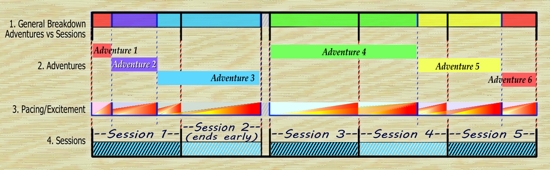
The top row divides time into game sessions and shows adventures within those sessions by color. The second row removes the sessions and splits the adventures onto different lines. Note that I already know that adventure #1 won’t last more than an hour or two (Actually, I stretched it to about 2 1/2) and that adventure #2 won’t be enough to fill a whole session of play unless it finishes early. The third line builds in everything I’ve written about adventure pacing, showing that pacing is a function of both session lengths and adventure length. Finally, row 4 is all about the sessions, and shows that session length is determined by adventure length and not vice-versa within this structure – session two is shown as ending 15-20 minutes early because there isn’t enough time to get adventure #4 to a decent start before the session clock runs out. Sessions are defined as ending when either the adventure reaches (1) a conclusion, or (2) a cliffhanger point, without enough time to reach the next adventure-conclusion or mid-adventure cliffhanger point.

This model shows that the campaign is neither strictly serial or episodic in nature, but a complex hybrid. It mandates that the last hour or so of play has to either be headed for a conclusion that can be reached in time or that builds to a cliffhanger finish for the day.

Most of my campaigns are far more strongly serial in nature, and contain mechanisms in the form of subplots that permit the day’s play to be padded out or cut short as necessary so that adventure conclusions almost always end the day’s play.

The main point of relevance here is that there isn’t a lot of time to long-winded discussions of game physics in most sessions. In fact, the only adventures shown that might be suitable are adventures 3 (mid-way through, about an hour into session 2) and 4 (early in session 3).

Parallel Worlds

All of the adventures that I came up with in that 30-minute creative blast fit this model, but none of them actually come out and announce “we’re in a parallel world”. They are sufficiently varied in temporal setting that it won’t be clear whether or not the universe is a single timeline (which may be more historically complex than the history books acknowledge), or if the PCs are bouncing around between parallel worlds.

That’s deliberate on my part. But there is one very good reason for being up-front here, even though the characters in the game won’t have any idea of the situation in this respect: it provides a facility for new players/new characters to enter the game. It’s already known by the players that they will start the game with 2 PCs and 1 NPC, and that the NPC-leader will be (was!) taken away from them fairly quickly, leaving the two PCs to manage their own lives. The game mechanics don’t permit them to pick up additional team members from the local time-frame, but there will be a way for them to pick up an additional PC if that person is already a Zener Gate traveler. Since all such travelers that come from the PCs’ timeline are accounted for, that only leaves someone coming from somewhere else – and that means a parallel world.

Adventure policy will still be to keep the question open as often as possible and as much as possible. At every given point of intervention, there has to be the doubt and insecurity that this could be their own history that they are messing with. And sometimes, it will be!

Events

My view of the structure of time for this campaign revolves around events. An Event is defined as “an outcome that can be changed”.

Events come in three flavors: Statistical, Probabilistic, and Human.

Statistical Events

Statistical events include things like radioactive decay and pair production at any given moment and place and other such quantum-scale phenomena.

Most of the time, these make no macroscopic difference whatsoever. In a radioactive substance, a given number of atoms will undergo subatomic changes over any given time-span. Whether one particular atom does or doesn’t is not particularly relevant.

And yet, they can compound and cascade and chain-react and domino-drop, to the point at which timeline A at a given instant is measurably different from timeline B – dividing a radioactive sample in half and finding that one sample contains more decay products than the other, for example, indicating that more of the atoms in the first have decayed than in the second.

It’s only when looking at statistically-rare events at a subatomic level that these things matter, and there aren’t many of those. Nevertheless, the instant any such difference, anywhere in history, becomes measurable, the timelines have demonstrably diverged, and what was a timeline indistinguishable from “base reality” has become one that is now distinguishable from that reality – if you know where to look.

Chaotic Phenomena

Some physical phenomena are so sensitive to changes in input conditions that they amplify the consequences of any such change to the macro level, i.e. the human scale or bigger. The most famous example is the weather, but even these systems are relatively resistant to quantum level deviations; a single butterfly flapping it’s wings somewhere might be enough to change the weather three days later in a completely different part of the world, but the changes that it is introducing are way more substantial than quantum-level changes.

This demonstrates a dividing line – any event too small to trigger macroscopic differences in chaotic phenomena outcomes is a “statistical event”, any event larger than that is either “human” or “Probabilistic” in nature.

Statistical Noise

The net effect is that statistical events create “noise” when plotting those events over time. This can easily be enough to push an event over a threshold, triggering a chaotic change, but only when there was already an underlying trend towards that change event.

Consider a pot of water heating up on a stove. Heat is transferred from the source to the water via the metal of the pot. This heat increases the molecular movement of the water, raising its temperature. Molecules bounce into each other more and more energetically. When that happens, the transfer of kinetic energy is not easily predictable; the total will be the same afterwards, but the distribution of that energy is more complex. Sometimes, it will be very equal, but more frequently, one of the two molecules will exit the interaction with more energy than it had before, while the other has less. But the less energy that a given molecule has, the more of a ‘sitting duck’ it is for a subsequent interaction, so it’s energy state will not stay low for very long. You therefore have two mechanisms, one evening out the energy distribution, and the other concentrating it.

It’s at the top of the column of water within the pot that really interesting things are happening. Deep in the column, a highly energetic water molecule will almost certainly hit another one and the energy will be dispersed again. At the top of the water, it can actually break free of the surface tension holding the water together and fly off, taking the energy with it – if not stopped by a lid of some kind. That’s why water boils much faster when you put a lid on the saucepan. Eventually, energy is being released from the water at the same rate as it is being added, and the water can no longer increase in temperature; adding more energy simply increases the release, without increasing the overall temperature of the water (unless you enclose it to put it under pressure, which is an entirely different situation).

If you were to graph the temperature of the water over time, you would pretty much get a straight line until boiling point is reached, and a flat line beyond that. But if you were to graph the temperature at the very top of the water, you would find that it was a very noisy line with a trend, or mean, that matched the overall temperature line.

You still can’t exceed the boiling point, though, so the tops of the spikes would get cut off. If you produced such a graph, it would look something like this:
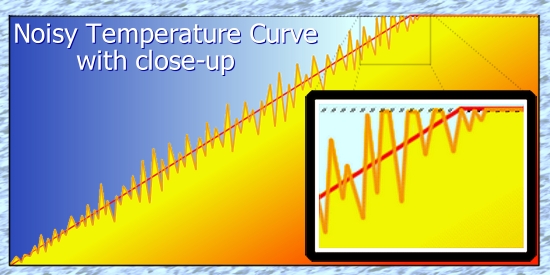
This is one example of a change at the “statistical” level producing a quantifiable change at the macro scale, and it happens because the statistical “noise” adds to the trend, sometimes decreasing it (when an especially energetic water molecule carries its energy away) and sometimes increasing it, momentarily bringing a small spot on the surface to boiling point, producing steam..

The same pot of water offers a second example, as well: the bottom of the pot is not going to be perfectly smooth. There will be pits, and those pits can result in a small sub-population of the water molecules receiving heat from multiple directions, not just from beneath. The result is that those water molecules turn to steam before the heat can be distributed through the water, and the resulting bubble grows until it overcomes the force of surface tension holding it in place, at which point it bubbles to the surface and bursts open, releasing it’s contents. These imperfections can be microscopic in size, but they have a much larger and more visible effect.

Parallel World application

Whenever you have an outcome that can produce a measurable difference, you are creating an alternate timeline. In most cases, that difference will be unnoticeable, and the world indistinguishable from the base timeline; but when such variations in quantum “noise” are taken into consideration, it becomes apparent that there are real-world phenomena that would distinguish one world from another if you looked in exactly the right place. In timeline A, a bubble was just reaching the top of it’s travel through the not-yet-boiling water while in timeline B, it was still a fraction of an inch short of doing so – or had done so a fraction of a second sooner.

Because this noise is completely random in it’s occurrence, if you aggregate the results of many different parallel worlds, you end up with a flat probability curve – any given result is equally likely, provided only that there is no underlying trend. Statistically, the noise evens out leaving only those underlying trends. If you start a pot of water of the same size heating up on multiple worlds at the same physical location within the world, they will all come to the boil pretty close to simultaneously.

With untold millions upon millions upon millions of such events in which random “noise” pushes some condition over a threshold – or not – at any given instant, there must be an equal number of parallel worlds that are indistinguishable from the base reality of comparison unless you happen to examine exactly the right place at the instant of divergence between the two timelines, or the measurable event triggers another difference, and then another, and then another, in a chain reaction, or a cascade.

It follows that there is going to be a slow drifting apart of such worlds in terms of their uniformity. It will be glacially slow, even non-existent to all intents and purposes, until suddenly a cascade takes place in a chain reaction – and then, quite suddenly, they are no longer exactly the same.

Even then, the change might not be noticeable. Let’s say that in timeline A, a star ignites in the 3,975,675,253rd most-distant galaxy from the Milky way on a given date – the trend is for that to happen, but it got pushed over the edge by a statistically-random event; in timeline B, it took three or four more days to occur. Who in the milky way would notice this change? Hear that hollow echo…

Even cascades are restricted in effect by the square of the distance removed from the point of observation plus the time required for the cascade’s effects to become measurable at that point. The change described in this example is so far away that we would have to wait billions of years to have even a vanishingly-small chance to see it.

If a new star happened to ignite in the Pleiades, a known stellar nursery within the Milky Way (some 410 light-years away), it would almost certainly be noticed within a day or two of that 410-year interval. Astronomers watch it regularly for the very reason that there’s a chance of new star appearing there just about anytime, and the process itself is of acute interest.

So significance divided by distance yields the probability of a noticeable difference. Adding time into the equation means that however low the result, it will eventually amount to a significant difference. The oldest, most different, divergent timelines would have very different stars and planets in the sky. You could even measure that statistically to “index” the degree of drift away from the base timeline.

Probabilistic Events

It was once believed that the planets were fixed and predictable in their orbits. In the later 20th century, that belief was demolished as an illusion, except over a relatively short term.

The problem is that every mass in the universe affects the motion of every other mass, though this impact grows smaller with the square of distance. Nevertheless, the effect is real enough that observed discrepancies in the orbits of the various gas giants predicted the location of Pluto. When the latter was considered a planet, that was impressive enough – but now that Pluto has had it’s status so controversially downgraded, it becomes even more so.

With every body that you add into consideration, orbital calculations become exponentially more complicated. Even a small change in position of a mass that is rendered immeasurably insignificant by distance accumulates over time until it isn’t insignificant any more. If we had precise measurements of the masses, positions, and motions of every body in the solar system, all the way out to the Oort Cloud, and effectively infinite time to make the calculations, then we could accurately predict orbits forever. Take away any one of those requirements, however, and you start introducing errors into the equations – small ones, but they will add up.

Now, some of those errors will cancel out others, while some will not. But the end result is the same: it might take 1000 years, or ten thousand, or 100 thousand, but sooner or later the accumulated errors will overwhelm any reasonable certainty of where any given planet will be in the sky.

Of course, the bigger the object, the more difficult it is to perturb it’s predictability; momentum tends to keep it on track. So Jupiter almost certainly has the most predictable planetary orbit in the solar system. It perturbs others far more than it is perturbed.

Some stellar objects like asteroids and comets are small enough and come close enough to these unknowns that predictability windows are a lot smaller. Last year, an Asteroid came close enough to the earth that for a while there were some very sweaty astronomer’s palms – this was potentially a city-killer, and could have impacted anywhere, if it impacted at all. It flew between the Earth and the Moon, and – in this case – kept right on going. It’s orbit was such that it’s not something we have to worry about for 200 to 2000 years, depending on which astronomer was being quoted at the time. (Most worrying, it was only 3 days away when discovered, and there have been others spotted only after they have passed us!)

But it’s always possible that at some future point, something we haven’t spotted before will be in the right place at the right time to perturb that orbit, just a little. How much is significant?

Well, the moon is about 384,000 km away. It was closer than that, so let’s say it missed by about 200,000km. The Earth is about 149.596 million km from the sun, so the diameter of it’s orbit must be roughly twice that – 300,000,000km. So to get that rock to shift it’s course by 200,000km requires a net perturbation of about 200,000 x 100 / 300,000,000 = 2 / 30 % = about 0.067%. That’s not very much, so people will certainly be keeping an eye out as best they can.

And, of course, you can divide that perturbation by the length of time that it has to become a factor – so if it were to happen right now, and would result in a direct threat in 199 years, 0.000335% would do it.

Orbital mechanics being what they are, there will be times when the perturbation needed will be a heck of a lot bigger – when it’s headed away from the earth, as it is now, for example. To have it effectively turn around and come back to strike us next year would require such a tremendous change that it’s simply not going to happen – and if it did, it would be the least of our problems. In fact, it’s still not going to happen, because anything massive enough to have that sort of effect would already be perturbing other orbits, like those of the GPS satellites, by more than enough to ring alarm bells.

The calculated values are the sort of perturbations needed to alter the trajectory enough that in however many orbital periods, it will be in a dangerous state. If it has a 50-year orbit, the soonest that it can pose a threat is in 50 years, give or take a small margin of error.

It follows that orbital predictions are actually something that would be familiar to almost any roleplayer, a bell-shaped curve, with the peak probability being exactly where the object is currently predicted to be. The more time you allow, the more likely it is that some external influence will pull reality to one side of the curve or the other – but the greatest likelihood is that it won’t be enough to make a huge difference except over a very long period of time.

If you start with an almost-flat probability curve and keep adding itself to itself, time and time again, it becomes steeper and steeper, meaning that a small shift to one side or another is enough to drop you from a likely event to an unlikely event very suddenly:
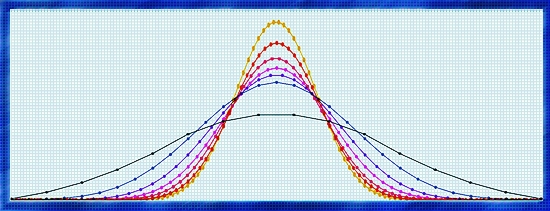
Given enough time, almost anything becomes possible – but, in the short term, the outcome is VERY predictable. And, of course, measurements are continually being checked and updated, especially for delicate and dangerous things like the orbits of earth-grazing asteroids.

Weather

It’s the same deal – though on a far smaller scale – with the weather. With modern forecasts, a meteorologist is almost certain to be pretty close to exactly right about tomorrow, is probably pretty right about the day after, is likely to have the right general prediction for the day after that, might be generally correct about four days from now – but check again in a day or so – and has some vague idea of what things might possibly be like five-to-seven days from now, but two times in three that forecast will change between now and then, except in the most general terms – and sometimes, even then.

So weather is a LOT more chaotic than asteroid orbits, but still subject to reliable prediction – in the short term. Predictability has also improved markedly over the last 50 years or so; when I was a child, there was a 50-50 chance that tomorrow’s forecast would only be correct in a general sort of way, and the day after that? Forget it.

And yet, in more general terms, while the weather on any specific day might not be predictable, the seasonal weather patterns overall are sufficiently consistent to be given a whole different name – climate. That doesn’t mean that you can even predict the January average temperature and rainfall for a specific location with complete accuracy – but you can state that it will probably fall in a certain range, and that there will probably be X number of rainy days, and so on. Barring any long-term changes, the more time you spend aggregating results, the closer to reliability you will get.

That’s why these phenomena are labeled “Probabilistic” – within a certain margin of error, they can be predicted, with that margin of error growing over time relative to the current point in time.

These sources of error – be they rogue planetoids or rampant butterflies – can only be combated by taking fresh measurements and updating forecasts regularly.

Parallel Worlds Impact

When one timeline separates from another, the more sensitive a prediction system is to such errors, the more quickly that timeline will diverge from its baseline. Using modern weather forecasts, for example, tomorrow will probably bring almost-identical weather in both timelines. The day after, most places will have the same weather, but a few locations may be slightly different. Three days after separation, and the weather will be noticeably different in perhaps 1 in 3 locations. Four days after separation, and 1/2 of places will have noticeably different weather, Five days and it’s 2/3, six days and all bets are off.

And yet, if you were to aggregate and average the results of many different parallel worlds, you would still end up with the same climatic results, and the more parallel worlds that you consulted, the closer to that result you will come. The climate is a far more stable value than the weather.

Again, if you were to plot those results, you would get a bell-curve – with the peak of probability being the climate-derived value. Any given result from any given world might be anywhere on the curve – but viewed as a statistical aggregate, there is predictability.

Two sides of the same coin?

It’s no accident that a Cascade of random events yields an outcome so similar to a Probabilistic event – because they are, in effect, one and the same thing. The probability of a Cascade occurring at any given instant, plus time for the effects to become noticeable, can be calculated and plotted, and will yield a — yes, a bell curve. That’s because of the underlying trend, just like the heating of the water. Logically, it means that if you broke your measurements into sufficiently small intervals of time, the water would boil at different instants on the different parallel worlds – but the error is swamped by the typical scale of measurement.

Which is why I thought the “noisy temperature curve” significant enough to include in this article!

Human Events

All this gives a framework for the understanding of events of the third variety – Human events. Human actions, human decisions, human moments of inspiration, humans yielding to emotional frailties – these can all be assigned a significance, they can all cascade to produce measurably different outcomes, but the probability of significant divergence is relative to both the significance and the observability of the event.

In timeline A, someone forgets their car keys until they get into the vehicle, and has to go back to get them before leaving for work, in some small out-of-the way place in, say, Oklahoma. The likelihood that this small change will ever be noticeable in another small town in, say Scotland, is vanishingly small. Only if there is a domino effect, and sufficient time for the consequences to propagate, would such a random event produce a substantial impact.

Some events are more critical, because they significantly affect a greater number of people, or have a persistent effect. Most of these involve underlying trends, however – it’s rare for the unpredictable left-field event to affect sufficient numbers.

That means that even a significant event is not likely to change significantly from one timeline to another. There would be a resilience to change in most cases, but how that resistance work is not yet obvious.

Significance & Criticality

Take, for example, a decision that would ultimately affect almost 1/3 of the US workforce – JFK’s decision to go to the moon. Does it really matter if he made that decision in one particular moment or ten minutes later? Not at all. It’s a significant event, but not an especially critical one; he has until he writes the speech in which he announces the decision to make up his mind.

Significant events tend to be coupled with entirely separate Critical Points, and a change needs to persist across that entire temporal range before it can cascade.

Even if he started writing a quite different speech and then changed his mind, it probably wouldn’t have a critical effect. But the polish on the speech would eventually suffer, and that might (in turn) alter the level of commitment that he is able to evoke. Or not; once announced, it wasn’t all that long before “Space Fever” gripped a huge share of the population. Congress might have started out unconvinced only to get caught up in the hoopla and get on the bandwagon a little later. The net result might be that Armstrong gets to the moon a month later than he did. And, while that’s a measurable difference, you still have to look in the right place and time for it; here in 2017, it wouldn’t have all that much impact.

It can be argued that a more critical point followed the Apollo I fire, when there were real fears of the program being shut down or scaled back. Because of the many technological improvements that derived from the space race, some of which – but not all – had been completed at that point, it is entirely possible that this would domino into a far more significant change to history, delaying weather satellite technology for ten years, for example – or bringing it forward by three-to-five. Accurate weather forecasting saves lives every year, even without considering natural disasters like Hurricanes. The accumulated impacts of the changes to those lives would almost certainly Cascade.

Would they impact the natural social trends? Who knows? They might, but they probably would not. Impacts are first contained geographically and then dispersed, losing significance with every step.

Only if a Cascading Event were to impact the life of a Significant Individual in a critical way – FDR’s decision to run for an unprecedented third term, for example – would there be the potential for subsequent history to be irrevocably changed.

Criticality Threshold

This implies that all Critical events have a Criticality Susceptibility Threshold that must be reached or exceeded by the Significance of a change before that change can cause a widespread difference in outcome, and that the scale of the consequences are related in part to that threshold.

Should a change in an event not have the required Significance to achieve this Threshold, it will have minimal non-local impact and will dampen out over time. Should the change in an event exceed the required threshold, it begins a chain reaction that produces measurable changes – at least for a while.

Consider: how much difference would the substitution of one Roman Viceroy over another have had on modern-day London? Regardless of the immense significance that this change might have held in Imperial Roman times, from the moment the Roman Empire begins to fall, the Significance of that event also begins to wane. It’s possible that one consequence before it has had time to vanish completely from relevance might trigger a new Cascade, and the more Significant the change, the longer it will remain a consideration, and the more opportunities it will therefore have to do so; but that is no certainty that it will occur.

In theory, it is also possible for an event to have exactly enough Significance to neither exceed the Criticality Threshold nor to fade away. But, in practice, this is another “noisy curve” – sooner or later, random chance will tip such a delicate balance one way or the other. In fact, you can define the threshold as being the exact amount of Significance required to overcome the resistance to change posed by the Threshold such that random chance determines the outcome.

I have done rough diagrams of the three possible Significance outcomes relative to the Criticality Threshold, below.
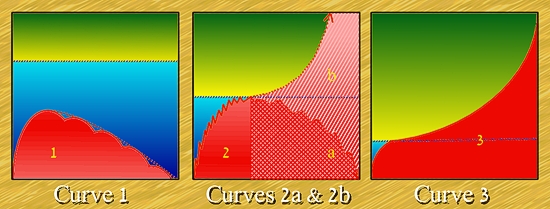
These three curves show the same event with different criticality thresholds. Noise has been ignored in (1) and (3) because it is only significant in the case of (2). The first curve shows an Event whose Significance never achieves the Threshold of Criticality; although it generates local domino effects for a while, the significance diminishes over time. The second curve is shown in two forms, (2a) and (2b). In the case of (2a), noise diminishes the Significance just as it reaches the Threshold of Criticality, leading to a diminishing pattern similar to curve 1. In (2b), the noise pushed the Significance momentarily above the threshold of criticality, Any noise is rapidly overwhelmed by the Cascade of events, which rapidly escalate. This is similar to Curve (3), where the initial event carried enough Significance to achieve the relatively low Threshold shown. Once again, a pattern of escalation ensues.

Another way to look at these results is that two timelines look the same – until they quite suddenly and seemingly from out of the blue, they don’t.

It should also be noted that there is no indication of scale on these diagrams. They are just valid in describing changes rippling out beyond the confines of an immediate family as they are, consequences escaping the confines of a small town or local region to impact a state, or a major city to impact a nation, or a single nation to affect a significant portion of the world. The smallest change in the wrong place at the wrong time (“For lack of a nail…”) can be devastating; the most massive change in a safe place and time will barely be noticed. Ancient Pompeii might have been visited by Aliens the morning of Vesuvius’ eruption, and it would not have changed history one iota.

Technological Impact

Technology might seem, at first glance, to embody one of those underlying trends toward change, and to some extent, it does, but to an even greater extent, it does not. If you were to carry the designs of a modern laptop computer back to 1850, it would make no sense to anyone, and even if they could reason out the meaning (with a little guidance) of what they could see, the infrastructure, materials, and manufacturing capacity doesn’t exist to even make the tools needed to replicate it.

When it’s time to railroad, all sorts of people will invent it; THAT is an underlying trend, it means that the “state of the art” has achieved the standard needed for that technological development and random inspiration will show any number of people with the right educational qualifications how to go about it.

The Consequences Of Brilliance

“Ah, but some men are brilliant thinkers, able to absorb, understand, and utilize abstract concepts far beyond the current capabilities,” replies a would-be changer of history. Sadly, it is not so. There have been many occasions in the past where an idea was given birth too soon; the maverick genius who did so usually lost his shirt. The people who developed and controlled the necessary forebears of the required technology squashed the potential competition, ridiculed the inventor, saw no future in it, or worse, saw a future inimical to their interests and ruthlessly suppressed it. When it’s not time to railroad, even giving someone the gift of a working steam engine will not produce a locomotive and tracks.

Space-time Travelers

But those topics, by virtue of the examples offered, provides a natural segue into questions of time travel, and the subjects of Consequence and Paradox.

When someone arrives via Zener Gate, their arrival is accompanied by a release of energy, mostly in the form of radiation. There may be times when that is directly significant, most of the time exposure is so attenuated by dispersal through the surrounding volume of space that it does not.

But some of the energy will be in the form of sound, which may cause people to change what they are doing and investigate the source – an unprompted Change that may or may not exceed the Critical Threshold – and some will be in the form of light (same), and some will be in the form of heat, and where there was “empty” air, now there is a solid being doing the equivalent of flapping a butterfly’s wings.

The weather will immediately begin changing, though the impact won’t manifest (in all likelihood) for a number of days. Other such Chaotic systems may be affected – the earth weighs infinitesimally more because the mass of a whole new human being has just been added. This will immediately have a minuscule effect on the orbit of the moon – again, the significance of the change may not be apparent for millennia, but eventually the trend so set in motion will accumulate beyond the Criticality Threshold, and the resulting error will mean that the moon is thereafter in a slightly different place relative to a timeline in which the space-time travelers did not arrive.

Consequently, the very presence of a Space-time Traveler will have an impact on the timeline in the form of Statistical and Probabilistic events, even if they do not interact with anything.

Consequences

It follows that every interaction between such Travelers and the local inhabitants will qualify as a Significant Event because those locals are NOT doing whatever they would otherwise be doing. This does not mean that history is irrevocably changed, however; even showing up in the middle of a battle and bringing superior firepower to bear might not substantially alter the outcome, and hence achieve the Threshold Of Criticality. Except in rare cases, the natural resilience of History will dampen the impact.

If a significant interaction takes place, i.e. one with a low Threshold of Criticality – such as telling FDR a few days after Pearl Harbor what the course of the war will be – the timeline may be irrevocably changed. This runs the risk of creating a Paradox.

Paradox

Except that there’s no such thing. The consequence of arrival immediately creates a branch-point in reality because there will always be a version of the timeline in which the Travelers did not arrive. History is therefore sandboxed against paradoxes. Even if one of the Travelers kills one of his ancestors before the next genealogical link towards the traveler’s existence is conceived, that simply means that there will be no analogue of that particular Traveler deriving from that particular timeline. The traveler’s own personal timeline is not affected.

By definition, the traveler can do nothing that would create a paradox in his own personal timeline, or so it seems – at least initially.

The reality is a little more complicated. A traveler from timeline A might not be able to create a Paradox in timeline A, but there is nothing – at first glance – to prevent a traveler from Timeline B making such a change and creating a Paradox for traveler A.

Again, it’s not that easy. The only way to prevent a branching of the timeline is for Traveler B to make the transformation of history completely inevitable from the instant of his arrival. Any scope for any alternative to occur will result immediately in the creation of a branch of time in which that alternative does occur – and hence, Traveler A’s timeline is protected from change.

In fact, logic shows that the only timelines which can never be changed with time travel are those in which time travel is discovered!

But the logic is incomplete. Does it really make a Significant Difference if it is traveler A who departs from his native timeline or if he ceases to exist and Traveler C takes his place? Even a Curve 3 change has a limited half-life, beyond which there may have been a Historical Change that has no practical impact on daily existence. There is still a Threshold Of Criticality that protects Time from casual changes. A time-traveler may have a lower Threshold relative to someone who never travels in Space-time, but he has a threshold nevertheless, and while that Threshold may be breached sufficiently to trigger a local change, that doesn’t mean that it will automatically trigger one on the next scale.

Quantum Time

What at first seemed to be a single Critical Threshold is now shown to be a nested series of such Thresholds, each affecting a greater geographic area, and each a more difficult target to achieve than the last. A change, no matter how substantial, will eventually fail to exceed the required Threshold, and the Event Significance will peter out, as in Curve 1.

No matter how substantially human history is altered, it is unlikely to have much effect in the 3,975,675,253rd most-distant galaxy from the Milky….

The Upshot

The PCs can do whatever they like and the only consequences of any substance will be the effects on them. All else will eventually fade away, or will generate a new set of timelines for the consequences to Cascade in.

From the moment you accept, as fundamental, the concept of Parallel worlds, History is secure.

Motivations

But wait – what then motivates the PCs to get involved in whatever the GM has planned?

There is this stat called KARMA. Experience points pay directly into Karma, which can be used in all sorts of good ways to benefit the PC who has it, and to benefit any companion. But you only get Karma for engaging in the Adventure in an appropriate manner. Sitting back and doing nothing produces no Karma. Trying to take advantage of a historical situation may produce wealth, or resources, but it produces no Karma – and if you don’t have the Karma to protect a resource, you can’t pay points to obtain it, and the GM is not only free to relieve you of that resource, he is obligated to do so by any means necessary.

That leaves the PCs with little choice. Whatever the situation put before them, they have to do their best to solve it.

Changing a Changed Future

It’s also worth pointing out that there is absolutely nothing protecting a changed timeline from being visited at some future point in its history by either the same Travelers or Different travelers. The consequences of mistakes or malfeasance are always at the GM’s fingertips, and the PCs can always be too clever for their own good, and subsequently hoist by their own petards.

Predestiny & Prophecy, or ‘What is Karma that you should be mindful of it?’

Those are Metagame concepts, regarding the interplay between the Game Mechanics and the in-game behavior that they engender. How do these things manifest at an in-game level?

If a time-traveler enters a timeline at time C, learns what he did in time B within that timeline, and then communicates that information to an earlier version of himself at time A – and there’s no game rules against that – does that trap the character into a Destiny over which he has no freedom whatsoever? Expanding this concept, does that mean that everything the character did prior to time A on his personal timeline was predestined to occur?

In other words, can you bootstrap your future?

The very term, Karma, implies a continuity between past actions and future consequences. Where and when these consequences come into force must be consistent and correct with reference to a traveler’s personal timeline, but nothing is said about the matter in respect of other times and other timelines.

Every PC choice either matters or it doesn’t. If it matters, if it makes any form of substantial difference now or in the PC’s personal future, there is a causality connection along that personal timeline, and hence exceeds the extremely low Threshold required to create an alternate timeline in which the PC makes a different choice.

This places the GM in a position to play Cosmic Censor. Any attempt to bootstrap a character in this sort of way puts him in the position of either railroading the campaign to ensure that events play out in the manner described by the bootstrap, or of permitting random temporal noise to alter that outcome, or of simply telling the players that their characters are now deriving from a personal history that does not include the Bootstrapping.

Me, I like option B. Should the PCs attempt such a bootstrap, they can only communicate with the past selves that have not yet played through the events – but, since no such communication was received by them at that time, they are clearly already in a different timeline that has no obligation to follow the events of the past as they have experienced them. So such attempts represent an expenditure of Karma to the benefit not of themselves, but of some NPC analogues of themselves – from the PCs point of view, a waste of Karma.

This provides an escape clause for the GM to prevent a bad decision on the part of the PCs from completely destroying the campaign – if I foresee such an outcome, I can pull out the “warning from your future selves” bootstrap and throw it in the PCs direction. And then penalize the PCs at some future point (i.e. the end of the adventure) by forcing the expenditure of Karma to send off that message.

Predestiny? Poppycock.

Prophecy? Only if it is beneficial to the Campaign – and it places the GM under no burden of fulfillment.

Bootstrapping? Only if the GM uses it as a tool to preserve the Campaign.

The only time the game system bites the PCs on the tail is if they attempt to cheat it. Time travel campaigns may be about changing the shape of the future – but the only future that gets inevitably altered by this Time-travel campaign (in the long term) is the personal future of the PCs themselves. Everything else rearranges itself as necessary to generate adventure. Almost as though it were designed that way! Oh wait, it was!

And That is the significance of today’s article for everyone else out there.

Comments Off on Parallel Worlds and the probability of events

Dogs and Cats, Living Together: Comedy In RPGs (Again)


One of the prophecies of doom voiced in Ghostbusters was “Dogs and Cats, living together” – in honor of that quote I have used this photo by freeimages.com / lily rosen to illustrate this article.

With my internet still down (at the time this article was written), I’ve been taking the time to write, and to catch up on a number of documentaries preserved until just such an opportunity came to catch up on them.

One of the programs time-shifted in this fashion was something from the BBC, “The Science Of Laughter”, hosted by British Comedian Jimmy Carr, and it sparked some new thoughts on the subject of comedy in RPGs.

This isn’t the first time that I’ve found the subject in my sights (hence the title of this article); way back in April of 2009, I wrote The Right Quip at The Right Time: Humor in RPGs, in which I analyzed a whole bunch of different types of humor and how to use them (and not use them) in an RPG, discovering why Comedy RPGs are hard.

I’m going to deliberately structure this article along similar lines to the BBC documentary (which anyone who can access it should definitely check out) because a number of segments within the show sparked new and sometimes quite unrelated insights. I’m afraid that I’ll seem to ramble a bit in the course of this article, because many of the thoughts are the result of associating different elements of the show’s content with each other – bear with me!
rpg blog carnival logo

The Mechanics Of Laughter

The program started by examining the question, “What are the biological effects of laughter?”. Medical evidence was provided that laughter is actually a rhythmic spam of the intercostal muscles – which we normally use to breathe. Consequently, laughing too hard leaves you short of breath, it is impossible to speak coherently while laughing, and it is theoretically possible to laugh ourselves to death. I’ll come back to this point in a little while, because there’s a connection with another segment of the documentary that actually seemed to escape the attention of those participating, even though several of them were acknowledged experts in the field.

    Do straight men make the best comedians?

    I was immediately struck by the thought, which continually distracted me for the rest of the first viewing of the show, that if you can’t speak clearly while laughing, someone who doesn’t laugh easily might make a more effective comedian than someone with such a sense of humor that they couldn’t help laughing at their own jokes. I have to admit to not being completely sold on the theory; there is also the possibility that knowing that you are delivering a joke places sufficient distance between the joker and the joke that he is able to continue delivering his monologue or one-liners.

    And yet, it was later stressed that laughter is a social function, developed from the same bonding instincts that leads to the practice of grooming in apes. In a nutshell, things that might raise nothing more than a chuckle when viewed alone become uproariously, outrageously, funny when the experience is shared with another. Once someone is (genuinely*) laughing, even a little, it lowers a threshold of inhibition that makes another person more likely to laugh, or to laugh even harder, and that this is largely an involuntary response. So it would seem to me that performing any form of stand-up comedy must require the comedian to be resistant to comedy in the first place or they would be overwhelmed by the instinct to laugh at their own jokes.

    The jury is still out on this one, which is entirely my own theory. But, if true, it places the GM in a unique position for delivering a comedic experience at the gaming table – his position of authority and the many things that have to be on his mind at any given moment give him more insulation against laughter than any of the players. He is, by virtue of his function at the gaming table, more of a straight man than anyone else there; so it’s just a matter of the right quip at the right time – an instinct for comedy – to deliver what I will describe (a little later in this article) as a Grand Slam of comedy. That’s food for thought.

    (*There’s a difference between genuine laughter and socially-disingenuous laughter, i.e. laughter that is faked for social reasons. Testing shows that 9 times out 10, people can tell the difference – so you have to wonder whether the practice is actually counterproductive. I’d rather give a genuine attentive nod than a fake laugh, but you might choose otherwise. But that’s neither here nor there; I just felt it important to note the distinction, because it is relevant to the point that was being made).

    Laughter as a sign of evolutionary advancement

    Because the mechanics of laughter are what they are, if you are on all fours, you can’t laugh; the intercostal muscles are being used for support. You will either not laugh, and remain in position, or laugh and (literally) collapse. Creatures who are not bipedal can only laugh when on their backs, as later shown by a scientist who discovered a new treatment for depression (currently being developed by a pharmaceutical company who bought the rights for US$560M) by tickling rats. You see the same thing with cats and dogs – tickle them and they roll onto their backs to facilitate more of the social play.

    I’ve seen it suggested a number of times in sci-fi that one functional definition of “humans” is “the species that laughs.” Without actually commenting directly on that, the documentary’s content shows that there is a certain amount of truth to that proposition insofar as we are the only fully bipedal species on earth – depending on how strictly you define laughter, of course.

    All that is grist for the mill when it comes to determining social behavior and its expression in RPGs for species as diverse as Dragons and Aliens of all types. Do they have a laughter response, or an analogue? To what extent is it a biological or social necessity? What aspects of social behavior have such a function (or equivalent) as a necessity? Are solitary species, like Dragons, less needful of a sense of humor? What’s Elvish comedy like?

Laughter is Universal, Comedy is not

Another point to come out of the documentary is that while everyone recognizes the sound of laughter, no matter what culture they are from, what actually makes them laugh is a function of the culture and society around them. It’s not just subject matter, it’s delivery and atmosphere and circumstance and a whole slew of other factors. It can be quite difficult, as a result of the vast number of variables, to actually put your finger on the exact differences, but British humor is different from American humor is different from Australian humor is different from Japanese humor is different from Icelandic humor is different from…. well, you get the point.

To some extent, this is even a regional phenomenon. Do the same jokes play as well in the deep south of the US as they do in the Pacific Midwest or the Northeast? While there would be some overlap, I’m betting that there is sufficient divergence between the subcultures that some humor would simply fall flat in different places, even if deliberately provocative issues like race are ruled out of consideration, or would require the audience to be more “warmed up” than others. You certainly see the same thing in the UK – Irish humor is not quite the same as Scottish humor which isn’t quite the same as English humor.

That last paragraph is just my theory, based on my own experiences with different television shows – it would need a comedy professional who has done stand-up in a wide variety of locations to confirm it.

The main point is that comedy, and the subjects that are fit for comedic treatment, are functions of society and culture. Which naturally raises the question,

    What does a game society find funny?

    It was written a long time ago, so I no longer remember for certain, but I don’t think that sense-of-humor was one of the cultural distinctiveness points raised in the Distilled Cultural Essence series. This shows quite clearly that it should be!

    It’s not just a function of racial distinctiveness, it’s also a function of cultural distinctiveness. But, in order to see how powerful a tool this can be, both in terms of analysis and of depiction, you need to understand exactly what comedy is – a subject that I’ll get to in a little while.

    How best to simulate this?

    In the meantime, though, there’s a problem of accurately simulating it at the gaming table. This comes in two parts – GM simulation through NPCs, and player simulation through their PCs.

    The first is relatively easy to do – you simply have an NPC crack a joke on an appropriate subject, and (no matter how unfunny the players may find the joke), have other NPCs crack up with laughter. But the players need to understand why the joke is funny to that race/culture. Without appropriate education in the subject – say, by having them read this article – they won’t.

    And, if they don’t understand it, they certainly won’t be able to roleplay this aspect of their characters racial and cultural heritage correctly. Which brings us to the second half of the problem.

    There is a simple answer: permit players to crack whatever jokes they deem fit, and inform everyone that if they laugh at something (even something delivered out-of-character) that it means that the PC has said something that the PC considers funny. This might be interpreted as inappropriate humor, or humor aimed at keeping spirits high, or whatever, depending on the personality of the PC in question; it might even be that the character is trying too hard to be socially acceptable.

    An even better answer is: every time a player says something they intend to be funny, it’s the character attempting to tell a joke that is appropriate to his cultural and racial background. If someone laughs, that indicates either that the joke worked from the point of view of the laughing player’s NPC; if they laugh when the player wasn’t attempting to be funny, it signifies that the PC has done something that another PC finds funny even though the first wasn’t attempting to be humorous, and might not even understand why it was funny. This says different things about both the PC whose player is laughing and the PC whose player is not – from that point, it’s simply a matter of the player interpreting the situation and roleplaying accordingly.

    Both these solutions have the virtue of acknowledging that the player is not the character, but that the player is simulating being the character – is acting the part, in other words – and that the character depicted is actually a blend or interpretation of the role described by the character sheet. It simply expands the definition of roleplaying to include some aspects of out-of-game behavior – ones that more tightly integrate the player’s persona with that of the character’s.

    That’s certainly something worth thinking about.

    You can even extend the principle: sometimes, good roleplay might not be about interpreting literally what a character says, it might be about how they say it; the PC’s actual statement might be something completely different, and the player’s words on behalf of his character are a non-literal representation of what the character is saying.

The Infectious Response

As noted earlier, laughter is infectious. Most things are funnier in a group than they are to an isolated individual. The statistics show that laughter is 30 times more likely to occur in a group situation, given the same stimulus. Detailed studies of stand-up comedy audiences reveals (according to the documentary) that only about 3 audience members are laughing at any given moment, and that the laughter reaction proceeds in individual laughs like a Mexican wave back and forth, spontaneously, so quickly that it normally can’t be observed. Rather than being a continuous laugh, it is paused and restarted so quickly as to be imperceptible even to the person who is laughing.

It’s my impression that the “deeper” and “stronger” the laugh response in reaction to any specific source of humor, the greater the duration of these passages and more infrequent the ‘rests’ – again, this wasn’t actually stated in the documentary, it’s my interpretation of the evidence that was presented, which is why I’ve separated it into a separate paragraph.

    Grand Slams of comedy

    I wrote earlier of the GM’s privileged position as a natural straight man. I’m going to pick up on that thread for a moment. It’s my experience that the combination of this privileged position and the communicability of the laughter reaction in a group situation, and a third factor that’ll go into in the next section, that you can sometimes produce a spontaneous exceeding of the three-at-a-time limit – if the group is the right size. In fact, you can get four or five players to laugh simultaneously – if you get everything right. It doesn’t happen often, and the larger the group, the harder it is to achieve at all.

    To my mind, this ties into something GF Pace brought up in his recent guest article:

    “The number of possible member-member links (L) increases as the size of the group (N) increases: (L = (N² – N) /2). …And this number doubles if the people involved are not rude and, you know, might respond to the interaction.”

    I am going to suggest, first of all, that those numbers might double anyway, because in addition to direct player-to-player interactions, you also have to consider character-to-character interactions. In other words, that the size of the group needs to factor in the number of characters as well as the number of players representing those characters.

    At the same time, these additional “group members” are not full participants; they are all represented by the individuals already counted by the mathematical expression. So it might be more accurate to say that each player (other than the GM) is “1.5 people” when it comes to depicting the number of possible links – what is actually increasing are the number of modes of linkage. The GM is a special case because he may be functioning as more than one NPC at a time. Two or three are quite common, as many as five or six aren’t unheard of.

    Does this increased head count hold full value? I would argue not – the fact that the GM is already playing one NPC must reduce the amount of active links that he can operate simultaneously. It would be more accurate to suggest that each counts as 1/(NPCs+1) additional characters, and that the aggregate of them all is therefore NPCs/(NPCs +1).

    If, then, the GM is directly operating two NPCs, his “N” contribution is one-and-two-thirds. If it’s three, we get one-and-three-quarters. If four, one-and-four-fifths. And so on.

    Let’s see what that does to the number of links:


  • 2 players (2 PCs), 1 GM (0 NPCs): N1 = (2×1.5)+1 = 4, L1=6.
  • 2 players, 1 GM, 1 NPC: N1= (2×1.5)+(1+0.5) = 4.5, L1= (20.25-4.5)/2=15.75/2 = 7.875.
  • 2 players, 1 GM, 2 NPCs: N1=(2×1.5)+(1+2/3)= 4.6667, L1=8.555.
  • 2 players, 1 GM, 3 NPCs: N1=(2×1.5)+(1.75)= 4.75, L1=8.90625.
  • 3 players (3 PCs), 1 GM (0 NPCs): N1 = (3×1.5)+1 = 5.5, L1=12.375.
  • …and so on.

    Those decimal places seem strange, don’t they? What might all this mean? What’s going on here?

    Let’s consider the simplest possible case: 1 player, 1 PC, and 1 GM, no NPCs.

    If the number of links doubled, it would mean that the connection between GM and Character was wholly separate and distinct from the link between GM and player, as shown to the left.

    Instead, the situation is more like that to the right; there is an overlap, in which the player is speaking to the GM out-of-character about what the character is doing or saying or whatever. Since this overlap is the part of roleplaying that is already covered by the existing GM-player link, it can’t get counted a second time.

    What this means is that by subtracting GF’s original formulation from the more complex values that I derived above (or whatever ones are currently appropriate for your game), you get the ratio of roleplaying to non-roleplaying within the group’s communications.


  • 2 players (2 PCs), 1 GM (0 NPCs): N1 = (2×1.5)+1 = 4, L1=6; N2=3, L2=3, R=(6-3):3 = 3:3.
  • 2 players, 1 GM, 1 NPC: N1= (2×1.5)+(1+0.5) = 4.5, L1= (20.25-4.5)/2=15.75/2 = 7.875; N2=3, L2=3, R=(7.875-3):3=4.875:3
  • 2 players, 1 GM, 2 NPCs: N1=(2×1.5)+(1+2/3)= 4.6667, L1=8.555; N2=3, L2=3, R=(8.555-3):3 = 5.555:3
  • 2 players, 1 GM, 3 NPCs: N1=(2×1.5)+(1.75)= 4.75, L1=8.90625; N2=3, L2=3, R=(8.90625-3):3 = 5.90625:3
  • 3 players (3 PCs), 1 GM (0 NPCs): N1 = (3×1.5)+1 = 5.5, L1=12.375; N2=4, L2=6, R=(12.375-6):6 = 6.375:6
  • …and so on.

    Notice (1) that with the increase in the number of players to 3, there was in increase in the amount of roleplay relative to the amount of other interpersonal contact (including the 3rd-person-perspective overlap) – 6.375:6 vs 3:3, and (2) that each increase in the number of NPCs being handled directly by the GM brings an increase in the relative amount of roleplay, but each such increase is smaller – the biggest jump is from no NPCs to 1 NPC.

    Time to relate all this back to the subject at hand: at any given point in time, a player can be either “in-character” or “in person”. Therefore, every communication from the GM to the entire rest of the group travels along the larger number of links, but the player can only be receptive to one of the two links at a time. It takes time – usually less than a second, but time nevertheless – for a player in one mode to “switch gears” into the other mode. Not long, but enough to ruin the timing and dissipate the humor of the messageunless the GM uses a preamble to the comedic content to get everyone into the same mode (representing either an out-of-game joke on his part or an in-character joke, respectively, OR the GM is able to direct the comedic content down the (much narrower) overlap zone by presenting a comedic situation to the other participants.

    Get it right, and the reduced barriers to humorous content (that “other factor” that I said I would get back to, and which is still to be discussed) makes everyone susceptible at the same time to a brief moment of humor. Get it wrong, and at least some of the group will be in the wrong interaction mode at the time, and the effectiveness of the content will be diminished – some will laugh, and some won’t, or will laugh late and not as loud.

    A “grand slam” happens when you overcome the dissipation problem by one of the two mechanisms described – an NPC says something funny when the GM is already talking to the PCs in-character, or the GM presents a comedic situation by means of the overlap zone.

    Both present an additional hurdle that has to be overcome in order for the material to trigger a laugh. In NPC-PC interactions, there is a degree of analysis that is automatically performed by the receiver – “what’s my character’s reaction?” – and that, too, can be enough to take the punch out of the punchline. In a Shared-Channel communication, the GM is presenting physical comedy by description – and that can also take the fun away. So comedy is really hard to do in an RPG context – but funnier when it does work.

What’s comedy got to do with laughter, anyway?

Well, that’s all about the purpose of laughter. Comedy is whatever triggers us to perform that natural function, whatever it is. In other words, it all depends on why we find something to be funny.

Which is not as simple a question as it might seem – whatever the explanation, it needs to accommodate the social differentiators already described.

    Bonding Rituals

    Anthropologically, it’s believed that laughter started as a form of bonding or “grooming” that could be performed at a distance. It builds and strengthens community bonds in the same way that grooming does in the great apes, but that is necessarily one-on-one. There’s a finite practical limit to how many social connections can be sustained by physical acts of this type – there are only so many hours in the day. In apes, that’s about 50.

    Verbal communication and comprehension change all that. The number of people with whom you can sustain a strong social connection by personal interaction – family and friends – is about 150. Beyond that, you may have a sense of common community that sustains a weaker social connection. One of the ways that this communal sense is achieved is by laughing together, so the scientists now believe. Social and political structures, shared beliefs, etc, are others.

    Laughter has also been shown to increase the pain threshold by about 5-10%. There’s an endorphin release that is associated with laughing.

    Completely as an aside, it is interesting to note the ability of social media to broaden this reach. More interactive than email, much cheaper than telephony, and less time-consuming than traditional forms of correspondence, it’s my experience that it increases the capacity for a strong social connection into the hundreds, and somewhere close to the middle of that range. Adding in more one-sided social connections to social sub-groups, instead of individuals, raises it into the thousands or more. That’s why it is so effective at social amplification. It’s entirely possible that centuries from now, we will be deemed to live in the “social media age,” it’s potential impacts are so great.

    Crowdfunding, Crowdsourcing, and other forms of collaboration are clearly related developments. What others will we come up with over the next decade or so?

    An alternative interpretation is that social media is simply the first true social connection advance deriving from information technology, and society is therefore still in the Information Age. It would be possible to argue for weeks over whether or not social media constituted a sufficient advance over earlier forms of online interaction like chat rooms to define a new paradigm of human existence, and the debate could go either way.

    An interesting thought to muse on. But let’s get back to our knitting.

    There are four different theories as to what “comedy” actually is, when you get into the mechanics of it, at least that I know of.

  • The ancient Greeks – people like Plato and Aristotle – came up with Superiority theory, which is “the notion that comedy is a game, there’s a winner and a loser, and we laugh at other people’s follies.”
  • Release Theory, also known as Relief theory, is heavily built on the theories and experiments of Freud, and suggests that we laugh at things that release the parts of ourselves that we try to hide away in a socially acceptable manner – so we laugh at someone else’s pain to appease the sadistic tendency within.
  • Incongruity Theory is one of the most widely-accepted, and it suggests that we laugh at the misalignment of expectations with outcomes – plot twists, in other words. There are a number of variations on this theory, such as the one featured in Larry Niven’s Ringworld, wherein laughter is triggered by an aborted defense reflex.

    Benign Violation theory is the newest, and one that I had not heard of, prior to this documentary. It builds on, and incorporates elements of, the other three theories. Created by Professor Peter McGraw of University Of Colorado, it divides experiences into three types: Benign, which doesn’t trigger a strong reaction, Violations, such as an annoying co-worker, getting stuck in a traffic jam, anything strange or wrong or threatening, which produces an offended or negative reaction such as anger or fear or sadness, and an overlapping area called Benign Violations, which produce levity, causing laughter, which signals to others that the violation is actually ‘safe’. They then laugh to pass that signal on. The laughter of another can devalue a threat – or can be construed as a separate offense, if the subject is one that is still too threatening to deal with.

    This theory has a lot going for it. First, it permits individuals to have different sensitivities, to be individual in their reactions and responses. Second, it deals with the social context, and the way in which that – and therefore humor – changes through the years, and from one culture to another. Some old comedy, for example, is extremely offensive and bigoted or patronizing or misogynistic by modern standards, and some of it is just boring and confusing (indicating that the subject is no longer threatening to the listener). Some remains hilarious. Comedy therefore reflects the broader values of society. And third, and this is perhaps its most compelling feature, it is the only one of the theories that explains why there has not yet been enough discharge of emotions to make 9/11 a fit subject for comedy. It’s now been 16 years since the attacks on the World Trade Center; by the time World War II was that far removed into the past, we had “Hogan’s Heroes”. I can’t see any serious proposals for a 9/11 analogue being seriously considered, either by a studio executive or a member of the public; the event is still humor-toxic.

    The implication is that people resist laughing at jokes the find offensive, and grow upset by such laughter, because laughter tells the listener that “it’s OK to laugh” when – from their point of view – it’s not okay to laugh. If you happen the hold the latter opinion, then you will be offended by the laughter.

    Humor needs to be edgy, but it can’t go too far. If it’s not edgy, it’s not threatening enough to be funny. But if it’s too threatening, it’s not funny. That’s a fine line to manage. Comedy is pointing out what’s wrong with the world in a socially-acceptable way.

    Here’s another way to look at comedy, then: comedy is content and delivery. If the content isn’t funny, we won’t laugh; if the delivery is wrong, if it goes down the wrong channels of communication or takes too long, it’s not funny. You need to get both right – and every individual is just a little different.

    That’s why “Grand Slams” are so hard to achieve – much harder than telling a joke and getting one or two people to laugh.

Broader interpretations & applications

All this gives rise to three final, broader, thoughts on the subject of Comedy in RPGs.

    RPGs seem tailor-made for comedy

    I’ve referred to this thought a couple of times already in this article; it has helped shape it, throughout. Threats in an RPG are already at arms’ length, separated from the individual by the player/character gap. That means that it’s harder (but not impossible – see Moral Qualms on the Richter scale – the need for cooperative subject limits) to be offensive. You can go harder and still be funny. But that doesn’t imply desensitization – if something is already funny, it will still be funny in an RPG. So this represents a broadening of the subject area of comedy’s constituents.

    Is this factor enough to more than compensate for the added difficulties that I’ve already discussed? Sometimes, not always. An RPG lowers the threshold at which something will be funny by virtue of the distance between subject and personal identification, enough that “Grand Slams” become possible – the audience, i.e. the players, are more receptive. But in general, it doesn’t lower it enough on its own to make an RPG an automatic vehicle for humor; you still need to nail the delivery and not push the content too far.

    But I guarantee that if you spend an hour or so building up a bad guy to be an enormous threat, and then have him trip over in the first seconds of combat, the players will laugh their tails off..

    Spontaneous Humor as a sign of campaign identification?

    Like, I suspect, a lot of GMs, if my players were telling jokes about my campaign, I might be offended. After all, I put a tremendous amount of work into most of them. That changed in the course of thinking about the documentary and this article, because you only tell jokes that strike you as funny, and before something is funny, according to the theories described herein, you have to find it to be threatening in a benign way, and that only happens if you are immersed within it and take it seriously. You can’t say something both original and funny without considering the subject to be important in some way. You have to identify with the subject, and then seek to defuse the threat and make the subject benign, with humor.

    Especially if the players are able to crack jokes in character – and I have seen this done – it signals the kind of deep immersion within the world that we all strive for. It means that the game matters to the player.

    It’s a good thing, not a bad thing!

    Children and comedy

    It’s possible to scare a child, but they are far more likely to view everything as only slightly threatening if you approach the subject in the right tone of voice and frame of mind. That’s why children can laugh at things that only arouse sympathy or disinterest in more mature age-groups, while most things that adults find funny go right over their heads. The result is that children laugh and play more easily (more readily) than adults.

    Earlier, I suggested that RPGs and Comedy seemed to be a match made in heaven. Now, that statement stands revealed
    as a pretender to the throne. Kids and Comedy in RPGs – that’s the real king of the crop.

This article won’t make every GM a comedy genius behind the table. Intellectual analysis of something that isn’t intellectual never does. But it will offer direction, and help you understand why some things produce laughter at the table, and when such laughter is detrimental to a good game, and understand why the joke about the Orc, The Dwarf, and the Princess in a Bar falls flat.

It won’t do the hard work for you – it’s just a road map to where you have to go if you want to invoke comedy in your RPG. But that’s certainly an improvement over nothing at all!

Comments Off on Dogs and Cats, Living Together: Comedy In RPGs (Again)

The Influence Of Distance Part 3: Far (The first half) and bonus worldbuilding tools


This image of a road through a pass in the Dolomites symbolises distance and remoteness perfectly, courtesy of freeimages.com / Enrico Corno
Click on the image for a larger version

I’m tagging this post as part of the Blog Carnival. The theme is sequels, and I think that being the third part in a series qualifies.

The first two parts of this small series (Part 1, Part 2) looked at the tremendous impact of a community being located close to the major social, political, and economic center of a nation, especially in D&D games. Well, being distant from the population / administration / social center of a nation is no less profound in its implications!

I come from a small town located a considerable distance from the main urban center of my State, and Australia is geographically remote from most of the rest of the world, and especially from our primary cultural influences, England and the USA. That places me in a unique position to be authoritative on the impact of remoteness and distance. In fact, this was originally going to be the entire article; it was only as it was being developed that I realized that the other side of the coin also needed attention.

In terms of the topics to be covered, I’m going to start with the same basic headings over these next two articles as I did in the first half of this series, suitably modified of course!

rpg blog carnival logo

Distance From Power

When you’re located a long way from the power base of the ruling authority, you have a great deal more independence, especially if that central authority is reliant on messages from the remote community to know what is occurring there. British colonial history is full of stories of local viceroys pursuing their won agendas and ambitions, even in direct contravention of national policies.

It has long been a standard practice to exile troublemakers and agitators to remote communities – Siberias, if you will – because this limits their capacity to trouble the state. Australia was established as a penal colony, and while most of those transported were convicted of relatively petty crimes – stealing shoes, or a loaf of bread – there were a significant minority found guilty of more serious crimes. In theory, once a sentence had been served, the convicts were to be provided transport back to England, but in practice this rarely occurred. Although I don’t know of any specific examples, it is far from being a remote possibility that some were political prisoners.

One of the early governors of the Colony of New South Wales was former-Captain Bligh, notorious for the Mutiny aboard his ship, the Bounty. He had not softened in subsequent years, ruling with a heavy hand, and treating those under his authority as second-class citizens even if their sentences had been served. The Colony had been conceived as a social experiment, a moneyless community, but – as always happens in such cases – an unofficial medium of exchange had sprung up – illegally-brewed rum. Bligh, determined to keep the Colonials under his thumb, sent glowing reports back to England even as he ruthlessly suppressed and oppressed the residents. The straw that broke the Camel’s Back was his attempt to suppress the Rum Trade, leading to a full-blown revolt against his authority. He was captured, hiding under his bed, and sent back to England. Nevertheless, the Colony was still dependent on the home country, and one of the instigators also returned with Bligh to stand trial for Mutiny; he was found guilty, but pardoned due to the extenuating circumstances. More than anything else, this shows the difficulty of exerting power from a distance.

That difficulty also shows up as a key factor in the American Revolution; ‘taxation without representation’ held a particular resonance amongst many Australians on several occasions through the 20th century, as the nation of Australia sought to exert its independence. Even today, archaic English laws occasionally throw up a Constitutional Crisis here.

Distance From Authority

The more remote a community is to central authority, especially in a medieval/fantasy setting, the greater the independence of the local representatives of that central authority. Broad directives may be issued, but interpretation and implementation rests with the locals. Laws may be passed by the central command, but the reality is that some laws will be ignored (most of the time), some will receive no more than lip service (though they may be used as “the stick,” i.e. a threat to maintain order), and some laws that may have been modified or taken off the books entirely will still be in effect, however unofficially. The result is a strange melange between the contemporary and the way things used to be, as much as a generation or more earlier.

Popular myth suggest that this is true for remote communities in the US – sleepy little communities that are a generation or more removed from modern social attitudes are practically a trope in fiction and media – and there are ‘redneck elements’ in many remote Australian communities, even in modern times.

This tendency can only have been exaggerated in eras when communications were slower; it’s impossible to react sensibly to situations when all the reports are days out of date, even if those reports are accurate.

Distance From News

Back when I was growing up, people knew a lot about what was happening locally, were reasonably well-informed about regional events, and learned everything else about events at a state and national level from a daily half-hour of TV news, augmented by another half-hour of current affairs, and from 3-to-5-minute radio news bulletins. If you wanted depth, you were reliant on the daily newspapers, most of which were a blend of “the official line” and ideological perspectives. Most of what went on at the State and National Capitals was either perceived as irrelevant, or biased in favor of the cities over the needs of country citizens, and the rest was simply seen as “remote”.

Peculiarly, such when the city of Darwin was leveled by Cyclone Tracy (what North Americans would know as a Hurricane), this occasionally resulted in locals being better-informed about events than their urbanized brethren. The major news services were slow to pick up on events, but regional radio networks learned of the situation far more quickly. I can distinctly remember hearing about it on Christmas Morning in 1973, before we started opening Christmas Gifts, and the sense of guilt that accompanied having a good time while our fellow citizens were struggling to survive. Not that I, as a ten-year-old, could have done much about the situation! It was only in the evening TV news the following day that the national media seemed to catch on.

These factors are only amplified by the slowness of communications in bygone times. It was not unheard of for communities to learn of the death of their monarch after a successor was already crowned.

The effect is best thought of as ripples of emotion, spreading slowly. The outermost regions are not aware that anything has changed; life is proceeding as normal. Inward of that, you enter a zone where the news has only just arrived, and people are mourning (or celebrating, depending on the ruler, I suppose). As you proceed still closer to the center, you reach regions that have had more time to digest and react to the news and which are beginning to settle down again. Inward of that is a band in which people are waiting to see what will happen, and what it will mean for them. Then you reach regions where the identity of the new monarch has been confirmed, but in which it is not yet known when they will formally ascend the throne; then you have a band of celebrations following news of the coronation; and, in the center, the Capital, where the Coronation was last week’s news, and the consequences are beginning to dominate awareness. As the news radiates ever-outwards from the center, these bands expand outwards.

This process is illustrated in the form of a “time-lapse series” by the diagram. Each piece of news radiates out from the source like a wave, traveling a certain distance in a given time dictated by the speed of communications.

Bad and dramatic news (or rumors of the same) tends to travel faster than good news, while good news travels faster in the absence of other news or when it is in direct response to a prior bad news story. This has been simulated by widening some of the bands.

It’s important to note that “the speed of communications” is actually a two-to-three stage process. While some people will hear the news directly, a far greater number will need to hear it via word-of-mouth from someone who has heard it directly, and some will still ignore the story on the basis of disbelief or a failure to recognize the story as a matter of relevance to them.

It doesn’t really matter what the ultimate speed of direct communications is; the primary distribution medium remains human in nature. The bigger impacts on the process are (1) the telephone, and (2) social media.

The telephone changes the picture significantly because it means that someone in an inner zone can bypass the zones and inform someone in an outer zone of what is taking place (I include telegraph technology). Through central news distribution methods, they also change the model from a single source to multiple sources, with a small delay before the satellite “ripple sources” begin disseminating the message.

This of course distributes the dissemination of information, such that few places are more than a day or two removed from the latest news, even allowing for the human factor.

Social Media as a primary news source is a further game changer. For the first time, the human-to-human contact can be instantaneous, or close to it, but misinformation is equally rapidly shared; the usual filters of credibility are removed and replaced by those of the individual. However, it is easy for news of a less dramatic nature (but perhaps of greater importance) to be buried beneath the surface. The primary news networks are supplanted by smaller networks that preach to the converted, creating polarization and the well-known “echo chamber” effect.

I mention these changes purely because it is possible for some fantasy worlds to have fantasy-based equivalents of these technologies. In the absence of these equivalents – which will be the case in 99% of fantasy worlds – the primary model remains functional and accurate.

Limitations Of Communications

It’s extremely difficult to understate the relative importance of human networking in a remote community. “News” heard from someone that you trust often holds greater currency than more “official” sources, and everything is colored by local preconceptions.

Brevity is another issue, and one that I mentioned earlier. It is impossible to do more than communicate the most superficial of accounts; details and nuance take up too much room, and can only be achieved by cutting some other news.

Such communications systems struggle to cope with the pace of fast-moving events. While those closer to the source will experience the totality of a situation – initial reports, official response, outcome, and aftermath – as separate events, by the time the accumulated time losses resulting from human networking exceed the travel time plus event duration – which can happen within the first zone or two – later reports catch up with the initial events and become conflated into a single past-tense story,

When everything serious is reported as a solved problem, placed in the past tense, the sense of being insulated by distance inflates, and even the most critical emergencies lose their impact and urgency, and therefore, a significant part of their relevance to the local experience. Often, the stories seem to “pat” and superficial to be reality, as a result; manufactured propaganda, not real news. This nourishes and encourages the sense that local sources and their “interpretations” (mentioned in the first paragraph) are more reliable.

Communications problems are bilateral; just as it is harder for unbiased communications to reach the remote community, so it is hard for that community to communicate with the central authorities. Any sense of urgency is usually the first casualty, as discussed a moment ago; this is true of reports from the fringes going inward as it is for reports of government actions going outward.

Regional disasters assume a superficiality, and a sense that the difficulties being faced are being overblown and exaggerated, when the opposite is more often true. As a result, aid is often desultory, a token gesture in the face of need, further encouraging the perspective that the central authority and the local region live in two different worlds, and – by and large – prefer it that way, so long as one doesn’t interfere in the other. The problem is that almost every government intervention is colored by the insular attitudes and the perspective of distance, and is therefore most readily characterized as “interference”. There is a genuine sense in remote communities that the government cares only about the cities and their inhabitants, and would do away with the “bush” if they didn’t have to exploit it. “Us Vs. Them” is a very real internal struggle of perceptions.

Distance From Trade

The title of this section is a half-truth at best. While it is true that regional communities are far removed from the central markets and hence from the luxury and foreign goods that will usually be available there, the regional communities – for the most part – don’t miss those products, and are prone to look down on those who consume them. The mildest term for such are “fancy-pants” – Australian colloquial vernacular uses a lot of substantially stronger terminology for them, and my experiences during overseas visits is that the same is also true elsewhere. The vernacular changes, the attitudes do not.

Instead, regional communities have regional markets. The general attitude is that if the community can’t make it for itself, it can do without it if it has to; there is a far stronger sense of independence and self-reliance. This sense is often only partially true, ignoring the fact that regional goods and taxes still need to be conveyed inwards to the central markets and authority in order to keep the whole system ticking over. In particular, there is a sense that taxation is disproportionate relative to the benefits provided by authorities that often results from limited awareness of the economic realities.

For example, roads are usually maintained by some sort of regional authority commissioned to do so by the central government. This creates the impression that this work is principally funded by the regional government, and hence that the taxes paid to the central government are parasitic drains upon the local community. The reality is that the regional government provides and funds only administrative support, the actual work is funded by the central government – usually to make getting goods and taxes inwards more efficient.

Adjacent communities will often evolve to supplement each other’s manufacturing capabilities. If you think of each regional market as a piece in a jigsaw, each such piece evolves to become mutually semi-dependent on its neighbors.

Sidebar: A Regional Trade Simulator

When I started work on the image above, it was intended to do nothing more than illustrate the point made above. As it developed, it became something more.

The first panel (top left) shows an abstract representation of a number of trade regions. C represents the spaces that are completely devoted to the Central Markets. Radiating out from those markets are 5 roads in red. The rules used to generate the numbers shown are simple: 1 space along a road increases the count by 1; any other step increases the count by 2 (horizontal or vertical) or 3 (corner to corner) from the lowest value in an adjacent space. These show the relative influence of the central marketplace on the regional economy, as a reduction from a starting point of 10 out of 10.

The second panel (top right) shows the concurrent availability of produce for local markets (after tithes, taxes, etc). You get to the values shown by removing the “minus signs” from the first matrix and adding 1 to each value if the cell is adjacent to anything other than a central market space. Again, this is a score out of 10.

I selected a closeup of nine cells (surrounded by a dashed line in the second panel) to create the third panel (bottom left). This examines the actual trade at the central cell, which had a market strength of 6. To determine the relative strength of trade with each of the adjacent cells, simply multiply the strength of that cell with the strength of the central cell.

Now that’s nice and simple, but not all that meaningful at a glance. So, for the final panel (bottom right), I simply added up all the results from panel 3 and used the total to convert those values into a percentage. This shows that the dominant trading partners for this regional market are the cells to the left and upper left, though several others are almost as well represented.

If you wanted to incorporate additional realism (at the price of more work), you could extend the closeup out another set of regions. The market contributions of those cells gets reduced by 2 if connected to one of the cells in panel 4 by a road, and by 4 if not. For example, the row above the 3×3 closeup have base regional market strengths (from panel 2) of 8, 6, 7, 7, and 5, respectively. So far as trade with the regional 6 market is concerned, these are effective market strengths of 4, 3,(road), 3, 3, and 2. So they contribute 4×6=24, 3×6=18, 18, 18, and 2×6=12 to the local economy of 6, respectively.

Of course, this is a highly abstracted diagram; in real life, I would also show natural barriers and obstacles, giving them a rating out of 3, which would also subtract from the trade values.

Where things get interesting is if you designate a specialty craft to each region. Take the existing panel 4 and the more-greatly simplified depiction. In order, let’s assign the following specialties: Furniture & Timber (7), Blacksmithing (5), Fruit (6), Slate (7), Wine & Spirits (in our central ‘6’ region), Fine Apparel (4), Leathergoods (5), Horses (6), and Glass (5). Suddenly, a description of both the community and its inhabitants begins to emerge – wooden buildings and slate roofs dominate, the wealthiest dress well, but the economy is dominantly agricultural. A surprisingly high percentage of the population ride horses. Because none of the surrounding specialties (one exception) are food-oriented, it can be surmised that the land is fertile and self-sufficient. Because wine and spirit making tends to produce products for the upper classes, even the peasants effect a somewhat aristocratic or superior manner. From panel 1, we know that trade with the central market accounts for half the local trade, so the combined value of the regional trade represents the other half of the economy. Because of their respective products, it’s likely that the upper right 6 region (fruit) and lower right 5 region (glass) exert a disproportionate influence, providing additional raw materials used in the dominant local industry. Geographically, both slate and timber products are mountain industries, implying that this region is one of vineyards and orchards nestled in rolling foothills. The local cuisine would emphasize vegetables and be relatively low in meat products.

The great strength of this approach is that no region is an island unto itself; making sensible choices means that moving from this region to one of the adjacent ones also gives a sensible but unique description, and the entire nation emerges as a tapestry with internal consistency. Each region is different, but slots rationally into the whole.

Distance From Opportunity

While there will always be some local business opportunities, the real wealth is always somewhere else when you are talking about a remote region. No matter what the foundation of the local economy is, this remains true, because the definitions of what constitutes “real wealth” change. The grass is always greener.

Let’s say that a region is dominated economically by gold mines; that makes them dependent on outside suppliers for the products (Blacksmithing and timber) that supports that industry, and that in turn means that much of their food (beyond the basics) would have to be shipped in at relatively great expense. “True Wealth” means never having to ration meat, and not having to pay premium prices for better produce. You can’t eat Gold, no matter how pretty it might look on a platter! In such an area, it would be expected that only a small fraction of the wealth generated goes to enrich the locals; most goes into the pockets of the owners of the mines, who live lives of luxury in the city.

The distance from opportunity means that most people accept a socially-stable lifestyle built around traditional roles. The children of farmers are more likely to become farmers themselves, and the farthest that they stray from that path would be into farm equipment or farm supplies. A further generation removed, and you might get a generation providing services to farmers, and half would be laborers in the service of other farmers. Change to economic and social status is glacially slow, and this is generally perceived as a good thing, keeping one’s feet on the ground.

This also means that tradition, and traditional values, are highly valued in remote communities. They are far removed from the “corrupting influences” that expose people to “foreign ways” and “strange ideas”.

Even today, except at night or when you are out, it is normal in my home town to leave the front door unlocked, and people think nothing of ducking down to the shops for a carton of milk or loaf of bread without locking up. After all, they will only be gone five or ten minutes, and because everyone does it, you can never tell whether or not someone is home from the door being open or closed. An opportunist is likely to get caught, because 99% of the time, someone is home.

Distance From Fashion

The effects already described make it clear why fashions in remote settings are not only normally out-of-date, but why the locals (in general) don’t care. It’s the difference between old-school elegance and Bourgeois foppery – at least, that’s how the remote locals see the issue.

Nevertheless, there is often intense interest about the latest fashions, and some will make sincere but usually tragic attempts to imitate them.

In truth, the more you look into the subject, the more you discover that the reality is rather more complicated than popular myth would have it.

First, clothing in a remote setting tends to be divided into two categories – working clothes and dress clothes. In the case of the former, nothing is permitted to compromise practicality, and only practicality is permitted to compromise tradition. Only when these priorities are absolutely satisfied is there room to contemplate fashion, and at such times the goal is normally to compromise style for durability. Choosing a cut and style that aren’t quite cutting-edge, but which will remain close to socially-acceptable for several years, is viewed as only sensible. The combination means that working outfits are conservative in design and evolve only slowly.

Dress clothing is usually a little more reactive to the dictates of fashion. However, clothing designed for the fashion elite often has an extremely limited lifespan, whereas those in remote communities can rarely afford to be so profligate. Once again, somewhat conservative choices designed to wear well, with reasonable levels of durability, tend to be the primary objectives when choosing such clothing. When the old dress clothe wear out, or as a statement of personal prosperity, an individual’s fashions will abruptly ‘catch up’ with the conservative side of the in-style look of the last year or two, only to fall progressively further out-of-date thereafter – until the time once again comes to advance.

If you were to perform a statistical analysis of the degree to which fashions are out-of-date, you end up with a simple bell curve. Those at the extreme right are the most up-to-date, and each year their unchanged clothing drifts further and further away from the contemporary, until it is replaced. At any given time, there are some who are just a little out-of-date, more who are farther removed, still more who are still further removed, until you reach the median (where the majority always are). Thereafter, the numbers decrease, with increasingly old-fashioned clothing.

Again, these effects are not always all that obvious; the innate trend toward conservative dress means that change comes only slowly, and the differences between ‘this year’s look’ and that of yesterday are subtle and often minimal.

Distance From Style

Other forms of behavior follow a similar pattern. Matters of style are often reduced to a relatively simple common denominator. It might be the fashion at court this year for the men to wear elaborate mustaches of a particular style, held together with a scented grease; the more cutting-edge members of remote communities will grow mustaches and may even use hair oil, but will adopt a far simpler style. And no-one will pay particular note of an individual who foregoes the grease, or who chooses to remain clean-shaven.

This also means that affectations tend to vanish from the vocabularies of regional style long before they work their way to the remote communities. A good example lies in the propagation of slang terms and vocal styling when I was young.

Until the 1970s, it was routine for (most) Australian actors, presenters and politicians to affect upper-class British accents modeled on “BBC English”. Teachers and other professionals were also encouraged to speak in this way, which was considered a more succinct form of English. Outside of these ranks, better-educated people spoke a relatively slang-free language with an unobtrusive Australian accent. With each graduated decrease in education standard achieved, the accent broadened and slang terminology increased in prevalence, until one reached the point where “Oi! Strewth! The old bludger better pull his socks up or he’ll be for the high jump, and you’d better dinkie die believe it, Duckie!” would be a perfectly acceptable statement. None of those terms are especially obscure, and almost anyone in the country – then or now – would immediately understand the message. In particular, the further away from the central halls of power one went, the further down this range you tended to drift.

In the 1970s, the “better-educated” standard of Australian English became the norm, and the affectation of pseudo-British seemed to vanish overnight. It actually took a little longer than that, but the change, when it came, seemed to be an avalanche of change. It started with advertising, using Australian accents to imply down-to-earth trustworthiness, it followed onto the television screen, starting with dramas and spilling over into almost every area of the medium, and became overwhelming from that point. At much the same time, extreme characters began using a fairly sanitized form of Australian slang on television. Over the years since, the advent of American and British TV have slowly begun to kill off the most extreme Australian Slang, while some has become sufficiently acceptable that it is in routine use and no longer noteworthy; those who still employ such slang levels as the sample offered above are viewed as quaint, anachronisms and colorful characters – the Australian equivalent of Sheriff Culpepper in the Smokey & The Bandit movies. Overall, the standard of the common language has gone up.

It’s my understanding that a similar situation obtains in England, where there are multiple regional accents – far more than in the US, in far more concentrated clusters. So I’m reasonably confident that it will be a universal tendency for those in positions of power to employ the highest local standard of language, and a trend towards formality of expression, with local dialects becoming rapidly more common as you move away from those positions.

Distance From Expertise

Another harsh reality, rendered even more extreme by the extreme distances in Australia, is that for most forms of expertise, you had to travel great distances. As a child, for a long time, if you needed a hearing test or to get your eyes checked, you had to travel to the nearest city, more than 100 miles distant. When I was a teenager, these specialists began making tours of regional communities, calling once every month or two. And many communities were even more remote than mine.

It’s an interesting side-note that the popular perception of Mages has them choosing to exist in remote locations, visiting “civilization” only rarely, an interesting inversion of the usual pattern in D&D.

The consequence is that most times, if the locals need something in hurry, they will have to make it themselves; the results will usually be inelegant, crude, inefficient, but functional. It doesn’t take too much practical success of this sort to foster a sense of self-reliance that often becomes a source of pride, and can lead locals to spurn expertise even when it’s available to them, on the basis that it costs too much..

Distance From Comfort

This is a little bit of a misnomer. It would be more accurate to state that remote communities experience a distance from Luxury, but it’s also true that there is a subtle distinction between the remote-community definitions of comfort and those of a more urban setting. Durability and a “no-frills” approach are more strongly associated with the former, while the base standards of what constitutes “comfortable” tend to be a little higher, a little more decadent, in the case of the latter.

This manifests both in the form of minimum standards and of ubiquity of comforts; there is a far greater utilitarianism to “Comfort” in a remote community.

This stems from two factors: remote communities generally have a lower standard of living than urban centers, and luxury goods have further to travel, and hence are both more expensive and more restricted in availability.

I remember quite clearly visiting the electrical store in Dubbo, 103 miles away from the small town of Nyngan (where the family lived) and seeing a choice between exactly two models of refrigerator. One had a freezer compartment, the other did not. These days, the variety would be somewhat greater – perhaps half-a-dozen models, perhaps more – but, here in the city, there are hundreds to choose from, in all sorts of sizes and configurations.

In olden times, there used to be some exception made for those living on the trade route by which luxury goods traveled. That’s less true in modern times of mass-transit.

Exposure To The Outside (Aliens, “Monsters” in D&D terms)

When you’re a long way from the protection of the Central Authority, life becomes a lot more dangerous, and not just because you’re more used to taking matters into your own hands. Density of law-enforcement officers has a direct correlation to the number of criminals caught and captured and the number of crimes prevented. One sheriff, two towns over? Might as well not be there at all, for all the good he does you. The solution is generally the posse.

“Here There Be Monsters” used to be marked on the fringes of all the ‘best’ maps; in fantasy games, in remote communities, it’s likely to be true on a regular basis. The neighbors getting together to chase something nasty out of the region would be a weekly event, and the posse might even need to prioritize targets.

I’ve participated in any number of D&D adventures where the basic plot was “PC’s arrive and are hired to get rid of a locally-troubling monster”. If there’s one message you should take away from this article, it’s that nine times in ten, this makes no sense.

The self-reliance and independence that have been mentioned a number of times in this article means that the posse would either be out hunting the creature, or would have encountered it and failed to return. Without the active workers in the community, it is doomed to a slow death; the only solution would be for the remaining townspeople to beg for an escort back to more civilized lands; and if the posse is still on the job, the mistrust of expertise and usual poor state of the local economy means that the posse would be confident – possibly overconfident – of being able to do the job on their own. Only if the posse has encountered the target, been overwhelmed, and still managed to (mostly) survive might they be persuaded to let the PCs take a shot at the job.

Even then, there would be a significant minority who suspected the PCs of having deliberately driven the monster into the local region just to “create” work for themselves, and who would be ungrateful and even resentful of the presence of these professional monster-hunters – especially if still overconfident of success. There will also be those who dismiss the danger as anything unusual – “It’s just a brown bear and an active imagination, we don’t need no help from no [insulting label]”.

It follows that only if the monster – whatever it is – clearly overwhelms the local posse, and yet is for some strange reason not disposed to wipe them out – will this scenario normally make sense – and there is clearly more to the story, if that’s the case!

Paranoia aside, the GM still needs to think carefully about why the monster is here, now. It might be that the human activities have disturbed it; it might be that it has been drawn to the easy meal that the human activities offer; it might be for some other reason, but most creatures will avoid threats and dangers, no matter the likelihood of winning any confrontation.

In general, it’s a far more likely scenario that some very dangerous creature is being drawn to the inner kingdoms for some reason – again making this encounter part of a bigger story.

If you want something more plausible to take its’ place try: PCs arrive at farmhouse to find Wife of the owner distraught. The husband [or vice-versa] didn’t come home last night. She/he was about to start searching, what if he/she’s lying there hurt somewhere…

Because the remote parts of any political region are still the most likely to encounter something from outside that region. Which brings me to:

Exposure To Foreigners

The closer to the outer fringes of your homeland you are, the closer you are to being in someone else’s homeland. That has some profound effects on the population unless drastic action is taken to prevent it.

Some aspects of the native society are amplified and exaggerated, the better to distinguish the locals from those across the border. These will typically be those cultural attributes that are most dramatically contrasting. But in other areas, there will be a leakage of culture across the border, a blending of the two societies.

This leakage is also bilateral, it travels both ways; there will be some across the border who will become exaggerated caricatures of their native culture in some respects and more akin to their cross-border counterparts in others.

I spent a couple of hours throwing this map of a coastal Kingdom together to illustrate the effect. Dominating the map is our kingdom, a band of mountains forming its spine. The capital and a number of provinces and regional administrative centers are depicted. The bands of color surrounding it show a much larger ‘Kingdom B’ and the cultural seepage from both our kingdom and another, off-map neighbor, on that realm. At the border (green) you have heightened Kingdom B attributes and maximum leakage from our Kingdom. Outside that fringe, you have a yellow region in which the cultural ‘contamination’ is more contained and limited, but the exaggerated Kingdom B attributes remain; you could describe this region as “tolerant” of Kingdom A. Outside of that is a reddish orange band in which there is minimal cultural influence from Kingdom A, and the population are rural or central members of Kingdom B. Beyond that, you have cultural seepage from Kingdom C in increasing strength. At the extreme top right, and not shown on the Key (there wasn’t room), you find rural Kingdom B in which cultural assimilation by Kingdom C is almost complete; it’s entirely likely that until recently, the citizens of this area were subjects of Kingdom C.

Foreign ideas, foreign ways of doing things, foreign products and cuisines based on what grows naturally in the region, foreign music and architecture and decorative stylings – these are the things that ‘seep’ across borders from one nation into its neighbors.

There is often a sense that you are picking and choosing the ‘best’ of the remote culture for your own enhancement.

Although the map shows physical proximity, this isn’t necessarily required, as shown by the cultural history of Australia. Initially a British colony, many of the central tenets of the culture remained essentially British in derivation for many years, modified only by the unique cultural modifications that derived from the need to survive and prosper in the local environment. Even then, those modifications – a casualness of speech, for example – were regarded as culturally inferior to those of the mother country.

That started to change in World War II, when Australia became a staging and relief point for US troops fighting the Pacific War. To make these foreign visitors feel at home, Jazz was introduced into the Australian cultural scene, and the beginnings of a cultural seepage from the US into Australia began. Beatles-inspired Rock & Roll delayed that process for a while, but it continued making inexorable inroads despite the delays.

In the 1960s and 1970s, the cultural cringe began to wane; the success of The Seekers and The Easybeats in the 60s encouraged the success of later acts like AC/DC, Air Supply, and The Little River Band, which in turn inspired the success of INXS and Kylie Minogue and many others. The architectural triumph of the iconic Sydney Opera House, and sporting success in many fields, culminating in the Intellectual Victory in the America’s Cup of Australia II’s Winged Keel, all began to convince Australians that they had something to offer the rest of the world. We also became internationally recognized as having a good ear for the next big thing – Abba, Madonna, and Blondie all had success in Australia well in excess of that achieved by the same point elsewhere – and a role as a trend-setter, not recognized until the turn of the century, also began, with groups like Nirvana citing little-known Australian acts as key sources of inspiration.

Australian television remains a blend of 1/3 American, 1/3 domestic, 1/4 British, and a dash of ‘elsewhere in origin. Thirty years ago, the Domestic and British content share was higher; it was Dallas and Roots that began to change the proportions toward the modern picture.

To a very large extent, we view the US and Britain as setting the standard – but are happy to judge anyone and everyone against that standard. Nor are we afraid to condemn anything from either nation – or our own – as ‘rubbish’ if we feel it doesn’t live up to that standard. In effect, we have turned isolation into an advantage, an opportunity to filter out the cultural elements that we don’t want.

Of course, all that is changing due to the advent of iTunes and Social Media, but that isn’t relevant to the conversation.

What is relevant is the cultural influence of our nearest neighbor, New Zealand. Because Australia is larger, it’s economy is considerably greater in potential than that of New Zealand; for a great many years, successful Kiwi musicians, actors, performers, business-people and sportsmen and -women have been relocating to Australia to try and take ‘the next step’ in their careers. If and when we see potential in these imports, Australia is usually quick to claim them and welcome them as though they were our own. At the same time, with the exception of contests with the Mother Country, they are our fiercest sporting rivals, both respected and hated, and often seen as “keeping us honest” in the way they challenge us. Australian acts are often successful in New Zealand, too. There is bilateral cultural assimilation, a continued cross-fertilization that strengthens both.

In many ways, Australia is, in it’s entirety, a ‘remote rural region’ of England. Often slower to pick up on the latest trends and fashions, but independent enough to come up with the foundations of future trends before they become widespread phenomena.

Distance, it is often said, lends perspective. Distance is what remote communities have in abundance, and that can be an advantage as much as it is a handicap.

There’s one part more to come, continuing the exploration of what it means to be remote from the cultural and power centers of a nation. Sometime Soon…

Comments (2)

The Psychological Dynamics of RPG Groups: A guest article by G F Pace


Image of the Red Arrows looking uncharacteristically uncoordinated courtesy of freeimages.com / Pedro d’arisquinho

Introduction

Since I first participated in my first session of D&D 3.5, what I enjoyed most was the feeling of sharing a fantasy with other people. There is something liberating in the idea of a bunch of people participating in a history, shaping and characterizing it in every moment.

15 years later, I remain fascinated by the way we all imagine the same scene in very different ways, but we will speak of this later. All in all, I love groups. It does not matter what kind of group, I just love them.

I thought about writing this article after noticing something I had observed for a long time without consciously being aware of it: in any RPG group, the distance between the character and the person becomes thinner or thicker based on what is happening on group dynamic level.

Strap yourself in, dear stranger – this might take a bit of trust in me. It usually pays, and the advice is free anyway.

I will try to be gender equal in my writing, referring to the group roles as things, using it as method. I actually support and love playing with women, I believe that groups should willingly comprise the entire gender spectrum to make them complete.

No, I don’t think of you as a thing. And yes, I can read your mind through the Internet – I took the racial feat of Illithid Heritage many, many levels ago!

I’m going to get serious for a while.

I would like to give a model of the groups dynamic that underlie any RPG group based on Berne’s theory of Transactional Analysis. I think this will be helpful to Game Masters in terms of personal enjoyment, skills definition, and making sense of the weirdness happening within groups. Plus, part of this article will go into my dissertation that will allow me to become a Certified Transactional Analyst, a sort of weird Psychotherapist. A win-win. I have to thank my therapist for suggesting this, such a great woman that one.

Theory bits

If you don’t want to know too much about Berne’s theory you can easily skip this section.

Berne’s theory is all about the idea that our psyche is made up of 3 ego states: Parent, Adult and Child.

Parent and Child are defined as archaic, because they refer to our early phases of life and are “directed to the past rather than the present”, while the Adult is the part of us that looks at the here and now.

Berne, a psychiatrist and aspiring psychoanalyst (he would be barred from becoming one, which is why he created Transactional Analysis), believed that the extent to which people manage to stay in Adult mode, communication will carry on indefinitely and productively for both parties. We will come back to this, because it will be helpful later on.

Berne worked with people suffering from psychosis as well as neurosis in a group setting. Transactional Analysis is a group treatment theory, and works pretty well.

The ground-breaking part of the theory was certainly that people would respond and trigger the other to reflect matching parts of the self. If you communicate from adult, the other will be invited to respond in adult. Simple, isn’t it?

Derived from Stewart & Joines, TA Today (1987) p.12

What I have observed in RPG groups is that we all participate for the fun. We share an objective, we have rules and we tend to be ordered – we have a facilitator who runs the group and who is pivotal to the group itself. RPG groups represent a very good example of “group” in the TA sense of the word. In most of the games I know, there is no game without the facilitator – sad, but true. The position of relative importance within the group that the facilitator occupies makes everything run more smoothly and yet complicates it. We will get to this as well.
 
A “group” is not simply a bunch of people – that is a “mass”. A group shares something, while a mass is a number of individuals minding their own businesses even if they all experience the same event, for example at a rock concert.
 
Get yourself a drink now and open your mind – here’s where it starts to get complicated.
 

Groups stages

Being a psychologist means that I love definitions, while being a relational psychotherapist means that I really appreciate subjectivity. The two conflict insofar as definitions are mutually accepted objective statements of meaning, and not at all subjective, even though interpretation of those “objective” statements will always be rooted in personal experience, education, and understanding of the usage – all of which are inherently subjective. I am still working out how to relate my subjective experiences to Berne’s theory, so bear with me while I think..

We have defined groups, more or less, so that’s done.

The reason why we will refer to stages of groups is because we can switch back and forth between them, even though there is a linear ideal progression. I am not going to use the term “phase”, because semantically it refers to something to which you are not supposed to go back to. Besides, it’s a common gaming term, and might cause confusion.

I will try to offer examples from my experience as Player and Game Master in order to cover the totality of the subject in a way that all readers can relate to.

I want to thank Mike for creating this amazing website, it really allowed me to change the way I look at my passion as something important and “professional”, not merely as a nerdish amusement.

My co-founder, Johnn, deserves at least half the credit as well. Speaking for both of us, you’re welcome, GF! — Mike

There are, then, 4 of these stages: Forming, Storming, Norming and Performing. Every group has to achieve success in overcoming developmental tasks appropriate to the stage. Should this not happen, the group will be held back or die depending on how much tension the task is putting on the shared fantasy.

I will try to make very clear what the task is, so your OCD traits (and mine) can take a nap.

In few words

Every group seems to go through similar stages of development. Each stage has some task which enables the group to progress to the next stage when accomplished. Equally, when not accomplished the group might go towards a previous stage.

The stages do not last for a fixed amount of time. Groups tend, for various reasons, to go through the same stage more than once, especially over the long run.

The GM is a special class of player with the role within the group of handling the group, while getting as much fun out of it as the players.

The group stages are:

  • Forming:
    • The First stage, where the group agrees on basic definition of the group.
    • There is maximum distance between Player and Character.


  • Storming:
    • The second stage, where the individuality of the players and characters mix, and conflicts emerge.
    • There is Intermediate distance between Player and Character (Yes, I’ll explain all that, shortly).


  • Norming
    • The third stage, where the group start tolerating each other’s styles and tries to actively resolve conflicts.
    • There is minimum distance between Player and Character.


  • Performing
    • The fourth stage, in which the game flows peacefully and the fun is at maximum level.
    • There is Integration between Player and Character.

 
We are going to go through all these stages defining the GM role and tasks for each of them, the intrinsic dangers the GM/Group might face, some examples, and a bit of banter on the side. I hope you will enjoy reading this as much as I have enjoyed writing it.
 

Forming

Task: to create shared objectives, to define fun, to come alive as a group.
 
This stage of group development starts in the exact moment that one member of the group thinks: I want to play an RPG. The genesis of the group has started, even though there is only one member so far. The group exists in this person’s mind in the form of the expectations around the group and the game they will play, and the goal of constructing the group itself to play that game. Fantasy is the word here.

Yes, I know – It’s a submarine (told you I could read your mind).
Berne drew this diagram in the 60s to explain his vision of group dynamics, here I have adapted it to our purposes.

Analyzing Figure 2, we can say that:

  • The borders of the submarine represent the group setting: the systems used, what defines the group, the group identity.
  • The internal elements of it represent the Players and their functions. This is how each Player perceives the other Players: a bunch of Others.
  • The dashed lines indicate unformed or fragile elements. In the Forming stage, the Players are still defining their characters, so frailty is given by the situation.
  • The GM has a slightly different position because of his role within the Group: without a GM the session does not happen.

 
Think about a group – call them “the Cult Of Pelor ek Obad-hai”. No commoner can actually have a chat with them or go down to the tavern with them to get hopelessly drunk; they can only speak with their representatives. And yet our trust them, believe in their powers and would sacrifice themselves for them.

The fact that people believe that Organizations, Gods or even the King of the Frogs exist is sufficient: they exist as a consequence of that belief, even if it is only as a metaphysical construct in the mind of the person who so believes. Subjectively, then, thought and deed are equivalent acts in terms of Forming the group.

The point is that the group is born before the group members actually meet in their roles as members of the group. Once we have all gathered around a table, wooden or virtual regardless, the group has begun the process of slowly becoming solid and partially existing within the material reality.
 
I remember one of the first time I mastered a D&D campaign. I had everything in mind: the main characters, the new gods, demigods, villains and plot twists. I just needed players as much as a director needs actors and crew to make the movie real. My campaign crashed completely because I preferred their plot twist over mine: a planar jump. I have now moved to a different approach: in this stage, I ask people what they expect and want from this specific group, from this adventure or campaign, if they like it gory and mature or classical and heroic.

Just remember to avoid over-preparing.

If the group is a fantasy, better for it to be a shared one.

In this way, I am trying to speak from Adult, explaining what I want and inviting the players to do the same. It really does not matter if we meet 5 times before even thinking about our characters; the more we define what we want, the less we will be disappointed.

Some people define this as Session 0. I do not like this definition because 0 means Nothing/Absence. I believe the group is already there, so it is the “Defining Session” for me.
 
This stage sees the GM as the main actor, it is its task to sustain and feed the fantasy. A GM who decides everything on his own might incur three different scenarios:

  1. the group does not form at all.
  2. the group will move to Storming right away
  3. The players will be pushed to a child position, they will experience having no power over the game and will adapt their mental state accordingly. The GM role becomes excessively dominant and the group might not achieve any developmental task, dying later as a result.

 
The main issue here is that putting too much attention on one or two players will not help the group to come together as a group, which will weaken the bond between the players.

Spoiler: the GM is a player too. Bam! Once you know it, you cannot un-know it. Wait, I’ve already mentioned that.
 
As a Player, the GM’s task is to enjoy themselves and make sense. You’re there to play, just do it. The part of you that is needed is what we call Free Child, your emotions and energy. Think about what you really want to see happening and ask your Adult to have a read of the rules, the setting. This is what in TA is called “The Child informing the Adult” as opposed to the ‘Child in charge’. Outside of TA, you could describe it as emotions informing the rational mind what is required to satisfy its entertainment needs.
 
Later, I got entangled with sci-fi settings. After a decade playing only slaying fantasy villains with weird magic, I decided to move more towards psionic powers and spaceships. When I started, I asked to the group if they were happy to try this kind of adventure and what they were expecting to do: the coolest thing, the most complex one, if they enjoyed a bit of live RPG mixed and if they would have liked to playing in between sessions as well. Adult to Adult.

Sidebar: Group Size

Not much has been written on the ‘perfect’ size for an RPG group – because there isn’t one.

Damn, I gave that out too quickly: let me recover.

Theoretically (better) a RPG group can be of any size. The reality of practice tells us that not every system can handle well more than 6 people at the table (GM included, remember: you’re a player as well). There is a real reason for this: trust. Humans tend to develop personal relationships with other humans especially within groups; well, there needs to be trust for relationships to happen, and the cohesiveness of the group suffers with higher numbers because of the spread of trust. Intuitively, a smaller group will be more cohesive with a more trustworthy relationship between members.

I prefer having parties with odd numbers of players (for example, GM + 5 Players), so as to avoid strange stalls at every decision.

The number of possible member-member links (L) increases as the size of the group (N) increases: (L = (N² – N) /2). Now, a link might be a sentence or joke told at the table for each participant. For a group of 5 you can have 10 possible links, 6 gives 15, 7 gives 21, and so on – to the complete waste of everybody’s time and fun. And this number doubles if the people involved are not rude and, you know, might respond to the interaction.

Another point is that the higher the number of members, the more it is possible that subgroups appear. A subgroup comes into existence if an individual, or several, stops identifying with the bigger group, even temporarily; this will trigger the need to be recognized, to have a definite structure, and the need to be in contact with other people.

Subgroups are useful in guaranteeing the survivability of the individuals within the subgroup.

Without getting side-tracked with a complex cocktail of Psychology, Sociology, Psychoanalysis and Time-Wastery, let’s just assume that you as GM, and the fun you enable to be created by providing boundaries, represent a vital resource for the group members. If you start to become scarce, especially because the time with you starts to become less and less due to the group size, people will either leave or find another way to satisfy the need: a subgroup.

The presence of 1 subgroup will implicitly create another subgroup consisting of those not a member of the first. Now you have a conflict, the inter group aggression, originated just by the size.

One way to work this out, is to split the group in different days or with another GM.

But this is getting rather too long for an insert – time to get back on point.

Rule of thumbs:

  • Count the GM as active player
  • Choose a system that allows you to handle the actual number of people involved
  • Keep an eye on splitting or polarization within the group
  • Be honest about what you perceive as time-wasting. Side-chatter isn’t a problem if everyone enjoys it; that simply elevates the social aspects of the game over other aspects.
  • Ask around for what time wasting means for the others.

Storming

Task: facilitate player/character symbiosis, allow the emergence of player uniqueness, allow the underlying contrasts between members to become visible, and allow the group to shift its equilibrium to a new point.

A slight movement has taken place. The Player is becoming more enmeshed with their Character and role within the Group; the Character has become more defined because of continued in-play exploration of it, especially those parts of the personality that never get written on a character sheet; and the character’s invented persona has begun to meld with that of the player to form a more complete fictional persona. Any disturbance of these delicate processes can result in heightened contrasts between Players.

Most groups die at this stage, and that’s the sad truth, or even worse, they develop unevenly.

I call this event the “Limping group”: some members Storm and get some resolution, others Storm without resolution. No cohesion equals stronger Storming. (it is perhaps easiest to think of “Storming” as a player “brainstorming” with his character, players “brainstorming” with each other, and characters “brainstorming” with each other, all at the same time – if “brainstorming” is defined as collaborative interaction toward ad-hoc objectives). But Storming is also when conflicts begin to emerge.

This stage can be easily gone through if there has been enough work on the precious first stage.
 
That said, some groups are not destined to stay together. Not your fault, not their fault: it is what it is. There is a reason why not everybody wants to play a Paladin or a Barbarian, and why we all like different RPG systems. We are all different, and this is sacred.

No, the main cause is not that people are less intelligent than you. You definitely do not know better. I told you, I can read your mind.

RPG groups by definition are some of the most complex associations in terms of psychological set up: people with great imaginative capacities willing to share grandiose fantasies.

Storming is absolutely normal in any group. The main thing is not that as group you should avoid that, but rather that you have to enjoy this stage because it will happen.

Spoiler: while disagreeing is storming, agreeing on everything can be storming as well. We will get back to this in a few paragraphs when we speak of the PAC model again.

You know you are in this stage when people start complaining about the rules, or try to trick them, or ask for special treatments. It’s fine, it’s normal. It is actually not your fault. What is happening is that the distance between the Character and the Player becomes thinner: people start to become their character, at least in part, and vice-versa, so whenever they feel frustrated by the rules or other characters’ actions, something very deep kicks in.

Anger, frustration, and feelings of betrayal feel real. As GM, helping the player to get to know their own character and the other group members is pivotal. There are times when you need to bring two group members closer together in collaboration and times when you need to put more distance between them; the GM needs to play his group like a master violinist.
 
In this stage, every member of the group might feel some sense of entitlement – mainly because of the high expectations around fun. We all want to be at the center of the story, solve the puzzle or slay the monster. Hey, this group is made of heroes! Who wants to play the milkman? Nothing against that profession, but I’d rather go slaying Tarrasques blindfolded than giving out bottles of milk (Thanks for the milk anyway, we all need it).

A secondary reason for those expectations is the effort invested to reach this point, where players start to feel invested in the game and to expect a return on their efforts.

Some years ago, during my longest ever campaign ‘Reverto ad Originem’, I was an inexperienced GM and did not know how to handle this phase. One of my player was (and still is) a very intelligent guy, very able to spot conceptual twilights in the D&D 3.5 rules. I ended up having two characters virtually untouchable, unbalancing the whole campaign. I felt frustrated over this, the other players were too, and the enjoyment of the game fell to nearly zero. It took a full year before I addressed the situation, rather clumsily. Because of my reticence to participate in this storming stage, the group started to fight over rules, alignment or the meaning of numbers. The group tested all parts of the game in the attempt of avoiding a direct confrontation between players. This almost broke the group.

Most of the storming comes from the need we all have to be unique, and be recognized as such. Without getting in a long tirade of how our upbringing relates to this need, just consider that in the storming stage of group development, shutting people down is not a good strategy.

More theory bits

Let me now introduce you another layer of theory: the Functional Model. I will try to make RPG-related examples to illustrate it.

Based on Stewart & Joines, TA Today (1987) p.21.
This is clearly a refinement of Figure 1. If you need to duck back up and refresh your recollection, now is the time to do so. Mike has very thoughtfully tinted the former purplish so that it will stand out for you when scrolling quickly, and tinted this one gold so that you can get back to where you were, just as easily.

  • The Parent has two functions:
    • Nurturing (most people will know what that means but I’ll explain it anyway):
      • The core affect is a willingness to help empathically.
      • The core belief is that other people can learn and might need help.
      • You might observe a player in Parental nurturing mode responding to other people’s insecurity with care and explanations, complimenting other people’s interpretation or cleverness, or providing instruments and instruction rather than solutions.
    • Controlling (The rules are the same for everyone and must be obeyed):
      • The core affect is insecurity.
      • The core belief is that the person has to be in charge of everything.
      • You might observe a player in controlling parental mode trying to one-up another, being very picky and overly precise on the rules or game mechanics, pointing fingers, employing sarcasm, or over-criticizing.
  • The Adult remains undivided, i.e. it has only one function.
    • Adult (Let’s do it this way this time, afterwards we’ll check the right answer):
      • The core affect is enjoyment of the game.
      • The core belief is that everybody has a role in the game.
      • You might observe a player in adult mode being practical and attentive to the game, interpreting his character, and asking for advice if needed or to sure nothing has been overlooked.
  • The Child has two functions:
    • Free (Let’s have fun!!):
      • The core affect is to participate towards the group’s fun.
      • The core belief is that we can all have fun together.
      • You might observe a player in free child mode cracking jokes without being disruptive, being creative and open.
    • Adapted (‘No, no, no, and no!’ or ‘Yes, yes, yes, and yes’)
      • The core affect is fear of, or shame at, being undervalued or ignored.
      • The core belief is that abandoning or disrupting the rules or orderly processes is fun, a slight sense of selfishness.
      • You might observe a player in adapted child mode being overly silent, detached from the game or rather being way too vocal or offensive towards the others at the table.

As is easy to imagine, staying in the roles of Nurturing Parent, Adult and Free Child seems to be the way to make the game enjoyable. While the Controlling Parent shows insecurity and tries to use dominance as a survival strategy (Overruling), the Adapted Child (Sometimes further split into Rebellious Child and Adapted Child so to clarify different sub-functions) sees being overruled (and responding to it either with petulance or by being sullen) as the only strategy to protect its uniqueness.

It is the GM’s role to keep everything in Adult mode (perhaps with the occasional controlled excursion into Nurturing Parent or Free Child modes) allowing the players to voice any dissatisfaction without disruptive conflicts and eventually concede something if deemed as appropriate.

In my game role as GM, I have never liked people swapping characters in the middle of the campaign. I used to spend way too much time refining the campaign around the characters as they had already been established. I clearly remember when one of my player came to me just after the session, telling me how much he disliked the repetitive nature of his rogue’s gameplay. He had created an amazing rogue specialized in stealth, but there was not much more. I noticed his low energy on the month before the chat, but I imagined it was due to the exam session he was facing for his studies. Working over two weeks on the new character we got to a satisfactory point, then announced and played two sessions of his rogues’ departure from the group while meeting the new character. It was fun and eye-opening to see him changing voice, juggling between two characters simultaneously, and stretching his capabilities.

Sidebar: A quick note

Before moving on the next stages, let’s take a break and consider a couple of other points worth noting.

Without being too much of a philosopher from Candlekeep (For the glory of Amon!), the main reason why behavioral patterns and responses are “Stages” and not “Phases” is because a group can move back and forth within them. Any change to the group structure (new players entering the group, old players leaving the group, changing the venue or the rhythm of the sessions) might force the group to revert to a previous stage, even if only for a while. Your role as GM is to be aware of this, and to facilitate the process.

Recently, I was playing a GURPS campaign in a sci-fi setting. After months of insisting, I manage to persuade one of my friends to join the game. A first time RPG player, he wanted to watch only. Speaking with the GM, I shared my ideas of him being creative but somehow shy to initiate roleplaying (For the ones of you who read the Theory Bits, he was in Adapted Child). The GM, being caring and a quick thinker (and a manager of various teams of IT people), made him the Mission Commander for that specific adventure, the field leader of our military team. Even though we did storm for a while (as he adapted to the role), he was fully accepted into the group and we quickly moved to Norming again.

Back to work, now! This article is already a lot longer than I expected!

Norming

Task: to learn how to cooperate, to tolerate the others and their styles, to consolidate positions and roles.

A bigger change has occurred. The Player and the Character are integrated, but the Group still does not have cohesion as the “Other” is perceived as source of anxiety regarding the player/character’s own role within the group.

This stage is where each player has managed to get hold of their role within the group. The process is greatly helped by the work done in the Forming stage: it will be more complex to carve out a distinctively individual role within the group if there is overlapping on the character level.

During this stage, the distance between the Character and the Player becomes thinner.
Thanks to the improved relationship within the group, the players start to feel more confident to act as their characters, and to show peculiarities. It is very important to be nurturing of each players style, and to be coherent in your own choices as GM.

I also think this stage carries enhanced awareness of campaign and setting verisimilitude, and any flaws therein, because group members are now comfortable enough in their functions within the group dynamic to look beyond it. Prior to this point, there is a greater tolerance and willingness to accept what is presented, and flaws in that content is more likely to be excused as the group member misunderstanding the material that has been presented. There has been less surety of self. Just my two cent’s worth — Mike.

Jimmy the Thief was great at improvising. During a very hectic part of Reverto ad Originem, my longest running D&D 3.5 campaign, the group ended up in a chamber filling with toxic water. Jimmy had only a Freezing Vial and his mind. He waited for a flying enemy to crash in the water, poured the vial on the splashing water and created an ice ladder to reach a higher window. Rules-wise I should have made him to do something like 7 checks, basically ruining his attempt (or dragging it out so long that the fun was drained). No way I was going to ruin such a state-of-art action! One roll, success, he did it, saving the group.

“Tolerance ” in this context does not mean putting up with negative emotional inputs. It means that regardless of whether you are a combat-focused or a Straight-to-the-treasure GM/Player (or any other style), you will let the other enjoy players their fun as they want, not hindering or usurping it in any way.

If one of the players is not collaborating with the others in achieving the task in this stage, it is important to address the situation earlier rather than later because most groups tend either to stop at this stage, or to go back to the agitated previous stage in a recurring pattern. The real issue here is the trust of the player, not the character.
Paraphrasing Berne, ‘a player will not begin to play his own game until he knows how he stands with the GM’.

The GM needs to give the other players permission to explore, while leading by example, but the other players will only be comfortable enough to risk exposing their experimentation to the scrutiny of the others if they trust the GM to protect any exposed emotional vulnerabilities, trust that has been earned in the previous stage. If insufficient trust in the GM has been developed, the group will revert to that stage in a recurring cycle.

In a recent session of Transhuman GURPS, we were in the role of a Special Ops team that had to accomplish some tasks before evacuating a building we had infiltrated: the gunner shot things, the hacker hacked systems, the psychologist psychologised (yes, I was doing nothing), the demolition man was looking for where best to plant the charges. For no apparent reasons (on the surface), the hacker started to interfere with the latter task, intruding into the demolition man’s character space. The argument quickly moved from the character level to the player level as the two drove each other into Adapted Child mode. The group was approaching the Performing stage, where each was able to contribute to a harmonious whole; instead they went back to Storming. I got caught in the dynamic, actually cornering one of the players, which was “legit” since I was not the GM. After some talking with the GM, we decided to introduce 10 minutes of feedback at the end of each session, and we decided to elect a Leader for each mission who could enforce discipline and leadership when needed. Problem resolved, both in specific terms for this mission and in broader terms for the long-term, the group moved to the Norming stage again.

Repeated ‘mistakes’ from a player, frequent absences, the death of a character, losing a mission and so on, are all events that can shake the group cohesiveness. As GM, be sure to know how your system of choice (GURPS, D&D, Cypher etc) handles catastrophic events such as death or permanent impairment; this will help you decide the outcome of these ‘mistakes’….. or if they happen at all.

It is sometimes said that “nobody wins an RPG”, or that “winning” is everyone having fun. That establishes a functional definition of “losing” in an RPG, and nobody wants to be a loser, especially in an RPG!

Let me play the psychologist for a moment: on the surface, the hacker started to interfere with the other player for no reason. Below the surface, I imagine that the lack of clear leadership in the group had intrinsically created a challenge for that function within the group. One member, probably not trusting the collective group enough, decided to act instead of asking.

Performing

Task: enjoying the fun, getting closer to the players, allowing shared GMing.

A fully-matured working group is present. The Player and the Character are fully cohesive now, becoming a Player/Character gestalt. The Others have become individuals and can coexist. The Group boundaries have stretched to make space for all to be who they choose to be within the group dynamic.

One reason for my insistence that “the GM is a player too” lies in this stage: here the GM can start seriously embodying his own role within the group. In this stage, the group comes together as an association of friends with the mutual purpose of enjoying a game (both directly through their own contributions and space within the group dynamic, and indirectly through the vicarious experience of the others doing so), and as adventurers willing to explore/bend/save/blast the world or villain of choice within the moral boundaries established as normal for the group’s behavior.

In this stage, most of the primary underlying issues between group members will have been revealed, and the players will have created functional compromises between what they expected, and what the GM in combination with the group, have actually delivered. The process reflects improved competence with the rules and with the characters.

I was GMing a short Numenera adventure I wrote, the players were just facing their first Boss fight: an ancient Automaton with a bad taste for jokes (or was that ‘a taste for bad jokes’?). We were only 11 sessions in, and the group of 2 managed to shortcut the dungeon, getting to the boss way too early. I decided not to make any discount for that circumstance since they were both very experienced players, and it paid off. The two of them managed to pull so many tricks based on their stories, perks and synergies that I was astounded. The Performing stage had arrived very quickly.

This might seem the easiest stage for the GM, and in part it is; he no longer needs to devote so much energy to the smooth functioning of the group dynamic and can focus on delivering a better experience for all concerned. Once the players have started to appreciate the others’ style, the fun truly begins!

Conclusions

I hope my article will help players and GMs to build up productive and enjoyable game sessions and relationships. As a GM and therapist, I aim to create an environment where everybody can get what they are coming for, in total respect of the other participant’s processes and pace.

I know I can be verbose at times, but I have tried to convey what I call my ‘intrinsic knowledge’ of running groups in a way that will be useful to any reader, whether applied to an RPG or to a work environment.

As one last piece of unasked-for advice, let me say this: Caution is needed. As can be intuitively understood, the real danger lays in between the stages, i.e. in the stage transitions. As happens in every process, we feel more vulnerable when trying to consolidate knowledge or skills. Being mindful of this can really help you in nurturing the group during these delicate passages. Pay particular attention at such times to the actual physical setting of the session: where, when, and how. These can easily stimulate group dynamics in an unwanted direction at such times.

Your role as Player is special: you keep the group together by holding it within your mind, and in the real world.

Keep up your great work, GMs!

About The Author:

G.F. Pace is me, Giovanni Felice Pace, a fantasy and RPG addict from the age of 13, when I first met D&D 3.5 and wrote my first character – ZuLu was a half-orc monk of Kelemvor, omnipresent in every one of my campaigns along with other characters my players made over time. I am also an Italian Counseling/Clinical Psychologist and Relational Transactional Analysis Psychotherapist currently living and practicing in London, UK. As a GM, I love having minimal structure – perhaps “loose” structure would be a better term – after learning the hard way to avoid excess in this area.

This is my second article at Campaign Mastery, having wet my toes with Strangers sharing ideas: RPG writings in a Collaborative World back in 2014.

I am happy to have a chat on various topic through my RPG Twitter account (@Crux_MM) and professional account (@GFPtherapy).

Comments (2)

The Past Revisited – Nov 2017 Blog Carnival


rpg blog carnival logo

This isn’t the post I expected to put up today. The other one’s ready, and will appear later in the week. The reason is because it’s almost November – and that has a significance that will become clear any second now…

Once again it’s time for Campaign Mastery to host the Blog Carnival for the month of November!

I don’t know how other GMs choose their topics when they post, but thought a passing word on how I do it might be of interest.

Sometimes there’s some subject I want my fellow blogger’s opinions on; sometimes I already have an article in mind for the Carnival and shape the topic around it; but most of the time, I turn the question over to my subconscious, without preconceived notions, months in advance – and wait. Eventually inspiration will strike, and when it does, I make a careful note of it. The subject for this month’s installment of the Blog Carnival was the result of the latter process, and recorded in early September – which is cutting things rather finer than I like, but good enough.

That topic this time around is “The Past Revisited: Pick a post (your own or someone else’s) and write a sequel. Should include a link to the original article if it is still online.” Extra points if the original is more than a year old!

This article is to serve as the anchor post for the Carnival – if you have something to contribute to the carnival, drop me a comment with a link to your new article.

    On the nature of Sequels

    A sequel article could be a partial or complete rebuttal; it could extend or update the original; it might explore a side-tangent branching off from the original article; or it could be similar in theme to the original but completely divorced from the inspirational content.

    There’s a perception that a sequel must always be inferior to the original. In music, it’s referred to as “the dreaded follow-up album”. That’s because the author has, in theory, used up all his best ideas on the first in the series, ideas that have been built up and honed and polished over many iterations; with the success of the first album that results, time pressures often mean that the second is stuck with the leftovers.

    In novels or movies, unless the first was always intended to be part of a series – and that happens in the Fantasy genre, and in the “big universe” style of movies (e.g. the Marvel Movie Universe) far more commonly these days, the first was shaped to be as self-contained as possible, and that can make it much harder to open the universe up to a larger narrative. The Empire Strikes Back shows some of those growing pains, for example.

    But it doesn’t have to be that way. Look at the Star Trek movies – II was more successful on any number of fronts than I, IV was more successful than III, VI was more successful than V – it’s not until VII, “First Contact”, that the pattern gets broken. Or does it? VII was the second movie featuring the Next Generation cast…

    IN RPGs, the difference in GMing mindset between a one-off adventure and a campaign can be profound. A lot of the time, we actually design a new sequence of adventures to be a campaign. In that respect, we’re a lot more like a comic book or a TV series than we are novels or movies. We design for, and hope for, longevity, and often hold back our best ideas for later in the campaign (than the first adventure).

    And yet, when we write blog posts, our approach is more literary, more self-contained, either to a single post or to a defined broader narrative of specified parts. So why am I convinced that there’s buried gold to be revealed by this choice of Blog Carnival topic?

    I think that it’s an inevitability, and it all comes down to editing. Editing generally prunes away the irrelevant, focusing a blog post far more concisely on the subject at hand. If the writer is the organized type, he or she might save those expurgated passages to see if there’s a new article to be constructed from them; if not, it’s simply tossed away. The better-edited a blog is, the more tightly each article will focus on the subject at hand, and the more scope there will be for a sequel that explores one or more of the subject areas that weren’t covered in the original.

As long-time readers know, it’s my goal to provide useful content (in terms of my mission here at Campaign Mastery) even in an anchor post. While the discussion of sequels above might be interesting, it doesn’t really help GMs better their games very much. Fortunately, a topic came to me over the weekend.

One of my players mentioned that he had been spending a fair bit of time that week updating the NPCs in the campaign that he runs. As he did so, the thought flashed through my mind, “there must be a better way” – and was immediately followed by the lightning bolt of inspiration! There is a better way, and that is the subject of today’s article.

Because most readers are users of Pathfinder/D&D, I’ll orient the mechanisms described toward those games, but the process should be readily adaptable to any other system. And so, without further ado, I present

This image – minus a couple of labels on the graph and one or two other small touches – comes courtesy of freeimages.com / Dominik Gwarek

The XP-less NPC

What is experience other than a scalable measure of the progress toward character enhancements? In Objective-Oriented Experience Points (July 2011), I proposed eliminating XP from all sources except as a measure of the progress toward plot-based goals, and awarding it (effectively) as a percentage of the progress toward the character’s next level.

In this article, I’m going to go further, and propose eliminating XP from NPCs entirely. That should free up the GM’s time to do other things, and prep time is always in short supply.

The process itself is simple enough. It requires the GM to number his game sessions, starting at 1 even if you are in an existing campaign. NPCs are generated by the GM as they will first appear, and never have to be updated (with a couple of exceptions that I’ll deal with in a moment). In place of the character’s XP, the GM writes in the session number in which they first appear in-game (even if the PCs didn’t notice them).

When that NPC appears in the course of the adventure, the GM simply subtracts the session number of the day’s play from the session number in which the character first appeared, consults a table that the GM has constructed (one unique to this campaign and that applies universally throughout it) and reads off the number of bonuses over what’s on the character sheet that the NPC has at his disposal.

Each time he uses one of those bonuses – whether it’s to hit, or to present a harder target to avoid being hit, or to successfully use a skill – it gets subtracted from that pool of bonuses and the changed variable gets written onto a scrap of paper that will be tossed at the end of the day’s play.

If the GM feels that the character has enough bonuses, he can permanently reduce them (by updating permanently the “starting session number”) and writing in additional class abilities, enhanced or improved abilities, magic items, or whatever. Those are the only changes that ever have to be made permanently to the NPC’s character sheet!

This concept is based on three key assumptions.

  1. That experience is nothing more than a progress marker towards improved bonuses;
  2. That, over time, the rate of progress will average out to a consistent value;
  3. That, in the course of an adventure, only a fraction of the enhancements made to a character will actually make a difference to the NPC’s capabilities.

The devil, as always, is in the detail. How many bonuses per game session? Does everything cost the same? How many bonuses are required to grant the character new class abilities as though he had gained a level? How many bonuses are required to acquire a magic item? How are magic spells to be handled?

Most of these will vary with campaign and GMing style, and hence be individual to the campaign. To determine the answers, the GM has to dig into the nuts and bolts of character progression in their game system. That sounds like a big job, but it won’t be that difficult.

To understand how to answer this new round of questions, and what form the analysis should take, let’s start by taking a closer look at those three assumptions.

Experience Is Nothing More Than A Progress Marker

Experience points received are proportional to the threats overcome and the progress made towards various plot-related goals. They are indexed against character level, and character level, in turn, translates into tangible benefits – improved hit points, attack scores, skill points, and so on.

This truth is obscured by the fact that the goal markers keep changing. It always takes more XP to go from level L to L+1 than it did to go from L-1 to L. This can be seen as forcing characters to increment the challenges they face, or as depreciating the value of the challenges they have already been overcoming – there just isn’t as much to learn from them.

Rate Of Progress Averages Out To A Consistent Value

But the net effect is that the value of encounters rises at roughly the same rate as character level goals. The value of an individual XP becomes smaller. Sure, a GM could avoid artificially inflating the challenge rating of the “average” monster, so that it takes progressively
longer to earn character levels as the get higher – but they are called “challenge” ratings for a reason; doing so makes them easier to overcome, and ultimately to boredom at the game table. “Ho-hum, more Orcs? Again?”

No, if you are to challenge the PCs, you need to continually advance the difficulties they face, in line with their capabilities. And, once you do that, you put your entire campaign in the hands of system nuances – if there is even a slight discrepancy between the incremental increase in challenge-rating-to-xp conversion rate and the XP-to-character level conversion rate, the error will skyrocket exponentially. Characters will either perpetually advance more slowly or more quickly than you, as GM, anticipate.

My original article, linked to earlier, identified this problem and proposed resolving it by eliminating the challenge-rating-to-xp conversion entirely, effectively making character level advancement something that the GM built into his plotlines, and I still stand by that concept as it applies to PCs.

Only A Fraction Of Enhancements Make A Difference

At any given character level, the character gains certain enhancements. Some of these are new or improved class abilities, some are skill points, some are improved combat abilities, some are numbers of hit dice, which translate into additional hit points, and so on.

In any given encounter, only a fraction of those enhancements get called into play. Most of the skill points are applied in abilities that don’t get used. If you have only one or two class abilities, you will almost certainly call on them; if you have ten or twenty, most won’t even get mentioned by the GM.

Some are more reliably invoked than others, but the general principle holds true.

The Analysis Process

What’s needed, then, is to look at exactly what a character gets from going up a character level over the lifetime of a character; to look at exactly what the typical session of play provides in the way of experience, and how that relates to progress in acquiring those enhancements; and to relate the two directly.

    Class Progression

    Fighters, for example, in the Pathfinder system: +1 base attack bonus with every level; +1 to FORT saves with every level; +1 to REF and WILL saves every third level; A bonus feat every second level (plus one extra at first level that I’ll get back to in a moment; Armour Training every 4th level, starting at 3rd; Weapons Training every 4th level starting at 5th level (with the extra bonus feat taking its place at first level); +1 hit die per level; 2+INT modifier skill points per level.

    That last one looks like it might pose a problem – so let’s redefine it as “one bundle” of Skill points, with the size of the bundle varying with INT Modifier.

    Add all those up and you get 1+1+1/3+1/3+1/2+1/4+1+ 1= 4 and 5/12 per level.

    Standard Progression

    On top of that, all characters get feats every 2nd level and ability score improvements every 4th level. So that’s + 1/2 and +1/4 per level, or 6/12 and 3/12, respectively, increasing the total to 5 and 1/6th.

    Magic Items

    But we’re not finished; there’s the question of magic items. And that’s where the individuality of campaigns and GMs first enters the picture.

    Over the course of a campaign, a fighter might expect to gain a +5 version of his primary weapon (plus all the prior versions), an item that gives +5 in his primary stat (plus, presumably, the prior versions), a secondary weapon of +3 or maybe +4, a shielding magic (either shield or ring) that gives +5, six or five miscellaneous magic items (the extra replacing the extra plus in the secondary weapon), and probably a similar number in miscellaneous magic items that are lost or consumed along the way (call it 6). On top of that, potions and disposable magics will also come along at the rate of 1 or 2 per level – average that to 1.5, or 30 over the twenty levels. Plus he is likely to have different primary weapons and secondary weapons along the way, trading them in when something better comes along and the occasional extra disposable magic over and above the quota given above – I’ll deal with this fudge factor in a moment.

    Adding those up, we get 5+5+5+3+6+6+30 = 60. Dividing those by twenty gives 3 per level. Now, that fudge factor: we’re short 5/6ths of a level of a whole number. If you multiply that out over 20 levels, you get 15 2/3 items, most of them probably in additional disposable magics.

    At first glance, that seemed a little high – but the more I thought about it, the more it made sense. There might be +3 in a tertiary weapon (that used to be a primary weapon), +1 in a quaternary weapon or two, and half a dozen extra potions – that’s 11 of the 15 used up already. Four extra potions here and there along the way is very easy to believe.

    Of course, you may be more generous than is typical, or you might be less; you might alter the mix to favor disposable magic, especially healing potions. So you will need to perform your own assessment. That’s why I’m showing the working – so that the example acts as a guideline.

That brings the total to a neat 6 points per level, assuming that everything that goes into a level is valued the same. That’s another variable that’s in the GM’s control; if magic items are rarer, they should be more significant – so they will cost more of these ‘points per level’ and everything will work out fine. My personal inclination is to increase the value of both stat increases and permanent magic items, perhaps to 2 and 3 points per, respectively, or maybe even 2 and 4 You would want to think about wands and other items that have charges, and how much they are worth – my inclination would be to certainly increase those but then multiply by the fraction of the charges that remain to get the true ‘cost’ of that item. Some GMs rule that magical armor bonuses also add to fort saves; and some would hold that since magical weapons add their plus to both attack and damage, they should count twice. Still others might judge that disposable wealth on-hand should be factored in – be it 100 GP per level per point or 1000. Of course, anything along these lines would also increase the total per level.

One side-benefit of this proposal is that it forces the GM to really think about his attitude to, and distribution of, magic items!

But, for the purposes of this example, I’ll stick with the basic 6 per level that I’ve outlined, and move on.

The second factor: Sessions to Levels

How many game sessions does it take a PC to level up? The books all suggest that it’s around ten – my experience is that it’s closer to five or six, and a number of the house rules in my campaigns have been directed at slowing the rate of progress to this level! I generally count the GP value of magic items and wealth as experience already received, deducting them from the payout. I also adjust individual awards to favor those of lower levels relative to those of higher level on the basis that the more the character still has to learn, the faster they will learn, relative to someone who has already mastered those “life lessons”. Without those adjustments, I can easily believe a progress rate of three or four sessions per level.

This makes a huge difference when it comes to campaign planning. The PCs in my Rings Of Time campaign entered play at fifth level, the junior members and sole survivors of an expedition to kill a dragon and claim its hoard (in reality, they were being set up by the Gods, but that’s a whole other story). By the time play concluded due to the death of one of the players, they had levels in the mid-40s, and well on their way to achieving their ambitions (since they had been manipulated into doing the dirty work and heavy lifting of the Gods, they intended to become at least demigods themselves).

But all that would change if the provisions of Objective-Oriented Experience Points are implemented, which makes progress in levels a question of progress in plot.

If there are fourteen adventures left in the campaign plan, averaging four sessions per adventure, and you want the characters to hit 20th level just before the campaign’s big finish, they have 13 adventures times 4 sessions each = 52 sessions to earn enough levels to reach 20. If they are currently 8th level, to pluck a number at random, that’s 12 levels.

Fifty-two sessions divided by 12 levels is 4 1/3 sessions per level.

The third factor: utilization efficiency

Not everything that a character improves makes a difference in every session. As you’ll see, this creates a complication – we need to reduce the points allocation to the level of actual usage. But taking the skill points out of the equation simplifies that greatly, because that’s the area of greatest inefficiency. Simply reducing the number of skill points the character gets per level is more-or-less enough.

The more skills-oriented your approach to gaming is, the greater the diversity with which skill points will be spread around, and the greater the likelihood that any particular improvement won’t make a difference in the course of the current game session.

In a typical campaign, assuming intelligent character construction (developing the things you are most likely to need), and intelligent usage in-game (playing to your strengths), I would estimate that 1/3 of the skills improved have no impact. In a skills-heavy campaign, that probably increases to 1/2 – a difference of 1/6th. It follows that in a skills-light campaign, things would probably go the other way, reducing wastage by 1/6th to 1/6th.

An alternative model would be 1/4 wastage in the typical campaign, 1/3 in the skills-heavy campaign (a difference of 1/12), suggesting a wastage level of – again – 1/6th in the skills light campaign.

A third set of values might be 30%, 40%, and 20%, respectively.

Which one is right? That rather depends on the GM’s style and the nature of the adventure being played on the day. Heavy roleplay involves some skill usage, but is mostly just roleplay. Combat often involves a very limited amount of skill use. Investigation and mystery solving tends to draw on a lot of different skills to acquire and analyze information. Shopping may involve negotiations and bartering – some skills will be heavily resourced. In my experience, the thing that involves consulting the greatest diversity of skills is social settings and behavior.

My tendency would be to use the campaign/GMing style to select between skills-heavy, skills-typical, and skills-light, then choose which model to apply based on the adventure content that’s involved.

Once you know the wastage, you know how many skill points aren’t going to be ‘wasted’ in terms of this particular occasion; multiply the total skill points to be awarded by that fraction, and you’re in business.

Combining the factors

Construction Points Table 1

At 6 points per level, that’s 6 divided by 4 1/3 sessions per level to get the number of points per game session – which gives the absolutely awful number of 1.384615384615384615… It’s only slightly neater as a fraction: 1 5/13ths.

You could work with this number, but there’s enough fuzziness built into the estimates that I would simplify it to 1.4 just for the convenience.

Either way, the inconvenience of the result shows why you need a table.

To the left is just such a table (based on 1.4), but it’s not very user-friendly.

You have one row of sessions, and one counting points, repeat until you get to 52 sessions.

Below and to the right is a far more satisfactory way of showing exactly the same information. It starts by noting that there’s one construction point per session, so you only need to track the accumulation of decimal places.

Construction Points Table 2

Note the progression of values in the session numbers after the initial entry – a range of 2 followed by a range of 3. That’s because the decimal used – 0.4 – becomes a whole number every 5 times it is accumulated. That’s why I offset that first entry by a column. I thought about using that pattern to further simplify the table, but the improvement was minor. If I had kept the original fraction – 5/13ths – the pattern would be 13 session numbers long, and would contain five entries.

If you were to do the same for each of the major character classes, you could construct a table in which session numbers run down the first column and you simply track down to the right row, then across each column – one per character class – to get the right answer. But I think that a more user-friendly way of compiling the information would be to put Construction Points down the left-hand column and for the table body to contain the number of sessions required to get to that outcome. It turns the ranges back into a single number, which is always useful for compactness. That’s up to each individual GM.

Another thing that you can do is to deliberately distort the table. You might feel that spacing it evenly like that is unrealistic, that greater progress happens – or should happen – early in the table, i.e. at lower levels. This can be done by altering the ranges.

For example, you might decide that in the first half of the table, all the 2-ranges should be 1-ranges, balancing that by making all the 2-ranges in the second half a range of three values. So the pattern becomes 1, 3, for a while, then 3, 3. You could alter that to even out the first part of the sequence: 2, 2, then 3, 3.

Or, instead, you could take the “1, 3, then 3, 3” pattern and further increase the pace of development at the lower levels by also dropping the three-ranges for the first quarter to two-ranges, and making up for it by increasing every second 3 in the last quarter to a range of 4. So that would give 1, 2, then 1, 3, then 3, 3, then 3, 4. If you again pull the “evening out” in the second quarter, you get 1, 2 to 2, 2 to 3, 3 to 3, 4.

Or, you could decide that the big gains tend to come at the higher end of the table – you achieve that by lengthening the early ranges and shortening the later ones. “3, 4 to 3, 3 to 2, 2 to 1, 2” is every bit as valid as “1, 2 to 2, 2 to 3, 3 to 3, 4”. My personal feeling is that early progress is in areas other than magic, while later improvements are mostly magical in nature, but that overall, it would tend to balance out.

What this is doing, in effect, is customizing class progression rates to your own campaign, style, and philosophy. The way you think it should be is the way that it becomes – at least for NPCs.

For that matter, there’s absolutely nothing preventing you from designing a custom advancement sequence for each individual NPC, probably starting from a common template.

But it’s also possible to go even further. If your NPCs are still consistently getting their tails whupped by the PCs more easily than they should and failing to present the challenge that they should, on paper, represent, all you have to do is increase the construction points per session that they get. Even a small change will accumulate – going from 0.4 to an even 2 per session, over 52 sessions gives an additional 31 construction points! Thank back to what those points represent – +1 to saves, to to-hits, to damage, to armor class, to feats and magic equipment and to the count of class abilities. 31 more of them is a big impact – think +4 in each of those categories, with a few left over!

With this system, there is no ceiling to abilities the way the level-capped system imposes. If that 52-session example actually took 60 sessions to complete, the extra eight levels simply means that the NPCs get a bigger boost, and that you might need to compensate by handing out some additional magic items. Or not; it’s only really the last adventure or two that will be affected, and ramping up the opposition at such times is entirely reasonable!

Use In Play I

Use is incredibly simple. Just note the session number, subtract the first session in which the NPC appeared in the campaign, and look up the number of construction points available from the table you’ve constructed. For example, if an NPC enters the game in session 60, and this is session 72, you would look up 12 sessions. Using the fighter table that was generated as an example, we get 1 per session = 12, +4, for a total of 16. From this amount, subtract the amount expended on permanent improvements to the character, which would normally be determined in advance of starting play – improving the magic weapon on the character sheet by +1, and giving the character a new pair of magical boots, for example. That would be 2 of the 16, and would leave 14 to expend in the course of play.

It’s worth being aware of the rough breakdown of these points. At an estimate of 6 per level, that’s 2 levels worth, plus a couple more. So, there would be +2 to hit, +2 to FORT save, +2 HD, and 2 lots of skill points – that’s eight of the fourteen. We’ve used two more with the enhanced magic items. That leaves 4 – one of them will be a bonus feat, and one will be something else, and one will probably be a consumable magic item like a potion of Cure Light Wounds. But there are so many variant classes and prestige classes out there that if you wanted to add an extra 1 to the to hit (giving +3) and reducing the fort save improvement to +1, that’s perfectly fine, too. But, knowing this, I wouldn’t allocate most of those until I needed them in-play – if you miss with an attack by 3, you can assume that the character has received +3 in his to-hit; it simply means that he will have to go without a full increase in some other area.

In terms of the skill points, I would wait until the character used a skill then assume that it’s gone up 2 for a core skill, or 1 for something that’s cross-class, until I ran out of skill points. This works because we’ve already determined that only the skill expenditures that are going to make a difference in the course of the day’s play are going to be counted as ‘available’. If this particular character gets 5 skill points per level, (including INT bonus), and 1/3 of these are going to be wasted, 2 levels-worth is 10, and only 7 of these will be significant today.

Similarly, if you know the mechanics of feat construction – +2 to one ability or skill, or +1 to 2 related ones, or whatever is appropriate for your game system – you can simply apply them directly to represent the bonus feat without worrying about what that feat actually is.

Or you might choose to make that a permanent alteration on the character sheet as well. But the whole point here is to enable character development to take place “on the fly”, reducing the time the GM has to commit to NPC character development.

You record these expenditures on scrap paper so that you can be consistent, but can throw that away at the end of the day – or commit the changes permanently, increasing the expenditure of points accordingly. The latter greatly speeds the process of character development; the former speeds it up even more. Hot tip: if you commit the changes, update the session number as though the character had just entered play.

Use In Play II

For the next seven game sessions, the NPC doesn’t appear. He is presumably elsewhere doing something else. But, in session 80, he’s back! 80-60 is twenty, so it’s been twenty sessions since the character first appeared. Consulting the table, that’s one per session (so, 20) +8, or a total of 28. 2 of these were permanently expended on his weapon and his boots
the last time he appeared, so he has 26 remaining, assuming that the notes from last time weren’t kept as permanent changes. At about 6 to a level, that’s roughly four levels relative to what the character was when he entered play. This time, the GM chooses to expend two points on an improved AC and two points improving one of the character’s key stats – permanent changes, leaving 22.

+4 to hit, +4 FORT save, +1 REF and WILL saves, +4 HD, 4 lots of Skill points – that’s 18 of the 22 gone. There should be a couple of bonus feats, and one increase each to his armor and weapons abilities, respectively. That’s all 22 expended. 4 lots of skill points, with an anticipated wastage this time around of 30% – unless the stat increase was to INT, that’s 70% of 4 times 5 that will be useful, or 14 available.

It’s that fast. 2 minutes, tops, and the character is ready to play.

Liberating, isn’t it?

Comments (20)

To Your Own Self Be True


A side-comment by one of the players in my Zenith-3 campaign the last time we played raised some interesting questions.

The player was speculating that the solution to a side-mystery that the PCs are currently investigating might have repercussions beyond those the players were presently aware of, simply to cause trouble between political authorities and the PCs, based purely on the fact that I had done that before.

His point was that my pattern of behavior – my style as a GM – was a potential indicator of what in-game circumstances I might seek to exploit and what I might do, at a plot level, with those circumstances.

This, of course, is metagaming, but it’s justifiable as a guide to in-game thinking by the character in question as a “lesson from history” – i.e. “there is a potential land-mine here, this sort of situation has blown up in our faces before.”

Thinking about this situation has yielded four insights that will be of interest, and potential value, to other GMs.

To Your Own Self Be True

The player in question clearly had a valid point, both at an in-game level and at a metagame level. To a certain extent, a GM has to be true to his style, and that can make him a little more predictable at a metagame level, which in turn is a reflection in-game on life-lessons discovered the hard way through past PC experiences.

Trying to move the game in a different direction is clearly something that would not come naturally to a GM; he would be fighting his natural style, which is part of what the players bought into when they signed up for the campaign.

At the same time, while this may be just as valid at a metagame level, it is only justifiable speculation at an in-game level if the characters have sufficient exposure to game history to produce a reasonable Life Lesson in respect to the principle being applied. If that experience is not present, such thinking represents an unjustifiable level of paranoia.

This is a key differentiator between smaller campaigns and the sort of multi-year deals that are my stock in trade; as a campaign proceeds, there is clearly a significant evolution of the relationship between metagame and in-game thinking.

Unpredictability Is The Spice Of RPG Life

At the same time, however, simply repeating exactly the same things that you’ve done before will eventually grow dull. You need to be true to the principles that you have established as your modus operandi while presenting different situations and distinctive plot twists that are unpredictable.

This points, I think, to one aspect in which a campaign has a limited life-span. When you reach the point of repeating yourself and predictability, that campaign needs to close (or it will die a slow death); the GM needs the stimulus of new characters, new settings and contexts, in order to be able to devise new plotlines.

Campaign Longevity mandates Diversity

The converse of this thought is that being sufficiently creative that you can continue to explore new thoughts and new directions within the context of the existing campaign is a sign that it has not reached the end of it’s natural lifespan. If plotting is one of your GMing strengths, the result will be a campaign that can last for decades, as mine has.

This is not solely the province of the GM’s abilities, either. In any campaign that lasts this long, characters and players will come and go, providing fresh stimulation and evolving the campaign; but this demands creativity on the part of the players, who have the responsibility for the creation of those original characters. Should the well run dry – and I’ve seen it happen – the player has to bow out of the campaign, for his enjoyment thereafter will be crippled, and will negatively impact on the entertainment to the others.

Depth of characterization and background are also critical factors; these need to be rich enough to support variety of situation and response over a long period of time. This is an area in which some game systems excel, while others do not.

The Hero Games system, by virtue of digging into the psychology and ongoing circumstances surrounding a character through the Disadvantages sub-systems, encourages this sort of depth, for example, while D&D and Pathfinder do not mandate anything of the sort. This tends to blur the line between player and character a little more, and many of the distinctive features of a character are defined in terms of class and race – and (to all intents and purposes) are shared with everyone else who also possesses those attributes.

Which is a somewhat roundabout way of suggesting that some game systems better support campaign longevity than others. Ironically, being more open in terms of leaving things up to the players, impairs campaign longevity, while being more defined and hence restricted, encourages it.

Metagaming can be a useful tool for both Players and GM

Finally, I find it enlightening that these truths were revealed through the analytic gaze of metagaming. I have to wonder what else might be revealed through this unexpected tool?

Metagaming means viewing in-game developments from the loftier perspective of player knowledge. As such, you should be able to see bigger pictures, and their relationship to the smaller details of in-play experiences, more clearly. It means viewing game mechanics from the perspective of the use that the GM is making of them – which may be quite different to the usage suggested by the rule-books. Metagaming is all about applying purpose to everything else – either the GM’s purpose or a players’ purpose. That includes, plot, characterization, game mechanics, and even paranoia!

There is a perception that metagaming is inherently something bad. I tend to think it’s something positive that can be abused. The distinction is one of motive: why are you employing a meta-perspective? If the reason is positive – for example, arranging in-game circumstances to equalize screen time amongst players – then I think there’s nothing wrong with metagaming. If it is being used by the GM to maintain dominance over his players, manipulating and coercing them, and limiting their freedom of choice within the parameters of their characters, then it is a form of abuse of position, and not acceptable.

Purpose matters. Intentions matter. Everything else is just mechanism.

Comments (4)

The Impact Of Urban Migration On Fantasy Games


Image provided by FreeImages.com / Gabor Palla

Documentaries are supposed to educate and enlighten, to Document and explain. There is little so irritating as a documentary that ignores or commits errors in basic facts to present a myopic, distorted, or one-sided view that provides only half the story.

This evening I started watching just such a documentary. One segment was discussing the great migration of humanity from rural to an urban setting, and it made a number of points worth recapitulating and interpreting from a fantasy RPG perspective. But then it committed a vital sin of omission of the type described above, and from that point on, became increasingly unwatchable as irritation over the fact tainted the experience.

This article will aim to correct that, and point out the true story. It will veer this way and that in the course of examining its subject matter, but always with the goal of helping fantasy GMs more accurately visualize their fantasy settings and the infrastructure needed to make them viable and believable.

Static Until About 1800

We’re so used to a booming urban population that it requires a profound adjustment in our thought processes to appreciate the fact that cities were rare.

Until about 1800, only 10% (at most) of the population resided in an urban community of any size, and between 9/10ths and 99/100ths of those were in small communities of no more than a few hundred people. A city of half-a-million was overwhelmingly extreme and improbably, and only the largest in the world could even approach that number. London at this time had not even hit the 1,000,000 mark.

Most of the population was rural, living on the land in what were essentially extended family units, frequently in the employ or service of a landowner.

It was the steam engine that changed this situation; it made factories possible, and factories provided employment, while at the same time, the steam engine made it possible for fewer laborers to produce the same or greater quantities of food more efficiently. (The documentary emphasized the first half of that statement while completely ignoring the second, and that was its great faux pas).

And food supplies define the size of a city, far more than disease or trade or anything else. If more food can’t be brought in, the city can’t grow, and if it does, the excess population will quickly starve.

A plague that wiped out 1/3 of the urban population would be a dreadful one indeed – worse than the Black Death – but, if adequate nutrition is available, those numbers would be replaced in but a single generation.

It was not until the steam revolution that it became possible to bring in sufficient food for a city to really grow in size. And, even then, it was not until 2016 that – for the first time ever – there were more people living in urban communities of noteworthy size than there were living in a rural setting, distributed and dispersed.

The economics of City Populations

Let’s say – and I don’t have access to the correct figures – that the typical well-fed individual in a medieval society consumes about 4lb of food per day, the adequately-nourished half that, and the ragged underclass, half that again.

If you have a population of 300,000, of whom 20% are adequately fed, and 3% are well-fed, that leaves about 77% at the edge of starvation. In fact, about 2/3 of this number would be starving most of the time, though they would all gain sufficient food to stave off death – often just in time. That’s the way populations work.

So that’s 60,000 getting 2lb of food a day, 9,000 getting 4lb, 77,000 getting 1lb, and 154,000 who average 0.3 lb overall by going hungry most of the time but getting 1lb of food every 2-4 days.

Multiply those food consumptions out, and you get 120,000lb + 36,000lb + 77,000lb + 46,200lb = 279,200 lb per day, or about 101,908,000 lb per year. Near enough to 51,000 tons. If the average wagon can bring in 10 tons of food per trip, that’s 5,100 wagon-loads, or about 14 per day.

An acre of wheat can produce perhaps 1 ton of wheat, 1/2 of which has to be conserved to sew next year’s crop, and 30% of which at least goes to the landowner and in various tithes and taxes. The remaining 20% feeds those who produce that acre of wheat.

So those 10 tons going into the city are only 30% of what the land produces – and that’s with one of the most efficient crops. Animals and Fruit and other forms require more area to produce a given quantity of food, sometimes a lot more. So let’s assume that the average is actually going to be half as efficient (and that’s being generous) – to get to 10 tons of food, you need about 67 acres of agricultural land.

Most land is not as productive as the best – let’s double the requirement to allow for that. 134 acres per 10 tons. And that makes no allowance for spoilage – let’s be generous and only add 50% for that. 200 acres per 10 tons. It also makes no allowance for bad years – so let’s add another 25% for that. 250 acres per 10 ton wagon-load.

The more agricultural land you have, the greater the distance that food from the outlying areas has to travel, increasing the spoilage rate, but that can be countered by various forms of food preservation – pickling and smoking and what-have-you – before the food sets out, or at some convenient location part-way to the market.

51,000 wagon-loads of 10 tons each thus represents the production of 12,750,000 acres, or about 19,922 square miles of average agricultural land – if the assumptions are correct. They aren’t of course; the real situation is far more complicated. That’s a radius of about 80 miles in all directions doing nothing but feed both itself and the city.

Wait – that all assumes that the ruler of the city doesn’t have anyone else to whom he has to pay taxes and tithes. If 30% of what the city gets in has to go elsewhere, we’re talking roughly 18,215,000 acres, or 28,461 square miles, or 95.2 miles in every direction. There’s more than enough fuzziness about some of these guesstimates to say that everything in a radius of between 80 and 400 miles goes into feeding this one city.

Yet, when most GMs picture a fantasy city, they think of something akin to the steam age cities in scale, a million people.

Making Urban Populations Practical

There are four things that can make urban populations of the 300,000+ size practical in medieval terms. The first is that they will inevitably be situated wherever the best land is. The second is that they will be situated on rivers, and river transport can easily carry produce faster, farther, and in greater quantity than any wagon. The third is that most animals can be conveyed ‘on the hoof’ and slaughtered on arrival, or after a suitable period of replenishment; that’s a lot more efficient than carrying that much dead weight in food, even though it will take longer. And finally, most major cities will be on or near the coast, because the sea adds a third dimension to the land-use – depth.

20 square miles of fishing area with a usable depth of 30′ is 6 times the size of 20 square miles that can only use the top 1′, even allowing for the fact that fish are not as densely-packed as vegetables can be. If a city can pull 1/3 or half it’s food supply straight from the oceans, it needs to bring in that much less via other means.

So you could have a city of 500,000 or 1,000,000 if you really want one. But the city has to support that level of population.

And it may not be able to do so, indefinitely.

Waste Disposal

It’s not a pretty subject, but it is an important one. Let’s say that 1/3 of the food consumed becomes human waste. That’s 1/3 of 51,000 tons a year, or 17,000 tons. It all has to go somewhere, and fantasy games are generally set in an era where sewerage processing is at its most primitive.

That river comes in handy once again, because that’s where it will all go – regardless of the medical dangers that this might pose, or the long-term effects on the fishing off the coast.

There must necessarily be an ongoing drive to improve the size and efficiency of the fishing fleet, because they will – over time – have to go further and further away from the city to find untainted food sources.

But here, the power of pi-r-squared comes to the rescue. a semicircle of 10 miles radius would represent an area of about 157.08 square miles. If that gets fished out or tainted, how much further out would your fleet have to travel to maintain the same fishing area? Well, we’re talking about doubling the area, which means we have to multiply the radius by the square root of 2, which is 1.414 – so between ten and 14.14 miles out to sea, there is as much surface area as there is within that 10 mile radius. And that’s assuming that you don’t get any more depth to play with, which is also unlikely.

That’s why improving the efficiency and effectiveness of the fishing industry is so important to a city achieving the sort of population scales that we’re talking about.

An Arcane Economy

A lot of this restriction goes out the window if industrial-scale magic is a factor, but few GMs go down that path, especially when it comes to Agriculture. Most of us don’t like the implications – mass-produced wands of Cure Light Wounds, a Sleep spell for every mugger, +1 swords on every street corner…. and even fewer are capable of working out the economic impact of all this. Certainly, the prices given in any game supplement don’t reflect this sort of industrial application of magic.

But, if you truly want a steam-era London for your capital, approaching 5 million citizens, with its thousands of beggars and poor and criminals, that’s what you have to embrace.

Even without going that far, any enhancement to the agricultural productivity of a region
through the use of magic – Divine, Clerical, Druidic, or whatever – can have a profound impact. Contemplate, even given the rough-and-unreliable numbers used, the impact of turning away the worst storms, and especially those at the wrong times of year, or of being able to guarantee good rainfall each and every year. Or, equally, sparing crops from insects and blight.

50% improvement means that 25% less land is needed to support a given population. 100% improvement – double the yields – means that half the land is needed. Or, to put it more appropriately, those would increase the size of the city population 25% and 50%, respectively, at a conservative estimate.

The more such intervention is routine, the more viable it is to have vast cities. Another mathematical property of numeric functions becomes significant – the exponential growth function. Let’s say that you have three such factors, and each improves agricultural productivity by 50%. The same area would then support a city of 1.5 x 1.5 x 1.5 = 3.375 times the size. 300,000 becomes more than a million.

If those three factors doubled production – still a relatively conservative estimate of what would be possible – the city swells to 2 x 2 x 2 times it’s size – 300,000 becomes 2.4 million.

The question then becomes, “What are the social and economic adjustments that are required to make such improvements sustainable?”

For the sake of argument, let’s suggest that all this is possible through Clerical Magic. The maximum number of acres that a given individual Cleric of a certain character level can care for would be carefully calculated, and there would be a massive industry set up to recruit, train, disperse, and support those Clerics.

If you assume that half the increase in population – or 2/3, or whatever seems reasonable – are employed in this manner, you can actually work backwards from the population increase in the cities to determine the number of acres each “practitioner” can support.

Farmers would have no choice in the matter. If they refused this Divine Aid, their efficiency would be so poor relative to their neighbors that they would immediately fail to meet the quotas that were set up on the assumption of such aid; they would be taxed off the land, and the farm turned over to someone more…. enlightened.

Social & Economic Dominoes

Ignoring entirely the question of magic for a moment, consider the impact of a city so dependent on its fishing fleet that a refusal to serve brings the city to its knees. Seamen would inevitably advance a step or two on the social ladder. They would be economically far more prosperous, able to afford nice homes. Law enforcement would almost certainly learn to look the other way when it came to minor offenses – like public drunkenness.

Whatever the justification for the population is that you choose to employ, it will inevitably have social, economic, and even theological implications. These must also be considered carefully; while they may be secondary effects, they are nevertheless tangible differences that should be apparent to the players.

The Size Of Fantasy Cities

As you can see, you can have cities of any size you desire in your fantasy world; but there is a necessity for cities to “justify” their sizes or the setting’s credibility will always limp. Your players might not know quite what is wrong, but something about the setup simply won’t seem right to them.

Decide the size you want your cities to be, then set up the social, political, economic, and agricultural demands that are required to sustain cities of that size. And that’s all there is to it!

Comments (4)

One Gesture Writ Large


You can never tell where your next inspiration is coming from. Today’s article was founded upon an interview with a group of multimedia performers who combine original music with puppetry and performance that dated back to a few weeks ago. I didn’t see the whole thing, so I’m not even sure what show it was; all I know was that the end of it got caught at the start of a show that I had time-shifted and finally got around to watching over the weekend past.

One of them was telling someone else – either an interviewer or a new member of the group, I couldn’t be sure – about the difference between puppetry and live performance by an actor. With a puppet, you can’t make realistic movements; not only do they not have sufficient range of motion to replicate anything even close, but attempting to do so makes it impossible to follow the story being told.

Instead, you need to “distill the entire movement down to a single simple gesture” (I think the quote’s correct). The rest of the story amplified on the point with the example of someone reaching to open a door and then started to talk about the music, which isn’t directly relevant to the discussion at hand.

The similarity to the situation we face as roleplayers and especially as GMs was immediately obvious to me.

We can’t completely inhabit the roles we adopt and perform; we have to continually break character to discuss game mechanics and die rolls and – in the case of the GM – deliver omniscient narrative and make plot and situational judgments and do half a dozen other things. And even then, we can’t physically perform in the role; simply speak in character and distill the actions that we describe, out-of-character, down to simple single gestures delivered sequentially.

In truth, we have more in common with a bunch of actors and crew sitting around a big table somewhere giving a script its’ first read-through than with an actual on-stage or on-film performance, and an equal legacy from radio-based improvisational theater.

But the idea that the characters we depict have more in common with shadow puppets was a new one, and it crystallized something that had been lurking in the back of my mind for a while.

How do we roleplay? What’s the process?

Well, I can’t speak to how anyone else does it – and I’ve never read anyone else’s attempt to describe the process in detail – but I thought it would be instructive to analyze and document how I do it.

Visualization

Step One is to refresh a mental visualization of the situation as the character perceives it. This may be aided by illustrations, photographs, battlemaps and miniatures, sketches, maps, and what-have-you, but ultimately it comes down to my imagination taking in the words spoken by others at the game table and the event outcomes described by die rolls and the perceptive & comprehension limits and capabilities of the character, used as a filter.

I don’t have long to put this visualization together – a second or two at most, and usually less. This is possible only because I already have such a visualization from previous turns and/or narrative, so it only needs updating from round to round.

The more characters that I am keeping track of, the simpler the logistical situation needs to be so that I don’t have to spend additional time perpetually adjusting for the differences in capabilities that distinguish those characters. The more that I can simplify the task, the better.

Characterization

Next, I need to capture, in a different part of my mind, the characterization of the character who is being depicted at that particular moment. Personality could, and should, always be a factor in deciding what a character will say and do, regardless of the situation.

Again, I have very little time to do this. When I am running a single character, this is relatively straightforward, but when running multiple characters, the time that it takes to shift from one mindset to another becomes a significant factor.

The best solution is to distill the personality, no matter how complex, down to one or at most two fundamental “directions”, then quickly scan the character sheet or character write-up to ensure that nothing else usurps those as the most fundamental determining factor in the character’s behavioral choices.

One Choice Of Action

The combination usually makes it clear what the character is going to do, and – if that response is to say something – what the gist of that statement and it’s emotional content is going to be. Say, 99% of the time.

(This used to be a LOT lower and slower, back when I was still relatively inexperienced as a player; and when first becoming a GM, it was either slower and less frequent or the characters were a fairly basic characterization without sophistication or nuance. This is definitely a learned skill).

On rare occasions, the character might need to hesitate to give me a moment to think, or I might need to employ some other factor in my decision-making.

Those other factors generally come in three forms, often simultaneously and in contradiction: What the character’s objective is in the scene, what impact I want the scene to have on the plot, and what the desired emotional intensity of the scene is (and whether the current levels are too low or too high).

What Isn’t There

But, most of the time, those metagame considerations are either irrelevant because I’m not the GM, or I have already baked them into the scene.

My objective, when designing a scene or encounter, is to create circumstances that achieve those metagame goals by virtue of the character being who they “are”, simply so that I don’t have to think about them most of the time.

The key point is this: 99% of the time, there’s no need to think about the bigger picture, simply to respond to the micro-picture presented to the character that I am representing.

And I make it a point to touch base with those subjects each time I am forced out of character, and update those “one or two fundamental directions” if necessary.

…Even when Improvising

This is largely true whether I’m working from some predetermined plan or improvising on the spot. That’s because this is a process of roleplaying that I have developed to take advantage of those many many times that I am forced to break character for one reason or another – that long list that I mentioned at the head of the article.

Bringing it back to the point

In many different respects, there is a limit to the degree of nuance that you can communicate effectively. In simplifying the world-view to the single perspective of what this character perceives and how he interprets it, or simplifying his or her personality and the impact that it has on their choices of actions, or simplifying the available choices of reactions/responses to the one that best fits the situation, or even in simplifying the context of the situation to something that I don’t need to actively modify and moderate continually, permitting focus on the smaller and more immediate picture, many different aspects can be described by the phrase, “distill the entire movement down to a single simple gesture” – at least metaphorically.

How about you? Have you ever stopped to analyze exactly what process you undertake when you roleplay? Or is it all purely instinctive, with no “process” at all?

The more you understand what it is that you do, the more easily you can identify and correct flaws in your approach, and the better you will become at this most central of crafts. You don’t have to do it my way, but you should know what your way is – because that analysis always helps you improve your skills more quickly.

Comments Off on One Gesture Writ Large