One Gesture Writ Large
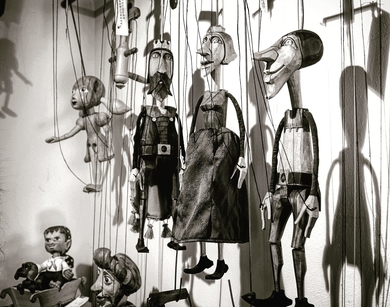
You can never tell where your next inspiration is coming from. Today’s article was founded upon an interview with a group of multimedia performers who combine original music with puppetry and performance that dated back to a few weeks ago. I didn’t see the whole thing, so I’m not even sure what show it was; all I know was that the end of it got caught at the start of a show that I had time-shifted and finally got around to watching over the weekend past.
One of them was telling someone else – either an interviewer or a new member of the group, I couldn’t be sure – about the difference between puppetry and live performance by an actor. With a puppet, you can’t make realistic movements; not only do they not have sufficient range of motion to replicate anything even close, but attempting to do so makes it impossible to follow the story being told.
Instead, you need to “distill the entire movement down to a single simple gesture” (I think the quote’s correct). The rest of the story amplified on the point with the example of someone reaching to open a door and then started to talk about the music, which isn’t directly relevant to the discussion at hand.
The similarity to the situation we face as roleplayers and especially as GMs was immediately obvious to me.
We can’t completely inhabit the roles we adopt and perform; we have to continually break character to discuss game mechanics and die rolls and – in the case of the GM – deliver omniscient narrative and make plot and situational judgments and do half a dozen other things. And even then, we can’t physically perform in the role; simply speak in character and distill the actions that we describe, out-of-character, down to simple single gestures delivered sequentially.
In truth, we have more in common with a bunch of actors and crew sitting around a big table somewhere giving a script its’ first read-through than with an actual on-stage or on-film performance, and an equal legacy from radio-based improvisational theater.
But the idea that the characters we depict have more in common with shadow puppets was a new one, and it crystallized something that had been lurking in the back of my mind for a while.
How do we roleplay? What’s the process?
Well, I can’t speak to how anyone else does it – and I’ve never read anyone else’s attempt to describe the process in detail – but I thought it would be instructive to analyze and document how I do it.
Visualization
Step One is to refresh a mental visualization of the situation as the character perceives it. This may be aided by illustrations, photographs, battlemaps and miniatures, sketches, maps, and what-have-you, but ultimately it comes down to my imagination taking in the words spoken by others at the game table and the event outcomes described by die rolls and the perceptive & comprehension limits and capabilities of the character, used as a filter.
I don’t have long to put this visualization together – a second or two at most, and usually less. This is possible only because I already have such a visualization from previous turns and/or narrative, so it only needs updating from round to round.
The more characters that I am keeping track of, the simpler the logistical situation needs to be so that I don’t have to spend additional time perpetually adjusting for the differences in capabilities that distinguish those characters. The more that I can simplify the task, the better.
Characterization
Next, I need to capture, in a different part of my mind, the characterization of the character who is being depicted at that particular moment. Personality could, and should, always be a factor in deciding what a character will say and do, regardless of the situation.
Again, I have very little time to do this. When I am running a single character, this is relatively straightforward, but when running multiple characters, the time that it takes to shift from one mindset to another becomes a significant factor.
The best solution is to distill the personality, no matter how complex, down to one or at most two fundamental “directions”, then quickly scan the character sheet or character write-up to ensure that nothing else usurps those as the most fundamental determining factor in the character’s behavioral choices.
One Choice Of Action
The combination usually makes it clear what the character is going to do, and – if that response is to say something – what the gist of that statement and it’s emotional content is going to be. Say, 99% of the time.
(This used to be a LOT lower and slower, back when I was still relatively inexperienced as a player; and when first becoming a GM, it was either slower and less frequent or the characters were a fairly basic characterization without sophistication or nuance. This is definitely a learned skill).
On rare occasions, the character might need to hesitate to give me a moment to think, or I might need to employ some other factor in my decision-making.
Those other factors generally come in three forms, often simultaneously and in contradiction: What the character’s objective is in the scene, what impact I want the scene to have on the plot, and what the desired emotional intensity of the scene is (and whether the current levels are too low or too high).
What Isn’t There
But, most of the time, those metagame considerations are either irrelevant because I’m not the GM, or I have already baked them into the scene.
My objective, when designing a scene or encounter, is to create circumstances that achieve those metagame goals by virtue of the character being who they “are”, simply so that I don’t have to think about them most of the time.
The key point is this: 99% of the time, there’s no need to think about the bigger picture, simply to respond to the micro-picture presented to the character that I am representing.
And I make it a point to touch base with those subjects each time I am forced out of character, and update those “one or two fundamental directions” if necessary.
…Even when Improvising
This is largely true whether I’m working from some predetermined plan or improvising on the spot. That’s because this is a process of roleplaying that I have developed to take advantage of those many many times that I am forced to break character for one reason or another – that long list that I mentioned at the head of the article.
Bringing it back to the point
In many different respects, there is a limit to the degree of nuance that you can communicate effectively. In simplifying the world-view to the single perspective of what this character perceives and how he interprets it, or simplifying his or her personality and the impact that it has on their choices of actions, or simplifying the available choices of reactions/responses to the one that best fits the situation, or even in simplifying the context of the situation to something that I don’t need to actively modify and moderate continually, permitting focus on the smaller and more immediate picture, many different aspects can be described by the phrase, “distill the entire movement down to a single simple gesture” – at least metaphorically.
How about you? Have you ever stopped to analyze exactly what process you undertake when you roleplay? Or is it all purely instinctive, with no “process” at all?
The more you understand what it is that you do, the more easily you can identify and correct flaws in your approach, and the better you will become at this most central of crafts. You don’t have to do it my way, but you should know what your way is – because that analysis always helps you improve your skills more quickly.

Discover more from Campaign Mastery
Subscribe to get the latest posts sent to your email.
Comments Off on One Gesture Writ Large