Different Dice for Extreme Characterization
Most systems keep skill & stat checks simple, but there can be rewards for a more aggressive approach.
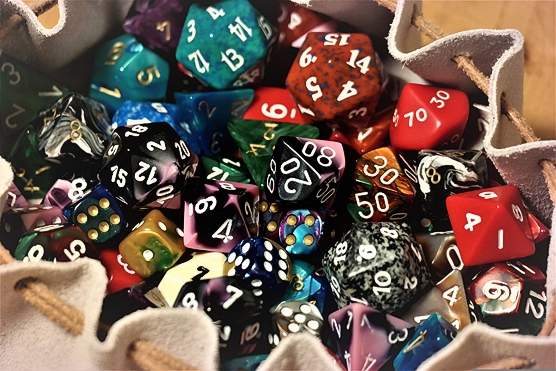
Image by Ingrid und Stefan Melichar from Pixabay
A cavalcade of minor medical issues have impact the delivery of this article, causing delays. So expect another short fill-in article next week as I try and wrestle the schedule back into position. That should buy me the time to wrap up Strange Tech Part 1, which is still only almost done.
I’m writing this aimed firstly at modern d20-based D&D, and then expanding from there to cover other game mechanics. There should be a version that works with almost any game system. I’ve done a lot of compression to eliminate redundancies, so you won’t be able to just skip to the section relevant to your game – you will need to know the processes and syntax explained / used earlier in the article.
The Polydice Concept
Picture This: you generate a character by your usual methods. Next to each stat, you then write a dice size – you have the following to allocate: 2d20s, a d12, 2d10, and a d8, one to each stat.
That’s the die that you roll to succeed or fail with that stat and any skill based on that stat.
Well, it’s fairly obvious, isn’t it? You put the d20s next to your 2 best stats, the d12 next to your third best, and so on.
So let’s make it more interesting.
For those stats not allocated a d20, you get 1/2 of the difference as additional points in the stat. For the d12, that’s (20-12)/2=+4 to the stat. For the d8, it’s (20-8)/2 = +6 to the stat.
Success thresholds don’t change, and to score a critical you not only need a maximum showing on all dice, you need a total result of 20 or more – if your game system even has criticals.
Suddenly, it’s not so clear-cut, is it? You can put a d20 next to your primary stat, and enjoy the potential of a nat 20. Or, you could put the d12 next to it, bumping your primary stat up by +4 – with all the benefits that this implies – but making criticals far harder to come by. Excluding that penalty, though, the likelihood of succeeding with that roll actually increase.
Suddenly, there’s a valid argument for assigning a d20, with it’s inherent wild variations, to you worst stat, implying that you have to get lucky to succeed in anything relating to that stat.
And there’s an equally-valid argument for assigning it to one of your middle-of-the-road-but-still-useful stats. The question becomes, how big a compromise are you willing to tolerate on your meat-and-potatoes role within the adventuring group in order to be a solid, reliable performer outside of that role?
The question becomes, do you make your character an exceptional all-rounder, or naturally gifted at their life path, or something in between – where that something comes at the price of being even worse at some things outside of their expertise?
No matter how you arrange your allocation, that PC becomes exceptional in some shape or form.
Multi-stat combos
Some systems use two or more stats as a skill basis. My Zenith-3 system is an example, and I vaguely remember some others – which systems, I couldn’t say, the memory isn’t sharp enough for that.
If the skill value is based on two stats, you average the two die sizes for the use of the skill, and then convert the resulting roll into something that matches the probability profile of the original and the range of the result. I’ve included a boxed-off section below on how to do that.
If the skill value is based on three or more stats, average the highest die size with the lowest, and then calculate a die roll to match, as above.
Creating A Roll
Let’s start with some easy ones.
d20 & d4; average = d12. done.
d12 & d8: average = d10. done.
d12 & d4: average = d8, done.
d10 & d6: average = d8. done.
d8 & d4: average = d6. done.
d6 & d4: average = d5. done.So, let’s move on to something harder and more informative. Because it’s more illustrative, I’m going to discuss these from low to high.
d10 & d4: average = d7
Maximum – minimum = 7-1 = 6. .So one answer would be d6+(d2-1). But, as anyone who’s read my articles from earlier this year on die substitutes (Part 1, Part 2, Part 3) will realize, this doesn’t give a flat curve, it gives a ‘mesa’ that’s almost but not quite flat, and that’s not good enough for me. To get a flat roll, we need to use one dice, no more.
In this case, there’s a very simple solution, though: d8//8 which is a shorthand way of writing “d8, re-roll 8s until you get a result you don’t have to re-roll”.
d12 & d6: average = d9
Similarly, we can get a d9 by using d10//10.
d20 & d6: average = d13
This gets trickier, because most people don’t have a d14 in their toolkit, so d14//14 is no help.
Maximum-minimum = 12. Divide by 2 to get 6, then add 2 to get 8.
So d8 is our primary die roll. We need to add a second die to that to get to the 13 maximum.
Range of 1 to 13, minus a d8, means that we need (1-1=0) to (13-8=5).
That’s d6-1. But that’s a second die, which produces a pyramid probability chart – unacceptable. What we need to do is convert that d6-1 to a flat probability to be added to the roll that only applies if the d8 comes up with an 8.
This will do the job: d8//8=+d6-1, which is a shorthand way of writing, “d8, add d6-1 on a result of 8”.
It’s not quite perfect – the higher values generated by the +d6-1 split up the probability of getting an 8 (one in 8) into the 6 results (one in 48 each, a little over 2%). I could combat this effect somewhat by making the roll d8//[5-8]=+d6-1, adding the bonus to any result on the primary die greater than the average. But I don’t think the benefits outweigh the added complication.
d20 & d8: average = d14
We can take our basic methodology for this roll from our prior example as a starting point and see how we get on.
Maximum-minimum = 14-1 = 13. Right away, there’s a problem because dividing by 2 gives us a half dice. Nevertheless, let’s proceed, rounding up:
13/2 = 6.5, rounds to 7. Add 2 to get 9. That’s not much help. We need a die roll that’s going to cover a little more than half the range of results; d8 isn’t quite enough, so it has to be based on a d10.
Range of 1-14, minus the d10, gives a target requirement of (1-1) to (14-10) = 0 to 4. That’s d5-1.
So the solution is d10//10=+d5-1. Job done.
d20 & d10: average = d15
It was the fact that there was an even number as the die size that complicated the last example. So you might expect this one to be more straightforward.
Maximum – Minumum=14. Divide by 2 to get 7. Add 2 to get 9. Okay, that’s not much better, contrary to initial expectations. But this time, d8 is still more than half the range. So we can base this off of either a d8 or a d10.
Solution 1, d8:
Range = 1-15, minus d8, leaves 0 to 7, which is d8-1. So d8//8=+d8-1 is a viable solution – but one that I’m going to reject out of hand, because the two dice are the same size. It’s too easy for a player to switch which d8 means what; I don’t expect players (in general) to cheat, but why throw temptation into their path?
One solution would be to roll one d8, and only roll the second if it’s warranted, but that would at least double the time required for the skill check, and that’s not desirable.
But, because we know that 10 is larger than 8, solution 2 will break that unwanted symmetry.
Solution 2, d10:
Range 1-15, minus d10, leaves 0-5, which is d6-1. So d10//10=+d6-1 is our answer.
d20 & d12: average = d16
This looks like being the most complicated one yet, but the last one threw us a curve-ball – so let’s see how we get on with the standard methodology.
Maximum-Minimum = 15. Divide by 2 and round up to get 8. Add 2 to get 10.
Range 1-16 minus d10 = target range of 0 to 6. That’s d7-1 – not good.
Reducing the d10 to a d9 makes the second part neater, but simply shifts the complication to the first part. Not acceptable.
Clearly, what’s needed here is an odd-sized die roll, and the largest convenient one of those on tap is a d5.
Range 1-16 minus d5 = target range of 0 to 11. That’s d12-1. Aha!
d5//5=+d12-1 will work. But this raises the question: is this a symmetric formulation? Would d12//12=+d5-1 also work?
d12 = 1 to 12, but that becomes 1 to 11 because 12 triggers the additional d5-1. Adding that (0-4) to the range gives (1+0) to (12+4) = 1 to 16 exactly what the doctor ordered.
So yes, d12//12=+d5-1 is also a viable solution, and the formulation is symmetrical. Note that I haven’t done any theoretical calculations to establish if this is always the case, so always test the reverse formulation for yourself if you need it.
Is it preferable to the reverse?
I think that it is, because the primary roll spans a greater range of probabilities, and that has a psychological impact on the perception of randomness on the part of the player making the roll. Some people might be instinctive enough in their understanding of probability to realize that they are the same, but such mechanics should always cater to the lowest common denominator whenever possible.
Two-dice base rolls
If your system makes rolls on two dice, like (I think) original Traveler, the easiest solution is to vary the allocation and have it apply to only one of the two dice. So, d8, 2 x d6, d4, and let the rest be d2s.
The ‘stat bonus’ is 1/2 of highest result on the replaced dice minus 1/2 of the replacement dice.
So, Traveler, 2d6: replacing one of the two d6:
d8: (6-8)/2 = -1
d6: no change
d4: (6-4)/2 = +1
d2: (6-2)/2 = +2
If there’s a system out there that uses 2d8 as the basis of their rolls, add 2 to these die sizes – so d10, d8, d6, d4. If there’s one that uses 2d10, add two more: d12, d10, d8, d6. Things only get difficult is you have a system based around 2d12 or higher. The basic principle is the same, though – add 2, giving d14s, d12s, d10s, d8s. And consult the boxed section above to find out how to “construct” a d14.
How many of each? If there are six stats, I would recommend a 2, 1, 2, 1 pattern, or a 2, 1, 1, 2 pattern, or even a 1, 2, 1, 2 pattern. That’s up to the GM to decide – but it should be as evenly distributed as possible, and 6/4=1 with remainder 2.
If you have seven stats, then one of the ‘1’ results in one of the above patterns gets bumped up to a 2.
Eight stats gives an even distribution of 2, 2, 2, 2.
And so on. There are way too many possible combinations of stat numbers and system architectures to be more specific.
Two-die rolls
Things ratchet up in complexity when you have to make your check on two dice and not one.
Fortunately, most of those systems will be based on 2d6, with the variations posited above as 2d8, 2d4, and 2d2.
Furthermore, I’m not aware of any two-dice systems that also use two stat values as the basis of skill checks – but I don’t know that there aren’t, either. So, even if only as a strictly theoretical case, let’s assume there are such, and press on (the same principles will apply for any of the other dice scales listed above).
Creating A Roll #2: Two Dice
2d8 & 2d4: average = 2d6, done.
2d8 & 2d2: average = 2d5, done.
2d6 & 2d4: average = 2d5, done.
2d6 & 2d2: average = 2d4, done.
2d4 & 2d2: average = 2d3, done.These are all easy because they focus low in the die size range, where there are known methods of handing the dice and low ranges between them. In fact, there’s only one awkward combination.
2d8 & 2d6: average = 2d7
The obvious way to handle this is to consult the boxed section above for how to create a d7 – it’s d8//8. But with some of the other possible formulations, it might not be that simple. So let’s look for an alternative, one that combines 2 dice into a single roll.
Here’s the most obvious one: (2d8 + 2d6)/2 = 2d7, so (2d[8/2] + 2d[6/2]) also = 2d7, so 2d4+2d3 = 2d7.
Except that it doesn’t work. 2 dice gives a bell-curve with perfectly flattened sides to create a pyramid probability curve, while 4 dice gives a pronounced dumbbell curve.
So it’s back to first principles
2d7 = d7 + d7 = d(7-1) + d(7+1) = d6 + d8.
There it is, it’s that simple.
2d9?
But that wasn’t very demonstrative of possible complexities, so let’s invent a few more, even if they don’t ever occur in reality, starting with 2d9.
2d9 = d9 + d9 = d8 + d10.
2d11?
2d11 = d11 + d11 = d(11-1) + d(11+1) = d10 + d12.
2d13?
For the fist time, this simple solution doesn’t work, because we have d12 and d14. So we’re going to have to get more creative.
Te fundamental requirement is to have a 2-die solution, because that gives our required probability curve. We then need a conditional constant to expand the range of those two compounding dice in a linear fashion. There are three ways of handling this:
1. If both the base dice show maximums, there is one adjustment;
2. If either of the base dice (which are the same size) shows a maximum (but you only get to add the extra once if both show maximums); or,
3. If either of the base dice (which are the same size) shows a maximum, but the bonus gets added for each.
The first one is the simplest., so let’s start there:
Maximum-Minimum = 14-2 = 12; 12 (divided by the # of dice required +1) = 4; +2 = 6. (round down if necessary); so the first die should be d6.
Range 2-22 minus d6 = 1-16.
And I’ve already shown how to work a d16 in the previous boxed section – d12//12=+d5-1.
Putting those together gives (d4+d12)//16+d5-1.
But we can make this even more visceral for the player, with (d6+d12)//18=+d3-1.
Or can we? Let’s run a quick reality check:
(d4+d12)//16=+d5-1 = (1,4) + (1,12) = 2 to 16. Plus d5-1 = (0,4) + (2,16) = 2-20. Whoops.
(d6+d12)//18=+d3-1 = (1,6) + (1,12) = 2 to 18, Plus d3-1 = (0,2) + (2,18) = 2-20. Double Whoops.
This shows how counter-intuitive the die construction process can be.
Just for the heck of it, let’s try another intuitive correction:
(d6+d12)//18=+d5-1 = (1,6) + (1,12) = 2 to 18, Plus d5-1 = (0,4) + (2,18) = 2-22. Perfect.
Except that it doesn?t work, by a degree too far removed from what we were trying to achieve. There are two problems.
▪ The basis for comparison: on 2d11, there is a 1/121 chance of getting a maximum result.
▪ d6+d12 has 6 x 12 = 72 outcomes, so triggering the expansion (+d5-1) happens 1 in 72 times – about 1.38%. So it hardly ever happens. The top four results on a 2d13 roll should have a probability of 5.92%, or more than 4 times this chance. That’s too big a gap to ignore.
▪ And, the chance of a maximum result is 1 in (72 x 5) = 1 in 360. This is just over 1/3 of what the chance should be – too great a discrepancy to completely ignore, especially in light of the second problem..
These problems stem, as the calculations show, from the size of the base roll (too far removed from the 2d13 target, causing a low chance of triggering the bonus).
2d13, take 2:
You get to a result using the following process:
1. Identify the Primary Pair: Use two dice that get you close to the target range without going over. A d12 + d12 gives you a range of 2â??24.
2. Calculate the Deficit: You need to reach 26, so you are 2 points short (26 – 24 = 2). Add 1 to that to get a physical die size – d3 – and subtract one from the roll to get +d3-1.
3. Apply the Extension to One Die: Instead of applying a trigger to the sum (which caused the “Whoops” problems earlier). The result is d12 + (d12//12=+d3-1).
But I don’t like this formulation – which d12 is the trigger? It becomes too easy to cheat, or get confused.
2d13, take 3:
So here’s an alternative formulation, applying a smaller bonus to each of the dice:
1. Primary pair as above.
2. Deficit of 2. Divide it by the number of dice (2), equals 1. That’s the size of the adjustment required. Add 1 to that to get a physical die size – d2 – and subtract one from the roll to get +d2-1.
3. Apply the extension to any d12 that shows a 12. So the formulation becomes 2 x (d12//12=+2d-1).
In practice, the greatest efficiency would then be achieved by rolling all four dice at the same time, then checking the d12s to determine whether or not to ignore the d2s. There is an additional problem as a consequence – in theory, each d2 should be paired with a specific d12 result, rolling them at once means that the most favorable outcome will always get chosen when only one applies. This creates a slightly higher chance of getting a maximum result than we should have.
And I don’t like rolling 4 dice when 3 should be enough. And I think the dice should be different in size. So let’s keep looking.
2d13, take 4:
1. Target range of 2-26. We need one die to be ‘natural’ and one to be in the 12+ range. We want this to be relatively close so that there is a small adjustment.
2. We have ruled out d12 as the ‘natural’, so let’s step it down one size to a d10.
3. (2-26) – (1-10) leaves 1-16. So we need a d16.
4. 16/2 = 8. I’d ideally like to bump it up to a d10, but we’ve already used one of those. So I’ll leave it at d8, for the moment.
5. (1-16) – (1-8) = 0-8 = d9-1 = (d10//10)-1. So our second roll becomes d8//8= +(d10//10)-1. But we’ve already used a d10 – so we really need to either go d6 or d12.
5 revised: (1-16) – (1-12) = 0-4. That’s d5-1, and d5 can be d6//6. So the second roll is d12//12=+d6//6-1. That’s three dice – a d6, a d10, and a d12.
2d13, take 5:
An alternative comes in step 2, stepping up to a d20:
3a. (2-26) – (1-20) = 1-6.
4a. So d20+d6 is a valid replacement for 2d13. Well, almost – there’s a mesa effect, a probability flat-line from 7-21.
The question them becomes, which one is better? It’s the shape of the probability curves that gives the most compelling answer – 2d13 is a ‘perfect pyramid’. Both these formulations have mesa-shapes – the top of the pyramid is missing – but d20+d6 is a much broader, flatter mesa.
2d13, take 6: Another Alternative
There’s one alternative that needs to be addressed, the elephant in the room as it were: Increase the size of both dice to the next available “real” dice, then multiply the result when rolled by the ratio of the maximum results:
1. d13: the next die size up is d20.
2. So 2d13 becomes 26/40 x 2d20.
3. Which simplifies to 0.65 x 2d20.
You can either work this with a calculator at the time, or prepare a table in advance.
It won’t be a smooth pyramid; you have to round results up, and there will be spots where more 2d20 rolls yield a particular 2d13 equivalent than others, because one has 400 possible results that are being squeezed into 25 result slots.
But there is a way to a better answer:
1. as above.
2. Get the minimum to zero in both cases by subtracting 2. Use the ratios of the adjusted range maximums. Then add the 2 back in. So, 2d20-2 = 0-38; 2d13-2=0-24; the ratio is 24/38.
3. So the roll simplifies to 2 + 0.6316 x (d20-2).
It’s still not a smooth line. Every second result is diminished. But it’s worth considering IF you construct a table in advance.
2d13: The verdict?
Having looked at all the alternatives, there’s justification for choosing d10 + [d12//12 = +d6//6 -1]) as the single best answer.
▪ A smooth probability progression with no clumping.
▪ Different dice for clearer interpretation at the table.
▪ The visceral experience remains closer to what would be experienced if you could actually roll 2d13. And you get a bonus d6 to add to that experience.
But there is one better answer yet.
2d13: The ultimate answer
Let’s take that d10 + [d12//12 = +d6//6 -1]) roll and add some new syntax and mechanics to the process:
d10 + [d12//12 = +d6//6 -1]) If(d6=6) & (d12<12), +1 to d12.
This gives value to rolling the d6 even if it doesn’t add directly to the total. It tilts and sharpens the pyramid, reducing the size of the mesa and moving the average result closer to the average of 2d13. And, by increasing the likelihood of a “12” on the d12, it increases the likelihood of a result at the top end, overcoming some of the restriction that otherwise applies, smoothing the transition from flat base and the expansion “tail”. It’s not perfect – but it’s the best answer going.
And it provides an important model for all such other answers.
Take 4, above, is the way to go on the rare occasions when you need something like this. Most of the time, though, there will be a simpler answer.
Three-dice rolls
Any system that uses three dice to save against a stat is automatically just a bit more complicated than using two, for many reasons. There’s the implications of a possible ‘divide by 3’ which yields whole numbers only 1 time in 3, instead of 1 time in two. There’s the complication that our physical die sizes increase in leaps of 2 at a time, all the way up to d12s. There’s the complication that we’re trying for something fairly bell-curve in probability shape. And last, but far from least, there’s the sheer pace at which those steps manifest as big differences in outcomes – 3 x 4 is 12, 3 x 5 is 15, 3 x 6 is 18, 3 x 8 is 24, 3 x 10 is 30, and 3 x 12 is 36.
We can reclaim some of this complexity by using a matched pair of primary dice, with a third die of different size that is linearly extended as much as necessary.
And the giant leaps factor actually helps the situation, too, in that it means that getting a large maximum requires relatively small die sizes, which is where the majority of our physical dice exist.
Replacement die sizes
Because of the ‘big leaps’, these are a little trickier. If the base die is a dN, where N is 10 or less, and there are fewer than 9 stats, I recommend
1 x d[N+1]
2 x d[N]
2 x d[N-1]
X x d[N-2]
1 x d[N-3]
…where X is 1-3, as needed to account for all the stats.
▪ If N is 4, the d[N-3] needs to become an additional d[N-2].
▪ If N is 3, then we have to lose the 2 x d[N-1] and replace all but one of the d[N-2] and d[N-3] with d[N-1]s. That last die combination is an additional d[N].
If the number of stats is 9 or more, things get a little more complicated again.
▪ 9 stats = an additional d[N+1] and treat the remaining 8 stats as above.
▪ 10 stats adds 1 x d[N+1] and an additional d[N].
▪ 11 stats adds both of those and an additional d{N-1}.
▪ 12 stats adds 1 x d[N+2] to the 11-stat model.
▪ At 13 stats, this cycle starts to repeat, covering 13, 14, 15, and 16.
▪ 17 stats adds 1 x d[N+3] to the 16-stat arrangement.
▪ And at 18 stats, the 13-17 cycle starts to repeat itself, covering 18, 19, 20, 21, 22, and 23 stats.
▪ 24+ stats? Repeat the 13-17 cycle again, covering 24, 25, 26, 27, and 28 stats.
▪ 29 stats adds d[N+4].
▪ 30 stats and beyond repeats the 18-29 cycle, which is enough to get us up to 40 stats. I sincerely doubt there are any game systems out there that go further than that!!
Corresponding Stat Bonuses
Using ( [N – N-x] ) /2 (as has been used thus far) isn’t appropriate when the die sizes are only going up by 1, and when we have triple the difference. The ‘cost’ in inconvenience is not balanced by the potential rewards, and the effects are not distributed. The potential for die sizes up to a d[n+4] also means that the higher base roll comes with a penalty to stat score, and this keeps growing with the number of stats – a drive toward mediocrity, not extreme characterization. Both these problems can be partially solved with an offset, but that can get out of hand very quickly. The other part of the problem has to be attacked at the “/2”, replacing it with an “/3” – and that also attaches the possibility of making the adjustment carry 1/3 or 2/3 of the distance to fully replacing what is lost due to the shrinking die size.
That all sounds horribly opaque on read-back. So let’s work down the list of possible die replacements, calculating the bonus stat amounts that I think should apply, assuming a normal stat maximum somewhere in the 15-25 range.
d[N+4] = 3x[-4] difference = -12. 1/3 of -12 = -4. Offset +2 to get -2.
d[N+3] = 3x[-3] difference = -9. 1/3 of -9 = -3. Offset +2 to get -1.
d[N+2] = 3x[-2] difference = -6. 1/3 of -6 = -2. Offset +1 to get -1.
d[N+1] = 3x[-1] difference = -3. 1/3 of -3 = -1. Offset +1 to get +0.
d[N] = no difference so +0.
d[N-1] = 3x[1] difference = 3. 1/3 of 3 = 1. Offset +0 to get +1.
d[N-2] = 3x[2] difference = 6. 2/3 of 3 = 2. Offset +0 to get +2.
d[N-3] = 3x[3] difference = 9. 2/3 of 9 = 6. Offset -1 to get +5*.
* But I would actually assign +4 to half of these and +6 to the other half, breaking ties in favor of the +4s.
An alternative to consider
An alternative to consider is only replacing two of the three dice, letting everything else function as per the 2-dice system above.
Unfortunately, it’s not quite that simple in every case – it’s when multiple stat values have to be combined into a base skill value that this becomes altogether too complicated. If your game system doesn’t have that feature, then all is well – but if it doesn’t, it gets too complicated too quickly.
2-stat skill basises, 3-stat skill basises
This works exactly as described earlier in the article – if two stats are used to generate a stat’s base level, use the average of the two die sizes; if three, use the average of the highest and lowest. If you have to round, round up.
3-dice constructions
Most of these are easy. Some are blindingly obvious.
3d2 = 3d6(high-low).
3d3 = 3 x d4//4.
3d4 = 3d4, obviously.
3d5 = 3 x d6//6
3d6 = …well, guess.
3d7 = 3 x d8//8
3d8 = obvious.
3d9 = 3x d10//10.
3d10 = 3d10, clearly.
3d11 = 3 x d12//12.
3d12 = 3d12.
So much for the easy ones.
The Higher Process, v1:
1. Divide the required die size (r) by 2 and round up to the next physical die size [max d12] to get the primary die size (p).
2. Determine the range of 2d(p).
3. Subtract the range of 2d(p) from the range of 3d(r).
4. That gives the range required for the secondary die.
5. Construct it as per the first panel.
6. Assemble the completed roll structure.
The Higher Process, v2:
This variant inverts the primary and secondary relationships, with a big primary die, a smaller secondary die, and a tiny but stretched tertiary die.
Most of the time, I would use version 1 of the process, but there may be times when this is a tidier option.
The key points to watch are – secondary and tertiary dies cannot be the same physical die. And that means that you have to use d4s for d3s or a d2 if you’ve already used a d6, but that you have to use a d6 for d2s and d3s if you’ve already used a d4.
1. Subtract the range of a d20 from range of 3d(r).
2. Divide the maximum remainder by 2, rounding up. If the result is even, add 2. If the result is odd, add 1. This is the size of the secondary die (s)
3. Subtract the range of d(s) from the maximum remainder. The result is the size of the required tertiary die.
4. Construct this die (if necessary) using the rules given in the first panel.
5. Assemble the completed roll structure.
Side-note: I think it incredibly unlikely that these will ever be needed, so I’m only going to offer a few examples, each worked both ways.
3d13, method 1
1. (r) = 13. 13/2 round up gives (p)=7, but that?s not a physical die size so we bump it up again to (p)=8..
2. 2d(p) = 2d8 = 2-16.
3. 3d(r) = 3d13 = 3-39. Subtracting 2-16 from this gives 1-23.
4. So we need to construct a d23.
5. One way to do this would be d12//12=+d12-1. This wouldn’t be my first choice. The next die up is a d20, which would need an extension of 0-3 to match the required range. So that’s d4-1. In other words, d23 ≈ d20//20=+d4-1.
6. So 3d13 ≈ 2d8+d20//20=+d4-1. But the ‘smoothing’ rule should also be in effect, so rolling a 4 on the d4 adds +1 to the d20 result IF it’s not already 20.
Just to clarify something: If the d20 was 19, and the d4 was 4, adding 1 to the d20 makes the result on that die a 20, so the full stretch of d4-1=3 is included in the overall total.
3d13, method 2
1. r=13, so 3d(r) has a range of 3-39. Subtracting a d20 from this (1-20) leaves 2-19.
2. The maximum remainder is 19, divided by 2 and rounding up gives 10. The result is even, so add 2 to get 12. So the secondary die is a d12.
3. Subtracting a d12 from the 2-19 target leaves 1-7, so the tertiary die is a d7.
4. A d7 = d8//8.
5. The result: 3d13 ≈ d20+d12+d8//8.
Because no stretching of the tertiary die is necessary, there is no need to employ the smoothing rule.
I don’t know about you, but 3dice and a simpler construction makes this the winner in my book.
3d14, method 1
1. 14/2 = 7, so (p) = 8.
2. 2d(p) = 2d8, which has a range of 2-16.
3. 3d14 has a range of 3-42. Subtracting 2-16 from that leaves 1-26.
4. so we need a d26.
5. Foundation of a d20. Subtract 1-20 from the target leaving 0-7, which is d8-1. Therefore d26 ≈ d20//20=+d8-1.
Bur, once again, I don’t want the stretch and the base roll to use the same die, so I bump the base roll up to 2d10 and rework the problem from step 2.
2. 2d10 has a range of 2-20.
3. 3d14 has a range of 3-42. Subtracting 2-20 from that leaves 1-22.
4. so we need a d22.
5. Foundation of a d20. Subtract 1-20 from the target leaving 0-2, which is d3-1. Therefore d22 ≈ d20//20=+d3-1.
6. And the final roll is 2d10+d20//20=+(d4//4) -1.
Smoothing should be applied – get a 3 on the d4 and you add +1 to the d20.
3d14, method 2
1. 3d14 has a range of 3-42, as stated earlier. Subtracting a range of 1-20 from that leaves 2-22.
2. Dividing 22 by 2 gives 11. Add 1 because it’s odd, and we get d12.
3. 2-22 minus 1-12 leaves 1-10.
4. Which is a straightforward d10.
5. So 3d14 ≈ d20+d12d+d10.
Again, this is so much cleaner and simpler than the result of method #1 that I would have no hesitation in choosing it.
3d15, method 1
1. 15 / 2 = 7.5, round up to 8.
2. 2d(p) = 2d8 = a range of 2-16.
3. 3d15 have a range of 3-45. Subtracting 2-16 leaves 1-29.
4. S we need a d29 for the last die.
5. If you have one, you could use d30//30. Most people don’t have the necessary die. Using a d20, and subtracting from the 1-29 range, leaves 0-9, which is d10-1. d29 ≈ d20//20=+d10.
This doesn’t have the problems of the previous examples – all the dice are different – but I don’t like having that long a tail. Unless you have a d24 (I do) on hand, though, you’re going to be looking to increase the primary die size, and so shrink the remainder.
In fact, I’m going to go beyond just the next size up and try building a roll around 2d12.
2. 2d12 = a range of 2-24.
3. 3d15 have a range of 3-45. Subtracting 2-24 leaves 1-24.
4. S we need a d24 for the last die.
5. Subtracting a d20 leaves 0-4, so d5-1: d22 ≈ d20//20=+d5-1.
6. And the final roll is therefore 3d15 ≈ 2d12+d20//20=+d5-1.
Roll smoothing should be applied.
3d15, method 2
1. 3d15 have a range of 3-45. Subtracting a d20 from this leaves 2-25.
2. 25 / 2 = 12.5, rounded up gives 13. Add 1 because it’s odd to get 14. But there is no physical die this size; we have to replace one of them with a d12.
3 & 4. 2-25 minus d12 leaves 1-13, and if the dice are to be different sizes, we need to build this d13 around a d10 or a d8. 1-13 less 1-10 leaves 0-3, which is d4//4. 1-13 less 1-8 leaves 0-5, which is d6//6.
There are technical reasons relating to probability to prefer the d4, but the pyramidal-shaped ones don’t roll very well. If you have the spindle-shaped ones, go ahead with d10//10=+d4-1. But otherwise, the d6 would be my preferred option, giving d8//8=+d6-1.
5. So we end up with two valid solutions: d20+d12+d10//10=+d4-1 & d20+d12+d8//8=+d6-1.
Percentile Scores
Percentile scores replace the die in the 10s position, and divide the potential maximum difference by 5 to get the stat bonus.
So the base roll of the tens digit is a d10. I recommend a die allocation of d12, 2 x d10, d8, d6, and d4s thereafter.
Technically, all these should be -1 – so d12-1, d8-1, d6-1, and so on. but we’ll skip that for a moment.
d12: (10-12)x10 / 5 = -4.
d10: no change
d8: (10-8)x10 / 5 = +4
d6: (10-6)x10 / 5 = +8
d4: (10-4)x10 / 5 = +12
Applying the -1 to the dN, this logic actually brings us full circle back to the initial act of substitution.
And definitely apply smoothing if it’s necessary.
Conclusion
The earlier in the campaign you make this change, the more scope you have for adjusting the characterization of affected character to the new paradigm if necessary.
Swapping out the simple dice used for skill and stat checks is counter-intuitive, but in terms of PCs and other featured characters, it works. Keep the simple rolls for flunkies and nothing encounters, but consider taking advantage of the opportunities this creates to turn your characterization up to eleven.

Discover more from Campaign Mastery
Subscribe to get the latest posts sent to your email.




May 3rd, 2026 at 1:17 am
[…] Campaign Mastery takes a look at Campaign Mastery. […]