Campaign Mastery helps tabletop RPG GMs knock their players' socks off through tips, how-to articles, and GMing tricks that build memorable campaigns from start to finish.

The Diversity Of Seasons Pt 1: Winter


This entry is part 1 of 4 in the series The Diversity Of Seasons

I’ll be honest about this. I originally put Winter first on my agenda for this series because I thought that it would resonate with the majority of my readers, who live in the Northern Hemisphere. That was before the incredibly brutal conditions descended upon them, however. When that happened, I contemplated starting with Summer, instead, but I decided that would be too much like teasing. No, like winter itself, I ultimately decided, it was better to simply get this season out of the way.

It was unseasonably cold this morning, and that got me to thinking about how different places experience the same season in completely different ways. I realized that while there were descriptions available of the climate in this place or that, I had never seen a comparative climate codex.

Such a reference work is beyond the scope of a blog, but – in a smaller and more literate way – I thought I could hit a few high points along the way, and that the results would be useful to to GMs looking to model a regional climate in their games rather than resorting to stock cliches, or who were running a more modern-day campaign where the PCs did a lot of traveling from place to place.

Because of the amount of research involved, this type of article is perfectly suited to the Serial Blog approach. Four or five locations a week for four or five weeks, and so on. Except that I’m going to get the ball rolling with a big jump-start, right now.

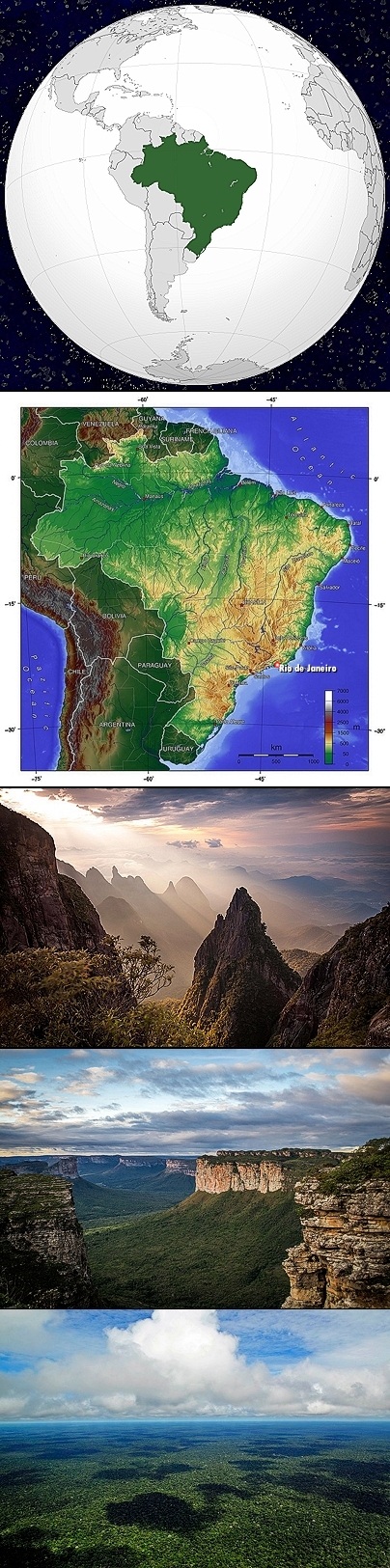
These images, sourced from Wikipedia Commons, are used under CC3.0 and incorporate a photograph of McMurdo Station taken from Observation Hill by Gaelen Marsden.

1. Winter In McMurdo

McMurdo Station is a research center in the Antarctic, on the shore of McMurdo Sound, which is the southernmost navigable body of water in the world. Today, it is Antarctica’s largest community and a functional, modern-day science station, which includes a harbor, three airfields (two seasonal), a heliport, and more than 100 buildings.

The pack ice that girdles the shoreline presents a formidable obstacle to surface ships. Vessels require ice-strengthened hulls and often have to rely upon escort by icebreakers. During winter, resupply is all but impossible, though occasional air flights in and out are possible.

The Cold circumpolar currents of the Southern Ocean reduce the flow of warm South Pacific or South Atlantic waters reaching McMurdo Sound and other Antarctic coastal waters.

Bitter katabatic winds (winds that carry higher density air, i.e. colder air, down a slope at up to hurricane speeds) spilling down from the Antarctic polar plateau into McMurdo Sound demonstrate Antarctica’s status as the coldest and windiest continent in the world; The McMurdo Sound freezes over with sea ice about 3 meters (9.8 ft) thick during the winter. Temperatures during the dark winter months at McMurdo Station have dropped as low as -51 °C (-60 °F), but the station is actually sheltered from the worst of the winds by the Transantarctic Mountains, so it’s rare for the temperature to drop below -40°C (which is also -40°F).

McMurdo really only has two seasons – Summer and Winter. The intermediate seasons last a month at most. Winter runs from March to September. There is increasing precipitation from 15 to 28 cm (0.59 to 1.1 inches) from March to June, with the proportion of snowfall also increasing – 11.4 to 17.8 cm (4.49-7.01 inches) over this span. Note however that March is preceded by the heaviest average snowfall of the year, 22.4 cm (8.82 inches) in February. Extreme Conditions recede even faster than they built up; the July average precipitation is already less than that of April, while August is lower than March, and September lower still.

Particularly noteworthy are the number of wet days and the number of rainy days during this period. The averages run from a low of 3.2 to a high of 5.7 (unsurprisingly, in June). Snowy days are more common: from 17.8 (the annual high) to 13.3 in September.

Putting all this together, and you get a situation in which more than 2/3 of the time, Winter in McMurdo means either sleet or snow. Temperatures have to be considered extreme; I found this article at The Atlantic to be especially interesting, though it doesn’t go into too many details about the practices necessary in order to survive the conditions. For that, turn to this page at Cool Antarctica which is comprehensive.

There are proposals to reconstruct the base using demountable universal modules that can be re-purposed as needed – this month, quarters for research staff, next month an enlarged gymnasium and dining area, and so on.

It’s worth observing that diesel engines and generators don’t work as well at extremely cold temperatures – the colder it is, the more unreliable they become. For that reason, from March 1962 to 1972, power was supplied by a nuclear reactor with a core the size of an oil drum. The decommissioning was the result of hairline cracks and water leaks that posed an ongoing safety risk. The cause of these problems does not appear to have been conclusively established, but it is reasonable to point the finger at climatic conditions and temperature differentials. These days, power comes – despite the difficulties described earlier – from a number of 500 kilowatt (670 hp) conventional diesel generators in a central powerhouse used to generate power – with maintaining minimum operating temperature within the powerhouse likely to have first call on the power supply.

You get a very good idea of the conditions and isolation involved from John Carpentier’s film, “The Thing”. But for the real thing, look for Werner Herzog’s 2007 documentary, Encounters at the End of the World and Anthony Powell’s 2013 documentary, Antarctica: A Year On Ice.

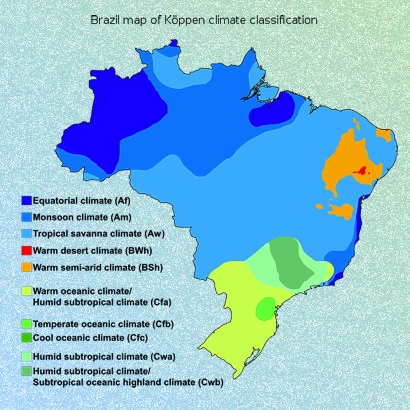
These images, sourced from Wikipedia Commons, are used under CC3.0 and incorporate a photograph of one of Hobart’s most recognizable landmarks, the Tasman Bridge, taken by Stephen Edmonds.

2. Winter In Hobart

Hobart is the most southerly state capital in Australia, dominating the island state of Tasmania. It is also the second-oldest capital city and second least-populated Australian Capital with only 225,000 residents. When Australia was a penal colony, Tasmania was the dumping ground for the serious offenders, in part because the severity of conditions made escape and return to the mainland a very difficult proposition (nevertheless, it did happen – once).

The city faces the Tasman Sea that separates Australia from New Zealand, and is located on an estuary of the Derwent River; its harbor us the second-deepest natural port in the world.

In many ways, Hobart’s weather is, at first glance (like that of the other Capitals), quintessentially Australian. The highest temperature recorded there is 41.8°C (107.2°F) on 4 Jan 2013, and the lowest was -2.8°C (27°F), which it achieved twice – once in June 1972 and once in July 1981. It’s an impression that doesn’t stand up to closer scrutiny.

Hobart averages less sunshine than any other Australian capital; a mere 5.9 hours per day on average. However, during the summer, it has more hours of daylight than anywhere else, achieving 15.2 hours on the summer solstice. Of course, the term ‘daylight’ can’t be taken too literally; the skies are frequently clouded over, the city has only 40.8 clear days a year, on average.

It rarely snows in Hobart – it’s happens on average once every 15 years – but the adjacent Mount Wellington is often seen with a snow-cap, and mountain snow has been known to occur in all four seasons.

Winds are very important to the perceived temperature of the residents; when it blows from the northwest, the air is chilled by the snow-cap, and when it blows from the south, frigid antarctic air descends upon the city. The winds over Mount Wellington have been recorded at sustained speeds of over 157 km/h (98 mph), with rare gusts of up to 200 km/h (120 mph).

If it weren’t for those icy winds, Hobart would be an extremely desirable place to live. It lacks the extremes that characterize Australian weather in general, so much so that most Australians think there has been error made when they examine the average high and low temperature records, which – while quite cool – are astonishingly consistent. As a result, it’s actually fairly difficult to draw a line and say that one season starts here and ends there; the differences are quite small. The April average is 17.8°C (64°F); the May average is 15.1°C (59.2°F), and the June is 12.4°C (54.3).

The official Winter Months are June, July, and August, and they do have a consistently lower average temperature, however marginal the difference. But it’s probably more accurate in terms of the experience of visiting the city to suggest that Winter starts in May and runs through to September; these are the only months that don’t have a record high temperature above 30°C (86°F).

It’s the minimums that more revealing. Through the summer months, these average 12°C; in April, they drop a couple of degrees C to 9.4°C, in May, another couple more to 7.6°C, and in Winter, they hover around the 5-5.5°C mark. Warmth returns more slowly than it departed, in part because the second half of the year is wet more often than the first; September and October are the wettest months of the year, on average, though more precipitation actually falls in August than in either of those months.

It’s these factors – rainfall and minimum temperatures – that define the four seasons of Hobart. Winter is when the Antarctic Winds blow, punctuated by the occasional heavy rain event. But at any time of year, the climate is capable of delivering “four seasons in one day”.

Most bars and restaurants maintain an open fire during the winter months; if you would like Winter if it weren’t for the snow, Hobart is likely to be to your liking. The terrain tends to be too rocky for snow-related sports, but outdoors sports are popular in the summer months; expect the average fitness level of the inhabitants to be just a little higher than normal for a Western city.

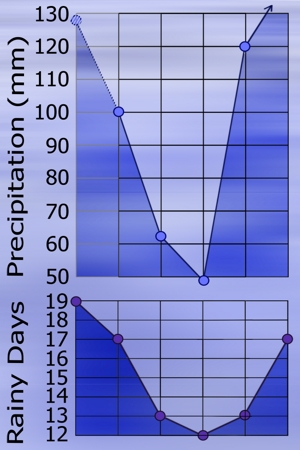
These images, sourced from Wikipedia Commons, are used under CC3.0 and incorporate a photograph of the Melbourne Skyline by Jes.

3. Winter In Melbourne

Melbourne is almost as far south as Hobart, but the small difference has profound effects on the climate. The city – sometimes the largest in Australia, sometimes ceding that honorific to Sydney – is located in the south-facing large natural bay of Port Philip and expands into two separate mountain ranges, down one peninsula, and into a large valley, totaling almost 10,000 square kilometers. The primary water-source is the Yarra River.

Melbourne is the city that “four seasons in one day” is supposed to describe. It’s said that if you don’t like the weather there, just wait an hour or two. The cause is the location; the city is built at the boundary between the very hot inland area and cool southern ocean, but the resulting atmospheric turbulence is at a minimum in Winter; this is the most stable and predictable time of year, weather-wise – damp and often cloudy.

Port Phillip Bay is often warmer than the surrounding oceans and/or the land mass, though this effect is also minimized in winter; this can set up a “bay effect” similar to the “lake effect” seen in colder climates where showers are intensified leeward of the bay. Relatively narrow streams of heavy showers can often affect the same places (usually the eastern suburbs) for an extended period, while the rest of Melbourne and surrounds stays dry. Overall, Melbourne is, owing to the rain shadow of the Otway Ranges, nonetheless drier than average for the southern part of the state of Victoria in general. That means that the eastern suburbs are drier in winter than in other seasons, while those to the north and west are wetter than in other seasons – while both get about the same total rainfall and count of rainy days over the course of the season.

Remembering that the bulk of the city is essentially at Sea Level, snow has not been recorded in the Central Business District since 1986, though it is occasionally seen at higher elevations in the outskirts. Frosts and Fogs are routine occurrences at this time of year, however.

Melbourne’s Winter is marked with a clear beginning, middle, and end, and runs from June to August. The Average number of rainy days increases from the start of winter and stays high throughout most of Spring. The Average high and low temperatures are almost-perfectly symmetrical about mid-winter; between 11.4°C and 11.8°C (52.5-53.2°F) high and just under 8°C (46°F) overnight, respectively, in June and August, falling to 10.7°C (high) and 7.1°C (low) (51.3-44.8°F) in the coldest part of the daily cycle.

It’s also not uncommon for Winter to start or end a couple of weeks late, producing unseasonable warmth in late May or unseasonable cold in early September; this phenomenon is most clearly reflected in the record minimum temperatures for the city. The value for May is almost as cold as that of June, which is virtually identical to the value for August; September’s record minimum is noticeably higher. (-1.1°, -2.2°, -2.8°, -2.1°, -0.5°C, (30°, 28°, 27°, 28.2°, 31.1°F) respectively). Once again, though, “Winter” is clearly discernible in the middle of that series.

This Wikipedia Article lists every recorded extreme weather event in Melbourne’s history, and a very long list it is, too. The list is rather more abbreviated when only Winter events are considered:

  • 1 August 1849 – A snowstorm blankets Melbourne for the first and last time in history (with accumulation on the streets).
  • 26 July 1882 – Snow falls for half an hour in Melbourne.
  • 1951 – A moderate cover of snow blankets the central business district (CBD) and suburbs.
  • 31 May 2013 – Melbourne faces heavy rain and thunderstorms; Melbourne Airport records 10mm of rain in 10 minutes just after 9 PM
  • 18 July 2013 – Melbourne records the highest July temperature ever, reaching 23.3 °C (73.9 °F).

Lest this list leave readers with the wrong impression, let me hasten to add that 2015 was the coldest winter in 26 years, and just last winter it was described as “Australia’s most livable Ice Palace” – refer 32 thoughts everyone has during a Melbourne winter. However, this is a VERY Australia-centric list in it’s language; many of the entries will need explanation for non-Aussies, such as “5. Does Milo really give you cancer?”. Enough should survive, however, to give a sense of the place.

Readers might also find the general Wikipedia article on the city to be of value; you’ll find that much of the raw information given has been cribbed from it.

The locals respond to the greater consistency of climate with enthusiasm; in many respects this is the height of the social season. You can get a sense of the place at this time of year from this site, which has collated a number of articles on the subject, and from this travel guide devoted to this subject in particular.

There is one other subject that needs to be mentioned before I wrap up this section: Winter is the height of the annual AFL (Australian Football League) season, and Melbourne is the capital of this contest. Loyalties are tribal, almost cult-like, and generally last for life, if not crossing over generational lines. When a Melbournian migrates to another residence within the city, there’s at least a 50-50 chance that his team loyalties will remain unchanged, and if one were to offer an anecdote about a divorce being granted on the grounds of incompatible AFL teams, at least half of Australia would believe it – and half of those remaining would be uncertain. While this contest has been slowly branching out into other states over the last 25 years or so, this is the heartland.

You can’t really talk about Winter in Melbourne without talking about the AFL, though it’s a little beyond the scope of this article; so I’ll simply refer readers who want to know more to a number of other sources:

And, if you have to pick one of them to barrack for from afar, my Pulp co-GM would insist on my recommending the West Coast Eagles!

More to the point, some observers will swear that each club has it’s own core philosophy and style, and that it attracts supporters who hold a similar ethos in their hearts. How true that may be, I have no idea; I’ve heard the same thought voiced with respect to Americans and their AFL (a completely different game), and to Americans and their Baseball teams, so take it with a grain of salt and season with your own experiences. If the observation is even partially-valid, this is the time of year when it will be at its most extreme and influential, save when teams make the final eight or (better yet) the Grand Final!

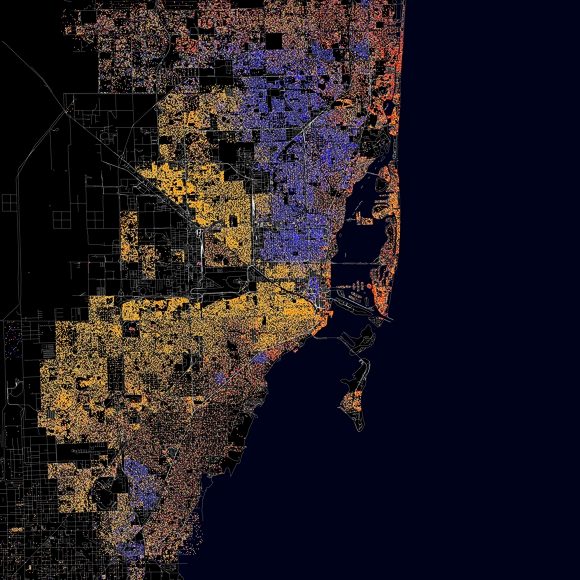
These images, sourced from Wikipedia Commons, are used under CC3.0 and incorporate a photograph of the Sydney skyline taken from the north by Adrian Gigante. To the right is the Sydney Harbour Bridge and to the extreme left, the Sydney Opera House.

4. Winter In Sydney

I’ve lived in Sydney for most of the last 37 years, and for much of it, I’ve been located in one of four adjacent suburbs. The astonishing thing that I have learned in that time is not how similar the weather is between these locations, but how different it can be. Wiley Park’s weather is very much like that of nearby Bankstown; Lakemba, adjacent to Wiley Park, is similar, but a little warmer and wetter; Belmore; adjacent to Lakemba, is cooler and drier (most of the time), and it’s weather varies just a little in every possible parameter from that of it’s neighbors, to the point where a rival forecasting service is more accurate than the one that used to be dead-on when I lived in Lakemba.

Most of Southern Sydney’s cloud-oriented weather comes from the South or the south-west. These suburbs are not very wide; Wiley Park is roughly rectangular, and the long side (about 3:2 ratio) inclined about 30° to the West, so the leading edge of the suburb is about 1 km wide. Lakemba is slightly narrower and longer, with a leading edge of roughly 0.75km. Belmore is much longer, and with a corner removed from the top right of the rectangle; the eastern boundary is also a far more irregular in shape, so this is very much an approximation. Nevertheless, the leading edge is also about 0.75km. I didn’t live on the extreme edges of the suburbs, my location was far more central than that. So I’ve moved a distance (as the crow flies) of about 1.65km and experienced three different forecasts as accurate.

Wet Weather in the southwestern suburbs, in other words, seems to flow down “channels” toward the Hawkesbury River, which bisects, the city east-west, and then flows east toward the CBD and the harbor, which has a quite different forecast again. Farther west, the Blue Mountains are a more dominant influence and the weather comes in more South-westerly or Westerly. North of the Hawkesbury, and the weather source is as likely to be the West as it is the South, but it bends southward in it’s course. In the Eastern Suburbs, beyond the CBD, there is a natural “bowl” centered on the suburb of Randwick, where – it is said – if it rains anywhere in Sydney, it will also rain.

Rain, however, sweeps in from the clouds in bands from the North-east, bands which slip steadily toward the river. As a result, it can be raining in one of those suburbs and bone-dry in it’s neighbors. Part of the reason for all this is local topology, and part is the influence of man-made structures, but that’s more of a summer phenomenon, so I’ll defer discussion of it until part 3 of this series.

In the CBD, it’s quite common for early-morning clouds to roll in from the sea; many a time I have been fooled into dressing for colder, wetter weather only to have the cloud burn off by ten or eleven AM to reveal the blazing hot Australian sun. This effect is even more pronounced in Winter than it is in Summer, though daylight savings exaggerates what effect there is. The CBD, Eastern, and Northern Suburbs are also subject to the occasional coastal storm or wind condition that does not affect the rest of the city, or are substantially diminished.

Winter days in Sydney tend to be characterized either as quite mild and comfortable, or dominated by frigid winds blowing over the mountains. It is not uncommon for cool changes to drop the temperature by 20°C (36°F) or more in the span of minutes. Warmth returns more slowly.

Another substantial contributor to this effect is the size of Sydney. More than 12,000 square km (almost 4800 square miles), and with a population density of 1000 people for each of those square miles. The westernmost suburb is Emu Heights, 60km west of the CBD, with the Easternmost suburb along the same line located 8km further out. Dividing 12000 by 68 gives almost 175, showing that Sydney is more than twice the length north-south as it is east-west, and the average coastline runs slightly east of north. The shape is an indicator of the influence of the blue mountains, which parallel the coastline.

Of course, what we call “Mountains” are not what most Europeans or North Americans would recognize by the name. That’s because they are so old that all the surface soil has eroded and blown away, leaving only the “bones” of the mountains. This played a key role in Australian settlement, as it took a LONG time for a passage to be found across the Blue Mountains. This was because the explorers attempted to follow the valleys and low passes; this works with younger Mountains because softer earth tends to accumulate in the lee of one or both mountains, filling in the cracks and rocks. In the Blue Mountains, that ‘padding’ is long-gone, exposing the rocks; I was about five years of age when I first beheld the Three Sisters, a famous rock formation near Sydney that illustrates the point.

Click this link to view licensing information and gain access to a glorious 3200×1780 version of the image. The lighter-colored areas are freshly-exposed rock, subject to erosion.

In the short term, weather seems to follow a weekly pattern – if it rained on Tuesday last week, it’s more likely to rain somewhere in between Monday Night and Wednesday Morning this week. Every now and then a more substantial weather change comes along and adjusts this pattern, usually by a day one way or the other, setting a new weekly pattern in motion. This pattern-effect holds true for daily maximums, nightly minimums, wind strengths, and perceived temperatures, as well as rainfall amounts, durations, and start times. In the finer detail, of course, each day and each week is different, but the general impression remains. This is most true in Summer, somewhat less true in Winter and Autumn, and has lowest reliability in early and mid-Spring. As a forecasting principle, it has a 70-80% accuracy – at least in terms of detailed generalities.

Officially, the city has a subtropical climate, which (amongst other things) means that it experiences rainfall distributed equally throughout the year. In reality, things are not quite so simple. Winter is actually the driest season of the year, with rain tending to occur in heavier falls during the season, but more dry days. It’s fairly rare for cloud to persist more than 24 hours without rainfall, however. At Sydney’s official primary weather station (Observatory Hill), extreme temperatures have ranged from 45.8 °C (114.4 °F) on 18 January 2013 to 2.1 °C (35.8 °F) on 22 June 1932. An average of 14.9 days a year have temperatures at or above 30 °C (86 °F) in the CBD.] In contrast, the metropolitan area averages between 35 and 65 days, depending on the suburb.

Due to the inland location, frost is recorded in Western Sydney a few times in winter (it used to be regularly). From 1990-1999, Sydney received around 20 thunderstorms per year, and these are regularly severe; one such storm was the 1999 hailstorm, which produced massive hailstones up to 9 cm (3.5 in) in diameter. In late autumn and winter, east coast lows may bring large amounts of rainfall, especially in the CBD. Snowfall was last reported in the Sydney City area in 1836, while a fall of graupel (soft hail) that was mistaken by many for snow in July 2008, has raised the possibility that the 1836 event was not snow, either. That said, this is the wrong time of year for hail events in Sydney.

The weather in the last 15 years or so has been markedly different to that which I experienced prior to that date. Seasons seem to start 2-4 weeks after their allotted date, and both Summers and Winters have been milder on the average (I can remember 40+°C days occurring in late September / early October. This year, it was late November). This effect has started to distort the temperature records, and is something that needs to be taken into account when assessing those records.

Sydney’s Weather is somewhat more complex than a simple four-season model. Based on average temperatures, Winter runs from June to September. June and July are true winter months, with Average Lows of 9.8°C (49.6°F) and 8.7°C, respectively, but the May averages are more akin to those of Autumn while September is more akin to Winter than Spring. Basically, the weather stays cold until a week or slightly less of strong (even gale-force) winds batters the city, often accompanied by rain and one final plunge in temperatures; a week or two of pleasantly mild conditions (warm with cool breezes) follows, and then temperatures begin to soar.

The average number of rainy days in June and July is 10.5 and 10.2, respectively, plummeting to 8.4 and 8.8 in August and September.

It’s also worth noting, when you go looking for official sources, that the “City” of (Greater) Sydney (usually just called “Sydney” by residents, and nicknamed “The City”, or “The Big Smoke” by non-urban locals) actually comprises a number of smaller “cities”. These are political divisions more than anything else, a limit to the reach of local governments. You observe the same pattern in Los Angeles, where I remember the “City” of Anaheim being something completely separate from the “City” of Los Angeles. As usual, such confusion results from one word being used for two separate jobs.

While Sydney now has two AFL teams (refer “Winter In Melbourne”, above), Rugby League is the dominant winter passion here. Fans are, however, just as tribal, and just as passionate as their southern cousins (see also the section on Brisbane to follow). Soccer is also gaining in popularity. Nevertheless, winter in Sydney is relatively short of season-specific activities, at least in comparison with our Southern neighbors. One notable exception is that this is the season of local street festivals. Another highlight is Vivid Sydney, when various buildings are “painted” using colored lights. It’s notable that number two on this list of 50 Things To Do In Sydney In Winter Under $50 takes you beyond Sydney’s borders, and that most Sydney-siders wouldn’t be caught dead at Number 11, Number 25, Number 26, or at several of the other listed “things to do”. For most, Winter is a time to stay at home close to a heat source, as much possible.

This list of 20 Things to Do In Sydney This Winter For Under $20 (from a completely different site) is probably more responsive in terms of activities the majority might participate in, at least until you get down toward the end of the list. (The prices appear to be in Australian Dollars, multiply by about 7/10 to get USD, or halve it for Euros/Pounds). We’re not an especially art-and-culture -oriented city. As a general rule, you’re more likely to go visit a friend and watch the “footy” together than you are any more organized activity.

It’s also noteworthy that Winter is when all the US “Summer Blockbusters” hit cinema screens. Although cinemas have declined in popularity (due to high prices and the rise of home equivalents), this remains the peak season.

More commonly, though, people drive out of the city to go skiing in the snowfields, hiking in the bush, or simply exploring the state. This is somewhat true in summer (when there is no snow) but is especially true in Winter. Every Friday during the season, there is an exodus sometimes estimated at between 5 and 10% of the population (I think those claims exaggerated, personally). Winter’s also a good time to hop in the car and visit relatives.

The final thing that you need to understand about Sydney In Winter is the diversity of the population. Sydney became one of the most multicultural cities in the world after mass migrations following the second World War. According to the 2011 census, more than 250 different languages were spoken in Sydney and about 40 percent of residents spoke a language other than English at home. Furthermore, 36 percent of the population reported having been born overseas. My own suburb is home to 136 Ancestries, making it one of the most diverse in the city, right down to 3 Fins and 3 Danes who were living here at the time of the last census.

More to the point, Sydney (and Metropolitan Australia in general) is one of the world’s great melting pots, especially when it comes to cuisine. No culture that comes here fails to rub a little of itself off onto the broader community, and to have a little of that broader community rub off onto it. Pizza in Australia – especially at the lower-budget end – is nothing like the Italian dish from which it is sourced, nor is it quite the same as what an American would expect. Chinese food is also just a little different to that which you will get anywhere else. And if there’s a fusion to be tried, an Australian is probably trying it. I don’t think you would be able to buy rattlesnake or moose meat here, because the species are not indigenous to the country; anything more common can probably be sourced! My next grocery order contains Apple and Cider Pork Sausages, French Deserts (instant from the fridge), and Low-fat Greek Yogurt (with Fruit) – to name just three items!

Each ethnic group reacts just a little differently to the change of seasons, whether it be in terms of what they eat, drink, or do, socially. A wintry social life in Sydney is defined by who you know, not what you know!

These images, sourced from Wikipedia Commons, are used under CC3.0 and incorporate a photograph of Brisbane by Lachlan Fearnley.

5. Winter In Brisbane

Brisbane is right next to Sydney on most maps. That’s because the world is such a big place; in fact, the two CBDs are about 915km (570 miles) apart, and that’s more than 2% of the circumference of the planet, so it shouldn’t be surprising that the weather forecasts between the two bears very little resemblance to each other, even though technically, they are both considered “subtropical”.

Brisbanites like to make a big deal out of their winters. The Urban List, based in Brisbane, writes, “Being from Brisbane, we don’t realize how much of a non-event our winter is. There’s always a certain few who insist on donning scarves, gloves, beanies and a jacket when the mercury hits 21. But sorry Brisbanites, our winters just ain’t that bad” in introducing their article, ‘50 Truths about Brisbane’s Winter‘. Because their list conveys a sense of the season and the reactions to it very effectively, let me quote a few of the entries:

  • 1. We get excited about actually being able to sleep with a sheet covering us.
  • 4. You buy a coat because winter is coming, but it only gets worn once, and even then you probs [probably] could have opted for a cardie [cardigan].
  • 17. Your morning greeting is replaced with ‘OMG it’s SOOO cold today!?’
  • 25. You hear the daily ‘you guys have nothing to complain about with your winter!’ and shake your head in disbelief; ‘it’s cold’, you argue, ‘it’s cold!’
  • 28. Your pride is hurt when you see that the weather in Tasmania is minus 50 [°C, -56°F, an exaggeration], with snow.
  • 29. But, you “know” that even though we’re still in double digits, our winter is just as cold as there anyway, when you factor in wind chill…

So, what’s the reality?

Winter in Brisbane is normally blue skies and warm weather. Mean temperatures are between 11 and 21°C (51.8 and 69.8°F, respectively). Early mornings and nights can be crisp, but overnight lows rarely drop below 9°C (48.2°F). It never snows there, though light falls have been reported elsewhere in Southern Queensland at altitudes, i.e. in the Granite Belt, most notably in Stanthorpe, which although 300 km (186 miles) Southwest, sometimes somehow becomes magically conflated with the city in conversations with locals related to winter weather – usually in the form of the local responding to a comment about the mildness of the (typical) weather by mentioning “It did once snow at Stanthorpe” as though that town of 4800 or so were a suburb of the city.

It’s my opinion that the psychological impact of weather that doesn’t threaten to melt the pavement underfoot at any moment is greater than any actual discomfort due to the weather – or, to put it another way, the residents become so acclimatized to baking hot temperatures through the rest of the year that winter is highlighted through sheer contrast. Brisbane is located North (i.e. closer to the equator) than the famous Gold Coast, which provides another clue as to its weather.

The city is centered along the Brisbane River, and its eastern suburbs line the shores of Moreton Bay, which is a downward-pointing teardrop shape, with a number of islands including North Stradbroke Island and Moreton Island forming the eastern “outline” of the bay. The bay is open to the north, and has a few smaller openings to the East, but is sheltered in every other direction. The greater Brisbane region is on the coastal plain east of the Great Dividing Range, with a metropolitan area that sprawls along the Bay floodplain from Caboolture in the north to Beenleigh in the south, and across to Ipswich in the south west.

A lot of the city is hilly; the urban area, including the CBD, are partially elevated by spurs of the Herbert Taylor Range, such as the summit of Mount Coottha, reaching up to 300 meters (980 ft) and the smaller Enoggera Hill. As is often the case, small differences in altitude can mean the difference between catching a breeze or not; in summer in particular, this can make a big difference to the perceived weather, but there is some effect even in winter.

Due to its proximity to the Coral Sea and a warm ocean current, Brisbane’s overall temperature variability is somewhat less than most other Australian capitals, particularly in winter, when maximum temperatures below 20 °C (68 °F) are relatively uncommon. On 19 July 2007, Brisbane’s temperature fell below the freezing point for the first time since records began, registering -0.1 °C (31.8 °F) at the airport station. The city station has never dropped below 2 °C (36 °F). Locations directly west of Brisbane such as Ipswich have dropped as low as -5 °C (23 °F) with heavy ground frost. The average July day is around 22 °C (72 °F) with sunny skies and low humidity, occasionally as high as 27 °C (81 °F), whilst maximum temperatures below 18 °C (64 °F) are usually associated with brief but not uncommon periods of cloud and winter rain. On the penultimate day of winter in 1943, the Brisbane Regional Office station recorded a temperature of 38.3 °C (100.9 °F).

Examining the weather records more closely, it is possible to clearly distinguish two entirely separate winters. If you were to base your climate model on average maximums, you would point to June and July as being the only true winter months; those are the months when the record stands below 30°C and the average high is below 22°C (71.4°F). If you look at minimum temperatures, then there are clear transitions in April-May and September-October, identifying Winter as the period of three months in between (June, July, and August). The average lows in those three months are 11.8°C, 10.2°C, and 10.8°C, (53.2, 50.4, and 51.4°F) respectively, so the early period of winter is slightly warmer than the end. Record Minimums blur this picture slightly; the May record low is identical to that of June (both 5°C 41°F), while July and August have record minimums of 2.6°C and 4.1°C (36.7°F and 44.6°F) respectively.

This paints a picture of a season that creeps up on the city in isolated cold snaps, which gradually even out as the peak warmth of the day diminishes.

For anyone looking to roleplay a visit to the city, one tip: The older architecture is slightly different to that of the rest of the country. Pre-1950, housing was often built in a distinctive style now known as a Queenslander (You know your state’s architecture is unique when it’s named after the state itself!) This features timber construction, large verandas, high ceilings. Many of these houses are elevated on stumps (also called “stilts”), that were originally timber, but are now frequently replaced by steel or concrete; this permits cooler air to circulate beneath the house, assisting in keeping it cool. Queenslander houses are considered iconic to Brisbane and are typically sold at a significant premium to equivalent modern houses. I’ve included a link to the relevant Wikipedia page; residents of the US Southern states will find a lot that looks familiar to them, architecturally.

As usual, let me now turn to the activities that characterize a Brisbane Winter (it’s trite but true to some extent to say, think of what most places do during the spring/summer). The tourist information page ‘30 things to do this winter in Brisbane‘ introduces itself in a manner that should now be familiar: “The closest Brisbane gets to freezing point is the ice in our drinks – so raise ’em high and celebrate crisp, clear days of winter sunshine, our all-seasons event line-up and the joys of wearing a jacket for those three weeks it is possible. In the depths of winter, Brisbane’s overnight temperature may dip below 10 degrees, so pack your walking shoes as being outdoors is always on the agenda.” The site then goes on to list 30 activities (as promised), all related to a winter that has now passed and which is not identified anywhere on the page that I could see – but, being an official site, it seems most likely to have been Winter 2017. Despite the information potentially being a little out of date, this makes a great starting point for research on the city in this time of year thanks to the external links buried throughout the article – and it has the bonus that, as an official site, it is likely to be refreshed annually.

Another great resource, especially when used in conjunction with the above, is the tourist-targeted article ‘Top 10 things to do in Brisbane this winter‘, which captures a bit more of the flavor of the city by looking at the activities in slightly greater depth. GMs may also find the general Wikipedia article about the city to be useful.

I want to explicitly call attention to #11 of the “30 things to do” (it doesn’t even make the “Top 10” list.

When it comes to Rugby League, Brisbane is just like a suburb of Sydney so far as fan tribalism goes. They have a franchise in the New South Wales competition that is treated with no more welcome, hostility, or disdain than any other team that is not your own. All that changes when one particular event rolls around – the one pictured in the “30 things” article: The State Of Origin series.

The idea is that the best players deriving from Queensland (regardless of their playing for different clubs the rest of the time) will get together for an annual three-game series against the best that New South Wales can gather. And, if the typical Australian’s support for his local team is tribal in its dedication, devotion, and intensity, the Blues (New South Wales) vs the Maroons (Queensland) is positively Primal in comparison. During my lifetime, Australia has been involved in three or four wars, and I’ve seen news and archival footage of our involvement in Korea and two World wars. The intensity of passion for all of them pales in comparison to the extremes that crawl out of the woodwork during those few weeks. It’s like the Superbowl in Australia, or the Grand Final for countries where Soccer is the predominant form of football – but it envelopes everyone who follows the code, not just two particular teams.

Supporters sprout team colors – sometimes appropriately for their position within society, sometimes not. Businesses sprout team colors and put on special discounts. Any possible link with the contest is celebrated, no matter how tenuous. During the game, local pubs and clubs are standing room only (or less). All other tourism activities take a remote second place; it’s akin to being the host city of a Summer Olympics (and I use the comparison advisedly), but without the infrastructure and inconvenience.

The three games are held in May, June, and July respectively. Any visitor to Brisbane, or to Sydney for that matter, in the weeks when a game in imminent, will not be able to avoid it. It also forms a shadowy backdrop to three-quarters of the team games in this period; any outstanding plays (good or bad) will automatically yield a discussion of the state of origin implications. This is a piece of local color that has to be incorporated into any post-1970 visit to either city.

6. Winter In Tahiti

Tahiti, Marvel’s Agents Of S.H.I.E.L.D. would be quick to remind you, is “a magical place”, virtually the archetypal representative of the Tropical Paradise. One of the first things you will discover when researching Tahiti through Wikipedia is that there is not a lot of information on the climate available. Either it is mind-numbingly consistent year after year after year, or you will have to dig a little deeper.

Tahiti is the largest island in the windward group of islands that forms part of French Polynesia in the Central Southern Pacific. There are 118 islands in total within French Polynesia, and they are strewn across four million square km of ocean, clustered into five archipelagos – the Society Islands, the Tuamotu Islands, the Gambier Islands, the Marquesas Islands and the Austral Islands. Tahiti is part of the Society Island archipelago.

I’ve been there once and remember only that it was bakingly hot even in the air-conditioned jet lounge, but not the furnace that crossing the concrete tarmac to reach it had been. French is the official language but the locals also speak Tahitian. Tahiti.Com lists a few common phrases in Tahitian, and can be a handy reference – hello, goodbye, welcome, and thank you.

In actual fact, Tahiti is two volcanic islands that are joined; the larger one lies to the northwest and is known as Tahiti Nui, and the smaller one connects to it and is known as Tahiti Iti. The capital of French Polynesia, Papeete, is on the Northwest coast of the larger island. Tahiti is 5700km from Australia (3078 nautical miles), 7900km (4266 nautical miles) from Chile, and 4400km (2376 nautical miles) south of Hawaii, with whom it shares a Time Zone.

The interior of Tahiti Nui is almost completely uninhabited. The southeastern part of Tahiti Iti can only be reached on foot or by boat, and so Tahiti Iti is largely isolated; the rest of Tahiti is encircled by a main road that cuts between the mountains and the sea, while a scenic interior road winds into higher altitudes past dairy farms and citrus groves.

Tahiti is genuinely tropical in climate, receiving almost continuous sunshine daily – the Tuamoto Islands of French Polynesia receive more than 3000 hours annually – and just enough rain to keep everything lush. The sun rises and sets at the equator at 6am and pm nearly every day; the tropic latitudes at their most extreme see a sunset at about 5:30pm, and sunrise can be as late as about 6:40AM.

The air temperature, which can vary from one archipelago to another (generally, the further south, the cooler), typically stays between 24°C and 30°C (75°F and 85°F), and the water temperature ranges from 22°C to 26°C (73°F to 79°F). In general, the high volcanic islands like Tahiti are more humid than the low coral atolls because the islands are dense with vegetation and the atolls are more exposed to trade winds. The lowest temperature ever recorded at Papeete is 16°C (61°F).

Winter in Tahiti lasts from April to October – some say March to November, others May or even June to October – and is one of only two seasons recognized. For these 7 months of the year, the temperatures are slightly cooler and the humidity reduced; this is considered the ‘dry’ season. July and August (especially the latter) are the coldest months, thanks to the trade wind known as maraamu. As usual, the differences between the different definitions depend on the basis by which the season is identified; Tahiti has 7 warmer months in the year, but 8 dryer months, and they don’t synchronize.

As usual, when you dig a little deeper, interesting details emerge. The number of days in winter which received precipitation, for example, varies from 17 in December to 7 in August and September. 17, of course, is more often than 1 day in 2, while 7 is closer to 1 day in 4 and may well indicate regular intervals of more than a week between rain showers. The average number of rainy days is even lower.

July and August are also the only months that don’t average a single day with a temperature high of better than 32°C (90°F); June and September typically contain 4 each, May and October 6, November 8, December 9, and the rest of the year 10 or more.

Tahiti is not the place to go if you are sensitive to high humidity. The low point of the year (on average) is 78% in October; the high is 82% in April and June.

I found the information at Weatherbase.com to be very helpful in compiling this entry. It is probably worth noting that many of these records have only been kept for the last 5 years, however, unlike other locations that have a century or more of data to draw upon.

May 1 to October 31 is also the peak tourist season, attracting higher prices and greater demand, though some resorts change their prices starting April 1. That advice, and plenty more local color, can be sourced from the Visual Itineraries .com page, ‘Best Time of Year to visit Tahiti‘, which I found to be an excellent resource.

Insects, sunburn, sunstroke, and dehydration are ever-present dangers in Tahiti regardless of the season. You are also likely to be troubled by mosquitoes and a small sand fly known as the no-no unless adequately protected. Less common are encounters with stonefish, which can survive for up to 24 hours out of the water, and which inject highly-lethal neurotoxins when stepped upon.

Winter is also the time of year when visibility for diving is at it’s best, so that quite obviously heads any list of winter activities. For more, check out the “best time of year” article linked to, above, but they include the obvious: hiking, swimming, surfing, and scuba diving. Tahiti is famous for it’s black sand beaches, the results of erosion of the volcanic rock that forms the island. Note that Summer is the best time of year for the local cuisine, however.

Incorporates a photo of the oldest street in Cairo, Muizz Street, officially listed as having the greatest concentration of Medieval architecture anywhere in the Islamic World, by Mohammed Moussa.

7. Winter In Cairo

(Much of the following three paragraphs is quoted directly, or derived, from the very informative Tour Egypt website, quoted because I could not express it any more clearly. There’s a lot more info on the page, I’ve only grabbed the introductory paragraphs!)

Throughout Egypt, days are commonly warm or hot, and nights are cool. Egypt has only two seasons: a mild winter from November to April and a hot summer from May to October. The only differences between the seasons are variations in daytime temperatures and changes in prevailing winds. In the coastal regions, temperatures range between an average minimum of 14°C in winter and an average maximum of 30°C in summer.

Temperatures vary widely in the inland desert areas, especially in summer, when they may range from 7°C at night to 43°C during the day. During winter, temperatures in the desert fluctuate less dramatically, but they can be as low as 0°C at night and as high as 18°C during the day.

The average annual temperature increases moving southward from the Delta to the Sudanese border, where temperatures are similar to those of the open deserts to the east and west. In the north, the cooler temperatures of Alexandria during the summer have made the city a popular resort. Throughout the Delta and the northern Nile Valley, there are occasional winter cold spells accompanied by light frost and even snow. At Aswan, in the south, June temperatures can be as low as 10°C at night and as high as 41°C during the day, when the sky is clear.

In the upper part of the middle of all of this is Cairo, by a substantial margin, the largest city in Egypt. 6.76 million inhabitants are concentrated into 453 square kilometers (175 square miles), and an additional 9.5 million people live in close proximity to the city. That’s a population density of close to 15000 people per square km, or – to put it another way – the average is 67 m from one person to another. This is about one and a half times the population density of New York City. Cairo has more than 82% of the population of NYC crammed into 58% of the area. This is a fact that many GMs often forget; privacy is that much harder to find, and crowds gather more quickly and spontaneously, which is why I’m making a point of it.

Cairo is located 165 kilometers (100 mi) south of the Mediterranean Sea and 120 kilometers (75 mi) west of the Gulf of Suez and Suez Canal, on the Nile River, immediately south of the point where the river leaves its desert-bound valley and branches into the low-lying Nile Delta region. Although the greater Cairo metropolis extends away from the Nile in all directions, the city of Cairo resides only on the east bank of the river and two islands within it. The Western bank of the Nile across from Cairo contains the city and protectorate of Giza (a relationship similar to that between New Jersey and New York City, if Jersey were the dominant cultural and tourism destination of the two).

Until the mid-19th century, when the river was tamed by dams, levees, and other controls, the Nile in the vicinity of Cairo was highly susceptible to changes in course and surface level. Over the years, the Nile gradually shifted westward to it’s present position. The land on which Cairo was established in 969 (present-day Islamic Cairo) was located underwater just over three hundred years earlier. Because of the Nile’s movement, the newer parts of the city – Garden City, Downtown Cairo, and Zamalek – are located closest to the riverbank. These areas are home to most of Cairo’s embassies, and are surrounded on the north, east, and south by the older parts of the city. Since the late 20th Century, the areas of most rapid growth have been to the North and extreme East of Cairo.

Cairo is located in what is officially a Hot Desert Climate, but is atypical of such climates because of the frequent high humidity. Wind storms can be frequent, bringing Saharan dust into the city, sometimes from March to May and the air often becomes uncomfortably dry. The winds responsible are known locally as khamaseen, but are also referred to in other locales as khamsin , chamsin or hamsin. The first of these three is the most common western usage of the word. The Khamsin is a dry, hot, sandy local wind from the south, anywhere in North Africa and the Arabian Peninsula. Similar winds in the area are sirocco and simoom. From the Arabic word for “fifty”, throughout the Levant, these dry, sand-filled windstorms often blow sporadically over a fifty-day period in Spring, hence the name. When the storm passes over an area, lasting for several hours, it carries great quantities of sand and dust from the deserts, with a speed up to 140 kilometers per hour, and the humidity in that area drops below 5%. Even in winter, temperatures can rise above 45°C (113°F) due to the storm winds. These sand storms are reported to have seriously impeded both Napoleon’s military campaigns in Egypt as well as Allied-German fighting in North Africa in World War II. (From the dedicated Wikipedia page on the subject). The most common occurrences are in April but occasionally occur in March and May. They can cause the temperature to rise 20°C or more in just two hours (36°F).

Egypt receives fewer than eighty millimeters of precipitation annually in most areas. Most rain falls along the coast, but even the wettest area, around Alexandria, receives only about 200 mm (7.9 inches) per year. Alexandria has relatively high humidity, but sea breezes help keep the moisture down to a comfortable level; the amount of precipitation decreases suddenly as one moves Southward. Cairo receives a little more than one centimeter (0.8 inches) of precipitation each year. The city reports humidity as high as 77% during the summer, but during the rest of the year, humidity is quite low. The areas south of Cairo receive only traces of rainfall; some will go years without rain and then experience sudden downpours, resulting in flash floods.

In October, night-time temperatures begin to decline markedly, signaling the transition to Winter. In November, both daily minimums and maximums decline, the record highs drop below 40°C (104°F), and the record minimums plunge to single digits centigrade (41.4°F or less) at night. These conditions persist with varying intensity throughout December, January, and February. In March, record maximums again break the 100°F mark, but the average high remains relatively mild at 23.5°C (74.3°F); in April, temperatures a two-month rise, signaling the end of the season. Without having lived there, I suspect that the record maximum has resulted from an early end to the season one year.

You get, perhaps, the clearest delineation between the seasons by studying the rainfall records. For the three hottest months, these are uniformly zero; October, 0.7mm; November 3.8mm; December, 5.9mm; January, 5mm; February and March, back down to 3.8mm; and, as temperatures rise, 1.1mm or less until Summer is once again reached.

In terms of activities, very few sites distinguish the seasons, but it can be convincingly argued that as the cooler temperatures would be more comfortable, winter would be the height of the tourist season, and therefore everything listed would be on the table. Two exceptions to this rule are

  • The yTravel Insider’s Guide article What To Do In Egypt, which has specific advice relating to winter amongst a mountain of relevant and useful information. About 1/3 of the way down the page, you might get the impression that it ends; it doesn’t, just keep scrolling. I recommend this site to any GM planning an adventure in Egypt for the sheer depth of information;
  • and, secondly, the Daily News Egypt travel article, The Best Winter Getaways In Egypt for the (rare) specifically-seasonal topicality.

More ‘normal’ traveler activity resource sites include (in declining number of entries)

Wikipedia makes a big point of the most popular sporting activity being Football (which Americans will know as Soccer). The last subsection of the Infrastructure section of their Cairo Page provides an excellent jumping-off point to explore this facet of the City. This is followed by a section on the Culture of the city which is also worth reading.

With this final update, this first serial blog post is now considered complete. The series itself continues; you can access the next part using the links below.

Comments (9)

The Utility of Average Rolls: A Guest Article by Clinton Hillman


Image courtesy freeimages.com / Uros Kotnik

If you need to save time or mental bandwidth, consider using dice roll averages for rolls of more than 4 dice.

Disclaimer: nothing in this article should be considered prescriptive. You know your game system, your players, and yourself best. Use what seems useful and put the rest in your back pocket for when you need it.

Dice statistics are commonly recognized as a relatively dry subject in tabletop games. However, the Game Master would do well to respect the power of chance over their games. Success, failure, and their magnitude are at the whim of the roll; understanding how randomness can affect game-play will give the GM some useful tools for controlling the table.

GMs are only human. This is both a boon and a bane to the game; the near infinite flexibility of having a mortal parse game-play competes with the limitations of the GM’s capacity to do so. Quality game design necessarily takes that into account, limiting game mechanics (and their interactions) so that the needs of running the game are within the GM’s bandwidth.

One tool to help do this is by using dice roll averages vice rolling large numbers of dice, but at what point is that a useful tool? Under what conditions are the GM’s bandwidth limited, increasing the value of this tool? What other tools are synergistic, and what tools invalidate the usefulness of average rolls?

Players have similar restrictions. In the absence of interesting game-play, they look to other sources of diversion (these days, it’s often the phone in their pocket). Player engagement is a concern of all GMs, and it’s rare for a player to hang on the edge of their seat for a large dice roll to tally. Opposite this effect is the excitement of the roll itself. A goodly portion of engagement-worthy game-play is the randomness of the roll, and taking that away from the players (either by enforcing roll averages on them or by not rolling yourself) can drive engagement down. Finally, calculating the average dice value takes some mental bandwidth, so economy of calculation vs. roll tallying should be considered.

Process

For reference, calculating the average is simple enough – for N dice of S sides with a modifier M (NdS+M), Avg=(N*S+N)/2+M. This often produces fractional values, so it’s important to understand how your game system deals with fractional numbers.

It should be clear to the GM that at some point, using the roll average will save time. In 5e D&D, the Meteor Swarm spell calls for two rolls of 20d6. Almost nobody has twenty 6-sided dice on hand, and if they do, digging through the rest of their dice to produce them can grind the game to a halt. Likewise, rolling 1d6 forty times can be time consuming (and mentally challenging – was that 18 rolls or 19?). So the GM should be able to understand the value of time saving techniques (and there are others that are discussed elsewhere ? see Mike?s article on using Random Results).

Less clear, perhaps, is there a tipping point between the fun of a roll and the savings of an average? Is it more than 10 dice? More than 5? Let’s look at the math.

I took the dice total probability distributions from anydice.com for 1 to 20 dice of 4, 6, 8, 10, 12, and 20 sides and copied them into a spreadsheet. Next, I looked at three scenarios: the probability of a roll being within 30%, within 15%, and within 10% of the average value. Multiple scenarios will hopefully give the GM the ability to decide for themselves where the break-over point for usefulness of this technique lays. Below you can see the distributions charted, by dice size.

Results & Analysis

Click on this thumbnail to download a zip file containing the spreadsheets and results graphs in a larger size.

Not surprisingly, the more precision demanded by the GM, the less likely it is that a roll will meet the requirement. Also, as the number of dice increases, the likelihood of rolling within the precision required increases (rolls become less random with many dice). Finally, as the number of sides on the dice increases, the likelihood of meeting the required precision increases.

These conclusions hardly warranted the effort of this analysis; the results should have been obvious even before the numbers were crunched. But it?s not this big picture that we really care about ? it?s the thresholds of precisely when randomness becomes too low to matter as much as the time savings.

It’s worth noting that at low number of dice or sides, the discrete nature of dice roll values produces irregular results (1d4, for example, cannot produce the required precision at ±15% and ±10%). If you take a look under the hood and examine the spreadsheets, you’ll also find that the processing of data provided by anydice.com produced some errors. I’m disregarding those errors, since they would not have impacted the results.

What IS worth noting, however, is that generally a roll is within 15% of the average more than 60% of the time when the number of dice is greater than 4. As a GM, I find this precision and frequency “good enough?, especially when you consider that mentally calculating the average requires the same number of operations as rolling when the number of dice is 4 (multiplying two numbers, adding a number, dividing by two, and adding a final number takes me roughly the same amount of time as throwing four dice and adding four values).

Rebuttal

There are circumstances where I would not recommend this technique.

  • When using digital tools. Digital tools make it very easy to produce a random result while requiring only the bandwidth to make the request.
  • When party size is small and other mental distractions are minimized. I still may recommend this technique for very large rolls, but in the narrow range where the number of dice is between 4 and 10, it’s probably worth the increased bandwidth for the fun of rolling the dice.
  • I would never recommend enforcing this technique for player rolls. It will reduce player agency and take a vital part of game-play from the player, and save the GM no bandwidth. For very large rolls (see Meteor Swarm above), I may give the player the option before the roll, but otherwise, I’d let it lie.
  • If you’re morally, philosophically, or otherwise opposed to the idea. See disclaimer above.

In conclusion, using average values for dice rolls can be a valuable tool for saving GMs time and mental bandwidth, but circumstances and personal preference can invalidate its usefulness.

About The Author:

Clint Hillman has been in love with Sci-Fi and Fantasy since he was very young. When 3rd Edition D&D was launched, he bought himself the core rulebooks and started GMing for his friends. After over a decade of military service, Clint looks to the gaming industry for his next challenge. He lives in Arizona with his wife Ashley and son John. This is his first published article, and he hopes to publish many more.

Comments (3)

Beginnings And Legacies


Part 1: Introduction

This is the first Campaign Mastery post for 2018, and that’s rather significant.

New Years are always a strange synthesis of two things: beginnings and retrospectives. The first is fairly obvious, but the significance of the second often gets overlooked as everyone gets wrapped up in newness and new beginnings. But for me it seems especially significant that the first thing that we generally do at the start of a new year is to reflect back on what happened in the old one – in other words, how we got to “here”, to this particular new beginning.

These retrospectives are usually not all that great; the interval is too short to lend perspective, events too raw to be fully evaluated in the context created by the melange of other events that have occurred. That generally leaves the retrospective feeling superficial and rather hollow, a recitation of events with at best limited appreciation of their significance or ramifications. I have sometimes thought that some of this could be avoided simply by placing the events of the past year into a perspective obtained by looking back a second year, or further if necessary, but further reflection shows that this would contradict the primary purpose – which is the placing of the new year into context.

Nevertheless, there are some useful lessons in this duality for GMs, so it’s worth taking a closer look at the concepts of Beginnings and Legacies. I’ll get to that shortly.

Part 2: Campaign Mastery

The December that has just passed was a significant one for Campaign Mastery, and it’s a significance that will carry on throughout 2018. So that seems to be a good place to start.

You see, sometime in the course of the past month or so is when you have to draw a line and say “This is the 9th anniversary of Campaign Mastery.”

It’s not a simple number to pin down, however. In September or October of 2008 (as I recall), Johnn and I first discussed a blog; in November, he was persuaded and on-board, or was it I that had to be persuaded? Actually, I think we were both half-convinced from the outset, but each was confident that the notion would work in terms of the other’s doubts and uncertainties. In any event, mid-November, we were both on-board with the concept, at least on a trial run. Starting on November 29, and continuing over the next few weeks, we both wrote and posted a few test pieces and began to iron out the administrative protocols . Technically, the anniversary date should be the date we became publicly visible, but it wasn’t until January 2019 that we told anyone about it, having worked out most of the administrative and workflow kinks! So I tend to think of the whole month of December as the site’s “Birthday”.

Which means the buildup to the Tenth Anniversary starts NOW.

We had our first 6 visitors on January 1st. And six more on the second, and five more on the third, and 7 on the fourth. And then the number of readers started going up. As of today, according to Google Analytics, we have had almost 1.3 million page views by more than 488,000 readers. Right now, those numbers are a steady 4000+ a month, with 20% of that 4000 being new readers, 63% of whom will become regular readers. So sometime very early in January, we’ll cross the 1.3 million threshold, and about 2 years from now (at those rates) we’ll have our half-millionth individual visitor.

2017 started out with a bang, I was still getting a huge boost in readership from winning the 2016 silver Ennie for best blog. Heck, I still get a few visitors almost every day from that! As a result, in terms of legitimate readers, the site had never had it so good. Only a couple of spam events from many years earlier beat that month in raw numbers, and those were definitely not real readers. Everything was humming along nicely and I was busy making plans.

May started the big unraveling of many of those plans. First, the laptop that I had been using for just about everything died. This wasn’t a total surprise, it gave several months of increasingly-unreliable service first, so I had some time to prepare. Getting my PC up and running became an ongoing priority – initially a very high one, and slowly lower and lower on the scale as I managed to migrate most of my archived files to the PC and start organizing them.

Then, in September, my telephone line and associated internet service went dead – for 42 long, agonizing, days. To my immense gratitude, most of my readers persisted, even though for almost a month, there was nothing new to read here. After a while, I was able to get up and running using an Internet Cafe, though, and when the service was finally restored, it felt like I had dodged another bullet. By the start of December, or thereabouts, the organization was just about complete and I was preparing to back things up for the first time in months when… the PC died.

Actually, in a real deja-vu moment, the display died. I’m now pretty sure that the rest of the machine is still working perfectly. But this failure gave NO warning – I went to the Doctors for a blood test, leaving the computer to put itself to sleep, and when I came home, it would neither wake up nor boot up.

Back when the first hints of unreliability in the laptop began to surface – more than a year ago, now – I gathered every cent I could get my hands on and bought a replacement. It’s not perfect, not even as good as the machine it was intended to replace, but it works and was the best that I could afford. And it is on that machine that this article is being written. What’s more, through a USB drive-caddy, I’ve been able to recover not only all the files that were lost, but have also retrieved a lot of the lost files from my old Win XP machine – and backed everything up to a 2TB external drive!

And I have high hopes of getting the PC back into service in the near future. So January 2018 is already looking more positive than December 2017 did.

Changes Are Coming

It’s also time to start putting my plans for the tenth anniversary buildup into practice. Some of those plans have already born fruit – you may have noticed some cosmetic changes to the Tag Cloud, for example. Some are still to come – having been in preparation since the site was first launched.

The very plain and unadorned look of CM was never intended to last. I spent almost a month generating graphics for the site – all of them lost when that Windows XP PC died, nine years ago, but now recovered.

The social media plugin that the site uses is no longer supported – I’ve been looking into replacements, but when I deactivate the old plugin, posts won’t display. That’s being looked into.

I’m not even certain that I’ll keep using the same theme, which provides the basic look-and-feel for the site – it’s 9 years old, too. But I haven’t found a replacement that retains all the functionality – yet. So that’s going to be an ongoing investigation in 2018, too.

This is going to be an ongoing process, through the course of the year, a succession of small changes. The Theme, if there is to be a change, or the title graphics if not, will appear in December 2018. Everything else should hopefully be done before then.

Less Posts More Often

Over the last five years or so, there have been articles (and whole series) that I’ve had to set aside because they would not fit the realities of the publishing deadlines set for the site combined with my physical limitations.

While contemplating the tenth anniversary buildup, I finally thought up a way to deal with that problem – but it means changing the structure of the way I’ve been doing these articles. Specifically, it means introducing a new concept to these pages: the Serial Blog.

One post a week – sometimes Mondays, sometimes Thursdays – will be done the old way. But most of the rest will not. Instead, I’ll be doing as much as I can on them in an hour or so, daily, four days a week – and publishing and updating the post each time. That’s right, the incomplete articles will still be live. Some of these articles are partially written already, some are nothing more than an outline. Some of these will take weeks, some may take months, others will take only days – I can write a fair bit in an hour when the muse is playing ball and the topic has been properly organized.

To follow them, you will either have to follow me on Social Media (and pay attention to my announcements), or bookmark them and play catch-up every day or whatever, or post a comment so that you get subscribed to that post – and I will post a comment each time the post is updated so that such subscribers will be notified.

Free Time? What will I do with that?

Actually, most of it will be devoted to prepping some enormous articles to fill the month of December. These will take months to write. There may even have to be more than two of them published a week!

Some of it will be devoted to finishing some of those long-standing articles that don’t suit the Serial Blog approach. Some of it will be devoted to other aspects of the tenth anniversary buildup that I’m keeping under my hat for the moment. And, yes, some small part may be devoted to R&R.

It’s when the tenth anniversary actually starts that this changed approach will bear real fruit. Because that’s when I can turn my attention to producing low-cost high-value e-books for readers, as Campaign Mastery was originally intended to do.

Not only will that give me something else to write about in these pages, but it will permit me to resurrect competitions and other aspects of the site that have been lost over the years. And it will provide another small revenue stream to enable me to keep Campaign Mastery going, economically.

The details of this expansion are another thing to be determined in the course of the year and announced one year from now as part of the climax of the tenth anniversary itself.

Patreon? Or Sponsored Posts?

I make no secret of the fact that some of the articles here at Campaign Mastery have been sponsored. I work hard at these to ensure that not only are the sponsors satisfied, but that the readers get an article at the end of it that can stand or fall on its own merits, in other words that Campaign Mastery’s standards are not compromised. That gets harder and harder with each one; I get more offers than I can possibly accept while maintaining those standards.

But there is another possibility. One of the prospects that I have been investigating is a low-impact Patreon deal whereby only Patrons would get access to every second Serial Blog until it’s ready to be published generally, and for another 30 days or something beyond that.

There are aspects of this notion that I’m still not sure of, so I’m not committing to it – yet. But I would prefer to use this as a way to raise the same level of funding that I receive from these occasional sponsored posts so that the integrity of the site is never compromised. $2 a quarter from 30 patrons would do that.

That will also help keep Campaign Mastery going, while keeping advertising at its current unobtrusive levels – less if you count that sponsorship as advertising!

Campaign Mastery: The Tenth Year

Or, The more things change, the more they stay the same
This isn’t the totality of what I’m planning, and what I’m contemplating. But it should be enough to show that there are many things in the wind to get excited about!

And yet, look at what they actually mean: Bigger articles, with even more in-depth analysis – the very things that have become hallmarks of Campaign Mastery over the last 9 years. If anything, Campaign Mastery will become even more Campaign Mastery-ish as a result.

Which is why these plans are, and should be, a part of the tenth anniversary buildup.

Part 3: Campaigns

The notion of Beginnings and Legacies applies to several aspects of what we all do as GMs.

Consider: You are sitting down to run your first session of a new campaign. One of the first things that you have to supply is a retrospective “how did we get to this point?” from an in-game point of view.

I’ve looked at a lot of different methods for projecting as much of the delivery of campaign background into actual play as possible over the years, from the “big document before play” model all the way through to the “tell them nothing until you have to” approach. But “Beginnings and Legacies” is a great way to sum up one of the simplest.

Simply write 3/4 of a page telling the players how the world got to the point at which their characters are starting play. Leave out explanations, ignore context, touch on only the most important points, tease and hint – and if including an incident takes you over the limit, you have to choose: either that incident is omitted (for now), or – if it is too important – something else has to be left out to make room for it. Then read that page as the prologue to the first adventure of the campaign.

Everything else can be expounded when and where it becomes relevant, and choose your encounters so that each day’s play includes at least one “history lesson” in which it does become relevant. Have your villains monologue, explaining the historical context that has made them a villain.

The more significant you make your backstory, the greater the variety of associations you create to it, the more memorable it will be, and the more it will shape the player’s thought processes while roleplaying their characters.

This technique declares that campaign background should be like an iceberg – nine-tenths of it don’t show, and the only reason you know that they exist is because they hold together the one-tenth that is visible.

Part 4: Adventures

Every campaign develops a ritual of sorts that defines the end of one adventure and the start of another. A common pattern is “last words”, “hand out XP”, “level up/spend XP”, “introduce next adventure”. Some campaigns add things like “sell booty” and “replenish supplies” instead of repeatedly performing those acts in-game.

You can simplify and abbreviate the process down to three simple element categories: “After”, “Transition”, “Before”.

  • After deals with the logical consequences of the last adventure, such as healing characters, handing out XP for deeds done, and so on.
  • Transition deals with those things that are either a little of both the other categories, or are clearly neither. “Level up” or “Spend XP” (depending on your game system) can clearly be thought of as either an “After” or a “Before”, for example.
  • Before permits predefined preparations for play to be hand-waved. They include any changes to a PCs appearance that the other PCs would notice, often symbolic of a changing role within the party.

Things get more interesting when you give individual PCs quick solo games in between group game sessions, rather than playing these scenes and incidents as part of a main adventure, which inherently excludes most of the group and gives the spotlight to the individual for an extended period. Doing so – perhaps using some form of online gaming or play-by-email technique between game sessions – means that the game, and the game background, progress and evolve in between game sessions; there’s always something new to capture and hold the players’ attentions whenever they ‘get the band back together’. The question is, do you consider these as part of the “after” of the previous adventure, the “before” of the next, or the “transition” in between the two? Or sometimes one, sometimes another?

In Fumanor (D&D) I treated them as “after,” because they were often about characters gaining levels and such. My first in-print RPG-related article was Shadow Levels: A way to roleplay the acquisition of Prestige Classes in D&D 3.x, which clearly designates those activities to an “after” phase of the adventure.

I’ve often deferred roleplaying minor solo incidents within an adventure to a brief solo session handled after the fact, simply telling the player what the outcome was at the time insofar as it affects the game going forward. “I’ll explain later,” in other words.

Part 5: (Role-played) Encounters

Not a lot of GMs think of encounters as having a definable beginning and end, but they do. The beginning places the encounter into context, and deals with what players can perceive before the encounter itself starts. It will include physical descriptions, perhaps a description of tone of voice, perhaps a mention of past history with the character. The encounter itself follows, concluding with some obvious verbal conclusion or an action that draws a line under the role-played encounter. That is then followed by the “after” section that deals with any aftermath or actions in response to the conversation.

Quite often, one such encounter will be followed by a passage of exposition by the GM, or by a combat encounter, but it is also not uncommon for one role-played encounter to segue directly into another, and that is why, in my opinion, most GMs don’t think of encounters as a discrete building block within an adventure, but as a component of something larger.

How much of a difference does it really make?Well, the only substantive impact is in the way a GM thinks about his encounters – so that could mean nothing or everything, something in-between, or both at the same time (depending on the encounter). Thinking of encounters as a discrete phase of game-play enables them to be analyzed and characterized and that permits improvement in discrete types of encounter.

But, in practical terms, there isn’t likely to be much impact, if any – any impact will come along when designing subsequent encounters.

Part 6: Combat

Combat is sometimes described as a game-within-a-game. Many rules come into effect that apply at no other time, and the entire focus of the rules changes from simulating a character within an environment to simulating action within an environment, and opposed action at that.

It was in my second or third RPG session as a player that I first encountered a GM who had completely excised the combat system from (then) AD&D and replaced it with another (I forget what, but it was something in between Rolemaster and D&D in it’s subtleties and complexities). I didn’t understand the practice at the time – why? Why not simply play that other game system and be done with it? Or play straight AD&D? It was only when I began to appreciate the change of attitude in terms of what the rules were trying to accomplish during combat that it started making sense to me, at least in an abstract sense.

Like an adventure, entering and exiting combat is usually achieved through a set of almost ritualistic practices. There are things that you always do before combat starts, things that you always do before combat starts if using a particular method of depicting combat (e.g. using minis), and things that you always do at the end of combat, and of course, combat itself tends to follow strongly game-mechanized processes.

Dividing play into two phases – “combat” and “non-combat” – is usually the first refinement that a GM makes in his game-play. It’s certainly the most obvious.

Which only makes it more ironic that some of the best advice I’ve ever received regarding combat was to selectively erase that distinction, and to incorporate more narrative and roleplaying elements into my combat – something I still struggle with at times, I have to admit!

Nevertheless, there are times when it is helpful to think of each combat encounter as a discrete game element. The trick is always to know when to look one way, and when to look the other.

Part 7: The End Of An Article

I started this article by talking about Campaign Mastery, and that’s also where I’m going to end it – by talking about the End of Campaign Mastery, or the lack thereof.

Some readers may feel that the changes that I have announced here represent the end of Campaign Mastery as they know it. But here’s the thing: the number of articles and series that I’ve had to defer because they fell outside the practical scope of what was deliverable within the deadlines of publication has grown longer and longer, and articles that would fit within that publication schedule have become more and more difficult to find. That combination would ultimately signal the end of Campaign Mastery, when there was nothing left that I could say within the time available to me.

Making the changes opens up the site in scope to tackle those lengthier subjects while keeping the articles themselves coherent.

Similarly, it’s getting harder and harder to write sponsored articles that are up to the standards that have been set for the site. So the mooted income streams that become possible under the altered schedule become critically important to the longevity of the site.

Ultimately, that’s what these changes are all about: Ensuring that Campaign Mastery continues beyond it’s tenth year, into an eleventh, and then a twelfth, and… Nevertheless, I have to admit to a certain amount of trepidation, here. I’m messing with a formula that’s been proven successful over the last nine years!

Beginnings and Legacies. That’s what this article, and this year, are all about.

Comments Off on Beginnings And Legacies

Characters By Design: A road map for purposeful creation


I’ve chosen to extensively illustrate this article. This image, like all the others used (unless otherwise credited) was sourced from Pixabay.com. Some have been modified by me, and some of those extensively, but the derivation remains and should be acknowledged, even though the terms of use don’t mandate it.

I was reflecting on the process that I use to design NPCs for my campaigns, the other day, and I don’t think that I’ve ever described it here at Campaign Mastery, let alone explained it. That simply won’t do.

There are a number of considerations that go into the design of an NPC, and I have a fairly strict hierarchy in taking them into account. In sequence, they are:

  1. [Metagame] Purpose
  2. Concept
  3. PC Relationships
  4. Diversity
  5. Genre Conventions
  6. Objective and Motive
  7. Personality
  8. Justification and History
  9. Environment
  10. Expressive Appearance
  11. Personal Limitations
  12. Game Mechanics

As usual,let’s look at each of these in turn….

[Metagame] Purpose

My first question is always, “What is this character’s purpose? Why are they appearing in this adventure? In this campaign? What is MY Purpose in having them here?”

There are a wide range of possible answers. Their purpose might be to deliver information (or misinformation) to the PCs, to complicate one or more PCs lives, to be a low-level or a high-level antagonist, to pose a functional challenge for the PCs to overcome in order to progress the adventure, as a stalking horse or red herring, to befriend or ingratiate themselves with one or more PCs, to provide color or verisimilitude, to represent a particular organization, group, race, culture, nationality, or perspective, to facilitate the evolution of a threat to the PCs or their objectives, to gather intelligence on behalf of an enemy, to advance a PC’s current plot arc, or an NPC’s plot arc, or any of several other possibilities.

The important point is this: if the NPC doesn’t serve the purpose that justifies their inclusion in the adventure, you should junk either the NPC (if they haven’t appeared in the campaign previously), choose another NPC to perform the function (if the first choice has appeared before), or even rework the adventure so that this NPC will work in their designated role.

The first two options are first preferences, but things can become trickier when the NPC has multiple functions and it isn’t possible for some reason to separate them. The last choice is generally a lot more work and has far greater risks, especially given my adventure and campaign design processes, most recently described in Tying Plot Threads Together: Concepts to Executable Plot, and Round-Robin Adventure Structure. In essence, if you’ve spent time in previous adventures foreshadowing (refer The Echo Of Events To Come: foreshadowing in a campaign structure) and maneuvering various campaign elements into a position that will produce a particular intersection at the right time, a particular set of in-game circumstances, you are to a certain extent already committed; the problems only get worse if this adventure in turn is supposed to be a stepping stone toward something bigger within the campaign.

So Purpose is an all-important consideration that can override just about anything and everything else.

Concept

There are times when the purpose of an NPC is to embody or reflect a high concept, which in turn manifests as themes and undercurrents that influence and shape everything else. When that’s the case, as it was with Mortus (Pieces of Creation, Dec 31, 2017,) this becomes my number-two consideration. When it isn’t, this is completely ignored.

Everything possible about the NPC – what they can do, how they do it, why they do it, how they think, what they want, and even occasionally their Purpose within the adventure, should be subordinated to the concept. I think of these characters as natural forces within the campaign, and one of the key stages in adventure design is making sure that there are no such forces of nature that should be involved in the adventure and aren’t. It may be necessary to either rework the adventure to incorporate such a force of nature or rework it to include a plot sequence that explains and justifies the absence. Whenever possible, I like to actually dedicate an adventure to that specific purpose – as I said, it’s all about maneuvering campaign elements into the right position for an interesting intersection to take place.

PC Relationships

This can get complicated, too. Not only does the NPC have a potential relationship of some kind with one or more of the PCs, and vice-versa (because the way one side views the relationship may be completely different to the way the other does), but there are also secondary relationships with other PCs, and between those PCs and other NPCs into which this NPC can become a complicating third party.

This diagram contains representations of the complex relationships that an NPC can be a part of. It does not show every possible configuration between these individuals. It’s at the lower limit for resolution of details, or even a little beyond – there are some elements that I can only make out because I know they are there! If you need it, you can access a larger version in a new tab by clicking on the image.

Let’s break down what this illustration is depicting.

  • While the primary focus is NPC1, there are two other NPCs, labeled NPC2 and NPC3. These have a relationship of some kind with each other, and have relationships with PC1 and PC4, respectively. In addition, each has a secondary relationship with the other member of that foursome. An example might be two NPCs who meet through their individual relationships with the PCs and who become romantically connected. Their mutual connections force the creation of secondary relationships with the other member of the PC pair. The secondary relationships are in light gray with light gray arrowheads. The primary relationships (NPC2 to NPC3, NPC2 to PC1 and NPC3 to PC4) are in black.
  • There are two other PCs, labeled PC2 and PC3, respectively. If you look closely, you will see that each of the PCs has a relationship with each of the others; these are called the Primary Relationships, and they are also represented with Black lines and dark gray arrowheads.
  • NPC1 is the central hub of the diagram. He or she is shown as having direct (primary) relationships with each of the PCs
  • What isn’t shown are possible Primary relationships between NPC2 and PCs 2 and 3; possible primary relationships between NPC3 and both of these PCs; and any direct relationship between NPC 1 and either of the other NPCs.
  • That’s because NPC1 is shown as being a potential complicating factor in every one of the relationships that are depicted. These are shown as red lines with red arrowheads, with silver points with blue arrowheads at the point of intersection.
  • These complications differ from the primary relationships in one important respect: Primary relationships are reciprocal, there is a relationship going each way. The complications are all outward, because they don’t represent a relationship, but instead depict a transformative influence on a relationship, an influence that could affect one or both parties to that relationship.

There are so many combinations possible that you have to cut through the fog and focus on one or two specific relationships that are to be affected, or are to develop in a specific way, and just let the rest evolve organically through play (once they do, though, they remain in place and have to be considered elements of the current campaign background by the GM.

In some respects, this comes back to the NPC’s purpose in the adventure, but quite often it will be entirely separate from that. When you want or expect the NPC to become a recurring character within the campaign, the relationships might even be the most significant aspect of the NPCs design, and thee entire justification of the adventure could be to lay the foundations of the relationship that is to develop.

Because you can’t control the PCs reactions, and hence half the relationship is out of your hands, the best that you can usually do is design a character who is likely to ‘fit’ the relationship that you want to develop.

(Note that it is assumed that the character hasn’t already entered play and you aren’t designing the NPC after the fact!)

On top of the roleplaying / personality -based relationship, there will often be the need for an NPC to have the capability of harming one or two PCs in combat; or to be able to resist being harmed by those PCs; or to be able to manipulate, deceive, or evade one or more sensory abilities; or to posses a particular sensory capability; or to otherwise be vulnerable in some way to a specific PC or NPC. These, too, are relationships within the context of the character’s design; they all relate to the relationship between the game mechanics and both the NPC and the other party to be affected.

For example, I can never forget that one of the PCs in my superhero campaign is capable of casual telepathy, at a distance, and in fact has trouble turning this off. Another has the innate ability to sense arcane forces and the arcane qualities of objects.

These are capabilities that I may be able to take advantage of, or that can completely derail a planned plotline or an NPCs intended purpose. Making the NPC resistant to, or able
to deceive, such abilities not only preserves that plot function but often further defines and constrains such casual abilities.

But that doesn’t happen by accident, and it absolutely has to make justifiable sense in the context of what the character can do, and how.

An NPC in a recent adventure was actually the villain responsible for the crime that the PCs were investigating, but was so strongly in denial that they could ever have committed the deeds that no hint of the guilt showed up in casual telepathic communications. The effectiveness of that ability will forevermore be constrained by the psychological condition of the potential target.

Sometimes, an NPC’s entire purpose can be to provide such definition or restriction before it becomes critically important to a subsequent adventure! Once again, it’s moving campaign elements into places and conditions that permit them to intersect in the right way at the right time.

Diversity

While there are times when you need to deliberately embrace the cliche or stock role, whenever it’s not absolutely necessary, I like to at least consider alternatives, always with the question “Does/can this choice add to the character’s interest value or functionality within their campaign role?”

Why not make that business executive Navajo, or Inuit, or Italian, or South Korean, or Baltic, or Female, or Gay, or whatever? You don’t have to consciously run through all the possibilities; simply asking if any ‘unusual’ profiles add to the character’s depth, plausibility, or functionality is enough for the mind to leap to those possibilities which will do so, prompted by cultural knowledge and the specific requirements defined thus far.

It is even more important to think this over when it comes to characters in which no specific profile suggests itself as a definitive enhancement, because that generally means that the character is so bland and generalized at this point that almost any profile could be attached. This is when deliberately choosing something unusual directly adds to the character concept at its most fundamental – it’s an opportunity that you don’t want to miss.

Image courtesy freeimages.com / vassiliki koutsothanasi

Genre Conventions

It’s always important to know, understand, and incorporate the accepted conventions of the genre you are playing in. You don’t have to adhere strictly to them, you can always choose to play against type when that adds to the specific character, but these have to be conscious choices on the part of the GM. In particular, societal and externally-imposed personal expectations will always derive from the genre stereotypes, and choosing a divergent path requires both more rigorous justification and a defined relationship with those expectations.

You don’t suddenly rebel against social expectations, for example; there will be smaller acts of rebellion, hints and accents of non-conformity, recognizable only in hindsight. Quite often, your early personal achievements will be ones that are laudable within the context of societal expectations, but the person will find the achievements to be far less satisfying than they were led to expect; they will begin to care less about those achievements, putting strain on any resulting relationships, while they begin to explore one or more fringes of acceptable behavior. Ultimately, one of these will provide some measure of satisfaction, and in a lot of cases, things will progress no further; but in others, it will not be enough, and will be the start of a slide into a completely different lifestyle that general society would not understand or approve of. Even then, to external appearances, the character may maintain social norms; taking the additional step of cutting off all ties with the socially-accepted role into which the character has been cast is a big step that takes time or some traumatic trigger.

There are other patterns, of course, but this is a very common one, and serves to illustrate the point.

Objective and Motive

What the character wants to do, and why the character wants to do it, can be something entirely different to the character’s purpose from the GM’s point of view within an adventure.

This will define what the character attempts to do, how he goes about it, how he can be thwarted, the consequences when he either is or isn’t, and how he or she will react.

It defines what preparations the character will have made, what plans they have made, and – in essence – how they will go about fulfilling the metagame purpose that justifies the character’s inclusion in the adventure. And that, in turn, is the entire reason you are designing the character in the first place.

Personality

Often regarded as the fundamental decision, it will probably surprise some readers to find it so low in this sequence.

Personality can sprout like a crystal, branching out to fill any conceptual void through the expression of individuality and expectations, or it can be expressly defined by the traits already identified, their consequences, and/or their justification.

Quite often, it is needed to function both ways – the initial requirements or their consequences mandate certain personality traits, and those then function as a ‘seed’ around which the rest of the snowflake grows.

Every time I start to think that this aspect of the character design process has a more fundamental or functional impact in defining the personality, I find exceptions in which it is not the key to unlocking this most significant of elements.

And the difference that I have identified is simply that when prior steps have not identified any particularly strong trait or requirement, personality grows in significance, but when any of the requirements highlighted by previous steps are dominant, they need to shape the personality before the personality can shape everything else.

And that’s why this particular trait is where it is on the list.

Justification and History

The more specific the requirements that have been set forth thus far, especially those pertaining to abilities, the more strongly you need to be able to justify the character having those specific traits. Specificity of requirements can totally undermine verisimilitude or can enhance and reinforce it; the only difference is in the justification. Given the choice, I would opt for the latter.

It’s a similar story when it comes to personality traits and relationships. If the character’s history supports, justifies, and reflects those capabilities, the character as a whole becomes more believable. If not, the credibility of the NPC (and to some extent, the adventure and the whole campaign, are undermined).

That doesn’t just mean that the history describes how and when the character acquired the traits in question; the history has to reflect the influence of that trait, and the logical consequences of the character possessing it.

Environment

To some extent, the character’s environment may be considered ‘covered’ under the History section, above. However, it’s worth thinking about the character’s current environment as an entirely separate issue because that will impact more directly on their resources, circumstances and mindset.

It is sometimes said that you can “take the boy out of the country but never the country from out of the boy”, and it could be said that I am a living example of this – I come from a small town in rural Australia, my values and personality were shaped there, and I carry some of that with me wherever I go, but other aspects of my personality are definitely the result of having lived in a metropolitan environment for most of the last 35 years. I thrive here in a way that I don’t and perhaps couldn’t in my home town – I’ve always been drawn to the city, and it’s as natural an environment for me as it is an unnatural environment for some of my relatives.

The current environment can sharpen some aspects of a character’s history, contrast with others, and dull some of the remainder. You can’t conclusively consider one without then filtering that through the other. That’s why Environment makes my list.

British actor Peter Sellers at his home in Belgravia, London, 1973

Expressive Appearance

Sometimes, when there are a wide range of options available, you can have trouble settling on one particular choice or even thinking of a choice in the first place. Decision Paralysis can be a real problem for any of us, from time to time.

One way to break the logjam is to troll Google Image Search for a particularly expressive appearance, then infer and imply and extrapolate the heck out of it.

That is to say, a look that not only fits what little you’ve already nailed down about the NPC but is strongly suggestive of a particular personality or profile.

Most photographic subjects are too bland for this purpose, but some rare images capture the subject with just the right mood and lighting that a personality seems to leap off the page. Capture that, and the rest will follow.

Personality traits and occupations work well as search terms in this context. Abstract qualities and Moods are second-tier choices. Quite often, adding terms such as “dramatic” or “unusual” will bring the better choices to the fore.

The more unusual the term that you come up with, the fewer the choices with which you will be presented, but the greater the percentage of good choices to consider.

For example, I did a search for “Angry Lawyer”. I restricted the images to something large enough to use here, and to images labeled for reuse for the same reason; if I were simply doing it for my own campaign needs, the latter restriction wouldn’t apply, but I would restrict the image size to even larger images. The first thing I noticed was that a number of the images were of people smiling, and of those, the image above of Peter Sellers smiling, at home in 1973, leapt out at me. The immediate thought was of a character who expressed his anger by smiling ever more broadly, becoming increasingly friendly in demeanor, grinning from ear to ear as he laid the legal boot in. That’s a good starting point for a character!

Personal Limitations

Sometimes, the most defining characteristic is what I don’t want the character to be able to do. More often, this refines and shapes other traits that have already been identified.

Game Mechanics

The absolute last consideration is the game mechanics. Nine times out of ten, I will completely ignore this, but occasionally some clever twist will suggest itself and – in the absence of anything else definitive – I’ll design a character around a clever twist in the game mechanics.

Heck, more often than not, I won’t even translate a design into game mechanics. I design the character conceptually and leave it at that. That’s all I need to roleplay the character, and knowledge of the game system is enough to translate any effects that I need to into game mechanics on the spot – and I save a LOT of time by not creating everything in advance.

Characters By Design

It’s important to understand that while I think about each of these things, and normally in strict succession, a definitive requirement may only emerge from one or two of them. The purpose of this process is to identify what I need from the NPC and to ensure that he or she can deliver it. Beyond that, the goal is to make the NPC interesting and distinctive.

You can never tell when a character will assume greater significance; I try never to populate my campaign with throwaway characters so that they always have the potential to become something more. This is in marked contrast to the process in writing other forms of literature, where you want to give background and minor characters no more color than they need in order to seem real, lest they distract the attention of the reader away from the plotline and characters that the author really wants you to focus on.

For example, as a character subplot, one of the PCs has gotten himself involved in a sort of “foodie club” in the Zenith-3 campaign. This came about because I needed the character to get out and about so that there could be an interaction with a mysterious figure in black; everything else and everyone else was, in theory, a disposable NPC.

Here’s the complete excerpt from my adventure notes:

Blackwing, meanwhile, has assumed human form to meet up with a group that he has become acquainted with in much the same way that Runeweaver found his rock-climbing companions. The name of the group is NOCAS, which stands for the New Orleans Culinary Appreciation Society. Once a fortnight, they get together and each secretly places in a hat the name of a new eatery that they have discovered in the last week; they then draw one of the names out of the hat, leaving the others for next time. The name drawn is the venue for their next gathering; they then go out together to sample the cuisine of the establishment drawn from the hat previously.

The only restriction is that the group can never have visited it before, though individual members may have done so. With six members, the number of names in the hat rises far more quickly than they are drawn, but this restriction means that the first four or five names drawn are usually invalidated. The system works because if there is somewhere that most of the members are interested in trying, it will accumulate multiple ‘votes’ in the hat, making it more likely for that name to be drawn. What it guarantees is that a new and interesting food experience will take place.

Last time, the name of “Nxehta Dhe Djega Mexicale” was drawn from the hat, an Albanian restaurant specializing in ‘hot and spicy’ food based on a fusion between traditional Eastern Europe and the cuisine of Mexico. Located in the suburb of River Ridge, an hour’s drive from the Knightly Building, it promises to be a unique Foodie adventure.

Of course, Blackwing has an unfair advantage over the others – while he still tastes flavors the same as anyone else, he is not doing so with his physical body; rather, his dimensional interface mimics the function of taste buds, and the connection between the suit and his real body (whether that’s mental or arcane or whatever) conveys the taste to his awareness as though his own body had tasted the food.

That means that he can use his shape-changing to strengthen or diminish any flavoring to whatever level he desires, and usually does so subconsciously without even being aware of it. No food is ever too spicy for Blackwing, just as no coffee is too strong.

As usual, the group gathers at one of the major bus interchanges. Greetings are exchanged. The other members of the group – no pictures of them yet, I’m afraid – are Lindy Armstrong, a 24-year-old postal clerk within IMAGE who works in the mail center of the Knightly Building, and the direct recruiter of Blackwing (under the name Paul Delacourt, Private Security Consultant, of course); Macey Vespers, a 32-year old black woman who scratches out a living as a clairvoyant for tourists; Jeremy Dashel-Kent, a 48-year old accountant; Adrian deChamps, a 52-year old oil & energy lawyer; and Zonk Lily, the 62-year old granddaughter of hippies who thinks its fun to dress and act the way she thinks her grandparents did back in the 60s, and who made a fortune in the renewable-energy industry while in her late twenties and early thirties, and who is always excited by some new and promising technology. Jeremy, Adrian, and Zonk have professional ties that go back to the first decade of the century, and are co-founders of the group, which has now been meeting regularly for 46 years. Members have come and gone, but the group and its founders have endured.

* roleplay greetings

Today, Zonk is excited about a new form of energy supply which she’s been hearing rumors about called the Zero Point Energy Siphon (Pic 012b8), generating power from the natural wrinkling of space caused by the uncertainty principle and captured by some mysterious crystal forms. Of course, she has taken this as affirmation that the flower-children were right about the mysterious healing powers of crystals all along, and so she has brought some for everyone in the group (Pic012b9) (a fact which has the others rolling their eyes as though to say, ‘here we go again’.

* roleplay

The food experience at Nxehta Dhe Djega Mexicale is indeed one-of-a-kind, and yet there is something appetizing about the unlikely culinary marriage. Blackwing cannot say that he completely enjoyed the experience, however, as there were a couple of things weighing on his mind. The first is the possibility that this ‘Zero Point Energy Siphon’ is an adaption of Vala’s crystal tech, retro-engineered from her missing ship – a ship that will eventually explode destroying a continent or so if it isn’t found.

* roleplay

The second is a mysterious figure in black (Pic 012b10). Blackwing first noticed him at the bus interchange, but didn’t think too much about it – until he saw him again at the restaurant, already in place when the group arrived.

The original image that I used had neither hat nor face, and can be found with an image search for “man in gothic suit”. It was actually a promotional image for a photo-editing app, but the makers of the app are now using different images for the purpose; you can check out the app by visiting this page at Google Play. There is also some suggestion in the Google results that Fantasmagoria.eu, a clothing supplier specializing in Gothic apparral, may have been the source of the original image, which can also be found on Pinterest. I’m happy to promote all of the above as providers of the image, which was perfect for my needs with respect of this character. But I’ll take it down if any of them insist.

* roleplay

In his human form, Blackwing has only limited access to his heightened senses, which are largely the product of using shape-change to distort his gargoylian eyes, enlarging the ‘skull’ as necessary (it helps him to think of his structure in more-or-less humanoid form). What those limited senses suggested was that the stranger’s face was deeply shadowed independently of the local light source and that it was so deep that his senses couldn’t penetrate it to see the face. All he could say is that the person was of athletic build, about 6′ tall, and pale-skinned, probably Caucasian. And that both hat and coat were strangely out-of-fashion.

His curiosity eventually got the better of him, and he excused himself to visit the men’s room – where he could shape-change privately into full gargoyle mode and get a good look at the mysterious figure – but while he was shape-changing, the figure left without anyone noticing (including Blackwing). What’s more, the crystal he had been given by Zonk was also mysteriously found to be missing at the end of the dinner, something he didn’t mention to the others – why upset Zonk by implying that
he had lost her gift already?

* roleplay

As the group’s hired bus drove off after the meal to return them to the interchange from which they would go their separate ways, Blackwing would almost swear he caught a glimpse of the same figure in black standing on a rooftop across the road, just as the figure turned away and was lost from sight.

* roleplay

As soon as you get back from your evening sojourn, you should probably tell Vala about the siphon. And maybe, tell St Barbara about the mysterious figure in black. But that’s up to you…

* roleplay

There are a couple of things to note about this little scene.

  • First, while the character had previously expressed an interest in food, he hadn’t previously done anything about it. Hence the relating of an off-camera series of events connecting the character to the Foodie group.
  • Second, the player had never thought about the implications of his powers with respect to food flavoring and, in particular, spiciness. By adding these characteristics to the character that he was running, that PC became even more “real”.
  • Third, none of the NPCs are throwaways, which is rather the point that was being made. None of them have been fully defined – there are lots of gray areas to explore – but they are all distinctive, and their shared history is made strongly palpable by their interrelationships.
  • Fourth, I took advantage of the situation to present a connection to another character’s plotline, showing the spread of technology derived from her lost ship and the influence that it was beginning to have on society.
  • Fifth, “Nxehta Dhe Djega Mexicale” is part-real and part-fictional, based on a real restaurant that was found through a google image search of the type described earlier in this article. Unfortunately, the image itself wasn’t quite as interesting as the concept, and (from memory) it was located in Europe somewhere, with a slightly different name.
  • Sixth, the whole point of the whole encounter was to get the PC – Blackwing – into a position where he could encounter the Mystery Figure In Black under tightly controlled circumstances. The entire point of this subplot was to provide a vehicle for that encounter to take place. Everything else that comes from it, in either this or any other adventure, is a bonus.
  • Seventh, while my outline proceeds on the assumption that the player will react the way I expect him to, while providing several opportunities for him to diverge from or participate in, that expectation. As it happened, my expectations were pretty much right on the money.

By seeding my campaign with interesting characters, it doesn’t matter which ones come to the fore in any given encounter or adventure, they will all give “value for money” in roleplaying time. And that makes the exercise worthwhile.

Comments (2)

The Ashes: Understanding Brit and Aussie Characters


Image courtesy Wikipedia Commons

Although I am writing this article in advance, it will be published on what is a fairly significant date in Australia: Boxing Day. It wasn’t until I saw a particular episode of M*A*S*H that I realized that many parts of the Western World don’t celebrate this particular holiday, December 26th – it’s a British Commonwealth thing. It’s origins are uncertain in modern times; Wikipedia lists several competing theories. But the key point is that this is a post-Christmas public holiday that forms part of the rich tapestry of traditions that surround the Festive Season in this part of the world, and several others.

Another of those traditions, here in Australia, is that a major cricket Test, known as the Boxing Day Test, starts today. Every two years or so, this forms part of the Ashes campaign; at other times, it is part of a Test series against another cricketing nation, often India, the West Indies, or New Zealand. And those games are important, but it’s The Ashes campaigns that are a vital ingredient in understanding the national characters and relationships of the two national participants.

How Important Are They?

Prime Ministers of both countries have stated that the Second most important job in the nation is the Captaincy of their respective Cricket teams. Success leads to national euphoria and pride, failure is considered utter humiliation. I’ll be touching on this question repeatedly, but – when The Ashes are underway – these slightly tongue-in-cheek declarations often feel like the literal truth. The Ashes aren’t just another sporting contest; they are part of the foundations of both national cultures.

Introducing The Ashes

To understand the Ashes, you have to first understand a little of the History. Australia was settled by Europeans as a series of Penal Colonies. They brought with them many of the rituals and cultural elements of the mother country, including their games, and in particular, the game of Cricket. As part of A Legacy Of War: The Founding Of National Identities, I briefly synopsized what subsequently transpired: in 1882, a team from Australia returned to play cricket against the English national team, and – for the first time – won. This led to a British Newspaper, The Sporting Times, running an obituary which announced ‘the death of English Cricket’, and that the “body” would be cremated and the ashes taken to Australia. This reportedly struck the fancy of a humorist and cricket fan, the wife of the English Captain who was to lead a team to Australia the next year, and after a Christmas game at their estates, she took two of the bails and burned them, placing the ashes in a small, symbolic urn (now believed to be an empty perfume jar) for her husband to carry with him to the antipodes.

The newspapers, meanwhile, had latched onto the symbolism of the rivalry, fueled by the vow by that Captain before departing for the 1882-83 series to “regain those ashes”; the British media then dubbed the tour “the quest to regain the Ashes”, i.e. to restore national pride.

And national pride was very much on the line. At the time, Australians were viewed as rude, crude, colonial nobodies from the lower classes, while to the English, the game was the province of the social elite. The ambition was very much to put these upstart colonials in their place.

This elitism didn’t survive, of course; after another humiliation or two, it began to decay, as ability became the more important factor in selection to play the games. World Wars I and II further broke it down, but by then the bitter rivalry had been established.

Since that first game, the two sides have competed for the Ashes some 70 times, and – until today (as I write this), the tally stood at 32 wins apiece. Ashes success or failure can cement or devastate careers of professional sportsmen, turning some into legends and others into feet of clay.

An Introduction To Cricket For The Lay Reader

The closest game with which to compare cricket in terms meaningful to a reader not familiar with the game is baseball. The ball isn’t pitched, it is bowled, and the actions are quite different – I’ll get back to that in a moment – but the speed of delivery is fairly comparable. If anything, baseball speeds are slightly higher, and the peaks are hit more consistently. A baseball is 9 to 9.25 inches in circumference, while a cricket ball is smaller and denser, measuring between 8 13/16 and 9 in in circumference. Cricket balls have a slightly off-center stitching around the circumference, unlike the baseball stitching pattern. Cricket Balls are much harder than baseballs, something that is necessary because of those differences in actions.

Baseballs have to be pitched through the air toward the batter. Cricket balls have to be bounced off the hard “pitch” or playing surface. Different pitches have different characteristics of bounce, but the fundamentals remain the same; the length down the pitch from bowler toward batsman that the ball lands dictates how high it bounces.

Image courtesy Wikipedia Commons

There are different terms for the different “lengths” of delivery, which have a profound effect on what shots can be successfully played against the delivery.

Base Image courtesy Wikipedia Commons

In addition, over the course of a game, the ball will be kept polished on one side and permitted to deteriorate on the other, so that the position of the seam when the ball is delivered has profound effects, speeding or slowing the ball slightly in the air, permitting it to bounce at somewhat predictable angles into or away from the batsman, or producing a curving trajectory through the air.

There’s a lot more to the game’s technicalities, but I only want to cover the essentials here. Batsmen stay “in” and scoring until dismissed. To score, the batsman either has to run from one end of the pitch to the other without being dismissed, or hit the ball to the boundary rope for 4 runs, or hit it over that rope on the full for 6 runs. There are other ways of adding to the score, but those are the main things.

Bowlers take it in turn to deliver the ball, grouped into “overs”, that are bowled from successive ends of the pitch. An over is six legal deliveries in length, so bowler one delivers six legal deliveries from one end to whatever batsman is at the far end, then another bowler delivers six legal deliveries from the other end of the pitch at whichever batsman is at the end closest to where the first bowler was delivering from. Unlike baseball, bowlers are allowed to take whatever run-up they feel necessary.

There are three primary forms of the game. 20/20 is the most explosive and newest format of the game; each team gets 20 overs, or until they dismiss the entire opposition team of 11 players as batsmen. Scoring is fast and dramatic and designed to look great on TV and deliver a result in a few hours play – if they start early enough, you can see two games in a single evening for the one ticket. This is the format that I expect to become popular viewing in the US if it gets the chance. There are a lot more technicalities like restrictions some of the time on where fielders can be placed.

“One-day” cricket is 50 overs to a side. Typically, one side will bat in the afternoon and the other under lights, or sometimes one in the morning and the other in the afternoon. It is also designed to be television-friendly and deliver a result in a single day, but unlike 20/20, there is a lot more scope for tactics. Most of the technicalities like fielding restrictions were initially tried out in One-day cricket, and most of those remain.

Test Cricket is a little different. While there are three- and four- and even six-day tests, the typical length is five days to a single game. One side bats while the other side fields until either the entire batting side is dismissed or their captain decides they have scored enough runs. The second team then bats until they are all dismissed, all “out”, at which point the relative scores are compared. If the first side has scored 200 more than the second, the first can choose to bat again, or to force the other side to bat again, hoping to dismiss the entire side before they can score enough runs to force the first team to bat again.

I realize that’s not terribly clear, so here’s an actual example from the most recent Ashes match: England batted first, and scored a total of 403 runs from their 11 batsmen. Since you need batsmen at both ends of the pitch, that means that Australia had to get 10 batsmen dismissed. Australia then batted and scored 662 runs, declaring their “innings” to be at an end before 10 batsmen were dismissed. England then had to bat again; in order to win, they had to score first the 259 runs that they were behind, and then enough on top of that to give them a chance to dismiss all Australia’s batsmen for less than the number of runs required to exceed the combined English total. They failed, scoring only 218 runs, so Australia won the match.

England could have forced a draw if they had been more successful with the bat; let’s say, for example that their second Innings had yielded a score of 662, the same as Australia’s first innings. Australia would have need 403 runs to win, but by then at least 4-and-a-half of the five days would be gone; there simply would not have been enough time unless an extraordinary bowling and fielding performance followed.

Imagine for a moment that the Innings had occurred in the reverse sequence – Australia scoring first and England “replying” with their 403 runs. Because they were more than 200 runs behind, Australia could have forced them to bat again – and would still have won the match.

Okay, with that very basic grounding, I can get back to the significance of the Ashes as a contest.

English Wickets vs Australian Wickets

Different climates and soils produce very different playing conditions and ball behavior in the two nations. In England, the ball tends to swing (curve) or seam (deflect off the seam in the ball) more than it does in Australia. Australian wickets tend to be faster (slowing the ball less when it bounces off the pitch) and bouncier.

But those are just the headlines; the cultural significance is greater. In essence, the playing conditions tend to be a reflection of something fundamental about the nation. Teams have to adjust the way they bowl and where they field and how they bat, in order to conquer the conditions and have a chance at victory. This is something that it often seems Australian teams do better at when touring England than English teams do when they come here.

English Cricket Balls vs Australian Cricket Balls

Games in Australia, New Zealand, South Africa, Sri Lanka and Zimbabwe, all use the Australian Kookaburra ball. Games in the UK and West Indies use the Duke ball, manufactured in England. The main difference is often thought to be in the stitching prominence and position, producing different behaviors. This is another element that teams playing overseas have to adjust to, and both Australian and English teams are adamant that the balls they use are superior to those used by the others. The Kookaburra has a relatively low seam that encourages Swing in the first 20 overs before become fairly neutral in its handling. It is also softer and less resilient than the Duke ball, according to some reports. But, in general, it’s better for batting.

The Duke ball has a more prominent and durable seam that is more pronouncedly off-center, encouraging spin bowling and ‘reverse swing’ where the ball moves in the opposite direction to that expected. The seam can last 50-55 overs if cared for, and swings a lot more. It tends to be a lot more bowler-friendly.

To some extent, the differences in design and construction (the Duke is made from horse hide and the Kookaburra from cow hide, and the stitching material is also different) are a reflection of the different playing conditions. Which makes the Duke Vs Kookaburra argument another extension of the nationalistic attitudes described earlier.

Passion

The two teams are equally-matched in this regard, though Australians tend to be more boisterously vehement in exhibiting their passion for the game. But there are major psychological and attitudinal differences between the two sides; there is far more cohesion and “us against the world, all for one and one for all” in the Australian team, while England is all about individual performance and seem to chop and change their roster more frequently.

But it’s the Bodyline story that really displays the depths of the Passion both sides have for the game, and displays some of the character traits of the respective nations.

In the 1927-28 season, a Batsman emerged who is now widely regarded around the world as the best ever, Don Bradman. Over his professional playing career, he averaged just short of 100 runs an innings – by comparison, the best contemporary players are considered exceptional if they have averages of better than 40-odd. It’s a piece of Australian folk-lore that if he had scored one more four in his final game, instead of being dismissed on nought (a “duck”, no runs), he would have achieved that lifetime average of 100.

At first, England were inclined to consider him just another Batsman, but the 1930 Ashes tour of England soon disabused them of this notion; in his first appearance in England, he scored 236; in his first test, he got 131 runs in the second innings (though England won the match); and in the second test he scored 254 against the best bowling attack England could produce at the time. In the third test, by lunch of the first day he had scored more than a century (100 runs), between lunch and afternoon tea he added another, and he finished the day with a score of 309 not out; he remains the only player ever to score more than 300 in one day’s play.

These were early Depression years, and the public badly needed popular folk heroes; Bradman, reluctantly, found himself cast in that role. But the English, especially “Plum” Warner, who would become the Team Manager, came to the conclusion that they needed to completely overhaul the way they played the game in order to counter Bradman, who would be even more at home when England next toured Australia.

Their answer was to appoint Douglas Jardine as Captain and a new tactic – eventually dubbed “Bodyline” by the media – in which the fast bowlers deliberately bowled at the Batsmen’s bodies. It’s hard to describe the controversy that this caused; Cricket had always been seen as a “Gentleman’s Game”, leading to the British phrase “It’s just not cricket” to describe unfair behavior. The tactic, while legal, was regarded by the Australians as underhanded and malicious, a betrayal of the principles of Cricket in order to win. Before the controversial tour concluded, Governments had been drawn into the debate, and passions inflamed to the point of near-rioting at some of the games.

The players reached the point of voting on whether or not to go on strike, which would have been calamitous for both nations, and almost certainly have triggered those riots. Instead, they chose what they considered the softer option of protesting the “unsportsmanlike behavior” to the Marylbone Cricket Club, who had arranged the tour. The accusation of poor sportsmanship stung the English to the core, especially Jardine; his attitude was that anything that was legal within the rules was fair game, and that this was in fact exactly what the rules were there to codify. He in turn issued a complaint against the Australians, demanding that they withdraw the word “Unsportsmanlike” from their complaint.

But the MCC was still the home of the landed gentry and lesser nobility of Britain, and the complaint was enough to cause the matter to be raised in the British Parliament, who saw this as an attack on Britain’s national character itself, and sent a cable demanding that the Australian Prime Minister take action to bring his fractious players into line.

This put the Prime Minister in a very difficult position; he couldn’t be seen to kowtow to the English demands without losing an already tenuous grip on power, but neither could he do nothing; Australia was still a member of the Commonwealth and the ties to the mother country were still strong in all sorts of areas like trade and commerce.

He attempted to defuse the matter by having a quiet word with two of the leading members of the team, an attempt that only further inflamed the players at first, but his diplomacy eventually persuaded them that for the good of the country, they needed to withdraw the word, even though it left their protest sounding weak and inane. And so, the series rolled on; the English continued to employ Bodyline, and the Australians continued to bear being repeatedly hit with potentially-lethal missiles.

Despite this assault on their international relations, both the Australian team and cricket survived; a year or two later, the Bodyline tactic was outlawed, but by now batsmen had started learning to cope with it, and that ban was quietly ignored from a few years thereafter – with some limitations. Currently, for example, the rules state that no more than two bouncers – a key element of Bodyline – are permitted in an over during a Test Match. Equipment has also evolved to cope.

But no matter how relations have improved in the years since, when the Ashes are on, the British remain “Whinging Poms” to Australian cricket fans – used as much as a term of endearment as an earnest criticism, and Australians remain “Uncultured Colonials” to the British, likewise.

Today

World War Two intervened, and for a while, the Ashes seemed to lose their significance. But the passions were reignited in the 1970s, and while they have waxed and waned since, every high point is more substantial than the one before.

Winning the Ashes isn’t quite like winning the World Cup (there’s one of those for Cricket, too). Many people in both countries think it more significant than that. It has a profound resonance with the national confidence, which can translate into everything from politics to the stock market. As a general rule of thumb, whichever side holds the Ashes is considered to represent the superior nation – an attitude that goes well beyond mere superiority on the playing field.

But, at the same time, in many ways, the game has returned to its gentlemanly sporting roots. Both sides play with respect, and both sides seem to lift above their usual performance levels when fighting for the Ashes, especially when fighting at home.

You can’t fully understand or play British or Australian characters without understanding this rivalry, and a surprising number of nations around the world play cricket.

Having some awareness of the game beyond it being “the local baseball” – which I have heard more than once – adds greatly to the verisimilitude that you can bring to those nations, too. Cricket really is the game-you-needed-to-know-about-that-you-didn’t-know-you-needed-to-know-about, and nothing exemplifies the reasons for that more than the Ashes.

Comments (2)

An Unfriendly Little Cyberwar: A Subversive Campaign Concept


This evocative image is credited to TheDigitalArtist and was sourced from pixabay.com

There’s a documentary series that airs on Australian TV sourced from an American Cable channel, or maybe an Internet platform, called Cyberwar. As part of the advertising for the series, one of the people interviewed offers the statement, “The next war will be cyber.” And that got me thinking: what if there was a global war and no-one outside of the combatants knew about it because it was all taking place behind the scenes, online?

To the outside world, all that would be visible would be one egregious hacking incident after another, a long succession of cyber-security scares, and a measurable increase in the unreliability of technology due to the underlying infrastructure being compromised. Of course, the occasional misdeed would also have to be attributable to one or two unfriendly nation-states, and people would have to warn of the coming Cyberwar – because not talking about those things would be a huge tip-off as to what was really happening. That’s right – this is exactly the world that we appear to live in, right now.

That’s the power of this concept: it takes the world around us, with all its source material, and reinterprets it through a prism of paranoia laced with this particular conspiracy theory, and yet the internet touches us all so often and in so many different ways that everything is reshaped by this perspective.

It could work in a couple of different ways. First, you could use the idea in a campaign where something else was the primary adventure focus and the PCs had to piece together the cause of the world around them slowly falling apart before they could graduate from tail-chasing. There would naturally be four, or perhaps five, phases to such a campaign: (1) Ignorance & Paranoia (2) Suspicion and Conspiracies (3) Revelation, Recruitment, and Retraining (4) Defending The Faith and (5) Combat in the Digital Zone.

It would be necessary to detail the political situation and present to the players in such a way that they don’t know when you are spelling out sides in the War. That suggests a plotline at the Beginning that’s based around the United Nations. The nature of this adventure will spell out the genre of the campaign, bearing in mind that you want the PCs to play a pivotal role in the big picture when the ShadowWar is finally revealed to them.

A James-Bond style adventure campaign, or an Agents Of S.H.I.E.L.D. – based campaign in which the PCs are agents from a country not entrusted with the secret of the ShadowWar. In the background, with each adventure, alliances in the ShadowWar will shift this way and that, triggering other missions for the PCs.

This would give the PCs a chance to undertake adventures in a world that is constantly evolving, seemingly without rhyme or reason – and yet, there would be a thread of coherence running throughout it. Cyberwar attacks would have ‘real-world’ consequences and ramifications, and a number of adventures would have strategic implications in terms of the Cyberwar. Every mission would have two objectives – and the PCs would only know about one of them!

A former enemy experiences an oil field fire and comes to the US to negotiate a new trade deal for skilled technicians who can repair the damage. Were they a secret ally in the ShadowWar, with this visit a consequence of that relationship? Or were they an enemy that the PCs government have crippled, and who are now suing for peace? The ShadowWar introduces an entirely new level of diplomacy and diplomatic relations, and nations can be overt enemies in one and allies – reluctant or earnest – in the other at the same time. Every adventure would inherently have multiple layers of plot:

  • Individual PCs should always have their own little plotlines, stories that make them individuals, usually driven by whatever the players want to do.
  • “Cover Stories” are what the PCs are supposed to be able to “claim” to be doing while on missions. Sometimes there won’t be one, but Cover stories so often conflict with true motives and objectives in ways that can generate drama, humor, or both, that this should be the exception rather than the rule. True Lies (the movie) and a recent season or two of NCIS: LA will give you all the grounding you need to do this.
  • “Event (Main) Plotline” is whatever the actual mission objectives are, outside of the cyberworld. This is the relatively “episodic” component of the campaign, and deals only with the immediate situation, whatever it may be. It could be providing protection to a dignitary or target, investigation of criminal activities (murder or grand theft in particular), surveillance, counterintelligence, a raid, subversion or counter-subversion, anti-terrorism, getting mixed up in someone else’s case because there is a connection to your official jurisdiction, rescue, courier or escort duties, or intelligence gathering in nature – assuming that more extreme missions like assassinations are done off the books! Enemies can be official or rogue, foreign or domestic, criminal or sanctioned, sane or insane, political or apolitical, secular or religious, supposed or official “allies”, true allies, or avowed enemies. It’s a rich field to choose from!
  • The main plotline usually has to be placed in the context of the evolving political situation as the public perceives it, and so it has been coupled with the overt politics of the day. Overt Politics is what you can read in the papers or view on CNN.
  • The “Deeper Plotline” contains the usual inter-connective broader plotlines that tie the campaign’s main plotlines together into a bigger picture. While this usually provides a second layer of context to the main plotline, it rarely has a direct impact on the current immediate mission objectives.
  • Coupled with the “Deeper Plotline” are the more Covert and Clandestine aspects of the Evolving Political Background. Covert political developments are normally classified, and deal in hidden agendas, brinkmanship, statesmanship, and all the other things that only the intelligence communities are aware of. Overt political developments frequently have their roots in Covert activities.
  • The “Shadow Games” are the Cyberwar, a hidden layer that not even the PCs are initially aware of. Ruthlessly pragmatic considerations can cause overt or even covert enemies to cooperate at this level, while staunch allies in the more accessible worlds function at complete cross-purposes. Half the time, you are dealing with faceless state-sanctioned (but strictly unofficial) enemies and the other half are subject to the whims and vagaries of individuals. “Shadow Games” manifest as cyber-intrusions, hacks, covert secrets being exposed or used as currency, infrastructure breakdowns, and so on, and most of these HAVE to remain totally secret or the public would lose trust in the infrastructure of their society. At it’s simplest level, the ShadowWar is a series of ongoing conflicts for control over the truth itself. Shadow Game players manipulate deeper plotlines and covert politics. And, for (almost) every move in a Shadow Game, there is a necessary response: investigate, analyze, contain, neutralize, infiltrate, spread misinformation, expose, counter, retaliate, negotiate.
  • This necessarily and obviously ties into the Shadow Political Background. Politics that can never be publicly acknowledged or condoned, or the authorities would be ousted because they run contrary to what the public expect those authorities to be doing. There are no rules, only unwritten guidelines, and you need a scorecard to keep track of who’s who. Situations change fast, and the only overt impact might be someone resigning from office or some domestic political crisis or opportunity. Not even the intelligence services are privy to this level of diplomatic maneuvering, and even most of the participants only have access to strictly compartmentalized need-to-know information. Only a few shadowy figures on each side have access to the whole picture; they are the grand strategists, the players of the Shadow Games.

Similarly, every character – PC or NPC – should be an onion. Cover identities should be designed to let them go various places and do various things, “official” identities give them an overt role within the intelligence community, “unofficial” identities made up of relationships within their own and related intelligence communities, and – most deeply-buried of them all – the real person, his values and ambitions. Sandwiching each of these layers would be a sub-layer of education and training and another of personal history, occasionally real but often completely fictitious. Maintaining these activities would be a full-time job if you actually had to do all the things that you are supposed to be doing.

And, of course, at each of these levels, characters can have secrets, be living double-lives. “Alejandro” may be a minor Argentinian diplomat, spying on the British on behalf of the British, but secretly a Chinese mole into MI5, who has been suborned into fighting the Shadow War against a Japanese Tycoon or Russian General by a North Korean Spymaster. Oh yes, and he’s having an affair with the Spanish Ambassador’s wife.

I think by now you can begin to see the extraordinary layers of fun that you can have with this concept, as these various lives and identities and functions come into conflict.

But it doesn’t stop there! It’s easy to recast the whole ShadowWar as a secret conflict between religious doctrines, or between Heaven and Hell, or to control Magic, or between Humanity and Alien Pod-people, or between Humanity and Cthulhoid Greeblies from Beyond space and
time, or between modern Humanity and their fallen Atlantean masters. There are a great many variations possible – one for just about any genre you can imagine!

You could run a Fantasy-based campaign using D&D / Pathfinder; or a superhero campaign oriented around Agents Of T.H.U.N.D.E.R., or a Call Of Cthulhu campaign, or….

Ultimately, the Shadow War is a means by which the overt in-game “players” can be recast and the world turned upside down whenever it amuses the GM, but in a controlled way that maintains a logical consistency – once you know the real story. At first, it may seem like a government in crisis and a society in a state of near-anarchy, but slowly that underlying connection between cause and effect will get noticed by the players and they will begin to sense the underlying consistency of which I spoke. And that’s when they become dangerous, and in real danger. When that happens, you have only two options: eliminate or recruit. If they are at all competent, the latter would be the favored option.

That bespectacled 14-year old who you knew in High School that spends all his time playing video-games and being totally socially isolated, voted most likely to perpetrate a mass shooting incident, is secretly a General in the Cyberwar, and the last best hope for the survival of… well, who can say?

Don’t expect the Truth in this game to set you free. It won’t. But it might just keep you alive long enough to become a player in the Shadow Games yourself…

Comments Off on An Unfriendly Little Cyberwar: A Subversive Campaign Concept

The Improbable Dances of Space and Time


This is a world map of time zones from Wikipedia Commons showing just how complicated such a simple concept can get. I wanted to share the full, 4000-pixel wide original as a handy reference – anyone who uses social media or email can find it useful! But the original image was 3Mb and WordPress sometimes has trouble with anything that big. So I pulled out every trick in the book and got it down to a Microscopic 197 Kb Zip, which opens to deliver a 999Kb Image with virtually no reduction in quality from that original. Just click the thumbnail to download. NB: The thumbnail has been modified to darken and enrich the colors; the original is far more pastel, enabling text labels to be clearly read.

Let me challenge your perceptions. Almost everything modern physics thinks it knows about reality is wrong, and I can prove it!

The last time I did one of these articles, it was looking at Parallel Worlds, and it was such fun that I have turned around to go again! A long time ago (August 2011, in fact), I wrote Fascinating Topological Limits: FTL in Gaming, which made the basic assumption that Faster-Than-Light travel was possible because RPGs required it to be so – hence any in-game physics needed to stretch to incorporate it. So this time around, I’m going down the opposite rabbit-hole and assuming that FTL is Not possible, and discovering that physics needs to evolve even more if that’s the case…!

The speed of light is a finite value, which – according to current physics – limits the speed of propagation of phenomena throughout space-time. That doesn’t mean that any given phenomenon will propagate at that speed, only that it won’t go faster.

It follows that we never see the stars and other celestial bodies as they are, only as they were. The light and other phenomena that characterize the object takes as many years, weeks, minutes, and seconds to reach us as the object was distant at the time the phenomena originated at the distant body (it will have moved since), measured in light-years, -days, -weeks, -minutes and -seconds.

Yet, we are so accustomed to our position of privilege as the observers of these phenomena that we treat what we perceive “now” as being contemporary with us. Only if we were somehow able to travel fast enough, far enough, could we reach a position of knowing the way these phenomena really are, right now.

There really is no substitute for going there and looking for ourselves; anything else leaves us with yesterday’s news, or that of the day before, or… well, you take the point.

Anyone got the time?

Earth has a series of wholly-artificial lines that delineate “Time Zones” which signify what the time, and therefore the date, is – locally.

If the moon were to be stolen, dragged away by some cosmic dustbin-cleaner in the twinkling of an eye, the effects would be felt instantly, or almost so (see the sidebar below), all over the world, but every different time-zone would have a different local time at which the effects would begin to be experienced.

Sidebar: Oh, Yeah?

The effects of the moon effectively vanishing would be felt instantly only if gravity has an infinite speed of propagation, which kind of violates the premise of paragraph one.

Gravity is, these days, considered to be a deformation in the “shape” of space-time resulting from the concentration of energy in the form of mass (which, generally speaking, has a higher energy density than any other conceivable form, all the way up to an effectively infinite value beyond the event horizon of a black hole). When an object with mass moves, it’s something like a heavy ball rolling across a rubber sheet suspended from the sides, the sheet stretches and deforms underneath the mass, wherever it happens to be located.

But does that mean that if someone were to pick up the ball, the sheet would spring back into position perfectly and instantaneously? Or would there be some elastic delay, however minuscule? It’s a really unpleasant question for a physicist, who really hate the concept of anything “instantaneous” happening, because it violates the cosmic speed limit.

Wait – are there any natural phenomena in which mass changes? Sure there are – atomic reactions of any sort qualify – but these are generally changes in ‘objects” (particles) so small that detecting the changes is extraordinarily difficult. Of course, in a chain reaction, you get a lot of these changes happening in a very short span of time – but that might turn out to be a very long span of time relative to the time required for light to cross the intervening distance.

A collision between two planetary-sized objects, one composed of antimatter, might yield some interesting results! The mass doesn’t go away, but it is explosively dispersed in all directions, pushing the two bodies apart with explosive force, which might be enough to render the question macroscopically answerable for an infinitesimally-short span of time. The smaller we make those masses, the more any measurement we might try to make would get drowned out by other quantum-level interactions.

Even then, an effect might be observable statistically by conducting a whole lot of experiments. But all that you can really do in that way unless you can actually detect a finite limit to the elasticity of space-time is establish a minimum level of elastic rebound; you can’t ever say for certain that it’s infinitely quick, only that any rate of rebound is greater than the limit of statistical collection.

But I won’t tell physicists about their glaring inconsistency if you don’t.

The Shape Of A Day

Where we we? Oh, yeah – Time Zones.

At a particular tick of the clock, the hour advances. At some specific tick, the day advances.

Assuming for a moment that all motion is relative to the Earth, i.e. the observer, simply because in this case that’s more convenient, that gives us the following:

I wanted this to show a full day out from the Earth, but it simply wasn’t legible. The best I could manage was the 13 hours shown here. While it would be correct to think of a day as being a 24-light-hour-long bar rising directly from the Earth’s surface, it’s equally correct to view it as a spiral outward – the zones of space highlighted in red are ALL 1 AM on the same day, at the same time. The arrow at the center shows the rotation of the Earth on it’s axis as viewed from the North Pole. Because this image is right at the limit of resolution, it can be hard to see clearly; if you have trouble, or want to see it in more detail, click the thumbnail for a larger image.

If we map a single day of the calendar, the space occupied by that day therefore has two partial rings divided at the place on the planet where it’s midnight, except for the one instant each day when that mark falls at the international date line, when the momentarily one whole and complete circle.

The larger shape of a day

Earth’s orbit around the sun takes roughly 365 days, but that’s very tricky to illustrate at this scale. It’s also roughly 52 weeks, which is a little more practical to show, and can then be subdivided:

Because a year is a solar phenomenon, and we have defined a week as a specific fraction of the period of that event, weeks (and week-days within successive weeks) spiral outward from the sun in a similar fashion to the way hours spiral out from the earth. There is one significant difference: Because the week is the fundamental unit being mapped, the entire week occupies part of a ring, with previous weeks farther out. There’s a lot going on in this illustration, so if you have trouble making it out, click on the thumbnail for a larger image.

As you can see, the days of the week spiral outward, wrapping themselves around the sun approximately 52 times in the space of one light-year. And that means that what might at first glance be a mere mathematical tool, the application of statistics to the calendars that we have constructed for our convenience here on Earth, in fact describe a completely unfamiliar reality – when viewed in exactly the right way.

If, in fact, we define the limiting speed of the universe to be anything – the speed of light, or the speed with which pigs might fly, or the speed of propagation of rumors and paranoia, or anything,, time itself propagates through observable space-time from the observer at that speed.

But that’s getting a little off-track, again.

The Emotive context of Weekdays

There’s exactly one Monday in the week, and one Friday that gets followed by two days of weekend. But back when I was a working stiff, though, we always considered the weekend to start whenever we finished work on the Friday (and all sympathy for those who have to work on Saturdays). So let’s call that two-and-a-half days of weekend.

In exactly 5/14ths of the universe, it is the weekend at any given instant. In only 2/14ths is it a Monday. Remember that when the start of the working week gets you down!

You could even say that the weekend has an inexorable momentum, inevitably rushing toward you at the speed of light itself. It will not be denied!

Over The Martian Moon And Far Away

All this becomes far more interesting when we introduce other habitats for life into the discussion. Let us, for example, talk about Mars. The martian year is 687 days long – that’s how long it takes to complete an orbit around the sun. In that span of time, the Earth completes almost one and 322/365ths rotations about the sun.

That’s very close to two years. For all but about 6 weeks, any given earth date will roll around twice in each martian year. If that martian year were to be divided up into 52 weeks, each would be 13, almost 14, days long!

Actually, I should clarify that and say “13, almost 14, Earth-days long.” The martian day is more than 37 minutes longer than ours – not all that noticeable over the span of a single day, but over a 14-day period, that adds up to around eight-and-a-half hours difference – about 1/3rd of a day, not enough to completely eat that almost-day, but enough that every third 14-day week would actually have to be a 13-day week.

And yet, the neatness implicit in a usually-14-day week means that humans would have little difficulty adjusting or normal working practices to fit.

The pattern would be something like:

  • Mon, Tues, Wed, Thur, Fri, Sat, Sun;
  • Mon, Tues, Wed, Thur, Fri, Sat, Sun;
  • Tues, Wed, Thur, Fri, Sat, Sun;
  • Mon, Tues, Wed, Thur, Fri, Sat, Sun;
  • Mon, Tues, Wed, Thur, Fri, Sat, Sun;
  • Tues, Wed, Thur, Fri, Sat, Sun.

If we were to call this 6-earth-week pattern a Martian Month, we would end up with 16 of them in a Martian Year, with almost another left over (31 days).

The “16” seems workable enough, dividing the year into four approximately-equal seasons. Most of the 31-day remainder can be solved by tacking on an extra 7-day week to each season, leaving just three days to be added to the calendar somewhere – public holidays to commemorate First Landing, perhaps?

Further Afield

If we look even further out, say to Alpha Centauri, what do we find? If one of us can be said to revolve around the other, it is exceedingly slowly, to the point of illegibility. In effect, time is a straight line outwards, relative to the sun, in any units larger than a light-week (assuming that our time units derive from the rotation of The Earth, of course).

Another Ginormous Image (2200 pixels across) which is only marginally legible at the size available here. You can click the thumbnail to open the full image in a new tab.

It would even be true to consider Earth Time to be like a strip of film, each frame containing a day, or an hour, each sliding over the top of the point of measurement, as though it were feeding past the bulb of a projector.

(In fact, Alpha Centauri is approaching Earth at a speed of 14 miles a second, which means that in about 56,922 years, we’ll have a real problem on our hands. Somehow, I think other problems should have a higher priority in the meantime, though.)

Right now, as I write this, it’s 4 years and 134 days into the past on Alpha Centauri, according to Einstein. That makes it October 1, 2014. The first Ebola case has just been diagnosed from within the US, the Secret Service is under fire for a White House security Breach, there’s a major protest going on in Hong Kong, a Federal Judge has just ruled against some Obamacare subsidies, and Microsoft has just introduced Windows 10. It’s also a Wednesday.

On Epsilon Eridani, home to the Vulcans in Star Trek lore, it’s 10 1/2 years ago – early may of 2007. The Scottish National Party has just won the general election for the first time ever, there are riots in Karachi, Spider-man 3 is about two weeks old, as is the Virginia Tech massacre.

On Vega, where E.E. ‘Doc’ Smith placed a race of cat-people, it’s 25 years ago, and the millennium is still only a distant threat. The Airbus A330 has just had it’s first test flight, Bill Clinton has just been elected, Whitney Houston has just released “I Will Always Love You”, and Carol Moseley Brown has just become the first African American Woman in the US Senate. In less than a week, Nigel Mansell will win the Formula One World Championship and a week from now, the Church Of England will approve the ordination of Female Priests.

On Capella (alpha Aurigae), which was the brightest star in Earth’s Sky for almost 50,000 years starting 210,000 years ago, it’s August of 1975. Springsteen’s “Born To Run” album has just been released, the defendants of the Kent State University shootings have just been acquitted of responsibility, PVC is about to be banned as a food packaging because of its carcinogenic potential, the founder of Cosmetics company Revlon has just passed away, Charlize Theron is about two weeks old, and Gerald Ford will be US President for another two years, when he will be succeeded by Jimmy Carter.

Somewhere out there, Man has just walked on the Moon, Adolf Hitler has just come to power, World War I has just been won, Henry VIII has just been divorced for the first time, and the Romans have just invaded England. I’m sure you can sympathize with this confused and befuddled would-be historian:

The Outer Limits: Is This All There Is?

There’s a concept called “the Observable Universe”. It’s radius is that distance away at which the travel time from there to us for light equals the known lifespan of the universe, to date. If the physicists are right, and the speed of light is an absolute limiting velocity, we can never be aware of anything outside this ‘bubble’ of space-time; for all intents and purposes, it is the totality of the universe so far as we are concerned.

Except that it’s not. This is another suggestion that has logical holes of such magnitude that the whole concept falls over – unless we add one key word to the definition: “we can never be directly aware of anything outside….” Don’t see why that word makes such a big difference?

It’s easy to show that this cannot possibly be the sum total of the universe, simply by considering what someone located close to the edge of that wave front “now” could perceive. The answer is that they would be at the center of an “Observable Universe” of their own – one which would contain some of the same cosmic phenomena that we observe (because they lie between us), and some that we can’t, because they lie outside our Observable Universe.

Sidebar:

I want to interrupt with a couple of notes that didn’t quite fit into the main text, but that are important enough to justify inclusion. First, because they are closer to some phenomena than we are, they would observe a more contemporarily-accurate view of those objects. Evolutionary changes in stars, for example, that we are only just becoming aware of, happened quite a long time ago from their perceptions. Equally, there are some phenomena that would be a lot closer to us, in which we have the more modern view, and they are seeing the same object farther back in time. Only at the exact midpoint between us would both of us get exactly the same view.

And second, this all exposes a logical flaw in the concept of the speed of light as a limiting factor. You see, the universe has to be larger than the Observable Universe, as I was in the middle of explaining, and we have defined the Observable Universe as being the age of the Universe in light-years – and the universe is believes to have started as just a single point at the instant of the Big Bang, which means that the only way the universe could be larger than the observable universe is if it expanded faster than the speed of light following the big bang.

One way out of this is to state that no such observer could actually exist, but then you have to explain why not. One physics student with whom I discussed the subject made the classic mistake of arguing that for them, it would be mere seconds after the Big Bang, completely ignoring the requirement for light to move at the speed of light or less (if it’s passing through certain materials). So far as we can detect the edge of our observable space-time, that vicinity is indeed mere moments after the big bang – but that was the age of the universe ago, because it’s taken that long for the information we are observing to reach us. So there has been plenty of time for the universe to have evolved there to the point of supporting life of some sort.

No, you either have to radically redefine the nature of the Big Bang, or lose the notion that nothing can travel faster than the speed of light, granting an exception for the growth of space-time itself. But that solution opens other cans of worms – for example, the deformation of space-time is what causes the phenomenon called gravity, and that in turn expresses itself by accelerating objects relative to other gravitational fields. The expansion of the universe can carry matter with it, in other words, and that requires matter to also exceed that speed of light limitation.

Solving that requires another shakeup in modern physics – the suggestion that space-time’s rate of expansion can only exceed the speed of light when there is no matter in it. So, for the first few milliseconds or whatever after the big bang, the universe is capable of infinite or near-infinite expansion, but as soon as it’s energy density cools enough for particles to coalesce, the brakes slam on. But under close examination, that theory falls apart, too:

Counter-argument number one derives from the question, “what is space time that has no matter in it?” If we have a cubic meter of space-time that’s completely empty, except for a single proton or photon or whatever, doesn’t that mean that the 99.9999999% or whatever of that space-time that isn’t actually occupied by that particle is still capable of infinite or near-infinite expansion? It doesn’t matter what your particle density is, even the most solid matter known to exist outside of Neutronium contains more “empty space” than it does particles – unless we redefine our particles as being the size of the influence they can have over other particles. Redefining the nature of matter can get us out of this mess, and bring objective reality a step closer to according with quantum theory in the process. But doesn’t all this also mean that the speed-of-light limit is actually a property of matter, and not of the universe itself?

Counter-argument two points out that matter is just a highly structured form of energy, and that there was plenty of energy around long before particles could coalesce. Doesn’t that mean that the speed of light is actually a consequence of the structuring of energy in this way, and not a property of energy itself? Einstein’s famous “E=MC squared” has often been described as stating the equivalence of mass and energy, but that too needs to change before this lot can be untangled. It still works – if we redefine it as describing the equivalence of the structure of energy into matter and ‘raw’ energy. It says nothing about the equivalence of matter and energy at all, only about the equivalence of the structuring process.

Where was I? Oh yes, our almost-outside observer, with his own Observable Universe that partially overlaps with out own:

Two Observable Universes Overlapping

Combines Hubble’s Cross Section Of The Cosmos (ESA/Hubble [CC BY 4.0 (http://creativecommons.org/licenses/by/4.0)], via Wikimedia Commons) and Capodimonte Deep Field By ESO (http://www.eso.org/public/images/eso0116a/) [CC BY 4.0 (http://creativecommons.org/licenses/by/4.0)], via Wikimedia Commons

As soon as you get intelligent observation from somewhere else in the universe – it could be the Milk Way or some galaxy on the fringes of detection such as z8 GND 5296 (13.41 Billion light years, and the most distant confirmed galaxy – you are required to differentiate between reality as you perceive it and an objective reality that we can never fully observe. Trying to twist that objective reality to conform to our ability to observe events results in those obviously nonsensical “at a distance of X the date is Y” results.

At a distance of X, the date is today. But if we were there, and the speed of light was a true limitation, what we would (theoretically) see happening on Earth through our telescope would be the long-past date of Y – events that could be years or millennia out of date in terms of the objective reality.

Light is like an inefficient postal service delivering the newspaper that is some shut-in’s only source of news. It’s always behind, always later, always distorting out views of the objective reality into an observable reality.

Planet X

So, let’s assume that there is a planet out there, at the very fringes of our Observable Universe
at the current instant (give it a year and our observable universe will be a light-year bigger in that direction, and Planet X will no longer be at the very fringe) (and so will his, and we will no longer be at the very fringe of His Observable Universe).

So far as an observer on Planet X is concerned, his universe looks pretty similar to our own. There are stars all around, and galaxies, and his planet is part of a solar system, and so on., And, just to make things more interesting, let’s say that Solar System X is traveling away from us at something close to the speed of light, so that it stays at the fringe for an appreciable length of time.

We can’t observe anything that’s outside our Observable Universe, but those stars and planets and so on are still there in the objective reality, and we CAN see the influence they have, through that objective reality, on the objects that we CAN see (if we wait long enough for the light to reach us). We can detect things outside our Observable Universe even if we can’t actually see them.

Interstellar Civilization

All this starts to really matter when you start setting up Interstellar Empires and Alien Civilizations and all the other staples of space-fairing science fiction, because as soon as you introduce FTL, you put your astronauts in a position to become those “alien observers at a distance” – once again, objective reality becomes the only valid common ground because that’s what you find when you go there.

Let’s say that there’s a habitable world exactly 5 light-years away from Earth, and that in 2150, humans successfully colonize it, a date determined by adding the objective length of the journey to the launch date. As soon as they land, they send a signal back to earth to tell them “We made it!” When that signal arrives, the date on Earth will presumably be 2155. Upon what date will the Earth record the success of the mission – 2150, or 2155? The human habit of dating stellar events as occurring on the date of observation suggests the latter.

Mission Control on Earth immediately sends out a reply of congratulations, which also contains information on various scientific and social developments that have taken place. It is received by the colonists five years later, when they have completed ten years of construction and progress toward their colony. On what date will the colonists record that the home world became aware of the successful landing? Assuming that the human social convention was carried with them, they will record that in 2060 ties with home were reestablished. The histories of neither world will ever be accurate with respect to the other, they will always be five or ten years removed – five years in terms of isolated events, ten years in terms of any dialogue or interaction.

Illustrates the previous paragraph

If this isn’t a paradox, I don’t know what is. But it’s a PERCEIVED paradox and not a real one.

If you were an archaeologist studying the records of a species or culture that had long ago vanished, and you discovered these mutually-contradictory histories, you would forever be unsure of the actual dates of singular events. Until sufficient correlations were obtained between the two histories, you might even be unsure that they two were related.

But human experience with Time Zones holds the solution. Humans would probably create an entirely artificial social device, the “Date Zone”, based purely upon the distance between the two, and times be measured against some objective standard of reality based around am agreed-upon standard calendar. Just as various parts of the White House have multiple clocks, one set to local time, another to the local time wherever the President is, and a third set to local time at some point of contemporary interest – be that London, or Moscow, or wherever – so, in the future, multiple calendars side-by-side would become the norm wherever it was relevant; and just as it is commonplace to presage any communications to elsewhere with “Here, it’s X O’clock, but where you are, it must be Y O’clock”, so the pattern would be, “Here, it’s 2055, but you’re in Date Zone +5 years, so it will be 2060 by the time you hear this”.

Establishing a mutual synchronization of time will be a fundamental stage in understanding any messages received. In other words, for meaningful communications without the confusion, we have to employ a standard based on Objective Reality and some defined standard, just as we do with GMT and Time Zones.

Time is a human construct, built upon our perceptions of the world around us, and one that will have to be redefined from the ground up when we travel to the stars – or receive a communication from them. Or, as Douglas Adams put it, “Time is an illusion, lunchtime doubly so.”

But it’s always the weekend right now in almost 36% of the universe. If that condition doesn’t happen to be the case for you, wherever you are, whenever you are, be a little patient; the weekend is inevitable and will not be denied. It’s got Mondays outnumbered, two-and-a-half to one. And that thought should give everyone some comfort!

Comments Off on The Improbable Dances of Space and Time

Footprints of Fools and Wanderers: The vagaries of Marching Order


Whose feet will fill these boots, and why?
Image courtesy freeimages.com / Dani Simmonds

Why should the GM care about Marching Order?

After all, it’s purely in the hands of the players what order their characters are in.

Well, as usual, it’s not quite that simple. First, if you can anticipate the marching order, you can plan encounters either to take advantage of it, or to share the spotlight around. Planning encounters based on the marching order is not about benefiting the GM or handicapping the PCs, it’s a case of manifesting the consequences of the PCs choice.

You see, there is a – somewhat vague – logic to who goes where in the marching order. Smart enemies should recognize that and employ tactics accordingly.

The whole concept is utterly fair if the GM makes his assumptions and preps his “counter-order” in advance of knowing what the marching order will be.

Another reason is to understand why the marching order chosen by the players is what it is, enabling the GM to adjudicate encounters more quickly and accurately.

Finally, using these criteria when creating a party of NPC adventurers constitutes a logical arrangement of that group.

1. Who’s in Front?

If only it were that simple! There are several different positions within the marching order that can be defined logically, starting with the character who is out in front, but there are multiple criteria that can be applied to each of these. When it comes to the leading character in the PC train, there are lots of major reasons for placing a character in that position.

    Sensory

    The Number one reason is often the character’s sensory capabilities. A few extra minutes of warning can make a big difference in combat, and a character who can detect traps and secret ways without triggering them is an obvious asset to the group.

    Power

    The second major reason why a character might front up is because he is the best in a fight. This is a preferred arrangement when you are expecting a fight.

    Skill

    There are times when you need to put a specialist up-front. This is usually a mage or a cleric, but there have been times when archers in the front row can take the sting out of an encounter – especially when there’s enough room for them to stop and fire while other characters move past them.

    Stealth

    It’s really difficult to be sneaky when you’re in the middle of a herd of metal-wearing elephants, and that’s what most characters are in comparison to a rogue. Sure, the mage is unlikely to do too much clinking and clanking, but he’s far more likely to be busy wheezing and gasping; Constitution is rarely a priority when creating such characters. So you put the rogue out front, scouting some distance ahead of the rest of the party, effectively making the number two your front line.

    The fact that such characters can also tick some of the sensory boxes listed earlier and do something about anything they detect in the way of traps or hidden paths. In particular, Elves in this role work well up front, because they also bring other senses to the mix.

    Speed

    The penultimate reason for putting a character up front is because he is mobile. That gives you a lot of tactical flexibility, because the character can swing off to the side to clear a path for the number two character in line, or take point, depending on the circumstances. By comparison, putting a slower character up front can bottle the fast-moving characters up, denying them – and hence the party – of the maneuverability that speed offers.

    Cultural Knowledge

    There are occasions when a character has specialized cultural knowledge or racial relationships that can be exploited (or that won’t be denied). In Dwarven Tunnels, putting a Dwarf up front can be a sound tactical decision; in an Elven Forest, the same is true of an Elf; and in Drow Infested locations, most groups of adventurers would be hard-pressed to keep Elves from pushing through to the front, regardless of what the smarter tactical decision might be.

Analysis

While any one of these can be the decisive factor that puts a character up front, as a general rule of thumb, the more of these boxes that any given character ticks, the more likely he is to be an asset in the front line.

2. Who’s at the Rear?

Once you have your front line chosen, the next most important decision is usually the character who is bringing up the rear.

    Force

    Attacking from behind can confer a winning tactical advantage, and so it’s not at all uncommon for your second-best fighter to adopt the rearward position.

    Resilience

    It can be argued, however, that resilience is an even more important trait. The character with the most hit points can anchor the party, can effectively become an adequate front-line in the event that a retreat is required, and can hang about in combat long enough for the rest of the party to reorient themselves tactically in the event of an attack on the party’s rear.

    Mobility

    The final criteria makes the choice based on tactical flexibility – the capacity to serve as the party’s rearward shield or move forwards or to reach anywhere else on the battlefield as necessary.

    Consider that if your front-line character moves at 30′, your second-line character moves at 40′ (and is 10′ further back), and your rearward character moves at 60′ (and is another 10′ further removed from the front), the characters have enough movement that all three of them can reach and attack a single target in one move.

Analysis

Ruling out the character already allocated to the front row, picking the character who ticks two of these boxes (if not all three) makes for a compelling choice.

There is also one negative trait that is worth considering: if the character at the rear of the party has the worst initiative, it effectively means that everyone in front of him has time to get out of the way before he gets to act. While this doesn’t render this trait an asset, it does minimize the downside that it creates.

3. Who’s in Second?

With the two extreme ends resolved, the next most important position is second-in-line, especially given some of the criteria for the front-line. Depending on the choice made, the second-in-line may in fact be the front-line fighter, or if the front-line fighter falls, this is the natural stand-in – whether the character likes it or not.

    Firepower

    That means that the character should be a combat effective – either the best such in the outfit (should that character not already be positioned) or the next best – all else being equal.

    Mobility

    All else is rarely equal. If you go with a mobility option for position one, you may need a second row that can retrieve or back up that character if he gets into trouble. At other times, your front-line character may need to head right while your second-line character holds ’em off to the left (and vice-versa).

    Sensory

    The other choice that should be given high priority, especially if the senses are different to those of character 1. You can never tell what clues to what is coming up will be revealed by looking over the front-line character’s shoulder..

Analysis

There are ultimately two schools of thought as to who should be number two in line – either someone who can back up, and (in a pinch) substitute for, the character in the lead; or someone whose abilities compliment the character who is up front. And sometimes, the most clever players will choose between those options depending on the situation they find themselves in.

4. Who’s on Third?

It might seem that the positions to be filled have grown less important or less significant as we’ve worked down the list, and while there is some truth to that impression, it’s far from the whole story. Think of an RPG party as a palette of paint – for any given picture, three or four pigments will be dominant, but you can’t complete the picture without the rest of them.

I threw this together to illustrate the point. The picture on the left is comprised of mixtures of five pigments: red, blue, white, black, and yellow. The picture on the right has all the yellow layers removed and looks completely different.

Which brings me to the character in third place in the line. This is a character who has to be flexible, though there may be priority requirements even then:

    Expertise

    Top priority is often some particular expertise or skill. That generally puts a mage or cleric at the top of the list, but not so fast; there is a lot to be said, given their relatively low hit points, for placing the rogue in this position when heading into known danger.

    Utility

    As I said a few minutes ago, flexibility is often the highest priority in this position. Some parties feel that the combat expertise of the Cleric coupled with the professional expertise and spell-casting capabilities of the class makes it the perfect choice for third in line, especially if the front two are a rogue and the main combat specialist..

    A line of three PCs in front, two flanking behind the third, and a sixth at the back, and everything pivots around the central character. Characters 2, 3, and 4 can rotate into the number 2 position, and the 1st and last characters are interchangeable.

    The Pivot Model of Character Placement

    Centrality

    Another way of looking at this position is as the pivot around which the rest of the group rotates, as shown to the left. Think about that for a moment.

    This concept treats each of the other positions as a vacancy into which specialists rotate according to the current tactical situation and anticipated need. At the center is the pivot character, who is often tasked with the burden of selecting the current occupants of the other positions. If, for example, the ruby spot is a scout and the yellow a fighter, he would rotate a fighter into the green position. If the scout returns with a warning about hostile forces, the primary fighter rotates into the ruby position while the scout drops back to safety, and the second-best fighter moves into green from purple or aqua, and so on.

    This model works fine so long as there is room to make the positional changes, and it defines the central position as the one fixed element. More complex arrangements are also possible, for example, there might be a separate rotational option linking yellow, purple, and aqua, or even yellow, purple, aqua, and the central brown position, and/or a tertiary loop connecting yellow and green.

    Adopting this model or one of the variations mentioned is fundamentally about defining the criteria of selection for the central position and the tactical advantages and needs to be filled by the other positions.

    Mobility

    Finally, since this position is normally in the middle of the group, having a character in the slot who can move forwards or back as needed can be a sensible choice. The primary benefit for the party is healing – I have seen very effective parties who place a mobile character in that position equipped with a wand of Cure Light Wounds.

Analysis

The central position can be the defining position, or it can be defined by the choices made for the positions forward of it. It should only ever be assigned by default if there are four or less party members; the rest of the time it should be a deliberate choice grounded in logic..

5. Stuck In The Middle with You and You and You

Some groups think that once the four primary positions are filled, the rest are pretty interchangeable. I never think that way; if the leading position is a scout, it will effectively be empty whenever the scout is out fulfilling his tactical function, leaving the fourth position in line as de-facto the third. The same thing happens if the front-line fighter gets taken down, something that is more likely to happen just because he is the front-line fighter. And, of course, the combination of circumstances is also valid, elevating the fourth position into an effective second-row. So, even if there are no other considerations, combat ability is a differentiator. The same is true of the second-last position and the fighter in back, and this is arguably an even more sensitive choice. Trying to settle that debate is the sort of thing that gives tacticians gray hairs!

So this is definitely not a trivial choice; rather it is one that needs to be made based on just how effective the other positions are likely to be when needed – how vulnerable one is, relative to the other, and how likely it is that the party will be put under pressure in that direction.

But, on top of that, there are a few other considerations.

    Mobility

    And the first of these, as discussed earlier, is mobility. The arrowhead arrangement is all well and good for dealing with narrow corridors, or moving as a compact group, but it’s not all that relevant when the group needs to fan out or achieve multiple objectives in different sub-locations at the same time. When that happens, having additional mobility in the forward positions always increases tactical flexibility.

    As I’ve indicated before, you can do worse than sequence the characters in marching order from front to back in descending order of mobility.

    Wide vs Narrow

    The problem is that characters with high mobility are often not as effective at being a spearhead; they are fast but fragile. That leads to alternate formations being considered, and tactical maneuvers to take advantage of them. One of the big considerations is area of effectiveness.

    Archers have a very wide area of effectiveness, but are very pin-point; they can only really be effective in one direction at a time. Melee specialists have a relatively small area of effectiveness, but can attack anyone or anything located within that zone. Characters with area-effect spells are somewhere in-between (at low-to-moderate levels) to extremely wide (at higher levels) areas of effectiveness, and affect the entire area in question equally. That means that positioning those characters to confer maximum effectiveness and protecting them from distracting enemy attackers are primary tactical goals – especially since these characters are usually the physically least-resilient amongst the party.

    In a number of the old TSR computer-based games based on AD&D, I had good success pairing a mage with an archer – the mage did the heavy hitting, while the archer was used to keep enemies off the mage’s back. This enabled me to send the pair wide of the main group of combatants to give maximum opportunities for tactical spell-based support, or keep them in close at the heart of a hemispherical grouping, as shown below.

    The wide model has one (protected) central character around which all the others face outward either in a circle or semi-circle, meaning that the character in front can rotate like a gear in machinery around the pivot and be ANY of the other characters as fits the needs of the moment.

    This approach assumes that everyone except the spell-caster is at least reasonably competent at melee combat in their own way, at least sufficiently so to serve as a “Meat Shield” between the mage and harm. Again, there is a variant in which one of the PCs drops out of the “front line” (causing a redistribution of the remaining 4) and takes up a place next to the mage. This could be a rogue/scout with archery skills (precision point-defense for the mage, in other words), or it could be a cleric, who is this in a position to support the remainder of the front line with healing.

    The “Narrow” Model, in comparison, can be best described as a triangular or diamond formation with the vulnerable members packed inside. You have one character at the front, another at the rear, and two flankers who are usually adept at, and equipped for, ranged combat, but who are not as vulnerable as a mage. A rogue may be one of the flankers, but usually flanks the rearmost character, a “loose” character who can sneak off whenever the group engages an enemy, only to reengage from an unexpected direction.

    Vulnerability

    Both the Wide and Narrow Models are indicative of another consideration that may be the decision-maker for some parties at times: the notion of shielding or protecting the most vulnerable as the number one priority. The vulnerability concept posits that the collective party is only as strong as its most vulnerable member, which is an implicit implication of the notion that all members of the party make an equal contribution to its success and well-being in the longer term. The latter is clearly something that GMs strive to achieve, so the concept appears to be on solid footing, even though the notion of equating a plate-mail-clad fighter with a mage in silken robes in terms of vulnerability seems initially absurd on its face.

Analysis

If nothing else, this section should have dispelled any notion that the fourth and fifth positions is not every bit a subject for serious thought as the others discussed. In fact, for the entire marching order, ideally, you should be able to point to any single character and explain exactly why that character has been positioned in that location. In fact, there are times when the decisive positioning criteria relate to the character’s unsuitability to be anywhere else.

Conclusion

Deciding a party’s marching order and tactical positioning when maneuvering as a group is a far more complex issue than it appears at first glance. In theory, a group with any sort of rational order of march will eat an identical group without such sensible positioning for breakfast, every time, and that’s even before terrain advantages are taken into account. Certainly, if the GM hands the players a rousing defeat with a lower-level party purely because their tactics are superior, the players will bellyache for a while but will also pay close attention.

As this article has shown, there can be many different considerations at play when choosing such a tactical formation, and the “right” one can vary with great regularity. Ultimately, that puts a combination of resilience and flexibility high on the list of default configurations.

If the game world was real, intelligent parties would, upon encountering an enemy group, always ask four critical questions:

  • What is the enemy group’s tactical configuration?
  • Why are they in that formation?
  • How can they take advantage of that formation to achieve tactical superiority?
  • How can we take advantage of that formation in the event that they are hostile?<>li>

Experience shows, however, that most parties and most GMs do not give this question anywhere near enough thought, giving rise to an unfortunate fifth question – “Why aren’t we in a matching tactical configuration?”

If you want to empower your players to take control of their lives and the world around them, a necessary first step has to be forcing them to confront inefficiencies and inadequacies in the way they currently do things. The lessons learned may be painful, but the players themselves will be empowered as a consequence – and the first time they are the ones to achieve victory over a superior force by virtue of superior tactics, the pain will all be worth it to them.

Most GMs like to encourage their players to think about their game. This is an oft-neglected aspect of that game, and remedying this shortsightedness benefits both players and GM alike. It makes the game more fun for everyone, and that’s the ultimate reward!

Comments (1)

Memory Lane: Nov 2017 Blog Carnival Roundup


rpg blog carnival logo

Campaign Mastery hosted the November 2017 Blog Carnival and had some really great submissions in addition to my using the Carnival as a springboard for a whole heap of articles.

The theme this time around was “The Past Revisited: Pick a post (your own or someone else’s) and write a sequel. Should include a link to the original article if it is still online.”.

In a way, that was the hardest part of compiling this round-up: do I bundle Campaign Mastery’s together in a lump so that readers who have already read them can skip over them? Do I list the submissions by everyone else before mine, or after? Which approach doesn’t come off as big-noting my own horn? Chronologically by date of publication is fairest – but also a lot more work.

In the end, I decided that I was overthinking the problem, and just got to work.

1. Campaign Mastery
  • I always like to bundle an article with my hosting anchor post so that non-participants in the Carnival have something of value to read. This time around, that was The XP-less NPC, which proposed a methodology for eliminating XP for NPCs entirely without eliminating character progression from game session to session. This was a sequel to Objective-Oriented Experience Points, which proposed eliminating XP from all sources except as a measure of the progress toward plot-based goals, and awarding it (effectively) as a percentage of the progress toward the character?s next level.
2. Wormy’s Worlds
  • Wormy’s Queue were next up, offering Race and Culture and a Carnival, which not only followed up a post from 2012 (in German, but he kindly offered up an English Translation, What I wrote back then (which, ironically, was also a sequel), but which was inspired by a couple of articles by the Angry GM about the interaction of race and culture. Check out the article, and the links to the inspirational posts.
3. Campaign Mastery
  • My second contribution was The Influence Of Distance Part 3: Far (The first half) and bonus worldbuilding tools. The first two parts of this series looked at the impact on lives and local culture of being located close to the capital or cultural center of a society (Part 1, Part 2). Part three begins looking at the impact of being remote from the capital or cultural center. Ironically, this (and the still unfinished fourth part) were the original articles that I had in mind when I started the series; the first two parts were afterthoughts. As a bonus, the article includes a system for simulating regional trade which jigsaw-puzzles simple information to build a complex picture very quickly and easily.
4. Terminally Nerdy
  • Clay from Terminally Nerdy was the next cab off the rank. This was his first Blog Post, so he chose to do a sequel to a video podcast that he had done on Perception Vs Reality (link is to the contribution to the carnival which contains the inspiration source embedded within the page). The original article was highly critical of shows like Critical Role for having a possible negative impact on the D&D Community at large, by creating a skewed idea of how D&D works out – but Clay admits that his was an opinion unsupported by any investigation at the time. Since then, he’s done that investigation and changed his mind – so this offered him the perfect opportunity to set the record straight and reassess his prejudices. The whole thing makes a great combination which ends up exploring both sides of an issue that I think we will hear a lot more about in coming years, as others go on personal journeys similar to Clay’s.
5. & 6. Campaign Mastery
  • My third submission to the carnival was a sequel to my very well-received post of April 2009, The Right Quip at The Right Time: Humor in RPGs, which examined a number of types of comedy and how to use (and not use) them in RPGs. This revisit to the question of comedy in RPGs, named for one of the more memorable lines from Ghostbusters, Dogs and Cats, Living Together: Comedy In RPGs (Again) also drew heavily on insights gleaned from a Guest Article at Campaign Mastery by GF Pace, The Psychological Dynamics of RPG Groups about the way relationships form and evolve amongst participants in an RPG, written by a Professional Psychologist and Psychotherapist – so he knows what he’s talking about! My article won’t turn a GM into a Comedy Genius, but it will give GMs a direction and the basis of understanding what humor works in an RPG and what humor doesn’t, and how to harness the power of humor without falling into one of the many pitfalls.
     
  • I followed that post with a piece of straight in-game-perspective pseudo-physics taking a fresh look at Parallel Worlds and the probability of events, with a side excursion into a new approach (to me) of dynamic campaign pacing. This was a sequel to a number of articles based around my development of a new Campaign, which can be found listed here (in reverse chronological sequence, be warned), but which was spiritually a successor to other pseudo-science for RPGs articles like my exploration of Faster-than-light travel in August 2011, Fascinating Topological Limits: FTL in Gaming, and my look at Heisenberg?s Uncertainty Principle and RPGs, The Physics Of Uncertainty from August 2012. It also puts into practice, and provides a concrete example, of the principles enunciated in my four-part series on Game Physics in general, which you can find as the Plunging Into Game Physics series – elements of the Physics were deliberately chosen because they supported the RPG and the act of Adventuring, and at the same time, the Game Physics was designed to both Justify and fold into the campaign concept.
7. Tales Of A GM
  • Phil was the next to put his hand up with Betrayal Revisited. Phil’s original article was Betrayal In The Throne Room?, which describes some dramatic events and in-PC fighting in Phil’s Eastern Isles story arc, and which led to that campaign imploding. The revisit not only highlights “how much my gaming group has evolved over the years,” as Phil put it in his submission, but also reviews the exact nature of the evolution and articulates the “Social Contract” under which the current group operates. Although I don’t think he realized it, both articles also dovetail nicely with the Guest Post at Campaign Mastery that I linked to earlier. There are profound lessons for all of us in Phil’s article!
8. The Other Side
  • At almost the same time, Timothy S Brannon was submitting Skylla: Quest of the Ancients, which is a sequel to a whole bunch of posts relating to both a character (Skylla) derived from the AD&D Module “XL1 Quest For The Heartstone” and another group, adapting material from Quest Of The Ancients for use in Timothy’s campaign, or was that adapting the character for use with the Quest Of The Ancients rules? I’m not quite familiar enough with D&D 5e to be 100% certain. Either way, it gives an interesting NPC who has clearly figured prominently in Timothy’s campaign on several occasions.
9. Campaign Mastery
  • It was clearly a productive day for the Blog Carnival, because at the same time both those articles were coming in, I was posting Nostalgia in RPG Characters, which – while not technically a sequel – looks at why sequels make for interesting articles, and how to use Nostalgia to help define and grow a PC or NPCs personality, as a means of injecting relevance and interest into a campaign background, and as a direct source of adventure content. As an example, I take two small pieces of campaign background and use the power of Nostalgia to not only expand on them but also to derive a cluster of four adventures, subplots, or acts of characterization (i.e. good roleplay).
10. Board Enterprises
  • John Josten of Board Enterprises was the next to take the plunge, bringing up a concept that I had never heard of before – and when you’ve been gaming and GMing for as long as I have, that’s saying something! He chose to follow-up an article from March of this year on PCs setting up Safe Houses to house their armor, caches of spare weapons, etc, for times when wearing it would be committing a social faux pas. Follow up – Safe Houses enlarged on the subject by considering some of the alternatives available for the location of such Safe Houses, and some of the ways the GM can integrate those choices into an adventure.
11. & 12. Campaign Mastery
  • My article on Nostalgia got me thinking about the ways societies evolve, which led to my synthesizing a theory of social development to use as “a tool to make the politics and societies within their game more realistic and more vibrant at relatively low prep-overhead” and to help the GM understand the real world around them. Influences, Styles, Trends, and Oscillations built on an older article (from April this year), A Political insight for RPGs & Life, which had identified and harnessed the social patterns in question but not provided any substantive analysis of the underlying forces. The new article plugs that gap.
     
  • I always like to provide multiple articles whenever I host the Blog Carnival, and choose topics for which I have multiple angles up my sleeve. November 2017 was clearly no exception to that rule, which helps make up for the fact that I can’t always think of an article for other hosts of the Carnival – or get one finished in time for it to appear, anyway (that’s one of the downsides of having done this for so long – the ‘easy articles’ have all been written). My final submission to this particular Blog Carnival was The Greater Society Of Big Bad Wolves: RPG Villains of the blackest shade. A lot of advice out there (including at Campaign Mastery) advocates introducing nuance and shades of gray into organizations, groups, and individuals in order to make them more interesting and give you more ways in which to involve themselves in your adventures. This article is all about when, how, and especially why, you should disregard that advice, arguing that every campaign needs an outright villain even if they are not the campaign’s primary antagonist. It builds on a long series of past articles on the subject of Villainy – see the links at the top of the article.
13. & 14. Daemons & Deathrays
15. Codex Anathema
  • On the last (official) day of the Carnival (more on that in a moment), Gonzalo Campoverde offered Once More With Feeling, which is a sequel to an article in Spanish called RPGing chronodynamics about Time Travel, especially in a Fantasy setting. For the record, Chrome’s automatic translation does an OK job of translating the article but leaves some paragraphs untouched; but copy-and-paste those into Google Translate and they magically become quite legible. For anyone even contemplating introducing Time Travel into their D&D / Pathfinder campaigns, or who wants a reasonably gentle introduction into the metagame issues and decisions involved in doing so, these are must-reads and well worth the effort of translating the original.

    Gonzalo was initially frustrated in his attempts to make a submission, but he reached out to me on Twitter and we sorted the problem out: comments are held for moderation if they have two or more links, or if you haven’t had a comment approved previously. Multiple attempts in too short a time automatically moves the comment from ‘awaiting moderation’ to the spam folder, which I’m diligent in checking, but others may not be. So, for the record (and not just for Campaign Mastery), be patient, and contact the site if there’s still a problem after a couple of attempts.

16. Nuketown
  • I always consider the Carnival to still be “open” for at least a week after the end of the month. Almost every time, there has been a late entry – bloggers are people, and real life happens to people. This time around, the person needing to take advantage of that policy was a long-time associate through Twitter, Ken Newquist, from Nuketown. From amongst several contenders, he chose to update his gaming prep article from August 2008, The Three-Page Manifesto, because the technique had evolved over the 9 years since the original was posted. Comparing the differences between the original and the current-day approach described in The Three-Page Manifesto, Revisited is almost as interesting as the game-prep approach itself. If you’re having time-crunch issues in your game prep, or simply want to explore a possible alternative, this article is worth checking out.

The Wrap-up

I always expected that there might be a rush of articles toward the end of the month. As several contributors noted, in one form or another, when you’ve been at this for a long time, it can be hard to choose which article to use as a foundation. Ultimately, there was a very pleasing turn-out, and a wide range of subjects – and that’s always good to see.

By now, the Blog Carnival has moved on to Pitfalls & Pixies, and Brynvalk’s topic, “It’s In A Book”, on the theme of literary sources, and literature applied to, RPGs. Entries seem to be a little slow, so if you have a gaming blog and you’ve ever stolen – ahem, drawn inspiration from – a literary resource, it’s time to tell the world about it!

Comments (4)

Counting Sheep: A Surprising Campaign Idea


Three sheep with numbered collars

I found two images to illustrate this article, one literal, one figurative. This is the literal image, courtesy of freeimages.com / Mew Lotova. The expression on the one closest to the camera is priceless!

I originally intended to publish the Blog Carnival round-up today, but last week’s computer failure has messed up my plans quite a bit, so I’ve given myself a couple of extra days to get that finished. This is another article that I wrote while my internet was dead, and could be viewed as something of a filler – but I hope that it’s left-field enough to inspire and interest, anyway.

I’m not sure what brought it to mind, but this morning I thought up a fantasy campaign unlike any that I’ve ever run or even heard of before.

As I’ve mentioned before, I’ve worked for the Australian Census a couple of times. Back in medieval times, a Census, such as the famous Domesday Book, took a lot longer to compile. It could, and would (in a Fantasy environment), take years.

This was more than a count of people – every piece of domesticated livestock and every acre of cultivated land, what was being grown there, and the typical annual yield, was recorded. The number of practitioners of every profession was recorded.

The monarch who ordered the Domesday Book – William The Conqueror – had it easy compared to a Fantasy Monarch.

Monsters alone would make life difficult.

But there would also be:

  • nobles who did not want an accurate count of their true wealth made;
  • all sorts of schemes that might be stumbled over,
  • organizations like Thieves Guilds that suspect the census counters of actually pursuing some other agenda on behalf of the throne and who don’t want an accurate record of which of their members are where.
Spiralling numbers as though draining down a hole

This is the figurative illustration from pixabay.com / geralt. This campaign sounds like such a simple process, but it really does take the PCs down the rabbit-hole….

And pity the poor nose-counters who have to try and get an accurate count of the numbers of Orcs, Dragons, Vampires, etc, who may be resident within the Kingdom!

And on top of that, there are all the “normal” adventures that may be stumbled into simply because the act of taking the census takes the census-counters to the right place at the wrong time!!

Who would such a monarch turn to? Adventurers, of course. No-one else could possibly hope to complete such a difficult task.

And it goes without saying that every adventurer can be explicitly trusted, right? The purpose of the Domesday Book was to determine how much tax revenue the King was owed. Speak up, everyone who agrees that no adventurer would ever take advantage of the opportunities with which they might be presented – bribes to under-report, for example, or to over-report the wealth of a rival? Hear that hollow echo?

If you can’t get enough adventures to carry a party all the way from Level 1 (novices) to Level 20+ out of this framing device, hang your GM Screen in shame.

What appeals most about this idea is the variety of adventure that can result, just from the variation in opposition or enemy. You could literally take this plot device just about anywhere.

Just another notion to file away for the next time you need a campaign in a hurry….

Comments Off on Counting Sheep: A Surprising Campaign Idea

A Pretty Little Bauble: The Heist in RPGs


Image courtesy pixabay.com / DasWortgewand

Late last night (as I write this), one of my favorite Anime movies (outside of the works of Studio Ghibli) was repeated on television. The Castle Of Cagliostro is a complex interaction of several different plotlines, but at it’s heart is a variation on that old plot standard, The Heist.

More pure representations of that plot type include Ocean’s 11, 12, and 13; The Sting; and The Italian Job. Heist subplots and variations also find their way into a host of other movies – everything from Terminator II to Indiana Jones I, II, III, and even IV, to Big Trouble In Little China, to Star Wars. Note that a “rescue” plotline is simply a heist with less planning and a living “treasure”.

As a result, the Heist plotline has been on my mind today, and I have realized that – if this is any example – the Heist is drastically under-represented in most RPG campaigns, especially Fantasy.

Under-represented? What about The Dungeon Crawl?

There are substantial differences between the Heist and the Dungeon Crawl, just as there are a few similarities.

In a Heist plotline, the protagonists goal is to steal a specific item and get away with it. In the process, they have to first identify the security measures protecting the item and plan a solution to them. In the course of the plot, there will be setbacks and reverses that the protagonists have to overcome, some without notice. It is the struggle to overcome these obstacles through cleverness, planning, and preparation, and escape with the loot, preferably before the theft is even discovered, that is the central goal and climax of the plot.

In a dungeon crawl, the protagonists goal is to discover what treasure there may be, killing or evading all opposition. Security measures are to be discovered and overcome as they come to them. While setbacks and reverses may occur, these are mostly in the form of mistakes by the protagonists or conditions that handicap them unexpectedly (relative to the opposition), or some combination thereof. There is often no overall plot, just a sequence of things that happen. Obstacles are overcome with a combination of cleverness and main strength. Once they have the loot, it’s usually pretty easy to escape with it, though force may be applied again to deal with enemy creatures that stand between the protagonists and the exit. Little or no research and planning is involved. The ultimate room contains the equivalent of an end-of-level monster that has the best loot and overcoming this is the climax of the plot.

Better versions imbue the dungeon with a theme and a narrative thread, often related to the creation of the dungeon or the placement of valuables within, and this often holds clues to the nature of the final threat. But even in such cases, each room is usually a small plot within itself, and force is usually the ultimate solution.

Comparing the two, it can be seen that any resemblance between a Dungeon Crawl and a Heist plotline is usually pretty superficial.

Why are Heists so rare in Fantasy RPGs?

This is a much harder question to answer, and I think that it often comes down to a combination of the GM wanting to show off his cleverness and the GM not wanting to waste prep.

You see, a heist doesn’t require every room to be cleared – protagonists will only interact with those areas that lie directly between them and their planned course of action. Every room that the PCs don’t have to go through but that is prepped by the GM (which he has to do, since he doesn’t know what the PC’s plan of action will be until they create it, and the PC’s plans will be formulated upon the basis of the GM’s designs and what they can learn of them) is perceived as wasted effort.

If you go to all the trouble of decking out a room with a fiendishly clever challenge, it can be extremely frustrating for the PCs to blow on by. The natural temptation is to give the PCs no information, or unreliable information, forcing them to interact with and solve every challenge. And that transforms the Heist into the Dungeon Crawl.

Heists in non-fantasy genres

Some other genres fair a great deal better when it comes to representing the Heist plotline. They are a staple of Cthulhu/Gaslight campaigns, and often represented in Steampunk campaigns as well. They are the sine-qua-none of Spy campaigns, where the “loot” is usually information, and which often add the reverse heist (breaking into somewhere to plant evidence or information and getting out undetected) for variety.

Superhero campaigns often put the shoe on the other foot – the GM’s NPCs are those planning The Heist and the PC’s goal is to stop them, or work out (after the fact) what was stolen, how, and by whom. There are usually larger-than-life ramifications to the answers. Occasional variations will put superheros into the position of a spy adventure, and that usually as close as they come to a genuine Heist plotline.

Western-oriented games may have a heist element, but the security options available are so limited that little finesse is required in either bank heists or rescue-the-prisoner actions.

Pulp campaigns would seem ready-made for the occasional Heist, but it’s all too easy for the GMs to fall victim to the same motives that inhibit Heist plotlines in Fantasy Games, turning these into Dungeon Crawls.

Sci-fi Heists often run adrift on the same difficulties that face Sci-fi mysteries and detective stories, which I have written about in the past on at least one (and I think two) occasions – though, without internet access (this was written while my internet was down), I can’t offer links. Mostly, this genre also falls back on the occasional spy-oriented plotline as a way around this difficulty.

A possible solution

If I presume that I have correctly identified the problem, let’s attempt a solution.

Well, to start with, if my diagnosis is correct it means that the problem should be significantly smaller in scope in campaigns with a high level of improv by the GM. This might well be a case of over-plotting.

That offers a key point of direction: the problem lies in trying to structure and prep a Heist plotline the way the GM would a dungeon crawl. So, let’s look at a different plot structure and see where that takes us.

  1. Start by laying out the main approach that you expect the PCs to employ, the one that they have the skills and resources to overcome. Do this in a step-by-step manner – challenge and solution. Ideally, you need one challenge for each PC to overcome.
  2. Next, you need to ensure that force is not an acceptable solution to any of these challenges. The goal is stealth. Note that strength is not the same thing as force; having a nimble character climb something and secure a line to which the team’s heavy equipment is attached at the bottom enables the rest to climb up, but hauling their equipment up after them might require strength. Or there might be a spring-loaded door that the strong man has to hold open. Or any of a number of other challenges where strength provides the answer or part of the answer.
  3. Third, you need at least two alternative routes. These will hold some challenges that the PCs can overcome and some that they can’t, though it’s possible that they could do so with the right resources and a bit of creativity.
  4. Fourth, you need to think about escape routes that the PCs might use. Their first instinct will be to go out the way they came in, but that’s no fun; you may need to alter one or more of the challenges listed on the primary route to something in which the solution blocks that path as an exit. Once you’ve done that, look at the alternative routes – can one of them be used as an exit, or do the challenges they present all function in a bi-directional manner?
  5. Fifth, you may need to shift the paradigm of the players’ thinking from Dungeon Crawl to Heist. You can do that by several means – one is by having the PCs learn of failed past attempts to penetrate the security by similarly-proficient groups who tried to simply bull their way through, or by explicitly mentioning the paranoia of the in-game designer of the target location, or even by starting the adventure off with the PCs running headlong into one of those barriers that they don’t have the expertise to penetrate and needing to get away and regroup before trying again. Consigning the whole initial attempt to penetrate the target to backstory taking place in-between adventures tells the players that their usual approach won’t work and you don’t want them to waste time on it. However, I recommend that you make sure that the PCs accept the commission in-game, probably at the end of the preceding game session, so that the sequence is: roleplay accepting the commission, end session, and start the next session with the PCs neck-deep in hot water as a result. Also, if you adopt this technique, make sure that they are down but not out – everyone needs to get away (relatively) unscathed, though you should make them sweat on the escape.
  6. Go over everything and excise-and-replace anything that’s silly or foolish. A room that you can only safely cross while walking backwards is silly. You might get away with that in a dungeon crawl, but this is NOT a dungeon crawl.
  7. Put together a backstory for the place, the mission, the target, etc.
  8. Do a rough map of the target, assigning each challenge to a room and using the flow between them as indicators of the exits from each room. Prepare a minimal description of each resulting space. You could do this before preparing the backstory, but I find that the backstory helps inform the map contents.
  9. How are the PCs supposed to gather the information that they need to execute a planned penetration of the target? Information sources, how the PCs find those sources,
    and how they can get the information out of them.
  10. Plan your setbacks, and how they can be overcome. As I have written many times before, where there is one solution to a problem, there are usually several. The same principle applies to the challenges you’ve posed.
  11. Add some dynamic, changing, elements. Do a schedule for wandering patrols, for example, making sure that these do not compromise the challenges that you’ve set in place. Think of the heist location as a bulls-eye surrounded by multiple layers; each challenge gets you past a single layer, one step closer to the center. There’s a trick that helps in this regard which I’ll show you in a moment.
  12. Prep the personalities and attributes of the occupants. Make sure to include the interplay between small groups, e.g. pairs of guards, as a dynamic element (“The first time you see them, they are discussing baseball. The second time, they are talking about the high prices in the market place. The third time…”).
  13. Finally, prep exterior descriptions of the target location in rather more detail. I like to factor in some external circumstance that affects that description, because that makes the whole situation feel more dynamic and real (“In autumn, add leaves on the ground. In winter, there’s snow. In summer, there are decorations for a local holiday. In spring, children often steal fruit from the trees around the target”). These all pose additional minor challenges to the Heist and/or the escape, but may also present opportunities. It’s a small touch that packs a lot of verisimilitude. Of course, lots of dead leaves implies a gardener to rake them up; snow implies someone shoveling it off the primary walkways, and so on.
  14. That’s it – you’re ready to play.

The Heist Challenge Map

This is a “map” of an entirely different sort, and one that’s rather easier to draw up, once you get used to it. For the benefit of the visually-impaired, I have also provided a text version (not as user-friendly, I’m afraid), with some additional explanatory notes – you can download it as a PDF from this link (32.7K).

The first column shows (symbolically) an alternative route in (which may also furnish an alternative route out); the second shows a second alternative route in, but note that there’s a one-way passage in the fourth room, so this can’t be used as an escape route. The third column shows the expected path, and observe that it also has a one-way passage in the third room. The fourth column has the default escape route planned by the GM, complete with another one-way passage – this time, one pointing outwards, so it can’t be used as an entry point.

This adventure is clearly meant to challenge the PCs – along every path, they encounter at least one challenge that they don’t currently have the skills and/or resources to master. However, before each of them except the penultimate challenges on the alternative routes, there is a dynamic element that could potentially be hijacked by the PCs to get them around that hurdle – often only to face a different one, but still… Those two challenges without alternatives are the main difference between the primary entry route and the alternatives, and are what makes the primary route a better choice than those alternatives.

Finally, notice that almost every dynamic element links to or from either the primary route or the escape route, ensuring that almost all of them offer a potential interaction or setback to the PCs in the course of this heist.

You can also distinguish this arrangement into three layers – the first two spaces on the primary route and the last two exit spaces are challenges that the PCs can overcome; they simply mean giving up this attempt and getting back to square one. Add to that the first two spaces of the first alternative, and you have a situation in which it is relatively easy to get in part-way; getting past these challenges, however, only gets you into the second layer, where security is considerably tighter. And, even if you should manage to get all the way in, getting back out is almost as difficult.

This is an environment designed to isolate intruders and confine them, making it relatively high-security.

You can also think of this as a schematic for a dartboard, as suggested earlier. The Loot is in the bulls-eye; each row above it represents another ring, divided unequally into four. That also implies that you might be able to progress left-to-right or right-to-left from one space on a given level to another (assume that there’s a wrap-around from escape route to alternative one).

If you were to use this as your guide to a physical map of the premises, making the dartboard square or rectangular instead of round, you would generate a perfectly plausible secured facility of some kind. That could be a Necromancer’s Lair or a bio-weapons lab – the same general principles apply.

But I would rather generate a symbolic map like this, and a set of verbal descriptions of the spaces (in highly abbreviated form), to which I would improv additional description. That means that there would be absolutely no angst involved in the PCs not visiting any given space on the map; most of them are there simply to pose challenges to the PCs. If they can’t find a solution, the resulting roadblock simply steers them to another challenge.

By forcing the PCs to plan each possible route and assess the challenges posed after gathering intelligence on the target, they experience each space in a virtual sense, anyway. Nothing goes to waste.

So if that is the only reason for the under-representation of Heist plotlines in RPGs, consider it solved!

Comments Off on A Pretty Little Bauble: The Heist in RPGs

Round-Robin Adventure Structure


This article won’t be very helpful to readers who are visually-impaired. I apologize for that, I know I have at least one reader who falls into that category. Maybe if you could get someone to describe the diagrams to you…? I tried including such descriptions, but found that the meaning of the article became buried. If I think of a better approach to this problem, this article will be revised accordingly, without notice.

It’s long been accepted game wisdom that you don’t split up the party. Lately in the Adventurer’s Club campaign, our plot structures have evolved in such a way that we do so regularly without significant concern, and I thought I would share with you this wonder-structure in today’s article.

Writing The Personal Subplots

It starts with a series of personal subplots – one per adventurer (i.e. per PC). These are outlined in paragraph form and then subdivided into a roughly equal number of parts. One or more of these subplots may lead into the main adventure, which brings the PCs back together, or the subplots might simply define the context. These are normally limited or even interrupted to keep the spotlight moving from PC to PC – 3-to-5 minutes is normal, 10 minutes is the absolute maximum. On rare occasions, we may employ a 1-minute window and keep jumping back to that character at the end of each other segment, so that’s the minimum.

There is a factor that needs to be taking into consideration in assigning these timings. We have 5 players, so a three minute window for play equates to 3x(5-1)=12 minutes in which the player may be doing nothing while waiting for his turn in the spotlight to return. Add two minutes to that, and you get 20 minutes.

We encourage vicarious participation by the players – if one of them has a suggestion, it’s up to the ‘focal player’ whether he “hears” it or not – as a way of filling those gaps – and our players have learned the hard way that we often drop hints and clues in these vignettes. Furthermore, because the PCs spend a lot of time in each other’s company (the main plot) and are often mutually-dependent at such times, what affects one group member in a vignette often has domino-effects, ripples, or splash-effects on the rest.

Our experience has been that a ten-to-fifteen minute gap between turns under the spotlight is a sufficiently-rapid rotation that it keeps the players interested and doesn’t leave enough time for them to forget the details of what was happening the last time we looked in on their characters. And it’s worth noting that we only go to the longer windows when the importance, the relevance, of what is going on is (or should be) blatantly obvious to the players.

Some scenes occasionally end up running over-time, but the objective is to keep that spotlight moving. If a player has an elaborate plan to put in place, they should write it down when the spotlight is off them!

While these character sup-plots are usually standalone, they can connect with each other to form a broader secondary narrative spanning many adventures. Characters can recur, slowly building up a “personal space” for each of the characters to occupy.

When it comes time to flesh out the sections of the character subplots, our preferred technique most of the time is to write the complete subplot, in however many parts for a single character, all in one sequence, then progress to the next PC, and so on.

So at this point, we have this:

Plot Structure 1
Note that these are a metaphoric representation of the adventure, everything is actually written in a list/paragraph format, as described in other articles.

The red boxes were pre-done and the blue arrows indicate the writing sequence. By employing a consistent format throughout, line counts that are approximately equal translate into gameplay that’s approximately equal.

Of course, sometimes things don’t line up this neatly; because we are careful only to break at dramatic, cliffhanger moments, or when the PC is about to spend a lot of time doing nothing of any significance, sometimes a PC might get 6 shorter parts or 4 longer ones.

It’s also important to note that the ambition is to have the total playing time devoted to each PC work out approximately evenly – so if one plotline breaks naturally into four parts and another into six parts, that simply means that the six-part plotline’s parts have to be written in such a manner that they are shorter. If necessary, we will hand-wave inconsequential parts of the plotline, permitting characters to have acted “off-camera”.

Sequencing The Personal Subplots

The plan is that each player will deal with his subplot for 2, 3, 4, or even 5 minutes in extreme cases, before we move on to the next. With an average around the 3.5 minute mark, and 5 PCs, a block of 5 parts translates to roughly 17.5 minutes per part – so, if there are 4 parts to each, that’s about 1 hr 10 of play, if 5 (as shown), it’s about 1.5 hrs play, and if six, about 1 and 3/4 hours.

We then spend a bit of time working out the ideal progression – which PC goes first, which second, and so on. Depending on the pacing, dramatic effect, and content of each part, this order can vary from row to row. We’re also not afraid to link events in one part with events in another, either through explicit reference or by shared interaction.

Where events in successive parts are closely linked in time, we find that bringing them closer together in the sequence has a psychological impact that helps maintain that sense of pace. Where there is a bigger time-gap, putting a bigger interval between parts helps convey the impression of time having passed.

If I adjust the diagram to show the sequence in which these might get played, the results might look something like this:

Plot Structure 2

The first couple of rows gives the sequence A1, B1, C1, E1, D1, E2, A2, B2, C2, D2. The sequence has clearly been manipulated to E1 and E2 closer together. Things get a little more complicated in the third line, where the sequence runs E3, C3, D3, A3, B3 – which means that C2 and C3 are close together, as are D2 and D3 – though slightly less so than the E1-E2 proximity. This can also be viewed as increasing the interval between A2-A3 and B2-B3. The fourth row also brings A4 and B4 closer to A3 and B3 respectively. At the same time, E3 and E4 are about as far apart as we can get them, and D4 is almost as far removed from D3.

It’s also worth noting that even though A1 started the adventure, it is A5 that leads to the main adventure. If we were doing this “for real”, the A plotline would be the last one we worked on for that very reason.

Writing them in logical sequence by character makes continuity and plot flow smooth; playing them in this sort of modified round-robin sequence gives each character equal screen time while maximizing the dramatic elements within each plotline.

Similarly, if it becomes necessary or simply likely during the main adventure, we can employ the same technique to split the party into multiple concurrent plotlines. Quite often, we won’t know which PCs will be doing what, only that collectively, they have to be in two or three or more places at once.

Using Player Knowledge as Character Knowledge

You can use this structure for character A to get a clue as to what’s going on in their plotline from what’s happening to character B. This is achieved by conducting all these subplots at the gaming table, in full earshot of the other characters. Rather than let the game stall, we are also reasonably happy for players who are not involved to kibitz, or make suggestions – or, sometimes, share a joke at the featured PCs expense, as suggested earlier!

Not Always

When we feel that the circumstances warrant, we may skip the personal plotlines and go directly to the main action, and – on one occasion – we had personal plotlines occurring in between parts 1 and 2 of the main plot (because we wanted to give the impression at the end of part 1 that the adventure was over). Setting them slightly asychnronous relative to the each other on the campaign timeline means that if one PC wants to consult or involve another, that can usually be accommodated, as well.

Our plot structures are dynamic, and we freely manipulate them in the service of giving the players the best fun that we can. And we try hard not to be predictable!

Comments (3)