Unique Cultural Markers: Names On The Fly
This post offers a way to create unique original names on the fly, selecting for cultural relevance as you go. It’s another shortish one to help me stay on-schedule while devoting time to the bigger articles to come!
“Who Am I?” – An existential question with practical relevance when it comes to naming characters. Image by Daniela Jakob from Pixabay
I was half-watching a FIFA world cup preview on YouTube when the hosts flashed up a list of the players expected to form the world cup team, and left it on-screen while each player was discussed. No big deal, there are 48 teams, so this was just one occasion of many. I didn’t pay it much attention – I can’t even say which team it was – because I was suddenly struck by a new technique for generating character names on the fly, inspired by the listing on-screen.
Today’s article is going to examine that technique, offer a few examples, and explore some nuances that will help GMs make the most of the technique.
The Procedure
The process involve six steps, but one of them is optional. With only a little practice, you can do the whole thing in your head in just seconds, so this is great for generating ad-hoc character names on the fly – no more “his name’s Bob”.
1. Start with a real name
This is a process that turns real names into fantasy / sci-fi names. So, obviously, you need one or more real names with which to start. You can scrape these names from anywhere. Wikipedia is a rich source – look for “list of” pages.
2. Select Syllables
Break each name – first and last – into syllables. You need four of these for maximum effect – ideally, two from one name and two from the other. But you have to take whatever the name provides.
From these, you create a set of combinations.
2a. First Syllables
Start by combining the first syllable of each of the two names. Obviously, there are two possible combinations – one with the donated syllables the ;right way round’ and one with them reversed.
2b. Last Syllables
Then, create a pair of combinations with the last syllables of each name.
2c. First & Last
And then a pair of combinations with the first and last syllables of each name, respectively.
2d. Last & First
And, finally, combine the last and first syllables of each name respectively to get one more pair.
3. Vet The List
Next, go through the list of names and throw out any that are recognizable or don’t suit the character or the race / society, or that you just don’t like.
Once you have a shortlist, you can look to either use them as one-word names, or combine them to choose a first name and a last name.
Example
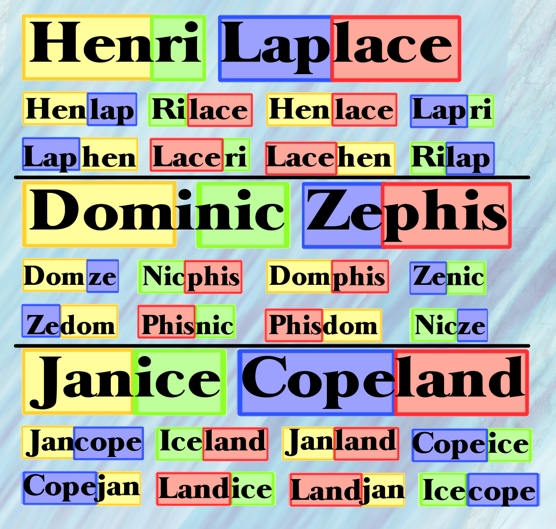
I started with three (invented but supposedly ‘real’) names. Split into two syllables, each name thus supplied four parts to the set of new-names. Taken two at a time from each, this gave me a list of eight combinations per ‘real name’.
I then pruned this list ruthlessly:
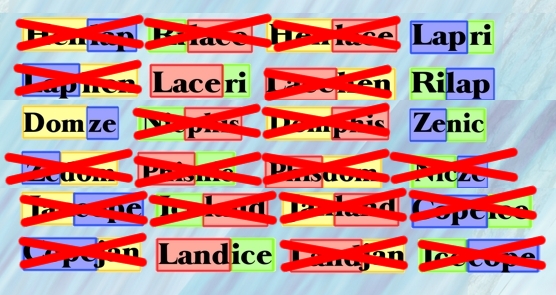
…which left me with a short-list of just Six. Pairing up the survivors in their various combinations gives me:
|
Lapri Laceri Lapri Rilap Lapri Domze Lapri Zenic Lapri Landice |
Laceri Lapri Laceri Rilap Laceri Domze Laceri Zenic Laceri Landice |
Rilap Lapri Rilap Laceri Rilap Domze Rilap Zenic Rilap Landice |
|
DomZe Lapri Domze Laceri Domze Rilap Domze Zenic Domze Landice |
Zenic Lapri Zenic Laceri Zenic Rilap Zenic Domze Zenic Landice |
Landice Lapri Landice Laceri Landice Rilap Landice Domze Landice Zenic |
That’s still a lot of possibilities to work through, so let’s prune again.
▪ I like Lapri as a surname, not as a first name.
▪ I I like Domze as a first name, not a surname.
▪ I I like Zenic as a surname, not a first name.
▪ I I don’t like the LL alliteration options.
Crossing those off the list greatly reduces the options.
|
|
Laceri Rilap Laceri Zenic |
Rilap Lapri Rilap Laceri Rilap Zenic Rilap Landice |
|
Domze Lapri Domze Laceri Domze Rilap Domze Zenic Domze Landice |
|
Landice Rilap Landice Zenic |
In fact, I’m down to 13 names. That’s a short enough list that I can choose the name that best fits the character, that best ‘sounds right’ for their culture.
But, this formalizes the process far more than I would ever use it in practice, at least for an ad-hoc name. In reality, I’d generate name pairings until one pair fell into place, sounding right to me, and not bother with the rest.
In other words, as soon as I found a winner, I’d stop – in this case, “Domze Zenic”. or, if I wanted something that sounded a little Italian, “Rilap Laceri”.
3. Name Structure by Culture
It’s helpful to have laid down a couple of rules for names in this specific culture in advance. No more than two, though, because other sections of this article will add their own to the mix.
I won’t go into further details at the moment because Section 4, below, contains examples and clarifications aplenty.
But one more thing: Few naming rules apply 100% of the time. So start each rule with a % that indicates how common the results of applying that rule should be. These percentages aren’t binding – they can be used to give you a way out when a particular name just doesn’t sound right with or without a specific rule being invoked. They are guidelines to steer your thinking, nothing more – but that’s enough to make them indispensable.
4. Optional: Prefixes, Suffices, and Inserts
The name itself might not yet be complete. Some names have prefixes, some suffixes, and it’s possible that some will have inserts in the middle – and there can be a big difference in flavor between ‘Charson’ and ‘Charneson’ or Charstanson’.
This is always a strictly cultural question. In some modern-day cultures, it is widespread to this day; in others, it has almost died out; and in still others, it never really gained much of a foothold in the first place.
Surnames used to be a lot more fluid, and generally weren’t something handed down from father to son as is the case in modern times. Instead, they were often literally descriptive of some distinguishing feature – “John of Over-here” vs “John of That-other-place” vs “[The] John with the heart of a Lion” vs “John the Smith”. The more common the christian name, the more likely it is to need separation and clarification.
The bottom line with all extensions to names is this: use them to make a culture more identifiable and distinct, and for no other reason. If they aren’t doing that, then they are a waste of time, potentially counterproductive, and simply taking additional effort at the game table for no benefit.
There are other two bits of advice that I can offer with respect to Naming Conventions in terms of prefixes, Suffixes, and Inserts, beyond the ever-present ‘write it down’.
4a. Limit The Range Of Choices
The first one is: Don’t have more than two or three such rules, and establish a strict hierarchy in which the application of one rule restricts or nullifies the implementation of one or more other rules.
Keep the cultural rules simple, so that they are easy to apply on-the-fly.
4b. Extensions With Meaning
There are eight major ways of using extensions of a name to convey specific meaning, though the significance may have been lost to the winds of time.
“Son Of,” “Daughter Of,” “Child Of,” “Spirit Of,” “Of [Place],” Titles, “Honored / Honorable”, [Profession of]..
Memorize that list.
Irish names often include the surname prefix “O’ ” in front a surname, meaning (in our history) “Son Of” or “Of [Place]” – and the latter meaning clearly tells you that the surname is actually the name of a fairly specific location on the map.
Stripped of it’s Paternal Misogyny, we get ‘daughter of’ or the more generic ‘child of’. But all those only work because the names use ‘Of’ and then abbreviate it. If the word “Of”, in the local language, was “Tha”, then the prefix is “Tha” or “Th’ “, if it’s “Za” then the prefix is “Za” or “Z’ “. Coupled with the chosen example name, we thus have:
▪ Domze ThaZenic, or
▪ Domze Th’Zenic, or
▪ Domze ZaZenic, or
▪ Domze Z’Zenic
— NONE of which sound like any name you’re likely to have ever heard before.
Or maybe the culture traditionally puts family names first – in which case, the four options are
▪ ThaDomze Zenic, or
▪ Th’Domze Zenic, or
▪ ZaDomze Zenic, or
▪ Z’Domze Zenic.
(My choice, just to wrap up the example, would be “Domze Th’Zenic” or “Th’Domze Zenic” – for whatever that’s worth. The alliterative outcomes feel forced and somewhat whimsical – fine, if that’s the quality that you’re aiming for, but for a serious NPC, no.)
You might have one rule for boys, and one for girls, a way to feminize Christian names. You might have a rule that Paternal Surnames descend to male children, while Maternal Surnames descend to female children – which implies that daughters are considered part of the Mother’s direct family, and sons, part of the Father’s. That’s a piece of culture-building that will have ripple effects throughout a society – and the names would have an implicit function as a reminder of that cultural perspective.
You always get an Italian sounding name by appending “a” (female first names) or “o” (either male name).
“The [name]”, “de [name]”, “de la [name]”, “ze [name]”, “la[name]”, “el [name]” – given the earlier list of meanings, these should be instantly translatable, and (for the most part) anchored in a root language which has a specific origin point, specific historical reasons for traveling to a new location and being adapted into a new culture there (frequently conquest), and which provide a gateway into that culture. I’m sure most readers will be able to immediately derive a place of lingual origin for most of these.
Another rule, whose purpose becomes obvious with a little thought, is to replace a surname with a title, and to then reverse those in sequence. Establishing a prepared list of title equivalents can save you half the work of name generation!
Taking our sample name, for example, what if “Domze” was the equivalent of “Mayor”? or “Duke”? or “Prince”?
There is a cultural connection that can be applied to this practice – that the bestowing of a title of Nobility explicitly transfers the recipient from his birth family into the Royal family.
Use extensions to add meaning and culture – and to make the names seem like they have a common lingual heritage, which doubles down on that connection.
5. Phonetic Spelling
Step five is to replace the ‘formal’ spelling with a more phonetic version of the name, so that simply seeing it in your notes or prep reminds you of how to pronounce it.
It’s almost certain that you’ve been pronouncing these strange words a particular way in your head as you’ve been considering them.
“Domze” might be “Domz” or “Domzee” or “Domzay”. This becomes an additional naming rule, an additional lingual rule, and an additional gateway into the cultural relevance embodied in the name – but you don’t have to think about those encumberments, simply note the pronunciation as one more naming rule. The more important thing is that in so doing, you not only provide such a cultural connection and unifying point, you save yourself work in the long run, and preserve the uniqueness of the name as it’s actually to be used at the game table. The official spelling might stay “Domze” – this step is all about practical usage.
6. Finalize Choice(s)
Say the name aloud three or four times, trying to get it to roll off the tongue naturally. If it doesn’t, tweak it a little and try again. Until you complete this step, nothing is set in stone, so take advantage of that.
Try saying the name with different emotional content – angry, pleading, romantic, dismissive, whatever. If there’s an emotional nuance that you can’t hear when you say it, tweak some more until you can hear that content.
Finally, take notes. Language and Naming rules go into your notes about the race / culture. The specific name gets recorded in your adventure prep notes. Write everything down that you can think of, because three years from now, you might not remember it.
Refinement: translate ANY block of text
Here’s an advanced variation on the technique for your consideration.
Instead of starting with a particular name or set of names, use something like Google Translate to convert a body of text into phonetic representations of another language – then mine successive words for syllables as though they were words. Cross words out from the translation as you use them.
Nuance: Cultural Flavor
Names don’t just apply to characters. The selective translation of nouns, verbs, and adjectives using a name as the basis of the translation incorporates compatibility with the language and culture of an area. Words like “the” and “of” can frequently be translated in this way 100% of the time, appearing sprinkled through your text just often enough to constantly remind those hearing the text that the speaker is not ‘core human’, and connecting the individual with the culture from which they derive.
Nuance: Reflections Of Source
One of the singular strengths of this approach to generating names unique to a specific culture is that the source language / names can provide a unique tone to the results.
I frequently use French as a starting point for Elvish, and Hungarian or Polish for Dwarfish, for example. The usefulness of this nuance to the system is that it unifies the products in a way that’s hard to match, while at the same time, can be summed up in a single line of cultural notes.
So that’s what I came up with in those 5-10 minutes – time well-spent, I would suggest!

Discover more from Campaign Mastery
Subscribe to get the latest posts sent to your email.




August 3rd, 2026 at 3:41 am
Clever six-step mash-up technique—scraping Wikipedia lists is exactly how I end up with names that feel grounded instead of random syllables. For campaigns with Japanese-inspired cultures, phonetic consistency matters as much as your consonant-vowel tweaks. When I need authentic given names with readable kanji glosses for NPCs, Japanese Name Generator (https://japanesenamegen.com/) has been a useful sanity check before I run names through this process.