The Psychological Dynamics of RPG Groups: A guest article by G F Pace

Image of the Red Arrows looking uncharacteristically uncoordinated courtesy of freeimages.com / Pedro d’arisquinho
Introduction
Since I first participated in my first session of D&D 3.5, what I enjoyed most was the feeling of sharing a fantasy with other people. There is something liberating in the idea of a bunch of people participating in a history, shaping and characterizing it in every moment.
15 years later, I remain fascinated by the way we all imagine the same scene in very different ways, but we will speak of this later. All in all, I love groups. It does not matter what kind of group, I just love them.
I thought about writing this article after noticing something I had observed for a long time without consciously being aware of it: in any RPG group, the distance between the character and the person becomes thinner or thicker based on what is happening on group dynamic level.
Strap yourself in, dear stranger – this might take a bit of trust in me. It usually pays, and the advice is free anyway.
I will try to be gender equal in my writing, referring to the group roles as things, using it as method. I actually support and love playing with women, I believe that groups should willingly comprise the entire gender spectrum to make them complete.
No, I don’t think of you as a thing. And yes, I can read your mind through the Internet – I took the racial feat of Illithid Heritage many, many levels ago!
I’m going to get serious for a while.
I would like to give a model of the groups dynamic that underlie any RPG group based on Berne’s theory of Transactional Analysis. I think this will be helpful to Game Masters in terms of personal enjoyment, skills definition, and making sense of the weirdness happening within groups. Plus, part of this article will go into my dissertation that will allow me to become a Certified Transactional Analyst, a sort of weird Psychotherapist. A win-win. I have to thank my therapist for suggesting this, such a great woman that one.
Theory bits
If you don’t want to know too much about Berne’s theory you can easily skip this section.
Berne’s theory is all about the idea that our psyche is made up of 3 ego states: Parent, Adult and Child.
Parent and Child are defined as archaic, because they refer to our early phases of life and are “directed to the past rather than the present”, while the Adult is the part of us that looks at the here and now.
Berne, a psychiatrist and aspiring psychoanalyst (he would be barred from becoming one, which is why he created Transactional Analysis), believed that the extent to which people manage to stay in Adult mode, communication will carry on indefinitely and productively for both parties. We will come back to this, because it will be helpful later on.
Berne worked with people suffering from psychosis as well as neurosis in a group setting. Transactional Analysis is a group treatment theory, and works pretty well.
The ground-breaking part of the theory was certainly that people would respond and trigger the other to reflect matching parts of the self. If you communicate from adult, the other will be invited to respond in adult. Simple, isn’t it?
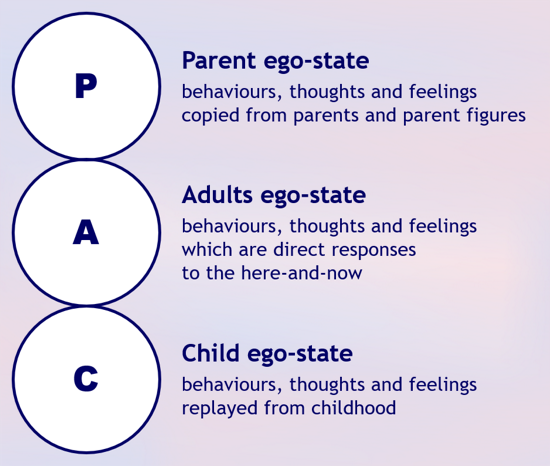
Derived from Stewart & Joines, TA Today (1987) p.12
What I have observed in RPG groups is that we all participate for the fun. We share an objective, we have rules and we tend to be ordered – we have a facilitator who runs the group and who is pivotal to the group itself. RPG groups represent a very good example of “group” in the TA sense of the word. In most of the games I know, there is no game without the facilitator – sad, but true. The position of relative importance within the group that the facilitator occupies makes everything run more smoothly and yet complicates it. We will get to this as well.
A “group” is not simply a bunch of people – that is a “mass”. A group shares something, while a mass is a number of individuals minding their own businesses even if they all experience the same event, for example at a rock concert.
Get yourself a drink now and open your mind – here’s where it starts to get complicated.
Groups stages
Being a psychologist means that I love definitions, while being a relational psychotherapist means that I really appreciate subjectivity. The two conflict insofar as definitions are mutually accepted objective statements of meaning, and not at all subjective, even though interpretation of those “objective” statements will always be rooted in personal experience, education, and understanding of the usage – all of which are inherently subjective. I am still working out how to relate my subjective experiences to Berne’s theory, so bear with me while I think..
We have defined groups, more or less, so that’s done.
The reason why we will refer to stages of groups is because we can switch back and forth between them, even though there is a linear ideal progression. I am not going to use the term “phase”, because semantically it refers to something to which you are not supposed to go back to. Besides, it’s a common gaming term, and might cause confusion.
I will try to offer examples from my experience as Player and Game Master in order to cover the totality of the subject in a way that all readers can relate to.
I want to thank Mike for creating this amazing website, it really allowed me to change the way I look at my passion as something important and “professional”, not merely as a nerdish amusement.
My co-founder, Johnn, deserves at least half the credit as well. Speaking for both of us, you’re welcome, GF! — Mike
There are, then, 4 of these stages: Forming, Storming, Norming and Performing. Every group has to achieve success in overcoming developmental tasks appropriate to the stage. Should this not happen, the group will be held back or die depending on how much tension the task is putting on the shared fantasy.
I will try to make very clear what the task is, so your OCD traits (and mine) can take a nap.
In few words
Every group seems to go through similar stages of development. Each stage has some task which enables the group to progress to the next stage when accomplished. Equally, when not accomplished the group might go towards a previous stage.
The stages do not last for a fixed amount of time. Groups tend, for various reasons, to go through the same stage more than once, especially over the long run.
The GM is a special class of player with the role within the group of handling the group, while getting as much fun out of it as the players.
The group stages are:
- Forming:
- The First stage, where the group agrees on basic definition of the group.
- There is maximum distance between Player and Character.
- Storming:
- The second stage, where the individuality of the players and characters mix, and conflicts emerge.
- There is Intermediate distance between Player and Character (Yes, I’ll explain all that, shortly).
- Norming
- The third stage, where the group start tolerating each other’s styles and tries to actively resolve conflicts.
- There is minimum distance between Player and Character.
- Performing
- The fourth stage, in which the game flows peacefully and the fun is at maximum level.
- There is Integration between Player and Character.
We are going to go through all these stages defining the GM role and tasks for each of them, the intrinsic dangers the GM/Group might face, some examples, and a bit of banter on the side. I hope you will enjoy reading this as much as I have enjoyed writing it.
Forming
Task: to create shared objectives, to define fun, to come alive as a group.
This stage of group development starts in the exact moment that one member of the group thinks: I want to play an RPG. The genesis of the group has started, even though there is only one member so far. The group exists in this person’s mind in the form of the expectations around the group and the game they will play, and the goal of constructing the group itself to play that game. Fantasy is the word here.

Yes, I know – It’s a submarine (told you I could read your mind).
Berne drew this diagram in the 60s to explain his vision of group dynamics, here I have adapted it to our purposes.
Analyzing Figure 2, we can say that:
- The borders of the submarine represent the group setting: the systems used, what defines the group, the group identity.
- The internal elements of it represent the Players and their functions. This is how each Player perceives the other Players: a bunch of Others.
- The dashed lines indicate unformed or fragile elements. In the Forming stage, the Players are still defining their characters, so frailty is given by the situation.
- The GM has a slightly different position because of his role within the Group: without a GM the session does not happen.
Think about a group – call them “the Cult Of Pelor ek Obad-hai”. No commoner can actually have a chat with them or go down to the tavern with them to get hopelessly drunk; they can only speak with their representatives. And yet our trust them, believe in their powers and would sacrifice themselves for them.
The fact that people believe that Organizations, Gods or even the King of the Frogs exist is sufficient: they exist as a consequence of that belief, even if it is only as a metaphysical construct in the mind of the person who so believes. Subjectively, then, thought and deed are equivalent acts in terms of Forming the group.
The point is that the group is born before the group members actually meet in their roles as members of the group. Once we have all gathered around a table, wooden or virtual regardless, the group has begun the process of slowly becoming solid and partially existing within the material reality.
I remember one of the first time I mastered a D&D campaign. I had everything in mind: the main characters, the new gods, demigods, villains and plot twists. I just needed players as much as a director needs actors and crew to make the movie real. My campaign crashed completely because I preferred their plot twist over mine: a planar jump. I have now moved to a different approach: in this stage, I ask people what they expect and want from this specific group, from this adventure or campaign, if they like it gory and mature or classical and heroic.
Just remember to avoid over-preparing.
If the group is a fantasy, better for it to be a shared one.
In this way, I am trying to speak from Adult, explaining what I want and inviting the players to do the same. It really does not matter if we meet 5 times before even thinking about our characters; the more we define what we want, the less we will be disappointed.
Some people define this as Session 0. I do not like this definition because 0 means Nothing/Absence. I believe the group is already there, so it is the “Defining Session” for me.
This stage sees the GM as the main actor, it is its task to sustain and feed the fantasy. A GM who decides everything on his own might incur three different scenarios:
- the group does not form at all.
- the group will move to Storming right away
- The players will be pushed to a child position, they will experience having no power over the game and will adapt their mental state accordingly. The GM role becomes excessively dominant and the group might not achieve any developmental task, dying later as a result.
The main issue here is that putting too much attention on one or two players will not help the group to come together as a group, which will weaken the bond between the players.
Spoiler: the GM is a player too. Bam! Once you know it, you cannot un-know it. Wait, I’ve already mentioned that.
As a Player, the GM’s task is to enjoy themselves and make sense. You’re there to play, just do it. The part of you that is needed is what we call Free Child, your emotions and energy. Think about what you really want to see happening and ask your Adult to have a read of the rules, the setting. This is what in TA is called “The Child informing the Adult” as opposed to the ‘Child in charge’. Outside of TA, you could describe it as emotions informing the rational mind what is required to satisfy its entertainment needs.
Later, I got entangled with sci-fi settings. After a decade playing only slaying fantasy villains with weird magic, I decided to move more towards psionic powers and spaceships. When I started, I asked to the group if they were happy to try this kind of adventure and what they were expecting to do: the coolest thing, the most complex one, if they enjoyed a bit of live RPG mixed and if they would have liked to playing in between sessions as well. Adult to Adult.
Sidebar: Group Size
Not much has been written on the ‘perfect’ size for an RPG group – because there isn’t one.
Damn, I gave that out too quickly: let me recover.
Theoretically (better) a RPG group can be of any size. The reality of practice tells us that not every system can handle well more than 6 people at the table (GM included, remember: you’re a player as well). There is a real reason for this: trust. Humans tend to develop personal relationships with other humans especially within groups; well, there needs to be trust for relationships to happen, and the cohesiveness of the group suffers with higher numbers because of the spread of trust. Intuitively, a smaller group will be more cohesive with a more trustworthy relationship between members.
I prefer having parties with odd numbers of players (for example, GM + 5 Players), so as to avoid strange stalls at every decision.
The number of possible member-member links (L) increases as the size of the group (N) increases: (L = (N² – N) /2). Now, a link might be a sentence or joke told at the table for each participant. For a group of 5 you can have 10 possible links, 6 gives 15, 7 gives 21, and so on – to the complete waste of everybody’s time and fun. And this number doubles if the people involved are not rude and, you know, might respond to the interaction.
Another point is that the higher the number of members, the more it is possible that subgroups appear. A subgroup comes into existence if an individual, or several, stops identifying with the bigger group, even temporarily; this will trigger the need to be recognized, to have a definite structure, and the need to be in contact with other people.
Subgroups are useful in guaranteeing the survivability of the individuals within the subgroup.
Without getting side-tracked with a complex cocktail of Psychology, Sociology, Psychoanalysis and Time-Wastery, let’s just assume that you as GM, and the fun you enable to be created by providing boundaries, represent a vital resource for the group members. If you start to become scarce, especially because the time with you starts to become less and less due to the group size, people will either leave or find another way to satisfy the need: a subgroup.
The presence of 1 subgroup will implicitly create another subgroup consisting of those not a member of the first. Now you have a conflict, the inter group aggression, originated just by the size.
One way to work this out, is to split the group in different days or with another GM.
But this is getting rather too long for an insert – time to get back on point.
Rule of thumbs:
- Count the GM as active player
- Choose a system that allows you to handle the actual number of people involved
- Keep an eye on splitting or polarization within the group
- Be honest about what you perceive as time-wasting. Side-chatter isn’t a problem if everyone enjoys it; that simply elevates the social aspects of the game over other aspects.
- Ask around for what time wasting means for the others.
Storming
Task: facilitate player/character symbiosis, allow the emergence of player uniqueness, allow the underlying contrasts between members to become visible, and allow the group to shift its equilibrium to a new point.

A slight movement has taken place. The Player is becoming more enmeshed with their Character and role within the Group; the Character has become more defined because of continued in-play exploration of it, especially those parts of the personality that never get written on a character sheet; and the character’s invented persona has begun to meld with that of the player to form a more complete fictional persona. Any disturbance of these delicate processes can result in heightened contrasts between Players.
Most groups die at this stage, and that’s the sad truth, or even worse, they develop unevenly.
I call this event the “Limping group”: some members Storm and get some resolution, others Storm without resolution. No cohesion equals stronger Storming. (it is perhaps easiest to think of “Storming” as a player “brainstorming” with his character, players “brainstorming” with each other, and characters “brainstorming” with each other, all at the same time – if “brainstorming” is defined as collaborative interaction toward ad-hoc objectives). But Storming is also when conflicts begin to emerge.
This stage can be easily gone through if there has been enough work on the precious first stage.
That said, some groups are not destined to stay together. Not your fault, not their fault: it is what it is. There is a reason why not everybody wants to play a Paladin or a Barbarian, and why we all like different RPG systems. We are all different, and this is sacred.
No, the main cause is not that people are less intelligent than you. You definitely do not know better. I told you, I can read your mind.
RPG groups by definition are some of the most complex associations in terms of psychological set up: people with great imaginative capacities willing to share grandiose fantasies.
Storming is absolutely normal in any group. The main thing is not that as group you should avoid that, but rather that you have to enjoy this stage because it will happen.
Spoiler: while disagreeing is storming, agreeing on everything can be storming as well. We will get back to this in a few paragraphs when we speak of the PAC model again.
You know you are in this stage when people start complaining about the rules, or try to trick them, or ask for special treatments. It’s fine, it’s normal. It is actually not your fault. What is happening is that the distance between the Character and the Player becomes thinner: people start to become their character, at least in part, and vice-versa, so whenever they feel frustrated by the rules or other characters’ actions, something very deep kicks in.
Anger, frustration, and feelings of betrayal feel real. As GM, helping the player to get to know their own character and the other group members is pivotal. There are times when you need to bring two group members closer together in collaboration and times when you need to put more distance between them; the GM needs to play his group like a master violinist.
In this stage, every member of the group might feel some sense of entitlement – mainly because of the high expectations around fun. We all want to be at the center of the story, solve the puzzle or slay the monster. Hey, this group is made of heroes! Who wants to play the milkman? Nothing against that profession, but I’d rather go slaying Tarrasques blindfolded than giving out bottles of milk (Thanks for the milk anyway, we all need it).
A secondary reason for those expectations is the effort invested to reach this point, where players start to feel invested in the game and to expect a return on their efforts.
Some years ago, during my longest ever campaign ‘Reverto ad Originem’, I was an inexperienced GM and did not know how to handle this phase. One of my player was (and still is) a very intelligent guy, very able to spot conceptual twilights in the D&D 3.5 rules. I ended up having two characters virtually untouchable, unbalancing the whole campaign. I felt frustrated over this, the other players were too, and the enjoyment of the game fell to nearly zero. It took a full year before I addressed the situation, rather clumsily. Because of my reticence to participate in this storming stage, the group started to fight over rules, alignment or the meaning of numbers. The group tested all parts of the game in the attempt of avoiding a direct confrontation between players. This almost broke the group.
Most of the storming comes from the need we all have to be unique, and be recognized as such. Without getting in a long tirade of how our upbringing relates to this need, just consider that in the storming stage of group development, shutting people down is not a good strategy.
More theory bits
Let me now introduce you another layer of theory: the Functional Model. I will try to make RPG-related examples to illustrate it.

Based on Stewart & Joines, TA Today (1987) p.21.
This is clearly a refinement of Figure 1. If you need to duck back up and refresh your recollection, now is the time to do so. Mike has very thoughtfully tinted the former purplish so that it will stand out for you when scrolling quickly, and tinted this one gold so that you can get back to where you were, just as easily.
- The Parent has two functions:
- Nurturing (most people will know what that means but I’ll explain it anyway):
- The core affect is a willingness to help empathically.
- The core belief is that other people can learn and might need help.
- You might observe a player in Parental nurturing mode responding to other people’s insecurity with care and explanations, complimenting other people’s interpretation or cleverness, or providing instruments and instruction rather than solutions.
- Controlling (The rules are the same for everyone and must be obeyed):
- The core affect is insecurity.
- The core belief is that the person has to be in charge of everything.
- You might observe a player in controlling parental mode trying to one-up another, being very picky and overly precise on the rules or game mechanics, pointing fingers, employing sarcasm, or over-criticizing.
- Nurturing (most people will know what that means but I’ll explain it anyway):
- The Adult remains undivided, i.e. it has only one function.
- Adult (Let’s do it this way this time, afterwards we’ll check the right answer):
- The core affect is enjoyment of the game.
- The core belief is that everybody has a role in the game.
- You might observe a player in adult mode being practical and attentive to the game, interpreting his character, and asking for advice if needed or to sure nothing has been overlooked.
- Adult (Let’s do it this way this time, afterwards we’ll check the right answer):
- The Child has two functions:
- Free (Let’s have fun!!):
- The core affect is to participate towards the group’s fun.
- The core belief is that we can all have fun together.
- You might observe a player in free child mode cracking jokes without being disruptive, being creative and open.
- Adapted (‘No, no, no, and no!’ or ‘Yes, yes, yes, and yes’)
- The core affect is fear of, or shame at, being undervalued or ignored.
- The core belief is that abandoning or disrupting the rules or orderly processes is fun, a slight sense of selfishness.
- You might observe a player in adapted child mode being overly silent, detached from the game or rather being way too vocal or offensive towards the others at the table.
- Free (Let’s have fun!!):
As is easy to imagine, staying in the roles of Nurturing Parent, Adult and Free Child seems to be the way to make the game enjoyable. While the Controlling Parent shows insecurity and tries to use dominance as a survival strategy (Overruling), the Adapted Child (Sometimes further split into Rebellious Child and Adapted Child so to clarify different sub-functions) sees being overruled (and responding to it either with petulance or by being sullen) as the only strategy to protect its uniqueness.
It is the GM’s role to keep everything in Adult mode (perhaps with the occasional controlled excursion into Nurturing Parent or Free Child modes) allowing the players to voice any dissatisfaction without disruptive conflicts and eventually concede something if deemed as appropriate.
In my game role as GM, I have never liked people swapping characters in the middle of the campaign. I used to spend way too much time refining the campaign around the characters as they had already been established. I clearly remember when one of my player came to me just after the session, telling me how much he disliked the repetitive nature of his rogue’s gameplay. He had created an amazing rogue specialized in stealth, but there was not much more. I noticed his low energy on the month before the chat, but I imagined it was due to the exam session he was facing for his studies. Working over two weeks on the new character we got to a satisfactory point, then announced and played two sessions of his rogues’ departure from the group while meeting the new character. It was fun and eye-opening to see him changing voice, juggling between two characters simultaneously, and stretching his capabilities.
Sidebar: A quick note
Before moving on the next stages, let’s take a break and consider a couple of other points worth noting.
Without being too much of a philosopher from Candlekeep (For the glory of Amon!), the main reason why behavioral patterns and responses are “Stages” and not “Phases” is because a group can move back and forth within them. Any change to the group structure (new players entering the group, old players leaving the group, changing the venue or the rhythm of the sessions) might force the group to revert to a previous stage, even if only for a while. Your role as GM is to be aware of this, and to facilitate the process.
Recently, I was playing a GURPS campaign in a sci-fi setting. After months of insisting, I manage to persuade one of my friends to join the game. A first time RPG player, he wanted to watch only. Speaking with the GM, I shared my ideas of him being creative but somehow shy to initiate roleplaying (For the ones of you who read the Theory Bits, he was in Adapted Child). The GM, being caring and a quick thinker (and a manager of various teams of IT people), made him the Mission Commander for that specific adventure, the field leader of our military team. Even though we did storm for a while (as he adapted to the role), he was fully accepted into the group and we quickly moved to Norming again.
Back to work, now! This article is already a lot longer than I expected!
Norming
Task: to learn how to cooperate, to tolerate the others and their styles, to consolidate positions and roles.

A bigger change has occurred. The Player and the Character are integrated, but the Group still does not have cohesion as the “Other” is perceived as source of anxiety regarding the player/character’s own role within the group.
This stage is where each player has managed to get hold of their role within the group. The process is greatly helped by the work done in the Forming stage: it will be more complex to carve out a distinctively individual role within the group if there is overlapping on the character level.
During this stage, the distance between the Character and the Player becomes thinner.
Thanks to the improved relationship within the group, the players start to feel more confident to act as their characters, and to show peculiarities. It is very important to be nurturing of each players style, and to be coherent in your own choices as GM.
I also think this stage carries enhanced awareness of campaign and setting verisimilitude, and any flaws therein, because group members are now comfortable enough in their functions within the group dynamic to look beyond it. Prior to this point, there is a greater tolerance and willingness to accept what is presented, and flaws in that content is more likely to be excused as the group member misunderstanding the material that has been presented. There has been less surety of self. Just my two cent’s worth — Mike.
Jimmy the Thief was great at improvising. During a very hectic part of Reverto ad Originem, my longest running D&D 3.5 campaign, the group ended up in a chamber filling with toxic water. Jimmy had only a Freezing Vial and his mind. He waited for a flying enemy to crash in the water, poured the vial on the splashing water and created an ice ladder to reach a higher window. Rules-wise I should have made him to do something like 7 checks, basically ruining his attempt (or dragging it out so long that the fun was drained). No way I was going to ruin such a state-of-art action! One roll, success, he did it, saving the group.
“Tolerance ” in this context does not mean putting up with negative emotional inputs. It means that regardless of whether you are a combat-focused or a Straight-to-the-treasure GM/Player (or any other style), you will let the other enjoy players their fun as they want, not hindering or usurping it in any way.
If one of the players is not collaborating with the others in achieving the task in this stage, it is important to address the situation earlier rather than later because most groups tend either to stop at this stage, or to go back to the agitated previous stage in a recurring pattern. The real issue here is the trust of the player, not the character.
Paraphrasing Berne, ‘a player will not begin to play his own game until he knows how he stands with the GM’.
The GM needs to give the other players permission to explore, while leading by example, but the other players will only be comfortable enough to risk exposing their experimentation to the scrutiny of the others if they trust the GM to protect any exposed emotional vulnerabilities, trust that has been earned in the previous stage. If insufficient trust in the GM has been developed, the group will revert to that stage in a recurring cycle.
In a recent session of Transhuman GURPS, we were in the role of a Special Ops team that had to accomplish some tasks before evacuating a building we had infiltrated: the gunner shot things, the hacker hacked systems, the psychologist psychologised (yes, I was doing nothing), the demolition man was looking for where best to plant the charges. For no apparent reasons (on the surface), the hacker started to interfere with the latter task, intruding into the demolition man’s character space. The argument quickly moved from the character level to the player level as the two drove each other into Adapted Child mode. The group was approaching the Performing stage, where each was able to contribute to a harmonious whole; instead they went back to Storming. I got caught in the dynamic, actually cornering one of the players, which was “legit” since I was not the GM. After some talking with the GM, we decided to introduce 10 minutes of feedback at the end of each session, and we decided to elect a Leader for each mission who could enforce discipline and leadership when needed. Problem resolved, both in specific terms for this mission and in broader terms for the long-term, the group moved to the Norming stage again.
Repeated ‘mistakes’ from a player, frequent absences, the death of a character, losing a mission and so on, are all events that can shake the group cohesiveness. As GM, be sure to know how your system of choice (GURPS, D&D, Cypher etc) handles catastrophic events such as death or permanent impairment; this will help you decide the outcome of these ‘mistakes’….. or if they happen at all.
It is sometimes said that “nobody wins an RPG”, or that “winning” is everyone having fun. That establishes a functional definition of “losing” in an RPG, and nobody wants to be a loser, especially in an RPG!
Let me play the psychologist for a moment: on the surface, the hacker started to interfere with the other player for no reason. Below the surface, I imagine that the lack of clear leadership in the group had intrinsically created a challenge for that function within the group. One member, probably not trusting the collective group enough, decided to act instead of asking.
Performing
Task: enjoying the fun, getting closer to the players, allowing shared GMing.

A fully-matured working group is present. The Player and the Character are fully cohesive now, becoming a Player/Character gestalt. The Others have become individuals and can coexist. The Group boundaries have stretched to make space for all to be who they choose to be within the group dynamic.
One reason for my insistence that “the GM is a player too” lies in this stage: here the GM can start seriously embodying his own role within the group. In this stage, the group comes together as an association of friends with the mutual purpose of enjoying a game (both directly through their own contributions and space within the group dynamic, and indirectly through the vicarious experience of the others doing so), and as adventurers willing to explore/bend/save/blast the world or villain of choice within the moral boundaries established as normal for the group’s behavior.
In this stage, most of the primary underlying issues between group members will have been revealed, and the players will have created functional compromises between what they expected, and what the GM in combination with the group, have actually delivered. The process reflects improved competence with the rules and with the characters.
I was GMing a short Numenera adventure I wrote, the players were just facing their first Boss fight: an ancient Automaton with a bad taste for jokes (or was that ‘a taste for bad jokes’?). We were only 11 sessions in, and the group of 2 managed to shortcut the dungeon, getting to the boss way too early. I decided not to make any discount for that circumstance since they were both very experienced players, and it paid off. The two of them managed to pull so many tricks based on their stories, perks and synergies that I was astounded. The Performing stage had arrived very quickly.
This might seem the easiest stage for the GM, and in part it is; he no longer needs to devote so much energy to the smooth functioning of the group dynamic and can focus on delivering a better experience for all concerned. Once the players have started to appreciate the others’ style, the fun truly begins!
Conclusions
I hope my article will help players and GMs to build up productive and enjoyable game sessions and relationships. As a GM and therapist, I aim to create an environment where everybody can get what they are coming for, in total respect of the other participant’s processes and pace.
I know I can be verbose at times, but I have tried to convey what I call my ‘intrinsic knowledge’ of running groups in a way that will be useful to any reader, whether applied to an RPG or to a work environment.
As one last piece of unasked-for advice, let me say this: Caution is needed. As can be intuitively understood, the real danger lays in between the stages, i.e. in the stage transitions. As happens in every process, we feel more vulnerable when trying to consolidate knowledge or skills. Being mindful of this can really help you in nurturing the group during these delicate passages. Pay particular attention at such times to the actual physical setting of the session: where, when, and how. These can easily stimulate group dynamics in an unwanted direction at such times.
Your role as Player is special: you keep the group together by holding it within your mind, and in the real world.
Keep up your great work, GMs!
About The Author:G.F. Pace is me, Giovanni Felice Pace, a fantasy and RPG addict from the age of 13, when I first met D&D 3.5 and wrote my first character – ZuLu was a half-orc monk of Kelemvor, omnipresent in every one of my campaigns along with other characters my players made over time. I am also an Italian Counseling/Clinical Psychologist and Relational Transactional Analysis Psychotherapist currently living and practicing in London, UK. As a GM, I love having minimal structure – perhaps “loose” structure would be a better term – after learning the hard way to avoid excess in this area. This is my second article at Campaign Mastery, having wet my toes with Strangers sharing ideas: RPG writings in a Collaborative World back in 2014. I am happy to have a chat on various topic through my RPG Twitter account (@Crux_MM) and professional account (@GFPtherapy). |

Discover more from Campaign Mastery
Subscribe to get the latest posts sent to your email.



November 3rd, 2017 at 7:48 am
You should read other games. There are many games that have procedures for many things that you wrote about. Apocalypse World is the first that I can think of. Solid advice nonetheless, usually found online as “talk to your players” and “pick the right game”.
November 3rd, 2017 at 2:59 pm
@Fargrim: I don’t know why you would think that GF hasn’t read other games. D&D/Pathfinder just happens to be the one that he played when he first started, which is true of probably 95% of gamers.
Yes, there is some practical advice out there on these issues; this is an attempt to go deeper, to understand *why* that advice is “good advice”, and thereby to equip the GM with the analytical tools to judge the advice he or she may come across for themselves.