Dogs and Cats, Living Together: Comedy In RPGs (Again)

One of the prophecies of doom voiced in Ghostbusters was “Dogs and Cats, living together” – in honor of that quote I have used this photo by freeimages.com / lily rosen to illustrate this article.
With my internet still down (at the time this article was written), I’ve been taking the time to write, and to catch up on a number of documentaries preserved until just such an opportunity came to catch up on them.
One of the programs time-shifted in this fashion was something from the BBC, “The Science Of Laughter”, hosted by British Comedian Jimmy Carr, and it sparked some new thoughts on the subject of comedy in RPGs.
This isn’t the first time that I’ve found the subject in my sights (hence the title of this article); way back in April of 2009, I wrote The Right Quip at The Right Time: Humor in RPGs, in which I analyzed a whole bunch of different types of humor and how to use them (and not use them) in an RPG, discovering why Comedy RPGs are hard.
I’m going to deliberately structure this article along similar lines to the BBC documentary (which anyone who can access it should definitely check out) because a number of segments within the show sparked new and sometimes quite unrelated insights. I’m afraid that I’ll seem to ramble a bit in the course of this article, because many of the thoughts are the result of associating different elements of the show’s content with each other – bear with me!
The Mechanics Of Laughter
The program started by examining the question, “What are the biological effects of laughter?”. Medical evidence was provided that laughter is actually a rhythmic spam of the intercostal muscles – which we normally use to breathe. Consequently, laughing too hard leaves you short of breath, it is impossible to speak coherently while laughing, and it is theoretically possible to laugh ourselves to death. I’ll come back to this point in a little while, because there’s a connection with another segment of the documentary that actually seemed to escape the attention of those participating, even though several of them were acknowledged experts in the field.
Do straight men make the best comedians?
I was immediately struck by the thought, which continually distracted me for the rest of the first viewing of the show, that if you can’t speak clearly while laughing, someone who doesn’t laugh easily might make a more effective comedian than someone with such a sense of humor that they couldn’t help laughing at their own jokes. I have to admit to not being completely sold on the theory; there is also the possibility that knowing that you are delivering a joke places sufficient distance between the joker and the joke that he is able to continue delivering his monologue or one-liners.
And yet, it was later stressed that laughter is a social function, developed from the same bonding instincts that leads to the practice of grooming in apes. In a nutshell, things that might raise nothing more than a chuckle when viewed alone become uproariously, outrageously, funny when the experience is shared with another. Once someone is (genuinely*) laughing, even a little, it lowers a threshold of inhibition that makes another person more likely to laugh, or to laugh even harder, and that this is largely an involuntary response. So it would seem to me that performing any form of stand-up comedy must require the comedian to be resistant to comedy in the first place or they would be overwhelmed by the instinct to laugh at their own jokes.
The jury is still out on this one, which is entirely my own theory. But, if true, it places the GM in a unique position for delivering a comedic experience at the gaming table – his position of authority and the many things that have to be on his mind at any given moment give him more insulation against laughter than any of the players. He is, by virtue of his function at the gaming table, more of a straight man than anyone else there; so it’s just a matter of the right quip at the right time – an instinct for comedy – to deliver what I will describe (a little later in this article) as a Grand Slam of comedy. That’s food for thought.
(*There’s a difference between genuine laughter and socially-disingenuous laughter, i.e. laughter that is faked for social reasons. Testing shows that 9 times out 10, people can tell the difference – so you have to wonder whether the practice is actually counterproductive. I’d rather give a genuine attentive nod than a fake laugh, but you might choose otherwise. But that’s neither here nor there; I just felt it important to note the distinction, because it is relevant to the point that was being made).
Laughter as a sign of evolutionary advancement
Because the mechanics of laughter are what they are, if you are on all fours, you can’t laugh; the intercostal muscles are being used for support. You will either not laugh, and remain in position, or laugh and (literally) collapse. Creatures who are not bipedal can only laugh when on their backs, as later shown by a scientist who discovered a new treatment for depression (currently being developed by a pharmaceutical company who bought the rights for US$560M) by tickling rats. You see the same thing with cats and dogs – tickle them and they roll onto their backs to facilitate more of the social play.
I’ve seen it suggested a number of times in sci-fi that one functional definition of “humans” is “the species that laughs.” Without actually commenting directly on that, the documentary’s content shows that there is a certain amount of truth to that proposition insofar as we are the only fully bipedal species on earth – depending on how strictly you define laughter, of course.
All that is grist for the mill when it comes to determining social behavior and its expression in RPGs for species as diverse as Dragons and Aliens of all types. Do they have a laughter response, or an analogue? To what extent is it a biological or social necessity? What aspects of social behavior have such a function (or equivalent) as a necessity? Are solitary species, like Dragons, less needful of a sense of humor? What’s Elvish comedy like?
Laughter is Universal, Comedy is not
Another point to come out of the documentary is that while everyone recognizes the sound of laughter, no matter what culture they are from, what actually makes them laugh is a function of the culture and society around them. It’s not just subject matter, it’s delivery and atmosphere and circumstance and a whole slew of other factors. It can be quite difficult, as a result of the vast number of variables, to actually put your finger on the exact differences, but British humor is different from American humor is different from Australian humor is different from Japanese humor is different from Icelandic humor is different from…. well, you get the point.
To some extent, this is even a regional phenomenon. Do the same jokes play as well in the deep south of the US as they do in the Pacific Midwest or the Northeast? While there would be some overlap, I’m betting that there is sufficient divergence between the subcultures that some humor would simply fall flat in different places, even if deliberately provocative issues like race are ruled out of consideration, or would require the audience to be more “warmed up” than others. You certainly see the same thing in the UK – Irish humor is not quite the same as Scottish humor which isn’t quite the same as English humor.
That last paragraph is just my theory, based on my own experiences with different television shows – it would need a comedy professional who has done stand-up in a wide variety of locations to confirm it.
The main point is that comedy, and the subjects that are fit for comedic treatment, are functions of society and culture. Which naturally raises the question,
What does a game society find funny?
It was written a long time ago, so I no longer remember for certain, but I don’t think that sense-of-humor was one of the cultural distinctiveness points raised in the Distilled Cultural Essence series. This shows quite clearly that it should be!
It’s not just a function of racial distinctiveness, it’s also a function of cultural distinctiveness. But, in order to see how powerful a tool this can be, both in terms of analysis and of depiction, you need to understand exactly what comedy is – a subject that I’ll get to in a little while.
How best to simulate this?
In the meantime, though, there’s a problem of accurately simulating it at the gaming table. This comes in two parts – GM simulation through NPCs, and player simulation through their PCs.
The first is relatively easy to do – you simply have an NPC crack a joke on an appropriate subject, and (no matter how unfunny the players may find the joke), have other NPCs crack up with laughter. But the players need to understand why the joke is funny to that race/culture. Without appropriate education in the subject – say, by having them read this article – they won’t.
And, if they don’t understand it, they certainly won’t be able to roleplay this aspect of their characters racial and cultural heritage correctly. Which brings us to the second half of the problem.
There is a simple answer: permit players to crack whatever jokes they deem fit, and inform everyone that if they laugh at something (even something delivered out-of-character) that it means that the PC has said something that the PC considers funny. This might be interpreted as inappropriate humor, or humor aimed at keeping spirits high, or whatever, depending on the personality of the PC in question; it might even be that the character is trying too hard to be socially acceptable.
An even better answer is: every time a player says something they intend to be funny, it’s the character attempting to tell a joke that is appropriate to his cultural and racial background. If someone laughs, that indicates either that the joke worked from the point of view of the laughing player’s NPC; if they laugh when the player wasn’t attempting to be funny, it signifies that the PC has done something that another PC finds funny even though the first wasn’t attempting to be humorous, and might not even understand why it was funny. This says different things about both the PC whose player is laughing and the PC whose player is not – from that point, it’s simply a matter of the player interpreting the situation and roleplaying accordingly.
Both these solutions have the virtue of acknowledging that the player is not the character, but that the player is simulating being the character – is acting the part, in other words – and that the character depicted is actually a blend or interpretation of the role described by the character sheet. It simply expands the definition of roleplaying to include some aspects of out-of-game behavior – ones that more tightly integrate the player’s persona with that of the character’s.
That’s certainly something worth thinking about.
You can even extend the principle: sometimes, good roleplay might not be about interpreting literally what a character says, it might be about how they say it; the PC’s actual statement might be something completely different, and the player’s words on behalf of his character are a non-literal representation of what the character is saying.
The Infectious Response
As noted earlier, laughter is infectious. Most things are funnier in a group than they are to an isolated individual. The statistics show that laughter is 30 times more likely to occur in a group situation, given the same stimulus. Detailed studies of stand-up comedy audiences reveals (according to the documentary) that only about 3 audience members are laughing at any given moment, and that the laughter reaction proceeds in individual laughs like a Mexican wave back and forth, spontaneously, so quickly that it normally can’t be observed. Rather than being a continuous laugh, it is paused and restarted so quickly as to be imperceptible even to the person who is laughing.
It’s my impression that the “deeper” and “stronger” the laugh response in reaction to any specific source of humor, the greater the duration of these passages and more infrequent the ‘rests’ – again, this wasn’t actually stated in the documentary, it’s my interpretation of the evidence that was presented, which is why I’ve separated it into a separate paragraph.
Grand Slams of comedy
I wrote earlier of the GM’s privileged position as a natural straight man. I’m going to pick up on that thread for a moment. It’s my experience that the combination of this privileged position and the communicability of the laughter reaction in a group situation, and a third factor that’ll go into in the next section, that you can sometimes produce a spontaneous exceeding of the three-at-a-time limit – if the group is the right size. In fact, you can get four or five players to laugh simultaneously – if you get everything right. It doesn’t happen often, and the larger the group, the harder it is to achieve at all.
To my mind, this ties into something GF Pace brought up in his recent guest article:
“The number of possible member-member links (L) increases as the size of the group (N) increases: (L = (N² – N) /2). …And this number doubles if the people involved are not rude and, you know, might respond to the interaction.”
I am going to suggest, first of all, that those numbers might double anyway, because in addition to direct player-to-player interactions, you also have to consider character-to-character interactions. In other words, that the size of the group needs to factor in the number of characters as well as the number of players representing those characters.
At the same time, these additional “group members” are not full participants; they are all represented by the individuals already counted by the mathematical expression. So it might be more accurate to say that each player (other than the GM) is “1.5 people” when it comes to depicting the number of possible links – what is actually increasing are the number of modes of linkage. The GM is a special case because he may be functioning as more than one NPC at a time. Two or three are quite common, as many as five or six aren’t unheard of.
Does this increased head count hold full value? I would argue not – the fact that the GM is already playing one NPC must reduce the amount of active links that he can operate simultaneously. It would be more accurate to suggest that each counts as 1/(NPCs+1) additional characters, and that the aggregate of them all is therefore NPCs/(NPCs +1).
If, then, the GM is directly operating two NPCs, his “N” contribution is one-and-two-thirds. If it’s three, we get one-and-three-quarters. If four, one-and-four-fifths. And so on.
Let’s see what that does to the number of links:
- 2 players (2 PCs), 1 GM (0 NPCs): N1 = (2×1.5)+1 = 4, L1=6.
- 2 players, 1 GM, 1 NPC: N1= (2×1.5)+(1+0.5) = 4.5, L1= (20.25-4.5)/2=15.75/2 = 7.875.
- 2 players, 1 GM, 2 NPCs: N1=(2×1.5)+(1+2/3)= 4.6667, L1=8.555.
- 2 players, 1 GM, 3 NPCs: N1=(2×1.5)+(1.75)= 4.75, L1=8.90625.
- 3 players (3 PCs), 1 GM (0 NPCs): N1 = (3×1.5)+1 = 5.5, L1=12.375.
…and so on.
Those decimal places seem strange, don’t they? What might all this mean? What’s going on here?
Let’s consider the simplest possible case: 1 player, 1 PC, and 1 GM, no NPCs.
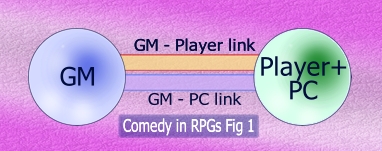
If the number of links doubled, it would mean that the connection between GM and Character was wholly separate and distinct from the link between GM and player, as shown to the left.
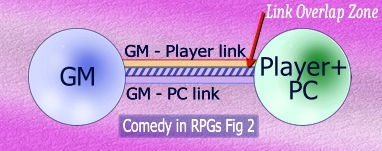
Instead, the situation is more like that to the right; there is an overlap, in which the player is speaking to the GM out-of-character about what the character is doing or saying or whatever. Since this overlap is the part of roleplaying that is already covered by the existing GM-player link, it can’t get counted a second time.
What this means is that by subtracting GF’s original formulation from the more complex values that I derived above (or whatever ones are currently appropriate for your game), you get the ratio of roleplaying to non-roleplaying within the group’s communications.
- 2 players (2 PCs), 1 GM (0 NPCs): N1 = (2×1.5)+1 = 4, L1=6; N2=3, L2=3, R=(6-3):3 = 3:3.
- 2 players, 1 GM, 1 NPC: N1= (2×1.5)+(1+0.5) = 4.5, L1= (20.25-4.5)/2=15.75/2 = 7.875; N2=3, L2=3, R=(7.875-3):3=4.875:3
- 2 players, 1 GM, 2 NPCs: N1=(2×1.5)+(1+2/3)= 4.6667, L1=8.555; N2=3, L2=3, R=(8.555-3):3 = 5.555:3
- 2 players, 1 GM, 3 NPCs: N1=(2×1.5)+(1.75)= 4.75, L1=8.90625; N2=3, L2=3, R=(8.90625-3):3 = 5.90625:3
- 3 players (3 PCs), 1 GM (0 NPCs): N1 = (3×1.5)+1 = 5.5, L1=12.375; N2=4, L2=6, R=(12.375-6):6 = 6.375:6
…and so on.
Notice (1) that with the increase in the number of players to 3, there was in increase in the amount of roleplay relative to the amount of other interpersonal contact (including the 3rd-person-perspective overlap) – 6.375:6 vs 3:3, and (2) that each increase in the number of NPCs being handled directly by the GM brings an increase in the relative amount of roleplay, but each such increase is smaller – the biggest jump is from no NPCs to 1 NPC.
Time to relate all this back to the subject at hand: at any given point in time, a player can be either “in-character” or “in person”. Therefore, every communication from the GM to the entire rest of the group travels along the larger number of links, but the player can only be receptive to one of the two links at a time. It takes time – usually less than a second, but time nevertheless – for a player in one mode to “switch gears” into the other mode. Not long, but enough to ruin the timing and dissipate the humor of the message – unless the GM uses a preamble to the comedic content to get everyone into the same mode (representing either an out-of-game joke on his part or an in-character joke, respectively, OR the GM is able to direct the comedic content down the (much narrower) overlap zone by presenting a comedic situation to the other participants.
Get it right, and the reduced barriers to humorous content (that “other factor” that I said I would get back to, and which is still to be discussed) makes everyone susceptible at the same time to a brief moment of humor. Get it wrong, and at least some of the group will be in the wrong interaction mode at the time, and the effectiveness of the content will be diminished – some will laugh, and some won’t, or will laugh late and not as loud.
A “grand slam” happens when you overcome the dissipation problem by one of the two mechanisms described – an NPC says something funny when the GM is already talking to the PCs in-character, or the GM presents a comedic situation by means of the overlap zone.
Both present an additional hurdle that has to be overcome in order for the material to trigger a laugh. In NPC-PC interactions, there is a degree of analysis that is automatically performed by the receiver – “what’s my character’s reaction?” – and that, too, can be enough to take the punch out of the punchline. In a Shared-Channel communication, the GM is presenting physical comedy by description – and that can also take the fun away. So comedy is really hard to do in an RPG context – but funnier when it does work.
What’s comedy got to do with laughter, anyway?
Well, that’s all about the purpose of laughter. Comedy is whatever triggers us to perform that natural function, whatever it is. In other words, it all depends on why we find something to be funny.
Which is not as simple a question as it might seem – whatever the explanation, it needs to accommodate the social differentiators already described.
Bonding Rituals
Anthropologically, it’s believed that laughter started as a form of bonding or “grooming” that could be performed at a distance. It builds and strengthens community bonds in the same way that grooming does in the great apes, but that is necessarily one-on-one. There’s a finite practical limit to how many social connections can be sustained by physical acts of this type – there are only so many hours in the day. In apes, that’s about 50.
Verbal communication and comprehension change all that. The number of people with whom you can sustain a strong social connection by personal interaction – family and friends – is about 150. Beyond that, you may have a sense of common community that sustains a weaker social connection. One of the ways that this communal sense is achieved is by laughing together, so the scientists now believe. Social and political structures, shared beliefs, etc, are others.
Laughter has also been shown to increase the pain threshold by about 5-10%. There’s an endorphin release that is associated with laughing.
Completely as an aside, it is interesting to note the ability of social media to broaden this reach. More interactive than email, much cheaper than telephony, and less time-consuming than traditional forms of correspondence, it’s my experience that it increases the capacity for a strong social connection into the hundreds, and somewhere close to the middle of that range. Adding in more one-sided social connections to social sub-groups, instead of individuals, raises it into the thousands or more. That’s why it is so effective at social amplification. It’s entirely possible that centuries from now, we will be deemed to live in the “social media age,” it’s potential impacts are so great.
Crowdfunding, Crowdsourcing, and other forms of collaboration are clearly related developments. What others will we come up with over the next decade or so?
An alternative interpretation is that social media is simply the first true social connection advance deriving from information technology, and society is therefore still in the Information Age. It would be possible to argue for weeks over whether or not social media constituted a sufficient advance over earlier forms of online interaction like chat rooms to define a new paradigm of human existence, and the debate could go either way.
An interesting thought to muse on. But let’s get back to our knitting.
There are four different theories as to what “comedy” actually is, when you get into the mechanics of it, at least that I know of.
- The ancient Greeks – people like Plato and Aristotle – came up with Superiority theory, which is “the notion that comedy is a game, there’s a winner and a loser, and we laugh at other people’s follies.”
- Release Theory, also known as Relief theory, is heavily built on the theories and experiments of Freud, and suggests that we laugh at things that release the parts of ourselves that we try to hide away in a socially acceptable manner – so we laugh at someone else’s pain to appease the sadistic tendency within.
- Incongruity Theory is one of the most widely-accepted, and it suggests that we laugh at the misalignment of expectations with outcomes – plot twists, in other words. There are a number of variations on this theory, such as the one featured in Larry Niven’s Ringworld, wherein laughter is triggered by an aborted defense reflex.
Benign Violation theory is the newest, and one that I had not heard of, prior to this documentary. It builds on, and incorporates elements of, the other three theories. Created by Professor Peter McGraw of University Of Colorado, it divides experiences into three types: Benign, which doesn’t trigger a strong reaction, Violations, such as an annoying co-worker, getting stuck in a traffic jam, anything strange or wrong or threatening, which produces an offended or negative reaction such as anger or fear or sadness, and an overlapping area called Benign Violations, which produce levity, causing laughter, which signals to others that the violation is actually ‘safe’. They then laugh to pass that signal on. The laughter of another can devalue a threat – or can be construed as a separate offense, if the subject is one that is still too threatening to deal with.
This theory has a lot going for it. First, it permits individuals to have different sensitivities, to be individual in their reactions and responses. Second, it deals with the social context, and the way in which that – and therefore humor – changes through the years, and from one culture to another. Some old comedy, for example, is extremely offensive and bigoted or patronizing or misogynistic by modern standards, and some of it is just boring and confusing (indicating that the subject is no longer threatening to the listener). Some remains hilarious. Comedy therefore reflects the broader values of society. And third, and this is perhaps its most compelling feature, it is the only one of the theories that explains why there has not yet been enough discharge of emotions to make 9/11 a fit subject for comedy. It’s now been 16 years since the attacks on the World Trade Center; by the time World War II was that far removed into the past, we had “Hogan’s Heroes”. I can’t see any serious proposals for a 9/11 analogue being seriously considered, either by a studio executive or a member of the public; the event is still humor-toxic.
The implication is that people resist laughing at jokes the find offensive, and grow upset by such laughter, because laughter tells the listener that “it’s OK to laugh” when – from their point of view – it’s not okay to laugh. If you happen the hold the latter opinion, then you will be offended by the laughter.
Humor needs to be edgy, but it can’t go too far. If it’s not edgy, it’s not threatening enough to be funny. But if it’s too threatening, it’s not funny. That’s a fine line to manage. Comedy is pointing out what’s wrong with the world in a socially-acceptable way.
Here’s another way to look at comedy, then: comedy is content and delivery. If the content isn’t funny, we won’t laugh; if the delivery is wrong, if it goes down the wrong channels of communication or takes too long, it’s not funny. You need to get both right – and every individual is just a little different.
That’s why “Grand Slams” are so hard to achieve – much harder than telling a joke and getting one or two people to laugh.
Broader interpretations & applications
All this gives rise to three final, broader, thoughts on the subject of Comedy in RPGs.
RPGs seem tailor-made for comedy
I’ve referred to this thought a couple of times already in this article; it has helped shape it, throughout. Threats in an RPG are already at arms’ length, separated from the individual by the player/character gap. That means that it’s harder (but not impossible – see Moral Qualms on the Richter scale – the need for cooperative subject limits) to be offensive. You can go harder and still be funny. But that doesn’t imply desensitization – if something is already funny, it will still be funny in an RPG. So this represents a broadening of the subject area of comedy’s constituents.
Is this factor enough to more than compensate for the added difficulties that I’ve already discussed? Sometimes, not always. An RPG lowers the threshold at which something will be funny by virtue of the distance between subject and personal identification, enough that “Grand Slams” become possible – the audience, i.e. the players, are more receptive. But in general, it doesn’t lower it enough on its own to make an RPG an automatic vehicle for humor; you still need to nail the delivery and not push the content too far.
But I guarantee that if you spend an hour or so building up a bad guy to be an enormous threat, and then have him trip over in the first seconds of combat, the players will laugh their tails off..
Spontaneous Humor as a sign of campaign identification?
Like, I suspect, a lot of GMs, if my players were telling jokes about my campaign, I might be offended. After all, I put a tremendous amount of work into most of them. That changed in the course of thinking about the documentary and this article, because you only tell jokes that strike you as funny, and before something is funny, according to the theories described herein, you have to find it to be threatening in a benign way, and that only happens if you are immersed within it and take it seriously. You can’t say something both original and funny without considering the subject to be important in some way. You have to identify with the subject, and then seek to defuse the threat and make the subject benign, with humor.
Especially if the players are able to crack jokes in character – and I have seen this done – it signals the kind of deep immersion within the world that we all strive for. It means that the game matters to the player.
It’s a good thing, not a bad thing!
Children and comedy
It’s possible to scare a child, but they are far more likely to view everything as only slightly threatening if you approach the subject in the right tone of voice and frame of mind. That’s why children can laugh at things that only arouse sympathy or disinterest in more mature age-groups, while most things that adults find funny go right over their heads. The result is that children laugh and play more easily (more readily) than adults.
Earlier, I suggested that RPGs and Comedy seemed to be a match made in heaven. Now, that statement stands revealed
as a pretender to the throne. Kids and Comedy in RPGs – that’s the real king of the crop.
This article won’t make every GM a comedy genius behind the table. Intellectual analysis of something that isn’t intellectual never does. But it will offer direction, and help you understand why some things produce laughter at the table, and when such laughter is detrimental to a good game, and understand why the joke about the Orc, The Dwarf, and the Princess in a Bar falls flat.
It won’t do the hard work for you – it’s just a road map to where you have to go if you want to invoke comedy in your RPG. But that’s certainly an improvement over nothing at all!

Discover more from Campaign Mastery
Subscribe to get the latest posts sent to your email.
Comments Off on Dogs and Cats, Living Together: Comedy In RPGs (Again)