Campaign Mastery helps tabletop RPG GMs knock their players' socks off through tips, how-to articles, and GMing tricks that build memorable campaigns from start to finish.

The Mind’s Eye: Examining Psionics, Part 1 of 5


This entry is part 1 of 5 in the series Examining Psionics

Lately I’ve been thinking about Telepathy quite a lot. I know that a psionic character will be joining the team in the next phase of my Zenith-3 superhero campaign, and I want to have the a solid handle on all the wrinkles that come with it. I want some simple analogy that I am instantly familiar with – as will my players – to enable me to grasp and describe what is going on.

Modernised Rules

About four years ago, the rules for Psionics in the game were thoroughlly revised, basing them on a successful approach to the casting of spells in a superheroic environment, and other arcane phenomena. I thought I would start with a number of excerpts from those rules, spelling out some of the general concepts inherant in the new system, and then move on to some new material.

That plan has been defeated by the sheer mass of words left when the rules are excerpted. Make no mistake, these are a lot shorter than the actual rules, as these omit virtually all the game mechanics; this is a more conceptual treatment of the subject.

So I’ve had to split the whole thing into smaller parts.

This part will focus on the metagame concepts and how they interface with the Game Mechanics, and act as a primer on this interpretation of the subject. There will also be sections with thoughts on roleplaying psionic characters and GMing psionics.

Part two is rather smaller, and looks at a theoretical “Biology” of psionics. Call it a Meta-biology.

Parts three through five are actually the post that I intended to make – everything in parts 1 and 2 is preamble, though hopefully interesting enough conceptually to be worth the reader’s time.

Concepts In Psionics

The following are excerpts from the game rules, redacted to remove game mechanics that would not be applicable to other campaigns. Each excerpt is contained in a seperate block.

Psi powers are manipulations of the mind. They tend to have relatively low END costs, requiring minimal expenditures of energies, and operate directly on the thoughts and perceptions of the target(s). A characters capacity for Psionic Interventions is called their Psionic Potential, and this is expended through what are called Psionic Disciplines.

Psionic characters can utilise these Disciplines to produce preconfigured effects, called Psionic Abilities. There are limits to the number of Psionic Abilities a Psi can develop within a Psionic Discipline, and to the number of Disciplines that a Psi can develop.

Psi powers suffer from one tremendous handicap: characters without Psionic ability or potential ability are difficult to influance and hence the characters most susceptable are also the most capable of retaliating. Psionics therefore opens a whole new area of vulnerability in the character.

Characters come in three varieties, so far as Psionics are concerned: The Nulls, The Potentials, and The Awakened.

  • Psi-Nulls are characters that are not, and never can be, Psionic. They have 0 OMCV and masses of DMCV (often 100+). [NB: The game rules are d%-based and track Attack and Defence for mental powers seperately to the combat characteristics for physical attacks.]
  • Latents are characters that do not have Psionic powers at the moment, but can develop them in the future; at best they may have one unreliable ability. They are just as vulnerable as The Awakened, typically having an OMCV somewhere betwen 0 and 100 and a DMCV somewhere between 0 and 50.
  • The Awakened are what (psionics) are all about. You have to be Awakened to fully use Psionic powers. They have typically reduced their DMCV to very low values to get a better OMCV – DMCVs less than 0 are not unheard-of. This is because most Psionics want to be able to affect Psi-Nulls. Since the to-hit calculation is Roll Required = 100 + OMCV (attacker) – DMCV (target), it can be seen that the closer OMCV is to 100, the better, and 150 is better yet!

In other words, Psionic characters tend to be vulnerable to others with the same powers, and that they are therefore reliant on other defences – like Mind Shields, and high Ego Defences. Ego Defence is the “second line of defence” for most characters; it’s unreliable unless you spend a lot of points on it and ineffectual unless you spend a lot more again – all points that therefore become unavailable for the purchase of powers.

It’s fortunate, then, that ANY Psionic power that penetrates a character’s defences, no matter by how little, has a significant effect on the target.

The Psionics framework permits characters to construct tools and techniques from their own mental energies and use them to affect the world around them. While there are some powers that can ONLY be considered Psionic in nature, almost ANY power can be developed from a Psionic Basis, from a Telekinetic Barrier (Force Wall) to a Psionic Strike (RKA) to Translocation (EDM). The character’s ability to construct these tools is known as his Psi Talent (aka Psionic Rank, Psi Rating, etc), the Tools and Techniques are also known as Psionic Disciplines, and an actual effect based on the use of one of these tools is known as a Psionic Ability.

The character’s ability to tap his mental energies is known as his Psionic Potential, and is analagous to a mage’s Mana Pool. It tends to be smaller and more expensive than a Mana Pool but is more effective, point for point, than a Mana Pool. If a character has not been Awakened, he CANNOT have a Psionic Potential, or Channels. If a character is not a Latent or a full Psi, he CANNOT even have a Psi-Rating (well, technically, he has one of zero). Psionic characters buy one or more Psionic Potential pools at a price determined by their Will and appropriate skill levels. The higher the character’s Psi-rating, the larger the Psi Pool they receive per character point invested.

Psi Rating

Psionic Talent is often interpreted as Psi Rating. A character’s Psi Rating is equal to (Psionic Talent+80)x3/40. The following is a rough guide to the significance: of a given Psi Rating, based on material in various comics and in Babylon 5:

Psionic Talent Aprox Psi Rating General Interpretation (For a Psionic)
-80 to -74 P 0 – P 0.5 Barely alive. Impossible to achieve without deliberately reducing Psionic Talent
-73 to -60 P 0.5 – P 1.5 Marginally Psionic. Even a Latent Psi with INT 0 & WILL 0 can get a Base Psionic Talent of -67%!
-60 to -47 P 1.5 – P 2.5 Vaguely Psionic. Most Latent Psis with realistic stats will be in this category or higher.
-46 to -34 P 2.5 – P
3.5
Minimally Psionic. Good latent Psis can reach this category. 4% to 16% chance of succeeding in a Routine psionic task, such as scanning a willing mind.
-33 to -20 P 3.5 – P 4.5 Functionally Psionic. A P4 is the lowest Psi Rating that is even marginally practical. 17 to 30% chance of succeeding in a Routine psionic task. Note that even an awakened Psi with INT 0 & WILL 0 achieves a Base Psionic Talent of -27%!
-20 to -7 P 4.5 – P 5.5 Commercial Psionic. A P5 can reliably perform Routine psionic tasks (30-43% chance).
-6 to 6 P 5.5 – P 6.5 Commercial Psionic.
7 to 20 P 6.5 – P 7.5 Commercial Psionic. Psi Rating 6.83 makes a second Psionic Discipline possible.
20 to 33 P 7.5 – P 8.5 Commercial Psionic. Deep scans on unwilling targets and other "Very Difficult" tasks become possible (but may require repeated attempts). Psi Rating 7.58 permits a third Psionic Discipline, P8.33 permits a fourth.
34 to 46 P 8.5 – P 9.5 Commercial Psionic. This is the top-grade of Commercial Psi, often attached to law-enforcement divisions in Psionic cultures. Up to a 1-in-5 success rate with Very Difficult tasks. P9.08 permits a fifth psionic discipline.
47 to 60 P 9.5 – P 10.5 PsiCop minimum. P10s can usually overwhelm the defences of Commercial Psionics. P9.83 permits a sixth Psionic Discipline.
60 to 73 P 10.5 –
P 11.5
PsiCop standard. P11s can routinely overwhelm the defences of Commercial Psionics. P10.58 permits a seventh psionic discipline, P11.33 permits an eighth.
74 to 86 P 11.5 – P 12.5 PsiCop elite. P12s can often overwhelm the defences even of other PsiCops. P12.08 permits a ninth Psionic Discipline.
87 to 100 P 12.5 –
P 13.5
Military Psi minimum. P13s are extremely powerful, capable of abilities on a Global Scale. P12.83 permits a tenth Psionic Discipline.
100 to
113
P 13.5 –
P 14.5
Military Psi standard. P14s can potentially bridge interstellar distances psionically. P13.58 permits an eleventh Psionic Discipline, P14.33 permits the twelfth and normally last-permitted Psionic Discipline.
114 to
126
P 14.5 –
P 15.5
Elite Psionic. P15s can potentially bridge dimensional gulfs. Referees may optionally permit P15s to take a thirteenth Psionic Discipline. This Option is NOT in effect in the Z3 and related campaigns.
127 to
139
P 15.5 –
P 16.43
Elite Psionic. P16s can potentially bridge dimensional gulfs. Referees may optionally permit P16s to take a fourteenth Psionic Discipline. This Option is NOT in effect in the Z3 and related campaigns.
Psionic Disciplines

Psionic Disciplines are the psionic equivalent of Schools of Magic. The number of Disciplines a character can master is determined by the character’s Psionic Talent: 10% or less = 1; 11-20 = 2; 21-30 = 3; 31-40 = 4; 41-50 = 5; and so on, up to 111-120 = 12. Optionally, as shown in the table of Psi Ratings above, the referee may permit characters with Psionic Talent of 121-130 to take a 13th Psionic Discipline, and characters with a talent of 131-139 to take a fourteenth.

Awakening

When a Latent psi Awakens, it’s like a flower blooming. It’s slow and painful and inelegant and uncontrollable – and a thing of beauty. Whole new vistas open up for the character, their horizons recede immeasurably. All of these should be reflected in the GMs handling of the situation and the character’s roleplay.

There are two ways to handle the awakening process.

Option 1: Revelation
Where the character has the character points to spare, the referee may choose to permit a Revelation-style awakening. If the player wants to do it that way, and the referee permits it, and the character can afford it, the character simply pays the full xp cost. They then have the full Psi rating, the full Psi Talent, and the full Psi Discipline score. Further development of the character as a Psi is then handled as any other character development.

In practice, this should only be permitted by the referee when the character’s Psi abilities are being deliberately awakened by another full Psi of at least 1 Psi rating more than the character’s full rating as it will be, or when a similarly-persuasive justification is made.

Option 2: Deliberate Development
This option reflects an active effort by the character to develop their abilities by using them on the people around them, and should be roleplayed accordingly.

Roleplaying Telepathy

Psionic awakening can and usually does cause radical personality shifts. A Telepath can be instantly aware of exactly what another character really thinks of them (unless the other character is a more powerful Psi), and of everyone else around them (same caveat) – no forced politeness is possible, no diplomatic phrasing. Moreover, characters reactions to the Telepath will often change when they know they are dealing with a Psionic, as it’s impossible to develop a psionic ability without invading someone else’s privacy in the most intimate way possible. The player and referee should carefully discuss exactly how the character is going to react to all this, in the context of the established personality of the character.

Particularly in the early stages of psionic development, it’s all too easy for an awakening psionic to commit a form of psychic rape that neither they nor the subject can control. And, what’s more, the psionic character is going to be fully aware of the trauma that this causes the subject after the fact, and will probably be reminded of it every time they see the character.

This is especially likely to happen to another psionic, whose defences against psionics are weakened by virtue of their own abilities. Even reasonably well-adjusted individuals can required intensive psychotherapy when they Awaken.

Societies of telepaths normally learn that lying to a telepath is futile. Anyone from such an environment will have to think carefully about how their characters will react if they are lied to. Remember that lying is an in-built part of human nature, and that some professions mandate evasions and even outright deception at times – spies, diplomats, lawyers, used-car salesmen, marraige counsellors…

Almost anyone that a psionic character meets will want, need, or desire something from the character, even if it’s nothing more than a passing speculation, an idle fancy, or an “impossible” fantasy. Most people treat strangers percieved at a distance – on a passing train, walking on the sidewalk, whatever – as a thing, a receptical for their own needs and desires, not as another person. Only when the stranger does something that strikes a chord with the perciever – gets injured, introduces themselves, interacts with another person in a way that marks them as a human being – does the perciever begin to treat them as a human being. Until then, they just aren’t real. That’s part of the burdon of being psionic.

Another part of that burdon is difficulty sleeping. The psychic atmosphere (see “refereeing psionics”, below) is the equivalent of a white noise generator – a noise that can only be ignored through deep concentration, which normally precludes sleep. Newly-awakened Telepaths often need immediate training in meditation and self-hypnosis before they can overcome the disruptionto their normal sleeping habits that this causes.

Telepaths also grow accustomed to communicating subtle nuances with their minds, if they come from a telepathic culture. If this channel is not available to them, they may appear to posess character traits that aren’t really there – bluntness, intolerance, frustration. These percieved traits should also be roleplayed.

Refereeing Campaigns With Psionics

Psionic characters are always aware of the broad emotional states of others nearby. Collectively, these emotional states are often referred to as the Psychic Atmosphere. A description of the psychic atmosphere should always be part of the description of a room or area containing people or a person other than the psionic.

If the psionic character has his defences raised, then all he can discern of the psychic atmosphere without a Psionic Talent check is “dark” or “light” or other such sharp contrast. A successful Psionic Talent check with appropriate modifiers (Perception is complimentary) would permit a one-word description of the overall mood of those in the room. These one-word answers, without any context, tend to be annoying as hell to everyone else and can be easily misinterpreted (watch the first season or two of Star Trek: The Next Generation).

If the psionic lowers his defences, even without actively scanning, what they normally percieve as an annoying background babble (10,000 voices whispering nonsense to each other) gets louder, and more distinct, as though they had turned the volume knob from the lowest audible setting to something reasonable. (Try turning the TV or radio on, turning the volume down to half what you would normally use, and then going two rooms away. While you can hear noise, what you hear won’t make a lot of sense). They can then percieve that one-word emotional summary without a perception roll, and can make out some of the context with a successful roll. The psychic atmosphere may have gone from “Dark” to “Hostile” to “They’ve been arguing. You sense resentment and anger and feelings of betrayal.” (Note that this example implies the presence of two or more people and does not specify who is feeling what, let alone why).

Communities will react to the presence of psionics in general as well as to the specific personality of the psychic. This reaction will usually vary with the degree of certainty with which the psychic ability has been proven, and will usually be to a generalisation of the abilities of the psionic character, and not to specifics. The referee should be carefully prepared for the consequences of public proof. One possible result is detailed below to provide food for thought.

When proof of psionics becomes publicly known, there will be many reactions.

Some people will initially be skeptical, but far more were so before there was proof. Others will iconify the psionic character, while still others will react to that iconification, presuming a cult connection where none exists. When the proof is confirmed proven beyond doubt, a psionic subculture will begin to emerge, which will arouse jealousy, envy, anger, outrage, greed, and several other emotions. Relatively few will be sanguine about the potential invasions of privacy that this will entail. Hate groups will form, while some already in existance will target psionic individuals. The accusation of psionics will (for at least a while) have the same impact as allegations of child molestation – a permanent taint, whether justified or not. Regulation of psionic phenomena will initially be based on existing laws – privacy, fraud, etc – and totally ineffectual. As the credibility of psionic abilities rises, specific laws will be drafted, going from the sublime to the ridiculous. At roughly the same time, laws protecting individuals from assault will be tested in ways never before envisaged, with no satisfactory outcome possible.

Consider the following hypothetical scenario: One man kills another and is arrested. He alleges (through his lawyers) that the dead man was a psionic who attacked him mentally, that this qualifies as assault, and that he was only defending himself. If this defence is accepted, it establishes the principle that no proof is needed to justify killing a psionic in self-defence. The result would not only be open season on psionic characters, it would permit anyone to kill anyone else, with an indisputable legal defence. However, if it cannot be proven that the victim was a psionic, who did actually attack the accused murderer, the defence is will almost certainly be rejected (and any panic-stricken jury verdict overturned on appeal, if it even got that far). This establishes that psionic attack is not assault under the law, and that the public have no legal defence against mental invasion. The mobs would be forming immediatly the verdict was announced!

Psionics would, of necessity, be driven underground. Posession of psionic abilities may or may not be a capital offence, but the only alternative is some form of penal colony that is exclusively devoted to psionic transportees. Being psionic would be analagous to homosexuality in the middle half of the 20th century – underground movements and clandestine associations and perpetual fear of being “outed”.

Meanwhile, the defence and political implications would be playing out. The advantages of a Telepathic spy network are obvious, both to friend and foe alike. Just at the point that psionic characters needed help in going underground, people who are professionals at doing so would quietly step in and provide it. The clandestine associations would grow larger and better organised, with whole branches of the various organisations interested in keeping – or obtaining – secrets emerging. Crime gangs, Big Businesses, Defence Establishments, Spy organisations, Terrorist Groups – they would all want to get their hands on a psionic, on the quiet.

Over the next few decades, the psionic underground would establish one or more extended underground communities on a national or even international scale. Ultimately, the needs for self-preservation would lead one or more of these to attempt to take control of the establishment (think Magneto). A counter-psionics community trying to achieve legal recognition for psionic rights would undoubtedly be formed in response – whether by a group still underground (think X-men) or an officially-sanctioned top-secret police force (more likely) would depend on circumstances. Where things went from there is ultimately a question of who wiins that conflict, but either way the establishment of a psi-corps style group, with appropriate rules and regulations, would seem certain to result, probably 30-50 years after the first proof of psionic abilties. (For a different take on all of this, read “To Ride Pegasus” by Anne McCaffery).

Reactions To Awakening

So far, this section has shown that Awakening means there’s a lot for the psionic character’s player to think about, and a lot for the referee to think about. But Awakening itself doesn’t actually trigger a lot of the consequences that have been discussed, most of them are due to people in general becoming aware that a character has Awakened.

So it is with the other PCs. Being closer to the psionic character, these are more likely to become aware of the potential (or actual) consequences of the psionic Ability, but often they will also have the benefits (or lack thereof) of knowing the individual who has just become psionic. When the awakening first takes place, the referee should take the newly-awakened character aside, have them read the sections on Roleplaying Awakening and Roleplaying Telepathy (above), and start thinking about his character’s responses and reactions to these developments. The referee should then ask the other players, out of earshot of the newly-psionic character, some very leading questions. The answers should be brief – one or two sentences at most – and written, to enable later referral to them. In all fairness, the referee should also encourage metagaming to the extent of reminding the players that the newly psionic character will eventually almost certainly learn their answers eventially.

Psi-Prejudice

It’s quite possible for a character to react to someone else being Awakened by becoming prejudiced against Psionic characters in general. The mere fact that they can mess with your head and you will never know it is quite enough. A general distrust of what might be done with the ability is quite enough. A personal trauma involving psionics is quite enough. It’s easy to find reasons to fear and mistrust Psis in general, with only a few rare and limited exceptions, grudgingly acknowledged. This phenomenon is known as Psi-Prejudice.

Of course, some Psionic characters will react to this prejudice – which cannot be hidden from them if they are telepathic – by their own overgeneralising of non-humans. It is all too easy for Psi-Prejudice to become self-fulfilling prophecy.

Creating Psionic Characters

“In a perfect world, there would be points enough to buy everything I want.” So said one player when contemplating a character design. But it’s an imperfect world, and as a result, players need to balance conflicting needs very carefully when constructing characters. This is especially true for Psionic characters, who have some extraordinary demands to meet.

In particular, the fact that everyone else gets a significant free defence against psionic powers while characters who posess those powers get a free vulnerability to those powers, forcing them to spend lots of points improving an expensive second-string defence mechanism, means that there will not be many points left for the psionics themselves. As always, the exact balance to be struck is subject to variation by individuals, and this section is not going to offer too specific a blueprint. Some people will want to have the best defence they can afford, at the expense of a variety of front-line abilities; others will accept a wider margin of vulnerability in exchange for greater psionic powers, with the intention of adding a third-stage defensive mechanism like a Mind Shield early on.

The following observations may be useful:

  • Ego Defence is essential and expensive at high levels. Decide the minimum amount that you need and purchase it early in the character construction/reconstruction process. You can always add more if you have the points.
  • The Psionics pool is relatively cheap, but by the time EgoDef is factored in, there will not be enough points for everything. Divide the planned Psi Pool into two or three smaller pools, then start by buying no more than 1/3 of the total you expect to be able to buy eventually. [The Psi Pool is a specific type of characteristic used to power psionic powers].
  • Rising Psi Ratings are geometrically more expensive. It’s not unreasonable to expect the total spent on Psionics to start at 50 and to increase by 10 points, cumulative, for each full point of psi rating. A P5 should expect to have to spend 50+10+20+30+40+50 = 200 points on psionics and related costs (like restricted-purpose WILL). You might be able to do it for half that, but you would be a singularly anaemic P5. Certainly, you would not expect to spend more than twice that. The higher the Psi Rating, the greater the committment of points to Psionics – which means that there will be less for everything else. So pick a Psi Rating within your budget and aim for that – at first. You can always improve it later in the character creation process.
  • Psionic Abilities are relatively expensive in character point costs. So only plan to buy one or two of these at first, at most, and be prepared to accept reduced effectiveness (ie higher END and Psi costs) to keep the overall price affordable.
  • Psionic Disciplines can also bite deeply into your points. Aside from being relatively expensive in and of themselves, they also commit you to buying at least one additional Psionic Ability. The balance between diversity and effectiveness needs to be carefully managed. As a general rule of thumb, no matter how many Disciplines your planned Psi Rating will let you have, start by buying only one, or at most two.
  • Complete the rest of the character before expanding your psioinc horizons beyond the minimum. Higher Psi Ratings are always more cost-effective in the long run, but in the short term they consume your points for little-to-no benefit.
  • Everything said here applies doubly or triply if your character is not intended to be a paranormal.

Whew! Out of room – stay tuned for part two of this series, when I contemplate a hypothetical biology and physiology of psionics!

Comments (4)

Game Master Tool Illustrated: Plot Flowcharts


rpg blog carnival logoToday I want to share a simple and fast way that makes planning easier. I was going through old gaming papers recently and came across a partially crafted plot flowchart. This would be a short plot in Myste Cryk, a home-base type campaign that ran 2005-2006. As the blog carnival for September covers preparation, I thought I’d roll out a picture of this flowchart and talk about it.

The plot flowchart

Let’s run through the diagram. Click on the image to see the full-sized version. Unfortunately, the picture is blurry and hard to read, and I’m sorry about that.

Plot flowchart

Click to view large size

The plot kicks off with a funeral – the bubble near the top left. During the funeral there will be a spider attack. This was to be a set piece encounter, and the plot was to have a hard-edged start. However, if there had been dependencies or specific triggers, I would have noted those with connecting nodes.

The details of the funeral are in a My Info file – a daughter of the local village elder had died from a spider bite. I initially brainstormed them out into bullets, then used the diagram to clarify plot development timeline, options and situations.

So, during design and while GMing I would have my notes handy and use the flowchart as my controlling document. The diagram pares away details, leaving you with a clear picture of what is happening and what might happen at each stage.

Creating the diagram itself helped me plan things out better than if I had just left things at the brainstorming stage, and I remember it took me about fifteen minutes. As a bonus from this exercise, I get a useful diagram and valuable GMing tool out of it.

Spiders attack the mourners. The PCs kill the critters or drive them off. What would they do next? I figured there were four options:

  • Track the spiders back to a dungeon tunnel
  • Lose the track and/or explore the forest in general
  • Talk with NPCs
  • Do nothing or fail – life back to normal

If the PCs find the dungeon, that adventure leads them to the villain, a neighbouring baron intent on ruining the fortunes of the village for the benefit of his own domain. He sent a spider to attack and poison the elder’s daughter, then he sent larger spiders to attack people at the funeral. The rest of the diagram assumes the Baron escapes, which is erroneously not noted on the Discover Baron bubble.

The scroll is key but flexible

Written on the connector line between Tunnel to Dungeons and Wizard is Find scrolls; Wizard reads. There was actually just one dungeon and one scroll in the end design, and I see a couple other minor typos in other parts of the diagram as well. I guess that’s why I prefer pencil to ink. :)

The Scroll is written in a foreign tongue. In my My info notes I had described the Scroll as instructions to use “my minions” against the villagers, to send Erechitl the Small to poison and kill the daughter, and to send Perechitl with his warriors to attack the funeral. The note was signed The Governess.

A few clues can be deduced from that note:

  • There is another villain, The Governess.
  • She has control of spiders.
  • The spiders are named, so the relationship between The Governess and her minions is more than just simple summoned creatures or pets.
  • If any spiders survive the PCs, the group could try to parley.
  • The PCs could possibly use these names for leverage in the future.

My players are smart and would have picked the Scroll apart and come to most of the same conclusions, and perhaps several others I have not thought of.

The Scroll is placed on the connector line because its location is not fixed. As it’s a key element, I was prepared to put it in the dungeon for the PCs to take to the wizard for translation, or the Wizard would give it to the PCs, which would lead them to the Dungeon. (The Wizard was an ally previously established in the campaign.)

You see another note between Life Back To Normal and Bullies: catch PCs when together. That label lets me know a dependency on the Bullies encounter. I wanted the encounter to be a group one. Labeling connector lines like I’ve done with the Scroll and Bullies encounter is an efficient way to remind yourself about dependencies and triggers.

Side treks

After the Funeral, if the PCs explored the forest they would encounter Elves, a Ranger’s Secret Cave and an Abandoned Fort. Each of these bubbles would explode into separate diagrams as I had intended those to run about a session each with several encounters. There were to be links from each to either the Baron or The Governess, but I had not finished drawing those out so the connector lines are missing.

The Bullies were a one-off encounter, but with potential to create recurring NPCs if any survive the encounter. The best option was to make them Governess or Baron minions, but I was waiting to see the results of the group combat encounter.

Two unconnected boxes describe miscellaneous encounters to flesh out game sessions with. I prefer not to have every encounter in my games revolve around the plot as time delays between plot related encounters gives you various storytelling options and opportunities.

Deserted Part Of Town ‘Dungeon’ was to give the PCs options to explore ruins and encounter beasties and traps. Various Townsfolk Various Missions was to give the group several short quests. As always, I had a list of encounter ideas and seeds in another document, and I would just keep fluid with these, bringing them in as needed or when inspiration struck, connecting them to other diagram bubbles or not, as game sessions played out.

The larger picture

As you can see, the Wizard is key to the rest of the plot diagram’s development. He was more of a sage than wizard, and he would lead the PCs to the Blackmarket whenever the timing seemed appropriate after the PCs performed a number of other missions for him. Various Missions would use my encounter seeds list, but I had also planned on sketching out a half dozen key encounters relating to The Governess on another diagram, but did not get that far in my planning.

Eventually we reach The Blackmarket. It is in a nearby city. I should mention that Myste Cryk was a Birthright campaign. My long term goals were to bring the PCs up “through the system” to eventually become leaders of various guilds, armies and factions within their domain. The Blackmarket was to lead the rogue PC to the Thieves’ Guild where he would earn membership, rise through the ranks and someday become leader.

Overall, my plan was:

  • PCs level 1-8 as adventurers
  • PCs level 8-15 as faction members climbing up the ranks
  • PCs level 16+ as leaders and switching to the Birthright rules for seasons and actions; spawn a new group of 1st level PCs to repeat the cycle, but players would play both sets of PCs

This was ultimately a simulation type campaign that started out as a home-base campaign. I figured experiencing the land, its peoples and its challenges through the eyes of PCs-as-villagers who become powerful figures and eventual leaders would have more meaning for the group than just starting out with leader PCs calling the shots.

Alas, the campaign ended with a TPK. The PCs were 7th level and were on a mission in the capital city for their village and drowned in a flooded ship hanging from a crane 50′ in the air.

I was possibly delusional in thinking the campaign could progress as far as I envisioned with a second generation of PCs lead by the first, and should have just started the PCs as leaders. However, if I had to do it all over again I would do it the same way (cause I’m stubborn and stupid that way, just ask my wife :). I consider this one of my dream campaign concepts, and I’m keeping it in my back pocket to run again some day.

Long term planning

Back to the diagram. A perk of encountering the Blackmarket is access to cool magic items and equipment. The PCs had accumulated quite a lot of money during their adventures, and would get more as they worked through the plot diagram. However, they were cursed because they had nothing to spend it on. Their little village and nearby villages were markets too small to offer them opportunities to buy powerful magics. This was done on purpose for campaign balance.

With the Blackmarket, the PCs could finally blow their wads and buy cool stuff. Then, onto the Thieves Guild, with various possible missions stemming from them, and then onto the official Resistance lead by an Anti-Paladin minion of The Governess.

The Resistance would lead the PCs to The Mines, a Dungeon Adventure, and possible Capture. It would also pit them against the Anti-Paladin and a plot twist. The Baron ends up being a sympathetic figure and potential ally because his only goal was greed. Once he realized the bigger schemes of The Governess, he wanted nothing to do with that and was planning on going to the PCs for help in defeating her.

Unfortunately, he would be captured and held prisoner in the Anti-Paladin’s dungeon. Ideally, the PCs would come along, defeat the Anti-Paladin and rescue the Baron. The Baron, privy to The Governess’s plans, would lead them to the next stage boss – the Hill Giant King.

The diagram ends here, but my plans were to run the PCs through the Against The Giants module series. The Governess was actually Lloth. I have only once completed GMing the whole Giants-Drow adventure series. My goals for Myste Cryk were indeed probably too large for success, heh.

You might have noticed the diagram starts out detailed, including specific encounters and notes. Then it gets high level and vague, with a single bubble representing many sessions. This was done intentionally, as I prefer to plan in detail for the short term, but to just track a general desired vector for the long term. If the campaign had progressed, I would have created more diagrams for the various bubbles and connected them up.

The diagram is unfinished, and needs more connector lines and notes, as well, for it to serve to its true potential as a GMing tool.

Encounter design checklist

Note the words in the top left corner:

  • Combat
  • RP
  • Puzzle
  • World
  • Story
  • PC
  • Player
  • GM Fun

That is a checklist for encounter types. As I outlined in an old Roleplaying Tips encounter planning article, I give encounters a type and try to make them live up to their type. If I can have an encounter serve multiple types, that’s even better. For example, an encounter might have combat and puzzle elements, and tie into one or more PC goals. The list is just shorthand, and I use it when designing or GMing new encounters on the fly.

A brief history of campaigns

Ironically, this was the last plot diagram I would sketch out for several years. After the Myste Cryk TPK on that fateful Saturday, we paused for lunch and discussed what we wanted to do next. It was one of our rare all-day sessions that started at 10am and was planned to run until midnight. As we ate we weighed bringing new PCs into Myste Cryk or starting with a fresh new campaign.

We voted to switch to a new campaign, and the players asked me what I wanted to GM. (My players are awesome and very thoughtful that way.) I laid out a few modules I was itching to play: the Shackled City adventure path, the Night Below Boxed Set and the Temple of Elemental Evil.

We voted and Temple of Elemental Evil was picked. The players rolled new PCs while I prepped. I have run Temple now nine times, and finished it three times. Alas, while the Homlet portion was epic and probably my group’s greatest sequence of sessions, I called a halt to it a year and a half later in the third dungeon level beneath the temple due to grind fatigue (and an itch to play the newest kid on the block: D&D 4E).

So we quit Temple and started a D&D 4E campaign that ran about a year. I used published modules for the most part. Then we voted 4E off the island and switched to our current campaign, Riddleport, using the Pathfinder rules.

From the time Myste Cryk ended to the start of Riddleport, a period of several years, I used published adventures and did not need to create flowcharts and diagrams (though I should have in some cases, as a couple of the modules I used were a bit disorganized and I struggled to figure out how things were supposed to move along).

Back to homebrew planning and design

Which brings us to today, where I’ve pulled out this old diagram and kept it because it’s time for me to starting using this tool once again. For Riddleport, except for the general city and game world details, my players are at the mercy of 100% Johnn Four lunacy. Woe to them. I should start using a DM screen again for when the dice fly at me.

I recommend drawing similar diagrams and flowcharts to help you prepare for and run smooth game sessions. They are quick to make and help organize your thoughts plus give you a handy reference on how things connect and flow.

iThoughtsHD iPad app screenshot

Click to view larger

Riddleport is a character-driven sandboxy campaign, so I do not need to sketch out an overall plot. However, I’m using diagrams to plan out faction actions and individual encounters. I tend to keep my notes light, in bullet lists and idea buckets, so diagrams help eke out a bit of structure when and where I need it.

iPad app for plot flowcharting

My tool of choice these days is the iPad mind-mapping application iThoughtsHD. Click on the image below to see a recent flowchart for a quest the PCs undertook. I’ll do a review of iThoughtsHD for iPad in the future.

Do you use flowcharts and diagrams to help prepare and run games? If so, what has your experience been with them? What software do you use, or do you prefer pencil and paper?

Comments (23)

“How Hard Can It Be?” – Skill Checks under the microscope


Fans will recognise the quote used as the title of this article as something often said by Jeremy Clarkson on Top Gear when the trio of presenters are about to attempt a challenge posed by the show’s producers. Since it inevitably turns out that the correct answer is “Very!”, it is usually followed by one or both of the other commentators yelling “Don’t Say That!”

The challenges that the team undertake are always entertaining and often fascinating. But the question itself got me thinking (again) about a subject that I’ve ruminated on a number of times in the past.

Every skills system has some objective measure for how skilled a character is. The usual basis is a roll plus a modifier which has to be higher than a total determined by the GM, though there are variations. Sometimes the objective is to get less than the total, for example, and modifiers don’t increase the likelyhood of success, they reflect an increase in the difficulty due to circumstances. But either way, the goal is to achieve a target set by the GM or better (with “better” being defined differently from system to system).

I want to talk for a bit about how those targets are set. I’ll be using D&D 3.x as my foundation for the discussion, but the concepts are applicable to all skill systems.

Relative Vs Absolute Difficulties

One of the big stumbling points that many game designers seem to trip over is never telling the GMs, who are actually going to use the skill systems that they create, whether skill difficulties are assessed on a relative or fixed basis.

You see, the GM assigns the target in answer to the question, “How hard should it be?”, but this form of the question is actually incomplete.

Is the right question, “How hard should it be for an ordinary person with no training?” – since the abilities of our hypothetical ordinary person won’t change, this is an Absolute-basis difficulty.

Or, is the right question, “How hard should it be for an ordinary person with typical training?” – since the abilities of our hypotherical ordinary person still don’t change, but the concept of “typical training” is both circumstantial and subjective, this is a case of relative difficulty where the target number will change for characters of different backgrounds and from one GM to another.

Or, is it “How hard should it be for an expert?”, which is another relative value.

Or even, “How hard should it be for the character who is making the attempt?” – still another relative value.

Without knowing the basis on which difficulty levels are determined, it’s not possible to properly set a given difficulty level.

It’s even possible to have compound systems, where skill levels are categorised and problems are assessed as to what the minimum skill category is for attempting to solve the problem – it doesn’t matter how skilled you are at basic arithmetic, it doesn’t help you solve a quadratic equation or determine a second differential. It’s one thing to be a skilled journeyman carpenter, able to reliably nail two pieces of wood together to make a basic bookshelf or re-shingle a roof; it doesn’t qualify you to create a china hutch or a house. You lack the basic training in the higher level of problem, don’t have the fundamental education that gives you the right questions to ask (never mind enabling you to find the right answers). A task that might be routine for a medical specialist, like a heart bypass, can be extraordinarily difficult for a skilled surgeon with a different speciality. I don’t care how good a plastic surgeon might be, or a veterinary surgeon, or a neurosurgeon – I would have to be pretty desperate to let them try to perform a kidney transplant or triple bypass on me!

Difficulty By Example

This is the DMG’s approach in D&D 3.x, and it doesn’t work, at least not as well as it should. It describes a DC 40+ check as something that’s almost impossible, an almost miraculous result if you succeed. But a little digging into the system shows that it’s not all that hard, after all.

The designers don’t seem to have communicated the answer to the fundamental question of what basis you use for assessing how hard something should be, even amongst themselves. Thus, we have the situation where some of the examples offered make perfect sense for a first-level character and others don’t, and as characters go up in levels the examples make progressively less and less sense.

Fuzzyness

Part of the problem is that the fuzzyness of the die roll easily outweighs almost every other factor, at least until you get into higher-level characters. We’re talking about a d20 here, which means that there is just as much chance of rolling a “one” as there is of rolling a “twenty”, but those two results make a huge difference to whether or not the character succeeds or fails.

How hard is it to perform a typical task?

The DMG defines these as DC 10. Let’s say that we’re talking about a 1st-level character with 1 skill level. He might have as much as +4 from stat bonus. He might also be able to claim a +2 synergy bonus.

1 (rolled) + 1 (skill level) + 4 (stat bonus) + 2 (synergy bonus) = 8. Even on the worst possible roll, the character almost succeeds.

But wait – a roll of “1” is usually an automatic failure. And a “20” is usually an automatic success. And characters can have more than one skill point in a skill – the maximum is either character level +3 (for “class skills”) or half of this (for “cross-class” skills).

2 (rolled) + 4 (skill level) + 4 (stat bonus) +2 (synergy bonus) = 12. Success!

How likely is this result?

Critics will immediatly point out that I am employing the worse possible case, and that this is very unlikely to occur. So let’s pause for a moment and think of how unlikely it is.

Characters will rarely attempt something they don’t know how to do, especially at low levels, if they have a choice – they would hand the task over to someone else who does know how to do it. That means that most of the time skill use will be by a character for whom this is a class skill.

Character abilities in D&D are usually themed around the class concept. So, if you are good at something, there is a reasonable likelyhood that you will also be good at related tasks; and that is a situation in which a synergy bonus is likely to result, unless the GM has a specific reason for disallowing it. However, the character does need 5 skill ranks before they achieve a synergy bonus, so that means that at first and second levels, they can’t normally do so.

Characters who are good at something are also likely to have stats that are higher in those areas that assist them in those endeavours. That means that the character is more likely to have a high stat bonus for any check that they make than not, if the character is supposed to be good at this sort of task – and if they aren’t, as already stated, they are more likely to hand the task over to someone else who is. A bonus of +4 is still extreme – but the example character got a total that was two more than needed, a stat bonus of +2 would have been enough.

Another possibility that was not taken into account is “aid another” which simply requires another character to succeed in a roll by 10 or more. But there’s some vagueness about this rule as well, which I’ll discuss seperately below.

That all adds up to the “worst case” being the most likely case – once characters are third level or better!

Do skill synergy bonuses stack?

For my money, it’s a named bonus, so I would rule “no” according to the strictest interpretation of the rules.

My players would like to suggest “yes”, arguing that the bonus reflects ability with tasks related to the actual objective, and that because each skill is different, each related skill is reflecting ability at a different aspect of the objective task, and therefore synergy bonuses should stack, and sometimes I weaken and permit this line of arguement to sway me.

I also sometimes adopt a middle ground, and state that while the first skill synergy gives +2, each one thereafter only adds 1 to the score, because the source skills also have some relatedness. This, in effect, uses the players own arguements against them.

And yet, page 21 of the DMG does not list “Synergy Bonus” amongst its named bonus types. Neither does the Rules Compendium. And so the debate continues.

Aid Another

Every skill system needs some way for multiple characters to cooperate on a problem. In D&D, that subsystem is covered by “Aid Another”. According to the PHB, if you roll a 10 or higher on your check, you give the character actually trying to perform the task a +2 to succeed.

It doesn’t matter how difficult the task is. It doesn’t matter whether or not the character trying to help knows what they are doing (or does it? more on that in a moment). It doesn’t matter how naturally gifted they are or aren’t, ie what their stat modifier is (same comment). It doesn’t matter whether or not multiple characters are actually required to achieve the result. But the big problem is that the rules don’t say what kind of check is required. According to what the PHB says, it could be a straight die roll – if you get 10 or better, you succeed in conferring a +2 to the character making the attempt. And the DMG doesn’t mention Aid Another at all.

But an equally acceptable interpretation – and one that is supported by the use of the word “Check” rather than “Roll” in the PHB – is that the character has to make a check against the same skill as that being used to achieve the primary task, or a skill that is somehow related to that task – and that the latter, if successful, confers a synergy bonus that DOES NOT STACK with any synergy bonus the character is already getting for that skill.

In fact, consulting the Rules Compendium reveals that this is in fact the correct basic interpretation, though it doesn’t mention the Synergy Bonus refinement, that’s all me!

The other rule (that is somewhat reminiscent of the Synergy Bonus rules) states that characters with 5 or more ranks in the skill in question can add more than the standard +2, they add +1 for every 10 points by which their skill total exceeds the initial 10.

Does Aid Another stack?

Here’s another grey area, and this time the Rules Compendium isn’t much help. And, as usually seems to be the case in such matters, there are multiple possible answers.

A “Yes” can be justified simply by pointing out that there is no reason why more than one person can’t assist someone else.

A “No” can be justified simply by pointing out that there is a practical limit to how many people can work on a single task, and rather than forcing difficult and dubious decisions on the GM, it’s better to simply cut your losses.

A middle-ground approach can be implemented by ignoring the judgements suggested by a ‘no’ case and specifying that the number of characters aiding another has to double each time an additional bonus is awarded. So you can get +2 from one assistant, and two would give +4, then four for +6, and eight to get a +8, and 16 to get +10, and 32 to get +12, and 64 to get +14, and so on.

A sightly more conservative approach is to say that each additional success only confers +1 and not +2. That would mean that instead of 32 people giving +12, they would only give +7; to reach that +12, you would need 2048 assistants.

More conservative still is to state that after a certain limit, the base benefit of aid another is +0 – and therefore only results that come from greater expertise can further improve the total.

My personal inclination (and I have not discussed this with my players) is to set a limit even to the +1’s of +4. So, what that gives is:

  • 1 assistant = +2
  • 2 assistants = +3
  • 4 assistants = +4
  • 8 assistants = +4, +1 if 4 of the assistants get a total of 20+ (results of 30+ count for two);
  • 16 assistants = +4, +1 if 4 of the assistants get a total of 20+ (results of 30+ count for two), +2 if 8 get a total of 20+ (results of 30+ count for two);

and so on.

A total of 20 is not all that hard to achieve once a character hits middle levels, but the weight of numbers means that it will add up.

I would also rule that the DC required to aid another goes up from the base of 10 with each increase in bonus.

  • So to get the +3 with 2 assistants, the first assistant would need 10+, and the second would need 11+.
  • To get the +4 with 4 assistants, the first needs 10+, the second needs 11+, and the third and fourth need 12+.
  • To get +5 with 8 assistants, the first needs 10+, the second needs 11+, the third and fourth need 12+, and the last four must get 23+.
  • To get +6 with 16 assistants, the first needs 10+, the second needs 11+, the third and fourth need 12+, four need 23+, and the last eight need 24+.

This combination means that there is an upper limit to how many assistants will be helpful; eventually, the required total will reach or even exceed the initial DC 40; and sooner or later, there won’t be enough assistants who succeed to push the bonus any higher. In fact, to have any confidence in achieving even the +6, you might need 20 or more assistants, just to allow for the fact that some of them will fail. And the higher the target bonus, the higher the risk of failure, and the more non-contributing overhead is needed in assistants.

None of this is official, of course.

To Dream The Impossible Dream

So, if a character is good at something, they will succeed in a “typically difficult” task 95% of the time. How hard is it going to be for a character to get a DC 40 total?

Let’s start by rephrasing the question: “how high a level does a character have to have before they have a chance of success at a DC 40 task for which they are suited?”

I’ll ignore the “twenty always succeeds” and say that the character has rolled a 19.

That leaves 21 more to come from other sources. If there are no other bonuses, that has to come from the character’s skill ranks and stat bonuses. So let’s start by figuring it with no stat bonuses either: Skill = 21 = level + 3. So with no other assistance, level 18 characters will succeed at a DC 40 check on a roll of 19. So far, that seems reasonable.

For every +1 that comes from any other source, the level will drop by 1. So let’s start by adding in a stat bonus. +2 is a fair enough bonus for a 1st level character, but it could be +3 or even possibly +4. I’ll use the middle value – a plus 3. So that reduces the character level from 18 to 15.

By the time a character reaches level 15, they will have had three stat increases. Let’s assume that two of those were on the stat whose bonus we’re considering here, because we’ve specified that this is a character who is going to be skilled at this task. That’s worth an extra +1 stat bonus, so now we’re down to level 14 (and we lose the third stat bonus anyway).

Next, let’s throw in a +2 synergy bonus. It could be higher, as discussed earlier, but let’s be strict about this. That drops the level required down to 12.

Now, let’s have “aid another” from someone else. That’s another +2, so now we’re down to level 10.

By the time they are level 10, the character will have received at least 4 feats. Let’s assume that 1 of those feats gives a +2 at doing this particular task. That drops us down to level 8.

By the time a character reaches level 8, he will have a number of magic items, some of which confer bonuses to performing certain tasks. So let’s give another +1 from that source – even though it could be much higher.

That brings us back to level 7, but it goes back up to level 8 because we’ve lost the extra +1 stat bonus.

Some spells confer additional bonuses at performing certain tasks. Let’s also add in +1 from that source. That gets us back down to level 7.

Favourable conditions can give +2 or more bonus. So let’s add that in, as well. That brings us down to level 5.

A fifth-level character can succeed at a DC 40 task. Admittedly, there is a low chance of success – a 19 or a 20 – but that’s still one time in ten that the character can do the almost-impossible. And that’s being reasonably conservative with the modifiers; while some of them might not be available, others can be much higher.

A 50/50 chance of success would mean that the character needs to roll 11 or better. Since 19 minus 11 is 8, we can determine the level at which a character has a 50/50 chance of success by adding 8 to the level. Let’s go one better, to give the character a better than 50-50 chance.

A fourteenth level character can succeed at a DC 40 task more than 50% of the time. Under reasonable circumstances, he is more likely to succeed than to fail.

That’s a sobering thought.

But if we allow Aid Another from more than one assistant, and a better stat bonus, a first-level character can easily achieve a DC of 40. Depending on the house rules one adopts to restrict Aid Another, a first-level character can even have a better than 50-50 chance of achieving that success!

So much for DC 40 being almost impossible, a near miracle.

Even just using the more conservative approach to aid another that I outlined above, an eighth-level character can easily have a greater chance of succeding than he has of failing a DC-40 test.

At least one character in a campaign that I run is in his early teens in terms of character levels and has a bonus to selected skills of well over +40, achieved absolutely honestly, using all of the above techniques – except aid another! – AND using the most extreme interpretation of the synergy bonus rules. I mention this purely because it shows that the preceeding analysis is not some theoretical or hypothetical discussion – it really happens.

So the answer to the question, “Just how hard can it be to achieve DC 40” is “not very.”

By the time the character reaches his upper teens in level, it will take a DC of 55 before the character has even a 50-50 chance of failure in those skills!

Which brings us back to the question posed at the start of this article: “How hard is it” For Whom?.

Difficulty Options, Redux

With everything that’s been learned in all this discussion, have we made any actual progress in resolving the issue?

The answer is both yes, and no.

An answer to the central question remains elusive, but at least we’re in a better position to understand the implications of the choices; we’ve gained perspective. Those implications may well be the final element needed to make an intelligent choice amongst the options.

Absolute Difficulty

It’s now clear that this is the standard by which the DCs in the DMG are measured, and that it is a flawed standard. Choosing task DCs according to this standard means that there is virtually no chance of even low-level characters failing at a task that is within the province of their expertise unless the task is superhumanly difficult. There are so many flaws in this arrangement that have come to light in the course of this analysis that the Absolute Difficulty model must be considered hopelessly broken. It’s too easy for even low level characters with appropriate support to work miracles.

Yet, it’s not all that difficult a fix. Increasing the range of all DCs greater than ten proportionately is all that would be required; so that a formerly DC 40 task is now a DC 55 or 60. The latter would be easier, mathematically. The adjustment would be

New = 10 + 1.2 x (Old – 10).

But I don’t recommend this solution. It’s a kludge, and it feels like a kludge. We need a better solution than Bailing Wire and Duct Tape.

Relative Difficulty: The Background Standard

This has a lot going for it as a concept; the notion that some races inherantly find certain tasks easier than others, that certain ethnic backgrounds might inherantly be better or less capable in certain fields of endeavour, whether that be by virtue of personality or general disinterest or whatever.

But the fact is that all of these things are more easily addressed within the current system in other ways than changing the DC. Giving races a specific bonus or penalty to certain tasks or with certain skills; or giving an additional allocation of skill points to be expended in certain key areas; or simply mandating that a certain number of skill points have to be spent in a more restricted way; or any one of several other alternatives, would accomplish this same goal, while creating less work for the GM.

This solution, too, is a bust.

Relative Difficulty: The Expert Standard

With only two options left, we would seem to be closing in on either a solution or a massive anticlimax! I have an almost-instinctive suspicion at this point as to what the solution is most likely to be, but I will continue to examine the alternatives dispassionately; I might be fooling myself, or miss a bet, otherwise!

So let’s think about the “Expert Standard” for a minute. This means that difficulties are assigned based on how hard they should be for someone who knows what they are doing – and that a certain level of expertise may be required before characters can even attempt certain tasks, no matter what bonuses they have from sources other than skill ranks.

Right away, this solves part of the major issue that was encountered with the Absolute Difficulty. It is no longer too easy to achieve those miraculous feats of skill. So that, at least, is encouraging.

However, this solution comes with a problem: who decides how “expert” an “expert” is? How do you keep the standard consistant? There is no easy solution. And, what’s more, there remains the same problem that was encountered when considering “The Background Standard” – the question of having multiple fixed standards to create and keep in mind. If this flaw was enough to skupper that proposal, it is also enough to cast shadows of doubt over this one; there may be fewer DC standards to bear in mind, but there are still several of them – possibly too many.

Relative Difficulty: The Character Standard

This proposal is radically different from all the others in that it abrogates all fixed standards. The concept is that each time a task is to be achieved, the GM determines hwo difficult it is for this specific character, at this specific time, and under these specific circumstances. The same task might have a very different DC tomorrow.

This pretty much eliminates the modifier for Favourable or unfavourable conditions, building that straight into the DC determination. It also permits the inclusion of the background standard as just another element for the GM to consider. So this concept includes several of the nice-to-have ideas that we’ve come across in earlier discussions.

What’s more, it solves the primary problem of high DCs being too easy to achieve. So far, then, it has incorporated every useful feature of every alternative that has been considered.

Nor is there any real downside. On the contrary: it explicitly rewards characters with high skill levels by permitting them to attempt tasks that a less-skilled character is not permitted to succeed at, no matter HOW good their skill totals are, AND it simplifies the GMs workload.

It might not be canon, but it seems to be a far better solution than any of the alternatives.

Conclusions

Ultimately, how you choose to answer the questions posed by this article is up to each individual. There are clear arguements in favour of a “Relative Difficulty/Character Standard” approach, but the fact that it is NOT canon, and is even contradicted by the examples given by the rules, may make this an unacceptable choice for some GMs.

What’s more, since the players are ultimately going to have to live with the decisions, and with the clearly significant impact on what their PCs can do, it may well be the case that some compromise is necessary, no matter how much the GM might favour one answer over another.

There are some serious issues raised about game balance and playability, and characters’ abilities to perform seemingly miraculous feats of skill. It might well be that different campaigns will require different answers, especially campaigns in which the GM expects the players to achieve epic levels. At very low character levels, all three systems give essentially the same answers; it’s only from lower mid-levels (around level 5 upwards) that they begin to diverge.

The same questions also arise with all other game systems as well, because ultimately all tests of skill come down to the basic principle of ability vs required skill defining a probability of success, which is then checked with a die or dice roll. This is true of the Hero System, Call of Cthulhu, Hackmaster, Rolemaster, Empire Of The Petal Throne, Space Opera, Traveller, TORG, Star Trek – in fact, of every RPG that I’ve ever played, refereed, or read. All of them require the referee to decide “How Hard Can It Be” – and all of them offer examples – and none of them do a good enough job of telling the GM how to find an answer to the central question of this article. Which leaves it up to the GM.

My answer: decide on your solution, discuss it with your players so that they know what to expect – and then stand by it until it becomes clear that the solution isn’t working. In other words, set your own policy and live by it. If this article has given you the information you need to make an informed decision, then it has done its’ job.

Comments (9)

High Elf Generator


curse of the crimson pathfinder dice

Win a set of Elven Rune dice - details at end of post

Q-Workshop sent me a set of orange elven dice. The design and graceful script on their faces would give great luck to any elven PC or NPC, I’m certain. Very nice dice. Continuing on with the series started last month with a random political plot generator, this month we offer you a random high elf generator. At the bottom of this post are instruction on how you can win a set of this dice for yourself.

The elves of this generator are courtly, cultured, stylish. They are noble beings concerned with power and control. They think on a level higher than most, of leadership, influence and strategy. Yet, they are not perfect and have flaws and secrets that create weaknesses. Imagine having a weak point you must guard for 1000 years. How would that affect you? Such is the fate of the careless, unlucky or ambitious.

Create a high elf for your campaign by rolling for:

  • Name
  • Quirk
  • Motive
  • Appearance
  • Secret
  • Power Base

High elf generator thanks to dice generously donated by Q-Workshop

High Elf First Names

d100 Name
1 Aireia
2 Airewen
3 Alalastwen
4 Alneon
5 Aluthol
6 Alwen
7 Amanathstra
8 Amarmara
9 Amendil
10 Amhas
11 Anesariel
12 Anladhiel
13 Annier
14 Arduval
15 Ariloal
16 Ategied
17 Balthinal
18 Cathorthea
19 Conliod
20 Cothuah
21 Curufor
22 Daear
23 Datelhain
24 Daumelya
25 Detabeid
26 Ditelnaer
27 Eccawen
28 Edanguor
29 Edenion
30 Eldillor
31 Elesald
32 Elured
33 Enelaan
34 Enelsacd
35 Enrasr
36 Entaad
37 Entann
38 Erefor
39 Erhuns
40 Eruessa
41 Eruwen
42 Etannotr
43 Ethrihil
44 Etigedn
45 Faeliel
46 Faethorion
47 Filrahiniel
48 Ghilwen
49 Gildiril
50 Gutnuil
51 Gwestiel
52 Halin
53 Hanenseln
54 Helegil
55 Hohlirl
56 Ilagacd
57 Ilriul
58 Imhol
59 Itehalael
60 Lamwethiel
61 Laurenor
62 Legosul
63 Lelegl
64 Lidiah
65 Maethorarn
66 Marwen
67 Mellion
68 Meltinir
69 Nacihtuer
70 Nalath
71 Nalitidt
72 Narien
73 Natior
74 Ninarsaeh
75 Nothaar
76 Nulagebn
77 Nurelr
78 Olanis
79 Oriroan
80 Ormaethor
81 Radgarh
82 Raelairiel
83 Rahatr
84 Raina
85 Rainialiel
86 Ralitnuos
87 Renraniel
88 Sabaranna
89 Singal
90 Thodirien
91 Tirrahiniel
92 Torendil
93 Turathiel
94 Turraniel
95 Tursidhiel
96 Urdithane
97 Valanduil
98 Vanarathien
99 Vanira
100 Yavandir

Random Quirks

d20 Quirk
1 Absent minded
2 Obsessive about being perfectly clean and neat
3 Tends to fade off into some unknown train of thought
4 Wrings their hands
5 Keeps looking over their shoulder
6 Keeps shifting their weapon from hand to hand
7 Uses the same hand gestures in conversation as they do when casting spells
8 Obsessed with a specific weapon, item, person, place or monster, often telling long, boring stories about it
9 Gossips about other people and makes things up about others
10 Speaks slowly and deliberately
11 Always nervous with darting eyes, wringing hands, quavering voice
12 Speaks in a deep voice, pausing after every sentence to carefully choose their words
13 Near-sighted and squints at whoever is talking to them
14 Nasal voice
15 Whiny voice
16 Speaks fast
17 Everything is a competition to them, and they hate losing
18 Speaks to invisible people (spirits, ancestors or make-believe friends)
19 Hates animals and fears most of them
20 Speaks to those beneath their social class only through worthy third parties

Random Motives

d12 Motives
1 Discredit their half-elf sibling
2 Family home usurped by another house – wants to take it back
3 Mother and father split 150 years ago and now war with each other – wants to unify family now
4 Some day become Master of Magi
5 Some day lead the Grand Elven Army as general
6 His brother is to wed the one he loves due to custom, but he is determined to win her hand somehow
7 Make rival lose face before the Elders
8 Destroy the wood elf peoples
9 Disown their people and join the wood elves as a ranger
10 Gain great riches to buy court favours and be deeded their own elven stronghold
11 Grow their Minor House and make it a Major House
12 Become High Priest and begin a new era of Inquisition to clean the corruption they see

Random Appearance

d8 Appearance
1 Long dour face with prominent ears, average build but strong; wears breast plate and leathers to all but royal functions; long black hair and diamond hard green eyes; when not carrying a sword is making a fist.
2 Bone-thin face and emaciated body from disease early in life; long cloak with hood that hides face hangs loosely on their thin frame; grey hair and piercing blue eyes when face does get revealed; carries a staff for support as much as a magical device.
3 Bright round face, portly build and big smile helps them make friends easily; dressed in court finery but on the practical side and often with a few grease stains on their doublet; Coarse brown hair a bit too long for current fashion and happy green eyes invite everyone to laugh with them.
4 A red birth mark mars the cheek and neck of their sturdy face with a chin too broad to consider attractive, average build carries too many nights of drinking; workman’s clothes announces their lack of ambition; blond hair is tied into a ponytail a bit too close to wood elf style, green eyes always assessing; often wears a tool belt or has some broken thing in hand they are mending.
5 Delicate bone structure and learned face gain reserved respect, light build offers fluid movements and easy gestures; normally carries a book or scroll tucked in robes pocket, and tasseled cap completes the scholar’s look; brown hair tidily kept to the back, but brown eyes are glassed with wine often enough to start rumours.
6 A plain face, strong build and warrior’s stance meshes well with their combative demeanor; always in light armor well maintained and broken in, two weapons dangle at hips with more likely out of sight; long blonde hair and squinting blue eyes.
7 Pink eyes, pale skin, hairless body, slight build and raspy voice triggers warding gestures in others; garbed in white robes unless they mean business, in which case the scarlet robes are donned to further unsettle; more likely to make enemies than friends, some mutter about curses and taints.
8 The face of the gods, strong and confident, commanding and inspiring; strides in kingly silks, bedecked in fine jewels, though the enchanted longsword at their side gains respect from those not impressed by appearance alone; has a loyal following with several hangers on around at most times; fine blonde hair allowed free reign and bold blue eyes.

Random Secrets

d6 Secret
1 Fought for both sides in the war
2 Is in love with their sibling
3 Is a member of the court secret police
4 Is the offspring of a tryst with a servant
5 Unwavering loyalty to an ambitious parent, secret enemy of the other
6 Is on the brink of bankruptcy

Random Power Base

d4 Power Base
1 Power and influence derived from family wealth
2 Power and influence derived from high birth status
3 Power and influence derived from skill at arms
4 Power and influence derived from cunning charisma

Win a set of Q-Workshop Elven Rune dice

Post a random table in the comments below of either d4 Appearance or d4 Secrets.

For appearance, try to follow the structure I used: face and build; garb; hair and eyes.

For secrets, try to think up items that would derail a high elf, ones that would gnaw and fester.

Contest ends quickly: Thursday, September 23, so enter now while you are on this page and thinking about it. Winner will be drawn at random.

Have fun with it.

Comments (23)

Jolting The Status Quo


I created two illustrations for this article and couldn't decide which one to use. So I've used both.

Life’s full of surprises. Some are pleasant; others challenge us, and may even seem overwhelming. Take me, for example: I’ve been living in the same rented unit for the last 20 years or so. Last week, I was sent a termination of lease by the landlord; the place needs serious renovations, and he had forewarned me that it was a possibility, but even so, it came as a nasty shock.

Where will I be moving to? I don’t know. I have medical complications that restrict my range of options, and Sydney is one of the most expensive places on the planet – rents here are higher than in New York or Los Angeles. Add to that other challenging personal circumstances, and the magnitude of the problem only grows.

Ripple Effects

And like any shockwave, the ripple effects spread. The ripples of this particular personal crisis have already spread to my friends and family and my co-author here at Campaign Mastery, Johnn, and my doctor, and so on, and will eventually impact on the people around them as well.

And now, the ripples have spread to affect you, our readers. For the next few weeks or months, I won’t have the time to devote to creating 4,000+ word articles for you each week (though I do have a few big ones that I’ve been preparing in advance). Instead, my posts will become smaller and more confined affairs. For a while following the move, I may be without internet access altogether – potentially for as much as 5 weeks. That will, in turn, mean that I have to compress more writing into the already-smaller window of time that I do have. I will have to, and have been, preparing posts for CM in advance – but even that might not be enough.

Guest Posts

In seeking ways to address that uncertainty, one idea I had was to invite those of our regular readers who also have blogs to do a guest post. They would be able to write on any relevant subject, and would also get the opportunity to plug their own regular blog, and hopefully we could grow both at the same time. If that’s going to be necessary – and it’s a distinct possibility – I’ll make a further announcement here, inviting our readers to participate, and spelling out some clearer guidelines. I’ll also contact people who fit the profile directly. In the meantime, if that sounds like something that would scratch your back as well as ours, feel free to add a comment to this post to make sure you’re on my contact list!

The Status Quo for Characters

My personal situation, in the meantime, has gotten me thinking about the Status Quo for the PCs in the games that I run – like, the fact that there is one. While some of that is due to the circumstances that the PCs have been able to arrange, some of it is due to the GM (me) trying to achieve verisimilitude and going too far, and some of it is simply due to lazyness and the trap of convenience.

The trap of verisimilitude

Usually, when we as GMs alter the Status Quo, we make a big deal of it. We may end the entire campaign and start fresh with new characters in the same game world. The reason for this is, generally, that we want to avoid “soap opera” – events should have a logical cause, related to the plotline of the campaign, and not be capricious exercises of the GMs power over the circumstances of the PCs.

I am usually an ardent proponant of increased plausibility in gaming, seeking out any avenues available to me for increasing the ability of the players to suspend their disbelief and immerse themselves in the game. For the first time, I’m wondering if it’s possible to persue “realism in gaming” to such an extent that it becomes un-realistic, and whether or not that’s a good thing.

Sure, some elements are just annoying, or are easily resolved. A character gets a hangnail or an ingrown toenail? So what! Thar’s not adventure, it’s boring. But there’s a broad gulf between ignoring the petty annoyances that characters would endure because it’s not heroic, and taking all the minor difficulties out of their lives except when they relate directly to the plot.

Have you never lost something and spent hours searching for it? Have you never had an unexpected bill arrive, or a bill that is much larger than you expected? Have you never had your status quo disturbed because of some temporary work requirement, like having to relieve someone in another branch? Or encountered a meal that was improperly prepared and gave you indigestion, or simply couldn’t get to sleep for some reason and tossed and turned for hours? Burnt or scalded yourself in a minor household accident? Or had someone with whom you associate, like your doctor, move away or go on holidays, to be replaced by a stranger? Never pulled a muscle, or had a piece of furniture break?

The controlled release of some of these minor troubles and their like would be far more realistic than their absence. They might not be heroic – but they can create a climate of adversity that adds to the heroism of more serious matters.

The trap of lazyness

One of the other major causes of a Status Quo emerging in a campaign is lazyness. This comes in three forms: first, upsetting the applecart can be a lot of work, so we tend to avoid it; second, we all tend to fall in love with our own creations, and cling to them until we’ve squeezed all the life (and story potential) out of them before we’re willing to make a radical change; and third, we get comfortable in the status quo because it enables us to focus on preparing the more adventurous parts of the action.

None of these are good enough reasons. How many times has Homer Simpson been fired – or simply taken a second job instead of going in to work? Upsetting the status quo doesn’t have to mean reinventing the world, or discarding a beloved NPC with lots of story potential; it doesn’t even have to be a permanent change.

The trap of stability

Inevitably, as we game for year after year, we grow older, and it’s normal for people as they grow older to begin to favour security in their lives over other attributes. Unfortunately, it’s all too easy to mistake stability and certainty for security; and we end up in a rut.

And sometimes, the desire for stability is reflected in the games that we play and the campaigns that we GM. When I look back, I can still remember the casual “anything is possible, anything goes, anything might happen” energy that my first campaigns had – and I can’t help contrasting that with the more restrained games that I am now running.

I may be a better GM now than I was – I have decades more experience and education – but that doesn’t mean that my campaigns are actually better now than the old ones in every way – they aren’t. More substantial, more intellectually interesting, even more creative in some respects – but not better. The carefree laissez faire has been muted by responsibility and logic and experience, and almost suppressed entirely.

Other forms of Status Quo

A status quo can also come to exist in other areas, like rules interpretation. Again, we don’t tend to change these on a whim – but how often do we take the time, years after a precedent was established, to review our rules interpretation and see if there is a better way? The answer is usually “never” – or at least, not until the interpretation stops working or is challenged.

Even the gaming group itself can get into a rut – the same players, maybe even all always playing the same type of characters. Introducing a new player, or forcing players to make new choices, can be stressful – but (if the change is not permanently being forced on the players) it can also be a holiday.

Take Stock Of Your Game

So the next time you sit down to game, take a moment to look at what you are doing and what parts of the activity have become a regimented status quo, and why.

Examine the characters, the game world, the campaign overall, the players, and the rules, and even your own habits as a GM. Then ask yourself whether or not it would be worthwhile to upset that status quo, just a little. And watch the ripples spead.

Comments Off on Jolting The Status Quo

Ask The GMs: How to set up a fun fishing mini game


Ask the gamemasters

Campaign Mastery reader Andy S. asks, “I want to set up a fishing mini game, and I have all the fish and weight/length charts. I just want a better challenge then a STR vs. STR(strength) one for them to haul the fish in. Any suggestions on how to do it?”

Ask the Game Masters - Johnn

Johnn’s answer:

Andy, I have just spent two weeks camping and fishing. I caught four fish on the last day before my 8 day license expired, and before that I returned to the dock empty-handed every time. So, I can tell you first hand that fishing is tricky business.

Mike has some suggestions for you on gameplay. Before getting into that, I’d like to pass along a few variables you have not accounted for but might find useful for giving players more choices and decisions to make.

Location

Location should be your first consideration as a fisher. Where you go determines what species of fish are available for catching. The environment and fish types available then inform your next consideration, tackle and lure. Fishing in a lake versus ocean, for example, gives players different requirements and choices.

Once you know the general area where the PCs will be fishing, you can stage various encounters to mix things up, or just get right into your mini-game. Some encounter ideas:

  • Weather – wind speed and precipitation impact safety, visibility and movement, plus can hinder bringing the fish to your net.
  • Forest Fire – even fires miles away can bring smoke, ash and fleeing wild animals in the PCs’ direction.
  • Water creature – perhaps a water elemental regards fish in this area as pets, and things with long tentacles always seem to get my players’ attention.
  • Other fishers – “Hey, that’s my spot!” Plus, there’s a chance of getting lines tangled up or collision if in boats.
  • Stuff on the bottom – if the water is clear or shallow, all kinds of things could be at the bottom from lost lures to dungeon entrances
  • Stuff on the surface – I found an orange ball floating in the water and scooped it up with my net; I’ve also seen hats, garbage that can screw up your line, and papers floating merrily by.

The PCs must decide the specific area in which to fish. A lake has all kinds of neat features that can attract or repel fish, so you might outline the various location factors to the PCs and make them choose. For example, shallow water versus deep water (if the water is warm at the top, fish might go deep, and if the water deep has no food, fish might surface), shoreline versus middle (shorelines offer shade and protection, deep water offers coolness, bigger food options and more room for larger schooling), and then the part of the lake or ocean. Fish will not be distributed equally, so that last factor, which location to try – north end vs. south end vs. center, for example – can play a big role.

Further, as I learned on my most recent trip, there are other more subtle considerations, for lakes at least. If there are spawner type fish, then there will be at least one stream or river feeding the lake, and fish will gather there at certain times of year to spawn.

Further, the spawning location has a big effect on overall fish distribution. Generally, young fish will be nearer the spawning point, unless there’s some attribute of the area that drives them into other places. And young fish are smaller and school more. Big fish will go into deeper and riskier areas to find better food and more comfortable conditions. And the few fish ready to spawn each year will be adults, large in size, and swim solo more often.

The big point here is you can design fish to have entertaining gameplay options that include where they can be found at any given time, their size and edibility and behaviours.

Lures

That brings us to the next biggest factor in catching fish – the bait. PCs can choose from live bait or crafted lures. Could be a well-crafted lure outperforms live bait (as they do at the lake I was fishing in) and there’s a chance for a skill check or purchase consideration.

Certain lures will work for certain fish at certain times of year in certain locations. How’s that for variables? Welcome to fishing. For example, the PCs could try fly fishing. Different type of lure altogether than trolling or deep ocean fishing. In addition, casting requires finesse, so there’s a tactical consideration for dexterous PCs.

We found that pink lures attracted the type of fish we were after this week. That was learned after experimenting with different lure types in green, pink, orange and red colours, plus lures with two or more of those colours. Oi! In addition, one type of pink performed best – an Imperial Mack – and other types did poorly or caught nothing.

For a fantasy mini game, I think it would be a hoot to make it so hand-crafted lures and bait from monster parts are the only things that successfully catch fish. A basilisk eye on a hook, a gang troll crafted from young dragon scales, or a fly made out of couatl feathers. Great quest material, especially if the PCs want to catch the Grand Daddy Fish.

Time of day

You can get different results from morning vs. afternoon vs. night fishing. Could be fish only rise at night for catching, which means an opportunity to pull out the night encounters list.

My father in-law likes to follow Major and Minor time periods based on sun and moon phases. This could mean a PC can finally unleash a knowledge skill sitting unused till now beside his 10′ pole on his character sheet. It might mean certain dangers coincide with better fishing. Or you could just use it as interesting flavour for the mini game.

Fishing skills

Catching and eating a fish involves more skill than might be apparent. Here is a short list to consider to add depth to your mini game and to help involve other PCs and their range of abilities.

  • Lure selection or crafting – and a sub-set might be rod and tackle selection or crafting
  • Sailing and boating – to get to the fish, to avoid other fishers, to return to shore safely in various environmental conditions
  • Casting – if fly fishing
  • Hooking and reeling – if a fish bites you may need to play it to bring it in successfully. Depending on the method of fishing, a character may have to yank correctly on their line with the perfect timing to hook a fish, and they may have to reel their line in with the right amount of play and tension to prevent a poorly-hooked fish from getting away.
  • Netting – you’ve brought the fish to the boat or to shore, but can you land it? Proper and dexterous netting is sometimes required.
  • Cleaning – Most often this is a simple procedure and skill just impacts how long it takes, but you might rule good cleaning yields more meat
  • Cooking – Again, a simple procedure, but you could rule successful cooking skill removes poison or disease, else eaters may suffer….

You could make your fishing mini game a simple matter of dropping a hook on a line on a stick into the water and rolling. However, I think you should use some of the information above to make catching fish a bit more challenging and flavourful.

Mike, you said you had some specific rules and gameplay ideas for a fishing mini game, so I’ll hand things over to you.

Ask the GMs - Mike

Mike’s answer:

One of the things that I hate is when any sort of competitive process that is being represented in an RPG is reduced to die rolls. A game of darts should be more than a series of attack rolls with the greatest net margin over target being the victor; a game of poker or roulette or craps or blackjack should be more than rolling against a character’s gambling skill; a wrestling contest should be more than a character’s grappling strength; and a fishing contest should be more than a survival skill roll.

It’s for that reason that I applaud the approach taken by Andy S. It’s something that I advocated in A Different Perspective: Changing the dynamic with a different metaphor, way back in May 2009. But for this particular challenge, I’m going to take that discussion a step farther.

What we need here is to devise a game that simulates the process of the fishing contest, and that all the players can participate in. It will need to take into account the attributes of the characters, the skill of the characters, the equipment of the characters, and yet still be a game in which luck plays a big role. In addition, we need to assess the extent to which strategy should be a factor.

With so many criteria to address, die rolls seem a little one-dimensional – literally. Multiple die rolls would be better, but a card-playing metaphor seems like an engine that will give us greater flexibility.

We will need clear victory conditions. If a single “hand” is to represent a single cast of the rod, or a fixed period of time, each “hand” should be fairly quick to play, and since the GM may have to play multiple hands at once (one for each NPC in the contest) the rules should be fairly simple. Finally, we need a mechanism in place to represent “cheating” of various sorts.

Some of the answers to those seem clear to me immediately, but they might not be so clear to our readers, and especially to Andy, so even though I haven’t had to think about them at all, I’ll do my best to reconstruct the logic that I didn’t have to employ!

Step 1: The Mini-Game Metaphor

The first thing to decide is the metaphor. To some extent, that’s already been done in deciding to create a card game to be played as an abstract representation of the fishing contest, but exactly how can the one best represent the other?

There are two kinds of fishing contest: highest single fish-weight wins, or total weight of fish caught wins. [Afterword: I actually came up with 3 more in the attached rules for the finished game! But this is what I was thinking at the time.] In both cases, we’re talking about the results of a single hand being a given weight of fish. In the first case, characters track the best single result that they get, in the second, they accumulate “weights” after each hand and the highest total at the end of the game is the winner.

The same set of rules should work for both.

Step 2: The Mini-Game Round Metaphor

The longer such a mini-game proceeds, the more the results will average out. So for a close contest, where there is very little to differentiate one player from another, the more hands, the better. However, the more hands played, the more game time will be consumed; if a single hand represents the results of a period of time, and the contest has a fixed start and finish time, there will be fewer hands, the mini-game will consume less of the day’s play, and there will be more variability in the results.

To be honest, the latter sounds more appropriate to a fishing contest. So each round will represent a fixed quantity of time. If the contest is 3 hours long, and each hand is 15 minutes of the contest, there will be 12 hands played; 4 hours and 20 minutes would give the same result; 5 hours and 25 minutes, ditto; and the same for 6 hours/30 minutes and 2 hours/10 minutes. That seems like a reasonable basis – it’s long enough for skill to show through, and not so many hands that the game will wear thin (depending on how long each hand takes to play, of course!)

Step 3: Scoring Cards and The Deck Size

We want to simulate the potential to catch nothing in a round of the game, because that happens. The easiest way of doing so is to limit the ratio of scoring cards to deck size to something small. The number of players in the contest is obviously also going to be a factor, but the concept of a qualifying round might permit that to be reduced to a manageable number.

Another factor to be considered here are the number of cards a character will get to see in the course of a hand of the mini-game.

Face cards (Ace, King, Queen, Jack) represent 4/13ths of a deck. So if each hand involves 13/4ths or 3 1/4 cards, on average there will be one face card amongst them. That seems too few cards in a round for a reasonable card game, it won’t have the flexibility that we need – doubling it to 7 1/2 cards a hand and reducing the scoring cards to Ace and King keeps the odds the same. Since you can’t see “half a card”, we can either round down to 7, and give characters a slightly greater chance of catching nothing that round, or round it up to 8 to give characters a slightly better chance of catching something.

But the game process that I have in mind suggests that still more cards per hand will be needed – ten-to-fifteen. I know that’s sneaking ahead of where we are, but that’s what happens when you get a flash of inspiration and see the whole solution, or a large part of it, all at once.

That requires a further reduction in the scoring opportunities in a round. So, the logic of a hand size of up to ten cards seen in a hand reduces the number of scoring cards to the Aces.

I also want to keep all players in a state of uncertainty as to each other’s hands throughout a round; something that’s difficult with a single deck when 10 cards are seen. I also have an inkling that the value and suit of the cards will be important, so it would be advantageous to have more than one of each card in the playing deck.

For that reason, I think that a 2-deck-minimum is the right way to go. 2 x 52 = 104 cards; so that supports 10 players of the mini-game, i.e. ten participants in the fishing contest. However, with that many, the ignorance factor is a little vague; so let’s say three decks. That’s 156 cards, which in theory means that 15 participants in the fishing contest at a time can be handled; but to preserve the uncertainty of result, it should be limited to 8 participants, so that roughly half of the deck each round is never seen.

Involving other Players

A brief diversion here: if not all the PCs are participating, what do the rest of the players do? Answer: they fish as NPCs, of course! If all of them are participating, the GM has two choices: he can either play one hand for each NPC at the same time – a lot of work – or he can invite “guest players” in for the fishing mini-game. Why not?

Scoring

So we’ve determined that only Aces represent a scoring opportunity. That seems a little low to me – I want the opportunity for a greater variety of result. So let’s say that King plus Queen, or King plus Jack, or Queen plus Jack, (all the same suit) also score. However, they score less.

If the suit represents a particular species of fish, then these four scoring combinations can represent the weight range of the winning fish, and we can use the remaining cards to select the exact weight in the range. Or, if there are more species of fish, we could assign each scoring opportunity its own weight range – ultimately, it doesn’t matter much, the game result (a certain weight) is the same.

To counterbalance that increased opportunity to score, we need to redefine each combination as the opportunity to score, not the act itself. In other words, we require each combination to be converted into an actual success with a die roll.

What that die roll will represent remains to be determined. There are a lot of factors to be taken into account when actually catching a fish: the character’s strength, the strength of the equipment, the type of lure, it’s success rate, and the skill of the fisherman – and even the opposed strength, weight, and “skill” of the fish.

I want to build as many of these as possible into the gameplay, leaving this final roll to be as straightforward as possible.

The key point to be made here is that there WILL be a die roll to convert, and that the higher the score that the card combination represents, the more difficult the required roll will be – thereby introducing an element of strategy into the game. Does a player go for the potential of scoring a high-end result, or does he take a more certain opportunity at a worse result?

The Other Cards & Scoring

If each scoring combination represents a specific weight range of a specific species of fish, then we can use the other cards to determine where in that range the actual fish’s weight lies.

Let’s say that up to three non-face cards are used for this purpose. They have to be a run in a specific suit, and you add up the best three that you can put together – so 10,9,8 (= 27) would be the best possible score in a round (the highest weight result in the indicated weight range) while a hand of all 2’s (=2) would be the worst possible score.

If there is a gap, cards below the gap count as +1 to the total So 10,9,7 would score 19+1 = 20.

That introduces a further strategic element to the game-play – characters have to build up runs of suited cards. These all have to be of the same suit, but not necessarily the same suit as the scoring combination.

I have to admit at this point that I don’t have access to the research that Andy has done, nor the time to replicate it for all types of fish. I’m tempted to suggest that each point above 8 represents a tenth of a pound or a tenth of kilo and forget the research. That in turn means that the range of results in a given hand for a single scoring value are 27-2=25. Wow, that works out well, doesn’t it?

If this model is used, then our scoring combinations (suits chosen arbitrarily) could be:

Ace Of Hearts: 9.3 plus 0.2 to 2.5 = 9.5-11.8
Ace Of Diamonds: 7.5 plus 0.2 to 2.5 = 7.7-10
Ace Of Clubs: 6.0 plus 0.2 to 2.5 = 6.2-8.5
Ace Of Spades: 4.0 plus 0.2 to 2.5 = 4.2-6.5

King + Queen Of Hearts: 7.5 plus 0.2 to 2.5 = 7.7-10.0
King + Queen Of Diamonds: 6.0 plus 0.2 to 2.5 = 6.2-8.5
King + Queen Of Clubs: 4.5 plus 0.2 to 2.5 = 4.7-7.0
King + Queen Of Spades: 3.0 plus 0.2 to 2.5 = 3.2-5.5

King + Jack Of Hearts: 5.3 plus 0.2 to 2.5 = 5.5-7.8
King + Jack Of Diamonds: 4.0 plus 0.2 to 2.5 = 4.2-6.5
King + Jack Of Clubs: 2.8 plus 0.2 to 2.5 = 3-5.3
King + Jack Of Spades: 1.3 plus 0.2 to 2.5 = 1.5-3.8

Queen + Jack of Hearts: 4.5 plus 0.2 to 2.5 = 4.7-7
Queen + Jack of Diamonds: 3.0 plus 0.2 to 2.5 = 3.2-5.5
Queen + Jack of Clubs: 1.9 plus 0.2 to 2.5 = 2.1-4.4
Queen + Jack of Spades: 0.8 plus 0.2 to 2.5 = 10-3.3

I admit that these numbers probably bear no relationship to real fish weights. But the table has other virtues: the weight of each species gives a rough dumbell curve, which is appropriate for a population grouping, and there is some overlap between the weights of different species.

But, if I were even less interested in reality, I would make it a more abstract score:

Ace Of Hearts: 93 plus 2 to 25 = 95-118
Ace Of Diamonds: 75 plus 2 to 25 = 77-10
Ace Of Clubs: 60 plus 2 to 25 = 62-85
Ace Of Spades: 40 plus 2 to 25 = 42-65

King + Queen Of Hearts: 75 plus 2 to 25 = 77-100
King + Queen Of Diamonds: 60 plus 2 to 25 = 62-85
King + Queen Of Clubs: 45 plus 2 to 25 = 47-70
King + Queen Of Spades: 30 plus 2 to 25 = 32-55

King + Jack Of Hearts: 53 plus 2 to 25 = 55-78
King + Jack Of Diamonds: 40 plus 2 to 25 = 42-65
King + Jack Of Clubs: 28 plus 2 to 25 = 30-53
King + Jack Of Spades: 13 plus 2 to 25 = 15-38

Queen + Jack of Hearts: 45 plus 2 to 25 = 47-7
Queen + Jack of Diamonds: 30 plus 2 to 25 = 32-55
Queen + Jack of Clubs: 19 plus 2 to 25 = 21-44
Queen + Jack of Spades: 8 plus 2 to 25 = 10-33

And then leave it to a GM’s knowledge of fish species (if any) to translate the winning result into actual species and weights. This makes scoring a lot easier, and the game a lot more user-friendly.

Appropriate Fishing Skill

The need to construct a run of consecutive suited cards gives us our first opportunity to build skill levels into the game-play, by permitting a character to substitute his fishing skill for a missing card in his run, avoiding the penalty.

The example given earlier was 10,9,7 – with a missing 8, giving a total of 10+9+1 =20. If the character takes 8 points from his fishing pool, the 7 counts in full – so he scores 10+9+7 = 26 for the hand.

To keep this from becoming a blank cheque, the character would roll his fishing skill at the start of the game and use the result as a pool from which he could draw. If this skill pool is to provide a “7” card for the player, it reduces the pool by 7. This provides another tactical element in the game-play: is it better to blow a large chunk of this advantage on a single big result, or to use it to pad lesser results more frequently?

Characters without the appropriate skill would make an unskilled check – if there is some predetermined system for such things in the main game’s rules, that would be used, otherwise it would be a straight dexterity check (or the equivalent).

Obviously, if the total pool is about 30 points, the character would have to choose when to use his bonus very carefully – a high weight score on a low-value scoring combination like Queen-Jack is a big difference, but saving those pool points for a mid-weight result on a high-scoring combination (an Ace) is obviously more valuable. Therefore, the way a player handles his bonus should change over the course of the game, as the chance of getting a better hand in a future round would slowly drop – to zero in the last hand.

Some GMs may wish to make intelligence a factor, or may feel that the fishing skill should be based on INT instead of DEX. In either event, the GM can rule at the start of the game that characters get an additional bonus to their pool of the bonus on which the relevant Fishing skill is not based.

Characters who have a fishing skill other than the specific one required may be awarded a reduced total by the GM. For example, Deep-sea game fishing is quite different to trout fishing! A character with skill in the latter should not get the full benefit of their skill, but neither should they be treated as completely unskilled; some sort of compromise between the two pool sizes is warranted. The easiest approach would be to average the two and round up.

Lure Quality

There are two ways to work this into our contest simulation. The first is to assume that Lure Selection is a function of fishing skill, and make characters purchase “lure quality” from their skill pool, which confers some advantage in game play. The second is to assume that it’s a matter of luck on the day which type of lure works best, and that this is already built into the random element already in the game.

Personally, I like the first option as it provides an even greater tactical ingredient, and really gives characters with good skills an advantage.

This mini-game currently involves players getting five or more cards (two face and three non-face) and handling a maximum of 10 cards in a hand. All of these would normally be thrown back into the deck to be shuffled in for the next hand; what if the character could purchase the ability to keep one or more unused cards in their hand from round to round, to be used as the centrepiece of a subsequent scoring attempt?

There are three alternatives:

  • face cards only
  • non-face cards only
  • any unused card

The first means that a “good lure” can attract a better chance of scoring a bite; the second means that a “good lure” attracts a larger fish; the third gives the greatest benefit, and guarantees that the character will get some benefit from the expenditure of their pool on this advantage. They all come with a price tag, since they don’t increase hand size.

The first is an obvious simulation of what a good lure is actually supposed to do, so immediately options 1 and 3 commend themselves. The second, at first glance, seems to fly in the face of what we are trying to simulate, but it’s not enough to have a good lure, it should also be manipulated correctly, and this is a good way of ensuring that the character gets some benefit from the expenditure of their skill pool. So option 3, any unused card, is the best choice.

How much should this ability cost? It shouldn’t be cheap, but shouldn’t totally consume the character’s skill pool. On the d20 scale (d20 + skill ranks + stat modifier) – about 20-40 points for most PCs – a price of 10 points each for a maximum of two cards kept seems reasonable. That’s high enough that the ability will not totally dominate play within the mini-game, and low enough that most skilled characters can afford it.

Breaking Strain

Another factor that needs to be taken into account is the breaking strain of the fishing line. This should be the player’s choice; a high breaking strain should improve the chances of a big weight, but should make the character’s strength check (which we have still to implement) more difficult. Instead of specifying actual breaking strains, let’s stay with the very abstract system that’s been emerging: a +0 to the STR check target, +2, +4, or +6.

What benefit should be matched against these penalties? The obvious area to target is to make it easier for a character to get a run, ie land a heavier fish weight.

A +2 permits a card of the same colour but a different suite to be counted amongst the three; +4 would permit one card of a different colour to be counted amongst the three; and a +6 would permit the cards to be of completely different suites. A +0, of course, means that the player has to play the cards in front of them.

It can be assumed that a character who has opted for anything less than the maximum +6 modifier may well have caught a bigger fish in the course of a round of play than the one they eventually attempt to land, but that if they did, the line broke.

Breaking strains should be decided at the start of each hand and revealed simultaniously. Poker chips are a good mnemonic device to use as an indicator of the breaking strain chosen for the hand. This in itself adds an interesting tactical decision to the mix: take chances early with a heavy breaking strain, and you may well land the occasional big fish – but potentially fewer of them. Or play it safe and accumulate more, smaller, fish caught. Throughout the game, there will be pressure both ways: to go for a heavier breaking strain in hopes of getting lucky, or to be more conservative and get a more certain but almost certainly lower result than a lucky player.

This will have the effect of building each fishing mini-game to a climax in the final hand or two – will the leader win, or will someone come from behind to overtake them at the last gasp?

Gameplay

At this point, much of the gameplay is becoming aparrant. The hand starts with characters declaring the breaking strain of the line they are going to use. Each player is then dealt cards to bring their hands up to 5 cards, then discard up to 2 of them, which must include any unused face cards. They then draw additional cards to bring their hand up to 7 in total, and must discard one; and finally, they draw 2 additional cards to bring their hands up to a total of eight.

That’s a maximum of 11 cards seen in a round, which is pretty close to what is expected. The power of the Ace as a scoring card is that it means the player has as many as 7 other cards to try and get a run of three suited cards. The odds are low that they will succeed, and will often be forced to settle for a run of two, or even a single high card.

Play should proceed around the table to the dealer’s right, so that everyone draws their first group of cards before anyone gets to discard.

Players then declare their scoring cards, presenting them face up. Each then attempts to convert that potential score into an actual result by means of a roll that is yet to be determined. Each person who succeeds gets their score added to their tally by the dealer, and the face-up cards are then discarded.

From the cards they have left, characters may then choose which (if any) they can/will retain until the next hand, and the remainder are discarded. The deck is reshuffled and the next person to the left of the dealer becomes the dealer for the next hand.

Character Strength – converting a potential score

Okay, so we have a measure for the weight of the fish, and we need to have a strength-vs strength or strength-vs-weight evaluation somewhere in our picture. Since we have no way to actually determine the strength of any given fish that is not more trouble than it’s worth, let’s use the latter. The GM rolls a d20 and adds 1/tenth of the value of the hand (ie the fish’s weight), and adds the modifier for the breaking strain of the line. The result is the total needed by the character.

Then the player (who may also be the GM, in the guise of an NPC) rolls a d20, and adds the character’s strength modifier. If this total is equal to or more than the required target, the character scores the points, ie catches the fish they had on the line; if not, the fish gets away, and the character has to try again in the next hand.

A complete fishing mini-game

Because this discussion of the reasoning behind the different elements of the mini-game has intermixed mini-game rules with commentary and verbose utterances of logic, it would not be all that easy to actually play the resulting game; this has been a behind-the-curtains look at exactly how I would go about creating a game to represent a fishing tournement. So I have extracted the game rules that I’ve come up with in this reply (plus a bit of spit and polish, and some afterthoughts) and provided them as a thirteen-page PDF that can be printed out and given to all players. You can download it from the link to the right – just right-click as save the file. It’s 320Kb.


I have also provided a version with no graphics which can be downloaded by those few readers struggling with slow connections (and there are a few of you) – again, just right-click and save the PDF. Without the graphics, it’s 12 pages and just 73kB. You might also like to make a permanent copy of the discussion here – just so that if one of your players asks why things are a certain way, you can pull up the article and locate the explanation!

One thing that I left out was most of the discussion of game tactics that took place along the way. So if you’ve read all this as well as the finished rules, you’ll have an advantage.

More importantly, you’ll have some notion of how to take a tricky game situation (a fishing tournement, in this case) and create a means of simulating it within your game.

Have fun!

Comments (1)

Let’s Have A Good Clean Fight…


I’ve written on this topic before, but only as part of a larger subject. But I recently had occasion to expand the EL-CR chart that I created for my own use, and decided to share it with our readers – and have written this Blog Post to explain what it is and how I use it.


This is a chart that I use all the time. It is an extremely unusual D&D game session if I don’t refer to it at least once. You can download the 3-page PDF from here. Just right-click on the icon to save the file.
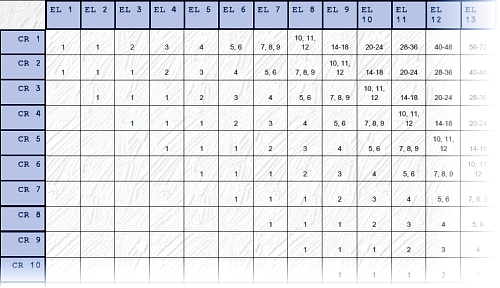
Click on the illustration for a larger view in a new window

Table Structure

Let’s start by examining the chart itself. At first glance, it’s fairly straightforward; we have CR down one side and EL across the top. The meat of the table are the cell contents, and closer study reveals some interesting (and useful) patterns. But let’s not get ahead of ourselves, here.

The Rows

Each Row indexes results for a given CR or character level. The number shown in a cell is the number of creatures of that CR that are needed to achieve the EL shown at the top of the column.

This gives a completely different structure to that of the table on page 49 of the DMG, even though they are talking about the same thing. The official table has Number Of Creatures across the top, EL down the side, and CR in the cell contents. It looks like this:

Both tables are talking about the same thing, but I find the layout that I have used to be more useful, for reasons that will become clear as this article proceeds, and I have extended the table much further than the official one.

The Relationship between columns

The columns index results for a given EL. The DMG states that if a certain number of creatures give a particular EL, twice as many creatures will give an EL that is two higher than the first. In other words,

If EL(N) = N creatures at CR(X), then EL(N+2) = 2 x N creatures at CR(X).

Mathematically, that in turn means that

EL(N+1) = Sqr Root (2) x N creatures at CR(X) i.e. = 1.414 x N creatures at CR(X).

That is the foundation apon which the table has been built.

The Cell Contents

When I created the table, I started with the values given in the DMG’s much smaller table. I used the values given and the relationship defined above to extrapolate the table both across and down.

When you examine the actual table, though, there are a couple of aparrant anomalies, and those bear further examination.

What’s with the three “one’s” in a row?

If you examine the table on page 49 of the DMG, you’ll find the same thing, at least at higher EL entries. The first one is actually 1/1.4142 or 0.707, rounded off; the second is a legitimate “1”; and the third is actually 1.4142 rounded. Most of the time, the middle “1” is the “1” that you will use, but there are times when all three of them are valid.

The Extreme Right

The relationship is made even more explicit on the far right-hand side of the table. When the numbers started growing too large to fit conveniently into the table, I started stating them as a multiple of the last two numbers explicitly stated. So, looking at the top line (CR1 creatures) we have an entry that reads “2 x EL17”, followed by “2 x EL18”, “4 x EL17”, “4 x EL18”, and then “8 x EL17”, and so on.

Looking down the table shows some interesting patterns in this area as well – there are two entries that say the same thing, followed by two more at +2 EL. Look down the EL24 column, for example. When I first noticed this, it was so unexpected that I had to double-check and triple-check it, but it is correct.

The Pattern Of Repetition

Of course, the most obvious pattern is that each line is exactly the same as the line above it, but shifted one space to the right.

These patterns make it easy to extend the table as necessary. Cell 21, 21 is the same as Cell 1,1. Nevertheless, the table that I have prepared anticipates future needs by going all the way up to EL75 – I am running campaigns at the moment that are expected to head into Epic territory!

Definition of a fair fight

The objective of the table is to enable the GM to construct encounters that represent a fight that is fair, and that permits the characters to receive rewards commensurate with the difficulty of the fight. If the characters are outmatched, they receive more rewards for success; if the enemy is outmatched, the characters should recieve a smaller reward. The success or failure of this system hinges on a GM being able to recognise fights that are fair, and judging the encounters he creates relative to that standard. That’s what this table is there to do.

So just what is a “fair fight”? Once that is defined, the relationships within the table do the rest, so it’s important to get this right. In my book, 4 characters of level X verses four more characters of identical level qualifies; which means that a fair fight is one in which there is (in theory) a 50/50 chance of the characters losing.

In practice, the chance of losing is a lot less. Players have a lot of time to plan their level progressions and feat choices, to optimise their character designs, and are focussed on a single PC at a time; the GM has to create his oppositions on the fly, or close to it, and – in that ‘fair fight’ situation, has to operate and coordinate four characters at once, as well as handling all the other administrative and judgemental requirements of the position. Depending on how much prep time and experience the GM has, the player’s chance of victory in a ‘fair fight’ might be 90% or more.

But it is not fair to the players to take that into account, because it’s a moving goal post. Sometimes, the GM will get the tacticals right, and the chances of PC victory will swing in the other direction, given the advantages that he can confer. The EL-CR chart is just a starting point.

The same thing measured the same way

Okay, so if four PCs of level X are in a fair fight when opposed by four NPCs of identical level, we need some mechanism of translating everything into a character-level equivalence. That, in theory, is the CR, or the character levels plus any racial level adjustment of the enemies opposing the PCs. This is a contentious issue, as revealed in my previous post A Slippery Slope: Level Adjustments Under The Microscope. I don’t intend to go over the ground of that post again; suffice it to say that you need some mechanism by which you can take an encounter of nominated CR and convert it into a character-level equivalent. What the process of achieving that equality might be is beyond the scope of this article.

What Is An EL?

Here, once again, I have to skirt contentious territory. An EL is a measure of how effective a combined force of characters is in battle. I use the term, and calculate the measure, in the same way for both “allies” and “enemies” in a battle. The concept is that you can (theoretically) combine the effectiveness of individuals of different power levels in order to determine the overall effectiveness of the group.

In other words, equal EL values on both sides should give us our hypothetical fair fight.

The purpose of the EL-CR table is to take individual power levels (CR) and facilitate the measurement of the overall power level (EL). We can then use this as a foundation point for creating battles that should test the PCs.

A gang of four

For some reason – a subject for a completely different blog post sometime (and duly noted as such) – a standard party is generally assumed to consist of four members. So let’s start examining how the EL-CR table works by looking at the simplest such case: four characters of the same level.
To determine the EL of the resulting party, find the row that matches the levels of the characters, then cross until you reach the cell with “4” in it (the number of characters of that level), then go up the table to read off the EL from the heading of the column.

The example shown demonstrates that for four characters of level 3 (ie CR 3), the EL is 7. And, in fact, if you examine the example more closely, you will see that each +1 to the level of the four characters also raises the EL by 1 – so the EL for four characters of level 2 is 6, and of four characters of level 4 is 8, and for four characters of level 16 it will be 20.

In fact, the EL of any group of 4 characters of equal level is always 4+level. Not that this should be a surprise, since we defined the progression as 2xL = EL+2, back in the blue box above! Obviously then, 4xL will be EL+2+2, or EL+4.

With A Ringer

The same example shows quite clealy the effect of adding a 5th character of the same level, simply by following the same procedure as above. A five characters of level 3 takes us to the cell just past the one with the “4” in it, into the cell which reads 5-6; and going up to get the EL shows us that the result is EL8. In fact, it should be slightly below EL8, while 6 would be slightly above, but the numbers are so close that they both round to the same thing.

Gaps In The Table

Another thing that you might notice after examining the example above is that there are gaps in the table. What are 13 characters of 1st level worth as an EL, for example? The cell that gives EL 8 reads “10, 11, 12” and the cell for EL 9 reads ’14 to 18′! And, if you can make it out, the cell for EL 10 reads “20-24” – so you might be asking what I have against the numbers 13, and 19, and – for that matter – 25, 37, 38, 39, and 49 to 55 – to name just a few.

The answer is that I have nothing against these numbers of foes, but they fall into regions where the EL is not quite right either way. This table was derived from the official one in the DMG given above, and represents a statistical analysis of these numbers of characters – and some numbers are neither one nor the other.

I could have revised the table to cover the entire field, growing the boundaries of each area enough that there are no gaps, but I decided not to do that; instead, I offer three alternative policies for the GM to use in this situation:

  1. use the average of ELs that fall in between, effectively defining an ad-hoc EL of “Eight-and-a-half” or whatever; or,
  2. use the higher number for lower-level characters and the higher one for higher level ones in the same party (this is getting into more complicated territory that will be addressed in subsequent sections of the article); or,
  3. use the higher of the two numbers and then drop the CR of one of the creatures by 1. This is a fudge, but it’s not far off the mark.

Or, of course, you can always contrive never to use an encounter that falls into the gap – but I don’t believe in the limits of the system confining a referee’s options to that extent.

A more complicated question

It’s actually a fairly rare situation, especially when rating encounters that the GM has created to oppose the players, for every character in a group to have exactly the same CR. In fact, it’s often not the case even for PC parties. So what’s the procedure for more complicated mixes – say, a group consisting of three 2nd-level characters, plus one 3rd level character, plus two fourth level characters, plus a fifth level character?

Nonclemanture

Now that we’re getting into more complicated situations, the first thing to address is the way that these are described. Actually spelling something out – like our example question – takes up far too much space and takes too long. I long-ago started using the “@” symbol to mean “at” and leaving out the word level; to me, and to most people, the meaning of the result is immediatly obvious. But there were people who were confused by it the last time I abbreviated things in that way, so I thought I would take a moment to explain it.

Our example problem can be stated:

3 @ 2 + 1 @ 3 + 2 @ 4 + 1 @ 5 = ?.

If you don’t follow that, remember that “@” means “at”, and just read it left to right. You will end up with something that is remarkably similar to the long form used at the end of the previous section.

Lowest Common Denomenator

Okay, so on to the actual methodology of using the EL-CR table to analyze this compound force. The first step is to identify a common denomenator. It’s usually most convenient to actually use the Lowest common denomenator, but some people panic when that term is employed.

In this case, it’s just a fancy name for the lowest CR in the compound group. In this case, the lowest CR of any member of our force is 2.

Translating to the common denomenator

All we have to do is go down the left-hand column to the CR of each item on the list, go across until we find the appropriate number of characters of that level, then go up the table until we get to the line that describes our common denomenator. Then write down the number in the cell.

Taking our example item by item:
3 @ 2: Since CR 2 is our common denomenator, we can simply write down “3”.

1 @ 3: Go down the table rows to CR3, then across until you get to a “1”. Problem: there are three of them in a row: which one do we use? If I have the time, I use all three, and write the result as a range; if I need a quick and dirty solution, use the middle one. Then go up one cell and write down the numbers in the cell belonging to the “CR 2” row. The first of the three ones gives a “1”; the second also gives a “1”; and the third gives a “2”. So I would usually write 1-2, but if in a hurry, I would use a 1.
2 @ 4: This is actually the item that I chose to illustrate this process. Go down to CR4 and across until you find a two and then up to the row that describes CR2, as shown, and you will find that the number in the cell is “4”.

1 @ 5: Again we encounter the “three one’s”. The first gives a “2” on the CR2 row, the second gives a “3”, and the third gives a “4”. So I would normally use 2-4, but if I was in a hurry, I would just use 3.

All this can be written far more succinctly:

3 @ 2 = 3 @ 2
1 @ 3 = 1-2 @ 2
2 @ 4 = 4 @ 2
1 @ 5 = 2-4 @ 2

Mixing the compound score

The next step is to add up the results. If any of your numbers shows a range, your result should also be a range. So:

3 +1 +4 +2 = 10; and 3 +2 +4 +4 = 13. The result is a range of 10-13 – at “CR2”.

In other words, this combined force is the equivalent of 10-13 second-level characters.

A measure of efficacy

The final step is to locate the cell on the table that best describes that result and go up the column to the EL of the compound force. While there is no entry for 10-13, there is an entry for 10-12 characters of CR 2 – so our example has an EL of 9. That means that anything in the EL 9 column would be a fair fight for this particular combination of characters or creatures – and this combination would be a fair fight for anything else in this column.

That might be a single foe of CR 8 to 10, or two foes of CR 7, or three foes of CR 6, or four of CR 5, or 5-6 of CR 4, or 7-9 of CR 3, or 10-12 of CR 2 (by definition), or 14-18 of CR1.

Or even a different compound that converts to a lowest denomenator matching one of the EL9 entries.

More Difficult Conversions – Small CRs

Some creatures have CRs of less than 1 – there are examples with CR 1/2, CR 1/4, and CR 1/10th. To use these low CRs, simply multiply the numbers in the “1” column by the number under the “/”.

An EL 9 encounter – to continue with the example – consists of 14-18 CR1 creatures, as stated above; or 28-36 creatures of CR 1/2; or 56-72 creatures of CR 1/4; or 140-180 creatures of CR 1/10th.

More Difficult Conversions – bridging Totals

There will be occasions when the total you come up with will bridge a gap in the table.

The combination of 4 @ CR 6 + 1 @ CR 9 gives a total of 6-8 characters at CR 6, for example. That bridges two EL columns – there is an entry for 5-6, and an entry for 7-9, giving EL 11 or 12.

There are a couple of different ways to handle this.

  • One is to reduce the size of the span by “1” on each side of the range until you get a single answer. So if we have a range of 6-8, adding 1 to the 6 and subtracting 1 from the 8 would give us a smaller range of 7 – which puts the result firmly in the EL 12 column.
  • Another is to simply find the mid-point of the range by averaging the two extremes – the results are the same in this case.
  • I don’t like either of these approaches; there is too much risk that the average will land in a gap in the table. I have found that the range of ELs result is actually an accurate reflection of something more important: the sensitivity of the result to the power of the single CR 9 party member. It’s his combat effectiveness that is actually clouding the issue, and that reflects the fact that character prowess equivalence at a given class level is only an aproximation. If the CR9 in our example is ever-so-slightly better in combat than most, the party combination is equivalent to 8 characters at 6th level; if the character is ever-so-slightly less than normal at level 9, the combination is equivalent to 6 characters of CR6, and there is a middle ground.

The best approach is to take the result literally – hit the opposition with a force composed of 6 characters of CR 6, and have two more (or equivalents) “in reserve” that can show up in the middle of the fight if the opposition seem to be winning too easily.

This not only preserves the accuracy of the results, it makes the battle feel more real; instead of being a set challenge, with fixed force strengths, it makes combat more dynamic.

In effect, this is actually a consequence of the rounding errors that produced the “three one’s” anomaly that was discussed earlier. If the CR9 participant is slightly less combat-effective, he only counts as 0.7 of a typical CR9; and if he is slightly more combat-effective, he actually counts as 1.4 of a typical CR9.

What’s more, this variability is not fixed; it will vary from encounter to encounter, depending on the specifics. If the targets have a resistance of some sort to the best attack of the CR9, he will be equivalent to the “0.7 of a CR9” character; if they are more vulnerable to it, he will be equivalent to the “1.4 of a CR9”. An example of the latter is Undead vs a CR9 cleric.

Judging this ahead of time is where the artistry of encounter design remains significant. It might seem that this table reduces encounter design to a science – it doesn’t.

More Difficult Conversions – Spanning Totals

It’s also possible to achieve totals that span three EL columns.

This usually only occurs in one of three circumstances:

  1. There is too big a difference between the common denomenator and the most powerful combatant;
  2. There are low numbers of characters, so that the “three ones” have scope to have a big impact;
  3. There are a lot of creatures, so that the spread of ranged results becomes very broad.

The best solution to this situation depends on which of these causes is responsible, so the first step in resolving this situation in identifying the cause.

Spanning Totals due to CR difference

I’m including this cause as it is one that many people who have seen the table seem to think is real, even though I will prove that it doesn’t actually exist. To illustrate this problem, let’s say that you are designing an encounter group that consists of 1@CR2 + 2@CR6 + 1@CR9 + 1@CR11.

1 @ CR 2 = 1 @ CR 2
2 @ CR 6 = 7-9 @ CR 2
1 @ CR 9 = 7-18 @ CR 2
1 @ CR 11 = 14-36 @ CR 2
totals = 29-64 @ CR 2 = EL 12-14.

If you actually work through the process of getting the above results using the table, you will find that the real problem isn’t the CR difference; it’s the number of “1 @” in the encounter group. To prove this, let’s ignore the lone CR 2 character and rework the problem:

2 @ CR 6 = 2 @ CR 6
1 @ CR 9 = 2-4 @ CR 6
1 @ CR 11 = 4-9 @ CR 6
total = 8-15 @ CR 6 = EL 12-14.

Heck, we can even ignore the CR 6 duo and get almost the same answer:
1 @ CR 9 = 1 @ CR 9
1 @ CR 11 = 1-4 @ CR 9
total = 2-5 @ CR 9 = EL 11-14.

These two top-heavy (in CR terms) characters are causing the spread, for the reasons previously described. The presence of the lower-level party members is actually helping to stabalise the result.

Cause #1 of the spanning problem doesn’t actually exist – it’s an illusion, another case of Cause #2. Whatever solution works for that cause will also work here.

Spanning Totals due to the “three ones”

This is, as demonstrated above, a real issue. It’s also one that has been addressed previously, in the discussion on “bridging totals”.

Statistically, the more characters you have, the more these little variations will even out. That’s why there would be no issue if the compound was 5@CR6 + 3@CR9. But when we’re dealing with small numbers, like we are in a 2@CR6 + 1@CR9 + 1@CR11 – which is effectively the example mooted in the previous section – individual variations have too much scope. And there is too wide a gap to be handled by using “reserves” in the way I proposed in the section on “bridging totals” – the “reserves” would be greater in number than the main encounter. How many of them do you use at once? Far from creating additional realism within the combat, it just starts to get tiresome and dreary. “Another patrol of 15 Kobolds springs from the side tunnel.” “Again? This is the 5th patrol of reinforcements, enough already! Besides, I thought Dave blocked that side tunnel last round.”

The solution in this case is to strip away the rounding errors and go with your best guess as to where the two high-level characters will fall on the 0.7-1.4 continuum. You have three choices: 0.7, 1, and 1.4.

Once you know that, you will cut down the variability of the results enormously, and get back to a practical result.

Let’s say, for example, that the CR 9 member of the encounter group is a combat monster, easily able to trounce characters of his own level, while the CR 11 member is more typical of his class level. In this case, you would use the highest of the three “one’s” for the CR 9 and the middle one for the CR 11.

Instead of (reproduced from the earlier section),

2 @ CR 6 = 2 @ CR 6
1 @ CR 9 = 2-4 @ CR 6
1 @ CR 11 = 4-9 @ CR 6
total = 8-15 @ CR 6 = EL 12-14,

we have:

2 @ CR 6 = 2 @ CR 6
>1 @ CR 9 = 4 @ CR 6
=1 @ CR 11 = 5-6 @ CR 6
total = 11-12 @ CR 6 = EL 13.

Note the use of the equals sign to indicate the middle choice and the > sign to indicate the high choice in this example. Or, if it was the CR 11 who was the combat monster, and the CR 9 who was typical:

2 @ CR 6 = 2 @ CR 6
=1 @ CR 9 = 3 @ CR 6
>1 @ CR 11 = 7-9 @ CR 6
total = 12-14 @ CR 6 = CR 13-14, a result which bridges a gap in the table. In accordance with the procedure outlined previously, I would use CR 13, but hold an additional 2 CR 6 opponants in reserve to us in the event that the fight proved too easy.

This last example shows why it is not a good approach to simply “pick the middle one” when you get a result spanning three (or more, theoretically) ELs.

Working Backwards

Okay, so let’s say we have a party of 4 characters, all of CR 6. That gives them an EL of 10, which defines a whole column of opponants that would provide a fair fight. We can go up an EL for a harder fight, or down one for an easier fight.
The big problem is that all the opposition combatants have to be the same level – if there are 4 of them giving an EL of 9 (easy fight), each has a CR of 5 – you can find that out by finding the EL column that you want, going down until you get to 4 enemies, then tracking across to get the CR, as shown in the example above.

But how do you work backwards from an EL to get a complex compound of opposition that still represents a fair fight?

There are two approaches: the high CR approach and the low-CR approach. I’ll demonstrate and explain each one seperately; I use both of them regularly.

A third approach is the brute-force approach, where you start with something that sounds about right and tweak it until it adds up to the EL that you want. That’s a lot of work, which is is what these procedures aim to avoid, so I don’t recommend it.

Working Backwards using the High-CR Approach

In this approach, the GM defines equivalences, splitting the encounter into equal shares of difficulty and then determining what CRs and how many enemies at those CRs are needed to achieve the total EL. This approach is somewhat easier but less flexible than the Low-CR approach that follows.

How many shares?

The first step is to decide how many equal shares the required EL is going to be split into. The most common values are 2, 3, or 4. Another good choice is to make the division by the number of characters on the side of the “allies”, ie the group that this opposition will be fighting – that usually means PCs and their allies. In theory, that means that each PC will have an equal opportunity to contribute; using a lower number means that one or more members of the opposition will be fighting multiple members of the allies. This creates an opportunity for the PCs to employ tactics to their benefit. A higher number means that each member of the allies will be faced with multiple enemies, possibly giving the opposition a tactical advantage at least initially.

For an example, I’ll use three, and work with a goal of EL10.

An even split

The next step is to break out the EL-CR chart, locate the EL10 column, and find the entry for 3. That row gives the maximum CR of a single member of the opposition force.

EL10 = 3 @ CR 7.

The first equivalence

So the first part of our compound of enemies is 1 @ CR 7. The others are all at a lower CR than this. The next step is to define the first equivalence – that is, a CR that is less than the maximum. It’s easiest to drop the CR by a multiple of two, so for this example I’ll drop it by 3, and say that our second teir of opposition will be a number of CR 7-3=4 enemies that are equal in power to a single CR 7.

Since a single CR 7, by definition, is the same thing as EL 7, all I have to do is go to the EL 7 column and go down until I get to the row that matches CR 4. The value in the cell will give us our second line of the compound. The answer to this is three, so the second line of our compound reads “3 @ CR 4”.

Intermediate equivalence

In the case of this example, the next equivalence is also the last equivalence. If I were dividing the total EL into 4 or more pieces, there would be another one to follow. I use a different procedure for the final equivalence, so the information in this section will be theoretical.

We now have a maximum CR of 3, because this subgroup of opposition are defined as having less personal power than those of the previous tier, which we set at CR 4. For the sake of example, I’ll choose CR 2.

Again, all I have to do is work down the EL 7 column until I get to the CR 2 row and read off the number of enemies. The table shows 5-6, so I can choose either 5 or 6 enemies at CR 2 to be the third tier. If I had chosen CR 1, the answer would have been 7-9, and I would probably have chosen 8 as a nice intermediate number, or I could have shaded the difficulty one way or the other ever-so-slightly by using one of the more extreme values. Another option would have been to choose 7 as the number of characters and keep two CR2’s in reserve; they probably wouldn’t make that big a difference to the battle, but coming in once the party are weakened by the battle, they could have an impact.

The final equivalence

There is an inherant fuzzyness about the results that are achieved during the equivalence stages. In theory, that fuzzyness gets smaller with each step, but the final equivalence is obviously the last opportunity to get exactly the total effectiveness that is desired.

That calls for a slightly different approach. Instead of looking at achieving an equivalence to the other elements of the compound, the technique is to determine the total effectiveness needed at our minimum CR to get the total effectiveness we need.

Let’s say that the minimum CR that we’re talking about is CR 1. According to the process detailed for intermediate equivalences, above, which does not allow for the fuzzyness of results, we would get a total of 7-9 characters @ CR 1. Let’s see what we get when use the final equivalence approach.

I start by looking up the value of our total EL at the target CR. I then subtract the values of each of the intermediate stages already defined, also at the CR 1 value. The result is the precise number of CR 1 characters needed to achieve the target.

EL 10 gives 20-24 CR1 characters.

1 @ CR 7 is equivalent to 5-12 characters at CR 1. This is a spanning total, which means that we need to refine the CR 7 to just one of the three “ones” available. In this case, let’s assume that we’re talking about a typical CR 7; that means that we choose the middle “one” and get:

=1 @ CR 7 = 7-9 @ CR1.

Next, we have 3 @ CR 4. So we go across the CR 4 line until we get to the cell with a “three” in it, then go up to get the CR 1 equivalent.

3 @ CR 4 = 7-9 @ CR1 – which we should have expected.

So, subtracting 7-9, twice, from 20-24, will give us our answer – well, almost. Do we subtract low from low and high from high, or high from low and low from high? Is the low value of our results range 20-7-7 or 20-9-9? The first gives a smaller range, the second gives a broader one.

Ultimately, it doesn’t matter; one (20-9-9 & 24-7-7) will reduce the size of the initial force, but increase the number of reinforcements; the other (20-7-7 & 24-9-9) will reduce the size of the reinforcements, but the encounter will start with more low-level participants present. I use both, jusging the results by the specific circumstances – if those circumstances make it more appropriate for few low-level flunkies to be present at the start of combat, I use the second choice, otherwise I use the first. And if I can’t make up my mind, I split the difference: 20-8-8 and 24-8-8.

Just to complete the example, let’s assume that I chose the first of the options listed; the range of results is, therefore, 20-9-9 to 24-7-7, or 2 to 10 @ CR 1. That’s a very different number to the result that was derived from the intermediate methodology, i.e. 7-9. And its all due to evening out the fuzzyness.

At the end of the high-CR approach, we end up with:
total = EL 10 = 1 @ CR 7 + 3 @ CR 4 + 2 @ CR 1, + reinforcements 8 @ CR 1.

This would work well to describe a villain, three lieutenants, and a couple of bodyguards/servants, plus eight enforcers in the next room that will join in the fight part-way through the fight.

Working Backwards using the Low CR Approach

The other way to go about it is to work from the bottom up. In effect, to use the circumstances described previously, this methodology asks “how many flunkies?”, then “how much is left for lieutenants?”, and finally, “how much is left for the boss?”.

The fundamental

The first step to employing this approach is to decide how low the CR of the flunkies is going to be. The combination of our EL and that CR will give the basic parameters against which everything else will be measured.

EL 10 = 20-24 @ CR 1.

If CR 1 is our minimum EL, then 20-24 is our fundamental. We then get to split that up into the ratios that best express our goal, using the standard ranges given on the CR1 line.

Allocations

Let’s say that we dedicate 14 of that 20-24 to flunkies. That leaves 6-10 for everything else. Of that 6-10, we can put 2 of them toward a lieutenant – just one of them – leaving 4-8 for our head villain of the encounter.

Conversions

In this step, the allocations are converted into actual encounter elements. I have reproduced the table extract again so that you can follow along.

We don’t have to convert the flunkies, since they are automatically at the level we defined.

So we start with the Lieutenants. Going across the CR1 row (because that’s what our fundamental was measured as), we find the cell that contains a “2” – it’s the EL3 column. We then go down the column until we find an entry with a “1” in it – there will be three of them in a row. We can choose any one of the three that we want, but whichever one we choose, we next have to choose the opposite. If there is no “next time” to even things out, we have to choose the middle.

Let’s choose the first one (ie the lower CR) for the lieutenant, so that we’ve got a stronger main bad guy. The CR that is the first to show a “1” in the EL3 column is CR2.

Next, we repeat the process with the head villain. Immediatly, we are confronted with a problem: a range of 4-to-8 spans three columns, there’s a four, a five-to-six, and a seven-eight-nine. Because we chose a low value for our lieutenant, we need to even that out by choosing the higher value on our next choice. so we choose the seven-eight-nine cell, which is in the EL7 column. We then drop down until we get to the cells with “ones” in them. Since we have no choices to even out, we have to pick the middle option – and that gets us CR 7.

So our total using this approach is: 14@CR1 + 1@CR2 + 1@CR7.

The strength of our main bad guy hasn’t changed, but we’ve lost one lieutenant and weakened the other in return for more flunkies.

Multiples

What if we had wanted more than 1 lieutenant? If we had wanted two, then we would have dropped down to the cell that contained a “2” instead of one of the cells that contained a 1 when converting the lieutenant – and that would have given us a CR of 1 for the lieutenants, because we hadn’t allocated enough power to them, we had it all in the flunkies and the big bad guy.

Why is this more flexible?

The first system is simpler because it equates every subgroup within the group to the same effective power level. This approach is more flexible, and often less work, but requires the GM to make decisions about the makeup of the opposing force without being entirely sure of what the consequences will be; the consequence of the choices made in the example is a lieutenant that is not much better than the flunkies.

Of course, if you don’t like a result, you can always change your allocations with the benefit of hindsight. Dropping the head bad guy’s allocation to 5-6 would have left more room for the lieutenants to be reasonably powerful. Then you select the number of lieutenants so that individually, they are weaker than the head villain, even if the combination is more powerful.

You can alter the combination any way that you want to. That makes it more flexible – and more decision-driven. If it’s an easy answer you want, stick with the High CR approach.

Tweaking Encounters

It is possible to further refine the encounters produced by the system. Giving one side a tactical advantage could be reflected by increasing the EL of that group of combatants. A character whose abilities are more at home in an urban environment may get an effective CR increase in such an environment and a reduction in a more natural setting – and vice versa. These refinements are appropriate because the objective is always to define “a fair fight”, and these circumstances alter the combat effectiveness of the group.

Encounter Ranges

Not every combat needs to be a “fair fight”. Some should be easier, some more difficult. Knowing what constitutes an even fight gives an invaluable baseline from which to work, nothing more. So how far should GMs generally range from the “fair fight” value?

To some extent, this will vary with circumstances. Hitting the PCs with even a moderately difficult encounter may be extremely difficult for them if they have been weakened by prior battles and given no chance to recover. A succession of moderately-difficult encounters leading up to a major encounter can add to the difficulty of that major encounter by consuming resources. There remains an element of artistry in the way one encounter is connected to another which no analysis tool can replace.

I consider it quite routine to hit the PCs with an encounter that is 1 EL higher or lower than the “fair fight”.

It is less common but still not exceptional to employ encounters that are 3 ELs higher or lower than the “fair fight” value.

It is quite rare but still not out of the question to employ encounters that are 5 ELs removed from the “fair fight” standard. However, I would not do so without building a substantial advantage into the weaker side or a substantial disadvantage into the stronger; an anarchic situation in which there is conflict or even actual battle amongst members of the opposition, so that the PCs are not expected to win the fight outright but only overcome whatever is left after the major enemies have fought it out, for example.

Circumstances would have to be extraordinary before I went further than this; and there would be many warnings delivered along the way. Nevertheless, overconfidence may lead to really extreme situations, in which case, let the chips fall where they may!

Let’s be clear about what these ranges actually mean: if a “fair fight” is EL 10, consisting of 10-12 foes at CR 3:

  • EL 9-11 ( = 7-18 foes at CR 3) is routine;
  • EL 7-8 ( = 4-6 foes at CR 3) or EL 12-13 ( = 20-36 foes at CR 3) are acceptable;
  • EL 5-6 ( = 2-3 foes at CR 3) or EL 14-15 ( = 40-72 foes at CR 3) are rare but also acceptable, if the weaker side is strengthened or vice-versa.

The extremes range from roughly 18% of a fair fight to 6 times a fair fight. That’s a fairly wide span!

Even when considering such extreme ranges, the information given by the EL-CR chart is useful, giving some indication of how much of an advantage should be given to bring the results back to an acceptable challenge.

So that’s how I use the EL-CR Chart. And now you can, too.

Comments Off on Let’s Have A Good Clean Fight…

Ask The GMs: Puzzles In Your Games


Ask the gamemasters

William Wiese asks the GMs, “I’ve been trying to think of different ways to implement puzzles into the game and to find some that are not riddles.”

Ask the Game Masters - Johnn

Johnn’s answer:

Puzzles are tricky beasts, William. And thanks for the question; it’s a good one.

Tricky bit #1

My tips below will assume your group is ok with using players’ intelligence and knowledge to solve in-game puzzles. This is often a sticky point, and if you are adamant about PCs only using in-character intellectual abilities then my advice might not help.

For example, you might offer a math puzzle, but the PC might have no character points invested in any kind of math or science skills, and would therefore be math illiterate. In my game that’s ok as we all enjoy solving puzzles and using our real world minds to solve them, even if the PCs technically do not have the ability or knowledge.

Tricky bit #2

Another gotcha involves justifying the existence of the puzzle. Does it make sense to the plot, NPCs and setting? My tips will assume whatever implementation you decide for the puzzle types you offer players works well in your campaign. For example, why would a wizard put a math puzzle to lock a special door? In my current campaign, that would be a good option because other than addition or subtraction, most people other than merchants and engineers cannot solve math problems and puzzles. Therefore, a learned NPC could get away with a math puzzle as a lock, secure because only a rare few could hack it.

I’ve read modules and heard of campaigns where puzzles are used in illogical ways that do not accomplish their purpose, such as securing a portal, disguising the location of something important or acting as proof of faction membership. A frequent justification for puzzle use involves crazy wizards, evil NPCs setting up obstacle courses and challenges for perverse pleasure, and fey having fun with mortals.

These implementations become flimsy and trite after awhile, so just a word of caution. Do not let the desire to use a puzzle ruin the integrity of your campaign. Employ puzzles only when they make sense, accomplish their in-game purpose and do not stretch players’ sense of disbelief.

My suggestions below only offer puzzle ideas and not ways to implement them sensibly in your campaign. I’ll leave that part up to you, based on your group’s preferences.

Visual puzzles

The players must look at the puzzle to solve it. You can find lots of these kinds of puzzles at book stores. Go to the games section and flip through various books there to see what inspires you. Here are a few examples of visual puzzles that translate well into gameplay:

Hidden object games

Hidden object pictures are my favourite type of visual puzzle. These play out like Where’s Waldo puzzles. Players must find an object cleverly drawn and hidden in a picture. I have a few of these books, and gameplay is simply handing the picture to the group and they must find the hidden object:

I recommend increasing the challenge by making a puzzle of what object the players must find on the page, as most of these types of puzzles have multiple hidden items per drawing. For example, say a lion is embedded in a painting with several hidden animals in it. Google for a poem or riddle about lions, then offer the verse as the clue about what animal the players must find in the picture. The picture in-game could be a painting, mural, scroll or design on just about any item. Pressing on or naming the correct animal opens the gate, pleases the King or does whatever you need a successful answer to do.

To add even more challenge, penalize the PCs for a wrong answer. This pressures them to get it right the first time, else they can spend all day finding and testing all objects hidden in the picture.

That brings us to an alternative version of hidden object puzzles where players must identify all items disguised in the drawing to solve the puzzle. Players might be given a list of items to spot, or just be told to find everything and stop when convinced they’re done. Missing one or more hidden items fails to solve the puzzle or causes a penalty, such as damage per item missed or restricted entry to certain party members only.

Mazes

Mazes make good visual puzzles. I do not like GMing mazes in the standard way, and do not recommend any GM maze their players either, as the mapping task soon becomes tedious and locks non-mappers out of gameplay. Instead, get a book of mazes and try two alternative ways of running them.

Maze option one: plot your path. The PCs are presented a maze on paper, as a painting or what have you. They must trace their way out. You might allow a limited number of restarts then the puzzle shuts off for a period of time or some other penalty occurs, or you could penalize dead-end routes with an encounter.

For example, the PCs come upon a locked door with a maze pattern on it. Hand players a maze from your book of mazes or a printed downloaded maze. Tell them they must trace a finger through the successful route. Getting stuck in a dead end sounds the alarm and summons guards or magically summons a guardian. Players can study the maze for as long as they want, but once they touch it and start tracing their path, they cannot remove their finger or it counts as a failed attempt. Give players a pen, work with a copy of the original maze, and have them draw a continuous line to represent the route their finger takes.

Maze option two: guided walkthrough. One PC can see the maze from above. Perhaps they are locked in a cell with a window, or are in an observer’s booth. The other PCs are on the ground at the entrance of the maze. The guide PC must talk their party members through the maze. Put encounters and traps along false paths. The guide can only offer his teammates verbal commands, and the teammates cannot see the maze pattern and can only traverse within it.

Brain teasers

I have a 2006 calendar of daily brain teasers. About 1/3 are of the visual puzzle variety. And many of these are translatable into interesting gameplay. For example, there are a couple of jump-the-peg puzzles where the object is to reduce the number of pegs to one by jumping pegs over each other into empty slots and removing jumped pegs.

For your puzzle, you might offer a lock where the PCs are offered buttons to push as the pegs. When a button gets pushed, other buttons pop up in positions where that button could “jump” to, and players push the desired destination button. Buttons that get jumped over automatically depress themselves, leaving only remaining “pegs” as popped up and pressable. This push lock type puzzle opens when only one button remains popped up.

You could theme a whole dungeon or area like this, by offering the same button lock puzzles on important doors (from experience, it takes a few tries to get good enough to solve the puzzle right the first time each time), and then by offering different configurations. My brain teaser calendar offers a triangle pattern and a single line pattern.

Check out this page for lots of great patterns.

Other brain teasers in the calendar include spotting things in optical illusion puzzles and pattern puzzles. Shop around in used bookstores for brain teaser books, or look for brain teaser and puzzle desktop calendars in January when they’re discounted.

Mechanical puzzles

Game stores abound with different types of physical puzzles. Even Dollar Stores and Wal-Mart carry cheap puzzles like this.

Ring puzzles require players to figure out how to disentangle or connect rings. Perhaps a chain bars the entrance to a vault and the chain is connected by rings that can be disconnected if puzzled out correctly.

Got a Rubik’s Cube stashed in a basement box? That makes a nice Cube of Force, or key or planar travel device. Offer players solutions and then have them put the cube into certain patterns to achieve various outcomes. Part of the puzzle comes from learning what patterns produce what results. When the cube gets used under duress, you impose time limits to create a desired pattern, else the PC’s turn is delayed or lost.

Other puzzles can work in the same way, such as box puzzles, rope puzzles and slider puzzles.

Last campaign I used a block puzzle with success. 6 rectangular wooden blocks with notches in them could be put together to form a cube. Players first had to quest for each wooden block, spread and forgotten throughout the region in various lairs, vaults and possessions. One piece was in a shaman’s headdress, for example, and the PCs managed to first become allies then fulfill a quest to get the block from the shaman. With all pieces recovered, the PCs then had to figure out how to assemble the cube, which then had to be presented in the right location to unlock the entrance to an ancient inter-dimensional prison.

Math puzzles

Sequences and patterns of numbers make good puzzles. Abstract one level further so the PCs must work with numbers of *things* instead of just pure numbers to solve the puzzle.

For example, on the altar of an elven god of war is a picture of goblin heads, hobgoblin heads, orc heads and gnoll heads, with these numbers underneath: 1 2 4 8 _. If the PCs place 16 heads of any of those creatures on the altar then the altar’s power gets unlocked.

Math puzzles also make good lock combinations, but if word spreads about what number the solution is, then thieves and interlopers need only remember the number and not have to figure out the math problem. Perhaps a better lock involves randomly changing math puzzles.

Sudoku puzzles offer interesting opportunities. First, the PCs must solve the puzzle. Next, the completed puzzle could be a clue or map. For example, the center squares of the solved grid might offer coordinates of the McGuffin. Or, in a room filled with traps, the completed puzzle shows you what tiles to step on – just follow the odd numbers to the door across.

Sages and scholars might offer up math puzzles at fairs or as contests, perhaps as a test of admittance into their orders. Could be a pompous sage wants to prove he is smarter than everyone and offers a math puzzle in public and challenges someone to solve it.

Math is a language. Engineers would use math in their normal plans, creating natural puzzles for the PCs to figure out without the aid blueprints. For example, a treasure might need the central focus of sun energy from four pyramids each of which is a mile apart. But the land between the pyramids is empty desert. Then the PCs realize from exploring a pyramid that sand has half buried the structures over time. Armed with new numbers to input into their equations, the group finds the exact centre spot and digs precisely 74 feet down to find the glorious treasure, which is actually the entrance to a pristine but well-trapped and magically guarded tomb.

If your mind did not wander during geometry class like mine did, then you can use natural math and design calculations to become puzzles for mathematically inclined players.

Word puzzles

As a word nerd, I highly recommend this class of puzzles to you. You can abstract words to create puzzles two or more layers deep, or just go with a single dimension puzzle.

For example, I once ran a crossword puzzle as an adventure. The PCs first picked up the clues during the investigation of a murder. “1 Across: dungeon.” “3 Down: Abyssal resident.” Each clue was left by the murderer as a calling card. Some clues were left in locations, others left on victims. With all clues in hand, the last tid bit found was the empty crossword puzzle for the players to fill out. A gap along the border of 1 Across was first assumed to be a DM printer glitch. Once the puzzle was filled in, one of the players realized the puzzle was a dungeon map, and the entrance was at 1 Across. The clues also revealed the contents of rooms and corridors. The crossword puzzle was more of an abstract map, and not to scale, but the players followed it easily enough. Thanks to all the clues, they could plan their route and engage encounters forewarned.

Overall, the premise of an insane serial murderer using a crossword puzzle as a dungeon map stretched belief a bit. But it was a fun enough premise to play out.

Other word puzzles can offer the clue to a magic item activation key or entrance password or be a clue to an NPC or location. You can find a variety of word puzzle types in those cheap puzzle magazines at the super market.

Logic puzzles

These puzzles offer a tantalizing way to combine investigation with mind bender. The PCs gather up clues and facts, then start sorting things out logically once enough information becomes available. For tips on this type of puzzle, see Alex Harms’s article, Use Logic Puzzles to Develop Plots and Stories.

Hopefully these ideas help, William. I think your best best is to browse puzzle sites, books and magazines and use what inspires you, with the tips above and below for usage suggestions.

Mike, over to you….

Ask the GMs - Mike

Mike’s answer:

I have to admit that my views on puzzles and conundra of other kinds have changed in recent years, from a perspective in which Johnn’s advice represents the height of wisdom to one in which it’s just a starting point.

The catalyst for that change was a protracted discussion with a former player of mine about metagaming and how bad it could be for a game – perhaps “protracted moaning session” would be closer to the truth.

As is my way, when confronted with something, I immediately started to look for ways to use metagaming to the game’s advantage. Some of the results have manifested in the way in which I design campaigns, which I have discussed many times before – The Persuit Of Perfection five-part article and Scenario Sequencing being good starting points if you’re interested.

But another aspect of the gameplay that’s been affected is the way I handle puzzles.

My advice: Since it’s the players who have to solve the puzzles, and not their characters, aim your puzzles at the players.

Of course, it’s a little more complicated than that…

Step 1: Devise a fitting puzzle

This is the umbrella under which all of Johnn’s excellent advice fits. I don’t think I could improve on it, so I won’t try; but I do think I can extend it a little bit.

Puzzles as described by Johnn tend to be used as keys or combination locks. A third way that they can manifest is as tests or trials – a way of saying “only the learned may pass” or “only the nimble” or whatever. The big trick is converting the restriction on the players scope of activity that you want to impose into a challenge of some kind.

Thinking of your puzzles in this way greatly increases their scope within the game. For example, the characters might have to figure out that the staff held by a statue on the far side of the castle/dungeon, and who will only yield it to someone who has given their life to save another, is actually the key that grants access to the treasure room.

That shifts the entire focus of the puzzle from one of “opening the door” to “how can the statue determine who qualifies?” and the heart of the puzzle becomes one of roleplaying, not how clever you are.

Step 2: Assess the characters

Some characters will have advantages, in terms of skills and knowledge, in solving the puzzle. I generally make a list of those with an advantage, and assign a DC commensurate with the degree of difficulty involved in solving the puzzle through the successful application of that knowledge alone.

Some puzzles involve the dexterous manipulation of levers or beads or whatever, for example, in which case a rogue’s skills might apply. Other puzzles, in a scifi campaign, might be quickly solved by someone with computer programming skills, but be very difficult otherwise.

Step 3: Design A Difficult Puzzle Simulation

Here’s the clever bit! I design a puzzle to be solved by the players who fail to achieve the target on the day. This might have nothing to do with the actual puzzle to be solved within the games, it’s just a way to assess success or failure. An example might be a cryptic crossword cut from a newspaper (with the solution extracted from the next day’s newspaper). This permits variation in difficulty by partially completing the crossword in advance.

Another possibility is a Rubik’s Cube, or something from one of those puzzle books that Johnn mentioned, or a difficult riddle, or a game of Sudoku, or even a chess problem. I prefer something that everyone who failed their check, or who had no special expertise to contribute, can work together to solve as a team.

If necessary, a time limit can be imposed to raise the difficulty.

Step 4: Design An Easier Puzzle Simulation

That of course requires an easier puzzle simulation for those who do succeed in the skill check to work on. This can be the same puzzle (with even more of it completed) as that given to the players of the failing characters, or it can be an easier puzzle. If a time limit has been imposed on the difficult puzzle, a more generous or even unlimited time limit can be applied to the “easier” puzzle.

Even something as simple as the longest word that can be devised from a given set of letters, with restrictions on how many times a letter can be reused, and a time limit, can make an effective puzzle simulation.

Again, I prefer something that everyone who succeeded can work on as a team.

The Benefits

This approach takes puzzles out of the realm of things that can be solved by rolling dice; instead, you are engaging the players as a group in an activity that is supposedly a metaphor for what their characters are doing.

It means that the puzzle becomes a group activity and not a solo spotlight – though it can also spotlight a single character’s advantages in a more concrete and less abstract way.

The toughest puzzle I’ve ever posed

Okay, so this is a slight diversion, but it’s too much fun to ignore. You’ll need a pair of pliers and a wire coat hanger.

Straighten the wire out with the pliers, cutting the end off if necessary. Put a loop at one end and fasten it to a board or workbench with a screw or nail. Position a light so that the wire casts a shadow on the wall behind where you are working – a torch resting on the bench between you and the wire is best. Use the pliers to twist the wire into loops so that the shadow spells out a word – probably only a short one, 5-7 letters long. Ideally, the ends should be in line. When you’ve finished, remove the nail or screw and cut off the loop at the end. (I “used” a wire coathanger because it is stiff enough to retain it’s shape with substantial handling).

When the time comes to present the puzzle, simply hand over the wire. To solve the puzzle, players have to rotate it to the correct orientation with respect to both the light source and the surface upon which the shadow lies, realise that they matter, read the word – not always the easiest of tasks in a well-lit area – figure out the significance of the word, and then act on that instruction!

It took my brightest player all afternoon. He was excited, grew frustrated, then depressed, then eager as he finally started to figure it out, then elated as the solution came together.

To be fair, I didn’t have time to actually construct the puzzle, only to draw it on a sheet of paper. But, to counterbalance that, I told him when he got part of the answer right, so it was a fair contest.

And, also to be fair, I didn’t expect it to be as difficult as it was; I gave a number of hints and clues in the buildup that I expected to make it fairly quick going. They didn’t. So this remains the hardest puzzle I have ever put in front of a player.

I could have made it harder – two words, each cut in half in the right spot so that the pieces seem to line up – but that might have been going too far.

Going Even Further

In the modern world of the laptop and flash games etc, there are all sorts of options. There are games of skill, games of strategy, games of hand-eye coordination, etc, and they can all be used to simulate a puzzle. It might be that in order to succeed, the player has to achieve a lap time that’s less than a given target in a racing game, or earn a certain sum in a poker game (not using real money, of course).

Board games are another option, as are card games. The possibilities are almost endless. And they all stem from targeting a puzzle at the players, not at the characters.

Comments (11)

The Anatomy Of Evil: What Makes a Good Villain?


This entry is part 1 of 5 in the series Making A Great Villain


I’ve been watching some of my old Stargate: SG1 episodes during the last week, and (as often happens) some of the commentary (in the season 9 extras) sparked an interesting question.

The discussion was about the relative merits of Apophis, Baal, and Anubis as villains. This in turn connected in my head with a discussion that I had with my co-GM in our Pulp campaign about a villain created for a future plotline.

Power Level

Obviously, a great villain is not one that can be easily defeated by the PCs. But how far in the other direction should villains go – and what is best? My first superhero campaign featured a villain who was so powerful that initially, the PCs could not stand in his way. As they gained in experience, and hatched plots and plans to even the scales a little, they reached the point where they could baulk him occasionally, and even score the occasional minor victory. As they became greater threates to him, so he began to actively target them and their interferance, and the clashes between the two forces became more personal. Ultimately, they did not defeat him; they found a way in which both could have what they wanted, and began a process that ultimately left him a great character within the campaign mythology, but no longer a great villain.

Nevertheless, in comparison to many of the villains that followed, he was a far better villain than most. The players actually cared about their character’s interactions with him.

Those other villains were a mixed bag – some more powerful, some less – but none of them really captured the player’s hearts as an antagonist to the same extent as the original villain.

I can only conclude from this that power level is, in general, irrelevant to the question of whether or not a foe is a Great villain. So long as the Villain is strong enough to pose a threat, to achieve the objective that he is working toward – in other words, so long as he is credible – power level has nothing more to do with the question.

Variety of Interaction

One of the hallmarks of that first villain was there were a number of modes of interaction with the PCs. He could threaten one week and be a reluctant ally the week after. The same is true of most of the really great villains from comics – Magneto and Doctor Doom. The Flash and Batman both had great rogues’ galleries – in comparison, most of Superman’s were a little lame (at least until the revision of Lex Luthor in the late 80s/early 90s).

They weren’t one-note songs, they had some element that imbued them with a greater variety of ways in which they could interact with the team.

And yet, for every example that I can point to, I can also point to a counter-example in which the results were just… insipid. And as yet, I havn’t quite been able to put my finger on what caused that difference – hence this rumination.

Black Heartedness

I can also point to a number of villains who were (comparatively speaking) one-trick ponies and yet were great villains, in the process undermining everything that I wrote in the previous section. Ultron, for example, or Dracula, or Dormammu, or C. Montgomery Burns. They all have that ‘something extra’ that elevates them above being a mere enemy.

So perhaps it is better to suggest that a Great Villain always has ‘something extra’ that can be a depth of character, or can be an intensity of Malevolence (Ultron, Darth Vader) or Nobility (Dormammu) or Style (Count Dracula), or unstoppability (any Terminator) or even intellectual fascination (The Borg); and that the villain never does anything to interfere with that “something extra”, or if he does, that it does not become canonic to that character. Deathstroke the Terminator was great when he was using Terra to infiltrate the New Teen Titans, but was slowly watered down over subsequent appearances in the comic until he became ho-hum.

The Obsessed & The Cool

But that’s not enough. If it were, obsessed villains would automatically win “greatest villain” surveys all the time. And they don’t; some of the “obsessed villains” that have appeared here and there over the years have been truly cringe-inducing. The flaw in this line of reasoning is that making a villain obsessed has the consequence of holding that villains’ Greatness hostage to The Cause. It’s not even about how much the audiance in question – the players and GM – agree or disagree with The Cause, it’s more a function of how much the cause interferes with the Villain’s Coolness.

Depth Of Personality

So it’s all well and good to give your villains depth of personality, but that’s not enough to make a great villain. You can make Gods of your villains in comparison with the PCs, or make them of roughly equal power – but neither will guarantee a great villain.

The key word, in many ways, was used in the last sentance of the previous section. Some villains are Cool and do nothing to interfere with that Coolness. Avoid that mistake, and you can do just about anything with them – make them antiheros or give them complex psychological profiles or sympathetic urges or whatever.

A verification: The Floronic Man

This is a character from DC Comics who started off being an obsessed lunatic who transforms himself into a plant. Although competantly drawn, the concept should be enough to make you cringe.

And then he was used in a key role during a turning point in The Swamp Thing, in The Anatomy Lesson (issue #21) in such a way that he became really, seriously, cool. Not especially creepy, not especially obsessed, not especially deranged – more like the Hannibal Lector of Plants – icy cold and calm, completely unfeeling.

In the next issue of Swamp Thing, the character’s obsessions began to get in the way of the coolness. He became a featured character in the year’s Mega-epic, Millennium, in which he went way beyond the cringeworthiness that he started with and became dull and tiresome and boring – rather like Millennium itself, really – and every appearance since has simply watered down the Cool.

From Humdrum to Ascendance to Abysmal and beyond. That’s some career.

Evolution

I’m not entirely sure I’ve actually managed to contribute anything much to this subject, despite my best efforts and intentions. The best that I have managed is to define a great villain as a character with some indescribable “X-factor” – that can be different from one villain to another – with which he never interferes. Tricky to do if you are never sure what it is that you aren’t supposed to be messing with!

The fear and uncertainty that the last point engenders can lead you to keep the character monotone and unchanging – and that’s a big mistake. Another common characteristic of great villains is that they are always Fresh in some way – they change and evolve, they just don’t mess with the X-factor.

Ullar-Omega – a recent example

I’ve written before about the big finish of the most recent Superhero Campaign, in “A Grand Conclusion: Thinking About A Big Finish”. At the heart of that scenario was a revelation concerning the nature of the villain around which the entire campaign had been centred (even when it didn’t seem to be). This character started off as a Superman ripoff – the last member of his race, whose home galaxy had been destroyed by his father to prevent his people being corrupted and destroyed (elements of Sauron here) by a race of Moral Invaders who had a weapon that induced depression in others. This was all known by the players (and their characters) from the beginning of the campaign; they also knew that in their native timeline, the character had become a self-sacrificing and idealistic, humanistic, hero; while in this alternate timeline, he had arrived on Earth a decade later and had become an obsessed, ruthless, subversive, villain. Along the way, they discovered his motives and worldview; there were occasions when he was the villain of the peice, and occasions on which he was a (semi-)trusted ally. He even became the Godfather of the daughter of one of the PCs, a child which he helped deliver.

In the course of the final scenario, the players learned that neither incarnation of the character had been left untouched by the Depression Ray of his race’s enemies, and were driven by Survivor’s Guilt as a result – people who searched for a cause important enough for them to sacrifice their life in achieving, and then achieving it (if necessary at the cost of that life). This unified the two characters into different sides of the coin and put the entire campaign – which had the submerged theme throughout of “Obsession” – into context. And it suddenly revealed to the players the X-factor that had made the character Cool – the fact that (in his own mind) he was behaving heroically, sacrificing himself in a vain effort of achieving an ideal that could never exist in the real world. It was this Pathos of Superman-Gone-Wrong that had lain at the heart of the character concept from his very first appearance, and which had made the character Cool enough to be the central figure around which the entire campaign had been woven. Everything that the character had done – both good and bad – was consistant with this new perception of the character – it explained everything.

So how did I come to “get it right” with this character? Well, I had a couple of advantages; I already knew (from appearances of the Heroic version) that the character was Cool, and I already had the central concept at the heart of his personality. When I started thinking about events and revelations that occured in the previous campaign, and realised how the character would have reacted to them without the occurance of some key events that had transfigured his goals in his previous incarnation, the entire concept and theme of the new campaign became aparrant. As a result, I had figured out what made the character “Cool”, and that it would enable him to be a Great Villain just as easily as it would a Great Hero.

I already knew what made him cool, and so was able to ensure that I never messed with that. Outside of that one restriction, I was able to do anything I wanted with the character, and the players could take the campaign anywhere they wanted it to go. Ultimately, there would be a conclusion of some sort, one way or the other, when all the above would come out; but the ingredients weren’t even concieved of when the campaign started.

A practical approach

It’s a sure bet – at some point in a campaign, you’ll create a character to oppose the PCs, and the Players will react to that character more positively than usual. You will have created a potentially Great villain.

Watch For The Signs

So the first requirement of a practical approach is to make sure that you can recognise the signs when this occurs. Things to watch out for are the players talking about the villain during breaks, speculating about the villain, etc. Another clue is to observe the intensity of the interaction between the players (in the guise of their charactes) and the Villain – it will definitely lift a notch. Side-conversations will be less prevalent, with the players paying more attention, and having more fun than usual. The final sign will be that you find it easier than usual to step into character, and it will be fun for you to roleplay.

Identify The Cool

Here’s the trickiest bit – identifying what it is about the character that has produced this reaction. It might be a gimmick, or a circumstance, or a tone, or a piece of characterisation, or a concept, or any one of a dozen other things. The most practical approach is to list everything that it might be; it will usually be something that can be described in just a few words.

Then try imagining the character in a variety of modes of interaction that work with the character as he was. One by one, try varying each item on your list; if you lose that ease of roleplay and that sense of enjoyment, circle that item on the list; otherwise, cross it out.

Anything that is circled is potentially the X-factor for that character, something not to interfere with, something to be reinforced if possible (without going too far and taking it over the top unless that’s part of the charm). Anything that is crossed off is fair game – at least at this point.

Next, find ways to involve the character a second time in the campaign, taking care not to make any lasting changes, and using them in a slightly different way to their first appearance. Bring them back from the dead somehow if you have to! If the players still react the same way, you havn’t messed with the magic; if the character falls flat, then go back to where the character was before you made that last change for their next appearance, and make sure that the area you changed is marked “do not disturb” in the future.

After a while, either by talking with the players or by putting yourself in their shoes, you will figure out what the X-factor is. And then you’re set!

Comments (9)

iPad App Review: RPG Cartographer


peppers

Like growing your own food, creating your own maps is rewarding

I took the picture to the right last night just before we ate them. They came from the first garden I’ve had in about a decade, and the first garden veggies we’ve grown since moving to Edmonton. A minor theme in my Riddleport campaign is handling most of the creation ourselves, as a group. The rules (Pathfinder), the world (Golarion) and the city (Riddleport) are all based on Paizo products. They give us the sandbox borders in which to play. Everything else, though, I am either designing myself, or the group designs collaboratively. This is different from recent campaigns where I used pretty much 100% published materials. So, like my peppers, my campaign has a tasty and satisfying home grown feel.

Which brings us to RPG Cartographer for the iPad. While I’m using the Riddleport map from Paizo, other maps I need to draw up myself. RPG Cartographer is brought to us by Brad Talton Jr., the same whiz who created my favourite iPad RPG app – DM Toolkit. With Cartographer, I can map locations out using my favourite computational device in fairly quick fashion and produce great-looking designs.

Tile based mapper

You draw tile-based maps with Cartographer. This means you have a number of graphical objects to choose from, such as straight tunnel, turning tunnel, T split tunnel and so on. You select your desired tile and lay it on the map. Repeat. Lay tiles beside each other to form bigger entities, like long, twisty tunnels. Think of it like Wizards’ D&D Tiles but on the iPad.

I like the app’s tile manipulation a lot. It took me a minute to get my head around it, but that’s because I’m old and slow. You youngins’ should have no problems figuring it out immediately. Resize and rotate tiles using two fingers. One finger serves as the anchor point and stays in place. The other finger moves around to perform the rotate or resize. After doing this for a bit, it now feels natural and I whinge when I have to return to mouse-based operations on my PC.

Building a map generally consists of these operations:

  • Create a new map and name it
  • Select your background
  • Select a tile from the library
  • Lay down the tile onto your background
  • Rotate and resize the tile as desired
  • Lay down another such tile, or select a new one from the library
  • Repeat

There are some nuances you pick up through use. For example, you can change the background anytime. So, I tend to design on a bright, simple background so I can see tiles the best. Then when finishing the map I’ll choose its final background.

Another example is synching to scale and then designing without a grid. In Cartographer, you can lay on a square or hex grid anytime and remove it anytime with a single touch. You can also draw without a grid overlay. So, I’ll typically lay down my bounding tile first – something that is the outer frame for all the tiles, such as outer walls of a building, or the four corners of a wilderness scene. I’ll scale and rotate those tiles with grid on, so I get the proper orientation and dimension, then I’ll turn the grid off and use the bounding tiles as reference for the rest of the tiles. I turn the grid on once in awhile, but otherwise design grid-free.

Fiddling with tiles is sometimes tricky

I’ll send Brad a link to this review once posted, because I have some gripes, but it could be my lack of understanding with the app instead a lack of app features. I’ll correct this review if the latter occurs.

One gripe is lack of tile duplication. If I lay down a tile and rotate or size it to suit, I’d like to make an exact copy of that tile. Currently, I need to lay down a new tile from the library and resize and rotate it to match the current design. Perhaps if I could hold a finger on a tile for a second a duplicate option pops up.

Another issue is layered tiles. I love how you can stack tiles on top of each other. Physical tiles get awkward when stacked sometimes, but digital tiles have no such problem. Stack away! Put that bookcase on top of the floor tile atop the building tile atop the water tile. My issue is grabbing the wrong tile for manipulation. I am constantly fingering the wrong tile. There is no undo command, so when I accidentally manipulate the wrong tile, I need to fix that and then go for the intended tile again. It would be super if a tile could be locked down so it cannot be accidentally moved or selected.

Layers feature

RPG Cartographer have five layers. You put tiles on a layer and they stay on that layer. Thing is, only one layer is visible at a time while editing. You can view all layers by touching the eye icon, which is super as it lets you group stuff on layers without distraction of other tiles already laid down, but some kind of multi-layer visibility while editing would be ideal. That would let me put a tiles on one layer and move to another layer for more tiling, and the tiles on lower layers get locked in place, meeting my need.

Actually, I am mis-stating things here. You can see tiles on lower layers, but they are difficult to see sometimes as they’re shadowed out to a 10% or so fill, and details on the tiles are lost. So, if you are doing precise operations like matching up one tile to the inner boundary of another, you need to frequently touch the eye icon to see all layers to help orient yourself.

You can move tiles between layers, turn snap-to-grid on and off with a single touch, and delete tiles by dragging them to the trash can. It is a joy to basically do finger drawing, and objects are easy to manipulate with the natural iPad interface.

A big tile library

The tile library has 1000+ items in it. Some tiles are standalone. Just plunk them down and resize, such as trees and pools. Other tiles are more utilitarian and you need to place them, rotate and resize to get the map you need. Corridor tiles, for example. There’s a T tile, so you need to place it down and then rotate/resize to match the T orientation you need. I found the inventory decent. I would vote for more interior and urban tiles for future releases.

Scaling

The map scale buttons let you zoom in and out. Super for drawing big stuff at 2x view, then zooming in for small placeables at 1/8x zoom. A gripe here is to allow finger pinch zooming. Rather than five preset zoom levels, I’d prefer a zoom level that shows the whole map and finger pinching for all other zooming. A small gripe, but that would remove four icons from the interface.

Interface and features

Speaking of the interface, it’s intuitive and I love it. Again, some tweak requests for the designer. Make the trash and compass a lot smaller. Dragging tiles to the trash is easy, but perhaps a better method is to touch a tile for a bit and tile options pop-up, such as duplicate, delete, and switch layer.

The tile selector icon in the top right is great, but that extra little bubble at 7 o’clock always throws me. The bubble at 5 o’clock triggers the tile selection library. So, I figure the bubble at 7 o’clock should do something as well. I find dial-based selectors intuitive in video games, so I propose putting more functionality in the tile interface widget. I also figure double-tapping a tile should let me do stuff, but I’m not sure what yet. :)

I mentioned the compass. When you touch it, the compass turns red, which means you are in panning mode. This lets you lock down tiles and pan around the map without disturbing your design. A valuable function and I use it a lot.

Design mode and Play mode

RPG Cartographer has two modes. I just talked about the design mode. The second is play mode, which you use when playing the map in the game. This offers excellent functionality, because indeed the two modes for GMing are completely different. To switch, just touch the little map icon on the right side of the screen, select your desired mode, and voila.

In play mode all the tiles are locked down and you just have access to layers four and five. A super feature in play mode switches the tile library up to offer you a selection of PC, NPC and monster tiles (I’ll just call this whole group character tiles from now on). Tons of tiles here, and you just drop the characters you need onto the map and drag them around as they move and whatnot. Super easy gameplay.

You can manipulate character tiles just like all the other map tiles – resize and rotate. So, if a PC drinks a potion of growth, you just resize the character’s tile. Sweet. If facing is important in your rule set, then just rotate the character tile to point the desired direction.

As in design mode, you can lock to grid, zoom and pan, turn grid on and off, and switch grid between square and hex.

Exporting Maps

With Cartographer, you can save and export your maps. A great feature lets you export to different scales. The app offers you five scales (1 page, 4 pages (16 squares = 1″), 12 pages (4 squares = 1″) and 48 pages (1 square = 1″)). If you need a map for your GM binder or just for reference, choose 1 page. If you intend to print out the map for use with minis, use the other scales. If you want to post the map online, you have a nice selection of scales.

Feature Requests

To make this app even more useful to me, I have the following feature requests for the developer. Oh, I should note the developer offers a website and forums over at level99games.com where he is active and responsive to community feedback. In addition, I’ve emailed Brad several times and he’s fast with the reply button. So, thumbs up for personal and good support.

  • Links between maps. Like, clicking on stairs, for example, brings up the new map to where the stairs lead.
  • VGA output. I’d like to project maps onto a monitor at the game table.
  • Status conditions on map and character tiles. If someone is slowed, bloodied, or whathaveyou, it would be super to manipulate the tile in some fashion. Ditto for area effects, such as Entangle, or traps and hazards. It’s a tile based mapper, so this might be difficult, so I propose adding a Hue option where you can change the colour of a tile to designate some condition. This would allow only one condition to be displayed though, so this needs more thought.

Conclusion

This is a great app. Well designed. Lots of features and options. Quite usable. If you like tile-based mappers, check this one out. This app’s strength is exterior maps, though there are plenty of interior tiles to choose from. A great use for you might be setting up overall areas, printing them out, then using WotC tiles, minis and other props to get further utility.

I give this app four out of five stars.

By the way, we ate those peppers in a salad last night. Just like a homebrew campaign with homebrew maps, it was delicious.

Addendum: I just remembered something else. Brad offers an excellent license with this app. You are free to create maps and post them online, sell them, use them in products, and so on. A nice feature for GMs who post their campaign stuff online, and for publishers looking for a convenient mapping solution for their products.

More iPad RPG reviews?

I love my iPad. I use it more now than my PC. And I’ve tried out a mega ton of apps to find the selection I want for running my Riddleport campaign. I’m not sure how many iPad owners read Campaign Mastery, though. So, I’m not sure if more iPad reviews are desired. Let me know.

Comments (14)

A Picture Should Be Worth 1,000 Words


How good are you at doing two things at once, both of which require concentration?

That’s what I thought! Few people are. And yet, we GMs often seem to expect our players to be able to do just that, and on a regular basis. We expect them to be able to take a verbal description of a scene or setting, integrate a mental image of the action that is taking place there, and still be able to concentrate on roleplaying elements like characterisation and dialogue – all while keeping an eye on the bigger picture that is composed of the significance of everything.

It’s a big job, and when you phrase it in the way that I have above, it seems remarkable that ANYONE can do it, let alone do it well. And that list of tasks completely ignores the factor of rules and game mechanics!

One of the secrets to being a successful GM is finding ways to make these tasks easier for the players, and there are a lot of techniques that can be employed to do so. This article is going to focus on just one of them, the use of illustrations.

Picture This


In practice, what happens? We describe the scene or setting, painting a picture in prose of the environment in which everything is taking place, with emphasis on both an overall perception and on any particularly important details. We then let most of that fade into the background and describe the participants and their actions – or simply name them and let them be faceless generic entities, if the description is not all that important. And then we let most of that fade into the background as well, and simply focus on the characterisation and dialogue and story elements of whatever is happening, bringing in key elements from the descriptions previously provided only when they become directly relevant.

How much simpler life becomes when we can point to an image that illustrates some or all of these items with no need for additional language. Even if the image isn’t quite right, and we have to verbally adjust it (The place looks like this [hold up picture] except that the light comes from oil lanterns suspended from the ceiling, and there are a lot of cobwebs in the rafters, and….) it spares the player a LOT of the work they would otherwise have to undertake just to keep up.

This not only gives the players a common foundation apon which to craft their mental images, it gives them a touchstone to continually refer back to in order to refresh that mental image.

A perfect sunset behind snow-capped purple mountains gives way to a sunny blue sky overhead, and thence to a star-filled night sky within which the moon shines forth full and bright. Rolling hills lead toward the mountains, lush and green; the more distant hills are covered in deep forest. Leading to the hills are a plain of rich grassland, populated here and there by scattered bushes, fields of flowers, and great trees standing in magnificent isolation. All this is visible between tall marble columns of impossible perfection, arranged in a circle around you; between each fluted column is a throne of magnificence, of varying materials, twelve of them. Seated in these thrones, forming a circle around you, are the twelve Gods.

To Illustrate or Not To Illustrate

There are a number of considerations that I take into account when deciding whether or not to craft an illustration of something for one of my games. The first is the importance of the information to be provided by the illustration; if words alone will do, those are what I’ll use. A good rule of thumb is how clearly I can picture the scene in my own mind. If I can’t see it clearly, at least at first, how on earth can I expect my players to do so?

The second is how much emotional impact I want to convey. It’s one thing to talk about an alternative earth in which the British Empire rules the western world and was the subject of the 9/11 attack; it’s quite another to actually combine a photograph of an attack and one of a British Icon like Big Ben to illustrate the attack in question.

The third is the time that I have available. Some images are quick and easy, taking anywhere from a couple of hours to a couple of minutes to construct. Some involve nothing more than a Google search or a visit to Wikipedia. Others combine many elements and much design effort, and could take days or even weeks. That’s obviously a problem if I’m going to need it next saturday!

And, fourthly, I have to confess that part of the decision-making process is how much I want to actually create the illustration. Some appeal to me strongly; others, not so much.

“Early in my search for Asgard, my team and I found themselves on a tiny planetoid, not much more than 10 square miles in surface, which was strangely covered with curved lines and arcs. Where the lines intersected, pyramidal structures one meter high pointed skywards. There was no sun in the sky, but the planet itself glowed with sufficient light for us to see. With one exception, these were the only surface structures; otherwise, the planetoid was as smooth as a cue ball. It also had an intensely refractive atmosphere, bending light so much that the entire planetoid’s surface was visible – we could even see ourselves with a decent pair of field glasses, it was like being at the bottom of a mirrored bowl of infinite height.

It was that one exception that was the most interesting feature of the planetoid. A pentagonal spire of glowing black opal, it seemed to have been carved from a single gem some 600 feet tall. On closer inspection, it became apparrant that the material was actually some dark translucent material, and the coloured “veins”of the opal were actually runes in ancient Greek, and Latin, and Norse runes, and Sanskrit, and Egyptian Heiroglyphs, and a dozen other languages that I didn’t recognise at the time. On each facing of the spire was a steep staircase leading into the heart of the structure through an arched doorway. In the centre of the the single room was a raised golden bowl of water surrounded by trees growing straight out of the “opal” mineral.

I didn’t have time to translate the script because we weren’t alone. Everywhere the eye looked, there were war machines attacking one another. Some looked like tanks, some were vaguely insectoid, others were giant humanoids, some were spheres, or spiked cylanders, or, well, you name it! These were in the process of smashing, shooting, slicing, or crushing each other and using the resulting parts to repair themselves even while coming under attack on another side. There must have been hundreds of them! And, of course, they saw us as just another strange machine. Immediatly we arrived, one of the Tank-like machines began firing some sort of energy artillery at us, while another that looked like a self-powered mobile trebuchet, with a giant axe instead of a basket, charged us, and a giant humanoid with some sort of force blade 30′ long turned it’s attention from slashing at a machine that looked like a giant pile-driver with some sort of antigravity suspension, and began to lope in our direction…”

Choice Of Technique


Because I’m into graphic illustration, I’ve built up a number of techniques. The choice of which one is best is a big factor in the time element. Here’s a list of the techniques that I frequently employ, with a rough time-scale:

  • An existing image from the web: An obvious starting point. I’ve built up a reasonably large library of images that have been posted in various places. Some of them are public domain, many are not. I’m always careful about where and how I use the images that I collect – I would never use one I wasn’t sure of to illustrate a blog post here at Campaign Mastery for example – but using one to enhance a verbal description to friends with the intention that it never be publicly distributed is quite a different kettle of fish. How long this takes depends on how specific my requirements are. I’ve also gathered a lot of links to sites offering free clip art and public-domain/royalty-free photographs.
  • An slightly-edited image from the web: The obvious next step. I’m not the most accomplished digital artist on the web, but I’m not the worst, either. I’ve built up a comprehensive set of image-manipulation tools to facilitate it. Quite often, an image might not be quite right – but can be made close enough with a little cropping or perhaps some colour-shifting.
  • Rough Pencil image: This is the starting point for anything more substantial, and often the end-point as well. I keep a book of art paper and pencil handy and can knock up a rough sketch in anywhere from a couple of minutes through to about half-an-hour. These are usually less than half an A4 page in size – sometimes as small as a couple of inches across.
  • substantially-edited images from the web: sometimes, I find elements of what I want and have to stitch them together. Often, the image is fine but the background doesn’t suit the context. This can take 30 minutes to a couple of hours.
  • Detailed pencil sketch: This is often the best choice, especially if what I’ve found on the web in terms of graphic referance is too far removed from what I need. Sometimes I’ll attempt some other solution, but be forced back to this because time is running out. Again, this rarely takes more than a couple of hours.
  • Simple Original Computer Graphic: There are times when detail is less important than having something to show, but a pencil sketch is too messy. When that’s the case, I’ll often do something fairly quick and easy from scratch. There are also times when I can cheat; some games like Heroes Of Might & Magic II have level editors that can be used to craft an image, or part of an image, quickly and easily, to custom specifications.
  • Massively-edited images from the web: Every additional element that has to be incorporated into the finished image adds about 25% to the overall time required, as a rough rule of thumb. The image of the Flói Af Loft involved more than 25 different elements – martian surfaces and desert scenes and multiple layers of sand and grit, all using a different perspective, all colour-shifted in various ways – and took many hours to craft. But the scene was too evocative and important not to make that effort.
  • Inked image: Something more from my past, but I still drop back to this from time to time. It generally takes about twice as long to ink a pencil sketch as it did to draw the original.
  • Ink & Pencil: This is a technique that I’ve never seen anyone else use, in which grades of black and black-lead pencil are used to create texture and solidity within an inked image. It’s something that I started experimenting with in high school art. Doing this adds about 50% to the time it takes to complete the illustration.
  • Ink & Colour: This is also an original technique that I have developed through the years. I wanted to be able to replicate the look of a full-colour comic book but only had coloured pencils to use – which are not naturally prone to those sort of saturation levels and consistancy. The process that I developed uses a combination of black ink, texta colours, and coloured pencils that can be very effective – but also very time-consuming. The texta is not really visible, but lends depth and texture to the pencilled rendering – most noticeably in the hair. In fact, I developed the technique beyond what was in the comic books of the day to something approaching full-colour computer-based art rendering. A full-colour image like the one used to illustrate this section of the article takes six-to-ten times as long as a straightforward black-and-white image. One-to-three days per A4 page is pretty close.
  • Painting: I don’t often do it these days, but occasionally I’ll get out the watercolours or acrylic paints and produce a painting. This is often a last resort when other methods have failed and colour is important. A painting can take hours or even days. I’d love to do more of it, and especially to get into oil painting, but I simply don’t have the time or money.


So there are lots of techniques available to me. Some emphasise colour, others are monochrome or grayscale. Some are more illustrative, others more realistic. The choice depends on what is important in the image that I’m trying to depict, the time available, and to some extent, whether or not I can find what I need on the web.

Blair: The Copenhagen Hilton is the largest and best Hotel in the City, or so you were informed at the Airport after telling the customs & immigration agents where you were staying. Six stories tall – which makes it one of the tallest buildings you’ve seen in Copenhagen – 86 rooms, and highly luxurious. It perhaps says something about Doc Storm that this is the hotel that Doc has chose without even thinking about it.

Mike: But clearly, ‘luxurious’ means something different here in Copenhagen than it does elsewhere. By New York or London standards, this would rate no better than 3 to 3½ stars out of 5. It’s clean and it’s fairly new, having been built in 1924, about 9 years ago, but there isn’t much in the way of conspicuous extravagance.

Immediatly you enter the hotel, another difference between the Hilton and most luxury hotels becomes clear; the concierge is also the booking clerk. You immediatly sense that something unusual has happened; the concierge, standing behind the desk, has a newspaper opened in front of him and held at arms length, while all the other staff members in sight read it over his shoulder. They all seem to be visibly distressed by whatever it is that they are reading. There are no other guests in sight as you approach the desk.

The Most Valuable Illustrations


The illustrations that almost always end up being the most useful are the ones that I come up with on the day, on the fly, to clarify something that isn’t clear to the players. These are horrendously rough in appearance, produced in the shortest possible time-frame – usually between 5 and 60 seconds. They look absolutely horrible in terms of artistic merit – but they are invaluable as game aids.

Occasionally, when the game-play stalls for whatever reason, I will doodle up a quick representation of some fact or other that I don’t think the players are fully appreciating. There are times when these are worthless, meaningless scribbles that are immediatly ignored; sometimes they completely reorient the character’s perceptions, such as the time I did rough height-and-width boxes for the different PCs, showing their eyelines. Stick figures gave very basic anatomical information. When one of the players suddenly realised that their character’s waist was about as wide as another character’s thighs, and that their eyeline was at a third character’s naval, it changed the way that player thought about the other characters, and made them seem far more tangible.

But the illustrations that are the most valuable are the ones that permit the players to orient themselves within the world, and make it seem more tangible to them. No, your eyes aren’t decieving you: the mountain above really is red, with yellowish suphur-drifts where snow would be expected, and the trees on the lower slopes really are a dark blue in colour. It’s easy enough to describe such a setting, but it is so far outside the normal experience that actually seeing an image permits the characters to assimilate it far more readily.

The more alien the landscape, the more valuable these simple visual aids become, and the more easily the players can picture themselves, clad in the persona and trappings of their characters, in these locations.

Complex diagrams and relationships and maps that would have required long expositions by the GM can be synopsised, and used to explain to players what it is that their characters are seeing, rather than trying to paint a picture in words for them. Consider the image above, which displays corridors of wild magic surrounding dead magic zones – a phenomenon that the players have yet to understand. How many words would it take to describe the complex interplay of energies depicted in this illustration? As it happened, I left the image at home on the day, attempted a verbal description, and ended up having to create one of those rough-and-ready quick illustrations to try and explain it in terms the players could grasp. What should have taken only a few seconds to relate took close to half an hour – during which time, all the impact of what they were seeing was completely dissipated.

Only slightly less valuable are illustrations that permit players to put a face to their friends and enemies. The picture to the right depicts an enemy from my superhero game, a member of a McCarthies law-enforcement body called the SID, whose mandate was to seek out those guilty of Unamerican Activities. It was based on modern military attire, but the facelessness of the masks and the combination of silver and black leather and cloth is immediatly reminiscant of an SS uniform (even though it bears no resemblance to one in any detail) – the psychological impact of the design is intimidating.

Even if you lack the talent or expertise to be able to craft your own images, being able to create a digital collage from ‘found images’ may be within your grasp. To the left is a mashup of seven different images: the part of the cave in the background, the part in the foreground, the dragon, the elf in green, the priestess, the dwarf, and – in the left-hand foreground – a pile of skulls.

When an elf has the luxury, he makes his preperations [for death], bestowing his meagre worldly posessions, and then, in the company of friends, undertakes a pilgrimage to one of the Havens, the seaports from which the elven Andruril or “Holy Vessels” sail forth, carrying a dozen or more Yssidrial jouneying to Ammathamalia. The ships set sail apon the night of the full moon, at the moment when it is at its zenith, and sail toward the image of the setting moon, until, at the very moment it is swallowed by the horizon, they find themselves transported by the Andruril to “The Greatermost Sea”. From there, they follow a path which only the Andruil knows, guided soley by the forces of wind and wave, until the dawn breaks over the Blessed Isle after many days beneath the starry skies. There they join with those who have gone before, living a life of idyllic repose.

When Not To Illustrate


I am hardly the first GM in the world to discover the rich benefits of eye candy for their campaign. The problem is that too many GMs go too far, drowning their article in images – just as I have (quite deliberately) done in this article.

Learning when not to illustrate something might be an even more important lesson than learning how to illustrate one in the first place.

There are several situations, I have learned the hard way, in which it is better not to illustrate something:

  • When the illustration makes the fantastic look mundane: The human imagination has an unlimited special effects budget; no illustration can match it, and sometimes, making the fantastic accessable to your players can also trivialise and ‘mundanicise’ it. When you mix too many colours in paint, you end up with what my art teacher used to call “mud”, a nondescript brown that looks blah on everything. It’s the same with colour in an RPG sense – save the illustrations for when they really matter.
  • When the illustration would be confusing to the players: Almost as bad as ripping the sense of wonder and adventure from your campaign is turning it into an anarchic kalaidescope in which the players can never tell what matters. While there will be times when that is the situation confronting the characters, it should never reach the metagame level or confusion replaces fun for the players. And then empty chairs replace the players in the campaign.
  • When the illustration’s static nature interferes with its purpose: this one doesn’t come up very often, but there are times when it becomes all-important. The more dynamic a scene or setting is, the less successfully it can be easily rendered as a static illustration. There are ways around this; comic-book artists have been struggling with this problem for most of the last century, and traditional illustrators before that. Even so, there are occasions when this doesn’t work very well, for example “morphing” from one image to another. In general, when the action or transformation is more important than the fact of the illustration, trouble lies ahead. At most, show a before-and-after; anything more and it stops being about illustrating the campaign, and becomes an exercise in showing off your latest trick.
  • When the illustration would be distracting to the players: Unless you illustrate almost everything – and there are artists fast enough to do that – your players will interpret the effort as signifying importance, and pay close attention to whatever the subject of the illustration is. That brings with it the constant temptation to illustrate something mundane to get the players distracted, or to fail to illustrate something fantastic when you normally would do so; just so that the players don’t pay close attention to it prematurely. DON’T DO IT. Sure, it will work – but it will undermine the value of every illustration you produce for the campaign from that time forward. And that’s too high a price to pay.

Get the picture?


The ability to illustrate is one worth cultivating. Hopefully, this article has inspired you to start your own collections of eye candy for those moments when a picture can save you a thousand words – and let you invest some of that savings in other areas of description and narrative.

And, of course, there is always the other benefit of collecting eye candy: if all you have are inspiring images, then any random image can be the foundations of an idea when you really need one!

If you make each image worth a thousand words (or so), and only use one when the scene deserves a thousand words (or so), you won’t go far wrong – and will enhance your campaign more than anyone who hasn’t learnt the technique will believe. These days, you don’t even have to print the images – just save them on a memory stick or USB drive and any laptop can display them, zooming in to show finer detail. Every time you can get your players to “ooh” and “ahh” over something they have found, your campaign becomes both richer and more real.

Comments (1)

Ask The GMs: How to survive political games with paranoia and intrigue


Ask the gamemasters

Lilith Laing asks the GMs: “Recently I started playing in a Vampire: The Masquerade Old WOD game. Even after one session, it is probably the best game I have ever played in (or even run), but I have never played this sort of political game before. Do you, the GMs, have any tips for how to deal with political games like Masquerade, that is, the paranoia and intrigue? Trying to work out who you can trust and what to do when the GM is being obtuse with details and you know something is going on!”

Ask the Game Masters - Johnn

Johnn’s answer:

Hi Lilith, it sounds like you are part of a great game; congratulations. Mike and I have several pieces of advice to help survive a political campaign. I will dive into three tips of my own, then hand things over to Mike so he can supply his counsel.

Separate fact from fiction

Pierce through the lies, deceptions, innuendos and half-truths to focus just on what you know to be true. Stay open to all information, news, gossip, rumors and clues – you want to be a player in the action to achieve your own objectives, after all. But privately hunt down and confirm facts so you can make decisions based upon a solid foundation. Otherwise, you will act on falsehoods, thus making you ripe for manipulation and being used by others while they pursue their own ends.

Three lists

Make three lists and update them every chance you get. Base your gameplay on a strategy of adding information continuously to your first and second lists, and then through roleplay, observation and investigation, promote as much as you can from these to your third list. Such a strategy combined with good organization imposed by the lists will give you an edge over the other players.

List #1 Theories

Record all your hunches, suspicions and theories. These are internal only, just your own mind at work. This information is unproved and untested, so under suspicion. The list is a great tool for eliminating assumptions by writing your thoughts out.

For example:

  • Is Revan allied with Harpad?
  • Harpad’s true motive is claiming Rella as his bride
  • Does Morphid have The Item?
  • Is Allis blackmailing Revan, and if so, with what?
  • I think Salus might be selling information to the Blackguard

List #2 Clues

Players will tell you things, sometimes as rumor and sometimes as fact. So will the GM. Regard everything you have not personally verified as truth as a clue. You decide what clues have the most merit and then prioritize those for investigation and confirmation.

While list #1 contains stuff only you’ve thought up, list #2 is for what everybody else is telling you. Keep these buckets separate so you do not confuse your thoughts from thoughts others put in your head.

It is easy for others to manipulate us. Players can be persuasive with logic, emotion or apparent kinship. Unless you stay objective and on top of what you know for fact versus unverified information, your decisions will get corrupted.

Watch out especially for fear, doubt and uncertainty. FUD. Keep facts separate from interpretation. For example, you might have confirmed Morphid knowns where The Item rests, but he does not have it. Harpad whispers in your ear that Morphid knows where The Item rests and he could use it to cause you harm. Note the insidious assumption being planted by Harpad – that Morphid can access The Item and is able to use it just because he knows the location. But is that true? It would be worth finding out, for if Morphid cannot get to The Item and won’t for awhile, you might have been sent off panicking in the direction Harpad wanted – to stop Morphid or get The Item first, based on your fear, uncertainty and doubt surrounding Morphid and The Item. Tricky stuff, but no so much if you use your lists.

Another trap catches you seeing through the lens of others. You need to form your own opinions and theories and conclusions. Do this by separating fact from viewpoint, and by staying curious and not just accepting the limited information presented to you by any one faction.

For example, the 6 o’clock news covers fires at three locations. The stories talk about evacuations, injured firefighters and the heroics of a few. The next day, typically the analysis period for news stories, you hear reports of arson and conjecture about who the arsonist is and news of a massive manhunt for the arsonist. Day three, typically summary and wrap-up for stories, you get information about how to protect your home from fire, how to stay alert for arson and how to report suspicious activity to authorities. All kinds of tips about fire protection, fire extinguishers, evacuation plans and family safety pour out through the airwaves.

Later in the week a big story breaks – police have apprehended the arsonist! Whew, you can rest easy now and go back to your normal life.

A curious person might think beyond the news and entertainment offered by Channel KAOS on TV. Where exactly were the fires? Did those buildings have any special importance? Who lived in them, or what businesses operated out of them? Who owns those businesses? Were the fires truly the work of one person? What evidence do the police have on their suspect – the news reported an arrest, but that is a far stretch from proof of guilt. What else happened the night of the fires? News stations only have a limited number of camera crews – could be they were diverted to the fires to prevent thorough reporting of other things happening at that time.

If this little storyline was offered in a game, I’d go to the police station and find out who the officer in charge of the investigation is and talk with her. Ditto with fire crews who were on site. And I’d go to the records office to learn more information about the buildings. I’d scan the net for other reports from people of other things happening that night.

I’d even check into the news station to learn who calls the shots, literally. While the whole city was caught up in stories of peril and danger and heroism, perhaps in complicity with KAOS News, a whole other truth could underly the events.

You would put your thoughts on this stuff into list #1, clues uncovered into list #2 and facts verified into list #3.

List #3 – The Truth, As You Know It

That brings us to the final list. Here you write out verified facts. Keep opinions and theories out of it – that’s for the other lists. For each fact, note when you verified it, and who or how you verified it. Note one fact per line. You can group facts, but that’s dangerous, so be sure you also have a way to browse facts unsorted as well.

Review this list often. Challenge your verifications so you do not get trapped into a trap or trick designed to lead you the wrong way. Read each fact and ponder it. Use facts to put items in list #1 and #2 to the test. Use list #3 to see who is lying to you. Use list #3 to stop you from lying to yourself.

Update your lists after every session, and more often if possible. You want to move items from the first pair of lists to the list of facts, else be able to cross them off as you disprove theories and catch others misinforming you.

Create dossiers

Profile every player and character. Like a brief you’d see in a detective’s file, you want an inventory about every player, PC and NPC in the game. Note their biographical information, relationships, abilities, backgrounds. Note their movements and activities. Note their resources, revenues and expenses.

Create a profile for each player and character. Update them regularly. The more you know, the better you can avoid getting caught in others’ webs.

Create a relationship map. Draw a box for each PC and NPC. Connect them as you learn about relationships between them. On the connector lines, make a brief note about the nature of the relationship. In their dossiers, make fuller notes.

Note I say to profile players, too. This is meta-gaming, but it can pay off. Learning two players are roommates, for example, should flag them for priority investigation for collusion, regardless of characters played. Noting player styles and prejudices can help you as well.

Figure out why

Determine each character’s wants and needs. Get clear on why people are doing stuff; get to their true motives. The clearer you are on true motivations and real needs, the more leverage you have. Be sure you understand your own, as well, lest it be used against you.

Prove your theories

The GM will not likely hand you the truth about NPCs or important things outright; you will need to work for it. Do this by gathering as much information as you can, to circle around the truth, until you spot what the truth might actually be. Armed with this theory, figure out how you can prove it and then take action.

Avoid being in reactive mode. By thinking about the campaign and how characters, events and locations relate to each other, you get above the tactics and put yourself in the general’s chair. Then you define your tactics – the actions you take and your approach to taking them – to prove out your theories and execute your strategies. If you stay in tactical mode and reactive mode all the time, you take on the role of a pawn. With your head always down, the others just need to figure out what buttons to push to make you do what they want.

Do not make assumptions. Remain objective so you do not get waylaid or tricked. Avoid being baited, as getting emotional befuddles you, which is what they want.

There is no such thing as trust. In a game of paranoia and intrigue, you cannot trust anyone or anything. The game master can bend reality at will, and PCs and NPCs are subject to their own pressures and weaknesses. Therefore, trust nothing, and test motives and circumstances at all times to see if anything has changed.

Hopefully these tips help. Good luck in your campaign. Stay sharp.

Ask the GMs - Mike

Mike’s answer:

As usual, Johnn’s answers are absolutely great, and give you a lot to work with. So much so that I’m going to restrict myself to a couple of how-to’s that amplify points that he’s made, as everything else is covered!

Detective Work The Scientific Way

The Scientific Method is to observe, generalise, theorise, and test.

  • Observe: Document the information available to you, including your own instinctive reactions and impressions, in short, factual sentences.
  • Generalise: Many of the documented observations will appear to form a pattern. Try to identify and document that pattern.
  • Theorise: Devise one or more explanations for the patterns that you have identified.
  • Test: Devise a test to prove or disprove the explanations by predicting a consequence and then verifying or disproving that consequence.

Applying the scientific method to games of politics:

Make a list of ‘facts’ presented by others, number them. Include notions of your own. These are Johnn’s first and second lists. For each one, ask yourself “What does it mean, if fact ### is true? What does it mean if it’s a lie?”

Try to build up connections between them until you have a number of simple theories all resting on one key truth-or-lie assumption. Number these as well, using a different scheme – something as simple as prefacing the theory number with a ‘T’ will do. Make sure to list under each theory the fact numbers and true-or-false assumptions that have gone into that theory. The list of theories and supporting evidence and the assumptions on which they are based actually falls in between Johnn’s lists.

Note that what I mean by these is something more susbtantial than Johnn’s speculations – something more along the lines of “Nimmick, who is supposed to be my ally, is conspiring with Juicer to blackmail the Svengali into supporting the Concrete Underground Conspiracy, whose true goal is to overthrow the Mason’s Guild, because the Masons are in league with General Mattix in plotting to fix the next Grand Council election”.

As the game progresses, try to anticipate how each situation will develop next IF theory T## is correct. Each time you guess right, that one gets a ‘+1’ added to it’s truth score – a simple tally of how often a theory has proven a reliable guide to what will happen next. Each time you guess wrongly, it gets a ‘-1’. If presented with an invitation to a Nightclub, for example, and the Svengali is also in attendance, you might predict that some information will be passed to Nimmick in the course of the night, and that you are there simply to give him cover and protection against the unexpected.” If Nimmick and the Svengali get into an argument in hushed tones, after which you find yourselves under attack, I would consider the theory plausible (+1) and add to the theory that the Svengali has refused to be blackmailed and has brought in enemies to oppose the Nimmick-Juicer conspiracy.

Each time a fact is proven (by your investigations, or by revelations within the game) or disproved, use your ‘fact list’ to cross off theories that are no longer viable at the same time as you migrate them from lists 1 and 2 to list 3. Don’t get rid of these theories permanently, and don’t leave them ineligible, as the ‘proof’ might itself be faked to mislead others!

After a couple of sessions of scoring theories, a few should emerge as leading candidates for ‘what is really going on’. When that happens, it’s time to consider the differences between them and become more active in trying to verify them. If you don’t want to tip your hand, you should not try and verify the facts directly, but should identify a consequence if theory X is right and try to verify if that consequence is correct. But don’t stop scoring “Truth” scores while undertaking these investigations.

That should enable you to eliminate more of the theories, until you are left with just one. That’s when it’s time to get even more direct, and try to test the theory more directly.

And if you end up with no theories? Then it’s time to question those “proof or disproof” results – starting with those which you did not directly instigate. You are looking for a theory that permits someone to falsify the ‘proof or disproof’ result, restoring one or more of your discarded theories. You will be greatly aided in this by the fact that even if you have disproved it in your own mind, the most likely theory will have continued to rack up “truth” points in the meantime.

Once you know what’s really going on, or think you do, you can start plotting to take advantage of the plots and intrigues to achieve your own ambitions. Until you reach this stage, you should be doing nothing but gathering resources that you can eventually use. Don’t try to run before you can walk!

The Perfect Lie

Knowing how to lie effectively not only enables you to deceive others as necessary, but how to recognise that deceit when you encounter it – and in this type of game, it’s a sure bet that you WILL encounter it! There are only a few principles required, but you should master all of them.

The Gilted Ratio

A perfect lie is one part deception to two parts truth. One of those ‘truths’ should be easily verifiable, if not already known to be true, while the other should be something that is valuable information if proven, but be harder to verify. If you can arrange it, try to get confirmation of the first truth to the target of the deception by some channel that is seemingly independent of you. Get the mix right, and the package will be swallowed whole. I call this the “Gilted Ratio” because while the whole product appears to be gold, it’s really only a shallow coating.

The Bigger The Lie

The more astonishing a statement is, the more it sometimes seems to make sense. The shock of hearing the Big Lie makes people pause to reorient their entire perspective on a subject in order to assess the truth or validity of the claim. If just a couple of things are explained by the statement that were previously inexplicable, people tend to believe it.

Be especially wary on any subject in which it seems unthinkable for someone to lie. If someone admits to have committed a crime, for example, we take the claim seriously, even if it is providing an alibi for a more serious crime.

Beware Of Fine Print

The more details and specifics are included in an assertion, the more we tend to believe it. A sure way to make a deception more plausible is to include lots of facts and figures and details, and most people both know it and tend to go too far in providing those facts and figures, dotting every ‘i’ and crossing every ‘t’. Few people ever think that if something appears to come complete, wrapped up in a pretty little bow, it might be because it has been deliberately manufactured and packaged that way.

Beware Of The Vague

The other extreme is also not very reliable. An assertion with no specific supporting evidence is automatically suspect. So a very clever technique can be to make a deliberately vague assertion that means the exact opposite of what you want people to believe, or to manipulate a third party into doing so. People will immediately deem the pronouncement ‘suspect’ and assume that it’s a lie, when it is actually the truth, or something close to it.

Beware Of The ‘Tell’

People often have trouble lying with a straight face. Try to identify mannerisms that suggest that they may be deceiving you. Looking away and to the left, for example, is often an indicator of falsehood, while looking someone in the eye tends to indicate truthfulness; looking away and to the right is an indicator that people are searching their memories. This is made more complicated by the fact that everyone is lying in an RPG because they are NOT their characters, but it can still be a useful tool when they aren’t speaking in character or recalling character stats. Look online for tips on conducting job interviews, they will be directly relevant!

Beware Of The Poker Face

People often try to keep themselves expressionless when trying to lie, as a consequence of avoiding a possible “Tell” (whether they have one or not). So treat anything delivered in this way as suspect. The best liars are those who don’t change their expression or voice or characterisation while being deceptive. The Poker Face is hard to master, but lying without using it is even harder – and more successful.

Beware Of False Logic and Hidden Assumptions

Bumblebees can’t fly, according to the physics of the pre-1980s 20th Century. Their wings are too small and too slow-moving to overcome the aerodynamic inefficiencies of their bodies, and a number of physicists and engineers said so. Only once flexible wings are understood, where the shape of the wing actually changes on up and down beats, can it be understood why the Bumblebee can fly.

The director of IBM once famously stated that he thought there was a world market for perhaps 12 computers. But, at the time, computers occupied a substantial part of a building, cost the equivalent of billions of dollars, and had less capability than a basic pocket calculator or digital watch. In the early 1990s, the typical family car’s engine had more computer power than was used for the Apollo moon landings. The typical modern PC is superior in every way to the computers that made Cray Supercomputers legendary.

We were once told that the Earth could not support more than 4 billion people. The global population in mid 2009 was almost 6.8 billion. Concorde was going to disrupt the Ozone Layer, melt the polar icecaps, and doom the world. It didn’t. These days, it’s global warming resulting from carbon buildup in the atmosphere that’s going to melt the icecaps. I don’t believe that either, as I explained in a previous post, The Frozen Lands. The moral of these stories is to beware of false logic and hidden assumptions that make conclusions untenable.

Have A Theory and Act as though you believe it

It doesn’t matter what this theory might be, or how accurate it is. Your character’s theory might be that Pixies pull everyone’s strings like puppetmasters, or that the General of the Army is a closet crossdresser, or that the President has been replaced with a Soviet Double, or whatever. The more comprehensive it is, the better. If you can make everything that you say or do reflective of this entirely fictitious “theory”, you will send all sorts of false signals to everyone else, which (a) helps in getting them to lower their guard; and (b) helps you disguise what you are really up to.

The tricky part is figuring out who else is doing so.

Some Thoughts On Dossiers

Johnn’s suggestion about compiling dossiers on everyone is a great one. Here are a few non-obvious items that I would definitely consider adding:

  • What Do They Want? Everyone wants something, has some ambition. Identifying what someone wants gives a solid handle on their behaviour. This also gives a basis for bribery and/or blackmail – by yourself, or by someone else.
  • How does what they are doing get them what they want? People arrange their lives to give them as much as possible of what they want. If someone’s current activities don’t give them what they want, it’s a sure bet that they are doing something outside of those current activities.
  • Who do they Overtly support? This is not necessarily the person they answer to, it might be a principle or an organisation or some other third party.
  • Why? An example: The Chancellor Of The Exchequer usually supports economic prosperity because it brings his office more money, which in turn gives him more power. He will generally oppose anything that reduces economic prosperity because it weakens his power.
  • Does this support get them what they want? Another possible indicator of someone who is saying one thing but doing another.
  • Would covertly supporting someone else get them MORE of what they want? Now we’re getting to the important stuff!
  • Who? There may be more than one candidate.
  • What measures has the character’s Patron taken to ensure their loyalty?

Keep Your Friends Close and Your Enemies Closer

In conclusion, I want to actually disagree slightly with something that Johnn has written. Even in this type of game, there is trust to be had – but never Blind trust. Always consider the possibility that someone you are trusting might betray that trust, and have a secret plan up your sleeve to deal with the consequences and fallout. Make alliances of convenience, and betray them if you must – but try not to do so all the time, as getting a rep for being ‘trustworthy’ only makes your own eventual betrayals all the more unexpected.

Having said that, remember always that this is just a game, but betrayals can inflict real pain on real people. If you betray a character in the course of a game session, make sure you have something to do to to win back the friendship and trust of the character’s player afterwards. Even something small, like “Buy you a soda?” or “Have a brownie?” can have a big impact, underlining that your behaviour toward others within the game is not how you will behave in real life.

And one final point in this regard: We often get into the habit, while playing, of referring to our characters as “I”. It comes naturally, and is generally a sign of good roleplaying. When announcing an act of betrayal, ALWAYS refer to your character in the third person. “Gal-gotha bribes the guard to shoot Nimmick”, not “I bribe the guard to shoot Nimmick”. That little bit of extra distance between the act and the person helps insulate against the game spilling out into real life.

Have fun!

Comments (5)