Campaign Mastery helps tabletop RPG GMs knock their players' socks off through tips, how-to articles, and GMing tricks that build memorable campaigns from start to finish.

iPad RPG App Review – iAnnotate PDF


iAnnotate is fast becoming my most-used in-game iPad RPG app. It not only reads PDFs, but it lets you edit them too. And this is where it becomes a killer GMing app for me, which I will soon explain.

Thanks to Tom Ganz for pointing this app out in his comment on good gaming apps for the iPad.

Features

iAnnotate is available on the iTunes App Store for $10 at the time of writing. Here is a rough feature list:

  • Make annotations: Text Notes, Highlight, Underline, Free-Form Drawing, Stamps, Bookmarks. You can edit and move annotations around.
  • Full-featured PDF reader: supports standard scroll and zoom gestures, supports portrait and landscape modes, also offers full screen mode.
  • Easy transfer of files: I use Dropbox, which is free. You can also use email, iTunes sync, file URL or Aji’s free desktop transfer software.
  • Tabbed PDF Reading: This was a big factor for me. I want rules, adventures, notes and other files open, all at the same time. There is a 6 file open limit, which I hope they increase.
  • Customizable Toolbars: Reposition, resize and customize all the toolbars.
  • PDF support: Copy and paste text, view existing PDF annotations, support for internal and URL links, and PDF outline/bookmarks support. Fully integrates annotations directly into the PDF, which means if you send files to other people, they will see the annotations you’ve made via iAnnotate. Those other people can use the PDF reader of their choice. I have only tested this with PDF reader on a different machine, but it worked well.
  • Document and library search: Search the files you have imported into the app. You can also filter by new, recent, unread, and annotated documents, or browse using folders. I find the GUI a bit confusing. I wish there was just a button that says Open File. Most other functions are intuitive, though.
  • VGA output: Another potentially awesome feature. I’m hoping I see a VGA adapter under the Christmas tree this year to test this out. :) According to the Aji site: “Use the iPad VGA dock connector to display your documents onto an external projector or monitor. Your document view, along with all annotations and popup displays, is mirrored as you navigate and annotate the document. You can also reference documents in other tabs on your iPad, without affecting the presented display.” Sounds like a win to me.

For RPG use

Those are the app’s features, so how can we take advantage of them in-game? I would love to hear your ideas and experiences. Here are mine.

Mapping nirvana

I created an abstract map of Riddleport for my campaign because I wanted to change some buildings on Paizo’s map. I traced their map in Illustrator and PDF’d it. However, you can use any map embedded in a PDF for glorious mapping.

I use my city map to record building identities. While every building is sketched out on the map, I have not figured out what every building is being used for, who owns it, who lives there and other details. To make things tricky, in my version of Riddleport the average building height is three storeys, thanks to magically aided stone construction over the years. So I have potentially three storeys-worth of notes to make on each building!

iPad rpg app for mapping

In-game mapping and notes are simple

iannotate rpg app

Zoom into files for easier mapping

Bookmarks in iAnnotate

Bookmarks make navigation fast

I find it easier to just make up locations as I plan specific encounters or play the game. That means I can use iAnnotate to label buildings and make notes as I go. This has solved a huge problem for me. Where have the PCs visited? What was at the location they visited? Who was at each visited location? I just note these on the PDF as I GM now.

As a bonus, I can search my annotations, so finding buildings previously visited is a snap.

Ultimately, this tool finally marries content with function. I have my map and I can make make notes on it, but with all the benefits of computing: infinite note space, editing, searching and easy filing. Woohoo!

In my screenshot you can see the annotations I have made on my Riddleport map so far. Those black dots are from Illustrator, so ignore those. When I first made the map I was going to update it in Illustrator and re-export each session. Then Tom told me about iAnnotate and I immediately switched, but forgot to remove the black dot labels in Illustrator.

For any map that needs annotation now, I am using this app on my iPad. My next dungeon map? Yup, I am making all my notes on locations and encounters on the map itself after I put it into PDF format. My next pre-designed building layout? Yup. The world map? Yup.

House rules

Sord screenshot

Make comments in your rules

I GM Pathfinder and the Sord product is an awesome rule summary reference. You can get it at RPGNow for $5.

However, when I use it with iAnnotate, all kinds of possibilities open up.

I bookmark frequently used rules. This reduces searching during encounters and speeds up combat, not only because I have an awesome rules summary in Sord, but because I can get around the PDF fast with bookmarks.

You can create bookmarks quick. So do not skimp on temporary ones. If you plan an encounter where monsters have certain abilities or certain tricky rules will come up, bookmark those rules in Sord and delete them after.

Further, you can pass your iPad around. Let a player figure it out while you do something else.

You can see in the screenshot how I have also made a note about house rules. It is the electronic equivalent of using Post-It Notes in your rulebooks. Have a comment, note or house rule? Put it right there in the exact place you need in the PDF version of your rulebook. Links, too.

NPCs

Rite NPC Deck screenshot

Now it's a killer NPC organizer

I recently received a reviewer copy of the Rite NPC Deck. Now I am trying something new: using NPC images plus iAnnotate.

The product comes in a series of JPG files, which I imported into a single PDF. Then I opened the PDF in iAnnotate and used the bookmark feature to note what NPC pictures I am using for my campaign. I named the bookmark by the NPC name for fast reference.

Next, on the NPC’s page in the PDF, I started making notes about the NPC. Like maps, this now gives me the best of both worlds. Image + data, all-in-one. A single tap on the screen puts the PDF in full-screen mode, which hides the menus and all my annotations for a player-friendly show-and-tell of the NPC when they meet!

Next up, I will experiment with Hero Lab, as I make Pathfinder NPCs using that softwar and it supports PDF export.

Just for reading

I also use the app just to read PDFs. The tabs let me flip between files quick when researching and preparing for a session. I keep an annotation open to record ideas as they hit me, and drag the annotation around so it follows me as I go.

What would you do?

If you could add notes, bookmarks, highlights and lines to a PDF for RPG use, what would you do with those features? Got any ideas how we can take iAnnotate further to help us GM better?

Comments (15)

The Dark Side Of The Mind: Examining Psionics, Part 5


This entry is part 5 of 5 in the series Examining Psionics

Last time, I continued examining the concept of The Internet as an analogy or metaphor for Psionics, especially telepathy. The examination of web phenomena is now in the home stretch – here are the final seven, and a few closing thoughts.

15. Cookies

A cookie is a small file placed on a computer by a website which facilitates a more interactive experience with that website. That’s pretty much part of Internet 101. Sometimes, these do nothing more than record the last time you were at that particular website, or even just that you’ve been there before; sometimes, they are the key to unlocking a far more immersive internet experience.

The psionic equivalent of the simple cookie seems fairly obvious – some sort of implanted subconscious memory that simply tells the telepath that he’s been here before. Perhaps the thought could include the date of the previous visit.

But go beyond that simple concept and we start running into more interesting – and difficult – possibilities. What if the psionic left behind a catalogue – the equivalent of a saved Google search – of everything in the mind, neatly tabbed into some sort of organisational system? When he returned, he could easily discover what’s changed since the last time he had probed that particular mind, enabling him to quickly keep tabs on key individuals.

The central questions that this raises are three-fold: How much information can be “implanted” in this way? What will the side-effects be on the target? and How much effort is involved?

Before permitting anything on this scale, the GM should carefully consider his answers to those three questions.

There will be more to be said on this subject in the next section.

16. Fisching

Fisching is an internet nasty that is (unfortunately) on the rise. It’s essentially a scam in which an email or website misrepresents themselves in order to gain access to secure information, like bank account passwords. Everyone should know about Fisching and how to spot it – know their bank’s policies on what they will and won’t include in an email, know how to check the destination of a hyperlink before they click on it, and so on. Not enough people do, unfortunately.

The telepathic equivalent brings us to a new concept: Psi-bots.

A Psi-bot is a programmed set of thoughts and reactions, essentially a ‘virtual machine’ constructed within a target mind entirely out of thought. A poorly constructed Psi-bot would manifest as an obviously rogue thought that leaves the subject wondering “Where did THAT come from?” after the fact. A well-constructed Psi-bot would seem to be a natural thought to the owner of the mind in question, leaving them completely unaware that anything out of the ordinary has taken place.

I’ve commented before on some of the unwritten assumptions that have been in place within my campaign’s treatment of Psionics, and this brings us to another one: the more sensitive a piece of information is, the more aware of it the target is. So a telepathic probe to determine what the target had for breakfast is a lot easier than a telepathic probe to determine the target’s bank account number and password. Especially in a world where Psionics are known to be real, anyone who – completely out of the blue – thought about the latter would become immediately suspicious.

To access that information, there are really only three choices: (1) risk detection; (2) wait until the subject accesses the information for their own use – which might take a very long time – or (3) try and probe for the information while they sleep. This is only marginally better, as it would probably mean interrupting whatever the target was dreaming about for a visit to the bank – the sort of weird dream that people tend to remember. Only by creating a far more plausible and seamless dream transition can the telepath hope to avoid detection – and that takes time and extra effort. You might be able to construct a nightmare about not being able to remember your PIN, but most people rarely think about their bank account numbers – and that’s the big tip-off.

If Psi-bots are permitted to exist by the referee, it opens the door to the telepathic equivalent of Fisching as a fourth solution to the problem. Instead of the telepath having to spend hours, days, weeks, or even months, keeping close watch on the target until the secret is revealed, he just launches the Psi-bot and lets it do the waiting for him. The next time the target accesses his PIN number, the machine momentarily blocks the recall and shunts the memory of the number into a “file” where it is stalled, then suggests to the target that he has pulled out an old card by mistake – better double-check it – which gives the Psi-bot access to the account number and name. Or any one of a dozen similar scams, depending on what the ‘secure’ information that the telepath wants to obtain happens to be.

17. Viruses

Of course, if a Psi-bot can ‘derail’ someone’s thinking, then it can be designed to do other things as well. It might be designed to act as a ‘suicide pill’, killing the target when a particular thought or memory gets accessed. It could be linked to brainwashing or other mental controls – people will do things in their sleep, or in a video game, that they would never do in real life; so if the target thinks they are dreaming, or playing a game, when they aren’t, normal behaviour can be completely overridden, turning ordinary people into assassins or fifth columns. (More good ideas for scenarios!)

And perhaps the nastiest trick of the lot is to leave a doomsday weapon in someone’s mind designed to go off if it’s ever accessed by another telepath.

Depending on how the referee wanted to restrict this concept, the side-effects on the host’s mind might be anything from a headache to a catastrophic failure, total collapse. The more devastating the side effects, the more this capability becomes reserved for the bad guys – at least in a superhero campaign, YMMV!

Which leads in rather nicely to another subject for contemplation, a stroke of genius from Babylon 5:

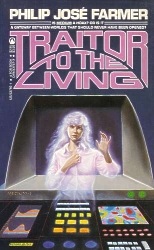
Traitor To The Living

Traitor To The Living

The Experience Of Death

What happens when you’re in someone’s mind as they die? It wasn’t something that occurred to me until I came across a novel by Phillip Jose Farmer – “Traitor To The Living” – but while that raised unsettling questions about mortality that were somewhat inspirational at the time, it fell short of giving me enough inspiration to answer this particular question, just enough to inspire me to ask it. Lacking a satisfactory resolution, I set the issue aside and let it gather mental cobwebs for a couple of decades.

“Flatliners” raised the question again, and raised the prospect of an answer, but it was Babylon-5 that really brought the subject into prominence for me, as part of the fifth-season episode, “The Paragon Of Animals”.

Telepathy offers a means to manifest theological experiences as subjective reality. The ability to be present in someone’s mind at death, or prior to birth, means that the theological foundations of your campaign can be directly scrutinised – so you had better have your answers ready, or – at the very least – some prepared obfuscation.

This seems a really good point at which to point you at another article on the subject here at Campaign Mastery, A Quality Of Spirit: Big Questions In RPGs, and move on before the discussion gets sidetracked.

18. Social Networking

Social Networking sites are an evolutionary outgrowth of the internet dating site. The concept is to enable the site’s members to find and communicate with people of similar interests, forming a distributed community of friends who (by definition) are more likely to be interested in what an individual is doing and thinking.

The psionic analogue is a variation on the “Cookies” discussed at the beginning of this post. If a telepath left the equivalent of a telepathic “signature” in the mind of ‘interesting people’, it would facilitate the recruiting of new members into a psionic community. This is a slightly darker application of the cookies concept; it still revolves around using people for your own purposes, presumably without permission, but the usage in question is relatively innocuous. Call it morally gray; some telepaths might consider the development of such a community to be worth the price paid. I can’t help thinking of Anne McCaffrey’s “To Ride Pegasus” when I consider this possibility, and contrasting the impact of precognition to that of this telepathic approach to the same basic problem.

19. Twitter

Twitter’s psionic analogue harkens back to the old “broadcast” metaphor. Essentially, it’s broadcasting a thought describing in a short burst something that you are doing or thinking, that is worth telling anyone who’s interested, about.

I have always ruled that “Telepathic broadcasting” necessarily opens the mind, leaving one telepath exposed to another; the more limited the broadcast, the smaller the window of vulnerability. In effect, I was forecasting this analogy before there even was a Twitter!

20. Website Hacking

Now we’re getting into the really nasty stuff. If a non-telepathic mind is the equivalent of a third-party website, a clear implication of the “world wide web” analogy from part 4 of this series, then hacking a website so that it says what you want it to say instead of what it should, is a form of psychic mutilation. And, unless the owner has his mind conveniently backed up somewhere – something that’s actually possible in my campaign, though the technology is not trusted by the players – the “defacement” will be permanent.

Psychic Surgery might be able to remove the damage, but could never completely restore what was there before; there would be noticeable psychic scarring, which is to say that there would be emotional and psychological impacts. The cure could well be worse than the disease!

What’s more, it has recently been shown that neurological connections continue to be formed throughout our lives in response to learning new things and acquiring new skills and habits. That would imply that the physical infrastructure of the brain would alter as a consequence of the “hacking” – effects that not even a “full restore” from a “backup” would undo. The target – assuming he was unaware of what had happened to him – would find himself occasionally thinking and doing things instinctively that he might not want to do. This would be not all that dissimilar to Gulf War Syndrome or Post-Traumatic Stress Disorder, or even Shell Shock. Recent studies have even shown a similar effect in soldiers following the US Civil War (refer to the Gulf War Syndrome page cited above).

Given all of the above, the justification would need to be compelling before any such “website hacking” or Psychic Surgery could be perceived as anything other than a villainous act.

21. Spyware / Hijack exploits

That brings us to a rather Matrix-like concept, that of using the minds of ordinary people as nodes in a distributed-processing system – something that makes vastly more sense than the “power generation” concept of the Matrix films. Where the analogue of Website Hacking affected the conscious mind of the target, this sort of malicious activity usurps the subconscious mind. In fact, I remember once reading a short story in which all of perceived reality was a side-effect of software running in a computer system of super-biological complexity, i.e. the dreams of the computer. Sorry, I can’t provide any specific references, I no longer remember the name of this story (I’m not even sure of the details).

Hijacking people’s minds and putting them to work for you as elements of a gigantic supercomputer is the psionic equivalent of spyware. Like the computer virus analogy discussed earlier, this is dependant on the creation of Psi-Bots. It would also require a ‘bank’ of telepaths to act as servers, connecting the distributed computing ‘nodes’ with the central processor, where the results are compiled.

One extremely high-level telepath might be able to do it, but it is more likely that a psionic community is responsible – which ties in with the telepathic equivalent of “social networking” as a means of recruiting members into the community.

The whole thing sounds like yet another telepathy-oriented scenario to me…

The Internet as a metaphor for Psionics

I’m sure there are internet phenomena that I haven’t thought of. But by this time, it should be clear that the Internet makes a very useful tool for thinking about Psionics and the way that such abilities could be employed.

This is a framework that takes the ideas on the subject that I’ve had kicking around for many years and reframes them for a modern age. The rewards are an enhanced accessibility to the concepts of Psionics and its limitations on the part of both GM and players; and that can only be a good thing, making psionic characters easier to play.
divider

The value of analogy

On a larger scale, this example also illustrates the value of using analogy as a vehicle for examining a concept. Some of the ideas – the scenarios, for example – that have been described in the course of this article simply didn’t exist in my mind prior to writing this series. That’s both an immediate payoff for the time and effort involved and a demonstration of that greater understanding that I referred to a moment ago.

The same approach can be used to simplify any other complex phenomena in your games. Pick an analogy and see where it takes you. If it illuminates some new aspect of the concept, or helps to define and refine the concept in any way, then it is a useful metaphor for the phenomenon.

Einstein was once said to be able to think in purely mathematical terms; but his writings suggest that he did so by means of analogy. If it’s good enough for a genius, then it’s good enough for me!

Comments (6)

This Survey For New Players Ensures A Good Fit


new player survey

New player surveys are a worthwhile time investment

Roleplaying Tips reader Zerfinity sent me a campaign survey he used to build his new group. A friend once told me the best finishes have great starts. So it is with great campaigns, and one key is getting a group of like-minded, enthusiastic people around you each game night. Zerfinity’s survey offers a great tool to help you make this happen.

As a double-win, a reviewer of Filling the Empty Chair was looking for advice on campaign surveys, and this post is in answer to him. To paraphrase Lowell, how do you select a new player if you get multiple responses to your gamer wanted ads? A campaign survey like Zerfinity’s could be your answer.

Zerfinity’s Campaign Survey For Prospective Players

Thank you for your interest in my campaign. I want to create a group where players needs and interests match my interests and GMing strengths. To do that I’ve created this survey. There aren’t any wrong answers to these questions. I’ll be evaluating responses to these questions according to the degree to which your answers suggest you will have fun in a game that I run.

Hopefully, even if my campaign isn’t a good fit for you, you’ll learn a little about your gaming interests and needs as a player.

Please only take this survey if you are interested in my campaign, willing to travel to the [city or area code] for games, and can commit to attend sessions [required frequency] [required percentage]% of the time. There are a limited number of free spots here, so it is important that only potential players take this survey.

These first questions are necessary to find out if the most basic elements of match to a campaign I run are present.

1. Can you commit to only playing good characters?
Y/N

2. Can you commit to gaming every other Saturday most of the time?
Y/N

3. If you marked yes, what percentage do you expect to be able to attend?
80%
90%
95%
100%

4. Please indicate if there are any types of people that you aren’t willing to game with:

The next questions are about roleplaying styles. Often a mix of fairly closely related styles help but so does some degree of diversity. Just be honest and know that I don’t have one of these but rather several that I think can work in a campaign I run.

5. My favorite ways to rock on my air guitar in game have been:

  • To acquire, use, and optimize new spells/powers, abilities, and other resources to make me and the party successful.
  • To think cleverly, strategically, or creatively to overcome obstacles or make obstacles easier to defeat.
  • Me bash!
  • To play the same kind of character I usually play in most campaigns.
  • To have a character participate in a fun story and hopefully to be successful.
  • To stay in character even when it might hurt me. To get and revel in the spot light.
  • Hey, I’m just here for friends and snacks. So if I laugh hard and make others laugh, that is a good session.

6. Please name some of the systems that you are most interested in playing:

7. Tell me at least three campaign events or situations you have enjoyed in previous gaming:

8. Please tell me a little bit about two campaign events that you did not enjoy from a previous campaign and help me understand why you didn’t like them:

9. Please tell me about a conflict you have had with a player or GM and how that was resolved. Please share especially your role in the conflict, what did you to create it, and what did you do to resolve it.

10. If you can’t attend a session, please indicate what you like to have happen to your character:

  • My character’s abilities may being used.
  • My character may be roleplayed by a player I trust.
  • A GM I trust may roleplay my character.
  • It’s okay if my character dies while I’m gone.
  • It’s okay if my character dies while I’m gone but only in near TPK or TPK situation (so we’re all in the same boat).
  • My character may pop out of the action when I’m gone and back in when I return the next session.

11. Please indicate which of the following responses best matches your expectation for missions:

  • I’m okay with failing a tangential mission.
  • I’m okay with failing a mission related to the overall campaign goals.
  • I’m okay with failing a mission related to the overall campaign goals, but only if it isn’t too hard to fix the failure.
  • I’m okay with failing an overall campaign mission thus far (e.g., prevent a gate from forming to an evil plane) as long as we get new related goals (e.g., fight what comes through the gate and then close the gate).
  • I’m okay with failing a mission related to the overall campaign goals as long as we get new goals and those goals may be unrelated (e.g., survive the demon horde pouring through the gate; save/protect the McGuffin from the demon horde).
  • I’m only okay with failing side missions that are tangentially or only loosely related to main goals. Beyond that, I like a GM to keep us moving closer to a successful completion of the over all goal.
  • I’m okay with failing. Period. Even the whole campaign.
  • Though I know the party won’t be perfect, I really need every mission to end with at least a modicum of success.
  • I prefer the party to set its own goals and don’t want a given goal in the GM’s mind before we create characters or before we start a mission.

12. I like roleplaying where:

  • Everyone focuses on the group goals
  • There are group goals, individual goals, and those goals may be different.
  • I like individual goals to converge with group goals.

13. When has it been okay or even fun for your character to die in a game? (Check all that apply.)

  • Never. How could that even be fun?
  • When the character can be resurrected and eventually catch up to other characters in power level.
  • When it forwarded a plot overall or made a very dramatic enjoyable scene.
  • When the GM thought we made serious mistakes and the dice dictating it.
  • When I got an awesome death monologue.
  • When I had something else to do at the table afterward.
  • The acceptability of character death is inversely proportional to the amount of time it takes to create a new character.
  • Character death is more acceptable the longer and more successful my character has been.
  • Character death is less acceptable the longer and more successful my character has been.
  • Character death appropriateness is based on my character. If I play a cautious, careful, combat avoid, and combat savvy character, I expect those traits to help the character live longer. If I play a reckless foolish character, I expect death to catch up to the character eventually.
  • It is okay to me if other characters die for character/story reasons but not if it affects my character too much.

14. When we start the campaign, I want my character to be able to:

  • Influence a small group of people known to him or her
  • Influence events in a small group
  • Influence events on a local level (neighborhood or small town)
  • Influence a large city
  • Influence a state or region
  • Influence a country
  • Influence a world
  • Influence a plane
  • Influence the fabric of reality

15. By the time we finish a campaign, I want my character to be able to:

  • Influence a small group of people known to him or her
  • Influence events in a small group
  • Influence events on a local level (neighborhood or small town)
  • Influence a large city
  • Influence a state or region
  • Influence a country
  • Influence a world
  • Influence a plane
  • Influence the fabric of reality

16. How fast do you like your character’s power level to develop?

  • I like to see power development every session.
  • I like to see power development every few sessions.
  • I like to see power development a couple of times a year.
  • Power development is not as important to me as character development.

17. How realistic do you like character mortality to be?

  • Realistic: A point blank shot to the head should be fatal almost every time even for PCs.
  • Heroic: For most people in the world a point blank shot to the head would be fatal but not for my character.
  • Realistic or Heroic as above but with faster healing to keep the game moving and my character in the story.
  • Cinematic: A point blank shot should kill, but the bad guy flinched and grazed me instead. Then I knocked him out and grabbed the gun out of the air and turned it on him before he even hit the ground.
  • Superhero: My skull flattens bullets.
  • Godlike: “How will you shoot me in the head with that fish?”. . . .”Bwa?!”

18. What kind of overarching campaign goals interest you:

  • Halt a danger to a home town
  • Fight a war of defense
  • Be loyal to an organization (get orders, fulfill missions)
  • Stop an evil organization/evil overlord
  • Save the world/universe
  • Stop the internal power grab within my organization/country
  • Build up the power/wealth/status of my loyal patron
  • See the world
  • Explore different cultures
  • Get the McGuffin
  • Build a menagerie
  • Avenge the wronged
  • Protect the weak
  • Build my power and the power of my friends

19. How do you feel about dice:

  • The dice rule the game
  • Die rolls are suggestions
  • I want a GM to ignore the dice when it favors me
  • I want a GM to ignore the dice when the story would be furthered (even if that sometimes hurts my character)
  • Do we really need dice?

20. Desired length of campaign:

  • 6 months
  • 1 year
  • 1.5 years
  • 2 years
  • An epic campaign of epic longness
  • As long as we can keep it going and fun

21. I like playing in a game where:

  • Scene A leads to Scene B leads to Scene C, and our success or failure in each leads to how difficult the next scene will be but not whether the next scene will be.
  • Where the adventure starts with Scene A and leads to Scene D, but where, when, how and whether B and C come about is up to the players.
  • Where the adventure starts with Scene A and leads to goal D, but the path between those points is up to the players.
  • Where the adventure starts with Scene A, and from there the players are free to set, change and accomplish their own goals.

22. How do you feel about GM improvisation:

  • I like a GM to improvise so I can be free to decide what I want to do. I’m willing to accept some gaffes from the GM as sometimes happens when improvising.
  • I like a well planned, well balanced adventure and am willing to accept some railroading so the GM can meet that need.
  • I like a well balanced seamless but improvised adventure and get frustrated by GM mistakes or railroading.

The next questions are asking about engagement and participation in a campaign.

23. In previous campaigns, I have enjoyed (please check all that apply):

  • Writing character background
  • Writing character journals
  • Writing session notes
  • Finding/making/painting markers for my and other characters
  • Helping others and the GM remember the rules
  • Tracking NPC contacts
  • Helping players/the GM in other ways. Describe:

24. In this campaign, I would be willing to and would enjoy (please check all that apply; don’t worry though, I’m not asking for a commitment, and I’m not expecting you will do all of the ones you check or that you will do any of them all of the time):

  • Writing character background
  • Writing character journals
  • Writing session notes
  • Finding/making/painting markers for my and other characters
  • Helping others and the GM remember the rules
  • Tracking NPC contacts
  • Helping players/the GM in other ways. Describe:

Roleplaying encompasses a huge range of or lack of violence. Not everyone is comfortable with every style. I’ve seen players be quite disturbed by the scenes/acts described by the GM or other players. So, the next few questions are an attempt to find out a little bit about what you might be comfortable with in game.

25. Please let me know what kinds of dramatic events can escalate tension or enjoyment and motivate your character(s) to fight against:

  • Descriptions of graphic violence/gore
  • Violence against
    • innocents
    • women
    • children
    • animals
    • men
  • Torture/Sacrifice
  • Dismemberment
  • Insults
  • Kidnapping
  • Threats
  • Death
  • Other

26. Please let me know what kinds of dramatic events you don’t feel have a place in a game that would be fun for you:

  • Descriptions of graphic violence/gore
  • Violence against
    • innocents
    • women
    • children
    • animals
    • men
  • Torture
  • Dismemberment
  • Insults
  • Kidnapping
  • Threats
  • Other

27. Please let me know if there are any types of violence that would not be okay to happen to your character:

  • Descriptions of graphic violence/gore
  • Violence against
    • innocents
    • women
    • children
    • animals
    • men
  • Torture
  • Dismemberment
  • Insults
  • Kidnapping
  • Threats
  • Other

28. Please let me know if there are types of violence that would not be okay to happen to your character’s loved ones or family:

  • Descriptions of graphic violence/gore
  • Violence against
    • innocents
    • women
    • children
    • animals
    • men
  • Torture
  • Dismemberment
  • Insults
  • Kidnapping
  • Threats
  • Other

The next questions are about your experience GMing. Don’t worry if you don’t have any GMing experience, these questions are near the end because they are much less important to me.

29. I might be interested in GMing this group if it is also a good fit for my style:
Y/N

30. I have GMed before?
Y/N

31. I am GMing now?
Y/N

32. I read:

Okay now, for the big reveal. Here are some of my preferences and what I’m hoping to build in a group. Let me know what you think below.

33. I’m interested in running a group and campaign that has high player investment (e.g., journals, notes or backstories), where we co-create a story in a world, where the characters are low powered but with occasional cinematic flair, with slow skill/power development.

A group that can last years, where players are nice to one another, where characters are good or at least benign (though not necessarily moral paragons), where characters may die but not often and where self sacrifice would be rewarded.

I’ve also recently discovered something about myself: I tend toward the cinematic. I’m inclined to ham it up for the fun of everyone. As I GM I’m going to be exploring what it means to keep things low powered (no fireball) but still larger than life and cinematic (more swinging from chandeliers). This means more flaboyant NPCs, more crazy leaps from the tops of stairs, and more tentacles that grab you around the neck when you stick your head over the edge of a well.

  1. That’s not for me
  2. This could be okay but what exactly do you mean by…
  3. Meh, its better than no group.
  4. Sounds good.
  5. Sounds great.
  6. Awesome.

All of the questions that I’ve asked are an attempt to help me identify people who would have fun playing in a game like that. I’m not especially fixated on a number of people, though I think the smaller end from 2-5 seems best. If you’re familiar with Robin’s Laws of GMing, you may be interested to know that I’m a Storyteller first, Method actor second, and Butt kicker a distant third.

To satisfy those needs, I intend for the game to be comprised of a mix of approximately 75% roleplaying and 25% combat. Where that spread would be true across sessions is some sessions might not have any combat. I’m open to casual players, especially if she or he is attached to a more invested player.

I like running a campaign where it is possible for players to experience setbacks, but where they ultimately triumph even if ultimately is some time away. I’m not that invested in what happens to a character while a player is gone with the exception that popping out of existence suddenly can cause an encounter to become unbalanced, so that doesn’t work well often.

Comments:

34. Which of the following campaign ideas sounds like the most fun to you? (Please rank them 1-7, with 1 being the least fun and 7 being most fun; I may try to blend the highest vote getters together if possible.)

  • A *role* playing heavy low magic fantasy campaign where the players and their characters don’t really know how magic works but get to discover it throughout the course of the game. All or most characters magical.
  • A *role* playing heavy low magic fantasy campaign where magic is well established and the characters are working with a magical college as ambassadors, investigators, magical security, and maybe supplemental military forces. All or most characters magical.
  • A *role* playing heavy low magic fantasy campaign where your goal is to increase the prosperity of a magic shop that you are affiliated with.
  • A *role* playing heavy low magic fantasy campaign where your home city is in danger and the purpose of the campaign is to find the way to rescue it.
  • A *role* playing heavy mostly city based low magic fantasy campaign where the short term plot lines are diverse but there is one over arching, save the world plot.
  • A *role* playing heavy, low power, psionic, non-military campaign set in a relatively low tech sci-fi future.
  • A *role* playing heavy, low power, psionic, military campaign set in a relatively low tech sci-fi future.
  • None of these really interest me below this point what are the other options?

Thanks for the survey, Zerfinity! Campaign Mastery readers, what do you think? Any questions missing for you?

My group plays about 20 times a year, 5 hours each time, and we’re going on 5 years now. That’s a 500 hour investment – and counting. While the survey initially seemed a bit long to me, I realized the total time I’ll be spending with the person means a little time spent up front to find the right player is worth it.

I can also see many GMs doing this interview in person, verbally. That would make it social, faster and easier. It would certainly be less intimidating for the player.

Comments (15)

All This And Psionic Spam: Examining Psionics, Part 4 of 5


This entry is part 4 of 5 in the series Examining Psionics

Last time out, I started examining the concept of The Internet as an analogy or metaphor for Psionics, especially telepathy – but ran out of time after looking at only 7 web phenomena of a planned 21. So here we go, with the next seven:

8. The World Wide Web

Everyone knows someone else who knows something useful. This information is the telepathic equivalent of a hyperlink, a connection leading from one mind to another. And, like the internet – especially in the 90s – these links are eclectic and diverse, often having nothing to do with the primary subject of the ‘website’ in question.

Accessing that information is a little trickier for the telepath – it’s one thing to know that “Harry knows rockets”, and quite another to locate the mind of this “Harry”. Even the identity might require additional psionic probing to discern, as people rare think of their friends and acquaintances by their full names without making a deliberate effort to do so.

Browser Redirects

Complicating the picture are the equivalent of browser redirects, where the link appears to point to one thing but actually connects to something else entirely: “Werner Von Braun knows rockets” but the individual in question doesn’t know Von Braun personally, just of him. Instead, the link probably leads to a high school science teacher, or something like that.

Dead Links

And finally, even if the link is “Harry knows rockets”, that doesn’t help very much if Harry’s dead (though in that case, the thought would probably be in the past tense) or if Harry’s information is out of date. Maybe Harry did know rockets – fourteen years ago, or fourty.

Nevertheless, a lot of time could be spent “Mind Browsing” for no particularly good reason.

9. Misinformation

Of course, you can’t always trust the information that you find on the internet (we’ll try to always be honest with you here at Campaign Mastery, I promise!).

Whether for reasons of mischief, malice, propaganda, zealotry, ignorance, or error, a substantial component of the information that is presented as fact on the internet is simply wrong or is opinion disguised as fact.

Most of these will also hold true for telepathic communications. If the subject believes something, no matter how erroneously, their belief will be picked up as fact by the telepath who probes their mind. Campaigns of misinformation and propaganda will still be effective, even in a psionic world – unless the telepath just happens to probe one of the few minds “in the know”.

Self-deception, external deception, brainwashing, paranoia, zealotry, ignorance, and error will all result in incorrect information being fed to the telepath. That’s almost identical to the earlier list.

Telepathy will be no more reliable than internet as a source of information – if you stick to the “reputable sites”, you will get reputable (but possibly biased) information; if you wander the backwaters, you will be inundated with disreputable information which might just contain a nugget or two of truth here and there.

As always, the real trick will be separating the wheat from the chaff. The telepath should not get a free ride – even if they can somehow sense the “truth” in the mind of the person being scanned.

10. Spoofs

Some people – usually very creative people – have created some amazing fake videos for the internet. To everyone else, these are the same thing as propaganda – with or without an underlying message. Some will believe what they have seen, some will be sure that the videos have been faked, and some will just be uncertain. Check out five tell-tale signs of a fake viral video for some examples and some tips on spotting the fakes.

The telepathic equivalent adds mental disturbances and mind-altering substances to the list of reasons why a “fact” received telepathically might be faked.

What if the altered state of mind that comes with being high on cocaine, or LSD, or any of the other illegal drugs, or any invented for the campaign, was picked up telepathically? Could you get lost in that alternative mental space and not be able to find your way back out until the subject came down? Could you have your own mental processes so affected (without losing yourself completely) that you were effectively out of your head for a period of time afterwards – or immediately went into withdrawal symptoms?

Telepathy could be very dangerous – to the possessor and those around them, not just to the world at large.

11. Spam

I have always had the notion that thoughts come in different strengths – that something a person was concentrating hard on would be more easily read than something they were focussing no attention on, and that was in the background. The problem with that theory is that you then need some sort of ranking system.

I’ve never constructed one, and there is no clear reference to this concept that I can recall putting into the game architecture that was the subject of the previous posts – though there are some implications here and there that might suggest it. Nevertheless, the analogy of someone shouting with excitement producing a message that is more clearly received by telepathy is one that I expect to continue to use, because it makes the whole process seem a little more tangible during play.

Another phenomenon that has also never been explicitly described within the rules is the presence of – as they put it in Babylon-5 – a kind of “background hum” that you can never really shut out unless you enter a shielded space.

I would liken Spam to the occasional excited mental shout that rises above this mental noise to be heard in isolation. Someone is excited about buying a new car? You get an unsolicited mental image of that new car, and the notion of buying it, that is full of pleasure and excitement. Someone is looking through a list of restaurants, picking those they might like and those quisines they absolutely hate? You get a series of “Spam” telepathic shouts reviewing those restaurants and/or that style of cooking. Someone is wandering around a shopping mall, window shopping? Or thinking about how much they are looking forward to intimacy now that they have medical reinforcement (trying hard to avoid internet spam filters myself, here!)? Or enjoying a beer in the pub? Or craving a hit of chocolate? Or (shudder) a kid in a candy store – or Imelda Marcos in a shoe shop!?

Ian (the player bringing the telepath into the campaign) won’t know what’s hit him… (unless, of course, he reads this article!)

12. Instant News

Another internet phenomenon with an obvious analogue in the psionic sphere is the arrival of instant news. In modern times, immediately something happens, the news starts hitting the web. To find out what’s happening, all you need to do is go to a suitable website, and you will be as well-informed as a newspaper editor would have been in preceding decades.

Ironically, the psionic equivalent is to scan the recent memories of a news editor or television equivalent. These positions require the editor to be continually aware of the latest news and assess which stories should have prominence. Every time a new event or announcement comes over the wire, he has to compare its importance with the items already present – and the result to a telepath would be like an announcer reading the news headlines of the day.

13. Viral Marketing

Viral Marketing is the process of using ‘word of mouth’ to spread the word of some cool new discovery; marketers are now creating cheap version of proposed real ads and placing them on YouTube to gauge reactions and decide which of the ideas should be up-scaled for “the real world”.

It started off when one person would spot something cool on the net and send links to it to their friends; if enough of those friends did likewise, it could galvanise a massive wave of the online community coming to check out the something cool.

As technology made it easier to share the latest ‘cool discovery’, the concept evolved into the marketing tool that it is today. In fact, the term internet phenomenon, which inspired this entire article, was originally coined to describe the subject matter of successful viral marketing.

So what is the psionic equivalent of Viral Marketing? The best answer I can offer is – drum roll, please: – viral marketing.

But rather than the shotgun approach of existing services, and rather than using the internet as a form of cheap market research, Psionics permits targeting and stepwise refinement. Instead of placing the consumer in command of the process, the telepath can ‘play’ the advert in people’s heads as though it were something that they were imagining, can manipulate it and tweak it to resonate with the mindset and personality of the target, and can (effectively) Convert the consumer to whatever message the “advert” is supposed to be selling. Because people think of this “telepathic marketing” as their own idea, they will be committed to it in a way that is rarely achieved using traditional marketing.

The use of a religious term to describe the effect is a deliberate one. This seems to be the ultimate celebrity endorsement – you, yourself – and it’s totally free. ‘Influence’ a dozen or so of the most influential people on the planet and convert them to your cause and they become zealots in pursuit of the agenda you have implanted. The capacity to shape society to your specifications using Psionics is clearly tremendous.

In any world where telepathy is a proven phenomenon, it would undoubtedly be used as a marketing tool by someone.

Only a telepath would be aware of what was really going on – and so the scene is set for the brainwashing of the masses, while only a few isolated individuals have the capacity to even be aware of the manipulation, let alone fight it. This is the ultimate big brother… and something that I will have to use for a scenario!

14. File Sharing

This is a phenomenon for which there is no initially obvious outright psionic equivalent that I can think of. And yet, there are parts of the file sharing phenomenon that translate directly into the psionic sphere.

Copyright becomes meaningless when all you have to do is locate the mind of a legitimate consumer of whatever you are looking for and enjoy it along with them. Pirating the latest release for your own enjoyment becomes trivial when you can ‘ride along’ with the producer or director seeing a finished product for the first time.

It was only when I started contemplating the technology that is used in file sharing, and in particular Bittorrent, where you download parts of a file from everyone else who has that file on their system, that I started to see an analogous capability within Psionics.

Instead of keeping your information all locked away in your own head, why not use other people as offsite storage – without their permission? By including directions on where to find the next piece, and the preceding piece, of the overall package of information, you end up with telepathy being used as a ‘file sharing’ product – any telepath can get whatever you have ‘uploaded’, they just need to come across one piece of it.

Naturally, there are some disturbing civil rights issues raised by this concept. It inherently elevates the telepath to a position of social superiority over the rest of the species. The mindset needed to use people as a personal convenience without their permission would show in other antisocial tendencies; the individual capable of such acts would be convinced that the psionic were a higher form of life, with a manifest destiny to rule the lesser – a Magneto/Doctor Doom level of arrogance.

This is another idea that I’ll have to use as a plotline in the new campaign!

To Be Continued…

Almost there – only seven more to go….

Comments (5)

New Generator: Roleplaying A Black Dragon


black dragon dice

Make your next black dragon unforgettable

Dragon encounters are supposed to be special. Black dragons are supposed to be nasty. Put them together and you get….crickets. It is tricky pulling off a great dragon encounter, especially when player expectations run high from watching movies and imagining Smaug and looking at gorgeous art in monster books.

The good news is you just need to be memorable. You do not need to be better than Tolkein. Just make dragon encounters fun and entertaining. Be larger than life when you game master dragons. Stand up on your chair and flap your arms. Raise your voice. Put on some heavy metal.

You can also make your next black dragon encounter unforgettable with this month’s Q-Workshop generator: roleplaying and black dragon, inspired by black and yellow dragon dice.

Create an unforgettable black dragon for your campaign by rolling for:

  • Mannerism
  • Goals and Dreams
  • Motive
  • Weakness
  • Voice
  • Smell
d20 Mannerisms
1 Gets loud and preachy about listening to and obeying them
2 Cracks knuckles continuously and cannot stay still
3 Laughs at terror and misfortune, weeps at others’ good luck, angers when people make jokes (about anything)
4 Gets angry and defensive whenever family is brought up (theirs or even others’)
5 Bad breath to the extreme, is a close-talker and laughs often
6 Self-centered, takes everything personally, needs constant reaffirmation
7 Blows breath out through the mouth in exasperation
8 Has a hacking cough and bemoans the constant ache in their scales
9 Constantly repeats what others say, but sarcastically
10 Has frequent and strong facial, tail and wing tics
11 Suffers an existential crisis and demands others tell them the meaning of existence; when stressed they repeat all the gods’ names in alphabetical order over and over
12 Has taken a vow of silence and mimes everything
13 They have alzheimer’s disease but get very mad when reminded or corrected about things
14 Gloomy, pessimistic and quick to criticize or point out fault
15 Thinks they are mighty and ought to be worshipped; demands sacrifices
16 Always apologizing, cannot make decisions, but angers quickly if they think they are being taken advantage ok
17 Greedy, grumpy and gaudy; prefers treasure they can wear and show off
18 Loves torture and violence and to see others suffer
19 Thinks they are charming when they are actually stuffy, arrogant and self-absorbed;
20 Has multiple-personalities – roll d4 more times
d12 Goals and Dreams
1 Enslave a kingdom of humans and become ruler of this land
2 Become powerful enough to kill their father or mother in combat
3 Gather enough treasure to fill an entire cavern and swim in
4 Become a god, gain immortality, be served by worshipers
5 Slay every unicorn
6 Establish a home base and grow it into an empire
7 Slay all other dragons of its type
8 Move to the city…and level it
9 Gather a set of relics and harness incredible magic power with which to destroy their foes
10 Recover the bones of their great great great grandfather and turn them into a magical throne
11 Make the twelve kings bow to them and serve their every whim
12 Become King of the Dragons
d10 Secrets
1 Is actually of the opposite gender
2 Fears mice and other small creatures
3 Is deaf but good at reading lips
4 Accidentally killed their mate and still grieves
5 Is in love with a human (or other race)
6 Allies with a devil to achieve its goal
7 Cannot say no to their children
8 Finds gold poisonous, even contact causes pain
9 Breath weapon does not work
10 Is hunted by several other black dragons
d8 Weaknesses
1 Chocolate and wine
2 Singing
3 Orc beer
4 Poetry
5 Goblin jokes
6 Pirates
7 Flowers
8 Fresh bread
d6 Voices
1 Sssibiliant, almossst a whisssper
2 Foghorn Leghorn, I say Foghorn J. Leghorn, son
3 SHOUTS ALL THE TIME
4 Backwards talks, he does
5 Deep…slow…and…menacing (speak from your diaphragm)
6 highpitchedandfast likeanimp
d4 What do they smell like?
1 Ozone
2 Sulphur
3 Burnt hair
4 Vinegar

If you are a fan of the fantastic Q-Workshop dice that inpsire these generators, you might have seen the Q-workshop STRIKE dice movie. Well, Q-Workshop has released a Making Of sequel movie with behind-the-scenes looks into the rolls roles they all played.

Comments (5)

The Value Of Information: Examining Psionics, Part 3 of 5


This entry is part 3 of 5 in the series Examining Psionics

This, and the two parts that preceded it, were all originally intended to be one post, and a relatively smallish article at that. The decision to incorporate material from the game rules that I had written relating to the subject put paid to that concept, but I felt it was a necessary preamble.

Finally, though, we have all caught up with each other on the subject, and are ready to forge new paths.

But before we do: something that I meant to offer in one of the earlier parts (and which was mentioned in the text, as I recall) was the Psionics Questionnaire that I came up with for the Champions Campaign.

Zenith 7.0 Psionics Reactions Questionairre

Zenith 7.0 Psionics Reactions Questionairre

Getting each player to fill it out “in character” should make the impact of a psionic character immediately obvious, and it should be appropriate to just about every campaign with telepathic characters. So, here it is, in convenient PDF format.

A New Metaphor

Regular readers of these blogs will know that I am a big fan of analogies and metaphors as tools for the examination of a phenomenon or concept from a different direction. Past paradigms that I have employed when thinking about telepathy and other psionic powers have been simplistic, rooted in metaphors of books, speech, and broadcast media like television and radio; they always seemed a trifle Victorian to me. If “television” is replaced with “film”, everything about those analogues derives from the first decade or so of the 20th century! Don’t look now, but it’s 2010 – these ideas are a century old! The problem was that I had nothing better with which to replace those analogies – until now.

What if the internet was a metaphor for Psionics? What might the telepathic equivalent of various ‘net phenomena be, and what could they symbolise? That’s what this article is going to consider. I’ve come up with a list of 21 facets of the internet that just about everyone will recognize, and found that I can relate just about all of them to telepathy and related Psionics – and gained some fresh ideas and insight along the way.

1. Privacy

This is the most obvious issue in a world with Psionics. How do you protect your privacy from a telepath? The moment telepathy becomes a proven physical phenomena, that race to develop a cheap and effective countermeasure would be on. Early versions would be “secure rooms” – useless because you can’t help but take your information out of the room with you when you leave, but still useful for shielding people in critical decision-making capacities in a crisis.

In modern times, it has become recognised that if the footsoldiers know the plan and the objective, they are more likely to succeed in their missions because they can make intelligent choices and capitalise on opportunities as they arise. In a world with telepaths, the need for security would demand that everyone outside the shielded command bunker be told only what they absolutely needed to know and no more.

The next stage in the development of psionic defences would be some form of personal shielding; again, large and bulky at first, this would still be of limited utility because it could not be worn 24 hours a day. It might not even be functional unless powered by a rather bulky power pack.

Does anyone remember briefcase-sized mobile phones of the 70’s? Or the phones the size and shape of house bricks in the early 80’s? It wasn’t until the 90’s that they became truly portable, and the mid-to-late 90’s before they became pocket-sized. In the 21st century, mobiles have shrunk to the point where the limiting factor is the need for a human-controllable interface – the keypads can’t get much smaller – and so designers have begun packing more and more features into the devices.

Despite the inconvenience, those early mobile phones were very much a status symbol, and possessing one marked the individual as someone of significant wealth or influence. A similar situation would result with these early semi-portable Psi-shields; possession would mark an individual as having secrets that others with resources might wish to steal.

Eventually, the devices would become small enough and cheap enough to be commonplace.

An entirely different path of development is also possible: if Telepathy is integrated into the law-enforcement profession and telepathic evidence legislated into acceptability by the courts, psi-shields might well be banned (with exceptions for the military and various intelligence agencies). Possession of one would be enough to mark the individual as suspicious, if not criminal in nature.

All this parallels the ongoing debate over privacy when it comes to information on the internet. This is the central legal issue of the early 21st century – who knows what about you and who can get access to it? The default position is ‘anyone’ – only legislation to reinforce the rights to privacy and against self-incrimination will protect ordinary people from the excessive zeal of either cybercops or psionicists.

It is possibly not going too far to suggest that one set of legislation might be used as a template for the other – and, at the same time, that those groups who opposed the earlier legislation would be even more vigorous in their opposition of the second.

2. The Wild Wild West

Every culture that recognises telepathy would have to deal with the regulation of the ability. The ‘net is akin to the US wild west, in which it doesn’t matter what you do so long as you don’t get caught, and everything is legal until it’s not. People have to protect themselves and be self-reliant, as the law can only act after the fact.

What’s more, telepathic abilities, like the internet, crosses boundaries, effectively reducing the law to the lowest common denominator. If something is legal somewhere, you can find it on the net – and it it’s not legal, it’s probably still available, just better hidden.

The same principle would apply to telepaths. If one nation bans certain mental activities – a law that would be difficult if not impossible to enforce – and its neighbour permits it, the people of country A are sure to experience that which is forbidden, even if those who want to commit the illegal act have to move to country B in order to do so. In practice, most wouldn’t bother.

3. The Thought Police

Eventually, just like the West, the telepathic territory would be tamed, or at the very least, the possibility of doing so will become apparent. This would require a new, more active form of policing, the sort of thing that is reserved for hunting down serial killers and mob bosses – telepaths who are trusted to search out other telepaths breaking the law – PsiCops.

Would people really be comfortable with someone else monitoring what people think? And would people ever really be confident that this authority was never abused? I don’t think they would, but I’ve never denied being a moderate liberalist.

Babylon 5 Box Sets
Much of the plotline in Babylon 5 revolved around the Psi Corps, doing a fair job of presenting both sides of the arguement even though the proponent of one was (at best) an anti-hero (Alfred Bester, played by Walter Koenig). Who watches the watchers – and who watches them?

4. A more efficient porn delivery system

It often doesn’t seem to matter what you look for on the internet, porn is just a few clicks away. Although it’s not quite literally true, especially these days when some aspects of the ‘net are better regulated, the same would not be true in telepathic circles.

Every salacious thought (no matter how fleeting), every desire, every passing fantasy – all would be on public display for any telepath who wished to look.

  • How easily manipulated would people be if their innermost desires could be played apon?
  • How easily could someone be blackmailed if their darkest secrets were an open book?

Just as internet porn became a fertile ground for organised crime, so would telepathy.

5. The Value Of Information

In the 21st century, information has been described as the most valuable commodity. (Here’s an interesting article on the subject, which contains an awful lot of what I was going to say).

Information is bought and sold, and is sometimes considered a company’s most valuable asset.

Put that together with a psionic reality in which information is there for the taking.

Fortunes will be won and stolen and lost.

Data And Information

One of the reasons Information will be so highly valued in a telepathic age is the difference between data and information – context and interpretation. The telepath doesn’t have to supply their own, they can get it direct from the source. As a source of personal power, this is poor, as the telepath may not be able to do anything with the information they glean; but as a source of leverage, and intelligence, it is unsurpassed.

Wall Street

I was reminded of the ultimate reference source – Wall Street – for this aspect of Psionics. While the movie is all about greed, and money, it is information that enables everything else to happen.

Trading Places (Looking Good, Feeling Good Edition)

A close second, and just as entertaining (in a completely different way) is Trading Places. Superficially, this is a comedy about stock market manipulation, but look just a little deeper and this is a movie that revolves around information acquisition, counterfeighting, and manipulation.

Both of these are directly relevant to the potential usage of information by telepaths. And that’s food for thought.

6. Data Piracy

A direct implication of the value of information is that people who aren’t supposed to have it will try to steal it. Most of the information I’ve focussed on so far has taken the form of secrets and decisions, and those are important; but there is a third type of information: proprietary information and trade secrets. And this information is just as valuable as the other types.

Every organisation has its own unique advantages, the things that make them successful against their rivals. It might be a cost-cutting measure, or a training methodology, or a proprietary technology, or any of half-a-dozen other advantages. And all of these are vulnerable to the telepathic thief.

Even the vandalism of using mental control to change the minds of potential customers to persuade a rival that a successful strategy is no longer working, and should be abandoned, can have a major impact. Anyone remember the Cola Wars of the 1970s?

7. Search Engines

Everyone knows something, some people know more than others. And then there are the people who know people, who seem to have the world at their fingertips, and others who know where to find information. Librarians and political numbers men and media executives – these are the telepathic equivalent of a search engine. And if they don’t have the answer, they will know who they would ask – the equivalent of redirecting an enquiry to a specialist web page which has it’s own search engine.

To Be Continued…

It looks like I’m out of time, with many more internet analogies still to draw – so keep your seats, this article is going into a fourth innings!

Comments (1)

6 Ways to Enhance Magic Items


1. Give them personal names

A simple but effective method. Even minor items get a personality boost when named.

Tip: A name could imply special powers if you are not in the habit of naming most magic items, so you might need to explain the first time that Felix the Cape is what the previous owner called it, and it truly is just a +1 Cloak of Resistance. However, that little bit of disappointment will soon fade as the player starts having fun calling his cape by name. You should not have future problems after this expectation-setting moment, but the benefits will last the whole campaign.

2. Give them a flaw

The best flaws spawn from an item’s powers. Before you tack on a flaw, look first to see if the item’s ability has a story-based downside or can be turned against the PC in a narrative way. This approach generates more choices and consequences for PCs and better integrates the item into your campaign.

Fables are a neat source of inspiration for this kind of puzzle. Read their moral tales, study the mishaps of the characters and look at reactions for ideas on how to turn magic items into trouble and conflict for the PCs.

Fame is a good one. The Slippers of Spider Climbing sure are useful, but when people see the PC walking on walls and ceilings everyone will want him to do that trick. It is hard to be stealthy when you get recognized and asked to perform tricks.

Another example is the lowly +1 dagger. What commoner would not want an ever-sharp, easy to clean, sleek knife? Perhaps the PC is constantly asked to wager away his dagger. Perhaps a killer uses a +1 dagger, so when the authorities see the especially clean and lethal cuts they will suspect the adventurer known to wield that special knife. Providing an alibi might be easy but also inconvenient if the character has something to hide, as they always seem to do.

3. Give them a quirk

Make the item fun to play. A quirk is not a flaw or boon, but an interesting trait. It encourages roleplaying, offers choices and affects character tactics, though not in combat encounters so much. It may have a positive or negative effect, but on a smaller scale than flaws and boons.

A quirk often introduces new gameplay when the item is used or present. Another word for quirk could be side effect. For example, a wand might turn your hands blue for half a minute after each use. No big deal, right? No effect on combat, and just a silly thing. However, in the city of Carnus in a previous campaign, arcane casting was illegal and captured wizards were prosecuted. Blue hands would tip off foes who could summon authorities.

That example might be a bit severe. I might consider it a flaw in that campaign, but a quirk in another. Perhaps using the wand makes flowers bloom instead. Alternatively, the wand might have a clue scratched into it by a former owner and if the PCs realize the clue exists and can decode it, you have a surprise adventure hook waiting.

4. Give them a background

Stories about magic items breathe depth, detail and optional hooks into your games.

Even if a background is so independent it is completely detached from any adventure or encounter hooks, the player will still instantly form a bigger bond with that item and feel your campaign is awesome. Such is the power of little touches like adding backstories to magic items.

If backgrounds are tough for you, try this short outline:

Three owners, two events, one conflict

  • Have the item trade hands at least three times.
  • Give at least two owners notable uses of the item in some kind of event.
  • Give each transfer of ownership a reason, with at least one involving an unwilling transfer.
  • Provide the reason or circumstances for how the PC managed to get the item. If the item was in a treasure pile, describe how it got there if that event was not one of the three transfers you have already described. Likewise, if an NPC had the item last, ensure you know how they got it.

Tip #1: Make at least one part of the background relate to the new PC owner. A previous owner might have had the same race, class, goals or struggles as the PC. This will add personal significance for the player.

Tip #2: Make the item’s original purpose incomplete. Tie this into the current adventure, or let it kick off a new adventure for your group. Either way, you just added mystery, a quest or a tragedy depending on how the PCs react.

Tip #3: Use names. Get your name generator out, because you want to include names of previous locations, owners and other NPCs in your backstory. These details will flesh out the story nicely. Plus, players need names to retell their items’ stories.

“Yeah, some guy made this in a nearby forest to kill another dude, but that dude escaped, came back and stole it. Years later his oldest son took it with him when a country invaded another, and the item saved his life three times. The dude’s son came back from the land alive, and that is when they started calling the item Lucky.”

Now go back and add proper names to the people, places and events in that background to see just how dramatic a difference these little details make.

5. Give them a dilemma

Create magic items that require give and take. They offer a benefit compelling enough that the curse or downside is worth it.

For example, infuse your campaign with enemies who take advantage of the flaw. They trigger encounters setup to take advantage of the flaw. They bring the kryptonite, or tuned energy resistance or protection. They hire a disarm specialist, lay a trap or plan a diversion.

If the PC has come to depend on the magic, that is a weakness right there. Enemies just need to nullify the item’s benefits, perhaps even for just a short time, and the PC is made vulnerable.

First though, enemies must learn about the item’s existence, then learn a PC has it, and then learn its properties and flaws. If you game this out, you add great depth and realism to campaigns. How exactly do NPCs gain this knowledge? Spies, divination and direct encounters offer possible answers. So now you need to arrange some encounters.

For example, in my current campaign the villain sends minions to fight the PCs on a regular basis. He then sets spies nearby to observe the combat and report back on the PCs’ capabilities, special equipment and tactics.

Should the PCs figure this out, it becomes a new concern for them each encounter. Is this just a setup by the villain to gather more intel? What should be done to prevent this? It is not enough to beat the guys in front of you anymore; you have to spot the spies or keep your special powers a secret lest you reveal them too soon. Great games within the game!

Another dilemma could be one stat goes up and another goes down while the item is in use. Another might be chances of a critical hit goes up but so do chances of fumbles, or everybody’s chances of a critical goes up in a 10′ radius – including foes. A funny one might be an item grants invisibility but makes the wearer incredibly noisy and smelly.

6. Give them attention

Keep good notes handy about how the characters appear to NPCs. Roleplay NPCs based on how they perceive the PCs. This perception should especially include magic items.

Unless magic is commonplace, others will take notice and talk about it. Take this a step further by producing a range of reactions on a regular basis. If every NPC reacts the same, the effect of attention wears off, so mix it up.

Example reactions:

  • Amazement: characters love this kind of attention because it makes them feel important.
  • Fear: NPCs run way, cower or freeze up. In each situation, ask what they fear and why. Explore this to add more depth to NPCs. For example, the NPC fears for the PC’s well-being. But why? Perhaps in this region only certain people may own and use magic items, such as nobles and military officers. If a character is caught with a magic item, he’ll be thrown in prison. Suddenly you have a great region and culture hook, plus good gameplay tension.Another option is to create phobias regarding magic items, types of magic and types of magic effects.

  • Greed: the NPC wants this item for its potential use, to sell it or to curry favor by gifting it. Imagine the value in a magically sharp item that never loses it’s edge, doesn’t rust, and weighs little. If it glows it will further blow their mind!
  • Anger: this is a great surprise reaction. Why is the NPC angry? And what will the anger make the non-player character do? Anger is such a string emotion, even an ally could do something unexpected, such as attack to subdue the PC for his own safety.
  • Pleasure: similar to amazement, the NPC is delighted when the magic item is around, on display or in use. They want to see it, touch it, use it.
  • Confusion: one option here is the NPC just does not know what to make of the thing. Another is to use the effects from the Confusion spell, perhaps because the idea of magic is overwhelming, or the magic emanates some confusion property at close range for those unused to its presence.

No matter what, have NPCs react when the magic item is around.

What about you? How do you make magic items more interesting in your campaigns?

Comments (12)

Stiff Upper Lip: Thinking about nations in RPGs


I’m interrupting my series on Psionics to bring you this timely post on sports and nation-building…

As I write this, the local TV host is replaying highlights from the opening ceremony of the 2010 Commonwealth Games. Since Johnn is Canadian and I am Australian, both Commonwealth countries, we find our respective nationalities on opposing sides.

It’s a somewhat interesting event, this time around – the Australian team is hoping to beat its medal tally from the 2006 games, when Melbourne were the hosts. Last time around, we came home with 222 medals, more than double the next best Commonwealth nation, the mother country, England, who scored 110. Canada was third with 86 medals.

This year, the host city is Delhi, India, giving that nation the home team advantage; they hope to ride that advantage into second position overall. England, meanwhile, is suffering under the mixed blessing of preparing to host the next Olympics in London – so their team funding may well have been affected, and they have plenty of distractions, but they also have the benefits of increased sports funding in general over the last four or more years. At the same time, there are a number of English athletes who are hanging onto the tail end of their careers to try and make their home Olympics – so very much a bag of mixed riches. According to reports, the Canadians are entertaining hopes of overhauling them in the overall medal tally – and that might be doable, depending on who steals medals from who, India vs. Canada vs. England vs. Australia.

That’s all background to this article, as is the Distilled Cultural Essence series of articles I wrote in February 2009.

Specifically, I’ve been thinking about a nation’s reputation on the sporting field, and how that derives from and reflects apon the nation’s reputation in other areas.

Limited Reference

I have to admit that I have limited sporting reference apon which to draw. I have plenty of knowledge about Australian sports and our attitude toward them; I have more limited expertise about the nations against whom we regularly compete; and I have a media-tainted perception of US sports which is not always reliable, and which can be considered biased, at best.

So I should apologise in advance to any who is offended by the opinions expressed in this post. I hope that the reader can see past any offence enough to absorb the light sprinkling of perception and wisdom (I can’t lay claim to anything more substantial) that might benefit their campaigns.

The Plan

So, what’s the plan of action? Well, to start with, I want to analyse Australian participation in various sports and competitions, examining our international reputation as we / I perceive it to be. At the same time, I’ll touch on a number of our/my perceptions of other nations in those contests, not to disparage our rivals, but to highlight and contrast the Australian performance. The ultimate goal will be to distil out a few key characteristics of the Australian reputation and performance.

Along the way, I will attempt to provide historical or social context for the origins of a particular attitude or perception. These are all my own personal theories, and the reader is warned that they might not hold water – and might be biased!

The ultimate purpose of the discussion is not to big-note my nation’s sporting achievements, but to provide an example of how a GM can take a society from one of his games and develop a series of ways to express that history and society through sporting achievement, style, and tactics – and how to work it in reverse, as well, reasoning from a competitive style and reputation to a source culture and history. That’s the goal – we’ll have to wait and see if I can get there! As with sports, you can never be quite sure what will happen until the flag falls…

Aussies in Elite Motorsport

Australia continues to be extremely well represented in most categories of Elite Motorsport. Not just as competitors, but as mechanics and engineers. And the reason for that is a blend of practical bush-mechanic “we can fix anything with some wire and a hammer” attitude and precision engineering. Virtually every team who has competed in the Formula 1 world championship over the last 20 years, or in the CART/Indycar, or Rallying championships, have had an Australian somewhere in the back rooms. That’s reputation number one: a plain-spoken, blunt, practicality.

The Origins Of This Reputation

This reputation really began with the success of Sir Jack Brabham in formula one, when he became the first (and so far the only) driver to win the championship in a car of his own construction.

The “tyranny of distance” meant that until the late 70s and even the early 80s, it was impractical to transport technology to Australia. If we couldn’t build it, or rebuild it, ourselves, we didn’t have it. Australia’s remoteness is the source of this characteristic. I am quite sure that in Roman times, the English would have had a similar reputation, when they were the outer fringe of civilization.

Elite drivers

But our drivers have a reputation for being tough competitors, as well, and at first glance, isolation can’t explain that – or can it?

The fact is that the elite series are in the US and continental Europe. It might be hard for a local to succeed in breaking through into those series, but it’s one hundred times harder for an Australian, simply because Aussie competitors don’t have the financial and material support that a local can acquire. Sponsorship Dollars (or Pounds or Euros) are harder to find; in order to succeed, they have to push harder.

It comes as something of a shock to overseas drivers the first time they make a guest appearance in our local racing series; the standard of competition is as high, if not higher, than anywhere else in the world. We’ve had BTCC champions like Jason Plato come down under and struggle – even when in one of the best cars in the field.

Never Say Die: Stephen Bradbury, Ice Skater

The story of Stephen Bradbury’s Gold Medal in the 2002 Winter Olympics illuminates another characteristic widely associated with Australian sportsmen – we never give up. It’s this characteristic that has enabled so many of us to succeed in elite motorsport despite the obstacle of distance. Bradley was coming last and out of all medal contention when the four skaters in front of him were involved in a pile-up at the very last corner. Bradbury skated past to take the win.

The Origins Of This Reputation

It is my opinion that the seeds of this particular attribute lie in the country’s origins as a Penal Colony. Unwilling immigrants, forced to forge a nation whether they wanted to or not, determination was necessary in order to survive and prosper.

It was during World War I that this expression of the British Bulldog was forged into something new, known in Australia and New Zealand as the ANZAC spirit, winning the respect of military forces throughout the allied command. This was the first time that the country began to perceive itself as a nation, rather than as a colonial offshoot of England.

Unfortunately, the combination led to something called the Cultural Cringe in which the nation developed a cultural and social inferiority complex. This manifested as the belief that as a nation we were second-class except where we had proven otherwise. Our military courage and doggedness had been proven; the next field of battle was the sporting arena. Eventually, as local born artists and businesses became internationally successful, we outgrew the cultural cringe (well, mostly), proceeding in sputters and small steps through the 1960s, 70s, and 80s; but the drive to succeed on our own terms against any odds that it engendered remains. INXS, AC/DC, The Bee Gees, Air Supply, The Little River Band, Savage Garden, Kylie Minogue, our Wine labels, and even Rupert Murdoch – they all exemplify the legacy of the Cultural Cringe. These days, we tend to see ourselves as taking the best on offer from the rest of the world and making it our own.

Lessons for RPG Nations – The Colonial Identity

Colonies almost inevitably develop some form of inferiority complex, and some means of denying or overcoming it. Australia’s response is not the only one; the US found its path to overcoming their own inferiority complex through a boisterous arrogance that is sometimes justified and sometimes makes other nations cringe. This tendency began in the War Of Independence and was worsened when the US became the keys to victory in both World Wars. Korea and Vietnam restored a little humility to both ourselves and the US, but the lessons faded from memory, something that goes a long way to explaining the current mess in Iraq. Not all Americans are from Texas, but as a nation, they seem to have that “You paid for lunch, I’ll pay for the Cadillacs” Texan exuberance and flash. Ultimately, both nations are more similar than either would like to admit, and it is this that makes us such fierce rivals and staunch allies.

The question that GMs engaging in world building must ask themselves are what events were pivotal in each nation’s perception of themselves as independent, especially the case when describing former colonies; how those events influence the nation in the campaign’s contemporary era; how the citizens of that nation see themselves, and how they perceive the rest of the known world, and how the citizens of that known world perceive them.

The Bigger They Are: The Americas Cup

In the preceding section, I talked about the friendly rivalry and competitiveness that Australia feels toward the US, and it’s something that I’ll address again in a later section.

Aussies tend to see themselves as the Underdogs, and will barrack (support) other underdogs in any contest even while respecting the abilities of the stronger opponents. This is a result of another legacy of the cultural cringe, in which we tend to perceive ourselves as underdogs, which leads us to identify with others in the same boat – though that tends to go out the window when it’s US competing against THEM.

Again, we are more similar to the US in this regard than we would probably like to admit; but this rankles us a little more because we are more often the underdogs against the US than anyone else. It’s a double standard that we shouldn’t be proud of.

At the heart of this support for the underdog are two core beliefs of Australian society: a stubborn repudiation of the cultural cringe that bellows “we’re as good as anyone else”, and the belief that anyone can beat anyone else on their day.

All of these elements came to the fore in Australia’s victory over the New York Yacht Club in the 1983 America’s Cup, when we broke a 132-year winning streak. Although there were innumerable challengers before, I think it fair to say that few of these competitors really believed that they could win; the Americans were the next-best thing to invincible.

Until Australia II proved that it could be done, that is. This opened the floodgates for other challengers, and since then the US record is exactly 50/50 against the rest of the world – which is a creditable success rate, but a fair cry from 132 years of undefeated success.

The victory sparked a night of national celebration (the contest took place late at night, Australian time), with then Prime Minister Bob Hawke moved to say on National Television, “Any boss who sacks a worker for not turning up tomorrow is a bum!” (I’ve never seen any reports of how many people took up this unofficial invitation to an extra public holiday, or of how many people actually lost their jobs as a result).

Lessons For RPG Nations – National Achievements are recognised in context

It wasn’t that Yacht racing was an especially popular sport in Australia either before or after the victory that sparked such recognition of achievement and the subsequent celebrations, and it wasn’t simply because we had beaten the Americans nor was it because Australians love to party; the public response was a combination of the “support the underdog” attitude and the scale of the record that had been broken.

In other words, this was celebrated as a nationally-significant achievement because Australian Society was “pre-programmed” to respond to such an achievement by an underdog – and because it was achieved by one of “our underdogs”. Never mind that Alan Bond (a Rupert Murdoch wannabe) spent a huge sum of money and that the design was a significant step forward in Yachting Engineering and that no-one really gave two hoots about the challenge until it came down to a sudden-death shootout, winner take all, in the final race. These pesky little factual details didn’t stand a chance of dampening the emotion-based response, because that response stemmed fundamentally from who we Australians were/are as a society.

And the same will be true for an society created for an RPG – the achievements that are taken to heart and celebrated will be those that reflect some underlying attitude or philosophy of the society, regardless of any pesky little nits that might be picked.

Deciding what those attitudes or philosophies are, then creating achievements to be publicly celebrated, is an excellent means of communicating those values to players – without spending lots of game time on a dreary social commentary.

The Great Rivalries

I could have stuck this section pretty much anywhere, but having carried the analysis of the Australian sporting rivalry with the US almost to its conclusion, this is as good a place as any to finish that discussion and move on.

The USA: The Big Brother

A lot of Australians wouldn’t agree with me, but I see so many similarities between Down Under and the USA in terms of our histories and shared experiences and resulting societal patterns that the US – at least in a sporting sense – is a lot like a big brother. They will often put us down in a sort of friendly way – anyone remember Gray Hall, Jnr. saying the US swim team would “Smash them [the Australian team] like Guitars” in the lead up to the Sydney Olympics? But when you hear or read the full comment, instead of taking it out of context the way the media – both Australian and US – did, you find that this was his hope, not his expectation; he was actually rather more respectful of the challenge posed by Ian Thorpe and was downright gracious after being defeated for the Gold Medal.

And, whenever brothers compete for “family bragging rights”, there’s frequently a small dig at the other from one of the two – and a lot of veiled respect.

Lessons for RPG Nations – similarity breeds relationships

This familial relationship illustrates another key point for GMs engaged in world creation – “similarity breeds relationships”. Each nation will tend to develop “personal” relationships with nations that are similar in history and outlook and origins; if the nation is older, the relationship will be that of an older relative or sibling, and vice-versa.

New Zealand: The Little Brother

The Kiwis are our closest neighbours, and European settlement by the English began at a similar time to Australia (the early 19th century). For obvious reasons, the two countries are very similar socially, culturally, and politically; most of the differences stemming from the influence of the native Maoris on our Pacific next-door-neighbour, in my opinion – in many ways, their society was ahead of ours for most of the 20th century, I have to admit (but we’re bigger!)

Think of us as neighbouring ranches in the Arizona West, whose owners have built the houses almost side-by-side, hundreds of miles from any other human habitation.

There has been an active sporting and cultural exchange and intense-but-friendly rivalry between Australia and New Zealand for as long as I can remember, starting with a shared experience – guess what the “NZ” in “ANZAC” stands for? This is true to such an extent that most New Zealand performers (and even sportsmen in some cases) come to Australia to make their living – and most of the time, we Aussies are happy to claim them as our own if they then go on to international success!

Again, the national relationship is very much that of a bigger brother and a very-slightly younger brother – we played together as kids, had the same problems with neighbourhood bullies, and in general shared innumerable experiences growing up. And, like brothers, while Aussies love to pay out on the Kiwis, we have a grudging respect when they do well, and are the first to help out when they’re in trouble.

Lessons for RPG Nations – proximity amplifies similarities and contrasts

The geographic proximity that we have with New Zealand means that they also share the isolation that was so crucial in forming our national character. But where we were self-reliant, and less respectful of the indigenous population, New Zealand turned to the existing inhabitants, whose culture immediately began to influence and shape their national character. So, while there are numerous similarities, there are also some sharp contrasts.

Each nation that you create in your games will share a similar relationship with any neighbours; similarities will resonate more strongly, and differences will seem bigger and more significant than they really are.

England: The Old Country

Everyone wants to do better than their parents, to establish their credentials and independence. The same is true of nations; Australia’s sporting rivalry with England has a passion and intensity that is unrivalled, and it all stems from a child’s need to earn a parent’s respect.

Of course, the difficulty in establishing an independent position relative to your parents is that you share most of your cultural values with them; there is less scope to actually be different. Many of the differences that can be achieved are superficial, the equivalent of a naval piercing or a tattoo. But where there is a genuine disagreement, it tends to be taken to extremes, even to melodrama and histrionics.

The easiest route to demonstrated capability is to best the mother country in some activity which they consider their own – and that usually means sports. The absence of any achievement damages national pride and unity, leaving former colonies politically and socially unstable.

Of course, sporting prowess or its absence is not the cause of this instability – but it is symptomatic of a nations abilities in other arenas. A country that has no unifying national force, that is politically and socially unstable, is unlikely to be able to mount an effective sporting campaign!

Lessons for RPG Nations – colonial instability

When newly established and not self-reliant, colonies will tend to see themselves as an adjunct to the mother country. With the achievement of self-reliance, colonial attitudes will change.

Most self-reliant colonial settlements are either rigidly controlled from the parent nation, or agitate for independence – whether they have the political maturity to handle it or not.

If the parent nation does not accede, pressures for a war of independence will begin to mount. If the strings of authority are loosened and a measure of self-determination permitted, the new nation will (generally) remain loyal to the mother nation, though they will increasingly go their own way in lesser matters.

These attitudes will propagate into other areas of social and political policy. Rogue nations will frequently seek to ally themselves with political enemies of the mother state and to model themselves apon those nations with whom they wish to curry favour.

There are salutary lessons for the would-be world-builder in comparing the attitudes toward England of the USA, Australia, and the various African colonies. While each nation’s circumstances will be slightly different, and those differences will also play a role, the preceding paragraphs remain a good general guide.

When creating a nation, the GM should consider carefully the location and circumstances of any colonial offshoots from that country, and how relations between those countries will have evolved by the contemporary era.

Per Capita: Relative Populations

An ongoing source of national pride to Australians is that per capita we outperform just about every sporting nation on the planet – at least in summer games! We don’t have anything close to the same level of competitiveness when it comes to skiing and other winter sports.

I often wonder whether or not this is a consequence of the climate (hot and dry), which in turn leads to investment in those sporting endeavours to which the geography is naturally suited.

Consider the record of Australian success in swimming, surfing, and cricket, and the theory seems quite viable. We would probably also be successful at Soccer (“Football” in the mother country) if we had not developed our own games based around Rugby, the popularity of which absorbs most of the available funding and support.

Lessons For RPG Nations – Each nation is #1 in their own minds

Every nation will find some way of looking at their achievements that elevates them to a position of superiority, however limited. And they will cling to it as a validation of their own national priorities, which means that future resources will be dedicated to improving and reinforcing it, further cementing it as part of the unique cultural identity of that nation.

Canada has tall mountains and lots of snow – they are the Australia of Winter Sports. New Zealand has similar advantages, and can also lay claim to that characterisation. South Africa loves to beat Australia at cricket, because (excluding the native African population), they were slightly smaller than us in size, and spent comparatively little on the sport. Until the 1980s-90s era of Australian domination of the game, their win-loss record was about 50/50 – they could lay justified claim to punching above their weight.

In the 1970s, when they were the dominant power in world cricket, the West Indies (with a population of about 4 million) had less than a tenth that of Australia – they were a small group of nations which had collectively risen to world domination in this very specific sphere of activity.

Do It Right

Another Australian attitude is, “if you’re going to do something, do it right”. When, as a nation, we set ourselves a task, we go into it “the whole hog” (i.e. all the way, boots and all). The Australian track record when it comes to big events is pretty enviable.

The Formula One Grand Prix

Australia became a regular host of a round of the Formula One Grand Prix Championship in 1985 on a temporary circuit in the heart of the city of Adelaide. In terms of organisation and facilities, it immediately astonished the participating teams, setting a standard that few if any of the permanent European racing circuits could match. Shamed, the overseas circuits began to upgrade their facilities (at the insistence of the Championship’s management) – but Australia kept lifting their game as well, determined to make each year better than the last.

In more recent years, the excellence of the Australian volunteer track stewards has resulted in the nation being asked to train track officials from other countries hosting Grands Prix throughout the Middle East and Asia.

The Gold Coast Indycars

A similar outcome occurred when the tourist area south of Brisbane began to host a round of the American Indycars championship. So successful was this event that it even outlasted (by a year) the demise of the championship itself (due to internal politics).

The Olympic Games

And there are those – and not just locals – who wonder whether or not the Sydney Olympic Games of 2000 will ever be surpassed. Memorable not just for elevating the party atmosphere of the opening and closing ceremonies to a new high, but for the friendliness and warmth of the volunteer officials, and the standard of organisation. The entire nation got behind the event, and that is the reason it was so successful.

The Country On Display

In a broader sense, it is the same sort of collective effort that is responsible for all of these achievements. Unlike many nations, we see the whole country as being on display when hosting events like this. You could say that when visitors drop in, we tend to get out the best china and hide any dirty linen.

Every nation has some event which creates this sort of unity to at least some extent. In the US, it is arguably the 4th Of July (though some would argue in favour of Thanksgiving Day), but my choice would be the Superbowl. That’s the American event that sets the standard for all similar events around the world, the one that they all try and emulate.

The same is true of every nation – there is always some arena in which they take pride in being the best in the world, the nation that others try to copy. Since international sports bring outside observers, it is often in the sporting arena that these positions of excellence are achieved (but not always – consider the Swiss, whose neutrality is their position of excellence).

Lessons For RPG Nations – The Focus Of National Pride

And the same will be true of every nation created for an RPG, as well. The selection of some achievement to be the ‘national focus’ of their pride is something that will arise from a limited range of options based on their circumstances, culture, and national identity. The origins of dominance might well be accidental; cricket in Australia was largely a pastime or hobby, and not a profession, until Australia first defeated England in 1882. Even then, it took half a century and the infamous Bodyline series before the transition of cricket to a professional sport seriously began, and it was the advent of one-day cricket and the World Series in 1977 that participants were able to earn enough to become full-time professionals.

So the choices are fairly wide open – but will reflect something unique about the nation and its culture. There will be a resonance between the achievement and the values of the nation, and that resonance can provide a path for the PCs to tread into an awareness of a distinct identity for each nation.

Meanwhile, at The Commonwealth Games

Australia is doing better in some areas than expected, and worse in others, and is likely to fall a little short of the overall ambition of bettering the total medal tally from 4 years ago (currently 137 medals, 61 Gold). England and Canada have both stolen victories that Australia expected to be ours, but have lost out elsewhere. It must be a bittersweet experience for the English, because as of this writing, India were number two in the gold medal count, with 29 gold and 74 overall, though the English are number two in total medals (105, with 26 gold). Canada are “languishing” in 4th place with 59 medals, 22 of them gold.

Any one of the three non-Australian countries at the top of the table could emerge on top – with only 7 golds separating the three, second place overall is certainly up for grabs. One thing’s for sure: someone’s ambitions are going to be disappointed.

It is the unpredictability of sport that makes it so popular in Australia – and the belief that anyone can beat anyone else on their day. That belief is equally true in an RPG…

Comments (13)

25 Cleric Character Hooks


This entry is part 5 of 5 in the series Character Hooks

Holy Book of Cleric HooksContinuing the hooks series, today we have a bunch of priestly ones for your holy edification. Many came out as missions rather than internal character struggles or personality quirks. More actionable than character-revealing this time around. Use these for PCs or NPCS.

  1. Sensing his wanderlust and noting his independent manner, the church has asked him to become a holy bounty hunter. There is a long list of foes, rogue priests and heretics who need to be found and brought back for trial and punishment.
  2. To become high priest you must have accomplished some great feat of good in the world, be true to your god’s ways and be true to yourself. The character aims to be high priest some day and has set out into the world to do great good.
  3. His parents were burned for consorting with devils, which has tainted him in the eyes of the priests and followers, but he has persevered. Recently he stumbled onto a secret door in the back of a storage room that lead to a dark place with chalk pentagrams, an altar and drying blood on the floor. The following days he kept a close eye on the place and saw servants and priests enter and stay for long periods of time. Last night an unconscious man in chains was taken into the room, but the character was spotted observing by one of the priests. Running for his life he fled and now has no home or food. This morning he approached a friend gathering supplies at the market and was told he was named as a devil worshipper because a body was discovered in his quarters, an obvious sacrifice, and his disappearance proves his guilt. Now he is determined to find out what is happening and to clear his name. Perhaps his parents were wrongly convicted as well?
  4. He seeks a mighty weapon of rghteousness. Every year the church sends out the five best acolytes to go into the world and quest for the item and return with whatever news and rumours they uncover about it. It is day one for him, and life in this world is nothing like the life inside the church!
  5. She serves not one god but a whole pantheon and tries to obey at all times. Now two of the gods are ordering her to spy on the servants of the other. How long can she stay neutral, what will happen if she is discovered, and why is there such a rift in the pantheon?
  6. The question was never “Who do you serve?”, but always “What do you serve?” He sees the spirit in all things and was excommunicated for his heresy. Now things have started speaking to him, and he wonders if he should obey.
  7. Compassion and mercy create more of the same. By following this group who fight evil and journey into parts unknown, he can offer healing and comfort to others and spread the word of his god’s greatness.
  8. He has always been able to cast minor spells of healing and blessing. It is a treasured gift. However, as he experiences more of the world his powers seem to be growing, and he’s become curious about their source. He is especially worried of doing something that will cause the spells to stop coming, so he seeks understanding and to find the source of his magic.
  9. Hand-picked by the shaman to be his disciple years ago, the castings are proving elusive. Try as he might, only the most minor of powers are available to him to help his tribe. Disgusted, the shaman exiled him, warning him not to return until he could summon curtains of fire, rock the ground and bring injured warriors back from the Grey Lands after battle.
  10. His role as servant of a powerful noble was determined at birth, and the church has trained him well to serve, protect and advise. However, something awful is happening within the noble’s house. Servants have disappeared, pools of blood discovered in the mornings, and the noble and his chief servants look drawn and haggard. Then the unthinkable happened and the noble disappeared a week ago, but his son has told everyone not to worry and he is in charge now. He angers quickly when others suggest forming search parties or divining where his father might be. Some of the servants loyal to the character overheard the son saying the character can no longer be trusted and something will have to be done. The servants helped the characer escape, but now he is penniless, on the streets with no idea what to do next.
  11. She has always been able to see and speak with spirits. However this was against the church’s teachings so she kept her ability secret. Recently, the spirits have become restless, causing supernatural havoc within the church. The priests are preparing to cast out or slay all the troublesome spirits. Now the spirits have come to her with warnings the church is in danger from an old foe long throught dead. If she delivers the warning she might be revealed and cast out as well. She also feels compelled to save as many of the spirits as she can, though they do not heed her warnings of the imminent attack by the priests. Torn between loyalties, she must pick a side soon and then somehow deal with the larger threat to the church.
  12. Ancient foes drove his religion underground, scratching out a secret existence in the ruins of a buried village. But the signs that were foretold have finally come, and it is time to venture forth and not only re-introduce the world to the religion again, but suss out the old foes to finish the battle.
  13. The Order of the Red Eye is a secret organization within the church formed to bring retribution against blasphemers. Seen as someone with great promise, the Order has recruited the character and started his secret trainings. He must report all incidents of blasphemy to them or take care of the sinners himself. Last night the Order summoned told him to seek out and join a band of mercenaries who have travelled to the area and aid them on their quest. However, he must also ensure no blasphemy takes place unpunished on the quest.
  14. She is but a mere pilgrim, her destination a legendary holy site with no known location. She travels the world looking for this site that promises the devout who pray there will become one with their god.
  15. He has been chosen to be a divine freedom fighter, bound to find and free all followers who have been imprisoned by foes, blasphemers and evil forces, and to overthrow tyranny wherever it stains the earth.
  16. Formerly a refugee camp volunteer and worker, she realized her ministrations only brought temporary reprieve to suffering and the larger problems remain unabated. Steeling herself, she has left the camp to find the root cause of the world’s sufferings and fix the problems through any means so the pain and sorrow can end for all.
  17. A travelling priest arrived just in time to save the character’s mother from the plague. He vowed to take up the same calling, but now that he is old enough he has doubts as his friends learn to fight and are earning great rewards with an evil mercenary captain.
  18. She stole the golden chalice from a church to feed her homeless family one day. Rogues cornered her in an alley, and before they could do their violence the chalice emitted a beam of light and smote them down. She returned the artefact, received training from the church, and now she goes forth to protect the weak.
  19. Terrified by dreams as a child, he eventually realized the nightly visions were being unknowlingly emiited by a dying god. He must go out now to save the god.
  20. His father was a diplomat, and now he plans to use his growing powers of healing to bring two warring nations to peace and properity.
  21. He discovered a scroll with a dungeon map and instructions on it – a priest need only utter the divine words at the central altar and great power will be his. Now he researches for the location and words, and prepares to battle through and reach the altar.
  22. He purchased a book of wisdom from a merchant glad to be rid of the useless tome. The book taught him the power of meditation, peace and harmony, As he mastered the skills he discovered magical forces came under his control. How should he use these new powers? And should he teach anyone else how to access their own?
  23. He used to be a pirate but now seeks to reform outlaws and renegades.
  24. He feels ecstacy when his god’s power flows through him. But there are so few opportunities to cast spells within the temple. He craves to cast more powerful spells so he may feel even more divine power flow through him. So, he left the temple to carry out his god’s will in the world, looking for excuses to wield his magicks.
  25. A war broke out in the heavens and gods desperately need followers and souls to fuel their battles. Tasked with spreading the word and bringing new believers into the fold, he has joined a strange group of friends intent on exploring ruins and fighting evil. With their protection, he can travel to new places and hopefully find potential new followers. Converting some of his new friends is always a possibility as well.

Comments (5)

Plot flowchart example


Reader Yong Kyosunim sent in one of his plot planning documents. This was in response to Campaign Mastery’s recent post on plot flowcharts. Check it out:

Plot flowchart

An example plot flowchart

You can download the plot flowchart in better quality as PDF if preferred. Yong created the chart using Excel.

Thanks very much for sending this in, Yong!

Comments (3)

Neurons & Lobes: Examining Psionics, Part 2 of 5


This entry is part 2 of 5 in the series Examining Psionics


In part 1, I explained that the imminant advent in my supers campaign of a character who is a powerful psionic has had me thinking about Telepathy quite a bit recently. I then began to excerpt selected rules and background material from the campaign rules relating to the subject. The first part focussed on the metagame and game mechanics concepts around which psionics is built within the campaign (while sparing the readership of as much of the game mechanics as possible). There was also some information roleplaying a psionic character and GMing psionics.

Part two is rather smaller than part 1 – essentially, it’s overflow – and looks at a theoretical psuedo-science “Biology” of psionics.

Part three will actually be the post that I originally intended to make – everything in parts 1 and 2 is preamble!

So hold onto your hats – it’s about to get all organic and squishy…

The Biology Of Psionics

It would surprise a lot of people to learn that the cerebral cortex – the part of the brain that does all our higher thinking – is only three millimeters thick. And that there is not enough room in our heads for much more than that. Small wonder that a lot of science fiction describes people with grotesquely swollen heads!

Normal Brain Function
The general mechanisms of the brain are divided up into a number of regions. The left side controls the functions of the right side of the body (in general), and vice-versa. Across the crown and down each side runs a furrow called the Central Fissure. The ridge to the rear of this (the primary somatosensory cortex) receives information from the body’s senses, in the order (top to bottom) Feet, Trunk, Hands, Fingers, Face, Lips, and Tongue. In other words, these functions run upside-down relative to the location within the body. Underneath the lowermost of these is a region that deals with the sense of hearing, the Primary Auditory Cortex. At the extreme back of the head, mostly on the inner surface of the Cerebral Cortex, is the primary visual cortex.

Each Primary sensory area of the brain sends information to areas adjacent to it called the Sensory Association Cortex, which makes up the Parietal Lobe (upper rear part of the brain) and Temporal Lobe (sides of the brain). This is where perception takes place, which is actually the analysis of the sensory information being fed to the brain. This is also where memories are stored. The parts closest to a sensory area deal exclusively with that sensory system, eg the parts closest to the Priamry Visual Cortex only deal with visual information and visual memories. Those sections that are a little more remote receive information from multiple senses and thus deal with more complex associations of sensory information. Some functions are quite centralised to a single area, for example there are specific points near the temples that contain our verbal vocabularies, our understanding of speech, etc. Many brain functions are not divided by physical sensory source (the word “Gate” doesn’t mean one thing when heard through the left ear and another when heard through the right, for example). In general, the left-hand hemisphere of these parts of the brain concentrate on analysis of information (the comprehension and indentification of specific details) while the right-hand hemisphere deals with synthesis of information (the combination of perceptions into an overall impression). Left-hand functions include talking, speech, reading, and writing; Right-hand functions include drawing sketches (especially of three-dimensional objects), comprehending road maps and other diagrams, and so on. It also includes (in the right Temporal Lobe) the comprehension of rythms and tonal patterns – ie music – as well as the ability to locate the source of a sound in a three-dimensional environment. In fact, if it’s got anything to do with three dimensions, expect it to be in the right-hand hemisphere. (Nb: in some people these sides are reversed. No-one knows why.)

When sensory information is received by the brain, it gets sent toward the back of the head to the Sensory Association Cortexes for analysis. It is also passed forwards and inwards. The analysed information is also fed forwards. The forwards flow of information is to the Primary Motor Cortex, at the front of the brain (and this shows where most of those old sci-fi shows got it wrong). The primary motor cortex is responsible for Planning, Strategy, self-awareness, response to emotional stimuli, control of speech, and abstract thought (so maybe the SF wasn’t quite so far wrong after all). Initiative, thinking speed, combining words into meaningful sentances and dialogue, and the ability to foresee consequences are also aspects of the Frontal Cortex. Once again, the rule of thumb seems to be left = analysis and right = synthesis, (reversed in some cases) but these are not distinguished as clearly in the Frontal Cortex. For example, the ability to express thoughts in language, ie to form sentences, sounds more like a synthesis function, but in most people, Broca’s Area (the part of the Frontal Cortex that deals with this ability) is on the left (near the left temple, in fact). Either that means that the general understanding of the process involved is wrong, or the functions are not as clearly seperated. (This also suggests that a personality is not defined by the way we think, but by what we have learned to do with these thoughts. Behaviour is the most accurate term for it, hence the justification for attempts at prisoner reform. It also shows why – since (short of brain injury or illness) we never forget something, those attempts are largely doomed to failure – the criminal behaviour “button” can never be disconnected, it can always be pushed by the right stimulus. The best that can be done is to give an alternative).

Right next to, and just forwards of the central fissure, is the Primary Motor Cortex. This sends specific signals to specific muscles to cause a physical action to take place. These are arranged in exactly the same sequence, top to bottom, as the sensory information. The part of the Frontal Cortex right next to these areas of the brain also contains memories – but these are memories of physical response to stimuli at a muscular level. Once again, the closest areas deal with individual parts of the body, while those further removed deal with larger and more abstract coordinated functions. When we learn to walk, the memories of the hundreds of muscle changes involved is stored here, for example. Learning how to pick up an egg without crushing the shell is another example. When our senses report something, this is the part of the brain that decides how to react. Learning to move the hands and feet and eyes in a coordinated fashion – necessary for driving, or playing the piano, or riding a bycicle – it all happens here.

It was also mentioned a while back that information received by the Primary Somatosensory Cortex (the part of the brain where we began this journey) feeds downwards toward the brain stem. In fact, this is not quite true – it flows forwards and then may flow downwards from the Primary Motor Cortex. Instinctive reactions and biological responses to stimuli happen automatically. These may or may not be overcome by determined instruction by the frontal cortex, if it’s forwarned, and if it’s been taught how to do so. When we accidentally prick our finger on a pin, the reaction is automatic and involuntary – we jerk the whole hand away. This bypasses most of the brain’s functions in favour of a faster response.

Biological Implications Of Psionics

All this permits the biological implications of psionics to be considered. So far as the rules are concerned, the biology does not define the Abilities, the Abilities define the biology. There are as many different ways to explain psionics as there are flavours of fruit! But they all have certain obvious needs and general requirements.

The biology of Psionics clearly has to marry up with the other brain functions, paralleling the way the brain already does things. There needs to be a sensory input (this may be one of the existing senses); there will be memory areas in the rearward part of the brain for analysis and synthesis of these sensory impressions; there will be links forward to the planning and response analysis parts of the brain (these may be the existing links); connections from there to a part of the brain specifically devoted to psionic actions. Of course, at the very front of the process there will need to be an extra organ or brain structure of some sort to actually be the psionic sense receptor – the equivalent of eyes or ears – and at the very end, some muscle-equivalent organ or brain structure to actually generate the psionic effects.

Another important generalisation is the question of power – where does it come from and how is it regulated? Chemical Energy, the food/energy supply that runs the rest of the brain via the bloodstream, is sufficient, but would dangerously increase the bofy temperature to fever levels or beyond when the character was using his psionics, possibly to the point of requiring some further biological changes specifically to cool the bloodstream. That in turn exposes a potential vulnerability – exposing major blood vessels close to the brain to accidents is not exactly pro-survival! Furthermore, this would significantly increase the body’s consumption of food – sugars and fats – so the character would quickly assume the physique of a marathon runner or an aneorexia tragic. Or would try to maintain a suitable diet and quickly add on unwanted kilos.

The problem with chemical energy is that it is relatively inefficient as an energy source; the advantage is that it is relatively easy to transport through the body to where it’s needed.

The obvious alternatives are all more efficient in terms of energy concentration where it’s needed, but harder to get to where it’s needed without interfering with some other biological function. Some of these are not particularly reassuring, either; the thought of having a tiny biological nuclear reactor, with all the attendant problems of waste disposal and genetic damage from stray radiation, is not a particularly comfortable idea. And the tissues most likely to be damaged are the ones generating and controlling the nuclear reaction in the first place, a disturbing afterthought!

Probably the best answers are (1) Life Energy; (2) Dimensional Displacement; (3) electrical energy, the most obvious of them all; (4) parasitic energy; or (5) heightened efficiency. Life Energy is the answer generally used in the Zenith-3 and related campaigns, converted into useful format by the symbiotic Omega Virus that confers paranormal abilities on the majority of the recipients. It’s readily available, non-polluting, efficient, and everywhere (so it needs no transport arrangements). So it satisfies all the requirements – but the mere fact that it is the obvious answer should not stop us examining the alternatives.

Dimensional Displacement is a simple enough idea – move the hazards somewhere else, and just transport the end results – the energy – to where it’s needed. But it introduces all sorts of other complications and for that reason alone is not all that enticing. Contemplate the possibility of an enemy manouving a black hole to somewhere near the extra-dimensional link into the psionic’s head…..

The third option, electrical energy, seems fairly obvious. The brain is set up to operate electrically in any case; all you need is to lift the voltage a little and hey presto. Except that the brain is not all that well set up to operate electrically. More than half the brain structure operates chemically, and unwanted electrical discharges in the wrong place produce an effect called epilepsy. If they interfere with the involuntary body functions, like the heartbeat, they can be lethal. Nevertheless, there are far more fantastic things accepted within the assumptions and rules, so this answer is not as out-and-out ridiculous as some of the others.

The fourth alternative answer, parasitic energy, is not one of the more obvious ones, but it’s one of the best. If you’re using Telekinesis to lift something instead of using your arms, divert energy from your arm muscles to power the psionic power. If you’re using telepathy, divert energy from your ears, mouth, and throat. If you’re conecentrating on Cosmic Awareness, you aren’t concentrating on something else – so divert a little of the food supply from the parts of the brain not being used and use them to feed the extra energy to the psionics. This is a popular explanation in some campaigns, especially for low-powered characters.

The fifth answer, heightened efficiency, is another one that often sneaks under the radar. It takes the fact that the human organism is fundamentally inefficient in a lot of ways, wasting a lot of energy on heat. It was once thought that the prupose of the brain was to cool the blood! It has been shown, more recently, that this is not entirely accidental; many of the chemical reactions that drive the body are only possible at a narrow temperature range. This is why we run a fever when we get sick – it reduces the efficiency of many viruses and diverts energy from non-essentials (when we’re sick) to the immune system. But it would not take a great increase in efficiency to do what’s necessary.

Ultimately, the choice between these six possibilities, or even something not suggested here, is up to the player, and largely irrellevant in practical terms. As a launching pad for roleplaying, however, it can be an extremely useful part of the character concept.

Of course, none of these really address the question of just how psionics actually work….

It’s All In The Grey Matter

It’s readily aparrant that existing brain structures can handle a lot of the tasks involved in psionics, but that doing so is the equivalent of processing the information from an extra set of eyes, which is to say that it would require a fair amount of concentration to perform anything. It’s far more reasonable to suggest an extra half-millimeter or so of additional gray matter over the top of the existing brain structures. This additional brain would be visually indistinguishable from normal Cerebral structures, and would do nothing but integrate psionic senses and abilities with existing brain functions. This explanation doesn’t particularly suit any of the psionic powers, but it doesn’t rule any of them out, either.

Resonant Energies

Another possibility is that the psionic character is sufficiently sensitive to the patterns of electromagnetic radiation that they can have them resonate in their own minds, replicating them sufficiently to permit analysis; or can impose an electromagnetic force of appropriate shape on another person to alter the target’s thinking in the desired ways. The latter becomes far more easily explained through negative feedback if the latter is possible. This is especially useful for explaining telepathy, mind scan, mental illusions, and mind control.

Psychometric Echolocation

A more exotic explanation is that the mental “space” that a personality occupies is actually a plane of existance unique to the individual. This gives the imagination an objective reality which can be percieved only by the individual. Normally undetectable, the shadow of this unique plane of existance on the world around us is the Kirlean Aura. For most of us, the shape is a bubble, and we have no real control over it. Some people organise and regulate their head-spaces better than others, but that doesn’t really affect the overall shape much. But psionic characters are not only fully aware of the shape of their headspace, using the equivalent of a bat’s sonar, but can change the shape, move it around, and use it to examine the shapes of other headspaces and other dimensions. They can also force their headspace to wrap around someone else’s headspace and change it’s shape, distorting and altering the thoughts within. This not only explains just about all the psionic Abilities, it also permits psychic combat to take place between psuedo-physical creations of the imaginations of the participants. If we presume that the flexibility of the psionic headspace also makes the boundaries more fragile, ie more susceptable to psionic manipulation by others, the OMCV/DMCV rules [which make Psionic charaters more vulnerable to other psionic characters than non-psionic characters are] are also explained!

Senses In Six Dimensions?

These are just three of the many dozens (if not hundreds) if possible explanations for how things work in psionics. They are relatively universal solutions, but there is no reason why you need a grand unified theory of ‘how my character is psionic”, you can have a different explanation for each ability, or even none at all if the character doesn’t have the faintest idea! Ultimately, the biology of psionics is something that can be both useful and interesting to think about, but isn’t actually necessary.

Retreating into abstraction

I’ve only just noticed that in a way, this series has been growing progressively more abstract. We started with a game metaphysics, which essentially described the underpinnings of the game mechanics, and hence is fairly practical; this second part has been almost fictional, more game background than anything else; and now we come to the third part, which will be all about metaphor and analogy and perhaps even a bit of allegory. I invite you to join me as I discuss Telepathic Spam And Other Psionic Concepts…

Comments (4)

Interviewing Potential Players


Filling the Empty Chair

How to find local gamers

You have a vacancy in your gaming group and decide to advertise for a new player. Because there are many places online and offline potential players might look for groups you put ads in several places, casting a wide net, hoping to get a response. To your surprise, you get a few responses. However, now that these potential players have responded and have asked to join your group, what do you do? Roll a dice?

That was the question asked over at the Age of Ravens blog when they posted a review of Filling the Empty Chair, our new ebook about recruiting gamers. The ebook covers how to find great players and groups to game with, using online and offline methods. Lowell at Age of Ravens asks what comes next:

  • How do you tell if a player might be good for your group?
  • What are the warning signs for problem players?
  • How do you screen prospective players?

Good questions. Here are some tips and advice.

Hire slow, fire fast

RPGs are intensely social. A bad apple in your group causes pain. Sometimes your good players leave the group because of them. The bad apple might even break up your group.

So take your time. Work through recruitment one step at a time. Do not rush because you have a big hole to fill in your group. Better to play shorthanded for awhile than to bring in a new player who does not fit well and causes the problems mentioned.

Send me your favourite PC

If you have lot of applicants, the first thing I would do is ask them to send you their favourite player character along with what made the character their favourite.

This is a fast way to get a feel for the players and their style. For diabolical GMs, you get a nice batch of potential NPCs.

Look for power gaming and munchkin tendencies. Does the character seem to have a lot of treasure and reward notes? Are there any role-playing notes on the character? Does it seem like stats or treasure takes higher priority than flavour and role-playing details? Did the player use a prefab character sheet or an original one made for just this character?

There are no right answers here. You just want to find a good match for your group. If your players are in mix/maxers, then a new player with a min/maxed PC might fit right in.

Also read the reasons given why each character is a favourite carefully. Hopefully some other reasons will mesh with your GM in style and player personalities.

With your stack of PC submissions create three piles: Super Awesome, Meh, No Way. Sort the characters into these three piles. Then contact the people who submitted the super awesome characters for interviews.

This exercise just gives you a short list of potentially great players to spend time on with the next part of the recruitment process. Do not throw out the other characters just yet. If players from the Super Awesome pile do not work out, then move on to the Meh pile. If the players from the Meh pile do not work out, then move onto the No Way pile – though this would be a desperation move.

You cannot tell everything from a character sheet, so this is just a shortcut for creating a smaller list of potential players to interview.

Run an interview

You should park with a candidate before inviting them to game. Feel free to have more than one meeting. Take your time to get to know the player and socialise with them until you get a feeling one way the another about their suitability for your group.

Use the player’s favourite PC submission as a great icebreaker. Talk about that. Explore the reasons why the PC was their favourite. If the player ends up joining your group, you can use this information as a guide on how to please this player and make your campaign a great one for them.

Give them a rundown on your campaign. Be brief and focus on the general plot that has been revealed so far, the characters and the types of foes they have met. Ask what type of PC they may be interested in playing. Then ask for hooks on how the new PC could meet, join and be accepted by the group.

Here you are testing their collaboration mindset. -10 points if their PC is an orphan. -100 points if the PCs anti-social. Ideally, the player shows that they are willing to work with the campaign, game world and party in an interactive and positive way.

One way to look at people in life is to ask yourself whether they are growers or diminishers. A grower makes everyone around them better. They add value, participate, help, support and praise. A diminisher reduces everyone around them. They create negative emotions, put people on guard, are selfish.

As you chat with the player, you might consider your gut feel on whether they are a grower or diminisher. Only recruit growers if you can.

Ask them about their play styles; their expectations of you as GM and of the other players; the campaign, setting and rule preferences; and other questions to get a feel for what kind of player they are.

If your ad did not cover logistics get into this as soon as possible, preferably even before their character submission. When can they play? Is the gaming location fine with them? How would they travel to the game? Are they okay with the game(s) that we play? Are they okay with the general group playing style? Describe your GMing style and ask them if they are okay with that.

Get a gaming history

This is an important part of the interview process. It can take some time, but do your darndest to run through every campaign they have played in, and every group they have played with. Ask them for an overview of each and why they stopped playing with that group or why that campaign ended. Go back as far as you can you can into their history. Go back even to their school years.

You are looking for a pattern. During any kind of interview, smooth talkers can fool you. But actions speak louder than words. Get into the specifics of their gaming history and how and why each game or campaign ended to give you a fact-based pattern of their playing career.

How many games ended well? How many games ended because of social conflicts? How many games ended because the player was disgruntled? Sometimes you get stuck with a lemon group or GM. It is not the player’s fault. That is why you need to get as complete record as you can of all the games in the player’s history, so those anomalies can be discarded for the general pattern to emerge.

This history should also give you some idea about the player’s strengths and weaknesses. Listen to how they talk about their past fellow players and GMs. If they regard them with respect, that is a good sign.

If the player complains a lot, listen closely. If it seems like the player was constantly put upon, that things were always being done *to them*, they are taking no ownership or responsibility for their parts, then you probably do not have a mature individual before you.

As a fun exercise, go through your own gaming history. Write about each game and campaign and how and why it ended. Talk briefly about the players in those games. If you are not the GM, make some comments about them. After you complete your own history, run through the notes and look for the patterns.

You might be too close to the subject matter, so hand your notes to a friend and ask them to spot the patterns. you might even have a player interview you rather than writing things down, and have that player do an assessment. Be ready for interesting news. :)

Set their expectations

Communication is a two-way thing. While you are looking through the lens of finding the best fit for your group, the potential player is looking through the lens of whether you in your group are suitable for them. They are also looking for feedback, whether they know what are not, on what they can do to fit in successfully.

This is where setting their expectations can help any quality of candidate become a permanent and contributing member of your group.

Be forthright with your preferences and expectations. Let them know what bugs you. Let them know what qualities your ideal player would have. Tell them about the positive qualities of your players. (Do not get into the negative qualities of your players, as that would be an appropriate, unless you have discussed them with your players first and have their permission to discuss them with candidates.)

Be clear on the type of game you run. Do players need to do anything between games, such as homework. Do you condone player versus player activities? Do you see yourself as an adversary, referee or storyteller?

Tell them about the frequency of encounter types are typically get played. How much combat is there versus role-playing versus puzzles?

Discuss any qualities and attributes you can think of that would help them understand your group and help them fit in better. This also gives them the opportunity to assess whether they are a right fit, so they can bow out, save you time and let you get onto the next candidate.

Meet your major players

Introduce the potential player to your major players. Feel free introduce them to the whole group, however it can be easier for shy players and introverts to meet a smaller group of people first before being thrown into the ring with the whole gang.

You might also have players or more casual and do not care to be part of the recruitment process. In such cases, leave them out of any non-gaming activities if you think that is best.

Your players represent your group and will give the candidate an idea of who they will be spending their game nights with. If they do not impress the player, you might lose a great candidate. so just have a quick word with your players before hand and ask them to put their best foot forward. Have them be themselves, open and honest, but keep in mind everybody is out to make good first impressions.

After the meeting you can get your players viewpoints on whether the candidate would be a good fit. You can also talk to the candidate to get their impressions of your players.

Ask them to make a character

If things are progressing nicely, ask the potential player to roll up a PC and send it to you. Assess their PC the same way you considered their favourite PC submission.

A new character gives you fresh perspective on their current thinking and style. It also tests their knowledge of the game system you are using, or serves as a brief tutorial if the system is new to them.

Over the character with them on the phone or in person. Ask them about the character’s personality, role on the party and how the character could be introduced to the other PCs. You might ask them for a brief character background as well.

Run a solo session

Next, you might consider a one-on-one session. Make it short and include a number of encounters that span role-playing, puzzles, skill use and combat. Introduce them to the setting as well.

Play at least one NPC and see how they like to role-play. Use the NPC to bail them out of any trouble, as well.

You might consider adding one or two of your players to the session to get their opinion on the player, and to serve as a soft introduction to the main group.

Use the sole session to flesh out the PCs background. finish the session in a place where the new PC can meet the party immediately next game without creating a dependency on the party itself that this meeting must take place. This sets the new player up to be able to join right away. But if the new player cannot make next game, is late, or did not make the cut, then you do not put the party in an awkward position of having to meet this character.

Set a trial period

As with a job, put the new guy on probation. Let the player know how long the probation will last and what sorts of things you are looking for. Nobody likes to be judged, and new player wants some security with their new gaming group, so be clear as you can on the nature of this trial period.

When I run my trial period until the new player is a two-way street and that they are evaluating me and the group just as much as we are trying them out.

The trial period gives you an easier way to go your separate ways if it becomes necessary. I read online horror stories of game masters return to tricks and manipulations to get rid of unwanted players. This is bad for morale and erodes your confidence. It is also mighty uncomfortable.

Ending the trial period and letting the player know whether they are a good fit are not can be a bit difficult, but it is a lot easier than playing tricks and head games.

Get feedback from everybody after each session, and give feedback to the new player each game. Most people want to improve and fit in, so any tips or advice you have about adjustments they can make would be appreciated.

Likewise, get feedback from the new player. They might have insights on how to improve your GMing or help the group have more fun at every game.

Ask your players to help the new guy to fit in

Make it easy on the new player by having your players take an active role in helping them adjust to the group’s style, preferences and house rules.

At the first session, take it upon yourself to do person introductions right away. It will be easier for each player to remember one new person’s name than for the new person to remember several players’ names. So jump in whenever the new person struggles with a name, and refer to your players by name often until you think the new player has mastered them.

Seat the new player beside two players who will get along best, or will help him out. Perhaps The Social Player and the Roleplayer.

Introduce the new PC as soon as you can. I once waited four hours to get introduced to the party despite what I saw as several windows of opportunity opening and closing. I just sat there, my main means of getting involved and interacting – my PC – just sitting in front of me.

Have shy players bump into each other during the game. It will be awkward at first, but shy people just need a few easy interactions and they start to open up.

Stop to explain things to the new player when something strange or unique to your group happens. Inside jokes, for example.

Once the new player seems to have fit in, start treating them normally, with less attention, so they can just be themselves.

Thanks very much for the ebook review, Lowell. hopefully I’ve answered some of your questions. Campaign Mastery readers, if you are looking for a new player to fill an empty chair at your game table, check out our ebook.

Comments (5)