Strange-taste Worldbuilding: Pizza Adjectives
World-building through an exotic cuisine technique, it’s easier than you might think – AND more effective.
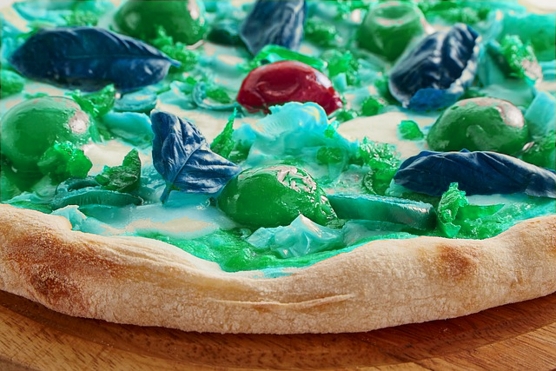
I took the original image, by petrovhey from Pixabay (shown below), and subjected parts of it to various color-shifting and blending processes to create the otherworldly pizza shown above.
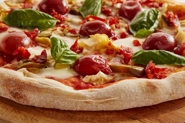
The original image, credit as above.
This post is one of those ideas that comes to you out of nowhere but, as you’ll see, as a technique, it’s worth sharing.
One of the hardest things to do is to convey a sense of the action taking place either on a strange world, or a fantasy environment, or on a future earth. Well, I’ve come up with a way to generate color content that does just that.
I’ve divided the subject into two, maybe three, parts: Pizza Adjectives, Strange Tech, and (maybe) Strange Words. My goal is to present a straightforward and simple mechanic or process for each of these categories that will function equally well in both Sci-Fi and Fantasy -based genres (Steampunk should be considered fantasy that employs the sci-fi methodology for its technology).
Parts 1 and 2 will appear in close succession because I already have processes / techniques for them worked out. Part 3 might not appear for a while because it is, by far, the most difficult to make practical – I’ve thought of three different solutions to the problem, and none of them are anywhere close to being useful for the busy GM.
Let’s get started…
Pizza Adjectives
Pizza Adjectives – the initial thought that spurred the creation of this article – is where I’ll start. The fundamental premise of a pizza is a large base, with a selected set of topping combinations, which is served in slices, and it is assumed that this basic combination is more-or-less universal, and that everywhere will have its own version or local equivalent.
Prior to the mid-20th century, that wasn’t the case. The modern Pizza, as we recognize it today, with a foundation of cheese and a tomato paste or sauce, traces back to Naples in Italy and the late 18th century, but one can consider the open-faced sandwich to be an early form of the same concept.
That pushes the concept back to 1762, when the sandwich was invented by John Montagu, the 4th Earl of Sandwich, who wanted food in a form that could be consumed while gambling.
Open-faced sandwiches – more closely akin to Pizzas – date back still further, with roots in the middle ages trenchers and 17th century dutch tavern meals. A trencher uses a thick bread as a plate.
It’s even possible to push the concept back further, to Hillel the Elder in the 1st century BC, growing progressively further away from the modern concept. White flatbreads with toppings existed in ancient Greece, Rome, and Egypt.
That makes this foundation concept “true enough for game purposes”.
Conceptual Technique
The technique that this article proposes and explores is incredibly simple – attach an adjective to the pizza that wouldn’t normally apply, and then make sense of it, using locally-available ingredients, to create something unique to this specific location.
Because a pizza has two basic parts – base and toppings – you can consider them individually or can combine variations on the two. And you will get different answers if you consider the paste to be part of the ‘base’ concept or not.
But the real power of the technique is this: it can be applied to non-pizza dishes. I’ll get into that a little later. But let’s start at the bottom, with Pizza Bases.
Pizza Base
Pizza bases can be thick or thin. Their primary job is to provide a foundation that holds the toppings together – there’s the ‘plate’ concept reaffirming the ubiquity of the concept.
They can be uncooked until the dish is assembled, or can be a pre-cooked bread of some sort.
It is becoming more common to consider them a contributor to the total flavor profile, and this has sparked the creation of many variations on the basic theme, with recipe variations like adding donut batter to the pizza base recipe through to adding different seeds or herbs to shift the basic flavor profile. I’ve also seen pizza bases with a variation on the usual milk – goat’s milk and camel-milk for example – for further subtle variations and nuances. Using grain variants is also possible – ground malt or barley, or rice flour, instead of wheat flour.
So there’s a lot of room for development even in this comparatively bland component – and that’s long before we even get to concepts like stuffed crusts!
And that’s how the ‘strange adjective’ can be made to work. To demonstrate the technique in action, here are four examples: “Cloudy”, “Liquid”, “Zingy Seed”, and “Minty Leaf”.
Example #1: “Cloudy”
Cloudy suggests some sort of aerogel to me. That would essentially be flavorless. It would need to be coated with something more solid on one side to provide the structural integrity, and that can carry a flavor; it can contain some sort of flavor in the aerogel itself by adding it to the foam mixture, which would probably be sprayed onto that foundation; and it could be coated with a flavorful emulsion of some sort. In addition, the deposition process could be interrupted half-way through to scatter some light-weight seeds or leaves that become encapsulated within the foam when spraying is resumed.
When the pizza is cooked, there would likely be considerable contraction of the bubble contents, creating something more mechanically robust, while the bubbles would burst, forming cells of hot air.
But the dominant trait of this construction would be a pizza base which contributed to the flavor of the final product while requiring the consumption of virtually zero calories. This is a pizza base for the responsible, health-conscious, adult, in an environment where food is plentiful and the problems of over-indulgence are more common than those of malnutrition.
And I’m sure that this would be an angle explored by the pizza-makers – adding electrolytes, vitamin supplements, even protein powders – with appropriate flavorings.
The addition of this one word, ‘cloudy’, opens up a whole new branch of the culinary art.
It’s also likely that for the purposes of indulgence, there would also be a countermove in the opposite direction – you can already get fish etc coated in a “beer batter”, which – again – could be added to a more traditional wheat-based dough recipe – but that’s getting a little off-target.
Example #2 “Liquid”
Does anyone not know what a Trifle is? If so, look it up, because I think you’ll be in the minority.
Layers of cake and topping sandwiched by custard in a tall glass is what immediately comes to mind as an interpretation of ‘Liquid Pizza’. Except that it wouldn’t be custard, it would be a savory sauce of some kind, stiff enough that other components would remain in place within the glass. And it wouldn’t be cake, it would be something else – chunks of a sweet-bread coated in something to resist becoming soaked by the sauce. Because there would be a lot of the sauce in comparison to a traditional pizza, it would have to be a lot more bland in flavor, ptoviding a vehicle for the flavors of the ‘toppings’ suspended in it.
In an inversion of the usual pizza content, it might be meat-flavored with chunks of fruit and/or vegetables and layers of sprinkled nuts. And maybe slices of, or a crumbled variation of, a meatloaf.
That’s what I imagine when I hear the label “Liquid Pizza”.
Of course, there are also sweet-flavored pizzas made with fruit – which hearkens back to the original concept of a trifle.
Example #3: “Zingy Seed”
Imagine a traditional pizza base with savory-flavored popping candy mixed into the dough. That’s my first thought.
My second thought is “What does ‘Zingy’ actually mean in terms of flavor?” Well, that’s something easily answered through the use of the internet. According to Google, “Zingy” describes a taste that is sharp, fresh, and lively, often leaving a tingling or stimulating sensation on the tongue. It is typically associated with vibrant, acidic, or slightly spicy notes that make a dish feel energetic, bright, and invigorating rather than dull or flat.
Citric flavors, vinigars, ginger, cayenne, and peppery flavors can all contribute to the sense of a flavor being ‘zingy’. Sauces based on the term are often used on blander salads.
So a ‘zingy’ flavored popping candy would be little flavor-bombs of umami sharpness, adding a meaty tone to something that has little or no actual meat. A meat-lover’s variation on the vegetarian pizza, if you will!
Example #4: “Minty Leaf”
Adding chopped mint and coriander (or some other peppery plant) into the pizza base produces a very different flavor profile, one perfect for certain meats like lamb or goat. You would probably want a stronger-flavored cheese to weld the flavors together, and that might need some experimentation to get right – I’m expecting a cheese blend of some sort to be the ultimate answer.
Four radically different foundations for a pizza. Each of them, paired with complimentary toppings, could produce a dish that is absolutely delicious. And none of them require anything more exotic than chmistry already familiar to us. The last one is definitiely something that could be employed in a fantasy campaign.
And none of them are built around exotic native ingeredients, whch can add new variations and distinctiveness. In Australia, for example, we have something called “Lemon Mytle” – google offers a description of the flavor as a vibrant, intense citrus flavor often described as “more lemon than lemon,” combining notes of lemon zest, lemongrass, and a hint of eucalyptus or menthol. It is sweet, aromatic, and tangy, yet lacks the harsh acidity or sourness of actual lemon juice, making it ideal for dairy-based dishes.
My experience with it is of a flavor that is punchier than lemon but less diffused, more of an accent than a foundational flavor. And it often seems to have a slight earthiness that pure lemon lacks.
Don’t be afraid to invent something – there are never enough ‘different plants’ in Fantasy / Alien environments, anyway, and there are usually all sorts of wild critters that would add to the range of palete options even if only semi-domesticated.
Which brings me to the subject of Pizza Topping Supplementals, our next stop in this culinary exploration.
Pizza Topping Supplementals
Far moreso than when considering a pizza base, the toppings are where the GM can connect a distinctive flourish with a specific location through the toppings.
When I’m contemplating a multi-world sci-fi setting, I pick a couple of ingredients as ‘ubiquitous’ – these ingredients, or something very like them, are going to be found almost everywhere. The more an ingredient is a signature component of a particular broad quisine, the better a candidate for this treatment it makes. So tomatos are, arguably, the cornerstone of italian quisine as we understand it today. Pepperoni is just a spicy sausage (for all that I love it as a topping), and many european cultures have those or something similar, but it’s really hard to imagine pizza without tomato, let alone many of the other definitively italian dishes.
I then spell all the remaining ingredients in a commonplace recipe from Earth that I know works as a combination, backwards as a mnemonic to “insert local ingredient here”. And then I’ll transpose flavor profiles from another, similar-but-different recipe, or swap the ingredients’ flavors around. A meat that has the rich, tart-but-sweet, flavor of tomato paste, plus a paste / thick sauce that carries the flavor of onion and garlic, and a leafy vegetable that tastes like ground beef – throw in some alien names for the source ingredients and you have a recipe that you know would be palatable, yet subtly unique, and definitively tied to the location from which these ingredients derive. Give it an overall name as a recipe – “Yamarkian Pizza” or something – and the act of worldbuilding is complete. At one stroke, you make the location more unique, and more real, and tie that into the culture, and connect that through the food available back to the distinctiveness of all three elements – the place, the culture, and the food. The distinctiveness and realism permeate all three at the same time.
On it’s own, this is not enough to make any of the three distinguishably unique – this is just a worldbuilding ‘brick’ – but it’s a solid one.
Example #5: “Curried Bloodwing”
Pizzas built around curried meats are rare, even in regions where curries are popular, because tomato doesn’t really go all that well with them. Instead, you would want something creamy and spicy, that prevents the curry flavor from being too dominant, too overwhlming.
But if you hunt around a bit, you can find such. Instead of tomato paste, they are often based on a blend of Hommus and Yoghurt, especially here in Australia, where we love a good fusion of cuisines. Hommus, for anyone who doesn’t know it, is a thicker, dip-like sauce with a creamy-but-slightly-gritty texture and a sesame and chickpea flavor. Onion, garlic, and lemon are sometimes also blended in. Technically, these are Tarator, or (added roasted Eggplant) Moutabel, but the ubiquitous Australian terms are just “Hommus”, “Hummas”, or “Yogurt Hommas”.
So let’s postulate a meat with a slightly nutty flavor profile from a bat-like creature called a “Bloodwing”, which in turn gets its name from the bright red color that it assumes when cooked. Because it can sometimes be a little gamey, Bloodwings not being a domesticated species, something that tones down the flavor somewhat is the preferred treatment, and a curry fits that bill precisely.
A pre-cooked base is placed on a tray and coated with a slightly thicker yoghurt hommas. The pre-cooked curried bloodwing and some peppery leaves are placed on top, and the whole placed in a pizza oven just long enough to reheat the ingredients. The sauce is more like a ‘stable custard’ than anything else, it doesn’t break down very much under heat. Because it doesn’t crust, the sauce acts as a flavor sponge, adding the flavor of the meat and leaves to itself, creating swirls of spice and color.
Variations on the curry – sweeter, milder, or hotter – provide distinguishing touches. It’s a pizza, but one both utterly unlike anything most people have had before and completely recognizable. And the red-and-green-and-yellow on white would create an immediately-appealing visual presentation.
This could even work with meatballs cooked in a tomato-like sauce, for a radically different interpretation of “Pizza” in the more traditional sense!
Example #6: “Creamy”
When I think of the word “Creamy”, the first two things that come to mind are carbonaras – pasta, meat, and a creamy sauce – and the texture of perfectly-cooked callamari, which is sometimes served in such a sauce but is usually coated in some sort of breadcrumb or batter.
The first would be more challenging as a pizza motif, and would probably be too similar to a variation on “Curried Bloodwing”, above, so for the same campaign – and at least initially – I would focus on the latter.
Calimari rings are squid-based, but let’s shift that sideways and go for an octopus-like creature where the limbs can be sliced into rings.
Imagine an octopus that adapts first to become amphibious, and then to become wholly land-based. To shift expectations sideways a little, let’s replace “Octopus” with “Hexapus” or “Decipus” – I like the latter name a little more than the former, so 10-limbed it is. I think that Octopusses rely on salt water to keep their skin moist and flexible, so this adaption would require crustacean-like shells to ‘trap’ salt water between shell and underbody. That, in turn, would give a Decipus both natural defenses and natural weapons, which would enable the species to compete and thrive, growing larger with the generations until it was the size of a wolf or large hound. Capable of short bursts of blinding speed and a high natural intelligence, it would become an apex predator, capable of defeating much larger opponents.
The larger a calimari ring, the tougher it is likely to be unless prepared pefectly; the smaller, the more forgiving. But let’s set that aside and have this meat be gentle and forgiving of over or undercooking without becoming rubbery or leathery.
And, finally, let’s say that it has a more crab-like flavor.
Pizza base – probably fairly traditional.
Pizza sauce – seafood generally needs something acidic – be it citric or vinigar-based. But tomato – with something of this sort added – would serve quite adequately. To make it more exotic, let’ postulate a citrus that is strongly lemony with a hint of lime, and call it “Limeny Grapes”, then incorporate that into a tomato paste.
Rings of fried Decipus, possibly crumbed or battered, get placed on top, and grilled fish chunks are then placed inside the rings. Leaves fom a salty & peppery bush – maybe called a “[planet-name] saltbush” – are added around the outside of the rings.
The result is a seafood pizza that is remeniscent of Cioppino or Marinara and at the same time culinarily unique.
Example #7: “Fruity”
You can already get fruit-based pizzas, entirely setting aside things like “Ham & Pineapple” which arouse so much heated debate. So this adjective is so natural (if unusual) when applied to a pizza that we’re going to have to work especially hard to make it distinctive and unique.
High-concept, even.
So let’s go with a gellied or comfied meat and a fruity flavor profile with no fruit of any kind.
Jellying involves creating a savory jelly (aspic) by boiling collagen-rich meats to extract natural gelatin, which then encases meat pieces and sets when cooled. Collagen-rich parts (pork trotters, hocks, ears, chicken feet) are simmered slowly (3–8 hours) with meat, vegetables, and spices. Most jellies are served cold.
Confying is a preservation method—originally designed for times before refrigeration—that involves cooking meat slowly in fat, then storing it submerged in that same fat. The meat (duck goose or pork) is first cured with salt and aromatics for 12-24 hours to draw out the moistue and tighten the texture. It is then slow cooked in a rendered fat like duck fat, a process taking another 3-10 hours. The fat is absorbed into the dried meat, replacing the moisture that was there with something that will survive reheating. The cooked mixture is packed into jars or containers and cooled, creating an oxygen-free environment that can preserve the meat for months in a cool place. The end result is an extremely tender and moist meat that can be served cold or crisped before serving.
To meet the expectations created by the term ‘fruity’, we need to change the jelly or fat into something with a sweeter, fruitier flavor. Simply including fruit in the jelly or fat would achieve the goal. But you wouldn’t want it to be too sweet – so, depending on what else you’re putting on the ‘pizza’, you might want a more citrus-flavored profile.
The aspic or fat would form the pizza sauce upon reheating, but – being mostly transparant – would not look all that appetizing. So let’s also add some food coloring into the mix. Which color would depend on the color of the underlying meat – white could go with almost anything, while brown would restrict you to red colorations, I think.
Top the whole off with some leafy greens that have a fruity flavor, and maybe some shaved coconut or shaved roasted hazelnut to add some texture and a broader flavor, and it’s job done.
Some of those examples really have my mouth watering! But let’s move on.
Pizza Topping Substitutions
It’s also possible to reverse the process and, by doing so, to connect with existing game-world constructs. The one requiement for doing so successfully is the presence of some known and recognized indiginous life-form or plant.
You start with a known flavor profile, subsitute in the core ingredient, and adjust the other flavors to match. This produces a familiar-tasting food item made with exotic ingredients that are indelibly tied to the location.
To demonstrate this, I needed a setting that everyone would recognize, so I’ve chosen two pizzas that can represent Tattooine from Star Wars.
- Tomato is a fruit, not a vegetable; and
- Pineapple is often included in meatloaf recipes because it contains an enzyme that naturally tenderise meat and amplifies its flavor.
Example #8: Hawaiian -> Tattooinian
What flavor is Bantha Steak? They look mammallian, and most people would immediately think beef. But there’s an inferance that they eat just about anything that’s edible (“bantha-fodder”), and that would be a survival trait in a desert environment like Tattooine. That in turn makes them more akin to goats or pigs.
Goat is a stringy meat, with either strong gamey flavor or weak flavor of any sort, depending on who you ask and possibly how it’s prepared. It tends to be very tough, and most cooking methods are aimed at softening it in some way. There’s not really very much that’s equivalent in common pizza toppings.
Pork can also be quite tough as a meat, especially if overcooked. That’s why it remains a common subject for the jellied and confied cooking techniques. Pork is rarely the central ingredient in a piza, but it can be present as an addition if finely diced.
But bacon and ham are much softer and richer in flavor, and these are quite common, either as part of a medley in a meat-lover’s variety, or in the more controversial Ham and Pineapple. I don’t understand that contoversy, I have to admit – I’m one of the percentage of people who quite like Ham & Pineapple Pizza – but for every lover of the flavors there’s someone who vehemently hates it, or so it sometimes seems, and this is doubly true in the USA (maybe Canada too, I’m not sure about that).
From afar, one gets the impression that the objections are more ideological than anything else, people objecting to the presence of fruit on a savory dish. To anyone holding that opinion, there are two facts that need to be pointed out:
A more refined version of this objection is that the sweetness and high moisture content of the fruit clash with the traditional, savory, and crispy nature of pizza. But that doesn’t entirely stand up to scrutiny, either – the tomato paste is just as capable of making pizza soggy. That’s why tomato-based sandwiches are buttered – to provide a fatty barrier between tomato and bread. And why don’t these purists complain about ham or bacon on pizza, when both of these can also be sweet ingredients? Sweetness is just one element of the dish, one note in a symphony of flavors – you can complain that it’s too dominant in a particular recipe, but not that it’s present, especially when the pizza sauce often contains added sugar.
Critics, often dubbed “pizza purists,” argue that it violates Italian culinary traditions, with many objecting to the combination of hot cheese with a wet, acidic fruit. This traditionalist arguement is undeniable, but my response to that would be – ‘so what’? Tradition is still served by all the traditional varieties of topping on offer, and no-one is forcing you to eat it. But I do wonder how many of these critics have actually tried it? How many are just food snobs? And of those who have tried it, how many had preconcieved negative attitudes? My bet would be, the majority of them would fall into one of those two categories.
So, sucks to be them – I’m going to use Ham And Pineapple Pizza as my base flavor profile for Tattooine Pizza – and for one of the reasons that the idealists and purists cite: the moisture content. Tattooine is an arid environment (for the most part – I’ll deal with that in my second example), and every source of moisture has to be exploited.
We’ve never seen cacti on Tattooine, but they – and other succulants – would seem to be a natural fit, because they concentrate moisture in their pulpy flesh. So “Ham and Pineapple” naturally becomes “Bantha and Cactus” on Tattooine.
But now we get to have a little fun with the idea. Cactus pulp (specifically from the prickly pear or “tuna” fruit) is often described as a cross between watermelon, kiwi, and bubblegum, making its flavor profile quite different from pineapple. While both are sweet and tropical, cactus pulp is less acidic, more floral, and generally less sharp than pineapple. For those who have never tried Kiwi Fruit, it’s strongly reminiscent of strawberry.
Bubblegum, Watermelon, and Strawberry? At the very least, I think we’ll need something acidic to cut through the implied level of sweetness. But there are exceptions to this flavor profiile – s Some types of barrel cactus fruit are, in fact, described as tasting remarkably like lemon or pineapple. That puts us back on more familiar ground, flavor-wise.
So let’s imagiine a variety of succulant that grows under the sand (which is why we don’t see it dotting the landscape), soakng up every skerrick of moisture its roots can find. Thick-skinned with air pockets to insulate the plant, its flesh has a slightly maple-flavor with a mild citric punch moderated by the sweetness. When you bite through the pulp, it releases a burst of flavor and moisture.
We need to then adjust the flavor of Bantha-meat to suit. That would mean making it a little less sweet and perhaps a little more smoky in flavor – smoked ham, not honey-glazed, in other words.
That leaves only the sauce – let’s dry it out a little more and then remoisterize with a bit of light red wine just for the flavor, and in particular, the scent. This would add a slight earthiness that can be complimented with dried sliced mushrooms and maybe a little thinly-sliced and de-seeded red capsicum (called red peppers in the US).
The result would be a pizza with the flavor complexity of a fine italian dish, of mostly local ingredients (the flour might have to be imported), and unmistakeably Tattooine on a plate. It even moisturizes the mouth to make it easier to swallow!
Example #9: Pepperoni -> Spicy Swamp Rat
Where is the Water on Tattooine? Virtually none of it appears to be on the surface. Luke’s aunt and uncle run a vapor-farm, extracting moisture from the air and presumably channeling it along underground pipes to farms growing more traditional produce.
Certain arid regions experience seasonal influxes of moisture. For example, the Sonoran and Chihuahuan deserts, as well as parts of the Sahara and Arabian deserts, can experience high absolute humidity during summer monsoons, with moisture levels comparable to those in humid deciduous forest regions.
So it’s not going too far to suggest that some areas on Tattooine experience high humidity, and that’s where the bulk of the moisture is. Desert air is often very dry during the hot day but increases at night when temperatures drop, sometimes increasing from roughly 15% to 25% or higher, making the night feel less dry, even if the total moisture content remains the same.
When discussing attacking the Death Star, Luke talks about bagging “Swamp Rats” from his speeder, saying they are about 2m in size. About the size of a cow in profile, in other words. Because of the subject of discussion at the time, everyone focusses on the size of the creatures, missing the key-word: “Swamp”.
That implies that there are some parts of the planet that have surface water, even if these bodies are too small to be seen when viewing the planet from space.
If Swamp Rats are at all edible – something for which there is no evidence either way – their existence would not be ignored as a food source. In a desert, you eat everything you can get.
What, then, might a Swamp Rat Pizza taste like? I’ve chosen Pepperoni Pizza as my base flavor profile in answer to that question. Pepperoni is a cured, fermented, and air-dried sausage typically made from a mixture of ground pork and beef, seasoned with paprika, garlic, and chili pepper to create a soft, smoky, and bright red meat.
In my experience, there are two varieties of Pepperoni used as a Pizza Topping. There are the small sausage varieties, between 1/2 and 3/4 of an inch in diameter, and frequently sliced relatively thickly; these curve up at the edges when the pizza is cooked, but can easily become dry and tough if overcooked. And there is the much larger variety, 1 1/2 to 2 1/2 inches across, and sliced about half as thick – this dries out even more, but doesn’t become especially tough unless seriously overcooked because of the thinness of the slices.
Given the size of the Swamp Rat, I would suggest the latter as the more equivalent. And let’s make it naturally peppery, so that it doesn’t need so much seasoning and preparation. The rest of the flavor – garlic and spices – would have to be supplied through other ingredients, though. Maybe some green peppers with a more paprika flavor, thinly sliced, and something garlicky added to the tomato paste.
The meat in pepperoni is typically a mixture of ground pork and beef, balancing fatty and lean meat. So let’s say that Swamp Rats contain both – fatty meat around the stomach and lean meat in the more muscular parts such as breasts and limbs. This would make for an efficiency of preparation that would make Swamp Rat quite favorable as a food source, and the manner of preparation puts a degree of separation between the end product and the source – since “Swamp Rat” isn’t a particularly appetizing name. The product, as used in our imaginary pizza, would almost certaintly be given a more appetizing monicker – “Swamperoni” maybe.
One thing more needs to be discussed before this pair of examples can be put to bed – and, because it applies to both, I’m separating it out from the two examples.
Tomatoes are one of the more moisture-dependant crops, ranking somewhere between wheat and rice. They need deep, consistent watering to support their high moisture content (94-95% water). If you can grow tomatoes outside of a controlled glass-house environment, you can grow wheat.
And there’s no sign anywhere of wheat farms or other such large-area crops on Tattooine. That has to raise doubts about the ability of Tattooine farmers to grow tomatoes, too, especially in quantities sufficient to make them a staple crop.
Green, leafy plants on Earth possess that color because they absorb more of the red light and reflect the blue and yellow. Clearly, one chemical reaction (photosythesis) can only cover a limited part of the spectrum, and this is the part that is processed most efficiently. It can even be argued that if the plant did not do this, it might recieve too much light energy, especially in the potentially harmful ultraviolet part of the spectrum. Applying that through to Tattooine, where the sunlight is far more intense, we can conclude that even more of the lgiht reaching the plants is reflected away, and that they would be comparatively white in color. Views from space show the planet as a pale yellow color often called “buff” when applied to manila folders, paper, and envelopes. This is a blend of yellow and white. While the sands of on-planet shots are generally similar, they are arguably darker yellow in tone (because they were filmed on location here on Earth, somewhere near Tunisia). To correctly conflate the two, we need a source of additional white – it doesn’t have to be much – so that logic seems to hold together unexpectedly well.
We have moisture farming, extracting water from (relatively) humid air. We can also surmise that there is considerable underground water, but it’s deep and difficult to extract, and may be extremely salty. This suggests a moisture cycle in which the surface layers are relatively hot and dry, with that heat radiating down during the day to turn the water into water vapor at a comparatively deep level; it then aerates the soil, keeping it loosely bonded except where igneous rocks have formed through volcanic action in the past. So the hot, moist, air rises and forms a layer some distance above the ground levels, only to descend in the relatively cool night, and occasionally there would be rain and thunderstorms. Moisture farms are cooling towers that extract the water from the humidity and pipe it to where it can be used.
What’s needed is to introduce some sort of tomato-equivalent that could thrive in such an environment. I don’t want to make these another succulant, because I’ve already used that plant variety, and there are no bushes that might fruit that are mass-cultivated – they need to be hidden from sight.
Tomatoes are nutrient-dense berries from the nightshade family. Despite being fruit, they are typically treated as vegetables in cooking.
The best answer I can come up with is for tall underground plants that project roots down through the soft, arid, soil to the water table, that are extremely salt-tolerant, and that send shoots upwards toward the light. The upper surface of much of Tattooine is sandy, and sand is actually translucent, so these plants can flower and fruit below the surface, protected from the harshness of the desert environment, and assisted by the relative looseness of the sandy ‘soil’. In this way, they form natural equivalents of the moisture farms in areas where the surface is especially sandy, and not as hard-packed as the family moisture farm from which Luke derives. Human colonists would have discovered this plant and sought to domesticate and crop it, by supplementing the natural moisture they get from the environment; this would enable the fruit to grow larger and faster. I imagine that the lower down the fruit forms, the less mature the berries, and that as the plant itself grows, these are pushed higher and higher – so only the uppermost layers would be cropped, with next month’s crop, and the month after, and the month after that, all growing deeper in the ground – a contninuous production cycle.
And that solves the Tomato problem.
Next, I should consider the Wheat problem. There are various tubors that have been mentioned as growing on the planet in various sources, and they would fit both the ‘grows underground’ and moderate water-needs of a wheat equivalent. This could be pureed and dried into ‘pizza bases’.
Golden Rule: Consider The Environment
Those last two illustrate a golden rule that should always be adhered to – if your dish is to be commonplace and not something exotic, reserved for high-end restaurants and fancy / celebratory meals, the constituants all have to be locally-sourced.
There are two ways for that to happen: transplants and local flora / fauna.
I would reserve the ‘transplant’ option for use only when inspiration fails to deliver a local solution. But either way, the local conditons have to be taken into account – it’s no good saying “plums have been transplanted from Earth” if the environment doesn’t support plums being grown.
The culinary history of Australia over the last century or so contains a myriad of lessons for the outside GM.
Initially, everything here was based on food products transplanted from Europe and a very English cuisine built upon it. Some crops did well, others struggled. The cuisine began to adapt to the resulting scarcity / commonality profile even while efforts were undertaken to overcome the challenges that resulted from the environment.
Post WW2, immigration from elsewhere in Europe opened up, and German, French, Italian, and Greek cuisines all made their way into the everyday diets of the Australian people. Of these, and selected dishes aside, French pastries and cakes and Italian dishes dominated. Gernany gave us the Black Forest cake, and Greece gave us some salads; the latter cuisine still struggles to penetrate the market, becoming more successful with each attempt.
It wasn’t long before fusions and local variations started to appear; bridging the gap from traditional cuisines to what was already established. Of the two, ‘local variations’ were dominant.
That was the cuisine landscape when the doors were opened to Asian immigration. Indian and Chinese immigration dominated for a while, and of course, they brought their cuisines with them. Indian curries – or rather, a softer, gentler variation – had a piecemeal integration that grew over time. Chinese dishes, and in particular those of the Southern Chinese Sezhuan Province (I’m sure I’ve misspelt that, apologies) were an immediate hit – but the local influence permeated the cuisine almost immediately. The rapidity of the integration and adaption were remarkable – in two or three years, chinese restaurants were ubiquitous.
Over the next twenty years, other minority cuisines made their way here, and either adapted to the Australian palate, adjusted the Australian palate to make room for one or two dishes, or failed to make an impact. Combinations of the first two outcomes are common, belied by a trend starting in the late 20th and early 21st centuries toward ‘authenticity’. That seems to have died down lately, and fusion cuisines seem to be on the rise again.
Of these minority cuisines, one of the earliest and most successful has been Middle Eastern food, especially Lebanese and (to a lesser extent) Turkish.
Within easy walking distance of my residence there is a Himalayan Curry House and a Lebanese Pizza specialty store. There’s a restaurant that fuses Japanese and Australian food (especially in the area of drinls) – with a lot of italian-srtyle coffee varieties on the side [the coffee culture is incredibly strong in Australia and unbelievably fussy in its standards].
I’ve offered this brief summation of the evolution of the current cuilinary landscape for two reasons: First, it demonstrates the impact of the Golden Rule, and second, it provides some context for the perspective taken in the rest of the article – don’t look for ‘cultural purity’, you won’t find it here. Australian cuisine is a melting pot, unafraid to adapt a more local variation of a base recipe that a purist might abhore, but that Aussies culturally embrace.
Would someone without that environment come up with the simple process described in this article? Maybe – but I think the conceptual hurdles would have been higher for them, no disrespect intended. The purity of their basic cuisine imposes an additional barrier to overcome.
Broader Application
To close out this article, let’s broaden it’s conceptual boundaries beyond that of Pizza to some other dishes that are extremely common here (always draw on the cuisine that you know as a foundation – or better yet, the cuisine that your audience knows)..
The technique is basicly the same – add or insert an adjective that doesn’t commonly go there and then make sense of it. I have three examples to offer.
When it comes to specific recipes, though, you have two paths to follow: you can either create something with the same flavor profile as the ‘inspiration dish’, recasting it into a new form, or you can have a dish with a similar structure and texture but a different flavor.
There is also the secondary question of texture – it can either (a) be the same as the inspiration dish, (b) be the same as the target dish, (c) be something in between the two, or (d) be something completely different.
The process of applying the principles demonstrated in earlier examples to a broader array of dishes is to transform the dish one way or another and then incorporate a twist – and always to use local ingredients to add the dish to the world-building already in place..
Example #10: Irish Stew
I have to admit that this dish brought me to the limits of my imagination. I had a hard time thinking of a different flavor profile that would fit the textural form and cooking method, and an equally hard time thinking of a different form into which this flavor profile could be recast. It took a solid ten or fifteen minutes before something that would work came to me.
Irish Stew to Sushi Roll, keeping the same flavor profile as the original, which means that it has to be served hot, not cold.
The primary ingredients of traditional Irish Stew are Lamb or Mutton, Potatoes, Onions, water or stock (lamb or beef), salt and black pepper. Carrots, leeks, parsnips, thyme or bay leaves, and guiness are sometimes added, with the first being the most frequent. But the most common ingredient in the Australian Version not listed in those initial ingredients is barley, and the next most common is celery.
The broth tends to be robust, thickened by using waxy potatoes. It’s dominant flavor is earthiness, with an underlying sweetness from lamb and carrots and added umami from the onions.
My experience with the dish suggest that the size of the meat chunks is critical – too large, and they can be uncooked in the center, and not let enough of the meat flavor permeate the rest of the dish; too small, and the meat can become dry and bland, giving up too much of its flavor to the broth.
So, let’s break this down into components for our ‘hot sushi’:
Cooked Barley in place of rice. Chunks of meat alternating with potato in the middle, cooked on a skewer. A sauce containing onion, carrot, celery, stock, potato wax from the potato chunks mentioned previously, which is held together with a gelatinous compound. Maybe a little mint and coriander as well. Barley to be cooked in the sauce with the vegetables – which implies that chunks are big enough that they are easily removed from spoonfulls of the barley-and-broth before the gelatinous agents has time to set. And something very liquid-resistant to hold the whole thing together, a wrapping of some kind – possibly banana leaf.
Each of these candidate for replacement with an other-world equivalent. But first, let’s throw in our wild card, the adjective: Let’s throw Ginger and a little garlic into the sauce and call it “Zesty Irish Stew” – with “Zesty” being our unusual adjective.
In sequence of priority, in terms of making the dish unique to this setting and place, the ingredients would be:
- The Meat – a rich, dark meat that is not overwhelming in flavor. Let’s call it Londassian Winterdeer.
- The Barley – a cropped staple that binds together when cooked, possibly something more akin to rice in appearance but not flavor, maybe with a very slight walnut flavor – Londassian Nutrice.
- The Ginger & Garlic – one tubor to do both jobs, Londassian Yam.
- The Potatoes – Let’s let Londassian Yam take the place of the potatoes as well.
- The Stock – I’d like this to be slightly different and earthier than the meat, so Londassian Pan Mushrooms.
- The Banana Leaf (because it’s visibly obvious) – Londassian Berry-Leaf, let’s say, and make it a sweeter component, eliminating the carrots.
- Everything else – let’s call these transplanted varieties of these vegetables.
.
- Meat – a local variety of game bird, equivalent to a chicken;
- Citrus – a local fruit of the citrus type, turrned into a sauce
- A herb-flavored pale honeycomb, probably ground or powdered; with more of the citrus;
- Peppers – candied in the honeycomb mixture and then added to the sauce to unify the dish.
- Six Tips to Grow Peppers for Flavor by Stephen Albert for Harvest to Table, and
- Correlation Analysis of Soil Nutrients and Quality Index in Pepper Planting Areas by Chuanjing Liang ,Dan Xing, Jianwen He, Dehui Tu and Yongping Wang, Research Institute of Pepper, Guizhou Academy of Agricultural Sciences, Guiyang 550006, China.
Everything gets cooked and then strained through a collander that has pores large enough to admit the Londassian Nut-rice and gelatinous liquid broth. These are then cooked a little longer to concentrate the broth into a sauce..
Lay the Berry-Leaf flat on a marble surface, spread the Nutrice over the top, alternate Londassian Yam and Winterdeer chunks, dress with the other vegetables extracted from the broth, roll and leave to set, held together by string. Remove the string and steam just prior to serving.
This is a hot dish, a sushi, and a variation on Irish Stew with hints of an Asian flavor infused into it, all at the same time. Slice and eat with chopsticks, or let the outside cool slightly and eat as a bar or roll.
Unmistakeably Londassian (wherever that is).
Example #11: Layer Cake
In the previous example, we kept the flavor profile but not the form, so this time lets switch up the flavor profile but keep the idea of a cake with layers.
Key ingredients are the cake, the separating layers, the icing, and maybe a topping of some sort..
What’s our twist adjective? I thought initially of a lot of terms appropriate to a cake, like ‘fruity’, or to a layered construction like ‘stacked’, but they don’t pose enough of a twist. I’ll use both ideas in the final construction, though. I toyed with ‘icy’ and ‘tropical’ for a while, but they aren’t unusual enough, either. My thoughts were tending toward a savory dish that looked like, and was constructed of, ingredients that would normally be assumed to be sweet. And that concept led me to the word ‘Phantom’
So we have ‘Phantom Layer Cake’ – something savory made from ingredients normally considered sweet, and consumed as a main course, cut into wedges the same way as one would a cake.
So, for the cake element: A melon which, when baked, shrinks into a denser layer more akin to a natural pancake, with a strong mango-and-lime flavor, which gives a sweetness to the dish. Let’s use a literal name for this – Foaming Wintermelon.
The separating layers: A berry which becomes a dark red compote with a flavor strong in meaty umami, blended with a stiffened cream and something to further reinforce it structurally (but not gelatin). Let’s name them after the discoverer – Forsterberries. The stiffening agent should be cornflour or something equivalent. I looked up what ‘corn’ is called in non-english languages and couldn’t go past the Chinese name, Yumi, because it looks so similar to the english “Yummy”. So “Yumiflour”.
The coating/icing: We’ve got plenty of sweetness, and a meaty flavor. We need a little spice-and-herb action, and this is the place to put it. So a jellied stock with ground spices and herbs. But a ‘stock’ doesn’t sound especially like a component for a sweet dish, so let’s call it a glace, derive it from a citrus – the “Pepperlime” – and add some mint, lavender, basil, rosemary, sage and thyme (transplanted) to it.
Topping: I think we need to make it obvious that this isn’t a sweet dish, so caramelized Onion (transplanted) and chunks of roast chicken (Konglish Birdmeat), and a cherry in the middle that was roasted in a small quantity of mushroom sauce with red-berries (generic term) that then get spooned onto the top here and there. Top that with a sprinkling of salt, and the “Phantom Layer Cake” is done. To further connect it to its place of origin, let’s amend the name to “Konglish Phantom Layer Cake”.
Example #12: Lemon Chicken
For this last example, let’s play it (relatively) straight – same basic flavor profile (citrus and white meat from a bird), same basic ingredients (local equivalents), but a single twist ingredient: “Honeycomb [Citrus] Chicken”, giving the combination a slightly more sweet-and-sour taste.
Inspired by that, let’s add some thinly-sliced red, yellow, and green peppers to the sauce.
So, we have:
Honeycomb is made by heating sugar, honey (or golden syrup or corn syrup), and water to a high temperature and then adding bicarbonate of soda to make it foam.
Since we aren’t changing the flavor profile much – just adding some sweetness and herbs to the standard “Lemon Chicken” – the ingredients are going to be similar. Let’s make it an alien meat from the Dominclinan Cassowery, a Dominclinan Lemon-Lime that tastes like a slightly more sour blend of the two, the honeycomb with transplanted herbs, and Dominclinan Peppers (which are really transplanted peppers but grown in an alien soil, which greatly impacts the flavors*).
See:
Creating bespoke recipes that recall familiar foods using local ingredients is just one way of creating a broader, more robust culture with which to populate a planet or part of an Empire. Or a fantasy world, or even a different Plane Of Existance. In the next article in this series, I’ll look at ‘Strange’ Technology as a unifying force gluing disparate parts of a culture together.
PS
A couple of last-minute thoughts to add.
First, I believe that between 1/3 and 1/2 of your worldbuilding should be aimed directly at the PCs that you expect, even if you have nothing more than a race and a class to go on. Being able to say to a player, “this is a popular dish where you come from, it’s up to you whether your character loves it or hates it,” and then building on the food relationship and the chosen reaction through minor incidents in the first session or two will help establish that the characters are ‘real’ and inhabiting a ‘real’ landscape, with some sort of culture in back of them.
Second, one of the first interactions with a culture that a character will have upon entering it will be the food, and especially the differences between what’s offered them and what they’re used to. Don’t waste that opportunity – if you’re creating a trio of local dishes, make them reasonably consistent in generalized cuisine style, draw inspiration from that in building out the rest of the culture, and then use them to sneak information about that culture – especially anything not obvious just from looking around you – into the adventure. World-building may happen on the page, but it isn’t real until it’s put in front of a player, one way or another.
So have fun with this, and squeeze as much benefit out of it as you can.
If you enjoyed this article, you may also be interested in my previous posts about cuisine in RPGs:

Discover more from Campaign Mastery
Subscribe to get the latest posts sent to your email.




March 31st, 2026 at 4:28 pm
This was a fascinating exploration of how sensory descriptions—especially through something as familiar as pizza—can elevate worldbuilding. The idea of swapping flavor profiles while maintaining a recognizable structure is both practical and highly imaginative. It’s a great reminder that small, relatable details can make fictional worlds feel authentic and immersive.
April 2nd, 2026 at 4:17 pm
This is a wonderfully creative and practical exploration of how simple linguistic techniques can deepen worldbuilding in RPGs. By using unexpected adjectives applied to a familiar cultural touchstone like pizza, the article gives GMs a way to quickly generate flavorful and memorable local cuisine that instantly conveys something unique about a setting. I especially appreciate how the method is grounded in real culinary concepts yet remains flexible enough for science?fictional or fantasy worlds — it strikes a great balance between the imaginative and the usable. The examples provided don’t just illustrate the technique; they inspire further ideas that GMs can adapt to their own campaigns. Thank you for a fun and genuinely useful read for anyone looking to enrich the sensory texture of their w
April 13th, 2026 at 6:24 pm
This is such a creative approach to worldbuilding. The idea of using something as familiar as pizza and then twisting it with unexpected adjectives really helps bridge the gap between the known and the alien. It makes unfamiliar settings feel more tangible and immersive.
April 21st, 2026 at 1:11 am
That was the goal, Henry – glad you think I achieved it :)
April 30th, 2026 at 12:01 am
[…] stimulant to get your thoughts moving, and that’s where the technique employed for Recipes in Strange-taste Worldbuilding: Pizza Adjectives can […]
May 22nd, 2026 at 11:39 pm
What a creative approach to worldbuilding! Using food as a lens to explore culture, environment, and history makes fictional settings feel much more alive and believable. The pizza adjective concept is surprisingly simple yet incredibly effective.