Tales Of Youth
In this post, a tool for integrating a character’s evolving personality into their past and backstory. Works in all genres.

Image by Charles McArthur from Pixabay
Wow, but this post is late. The main reason for that is the Worksheets that I’ve linked to later in the article – the article itself was 90% complete last Sunday Night. These took four days to design and create, and a day to assemble – only for me to discover, late Thursday, a major error in construction which led to part of the design work and all of the assembly to have to be redone. And only then did another two flaws get noticed – but since these were merely cosmetic, I haven’t bothered fixing them.
There’s an advertisement that I’ve seen repeatedly on Australian TV recently. The premise is that if you buy the advertised financial service, you will have more time to worry about various other things in life, from the positive to the profoundly negative, all listed in a humorous manner. It’s the last item listed that I find profoundly offensive – time to “worry about becoming your mother.”
Clearly, this product – usually bought only by those of middle-age or older – is being pitched at the youth market, and relying on some sort of generational divide or gap. If no such divide or gap exists, then the whole message does worse than fall flat, it becomes profoundly offensive and likely to dissuade from the purchase of the financial product in question, not encourage it.
I can’t speak for anyone else, but I am exceptionally proud of my mother and her achievements in life despite difficulty and hardships and the loss of opportunities that accompanied them.
On one occasion, this advert was aired in close conjunction with another for a TV drama, and the two connected in my mind to highlight a difference between perceptions of family in adult-oriented TV drama and in real life – which was followed by the realization that TTRPGs tend to follow the Television Drama model, even when they shouldn’t.
The Television Model Is Necessarily Broken
On TV, family is something no character seems to think all that deeply about unless one or more family members is directly involved in the episode of the week. The rest of the time, the characters stand alone in their adult iteration, their quirks, interests, relationships, personalities, and education all existing in magnificent isolation.
And when family do appear, at best they tell (not show) the backstory to those adult personality traits, if there is one, or simply acknowledge that the focal character was ‘always like that’.
There’s good reason for this – actors are expensive. Stars top the bill, followed by lesser stars, special guests, child actors, recurring adult supporting cast, one-line supporting actors, and extras. Child actors generally don’t have a lot of experience, and so earn less than the next tier until they can become global superstars and renegotiate their contracts. But they come with all sorts of extra expenses – they are more fragile and less likely to behave in a mature fashion, so all your insurance goes up; they have to be educated at the same time as acting; they may need extra psychological support; they are more likely to disrupt filming; and they can only work limited hours, and the best way around that is to hire twins But having two child actors can simply double or triple some of the costs mentioned earlier.
Children only appear on-screen when they absolutely have to be there. It’s cheaper to do something audio-only as a flashback – and cheaper yet to get one of your existing adult cast to provide a child-like voice for a little extra cash on the side.
On top of all that, child actors are rarely up to an adult standard, so getting good ones is likely to take three times as long in casting.
And on top of all that, you will often need several of them, depending on the scene. You can’t really do a school scene with just two kids; siblings alone can demand several.
All of that adds up, and leads to the contracts that child stars signed back in the 60s, 70s, and 80s being far more predatory. That made it more practical to do the occasional scene with multiple child actors, but the screen actors guilds have grown more teeth since, and these days, there are less of those shortcuts available – so studios have to absorb more of the additional costs. Which only makes justifying a scene with multiple child actors harder, and such scenes, less frequent.
TTRPGs suffer none of these problems – so why are such formative experiences left out?
The Real Life Experience (for most of us)
Contrast that with the real-world experience that most people have. As a child, even if they aren’t passions of yours, you get drawn into the things that your parents do professionally, and into their hobbies and pastimes. You learn things from these people in the process, things that shape your own personality in the years to come, often without our even recognizing the source.
And it’s often not just your immediate family, but the extended family around them. And it’s your siblings, and their interests and hobbies, too. Some of it rubs off, leading to bonding experiences.
It’s more common to consider the impact of your parents occupations, but not common enough to consider how the rises and falls of the family’s fortunes impacted the rest of the family. As children, we’re generally not perceptive enough to connect cause and effect, but those effects will impact us as children nevertheless, often as bolts from the blue.
It’s a similar story – with complications – when it comes to your parents’ family friends, your parents’ bosses and employers, etc. You start with the relationship between the individual and the family member, and fold in how they relate to children in general, to arrive at how they interact with a specific child (you) – and only then can you get into the impact of those interactions, as it is experienced by the child in question.
How about the relationships with the children of those bosses and family friends? There’s pressure to get on from the relationship between the adults, but that’s only the beginning of the story of the relationships involved.
All of these are formative experiences that contribute to the evolution of the individual. I had few friends as a child, and that led me to value friendships more highly as an adult, while many of those around me who were more socially-connected within my peer group placed less value on those friendships, considering them more expendable at need – they were somewhat more ‘fair weather’ friends to each other, in general. Most of them had one or two relationships that were more strongly felt on at least one side or the other, and in some cases this was reciprocated.
And almost all of it gets overlooked or ignored completely when thinking about characterization in both TV shows and RPG characters, especially PCs.
The TTRPG model is necessarily broken
If the television restriction is primarily down to expense, then it should not be surprising that the RPG version of the story revolves around a different kind of expense that has exactly the same consequence – time.
It takes quite a bit of time to create a character, and this is true of NPCs as much as it is PCs. Yes, there are shortcuts, such Partial NPCs, but balancing that is the need for these characters to fulfill a specific narrative need to which they must be custom-fitted. That often leaves less scope for making them interesting, compounding the ‘price’ to be paid.
What’s the consequence? Why does this matter? There are three reasons that matter: Character Distinctiveness, Internal Consistency, and Game Leverage.
Character Distinctiveness
No character trait exists in isolation – it came from somewhere, it impacts the character’s past somehow, the character has an emotional response to that – usually a defensive, self-justifying one – and it will shape the characters’ response to future events and experiences.
There can be points of commonality with other characters, but the overlap is temporary, because each trait is also influenced and shaped in its manner of expression within the characters’ life by other traits which combine with it.
It’s as though the personality were a complex vector sum, with influences of different strengths pulling it in all sorts of different directions. If you plot those directions as vectors starting from a defined point on an alignment table, you can get a simple sun showing how the overall personality manifests from these formative elements.
But you get an even more informative tool if each influence also pulls the character around the wheel of alignments, defining a personal character arc which tends to push characters into becoming the complete opposite of where they started, and may even lead them full-circle.
At least, that’s what would happen if they weren’t subjected to high-stakes adventures and interactions with others, each of which adds both a vector of it’s own. And interactions with the world around them, some of which lead the character to adopt more extreme positions (outward) or positions of compromise and a refusal to hold an extreme opinion (inward toward neutrality).
Such a diagram can be a powerful tool for analyzing personalities, but they subtract significantly from player agency, replacing character choice with a mechanical process.
You can simplify traits to expressions of the ‘pull’ toward a particular alignment, then automate and interpret these through die rolls to create an NPC generator, if you want – just roll a die for the relative strength of pull toward each of the alignments, do the resulting vector sums, and see where you end up – then assign traits accordingly.
But that’s not the focus of this article, so I’ll say no more about it.
Instead, suffice it to say that each character is on a journey through life, and these formative influences shape the course of that journey by pushing or pulling the character’s reactions to experiences in different directions. This differentiates an individual from the generalization of their alignment and from the prototypical generic member of every generalized group to which they belong – be that alignment, or character class, or professional association, or racial profile. That alone can make them worth having in the back of your pocket.
Internal Consistency
If you don’t have notes made, or those notes are not structured in a way that makes the factoid you want accessible very quickly, you often make things up on the spot, and it can be very easy for contradictions to creep in.
I remember one player who insisted that his character’s life had been utterly miserable, full of heartbreak and poverty, using this to justify some of his character traits – only to claim, a few months later, that it had been the happiest time of his life. It took a little while for the discrepancy to come to light, which occurred when a childhood friend reappeared in an adventure, one generated in the ‘heartbreak and misery’ phase, with some notes about how the pair used to steal pies off windowsills to hold off starvation. Very Oliver Twist. But this happened while the ‘happiest time’ statements were still fresh in memory. For the next six months, the player tried to reconcile these contradictions in various ways, psychologically twisting the character into a shape that was wildly different to its original personality – until he declared that the character had lost all sense of being fun to play and abandoned it in favor of something new.
That’s a fairly extreme example of what can happen. A less extreme example was the character who had three different ‘best childhood friends’ in succession. He solved that by adding movements to elsewhere into their character’s backgrounds, but he also confessed the truth – that he had simple forgotten the prior owners of that label and relationship the next time he used it for a bit of characterization.
Both these cases could have been avoided with just a little more effort before their past became relevant to the respective adventures in which they took place.
Game Leverage
Having a bespoke supporting cast to draw on is gold for the GM, providing a mechanism to engage the character in an adventure purely through who they are and how they got to be that way. Such characters shouldn’t be invoked in every adventure, and certainly shouldn’t be featured in every adventure, particularly if you have multiple PCs within the campaign – but having some way to involve a character who would otherwise not be engaged beyond companionship can be vital.
It becomes even more important if each PC has his own character arc, upon which the player and GM have collaborated; they provide starting points and reference markers by which these transformative subplots can be measured, showing the PC how far he has come.
I like to think of them as a scaffolding for the PC to stand on while working on the adventure.
Relationship Bundles
For any systematic approach to solving the problem that has been revealed, we first need a systemic view of the relationships, a way of naturally grouping them.
I have such a structure.
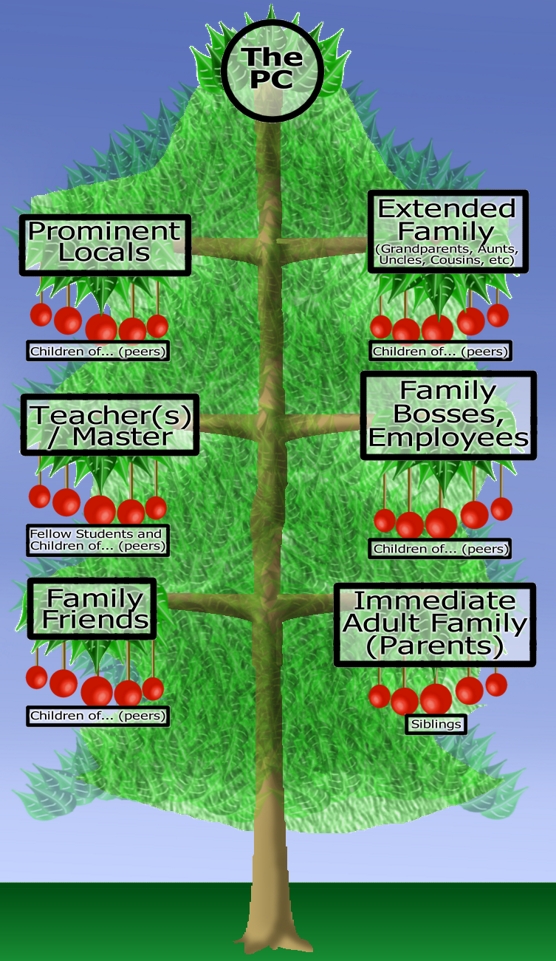
This contains six primary Nodes, each with an associated Sub-node, and it’s usually the subnodes that are most important because these are relationships with peers. Nodes are clusters of relationships that have something in common, that something being the node’s definition.
These nodes and sub-nodes are:
- 1. Immediate Adult Family
- 1a. Siblings
- 2. Family Bosses, Employees
- 2a. Children of… (peers)
- 3. [Adult] Extended Family (Grandparents, Aunts, Uncles, Cousins etc)
- 3a. Children of… (peers))
- 4. Family Friends
- 4a. Children of… (peers)
- 5. Teacher(s) / Master
- 5a. Fellow Students and Children of… (peers)
- 6. Prominent Locals
- 6a. Children of… (peers)
The sequence might seem capricious, but it is actually the product of two factors: Potential Influence and Frequency Of Proximity. So Family Bosses (and their children) are outranked by Immediate Family (including Siblings) but are potentially more prominent than Extended Family. The ranking sequence isn’t perfect, and may be wildly incorrect in individual cases.
Let’s talk about each of these, briefly:
Immediate Adult Family
This also includes any parental substitutes. To qualify, they have to live in the same household during the youth of the character. We all have complex relationships with our parents, brought on by teen-aged rebellion and resentment for every time a parent does something “for your own good”. There are many formative experiences that result. In some respects, each generation becomes the exact opposite of their parents as a result of this interaction; even before it was given a name, the “generation gap” was very real. And each sibling has a different mode of rebellion. The pathway to mutual respect can sometimes be a difficult and slow one.
The contributions to the personality of the individual can be significant or subtle, positive or negative – but there isn’t scope for a deep dive into these complex relationships. Instead, you have to focus on a few chosen elements that are fundamental to describing the character as they are today, showing the origin of those traits.
I’ll end this with a couple of examples. I came home from school one day to find that my father had burned a randomly-chosen half of the comics collection that I had painstakingly gathered over a period of 2-3 years. Almost all my pocket money had gone into that collection, and I felt that it was mine. If I had been told I had to get rid of half of them and given a little while to choose, that would have been different; I wasn’t. In adult life, that turned me into a collector who has to be forced to give up anything that is even slightly valued. That’s why I have eighteen bookshelves full of books, and RPG supplements and CDs and DVDs, and one of the reasons I prize physical media over online sources – I don’t trust that the online resources will always be there when I want them. I’m not (quite) a hoarder, but I flirt with that trait regularly, and make no apologies for it.
A second anecdote from many years later – my Father had a great deal of trouble with alcohol, and it brought out the worst from him in a self-destructive cycle of self-abuse (he broke that cycle when he was learning to be a pilot – good for him! ) So I was passing through the town where he was living at one point and we went down to the pub for a drink, as adult males did in Australia at the time. And, after a couple of beers, he asked if I was ready for another, and I responded, “No, I think I’ve had enough for now.” That was the moment that he really started to see me as an adult, commenting that it took him many years to learn what I seemed to already know, and that it had been one of the hardest life-lessons he had learned over the years – to know and respect your limits. He was visibly proud of my ‘achievement’. I didn’t want to spoil the moment, so I didn’t mention that I started learning that lesson in childhood by seeing what excess was doing to him and his life. But it’s a lesson that has helped me immeasurably, both directly and indirectly, through the years; these days, it principally manifests in knowing how hard I can push my body through the limitations imposed by my various medical conditions. But the core lesson remains the same.
Siblings
I’ve already discussed this at some length in this manuscript. With (almost) every sibling there is a rivalry over something; there is often a shared interest outside of that rivalry, and where there isn’t, there will be a subject about which the character doesn’t personally care, but which they have learned about because it’s an interest of a sibling; and there will usually be one other element to the relationship; it could be something about them that the character envies, it could be something they resent, it could be an achievement of the siblings of which the character is proud, or vice-versa.
Family Bosses, Employees
The relationships in Node 3 tend to be more distant and of lesser significance in most cases, but when this is not the case, they tend to be pivotal. The employer may even act as a surrogate parent (note that co-workers fall under the heading of family friends).
But what if the character’s parent(s) had no boss because they owned their own business (as much as anyone does in their specific culture, at least)? Then it’s their leading employees who come under the spotlight. These are frequently (but not always) going to be closer in age to the character as he was at the time, making it easier to forge a connection. But as a general rule, these relationships are less important than the immediate family.
The common element is that there is a relationship between the character’s parents and these individuals that stems from their respective occupations, and this relationship brings these guests into contact with the young character.
Oftentimes, the ‘guest’ will pretend to a personality that isn’t really theirs to the parents, while letting it shine through to the children (ie the character), sometimes it goes the other way around. Other situations can yield quite different relationships.
Sometimes, there are no bosses or employees of special significance – but there’s usually someone. Think back to your own childhood, and most of us will find someone fitting that description in their somewhere; I can think of a couple right off the top of my head. Use them as a starting point, replace the relationship between the adults with a cultural analogue, and use the relationship you experienced as inspiration for something more appropriate to who the character is supposed to have become in the here-and-now of the campaign.
And don’t be too literal – one of the examples that came to mind when writing the preceding paragraph was the flatmate of the man who would become my stepfather. But they were flatmates because of my stepfather’s employment, which meant that he needed someplace in that community to live, so he qualifies.
Children of Family Bosses, Employees (peers)
If those individuals have children, it’s inevitable that you will come into contact with those children and form relationships with them. Sometimes these will be close, despite age differences, sometimes they will be distant despite them being peers. Regular contact between the adults makes these relationships inevitable.
[Adult] Extended Family (Grandparents, Aunts, Uncles, Cousins etc)
These relationships are often stronger and more influential than some of those listed before them, but there is a factor of distance involved that makes them less immediate than those intervening.
Our adult extended family tend to touch our lives in ways only really appreciated in hindsight. My maternal grandfather lost his vision in a workplace accident, developed cancer, and stubbornly refused to give in to it; at one point, we were told that 98% of his body was cancerous. He actually died and was revived four times, refusing to pass until his wife did.
That maternal grandmother discovered British Sci-Fi comics like 2000 AD after I bought one. At first, she bought them so that I could read them, and read them herself to be able to relate to me better – but she discovered a love of them in her own right, and that reinforced my own love of the broader sci-fi genre.
I had an Uncle who had stayed with my paternal great-grandmother in Sydney before deploying to Vietnam in the late 60s. He had bought a number of Marvel comics before departure to fill in the time and left them there when he shipped out. I caught my love of cities from her and taught myself to read at a teen+ level at the age of 3 or 4 using the Iron Man, Spider-man, Avengers and Fantastic Four that he left behind (I wanted to read them, but no-one was available – so I tried to puzzle them out on my own. And succeeded, one syllable at a time; by the end of the second one, I was reading them like I had been doing it for years).
Children of [Adult] Extended Family (peers))
< The only difference between the population of this group and the one above is age - these are close enough in age to the Character to be his or her peers in the time of his or her youth. I had a very large extended family with about 12 relatives who ranged from about 10 years older than me to several years younger, whom I saw regularly, and a few more that were more distant. There were also some aunts who were younger siblings of my father, young enough that they counted - and later, their children. All of them contributed something to my makeup, some more than others.
Family Friends
I’ve talked about this group, too. But this is one of those relationships where the character’s experience is a complete byproduct of the adult interaction. These friends aren’t there to see you, they are there to see an adult in your household, and the general expectation of politeness is that you will say hello and goodbye and get out from underfoot for the bits in between. Any social chitchat with the child – the character – is secondary, and often nothing more than politeness.
Nevertheless, there’s a formality to the structure of these interactions and that makes them both more understandable to the child’s mind, and more instructive in social interaction than the more intimate and casual interactions when the ‘guest’ isn’t around.
Which always makes these interactions fascinating to me when these formalities are not observed. Family Friends who insist on engaging with the children of the household when they don’t have to. Family Friends who are treated to the normal interaction modes of the family, as though they were also family members. The range of degrees of formality that are possible. What parts of etiquette that can be discarded, and the impact that doing so has on the expressed relationship.
My friend Stephens family always had a very casually fractious interaction with each other. It’s common and normal for that to be set aside when there’s a visitor in the house, a ‘polite fiction’ of politeness; they didn’t have a bar of that with each other. It made the guest feel welcomed into the home in a strange way, but also slightly uncomfortable at the same time, wondering ‘how am I supposed to react to this?’ – my choice was always to politely ignore it, and to speak to all of them the way I would if this display was not taking place – and I’m quite convinced that this scored me brownie points with each of them individually. I saw others who were offended by it, or gave like for like, and they never seemed to last as long as friends to the family members of this household.
So there can be a lot of nuance in ‘social niceties,’ and that nuance comes out in this Node.
Children of Family Friends (peers)
Things can get even more interesting when you’re talking about the children of these family friends, because you are expected to get along with them and interact with them by virtue of the adult relationship involved regardless of actual feelings. This is great training for interactions when you’re working for a living and have to cope with co-workers.
Some of them, like the children of employers, can possess an arrogance, a sense of entitlement that comes from the adult relationship. That forms the cornerstone of a lot of antagonistic interactions. But there can be times when its the adults who are beset by some kind of social friction, while close bonds form between the children, often leading them to roll their eyes at each other when the ‘friendly’ relationship becomes more heated, a shared ‘here we go again’.
I think you learn as much about social behavior from navigating these awkward situations than you do interacting with your peers in the school-ground – the two balance because those peer interactions happen more frequently, and the capacity for influence is the product of intensity and frequency.
Teacher(s) / Master
Educational structures have changed a lot over the centuries, and a lot of fantasy gaming reflects this with an apprentice-and-master model rather than a common schoolyard. Anne McCafferey’s “Pern” novels offers a variation on the ‘Lone Master” approach, giving each major Craft or Service it’s own institute of higher education and a formalized four-step structure of rank. It can be difficult to adapt to D&D / Pathfinder – “You’re 18th level but still only a Journeyman?” – because level progression is independent of character ranking. This can be solved to some extent in 3.x using Prestige Classes in which a requirement is a level in the preceding Prestige Class. There’s a completely different structure in Raymond E. Feists’ “Magician”.
I’ve tried to structure this entry to accommodate such complexities.
Every student has one or more teachers with whom they have particularly strong relationships. In my case it was Science teacher Tom Sculley, Maths teacher Mr Jenkins (I know his first name but can’t bring it to mind at the moment), and Art teacher Art Dickinson. I always got on particularly well with Careers Advisor and English Teacher Dick Rocheford, too, but never had him as an actual teacher. But in the educational lottery, my generation hit the jackpot, and all my teachers were excellent and with a dedication that went well beyond the prescribed minimum.
Fellow Students and Children of Teacher(s) / Master (peers)
I’m not sure that I ever encountered one of the latter group in my personal experience, but it’s inevitable that some would. The students a year ahead of me had the Headmaster’s son amongst them, for example. But I had plenty of the first, some of them pleasant relationships and some not so for many years. Fortunately, most hatchets were buried before scholastic education was complete. As in most schools, there were the Jocks and the Nerds, and I was definitely one of the latter.
After the immediate family, this is the category most commonly serviced by existing backstory generators and models.
Prominent Locals
The final category is a bit of a catch-all for locals with whom you have relationships of particular note. In my case, these were mostly shopkeepers of one sort or another.
Children of Prominent Locals (peers)
And of course, there are the children if those prominent locals. Whereas in most of these categories, the cause of the relationship is the adults, it can especially be the case in this latter group that the relationship derives from the peers, with the relationship with the parent being a secondary consequence.
Since most of these will actually be covered under the ‘Fellow Students’ category, this ‘Children Of’ group generally includes ‘peers’ that are either younger or older than the direct peer group.
Okay, with those categories and classifications defined and explained, lets move on to the solution I have devised – a ‘relationship stat block’. When I say that, it’s more of a worksheet, really – a place to document who contributed what to the character’s makeup, and indexed by the age(s) at which it happened.
The relationship ‘stat block’
Obviously, there’s a lot to fit in, so there isn’t room for expansive backstories; this is more of an executive summary for use in crafting those backstories. The worksheet is divided up into the different nodes and subnodes, as numbered above.
In a lot of cases, there’s room only for a single sentence or a handful of keywords. And those are the more expansive entries; when it comes to peers, there’s only room for one-word answers, or maybe 2 short words. The rule of thumb in such cases is to generalize as much as necessary – if you wan to include “poetry, musical appreciation, history” there’s no way that all of that will fit in a ‘peer’ space; you would have to generalize it to ‘humanities’ or something similar.
This is a good thing, believe it or not – it means that when constructing a narrative form of the backstory, you have choices to make. Either the impact of the character is the broader picture painted by the more generic term, expanding the personality just a little bit more, or you have to then explain why anything else covered by the generic term is NOT included. This adds to the personality of the character, of the individual with whom they have the relationship, or both. Where such a prompt is relevant, I recommend adding an asterisk to the end of the word as a reminder.
Below, I’ve discussed each of the entries that may be present, but not all of them will apply in all nodes.
- <2 Same community that the two used to share
- 3 A neighboring community to the one the two once shared
- 4 The administrative community closest to the one once shared
- 5 A much smaller community located some distance from the one once shared
- 6 A community of similar size to the one once shared, some distance away
- 7 A larger community some distance from the one once shared
- 8 A much smaller community located a great distance from the one once shared
- 9 A community of similar size to the one once shared, a great distance away
- 10 A larger community a great distance away
- 11 A much smaller community located reasonably close to focal character’s current location
- 12 A similar-sized community located reasonably close to focal character’s current location
- >12 The same community in which the focal character now resides.
- 13. The far side of town relative to the focal character
- 14. The middle of town in a district very different to that of the focal character
- >14. Same part of town as the focal character
0. Character Identity
There are four fields at the top to specifically identify the character. The first one is for the name. That’s followed by the Class, used for character class and Race if either are relevant.
After that is the campaign, which is either going to be a specific unique name or has to include the GM’s name. And, for version control, there’s space at the right for the date the worksheet was completed.
0. Character Personality Concept
This is the starting point, always. The Worksheet is a tool for mapping out the events and relationships that produced this personality, but before it can do that, you need to have some idea of what you’re aiming for.
Note that this is probably not the personality in its final form – the results of the Worksheet will add nuance and secondary layers to this beginning.
The most useful format is a general personality profile and then exceptions that apply in particular situations, a couple of things that the character likes, and a couple of things that he actively dislikes, and then finish up with an ambition or two. That’s a lot to fit into the space provided, so you will have to be sparse in your language and may even have to broaden your specifics to get everything to fit, as noted earlier.
You do not have to fill out every panel, and you do not have to fill out every field within a panel. The goal is to capture the essentials and provide a spur of inspiration as to what those essentials might derive from.
I’m going to put some final advice on the best use of the Worksheet at the end of the article.
1. Node
Look to the left of each main panel and you will find the Node number (and an identifying label), following the same sequence given earlier – so, ranked in sequence of potential influence on the character’s development, assuming a typical cultural setting.
The more the character’s culture deviates from what we generally consider ‘normal’, the greater the likelihood of a node ascending a step or two, pushing those nodes it climbs over back down the order.
That’s important because this worksheet is most effective when completed in sequence of potential impact.
Each node consists of 5 panels – one for adults and four for peers, ie children of roughly the same age as the character at the time.
That can also be a little trickier to assess when different Races with different lifespans are involved – make sure that you have any needed information from the GM.
The one for adults contains space for multiple adults; the ones for peers are one-peer-to-a-space.
While there’s a lot of overlap, there are also subtle differences in the fields. I’m going to look at each field separately below, and these fields have been numbered to group alternatives together..
2. Name
Name appears as the first field in every panel, and every row of the adult panels. This isn’t the name of the focal character, its the name of the NPC that influenced their development in some way.
3. Relationship
Relationship always describes what the NPC is to the focal character, never the other way around. Keep this simple unless there is significance in being more precise – “Uncle” is usually good enough, “Maternal Uncle” immediately signifies that there’s something significant about the Maternal Family with respect to the character.
But there are a few alternatives that might appear in place of the relationship field, so they have also been numbered 3.
3. Parental Relationship
In Node 2’s adult section this space appears for you to describe what the individual named on that line is, relative to one or more of your parents.
3. Child Of
In Node 2’s “Peers” panels, relationship to the focal character is pretty much a given, So this space is being used to connect the family friend listed in the Adult section to the Peer that is associated with them.
The same thing happens in Nodes 3, 4, and 6, and this parameter is completely missing in Node 5.
4. Age(s)
This is the most complicated field because it is used for multiple purposes depending on the node and the panel within that node.
Adults are deemed to have no age to a child – they are all just “old”. This field in the adult section is used to describe the age of the focal character during the period of their interaction with the adult. This may be a single digit or a range. If you think it relevant, you can precede this with a verbal suggestion to the age of the secondary character – “Young”, “Old”, and “Elderly” cover the gamut of possibilities under most circumstances.
The real complications lie in the presence of this field in the ‘peers’ panels. You can write the ages of each member of the relationship during the period of interaction, separated by a comma, but then you have to indicate which age belongs to the focal character. A better choice is to write the relevant ages of the focal character as a number or a range, and then indicate the relative age of the peer – it might be -0.25 (indicating about 3 months younger), +1.5 (indicating a year-and-a-half older) or any other possibility meeting this profile.
6. Influence
Only Adults are deemed to be an influence. Peers are more about points of connection – I’ll deal with them, later.
The number of possibilities for describing what influence an adult had on a child are almost endless, but you (very deliberately) don’t have very much room, so you will almost certainly have to generalize here. There’s just about enough room to write “Love of” and a subject. If your handwriting is neat enough and small enough, you might be able to squeeze in an extra word like “encouraged” or something similar.
It can be even harder to fit a negative influence into the space.
I recommend standardizing two abbreviations: L/o (for “Love Of”) and D/o (for “Dislike Of”). You can also use D/i for “Disinterest In”. “Distrust of” is a problem because D/o is already allocated, but you can probably get away with “Dt/o”.
And that’s as far as I recommend you go, or you will reach a point where you have to look up your abbreviation every time you deal with one.
7. Personality (d6)
Most of the time you are going to want to choose this, but sometimes you need a hint. That’s what the d6 refers to – roll it and consult the table below if you’re in need of inspiration.
1 Similar personality, less extreme
2 Different personality, less extreme
3. Similar personality
4. Different personality, similar intensity
5. Similar personality, more extreme
6. Different personality, more extreme
I’ve allowed an extra line for the personality, but don’t waste it writing the interpretation of the roll – at most, write the number ‘rolled’ (feel free to choose if something seems to fit). But I probably wouldn’t even do that – I’d use every last millimeter of space describing the personality.
Even so, space is limited, so you won’t be able to do a full profile. That’s fine – the worksheet is an intermediary tool, used to organize information.
8. Location
Where did these encounters occur, geographically?
9. Commonalities
Nodes 1 and 2 give you room for three things the focal character and the peer member have in common. In Node 3, it’s two; in Node 4, it’s one; and nodes 5 and 6 don’t have this field at all.
10. Differences
And it’s exactly the same story when it comes to points of difference between the focal character and the peer.
11. Key Incident
The reason for the reduction of Commonalities & Differences in Nodes 3-4 is that I needed the space for this field, in which you describe one specific incident involving both the focal character and the peer.
12. Outcome
‘Key Incident’ is followed by another 2-line field to describe the consequences of the Key incident.
13. Memorable Positive Experience
In Nodes 5 and 6, Commonalities and Differences are replaced entirely with something a little more specific – A memorable positive experience the focal character and peer shared, and associated Outcome.
14. Point of disaster
…and a point of disaster where the association got you both into trouble of some sort, and an outcome.
These incidents are often more impactful than a year or more of steady influence.
One peer may have only a memorable positive experience, or a point of disaster, or may have both.
15. Location Now (d12)
Every peer panel has two lines dedicated to recording where this peer is now, or where they were before the focal character lost contact with them. A span in years since last contact should also be included in the latter case.
As before, there’s a die roll to provide inspiration when it’s lacking. But this is a little trickier than a straight die roll.
P = Rate the size of the community of residence of the focal character now
S = Rate the size of the community of residence of both the focal character and the peer when they were associating.
In the case of science fiction games, the ‘community’ might be an entire planetary population.
Roll d12+P-S.
Result ^2 / 4 = Approx % chance of bumping in to the individual per week or month (GM’s discretion).
Result ^3 / 400 = Approx % chance of an encounter with someone who happens to know the non-focus individual per month or year (GM’s discretion).
As usual, ignore the die roll and select a result if something seems especially appropriate.
16. Osmotic Knowledge
Osmotic Knowledge is a subject on which the focal character gains knowledge simply by being around someone who is fascinated by the subject. It could excite passion for the subject in the focal character or could be things they’ve picked up about the subject while not caring about it in the slightest, or even being bored to death by the subject. It’s a more generic version of the Commonality and Difference fields, both folded into the one category and only appears in Node 1 in addition to those fields.
17. Current Connection
What is the current status of the relationship between the focal character and the peer? This field appears in every peer panel. I’ve allowed two lines, which should be enough for some nuance. If it’s been [x] years since the focal character has had contact with the individual, this is also the place to make that explicit.
The Worksheet PDFs

Click the icon to download the zip file, 1.60Mb..
Now that you have the anatomy of the Worksheets, you’re in a position to use them. I’ve provided them in 9 different combinations of size and format. Unless explicitly stated otherwise, a margin of 2 cm (about 8/10ths of an inch) is used on all four sides, and portrait format is employed. The format list is:
- A4 pages, landscape orientation, 3 page
- A4 pages, no margin, 2 page
- A4 pages, no margin, 3-page
- A4 pages, 2-page
- A4 pages, 3-page*
- Letter-size, landscape orientation, 3 page
- Letter-size, no margin, 3 page.
- Letter-size, 2-page
- Letter-size, 3-page**
*, ** = recommended formats
With so many fields to include, the text is tiny. I’ve chosen a font that should be able to withstand the distortions and remain legible, but YMMV – try them all until you find the format that best suits you and delete the rest.

Click the Icon to download. 371 Kb.
All of the formats started as PNGs that I compressed the heck out of in order to achieve full-page graphics with tiny file sizes. Because none of them is free of distortion to fit the available dimensions, I’ve also included the pure graphics in a second zip file.
1, 2, and 3 are pages 1, 2, and 3 of the 3-page versions; 1a and 2a are pages 1 and 2 of the two-page versions.
Final Advice
Take a good look at the diagram below. Figure 1 shows the simplest possible personality effect: A cause creates the effect, i.e. the contemporary personality trait. The result isn’t just cardboard-cut-out; it’s positively wooden. Better no backstory and a mystery than one this simplistic. Yet, without the benefit of the Relationship Worksheet, I see this sort of thing all too often.
Figure 2 shows a slight improvement in that the cause of the contemporary personality trait has led to a reaction to an influence that then causes that trait. The backstory is richer and more complex. This is generally the best standard to be aspired to if simply writing the backstory as prose. because it’s very hard to map ‘straight lines’ of formative influences and events without something like the Worksheet.
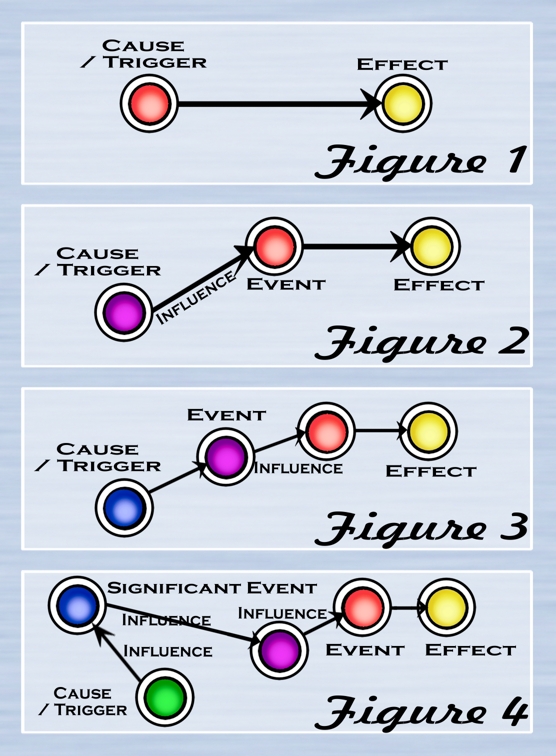
Figure 3 is the minimum standard that the Worksheet makes possible, with less effort than would be required to achieve figure 2 through prose alone. We now have a cause that involves the focal character in an event, reshaping his views, which leads him to an influence that he might otherwise not have been exposed to, which leads to the contemporary personality trait. Break any one of the elements in that domino chain and the personalty is radically reconfigured. The character has depth and nuance and history. This is the minimum standard aimed for by top novelists for their featured characters.
Figure 4 adds a new layer of depth to the domino chain and projects personality evolution into the future as the consequences of this personality trait manifest in the focal character’s life. That’s the sort or depth that makes for a great PC, because they have a past and a ‘now’ that is not static and can (and presumably will) evolve with the campaign.
But that’s just looking at one personality trait. Most characters have two or three major traits of this strength, and three or four more of lesser prevalence of impact but sufficient intensity to override or influence choices that would otherwise be driven exclusively by the dominant traits.
No matter what standard you aim for with your primary traits, I recommend going one step shallower for most of those secondary traits.
But I have to call attention to an alternate construction that can also be valid – a simpler general personality and more substantial secondary traits (‘learning by experience’), and probably more of them. The results have sometimes been summed up ‘a study in contradictions’, but the character is unified by the concept and deep background.
Where Next From Here
I recommend writing a highly compressed diary of sorts, one entry to a year, for each age of the character’s life. The first section lets you introduce the immediate family and some members of the extended family; the second deals with the rest of the extended family; sometime in the next two years will be the focal character’s earliest memory, and will be full of influences and encounters that the focal character doesn’t even remember.
For example, I’m told that when music that I liked came onto the radio at 1 month old, I would bounce in my bassinet in time with the music. I have no memories of that – but my life since has comprised of periods when my interest in music waned only to be suddenly and vehemently reawakened. Right now, I’m in a waning stage – but once my Hi-Fi is finally all hooked up, and I can lean into my CD collection, I expect another strong awakening.
Here’s a nice little daisy chain for you to consider:
- Interest in Music -> Concert attendance, large music collection
- Concert attendance -> Better Sound Equipment
- Better Sound Equipment -> Contact with Musicians
- Contact with musicians + Concert Attendance -> Better Sound Equipment
- Better Sound Equipment + Interest In Music -> Interest in Production & Composing
- Interest in Production & Composing -> Better Computer Audio
- Better Computer Audio -> Better Musical Composition
- Better Musical Composition -> Awards for Composition
- Better Musical Composition + Contact With Musicians + Interest in Production & Composing -> Greater interest in music
That’s a different perspective on my relationship with music.. It’s a great, big, circular loop, and at one or two points I seriously contemplated making music and music production my career path. In fact, I was preparing to release my first CD when a computer crash wiped out almost my entire archive of original music. Of course,
I had a backup – but the archive proved to be corrupted by the supposedly more reliable backup software that I had been using.
Be all that as it may, and getting back on topic – the diary would then continue with specific formative events and memories. This gives you the chance to add in all the specific details that the Worksheet doesn’t have room to hold. But by forcing you to generalize, it also gives the opportunity for the character to grow in unexpected directions.
Another gold mine is to have a latent interest – an undiscovered fascination with a subject that will lurk in the character’s personality until an event or encounter awakens it. For a while, the character will eat, drink, and sleep that fascination, until reluctantly forced to turn his or her attention back onto something else.
Giving a character a direction in which to evolve, absent any other defining events or resonances, means that he is not a static thing, but evolves over time. How that evolution takes place is something to be determined in collaboration with the GM.
A “Resonance” happens when a focal character is not directly involved in the incident but it nevertheless alters their behavior and possibly opinions or priorities. This is probably, but not necessarily, out of sympathy – but it could also be from outrage, for example, or a sense of justice, or several alternative possibilities.
All This and Worldbuilding, too
The other area in which you should collaborate with the GM is geography and world-building. Get the GM to deign – to a conceptual level at lest – the focal character’s home town, to your specifications – then use that as a guideline to filling out the Relationship Worksheet.
The GM helping to define your character and his or her background also helps the GM build and develop the game world. Scratch each other’s backs and you both benefit from the effort.
And finally, remember that the more detailed the character, the more easily the GM can craft adventures that integrate specifically with the individual, to the greater enjoyment of all involved.

Discover more from Campaign Mastery
Subscribe to get the latest posts sent to your email.



March 31st, 2026 at 4:39 pm
I really appreciate the structured approach to integrating a character’s past into their present behavior. It’s a valuable reminder that compelling narratives often come from understanding how early influences shape motivations, decisions, and emotional responses.
John Smith recently posted..Your Guide to Dentists in Twickenham: Cosmetic & General Dentistry