The Ashes: Understanding Brit and Aussie Characters

Image courtesy Wikipedia Commons
Although I am writing this article in advance, it will be published on what is a fairly significant date in Australia: Boxing Day. It wasn’t until I saw a particular episode of M*A*S*H that I realized that many parts of the Western World don’t celebrate this particular holiday, December 26th – it’s a British Commonwealth thing. It’s origins are uncertain in modern times; Wikipedia lists several competing theories. But the key point is that this is a post-Christmas public holiday that forms part of the rich tapestry of traditions that surround the Festive Season in this part of the world, and several others.
Another of those traditions, here in Australia, is that a major cricket Test, known as the Boxing Day Test, starts today. Every two years or so, this forms part of the Ashes campaign; at other times, it is part of a Test series against another cricketing nation, often India, the West Indies, or New Zealand. And those games are important, but it’s The Ashes campaigns that are a vital ingredient in understanding the national characters and relationships of the two national participants.
How Important Are They?
Prime Ministers of both countries have stated that the Second most important job in the nation is the Captaincy of their respective Cricket teams. Success leads to national euphoria and pride, failure is considered utter humiliation. I’ll be touching on this question repeatedly, but – when The Ashes are underway – these slightly tongue-in-cheek declarations often feel like the literal truth. The Ashes aren’t just another sporting contest; they are part of the foundations of both national cultures.

Introducing The Ashes
To understand the Ashes, you have to first understand a little of the History. Australia was settled by Europeans as a series of Penal Colonies. They brought with them many of the rituals and cultural elements of the mother country, including their games, and in particular, the game of Cricket. As part of A Legacy Of War: The Founding Of National Identities, I briefly synopsized what subsequently transpired: in 1882, a team from Australia returned to play cricket against the English national team, and – for the first time – won. This led to a British Newspaper, The Sporting Times, running an obituary which announced ‘the death of English Cricket’, and that the “body” would be cremated and the ashes taken to Australia. This reportedly struck the fancy of a humorist and cricket fan, the wife of the English Captain who was to lead a team to Australia the next year, and after a Christmas game at their estates, she took two of the bails and burned them, placing the ashes in a small, symbolic urn (now believed to be an empty perfume jar) for her husband to carry with him to the antipodes.
The newspapers, meanwhile, had latched onto the symbolism of the rivalry, fueled by the vow by that Captain before departing for the 1882-83 series to “regain those ashes”; the British media then dubbed the tour “the quest to regain the Ashes”, i.e. to restore national pride.
And national pride was very much on the line. At the time, Australians were viewed as rude, crude, colonial nobodies from the lower classes, while to the English, the game was the province of the social elite. The ambition was very much to put these upstart colonials in their place.
This elitism didn’t survive, of course; after another humiliation or two, it began to decay, as ability became the more important factor in selection to play the games. World Wars I and II further broke it down, but by then the bitter rivalry had been established.
Since that first game, the two sides have competed for the Ashes some 70 times, and – until today (as I write this), the tally stood at 32 wins apiece. Ashes success or failure can cement or devastate careers of professional sportsmen, turning some into legends and others into feet of clay.
An Introduction To Cricket For The Lay Reader
The closest game with which to compare cricket in terms meaningful to a reader not familiar with the game is baseball. The ball isn’t pitched, it is bowled, and the actions are quite different – I’ll get back to that in a moment – but the speed of delivery is fairly comparable. If anything, baseball speeds are slightly higher, and the peaks are hit more consistently. A baseball is 9 to 9.25 inches in circumference, while a cricket ball is smaller and denser, measuring between 8 13/16 and 9 in in circumference. Cricket balls have a slightly off-center stitching around the circumference, unlike the baseball stitching pattern. Cricket Balls are much harder than baseballs, something that is necessary because of those differences in actions.
Baseballs have to be pitched through the air toward the batter. Cricket balls have to be bounced off the hard “pitch” or playing surface. Different pitches have different characteristics of bounce, but the fundamentals remain the same; the length down the pitch from bowler toward batsman that the ball lands dictates how high it bounces.

Image courtesy Wikipedia Commons
There are different terms for the different “lengths” of delivery, which have a profound effect on what shots can be successfully played against the delivery.
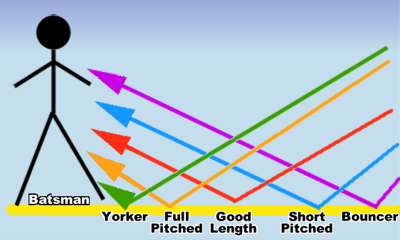
Base Image courtesy Wikipedia Commons
In addition, over the course of a game, the ball will be kept polished on one side and permitted to deteriorate on the other, so that the position of the seam when the ball is delivered has profound effects, speeding or slowing the ball slightly in the air, permitting it to bounce at somewhat predictable angles into or away from the batsman, or producing a curving trajectory through the air.
There’s a lot more to the game’s technicalities, but I only want to cover the essentials here. Batsmen stay “in” and scoring until dismissed. To score, the batsman either has to run from one end of the pitch to the other without being dismissed, or hit the ball to the boundary rope for 4 runs, or hit it over that rope on the full for 6 runs. There are other ways of adding to the score, but those are the main things.
Bowlers take it in turn to deliver the ball, grouped into “overs”, that are bowled from successive ends of the pitch. An over is six legal deliveries in length, so bowler one delivers six legal deliveries from one end to whatever batsman is at the far end, then another bowler delivers six legal deliveries from the other end of the pitch at whichever batsman is at the end closest to where the first bowler was delivering from. Unlike baseball, bowlers are allowed to take whatever run-up they feel necessary.
There are three primary forms of the game. 20/20 is the most explosive and newest format of the game; each team gets 20 overs, or until they dismiss the entire opposition team of 11 players as batsmen. Scoring is fast and dramatic and designed to look great on TV and deliver a result in a few hours play – if they start early enough, you can see two games in a single evening for the one ticket. This is the format that I expect to become popular viewing in the US if it gets the chance. There are a lot more technicalities like restrictions some of the time on where fielders can be placed.
“One-day” cricket is 50 overs to a side. Typically, one side will bat in the afternoon and the other under lights, or sometimes one in the morning and the other in the afternoon. It is also designed to be television-friendly and deliver a result in a single day, but unlike 20/20, there is a lot more scope for tactics. Most of the technicalities like fielding restrictions were initially tried out in One-day cricket, and most of those remain.
Test Cricket is a little different. While there are three- and four- and even six-day tests, the typical length is five days to a single game. One side bats while the other side fields until either the entire batting side is dismissed or their captain decides they have scored enough runs. The second team then bats until they are all dismissed, all “out”, at which point the relative scores are compared. If the first side has scored 200 more than the second, the first can choose to bat again, or to force the other side to bat again, hoping to dismiss the entire side before they can score enough runs to force the first team to bat again.
I realize that’s not terribly clear, so here’s an actual example from the most recent Ashes match: England batted first, and scored a total of 403 runs from their 11 batsmen. Since you need batsmen at both ends of the pitch, that means that Australia had to get 10 batsmen dismissed. Australia then batted and scored 662 runs, declaring their “innings” to be at an end before 10 batsmen were dismissed. England then had to bat again; in order to win, they had to score first the 259 runs that they were behind, and then enough on top of that to give them a chance to dismiss all Australia’s batsmen for less than the number of runs required to exceed the combined English total. They failed, scoring only 218 runs, so Australia won the match.
England could have forced a draw if they had been more successful with the bat; let’s say, for example that their second Innings had yielded a score of 662, the same as Australia’s first innings. Australia would have need 403 runs to win, but by then at least 4-and-a-half of the five days would be gone; there simply would not have been enough time unless an extraordinary bowling and fielding performance followed.
Imagine for a moment that the Innings had occurred in the reverse sequence – Australia scoring first and England “replying” with their 403 runs. Because they were more than 200 runs behind, Australia could have forced them to bat again – and would still have won the match.
Okay, with that very basic grounding, I can get back to the significance of the Ashes as a contest.
English Wickets vs Australian Wickets
Different climates and soils produce very different playing conditions and ball behavior in the two nations. In England, the ball tends to swing (curve) or seam (deflect off the seam in the ball) more than it does in Australia. Australian wickets tend to be faster (slowing the ball less when it bounces off the pitch) and bouncier.
But those are just the headlines; the cultural significance is greater. In essence, the playing conditions tend to be a reflection of something fundamental about the nation. Teams have to adjust the way they bowl and where they field and how they bat, in order to conquer the conditions and have a chance at victory. This is something that it often seems Australian teams do better at when touring England than English teams do when they come here.
English Cricket Balls vs Australian Cricket Balls
Games in Australia, New Zealand, South Africa, Sri Lanka and Zimbabwe, all use the Australian Kookaburra ball. Games in the UK and West Indies use the Duke ball, manufactured in England. The main difference is often thought to be in the stitching prominence and position, producing different behaviors. This is another element that teams playing overseas have to adjust to, and both Australian and English teams are adamant that the balls they use are superior to those used by the others. The Kookaburra has a relatively low seam that encourages Swing in the first 20 overs before become fairly neutral in its handling. It is also softer and less resilient than the Duke ball, according to some reports. But, in general, it’s better for batting.
The Duke ball has a more prominent and durable seam that is more pronouncedly off-center, encouraging spin bowling and ‘reverse swing’ where the ball moves in the opposite direction to that expected. The seam can last 50-55 overs if cared for, and swings a lot more. It tends to be a lot more bowler-friendly.
To some extent, the differences in design and construction (the Duke is made from horse hide and the Kookaburra from cow hide, and the stitching material is also different) are a reflection of the different playing conditions. Which makes the Duke Vs Kookaburra argument another extension of the nationalistic attitudes described earlier.
Passion
The two teams are equally-matched in this regard, though Australians tend to be more boisterously vehement in exhibiting their passion for the game. But there are major psychological and attitudinal differences between the two sides; there is far more cohesion and “us against the world, all for one and one for all” in the Australian team, while England is all about individual performance and seem to chop and change their roster more frequently.
But it’s the Bodyline story that really displays the depths of the Passion both sides have for the game, and displays some of the character traits of the respective nations.
In the 1927-28 season, a Batsman emerged who is now widely regarded around the world as the best ever, Don Bradman. Over his professional playing career, he averaged just short of 100 runs an innings – by comparison, the best contemporary players are considered exceptional if they have averages of better than 40-odd. It’s a piece of Australian folk-lore that if he had scored one more four in his final game, instead of being dismissed on nought (a “duck”, no runs), he would have achieved that lifetime average of 100.
At first, England were inclined to consider him just another Batsman, but the 1930 Ashes tour of England soon disabused them of this notion; in his first appearance in England, he scored 236; in his first test, he got 131 runs in the second innings (though England won the match); and in the second test he scored 254 against the best bowling attack England could produce at the time. In the third test, by lunch of the first day he had scored more than a century (100 runs), between lunch and afternoon tea he added another, and he finished the day with a score of 309 not out; he remains the only player ever to score more than 300 in one day’s play.
These were early Depression years, and the public badly needed popular folk heroes; Bradman, reluctantly, found himself cast in that role. But the English, especially “Plum” Warner, who would become the Team Manager, came to the conclusion that they needed to completely overhaul the way they played the game in order to counter Bradman, who would be even more at home when England next toured Australia.
Their answer was to appoint Douglas Jardine as Captain and a new tactic – eventually dubbed “Bodyline” by the media – in which the fast bowlers deliberately bowled at the Batsmen’s bodies. It’s hard to describe the controversy that this caused; Cricket had always been seen as a “Gentleman’s Game”, leading to the British phrase “It’s just not cricket” to describe unfair behavior. The tactic, while legal, was regarded by the Australians as underhanded and malicious, a betrayal of the principles of Cricket in order to win. Before the controversial tour concluded, Governments had been drawn into the debate, and passions inflamed to the point of near-rioting at some of the games.
The players reached the point of voting on whether or not to go on strike, which would have been calamitous for both nations, and almost certainly have triggered those riots. Instead, they chose what they considered the softer option of protesting the “unsportsmanlike behavior” to the Marylbone Cricket Club, who had arranged the tour. The accusation of poor sportsmanship stung the English to the core, especially Jardine; his attitude was that anything that was legal within the rules was fair game, and that this was in fact exactly what the rules were there to codify. He in turn issued a complaint against the Australians, demanding that they withdraw the word “Unsportsmanlike” from their complaint.
But the MCC was still the home of the landed gentry and lesser nobility of Britain, and the complaint was enough to cause the matter to be raised in the British Parliament, who saw this as an attack on Britain’s national character itself, and sent a cable demanding that the Australian Prime Minister take action to bring his fractious players into line.
This put the Prime Minister in a very difficult position; he couldn’t be seen to kowtow to the English demands without losing an already tenuous grip on power, but neither could he do nothing; Australia was still a member of the Commonwealth and the ties to the mother country were still strong in all sorts of areas like trade and commerce.
He attempted to defuse the matter by having a quiet word with two of the leading members of the team, an attempt that only further inflamed the players at first, but his diplomacy eventually persuaded them that for the good of the country, they needed to withdraw the word, even though it left their protest sounding weak and inane. And so, the series rolled on; the English continued to employ Bodyline, and the Australians continued to bear being repeatedly hit with potentially-lethal missiles.
Despite this assault on their international relations, both the Australian team and cricket survived; a year or two later, the Bodyline tactic was outlawed, but by now batsmen had started learning to cope with it, and that ban was quietly ignored from a few years thereafter – with some limitations. Currently, for example, the rules state that no more than two bouncers – a key element of Bodyline – are permitted in an over during a Test Match. Equipment has also evolved to cope.
But no matter how relations have improved in the years since, when the Ashes are on, the British remain “Whinging Poms” to Australian cricket fans – used as much as a term of endearment as an earnest criticism, and Australians remain “Uncultured Colonials” to the British, likewise.
Today
World War Two intervened, and for a while, the Ashes seemed to lose their significance. But the passions were reignited in the 1970s, and while they have waxed and waned since, every high point is more substantial than the one before.
Winning the Ashes isn’t quite like winning the World Cup (there’s one of those for Cricket, too). Many people in both countries think it more significant than that. It has a profound resonance with the national confidence, which can translate into everything from politics to the stock market. As a general rule of thumb, whichever side holds the Ashes is considered to represent the superior nation – an attitude that goes well beyond mere superiority on the playing field.
But, at the same time, in many ways, the game has returned to its gentlemanly sporting roots. Both sides play with respect, and both sides seem to lift above their usual performance levels when fighting for the Ashes, especially when fighting at home.
You can’t fully understand or play British or Australian characters without understanding this rivalry, and a surprising number of nations around the world play cricket.

Having some awareness of the game beyond it being “the local baseball” – which I have heard more than once – adds greatly to the verisimilitude that you can bring to those nations, too. Cricket really is the game-you-needed-to-know-about-that-you-didn’t-know-you-needed-to-know-about, and nothing exemplifies the reasons for that more than the Ashes.


Discover more from Campaign Mastery
Subscribe to get the latest posts sent to your email.




December 28th, 2017 at 9:03 am
I’m entertained by the “Bodyline” section being capped by a mention of the “whinging poms”, when the whole saga was epic Australian whinginess far exceeding anything the English could manage :)
December 28th, 2017 at 9:43 am
I tried to be fair to both sides, Jason. I think both were in the right from their own points of view, which is what makes the historical incident so fascinating! But it does seem like every time the English side comes here, we get nothing but complaints about something – the latest being the MCG wicket. It’s the same for both sides – comment on the state of it, but get on with it. Complaining that it’s not suitable for Test Cricket only looks like foolish and petty whining when our batsmen score freely. I think both sides come by their unflattering nicknames honestly, and maybe even try to play up to them from time to time :)