Campaign Mastery helps tabletop RPG GMs knock their players' socks off through tips, how-to articles, and GMing tricks that build memorable campaigns from start to finish.

A Question Of Recognition


The Australians Of The Year Walk is a pathway and series of plinths along the shore of Lake Burleigh-Griffin in the National Capital, Canberra. Each plinth honors the recipients of the award in one of the years that it has been bestowed, and the plinths are arranged to form the National Anthem in musical notation.
Photo Credit: Dietmar Rabich / Wikimedia Commons / “Canberra (AU), Australians of the Year Walk — 2019 — 1806” / CC BY-SA 4.0, zoom by Mike

Today is a Public Holiday in Australia, so I’m posting something far more concise than usual.

The reason for the Public Holiday is that yesterday was Australia Day, which celebrates the arrival of white colonists from Britain, most of them transportees, in 1788 – the equivalent of the American 4th of July.

While the country had been inhabited for about 65,000 years before this event, the indigenous population was structured at a more tribal level. For better or worse, the arrival of the First Fleet set the populace on an inevitable path to a national identity and a national government.

It is for this reason that the date is celebrated, though it is also true that this also set the population on a path of inevitable conflict between the indigenous social structures and those of the colonists. Heavy-handed paternalism and racially biased beliefs would lead to many mistakes of policy and neglect, from which the nation still struggles to recover.

Personally, I feel that it is important to remember the history, warts and all, as part of the celebration. If we are to remember all the good that has resulted, we also need to acknowledge the harm that was done.

Unfortunately, there are some who use that past harm as a divisive issue, inhibiting attempts to use the date as a day of healing between the two communities. Still, little by little, and rarely marked by large or events or conspicuous changes, progress is being made. And, in addition to the national achievements of the past, that is what I celebrate – in my own quiet little way.

Honoring Service

Australia Day is also, traditionally, one of the two days on which the government honors those who have demonstrated gallantry, bravery, distinguished service, meritorious service, and long service to the citizens of Australia.

Unlike the national honors of many other countries, nominations from individuals and local communities are welcome. All nominations are investigated for worthiness, regardless of the source or the number of people who have nominated that individual. Until that investigation is complete, and the decision to grant the honor if it will be accepted (some refuse), the prospective honoree usually doesn’t even know that they have been nominated, and may never know who actually put their name forward in the first place.

As always, there were some awards which were controversial, and it is on those that the reactionaries on social media have obsessed; but, by a margin of more than fifty to one, the majority are ordinary citizens only known to their family, friends, and within their profession. There are usually some celebrities of song, stage, screen, and sport that will be more widely recognized by name alone. The three most likely to be known by the majority of my readers, being from North America or Europe, are Keith Urban, Glenn Shorrock (original lead singer of the Little River Band) and Hugo Weaving – that’s three from a list of more than 2500 names.

There’s always a lot of media speculation about some of the more prestigious awards, like the Australian Of The Year, and so the topic was in the back of my mind on Saturday.

Honoring Contributions

Saturday was the day of the first session for 2020 of my superhero campaign. One of my players was showing his copy of the new Robotech RPG, to which he had provided content, with not unjustified pride. Sure enough, there was his name, in the “Special Thanks” section.

Right away, a problem was evident. Like most of the big RPG projects these days, the production of the Robotech book had been financed via Kickstarter, and virtually every reward tier of the fundraising earned the buyer their name in the book.

The names were placed in a different section on the same page. But there was no way to tell whether they were there for writing part of the rules, for play-testing the game, or for supporting the production financially. All you could tell was they weren’t the principle author or the principle editor.

Name recognition is very important in RPGs, as it is in any community of interests. There are names that I recognize instantly – Gary Gygax, Dave Arneson, Monte Cook, Skip Williams (amongst others) – and with that name comes a level of earned respect for past achievements that put the latest product to which their name has been attached into a new light (and yes, I know the first two names on that list have passed away).

It was one of Campaign Mastery co-founder Johnn Four’s proudest achievements to have contributed to the Official Rules in an official D&D rule-book (DMG II). Having his name in the credits was a Noteworthy Achievement in his eyes. It gave him instant credibility – and when he started Roleplaying Tips and later Campaign Mastery, when he co-published Assassin’s Amulet, or any of this other gaming books, that name recognition and credibility grew, even as it helped imbue those projects with instant cred.

A Kickstarter Conundrum

That’s a problem because such contributions are clouded and even obfuscated by the inclusion of backer’s names. It’s only fair that financial backers get their due recognition – without them, the product would not exist – but I don’t consider “Backed multiple RPG Kickstarters” to be a qualification as an RPG writer. Heck, it qualifies you as a GM only by implication.

The two sets of names need to be kept separate, treated differently, handled differently, and presented differently – to give credit where it is due, and to begin earning name recognition for the incoming next generation of RPG writers (there always is one).

There is also the wider question of whether or not being named in the publication has now reached the point of being so ubiquitous that it makes us undervalue simply being name-checked. Should we, in fact, place a higher premium on getting your name in print?

It’s an easy reward to fulfill, and therein lies both its attractiveness to prospective publishers and the problem. It’s also become something of a default expectation, because it is so ubiquitous – a result of that attractiveness.

A little more thought might present alternatives – getting a planet or a minor character named after you, fr example, or a ship. If your product includes a scene at a market or bazaar, perhaps the backer’s names can be used for the merchants and their NPC customers. You may not have to say that much more about them – vendor, type of produce, a couple of lines on the type of activity at the stall, and a list of the customers involved.

Tombstones in the cemetery. Prisoners in the jail cells. Lost explorers. Farmers and unimportant townspeople (in terms of the plot). A list of the aides and junior officers reporting to senior NPCs in the military hierarchy. Latinized, a list of the “formal names” of some of the exotic plants of a greenhouse, or a Druid’s Grove. The unremarkable generic crowd in a bar scene. The names of Geographic features. Get creative, and let actually being name-dropped mean something.

Or, choose to be explicit: I’ve seen that done a number of times. “Backers, without whom, etc” and a long list of names, buried at the back. Nothing wrong with that.

All I’m suggesting is that people think about it – because it’s not as trivial a question as it might seem.

And, as for the proud contributor who got the “Special Thanks”, I’m told that he will get a more substantive credit in a forthcoming volume.

Comments Off on A Question Of Recognition

Runes and Writings


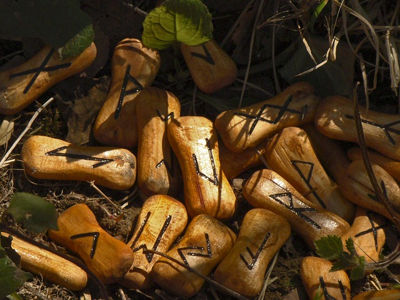
Image by Alex Volodsky from Pixabay

I have a professional interest in Runes.

The Mage in my superhero campaign (Zenith-3) uses Runes as the focus of his spell-casting, and I’m always looking for ways to invoke the resulting flavor, and for the implied limitations and benefits that come from this approach.

It has been established, for example, that it’s not enough for him to simply scrawl some runes onto a convenient surface with a piece of chalk, that it requires something more substantial.

There are times when I have pictured runes of fire hanging in mid-air as he casts a spell, but the player wasn’t in favor of that – even if only a handful of people could read them.

Something that has worked well are small glazed and fired tablets of clay, about an inch square, with a rune carved into the surface, that release a specific spell when they are crushed, as a way of “prepping” a spell in advance.

Another feature of the magic system is the capacity to ad-hoc construct a spell or spell variant. It has been established that these “rune-stones” are not strong enough to hold an ad-hoc spell. However, something more substantive like a cast metal rune-stone (hard to crush by hand!) might be a horse of a different color – we’ve simply never explored the question. (It’s relevant that he’s the ONLY rune-based mage to appear in the campaign, other spell-casters have each had their own styles). – (I dread the day when someone decides to play a poetry-based spell-caster, because none of the players I know are exactly poetic in nature – and poetry often bores me, anyway. And the first person to suggest a rap-based spell-caster will get a rap of my knuckles around the vicinity of their head!)

Runic Fascination

I probably first encountered runes in The Lord Of The Rings (the books, not movies), which I read before I read The Hobbit. I immediately found them to be fascinating and frustrating in equal measure – but was deeply impressed that an English-alphabet rendering did not sound like English, but sounded completely internally consistent – and informed the names of places and things in the Dwarfish lexicon – lessons that I have remembered throughout my time as an RPG career.

I found the fact that Elvish looked a lot like the English alphabet subtracted from the “alien-ness” of the Elves – they seemed more mundane, a perception at odds with their almost religious position within Middle-earth society. It was an inconsistency that nagged at me every time I read the books.

– Hieroglyphics were equally fascinating for much the same reason.

As an aside, I also find it fascinating that this would be less of an issue where I younger – my schooling was in an era when cursive handwriting (“running-writing”) was taught as preferable to printed letters, something that is no longer the case in Australia (I can’t speak for the rest of the world). My mother, in comparison, was educated in an era when the specifics of construction of cursive letters was much fancier, and had to be perfect or else – and in those days, corporal punishment was both accepted and widely-used. So the cursive script that Tolkien used would have been even less alien to my mother and considerably more alien than that taught to my just-married young niece.

(This has an impact that is both subtle and profound in other ways as well – the modern way places more importance on what you are communicating than in the mode of that communication. In mum’s day, the clarity of communication was more important than the substance. My generation falls somewhere in the middle, in what I now perceive as a phase of transition from one emphasis to the other. Most of my generation write more rapidly and fluidly than the generations to either side of us, but also arguably have far worse handwriting in terms of legibility. Which actually makes us better at deciphering barely-legible handwriting – which is ironic since the stated purpose of “running-writing” was to make it easier for students to achieve a satisfactory standard of handwriting…

These various impressions and observations have all contributed to my handling of language in RPGs ever since.

The Tools Available

Using Runes and other non-English alphabets used to be virtually impossible unless you spoke the language (and I’ve never been good at Languages, as my French teachers would testify – in fact, it reached the point where I was planted into the School Library and told to educate myself on something instead, because I was holding up the rest of the class.)

This is no longer a handicap, and there is no longer an excuse. There are three tools available to the GM in the modern era, and their use in combination presents a vast palette of choices.

    Online Translation

    Google offers an online translator as a service. Compose a piece of text (or a smattering of key words) and input it into “Google Translate” then pick the language you want. Drawback: it doesn’t give you a phonetic English translation, it renders it in the appropriate font – which often won’t come out right when you copy & paste into a text document. Instead, what you will find are a whole lot of question-marks, punctuated by the occasional recognizable character.

    But for creating images that look right, this has proven invaluable.

    Plus, there’s a button that you can push to hear the translation being read to you in the foreign language!

    How good is it? Objective measurement, by translating something into some other language and then back into English, is probably a 7 out of 10. Some languages it does really well, some languages it does quite badly. But, unless you actually speak the language, it simply looks and sounds authentic – and it’s a lot less work than any of the alternatives. For example, French, Russian, and Japanese it seems to do reasonably well, German not so much.

    I stated that it’s not a phonetic translation. There are other websites out there that will perform that service for you, too. These are less likely to be around for a long time (though I hope they are), so I won’t link to any specific one in this discussion. Some of these are language-specific, so the best search is “phonetic [LANGUAGE] online translator” or some variation. “Online Translator Phonetic Samoan” would be a valid example. Sometimes you need to add the word “Free” – and I recommend that if you do so, you surround it with inverted commas, the same way I have, which tells Google that the result HAS to include that term.

    Of course, ‘real’ languages are one thing, non-human languages quite another. But there have been solutions to that available in the past, too – and it wouldn’t surprise me to find some of them still around. Quite often, these will give you the chance to translate into Tolkien Elvish or Tolkien Dwarfish – outside of that, your choices become a lot more limited.

    Find-and-Replace

    Those who read the second parts of each post in the (still incomplete) On Alien Languages series will already have some notion of the power of this tool, which is routinely included in word processors. I had a whole example worked up – until I realized that it wasn’t actually an example of what I’m talking about. So here’s a new one.

    We start with a paragraph of text:

    Writing things down is a major evolutionary step for a society. It enables a scholar to instruct future generations, passing knowledge from one hand to another.

    Next, we need some ground rules, based on the biology of the species as well as its society. If your lips are hard beaks, you can’t make “w” sounds, for example.

    It’s often useful to define these in sequence of most common to least common. Somewhere along that path, you will reach the point where only small portions of the original remain untouched. For example, let’s change all E to UZ, all TH to KH, all A to AZ, and all ING to OZ:

    Writoz khozs down is az mazjor uzvolutionazry stuzp for az sociuzty. It uznazbluzs az scholazr to instruct futuruz guznuzraztions, pazssoz knowluzdguz from onuz haznd to aznokhuzr.

    Next, delete all F’s and W’s, convert all IS to EZIK, all OL to ZU, all OR to YZK, all IONS to IOZ, and all CH to PAZ:

    Ritoz khozs don ezek az mazjyzk uzvzuutionazry stuzp yzk az sociuzty. It uznazbluzs az spazzuazr to instruct uturuz guznuzraztioz, pazssoz knzuuzdguz rom onuz haznd to aznokhuzr.

    At this point, there’s not much recognizable. IT, TO, KN, SOC, and the components of “instruct”. So let’s make them IK, KO, ZH, KOZ, and KUZUK respectively.:Also, “hand” is still recognizable despite having a Z in the middle of it; turning HA into KA and ND into OHK should take care of that.

    Rikoz khozs don ezek az mazjyzk uzvzuutionazry stuzp yzk az koziuzty. Ik uznazbluzs az spazzuazr ko kuzuk uturuz guznuzraztioz, pazssoz zhzuuzdguz rom onuz kazohk ko aznokhuzr.

    Finally, I would re-space this and tidy it up to make pronunciation a little easier:

    Rikoz khozs don ezek az mazizk uz zuuton azray stuzp izk az koz iuzty.

    Ik uznaz bluzs az spaz zuaz kokuzuk utur uz guznu zraztioz, paz ssoz zhzu uzdguz rom onuz kazohk ko aznok huzr.

    Count up the number of operations used to render this text into something completely different and you will get 18 – and it has literally taken me longer to record what I was doing than it would have taken to just DO it. The big trick is to be able to repeat the process if you need to, down the track, so I would still have taken some notes.

    Non-English Fonts

    The final option open to all in the modern day is to replace the usual font with one that renders the text into exotic characters.

    Rather than creating a new example, the one that I redacted from the previous section will do nicely, and save all that work from going to waste.

    When I started it, I had just mentioned the On Alien Languages series (the problem was choosing the wrong language to translate into, as you will see): We resume from the point of that mention:

    …the (still incomplete) On Alien Languages series will already have some notion of the power of this tool, which is routinely included in word processors.

    For the benefit of any who haven’t, here’s an example of what you’ve missed out on:

    Giant:

    Giants once dominated many of the other races, It was when they attempted (and failed) to conquer Dwarves that they learned to write, and that in turn shaped and altered their language.

    Translating text into Giant is best simulated by first translating it into Russian, using German for any terms that do not translate, with Hungarian for a third choice. The written form of the language can be achieved by rendering the result using Czar (note that italic and bold versions are also provided).

    Orc:

    When the Orcish tribes broke free of the domination of the Giants they retained much of the Giant language, but this quickly fragmented as any cohesion between them broke down. Each tribe now has it’s own dialect, extremely divergent from the original, which are collectively known as Orc, or Orcish. This makes communications with any specific tribe or individual extremely touchy; what might be a compliment to one tribe may be an insult in another.

    Spoken Orcish is best rendered by first writing the text in English, randomly inverting the meaning of a few words here and there, translating the results into Hungarian, with Russian and then German as secondary and tertiary choices, removing all the spaces and inserting new ones after every one or two syllables. The exception is proper nouns, which have hyphens inserted instead of spaces.

    Written Orcish is achieved the same way, but with the final text rendered into Czar.

    For example, here’s a paragraph in English:

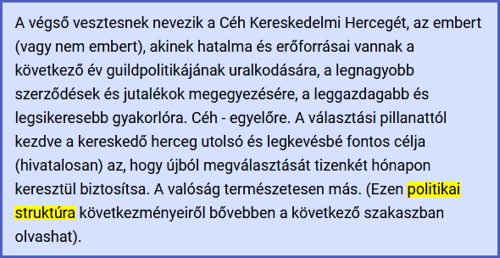
    The winner is named the Merchant Prince of the Guild for the next year, the man (or woman) with the authority and resources to dominate guild policy for the next year, to agree the biggest contracts and commissions, the wealthiest and most successful practitioner within his Guild – for now. From the moment they are elected, the Merchant Prince’s primary goal is ensuring his reelection twelve months hence. (There’s more on the consequences of this political structure in a subsequent section).

    And here’s a version with some inverted meanings:

    The final not loser is named the Merchant Prince of the Guild, the man (or not man) with the authority and resources to dominate guild policy for the next year, to agree the biggest contracts and commissions, the wealthiest and most successful practitioner within his Guild – for now. From the moment they are elected, the Merchant Prince’s last and least-important goal (officially) is ensuring his reelection twelve months hence. The reality is different, of course. (There’s more on the consequences of this political structure in a subsequent section).

    Notice that the meaning is still the same. Next, I translate it into Hungarian:

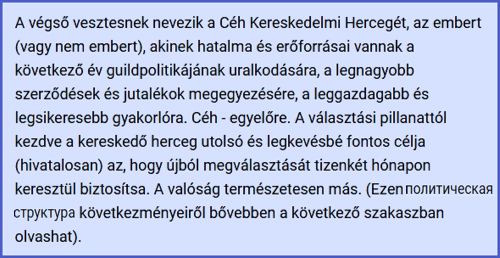
    As it happens, there was a translation for all of the text, but a couple of words are close enough to English to be recognizable (highlighted in yellow). Purely for the purposes of demonstration, let’s translate the original English to the second choice, Russian, and drop it into place.

    Now, there are all sorts of characters in the result that don’t appear in standard English. So the next step is to replace them with appropriate characters:

    A vegso vesztesnek nevezik a Ceh Kereskedelmi Herceget, az embert (vagy nem embert), akinek hatalma es eroforrasai vannak a kovetkezo ev guildpolitikajanak uralkodasara, a legnagyobb szerzodsek es jutalekok megegyezesere, a leggazdagabb es legsikeresebb gyakorlora. Ceh – egyelore. A valasztasi pillanattol kezdve a kereskedo herceg utolso es legkevesbe fontos celja (hivatalosan) az, hogy ujbol megvalasztasat tizenket honapon keresztul biztossa. A valosag termeszetesen mas. (Ezen nonmtmyeckar ctpykrypa kovetkezmenyeirol bovebben a vetkezo szakaszban olvashat).

    The penultimate step is to remove all the spaces except in proper names and titles, which form separate words without spaces in their own right – look to the original to work out what those are – and then insert new spaces and hyphens as necessary, leaving no word longer than two syllables without some form of spacing (I’ll use existing punctuation to separate words, then replace them with exclamation marks). This gives 13 words and one Title. Separating these to clarify them gives 11 paragraphs of Orc-speak.

    Aveg sovesz tesnek nevez ika CehKer-esked-elmi-Herceg-et!

    Azem bert (vagyn emem bert)!

    Akin ekhat almaes erof orras aivan nakak ovet kezoev guildpol itik ajan akur alkod asar a!

    Aleg nagyob bszer zodes ekes juta lekok megeg yeze sere!

    Aleg gazdag abbe slegsik eres ebbgya korlora! Ceheg yelore!

    Aval aszta sipill anatt olkez dveaker esked oherc egut olsoe slegkev esbef onto scelja!

    (Hiva talos an)!

    Az!

    Hogyuj bolmeg valasz tasat tizen kethon apon keres ztulbiz tost sa!

    Aval osag termes zetes enmas!

    (Ezenn onmtmyeck arctpyk rypak ovet kezmen yeirol boveb benak ovet kezosz akasz banol vashat).

    Looking at the results, I decide that single-syllables shouldn’t end a sentence, and make an exception to the two-syllable rule.

    Aveg sovesz tesnek nevez ika CehKer-esked-elmi-Herceg-et!

    Azem bert (vagyn emembert)!

    Akin ekhat almaes erof orras aivan nakak ovet kezoev guildpol itik ajan akur alkod asara!

    Aleg nagyob bszer zodes ekes juta lekok megeg yezesere!

    Aleg gazdag abbe slegsik eres ebbgya korlora! Ceheg yelore!

    Aval aszta sipill anatt olkez dveaker esked oherc egut olsoe slegkev esbef onto scelja!

    (Hiva talosan)!

    Az!

    Hogyuj bolmeg valasz tasat tizen kethon apon keres ztulbiz tostsa!

    Aval osag termes zetes enmas!

    (Ezenn onmtmyeck arctpyk rypak ovet kezmen yeirol boveb benak ovet kezosz akasz banol vashat).

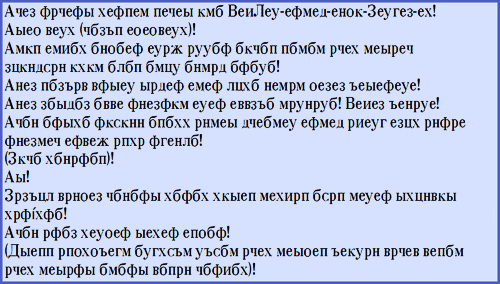
    The final step for written Orcish would be to use a font called Czar (There are a lot of fonts named this way – the one I am referring to is a Cyrillic-style font named “Czar Regular”, available free from Fontsgeek. If I do so, it looks like this:

    …which looks nothing like the original, or any of the translations encountered along the way. (Any characters that don’t appear will show up as an empty box; simply delete these or replace them with something).

By the time you run the various combinations and permutations of these tools together, you end up with a vast range of choices.

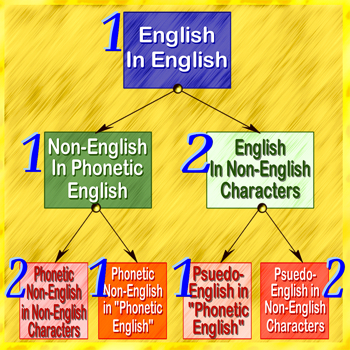
The diagram to the right illustrates the principles from a slightly different, more abstract, perspective. You start with an English-language rendering of what you want to say and can either react to the content or to the appearance. Either way, you end up with a path to both a rendered language (2) and a phonetic language (1) for an English-speaking person – paired to match each other.

The choices, if you’ve been properly guided by the anatomy and society of the species (“Race” in D&D terms) don’t appear out of thin air. Instead, they are reflections of the design decisions you’ve already made giving the resulting language an immediate cultural relevance.

And, when you notice that one word is almost the same as another, the temptation to link the two in some fashion can be the sort of inspiration that comes from on high. For example, if the Orcish word for victory is “ZUKH” and the Orcish word for mistake is “ZAKH”, you could reasonably extrapolate a connection between the two to say that all failures are personal to an Orc; someone is always definitively to blame, and that person is dishonored by the failure. No excuses or prevarications are acceptable, none will be accepted. You can use this foundation to create an entire social order, one based on the premise that victory by any means is preferable to any form of defeat.

Imagine trying to translate the principles of give and take inherent in diplomacy into such a social framework. “Neither wins” means “both lose”. “Both win” begs the question, “who loses?” – and there has to be someone – and so on. Losing a hand at cards would be enough for a declaration of war – and cheating (if necessary) to win would be regarded as the moral thing to do!

Yet, this would undoubtedly be regarded as a virtue, however mixed a blessing it might prove in other people’s eyes.

This is societal development the fun way, where each domino “idea” begins a chain-reaction. Just remember – while it might be perfectly clear in you mind now, some of the lines of reasoning will have already started to blur – document your thoughts as quickly, completely, and concisely as possible, as soon as possible! Trust me, I speak from experience!

Getting Back To Runes

Historical accuracy carries its’ own verisimilitude, and can be the key to unlocking another society that you can draw upon for inspiration. I am quite prepared to believe that you can never fully understand a society until you can speak in the language of that society; until then, there will be nuances that simply go over your head.

It obviously is not enough to simply pick up a font that looks like runes (there are several out there). Reference books are a good beginning, and I have a couple of those. I’ve also given the player of the rune-caster a number of books on the Vikings, and – assuming that he’s read them – I’m perfectly willing to concede that he’s a more knowledgeable expert on the subject than I am. I won’t let that get in the way of a plotline – his knowledge is of this world, after all, and subject to revision-as-necessary.

So anything with “Rune” in the title is sure to get my attention. A few weeks ago, Paul St John Mackintosh waved just such a product under my nose – something called “Casting The Runes”. This is a standalone RPG written and designed by Paul, which is to be published by experienced Game Publisher, Lawrence Whitaker.

The detail reveals a limited relationship to my runic interest, at best, but intriguing and potentially valuable material for entirely different reasons: Casting the Runes is an investigative roleplaying game based on the ghost stories and tales of the supernatural of M R Jones, described as a renowned medievalist and writer, who was active in the literary field of horror between 1904 and 1935.

The Kickstarter page for Casting The Runes described him as writing stories “based on and around the investigation of strange, uncanny, supernatural artifacts that either summon terrible, malevolent entities, or unlock the ways for disturbing events to manifest”. I was instantly reminded of that classic story, The Monkey’s Paw.

I have to admit that the only horror writer from the era that I’m really aware of (never mind being familiar with) is Lovecraft. But I was intrigued – after all, such stories as described should readily translate into just about any genre, if you were willing to throw enough of them away.

So I was sufficiently intrigued to investigate further, and discovered from the quoted CV that Paul is probably the most qualified person in existence to handle this project and any related ones, having won multiple awards as a horror writer.

The Kickstarter campaign has 14 days remaining as I write this, and has already achieved its funding goals. So you are as certain to receive product at the end of the day as it is possible to get with a Kickstarter. Furthermore, the RPG is described as already written, needing only production (artwork and layout) and printing to be complete, which is reassuring.

The story isn’t all peaches-and-cream. The stretch goals are such that only backers of the higher tiers will benefit from them, as they are all enhancements to the more premium versions of the book. As I pointed out in my reply to Paul, this provides little incentive for backers to promote the Kickstarter, so I expected that they would struggle to get further traction once the initial funding target was reached. That was 11 days ago, a time-span that has only validated the prediction. Paul was going to refer the notion to the publisher to see if there was anything that could be done to correct the problem which he recognized as soon as it was pointed out, but nothing has since changed so I suspect it has to simply be filed under “lessons learned” at this point.

Nor are these editions progressive, getting unlocked for certain tiers of backers as sufficient donors back the project to cover the expense. That means that backers in one tier can be subsidizing the product received by backers in higher tiers.

That said, there appears to be nothing wrong with the product that should turn you away if you want to back it. The cheapest copies of the finished book are Canadian $20 (plus P&H). The cheapest physical copies are at the $40 (+P&H) backer level – both fairly typical for a book of this size (192 pages).

For some of you, that’s enough information to steer you to the Kickstarter; for others it’s enough for you to declare a lack of interest. Either way, at least now you’ve heard of it and can decide for yourself.

But that leaves a middle ground who have yet to be convinced. For the morbidly-curious and otherwise-uncertain, there is a free preview PDF available through RPGNow that should help you decide. You have two weeks – make the most of them!

Comments Off on Runes and Writings

In The Beginning: Prologs Part 3 (Types 10-18)


This entry is part 3 of 3 in the series Prologues In RPGs

Sometimes, a prolog need be nothing more complicated than someone talking ernestly to “camera”.
Image by Enrique Meseguer from Pixabay, Cropped by Mike

Plans & Changes

It’s strange how perceptions and plans can change as a project proceeds. This is the third in my series of articles about Prologues (spelt ‘Prologs’ in the US, and in the rest of this text) – but when I started, this was intended to be one single article, something relatively quick that I could toss off despite seasonal interruptions. When I started actually writing it, it was quickly split in two – a first part looking at prologs in general and in a more abstract way, then the second part dealing with the specifics of different approaches. The intent was to describe each in a paragraph and move on to the next, and if I had stuck to that plan, the original intent would have been executed. You can judge from the presence of a part three that I did not!

Instead, I found myself going into each prolog type in greater depth, aided by a recurring checklist that made sure I didn’t miss anything.

Now, looking back on it, it feels like this was always going to be a three-part series. It just “feels” right that way, as though anything less would not have contained the depth that readers have come to expect from Campaign Mastery when we tackle a subject.

In it’s own way, GMs frequently have a similar experience whenever we run an adventure. It is rare and noteworthy for events to unfold anything like the way we expected before we started, and that’s true no matter how thorough our plans are. And hopefully, at the end, it all looks like it was always intended to unfold the way it did – complete with death-defying cliffhangers, desperate situations, moments when all hope seemed lost, and inspired moves creating sudden changes of fortune.

Nevertheless, you don’t have to look too deeply below the surface to find the remnants of the intermediate plan, when this part and the last were intended to be one. In particular, this article will presume that you have read the last one, and will often refer back to the content of part 2.

And, when you get to the end of the detailed descriptions of prolog types, you’ll find what might almost be considered the seeds of a potential part four – a topic or two that were better addressed after the long list of specifics were complete, and some afterthoughts.

It’s a substantial work order that won’t fulfill itself – so I’ll stop dithering and get on with it!

9. Omniscient Alarms

You might think that I’ve already dealt with this type of prolog in type 2, “Aftermaths”. Everything stated there applies to this category, 100%. But, with some sort of alarm being sounded by an Omniscient Entity of some sort, there are a couple of implications and requirements that are unique. An “aftermath” can be nothing more than someone’s subconscious working overtime – an actual Omniscient Alarm is a horse of entirely different color.

First, the situation has to warrant such an Entity’s involvement. That in itself can be problematic; you have to avoid it being an anticlimax. In effect, an Omniscient Alarm ratchets the hype up to 11, and the situation itself has to live up to it.

At the same time, you have to explain why the PCs have never heard from this Entity before. The simplest such answer is that this is a greater threat than anything they’ve had to deal with previously. Others include the PCs having finally earned the trust and respect of the Entity with their past successes; the Entity having made some sort of mistake in dealing with the situation that has made it a lot worse, and that he is trying to undo; or even being temporarily out from under the thumb of a strict supervisor who is non-interventionist.

You also need to have an answer to the question of whether or not the Entity will intervene again in the future, in the event of other imminent disasters of similar magnitude – and if not, why not.

Another problem to avoid is the potential for every “ordinary” crisis that follows being an anticlimax. All this makes for a delicate balancing act.

Second, there’s the very existence of the Entity. Nature abhors the singular example – where there’s one, there are usually many. Why have none of the others made their presence felt in the campaign before now? Who are the others, anyway? Where do the Entities come from, what’s their story? The mere existence of the Entities can threaten to rewrite your entire Cosmology – unless they were “baked in” from the very beginning.

    The Bottled Adventure

        “…I am strictly forbidden from interfering. My superiors judge that the situation will resolve itself to their advantage, never mind how much suffering must be endured en route to that resolution. I think they are overconfident and have been seduced by the potential gains. They maintain strict scrutiny of every agent they assess as potentially capable of direct interference in the situation. A rare and temporary coincidental cosmic phenomenon that may never be repeated has created a window between our worlds, and through that, I found you, and now I beg for your assistance. Help us, please, before it is too late!”

    Notice how neatly this answers every one of the potential problems listed earlier. First, this becomes an isolated one-off event. Second, it removes the Entity and their entire existence from the usual campaign reality. Third, the actual problem to be faced could be relatively minor, but because the usual remedial actions are not available for “political” reasons, outside intervention is needed – so no threat of anticlimax.

    If you are running, say, a cyberpunk campaign, and discover this really great D&D adventure and think it would be fun to put your players through a change of pace, this is the perfect vehicle. Or vice-versa! (The usual game-balance caveats apply, and you might need to think about the transfer of rewards).

    Or you could restrict yourself to the usual milieu and simply remove this adventure in time and/or space from the usual campaign – so far away in one or both that events might as well be taking place in a parallel universe. Speaking of which, I’ve run this exact riff a time or two from parallel universes, which is somewhere in between the other solutions.

    And, at least once, I’ve had the entity appealing for help turn out to be the villain, attempting to manipulate a situation covertly for his own benefit – and virtually everything said in that opening spiel turning out to be a pack of lies….

Omniscient Alarms either signal something out of the ordinary, or an escalation of intensity within the existing campaign. In the latter case, they signal a watershed moment, a point of transition between phases of the Campaign. This can create its own problems – what if the Players like the way things already were, better? The only satisfactory answer that I’ve found is not to hide the intention to transition the campaign between multiple phases from the players, and to significantly build up a sense of change being inevitable.

        “Life was a game, a lark. I could fall into one escapade after another and climb back out smelling like a rose because I didn’t take life seriously. Suddenly, there are consequences, things matter, there are people suffering and some I care about could be hurt or killed if I mess up.”
        “That’s what happens in wars.”
        “It’s cramping my style.”

This approach gives the GM license to experiment, to be a little different, to try something out and see if the players like it, without hanging the future of the entire campaign on the outcome.

It should go without saying that the subject of the Alarm should be strictly related to the main content of the adventure. It might seem reasonable, and even realistic, for more advance warning to be given, achieved by having the Alarm relate to a future adventure and not the immediate one. That can work, but it can also cause the whole thing to fall flat. It needs to be delicately handled or the result can’t help but be an anticlimax. The greater the separation in real time, the greater the risks that have to be managed.

10. Metaphors and Allegories

Something I’ve found over the years is that you can but commentary into a prolog that simply wouldn’t fit within the main adventure – like employing metaphors and allegories to shed a different perspective on the current situation, or on the adventure that is to follow. This works very well when you have taken a very abstract concept and translated it into some new context. For example, one adventure had the PCs confronting and exposing corruption within the in-game government of the day. The prolog depicted a patient on his sickbed as his system attempted to fight off a spreading cancer. I flashed back to this prolog in brief snippets throughout the adventure – when the PCs made progress, the patient rallied; when the PCs encountered setbacks, the patient went downhill. The metaphor was making a point about the way corruption spreads, one that would have either been boring as a lecture, or mentioned once and forgotten if brief enough not to be too dull. At the end of the adventure, with the PCs successful, the patient was discharged, in full remission – just as another patient was wheeled into the hospital room suffering from the same illness. Flash to two men, somewhere, shaking hands. Curtain. I didn’t need to elaborate further – it was a clear signal that the PCs may have excised one corrupt group, but corruption itself was beyond them as an enemy, a fact of life.

Handled the wrong way, this could have ended the entire day’s play on a depressing down-note. Because of the way I had set up and referenced the metaphor, the words spoken by the doctor to his (recovered) patient conveyed an entirely different message: “We are all mortal, so I fight death on a daily basis. I’ve learned to enjoy the small victories. Congratulations, and try not to die anytime soon, okay?” Those last two sentences might just as well have been said direct to the PCs and to the players.

An allegory is a poem, picture, play, etc, in which the overt meaning of characters and/or events symbolizes a moral or spiritual meaning. A metaphor is a figure of speech or narrative in which a word or phrase is applied to a person or situation in a non-literal sense in order to symbolize a quality or trait of the person or situation, EG “Brave as a Lion”. A given passage of text can be either, both, or neither. The reference can be standalone, or – as in the example – a touchstone. It can have a relevance that might only be recognized in hindsight, or it can shape perceptions from the moment it is related.

Simply relating the adventure title can be the entirety of the prolog, when that title has multiple meanings. That’s something I do a lot in my Superhero campaign – the current adventure is entitled “A Tangled Web” and it has already had three separate meanings within the adventure. The previous one was “Figures In Black” and that also referred to multiple different figures all wearing black and causing various developments within the campaign or the adventure, and also to some important numbers on a printed page. You get the idea.

There is an obvious need for the prolog to relate to the Main Content – that’s the whole point of this type of prolog. Which means that if you are making a point about a different perspective on the situation the PCs have found themselves in, the main adventure has to reference and progress that situation, it can’t just leave the status quo unchanged.

Outside of the dangers of being too obvious and heavy-handed, or too deep and subtle, there aren’t a lot of risks involved – so if you are careful to adhere to the principle of meaning being applied within the current adventure (and preferably, that day’s play), there aren’t a lot of other restrictions on this type of beginning to worry about.

11. A Glimpse Of The Past

This comes in two – no, three – sub-types:

  • Reminders Of Past Events;
  • Delivery of new information that PCs “already know” but the players don’t;
  • Delivery of out-of-character information that neither the PCs nor Players know.

So distinctive are these that they really need to be addressed separately.

    11.1 Remembering Yesterday

    I need to ensure that readers distinguish this type of beginning from type 17, “Where We Left Off”. That can follow the main prolog, but this type refers to something so long ago that the GM felt the players needed to be reminded of it. This is especially true if one or more of the PCs weren’t with the party back then. Importantly, any space used by a status report should be taken out of the space allocation to the prolog overall. If you’ve got a page and a half, it’s reasonable for one-and-a-quarter to be devoted to the incident being remembered and 1/4 of a page to a very brief snapshot of the current situation. The players will be looking for the relevance of the prolog to the adventure, and an excessively-lengthy recap of the current situation can only frustrate them.

    Obviously, there should be some connection between the incident being remembered and the current adventure, and that relevance should be made clear before the end of the first day’s play. I find that this relevance makes a great cliffhanger ending.

    There is a noteworthy benefit to placing this sort of flashback sequence in a prolog – it means that you don’t have to interrupt the action with the recap when relevance makes itself known. In other words, this type of prolog is used for the effect that it has on the structure and pacing of the main adventure.

    It is possible to get bogged down in side issues as the players waltz down memory lane, or (worse) challenge your “official” record of the story. In the interests of keeping the past relevant to the campaign, I indulge the first (to a reasonable extent) but come down hard on the second: “From time to time, plot holes are discovered that went unnoticed at the time, and past events have to be retrofitted to close them,” is my usual line – without elaborating further. My players accept this line of argument at least most of the time (it helps that they’ve found themselves demonstrably wrong on a few of these disputed cases). Of course, if you ARE wrong, make your mea culpas and start work on salvaging your current adventure!

    11.2 Background Info-dump, Personal

    In some of these cases, the guidelines for length presented in Part 1 are just that – a guideline, to be ignored if the probative value is high enough. In others, they are strict doctrines that need to be observed very tightly. Background Info-dumps manage to be both at the same time. In the case of personal background info-dumps, you can be a little more casual; in the case of ex-cathedra info-dumps (see 11.3 below), they are rigid controls that must be strictly observed.

    The biggest danger with a personal info-dump is that you are, inherently, focused on just one PC, who will be hanging on your every word (one way or another). The rest may find it moderately interesting or openly boring. The less this is a factor, the more latitude you have – but beware of outwearing your welcome.

    A secondary danger is that you may be messing with a PCs’ canon. Some players enjoy the GM adding to their character backgrounds, in the process integrating the characters more tightly with the campaign world – they get richer characters and a “personal stake” in the day’s adventuring. Others detest it. I have had one player tell me, “if there’s something my character knows and I don’t, tell me when I roll and not before!”

    Others simply need more time to digest information than the immediacy of the gaming table. Background info-dumps for such players are best delivered by email, or in writing, in advance of the day’s play – with a reminder or synopsized recap as the prolog. And be prepared for the player to say “I didn’t have time to read it.” Handle such situations delicately – the reasons may be legitimate – but make it clear, without being offensive, that the player is inconveniencing everyone else at the table. But only make a fuss if they actually are inconveniencing everyone. Otherwise – “No problem, I’ll be focusing on the others for a while anyway, so you can read it now.”

    It’s preferable to avoid giving permission for the players to just ignore something you’ve sent them.

    Of course, not all background info-dumps, even of the personal variety, involve a character’s personal background to any significant level. “Back when Pangram was a student, he took a course in classical Dwarfish architecture (it says so, on his character sheet). His lecturer on the subject was Kalzar Briteblade the thirteenth. Pangram loved the subject, but Kalzar could make his own execution sound boring. Despite this, he soaked up as much as he could about [characteristic element one] and [characteristic element two], and learned [important fact #1].” The GM knows that “important fact #1” will be directly relevant to the day’s adventuring, something that the character would know because of what he has on his character sheet and has encapsulated it in an anecdote. The player knows that the GM has a reason for doing so, because it won’t have happened by accident, but doesn’t know if it’s the factoid or the lecturer from his past, or both, that will be significant. (Of course, the term “important” is a relative one!)

    11.3 Background Info-dump, Ex-cathedra

    One of the metaphors often used to describe the players of an RPG is that of an audience in participatory theater. This is an appropriate choice because each player has no idea what the other players will say or do next, they can only watch and react in character. There are times when it is more useful than others. This is one of those times.

    This is a technique that you often see used in TV episodes and even movies. Somehow, it is more notable in the former than the latter, probably because a TV show is less expected to have the scope of a movie. RPG adventures are something of a cross between the two – they can have scope even greater than a movie, and yet their structures are more akin to those of a TV show – and that includes this kind of prolog being unusual.

    And the reason is because the players are reduced to being an audience while the GM orates. And they won’t – and shouldn’t – sit still for that for very long.

    Yet, there are times when this is utterly necessary. If the GM has planned perfectly, then he provided the relevant information in the campaign background, and only needs to recap it. But most of the time, this is information that wasn’t even thought of at that time, and that needs to be provided to the players now. It might even be information that the PCs have spent some time ferreting out in-game, and that therefore could not have been provided to the players any sooner.

    Length is the enemy here – and the natural enemy of length constraints are felicity of style. If the narrative is coming from am NPC, there is a natural desire to present it in-character – but that ultimately means padding it with characterization.

    If you go over permissible length, there are two (similar) solutions.

    You can break the narrative up and present these in (relatively) brief snippets in the course of the adventure, a series of flashbacks that get to the point just as the information becomes essential. If you adopt this approach, I recommend snippets of no more than half the maximum length indicated for a prolog, and preferably only 1/3. This is choice one.

    But what if the information is critical immediately? Then your only choice is the synopsis, in which detail and content is sacrificed to character style – and ends with the NPC saying something to the effect of, “I can tell you where to find more information about any of these events, but that’s the gist of it.” That puts the onus back onto the players, plants a delay in the manifestation of the criticality into the plotline, provides a measure of interactivity in what would otherwise be stale narrative – but the GM had better have done the prep necessary: Where is the information, How Far Away is that, Who has it, in what Form is it kept, and What will the PCs have to Do to get access to it? And how accurate and up-to-date is this information?

    As a rule of thumb, be careful if the Quest you are handing the PCs will take more than a single game session to resolve – the first “chapters” will be lost and forgotten by the time they get to the end. There are ways of combating this problem – giving players a hard copy or electronic version of the accumulated narrative at the end of each day’s play, for example, gives the players a chance to refresh their recollections before play resumes – but they won’t happen by accident, either. It’s often helpful to party planning (and hence to GM planning) if you have a cheat sheet prepared, too, outlining the synopsis with the answers to these questions.

    Sources include Scholars, Wizards, Priests, Talking Books, Inscriptions, Artworks, Museums, Curators, Diaries, Statues, Bards, Folk Songs, Elves (long-lived), Dwarves (ditto in some campaigns), Folklore, Thief’s Guilds, Dungeons…. you get the idea. 1/3 should be willing to help upon request, 1/3 will be easily persuaded, and 1/3 will be more difficult.

    Most of these sources will require travel, even if it’s only ducking around the corner to the Temple Of Sassifras The Cat. Don’t hand-wave these trips completely – this is your chance to throw some variety into the mix. And work hard to maintain the impression of a ticking clock, with the hands moving with every piece of intelligence gathered.

    Whether it’s what you intended or not, the length of background information to be imparted has made this your adventure. Proceed on that basis.

12. A Glimpse Of The Future

Obviously related to the Aftermath type of beginning, this differs from both that and from various other forms of beginning in its emotional content. Often a daydream, it functions as an emotional input into the way a character is roleplayed. You can use this as a vehicle for a more complex narrative, and restore an element of interactivity at the same time – see the write-up of “If I Should Die Before I Wake: A Zenith-3 Synopsis” for an example. Each dream sequence started with just such an emotional input, based on things the player whose PC was concerned had said in past play.

Glimpses of the future are generally meant to be extrapolations of current trends and personal wishes on the part of the character experiencing them, and are usually positive for the most part. They are not warnings, they are not prophecies, and they aren’t Aftermaths. They may be presented as dream sequences.

It is often useful to take advantage of this break from reality by having the character begin the adventure in a place and situation without knowing how they got there, awakening from a dream-state of some sort. Gradually, memories of how they got there can then reassert themselves, intermixed with, and wrapped around, interaction segments plus segments involving the other PCs (so that everyone gets their share of the spotlight). Those other PCs should probably become aware that the PC who had been dreaming is missing – unless they aren’t, and the “missing” PC is being run as an NPC. If you think the player is up to it, you can even have them run the “NPC” version of themselves.

Aside from the usual pitfalls of starting the story in the middle, which only apply when your objective is as described in the previous paragraph, this is a fairly safe way to begin, or so it seems. In reality, many players find that the GM dictating their dreams of a perfect future is cutting too close to the bone. I have stepped around that problem somewhat by discussing the question “What is [Character Name]’s vision of their perfect future life?” in advance – but this necessarily means showing your hand pulling the strings.

There are a few ways around this problem, but they tend not to stand up to repeated use. The simplest answer is simply to put the player on the spot – “You are dreaming that you are living your perfect future. Describe it…”

13. Prophecy

A prophecy is generally intentionally vague and capable of sustaining multiple interpretations. Offering a prophecy at the beginning of an adventure presents a host of potential difficulties. The introduction to part 1 of this series, and the inspiration behind it all, talks about how this enables prophecies to be used by the GM to screw the players over (while remaining scrupulously fair). Other players detest prophecies because they perceive them as an invitation to the GM to railroad the plot. I’ve written a couple of articles on prophecies here at Campaign Mastery, one of which – The Perils Of Prophecy: Avoiding the Plot Locomotive – deals with this problem in detail (Readers have also suggested other techniques in the comments section, so don’t skip those).

Prophecies can be equally problematic for the GM. Not only can they cause various forms of player dissatisfaction, they can trigger accusations of bias (when there is none), or provide a target that the GM feels he has to live up to. When I decided in my superhero campaign that Ragnarok was going to happen, it took another 18 years before I had all the building blocks in place for that event. Yes, it was suitably epic, and suitably cataclysmic, and demanded feats of incredible heroism on the part of the PCs and their allies, but even so… In the campaign at the moment, I am currently building up towards Ragnarok II, and hoping that it, too, will live up to the hype. So far, I’ve spent eight years on the build-up – with another 7 or so to go. Where now at the point where events occasionally reveal big pieces of the circumstances – revelations that will become more frequent (and progressively smaller) as the campaign unfolds. With a plot twist or two thrown into the mix along the way.

No matter how you slice it, Prophecies can be a LOT of work, to little reward. In the best-case scenario, they can also be a rich resource and the foundation of a great adventure.

I think a lot of the problem is that players tend to view prophecies as black-and-white good-or-bad, even after they have set aside any animus from the causes described earlier. Which is to say, they have to decide whether or not to support or even actively try and bring about the prophecy, or fight against it with everything that they’ve got, even to the point of suicidal charges. This betrays a lack of trust in the GM, an assumption that the GM is out to screw the players over – and ensures that there will be unhappy feelings on both sides of the GM screen.

The more experience players have with you as a fair GM, the less inclined they will be to make the erroneous assumptions at the heart of this confrontation. For that reason, I recommend against using Prophecies early in a campaign with new players. Prophecies can be as touchy as nitroglycerin – throw them around with care until you know what you are doing!

The obvious question to be answered is “why use them at all?” The answer is that when everything works, Prophecies can be great foundations for adventures and even whole campaigns. They can tell the players things that they would have no hope of otherwise discovering, provide clues as to how to mitigate or prevent disaster, spark motivations in characters who would otherwise have a ho-hum reaction to events (regardless of how their players might feel)… they can be a good thing.

Don’t turn away from using prophecies when they are the best plot device for a situation, or when they spark your imagination.

14. A Startling Event

Red Storm Rising starts with a terrorist attack on an oil field in Russia. None of the principle cast of the novel are involved, or even mentioned. But the entire novel flows from that one event.Goldeneye starts with a confrontation between James Bond and a fellow MI6 operative. Both are examples of starting events. The first interacts only indirectly with the protagonists, as the true importance comes to light. The second is an action sequence (see type 1) that leads directly into the rest of the plot.

Putting the ‘triggering event’ into a prolog – whether the PCs are present to witness it or not – can be a great way to parachute the PCs into a plot. Once an event occurs, the time frame before any given person learns of it can be quantified fairly precisely; having pulled the trigger, the players know that the shot is coming and will reach them eventually.

The greatest danger that I have observed stems from players trying to beat that clock, either reacting before there’s anything to react to (and trying to disguise their actions), or manufacturing excuses to go out looking for the information that they have (as players) but don’t have (as characters). Good players won’t subject you to either problem; bad players tend to do anything they can think of to find a shortcut.

15. A Dream Sequence

Once again, this might seem like old ground, already covered. In addition to the many relevant pieces of advice presented both above and in Part 2, there is also my 2014 article, “Dream A Little Dream – using Dreams in RPGs“. So it might seem like there isn’t a lot to say.

One point that I do want to make, however, is that every dream should be signposted in metaphors from the life of the dreamer, that every dream should reflect the attitudes and reality and perceptions of the dreamer, should be an expression of their personality – and I do mean the deeper parts thereof, the ones that don’t often get paraded in public. A good dream sequence is twice as hard to write as a GM as ordinary plot, and may go through many drafts and revisions where the main plotline of the adventure is subject to no revision at all.

Make appropriate allowances and preparations.

16. Food For Thought

This is a type of beginning that is only useful in unusual situations, but when it’s appropriate there’s usually nothing better. In essence, the prolog throws something deep and meaningful at the players, the more compelling the better, permitting the opening plot sequence to be played out with partially-distracted players. Only at the climax of the adventure does a plot twist reveal that the whole adventure has been an exploration of one facet of the original head-scratcher.

For example, you might use “If it is better that 100 guilty men go free than that one innocent man be wrongly convicted, does that not mean that prisons should be abolished?” – then run a plotline revolving around some other sense of the term “confinement”, such as marriage as a means of securing a peace treaty between warring groups.

The largest potential pitfall is that such debate often engages players at the human level, and may push personal buttons. It can be difficult to judge whether or not a response is coming from the player or the character that he is controlling. Similarly, players can have trouble discerning your opinions from those expressed by an NPC.

This can be a great way of getting players to dig deeper into the thought processes and opinions of their characters. The only trouble with doing so is that the answers are often unexpected by both players and GM, and will usually be transfigurative for the characterization thereafter; when you have a stable status quo within the party, this risks upsetting the apple-cart. Personally, I’ve usually found that to be a risk worth taking; but I’ve yet to be seriously bitten by fallout, so my opinion may be biased.

17. Where We Left Off

From one of the most obscure types of prolog, we travel to one of the most common. It is almost mandatory to present a recap of the situation at the end of the last session of play, and perhaps some exposition concerning how the party got there.

A lot of GMs have trouble doing these without realizing it because it can be hard finding the right level of compression. Thus, while minor transgressions and lapses can be ignored, trying to hit the length targets described in Part 1 is a good general principle.

Beyond that, the GM should contemplate the intensity and energy levels that he wants the party to bring to the first sequence of play for the day. If you want them to hit the ground running, go for a short recap – one or two paragraphs at most. If you want them thinking about the nuances and meaning of past events, be more fulsome – if absolutely necessary, exceeding the length limits.

If you do have to exceed the length limits by a significant amount, look for a way to make the prolog interactive. An NPC saying to the PCs, “Now let me get this straight,” and then giving the recap with some glaring errors that the PCs are sure to pick up on, punctuated regularly with “Is that right?” or words to that effect. Or have an NPC and a PC arguing over the significance of past events as a means of getting the recap out in the open.

Obviously, you can’t use such tricks all the time – so save them for when you really need them.

18. Nothing At All / Housekeeping

Perhaps the second most common type of beginning is to deal with any pre-game housekeeping – experience, reminders of ongoing conditions like damage and so on – and then get straight into the game. I employed this approach a lot when my campaigns were running every week, because the past was fresh in the players’ minds. The only time there was any sort of recap was when a player had been absent for the previous session.

When three spin-off campaigns came along in 1985 to accompany the main campaign, there was only time to play once a fortnight, and I started learning the hard way how to recap past events. And that brought the subject of prologs into view for the first time. Prior to that, it was “start play where we finished, do housekeeping at signpost moments or when players requested it (because they had gained a level or whatever), then resume play until the real-world clock ended play for the day. Not much finesse needed or employed.

This type of “prolog” gets the players into the game session right away, but brings them in “cold” – there are times when that’s appropriate and useful, and times when it’s not.

The biggest dangers involved are players forgetting something significant. From day one, no-one has a better command of your background material than you do – you’re the one that has sweated bullets over its creation, after all.

Case in point: I’ve been co-GMing the Adventurer’s Club with Blair Ramage for 15 years now, but I still ask him questions about the campaign background when we are co-plotting adventures, and defer to his judgment about genre-related matters. Even though his original creation had nowhere near the robustness that we have built into the current campaign, it remains the seed at the heart of the assemblage.

Compounds And Elixirs

If it’s not obvious by now, it is easy to combine two or more of these beginning types. Because it fitted the in-game situation, I once ran an adventure in which each PC experienced a different beginning type – but that’s an extreme case.

Something that I’ve learned the hard way is that such combinations are risky. While it can be that Part B covers the flaws and problems created by Part A, and vice versa, such perfection is rare. More commonly, you end up with a compound that contains both sets of flaws; and, if you are lucky, both sets of benefits. Sometimes, you can’t even say that you have achieved that much.

There are infinitely more variables involved than I could ever hope to quantify, and the results would be lengthy and extremely dull to read. Consider: the same plot outline becomes two completely different adventures in the hands of two different GMs; even if the GM is the same, past history means that the two adventures would still be different in different campaigns; and even if that weren’t the case, the fact that it is to be experienced by two different parties with different players and different characters with different capabilities and personalities and thought processes means that the resulting adventures would STILL be different in the two campaigns. Now throw in the fact that different pacing and plot structures are enhanced, transformed, or damaged in different ways by different prolog forms, and that these effects are dependent on matters of mood, timing within the campaign, recent past in-game events, and authorial style… By my count, that’s 16 factors with anywhere from three to three hundred possible categories in each. A systematic approach would take a lifetime – by which time the social expectations would have changed, and the results would have limited applicability.

Some practical advice on prolog selection

Instead, what we need is a process for the selection of prologs, and then a willing GM who will do his best to entertain and let the rest take care of itself.

While it is a practice most often honored in the breach, the best time to write a prolog is when you have a clear idea of the plot and its structure, and you should not choose a prolog type until you sit down to write it. That time might be before word one gets written – but most of us have to work with our adventure ideas a bit before reaching that level of confidence. In cases that become more infrequent with experience and familiarity with the players and their characters, it might not be until the main adventure is complete!

Remember that we are interested in the plot as it actually manifests in the adventure, not the preliminary outline that might bear no resemblance to the finished adventure!

    So, first question cluster: Is there anything missing from the main plot that a prolog could bring to the table? What form of prolog does that dictate? What are the consequences for the plot? Do the pitfalls that this would introduce completely undermine the adventure?

    If one or more forms pass this forensic appraisal, start writing and end the process.

    If not, proceed through the second question cluster (looks a lot like the first): Is there a prolog type that would enhance the adventure? What is the value of that enhancement? What are the consequences for the plot? Do the pitfalls that this would introduce completely undermine the adventure?

    If one or more forms pass this series of interrogations, start writing and end the process.

    If not, we get to the third question cluster: Are there any weaknesses or deficiencies or assumptions that could undermine the adventure proceeding in the most entertaining manner? Can a prolog be used to shore up those potential flaws, enhancing the likelihood of a successful day’s play in terms of entertainment value? What form of prolog does that dictate? What are the consequences for the plot? Do the pitfalls that this would introduce completely undermine the adventure?

    If you get past that without choosing a prolog type, the final question is whether or not a recap would be useful – if so, pick a target length and start writing. If you don’t think it’s necessary, given your players, make notes on any housekeeping and consider your adventure ready for play.

Put that way, it doesn’t seem quite so scary, does it?

Separations and Dividers

A further thought that came to me rather late in the process of writing this series. An adventure can have multiple prologs – just apply the same principals, especially regarding length.

You see, if we view adventures as this monolithic structure, complete within themselves, there can only be one prolog – at the start. But if we subdivide the adventure into Acts, we can have one “prolog” per act after the first – think of this as an “extra scene” that has been tacked on.

If you really want to, you can have two prologs at the start of the adventure – one for the overall adventure, and one for the first act.

The level of artistry demanded by this approach is high – any prolog involves taking a risk, being more artistic than is strictly necessitated by a straightforward adventuring approach. But the potentials can be equally high.

What brought this to mind? Remembering an old adventure, from about 20 years ago, in the middle of the first Zenith-3 campaign. It had a structure as follows:

That should look very familiar to anyone who’s been reading this section. What it doesn’t show is that the first prolog was a “Background Info-dump, Ex-cathedra” with no obvious relevance to the current in-game situation; that each of the Act prologues focused on one PC encountering a situation seemingly unrelated to anything else – the main plot or the adventure prolog, until the final act, which began by revealing that the prologs had been exploring the PCs opinions on analogous situations to the original prolog, which in turn was the key to understanding what had been driving the antagonist in the main plot throughout. How the PCs then used that information to resolve the main plotline brought several of the PCs into personal conflict with the group’s actions, a situation hinted at in the epilog, and which became the driver of a subsequent plotline. The greatest difficulty was in keeping the internal relationships of the plot structures a surprise until the plot twist in the fifth prolog.

As this (highly abbreviated and abstracted) example shows, prologs – done well – are integral to the overall plot, and in hindsight, this becomes obvious to all.

Prologs as part of the Adventure Template

It’s worth recapitulating a point that I’ve made in other articles that are at best marginally related to this series: if you employ a standard template or structure for your adventures, anything that is not the main adventure can be considered a prolog.

For example, adventures in my Zenith-3 campaign follow a standard structure for the most part:

  1. Housekeeping
  2. Recap
  3. PCs Personal Lives
  4. Transition To Main Plot
  5. Main Plot
  6. (Sometimes) Epilog: Consequences and Impact

It’s items 3 through 6 that are of interest in this context. Each PC has his own plot thread or threads, which experience developments from time to time. Those developments often impact the other PCs, directly or indirectly. On top of that, the local situation of the party manifests in a number of encounters that collectively comprise still more plot threads. And on top of that, anything that the players have indicated that they want to do forms still another series of plot threads, sometimes prominently, sometimes not.

One of these many plot threads becomes the main plot, involving all the characters, usually at the same time, sometimes consecutively, in the 4th part of the adventure. This transition can be casual, accompanied by still more plot developments in the PCs personal lives, or can be abrupt – some singular event that gets everyone’s attention.

The main plot then unfolds, and comes to a conclusion in the 6th section of the template. Because it has generally evolved from the personal lives of one or more of the PCs, there is an added form of engagement to the adventure. This also means that one or more impacts to those personal lives is likely to result; sometimes that is contained within an epilog, sometimes an epilog provides only a prelude, and sometimes the scope and ramifications are substantial enough that one plot thread either transforms into another or frays into two – which may come back together in some other adventure. Either way, this means that there is no epilog.

A similar structure has evolved in the Adventurer’s Club campaign, though plot threads tend to be shorter and more direct in that campaign, and are often started with no idea of where they will end.

In practical terms, this subdivides each act into a number of scenes – typically, some multiple of the number of PCs (ensuring an equal division of spotlight), but this can vary when two or more PCs become entangled in the one mini-plot.

And any one of those scenes can be a prolog to the main plot. It’s just a matter of finding the right segue in, and the right segue out.

Campaign Prologs

EvilKipper Rob” (link to twitter account) is a miniatures painter, GM, and long-time support of Campaign Mastery through Twitter, and observed (while promoting the previous part of this series) that he “really love[s] doing an initial prologue session with a bunch of high level adventurers with epic gear facing a big bad that can either make a return if killed (vampire/lich style) or can only be banished.”

I responded with “What you’re describing is more of a prologue to a campaign than to an adventure. Which is another subject that I should at least mention in part 3 :)” – which brings me to this penultimate section of the series.

Prologs scale. Just as you can have a prolog to each Act in an adventure structure, in theory you could have one-or-two-line prologs to each scene – or an entire game session as prolog to a campaign.

Another comment talked about getting the players to design their characters as they would be at twentieth level (in D&D terms) as well as first level, then running those high-level characters through a prequel to the campaign (without resolving the situation) before going back in time to those first level characters. The entire campaign was thus about how the PCs went from A to B, and how they found themselves in the situation described in the prequel. This gives the players a road map to the development of their characters, gives the GM a road map to the campaign based on how the PCs want to develop, and gives the entire campaign a foundation.

Me, I’d have a constant worry that the Players might change their minds, based on the adventures that were actually unfolding in the game, and might resent any attempt to forbid it. But if your players can be trusted to stick to their game plan and trust the GM to make it possible (any appearances to the contrary), it could work – very well.

I’ve was trying to imagine a game structure so vast that an entire campaign served as a prequel when I realized that my superhero campaign was the perfect example.

Click the thumbnail for a larger (more legible) image.

I put this “family tree” together to show why.

  • Campaign 1 was the Ullar Campaign, a solo campaign for myself to learn the Champions game system (now known as The Hero System) and to develop and test any house rules I felt necessary. It was always intended to be a temporary campaign that would form the background to the real campaign when it started. Set in the 1940s-1950s.
  • A week later, I was persuaded to run Side-Campaign 1, shown as S1 here. The initial session was some 20 hours long and came at the end of a week completely without sleep. It’s amazing that it all makes as much sense as it does. Set in the 1960s.
  • When Campaign 2 – the “real” campaign – started, Campaign 1 was shut down and that part of the background considered ‘fixed’. Set in the 1970s. Side-Campaign 1 continued intermittently for some time thereafter, in parallel with Campaign 2; it finally closed down for good around the second anniversary of Campaign 2 starting.
  • That same anniversary introduced Side Campaign 2, better known as the Project Vanguard campaign. A New Mutants to my X-men – which either means everything to you or nothing, depending on how much Marvel Comics History you know. For the next year, we would have PV in the afternoons and The Champions in the evening. There was an 80% overlap of players, at least at first; that eventually became 100%, and then 80% the other way.
  • Another year on, and the PV experiment was going so well as a campaign that Side-campaigns 3 and 4 were introduced simultaneously. Side-campaign 3 was Project Vigilant, a younger group of characters; Side-campaign 4 was a Secret Agents campaign set in the same game world. The pattern of play was now PVt + Agents one week, PV + Champions the following week, plus the occasional binge-Champions session on a public holiday or a Sunday.
  • Six months or so after that, from memory, Side-Campaign #5 got started as an occasional and intermittent project. Now known as the Nebula Campaign, named after the character who had dropped out of Campaign 2 due to interpersonal conflicts with each other’s characters and gone her own way.
  • The second anniversary of side-Campaign 2 saw the Graduation Exercises, a major crossover between the two campaigns. Starting the next school year, the original idea was that PVt would graduate to PV, and a new group of young kids would be brought in. However, for workload reasons and by mutual choice, Side-campaign 3 was simply wound up, the characters having exhausted a lot of their potential.
  • That was followed by the commencement of the Mini-Campaigns. Essentially, each current character from Campaign 2 or Side Campaign 2 was given their own Limited Series (another comic term – think of it as a Mini-series). For the S2 characters, this was to define their life post-graduation, as there was not enough room in the main campaign for all of them (i.e. the players already had characters that they preferred to continue running). The second batch featured the solo careers of those PCs. i think I have the numbers – 5 and 7, respectively – right. The average length of these campaigns was four game sessions, but some ran eight. Even doing them 2 sessions a week, this took some two years of real time, even though all of them were supposedly happening concurrently in game time. This was a deliberate choice to limit the potential for one character showing up in the middle of another character’s solo adventure – they were all busy. In addition, the Agents campaign continued a sporadic existence through this period, as did the Nebula campaign. Both terminated shortly thereafter.
  • When the band got back together, to accommodate other GMs and their games, and the players who had made commitments to them, the schedule became double sessions of Champions every second week. Events and consequences from the side campaigns and the Mini-campaigns all fed back into the main plotline, which was the growing imminence of Ragnarok. Buildup toward this event occupied the next two or three years, real-time.
  • You’ll notice the shaded section at the bottom of Campaign 2? With about 1 year to go, the players pulled the plug. It was supposed to be temporary, and I continued to make notes and compile ideas, but I got wrapped up in running a major TORG campaign for more than 5 years, at the end of which it was clear that a reboot with fresh players was required. Since that would make zero sense in terms of the ongoing continuity, I chose to write the events in narrative form and start the new campaign, Campaign 3, five years later. That gave me the chance to reset the playing field and restock the campaign with new plot threads.
  • Campaign 3 was the first Zenith-3 campaign, now known as the Earth Halo campaign. Although it doesn’t look it, this campaign ran to completion taking about as many real-time years as the original campaign (not counting the interregnum and writing time). This was new players and new characters and everything that had gone before as background. Set in the early 80s.
  • About half-way through Campaign-3, one of the PCs began to overshadow the others for many reasons. Rather than simply write the character out altogether, it was decided that a new side-campaign, S6, would be started – also known on these pages as The Warcry Campaign. It came to a halt following the death of one of the players some years back, but plans are underway for restarting it. This was the situation when Campaign Mastery was founded.
  • Meanwhile, the Earth-Halo campaign came to an end, and after a short break to complete prep work, Campaign 4 got under way. It’s been running since 2012. This features the same players as Campaign 3 and mostly the same characters. Set in the mid-80s.
  • Recently, these same characters were required to create new identities and find ways of using their powers in a new Side-campaign currently being run in place of Campaign-4. In due course, the two will become ongoing, with Campaign 4 dominant and Campaign 4a an occasional change of pace. Don’t you just love in-game politics and spy games?

With so many connections and interconnections and characters going from one campaign to another, and sometimes back again, it’s easy to see why I still consider this all one vast campaign, starting all the way back in 1981. Which means next year will be the 40th anniversary, I’ll have to think of something special….

More importantly in this context, what you get with a campaign as a prequel is a background so rich and vast that there is too much of it for one campaign. To explore it all, you will need (a) LOTS of game sessions; and (b) Several campaigns, often running simultaneously. I don’t know that there is actually a term for that phenomenon – unless you want me to use Epic, or something similar.

One final tip

This series, and this article, is supposed to be about practical advice and real-world experiences. So I thought I should close with some more of that practical advice since my afterthoughts came dangerously close to abstract theory a couple of times along the way.

When you’re thinking about using a prolog, and trying to decide which type to use if any, think of a TV series – preferably a popular drama of some sort. Which one doesn’t much matter – it could be Buffy or Mission Impossible or Star Trek or Nip/Tuck for that matter. Try to match the tone of the episode’s opening scenes AFTER the show’s Main Title sequence with that of your adventure. That makes your prolog the equivalent of a pre-title Teaser. Some shows have them religiously, some have them occasionally. Some omit or delay the main Title sequence altogether so that prolog and first Act are joined continuously.

This takes you a step away from your adventure, permitting you to see the forest for the trees, which can sometimes be difficult. In particular, it lets you “try out” different tonalities of prolog to see how they will fit, permitting the process described earlier to be implemented quickly and objectively.

Prologs are easy to misuse, can have catastrophic consequences for an adventure if mishandled, but can elevate one to new realms of artistry if their full potential is exploited. While there is no substitute for experience, this series should at least give you a running start!

Comments Off on In The Beginning: Prologs Part 3 (Types 10-18)

In The Beginning: Prologs Part 2 (Types 1-9)


This entry is part 2 of 3 in the series Prologues In RPGs

A lone aircraft emerging from the clouds is one of those classic prologs because it can have so many possible meanings and lends itself to visually cool images.
Image by Joao Hoyler Correia from Pixabay
Digital painting and image rotation by Mike

In part 1, I looked at the dictionary definition of Prolog (Prologue if you’re not from the US), and found it inadequate. So I formulated my own, and then took a good hard look at the implications. In a nutshell, used properly, and when appropriate, a Prolog can massively enhance an Adventure, novel, play, or media presentation; used improperly or inappropriately – and there were far more pitfalls than peaks – it could wreak incomparable harm.

A prolog exists to deliver information to the players or to the PCs, in an RPG context. That information can take many forms – from character background (the past) to prophecy (the future) and all points in between.

The dangers posed by a prolog are many, and even if the prolog is properly managed and formulated, they are not entirely eliminated. Ultimately, they exist to give players information they did not have, and that their characters might not know, and that’s always dangerous – but sometimes it’s necessary.

Having looked at prologs in the abstract, it’s now time to get into the practical reality. What are all the ways of beginning an RPG adventure?

The Big List Of Adventure Beginning-points

I’ve ended up with a list of 18 different beginning points for an adventure – i.e. 18 different types of content that you could put in front of an adventure. Some of these are similar, but differentiated by some minor detail; others are quite different, and present to perform a quite different service on behalf of the plot.

I’ve attempted to use vague, almost poetic labels for the options because I wanted to employ as broad a brush as possible.

In particular, I was interested in the traits that characterize and distinguish each type of beginning, the plot functions that each performed, the benefit so provided to the adventure, and what the relationship this ‘beginning bit’ has to the rest of the adventure where that differs from the benefit. I’ll also note any significant pitfalls from an RPG point of view and how they can sometimes be avoided.

My original intention was to examine all 18 in one article, but the complications of the Holiday period haven’t permitted that – so this time around, I’ll look at types 1-9, and next week, at 10-18.

The list that I’ve come up with Is:

  1. Action Sequence
  2. Aftermath
  3. Personal Lives
  4. Tranquility
  5. Ominous Developments
  6. The First Breadcrumb
  7. An Introduction
  8. A loose end
  9. Omniscient Alarms
  10. Metaphors and Allegories
  11. A Glimpse Of The Past
  12. A Glimpse Of The Future
  13. Prophecy
  14. A Startling Event
  15. A Dream Sequence
  16. Food For Thought
  17. Where We Left Off
  18. Nothing At All / Housekeeping

There’s a lot to do, so let’s get started!

If this were just a picture of a hot-rod, it wouldn’t have half the dramatic impact. It’s the context in which it’s been presented that makes it something more. Prologs often serve a similar function with respect to adventures. And this makes a cool image with which to illustrate the first type of Prolog – Action Sequences.
Image by Jonny Lindner from Pixabay
Digital color manipulation and image proportion edit by Mike

1. Action Sequence

Starting with an action sequence has a number of effects on the plotline. It creates inherent excitement, gets the adrenaline pumping, and gives the more violence-oriented characters a turn in the spotlight, which in turn opens up the initial part of the adventure to a slower, more roleplay-oriented, buildup.

But there can be problems when those roleplay-oriented characters want to try options other than violence.

One solution to this is the mini-railroad, which I sometimes describe in jest as the “Light Rail” (You’d get the joke of you lived in Sydney). I describe the build-up to the current situation in Narrative, showing that all reasonable alternatives were explored as the situation escalated to the point where play begins. While I wouldn’t do this every game, on the one occasion when it was used, it worked a treat.

However, (1) the characters and their standard tactics were well-established; and (2) the players were informed at the start of “play” that if they felt I had anything egregiously wrong, I would listen to complaints and adjust if necessary. That took what was ostensible a narrative situation and made it interactive. (Because of 1, and careful plotting on my part, there were no such complaints).

Another key is to make sure that the narrative comes across as being in exactly the same tone that the players would have experienced in-game. While you might be able to use this as a non-standard tone delivery vehicle, it’s my feeling that this opens you up to complaints about players not being permitted to play their characters, whereas if everything proceeds as the players would have done it anyway, you have far less scope for that complaint to hold any validity.

So significant are the practice and practicalities of starting with an action sequence that I’ve already made them the subject of dedicated articles twice.

The more positively-oriented article is Starting In The Middle. The other article, Kickstarting The Story, takes a more conservative approach, driven by philosophic underpinnings, and is more abstract in its approach.

2. Aftermath

Another long-accepted literary approach is to start the story with the aftermath, either of a key set-up sequence in the middle of the plot (actually, usually the beginning or end of the middle), or of the main plot itself, both contained in a prolog. The rest of the story is about how this situation came to be.

I opened the first part of this double-headed article with a discussion of how the GM’s use of prophecy can discombobulate players. I don’t think I gave enough prominence to how problematic prophecies could be for GMs.

And make no mistake, starting with an Aftermath scene is binding the GM to a prophecy with absolutely no allegorical wriggle room. That tends to bring out the worst in any given GM because from that moment on, the GM is serving three masters.

Most GMs are adept at serving two masters: the entertainment of the players and the story that they are weaving. They achieve this by being prepared to sacrifice the latter if necessary to satisfy the former. But this adds a third, sterner, master – the prophecy. And it demands that even the players’ satisfaction be sacrificed at its altar if necessary.

There are sometimes solutions to this.

    Wrapping the aftermath in a dream sequence sent by some hidden ally (or enemy!) makes this a foretelling of a worst-case scenario, giving the GM enough cover that he can place “service to the prophecy” in between “the story” and “the players” – all that he needs to ensure is that there is a potentially-likely pathway from the “Now” being experienced in-game and the “Future” forecast by the prophecy.

    In a sci-fi environment, framing an aftermath sequence as an out-of-character prologue taking place in some parallel dimension turns it into a purely literary device.

    In a time-travel campaign, you can literally go from the aftermath of an undesirable aftermath to the beginning of a crisis as a straightforward recounting of the players’ situation (but don’t overuse this approach).

    In most campaigns, you can restore some of the much-needed vagueness by further abbreviating the prolog into a mere tease.

Where there are four solutions, there will be more. You could, for example, conclude your narrative with something along the lines of “With that final pronouncement of doom, the stranger elevates his bushy eyebrows and settles back in his chair, leaving you all to speculate on the import of his tale.” – which effectively takes “service to the prophecy” off the table while retaining all the benefits.

So, what are those benefits? In a nutshell, such aftermaths are inevitably of doom and gloom (I’ve never heard of one that wasn’t, at least), and that motivates the PCs to try to avoid the prophetic warning. As soon as they can arguably do so (if not sooner), the players will begin to shape their character’s thinking in response. They will tend to second-guess every decision, looking at how they might contribute to the outcome of which they have been warned. They will look for ways to protect themselves, and back doors that they can prepare in advance – there’s little as satisfying to a player as being able to say to the gloating Villain who thinks he’s won it all, “There is one small thing that you’ve overlooked,” before tearing down the victory before the villain’s very eyes.

Often, such warnings will make players more cautious, less prone to taking chances. At other times, it can cause players to be more inclined to brash chances. I have once had a player who started looking for ways to overcome the prophecy with a Heroic Death.

And that’s the other very big, very real danger of this type of beginning in an RPG as opposed to a novel: it can make characters react in strange, unexpected, unpredictable, and out-of-character ways.

What’s more, this danger is inherent and cannot be excluded, regardless of the approach used to mitigate the other problems. Employ it in an RPG at your peril, therefore.

3. Personal Lives

The typical adventure from the Adventurers’ Club campaign consists of 5-6 acts. The first of these, and sometimes the second, are usually devoted to the ongoing personal lives and personal dramas of the PCs.

This has multiple effects on the campaign. One, it keeps what would otherwise be a very static, episodic, campaign moving and developing. Players can never tell when an incident will be a passing phase and when it will have long-term implications for their characters’ lives. Usually (but not always), one of these personal developments will lead into the main adventure – which makes those adventures a natural outgrowth of the lives the PCs lead.

In a word, this approach provides context for the adventure.

But this is not the approach being discussed here, or not completely – we’re talking about taking this same approach and cutting it down to fit into some sort of prolog to the main adventure. This has the effect of confining the impact of those personal lives, relative to the main adventure – which might be appropriate for some campaigns, but will certainly not be appropriate for all.

Even this is not the end of the story when it comes to this approach, however; you also need to consider the potential of combining these results with intermissions in which these personal plotlines continue.

For example, consider the following structure:

  • Prolog: Personal Lives
  • Act 1: Travel from town to dungeon, explore area, plan approach, return to town
  • Intermission 1: More Personal Lives
  • Act 2: Buy supplies, travel to dungeon, enter dungeon, explore until forced to rest, exit dungeon, return to town
  • Intermission 2: More Personal Lives
  • Act 3: Buy additional supplies, perform research as necessary, travel to dungeon, complete dungeon, return to town
  • Intermission 3: More Personal Lives
  • Epilog: Plot Hook for next adventure

In effect, this creates two parallel plot-tracks within the campaign: a soap-opera track and the main “action” track, with the occasional potential crossover between the two. Which might be exactly what you want in your next D&D campaign.

4. Tranquility

Often, when the first act of an adventure consists of one shoe dropping after another, crisis after emergency after disaster after calamity, it can be helpful to contrast this state of affairs with a period of tranquility, “the calm before the storm”, full of molehills that might loom like mountains – until the main plot puts them into perspective.

I last used this approach in a superhero adventure entitled “One Busy Day”. If I were to summarize this plot, it would be as follows:

  • Prolog: Tranquility for all PCs, progress in ongoing stories without dramatic development.
  • Act 1: To each PC, an emergency.
  • Act 2: Each PC’s emergencies grow more dire.
  • Act 3: All PCs bar one get on top of their emergencies, in two cases by trading places and solving each other’s situations. The remaining emergency escalates.
  • Act 4: Exhausted PCs return from their emergencies only to be drafted into assisting with the one remaining crisis, which again escalates.
  • Act 5: PCs finally get on top of the crisis, and return to base.
  • Epilog: PCs discover that the mega-crisis was not an accident, it was a distraction…

The contrast between the period of tranquility and the developing series of emergencies in Act 1 makes those emergencies feel even more dire to the PCs. It is quite literally the calm before the storm.

Without it, the increasing litany of disasters can become anticlimactic, whereas the expenditure of a single line of narrative prior to the arrival of an emergency can recapture that feeling of tranquility for the PC about to receive the GM’s plot largess when it has already been established.

5. Ominous Developments

I talked about this approach in the first part of this trilogy of articles. Essentially, it’s an out-of-character scene designed by the GM to do nothing but intimidate the players.

Things can get interesting when there’s no obvious point of connection with the status quo that the players expect to find. They will sometimes start seeing shadows, as the specter of the ominous development that the characters don’t even know about ingrains itself into the players’ thinking.

In politics, this would be what is known as “playing the man, not the ball” – in this case, “playing the player, not the character”.

As a technique, this tends to work better with less experienced and capable players; one of the things you learn through years of playing (and/or GMing) is to set player-knowledge aside and see situations through the lens of character knowledge.

If a GM suspects players of taking advantage of knowledge that their characters don’t have, this can be a way of testing them.

There is only one pitfall that I’m aware of: The last time that I tried this technique, the players went all-out trying to engineer ways for their characters to learn what they already knew. This became an ongoing distraction within the adventure, and all my arguments that their players had no idea that there was any information of importance to be discovered fell on deaf ears.

There can be a temptation to counter this approach by focusing the results of the PCs’ investigations on other (slightly less-ominous) developments. And that could work, if the players didn’t know that there was more to discover. Unfortunately, this often means the GM making things up on the spot without thinking them through; it can be a very quick way to lose control of your campaign.

My preferred counter to this is to include some specific pathway for the PCs to gain the information that the players already have, then allude to that pathway’s existence in my narrative transition from prolog to main adventure.

But there has been at least one occasion when I felt that the players were losing “the big picture” and focusing too much on the “threat of the week”. An Ominous Development led to one of those intensive efforts to turn player knowledge into character knowledge, an attempt that I was able to turn into a recitation of all the other problems that the PCs were ignoring (each of which had gotten at least a little worse due to the lack of attention). This turned what can be a disadvantage into a benefit.

There can be a temptation on the part of the GM to reduce this to a tease, as well, but that does nothing to ameliorate the problems that can result; it simply leaves some information in the GM’s pocket for dissemination when the PCs push the right buttons. Of course, that can be a worthwhile end in and of itself.

6. The First Breadcrumb

Sometimes the first half of solving a mystery is discovering that there is a mystery to be solved. Something strange happens and trying to understand that something leads to the mystery. An excellent example of this is the ST:TNG episode “Clues”.

At other times, the GM can be more straightforward – presenting a mystery and the first breadcrumb of a solution in the prolog. The entire “Cold Case” TV series is built around this pattern.

One of the most obvious and important consequences of this type of beginning is that it clearly aligns player expectations toward a detective story. There’s nothing wrong with stirring in little bits of other things but the driving force of play should be solving that mystery. You can have alternative tones deriving from that straight line (a shootout for unrelated reasons with someone you just want to talk to, or the genre-appropriate equivalent), or you can use snippets of something else as an interlude. Real life is rarely monochromatic, after all.

It may not be necessary for the adventure to follow the trail all the way to a solution, but in every game session that is part of the adventure, tangible progress toward a solution needs to be made or player frustration will exceed any entertainment value. And, if you intend for the plot not to lead all the way to a solution of the mystery, it’s important to defuse that frustration by making it clear in-game that “we can’t go further until…” – i.e. to present some definable condition that needs to be met before the mystery can advance.

This is, and will be taken as, a commitment by the GM that in due course, when the time is right, that condition will be unlocked and the mystery will proceed to a conclusion. I have found that this can, with success, either take place relatively quickly, or after a wait of such length that the players have almost forgotten the unsolved mystery – anything in-between tends to fall flat. I don’t know why, it just does.

I can also advise that it is especially effective for the condition to be satisfied through a plot twist, making this appear to be an unexpected opportunity (no matter how carefully the GM may have planned it).

In terms of plot function, this sort of prolog acts as both a tease for the mystery and the promise of progress in solving it. It can be especially effective when the mystery was presented as a tease at the conclusion of the previous adventure, strengthening the continuity between the two adventures.

The biggest pitfall is this: you are hitching the entertainment value of the adventure to the enjoyability of the mystery. If the mystery is boring, it doesn’t matter how much ‘entertainment’ the GM packs into its solution; the players will still be bored, and the adventure will be an anticlimax. If the mystery is engaging to the players, the procedural steps involved in solving it don’t have to be half as packed with entertainment value to excel in player satisfaction. If anything, in this circumstance, there can be a danger of being perceived to be ‘gilding the lily’ or of the procedural steps being anticlimactic relative to the actual plot development of solving the mystery.

In short, put as much effort as you can into making the mystery intriguing and interesting for the players and let them generate the excitement within the adventure thereby; don’t try and amp it up or puff it up during the process.

At the same time, be aware that there can be two completely different responses on the part of each player and how this can influence the way they play their characters: excitement creates enthusiasm, boredom creates plodding actions without deep thought or engagement. If you can, incorporating optional plot sequences that will boost the interest/satisfaction level of individual players through the course of the plot can be the difference between a snooze-fest and a good time being had by all. But this is a LOT harder than it looks and requires a deeper understanding of the psychology and playing habits of individual players than most GMs can command, even after playing with that player for decades. You have to predict where each player is going to “itch” if they aren’t sufficiently engaged, and prepare a plot development to scratch that itch.

7. An Introduction

There are all sorts of things that can be introduced. A villain, a hero, a comrade, and enemy, a situation, a macguffin – the list is almost endless. The only consistencies are that the characters must not have encountered this person or thing in-game before (they may have heard whispers, rumors, or legends) and the person or object being who or what they are should provide the adventure with its gravitas.

    Dupres, the head of the Secret Police and Adviser to the Crown, feared by all, enters the inn, and speaks briefly in hushed tones to the innkeeper, who gestures in your direction. By now, half the patrons have found exits or hiding places. Nodding, he places a gold florin on the counter and makes his way to your table. A moment later, the innkeeper deposits a glass of fresh spiced wine – the good stuff, you expect – in front of both the newcomer and each of you. Whispering in conspiratorial tones, he says “One of our most trusted spies has just returned from a prolonged mission beyond the Nissert Range. He reports that the Orcs of Dunhollow think they have located a piece of the Dread Armor of Warsang in an abandoned Dwarven Mine. I for one don’t wish to find out if the legends concerning that particular artifact are true. On behalf of His Majesty, I wish to hire you to beat the Orcs to the Armor, if it is really there, and make sure that it can never fall into the hands of a hostile force. We have a map…”

This example is a double introduction. It introduces this character, whose position implies that he is NOT to be trifled with, and who forces his way into the PCs circle to introduce the Macguffin. Note that it isn’t necessary for the players to have ever heard of artifact, Warsang, mountain range, Dunhollow, or even Dupres before (though it’s unlikely that a mission of this sensitivity would be entrusted to first-level nobodies) – this is a perfectly serviceable first adventure of a campaign, especially if the PCs are already of reasonable capability (in fact, the GM should have an answer to the question “Why US?” recorded and ready to deliver).

Provided that the credibility of the adventure is not thrown out of inn on its ear by these considerations, there are all sorts of places that the adventure can then go in its’ opening act. If mission prep and acceptance are hand-waved (I advise yes to the first and no to the second), you could start the adventure itself with the players half-way to their objective, as they depart “civilization” and enter the untamed wilderness. Or you could start with a flashback sequence that fills in some of those missing pieces. Or word of the mission may have leaked and the action might start while the PCs are still in the capital.

What cannot be disputed is that the opening sequence of the adventure should be related directly to the introduction in some way. You’ve established some momentum with the prolog, you have to capitalize on it before it wanes.

There are a couple of other things which went unspoken in the prolog but which experienced players should nevertheless have picked up on. First, the characters already know each other, and have established relationships; second, there’s a clear implication that they have established a reputation of some sort; third, they have probably adventured together a number of times; and fourth, given that such a personage could not be absent for very long without it being noteworthy, there is a high probability that they are in the Capital. All of which makes sense if the characters are already mid-to-high level already.

An introduction is a specific form of tease, one that can be complete in and of itself but probably isn’t. You can think of an introduction as a slide in a water-park – the one certainty is that you’re going to get wet, and almost as certain is that you are going to find yourself unable to stop until you get to the bottom of the slide. And that you’re going to look like a wuss if you don’t take advantage of the situation to ride the slide.

I’ve also seen this described as ‘parachuting the characters into the plot’. And that’s where the potential downsides come into play – some players will object to that. Others will just roll with it – experience inclines players toward the latter disposition but does not dispel any predisposition. A huge factor can be past experience with the GM and the level of trust that has built up (if any) between GM and Players – though this sort of “rapid-fire” introduction to a plotline is also common in convention play, from what I’ve been told, and rendered acceptable by the limited and concise gaming ‘window’.

If you are ever unsure as to how much trust and respect you’ve accumulated behind the (possibly metaphoric) GM screen, this type of prolog will give you a very quick (and possibly rude) answer. Most GMs don’t employ it until they are already confident of that answer. However, a GM who pulls an adventure with this type of introduction off can establish ‘table cred’ beyond his experience level – which can be a big ‘if’, as it is possible to do as much damage to one’s reputation if you fall short. “Overconfident” is the mildest complaint that will be leveled at you in that circumstance..

8. A loose end

Many of these prologs could be described generically as an introduction under some circumstances. One of the types for which this is true is the Loose End.

If the players have already detected this loose end, and determined to pull on it to see what unravels, then it isn’t an introduction. If they have not, if the GM uses his prolog to have an NPC tell the players, “I think there’s something you may have overlooked…”, then you could describe it as an introduction, and everything stated above could be at least partially applicable.

Loose ends are inherently supportive and suggestive of a strong continuity. A tendency to forget and ignore them is an indication of a weak continuity and a more episodic approach. If the players insist on looking into any loose threads that they notice, that’s an indication that they want the former; if they tend to get bored more easily when you present a loose end introduction to an adventure, it indicates that they want a looser continuity.

Some GMs (I’m one of them) can’t help but build continuity links and building blocks into their campaigns, whether they are supposed to be there or not, even when making stuff up off the cuff. Players learn of a GM’s predilections in this direction very quickly, and incorporate expectations into their behavior. This can force the GM into a stronger- or weaker-continuity position than they intended – so, to a certain extent, a GM’s reputation can become a self-fulfilling prophecy.

That tells me that “GMs should start as they mean to continue”, lest you become trapped in a style that isn’t your preferred approach. I don’t think that advice is given to beginners often enough. You will learn more by one incident of getting in over your head and getting on top of the situation than you will in a year’s GMing.

Be that as it may, most loose ends are also mysteries, with the mere existence of the loose end being the first breadcrumb – making that advice relevant, too. But there are times when this is not the case – a loose end might be a flunky who got away, or a mole whose presence has been forgotten in the excitement of taking down the KGB (or whatever).

These offer a broader palette to the GM. Instead of hitting the players over the heads with the existence of the loose end, for example, you could present an out-of-continuity plot sequence of the Loose End doing whatever the Loose End does. And then you could segue to a sequence where the PCs (uncommanded by the players) show up to ‘clean up’ their loose end – having one of them say “Thought we had forgotten about you, didn’t you?” before you hand control back to their normal owners.

As a technique, this can be valuable to both GM and Players; it’s another example of the “Light Rail” approach, but far smaller in scope, it gets the players straight into the day’s play in a thrilling way, and it educates them in what you – as a GM – expect from them. The implication is that while you will help them keep their blotters clean if they cooperate with you, you won’t guarantee doing so, every time – so they had better pay attention to the little details, because eventually one might turn around and bite them.

Of course, if the players have made a habit of doing so, a Loose End introduction can be considered to be the GM helping the players stay in character despite the intrusions of real-world interruptions.

The Loose End, in other words, changes character depending on the circumstances under which it is used. That makes it very flexible and useful.

9. Omniscient Alarms

I’ve already discussed this as one of the options the GM has within the “Aftermath” prolog. But there are times when a more straightforward approach is more appropriate to the Omniscient Entity responsible or the circumstances.

There is a tradition that such interventions be relatively allegorical, cloaked in ambiguity and metaphor, and delivered more frequently to those with whom some sort of prior relationship exists. Sometimes, this is because the Deity or Omniscient Being can’t be any more specific; sometimes, it’s because they want to avoid tripping some sort of alarm (especially if they’ve been forbidden to meddle by someone else); sometimes, it’s to prevent premature action on the part of the recipients; sometimes it’s to maintain a mystique or reputation; and sometimes (very rarely) it might be because the Deity has overestimated the comprehension of his target.

On at least one occasion, though, I’ve gotten mileage from delivering a straightforward but short warning to someone with whom the Being has no relationship. This is the cosmic equivalent of “acting casual” while slipping something extra into the outgoing mail – implying that the being is under observation and can’t assist more directly.

Warnings from an ostensible enemy can also create interesting dynamics within an adventure and within a larger campaign.

And all of the above presumes that the warning is accurate. It might not – it could be a mistake, or an over-reaction, or a means of manipulation. Whoever the players think is responsible might know nothing about the warning. Or it might be a deliberate falsehood.

Each of these adds its own distinct character to the unfolding of relevant events within the campaign, if not to the adventure.

Which is the final variable to be discussed here – Omniscient Warnings might not pay off in the current adventure, or even the one after that. This form of prolog can be almost-completely divorced from the main content – the caveat rests on the impact on player thinking.

A word of warning: it’s very easy to overuse this plot mechanic, and it is far more effective when rare. There is also the familiar “why me” or “why us?” question to contemplate – is there truly no-one better qualified to deal with the situation?

I’ve solved the latter problem in several ways in the past. One is the old “we know more than you do” approach; another is the “this might be nothing, but I need someone to look into it…” approach; and still another is “Frankly, you’re expendable.” Sometimes, the answer can be self-evident; at other times, so obscure that it will never be understood. “The swallow’s wing casts shadows in the candle-light” is a perfectly valid answer to the “Why Us” question – however unsatisfying it might be to the players or characters. Often, the trick is to get this answer to the PCs in the “right” way. In the “you’re expendable” circumstance, for example, every priest of the deity issuing the Warning immediately began addressing the PCs as “The Walking Cadavers” or “The Honored Dead” – which really threw the players, who knew full well that their characters weren’t dead yet!

So, that brings me to the end of Part 2 of this article series. Part 3 will detail beginning types 10-18 – in some cases building on the content above – and then close out the series with a couple of general topics that were better addressed after the types were detailed (or because I didn’t think of it while working on part 1!)

Comments Off on In The Beginning: Prologs Part 2 (Types 1-9)

In The Beginning: Prologs Part 1


This entry is part 1 of 3 in the series Prologues In RPGs

For some reason, a lot of movie prologs involve people running. Running from something?
Running to something?
Talking while they’re running?
Sometimes, to change things up, they’ll be running from a vehicle; sometimes both parties will be in vehicles.
Running suggests urgency, and urgency suggests excitement. That might be all that a prolog is there to provide, or it might be icing on the cake.
Image by bdcbethebest from Pixabay

I’ve been re-reading my Knights Of The Dinner Table collection lately, and eventually reached the issue in which Brian discusses just how bad it can be for the players when the GM starts his adventure by putting a prophecy in the heads of the players.

What happens, according to this character in the comics, is that the mere fact of a known prophecy makes players tend to read everything that happens into that prophecy, whether it fits or not. In the process, they are prone to making unwarranted assumptions and speculative interpretations that they treat as fact.

These sources of error leech into the decision-making process where they proceed to warp the judgment of the players, and through them, the PCs.

A prophecy, he believes, is an open hunting license for the GM to let the players screw with themselves.

In the plot, this point is proven right when the Monks that are mentioned in the prophecy turn out to be monkeys who can throw sling-stones with terrifying accuracy and more than a little force. This is a problem because the PCs planned to rest and recuperate and buy food and equipment at the monastery in which they expected to find the Monks.

In “I know what’s happening!” – Confirmation Bias and RPGs, I wrote of the phenomenon of confirmation bias and how it could blind people to even directly-contradictory sources of information. This is quite obviously just another example of that blinkered myopia.

But it got me to thinking: What are all the things that can be stuffed into something called a prolog, i.e. some sort of prelude to the actual adventure, and what is the significance and impact of doing so? In other words, what are all the different ways of starting an adventure? I compiled an extensive list – but we’ll get to that in part 2.

Definition

Perhaps we should start by defining and understanding our terminology. What exactly is a prolog (or, as everywhere but the US usually spells it, Prologue)?

According to the Collins Concise English Dictionary, a prolog is (1) The prefatory lines introducing a play or speech; (2) a preliminary act or event; (3) (in early opera) an introductory scene in which a narrator summarizes the main action of the work; or (4) (in early opera) a brief independent play preceding the opera, especially one in honor of a patron.

Gee, that doesn’t seem all that helpful. In modern fiction, modern film-making, and in RPGs prologs have their place within the narrative structure of a story and none of those seems to be a perfect fit – while, at the same time, all but the first seem at least partially descriptive, but inconclusively so. It’s as though the dictionary were circling around a functional definition – singular – while never quite getting to the point.

Since I wasn’t that impressed with the dictionary meaning’s adequacy, or lack thereof, I put my thinking cap on and came up with my own, far more functional definition:

A foundation (usually provided in a prefatory manner) to establish (1) facts, situations, relationships, or any other context for the events within the main action, or (2) the interpretation or meaning of such events, either literal or symbolic (in which the term ‘symbolic’ includes metaphoric and all similar forms of narrative context).

That’s still a lot to take in, so let’s break it down a little.

    A foundation
    The prolog is what the main story is built on or around.

    (usually provided in a prefatory manner)
    Prologs are usually at the start of an adventure but don’t have to be; they can occur anywhere that they have good reason to exist within the narrative.

    to establish
    This term is especially important because it describes the purpose of prologs within their modern usage – they are to provide the readers (fiction), viewers (movies, plays, etc), or players (rpgs) with information that can’t be justifiably channeled through their characters.

    (1) facts, relationships, or any other context for the events within the main action,
    This information is for one of two purposes – either to frame a context within which the experiences of the protagonists (fiction, movies, etc) or the PCs should be interpreted;

    or (2) the interpretation or meaning of such events, either literal or symbolic.
    …or, to reveal hidden meanings or relevance to those events that should be perceived to get maximum entertainment value from the story, but of which the characters participating may not be aware – until it’s too late.

The information to be relayed is one of the major variables to impact on the nature of the prolog. It can be anything from background information that the characters concerned cannot possibly know, to information that their characters can be assumed to have but that the players need to be made aware of so that their choices of action can be appropriately influenced by this knowledge. It might introduce a key character, or reveal a relationship (or advance one if one has been pre-established); it might do nothing more than place the protagonists/PCs within their ‘ordinary’ lives prior to the impact on those lives of extraordinary events.

In other words, in an RPG context, a prolog is a way of giving the players information that their characters either don’t have or that the characters do have and that the players don’t. It’s about creating a more fully-realized world-view of the in-game campaign environment to enhance the adventure in some way.

The manner and nature of that enhancement is a second major variable. It could be anything from providing a philosophic foundation, or relaying a popular moral standpoint, or raising a theological issue, or simply letting characters experience their day-to-day lives before the rug gets pulled out from underfoot. It could offer a counterpoint to the adventure, or an undercurrent to it, or provide an ironic twist, or foreshadow the future in some fashion, either explicitly, implicitly, symbolically, or metaphorically, or in any other way that the GM can think of.

A prolog which contains something scary doing whatever it is that makes them scary can make the scary thing MORE scary than it would otherwise be.
Paradoxically, NOT having a prolog when one would clearly be beneficial to this function can also have the same effect.
Image by Andrea Wierer from Pixabay

Necessity & Function

Some writer’s sites suggest writing a prolog when you are confronted with Writer’s Block and then doing everything you can to eliminate it in revision. Certainly, if you’re the type of writer who redoes everything umpteen times as your form of revision, that might be an answer. But it’s not a philosophy that I agree with.

Another site that I found while researching this article suggested (1) removing any prolog to determine whether or not it was strictly necessary to the story, and then (2) labeling it Chapter 1 to see if it really had to be a prolog. That’s excellent advice if you’re writing a novel – up to 2/3 of readers admit to skipping prologs, after all – but it’s not that helpful when it comes to RPGs. Since we can’t predict what PCs will do, we can’t predict what turns the story will take, and therefore have no way of knowing what will be important to the story and what won’t.

That means that we need a different yardstick to determine the necessity of any prolog that we attach to one of our adventures. Fortunately, the interactivity of RPGs means that it is much harder (but far from impossible) to overuse some literary devices for the conveying of information, such as delivering it through the mouths of NPCs. That means that we can err on the side of exclusion – if there is any doubt that the prolog is necessary, it probably isn’t.

So what makes a prolog necessary?

  • Action taking place in an unusual location
  • Action taking place in a time remote to that of the main action
  • Establishing of a mood or tone that might not be obvious from the first scene of the adventure
  • Providing information that the PCs have but their players don’t, that will have to be taken into account during the making of decisions
  • Getting players’ heads’ “in the game”
  • Placing an adventure into a particular context
  • Introducing or enhancing a character that the players either don’t know or don’t know well enough.
  • Providing a different perspective that is essential for the in-story decisions of a character to be believable and not random.
  • Enhancing the drama of the adventure’s climax by providing a preview shorn of all context.
  • Making past events that have been influential on an important NPC more vibrant by presenting them in a time-shifted “now”
  • Delivering information that absolutely cannot be provided in any other way.

It is the last of these that is the key to all of them – if there is any other way of delivering the information to the players / PCs except a narrative info-dump, it is probably preferable to use that method and eliminate the prolog.

Necessity, in other words, is a combination of the function that the prolog is to serve within the story and the absence of acceptable alternative delivery methods.

Traits of Prologs

Most prologs consist of narrative delivered by the GM. If there’s a way you can make them interactive with one or more PCs, much of the advice offered by this article needs either to be modified or even disregarded completely, because the context of the prolog will be entirely different. I’ll get to the question of interactivity a little later.

But if there is little-or-no interactivity, it’s all-eyes and all-ears on the GM. And that brings me to the number-one point uncovered by my research, stated time and time again (in different ways, admittedly): Prologs Can Be Boring. Avoiding this problem is critical, for obvious reasons, and the best way of doing so is to make sure that your prolog follows the traits outlined below. Sure, you can break these rules if you know what you’re doing – but even then, think twice about doing so. It’s easy to over-rate your own cleverness.

  • Prologs are Short – I know I’ve talked about this already, but it’s so important that it bears repeating, especially since one of the key metrics (fraction of chapter length) is not something that’s available to RPG Adventure writers. Instead, estimate the time required to “play through” the prolog – if it’s more than half-an-hour with PC interaction, the prolog is too long, and if it’s more than ten minutes without such interaction, it’s definitely too long.
  • Style and tone should match that of the main plot – unless the contrast is the purpose of the prolog, of course. Note that this doesn’t mean that the opening scenes or even the opening Act have to match the main adventure in tone – it’s an entirely adequate structure to have:
    • A prolog establishing the tone of the main plot
    • An opening act that is completely different in tone and all about how the characters reach the point of experiencing the tone established in the prolog
    • A rest-of-the-adventure that matches the prolog in tone.

    It’s probably not going too far to claim that establishing the dominant tone in the prolog frees the GM from the responsibility of doing so in the first Act.

  • Limit the background information to what can be contained within 1/20th of the entirety, by page count, assuming both main text and prolog are written in your usual style. If there is any doubt about that consistency, use a ratio of 1/25th. So, if your adventure is 50 pages long, you can’t afford more than 2 1/2 pages of background at best, 2 pages if there is any danger of that information being more compressed. And if you don’t think that danger exists, use the shorter limit anyway and leave the extra half page as margin. Similarly, if your adventure is 5 pages long, you have a limit of 1/4 of a page for background, falling to 20% if in a different style.
  • A prolog must contain a hook to get the players interested, preferably near the start. Note that this does not avoid the necessity of presenting a hook in the opening scenes of the Adventure.

Flirtations with ambiguity can also make for effective prologs. This image shows a clearly dangerous man – but will he be an ally or an enemy?
Posing that question, even without explicitly stating it, can be all you need for an effective prolog.
Image by Vitabello from Pixabay

Prolog vs Preface, Foreword, and Introduction

A lot of people confuse these, because they are all found at the start of a written work. I doubt that this is true of any Campaign Mastery readers, but why take chances?

A Preface is a section of text written from the point of view of the author, to explain the origins, development, legacy, or aims of a story, and often acknowledges contributions by others. Prefaces are more common in non-fiction but are often found in fiction as well. If the GM talks to the players about the development of the adventure, or where he got the idea from, that’s the RPG equivalent of a Preface.

A forward is written by a critic, subject matter expert, or other public figure, who is NOT the author, and usually connects the themes or content to their own experiences, especially their experiences and reactions when reading this work (or some other work by the same author). It’s reasonable to say that if a player offers an opinion or suggestion back in response to the GM’s “Preface”, they are supplying a “Forward” to the day’s play.

An introduction is also written from the point of view of the author and provides additional information to help the reader understand the subject and/or historical or publishing context of the work. Again, if the GM induces a conversation about a particular subject by mentioning it in his preface while having the explicit and slightly duplicitous intent of using that conversation as a vehicle for ensuring that players know information that will be relevant to the adventure, that is an Introduction. This differs from a Prolog, which could be used to convey that information ex-cathedra, in that it (1) takes place at the player-GM level and not an in-game level, i.e. third person and not first-person; and (2) by their nature, conversations are interactive.

Prologs exist to do a job, and if the author is aware of what one can do and what one can’t – or shouldn’t – do, they can utilize them effectively and efficiently.

Miscellaneous Final Thoughts

And that’s where this article should have ended, but my research turned up various additional snippets and advice and factoids that I thought would be of too great a value to leave them out. These are the leftover bits that didn’t fit into the prior discussions – and that makes this section an epilogue, a literary construct that is the polar opposite of a prolog, but that serves exactly the same purpose.

  • The best time to write a prolog is after you’ve finished writing the main narrative and find that you have essential information left over – but not so much such information that you can turn it into an entirely separate novel or adventure.
     
  • If you absolutely must have a prolog, make sure to use it to generate excitement and interest in the main plot. This is even more important than using it to generate excitement and interest in the prolog, though that should be a secondary objective. Prologs should never put the readers/players to sleep.
     
  • The second-best time to write a prolog with the intent of throwing it away is before you start writing anything else. If you adopt this approach, you must identify the blocks of information contained within the prolog as you write it, then actively seek to incorporate delivery systems for those revelations within the main text, crossing out the now-redundant content from the prolog as they do so. Note that it is extremely unsatisfying to most players to have an NPC written in for no other purpose than delivering certain information and for them to be immediately written out after they’ve delivered it. Find a better solution.

    For example, you could write the character out before they deliver the critical information: NPC shows up, badly wounded; before the PCs can make a friend-or-foe assessment, he croaks out the words “must warn… must warn…” and then dies. Searching the body for clues to this mysterious warning, they find a crystal with the key information embedded within it; they have to adapt a scanning electron microscope into a crystal reader, but if they are clever enough to do so, they can retrieve the research that sent this stranger to sound a warning and that got him killed. – Notice that this requires the PCs to do the work, rather than handing them the answers on a silver platter. Of course, most fantasy campaigns don’t have scanning electron microscopes and gadgeteers to fiddle with them; you will need some equivalent data retrieval mechanism.

    Alternatively, you could make the assumption that from the time he delivers his background-data info-dump, the character will stick around to assist the PCs, and model the antagonists accordingly.

    Or you could arrange things so that the PCs send the NPC on a mission, effectively having them write him out for you – though players are contrary creatures and might choose some alternative course of action, so this isn’t all that reliable a choice to make.
     

  • Just because it gives players/characters/readers information that they don’t have, that doesn’t make a prolog necessary; there must be at least one pathway through the story/adventure of reasonable probability that defines that information as essential. In other words, the necessity of a prolog derives directly from the necessity of the information being conveyed.
     
  • But, if a prologue gives a player information that they otherwise wouldn’t have, you are trusting them to keep player knowledge from influencing character actions and decisions. You know your players better than anyone else – if you trust them to do so, more power to you. If you don’t know them, don’t trust them with a prolog.
     
  • Prologues are best served with a dangling plot thread that will be taken up and woven into the main thread of the adventure at a later point but on the same day as the prolog was delivered.
     
  • Rules, literary or otherwise, exist for a reason. Don’t break them lightly.
     
  • …but, if you have a good reason to do so, break as many rules as you have to, in the service of the number one rule, which was phrased by Wang Chung thusly: “Everybody Have Fun Tonight”. If you live by that one, almost anything can be forgiven.

In closing, let me wish CM’s readers – every one of you, you know who you are – a safe, prosperous, and Happy New Year! Next time, in part 2, the Big List of Adventure Beginning Points….

Comments Off on In The Beginning: Prologs Part 1

No Good Choices


Image by Alexas_Fotos from Pixabay

I have a character to offer for your next D&D / fantasy game. His is a story of hope, and desperation – but mostly, hope.

Introducing Solyn

Solyn was nobody important, raised in the human community of Rospike. He tried his best to fit in, there, but never seemed quite on the same page as the townspeople, who he found to be rude and crude. Certainly, there were locals who did not fit this characterization, but they moved in different social circles to Solyn.

Rospike was part of the domain of Duke Revin, who was niggardly and hard-nosed in most respects but capable of occasional turns of kindness, and scrupulously fair within the strict confines of tradition, protocol, and law.

One of those acts of generosity involved giving all children within his domain a decent educational foundation, though – to be fair – this act of generosity was not entirely without the taint of self-interest. The teachers that he employed acted as scouts, identifying students with natural talents of value to the Duke.

But Solyn was nothing special, and remained unimportant.

Solyn’s Fascination

Solyn’s life was forever changed by Zuylick, the teacher that the Duke dispatched to Rospike. From the day that Zuylick mentioned Elves, Solyn knew that he had found his life’s passion. They were elegant, and educated, and wise; poetic and musical and artistic; yet passionate and – if anything – closer to nature than any human not taken into the secretive society of Druids. They were everything that Solyn loved, and nothing that he hated.

From that day forward, Solyn sought out all he could learn of Elves, and despite his being a mediocre student at best, learned the beginnings of their language. But Rospike was a long way from the Elven Mountains, and other students learned Elvish more fluently than he could ever hope to do. Solyn was still unimportant.

In time, his education was complete, and Solyn became a farmer, handyman, and dog’s body within the local community. Mediocre at many things, expert in none – but he earned enough to survive, and even to diligently save every copper coin that he could get his hands on, for he had conceived an audacious plan: he would earn enough, save enough, that he could buy freedom from Duke Revin, and resettle in the Elven Lands, where he would persuade one of these paragons of virtue to wife, and they would live happily ever after.

As plans go, this was not entirely impractical, an ambition well within his limited abilities. And, in due course, he had enough saved that he was able to barter with the Duke for release from his obligations to crown and country, though it left him near-destitute.

Solyn’s Quest

Solyn set out for the Elvenlands full of hope and boyish romantic dreams, dreams that with every step seemed to grow more tangible, more real. As he traveled, he traded his services for food and lodgings, eventually reaching the border in roughly the same state as that in which he had departed.

He was welcomed with open arms by the Elvish community, and though nothing he could do was ever quite up to their standards, his earnest praise of all things Elvish brought him forgiveness and welcome – for a while.

He even found stable employment teaching children within the Elven Lands about humans, and to speak the Common Tongue of Man, and received the occasional commission to translate documents or sales agreements into common, because trade with Humans was becoming more and more common.

He even caught the eye of an Elvish Maiden of no great importance named Aelissa, and worshiped the ground she walked upon. In his eyes, she could do no wrong, and was everything that he had dreamed a wife could be, and – in the fullness of time – she presented him with a daughter, who the couple named Thien, from the Elvish word for Twilight – half one thing, and half another.

For a while, the fairy-tale seemed to have come true, and Solyn was far more than merely content. He let go of the last ties to his homeland save those of birth, which brought in the bread, milk, and honey upon which his family survived. But life is no fairy tale, and things were about to take a turn for the worse.

Solyn’s Downfall

Little by little, times turned hard. Unseasonably cold winters and dry summers turned into drought. Short-sighted and greedy merchants soured relations between Elves and Men, and the commissions dried up, and no-one was interested in teaching Elven children about Humans. The praise which Solyn heaped on everything Elvish began to sound hollow and condescending, because he was equally lavish regardless of the standard of achievement – from the Elvish perspective. Incursions into the Elvenlands by the neighboring wilder races, driven by hunger, increased the insularity of Elven society while further restricting food supplies.

Prejudice began to arise against the few Half-bloods who had been born, like Thien. The Elves began to view Half-bloods as ‘contaminated with human fragility’ – referring as much to their morality as to their physical, mental, and social capacities. Humans held a similar attitude but to them it was loyalty and honor and flexibility that had been compromised with Elvish airs and stiff-necked unwilling to compromise.

When Thien fell ill, subjected to one of those human frailties that the more rabidly xenophobic, Solyn was forced to take her to an Elven Cleric who at first refused treatment, and then demanded an almost-impossible price for bestowing the Grace of his deity upon the child, and times grew harder still for Solyn.

No longer made to feel welcome or wanted by his neighbors, he reached out to the one group with which he could still claim affiliation, however strained and remote – the Duchy of Revin. But, in the meantime, the old Duke had passed away, and his son – a hothead who was failing in every way to live up to the standards set by his forebears – issued a harsh penalty for what he considered the “personal betrayal of all humankind” by Solyn and others like him: they could return, but only if they abandoned all pretense of Elvishness and spoke out against the “Perfidy of the Elves”. Certainly, this would mean Solyn abandoning the wife and child that he treasured above all else, and more, the denigration of their memory.

What’s more, if he were to leave the Elvenlands, he would be adjudged a criminal for abandoning his family and never permitted to return for them.

His only hope was to somehow raise enough money that he could buy a welcome in some other Noble’s domain for both himself and his family, but with work becoming scarce and his resources already depleted, this seemed a forlorn hope. He could only beg for the charity of others and make increasingly desperate appeals and wildly optimistic and fruitless plans.

Depression and cynicism set in, and he took his frustration out on many who might have helped, because the offered aid did not further the latest wild scheme for escaping the plight in which he found himself. His reputation began to suffer, as a result. With the failure of ambitious plan after ambitious plan, humility was slowly ground into him, but in many cases, it was too late; both Races are experts at holding a grudge, and the “desperate orphan of circumstance in a distant realm” had long been a staple of con artists in both Realms.

Contact

It is at this time, and in this state, that the party encounter Solyn and his family. While grateful for the smallest concession or assistance, he always needs more, and his desperation often leads his gratitude to be short-lived. His pride, though wounded deeply, is nevertheless prone to flare up at odd times, making him seem short-tempered to any who linger long enough to offer assistance.

This is a character with no good choices left for them to make – only less-bad ones. And that makes him desperate enough to make mistakes. He will take every setback personally, and lash out, and fall prey to wild conspiracy theories when things don’t pan out, no matter how inevitable that outcome might be. These things, in turn, only fuel his desperation – a vicious cycle.

There are also those who are prone to attack any who have dealings with him, either out of prejudice against his Elven wife and half-blood daughter, or who assume that he is just another con-man and any who take up his cause are soft-headed and gullible.

Because of the desperation and resulting inclination to clutch at straws, Solyn can be encountered almost anywhere, in almost any circumstance – so long as that focal need remains unfulfilled and unfulfillable.

The PCs should not be expected or permitted to solve Solyn’s problems, which have all been made worse by his own mistakes, something that he will admit, but which he has difficulty taking responsibility for. He knows enough obscure lore, and is better than most at translating it into a form that others can understand, that he is not without value as a contact, but that value always comes with a price. That makes him a character who may be helpful, and whose qualities make him both admirable and yet – at times – uncomfortable to be around. He is a difficult friend to have, at best.

All of which makes him a very interesting character to interact with, in-game, and a compelling persona with a fascinating – and heartbreaking – story to tell, if the party will only listen.

Richard and Wysoka

The Reality

Some people may have recognized the above as a somewhat-romanticized and heavily-fictionalized recasting of a real-life person’s story, warts and all (perhaps, to appease the doubters, I should have written “alleged” story).

I have written a couple of times in the past about the personal crisis that has enveloped R. A. Whipple – and been attacked, and threatened, for doing so. One person even alleged that I was the “con-man” responsible and threatened to report me to the authorities.

In response to any such allegations this time around, let me simply say that if it’s a Con, it’s the most inept one imaginable, based on the results to date. The goals set for various fundraising campaigns have been modest, even overly so, but not one of them has come close to achieving those targets.

I first appealed on Richard’s behalf with a sidebar in the March 2016 article, “Boogie to the tune of the hidden Mastermind in your ranks“, and gave a much fuller description of the situation as the final item in a post from later that year, “Periodic Goodie Roundup October 2016“.

In a nutshell, he relocated to Poland because there was a lot of work for English speakers and because the old-world values appealed to him; he married and had a daughter; his job vanished in a recession, his work visa ran out, food became scarce and less wholesome, his daughter became sick as a result, and he became desperate to try and raise enough money to relocate his entire family back to his Canadian homeland. Well, that goal didn’t happen, so he made a second attempt to bootstrap his situation by writing a book – one that would have appealed only to a few readers in specific fields, but that drew heavily on his expertise and education, and that required extensive research.

That plan, therefore, also failed, and now – three years down the track – Richard’s own physical and mental health has him facing the prospect of leaving his wife and daughter and re-entering Canada on his own to seek medical treatment (all along, the Canadian Embassy has been willing to assist him but not the rest of his family. They might want to do more, but rules and regulations wouldn’t let them even if that’s the case).

If RA does return to Canada, he will effectively be homeless – with no job in prospect and no current credentials to obtain one, the possibility is vanishingly small that he will ever be reunited with his family. And with him in such a position, they would not be permitted to Emigrate in any event.

No-one likes to think about a family abandoned to their fate. It’s certainly not something that RA wants for his family. But he’s being left with little choice.

That’s his story, and though you may have doubts about it’s veracity, I am convinced. First, because I’ve been in contact with RA for longer than this situation has existed – he was the first person to post a comment here at Campaign Mastery – and second because, as I said, if it is a hoax it’s a singularly unsuccessful one. I can’t imagine any criminal sticking with such a plan whose returns were so slight – they would literally get more reward begging on the street.

It might seem too little, too late, but there is still time to help out. Even a couple of dollars, multiplied a few hundred-fold, would make an enormous difference.

I know that there are always worthy causes and people in need; here in Australia, for example, an unprecedented bushfire season has already cost several lives and resulted in the destruction of more than 700 homes, including one entire small town that was virtually wiped out overnight. That’s 700 now-homeless families who won’t be enjoying Christmas this year, no matter how much assistance they might get to rebuild their lives.

But Richard deserves a little compassion too, especially at this time of year. I will be giving what little I can to both causes. It won’t be much. Can you do the same – give something to a worthy cause, and a little on the side to help Richard?

That’s all anyone could ask.

You can donate to help Richard’s cause at A New Life in Canada for Wysoka (Wysoka is the name of Richard’s daughter), where you can read other people’s accounts of the family and the situation. And remember the gofundme guarantee, “If something isn’t right, we will refund your donation”, for those who still have doubts.

I hope everyone reading this has a safe and happy Christmas. And wouldn’t it be nice if we could make someone else’s Christmas-time that way, too?

Image by Gerd Altmann from Pixabay, color tweak by Mike

Comments (1)

When Is A Door Not A Door?


A: when it’s a map.
Image by Peter H from Pixabay

I was watching a movie that’s an old favorite, National Treasure (now available with its sequel as a blue-ray double-feature at Amazon, click on the link – limited copies available), prompted by a combination of availability and renewed speculation concerning a third movie in the series.

It’s not as though the first two were flops, after all – the first grossed $347 million world-wide off a $100 million budget, and the sequel brought in $457 million. Rumors persist that a sequel was actually filmed, at least in part, and offer up various stories ranging from plausible to wildly improbable for the failure of part 3 to manifest. Do a google search for “National Treasure 3” and you’ll discover a wealth of articles and blog posts and websites and youTube videos exploring the subject.

The truth of the matter seems to be that a script was almost in filmable form, but big-ticket acquisitions like the Marvel and Star Wars franchises, plus the ever-growing Pixar catalog, plus their own success stories like the Pirates Of The Caribbean franchise, have all combined to do a super-sopper on available oxygen for projects like National Treasure 3 – and that the changing demographic appeal of the star, Nicholas Cage, makes such a project more of a risk than it might initially seem. That’s the word according to Jon Tuteltaub, the director of the fist two movies, at least according to collider.com in the article “Here’s Why ‘National Treasure 3’ Hasn’t Happened Yet“, in one of those many articles that I alluded to in the preceding paragraph.

So, anyway, I was watching the sequence in which the pipe turns out to be the first clue in the trail leading (ultimately) to the treasure, and Cage’s character describes it as a “map”. That touched off a vivid recollection of the map that features in the second and third Pirates Of The Caribbean movies… and that got me to thinking of the many different formats that a map might take. When the title of the possible article came to me, it’s instant appeal made this article a dead certainty.

Too often, in fantasy games, players are presented with a “treasure map” that looks just like a traditional map – with an “X” marking the spot. There are a handful of variations, but that’s it. There’s no real excuse for this lack of creativity. So, here are twenty strange and fantastic forms a map might take…

1. Traditional Slices

This map was made by someone fascinated by puzzles. It looks like a traditional paper map, but to read it correctly, you need to cut it up along the right lines, put the resulting strips in the right order, and then slide them along the cuts to get everything to line up.

2. Multiple False Trails

This map also looks like a traditional map, but it shows multiple routes to the goal, whatever it might be. The problem is that all of these (bar one, if you’re feeling generous) lead to traps and hostile forces. (If you aren’t feeling so generous, you need to employ a combination of the false clues to follow the “true path” – which is easy, if you were the one who made the map, and so understand it. For example, clue #1 on path #1 might be a distinctively forked tree. Clue #1 on path #2 might be a mountain of a particular shape. Clue #1 on path #3 might be a famous statue. So, if you head for the statue, there might come a moment en route when you reach a point where the mountains in the distance are framed by the branches of a cactus that perfectly matches the shape of the forked tree. If you walk in that direction, there will come a moment when the shape of the mountains will exactly match the depiction on path #2. In effect, you are homogenizing all three paths to discern a fourth – and if you go just a few feet off-course, you’ll miss the vital next clue.

3. Sculpture on a door

You have a door, big, heavy and sturdy, with steel panels and steel bands holding them in place. And, on one side of it is a relief sculpture of a remote area as it was long ago when the door was forged. And if you examine this “map” (which is really inconvenient to take with you anywhere) very closely, you might find notations of various sites of interest to the maker here and there.

4. A narrative

Why put down in images what you can put into fanciful language? This permits the full armory of language to be unleashed on concealing the important information. What’s more, since the person preparing this guideline is obviously intent on hiding the true path from anyone who shouldn’t have possession of it, he, she, or it can even manufacture “more obvious” solutions to the various clues and emplace them at the appropriate points on the path – misdirection, leading to traps. If he’s feeling especially nasty, it might even lead the unwary to a fake dungeon full of traps and hostiles – but very little reward. Party after party may have braved it in hopes of finding the Lost Treasure, which “must” be hidden there somewhere…

5. Woven into a tapestry

This is an old favorite. A tapestry with a number of seemingly narrative images depicting the life of the person creating the “map”, but each image contains a landmark or clue that gives a direction. Tying these images together are threads that don’t belong in a normal tapestry, running at an angle to the grain of the weave and died a dark color. These combine with a scale hidden at each landmark or in the images to denote a travel time along the indicated line to the next landmark.

6. Magically inserted beneath a masterwork

This requires the GM to have established a couple of famous artists – the equivalent of namedropping Rembrandt or Picasso, people whose names are even recognizable to the majority of laymen. So, when someone shows up at a tavern with one, that they claim had a map inserted into the under-paints magically, the players are faced with the dilemma of destroying a priceless artwork to recover the map underneath – if it truly exists at all. Who would take the chance? This is the sort of puzzle that nags at some players until they solve it. How do you get the map out from underneath the paint without destroying the painting?

7. The fabulous greenhouse

The names (in various languages) and properties of the plants growing in a fabulous greenhouse form the clues that lead to the hidden wealth of the greenhouse owner.

8. The Alchemist’s formula

Once there was an incredibly famous alchemist, who purportedly solved the problem of turning base metal (iron) into gold. The problem with his solution is that it took decades if not centuries to complete this transformation. The alchemist was tortured to death for his secret, but the formula that he gave up on his deathbed didn’t work, even though truth droughts had been forcibly administered beforehand. Ever since, spurious “formulas” supposedly containing the true process of this alchemist have been sold to the gullible. So, when someone joins the PCs in a tavern and seeks to hire them to find the hidden and long-lost laboratory of the alchemist, they are likely to be interested. Their potential patron has deduced that the alchemist’s formula, given on his death-bed, was truthful, after a fashion – it was actually disguised directions to that laboratory, where the formula could be found. A formula that has now had ample time to turn lots of iron objects into soft, yellow gold…

Problem #1: obtaining a true copy of the deathbed formula

Problem #2: figuring out how to translate it into the clues

Problem #3: following those clues through terrain and territory that is now a lot more dangerous

Problem #4: an alchemist’s laboratory that’s stood abandoned for centuries – who knows what might lurk inside?

The GM will need answers to these questions before the players ask them, of course. Here are some suggestions: eliminate every step in the formula that refers to a Base. this breaks the “formula” into a number of smaller processes, each of which yields a commonly-known substance. That substance’s common name is the clue. So the first clue might be “Ice”, the second might be “Sulfur”, the third might be “Ash”, and so on. Once you have these translated clues, it should be a simple matter for the GM to work up a series of puzzles revolving around the theme of the clue.

9. Pi In Error

A scroll contains a series of riddles, surmounted by some geometry (think ancient Greek, or do an image search for “geometry greek calculation pi” to find an image like this one) showing how to derive the value of pi. The riddles appear to have been written over the top of an existing page of work that wasn’t bleached out properly. The tenth line of the riddles states (in appropriate flowery language) that this is the path to a treasure – the GM should provide some appropriate backstory to explain why it’s been hidden). This scroll was sent as “payment” of the debt, whatever it was, but no-one’s been able to penetrate the mystery.

Extremely close examination of the scroll by a character who knows math will reveal an error in the calculation of pi. Prior to this point, the GM should be careful to refer to it only by it’s name or as “3.14 etc”. The value shown is 3.14592768 – which is the sequence that the riddles have to be solved in, in order to follow the trail to the treasure.

10. A grain of rice

Take a map of a small region, wrap it around a roughly spherical shape, then carve a grain of rice to match…

11. Bonus: The physical polympsat

This is another alchemy-themed puzzle. Physically so large as to be quite immobile, it consists of a model of a maze, with each corner and intersection marked with a landmark or clue. The problem is that simply solving the maze, and noting the clues that you have to pass over in doing so, gets you nowhere.

  • Although the wooden channels all look the same, the woods have undergone different alchemic preparations. Some are slightly sticky or tacky, such that a dusting of any sort of powder will reveal a line of connected clues running right through physical walls and barriers (the “earth” clue).
  • Pouring water down a waterfall sculpted in the center of the puzzle (one of the more noticeable “clues”) results in water running down some parts of the puzzle and not others, connecting more clues both before and after the waterfall. Significantly, either the first or the last of these (depending on which way you count them) is the last clue of the “earth” line.
  • Similarly, filling some small barrels labeled “XXXX” with a flammable spirit results in a stream of leaking alcohol running past a candle that’s almost burned down to a nub, setting it alight IF the candle has been lit. This connects another three or four clues (the “fire” line).
  • If you solve these clues and follow the trail, you will eventually find your way to a full-sized version of the maze – one full of traps and monsters. Only by following the solution that can be determined by memorizing the original “miniature” version (the “air path”) can you get through relatively safely to the hidden entrance to the treasure cache.

12. Bonus: The Window Of Truth

In the middle of the room, the PCs find a poorly-made glass window in a freestanding frame. Why it’s there, they have no idea. It seems out of place. If someone attempts to destroy it (out of general pugnaciousness or frustration) they will find that the strange display is protected by walls of force. (PCs might get the idea that it’s a puzzle designed to do nothing more than pin them down long enough for wandering monsters or patrols to discover them).

In reality, the glass is exquisitely made; it looks crude because it blends several different types of glass into the one pane. These react differently to different lighting conditions – firelight, moonlight, daylight, the light of burning brandy (very blueish), and so on. Each reveals one page of clues / directions to the treasure. They still have to be read in the right order.

This idea was inspired by the Hobbit – not the movies, the original book.

Metagaming The Map

As this small selection shows, exotic maps can be both fascinating and dangerous. None of them should be solvable with a simple die roll – you have to ask the right questions. If you do so, a die roll might be required to get the answer.

You are challenging the players, not just their characters. That means that culturally-inappropriate riddles are perfectly fine, an abstracted representation of the riddle actually posed to the NPCs.

What’s more, that means that you should pitch the difficulty levels at an appropriate standard for the players, not the PCs.

Metagaming The Map II

The nature of the map should function as a preview to what to expect at journey’s end. That’s because it’s a window into the mind of the person responsible for its creation (note that I didn’t say “the maker” – many would have employed skilled artisans to craft their maps, artisans who could then have “accidents” if they posed a security risk. If the person to whom the goodies belonged didn’t have the necessary skills, of course.

That means integrating the legend of the “creator” of a map into the campaign backstory, making sure that it’s nicely consistent with the profile that can be derived from the map they caused to be created, and making sure that the nature of the challenges and rewards at the end of the quest are also appropriate to the expressed personality.

I remember once being told about another GM’s dungeon and map. It was written in a form of invisible ink that could be made visible at human body temperatures, but would fade quickly in the open air, and would burn energetically if heated very far beyond this point – something the PCs discovered when they incinerated one corner of the document. The party rogue took no chances, keeping the folded map inside his jacket and top-shirt at all times except for the brief moments when it was being examined. The dungeon to which it led was brimming with death-traps, like 10′ pits that filled with acid when someone fell into them, or a Medusa in a hall of Mirrors. Throughout the exploration of the dungeon, the rogue’s CON kept dropping, a point here, a point there. I forget which race the rogue was, but the dungeon had been constructed by a mortal enemy of that race, and it was to this animosity, expressed in some sort of evil magic over the whole place, that the party attributed the rogue’s steady decline. Eventually, they were forced to retreat and rest up; the next day, the Rogue died of accumulated CON loss. Only after he was safely buried and the rest of the party departed did the GM tell him that the body-heat activated map had been coated in slow-acting contact poison; it was one last death-trap. At the next game session, it was all the player of the former rogue could do to stay expressionless when the paladin announced that he was hiding the map under his armor and silken shirt…

These little touches serve as multipliers to both the credibility and memorability of your creations. They foster the impression that your campaign is part of you, and vice-versa – that it is truly yours, unique to you. The cumulative originality displayed accumulates until it becomes impossible to conceive of that campaign not being run by you. It becomes a signature, a standard against which all others will be judged.

Which means that these dozen ideas are just starting points; integrating them into your campaign is up to you, because you won’t do it in exactly the way I would.

With this post, I am starting to focus on shorter items to ensure that I can squeeze them into the holiday period. At least that’s the plan – you’ve no doubt heard me say similar things before…

Comments (2)

A Sharp Lookout: How Much Can You Adventure?


Image by Gaertringen from Pixabay

Have you ever heard of the “Strange Face In The Mirror” illusion? Or the Troxler effect? All right, I see the person at the back of the hall with their hands raised, and you up in the gallery. Anyone else? Didn’t think so.

There’s a reason why both these terms should be included in every GM’s vocabulary.

The Strange-Face-In-The-Mirror Illusion

This phenomenon was discovered in 2010, and first reported in the journal Perception, by Italian psychologist Giovanni Caputo.

In a nutshell, if you stare at your reflection in a large mirror in a dimly lit room, you will start to hallucinate – usually in less than a minute.

“At the end of a 10 min session of mirror gazing, the participant was asked to write what he or she saw in the mirror. The descriptions differed greatly across individuals and included:

(a) huge deformations of one’s own face (reported by 66% of the fifty participants);

(b) a parent’s face with traits changed (18%), of whom 8% were still alive and 10% were deceased;

(c) an unknown person (28%);

(d) an archetypal face, such as that of an old woman, a child, or a portrait of an ancestor (28%);

(e) an animal face such as that of a cat, pig, or lion (18%);

(f) fantastical and monstrous beings (48%).”

Note that these effects were not static, but continued to morph and change, segueing from one form of the illusion into another. Unsurprisingly, these illusions had an emotional impact on the viewers.

“The participants reported that apparition of new faces in the mirror caused sensations of otherness when the new face appeared to be that of another, unknown person or strange ‘other’ looking at him/her from within or beyond the mirror.

All fifty participants experienced some form of this dissociative identity effect, at least for some apparition of strange faces and often reported strong emotional responses in these instances.

For example, some observers felt that the ‘other’ watched them with an enigmatic expression – situation that they found astonishing. Some participants saw a malign expression on the ‘other’ face and became anxious. Other participants felt that the ‘other’ was smiling or cheerful, and experienced positive emotions in response.

The apparition of deceased parents or of archetypal portraits produced feelings of silent query.

Apparition of monstrous beings produced fear or disturbance.

Dynamic deformations of new faces (like pulsations or shrinking, smiling or grinding) produced an overall sense of inquietude for things out of control.”

This was an entirely new class of “visual illusion”, one that was both dynamic (changing) and entirely within the mind of the beholder. One respondent reported his eye looked away and then looked back at him. At another point in the experience, that respondent described the perception of something black slithering across the floor behind him.

Early speculation was that the brain had a short-cut for facial recognition, one that was responsible for the phenomenon of seeing faces in clouds, trees, or even in two dots and a line.

Is this a face? Two dots and three lines?

This mental process is always looking for faces to get a “head start’ on identifying those it knows. This might also explain the “lookalike” phenomenon, in which physical resemblances between two individuals are overemphasized to the point where we think they look alike despite the presence of more numerous points of differentiation. It also seems likely that some features are more prominently emphasized in this process, and hence more important to recognition of an individual, than others.

Caputo suggested that the process might be more unstable than previously thought, prone to misinterpret fluctuations i n the stability of edges, shading, and outlines into a determination of “someone else” by the recognition process.

Later analysts have suggested that the Troxler Effect may be involved, interfering in the normal process of recognition.

Whenever I read or write about this phenomenon, I keep flashing back to the aphorism, “The Eyes Are The Window To The Soul”. I can just see people trying to get a glimpse of their “true nature” or “inner spirit” in the mirror by staring fixedly at their reflection for long periods of time.

This leads me to wonder just how many times and in how many places, both before and after it was identified, this illusion has entered our folklore.

One obvious case of it doing so is the legend of “Bloody Mary” which claims that her image will appear in a mirror if you stare into it while chanting her name. (This in turn suggests connections to the reported phenomenon of “Directed Dreaming, better known as Lucid Dreaming, but that’s getting off-topic.)

I have to wonder how many spiritualists and “occult investigators” stumbled over it? Is this responsible for the entire concept of Possession? How much has it played into our concepts of Angels and Demons?

Another practice that Wikipedia has connected to the Illusion is the medieval practice of Scrying.

Food for thought, indeed. But probably too heavily into “realism” for use in most RPG campaigns, which have as a premise (stated or otherwise) that the fantastic is real.

The Troxler Effect

Swiss physician Ignaz Paul Vital Troxler first identified the effect that bears his name in 1804. Also known as Troxler’s fading or Troxler fading, it’s a category of optical illusion in which concentration on one point for even a short period of time results in even relatively nearby unchanging stimuli being “subtracted” from the brain’s awareness or perceptions.

The Troxler effect has been used to explain the “Lilac Chaser” illusion. The example below shows a cross in the center of a series of lilac dots, which are taken away one at a time and then replaced, as though something “invisible” were rotating around the cross and masking one dot at a time.

Image by Wikipedia User TotoBaggins, based on an original by Jeremy Hinton who also devised the optical illusion.

  • If you focus on one of the lilac dots (for some reason I naturally pick one in the lower left, but it should make no difference) then the empty space where a lilac dot has been “masked” will be filled in by the brain with a pale green dot of the same size, that the brain has manufactured.
  • If you focus on the sequence of vanishing dots, you might not even see the cross.
  • If you focus on the cross, the lilac dots will reportedly vanish.

In a nutshell, because you have processed the image, and decided not to focus on a particular detail, the brain removes it so that you can focus more of your attention on the point that does have your attention.

If you combine these two, you can have one part of the brain censoring what it considers unimportant while another manufactures hallucinations to fill the void. And that brings me to…

Standing Watch

It’s a standard precaution – if in a potentially dangerous location, the characters will stand watch in shifts, so that someone is armed and at the ready should the camp be attacked (or something dangerous approach).

The military protocol for standing watch is to have two men on watch, at a minimum, if at all possible. Why? Because one man, on his own, can start to see things that aren’t there, or can fall asleep, leaving the camp unprotected. And, if you are relying on that man to awaken the next to stand his watch, then you have an obvious problem.

Despite this, the usual RPG Practice is for a single PC to be on watch. There are two conditions under which that watch can take place: well-lit or poorly lit.

“Well-lit” avoids the problems stemming from the phenomena described earlier – but even a glance in the direction of the fire is enough to ruin night vision, as shown by Mythbusters in the season 7 “Pirate Special”. In the “Eye Patch” segment, they tested the theory that Pirates wore eye-patches to preserve night vision in one eye. Wikipedia describes the results thus:

“This myth works under the assumption that the eye covered with the eye-patch is already accustomed to low-light conditions, while the other eye must take time to become accustomed. The Mythbusters were sent into a pirate-themed obstacle course (which was dark, and Adam and Jamie had not seen the course in light, let alone the layout) with light-accustomed eyes and were told to complete certain objectives. Their movements were hampered by the darkness, and it took them five minutes to finish. When they went back in with an eye that had been covered for thirty minutes, the Mythbusters were able to complete the test in a fraction of the time. As a control test, the Mythbusters then went back into the same exact room with light-accustomed eyes and ran into the same difficulty as the first test. The myth was deemed plausible rather than confirmed because there is no recorded historical precedent for this myth.”

According to Dr Christopher S. Baird, writing for West Texas A&M University (abbreviated WT by the university themselves), we start acquiring night vision after only ten minutes, have almost fully-adapted after about 20 minutes, but can need several hours for night-time sensitivity to reach its peak, as shown by the following diagram:

Image source: Public Domain via Dr Christopher S. Baird, West Texas A&M University

Dr Baird also provides some caveats regarding the diagram: “Note that this plot is only representative of the general trends. The actual curve varies from person to person, from one spot on the eye to the next, and from one day to the next.”

This more or less makes a watchman useless in a well-lit camp – though the fire might drive animal assailants away, it will simply advertise the camp’s location to anyone else. That means that the optimum is probably a ‘cold camp’, i.e. no fire – despite the increased risks. But that brings these phenomena right back into play.

Every watch in an RPG should contain either incidents where the watcher is seeing things that aren’t there (and potentially raising alerts over them) or ignoring things (that might actually be there) because he thinks he is seeing things!

    In a Fantasy Game / Firelight environment

    I find that I’ve probably stolen most of what I had to say in this section in the material above. In fact, I have only one observation to discuss.

    The nature of the light source involved might be a pertinent factor in triggering the illusion, according to one line of thought. Because natural light from campfires and candles and the like are unstable, flickering, dancing this way and that, this would force the brain to continually reappraise it’s surroundings, overcoming the Illusions.

    Alternatively, you could argue that by making the environment even “fuzzier” in terms of definition, such sources of illumination would amplify the tendency.

    In the absence of anything more than the logical analysis in the above two paragraphs, this is obviously the referee’s call.

    But if I were to make that decision, I know which way I would immediately vote: bring on the Hallucinations!! You might feel differently, though.

    In a Modern environment

    The invention of the electric light bulb, which doesn’t rely on an oxidation chain-reaction to produce illumination, changes everything. Early bulbs were undoubtedly a LOT dimmer than those we have taken for granted throughout my lifetime – extensive research turned up Are Edison Bulbs Bright Enough? at “1000 bulbs”, an internet-based lighting company which uses a dedicated blog to discuss all matters lighting-related both as a way of giving back to the community and of marketing their products. They state that antique bulbs were typically half as bright for a given wattage as more recent tungsten-filament bulbs – and, presumably, were available only in lower-wattage models than the more modern range, since there is a relationship between wattage and lifespan, and lifespan was a primary challenge back in the early days of commercialized electrical lighting. What’s more, the light is more orange than modern bulbs, which is also perceived as being dimmer.

    So, if the typical bulb was 40W, the light produced was probably on the order of only 15-20W by modern standards. A 20-Watt bulb would not have been much brighter than a handheld battery torch from the 1980s – never mind the improvements in technology since.

    That means that the first half of the twentieth century was probably just as prone to experiencing the “Strange Face In The Mirror” just through ordinary usage, and the vulnerabilities to those standing watch remain valid.

    But even in the modern day, it remains true that illumination only advertises your position to potential adversaries. Better a cold camp and low-light vision enhancements!

    Which means being just as prone to seeing things that aren’t there….

A story of numbers

The obvious question is, why don’t RPG parties have more than one person standing watch at a time?

The equally-obvious answer is that they don’t have enough members to make it practical.

If watches are 4 hours long, a party of three would be resting for a full twelve hours. If they are two hours long, you’re still talking about twelve hours – but you’re interrupting two members sleep twice a night, and one, once. Minimum. And you start running into the problem of alert time, also known as Attention Span.

Simply put, the human organism isn’t designed to focus intently on something for more than about 20-25 minutes. Over that period of time, the error rate – the frequency of making mistakes related to the task being focused on – rises steadily. Other researchers suggest an alert time of 45-50 minutes, and still others of 90-100 minutes – it largely depends on the tolerance for errors involved in the task.

Several researchers have also found that strategic, short, breaks can “reset” the clock and significantly boost productivity. It doesn’t matter whether you’re writing something (like this article) or studying for an exam, the principle holds. What’s more, simply switching attention to a somewhat different task can be at least partially effective – in writing this article, for example, there were a lot of five-minute breaks spent researching this topic or that, like the information provided in the last couple of paragraphs.

It’s also known that sleep deprivation and a number of psychological conditions both impair alert time directly and increase the tendency to both make mistakes and for the attention to drift off. Other factors – environmental and internal – can also have a negative impact. I have long maintained that masking ‘random environmental distractions’ with known content such as music that is familiar to the listener can mitigate some of these effects.

These subjects have been matters of active investigation by a number of agencies since 1943 due to the impact on the public safety of commercial aviation deriving from inattention and pilot error. Ergonomics is now considered a sub-field of Human Factors by many.

Balancing the issue of sustaining alert levels over a span of time is the issue of the quality of interrupted sleep. I wrote extensively about sleep for GMs in Tourism in Sleepland: Sleep management for GMs & other creative people back in 2014. Be warned, it’s a long article even by Campaign Mastery standards!

Applying that information to this situation, 90 minutes of sound sleep plus X minutes to actually fall asleep is probably the basic multiple. For multiple deep-sleep phases in succession, we’re again talking 90 minutes at a stretch. In hours: 1.5, 3, 4.5, 6, 7.5, 9 – all plus that “X” at the top and after each interruption. It’s normal to allow 30 minutes for “X”, giving the standard 8-hour sleep recommendation.

This defines the optimum time for a person to be on-watch: 90 minutes, plus 30 minutes in the case of the first watch of the evening.

How many party members do we need to give everyone enough sleep?

  • Start with guard one: 2 hours of watch plus 8 hours of sleep. Total: 10 hours.
  • Guard two gets 2 hours of sleep, then has a 90-minute watch, and then needs 6 hours more sleep, and another 30 minutes going-back-to-sleep time. Total = 10 hours.
  • Guard three gets 3.5 hours sleep, then stands a 90-minute watch, and then needs 4.5 hours plus 30 minutes more sleep. Total = 10 hours.
  • Guard four gets 5 hours sleep, stands a 90 minute watch, then sleeps for another 3 hours plus 30 minutes – a total of 10 hours.
  • Guard five gets 6.5 hours sleep, stands a 90 minute watch, then sleeps for another hour-and-a-half plus 30 minutes – if he can. If I wake up after this much sleep, I find it hard to go back to sleep.
  • Guard six gets eight hours sleep, and then stands a 90 minute watch. And probably then stands an extra 30 minutes, so that someone’s on watch for the entire 10 hours.

Six guards. If you don’t have six warm bodies to fill those slots, effectiveness is compromised. There are two choices of compromise: longer watch shifts, or multiple interruptions on any given night. The first is undoubtedly the simplest.

Notice that the total time spent with the party resting is defined as Watch plus 8 hours, in the very first line of the above analysis.

In theory, for example, three people would need watches that were twice as long – three hours long.

  • Guard one: 3 hour watch plus 8 hours sleep = 11 hours.
  • Guard two: 3 hrs sleep (inefficient resting) plus 3 hrs on watch plus 5 hours sleep plus 30 minutes = 11.5 hours. Right away, there’s a problem.
  • Guard three: 6 hrs sleep (inefficient resting) plus 3 hrs on watch plus another 2 hours sleep plus 30 minutes = 11.5 hours again.
  • no-one’s left to guard for the next 2 hours. The problem has just become critical.
  • At the end of that 2 hours, Guard one wakes up – and finds himself standing watch for another half hour. And probably feeling disgruntled because he’s already done his shift.

All three party members are compromised – either their sleep patterns have been disrupted, leaving them feeling tired and irritable the next day, or they’ve had to stand an extra half-hour’s watch. And all three would be uncomfortably aware that for two hours that night (or perhaps that morning), the entire party was blissfully snoozing.

What this shows is that there’s a non-linear relationship between the number of guards and the length of their watches. It’s not as simple as doubling the length of watch to allow for half the number of people. I’ll show the right way to calculate the watch length, in a moment.

First, though, let’s think about the simplest solution to the problem of not having enough people to stand watch.

The simple solution: add more characters?

If you have a party of three PCs, and each recruits one henchman / apprentice / minion / hireling (whatever you want to define them as) who the party can trust,, that gives six people to stand watch. Problem solved.

It’s that “who can be trusted” that’s the rub. And that assumes that the PCs can trust each other.

Arranging a Watch-list

There are lots of ways of arranging a watch list. The Wikipedia page on Watchkeeping lists eight of them. But the focus there is on rotation from day to day; once you accept that principle, and the concept that watches are only to be kept while encamped, the content of the page becomes less relevant. Fortunately, there’s a simpler way.

The straightforward way

The length of a watch is determined by dividing the sleep period required, by the number of guards minus one.

Right away, this highlights the cause of the problem with the three-person example given earlier: eight hours divided by (3-1) gives a watch length of four hours, not three. So the first two people standing watch for only three hours each leaves the overall total two hours short – and the only reason guard number one was available to take that last half hour is because his sleep wasn’t interrupted, so he didn’t need that extra half-hour of rest.

Four-hour watches after a full day’s exertion are really too long. But the alternative – multiple watches of 2 hours length – is even more inefficient because there will be multiple thirty-minute go-back-to-sleep requirements.

Conclusion: three people aren’t enough to both maintain a watch and ensure that everyone gets a good night’s sleep.

Four people don’t work out very evenly – eight divided by 3 gives a watch length of 2 hrs 40 minutes, and means that two or three guards are again awoken at “bad points” in their sleep cycles. But if you accept that 7.5 hours is close enough for a substantial period of time, with the occasional sleep-in when you reach secure lodgings, 2.5 hour watches result. The sleep disruptions still occur for two people, but both first watch and last watch get uninterrupted sleep.

A simple rotation means guard one gets 1 good night, two bad nights, and another good night – but also means that he stands last watch one morning and then has to stand first watch that night, producing a very long day.

A sequence of “1, 3, 4, 2” avoids this problem and means that every second day, each party member gets an uninterrupted night’s rest.

Of course, if you multiply the length of a watch by the number of characters, you discover how much of the 24-hour day is consumed by camping. Some arrangements are more efficient than others – we’ve already shown that a 6-guard roster totals ten hours, and a 3-guard roster totals 12 hours. A 4-guard roster at 2 hrs 40 minutes totals 10 hours 40 minutes (not bad) and gives everyone 8 hours of sleep, or totals 10 hours if based on 7.5 hours’ sleep (about as good as it gets).

How much adventuring could you get done in that 40 minutes? It’s the equivalent of taking a reasonably leisurely lunch break, and a couple of extra 5-minute rest breaks along the way.

  • A 9-guard roster gives shifts of an hour each, and a total time lost of 9 hours, and a full 8 hours rest.
  • A 13-guard roster gives shifts of 40 minutes each, a full eight hours rest, and a total time of 8 hours 40 minutes lost.
  • A 17-guard roster gives shifts of 30 minutes each, a full eight hours rest, and a total time lost out of the day of 8.5 hours. In effect, those extra four guards buy you a whole ten more minutes on the road – plus watch shifts that are close to optimal.

Of course, all these calculations assume that the changeover is instantaneous – which it isn’t. But there’s plenty of room in that “plus thirty” for the outgoing watch to relay anything important to the incoming watch.

It must also be noted that these are the minimum, with one person standing watch at a time; the optimum is actually two or three at a time, as noted earlier.

But this leaves roughly 13-15 hours of room for travel and adventure per day, right?

Oh, if only it were that simple.

Additional Tasks: Setting Up Camp

There are a whole lot of additional tasks involved in setting up camp, and in breaking camp. There are two ways to arrange these: assume that it’s enough for everyone to be awake, and hence no guard is needed, or assume that the party is in a dangerous location and guards should be posted whenever you aren’t in transit from A to B.

This choice is not up to the GM, it’s up to the PCs. But it is the GM’s responsibility to put the choice to them at least once, if not every time until they set a policy – a petard upon which the GM can hoist them, in other words.

The first case is simple – the calculations don’t change, and the extra time is simply added to the total.

The more paranoid approach is a bit trickier – you have to factor the additional time into both the resting time and the total time. So the calculations are now:

     guard shift length = (8 + Y) / (n – 1)

     total time used = ( shift length × n ) + Y

Both involve this new number “Y” – the amount of additional time spent setting up and breaking camp.

Before we can assess that, it’s necessary to think about the actual tasks that have to be performed. By my count, there are seven, possibly more:

  1. clearing a site,
  2. erecting Tents,
  3. gathering firewood,
  4. fetching water,
  5. starting a fire,
  6. cooking a meal for all,
  7. digging a latrine.

To that list can be added

  1. hunting
  2. gathering wild produce

Lets Ignore those for a moment, and ponder the division of labor:

Assuming that everyone works to clear the site of flammables and burrs and stinging nettles and the like, the person who cooks the meal probably also starts the fire. That leaves the rest of the PCs to dig a latrine and gather enough wood to keep the fire burning for as long as is needed – which is how long exactly?

All night? Or just long enough to cook the meal and clean the dishes?

Right away, we’re again confronted with the Cold-camp vs Night Fire question.

Either way, Let’s assume two hours for that task – but it could be longer if in an environment without a lot of consumable resources, or less. If it’s too much less, however, you start to lose time in the “clearing the site” task. But, in any reasonable environment, 2 hours is probably a worst-case.

Tasks can be made easier by campsite selection. Instead of defensibility being the primary consideration, being close to a supply of fresh water should be dominant; defensibility should be a poor second. Not only does this provide a ready water supply, trees are often found along riverbanks if nowhere else – and trees mean fallen branches, i.e. wood.

How recently someone else camped in the vicinity (using up the available timber) is also a factor! You may have to go a mile or so up- or down-river to find a suitable campsite.

I did factor these thoughts into my suggestion that two hours is probably a worst-case scenario in a reasonable location.

The practical fact is that the cook can’t get started until the first load of wood arrives. In some of my campaigns, the players have made a point of setting the cook’s tent up for them so that they can get on with cooking the meal; the thought was that this maximized the efficiency of the overall process. But the truth probably is that the cook can clear the site for the fire while the others are setting up their tents, erect their own tent in a suitable location while the foragers are out, and be ready to start the evening meal when they begin to return. The other tasks involved can probably be completed while the meal is being cooked.

All of this needs daylight for maximum efficiency, though characters with special vision might be able to make do – or might not, it depends on how their special vision actually works.

Two American soldiers pictured during the 2003 Iraq War seen through an image intensifier. Image by AlexPlank at English Wikipedia – transferred from en.wikipedia, Public Domain, Link

The meal, on the other hand, can be consumed in twilight conditions or even pitch darkness (thanks to light from the fire). So that gives us a fixed point in time each time – sunset marks the time the meal (and the campsite) are supposed to be ready. Thirty minutes or so later, the campers should turn to and the first watch begins.

How much sleep? There’s that question, again.

No one can deny that combat is an intensive activity. But so is hunting, or simply walking a long distance in relatively insecure surroundings – and they are all insecure; in “civilized” parts, rogues, opportunists, and bandits may lurk anywhere, and in the wilds, monsters abound. The type of threat may be different, but the reality of the threat is unchanged.

So standing first watch comes at the end of a long day.

These estimates are very heavily influenced by the numbers. The larger the group, the larger the site needed for an encampment, and the deeper the latrine needs to be, and the more food will be required. On the other hand, many hands makes light work. Most of the tasks on the list can be considered proportional to the number of characters, and that means that the total encampment time remains unchanged at roughly 2.5 hours.

That stops being true roughly when we get to the Squad level of party size – twenty-something people to thirty – and changes again when we start talking about larger army units. But those are rarely relevant to the logistics of an adventuring party (the one exception: caravan duty).

Additional Tasks: Breaking Camp

There are also seven tasks involved in breaking camp.

  1. Gather more firewood
  2. Relighting the fire
  3. More water
  4. Cooking a meal for everyone
  5. Putting the fire out
  6. Packing the tents
  7. Policing the campsite (includes filling the latrine)

It’s fairly rare for another session of gathering wild produce or hunting meat. More commonly, some will have been set aside from the night before to add to the morning meal.

In addition, there are two optional tasks that might be required:

  1. Removing tracks
  2. Navigational Fix

So, how long? The best sites for gathering firewood would have been noted the previous evening, so less searching will be required. Relighting the fire will also be easier if there are some embers from the night before. Obtaining more water will take about as long – and is still sensitive to the specifics of the campsite selected.

Cooking the meal will probably be quicker, due to the nature of the meal usually served. In my experience, packing the tents takes 1/2 to 1/3 as long as it does to erect them – and half of that is packing them neatly so that everything is ready for the next campsite. Policing the camp simply means cleaning up any litter – and that’s a much smaller problem in most fantasy campaigns. But there might be orange peels or something. Basically, you don’t want to attract predators to this campsite because you might want to use it again at some future time.

So far, then, we’re probably talking about an hour, plus time to actually eat the meal.

But there are three tasks to be considered on top of these, the first of which is putting the fire out (you may have noticed that I skipped over that one!)

Fire is, frankly, quite easy to put out – until it isn’t.

When it gets so intense that any water dumped on it tends to turn to steam before the fire is extinguished, you have yourself what we in Australia call a bushfire and those in the US refer to as a wildfire. As a general rule, this will only happen if the campsite was inadequately cleared – but that’s sometimes more easily said than done.

Unless you’ve been through it, you have no idea how ferocious an out-of-control fire can be. But this image hints at it. Picture by Julie Clarke from Pixabay

The hotter and drier conditions have been lately, the more sensitive to fire the local environment is. Fires can spread by grass or underbrush. I’ve even seen a fire in a tree-stump that spread to surrounding vegetation through the roots of the stump!

Given the right conditions, and the right vegetation in the right condition, and flames can tower double the tree height – sufficiently hot to generate their own weather events. Embers can travel more than a mile (2 km) on the wind to start spot-fires.

Clearing the campsite adequately isn’t just a question of comfort while encamped; it goes directly to the safety of the camp.

In between these extremes, there’s an intermediate situation that I have also encountered in real life, in which a fire can appear to have been extinguished only to flare back into life a few minutes later. I remember one which had been reduced to embers by a lack of fresh fuel, which had been the recipient of two bucket-fulls of earth and one of water – which reignited. Another bucket of water, and a few minutes later, it reignited again. A third bucket of water after breaking up the coals with a rake, and we thought it was finally out, so we set to other tasks – only to notice a small wisp of white smoke emerging fifteen minutes later. Some more water applied to that specific spot finally killed the fire that wouldn’t die. We later surmised that some of the branches we had used for fuel had been more green than they appeared, containing a flammable sap – but that is just speculation.

So, most of the time, a fire will only take a minute or two to extinguish – but every now and then, especially on a hot summer’s day, it may be half an hour. Or a LOT longer if it got out of hand overnight!

Also, for the most part, only one person will be needed for the task, especially if buckets of earth have been prepared in advance – a wise general precaution!

What are the others doing? Well, usually there isn’t enough time required to worry about, but if the fire is giving problems, they might break down the cook’s tent and prepare his pack.

So we need to allow a few minutes – but how many? Let’s make a few assumptions:

80% of the time: 2 minutes.
50% of the remaining time: 5 minutes.
50% of the remaining time: 15 minutes.
Whatever’s left: 30 minutes.

With this profile, we can determine an average time:

0.8 × 2 = 1.6
0.5 × 0.2 × 5 = 0.5
0.5 × 0.1 × 15 = 0.75
0.5 × 0.1 × 30 = 0.3
Total = 1.6 + 0.5 + 0.75 + 0.3 = 3.15 minutes.

Not enough to justify all the efforts – treat a fire that refuses to go out as an encounter when breaking camp and forget it (encounters don’t factor into any routine procedure, they are wild cards).

That leaves only the two optional tasks: if being hunted / pursued, it might be worth spending half an hour removing any trace of your having spent time at the campsite. Most of the time, though, you won’t bother.

Getting a navigational fix on the morning sun is more likely to have to happen regularly. But it only takes a minute or two (at most) and a single person – two at the extreme if you have to mark a landmark some distance away (one person climbs a tree and looks for the landmark, the other marks a tree that’s in the right direction).

Note that this doesn’t have to be a permanent mark – a ribbon loosely affixed to a branch will suffice, and will eventually work loose and blow away.

So, all told we’re talking about 1.5 hours, plus a couple of minutes – most of the time.

Excluded Characters

But there’s a complication: Not all hands will necessarily be available for these tasks. Clerics have their morning prayers, and Wizards their morning memorizations – either way, it comes down to spell selection. This can take considerably longer, depending on your game system, than the 1.5 hours set aside for breaking camp.

There are two approaches to this problem, and the choice is up to the PCs once again; all the GM can do is put the question in front of them. Option one is for the remaining PCs (less guards if necessary) to go hunting/gathering for tonight’s meal, or for lunch fixings. The alternative is to set a time limit on daily memorizations – that 1.5 hours seems convenient – and designate one day a week when you will encamp for as long as necessary. The practical consequence of the latter is that higher level spells used may not be replaced for a while – making it a far more important decision as to when to use one.

In the AD&D era, it wasn’t unusual for spell memorization to take 3 or more hours.

You could calculate how large a delay this shortage of willing (or unwilling) hands will cause – but if you dig into this, with the assumption that those available will pick up the slack, you’ll probably find that the spell-casters’ tents are being folded up and packed away while they are still inside, performing rituals theologic or secular!

The alternative is pack these tasks into the sleeping time of the party. So, the night (for a spellcaster) now has the shape Watch, rest, Memorize – remembering that the rules specify unbroken rest.

These are areas of the rules that I often “monkey” with because they are a great way to impart additional, targeted, flavor.

  • “Spell memorization takes the time indicated for the highest level spell being memorized plus one minute per spell of equal or lesser level” cuts the time required massively.
  • “Clerics have full choice of all spells their Deity has permitted them to learn, adding 1d3 additional spells to that tally for each castable spell level each time the Cleric gains a character level, but have to perform a two hour prayer ritual each morning to have ANY spells that day – and cannot recharge their spells for 22 hours thereafter without the direct permission of the deity. Up to one hour of that ritual may be conducted in advance as prayer services conducted during the day and on the move at 1/4 efficiency.”

The effects can be subtle but powerful – the “clerics” change described doesn’t change the basic flavor of a cleric in D&D, but it does sharpen it, and focus the character far more on the theology that he represents, at least to the external perception. Almost every time something happens, the Cleric is in mid-prayer (or should be) to fast-track his religious services the next morning.

In any event, the exclusion of spellcasting characters from watch rotation (perhaps from standing a watch at all) can radically alter the calculations.

Another Factor: Alert! Alert! Alert!

While we’re on the subject, I mentioned above that encounters haven’t been factored into these “ideal world” calculations. Not only do these wake everybody up, and mandate extreme physical activity, perhaps inflicting injuries that make sleep harder to come by, but they disrupt sleep cycles. If you spend 15 minutes in combat in the middle of your watch, everyone then has to get back to sleep – and, if they are to get their full quota of sleepy-time, you have to be on watch for an extra 30 minutes to give everyone time to get back to sleep.

And the same is true of any false alarms you might sound.

The temptation therefore has to be to check anything out by yourself rather than waking the entire camp, unless you’re sure that it is dangerous. And that’s a great way to get yourself in over your head.

What may have seemed a trivial mundanity – Watch policy – has suddenly become a significant factor in the resolution of an encounter.

Frankly, it doesn’t matter what the PCs decide as policy – “Always wake us” or “Exercise your own judgment” – the consequences play into the GMs hands if he’s clever enough to take advantage of them.

And still another: Defensive works

Something else that hasn’t been taken into consideration is the erection of any defensive works – because even a trivial wall or breastwork is beyond the capacity of a small adventuring party.

But there can be exceptions. I know of one party who used a spell to erect defenses every time they camped.

Minimal Watch

Another alternative is to wholly or partially abandon the concept of a Watch. This is achieved by stringing some alarms around the campsite. The most effective arrangement that I’ve seen looked like this:

An outer ring which is tied to the finger of the character on watch, who is required to be in full armor and have his weapon ready for use. If he can sleep in that condition, more luck to him. The purpose of this layer is simply to waken the character on guard. The second layer is considerably closer to the camp, perhaps 20′ out from the site periphery and consists of strings connecting four different single bells of different tone – so these automatically give an approximate direction of approach of the potential threat. The third layer is 10′ out from the camp periphery, and has four pairs of smaller bells – all the same tone, usually, but arranged at a 45-degree angle to the first. Simple hearing is enough therefore to precisely measure the direction of the threat, since you would be already facing in roughly the right direction because of the single-bell alarm. One alert, and you wake up; a second, and you stand ready; a third, and you engage while raising the alarm in whatever way you deem necessary.

But I’ve also seen an Unseen Servant instructed to watch for anyone or anything approaching the camp and ring a bell if they get too close.

Such an arrangement removes the need for more than one watcher on guard duty, and even lets that one attempt to sleep. You can probably rotate the duty on a nightly basis and be reasonably comfortable and content.

How Long To Adventure?

When you tally up everything, eight hours or so of rest turns into 10-11 under most circumstances. On top of that, 2.5 hours of setting up camp precedes the night-time arrangements, and 1.5 hours of breaking camp follows it – and that’s if you restrict spell memorization time to about an hour. That totals 15 hours out of 24.

Nine hours a day is what’s left. That’s how long you have to adventure. And have lunch.

Sometime in the 70s or 80s, I saw a T-shirt that read “Adventuring is a full-time job”. I doubt whoever created it (and I forget who was wearing it) knew how right they were.

References:

  • My primary source and inspiration for this article was Hazel Lockey’s answer on Quora to the question, “Are there any facts that are extremely scary to know?”.
  • A secondary source was the first source that the above answer lists as a reference, “The strange-face-in-the-mirror illusion” at Mindhacks.
  • The report on the strange-face-in-the-mirror illusion by Giovanni B Caputo can be found at this link.
  • I also relied on the Wikipedia page on the Troxler Effect.

All other references are cited and linked in the body of the article.

Comments Off on A Sharp Lookout: How Much Can You Adventure?

Trap-tastic


A sign like this, however removed culturally, can really make players paranoid when they encounter it in a dungeon
…and if you look really closely….
Sign Image from WikimediaImages via Pixabay,
Beartrap image by Clker-Free-Vector-Images from Pixabay,
Cave image by kobitriki from Pixabay,
color modified by Mike


I’ve always had problems with traps in D&D.

Some of these problems have their origins all the way back in AD&D, others are more recent in origin.

Rules changes with the different editions have solved or mitigated some of my concerns while creating whole new headaches to take their place.

I have solutions to these problems. Some have been in place in every D&D campaign I’ve run this century – these are all on the GM’s side of the screen and have no direct impact on the players (other than yielding better adventures, of course). Others are new and have yet to be tested in a live-fire environment.

But, let’s start by reviewing the problems that these solutions are intended to address.

Problem #1: Trap Placement Makes No Sense

Internal logic used to fall a long way down the list of desirable attributes that a dungeon should posses. Challenge, Loot-vs-Danger ratios, a Narrative through-line, Responsiveness to Player Stimulus, Environmental Rationalism – these were frequently considered more important. Every village had a dungeon, sometimes several. And every dungeon had traps; that’s just the way it was.

  • Challenge: Dungeons should not be completable by bazorting everything that moved and looting anything that stayed put long enough. There needed to be some input from a stray brain cell or two, as well. At the same time, it was very bad form to make completion of the dungeon dependent on a player thinking the right thing, solving the right puzzle, or making the right blind choice – and even worse to have it come down to a PC die roll. These competing interests created a lot of debate and discussion back in the day when all was shiny and new.
  • Loot-vs-Danger ratios: These were also the subject of intense debate back in the late 70s and early 80s.
    • There were those who advocated a strict policy of risk-vs-reward, assigning a linear relationship between dungeon level or character-level-required and these variables.
    • Others advocated a fuzzier relationship (and this is the faction that eventually came to dominate thinking, because the Monster Manual and it’s treasure classes supported it).
    • A few people applied mathematics – every monster HP was worth so much in treasure, every monster Special Ability was worth a magic item, and an exponential or geometric relationship existed between stacking of such things and upgrades to these in number or value.
    • A few people thought it was fine to be niggardly on the upper levels of a dungeon if you were more generous to an equal extent in the lower levels.
    • Some people observed that this made the lower levels much more fun for their players and simply deleted the niggardly upper levels from their designs – and thus the term “Monty Haul” entered the gaming lexicon.
  • Narrative Through-Lines: I subscribed to this priority from word one. It means that there was a story to the dungeon, a history that the players were becoming part of. To understand that history was to acquire clues as to the solution to problems that might otherwise be insoluble, because the history was used to place everything within the dungeon.
  • Responsiveness to Player Stimulus: This simply meant that the patterns of behavior within the dungeon changed in response to the actions of the PCs. You couldn’t take out an Orc Patrol without triggering changes in the behavior and status of certain Orc encounters later in the Dungeon, for example. This is often harder than it looks to do well – how does killing an Owlbear on level 3 impact a cult of Troglodytes on level 6, for example? Who gets additional resources, and what do they do about them? This involved perceiving the dungeon as a dynamic environment with its own social and political structures, which would react and respond in response to every action by the PCs. I once met a GM who had been working on the one dungeon for more than 20 years; his notes on the internal realpolitik ran for more than 600 pages. It was a work of art – and totally impractical to play. But less complex interweavings added massively to every aspect of a dungeon.
  • Environmental Rationalism: Ever found a 10′ by 10′ room containing an ancient Red Dragon and his hoard? I have. Ever wondered how you could breathe at lower levels? How much air does a Beholder need, anyway? What do all the residents eat? Solving these problems creates a Dungeon ecology, and is a way of imposing rationalism and rationality upon the irrational. There was a time, stimulated by a series of articles in The Dragon, when this became the dominant design goal of GMs all over the place, because the dungeons immediately became more believable, more interesting, and immersion immediately increased.

I’m sure you’ll agree that all of these are worthy of consideration, if not deep reflection. But by the time you get to the end of that impractically-long list, if you even got that far, Trap Placement seemed pretty irrelevant. Stick ’em anywhere, and Don’t – at all costs – let them become a trail of breadcrumbs to the major loot!

Problem #2: Spotlight on Thieves/Rogues

Thieves, in the AD&D paradigm, had to be good at everything that might be considered the involuntary transfer of ownership. Sure, you would be better at some than others, but general competence in all was part of the package. And, if you’re already skilled at picking locks, surely finding and disarming traps wasn’t such a difficult leap?

Besides, this was a time when Thieves were a LOT less effective in combat than Fighters. Many GMs (myself included) subscribed to the notion that you couldn’t Hide In Shadows if you were under direct enemy observation – you needed a meat-shield to create a distraction (Spellcasters were more effective at creating a distraction but too vulnerable to last in that capacity).

[Related question: How many thieves can Hide in a single Shadow? Answer: An infinite number – according to the rules, at least by implication, because no limit is specified!]

Placing traps meant ensuring that the Fighters and Mages didn’t get to hog the spotlight. I’ve even seen it suggested on some bulletin boards that there should be a fixed ratio: so many traps at such-and-such a difficulty modifier for every Hit Die of monsters present. Others suggest that the Dungeon be allocated a budget – every HD of monsters comes out of that budget, and whatever’s left gets split up and placed as Traps.

Somewhere along the way, it became accepted that Thieves could Hide in one Shadow, and then move from that shadow to another without breaking cover if it was within their normal movement range. Dungeon environments, hardly models of excellent illumination, encouraged this thinking.

With that, Thieves – now called Rogues – became scary-good at combat, when used properly. They might be slow-firing, having to Hide and then Move before striking, but they could inflict massive damage every two or three rounds; all the fighter-types had to do was pin an enemy down in the meantime and keep that enemy’s attention on them. Paladins, by virtue of their always-immaculate armor, and Barbarians, because they were all shouty and in-your-face, made excellent choices as rogue meat-shields. And the major justification for this treatment of Traps went away – but design practices didn’t change.

Problem #3: Trap Resolution runs counter to good roleplay

When a fighter encounters a strange creature, there follows an intense ballet of inspection and debate even as a flurry of blows are unleashed. What special tricks has the GM loaded the creature with? What trickery (pardon: “clever design technique”) is he going to use, this time?

Are you better off drawing your broadsword or holding onto your torch and waving it in the creature’s face? Is it vulnerable to cold, or heat, or lightning? What are it’s capabilities? Every combat round presents new evidence, yielding new insights.

In a word, there is engagement.

Throw in tactics, and multiple opponents, perhaps mixed groups of opponents, and there was plenty to keep Fighters, Mages and Clerics occupied and in the spotlight.

Every turn, that spotlight would swing around to the Rogue. And what was his involvement? Most of the time, it was at best “I’m still hiding in shadows and maneuvering to get behind [target X].” – or, worse yet, squealing like a stuck pig when forced into the front lines, “I’m a frikking thief, not a fighter, damn it!”

The Thief was most useful in between combat encounters – exploring, scouting, mapping, searching, climbing – and most of that simply got hand-waved. Quite frankly, there were times when the thief could have been completely forgotten were it not for the occasional trap to put them into the spotlight.

On those “rare” occasion that the searches turned up something – a trap, let us say – what was the usual response? “I attempt to disarm the trap,” followed by a single die roll. A little exposition from the GM and the “encounter” was over. Compared with the multiple rounds of a combat, this is anticlimactic at best.

There’s no engagement. There’s that word again.

Some GMs tried to counter this by demanding the thief describe what he’s doing. The first few times, the character might do so off the top of the player’s head, but before long a standard list would materialize, to be extended and annotated when necessary. “Push, pull, slide left, right, up, down, turn it to the left then the right – just a little, just enough to know which way it operates….”

The third or fourth time you hear this list recited verbatim, the temptation to hand-wave it becomes overwhelming because you know that this litany will happen every single time thereafter. And you’re suddenly back at the single die roll again.

What’s more, extensive descriptions of the traps had to be prepared by the GM to support these detailed action requests. Every time. That’s easy at first, but by the fifteenth trap, it’s a lot harder to be creative and original – or to sound interested. Going back to the single die roll relieves the GM of that burden.

Problem #4: Save Or Die

Okay, so there’s a trap. The rogue is about to attempt to disarm it, but isn’t sure of success. If he’s got it right, the game continues; if not, one or more of the PCs could be killed. It all comes down to this die roll….

How is that different from a save-or-die spell?

As I’ve made clear in the past – see Beyond Unreasonable: Challenge Failure Modes and Exceeding the Extraordinary: The Meaning Of Feats for discussion (“rants” is impolite, but possibly more accurate) on the subject.

The more narrative-oriented your campaign is, the greater the risk of it going off the rails because of save-or-die circumstances. The only obvious solution (there are inobvious solutions but they take me a long way off-point and I don’t have the time) is to eliminate save-or-die situations. Well, that’s fine in terms of Mages and Clerics, but where does it leave the Rogue?

Answer: Making a single die roll in which the outcome doesn’t really matter.

My, what a long way we’ve come.

- Divider -

So, let’s talk solutions to these problems.

GMing Solution: Moderation is key

First, let’s talk about Trap Placement. All those considerations of Dungeon Design are worthy of consideration, and I never design one or emplace one without giving each some thought – but only as means to an end.

I start with the History – but this is not a fully detailed, specific item, it’s a paragraph per level of broad outlines that I produce in synopsized form. This gives clues to the architecture, original content, and style of the dungeon. In particular, I contemplate the ergonomics of the original architects:

I then move on to the Ecology & Environment – refer to my specific articles on the subject,

This identifies current “occupants” and their habits.

I then employ these as context in determining trap placement – every trap should have a purpose, and should not interfere excessively with a more important function of the structure as it was at the time.

An especially nasty trick: traps that can only be disabled if a specific trap or two early in the dungeon have NOT been disabled. Forces the party to go back and reset it, exposing them to incidental dangers. What’s more, since they can’t assume this is the only one, they have to reset them ALL.

Each new occupant of an area will change it to fit their needs. This may include modifying or improving or breaking/removing traps (The first time a rogue identifies a space for a trap only to find that they can’t access the mechanism, watch the paranoia ramp up! YOU know that the mechanism has been removed, but THEY don’t…)

The history and ecology will give you some idea of who inhabited the space after the original designer, and how they lived, and hence, provides a guideline to the changes to the Traps. In particular, watch out for poison changes, the addition of diseases as vicious complicating factors to traps, disabling and resetting of traps, the installation of new traps, and misdirections.

More intelligent designers may well have had a deliberate “trap strategy”, EG a series of easily-beaten traps to lull intruders into a false sense of security, traps that are intended merely to delay or inconvenience intruders, traps to channel intruders into position for ambushing, etc.

The more successions of occupancy, the more this original strategy will have been diluted, though intelligent occupiers may well have preserved it – and learned from it. Sure, it may be more convenient to off intruders before they get their hands on the loot, but getting them on their way out is better than nothing!

The result: sensible placement of traps.

- Divider -

GM/Player Solution: Break Down That Die Roll

Next, let’s deal with that “one die roll” problem. The answer to this comes from TORG: Divide the ‘traps process’ into four parts (five, if you count detection in the first place).

  1. Inspection
  2. Analysis
  3. Theory
  4. Application
    1. Inspection

    The Inspection action is all about identifying the key features and components of the trap. Fail, and you will miss something – a safety mechanism, a secondary trigger, a secondary effect, or simply some piece of information that you need in order to disarm the trap. Failure by more than 5 should mean you’ve missed 2-4 items on the list.

    The “expert” may be aided by other characters searching under his direction. Unless these have their own “Disable Traps” skill,

    2. Analysis

    The Analysis action compares the identified features with theoretical knowledge of a variety of traps, the goal being a complete understanding of what the trap was designed to do and how (in general) it does it.

    Any sort of mechanical engineering skill or equivalent should add +2 to the die roll for this action. A success may be able to overcome a failure in the Inspection phase by identifying a feature that should be present but hasn’t been found. How the GM handles this is up to them, but I recommend that attempts to re-roll the Inspection phase on this basis should incur a -5 per attempt after the first (or +5 to the DC per attempt after the first, or +20% to the target or die roll), depending on how your game system describes such things.

    The above was originally without the “after the first” qualifier, but I realized that it could be argued that this was a roll to fill in missing details, not to start over from scratch, so it should be easier. But, if you fail again, knowing what you are looking for, the difficulty ramps up very quickly. Once you reach the point where only a critical success will achieve the task, further attempts may not be made.

    Every suggestion by another character as to how the trap might work adds 1d6 plus the INT mod of the character making the suggestion and subtracts 1d6 to the characters skill at achieving this step. Some GMs may permit the substitution of WIS mod for INT mod if the character is attempting to apply “common sense” to the discussion. The negative reflects the possibility of sending the character’s thoughts off in entirely the wrong direction, i.e. hindering the process. These modifiers may be applied after the initial roll by the rogue but before the GM details the results – which might then become “You thought you had it figured out, but after considering Magnu’s suggestion, you aren’t so sure any more”.

    3. Theory

    In the theory phase, the Rogue attempts to deduce the point of greatest vulnerability of the trap, given the resources available to him. No-one can help him do this. However, the rogue can ask specific questions of a character with appropriate knowledge that may earn him a +1 to his attempt, at the GM’s discretion.

    For example, knowledge of the culture that built the trap originally, or modified the trap most recently (if those are known) may contain a hint as to the way they do things.

    The character asked rolls against his knowledge and the answer either adds or subtracts 1 depending on whether or not the roll was successful. If the GM considers the question irrelevant, the result is +0.

    Each such question after the first incurs a +5 difficulty penalty to the “expert’s” die roll – so if you ask too many questions, you will definitely begin impairing your ability to succeed.

    4. Application

    Once you think you know how to disarm the trap, you enter the Application phase, in which you apply your theory. If the GM deems your activities appropriate to solving the problem, a successful roll in this phase disarms the trap; if not, you may think it’s been disarmed when it has not.

    Note that the solution may draw upon more than one party member; while the rogue has his training and intuitive sense of such things to draw upon, he may require more raw force to be applied than he can muster (cue a fighter with an appropriate tool), or heat or cold from the mage may be necessary.

    Another nasty idea: A trap that is disarmed by moving a hidden control in a certain direction, but which triggers a second trap if moved too far. Most rogues stop searching after the first success. Though the fact that some of the elements identified in the Inspection phase don’t seem to have any purpose after Analysis may offer a clue.

    What this is all about is (1) bringing about engagement in the process of disarming the trap, making it more than just a die roll; and (2) involving more party members than just the rogue in that process to further encourage that engagement.

    An example

    I had a very detailed example thought out, but time is getting away from me, so the illustrative diagram I intended to provide has had to go by the wayside. Here’s a simple top-down map instead:

    The results of a successful Inspection roll. A is the top step of the staircase into the room, which contains a pressure plate. B is a thick slab of stone with steel bands reinforcing it; the slab weights 32 tons and rests on two steel rails (C). D is a relief sculpture on the wall with a number of suspicious-looking holes suitable for the firing of poisoned darts. E is a pair of pedestals recessed into the wall which also contain pressure plates. F is a series of brass urns of different sizes full of sand; G is a matching set of iron urns full of honey. Finally, H is a large lever that is set into the floor.

    There’s a lot here to Analyze, but geometry offers some clues. The lever, H, is locked unless someone is standing at A, fully exposed to the darts from D. Throwing the lever releases the darts unless the trap’s safety mechanism is activated. This obviously involves the pressure plates (E) and the urns (F and G) – put the right urns on the right plates, and stand at A, and the lever retracts the stone slab (B) along the rails (C) and into the recess instead of firing the levers. That makes this a combination lock with 256 combinations and a booby trap for those who pick the wrong combination.

    So, to the Theory of the trap. There is only one combination of urns that holds exactly the same weight – the 6th and the 4th urns from F and G respectively. The pressure plates have no way of distinguishing brass from iron or honey from wheat, so it doesn’t matter which of these two urns goes on which pedestal. On a very good roll, the rogue will realize that the wheat has long since dried out significantly, and he needs to add a half-filled waterskin on the ‘wheat’ pedestal, if not then he will go one size urn too large, matching the 4th G urn with the 7th wheat urn. Or he could empty the wheat out and replace it with fresh – if he has any. He also assumes (correctly) that the urns have to be placed simultaneously, making this a three-person job. Four, if someone is going to shield the rogue from the darts should he get it wrong; those placing the urns can move toward the rear corners of the room and be out of the line of fire.

    Finally, the Application phase, putting the theory to the test: the urns have to be lifted into place and positioned simultaneously, which is easy enough if the rogue gives a countdown. If the party get everything right, B will slide open and reveal another staircase going down into a part of the dungeon they have not explored. If not, poisoned darts will fire from D at A as expected. What won’t be expected is that a pair of trap doors positioned at those back corners will open up under the feet of anyone taking refuge there; after a thirty foot drop and a forty-five foot drop, respectively, this will deposit those falling on different levels of the dungeon. These counter-weighted trap doors will close automatically and re-lock until another attempt is made to throw the lever (H). As things stand, then, the rogue can get this 90% right and still split the party, even if he survives what he considers the primary threat.

    I refer to this as a Compound Trap in my notes. It’s a clear and simple term which covers a great number of possibilities – all it really means is that two or more traps are designed to interact in some way.

    If the rogue gets a really good application roll, he might get the sense from the resistance of the lever that it’s doing something he wasn’t expecting, but until he figures out what, and finds the trapdoor elements that he missed, he has no hope of disarming the trap.

    Of course, this might not be the only entrance; it might simply bypass a High-risk Low-reward sector of the dungeon. That makes it a short-cut that those who belong there know, and intruders don’t – with the intent of making an entire adventuring party vulnerable if they try and get through it.

    Difficulties/Targets

    You’ll note that I avoided any mention of actual numbers in that example. That’s because I haven’t discussed what those numbers should be as yet – so why muddy the waters?

    There are six philosophic approaches to how the difficulty / target numbers for a “disarm traps” that has been broken down into four separate actions (I’m tempted to say, “four separate interactions”) in this way, grouped into two strands of 4 and 2 respectively:

    • Philosophy 1: All DCs at the original
    • Philosophy 2a: All DCs at 5 less than the original
    • Philosophy 2b: All DCs at 5 more than the original
    • Philosophy 3: All DCs at 1/2 the original
    • Philosophy 4: Calculate the Odds
       
    • Philosophy A: All at the same difficulty
    • Philosophy B: Trade-offs, capped

    I’m not going to go into these in great detail, but want to make a few notes. The first is that either A or B can combine with any of the 1-4 results – so 1A is a valid combination, and so is 2aB and so on.

    Philosophy 1: All DCs at the original

    This makes it a lot harder to succeed – but, since DCs are notoriously easy for higher-level characters, this is not necessarily a bad thing.

    Refer “How Hard Can It Be?” – Skill Checks under the microscope for more on the phenomenon in question.

    If you have to make 4 rolls at 12/- to succeed, the net chance of success is 12/20×12/20×12×20×12/20, or (12/20)^4, or 12^4 / 20^4, all of which equal 12.96%.

    If you have to make 4 rolls at 17/- to succeed, the net chance of success is, similarly, 17/20×17/20×17×20×17/20, or (17/20)^4, or 17^4 / 20^4, all of which equal 52.2%.

    If you have to make 4 rolls at 12+ to succeed, your chances of success are a little harder to assess. You have a 20-12=8/- chance of succeeding on d20; so the chance of success of all four rolls is a mere (8/20)×(8/20)×(8×20)×(8/20), or (8/20)^4, or 8^4 / 20^4, or a mere 2.56%.

    Even if you succeed on anything but a 1, your chances of success on all four rolls is only 81.45% – meaning that almost one time in five, you’ll blow it.

    Philosophy 2a: All DCs at 5 less than the original

    This represents an attempt to compensate for the diminution of chances at success. It also means that the chances of success are effectively capped in D&D, unable to rise any higher than 14/-, because a 20 automatically succeeds. Any improvement beyond that simply vanishes.

    It means that a 12/- chance overall becomes a 17/- on each of the 4 rolls, or a 52.2% chance of overall success. That’s not quite as good as the single-roll 60% but it’s not far off.

    How about a low roll, like 2/-? Without the +5, you would have 0.01% chance of success, but with it, the chance of making all four rises to a whole 1.5%.

    Philosophy 2b: All DCs at 5 more than the original

    Some GMs might note that there are opportunities within the system of getting bonuses through assistance from other characters, and want to “make room” for them. At low character levels, this is probably too extreme, but if you’re dealing with a mid-to-high level campaign, getting +5 or more to different die rolls (especially the first two) is relatively easy. Or you might decide to encourage the cooperation between characters while not letting it get out of hand, which suggests a smaller negative, something like 2 less.

    Philosophy 3: All DCs at 1/2 the original

    Assessing the impact once again requires a little math.

    Let’s start with a character who has a skill of 4, going up against a trap of DC 10. His normal roll required is 6 or better, which means that he has a 15/- chance of success using the standard one-roll.

    Under this ruling, the DC for each of the checks becomes 5. The die roll required becomes 1 or better, succeeding 19 times out of 20 – which we already know gives roughly an 80% chance of success.

    Same character, DC 15. Which means we have to decide how to handle halves – you can round in the character’s favor, or round against the character, or split the difference, giving two rolls rounded up and two down. I tend to use the first of these, but it’s your choice.

    Be that as it may, the character needs an 11 or better to succeed, so he has a 10/- chance of success or 50% – on the one-roll-takes-all original system. If all four rolls were at 10/-, his net chance on four rolls would be just 6.25%, which argues really strongly in favor of SOME sort of adjustment.

    Halving the DC means that it becomes 7 or 8. Subtracting the skill of 4 means that the character requires rolls of 3 or 4 respectively. Rounding in the character’s favor chooses the lower of these. Which means that the character succeeds on 17/- for each roll, which we already know means that he has a 52.2% chance of success, overall. Slightly better than the 50%, but close enough.

    Same character, DC 20. The character needs a 16 or better to succeed, which is the equivalent of 5/-, or 25% chance under the one-roll method.

    Splitting that means halving the DC to 10. Taking off the 4 skill, the character now needs 6 or better, or a 15/- chance of success on any one roll. Result: 31.64% chance of success.

    So, for a relatively low skill total, this adjustment works well. Let’s look at the other end of the scale.

    Character has a skill of 22. If he’s up against a trap of DC 25, he needs 3 or better on the dice, an 18/- chance, which is the equivalent of 90%.

    Halving the DC and rounding in the character’s favor gives DC 12. A roll of -10 succeeds – but you can’t roll less than 1, and 1 is always a failure. So his chance of success is 19/-, and the chance of getting all four rolls is about 80%.

    Let’s up the ante to DC 40. Now the character needs 18 or better on a single roll – 15% chance of success. Four rolls at DC 20: the character needs -2. But the lowest result that doesn’t fail is a 2. So that’s a 95% chance of succeeding on any one roll, or 81.45% chance of success.

    So the system fails at high skill levels. Plan accordingly.

    Philosophy 4: Calculate the Odds

    We’ve been doing a lot of odds calculations in these examples – and they aren’t all that hard. If you can work out what the chance of success would be on the one-roll, it’s not all that difficult to tailor a roll to match.

    The calculation is the square root of the square root of the chance of overall success as a decimal.

    Let’s look at the example that failed the last proposal: Skill 22, DC 40. Roll required is 18 or better on a d20 – meaning a 3 or better chance of success or 15%, which is a decimal value of 0.15. That gives 62.23% chance for each individual roll – call it 60%, which is a 12/-, for three of the rolls. So, 0.6×0.6×0.6×FourthRoll = 0.15; that gives a 4th roll of 0.69444444, or close enough to 70%.

    So that’s 12/-, 12/-, 12/-, 14/- – which translates back into 9+, 9+, 9+, 7+.

    An alternative might be 9+, 9+, 8+, 8+; that gives 15.21%.

    Another way of calculating the correct result is 10^[log(target chance)/4], with both chance and result in the decimal format.

    Philosophy A: All at the same difficulty

    Some people like to keep things simple. This does that.

    Philosophy B: Trade-offs, capped

    Others like the notion of being able to reflect the specifics of the challenge by making some parts of the four-step effort more difficult than others.

    Let’s take the same Skill 22 DC 40 check that I used above, and which yielded rolls of 9+, 9+, 9+, 7+.

    What if the first number was a 4+, meaning that the trap’s elements are quite obvious, but the difficulty in understanding them is rather trickier. 0.15 = 0.85×X×Y×0.60 so X×Y = 0.294 – and the square root of 0.294 is 0.54, which is close enough to 55%, or 10+. So we get 4+, 10+, 10+, 12+.

    A simpler answer

    Here’s a much simpler answer: instead of a single “Disarm Traps” skill, why not have four of them, one for each stage of the process? When the game system gives an improved chance of disarming traps, you simply have to allocate 4x the increase amongst your four sub-skills.

    This permits characters to specialize in different stages of the process, which can make a group of four rogues system-breaking to some extent. But you can avoid that by specifying that the worst of the four skills has to be within 4 out of 20 of the best – so there’s a small band for customization, but the scores are close enough that such trickery has a minimal effect.

    This then opens the door to magic (and mundane) items that affect just one of these sub-skills – a manual of traps that gives +1 to the Analysis phase, for example. Once again, these can become game-breaking if you are too liberal with them, so be cautious.

- Divider -

Eliminating Save-or-Die

I really, REALLY hate “Save Or Die” mechanics. I have four solutions that apply to individuals and one that applies to a group situation to suggest as alternatives. Make no mistake, the party will be hurting almost as badly after one of these. To make up the difference, I also offer a fifth suggestion below.

    1. Percentage Damage

    Option 1: “Lethal” traps are rated for percentage damage done. An 80% chance removes 80% of a character’s hit points. A 95% trap removes 95% of a character’s hit points. Always round in the character’s favor.

    2. 1 HD

    Rate traps by HD as though they were any other encounter. If it goes off, roll that many dice for the damage total. If the character’s HD are d10s, use d10s; if d4s, use d4s.

    Since characters get CON bonuses, whereas the trap does not, their capacity exceeds their level if they have high CON. But this can still be lethal, it just won’t happen as often.

    3. 1 HD smaller

    This works off the character’s level and the size of their hit die, which means that it presupposes that the increase in hit points per level reflects better ability to dodge and so on. If the character gets a d10 hit die, use a d8 for the damage; if a d8, use a d6; if a d6, use a d4; if a d4, use a d3 (i.e. use d6 and halve the total).

    Even if the character has a negative CON modifier, which would be rare amongst PCs, he has a genuine likelihood of surviving such a trap. A more normal character, with a +1 or +2 CON bonus, would probably have about 3HP per level left. We’re still talking massive HP losses.

    4. 1 HD left

    The simplest and most brutal alternative. Characters hit by the trap have 1 HD + CON Bonus left. If generous, you might maximize that HD, so that a low CON bonus doesn’t risk immediate death.

    5. Damage Pooling

    Rate the trap in HD as per option 2. If the largest HD in the party is a d10, use a d12; if a d8, use a d10; if a d6, use a d8. Heaven help your PCs if the largest HD in the party is a d4. Kill them immediately.

    If the trap gets triggered, roll the HD worth of dice of the indicated size and add the number of PCs as though it were a CON modifier. This is the total damage inflicted on the party. How they split it up is up to them – but the more HP you have, the more you can soak up. Only one rule: you can’t suicide a character by taking a full compliment of HP damage without GM permission.

    This only works if the trap’s damage affects multiple characters – EG poisoned gas, rain of arrows, hail of boulders, flooded chamber with sealed exits, etc..

    Supplementary Stat Loss

    To make up for the lack of immediate death, ding the survivors a permanent -1 to a stat. This is NOT something that can be healed or restored by any means. If generous, let the player roll for which stat is affected. If mean, make it their primary stat (players can choose if their class has several). If really generous, let the player pick – but put a cap on how many times the player can ding the one stat.

A Common thread exists to several of these: what does gaining a HD with a level advancement actually mean? I’ve hinted at this in the text above, but thought I should state it explicitly.

After all, changing the interpretation of what a Hit Point actually represents has massive repercussions on how Healing works, as shown in the All Wounds Are Not Alike series which looked in detail at the phenomenon.

- Divider -

Broadening and Limiting Rogues

This article is wending it’s way toward a conclusion. To close it out, I have some general advice to GMs on how to handle rogues in their campaigns. I’m offering three specific suggestions:

  1. Return of the Direct Observation rule-of-thumb
  2. Moving from shadow to shadow breaks cover
  3. A free HD for Rogues (and mages) at 1st level and Level-as-a-stat AC bonus
    1. Return of the Direct Observation rule-of-thumb

    I’ve discussed this in the main text. I strongly recommend a return to the “You can’t Hide In Shadows if you are under direct observation when you attempt to do so” rule of yesteryear.

    That doesn’t mean that if you’re already hiding, you become apparent to someone glancing your way; once hidden, you stay hidden until you do something to “break cover”.

    Which brings me to item number two:

    2. Moving from shadow to shadow breaks cover

    Again, this is something I’ve discussed in the main body of this article. That said, characters can move and then act, so a rogue can move (breaking cover) and then make a fresh attempt to Hide In Shadows – so long as they have moved from one shadow to another, and don’t fall foul of rule 1 above.

    3. A free HD for Rogues (and mages) at 1st level and 10+level-as-a-stat AC bonus to 10th level

    Both of these rules reduce a rogue’s combat capability. I want to put that ability back, but in a form more suited to the nature of the character; they aren’t fighters and shouldn’t act like them, even in melee combat on the front lines. I came up with two solutions, neither of them quite enough on their own – and liked one so much that I’m recommending extending it to mages.

    Let’s break them down:

    A free HD for Rogues and Mages at 1st level:

    What the heck, make it a d6. They don’t get any CON bonus or penalty, they just get a small handful of extra HP. Just enough to mitigate the likelihood of getting snuffed at 1st or second level.

    10+level-as-a-stat AC bonus for Rogues to 10th level

    Giving rogues a bonus to AC makes them slipperier, harder to hit, more adept at dodging. It doesn’t make them any better at hitting an enemy. The question was always how to interpret the general principle?

    The solution was to treat Level as though it were a stat and apply the stat modifier as the AC bonus. But a strict interpretation of that means that the “bonus” would be a negative value for the first 10 levels – they have different zero points.

    So, a 1st level rogue looks up 11 on the stat table and gets a bonus of +0.
    A 2nd-level rogue looks up 12 on the stat table and gets a bonus of +1.
    and so on.

    A tenth-level rogue looks up 20 and gets a bonus of +5.
    An eleventh-level rogue still looks up 20 and gets the same +5 bonus.

    As a bonus, this means that a rogue is harder to hit than a fighter of the same DEX, but not excessively so.

    If you like this approach, it’s also worth contemplating using 11+Level instead of 10+level. This gives the rogue an immediate +1 bonus to their AC at 1st level, so that the bonus observation is true even at 1st level. It means that the bonuses kick in at odd-numbered levels instead of even-numbered ones, and it means that at 10th level, the bonus maxes out one higher at +6. None of these seem game-breaking to me.

- Divider -

Whew! It’s been a journey – we started talking about Traps and ended up talking Rogues. But that’s because the two subjects are inextricably entwined; and that’s part of the problem with Traps.

That’s why I’m such a big fan of the four-way Skill Split for disarming traps. Making it a process and providing rules for the interaction of other characters with that process makes dealing with traps more engaging, more interesting, and far more interactive. Perhaps not to the same extent as combat, but right up there. That can only be a good thing.

As one more side-benefit, that list of standard actions goes away. But the detailed write-up by the GM is back; so there is a price to pay. But it’s a small one, and worth every penny.

One final question, then: did you find the Bear-trap?

Comments (5)

An Excess Of Character: Faster NPCs


Image by artbaggage from Pixabay

I was watching a time-shifted repeat of “My Cousin Vinny” the other day.

I’ve written of this movie before – some 3 1/2 years ago, in Review Roundup: Three Products Of Interest – and of the impact of the profanity used by several of the principle cast members in their roles.

To quote from that review:

Quite a long time ago, I was writing something for one of my campaigns, half-watching something on Television (probably Formula 1) at the same time.

When whatever the program was ended, I was deep in a train of thought and so left the idiot box to babble in the background. What started playing was a comedy – most of which leave me stone cold – that I would never have watched under normal circumstances, “My Cousin Vinny”. Much to my surprise, it gradually wrenched my attention away from what I was doing and held me riveted – when I wasn’t laughing out loud.

One of the first movies I bought on DVD was, consequently, “My Cousin Vinny”. I was a bit surprised that it had an R rating but not excessively so – there were a number of sexual innuendos and references, not to mention Marisa Tomei’s ‘biological clock’ that would have definitely earned it a PG-13 at the very least. It wouldn’t have taken much to nudge it over the line.

When I watched it, however, I found that it was so saturated with blue language that had been cut out of the version aired on television that it was hard work trying to work out what the characters were talking about. The characters may have been more realistic (in terms of a New York lawyer and his girlfriend) but the story was being swamped by the delivery system.

I gave away that DVD, and recorded the version that had been edited for television the next time it aired. I still have that videotape. And I leaned a valuable lesson about the value of swearing in media and fiction.

Obviously, I am now looking to replace that videotape copy with a DVD since my VCR died a year or so ago.

Consequently, I have watched the televised version on at least three occasions, only to find that the version now being aired is the uncensored one (normally, something I would normally be all in favor of, but not in this particular case. But I keep watching, and hoping).

This time, instead of immediately hitting the ‘delete’ button upon making this discovery, I let the movie play on, hoping that time had raised my tolerance levels – after all, I’ve known people in real life who used a lot more blue language even than the foul-mouthed characters in the movie, and had no trouble dealing with them.

But no, it had not. And so my attention began to wane, and my thoughts to drift. I remembered writing a review of the movie and wondering if it was ever published (it hasn’t been), and trying to remember what I had written about it. I found myself thinking that the problem was that the blue language ended up being the “dominant color” of the characters concerned, masking all the nuance beneath the surface.

That, in turn, led to the thought that this was a case of an excess of character, and a demonstration of why that was undesirable. And then, as I usually do, I thought about applying that insight to RPGs.

In the past, I’ve looked at NPC Descriptions, and asked, How Much Is Enough?

I’ve written multiple articles on getting into character quickly, two of which are dedicated to NPCs: Three Feet In Someone Else’s Shoes, and, Getting Into Character pt 1: NPCs (pt 2 dealt with getting inside the heads of the PCs for various purposes, especially plot construction).

And, in the past, I’ve provided tools for generating NPCs more quickly – The Ubercharacter Wimp, and The three minute (or less) NPC, and Creating Partial NPCs To Speed Game Prep being three of the most important and useful (I’m keeping this post short so that there’s time for readers to check out some of the other articles).

It was when my thoughts about an excess of character connected with memories of the last of those, that this article began to take shape.

You see, the thrust of the Partial NPC is about game mechanics. This suggested that there was an equivalent process for characterization that can and should be explored.

How Much NPC Do You Really Need?

Okay, so the first question has to be, How Much do you really need? Once we have a minimum, we can look at generation methods, and any shortcomings that might manifest, and how to minimize them.

Here’s the list that I came up with:

  1. Enough Personality to make the NPC an individual.
  2. Depiction or Description
  3. Speech patterns and/or accents and/or languages
  4. Something for the NPC to talk about.
  5. An opinion on something to share.
  6. How competent they are to do whatever a PC is likely to want them to do.
  7. An attitude toward the PCs.

For any given NPC that is not to recur frequently/regularly, that’s enough – per appearance.

    1. Enough Personality

    Sometimes this might take a line, sometimes two. Write in bullet points but put several on a line – this makes the list quick to digest.

    2. Depiction or Description

    If you’re lucky, you have an image to represent the NPCs appearance. If not, you have to provide a description. The shorter and more succinct you make this, the more easily-digested it will be by the players. “Hawaiian Shirt, Shorts, Sandals, Cane Hat, and Sunglasses. 70 years old but still spry. Okay looks for age.” What more do you need? This example creates an image that reeks of tourist. You might add a camera around his neck.

    Take the same description, minus the sunglasses, and add the word “faded” to the shirt and shorts, and ‘Deeply tanned’ after ‘spry’ and you have a fisherman from the tropics.

    In truth, the shorts can probably be presumed; they aren’t adding anything much to the description. Or replace them with something more specific – “Cut-off jeans”.

    3. Mode Of Communication

    Once the players have digested the description and any job title / function, the primary way that they are going to interface with the character is through speech. That makes this important enough to rate a line containing a word or two. Make them descriptive, but make sure that you can deliver on them – these are as much instructions to the GM as they are descriptive.

    “Meek English, flatterer” is quite enough. “Passionate, Seductive, Italian” is equally vibrant. Note that this is a guide to behavior as much as to speech.

    4. Something To Talk About

    The subject might not come up, but it can be alluded to, and small talk is a common way to pass any waiting time. So give them an interest or a hobby.

    5. An Opinion

    Similarly, everyone should have a ‘hot button’ that provokes a response, positive or negative or neutral. That button might not get pushed, but the NPC is looking for an excuse to push it themselves – opinions love to be shared!

    “Stupid weatherman on Channel 4 thinks it’s going to rain tonight, I’ve never heard such idiocy. Some pencil-pusher from out-of-town, that’s clear – any local would know that it won’t be until the morning sea-breezes push the cloud cover overhead, tomorrow morning.”

    “Twickenspur for Congress! He’ll sort them out, good and proper!”

    “Nixon followed the old adage, ‘it’s better to be thought a criminal than to be convicted and prove the point’.”

    “Beige goes with anything.”

    “The Daffodils are coming! The Daffodils are coming! Tickets go on sale next week! I’m so excited, I could just scream!!!”

    6. How Competent They Are

    Presumably, the PC(s) will want the NPC to do something – it might be as simple as “Tell Mr Deerborne that I’m here” to “Let’s discuss your vote in Congress” to “Guilty or Not Guilty?”.

    7. An Attitude

    Is the NPC inclined to be helpful, to be coldly professional, to be bureaucratic, to be mercenary, or to block or stifle the PC? Is it because the PC has dark hair, needs a shave, or has a large sword on their back? Are Elves the lowest form of Pond Scum, or the epitome of culture and civilization?

#4-#6 essentially give the NPC something to convey, #3 gives a way to convey it, #7 gives a direction to the encounter, and #1 and #2 are about who the NPC is.

Depending on the actual outcome in play, opinions and attitudes may change. If not, they are likely to be consistent over several encounters with the individual in question. If the nature of what is required of the NPC changes, so may their competence to satisfy the request. Appearance tends to change day-to-day, at least in some respects – but perhaps not if the NPC is wearing a uniform. But dropping in some minor change is a great way to hand-wave at the passage of time – the NPC has had a haircut since the PC was here last, for example.

Problems

So far as I can see, there are two potential problems with this approach that our generation technique will have to solve.

The first is Consistency. You can’t have someone be a Frenchman one week and from Quebec the next time they appear. Additional complications of this type can also occur with names that are not obvious in gender – someone named Jean, for example. Is that “Jeen” or “Zhawn”?

The second is also Consistency. Because there has been no attempt to get under the character’s skin and understand / define why they feel the way they do, or like the things they do, it’s easy to adopt (sequentially) two incompatible pieces of characterization.

The most obvious way of solving this problem is to base one appearance on the previous one, but that means that character details can’t be stored where they are the most useful in play – within the adventure, at the point of contact.

No, they need to be in a relational database, or a text file, or an indexed ledger, or something, so that you don’t have to go searching for them when the next time comes around.

In theory, the database is the ideal solution, because it permits organization by all sorts of different criteria – “show me all policemen”, for example. But there are practical problems – trust me when I state that minor structural changes to a database can have a HUGE impact on the functionality and storage space required.

In practice, a website with hyperlinks on one or more lists is equally functional – give each NPC their own page, make a page on which all NPCs who share an important characteristic are listed (“Policemen”), link the names to the individual pages. But this is a LOT of work for anyone who has to do it manually, or who doesn’t know how to code a web page.

Almost as good is a loose-leaf binder in which pages can be added or removed to keep them in alphabetical sequence, and a page (digital is best) which indexes the contents various ways – a trivially simple spreadsheet, for example. Why? Because the spreadsheet can be sorted, so you can combine all your lists into one.

There are other solutions, too, each with their own advantages and limitations.

What all these have in common are three traits: they are extensible, meaning that you can add and remove information from an entry; they are extendable, meaning that it’s easy to add more entries; and they are searchable, meaning that it’s easy to find the one entry that you want when you have a hundred or more.

So, let’s assume that you have that sorted, and move on to the question of consistency from depth vs superficiality.

Anarchic Depth

Anarchic depth simply means basing the next appearance of the NPC on the last one, and substituting new items as necessary – if they got used last time. So, if an interest was on display somehow in their previous appearance, you should have the NPC doing something different-but-related next time they are encountered. On the other hand, if the subject didn’t come up, you can simply repeat the characterization content the next time around.

This has an important function: it groups all the “interests” together, it groups all the “opinions” together, it builds up a wardrobe, all simply by listing each item sequentially. That’s hard to do with a manual document (you have to intentionally leave room) but easy to do with an electronic format.

Which means that you have two sources of inspiration available for a third appearance, three for a fourth, and so on.

This is THE fastest way to prepare an NPC for an encounter. But it represents only a minimal protection against inconsistency.

To a certain extent, that’s all right; humans are inconsistent, and complex, and sometimes contradictory. But there are limits, and every contradiction makes it that much harder to extract rational foundations from the character.

For that reason, I would only employ this approach for an NPC making three or four appearances, maximum. Thereafter, I would turn to the solution below.

Organization

Items 4-7, and maybe 3, all have the virtue of inspiring the question of “why is the character this way?” The more you dig into the psychology of the character, the more you can use the results to generate more entries within the ‘direct interface’ items with maximum consistency.

On top of that, there are other items that you can use as starting points – Education, Marital Status, and Occupation all come to mind.

If you are looking for them, you can often eventually find common answers to the “why” questions.

If you were to draw a diagram connecting these “why” answers, it would resemble a tree.

The problem is that it can take a good hour or more to create enough character history to resolve all those why? questions in a rational and coherent manner – and 99% of the time, 99% of that work is wasted effort, in terms of the PCs (or the players) becoming aware of it. Only if the character keeps recurring can little bits and pieces build up into a larger picture.

So the real problem is one of matching degree of effort with needs. That becomes easy when you realize that you don’t have to do it all at once. So long as you documented where you were up to, last time you worked on the character, it’s relatively easy to pick up where you left off.

I work on a 1:5:1 ratio, per appearance after the first.

That’s 1 minute of assimilating “where I was up to”, 5 minutes of digging deeper, and 1 minute of documenting. I might not need all that time, but if I make that amount of room in my schedule of game prep, I can be confident of having enough time to do all I need to.

In order to squeeze all the results from the 5 minutes of deep thought into just 1 minute of documentation, it’s necessary to summarize and synopsize extensively, and even to generalize a little bit.

That’s useful in this context because the next time you approach this character, the odds of you following the exact line of thought that you had running at the time you last worked on it are remote-to-nonexistent. The compression necessary to pack 5 minutes thought into one minute of documentation means that a merely similar line of thought is deemed acceptable.

The system works because by the time you have enough material synopsized that it takes you more than a minute to comprehend it, you should really be spending more than 5 minutes extending the character. It keeps your efforts proportionate with your needs.

The two minutes of lost time are a small price to pay for that.

Comments Off on An Excess Of Character: Faster NPCs

A Matter Of Trust: 14 ways to prevent inter-party conflict


Based on Pair-707509 by Gerd Altmann from Pixabay

Rite Of Passage

There’s one experience that used to be common to almost every GM out there – the party being betrayed by one of its members and the GM expected to make sense out of the situation before it killed the campaign.

It often started, in the AD&D days, with the Thief in the party pick-pocketing one of the other members, or stealing goodies from their packs, or snatching the occasional goody before the other party members got to divvy everything up.

Often, alignment conflicts were used in attempts to justify these conflicts.

Calling the class a “Thief” didn’t help, either. Things only got worse when there was a suspected Assassin in the party – any time a player wouldn’t specify what character class he was, or seemed to come up short in effectiveness relative to expectations, paranoia would start, and quickly get out of hand.

So common were these events that they were almost considered a “rite of passage” that every GM had to go through.

The Thief’s Treachery

I had two brushes with this phenomenon back in my early days as a GM. On the first occasion, it was a straightforward case of the Thief getting greedy and sneaking off to ‘reapportion’ loot while the others recovered after their last battle.

Because he was good at hiding in shadows and seeing in the dark, he got away with this for quite a while, even while suspicions were growing.

Finally, one time while the party rested after a battle, the mage (a simple “magic user” in those days) used his abilities to scry the thief’s activities – resulting in an image in the crystal ball that was all black, because the thief didn’t need a light source. Calling on one of the other PCs – one who had ultravision – solved that problem and ensured that the Thief got a hostile reception after his little expedition.

His claims that he was “just playing his character” didn’t go over with the other players. Result: one dead thief, and one player walking away from the game table for good with a justifiable grievance.

As outcomes go, this one was far from satisfactory.

The Mage’s Gambit

The second time was when a quite different mage (different player, same campaign) paid a low-level thief to extract a valuable item from the backpack of another PC and place it in the Thief’s pack.

The mage was True Neutral, and thought that both the Thief and the Paladin were cramping his style with their respective alignment-based restrictions and conflicts.

His solution was to employ an inter-party conflict to remove them both. Unfortunately, the low-level thief got caught, and spilled his guts to the Paladin, who then declared a holy war on the Mage.

The Mage was operated by a relatively experienced player compared to the rest of the party (or the GM, for that matter) and took the amputation of his character’s hands at the armpits in stride, as though this sort of outcome was the way the game was supposed to be played.

Lessons Learned

In those olden days, a party was a random assemblage of characters, a genuinely motley crew if ever you had seen one. Getting them to work together for any reason was always the first challenge that a GM faced; there was even a saying at the games store (Sydney only had one at the time), “You can lead a PC to the Inn but can’t make him drink”, specifically addressing this phenomenon.

My solution was to incorporate such motivation for cooperation either into the campaign background or the player’s backgrounds. It didn’t matter whether the motivation was mutual survival, or profit, or even different for each PC, so long as they had a reason to overlook each other’s foibles and avoid beating each other’s brains in – or giving the others just cause for doing so.

If you look over my gaming history, you might think that my D&D days were pretty lean in between my original D&D campaign (1981-1984) and Fumanor: The Last Deity campaign in 2000. That’s a long 16-year gap – even with a lot of Superhero and Shared Reality (TORG) campaigns to fill it.

There were a few attempts in between to start new AD&D campaigns, but the players simply weren’t available / interested at the time. Some of those notes and ideas were discarded, others eventually made their way into either the Fumanor or Rings Of Time campaigns.

Some of the discarded material was explicitly aimed at this phenomenon. Specifically, I realized the degree of influence the class name was able to exert over the way characters were perceived, both by their owners and by the other players. In other words, if I renamed the class and perhaps made one or two minor tweaks to class abilities, I could rename “Thief” to “Spy” or “Explorer” or “Scout” and completely change the way everyone thought about these characters with virtually no alteration to the game mechanics or class descriptions.

When Fumanor finally got off the ground, it was with players who were extremely insistent that inter-party conflicts were not wanted and would not be tolerated, so there was no need to pursue these changes further.

Eventually, D&D discarded the “Thief” title in favor of still another title, “Rogue”, so the authors appear to have learned the same lesson. Furthermore, variations on the class (in the form of Prestige Classes) began appearing in various supplements – with names like “Scout” and “Explorer”. And “Assassin”, the other class-based cause of angst, was quietly dropped from the line-up.

I felt that this discarded an essential piece of the flavor of ‘old’ D&D without adequate cause, and so was amenable when the opportunity came to create Assassin’s Amulet, which restored the class – albeit with a LOT of tweaking.

There’s Only Ever One First Time

But none of this exists in isolation. I can never fully divorce my experience from any situation that I might contemplate, not with any certainty. That’s what makes it so hard for me to write articles pitched at the beginner.

It’s my suspicion that GMs still have to endure some variation on the rite of passage described, in which a collection of independent PCs turn on each other for short-term gain or fidelity to a concept that intrudes upon the foundations upon which roleplaying games are built.

It won’t be the party “Thief” stealing from the party any more, but betraying a fellow PC for personal gain is still a story that is told, I’ll wager.

It doesn’t have to be that way, but GMs won’t avoid it without a clear plan in place.

Possible Solutions

I have a baker’s-dozen-plus-one solutions to the problem. More, if the problem exists at a player level and not a character level, but I’m framing this part of the conversation purely about the in-game. Some work well, some have specific problems that will need to be solved, some can be combined with other solutions, and so don’t have to be the sole response. Some have already been mentioned – which will make discussion of them fairly brief.

    1. All Thieves

    One of the easiest solutions to think of, mandating that every party member be a thief (in combination with some other class, perhaps) permits them all to be members of a single Guild which sets the rules for “social” interaction between it’s members. If the GM is prepared to invest deep thinking into the social structure and practices of a Thief’s Guild, and into how various combinations would work, this can be a viable solution.

    The trickiest part is ensuring that the Guild is a diverse agency with room for many different kinds of characters within it’s tent. How do magic-using Thieves differ from Fighter-thieves? How might the Paladin-thief combination work? How do relationships between the different faiths work within the Guild – does everyone have one God or is more diversity possible?

    The most difficult part (as opposed to the trickiest) will be convincing all your players that they should play varieties of thief. My suggestion: (a) Make sure everyone knows that the campaign requires all PCs to be members of a particular thief’s guild; (b) Create hybrids of all the non-thief characters (some thief abilities, some not), naming them “Guild Clerics”, “Guild Enforcers”, “Guild Mages”, and so on (Guild Druids? Why Not?); and (c) inform the players that because of (a), the only primary character classes available are these hybrid classes.

    This leaves only one problem: The “Guild Thief” class and the implied game balance issues. If the other classes have their progress slowed by learning non-thieving skills, the “Guild Thief” will have a clear advantage; If the other classes get thief abilities as well as their normal abilities, the “Guild Thief” will be at a clear disadvantage.

    Solving this problem – and not making the hybrid character classes too weak relative to ordinary Clerics, Fighters, etc – are the reason why the design of these hybrids will be a very delicate task.

    A related problem that may have heavy impact is the question of racial restrictions. Is it credible that the whole gamut of PC race-and-class combinations can be represented within this one Thief’s Guild? Every restriction risks treading on the toes of some player who has his heart set on running a Half-Hafling or whatever. So this will also require heavy thought.

    Boy, from what seemed such a simple and obvious solution, the complications are sure coming thick and fast, aren’t they?

    2. Alignment Rejection

    Another simplistic solution that occurs to most GMs after their first encounter with the problem is to confine PCs to the alignments that the GM thinks capable of working together – which usually means banning Chaotic Evil, Chaotic Neutral, and Evil Neutral characters from the game. Some may add “Lawful Good” to that list if the problem involved a conflict between a Holier-than-thou PC and a more casual character.

    This solution has a high likelihood of at least superficial success, at least initially. The problems that result are subtle, and slow-acting – but poisonous to the campaign, and the GM’s rep, just the same.

    This is a case of the GM telling players what they can and can’t do, confining the PCs to choices that the GM thinks he can cope with, rather than the GM actually solving the cause of the problem – inter-party conflict.

    With most small children, telling them they aren’t allowed to do something only makes them more eagerly inclined to try it out, perhaps on the sly. Most players aren’t small children, but the parallels in childish behavior occur nevertheless. Sooner or later, many of these players will sit at a more “liberal” table, and – taking the option of exploring terra incognita, will play a character of alignment from the “forbidden” list.

    Some won’t enjoy the experience. The notion of having to protect yourself as much from the other players as from overt enemies is often uncomfortable – though it can be good training for prospering (or at least surviving) games of political intrigue. Those players aren’t the problem; they will return, convinced that you had it right with the ban.

    Others will find the experience liberating. There’s always something attractive in being able to run hog wild, doing anything you like. No more moral hand-wringing or angst-filled logical justification required – just do it because you feel like doing it. Almost everyone will admit to finding something at least a little desirable in that proposition – though one person’s choice of desired form of “running wild” may vary dramatically relative to another’s. There are those for whom going fishing when they should be working or worshiping is the height of rebellion!

    These are the players who will return to your table critical of your past decision, and by extension, critically-appraising of all your other decisions. At the very least, you will be seen as a milquetoast who doesn’t deserve to sit behind the screen. From that moment on, the fuse on a more permanent bust-up has been lit – but no-one knows how long that fuse is.

    This solution is playing with nitro. Eventually, it will go boom.

    3. All Evil

    GMs aren’t immune to the seductive powers of a walk on the Dark Side, either. The notion that everyone is in the same boat and therefore should know what to expect makes this an attractive, if occasional solution.

    Even I have conceded at least once (because it worked to enhance the main story of the campaign) – that was in my Shards Of Divinity campaign.

    When I took a close look at the requirements, though, I found that more work was needed before the solution was viable. I ended up needing to redefine the different alignments for the campaign; I included details of the results in part 5 of my series on alignment, Dark Shadows (if interested in why that seemed necessary, and the logic behind the definitions, a lot of it is discussed between-the-lines of parts 2 and 3 of the series, and part 1 is a necessary preamble by a guest author).

    Make no mistake, you can run an “evil campaign” using the standard rules – others have done so – but there will be more rocky patches along the way.

    4. Alignment Redefinition

    The definitions of alignment in the various players handbooks / core rulebooks are very puritanical, when you get right down to it, and not only license in-party obnoxious behavior and conflict, they actually incite it. Maybe the solution you would prefer would be to redefine the alignments completely, focusing on motivations and not on behavioral restrictions. After all, if a deed is ‘unthinkable’ by characters of that alignment, you’ve pretty much made that deed ‘illegal’ for that alignment, anyway.

    Alignments should not be codes of behavior, holy writ to which PCs pledge their lives, fortunes, and sacred honor. They should be practical guides to philosophies and behaviors – and a key element of that should be how they can get along with, and work alongside, characters of other alignments, even polar opposites. At the bottom of such descriptions, there might be a subsection “Extremists of this alignment” followed by the existing, ‘official’ descriptions.

    As an example,

    Lawful Good characters care for others; they subscribe to the philosophy that charity is good, within the limits of what you can afford, that what comes around goes around, that everyone is served by clear and sensible laws that are enforced for all, regardless of rank or position. They generally like helping others, it makes them feel good about themselves. They dislike rationalizing breaches of law or of expected social behavior, though they can do so if they have to. They think that Lawful Neutral characters lack the courage of their convictions, and try to be a good example to them. They find Lawful Evil characters distasteful, but at least respect that they admit that they find it necessary to “look after Number One” first and foremost. Because they have to live in the real world, they will listen respectfully to a reasonable argument in favor of needing exceptions to broad laws. They see Neutral Good characters as meaning well, but needing organization and direction. Chaotic Good characters also receive the ‘mean well’ label, but are anarchic to the point of disruption, and often lazy or inclined to fritter away their time and capacities; these characters need to be confined to simple tasks and monitored closely and regularly.

              … and so on.

    That’s a fair amount of work, and it’s always possible that you will make some grievous error in the process. Some players won’t like that you’ve monkeyed with the rules at all, and to some extent they have a point – but I don’t want to get distracted with that conversation at the moment. You always have to question whether or not it’s worth all the effort for a problem that comes up so infrequently – no matter how catastrophic it might be when it does manifest?

    5. Jobz 4 The Boyz

    I’ve already touched on the problem of class titles implying a certain pattern of behavior. It’s not enough to add a line, “Thieves are not normally kleptomaniacs, they are skilled professionals or skilled-professionals-in-training” to the official class descriptions; while that might mitigate casual breaches of respect for the property of another PC, it’s only a band-aid on the problem. Those tend to be the breaches that can be papered over, anyway.

    But applying a different job title can bring about more profound changes in conception and application, concept and behavior. Bilbo Baggins undoubtedly thought the Dwarves entirely justified in employing a burglar to help them regain their treasures, and no doubt considered his many missed meals in their company to be a “noble sacrifice”.

    Or perhaps you might sell your thief-playing player on the concept of basing his performance on Whoopi Goldberg in “Burglar”.

    You see, what you are really doing is defining a role within the team for the PC to fill – with the promise (and implied threat) that there will be loot and experience if the PC does so.

    6. Dominant Leader (NPC)

    GMs can often get away with doing things through NPC proxies that would never be acceptable if presented as ultimatums to players. I have heard of some GMs using this principle to curb undesirable PC behavior through the assigning of a team Mentor who will ‘lead’ the team for a period of time (defined in character levels).

    If you go down this route, I recommend some house rules to ensure that the Mentor gets listened to – perhaps only 1/3 of the experience the characters earn comes from the encounter itself, the remaining 2/3 come from lessons provided by the Mentor and discussions of alternative strategies moderated by the Mentor afterwards – points that the Mentor can withhold if he doesn’t consider them earned.

    When the Mentor considers the PCs ready, he will cut them loose – a time defined by his resuming the relationship with his own Mentor. This might also involve handing the PCs off to a new, still higher-level Mentor as “journeymen”, who get half the xp outright and the other half from the Mentor.

    After more levels gained, the PCs become “senior” or “leading” journeymen, are handed off to a new Master, and get 2/3 of their xp up front. This Master acts more as a guide and sounding board – and part of each PCs requirements for getting their xp is to satisfactorily nurture and protect a new set of Novices through their first X levels…

    This makes adventuring a subculture, recognized and with its own policies, procedures, and practices.

    I’ve never tried this approach, though I came close with the adventurer social class and associated society in Fumanor (in a nutshell: The King credited Adventurers with having saved the Kingdom from destruction, and so granted their “profession” official – and taxable – recognition, and insisting that an appropriate bureaucracy be established to oversee sanctioned adventuring activities by any citizen of the Kingdom).

    So I can’t report on how successful or not it might be. I suspect that there would be a clear need to roleplay the interactions with the Mentor (who might or might not be with his charges in the field). You would need that characterization “buffer” between GM dictates and the awarding of experience to make this solution viable.

    7. Dominant Leader (PC)

    This is a similar idea to the previous one, but it requires more substantial tinkering with the rules. The idea is that with a group of relatively inexperienced players, you bring in a battle-scarred veteran player to assist and guide them. To explain the disparity between the player’s experience levels as it manifests in-game, you grant the veteran additional character levels that makes him a dominant leader for the party.

    It is necessary that the experienced player be one with the “right” attitude and philosophy regarding inter-team conflicts, for this to work.

    But there is a trade-off – if encounters factor in the “leader’s” abilities, they will probably be too dangerous for the novice players, and if they are appropriate for the novices, the “leader” means that they will win easily. The whole foundation of the xp system breaks down if there is enough disparity in character levels to make a difference.

    There are two option that I can suggest from my writings here at Campaign Mastery:

    A Different Experience: A variation on the D&D 3.x Experience Points System
      (be sure to read the comments, which contain additional explanations and corrections); and,

    Objective-Oriented Experience Points
      – though it might require some tweaking. Comparing the amount of xp a (low-level) character gets to the amount the higher-level would get from the same encounter, and applying the ratio, is one answer – but a simpler one is to define them as having different missions. That means that the high-level character will earn one character level for successfully carrying his proteges through to Xth level (whatever the trigger is for ‘handing them on’).

    My natural breakdown would be in 5-level bands, meaning that between 16th and 20th levels, characters would be on their own – in a 3.x system – and expected to be training senior journeymen that they have received from some other Master. That gives the three bands – apprentice, journeyman, leading journeyman – as levels 1-5, 6-10, and 11-15, respectively.

    8. Forbidden Words

    Some GMs think they can solve the problem by banning any discussion of alignment at the table. The only guide to someone’s alignment would be from the actions they were seen to take and the way they described their character’s reactions. This ban would exist for the GM, too, though he can declare a time-out from the rules to discuss something important that might need the forbidden words.

    I’m afraid that this solutions strikes me as wishful thinking, fine in theory but impossible to enforce. You would be better off scrapping alignment altogether, as guest author Gary Stahl did in part one of the alignment series referred to previously – An Unneccessary Evil?.

    Note that I don’t actually advocate doing so, though Gary raised some good points; Parts 2 and 3 of the series detail my response and an alternative proposal. Gary responded to my proposal in the comments, finding that our ideas had more in common than he had expected.

    9. The Cut-purse Warning

    Some GMs take the Mos Eisley approach: “You will never find a more wretched hive of scum and villainy”. A PC can’t steal something an NPC has already misappropriated, in other words, and the threat of NPC ‘appropriations’, given to the players, should be enough for them to take extraordinary precautions – and that in turn makes it harder for a PC to ‘privately appropriate’ anything.

    Therefore, runs the theory, problem solved.

    There’s a lot to like about this approach. It’s simple, it promises plenty of game-play throughout the campaign, it seems reasonably functional (at least at lower levels)…

    But I have an abiding suspicion of any solution that challenges a PC to ‘have a go’ at something you don’t want them to do. It may delay the inevitable, but the bust-up when the Thief thinks he finally has a big enough advantage to give it a try will only be the bigger for it, because the sense of betrayal of loyalty will be bigger.

    But it’s a very nice answer – in theory.

    10. Mission: Improbable

    The characters are all experts, brought together for a common goal, and required to set aside any differences in order to achieve it. That’s the Mission: Impossible answer, and it works a treat – especially when the underlying genre of the campaign supports the concept. Not so much, the rest of the time.

    For Pulp and Superhero campaigns? No problem. D&D? With good characters, no problem. With anyone else? I’m not so sure about that one.

    11. You Bet Your Life

    You can, perhaps, enhance your chances of success by presenting the PCs with a direct threat to everyone’s survival. My experience is that the more directly the PCs are threatened and can act against the threat, the more effective this approach is.

    To show why, let’s look at the quartet of possible combinations.

    – The threat is direct and the PCs can take immediate action: The ideal form of this scenario, it implies that the PCs are too busy to in-fight, and that if they do in-fight, they could lose it all – which makes the price of party infighting too high to be countenanced.

    – The threat is distant and the PCs can take immediate action……but why would they bother? The threat is too remote to motivate them to do anything more than be “themselves” – which is when conflicts come into prominence between them. This, unfortunately, is the way many people see the threat of climate change. My personal take on that issue: even if it is unproven, the dangers posed by climate change are serious enough that action is required now, and the politicians who oppose it are frittering away our window for such action while burying their heads in the sand. The only proof is an increasing incidence of disaster, and that’s unacceptable, so we have to act without waiting for the final, politically-undeniable, proof.

    – The threat is direct but it’s not obvious what the PCs can do about it: This is a recipe for despair, for the abandonment of principles and choosing a “go out with a bang” approach. It’s not a good choice for solving the problem, like trying to put out a fire with gasoline.

    – The threat is distant and it’s not obvious what the PCs can do about it, anyway: And you thought option #3 was bad? This is incomparably worse, to such an extent that you might as well not have the threat in the first place.

    Oh dear – that’s all four possible combinations, and only one of them actually promises to even help solve the problem.

    But that one works so well that you can even discard the “Elite Force” and have the PCs be ordinary people, who might normally oppose each other violently, but who have to set their animosity aside to confound the common threat. Which is why this item stands alone, separated from #10.

    But there’s another, more subtle, problem with this solution: it’s hard to make imminent threats feel distinctive, and so this solution is really more of a holding pattern that buys you time – one whole campaign’s worth – to come up with a better solution.

    12. Common Cause – CharGen

    Of course, it doesn’t need to be a catastrophic threat to life and limb; you could try giving the PCs common cause as the basis of your campaign. That might be enough.

    There are three ways of approaching this; the first one is to mandate one during character creation, telling the players just enough that they can design characters to fit in with the desired circumstances. For example, a PC who wants to play a thief in a very moral campaign in which several PCs are law-enforcement types might be a snitch – sorry, a police informant. The implication is that this particular PC keeps himself out of trouble by selling information to the Police and very definitely not getting them off-side, say by stealing from one of them.

    13. Common Cause – Campaign

    The second choice is to explicitly define a common cause in the campaign briefing. The difference is in how much the players know about the cause prior to generating characters. Whether you realized it or not, in advance, this actually results in a slightly watered-down form of Elite Force, because the players will shape their character construction to the ‘common cause’.

    14. Common Cause – In Play

    The last choice is to spring the common cause on the players without warning. You can even give them some quite ordinary adventures to enable them to bond with the game setting before bringing down the curtain on what they thought the campaign would be about – though it’s probably better if you incorporate some vague hints along the way.

You know what all these solutions have in common? None of them are certain to work. Some offer greater security than others, but none provides an iron-clad surety. Not even #11 provides that level of certainty, because players are independent entities to the GM. One PC, for example, may attempt to sell out the rest to the enemy (if there is one), or to save themselves at the expense of the others, or the expense of the overall victory. Holding off the death of everything long enough for them to die at a ripe old age might be a perfectly viable solution – but one that puts inter-party conflict right back onto the agenda.

Horses For Courses

The section title is Australian slang for “making the right choice for the situation”. Different groups will respond in individual ways to any of the solutions offered; none of them are universal panacea. That means that it’s up to the GM to decide what solution his or her group will best respond to.

If you don’t know that there’s going to be a problem, the best course of action is to assume that there won’t be one – unless one of these solutions adds to the richness and depth of the campaign story that you want to tell, of course.

One of the biggest mistakes that a GM can make is blindly applying specific lessons learned from one campaign to one with completely different players. That doesn’t mean that you can’t be wary, shouldn’t learn from the past and make adjustments to improve your ability behind the screen, but it does mean that every campaign starts from zero. You can’t carry grudges or prejudice from one campaign to another.

It’s a matter of trust.

Comments (2)

The Olympian Perspective: Personal Opinions, Fake News, and the GM


Image by OpenClipart-Vectors from Pixabay, additional color by Mike

Attribution

This article was primarily inspired by a story published by SBS, one of Australia’s TV Channels, on their website, who in turn was republishing it from The Conversation, another website, under a Creative Commons license.

Read the SBS story, Read the Original story by Julian Matthews, a Research Officer from the Cognition Neurology Lab at Monash University, Australia.

It should not be inferred that any of these organizations endorse this usage or this article.
Caution: The following may treat opinion as fact. Read it and make up your own minds.

The GM’s Burden

One of the hardest things to do in modern society is identify Fake News and understand how to process it in order to get to the truth.

it’s something that we have to do, despite this difficulty; we can’t represent society – any society – faithfully if we aren’t aware of the way our brains process bad data (and mistake it for good).

Of course, we’re human, too, and as entitled to our personal beliefs and biases as anyone else. But when we pick up dice, we have to rise above those beliefs and play it straight, right down the line.

You can’t make all the Republicans villains, or all the Democrats empty-headed dreamers, or all the anyone anything. You need to create and run individuals, not stereotypes, and if those individuals happen to agree with a political party or agenda that you personally disapprove of, you can’t let that influence how you play them.

And that’s hard. But that’s part of the burden of being a GM.

You might be thinking, “I don’t have to worry about that – I run a Fantasy Campaign in the fictional world of Zummuhlwahr” or wherever. Sorry, but you’re wrong, for four reasons:

  • You have to live in the real world, just like the rest of us.
  • Your players live in the real world, too, and these problems color their perceptions. In order to connect with them properly, the society and philosophy of your game worlds will have to be something they can relate to.
  • You may want to seek inspiration in the headlines of the day, suitably transposed and translated into your campaign, of course. After all, the essential themes that they represent remain as valid as ever.
  • Finally, there are traditional stereotypes the depiction of non-human races with roots in social and political attitudes from the real world that you can either embrace or reject, for your game, but which you should at least be aware of.
  • That last point may need a little expansion. Many depictions of Elves treat them as some variation on Democrats and Greens, environmentally “attuned” with an “affinity” for living things. Dwarves, in contrast, are belligerent, warlike, hot-tempered, but not without their virtues – which is how many “open-minded” Democrats would describe “Moderate Republicans”.

    My first reaction to such stereotypes is looking for ways to subvert and negate them. Infusions of Asian martial arts into the Elves? Why Not? Having Dwarves embrace a socialist society which contrasts strongly with the individualistic greed-oriented capitalism that is more often attributed to their national character? Again, why not?

    Alternatively, you could choose to embrace the cliches and – by virtue of recognizing the source – extend them with other elements of the modern incarnations of those political/social visions. Making Dwarves ultra-religious, for example.

Ultimately, it all comes down to this: in order to represent the world to the players (any world), you first have to understand it – and the only one that we have to use as a prototype, a template, and a common standard is the one that we live in. Understanding the “Real World” and the complex forces that interplay within it to shape the events that we experience is therefore essential to understanding and delivering imaginary worlds to your audience, the players.

And remember – the more grains of truth you can isolate, the easier you’ll be able to construct plausible lies around them in your game – an important GMing skill (see The Hierarchy Of Deceit: How and when to lie to your players).

Sources Of Fake News

There are seven sources – or perhaps ’causes’ might be a better term – of Fake News:

  1. Insecurity & Paranoia
  2. Big-noting
  3. Attack
  4. Spin
  5. Malvertising
  6. Bias
  7. Mental Illness
    1. Insecurity & Paranoia

    When people are afraid of something, they tend to share stories that justify that fear in hopes of creating a call to action that will remove the subject of the fear or otherwise mitigate the fear. Popular culture and modern society contains numerous examples suggesting that the correct response to fear is to minimize or downgrade it, because the situation is almost always not as bad as it seems. Hence, when we are afraid of something, one of our first responses is to share that fear in hopes that others will tell us that we are sane to experience that fear under the circumstances.

    If the response is “yes, that is something to fear,” we experience relief from our secondary concerns about credibility and rationality. If the response is “no, it’s not that bad,” we experience some mitigation of the driving fear reaction itself. Either way, sharing brings relief in some measure, which is often enough that we can take reasonable and rational action, whereas we might previously have been paralyzed.

    Paranoia, in this context, can be considered fear that cannot be mitigated in this way because it has no rational foundation, and this irrationality disrupts the rational interpretation of contradictions to that foundation. It starts with the assumption that the fear is rational, and rationalizes every statement and experience to conform with this view of reality.

    2. Big-noting

    Some people make up stories to call attention to themselves or make themselves seem more important. The need for respect from our peers is a driving force for us all, though it might be more or less important than other drivers and motivators in the case of some people.

    In more extreme cases, this can become an unhealthy narcissism. But even before that extreme is reached, some people can’t help reinventing their lives. In some cases, these distortions are of little consequence, and are shrugged off as a peculiarity of the individual, such as the perception that a particular sporting team are cheats or that another such team are the best on the planet for all sorts of reasons (which may not include their actual performance in any given calendar year). In other cases, they reach the extreme of impeding cognizance – we think something is so, and convince ourselves that there is no other possible explanation, no matter how rational or irrational the original thought was.

    Still more serious is when this narcissism prompts actions that we collectively consider irrational, such as self-harm or Munchausen’s Syndrome By Proxy, in which we harm someone so that they can be cared for/cured by the individual who caused the harm. This, in turn, is not dissimilar to Firemen who start fires so that they can put them out, and to a relatively new condition, Munchausen by Internet.

    But the most benign manifestation (in terms of mental health) is telling a tall tale to make yourself seem more important. The problem is that those receiving this communication have no way of knowing, in isolation, that this is a Tall Tale.

    3. Attack

    Stepping things up a notch is deliberate deception for effect. Some can convince themselves that the end justifies the means; others are more amoral and simply spread a fictitious story because they are paid to do so, in one way or another.

    These are always an act of attack upon something or someone, and are predicated on the rational response to that something or someone when viewed in the light of the attack’s distorted reality, favors the attacker and/or a cause that they support.

    This is a falsehood that is spread by an agent for the effect of diminishing the target, or some supporter of the target (real or alleged). A prime example described in a past article here at Campaign Mastery is the Children Overboard scandal, detailed in Incredible Truth and Improbable Stories: Oratory in an RPG.

    4. Spin

    When such mendacity is not use to attack another, but is instead used to justify or reinterpret some event or action, it is called “Spin”, though it is far more malign than that term implies.

    Ordinary Spin consists of an expression of bias in the analysis or interpretation of events. The agent is simply relaying their, or their organization’s, understanding.

    Malignant Spin transcends this practice, taking it to levels of willful falsehood.

    5. Malvertising

    Something that I hate is advertising pretending to be news. So much so that I dedicated an entire article to analyzing the phenomenon, Ethics For Sale? – The Role of Native Advertising.

    I have to be clear, here – I have no problem with advertising being presented as part of the news service, provided that the ethical structure of the service is not affected and the primary purpose is to actually provide news. If Amazon starts dealing in Real Estate or Funerals, for example, that’s going to have a significant impact on (respectively) a key part of the economy and a service sector that we will all need to rely on eventually. That’s news, and it doesn’t matter that it advertises Amazon at the same time – or even that Amazon may have paid for the story to be covered by the news media in question.

    Similarly, I have no problem with advertisers who sponsor links within my articles from time to time, or who provide their own articles of acceptable standard (something very few seem capable of). Part of that ‘standard’ is that the article be of interest and value to readers of the site, and that it be relevant to our subject (table-top role-playing games and how to run them better). I can, and have, rejected articles that don’t fit – and rewritten others virtually completely to make them acceptable.

    The line gets crossed when the sponsorship becomes more important than the ethical standards of the publisher, or when the purpose is simply to deliver the advertising, or when the service being advertised is potentially inimical to the reader. I once nixed an article here at Campaign Mastery because the website being advertised led to malware. If I’d had the appropriate contacts, I would have reported them.

    My term for advertising that crosses that line is “Malvertising”. It’s existence can be traced all the way back to newspaper ads in the 19th century spruiking tonics and health treatments of no or dubious medical value – the legendary “Snake Oil”.

    6. Bias

    Bias is a filter and translator for impressions and interpretations. As I said earlier, this can be called ‘spin’ when the bias is that of the person reporting the story, sometimes referred to as the ‘agent’ responsible. But that’s not the only source of bias.

    The person generating the story has their interpretation of events – that’s spin. Additional spin might also be present to show their employer in a better light. If so, that’s part of the story, too.

    The reporter might have a sympathetic bias, or an opposing one. They aren’t supposed to let that influence their journalism, except when the material is clearly labeled ‘opinion’, but to some extent it can be impossible to avoid. The only solution is to declare any such bias – but that often makes the bias seem more significant and more relevant than it actually is, so such declarations are increasingly rare.

    The editors (and there can be a whole infrastructure of them) will have their own bias or biases; seniority makes these more and more difficult to ignore.

    Readers can have their biases, too, and most publications make at least some effort to cater to those perspectives as a matter of policy (which is why this item is present at this level, even though it violates the obvious narrative chain of production).

    At the second-highest rung, we have government policies and legal restrictions. Violating these almost always has a consequence of some sort, something that only explicit protections (Free Speech), and (to a lesser extent) a demonstration of clear Public Interest being served by the publication of the story can overcome. However, most governments can’t afford to antagonize the press, so the latter can get away with a lot more than smaller players like you and me. Breach these and you risk jail time (or worse in some jurisdictions). The chances of that are a lot smaller with a top-notch defender and your employer in your corner – which is why this isn’t the top tier.

    Other editorial policies dictated by the owner / senior management (and, shamefully, sometimes the sponsors / advertisers) occupy the very top rung of the ladder. Breach these and expect to be called to the carpet – at the very least. More often than not, a willful breach will terminate employment. Especially egregious breaches may result in industry-wide black-balls.

    And, having finished this litany, you might be wondering if it’s possible for any story to be free of bias! Even publishing the train timetables can be considered an expression of bias – by the time those reacting to that publication, or looking for something on which to hang a reaction on, have responded. “It clearly shows a bias against the auto industry and in favor of public transport, with their strong union!” might well be the response….

    That very ubiquity demonstrates the need to be able to set aside partisan blinders – not just for GMs, but for everyone.

    7. Mental Illness

    If your view of the world is delusional, and insufficiently coherent to be considered simple paranoia, any expressions of that view are clearly going to reflect your mental dissaray.

    This type of communication is exceedingly rare unless you apply inappropriate definitions – for example, pro-religious sentiments could be mis-characterized as the products of insanity by an atheist who has no respect for others or for institutions. In my book, a sincere belief that I don’t share is a bias at worst – and when the purpose of spreading the message is positive, I take it in the sentiment it was given, like most people.

    But I do find it interesting that a progressive analysis of the causes of False News could end with a discussion of what might well be the most benign of all the forms that it can take.

I Read The News Today, Oh Boy…

Okay, so some piece of news is received, be it from television, a friend, social media, or the printed word. If that was all that happened, all this would be of trivial importance.

It isn’t, and people have known that since the word propaganda was coined in 1622 – but it predates even that; the moralistic fictions of Ancient Greece were intended to inculcate adherence to the ‘morality’ of the time.

When we receive a piece of communication, we attempt to fit it into our own views of the world.

If it fits, we are prone to accept it at face value, and will resist attempts to contradict it. That’s why Spin can be used as a defense against getting caught in various compromising situations! Proving a statement that accords with our world-views to be false is a far more challenging burden to meet.

If it doesn’t fit, we are prone to label it as false, regardless of any corroborating evidence that may be provided. If the validity of that evidence can be challenged, or the connection between facts and analysis disputed, the message is promptly rejected, no matter how genuinely accurate it might be.

These initial reactions bring our personal biases into play, providing a context in which the message content is appraised.

Digesting the message

Most messages consist of two or more pieces, and those have to be digested separately – but usually aren’t.

The most fundamental content of a message is factual. That means that it can be proven or contradicted by direct investigation by the reader, if he has access to the appropriate equipment – no need to get anyone else’s opinion.

Factual content is generally boring to most people without a direct interest in the subject. What’s more, most people aren’t readily equipped to discern the relevance of the facts presented.

So that brings in the second piece – interpretation and/or analysis, in which the writer explains the significance of the factual content (If there’s no factual content, it’s an opinion).

The presentation of factual content is often colored by the interpretation that the provider has placed on it. Scales on a diagram, selective reporting limits, even the deliberate inclusion of easily-misinterpreted data, all can be used for this purpose. In his own mind, the person preparing the presentation is simply editing it to highlight the point that they want to be made, not distorting the facts.

Such distortions are carried along with the factual ‘payload’ received and digested. This is a third element of content, and even seasoned journalists can get caught by it.

The fourth type of content is logical deduction or narrative. This masquerades as being as reliable as factual content, but normally rests on assumptions that are shaped or dictated by the interpretation / analysis, and either provides a ‘bridge” between the (now–possibly-distorted) factual content and the interpretation, or is treated as factual content and used to justify further interpretation. The assumptions frequently relate to the relationship between different pieces of factual content or previous interpretation that is treated as factual content (and may not even be cited).

Because of it’s usage, this content is carried with the interpretation.

Finally, there may or may not be a headline, to focus on the interpretation, and (often) to prejudice the reader, and sensationalize the communication as much as possible. That includes the use of section and subsection titles – they focus the reader’s attention, separate one logical construction or message from another, related communication, and direct the reader’s mind, just a little.

Sometimes, they can contain completely unsupported amplifications or distortions of the interpretation. A long time ago, I saw a fictional story (I don’t remember the name) in which the exact same fairly innocuous text was given two different headlines that caused the reader to experience completely different and opposing interpretations of the events described in the text. Headlines help supply context in the mind of the reader – and it usually the headline to which the reader reacts, as described in the preceding section.

Headlines are therefore capable of being a fifth type of content.

Research has even found that just one presentation of a headline was enough to induce or increase a persistent belief in its content. For example, “Donald Trump Sent His Own Plane to Transport 200 Stranded Marines”, based on claims shown to be false, still increased belief in the statement for more than a week if it was believed at all. In other words, if something gets past our skepticism, it not only weakens that skepticism in the direction of related content, it does so for some time to come. Minimal reinforcement or repetition is therefore needed to embed a prejudicial belief in receptive individuals more or less permanently.

Note that soundbites, recordings, and images all purport to be factual content, and relevant factual content at that. I always take such content with a grain of salt – they can all be faked or taken out of context – but, that said, the difficulty and cost of doing so shoots up rapidly. Images are the easiest to fake/edit, sound the next easiest (which is to say, not very), and video the most reliable (which is to say, only somewhat). Still, evidence always makes a report more credible if IT is credible.

So, we digest the message – maybe splitting it up into these constituent parts, but probably not. And, factoring in any predisposition, we decide whether or not we believe it – and if we do, and sometimes when we don’t, we rebroadcast that opinion, either explicitly or implicitly by simply rebroadcasting the message.

The Epidemiology Of Falsehood

And that’s how fake news spreads. Your opinion becomes just another small part of the context of the message for the next recipient.

Studies have shown that the spread of willful misinformation and other forms of deceptive comment fits the profile of the transmission of disease.

If you come into contact with a diseased person, there is a chance that you will catch whatever they’ve got and a chance that you won’t. This is the infection rate. But each victim can pass their illness on to dozens or even hundreds of people, depending on how long they remain infectious, and whether or not the disease kills the sufferer.

Believing a false message is akin to catching a disease – it might be something relatively benign like the common cold or something really deadly like Ebola. If you rebroadcast that message to a hundred people (or more), some of them will likely also believe it – they have ‘caught the disease’. If you are particularly aroused, you may rebroadcast it several times in different media and formats.

If your cognition becomes overwhelmed by too many false messages, it’s like having a compromised immune system with which to fight off future false messages.

The mathematics that they use to predict the spread of a disease following an outbreak turns out to work perfectly well for predicting the spread of a false message, regardless of how you’re passing it on; you ‘expose’ so many people to the disease, its credibility is it’s infection rate, and some people are more receptive to it than others. Counter-measures probably follow, but these may or may be enough to knock out the ‘bug’ if it has taken hold.

This transmission pattern means that it can take a surprisingly small number of believers to spread a falsehood over a receptive population. It can be – and in the olden days of content going viral, it was – just one. Of course, the odds of any communication having significant reach are greatly increased if multiple people ‘come down with it’ at the same time.

Recognizing Fake News

There are significant improvements that can be made to the way we assess messages that will help cut down the spread of fake news. No one strategy will have a substantial impact, but applying these in combination will massively increase your protection against fake news – and earn you a reputation as a smart analyst, one not easily deceived. That in turn can make you an Influencer, more likely to be believed – the social equivalent of a white blood cell hunting down fake news when you encounter it. It also spreads any vulnerabilities that you may have, any chinks in your armor, to those who you influence – so it’s important to take responsibility for what you repeat and exercise appropriate diligence once you start down this path.

    1. Source Considerations

    As a natural assumption, most people will believe that the person sending the message believes what they are communicating. But some sources are considered more reliable than others, and that assessment plays into the degree of suspicion or credulity which we apply to the message.

    This is a default that is dangerous. There’s nothing wrong with treating a message with additional suspicion if it comes from a suspect source – but relaxing your guard because the source is more trusted represents significant risk.

    No-one’s completely free of bias, no-one’s completely immune to being deceived by misinformation, no-one is completely selfless, and anyone can make a mistake. You should always start by asking (trusted source) “Could they be wrong? Could they be biased?” or, (mistrusted source) “Could they be right? Could they be biased?”.

    2. Separate The Fact From The Analysis

    Don’t swallow anything whole. Recognize the five types of content and assess each as independently as possible.

    3. Look for distortions in the facts

    “Crime is up X%” – or it might be “Traffic accidents are up X%”, or whatever. Unless these measurements are “per capita”, they are inherently distorted by treating a relative number as an absolute. If the population rises by 10%, it’s reasonable to expect that the number of criminals is also up by 10%, and therefore that crime will rise by 10%. Only on a per-capita basis (and sometimes not even then) can you assess such changes.

    You also need to keep an eye out for secondary assumptions – if the population rises 5%, but the number of people in a poor economic class increases 25%, is it more likely that crime will rise by 25% or by 5%?

    I’ve already mentioned using misleading boundaries on the reporting period – a lot of measurements only continue a trend already established prior to the reporting period. President Trump is notorious for this – taking credit for changes that are simply continuations of existing trends. At best, he should be able to take credit for not getting in the way of these trends. The things to look for aren’t these trends, but changes that can’t be explained as statistical “noise” and that can’t be explained by existing trends.

    Another trap to watch out for are graphs to different scales – as a general rule of thumb, we assume that two graphs are of equal significance. Consider the examples below:

If you saw the above two graphs in a news report, you might conclude that an armed uprising was narrowly averted, but things have been steadily improving since. This is the sort of combination that supports the government that’s in power.

On the other hand, if you saw these two graphs, you might conclude that the public has just had a crisis of confidence in their government. This is the sort of combination that supports the opposition of the government in power.

And, in both cases, the data is the same. Here’s a true comparison of how the public might really have felt!

    The presence of any of these indicators is a strong signal that the facts have been massaged to fit the message by someone. Their absence doesn’t prove that they haven’t been interfered with, though.

    More importantly, these give you a foundation for assessing the reliability of the source beyond this one article or report.

    4. Multiple Sources

    It used to be that if the same story cropped up from multiple sources, it was considered more credible. In fact, that was never completely true; they might all have been getting their facts and primary analysis from the one source.

    These days, the gold measure is whether or not the primary or core analysis is consistent across multiple sources with different biases. It doesn’t happen often, because news media have become more partisan, but when it does, it’s a genuine indicator of credibility.

    To assess this, you have to be able to identify the bias and spin placed on the interpretation and strip these away from the reports (but don’t throw it away just yet). If Fox news says something complimentary about a Democrat, it’s more likely to be correct than if they are Democrat-bashing. If the New York Times reports a scandal involving a Democrat, it’s more likely to be correct than if they report a scandal involving a Republican.

    If content matches known bias from the source, or from the reporting, it is more suspect than if it runs counter to that bias. The same thing is true in all sorts of other areas, from court cases to being stopped by the police for speeding – it’s generally known as an “admission against interests”. It’s still no guarantee, but it’s a better indicator than most people realize.

    5. What’s the source of the factual content?

    If the National Enquirer were to publish a story that said that 80% of Americans believed in aliens visiting Earth, and the source was an Enquirer reader’s poll, you would be highly skeptical. If they were to give the source as a prestigious university – Harvard, for example – you would be somewhat less skeptical – probably enough that if you cared, you’d go looking for a second source for confirmation, instead of dismissing the story out-of-hand.

    If the data is from a pollster, look for who commissioned the survey – their bias could potentially be reflected in the results, not just the interpretation.

    Oh yes, if a poll claims a 2.5% margin of error, the real number will probably be within 5% of the reported value – and that could be in either direction. If they claim a 5% margin, factor in a 10% margin of error, which is probably overstating it. This is correct nine times out of ten.

    6. Beware Your Vulnerabilities

    If you can’t articulate a completely clear reason for believing that a story is true, you have to consider it to be suspect.

    “I trust the source” or “It makes sense to me” or “It MUST be true” don’t count.

    In particular be suspicious of the phenomenon of Misattribution of memory, especially in the form “I heard it somewhere but don’t remember exactly where”. That won’t protect you from false positives – remembering the source incorrectly – but it will improve the accuracy of your cynicism.

    7. Beware The Echo Chamber

    Information entering your ecosystem from outside is either more obviously false or more likely to be accurate than information being re-transmitted from inside it. The reason is the Echo Chamber.

    There have been recent studies that suggest that the Social Media Echo Chamber doesn’t exist, but that other Echo Chambers do. I reject that finding, for several reasons:

    1. It seems unlikely that social media would be the one exception to the rule.

    2. I have personal experience of encountering individuals who so irritated me by proselytized for a particular point of view on social media with dogma that I blocked them, excluding a contrarian position from future exposure through my social media.

    3. The study misidentifies social media Echo Chambers and how they are supposed to work. “There is a common fear that people are using social media to access only specific types of political information and news. The echo chamber theory says people select information that conforms to their preferences.” – the true effect is about the credibility that people attach to certain sources and communications, and the lack of credibility that they attach to sources and communications that do not agree with their biases. They may or may not seek out disparate perspectives – but if they do, it’s only to see “what lies are [x] telling today?”. It doesn’t matter how many sources tell you that you’re wrong if you believe that they are lying – this will only reinforce your internal bias and polarization.

    8. Who Benefits?

    Whenever you encounter a communication – be it an advert, a link, a tweet, a Facebook post, an item in a newspaper or magazine, or a segment on a news / current affairs program – always identify who the communication is attempting to benefit. This can not only help to expose bias at work, it provides a framework for identifying whether or not the facts, the interpretation, the internal logic, or the predicted consequences can be trusted. Isolating the location of any falsity helps distinguish between reaction to misinformation, innocent misinformation, accurate reporting of misinformation, willful falsehood, and all the other varieties of deception. Once you know the merits of each part of the communication, you can determine the appropriate way to treat it.

    In particular, pay attention to any call to action, explicit or implied.

    9. Inherently Suspect Assumptions

    When the one incident is described, reported, or explained several different ways by those of differing political or social standpoints, there are a series of questions that I always ask before completing my analysis of the way I perceive the event.

    1. Is it possible for both sides to be right?
    2. Is it possible for both sides to be wrong?
    3. Is it possible for this to be a more complex or complicated situation that’s being oversimplified?

    It’s rare for one side or another to have a monopoly on the truth. That was a point I tried to ram home in my 2017 article, Bilateral Political Incorrectness for RPGs, the most recent part of the (irregular) Lessons From The West Wing series.

A Healthy Skepticism

These nine methods will greatly assist in the maintenance of a healthy skepticism. They aren’t infallible – but are a good starting point. The rest is just practice.

With the state of politics in the world right now, these are tools that we all need. It’s a lucky coincidence that they can be applied to improving our games – whether it’s D&D / Pathfinder, Star Trek, Babylon Five, Legend Of The Five Rings, Pulp, Superheroes, Sci-Fi, or whatever. So what are you waiting for?

About The Title

It’s rare for a title not to be fairly clear in meaning by the time I get to the end of an article. It’s even more improbable that such a title would be so appropriate that it doesn’t get changed as a consequence of the first failure. But that’s potentially the case, this time around. So I thought that I had better attach an afterword of sorts to deal with the issue.

The Olympian Perspective is a metaphor for being able to exercise omniscience – looking down from above like a God, free from distractions and prejudice and able to make impartial and unbiased decisions.

It’s often advocated as a position or attitude that GMs should adopt toward their games.

It is also often mis-characterized as demanding detachment, not caring about judgments or decisions one way or the other.

It’s also the attitude that I want to suggest to GMs in the way that they interact with, and understand, the real world in this era of false news and echo chambers. This article is aimed at equipping the GM to do so.

Comments (2)