The Olympian Perspective: Personal Opinions, Fake News, and the GM
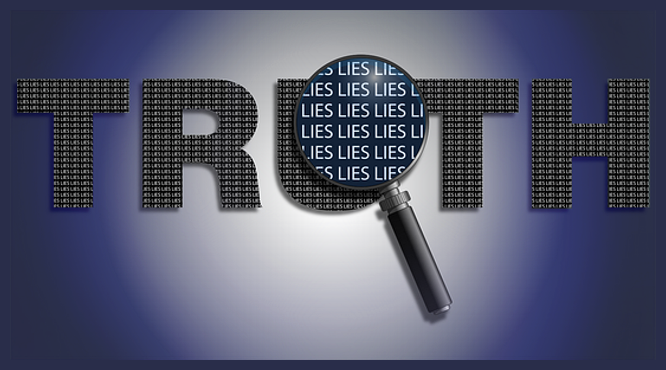
Image by OpenClipart-Vectors from Pixabay, additional color by Mike
Attribution
This article was primarily inspired by a story published by SBS, one of Australia’s TV Channels, on their website, who in turn was republishing it from The Conversation, another website, under a Creative Commons license.
Read the SBS story, Read the Original story by Julian Matthews, a Research Officer from the Cognition Neurology Lab at Monash University, Australia.
It should not be inferred that any of these organizations endorse this usage or this article.
Caution: The following may treat opinion as fact. Read it and make up your own minds.
The GM’s Burden
One of the hardest things to do in modern society is identify Fake News and understand how to process it in order to get to the truth.
it’s something that we have to do, despite this difficulty; we can’t represent society – any society – faithfully if we aren’t aware of the way our brains process bad data (and mistake it for good).
Of course, we’re human, too, and as entitled to our personal beliefs and biases as anyone else. But when we pick up dice, we have to rise above those beliefs and play it straight, right down the line.
You can’t make all the Republicans villains, or all the Democrats empty-headed dreamers, or all the anyone anything. You need to create and run individuals, not stereotypes, and if those individuals happen to agree with a political party or agenda that you personally disapprove of, you can’t let that influence how you play them.
And that’s hard. But that’s part of the burden of being a GM.
You might be thinking, “I don’t have to worry about that – I run a Fantasy Campaign in the fictional world of Zummuhlwahr” or wherever. Sorry, but you’re wrong, for four reasons:
- You have to live in the real world, just like the rest of us.
- Your players live in the real world, too, and these problems color their perceptions. In order to connect with them properly, the society and philosophy of your game worlds will have to be something they can relate to.
- You may want to seek inspiration in the headlines of the day, suitably transposed and translated into your campaign, of course. After all, the essential themes that they represent remain as valid as ever.
- Finally, there are traditional stereotypes the depiction of non-human races with roots in social and political attitudes from the real world that you can either embrace or reject, for your game, but which you should at least be aware of.
That last point may need a little expansion. Many depictions of Elves treat them as some variation on Democrats and Greens, environmentally “attuned” with an “affinity” for living things. Dwarves, in contrast, are belligerent, warlike, hot-tempered, but not without their virtues – which is how many “open-minded” Democrats would describe “Moderate Republicans”.
My first reaction to such stereotypes is looking for ways to subvert and negate them. Infusions of Asian martial arts into the Elves? Why Not? Having Dwarves embrace a socialist society which contrasts strongly with the individualistic greed-oriented capitalism that is more often attributed to their national character? Again, why not?
Alternatively, you could choose to embrace the cliches and – by virtue of recognizing the source – extend them with other elements of the modern incarnations of those political/social visions. Making Dwarves ultra-religious, for example.
Ultimately, it all comes down to this: in order to represent the world to the players (any world), you first have to understand it – and the only one that we have to use as a prototype, a template, and a common standard is the one that we live in. Understanding the “Real World” and the complex forces that interplay within it to shape the events that we experience is therefore essential to understanding and delivering imaginary worlds to your audience, the players.
And remember – the more grains of truth you can isolate, the easier you’ll be able to construct plausible lies around them in your game – an important GMing skill (see The Hierarchy Of Deceit: How and when to lie to your players).
Sources Of Fake News
There are seven sources – or perhaps ’causes’ might be a better term – of Fake News:
- Insecurity & Paranoia
- Big-noting
- Attack
- Spin
- Malvertising
- Bias
- Mental Illness
1. Insecurity & Paranoia
When people are afraid of something, they tend to share stories that justify that fear in hopes of creating a call to action that will remove the subject of the fear or otherwise mitigate the fear. Popular culture and modern society contains numerous examples suggesting that the correct response to fear is to minimize or downgrade it, because the situation is almost always not as bad as it seems. Hence, when we are afraid of something, one of our first responses is to share that fear in hopes that others will tell us that we are sane to experience that fear under the circumstances.
If the response is “yes, that is something to fear,” we experience relief from our secondary concerns about credibility and rationality. If the response is “no, it’s not that bad,” we experience some mitigation of the driving fear reaction itself. Either way, sharing brings relief in some measure, which is often enough that we can take reasonable and rational action, whereas we might previously have been paralyzed.
Paranoia, in this context, can be considered fear that cannot be mitigated in this way because it has no rational foundation, and this irrationality disrupts the rational interpretation of contradictions to that foundation. It starts with the assumption that the fear is rational, and rationalizes every statement and experience to conform with this view of reality.
2. Big-noting
Some people make up stories to call attention to themselves or make themselves seem more important. The need for respect from our peers is a driving force for us all, though it might be more or less important than other drivers and motivators in the case of some people.
In more extreme cases, this can become an unhealthy narcissism. But even before that extreme is reached, some people can’t help reinventing their lives. In some cases, these distortions are of little consequence, and are shrugged off as a peculiarity of the individual, such as the perception that a particular sporting team are cheats or that another such team are the best on the planet for all sorts of reasons (which may not include their actual performance in any given calendar year). In other cases, they reach the extreme of impeding cognizance – we think something is so, and convince ourselves that there is no other possible explanation, no matter how rational or irrational the original thought was.
Still more serious is when this narcissism prompts actions that we collectively consider irrational, such as self-harm or Munchausen’s Syndrome By Proxy, in which we harm someone so that they can be cared for/cured by the individual who caused the harm. This, in turn, is not dissimilar to Firemen who start fires so that they can put them out, and to a relatively new condition, Munchausen by Internet.
But the most benign manifestation (in terms of mental health) is telling a tall tale to make yourself seem more important. The problem is that those receiving this communication have no way of knowing, in isolation, that this is a Tall Tale.
3. Attack
Stepping things up a notch is deliberate deception for effect. Some can convince themselves that the end justifies the means; others are more amoral and simply spread a fictitious story because they are paid to do so, in one way or another.
These are always an act of attack upon something or someone, and are predicated on the rational response to that something or someone when viewed in the light of the attack’s distorted reality, favors the attacker and/or a cause that they support.
This is a falsehood that is spread by an agent for the effect of diminishing the target, or some supporter of the target (real or alleged). A prime example described in a past article here at Campaign Mastery is the Children Overboard scandal, detailed in Incredible Truth and Improbable Stories: Oratory in an RPG.
4. Spin
When such mendacity is not use to attack another, but is instead used to justify or reinterpret some event or action, it is called “Spin”, though it is far more malign than that term implies.
Ordinary Spin consists of an expression of bias in the analysis or interpretation of events. The agent is simply relaying their, or their organization’s, understanding.
Malignant Spin transcends this practice, taking it to levels of willful falsehood.
5. Malvertising
Something that I hate is advertising pretending to be news. So much so that I dedicated an entire article to analyzing the phenomenon, Ethics For Sale? – The Role of Native Advertising.
I have to be clear, here – I have no problem with advertising being presented as part of the news service, provided that the ethical structure of the service is not affected and the primary purpose is to actually provide news. If Amazon starts dealing in Real Estate or Funerals, for example, that’s going to have a significant impact on (respectively) a key part of the economy and a service sector that we will all need to rely on eventually. That’s news, and it doesn’t matter that it advertises Amazon at the same time – or even that Amazon may have paid for the story to be covered by the news media in question.
Similarly, I have no problem with advertisers who sponsor links within my articles from time to time, or who provide their own articles of acceptable standard (something very few seem capable of). Part of that ‘standard’ is that the article be of interest and value to readers of the site, and that it be relevant to our subject (table-top role-playing games and how to run them better). I can, and have, rejected articles that don’t fit – and rewritten others virtually completely to make them acceptable.
The line gets crossed when the sponsorship becomes more important than the ethical standards of the publisher, or when the purpose is simply to deliver the advertising, or when the service being advertised is potentially inimical to the reader. I once nixed an article here at Campaign Mastery because the website being advertised led to malware. If I’d had the appropriate contacts, I would have reported them.
My term for advertising that crosses that line is “Malvertising”. It’s existence can be traced all the way back to newspaper ads in the 19th century spruiking tonics and health treatments of no or dubious medical value – the legendary “Snake Oil”.
6. Bias
Bias is a filter and translator for impressions and interpretations. As I said earlier, this can be called ‘spin’ when the bias is that of the person reporting the story, sometimes referred to as the ‘agent’ responsible. But that’s not the only source of bias.
The person generating the story has their interpretation of events – that’s spin. Additional spin might also be present to show their employer in a better light. If so, that’s part of the story, too.
The reporter might have a sympathetic bias, or an opposing one. They aren’t supposed to let that influence their journalism, except when the material is clearly labeled ‘opinion’, but to some extent it can be impossible to avoid. The only solution is to declare any such bias – but that often makes the bias seem more significant and more relevant than it actually is, so such declarations are increasingly rare.
The editors (and there can be a whole infrastructure of them) will have their own bias or biases; seniority makes these more and more difficult to ignore.
Readers can have their biases, too, and most publications make at least some effort to cater to those perspectives as a matter of policy (which is why this item is present at this level, even though it violates the obvious narrative chain of production).
At the second-highest rung, we have government policies and legal restrictions. Violating these almost always has a consequence of some sort, something that only explicit protections (Free Speech), and (to a lesser extent) a demonstration of clear Public Interest being served by the publication of the story can overcome. However, most governments can’t afford to antagonize the press, so the latter can get away with a lot more than smaller players like you and me. Breach these and you risk jail time (or worse in some jurisdictions). The chances of that are a lot smaller with a top-notch defender and your employer in your corner – which is why this isn’t the top tier.
Other editorial policies dictated by the owner / senior management (and, shamefully, sometimes the sponsors / advertisers) occupy the very top rung of the ladder. Breach these and expect to be called to the carpet – at the very least. More often than not, a willful breach will terminate employment. Especially egregious breaches may result in industry-wide black-balls.
And, having finished this litany, you might be wondering if it’s possible for any story to be free of bias! Even publishing the train timetables can be considered an expression of bias – by the time those reacting to that publication, or looking for something on which to hang a reaction on, have responded. “It clearly shows a bias against the auto industry and in favor of public transport, with their strong union!” might well be the response….
That very ubiquity demonstrates the need to be able to set aside partisan blinders – not just for GMs, but for everyone.
7. Mental Illness
If your view of the world is delusional, and insufficiently coherent to be considered simple paranoia, any expressions of that view are clearly going to reflect your mental dissaray.
This type of communication is exceedingly rare unless you apply inappropriate definitions – for example, pro-religious sentiments could be mis-characterized as the products of insanity by an atheist who has no respect for others or for institutions. In my book, a sincere belief that I don’t share is a bias at worst – and when the purpose of spreading the message is positive, I take it in the sentiment it was given, like most people.
But I do find it interesting that a progressive analysis of the causes of False News could end with a discussion of what might well be the most benign of all the forms that it can take.
I Read The News Today, Oh Boy…
Okay, so some piece of news is received, be it from television, a friend, social media, or the printed word. If that was all that happened, all this would be of trivial importance.
It isn’t, and people have known that since the word propaganda was coined in 1622 – but it predates even that; the moralistic fictions of Ancient Greece were intended to inculcate adherence to the ‘morality’ of the time.
When we receive a piece of communication, we attempt to fit it into our own views of the world.
If it fits, we are prone to accept it at face value, and will resist attempts to contradict it. That’s why Spin can be used as a defense against getting caught in various compromising situations! Proving a statement that accords with our world-views to be false is a far more challenging burden to meet.
If it doesn’t fit, we are prone to label it as false, regardless of any corroborating evidence that may be provided. If the validity of that evidence can be challenged, or the connection between facts and analysis disputed, the message is promptly rejected, no matter how genuinely accurate it might be.
These initial reactions bring our personal biases into play, providing a context in which the message content is appraised.
Digesting the message
Most messages consist of two or more pieces, and those have to be digested separately – but usually aren’t.
The most fundamental content of a message is factual. That means that it can be proven or contradicted by direct investigation by the reader, if he has access to the appropriate equipment – no need to get anyone else’s opinion.
Factual content is generally boring to most people without a direct interest in the subject. What’s more, most people aren’t readily equipped to discern the relevance of the facts presented.
So that brings in the second piece – interpretation and/or analysis, in which the writer explains the significance of the factual content (If there’s no factual content, it’s an opinion).
The presentation of factual content is often colored by the interpretation that the provider has placed on it. Scales on a diagram, selective reporting limits, even the deliberate inclusion of easily-misinterpreted data, all can be used for this purpose. In his own mind, the person preparing the presentation is simply editing it to highlight the point that they want to be made, not distorting the facts.
Such distortions are carried along with the factual ‘payload’ received and digested. This is a third element of content, and even seasoned journalists can get caught by it.
The fourth type of content is logical deduction or narrative. This masquerades as being as reliable as factual content, but normally rests on assumptions that are shaped or dictated by the interpretation / analysis, and either provides a ‘bridge” between the (now–possibly-distorted) factual content and the interpretation, or is treated as factual content and used to justify further interpretation. The assumptions frequently relate to the relationship between different pieces of factual content or previous interpretation that is treated as factual content (and may not even be cited).
Because of it’s usage, this content is carried with the interpretation.
Finally, there may or may not be a headline, to focus on the interpretation, and (often) to prejudice the reader, and sensationalize the communication as much as possible. That includes the use of section and subsection titles – they focus the reader’s attention, separate one logical construction or message from another, related communication, and direct the reader’s mind, just a little.
Sometimes, they can contain completely unsupported amplifications or distortions of the interpretation. A long time ago, I saw a fictional story (I don’t remember the name) in which the exact same fairly innocuous text was given two different headlines that caused the reader to experience completely different and opposing interpretations of the events described in the text. Headlines help supply context in the mind of the reader – and it usually the headline to which the reader reacts, as described in the preceding section.
Headlines are therefore capable of being a fifth type of content.
Research has even found that just one presentation of a headline was enough to induce or increase a persistent belief in its content. For example, “Donald Trump Sent His Own Plane to Transport 200 Stranded Marines”, based on claims shown to be false, still increased belief in the statement for more than a week if it was believed at all. In other words, if something gets past our skepticism, it not only weakens that skepticism in the direction of related content, it does so for some time to come. Minimal reinforcement or repetition is therefore needed to embed a prejudicial belief in receptive individuals more or less permanently.
Note that soundbites, recordings, and images all purport to be factual content, and relevant factual content at that. I always take such content with a grain of salt – they can all be faked or taken out of context – but, that said, the difficulty and cost of doing so shoots up rapidly. Images are the easiest to fake/edit, sound the next easiest (which is to say, not very), and video the most reliable (which is to say, only somewhat). Still, evidence always makes a report more credible if IT is credible.
So, we digest the message – maybe splitting it up into these constituent parts, but probably not. And, factoring in any predisposition, we decide whether or not we believe it – and if we do, and sometimes when we don’t, we rebroadcast that opinion, either explicitly or implicitly by simply rebroadcasting the message.
The Epidemiology Of Falsehood
And that’s how fake news spreads. Your opinion becomes just another small part of the context of the message for the next recipient.
Studies have shown that the spread of willful misinformation and other forms of deceptive comment fits the profile of the transmission of disease.
If you come into contact with a diseased person, there is a chance that you will catch whatever they’ve got and a chance that you won’t. This is the infection rate. But each victim can pass their illness on to dozens or even hundreds of people, depending on how long they remain infectious, and whether or not the disease kills the sufferer.
Believing a false message is akin to catching a disease – it might be something relatively benign like the common cold or something really deadly like Ebola. If you rebroadcast that message to a hundred people (or more), some of them will likely also believe it – they have ‘caught the disease’. If you are particularly aroused, you may rebroadcast it several times in different media and formats.
If your cognition becomes overwhelmed by too many false messages, it’s like having a compromised immune system with which to fight off future false messages.
The mathematics that they use to predict the spread of a disease following an outbreak turns out to work perfectly well for predicting the spread of a false message, regardless of how you’re passing it on; you ‘expose’ so many people to the disease, its credibility is it’s infection rate, and some people are more receptive to it than others. Counter-measures probably follow, but these may or may be enough to knock out the ‘bug’ if it has taken hold.
This transmission pattern means that it can take a surprisingly small number of believers to spread a falsehood over a receptive population. It can be – and in the olden days of content going viral, it was – just one. Of course, the odds of any communication having significant reach are greatly increased if multiple people ‘come down with it’ at the same time.
Recognizing Fake News
There are significant improvements that can be made to the way we assess messages that will help cut down the spread of fake news. No one strategy will have a substantial impact, but applying these in combination will massively increase your protection against fake news – and earn you a reputation as a smart analyst, one not easily deceived. That in turn can make you an Influencer, more likely to be believed – the social equivalent of a white blood cell hunting down fake news when you encounter it. It also spreads any vulnerabilities that you may have, any chinks in your armor, to those who you influence – so it’s important to take responsibility for what you repeat and exercise appropriate diligence once you start down this path.
1. Source Considerations
As a natural assumption, most people will believe that the person sending the message believes what they are communicating. But some sources are considered more reliable than others, and that assessment plays into the degree of suspicion or credulity which we apply to the message.
This is a default that is dangerous. There’s nothing wrong with treating a message with additional suspicion if it comes from a suspect source – but relaxing your guard because the source is more trusted represents significant risk.
No-one’s completely free of bias, no-one’s completely immune to being deceived by misinformation, no-one is completely selfless, and anyone can make a mistake. You should always start by asking (trusted source) “Could they be wrong? Could they be biased?” or, (mistrusted source) “Could they be right? Could they be biased?”.
2. Separate The Fact From The Analysis
Don’t swallow anything whole. Recognize the five types of content and assess each as independently as possible.
3. Look for distortions in the facts
“Crime is up X%” – or it might be “Traffic accidents are up X%”, or whatever. Unless these measurements are “per capita”, they are inherently distorted by treating a relative number as an absolute. If the population rises by 10%, it’s reasonable to expect that the number of criminals is also up by 10%, and therefore that crime will rise by 10%. Only on a per-capita basis (and sometimes not even then) can you assess such changes.
You also need to keep an eye out for secondary assumptions – if the population rises 5%, but the number of people in a poor economic class increases 25%, is it more likely that crime will rise by 25% or by 5%?
I’ve already mentioned using misleading boundaries on the reporting period – a lot of measurements only continue a trend already established prior to the reporting period. President Trump is notorious for this – taking credit for changes that are simply continuations of existing trends. At best, he should be able to take credit for not getting in the way of these trends. The things to look for aren’t these trends, but changes that can’t be explained as statistical “noise” and that can’t be explained by existing trends.
Another trap to watch out for are graphs to different scales – as a general rule of thumb, we assume that two graphs are of equal significance. Consider the examples below:
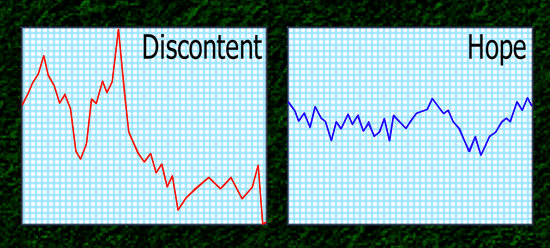
If you saw the above two graphs in a news report, you might conclude that an armed uprising was narrowly averted, but things have been steadily improving since. This is the sort of combination that supports the government that’s in power.
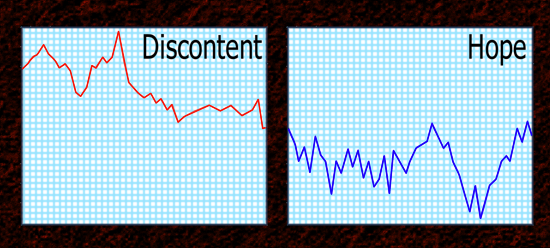
On the other hand, if you saw these two graphs, you might conclude that the public has just had a crisis of confidence in their government. This is the sort of combination that supports the opposition of the government in power.
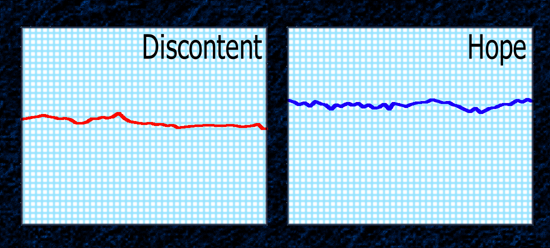
And, in both cases, the data is the same. Here’s a true comparison of how the public might really have felt!
The presence of any of these indicators is a strong signal that the facts have been massaged to fit the message by someone. Their absence doesn’t prove that they haven’t been interfered with, though.
More importantly, these give you a foundation for assessing the reliability of the source beyond this one article or report.
4. Multiple Sources
It used to be that if the same story cropped up from multiple sources, it was considered more credible. In fact, that was never completely true; they might all have been getting their facts and primary analysis from the one source.
These days, the gold measure is whether or not the primary or core analysis is consistent across multiple sources with different biases. It doesn’t happen often, because news media have become more partisan, but when it does, it’s a genuine indicator of credibility.
To assess this, you have to be able to identify the bias and spin placed on the interpretation and strip these away from the reports (but don’t throw it away just yet). If Fox news says something complimentary about a Democrat, it’s more likely to be correct than if they are Democrat-bashing. If the New York Times reports a scandal involving a Democrat, it’s more likely to be correct than if they report a scandal involving a Republican.
If content matches known bias from the source, or from the reporting, it is more suspect than if it runs counter to that bias. The same thing is true in all sorts of other areas, from court cases to being stopped by the police for speeding – it’s generally known as an “admission against interests”. It’s still no guarantee, but it’s a better indicator than most people realize.
5. What’s the source of the factual content?
If the National Enquirer were to publish a story that said that 80% of Americans believed in aliens visiting Earth, and the source was an Enquirer reader’s poll, you would be highly skeptical. If they were to give the source as a prestigious university – Harvard, for example – you would be somewhat less skeptical – probably enough that if you cared, you’d go looking for a second source for confirmation, instead of dismissing the story out-of-hand.
If the data is from a pollster, look for who commissioned the survey – their bias could potentially be reflected in the results, not just the interpretation.
Oh yes, if a poll claims a 2.5% margin of error, the real number will probably be within 5% of the reported value – and that could be in either direction. If they claim a 5% margin, factor in a 10% margin of error, which is probably overstating it. This is correct nine times out of ten.
6. Beware Your Vulnerabilities
If you can’t articulate a completely clear reason for believing that a story is true, you have to consider it to be suspect.
“I trust the source” or “It makes sense to me” or “It MUST be true” don’t count.
In particular be suspicious of the phenomenon of Misattribution of memory, especially in the form “I heard it somewhere but don’t remember exactly where”. That won’t protect you from false positives – remembering the source incorrectly – but it will improve the accuracy of your cynicism.
7. Beware The Echo Chamber
Information entering your ecosystem from outside is either more obviously false or more likely to be accurate than information being re-transmitted from inside it. The reason is the Echo Chamber.
There have been recent studies that suggest that the Social Media Echo Chamber doesn’t exist, but that other Echo Chambers do. I reject that finding, for several reasons:
1. It seems unlikely that social media would be the one exception to the rule.
2. I have personal experience of encountering individuals who so irritated me by proselytized for a particular point of view on social media with dogma that I blocked them, excluding a contrarian position from future exposure through my social media.
3. The study misidentifies social media Echo Chambers and how they are supposed to work. “There is a common fear that people are using social media to access only specific types of political information and news. The echo chamber theory says people select information that conforms to their preferences.” – the true effect is about the credibility that people attach to certain sources and communications, and the lack of credibility that they attach to sources and communications that do not agree with their biases. They may or may not seek out disparate perspectives – but if they do, it’s only to see “what lies are [x] telling today?”. It doesn’t matter how many sources tell you that you’re wrong if you believe that they are lying – this will only reinforce your internal bias and polarization.
8. Who Benefits?
Whenever you encounter a communication – be it an advert, a link, a tweet, a Facebook post, an item in a newspaper or magazine, or a segment on a news / current affairs program – always identify who the communication is attempting to benefit. This can not only help to expose bias at work, it provides a framework for identifying whether or not the facts, the interpretation, the internal logic, or the predicted consequences can be trusted. Isolating the location of any falsity helps distinguish between reaction to misinformation, innocent misinformation, accurate reporting of misinformation, willful falsehood, and all the other varieties of deception. Once you know the merits of each part of the communication, you can determine the appropriate way to treat it.
In particular, pay attention to any call to action, explicit or implied.
9. Inherently Suspect Assumptions
When the one incident is described, reported, or explained several different ways by those of differing political or social standpoints, there are a series of questions that I always ask before completing my analysis of the way I perceive the event.
1. Is it possible for both sides to be right?
2. Is it possible for both sides to be wrong?
3. Is it possible for this to be a more complex or complicated situation that’s being oversimplified?
It’s rare for one side or another to have a monopoly on the truth. That was a point I tried to ram home in my 2017 article, Bilateral Political Incorrectness for RPGs, the most recent part of the (irregular) Lessons From The West Wing series.
A Healthy Skepticism
These nine methods will greatly assist in the maintenance of a healthy skepticism. They aren’t infallible – but are a good starting point. The rest is just practice.
With the state of politics in the world right now, these are tools that we all need. It’s a lucky coincidence that they can be applied to improving our games – whether it’s D&D / Pathfinder, Star Trek, Babylon Five, Legend Of The Five Rings, Pulp, Superheroes, Sci-Fi, or whatever. So what are you waiting for?
About The Title
It’s rare for a title not to be fairly clear in meaning by the time I get to the end of an article. It’s even more improbable that such a title would be so appropriate that it doesn’t get changed as a consequence of the first failure. But that’s potentially the case, this time around. So I thought that I had better attach an afterword of sorts to deal with the issue.
The Olympian Perspective is a metaphor for being able to exercise omniscience – looking down from above like a God, free from distractions and prejudice and able to make impartial and unbiased decisions.
It’s often advocated as a position or attitude that GMs should adopt toward their games.
It is also often mis-characterized as demanding detachment, not caring about judgments or decisions one way or the other.
It’s also the attitude that I want to suggest to GMs in the way that they interact with, and understand, the real world in this era of false news and echo chambers. This article is aimed at equipping the GM to do so.

Discover more from Campaign Mastery
Subscribe to get the latest posts sent to your email.




November 18th, 2019 at 3:51 pm
Your description of the GM’s burden is not persuasive. First, you have scolding tone that makes GM-ing sound like a sociology term paper assignment. Is that fun for you? If so, then more power to you. But it does not sound fun to me. Sounds exhausting.
Also, you don’t need to have a balanced understanding of the “Real World”, i.e., modern world in order to have an inspired campaign. One of the faults of the modern world is its tendency to make every aspect of life political. Again: that’s not fun.
Why not simply be a mature, humble person who has respect for other individuals?
IMO, if you want to learn how to deliver a rich fantasy world, then you should read history. And history is ugly sometimes. Beautiful other times.
November 18th, 2019 at 9:59 pm
Thanks for commenting, David. I can assure you that a “scolding tone” was not something that I wanted to project. Rather, I wanted to acknowledge the difficulty of the task.
Yes, if you restrict yourself to the fantasy milieu or genre, history can be a great source – but some political understanding and the ability to see the objectives of both sides of any given historical issue remains central to understanding what you are reading. Furthermore, if you don’t restrict yourself to that genre, if you operate a game set in the future, or in the modern day, your understanding of that world and the issues it faces are going to be central.
The objective is to be able to take your personal political opinions OUT of the equation, so that you can assess and appraise the society within your games from a position of informed neutrality. So that you can treat the characters within your game as would a mature, reasonably humble person, who has respect for ‘other’ individuals.
The secondary objective, the bonus if you will, is that the same skillset then enables you to discern fake news from genuine, something that too many people seem to have trouble doing at the moment. As I said in the article, we all have to live in the real world, no matter where we escape to.