Campaign Mastery helps tabletop RPG GMs knock their players' socks off through tips, how-to articles, and GMing tricks that build memorable campaigns from start to finish.

The Dreaded Plotworm


Free Stock photos by Vecteezy, image by aukideezy

An Earworm is one of those songs that you can’t get out of your head. Often, the only cure is to expose yourself to “just enough” of another earworm!

For the last two months, I’ve been afflicted with a case of the far less-known Dreaded Plotworm.

This is when a plot idea that doesn’t quite fit what you had planned won’t let go, won’t be dismissed, but demands that you work it out.

It’s usually some idea that sounds really cool or interesting, and that holds some plausibility in campaign terms, but which isn’t completely compatible with the foreshadowing from the past, or the pacing of the current, or the plans for the future.

Despite not fitting, the attractiveness means that the idea won’t let go, it keeps coming to mind and distracting you.

The only way to get a Plotworm out of your head is to work it out, but therein lies the danger.

The first threat

Plotworms undermine your sense of the campaign’s history, because of this demand to ‘make them fit’. Past history and plans and assumptions get thrown out as necessary, turning the plotworm into a missed opportunity. “If character A had only said B instead of C, E (the plotworm) would fit” becomes “So character A says B, and that leads to E, which leads to F” – and because you are concentrating so hard on this hypothetical alternate reality, it’s not only easy to lose your grasp on what actually happened, it weakens your grasp on the reality of events even if you avoid this total dislocation.

A succession of plotworms can riddle your campaign with holes like wormholes through an apple.

The second threat

Having weakened your grasp of the reality of the campaign, Plotworms then offer up a more dire threat in the form of confirmation bias. When doing further planning for the campaign, the attractiveness of the idea can infiltrate your plans, undermining what you have in mind for the future.

This affects some GMs more than others, because the extent to which GMs plan out their future campaign beats I’m a planner, for the most part, unless I make an active effort not to be. Others are more instinctive, or only plan a session or two ahead, asking “Given everything that’s happened so far, what’s the most interesting thing that can happen this week?”

Unfortunately, this only leaves the latter more vulnerable to the first threat of the Plotworm.

The third threat

The third impact of a Plotworm is the least dangerous, in some respects, and the most dangerous in others. They are distracting, and (unlike an earworm) they can linger for ages. That’s like only being able to give your campaign 90, 80, 70% of the attention that you would normally devote to it.

Just about every GM will be able to relate to what that means, we’ve all been there on occasions when (for other reasons) we haven’t been able to lavish as much attention to our games as we would like. At best, the games simply don’t sparkle as much as usual, and everything feels rushed and half-baked; at worst, it can feel like you’re drowning in a sea of unpreparedness.

I’ve even known some GMs who – on such occasions – toss their usual campaign aside for a while in favor of some B-grade lighthearted alternate, or even abandoned it completely.

So plotworms can have a serious effect.

Mitigating Plotworms

If you can’t get rid of a plotworm until you’ve worked it out, the only option is to try and minimize the impact that it has. This is often more easily said than done.

There are three strategies that can be employed effectively. The first is to try and integrate what you have to do into the plotworm, enabling a brief return to 100% focus (or close to it); the second is to distract yourself with the immediate task; and the last is to compensate for the distraction by eating into whatever unallocated time you may have.

A fourth option is to try and dismiss the plotworm ASAP in hopes of mitigating the damage, and it’s common to attempt this solution for a while, with a hard deadline before switching to one of the other mitigation strategies.

A GM I know once proposed that you simply “not think about” the plotworm. This just doesn’t work at all. It’s like trying to think about ‘large desert animals with a prominent hump’ without thinking about Camels.

    Plotworm Prep Integration

    This involves manipulating the Plotworm. If, for example, the prep work that is required for your next game is a character, then start by thinking about how that character might become involved in the Plotworm (even if the conclusion is that they can’t or wouldn’t); this enables you to focus in on the character and get the prep done, despite the nagging and distracting presence of the plotworm.

    Distraction

    Focus your attention on something quick that can’t possibly have any relevance to the plotworm. It might be a strategy game, or a game of sodoku, or even a game of pick-up patience. Whatever it is, as soon as it has your full attention, switch to the necessary prep. The distraction acts as a short-term plotworm displacement, enabling you to get some of what you need to do done. As soon as you relax your focus, though, don’t be surprised if the plotworm returns.

    More Time

    This is bowing to the inevitable, or at least, it feels that way. If you’re lightly distracted by the plotworm (90% capacity), you need to allow about 10% more time to your prep. If the plotworm is a moderate distraction (80% focus), it’s about 25% extra. If you’re seriously distracted, up to double the normal prep time may be required, but 50% will usually suffice.

    This requirement is so severe that it’s often not a viable option – but even a partial implementation yields dividends in terms of getting more done to a higher standard.

Eliminating the plotworm

The single best way to get a plotworm out of your head is to invest time and effort into another idea that is equally as “cool” / interesting – but you generally can’t come up with those on the spur of the moment. The best opportunity for doing so is to keep a list of unsolved plot problems and a game-time deadline for when they need to be solved. Posing questions of this nature and looking for a cool / interesting solution (even if it isn’t one that you ultimately use) is your best prospect for slaying the plotworm by starving it of creative appeal.

The more common solution is to work through the plotworm, solving the creative challenge of integrating it into the campaign.

    Speed Of Solution

    Some plotworms are easily overcome; a few minutes of idle speculation is enough to scratch the itch. Most are more pernicious, their lifespan being defined by the scale of the plot problems they pose.

    If you solve these problems quickly and easily, then what you have is an idea that you can choose to use or not; it might be just what you need!

    If the idea poses a greater challenge, the plotworm can hang around for quite a while, and the idea is less likely to be of any value to you when you’re done with it; it’s far more of a monkey that you have to get off your back.

    Depth Of Solution

    Every idea also has a threshold of integration – a different target level of ‘solved’ that is enough to satisfy the nagging back-of-the-head sensation that this is a good idea that you can’t just ignore.

    Some plotworms need only superficial examination to put them in their place – there may simply be too much water under the bridge for them to be viable.

    Others appear to be potential solutions to problems that actually do need to be solved, or possibly better answers to a plot problem you’ve already solved – who is that masked villain that you dropped into the plot a couple of game sessions ago? You knew who you intended it to be at the time, but maybe it’s not too late to make it someone else completely…

    Such plotworms need ‘solving’ to a far greater depth, which requires more time and attention, and may even require the keeping of written notes.

    Scale Of Solution

    It will obviously take a lot more time and attention to satisfy an idea for a campaign-sized subplot than it will to solve an idea for a specific single adventure. Similarly, it will take more effort to craft an adventure that can be inserted into the plot than it will to create a single encounter.

    But there’s a secondary factor that needs to be taken into account in any such structure: an individual GM’s predilections. One may be more adept at coming up with encounters, another more skilled at crafting broad plot arcs, another more capable at crafting adventures – and they will usually adopt (consciously or otherwise) a campaign structure that plays to their strengths.

    GMs can sometimes get themselves into trouble by assuming that they will have such facility at their disposal, leaving them vulnerable to the occasional failure of their natural gifts. But that’s a discussion for some other day.

    I make no bones about being more adept at plot arcs than individual adventures; and more adept at adventures than I am at individual encounters. I’m a naturally big-picture person. This tends to give my campaigns an epic, sweeping quality even when that’s not my intention. That simply means that I have to invest disproportionate time and effort on the small scale in order to achieve results that live up to the grand visions that they are supposed to be a part of.

    That simply means that a campaign-scale plot worm won’t take as much effort (in general) for me to resolve as an adventure-scale plotworm. It also means that I am more likely to come up with plotworms of that scale.

    The implication is that each GM has a ‘weak spot’ – a point on the large-to-minute scale where the ideas are exactly the ‘right size’ to cause maximum difficulty and inconvenience. For me, that point is cool ideas for characters – these have to be scaled out to see how they impact on the campaign, long-term, perhaps requiring the insertion of additional unplanned adventures, and have to be scaled inwards to see how individual encounters will be affected.

All plotworms are not alike. Some ideas are potentially more useful than others, and some are definitely more difficult to resolve than others. The cost-benefit relationship in each particular case can be clear or very unclear, and it’s often worth indulging the plotworm until you can resolve at least that question.

After-plotworm Rehab

So, you’ve been afflicted with a plotworm and have finally resolved it. That plotworm is now either part of your future plans for the campaign or it has been set aside (maybe you can make use of it elsewhere). I’m at this stage, right now, having resolved the plotworm that’s been buzzing around in the back of my head for the last two months or so.

It is, perhaps, worth taking a moment to note that if the campaign in question – my Doctor Who – had been able to keep to its intended schedule that it would be too late to actually use the plotworm by the time the problems of doing so were solved. Time and patience can be the ultimate solution to any plotworm – but as solutions go, it’s by far the least desirable and efficient.

The next step has to be dispelling any confusion that has resulted from the plotworm. Treat the situation as if you had been away from the campaign for as long as the plotworm was active, and do whatever you would normally do to reacquaint yourself with the current picture, the big big picture, the relationship between the two, and where you intend to go from here.

If the plotworm occupied your thoughts for a day or less, the odds are that no rehab will be necessary; it was a cool idea but one that wouldn’t work out, and you’ve moved on.

If the plotworm occupied a week or so, you may need to read over any notes regarding the last session, any notes regarding past encounters that were relevant to the plotworm, and refresh your memory in terms of immediate and long-term plans. Spend a week doing that (if you can), but spend at least a day on it.

If the plotworm occupied more than a week, then the potential for long-term damage to your ‘sense of campaign’ goes way up, but the repairs don’t scale accordingly. In most cases, the same a’-week-if-you-can-but-at-least-a-day recipe is usually enough. Make room in your schedule for a second day in case you need it, though.

Graveyard Of Plotworms

Whenever you have a cool idea that just won’t work, write the basics of it down somewhere. You never know when you’ll need a cool idea!

Amongst the ideas lurking around in my graveyard at the moment are:

  • Drow Civil War ‘progressives’ vs ‘conservatives’
  • Crime gang who use chameleon-tech to change their faces after every robbery
  • Hacking someone’s cyber implants

….and many more. If ever I find myself stuck for ideas, the graveyard is where I go. I maintain a similar graveyard for article ideas for Campaign Mastery.

Of course, it won’t have escaped the attention of my readers that I haven’t actually described the plotworm that I’ve been wrestling with. That’s because I still don’t know whether or not the idea can be used – because it interconnects several elements within the campaign, there are multiple opportunities to make it relevant, and I need to go through them all to see where – if anywhere – this cool idea can fit.

987… 988…

I’m still looking for ideas on how to commemorate my 1000th post at Campaign Mastery. Twelve to go!

Comments Off on The Dreaded Plotworm

Grit in RPGs: Separating Plausibility from Realism


Grit: The Devilry is in the Detail. Image by Peter H from Pixabay, cropped, resized, and selectively sharpened by Mike

Today’s post comes courtesy of an ear-worm. I recently played Glen Campbell’s Greatest Hits, and the theme from the John Wayne movie “true Grit” stuck in my head (not for the first time). Not at the time, mind, but afterwards, when it was triggered by writing about gritty reality in a Quora post and mentioning it in last week’s blog.

That got me thinking about “Grit” in the environmental sense, which led me to “Grit” in narrative, which I then generalized into today’s topic.

Four Levels Of Grit

I generalize “grit” in my thinking and writing into four categories or standards. Exceptions may always exist and be called out, but this is what I “bake” into my narrative.

    Gleaming

    Super-pristine; I use this quite sparingly. Antiseptic authoritarian sci-fi societies are generally gleaming; hi-tech office buildings are often gleaming; the homes of the rich and powerful are often gleaming; super-villain lairs are sometimes gleaming; and (very occasionally), a Wizard’s Tower (cleaned by magic) will be Gleaming. It takes constant attention to detail and a prioritization of attention to appearances over actually living in a space.

    Tidy

    Tidy is clean but with a little disorganization here and there. A clean home with a child’s toy left out on the carpet; a clean kitchen but with dirty dishes awaiting washing; and so on. This is a lived-in space, it’s neat but functional.

    Messy

    I’m the first to admit that this is my usual state of living; I like things neat and tidy but don’t have the physical capacity to keep them that way, and little by little, detritus accumulates. I prioritize whatever cleaning I think needs doing the most, two or three times a week. So some things are a little dirty, there’s dust in the corners, there’s some slight staining of the walls, there are books and things everywhere, and so on. The things that I use all the time for whatever my current project is are close to hand, and I usually have multiple projects on the go at the same time – but, to an outsider, anything not needed for whatever project I am working on at the immediate moment is ‘clutter’.

    One of the things that made Star Wars stand out, when it was first showing, was that it was a ‘lived in’ science fiction environment; prior to that, the standard was ‘pristine’.

    Dystopian

    Dystopia usually means that you don’t try to clean up, at best you just attempt (unsuccessfully) try to hide the mess. There’s dirt on the floors, and the walls. Things are constantly breaking down due to neglect, age, or overuse, and what isn’t broken down is being held together with scotch tape and baling wire. There’s rubbish on the streets and no attempt to clean it up – though there may be attempts to sweep it aside into alleyways. Gotham City in the first (modern) Batman movie, and in the Nolan Batman trilogy, and Blade Runner – these are all dystopian levels of grit. The streets and homes of the poor quarter in medieval cities are generally dystopian, too.

One standard for each environment, location, or region

I carefully choose one standard for each environment, location, or region. This is the overall standard, and while it will be taken into consideration in initial descriptions and first impressions (which I try to always communicate to the players), but which is rarely mentioned otherwise.

Dwell on the exceptions, not the rule

Grit should be applied sparingly – a little can go a long way. Go back to the original Star Wars trilogy and pay attention to the visual state of the interiors of the Millennium Falcon – while there are some messy elements here and there, appropriate for a Messy (Lived-in) setting, they are just enough to offset the cleanliness and polish of the rest of the set. You see the same thing on the Death Star in the first movie, and the scenes in the cloud city of The Empire Strikes Back. Contrast these with the scenes in Mos Eisley (first movie), Dantooine (second movie) and the court of Jabba The Hut (third movie) – in these places, the standard is Dystopian, and once that is established, only the exceptions need to be mentioned aside from the occasional reminder.

Contrast and Nuance

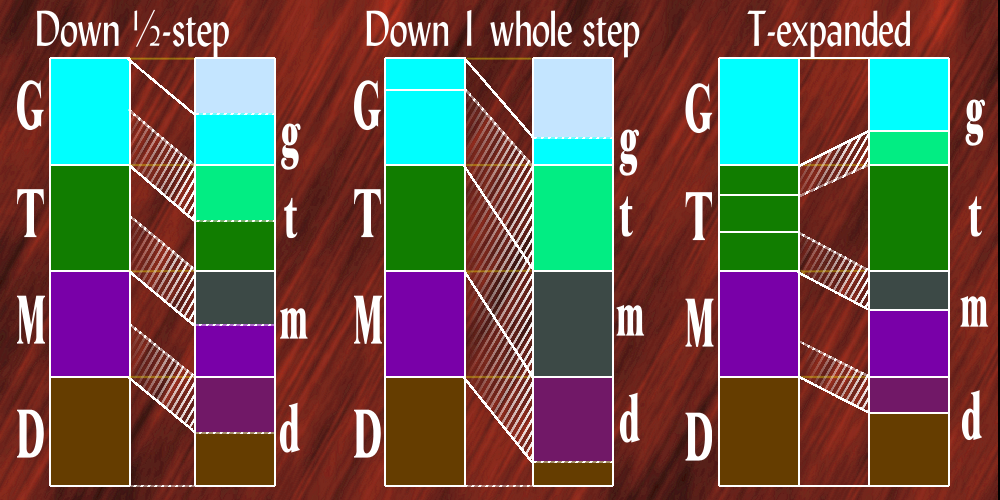
Some genres are better served by down or up-shifting your standards. This is achieved by using the basic standard with occasional elements from a neighboring standard. Both the neighboring standard to apply and the narrative to be affected are dictated by the degree and direction of shift. This can create nuance with a half-step or four-color blended simplification with a whole-step adjustment. There are other genres and campaigns that may be better served by broadening the standard to create nuance that is focused on that standard. These principles are demonstrated in the following set of diagrams:

Click the image to open a larger version in a new tab. Refer to the text below for explanations and interpretations.

The first diagram shows a 1/2 step downwards, and what effect that has.

  • If the standard is ‘Gleaming’ then only the most extreme examples will actually mention the standard. More common examples will use a little of the language normally used to describe a ‘tidy’ environment. Some of that language will also make its way into the best of the Messy environments, while some of the merely ‘messy’ will be used in describing more dystopian scenes.
  • If the standard is “Tidy” then ‘gleaming’ language is reserved for the most pristine of environments, but some ‘gleaming clean’ elements are used in describing the best tidy scenes. Tidy environments are not singled out except in such cases; the language is reserved for additions to the best ‘Messy’ environments. Similarly, the merely messy will be highlighted in the best Dystopian environments.
  • …and so on.

I’m limiting my analysis to a couple of examples so that more of them can be seen at the same time for comparison purposes. In particular, I want readers to compare the second diagram and its effects to the first.

  • Only the best of the best Gleaming environments get singled out; the rest of the time, gleaming details are picked out in describing tidy scenes.
  • Similarly, Tidy details are emphasized in Messy settings.
  • Only the most extreme Dystopian environments are not ‘rescued’ somewhat by emphasizing the merely messy.

The net effect is that everything is brighter, cleaner, and more colorful. This suits Pulp, High Fantasy, Space Opera, and Superheros amongst other genres and sub-genres.

I couldn’t fit an up-step example while retaining clarity in the diagram, but you should be able to imagine the effects of one using these diagrams. As a general rule, an upward step makes more room for, and use of, the gritty and messy. Whereas the downward steps often damn with faint praise, the upward steps condemn either mildly or quite denigratingly.

That’s because I needed room to demonstrate an alternative approach that can sometimes be useful – expanding one particular classification (the standard). I use this technique in a lot of my Fantasy games – more on that in a moment. First, let’s look at the specific effects:

  • “Tidy” language is used to diminish the least of the “gleaming”, taking just a little of the polish off.
  • It is also used to dress up the least Messy environments.
  • As a result, the ‘standard’ applies to almost 1/3 of the entire gamut. Gleaming and Dystopian extremes are reduced to make room for this expansion.
  • the least ‘Messy’ environments have ‘Tidy’ elements emphasized, but the best Dystopian settings have ‘merely messy details emphasized, so there is no overall diminution of the scope of that standard.

In Fumanor, in middle- and upper-class human territory, I expanded the Tidy in my narratives; in the poorer areas, I expanded the Messy; in the Elven Forests and Drow Tunnels, I expanded the Gleaming; in Orcish, Trollish, and Ogrish (etc) territories, the Dystopian was expanded; while the Dwarven areas used a half-step upwards, as did Dungeons. These were subtle distinctions but they gave each environment a slightly different atmosphere.

An example: in human kingdoms, blood might spill or stain, or splatter in the most extreme cases; in Elven lands, it would never spatter, it would fountain, or – at worst – drip. In the Wilds, it would spray and splatter, raining down on everything nearby, accompanied (when appropriate) but little bits of bone or brain or flesh.

Use Mechanics to reflect your choice

I use the standard that applies to a particular area as a guideline to how to interpret the Game Mechanics in those areas. In Dystopias, details and imperfections are emphasized; in Messes, details alone get the treatment; in Tidy environments, the emphasis is on outcomes and generalities; in a Gleaming environment, hyperbole is added to the Tidy, and everything is a little larger than life. These effects are always compromised with the campaign style, and the inherent style of the game system (which was hopefully chosen to suit the desired campaign). Again, on their own, they do little, but the impact stacks with other small touches like narrative emphasis to create distinctiveness from one setting to another.

Applying Grit to Places

The balance of this article is going to put a little flesh on the bones. In making the article as explanatory as possible, I had to use generic terms like “locations”, “environments”, “settings” and “elements” within one of the other terms. In these sections, I’m going to try and get a bit more specific.

Places are ubiquitous – everything that happens takes place somewhere – so this is a fundamentally important case.

  • In a Gleaming environment, a general impression is conveyed and then broken down into specifics that reinforce that impression.
  • In a Tidy environment, a functional or purposeful impression is conveyed and then supplemented specifics, especially any that are Gleaming or Messy.
  • In a Messy environment, specifics come first and build toward a general impression that is summarized. The more messy the environment, the more details precede the general impression. Exceptions may then be mentioned, either pockets of order/purpose in the chaos (tidy) or specific details of wear-and-tear and disorder.
  • In a Dystopian environment, a very abstract general impression is applied – be very Noir about it – then specific details are used to emphasize the general impression and translate it from the abstract into the grittiest reality. You want your players to ‘smell the stink’.

Only when commencing a scene in a particular location would the chosen standard of Grit get represented in the form of the overall impression; from that point onward, the standard isn’t mentioned, only exceptions. Make these work for you; don’t apply them capriciously. For example, in a messy environment, the greatest order will be found in the spot where the owner was last working (and the greatest mess not far removed from it). If the general impression is one of chaos and confusion, a desk that is pristinely organized tends to stand out.

I once had a friend, Dylan, who lived in the most Dystopian Grit you can imagine. He was unable to go past the written word – whether that was a newspaper rescued from the garbage or a book that had caught his eye. His home was literally stacked waist-high with books (chest-high in places) throughout – so much so that at one point his foundations shifted. There was just enough empty space for the front door to open; you then had to climb over stacks of first editions to go down the main corridor and into one of the other rooms. His bed had no frame; that had been tossed out to make room for stacks of books upon which his mattress rested. At the same time, he was one of the most generous people that I’ve ever known, the sort of person who would simply show up at your door with a meal or a book that you had expressed interest in, and expect nothing in return. He knew everything that he had in his collection of more than 10.000 books and roughly where it was located – not because he had a system, but because his retention of the written word matched his voracity. He had read every word in his collection. And yet, there was a vague structure – magazines in one place (and not too many of those), newspapers in another, non-fiction here, biographies there, science fiction hither and fantasy yon and general fiction elsewhere; first editions near the top of each stack, reprints and duplicates at the bottom. Every six months, he would clear out half a room, carefully deciding what to toss and what to retain until its contents occupied one half of its previous volume – what he did with what he chose not to keep, I don’t know, but at least some of it was given to friends, and some to the local library. I suspect that most went to landfill!

Applying Grit to Objects

Objects are specific elements within a setting or location. That means that they can either reflect the standard of that location, or they can be out of place, or be somewhere in-between.

  • Gleaming objects are as new. Even if constructed by a hobbiest or prototyper, they will be precise in structure, layout, and assembly. Shiny things will be polished, non-shiny things will be brushed, and nary a blemish will be seen.
  • Tidy objects might be Gleaming with some signs of wear or use, or they might be a little more haphazard than that. They will be organized and purposeful.
  • Messy objects are still fully functional but with considerable signs of wear-and-tear. There will be marks and scratches and the like.
  • Dystopian objects may still function somewhat, but they are almost played out from hard usage. Expect rust spots and stains, gouges and nicks.

Applying Grit to Vehicles

Vehicles are both objects and locations. It is useful to remember the following maxim: If the outside is important, the vehicle is an object and important only in terms of its interaction with that environment (and vice-versa); if the outside is not important, the vehicle is the location for some scene or dialogue.

  • Gleaming Vehicles – emphasize the newness of the leather (the smell), and of the controls – they will snap into position, make satisfying clicks, be taut and responsive. Brakes might squeal a bit. Everything works – manufacturing defects excepted.
  • Tidy Vehicles are clean and almost everything works, but there are some small signs of wear. There’s no snap to the switches, there’s a little play or non-responsiveness to the knobs, there are wear marks on the seats and a stain or two on the carpets.
  • Messy vehicles have seen extended or heavy duty. Some of the gauges will have failed or be unreliable, sometimes in predictable ways (“Fill up when the gauge is 1/3 full, you have less then 5 miles fuel at that point”). Some controls will be unresponsive, or make excessive demands on an allied system – the windscreen washer might drain the battery faster than the alternator recharges it, for example. It will often be dirtier in its interior, but not decrepit.
  • Dystopian vehicles are either on the verge of total collapse or have already died in most respects. They may still provide basic functionality but even those will be unreliable – engines that are hard to state, brakes that are prone to failure, electrical systems that constantly fail. Gauges will be dead or completely deceptive. Watch Top Gear’s “cheap car challenges” and take the worst failures and you’ll get the idea.

Applying Grit to Weapons

Weapons are ubiquitous to many game genres. As a general rule, weapons that are still functional will be at least one category more pristine than the general environment, while weapons that are not should be treated as objects and shifted down a half step or even a full step. That’s because weapons that are poorly maintained can be dangerous to use, or can fail unexpectedly.

A truism in most of my fantasy campaigns is that magical weapons (including cursed blades) do not decay or rust. But I have been known to vary that formula – the hilt might not be as protected as the blade, for example, and may be in desperately poor condition. Or the weapon may be stained with a patina of surface rust.

Some explosives tend to become less stable with time. if you want to make a player sweat a little, tell him that the explosives he’s just found have been sweating, or that the grass around the landmine he’s just stepped on are yellowish and decayed.

But firearms are the most interesting and unpredictable weapons when it comes to grit. Heavily-used weapons can have worn parts that make them unreliable, but at the same time, a weapon wouldn’t be heavily used if it weren’t reliable. Dirt and grit can make some weapons explode when you pull the trigger, while others can be absolutely filthy – and shoot perfectly, at least once!

Treat the barrel and mechanics as something separate to the hilt – a professional who has used his weapon extensively is likely to have a worn hilt or stock but pristine mechanics. A careless hunter might have the same wear on his hilt or stock, but a barrel that smells of cordite (or whatever gunpowder the weapon uses), signaling that it hasn’t been cleaned since it was last used. A barrel or mechanism with a rust spot or lots of scratches and marks is a clear danger sign.

The other thing to bear in mind is that ammunition also decays and becomes unpredictable – some might have a tendency to go off more easily (a problem if it’s not in the firing chamber at the time), others won’t go off even if tossed into a fire. And that’s without any other source of unreliability being factored in!

Applying Grit to Clothing

There are aspects of a character’s appearance that they can’t control, and aspects over which they – or, more properly, their social and economic status – have significant control. ‘Grit’ generally signifies dirt poor or a laborer who has been hard at work.

  • Gleaming – polished buttons, perfect fit, coordinated materials and patterns that combine to present an overall ‘image’. Try to distill that ‘image’ down to a single word if you can.
  • Tidy – good fit, buttons may be slightly tarnished if metal, some wear or staining, less reliable fashion sense, and less coordination. Specific details may point to a profession (but can be unreliable).
  • Messy – clothes that have been chosen for comfort, not appearance. May or may not be color-coordinated. NOT rags.
  • Dystopian – Rags, rips, holes. Virtually no color coordination. Clothes that project neither comfort nor appearance. Frequently smelly and unclean. Look out for small insects and the like making themselves at home – fleas, lice, etc.

Applying Grit to People

The Grit Standard is an influence over personality choices. This can manifest in many ways – saltier language, a more ornery attitude, being less (or more) pretentious, putting on airs, arrogance (justified or not), professionalism, casual displays of expertise, a work ethic – there are dozens of possibilities and nigh-infinite number of permutations.

You can get particular mileage in terms of characterization by considering the combination of personality grit and clothing grit. These can reinforce each other, can nuance one another, can compliment each other to produce a more coherent characterization, or can contradict each other for dramatic effect.

Favorites include the homeless tramp who’s an undercover cop, the brilliant (but mad) scientist in messy clothes, the sloppy detective in pristine fashion (often a successful writer of mystery fiction), the receptionist who’s mad at the world, and the farmer who chops wood more vigorously when he has an audience. Basically, any time I can play with assumptions and judgments, I’ll at least think about doing so. Most of the time, the best interests of the encounter or adventure will overrule such temptations, but every now and then I can let myself go. The high priest who puts a neophyte in his chair to hear all the petty complaints and supplicants while he dresses like a neophyte and stirs out to find out what the real people really think – or just goes fishing.

Applying Grit to Politics

This talks about the gap between ideals and reality. The more grit, the greater the ideals have been, and have to be, compromised, and the more moral murkiness is floating around. Consider the congressman who accepts financial backing from (say) a mining interest in his election campaign, who then protects them from an environmental inquiry, because they employ a lot of his constituents who would suffer if they went out of business – how corrupt is he, really? How pristine?

As a GM who loves to present my players with moral conundrums and choices, such characters – whether allied to the players, opposed to them, or agnostic with respect to them – immediately make the situation more interesting. “How can something be good for the nation if it’s bad for Georgia?” – I’m not sure where the line comes from, but it exemplifies the sort of thinking that Grit in Politics implies.

Applying Grit to Journeys

There may be times when it’s not the destination that matters as much as the transition from one place to another. This is especially the case when both are well-known to the characters, or when the destination is uninteresting. Grit manifests in inconvenient minutia, while a lack of grit is more abstract. Other way of looking at it is that a Gleaming journey is all about the big picture – the culture and history of the eventual destination, and discussion of what will happen when the characters get there in general (and optimistic) terms; Dystopian discussions focus on the problems that will have to be overcome while focusing on the inconveniences of travel. Another interpretation that works is that the more Dystopian the Grit level, the more NPCs with baggage get involved in the journey.

One encounter in my old super-spies campaign that I never got the chance to use (it never fitted the situation) was a paparazzi who mistook a spy (trying to keep a low profile) as a celebrity.

Applying Grit to Combat

I’ve actually covered this to some extent with the initial example about how a wound, or more specifically, the blood from a wound, would be described in different settings because of the different Grit Standards emplaced in those settings. In a gritty setting, the crunch of stones underfoot (implying a slightly-uncertain footing) and every bruise and nick and the physiological reaction to same are important to the flavor of the combat; in a Gleaming setting, anything that isn’t lethal is ‘just a flesh wound’, and you should focus your narrative not on those but on the ringing sound of blade striking blade, the staccato rhythm of thrust and pivot and counter-thrust and leap and swing.

In Summary

The level of grit in a location is an important parameter that should inform every choice made in terms of the activities and the peoples that perform them at that location. It doesn’t dictate or control those choices, but it should influence what your narrative focuses on, and what the context is. Contributions resulting from the applied Grit Standard can be subtle or overt, but they accumulate (when used properly) to making each location and its inhabitants feel distinctive and interesting.

Using these techniques, you can separate Realism from Plausibility, permitting you to manipulate one for effect without interfering with the other, and giving you greater control over the style of your game. So, now that you have them, what are you going to do with them?.

Comments Off on Grit in RPGs: Separating Plausibility from Realism

Take Two And Call Again


Virus image by Tomislav Jakupec from Pixabay, Image rotated by Mike

Whew, finished at last! Six hrs overdue, but it’s more than twice the usual length, so hopefully that can be forgiven!

Is it too easy to cure disease in RPGs? I analyzed that question from various angles last week and came to the conclusion that the answer was arguably ‘yes’ – and also arguably ‘no’ – but that the advantages of making ‘Cure Disease’ hard to do were too significant to ignore.

I also described a system of rating diseases on a 1-5 star scale, and that’s fairly relevant to this second part of the article, so I’ll quote an edited highlights:

I once played in a game in which the GM rated all diseases on a one-to-five scale. Double the rating and subtract one and you got the required spell level of a spell designed to deal with that specific illness. I’ve shamelessly appropriated the concept for my own use, expanding it in the process, as you will find out later in the article.

  • Specific One Star Diseases are curable with a specific 1st-level spell. This healing will be available in most towns and villages.
  • Specific Two Star Diseases are curable with a specific 3rd-level spell. A survival rate of one in three per character level gives distance to a cure of a day or two’s travel in a country with the population of medieval France.
  • Specific Three Star Diseases are curable with a specific 5th-level spell. One in three survival gives a distance of 1-2 weeks to a cure in a country with the population of Medieval France.
  • Specific Four Star Diseases are curable with a specific 7th-level spell. The 1-in-3 rate means there’s one place in the equivalent of Medieval Europe to find a cure.
  • Specific Five Star Diseases are curable with a specific 9th-level spell. Finding such a cure will mean searching several Planes of existence.

For this system to work, “Heal” and “Mass Heal” need to be weakened significantly or eliminated completely. No decision has been made yet on the best alternative.

So that’s where we’re at.

Weakening “Heal”?

So what might weakening heal look like? Well, let’s start by putting another interpretive spin on that five-star ratings system:

  • One Star = common diseases
  • Two Stars = uncommon diseases
  • Three Stars = severe diseases
  • Four Stars = deadly diseases
  • Five Stars = disastrous diseases

So, let’s try the following on for size:
“Heal can cure any common or uncommon disease. It can also heal severe disease from any one general category of diseases, but this capacity must be specified when the spell is taken at the start of the day and choice may be restricted by deity.”

So this one spell can replace a whole bunch of 1st-level spells and a whole bunch of 3rd-level spells, and a select (and possibly restricted) group of 5th-level spells. That seems reasonable for a 6th level spell.

Of course, for this to work, we need to specify some general categories of disease. But I actually view that as a side-benefit of some rules for simulating a disease.

Simulating A Disease

This is the heart of today’s subject, so far as I’m concerned; last week’s article described how important disease was (or should be) to most RPGs, but D&D in particular, this article is all about populating Pandora’s Box.

NPC Susceptibility

Who cares? NPCs will come down with things at the speed of plot. Want a plague? Here you go. Want disease to be holidaying in his summer palace? Not a problem.

Still want some rules? Okay:

    Chance of catching (%) = (20 × stars) — 10 + (Age / 5), round down.

    Specific Diseases may have modifiers to that chance. Some of these modifiers are age-specific because the diseases are known as ‘childhood diseases’ or ‘geriatric diseases’; the applicability of these modifiers is up to the GM.

    Non-humans should have their ages converted to human physiological equivalents.

Is that better? Arguably, the last two paragraphs are the most important, in my opinion. At this point, something I used as the foundation of another article should also be brought to mind: If you have an X% chance of something happening, and 100 opportunities for that chance to manifest, you may as well say that in X cases out of that 100, it happens.

In this case, that means that if there’s a 1-star disease going around, the chance of under 5s catching it will be 10% unless there’s a specific modifier, rising by 1% for every 5 years of age:

         0-4: 10% of this age group will have it.
         5-9: 11% of this age group will have it.
         10-14: 12% of this age group will have it.
         15-19: 13% of this age group will have it.
         20-24: 14% of this age group will have it.
              …and so on, up to
         95-99: 29% of this age group will have it.
         100-104: 30% of this age group will have it.
              …and up from there.

    Or you could take the average age of a community – let’s say 30 – and simply get a general “16% of the population are ill”.

For comparison, let’s look at a 4-star illness, no special modifiers:

    Chance of catching (%) = (20×4) — 10 + (Age / 5), round down, i.e. 70% plus age modifier.

         0-4: 70% of this age group will have it.
         5-9: 71% of this age group will have it.
         10-14: 72% of this age group will have it.
         15-19: 73% of this age group will have it.
         20-24: 74% of this age group will have it.
              …and so on, up to
         95-99: 89% of this age group will have it.
         100-104: 90% of this age group will have it.
              …and up from there.

    Average age method: 76% of the populace are sick.

PC Susceptibility

But this is where the rubber really meets the road. A PC encounters an NPC with the disease – what’s the PC’s chance of coming down with this dreaded lurgy? (Actually, for various technical reasons, the game mechanics that came to me actually work better as a resistance).

    Base Resistance

    Base resistance is 5 × CON minus Age.

    For non-humans, convert their age to a physiological human equivalent if they are even susceptible to this particular illness.

    Specific Disease Modifiers

    Subtract 10 times the Star Rating of the disease.

    Wounded Modifiers

         If the character has been wounded in the last week, add 5.
         If the character has been wounded in the last 24 hrs, add 10.
         If the character has been wounded in the last 6 hrs, add 15.
         If the character has been wounded in the last 3 hrs, add 20.
         If the character’s wounds were not healed within 30 minutes, add 10.

    (These all represent the likelihood that the character’s immune system is fighting off an infection).

    Age Modifiers

    This represents modifiers from a specific disease toward a specific age group. For this purpose, age groups are

         Infants
         Children
         Young Adults
         Adults
         Senior Adults
         Elderly Citizens

    Where a GM chooses to put his boundaries is up to him or her. I would probably use:

         Infants: 0-2 yrs
         Children: 2-13 yrs
         Young Adults: 13-20 yrs
         Adults: 20-40 yrs
         Senior Adults: 40-60 yrs
         Elderly Citizens: 60ys+

    — but I would vary those numbers based on the genre of the campaign, using very different numbers in a Cyberpunk world, for example, simply because the state of the medical art would have extended both the human lifespan and the fitness of individuals at later ages. I might also toss in another category, “Teens”.

    So, some rules:

    • For every +5% in one age bracket, two others must have a -5% risk.
    • If one age bracket has more than a +10% risk, it’s neighboring age brackets must have at least +5%.
    • If one age bracket has more than a -10% risk, it’s neighboring age brackets must have at least -5% unless it has a +5% from the preceding rule and no other age modifier from this section.
    • No age bracket can have more than a -80% risk and no age bracket can have more than a +60% risk.

    That means that resistance based on age is broad-based, while susceptibility is narrow, and that there is at least a nod towards curve smoothing. It also places some hard limits on how big a modifier is permitted.

    EG: Let’s create an Infants/Childhood Disease. We need to reserve the Young Adults category for the minimum +5% risk described above. That means that we have three age brackets to load up with resistance.

    Let’s take all three to the maximum of -80%, for a total of -240%; but only half that much ‘comes across’, so -120%; and splitting that evenly between the two vulnerable age brackets gives the +60% maximum permitted.

    But the rules given above state that the Young Adult category has to have either a +5 (from the childhood side) or a -5 (from the adult side), with ties broken in favor of the +5. The only place we can get it from are the two +60s, so one drops to +55.

    The results:
         Infants +60%
         Children +55%
         Young Adults +5%
         Adults -80%
         Senior Adults -80%
         Elderly Citizens -80%

    The power of these adjustments is really only appreciated when you factor in the standard age modifiers given earlier.

    Note that these modifiers apply to both PCs and NPCs.

    Other Modifiers

    Finally, a catch-all category to cover things like climbing through sewers, rolling in mud, wrestling with plague-carrying Giant Rats, and whatever. The GM can add up to +30% additional resistance or -50% weakened resistance for other circumstances as he sees fit.

Total these up and you get any character’s resistance to any given disease. I recommend doing the base resistance calculations in advance, and doing the age modifiers when you specify a disease in-game.

A General Rule

Which brings me to a general rule that was strongly implied by last week’s post:

Diseases of more than 2 stars should never appear in a game by accident, or capriciously. “Realism” alone is not enough justification for their presence. ONLY use them when they will add significant impact to a story.

Disease Descriptions

So, each GM should describe the common diseases in their campaign for themselves. The first thing to think about is a standard format, so that’s the next thing. I’ll be adding additional rules as they become relevant to an entry within the standard format.

    0. The Text Block

    Obviously the place to start is with a text block because (at the very least) that will contain the name. So we may as well put all the other text here, too.

    • Name – I would stick to common names except in a high-tech society. Note however that non-human cultures may well have their own names for illnesses to which they (or their domesticated creatures) are susceptible, which should also be listed here.
    • Appearance / Symptoms – what does the disease do? Go for the most common first, and assume that every case will have all the symptoms; anything else is far too complicated for RPG usage.
    • Effect – if you need to include a game mechanics effect, this is where it goes. That includes age modifiers.
    • Game Impact – this is a concluding text block that deals with how the society in general views the disease. In most cases, this can be left blank.

    After that, we get down to some statistics, that should be used as a guideline by the GM to the handling of the illness.

    1. Incubation Period (0-5)

    This is how long after your exposed that you get sick.

    Suggested Values:
         0: 1 day
         1: 2 days
         2: d4+2 days
         3: d8+6 days
         4: d12+9 days
         5: 2d10+8 days or more

    2. Infectiousness Period (1-6)

    How long after you get sick are you dangerous to be around?

    Suggested Values:
         1: 1 day or less
         2: 2 days
         3: d4+2 days
         4: d8+6 days
         5: d12+9 days
         6: d12+3 months or more

    3. Infectiousness Risk (1-5)

    If you encounter someone in the Infectiousness Period, how likely is it that you will pass the disease on?

    Suggested Values:
         1: 10%
         2: 20%
         3: 30%
         4: 45%
         5: 55%

    4. Lethality (0-5)

    How likely is the illness to kill you?

    Suggested Values:
         0: 5%
         1: 10%
         2: 15%
         3: 30%
         4: 60%
         5: 80%

    These assume that you have to roll once to survive or die. If you want a daily or even an hourly check, they should be much lower.

    How much lower? Well, that gets complicated.

    Because you stop rolling to survive if you die, we first need to convert our number into a decimal, and then subtract it from one. From now on, let’s call that X.

    Next, we need the Yth root of X. Let’s call that Z.

    We then need to convert that back into a chance of dying by subtracting the result from 1, and then converting that back to a percentage.

    If our initial number was 60%, and we wanted four checks for three days, that gives us a Y of 12 and an X of 0.4.

    That gives a Z of 0.92648487247906914467417516897626 (my calculator is exuberant with the decimal places).

    Subtract from 1 and then multiply by 100 and we get a death chance per roll of 7.3515127520930855325824831023735. I would use 7.35 as near enough, round down, and let the 0.35 remainders add up until they got to a whole percentage point.

         1st check:7.35 =7% and 0.35 carried forward.
         2nd check: 7.35 + 0.35 = 7.7 = 7% and 0.35 carried forward.
         3rd check: 7.35 + 0.7 = 8.05 = 8% and 0.05 carried forward.
         4th check: 7.35 + 0.05 = 7.4 = 7% and 0.4 carried forward.
         5th check: 7.35 + 0.4 = 7.75 = 7% and 0.75 carried forward.
         6th check: 7.35 + 0.75 = 8.1 = 8% and 0.1 carried forward.
         7th check: 7.35 + 0.1 = 7.45 = 7% and 0.45 carried forward.
         8th check: 7.35 + 0.45 = 7.8 = 7% and 0.8 carried forward.
         9th check: 7.35 + 0.8 = 8.15 = 8% and 0.15 carried forward.
         10th check: 7.35 + 0.15 = 7.5 = 7% and 0.5 carried forward.
         11th check: 7.35 + 0.5 = 7.85 = 7% and 0.85 carried forward.
         12th check: 7.35 + 0.85 = 8.2 = 8% and that’s the last check.

    If you go to all the trouble, you can work out that this all comes to

         1 – 100 × [ ( 0.93 ^ 7 ) × ( 0.92 ^ 5 ) ] = 60.343% net chance of death.

    My, but that’s a lot of palaver. You could save some of it by rounding to 0.3 or 0.4, I suppose, and it wouldn’t make a huge amount of difference but would be a lot easier to calculate.

    A quick-and-dirty shortcut
    But, in fact, I would use a highly inaccurate quick-and-dirty calculation: Square Root of (Original X minus Y) plus Y/100.

    If the number of checks is too high, halve them.

         60-12=48. Square root of 48 is 6.9. Add 0.12 to get 7.02. Then ignore the 0.02. (If it had been 0.1 or something like that, I’d have tracked it).

    Twelve checks at 7% gives 58.1% total risk. I’m not bothered by the missing 1.9%, are you?

    Let’s do another one: Hourly checks, 1½ days, net exposure of 30%.

    1½ × 24 = 36 checks. There isn’t enough room in 30% to subtract 36, so we halve the number of checks and make them two-hourly instead.

         30-18=12; Square root of 12 is 3.46; add 0.18 to get 3.64. Ignore the 0.04, use 3.6.

         1st Check: 3.6 = 3% and 0.6 carried forward.
         2nd Check: 3.6 + 0.6 = 4.2 = 4% and 0.2 carried forward.
         3rd Check: 3.6 + 0.2 = 3.8 = 3% and 0.8 carried forward.
         4th check: 3.6 + 0.8 = 4.4 = 4% and 0.4 carried forward.
         5th check: 3.6 + 0.4 = 4%.

    With nothing carried forward, this then becomes a 3, 4, 3, 4, 4 pattern that repeats until we get to the required 18 checks:

         3 4 3 4 4 3 4 3 4 4 3 4 3 4 4 3 4 3

    If you work backwards from those results, you get

         1 – 100 × [ ( 0.97 ^ 8 ) × ( 0.96 ^ 10) ] = 47.894% net chance of death.

    That’s a fair bit higher than the target 30% – in fact, it’s past half-way to the next value of 60% – but so what? I said this was quick and dirty, not accurate.

    5. Recovery Period (0-5)

    Once you start to experience the symptoms, how long is it until you start to feel better? This is relative to the infectiousness period.

         0: +25% after the infectious period
         1: +3 days after the infectious period
         2: +1 day after the infectious period
         3: when the infectious period ends
         4: d4 days before the infectious period ends
         5: 1/2 way through the infectious period

    Observe that the lower this is set, the less dangerous the disease is because you may be feeling better but can still spread the illness. It’s also possible with the right settings to pass completely through the recovery period before you become infectious!

    6. Recovery Chance (0-5)

    Some symptoms may be marked as persistent, indicating that there’s a risk that they will persist in the long term. It’s assumed that any symptom not so marked will pass when the infectious period passes.

    This is the chance per month of recovering from those symptoms. As usual, the higher the rating, the worse the disease.

         0: 8% each month
         1: 6% each month
         2: 4% each month
         3: 2% each month
         4: 1% each month
         5: 0% each month

    7. Disease Star Rating (1-5)

    Last, but not least, the star rating, which sums up how bad this particular illness really is.

    I suggest using actual stars if you can manage it: ★★★★★

    This post is displayed using web-browser language (HTML, technically “HyperText Markup Language”) as is everything else that you will see on the web, so I did the ones above by typing &-star-f-semicolon five times. If you’re producing your disease reference using a word processor, look for a symbols library or font.

Creating a Disease

Okay, so now that we know what’s in a text block, let’s look at how to crunch those statistics.

    The General Case

    Multiply the star rating by 4.5, and round up. Divide the results amongst the 6 other categories.

    If you do the math, that gives you the following:

         1-star: 5 disease construction points
         2-star: 9 disease construction points
         3-star: 14 disease construction points
         4-star: 18 disease construction points
         5-star: 23 disease construction points

    This means that you can have diseases that are very infectious or very lethal or any other variation that best describes them (note that this is why some of the categories offer a ‘0’ rating and others don’t). The alternative would have complicated the “multiply by 4.5”.

    Specific Strains

    With the current concern over the rising spread of the Delta variant of Covid-19, the concept of specific strains is front-and-center for a lot of people. Most of the time, you can use the generic signature of a disease, but every case is just a little different.

    1. Roll 1d8 per star and total the results.
    2. Average the results with the general case build points, round up.
    3. Subtract the general case build points.

    The result is the over-or-under relative to the generic version of the disease. If you came up with 4 points under, for example (that’s a result of -4) then this specific strain is, overall, milder. So you start by allocating those -4 points to different categories. You can’t take any category below it’s minimum.

    You can also take the opportunity to tweak the profile – once you’ve allocated the specific strain points, you can increase any single category by 1 step while reducing another by a step. Once only, note!

    An example: a 4-star disease has 18 build points for it’s generic version. These have been allocated:

         Incubation Period (0-5): 3
         Infectiousness Period (1-6): 4
         Infectiousness Risk (1-5): 3
         Lethality (0-5): 1
         Recovery Period (0-5): 2
         Recovery Chance (0-5): 5

    Rolling 4d8 gives me a total of 20. Average with 18 to get 19. So this specific variant is one point nastier than the base.

    I’m going to add the extra point to the Recovery Period. I’m also going to use my one-time-per-specific-variant deal to take one point off Infectiousness Period and further increase the Recovery Period. So this specific variant looks like this:

         Incubation Period (0-5): 3
         Infectiousness Period (1-6): 3
         Infectiousness Risk (1-5): 3
         Lethality (0-5): 1
         Recovery Period (0-5): 4
         Recovery Chance (0-5): 5

    So you can’t infect others for quite as long, but the symptoms will stay with you for longer. This is actually a milder but more persistent strain.

    Other Species

    Generic Profiles for humans are fine, but don’t expect the illness to progress in the same way for Elves or Dwarves or anyone else that’s susceptible. Add 1d6 to the build points per star and subtract 1d6 to the build points per star.

    Here’s the trick: it’s up to the GM to decide which dice are added and which subtracted. This lets him deliberately tune the disease to the plot, one way or the other, or simply let it be a random input.

Specific Diseases Considered

I was never going to have time to do full stat blocks for a whole bunch of diseases, and that wasn’t the point anyway – why provide the mechanics for a GM to make his own decisions and then usurp that authority?

What I have done is list every disease that I could think of off the top of my head (excluding Covid and Bird-Flu and the other new kids on the block). I am sure that this list is not exhaustive!

Some of these will be the result of metabolic failures, others will be caused by infectious agents or other harmful substances. I deliberately haven’t listed symptoms, like indigestion, as diseases in their own right.

As a general thing, these have been loosely grouped into families, not in any scientific way, and with one or two curve-balls thrown in. As a general rule, I’ve tried to go from low-star to high-star members within each family, and the final member is always a generic category – which feeds back in to the modifications to Heal that I proposed earlier.

For example, at one point, the list runs

  1. Influenza
  2. Scarlet Fever
  3. Yellow Fever
  4. Black Death
  5. The Fevers

but “Malaria” (which arguably should be in this family) has actually been put into a group with “Bites and Venom” as it’s head. Why? Because direct infection from another person is unlikely in that case but assumed to be possible in the list above.

I’ve tried to jot down a few words to serve as the basis of a text block for each disease, but my primary goal was to indicate how many stars I thought it should have, and why.

    1. Cold ★

    Colds are actually multiple similar illnesses caused by completely different viruses. That’s why it’s so hard to come up with a cure. They also mutate extremely quickly. In effect, you would need five or ore different vaccines to be developed every year. Not that they aren’t searching for a magic bullet!

    Almost all colds cause your nose to run. This gets onto hands and from there onto other surfaces and then gets picked up by someone else. I’ve seen unverified suggestions that they can survive for months on a surface. So they are easily spread and hard to kill. The phlegm can cause sore throats, laryngitis, upset stomachs, sinus headaches, watery eyes, and will usually irritate at least part of the nose. The virus will usually cause some difficulty in breathing due to phlegm in the lungs. The cold can cause either a dry cough or a wet cough (the latter being an attempt by the body to ‘cough up’ phlegm. Muscle and joint aches are also possible.

    Treatments are usually aimed at controlling symptoms and have become far more effective over the last 25 years or so. This is still a fertile area for home remedies.

    2. Heatstroke ★★

    Not a disease that you can catch from someone else, this comes from dehydration and being out in the sun too much. Had it once, don’t care to repeat the experience. Symptoms include delirium, dizziness, blurred vision, and headache. Sometimes you can be susceptible. for no apparent reason even if you usually aren’t. There have been suggestions that other illnesses that can lead to dehydration such as influenza can make you more susceptible. Treatment is simple: get into the shade and drink plenty of fluids until you feel better.

    Heatstroke can kill in severe cases or when treatment isn’t available. In even a semi-dangerous environment, though, making mistakes of judgment is probably the leading cause of fatalities. “Look at the nice kitty with such long and sharp teeth, let me just get my toothpaste, it’s here in my pack somewhere….”

    3. Cold Sores ★

    Cold sores are a little more serious than Acne, which I decided not to list. They are an infection on the lips, that are spread by lip-to-lip contact. If touched, it’s possible to transfer the agent (Virus? bacteria, I think?) to other parts of the body, where the consequences can be more serious. They like moist environments so this is especially true of open wounds. They seem to be more common in colder weather, hence the name, but that might be an old wives tale.

    4. Ulcers ★★

    Ulcers are sores, often in the lining of the stomach. They cause pain, under certain conditions – certain foods can trigger them. They are associated with stress and worry. If not treated, they can bleed, and this can eventually be fatal. But the pain and malnutrition that result from avoiding the pain are more likely to do a sufferer in.

    5. Measles ★★

    Measles used to kill children regularly. Then we developed a vaccine. Since the rise of the Antivax movement, measles deaths are again rising. Measles are characterized by a rash on the skin and may be accompanied with a fever. Thankfully, most people can only catch them once.

    6. Leprosy ★★★

    Leprosy is relatively noninfectious but disfiguring and can last for a long time. It’s a bit like a measles that won’t go away and that leaves severe scarring in survivors. It can kill, but this is relatively rare.

    7. The Poxes ★★★★

    A catch-all for other types of diseases that cause a rash. The most notorious member of the family is smallpox. These are generally assumed to be fairly lethal and fairly infectious.

    8. Influenza ★★

    People die of influenza every year, despite it being little more than an irritant in most cases. This is one of the most common diseases that people should encounter. It generally produces weakness and a lack of energy. The body’s attempts to make itself as unhospitable an environment as possible produce a fever, and that fever can get out of hand in severe cases, causing death. There are often no outward signs that someone has the flu, and that’s a major component of its infectiousness and risk profile.

    There are four major strains of flu, and the flu vaccine is good for two of them. Immunity lasts 1-3 years. Each year, the most common / most dangerous varieties currently in circulation are identified and used to create the specific vaccine combination for that year. This suppresses the strains against which it is targeted, creating an open meal-ticket for the ones that are not the following year. So a flu shot one year will provide very limited protection the following year. Because the virus mutates fairly readily, the vaccines have to be custom-built every year, and there is only time and money enough to get two done, combined, and distributed.

    There were early attempts to downplay Covid-19 as no worse than the flu. I prefer to think that Covid-19 shows just how bad the flu can get. Reference the epidemic of 1918.

    9. Scarlet Fever ★★★

    I know the name, and believe that it can cause infertility. I know very little about it beyond that.

    10. Yellow Fever ★★★★

    Yellow Fever is spread by mosquitoes but that wasn’t known for a long time. This accounts for this being a disease restricted to tropical climates. The building of the Panama Canal was fraught because of Yellow Fever. It’s more commonly fatal than any of the fevers listed thus far. I am not sure whether or not surviving it creates immunity or for how long it lasts.

    11. Black Death ★★★★★

    Elder statesman and patriarch of the Fever family. Highly dangerous. It was believed that you can catch it from another human, but I’m not sure that’s been scientifically verified; what is known is that it can be carried by the fleas that infest vermin and small animals, and be transmitted to humans by a bite. Quite often, when such animals die, the fleas jump off in search of a new host. They bite and make themselves at home, and pass on the disease as their housewarming party. The Black Death is rare but deadly; the last major outbreak is believed to have killed off one sixth of the population of Europe. Has the Black Death ever run rampant through Asia or Africa? I don’t know.

    12. The Fevers ★★★★★

    As a general rule, individual fevers can be survivable if you can keep the Fever symptom controlled. There are environments in which that’s tough, and there are some members of the fever family that are worse than others, so the general rule can only go so far.

    13. Cancers ★★

    I tend to think of Cancer as a disease that only really starts when we started using medicine to extend and improve human life. I now know that to be only partially true. Most cancers start off posing minimal direct threat of death but they can and will spread to other organs. Each time one does, add another star. They kill by interfering with key biological processes within the organ affected, which eventually shuts down (effectively) as more and more of it becomes cancerous, and by the accumulated systemic strain of coping with these messed up processes. Some cancers are more common than others, and there are a host of environmental triggers that were poorly recognized at first.

    What truth there is in the above statement is enough to show that in a society in which Heal is the ‘routine’ treatment for serious illness, Cancer would escalate as a cause of death, because the effect would be the same as what we have achieved with technology – people live longer, and remain in better health for longer, until some systemic breakdown takes place.

    Treatments tend to be invasive, the goal being to destroy or excise ALL the defective tissue. If surgery isn’t a thing in your society, you will be in big trouble. If it is available, you will still be in trouble.

    The star rating is based on the relative availability of appropriate magical treatment using Heal. In a nutshell, under the proposed modifications to that spell, find one early enough and Heal will cure it. Once overt symptoms start showing up (usually when it grows to a three-star disease), it’s almost too late for Heal to be effective; the window would be very narrow, because it’s now on the verge of becoming a 4-star disease against which Heal isn’t enough – a Miracle might do the job, though.

    Some people can survive for quite a long time with Cancer. Others seem to be taken within weeks or months. There are a huge number of variables and variations and no-one can predict the course of an individual case, only identify what has happened after the fact – though general predictions are usually safe if enough margin is allowed.

    14. Blisters ★

    I don’t know anyone who’s never had a blister. Repeated rubbing on the skin can cause them. Touching something too hot can cause them. Either way, some of the skin cells break down and release their contents into a bubble that causes the skin to swell. This is a nutrient-rich soup that can easily become infected. Avoiding that is as simple as preventing the blister from bursting; in just a day or two, the fluid will get absorbed back into the body and the swelling will subside as new skin begins to grow over the injury.

    Even if a blister does become infected, it takes bad luck and neglect for it to become life-threatening. It’s a greater risk for the limb in question to become necrotic, i.e. start to die; in extreme cases, this secondary infection can pose a risk of death, but the limb is usually amputated before that can happen. Even that is an unlikely outcome, though.

    15. Boils ★★

    Boils are big, nasty sores, often (always?) full of pus, which are dead white blood cells, which are caused by an attempt to fight off an invading organism. Lance and clean the boil, and prevent a fresh infection from taking hold, and they can be quite survivable – but that prescription is often not available in a more primitive society. They can be quite sensitive, and there always seems to be some routine activity that triggers pain, whether that be sitting, or riding, or whatever.

    It’s pretty rare for someone to catch boils from another sufferer; I have the impression that the causative agent is routinely present on human skin but rarely manages to find a way into a more vulnerable location. If correct, that would raise the “pretty rare” to “almost impossible”.

    If the infection spreads to the body, it can cause a fever and more serious problems that are potentially fatal.

    16. Chilblains ★

    Damage to the blood vessels in the extremities (usually the feet) causing blood to leak, creating sensitivity, redness, swelling, and possible blisters. They most commonly occur when susceptible. individuals (especially women and children) are exposed to cold and humidity. Treatment is preventative, involving the wearing of gloves and warm footwear.

    17. Scurvy ★★★

    This is a Vitamin C deficiency, a fact that has been forgotten and rediscovered numerous times through history. Early symptoms of deficiency include weakness, feeling tired and sore arms and legs. Without treatment, decreased red blood cells, gum disease, changes to hair, and bleeding from the skin may occur. As scurvy worsens there can be poor wound healing, personality changes, and finally death from infection or bleeding. It takes at least a month of little to no vitamin C in the diet before symptoms occur. It was a limiting factor in long-distance sea travel, often killing large numbers of people; in the age of Sail, it was routinely assumed that half of the crew would be lost to the disease on any major trip.

    The condition goes away with the reintroduction of Vitamin C into the diet.

    18. Malnutrition ★★★

    Malnutrition is the family name for a range of illnesses that result from a diet that is inadequate in one or more essential nutrients. The resulting conditions can be very complicated and difficult to diagnose. Malnutrition can kill quickly, especially in children, but is more frequently a slow and tortuous death. The good news is that this gives time to correct the problem..The treatment is simple – a good diet with the essential food groups represented. For most of history, though, that has been easier to say than come by.

    19. Diabetes ★

    Diabetes comes in two varieties, Type-I and Type-II, but they both mean that the body doesn’t process blood sugar properly. Type-I starts at birth and needs the blood sugar to be regulated with insulin; prior to the discovery of this medication, it could easily result in comas and death. Type-II results later in life and is more easily regulated. By itself, Type-II is rarely fatal, but the list of potential complications can seem never-ending, including loss of peripheral vision, amputation of limbs due to necrosis, slowed healing, and increased risk of heart failure.

    20. Tonsillitis ★★

    The tonsils are the body’s first line of defense against ingested or inhaled pathogens, but for a long time were considered to be of secondary importance as a protection. Because of this function, they can become inflamed or enlarged, and it was common practice from 50BC until the 1970s to surgically remove them when this happened in case they blocked the airway. It is still the second most-commonly performed outpatient surgery in the US for children. In somewhere between 1 in 2360 and 1 in 56000 cases, patients can die from complications, but the procedure is one of the safest surgical interventions. There is a level of controversy about the efficacy of the treatment in modern times; in essence, it is removing a bodily organ because it is doing its job. Medications to mitigate the swelling are now the preferred first-resort treatment of many surgeons.

    21. Appendicitis ★★★★

    The appendix used to be considered a vestigial organ that performed no useful function in the body, but that view has been challenged by modern research, which suggests that it may be a reservoir of useful gut bacteria, assists in the proper removal of waste material from the digestive system, and plays a role in training the immune system to recognize and respond to pathogens entering the body through the digestive system. Because these contributions to health were not recognized (and still are unconfirmed), it was routine practice to remove the appendix when Appendicitis occurred. Approximately 7.5% of people have appendicitis at some point in their lives.

    This is inflammation of the appendix caused by an infection. It normally presents initially as poorly localized gut pain and may induce mild fevers, nausea, vomiting, digestive upsets of various kinds, decreased appetite, and abdominal bleeding. As the inflammation grows worse, the pain & sensitivity localizes on the right hand side of the stomach area and especially in McBurney’s point – however, it should be noted that 40% of cases do not experience typical symptoms. It used to be (relatively) routine to remove the appendix when it became inflamed because if it burst, it could and frequently did induce peritonitis (inflammation / infection of the abdominal wall), followed by shock, and, if untreated, death.

    Studies in 2013 found that the Appendix had been lost to human anatomy and to have re-evolved at least six times, and possibly as many as 38 times. 32 separate evolutionary modifications to the organ have been identified genetically. Since the body has had ample opportunity to abandon a vestigial leftover, and it keeps coming back, the only explanation was that the organ had an unappreciated function or benefit to the overall organism. A more recent study produced different numbers but reconfirmed the fundamental principle. As a result, there has been significant effort expended in trying to find a non-surgical treatment for non-critical cases using intravenous antibiotics, with some success.

    22. Peritonitis ★★★★★

    I mentioned this illness above. Symptoms may include severe pain, swelling of the abdomen, fever, or weight loss. One part or the entire abdomen may be tender. Complications can include shock and acute respiratory distress syndrome. Causes include perforation of the intestinal tract, pancreatitis, pelvic inflammatory disease, stomach ulcer, cirrhosis, or a ruptured appendix. Without treatment death may occur within 48 hours.

    Without modern medicine, there is very little that can be done. Even now, if treatment is not sought promptly, it may be too late to prevent death. As a result, desperate measures may be undertaken with little hope of success in less advanced cultures.

    23. Infections ★★★★★

    The infection family sounds fairly mild and moderate at first glance – but that’s a perspective distorted by modern medicine. During the civil war, less than 200 years ago, any sort of cut or nick could become infected with lethal consequences. There were so many presenting with such wounds (or more serious ones) that physicians had little choice but to amputate such limbs on first suspicion of infection. If they didn’t proceed quickly enough, they might remove a foot only to have to re-amputate below the knee, then above the knee, then at the thigh – with increased risk to the patient at each step of the process. That’s how bad infections can be.

    24. Malaria ★★★

    I tossed up between making Malaria a three or four-star disease, and even now I’m not sure I made the right call. Like Yellow Fever, malaria is a tropical disease carried by mosquitoes. Symptoms that typically include fever, tiredness, vomiting, and headaches. In severe cases, it can cause yellow skin, seizures, coma, or death. Symptoms usually begin ten to fifteen days after being bitten by an infected mosquito. If not properly treated, people may have recurrences of the disease months later – and no treatment was known until 1640, and even then, it would have been incredibly rare in Europe (the bark of a tree from South America). In those who have recently survived an infection, reinfection usually causes milder symptoms. This partial resistance disappears over months to years if the person has no continuing exposure to malaria.

    References to the unique periodic fevers of malaria are found throughout history. Hippocrates described periodic fevers, and the Roman, Columella, associated the disease with insects from swamps. Malaria may have contributed to the decline of the Roman Empire; it was so pervasive in Rome that it was known as the “Roman fever”.

    25. Frostbite ★

    Frostbite is a skin injury that occurs when exposed to extreme low temperatures, causing the freezing of the skin or other tissues, most commonly affecting the fingers, toes, nose, ears, cheeks and chin areas. The initial symptom is typically numbness. This may be followed by clumsiness with a white or bluish color to the skin. Swelling or blistering may occur following treatment. Frostbite is rarely directly fatal; instead, the dead tissue necrotizes and becomes infected when warmed, and it is this secondary infection that can kill. The treatments most commonly depicted in media involve rapid warming of potentially affected tissues, and/or rubbing of same; in reality, both are contra-indicated. A gentle warming is more common. In a world without antibiotics, this may not be an option. Fortunately, such a process accompanied by a low-level healing is probably enough.

    Things become more serious if untreated. There are estimates that 40% of mountaineers experience frostbite every year; fortunately, they routinely utilize protective garments and the resulting injuries are slight.

    Frostbite, like burns, is classified into four different grades, called degrees. First degree frostbite is superficial surface skin damage that is usually not permanent. Early on, the primary symptom is loss of feeling in the skin. In the affected areas, the skin is numb, and possibly swollen, with a reddened border. In the weeks after the injury, the skin’s surface may slough off, leaving pinkish scar tissue.

    Second degree frostbite causes the skin to develop blisters quickly, and the skin’s surface hardens. In the weeks after injury, this hardened, blistered skin dries, blackens, and peels. Lasting cold sensitivity and numbness can develop.

    Third degree frostbite occurs when the layers of tissue below the skin freeze. Symptoms include blood blisters and “blue-gray discoloration of the skin”. In the weeks afterwards, pain persists and a blackened crust (eschar) develops. There can be long-term ulceration (skin cracking and subdermal infection) and damage to bone structures.

    Fourth degree is the most serious. Structures below the skin like muscles, tendon, and bone become frozen, and cell membranes can rupture from the cold, effectively killing the affected parts of the body. Early symptoms include a colorless appearance of the skin, a hard texture, and painless rewarming – the latter is a key warning sign. Later, the skin becomes black and mummified. The amount of permanent damage can a one month or more to determine. Autoamputation can occur after two months. If secondary infection occurs, it can kill before that takes place, so forcible amputation of digits or whole limbs may be necessary. Frostbite can be said to “creep” from the digits up the limbs, a progressively worsening condition.

    Add one star for each degree of frostbite after the first, and one more if two or more limbs are affected at the same time.

    26. Bites & Venom ★★★★★

    Frostbite, is – of course – the Bite Of Winter. The cold is often pictured as a beast stalking the poor and infirm. Frostbite injuries often look like some savage animal has chewed away part of the affected digit or limb, especially in third and fourth degree cases. So it seems natural that in a less advanced society, Frostbite will be considered part of the family of Bites and Venoms.

    It’s a fact that most media amplifies the dangers of the latter, in particular in terms of the speed with which they can kill something the size of a human. Where minutes are the common depiction, the reality can be hours or even days. Much depends on the quantity of venom delivered; the most dangerous creatures have sufficient reservoirs to inflict multiple bites, each potentially lethal in time. Other creatures have but one shot at a lethal outcome and are then relatively safe until more is excreted into the sacs which store the compounds.

    Creature attitude is another significant factor. Some creatures will bite/sting you if they feel they must in order to protect themselves, but they would prefer to simply be elsewhere; others are naturally fearful of anything the size of a human, and – if not directly threatened – will usually put on a show and then depart. They will attack if cornered or startled, however. And then there are some creatures that are just plain ornery, as they might have said in the wild west. The Australian Brown snake is one such, at least by reputation – but at least they won’t chase after you if they try and bite. Cobras and the Australian Black Snake are more of the fearful kind, less prone to attack, but the Black is bad-tempered and will chase after you if it misses the first time or try to back away. Rattlesnakes seem to be somewhere in between – capable of lashing out if really threatened, but if they aren’t sure, they seem to have to work themselves up to it.

    I will never forget the M*A*S*H episode in which a patient presents with a mystery malady that none of the medics can solve – until they postulate that a snake bit him in his sleeping back and then wriggled out, satisfied with its’ days work. Examination of the patient didn’t find the bite marks due to his other injuries, and of course, he was comatose and couldn’t answer questions. Heck, if there’s one thing that regular blood tests and flu vaccinations have taught me, it’s that if the tooth is sharp enough and small enough, you might not even feel the bite – if asleep.

    Of course, venoms and poisons have a great variety of effects to consider. In addition to the neurotoxins, you have venoms that inhibit breathing, venoms that cause fevers, venoms that cause necrosis, and no doubt many more besides. Get creative!

    27. Arthritis ★

    Arthritis isn’t something that you can catch from someone else. It’s an inflammation of the joints, often accompanied by swelling. It can be extremely uncomfortable, and there’s no know cure, but it’s not lethal.

    28. Gout ★

    Gout is a type of Arthritis caused by consistently elevated levels of Uric Acid in the blood, and characterized by recurrent attacks of a red, tender, hot, and swollen joint. Pain typically comes on rapidly, reaching maximum intensity in less than 12 hours. The joint at the base of the big toe is affected in about half of cases. It can cause Kidney Stones or even more severe forms of Kidney Damage. At high levels, uric acid crystallizes and the crystals deposit in joints, tendons, and surrounding tissues, resulting in an attack of gout. Those who regularly drink beer or sugar-sweetened beverages, or who eat foods that are high in purines such as liver, shellfish, or anchovies, or are overweight, are most susceptible. to Gout. Perhaps the most famous sufferer was Henry VIII. Because of their rich diets, royalty was far more prone to suffering from gout than common folk, and for that reason, it was nicknamed “The Disease Of Kings”. Many attacks seem to take place at night.

    While there are modern treatments, there was nothing effective against Gout for most of human history. While agonizing during an attack, and potentially mentally unbalancing over time, it is not directly fatal.

    29. Lost Limbs ★

    A lost limb whose stump has been properly cared for poses no direct threat to the health of the victim. What danger exists is the result of secondary infection. It should be noted that poorly-fitted prosthetics can cause blistering and infection in the same way that a shoe of the wrong size can do, opening the door to such infections. Improper cleaning of stumps can also provide a vector for infection.

    30. Lost Organs ★ or ★★★ or ★★★★★

    Lost organs are a lot more serious, especially in a world in which chemical / physical replacements aren’t possible. For one thing, the victim loses the function of the organ, and that alone can be fatal. For another, infection can easily result. At the low end, we have tonsillectomies and appendectomies, the loss of an eye or an ear, and the amputations of fingers and toes; in the middle, we have kidney damage and lung loss (they get downgraded in severity to this level because we have two of them) and the amputation of limbs; and the surgical repair of more critical organs; and at the extreme end, we have critical organs whose functioning is essential to the perpetuation of life. Livers, Hearts, Brains, and so on. Lose one of those, and you’re in trouble.

    But in a world with magic, there may be other ways to sustain life. Losses in the first group are one-star; losses in the second are three stars; losses in the third, or the loss of both organs from the second (both kidneys, both lungs) are five-star events.

    31. Allergies ★ to ★★★★

    A family with no lesser members. There are literally thousands of things that you can be allergic to, and some people think that everyone has at least one of them (whether they know it or not, and however mild it may be). Once aniphylaxis is understood, and epipens invented, allergies are only lethal some of the time, even if they are of the more acute varieties. I have a serious allergy. Both my brothers have allergies, one mild and one more severe. Allergies are common.

    Before the technology existed to treat allergic reactions, the risks entailed in accidental discovery were far higher. It could be honestly said that if an allergy didn’t kill you in childhood, you were reasonably safe from them – provided that you avoided the things you had survived in that early period of life. The ratings above presume, however, that you failed to do so – chowing down on clam chowder when you shouldn’t.

    “What doesn’t kill you tells you what to avoid in future,” my brother once said.

    32. Toothache ★

    It’s fairly rare for a toothache to be fatal. Nevertheless, you can spark quite an intense debate by asking two GMs if a Healing Potion can repair damaged teeth or simply inhibit further decay for a time. I know at least one PC who used to gargle a CLW potion daily on the off-chance that it helped.

    As is not unusual, the real dangers to life stem from secondary infections.

    33. Headaches ★

    There are lots of possible causes of headaches when you get down to specifics, but in the general sense, they are all about blood flow within the brain. It’s always struck me as a little strange that you can have headaches and yet the brain has no pain sensors, a fact exploited routinely during neurosurgery. To me, that suggests that there is at least this one case in which “it’s all in your head” might have a more literal, and accurate interpretation – that your brain receives news flashes of something wrong in the surrounding tissues and ‘interprets’ these as pain within the head.

    Depending on the cause, headaches can be lethal, but that usually marks the headache as a symptom, not an event in its own right. Unfortunately, there’s no way to tell the two apart; all you know is that your head hurts. The usual response (absent some obvious potential cause) is therefore to provide some form of painkiller and see if the problem goes away on its own; if it doesn’t, people start looking for an underlying cause.

    This entry refers to those specific cases in which time will do away with the headache. It may recur if it’s the result of a head wound, and there is some evidence that PTSD (or whatever the modern terminology is) can cause recurring headaches even without a past physical trauma.

    34. Migraines ★★★

    Migraines aren’t just intense headaches; those are the most ubiquitous symptom, that’s all. Typically, episodes affect one side of the head, are pulsating in nature, and last from a few hours to three days. Other symptoms can include nausea, vomiting, and sensitivity to light, sound, or smell. The pain is generally made worse by physical activity, although regular exercise may have prophylactic effects. Up to one-third of people affected experience ‘aura’ – typically a short period of visual disturbance that signals that the headache will soon occur Occasionally, aura can occur with little or no headache following, but not everyone has this symptom.

    The causes are still not understood; the more research is done, the more complex the phenomenon seems to become, and it’s near certain that there are dozens of possible causes all being lumped together under a single umbrella term. It is known that cranial nerves and blood flow are involved, and that some medications are effective in some cases. Hormones are thought involved in some cases, as are stress and hormonal stress response.

    Treatment usually consists of trialing one chemical after another until one is found that ‘clicks’. I first developed them at the age of 19 or 20, and went through 13 different medications until finding one that relieved the pain. During an episode, the pain would frequently bring me to tears and I was close to screaming on a number of occasions. Picture someone hitting your head with a hammer in the same spot over and over again, as hard as they could, while someone else kept stabbing at your forehead repeatedly, for 12-14 hours at a time – that’s what it felt like! Over time, I became aware of a sort of ‘tension’ in my head that preceded an episode, and learned that promptly taking the medication would in my case prevent the episode sometimes. At first, this happened perhaps one time in three; over time, that rose to nine times in ten. This year marks fifteen or sixteen years since my last episode – and a good thing, too, because that medication is no longer on the market; instead, it’s been bundled with caffeine to form what is supposedly a ‘more effective’ formulation, but one that exacerbated a sense of drunkenness on the few occasions when I had to use it. (One side benefit: a number of doctors and specialists have noted a high pain threshold. I put that down to having experienced migraines in my past).

    Migraines aren’t usually lethal, but they have been known to drive victims to suicide. They can have a significant negative effect on employment and career prospects, which can contribute to depressed states of mind. The worst thing is that it can be physically painful to hear any noise louder than a whisper – making it extremely difficult for some people to seek help while at their lowest ebb. They can talk plenty when it no longer matters, though.

    35. Epilepsy ★★★★★

    Still in the general category of ‘things wrong with your head’, we come to Epilepsy – a group of neurological disorders characterized by recurrent seizures, episodes that can vary from brief and nearly undetectable periods to long periods of vigorous shaking and jerking due to abnormal electrical activity in the brain. These episodes can result in physical injuries, either directly (broken bones for example) or through causing accidents. In epilepsy, seizures have a tendency to recur and have no immediate recognizable underlying cause. It is known that brain injuries (including strokes) can sometimes cause the condition in someone who did not previously experience it. Seizures are controllable with medication in about 70% of cases. Not all cases of epilepsy are lifelong, and many people improve to the point that treatment is no longer needed.

    The oldest medical records show that epilepsy has been affecting people at least since the beginning of recorded history. Throughout ancient history, the disease was thought to be a spiritual condition. In most cultures, persons with epilepsy have been stigmatized, shunned, or even imprisoned. As late as in the second half of the 20th century, in Tanzania and other parts of Africa epilepsy was associated with possession by evil spirits, witchcraft, or poisoning and was believed by many to be contagious. Before 1971 in the United Kingdom, epilepsy was considered grounds for the annulment of marriage. The stigma results in some people with epilepsy denying that they have ever had seizures.

    People with epilepsy are at an increased risk of death. This increase is between 1.6 and 4.1 fold greater than that of the general population, and most pronounced in the elderly. Mortality is often related to the underlying cause of the seizures, status epilepticus, suicide, trauma, or Sudden Unexpected Death in EPilepsy (SUDEP) syndrome – the latter being a fancy label for a “we don’t know” from the medical community. It gets applied in cases of sudden, unexpected, non-traumatic, and non-drowning death of a person with epilepsy, without a toxicological or anatomical cause of death that can be detected during a postmortem examination. In other words, we’ve ruled out everything that we can think of.

    36. Dementia ★★★

    Another disease for which I struggled to allocate a correct star rating. Dementia is a cognitive disorder in which progressive impairments to memory, thinking, and behavior, occur. These negatively impact a person’s ability to function and carry out everyday activities. Aside from memory impairment and a disruption in thought patterns, the most common symptoms include emotional problems, difficulties with language, and decreased motivation. It’s common to think of Dementia as “profound confusion interspersed with moments of lucidity”. This is not an entirely accurate clinical picture but it’s good enough for game purposes. Many of the problems that arise with dementia patients relate to uncertainty as to the level of impairment from day-to-day, moment-to-moment. Someone can be completely clear and lucid one day, and enveloped in a mental fog the next; that fog can lift for seconds, minutes, or hours, seemingly at random. As such, it is very hard to consider any decision taken to have been made in a lucid state; there is an inherent tendency to treat the individual as though they were at their worst all the time, even when knowing better. Dementia is considered primarily a disease of the elderly.

    Alzheimer’s and Parkinson’s are now considered to be subtypes of Dementia.

    There is no cure, and – in science – little prospect of one, at least in the near future. The condition can be managed somewhat and progression slowed, and that’s about it.

    Dementia can be fatal when a sufferer forgets that they need to eat, and so does not, or other extreme manifestations of the illness.

    39. Muscle Strains & Tears ★

    A strain is an acute or chronic soft tissue injury that occurs to a muscle, tendon, or both. The equivalent injury to a ligament is a sprain. The muscle or tendon overstretches and partially tears under more physical stress than it can withstand, often from a sudden increase in duration, intensity, or frequency of an activity. Strains most commonly occur in the foot, leg, or back.

    Muscle strains are generally not directly fatal and are temporary in nature. However, they can cause a permanent weakness that allows repeated and progressive injury to the muscle or tendon. Typically, once a muscle strain occurs, it is more likely that the muscle in question will experience a future strain with less provocation and greater severity. It is possible to minimize this progression but it usually takes considerably longer and substantially greater effort than simply recovering to the prior state of fitness. It has been shown that ‘warming up’ (i.e. an intermediate level of activity in preparation for exertion) greatly diminishes the risk of a muscle strain.

    40. Back Strain ★

    Back strain is the injury occurring to muscles or tendons in which those tendons and muscles that support the spine are twisted or pulled. Chronic back strain occurs because of the sustained trauma and wearing out of the back muscles. Acute back strain can occur following a single instance of over stressing of back muscles, as in lifting a heavy object. Chronic back strain is more common than the acute type.

    Spinal problems involving trapped nerves can force the back muscles to attempt to provide the entirety of the support normally deriving from the spine; this effectively results in a chronic back strain with the potential for acute manifestations. It is as though the back is taken to the limits of its capacity by the normal everyday tasks involved, making it more susceptible. to acute strains when called upon to perform some additional task. It is normal for such injuries to be only somewhat predictable, and to be chaotic in the mathematical sense, i.e. sensitive to very small changes in input conditions that make the impact of any given task unpredictable. Over time, sufferers tend to learn the warning signs that they are approaching their limits and find ways to avoid exceeding them. The longer that they can go without triggering an acute episode, the greater their capacity for short-term bursts of activity as core strength grows in excess of the daily requirements. Life is thus a balancing act of managing the potential for Acute injuries while performing the necessary tasks for daily life.

    Back strains are not directly fatal, though they can leave sufferers crippled, slow-moving, and unable to exert themselves.

    41. Cardiac Problems ★★★★★

    The ultimate muscular problem lies in the ultimate muscle, the heart. Anything that goes wrong with this organ is potentially fatal. There are a wide range of possible injuries and failures possible – everything from heart valve failures to cross-chamber leaks to blocked arteries to muscle strains after extreme exertion to electrical or rhythmic problems. Small problems have a tendency to progressively become larger and more life-threatening; for example, a stroke may disrupt the electrical signals that regulate the heartbeat, causing part of the muscle to die, permanently reducing the heart’s capacity to pump blood and leaving it more susceptible. to blockages that it could previously have endured (probably with discomfort).

    42. Blindness ★

    I’ve talked elsewhere about the loss of eyes, so this refers to the situation where the eyes are present but just don’t work properly any more. Astigmatism, Cataracts, Retinal damage, Optic Nerve damage, or even damage to the brain can be responsible. There is a technical difference between legally blind and completely sightless that may be relevant in some circumstances. Blindness is not usually directly fatal, though the cause of the blindness may be lethal. Death is more commonly the result of some form of increased helplessness because of the blindness, though the human capacity to cope with this disability (especially with the support of a trained seeing-eye dog and modern technology) is remarkable.

    43. Deafness ★

    Pretty much as per Blindness; we’re talking about a different sense, is all.

    44. Polio ★★★★

    This was an afterthought, and probably should not have been so. Polio is an infectious disease caused by the polio-virus. In about 0.5 percent of cases, it moves from the gut to affect the central nervous system and there is muscle weakness resulting in a flaccid paralysis. This can occur over a few hours to a few days. The weakness most often involves the legs, but may less commonly involve the muscles of the head, neck and diaphragm. Many people fully recover. In those with muscle weakness, about 2 to 5 percent of children and 15 to 30 percent of adults die. Up to 70 percent of those infected have no symptoms. Another 25 percent of people have minor symptoms such as fever and a sore throat, and up to 5 percent have headache, neck stiffness and pains in the arms and legs. These people are usually back to normal within one or two weeks. Years after recovery, post-polio syndrome may occur, with a slow development of muscle weakness similar to that which the person had during the initial infection.

    Those who are infected may spread the disease for up to six weeks even if no symptoms are present. In cases of spinal polio, if the affected nerve cells are completely destroyed, paralysis will be permanent; cells that are not destroyed, but lose function temporarily, may recover within four to six weeks after onset. Half the patients with spinal polio recover fully; one-quarter recover with mild disability, and the remaining quarter are left with severe disability. Spinal Polio is rarely fatal.

    Without respiratory support, consequences of poliomyelitis with respiratory involvement include suffocation or pneumonia from aspiration of secretions. Overall, 5 to 10 percent of patients with paralytic polio die due to the paralysis of muscles used for breathing, up to 30 per cent in the case of adults.

    45. Taboo Diseases ★★★★★

    I looked hard for a nice euphemism to describe these diseases! Most of them are controllable or curable using modern antibiotics, though resistant strains are an increasing global concern. Probably the worst of the Taboo Diseases is Syphilis, which can literally rot the brain of sufferers. In any pre-20th century environment, most of these STDs can kill.

    Of concern is the fact that some of these diseases can be spread by means other than promiscuity, even though this is relatively rare. Even abstinence is not a complete protection.

    In most cases, it will be inappropriate to designate specific Healing spells for this type of disease; they are better left as a disease family, even though most members of that family have nothing other than the common means of transmission in common.

Disgustingly Healthy vs the Cough And Wheeze

The end at last! I started by asking the question, “Is healing too accessible in D&D” (and in other RPGs). The answer is clearly a “Yes, some of the time, and in some campaigns”. If you have good reason to want everyone in your campaign to be a Captain America knockoff, then widespread Healing is probably your best shot at achieving that. But be sure you can live without all the things that you are giving up.

If the words “Grim” or “Gritty” or “Realistic” are to be commonplace in the way you think about your environments, even if you don’t choose those terms all the time so as to avoid overuse, then the answer is a yes. Prepare your list of diseases. Add some more of your own creation. Add some that only affect Elves or Dwarves or whatever. Add a few that started off that way but have now jumped species. Think about the social impacts of the diseases in your campaign, and the economic consequences of both the diseases and whatever level of healing ubiquity you consider appropriate.

There is nothing wrong with either choice. Blind choices, on the other hand, are problematic at worst and sources of vulnerability at best. So think carefully about the Disgustingly Healthy, the Cough, and the Wheeze.

985… 986…

I’m still looking for ideas on how to commemorate my 1000th post at Campaign Mastery. Fourteen to go!

Comments Off on Take Two And Call Again

Take Two And Call Me: Blog Roundup


Image by Gerhard G. from Pixabay, shadow added by Mike

A Post In Two Parts

This is a post in two parts. The first is the traditional blog carnival roundup; the carnival has now moved on to a new host. Turnout for July was disappointing, though, so that wouldn’t be enough to reward readers for taking the trouble to check in.

So I was already contemplating backing it up with something additional – the second part. And when I thought of a post that could dovetail with the subject of the carnival being rounded up, one last shot as it were, I couldn’t resist.

And then, as is my usual practice, I started to plan out the content, and discovered that there was an awful lot that had to be incorporated. In fact, there were no less than 86 entries (including the one above) in my heading/subheading list.

That’s a lot – so many that I’m not especially confident of getting everything done before deadline. And, if I don’t, this will then become a post in two parts in the more traditional sense, as well! I already know the perfect ‘split’ point… but let’s hope I avoid needing it. In that spirit, let’s get started…

rpg blog carnival logo

Blog Carnival Roundup

Counting this one, there were 6 posts offered in response to my challenge – and one attempt that didn’t seem to make it in time – and five of the six were by me, here at Campaign Mastery.

They were (starting with the welcome outlier):

    Plastic Polyhedra – On Loot and LifestyleTom writes about the conversion of static piles of loot (boring) into wealth that can be used to trigger or incite adventures or simply act as a vehicle to deliver adventures to the party. Lots of ideas here for the taking, especially in a Fantasy Campaign (but not irrelevant to a modern one, just replace ‘loot’ with the word ‘paycheck’).

    Campaign Mastery – A Wealth Of CharactersAfter the kickoff post for the blog carnival, I offer another technique of creating NPCs on the fly after dismissing the concept of an accumulated library of old NPCs.

    Campaign Mastery – The Power Of BlurI detail how I use ‘blur’ in image compositing, and then use the technique as a metaphor for avoiding the trap of providing ‘A Wealth of Specifics’ instead of generalizing to the impressions that a character has. Which led me to the Basketball Gorilla optical Illusion, which I then applied to PCs in an RPG. And as a bonus, you get a floral Dalek!

    Campaign Mastery – A Wealth Of Suspects and the lessons they teachA new RPG Campaign Structure for implementing self-contained Agatha-Christie-style adventures leads into an example of constructing adventures from the middle out. I then abstract the process into some general principles.

    Campaign Mastery – A Wealth Of Stylistic FactorsHow do you give each campaign its own unique style? After defining ‘a style’ in RPG terms, and listing the many contributing factors that coalesce to create one, I offer four examples of how to customize D&D for (a) High Fantasy, (b) Science Fiction, (c) a Mystery-oriented campaign (in two distinct varieties), and (d) a Politics-oriented campaign, before wrapping up with some final advice on how to use an established Style to your advantage..

    Campaign Mastery – A Wealth Of Ailments – The article below, a final celebration of the diversity of the topic!

The blog carnival has now moved on to Of Dice And Dragons and the subject of The Gamer’s Notebook. Best of luck, Scot!

A Wealth Of Ailments

An episode of M*A*S*H inspired this post – I forget which, but it dealt with the limitations of Doctors and healers in general. And that happened to connect with a Quora group dealing with D&D in my head, and well, here we are. I started with a question, inspired by those sources, and that’s the right place for you to start, too.

Is Curing too easy in D&D?

Even though this article is clearly going to be D&D-oriented, many RPGs will face similar issues and questions. In an effort to avoid answering the question for just a little longer, let’s briefly consider that.

  • Cyberpunk – How long does it take to recover from receiving a new implant? Is it like being fitted a modern prosthetic which needs to be followed with months of physical therapy? Because tying a PC down for that long seems undesirable – but any short-cutting of the process opens the door to a suitably-revised version of the question.
  • Superheroes – when you have only a limited number of players, as was the case when my early superhero campaign was underway (for many years, it had only two players), anything that takes one out for a significant length of in-game time is undesirable. So I came up with the idea of a “Regen Tank” (retconned to be a nanotechnology), stolen directly from various sci-fi sources. And ever since, I’ve had to struggle with the equivalent question of just how effective or ineffective it was.
  • In general, you don’t want PCs sidelined when their players are present and willing. Having a PC whose player is absent come down with some Dreaded Lurgy, on the other hand, can be a great way of justifying the absence or effective absence of their characters, enabling the game to go on.
  • Contrariwise, some game systems try hard for gritty realism, and an appropriate simulation of sicknesses is part of that grit. But the general principle conflicts with that – so they have this question at their heart, too.

All of which demonstrates that this topic is bigger and more significant than the intellectual exercise that it seemed initially. So, let’s give it some serious consideration.

    The Argument for Wound Cures

    Let’s be clear, I’m not talking about the ubiquity of “Cure Wound” spells and potions. Nicks and wounds are a natural consequence of fantasy adventuring, and the absence of healing for such would have a stultifying effect. I looked into this specific issue indirectly in my series “All Wounds Are Not Alike” which considered the impact of a number of variations on standard Healing. But there are secondary considerations arising from that question – common access to quick healing means that infections are going to be a lot less common, for example, and that means that limbs will need amputating less frequently, and that means that prosthetics will have less impetus to improve and will be comparatively primitive.

    No, this article is asking whether or not healing for sicknesses and illnesses beyond the normal scope of Cure Wound spells is too easy and too effective.

    Lesser Specific Spells

    I once played in a game in which the GM rated all diseases on a one-to-five scale. Double the rating and subtract one and you got the spell level of any spell designed to deal with that specific illness. I’ve shamelessly appropriated the concept for my own use, as you will find out later in the article.

    Let’s unpack that a little.

    One-star diseases

    2 × 1 – 1 = 1 – so curable with a 1st level spell, i.e. by a 1st level cleric.

    Two-star diseases

    2 × 2 – 1 = 3 – so curable with a 3rd level spell, which requires a cleric of 5th level.

    What’s the survival rate of adventurers in your world?

    If it’s 90% (unlikely) then there will be 0.9×0.9×0.9×0.9 = 0.6561 clerics of that level for every 1st-level cleric out there.

    I once calculated, using the treasure progressions in the 3.x DMG that the rate should be about 14%. 0.14 × 0.14 × 0.14 × 0.14 = 0.00038416 5th level clerics for every 1st level – or 2603 1st level clerics to get one 5th level cleric.

    One-in-three tends to be a fairly happy medium. That gives 81 first level clerics for every fifth level cleric.

    If one-in-250 people are clerics – enough that anywhere with that population or more will have at least one 1st level cleric – those survival rates give population levels for a fifth level cleric as 381, and 650,750, and 20,250 respectively.

    It doesn’t matter how you get to those targets – five villages of 2000 and twenty hamlets of 513 people each is enough to contain a 5th level cleric, if your target is 20,250. With an average separation of maybe 25 miles, maybe 30 miles, that’s a circular region of around 100-115 miles diameter (25 localities, sqr root, over pi, times 25 or 30, times 2 to get diameter).

    Why those separations? Because that’s roughly how far you can travel in a day on foot. Double that if traveling by horse, multiply it by three for a forced march, quadruple it if you are changing mounts regularly, and multiply it by 5 if you are traveling in a wagon pulled by at least four horses (reduced by 1 for every 500 lbs of freight being carried).

    So the ‘happy medium’ means that a cure for a two-star disease is only a day or two away.

    Three-Star Diseases

    2 × 3 – 1 = 5 – so curable with a 5th level spell, which requires a cleric of 9th level.

    Again working on the ‘happy medium’ numbers, that gives 3^4 5th level clerics for every 9th level cleric – that’s 81 to one (again) and 81×81 = 6,561 1st level clerics for every 9th level cleric.

    If one-in-250 people are clerics – enough that anywhere with that population or more will have at least one 1st level cleric – those survival rates give population levels for a ninth level cleric as 1,640,250. There might be a dozen of them in a country the size of medieval France. Weeks of travel are indicated in order to get to one.

    Four-Star Diseases

    2 × 4 – 1 = 7, so curable with a 7th level spell, which needs a caster of 13th level.

    Once again, there will be one of these for every 81 ninth level clerics, or 6,561 fifth level clerics, or 531,441 first level clerics at our ‘happy medium’ survival rate.

    At our 1-in-250 clerical population rate, that’s one 14th level cleric for every 132,860,250 people. That’s close enough to the population of medieval western Europe. And that means months of travel to reach one.

    Five-Star Diseases

    2 × 5 – 1 = 9, so curable with a 9th level spell (which used to be as high as clerical spells went, once upon a time), so a 17th-level cleric.

    With our standard assumptions, there’s basically a 1-in-81 chance that there will be one in the equivalent of Medieval Western Europe. That’s 1.2345679%. If the average lifespan of such is 80 years, that means that for each one that comes along, you have to wait another 6400 years for the next. Good luck with that.

    The only solution is to look outside the prime material plane. If the population of each plane of existence is about 1/6th the “Western Europe” total – a fairly conservative estimate – then there will be one cleric capable of handling 5-star diseases every 13.5 planes. You could search for years or even decades without finding that one. (Of course, there will be one that you know about: the God who looks after healing).

    These results are so relatable that the assumptions get a big tick, in my book.

    The Medium-high-level Elephant In The Room

    Sticking in the middle of this nice, orderly progression is the 6th level spell, Heal, which restores ten hit points (irrelevant) per level (okay, that’s more significant) and all diseases and mental conditions (oops).

    For the progression to work, “Heal” and “Mass Heal” have to be watered down or neutered.

    How ubiquitous, given our assumptions, would clerics be that can cast an unmodified Heal? We’re talking about an 11th level cleric. So there would be one for every 9 ninth level clerics. With an estimate of a dozen of the latter in a country like medieval France, we’re about at the point where there will be one Priest of the required ability in most major nations, probably in the capital city. He probably isn’t the head of the church – there’s too much admin and bureaucracy and politics involved in such positions to attract such a pious figure – but expect him to be the priest who looks after that head, and/or the head of state.

    “I’ll Just Pop Down To The Temple”

    It was long before encountering the 5-star system that these infamous words were first uttered in one of my campaigns. Because it was convenient at the time, and in that particular campaign, I let it slide and ignored the bigger issue. But I’ve seen (and occasionally played) in campaigns in which 6th level was the entry-level requirement for a priest in a major city or holy site. Usually, paradoxically, in campaigns with a far lower survival rate than the one-in-three-per-level “happy medium” used above.

    And without watering “Heal” down, that makes Healing too common in my book, unless you’re prepared to spend quite a lot of time working out the implications for society, social order, economics, politics (etc) of such ubiquity.

    To me, the results of the 5-star system sound about right. Trivial ailments get cured locally, sparing untold misery and boosting productivity significantly; more serious conditions have to be lived with, but can be cured if someone with sufficient wealth bankrolls your treatment; and still more serious conditions? The wealthy and elite may be spared them, but ordinary folk, not so much.

    Others may feel that the 5-star interpretation offered makes healing too hard to access, while agreeing that the one-in-every-pot approach goes too far. It’s easy to choose a different set of assumptions and get a completely different answer. The indicated level of ubiquity for “Heal” may seem about right to them.

Are Diseases Too Weak in D&D?

Perhaps we should turn the problem on its head for a different perspective.

I like to think that the ubiquity of weak Healing was a factor in the creation of the magical diseases listed in the DMG.

Have you ever tried to use one of these? My experience is that they are too weak and too easily cured.

Of course, there’s good reason for this – being laid out by a disease isn’t heroic, and isn’t thrilling. It’s a different story for NPCs, runs the argument – it should be “one rule for the masses, and one rule for us”.

.There’s some merit in that perspective. PCs are generally considered exceptional specimens in most campaigns – that was one of the paradigm shifts that occurred between AD&D and third edition. Why shouldn’t they be spared the mundane worries of disease?

Tell you what, let’s set PCs aside for a moment and ask the question again, restricting applicability to NPCs – “Are diseases too weak in D&D?”

That comes down to campaign and style, but as a general rule, in my own experience, they aren’t so much too weak as too absent – until the GM notices, and then generally overcompensates..

Most campaigns seem to end toward the Utopian, with a bucolic village living in a golden age under threat from a dungeon-based nightmare of some kind.

The more experienced the GM, the more gritty and realistic the campaigns become (except when they deliberately take a lighter tone, so as to be able to focus on other game elements like politics). My Fumanor campaign’s world had its problems, but outside of those issues, citizens generally lived fairly well. Most had enough to eat, and could afford reasonable clothing. My Shards campaign was more Dickensian in approach, with such idyllic lives available only to the wealthy and connected – and to achieve that, I had to restrict the availability and effectiveness of Healing..

If Curing Is Hard, what is gained?

Aside from the health of the general citizenry taking a turn for the worse, that is. There are two different forms of this question, though – because we still have the open issue of whether or not different rules should apply for PCs. Perhaps, in the course of listing the impacts of ‘hard cures’, we can find an answer to that, as well, and get some idea of what those different rules (if any) should be.

    Home Cures & ‘Popular Wisdom’

    Where there’s sickness and a lack of expertise, home remedies and popular wisdom will provide ‘solutions’. As a general rule, these will either target symptoms, or will provide temporary relief, or will focus on whatever the common folk think is the cause of the illness – which rarely bears any resemblance to a scientific reality.

    Of course, a strict scientific reality might have no relevance to a D&D campaign – that’s something else the DM has to think about. As a general rule, though, they have to be internally logical, and most GMs don’t have the time to invest in creating something that is both internally sound and not rooted in modern understanding of what was happening.

    This means, of course, that players will understand the world far better than their characters are supposed to, and that can be a recurring problem for the GM. Taking that headache away is one of the major justifications for making that creative effort (the campaign immediately becoming more memorable and distinctive are two others).

    Getting back to the point, home cures and ‘popular wisdom’ offer a pathway for the GM to explain (through an NPC) some of the underlying realities of the campaign (if accurate) or, at least, what the people of the game world think they are!

    Cheap ‘Cures’ and other Snake Oil

    If healing is plentiful, there’s no need for these, and con men will turn to other deceptions. And a source of color becomes much thinner on the ground.

    Having an NPC taken in isn’t all that much fun, but it lets the PCs be ‘holier than thou’ or compassionate. Any example of the former is a natural invitation to the GM to teach the arrogant character a lesson. That kind of goes away if PCs are not (broadly speaking) as vulnerable to disease as the general public, because it removes any impetus on the part of the PC to buy.

    Faith Healing and other Quackery

    A more extreme example of the lengths that people will go to, in search of a cure. While exposing a PC to this level of shenanigans can be moderately entertaining, and a way to relieve the character of ready cash, it’s somehow unsatisfying unless part of a deliberate plot arc in which the PC discovers that he’s been hoodwinked and the Quacks get what’s coming to them in some form. Outside of that circumstance, it’s generally better if some NPC falls into the clutches of Faith Healers.

    The reason is because the GM creates the faith and tenets of the Faith Healers, he is imposing those beliefs on the character. Even if the player is willing to take them on board, because they are someone else’s ideas, the player can struggle to integrate them into his character’s world-view; the whole thing can seem tacked-on and superficial. Results are often better if you get the player to design the Faith Healer and the nonsense that he represents, subject to GM approval – but that then raises the question of how skilled the player would be at doing so. Some of my players would struggle with such an assignment, I think, and I’ve got pretty good players.

    This consequence actually argues (weakly) in favor of different rules for the two populations.

    A Question of Medicine

    If there’s less illness, or it’s easily cured, there’s a LOT less impetus for Medicine to develop. On top of that, consider how big the churches were as part of the social lives of Medieval Europe even without the ability to cure common ailments. If you grant them that capacity, how much stronger would their hold on the citizens become?

    I’ve used this premise in the past to justify a general prejudice against those “doubters and askers of impertinent questions”, mages, which I have always considered the “natural philosophers” of their realities. These are the people who try to understand the world; they might not be able to deny the metaphysical influence of the Gods, but they want to understand the “how” and “why”. And both undermine strict faith, and can contradict it, and the churches generally don’t like that.

    In our own world, church bans against post mortem examinations held back anatomical knowledge for centuries, and that is the essential precursor of modern medicine.

    It’s only a slight exaggeration to say that you can either have clerical healing or a knowledge of Medicine.

    Of course, that makes books on anatomy rare, valuable – and forbidden. Great heat-soaks for excess player cash!

    Hospitals & Other Institutions

    If there are fewer sick, there is less need for somewhere to care for the sick. When was ‘the hospital’ invented? Well, hospitals in the modern sense were preceded by Sanitariums where sunlight (and sometimes salt water bathing) and rest were the most advanced cure on offer, coupled with treatments and primitive medicines that were generally just home remedies, when you got right down to it.

    If healing is widespread but restricted in efficacy, as per the five-star system described, such institutions would still exist, but far more of their patients would be those with serious illnesses that could not be readily cured.

    In the 18th century, people with serious illnesses (and especially those with mental complaints) were frequently exiled to such places and forgotten. Much the same happened prior to that time, though such care was rarer and more expensive, and hence more restricted; there were cases of people being walled up in a room of their home rather than letting them be seen in public, and often it was implied in conversation that the person had died – that being considered less shameful than that they had come down with this horrible disease, a punishment from God no doubt.

    Earlier forms such institutional care were of greater variety; the fountain at Lourdes comes to mind, for example. Pilgrimages were sometimes organized to convey the ill to such curative locations. If you were lucky enough to attend a boarding institutions and recovered from whatever brought you there, it was not uncommon for you to be employed for the care of other sufferers; the concept of immunity was well understood even if the mechanics were not.

    It takes very little imagination to translate these into fantasy-world equivalents, and you soon end up with a ‘golden age’ that has a rotten heart festering below the surface.

    The Hidden Victims

    There are thus three classes of hidden victim: those who have been institutionalized, those who have simply been locked away, and the families of those who have to live with them. These are traumatic episodes, and they have a significant impact on not only the primary sufferer but on those who surround them.

    On an episode of Who Do You Think You Are that I caught up with a couple of days ago, an elderly relative of the subject was quoted as having said that they had never had any sense of paternal love or affection, or words to that effect. That’s the sort of impact that we’re talking about.

    Plagues & Pandemics

    I’ve actually discussed this point before, in Disease and Despair – the healing-resistant nightmare. An underlying assumption of that article was that healing was relatively widespread – certainly more than on the 1 in 3 model offered earlier.

    It might be hard to have the proper perspective on this entire question because the world is currently suffering through a once-in-a-century pandemic – events that are near-certain to accelerate in frequency for a number of reasons.

    The net impact on societies of Plagues and Pandemics can’t be over- or under-estimated. The one certainty is that there will be such effects, even if it is only through the loss of a particular individual, who then needs to be replaced by someone with more or less competence (but almost-certainly less experience) and with an entirely different style. They may also have a completely different private agenda, and/or a completely different set of allies and enemies.

    Ripple effects alone could completely transform a Kingdom. The departed individual was either going to be more or less reactionary in preference and policy proposals than the throne actually implements; the vast likelihood (because that’s the way these things usually work) is that the replacement will fall on the other side of the scale. The Kingdom can thus go from enlightened and benevolent to strict and authoritarian, or vice versa, in extremely short order.

    And that’s without the social impact of so many deaths, or the economic impact if one group is harder hit than the average, or the psychological impact of the fear that is likely to arise.

    As I said, perspective is hard to come by when you’re in the middle of a pandemic. Study the Black Plague or the Influenza of 1918, or read Demon Lord Of Karanda, the third volume of the Mallorean, by David Eddings, or Moreta, Dragonlady of Pern by Anne McCaffrey, both which feature plagues / epidemics (links are to Amazon, I get a small commission if you buy).

    Lost Limbs & Simple Replacements

    I’ve touched on this already. So this heading serves as a simple reminder.

    Disease as a Punishment

    I’ve hinted at this already, too. Diseases were often viewed as punishments by the gods, or the work of devils and demons in the event that the sufferer was known to be pious.

    Either a whole new set of rules gets applied because of the Divine origins, or Disease as a punishment is off the table if healing is widespread. And a significant tool of the forces of Darkness gets substantially weakened.

    Torture

    On the darker side, ubiquitous healing – even of the potion / Cure Light Wounds variety – can be used to enhance torture as an interrogation technique. Just anoint the wounds with a little of the potion to prevent death during questioning without diminishing the pain being inflicted and it becomes much harder to go too far.

    Disease as a Weapon

    While on the subject of darker thoughts: it was rare but not unheard of to use catapults to fling the bodies of those who had died of disease into enemy strongholds and castles during a siege in hopes of infecting those inside. It’s certainly quite a ruthless practice. Thankfully it loses effectiveness if healing is widespread, (depending on how virulent the disease is, of course).

    The Magical Diseases

    If healing is widespread, you are far more reliant on the Magical Diseases. And not only do I think they are not up to the job, there’s nowhere near enough variety amongst them.

    They are also too knife-edge – nothing or plague, there’s no in-between. That’s because the natural diseases that should occupy that in-between spot are susceptible to Healing if that’s commonplace.

    Too many GMs consider these from the perspective of a low-level character, which is when they can be quite foreboding – but that requires an encounter which is far beyond the capabilities of the PCs at the time. By the time you are of a high enough level to cope with a Night Hag, your susceptibility is markedly reduced, perhaps even non-existent.

    Something that I’ve done on occasion in my campaigns is make these diseases immune to Clerical Healing – but susceptible to the Laying On Of Hands of a Paladin of a particular level.

    Bottom line: if Healing is widespread, you are justified in making these diseases a LOT nastier. If it’s not, you are justified in making them a BIT nastier. If you adopt the ‘clerical resistance,’ you can leave them be because the treatment is far harder to come across and restricted in supply – and you can vary that supply by different settings of Paladin Level.

    The Quest For A Cure

    A major plotline gets taken off the table if Healing is too widely accessible – the quest for a cure. The victim on whose behalf you quest need not be a PC, though that adds impetus if it is. This can not only be a plotline in its own right, if you don’t know exactly what you’re looking for, it can be a driver of sub-plots. Another book by David Eddings, The Diamond Throne, is all about The Quest For A Cure (regardless of what it might say or suggest on the back cover – worst Blurb ever, at least on my copy!) – the link is to a compiled anthology of all three volumes in the Elenium, of which The Diamond Throne is only the first. My favorite is the last part, because of the political shenanigans, but don’t let that bias you!

    PC Vulnerability

    So the only arguments in favor of a different set of rules for PCs come down to Cure Wounds and a weak contribution that can be handled with a special case.

    The more widespread healing is, the weaker any arguments in favor of the PCs being exceptional in this regard. Even the proposed distribution in the star-rating system discussion is enough to leave those arguments undented, whereas with the “6th level spell that can cure anything”, Heal, treatment is so easily accessed that almost ANY disease is nothing more than an inconvenience.

And that’s the Break Point between the two halves that I had in mind. While I have enough time left to make a start on the next sections, I don’t think I have anywhere near enough time to finish. So, next week, Take Two And Call Me Again will cover:

  • Simple disease simulation rules
  • How to create / document a disease, and
  • Provide a quick review of about 45 diseases that I thought of off the top of my head, before wrapping up.

Hmm – that will make this Blog Carnival six weeks long, which I think (though I might be wrong) is a record….

984… 985…

I’m still looking for ideas on how to commemorate my 1000th post at Campaign Mastery. Fourteen to go (not counting next week’s post)!

Comments (2)

A Wealth Of Stylistic Factors


It’s easy to imagine this as the casting of a spell. It’s not; it’s burning steel wool being swung on a string of some kind. But it sure looks impressive.
Image by Faizal Sugi from Pixabay

I saw a question on Quora the other day asking how you could give an RPG a particular style. I thought about giving an answer, but the more I thought about it, the more complicated the question became.

No campaign is imbued with its own unique style right from the get-go. It takes time, and a continuous evolution, and consistency for that to develop. But you can give it a good starting point.

Because of where this question was asked, the foundation that the request was eliciting was D&D. I immediately thought of four different styles that any answer would have to accommodate in order to be generic.

Each of these further expanded the vague notions that came to mind in terms of an answer. It soon became clear that there were a wealth of considerations.

So those four styles became my test cases. The styles are High Fantasy, Science Fiction, Mystery, and Political.
rpg blog carnival logo

It soon became clear that any adequate answer to the question would take far more room, and be far longer than was reasonable in that forum and the time available. That meant that it was tailor-made for a venue in which I could be as expansive as necessary – like Campaign Mastery. My course was sealed when I realized that it would dovetail nicely with this month’s Blog Carnival, due to end in just a few days.

Before I get to how each of these can be implemented, let’s run through all the factors that have to come together to form a campaign style.

There’s a lot to get through, so let’s get to work…

What Is Style in an RPG?

‘Style’ is a focus or orientation within an adventure or a campaign. Encounters are too fleeting to have much of a style of their own, though they can make a contribution to the adventure or campaign style.

That’s a very practical definition; I don’t want to get caught up in theoretical discussions. Most people will know what is meant by the term (especially given the test cases described) without needing much explanation, if any.

Another way to answer the question would be to specify a sub-genre to which the campaign or adventure will (mostly) adhere. In a science-fiction campaign, that might be dystopia or cyberpunk or star trek or space fantasy or any of a number of others. In fantasy, we have swords-and-sorcery, high fantasy, the test cases listed earlier, and more.

Style is broader than a campaign theme – a theme is an idea or concept that will be explored in the course of the campaign, possibly from many different perspectives. Style provides a context and background to a theme, a space in which to explore that theme. For example, “Responsibility” is a perfectly valid theme, but it’s not a style. A “political campaign” is a style, indicating that the adventures and motivations will center around the politics of the game world – and “Responsibility” would be a completely acceptable theme within that style.

Most game settings come with ready-made styles that are inherent (if, perhaps, not obvious) to that setting – choices of adventure that explore something interesting about the setting. That’s how you can get styles that are defined as “John’s Dragonlance” or “Paul’s Eberron” or “Jimmy’s Star Wars” or whatever. That’s a succinct way of saying “X’s campaign definitely has its own style, but I don’t know how to sum it up in words, so I’ll just label it and move on.”

Make no mistake, even if you don’t expressly pursue a particular style, one will emerge naturally through the symbiosis of adventures, GM style and technique, and players. It will be a wild beast, unpredictable at times, uncertain all the time, but distinct to that particular campaign. It may even be able to trace its ancestry to antecedent campaigns. While it can be fun to let a campaign find its own voice in this way, it does mean more work for the GM as they have to remain open to greater flexibility in PC choices. What a calculated and deliberate style confers is focus and direction, which excludes a great many alternatives that the GM doesn’t have to consider in prep.

With a working understanding of what the topic of the day is all about, let’s plunge into the different elements that contribute to a campaign’s style, and that may have to be altered to infuse a campaign with a particular style. I’ve numbered these entries just to bind them together.

1. Game System

The game system has a big impact on the campaign styles to which the system lends itself. D&D, Rolemaster, Empire Of The Petal Throne, Tunnels and Trolls, and Elfquest are all fantasy game systems, but that doesn’t make them interchangeable. Each has its differences (and they can be profound) – and those distinctions both confer a certain stylistic envelope to all campaigns that run under that game system and comprise a stylistic fingerprint that ‘comes with the territory’.

To a certain extent, a directed style choice means one of two things: forcing a game system beyond its normal limits, or restricting attention to a limited portion of the natural envelope so as to focus on it.

An example of the first is attempting to run a science fiction -styled campaign using D&D. It certainly can be done, and it remains a fantasy campaign – it just has some odd undercurrents. To some extent, D&D is a ‘monster bash’ game system, so a Horror D&D pushes the boundaries – but Ravensloft is another of those very popular campaign settings because it does just that.

A political campaign, on the other hand, is completely within the natural envelope of the game system – in fact, of virtually every game system, simply because politics is such an inherent feature of human society. I can easily imagine a perfectly “Diplomacy” campaign set in the world of Star Trek, exploring the political structures of both members and non-members of the United Federation Of Planets, negotiating treaties, avoiding wars (or starting them), and so on. I can also imagine a “Diplomatic” campaign set in the Star Wars universe – the Empire trying to keep its subject worlds from revolting while they track down the rebels, or the Rebels trying to woo subject worlds into supporting their cause, openly if possible, covertly if not. Those two campaigns have superficial similarities in some respects, but I’m sure everyone would agree that they would be quite different campaigns despite those similarities.

You can run a Super-spies campaign using the James Bond game-system, the Babylon-5 game system, Pathfinder, or the Hero game system – and each would be distinctly different for all that they have in common.

That’s because each game system comes with its own baggage – assumptions and choices that may be buried so deeply within the game concepts that you can never fully extricate them, and you could even argue that without them, the game system itself is inherently changed. For example, picture a D&D campaign in which there is no magic. None. Nada. Zip. And no creatures that overtly rely on magic to make them viable – no Dragons, no Deities, no Devils or Demons. Is such a campaign truly still D&D? I can see people arguing yes or no over this for hours with no consensus emerging – because the key question is only inferred and never directly addressed by the question as posed: To what extent is the ubiquity of magic a fundamental part of the D&D tapestry?

Every game system has an envelope describing adventures that are a ‘natural fit’ with those underlying assumptions and excluding adventures that are not, and also contributes to the style of any campaign run using that game system by virtue of those underlying assumptions.

2. Genre and Sub-genre

But that’s not the be-all and end-all of the question. Identifying a key genre or sub-genre within that envelope also contributes to the style of the campaign. This is where the different game settings come in – each also has an envelope or context in which certain adventures just work and certain adventures have to be altered in scope, context, or premise in order to sit comfortably.

Imagine an adventure set in some Hobbiton-like rural environment with lots of Hobbits at its center. That fits very naturally into core D&D, but assumes all sorts of overtones if the game setting is Ravensloft.

I’ve already discussed most of the content that belongs under this subheading in the previous section – necessarily, because it was also relevant to the game system question – so I don’t have much more to add, except to say this: just as there are certain adventures that are a comfortable fit within a given game system, so there are certain genres and sub-genres that fit comfortably within that game system. So much so that quite often, you are well served by choosing your preferred Genre and, perhaps, Sub-genre, and letting those choices guide your selection of game system.

3. Style-supporting House Rules

The only way to really push beyond the boundaries of a given game system is to institute House Rules to expand the scope of the core system. Most of the famous D&D game settings do this. Forgotten Realms and Eberron are not interchangeable. Even when the game system is explicitly enabled for a particular Genre – “Pulp Hero” within the “Hero System”, for example – House Rules may be necessary to fully embrace the Genre that you want as your campaign foundation.

One of the things that distinguishes my many D&D campaigns is that each has its own game setting and set of House Rules that expand the boundaries of what is natural under the combination – while excluding things that aren’t. I won’t go into buckets of detail, there isn’t room; I’ll just say that without those house rules adding oomph to the campaign style, they would feel very ‘vanilla’. A large part of the campaigns is often set aside for discovering the cultural and social implications of the House Rules, of exploring the uniqueness that each set brings to the campaign environment..

Supporting a Genre, a Sub-genre, or a Style within those, is one of the best justifications for a House Rule. In fact, I would go so far as to say that the only alternative valid justification, the correction of broken rules, should never manifest a new House Rule that is not (at the very least) mindful of the Stylistic impact of the change. There may be six possible fixes to any broken rule; Style should be your guide to choosing between them. This may result in choosing a solution other than the most efficient in an absolute sense, but the added contribution to style may justify it.

4. Style Of Characters

In a game world without magic, certain character archetypes need either re-imagining or complete rejection. It might be a different story if magic were to suddenly stop working (the implication being that it can start again), but – in general – validity in character choice is dictated by Game System, Genre, Sub-Genre (if applicable), and intended Style. In this context, Style may be thought of as a lens of colored glass – altering some choices and making others all but invisible.

If the intended style is Political, a Barbarian character won’t fit very well – not without a little cosmetic surgery to the class concept, at least. Rogues, Mages, and Clerics are a more natural fit. Fighters, less so – they may be right on the edge of suitability.

It follows that the GM should give the players at least a vague idea of the intended style of a campaign before character generation takes place, and that the players should be guided in their choices by that information. It further follows that the GM should reject some characters as unsuitable for this campaign at this time if they don’t fit the style – or should at least discuss how the character will fit into the planned style before accepting an outlier.

But style is a two-way street; part of the style of a campaign comes from the choices of the PCs, and that derives from the options available to the PCs, and that derives in turn from the original design of the PCs. If ‘desired style’ is used as a design criterion for those PCs in the first place, the characters themselves become natural amplifiers of Style, pushing the campaign in the desired general direction.

If the GM decides to take an alternative vision for the PCs, asking the players to generate “Every-men” who will find themselves in extraordinary situations and have to rise to the occasion – in other words, requiring design choices to be based upon an intended campaign Theme – then the results will be a modifier to the campaign style, not an Amplifier. The differences can be both subtle and profound.

I could, at this point, launch into a related topic – the stylistic contributions of the players in play – but I’m trying to follow a logical progression here, so I’ll save that for later.

5. Style Of Plotlines

To start with, I should make it clear that I’m distinguishing between plotlines and adventures because the one plotline – a plot arc – can be woven through multiple adventures. Plotlines are ‘big picture’, in other words, while ‘adventures’ are parts of the big picture, expressed in playable form.

If you want to run a political campaign, you had better have adventures that deal with the politics of the game setting. All the shaping of Style in earlier sections comes down to making room for focus on a particular type of adventure – so not having plotlines that generate those kinds of adventures is rather pointless.

That said, if you follow the advice elsewhere in this article, your style will often be able to support the occasional digression or diversion from the core style, in order to keep the adventures fresh and interesting, and will be the richer for it. At least half your plotlines should directly reflect the chosen style, though, and no other style should be more than half of what’s left. This gives you scope for the occasional Romantic Interlude or Action Plotline or whatever. And if you can give these an overtone that hearkens back to the core Style, these become explorations of the fringes of that Style, and perfectly valid within the campaign structure.

A brief review of my Zenith-3 campaign might be relevant at this point, something I’ve never done from this particular perspective. It’s divided into phases.

  • In Phase 1, campaign elements were introduced and campaign themes hinted at. Most adventures existed only to put the right chess pieces on the ‘board’ for later use. Individual adventures will be resolved but most plot arcs will persist.
  • In Phase 2 (where the campaign is now), more campaign elements are being introduced and prior campaign elements – NPCs, situations, plotlines, plot arcs – are starting to interact. Again, the campaign themes are only being hinted at. Individual adventures will be resolved but most plot arcs will persist.
  • In Phase 3, a few campaign elements will be introduced having been foreshadowed in Phases 1 and 2, and existing plotlines will continue to develop and unfold. Some plotlines that initially appeared unrelated will coalesce into more complicated situations. A few plotlines that existed only to introduce or manipulate early campaign elements will be resolved. Adventures will continue to be resolved on an individual basis but most plot arcs will persist. Campaign themes may be hinted at in specific adventures. Consequences of past adventures will have secondary effects.
  • In Phase 4, several campaign plot arcs will coalesce or be resolved. Consequences of past adventures will have secondary effects. A few campaign elements will be introduced but this will be a relatively minor part of the phase content. Those few will be highly significant, however. Around half the existing plotlines will continue to develop and unfold. Most adventures will either explore ideas tangential to the main themes or will foreshadow the main themes. Consequences of past adventures will have secondary and tertiary effects. There will be some increase in the stakes of individual adventures.
  • In Phase 5, most of the remaining plot arcs will interact or coalesce or be resolved, forming one primary plot arc with lots of complications and a number of side issues that threaten to worsen those complications. Most of those complications will derive from past adventures, directly or indirectly. Adventures will increase markedly in stakes. A few campaign elements will be introduced but this will be a relatively minor part of the phase content. Those few will be highly significant. A number of plot twists and revelations are planned.
  • In Phase 6, the major plotline will be resolved, the game world will be utterly transformed, the stakes will be as high as they get. Everything will relate to the one plotline and to the campaign themes.
  • In Phases 7-9, handful of individual adventures will explore the early consequences of whatever happens in Phase 6, and bring to a conclusion the plotlines of the surviving PCs (if any). This deals with the aftermath in different regions of the game universe.

So the campaign starts by more or less ignoring the campaign theme and consists of a number of different adventure styles. As it progresses, though, there is increasing alignment with those dominant themes and increasing consistency of style – though the campaign themes are broad enough that a number of variations and fringe issues can and will be exploited.

6. Style Of Adventures

Again, I’ve addressed this fairly solidly in the previous section – because that was necessary to fully explore it. It’s important to note that your adventure styles can’t be monotonous; even if your primary style is Political in nature, you will still need the occasional variation. As the campaign works its way to a conclusion, however, everything should focus in on the central style and theme.

7. Style Of Encounters

Every encounter adds to the style of the adventure, obviously. But they cumulatively add to the style of the campaign, too. Some encounters are all about talking, others about combat, and still others are about applying skill. In some encounters, the PCs give information or direction, in others, they receive information and encounter circumstances that circumscribe their options either immediately or for some time to come. Some encounters create opportunities, others eliminate choices. All of these variations and distinctions (and more) combine to reflect the style of the campaign.

Again drawing upon the Zenith-3 campaign for examples, a few situations have to be resolved with combat, but in far more cases, the PCs are levers in search of a fulcrum that will permit them to change a situation without conflict; in this way, they can deal with social movements and enemies that are far too potent for direct confrontation. At the same time, they are frail and usually damaged human beings, and the work they do leaves scars and wounds on their personal lives. Sometimes, there is tragedy and heartbreak; sometimes, life-and-death choices need to be made; and sometimes, they can relax and enjoy life, however momentarily, even in the darkest of situations. The most trivial of decisions can have repercussions many orders of magnitude greater, given time. Personal connections are one source of those fulcrums – so, ultimately, the campaign is roleplay oriented, and puzzle-solving oriented, more than it is a combat-fest.

That means that most encounters don’t involve combat, they involve talking and comprehension of ideas, and expressions of ideas, and give-and-take negotiations – and even those that do involve combat are usually resolved in one or more of these other interaction modes.

The current stage of the campaign broadens their campaign world and reveals it to be a lot more complicated than it appears on the surface. But it also introduces them to resources that they can use to solve later problems. All of that happens in the form of encounters and discoveries. The pretext (at a metagame level) is that they are searching for a new base of operations from which to operate a sub-campaign – one in which they have different identities and a different leadership structure. The pretext is quite literally a vehicle for delivering various unrelated encounters – that, at a future point in time, will become very relevant to the campaign.

8. Style Of Challenges

Again, I’ve touched on this in the preceding section. A Challenge is a problem that needs to be resolved without combat or talking – it might be using a character’s skills or abilities to accomplish something or it might be making a decision or figuring out something. Some of these can be resolved with dice rolling, but many of them come down to difficult decisions.

9. Style Of Narrative

I’ve discussed the power of narrative many times. Your ultimate goal with narrative is to impart information, and the secondary purpose is usually to impart a sense of realism or believability to the environment and world. But an important tertiary function of good narrative is to impart a sense of atmosphere, and that contributes to the overall style of the campaign and the adventure. So important is this tertiary function that I’ve done an entire series on the subject – The Secrets Of Stylish Narrative – so I don’t have to say very much about it here!

10. Style Of Imagery

Imagery comes in two forms, so far as I’m concerned (in an RPG context): Theater of the mind and something you actually show the players. The first derives its stylistic flourishes from the nuances of descriptive language that you’ve imparted – stylish narrative again – and the second? It can either add to that impression or detract from it, depending on what images you choose.

Learning to manipulate the images that you find that aren’t quite right can extend your reach considerably. For example, of late, I’ve become reasonably adept at converting autumn images into high summer. That involves color manipulation, and textural manipulation. and masking off protected areas, and the addition of realistic foliage – well, reasonably realistic foliage! To be honest, 2/3 of the images are just “good enough”, but the remaining 1/3 are things to be proud of! (I’m unsure of the copyright availability of the base images, so I can’t risk sharing any of them with my readers, I’m afraid).

You can even play games with the imagery subtext and choose styles that give clues to the players – I did that a while back with a scene supposedly obtained from a security camera that the PCs hacked in an emergency.

11. Style Of In-game Outcomes

How you describe outcomes is also important; you need to phrase these in terms of the overall style of campaign. In a political campaign, the political impact of an event or action needs to be front and center. Equally important, because it feeds that narrative, is how you assess the outcomes.

It can be equally important to leave out or subvert outcome descriptions that are both obvious and that detract from that style. “You persuade him to back down, but have offended many religious onlookers who may actively start to undermine or bypass your authority in the future” – the result of a successful roll to do something that solves the PCs short-term problem but didn’t pay enough attention to the longer-term ramifications. The shortest distance between two points is not always a straight line!

12. Style Of Rewards

This is something that probably wouldn’t occur to many, but the rewards that you impart to the PCs can contribute to the style of the campaign in surprising ways, because they expand the options available to the players or the capability of the PCs to employ a particular solution to a problem. Your rewards for solving a political problem should not make the character more effective at combat unless the political problem was a deviation from a combat-style campaign. The reward should, instead, be political in nature – “X admits that he owes you a favor and asks what he can do to clear the debt”.

13. Style Of Contributions

I struggled to give this section a proper title. I’m not really happy with “contributions” but it will suffice.

Players and their approaches to problems will have an ongoing impact on campaign style. Where those influences are simpatico with the intended style, they can act to further define and refine your vision, evolving it toward a unique variation on the main style. Where there is a conflict, you can fight it (reducing the overall fun of the campaign) or go with it (and take it as a hint that your players might not be fully onboard with the style targets that you’ve set, and perhaps should dilute them a bit more).

High Fantasy Campaign

So, let’s take a look at the four styles of campaign, from a D&D perspective. High Fantasy is relatively easy, so it makes a nice soft entry point into this part of the article.

High Fantasy is all about exploring the fantastic, and is often bombastic in nature. It’s the “space opera” of Fantasy. I love it because it gets to explore all the conceptual mechanics behind the game world, and those are great fun to create. Others may not like it as much because the adventures tend toward being a bit ‘cosmic’, though I always try to keep the campaign’s feet on the ground by exploring the ramifications for ordinary people. Gods and Mythic figures stalk this sort of campaign, and some critters are just too mundane to be the focus of attention – at least without some dressing up.

  1. Game System – D&D
  2. Genre and Sub-Genre – High Fantasy
  3. House Rules – Exotic places and Races. Maybe a specialist character class or two.
  4. Characters – Intelligent characters are favored. Characters with an obligation or desire to protect / preserve / maintain the multiverse are favored.
  5. Plotlines – Something awful is happening to the multiverse. PCs have to become aware of it, identify it, discover who’s responsible and why, and do something about it.
  6. Adventures – Initially, fairly mundane with hints at something bigger going on. Side effects of the something awful. Exploration beyond the Material World in search of the cause. Probably one or two raids on possible culprits. Discovery of the true enemy. Confrontation. Consequences.
  7. Encounters – Most of what the PCs encounter will be beyond direct confrontation; they will need to be targeted carefully and need non-combat resolution. More encounters with potential allies than is usual, some reluctant.
  8. Challenges – intellectual and aimed at the Players and their understanding of the game world, for the most part.
  9. Narrative – The dryer and more sciency the subject, the more poetic should be your approach. Save the non-flowery stuff for PC interactions with the exotic, when clarity is more important. Beware of pomposity. Above all, use “nitty-gritty” language as sparingly as possible.
  10. Imagery – Explosions and rays make everything better. Look for the fantastic. If necessary, create it. Beware of pomposity, but be grandiose.
  11. Outcomes – Every adventure should result in the PCs knowing more about the structure and nature of the game world (and/or its inhabitants) than they did. Much of this knowledge will be ‘forbidden’ so an early adventure needs to give them unreliable access to such knowledge, perhaps at a price.
  12. Rewards – see above. Resources for information gathering. Resources for exploring beyond the Material. Favors, obligations, alliances – the more unlikely, the better.

That’s a reasonable prescription for a generic High Fantasy campaign, and shows how every level of the campaign contributes to the totality of the style.

Science Fiction Campaign

This is much harder. What we’re talking about here is providing reasonable, plausible, pseudo-science explanations for everything that’s fantastic, making the fantastic mundane – while keeping it awesome and amazing..

  1. Game System – D&D
  2. Genre and Sub-Genre – Middle-Fantasy Pseudo-science
  3. House Rules – Answer the hard questions. Explore the conceptual ramifications. Rewrite rules as necessary to reflect them. For example, applying inverse-square laws to magical effects.
  4. Characters – Intelligent characters are favored. Characters with a down-to-earth attitude can be useful foils.
  5. Plotlines – The quest for answers, for an understanding the underlying game physics and how to manipulate the environment to your advantage. How this understanding is to be achieved defines the road-map of the overall campaign, the ultimate application of it in defense of it’s achievements defines the campaign conclusion.
  6. Adventures – Early adventures should emphasize the apparently fantastic nature of the world and create a sense of dissatisfaction at the illogic of the explanations. Opportunities to acquire new perspectives and worldviews should follow. By mid-campaign, the PCs should be amongst the foremost experts in the nature of reality, with a clear path of discovery and exploration to follow. Ask and answer “Why” repeatedly.
  7. Encounters – These will fall into three groups: those with information to teach the PCs, those who seek to protect their dogma, and those who don’t care (and are therefore ‘grunts’ of various levels of ability, some of them well-educated in what – to the PCs – should be trivialities.
  8. Challenges – Intellectual and imaginative.
  9. Narrative – you can use the florid modes of expression when describing effects but otherwise should focus on the ordinary and matter-of-fact delivery of narrative.
  10. Imagery – use of traditional fantasy imagery will be fine, much of the time. And look for illustrations in junior science books – things like falling apples.
  11. Outcomes – like High Fantasy, every adventure should result in the PCs knowing more about the structure and nature of the game world (and/or its inhabitants) than they did. Much more of this campaign structure should focus on those who want to prevent the PCs gaining knowledge that is (or “should be”) forbidden. This is a story of social revolution, and all sorts of otherwise quite agreeable people will oppose it.
  12. Rewards – allies, resources, understanding. Even wealth is a resource in this context (and presumably a very expendable one).

Mystery Campaign

Fantasy mysteries are even harder than fantasy sci-fi, for the same reasons that sci-fi mysteries are hard. I discussed Asimov’s basic principles in The Butler Did It: Mystery Plotlines in RPGs and his technique in Leaving Things Out: Negative Space in RPGs. The same principles can be adapted to a Fantasy mystery – but it’s twice as hard, because cause-and-effect can be uncoupled by the Fantastic. That means that a lot of your technique will need to derive from the science-fiction version of fantasy discussed in the previous section.

It gets harder still when you realize that, for your entire campaign to be mystery-oriented, you only have two choices of model: the police procedural, in which a new mystery is introduced and resolved in each adventure, and the serial police procedural (like ’24’) in which a single mystery can be large enough to comprise the entirety of the campaign. And it’s really hard to keep big mysteries interesting, and really hard to keep small mysteries interesting and not trivial. The first is actually the easier problem to solve – you simply need to keep raising the stakes, but at no point can you let the situation grow too frustrating for the players – progress must always be visible, or they might just give up.

  1. Game System – D&D
  2. Genre and Sub-Genre – Mystery
  3. House Rules – Tools and resources for examination of locations in detail
  4. Characters – Intelligent characters are favored, but some bulldogs are often useful. Specialist characters who can bring different areas of knowledge to a situation can be useful, but will probably require expansion of the Knowledges subsystem.
  5. Plotlines – If you go with the one-big-mystery approach, that is your plotline, and everything else needs to dance around it. If you go with the Sherlock Holmes / Police Procedural approach, your plotline is likely to involve the personal and professional lives of your characters, and take the form of subplots entwined within the mystery of the week.
  6. Adventures – In the one-big-mystery approach, there have to be multiple layers which can be penetrated one at a time. Each adventure’s yield is a clue or a lead to be followed up in a subsequent adventure. In the procedural approach, adventures are self-contained mysteries that have to be solved and the personal / professional lives of the investigators.
  7. Encounters – Encounters can be grouped into two types: encounters that advance the plot towards a solution, and encounters that don’t. A percentage of the latter will be encounters that hinder the solution of the plot, but most of them will relate to other aspects of the campaign.
  8. Challenges – Intellectual.
  9. Narrative – Lean towards the detailed and matter-of-fact. The first can be quite difficult to achieve with compressed narrative, so you will need to find ways of delivering detailed information without creating a blur of details. You will also need to bear in mind that the players are not their characters.
  10. Imagery – You can find lots of images that reflect theories of what may have happened, but everything else will be harder to come by. Resorting to on-the-fly sketches and the like can add an air of authenticity, though, so think about getting some “paper” printed up that looks like old stock, and experiment.
  11. Outcomes – In the one-big-mystery approach, adventure outcomes should emphasize progress toward a solution (or a reversal in same). In the procedural model, outcomes should emphasize the resolution of the mystery of the week, perhaps by doing what Colombo episodes did at the start of the show – revealing the who and how of the crime by showing it. An element of Agatha Christie may also be useful as a framing device, having the PCs gather for a dinner party at which the final solution is to be revealed.
  12. Rewards – There should be some scope for the characters getting better at solving mysteries and getting involved in bigger mysteries as a result. But at least part of the rewards should focus on resourcefulness outside of the mystery-solving arena for those occasions when confrontations are necessary. Much will depend on whether or not the PCs number some “bulldogs” amongst their compliment.

Political Campaign

As a long-time fan of The West Wing, I couldn’t resist considering a political campaign – in fact, this was one of the first styles that came to mind.

Any political campaign has a couple of ground rules that have to be followed:

  • Everyone has an agenda that is justified in their own mind.
  • Agendas conflict.
  • Factions. And minorities. All of which have agendas. Say no more.
  • Unstable balances of power. Shifting alliances. Back-room deals.
  • Allies, some of whom can’t be trusted, all of which will have their own agendas.
  • Enemies, some of whom can be trusted if a situation is in their best interest, and some of whom can’t. And by now you know what I’m going to say about Agendas.
  • Power. Who has it, who wants it, and what they are willing to do to get it.
  • The role of the PCs in all of this needs to be clearly defined.

To some extent, Adventures in a political campaign can be defined as “What’s the worst possible thing that could happen now?”. To some extent, consequences of past acts and decisions and compromises coming home to roost.

And whenever anything happens, every faction and individual needs to try to find an opportunity to benefit themselves or their agenda. Even if that makes solving the problem harder for the PCs.

That last is a LOT of work; a system will be needed to reduce it to a manageable routine. I have the preliminary glimmerings of one, but it’s way too difficult to do generically. The general principles are based on a flowchart, isolating specific factions, minorities, and vested interests who are either directly affected or who can make an obvious move to further their self-interests, based on spheres of authority. Political Spectra also factor in. But it isn’t something that’s anywhere near ready to present to the world; I’ll have to leave it percolating in the back of my mind for a while, yet. Possibly for quite a while.

It might even be that a better approach, in the meantime, would be to pick a faction to “be a problem” and work backwards from that to the event that creates the opportunity.

  1. Game System – D&D
  2. Genre and Sub-Genre – Political Games
  3. House Rules – See preliminary discussion above
  4. Characters – Social and intellectual characters preferred.
  5. Plotlines – Kings don’t generally get elected, so re-election is out. That tends to leave either one big political crisis that has to be resolved, or serial adventures and problems of the week. The latter are SO much easier that the preliminary discussion largely assumes that this is the GM’s choice. But if you want to go for the one-big-crisis, most of the advice offered for one-big-mystery campaigns applies.
  6. Adventures – So, problem-of-the-week. The name of the game is political survival, no matter what the world throws at you.
  7. Encounters – Lots of talking. Some deduction. Some subterfuge. An emphasis on society and politics. It would be well to know what you’re talking about, and to maintain political neutrality. That may mean modeling your politics on a country other than that of yourself and your players, if anyone has trouble being neutral. Or you can pick some faction that everyone agrees with and let them be the ‘good guys’.
  8. Challenges – Power games. Watch The West Wing, you’ll see what I mean.
  9. Narrative – The Fantastic doesn’t go over very well in Political campaigns. Matter-of-fact is the better choice.
  10. Imagery – Character design and costume design forums are likely to be your best resources. Start with Pinterest and find some relevant boards.
  11. Outcomes – You probably need some sort of scoreboard. Maybe something based around a deck of cards so that the power and influence of multiple factions can be represented. The deck probably won’t be good for much else afterwards, though.
  12. Rewards – Your faction gains in authority or influence, overcomes a problem, advances their agenda, or stems the blood-loss from a threat to their authority and influence. Perhaps you might gain an ally or an intelligence asset. Most other forms of reward are irrelevant frippery, but titles can be good sources of color if not over-used.

Final Advice

So there you have it – four campaigns, each distinctly – well, arguably – D&D, but each distinctly different. Putting style into your campaigns is so easy that it’s going to happen anyway, and you can’t dictate exactly what the ultimate style of any given campaign will be – you can define a starting point and play towards a central style, but at least part of the equation is out of your control.

Accept that, learn to use it to your advantage, and remember that your goal is to entertain first and foremost.

There are a wealth of stylistic factors that contribute to a campaign’s specific style. So many, in fact, that the occasional deviation from that style is quite tolerable. Use the ones that you don’t need to vary in an adventure or an encounter to ‘make room’ for those you do, and you can have the best of all worlds.

Reminder: Time is running out to contribute to this month’s Blog Carnival! Soon, it will migrate elsewhere!

983… 984…

I’m still looking for ideas on how to commemorate my 1000th post at Campaign Mastery. Sixteen to go!

Comments (2)

Journeys Of Discovery


Image by Engin Akyurt from Pixabay

Some weeks ago, I was offered a review copy of a “solo-player RPG”. I was hesitant at first because it sounded like a computer RPG, which is not the meat-and-potatoes of Campaign Mastery, but reading the invitation more closely made it clear that this was a tabletop game, and that intrigued me, in particular with the potential for a GM to use it for world-building. The author, Luke Miller, assured me that it did indeed have that potential and he himself had used it for that purpose.

A review copy duly arrived, and I have to state up front that Luke has been cooperative and of assistance in every way possible in the preparation of this review. I’ll try not to let that sway me!

‘Journey’ by Luke Miller

“Journey’ is all about the theater of the mind. The player decides how many places their imagination is going to take them on this particular journey, and where the first one will be, and then uses d6 and playing cards to proceed through the process of travel, arrival, and exploration. At the conclusion of this process, you “send a postcard home”, i.e. make some brief written notes, and then either travel further using the location just described as a starting point (if that’s what you had started to do) or return home to reflect on, and sum up, the journey.

There are a number of options and variations that may require advance decisions or may simply grow out of your imagination organically. For example, the random elements will often refer to the inhabitants of a location (using the generic term ‘people’) but they may not be human. Your own form and mode of exploration is also entirely up to you; you could be a disembodied spirit floating above scenery or a Victorian traveler who reaches the fantasy city of Zudernu by means of a steam locomotive that uses mechanical arms to lay (and recycle) its own ribbons of floating track as it travels.

Key to each journey is the selection of the subject that will be the focus of attention on the next leg of the experience, called the Waypoint. This is done with a d6 roll. It is worth noting that a setting can be a single room, or can be an entire planet – that’s something else you get to decide when setting out.

Exploration is the process of focusing in on one or more randomly-selected feature of the environment – you use a d6 for the number of experiences and a deck of cards in combination with the Waypoint to specify what they are, in general terms. Each of these specifics is an “aspect” of the Waypoint.

And, really, that’s all there is to it. Sure, you can add travel events to the mix and various other refinements, but ultimately, this is an exercise in “directed imagination”, using a random stimulation to focus your imagination on an element of a location that you might not have considered.

Physically

‘Journey’ is available as a 6″ x 9″ booklet, perfect-bound of a little more than 70 pages, or as a PDF from DrivethruRPG – I’ll go into specifics and offer a link at the end of the review.

There’s a liberal use of art to break up the text, so much so that you find yourself missing it when content crowds it out. The art itself is not bespoke, it’s generic clip art for the most part, but that’s actually beneficial to the product; it means that you get the stimulatory effect of the illustrations as ‘seeds’ of imagination without being tied into a specific genre or perspective.

In keeping with the spirit – I’m using clip art from the book with this article. Some of it is presented pretty-much unchanged, and with some of it, I couldn’t resist having a play-around.

The author, Luke Miller, comes to TT RPGs from a background love of Fantasy and Science Fiction by way of being a writer, game designer, and software developer.

What ‘Journey’ is not

‘Journey’, most emphatically, is not a choose-your-own-adventure book. It is, by nature, open-ended and expansive, not circumscribed and pre-generated. But the openness comes at a price: you have to do virtually all the heavy lifting yourself.

That’s an acceptable price to pay when you realize that you aren’t locked into any single genre or location, but can instead explore settings of your own creation, using this as a tool to assist in worldbuilding while keeping yourself entertained.

More on how effective it is (and how it can be more useful in that regard) in a little bit.

The original clip art was black-and-white. I’ve rendered this to be white-and-blue, as it appears on the flyleaf when you first open ‘Journey’ – but I think I’ve used a slightly darker shade of blue.

‘Journey’ as a solo game

Before I get to that, though, I need to discuss it’s effectiveness as a solo TT RPG – the usage for which it was intended.

Unfortunately, while the concept of such a thing intrigues me, the interactions are too limited and monotonous in nature to really work.

The good news is that there are enough hints and displayed potential to show that ‘Journey’ is on the right track for achieving something that still boggles my mind.

What more is needed?

    Stats

    The first order of business is some really simple character construction mechanics – something so basic that they can be used as a character foundation within any game system.

    The simplest one that I can come up with uses just four stats:

    ⧫ Physicality – capacity for all things physical

    ⧫ Book-learning – knowledge of things

    ⧫ Sociability – capacity for immersion within a culture and making yourself welcome

    ⧫ Resourcefulness – capacity for problem-solving

    Because we don’t want make game mechanics intrusive, let’s give these a score by using the same deck of cards that you need for the rest of the system (Ace = 1, Jack=11, Queen=12, King=13) – simply shuffle the deck and draw four cards.

    But (because I can’t resist), the suits should have an impact as well:

    • Hearts: Two points have to be transferred from this stat to one of the others.
    • Diamonds: Plus two on this stat.
    • Clubs: Minus two on this stat.
    • Spades: Two points have to be transferred to this stat from your next-lowest stat.

    This gives a range of -1 to 21 in any given stat. To succeed in using a stat, you roll 2 dice and have to get a result less than or equal to the stat. If you are opposed by a challenge or a challenger, compare their stat to your own and add the difference to your target number.

    EG: You have a score of 9 in a stat. Your opponent has a score of 6. Your score is 3 more, so you add three to the 9 to get a total needed for success of 12 or less – which will be a fairly easy success, every time.

    EG2: But let’s say that your opponent or challenge has a score of 12 in the stat. That’s three higher than your score, so you will succeed against them on a roll of nine minus three equals six. Well, technically, it’s nine plus negative three. That’s a bit worse than a 50-50 chance.

    Rules

    Next, a game mechanic: after a round of engagement, you can shift the basis of the confrontation to one that suits you better provided that you can come up with a plausible justification for the change in narrative form.

    For example, your challenge might be a combat, in which you quickly realize that you are over-matched. If you manage to survive the first round of the physical challenge without being beaten, you can then shift the basis of the challenge – employing trickery (i.e. resourcefulness) or tactics (i.e. book learning) or persuasion (i.e. sociability) to give yourself a better chance of winning. Note that unless you win the resulting contest immediately, though, your opponent can change the basis of conflict to something that suits him better after a round – which might be physical again.

    Combat and challenges are completely abstract. To win, you need to accumulate success in a given form of challenge by a total of 12 points. You get a point towards the total for every point below your target that you achieve on your roll.

    For example, you have a score of 14, your opponent has a score of 8. That gives you +6 to succeed, i.e. you need to roll 20 or less on 2 dice. So success of some sort is guaranteed. Let’s say you roll a nine – that’s success by 11. Which isn’t quite enough for an outright win, but it comes close. Your opponent will immediately seek to change the basis of his challenge – if he can.

    Note that there is the capacity for a mismatch so egregious that instant victory over the challenge is automatic. In the previous example, if the opponent had a score of 4, that would be +10 to succeed, i.e. 24 or less. It doesn’t matter what you roll, you will succeed by 12 or more – instant win.

    Challenges

    The final ingredient that’s necessary is a variety of challenges that you have to overcome, and a challenge phase to the game. With only four stats, it’s easy to associate each type of challenge with a suit:

    • Hearts: A social challenge
    • Diamonds: A resourcefulness challenge
    • Clubs: A book-learning challenge
    • Spades: A physical challenge

    As a general rule of thumb, the higher the value of the card, the more difficult it should be. So the nine of spades might be “challenged to a duel”, while the Queen might be “arrested for a crime”. The six of hearts might be “invited to a card game”, the eight of Diamonds might be “have to pick a lock”, and so on.

    Making sense of the circumstances that lead to the challenge is entirely up to you, as is transforming the outcome into narrative form.

    In general, the nature of the challenge is transformed as necessary to match up with the mode of exploration – if you are a disembodied spirit Astrally Traveling to someplace exotic, then even a physical assault will have some magical or supernatural component to it. Get creative!

    The Challenge Phase

    There should be only challenge per Waypoint. One Aspect of that Waypoint should lead to the Challenge. Which means that the Challenge Phase interrupts the Exploration of the Waypoint until it is resolved.

    Losing A Challenge

    So, what happens if you lose? That’s entirely up to you, but it should be the cause of some difficulty for the character without necessarily bringing his adventure to an end. For example, “invited to a card game” and you lose – that might mean that you offend one of the other guests, or get caught cheating, and get beaten up, or it might mean that you lost your shirt and have to take a local job for a day or two to get eating money.

Why are these changes necessary?

The key words are ‘challenge’ and ‘interaction’. The ‘game system’ as it stands is too much like a tourist seeing the sights without any sort of immersion in the environment; these changes are intended to force interaction with the environment and hence that immersion. The need for some mechanism to deal with challenges mandates the inclusion of stats. This also assists in the creation of a ‘role’ for the player to occupy.

I have deliberately tried to be simplistic and abstract in the construction of these mechanics, so as to be a good fit with the rest of the system.

It might seem like these are fairly significant and substantial parts of an RPG to leave out, but ‘Journey” – as the name implies – seems very much to have been conceived as a sort of ‘there-and-back-again’ game of tourism, so the flavor that it has is very much what would be expected. The focus is on static perception, not dynamic interaction.

Why these changes are unnecessary

If Luke wants to incorporate these changes in a future second edition, I would be more than chuffed to grant permission to do so. But they should be marked as optional rules, because if your interest is in using “Journey’ as a world-building resource, they aren’t necessary – though incorporating a challenge might be seen as deepening immersion in the resulting ‘pocket’ of the world being constructed; so I would give the player the option of disregarding any challenge if it isn’t useful.

In world-building mode, rather than rolling to succeed or fail, simply spelling out the circumstances that lead to the challenge and the (abstract) consequences of success or failure – in other words, incorporating a small encounter into your world-building exercise.

Your character stats therefore become useless and irrelevant in this context, and possibly even misleading. It might be more useful to put yourself in the shoes of one of the PCs who will eventually be face-to-face with your world-building efforts, if you know them.

If you don’t, then that’s fine, too – simply specify that the most obviously accomplished in the indicated sphere (or least-obviously accomplished) is to encounter the challenge (depending on how hard its supposed to be).

Without the original, you won’t be able to tell, but I’ve extended the leading wave to give a greater impression of forward motion.

‘Journey’ as a Content Generator

I’m breaking the ‘World Building’ functionality of the system into two distinct spheres – Content Generation and genuine World-Building. So I should probably start by making the distinction clear, though there will be significant overlap.

Content Generation happens when you already have a location that’s been explored to a certain extent, and may even have been specifically detailed to a greater or lesser extent. What you need to do is flesh out the setting, ‘put salt on its tail’ and bring it to life.

As with the Solo-play RPG aspect of the game functionality, ‘Journey’ is less than optimal for this purpose – but is close enough that its potential is clear to see.

Content Generation is less about generating content (ironically) and more about manifesting and expanding on the existing content in some interactive form. What are the impressions, the sights and sounds? Every aspect should lead to some sort of interaction. Using the system to generate content with no real starting point is a more abstract creative endeavor, which I will deal with in a subsequent section of the review.

I find that the randomness of the system is counterproductive in this context. A more directed format is more useful.

  1. You are approaching the location. What is your mode of transport? What sensations does it engender?
  2. What is your first impression of the destination and how is that impression colored by what you already know of it?
  3. Whereabouts in the location do you ‘make landfall’ or dismount?
  4. Visualize it. What is the general impression – sounds, smells, color.
  5. How are those around you going to react to your arrival?
  6. One of them approaches you. What does he or she look like and what does he or she want?
  7. What is your purpose here, and how long will it take? Do you need a place of residence in the meantime?
  8. Heading in the direction most likely to yield such a place of residence, what do you see?
  9. You have found a place where you can abide. What’s it like?
  10. Who owns it and who operates it? What’s wrong with it (may not be obvious to you)?

….and so on.

The key words here are interaction and experience – what do you experience as you interact with the location?

Your experience will be different if you are arriving by ship – you will be starting at the docks, for one thing – than if you are approaching overland in a carriage or astride a horse. Or flying in on a magic carpet.

The goal is to capture the essence of each aspect of the environment that you will encounter in a logical and progressive sequence. But, every now and then, something random will intrude – whether that’s the Mating Flight of the Shadow-Drakes or an attempted pick-pocketing. That’s where the random element comes into its own.

Whenever you are en route from one sub-location to another for any purpose, choose a random Aspect as usual and try to weave that into the resulting narrative text.

  • “A six-legged dog comes up and smells your boots.”
  • “A shadow flits from eave to eave, never quite there when you look at it, but occasionally visible from the corner of your eye.”
  • “A hawker on the corner sells love potions, endorsed by the Crown.”
  • “A seller of rare books places a sign in the window, ‘new shipment arrives today’.”

Randomness has its’ place, but is insufficiently structured to be comprehensive, and that’s what you need most when pursuing this application.

Unfortunately, there is no such comprehensive list of specific questions included, so you will need to generate your own (using the ones I have provided as a starting point). Then file this away for re-use in the future; your questions won’t change, only the answers.

You might go so far as to generate a new series of questions for each different campaign, as a means of giving the locations within that campaign its own distinct flavor. But the bottom line is that, for this purpose, ‘Journey’ is a resource and a good beginning, nothing more.

‘Journey’ as a campaign resource

Randomness – in its way – is even less useful in the true world-building application of the game. Instead, the questions should be even more directed and, at the same time, more abstract. You are less interested in a contiguous narrative than you are in being prompted for abstract high-order concepts, each of which should be explored in depth until you arrive at specifics.

  1. What is this location? What is it’s purpose and what makes it well-suited to that purpose? What is its biggest drawback, and how do the locals try to overcome that?
  2. How is the location structured and organized?
  3. What is the architecture like? What feature is most obvious? What feature is most distinctive? What is the one aspect of the place that you would forever associate with this place specifically? What advantage does that appear to confer on the populace?
  4. How does this location interact with animal life? Are there animals in the streets? Are there architectural elements or specific buildings specifically for animals?
  5. What are the people like? What is the most unusual or distinctive thing about their behavior or dress? What is the general demeanor? What is one common activity that a visitor will notice?

Here, the randomness can be useful as a prompt or idea generator, as the example within the text makes clear.

The results will be a collection of disorganized impressions that still need to be compiled into a cohesive whole. Each thought, however, builds on the notions that you’ve already constructed. It’s a systematic approach with random elements of focus, in other words. Nothing that results is set in stone; they can all be changed if the results are a more cohesive, coherent, vision. Your goal is to define the location enough that you can do two things:

  1. Define, for subsequent exploration in the same way, sub-locations; and,
  2. Conceptualize the location and its sub-locations sufficiently and cohesively that you can proceed to Content Generation when you need it.

There is more to the technique than simple free association; the questions structure and direct the imagination, while still giving scope for creativity.

In general, instead of using the randomness of the game system as supplied, you are looking to integrate one or more specific elements in each
Aspect of the Waypoint. The game system is your guide, and a stimulant to your imagination.

Once again, there is no such list of questions provided, but you can simulate having such a list using the mechanics that are provided – but generation of such a list and relegating the existing mechanics to the subordinate role offered above would yield a far more useful and satisfactory process. Once again, the impression that you get from the product is that it is incomplete, it doesn’t quite give you everything that you need for it to be as valuable as it could be for this purpose.

I went to town a little bit with this piece, quickly colorizing it. I thought very seriously about making the top a purple, but the umbrella didn’t look right in green.

‘Journey’ as a multiplayer game

I wasn’t originally looking for this usage of the product. Nevertheless, as I read it, an idea of how to do so came to me. In this concept, everyone at the game table is both the GM and the shared owner of a single character.

Let’s say that there are four participants, A, B, C, and D, in that order around the table.

There are four roles that these players are to perform in the game context. These are

⧫ Location Master

⧫ NPC Master

⧫ Interaction Adjudicator

⧫ Player

A starts out in the role of Location Master; D starts in the role of NPC Master; B starts as the Interaction Adjudicator; and C is the Player.

It is recommended that the First Player generate a PC using the game mechanics described earlier, but any game system can be used. The genre of the game system determines the flavor, nature, and any restrictions, of the adventure. As a general rule, you want character construction to be FAST so that too much playing time isn’t lost while the others are twiddling their thumbs.

Play starts with the Location Master, who describes the location or setting where the player is. Once he has done so, save for answering specific questions about the location, he has finished his activities for this turn.

The Player describes what he wants to do at the location (which may include ‘go elsewhere’). He is free to describe some purpose that his character has. In the first turn, he should also describe the character and what the character is doing at the location.

If the player hasn’t instigated looking for someone to interact with, the NPC Master then describes someone appropriate to the location who attempts to interact with the PC in some manner.

The Player and the NPC Master then roleplay the interaction, with the Interaction Adjudicator functioning as arbiter. When the encounter is resolved, the PC can proceed with the next step toward achieving the goal that was initially set for him or her, or can abandon it in favor of something more urgent. But as soon as the Player announce the PC’s action, the game turn ends.

If there are no NPCs, then the NPC Master can pose some sort of environmental challenge for the player to overcome.

As soon as the game turn ends, each of the roles rotates one participant to the right:

  • Location Master rotates from A to B;
  • Interaction Adjudicator rotates from B to C;
  • Player rotates from C to D;
  • NPC Master rotates from D to A.

The function and ambition of the two Masters is to make the PCs life interesting and pose challenges and obstacles for the Player to overcome. The Interaction Adjudicator deals with consequences and fairness, making sure that there is a solution to the challenges posed. The goal for the group overall is to tell an exciting and interesting story while enhancing their improvisational and theater-of-the-mind skills.

The principle source of inspiration for this idea is “What goes around, comes around”. Everyone should try to be hard but fair, because if they aren’t, the other participants will have ample opportunity to balance the scales. At the same time, making life too easy or being too generous to the player will quickly become boring.

All participants have equal ownership of all four aspects of the ‘life’ of the PC and his world.

It may sound like ‘Journey’ itself has no input into this gameplay, but that’s not entirely true; at least one copy is needed, gets passed with the role of NPC Master, and can be used to generate challenges or random elements as usual.

For example, the die-and-cards combination may yield an “Archaeological” Aspect, “The smell and feel of the air in this Waypoint” – so the challenge is for the NPC Master to do something relating to the odor or atmosphere in the location. That might be an electrical panel shorting out, or a stench presaging an attack by a wild animal, or an encounter with an NPC wearing excessive perfume or a meteorite puncture or hole in the hot-air balloon or whatever.

The only limits are what the participants consider reasonable and plausible within the genre. The Location Master might describe the bridge of a spaceship, expecting the PC to be the ship’s master only for the Player to adopt the role of a space pirate or a trader who has discovered the ship derelict or even an Army Officer exploring an Alien Ship that has crash-landed. The NPC master then takes his cues from what the two of them have said and from the random element, and makes life interesting for the PC for a while.

This is the simplest approach for taking the principles and essential concepts of ‘Journey’ and making them multiplayer that I can envisage.

Three Participants

If you only have three Participants, abolish the position of Arbiter and let that become part of the duties of the Location Master.

Two Participants

You have one participant who is the GM, and the other who is the player, who keep swapping roles.

Five or more Participants

Add more NPC Masters as necessary, with the leftmost (the last one) controlling the leader and assigning roles for the others.

I mentioned in last week’s post that this multiplayer arrangement was part of the inspiration for the unique campaign structure in which each player has to ‘trade in’ their initial characters in order to become an active participant in solving the mystery / adventure. I couldn’t be too explicit then without tipping my hand with respect to the above system, but I’m sure that the connections are now obvious to anyone who has read both.

This is taken from the PDF, but I’ve tweaked the colors to make them a little closer to the tones of the cover of the printed copy that I received. Click the image to buy from DrivethruRPG!

‘Journey” as a commodity

In general, ‘Journey’ does several things, none of them completely satisfactorily – but all of them well enough to make it a useful resource to have on hand. All the shortcomings are easily countered with the provision o some extra content – whether that be some simple game mechanics or some simple lists of appropriate questions.

It’s an invaluable product that simply isn’t quite all that it could be. And it can be yours for a fairly low price from DrivethruRPG. Copies cost $9.99 for the PDF, $24.99 for the Softcover, and $29.98 for both. Just click on the cover to the right.

There is also an expansion, “Expanded Aspects for Journey”, available as a PDF at www.drivethrurpg.com, and sign up at graycastlepress.com for a new game based around the same core concepts, “The Explorer’s Guild”, shortly to enter playtesting. I suspect that it’s likely there will be a Kickstarter for the game, but it’s not ready for prime-time – yet.

I’d like to close out this review by inviting Luke to steal any or all of the ideas offered in the course of the article, and to drop a line to tantalize readers about what “The Explorer’s Guild” will do with the Journey engine (assuming all goes according to plan, of course)!

Comments Off on Journeys Of Discovery

A Wealth Of Suspects and the lessons they teach


Is This The Killer? You’ll have to play the game to find out!
Image by Robert Waghorn from Pixabay

Today’s article was originally going to be just an example of using logical structures to construct an adventure from the middle out, but that should be fairly standard (and possibly dull) fare for anyone with a reasonable amount of experience – so I was looking for a way to dress it up and add to the interest it would hold for experienced readers.

Also on my mind was an article that will be done soon reviewing a game, and an idea for how to take it from a single-player event to a multi-player multi-GM event.
rpg blog carnival logo

Those two thoughts came together with various other half-realized thoughts to produce a new adventure structure that I’ve never seen before that I think will provide that extra-interest that I was looking for in a mini-campaign. This might run for two or three game sessions, and is all one big adventure. It could be an Agatha-Christie style mystery or, as I originally conceived it, a Call-Of-Cthulhu adventure. I’ve called it ‘A Wealth Of Suspects’, because – in that respect – it ties in with the current Blog Carnival.

Fundamentals

The adventure starts with the players providing the staff, family, and friends of a wealthy figure in a late 19th / early 20th century setting. One of them has been subverted by an evil cult for a purpose that has yet to be decided, but the players don’t know which one and neither does the GM.

In the course of achieving this purpose, the wealthy figure is killed, and his personal library looted. What has been taken is unknown to the PCs.

To start with, they have to decide what to do about this state of affairs. Several of them have a secret they would die (or kill) to protect – but the GM doesn’t know which and the other players also have no idea. Oh, and everyone has some reason to fear or hate the old man, in true Agatha Christie style; everyone has a motive for committing the deed, hidden from most but known to at least one other.

Each time events call upon someone else to make an appearance – a lawman, a doctor, a detective, whatever – one of the original PCs is killed and the player takes over running the new character. Similarly, each time someone’s secret is about to be exposed, the PC has the choice of attempting to kill whoever is about to unmask them, or of committing suicide rather than being shamed by the revelation. So the body-count will steadily rise.

Only when half the PCs have been replaced in this fashion does the GM determine which of them was the original killer – if it’s a PC that’s already been killed, they have presumably faked their death.

Of course, it’s the PCs collective job to discover the identity of the killer and put a stop to whatever nefarious scheme is underway. But any of the PCs brought in by events might also have been subverted by the same cult, and so be doing their best to sabotage the investigation.

Who to trust? Who’s an enemy and who’s not? Who’s the killer? Everyone’s a suspect – but the PCs have to work together or be picked off, one by one. Those are the interpersonal dynamics at play in this challenging interactive story concept.

Choice of Game System

The simpler the game system, the better. You want to be able to generate characters quickly – ideally in less than 10 minutes. If you think longer will be required, using pre-generated characters is probably the best option.

Beyond that, the mechanics should be simple and either quick to learn or familiar to all the players already.

Initial Generation

First, the GM gives a very brief introduction to the NPC ‘old man’ (or woman).

The GM then has the players draw from a deck of cards. Highest card (break ties by suit – diamonds, hearts, clubs, spades) gets first choice of initial role.

The choices available are Son, Wife, Friend or Business Associate, Butler, Maid, Priest, Doctor, Lawyer, Gardner, Cook, Maid.

There are clearly more roles than will be needed for most adventuring groups. Once a role is chosen, it is off the table for those who have yet to choose.

Character Generation – part 1

Everything else about the PC is up to the player to decide. That can extend to gender in some cases, and may include race, qualifications, relationships, abilities, stats, etc. The character is assumed to come with all reasonable possessions for someone inhabiting their role.

Each player then has to think of a motive for wanting the old man dead, and write it down somewhere that no-one else can see it – the GM needs to know, arguably, but even that’s not strictly necessary.

Character Generation – part 2

Each player then secretly rolls a d6, showing no-one the result. On an even number, the character has a secret that they would die or kill over. This also has to be written down secretly, and may or may not have anything to do with the motive for killing the original victim. On an odd roll, the player should write down some gossip about their character that they wouldn’t like known, and which may or may not be true, but which they don’t have such strong feelings about, so that everyone has something to show everyone else.

In the same order in which they chose roles, they then have to roll a die of appropriate size and use it to determine which other PC knows their secret, and show it to the chosen player. If the character doesn’t have a secret to share, they should still roll, and show their gossip to the indicated PC. More notes should probably be made!

To facilitate the sharing, each player should move to a different room or a different corner, and the GM should then escort each player to each of the other players one at a time, so that no-one knows who has received what information.

Play begins

The GM then gives each player a reason to be at the residence of the victim on the night in question. It might be that they work for him, or that they’ve been invited to dinner. The GM might also choose to pass a note relating the ‘real reason’ they are in attendance as well as giving a reason for public consumption.

The GM should prepare various notes and select from them at random if he wants the character to have a stronger motivation to be there. “The Old Man is blackmailing you” or “You’re blackmailing the old man and he is late in paying” or “The old man has something you want to steal” or “The old man has threatened to cut you or your organization out of his will” or “You want the old man to leave a donation to some cause in his will” or whatever. Half the notes should be harmless fun – “You have a gift for the old man” or “You love the apple strudel that the old man serves at formal dinners” or things of that type, and he should select from the notes at random.

How the PC reconciles the note with his relationship with the old man is up to them. Most of these are susceptible to petty interpretation, for example – “The Old Man is blackmailing you” – into joining his bridge club, and you intend to take the opportunity to try and beg off.

He then has to bottle everyone up, separate them, and get the old man alone. A terrible storm that comes out of nowhere works for that, especially if cars won’t start (assuming they exist at all). You can even let someone who insists start to leave, and then discover that they have left behind something of vital importance, and have to turn back. In other words, you are to give everyone an opportunity to commit The Crime.

You then let the game play out, with each person doing what they normally would (under the circumstances) until someone discovers the body. The GM can (and probably should) even tell the PCs, “and one of you is the killer!”

Phase One

In phase one, the PCs have to decide what to do about the situation – whether or not to summon the authorities (in this case, the local police constable). If one of them isn’t the doctor, he might be summoned first, to confirm that the Old Man is really dead.

Or perhaps they will decide to play amateur sleuth. Or simply to bury the old man and forget all about him.

Whatever they decide, that’s when an NPC servant will report that someone has looted the library, dumping multiple books from their shelves. Something might be missing, he or she can’t tell. She will insist on summoning the authorities if the PCs haven’t already decided to do so.

Phase Two

The GM rolls randomly and secretly selects one of the players. He then has their PC killed in some appropriately mysterious manner – if the whole group are together, they are poisoned or fall victim to some trap that could have been planned in advance; if they have separated, it only makes life easier for the GM. He then either suspends play while the player rolls up the first Investigator to get involved – that could be the doctor or the Constable, depending on what the PCs decided in Phase One.

The GM has to take possession of any character so killed off, including their recorded secrets and motivations.

The constable will no doubt do his best, but strange clues should keep turning up, which have a significance that he can’t interpret. A jeweled dagger goes missing; a quantity of arsenic used to poison rats is discovered to have been disturbed; part of a manuscript bearing strange and ominous lettering is found. Since the GM doesn’t yet know who’s guilty, he can paint with very broad strokes, confident that most of what he dishes out will be red herrings.

The correct procedure, which the Constable should follow after making some preliminary inquiries, is to summon the doctor if he’s not already there (and if he hasn’t been killed).

If there is some certainty of foul play, he then has to summon a detective. This could be from a nearby city, or they might have to travel by train from somewhere larger like London or New York or whatever. Someone competent to investigate gets called in, in other words.

Phase Three

Which means another PC has to go to make room. Again, kill someone at random, and either pause play while they generate the new character or give them a pre-gen

An investigation means that all sorts of hidden secrets might start to come out. Everyone knows they had a motive for killing the original victim, and might be able to pull some suspicion off themselves by offering up someone else’s secret. Some of those secrets will start coming out – initially about the dead, but then about the living. Each time a PC dies, a new investigator gets called in – an archaeologist to consult about the jeweled dagger, a linguist to translate the piece of manuscript, a doctor from the city (if the local doctor is deceased), whatever.

Eventually, half the PCs will be dead and replaced by investigators, and everyone should be looking very intently at those who have not been so replaced.

Phase Four

Phase four is when the GM makes a die roll to select the player whose character is or was the killer. He can also throw in a plot twist if he feels like it – perhaps the Detective is the killer! But it’s time to start steering the ship towards a destination.

Meanwhile, suspects continue to die off in – let’s just say “noteworthy” – ways, and get replaced by new PCs. One advantage of the ‘broad strokes’ used earlier is that all sorts of experts might be necessary. The discovery of a hidden ledger – that requires an accountant. The will has gone missing? Summon the lawyers who wrote it.

Phase Five

Ultimately, there will be only one original PC left, who will be the center of attention – but it’s almost certain that he’s not the real killer (though the players don’t know that).

All sorts of theories will now have been offered up by the investigators, some plausible, others easily disputed. If the GM is going for the Cult idea, it’s time for an urgent cable stating that one or more of the bodies has vanished from the morgue, and an NPC shows up with dire warnings about the Cult and the Old Gods that they worship. And then the last remaining PC gets killed, and the player takes on the role of this new investigator.

Either way, the GM now picks the player theory that makes the most sense and patches any holes in it with more discoveries and revelations. If the cult is not a red herring (i.e. this is a straight mystery adventure), the GM lets the PCs put together a definitive story of who killed whom. It might even be that the Old Man himself was the one who faked his own death!

Phase Six

If there is a cult, it’s time for the PCs to figure out where they are and initiate a final confrontation before they succeed in summoning their foul god from beyond the veil.

If not, the culprit needs to be unmasked and the character who faked his death (and stole another body from the morgue to confuse his trail), found and captured or killed in a confrontation.

The GM as detective

It’s important to note that the GM has to be as much of a detective as any of the players, but he has the advantage of them spinning theories. The original killer might not have committed any of the other crimes; instead, his act and the subsequent investigation, could have set off a chain reaction.

Only once the GM knows who the original killer was, can he combine that knowledge with the information recorded on the PC characters to start throwing out definitive clues that rule various suspects out. Until then, he’;s simply been throwing shade and inventing things of interest to keep the players thinking.

If he’s adept at concealing the truth of such things at the game table, he can even lie (before it becomes a lie) and tell the players that he won’t know who the murderer is until the players tell him their identity!

It has to be presumed, in the early part of the investigation, that everyone has an alibi for the original murder (except possibly the first Dead PCs). Or no-one does. And if everyone does, someone is lying. All the other motives for wanting the old man dead are red herrings, but they chew up time and distract the players long enough for secrets to start coming out, making this character and then that seem guilty.

They chew up time and provide ready-made plot twists to keep the players entertained.

Retro-authorship

In order to make all this work, the GM will either be adept at retro-authorship – creating a story from the middle out – or will learn to be better at it from this experience.

So let’s talk about that, since that’s the point of the exercise (the fun involved is a bonus)!

From The Middle

I’m going to use my Dr Who campaign as an example because readers have access to the original drafts of the adventures (published in Vortex Of War: A Dr Who campaign construction diary).

This adventure has as it’s primary campaign-level objective, getting the Doctor back to Gallifrey and involved in the Omega Archive. As a secondary objective, it functions as a plot vehicle, connecting a series of more ‘traditional’ Doctor Who plotlines.

The easiest solution to achieving the primary objective is to have the Doctor come into possession of a super-weapon under circumstances that eliminate all other possible ways of disposing of the super-weapon safely. Since the overarching narrative is about the relationship between the Daleks and Time Lords and how that leads inevitably to the Time War, the Daleks are the most obvious source of that super-weapon.

In my draft notes, the nature of the weapon is discussed. What is not discussed is (1) how the Daleks came up with it; and (2) how the Doctor gets involved. But even before we get to thinking about those questions, there are some other elements of the preliminary draft that need shoring up.

Starting point – in the middle

The super-weapon is on the Tardis.

  1. How did it get there?

 
It needs to be taken to the Omega Archive on Gallifrey.

  1. What other solutions are possible?
  2. How can they be made unsatisfactory?
  3. Where’s the challenge?
  4. Where’s the sense of urgency?
  5. Perhaps the weapon has been activated on a delay. It’s a ticking bomb!


  1. How can that make sense?
  2. An anti-tampering circuit that sets off the device, a default ‘fail-boom’ mode of operation, that gives authorized operators the opportunity to defuse the problem or get away. If the weapon is so dangerous – a galaxy-killer – then its design would be such that the operators would have time to get to safety, anyway, so that makes sense. What gets set off is not the weapon, then, but this pre-programmed countdown.


  1. How does this happen?
  2. Perhaps the Daleks have an experimental weapon that targets this particular Tardis (so that even if the Dr has just dematerialized, it will still be affected. This electrifies the Tardis interior and activates the countdown timer.

    This implies that the Tardis gets damaged, and that brings us back to Question 4 – the challenge is to be able to beat the countdown, overcoming the damage to the Tardis and offloading the weapon in the nick of time.


  1. Damaged? Be more specific. And how does that make this a vehicle for other plots?
  2. I’ve bundled those questions together because the answers are clearly interrelated. At this point, the memory of an air crash that I saw described in an “Air Crash Investigations” episode (a series known as “Mayday” in the US) came to mind – the pilots flew off-course and crashed because they didn’t initialize their gyroscopes while stationary, they did it while taxiing for takeoff. Translating that into an in-game equivalent gets us into Tardis Navigation.

    To know where it is going, a Tardis would need two sets of coordinates – where-when it is, now, and where-when it is going. But that gets complicated by the fact that the Tardis disappears at one location and simply appears at another, without traveling through the space-and-time in between; instead it traverses a Chronal space-time environment which has been given various names by the writers over the life of the series.

    That means that the distance in space-time to be traveled is more complicated than just the difference between those two coordinates; there is the possibility of non-linear scale of motion. That means that two more vectors are needed, these ones relative to that Chronal space-time.

    In other words, a translation matrix that converts measurements relative to a fixed point in space-time (the temporal beacon that makes controlled time-travel possible) into a change of position on a four-dimensional map of the universe. That time beacon itself provides one coordinate – defined as “0,0,0,0” – which means three more would be needed to reestablish navigational control. Which means letting the Tardis set down somewhere and finding out exactly where that “somewhere” is. For precise control, a dozen readings might be necessary, but for a ball-park, three would be enough.

    What’s more, if the two space-time continuities were dynamic, ever-changing, that would explain why the doctor sometimes has only the vaguest precision in his destinations, while on other occasions, he can pinpoint his arrivals to the desired second.

    A second thought – quantum uncertainty – then intrudes. This states that you can’t learn one fact about subatomic particles without interacting with the particles being measured in such a way that another fact becomes unknowable. In other words, the act of observation in and of itself is enough to change the environment being observed. The Tardis, being a time-traveling machine, deposits its passengers (and itself) somewhere in history, and that constitutes a significant interaction with that environment and all subsequent points in history. That’s why you need the Time Beacon in the first place, as a defined ‘anchor point’ in time and space. Navigation is thus a constant race between measurement accuracy and distortions caused by the act of transiting from point A to point B.

    What’s more, recent series have introduced the concept of “fixed points in time” – events that are so locked into history that they can’t be changed easily or with impunity, and that the universe has evolved defenses that actually and actively resist such changes. The implication is that sensitivity to navigational decay is not a fixed quantity, and some places are more sensitive to the passage of time-travelers than others.

    Okay, that’s all very interesting and adds a lot to the science-fiction credibility of the game. In practical terms, it means that the Tardis would need to set down somewhere three times and take measurements of where and when it was, in order to get a precise fix to re-establish its translation matrix. There would still be a ‘fuzziness’ because its passage to those places would distort the readings, so more trips would be needed for precision – but three would be enough for an approximated baseline.

    Throw in the ticking clock, and we have the basics for a suitable in-game challenge and plenty of tension.


  1. How long would it take to obtain such measurements?
  2. Position on the scale of a solar system would be easily established from the position of known pulsars – easily obtained by something like the Tardis (but requiring a radio telescope and substantial period of observation for anyone else). Once you know the solar system, you can employ the positions of the planets in the system to get time and space down to a much tighter accuracy.

    Back in the days of deterministic celestial mechanics, it used to be believed that knowing where the planets of the solar system were, and their orbital motions, you could calculate where they would be at any given point in time, or – by measuring where they happened to be – could read off the time like the hands of a great cosmic clock. But chaos intrudes – in practical reality, there are all sorts of minor perturbations to those orbits, and in fact this only works reliably for a roughly 10,000-year ‘window’. This actually assists in precision in this particular case, though, because the Tardis would presumably have a complete Ephemeris of planetary positions for every significant star system, permitting it to compare the positions ‘now’ including the effects of those perturbations with the actual positions in its records. How long does it take to obtain a precise measurement of the locations of the planets? Using basic astronomy, one 24-hour cycle is probably enough.

    But the countdown timer changes that. Let’s say it takes X hours from the countdown to get basic functions back up and running on a damaged Tardis, and you only have Y hours left. You need part of those Y hours to actually deliver the weapon to the Omega Archive. That leaves the balance to set down three times and get navigational references. If Y is significantly less than 72 hours, your only recourse would be to get astronomical positions from the locals. And that means, logically, getting mixed up in whatever is going on. So that completes answering question 8.

 
Let’s recap what’s unanswered, so that I don’t miss anything: Q1, Q2, Q3 – pending
Q4, Q5, Q6, Q7, Q8, Q9 – all answered.

Q2-Q3 Revisited

Q2 and Q3 relate to other solutions and making them inaccessible. For the most part, I don’t care what the other solutions are if they aren’t actually going to solve the problem, so Q2 can be refined to exclude all possible courses of action that are made unsatisfactory by Q3.

I’ve already thought about the device as having an anti-tampering circuit that sets it off, but imposes a delay before initiating detonation. So it’s already going to go off, but it’s being held back. So simply lobbing it into a star won’t prevent it from going off, it will simply destroy the inhibiting circuitry – and “boom”. Doing anything to the anti-tampering circuit has no effect because it’s already initiated the device, its’ done its job and is now irrelevant.

With the possible exception of a black hole, the same holds true of dumping it anywhere within the galaxy – it will either have no effect, or will simply accelerate the detonation.

Logically, that leaves only two choices: Black Holes and Outside The Galaxy.

Black Holes are often gateways into parallel worlds or (inhabited) pocket realities in this Canon, so that becomes an unconscionable choice – to the point where it doesn’t even need to be explicitly dealt with, in-game.

That leaves “outside the galaxy”, say the midway point between the Milky Way and Magellanic Clouds. First objection: if this is a galaxy-killer, how near are those galaxies relative to the size of the Milky Way?

I was all set to tear off and look up the answer, when I realized it didn’t matter – even if they were so close that the blast radius would catch the edges of inhabited space, there would be other galaxies somewhere that were further apart. What I needed was a general solution for all of extra-galactic space.

The mere fact that there can be scenes set aboard the Tardis in the TV series (and therefore, within the game as well) means that there is some internal passage of time while traveling within it; the duration of that time experienced is simply unrelated to the distance traveled in ‘real’ space-time. With a device counting down within that internal time-frame, and a damaged Tardis, I simply have to state that it’s impossible to get that far before the bomb goes off. But I don’t like offering absolutes when the character isn’t in a position to give absolute answers – and sufficient doubt is all that’s needed. “You aren’t certain that you could get there, given the damaged state of the Tardis and the internal time available, before detonation.”

Sideways growth of plot

All of the above (except for the still-unresolved Question 1) can be considered ‘sideways’ growth of the plot. They all circumscribe the options available to the PC for choosing future actions, and can be considered part of the situation that the character finds himself in.

Are there any other such that need to be added to the plot before I start extrapolating backwards to an answer to Question One?

Well, I have this Dalek experimental weapon that sets off the countdown timer and damages the Tardis. There should logically be some immediate difficulties caused for the characters to overcome. So lets’ have some environmental hazards – the Tardis is a ‘flexible environment’ anyway, so damage severe enough to cost it navigational references would have all sorts of other effects. Gravitational shears, ‘down’ being at strange angles, the swimming pool blocking the only passage to wherever the PCs have to go to start repairing the damage, that all sounds both good and logical. Having the control console explode? Nice and dramatic, hinders the easy resolution of the problems, and adds some minor additional challenges to be overcome – all that sounds good.

If the protagonist happens to be in contact with something carrying the electrical current created by the Dalek weapon, he could be electrocuted. That’s nice and dramatic, and adds an air of continuity to the discovery of the countdown being activated. But how can he survive? The only other character present is incorporeal – but is a natural prodigy at computer programming and hacking. So let’s have something present that he can take control of, in order to revive the protagonist. Wouldn’t it be ironic if that something were a Dalek? It could then self-destruct in shame at its systems being used in this way, doing still more damage to the control room. A few details would need to be cleaned up, but that works.

But there’s less impact if the protagonist just happens to be touching a metal railing or the control panel, especially if his companion is piloting the Tardis at the time. Maximum impact should have him holding the bomb itself. So he must have carried it aboard and not have had time to put it down. That smacks of a smash-and-grab coming unstuck at the last possible second, and hints at the long-waited answer to Question One.

So, we have now started expanding the plotline into the past from the middle as a logical consequence of the middle.

  • Situation: Tardis damaged, needs new navigational references. is preceded by,
  • Situation: Tardis damaged, needs systems reboot / repair, which is preceded by,
  • Situation: Character discovers that the countdown has been activated, which is preceded by,
  • Situation: Dalek explodes after being used to revive the Character, causing further damage to the Tardis, which is preceded by,
  • Situation: Dalek experimental weapon electrocutes the protagonist, activates the countdown timer on the bomb, and damages the Tardis, but the Companion uses a Dalek to revive the protagonist, which is preceded by,
  • Situation: The protagonist enters the Tardis with the device, a Dalek in hot pursuit.
Expanding Backwards

A similar process is used to expand the plotline backwards, looking for how the protagonist gets involved in the first place.
 

  1. How does the bomb get on-board?
  2. The protagonist steals it from a Dalek weapons research facility.


  1. How does he know it’s there?
  2. He follows the energy signature from somewhere else.


  1. How does he get the energy signature?
  2. It was at that somewhere else for him to get a reading on, but was then stolen by the Daleks.


  1. Why would the Daleks need to steal it from someone else?
  2. Perhaps the development was inherently dangerous and likely to attract unwanted attention.


  1. Unwanted attention from whom?
  2. From the protagonist and possible others. Specifics would depend on the nature of the research & development, which would logically need to be to satisfy some need / desire / program of the developers.


  1. How does the protagonist become aware of the research, and why does he get involved in it?
  2. If the research is all that dangerous, logically, some groups or individuals would become aware of it before others. If the expected responses by the major powers of the galaxy/universe are considered undesirable by some of those ‘early-detectors’, and they aren’t the type to get their hands dirty, they might alert the protagonist and persuade him to meddle.

    The Black and White Guardians fit that prescription. Manipulators par excellence, they could easily use the protagonists’ own personality profile – in particular, his curiosity – to overcome his distrust of them.


  1. Hmm, “Guardians”…that reminds me of a long-held thought deriving from silver age comics….
  2. Specifically, what would the citizens of the galaxy think if they were aware that the Oans were preparing to create the Green Lantern Corps, and what would they do about it?

    Logically, some would support the endeavor. Some would feel threatened by it, because the GLs are, explicitly, Lawmen.

    Wait a mo – who’s law? No-one would be sure in advance – so this would be seen as elevating a randomly-chosen local to demigod status and giving him authority and rule over his sector of space, answerable only to some distant aliens of uncertain motivation. More opposition.

    Then, there would be those who want to steal the technology for themselves. And those who don’t want their enemies to have it. And those who consider it too dangerous for anyone to have it.

    That’s sounding more and more like a general free-for-all with the Oans at the heart of the anarchy. It’s so corrosive to peaceful relations between worlds, so disruptive to established history, that the Time Lords would inevitably be drawn into the conflict, and since – at some point – the Oans imperatives would conflict with those of the Gallifreyans, the result would be a Time War.

    And that possibility, and the PC actively working to prevent it from happening, and getting sucked into the middle of the situation whether he wants to be or not, resonates so strongly with the overall theme of the campaign that it amounts to a compelling argument.


Minor Details

Thus, the broad strokes of the first part of the adventure become defined. There were some minor details that were added in to flesh things out – the Dalek research facility, the obstacles to be overcome, how did the Daleks get into position to steal the research product in the first place, and so on – but that’s true of any plot breakdown to this, fairly abstract, standard. Not all of those answers have yet been discovered by the player, so I can’t go into them at this time.

The General Principles

So, let’s abstract this process and generalize it into some lessons to be absorbed.

Starting from the middle means defining a situation that the character needs to resolve – “the problem” that they need to solve, and constraining less-satisfactory solutions from being valid or preferable choices. The process of developing and implementing that solution, overcoming obstacles and challenges on the way, is the part that comes after the “middle”.

An internally logical path extended backwards one step at a time, always looking to answer the implied question of “How did we get into this mess this time?”, defines the part of the adventure that comes before the “middle”.

Positioning within the broader narrative of a campaign can impose additional demands upon the problem or the resolution. It’s important to bear these in mind at all times, because ultimately, so long as the journey is entertaining to the participants, you don’t care how you get to those objectives so long as you do get there.

That’s your +4 longsword vs Plot Trains, right there. It means that almost any variation on the planned journey that the player(s) choose is acceptable so long as those two objectives are met. Plot trains are always a danger when you construct an adventure this way, but this puts the players in a metaphoric four-wheel-drive instead of a steam train without brakes.

There are three sources of answers to the logical questions that arise that you should draw upon.

  • The more answers to your logical questions that you can find in established campaign lore, the more internally-consistent the adventure becomes within the campaign context. The earlier in the campaign that an adventure takes place, the less you can rely on this source.
  • The more questions that are left unanswered by this, that you can then answer from your campaign setting, the more tightly integrated the campaign becomes with its setting. The corollary of the ‘earlier in the campaign’ thought offered above is that the earlier in the campaign the adventure is to take place, the more you will be – or should be, at least – drawing on this source of answers.
  • The more that you can derive answers and motivations from the PCs, the more tightly they become integrated with the campaign – in effect, the more personalized it becomes to those specific characters as protagonists.

Logically, that means that a campaign starts as completely deriving from the source material – background and setting – and, as it proceeds, the characters become more and more defined in connection to the setting, and the better they become as a source of material for the GM. By the campaign mid-point, the characters have become the primary drivers of the campaign. As it proceeds from that point, less and less reliance needs be placed on the source material, in favor of the intersection between established characters and their past acts and decisions, and the more inevitable the planned end-point becomes.

Coherence. Internally Logical. A story with a beginning, a middle, and an end, that strives to be fun for the participants throughout. Isn’t that what all campaigns strive to achieve, to be?

This same set of principles applies at all scales within the campaign, as you can see. When I’m planning a campaign (and I know that I’ve made this point many times before), many of the early adventures have as their sole function within the campaign context as putting in place the building blocks that I will need later in the campaign as planned.

When I’m planning an adventure, it will be in service of the campaign-scale plot elements that justify the adventure’s inclusion in the campaign plan.

When I’m planning an encounter or challenge, it will be in service of the adventure-scale plot elements that I need for a ‘fun’ situation to manifest and then be resolved in a satisfying manner – while achieving the adventure’s campaign-level objectives.

Stories within stories, like short stories combining to become a novel.

Which brings me back to ‘A Wealth Of Suspects’…

Hopefully, the relationship between this example and the principles that it lays bear, and the campaign premise offered at the start of this article, will now be clear, but just in case, it’s worth revisiting.

In the early part of the adventure-campaign, the GM doesn’t know the ending. All he can do is toss out interesting building blocks and dig the PCs in deeper. When he gets to the midpoint, he starts getting answers to the questions that the PCs will have been asking all along, and – with them as his assistants and co-authors – starts fitting those building blocks into a rational and coherent storyline.

By definition, anything that doesn’t contribute to that storyline is a red herring, a side-mystery, or a distraction.

Since the GM doesn’t know what is relevant and what is not for the first half of the campaign, he can’t create a plot train, and has to treat each building block on its own merits.

In theory, that means that the same GM could run the same basic adventure for the same players, and have an entirely different outcome.

In some respects, this reduces the GM to something closer to the players – everyone’s improvising like crazy. As a tool to sharpen certain GMing muscles, this can’t be beat.

  • Improvisation.
  • Logical Plot Construction.
  • Coherence of Plot Elements.
  • An emphasis on Fun. And,
  • Building an adventure or campaign from the middle, out.

Have fun!

980981… 982…

The countdown has begun! This is the 982nd article that I’ve authored or co-authored here at Campaign Mastery. That’s just 18 more to go until the big Four Digits! What I’ll do to mark the occasion, I don’t know (suggestions welcomed) – but somewhere around October 18th, it will happen!

Comments Off on A Wealth Of Suspects and the lessons they teach

The Power Of Blur: Blog Carnival June ’21


rpg blog carnival logo

I love doing art-related posts for Campaign Mastery because they give me an opportunity to flex my artistic muscles and have some fun. As a result, I’m afraid that the example that I planned to use as an introduction to this post has grown rather larger than expected. It’s worth reading, though :)

One of the tools that I use all the time when compositing images is Blur, but it also has applications beyond the artistic. I’ll get to the relevance of this post to the current Blog Carnival, and to those applications, a little later. First, here’s a show and tell on how I use blur to successfully composite images.

Compositing Images

If you’re going to demonstrate compositing of images, then you need an image to composite into, so I started by throwing together a quick background. I literally spent about 5 minutes on this one – I would spend a lot more time on the real thing, of course.

You’ll also need an image to composite into the background. I spent quite a bit of time looking for the right piece of maritime clip art before finding an image of a shipwreck by Egor Shitikov from Pixabay. I downloaded it (always at a higher resolution than you are going to need, if possible – I was working at 1350 pixels wide, so I chose 1920 pixels wide for the download. I then pasted the downloaded image into my workspace as a new layer so that I could work on it, and resized it to fit.

Since I wasn’t including the sandbar, I needed to paint in some rocks. These would be almost completely obliterated by surf, so they didn’t need to be very good, but they would provide my guideline to the behavior of that surf – where it would break, and so on, so I needed to put them in. That also meant that I wouldn’t have to worry too much if a bit of them showed up behind the surf. I was careful to use the same color palette that I had used for the foreground land – consistency matters, even here.

The next step was to get rid of the unwanted parts of the imported picture. This is not as easy as it sounds; you have to select the parts that you want to keep and as little as possible as you don’t want to keep. I have to zoom in and out a lot in this process. I also have to keep in mind where the light source is and how much reflected light there will be – because of two factors.

First, the behavior of my art program – like most such, when I select a pixel corner-to-corner, it applies any operation ordered partially to that pixel. That includes deletion of unwanted pixels.

Second, if there has been any sharpening of the source file, there will be a halo of light around anything dark. This needs to be taken into account when choosing what to select and what not to select.

So it takes a fair bit of practice to get right, and a lot of ultra-finicky work. Masking can be more than half of any photo-editing operation!

Naturally, the human desire is to find shortcuts to this time-consuming operation – and I use blur to achieve that. This permits the use of a “relatively” rough job of the selection – but I still want to do what I can to cut down on the later difficulty. It’s an improvement but usually not a miracle!

This closeup gives you some idea of how accurate I have to be.

Once the extraneous material has been cut away, this is what I’m left with:

I started to reposition the image and then noticed the guard rails near the top of the boat. Sections of the old sky were still visible through them where I hadn’t cut them away – so that was the next thing to do.

Next, it was time to reposition and scale the boat to the size that I wanted. Notice that I very carefully didn’t put it in the exact middle of the image, even though I wanted this to be the focus of attention; that always feels fake and posed when it comes to landscapes. Instead, I positioned the boat roughly 2/3 of the way across the image, and completely in the lower half. I also had to bear in mind which side of the image was shadowed and keep the side away from the light source – people may not know why the image doesn’t look quite right, but they will know something’s off.

I decided that the prow of the boat was aground, as you can see below. The other thing to notice is that the image feels very “tacked on” at the moment, especially at the rear of the boat – because it has been.

Next, I need to start gathering what I need to put in the surf. That means selecting everything that’s not boat and then copy-and-paste the background that will be visible into a new layer.

This reveals the problem that I spoke of earlier, the part-pixel gap. It results in a void in between the two parts of the image. I wasn’t sure how visible it would be with the images reduced in size for display here, so I did a screen capture while zoomed in close:

All those half-pixels have become a void, bereft of image content. This is something that will have to be fixed, later.

First, let’s paint in the surf breaking on the rocks on the ‘surf’ layer. As with most art, I started with the darkest color (the same as the water beside the boat), then something lighter, then the lightest sections.

The next layer I need is the foreground. This is so that I can control the amount of blur in the image overall.

Once again, I mask, copy, and paste into a new layer.

But there’s a problem – part of the ship’s prow has to go in front of the foreground, but this foreground is currently in front of the ship, and will be so in the finished image. So I need to cut out the part of the foreground that will let the ship show through. The technique is to mask the ship, go to the foreground layer, and delete. When I do so, I get this as my foreground layer (I’ve shown an almost-transparent ship so that you can see how it will all fit together).

But, of course, this risks creating another void, one that extends around the entire bow of the ship.

This is the last piece of the puzzle in terms of compositing the image, before I start applying the blur. I thought readers might appreciate a quick summary at this point, so I’ve provided one:

This shows the four layers side by side, in the order that they will combine to form the finished image. (1) is the foreground; (2) is the surf; (3) is the ship; and (4) is the background.

It’s now time to apply the blur – but I never do so to the original layer, it’s always to a copy of that layer, and the order is important.

The graphic below tells the story. If my image was only one screen tall, I would use half the blur indicated; if it was 2700 pixels wide or so, I would think about 3 or even 4 pixels of blur. The choice is all about how it will appear when displayed full-screen.

The other thing that I’ll do before completing the image is to sharpen the boat image (not the blurred one, the one in front) – because the original was shrunken down from a considerably larger one, there is a natural blurring that takes place. This image shows the results, in closeup.

Once all the layers are consolidated, I will act to control the blur even more precisely. The sharpen function in my graphics software is all-or-nothing, but that simply forces me to use a better technique – I duplicate the composited layer, sharpen the duplicate, and then control it’s opacity, giving me 100 different sharpness levels to work with.

It might not show up very clearly because I have to shrink the images to fit the Campaign Mastery page, but this is the sharpened image, 100% opaque. Notice how the voids, those ghostly outlines, have all but vanished!

That’s too extreme for me, but that’s intentional. Look at what happens when I dial that sharpened layer back to 23% opaque, letting the original, underneath, show through:

The final step is to add some shadow from the prow onto the rocks – the water behind them is quite a deep navy blue and shadow on that won’t really be visible. But this is a chance to ram some extra shape and texture into the foreground. To do this, I paint a pool of black in a new layer, use various tools to tweak the shape and blur the edges, then set the compositing method to multiply and the opacity to whatever percentage looks right – in this case, I decide that a very light shadow is appropriate. But the results speak for themselves; the boat looks like it belongs in the image.

If I weren’t having to stop, save intermediate images after every step, fiddle around with screen captures, and the like, this image would have taken me about an hour to produce – 10 minutes (twice as much as my quick-and-dirty example) for the background, 20 minutes selecting the elements to be composited (the boat, and I might have also added a seagull or two), and 30 minutes putting the two together – more than half of it on masking. I literally spent more than three times that explaining the process!

Here’s a real one, put together for my Doctor Who campaign while I was thinking about this article:

There are only three floral patterns used in this image, but those three have all been manipulated in many different ways – shifting color spaces, inverted colors, more color spaces, reflections. I also used a lot of different compositing modes in combination. I also worked hard with my masking so that I got a three-dimensional render effect on adjacent panels. A significant part of the original image was gold, and the rest was virtually white when I started. And, of course, the background was a completely separate image. Finally, notice that a ‘void’ has been carefully created and preserved on the lower right because the image is dark against a dark part of the background at that point.

Ladies and Gentlemen (and anyone else reading this), I give you Brother Simon, the titular character from my Dr Who adventure, “The Pacifist” – a character who is dead throughout the adventure, so this is his one and only star turn outside of game recaps!

A Wealth of Specifics

As GMs, we need, and work with, specifics as often as possible. If there’s a tower, we need to know how tall it is. If there’s a golden urn, we need to know how heavy it is. If there’s a… well, you get the idea.

The game mechanics all run on specific numbers, and it doesn’t generally matter which game system your using for that to be a true statement.

We need those specifics so that we can objectively interpret what the players choose to do and answer their questions.

  • “How tall is the tower?”
  • “I want to climb up the outside of the tower. How long does it take?”
  • “I’ll use a fly spell to beat the rogue. How far up has he climbed by the time I get there?”
     
  • “Will the urn fit in my backpack?”
  • “Is the top sealed? What’s inside?”
  • “I’ve seen some of those really big Asian urns – how big is this one?”
  • “How heavy would it be if filled with gold pieces?”
  • “Maybe it’s filled with emeralds and rubies, what would they be worth?”

If any of the above ring true, it’s because I’ve heard them all in actual play. The problem is that because we have the details we need to answer these questions, there’s a tendency on our parts to answer questions with specifics, skipping ahead to the end of a process rather than inhabiting the moment.

  • “The tower is 120′ tall.”
  • “You climb at 20′ per turn, so it will take you six turns, maybe more.”
  • “You fly at 40′ per turn, so it will take you three turns to get to the top. You’re twice as fast as the rogue, so he will be half-way up the wall by then.”
     
  • “The urn is made of clay, 18 inches tall and 8 inches wide. So it would fit but you would have to take everything else out and then see what you could fit around the urn.”
  • “There is a cork stopper. You can’t see what’s inside without opening it.”
  • “It’s 18 inches tall and 10 inches wide. The mouth is flared to six inches across, and the neck – at it’s narrowest – is about 3 inches across – all outside diameters, you can’t see how thick the walls are. So it’s not one of those huge urns that you’re talking about.”
  • “It would be too heavy to lift. and the bottom would be prone to staying in place and separating from the rest of the urn if you tried. But it isn’t that heavy, so you can be fairly sure that it is not filled with coins. There is something inside, though, you can hear it bouncing around if you shake the urn.”
  • “If it were filled with precious stones, they would be worth at least 100,000 GP, but it isn’t. Unless you want to go shopping and fill it with your own money, of course.”

    (For the record: what’s inside is an Undead cobra, who only gets more ticked off if the urn is shaken or lifted.)

All that sounds reasonable, doesn’t it? Most gamers wouldn’t blink twice at hearing such answers.

But let’s apply a little (metaphoric) blur, and see what a difference it makes:

  • “You can see birds roosting on the roof but can’t tell whether or not they are Sparrows or Rocs from this distance.”
  • “If you want to start climbing it, I’ll tell you when you get to the top. Make a climbing roll.”
  • “You fly at 40′ a turn, but it will take more than one turn to get there. You’re ascending twice as fast as the rogue; by the end of your turn, you aren’t half-way there yet, but the rogue is at least one story below you.”
     
  • “The urn is made of clay, about 18 inches tall and 8 inches wide. So it might fit but you would have to take everything else out and then see what you could fit around it, and it would be quite obvious.”
  • “There is a cork stopper. You can’t see what’s inside without opening it. Shaking the urn from side to side tells you there’s something solid inside, but you hear nothing metallic about the sound.”
  • “It’s not one of those Asian urns. This one is made of clay, 18 inches tall and 10 inches wide. The mouth is flared to six inches across, and the neck – at it’s narrowest – is about 3 inches across – all outside diameters, you can’t see how thick the walls are except at the mouth, and most clay urns have a thick lip, so that’s not the most reliable guide.”
  • “It would be too heavy to lift. and the bottom would be prone to staying in place and separating from the rest of the urn if you tried – clay isn’t strong enough. But it isn’t that heavy, so you can be fairly sure that it’s not filled with coins. There is something inside, though, you can hear it bouncing around when you shake the urn.”
  • “If it were filled with precious stones, they would be worth at least 100,000 GP, but it isn’t. Unless you want to go shopping and fill it with your own money, of course.”

Some of the responses have changed a little or not at all – some are unrecognizable. And notice how trying to make estimates involves some interaction with an object – if you want to know how heavy something is, without knowing what’s inside, you have to at least try to lift it. There’s an “if” that has become a “when”, for example.

Some players would complain about that – “I never said I was touching it!” – but the answer is “Then don’t ask questions that require touching something to answer.”

“Adding blur” in this case means redacting specifics, not jumping ahead to the end of a sequence, and assuming that if a player asks a specific question, their PC is doing what they have to do in order to get an answer.

Specifics make life mechanically simpler for both the GM and the player, and there are times when that’s appropriate; but most of the time they drain all or almost all of the color and life out of the scene, reducing it to a black-and-white sketch.

“A Wealth Of Specifics” is great, even essential, for the GM – but if handled in the most obvious way, as specifics, they are about as useful as “A wealth of Debt” – not a good thing at all.

Too Much Blur

You can also go too far, applying too much blur of this kind. This forces the players to tell the GM what they are doing to obtain their answers, which ends up being slow and very frustrating for the players. A taste of this is usually the best answer if you get multiple complaints of the “I never said I was touching it” variety; after that brief taste, a happier compromise is usually reached along the lines of “All you can tell without trying to pick it up is that it looks solidly constructed.”

Distance Blurs

It’s really hard to have both the background and the foreground in focus at the same time – it requires photography from a distance and a zoom lens and cropping the image to a small fraction of the original.

In both photography (without these heroic measures) and real life, there’s something called the focal plane. Objects outside this focal plane are blurred, and the more they are removed from it, the more they are blurred.

To understand this, you need an object a couple of feet away that is also a couple of feet away from a wall, like a chair, and a pen (if you don’t have one, use your finger). Hold the pen so that it’s about an inch from your eye. You can then focus on the pen / finger, or the chair / object, or the background behind the chair / object, but even in quite a small room, you can’t keep all three in focus at the same time.

When you look at the pen / finger, the chair / object blurs, and the background becomes almost nonexistent, it’s so blurred and vague. When you look at the chair / object, the pen / finger blurs into a vague patch of color, and the background is blurred but not so much that you aren’t aware of it. When you focus on the background, the chair / object becomes blurred, and the pen / finger blurs so much that you are barely aware of it. In fact, the human brain often subtracts details to the extent that the pen / finger can completely vanish from view – unless it does something to attract your mental attention.

The Basketball Gorilla

I love the “basketball gorilla” optical illusion, because it takes this to the next level. You need three basketball players in a dark uniform, three in a light-colored uniform, and someone in a gorilla suit who is initially out of sight. You tell a bunch of people – the audience – to count the number of times a player in a light-colored uniform passes the ball, then have the players pass the ball back and forth between them, sometimes to a like-colored uniform, sometimes not, all while moving around a bit. After a few seconds of this, anyone concentrating on the task has their awareness ‘tunnel-vision’ – they stop seeing the uniforms per se, and just see ‘light’ and ‘dark’. At which point, the gorilla can walk right through the middle of the play, can even catch and pass the ball, and as many as nine-tenths of the audience won’t even notice him. Even if they are told what is going to happen. What’s more, the remaining one-tenth or whatever will usually have an inaccurate count of the number of passes, because they were too busy watching for the gorilla (or whatever) to focus properly on keeping count. (NB: If you go looking for this demonstration on youTube, you have to view it full-screen for the effect to work; on a small screen, the image is so small that your brain processes the image as a single ‘object’ and isn’t fooled. A google search for ‘invisible gorilla’ will find several videos demonstrating the experiment, but I’d like to draw attention to a book by the people who first came up with the experiment – The Invisible Gorilla [I’ll get a small commission if you buy a copy]).

There are people who think that study should be conducted in an environment that is as antiseptic as possible. Others have music or TV playing continually, and the first group have trouble understanding how the second can study effectively with the environmental ‘pollution’ distracting them.

One of my early answers on Quora addressed this specific question. I’m one of the second group – unless the topic requires a great deal of intense focus, I learn more effectively with (reasonably soft) music in the background, especially if it’s not new music. My mind recognizes the familiar, and ‘tunes it out’ – and tunes out all sorts of other environmental distractions (birds, insects, passing traffic) at the same time. Careful ‘contamination’ of the environment brings me closer to the ‘antiseptic’ environment recommended by the first group. What’s more, should my attention slip (because the lesson is boring, for example), the familiarity of the sonic environment makes it easier to refocus.

Our brains have evolved to subtract the familiar so that we can better focus on the unfamiliar and potentially dangerous. We need to give priority to assessing anything that falls into that category for survival!

So, let’s apply those principles to a PC in an RPG.

Scene one:

As he has done every day for the past month, the PC sets foot out of the inn where he’s been staying and heads for his first appointment of the day. He has to remember where he has to go, and keep track of where he is; this requires a focus on the details of the mid-ground. He will be barely aware of the familiar sounds of the urban environment – the caravan-master bellowing at his wagon-beasts as he delivers overpriced wine to the inns and taverns, the sound of seagulls, the bells of the distant temples, the shouting of street urchins at play, the rustle of the summer breeze through the leaves of the many trees, the vague rustle of a million feet hurrying from place to place on the cobbled streets, the sound of the PCs own footfalls, and so on.

Because that list of sounds is so lengthy, it blurs in the mind of the reader (or listener) into an overall impression – “urban environment, leafy, near the sea”. If I had only provided a couple of them, or hadn’t run them together in that way, the details would have stacked up in the ‘focal plane’ until the player / reader had reached his individual capacity, at which point they would be ejected from awareness to make room for the next point of focus. Instead of painting a blurry picture of the environment to serve as a backdrop to events, the onus would be placed on the player formulating such a general impression for himself – which means that he’s distracted and not really listening to the GM (me).

There are ways to make use of this phenomenon. I could try to slip something into the background that I wanted to be there but not the focus of immediate attention, but that’s usually risky – if the player notices, he will focus on that and lose almost everything that follows. I could tack such a something onto the end of the list, so that there’s nothing ‘additional’ to lose, providing a natural segue to something of more acute interest and making it seem a natural part of the environment. Or I could simply leave it there as background as the character moves through the environment from landmark to landmark on his journey to whatever his first task of the day might be.

Notice that there’s a sparsity of details about any single item. That ‘fuzziness’ contributes to the ‘blur’.

The more often this description is repeated over successive days of play, the less the absence of any particular item will be consciously noted, especially if I randomly re-sequence them. This practice also keeps the description effective at creating that ‘backdrop’.

Once the character is focusing on the landmarks of his journey, it’s entirely plausible for him to fail to notice a ‘gorilla’ – a shadowy figure following some distance behind him, for example – unless I specifically mention it (in which case the player will immediately obsess about it). Some sort of perception or awareness or spot check is required, but getting the player to make one can give the game away by telling him that there’s something to focus on.

    There are two solutions to that: making the roll yourself, or letting the player make the roll and then providing something else for their attention to momentarily focus on if they don’t succeed by enough in the GM’s opinion. Until about five years ago, I focused on the first, but once I thought of the second, it’s become more and more a part of my go-to toolkit.

Scene Two:

“You step out of the alehouse, counting your change carefully. One of the coins doesn’t look quite right, and you almost turn back to have words with the barkeep before deciding that it’s not worth the trouble right now. Besides, you have to be at the Palace Garden in a hand-span of minutes, and it wouldn’t do to keep the Prince waiting.”

This ticks several boxes – there’s color, there’s movement, there’s a little intrigue. There’s a vague impression created by mention of a Palace Garden, but it’s immediately undercut by the unusual “hand-span of minutes”, which in turn is immediately undercut by wondering what the Prince wants, and how he knew of the adventurer in the first place.

This effectively pushes “Palace Gardens” into first the mid-ground and then the background, mentally blurring them for the player and creating a backdrop. I can drop in all sorts of details about the gardens during the lead-up to the encounter and use the same technique to integrate them into that general background impression:

“Rose bushes arch overhead in cascades of color. The grass is lush and green underfoot, and somehow softer than any you have felt before. In the distance, you hear the cries of a hunting Malrog, no doubt terrifying herds of sheep and their handlers in equal measure, but the fierce hunters generally avoid urban environments – too many ballistae and siege weapons – so it poses little threat to you. The Prince stands in the shadows, his expression both unreadable and somehow clouded and dark. Normally a bright, cheery party-going type, this new mood is hard to assess, and bodes ill.”

Again: color, movement, and a progression from trivial to significant. The player might have asked about the gardens, especially after teasing about the grass being somehow unusual, but would then have been distracted by the Malrog, which he’s never heard of before (but which his character is obviously familiar with) – but then he gets distracted from that by the Prince.

Creating backdrops like this not only generates atmosphere, and helps players get into character, it helps the GM get into character too – but, most importantly, it creates depth of immersion. You get sucked into the story.

Interrupted Narrative

Some players will try to interrupt with questions whenever the GM takes breath. Others will wait patiently for the GM to finish. I vastly prefer the second, because it lets me build up ‘depth of narrative’.

At one point, I tried implementing a policy of “the narrative ends as soon as a question is asked or the GM is otherwise interrupted” – which matters if you have a progression from least important to most important! – but I decided that was unfair on the players who didn’t interrupt.

Over time, I’ve found that some interruptions break the mood, others simply overlay something else onto it momentarily, and learned to recognize the latter and simply roll with it. Interruptions of the first type get answered, curtly and with some evident annoyance on occasion. As a result, they have become far less frequent – and, in truth, I was sometimes not quite as irritated as I seemed, as an interruption lets me know when the interruption is too lengthy. So I’ve evolved in technique with experience, too. (All that being said, there are two things that will eventually make me blow my top – being constantly interrupted, and being nagged – and the latter is rare at the gaming table).

I wish I could be more specific for the benefit of the other GMs out there, but the differences are hard to pin down and might even vary with the mood of the table and the current in-game circumstances. As a very, very, very general rule of thumb, questions about content can be disruptive, passing side-comments less so.

I’ve even reached the point where I can anticipate possible interruptions to the narrative and build responses in that indulge the player being ‘triggered’ before steering back to the narrative, minimizing the distraction created by the interruption.

Conclusion

Blur is important in RPGs, just as it is in image compositing. It obscures details and creates a blended backdrop which imposes depth and immersion. All good things!

Comments Off on The Power Of Blur: Blog Carnival June ’21

Quintessentially, About Wealth


rpg blog carnival logo

Once again, the wheel of days has traversed the circle of time to Campaign Mastery’s turn at hosting the Blog Carnival, following on from Full Moon Storytelling’s Festivals, Holidays, and Birthdays.

Unfortunately, I didn’t get a post up for that Carnival (sorry, Dave) – I had a post run over two weeks when it was originally intended for only one. But it’s spring in the Northern Hemisphere, a season of renewal, and so I’ll put that failure behind me and turn to this month’s subject instead.

This month, the subject is Wealth – anything at all that you want to discuss that falls under that heading. Past Carnivals with similar themes have looked at Loot, Treasure, and Magical Treasures, and been quite successful.

A couple of handfuls of the possible interpretations of the subject are:

  • Unexpected forms of Wealth
  • The Difference Between Wealth And Loot
  • What Wealth Can Do For The PCs
  • What PC Wealth Does To The GM
  • Material Wealth
  • A Wealth Of Information
  • A Wealth Of Knowledge
  • A Wealth Of Character
  • A Wealth Of Connections
  • A Wealth Of Reputation
  • A Wealth Of Mistrust
  • A Wealth Of Evidence
  • A Wealth Of Allies
  • A Wealth Of Potential
  • A Wealth Of Targets
  • The Possession Of Wealth
  • How Do People Change With Wealth?
  • Tales Of Wealth
  • The Pursuit Of Wealth
  • Aphorisms About Wealth
  • Unusual Forms Of Wealth
  • When Does Booty Become Wealth?
  • Wealth In Your World

To participate in this month’s carnival, all you need do is write or record something on one of the subjects above, or any other interpretation of the term “Wealth” and leave a link to where it is freely available.

I hope people find the diversity of interpretation to be both inspiring and fun to write about – I look forward to seeing the variety of subjects people come up with, I’m sure the above selection only scratches the surface!

Make sure to drop me a note in the comments space below with a link to your submissions (pingbacks aren’t always reliable). As always, about a week after the Carnival moves on, there will be a round-up of your submissions.

Technically, as an anchor post to the carnival, the above is all that’s needed, but I like to reward readers who stop by with something that’s worth their time, so this isn’t just the anchor post, it’s also the first post in the Carnival.

A Wealth Of Characters

Today, I’ll be looking at an item that isn’t even on the list above – A Wealth Of Characters.

One way the inexperienced think that being more experienced as a GM is that they have accumulated a wealth of stock characters that can be pulled out of the ‘hat’ at a moment’s notice as needed.

Experienced GMs are actually less likely to resort to a stock character, because they become more skilled at compiling a unique and original character on the spur of the moment, and more confident about their capacity for doing so.

The Flip-Book

Let’s imagine a mechanism for character creation based on the metaphor of a flip book.

How many leaves must a page be broken into for a full GM character creation schema?

  • Well, there’s going to be physical abilities, and possibly some relative indication of physical size.
  • There are going to be stats for the non-physical abilities.
  • There will be some form of a personality profile.
  • There will be some form of racial profile.
  • There will be some measure of capability.
  • There will be some measure of resources that can be used in a confrontation.
  • There will be some measure of resources that can be used outside of a confrontation.

Random Numbers

Each of these can be represented by a random number table.

With a flat roll, probabilities are inherently even, and are relatively easy to manipulate. If you start with a base level of 1 in 100, you can easily double or triple the chances of a more prevalent trait arising just by doubling or tripling the chance in 100 of that choice being selected.

There are three problems that arise: (1) you need to associate that base chance with the rarest of outcomes, because there is no capacity for a smaller result on the simple table; (2) it’s very hard to produce anything approaching a natural progression; and (3) the consequence of (1) is that the more common results will chew up a large quantity of the potential space on the table, which limits the number of rare results that can be included. Before you know it, you run out of room.

Every entry that is twice as frequently-occurring as the extreme of rarity represented by the baseline takes away the capacity for one such baseline entry. Every entry that is three times as frequently-occurring takes away two rare choices – and so on. Four entries that are, say, 16 times as likely as the base “rare” result consumes 4×16-4=60% of the capacity of the table.

And there’s a fourth issue, one implied by (2), that rarely gets thought about, because everyone is so focused on problems one through three: (4), plausibility often takes a back seat.

To solve these issues, people with a little more experience usually resort to one of two answers, or some combination of the two: nested tables, or a bigger table.

A bigger table

Let’s look at this one first, because it’s by far the simplest one. What if, instead of rolling d100. or d% as it’s often abbreviated. you also rolled a d-whatever and read that as the first digit of a three-digit number?
d6d% means that your results now run from 100 to 699 – a total of 600 results to play with. or, using a d10, you end up with a d1000 (reading the 0 on the 10 as a “zero” and not a “10”. A d20 gives a d2000.

This usually means that you have more than enough room on the table for every option, and for tweaking the allocations of chance for each option as much as you want. Doesn’t solve problems (2) and (4), though, but those problems are frequently ignored.

Nested tables

There are two approaches to this, but at first glance, they have a lot of commonalities. Individual tables are smaller, and results lead to a whole separate table with a separate die roll on it. d6 x d6 gives 36 possibilities. d20 x d20 gives 400. d20 x d20 x d20 gives 8000 – and the basic probability is still a completely flat curve. This is both good and bad – good because it makes assessment of chances easy, bad because it doesn’t solve problems (2) and (4).

Non-Linear tables

The other approach is to make some or all layers of the nest non-linear die rolls – 2d6 or 3d6 or 2d10 or whatever.

Those involving two dice are inherently simpler because the probability curves are still straight lines. To see this, contemplate the possible results of 2d6: first, all the results with a ‘1’ on the first die (2, 3, 4, 5, 6, 7) and then all the results with a ‘2’ on the first die (3, 4, 5, 6, 7, 8) and so on. Write these on a six-by-six grid and you’ll soon start to see patterns appear:
 

2

3

4

5

6

7

3

4

5

6

7

8

4

5

6

7

8

9

5

6

7

8

9

10

6

7

8

9

10

11

7

8

9

10

11

12

 
Notice, for example, how the numbers in each column are the same as the numbers in the row of the same number? Notice how you get the same number repeating up and across?

If you count up the number of rolls that yield each result, you get another pattern – the only number that appears in every row is a seven, and so that has a probability of 6 in 36. Six and Eight both appear in one less row than that, so they have a probability of 5 in 36. Five and Nine, 4 in 36; Four and Ten, 3 in 36; and so on. If you plot this on a graph, you get two straight lines – one going up to 7 and one coming back down.

I wasn’t going to do this, but it became useful to have on hand later in the article, so here’s a similar treatment of 3d6, with one d6 across the top and 2d6 down the left-hand side. The first column is the 2d6 result, and the last column is the frequency-of-result value determined above.
 

2d6 res

1

2

3

4

5

6

2d6
prob

2

3

4

5

6

7

8

1

3

4

5

6

7

8

9

2

4

5

6

7

8

9

10

3

5

6

7

8

9

10

11

4

6

7

8

9

10

11

12

5

7

8

9

10

11

12

13

6

8

9

10

11

12

13

14

5

9

10

11

12

13

14

15

4

10

11

12

13

14

15

16

3

11

12

13

14

15

16

17

2

12

13

14

15

16

17

18

1

 
To compile the probabilities out of 6×36 = 216, start by listing the rows containing the results:
 

3

= 2

4

= 2 + 3

5

= 2 + 3 + 4

6

= 2 + 3 + 4 + 5

7

= 2 + 3 + 4 + 5 + 6

8

= 2 + 3 + 4 + 5 + 6 + 7

9

= 3 + 4 + 5 + 6 + 7 + 8

10

= 4 + 5 + 6 + 7 + 8 + 9

11

= 5 + 6 + 7 + 8 + 9 + 10

12

= 6 + 7 + 8 + 9 + 10 + 11

13

= 7 + 8 + 9 + 10 + 11 + 12

14

= 8 + 9 + 10 + 11 + 12

15

= 9 + 10 + 11 + 12

16

= 10 + 11 + 12

17

= 11 + 12

18

= 12

 
Then replace each of those row values with the 2d6 probability in 36. Do the resulting math, and you get the chances in 216 of the result occurring on 3d6.
 

3

= 2 = 1 = 1

4

= 2 + 3 = 1 + 2 = 3

5

= 2 + 3 + 4 = 1 + 2 + 3 = 6

6

= 2 + 3 + 4 + 5 = 1 + 2 + 3 + 4 = 10

7

= 2 + 3 + 4 + 5 + 6 = 1 + 2 + 3 + 4 + 5 = 15

8

= 2 + 3 + 4 + 5 + 6 + 7 = 1 + 2 + 3 + 4 + 5 + 6 = 21

9

= 3 + 4 + 5 + 6 + 7 + 8 = 2 + 3 + 4 + 5 + 6 + 5 = 25

10

= 4 + 5 + 6 + 7 + 8 + 9 = 3 + 4 + 5 + 6 + 5 + 4 = 27

11

= 5 + 6 + 7 + 8 + 9 + 10 = 4 + 5 + 6 + 5 + 4 + 3 = 27

12

= 6 + 7 + 8 + 9 + 10 + 11 = 5 + 6 + 5 + 4 + 3 + 2 = 25

13

= 7 + 8 + 9 + 10 + 11 + 12 = 6 + 5 + 4 + 3 + 2 + 1 = 21

14

= 8 + 9 + 10 + 11 + 12 = 5 + 4 + 3 + 2 + 1 = 15

15

= 9 + 10 + 11 + 12 = 4 + 3 + 2 + 1 = 10

16

= 10 + 11 + 12 = 3 + 2 + 1 = 6

17

= 11 + 12 = 2 + 1 = 3

18

= 12 = 1 = 1

 
There are even more patterns embedded in these results – so much so that digging out and analyzing them can become an addictive interest in and of itself. I won’t try to dig them all out, let alone explain why they are present or what they mean, but a few are noteworthy ones need commenting on:

  • First, the pattern of results shifting up and across in the 3d6 table. This is obviously because the d6 across the top increments in results by 1 each time, as do the results down the 2d6 column.
  • Second, notice how many rows contain a given result – at a 3d6 result of 8, we hit a peak of 6 because there are 6 columns in the 3d6 table.
  • Third, notice the pattern in the listing of rows containing a given result – 2 – 2 & 3 – 2, 3 & 4, and so on. When we get to the peak number of entries, we start losing the leftmost entry to make room for a new entry on the right-hand-side – and when the rows reach 12, there are no more replacement rows, so the number of entries starts declining.
  • Fourth, notice the pattern in the translation of those row results into a probability-in-36.
  • Fifth and finally, notice how the dumbbell probability shape emerges and is defined by the components that make it up. At the start, each result is the sum of the previous line plus the result column in question – so the result for the second row is 1 (the previous row) plus 2 (for the second row) = 3. Even the first row obeys this rule if you assume that the ‘zeroth row’ contains a 0 result. That means that the curve is continually steepening until we get to the eight result of 21. But from that point on, we’re losing a leftmost contribution to make room for a rightmost one, and the latter are getting smaller with each row – so the curve flattens out from this inflexion point.
  • Oh, and a PS: the peak probability of 27-in-216 appears twice, telling me instantly that the average result is “something and a half”. But this is a theoretical number; you can’t actually roll it. So, like quantum phenomena and Schrodinger’s Cat, any real results have to “collapse” into one of the two integer results on either side of the average. Which is just a cool factoid in its own right.

Practical application: From the point of inflexion until its mirror-image on the far side of the probability curve (results of 8 and 13, respectively), individual results can be assigned meanings with some granularity, especially if the middle band (10 & 11) are coalesced into a single outcome. This will make ‘average’ outcomes FAR more probable than any other – 27+27=54, and 54 out of 216 is exactly 25% of the results.

If you want to flatten the probability of extreme results a little, you need to combine two results together in a similar way, but combining two results other than the most extreme three always exceeds the probability of the next highest outcome – so a result of 15-16 is more likely to occur than a result of 14. Nothing wrong with that, but your results table needs to be reordered if that’s the structure you’re using. The alternative is to combine non-adjacent results.

That gives a table with 9 entries:

    3, 5 = 7/216 = 3.24%
    4, 6 = 13/216 = 6%
    7 = 15/216 = 6.9%
    8-9 = 46/216 = 21.3%
    10-11 = 54/216 = 25%
    12-13 = 46/216 = 21.3%
    14 = 15/216 = 6.9%
    15, 17 = 13/216 = 6%
    16, 18 = 7/216 = 3.24%

or, further collapsed a table with 7 entries:

    4, 6 = 13/216 = 6%
    3, 5. 7 = 22/216 = 10.2%
    8, 9 = 46/216 = 21.3%
    10, 11 = 54/216 = 25%
    12, 13 = 46/ 216 = 21.3%
    14, 16, 18 = 22/216 = 10.2%
    15, 17 = 13/216 = 6%

or, still further collapsed, a table with 5 entries:

    3-7 = 35/216 = 16.2%
    8-9 = 46/216 = 21.3%
    10-11 = 54/216 = 25%
    12-13 = 46/216 = 21.3%
    14-18 = 35/216 = 16.2%

[This 5-entry table is what I need for later in the article.]

There are other ways of collapsing and coalescing results. Game designers love playing around with such geekery – if they are any good at it. But that’s as far off point as I need to stray, for now.

The more dice you have, the more sophisticated the resulting curve, until it becomes a very close approximation of what is sometimes called “natural” probability. And that’s very useful, because that means that you can map rare results to unlikely results with a very simple roll. This is the basic principle of AD&D (and second edition D&D) and the Hero System and all sorts of other RPGs that are dice based. It was D&D 3.x that took such a system and (mostly) made it a flat roll using a d20 – something that I did for the Hero system a long long time ago (1981, to be exact).

Using combinations of flat rolls and non-linear rolls, you can solve all four of the problems – but it’s a lot more complicated and a lot more work. In fact, most rule-writers start playing around with such systems without fully appreciating just how complicated they can get (If you’re interested in looking deeper into this subject, which is in danger of wandering off-topic here, you can look at my descriptions and analyses of the Sixes System that I created a while back – see this series of posts).

Connections

By the time you are experienced enough to really dig into the nuances of such systems of die rolls, and understand why something you’ve put together does or doesn’t work (or why it seems to work sometimes and not in others), though, you are already approaching the point of outgrowing such simple random tables.

You start seeing connections between the content of different leaves of the flip-book and – usually – try to reflect those by incorporating the concept of modifiers, and by completely reorganizing the structure of the tables.

For example, don’t you think that the selection of Species might have some bearing on the physical stats? Don’t you think that a high roll for physical stats like Strength would have a similar impact on the options available for personality profiles? How about the non-physical characteristics?

You probably haven’t finished revising the pages of the flip-book when Confluences start showing up. Species may impact the physical stats – but won’t it also have an effect on the available personality profiles?

Before you know it, your simple system is groaning under the weight of conditional modifiers and is so complex that it becomes a miracle if it ever works right. Realism is what usually suffers the most – problem (4) is back, and is often far more noticeable.

Usually simultaneously with the above, you start trying to factor in regionality, and not just environment – so you might have a bonus for Elves to appear in a Forest, but that bonus would go WAY up if the Forest lay in Elven Lands. Every such refinement adds to the complexity and the difficulty of creation of a general set of pages for your flip-book, and increases the chances of some gross miscalculation.

Generalities

Often, the next stage of expertise achieved by a GM involves generalities, which are attempts to simplify the whole process. For example, you might dedicate a full third of your racial outcome probabilities to “the same as the last encounter”. You might dedicate half of that amount to “natural enemies of the race previously encountered”, and another third of that original amount to “species closely associated with the species previously encountered”.

In effect, this extracts specific general cases from the master table and sets them aside as a simplified subsystem relating to one key parameter of the leaves of the flip-book.

Another way to look at it is to create customized character generation systems for each general representation on the list of entries pertaining to your key parameter. That could be environmental – a purpose-built set of tables, if not a whole different sub-system of character creation, for Urban Communities and Settlements.

Or is that Urban Communities and Settlements of a particular population level?

Or Forested Urban Communities and Settlements of a particular population level?

Or Forested in Elven Lands Urban Communities and Settlements of a particular population level?

How finely do you differentiate?

By now, the trap and flaw with this system is obvious – it’s either too blunt a weapon, or too much work, or both. I can easily envisage a situation in which you need 120 or more character generation systems to accommodate all the local variables – and even if those are all variations on the one set of master tables, the results are so much work that its almost impossible to do adequately. By the time you got half-way through, any enthusiasm for the project would have well and truly dissipated – and there’s always the possibility that your differentiation isn’t specific enough. And, worse still, 90% (at least) of this work will never be used, and that means that you’ve diverted time to the project that could have been used more productively.

Interpretation

Most GMs make a start down this dead-end, discover the trap, and start looking for a different solution. Either on their own, or as a gift from some other sympathetic GM, they find themselves pursuing the path of Interpretation.

This generalizes the whole process all the way back to the original flip-book concept, does away with the whole concept of connections (but probably keeps the nested tables for their realism value). One system for all.

But consulting the flip-book is now just the first or second step in a process. Each sentient species now comes with a set of guidelines for interpretations, and a general cultural description. If you get a result on a subsequent leaf of the flip-book, you can either interpret it – or flip at random to a different leaf and see if that fits any better.

Once you have a characterization, you then refine it for locality, sub-culture, and circumstances, as you see fit.

Simplification, Generalization. Abstraction, and Deeper Interpretation

A successful result or two sets your GMing feet on a continual process of simplification and generalization as you discover more and more that doesn’t need to be explicitly stated and can be left out and generated at need.

The more practice you have, the more comfortable you become at refining and interpreting a generalized or abstract characterization into an individual, on the fly, and the more you simplify the character generation process.

Ultimately, you may even discard the entire (metaphoric) flip-book in favor of some more abstract process.

I’ve offered several such abstract processes here at Campaign Mastery. The ‘Characters‘ page of the Blogdex contains more than 100 links to past articles, with more to be added.

In particular, I should direct attention to

The inaccurate presumption

Having charted the evolution of technique that most GMs experience, it’s time to look back at the original proposition with a more critical eye.

One way the inexperienced think that being more experienced as a GM is that they have accumulated a wealth of stock characters that can be pulled out of the ‘hat’ at a moment’s notice as needed.

Anyone who has this impression is mistaken. If anything, experienced GMs rely less on an accumulated stockpile of characters than they do their ability to improv and interpret abstract characterizations.

Experienced GMs are actually less likely to resort to a stock character, because they become more skilled at compiling a unique and original character on the spur of the moment, and more confident about their capacity for doing so.

…as I said.

Let’s review the flip-book to see this in action:

  • Physical Abilities, and possibly some relative indication of physical size.

Physical Abilities aren’t really needed. A relative indication of physical size (taller, shorter, fatter, or thinner than average) might be useful but can often be implied by characterization. So this entire set of leaves can be left out.

  • There are going to be stats for the non-physical abilities.

Again, this is not needed, because personality and competence are enough to indicate the contents, and in a more directly useful way.

  • There will be some form of a personality profile.

Now, this is something that’s always useful – but what’s desirable is a more abstract system that permits interpretation. I know I’ve mentioned it before, but somewhere in my voluminous accumulated notes I have a personality generator that takes a small number of d20 rolls and selects, menu-style, from a list of personality traits. There are no indicators of how these traits fit together or how they express themselves or their causes or even the underlying psychology – that’s all interpretation. When, eventually, it surfaces, I’ll be posting it here at Campaign Mastery.

  • There will be some form of racial profile.

The creature’s write-up in the Monster Manual (or equivalent) is ample for this purpose. In fact, it’s more than enough; distilling the entries for each sentient species that might be encountered down to a single paragraph as a ready-reference for the busy GM, in order of encounter likelihood, would be a far more beneficial use of time than creating a whole character generation system.

  • There will be some measure of capability.

When I originally listed this, I was thinking in terms of D&D character levels or the character-points base from the Hero System, and I suspect that most readers would have assumed those are the sort of things I was referring to. But that’s more detail than needed. Instead, I would use two 3d6 rolls and a far more abstracted results matrix – I’ll present one at the end of this section.

  • There will be some measure of resources that can be used in a confrontation.

And, with such a 3d6-by-3d6 matrix, this becomes somewhat superfluous – if someone is ‘highly capable’, that carries certain implications in terms of the resources that they have available. Again, see below.

  • There will be some measure of resources that can be used outside of a confrontation.

Even more than the confrontational resources, this is implied by the combination of personality traits and the matrix result. However, recasting this as a more abstract indication permits the readout from the matrix to be the input (with one of the two previous 3d6 results) to nuance the outcome.

In summary, what we have left is a characterization, some racial profile notes, and some abstract indicators of capability and resources. Almost everything else can be generated on the fly.

Almost everything else. Clearly, I think that there’s something missing, and that this was missing from our original flip-book model to start with, no matter how complete it may have seemed.

I’ll deal with that in just a moment, too.

A Demonstrated Capability Matrix

To a certain extent, it doesn’t matter how skilled or capable a character is, potentially; other characters can’t see potential, they can only objectively measure actual results. However, some characters can promise much and under-perform – or be an armchair expert with no field expertise at all. So the distinction can be important.

Achievement level relative to opportunities:
 
3d6

Opportunities [3d6]

Achievements [3d6]

Interpretation

3-7

3-7

very few opportunities, all wasted

8-9

very few opportunities, not exceptional

10-11

very few opportunities, did okay, local craftsman

12-13

very few opportunities, did very well, needs support

14-18

very few opportunities, did exceptionally well, improved circumstances will follow

8-9

3-7

limited opportunities, substandard performance

8-9

limited opportunities, inexperienced performance

10-11

limited opportunities, performed adequately

12-13

limited opportunities, did very well, needs practice & training

14-18

limited opportunities, did exceptionally well, apprenticed to a master

10-11

3-7

typical opportunities, wasted them, a failure

8-9

typical opportunities, substandard performance

10-11

typical opportunities, workmanlike performance

12-13

typical opportunities, shows promise, needs more experience

14-18

typical opportunities, did exceptionally well, regional respect

12-13

3-7

ample opportunity, under-performed badly

8-9

ample opportunity, made sloppy mistakes

10-11

ample opportunity, a professional but no genius

12-13

ample opportunity, did well, able to tackle any job

14-18

ample opportunity, did exceptionally well, national respect

12-13

3-7

privileged beginnings, wasted every opportunity

8-9

privileged beginnings, unskilled performance

10-11

privileged beginnings, barely adequate performance

12-13

privileged beginnings, lived up to expectations, administrator

14-18

privileged beginnings, exceptional performance, famous or will be so


This table presupposes that a privileged starting position or natural genius will equate to roughly the same level of opportunity to demonstrate competence. While the dominant thought in constructing it used the paradigm of a builder or architect, the general pattern will apply to everything from swordsmen to accountants, from beekeepers to lawyers, from factory workers to research scientists. The “big” contracts (a relative term) will go to those in the top two tiers, and the top three results within those tiers – or, if a local contract, to the top two results of the middle tier.

There’s lots of scope for interpretation, depending on context. In D&D, for example, the bottom result of the top tier could represent the thumb-fingered son of a local noble, taken on to keep a patron happy. In any setting, but especially in more modern ones, it represents an incompetent who survives due to inherited wealth or position, or corrupt business practices. The result above may represent someone who’s just not very good, or someone who has abilities but has poured them down a bottle, or who has made a massive mistake in the past and is now trying to rebuild a shattered reputation.

From these results and their interpretation, you can determine what level of resources the character has available to them – one result fits several possibilities. You could roll randomly, but the results are likely to be inconsistent with the characterization; it’s better to determine the latter and then interpret the confluence of personality, opportunity, and success.

The Relationship to Career

Race and stats and level of success and capability and the difference between resources earned and resources expended are all well and good, all useful in their own ways – but our original flip-book concept left aside entirely the whole question of what the character does. Is he a priest, a preacher, a scribe, a butcher, a general, a librarian?

This was left off for good reason. If you have a defined personality, who has done well, you can select a career that is appropriate for that personality. If they have not done so well, you can choose a career to which they are not so well suited, or apply some other reason for the failure. Without both personality and the above Demonstrated Capability Matrix, you can’t select a career appropriately.

If, on the other hand, you have a particular profession as the defining characteristic of the NPC you are creating, the Demonstrated Capability Matrix defines the suitability of the personality to that role – again, without it, you can’t determine the relationship between profession and personality.

The X-factor

One further level of abstraction is possible, and that is to take the entire question out of the in-game realm entirely and employ a metagame generation principle – a Concept. Think about which characters will advance your plotline. From amongst those, pick the one that is most interesting, or will generate the most entertainment. Take that central concept and make it plausible, make it believable. That will select a personality profile for you, and replace the die rolls on the Demonstrated Capability Matrix with a deterministic outcome – and, as I’ve pointed out already, from those fundamental basics, the entire character can derive.

How much of that derivation can be done on the fly is a function of experience. It’s always preferable to do work in advance if you can do so; but if you need something improvised, such a concept will steer you in the right direction. It’s an entirely acceptable compromise to gave generated the concept in advance – and to have left it at that.

When you dig right down into all those past articles and techniques, they are all methods for generating the seed of a character concept. They just hide that truth to a greater or lesser extent.

The same is true of the Demonstrated Capability Matrix offered above, and of all similar game aids relating to characterization: they are, ultimately, all supports and seed-generators, or at their best when used in that way. Master the principles and techniques of character generation, and you too will have a Wealth of Characters – without going to all the trouble of generating and stockpiling them.

Comments (4)

Delving Deeper Into Mystery


Image by prettysleepy1 from Pixabay

A necessary preamble

For anyone who writes articles that they intend to last (called ‘evergreen’), one of the most annoying and frustrating phenomena occurs when you have a really great idea for an article – but by the time you can get the essentials down in some permanent form, it’s vanished from thought like a puff of smoke.

Last week, I had just such an idea – and by the time I got to make a note of it, the idea was gone. One day, it might come back to me, or it might be gone forever.

When these things happen, there’s not much that you can do other than get up, metaphorically knock the dust from your shoulders, and go with a Plan B.

I always try to have a Plan B for any critical event, whether it’s going to an appointment, putting together a plot thread for an adventure, or writing an article. Often, the trick is knowing at what point you have to abandon Plan A if Plan B is to be completed in time.

This article is a Plan B, but one that was always intended to get presented at some point in the near future.

One of the early Ask-The-GMs was a question about creating mystery plots – Ask The GMs: Penetrating The Veil Of Mystery – in which I described a near-catastrophic failure in adapting a mystery to an RPG setting, and looked at why the problems that almost scuppered it had arisen.

I revisited that incident with additional details in tip 2a, “Ripoff Blues”, in Eight Little Tips: A Confection Of Miniature Posts.

In between those two, I wrote a more extensive article on the subject, The Butler Did It: Mystery Plotlines in RPGs, which has since become one of the most popular on the entire website. I followed that up, at a reader’s request, with a couple of examples in The Jar Of Jam and The Wounded Monarch: Two Mystery Examples a week later. (The first of those has since come in for high praise from a number of sources and been linked to by WOTC themselves in a blog article on the subject!)

Aside from the occasional mention, that’s more or less where I’ve left the subject because I literally had nothing further to say. But, in the past week or so, it’s been on my mind as a subject because I had a mystery without a satisfactory solution on my hands in a broader plotline.

This article isn’t about that particular mystery per se; that was just the catalyst. But, as a result of my ruminations, a few deep thoughts came to me; this article is all about sharing them with you, the readers.

On the agenda today are – 1. getting the players involved, 2. a couple of thoughts about clues; 3. a technique for seeing the Big Picture in the small details (and vice versa), 4. roleplaying in a mystery, 5. the structure of a mystery plotline, and finally, 6. finding and assessing solutions to the mystery.

Let’s get started….

0. Working Definitions

A mystery plotline is one in which a question is posed either by or to the PCs for which there is no clear and obvious answer. Almost any question can be the foundation for a mystery – “Who” is the most common, but “Why” and “How” are also common. “Where” and “When” are more unusual. Most of the time, one will be dominant, but they will all need to be answered in the course of the investigation. I remind myself of this by remembering the well-known phrase from “Clue” (or “Cluedo” as it was here in Australia) – “Professor Plum, in the Library, with the Candlestick.”

The plotline details the investigation that resolves this problem to some identifiable standard. That could be “justice is served” or “know the identity of the enemy” or “discover what’s really going on before it’s too late” or “capture the bad guy and hand them over for prosecution and punishment”, or any number of other alternatives – but this is always identifiable from the outset to the investigators, and shapes the available pathways to a solution..

The investigation may be hamstrung by the need to adhere to certain restrictions, such as evidence being legally admissible, but more frequently, the players will not adhere to such restrictions unless forced to do so.

Mysteries can be the focal point of an adventure, or may be a smaller sub-plot in some other storyline. They can also form a plot arc weaving through multiple adventures as a subplot.

“Means, Motive, and Opportunity” are the generally-accepted requirement for proving someone guilty of the commission of a crime – which are often at the heart of a mystery plotline (this, of course, immediately provokes most writers into contemplating situations in which someone can have all three, yet not be guilty).

So, if we’re all clear on the ground rules, let’s get to the real meat of today’s offering.

1. Matters of Presentation

Like most t forms of RPG, writing for a Mystery means engaging in a dance with two partners. At one level, the content has to attract the interest of the characters, but (even more importantly) it also has to compel the players to take an active interest.

There’s not much that’s worse than hitting the first of those two targets and not the second; that, effectively, compels the players to engage in something they are not interested in – which is as good a definition of a ‘chore’ as I’ve ever come across. RPGs are supposed to be fun…

    Engaging the characters

    It’s actually relatively easy to engage the characters, because they are in writing to a large extent, and where they aren’t in writing, they have been exposed to past events that reveal their natures and personalities. If a mystery connects to some subject that’s of interest to the character, that’s all you need.

    You can even infer such interest even if that itch has never been scratched in-game before – if the character has a skill in it, or in some related field, you can largely assume that a connection can be forged.

    If, for example, you are presenting the players with a Loch Ness style monster mystery, and the character is a fisherman, the hook has been baited with an irresistible lure; you just have to dangle it in the water for a bit.

    The better you know the characters, the more success you will have at this with less effort, and the longer the campaign has been running with these characters, the better you will know them.

    Enticing the players

    Enticing the players to engage is often the more difficult part of the process. They are more complex and nuanced as personalities, frequently have only a limited and visceral understanding of themselves, and are not codified at all. “I know what I don’t like and this ain’t it” is often the best that you can hope for, to misquote the redneck trope.

    To some extent, side-conversations and general chatter can be illuminating, because these display a person’s interests outside of the focus of play. As a GM, you don’t care if the player and PC have different reasons to be engaged in the plot; what you care about is that they are both so engaged.

    In particular, listen to what TV shows and movies they like (or don’t) and what plotlines and plot structures they like and dislike. Similarly, note any likes and dislikes in novels and other stories. Note the subjects of any anecdotes – but be prepared for the player to be more of an expert on the subject than you are!

    The Texture Of Mystery

    Mysteries hold a greater propensity for frustration than any other sub-genre of adventure. So long as the characters have a clear course to follow, this is mitigated, but leaves you vulnerable to finding yourself in a situation where you are railroading the plot.

    It’s very easy for mysteries to become clue-driven, and since you are the dispenser of clues, and of the logic that connects them, railroading is ever-present as a danger, in any event.

    Clue-driven mysteries are like color-by-numbers books – the end result may be appealing, even satisfying, but the process is superficial, and leads to performances that can be ‘phoned in’. I have found that watching B-movies and trying to discern why a given movie falls into that category can be enlightening in terms of a cautionary tale, i.e. what not to do. This is especially true if the movie or TV show clearly aspired to something better – an a-list cast, proven scriptwriters, solid direction and producer – the more a production tries to be an A-list product and fails, the more that there is to learn from it.

    Often, the flaws will be subjective, and that’s where there is the most gold to be panned. For example, the movie “Se7en” was a moderately-big hit, world-wide – but I didn’t enjoy the ending. You want your heroes to get there in time to save the day; real life may not be that way, but too much realism gets in the way of entertainment. There is a difference between realism and plausibility; you want to stretch the realism as thinly as you can in favor of entertainment. The ending of “Se7en” falls on the wrong side of that equation for me, and for most of my players.

    Equally-educational can be those productions that are more than the sum of their parts, that come together despite being handicapped in many and various ways. These are productions that clearly aspired to be nothing better than a Good B-movie but which rise above the pack to be solid entertainments despite their handicaps. As an example of this category, I commend to your attention a movie called “Ricochet” starring Denzel Washington and John Lithgow, made before the former became a star of the magnitude that he came to enjoy after the Pelican Brief made it big. Comparing the differences in resolution between the original novel of “The Firm” and the movie version is also educational – because they both work, in terms of the medium in which they are presented, while the solution of the other medium would not be as effective.

    While the lessons so discerned are always important, mysteries are often the sharpest point on such matters. They have a textural component that makes them especially susceptible to problems that might otherwise be glossed over. It’s my opinion that this is because there are fewer distractions to cover up those flaws in such adventures, which is not the case when it comes to movies and TV – in a Mystery RPG Adventure, there is nowhere to hide.

    That mandates closer attention to the ‘feel’ or ‘texture’ of the Adventure than you need to pay in non-mysteries.

    I once ran a game session in which a thirty-second character interaction grew and expanded to fill almost the entire session, simply because the players were having so much fun interacting with this fictional individual. In terms of roleplaying, of bringing this NPC to life, I was “in the zone” that day, to the point where even the experienced players congratulated me. That doesn’t happen often. The next game session, the magic had gone, and everyone got on with playing out the adventure. What I was most aware of, after the fact, was the difference in the ‘look and feel’ between those two sessions – same players, same characters, same plotline, same adventure, same situation, same GM – but nevertheless, different. Fortunately, I didn’t fall into the trap of trying to recapture that past glory, which is very easy to do; the feeling when you are “In The Zone” can be intoxicating. I knew that the stars would not have aligned so perfectly a second time around, and the results would have been a pale shadow of the past success. That’s what makes it such a feather in your cap when it happens.

    The point is this: when it works well, the results are greater than the sum of their parts, and the texture is the stylistic framework that brings those parts together and binds them. You can have the best ingredients in the world; they will be hamstrung if they aren’t combined properly, and that means getting the texture right.

    Another way of looking at what I mean by texture is to describe it as the “Metagame style” of the adventure – how the game mechanics and the in-game world are melded together in terms of the in-game events that comprise the adventure. Making a skill check at the right time can be a crescendo, the denouement of the entire experience leading up to it, or it can be deflating, and it’s all in how that particular skill check is handled and the lead-up to it.

    Pay closer attention to the texture, the feel, and the pacing of mystery plots. It won’t guarantee success, but it will alleviate the avenues of failure.

2. Clues

Mysteries are frequently, if not perpetually, clue-driven, as I stated above. That means that the treatment of clues is critical to the success of a mystery plotline. This treatment has to balance on a knife-edge, because there are too points of failure that are polar opposites: clues can be too obvious, or they can be too obscure.

    Too obvious

    This frequently arises in reaction to a sense that the clues are too obscure, or were too obscure in a previous adventure – correct or otherwise. In other words, you underestimate the capabilities of the players, often because you overestimated them in the past. But one session is not the same as another; on any given day, the players can outperform themselves, and you can’t predict when that will happen.

    What’s worse is that there isn’t a lot you can do about it when you make this mistake, not without overreacting. Trying to complicate your mystery at the last minute is the usual response, and it never works. The best response is to cut out entire scenes that are now redundant and short-cut the adventure – and to have something prepped and on standby to fill any excess playing time that results. But that requires knowing your mystery, and its moving parts, like the back of your hand.

    That, in turn, exposes a risk that comes from a canned mystery adventure. These have to be written to suit the vast majority of game-tables, the lowest common denominator – and that’s never your game-table. And, since you have rarely read and understood the structure of the mystery as well as comes from having written it in the first place, you are totally reliant on the match between the expectations of the writer and the reality of your players, as they are on that particular day, marrying up perfectly – which happens so rarely that its not worth writing about.

    Worse still, your players will rarely follow the straight line laid out by the authors; they will want to talk to someone that the author never expected them to, leaving you scrambling to fill plot holes that should not exist.

    There are no easy answers to this problem – you need an understanding of the source material that you simply can’t get on the spot. The only answer is to be prepared to throw the source material away completely, in terms of plot and solutions to the mystery (keep it for characterization and locations) and let the players discover their own solutions to the story.

    One final word of advice before I move on – the night before you are to run, read your adventure from start to finish. Pay special attention to any need to skip forward or back within the content and where you have to go to find what you needed to in order to understand the adventure. Even if you are the author, the added expertise in understanding the content and its structure WILL reward the effort.

    Too obscure

    The opposite problem comes around when the dichotomy between the players and their characters gets exposed. No matter how skilled they might be at impersonating the characters, players are not their characters. The characters know things, by virtue of living in the game world their entire life, that the players can’t even conceive of, and they will have subtly different thought processes.

    The consequence of this is that the players struggle to connect dots that the GM expected their characters to link together effortlessly.

    If you’re lucky, this will only happen once or twice in the journey from puzzle to solution, and you will be able to cover it with an appropriate skill check or even stat check. This is a solution that becomes wearing, even grating, with overuse, though.

    But you can’t rely on players making a successful roll at the critical moment without making the roll insultingly easy, which is a thinly-veiled rebuke of the player – whether it’s meant that way or not. And that means that you need a get-out-jail plan “B” that you can implement. Ideally, that Plan B will have been devised by the players themselves (in other words, by the PCs) – but players grow confident in their ability to improv just as GMs do, and this is one circumstance on which the two can fail to link up. The results are unsatisfactory for all concerned.

    There are also occasions when, in an attempt to stimulate a player with a challenge, the GM makes things too hard and the player just goes limp, their every fall-back stymied. This can happen no matter how experienced the player is – and, while it can happen in any session, it’s more likely to arise in a mystery plotline.

    It follows that it’s more important in mystery plotlines for the GM to have a Plan B of his own that he has prepped in advance, and that one of the objectives of that Plan B has to be getting the player to re-engage.

3. The Big Picture

One of my skills has always been the ability to see the impact on the big picture of the small stuff – to Zoom In and Zoom out of the mental picture. This has made it easier in the past to explain technical details to non-technical people back when I was in I.T. – one of the managers that I dealt with regularly back then called it the ability to translate “Geek” into “Human”.

It’s an ability that comes naturally to me, something that I find it hard to impart to others because I don’t know how I do it, it happens naturally.

There have been a few occasions where it has let me down, and I’ve made careful efforts to consciously learn from those (I wrote of one such occasion in My Biggest Mistakes: The Woes Of Piety & Magic). Recently, though, I perceived something that may be at least part of the answer to the unanswerable question of “how”. This was a large part of the genesis of this article, and everything else included is a bonus!

    The Little Picture

    The first trick is to keep track of a “little picture” of the Big Picture. You could think of this as a “thumbnail” of the Big Picture. At each scale of perception of that Big Picture, I simplify each of the small-picture elements enough that this overview can be comprehended in its totality.

    Let’s look at how this works:

    In an encounter, I can keep track of the personality of the character being encountered and the plot-objective of the encounter, with enough capacity left over to deal with players and their questions and level of engagement.

    That encounter is thus one part of a plot thread; I can focus on that plot thread and see it as a standalone entity. It has a purpose and a narrative structure all its own. This is achieved by simplifying the component elements to their key fundamentals – encounters and their purposes within this broader plot. This permits me to revise and break down the broader plotline into smaller chunks that will form parts of actual adventures. That means that I can define encounter sequences in terms of their contribution to the larger plot, their purpose in other words.

    By mentally simplifying those plot threads or plot arcs, I can construct a larger narrative from the interaction of several plot arcs and they way they push PC circumstances this way and that. This is either a campaign, or a single phase of a campaign that’s being designed to be long-running. That permits me to break the plot arc into adventures and subplots to be incorporated into adventures.

    If the latter, then I can simplify the campaign phase to see how several of them will fit together to tell an even more sweeping narrative.

    When most people try to view the relationship between a specific plot element and the big picture, they try to keep it all at the most granular level, I think, and struggle as a result.

    A single line of code in a computer program takes milliseconds to execute. That same line of code executed 200,000 times a day takes up a significant portion of the day – so much so that it breaks the functionality of the computer program and the process that it is supposed to support. Nor are all lines of code or steps in a process created equally – some take longer than others. Minimizing those may make for less elegant code – but it makes for far greater efficiency. The same skill, or technique, that I use as a GM permits that big-picture overview (which others can understand even if they don’t understand or appreciate computer code), is what enabled me to perform those ‘translations’. So this is a skill that definitely has a real-world benefit, if mastered.

    How to learn or practice it for yourself? I can only speculate on whether or not this will work, but here’s my suggestion.

    1. Pick a past campaign that ran for at least ten game sessions, and preferably for a year or more, that you can still remember fairly clearly. This could even be a current campaign if that fits the description better.
    2. Summarize one memorable encounter from that campaign into a single paragraph of text, 2-3 lines long, four at the most. Include the personalities of the characters being encountered, any interpersonal dynamics that feature, and the function that the encounter had in leading to either the resolution of the adventure or laying the groundwork for another adventure. While not easy, this shouldn’t be too hard.
    3. Think about the resulting adventure. In a single line, summarize the previous summary, focusing on the purpose.
    4. Synopsize that adventure in a single paragraph, no more than 6 lines long. Include its relationship to any adventures before or after it, and how they combined to tell a bigger story.
    5. Take that synopsis and summarize it into a single line.
    6. In a paragraph of no more than eight lines, synopsize that entire campaign. What was its overall story?
    7. Now boil that synopsis down to a single line.

    That’s all practice, to start developing methods and techniques. To fit everything in, you will need to simplify and leave things out; the trick is to isolate what is significant and identify what can be left out.

    Use the same technique with a favorite movie or TV show, which has the benefit of being watchable over and over. Go from scene to act to episode to season to whole-of-show..

    Once you have a bit of practice under your belt, it’s time to start to learn to do it for real.

    1. When you start planning an adventure or game session, take the time to think about it in terms of what you did in the previous adventure or game session, and how it derives from that.
    2. Take another moment to think about what the next game session will contain as a result of the game session you are now planning, and how you can shape the content of the game session you are working on to enhance the next one.
    3. Try to summarize the game session or adventure in a single sentence.
    4. When you are preparing a character or an encounter, take a moment to think about how it will be influenced by events prior to it in the current adventure…
    5. …and then take another moment to think about how it will integrate into and drive the overall plotline of the adventure or game session.
    6. Every time your adventure will call for a skill roll, or an attack roll, take a moment to think about how success or failure will impact the course of the adventure overall.

    It’s important that these exercises be carried out mentally, not in writing, just as it was important that the initial exercises relieve you of some of the mental burden by putting your thoughts down on paper. Those exercises set a standard, teaching you how much you need to compress, and how to go about it. The exercises described subsequently teach you to create ‘thumbnail’ pictures on the fly, in your head. You may need to reset your targets from time to time with a refresher practice of the initial exercises, though. It doesn’t matter how long it takes, this should get you to success, eventually – I think.

    Zooming Out

    Having mastered the technique itself, you then need to learn to apply it in real-life, in real-time, when you distracted by a dozen other things. This is just a matter of practice – every time a player makes a decision, examine it in terms of the overall adventure or day’s play; every time you interpret a die roll or answer a player’s question, think about the implications for the big picture. You have only a second or two to do this; if it doesn’t happen in time, move on. It’s important to try for speed, even if you don’t achieve it at first; not doing so can cement bad habits in place, and actually taking the time to complete the task can lead to you losing contact with the moment, the ‘now’. Although you might not be aware of it, each time you make the attempt, your mental speed and ‘muscle’.will develop, and you’ll get a little closer to success.

    Zooming in

    Zooming in largely happens in prep and planning. Some people think that means that speed is less important; I disagree with the premise of any such statement. I want it to happen fast so that I can use the big picture to guide my smaller-picture content without taking me out of the creative ‘zone’. I don’t want to have to stop and reorient my thinking. So take a second or two to attempt it, without trying for too big a ‘zoom’ movement, and then keep doing things the way you always do. As you start seeing the details that are necessary to support the bigger picture, the awareness and sense of direction that result will naturally integrate themselves into your creative (prep) process.

    The Relational Model

    That’s all very well and good, but not meaty enough to become the core of an article of Campaign Mastery depth. It was perception of another piece of the puzzle that achieved that.

    I recently became aware that whenever I think of an object or event and its properties, I always frame those in relation to the bigger picture of which it is part.

    I have several real-world examples to illustrate the process.

    Let’s start with the unexpected bill – it happens to all of us. Making the assumption that it has to be paid, either immediately and in full, or after a short delay or in parts (depending on what can be arranged), one of the properties of that invoice is the impact that it has on my personal financial plans, and hence, on my life in general. By looking at it in terms of the bigger picture, I can see how other things might have to be rearranged to accommodate the payments, and what terms I might have to pursue.

    In winter, I have (on occasion) been presented with an electric bill for more than A$1000 for the quarter. My heater used to cost $1 an hour to run – that has been replaced with a more efficient unit, and electricity prices have come down a little, so it’s now less than that, but it’s an easy number to work with. Ten hours a day, thirty days a month, for three months? That’s $900 right there. If you can afford to pay bills of that size at the drop of a hat, good luck to you – I can’t. I budget in advance, making all sorts of assumptions, like an annual 5% increase in prices, and an extra $200 on the estimated bill that results in case of heavier than usual usage. I have, in other words, built a budgetary process around preparing for the worst. And if a bill comes in that is worse than my worst estimates? I know instantly how to adapt to cope with it. Before I started doing this, electricity bills were a source of quarterly stress and angst; now, they are a source of mild apprehension at worst, and something that I can ignore most of the time.

    Second example: I don’t think of the flavor of a food that I have purchased, I think about that flavor in the context of how it will taste when used in particular ways. I buy mince and pineapple to add to my sweet-and-sour. I add ginger, black pepper, onion, and garlic to tinned ‘chunky’ soups, plus additional minced meat, vegetables, and carbs. I buy preserved peaches or fresh bananas to add to certain breakfast foods for additional flavor. And so on. These products don’t exist in isolation; they are part of a meal, and that meal is part of a menu, and that menu is part of an overall food plan. This permits me to buy five or six weeks’ worth of groceries at a time, minimizing delivery fees – from $12 a week down to $3 over 5-6 weeks, a saving of (conservatively) $600 a year.

    Under this way of thinking, an NPC has certain attributes, but these are less important than the relationships between the NPC and other in-game elements (including the PCs). I don’t think of the NPC in terms of their skills, or abilities, or stats, or even personality traits; their defining properties lie in their relationship to the plot and to the other ‘moving parts’ of the game experience.

    A piece of treasure will have certain attributes like value and effects, but I am more interested in, and think about it more in terms of, what it will permit the characters possessing it to do that they couldn’t do before. My players have learned to expect this (nothing happens by accident), which means that I can manipulate their expectations with treasure placement – ‘A cloak that gives a bonus toward invisibility from Undead? What’s he (meaning me) got in store for us, this time?’ – Answer: not what you’re expecting, but I want you looking out for moving shadows and graveyards!

    The Big Picture in Mysteries

    Changing – however inadvertently – a single word or line of dialogue in a mystery can completely transform the whole experience, the internal logic that holds the whole thing together. Everything has to be nuanced to generate the correct ambiance and interpretation that leads to entertaining gameplay while preserving fidelity to the eventual solution. You never want the answer to be the most obvious guilty party, nor the least-obvious – you need to build towards a plot twist. In no other form of adventure is awareness of The Big Picture so important.

    It was to evade that need that I offered the solution that I devised, a decade-and-a-half ago, and described in the Ask-The-GMs article referenced earlier. In a genuine faux-Agatha-Christie manner, everyone is potentially guilty, and the actual guilty party is identified in the course of game-play; if the players rule someone out that they shouldn’t, that NPC immediately becomes the guilty party.

    But not all mysteries work in that particular mode; big-picture awareness and using it to guide every GMing decision along the way lets me give the players more independence from scripted situations, and a better in-game experience, no matter what the plotline.

    Always maintain as much big-picture awareness as you can, especially when running mystery-oriented adventures or plotlines.

4. Behavior

Putting a mystery into an RPG setting has some of the same requirements as doing so in a literary setting, and permits adaption of some of the techniques developed over the years for the satisfaction of those requirements.

    Characterization

    Having characters act out-of-character happens regularly in real life, but it never works out very well in either a literary or RPG context. Real people are, in other words, a lot more complicated than any that can be expressed in a creative mode; the credibility of plot and setting are too fragile to withstand such breaches.

    That said, premeditation permits a character to deliberately conceal their true characterization and identity. This is as true in Mystery adventures as it is when dealing with a hidden double-agent in a super-spy adventure. Success in this approach requires the GM to successfully lie to the players while preserving fidelity to the truth, while providing hints and clues that will lead to the unmasking of the culprit. This is generally fairly easy if the right questions are asked – so the goal has to be to make those ‘right questions’ improbable at the outset.

    I once wrote up a mystery adventure in which one part of a split personality tried to murder the other, in a situation in which multiple external individuals had any two of means, motive, or opportunity to commit the crime, and (in some cases) had actually tried to do the deed – unsuccessfully. No-one even suspected that the victim had this mental aberration, the legacy of an encounter with a doppelganger in the service of a Mind Flayer while in a fragile mental state. I never got the opportunity to run the adventure, and it is now long-lost, with only vague recollections remaining. The notion was that the PCs would be able to piece together the fragments of clues to the condition from the statements of the other potential killers until they were prompted to ask the right question – one that would never have occurred to them at the outset. The consistency of characterization would be the key to solving the mystery. If possible, to provide motivation, I would prefer to have one of the PCs be an obvious suspect, if I could possibly arrange it!

    Characterization is critical in mysteries, especially if one or more characters are not who they seem to be.

    Displays of Characterization

    Any time a character is not who they seem to be, you need to provide some display of their true personality that can be ferreted out. Even if that’s not the case, you still need set-pieces designed to put the potential guilty parties on display – and you need to remain true to the personalities that are so revealed, so those set-pieces need to be very carefully planned and executed – while seeming completely natural.

    What’s more, if they aren’t to blend together into a hopeless melange, each of these will need to be sufficiently different and distinct that the players can readily separate them. Each has to be a different occasion, in a different setting, with a different tone and different structure; in most cases, the display should seem incidental to the in-game events. A dinner party, for example, might have no other purpose than putting one guest’s behavior on display.

    This all connects back to what I wrote about earlier – big picture awareness and designing the small scenes to contribute to the big-picture tapestry.

    Ideally, to ensure differentiation, most (if not all) of these display sequences should predate the commission of the crime at the heart of the mystery. Introduce the characters and then tell the PCs why they have all been gathered at this time and place.

    Extraordinary Situations producing Out-Of-Character Responses

    The one time in an RPG or literary work that out-of-character behavior is acceptable, credible, and even necessary to the point where its absence would be the less credible alternative, is when an ordinary person is put into an extraordinary situation.

    The problem with such as the basis of a mystery is that knowledge of the extraordinary situation immediately puts investigators on the path to a solution, which can then become an anticlimax. Discovery of the situation should thus be a revelation, and one that is not easy to achieve. You can get a lot of mileage from a relatively simple mystery whose solution is obscured by the motivation provided by a hidden situation of this type.

    There is a maxim that anyone can become a killer if pushed hard enough and in the right way. This scenario explores that maxim, proposing – for example – that a loving mother could commit murder to protect a child, and then conceal their guilt for the same motive. This sort of situation can also explore the difference between Justice and the Law in thought-provoking way by putting the players on the spot – punish the guilty party and the re-victimize the child, let her go free and she may be pushed into a repetition of the act. Some people can plausibly even become serial killers “on the side”, ‘protecting’ other children from the same potential harm. Some of the best episodes of Law & Order have this sort of thought-provoking quality to them.

    Persona Thumbnails

    I generally find it very helpful in such situations to have produced ‘persona thumbnails’ in advance – in writing. A one sentence, and preferably one-line, summary of each NPCs personality, motives, and the objectives that they will pursue in the course of events. This gives me a foundation when, inevitably, I have to improvise some action or reaction to PC-instigated situations.

    I try never to have someone describe the personality of an NPC without providing the opportunity for the PCs to make up their own minds (or be misled by an attempt to subvert whatever truth there might be in the description).

    It can also be very helpful to know who an NPC will (rightly or wrongly) hold to be responsible for some action. It can be great fun to have someone identify correctly the guilty party for all the wrong (and easily dismissed) reasons. “He may be a masochistically obnoxious piece of ruthless pond scum, but that doesn’t mean that he’s wrong”….

    This is yet another example of the sort of big-picture “Zoom out” awareness that I described earlier, and the seed of the technique I described earlier for developing this facility in yourself (if you don’t have it already).

5. The Road to Solution

By now, you are probably gaining an appreciation (if you didn’t have one already) for how difficult a Mystery adventure can be to run successfully. I’ve tried hard not to state this now-obvious fact until I felt that it had been demonstrated through analysis, but the time has now come. Mysteries are hard – which only makes nailing the running of one that much more satisfying. To use one of my favorite analogies, nine-tenths of the behind-the-scenes work needed for such success will (or at least, should) never show, like an iceberg.

Having established how difficult they can be, and given some specific advice on achieving satisfactory outcomes in the face of the difficulties, it’s time to take a look at the usual general structure of a Mystery, and how that fits into the telling of a satisfactory story with the players involvement.

    Multiple Moving Parts

    Another of those obvious truths is that Mysteries can have many more moving parts than most adventure types, and these all have to mesh perfectly for the mystery to be successful. Unfortunately, each mystery is different in terms of what these are and the challenges that this poses to the GM, so general solutions are also going to be less than satisfactory. Awareness of the problem is part of the solution, and some of it can be simply jotting down reminders when something is not going to be front and center of your attention for a while but still needs to be kept track of – but, the main solution is to have developed your ability to monitor the big-picture while handling the detail-scale.

    a. Teaser/Hook

    Most adventures start with a teaser or hook to get the players engaged. Sometimes, you will want to employ a hook that is unrelated to the eventual mystery that will unfold – essentially, a pretext for introducing the participants before the fun sweeps everyone up in a difficult situation.

    b. Investigation

    Eventually, a puzzle of some sort will be presented to the PCs for them to solve. They will start by planning some sort of investigation to gather the information they need to reach a solution. This will often present them with an early or obvious theory, or one may have been handed to them as part of the puzzle. It’s critical that there be some sort of pathway for the PCs to follow, if they can’t or won’t devise their own. The latter is a significant warning sign to the GM that the players have not engaged with the adventure, and immediate action to correct this problem is needed.

    c. Complications

    The investigation will then strike problems, such as disproving and initial or obvious theory. Complications may also take the form of someone actively trying to interfere in the ongoing investigation. The term ‘setback’ is often used in script-writing classes and studies of the theoretical structure of fiction, but I have deliberately chosen this term because it can include a simple raising of the stakes.

    d. Progression

    For every door that closes, a window should open (and vice-versa). The investigation should never be permitted to stall in-game, though it may get put on hold. A fun way to do things is for the investigation to hit rocky ground, but to distract the players by uncovering something else that may or may not be unrelated that they can get their teeth into in the meantime – an action piece, for example, to give those players that aren’t predominantly intellectual something to get their teeth into. In general, though, progression will take the form of progress in overcoming or bypassing the complications so that the investigation can continue.

    [c.-d. repeats]

    The Complication-Progression cycle can repeat many times. Watch carefully for any signs that the players are finding it repetitive. The square brackets are a shorthand that I use to indicate optional content when planning adventures and campaigns.

    [e. deeper mysteries]

    Sometimes, the solution to one mystery only brings to light a bigger one. For example, the PCs might be the target of someone seeking revenge while they are at an unpredictable location – they don’t know who, how, or specifics as to the why. The obvious possibility is that this is a target of opportunity, and the players will probably proceed on that basis, with the full support of the GM. They will identify and capture their enemy, bringing an end to the original mystery, only to learn while questioning him that some anonymous benefactor told him exactly where and when to find the PCs. Suddenly, the original mystery is just the tip of the iceberg…

    [f. babushka-doll mysteries]

    Sometimes, investigating one mystery can lead to another, without the first being solved. This muddies the waters – you can’t convincingly solve one without solving the other, first, so that you can exclude evidence pointing at mystery #2 from the first one. There are two ways a third mystery can then impact what is already a complicated plotline – either the resumed original investigation leads to another mystery in the same way that it led to mystery #2, or investigating mystery #2 can lead to mystery #3 in the same way that investigating Mystery #1 led to #2.

    Either way, I think of these by the collective term “Babushka-Doll Mysteries”, and if you thought a regular Mystery Adventure was difficult and complicated, with a lot of moving parts, each additional “Babushka Doll” increases those problems exponentially. It’s very easy for players (and sometimes the GM) to lose track of the outermost Babushka Doll in the shuffle, or confuse one mystery with another.

    g. Resolution

    Eventually, though, a solution will appear. Hopefully, at the prompting in-game of the PCs, by finally asking the “right question” (having asked a lot of wrong ones to get to that point), and getting an answer that makes sense of everything that has transpired.

    Dynamic, not static

    One of the biggest mistakes that GMs can make in implementing a mystery is to have them be static and unchanging. Quite often, the best form of progress in the face of a stalled investigation is for one of the parties suspected to do something that opens up a new line of investigation. Each of them should continually be trying to achieve some personal objective, however trivial in comparison to the mystery itself this objective might be; achieving some milestone in that pursuit changes the context of what has already been uncovered. The guilty party will perpetually be trying to make themselves look innocent, or trying to discover if they are under suspicion; this was the structure of almost every early episode of Colombo, in which the audience had already seen the crime, and might already know who the guilty party is – Colombo would simply stir around, dropping the occasional piece of bait about how difficult the investigation was proving, and see who tried to be helpful in pointing the finger at someone in particular. But he didn’t do so, blindly; he was always very clever at eliciting information that would prove someone innocent, until he found the one party who knew too much about the circumstances of the crime.

6. Solutions

Which brings me to the subject of the solutions to a Mystery. These are not always as simple or cut-and-dried as people might like (meaning the players). This is especially true in a campaign, where plotlines can spill over from an isolated adventure into a larger narrative.

    Partial Solutions

    Sometimes, you never learn the whole story, or at least, not at the time. There can be plot threads left dangling, to be taken up at some later point in time – that’s part and parcel of a campaign-level narrative. In RPGs, a partial solution usually takes the form of determining who, and resolving the immediate crime/problem, while leaving open a question of “how”. That’s covered under the “deeper mysteries” section of the breakdown of a Mystery structure undertaken above.

    Unhappy Solutions

    I’ve touched on this earlier in this article, as well – sometimes the solution to a mystery is only a prelude to a deeper problem, of a completely different nature. I am, of course, referring to the problem of the Guilty Mother, which poses a difficult moral question for the Investigators to solve. The solution of the mystery is just a prelude to this more difficult problem – which becomes even more important if there are consequences that will derive from a choice in a future adventure.

    Appraising Alternative Solutions

    The final item to note in this examination of the Mystery form is the potential for the players to offer an alternative solution to the mystery than the one the GM originally intended. The GM has two choices – he can reject that solution and stick with his original plans, or he can consider accepting it and replacing whatever he had planned with the alternative. To make the choice, if he doesn’t reject the notion out of hand, he will need to assess whether or not the players solution is “better” than what he had in mind.

    It could be “better” in many different ways, and even “better” in some and worse in others – for example, one might be more interesting, or more plausible, or create more opportunities for interesting future plotlines, or be more consistent with the established past of the campaign, or simply be a neater package – that’s important if the GM wants to bring this particular plotline to a resolution, which happens toward the end of a campaign. Perhaps the most important possible form that “better” could take is an option that “better” achieves the big-picture goals for the adventure.

    Once he has evaluated the proposition, he has three choices, two of which will occur naturally to most GMs out there:

    1. Reject the proposition, it’s not “better” enough.
    2. Accept the proposition, it’s clearly superior.
    3. Take some of the best bits and apply them to the planned solution.

    Not “Better” enough

    Accepting a different answer means discarding the internal logic that was used to generate the solution and the problem and the pathways from one to the other in favor of revised plot that the GM improvises on the fly.

    There may be a contradiction between evidence already obtained by the investigation and the proposed solution. There can be errors in logic. There can be flawed assumptions. These problems might not be noticed by the GM at the time, forcing him to scramble to plug plot holes when they do come to light.

    In a nutshell, it means throwing away a lot of what the GM has carefully prepped and replacing it with revised material that supports the new theory, with all the risks and dangers that come with doing so – and that inevitably entails more work for the GM.

    So there is a major price to be paid for accepting a “better” solution, one that may not be justified. The GM has to quickly assess whether or not the improvement in the plotline is sufficient to justify this additional workload, and his capacity for carrying that additional load. This is where the ability to zoom out and see the Big Picture is absolutely indispensable.

    Accept the proposition

    Sometimes, the answer is yes, the improvement more than justifies the dangers and workload. If that’s the case, and the GM has the capability of doing the extra work (in amongst his other commitments), the good of the game demands that he set aside any wounded pride and accept the proposition. And immediately start thinking about how this will impact the bigger picture.

    Steal from the proposition

    The option that won’t be obvious to many is to steal some or all of the bits that appeal to the GM, that make the proposed solution to the mystery “better”, and revise planned content to add them to the existing adventure structure. This makes these elements of the proposed solution half-right – or correct but misapplied. It’s just about as much work as simply accepting the proposition, but it’s a viable choice when the alternative is to reject the proposal for reasons of flawed logic or assumptions or contradictions with established in-game facts.

    I’ve also seen at least one occasion when a player’s half-baked theory illuminated a flawed assumption, error in logic, or contradiction lurking in the tall grass of the adventure – leaving just enough time for the GM to scramble to a solution to his own resulting problem!

    Whenever one of the players proposes a theory of the solution, the GM has a lot of quick thinking to do. The decisions he makes in the next few moments can make or break the adventure.

Deciphering The Mystery

Two other articles that are relevant and might prove useful are I See It But I Don’t Believe It – Convincingly Unconvincing in RPGs, about how to roleplay a character convincingly when you want the character’s story to be unconvincing, and The Conundrum Of Coincidence, which looks at the hard reality that coincidence is a real phenomenon that cannot be plausibly replicated in fiction or RPGs without undermining the credibility of the scenario presented. Both of those have an indirect bearing on the subject of mysteries, but ones that are worth closer examination in this context..

Mysteries are hard to get right and do well. We keep using them because they are so rewarding for all concerned when we get them right!

Comments Off on Delving Deeper Into Mystery

Growing The Perfect Family Tree part 2


Family stories, anecdotes, and childhood memories may be fanciful but that makes them no less important to the identify of the members of the family. Image by Albrecht Fietz from Pixabay

This continues the article that I started last week, offering a simple technique for the quick and easy generation of families for RPGs. Most of the time, this would be used for the families of PCs, occasionally it might be used for the family of an important NPC. I should also note that most of the time, this technique will need a little modification for the generation of Royal Families, simple because they have a far sharper focus on inheritance!

Starting in, I think, the 1980s, John West started a global advertising campaign around the concept that it was ‘the fish that John West reject’ that made their offerings better than those of any rival or competitor. That concept, in a way, is also at the heart of the simplification process.

Whole branches of the family tree are replaced with generalizations, and more time is spent adding to the family as the focal character knows it. That’s the key – this family construction is subjective and not objective.

Normally, that’s a bad thing – objectivity permits truth to show through and fair comparisons to be made, when context is taken into account – but subjectivity has its place. Objectivity can make the character more aware of their family than they ‘should’ be, can make the character more familiar with their history than they ‘should’ be, and leaves fewer holes for the GM to use to forge personal connections between the shared storyline that evolves through play and the characters participating.

One memory has persisted throughout the writing of this introduction – one of my players, for one of his characters, presented a complete family, every member listed in detail, with stats (D&D) and classes and characterizations and a synopsis of personal history. About 1% of which actually got used in the campaign, simply because what he had provided didn’t fit into the plots. The details were incompatible. As a result, 99% of his work was wasted, and it wasted a lot of my time when running the campaign – not something that either of us intended. Prior to that experience, I would have (and did) encourage completeness and objectivity in such things, so this was a developmental experience on my road to where I am now. As a result, the memory remains sharp even now, 20-odd years later.

Throw in the fact that it’s a lot less work, and I have no hesitation in commending this as my preferred technique henceforth!

The process contains 12 stages, one of which won’t always apply. These have been divided into three groups representing increased levels of abstraction and vagueness – the patterns will become clearer as I proceed through specific descriptions.

These steps are:

    Immediate Family
    1. Family Theme
    2a. [Spouse & Children]
    2b. Siblings
    3. Parents

    Family Nexii
    4. Matriarch/Patriarch
    5. Handyman
    6. Record-keeper

    Remote & Extended Family
    7. Family Clusters – places and family groups
    8. Direct-line anecdotes and measures of ignorance
    9. Extended family, with anecdotes and measures of ignorance
    10. A couple of notables – anecdotes, possibly untrue
    11. A couple of family legends

Detail Limits

The level of detail is relatively easy to regulate using the groups and the number of entries to be contained.

    Immediate Family

    For a family of typical size (2 parents, 2-3 siblings), half a page. As the family grows, increase this length by about 10% for each additional member. If the character has entries in stage 2a, Spouse and Children, they may receive twice this addition (+20%, not +10%). If the family is extraordinarily large (2+ parents AND 9+ siblings/nieces/nephews IN TOTAL), go for a 5% increase per added person.

    The larger the family, the less room there is to be detailed and specific, indicating that the character’s knowledge of them will be more general. It is presumed that the player will actually do most of this work, perhaps in consultation with the GM. That’s appropriate because this is all about the PC’s family background – but, once it’s done, the GM has full license to get creative about filling in the blanks and specifics, which will proliferate with growth in the size of the immediate family.

    Family Nexii

    Normally half a page, max. If the character is a family nexus, or a prospective nexus, you may add 25% to this, to be used to detail the individual who used to have that role in the family prior to the character taking it on.

    Remote & Extended Family

    At most, a page (approximately) should be devoted to this entire group, again forcing compression, abstraction, and leaving things out. At the GM’s discretion, the last category (family legends) may be excerpted and given a half-page of its own.

For the typical family, that’s two pages, maybe 2½. And a blank line should be left between individual entries to make them easier to parse – that’s about half a page used up before word one gets committed to paper. That’s not a lot of room to contain everything a character knows about his family – but that’s because it isn’t, quite, everything he knows. It’s just that everything else is the GM’s responsibility.

For example, so long as it doesn’t violate anything in the written family description provided, the GM can quite happily tell a player (upon his arrival in a new town), “You have a distant cousin who lives somewhere in this city. You’ve only met Rodrango a couple of times, mostly when you were both children; he’s a little older than you and seemed to be quite a risk-taker back then, getting you into trouble on both occasions. Still, it’s to be hoped that he’s settled down somewhat; you have the vague impression that he married and has children of his own, now. The family are somewhat estranged from your more immediate relatives, due to bad blood arising between Rodrango’s father and your grandfather years ago, but you don’t remember the details (if you ever knew them).”

That should tell the player that his family member is somehow going to be bound up in the plot that comes with this particular location – either a provider of essential information, or a victim, or any number of other possibilities. It also gives them an immediate splash of color, and adds some color to the family that the player knows about, increasing their engagement with the adventure immediately. The Family Member is a bespoke part of the plotline, not something being adapted or injected into it as an afterthought – but it still provides a personal connection to both location and events for the character, which can be important if the plot is something they would normally have more sense than to get enmeshed within!

Sure, the GM is fully capable of dropping that information into the plot, regardless of how much work the player has done in imagining his family – but how much better would it be if this cousin and his story fitted the family story, as devised by the player, like a glove?

What results is not, then, an end-point; it’s a foundation, a garden bed into which innumerable plot seeds have been planted, ready for the GM to harvest.

Immediate Family

Four steps. Half a page in most cases, maybe more, but the growth in space is slower than the growth in family.

    1. Family Theme

    Every family has a theme, a general single-line description that summarizes the story of who they are. As the circumstances of each generation evolve, so can this story – the character’s grandchildren might have an entirely different view of the family; that doesn’t matter. This is how the character sees his family – which means that his relationships with them will inevitably color the theme, and that the theme itself can evolve and change as the character does.

    That means that the family theme is, at least partially, an outgrowth of the personality of the focal character, and this entire process shouldn’t start until the owner of the character has some idea of what that personality will be.

    However, if the focal character is currently just a mass of stats and game mechanics, and has not yet appeared in play, this can also be the beginning of characterization, should the owner be ‘stuck’.

    Here are some examples to get your creative juices flowing:

         “Flowers in the muck”
         “Diamonds in the very, very rough”
         “Rebels without a clue”
         “Contented drifters on the river of life”
         “Social Climbers who always choose the slipperiest slope”
         “Prickly and dysfunctional but with great depths of affection for each other beneath the surface.”

    This isn’t to say that every family member will fit this mold. But every one will have experienced some sense of the generalized family. and have a reaction of some sort to it. So this is not only a kick-start to personalizing each of them, it gives the owner of the focal character a general relationship with the rest of the family that can be interpreted and played off.

    I especially want to draw attention to the subtleties that are possible – the first and second items are similar, but not the same. The first suggests that the circumstances of the family may be rough and common, even lower-class, or criminal; but that the family themselves regularly rise above that in some respect or perhaps many respects, even while drawing strength from it. The second says less about the family circumstances and more about the individuals – rude and even crude and crusty exteriors, always arguing with each other and putting each other down, but they would give you the shirt off their back without your even asking, and should an outsider threaten one, the family will instantly form an impenetrable barrier to protect that individual (criticizing him or her and complaining, the whole time).

    These show just how much can be unpacked from or implied by these simple descriptions, how much meat can be contained within. This simple statement is, in essence, an abstracted introduction to the family in generalized terms, and the foundation of everything else.

    2a. [Spouse & Children]

    Which means that it’s time to get specific. The most important people in the focal character’s life are their spouse and children, if they have any. Focus on the relationships and the modes of expression that reflect and cement those relationships. Try to avoid cliches. Specifics should be little more than name, gender (if not obvious from the name), and current age.

    What’s the cornerstone of the relationship? In the case of the spouse, what attracted the focal character to them, and vice-versa – and how is the relationship holding up? How do those involved feel about that?

    You don’t have time for a long and involved story – which means that this is nothing more than the foundations of a subplot or plot arc to form part of the background of the campaign. So you should be more focused on telling the GM the status quo of the relationship and how you see it evolving over time (how it actually evolves in response to campaign events may be something completely different, so if you have a strong desire for a particular outcome, now is the time to express it).

    If you get specific, you might be able to afford 1-2 lines per individual. But if you can conflate individuals into a general statement, you might get four or five lines to describe the general situation – ironically, permitting greater detail in the process. That’s because, as individuals, each has to be followed by a blank line – one that can contain content if the two are treated as one. Which approach you use is up to you. And, the more you can summarize and synopsize, the less space an individual entry requires, leaving more space for others.

    Here’s an example: Loldath bonds with her sons over sports and games, never suspecting that she hates them and only participates because they enjoy them. She is closer to her daughter, who loves to cook, and is driven to a study of science by a fascination with the way the world works, the same drive that draws Loldath into politics.”

    To see the effectiveness of this approach, let’s summarize:

    – Loldath hates games but is drawn to politics.
    – Her sons love sports and games.
    – Her daughter loves science and cooking.

    …and yet, that summary tells us so much less than the short narrative passage about the bonds between mother and children and the expression of the relationship. It also tells us less about Loldath herself! The latter is dry and objective – the former, when added to names and ages, creates a starting point for characterization and personality.

    2b. Siblings, [Nieces, and Nephews]

    The same process should be employed to discuss siblings and any nieces and nephews. In general, the best results will manifest if you treat each sibling and their spouses and any children as a single “bubble”, OR make a general statement about in-laws and nieces/nephews. These are two different structures for the generalization and compression that almost effortlessly strikes the right balance between specifics and general statements.

    As usual, here’s an example or two:

    “Harold has an almost paternal relationship with his nieces and nephews, seeing them as representative of the children he never had. They don’t see him in that role – he isn’t with them often enough, for one thing – but they sense his deep affection, nevertheless.”

    “Jonlyn feels distanced from his sister by competitiveness with his brother-in-law, something he deeply regrets. He is even more estranged from the older of his two brothers; his relationship with him having always been fiery – but he knows that should his brother ever really need him, he would be there in a heartbeat. Until that day, he’s content to almost pretend that his brother does exist. He is deeply supportive of his younger brother, who has always struggled to emerge from the shadows cast by his older siblings, one of the few things that both elder brothers agree on.”

    3. Parents

    In most families, there will only be two of these. Some families – exceptions to this rule – may have three, four, or even five (and that’s before unconventional family structures are even considered) – for example, my parents are divorced and both have since remarried, so I have four parents (and get on with all of them).

    Here’s a challenge: write down everything you know about each of your parents in three or four lines. When they were born, and where, and their personalities, and their relationships with your other relatives, and all the family history – it’s really, really hard to do without leaving most of it out. But this exercise will give you some idea of how much you need to compress these entries on your family tree. Plus you need to squeeze in the focal character’s relationship with his parents, as well.

    You will need every trick that I outlined in my 6-part series on Stylish Narrative and maybe one or two more. The secret to success is not to actually squeeze everything down to the indicated length, but to try to do so – and, if it takes an extra line or two to describe one of the character’s parents, so be it.

    That said, self-censorship, and the art of knowing what to leave out, will serve you in good stead.

    As usual, an example:

    “Brignath has always adored his mother’s spirit and compassion; never cowed or defeated by circumstances; no matter the struggle, she always embraced it in good humor. He worries that he has disappointed her, but his temper was always too fiery and his pride too easily tweaked to fully emulate her example.

    “She was born in the midst of a locust plague, when prosperity deserted the land and all had to scramble to make do, and this was always the making of her (to hear her talk). ‘When you have nothing, you feel grateful for the least scrap,’ she impressed upon her children.

    “His father was a traveler from afar, a butterfly who landed within his mother’s life one summer, and found himself captive to her positivity and enthusiasm for life. Where he came from before than, no-one knows.

    “Brignath simply doesn’t understand paternal parent, and the choices that he has made to favor various obsessions over his offspring over the years; Brignath thinks that his old man would cross a field of broken glass in furtherance of this or that, but wouldn’t even cross the street to see his children. He hopes that there will be more to the story, and that it is not too late for him to bond with his ‘lost parent’ – though it would be with the remove of two adults and not a child’s unconditional love, which was lost long ago.”

    Only one example this time, because it is more complete and substantial, and emphasizes the points made earlier.

And that’s the entire immediate family done.

Family Nexii

In terms of relationships and recent histories, the members of the family nexii are treated the same as family members, but with twice as much room to be expansive. In reality, because you need to include some details about how they perform their role, you might think that you need even more space, but in most cases you won’t know very much about their family histories; they simply are, appearing complete and from nowhere within the family, bigger than life.

    4. Matriarch/Patriarch

    You can generally only choose one – there isn’t room enough in the family for both, much of the time. When both do appear, not only do you have to squeeze two people into the space left for one, but you need to explore the relationship between the two. Part one of this article detailed some of the many ways in which a Matriarch or Patriarch can fulfill their role within the family structure.

    You also need to specify how, and through whom, you are related to this personage or personages, and that further eats into the available space.

    “The matriarch of Clan Donaldson is Grandmother Levitica, who rules with an iron fist. One does not approach a parent for permission to marry into the family; it is Levitica who must be wooed and won over. If she vetoes a match, it is an ultimatum – choose between the family and the prospective match. If she is in favor, it’s a done deal, no matter what objections a parent might have. Above all other concerns for her is family unity, because her own family was so dysfunctional; once a year, she hosts some social event, which all members of the family are required to attend; it might be a wedding, a birthday, or some other occasion emphasizing togetherness. At least once a year, every branch of the family can expect her to show up out of the blue and take over the social life of the branch, regardless of what plans they might already have; none dare overrule her. Nevertheless, she is always mindful of family unity in the timing of these events, giving ample notice of her intentions. If ever a family member is in need or in crisis, she will be there immediately and in full formidable authority, and will not depart until she is satisfied; at such times, those she was to visit are expected to come to her, wherever she may be, and however inconvenient that might prove.”

    That’s one example; here’s another:

    “Uncle Joe is everyone’s uncle, no matter their actual relationship. A busybody who can’t leave the least situation alone, he arrives with the force of a hurricane, sweeping through lives and problems, dispensing helpful advice and the occasional form of assistance, cutting problems and difficulties down to size, and then blowing out again as quickly as he came. He visits each branch of the family regularly, at least once a year, if not more often, turns whatever problems may be present at the time into a Project and involving himself endlessly until it is deemed manageable. Gruff when expressing his emotions, but a font of dime-store wisdom. He doesn’t rule the family, he guides and shapes it, having mastered the art of making each branch indispensable to the others, and with the memory of an elephant for all matters practical or family.”

    Both are clearly the hubs around which their respective families revolve. And both are open invitations to the GM to make the character’s life more complicated – temporarily. But they also bring resources to the character that the GM can exploit to turn mountains into molehills, when that seems necessary.

    5. Handyman

    Again, see the first part of this article for more information on this role. How it is done is less important, in this case, than the personality of the handyman. Nor does it matter what their trade or specialty might be; they are simply always there to help, no matter what it is that needs doing.

    “The handyman. of the family is Aunt Matilda. Thumb-fingered at the best of times, except when in the kitchen, she will nevertheless appear whenever something practical needs doing (of a certain scope); she will either provide amateur assistance and opinions, in equal measure, or food and opinions that frees the usual ruler of the kitchen to assist. She also loves to make ‘arrangements’ for those areas of expertise that are outside the family’s resources – if a carpenter is needed, she will ‘assist’ in choosing one.”

    or, perhaps,

    “John Tweedy is a relative by marriage. A carpenter by trade, but unofficially able to turn his hand to almost anything of a practical nature. He likes nothing better than to watch a professional or craftsman perform some task that he doesn’t know how to do himself, taking mental notes and looking for a reason why he can’t attempt it on his own the next time he encounters the need. Sometimes, he finds one; sometimes he doesn’t. When he does, he never forgets it; when he doesn’t, he learns.”

    6. Record-keeper

    There are many different reasons why someone would become the family record-keeper. It might be a fascination, or nostalgia, or sublimation of some unrequited desire, or curiosity, or a love of photography, or a dozen other possibilities. Perhaps the most common is that they didn’t; they simply inherited the role and the efforts of a past record-keeper and felt responsible to perpetuate it.

    Sometimes, the record-keeper can even be the Matriarch, and the family history the mechanism and justification of their rule!

    To the rest of the family, it often seems like the knowledge that “X” knows all about it gives them license to ignore the family history and just get on with life – until something happens to make them value a broader perspective on the family, and their place as part of a grander whole. Often, a near-death experience, the birth of a first child or grandchild, or the questions of such, can be the impetus behind seeking the knowledge of the Record-Keeper.

    Factor into that equation the fact that we’re mostly talking about PCs who have adventures, here, as the person of focus – and adventures rarely come without some form of near-death experience or crisis – and suddenly, the PC finds themselves more closely connected to the record keeper than they ever imagined they would be.

    In a family with wealth, it would also be common for the ‘records’ to be accountant’s ledgers, and not the more common family memorabilia. So there is latitude for individuality in this area, and ways to make the role more interesting. Perhaps the family record-keeper is a Bard who puts the family stories into song?

    So the record-keeper is likely to be more important to a PC or prominent NPC than to most members of the family, and that justifies treating them in as much detail as a family Matriarch or Patriarch, and in the same manner. How does the record-keeper function? In what form are the records? How frequently are the records consulted?

    Lots of questions – this is where the owner of the character of focus puts the answers.

    I’ll forego an example, because the above details in combination with the examples of the other Nexii provide enough of one.

Remote & Extended Family

And with that, the second part of the family structure is complete. From this point, isolated individuals are even less commonly mentioned, and often names are semi-completely left out, or shorn of context. Abstraction and generalization is even more favored and necessary.

    7. Family Clusters – places and family groups

    Each sibling of the matriarch or patriarch not already detailed or in the direct ancestral line forms part of a distinct and separate family cluster. Where these are male, and so is the line of descendance, they therefore will have a surname in common with the focal character, and the cluster will be geographically-oriented – “The Bristol Kellys”, “The O’Hares in America”, “The Golgaths in Mur-Whizdon”, or whatever. Whenever the surname is not the same as the focal character AND the matriarch, the surname itself is enough – my family has (amongst others) The Reads, The Scarrs, and The Galvins as family clusters.

    Don’t try and specify all of them – just a few that have been significant to the focal character. Treat that entire branch of the family as a single unit, specify how they are connected to the focal character, and talk (very briefly) about the focal character’s relationship with them. If there are one or two members of the cluster who are particularly well-known to the focal character, those individuals should be named and specifics of the relationship synopsized – all in the space of half-a-dozen lines (or less if there are many clusters).

    “The Zarulths are centered in Lower Dunsdith, in the Greenglow Mountains region. Jacklun doesn’t know them very well, but before they moved so far away, he visited them a number of times in Roaring Bullswither in his chlidhood, and found them friendly but oddly formal and a little stuck-up. His distant cousins Radger and Floreth were good company, though; it’s a shame Radger was killed by a wild Joath some years back. ‘Mater Zarulth’ is the centre of the family, and sister of Jacklun’s grandmother. He always wanted to see their mountain homes, which he imagined to be so very different to those of the plains he knows so well, but the journey was too far and his opportunities too few. One day, perhaps.”

    8. Direct-line anecdotes and measures of ignorance

    Who were the Matriarch/Patriarch’s parents? Who were their grandparents? How much does the character know about them? Give one or two colorful stories (perhaps of dubious accuracy) that would have survived the years. “My great grandfather was a light horseman at Gallipoli” – to anyone from Australia or New Zealand, that statement means a lot.

    To anyone outside of this part of the world, perhaps not so much. I remember that a horse trod on his thumb there, allegedly, and that was why he only had half a thumbnail – but, contrary to this official story, I suspect that he may have been both wounded and very lucky. But I may have mixed up the whole story; I was about 8 years old at the time, and that was a very long time ago.

    Geography tends to be fairly tightly woven into these anecdotes, and that may demand assistance from the GM depending on the game setting.

    “My grandmother’s father was a spy in 18th century Greece.” (really?)
    “One of our ancestors was rumored to be a pirate.” (are you sure?)
    “The family has a long history of political office.” (then why aren’t you or your parents in Politics, then?)

    There’s a tale to hang off each and every one of these, if not several – and you can never tell when the GM will bring one of those stories into modern-day relevance.

    9. Extended family, with anecdotes and measures of ignorance

    It’s time to mention a couple of other aunts, uncles, cousins, etc – those you know are somehow related to the character of focus, but you aren’t completely sure how. Each should have some anecdote attached that justifies the person of focus remembering them.

    A real-life example:
    My uncle served as an MP in Vietnam, for example, staying with my Great Grandmother (who was no relation of his except through my parents’ marriage) prior to deployment and leaving some comic books behind – there was a Spider-man, an Iron Man, an Avengers, a Batman, a Fantastic Four, and maybe two or three others. And I remember this story because it was with the Spider-man that I taught myself to read (at 3 years of age, which makes it 1966-7), and with the Iron Man that I proved to my relatives that I could do so.

    Don’t ask me which issues they were, though!

    I still remember descending the staircase in her apartment, which was wooden, steep, narrow, and twisting, sitting down and lowering myself one step at a time, because it wasn’t considered safe for me to go down it standing up. Each step came up to my shins, making them about eight inches in height. The apartment was positively Victorian in many ways, and whenever I see a documentary about such times now, I flash back to it.

    10. A couple of notables with anecdotes, possibly untrue

    Individuals who could find a home here are people who aren’t members of the family, or are incredibly distant members, but who get treated as family members, nevertheless.

    “Uncle Norm”, who was related to my Uncle-by-marriage, and who eventually became my sister’s father-in-law, for example. Or my step-father’s old roommate, Stephen, or his brother Mervyn. Or my great-grandfather’s second wife – no blood relation to any of us, but as dearly a part of the family of my youth as any ‘real’ great-grandmother could have been. Or my grandfather’s seeing-eye dog. Even some of my school-teachers were almost as close as extended family – and some such are even closer to their students (in some cases).

    You can also add in some other family members who the person of focus considers notable for some reason, or anecdotes about family members already listed. The family member to whom I always had the closest resemblance was my Uncle Johnny, for example. I used to compose music for my Aunt Maria to play on the piano (i would have been about 8 at the time). The time the nuns got tired of resetting the high-jump bar and taped it in place, shattering (?) my sister’s kneecap. The time when my little brother fell out of bed onto a shag-pile rug and managed to break his nose and drive the bones back through the skull, having to be rushed for emergency surgery here in Sydney, 700 miles away.

    People’s lives can be expressed through an endless stream of little anecdotes like that, and they all add to the family history far more than a dry and empty family tree, which exists only to give those anecdotes context within the family structure.

    Always remember to indicate how little the person of focus knows about the individual beyond what you’ve written – it might be a lot or very little. But always, the focus should be on the relationship between the named individual and the focal character.

    11. A couple of family legends

    Lastly, there are all those forebears who came before get represented in some family myths and legends. The accuracy of these is dubious, to say the least. For example, my family is supposedly related (extremely distantly) to both English and Irish nobility, back in the 16th century sometime. These relatives even went to war with each other at one point – or so a family legend has it.

    I have another ancestor who supposedly abandoned his English wife and children and traveled to Australia, where he bigamously remarried and became a vital link in my family chain – or so another family myth represents.

This approach doesn’t focus on identities within the family structure, for the most part; it focuses on relationships and anecdotes. I hope that I have demonstrated that these can be far more informative than the dry and factual structures that most players and GMs put together, while leaving more room for the GM to make the family information relevant. There may be more writing in this approach, but it’s easier writing – it’s a lot easier to tell a story, perhaps a fanciful one, than it is to create and populate a family tree – and the results are a lot more realistic, to boot.

Comments Off on Growing The Perfect Family Tree part 2

Growing The Perfect Family Tree part 1


An extended family portrait from Eastpoint Florida, circa 1898 to 1912. Specifications and public domain provenance: Wikimedia Commons, cropped and resized by Mike

I’m a fan of the history/biography show, Who Do You Think You Are?, as I have explained a time or two in past articles.

Watching some episodes of the show recently, a recurring thought concerning the abbreviated family trees they show finally coalesced into the concept for an article.

That article changed and morphed several times in the process of development. Initially, I was just going to offer one tip, one insight, on family structures for RPG characters. But that led to another, and then another, and before I knew it, I had an entire system for developing perfect families for NPCs and PCs alike. The structure of the article will walk you through this development, because each stepping-stone adds an important concept to the process. It’s possible that I won’t get it finished in one part, though I’ll do my best!

“Perfect”?

The term “perfect” needs some explanation in this context. I’m not interested in creating the sort of plastic ‘perfect’ families that you saw on some 1950s and 1960s TV shows; “perfect” in this case means “perfectly suited to their purpose”.

That purpose is to explain, support, and embellish the personality of the featured character while adding plausibility and realism. It’s also important that the family contains negative space – deliberate holes in the background, some of which the character knows about, and some they don’t, from which future encounters, family situations, and plotlines can be hung.

Family Ownership

That means that, past a certain point of development, the entire family has to be turned over to the GM if the family is attached to a PC. The GM is then free to revise, embellish, or extend the members as he sees fit, provided that the player’s perception of the family remains unchanged. When the player uses this (or any other) system to create his character’s family, what he’s really doing is describing the family from his character’s point of view; these are NPC seeds for the GM to use to add some personal interest and supporting cast to the campaign. The family belongs to the GM – but the PCs perception of them belongs to the player, and can’t be messed with by the GM.

Illustrates an abbreviated family tree describing the relationship between two couples several generations removed

Foundations

I want to start with the diagram shown in figure 1. This shows how family trees on TV shows like “Who Do You Think You Are?” are usually depicted.

At the bottom of the tree, you have four individuals. One of them will either be the featured person or a significant ancestor of theirs – significant in terms of the family as the featured person knows it. That could be an important person in the family, or in their childhood, or it might simply be as far back as they have been able to trace their lineage.

The convention is that these are four siblings, in order of their birth, oldest to youngest.

Above them are their parents. Again, it’s fairly traditional for the father to be on the left and the mother on the right, but sometimes this gets violated to simplify the tree structure when second wives / second husbands and children born out of wedlock are important to the structure.

This abbreviated tree then proceeds through three generations of ancestors who were significant only in terms of their place within the tree. These are nothing but names in the context of the focal point, that key individual. Sometimes, that’s because their contributions to the family story have been described in a previous segment in the report.

The lack of importance in terms of the current story segment is indicated by their ‘names’ being faded or grayed out in this representation; that’s usually not the case in ‘real’ family trees, because you start with the names of ancestors and relatives, not knowing whose stories will be interesting or relevant to the family.

This tree describes the ancestral relationship between the featured individual and a famous or important ancestor, in this case, their Great-times-3-grandparents (sometimes abbreviated ‘GGGgrandparents’).

To make this relationship clear, everything not relevant to it has been left out, and that was the starting point for this article – I started thinking about the things being left out.

A more complete tree

Figure two depicts a more typical family tree. If the person of focus has children of their own at the time, these are shown in the bottom row, and they are one of the two parents shown on the second row up, with the other being their spouse. If not, then the person of focus is on the bottom row. To simplify descriptions, I’m going to assume that the focal point is once again on the bottom row.

That means that the POF (person of focus) is on the bottom row, and the second row shows their parents. The third row then shows the parents of each parent, in other words the four grandparents of the POF; and the fourth row shows the eight great-grandparents.

Things get more interesting with the fifth row – while some of the 16 GGgrandparents are shown, four couples are represented as unknowns, symbolized by the question marks. This is probably more extreme than most real-life cases, but maybe not. I knew only one of my Great-Great-Grandparents, for example. But if I had talked with the three grandparents who survived to the time of my birth, they would have known their parents, and many of their parents’ parents.

This tree traces ancestry back one more generation, into the 32 GGGgrandparents. Once again, there are three question marks, and (of course) the question marks from the 4th generation trace back no further – as a result, only 10 of the 32 GGGgp’s are shown.

The result is a fairly clean, pristine, depiction of the direct ancestry of the individual.

a focused family tree that still leaves things out

But a family is more than the direct ancestry. Quite often, that’s the least part of it.

What’s been left out to achieve this nice, neat, picture is the extended family – the siblings of every one of those parents and grandparents and GGgrandparents and so on, and their spouses and children.

When I was growing up, on my paternal side, there was my grandmother, and my father’s four siblings; who (one by one) married, and in most cases, had children of their own – my aunts and uncles and cousins. In the direct line, there was my great-grandmother, from whom I think I got my love of city life, and at whose place I taught myself to read. There were also my grandmother’s sisters, and their children and grandchildren (and now great grandchildren and maybe more). There was another elderly relative and her husband but (without getting out the family archives) I’m not sure of the exact relationship – my GGmother’s sister, I think. We simply knew her as “Aunty”. On my mother’s side, there were two brothers and a sister, and their spouses and children – more aunts and uncles. These families formed four or five major ‘local clusters’, two of which overlapped in my home town, and there were a couple of branches in odd places.

While this large extended family came together regularly, I could say that there were only fifteen or sixteen or seventeen that I knew well and saw every week or so. There were others that I saw every year or two (sometimes more often), and a fringe beyond that who were little more than names most of the time. As I grew up, there was a gradual diaspora and the number of clusters grew and grew. Sometimes, family passed away – it happens to us all – but their places were taken by new arrivals (more cousins).

On top of that, there were relatives of my mother’s sister’s husband, who formed a sort of extended-extended-family.

Almost all of those relationships are left out of that neat diagram. In fact, if you were to follow every descendant, family trees don’t grow up like this one, they grow down like tree roots from one ancestor. Adding a new member to that family – which happens every time a member gets married – adds a whole new and growing hyper-extension to the family.

an abstract representation showing the proliferation of family units through marriages across four generations

In a more abstract way, this diagram attempts to illustrate the results of the process of hyper-extension over four generations starting with a single couple (who, for the sake of simplicity, have no known siblings).

  • Gen0: The couple with no relatives
  • Gen1: They have children;
  • Gen1: Most of those children get married, adding in not only the spouse but the spouse’s siblings and other relatives, and those relatives’ spouses as well.
  • Gen2: Most of those couples have children.
  • Gen2: Most of those children get married, adding in not only the spouse but the spouse’s siblings and other relatives, and those relatives’ spouses as well.
  • Gen3: Most of those couples have children.
  • Gen3: Most of those children get married, adding in not only the spouse but the spouse’s siblings and other relatives, and those relatives’ spouses as well.
  • Gen4: Most of those couples have children.
  • Gen4: Most of those children get married, adding in not only the spouse but the spouse’s siblings and other relatives, and those relatives’ spouses as well.

Let’s assume 3 children per couple on average, which means that each generation also contains 3 spouses. Each spouse has 2 parents, 2 siblings, 2 aunts/uncles, 6 cousins, 2 brothers or sisters, 2 spouses, and 6 nieces and nephews. There may also be 4 grandparents and 8 great-grandparents, but there might not be – so let’s assume a 50% grandparents survival and 25% great-grandparents – so 2 grandparents and 2 great-grandparents. Those grandparents (both living and dead) have 4×2=8 siblings, 4 of which also survive; and the great-grandparents (both living and dead) have 8×2=16 siblings, 4 of which survive. I think that’s everyone! Adding those up, we get 1+2+2+2+6+2+2+6+2+2+4+4) = 35.

So, the chart shows:

  • Gen0: 2 people at the top;
  • Gen1: 3 children;
  • Gen1: 3×35 = 105 spousal relatives.
  • Gen2: the children, cousins, and nieces/nephews all have 3 children each, so 3x(3+2+6+6) = 3×17 = 51 children.
  • Gen2: Each of those 51 add 35 spouses and spousal families, so 51×35 = 1785 people.
  • Gen3: the 35 people include 17 who will have children, so that’s 51×17 = 867 children.
  • Gen3: Each of those 867 add 35 new relatives by marriage, so 867×35 = 30,345 people.
  • Gen 4: 867×17 couples have 3 children each: 14,739 sets of three children, or 44,217 children.
  • Gen 4: Each of those 44,217 bring an additional 35 new relatives into the hyper-extended family, or 1,547,595 people.
  • Adding all of these up, we get 2 + 3 + 105 + 51 + 1785 + 867 + 30345 + 44217 + 1547595 = 1,624,970 members of the hyper-extended family.

Realistically, there is no way that you would ever get to know most of these people. And most of what’s left might be known by name only. But any one of them can find themselves part of the immediate circle of relatives of an individual.

There is, similarly, no way on earth that any player or GM, no matter how detail-oriented, will create and individualize 1.6 million (plus) NPCs.

That’s the inadequacy of a typical family tree – it leaves too many important things out

Of course, it should be noted that the assumptions are completely unrealistic. Some couples will have more than the assumed three children, some will have less, some will never marry, some will die young. Wars and plagues or pandemics will take a substantial share.

The Splintering Of Families

What actually happens is that families break up into smaller clusters, each of which belongs on its own extended family tree. On my side, for example, the Galvins form a large cluster of their own – I’ve met some of them (all of them and many of their spouses in a specific generation, sometimes a number of times, sometimes only once or twice). But I wouldn’t place a bet on my ability to name all of my first cousins from this cluster – they are outside my immediate family. But 2nd cousins, 3rd cousins, 4th cousins, 4th cousins by marriage No.

That entire cluster can thus be reduced to an abstract ‘pool’ of relatives, some known and some not. I know of the existence of each of my family clusters, and have the occasional social engagement that connects me to them and renews the bonds – but these are few and far between.

A family can thus be considered to be a series of nested ‘family circles’ – the immediate family in the innermost circle, the innermost core of the most immediate clusters in the outermost circle (which includes any ex-members of the innermost circle who have lost contact with me but know who I am), the rest of the family in a third circle, and so on.

How much I know about the family members is a function of the circle they are in – I know a fair bit about the inner circle (with some more central, who I am in regular contact with, and some more out on the fringes); I know who the members of the second circle are, and have vague ideas about how they are doing and their personal histories; and I have little or no current information on the few members of the third circle whose names I even recognize. (Social Media has enabled me to reconnect with some distant cousins who had almost completely vanished from the second circle into the third).

Including the outer fringes of the immediate family, these days, there are probably 50 members or so. And my family is both large and strongly socially-connected compared to many.

Cluster Hubs

Every family cluster has a hub around which the cluster revolves. Sometimes these are Matriarchs, sometimes Patriarchs. Two secondary hubs may form around Handymen and Archivists.

    Clan Matriarchs

    It’s been my experience that families all have a Matriarch or a Patriarch. These are the hubs around which social activities take place. When I was a child, the Matriarch was my Grandmother; she was the person everyone kept in touch with, the link connecting the clusters and regularly hosting or visiting those remote cousins, aunts, and uncles. When she passed, the family broke into two clusters, and my Great-Aunt became the Matriarch, largely because she moved into a very central location in the Sydney CBD. When she passed away, there was a further fracturing. For a while, it looked like my Aunt would become the new family matriarch, but she found it to be more than she could keep up with – and that’s how a fracture occurs. Nevertheless, she occasionally steps into that role, and definitely still occupies it with respect to the family cluster that remains in my home town.

    Meanwhile, my mother has become the unofficial matriarch of her side of the family, though they have largely scattered into their own remote clusters. She’s even tracked down a branch of the family that none of us knew existed, still living in England.

    Matriarchs aren’t all the same. Some exert direct veto over family affairs, some are micromanagers, some are gatekeepers, some are social animals who summon remote family clusters to renew ties with them whenever they start to drift, some are simply the type of person who keeps in touch with everyone, the disseminator of family news. But they are the nexus around which a cluster orbits, the person who has to be invited to a family function to make it “official”..

    Clan Patriarchs

    Some families don’t have a matriarch, they have a patriarch. And some have both. A Patriarch can serve exactly the same function as a matriarch, or can be the glue that holds a cluster together for some other reason – in the old days, money used to be a major one, and social status another.

    Clan Handymen

    There’s almost always one person in a cluster who is the person you call upon when you need help – it might be putting in a new window frame or a new roof or whatever. It used to be my uncle Stan, but he passed away too young of a heart attack. My Uncle Dave occupied this role in more recent years – until his retirement, seemed to do as many family jobs as he did paid ones, these days he still does family work but is otherwise retired. My father is slowly assuming this role in another family cluster.

    The major distinction between Clan Handyman and Clan Patriarch. is that the former go to the family branch, the latter brings the families to him.

    Clan Archivists & Scribes

    Most family clusters have one of these – the keeper of the records, the person who know the most about the family history. Quite often, these family members become the Matriarchs or Patriarchs of a family cluster, simply because keeping abreast of that family history implies regular connection with the different branches.

    Successors

    Most of the time, any objective review will identify the person most likely to succeed one of the holders of these unofficial positions within a family hierarchy. These are people who find themselves attracted to some function of the role – my cousin loves to cook, and is likely to become the hub of the immediate family of my hometown cluster as my Aunt gradually hangs up her metaphoric spurs. She’s been seeing how it’s done for many years. When my mother passes, my sister is likely to become the family archivist, while I expect to be pushed into the role of family scribe, simply because I write quickly and efficiently – my mother has already called me into service a time or two when she’s needed assistance.

    What they have in common

    It’s fairly rare these days for a clan hub to exercise control over a family cluster. What they do is provide the ‘glue’ that holds the cluster together, socially, forming the hub of the network of family contacts. When my Grandmother died, there was no longer a living relative directly linking my side of the family with the Galvins, and their cluster began to drift away from my immediate family. But the legacy she left behind in terms of forged social connections was still strong, and that enabled my Aunt Muriel to step into the (completely unofficial) role. Every family member who came to Sydney had to stop in to visit her, and many made such trips for no other reason than to do so. When I first moved to Sydney for University studies, I live with her; when I moved back to look for work, I used to visit her every Friday night.

So, here’s the contention that came to me while preparing figure three, which I’ll come to shortly: that outside of the immediate family circle of a character, the only people that you need to define for a family are the clan hubs. Individuals outside of that might connect to important personal anecdotes, but those aren’t necessary to character creation – though writing up one or two such can greatly humanize a character.

A more realistic family tree

A more realistic family tree

The graphic above is my first attempt at distilling all of these thoughts into a coherent structure, one that was capable of containing the kind of extended family that I had experienced. Right away, there was one problem – this is a static picture, a snapshot that is only true of a particular period in family history.

It depicts the family from a character perspective, and describes what the specific individual knows, or thinks he knows, about his family and their history. Which means that whole areas of it might be incorrect.

Family members in yellow are part of the immediate family cluster for the individual. Those in green are names that he will recognize, and about whom he might have a personal anecdote.

Despite appearances, there are only four generations shown – there wasn’t enough room at the top to show the parents of spouses of the third generation, so I had to use a second row for them.

Four primary hubs are shown – the current Matriarch is shown with a red border and the capital M; the current Patriarch is the Matriarch’s son-in-law. The matriarch-in-waiting is the granddaughter of the current Matriarch (lower-case m), while the former patriarch is shown with a crossed-out lowercase p – but when this was drawn up, no distinction was made between the role of Patriarch. and the Handyman.

Boxed off to the right of the diagram is a secondary cluster. Despite appearances, a sibling of the current “Handyman Patriarch” is the only formal connection between this boxed-off family cluster and the main family group; the grandparents of the spouse of this sibling are shown with the main family because they were close family friends with the former Patriarch-handyman, which – no doubt – is how the younger couple came to know each other.

To the left, three children are grouped into an oval with unknown parentage who were adopted, one of whom went on to marry his stepsister or brother. This is not strictly illegal in most places, but it’s unusual, and the sort of thing that gets gossiped about in families. The asterisks on the couple who adopted these three (in addition to two children of their own) indicated that this couple collectively form a secondary hub for the family as the family historians.

At the top, you can see that one person has married twice, having children with both partners, and that both of these children were then married to the children of another couple. This is another unusual fact, and suggests that everything left of the capital M represents a ‘black sheep’ branch of the family.

Once the current Matriarch passes away, there will no longer be a direct connection between the cluster to the left (boxed off in blue), and they will begin to drift away from the primary family. They won’t become a separate cluster until they develop their own primary hub, however – or perhaps it might be more accurate to suggest that when they begin to drift away, someone in the new cluster will find themselves ‘pressed into service’ as a primary hub! At the same time, this will cut the primary family group off from the old secondary archivist hub, so there is a significant risk of the loss of family history when that happens.

When I started work on this diagram, this article was all set to be about family structures and the four types of ‘hub’ – social, authoritarian, practical (handyman), and archivist, and the theory was that those, plus the rest of the immediate family, were all that a PC or NPC needed. Everyone else could be assumed, or would be the subject of a family anecdote.

But by the time it was finished, the ‘family circles’ concept had evolved, and while it doesn’t disagree with that concept, this diagram lacked the capacity to display those. There was only one thing for it – a more complete diagram. So I started putting one together…

The Circles Of Family

…but by the time I had finished, a matched pair of new concepts had arisen – the Significant Person and the Fog Of Distance. Fortunately, this diagram permitted the expression of both – but I’ll get back to that in a moment.

A comprehensive family tree illustrating family circles

The place to start in understanding this diagram is at the bottom. The person of focus is the red square. That is the PC or NPC who this family is about. Their siblings and parents form the immediate family.

Surrounding that immediate family are the P/M extension, which includes all family members (and their spouses) in a direct line between the Person of Focus and the current Patriarch or Matriarch of the family, shown in pink and blue. The fact that the blue box is off to one side while the pink is directly above the parents and grandparents of the current character implies that this family has a Matriarch, not a Patriarch.

One of their children is labeled R3, indicating that this person is the record-keeper of the family.

Since no Handyman is shown, it can be presumed that this is the function of the Matriarch’s husband, a subordinate Patriarchal role.

The family members outside of the P/M Extension are divided into two categories – those on a direct line back in time and their siblings (above the Patriarch/Matriarch couple) and extended family (below), which are grouped into two branches.

Next, I would draw the reader’s attention to the two purple boxes in the middle of the diagram. The larger one shows the family as it was when the previous Matriarch was the hub, and the smaller one shows the additions to the family while they held sway – long enough for another generation to be born (great-grandchildren), and in all but one case married – but not long enough to be presented with any great-great-grandchildren.

The previous Patriarch / Matriarch are shown, of course (in purple and orange), and the current holders of those positions within the family were well and truly inside the family at the time. The fact that both are centrally located suggests that this was a far more equal position, which – given how long ago it was, and that there would have been a lot less casual travel, is not too surprising. One thing that the modern communications of the latter 20th century have given us is range; before long-distance phone calls became routine, and affordable, physically migrating to a different locality almost certainly meant distance from the family in the social sense, as well.

There is also an earlier ‘keeper of the records’ (R2), the younger brother or sister of the current Matriarch.

In the Ancestors, which takes the family tree of the current POF back to their G6-grandparents (Great-Great-Great-Great-Great-Great-Grandparents), three people are colored – one couple, who are family legends as a previous Matriarch/Patriarch, and R1, the first keeper of records within the family, whose work was inherited by R2 and subsequently passed on to R3.

What’s missing: Spouses of the siblings of the current Matriarch/Patriarch, and siblings of every generation prior to that generation. Either there were none – it’s not impossible for the children of two single-child couples to marry – or those clusters have split off and are nothing more than names in the family archives, at best.

The Fog of Uncertainty

These groupings become the defining limits of each successive family circle, and the wall of ignorance that they represent. If this is filled in as a series of more and more intense fogs of uncertainty, then the family tree becomes as shown in figure 5:

A comprehensive family tree with details obscured by ignorance

The POF knows his story, and the story of his siblings. He has some idea of the story of his parents, and knows who they were. He also knows his Maternal Grandparents, one of whom is R3, and the current Matriarch/Patriarch, but knows less of their personal stories. He knows a number of uncles, aunts, and cousins in the extended family by name, and has an anecdote about most of them, or some piece of family lore. Above the current Matriarch, though, things get decidedly vague. He knows that R3 inherited a mess of stuff from the brother or sister of the current Matriarch (R2), and that R2’s parents used to be the central figures of the family until the current Matriarch took over. There are a couple of family legends about their ancestors beyond that point – and that’s about it. Most of the family are shrouded in fog, lost in the pages of history. They can logically be assumed to be there – and that’s about the extent of it.

It is this fog of uncertainty that shows that most players (and GMs, if it comes to that) go far too far when generating families. They attempt to produce something akin to figure 4, in which everyone important is named and specified, to at least some extent – when what they should be aiming for is figure 5.

The other thing that stands out, as a result of the work done in designing and generating these family trees, is that it is not the identity of the people in the tree for the most part that matters; what’s significant is not Who these people are as the Relationship between the Person of Focus and any other individual.

It’s not for the player to give details about any of them; these are NPCs who might never appear in the campaign. That makes them the GM’s province; what is necessary is for the player to define the relationship, and for the GM to respect that, and the creative limits that it places on those identities. Specifics should only be provided – should only be generated – when they become relevant to game-play.

For the most part, except for names, a lot of that generation can be done on the fly by most GMs. I except names because they are often the part people struggle with, so it can be advantageous to have prepared them in advance.

Illustrates an abbreviated family tree describing the relationship between two couples several generations removed

Which takes us full circle to the very first family tree diagram (figure 1), but now the significance has changed. This shows the immediate family of the person of interest, and their parents; the grandparents, Ggrandparents, and GGgrandparents are just names on the page, but there are two GGGgrandparents who have been relevant to a plot at some point, and so have been fleshed out.

How Long Is A Piece Of String?

How many roads must a man walk down? How many wishes must be made before one comes true? Deep philosophical questions with no more than abstract meaning in the real world, and the important question about to be posed is often seen as another of them: How long is a generation?

People in their thirties can have children – and by the time those children are ready to have children of their own, close to 50 years will have passed. If those children also wait until their thirties, two generation can stretch over 70 years; this puts the upper limit somewhere around the 35-40 year mark.

At the other extreme, it was not all that uncommon in years gone by for children to be married at 14 or 15. Because it’s an easy number to work with, let’s go with 15.

So a generation can thus be assumed to be somewhere between 15 and 40 years.

A strict averaging of these extremes gives 28½ years. But that presumes that the curves are symmetrical about this point, that it’s just as likely for a couple to be childless until their early thirties as it is to have a child at twenty.

Right now, because of advances in medical science, that may well be the case, especially in the upper-middle-class. But go back in time a very short distance (perhaps one of those longer generations) and childbearing skews younger – and go back two or three times that, and the skew is even more pronounced.

The current generation may well be 30 years long (rounding for convenience); the previous generation, it may have been 25 years long; before that, perhaps two generations spanning 45 years between them; and prior generations are likely to be 20 years long, on average. Always with the same lower boundary; it’s the upper limit that shortens.

Let’s see what that means for the family tree in figure 1. The person of focus can be one of the parents, who have a total of four children – that puts their year of birth at one generation plus 4 years, minimum, or plus eight years, maximum. But if you are at the upper extreme of a generational limit, you won’t have four children – you need to start earlier to have such a large family except in unusual cases, like quadruplets. If anything, those 4-8 years need to be subtracted from the upper bounds. Splitting the difference, we get 6 years – which drops our generational window more or less back to the 25 year mark.

So, 25 years before the birth of the first child marks a generation – the birth of the POF. The three ‘grayed out’ generations are 25, 22½, and 22½ years long, respectively (maximums). The birth of the highlighted couple was a generation earlier than that, 20 years. Add those up, and you get 115 years.At most, this tree depicts 115 years of family history. Subtracting these generations and comparing the total to average lifespan gives some notion of whether or not the Person Of Focus could have known the highlighted characters at the top of the tree personally – the answer is, ‘not likely but not impossible’. 115 years less 25 is 90 – so the people at the top would have been 90 years old when the Person of Focus was born.

If we take the minimums of each generation, a different story emerges. four generations at 15 years is a total of 60 years – so there was every chance that at least one the people at the top would have known the person of focus for some years. But this is also unlikely, so it doesn’t change the overall answer.

In practical terms, ‘Living Memory’ extends back three or four generations, no more, except in unusual circumstances. This puts a maximum depth on family trees – the living memories of the eldest survivors, or six or seven generations – to the 4Ggrandparents of the current youngest children. Beyond that lies only myth and family legend – and the archives of the family record-keeper.

This is the last central concept that we need to embrace before we can get to the generation system that I have devised to short-cut the process of generating families for RPG characters.

But it also carries me WAY past publishing time (I might have made it had I not taken a nap – but I was nodding off, which is why I needed the nap, so I might not have done).

Next week, in part 2, I’ll take these conceptual building blocks and construct from them a system for the (relatively) painless quick generation of families for PCs and NPCs alike. One final note: these observations are, for the most part, entirely genre-less. They apply to Fantasy games as much as to modern or sci-fi gaming. See you then!

Comments Off on Growing The Perfect Family Tree part 1