This road is symbolic of the second part of the adventure – twisting and turning and quite a bit rougher than the first. Image by M. Maggs from Pixabay
WARNING: At around 35000 words, this is certainly one of the longest posts here at Campaign Mastery! Settle in for a long and sometimes-bumpy ride, folks…
This is part two of my review / demonstration of the “Tangled Web” campaign sub-structure. I’m going to presume that you’ve already read part one, which you can find at this link and dive (more-or-less) straight in right where I left off.
There are two points that I think I should make before doing so, afterthoughts regarding the content in part one.
First, I should remind everyone that there is a distinct shift in style and focus from this point in the adventure. The first part was all spy games as a vehicle to deliver and update the relevant background information; phase two of the adventure is a series of mini-adventures that together form a broader tapestry – a campaign within an adventure which itself is part of a campaign within a campaign.
I’m going to interrupt myself to make a point about infodumps. I’ll expand this comment into a feature article of its own at some point (I’ll just make a note to do that, maybe next week). These are universally hated as the most boring of adventures – situations in which the GM does nothing but pontificate and the players do nothing but listen – but they are a necessary evil, a way to give the players the information that their characters should logically have – which is essential to the players being able to make informed choices for their characters. There are three keys to success:
- Keep them as interesting and interactive as you possibly can.
- Follow them up with observations “in the field” so that the information doesn’t go in one ear and out the other. Make it relevant, ASAP. Preferably without telegraphing the course of the adventure!
- For the next few adventures, stay alert for the players having forgotten something that their characters would not have forgotten, and decide on a case-by-case basis whether or not to remind the player. A simple INT save by the character should be enough. Any character with an eidetic memory or equivalent should always justify a reminder – “you may have forgotten…”
With that, back to what I was saying…
These adventures quickly established a basic structural pattern, as you’ll see. A key thing to watch for are the progressions from one mini-adventure setting to the next – some of these will be highlighted within the text. Culture, environment, religion, politics, knowledge of science, social practices and expectations, and the way the locals use and live with magic – all evolve in a continuous progression as the PCs travel from region to region. Not that they or the players knew that at the time!
These encounters serve a meta-purpose within the broader campaign – they are all about how the game world has evolved from the starting point described in the original campaign background, provided to the players more than two years earlier (game time). I wanted to make the fact of the Ragnarok disaster feel real to them, and show how various communities had recovered and evolved in consequence. These changes don’t reflect what would be most likely to occur should some catastrophic event really befall the world or the region; things proceeded at the speed of plot. But “recovery from the disaster” and subsequent political developments is another of those important progressions from region to region.
The other point to be made is that with several of the synopses having been written after the fact just for this series, you might get the impression that there is little content overlap from one to another. In reality, while there is some effort to massively compress the preceding synopsis, I try to always hit the key points. Anything that’s not immediately relevant to the day’s play to come might get left out until it becomes relevant.
You always have to bear in mind that a synopsis has three jobs to do:
- It has to remind the players (and, if necessary, the GM) of what happened in the last game session;
- It has to remind the players of any context that they have to take into consideration during play;
- It has to remind both players and GM of the bigger picture.
With the context in terms of this article now filled in, let’s get back to the synopses – after one more brief interruption…

I did this as one big map (which you can see at the top) to show the players, in a synopsis, just how far they had come. Unfortunately, I then changed what I had planned, for pacing reasons, and could not correct the map. So it never got used. I have been able to recycle it into four close-up maps (still much smaller in scale than the original, which was almost 3400 pixels wide) when I realized it might be just big enough to use here. This tells the story of the journey to Tabasco, and part of the journey beyond.
Synopsis, Session 4 (from Session 5)
With the aid of Agent Indigo of UNTIL, the team had persuaded the 5th Reich to permit them to take advantage of their unofficial ‘corridors’ through to the US. Well, actually, they had mostly just been along for the ride, Indigo had done all the heavy lifting – several canapes and glasses of white wine, to be specific. It would be quite a while before they forgot the unique atmosphere of the capital, Fortaleza, where agencies played spy games on each other part of the time and socialized their days and nights away.
Despite philosophical objections, the team were also forced to admit that the Scientific Fascist Meritocracy that comprised the 5th Reich was actually good for the country, and showed promise of being an enlightened administration – an admission that none of them ever expected to be making, especially after their experiences with the far more “Traditionally Fascist” 4th Reich in Germany.
Muerte’s Chief Of Intelligence, Oskar Von Peirera, had handled the travel arrangements that were intended – in due course – to deliver them through Central America to the US, just in time to set up a semi-permanent base of operations and stop a group of radical domestic terrorists from detonating two stolen Russian Nuclear Weapons that had been sold on the black market.
The team had traveled to Maracaibo, Venezuela aboard a private jet (that had looked more like a large Cessna when it had taken off) in a carefully-orchestrated operation that would have made them extremely difficult to track.
When that aircraft landed, at about 1AM, Tuesday July 1, 1986, it taxied to where three jet-black jeeps flying the flag of the 5th Reich on each side waited. These were clearly “official vehicles”, with drivers who scrupulously ignored their passengers; there was enough room in each vehicle for two team members and driver.
There was little traffic on the streets, but what there was suggested that this was the universal road vehicle in these parts. Closer inspection as they passed under a street-lamp showed that each vehicle was actually a “Jimp” – obviously a cheap Jeep knock-off.
Maracaibo, post-Ragnarok, was a far cry from the tourist destination it had once been. If anything, it more closely resembled what they had expected Fortaleza to look like.
Eventually, the convoy delivered the group to a decrepit-looking trawler waiting at the docks. As they boarded, they noticed that many of the markings were in Cyrillic. They were taken below and shown to bunks, and informed that landfall in Jamaica for refueling would be in a little more than three-and-a-half hours. They would be required to remain below decks during that operation.
The fishing trawler chugged slowly out to see; none of the party were sure of the distances, but that estimate seemed awfully fast for a fishing trawler to achieve. This was Muerte’s signature once again – more was going on than met the eye. As soon as it was our of sight of anyone watching from Maracaibo, the trawler rose out of the water to reveal that it was actually some form of hover-vessel with an entirely separate drive system and a transparent conical canopy that unfolded over the trawler to create an aerodynamic shape. It was hard to estimate their speed, but the horizon was somewhere between 7 and 8 km away, and the wake behind the vessel stretched well beyond it. The waves were just a blur.
Since they had now been on the go for almost 18 hours, the team relaxed; better to grab a few hours sleep while they could. From what they had been told, their circumstances were going to rapidly grow more primitive, and likely to involve a great deal more physical labor.
About three-and-a-quarter hours later, they awoke when the vessel slowed, the canopy retracted and hid beneath the surface, and it was again reduced to a seemingly-standard Russian fishing trawler, rocking back and forth on the waves. From below came the sound of a cantankerous diesel engine stubbornly starting up after being wheedled by the ship’s engineer. The same ‘fisherman’ appeared and informed them that the vessel was approaching Montego Bay, and everyone should remain hidden until he came to tell them otherwise.
A few minutes later, the lights of the settlement became visible, and fifteen minutes after that, the vessel was tying up at the docks, disgorging a reasonable catch from various holds and nets, and taking on fuel, ready for another run. Runeweaver (now Specter, and publicly using the name Isaiah Lucas), was a little stunned; Jamaica reeked of Magic, it was everywhere. Even the pump depositing diesel fuel into the so-called trawler was powered by an Imp. Since arcane constructs had a tendency to explode on contact with Psychic Assemblies, he hastened to warn Vala, now Zeitgeist, and using the name Carmen DeLambert.
Two men in dark suits and sweating heavily in the pre-dawn heat attempted to conceal themselves in the shadows of the docks, without any great success. The captain walked down the Gangplank and approached them. A few words were exchanged, before the Captain removed something from his back pocket and held it flat in his right hand. A green spiral of energy erupted from whatever it was and rose about 15 cm. One of the men asked a question, to which the Captain replied, holding up fingers on his left hand to be sure that he is understood: two, three, one. The other man nodded, and said something, before the pair offered a Nazi salute and turned away.
You might have suspected the captain of selling you out if some of the party weren’t passable lip readers; the pair were relaying orders from Oskar Von Peirera to the Captain, advising him that passage for his ‘guests’ had been arranged with ‘the Rams’ through their territory from Puerto Barrios to America, somewhere East of the Sierra Madre. The ‘usual exchanges’ would be made en route – which they party interpreted to mean that ‘the usual bribes would be paid’. The 2-3-1 referred to Two women, Three men, and one “Ktzanmann”.
Dawn was almost an hour away, and the tide had just turned, when the struggling diesel was again coaxed into its chugging, sputtering, resemblance of life. The wind was a stiff breeze from the Northeast, the humidity 68%, and the temperature 36°C. By noon, according to the forecast, it will be 84% and 42+ degrees, and dark storm clouds would be lining the horizon with the prospect of 6-7 hours of tropical monsoon.
Once beyond the headlands, the vessel repeated it’s ‘party trick’ and transformed into its ‘speed racer’ configuration. The only person who considered this speed to be slow was St Barbara, who could hit Mach 5 if she needed to.
The sailor who was acting as liaison to the passengers came below and informed the team that breakfast would be served in the galley in an hour, and they should reach their destination in a little over 2 hours 40 minutes, which would be about 7AM Jamaican time, or 6AM local time, as they would be changing time zones again. They should prepare to disembark when the dawn broke. He also warned that the day would be hot and sticky, but much cooler in the highlands; storms would chase them all afternoon, so they would want to step lively. He then left without pleasantries, perfectly happy for the group to ignore him if they thought they knew better.
After another 50 minute cat-nap, the group had enjoyed about half a night’s sleep. Breakfast was shared with the crew, who had been ordered to ignore the team and eat in silence.
At 5:47 AM, local time, dawn broke. Twenty minutes later, the boat – again in ‘trawler’ mode – pulled up at a makeshift dock at what was left of Puerto Barrios, Guatemala. The port had not really recovered since Ragnarok washed most of the existing structures out to sea and the government collapsed. In fact, the entire culture had regressed to a tribal level.
Directed up a narrow valley, the team were met by a man who introduced himself as Maynor Estuado Morales, their guide. He had been sent by as a “Diplomatic Escort” by those who oversaw the Central Regions to guide them through the labyrinth of local politics and secure them passage through the myriad kingdoms that lay between here and their destination, a service that his organization had been contracted to provide by the Fifth Reich. The first of those Kingdoms belonged to King Hector, a vainglorious bully who was possessed of a certain craftiness.
In each Kingdom, they would be required to present themselves to the ruler and accept a task from him to earn them passage through their lands to the next Kingdom. These were usually minor, requiring an hour or less.
To travel through his realm, King Hector had agreed to loan the group enchanted slippers that would greatly accelerate their passage. They were self-adjusting in size and unisex in nature, but would take some getting used to – and there were storm clouds on the horizon to the east, so they should probably get started….
Key Points & Notes
This synopsis had to recapitulate the transition between phases of the adventure, and – perhaps more importantly – recapture the sense of such a transition taking place. The events in Jamaica were critical to that, and that’s why they received almost as much space as the preceding events – 430 words vs 680 words.
The next key item was recapitulating the introduction of Maynor Estuado Morales, who would be a key figure throughout the next several adventures, and who is likely to be a recurring NPC in the campaign. In the same paragraph I reminded the players of the impression they had been given of King Hector by Morales.
The last two paragraphs frame the pattern of the adventures to follow. I actually used a more complete breakdown to prepare the mini-adventures:
- Border observations – first impressions of the Kingdom to come
- Describe the Rapid Transportation Method provided for the PCs, usually some roleplay
- Travel to the Monarch, Observe life in the Kingdom, sometimes with commentary by Maynor Morales
- Meet The Monarch
- Receive the Task
- Travel to the Task location, more observations of life in the Kingdom
- Complete the Task
- Travel to wherever they need to go to have the Task completion recognized, still more observations of life in the Kingdom
- Travel to the border, final observations of life in the Kingdom, summation
Aside from being a logical sequence (which I varied at need), each stage is designed to provide context for the next; there are some important and noteworthy underlying assumptions being made here. For example, no Monarch exists in isolation; an observer would form opinions of that Monarch based on what they saw of the Kingdom they ruled over.
Having met (and interacted with) the Monarch, the observers have the chance to make more observations of life and interpret how the Monarch’s personality, policies, and the restrictions under which they suffer, impact the Kingdom they rule.
There usually turns out to be “more” to at least one aspect of the Kingdom than first appeared. Sometimes that was the Monarch, more often it was the Task, and occasionally it was the environment through which they traveled, or some combination of these.
It should also be noted that the PCs were free to interrupt their journey to investigate something further, or interact with the locals, though the background strongly motivated them not to do so.
Finally, I kept careful track of travel time, and worked backwards to determine their initial arrival time, estimating how long the Tasks would take. I even adjusted the efficiency of the rapid transit provided somewhat to (a) keep them believable and reasonably limited, no matter how fantastic in nature they might be; and (b) to fine-tune the schedule of events.
If the Tasks had been the standard “an hour or so” promised (some were, some weren’t), and there were no diplomatic games and delays along the way, the journey had to take the promised length of time. It was the accumulation of these delays, and subsequent impacts on the journey, that were to push the PCs ever closer to (and beyond) the deadline imposed on them by the circumstances of the adventure.
This produced a gradual increase in the tension as this mini-campaign took place, a gradual increase in the emotional intensity that let it achieve a crescendo at the right time.
Synopsis, Session 5 (new)
For some reason, minimal notes exist of this game session, and no formal synopsis was produced. What’s below is minimalist and has been assembled after the fact specifically for this article. This origin means that everything you’ve already read about has been omitted from it, which would not be the case if this were produced for in-game use.
Society in Guatemala was primitive, at a Hunter-Gatherer level, and Magic was used to aid in the hunt, preserve food, and to keep King Hector in power, which he achieved by being the biggest thug. The buildings were primitive, made of mud-and-sticks with the occasional recycled pre-Ragnarok leftover added to the mix. The Jungle had reclaimed what little evidence there had been of civilization.
The magical slippers permitted a single step to cross a distance of 100 feet, in a straight line – but if the wearer were not careful when climbing a slope, they could easily end up entombed in the terrain they were supposed to be traversing, and similarly could find themselves some distance in the air if similar caution wasn’t taken when descending. They followed the feet of the wearer when they lifted their foot to take a step, both in direction and in angle.
It was also quite tricky turning corners in the slippers, and quite easy for the feet to materialize several feet apart. There was more than one minor fall as people ‘landed’ doing the splits! Nevertheless, it didn’t take the travelers too long to get used to them, and found that with sufficient attention, they could really devour the distance at something close to the 50-1 theoretical speed promised by the slippers. In short order, a fourth drawback became apparent – the slippers might abolish the distance between here and there to a single step, but the energy consumed by the wearer was unchanged – one quickly became ravenous and dehydrated, and more prone to make mistakes. Fortunately, Maynor had used them before, and was aware of these problems, forcing the team to eat, drink, and consume salt every few steps.
Morales revealed that the slippers had been the ‘price’ demanded of himself (on behalf of his organization) by King Hector on a past occasion, but that his thugs and bullies found using them too exhausting; they didn’t permit them to be ‘everywhere’ the way Hector envisaged. He broadly hinted that this was not an accident.
As the early morning wore on, the group climbed ever higher in altitude, and eventually reached the grass huts of Guatemala Antigua. A throne had been woven out of grass around the frame of an old campfire stool, and emplaced on the top of what had once been a yellow-and-green bus, making it the most elevated point in the village that was now the capital of Guatemala. The journey had taken a little more than three and a half hours instead of three and a half days.
King Hector greeted his ‘guests’ warmly from the throne and made a superficially respectful speech that repeatedly reminded Morales of the great favor that he was doing for the Cult Of Rams. He then ordered that they be fed, which quickly demonstrated that several within the village were magically gifted to some extent, but this magic was used for very simplistic purposes – enhancing personal strength, or hunting ability, or replenishing the fruit-bearing trees and bushes that grew naturally.
To amuse himself while the travelers ate and drank, Hector wrestled his warriors. It was quite obvious that he was using magic to ‘cheat’ in these bouts, and that without the backing of Morales “group,” his rule would not last very long.
Finally, Hector got around to specifying the price of passage – there was a treasure that he had promised to a loyal underling as a bride price for the underling’s daughter. Unfortunately, the escort that was delivering it had been attacked by bandits en route, and had hidden the treasure – a jeweled egg – in a cave near the religious site of San Martin Jilopeque, sacred to ‘the old religion’.
To earn passage, all the travelers had to do was retrieve the egg from its hiding place and deliver it to the chief administrator of the small town of Xuctzul. They could then proceed to the border at at El Ciebo, where they would return the loaned “magic feet”.
That seemed straightforward enough – possibly too much so. Hector’s expression showed that he thought he was being clever, manipulating Morales into putting his arcane talents into Hector’s service.
Nevertheless, agreement was not required; these were the terms that Hector demanded. Morales warned Hector against thinking himself too important to be disciplined, then gathered the team and left the grass throne of King Hector without a backwards glance – but not before noticing that several of the King’s warriors wore expressions of open disgust or contempt for King Hector. Clearly, they thought that such opportunities didn’t grow on trees.
In due course, the group arrived at San Martin Jilopeque, where the jeweled egg was reportedly hidden. The site proved to be an ancient temple of stone, wood, and grass; with a hole in the natural ‘floor’ leading to a vast cave, complete with its own underground volcano and hordes of bats. The group persuaded Morales to remain on lookout for the ‘bandits’ on the off-chance that they really existed, or in case King Hector sent some of his men to pretend to be bandits in order to support his rather weak story. Maynor had picked up on the sense of duplicity, too, and warned the group of the probability that there was more to the situation than met the eye, and asked if they were sure that they could handle whatever was below. The confidence with which the PCs responded told Maynor that there was a lot more to them than there appeared to be, too.
Once out of sight, they transformed into their new superhero identities. Each of them was convinced that at least half of Hector’s story had been fabricated and was being used to get the travelers (and especially Maynor) to do some dirty work on his behalf.
The cave was shaped like a thick sausage with an extra chamber at the far end. In that chamber was the statue of a Mayan deity that none of the group recognized, with the egg-shaped jewel mounted in his forehead.
Suddenly a beam of light shone out of the jewel and moved from person to person until it came upon Specter. The only mage within the party, he was the most susceptible to arcane manipulation.
The jewel contained the memories of the last Priest of the Mayan Deity, and those memories imprinted themselves on Specter, displacing his own, and then using his magical abilities to (temporarily reawaken the God while preparing Union Jack to be the human sacrifice needed to make the awakening and possession permanent; stone tentacles suddenly extruded from the cave walls, which had wrapped themselves around his wrists and ankles and pulled him flat, ready for the stone knife that had materialized in his hand to be used to complete the ceremony.
Key Points & Notes
Maynor doesn’t know who the PCs are, but his personality is to respect people until they give him reason not to; he treats them as social equals from word one. He also demonstrates that he has some knowledge of magic and the way it works, but has not shown the scope of his abilities as yet – he’s not a showoff. He is, however, prone to gossip. Urbane, civilized, well-spoken, able to manipulate people and situations, and prepared to let people and situations manipulate him when that’s necessary – he really is suited to a diplomatic role. This was not accidental; he had been selected for this role by virtue of his traits and abilities by people who knew what they were doing.
There are some GMs who are hesitant about putting an NPC into a party who is more competent in some areas than the PCs. There are even more GMs who would hesitate to give that NPC any level of authority over the PCs, first and foremost because he’s an NPC. This synopsis and the paragraph summarizing Maynor’s personality, above, show that it can be done, and be successful.
There are times when he takes the lead and decides on behalf of the group, as with King Hector; there are times when he backs off and lets the PCs make their own choices. The difference is whether or not his special expertise is relevant to the situation. If it is, he steps forward; if not, but he has relevant knowledge, he conveys that and waits for a group decision; if he has no better knowledge than anyone else (unusual), he asks an opinion of the person who seems best qualified to render a useful one and uses that as a springboard to a decision. His job (in this case) is to get the PCs to their destination, and he’s good at his job.
Synopsis, Session 6 (new)
This game session suffered from the same problem as the previous one (minimal notes), and no formal synopsis was produced. For a change, though, I know why that’s the case – I spent the time generating content for later in the campaign, and didn’t think one was especially necessary; what was needed could be improvised around the images presented to the players as ‘what their PCs saw’ in that game session.
What’s below has been assembled after the fact specifically for this article. In order to contrast with the preceding one, and permit comparison between the two, I have included the sort of context that I would provide if I were to actually use this in play.
To sneak into the US, where UN personnel aren’t permitted to operate, Zenith-3 have adopted new identities – St Barbara, Runeweaver, Knight, Vala, Defender and Mr Image have become, respectively, Nightshade, Specter, Basalt, Zeitgeist, Zantar, and Union Jack. UNTIL have also provided false (but backstopped) “civilian identities” to go with these new identities: Sue-Ellen Wilson, Isaiah Lucas, Frank Hudson, Carmen DeLambert, Brust, and Roger Woodchild, respectively.
In order to earn permission to travel through one of the local Kingdoms that have emerged in Central America and Mexico following Ragnarok (six years ago), the team and their “Diplomatic Escort”, Maynor Estuado Morales from Demon, have to perform a small task for each ruler. King Hector of what used to be Guatemala had thought he was being clever when he asked them to retrieve a jeweled “egg”. Although they would never be able to prove it, it seemed clear that he thought the only mage in the group was Morales, and that he would be possessed by the “Spirit” in the Gem and thus would become Hector’s servant, securing the backing of the most powerful and knowledgeable mage he had ever encountered.
Instead, the team had entered the caves beneath the Temple of the lost Mayan deity without Morales and assumed their superheroic identities, subjecting Specter to the mental domination of the “Spirit”, which replaced his memories with those of the Priest of the deity. A sacrifice was needed to permanently restore the reanimated God, who was animating his statue, with the gemstone the team required lodged in its forehead. As the first victim who came to hand, Union Jack had been chosen and immobilized by tentacles of stone from the walls of the cave.
Zeitgeist realized that Specter was under the domination of an implanted memory and excised it, at the last possible moment; at the same time, Basalt grabbed one of the stone tentacles and tore it in two, careful not to injure his teammate. The statue of the lost Mayan God reached down and grabbed Basalt in its grip; he planned to extrude two extra limbs to grab the wrist of the hand that had him trapped and attempt to break the limb, even though he was uncertain that what he was proposing was even possible.
Somehow – and not in this order – the following occurred:
- The spirit of the Priest was forced into the statue, displacing the animating spirit of the Deity;
- The statue was destroyed;
- Morales became aware that the team were superhuman;
- The team learned that Morales represented House Aries of Demon, whose supreme leader, Morbane Alpha, had rescued Knight from the curse of the Blackwing Armor, and who they warily considered to be potential allies (but who they could not trust completely);
- The gem was found in the remains of the statue.
(I’m sure they did something unspeakably brave and clever to achieve this, but the details and specifics have been lost).
Using the 100-foot slippers provided by King Hector, they delivered the gem as promised, much to the surprise of the Chief Administrator of the village – who inadvertently contradicted almost every element of the story offered by King Hector, something that Morales duly noted. He issued a document, as the only person in the village who could read and write at more than a 3rd-grade level, to document the fact and grant them permission on behalf of King Hector to complete their journey to the border at El Ciebo, gateway to the Kingdom of Tabasco.
Key Points & Notes
Because the spy-games part of the adventure isn’t particularly relevant to the day-to-day adventuring that was underway, most of the context is left unstated. The entirety is summed up in “To sneak into the US” – no mention of why being necessary at this point. The context then segues directly into a reminder of the new identities that have been adopted.
The second paragraph also does double or even triple duty – re-introducing Maynor and King Hector, providing context local to this particular adventure, and reminds the players of some speculation made at the table that seemed important.
The third paragraph completes the entirety of the synopsis of past days’ play.
All of this is minimal, because this particular mini-adventure was reaching its peak at the start of Session 6, and the action was about to start. A good synopsis doesn’t just capture the who and what, but also the mood of the table at the time. Being brief lends itself to exciting action sequences.
Unfortunately, the full specifics of that action have been lost; all I could offer were my notes of the outcomes. I have the vague memory that they took the gem up to Maynor before resuming the civilian identities that he knew, but I’m not even sure of that. Sometimes, later synopses fill in some of the blanks, but in this case I don’t think they do.
It’s a minor loss, but it does show the value of these synopses beyond the immediate benefit of refreshing the player’s memories.
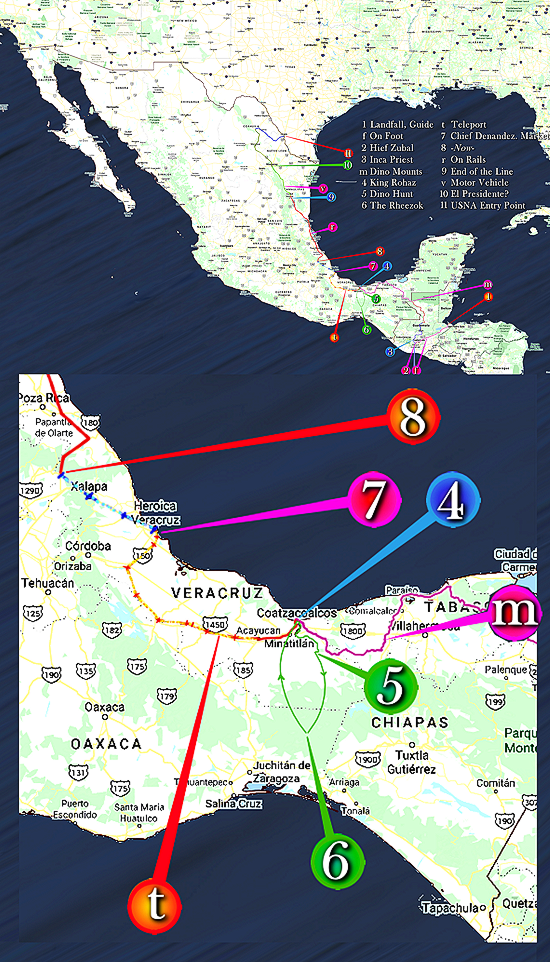
The second of the four maps shows the rest of the travels within Tabasco – from reaching the Gulf Of Mexico through to the end of their travels in Leon and entry into Coahuila.
Synopsis, Session 7 (from Session 8)
Zenith-3 have been recruited by UNTIL for an ongoing covert operation into the United States, with a very urgent initial assignment: Tracking down some nuclear devices that, it is thought, an Arms Dealer has sold, or is selling, to domestic US Terrorists.
Completing this assignment required the team to adopt new disguises and (in some cases), new ways of using their powers. Knight became Basalt, a man made of rock; Defender became Zantar, a Kzin hunter and tourist; Mr Image became Union Jack, an identity that he liked so much that he thinks he’ll keep it; Runeweaver adopted the identity of Specter, the ghost of a masked adventurer from the American Revolutionary War; St Barbara embraced the power of the Dark, and became the Ninja named Nightshade; while Vala chose to rely on her powers of illusion to appear almost human, adopting the name Zeitgeist.
To get to the US without detection, they have been injected into the network of kingdoms occupying what used to be Central America and Mexico, and are now run by the same Demon House that recently helped Knight escape being Blackwing, the psychological impacts of which he was still coming to terms with.
To escort the team, and guide them from Kingdom to Kingdom, House Aries sent Maynor Estuado Morales as a “Diplomatic Escort”.. He does not know who the team really are; their passage was arranged by Fuhrer Muerte’s Chief Of Intelligence, Oskar Von Peirera as a favor by the 5th Reich to the global community, i.e. UNTIL, but he does now know that they have paranormal capabilities.
In Guatemala, the society was primitive, at a Hunter-Gatherer level, and Magic was used to aid in the hunt, preserve food, and to keep King Hector in power, which he achieved by being the biggest thug. The buildings were also primitive, mud-and-sticks with the occasional recycled pre-Ragnarok leftover added to the mix.
In Tabasco, the team found simple Agriculture, which the locals enhance through the use of Magic to do things like aid crop fertility, protect the grain from parasites, insects, and unfriendly weather, and – of course – to keep King Rohaz in power; he preserves his authority with a mixture of High Justice and personal rewards for loyalty, the beginning of a Baronial system – all with a uniquely Mexican twist. The construction was eons more advanced than that of the Guatemalans, even if some of it may have been recycled from Mexico’s ancestors.
Each Kingdom has had its own methods of rapid travel, available only to the elite. In Guatemala, the group were loaned Persian Slippers that enabled each step to cover great distances. Using them took a little getting used to, because the elevation of the next step relative to where you already were was unchanged; choose a path that was too steep and you could trip over or bury yourself. It would even have been possible, in theory, to encase yourself in solid rock!
When the travelers reached the border town of El Ciebo, they saw that the Tabascans, in contrast, had riding animals that were at least semi-domesticated – again, with a twist: King Rohaz and his party were riding Dinosaurs about the same size and weight as horses, which magic had been used to at least partially domesticate.
In each Kingdom, to earn passage from the local dictator, the group are required to perform some “minor” favor. The local monarchs have been told only that your passage has been organized by the Demon hierarchy, and on that basis, the smarter ones have deduced that you are far more capable than ordinary people – a subtle insight that you would have put beyond them at first glance, which is a valuable reminder that “Primitive” doesn’t mean “Stupid”.
In Guatemala, they had to recover an enchanted Gem that King Hector had promised to a supporter. In Tabasco, King Rohaz tasked you with hunting down a “monster” that has been taking the locals from the El Ciebo region, and that has evaded or destroyed every hunting party that he has sent against it – his best twelve men so far. You got the impression that if he lost many more of his inner cabinet, his grip on power might become tenuous.
To assist the group, he added his best two remaining Hunters, Pedro-the-wary and Gonzales-The-Strong to the party as guides. They escorted the party to where the most recent disappearances had taken place, describing how a hunting party of two dozen people had simply vanished into the jungle without a trace. The clearing ahead was where their tracks simply ended.
Like the group, they have been sent to hunt “The Monster”. Pedro warned that many hundreds of different kinds of creature live in the jungles, and all of it has just one purpose: to become invisible until it suits the creature otherwise.
Nightshade had just used her machete to open a passage through the vines and underbrush into the clearing and noticed multiple pairs of beady yellow eyes staring back at her from places of concealment in the shadows on the far side!
Key Points & Notes
With the climax past, there was room within the pacing to be a little more fulsome in this synopsis. In fact, this functions to take everything down a notch and establish a baseline from which the next climax will grow.
The important part starts “In Guatemala” because the synopsis then goes on to compare and contrast that ‘Kingdom’ with the next, Tabasco.
Having used the basic formula once to establish it, I was comfortable modifying it for a second appearance – Hence, Rohaz was already at the border town selected for the PCs entry into his kingdom. The reason for his presence there became clear when he gave them the task to secure his permission to travel through his domain – he had lost so many key men to the “monster” in the region that his grip on power was shaky.
You will have noted that this direct comparison structure was employed repeatedly. This drummed into the players’ heads the fact that significant clues would be contained in the progression from one kingdom to another and they approached (comparative) civilization. This started paying dividends right away, but I was intending to take care not to let that be lost between game sessions into the future, nevertheless.
The PCs were suspecting that the monster would turn out to be a T-Rex or perhaps raptors. I didn’t want to disappoint them – so I added an encounter with both to what I already had planned, as you will soon see!
Synopsis, Session 8 (from Session 9)
What follows has been annotated (with interruptions) and extended (I’ll tell you when that happens, and why). In other words, this isn’t just the synopsis from Session 9, it also contains a lot of the game-play and scripted dialogue from that game session.
The team formerly known as Zenith-3, and now operating under the name The Alliance (a name none of them are very happy with), have been recruited by UNTIL for an ongoing covert operation into the United States, with a very urgent initial assignment: Tracking down some nuclear devices that, it is thought, an Arms Dealer has sold, or is selling, to Domestic US Terrorists.
Completing this assignment has required the team to adopt new disguises and (in some cases), new ways of using their powers.
- St Barbara embraced the power of the Dark, and became the Ninja named Nightshade;
- Knight became Basalt, a man made of rock
;
- Runeweaver adopted the identity of Specter, the ghost of a masked adventurer from the American Revolutionary War;
- Vala has chosen to rely on her powers of illusion to appear almost human, adopting the name Zeitgeist;
- Defender became Zantar, a Kzin hunter and tourist; and
- Mr Image became Union Jack.
To get into the US without detection, the disguised members of Zenith-3 have been introduced into the network of kingdoms occupying what used to be Mexico and Central America, which are now run behind-the-scenes by the same Demon House that had recently helped Knight escape being Blackwing. The psychological impacts of the resulting transformation have naturally started to manifest, and can be expected to persist for a while longer.
To escort the team, and guide them from Kingdom to Kingdom, House Aries has sent Maynor Estuado Morales to function as a “Diplomatic Escort”. He does not know who the team really are; their passage was arranged by Fuhrer Muerte’s Chief Of Intelligence, Oskar Von Peirera as a favor to the 5th Reich.
In each Kingdom, to earn passage from the local dictator, they have been required to perform some “minor” task. The local monarchs had been told only that their passage had been sanctioned by the DEMON hierarchy.
In Tabasco, King Rohaz deduced from the special treatment that you were receiving that you were more than the ordinary people that you appeared to be, and tasked you with hunting down a “monster” that had been taking the locals from the El Ciebo region, and that had evaded or destroyed every hunting party that he had sent against it – his best twelve men so far. You got the impression that if he lost many more of his inner cabinet, his grip on power might slip.
To assist them, he added his best two remaining Hunters, Pedro-the-wary and Gonzales-The-Strong to the party as guides.
The team had previously seen that King Rohaz and his advisors rode dinosaurs, so it wasn’t a total surprise when they encountered a pack of raptors. Both the hunters and the reptiles earned themselves a measure of respect from the group before their powers began to give them the upper hand; the first wave of attackers were routed, and the second wave were driven off, but the third wave that had been emplaced to ambush anything who attempted escape along the one avenue not closed off by the first two groups of raptors had at least drawn blood before being scattered by the arrival of an opportunist T-Rex!
Fortunately, the team had dispatched enough Raptors that the larger beast chose to chow down on those remains rather than engaging with unpredictable humans, giving you the chance to escape into the Jungle.
They were regrouping when they began vanishing, one after another. Nightshade was the last to be captured by the tentacles snaking down from the tree canopy.
Their captors were creatures unlike anything the team had ever seen before, seeming to combine aspects of dinosaur and octopus. With each member of the group gripped securely by tentacles, they carried you all away through the trees, brachiating from limb to limb like apes – but these were “apes” with a reach of thirty feet or more.
Nightshade was contemplating revealing her hero identity to the hunters in an attempt to break free when the creatures reached a grassy clearing between the trees and lowered the humans into its center, releasing them. The aliens then took up positions surrounding the group. One came forward and began to draw in the sand, quickly conveying that they were intelligent and then drawing a strange symbol in the sand – a crown with a Chinese dragon entwining through it.
While none of you knew the meaning, some of you guessed it fairly quickly. Your guide, however, seemed to recognize it immediately, and declared, “This matter is no longer your responsibility. I will deal with this.” Nightshade was reluctant to concede full authority to negotiate with what was effectively an alien invasion to the member of House Aries, and the quest from King Rohaz gave her some justification in refusing, but she decided to play things cool for the time being.
Meanwhile, some of the other creatures were healing the group, and providing food in the form of a freshly-killed deer.
Even an awareness of surface thought made Zeitgeist aware of a phenomenon she had never encountered before, as the alien’s awareness split into two equal minds, and each of those then split into two more, while a fifth mind seemed to emerge from the shared consciousness to direct and coordinate the others.
The alien rose onto one tentacle and used its tail to form a tripodal support with the one limb serving as a bar while the others formed two of the three points of a triangle, giving it? him? her? perfect stability.
Waving one tentacle back and forth through the air, and whistling a complex birdsong, it started casting a spell with two remaining tentacles, suspending the deer in mid-air, casting a second spell with a third tentacle (occasionally borrowing the second from the casting of the first spell) that cooked the animal, while simultaneously casting a third spell with its fourth and fifth tentacles to remove the entrails and skin, and then to carve the beast into large steaming chunks, passing one to each of the humans.
Specter realized that this creature was not just a spell-caster, it was capable of casting three or four or maybe even five spells simultaneously. The aliens might have numbers equal to the human group, but in reality that meant that they probably outnumbered the team, three or more to one! Their biggest limitation, so far as he could see, was only having two eyes!
When Zeitgeist waved away the offered food, the alien cast another complex set of spells to identify the problem and then transform the food into a form suitable for her digestion – exotic crystals. Basalt, noticing this, was immediately concerned that one of the hunters might realize that this showed she was not as human as she appeared, but fortunately they were too busy eating to notice.
Pedro-the-wary, true to his name, observed between mouthfuls that the deer had obviously been prepared in front of them so that they would know that it was safe to consume.
Maynor, meanwhile, had seated himself in Lotus position and begun to meditate while the alien negotiator continued to chirp at him and draw sketches in the sand. As the group finished eating a more substantial meal than any they had enjoyed since arriving in Dimension-Prime (or in years, in the case of the Hunters), the negotiator rose up and cast a spell opening a portal to somewhere else, and the other aliens began gesturing with their tentacles for the humans to precede them through it.
The group hesitated only momentarily – the aliens could easily force them if they wanted to. The only way to achieve an outcome that was in any way satisfactory was to play along until negotiations could commence.
There’s a lot that subsequent synopses leave out because it wasn’t immediately relevant after it had been played out. Long-term, though, it will be immensely significant, (and the players have had a small taste of that), and contains ideas that other GMs might be able to use, so I have decided to expand the “actual” synopsis above with excerpts and some summarizing before continuing.
The portal took the party to a plain alongside a cliff face containing a number of caves reachable by metal ladders. The rungs were spaced appropriately for humans to use, and many of the ladders would have been completely unnecessary for the aliens given the length of their reach – even if they didn’t employ some sort of levitation.
There were about 40 of the aliens present, along with the missing warriors belonging to King Rohaz, and a number of women (who Rohaz didn’t think worth mentioning). These are sitting in a natural amphitheater on stone benches while two of the aliens draw on blackboards. The scene is immediately recognizable as a classroom. The lesson itself, from what you could tell, was a complicated brew – part mathematics, part logic, and part philosophy.
When the ‘teachers’ notice your arrival, one raises a tentacle to suspend the class, and the hunters rise and walk toward your group, who are still arriving through the portal, their arms upraised to show they hold no weapons. You notice as they approach that several of them still have machetes, knives, or holstered firearms, by their sides.
There’s a lot of important subtext to the dialogue between NPCs that followed, so I will quote it in full. Note that it was written in the present tense for presentation in-game.
“Ola, and Welcome, Pedro-the-wary and Gonzales-the-strong. Who are these people that Rohaz has sacrificed alongside you?”
“Strangers and guests of the Greater Power, sent to earn passage through Tabasco,” replies Gonzales.
“If they are not of the tribe, the Rheezok must deal with them directly. But you, as honored hunters of the tribe, have a choice. You may commit whatever form of ritual suicide you prefer, or you may join us in study, renouncing the rule of Rohaz. We are learning many things; never again shall the people go hungry,” replies the spokesman. As he says the last, he waves one of his hands over the palm of the other, which obligingly sprouts a small flame.
“My loyalty is not so easily overturned, Jose-The-Eagle,” replies Pedro. “Why do these things teach you such magic?”
“For many reasons, Pedro. First, because it makes us more worthy to work alongside them; second, to prove that they will be more generous rulers than Rohaz-the-bully; and third, in recompense for our loyalty. Come, join us; if you are not convinced at some future time, you can always choose to employ your weapons.”
Pedro and Gonzales look at each other, and after a moment, Gonzales nods. He and Pedro wave farewell to you and go over to join the class, which quickly resumes.
Zantar then says to the rest of you, “That was very interesting. I would surmise that King Rohaz has just lost another pair of his ‘best men’. It is only a matter of time before his leadership is challenged – and even rudimentary magical training should be ample to ensure that the challenge is successful, unless we or someone else stand up for him. Any takers?”
There were none; who would want to fight to preserve the rule of someone known to his own people as “Rohaz The Bully”?
Maynor approaches Nightshade. “We should speak. The others defer to you, whether you lead them or not. I don’t know who you really are, and it is not my concern. I can speak for those who rule this part of the world, but cannot do so for the world outside. I know that you are more than you seem, for the same reason that the rulers you have met know – no ordinary person would be granted such assistance by the Fuhrer Muerte. What I need to know is whether or not you can speak for those beyond these shores?”
This put her on the spot; she thought carefully and then said that she could not tell them what to do, but those who they would talk to would consider carefully anything she might tell them, and any recommendations she would make, and in turn, they could be quite persuasive..
“Then you and your group should at least be witnesses to the negotiations. Come.”
As they walked, Maynor told the group what he knew of the aliens. “There are many worlds, as alike as two books on a library shelf. One may be a different edition of the same book, while another concerns a completely different subject. The closer to the shelf of the book you are comparing with, the more closely related the two are likely to be.”
This was all old news to the players, who were seasoned time- and dimension-travelers. But Maynor didn’t know that.
“There was a mighty Emperor of this world who was overthrown and his memory taken from him. Immortal, it was but a matter of time before his genius reasserted itself. He sought then to reclaim his throne, but history had passed him by, and he was opposed by the mightiest of the infidels – aliens, gods, sorcerers and mortals. Evenly-matched, their conflict threatened the stability and very existence of that which they vied to rule; until a bargain was struck between the enemies.”
This was a somewhat skewed version of the conflict between The Mandarin and The Champions, which had occupied the first two real-time years of the campaign back in the early 80s.
“In their travels, the infidels had found a world in desperate need of strong rule, having been subjugated by suicidally-insane extremists and carried to the edge of destruction by fanatics and ideologues. They offered to leave him in peace if he were to turn his attentions to he conquest of that world, where none could oppose him.”
Reasonably accurate after 1,000 years of historical distortion and as it might be abbreviated in a high-school history class. This was a world in which the Nazis won WW2, but Stalinist Russia survived. The two were about to engage in thermonuclear war in local-time 1962 when the players intervened to prevent at the time – but decided that regime change was beyond their do-gooder remit. A few months later, a quick return visit made it clear that they had simply delayed the inevitable and needed to take stronger action if they wanted to protect the planet’s population from the political extremes of their leaders, but they really didn’t want to do it. One thought led to another.
“His conquest of the human planet was trivially-easy. He then worked a mighty enchantment to accelerate time within his domain, enabling his new subjects to become a mighty Empire, conquering first the other worlds of his new Solar System, and then the great cultures of his new Galaxy. The inhabitants, some very human and some radically different, became new citizens of the Empire, for he was a benevolent and wise ruler.
All this came to light, and is relayed fairly accurately, in the buildup to Ragnarok. The official deal was that the Champions would leave the population and their Emperor alone, but one PC almost immediately started to renege on the agreement – not knowing that said Emperor had made arrangements to trick that PC into doing so. Ultimately, the Mandarin became an ally if not a friend.
The acceleration of time was a mechanism whereby events in that universe could evolve and change as quickly as I needed to in order to create interesting adventures.
That’s the end of what the players already knew – from here on, it’s all new information to them.
“Only one culture did he encounter whose citizens were his equal; but, having learned from the conflicts of his past, rather than engage in a futile and potentially devastating conflict, he chose negotiation and a live-and-let-live arrangement. The Rheezok came from a cluster of stars that had crossed through the plane of the galaxy eons earlier, a cluster that orbited the galaxy, bound to it but not part of it. From Earth, it’s analogue cannot even be seen without a telescope, for all that it is the second closest such structure to the planet upon which we stand.
“Relations between the two Empires remained cordial for centuries. Unexpectedly, and without explanation, the Emperor saw fit to reverse his temporal manipulation shortly thereafter; the galaxy was his, and there was little of value in easy reach beyond it, or so it is said. I myself was born into the 12,752nd year of his enlightened rule, on a world so distant that the light of Earth would take 142 years and some months to reach it, in a completely separate arm of the galaxy. Find Polaris, and turn 75 degrees. and near the Foot of Perseus, a great telescope may spy it from here.
“There came a time when our this universe and that of my birth faced mutual annihilation, and the mightiest forces of both collaborated to save all. But this could only be done for one of the two galaxies, which would be a blending of the two that had come before it. The Emperor sent forth his most skilled mages to prepare for the influx of refugees to come, but this left him without those he needed to actually open portals to the new worlds. For it was not merely a matter of travel to the Earth, but to almost every habitable star in this Galaxy.
“To remedy this lack, he renegotiated with the Rheezok; they would cast the portals on his behalf while he engaged in the enemies of existence responsible. So it was that he met his end, and then ascended to become as unto a God.” (a very meta- synopsis of Ragnarok and part of the outcome).
“In recompense, the Rheezok were gifted an entire arm of this galaxy; the Empire would stake no claim upon it, and citizens of that arm within the Empire would be relocated elsewhere. At least, that was the agreement; all I know of what transpired is that those scheduled to do so, those who had survived the conflict with the Enemies of the Empire, arrived here to join me.
“Over the years since, that group of refugees and myself have worked to integrate ourselves into this world, its communities and its government, under the command of one of the former planetary governors of the Empire. Others have taken other paths.
“Why the Rheezok are here, I do not know. I suspect that the answer will be pivotal. But I am bound by my oaths to the Empire and my oaths of loyalty to my Lord. They include the treaties between the Empire and Rheezok.
“Do you see my problem? Any agreement that I reach will be valid in practice only, unrecognized by the wider world, but that may not be sufficient to satisfy my obligations under those treaties, or the demands of the Rheezok.
“At the very least, I require witnesses to report these matters to the outside authorities, triggering negotiations that could destabilize certain delicate political situations at the very least.”
This was putting a large part of the future of the entire campaign into the hands of the PCs. Tell the world about the Rheezok and the US Government would hear about it; amongst others; any hint that one of their major political parties (if not both) had been ‘colonized’ by refugees from another dimension, and the US would collapse into anarchy, possibly triggering a fourth World War. And, unless the Rheezok were improbably modest in their demands, any misstep might trigger an even more widespread conflict. Peace and Galactic War might hang on their ability to satisfy the aliens.
The PCs discussed the situation intently for about an hour, noting that the treatment of the humans “captured” by the Rheezok was an important guide. Zeitgeist was able to confirm that none of them were under any duress, and believed implicitly in the trustworthiness of the aliens.
One Rheezok then led the group into one of the caves and used simple stick figures drawn in a sandbox to communicate its intentions, warning the group of what to expect. Specter attempted to analyze the magics being cast simultaniously:
- Create force-field bubbles around each individual (including itself);
- Fill the force-fields with an air-permeable gel that would not permit any lie to be heard (you could tell fibs until hoarse if you wanted to);
- Create a hollow space within the gel around the heads of each individual by manipulating the shape of the gel;
- Link the neural receptors of the ears within the hollow space with the speech centers of the alien, and vice-versa, using the gel as a medium and the bubbles to isolate each person from hearing what anyone else heard in their native tongue.
Of these four, only the first and third were straightforward, and they were complicated by needing to do it several times at once; an accomplished mage, he had near-zero confidence that he could even come close to attempting either of the other spells. Mentally, he revised the potential threat posed by the Rheezok to new heights.
“Now we can speak,” announced the alien, and each heard the words perfectly in their customary first language. Zeitgeist not only got the translations heard by the other PCs (through the mental link she maintained with the team), but also got a direct mental impression – effectively, the thought was being heard at six or seven times its normal volume, as though someone had put an electric bullhorn to her ear and was shouting through it. She immediately shut down the psychic link.
“Words not spoken cannot be heard. Words of deception will not be heard. Only the truth will be heard. I am the Eldar, I speak for the Rheezok. Man of the Empire, have you told these others of us?”
“I have, your excellency,” replies Maynor. “At least as much as I knew.”
As the Eldar continues to speak, it casts images onto the surfaces of each bubble with another spell, while continuing to maintain those it had already cast. “Our home was once located here.” The image of a group of stars, bound to each other, with the assembly bound to the greater galactic whole, was displayed.
“Our worlds were unlike yours in some ways and like yours in others. But, like you, we mastered our environment.” (Images of the Rheezok home-world, which almost looks underwater).
“In time, one arose who assimilated the galaxy to his rule. At first, this assimilation may have been a defensive maneuver; by the time it reached beyond the planets of the human sun, it numbered 3 sentient species and that was beginning to change, as each brought their own contributions to the resulting Empire. By the time the galaxy was filled, 325,000 species were part of the whole – many of them minor variations upon the same coding of life. Humans and those species sufficiently akin to humans to interbreed with them (given appropriate medical assistance) dominated; it was only appropriate that the Emperor was himself of that species.
“In time, we found his Empire, or they found us – a matter of perspective. Both pondered the problem of exerting dominance over the other, and came to the same conclusion. Then did the Emperor, accompanied only by his Imperial Guard, come amongst us to negotiate. Astonished by this audacity, we granted him leave to speak. Translating his words into our language – rendered utterly unlike your own by our anatomy – he said unto us, ‘If we contest for power, one must lose all, but the other will win but a fraction of what they already possess. Both would lose, and the citizens of both would suffer. I deem this to be unacceptable, and so come to offer terms.
“His words contained truth, and we acknowledged that truth and agreed to peace. He taught us some arcane practice that we did not know, and we taught him some arcane theory that he did not know, and respectful coexistence was cemented as policy between Empire and Rheezok.
“One condition only was placed upon this peace: that time proceed at the same pace in both, so that one could not launch a deception against the other. This was agreed to.
“Over the centuries that followed, mutual respect was acknowledged at every meeting between Empire and Rheezok. It became common for Rheezok adepts to tutor the most promising Empire adepts for a few human months, and for those Rheezok about to ascend to Eldar to visit the Empire Capital on Imperial Earth, and learn of the many thousands of lifeforms treated as equals there.
“Then, he came to us once again and did inform us out of mutual respect that the entire universe was shortly to be consumed in an unimaginable inferno. This explained many puzzling signs and portents that the Rheezok had perceived, and we knew that he spoke only truth.
“The Emperor told us that he and certain allies intended to subvert the plans of the enemies who had done this for their own ends. The prospects for success were slim, but could be magnified if more of the Empire’s powerful could be released to engage in the struggle. This required that their task, of protecting the Empire’s Citizens by migrating them to new homes in another realm of space and time, become the responsibility of someone else.
“The Emperor then offered to include the Rheezok in the resettlement program if they would perform that resettlement task when the time required. The Rheezok were granted one arm of the consolidated existence, for there was no certainty that the environment of our gathering of stars would be akin to what the Rheezok require, and we would not displace an existing sentient species from their homes.
“In time, planning was filled, and the Rheezok began to search for a new home. Many of the Rheezok did not survive the End Of All, but enough remained – some nines of tens of us – to form a culture of merit. The Rheezok knew that many of the Empire had also survived, and in time, Treaty would be renewed between Empire and Rheezok.
“For several solar cycles, we worked, and in time, a home was found that was both right and empty, and it became Rheezok anew. It was good. Then we began to see new signs and portents, akin to those that had puzzled the Rheezok in times past, and which we knew meant the destruction of all. Distant, is, but too close, too. Twos of tens had we spent preparing for the End Of All with the Empire; too close for such, comes danger anew.”
The PCs have done their best to forget this portent of Ragnarok II, in hopes (however slim) that the Rheezok were wrong, and because there seemed to be nothing that they can do about it. ‘One problem at a time’ is their motto whenever possible. They have received similar prophecies on other occasions that warned of Enemies becoming Friends and Friends becoming Enemies in the imminence of cosmic devastation, and some of that had also come to pass in-game. In fact, one could point to Maynor himself as an example – he represented Demon, a previous incarnations of whom were an enemy of the PCs, and some houses of which still were so. But Maynor was verging on being not just an ally, but a respected friend.
“Without Empire to discern the shape of menace, the Rheezok learned from humans to discover new truth within mystery, and worked to discover the truth of the new destruction of all. But one of those truths followed Rheezok back to Rheezok, and Rheezok-home was destroyed by one of the workers toward the end of all. Named, the one was, Ice Queen.
This was an old enemy of Specter, a mage of extreme power and cruelty. This was a great surprise to the player, who had not expected that I would have PC arch-enemies up to things that didn’t directly involve the PC in question. Me, I look at everything present and ask “what’s the best tool for the job that’s at my disposal?”
“Time track from the past of Ice Queen did the survivors follow, and here did it bring us.”
The Rheezok had explored the past of the Ice Queen until they came to her encounter with Specter (then Runeweaver), and followed his time-track back to Earth, and then returned to the contemporary time-frame. In other words, they ‘followed him home’. This meant that he had an unexpected share of the responsibility for them being there – he had never tried to mask his comings and goings, and now it was too late to do so. The player immediately took a more personal interest in the matter at hand.
“Fates bound together once more, and new home Rheezok do now require. Soon Rohaz-King fail, and Rheezok claim. Grow Rheezok home from this seed. Rheezok stay. More alliance, we bargain.
“Rheezok not take; Rheezok share. Humans suffer loss of heart, mind, knowledge after end-of-all. We work to restore for betterment of human and Rheezok. Once-Of-Empire say not yes or no; Allies Of Empire say not yes or no. Rheezok stay. Only more alliance do we bargain.
“I withdraw. You discuss alone. I return in human hand-span of human sun through sky.”
The Rheezok staying on Earth was not negotiable; they had set out to usurp the throne of Rohaz-the-bully by subverting the best that he had to offer, and had every intention of completing the process. What they were offering were terms of a broader alliance against the impending disaster.
This ultimatum – which is what it amounted to – was intended to be the cliffhanger ending to the game session. But the players continued to consider their alternatives even while they were packing up – that doesn’t happen often, but when it does, I know that I’ve got them fully immersed in a compelling situation.
They decided to permit the Rheezok to occupy Tabasco as a Refuge (they could hardly stop them), but to look for a more suitable home for them as they traveled, bearing in mind the ethical restraints that had been stated. While they could not speak with authority on the subject of the broader alliance, they welcomed any and all assistance in mutual self-interest, and would ensure that those with greater authority gave the proposal their full attention, in the expectation that any recommendation to form such an alliance would be accepted.
The Rheezok were willing to give the humans a reasonable deadline to look for a new home for them, but would continue their activities in the meantime as though their presence was to be permanent, because there was no certainty of an alternative being found.
The Rheezok, having understood the implications of Rohaz sending the group after them, would not provide a transit to anywhere except back to the region where they had been found – and to the time they were found. Anything more would have to wait on the formal negotiations between Earth and the aliens.
Key Points & Notes
This synopsis starts with some deliberate mixed messaging – the team are about to engage with wild dinosaurs, an action situation, but the format of the synopsis is longer and more low-key than even the previous one, spending a lot more time on context.
That psychologically prepared the players for the encounter with the Raptors and then the T-Rex to be just an entree for the main plotline within this mini-adventure, which was not to be combat-oriented at all. I don’t know that any of the players consciously picked up on this signal – I suspect not – but I have learned through experience that using ‘player reminders’ or ‘player briefing’ or whatever you want to call it adds considerably to the success, at an entertainment level, of a day’s play.
The Rheezok were a lot more significant than the local adventure; these were a major piece of the long-term campaign, and (in a way) it could be considered that everything up to this point had simply been to get the players into position to make decisions about them – decisions that everyone could see would have long-term implications and repercussions.
But there was a level of meta-planning involved, too – the encounter with the Rheezok, forced both Maynor and the PCs to lower their defenses somewhat more than they had done to date, establishing new levels of trust between them. Note that both parties had alternatives open to them, and it was up to the players which way things panned out; they chose something close to the best possible option available to them. The Rheezok’s “Truth Field” upped the ante again, and forced a deepening of that mutual trust.
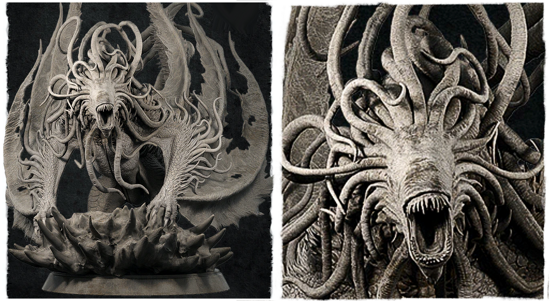
I put a lot of design effort into the Rheezok, as befits such a major element. I wasn’t able to find an image on the net anything close to what I was imagining (I looked) so had to draw up something myself. The results weren’t perfect but they were good enough. I would have loved to find the time to do some action shots – Rheezok brachiating tree-limb to tree-limb, for example – but that wasn’t on the cards.
Synopsis, Session 9 (from Session 10)
I made reference earlier to how inadequate this synopsis was in terms of the Rheezok encounter. Now, readers can judge that for themselves.
Although it’s not strictly part of the synopsis, the confrontation with King Rohaz that followed was so much fun, and is so poorly represented in subsequent synopses, that I’ve decided to quote from it as well. All I’ve done to it is shift it into the past tense.
As an added bonus, I’ve included details of the riding dinosaurs and their natures, ready for GMs to import into some other campaign.
Zenith-3 aren’t feeling quite themselves, these days. They have adopted new identities for an ongoing periodic undercover mission from UNTIL and are in the process of being inserted into the USNA in order to undertake their first assignment: the recovery of some Nuclear weapons that are believed to have been purchased by a group of domestic terrorists with the intent to use them to make a political statement on the 4th of July.
Although they have yet to select a group name with which they are all happy, the new-look group of Basalt, Union Jack, Zantar, Specter, Nightshade, and Zeitgeist have at least begun to gel as a unit.
UNTIL did a deal with the 5th Reich to arrange the team’s journey through what used to be Mexico, which is now a group of semi-autonomous guerrilla states, all of whom answer to some degree to a hidden government built around House Aries of Demon.
The 5th Reich, in turn, had done a deal which requires the team to earn their passage through the different territories, guided by one Maynor Estuado Morales, representative of House Ares. The rulers are (for the most part) no dummies and have deduced that the party are more than just human, and have thus far scaled their “requests” accordingly.
Despite the delays that these ‘services’ represent, the team has, since coming ashore, covered almost 900 kilometers, climbing to over 1800m altitude, and descending again, no less than five times in the process – in about a day and a half. Since you have been told by your guide that your means of travel will get faster as you progress, and that the whole trip should take 2-3 days, they think they are a little behind schedule – but only a little.
You have just concluded a deal for Maynor and House Ares to protect Z3’s identities as “UNTIL agents with paranormal abilities” and assist in their mission as far as possible, without compromising the political neutrality that UNTIL have to maintain.
They have also agreed to a treaty with the alien Rheezok for mutual defense of the Earth against the Ice Queen or any other comparable threat; the PCs intend that the Rheezok’s presence be officially sanctioned on humanitarian grounds as they are refugees, but will have to work with the more progressive elements of the UN to have the emergent “nation” recognized officially – though none of the other “Kingdoms” of what used to be Mexico and Central America are recognized, either, so there will be considerable difficulties to overcome.
Now they have to deal with King Rohaz of Tabasco, who probably won’t like their report of how they found and “dealt with” the “Monster” that had been “taking his people”.
Maynor intends to simply incinerate the puffed-up ‘Monarch’ if he doesn’t go quietly, but that’s not a satisfactory answer to Nightshade. Maynor has been persuaded to give the team ten minutes to discuss alternatives while at the temporary cave settlement of the Rheezok – his ‘solution’ is always there as a fallback.
In a very fmailiar story, the next synopsis to be offered does an inadequate job of informing anyone who wasn’t there at the time of what happened. So here’s a summary of what actually happened in play:
Extracts from the Adventure Notes, Session 10
When the PCs return to El Ciebo, King Rohaz attempted to psychologically dominate the situation by keeping the PCs waiting. Maynor refused to play along, though he was clearly steamed by the treatment, he simply ordered the servants to bring them the finest of refreshments, and the most comfortable seating, at the King’s expense, that they may await the King’s pleasure. Of course, the most comfortable seating is the King’s currently-unoccupied throne, as Maynor told the PCs with a straight face.
Finally, Rohaz appeared and demanded an update from Maynor. What was the killer creature, and what had Maynor’s guests done to eliminate the threat? But first, remember your place, and return his throne – at once!
Maynor stood and answered, “Well that gets right to the heart of the matter, doesn’t it? The creatures – there were many of them – are known as the Rheezok, and what we have done to eliminate the threat is to give them your Kingdom, throne and all – though they dislike such seating, and will probably give it back to you if you ask them nicely. In a nutshell, you have made such a mess of things here that I have removed you from power.”
Rohaz sputtered and spouted, apoplectic and unable to form coherent sentences for a while. Finally, “You can’t do that, we had a deal” squeaked out from his inflamed cheeks.
“Oh yes, I can,” replied Maynor. “The terms under which you were granted power – and under which we agreed to support you in retaining that power – are quite clear. Pre-existing obligations override more recent bequests. The Rheezok have invoked a pre-existing obligation between themselves and my Emperor.”
“But – but – but – I won’t let you!” gasped Rohaz, who then made potentially the biggest mistake of his life, grabbing a spear from his honor guard and pointing it at Maynor.
Sensitive to the PCs squeamishness, Maynor didn’t incinerate the King on the spot, only the spear that he was holding, with a casual gesture.
“Understand this, Rohaz – there is a metaphysical storm brewing. The devastation that blighted your former nation was only the beginning. A larger, more deadly, war is still to play out on this world, amongst others.
“In that war, the Rheezok may be humanity’s greatest ally or their greatest enemy. We have bought their friendship by granting them dominion over this land until they no longer have need of it, one way or another. In return, they will protect and nurture the citizens to the mutual benefit of all – a process that has already begun. You can either be a part of that new beginning or swept away by a popular revolution – your best hunters and warriors now stand against you, and we will not protect you. The choice is entirely yours.
“I submit that we have thus completed the task you set us, and require that you furnish the promised transportation – Seven trained Riding Enjambre (the riding dinosaurs), well-rested, saddled and ready to go.
In short order, the saddled dinosaurs were brought before the party. By now, the sun was casting long shadows over El Ciebo. Maynor said, “The beasts are easy to ride once you get used to them. Have any of you any experience at Horse Riding?”
Some did, some did not.
“Well, the Enjambre are like riding stallions. From time to time, they’ll test you to see if you’re still in control of them; the rest of the time, they will be placid unless you’ve failed the last test, when they will be spirited and fractious.
“If all things were equal, we would stay here overnight and depart in the morning; but the temptation to do something stupid might yet prove too strong for ex-King Rohaz if we linger. There is still almost an hour of daylight left, and the Enjambre have excellent night vision; once I plant the suggestion of their next destination in their minds, they will proceed there by the fastest route they can find, whether we can see what they are doing or not. So I suggest we ride through the night and get a few hours rest at the capital of Tabasco, where I must give some instructions to the government regarding the transfer of power.”
The group quickly agreed to this plan. They were beginning to have serious respect and trust for Maynor, who was not at all anything like what they might have imagined a member of Demon to be.
“Once we are on flatter ground, I will give the Eljambre a treat that will increase their speed. They will need to rest by the time we reach Quetzacealcos, too.”
Taking the lead, he begins to cast a spell, while whispering in a strange voice to his mount, “I name you Feathercap. Gracias de Dias, Feathercap, Gracias de Dias. Begin.”
With a surprisingly level gait, despite their bipedal nature, the gently-named “Feathercap” sets off, followed by the others. Soon they begin picking their way straight down the rough and broken sides of a steep mountain, scrambling from perch to isolated patch of slightly-less acute ground, more or less in a straight line. It’s absolutely terrifying to look to one side and see a wall of rock, then look to the other and see only a dark void stretching away below you.
Eventually, the Eljambre decide that they need to change direction back to the East, though Feathercap is perched on flatter ground that looks no larger than a playing card. Because of the gathering darkness, you are only barely able to make out what takes place unless you have some form of augmented night vision.
Those who do see the tail of the Eljambre in front of them abruptly swing to one side as the creature turns on one foot almost in the opposite direction, dipping it’s shoulders thirty degrees into the turn.
Just as you feel gravity begin to tear you out of your saddle, the shoulders dip in the other direction, catching your fall, and before you know it, you are again progressing in a surprisingly level manner. From up ahead, you can hear Maynor gently snoring.
It’s pitch black by the time you pass through the small town of Gracias de Dias. You can see candlelight through the windows, mostly made from car windscreens, and covered on the inside by curtains made of tarpaulin. Feathercap stops, dips it’s head and long neck as though smelling the ground, and paws at the ground. Maynor stirs himself, and tells you all, “let them wander about for a few minutes to get their breath and restore their sense of balance. Be alert for any attempts to throw you.”
Five minutes later, he gathers the mounts close to him, and again casts his spell. “El Coba, Feathercap. Good beast. El Coba, now, Feathercap. Begin.”
Feathercap trundles gently off into the dark, followed a moment later by the rest of your mounts. As the ground begins to flatten out, having descended 1200m in about 15km, the Eljambre break into a gallop, almost a lope, which would surely trigger any tendencies toward susceptibility to seasickness.
After half an hour at speeds that are unguessable in the dark for those without night-enhanced vision, but feels too damn fast, and is quite definitely too fast for anyone with such vision but no riding skill, the ground starts to slope up again as you pass through El Coba. After again giving them a chance to restore themselves, Maynor gives them the name of the next town, and you are once again on your way. Ten kilometers later, and having climbed another thousand meters, you break through the thick plant life and crest another mountain range, at the peak of which lies the town of Tenosique. It’s now about 10PM.
As midnight approaches, you’ve paused to rest the Eljambre twice more, and have reached Batancan, where Maynor told you the road becomes straighter and more gentle. When you continue, it’s at an even faster gallop than before. An hour later, you are again resting your mounts, this time in Chable. 45 minutes or so later, and you reach Entre Hermanos.
A few km out of town, as a thin crescent moon rises – it’s less than a week until the new moon – the road begins to run alongside a small lake, and has become completely flat to the naked eye. You are traveling at a breakneck speed of 60 km/h, give or take, and there is just enough light for you to be aware of your speed.
By 4AM, you have rocketed through the marshlands of the Reserva de la Biosfera Pantanos de Centia and reached the coastal town of Frontera, on the southern side of the Gulf Of Mexico.
Although it is still dark, lamps and lanterns reveal dilapidated fishing vessels being made ready. The crescent moon is now high in the sky, and as bright as it’s going to get. Twenty minutes on, having left the fishing fleet in the distance, the first glow of approaching dawn is just barely becoming visible.
Forty minutes later, the predawn light is far more pronounced, as you race through the larger town of Paraiso and once again turn inland. You are resting the mounts once again in the town of Comalcalco as the Dawn breaks.
The remainder of your trip is in some ways even scarier than the part already completed. Your pace does not abate, except when you rest the dinosaurs and get your bearings for the next breakneck sprint, but now you can’t avoid seeing how fast you are going. What’s more, you are increasingly sharing the roads with other traffic, and no-one seems to have ever heard of road rules. Time after time, a collision is narrowly avoided as mounts – yours or theirs – leap one way or the other.
Still worse, you often come upon traffic headed in the same direction you are, but at a far more leisurely gait. Every time this happens, the dinosaurs begin to chase the traffic ahead, a malevolent look in their blood-red eyes. At one point, you come up on a flock of sheep being led to market; before you know what’s happening, each of your mounts has a woolen mouthful.
Nevertheless, you begin to get a sense of how the locals are utilizing the magic that House Aries permitted Ramoz to dole out, as you pass impossibly large and fertile crops that would have been remarkable in a region with access to heavy agricultural machinery. Local farms are small but prosperous.
As the traffic intensifies, the trip becomes more and more harrowing. Suddenly ahead looms a great wall surrounding a riot of color and noise. “The capital of Tabasco, Coatza-cealcos,” announces Maynor. “I will take the mounts to the palace. Here is a gold mark and a silver peso, each. Use the peso in the market to buy yourself some food and something to drink. Use the mark at the Villa Coatza-cealcos de Grande – any of the locals can direct you – and get a few hours rest. I will join you in an hour or two, and by 2PM I want us to be back on the road.”
Key Points & Notes
I’ve preempted a lot of these with my interjections and opening comments.
Note the use of a ‘fake hyphen’ to break names up for reading aloud. The actual name of the capital is Coatzacealcos, but I wasn’t sure of my ability to pronounce that correctly, consistently. Breaking it into two words makes that a LOT easier.
I also wanted to point out that Zantar’s speech patterns have slowly evolved during his time in the campaign. They started as a blend between a perfunctory militaristic style and fortune-cookie oversimplifications of philosophy delivered in an almost-reverent manner, and both tinged with a little melodrama; he loosened up a little, but was still fairly serious and deadpan, both emphasized by an almost shy humility, and has slowly started incorporating more casual human expressions that contrast strongly with his usual style, and are slowly revealing a very dry sense of humor. The dialogue quoted included a perfect example:
“I would surmise that King Rohaz has just lost another pair of his ‘best men’. It is only a matter of time before his leadership is challenged – and even rudimentary magical training should be ample to ensure that the challenge is successful, unless we or someone else stand up for him. Any takers?”
This is not accidental; it reflects growth and change within the character, which have been taking place even though he is an NPC. When I look back at the canned dialogue with which he started, it’s as though a completely different character were speaking. I doubt the players have noticed this, but it’s a reflection of the NPC feeling more at home within the group.
I have been a casual observer of some other campaigns over the years in which an NPC’s personality was set in stone on the character sheet, and their mannerisms and mode of expression were completely predictable five years of weekly play after their introduction. While that made the campaign easier for the GM to handle, it often left the game world feeling like it was a cardboard stage set and not a real place. Not that this factor alone would counteract that; the same ‘unchanging’ philosophy carried through to townships and cities and the like. It doesn’t have to be that way – so let’s take the work out of the problem, and then highlight an unexpected use of the approach, before continuing.
Threshold of awareness of change
The key trick lies in two assumptions: that a certain amount of change has to accumulate before PCs will notice it, a threshold of awareness of change; and that not all characters or locations will change to the same extent over a given period of time.
When I create an NPC or location, I decide how quickly it is changing and evolving. This is a simple numeric value:
0: frozen, unable to change even if they wanted to
1: very slow change
2: slow change
3: typical rate of change
5: changing quickly
8: a very dynamic evolution
10: mercurial rate of change
Every time the NPC or location appear in the campaign, I add that many points to a cumulative total. When it exceeds the threshold of change that I have set, based on the PCs and how observant of such things they are, and how extensively they know the NPC or location, I subtract the threshold from the total and make a quick note of a change within the NPC or the location in the appropriate place within my notes, highlighting it in some fashion so that I know to call attention to it when the PCs next visit the location or meet the NPC – unless circumstances would hide it. These changes tend to be fairly dramatic or obvious.
There are times when an experience is particularly transformative – a major fire in a location, or a profound personal experience for an individual, for example. Depending on the scale of the event, I will temporarily bump the rate of change up a notch or two, accordingly.
When the PCs next encounter the changed person or place, I will add 3 to the rate of change to get a die roll on 3d6 to use in determining if any specific element has been affected by the change. ‘Changing quickly’ (score of 5) thus indicates that there’s an 8 or less chance on 3d6 of any specific detail having change, per visit.
Note that one possible change is to the rate of change itself! I only apply that when there’s’ been an event to justify it – but I’m not above inserting such an event into the location’s history since the PCs were last there in order to do so, if that suits the plot. A new, more vigorous young mayor or nobleman in charge, for example. A new trade route that passes through the location. A new occupation or recognition from a high-placed source. There are endless possibilities.
You don’t have to update the location or character every time they appear, aside from incrementing the accumulated change total, which is a matter of a second or two. It probably takes longer to extract the notes from a clearbook or open the document and find the accumulated score.
The other note to make about this method is that the awareness target is not a fixed value – it gets lower with each visit. That calls for a pair of simple lists – one of places the PCs have visited and one for notable people they have met. For places, I’m talking about more than simply passing through a community – they need to interact with it in some manner, whether that’s visiting the markets or staying overnight in a hotel or inn. The same is true of NPCs – a single conversation is not enough (except in unusual situations). Next to the name is a score for how often the PCs have been there or met the person. At the top of the page goes 30 minus the highest INT score (if I were using the D&D scale) amongst the party after a cultural modifier has been applied to it – that’s the base threshold. Elves, for example, are less likely to notice subtle changes in a human town – their culture has them looking at the wrong things – so a -2 or even -4 modifier would be appropriate. Some races are more sociable than others, and they might get a +2 or even +4.
To get the appropriate threshold, I simply subtract the number of visits from this base threshold.
The strength of this system is that it accumulates many small changes (with the die rolls) while also tracking more substantial changes without making a lot of extra work for the GM. A small change might be that the blacksmith now has a toddler in the household, or has taken a new apprentice, or has added a porch to his workshop. Little stuff. A more substantial change might be that what used to be the Blacksmith’s workshop is now a saddlery, or a bakery; or the walls around the town are being fortified; or there’s an urban beautification project underway, or the local homeless appear to have vanished. A bit sinister, that last!
The bonus that I mentioned: if you apply this system to most species in a game, over time, it becomes really obvious that a long-lived race are not changing at the same pace as the rest of the world. In essence, you can drop Elvish communities (and the like) down a couple of grades relative to the values applied to more short-lived races and create a palpable but inobvious sense of timelessness to them.
More Key Points & Notes
Another point to highlight is the degree to which the campaign background has been woven into the game situation. This does several things: (1) It binds the adventure to the campaign foundations; (2) it gives the players a sense that they are changing the game environment with their actions, making them feel their characters are part of that environment, and their choices matter; and (3) it provides a vector for injecting interest and relevance in both directions – both from the background to the contemporary situation and from the immediate situation to the background. As a bonus, it can make the campaign feel both more epic in scope and more intimate to the PCs, at the same time!
It’s also worth noting that there’s the “official” version of history given to the players, but that different perspectives give different versions and interpretations of history. In this case, the PCs had one version of the story of Mandarin; Maynor had another; and the Rheezok had a third. None of them completely incompatible, but none of them completely consistent, either.
Finally: I’ve highlighted in the narrative the importance of the discovery of the Rheezok to the campaign, but there were a number of secondary purposes embodied in this encounter that should be pointed out. First, there’s the evolution of the relationship between Maynor and the PCs. Second, it shows the PCs (and the players) that those migrated to Earth (and to the Milky Way in general) so that Mandarin’s universe could be sacrificed, during Ragnarok (the alternative was for both to be destroyed) weren’t just humans and humanoids. This provides groundwork for some future encounters that I had planned. Finally, there’s the point that humanoids vastly outnumbered non-humanoids in terms of species within the Empire of Mandarin (and therefore presumably within the milky way galaxy of Earth-Prime and Earth-Regency and most of the other parallel worlds out there), which I wanted to establish – there are several advantages, mechanically and physically, in the humanoid form, and this both justified the campaign history which had lots of humanoid aliens and very few non-humanoids. In fact, 95% of the non-humans encountered were humanoid – even more if you count mermen – and 75% of the remainder were dragons or arachnid species.
Synopsis, Session 10 (from Session 11)
Last Time, or thereabouts, the party told King Rohaz that he was out of a job, but nevertheless owed the party mounts. He grudgingly provided Eljambre, Riding Dinosaurs, as promised. When hyped up on the Speed Fodder that your Diplomatic Escort, Maynor, had brought with him, they proved capable of terrifying speeds. So it was that you soon found yourselves at the capital of the Kingdom of Tabasco, Coatza-cealcos, where your mounts needed to rest.
Maynor gave you each some local walking-around money and pointed you at the local market, with instructions to rendezvous at the Villa Coatza-cealcos de Grande (which lived up to it’s name). Having ridden through the night, a few hours of rest were necessary.
The wonders of the Bazaar, and the local cuisine, entranced some of you, and most of you have walked away with some souvenir of the occasion. After eating, most of you settled down for some sleep, only to awoken some hours later to resume your journey.
Again with augmented speed, you rode the Eljambre to Acayucan, the border between the kingdoms of Tabasco and Veracruz, where your mounts were left in the care of the border guards. Note that the local usage appears to run all three syllables of the latter into a single word.
Veracruz proved a definite step towards the modern age – this Kingdom seemed almost civilized! Each kingdom you’ve passed through, heading north from your landing place in Guatemala, has regressed to a lesser extent – and the way the Magic Muscle provided by Maynor and his associates is used becomes more sophisticated.
The Guatemalans were hunter-gatherers and used their magical benefits to make themselves bigger and tougher bullies and better hunters, and to provide any immediate needs. Tabasco had fallen back to the iron age, and magic was used for construction and simple farming – to make the plants grow large, no matter how poorly they were cared for. Veracruz is in the age of Empires, which in this part of the world means the Aztecs. They have rule by right of inheritance, recognize the value of experts and advisors, have not lost coinage, and use their magic to enhance their infrastructure and land, and to replace manual labor. The growth of plants is left to nature, but a nature that is augmented magically.
In keeping with this ethos, they provided rapid transit through tunnels containing some form of fixed teleport that shrank the distance from tunnel entrance to exit 100-fold. Not all towns in the nation are linked into this network; each is surrounded by a ring of satellite communities where the work of the “Neo-Aztec Empire” is carried on.
Through these tunnels, you have walked for what seems like little more than a kilometer-and-a-half – plus about 4 kilometers of actually walking through the towns in question. It actually feels like you’re walking through a vast and continuous city with short tunnels separating one suburban district from another. In reality, the distance you traveled in that hour or so is about 170 kilometers! All told, it’s taken you about an hour to travel this distance and reach the capital. If it had not been for the extensive delays caused by opportunistic rulers as you earned the right of passage through their territories, the “two or three days to reach the US” initially promised by your escort would begin to sound quite plausible.
You have reached the capital at 3PM, Wednesday July 2nd, almost a day behind schedule. Fortunately, you can expect the demands of the local rulers to at least start to moderate from this point forward, according to Maynor, as the rulers become more sophisticated and enlightened. Your comfort margin has been consumed, but the mission itself is not yet in jeopardy.
That mission: you are to set up a base of operations, establish new identities created by UNTIL as a way around the political sensitivity of the current US situation, then find and recover a pair of nuclear weapons believed purchased on the black market by a domestic terrorist organization with the intention of using them sometime on July 4th to make some sort of political statement, starting by making contact with a deep-cover UNTIL agent.
Once in the capital, you went directly to the palace, where you met Chief Felip-ey Denandes, who was urbane, polite, and relatively charming. After establishing that neither of the women in the party were interested in becoming his third wife, he ordered refreshments and food, while he bent “the staggeringly limited capacities of his inadequate intellect” to the task of deciding on an appropriate task to earn your right of passage.
The mini-adventure that follows is perhaps suitable as a drop-in for many different campaigns – especially for fantasy, but I can see this being reinterpreted for a Space Opera / sci-fi setting without too much difficulty. It’s also so self-contained that it gets very short summation in the next synopsis, so it is not inappropriate that it get a fuller supplementary treatment.
Extracts from the mini-adventure “A Bandit In The Bushes,” as played
“Ah! I have the very thing! Please listen, all of you. Do you know what I have in my hand? Of course not! But I’ll tell you what it is – it’s a report of a semi-competent bandit operating with seeming impunity in the Heroica region. Almost half the tax revenues flowing through that important port town over the last three months have gone missing, and two tax-men have been badly beaten. One almost died; the next one might not be so fortunate. And I don’t like bandits thumbing their nose at authority, and I don’t like semi-competent bandits learning through experience.
“Finding this miscreant should be almost effortless for people of your skill and obvious intellect. Finding out how it is that he has been getting away with it should not be very much more difficult.
“I’ll give you a couple of blank arrest warrants. You run on up there and sort the mess out, arrest anyone you think appropriate for trial, and convey them – forcibly if necessary – to Hueytamalco. I trust the sub-chief there, that’s why I put him in charge of the Royal Prison – so he’ll take them off your hands, take a sworn statement from each of you about your investigation, and you can be on your way. And the best part is that it’s all on your way, anyhow!”
Heroica is 148 km and 5 towns away, so an hour or so’s walking will get you there. At that point it will be about 5PM (if you leave immediately), which will give you just enough daylight to get a more substantial report from the Sub-chief of Heroica and start prowling around under the cover of night.
When you get there, you are Invited to rest by Felix Elanandez, the local Sub-Chief, who seems relatively unconcerned about the Bandit. “Most of the taxes get through.”
When pressed, he will describe a person wearing a black cape, black mask, black hat, and riding a black horse, who likes to climb trees and buildings and leap on unsuspecting taxmen as they pass below. If the taxman has an escort – it’s an obvious precaution – something lures the escort away just long enough to permit the bandit his leaping-and-beating activities. It could be anything from a smoke bomb suggesting that a public building is on fire to a kitten up a tree with a dewy-eyed little accomplice begging for help in rescuing her precious pet.
It’s not known whether or not the bandit always has such measures prepared or if he is somehow getting intelligence about the security precautions that are being taken. He seems able to see through any disguise, though.
This posed a different challenge for the players; actually finding the answers was easy; the PCs not only had a police detective amongst their number, but a telepath. What they needed, though, was evidence that would stand up in court. This is a chestnut that comes up in the campaign every now and then and is always a challenge, sometimes a frustrating one.
It was time for that pair to have the spotlight for a while, which is why I came up with this as a challenge.
The bandit has been getting intelligence from the Sub-chief, who gets half the loot. He has been warned about the arrival of Royal Investigators, with warrants, and is laying low and going about his day job as a chicken farmer.
After capturing the bandit, and finding necessary proof, the PCs returned to the Sub-chief, who invited them to a feast, commencing immediately. They got the impression that he was trying to distract them to give himself time to make a quick getaway. Instead, they arrested him.
They then persuaded the Bandit to turn states’ evidence against the other in return for leniency.
After conveying them to the border town of Hueytamalco for trial, the travelers met the local Sub-chief, Ernesto Sebastian De-humbrey (phonetic), possibly the creepiest person the PCs have ever met. His flesh looks like he’s a drowning victim, and his eyes seem to assess how much skin could plausibly be flayed from them when he speaks.
He is unfailing polite, but has a habit of pausing mid-sentance for a moment that adds to the creepy factor. Nevertheless, he seems to have a penetrating mind and – if the circumstances were different – might have become on of Mexico’s greatest litigators; he’s that good. Much of what he says also reveals a sly sense of humor; he’s well aware of his appearance and plays on it. He invites them to visit the prison (politely declined), then asks, “are you sure I can’t offer you accommodations for the night?”
That ended the mini-adventure and would have been the perfect note on which to end play for the day, but there was too much time left on the clock, so (after a short break) I moved on to start of the next one, planning to use giving of The Task as a cliffhanger.
In Leon, the next Kingdom, the society was Medieval with a Mexican twist, and very Christian. Brief prayer services had to be attended in every town on arrival, less-brief prayer services every two hours wherever you were, and a daily confessional. Church services lasted at least 6 hours every Sunday. King Manuel de Vasquez Jalihandre Nevados was believed by all (including himself) to have been appointed by God to lead the people through their struggles.
Travel in Leon was by non-instant temple-to-temple teleportation, one town to the next; you could not teleport from the same temple that you arrived in. Donations were expected in return for this service, and prayers had to be offered. The average was 5 minutes per town, plus 30 minutes every two hours. King Nevados asked for an hour’s honest labor on the construction of a fortified Temple in the capital, Gonzales, which he judged to be fair.
Key Points & Notes
The shopping at the markets was just a bit of local color. The main takeaway from it is that Specter now has an alternate source of his magic-boosting mana crystals – not good news from the other PCs point of view, as they think he is becoming addicted to them. The other magic items were invented on the spot and not expected or intended to have any long-term relevance – which is why I don’t have notes on what they were.
Since it had been a while since I had done so, I thought it time in this synopsis to touch base with some of the adventure’s background.
I’m not sure what they cryptic comments at the start of the synopsis about “Last Time or thereabouts” are referring to – I know that the real-world play date was some months prior to September of 2020, so perhaps the first Covid-forced interruption here was being referenced – and that would also make it sensible to be a bit more comprehensive than usual in the synopsis. The timing seems about right, given that I wrote my trilogy of articles about the Pandemic in March of that year.
I’m sure that this would also have contributed to the vagueness about the magic treasures – in fact, I now remember being vague about those details while preparing this synopsis since the game play had been so long ago.
This was a game session of NPCs with strong personalities; I wish I had time to expand on that of King Manuel de Vasquez Jalihandre Nevados for readers, as I think he would be a fine NPC to add to many fantasy campaigns. But this post is already approaching record length – and for Campaign Mastery, that’s saying something!
It’s long been a fixture of the game physics that teleportation between two fixed points is technologically much easier and safer, but that all teleportation can be disturbing visually, especially to those prone to motion sickness or certain psychological traumas. It’s also a truism of the campaign that as a general rule what is true of one technique or technology is true of other approaches to the problem. The rapid-transit solution in Leon applied that truism to the campaign physics fixture while using tunnels as a solution to the lesser problems associated with teleportation.
I wish that I had more time to have explored the consequences and ramifications of a Medieval Kingdom in which anyone can be anywhere in 1/100th the time. Picture the impact on freight, of the movement of armed forces, on the bureaucracy and administration, and on any of a dozen other factors. But by the time I was working on this section of the adventure, it was becoming clear that extra time would be needed for more important material that was needed for the chapters that followed.
Lastly, it should be noted that the PCs have had a lot of trouble with various religious elements over the course of the campaign. On Earth-regency, they have been chosen as ‘an easy target’ by a number of televangelists, one of which has even started creating super-villains to attack them – see Pieces Of Creation: Maxima and Minima from back in early 2016.
Synopsis, Session 11 (from Session 12)
The Russian Government, after six years of War with the 4th Reich, are beginning to struggle financially, and are resorting to desperate measures. Like selling some of their obsolete nuclear weapons to arms dealers.
UNTIL got wind of just such a sale to an alliance of domestic US terrorists. Normally they would have simply passed the information on to THUNDER, but there were some indications that the North American version of UNTIL were already compromised.
This put UNTIL in a bit of a bind; it was only a few months away from a critical Federal election that would determine how the US would reintegrate with the rest of the world. The balance was delicately poised, and being seen to pursue any sort of potentially political objective on US soil would, if discovered, tip it disastrously.
Their solution: bring in agents capable of dealing with any problem and give them the cover identities they would need to form a mythical superhero team, designated Team Shadow, who could operate with impunity on American Soil. Of course, this might not be the last time such operatives were needed, and if a thing was worth doing, it was worth doing well, so the plan was to create a resource that could be parachuted in to solve such “problems” long-term. In short, bring in Zenith-3, show them some new ways to use their powers, and disguise them as completely different heroes.
- Blackwing became Basalt, a man transformed into rock.
- Runeweaver became Specter, a ghost from the Revolutionary War.
- Mr Image was recast as Union Jack, who exemplified the indomitable spirit that withstood the Blitz, able to fire blasts of energy from his wrists and equipped with a force-field belt.
- Defender became Zantar, a Kzin tourist rescued by the team who joined up to repay the debt of honor.
- St Barbara assumed the identity of Nightshade, a Ninja-like character, using her powers to perform impossibly-acrobatic maneuvers and throw shuriken of “Shadow Energy”, and
- Vala became Zeitgeist, a character who seemed mostly normal and very human – and hardly noticeable.
Team Shadow were to be inserted into the US using contacts UNTIL had made within the 5th Reich, which turned out to be nothing like the team’s expectations. This was an environment in which everyone knew who all the other spies were, and conducted elaborate games with each other, where favors and obligations were better than money as an item of tradecraft. Dr Muerte, for all his supervillainish personal inclinations and fascist leanings, turned out to be a very effective administrator.
The team made landfall in Guatemala and began their Mexican tour. Post-Ragnarok, the nations of Central America and Mexico had collapsed into a number of much smaller Kingdoms based on the old state lines. The farther south that you looked, the more primitive these societies were – and Team Shadow were starting so far south that they weren’t even in Mexico yet.
A short distance inland, they met the guide and ‘Diplomatic Escort’ from Demon House Aries that Muerte’s Intelligence Officer had arranged for them, Maynor Estuado Morales. Again, he wasn’t quite what they expected; he quickly proved to be urbane and witty, and possessed of a warm charm. The team already knew that House Aries was a little different from the other Houses of Demon, anyway, after they had helped liberate Blackwing from the curse of his Armor, which had been slowly taking over his mind and body.
Maynor explained en route that in return for permission to continue traveling through their respective territories, the rulers of the local Kingdoms would expect the team to perform some service.
These services were usually something minor, but the urgency with which these arrangements had been made was enough that even the thickest, most brutish of the local rulers – Heif Zubal – could tell that Team Shadow were something extraordinary. So far, the services required have included recovering a “Lost Jewel”, hunting “Monsters”, and chasing down a Bandit operating with seeming impunity.
Along the way, you have come to trust Maynor quite a lot, and have confessed your roles as “UNTIL agents with paranormal abilities” to him, and dropped a few leading hints about your mission’s importance. He has agreed to assist in that mission as far as possible, without compromising their political neutrality.
They also reached a treaty with the alien Rheezok for the mutual defense of the Earth against the Ice Queen or other comparable threat; the PCs intend that the Rheezok’s presence be officially sanctioned on humanitarian grounds as they are refugees, but the PCs will have to work with the more progressive elements of the UN to have the emergent nation recognized officially.
Despite the delays that these ‘services’ represent, the team has, since coming ashore, covered 2,275 km, climbing to over 1800m altitude and descending again six times in the process – in 2 days and 8 hours total – and that’s with several hours worth of delays along the way as they undertook these side-quests.
Since you have been told by your guide that the whole trip should take 2-3 days, you think you’re a ways behind schedule, but Specter and Nightshade have a plan to correct that with a little time-travel once you leave your guide behind. So long as you cross the border before Noon of July 4, when UNTIL believes the Nukes are to be detonated, you should be able to give yourself a couple of days to investigate AFTER a week or so spent resting, establishing your new cover identities, and setting up a base of operations deep in the Redneck Heartland.
It is now 3:15 AM, Friday, July 4, so time is beginning to become an issue.
Just over an hour ago, the ultra-pious King Manuel de Vasquez Jalihandre Nevados, Ruler of Leon, tasked you with an hour of your time spent assisting in the reconstruction of a church here in Tampico that has lain in ruins since Ragnarok.
Normally, you would have waited until morning, but because of the press of time, you decided to go to work immediately. Maynor warned that Magic would be used to determine whether or not each was sincerely working as hard as they could, so the cover of Darkness would also enable you to use your full abilities (within the guises of Team Shadow) with relatively low risk of detection.
It worked out well. Nightshade and Zeitgeist cleared rubble from the site while Maynor and Specter dug new foundations, and Union Jack & Zantar poured concrete between the stone slabs carried into place by Basalt. Maynor and Specter took it in turns to speed up the curing of the concrete, so construction took only about half an hour (instead of the months probably expected).
The group then turned their attention to the interior, Maynor, Basalt, and Nightshade producing wooden panels, polishing and varnishing them, then mounting them, while Specter put his new woodworking skills to good use carving pews, Zantar hung silken curtains, and Zeitgeist laid tiles.
By the time you had finished, the Church was ready for decoration with appropriate religious iconography; as soon as that was complete, it would be ready to be blessed and hold Services.
At the end of the appointed time, one of the local priests inspected the work, and seemed to approve, unable to say much more than “It’s a miracle,” repeatedly. He was more than happy to sign off on the group’s efforts.
They then returned to King Manuel’s palace, to be greeted by his rudely-awakened Minister Of The Interior, the Most Excellent (that’s his title) Dominic DeSouza. En route, Maynor had asked you to let him do the talking, in the interests of getting through the formalities as quickly as possible.
After some verbal dancing with DeSouza, Maynor in very florid tones, stated “By this account of progress, duly authenticated by an official of His Majesty’s Church, we do proclaim that we have completed the task assigned us by His Majesty and claim the promised Service – immediate passage through his demesne. We must depart immediately for the border at Gonzales; we have many Leagues to cross in mere hours, and must reach the Train by the hour of four, less than an hour hence. If you will but grant us passage in His Majesty’s name!”
This contained the first hints of what was to come on the next leg of their journey, but it didn’t seem possible for a Steam Train (which is what the group expected that they would find) could possibly even come close to the implied speed required to make their schedule.
The King instructed DeSouza to comply, stating that “Lord Maynor” had previously made the need for haste clear to the monarch. The King’s words made it seem that Maynor was his social inferior, but his parting words revealed a more complex relationship between the two: “You may depart, Lord Maynor. And you may rest assured that I have spoken to those who run the railroad at Gonzales. Though they do not acknowledge Our sovereign authority, the heathens, they have indicated that they will hold the mechanical monstrosity for you – if you aren’t too late, that is.”
As the group departed the palace, Maynor commented to himself, “It never fails – a good man gets religion and becomes overburdened with pomposity. But he remains a good man.”
Key Points & Notes
It’s noteworthy that I also reached right back to the briefing at the beginning of the “Spy Games” phase of the adventure to incorporate reminders of some aspects of the adventure backstory that had not been mentioned in previous synopses, such as the role played in the situation of the Russian government.
The task given to the players in Leon – spend an hour working to rebuild a temple – was so simple that they all knew there was going to be a twist in the story. But I left it until they were actually en route to the temple to let Maynor drop the other shoe – magic would be used to verify that each had put in an ‘honest hour’s work’, laboring as hard as they could. That meant one thing in terms of the ordinary people they appeared to be, and quite another when their paranormal abilities were factored in – nor could Maynor offer any confidence. They decided that they had to play it safe, and work as hard as they could with those abilities, and sort out any fallout afterwards. They suspected that the King thought them all Mages like Maynor, and had chosen his ‘task’ accordingly.
Another key point in my planning of this mini-campaign was that each of these mini-adventures should be distinctly different from each other, posing different challenges to the PCs. The first was a combat romp, the second was a diplomatic mission (though they didn’t know that when it started), the third was a detective yarn, and this was a ‘domestic life’ story.
Finally: there’s a lot of scope to gloss things over in synopses, and that’s what happened with the next synopsis. To fill in some of the resulting blank spaces, I have once again excerpted material from the adventure, as prepped for play (except that I’ve redacted most of the references to illustrations, which can’t be presented here for copyright reasons).

The third map covers the travels through Coahuila – which is where the change of plan took place. Initially, the train was only going to take them part-way, and they were to take “Automobilia” the rest of the way to the capital – but not only did this not make a whole lot of sense according to the cultural level in Coahuila, it didn’t work out in terms of travel time. So, instead of changing transport modes in Ciudad Victoria, as the map suggests, the train continued. It worked out well in the end!
Synopsis of play in Session 11, with Excerpts and annotations
The party reached the border at Gonzales at 3:55 AM. After presenting their credentials and the scrawled note from the minister of the interior, they were permitted through the stone gates that separate The Kingdom of Leon from the Republic Of Coahuila.
“We must hurry,” Maynor said. “The train leaves in just four minutes – and if they hold it, no matter what they promised Dominic DeSouza, I’m a roast avocado. This way!!”
When you mix widespread magical expertise and capability, ‘weird’ refugees from another dimension making themselves at home, and a Victorian society, what you get isn’t the age of steam – it’s the age of steampunk!
I thought that fairly obvious – but nevertheless, somehow managed to surprise my players with the development.
The ‘roast avocado’ reference was a somewhat clumsy attempt to remind the players that Maynor has made himself at home in California, but I didn’t have time to actually research turns of phrase from the period that were common in that state.
You barely have time to notice your surroundings, which are a strange blend of the modern, the magical, the Victorian, and the Mexican. A formal carriage passes you down the cobbled street drawn by a team of 8 burros while a Victorian automobile driven by an Orangutan in some sort of uniform waits to turn at the corner, held back by a policeman in a sombrero.
Maynor leads you to a building that appears to be made of glowing red bricks. As you get closer, you can see that the bricks are actually some sort of glass which traps glowing red embers and flames.
Instinctively, you turn toward the large wooden doors. “No, this way,” says the Sorcerer. “Those lead to the Waiting Room, a labyrinth from which none ever escape; they are perpetually waiting for their train to board. We go in here,” he adds, pointing at a smaller and less impressive doorway. “Our tickets are pre-booked in the name of M. E. Morales.”
Turning to Nightshade, he tells her to collect the tickets while the rest take care of the bags. “He’s a zombie, so he shouldn’t give you any trouble.”
He then begins pulling suitcases of different sizes out of thin air and handing them to the rest of you. “The railroad staff think it suspicious if someone travels without luggage. I’ve learned long ago that it saves headaches to prepare some illusionary suitcases. Now, let’s look for a porter, and remember to look disapproving when we find one…”
I wanted to make entry into this environment an experience, not something superficial; that meant hitting the PCs over the head with the uniqueness of the environment at a breathless pace. This also had the benefit of exemplifying the differences between a more ‘modern’ urban atmosphere – the pace of ‘the big city’ – and the more bucolic semi-rural state from which they were departing. In wanting to make the contrast sharp, I was able to take advantage of it in many ways at the same time.
In the process, a locale and set of characters that didn’t even exist when I outlined the adventure became so unique and significant that I expect them to recur at critical moments in the future – key campaign building blocks around which future plotlines can pivot. That wasn’t then intent – it’s total bonus.
It also gave me an opportunity to indulge an exuberance and sense of whimsy that doesn’t often get a chance to manifest itself in this particular campaign. “Please look into the ocular implant”!
Zombie Ticketmaster, Goblin Porters, and Ogre Conductor – all got a moment of spotlight that helped ‘ground’ the Steampunk environment.
The train itself was enormous; the engine was easily four times the size of any that the PCs had seen before. Maynor led them to a compartment that took up half the carriage. “That’s for three of you; you can get some sleep after the conductor clips your tickets. The table folds back and the couch becomes a second bed,” he added, “and we’ll be in the next compartment if you need anything. Breakfast will be ready at 7 AM.”
The furniture was ultra-soft, ultra-comfortable. There was a heavy-handed knock at the door; a partition in it then slid open to reveal a gauze screen with an opening in it’s base, and a deep voice half-growls, half-snarls, “Tickets, Please.” When the tickets are handed over, the 8′ tall 450-lb conductor scrutinizes them slowly through his spectacles. Finally satisfied, he punches holes in them in some arcane pattern that only railroad employees would understand, and hands them back. “The Dining Car will be open at 7. Use the bell-pull beside the door if you wish the Porters to fetch you anything from the luggage compartment. Complimentary toiletries and nightclothes are in the wardrobe. We are due to reach Monterrey at 8:15 AM. The train will then continue to Torreon and Gonzales via Zacatecas, Aqua Scalientes, and Tampico, arriving at its final destination at 9:21 this evening, ready to be cleaned and prepared for tomorrow’s service after a round trip of 403 Leagues.” In a pained tone of voice, he concludes with, “Enjoy your travels on Coahuila Rail.”
Meanwhile, Maynor was critiquing Specter’s spell-casting, having (correctly) determined that the mage was at least partially self-taught. It shows. “Some things seem to come to you easily, while others are harder than they need to be. There are techniques and elementary theory taught to all students in the Academies Of Magic in my former home. I do not have the time to instruct you formally, but I observed how interested you were in what the Rheezok were teaching. I can offer a crash course in one or two tricks that might make a difference at some point. And I cannot accept Nightshade’s word on how important your mission is without doing all I can to ensure success. It will be difficult; I do not have time to treat you as a Novice. Are you interested, and are you willing?”
This was an important character development point for both of them. I wanted to emphasize that Maynor was a lecturer in Magic that had been educated in a system that taught the subject to a University standard, while the PC was – essentially – a gifted, powerful, novice in many ways, while giving the PC additional knowledge of how the magic system worked “in-game”.
Since it’s a principle of this campaign that the ‘in-game physics’ overrides and overrules game mechanics whenever its necessary and reasonable for it to do so – in other words, that the game mechanics were an imperfect simulation of the ‘objective’ reality of the game universe – this was effectively telling the player that there were additional things that the ‘game universe’ would permit his character to do.
The fact that the principles that were to be expounded and their logical consequences all stemmed from the most recent revision to the game mechanics simply made everything dovetail more neatly. In particular, some constraints that had been incorporated for game balance reasons would be explained in terms of that in-game physics.
The carriages were hinged about a central axis, permitting them to stay level when the train rounds a bend.
From memory, this was actually something that I picked up from a Quora answer about traction in a 4WD vehicle. It permits the solid-axle wheels to be at different angles relative to each other, both in the plane parallel to the carriage floor, and in the vertical plane.
The bends are banked to permit greater speed. Now that it’s light enough to see what’s happening, the whole thing is terrifying; Nightshade, you would estimate the train’s top speed as 200 mph. That’s nothing when you’re flying, but it’s a heck of a lot when you aren’t. What’s more, you estimate the average speed as more than 120 km/h. On poorly-maintained Mexican standard gauge. With a train four times as tall as most.
In due course, the train pulled into the station in Monterrey, which was to be the PC’s stop.
Key Points & Notes
I actually have nothing to add – I’ve covered it all in my annotations! Time for another map, though…
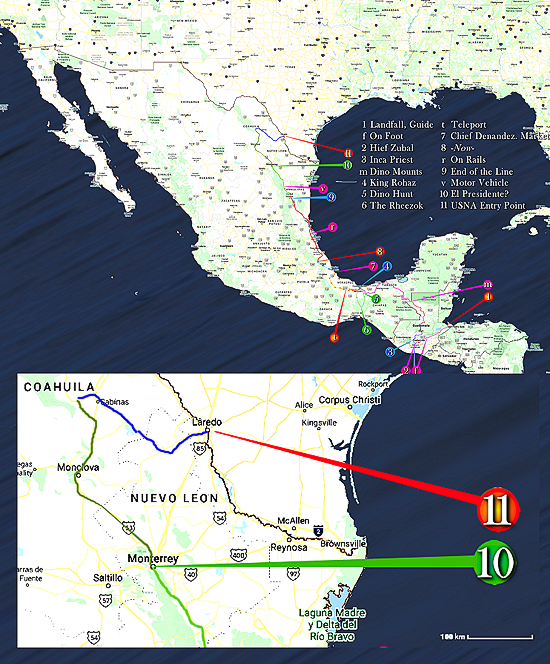
The final map shows arrival in Monterrey and travel from there to the US border at Laredo by an extremely indirect route. When this was drawn up, I had no real idea of what the transport methods were going to be, and so the map is only partially accurate in that respect – they would have actually bypassed Monclova. The location of the laboratory (where dark green becomes blue) was pretty accurate, though. So take this map with a loaded salt-shaker.
Synopsis, Session 12 (from Session 13)
Team Shadow have been dragged from one end of Mexico to the other by their guide and ‘Diplomatic Escort,’ Maynor Morales of Demon House Aries, battling Lava Gods and Dinosaurs, concluding peace treaties with Alien sorcerers, and performing one task after another to earn passage through the Principalities that comprise the former nation of Mexico.
Now, only one task remains before they can cross the border into the United States Of North America and begin the next phase of this critical mission. To find out what it is, they have taken a magically-enhanced train, traveling in relative luxury for a change.
While most of the team were able to get a couple of hours of long-overdue sleep, Maynor had deduced that Specter was a largely self-taught Mage and took the opportunity to cram as much of what he had been taught at Mandarin’s Academy Of Magic into an intense tutorial, covering topics including Mana Curdles, Stealth Spellcasting, Mana Exhaustion, Mana Voids, Suspended Casting, Mana Tags, Elementary Summoning, The Principles of Advanced Summoning, Mana Combustion, Greater Voids, and Dimensional Fissures.
Time is beginning to press quite heavily; you need to cross the border into the USNA by Noon at the latest if you are going to be able to stop the suspected Domestic Terrorists from detonating their black market nuclear weapons.
It is now 8:18 AM, Friday the 4th of July, 1986, and the group have just arrived at the local capital, Monterrey.
Key Points & Notes
Keeping the synopsis short adds to the sense of urgency – a trick that I’ve mentioned (and made use of) before..The critical thing to do is ensure that you’ve included everything important.
If that list of “lecture topics” sounds familiar, it’s because those “lessons” were extracted and published here at Campaign Mastery, in The Meta-Physics Of Magic about three weeks after the fact – time spent adding in some of the foundation information that had already been established in the campaign.
That date of publication gives a correlation between real-world time and the timeline of game sessions, noting that there have been significant disruptions to the regular gaming schedule caused by Covid-19 Lockdowns.
Those also have an impact on the synopses from time to time; those which were intended to be delivered after a disruption need to be a little more comprehensive just to help reorient the players. At the same time, efforts were in place to keep them to a reasonable length – even though those are mutually-incompatible goals!
Synopsis, Session 13 (with excerpts from the Day’s Play)
This synopsis is a bit of a Frankenstein’s monster, a hybrid of the actual synopsis used in session 14 and excerpts from the day’s play, both as planned and as it actually happened.
The party were expected at the Presidential Palace because Morales had telephoned them back in Gonzales. So, they caught a taxi.
The vehicle which has just lumbered around the corner at 110 miles per hour is, perhaps, the most unlikely contraption you have ever beheld. A motorized tricycle with a canvas roof that seems to be built around the rear end of a 1930s green convertible tows a wooden double-decked carriage which would comfortable accommodate a dozen passengers. The steam engine mounted to the rear of the tricycle doesn’t have any visible burner or boiler, seeming to operate on clean thoughts alone. A neon-green sign on the side of the carriage burns brightly even in the light of day.
The driver leans out of his well-padded covered seat, a black sombrero pulled low and his head angled to keep the morning sun out of his eyes and replies “Hola, Amigos, Miguel is your driver today! Diende puedo llevarte esta buena masana? Where to?”
The Driver is as remarkable as his vehicle. A copper-colored lizard, black dining suit, white shirt, red bow tie, and a red rose in his lapel.
As the taxi sets off at breakneck pace, you realize that it has unsophisticated leaf-spring suspension. At speed, the ride promises to be on the uncomfortable side.
Maynor took the opportunity to sneak in some additional lecture notes on magic use, while complaining about not having any prepared lecture notes.
In the Campaign Mastery article, these were incorporated into the text as thought they had all been presented at the same time. In actual play, there were interruptions between almost every section so that the spotlight could look over the other PCs.
Meanwhile, in the carriage below, the occupants have had more time to soak up the uniqueness of Monterrey and the way they employ Magic, as passing views through the windows as the taxi bounces along toward it’s destination at insanely high speeds.
You pass a construction site at which a steel skeleton is being erected without the use of cranes, levitating Girders into place, and in some cases, twisting and bending them into curving forms which are carefully checked against a template that also hovers in mid-air.
I am a strong advocate for the premise that those with ‘special powers’ would find ways to incorporate the casual use of those powers into their daily lives. This holds as true for Class Features in D&D as it does superhero paranormal abilities. Mr Fantastic doesn’t get up to get a cup of coffee – he twists his neck so he’s facing rearward to see what he’s doing and stretches his arms (one holding the coffee-cup) to the percolator, all without leaving his chair. The Human Torch roasts marshmallows with his fingertips. The Invisible Girl should use a force-field coffee-cup, and so on.
Past the construction site, you watch, fascinated, as small, puffy, clouds are formed by a steam engine and marshaled into neat ranks in tidy lines. A series of devices that look something like oversized shower heads pump additional moisture into each, fattening and darkening it until it is ready to be deployed – presumably to a nearby farm.
Across the road, a craftsman is busy making fancy cowboy boots. Nine stands have been set up, side by side, and identical pieces of raw leather placed in the same position on each. As you watch, the one craftsman begins cutting the leather into shape, turning the piece of leather as he does so. On either side of him, four leather knives waft into the air and make identical movements to that of the tool in the craftsman’s hand; the pieces of leather turn at the same time as leather in front of him. By the time he is finished, he will not have one pair of shoes; he will have nine. A little further down the street, a potter works six wheels at once, turning out vases.
Another vendor creates neon-like fireworks in the air in the shape of the stars and stripes to advertise that he has the latest in American convenience products for sale “Muy Cheapo!” This raises an interesting thought for Nightshade – could it be that the major reason why this part of Mexico has recovered so visibly is not just that they are using magic to benefit the populace and economy as a whole, but that they are engaging in trade with the US – whether the nation is recognized as legitimate or not? Presumably, Mexican labor is also producing nick-knacks for the American market, and using Magic to improve their productivity to a level with which the Americans can’t compete. Since Coahuila presumably also trades with its’ neighbors, who trade with their neighbors, progress would be slowly seeping through the Central Americas, diluted with each exchange but accumulating, nevertheless.
Conceptually, this was a direct steal from Asimov’s Foundation series, in which the notion that trade could be a civilizing force all on its own. But the expressions of that principle are completely different.
From time to time, you spot masked people in bright green scrubs touching wands to people in obvious physical distress, who appear to recover almost immediately from their ailments. A sandwich-board sign nearby reads “Atencion de la salud publica, gratuita”, which the education you received through the mechanical educator quickly translates to “Public Health Care, Free”. A broken limb is healed as you watch.
That explains why you weren’t seeing the poor and downtrodden that you might have expected to find – restoring them to health permits them to find work and climb out of poverty, at least in relative terms, a very Scandinavian philosophy. St Barbara approved, quite vocally!
Of course, in the real world, this would not be enough; it’s often not health that holds the underprivileged back. But it would be a massive boost to the middle classes, which would then put more money into the economy, which could then be used to address some of the other problems faced by the poor, homeless, and hurt.
Much of the thinking behind the utilization of magic in this environment stemmed from “A Magical Medieval Society” which I bought many years ago through RPGNow. There’s an updated version that’s come out since, and at least one sequel. Again, the premise is that if you can do something, you would use that ability to achieve more in every aspect of your life to which you could apply it. Even being more efficient in your job creates more time for you to improve yourself, spend with family, etc – unless your working hours are not reduced commensurately, in which case they become additional profits for the business owners, fueling an economic disparity.
Today’s economic and social problems are always caused (at least in part) by yesterday’s mistakes. no matter how well-meaning, just as tomorrow will pay for the mistakes being made today.
The taxi reached the Presidential Palace, a vast and opulent building with people streaming in and out along a white marble walkway. The driver asked which entrance they wanted to use, and was directed to take them to the “Ambassadorial Reception Plaza” – which told the PCs that they should take a moment to clean themselves up and make sure that they were presentable.
The driver asked if they had the necessary diplomatic credentials, receiving an affirmative from Maynor; in the previous kingdoms, he had seemed to combine a role as “supervisor” with a lax, almost casual diplomatic role; because the Kingdoms themselves weren’t legally recognized, the team had not given that a second thought.
This sounded rather more formal, and reminded them that there was a considerable gap between what governments recognized “officially” and the reality on the ground that had to be acknowledged and applied practically. With trade (however unsanctioned and unofficial) across the border to the US, and with House Aries connections into the US Government and relations with the Government here, the Republic Of Coahuila must be on the verge of full diplomatic recognition. And, once one former Mexican state had such recognition, it would be that much harder to deny the others – something the PCs noted rather carefully given their promises to the Rheezok.
Union Jack had another take on the situation; he wondered what the probability was that such a person would be ‘randomly chosen’ to act as their escort and guide? Either the 5th Reich had a lot more political clout than seemed likely, or this diplomatic ‘beat’ was Morales full-time job, or news of their identities/mission had leaked. Discounting the first, that left a chance that the team was in trouble they hadn’t even noticed yet. The diplomatic ‘dance’ when they reached the palace might be very informative, and he resolved to pay even closer attention than he normally would have.
The Presidential Palace turned out to be a complex of buildings with a common facade, permitting it to be completely rebuilt or restructured and the public would never know.
It quickly became evident that Maynor was no stranger to the palace, and was well-known to the key figures in the local government. The party were escorted to the Palace Waiting Room, which would not look out of place in the Versailles Palace. Beginning with the obvious alien (Zantar), their escort began taking drinks orders. The second person he approached was Zeitgeist, who looks human (but isn’t); he recommended the 8,000-year-old quartz suspension, he understands that it is very popular with the Golems who have similar dietary preferences. It is immediately obvious that the staff have read them like a book – even those whose race they had never encountered before.
Maynor shakes his head as the Butler departs. “Before you ask, no, I don’t know how he does it, either – but he’s unerring at selecting those who have traveled the greatest distance from their homes, and a nit-picker when it comes to protocol. I suspect that he’s also the head of the Centro de Investigacion y Seguridad, Mexican Intelligence. Right now, while others prepare the drinks, he will be preparing President daSilva for the meeting.”
“When the President is ready, Carenza will come and get us. This is a formal occasion to the locals – after all, the other nations of the world don’t recognize his Presidency as legitimate, so he doesn’t get to play diplomatic host very often. I’ve found it’s more efficient in the long run to let them get it out of their systems before getting down to business.”
Sure enough, maids and junior butlers – each the opposite of your apparent gender – soon deliver your drink orders on silver trays with a bow or a curtsy. They then stand unobtrusively in the shadows near your elbows, waiting to remove the empty glassware when you’ve finished, or refills, as necessary.
Five minutes later, Carenza returns and leads them to the Presidential Office. You make quite a procession – the elderly butler, so much more than he seems, followed by Maynor, then the rest of you in a group, followed by servants with silver trays for any of you who had not finished your drinks, and servants with napkins for those of you who have.
Carenza leads you into another large and opulent chamber, which includes a large throne, and a business desk off to the side. When the group was arranged in a semicircle according to assumed rank (the same order in which your drinks orders were taken), three men in blue uniforms enter and raise trumpets to their lips before blowing a brief fanfare, which concludes with the crash of cymbals from a second trio. The doors open on the crash, and a man in expensive robes with a long train enters. This must be President daSilva. It’s hard to judge his age – he could be 50, and prematurely gray, or a well-preserved 70. Large rimless square glasses are perched upon his nose. He strides confidently to the throne and sits, cradling his hands in an attentive pose.
Greetings were exchanged between the King and Maynor, and verbal fencing between the two then followed for a few minutes, the upshot being that the two get along but have to pretend otherwise for the sake of formality, and so haggle endlessly about services rendered, debts, and payments. After a while, having ticked all the officially-required boxes, the conversation becomes more personal and friendly. It turns out that the Rose (wine) that the President had asked Morales to evaluate was a local product, part of an ongoing attempt to create an upmarket Wine industry. The King’s conversation is full of hints to a humorous side, a sly wit that he doesn’t get to parade publicly.
Maynor then gets to the point: “Senor Presidente, I know your intelligence service enjoys a challenge. Rather than presenting you with false identities, permit me to simply introduce you to the group whose transit brings me into your presence at this time. Their passage has been arranged as a personal favor to Senor Muerte of Brazil; any diplomatic rank that they may display at this time derives completely from that association. They may have, however, some small influence in other official circles.”
With a sweeping gesture, the President says to the five of you, “I bid you welcome to the glorious Republic Of Coahuila, Senors and Senoritas. The Oracle has, of course, warned me of your coming. I understand that King Rohaz has been displaced in favor of a more progressive Regime, and that a strong case may soon be mounted for the long-overdue recognition of the Sovereign Nations of what was once a united Mehico.”
This showed that the President was right up to date on current events despite the lack of modern communications between the Kingdoms, and opened several eyes wide at the game table.
“Formal Recognition of the Kingdom of Tabasco may soon occur. Should you make overtures to those who now rule there, a positive diplomatic relationship should result. A joint submission to the United Nations for formal recognition is far more likely to succeed. The Principality of Leon would also join with you in this endeavor; which would force acknowledgment of the other Kingdoms as well.”
And the reply showed that while the players had been hatching vague plans about formal recognition of the Kingdoms, Maynor had been orchestrating a more substantial and concrete plan. He was so affable in casual mode that his diplomatic skills kept surprising the PCs; every time that happened, the respect the PCs had for the NPC went up a notch. Every time that has happened in the past, the NPC has ended up being recruited by them – something that wouldn’t be possible, politically, even if he could accept such an offer. So this was a novel position for them to be in. Remember that ostensibly and officially, he was an enemy of theirs!
“That would be well. Lack of assistance from the other nations of the World delays recovery from the Dias de fuego y hielo, which they call Ragnarok.”
“You seem well-acquainted with the only news of significance that I have to offer. So, we have need of further travels within your realm. There is considerable demand for urgency in this matter. Your Northern Borders and trade across them may be At Risk should we fail.”
“So the Oracula has advised me. However, she has also insisted on reading each member of the group you escort. Since she knew when you would arrive, she will be here at any moment.”
A strident knocking comes rhythmically from the doors to the Throne Room. “And here is the Senora now!”
Maynor whispers to the rest of you, “I had hoped to avoid this, but did not really expect to be able to do so – not after the incident with the Rheezok. Your passage has had considerable impact on the Latin Americas even without that, but the importance of that fact sealed the deal, I’m afraid. Don’t be afraid of the Oracle; she is no mere fortune-teller, but is a true Seer. She will see through most disguises, but will recognize your need for secrecy – and probably the reasons for it – and speak circumspectly. She will probably offer personal guidance – you may wish to pay close attention to her insights.”
Slowly the doors to the throne room open. On the threshold stand a quartet that you will never forget. Two of the number are more than 7 feet tall, made up to look like the death-representations from the Day Of The Dead celebrations, in black robes and silver-trimmed hoods. Between them is a tall thin woman wearing a mask which seems to completely block her sight. Before her is a boy of perhaps eight years age, with Central American face paint and a blue feathered headdress. His eyes are remarkable pools of blue that match the glowing orb resting in the woman’s hand.
The way they move is just as remarkable – the escorts movements are all in perfect unison, as though one mind controlled both bodies. The woman doesn’t seem to have legs at all; her skirt falls fully to the floor and flows as though there were nothing of substance beneath it. And the young boy walks normally – if walking normally can be done from almost a foot above the floor, where he stands on insubstantial nothing.
At some unspoken signal, the Escorts take up positions opposite each other on the far sides of the Throne Room, while the child and woman circle around to face Maynor and the group.
“These are the foretold Visitors Of Note – Visitantes Destacados – who are not who they seem,” announces the boy, stating it as a fact, in a strangely deep voice that seems to come from very far away, as he moves to walk to one side of the woman and slightly behind her.
The pair approach Maynor, and appear to look at him closely. They then turn to face other, and you have the distinct impression that communications flow between them even though not a word is said – or can be heard telepathically “This one we know already,” says the boy. “His feet are already on the path unto greatness. Hail and welcome, son of the Mandarin Empire. We once again offer you citizenship bereft of pretense, though we know you will not and cannot accept it.”
“Buenos Diaz, Senorita, and Gracias. Una vez mas debo rechazar tu oferta,” replies Maynor – “I must once again decline your offer.” You get the impression that somehow the boy is lending voice to the woman’s words, and not speaking on his own at all.
Next, the pair place themselves in front of Zantar. “We greet The Sword Of Honor, purified in the flame of darkness and small visions. The great hope of all that is noble, a decision lies heavily upon his heart. Senor, trust that the universe will not permit a wrong choice – only a foolish one.” Zantar’s tail slashes the air back and forth and then seems to wilt as the words sink in. He mumbles “Hola Senorita and Gracias for the advice.”
The duo then come to Zeitgeist. “A Vidente of a different nature to ourselves. A child with a Mind of Mirrors, hard as steel – but a heart soft as a pillow, though she denies it even unto herself. A Truth will wound her deeply when it is discovered. If she can forgive the unforgivable, she may shine as brightly as the Northern Star.” Zeitgeist, they aren’t using Telepathy, and you are fairly certain that Zantar would have reacted differently if their powers had been Chi-based. It’s probably magic, given the widespread use of that art.
Because she considers you a fellow Seer – that’s what Vidente means – the child then opens a window into the Oracle’s mind for you to glance inside. Zeitgeist didn’t hesitate to accept the implied invitation – doing so might be considered rude, and if there was a quartet she did not wish to alienate, this was them.
She found that the four were not individuals at all, but four parts of a whole, a true Gestalt. The woman sees the ‘shape’ of past timelines, while the child sees the ‘shape’ of the future. But these prophetic abilities are not Magical in nature; they have no idea where they came from or how they work.
The two guards act as both protection and reference library; one is a Historian and expert in Politics and Economics, while the other has Doctorates in Physics, Biology, and half-a-dozen other scientific fields.
Each of the four is a mage but they don’t consider themselves the equal of someone like Runeweaver or Maynor in arcane talent.
She was also vaguely aware that they are from widely-separated places – the boy is Brazilian, the woman Mexican, and the Guards are Spanish and Finnish, respectively – so the story of how they found each other and became a unified whole is likely to be a fascinating one.
Before she could even think of looking into that, however, the ‘window’ was closed, and the Oracle moved on.
The third member of the group deriving from off-world, Union Jack, then follows. “The Unlikely Happenstance,” the Oracle names him, “who doubts the rightness of his place in this company. Those doubts may destroy him or he may rise above them to earn a place of respect he cannot now even glimpse. If he survives to see his world aflame, he may become a candle in the darkness. Of all here, his fate is the most uncertain the most quickly.” He thanks he for sharing her wisdom, but still sounds uncertain.
The fourth member to face this probing examination is Nightshade: “The burden of fate lies heavy on the shoulders of this one. She is The Fire incarnate. It may ease your burden, Senora, to know that your efforts will never be in vain, even should they fail, so long as your heart and purpose remain pure.”
Second-last is Specter. “This one has the potential to be a Mighty Oak, perhaps even the greatest practitioner of the Arts in all human existence, but only through great sorrow and suffering will this potential be unlocked. Therefore, Earnest Mage, renew thy peace each day, and let the morrow be of care on the morrow. Wonders await thee, should you succeed in this.” They aren’t using Magic, Specter, or at least, not any magic that you recognize.
Finally, Basalt: “The Heart of their Alliance, released from a terrible curse but recently, and still discovering what remains of his soul and what has been lost. He shall be the Shield Of Truth but must learn anew to trust himself.”
The Boy and woman then turn to face the President. “These are The Ones. All will unfold as foretold. Together, they will perform a great service for Coahuila. You should assist them.” the boy announces. Then the quartet reform without a word, and again moving in their unique manner, depart the Throne Room.
Once again, deep knowledge of the characters and discussions with their owners was the basis of this character analysis. But this also connected back to the character-based beginning of the whole adventure.
After watching the quartet depart, President daSilva says, “I have learned to trust the Wisdom of the Oracle. She foresaw your coming, and that haste would benefit Coahuila. Custom demands that a task be performed to earn permission to journey further through these lands, but I felt justified in taking that foretelling to heart.
“Still, I must still bow to custom or risk the disfavor of the spirit world – not to mention my many political rivals, who are always eager to undermine my rule and strengthen their own claims on the Presidential Palace.
“A task has been chosen accordingly.
“You shall travel to Escobedo, not far from here. You will assist in the loading of certain boxes of custom-built parts that await dispatch from the Precision Engineering Works. You will transport these to Doctor Esperanza at the Rosita Plasmic Works in Neuvo Rosita, and assist in their unloading and unpacking. The required task will then be considered complete.’
Maynor immediately protests. “El Presidente, Neuvo Rosito is more than 300 kilometers away, and does not lie on a straight path toward the border at Neuvo Laredo. We will then be faced with another journey of perhaps 200 kilometers to reach that point from which we may access the nation to the North. I thought you understood the need for urgency – this task may be simple, but it will take us all day!”
“You are incorrect, Senor. This IS the task that the Oracle has insisted you MUST perform to earn passage. But I do understand the need for haste, or at least that there are advantages to my country in permitting haste on your part.
“My rivals would not permit me to assist you without clear proof of your claimed need, Muy Amigo. But, should haste in the task assigned be of proven advantage to the Republic, they will wail and whine, but be unable to mount any serious protest.
“The Presidential Pneumatic will transport you to the Factory in Escobedo. From there, after collecting the parts, you will board the Clippership Peregrine, the fastest vessel within the Republic, which is already en route to meet you at the Factory. It will convey you directly to Neuvo Rosito. After you complete your task, you may then return the Clippership to Neuvo Laredo, where a vehicle better suited to sensibilities North of the border will await you.
“Direct travel to the border by the fastest vehicle you could easily find in Monterrey would take the best part of four hours. My way involves only 50 minutes travel in total, plus stoppage time – perhaps 20 minutes, perhaps 30. It will be much faster, I assure you.”
Maynor, now calmer, replies, “It seems I have underestimated your wiles, El Presidente. Very well.”
“You will be unable to use your arts to speed this task in any way, Senor. The parts under your care are very delicate and would be damaged if you were to do so. They must be loaded and unloaded by means of physical strength. There are those who might seek to interfere or delay you; in this way, you will certainly out-pace them.
“These components are desperately needed for Dr Esperanza’s work. She will explain it far better than I can. Until we meet again, then, Senor, I wish you and your companions Buena fortuna y salud – Good Fortune and Health.”
Maynor replies on behalf of your all, “And to you, El Presidente.”
“Carenza will escort you to the Pneumatic,” concludes the President as he gathers his train and leaves the room in what must be a blatant breach in protocol to judge from the shocked expressions of the servants.
Whew, there’s a lot to unpack from those adventure excerpts. First, excluding the Oracle, only one or two members of the Republic’s government were mentioned or named – but there was enough going on that this wasn’t really noticed. My first draft outline had a couple of others, including a political rival, making appearances, but those got redacted because they weakened the impact of first, the relationship between Morales and President daSilva, and second, the Oracle. It was a choice between focusing on the internal Politics of Coahuila or on the Oracle’s prophecies and descriptions of the PCs and their statuses; I chose the latter.
Part of the reasoning was that by this point I had recognized how compelling a location and set of trappings my Steampunk version of Coahuila could be, within the campaign. And, through the Oracle, I now had a new tool to speak directly to the characters if I had no other way of moving a plot forward. There would be plenty of time for internal politics.
In crafting those prophecies and visions, I actually looked ahead to the very end of the campaign, as it is currently anticipated to be, and the roles that the various team members would have in resolving the cataclysm that the players refer to as “Ragnarok II”, and the experiences that would lead to those roles. These were ‘first hints’ at everything to come.
More importantly, this progressed the overall plotline of the campaign forward. It’s worth momentarily recapping everything that had been integrated into the campaign for the future by this point:
- The political situation in the US;
- The ad-hoc routing around political roadblocks accepted by UNTIL;
- The Fifth Reich as something other than an enemy;
- The political situation in Mexico and Central America, post Ragnarok, and making the PCs the instruments of advancing that political situation as they saw fit to do;
- The Rheezok;
- Coahuila as a setting;
- President daSilva and his staff;
- The Oracle; and
- Unexpected progress in the main campaign plotline.
If that were the full extent of the objectives for this adventure, it was more than long enough to justify everything else attached to it. It wasn’t; that was only the beginning.
Which brings me to another piece of content that might be of value to some GMs out there: the “Pneumatic”…
As the elderly butler escorts you to the “Pneumatic”, he tells you what to expect – though he’s vague on the details. In essence, it’s an ultra-high-speed train, riding through a vacuum trapped in a tube of thickened perspex and driven by – essentially – a steam explosion in the tube behind it. A literal “Bullet Train”. The President backed the research and construction personally, and hoped that it would represent a next-generation technology that could be exported to the rest of the world; but it’s carrying capacity proved far too limited for that. Nevertheless, as a means of getting the President and an adviser or Commander to or from the Palace to the scene of a problem, it has proven sufficiently valuable that it has been retained and extended – anywhere in the capital city is mere minutes away from the Palace. He’s never ridden it.
The Pneumatic itself appears to be two parts joined by a collar; one part is polished silvery steel and extremely streamlined, while the other appears to be a mixture of steel, gold, and brass.
This section continues the lines of the front section and contains an aircraft-style plug door. Inside, there is a vestibule area leading to the passenger compartment. Surprisingly, this is currently in the nose of the contrivance and shaped as a cylinder with rounded ends. The surprise is because, from the outside, a row of darkly-tinted windows were visible in the rear of the device, well behind the rear of the passenger area.
A line of attendants stands ready to assist each of you in preparing for what Maynor’s description makes sound like a very violent departure. Each of them gives each of you essentially the same spiel, so I’ll only run through it once.
“This vehicle accelerates to a speed of 565 km per hour in one-tenth of a second. That is almost eight times the fastest speed of the fastest racehorse, and of course, your trip will be over much more than a quarter-mile. So violent and rapid is this gain in speed that your body will weigh about 160 times what it normally does for that fraction of a second. An 80kg man will have the weight of almost 159 copies of himself pressing down on him, and will feel like he weighs 12,800 kilos.
“Making this experience one that is survivable has dictated the design of everything within this compartment and the safety procedures. Understand that the vehicle is designed to be unable to depart should they not be strictly complied with.
“The seating is of the softest leather backed with steel. They are designed to recline to an angle of 60 degrees to the vertical and to lock in place until it is safe for passengers to stand. There are adjustable recesses in the foot-stand; feet must be placed in them and the wells narrowed until they grip the feet sufficiently firmly. Doing so will cause the chair to recline and lock into place automatically. This, in turn, will cause a pressure-mask containing a bit, again wrapped in soft leather, to unfold from the headrest. Pull it to your mouth and bite down on it; this prevents you accidentally biting off your tongue and forces you to breathe pure oxygen, which assists in preventing unconsciousness and brain damage.
“When it registers that it is being bitten into with sufficient force, the pressure mask will tighten to clamp the jaws in place. This will release a pair of padded panels to either side of the headrest, which must be folded up until they hold the head securely.
“I will then secure you by doing up a five-point harness and pulling it tight; this is made of reinforced spiderweb. It has a quick release which you may employ when it is safe to do so, as indicated by the green light at the front of the compartment. The mask and other restraints may then be removed or loosened. However, passengers should remain seated.”
“Finally, the wrists must be inserted into the recesses on the padded hand-rests until the elbows rest on the pressure pads in the arms. Inside each recess is a sphere with indentations for each finger. Pulling back or pushing forward on this sphere adjusts the armrests.
“When all ten of these, and the two elbow pads, are triggered for all passengers, the light in the front of the carriage will change from Amber to Red, and the launch process will commence automatically, with a 30-second countdown. This time is needed to build up the immense pressure that will propel the vehicle like a bullet from an air rifle.
“To cushion the shock, the entire compartment rests ahead of a special gel that absorbs as much as half the impact, like falling onto a soft bed. The compartment will be forced back by the forces of launch until it locks into position. You will experience a vibration or shudder when that takes place; this is normal and nothing to be concerned about.
“When the light turns green, you will be traveling at more than fourteen times the Coahuila speed limit, and will cover a distance of 157 meters every second, or one kilometer every 6 1/3 seconds or so. At a little more than 5 kilometers distance from your destination, the light will begin to flash; ten seconds later, the capsule will begin to brake. This braking will be relatively gentle; friction will have already reduced your speed somewhat. Nevertheless, it will feel quite violent to anyone not used to it.
“Some passengers with a condition called Epilepsy may react badly to the rapid blinking of light through the windows; for that reason, they are tinted quite darkly at the base.
“Your journey today is to the industrial part of the city, some 15 km away. Arrival will be approximately 2 minutes 10 seconds after departure.”
(Pause for reply)
None of you have any particular problems following the instructions – the chairs (which look like luxury leather reclining chairs) won’t permit you to move on to the next operation until the current one is completed successfully. With the attendants to assist (and remind you of what to do, if necessary), it takes only a minute or so, most of which is pausing in the process while the attendants exit the capsule and the door and tube are sealed. A captive elemental then extracts all the air from the tube while the steam pressure builds. You briefly wonder if they use an elemental for that, too?
Some players have a problem with the GM dropping thoughts into their character’s heads like this. Mine know that they can freely ignore them, or can grab the ball and run with it, as suits them; these are basically present as conversation starters, opportunities for the characters to voice an opinion and then segue into anything their characters want to talk about. I provide a limited tolerance for side-chatter that isn’t game related – one brief joking reference or relevant anecdote, maximum – on the principle that if you don’t let players get such things out of their systems every now and then, they will crop up at more inconvenient times. Maybe half the time, no-one takes the bait, but every time I’ve neglected including such thought bubbles – either in-character or metagame in nature – my game hasn’t played as well as it does otherwise.
But I’m very careful to build from what is documented on the character sheet and any background provided by the player (and for this campaign, I required a written background). What’s more, inherited from the Hero System, these rules track the psychology of a character – extrapolation from those, with one eye to not impacting the playability and functionality of the character usually produces results which are both acceptable to the player and often shed new light on aspects of them that the player hadn’t considered.
There’s an important point of game philosophy involved in the back of this approach: To what extent do PCs belong exclusively to the players and to what extent is the GM a collaborator in their creation?
This process takes an approach that is very heavily-weighted toward the “collaborator” side of that equation; this does not dispute the player’s ownership, control of, or responsibility for, their character, it just means that the GM will help flesh it out from time to time and work to integrate it ever-more-tightly into the campaign world. Your players might have different ideas on the subject, and so might you as GM; but at least the issue is there for you to think about, now.
By the time the servants have exited the capsule after strapping you all in tight, the warning light turns red, warning that you are now 30 seconds from riding the fastest surface vehicle you’ve ever heard of! St B at top speed can travel faster, so can most jet aircraft, and almost all real spacecraft would leave this for dead – but none of those are strictly comparable. It should be one heck of an experience!
Suddenly, the weight of the world feels like it lands on you, quite literally. The air is forcible expelled from your lungs (except those of Basalt, who is strong enough – barely – to breathe normally at 160g’s).
Each PC then had to make a CON save to stay conscious, with modifiers for their physical capabilities. I had put together a customized unconsciousness calculator – a spreadsheet – that took each character’s stats and the results of their saving throw and translated the combination into a period of unconsciousness. I’d provide it for readers, but it’s so specific in its function that I doubt it would be of much use to anyone else. I also rolled in advance for the NPCs and integrated their results into the narrative – giving me a couple of ‘test subjects’ to make sure that the system worked..
Note that the cushioning gel slows the g-forces you experience massively – from 160g to a “mere” 64g – before anything else is taken into consideration.
For those awake for it, a quarter of a second after the biggest kick in the pants that any of you will ever experience – you hope – there’s a violent jerk, the equivalent of a punch to the jaw by a heavyweight boxer, as the capsule locks in place. One second later, strobing indicates that you have been propelled out of the palace at, presumably, 560-odd kph, and the green light shines to indicate that it’s safe to unstrap and loosen your restraints – but to stay in the seats.
Since none of you are epileptic, you suffer no ill effects from this. Zantar and Union Jack come to, the first just as the green light shines, the latter a couple of seconds later.
Everyone else woke up over the next few seconds.
You find that the joins between sections of pipe flash by so fast that they are barely noticeable, less than an eye-blink – a 40th of a second every quarter of a second. It’s impossible to see anything clearly that’s close to the track that guides you, but more distant features can be seen for long enough. Eight seconds after departure, the strobing effect stops as you exit downtown Monterrey. 14 seconds later, the suburban inner city gives way to a substantial wooded tract, which 4 seconds later becomes a large park.
It takes sixteen to traverse the park, which is clearly substantial in size, and perhaps created when the Pneumatic was first built and not yet established as ‘safe’. Beyond it, you find yourselves passing through leafy, well-maintained suburbs, as buildings become visible between the trees. It takes only twelve seconds to flash through several suburbs of similar nature and enter another wooded section. Four seconds after that, the green light begins to flash, warning that you will start decelerating in ten seconds. What the attendants didn’t tell you was how the capsule slows down.
It turns out to be a very simple device – the train passes over a sensor that begins to admit air into the cylinder. The shape of the aerodynamic nose has obviously been calculated to give precisely the right amount of slowing through friction to stop the capsule from it’s present speed (a little less than the initial 560-odd kph) in the close-to-frictionless tube to nothing, in exactly 5 km.
The braking force is about 2g’s, or more than 6 times the force of slamming on the brakes in a car traveling at high speed. This is obviously the reason people aren’t permitted to get out of their seats! Fourteen seconds later, the trees give way to more suburbs, but these have fewer trees and are far smaller and more run-down – more like what you saw in Leon. You have slowed enough that it takes almost half a minute before you notice that the landscape has become far more industrial in nature – more warehouses and obvious factories.
Forty seconds later, the capsule comes to a complete halt. You have traveled 15 km in 2 minutes and eight seconds, and now find yourselves in the Industrial suburb of Monterrey named Escobedo! No-one told you what to do next…
Timecheck: 9:33 AM, Friday, July 4, 1986 (Local Time)
The team then assisted in the loading of Steampunk-technology components manufactured by Escobedo Precision Manufacturing. There was more deliberately steampunk flavor in describing the factory and implying the manner of its’ operations. There was also interplay between co-workers of different races, emphasizing that all sorts of humanoids were now considered citizens of Coahuila. This might well be the most egalitarian society on Earth.
Part of this was a reaction to the blatant racism being displayed by the US President at the time of writing, and part of it was redressing all the implied criticism of the Mexican and Central American peoples reflected in the collapse of government post-Ragnarok.
The Clippership Peregrine turned out to be a sailing-ship of the skies. I had an illustration, but ran out of time before I could get too deeply into its operating principles; in hindsight, that was a good thing because it let me focus player attention on more important things – like the fundamental operating principles of most of the steampunk technology, which had been excerpted from the discussion of the Train (where it had been originally placed, and was irrelevant) to here (where it was about to become directly relevant).
Various roleplaying then took place, which are detailed in the next synopsis, so I’ll skip over them here.
Maynor began brooding as soon as the loading of the Cargo began, but when asked what the problem was, he replied only “I might be wrong. And you should pray to whatever gods will listen that I am.” This became the subject of some speculation before Specter demanded to know the mage’s concerns – just in case.
“I hope these components are not intended for the purposes I think they are intended for,” he replied. “You may have noticed that the Coahuilans use a unique combination of Victorian technology and Magic as the cornerstone of their industrial achievements. The standard models – and a few proven variations – of these devices are at the heart of that technology. These are mechanical devices that, like a mage, operate using Mana, effectively converting it into other forms of energy, using that energy, and then converting the waste back into turbulent Mana.
“The Generator Rings capture Mana and funnel it in an artificial Mana Stream to the Compressors, which focus several such streams into stronger ones. This is then used to power various mechanical devices, like the train that brought us to the capital, or the airborne ship that we currently ride.
“That’s a concept that has never sat well with me. If anything goes wrong, it risks leaving a region mana-dead, or mana-saturated. Neither is very appealing.
“Now, these were described as prototypes. Right away, that’s risky. On top of that, there are these ‘Exciters’ – I don’t know what they do, but the similarity of naming suggests boosting or supercharging the mana flow in some way, possibly using some of the Mana gathered to Energize the rest, effectively casting a spell on the Mana flow that’s powering the spell in order to amplify the mana received. It would be all too easy for that to get out of hand.”
All of which sounded suitably ominous, and redirected the party atmosphere that had prevailed into a state of high tension, exactly as intended.
Key Points & Notes
Once again, I’ve preempted just about everything by incorporating it into interjected annotations. But there are a couple of things to discuss.
I worked very hard at conceptualizing how the game physics of “magic” would integrate into a steampunk environment, because – as noted earlier – this seemed to be the logical outcome of a post-cataclysm Mexico infused with magic and non-human refugees. Certainly, there would have been some adjustment problems on the part of the imported population, but the cataclysm would have seriously decimated population levels, so ‘people’ who simply showed up and went about doing whatever they could for the survivors would have been like answers to a prayer.
Which brings me to another factor in deciding to have governments collapse (even disintegrate) in the wake of the disaster – the US had a significant industrial and technological capability to assist in recovery from the disaster if it were deployed properly, and would have received considerable assistance from beyond their borders, at least until the government blamed the United Nations and walked out on the rest of the world, politically. Mexico would not have possessed anything close to the same level of resources, and would have been quickly overwhelmed once communications networks went down and it became impossible to move by road – first because the world was roasted in 60-plus degree centigrade temperatures (more than enough to melt asphalt) and was then covered in a meter of snow a day for almost a month. Someone local would have had to take charge in order for people to survive, and therefore, everywhere were people had survived, someone had taken charge. As the snow melts (adding massive flooding to the problems), governments start putting themselves back together from the pieces – but expecting all those who took charge to simply give back the authority that they have acquired – it simply wasn’t going to happen.
The principle is therefore established that the more industrialized a nation is, the more it can retain its unity and emerge ‘relatively’ unscathed (nowhere was untouched), and the less industrialized, the more tribal the results would have been – but with people remembering how things used to be. You either suppress any trend towards ‘progress’ that might undermine your authority, or you find yourself another unifying force (religion in Leon and Veracruz, magically-driven technology in Coahuila), and then advance as fast as your unifying force permits. This mimics the evolution of society between the 16th and 19th centuries in many ways – and hence the pattern of the Kingdoms emerges.
There are a couple of points about Infodumps to emerge from the preceding – specifically, breaking them up whenever possible and finding a way to deliver information when it becomes relevant and not before. The more you can do this, the less your players will be overwhelmed and your game time chewed up. That’s not the only trick to it, of course – but it’s a solid start.
Finally, I’ve left the next synopsis intact, so that you can appreciate how strongly it has been compacted, compared to something approaching the original telling (above).
Synopsis, Session 13 (from Session 14)
The team, posing as Team Shadow, accompanied by their guide, “Diplomatic Escort”, and new-found ally, Maynor Morales of Demon House Aries, reached the capital of the Principality Of Coahuila, Monterrey.
They utilized one of the most exotic forms of transport that they have yet encountered to travel to the Presidential Palace, where they met various colorful characters, culminating in an audience with El Presidente Ramon daSilva himself.
The assemblage was then joined by a most unusual quartet who collectively made up “The Oracle”, capable of seeing past, present, and future. They had prophesied the team’s arrival, and that they would perform some Great Service for the Principality – if daSilva assisted them in completing their obligations quickly and heading north.
To that end, he made available his exclusive rapid-transit system through the city, the “Pneumatic”, and hired the fastest Airship in the Kingdom, the Clippership Peregrine, to carry you the rest of the way on the assignment that he was politically obligated to set before you.
That task: to collect various prototype components of some sort from the specialist manufacturer, the Escobedo Precision Manufacturing Works and convey them to a “Doctor Esperanza” at the Rosita Plasmic Laboratory and you would then be free to race to the border city of Neuvo Laredo in the Clippership, where vehicles “better suited to the sensibilities of Coahuila’s northern neighbors” would be waiting for them.
If all went according to plan (and it has, so far), this will shave something like 3 1/2 hours off the total trip to the USNA.
The parts loaded, the Clippership set off at enormous speeds for the town of Neuva Rosita, 250km away. The expected flight time was about 30 minutes. That means that you’re traveling at somewhere close to 500km/h – and acutely aware that sunlight heats ground (and hence the air above that ground) unevenly. While too gentle to be noticed at slower speeds, or in larger aircraft unless the turbulence is likewise super-sized, the Peregrine has been bucking and tossing like a cork descending a raging torrent. Throughout the trip, four things have been used as distractions:
1. You’ve all been astonished at how Green the province is. The use of magic has transformed a desert prairie into a breadbasket, with mile after mile of lush, productive, cropland. It looks the equal of Missouri, or of Southern England – but it’s not much smaller than Montana.
2. You’ve all taken a stab at trying to figure out what the cryptic names of the pieces of Cargo mean. The consensus is that a “Toric Generator Ring” is a piece of a power supply that gets arranged in a circle or Torus – hence the name. “Manic Exciter” and “Manic Compressor” have taken a bit more effort; the best you’ve been able to come up with is that the one supercharges a Mana Flow by somehow dumping extra power into it from somewhere, while the other squeezes a Mana Flow into a more coherent beam – a laser beam compared to a spotlight. But these guesses might be completely wide of the mark.
3. The one exception to this party game, Maynor has been brooding ever since you loaded the Cargo, but when asked what the problem was, he replied only “I might be wrong. And you should pray to whatever gods will listen that I am.” When the guessing-game of the cargo was set aside, this became the subject of speculation. But, after a while, the lack of any hint as to whether they were right or wrong put an end to this pastime.
4. So you all turned to musing on the advice that the Oracle gave each of you, and its meaning, interspersed with speculation about when the first Muffins would appear on St Barbara’s pillow.
Finally, Specter confronted Maynor directly. He reluctantly explained his misgivings about the technology of Coahuila in general, and the terminology used to describe these experimental components, which could – if the worst happened – leave an area either magic-dead or magic-saturated. Since a magic-dead zone was inherently inimical to life, while a magic-saturated environment turned passing whims and idle fancies into magical reality without restraint or consideration of consequences as well as spontaneously-manifesting magical effects of more random nature, this put rather a damper on the exuberant party atmosphere created by the imminent end of their Mexican Trip.
I went into more detail about the Rosita Plasmic Laboratory because it was to be the scene of considerable activity. Security took the form of robotic guard dogs which referred to themselves as Mechanicals. Most of the workers were also mechanical.
Dr Esperanza is a very small woman, standing 2 1/2 inches less than Nightshade, who is easily the shortest member of your group. When she speaks, her voice is punctuated by pops, crackles, and wheezes. “My, but you are a strong one”, she buzzes, looking at Basalt, before touching a control on her sleeve. Her forelegs begin ratcheting upwards, (cht-cht-cht-cht-cht), lengthening until she can look you in the eye. “Please, put those down over there,” she continues, pointing at an industrial trolley.
After the delivery was offloaded, she directed another mechanical assistant to replenish the Airship’s supply of “Catalyzing Aether”.
Technobabble, steampunk-style, necessary to transform the airship technology from extraordinary into accepted and routine – in this environment. Since a non-magical society would have no chance of replenishing this consumable, it also ‘confined’ the technology to this part of the world, minimizing potential disruption elsewhere.
Failure to confine technology that the GM makes available to the PCs is one of the most common mistakes that a GM can make. It doesn’t matter if it’s a magic wand or an engineering marvel, the consequences can completely destroy a campaign – I’ve seen it more than once.
The most memorable example that’s coming to mind right now is a +10 Sword Of Dragonslaying, introduced to solve a plot hole that the GM had written himself into. With that weapon, multiple dragons were slain by the wielder, and their hoards grabbed by the party, who became the wealthiest people in the world, and awash with magic weaponry. Which was when the campaign imploded.
Now, this is obviously an extreme example – but that only makes the flaw obvious, it doesn’t negate the principle: When in doubt, think about ways to restrict or localize an effect. Instead of a healing wand that makes the party nigh-invulnerable with the equivalent of infinite hit points wherever they go, give them a healing wand that was crafted for a specific mission and only works within a certain range of the evil tower it was intended to let the party target. Your players may grouse a bit, but you’ll still have a campaign afterwards for them to grouse in.
Anyway, I then went to some lengths to establish Dr Esperanza as a key NPC because (again) I saw potential for the character beyond this one adventure.
Noticing the PCs reacting to her demonstration of personal technology, she gave a semi-human but warm laugh. “My own silly fault,” she admits. “I was responsible for a mining facility that was experiencing difficulties staying on schedule, so I went out to take a look for myself, despite reports that the reason for the problems was instability of the mine walls and ceilings.
“Sure enough, there was more to the story – the vibrations from the mechanical diggers were destabilizing the rock. And that was when the ceiling of the mine-shaft gave way on top of me. The diggers, as per their programming, set aside their task and got me out, but my legs, pelvis, ribs, and one arm were crushed to a red smear.
“Fortunately, we have some skilled surgeons here in Coahuila, and a ready supply of replacement parts created by our ingenuity. Like most Automa-brids, as I grew accustomed to the replacements, I began to design custom requirements to suit my own needs, and hey presto! Here I am, the hybrid being you see before you!”
This was important, because those character traits were about to become critically important.
While waiting for the Clippership to be refueled, she showed off the facility (and again reflected Victorian social values – the civilized thing to do with any visitor was always to provide refreshments), giving the group the two-peso tour.
“We’re a fully-functional Plasmic Generating Facility, broadcasting power to a quarter of the Principality,” she explains. “Mana is collected from the environment and converted into a form of electrical fluid we call a Plasma because an appropriate gas – Neon, Argon – illuminates with a bright glow when the electrical fluid is present. The Plasma is then converted into a number of different forms – a Catalyzing Agent used to fuel airships, electricity for local consumption, and broadcast power waves for industrial applications.
“Some operations convert one or more of these forms of power back into Mana, supplemented by other forms of energy they may collect. We do that here ourselves, for example, to power the Mechanicals.”
“Correct me if I am misinterpreting, Doctor,” said Zantar, one eye firmly fixed on the two mages. “Are you telling us that you can convert electrical or mechanical energy, say from a waterwheel, into Mana by adding that power to an existing supply of Mana that you have pre-converted into a compatible form?”
“Yes, that’s exactly right, Mr Kzin. Of course, once it’s used as Mana, it is in a turbulent state and can no longer be used for practical purposes. At least, not until now – that’s where the components that you have delivered enter the picture”
Maynor’s frown deepened; he looked like someone attempting to cure biting into lemons by chewing on a grapefruit.
More infodump, originally written as notes on how the Clippership worked and relocated to a point of greater relevance.
Dr Esperanza explained that she had devised a way to coalesce a number of smaller turbulent Mana streams back into a single stable Flow, which could then be recirculated back into the Mana Converters. Of course, this required some refinements to the standard technology.
“By collecting and recirculating the Mana, since Mana is not consumed when it is used to create a magical effect, this device will revolutionize Coahuilan Industry. Power can be used and recirculated, to be used again, almost endlessly, in a closed loop. Only power consumed in other forms, and losses through inefficiencies in the conversion process, will need to be replaced.
“Effectively, that’s a million-fold increase in the capacity of a standard Plasmic Generator, maybe even a billion-fold! Imagine it – the one installation like this one able to supply the energy needs of the entire planet for the next millennia or more! If it works, we will be selling Mana-based technology all over the world as fast as we can manufacture it!
“Of course, that’s still some way off – all we have at the moment is a small prototype, itself a scaled-up version of a small proof-of-concept demonstration model. There are sure to be some bugs to be worked out before we can go to full industrial scale, and it may even be necessary to build a whole new facility to exploit the technology properly.”
Maynor looked even more upset. “Mana Flows are not the tame and regulated thing you imagine them to be, Dr Esperanza. Even if your prototype is only a ten-thousandth the effectiveness you hope to achieve, the results could be disastrous – have you considered the effect on your generator if one of the Mana Streams on which it depends were to abruptly increase in power 10-fold, 100-fold, 1000-fold? Yet that is precisely what you intend to do.
“If your safety precautions are inadequate, it could be cataclysmic for life on the entire planet!”
I wanted to place the PCs in the middle of two NPCs who were disagreeing with each other and both right from their own perspectives. Dr Esperanza, the eternal optimist, could only see the potential positives (and they were not insignificant); Maynor saw only the potential dangers if things went wrong. Between the two of them, they articulated the risk-vs-reward equation that summed up the existence of the facility and the work that was taking place there.
Unfortunately, Maynor’s lack of respect for Dr Esperanza, and her own sensitivity to the subject, painted them into opposing corners; a more diplomatic approach and offer of assistance might have yielded a different outcome.
This was not accidental on my part; I wanted the PCs to witness an approaching train-wreck but not be able to do anything about it until the inevitable derailment. This counterbalanced all the talk about how influential they had been in the Americas already and showed them that there were limits to how much they could change the world. This tension has been central to the campaign from game session #1, back in 1981.
But it was also important to show that despite his considerable diplomatic skills, Maynor still had his limitations and blind spots. I’d given the character considerable scope for showing off, it was important to keep him ‘human’.
Long story short, the test would go ahead. Esperanza was convinced that all reasonable precautions had been taken and preparations made for the worst-case foreseeable outcome.
And I had worked hard on those precautions; I wanted them to appear sufficiently adequate that a reasonable person might be convinced by the reassurances that they provided.
So incensed was Maynor that he over-spoke as the group re-boarded the airship –
“Smug, arrogant, over-optimistic blind fool, forgetting that all the progress she takes for granted was built on the lives of those who preceded her! Hubris and Myopia incarnate, as though a Mana Stream of that intensity would not have entirely distinct properties, like matter super-heated for the first time. It will all end in disaster. Immediately I return, I will notify the Council Of 13. We will put an end to this dangerous flirtation with disaster – if it is not too late by then.”
The full scope of his authority was thus revealed – in any matter that the locals acknowledged (willingly or forcibly) his capacity to speak for this “Council of 13”, his authority was absolute, no matter how politely expressed. Only if the locals resisted this acknowledgment was he forced to actually do more than make a status report to the command structure of House Aries – and, since he was a member of that ruling council, and a skilled politician and leader, he could usually be confident of their responses to any matter placed before them.
Union Jack was the only PC who was reassured by these developments; this acknowledgment of his true authority had made it clear that Maynor’s normal role was as Liaison to the Puppet Governments of Central America, and it was in that capacity that Muerte’s diplomatic outreach had arranged for him to be their guide. Hence, their mission was still secure.
Eight minutes later, you have reached cruising altitude and accelerated to full speed, already a third of the way to the border, still more than 100km away, when the air is suddenly filled with static charge. You all feel it crawling over your skin like ants. Electricity arcs between the ropes, and between the ship and the ground, and the ship and the balloon overhead.
Maynor yells, “Specter – the biggest Mana Curdle you can create, Immediately! You must protect your friends – I will have my hands full protecting the crew. Everyone, between us and the stern, and protect your eyes! Quickly! – we may have only seconds!!”
Specter, you can feel the Mana flows twisting and turning away from a point somewhere behind the vessel.
Union Jack and Zantar didn’t hesitate, but acted in completely different ways. Jack took up position directly between Specter and the rear of the ship, while Zantar erected an anti-magic force-field and started leaping and bounding all over the place, grabbing crew members who were a little slow to react and physically tossing them to the rear of the ship, including the loudly-protesting Captain Ferracorizon. Like a well-oiled machine, the other members also swung into action. In a trice, everyone was safely in position as Specter obeyed Maynor’s instructions, and an unbelievably bright light blossomed behind them Suddenly, you could hear a pin drop, as though someone had muted the roar of the wind whistling past the airship, and everyone had an acute down-elevator in the pit of their stomach as the ship started to drop like a stone.
Zantar yelled to Nightshade “Dark Force-field Shield us from that light!” – but she was already doing it.
Specter sensed every Mana Flow in the vicinity turn to flow toward the Laboratory.
The light faded after about 30 seconds. The ship was still dropping like a stone, and the ground looked a LOT closer than it had – Nightshade, as the most experienced flier, estimated that they had fallen 3,000 of the 5,000 meters in altitude that they had attained, roughly the height of the Pyrenees.
Looking back toward the town 40-odd km behind you, an enormous explosion has created a clearly-visible shock-wave and a multi-kilometer-wide mushroom cloud. As you watch, the explosion grows and reality seems to begin to fray at the edges.
Everyone then lost 10% of their hit points for no apparent reason, and all Recoveries went off-line for the time being – no healing, no recovery from exhaustion. This meant that the PCs would have to be very careful to make their efforts count. Several of them would also have recognized this as a sign that magic had been depleted in the vicinity, and for an unknown distance beyond. That 10% was only the beginning; everyone in range of the explosion was starting to die.
But Specter, as the mage of the party, could see that the disaster was even worse than that.
Specter, you realize that the explosion is something you’ve never seen before, an explosion of mana itself. The fireball will continue to grow, fed by the mana streams flowing into it, and attracting mana flows still unaffected as it grew large enough to do so. But it would also project upward as the earth orbited away from the explosion point, becoming a column of fire fueled by all the mana in the vicinity, maybe all the mana on the planet. But if all that mana was flung out into space, the resulting mana potential will be so extreme that no celestial mana will flow in to replace it, so the entire planet would become mana-barren. You are literally watching life die on earth – all life – unless something is done about it.
Key Points & Notes
In a roleplaying game, any prophecy of disaster comes true ninety-nine times out of 100. That’s because disasters challenge the PCs and make for interesting stories. And that one in 100 usually arises because the GM doesn’t want to be predictable.
But in this case, I had made it clear that the experiment was extremely dangerous. What neither the PCs nor Maynor had taken into account was Dr Esperanza’s psychology – she did not know what authority he could bring to bear, but knew from the arrangements that he at least had the ear of the President himself; it was entirely possible that he could have her experiments shut down completely, something that was intolerable to her. Too much of her self-esteem, and the single-mindedness that had permitted her rapid recovery from her injuries, were now bound up in her work. As soon as the airship departed, she rushed through the installation of the parts and threw the switches…
That’s illustrative of another important principle – if you want your NPCs to act in a certain way, design them so that behaving in any other way would be contrary to their nature. If they are already established, you may need to have them undergo experiences that modify their normal responses to what’s needed.
A GM can’t afford to get too attached to his NPCs. They are as rubber mice to a cat, or should be. Otherwise, he can find it difficult to be cruel enough to them when that’s what the plot needs.
Synopsis, Session 14 (from Session 15)
Last time, you delivered some experimental components to the Rosita Plasmic Laboratory and their head scientist, Dr Esperanza before departing aboard the “Clippership” Peregrine. Maynor, in particular, was a prophet of doom, intractably opposed to the very idea of what Esperanza was attempting. The rest of you had more open minds and found the concept a of Recombinant Manic Translator – effectively a near-perfect perpetual motion device based on Mana use and re-use – to be a fascinating one.
The laboratory was more than 40km behind you, eight minutes later, when a tremendous explosion broke reality at the seams as all the Mana in existence began to explode. All healing and recovery stopped, immediately.
Using tricks of the trade that Maynor had taught Specter earlier in the journey, the Mages were able to protect the travellers and crew of the Peregrine from the other effects of the Mana explosion and you immediately reversed course. Planetary Catastrophe trumps national emergency, or international politics, any day of the week.
As you sped back to the scene, hasty plans were laid to respond to the situation that your more-acute-than-human senses witnessed at the Laboratory and in the town.
What followed was a series of rescue operations and confrontations. Spectre, Zantar, and Maynor first overcame the Mechanical Guard Dogs, which had run amok, and the mages then began draining Mana from the Fireball until you could get close enough for Zantar to smash the critical components and end the major immediate threat. In the course of this operation, they found the body of Dr Esperanza half immersed in a wall that had flowed like water and then resolidified after encasing her. Only her mechanical legs remained visible.
Is that the end for the Redoubtable Dr Esperanza? We shall see…
In town, the rest of the rescue party were dealing with the side-effects of the explosion. Basalt confronted the marble column from the town Bank which had animated as a Stone Golem; Zeitgeist dealt with a steel creature that proved to be more feline than monstrous, but which could slice to ribbons with little more than a touch, and Nightshade grounded an opportunistic Lightning Elemental that had stumbled through the weakened dimensional boundary.
Those in town then turned their attention to more mundane rescue operations, freeing people trapped in collapsing buildings, a heart attack, manic winds, metal turning to sand – dangerous in cars travelling at speed and in building skeletons – and people who were partially buried beneath rock that had temporarily liquefied. These operations are straightforward but ongoing.
Meanwhile, the trio at the Laboratory were confronting a new problem – the frayed edges of reality that had been worn threadbare by the rushing cascade of Mana were not really rejoining the way you would have hoped.
I often pose problems that the PCs have to find a way to solve. I make sure that there’s always at least one viable solution, but don’t force it on the players; if they come up with a satisfactory solution of their own, so be it. If there are potential problems that they aren’t taking into consideration, I may drop a hint or two if there’s someone who can see the possible complication. I will always answer any question their character is in a position to know the answer to, and if there isn’t someone in such a position, will guide the PCs in finding an answer to the question, or discovering that it would take too long to resolve that particular question. But final decisions are always the players.
In this case, I had a solution prepared if the players needed it, and suitable prompts, but the PCs managed to find their way to my solution on their own. It involved the spell that the Rheezok had used to draw everyone into a mutual dream-state to facilitate communications between the species….
Using that spell as a Mana Tag, Spectre could summon the Rheezok negotiator who went by the name “Eldar”. Nightshade could then invoke the mutual defense agreement between the two groups, and that would enable them to put his planned solution into practice.
The Rheezok guided Spectre in how to construct a self-perpetuating spell that would siphon Mana from the natural flow in the uninjured regions and use it to knit reality back together faster than it could be damaged, then recreate the spell with the healthy mana flow that resulted, bootstapping itself until all the damage was repaired. Because this did not attempt to affect the mana of the entire planet directly, it was possible to construct a spell that no mage could possibly cast – and cast it.
They then returned to the town and joined in the rescue operations. Help finally arrived, led by President daSilva himself. Nightshade observed that he had enough sense not to try and “take charge” – instead, he describes priorities to his rescue unit commanders, listens to their advice and comments, makes decisions, and sets about knocking down any bureaucratic road-blocks. Whatever is needed, in equipment or supplies, for example, is immediately en-route – he is able to micromanage to such an extent that he is revising the travelling sequence of the convoys of supplies despatched in advance, on the fly, without recourse to written notes, and to give each a specific street address at which they are to stop and unload.
Maynor greeted the President and then took decisive action after apologizing for the confusion that he was about to create.” With that, he created a magic circle around the entire group of travellers and cast a spell on it, which Spectre was able to identify as a two-way illusion – inside, they saw an illusion of the world outside the magic circle, while to those outside it, both they and the circle had vanished.
“I did not want him to ask too many questions. For one thing, my answers might be impolitic, and for another, we have a decision or two to make that require privacy. We may have one last rescue to mount, en route to resuming our mission.
“I can’t see President daSilva abandoning research into Recombinant Mana Power Generation, despite this disaster. He would be too politically compromised if he did so, as he intimated back at the Palace.
“Spectre, Nightshade, would you agree that since any other engineer is likely to be less competant, the security of the planet would be enhanced with Dr Esperanza still in charge of that research? She at least had some inkling of the concept of safety measures and precautions – no matter how inadequate her preparations were – and seemed able to learn from experience.”
There was general agreement. “Well, unfortunately, she did not survive the disaster, but I don’t see why we should let that stop us. We have one opportunity yet to save her, and it all rests on giving you the opportunity to complete your own mission successfully.”
And with that glimmer of hope in the face of disaster, this article comes to an end. There was more to the actual game session, as the PCs came up with a plan, led by Maynor, but that will be dealt with in the third and – for now – final part of this series.
That’s because there was an important coda to the disaster, involving the theory of time travel and some wrinkles that the players hadn’t considered before, but that were implicit in the campaign physics that was already well-established.
Even though that coda took place as part of the 14th game session (the one detailed above, in other words), it is far more tightly bound to the campaign content that followed, part of the segue from Phase Two to Phase Three of the sub-campaign.
So, for that reason, I’ve decided that this is the right break-point to separate part two from part three of this series.
I’m nowhere near as finished on part 3 as I was when I started this part, so it might take longer than a couple of weeks for the last part to happen. Next week, another “short” article not connected to this one.