Campaign Mastery helps tabletop RPG GMs knock their players' socks off through tips, how-to articles, and GMing tricks that build memorable campaigns from start to finish.

Practicalities Of Society


Image Credit Freeimages.com / Svilen Milev
Shadows added by Mike

For today’s article, I’m reaching back into my memories of the mental processes that I employed to construct the Orcish Society in my Fumanor Campaign, and generalizing them, because it works for any society in any game – heck, I’ve just been applying the same basic principles to 27th-century Scotland for my Dr Who campaign.

Because these processes are simple and yet profound, this might be a relatively short article but it will still pack a wallop in terms of significance.

Iteration

At the heart of the process is a core concept that I have been trumpeting loudly and regularly for many years – Iteration. This essentially means doing the same thing, or sequence of things, repeatedly. I won’t go into too much detail because (a) it should become obvious during the course of the article, and (b) I’ve already covered the subject in Top-Down Design, Domino Theory, and Iteration: The Magic Bullets of Creation.

Exit Trigger

Iteration essentially means devising a process, that loops back on itself. Anyone designing such a process for a computer program knows that one of the critical decisions that need to made is what will trigger exiting the process. There are essentially two possibilities, both very similar:
 

  • Perform Process until the exit trigger condition is achieved;
  • Perform Process until a list of subjects is completely processed.

The first is the more general one, and when performed by humans, it permits an abstract trigger, such as the results being “good enough for the required purpose”. The second is more specific, and requires the generation of the list in advance, possibly by means of another example of the first. This is the methodology that I use when constructing a society for an RPG.

1. Foundation: Leadership

I always start by deciding what the type of society is, and in particular, how leaders are selected (Refer Pulling That Lever: The Selection Of Leaders In RPG Societies for the most common approaches).

That gives me a lead on who the actual Leader currently is; I’ll make any notes that come to mind on that subject, but don’t commit to a final personality profile at this point.

2. Factions Within Society

Next, I generate a list of all the different factions within the society. A good starting point is Johnn’s series on City Government Power Bases, but that series is incomplete in my book; once the Essential Pulp Reference Library series is complete, I have Johnn’s permission to extend it. He’s listed 9, I expect to extend that list to 21. So it’s just a starting point, at least right now. Note that I only list the important ones; the rest form a final group, a coalition of minor forces.

At the moment, these factions are nothing more than a 1- or 2-word title – “Wizard’s Guild”, “Merchant’s Guild”, “Builder’s Union”, “Military Command”, “Church”. It’s too early to develop any significant information about them, though I will (of course) jot down any ideas for future reference.

Also note that I don’t number the list at this point; there are several other steps to go through first.

3. Natural Rivals

Step three is to go through the resulting list looking for any factions that would be natural rivals, given the circumstances, adjusting the sequence to place these sequentially and making notes as necessary.

4. Faction Strength

Step four is to go through the resulting list estimating how powerful each of the factions will be within the social structure. I classify each into one of three categories, A, B, or C.
 

  • A means that the faction can exert influence over matters outside their direct area of responsibility within the society.
  • B means that the faction can exert influence only over matters within their direct area of responsibility (and any related matters) and may be overruled by an ‘A’ faction. ‘B’ factions often wield their most powerful influences indirectly.
  • C means that the faction can exert influence only over matters within their direct area of responsibility within the society and that this influence is strongly limited, and may be overruled by ‘A’ or ‘B’ factions.

5. Assess Rivalry Balances

I pay special attention to the natural rivalries that I have identified, and the relative power of the factions. There are six possible combinations: AA, AB, AC, BA, BB, BC, CA, CB, and CC. But, when you look more closely, several of these are the same – BA and AB are the identical, for example; the factions are simply listed the other way around.
 

  • AA This rivalry will be a central feature of the society and its administration.
  • AB The ‘B’ faction will need to attract an ally of roughly equal significance in order to achieve parity within society to its rival, and may need to compromise its priorities to achieve that alliance; where such compromise is not necessary, the objectives and principles of the allied group will need to be accepted and added to those of the B faction. If such an alliance is not possible, the B faction will control only those matters directly related to their function within society if (or perhaps when)they are opposed by the A faction.
  • AC The ‘C’ faction can’t do much more than complain or provide nuisance value to the ‘A’ faction, except in matters strongly related to their social function, and even those will probably be compromised by the A faction.
  • BB This rivalry will be a minor feature of the society, and the objectives and principles of the two factions will often be subordinated to other priorities. To exert dominance over their rivals, a faction will need to demonstrate a confluence of interests with a more powerful faction, but this will be on an issue-by-issue/case-by-case basis.
  • BC A weak influence vs an even weaker influence, it will be rare for this rivalry to matter very much within the society. Both will be dominated by more important issues and priorities. As with the AB rivalry discussed earlier, the C will need to ally itself with at least two other factions of equal strength to itself in order to balance the influence of the B faction.
  • CC This rivalry is constantly overshadowed by more significant influences which provide the context for the struggle between the rivals. It will be unusual for either faction to be significant within the society.

6. List three things about each faction.

I do this in a separate document, but that’s up to you. This step may involve quite a bit of brainstorming; you want to identify the distinguishing traits or characteristics of the faction, the things that make them different from every other faction. This could be an objective, or a philosophy, or a motivation, or a favorite tactic to influence things ‘their way’. They need to be commensurate with their Authority Level. They should not be things like where the headquarters are located or anything like that. If a significant NPC has already been developed and introduced into the campaign then their name may be listed as one of the things provided that you can also make a supplementary notation as to how typical they are of the faction and how their opinions (etc) differ from the typical.

I will also tend to eschew things like symbolism at this point; what they wear, or the banner they operate under, is not significant to defining their role within the society.

If I need to brainstorm, I will usually use either the The Backstory Boxes – Directed Creativity approach, or one of the methods described in The Characterization Puzzle series (part 1 introduces the series, parts 2-4 offer three different techniques, and part 5 talks about how to choose between them).

The more creative and inspired you can be during this phase of the process, the better, but don’t bog yourself down in too much detail at this point!

7. Construct Necessary Alliances

Alliances come about in one of four ways:
 

  • Doctrinal Resonance is when two factions want similar things, or both factions achieve their objectives as a result of one broad social policy.
  • Factional Balance is when two factions have goals or ambitions that don’t conflict, permitting them to unite against a faction that would otherwise dominate them. These needs were noted in earlier steps, but – to recap – two B factions make one A faction, and three C factions make one B faction. A coalition of six C factions are NOT enough to make an A faction, however, as it can be confidently assumed that there would be sufficient disparity of interests within such a coalition that at least 1/3 of them would be opposed to any particular measure; you need eight C factions to equal one A faction, and that’s extremely unlikely. They would tend to splinter into two B faction equivalents and a couple of independents.
  • Manipulation But the unlikely can happen, especially if someone is pulling strings to play one force off against the other. This might be the leader of the society, or some advisor behind the throne, or even a B faction exerting indirect influence in such a way that their hands (overtly) stay clean. I usually refer to such alliances as Arranged Alliances.
  • Historical Relationships Finally, relationships can and do often linger long after the confluence of interests that created them ceases to apply.

Where you have a two-member alliance balancing a single faction, that’s a “simple” alliance. Where you have a multi-member alliance balancing a single faction, that’s a “compound” alliance.

Most societies are naturally self-balancing over time unless the leader of the society chooses otherwise. Even if the leader elevates a particular faction to “A+” influence – a Cleric or Devout Believer or even a Fanatic in a Theocracy, for example – the rest of the society will tend to self-balance.

There is a set sequence in which I create alliances, based on the likelihood of them forming and the likelihood that they will be stable enough to continue to exist beyond a single-issue confluence of desires/intents. This sequence is:
 

  1. Simple Alliances based on Doctrinal Resonance – i.e. “Natural Allies”
  2. Simple Alliances based on Factional Balance – i.e. “Allies Of Convenience”
  3. If I have identified a manipulator who is likely to be responsible for a Simple Arranged Alliance, I look for such an alliance.
  4. If I have created sufficient History of the Community/Nation/Race to identify a reasonable (simple) Historical Alliance, I look for such an alliance.
  5. Compound Alliances based on Doctrinal Resonance – i.e. “Natural Allies” – these are much rarer, but the possibility needs to be excluded before continuing.
  6. Compound Alliances based on Factional Balance – i.e. “Allies Of Convenience” – these are far more likely because they are matters of pragmatic political calculation.
  7. If I have identified a manipulator who is likely to be responsible for a Compound Arranged Alliance, I look for such an alliance.
  8. If I have created sufficient History of the Community/Nation/Race to identify a reasonable Compound Historical Alliance, I look for such an alliance.
  9. Now things are getting desperate. I either have to create a Manipulator to satisfy possibilities 3 or 7, or enough history to justify a ‘yes’ to possibilities 4 or 8.
Additional Notes on Arranged Alliances

It’s important to note that these alliances were rejected as “Natural Alliances” and as “Allies Of Convenience” (indicating that the groups not only have little or nothing in common, but actually oppose each other on at least one issue or group of issues.

There are two subtypes of Arranged Alliances that result: Stable and Unstable.

Stable Arranged Alliances indicate that the alliance has been in coalition long enough for some mechanism to have been established between the members of the alliance for the resolution of these conflicts on a case-by-case basis. This can’t be simply the more influential faction overruling smaller ones. There will also need to be some mechanism for the discharge of tensions between the members that could drive a wedge between them. As in (5) above, these are rare, but need to be excluded first because there is someone manipulating the society/politics to create an “unnatural” situation.

Unstable Arranged Alliances are those in which the two members simply go their separate ways, or even link up with other allies, when matters on which they disagree arise, but otherwise present a united front against the faction that they are balancing. This results in what can euphemistically be described as “robust political debate”!

I avoid unstable arranged alliances as much as I can because, even though they may be more realistic, they are a lot more complicated to administrate as a GM.

The GM needs to make notes on the “touchy subjects” and how the “usual politics” changes when they become significant.

Additional Notes on Historical Alliances

Historical Alliances suffer from the same problems as Arranged Alliances. The implication is that at some point in history, one of the other types of alliance was possible despite any areas of disagreement. You saw this sort of thing happening in World War II Britain, when political differences were less important than the survival of the nation, and is far more likely to occur in a Meritocracy. Then, something changed to bring those differences to the fore, either for the first time or once again, but the spirit of cooperation created by the legacy arrangement lasted long enough for a resolution mechanism to be agreed upon (Stable) or for the allies to agree to disagree on a particular subject (Unstable), just like Arranged Alliances.

Once again, the GM needs to record the details.

8. Keyword Policy List

With the ‘necessary’ alliances defined and structured, the GM needs to create a list of subjects upon which the society will have made decisions. These should be based on both the titles of the factions and on the issues that are relevant to each faction; it’s hard to say how many items will be on that list. “Defense” might be an item; “Military Preparedness” might or might not be a separate item. “Urban Planning” might be an item. “Strictness of Law” might be an item. “Law Enforcement” is likely to be a completely separate item.

9. Policy Trends

For each item on the Policy Lists, you have three choices: More, Neutral, or Less. More indicates a higher priority in terms of attention and budget, less indicates a lower priority. For each faction (treating alliances as a single faction), work out where that faction stands – do they back More, Neutral, or Less?

Once you know where they stand, record their “vote” according to their Influence level – A, B, or C, then move on to the next faction. The easiest way is to turn the Keyword Policy List into a table with one column for the keyword and one for each of the three choices.

You will end up with something like this:

Note that these represent the normal state of affairs – in emergency situations, for example when the community is actually under threat or being invaded, priorities might be very different!

Numerical conversion

I find it convenient to convert this string of factional positions into numbers. Count 1 for each C, 3 for each B, and 6 for each A. The positions given above for “defense” (and I note that I have, through habit, used the British spelling and not the American) translate to “More: 23, Neutral 18, Less 19”.

Interpretation

Subtracting the “Less” from the “More” enables the table of policies to be sorted according to the priority placed on them by the society. In the case of the example, that would be “4” – a number that is meaningless in isolation, but that is very meaningful relative to all the other spending priorities.

When any proposal to increase expenditure on defenses is proposed, unless there is a clear indication of urgency, or the increase is very modest, the neutrals can be expected to vote against the measure, as will the “Less”. In our example, that’s 23 yes, 37 no.

If there is a clear indication of a possible threat, the neutrals would probably swing to the ‘yes’ camp, resulting in a vote of 41 yes to 19 no.

On any vote to reduce military expenditure in peacetime, the neutrals would tend to vote against the measure, in temporary alliance with the dead-set opposed “more” camp unless the proposal was to reduce it back to previous peace-time levels. Those votes are 41 no 19 yes and 23 no 37 yes, respectively.

Thus, this simple analysis begins to provide a feeling not only for the state of military preparedness of the population’s defenses, but of the history and narrative that surrounds them – slightly more readiness than strictly necessary, quick to ramp up when threatened and falling back once the threat has passed. Equipment is as archaic as it can be without actually posing a threat to the protection of society, save perhaps for a couple of elite units. Nevertheless, there is a slow trend for military readiness to increase.

Broader Interpretation

Coupling these policy trends with the sequence of priorities gives you a sense of the trade-offs within the society. Everything on the list tends to steal a little budget share from everything below it in peacetime. When a threat arises, the first places to lose funding – sometimes up to 50%, sometimes to 100% are the places lower on the list, while those higher on the list – where the real money is – tend to be reduced by a little.

More to the point, you gain a sense of how political change takes place, what the social dynamics are, the conflicts within the society, the impact of social legacies from previous emergencies, and a tool by which any proposal or problem response can be estimated.

Using this tool, and the sorted list of policies, I will generally write a 1-paragraph summary of the society at this point, followed by a paragraph detailing the normal politics and another on how they respond to emergency situations. This is the start of my written summary of the nation/race/community.

10. Factional Hierarchy Revisited

Using the information at hand, a revised sequence of factional influences can now be produced – if defense is at the top of the priority list, for example, then even if an individual faction other than the military have a greater influence, the military are effectively the top of the tree. So the next step is to revise that hierarchy of factions accordingly, grouping allies together, and noting the balance with respect to oppositions.

11. Factional & Alliance Descriptions

I then add a brief paragraph to my description of the nation/race/community describing each of these factions and factional groups, their philosophies, policies, and ambitions, their allies and their (internal) enemies.

If I’m doing this long-hand, I leave as much space as I have used in between each of these paragraphs; if I’m doing it electronically, a couple of blank line will suffice.

12. Factional Leadership

Those empty spaces are to contain information about the current factional leadership and its effects on the politics and society. So far, we’ve been dealing with broad historical forces and generalities; but in the real world, individuals make a big difference. Willingness to compromise, personal priorities, fanaticism, shortsightedness, and corruption are all individual factors that can have a big influence. This is also where the GM gets to twist the “status quo” to make the place/people more interesting. Is the current leader of the military faction a stiff-necked martinet who is vastly unpopular (though eminently qualified)? Is he a paper-pusher who achieved his position by bureaucracy and internal politics within the faction rather than competence? Is he particularly charismatic, or particularly warlike? Does he feel the need to prove himself? Is he overconfident or cautious? Or perhaps a drunken fool whose position is fragile?

Or perhaps some new “influence” has wormed its way into the political structure – one that doesn’t have the nation’s best interests at heart. This could be anything from the fanatical head of a secret society to a foreign agent.

If there is a singular leader, does he have authoritarian capability? If so, his personal opinions will hold sway, no matter what the consensus of the court might be.

PCs don’t interact with historical and social generalities; they interact with individuals. And there can be a world of difference between someone’s official position and their personal opinions.

Having someone rail against the PCs and their proposals and everything they stand for and implying that their very presence stains the ground beneath their feet (because that’s the policy position he’s required to take) and then pulling every string he can reach (behind the scenes) to assist them makes for great roleplay.

“General X is an old fool whose ideas are as antiquated as the displays in the Military Museum, but he keeps the Trade Guilds off-balance, so I can’t dismiss him. You will need to work around his tactical failures and overly-conservative strategies – without actually disobeying him, mind, because he can order you hung if you do.”

“I may be the Patriarch Of The High Church of Antioch The Holy but that doesn’t mean that I’m not a reasonable man, and I quite enjoy a good cup of tea in amiable society.” – that’s a line of dialogue (as best I can remember it) from my actual Fumanor campaign.

An example (in brief)

Let’s look at Orcs for a moment. I decided that their leadership was militaristic in nature, and tribal in structure. The two great factions of their society are the hunters/soldiers and the church, who are the “Keepers of Tradition” – and neither trusts the other as far as they could throw a hill giant – in times of peace. The third most influential faction are the women, who network amongst themselves to play these two factions off against each other, manipulating both. Everyone else in Orcish society is a C group.

If a PC approaches an Orc Tribe with a proposal, as soon as one of the two main factions indicates a tendency one way or the other, their opposition will denounce it and take up the opposing position – unless the safety of the Tribe is at stake. The servants will listen to the two groups debate and then report back to the wives, who will coordinate a groundswell of opinion one way or the other, and especially the Fist Wife, mate of the Tribe’s Leader.

The women cook the food that feeds the tribe, wash and make the clothes, and educate the young in the fundamentals of Orcish society. The Priests are the repositories of tradition, the keepers of knowledge, and the splitters of hairs; the Military are the fighters, builders, artisans, and hunters.

The wives are slow to make up their minds, but as powerful as a flash flood when they do, raising arguments to undermine the faction they disagree with and providing their mates (and especially the Tribe’s leader) with insights that support the position they agree with, usually in the form of pointed questions that the other side don’t want to answer. You have to speak with the Leader, but it’s the servants – treated as little more than slaves, as part of the furniture, by the males – who you have to convince.

Wrap-up

The individual steps are simple, if a little repetitive. This is a process, not a shortcut. But it doesn’t take too long to implement, and gives the structural outlines of a culture.

Finishing polish then comes from the Distilled Cultural Essence series.

How long does it take? Well, that depends on your creativity, to some extent, but half an hour should be enough to adequately define all but the most complex of societies, and perhaps another half-hour to populate the chief positions with individuals. The yield is rich characterization of the society producing game-play that can last for hours. That’s a pretty sweet deal, in terms of return on time invested.

Comments Off on Practicalities Of Society

Narratives Of Skill: How To ‘Improv’ Outcome Descriptions In Advance


Cute Kitten on Window Ledge

“Make Your Stealth Roll”.
Photo from FreeImages.com / Pete Smith

In many RPGs, skill results are a light switch – you either succeed or fail. At best, this is a missed opportunity for the GM; at worst, it can convey a false sense of capability to PCs because they have no idea of how close they may have come to failure, just that whatever they rolled was sufficient.

The worst case can be avoided to some extent by simply telling players what they need to succeed in a skill check, but this does nothing about the best-case failure of the system. Perhaps ‘failure’ is too strong a word, but it will suffice.

It doesn’t have to be that way. There is a very simple solution and one with vast benefits to the campaign. And that’s what today’s article is all about.

Scale Of Success (or failure)

The principle is simple: translate an approximate margin of success or failure into narrative.

In order to actually perform that, you need to understand the probability of success or failure fairly intimately. That means different things depending on the system mechanics. I’ll look at three of the most common approaches:

  • Linear eg d20
  • Bell-curve eg 3d6
  • XdY, count those above a threshold
    Linear eg d20

    d20-based systems make this fairly simple – you simply set a ‘bandwidth’ for each classification of success or failure. There are three fairly common patterns:

    • Fives
    • Threes or Fours
    • Non-linear series
      Fives

      Probably the most common approach is to use intervals of 5, also known as the 5-scale – so that

      • failure by 5 or less is a ‘near miss’, success by 5 or less is a ‘difficult success’;
      • failure by 6-10 is a ‘worse failure’ (relative to the 1-5 band), success by 6-10 is an ‘easier success’;
      • failure by 11-15 is a ‘serious failure’, success by 11-15 is an ‘easy success’;
      • failure by 16-20 is a ‘monumental failure’, success by 16-20 ‘makes it look trivially easy’.

      In addition, many systems incorporate the concepts of a critical success or critical failure / fumble, occurring on a natural extreme result on the die roll. Some GMs may choose to regard these as an additional category, others will simply default to the most extreme category listed above. That’s entirely up to the GM, though he should be consistent or the narrative loses its value as a tool for roleplay.

      Threes or Fours

      Some GMs choose to narrow all but one of these bands, expanding the remaining one to fill the gap. This is usually applied to widen the range of ‘monumental failure’ and ‘trivially easy’ bands.

      Fours, or 4-scale:

      • ‘monumental failure’ = fail by 13 or more.
      • ‘serious failure’ = fail by 9-12.
      • ‘worse failure’ = fail by 5-8.
      • ‘near miss’ = fail by 4 or less.
      • ‘difficult success’ = succeed by 4 or less.
      • ‘easier success’ = succeed by 5-8.
      • ‘easy success’ = succeed by 9-12.
      • ‘trivially easy success’ = succeed by 13 or more.

      Threes, or 3-scale:

      • ‘monumental failure’ = fail by 10 or more.
      • ‘serious failure’ = fail by 7-9.
      • ‘worse failure’ = fail by 4-6.
      • ‘near miss’ = fail by 3 or less.
      • ‘difficult success’ = succeed by 3 or less.
      • ‘easier success’ = succeed by 4-6.
      • ‘easy success’ = succeed by 7-9.
      • ‘trivially easy success’ = succeed by 10 or more.

      To appreciate the reasons why a GM might choose one of these, consider the actual likelihood of each result at three different skill targets: low (needs 6 or better), moderate (needs 11 or better), and high (needs 16 or better):

      • Low (6+): A roll of 1 would be a failure by 5, or possibly a critical failure. Ignoring the latter possibility, that’s a ‘near miss’ on the five-scale, and a ‘worse failure’ on both four and three scales. If critical failures are part of the game system, then a roll of 2 is the worst non-critical failure, which is a failure by 4. That’s still a ‘near miss’ on the 5 scale, becomes a ‘near miss’ on the four-scale, and remains a ‘worse failure’ on the three scale. Going directly from a ‘near miss’ to a ‘critical failure’ bothers some GMs; they would rather have some sort of intermediate failure level in between the two. But there isn’t a lot of room for that on a fairly easy roll, i.e. when the character is highly skilled; most of the room is taken up with the (greater) likelihood of success.
      • Moderate (11+): An average target means that you can succeed or fail by as much as 10, or 9 if criticals are reserved. Failure by 9 is the second-closest level of failure on the 5-scale, while success by 9 is only the second-best success mode on the 5-scale. Despite looking good in theory, when actually applied, the 5-scale is often considered too blunt. Failure by 9 just scrapes into the ‘serious failure’ category on a four scale, while success by 9 is an ‘easy success’ – in other words almost the entire range of results are possible. If the Critical Failure/Success descriptions default to the narratives prepared for the most extreme categories, in fact, the entire range are possible – the two most extreme categories in each direction have only 5% chance each of occurrence, but that’s better than none. But the 3-scale is even better in some GM’s eyes, making the third most-extreme outcome in each direction as probable as the less extreme results.
      • High (16+): If you transpose the words ‘success’ and ‘failure’ in the low-target description, the results are identical to those from this target result. As the difficulty relative to the skill level of the character attempting to use their skill, the ‘success modes’ get cramped for room, while the room available for failure modes expands.

      In theory, the best results would be achieved by having different ranges apply depending on what the character needed to roll, but that’s too much hard work to be practical. Some GMs divide their handling up by character level, in the expectation that skill levels will reflect character levels – so they might use the 4-scale through to tenth level and the 3-scale through from eleventh level up. But that can get messy when you have some characters who have gone up into the higher level range and some who have not; better to have one system and stick with it throughout.

      Non-linear series

      One method that comes to mind for avoiding many of the problems listed above is to make the different outcomes have different likelihoods of success in the first place. Whoever said that the probabilities had to be evenly distributed, anyway?

      There are two obvious approaches to applying this principle: success or failure by 1 for the narrowest, then increase by 2 for each subsequent category; or success or failure by 2 for the narrowest, increasing by 1 for each subsequent category. To distinguish these from the ‘linear scale’ models described above, I tend to call these the ‘2-mode’ and ‘1-mode’ respectively (referring to the way the categories increase in size, and not the size of the narrowest category of result).

      2-mode:

      • ‘monumental failure’ = fail by 9 or more.
      • ‘serious failure’ = fail by 4-8.
      • ‘worse failure’ = fail by 2-3.
      • ‘near miss’ = fail by 1.
      • ‘difficult success’ = succeed by 1.
      • ‘easier success’ = succeed by 2-3.
      • ‘easy success’ = succeed by 4-8.
      • ‘trivially easy success’ = succeed by 9 or more.

      1-mode:

      • ‘monumental failure’ = fail by 10 or more.
      • ‘serious failure’ = fail by 6-9.
      • ‘worse failure’ = fail by 3-5.
      • ‘near miss’ = fail by 2 or less.
      • ‘difficult success’ = succeed by 1 or 2.
      • ‘easier success’ = succeed by 3-5.
      • ‘easy success’ = succeed by 6-9.
      • ‘trivially easy success’ = succeed by 10 or more.

      Once again, to look at the advantages, you need to examine the possible outcomes based on what a character needs in order to succeed.

      At very low chances of success, there’s still a full range of failure modes available, and the room for success still cramps up – but the scales have also been ‘cramped’. If ‘monumental failure’ is the equivalent of a critical failure, then a ‘2’ roll yielding the second-worst possible result would happen on a target rolls of 6-10, with the chance of that outcome on that roll going up by 5% with each +1 to the target roll required for success. Similarly, at very high chances of success, the success modes get cramped, but the shrinkage in the likelihood of the ‘close’ results makes room for the full gamut of possible outcomes for most results. It’s a little more work until you get the ranges memorized, but this is the scale that I use for my d20 games.

      Nevertheless, it is more work than the straightforward 5-, 4-, and 3-scale choices, and with a linear roll, you have the choice.

    Bell-curve eg 3d6

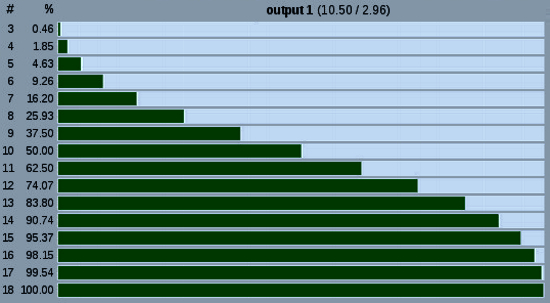
    Bell-curves complicate everything. The likelihood of missing by 1 depends on what you need to roll. If you need 6 or better, it’s 5/216, or about 2.3%; if you need 11 or better, it’s 12.5%; if you need 16 or better, it’s back down to about 4.6%. Even experienced GMs can have difficulty visualizing the way the probability curve impacts the chances of success of a given result. My Co-GM and I have to do this regularly to determine how big a modifier we need to apply to create a given psychological expectation of a result in the Adventurer’s Club campaign – but it’s worth it; a minus-4 modifier sounds huge (and it is), but if you can use it to ensure that only one or two PCs succeed in a difficult task, you encourage a variety of experiences at the game table. Depending on the character’s skill levels, there can be times when -2 is a bigger penalty than a -4, or even a -6! – but it sounds so much smaller than -4 or -6 that there is a greater expectation of success. This can be manipulated to change the interaction between character and adventure, ensuring that each gets his moment in the spotlight each time we play, that one or two characters get to star in an adventure, and so on – so that no one character dominates play all the time.

    Graph of X or less on 3d6

    Above is a graphing (courtesy of AnyDice of the chances of rolling less than (x) on an unmodified 3d6. To get a handle on how a -N modifier (not beneficial) would affect the likelihood of success, simply find your target number and count up N bars. +N modifier (i.e. beneficial) is simply a matter of counting down. I’ve chosen this graphic because – unlike most d20 systems – the rolls of 3d6-based systems are usually ‘x or less’.

    With a bell curve, you have exactly the same options as were outlined for the d20 example earlier, but the effects are disproportionately amplified for extreme die roll targets, and the ranges narrower to begin with (on 3d6 and 4d6 rolls, anyway).

    This means that the 5-, 4-, and 3-scale options don’t – ever – yield an even chance of achieving each category. There is a disproportionate increase in the likelihood of getting whatever result lies nearest the natural average roll, and a disproportionate decrease the farther away from these that you get.

    Ironically, the Mode-2 and Mode-1 patterns actually compensate for these effects in some measure – how much is far too complicated a question to go into here – resulting in something closer to an even distribution of result likelihoods. With one of the two biggest advantages to the -scale options left inapplicable, it only strengthens the arguments in favor of one of the two ‘mode’ alternatives.

    XdY, count those above a threshold

    There are an increasing number of systems that work in this way, or so it seems to me. That’s because they embody a more sophisticated probability mechanism that does most of its work ‘below the surface’ where neither GM nor players can see it, yielding a very simple game mechanic. The key is that it provides the GM with two variables to play with: the target threshold for a die to count, and the number of successes (dice ‘counted’) required to achieve overall success in a task. On top of that, there are variables in how skill levels are manifested (more dice or a bonus to each?) and how stats apply to skill checks (more dice or a bonus to each?). Ultimately, what you end up with is nevertheless a bell curve, but with a much smaller range of results, and one that is skewed in the opposite direction to the threshold value – if the threshold is low, the likelihood of a higher number of successes increases, and vice-versa.

    I’m trying hard not to get sidetracked into looking at this in detail, so even though I’ve worked out how to do it at AnyDice, I’m not going to get into probability graphs. (If you want to play around with it for yourself, here’s a link to the code for 10d10 and a threshold of 3:

    http://anydice.com/program/b3f2

    Just click the link and take a look. Then change the 3’s to 5’s and hit calculate again. Try changing the number of dice. You’ll soon get a feeling for the way this probability mechanism works).

    The bottom line here is that we need a smaller mode-style progression in order to fit within the available range of results. It’s like rolling dN where N is the number of dice – but where the chances are distorted into a bell curve.

    With eight dice, the range of possible results runs from 0 (no rolls above the threshold) to 8 (all above the threshold), and the average result will be roughly 1/2 [(min + max) + (die size-threshold)-1]. With a threshold of 3, and a die size of d10, that gives [(0+8)+(10-3)-1]/2 or 14/2 = 7. But this won’t be exact. If the number of dice is smaller, the average shrinks. I recommend what I’m going to label Mode-Zero:

    • ‘monumental failure’ = fail by 4 or more.
    • ‘serious failure’ = fail by 3.
    • ‘worse failure’ = fail by 2.
    • ‘near miss’ = fail by 1 or less.
    • ‘difficult success’ = succeed by 1.
    • ‘easier success’ = succeed by 2.
    • ‘easy success’ = succeed by 3.
    • ‘trivially easy success’ = succeed by 4 or more.

    If the number of dice being rolled is usually more than 10, you might increase the ‘serious failure’ and ‘easy success’ categories to a band of two results (fail or succeed by 3 or 4), shifting the extremes by 1 in the process; I wouldn’t contemplate it for less.

    Success by 0!?

    You may have noticed that none of the above proposals do anything special for an exact success. Some include it in the ‘difficult success’, others don’t mention it at all. There are two options for handling ‘success by zero’ – you can either consider these a “difficult success’, or you can let this be GM’s Choice – so long as you end in a success. So you might start out describing a “monumental failure” only to have some twist of fate yield a success at the last possible moment. Or a “Trivially easy success” that almost goes drastically wrong at the end.

    Frankly, this choice should be dictated by your improv abilities – if they are good, go with the GM’s choice, because it’s more dramatic. If you aren’t confident, go with the ‘safe’ choice.

Differentiated Narratives For Scales Of Success

For each of these different degrees of success or failure, the next thing needed is a piece of narrative. Then, instead of telling the player what they need, you can relay this narrative after they roll.

This is a heck of a lot better than a “You succeed” or “you fail”, or their equivalents when applied to a particular skill.

But preparing such a list in advance for every skill is a lot of effort. Especially since the ideal would be to not reuse them for a while, afterwards.

It is possible to construct a general list that you then interpret for whatever the skill is to which the narrative is being applied. This takes an impossible task and re-frames it into a practicable solution.

You can also subdivide this general list however you see fit – you might break the total number of skills into “awareness” skills, “analysis” skills, “knowledge” skills, and “action” skills, for example. This would require four lists, but would make the “interpretation” much easier.

How to generate the Differentiated Narratives

Either way, the process that I have devised for generating such lists is the heart of today’s article. I have given the contents of these lists the general title of “Differentiated Narratives” – Narratives that Differentiate between degrees of success or failure.

The process is simple, mostly consisting of short steps that are repeated as often as necessary:

  1. Pick a skill
  2. Describe each degree of failure
  3. Describe each degree of success
  4. Choose a different skill
  5. Translate each description
  6. Generalize each description
  7. Repeat 1-6 at least twice more to generate new descriptions.
    1. Pick a skill

    Start by picking a skill and a typical task that a PC might want to accomplish using that skill. This HAS to be something that you would normally require the player to roll for; no tasks that you would normally hand-wave.

    Let’s Pick “Climb” as an example, and “climb a short cliff” as the task.

    2. Describe each degree of failure

    You may have more degrees of success than I have indicated, or you may have less; but I think that four failure and four success modes are about right. For each of them resulting from the chosen skill being applied to the task, create a line of narrative. I always find it easier to think about the ways a task might fail, first.

    • Catastrophic Failure: You almost reach the top before a handhold crumbles and you fall. Everyone who follows (including any second attempt by you) are at a penalty to succeed, and there’s a 1 in six chance each that you will knock someone else off the cliff on your way down.
    • Serious Failure: You reach about half-way up before misjudging a hand-hold and fall. There’s a 1 in six chance each that you will knock one of your companions off the cliff on your way down.
    • Failure: You almost reach the top when a handhold crumbles. You fall a short distance before you catch yourself, but you wrench your shoulder badly in the process. You need a Cure Light Wounds or a Healing potion, but that will have to wait until you reach the top; in the meantime, you are unable to climb.
    • Almost Succeed: You reach about half-way up before the handhold you are reaching for crumbles. You find yourself stuck, unable to climb any higher. Other climbers will have to use another route to the top, and may then lower a rope to you.
    3. Describe each degree of success

    Having worked out how to fail at the task, it becomes easier to work out how someone can succeed despite almost succumbing to those difficulties.

    • Just Succeed: It was touch-and-go when a ledge collapsed under your weight, but you caught yourself on an outcropping and were able to eventually reach the top, completely out of breath.
    • Succeed with Difficulty: Crumbling handholds made the climb difficult, and matters weren’t helped when your sword fell from it’s scabbard about half-way up, requiring you to go back down and retrieve it.
    • Succeed Easily: Some of the handholds were hard to reach and none of them were as secure as you would like, but with great care, you climb the cliff.
    • Make it look easy:: Your arms were exactly the right length to reach from one hand-hold to the next, and although you loosened several of the ledges you used on the way up with your weight, you make the climb look easy, and aren’t even winded when you reach the top. You wouldn’t expect it to be so easy next time.
    4. Choose a different skill

    If you are creating just one general list, this should be a radically-different skill and task. If you have sliced the overall pool of skills applications up into subtypes, which I recommend doing at least for a while (it makes the rest of the process easier), then you should choose a skill from the same category – so long as it’s a different one to your first choice.

    To make the example as comprehensive as possible, I’m going to take the harder path, and choose “Knowledge: History” as the skill, with the task being to trace the movements of a particular Elf through multiple documents in an attempt to figure out where he hid a treasure that he stole from a Drow Enclave, using a library of rare books.

    5. Translate each description

    Taking each of them in turn, determine what the equivalent of each degree of failure or success would translate to in order to apply to the new skill-and-task pairing. Note that if you do this sort of translation in your head, and then immediately perform the next step in the process for that degree of success or failure, it will be less work.

    • Catastrophic Failure: You almost finish, but when you hold a scroll up to the lantern to see it more clearly, it catches fire. You beat out the flames, doing some minor damage to the scroll, but in your haste, you knock over the ink-pot, spilling ink all over your notes and two of the source documents. You will not only have to start all over, you have made it materially harder for you – or anyone else – to succeed.

    Now, you could proceed with the rest of the degrees of success or failure, but instead of writing the above down, let’s pretend that I’ve done it in my head and proceed directly to step 6 – then come back to this step to work on the next one.

    6. Generalize each description

    The act of ‘translating’ each failure/success narrative into application to a different skill means that you have started, mentally, to translate it into a generalized form – which can then be applied to any skill as needed.

    • Catastrophic Failure: You almost succeed before an accident not only causes this attempt to fail but makes it harder for you or anyone else to succeed in a subsequent attempt at performing the task.

    Now, since you’ve only done the first one, go back to the previous step and process the next degree of failure/success.

    7. Repeat 1-6 twice more to generate new descriptions

    If every catastrophic failure were to have the same general ‘shape’, they will get boring fairly quickly, and the same is true for all the other degrees of success/failure. The more variety you have, the longer it will be before you have to repeat one. By the time you include interference, misjudgments, accidents, circumstances, wildlife, environment, and potentially many more, it’s not too difficult to generate a lengthy list of possibilities. But why try and do them all at once? Do just enough that you’re covered, then store them when those are all used up and generate some more.

    Based on my experience, you are unlikely to need more than three from any given degree of failure/success in any given day’s play, but you may very well need two – so, two, plus a reserve of 1, is my recommendation for a standard ‘batch’.

Applying Differentiated Narratives

Applying one is fairly simple – identify the degree of success or failure, pick the next generalized description that matches off your list, and apply that general narrative to the task and skill being employed, just as I translated the “climbing” narrative into a research narrative.

Replacing and storing used Narratives

As each is used, I would tick it off in pencil. When I got down to only having the reserve unused, or less, I would generate a new batch to add to the list. If I couldn’t think of new ones, I would erase the ticks and start over – but keep trying to extend the list in between game sessions.

Narrative by Instinct

Eventually, you will discover that you don’t need the lists anymore; the combination of circumstances, task, skill, and degree of success or failure will prompt you to think of a solution on the spot. This is Differential Narrative by Instinct. Once reaching that point, habit and repetition become your enemies – and the easiest way to combat them is to add whatever you have come up with to the list (in suitably generic form). This will enable you to continually verify that you aren’t inadvertently repeating yourself.

What’s more, you will find that the exercise of creating and using the lists has greatly enhanced your improv strength in other game areas as well – a side benefit, but a good one.

And now, having seen what is possible, you can fully see what I meant when I described the ‘succeed or fail’ light-switch as a wasted opportunity.

Comments (1)

A Political insight for RPGs & Life


Image credit: FreeImages.com / abtmay

While this article starts off with political analysis, it leads into the discovery of what appears to be a universal social truth that can be integrated into multiple situations in any RPG.

I’ve done my best to avoid coloring the analysis with my own opinions, and have neither intent nor desire to belittle in any way the opinions of anyone else, regardless of where they sit on the political spectrum.

If, at times, I have failed to preserve this Olympian disengagement, I would assure readers that it is inadvertent and accidental, and therefore is likely to say something that I didn’t intend to say, which might not even be an accurate representation of my views – so just ignore it and move on.

Background

The other day, I was catching up on some TV that I had time-shifted from last year, I found myself watching an episode of Gruen (formerly Gruen Planet, Gruen Sweat, and originally The Gruen Transfer).

One of the regular segments of this show about Advertising, Business, Politics, and Society, called “The Pitch”, challenges two advertising agencies to produce television adverts that meet “impossible” briefs.

In this particular episode, the challenge was to convince people to restrict the vote to under-60s. Neither of the ads produced to meet this brief were really convincing to me, but one at least got me thinking.

One of the problems of modern society is the “Youth Inheritance” issue. I first became aware of the issue in the season 4 episode of The West Wing, “College Kids”. This awareness was reinforced by one of the most celebrated West Wing episodes from Season 6, “A Good Day”. Both were episodes that touched on the youth vote, pointing out that most political decisions are made by older people, whether that is because older people are more likely to vote or because the majority of candidates for political office are older, and that it is the young who will have to live with those decisions for the longest time. It’s easy for authorities to take decisions that might be beneficial or “correct” in the shorter term but that have long-term problems, consequences that the leaders of tomorrow will inherit.

This was initially presented in the West Wing as an argument in favor of lowering the voting age, and on the second mention, was central to a concert attempting to increase the youth participation in the upcoming elections within the Season 6-7 narrative. But in connection with the “restrict the vote to under 60s” advert, it sparked a new thought, and that led me to an insight not only into reality but one that can easily be applied in RPGs in all sorts of ways.

Speculation into Insight

The “Youth Inheritance” issue means that there is an argument that the youth vote should be disproportionately weighted relative to an older voter. They have more “skin in the game”, as it were.

But hang on – age is supposed to bring Wisdom. Surely that’s a counter-argument implying that young people will make impractical decisions, choices of idealism over practicality?

Democracy works, in theory, by balancing both idealist and pragmatic extremes. It can also be assumed that the ‘idiot vote’ will be evenly distributed over both sides, leaving the actual selection in the hands of those who think deeply about the issues and who can be swayed, one way or the other.

One side of this idealist-vs-pragmatic balance will assume dominance for a while, and social progress will result – in an imperfect and not completely practical way, and sometimes heavy-handedly – shifting the social and political landscape in the process. Then the other side will assume power and shift things back in the direction of the way things were – but never be able to go all the way back, being forced to countermand only the most extreme misjudgments of what has gone before – ‘extreme misjudgments’ in the eyes of their supporters, that is. They can’t undo everything, no matter how much they would be ideologically disposed to do so, because going too far in that direction will cost them votes from the center, and its the center that holds the balance of power. If you want to win future elections, the art of the practical and pragmatic demands that you pick your battles – and let some of the changes stand. The upshot is that social progress takes place at, overall, a manageable pace.

Oscillation back and forth about a slowly-evolving median position – that’s the reality of western politics in the long term.

Validation Of Theory

This view plays into a whole heap of stereotypes that imbue it with a comfortable ring of plausibility – to those of us born into a belief in those stereotypes. I can point at four examples without thinking too hard:

  • The Anti-war Movement of the 60s & early 70s
  • The Ecological/Environmental Movements of the 70s-90s
  • The ‘New Camelot’
    The Anti-war Movement of the 60s & early 70s

    The Vietnam War polarized opinions very strongly – so much so that draft dodgers fled to Canada to avoid it. Was the generation of the late 60s and early 70s any less patriotic, or any more cowardly, than those who fought in the two World Wars? That seems unlikely. So, what had changed? The biggest thing was the emergence of the generation gap – while I’m sure that younger adults had always opinions, prior to the 1950s and 60s, these were always subordinated to the authority of the older generation. That started to change when television advertisers identified the teenager as a separate demographic who could be marketed to; and that gave the youth of that era the self-confidence to back their own opinions. The anti-war movement – and the hippies in general – were the results.

    This is always remembered these days as a conflict between youthful idealism and the pragmatic military necessities of the cold war. As losses mounted with no prospect of victory in sight, and as television brought the horrors of the war into the living rooms of the citizens, popular sentiment shifted against continuing involvement. To many of the idealists who refused to serve, the rest of the country came around to their point of view.

    For myself, the war was a childhood memory, and I don’t support either side of the anti-war debate, or more accurately, I see and support both sides equally. My abiding reaction is of being appalled by the treatment meted out to returning servicemen, many of whom did not want to participate in the first place. Thankfully, attitudes since have moderated toward them.

    The Ecological/Environmental Movements of the 60s-00s

    It was in the 1970s that industrial pollution entered the public consciousness as it became clear that some business interests were putting short-term profits ahead of long-term sustainability of the environment and the welfare of their customer base. There followed story after story of profit being placed ahead of all other considerations, everything from the treatment of leather to asbestos being examples. Legislation that was protective of the environment was the inevitable result.

    The other consequence is that businesses who were more socially responsible were unable to compete as well, and the direct outcome was the mantra of the 80s encapsulated by Gordon Gekko (Michael Douglas) in Wall Street – “Greed Is Good” – and by “Larry The Liquidator” (Danny DeVito) in Other People’s Money. This in turn has engendered a lasting distrust of business that is still current; some operations have overcome this distrust through humanitarian engagement and an absence of negative publicity that fits the “profit vs responsibility” narrative, but it only takes one slip and the ingrained distrust rematerializes.

    The beginning of what is currently lumped together as the “Green” movement, world-wide, can be traced to the publication of Silent Spring by Rachel Carlson, about the consequences of the indiscriminate use of pesticides in 1962, or to the Resources and Conservation act of 1959, or even to the Air Pollution Control Act of 1955. But growing political awareness of the issue meant that for most people it was either another example of government interference, or completely under the radar. This was a rare instance in which government was ahead of public awareness, never mind public opinion. Public attention on the environment was focused on the Clean Air Act, Motor Vehicle Air Pollution Act, Air Quality Act, and at least four amendments to the Clean Air Act. While legislation relating to other forms of environmental damage were also around, the issue didn’t seem to grab public attention outside of the impacts of Smog and Acid Rain.

    Initially, it was the hippies – principally a youth movement – whose sounding of the eco/environmental alarm that first raised public awareness, and the message was largely lost in a general dismissal that “long-haired louts” and “radicals” had anything to say that was worth listening to. Slowly the message permeated the mainstream, propelled by landmark court cases, and the fledgling Environmental Protection Agency, established by President Nixon in 1970, and built upon the National Environmental Policy Act of 1969.

    Given that the EPA was established by the Republican Party, it seems ironic that President Trump seems intent on winding it back if not shutting it down completely! But I’ll have more to say on that a little later.

    It was the Sierra Club and the somewhat anarchic evolution of the ‘Don’t Make A Wave Committee‘ into Greenpeace that established what many considered “radical environmentalism”, though other groups would adopt still more extreme positions in later decades. Ever since, environmentalism has been viewed as a youth movement – largely ignoring the fact that a 20-year old in 1970 would now be 67 years old! Even today, this perception, and associated attitudes, persist to a certain extent.

    The New Camelot of the Early 60s

    There’s a lot of Hype around the Presidency of JFK as it is perceived in modern times. At 43 years of age, he became the youngest elected President, and the second-youngest to serve in that capacity (Theodore Roosevelt assumed office at the age of 42 after the assassination of President William McKinley). There was wide criticism of his age, and the average age of his cabinet, at the time of his Presidency, and his inaugural address cemented the perception of a youthful idealist, with it’s call to the nations of the world to unite to combat “the common enemies of man: tyranny, poverty, disease, and war itself.”

    This impression of naive idealism was confirmed in many minds by the Bay Of Pigs debacle; few realized that the planning had been commenced under the prior Eisenhower presidency, and the failures were largely attributable to forewarning of the Castro regime by KGB intelligence, who knew the exact date of the planned invasion, and that the CIA were aware of this foreknowledge and failed to brief Kennedy about it before he gave final approval for the planned invasion – at least according to the Washington Post of April 29th, 2000. A second factor was that the then head of the CIA believed that Kennedy would authorize whatever additional support was necessary just as Eisenhower had done with respect to the Guatemala Invasion of 1954, a plan drawn up by many of the architects of the later Bay Of Pigs invasion of Cuba. Kennedy, however, did not authorize such involvement, focusing on the political impact of the failure rather than the military needs of achieving success.

    Despite this, Kennedy received the adoration and admiration of a great many younger people (a vague term that some mean to refer to under 30s, others to under 35s, and still others to under 40s), largely because of his charisma and perceived idealism and principles. There are those who to this day describe his assassination as “the killing of hope”.

    No history of the 1960s can fail to create the impression that he effected little lasting direct change except when forced into it. These days, he is best remembered for:

    • His (somewhat half-hearted) support of the Civil Rights Movement, whose principally-peaceful approach was catalyzed by the murder of Martin Luther King, Jr, and the violence with which the Freedom Riders were met, into the more aggressive and militant Black Panthers. It was Johnson, Kennedy’s Vice-President and successor, who made the next significant mark in this area;
    • For the Space Race / Apollo missions which were ultimately curtailed, and which were largely undertaken as propaganda against the space successes of the USSR;
    • And for the Cuban Missile Crisis, in which – according to legend – he was able to view and treat the Soviet leadership as people first and exemplars of ideology second, holding firm on what was considered by many advisors to be a foolhardy blockade that cost the US any opportunity to engage and destroy the threatening missiles.

    The indirect legacies that resulted from these and other activities in office have arguably done more to transform the world than those of any US President since, with the possible exception of Ronald Reagan. How much of the credit can be assigned to Kennedy is irrelevant; int the popular perception, they are his achievements or the legacies of his leadership.

    Kennedy’s election had been a narrow one, the closest since 1916. Nevertheless, he won widespread approval for his handling of the Cuban Missile Crisis, but the election of 1964 was still looking difficult; that was the primary reason behind his campaigning in Dallas on the day of his assassination. That event shocked and outraged even many of his political opponents, and ensured his elevation to near sainthood in the minds of many; a posthumous popularity that Johnson was able to harness to achieve a landmark victory in 1964, with the highest popular vote margin since 1820. In particular, it signaled the arrival of the power of the Youth Vote as a political force. By the end of Johnson’s term of office, discontent over the Vietnam War and with progress in Civil Rights was in the ascendancy, and led to his decision not to seek reelection; Richard Nixon’s promise to end the war was one of a multitude of factors that led to his becoming the 37th President of the United States.

The Populist Difference

Of course, even the Obama administration can be viewed as direct representations of this perspective. Obama’s “Yes we can” was a direct appeal to idealism, and his racial background made him a radical proposal for the Presidency.

That is why the populist Nationalistic movements that have recently been gaining traction in many countries around the world appear to be something different and new and potentially dangerous to those who expect reality to conform to these ‘youth idealism’ and ‘pragmatist’ stereotypes – the populist movements are largely youth-driven, or appear to be, while those in opposition are frequently older men and women who are viewed as having become part of the socio-political “machine” that has created the inequalities against which the populists are railing.

The two most dynamic leaders in the recent US elections were Donald Trump, playing the populist, nationalist, card, and Bernie Sanders as the older, radically-progressive opposition. Of course, Sanders failed to secure his party’s Nomination, leaving the task of opposing the populist movement that had (in some people’s eyes) hijacked the Republican Party – a naturally conservative group – in the hands of Hilary Clinton, a figure lacked the ability to polarize a sufficient opposition simply because she was more moderate than Sanders. People in her party supported her, but the passions that might have been aroused by a Sanders candidacy never seemed to be there. Instead, it appeared to be Trump who had a monopoly on the real passion in the campaign.

‘Was that a mistake on the part of the Democrats?’ was the question that I found myself asking by the time my thought processes had led me to this point.

Perhaps it was, or perhaps it was a reflection of the same Radical vs Pragmatist reality playing out – perhaps it was inevitable, given such a fiery, radically-conservative, and possibly impractical, figure as Donald Trump, that he would be opposed by a more pragmatic opposition candidate viewed as representing the ‘establishment’.

Even the problems that have beset the Trump Administration in implementing their policies and the resistance of the Washington Bureaucracy can be understood in this context.

The Australian Situation

Here in Australia, we have a conservative government led by a Prime Minister who had a reputation as a political moderate prior to taking power, but who has experienced extreme difficulty in enacting his policies. Why?

His predecessor in office (from the same party) was ideologically extreme, even radical, and polarized a relatively pragmatic and moderate opposition into existence – an opposition that Prime Minister Turnbull “inherited” when he took the reins of power in a leadership spill. With the moderate, centrist, political stance tied up by that opposition, Prime Minister Turnbull was forced to appeal to the extreme faction within his own party for support – the same extremists from whom his predecessor, former Prime Minister Abbott, had derived.

The result has been viewed as a largely paralyzed government, whose most extreme agenda items are regularly thwarted, forced to compromise with minor parties and a populist fringe, only watered-down versions of the government positions can actually garner sufficient support to be implemented. The rest of the time, the government just looks mostly helpless. The Opposition appear both more pragmatic and seemingly ineffectual – and yet, time after time, ideologically-extreme government proposals are successfully blocked.

These facts are not lost on Prime Minister Turnbull, and last week he made a direct appeal for his party to move toward a more centrist position, inviting – as good as daring – the opposition to become more radical in their policies. Should the Labor Party do so, they will be falling into a trap, conceding the rational middle ground to the current government and losing the advantages that have garnered them more then enough support to be elected to power, so great is the dissatisfaction with the current government.

Brexit

Who are the Radicals?
For most of the twentieth century, then, the liberals and progressives have been cast as the radicals and idealists, and conservatives and nationalists have been viewed as the pragmatists and ‘realists’. Donald Trump, Malcolm Turnbull, and the architects of Brexit represent something that hasn’t been seen for quite a while: the conservatives and nationalists are now viewed as the radicals whose time has come, and their opposition are now the ‘realists’ and pragmatists. This is a complete inversion of the popular perceptions of both groups, something that has taken place over roughly the last five years or so.

The time before last that we had these forces in the ascendancy, the result was Fascist regimes and U.S. Isolationism. Is it any wonder that there are those who identify similarities in the postures and positions of various political forces and policies with those of that era? Prime Minister Turnbull sought (unsuccessfully) to ‘liberalize’ freedom of speech by weakening hate crime legislation, and has been backing a plebiscite over Gay Marriage, earning many comparisons with fascism. Donald Trump talks of Allies having to do more if they want to enjoy the protection and friendship of the US and attempted to distance himself from NATO, has attempted to restrict immigration (in the most heavy-handed and clumsy manner possible), and Scotland appears to be on a path to independence from England so that they can remain within the EU despite Brexit.

The last time, we had the wave of deregulation which undid many of the protections put in place by preceding governments, policies that led directly to the GFC.

That doesn’t mean that these will be the outcomes this time around; it merely means that Nationalism means putting a local perspective ahead of a more global one, and that in that environment, inequalities and repressions can potentially flourish.

The Architects Of Change

It’s almost always the radicals who bring about change, whether for good or ill – if they can. How long the radicals stay in power depends on how quickly the populace tire of radical failures, tilting at windmills, and attempts to catch the rainbow. The pendulum always swings the other way, eventually.

The Principle, for GMs

The Radical-vs-Pragmatist principle is an important one for GMs to understand when it comes to Politics within their RPGs. The natural opposition to a radical political force – whether in power or not – is NOT an opposing equally-extreme radical force from the “other side”, it’s a pragmatic, relatively quiet opposition. Equally, the natural opposition to a pragmatic, centrist position – whether in power or not – is by definition going to be more radical than the centrists.

Even if leaders are not inclined in those directions, they will always be forced in either the pragmatic or radical direction by the need to contrast themselves with the political force that they have to oppose. This will push that opposing force even further in the indicated direction, a pattern of escalating domino effects and counter-escalating domino effects that eventually push the two factions into these roles.

Even two moderate centrists, when opposing each other, will drift into these polar extremes. One will make a move – either in the direction of pragmatism, or in the direction of radicalism – and the other will react, setting the trends in motion.

The 20th century was largely the story of radically-liberal idealists (as they were perceived to be, whether they were all that radical or not) and a reactive counterforce that painted themselves as the pragmatic and practical ‘realists’. So far, the story of the 21st century has been built around the rise of a radically-idealistic populist conservative nationalism, and the resulting reactive counterforce.

RPG Applications

Some applications may be relatively obvious, given the preamble described above. Others may come as a surprise. It took only a minute or so to think of more than half-a-dozen, but am under no illusions that this is a comprehensive listing – in fact, the entire article to this point took only about ten minutes of semi-distracted thought (while I continued to watch the TV show that has inspired it).

  • Nations At War
  • Negotiating A Trade Deal
  • Nationalism vs Internationalism
  • Rivals In Love
  • Police vs Citizens
  • Business Rivalries
  • Competing Military Plans
  • Entertainment Duos
    Nations At War

    Whenever you have a war, one commander will inevitably follow the best military doctrine they know, while the other will counter with radical innovation. If this were not the case, there would be no need for the war in the first place, the outcome would very predictable. Usually, it is the side with a shortcoming in military force to apply – whether that results from a relative shortage of personnel or from inferior equipment – who is forced to get innovative, while the force with the greater military might adopts the more traditional tactics. And, of course, it’s a never-ending cycle; if the innovative tactics work, they get added to the body of traditional military lore thereafter. Next time around, a new innovation will be required.

    And, of course, it’s worth noting that military tacticians study all the battles of history, regardless of who they were fought between, on the theory that the principles of achieving victory haven’t changed, only the details, and you can never tell what will be useful until it is.

    Negotiating A Trade Deal

    In fact, in any negotiation, one party will always be more conservative than the other in his proposals, while the other will be more creative in terms of the offer they are making. GMs should always assess the nature of the tactics adopted by PCs when bargaining or negotiating and have the other party adopt the contrasting tone – traditionalism and convention vs innovation, etc.

    In a three-way negotiation, the third party will align with the more conservative and traditional approach.

    This doesn’t make an offer made by the PCs any more or less acceptable, or vice-versa; that’s down to specifics and personalities. I am specifically referring to the style of negotiation that will be adopted.

    Nationalism vs Internationalism

    One of the more obvious applications, but one that will apply from time to time in many different genres and games. Again, reality is distorted somewhat by the need to preserve PC independence, but if the PCs emphasize common interests between two or more nations, the response will be more nationalistic, more beneficial to the negotiator’s particular homeland (or to their clients, if a professional negotiator or third (neutral) party has been engaged, at least in comparison to the more internationalist tone of the PCs.

    If, on the other hand, the PCs adopt a more parochial stance, the other party is more likely to look for an opportunity to further desired alliances, either with or against those the PCs are representing, because that represents and justifies ‘driving a hard bargain’ that yields the maximum benefit for the other party in the diplomatic exchange.

    Most players will be expecting this; sometimes, it can be amusing (when the GM perceives a clear way for the other party to take advantage of the situation) to have them give the PCs everything they could possibly want and a little more, after briefly playing hard-to-get. This is akin to the players putting all their diplomatic weight to a door only to find that it was already ajar; healthy paranoia should set in, leaving them to wonder for hours what it is that they’ve overlooked.

    Rivals In Love

    When two rivals are wooing the same love (being careful with gender designations, here), one will generally go in for overtly extravagant gestures and declarations while the other will generally emphasize stability and safety while pointing out the instability and risks represented by the opposition. It doesn’t matter what the respective personalities are, even a bad boy or girl can represent stability and known quantities and a sense of community.

    In addition, one will normally emphasize what they are offering, while the other emphasizes what the prospective partner will get from their offer. These may align with the radical/conservative differential, or may run in the opposite direction, which provides variety for the GM to exploit.

    Police vs Citizens

    If citizens are polite and respectful of the authority of law-enforcement, or are perceived by the police in that respect, the police will usually (in turn) be more flexible and innovative in their community relations. If citizens are untrusting and disrespectful, the police will tend to adopt a more hard-line approach and more conservative law-enforcement values. The former also lends itself to corruption while the latter lends itself to authoritarianism.

    These same patterns can be observed everywhere from the slums of the 1990s through to the old west.

    Business Rivalries

    Two supermarket chains in Australia, until perhaps 10 years ago, controlled almost the entire market space. With the arrival of new players, both have lost market share, but between them, Coles and Woolworths still account for almost 70% of the market in foodstuffs. In 2005, that was nearer to 77%, which was close to the peak; go back twenty years, and the pair accounted for only about 1/3 of the grocery market, (I can’t speak to the conditions in other countries in this area).

    This (effective) duopoly, with the pair concentrating their marketing clout almost exclusively on trying to steal market share from the other over a period of decades, puts Australians in a unique position to assess the way rivalries work between businesses engaged in what is basically the same market.

    First, Woolworths concentrated on freshness of produce, while Coles concentrated on affordability. Over the years, each attempted to steal the focus from each other; Woolworths introduced cheaper brands, while Coles began to focus on its fresh fruit and vegetables sections to a greater extent.

    At regular intervals, one would attempt some radical marketing while the other retreated to a position of conservative reliability, only to strike back when the effectiveness of the radical move was all but spent; thus, the two traded a few percentage points of market share back and forth for many years. And, to some extent, these marketing games continue to this day.

    In the 1970s, many of the independent retailers formed a co-op in order to compete with the “big two”, but these did little more than slow the erosion of independent grocery stores, mostly in low-turnover low-profit markets. But, in 2001, a new and rather more radical player entered the markets when Aldi Australia was launched. Their signature is the ‘non-grocery items on sale at ridiculously low prices that you never expected to see in a grocery store’ – anything from TVs to Angle Grinders – but their ‘trademark’ is the substitution of low-cost alternative brands to the big brand-names. This permitted savings of up to 1/3 on a weekly grocery bill, significant savings when money is tight, and the combination has won them many loyal customers, eating into the market share of the big two little-by-little over the 16 years since.

    As Aldi, with its radical and innovative marketing and promotions, gained a toe-hold in the market – it’s now up to over 12% – the big two responded by becoming more conservative in their approach. Only once people became used to the “Aldi Difference”, becoming perceived less as being radical more simply “the way things were”, i.e. more traditional, were the two big players free to become more radical in their marketing.

    After a couple of PR disasters, Woolworths has, in the meantime, lost credibility as “The Fresh Food People” and are now seeking to re-brand themselves as ‘the home of premium products and brands who can also supply your everyday needs’, effectively conceding the traditional ground to Coles while latching onto what they hope will become a new market differentiator as Australian culture continues to evolve. But, to be fair, they had also suffered a number of financial setbacks and calamities which left them unable to compete on the old territory as effectively as they had done; they had to do something radical, they could no longer simply throw money at the problem in terms of subsidizing low-cost products.

    As a result, for the last six months or so, you could say that the Australian Market had finally come to terms with having two major chains and two smaller groups that between them comprised a significant share of the market. And just in time, as Amazon are arriving in 2017 to shakeup online grocery sales, an aspect of the business that the big two had largely taken for granted until now! But that’s in the future.

    The point is this: the same patterns apply, the entry of third and fourth players into the market notwithstanding.

    Competing Military Plans

    Military advisors rarely present just one plan to a political leader with the authority to order them into action. There will usually be three different plans – a best case, a worst case, and a most-likely case in the middle. The idea is to brief the political leader on how bad the costs in manpower and money could be, and what reserves should be made available, as well as the best estimates of the cost of any given action.

    While I have no information on which to form a definitive statement, I find it improbable that this practice is a recent innovation. While it may have arisen along with the General Staff concept (a German invention, copied throughout the world), it seems even more likely that it extends as far back as Imperial Rome or even beyond, at least as a concept.

    Traditionally, problems arise when Presidents seize on the most optimistic projections and base their expectations and instructions on them. This generally happens more often in fiction and media than it does in reality, I think, but some are incurable optimists.

    Things can become even more confused when there is a filter placed between the originators of the plans and the authority; there have often been suggestions that Directors of the Central Intelligence Agency and of the KGB, respectively, showed only the most favorable predictions to their political masters in order to encourage endorsement of their proposals, with the assumption that once a country was in trouble up to its neck, whatever additional resources might be needed would be forthcoming. Again, without evidence to confirm the supposition, this sounds an awful lot like the description of what went wrong with the Bay Of Pigs invasion discussed earlier. It’s certainly a central point in Red Storm Rising amongst other works of fiction.

    As a side-note of relevance, it’s interesting to observe that in that novel, whenever the Soviet forces get radical and innovative, the NATO forces are forced into relatively conservative responses, but that as these become the accepted state of play and command patterns and routines become established, it becomes possible for NATO to become radical and innovative in its own respect. It’s a measure of the soundness of the theory that this seems entirely natural when reading the book.

    It’s also worth mentioning the relationship between this phenomenon and Surprise. Surprise, by it’s very nature, means doing the unexpected, which in turn is automatically radical; and the only possible immediate response to Surprise is “by to the numbers”, i.e. a traditional and expected standard response. Thus, surprise tends to give the Initiative to the party with Surprise, and leaves the enemy reacting by rote, at least for a while. This also permits the force with Surprise to make great gains initially, even if progress later bogs down as the new status quo becomes established. Blitzkrieg tactics were effective in World War II because they tended to end the battle before the other side could regain their balance and take effective counter-action. As noted earlier, it’s the radicals who make changes in a situation.

    Entertainment Duos

    Finally, one of the more unusual applications of this theory, and one that only really came to mind late in the writing. Have you ever noticed how, in any comedy or entertainment duo, one tends to be the straight man to the other? Is that not just another aspect of the same theory being discussed? Abbott and Costello, Penn & Teller, even George Michael and Andrew Ridgeley (Wham), and Sonny & Cher, and some of the Japanese comedian duos that have appeared on VS Arashi – they can all be viewed in this respect of one ‘radical’ and one ‘straight’ man. Another entertainment partnership that comes to mind is the partnering of Lennon and McCartney, both in the Beatles and after they split.

    I’m not a big fan of the Three Stooges, but it’s my impression that they traded off the straight-man role between them. A fan more familiar with their work than I am might be able to extend the theory further with respect to multiple participants by analyzing the dynamics of the legendary comedians.

These are just the tip of the iceberg. This seems to be a universal rule of opposing social and political forces, regardless of the manifestation, and a literary truth to boot. It’s also relatively easy to apply in any given situation in a game – whether the protagonists of the confrontation in question are NPCs against NPCs or PCs against NPCs. And yet, at the same time, I’ve never seen it suggested anywhere before. Sure, reality can be more complicated – but in terms of the abstraction and simplification necessary for an RPG, it’s a great tool to have in your arsenal!

Comments (2)

Choices in Tactical Representation Of Reality


Late last week, while I was taking a break from writing the “When Undead Go Stale” three-part article, Master John – better known as @beerwithdragons – asked on Twitter,

What's the most useful thing behind your DM Screen?

There are a number of GMs on Twitter who ask such questions as conversation initiators. When I have something to say in response that no-one else has suggested, and the time to say it, I reply. In this case, I wrote,

Me. Nothing else can create anything else needed on the spot.

At that point, I might have tweeted a link to one of my articles on ways GMs can get themselves out of trouble, such as A potpourri of quick solutions: Eight Lifeboats for GM Emergencies, and the conversation would have taken a different turn. But I didn’t do that; I had to get back to writing. When next I checked my Twitterfeed, I discovered a reply and a follow-up question:

Well said! Do you use minis and an mat? Or all theater of the mind?

To which I answered,

Neither exclusively. Depends on the situation. I'll have to write an article about that, sometime!

He replied,

Yes, please! I'm trying all sorts of ideas. Mats, theater of the mind, minis, overworld maps etc.

So, here we are. How do I choose to represent the tactical in-game “reality” and what are the options?

Considerations

There are eight considerations that I’m actively aware of when choosing how I am going to represent the “reality” that surrounds the PCs:
 

  1. Scale
  2. Complexity
  3. Set-up time
  4. Dynamism
  5. Positional Relevance
  6. Simulation Capability
  7. Desired Pacing
  8. Reconstruction
    1. Scale

    D&D and Pathfinder generally scale at 5 feet to the game-scale inch. The hero system works on a 2m to the miniatures inch, which is close enough to the same thing to permit minis to be used interchangeably. There are a few other scales out there, and some minis have bases that are larger than this, but for the most part, miniatures can all be used at this scale.

    Which means that they are of limited use if the area that needs to be represented is more than a couple of hundred feet along either axis. I simply don’t have the table space for anything larger (even that is a stretch). If the tactical situation deals with several miles of range, such as a marauding war-band of Orcs coming out of the hills and spotted long before they enter combat, or aerial combat with a Jet, or space combat with just about anything, or fleet movements, or the positioning of armies – forget minis, at least as literal representations.

    Which demonstrates just how important a consideration Scale is – it can rule out all but one or two possible choices.

    2. Complexity

    I’ve heard of people using their children’s four-foot tall doll’s mansions (usually with the furniture removed) as “battlemaps” representing a castle. Unless you have something similar at hand, depicting an entire castle at once is not going to be feasible, even though the floor scale might just about permit it.

    Some things – even natural scenes – are simply too complicated to be practical with some of the solutions. If the spacial relationships between disparate locations are so important that they need to be represented, tactically, that can definitely be a factor in choosing a means of representing those locations.

    That said, there are a couple of techniques that can simplify representations using miniatures, even making the otherwise-impossible not only practical but relatively easy:
     

    3. Set-up time

    Unless you can do it in advance, a key consideration is how long it will take you to set up your tactical representation, because you can’t run the game while this activity is taking place. Sometimes you can get around this – the others go to get lunch, one with your order and sufficient funds, while you stay back, keep an eye on their gear (might be necessary in a public space) and set up the scene. As a rule of thumb, 5 minutes or less is completely acceptable; between five and ten minutes is tolerable; between ten and fifteen minutes, I would have second thoughts as to the chosen mode of representation; and (with exceptions, as noted) more than fifteen minutes demands a different solution.

    4. Dynamism

    There are certain things, dynamic phenomena, that some modes of representation do poorly. These are less likely to come up in D&D / Pathfinder games than in other genres, but even there, they can occasionally manifest. Example: the PCs are swept up by a flash flood, the raging torrent carrying them away at high speed. Using miniatures to represent this effectively means resetting the entire battlemap every round. It’s impractical.

    Anything involving the third dimension used to be included in this category, but over the last decade or so, solutions have been found.

    See, for example,

    See also the links above.

    5. Positional Relevance

    How important is it that the players be able to visualize where things are relative to either other things or to themselves? There are situations in which it is critical – especially melee combat – and situations in which it isn’t important at all. Again, most of the latter will occur outside the D&D / Pathfinder arena – situations like psionic combat – but they can happen.

    6. Simulation Capability

    Equally, and similarly, there are often things that simply can’t be simulated using some of these techniques. Sometimes you simply don’t have the right figure (especially true in the case of larger-scale creatures). Sometimes, the environment itself is malleable or dynamic in some way – but I’ve already covered that.

    Sometimes, the creative GM can get around these problems, but such solutions are not always available. See, for example,
     

    For example, let’s say you want to set an adventure on the fantasy equivalent of one of Larry Niven’s Integral Trees, possibly as something that exist in the Elemental Plane Of Air. How would you represent that with battlemats?

    To the right is my solution – a somewhat gnarled trunk, ‘forest’ at top and bottom, and the occasional . It rests on the fact that direction on a battlemap is just an assumption – so along the spine and in the top and bottom foliage, the battlemap is Vertical while tufts along the way are represented by the smaller battlemats to the side – with round pieces of dressing used to indicate where the trunk is located. Minis would stand up on those side tufts, but be posed ‘lying down’ on the main battlemat.

    How long would this take to assemble? Two minutes – most of which is spent selecting the right tiles of battlemat – is probably a generous allocation of time. How long would it take to think of? If you haven’t discarded the notion that battlemats represent floor areas etc from above, it might never occur to you.

    7. Desired Pacing

    Literal Representation is slow. You not only have full game mechanics, but you have set-up and continued interpretation of the battlemap. There are no details that can be omitted or handwaved, everything has to be updated continually. The more that you abstract the representation, the more these factors swing to the opposite; you only have to mention something when it becomes relevant, and you can even streamline game mechanics to achieve a more cinematic action style.

    That means that the pacing you achieve is directly related to the representation methodology that you select – and, therefore, that the representation methodology should reflect the game pacing that you want to achieve.

    8. Reconstruction

    Most people can’t just put their representations to one side and leave it intact between game sessions. That means that if you aren’t finished depicting the situation being represented at the end of the game session, you will need to reconstruct next time. That can be easy, or it can be almost impossible, depending on the choices made during initial selection and implementation of the methodology. If there is any possibility of ever having to reconstruct your representation, the time to bear that in mind is from the very beginning.

Options

There are six general solutions to the problem of representing the in-game reality.

  1. Minis & Battlemaps
  2. Detailed Abstract Representation
  3. Dynamic Abstract Representation
  4. Broad Abstract Representation
  5. Supplemented Theater Of The Mind
  6. Theater Of The Mind
    1. Minis & Battlemaps

    Let’s be honest: the two extremes are the options that everyone knows and that most people employ as a matter of course. Depending on the breadth of their experience as a player, a GM may literally have never heard or seen anything else, and may not even be aware of the other extreme option – if, for example, you and your group can’t afford miniatures, or view them as a low-priority purchase item. I didn’t have any form of miniature for my first 30 years or so of gaming – and was a GM for most of that time.

    About 12 years ago, I think it was, I met a GM who had never played or refereed a game without using miniatures. He was totally flabbergasted that it was even possible, never mind that I had GM’d for close to three decades without them!

    These days, there are lots of options when it comes to minis – everything from cardboard to pre-painted plastic to traditional lead, mostly in 25mm scale, which has become the near-universal default. And you can get battemats and tiles for everything from Sci-fi settings to dungeon tiles, not to mention 3-D Terrain and Flatpacks like the ones I reviewed in last October’s Periodic Goodie Roundup.

    2. Detailed Abstract Representation

    Picture this: you whip out some tile-based boardgame, like Settlers Of Catan, and lay down contiguous terrain tiles, elevating some of the tiles with some form of stackable support underneath them. You then place a miniature representing one of the PCs and several monsters on different tiles, then announce that each figure represents a unit, and each tile is a mile across – the one character miniature is all the PCs, and each of the monster figures could represent anywhere from 5 to 500 actual enemies. Throw in some more figures representing units allied with the PCs, and you’re off to the races with a major war.

    This is a detailed abstract representation. You can do something similar to represent fleet actions, either naval or space-based, or a whole range of other broad-scale activities. Or you can use a different scale – 50 feet to the square on dungeon tiles – and drop a d10 to represent the number of enemies in a space, again with one figure representing all the PCs in a space.

    Of course, in many of these cases, you won’t be able to employ your normal game mechanics. That’s all right, there are plenty of military-style games which represent conflict between units of various technological standard, from something relatively medieval to something rather more high-tech. Pick the one that’s right and simply work up a set of conversions where necessary. A lot of the old Avalon Hill boardgames work especially well in this respect, but there are plenty of alternatives.

    3. Dynamic Abstract Representation

    Get a sheet of cardboard or a large sheet of paper . Glue several of the cheap figure-stands in lines across it, then slice the cardboard into strips so that each strip has pairs of the figure-stands across it. Sit battlemaps in between the stands. You now have transformed a set of battlemats into something that can be moved, by moving the underlying cardboard/paper, without disturbing any figures on the battlemats.

    Nor is this the only kind of dynamic abstract representation – most are far more abstract! I talked about constructing maps as you go in By The Seat Of Your Pants: Adventures On the Fly, and the technique is another form of dynamic abstract representation.

    Still another is to pull out something like the old boardgame, Orbit War; the board has a number of concentric circles with spaces arranged equidistantly around each of these circles, so that there are more spaces in the outer rings than in the inner. The purpose is to simulate orbits around a star or planet; at appropriate time intervals, you advance a marker representing each of the combatants – one, the PCs, and another the enemy – one space.

    Battlemaps on a lazy susan give them the ability to rotate.

    The only limitation is the scale of your imagination.

    4. Broad Abstract Representation

    This is a solution primarily used for large-scale areas – it’s your traditional overland map, or a digital equivalent. There may or may not be some sort of marker to indicate where the PCs are.

    I’ve used playing cards to represent unknown terrain – deal the deck out into some sort of grid. I normally use one three cards wide, face down. All you need is a table of what each card represents – or you can use it as a random generator. If you want to get even more sophisticated, you can take into account what terrain the PCs are moving from as well as what the new card indicates.

    My normal technique is to define a vegetation level by suite, and use the numbers on the cards to indicate elevation – and dynamically add in rivers and the like. Any change of 8 or more represents a cliff or steep climb.

    It doesn’t matter which way the characters turn, they continue to advance down the strip. More rules for that, because the terrain to their right doesn’t magically transform – normally – into that indicated by a new card; so that card gets removed and applied to the end of the strip. Of course, the GM has to keep track of the results, because they might circle back – this permits consistency.

    On one occasion, I saw a GM using a street directory to represent the corridors in a Death Star. He had defined in-context meanings for each of the standard map symbols in use, listed specific “street addresses” for each of several key locations the PCs might want to go, and simply never let them know where on the map they were.

    5. Supplemented Theater Of The Mind

    This is probably the option that I use most frequently except in fantasy gaming, and even there, it’s right up there. This is “theater of the mind” (I love that phrase) i.e. narrative description, supplemented by illustrations, photographs, sketches, diagrams, etc.

    I discussed this in detail in Stream Of Consciousness: Image-based narrative, and how to use Google Image Search – one of the major resources for the finding of appropriate images – in Finding Your Way: Unlocking the secrets of Google Image Search. Of course, I have also built up a large collection of images, usually with no specific intention as to their usage, and am quite prepared to sketch something out ad-hoc if necessary, or if I can’t find anything that I can transform into what I need!

    It’s astonishing how far one good image will go in providing a foundation for narrative.

    6. Theater Of The Mind

    The final option, of course, is pure narrative. Describe the scene and let the players picture it in their minds. This is something that I’ve written about extensively, here at Campaign Mastery; the most directly-useful articles are probably the six-part series on The Secrets Of Stylish Narrative, and Stealth Narrative – Imputed info in your game.

    The series on Writer’s Block, and especially part 4, which focused on Dialogue and Narrative blocks, might also be useful.

Making The Choice

Choosing a means of representing a particular tactical situation is a quick six-step process.
 

  1. Campaign Style defines a default choice
  2. One Step Removed: More Abstract
  3. One Step Removed: Less Abstract
  4. Another Step
  5. Repeat 4 until complete
  6. Make the best choice for the whole encounter
    1. Campaign Style defines a default choice

    Every GM has what they think is a default choice. In reality, it is the campaign style within the bounds of a particular genre that has that property, but unless the GM tries a different genre, or a markedly different campaign with a deliberately different style (in order to make the two more distinctive), he might never realize it.

    Once you have deliberately chosen a default style, you need to apply it every time that there is not a clear and undeniable reason not to do so.

    A deliberate choice can be more complex than a simple “always miniatures”; you can define a set of conditions under which miniatures are the default choice, and another set of conditions under which a more abstract choice is the default. Quite often, combat and non-combat are differentiators, for example.

    2. One Step Removed: More Abstract

    Assuming that the default style won’t cut the mustard on a particular occasion, I next consider the alternative that is one step more abstract than that default choice. Does it solve the problem that made the usual choice unsuitable? Does it fail to introduce new problems that rule it out? If the answers are yes, then that’s my choice. If either answer is no, proceed to step 3.

    3. One Step Removed: Less Abstract

    That, quite obviously, is to move in the other direction on the list of options (assuming that you can, of course), and ask the same two questions. Again, this either results in a selection, or you proceed to step 4.

    4. Another Step

    Quite obviously, that next step is to go one step further in each direction, with the same two questions.

    5. Repeat 4 until complete

    And you simply repeat until you have considered all six options.

    6. Make the best choice for the whole encounter

    This isn’t really a step in the process, but it’s something that might require you to change your mind.

    There are times when the situation is fluid or is likely to change before the end of the encounter/game session. It’s particularly jarring to start with one mode of representation and then shift to another one; details might not match up, and any player who made choices based on their perceptions of the situation will immediately get their noses put out of joint. So consider the whole encounter or situation before making your choice.

The Tactical Representation Of In-game “Reality”

After you’ve used all of these for a while, you will find that you no longer need to even think about which approach to employ, it will be obvious to you. When that happens, GMs get used to doing things in that particular way, and can find it disconcerting when they change game systems or genres and discover that the old instincts are no longer correct – or worse yet, bull their way into running an encounter using the wrong choice.

Changing game systems and/or genres requires that you go back to actively questioning your choices until the new ‘normality’ has settled down in your mind.

One last piece of advice: Buy a variety of Boardgames. As you can see, they can add to your RPG repetoire in all sorts of interesting ways!

My choices

You may have noticed that I’ve now reached more or less the end of the article without actually shedding much more light on my choices than was contained in the initial exchange on Twitter.

That’s intentional; my choices not only vary from campaign to campaign, but might also persuade readers that this way is the “right” way. There IS no “right” way, only a choice that works for a given GM in a given campaign. For that reason, I wanted to provide as much room for GMs to assess the options for themselves, the same way that I have done each time it becomes necessary. Each of these is a regular part of my toolkit, and which one I will pull out always depends on the circumstances. In the Zenith-3 campaign, Supplemented Theater Of The Mind and Miniatures are used with equal frequency. In the Adventurer’s Club campaign, the default is always Supplemented Theater Of The Mind. My fantasy games tend to be equally represented by Theater Of The Mind (sometimes Supplemented, more often not) and Miniatures; the exception was my 5e game-testing campaign, in which I deliberately chose to go with Miniatures and Battlemats as the default choice.

Every option has its benefits, limitations, and even liabilities. Make the choice that will provide the maximum upside at the minimum difficulty.

Comments (1)

Ask The GMs: When Undead Go Stale, Part 3


Having been delayed 8 hours by a massive spam attack last night (650+ spam in 6 hours – but the effectiveness of my response is clear, only 17 spam made it through my protections while writing this article), it’s back to business. The fact that this is appearing rather less than 8 hours after it was due is the result of three factors: (1) I had most of the article fairly well mapped out in my head already; (2) I always try to leave myself margin when working out how much I can get done – about 4 hours worth of margin, in fact; and (3) I’ve cut a few corners – hopefully in places where they won’t show!

Ask the gamemasters

This article is intended to wrap up a comprehensive answer to the questions, both direct and implied, by Jesse Joseph. In part one, I reiterated the basic advice I would offer to anyone in his situation, and looked at ways to make low-level undead more respectable opponents. In part two, I looked at the broader issues implied by the very existence of undead in a campaign. This time I look at Jesse’s question in its most general form, and then wrap things up with a few links to related articles here at Campaign Mastery. Just to refresh recollections, let’s start by reminding readers of the question.

Jesse wrote,

“Hey, I’m running an undead campaign of sorts and I need a strong end point villain. I know the obvious like a powerful vampire or Orcus, but I’m hitting a bit of a wall in finalizing it all. I know its a bit of a simple question but I would like some advice from another DM.

So far I’ve introduced vampires as a sort of higher evil in the game, also the characters released a powerful necromancer into the already polluted world.”
 

In its broadest possible form, this question could be rephrased, “My campaign is coming to an end and I need to figure out an ending. I don’t even know who the major villain is going to be.”

So, that’s today’s agenda.

End-game ingredient list

Let’s assume that you have a list of the unresolved questions that have emerged in the course of the campaign and all the unsatisfied PC goals, or can generate one. These could be “what’s Villain X really after?” or “what’s the meaning of Y” or it might even be that almost everything has been resolved already.

Wait, what if almost everything has been resolved already?

Just because everything looks resolved to the players and PCs doesn’t mean that it actually has been resolved. If you find yourself in this situation, go back over the past history of the campaign, looking for anything involving the player’s “favorite opposition” – the enemy that they had the most fun overcoming. What you want is any appearance in which (1) either the villain or a third party could have deceived the party into thinking that the situation was resolved when it actually wasn’t. and (2) where a plausible reason can be devised for why this deception did not become apparent on any subsequent encounter.

That might yield multiple choices, not a bad thing. If you do get more than one to choose from, pick the one that most completely changes the context of the subsequent encounters, especially if this results in the villain secretly having a different objective to the one he appeared to have, and which the PCs appeared to frustrate.

Here’s a recipe – well, a list of ingredients – that a really epic finish should contain.

  1. More of the same
  2. At least one MAJOR plot twist
  3. A revelation
  4. Meaning to (almost) everything that’s happened
  5. A Betrayal
  6. Higher stakes than ever before
  7. Life-or-sudden-death danger
  8. A moral inversion or challenge
  9. Imminent Total Failure
  10. One last chance at victory

To some extent, these can be reordered as necessary. Some can occur more than once. Above all, you want the end-of-campaign adventure to have an epic quality to it. The locations should be more spectacular, the scenes more wondrous, the magic more arcane, the violence more bloodthirsty – everything should be turned up to eleven!

Let’s run through these in detail:

1. More of the same

You want this final adventure to feel like it’s part of the campaign to date – so whatever you have been doing, you need to keep doing. This also makes a nice low-key beginning to the adventure. The difference is that where you would normally have begun to wrap the adventure up any other time, you instead ramp things up.

2. At least one MAJOR plot twist

This is very migratable within the sequence. Some major piece of the foundations of the PCs understanding of the world around them needs to vanish from underfoot at some point.

3. A Revelation

Another item that can occur anywhere in the plot sequence. This can be packaged with the plot twist, or it can be something more low-key, but the PCs need to learn something important about the game world and everything that they have experienced so far that they didn’t suspect.

4. Meaning to (almost) everything that’s happened

Ideally, the big finish should lend new significance and meaning to everything that’s happened in the past of the campaign. This is part and parcel of making the campaign feel like it’s coming to an end, and is often overlooked.

5. A Betrayal

This could be one of the Villain’s Henchmen betraying him for his own gain, or because he’s learned what his master is really up to, or it could be an ally of the PCs who either becomes a pawn of the villain or is revealed as always having been in the service of the villain. It can be tempting to have this ally be revealed as the major villain, but that’s much harder to pull off effectively. Not saying that it can’t be done, but nine times out of ten this stretches credibility too far.

Inverting a trope can also count.

6. Higher stakes than ever before

This is an integral part of the “epic” quality that I mentioned. It’s not necessary to have everything the PCs care about hanging in the balance, but the more that the outcome is critical to the PCs, the better.

7. Life-or-sudden-death danger

If this really is the big finish of the campaign, it’s time to take the kid gloves off – at least to some extent. If a PC falls along the way, who cares? Well, you do, and the player does – and I’ll get to that in a separate sidebar in a moment. Look at the big finish as a blockbuster disaster movie, in which – from time to time, and at regular intervals – someone (a PC or favorite NPC) has to give their lives to propel the rest of the party one step closer to success.

Wait, if I kill one or more PCs, what happens to their players?

It’s not as though they can roll up a new character and resume play next week/next adventure, after all. There are all sorts of solutions, but the bottom line is this: you need a way for dead characters to continue to contribute to the success of the mission. Ideally, a different solution for each dead PC. And, unless you can predict with complete certainty which PC will meet their demise, you need a plan that can cover that complication. There are two alternative general solutions:

  1. Link each PC with a dedicated means of continuing to contribute if he or she should perish, and simply pull out the ones that you need when you need them.
  2. Link each incident which could result in a PC death with a means by which any PC killed can continue to contribute.

There are all sorts of possibilities. Here are just a few:

  • The PCs ghost refuses to abandon his colleagues until the crisis is resolved.
  • A short side-quest provides access to a one-off means of resurrecting the PC – at least temporarily.
  • Recast the death as something that is inevitable but can be deferred temporarily.
  • The PC may have been ‘killed’ in such a way that they are supposed to join the PCs enemies, but he is able to resist – for now.
  • A magic item may have the hitherto-unsuspected quality of acting as a soul jar.
  • A God – or a Devil – may offer a bargain for the (temporary) restoration of the PC to life, one that is low enough that the PCs can and will pay it, but high enough that the PCs will not be all that happy about it.
  • A supposed enemy will appear, reveal themselves as a hidden (and perhaps reluctant) ally – “at least under these circumstances” – and restore the character to life. Or perhaps the PCs will have to go to them.
  • Whoever transports the dead to the afterlife might be bribable to delay ‘collection’.

A lot depends on the primary contribution that the character makes to the party. If it’s physical, they need to retain a physical body of some sort; if it’s intellectual, or spellcasting, you have more flexibility. The other consideration is what will be needed to keep the player happy. You need to tick both boxes with your solution.

With this ‘back door’ in place, you can kill off PCs with relative impunity – and nothing signals a raising of the stakes more quickly.

8. A moral inversion or challenge

Someone needs to have a change of heart, and/or there needs to be a significant moral challenge for the PCs to overcome.

Save the life of an enemy, or give them greater power? Cause intense short-term misery to safeguard a prosperous future? Make some fundamental change in the world with uncertain consequences? Permanently weaken the forces of Good in order to prevent total victory of the forces of Evil? Kill 1/3 of the world’s population to save the other 2/3 – with the certainty that friends and family will be amongst the 1/3? Is it better to elevate an evil man to the throne, or to tear the nation apart in a civil war?

Note that the “someone” can’t be a PC unless they are (and perhaps always have been) an agency of an enemy – even if they didn’t know it. This works best if you have an enemy who always seems to know what the PCs are up to, a capability that has never been definitively explained (or that has been explained, but the explanation was either an error or a deception).

9. Imminent Total Failure

For a big finale, I always like to make it look like the PCs are going to win – perhaps at a price – only to jerk the rug from under their confidence at the last possible second, perhaps through the enemy doing something desperate, something so dangerous that they would never have contemplated it – until it became their only hope of victory, or of a pyrrhic victory, or of exacting revenge for their defeat. The PCs think they are winning – and suddenly you raise the stakes again and tell them (metaphorically) that the game is going an extra innings.

10. One last chance at victory

Just as it looks like all hope is lost (refer 9), there needs to appear one final chance at snatching victory from the jaws of defeat. What’s more, if you have been exceptionally ‘harsh’ in your treatment of the PCs through the early part of the adventure, making them earn every inch of progress, you can now shade things just a little in their favor – just enough to ensure a last-possible-second victory, despite the opposition and the hand you have dealt them. If you have ramped up the bad guy enough in (9), they won’t even suspect.

Remember, your ultimate goal is for everyone to have fun! Losing that final battle would suck, but so would being railroaded to success.

You can even pull out the Pyrrhic Victory 13th-hour solution – let the bad guy win, discover that the sweetness of the victory doesn’t last, and travel back in time to help the PCs defeat his younger self at the 59th second of the 59th minute of the eleventh hour! But don’t do this every time.

If the PCs fall at the final hurdle, it’s often better form to pencil in, at some future point, a sequel campaign in which another opportunity will arise. But this time, you will have an end-game target in mind, and that will make a big difference, trust me!

Omitting Ingredients

Can you still devise a blockbuster finish without including all these ingredients? Sure. But every item that you leave out makes those that remain more important to get right.

Take a look back at the suggestions I actually made to Jesse by email, reproduced in part 1. How many of these boxes were ticked by my end-of-campaign proposal?

  1. Is there More of the same? Yes – there is still lots of running around fighting undead.
  2. Is there At least one MAJOR plot twist? None yet. But there is plenty of scope for one.
  3. Is there A revelation? Yes. Both where the villain’s base is, and the revelation of what his true goals are, would qualify.
  4. Is there Meaning to (almost) everything that’s happened? Yes – that’s one of the big selling points of the proposal.
  5. Is there A Betrayal?Yes, probably. The Trope inversion could count, but there’s plenty of scope for more concrete examples in the course of the wars and blood feuds proposed. Also, every PC that gets killed adds directly to the villain’s power.
  6. Is there Higher stakes than ever before? Yes – this isn’t about a single undead getting uppity, this is a full-scale subversion of both life and death, something that could ultimately threaten the Gods themselves.
  7. Is there Life-or-sudden-death danger? Yes, indisputably.
  8. Is there A moral inversion or challenge?Not at this point. You could insert one – Sacrificing the Goddess Of Life to end the menace, for example, or doing a deal with a Deity Of Death. There’s no indication of what the PCs might have to do in order to overcome the menace, yet.
  9. Is there Imminent Total Failure? Maybe. – it depends on what the PCs think is going on and how the Revelation of the truth about the Big Bad is handled.
  10. Is there One last chance at victory? None written in – yet – but the plot exists only in conceptual form.

That’s six yes, one Maybe, and scope for each of the remaining three.

Mapping Plot Threads to Requirements

So, the first step is to map the dangling plot threads that you listed earlier to the list of requirements. There doesn’t have to be a one-to-one correlation; you could have a dangling plot thread that will lead to an encounter that will tick the box. For example, you might have two seemingly-unrelated villains – discovering that one was a hidden ally trying to build the PCs up to the point where they could oppose the real Villain in the course of one last encounter with that Villain, or that one of the two Villains is secretly an ally of the first and always has been, for example. Or having the PCs need to turn one Villain into a reluctant Ally in order to deal with the other. Or any of several other possibilities.

Unticked Boxes

If you have any of the ten Requirements unfulfilled, you have to make a decision: you can either create something to bring about the item in question or you can forgo that item off the list. In the event that you choose option #1 of those two, you now need to create the game element in question. That leads to a second choice: you can either establish the campaign element ahead of time, or you can have it appear as a Revelation in the course of the final adventure. Which you choose will depend on the campaign element that you create, and whether or not you can think of a second plotline involving it, and whether or not there will be sufficient separation between that second plotline and the start of the big finish.

Don’t neglect the possibility that the second plotline could be what triggers the big finish, either.

Outline the plot

Once you know the specific constituents that you have to work with, it’s time to outline the plot. This essentially consists of four stages for each: (1) Something that will happen, (2) the significance of that something, (3) how the PCs will discover it, and (4) what they are expected to be able to do about it. Note that there’s no “how the PCs are going to do whatever they are expected to be able to do” – that’s up to them. Only if the PCs clearly don’t have whatever abilities or resources that they will need to have a shot at doing what the GM wants them to be able to do about the situation do you have to worry about it, and that’s dealt with separately in a later step of the process.

Complicate the plot with the other dangling plot threads

This is reasonably self-explanatory. But one point requires further amplification: for each other Villain you have out there, you need to answer two questions: (1) Is there any way that they could discover what the main Villain is up to? and (2) What will they do about it if they do learn of it?

Another critical question at this point is about the Major Villain’s capabilities. Does He have everything that he needs, in knowledge, power, and resources, to set his end-of-campaign-plot into motion? If not, can he obtain them from one of the other villains of the campaign – by guile, force, bribery, subterfuge, betrayal, or by any other means?

Create and insert any additional resources required by the PCs

Next, it’s time to revisit that question that was deferred in “outline the plot”. You have the same questions to answer, and the same answers to consider, as were listed in “Unticked Boxes”.

Dispose of any unused dangling plot threads before the big finish starts. Unless you’re saving them.

If you want to leave dangling plot threads for a possible sequel campaign, that’s fine, but if you don’t, then you want to get these out of the way before the big finish. In particular, if anything is likely to interfere with your planned big finish, get rid of it in advance.

Remaining Campaign Structure

The structure of the remaining campaign is now fairly self-evident.

  • The Pre-finish phase, in which unwanted dangling plot threads are resolved, and both Villain and PCs are acquiring the resources the GM wants them to have during the big finish.
  • The Opening Gambit, which appears to be just another adventure, a day in the lives of the PCs just like any other.
  • The Trigger, which sets the final adventure into full motion. This could be a revelation on the part of the PCs (learning what the Villain is really up to), it could be the Villain obtaining the final resource that he needs, it could even be the Villain setting out to acquire the final resource that he needs, or putting his plan into motion because it’s time-critical without having secured everything that he needs. The content will largely depend on the personality of the Villain.
  • The Big Finish.

That’s all there is to it, really.

One final piece of advice: Just as it’s never too early to start planning for the big finish of your campaign, it is also never too late. But a good “big finish” happens by accident very, very rarely. Have one or more ideas for what it might be and keep them in your back pocket at all times.

Further Reading

There have been a few other articles about undead (and scary stuff) here at Campaign Mastery.

There have also been several articles on Big Finish Adventures and other Anniversary/Special adventures.

Finally, there are a number of miscellaneous articles that are relevant to the subjects discussed in these three parts.

Comments (1)

Ask The GMs: When Undead Go Stale, Part 2


We’re part-way through a comprehensive answer to the question, both direct and implied, by Jesse Joseph. Last time out, I repeated the basic advice I would offer to anyone in his situation, and looked at ways to make low-level undead more respectable opponents so that GMs weren’t forced to use Undead Royalty just to have an opponent who could carry the plot. Today I’m going to look at two of the broader subjects implied by Jesse’s question. Just to refresh recollections, let’s start by refreshing memories of the question.
Ask the gamemasters

Jesse wrote,

“Hey, I’m running an undead campaign of sorts and I need a strong end point villain. I know the obvious like a powerful vampire or Orcus, but I’m hitting a bit of a wall in finalizing it all. I know its a bit of a simple question but I would like some advice from another DM.

So far I’ve introduced vampires as a sort of higher evil in the game, also the characters released a powerful necromancer into the already polluted world.”
 

Here’s the agenda for this 3-part article:

  1. The Immediate Answer
  2. General Principles: Making Undead Scarier – without going too far
  3. General Question: The Implications of Undead
  4. General Question: Where do Undead come from?
  5. The Generalized Question: Tying dangling threads together
  6. Further Reading

Items one and two were ticked off in part one of this article. Part two – which you are reading right now – will tackle items three and four. That leaves items five and six for part three.

General Question: The Implications of Undead

The very existence of Undead in a campaign carries deep theological and philosophical implications for a campaign. While it’s not necessary under most circumstances to delve into those issues, it’s always useful (and a boon to internal consistency, which greatly enhances verisimilitude) to do so, and becomes far more important when Undead are central to the campaign, simply because those deep questions are therefore also going to be central to the campaign.

I’ve divided the issues into two related general questions – the first looking at them generally, and the second looking specifically at the general question of the origins of Undead and what they imply.

Life

There is obviously something, some qualitative difference, that distinguishes living things from non-living things. In an existence without Undead, this something is obviously the thing that animates the living, enabling them to move around and do things, to grow, and to reproduce. Introducing Undead into the mix separates the ‘animation’ part of this something from the rest.

Mind

What survives into Undeath? One of the clearest distinctions between Royal Undead and Lesser Undead is that the higher Undead retain the mind and personality of the original person. If this is accepted as a functional distinction, it clearly places Ghosts in the “Royal” category, and possibly related forms of Undead; if this is merely a trait of some forms of undead that happen to include Royal Undead, we establish a spectrum – Lesser Undead without Minds and Personalities, Greater Undead with, and Royal Undead with.

This question relates to the relationship between types of Undead, whether one type can become another, and to how Undead should be roleplayed by the GM.

You can even argue that all undead retain the mind and personality of the original person – that is certainly the case in Piers Anthony’s ” Xanth,” for example. The expression of personality is then clearly simply a matter of making the appropriate substitutions in the Hierarchy Of Needs of the Undead.

This line of thought led to the creation of the Golden Empire in my Fumanor campaign – an Empire of Undeath, in which the economic, military and social implications of an Empire of Undead were/are explored. (In brief: Undead don’t need to eat, don’t need to sleep, and don’t grow tired. Overrun an enemy and the enemy’s dead become new recruits – lesser forms of citizen, to be sure, but that can change. Undeath is a form of immortality, and so the society has evolved in such a way that the living lead lives of abject luxury, supported by dozens or hundreds of undead servants, then repaying the state that has provided this largess with eons of service. While no one needs to work, civil service while living demonstrates a level of support to the state that is rewarded by “ascension” to a higher form of undeath at the moment of Death.

Economically, I worked out that one Undead is worth about 10 mortals in terms of economic productivity, about 3 mortals in terms of combat effectiveness (six if the enemy fear Undead, which is (supposed to be) most living things). Not having Children is viewed as anti-social; increasing the population base eventually increases the number of tireless Undead workers, so large families – ten, twelve, fourteen are normal. This is practical because children receive unconditional support from the state, incurring a life-debt that is to be repaid in their Undead Years; work during the Living Years permits a reduction in this Life Debt.

Once a Life-debt is repaid, the living citizen can begin amassing credits toward the costs to society of making you a Noble Undead when the time comes. Education and skills acquired in life are preserved in Undeath, so Education is provided by the state, divided into two branches: Basic and Practical costs more Life-debt (on the premise that practical knowledge will enable the student to earn and hence repay life-debt), but for those with the right aptitude, Higher Education is viewed as contributing to society during Life, and pays off existing Life-debts. There’s a lot more, but I’m just hitting the high points here, as it’s a bit of a side issue.

It was also this concept that led me to the principles espoused in Alien In Innovation: Creating Original Non-human Species in 2014, and to those enunciated in Creating Alien Characters: Expanding the ‘Create A Character Clinic’ To Non-Humans three years earlier.

The very fact that some forms of Undead retain the mind and personality that the person had in life makes it obvious that this is another aspect of living that is divorced from the essential difference between Living and Non-Living. (This is a useful point because it also permits the natural evolution of Sentient Magic Items as a concept).

Death

Death is clearly a process, and one that goes a long way beyond simply ceasing to live. This is obvious because the process can be interrupted, resulting in an Undead. This process is very hard to study in real life, because it’s very hard to interrogate anyone who has experienced it; but Undead in games imply the capacity not only to breach the veil, it usually takes place in games in which the Gods themselves are capable of bi-directional communication with mortals.

How much the Gods have revealed and how much of that doctrine is truthful is another open question that the GM of an undeath-centric campaign needs to answer for themselves. You don’t need to get too specific, but certainly you need to answer that question in broad terms – together with the implied question of ‘why’ if there is any deception involved. Again, this can be as simple as keeping dangerous knowledge out of the hands of “children” (i,e. Mortals), or it can be to preserve their own monopoly on power, or it might be that the knowledge leaves one open to corruption and heresy, or it might be in the nature of a rule to teach the value of rules (the “Forbidden Fruit” justification).

These begin to define, or redefine, the relationship between Gods and Mortals.

It is even possible, from simple logic and information built into most game systems which incorporate Undead, to outline at least some of the broad stages in the Death Process.

  1. Physical Death – in some cases, with luck and skill, the person can be resuscitated, but the window is small.
  2. The ‘difference’ between Living and Dead separate from the physical being. At this point, self-aware Undead can be created.
  3. The identity, personality, and mind separate from the body and attach themselves to the ‘difference’ (we know this because communication with those in the Afterlife is possible using various spells and spiritualist techniques, and the spirit retains the personality, memories, and self-identification of the original. At this point, ‘mindless’ Undead can be created. They may or may retain some or all of the knowledge acquired while living – even if it’s just enough to walk and articulate “Braaaains”!
  4. The ‘difference’ and identity commence their transition to the afterlife. The body is now just a shell. The capacity for the body to be transformed into some form of mindless undead persists for a period of time that may or may not be linked to the duration of that transition process, but eventually the ‘clock’ runs out.

There could be quite a lot more to the process, but those steps, in that order, have to take place to make sense of the things we already know. Steps 2 and 3 are combined if all undead retail their identity and awareness.

It can be even more complex than is implied; for example, the experiences and personality might leave a physical ‘imprint’ like a mould, enabling the deceased person to be both within the afterlife and reanimated as an Undead at the same time. There are no wrong answers so long as the basics listed above are observed – and you can even change those, if you want; it just means changing other elements of the game world. Remove the various ‘talk with the dead’ spells, for example, and you can have the personality/mind simply evaporate unless extraordinary measures are taken, adding additional complications to the creation of Royal Undead.

Constituents Of Life

So far, then, we have two or three separate constituents to the living thing, plus the physical body. Learned Skills, education, and Personality; The Animating Principle; and the magical ‘something’. You could argue that these in combination comprise what we call the ‘soul’, or you could define the ‘soul’ as that something – and noting that this is all fictional theology! It’s my understanding that the latter is the more conventionally-accepted real-life Western theology – and that the separation between the components is how that theology reconciles scriptures with the discoveries of modern medicine – but I could be wrong!

There is a great deal of similarity between this view and that of the Ancient Egyptians, who also defined the soul as the difference between life and death, and divided the soul into three parts that had to be dealt with separately for the soul to be at rest in the Afterlife. was essentially the personality; Ka was the ‘vital spark’ that permitted animation of the body, amongst other things; and Akh, which was the Mental ability or Mind or Conscience (it’s meaning changed a number of times over the history of Ancient Egypt). The Death Process involved the reunion of the Bâ and Ka with the Akh in the afterlife. You can read more about this at the Wikipedia article on the Ancient Egyptian concept of the soul.

Applicability to Other Races & Species

It’s a very useful concept to the GM, because it permits the substitution of other constituents, making races and selected species spiritually unique, explaining various natural abilities (and, perhaps, limitations).

I first applied this concept to explain those creatures who were inherently magical, like Golems. It then occurred to me that creatures like Dragons (who can fly magically) could also fit. The more I thought about it, the more useful the concept became.

Let’s hit a few high points from a few short minutes of rumination:

Plants

Plants, in most fantasy games, and trees in particular, have inherent similarities and differences to Animals/Creatures. Tolkien introduced the concept of Elves running around “waking up the trees”, and of Huorns and Ents – the latter of which morphed into the Treants of D&D. This was also the origin of the concept of “Elvish Forests” being inherently different to those of other forests, a staple of the fantasy genre.

Treants and Ents have all the attributes of standard “souled beings”, though they something in place of the magical Something, barring them from the Afterlife.

“Awakened Trees” have minds, and at least some learned skills (languages, for example), but (generally) lack the animating principle – they don’t walk around naturally – though they have the capacity for it, and can be imbued with it, enabling them to attack, or even to travel relatively slowly, especially under the direction of Treants, Elves, or Druids.

In the Fumanor Campaigns, I made the Treants more humanoid, an artificial species crafted by Elvish magic, and renamed them Verdonne, enabling me to make “Treants” a little more treelike and use them as the “Animated Trees”. You can read more about the Verdonne in Inventing and Reinventing Races in DnD: An Introduction to the Orcs and Elves series part 3, if you want to develop them for use in your own campaigns.

Another idea that I came up with specifically for the Fumanor: One Faith campaign that GMs might find useful was that of basing a tree’s personality profile on external appearance. Oaks, with their broad arms, are matronly and mothering; Birch trees are vain, Spruce are excitable, and so on. One variety that especially attracted bird life and which was often found in the company of other trees – I forget which one it was – was an inveterate gossip, incapable of keeping a secret. Vines – some of which can be very tree-like when mature – were classified as a ‘cousin’ of trees, and inordinately curious, unable to resist poking metaphoric noses into every nook and cranny, and (generally) too busy asking questions to answer any.

I also had ‘unawakened trees’ as being less self-aware but still with a spark of sentience; an Elf or Druid could speak with one, relay messages from one tree to another, and so on. A Druid could use any plant as a spy, with degrees of awareness limited to the size of the plant.

I once read somewhere that Trees are especially sensitive to certain changes in the environment, to the point where the health of a tree can be used diagnostically. And, of course, there are the infamous experiments which were claimed to prove that plants react to other plants being in distress of various sorts – Cleve Backster’s theory of Primary Perception, which may have been busted by Mythbusters in 2006, but which might still be valid to whatever extent you want in a fantasy game. It’s not a great leap to put those two things together, conceptually, to suggest that Trees have some sort of “Environmental Affinity” or “Environmental Awareness” that most other species lack. This, in turn, might be a manifestation of whatever Trees have in place of ‘humanoid souls’ – call it ‘The Gaia Principle’.

Elementals

It seems obvious that the various inhabitants of the Elemental Planes, commonly referred to generically as Elementals, would have the appropriate form of “Elemental Force” as a substitute for the “Vital force”.

Elves?

Elves themselves are an interesting race, unlike any others in many editions of D&D, unable to be resurrected, and immune to various things. It is simple to link these facts together (if they apply in your campaign) and explain them by having something else in place of the essential component of “Life” that permits mortals to become Undead.

Dragons, Beholders, Abberations in general?

Some creatures are considered inherently Magical, enabling them to exist and function despite logic and rationality suggesting otherwise. The obvious implication is that they have raw magical energy in place of the ‘something’. But, if you go down this route, it would take undead dragons back off the list – unless you do something special to create them, of course. Like harvesting mortal souls until you have enough to imbue ‘life’ into a Draco-Lich – or any other form of Undead Dragon that you wanted to create, from a GMing perspective!

General Comments

You don’t have to go down this metaphysical pathway if you don’t want to. It’s a theory, and one that can explain a lot – but to what extent it is true, and which species and races it applies to, is entirely up to you.

Nor does this really look too deeply into the possibilities of replacing one of the other constituents of life with some substitute. I’ll leave that possibility to the creative juices of each reader, because I have to move on!

Afterlife

The concepts of Undead and an Afterlife of some kind are fairly difficult to separate (it can be done, but it’s a lot of work). The general concept of Undead is that something that would normally progress to the Afterlife is intercepted somehow and stuffed back into the body from whence it came, or into some other body. The “Process” of death is interfered with, in other words, to create or become Undead, and that inherently raises the issue of what would happen without that intervention.

Definitions of Perfection

Most Afterworlds are an idealized environment of some kind where everything is “perfect”. But Perfection is in the eye of the beholder – the Norse Valhalla is very different to the Christian afterlife in concept. It’s entirely plausible, even reasonable, that in a fantasy environment such as that of a D&D campaign, each society or each race has its own variation of “the afterlife”.

This can be a key into unlocking elements of the general personalities of the those races, just as it can be an expression of those general personalities as defined in the relevant sourcebooks. Formicas, for example, are an ant-like species. If aspects of their lives are modeled on those of real insects, they will have both wars with other colonies and civil wars, as explained in this post at Quora: Do ants ever go to war?

Their view of an afterlife might well be one in which the All-Queen, Matriarch of all Queens, rules, and all Formicas reside in the Great Nest in perfect harmony, with food and water aplenty. It’s conceivable that Formicas are uncomfortable unless surrounded by their fellow Formicas, and that the Great Nest is one in which no Formian is ever alone because there are too many residents for that. Crowding of that sort would drive humans nuts and certainly not be their idea of heaven, but for a Formian, it might be, well, Heavenly!

Orcish “Heaven” might be more like Valhalla, but with tribes led by the different Gods engaged in perpetual conflict – with Feasting and Females afterwards. Or, if the Orcs are more ‘liberal’ and expect the Women to serve on the front lines and be judged like any other Orc, the Feast might be followed by pairing up – a mate for every Orc, regardless of gender.

Use what is known about a races’ society to decide on the nature of their afterlife, then use that concept of the afterlife to shed further light on their society, theology, religious practices, morality and cultures, then use those refinements to further tweak and enhance the afterlife.

Judgment, Denial & Refusal

It’s very rare for an Afterlife to be open to just anyone. There are exceptions, especially amongst Eastern religions in which one’s stay in that afterlife is only temporary (unless one achieves the perfect state of Nirvana). In almost all cases, the dead face some form of judgment. In some cases, the spirits travel or are taken to a place of judgment that is distinct and separate from the afterlife itself, while in others, the judgment transpires at the gates to the afterlife. The latter always seemed cruel to me – letting someone get to see the ultimate reward and then taking it away from them – but that’s a personal impression.

Judgment implies that some are denied entry into the afterlife, and that means that some determination has to be made within the Social Cosmology created by the GM for what happens to those who don’t make the cut. Or is that an answer to the second subject of the day?

At the same time, the mythology of ghosts suggests that someone who is unwilling to accept their fate or is unwilling to accept while ever they have ‘unfinished business’ can and will refuse the afterlife. The people of Joraldon (discussed in The Ultimate Weapon, part 5 of the Spell Storage Solutions series, were killed by a plague so quickly that they didn’t even know what had happened to them – they simply ‘woke up’ the next day and went about their ‘lives’ as usual. This was inspired by some “real-life” ghost stories that I read many decades ago, except that in those stories, the deceased spent most of their time trying to find out exactly what had happened to them, or searching for family members who passed on centuries/decades earlier, according to the reports I read/saw.

….Hmmm… A ghost who attacks anyone who suggests they aren’t alive for saying such “cruel and hateful mis-truths”… not a bad idea for an encounter!…

Location

Everywhere needs someplace to be – which might seem to be a tautology, but it makes perfect sense when you have individuals with the capability of traveling to that someplace, wherever it is. Just as a combination of the concepts of Adventuring and other Planes of existence implies the existence of means of exploring those Planes, so the existence of those means of traveling the Planes implies that somewhere amongst them will be found the Location of the Afterlife.

Unless you want to work the Afterlife as an Earth-Two from the Silver Age of DC Comics, of course – the Afterlife is all around us, our world made perfect in every way, separated from our own by nothing more than a blink and the limits of our perceptions.

Connection

So how do dead spirits find their way to it? Either they have to be guided, or they have to wander until they find it on their own, or the process of dying itself thrusts them into it, or there has to be some sort of connection that can be followed. All of the above have been proposed by different groups at some point in the history of human theology, and more besides! On top of the real ones, it’s possible to dream up more – an “all roads lead to Rome” concept married to the notion of a mountain that must be climbed because heaven is at the summit, with a pass so narrow that the living cannot fit through it, for example.

Most of what I’ve read about the subject in terms of fantasy gaming (especially D&D) is based on reported experiences of Astral Projection, but these often felt ‘tacked on’ and not fully integrated with the metaphysics contained elsewhere. The implication was that when you Astrally Traveled, you were entering the “pathway to the afterlife”, possible only because you were leaving your body behind, but that you were bound to that body by a tenuous silver thread which you could follow to return ‘home’ again. At the moment of death, you were thrust into that Astral environment and the silver thread cut.

Thankfully, 3.x did away with this confusion, separating death from the concept of Astral Travel, but replaced it with new confusion by not providing anything in its place. But that simply means that the field has been cleared for each GM to come up with his or her own decisions in this respect.

Transition

Transition is rarely considered to be instantaneous; it is usually depicted as taking hours or days, most commonly three days. It is routine in fantasy gaming for the duration of this passage to be linked to the potential for resurrecting the dead – or reanimating them as Undead. What the ‘Spirit’ experiences en route is something that is rarely discussed in fantasy literature, let alone anywhere else. It’s something that I knew I was going to have to dig into in my Rings Of Time campaign, but that campaign came to a premature end following the death of one of the two players, so I never got around to it.

Since various sections of the remainder of this article deal with the subject, we’ll be exploring it for the first time together!

Escorts & Guardians

By far the most common mythological construct or device for getting the dead to the afterlife or to their final judgment is for there to be some sort of escort or guardian. If all they had to do was guide the spirit, that would be a fairly dull sort of experience; that’s something that I had to grapple with when creating Cyrene, the deity central to Assassin’s Amulet. For those who may be interested, you can read about those struggles in The Creation Of A Deity: The Origins Of Cyrene and get an extremely truncated version of the outcome from Cyrene Revealed: an excerpt from Assassin’s Amulet. The Deity in the Assassin’s Amulet pantheon responsible for escorting the dead is Thanastis, the God of Death.

Things get a little more interesting (from the point of view of a mortal seeking to visit the afterlife prior to his death) if the escort also serves as a Guardian, because that implies that the shade is vulnerable while in transit – dangers that the Guardian needs to protect the soul from, and that such independent travelers may encounter.

Dangers

So what sort of dangers might there be?

Demons?

The newly-dead who aren’t satisfied that their lives have run their course could easily be manipulable by Demonic temptations. Or, if not swayed, it might be that Demons could enslave the soul, consume it, or both – a larder on metaphysical legs that earns its own keep with hard labor.

Devils?

The same obviously goes for Demons, who tend to be more naturally manipulative and less prone to whimsical violence for its own sake. It’s sometimes said that Devils should never do anything without reasons lined up neatly in a row!

Necromancers?

Necromancers fuel their magic with souls, frequently killing those who current posses those souls in order to gain access to them. How much more convenient would it be to be able to gather a number of souls who have passed naturally? At the very least, if the body falls into the hands of a Necromancer, the soul could be sucked back into the body in the process of reanimating it as an Undead.

Others?

Other creatures might well be able to feed off souls. If there is a ‘food resource’ or something that can be used as one, inevitably something will arise to take advantage of it – which might be the origin of Demons, or it might indicate that there is something else out there.

‘Environmental’ Dangers?

There could be all sorts of ‘Environmental’ dangers to be skirted – anything from a Reef Of Lost Souls which entraps the shade to brushes with the positive or negative planes of energy.

Put all these potential dangers together and you get a gamut that needs to be run. If the ability of the Guardian to protect the shade is dependent on the virtue of the life led, a ‘natural selection’ takes place in which those who have died unworthy of Paradise fall victim to some danger along the way. Perhaps, en route to the shade’s final rest, the Guardian has to revisit with them the key moments of their life, in terms of their virtue; this would mean that each individual would have a slightly different path to follow, and no two shades would experience exactly the same dangers.

Necromancy

I’ve mentioned Necromancy already, but clearly the nature of Life and of the Soul is intimately connected to the Darkest Practice. Although I’ve never seen the notion written into any game mechanics, in fiction, the most necromantically-desirable souls are always those who fit the extremes – the darkest and the most virtuous. This would largely be a function of the good/evil axis of the alignment of the shade, and could be a nice piece of color to drop into a campaign.

Why Create Undead?

One particular question that needs to be addressed by the GM is why Necromancers create Undead in the first place. A servant of limited capabilities but of guaranteed loyalty? Learning the craft of doing so in order to preserve their own lives when the time comes? Both of those are entirely acceptable answers, but they are by no means the only ones. There is also the “pure research” answer, which those using it would consider amoral at worst. Clerics who seek to better understand the processes of death and life and the minds of the Gods would also come under this umbrella.

Wrapping Up

That naturally segues into the next subject, but before we get there, I want to reiterate one final point, the one with which I opened this discussion. Take a look back at the breadth of topics that became entangled with the very existence of Undeath in the preceding analysis – Philosophy, Cosmology, Theology, The nature of the soul, Medicine, Fantasy Biology, Dragons, Abberations, Plants, Elves, Elementals, Races, Magic, Economics, Politics, Sociology, Divinity, Morality, Devils, Demons, and more besides. The very existence within of undead within a campaign has implications in all of these areas, and more; between direct implications and flow-on effects, I doubt there’s very much in a campaign that isn’t affected, one way or another. All of those are “in play” the moment the first Zombie shuffles out of a graveyard.

General Question: Where do Undead come from?

In the course of the previous discussion, I presented a list of the stages of the process by which Death occurs. That list glossed very lightly over the question that I have just placed squarely under the spotlight.

There isn’t a great deal of information in most rulebooks devoted to the question. A snippet here and there – a little under the descriptions of various forms of undead, some information in published game modules (much of it relating to editions other than whichever one you are currently playing), perhaps a little under Flesh Golems, and no doubt some within appropriate character classes.

(WOTC) actually does a great job of discussing aspects of the situation, while (AEG) covers the question in much less depth but touches on aspects of the question that Librus Mortus doesn’t. (Amazon has affordable, even cheap, copies of both through the links offered).

In the absence of official canon, there’s a lot of room to grow your own answers, and these can have profound effects on a campaign. This is demonstrated by a synopsis of the concepts behind another of my campaigns, The Tree Of Life.

When DnDNext was in its playtesting phase, I reasoned that most playtesting would focus on one-off adventures to test the fundamentals; I deliberately created a campaign for my playtesting to test the cumulative impact of the rules over many game sessions and adventures. The core concept was that heaven was full, and the only way for someone to enter it was to “bump” someone else, who reappeared in the campaign setting “wearing” whatever was left of their body, restored to life, in the condition they were in when they met their demise. Of course, most had died for good reason – throats cut or whatever – and immediately died again. Others, who had led a less virtuous life, returned as ‘spontaneous undead.’

The more recently you had died, the closer to the ‘edge’ of the afterlife you were, and the more likely to be ‘pushed out’. The more virtuously you had led your life, the greater the momentum with which you reached the afterlife, propelling you closer to the center.

Loved ones and deceased family members were reviving. Widows suddenly had two husbands eying each other. Criminals found their dead victims returning to testify against them. Executed criminals were back to their old tricks. Murder cases collapsed because the victim stood up and walked away. Several past rulers showed up to argue over who was the rightful King, leading to civil war.

But it wasn’t just people. You couldn’t consume a meal without the risk that it would revive in an hour or two, vanishing straight out of your stomach. Fruit trees could be picked clean only for the fruit to reappear. Trees could not be felled. Furniture and walls and structural timbers were vanishing from buildings and reappearing as the trees that they used to be. Dangerous animals that had been cleared from ‘civilized’ areas began to reappear. Starvation and social unrest was rife, and the more people died (from whatever cause), the worse the problems became. Howling mobs, terrified beyond rational thought, roamed the streets and burned indiscriminately. Many felt that the situation entitled them to kill for the slightest offense against their person, because the death was only temporary.

On top of all that, Devils and Demons were running amok, and the Gods had stopped responding to any Prayer above 3rd level (because, of course, that was as far as the spell-book of the playtest went, at least at first, but that won’t wash as an in-game explanation)!

The campaign came to an end with the close of playtesting, with the PCs – all formerly deceased individuals from different historical and social periods, now transformed into unexpected contemporaries – only just getting to grips with what was happening and never discovering the cause.

That cause: population growth had outstripped the growth capacity of Heaven. This in turn had jammed the metaphysical “machinery” that performed the process of death, which froze the ‘living’ embodiments of those metaphysical functions, the Gods. Only those gifts that were bestowed automatically without Divine Approval worked. And the reason for the original problem: the chief villain of the campaign, a Necromancer, had been ‘inspired’ by a top-level Devil (I hadn’t yet decided which) to create a way to siphon off the growth of Heaven for his own purposes, not realizing that he was being tricked into (literally) breaking loose all of Hell, and paving the way for that Devil Lord to assume primacy over the others. Once undisputed Lord of the Nine Hells, he would release the Siphon, and things would more-or-less return to normal, just as they did after a riot, or after a flood.

There was more to it of course, but those are the relevant details.

As you can see, in an undead-centric campaign, the question of where Undead come from is of critical importance.

Other Solutions

There are lots of alternative answers that can be – and in some cases, have been – formulated. Perhaps the process of creating an undead is similar to splitting the atom – some of the energy is liberated for the creator’s use. Perhaps the soul leaves a “mould” that can be filled with an intercepted soul – that won’t quite fit, causing the ‘imperfections’ in the resulting undead, and (again) making the excess available for use by a Necromancer. Perhaps Undead are merely a vehicle for a sentient plague. Perhaps Necromancers and Higher Undead can harvest part of the “soul energy” of undead that they have created for their own purposes – a harvest that, like blood in the living, will naturally regrow.

If you find yourself in Jesse’s situation, and haven’t addressed this issue, you are fighting with one hand tied behind your back. While it’s still possible to devise an entirely satisfactory end-of-campaign plotline that gathers all the threads of the campaign together and ties them in a nice bow – as I demonstrated in the first part of this response – it will (usually) be a lot more work than it needs to be.

Which, in the concluding part of this three-part article, will be the focus of attention – how to take a bunch of disconnected plot threads that have already been played and merge them into a mighty rope.

Comments (1)

Ask The GMs: When Undead Go Stale, Part 1


There is something about “undead” that tantalize GMs and players. Maybe it’s because their very existence in a game world hints at fundamental questions about what life is. Every GM will, sooner or later, run an undead-dominant campaign or adventure arc.

So it’s kind of a pain that so many of them suck in so many games. Most are weak, easily splattered by Clerics and Paladins, and they never seem to live up to the promise hinted at.

Today’s question in Ask The GMs focuses on Undead at the immediate and superficial level, but the deeper and more general question is how to take a campaign that’s been running for a while without a plan and gather the threads together to tie the whole thing together into a dramatic and spectacular campaign wrap.

I’m tackling this question without the assistance of my usual coterie. There’s a lot to get through, so let’s get started.

Ask the gamemasters

Jesse Joseph wrote,

“Hey, I’m running an undead campaign of sorts and I need a strong end point villain. I know the obvious like a powerful vampire or Orcus, but I’m hitting a bit of a wall in finalizing it all. I know its a bit of a simple question but I would like some advice from another DM.

So far I’ve introduced vampires as a sort of higher evil in the game, also the characters released a powerful necromancer into the already polluted world.”
 

There was an obvious immediacy to Jesse’s need for advice, so I dropped a reply by email as soon as I received his question. As I explained last time, I no longer have access to the email exchange itself, so I can’t say definitively, but I have a vague recollection of a reply saying that it was exactly what he needed – which may be my memory making a narcissistic distortion of the reality. Certainly, I didn’t receive a response asking for clarification, expansion, or steering the question in a different direction – if I had, that would have been preserved, with response, for use in writing this article (I have one of those cases coming up).

So I have to assume that even if the advice offered didn’t satisfy Jesse’s immediate needs, it at least sparked the necessary thought process for him to fill in the blank space on his own.

Here’s the agenda for this article:

  1. The Immediate Answer
  2. General Principles: Making Undead Scarier – without going too far
  3. General Question: The Implications of Undead
  4. General Question: Where do Undead come from?
  5. The Generalized Question: Tying dangling threads together
  6. Further Reading

There’s no way that I can get all that done in a single response. In fact, It’s going to take three – items 1 & 2, items 3 & 4, and items 4 & 5 in each respective post.

The Immediate Answer

This is the reply that I sent to Jesse:

We have a bit of a backlog built up on Ask-The-GMs at the moment due to other projects taking more time than expected, so it might be some time before a full answer makes its way onto the site. In the meantime, here are some preliminary thoughts:

  1. There’s a big difference between an end-of-plot-arc villain and an end-of-campaign villain. If you want the first, take an NPC who the characters already know and trust and have him be the big bad villain – possibly for the noblest of motives.
  2. But I get the impression you’re talking about the uber-villain about whom the whole campaign has been revolving all this time (but no-one’s figured that out until now). Once this bad guy is taken down, it changes the campaign setting so much that it ends the current campaign; anything that follows is a sequel campaign (even if it has the same characters).

I would start by inverting tropes. You’ve been hitting them with undead, especially vampires, who feed on life; invert that to create a character who secretly lives on death. Every time one of his undead minions kills someone, he consumes the part of the spirit that normally ascends into an afterlife, leaving only the pseudo-undead shells running around and causing more mayhem. Why pseudo-undead? Because they don’t necessarily suffer the weaknesses and vulnerabilities of real undead (though they may have thought that they did and have been behaving accordingly – until now).

What’s more, every time a cleric turns such undead or they are destroyed by positive energy, the undead are essentially being pumped full of artificial life and then killed – which also feeds the power of Mr Nasty Britches.

What’s his master plan? Well, the more death the better, at least in his book – so he’d be trying to set up perpetual warfare between nations, blood feuds, and the like. He’d be trying to unleash terrible plagues – and note that his undead would be immune to those. Oh, and when he’s soaked up enough power, he might try and kill the God(dess) of Life.

How would this plan manifest? Treat everything that’s happened in the campaign so far as skirmishes and the positioning of forces in key positions, and perhaps the occasional piece of misdirection. The *real* campaign starts *now*.

The PCs arrive at a major city, to find it being ravaged by a plague that’s come out of nowhere. They have to make hard choices, condemning innocent people to death, sealing off those parts of the city that are affected and waiting for everyone in there to die – mothers, children. They notice people trying to smuggle valuables and people out of the affected regions, and go to confront them. To their surprise, they are vampires – even though it’s the middle of the day.

That sets the tone, and gives the PCs the clue that can eventually lead them to the real enemy. Until they get there, just keep doing what you’ve been doing – but set things in the daylight instead of at night, and keep plagues of various types floating around. Perhaps throwing in a famine or plague of locusts around now would also get the PCs attention. And have lots of Temples to the God(dess) of Life getting smashed up when no-one’s looking.

Eventually they will ask the right question of the right person and discover the identity of the Death Eater or Soul Eater, or whatever you decide to call it. Set it’s lair under the plague-ravaged city where all this kicked off – will the PCs brave the plague, knowing that one or more of them will probably die from it, to end this menace?

That’s what I would do. What you choose to do might be something entirely different. I hope this helps.

While this is all sound advice, it won’t fit everyone’s needs. So the bulk of this article looks at the general issues raised by Jesse’s question, in two major categories: Undead-in-depth, and Plotting A Big Finish at the 11th hour.

We’ll start with Undead…

General Principles: Making Undead Scarier – without going too far

Low-level undead simply aren’t all that scary, even to low-level PCs. If you want undead that the players will respect or even fear, forget the zombies and ghouls, you need to wheel out magic-item equipped Mummies or Vampires and Liches. In fact, there’s a huge “undead gap” between these undead royalty and the run-of-the-mill undead.

There are three solutions to this problem, and none is complete in and of itself. The first is to make Turning that little bit less effective, the second is to make low-level Undead that little bit more dangerous, and the third is to make them that little bit scarier to oppose. Put those three together and you give low-level undead a whole new respectability.

Weakening Turning

This is a little tricky because higher forms of undead are already dangerous enough; whatever changes we make need to leave them untouched. That means altering the low-level undead, in my view, rather than anything more fundamental in terms of the rules. The simplest answer is to have them impart a penalty to Turn Attempts made while they are within the radius of effect. That also gives us grounds for differentiating between different types of undead based on their “gregariousness”. The other aspect of turning that we might tinker with is whether or not “destroyed” is a permanent outcome or just a temporary reprieve; but, if we do that, we also need to specify a means by which the destruction can be made more permanent.

Let’s look at 6 broad types of undead, and how these additional abilities can be used to differentiate between them. I’ll be using D&D 3.x because that’s the system that I know best.

  • Zombies
  • Skeletons
  • Ghouls & Ghasts
  • Wights
  • Vampire Spawn
  • Zombies

    Zombies come in all sorts of varieties.
     

  • Zombie, Kobold at CR 1/4
  • Zombie, Human commoner at CR 1/2
  • Zombie, Troglodyte at CR 1
  • Zombie, Bugbear at CR 2
  • Zombie, Ogre at CR 3
  • Zombie, Minotaur at CR 4
  • Zombie, Wyvern at CR 4
  • Zombie, Umber Hulk at CR 5
  • Zombie, Gray Render at CR 6

 
That’s because Zombie is a template that can be applied to almost any other kind of creature in the rulebook. These are just examples; if you want a Zombie Red Dragon, there’s no reason you can’t have it. Zombie celestials might turn heads, however!

But there is a fundamental divide that starts with Zombie Minotaurs in that list, and it stems from the habits of the creatures when they were living. Kobolds, Humans, Troglodytes, Bugbears, and Ogres are all typically encountered in groups, often large groups. Minotaurs are either solitary, paired, or in gangs of three or four; and similar patterns hold true for everything that follows them on the list of examples.

That means that it would be fine to introduce another fundamental divide beyond the examples on the list: Any creature of CR 7 or more to whom the Zombie template is applied retains it’s base intelligence. Zombie Slaad or Zombie Frost Giants immediately become far nastier propositions, bridging the gap between “Noble Undead” and “Ignoble Undead” with sheer power.

It also means that we can introduce our “Turn Resistance” effect and restrict it to Zombies of CR 1 or less, which you would normally expect to encounter in groups.

What we want is a progression that slows down with increasing numbers so that it is naturally self-limiting. Only Zombies within a cleric’s “turn radius” are counted. A bonus with straight numbers quickly becomes too large, or is too insignificant at smaller numbers. We want to make a Zombie Horde something that’s scary.

For my money, the Fibonacci sequence starting with 2,4 seems about right. A Fibonacci sequence is a string of numbers in which each entry is the sum of the two numbers that preceded it in the list. I like this pattern because it grows at a slower pace than a geometric expansion, which is the usual way these things are handled (doubling each time, for example), and because Fibonacci numbers are actually found in biological patterns all the time.

So:

Creature Count: 2 4 6 10 16 26 42 68 110 178 288
Modifier: 1 2 3 3 4 5 6 7 8 9 10

I seriously doubt that you would ever encounter more than 288 zombies at a time! But if you need to, it’s a simply matter of addition to extend this table as necessary.

So, what happens: The cleric rolls his turning attempt as usual; the GM counts the number of Zombies within range of the turning attempt and consults the table above, the subtracts the modifier from the number actually rolled by the cleric before working out what happens. That means that Zombie Hordes become harder to Turn or harm by Turning as they increase in size.

The other part of this story is the “automatically destroyed” result. This happens (if the cleric so desires) when his class levels are two or more times the number of Hit Dice that the zombies have, and enables the cleric to destroy any that he would normally Turn. Since our modifier reduces that number, it also reduces the impact of the “automatically destroyed” result.

If you want to further reduce this effect, restrict the “class levels” to “class levels that add to clerical Caster Level”. In practice, that will probably have minimal effect, but even a small effect is enough. But I don’t recommend this.

Another thing that GMs need to understand is the relationship between CR and a fair fight, when it comes to Undead.

Doubling the number of creatures doesn’t double the effective CR of the group; it adds +2 to it. That means that to add +1, you multiply by the square root of 2, or 1.414. This breaks down with creatures of CR less than 1, becoming one rightward step on the list of CRs – from 1/4 to 1/3 to 1/2 and then to 1.

Zombie Kobolds have a CR of 1/4. So:
 

  • 1 Zombie Kobold has a CR of 1/4.
  • 1.4 Zombie Kobolds have a collective CR of 1/3. But there’s no such thing as 1.4 zombies; it’s just a mathematical abstraction.
  • 2 Zombie Kobolds have a collective CR of 1/2.
  • 2.8 Zombie Kobolds have a collective CR of 1. I would round this to 3, and consider the result valid, because…
  • 4 Zombie Kobolds have a collective CR of 2.

 
From that point, the normal progression can be applied. To get a collective CR of, say, 7, count the number of +2s from 2 to 7 (three)l that’s the number of doublings. If there’s a number left over, apply the x1.414 to the result. So: we start with 4, double it to 8, double it again to 16, double it a third time to 32, then multiply that by 1.414 to get 45.25 – call it 45.

The other half of this equation is the level of the PCs. With most creatures, you can use the same principles to work out an effective CR for the party based on their character levels, permitting the calculation of a “collective CR” that defines a fair fight. This principle breaks down when we’re talking about Undead and Clerics, because Clerics have an additional “damage/destruction mechanism” (Turning) that can be applied. You can view this ability as either permitting Clerics to punch “above their weight,” i.e. having a greater “effective CR” than class levels alone would indicate, or you can view ordinary PCs as punching “below their weight” when it comes to Undead, with only Clerics at full effectiveness.

Either interpretation requires some sort of conversion to the party’s “effective Collective CR”. In theory, this sort of thing is handled by adjusting the CR of the creatures, but this doesn’t happen with zombies, whose CR is unchanged from that of the base creatures on which the undead is based, and it doesn’t happen with Undead in general because party composition has a disproportionate effect.

You might assume that the “advantages” of being a Zombie equal the “disadvantages”, including the vulnerability to Turning, but that doesn’t scale with increasing numbers, it’s still individual to each Zombie and each Cleric. So that counter-argument doesn’t fly.

Time to grasp the nettle, then: are 3 Zombie Kobolds a fair fight for a first-level fighter? If yes, then clerics punch above their weight and are effectively a higher number of “class levels” with respect to undead than the straight numerical value listed; if not, if they are too much for a fair fight, the every non-cleric class should count for less where Undead are concerned (of course, this ignores the elephant in the room – the painful possibility that the truth is somewhere in between these two interpretations).

Zombie Kobolds have an attack bonus of +1; most PCs will have an AC of about 17 (+2 stat and +5 armor) – either contribution to AC could be greater or less, I’m looking for a typical fighter average. So Kobold Zombies will hit on a roll of 16 or better, which is to say, about 25% of the time. The average damage by a Zombie Kobold using a spear is 1d6-1, or an average of 2.5, boosted by the critical of x3 on a result of natural 20. So, 4/5ths of the time when they hit, they will average 2.5 points of damage; 1/5th of the time, they will do 7.5 points. If they use Slam, they forgo the critical and average 1.5 points of damage; if they use a ranged crossbow, they are at an additional +1 to hit (succeed 30% of the time), do an average of 3.5 except on a critical, which happens on a 19 or 20 (so 2/6ths of the time that they hit), and does 7 points on average. Assuming that Zombie Kobolds only get one shot with a crossbow before needing to switch to spear, we have:

30% x [(2/6 x 7) + (4/6 x 3.50]
= 30% x [2 1/3 + 2 1/3]
= 1.4 points per Zombie Kobold, combat round 1;

and,

25% x [(1/5 x 7.5) + (4/5 x 2.5)]
= 25% x [1.5 + 2] = 0.875 points per zombie Kobold on subsequent rounds.

The typical 1st level PC fighter will have d10+2 HP (or better); call it 7.5.

Three Kobold Zombies do an average of 3 x 1.4 = 4.2 HP while the fighter closes to melee range. That leaves 3.3 hit points to inflict. At 3 x 0.875 (=2.625) points of damage in a round, that will take 1.257 additional combat rounds. Since .257 is less than 1/3, the likelihood is that it will be on the second Kobold Zombie’s roll in the third round of combat.

Now, the other side of the equation: how long would it take the typical fighter to dispatch three Kobold Zombies? This is rather trickier, because there’s such a variety of weapons available, and because the Kobold Zombies have damage reduction of 5/slashing. We can assume that the typical fighter has his STR as his highest or equal-highest stat, and an additional +1 bonus can have a huge impact. But a few more assumptions (“broadswords are typical” for example) enable a similar calculation.

Under the scenario presented, round 1 damage = 0.
Subsequent combat rounds, the fighter does 6.5 damage on a hit, unless he scores a critical. The Average Kobold Zombie has AC 13 and 16 hit points. Even if the fighter hits every round, something that seems unlikely, it will take 2.46 rounds of combat to kill one zombie. In fact, he will only hit 50% of the time – and has a 10% chance of a critical, doing 13 damage. Taking those factors into account, we get 4.47 combat rounds per zombie. And that still ignores the damage reduction. Adding that to the equation takes the total to 7.44 rounds – for each Zombie Kobold.

In no way is a 1st level fighter equipped with a broadsword a match for one Zombie Kobold, never mind three.

But wait – what if he has a mace – the typical weapon of a cleric? His average damage, to-hit, and critical chance are unchanged, but he then gets to ignore the damage reduction, and that makes a big difference. 4.48 rounds per Zombie Kobold. Which is still way more than the 1.257 melee rounds that the Kobold Zombies would take to dispatch him. But, if you do the math on ONE Kobold Zombie, it’s a lot better than the 13.26 rounds that it would take a lone Kobold Zombie to defeat him.

You can play around with the numbers all you want, but the summary is that 1 Kobold Zombie is no match for a typical 1st level fighter, regardless of his equipment, and a typical 1st level fighter is no match for three Kobold Zombies. Logically, two to one is the closest to parity. Which means that the fighter is punching below his weight – effectively, he’s 2/3 of the character he normally is.

That means that everyone except the cleric should be assessed as having only 2/3 of their character levels when determining what a fair fight is for a party. But that’s a complication that GM’s don’t really need.

Now contemplate the impact of the change that I’ve proposed, which reduces the effectiveness of the “extra weapon” that a cleric has, especially against a group of Zombie enemies. As a rule of thumb, is it not reasonable to suggest that it brings the cleric into line with the other PCs – effectiveness of about 2/3 of his character levels? At the very least, it moves him closer to that value.

And that means that instead of being XP-fodder, a “fair fight” of low-level undead is actually a very difficult fight. A party of four first-level PCs against 12 Kobold Zombies? I know who I’d be backing.

Now, it’s only fair to point out that as characters gain in character levels, many of the variables that have such a big cumulative effect in determining the parity change. Even a party of 3rd level characters would have a fair chance in a “fair fight” with Zombie Kobolds. Attack chances go up, hit points go up, hit point bonuses stack, and so on. The change proposed makes zombie groups scarier, but is not overbalancing except against low-level PCs.

Skeletons

Skeletons are just like Zombies – a template that is applied to a base creature. That template shows that Skeletons are supposed to be more effective combatants than Zombies, but a Skeleton Horde doesn’t quite have the same ring to it. I would reduce the impact of the Turning Penalty:

Creature Count: 3 5 8 13 21 34 55 89 144 233 377
Modifier: 1 2 3 3 4 5 6 7 8 9 10

…and give them some other advantage to compensate. I rather like the notion of a Skeleton being able to reassemble itself from the bones of other dead creatures, for example – a limited form of regeneration, one that takes them out of battle for a round.

Ghouls & Ghasts

These are typically encountered in smaller groups than either skeletons or zombies. By making the initial values smaller, the Turning Penalty mounts more quickly:

Creature Count: 1 3 4 7 11 18 29 47 76 123 199
Modifier: 1 2 3 3 4 5 6 7 8 9 10

But even this probably isn’t enough on it’s own to make these scary. What’s more, this is NOT a template; if you want a Hill Giant Ghoul, you will have to build it yourself completely from scratch.

Wights

Wights are not usually encountered in numbers. I would further lower the numbers needed for a Turning penalty and skip every 2nd result:

Creature Count: 1 2 3 5 8 13
Modifier: 1 2 3 3 4 5 6 7 8 9 10

…which makes them VERY hard to Turn. But I would go further, and state that, even though they don’t use weapons or armor, each has such (if they were a combat-character) or has been buried with some treasured item (if not). Unless that item (or those items) are found and destroyed, even a “destroyed” Wight will reform in it’s tomb in d4 days. What’s more, Wights are able to track such items and those who have taken possession of them, and will hunt down the thieves and recover their property. Selling the item merely adds another victim to the list, it does not relieve the initial ‘thief’ of the danger.

The next thing that is required to make these far more terrifying is to give them some means of being able to bridge that Nd4 days head-start that the party have – N being the number of times that the party have ‘defeated’ the Wight. They have a movement rate of 30 feet, which is much the same as that of the PCs. But, if we presume that they never need to rest, and can ignore terrain-based movement reductions in overland movement, then every night that passes they will regain at least 1/3 of a day of lost time, possibly more. Inevitably, eventually, the Wight will catch up, again and again.

Next, wights stick together. A wight in pursuit of a ‘thief’ will be joined by any other wight he encounters en route. One will become two; two, three; three, five; and so on. (This is another Fibonacci sequence, one that starts 1, 2).

What makes this particularly bad for PCs is that any of the loot they have carried off from the Wight’s tomb or surrounding area might be the Treasured Item. Such items can be detected once the Wight is in pursuit as Cursed, and the Curse can then be lifted once the Wight has again been destroyed. The rest of the time, Detect Curse and Remove Curse are ineffective.

Of course, there’s a problem: there is no such spell as “Detect Curse”. The DMG states that Cursed Items may be detected with Identify (1% chance per caster level) or Analyze Dweomer – but these aren’t trivial spells. Identify is only 1st level, but has only a small chance of identifying the item, per casting. If your chance is, say, 10% (caster level 10), would anyone care to hazard a guess at the number of times it would need to be cast to be reasonably sure of success?

My math says 110 castings gets you to 99.999% certainty.
88 castings will get you to 99.99% certainty.
66 castings gets you to 99.9% certainty.
44 castings gets you to 99% certainty.
22 castings gets you to 90% certainty.
11 castings gets you to better than 66% certainty.
7 castings gets you a better than 50-50 chance.

Things improve markedly at higher caster levels. It only takes 52 castings to get to 99.999%. 42 castings is 99.99% certain. 31 castings is 99.9% certain. 21 castings is 99% certain. 11 castings is better than 90% certain.

At Caster Level 25: 41 castings to 99.999%, 33 castings to 99.99%, 25 to 99.9%, 17 to 99%, 9 to 90%, and three castings gives you a better than 50-50 chance.

You see, each time you cast the spell, the gain in confidence is reduced. At Caster Level 10, you have a 10% chance of success – but, if you fail (which you will, 90% of the time), you then have 10% chance again. So, with two castings, your total chance of success is the initial ten, plus 90% of the initial ten for the second casting – because you wouldn’t cast the spell a second time if you had already succeeded. 10%, 19%, 27.1%, 34.39%, and so on.

It makes more sense if you work out the chances of failure. The first time, you have 90% chance of failing. The second, you have 90% of 90% of failing with both rolls. The third time, 90% of 90% of 90% with all three rolls, and so on.

You’ll know you’ve succeeded when the attacks stop.

Vampire Spawn

One reason Vampires like to have Vampire Spawn around is so that when a Cleric attempts a Turning, they can take the hit instead of him. If Vampire Spawn are treated like Ghouls and Ghasts and confer the resulting bonus on the Spawning Vampire,

In fact, the same logic holds for all higher undead – it gives them a reason to keep lots of low-level undead around.

Making Undead more Dangerous

What if contact with undead transmitted some sort of taint to the soul – and, if that taint exceeds the character’s capacity for it, if and when they die, they become undead of the type that caused the taint? Answer: nice in theory, too much work to track in practice.

Obviously, this would not have applied to “noble undead”, all of whom have very specific pathways to creation, in-game. But something keeps making more Skeletons, Ghouls, Zombies, and so on. Can you really lay all the blame at a few higher undead and the occasional malicious Cleric of a dark deity?

Most systems make the assumption that if you are killed by an Undead, you become that sort of Undead. But in a world with even moderately competent adventurers running around, that isn’t enough to explain their numbers.

To do that, we need to examine and counter other assumptions.

Let’s start with an obvious one:

Hallowed Ground

There is a theory going around amongst most adventurers that if you lay a potential Undead to rest in Hallowed Ground, it will not rise again, that the ‘sanctity’ of the grounds will thwart the evil.

What if the opposite was true? What if the presence of an undead Defiled a cemetery, leading those who are subsequently laid to rest there vulnerable to become more Undead of the type “in residence”.

If we were to couple this with the “Tainted Soul” concept, we would go quite a long way towards explaining the prevalence of Undead in appropriate locations.

It would not be 100% effective; there would need to be some further part to the story. Perhaps it only works with Evil characters. Perhaps there is a time limit – and, if the body is sufficiently protected by coffins and crypts that the ‘seeding undead’ can’t reach them within that span of time, it doesn’t happen. Say, one day plus one day for each hit dice of the undead? That would give Zombie Kobolds 3 days and nights, an iconic sort of number.

Skeletons and Wights might get additional span of time if the prospective victim died violently – that’s important, because they are generally lower in HD than Zombies, but are equally if not more prevalent.

Perhaps there’s a limit to the number who can be converted at a time, again based on the number of hit dice the creature has – and only the seeding Undead can spawn more. But kill it, and any surviving Undead become a new generation of “Patriarch / Matriarch Undead”. Or perhaps Undead breed at the rate of Death, assuming they can fulfill the other conditions described.

Lots of options there.

Withering The Soul

Lots of undead are described in fiction and legend as having an impact on the living, should they turn hostile. This effect, if it exists, would be minor in comparison to the abilities some Undead already gain in this line, but they should have something.

Perhaps the Turning Penalty is also the modifier to a PC’s Will Save that they have to make in order to attack – or simply not to recoil from the touch of – Undead? You could even scale and customize the impact of this effect by the type of undead. Zombies cause violent nausea, preventing the character from attacking. Skeletons cause the victim of a failed check to recoil, reducing the character’s AC for a round. Ghouls and Ghasts might do 1d6 temporary hit point damage on a failed check – damage that is instantly healed at the end of the round, but that might make the difference in a close fight. Wights could force the character who fails his save to relive the Wight’s original demise. first-person i.e. as though it were them, potentially inflicting psychological harm on the character. The touch of Vampire spawn might sap the will and make the character aware of his own mortality, tempting the weak-willed to join their band and live forever.

As the Zombie Kobolds example showed, you don’t need much. The highest Turning Penalty I’ve listed is 10, and that requires an extraordinary number of Undead. Most of the time, the target would be far lower – maybe three or four. Most PCs will make their check easily – unless they roll a 1.

Taint, again

Just because it’s too much work to track in the case of PCs doesn’t mean that the concept needs to be thrown away altogether. It might only be effective if the subject has fewer hit dice than the undead. That means that a commoner touched by an undead has a fair chance of becoming another undead when they die – possibly too high a chance.

Making Undead Scarier

Fear is a dangerous thing for a GM to play with, because it potentially means a player losing control of his PC while it is in effect. What we need to do is make the Undead scarier to the Player commensurate with the fear that we want them to induce in his character.

The easiest way is to make undead more dangerous in numbers. Not much, just a little – maybe 1/2 or 1/3 of the Turning Penalty – as an attack bonus or an AC bonus when they are present in numbers.

If that seems excessive, it might only apply to as many undead as the Turning Penalty. Confront 20 Human Zombies – a Turning Penalty of 4 – and four of them each turn get +1 or +2 to hit, just from the size of the group. In fact, if this limitation on the effect is in place, I would be tempted to make the amount 1 to 1 for the Turning Penalty.

This simulates being swarmed under, and makes a group of Undead that little bit scarier – which is what we want.

Other techniques that I’ve seen – because I’m not the first person to muse upon this need – is for Undead to radiate an anti-life field that sucks away one HD in all attackers for every 2 HD of Undead within melee range. A fifth-level character up against three 2HD zombies finds themselves with – effectively – only 2 HD. That gets scary in a hurry.

But it’s also a lot of work if you have to recalculate attack numbers and so on. So let’s simplify it and simply subtract that many average dice in hit points, plus CON bonuses.

The Net Effect

The combination of these three changes to undead don’t overly change the danger represented by one Undead. But they greatly ramp up the danger posed by a group, and give higher undead reasons to maintain a group of “follower undead” that insulate them from an easy defeat.

And with that, I’m completely out of time. Next time: Making low-level undead more dangerous, and making them scarier. Don’t worry, I’m building to something…

Comments (2)

Six Impossible Things Before Breakfast


When you first begin, you would never even dream of being able to craft something so beautiful.
Image Credit: FreeImages.com / Irum Shahid

This is not the article that most people will have expected to see in this space.

It’s supposed to be the fifteenth shelf of the Essential Reference Library, but that’s taking a lot longer to complete than expected – up to 3 hours per item just to gather and describe all the links, with 66 items to be done. You’ll see the work just oozing off the page when it finally appears!

So this is unashamedly a filler article. But it’s a goody.

How Hard Is It?

  • “I leap up, grab the chandelier, swing from it to the balcony, roll, and dive out the window in one smooth motion.”
  • “I use the pickax as a lock-pick.”
  • “I stare into the fog, straining for any hint of the enemy – and when I see him, I silently strike!”
  • “I execute an 11-G Immelmann with barrel roll to break the missile’s radar lock, then blast it out of the sky.”
  • “I use pressure from the CO2 extinguisher to keep the antimatter in the air so that it doesn’t touch anything solid.”
  • “I use the mirror to see around the corner and ricochet a shot off the far wall of the corridor to take out the bad guys.”
  • “I break the impossible code. What do I have to roll?”

These are all cases in which the GM is perfectly entitled to requiring a skill check or attack roll of some kind.

And that means that these are all cases in which the GM is required to assess how difficult the task is.

‘So What,’ you may be thinking. ‘That’s easy enough to do.’

Every game system has some sort of skill resolution system in which a character’s capabilities are tested with a random mechanism to determine success or failure with the probability of success being determined by the “difficulty” (or some analogous assessment parameter) of the task.

And, all too often, game designers think it’s simply a matter of creating a list of difficulties and associated modifiers or adjustments – the details will vary from game system to game system, but the principles remain unchanged. In D&D 3.x, the DC table looks like this:
 

Very Easy DC 0
Easy DC 5
Average DC 10
Tough DC 15
Challenging DC 20
Formidable DC 25
Heroic DC 30
Nearly Impossible DC 40

 
Most game systems provide no more guidance than that. A few are better – Pathfinder, for example, has specific DC standards for each skill, providing a solid basis for an assessment of DCs.

‘So What? What more do you need? you may be thinking. ‘Just pick the category that seems right, read off the DC, and get on with the game.

If only it were that easy…

The Benefit of Expertise

The definition of any specific task in terms of difficulty category isn’t as easy to pin down as you might think. There are two inherent problems to be overcome.

At The Easy End

One definition and measure of expertise is that tasks that were impossible to even contemplate become achievable, even routine.

That’s why gaming bloggers like myself revisit old topics from time to time – even if our gaming skills haven’t improved, even if we haven’t thought of any brilliant new tips or mechanisms, our expertise at explaining things will hopefully have improved, so that we can make clear what we failed to communicate on our previous attempts.

A skilled artist can capture a recognizable likeness with just a few casual pen or pencil lines. A beginner may be unable to do so with hours of painstaking effort. Personality, Expression, and Mood are captured and manipulated automatically by the expert.

“Easy” is a relative term that means different things at different standards of expertise.

At The Almost-Impossible End

And, at the same time, “Almost Impossible” also changes in content with expertise, as the artist example shows.

With the boundaries that seemed so simple suddenly rendered vague, the task of assigning an appropriate DC to any specific task suddenly becomes far more difficult.

Expertise Cap Vs Catch-all Net

There’s another hidden issue that lurks in the tall grass to catch out unwary GMs. Is the highest category capped – are there some tasks that are simply not possible without a certain standard of expertise – or is it a catchall for any task that is not ruled impossible outright?

Low-Skill vs High-Skill

To be fair, the reason that there is inadequate documentation in most RPGs is because at low levels of expertise, the impact of these effects is relatively minimal, and the category labels can be taken more or less at face value.

Only at high skill levels do the distorting effects of relative competence become overwhelmingly significant.

Even at moderate skill levels – competent to earn a living at a particular task, no matter how poor the living standards might be – the distortion, while present, is relatively easy to ignore.

But any game that lasts long enough will eventually butt heads with the problem.

When?

This will vary from game system to game system, and from difficulty class to difficulty class. As a rule of thumb, the precise details start to matter when characters achieve a skill standard such that it requires only an above-average roll to succeed at a task of that difficulty class.

A d20 system has linear die-roll probabilities – so that’s succeed on a roll of 18 or 19 or more, or succeed on a 3 or 4 or less if the goal is to roll low. 3d6 has a dumbbell probability curve, buying the GM more time – succeed on a roll of 15 or less, say, or succeed on a roll of 6 or better if the goal is to roll high.

The Hero System is a roll-low system; Skill + Modifiers < Roll equals failure. ‘Modifiers’ are the equivalent of DC.

DnD is a roll-high system; Roll + Skill ≥ Difficulty equals success.

For example, lets look at DC 20 on the d20 system. When does this difficulty category begin to display distortion?

roll (18) + skill (x) ≥ difficulty 20, so x is 20-18=2.

Two ranks in a skill – that’s when it makes a difference whether or not a task is classified as DC20 vs DC25. But, because of stat bonuses, a single skill rank is probably enough.

Let’s look at it another way: what DCs are subject to distortion effects due to relative competence at a total skill of, say, 7?

roll (3) + skill (7) ≥ Difficulty, so DC 10 is affected.
roll (18) + skill (7) ≥ Difficulty, so DC 25 is massively affected.

You can employ similar testing with any game mechanic. The results are still the same – a small difference in the difficulty class to which a task is assigned can have a massive impact even at relatively low skill levels.

Three Models

There are three basic approaches to setting DCs that provide the necessary guidance. In the absence of guidance within the rules, it falls to the GM to make his own choice amongst the options available.

These three models are

  • The Everyman Standard
  • The Competent Standard
  • The Dynamic Standard
  • The Everyman Standard

    How difficult is the task for an untrained man off the street? That is the assessment approach embodied by the Everyman Standard.

    It makes the assessment of difficulty levels the most automatic, enabling the descriptive labels to be pretty much taken at face value.

    In terms of design philosophy, it indicates that expertise is measured not by the inherent capacity for success but by the frequency with which success will occur for a given level of expertise – which sounds fine, on the face of it.

    But this approach has a hidden vulnerability or two, as well. It de-emphasizes the difference between having no expertise and having little expertise. That can be a good thing when you have a smaller group than usual, but it means that all characters become that little bit more alike and less distinctive.

    Nevertheless, this is usually tolerable in a game system/genre that doesn’t place any special emphasis on skills, which is the case for most fantasy and adventure game systems, especially if character levels are never expected to rise very high.

    The Competent Standard

    The second model asks the question of any given task, “how difficult would this be for a typical character who is competent in the skill?”

    This avoids the hidden problems of the Everyman Standard, but at the price of introducing a second subjective value judgment – to wit, what “typically competent” represents, in terms of skill level.

    Again looking at DnD, I would say that any character with 4 levels in a character class is “typically competent”. At average INT, that’s +6 Skill Points, plus any skill points expended in character construction, plus stat bonus. Call it a skill of 7 or more, in total – which is why I chose that number when looking at when classification distortion has an impact on the meaning of a DC label, earlier.

    A character with high stats – +4 in bonuses – can reach that level with only 3 ranks, well within the reach of many 1st-level characters if they invest virtually all their skill points in a single skill, which is a useful logic check, because that certainly sounds like a standard of competence for a typical professional NPC.

    But another way to look at this as the definition basis of the task DC categories is to state that it adds 7 skill ranks of “distortion resistance”, relative to the Everyman model.

    In practical terms, it means that more tasks will be allocated lower DCs, making it easier for low-skill characters to succeed in them.

    This is the “gold standard” for most moderately skill-based genres/systems, such as modern adventuring. I would also apply it to relatively simple Sci-Fi systems like original Traveler.

    The Dynamic Standard

    The most complex, but richest, solution is to define ‘competence brackets’ and to assess each task relative to the competence bracket of the character attempting the task.

    This fully embraces the distortion effects on difficulty of rising competence. The same task might be classified as “easy” for a character with Skill 20 and “Challenging” for a character with minimal skill. External conditions and circumstances can also be taken into account with greater facility and ease – trying to defuse a bomb in an environment filled with smoke, for example – because it breaks the problem down into smaller sub-problems.

    That makes this the ideal solution for high-level games and highly skill-based genres.

    It eliminates the distortion problem pretty much completely, but it does require extending the official rules of most games, who don’t include predefined competence standards.

The Profound Impact

The choice of which model you are going to employ in any given game has a subtle but profound impact on the game. In effect, they redefine what a character of a given skill level is able to achieve using his skill.

Let’s take a reasonably typical task, and compare the three models. Free-Climbing a 20m cliff during a thunderstorm, say, in order to reach shelter.

The slower you move under these circumstances, the more slippery the rocks become, increasing the difficulty.

  • The Everyman Model: An untrained, unskilled character with no ability beyond inherent expertise levels is going to be slow, and will find this task extremely difficult. The urgency involved makes mistakes more likely, and 20m is a long climb when you aren’t a trained climber. If I were feeling generous, I would call this DC 18, but most of the time I would consider it to be DC 20. If the character had ropes, and pitons, and so on, I would drop the difficulty to DC15 on this standard.
  • The Competent Model: For someone who knows how to free-climb, even if they aren’t an expert, this is going to be a lot easier. Still not easy, given the circumstances. Without climbing gear, a DC somewhere between 10 and 15 seems about right. With climbing gear, that might drop to DC 10.
  • The Dynamic Model: The two examples given above already provide two data points for the Dynamic Model. In addition, let’s consider an expert climber. They will be less likely to make a mistake, by virtue of their expertise; they will be much faster, further reducing the difficulty; and they are far more likely to have climbing gear on hand. Putting all three factors together, I would rate this as an Easy problem for an expert climber (DC 5); If, for some reason, he didn’t have climbing gear (or didn’t want to stop long enough to get it out of his pack), a DC of about 10 seems right.

Of course, if the cliff was an especially difficult climb, I might have assigned higher DCs, but for a typical cliff, these are the numbers. So, let’s now see how these different models and the resulting differences in DC translate to chances of success for three characters – a beginner with Skill 5, a competent climber with skill 12, and an expert with a knack for climbing who has skill 18.

  • The Everyman Model: Let’s be generous: DC 18, or DC15 with equipment.
    • Beginner: Skill 5, so needs to roll 13 or better – 40% chance of success. With equipment, needs to roll 10 or better, so 55% chance of success.
    • Competent Climber: Skill 12, so needs to roll 6 or better – 75% chance of success even without equipment. With equipment, needs to roll 3 or better, so 90% chance of success.
    • Expert Climber: Skill 18, so needs to roll 0 or better – but a ‘1’ is always a failure. 95% chance of success, even without equipment. Using equipment doesn’t improve his chances.
  • The Competent Model: DC13, or DC 10 with equipment.
    • Beginner: Skill 5, so needs to roll 8 or better – 60% chance of success. With equipment, needs to roll 5 or better, so 80% chance of success.
    • Competent Climber: Skill 12, so needs to roll 1 or better but 1 is always a failure. 95% chance of success without equipment.
    • Expert Climber: Skill 18, so needs to roll -5 or better – but a ‘1’ is always a failure. 95% chance of success without equipment.
  • The Dynamic Model:
    • Beginner: Skill 5 and DC 18 (15 with equipment), so needs to roll 13 or better – 40% chance of success. With equipment, needs to roll 10 or better, so 55% chance of success.
    • Competent Climber: Skill 12 and DC 13, so needs to roll 1 or better but 1 is always a failure. 95% chance of success without equipment.
    • Expert Climber: Skill 18 and DC 5, so needs to roll -13 or better – but a ‘1’ is always a failure. 95% chance of success without equipment. But I wouldn’t usually bother getting an expert to roll such an obviously easy task.

Now lets make it a more difficult climb – a shortage of hand-holds, crumbling unstable rock, and 40m instead of 20. All told, those have to be worth +10 to the DCs, maybe more. But that will do to illustrate the effects.

  • The Everyman Model: DC 28, or DC25 with equipment.
    • Beginner: Skill 5, so needs to roll 23 or better – 0% chance of success, but a 20 always succeeds, so 5% chance, effectively. With equipment, needs to roll 20, so 5% chance of success.
    • Competent Climber: Skill 12, so needs to roll 16 or better – 25% chance of success without equipment. With equipment, needs to roll 13 or better, so 40% chance of success.
    • Expert Climber: Skill 18, so needs to roll 10 or better – a 55% chance of success. With equipment, needs only 7 or better, so 70% chance of success.
  • The Competent Model: DC23, or DC 20 with equipment.
    • Beginner: Skill 5, so needs to roll 18 or better – 15% chance of success. With equipment, needs to roll 15 or better, so 30% chance of success, but will still fail two times in three.
    • Competent Climber: Skill 12, so needs to roll 11 or better – a perfect 50-50 chance. Adding equipment improves his chances to 70%.
    • Expert Climber: Skill 18, so needs to roll 5 or better, so 80% chance of success without equipment. With equipment, needs 2 or better, so 95% chance of success.
  • The Dynamic Model:
    • Beginner: Skill 5, so needs to roll 23 or better – 0% chance of success, but a 20 always succeeds, so 5% chance, effectively. With equipment, needs to roll 20, so 5% chance of success.
    • Competent Climber: Skill 12, so needs to roll 11 or better – a perfect 50-50 chance. Adding equipment improves his chances to 70%.
    • Expert Climber: Skill 18 and DC 15, so needs to roll -3 or better – but a ‘1’ is always a failure. 95% chance of success even without equipment. Still in the category of maybe not even requiring a roll.

This shows that the Dynamic model increases the ‘spread’ of DCs for a task, emphasizing the difference not only of some skill vs little-or-no skill, but between experts and the moderately skilled.

Choosing Your Model

This isn’t the first time I’ve written on this subject – the last time, which also delves into other aspects of the questions raised, was “How Hard Can It Be?“. In that article, I talked about altering the standard scales of DCs, using the formula

New = 10 + 1.2 x (Old – 10)

…and advocated adopting what I’ve labelled the Dynamic Model for the purposes of this article. Further reflection has shown that this isn’t always the right answer, and hence this follow-up article.

GMs should choose the model that’s right for their game based on what they want to do with the game system and the campaign. If the intent is for the campaign to end by the time the PCs get to 5th level, the Dynamic System is probably overkill, and the Everyman approach is probably the easiest. If the campaign is going to be skill-based enough that skills will make a critical difference, but characters aren’t going to rise higher than 12th level or so, the Competent Standard is probably the best choice. But if skills are to be critical, or there’s even a possibility of the campaign lasting long enough for the characters to get to 15th level or better, the Dynamic Model is still your best choice.

Comments Off on Six Impossible Things Before Breakfast

An Introduction To The Brilliance Of Derren Brown


Promotional image from Derren’s Official Facebook page https://www.facebook.com/DerrenBrown/.
It is possibly not public-domain but I am using it with the greatest of respect and in hopes that Derren and his management will let it slide :)

There were only two DVDs by Derren Brown that were appropriate to the Pulp Reference Library, Items 1175 and 1176, which can be found reviewed towards the bottom of the Twelfth Shelf.

These barely scratch the surface of the relevance of this man’s work in a broader RPG context, however, and so I determined to slot into my schedule a deeper examination of the subject, in the order that I first saw them (as best I can remember it).

Those memories are a little confused because I re-watch them anytime any of them are repeated, but I’ll do my best.

Nor can I treat the subject with the depth that it really deserves. Doing so would probably make for very boring reading, in addition to being unreasonable in length. This is very much going to be a tour of various high points, with lots of links to further information.

Before we get into that actual subject, though, a little background (both his and mine) and a couple of ongoing themes in many of his works need to be examined to provide context.

Who Is He?

Derren Brown is an Illusionist and Mentalist from England. He frequently insists that he has no special powers, and that his effects are all tricks, deductions, and psychological techniques that anyone can master with the right training and practice. Nevertheless, he is a master manipulator and psychologist, and an accomplished hypnotist.

He has presented a number of TV documentaries, hosted TV series, written books, and had a series of successful stage shows, some of which have also been broadcast (those I have seen are detailed below).

Derren Brown, Hypnotist

In fact, until you see him in action, you cannot comprehend how accomplished a hypnotist he is. No gimmicks like spinning rings or any of the other clichés that I’m sure most people are familiar with – with the right subjects, it’s as simple as putting a hand on the subject’s shoulder and telling them to “sleep”.

He makes it look so easy that you find yourself wondering if it’s ‘staged’ the first few times you see it.

Paulo Lumierre of the Adventurer’s Club

When I first joined the Adventurer’s Club, I was a player, not a co-GM, and my character was Paulo Lumierre, a master hypnotist based on some of the stunts and tricks that I had seen Brown perform in the shows described later in the article. To make the character seem credible,though, I actually had to downgrade his abilities from those displayed by Brown – I added a hand-gesture to attract the attention of the subject and a snap of the fingers to signal the actual act of hypnosis. Neither are necessary, but verisimilitude demanded some more overt display. I also downgraded what the character could do with a hypnotized subject for the same reasons.

Derren Brown, Illusionist/Mentalist

Throughout the 20th century, Illusionists and Magicians have been performing all sorts of tricks and stunts, many of which have become the stuff of legend and myth – which is to say that no-one ever actually did them. Every decade or so, some magician or another becomes popular on TV. A large number of them follow in Harry Houdini’s footsteps an Escape Artists, others have a broader repertoire. Chris Angel, Penn & Teller, Dynamo, and the ‘granddaddy’ of TV Magicians, David Copperfield, are all names that I recognize (and yet, for one reason or another, none of these really appealed to me, with the exception of Penn & Teller, and even they only had limited appeal).

That makes me really unqualified to judge, but here’s the difference between these professionals and Brown, as I see it: most of them give the impression of excessive flamboyance to the point of pretentiousness. It’s as though they have to work hard to achieve their illusions. Brown, on the other hand, gives the impression of being able to do what he does casually, at will. I have no doubt (because he’s shown us in several specials) that he works as hard, if not harder, than any of these others – but despite Brown regularly showing us how his grand illusions work, the apparently impossible seems easier for him.

Derren Brown, Skeptic

Brown has followed in Houdini’s footsteps in at least one respect: he debunks mystics and faith healers in a number of documentaries. He regularly insists that he has no special powers, unlike the majority of Illusionists who play up the mystique of what they appear to be doing. In the process, he actually makes his stunts and Illusions seem all the more miraculous and surprising.

Derren Brown, Socially Responsible

While Brown admits that his first priority is always to be entertaining, there is a strong undercurrent of social responsibility to a great many of his shows. This was a key aspect of the first show of his that I saw on TV, and was only reinforced by subsequent shows. “The Heist”, for example, has a subtheme of opposing ageism. He is frequently at pains to emphasize that any apparent danger is actually tightly controlled, and many of his shows are about people being taught how to have better and more responsible control over their lives. It could even be argued that his approach to subjects such as faith healing is an off-shoot of this social responsibility.

Derren Brown, Showman

First and foremost, Brown is a showman; his effects and stunts are designed to be entertaining. The broadcasts of his stage shows highlight this aspect of his craft, undiluted by bigger-picture concerns. While that sometimes makes them seem shallower than the documentary specials, they also place greater emphasis on the skill with which he performs. When he gets something wrong, he’s not afraid to admit it – it doesn’t happen that often.

Speaking Of Skeptics

Before I first saw anything by Brown, I had discovered a TV series shown late at night on Australian Television – I think it was sourced from Cable TV in the US. This was Penn & Teller’s Bullsh*t.

From Wikipedia’s article on the show: “In each episode, Penn and Teller debunk a chosen misconception such as cryptozoology, debate a controversial topic like gun control, or “expose the truths” of an organization like PETA. Sometimes their objective is not to completely dismiss the topic at hand but to decry certain aspects of the topic that they believe to be pernicious, misleading, unnecessary, or overemphasized.

“Proponents of the topic make their case in interviews; however, they often end up appearing fallacious or self-contradicting. For example, in “Safety Hysteria”, a manufacturer of “radiation guards” for mobile phones admits that there is no proven link between mobile phone radiation and brain cancer, but assures viewers that “you can’t be too safe” (mobile phones use conventional radio waves for communication, which are non-ionizing radiation). When he states his background is in advertising, not medical science, it is implied that he knows his product is useless but exploits people’s fears to turn a profit.

“Opponents are then interviewed and they offer rebuttals to the proponents’ arguments.

“Penn and Teller often conduct informal experiments. For example, in the episode “Bottled Water”, diners in an upscale restaurant are presented with a variety of apparently fancy bottled water brands. After the diners praise and pick a favorite, it is revealed that each bottle was filled by the same garden hose behind the restaurant.”

The above quotes are very selectively sourced. I enjoyed the first season so much that I ate breakfast cereal for a week in order to save enough money to buy a copy on DVD, and subsequently purchased seasons 2 through 4, often before they were broadcast here in Australia. I didn’t, and don’t, agree with everything the duo have to say, but many of the opinions expressed on various topics resonated strongly with me.

A consistent sub-theme of the series was the undercutting of pomposity, pretension, and grandiosity for its own sake. This series, and especially the first two seasons of it, primed me for Derren Brown, and provided the background context within which I watched the first of the shows listed below.

Derren Brown: Apocalypse

This is a two-part special in which they subject was tricked into believing that the Apocalypse had occurred while he was traveling on a bus. The setup was of a giant meteorite hitting the earth; Steven woke up two weeks after this disaster in an abandoned military hospital to find that he is one of a small group of survivors now living through a Zombie Apocalypse. Steven had, prior to these singular experiences, been described as suffering from a “lazy sense of entitlement”, and he admitted in one trailer for the show to being “lazy” and “Irresponsible”. The goal was to give Steven a second chance at life by leading him through a carefully-planned storyline designed to make him realize how important life really is.

Steven had submitted his name to the show, volunteering to be part of a Derren Brown special, because while this was the first one that I had seen, Brown was now an established performer in England. A great deal of the planning involved ensuring that Steven suffered no unwanted aftereffects and he was monitored throughout by a psychologist and medical team.

The first episode focuses on convincing Steven that the world is about to end, the second on the life lessons to emerge from his continuing efforts to survive. They were first aired on successive weeks in 2012.

The show was described as having taken months of planning including hacking Steven’s phone, controlling his news feeds and Twitter accounts, recording special versions of TV and radio shows, and using over 200 actors. Despite all the preparations, not everything went according to plan; and Steven was a free agent, able to make decisions for himself, throughout, with Brown and the team sometimes needing to scramble when those decisions were unexpected. Throughout, the viewer is placed in the position of privileged observers, shown the preparations and with a running commentary by Brown.

At the end, the deception is revealed to Steven, and interviews of his friends and family make it clear that he has been profoundly changed for the better by his experiences. (I wouldn’t normally reveal that sort of thing, but the special is not available on DVD. UK readers can stream it from Amazon UK as episodes 3 and 4 of “Derren Brown: The Specials” from this pagenot to be confused with the US DVD of the same name, which collects four of the specials described individually below, and which we reviewed as part of the Essential Reference Library for Pulp!

Derren Brown: The Experiments

“The Experiments” is a quartet of related specials, three of them exploring darker sides of humanity and one rather lighter in tone. This was reviewed as item 1176 of the Essential Reference Library, so I won’t go into it again. These all date from 2011, but I first saw them aired some months after “The Apocalypse”, and confirmed me as a fan of Brown.

Derren Brown: The Great Art Robbery

This special centers on a bet between Brown and an art collector, Ivan Masslow, who is planning an exhibition for charity. Brown bets that he can steal one of the paintings from under the nose of the collector, even if he has told the collector exactly when it will happen, which painting they are going to steal, provided a photograph of the person who will commit the robbery, and given the collector a week to lay on as much additional security as he wants. Brown then recruits a team of senior citizens to carry out the robbery and trains them; his thesis for the episode is ageism and how people tend to ignore and undervalue the older people around them. He hopes to take advantage of this phenomenon to get away with his brazen daylight robbery. We follow the team as they are taught the skills they will need, as they rehearse the plan, and as they put it into action. What ensues is a triple twist (or maybe its a quadruple twist) that leaves the audience as blind-sided as the collector. The outcome? That would be telling! This special was nominated for an award by the British Academy Of Television for best Entertainment Programme of 2014.

I’ve actually found a link that permits you to download this special from YouTube – if it’s still available: http://igetlinkyoutube.com/watch?v=pCTiUFxFCl0 – but, if that link lets you down, there seem to be a great many other places from which to download or stream it, as reveals.

Derren Brown: The Events

…and “The Events” dates from 2009, two years earlier again. This is another quartet of specials; it’s possible that they were originally aired in Australia before “The Apocalypse” brought Brown to my attention, though the title of Episode 4 would probably have attracted me if I had noticed them, and I normally pay close attention to the TV guide, so I suspect not.

The four specials included are:

  • “How To Win The Lottery”
  • “How To Control The Nation”
  • “How to Be a Psychic Spy”
  • “How to Take Down a Casino”

These were filmed in front of a live studio audience and blended “interactions” with the audience and pre-recorded location segments, each building up to a major “effect stunt”.

“How to win the Lottery” showed Brown correctly predicting the winning national lottery numbers hours before the draw. This was demonstrated with a series of numbered balls being revealed one at a time next to a television displaying a live feed from the lottery draw; after the draw, the numbers predicted were correct. The next part of the special took place two days later which offered three techniques for appearing to win the lottery. The first, faking a winning ticket, was quickly tossed aside; the bulk of the episode deals with automatic writing and crowd psychology. Unusually, Brown does not reveal how he has done the stunt, and the explanation offered – despite the attempts to make it convincing – fails even a mild credibility check.

This was such a disappointing special that if it had been the first thing I saw by Brown, I might have skipped everything else described in this article. I mention the fact specifically for anyone who fell into that trap!

“How To Control The Nation” dealt with subliminal messages as a means of exerting control over people. About half the studio audience appeared to be affected by the short film brown had produced which was supposed to make people unable to get out of their seats using subliminal messages. Various in-studio stunts and prerecorded segments on the technique and its history make for interesting viewing. At the end of the show, Brown reveals that there were in fact no subliminal messages in the film and that the seemingly-effective technique was in fact a demonstration of the power of suggestion. The result is a comprehensive examination of the concept of subliminal messages and their limited effectiveness in real life – with sufficient preparations, they can influence, but anything more is nonsense. Along the way, however, the effectiveness of persuasion is also clearly demonstrated, with everything that is shown being designed to convince the studio audience that the “subliminal message” will be effective in having the effect he has told the audience to expect.

“How to Be a Psychic Spy” debunks remote viewing by making it appear possible, until Brown reveals how it was done. The implication is that this, and all other ‘psychic abilities’, are nonsense, which becomes a recurring theme within Brown’s mentalist performances thereafter. This, of course, has been a technique employed by Magicians to debunk spiritualists and psychics since the time of Houdini.

The curator of the Science Museum was asked to paint a simple picture on a canvas that was then covered over and placed on ‘display’ for a week with visitors given the chance to draw what they thought was on the canvas. On the night of the broadcast, the artist was taken to a secret location, and had no idea of that location. Viewers at home are as well as in the studio were invited to draw images of what was under the covers for themselves. The four main things that were drawn were trains, Stonehenge, horses, and concentric circles. Towards the end of the show, it was shown that 30-35% of people drew some form of concentric circles; the second most common image (10%) was of Stonehenge. The ‘secret location” was then revealed to be Stonehenge, which she admitted was the inspiration for her painting of concentric circles. Brown then revealed that the program had been recorded three weeks before broadcast, and that on the day of broadcast, he had arranged for adverts containing concentric circles to be placed in all the major newspapers, ‘priming’ the home audience to draw circles themselves. These were reinforced by content within the show aimed at suggesting the abstract notion of concentric circles. No explanation was given as to why many thought that the painting would be of horses or trains, but the answer to that question seemed obvious to me – steam trains (the most commonly-drawn variety) have prominently-revealed wheels, while horses go with carriages which also have concentric circles in the form of large wheels. The result was another demonstration of how a convincing demonstration of a fictitious phenomenon could be staged with appropriate preparation, building on the premise of the preceding special.

“How to Take Down a Casino” followed the same blending of live and pre-recorded segments and centered on Brown attempting to win £175,000 by gambling £5,000 taken from a member of the public on a roulette wheel in an undisclosed European location – with that person’s consent. Despite showing the training that Brown has put himself through in order to estimate where the ball will land on the roulette wheel, he makes a point of stating that while he has vastly improved his odds of success, there is still a 2-in-3 chance that it won’t work. In fact, he turns out to be one number off, losing the £5000 – though only being one number wrong was still mighty impressive! He then promises to repay the lost money, even though the ‘donor’ had been aware of the risks, and would have been permitted to keep the proceeds had Brown been successful. The unstated implication is clear, however – if Brown couldn’t succeed with his skills and specific training in the necessary skills to achieve superhuman levels of speed and accuracy, what chance does a lay person have? If gambling, you may as well throw your money away, most of the time. More to the point, only gamble with money that you can afford to lose, and don’t throw good money after bad.

Derren Brown: The Heist

Collected in the US as part of “Derren Brown: The Specials”, this originally aired in 2006 and was reviewed as item 1175 in the Essential Reference Library series. In that review, however, we incorrectly used the term “convinced” – in fact, we should have said “manipulated into spontaneously” committing the robbery. From an initial field of 13, four were primed to carry out the robbery in broad daylight – the van’s driver and guard were played by actors and the ‘criminals’ used a realistic-looking toy pistol. Three of the four went through with the robbery as a result of the conditioning that they had received from Brown, showing in the process how opportunity and mindset could combine to turn otherwise good people into criminals. Refer to the Essential Reference Library for purchase links.

Derren Brown: Miracles For Sale

This is a special about faith healing in which Brown turns a member of the British public into a convincing “Faith Healer” and wins endorsements from several of the leading “practitioners” in the US. Originally airing in 2011, this documentary exposes many of the techniques employed by confidence tricksters to prey upon the vulnerable. Although he does his best to maintain his composure, there are moments when Brown’s dislike of such practices is palpable.

At the same time, he is careful not to dispute anyone’s sincere religious beliefs or theology. If anything, by exposing those who perpetrate fraud in the guise of religion, he affirms and purifies those beliefs for those who hold them.

Derren Brown: Fear and Faith

This is the second two-part special which was produced in 2012. It focuses on the placebo effect.

In the first part, “Fear”, this takes the form of a fictitious drug developed by an equally fictitious pharmaceutical company for the inhibiting of fear. Most of the subjects of the fake clinical trial of the drug, who suffer from various forms of intense fear that have been ruining their lives, succeed in overcoming their fears through belief in the placebo, vastly improving their lives. These improvements persist even once the truth is revealed. By the end of the programme, it is also revealed that the same experiment had been conducted with two other groups promised, respectively, smoking cessation and allergy relief, again with positive outcomes for a number of the participants.

If the first part was fascinating, the second – “Faith” – in which Brown examines the psychology of religious beliefs, conversions, and ecstasies was compelling. Using a number of established psychological experiments and techniques, Brown tests a group of subjects, eventually choosing one named Natalie, in whom he is able to induce a ‘conversion experience’ despite her being a self-identified atheist, i.e. an experience which convinces her that the religion is genuine, persuading her to convert. Once again Brown skirts the dangerous terrain of these demonstrations without offending anyone’s religious beliefs, targeting cults and related groups/individuals like Jimmy Swaggart who give religion a bad name (some would argue that they don’t need any help, being quite capable of moral failures on their own). In fact, the program shows that a pseudo-religious experience can take place with absolutely no involvement on the part of the congregational leader simply because the subject is in a receptive state; the environment and context then prompts an ‘appropriate’ interpretation of the experience.

Derren Brown: The System

This special is included in the box set that we have recommended as a source of item 1175, The Heist, in the Essential Reference Library. It centers around pyramid schemes, confirmation bias, and convincing one participant that Derren has developed a “100 percent guaranteed” system for winning on horse racing. The principle subject, Khadisha, so comes to believe in the system after Brown correctly provides her with the names of five winning horses in a row that she invests every cent she has and borrows more to raise a £4000 wager. To demonstrate the system’s validity, which rests on the fact that such correct predictions are not impossible, just very unlikely, Brown had previously shown a sequence of tossing a coin and getting heads ten times in a row. After the bet is placed, Brown reveals that the system makes no predictions whatsoever; he had simply tossed a coin repeatedly until ten heads came up in a row, then discarded the footage that didn’t show what he wanted it to show – it took him over 9 hours. In a similar fashion, he had started with 7,776 participants, discarding those who lost along the way (and refunding their wagers), until he was left with only the one who had been successful five times in a row. When the predicted horse fails to win, and Khadisha is convinced that she has lost everything, Brown tells her to take another look at the betting slip he gave her; she discovers that it bears the name of the winning horse, meaning that she not only keeps her stake but also receives winnings of £13,000.

Derren Brown: Séance

Parts of this special were excellent, parts were less thrilling to watch. Students from Roehampton University are brought together for a live séance in Eton Hall, a location chosen because of a (fictitious) history of paranormal activity after an (equally fictitious) suicide pact led 12 people to kill themselves in 1974. Having set the stage, Brown then proceeds to demonstrate the methods used by spiritualists to convince their victims that they are genuinely able to contact the dead. Using pictures of the twelve “dead”, Brown employs a sophisticated Magicians Force to lead the students (and the home audience) to select the photograph of “Jane”. During the subsequent Ouija Board sequence, the ideomotor effect was employed to cause the board to spell out “Jane”. The “Séance” then followed, with more demonstrations of ‘contact’ with ‘Jane’s Spirit’. Brown then revealed some of the manipulations that he had used to produce such a convincing demonstration, ending by introducing the alive-and-well “Jane” to the participants. There were about 700 complaints about the show before it aired, many by organized religious groups, not realizing that the intent was to debunk the practices. The Séance is another of the specials that accompanies The Heist in entry 1175 of the Essential Reference Library.

Derren Brown Plays Russian Roulette Live

Although the game of Russian Roulette forms the climax of the show, this is actually all about the selection of the assistant to load the gun into numbered chambers within the revolver; Brown’s goal was to select someone whose choice of number he could predict, based on the testing that the prospective assistant underwent. If this episode were viewed live, as originally broadcast, it would have far greater impact; we clearly know that Brown survived, so the show is a little anticlimactic when viewed on DVD or non-live TV. This is the fourth special included in the collection that includes “The Heist” (Entry 1175 of the Essential Reference Library).

Derren Brown: Hero at 30,000 Feet

The Subject in this special was an ordinary man named Matt Galley, one of a number of people who had applied to take part, who felt his life was stuck in a rut and wanted Brown to coach him in how to take control of his life and achieve his aspirations. The special was divided into chapters, each with a defined transformational objective; in the early ones, Gallow didn’t even know of Brown’s involvement, thanks to the assistance of Gallow’s parents and girlfriend. At one stage, Brown visited him in the middle of the night but left Gallow believing that the experience was just a dream, thanks to hypnosis. During the show, Gallow was presented with a number of challenging experiences – being the victim of an armed robbery, touching a live crocodile, illicitly entering a policeman’s home, and even being strapped to a railroad track in a straitjacket while a train approached – which was the first one in which he knew that Brown was involved and that he was awake. The climax involved Gallow taking spontaneous control of an aircraft whose pilot had been ‘incapacitated’ despite his fear of flying. En route to the cockpit, Brown placed him in a hypnotic trance and, after the real aircraft had been safely landed, escorted Gallow to a flight simulator where he awakened, believing this to be the real aircraft. Using directions from “Air Traffic Control”, Gallow successfully guided the “aircraft” to a safe landing without realizing that the incident had been staged. Gallow then exited the simulator, discovering the deception, and being greeted by Brown, the actors involved (many of whom had played the role of passengers on the ‘distressed’ aircraft) and his family and friends.

This special can be streamed from Amazon UK at this link: http://amzn.to/2nqLHV8

Derren Brown: Something Wicked This Way Comes

The first of two televised live stage performances by Brown that I have seen, this one is themed on the vaudevillian mentalist of the Victorian era. If you think stage hypnotism is all about getting people to bark like dogs, watch this show to see what a real hypnotist can do. There’s so much going on in this show that it’s hard to distill down into anything meaningful. The show starts with Brown asking the audience to think of an animal. Audience participant selection follows: throw a stuffed monkey into the crowd, get whoever catches it to toss it again, repeat a second and third time, then call whoever now holds the toy up onto stage. The first audience member so selected is asked to turn a large card with a question mark around to see a prepared picture of the animal she was thinking of. The result is a stick figure that could be almost anything, and the disappointment in the stunt is palpable. He then tells her to open the envelope next to the picture and read it, then turn it over and show the audience. It bears the printed word, Horse. And so begins a roller-coaster ride through the great vaudeville stunts and a few of Brown’s own devising, all delivered with warm and friendly patter, climaxed with a truly amazing mentalist stunt – and then explanations of exactly how it was all done.

Amazon UK streams this show from this link and has plenty of copies on DVD as well: http://amzn.to/2mcEWWi.

Amazon US has a limited number of UK imports of the DVD (won’t play on most US equipment) http://amzn.to/2nquKu2 and an even smaller number of boxed sets that include this special, the one below, and one more that I haven’t seen yet: http://amzn.to/2mN5JMA.

Oh, and one insight: the “Great Prestoni” (name-checked during the patter) only exists in an episode of the Dick Van Dyke show.

Derren Brown: Mind Reader – An Evening Of Wonders

I’ve saved the best till last! This show starts with a locked box suspended from the ceiling in full view of the entire audience, follows with gorillas playing table tennis and the warning that at some point in the show someone in a Gorilla Suit will steal a banana from a bowl without the audience even noticing him. Audience selection this time is with Frisbees that, with a good throw, can even reach the back rows of the balconies. A series of mentalist tricks then follow, with a few bits of hypnosis thrown in. The most impressive trick (aside from the finale) is getting an audience member to phone his father (who is at home) to ask various questions with the hope that the home participant would say numbers which Brown had already written on a whiteboard. After several failed attempts, Brown awarded the man a ten-pound note to compensate him for the failures. Brown seemed about to move on with the rest of the show when he paused and had the man check the ten-pound note – to find that the numbers chosen by his father over the phone were the serial number of the ten-pound note!

This show is also streamed from Amazon UK http://amzn.to/2nqwKma and there are a number of copies on DVD http://amzn.to/2ngCUGk.

Some of those DVDs are also available as imports to the US (but won’t play on most US equipment) http://amzn.to/2mU1G1A.

The Unseen Shows

There are other Derren Brown shows that I haven’t seen yet, some of them available on DVD. I am happy to commend these to your attention, sight unseen.

And for my American readers, who will have trouble accessing many of the shows listed above, permit me to point you to where you can find excerpts from many of them. Several places around the world also stream specific shows – you may have to hunt a bit through Google Search results, but it’s worth doing.

I’ve found connections in these shows to everything from confidence schemes to Nazi fanaticism, from Cults to Clerical Magic. I defy any GM to watch them all and not be inspired.

Comments (1)

Let’s Make A Relic: Spell Storage Solutions Pt 5a – The Crown Of Insight


This entry is part 7 of 7 in the series Spell Storage Solutions
Crown with Dragons and effects

This image combines Herzogshut_Oberösterreich.jpg on White by Hic et nunc, derived from Herzogshut Oberösterreich.jpg:, CC BY-SA 3.0, https://commons.wikimedia.org/w/index.php?curid=29861129, with Drake_på_en_medeltida_vävnad,_Nordisk_familjebok.png By Nordisk familjebok (1907), vol.6, p.816 [1], Public Domain, https://commons.wikimedia.org/w/index.php?curid=920625 and artistic effects by Mike.

This article offers an example to illustrate the process described in Part 5 of the Spell Storage Solutions series, by which much of the sting and stigma attached to relics can be designed out of them.

From the footnote to that article: “I was actually going to explain the process by way of presenting an example, created as-I-went, but time is beginning to be a factor, so I’ll do that in a separate post some other time. Let’s see… If I move that, and delay this, and shift this other to there, then I can squeeze it in early in October… done!”

Except that it wasn’t.

This article, in turn, was bumped aside by something with an even higher priority, and then again, and again, and, well, here we are in March, something like five months since it was originally scheduled.

In that time, my memory of the relic that I was going to use as an example has grown vague and even a little confused. That’s the problem with a spark of inspiration that doesn’t get written down. But, in a way, that makes this a more genuine example of the process.

The First Pass

I start by running through each of the categories of definition listed in that article and quickly jotting down my initial thoughts. This is the exact process outlined in the previous article in the series.

Concept

What if you could steal knowledge or expertise from your enemy on the battlefield? What if you could steal the occasional secret just by looking at someone? Inspired by far more modern forms of technological intrusion into our privacy, those are exactly the abilities offered by The Crown Of Insight.

Appearance

An ornate crown as might be worn by the ruler of a kingdom – until it is claimed by a bearer. When worn, it vanishes from the view of everyone save those the bearer challenges. Its appearance is then revealed to be morphic according to function – a plain steel band for a Strength-based skill or ability (including attack bonus), a gold circlet for a Wisdom-based skill or ability, a plain silver crown with dragon motif for an Intelligence based skill or ability, a black hood for a Dexterity-based skill or ability, and its pre-claim appearance for a Charisma-based skill or ability.

Usage

The crown has three major abilities:

  1. It can siphon skill ranks from an enemy, which are either available to the bearer temporarily or can be made permanent by the allocation of skill ranks to a new intelligence-based cross-class skill, “Use Crown Of Insight”.
  2. It can ‘borrow” class abilities or feats from an enemy, which are temporarily available to the character, and which are denied to the enemy for the duration of the effect.
  3. It can attempt to leach from an enemy’s mind a random factoid about the enemy. This could be anything from his combat strategy or objective, the name of an ally, his shopping list for when he next goes to market, an incident or event from his past, or something he was once told (accuracy not guaranteed). If it fails, the bearer learns a random factoid about the crown or a past bearer of the crown, instead.
History of the Relic

One of a set of Relics of uncertain origins known as the six Parasite Items, each of which is focused on one key characteristic. A legendary king came into possession of the set, long ago, and employed them to create a vast kingdom of wealth and prosperity. In jealousy and mutual hatred, an alliance of his neighbors eventually moved against him when he was in his dotage, and not even the relics could save him. Each of the victorious generals claimed one of the relics as a prize, but each sought to ambush the others on their journeys back to their respective Kingdoms, and one-by-one the victors fell.

Centuries later, Durnbach The Sly somehow found the relic atop an altar deep below the Silvertop Mountains, where it was being worshiped as a god by a tribe of primitive half-trolls. Durnbach sought to overthrow his cruel and tyrannical king using the power of the Crown, and eventually succeeded in doing so, making himself the power behind the throne of the Crown Prince. Paranoid and treacherous, Durnbach and his secret police soon ruled with an iron fist. In all his plotting, however, he failed to anticipate that his figurehead might rise against him. Fleeing, he survived just long enough to conceal the crown in the newly-opened grave of a priest who had recently succumbed to old age.

Grave Robbers in the employ of a necromancer discovered the crown in the grave while exhuming the body for the evil rites of their master, and so it came into the possession of he who would become infamous as Tharkash the Lich. But the Crown rejected Tharkash, causing the Lich to dissipate his undead existence in fruitless attempt after fruitless attempt to dominate it and bend it to his will. Distracted, Tharkash eventually fell to a band of adventurers, but the hidden chamber in which Tharkash had concealed the Crown was not discovered, and it was presumed lost once again, perhaps for good this time.

Impact of the Relic on History

Many of the Kingdoms from which the PCs derive were once one, and each has common social roots as a result, though they have diverged once again over the centuries since, and integration was never complete even in the time of the Legendary King. The saga of Durnbach has entered into legend, but each Kingdom thinks another was the land of his rule, so the truth of the tale remains unknown. What is known is that from that point in history forwards, each Kingdom had an intelligence apparatus to spy on their neighbors and root out dissidents who might become disloyal amongst their own populations. Sometimes these powers are abused by bad rulers, sometimes they are used to protect the general populace by good rulers, and sometimes they simply protect the authority of weak and venal rulers. Finally, Tharkash had the powers to be a blight upon several kingdoms, but the Crown enthralled him by its refusal to accept him as a bearer, consigning him to the status of historical footnote.

Scaling Of Ability

Tying the abilities of the crown to the skill “Use of Crown Of Insight”, an INT-based cross-class skill with ranks capped at the current character level of the bearer, reduces the impact of the relic to a level commensurate with the power level of the character. The most significant abilities are temporary bonuses and abilities which will yield little benefit to the bearer at least some of the time. Only at higher character levels does the bearer gain any measure of control over this capability. The random nature of the ‘leach knowledge’ ability restricts its usefulness, though some insights may be invaluable. It is up to the bearer to put himself into circumstances in which he can make maximum gains from this capability.

This doesn’t seem quite enough; there need to be one or two immediate benefits from accepting the Crown. More thought needed.

The Price Of Ownership

The need to commit skill ranks to the Crown that might be used elsewhere leaves the character increasingly dependent on the powers of the crown. Characters will eventually become recognized as adept at winnowing out secrets and closet skeletons, making them a target. If he has a conscience, he may have to bear the burden of secret knowledge he would rather not have. Anyone who survives an encounter with the character may eventually work out that he bears the crown, further increasing the number of individuals prone to acting against him. Some abilities drain part of the character’s XP, though they may refund this cost to the character. Nevertheless, his advancement will be impaired slightly. Finally, even though he was unable to master the crown, the corruptive efforts of Tharkash The Lich have left a legacy that will eventually taint the character to the point where the crown will reject him – at a point where his dependence on the item is at its height.

The crown is all about short-term benefits for a long-term price. Both benefits and price are real and substantial.

The Difficulty Of Acquisition

Primitives are easily induced by the bearer-less crown by random insights into worshiping it as a deity, affording it some measure of protection. Furthermore, there are strict requirements and a testing process involved in becoming the bearer of the item; if these tests are failed, the crown will influence others to release it from the possession of whoever has it.

That is certainly what happened in the case of the Generals and Tharkash. It is possible that it is also the hidden mover of events in the tale of Durnbach The Sly.

This means that mere possession of the crown is dangerous unless the character is accepted as a bearer. And yet, it is a Relic, not something that many can easily turn away from.

I like the notion of three tests, but at the moment can only think of two: A test of how the character would use or abuse the power of the Relic if it chooses him, and a test of fidelity to the relic if the character becomes the bearer. The first is morality, and the second asks whether or not the crown would be just a tool to the character. Maybe the third should be something relating to capacity or ability to preserve ownership of the Relic. More thought is needed.

The Difficulty Of Rejection

A Relic “choosing” someone or “rejecting” someone implies some level of sentience, even if it is animalistic or instinctive. This makes a big difference to how it will react to someone turning down the opportunity of bonding with the Relic. If you chase an animal away, it is unlikely to be overly hostile; whereas an instinctive choice is more likely to be absolute.

I like the notion that the Relic ‘remembers’ those who have surrounded it in the past and can “summon” their likeness to attack the character. If he defeats them, there is no further penalty; if not, he suffers the consequences of defeat, up to and including death. This would be solo combat, and fully occurring in the head of the rejecting character. So it might pull out two or three of those primitive half-trolls, or some of the Lich’s undead servants, or three or four members of the Secret Police of Durnbach The Sly.

It’s even possible that if the PC wins, he gets one last chance to change his mind, and that if he refuses a second time, the crown becomes “cold” toward him. But if the PC leaves the crown where it is to await another prospective bearer, that’s the end of it; the bigger mistake would be taking it with him, as explained earlier.

The Plotline Impact – Immediate: The Search For Knowledge

This is fairly low-impact. The new Bearer doesn’t have to go hunting for knowledge of the Crown, he simply has to use it and make sense of the incomplete and fragmentary account of its history that builds up over time. But the three abilities and how to use them need specific introduction, which means plotlines in which they will prove useful, plus visions of a past bearer using those abilities.

The Plotline Impact – Medium-Term: The other Parasite Items

The fact that these were all wielded by one individual according to the item history suggests the possibility that they try to seek each other out; they want to be reunited. Logically, if that were the case, there would be some power-boost from the combination – the combination being more than the sum of its parts.

I don’t like this notion for two reasons: first, it’s been done before (the Wand of Orcus), and second, it violates the principle of keeping the benefits of ownership reasonably proportionate to the power level of the character who wields it/them.

So let’s go in completely the opposite direction: Only one being was ever able to force them co-exist; they are mutually antagonistic. Over time, each of the parasite items would seek out each other with a view to destroying the current bearer of the rival items. This turns the crown into a Quest item on the Campaign Scale.

So, what are the other Parasite Items and what do they bring to the challenge?

The Weapon Of Strength (STR)

Steals the physical strength of a rival. For every 2 points stolen, one becomes permanently available to the bearer through the item. Stealing Strength or Accessing stolen strength requires the use of a new cross-class strength-based skill, “Use Weapon Of Strength”.

The Eye Of Wisdom (WIS)

Steals the Wisdom and clerical spells of a rival. For every 2 points of WIS stolen, one becomes permanently available to the bearer through the item. Stealing Wisdom or Accessing stolen Wisdom requires the use of a new cross-class WIS-based skill, “Use Eye Of Wisdom”. The Eye can hold one clerical spell of each Spell Level by default; each rank added to “Use Eye Of Wisdom” after one each has been used for this purpose permits one additional spell of any spell level to be stored. Stored Spells, once cast, vanish from the item. Spells stolen must match the spell level of whatever clerical spell the enemy of the bearer is currently casting. Spells stolen are not available to the enemy caster until they can again memorize spells.

The Belt Of Life (CON)

Steals the CON and hit points of a rival. For every 2 points stolen, one becomes permanently available to the bearer through the item. The number of points of CON and number of hit dice (full capacity) that can be stored by the item are determined by ranks in a new cross-class CON-based skill, “Use Belt Of Life”. “Hit Dice” held by the item do not yield a CON bonus in additional HP.

The Gloves of Acquisition (DEX)

Steals the DEX and rogue abilities of the enemy. For every 2 points stolen, one becomes permanently available to the bearer through the item. Stealing Dex or Rogue Abilities or Accessing stolen DEX requires the use of a new cross-class Dex-based skill, “Use Gloves Of Acquisition”. In addition, on a critical success, one item belonging of the enemy vanishes from their person (no matter how or where it is stored) and appears in the hand of the bearer as though they had been miraculously stolen. Such items are chosen randomly based on Value. Relics are unaffected by this capability.

The Mantle Of Perfection (CHA)

Steals the Charisma and confuses the followers of the Enemy. Stealing Char or Confusing followers requires the use of a new cross-class CHA-based skill, “Use Mantle Of Perfection”. For every 2 CHA points stolen, one becomes permanently available to the bearer and one Confused follower of lower level than the total ranks in this skill will eschew their old leader and join the bearer. In addition, a successful check against the Skill inspires as many followers as the bearer has Ranks in “Use Mantle” to fight fanatically (i.e. with +2HD of temporary HP and without regard for their lives). These additional HP represent the character fighting on when they should have collapsed from the severity of their wounds and should be described accordingly.

The Plotline Impact – The Campaign Scale

Under this concept, it would not benefit the bearer to avoid these quests; presumably the bearers of the rival Parasite items have similar capabilities to hunt down their enemies; sooner or later the quest will find the PC if the PC doesn’t undertake the quest.

This also makes sense of the whole approval/rejection concept; the crown doesn’t want to accept a lesser bearer who is likely to lose to its rival. But the background of the crown would need to be adapted to incorporate at least one such confrontation in the past so that the player who bears the crown can learn about this aspect of the ownership.

Maybe the items are all dormant until one chooses a bearer, and this awakens the others? And if there’s some mechanism by which the Relic can “trade up” to a better bearer, say by way of the defeat of the current bearer, then we have a story in which each Relic of the group builds up to the most effective “champion” it can find before the confrontation.

The crown (and its rival Parasite Items) might even lure other potential bearers into hostilities to challenge the current bearer – which would need to be integrated into the short-term plotlines of ownership.

The Second Pass

As you can see, from a vague beginning, the concept has evolved and matured quite a bit in the course of jotting down (typing up, in this case) those ideas. Having reached this point, the trick is now to start over using what has now been figured out, making decisions as necessary, and fleshing out any details that were left vague or uncertain the first time around.

I find the easiest way of doing so is to simply copy and paste everything that I’ve already done and then type over the top. The actual process is fairly boring, so I’ll spare you – in the process leaving this as an “unfinished item” so that readers can take the ideas and do whatever they want with them.

Relics are the most powerful magic items in a game, so it’s only appropriate that they take a bit of effort to get right. But this process still yields a finished item, complete with backstory and integrated into the campaign history, in just an hour or two. For something with this much impact on the campaign, that’s not an unreasonable investment in time.

The other reason for this article being relatively short is to give me extra time to work on the next entry in the Essential Pulp Library, due next week. I already know that this will take extra time, so I’m shaping my schedule around making that time available.

Comments Off on Let’s Make A Relic: Spell Storage Solutions Pt 5a – The Crown Of Insight

Ask The GMs: Your Latest Bling – Questions About Equipment


A trio of questions that take me out of my comfort zone, because I don’t know the game system, and they are – to some extent – heavily system-related issues. But I had the advantage of being able to consult my fellow GMs on this one, and also had the luxury of being able to answer twice, and of being able to take long enough to mull over my answers to find a more universal solution on general principles. It does mean that this article will be a little more all over the place than usual.

Ask the gamemasters

Tommy Franklin asked (edited for clarity),

“I am planning to run a Shadowrun 4E game for my friends. The setting is quite attractive, but my major concern is the huge amount of gear options that I have to deal with. I know some DMs prefer to use “adventurer kits”, which pack up most of the necessary gadgets, to reduce the amount of work for the players. However this approach doesn’t seem to work with Shadowrun, because “gear sensitive” is the hallmark of this system. I do not want to combine the SR setting with some other rules, which requires a lot of transition work.

Here are my three questions.

  1. How do you, as a GM, helps the players to choose their equipment? Either because the system is too complex, such as SR, or because the players may take advantage of the rules to become too powerful or too weak due to lack of game experience.
  2. How do you track the cost of ammunition and potions during the game? Do you calculate exactly what the players have bought and used, or just hand-wave the geek-math?
  3. When will you allow PCs to buy new equipment? Any time they want, after the session of the game, or will you, as GM, set a special “shopping day” in the game for them?

By the time this question was received, Johnn and I had become aware of the mounting backlog of questions, and had instituted a policy of providing preliminary replies by email in order to buy ourselves time. You can assess the scale of the backlog problem by glancing at the Ask-The-GMs queue, considering that we closed it to new questions at the end of 2011, by the fact that this question was asked at the start of 2011 and is being answered “officially” six years after the fact!

So. here’s the plan of action: I’ll start with my original email response to Tommy, follow that with some thoughts from my fellow GMs on the subject, plus a few general observations of my own from other game systems that I do know, and then wrap up with my new general-principle answers to questions 2 and 1 (in that order) – I stand by my preliminary answer to question 3!

There’s a lot to do, so let’s get busy…

Section 1: Mike’s Original Answers

Here’s the text of my original reply to Tommy, annotated with further thoughts:

We have a bit of a queue built up for Ask The GMs so I thought I would give you some quick answers to tide you over until we can give your questions the attention they deserve.

First, let me state that I don’t know the Shadowrun system, so take my answers with a grain of salt.

Question 1: Managing Equipment

The easiest way is to go by price.

Beginning characters should not be able to afford anything more expensive than 20% of the highest priced item in the book. As the characters gain experience and the rewards that go with it, and capture the odd piece of equipment along the way, they can move first into the 20-40% range, then the 40-60% range. Anything over 60% should always be a specialty item that you deliberately place for them to find and use. Never give anything in the 60%+ range that has a standard power supply, regardless of what the books might say; if you limit the power available, you have a means of removing something that proves to be too powerful. If it proves OK, then you can have the PCs learn of a cache of power packs that fit the specs for the item in question.

Also, make sure that each character has a fixed budget to spend on the equipment that they have at the start of play; this will usually be the same amount for everyone, but you might tailor it to character backgrounds.

Of course, if you give one PC an advantage in the form of accessibility of advanced/better equipment, you should either give them a balancing disadvantage or give the other PCs an advantage of a different type. This is a critical area of campaign design. – Mike, 2017

If you combine these two guidelines, you should have no trouble with equipment choice.

Question 2: Ammunition / Power Supplies

Another of the ways you can control the danger to your campaign is with restricted ammunition. I generally divide the ammo into two types: standard and exotic. Standard ammo is available in just about any town that the characters visit, though they may have to deal with the black market. Exotic ammunition should be treated as a “controlled substance” by you – doled out in small amounts until you see how dangerous the weapon is compared to others. In general, even if a weapon using exotic ammo is not too unbalancing, it should be harder to obtain than standard ammo.

A good way of distinguishing between the two is the price per shot times the number of dice in each shot. If a box of 50 rounds costs $500, that’s $10 per shot; if each shot does 2d6, that’s a price of $5 per d6.

Compare that with a belt of 5000 shots costing $25000, each doing 1d6: $5 per shot, 1d6, so $5 per dice – the same. However, the implication of such a large number of shots is a semi- or fully-automatic weapon; if the weapons fires 10 shots a round, that should boost the price per dice accordingly, to $50 per shot.

Which should place the ammunition belt into an entirely different availability category. What’s more, 5000 shots – even when used in a semi- or fully-automatic weapon – is enough to last for a long time. To test the waters, I would make a partially-expended ammo belt available, one with maybe 100 shots.

Once again, the 20-40-60 rule would apply, giving some ammo categories that would start off being exotic but become more readily available in the course of the game.

Potions are a different story. You always have to ask yourself where they come from when placing them in a game. Once you answer that, you can work out whether or not they are available generally or are low-priced “exotic” rewards.

Never forget that the promise of exotic equipment makes great bait to wave in front of the players – just be prepared for grumbles if the bait isn’t really on offer.

Equip NPCs in exactly the same way – but they have as much budget as the story demands!

Question 3: Buying Equipment

Anytime they want? Heck No! They have to go somewhere where equipment is sold, deal with any entanglement due to past and present affiliations and deeds and even things they are rumored to have done, but might actually be innocent of. One of the best ways an NPC can weaken the PCs is by spreading a rumor that will cause their source of supplies to dry up.

If the PCs want to go shopping, and they can get to a marketplace, more power to them – but the game does not stop while they max out their credit cards. And if there’s no marketplace nearby that’s willing to sell to them, it doesn’t matter whether it’s the beginning, middle, or end of the session – they have to make do with what they’ve got.

Even then, don’t presume that the PCs have received exactly what they thought they were buying. “When I sell a horse, I won’t guarantee that it has four legs, the customer has to count them for himself,” as was written in a Robert Heinlein story. Filing the serial numbers off batches of defective ammo, “correcting” use-by-dates, and in fact, every scam you can think of, is fair game. And if the PCs shoot their guns and the guns just go “click” that’s part of the fun!

In the past, I’ve seen advice on this subject that suggested using a backwater starting location for the PCs so that the GM could limit the amount of gear that the PCs have to choose from, and employing a rags-to-riches subtheme to adventures. The way I see it, there’s only one problem with the proposal: in order to vet the lists, the GM needs to read up on *all* the equipment and be an equipment-combination guru. Letting the PCs have full access to the equipment list means that you only have to read up on the equipment they select, plus whatever you are going to need. Even the price-point suggestion in response to question 1 lets you stratify the prep work required, putting up to 90% off for another day.

Hope these quick answers help,
Mike

Unfortunately, the email exchange is on an old hard disk and no longer accessible, so I can’t state what Tommy was able to make of my advice, I can only hope that then, as now, it was helpful.

Section 2: Collective Wisdom from Multiple GMs

While waiting for another player or two to finish their lunch a week or five back, some of us had a quick discussion about the problem. Most of the participants weren’t familiar with Shadowrun as a game system, either, so there is that ongoing Caveat. But at least one was, which is better than none, and all of us had experience with other equipment-heavy rules systems such as Star Wars: Edge Of The Empire. The following are some of their thoughts and some of my own, in no particular order, for whatever they are worth. Some are mutually-contradictory, be warned!.

Shadowrun is equipment-hypersensitive

Control of access to equipment lists is a key assumption in the Shadowrun game. It is especially sensitive to equipment problems when this principle is not adequately policed, and a single mistake can be campaign-wrecking, though it’s rarely quite that bad. Double-check and double-think every equipment decision you make.

Exploit Initial Equipment Restrictions

If the players start with little-or-no equipment, whatever they acquire will have to come as a result of their adventuring, placing equipment under strong GM control. The trick to this approach is challenging the characters without overwhelming them – and without gifting them easy meat.

Equipment should break

Especially if not properly maintained, the survival rate for equipment should be restricted. Maintenance might require specialized tools; restrict access to those, and you effectively restrict the PCs access to the equipment already in their possession. But this road can leave the GM open to accusations of bias.

Breakability Based On Characters

Most game systems have some sort of hit-point mechanic. GM’s can exploit this to quickly test for breakage of equipment.

  • To do this, rate all equipment into one of several categories:
    • 5% – weak and fragile
    • 10% – sensitive or delicate
    • 25% – robust and functional
    • 50% – designed to be resilient
    • 100% – special case for vehicles and the like
  • Multiply each character’s hit points by each of the indicated percentages, rounding up, EG if they have 35 HP, you get 2, 4, 9, and 18, respectively. These are both a HP threshold and the amount of damage any piece of equipment can take once that threshold is breached.
  • At the end of combat, compare the total damage done to the character to these targets. Equipment can take the indicated damage without risk, and the percentage chance of failure is the % of the way through the indicated rating. The chance of repair is 100 minus this number. When one piece of equipment breaks, the next restarts at 0% chance but the grace period is applied only once. 100% chance is guaranteed breakage.

    For example: At the end of a fight, our 35 HP character has taken 13 points of damage. Applying this to each category:

    • 5% = 2; 13-2=11; 11/2 = 5 pieces of 5%-rated equipment irreparably damaged (potions, mealpacks, bandages, whatever) and 1 piece which has taken 1/2 damage (50% chance of damage, 50% chance of salvaging it if so).
    • 10% = 4; 13-4=7: 7/4 = 1 piece of 10%-rated equipment irreparably damaged (roll randomly for which) and 1 piece which has taken 3/4 hp, having a 75% chance of being damaged and 25% chance of being repairable if so.
    • 25% = 9; 13-9=4; 4/9 = 1 piece of 25%-rated equipment (choose randomly) which has taken 4 hp out of 9 possible, having a 44% chance of being damaged and a 56% chance of being repairable if it has been.
    • 50% = 18; 13-18= -5. So no 50% equipment has been damaged. Optionally, you can track the -5 and apply it as a modifier to the HP of the 50% equipment in the next fight (so the 18 would be a 13 in the next combat encounter).

This saves you from having to track this sort of detail during combat, but is reasonably realistic despite the heavy levels of abstraction.

You can also rule that all experimental equipment is one category worse than it would otherwise be once the bugs are worked out.

Make each equipment-function a project: who is it good for?

Don’t try and swallow a whole equipment list at once; divide equipment up into functional categories and study each one separately. You might do armor this week, shields next, melee weapons the week after, ranged weapons after that, and so on. DO make notes on each item, especially asking “who would use this?” and “who can afford this?”; those enable you to quickly select the equipment used by NPCs, and to vet the equipment lists proposed by players.

It can be worthwhile letting characters have ONE piece of equipment that is outside the restrictions provided that there is a story attached to how they came to posses it, which they have to provide.

Can you map out an equipment tree?

If one piece of equipment is obviously just an improved version of a previous one, with no downsides, penalties, or restrictions added or increased, it can be considered a more expensive version of the previous one. This lets you map out equipment trees, with each such downside, penalty, or restriction forcing an item off onto a separate branch of the tree that is only accessible to those who aren’t bothered by the downside, penalty, or restriction.

Don’t ignore combinations, such as including a ring of protection in D&D; leather-plus-+1 ring is obviously better than leather alone, but not as good as +1 leather would be, which would free up that ring slot for some other magic item. Pay close attention to stacking restrictions.

Defining a typical entry-level for each character archetype or class completes the map. Expect martial types to have two-to-three times as many entries on their branches.

With shields, remember that there is a limitation introduced: no access to two-handed weaponry while using one, so “X-plus-shield” is not an entry on the “X” branch, it is an entirely separate branch. This can result in the same item appearing multiple branches.

You can then assess from a character’s progress through his career how far along the tracks he should be and hence what his equipment level should be, quickly and easily – but do allow a bit of random chance if you do so, don’t be completely predictable.

Restrict Access To Ammo

It can be far more effective in a sci-fi game from a game point of view to give the character whatever equipment he wants and restrict provision of the ammunition or power supply. Don’t assume that the tail comes with the donkey, the PCs may have to pin the tail on it for themselves.

Beware the unlimited power-pack

Think twice before giving the PCs ANYTHING with an unlimited power pack, and if it’s combat equipment, think a third time – and then think better of it. Not saying you can’t do it, but be darned sure you know exactly what you are doing AND that the power pack can’t be modified or adapted to power anything with greater combat effectiveness.

The Improbable recharge-rate alternative

A nasty trick to play is to give the PCs an unlimited-charges power supply that takes a long time to recharge – a week, say. This effectively gives them one shot with the weapon or whatever-it-is but then takes it away from them for that improbably recharge period.

The Second-hand/black market is your fremeny

The black market will always have things on it that you don’t want your players to get their hands on. Make it as much trouble as these things are worth (and a little more) to access them. And remember the ammo comments.

“Experimental” weapons should always have a flaw

Experimental weapons (or equipment in general) should never function perfectly. They should always have at least one flaw. This may mitigate the effectiveness of the weapon, or it render it completely worthless. There may be a practical work-around, or not. As a result, it can always sound like a fun idea to let a PC have one or more such pieces of equipment. The problem is that you then have to come up with these flaws, and make them both distinctive and reasonable, and not something that could/should have been spotted and corrected long before things reached the point of field-testing. And that gets hard-to-impossible after a while.

A New-Equipment/Prototype Design Flaw system

Roll 2d6, and multiply the results shown on one die by the results of the other. Multiply the result by four plus the number of generational steps ahead of current standard equipment the equipment is, plus one more if the owners don’t have access to the appropriate standard maintenance equipment required or don’t have the appropriate skill.

The number before the decimal point is the number of major design flaws. These are easy to identify but hard to correct. Roll d% for each: 0-30 and the character will be permitted a field workaround if they think of one; 31-60, and the character will be permitted to obtain a modification to the design that they can implement in a future adventure, if they look for it; and 61-00, the problem is inherent and uncorrectable.

The number after the decimal point is the chance of a minor design flaw manifesting each time the equipment is used in a different way or different environment. It can be much harder to identify the precise cause of these, and they can even seem intermittent or idiosyncratic to one particular example of the equipment. Roll d% each time one comes up: on a 1-20, the problem can be identified immediately; 21-30, the problem can be identified immediately, but a correction will take d6 game sessions to design and implement; 31-40, the problem will take d6 recurrences before it can be properly diagnosed and d6 game sessions for a correction to be designed and implemented; 41-60, the problem can be identified after d6 recurrences but correction will require months of work by the manufacturer; 61-80, the problem can be identified after d6 recurrences but correction is not possible; 81-00 the problem can’t be identified, roll again after d6 recurrences.

Traveller Tech-Levels can be a guideline

Some game systems like Traveller and Space Opera assign equipment to a given Tech-Level. Even when employing a completely different game system, understanding at what tech level an equivalent item becomes functional/possible in such a game system can provide a guideline on what should be available in your game. But it can be more work.

Use equipment to drive the plot and engage the players

Only the most basic equipment should be freely available. Anything beyond that should involve a story that the PC has to work through to obtain it. This can be a single encounter, purely roleplayed, or it can be a major quest, depending on the value of the item and its rarity.

The need to obtain replacement parts, ammunition, power supplies, etc can be a separate story in its own right. Treat your equipment choices as opening the door to future PC motivations and rewards.

A simple availability system

Rate equipment as a percentage of typical starting capital; subtract each item’s result from the highest result to get a basic availability level, assuming the PCs can identify and purchase from the right place. 100% or higher is readily available, unless illegal; the interpretation of anything lower is up to the GM but should reflect the combination of the amount of trouble the PCs face in acquiring it, the amount of trouble the PCs will be in if they are caught using it, the amount of trouble the PCs will be in if they are caught simply possessing it, the number of other people who want it and can’t get it, and the number of people who want to take it off them.

Give major pieces of equipment a personality.

This tip speaks for itself. Treat major equipment as a simple NPC in its own right – cooperative when treated right, cantankerous when not, and in-between the rest of the time.

The “What-you-need” approach

With this approach, PCs start with no equipment, none, nix. Instead, up to their weight limit, PCs are assumed to have whatever they think they need – but there’s no handing anything back, and once you hit your weight limit, that’s IT; thereafter they have to trade in and do all their shopping in character.

Coupled with reasonable restrictions, this can force PCs to use their existing equipment in innovative and creative ways because they don’t want to commit any of their remaining capacity.

Note that equipment that increases carrying capacity does NOT increase the equipment limit.

Spreadsheets can be worth their creator’s weight in gold

Let’s say that you have put together a spreadsheet listing all the equipment, a category or type, its price, its weight, a very brief summary of what it does, how many of each a given PC has, and the page number and location that holds more details, 1 item to a row. What can you do with it?

Sort it one way and you have a list of all equipment by type in alphabetical order, making it easier to find specifics on anything. Sort it another, and you have a list of all equipment by type in price order, making it easier to decide what should or shouldn’t be available to the PCs. Sort it another way (and assuming consistent nomenclature) and you have a list of all equipment that has a similar effect on the game. Sort it another way and it’s a contents list for the equipment sections of the rules, regardless of the source volume. Sort it still another way and it becomes an index to those sections.

If you adopt some of the suggestions above, you can easily insert columns for availability or damage rating, or even simply list the weights of the equipment that each character is carrying, taking all the work out of that..

If you’re talking about equipment, you need to be thinking about what you can do with a simple spreadsheet, and whether or not it’s worth your time to create one. And if in doubt, just say “yes”.

Abstractions can save time and effort

Our natural inclination is to be specific about equipment. This many med-packs, that many bullets or energy charges, and so on. But there is an alternative that can yield big benefits: Abstraction. Define healing in terms of the number of 4-round or 5-round combats-worth that the PCs have between them. Define Ammo in terms of the average number of rounds of combat they will last, and forget how many actual shots are expended in each of those rounds.

The advantage is that all you have to count is the number of rounds of combat that have taken place to know how many of the PCs supplies have been expended, and how many more they have left.

Avoiding the problem: Different system with the same setting

Rather than just converting the equipment section from another game system, something that Tommy has ruled out, contemplate changing game systems entirely, retaining nothing but the game background. This enables you to bypass the entire equipment system if it seems to complex; the important point would be to match genre with genre. Traveller, Space Opera, even Star Wars (minus lightsabers, perhaps)… you have plenty of options.

Study NPCs from published adventures to understand equipment

The final tip to unlocking the most effective equipment combinations is to study the characters in published adventures, especially those from the system authors. Don’t just look at what equipment they have, try to understand why the characters have made the choices that they have done, and why an alternative would be inappropriate; where they have been forced to compromise, and what they have prioritized. The more equipment-sensitive the game system is, the more this will pay off.

Section 3: A new system for ammo-tracking

So why does a GM want to track ammunition in the first place?

First reason: Realism. Verisimilitude is a perfectly legitimate motivation – but is it enough to justify all that tedium?

Second reason: Replenishment. You want to force the PCs to have to replenish their supplies from time to time. But tracking ammunition seems to be a lot of work when the GM could simply tell the PCs that they will run out of Ammunition in a day or two or a week or whatever at the rate they’ve been using it – whatever suits his plot purposes. If plot is the reason you’re tracking expendables, in other words, make the decision a plot-based one.

Third reason: Motivation/Excitement. Knowing that the ammo is running out and the zombie horde are still outside the door – or whatever – makes encounters more exciting. But any sort of ammo tracking system will have the same benefit, so choosing one that has the minimum workload for the GM is infinitely better than tracking each and every expendable.

Fourth and final reason: Confinement. Knowing that they don’t have enough expendables to do so is also a good way of stopping the PCs from simply shooting at everything in sight, forcing players to become more cautious – and more inclined to roleplay their way out of situations if they can see a way to do so. But if the point is to confine the amount of damage that the PCs can do to judicious levels, why use the most labor-intensive approach?

None of these reasons justify tracking expendables by item. This was touched on in the suggestion earlier to be more abstract in your handling of expendables. But even that proposal involves a certain amount of work that isn’t all that necessary. I was reviewing the discussion with my fellow GMs for breakdown into the earlier sections when I thought of an even simpler approach.

Meals: track by days’ worth of food. Assume that if they choose to go on light rations, they can double the number of days remaining. If they choose to go onto bare minimum survival diets, this amount can be doubled again. If they can forage/hunt but there is relatively little food to acquire in this way, they can extend their supplies’ duration by an additional 10% per person so engaged for at least 3 hours – provided that they do so every day. If they miss a day, it drops to 5% a person. If game and food is plentiful, make that 25% per person so engaged for at least three hours. In the process, this expendable becomes all about the PCs activities and not a mere bookkeeping activity.

Bandages/Medicines: track by HP worth. “You have bandages and medicines capable of handling 120 HP worth of wounds, between you.” Sell these in standard units of, say, 40 HP worth. Again, if they undertake the appropriate activities, up to 50% of used bandages can be salvaged – but it’s rather harder to do so with medicines. Nevertheless, a character with the appropriate skills who expends 3 hrs on doing so might be able to restore 25% of one standard unit’s worth with natural equivalents. That distinction does mean that these two types of expendables should be tracked separately, even though they are bought as a unit.

Ammunition: track by HP, and sell in standard batches of HP worth. If you want to get technical, multiply the number of items of ammunition in a standard box by the average amount of damage per shot, divided by the average number of items that have to be expended in order to achieve that damage – but once you’ve made a nice, round-number estimate, forget the working and simply use that as a standard. For example, if shotgun shells do 2d6 each, that’s an average of 7 points per shot. So a box might contain 140HP worth. All you need to do is total up the damage inflicted by the shotgun-wielder each game session and deduct it from the 140hp total.

Some characters are walking arsenals. That’s fine – get them to specify a primary weapon and a secondary weapon, and if necessary, a tertiary weapon. Assume that 75% of their damage comes from the primary weapon, and 25% from all the others. 75% of that 25% will therefore come from the secondary weapon if they have more than two, and 25% of the 25% from the rest. Simply work down the chain. This ignores the weapon actually used, which is fine; the law of averages will eventually even things out.

That leaves only the problem of a character deliberately specifying a weapon that does low damage as their primary choice and then actually using a heavy-damage weapon almost all the time. This is a form of cheating, but don’t call it that; simply keep track of what weapon each PC is using, most of the time, and if it doesn’t match the list provided by the player, tell them that you are adjusting the sequence of the list to match what the PC has actually been using.

If you want to deal with smaller numbers and less math, track all of the above (except meals) in dice – which are never rolled, simply counted. “You were hit three times by the Landekkian Fungus-Worm for 3d6 each, so that’s used 9 dice worth of bandages and medicines.”

That’s about as simple as it gets.

Section 4: A new system for managing complex equipment options

Tommy himself raises the question of standard “adventurer’s kits”. The problem is that this neglects the opportunities for individualization, arguably going too far.

But that doesn’t mean that you can’t use the concept as a foundation, have all the advantages of a standard “kit” and of individualization as well – it’s all in what you do with those kits.

Prep Step 1: Price Points

Lets assume that most PCs have starting money of 500 Moons (to invent a currency on the fly). Nine-tenths of this amount will be the base price-point for a standard adventurer’s kit, or 450 Moons.

More advanced basic kits increase in price by double the last increase. So a level-2 kit costs 450+900=1350 moons; a level-3 kit costs 1350+1800=3150 moons; a level-4 kit costs 3150+3600=6750 moons; and so on. (Personally, if I were generating these, I would round all of these except the first up by 50, to get 1400, 3200, and 6800 moons, respectively, just for the convenience).

Prep Step Two: Standard Breakdown

Whatever is more expensive, Armor or Weapons, costs a % of the available funds, decided by the GM – somewhere between 50 and 75%, probably around the 60% mark. Half of what’s left goes on the other type of item. Round the results of both up to get convenient numbers. Whatever’s left goes on accouterments.

If we continue the example, using 60%:

  • Level 1 kit, 450 moons: Armor 270 (call it 300) moons, Weapons 90 moons (call it 100), other 50 moons.
  • Level 2 kit, 1400 moons: Armor 840 (call it 850) moons, weapons 280 moons (call it 300), other 250 moons.
  • Level 3 kit, 3200 moons: Armor 1920 (call it 2000) moons, weapons 600 moons, other 600 moons.
  • Level 4 kit, 6800 moons: Weapons 4080 (call it 4000) moons, armor 1400 moons (but this is less than the previous, so call it 2000), other 800 moons.

…and so on.

Prep Step Three: Construct the base kits

Level 1 Kit: Buy the best that you can afford in whatever the main two categories are (armor and weapons, usually). Buy the essentials from the ‘other’ budget, choosing the most basic items and avoiding unnecessary frills. Contemplate a very cheap vehicle. Spend whatever’s left on supplies.

Level 2 Kit: Buy the best that you can afford in whatever the main two categories are (armor and weapons, usually). Buy upgraded forms of all the essentials from the other budget, Buy any remaining essentials from what’s left. Spend the remaining funds equally on ammunition (if applicable), food, bandages/medicines, and supplementary equipment.

And so on. You can define whatever breakdown categories you deem fit, based on the game system.

Prep Step Four: Give the standard kit lists to the players

Make copies or printouts for the players to refer to. Distribute them. Then let them start to customize them.

Customization of Kits:

The total price point is fixed. Everything else can be replaced. So if a player wants a cheaper armor, they can spend whatever they save on a better weapon, or on upgrading essentials, as they see fit. But once play starts, they are stuck with what they’ve chosen.

Until they can afford the next level of kit, they are stuck with only those equipment upgrades you hand out as part of an adventure or as rewards. Keep track of the value of these, as they should not exceed the allocated value of the next kit’s equipment.

When a PC can afford to upgrade to a level-2 kit, they can customize it in exactly the same way as they did previously. They may already have received some of the equipment included in it as rewards or whatever; that’s fine, because of the restrictions placed on such equipment in the preceding paragraph.

Why this is beneficial

It keeps consistency across all characters in terms of resources. You can’t buy a bigger gun without sacrificing armor, for example. The checks and balances are inherent to the system.

But, more importantly, for each kit you have to look up just one piece of armor, one weapon, and the miscellaneous equipment list, plus whatever the players choose for themselves – four major items, instead of the ten, twenty, thirty, forty, or even fifty-plus of an equipment-rich game system. Just pick the most expensive item that can be afforded in each category.

The Bottom Line

Even in an equipment-rich system like Shadowrun, equipment need only be as much work as you want it to be. And, of course, the same principles and techniques can be applied to any RPG, from Tunnels and Trolls to GURPS

The question now is not, “How can I manage PC equipment,” it’s “Hoe easy do you want it to be?”.

Section 5: About The Contributors

As usual, I have to thank my fellow GMs for their time and their insights:

ATGMs-Mike

Mike:
Mike is the owner, editor, and principle author at Campaign Mastery, responsible for most of the words of wisdom (or lack thereof) that you read here. You can find him on Twitter as gamewriterMike, and find out more about him from the “About” page above.

Blair-atgms

Blair:
Blair Ramage was one of the first players of D&D in Australia, using a photocopied set of the rules brought over from the US before they were on sale here in Australia. When the rulebooks finally reached these shores, he started what is officially the fourth D&D campaign to be run in this country. He dropped out of gaming for a long time before being lured back about 15 years ago, or thereabouts. For the last eight years, he has been co-GM of the Adventurer’s Club campaign with Mike.

ATGMs-Saxon

Saxon:
Saxon has been vaguely interested in gaming since the early 1980s, but only since going to university in the late 1980s has the opportunity for regular play developed into solid enthusiasm. Currently he plays in two different groups, both with alternating GMs, playing Dungeons and Dragons 4th ed., the Hero system (Pulp), a custom-rules superhero game (also based on the Hero System), Mike’s “Lovecraft’s Legacies” Dr Who campaign, WEG-era Star Wars, FASA-era Star Trek, and a Space 1889/Call of Cthulhu hybrid. When it’s his turn he runs a Dr Who campaign. He cheerfully admits to being a nerd, even if he’s not a particularly impressive specimen. He was a social acquaintance of both Mike and Blair long before he joined their games.

ATGMs-IanG

Ian:
Ian Gray resides in Sydney Australia. He has been roleplaying for more than 25 years, usually on a weekly basis, and often in Mike Bourke’s campaigns. From time to time he GMs but is that rarest of breeds, a person who can GM but is a player at heart. He has played many systems over the years including Tales Of The Floating Vagabond, Legend Of The Five Rings, Star Wars, D&D, Hero System, Gurps, Traveller, Werewolf, Vampire, Warhammer Fantasy Roleplay, and many, many more.

Over the last couple of years he has been dirtying his hands with game design. He was a contributor to Assassin’s Amulet, the first time his name appeared in the credits of a real, live, RPG supplement. Recently he has taken to GMing more frequently, with more initial success than he was probably expecting (based on his prior experiences). Amongst the other games he now runs, Mike and Blair currently play in his Star Wars Edge Of The Empire Campaign.

In the next ATGMs: The first of a pair of undead-related questions: When Undead Go Stale…

Comments (2)

Basics For Beginners (and the over-experienced) Part 12: Relations


This entry is part 12 of 12 in the series Basics For Beginners (and the over-experienced)
bfb-title-12

Frame: Freeimages.com / Billy Alexander;
Dice Image: Freeimages.com / Armin Mechanist;
Numeral & Compositing: Mike Bourke

I’ve been asked a number of times what advice I have for a beginning GM. This 15-part series is an attempt to answer that question – while throwing in some tips and reminders of the basics for more experienced GMs. This offering completes the second-last batch of three in the series.

It has been suggested on a a number of occasions that one of the hallmarks of the beginner’s campaign are the lack of depth in the characters. It’s a view that I can certainly understand and even agree with to some extent.

GMs often resort to stealing characters from elsewhere and ‘reskinning’ them in order to combat this tendency, fielding NPCs who are thinly-veiled homages to the GMs favorite characters from fiction and media. But it’s hard to be unbiased when an NPC is an ‘interpretation’ of a favorite character, and even if the beginner pulls that off, they leave themselves open to allegations of favoritism if the source is recognized – and it usually is.

It doesn’t have to be that way, and this article will show you how even a first-time GM can create characters like a pro. They can even be used by players to create the base personalities of a new PC (such will always evolve with play and interaction with the game environment)!

I’ve recommended various books on characterization here and there over the years here at Campaign Mastery. Such books proceed from personality type to the traits that are exhibited by that personality type. When two character traits from different characters interact, the result is a definable relationship.

What’s In A Profile

A characterization profile generally consists of several elements. You have a summary or synopsis that defines the central attribute of the personality type; you have a list of traits, often divided into two subcategories – internal and external.

Internal traits deal with the feelings and ideography that develops as an expression of the characterization profile. (“Ideography” is is a more liberal application of the political concept of an ideograph: ‘An ideograph or ‘virtue word’ is a word frequently used in political discourse that uses an abstract concept to develop support for political positions. Such words are usually terms that do not have a clear definition but are used to give the impression of a clear meaning.’ I have broadened the concept to ‘an abstraction that idealizes, simplifies, or typifies a general reaction associated with a particular trait identified as characteristic of a personality type’.

External traits deal with the relationships that the personality type tends to assume in its interactions with other personality types.

Most such traits are socially acceptable, and even socially productive. But most of them also have a darker side in which, carried to extremes, they become unacceptable or induce unacceptable behavior. Such discussions form the final definition section of a personality profile; what follows are examples, or famous figures who exemplify the profile, or application of the profile in some respect, depending on the source.

Single-profile characters

Applying such theory comes in two forms: Single-profile characters and complex characters. Single-profile characters, without incorporating the depth of profile books such as The Writer’s Guide To Character Traits, can also be defined as stock or cliché characters. The benefit of such a reference book is that they provide depth beyond this cliché level right at your fingertips. Each personality profile has 3,4,5, even 6 traits in both the internal and external categories; simply pick one as dominant and the others as minor traits and quick characters assume depth and viability immediately. They aren’t fully rounded, complex characters, but for single-adventure roles, they are all you need.

Complex Characterization

Complex characters consist of layers of profiles. I generally operate on the three-profile basis, because it is consistent enough to be robust and not too confusing to the GM to referee, but packs sufficient richness and complexity of characterization to be subtle and believable and to stand up to repeated encounters at length.

Three-profile defines, unsurprisingly, three profiles as the character. Traits are thus compiled within the personality that are sometimes complimentary and sometimes contradictory.

I simplify the integration of the three profiles by defining one as Primary, one as Secondary, and one as Tertiary.

A Primary Profile is dominant most of the time. In particular, traits that are complimented in some way by the Secondary profile are strengthened, while traits that are contradicted can either neutralize each other or can be a source of internal conflict for the character. Even when neutralized, such traits will still persist as an inclination when no more powerful drive is in play.

The Secondary The secondary profile augments, contrasts, and compliments the primary. It influences most of the time but rarely controls the character; only in circumstances where the primary profile is neutral or apathetic as an influence, times when the single-profile character simply wouldn’t care.

The Tertiary The tertiary profile rarely manifests, even as an influence over the character except to reinforce a secondary trait to the point of making it equal in dominance to a trait of the primary, or when both primary and secondary profiles are neutral or apathetic. However, in one or two specific areas of activity, phases of the character’s life, periods in their history, or types of activity, the tertiary profile exerts itself above even the primary traits. Thus you can have a warm, generous, lovable person who becomes, by instinct, an absolutely ruthless shark when it comes to business, for example. It is important to tightly confine the tertiary profile’s applicability at the time of character definition so that it becomes instantly clear to the GM whether or not it overrides the Primary in any given situation.

Application of Complex Characterization

It is vital for there to be intent to have the character participate in many different types of activity with the PCs if the effort and richness of a complex characterization is not to be wasted. You need their relationship with the PCs to be such that all these different traits and influences have an opportunity to play out.

One of the great benefits of these approaches is that it is easy to add depth to an existing single-profile character – you simply define the “single profile” as the Primary and restrict the Tertiary Profile to a situation that wasn’t relevant to their characters’ first appearance.

Alien/Non-Human Characters

Human nature hasn’t changed all that much over the centuries of recorded history. We can still connect with, and relate to, the story of an Egyptian King despite a separation of thousands of years, or an early Chinese Bureaucrat from 1,000 years ago, for example. Social progress has been more profound, as have economic and scientific progress – often by virtue of the interrelationship between the fields – but the characters of Shakespeare still ring true.

Two reasons render a lot of alien/non-human characters as humans in different clothes: first, a failure of either imagination or technique on the part of the GM; and second the need for human players to relate to the stories of those characters. I’ve long felt that this isn’t good enough. One of the most popular articles here at Campaign Mastery at the time it was published, addressed the first reason in a way that is still better than anything else that I’ve seen. The foundation principles of that article and of the “Create A Character Clinic” are Maslow’s Hierarchy Of Needs, a theory of psychology that continues to evolve and which has come under some justifiable criticism in various respects, as you can read in this Wikipedia Page.

Applying the principles of characterization described in earlier sections of this article to alien characters is something that is hinted at in “Creating Alien Characters” but not overtly described. Even in the context of this article, it is both too complex to describe comprehensively in a short space and too far off-topic to justify a larger space. Nevertheless, some indication of the process is warranted.

There are two approaches that I have come up with: the Iterative Profile Technique and the Profile Modification Technique. I’m going to look at these processes in as brief a manner as I can manage.

The Profile Modification Technique

This takes a character that has been constructed to be human using the simple or complex profiling methods described above and alters the profile to fit the revised racial thought/emotional processes generated with the “Creating Alien Characters” article. You first define the character using human profiles, then for each profile, define the needs of a character who would exhibit the dominant traits that you have selected. This identifies the interplay between the profile and the human hierarchy of needs that connects character with circumstances. Once you know that, you can examine the consequences of removing any needs that no longer apply and altering any that have changed, as well as the consequences of any changes in the hierarchy’s sequence. This enables you to ‘rewrite’ the profile to define the equivalent profile within the alien culture/society/race. Once all the relevant profiles have been updated accordingly, you can then apply the principles described above to harmonize the modified Primary, Secondary and Tertiary profiles in the case of a complex character or simply apply the altered profile if using simple characterization by making suitable amendments to the traits associated with the profile.

In other words, to make the character properly ‘alien’, you need to first subtract the human influence on the personality profile and then apply the non-human in its place.

The Iterative Profile Technique

Profile Modification works well if you only have one representative of the race to create. Where you have multiple representatives and want them to manifest individuality, the Iterative Profile Technique is the better alternative.

The principle is simple: do a rough-and-ready conversion of ALL the different profiles (there are 25 in the writer’s guide to character traits) and then cherry-pick the ones that you will actually need to undergo full Profile Modification. This enables you to achieve two things: First, you get a very broad overview of the way in which the changes that define the alien manifest in terms of personalities from the rough-and-ready conversions; and second, it enables you to choose character types who will interact and interrelate in interesting ways while still achieving your plot objectives for the individual representatives.

Cart Before The Horse

These techniques work perfectly well when constructing a character built around a defined, chosen, character profile or niche. They work very poorly when dealing with the vast majority of incidental NPCs who only appear once, or who appear multiple times in the course of a single adventure in exactly the same role.

That defines a character who exists to further a specific plot point, rather than one who is intended to experience a number of plot developments to which the GM wants them to react – since those plot developments are at least partially the outcome of PC decisions, you can’t fully predict exactly what they will be confronted with, and need a broader characterization to be “ready for anything”.

Starting with the characterization when what is needed is a profile that will achieve a specific plot function is putting the cart before the horse.

Solving this problem for beginner GMs is the purpose of this article. And it’s not as easy as it sounds. I have two solutions – one general, and one specific, but only the time to deliver on the first of them in the course of this article; the other one can get described in brief, but the tables involved will take too long to construct and assemble, and will therefore have to wait for a subsequent article outside this series. I’ll present that article in late March or early April – it’s currently scheduled for March 27th but a lot depends on how much time other articles chew up between now and then.

The Specific Solution

A list of character traits that the GM rolls on. Sounds simple, doesn’t it? But usage requires some explanation, and the number of tables involved, make this too lengthy for this article: My system has almost 400 traits (with space to write more in). An initial d% roll defines the number of dominant traits, a d20 is then used to select which tables the traits are drawn from, and another d20 roll is then used on each of those tables to select the actual traits. The process is quick enough that if the results do not achieve the GM’s plot needs, another can be rolled. There are more than 16 million combinations possible, more than any one GM is likely to require in the course of his lifetime. I developed the system for my TORG campaign.

The General Solution

This doesn’t so much define one or more specific traits as guide the GM’s thought processes through a series of steps that enable them to create their own defining trait while still leaving room to inspire and yield the occasional surprising character.

This process has to fulfill a couple of important criteria. It has to be simple enough for a beginner to apply, and quick enough for them to apply it on-the-fly. That means that we’re talking about decisions that can be made in seconds. Secondly, it has to be capable of sophistication and depth of characterization, although that might require taking a little more time to generate the personality. Thirdly, it should be capable of at least indicating some characteristic values. Finally, it should integrate with the slower processes described earlier – just in case a walk-on walk-off character suddenly becomes a recurring NPC.

The process that I have devised hopefully ticks all those boxes. The need for decisions that can be made quickly does mean that there have to be more of these decisions, but GMs are free to skip ahead as soon as they develop a satisfactory characterization solution; I actually expect it to be fairly rare that the entire process has to be followed. The complete list of steps are:

  1. Observed Critical Relationship
  2. Categorization of Relationship Traits
  3. Intensity
  4. Force Of Control
  5. Power Of Self-Control
  6. The Opportunism Factor
  7. The Reciprocity Factor
  8. Response
  9. Trait Definition
  10. Generalization
  11. Optional: Profile Selection
  12. Optional: Profile Depth
    1. Observed Critical Relationship

    The general technique starts with a defined relationship to which you want the NPC to be a party to. This could be with a PC, with his deity, with a member of his family, or even with an abstract quality like “the truth” or “loyalty”. This is quite literally the defining relationship of the character; the GM should select one that would naturally prompt the character to fulfill the plot objective.

    The mere fact of selecting a foundation relationship that fulfills the plot needs (if any) that the GM has for the character starts you thinking about the personality that exhibits traits that would lead to that relationship, so while the remaining list of questions may be lengthy, they should also be capable of snap-decision resolution. If you spend more than 5 seconds, absolute maximum, on any of them, you are over-thinking the character.

    With that being understood, some characters have complex plot functions or need to integrate specific campaign background; these complicating factors take the character out of the category of one that can reasonably be generated on the spur of the moment and define it as one that should be created during game prep, and therefore justify investing more thought into each of these questions, or even generating the character “quick and dirty” and then going back over your first-instinct answers to refine them.

    2. Categorization of Relationship Traits

    The first question is to classify the relationship in one of three categories:

    • Positive-Positive;
    • Negative-Negative;
    • One-sided.

    A positive-positive relationship is one in which both parties gain something from the relationship that outweighs any costs or burdens involved. A negative-negative relationship implies that both the character being created and the other party in the relationship are trapped in the relationship, or are being forced into it by circumstance. The costs or burdens outweigh any positive benefits, harming both parties (not necessarily equally). A one-sided relationship is one in which one of the parties gets a positive benefit from the relationship at the expense of the other party; it defines a parasitic relationship or a domineering one.

    These characterizations can be very subjective; they are always how the character being generated views the relationship, and may bear little resemblance to the reality. For example, a character with a sensitive conscience, who feels frustrated by his resulting inability to relax and take it easy, might perceive his relationship with honesty or morality to be one-sided, unable to see the benefits that this characteristic provides him. But the time is not yet right for such specifics; rather than rationalizing and justifying the perceived nature of the relationship at this point, and then characterizing the result, the idea is to choose a category and narrow the options available to explain it in subsequent questions.

    Another way to look at this question is to decide whether or not the character sees himself as a victim of the relationship, and how he thinks the other party perceives it (or would, if it were a sentient being and not an abstract principle).

    From that description, you can see also that this choice hints at whether or not the character is the dominant, equal, or submissive within the relationship.

    3. Intensity

    To what extent is the character’s life / emotional state driven by the traits that are the cornerstone of this relationship – whatever they may be, we haven’t decided that yet?

    Once again, the principle is to choose a category and later select traits that fit, rather than choosing traits and classifying them.

    I usually use a numeric rating out of five, but you can answer this question in any form that is convenient for you; it’s purpose is to shape and direct your thoughts, and if you tend to think in literary terms, a descriptive answer might be more useful to you than a number that has to be translated before you can interpret it.

    4. Force Of Control

    A related but subtly-different question – to what extent does the driving trait control the character, and to what extent does the character control and exploit the drive?

    Again, an example of the distinction: if a character were driven by a sense of justice, and he answers that the trait controls him, then you have the makings of a law-enforcement officer or a vigilante; if he is driven by a sense of justice, and had defined his relationship with justice as a negative one, you are well on the way to describing an embittered cop who is compelled by his sense of justice but resents wasting his life in protecting an ungrateful public. If the relationship is a positive one, then his pursuit of justice gives him fulfillment and contentment. And if the relationship is one-sided, then the character is either in the process of ruining his life through his inability to look the other way, or has decided that he is entitled to reap the rewards that come from a lifetime commitment to serving justice – and is, or is ready to become, corrupt. Four very different characters, who collectively demonstrate the profound implications of these simple questions.

    5. Power Of Self-Control

    Before you can fully assess the answer to question four, you need to place it in context by comparing the character’s level of self-control with the level of control exerted on or by the driving trait. If the character is relatively weak-willed, being consumed by an ideal that he aspires to but cannot achieve becomes a likely description in the event of a controlling drive, while it is not all that unlikely that a character with iron self-control dominates and harnesses his driving trait; that drive can be quite intense and still only influence the character.

    6. The Opportunism Factor

    To what extent does the character take advantage of any opportunities that the driving trait affords him, and – conversely – to what extent does the driving trait restrict his capacity for seizing opportunities?

    Continuing to explore the variations that are possible to a driving sense of justice by way of example, a character with that trait who is nevertheless opportunistic may see himself as a savior, doing whatever is necessary to gain promotion so that he can “clean up this town”, while the converse could indicate a character who may have sublimated his sense of justice into a need to always drive a fair deal or negotiate a fair treaty. Or it could equally be used to describe a character who has been beggared by his inability to seize reasonable opportunities, even if doing so would be socially, legally, and morally acceptable; he holds himself to a higher standard, and it has ruined, or is ruining, his life. And yet, he might consider that a lesser price than the sacrifice of his ideals.

    7. The Reciprocity Factor

    Clearly, questions 3 through 6 shed a great deal of light on the relationship categorization, so – armed with the answers – it is now appropriate to return to the nature of the relationship in order to answer this question: to what extent does reality reciprocate the character’s personal assessment of the relationship?

    8. Response

    The last of the defining questions looks at the role of self-deception and self-image in the picture that has been built up in subsequent questions. If someone were to describe the character based on the answers you have selected, to what extent would he agree or disagree?

    A hard-nosed businessman might be convinced that he is actually being fair and even-handed in his dealings, perhaps because of a sense of entitlement, or perhaps because his personal definition of “fair” is drastically skewed, or perhaps because he prioritizes being “fair” on the hard-working employees who make his wheeling and dealing possible. A generous, even-handed bargainer might consider himself pragmatic and ruthless, but aware of the parasitic principle: don’t kill the host, keep him alive to bleed him again tomorrow, and the day after, and the day after that….

    Self-delusion can take many forms, and can be a positive force in a character’s life or a negative one. A character who is absolutely convinced of the rightness of his cause can do despicable things in his pursuit of that cause. If presented with a true picture of the price of his zeal, he would not accept that it was in any way unacceptable. Regrettable, perhaps, but you can’t make an omelette without breaking eggs…

    9. Trait Definition

    By now, you’re getting deep inside the character’s head, so it’s time to take a look around. All the while that you’ve been answering the questions posed thus far, your subconscious has been gnawing away at the unanswered question – what is the driving, defining, trait of the character’s personality? Systematically examining the influences that the trait has on the character’s life and has defined the ‘shape’ of that trait; at some point in the preceding list of questions, an answer to this section will probably have suggested itself to you, but if not, now is the time to select one that fits the criteria you have laid out.

    10. Generalization

    And, once you know the defining trait, the defining relationship, the way the two interrelate and the way that the trait has impacted on the character’s personality and circumstances, it should be a quick and easy step to generalize from the decisions made into a thumbnail description of the personality of the character. What matters to him, and how will that compel him to fulfill his plot function?

    11. Optional: Profile Selection

    If you deem it desirable, or if the character’s role in the adventure is to expand (or might do so), you might want to take the next step of winnowing through the character types in a book like “The Writer’s Guide To Character Traits” to identify the profile that best matches the personality you have assigned. Doing so adds a wealth of other ways in which the character’s personality might manifest itself.

    12. Optional: Profile Depth

    And, of course, once you have a primary profile selected, it’s not too difficult to select secondary and tertiary profiles to round out the character in such a way that any idiosyncrasies or elements that don’t quite match up with the profile are explained, turning the character into one with the depth of personality to sustain many appearances within the campaign.

Let’s be realistic and suggest that steps 9 and 10 might take half-a-minute; with the preceding steps taking a few seconds each. That’s still only about 40 seconds to have a ready-to-play personality. You won’t find a better bargain anywhere.

The basics-for-beginners series will now take a short break and return a little later in the year with the 13th installment: Surprises.

Comments Off on Basics For Beginners (and the over-experienced) Part 12: Relations