Campaign Mastery helps tabletop RPG GMs knock their players' socks off through tips, how-to articles, and GMing tricks that build memorable campaigns from start to finish.

Should GMs design a PC’s family?


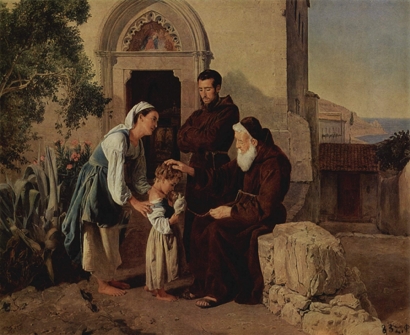
“At the Monastery Gate” by Ferdinand Georg Waldmüller, painted in 1846. The work and the reproduction thereof pictured are in the public domain worldwide. The reproduction is part of a collection of reproductions compiled by The Yorck Project. The compilation copyright is held by Zenodot Verlagsgesellschaft mbH and licensed under the GNU Free Documentation License.

There’s an old saying: “you can choose your friends, but you cant’ choose your family.” I was thinking about that this morning and it suddenly struck me that there was an interesting RPG-related question that could be founded on that premise – the very question that forms the title of this article.

The Arguments for ‘Yes’:

The GM knows the campaign background and the experiences that the family have lived through far better than the player does, especially at the start of the campaign. He knows the prevailing trends in attitude and opinion, the philosophies that were current at the time, and the way events were impacting ordinary people at the time. All these developmental influences then define the way the PC relates to the history – is he/she a product of his time, or is he/she in rebellion against it? Is the character defined by his childhood experiences, or has he become what the player has in mind despite them?

This has several profound benefits for the campaign.

First, the player, and hence the PC, have a far greater connection to the campaign background, enabling them to hit the ground running when actual play starts.

Second, the player has a far stronger idea of the personality of his character at the commencement of play as a result of this interaction between character and campaign; quite often in a new campaign, it takes several sessions before the personality of the individual to emerge. This period of “semi-play” shortcuts that process, again letting the campaign start at something close to full throttle.

Third, the GM has a far clearer idea of the character of the PC as the player wants it to be in play, and can craft his campaign and adventures to suit, from the very beginning. It’s normal for the first adventure or two in a campaign to be generic and relatively bland in terms of customization to the characters – both players and GM have to feel their way forwards, groping toward the shape that the campaign will ultimately take as a result of the collaboration between the participants. Again, this gives the campaign a headstart.

Fourth, by defining the relationship between the character and his family, it gives the GM a domestic scene in which to introduce the character within the campaign. That won’t always be relevant or useful, but any gain over a zero starting position can only be beneficial to the campaign.

So far, it all sounds pretty compelling. But there are always at least two sides to every story.

The Arguments for ‘No’:

The player knows the character that he is creating, and the GM doesn’t. If the player designs the family relationships, he can ensure that they are consistent with the character that he wants to play, either as a supporting force or as a contrast. What’s more, there is no certainty, if the GM designs/creates the family, that they will provide the foundations of personality that the player wants. Ultimately, the family unit is a part of the character concept, and that’s part of the creative space of the player, not the GM.

If the family background is all wrong for the character that the player wants to play, a GM-designed family unit might in fact start the character off with a disconnect from the campaign – nullifying benefit one. It might be a benefit or it might not – and if it goes wrong, it will go horribly wrong. That’s too big a risk to take.

Sometimes the player has no idea of the personality of the character, and pitching him or her in at the deep end only confuses them. As with the first benefit, this one might materialize or might not, and having the GM design the family background might even be counterproductive.

The third and fourth benefits are real, but the risks involved in persuing them are equally real. Sometimes, when the stars align, they will be manifested, but the chance of the opposite occuring is at least as likely. And, when you factor in the number of PCs, these risks are compounded to the point where they are almost certain to materialize in at least some cases.

What’s more, there is one additional downside to the proposal that can’t be ignored: the potential for bland similarity between the families of the PCs. That’s always the danger when one person is creating so many iterations of the same thing. And trying to overcome that difficulty can artificially exaggerate the differences, putting the connection between PC and campaign under additional pressure.

So is there a middle direction?

I think that it should be possible to chart a middle course, in which there is a dialogue between the player and the GM about the family background. The player tells the GM what they think would work for their character, the GM tells the player how that would sit in the context of the times, and the concept evolves from there. Are the family conformists to the times, or rebels? This not only achieves all the benefits listed, it undercuts all the risks, and adds one additional benefit: putting the family into context of the background, not just the PC who is the focus of the exercise.

It’s also a far truer reflection of the collaborative nature of the game, giving the players an early opportunity to add their ideas and concepts to the campaign, helping the GM to shape it to fit the players and PCs.

Often, a compromise brings the disadvantages of both extreme alternatives. This is one of the rare exceptions, in which the compromise maximises the opportunity for advantaging the campaign.

Comments Off on Should GMs design a PC’s family?

Undercurrents Of Characterization


Character skills can be divided into three categories (with some overlapping): skills that enhance the character’s ability to survive/succeed in adventures; skills that the character archetype is expected/required to have; and the oddballs from left field, which I refer to as Characterization Skills.

The last category also includes anything from the first two categories that the character has developed significantly more extensively than other skills in their respective categories.

Characterization skills representing defining personal traits and abilities of the character, things that make him or her stand out relative to their peers, a gold mine of characterization that GMs often fail to exploit.

Character Psychology

Why has the character chosen to learn the skill to the extent that they have? What does it say about the way the character thinks?

Take cooking – there are three basic approaches to the culinary art: precisely following directions, then tweaking it into perfection; throwing things together by instinct to construct a culinary tour-de-force; and incorporating a level of artistry into the finish of dishes. Each of these can be elevated to the point of being a master chef, but they represent very different philosophies.

Or take painting – there are multiple different schools and styles, but some of the key alternatives are minimalism (reducing a scene to its essentials), expressionism (using elements symbolically to provide additional information and context), enhancement (presenting images in a supra-realistic way), realism (presenting images as realistically as possible). Again, very different philosophies – and there are many more if you go beyond the styles that were developed after the reformation, which is the end of the time periods upon which most fantasy games are based. And, again, these can all be developed to the point of being a master painter.

In both of these examples, the philosophies can be extended to cover the whole approach to life of the character. They are representatives of an attitude, a way of thinking.

Sometimes, the player has given deep thought to how these choices reflect the character they want to play; at other times, it is incumbent on the GM and player to analyze the in-play persona presented by the character and interpret the skill retrospectively. Either way, these skills can be indicative of how the player want to interpret the character in play; the provision of opportunities to do so is then incumbent on the GM.

Character Background

Who taught the character the skill?s What did his parents and teachers think of the character learning the skills? What influence did it/they have on the character’s early life?

The answer to the last question might be ‘none’ – but the more tightly the character’s abilities and background can be entwine, bent to the purpose of making him unique and compelling, the better.

Character Activities

What do the skills say about the day-to-day activities of the character, especially those which take place in his leisure time? What opportunities for interaction with others do the skills provide? These are all opportunities to feed the character adventure hooks and roleplaying opportunities.

Character Socialization

Similarly, in in-game social occasions, these skills provide subjects for the character to discuss that are outside the normal expectations and clichés; they make the character more of an individual in such settings and less of a figurehead for his character class / archetype.

Character Knowledge

What associated and ancillary knowledge does the character posses as a result of having the skills? Scientific history is full of serendipitous combinations of seemingly-unrelated knowledge; the more of these that the GM can find/create and then incorporate into his adventures, the more the character’s role within those adventures comes to feel like an outgrowth of who he is, and not something that could have happened to any random character. If this occurs regularly, it can impart a sense that the current in-game situation (whatever it is) was always destined to happen to this particular character or group of characters. That can be a useful conceit to infuse into a campaign in which the PCs star to an extent that begins to strain verisimilitude (“Why does this sort of thing always happen to ME?”)

Character Challenges

Again similarly, the more a character can utilize these aspects of his uniqueness to solve problems encountered in-play, the more the game harnesses and reflects the uniqueness of the character, and his personal approaches to life. This never happens by accident; it can result from the player looking for opportunities to utilize a skill into which he has pumped skill points, or simply finding ways to match his expertise to the needs of a situation in order to find a solution to whatever problem has been encountered. But, by far, the most common reason such opportunities exist is because the GM has deliberately built them into the game that he is running.

It’s a reasonable assumption that the character is always looking for ways to exploit whatever skills and knowledge he has to get himself out of trouble; that should force the GM to do likewise when designing campaigns and adventures.

Intra-party relationships

There are three ways in which characterization skills can be relevant to intra-party relationships. First, one character can consume the product of the skill; everyone eats, for example. Second, relationships between skills can provide topics of mutual conversation, creating those relationships in the first place or providing them with added depth – a cook and farmer, for example. And third, once again, is the concept of serendipitous combinations of skills yielding a sum greater than their parts – an artist and a bureaucrat can cooperate to forge official documents more effectively than either alone, for example.

Once again, this won’t happen by accident; the players have to be actively looking for ways in which they can combine their different talents in response to the in-game situation, and that (in turn) won’t happen unless the GM first gets the players into the habit of doing so (by actively suggesting it as a solution to a problem that would otherwise be much harder to solve), and second by creating opportunities for the players to look outside the box, in particular by blocking more obvious approaches (or seeming to – quite often, one character can provide a means by which a second can bypass such blocks).

It is also often necessary to break up the party, at least temporarily, by requiring characters to be in multiple locations at the same time, then twisting the situation so that the skills that the players thought would be necessary to advancing the plot are no longer relevant, forcing the characters to improvise. After all, assuming they are playing intelligently, they will do their best to match ‘assignments’ to ‘skillsets’; it follows that the situations will usually need to be somewhat different to appearances if this sort of innovation is to become relevant.

Forcing Characterization Skills?

Characterization skills are so useful, indirectly, that some GMs actually mandate that characters take at least one. Players who are good roleplayers will often take one or more without prompting, whereas most Combat Monsters and Min-Maxers will have to be dragged there, kicking and screaming. I know at least one GM who offers extra skill points at character creating while restricting what they can be spent on, purely to encourage the selection of Characterization Skills. Still others threaten players with a reduction in XP awards (on an individual basis) if characters don’t contribute to solving the challenges of the day.

Personally, I find all three of these approaches to be heavy-handed (but better than nothing in the case of options one and two); a far better approach is to warn players that there will be times when being a rounded individual will be more important than focusing completely on character enhancement in areas they are already competent in, defining what is meant by “well-rounded” (it doesn’t mean a skill level in every possible skill, for example) – then following through by designing challenges that can’t be solved by force or simple skill rolls.

This is a lot more difficult than designing challenges that can be overcome in these more straightforward manner, but the rewards are fairly obvious. And, once players get into the habit of viewing their characters holistically, they will carry the approach into other games under other GMs, even into games of unrelated genres, where that GM will be educated in the significance of the approach – spreading the assumption of good roleplay as they go.

Can you name the Characterization Skills of each party member in your current campaign? Do you keep a list of them handy? Have you looked for the serendipitous combinations, and ways to exploit them? If you answered in the negative, perhaps you should think about doing something to remedy the lack. Look for the Characterization Skills and ways of taking advantage of them!

Comments Off on Undercurrents Of Characterization

Creating New Magic Weapons


“Excalibur / Calbfwlch, Translucent” By BrittonLaRoche released to the Public Domain by the original uploader,https://commons.wikimedia.org/w/index.php?curid=3013525

Readers may have noticed that the last couple of posts have been unusually short and to the point, instead of the usual depth that is the hallmark here at Campaign Mastery. There’s a couple of reasons for that.

First, I have a family function coming up in June and won’t be around to write my usual posts. Rather than letting readers down who may have been looking for something new, I’m trying to build up some lead time so that I can leave a couple of posts scheduled for publication in advance.

Second, being (mostly) cut off from the internet limits the amount of research that I can do, so I’ve deliberately chosen articles that don’t need a lot of it.

Third, when it looked like I might need to make my way during business hours to an internet cafe in order to post anything at all, I sat down with a pad, wrote the two articles you’ve already read, and came up with half-a-dozen more ideas that could be knocked out in reasonably short, sharp posts.

I’ve always written with the philosophy that an article should be no longer than it needs to be in order to address the subject of the article. It just so happens that these articles don’t need to be very long.

Today, I’m going to share with you a simple technique for creating interesting and original magical weapons.

As an added bonus, if you can find the right technobabble to explain the properties of the weapons, they can work in a sci-fi or superheroic setting. But the primary focus is fantasy gaming.

The heart of the technique is a simple question:

What can’t the weapon type usually do?

Let’s look at swords by way of example, and see some of the things that you can achieve with this simple conceptual technique.

Range

Swords don’t have any range beyond arm’s length, so a sword whose slashes and thrusts extend beyond the normal reach of the weapon is a wondrous weapon indeed. When you strike in the direction of an opponent at range, a cutting force extends out, traveling to the nearest opponent(s)in that direction. The weapon strikes as though the target were in the adjacent space, but for every 5′ between the wielder and the target, damage done is reduced by 2 to a minimum of zero. A blow can’t affect more targets than a normal sword could affect in adjacent spaces to the wielder.

This example also illustrates a couple of important principles of the technique.

  1. The basic nature of the weapon remains unchanged.
  2. The concept has to be described in simple game mechanics.
  3. The limitations of the weapon not directly related to the magical capability being imparted remain explicitly unchanged.

Sounds good? Let’s do another one:

Returns To The Hand

The implication of the simple question are that you are imparting a quality to the weapon that you are “enchanting” that it doesn’t normally posses, but that another type of weapon does. This idea derives from an icon of Australia, the Boomerang.

There are several youTube videos demonstrating Boomerang Throwing; I’ve linked to one (3:05) which also has several more on the page. Unfortunately I wasn’t able to view any of them because the computer with the internet access is so old it doesn’t play youTube videos, so you may have to look at several of them if you’re unfamiliar with the technique.

The problem with applying this to a sword is that swords don’t usually leave the hand of the wielder. But throwing knives do, so why not a sword that has to be thrown like a knife? Make it a curved blade because the shape will add to the credibility and mystique of the weapon’s ‘special ability’.

What you end up with is a sword that you throw; the sword then strikes a single target at range, doing its full damage. Range interval would be about 15′, about half that of a hand crossbow, based on what I’ve seen expert boomerang throwers achieve. The weapon then returns to your hand as part of the same attack action. A Dex roll at DC equal to the attack total is required to catch the hilt; failure means that the wielder has caught the ‘sharp end’ inflicting 1+magical plusses damage. Damage includes the normal Strength bonus.

Of course, you might feel that this is altering the basic nature of the sword too much – in which case, apply this ability to something like a hand axe.

This illustrates another couple of important principles:

  1. The resulting weapon respects game balance – because it is restricted to a single target, it does full damage, unlike the previous ‘at range’ example.
  2. The structure and behavior of the weapon are adjusted as necessary to achieve reasonable plausibility.

One more example:

Entangle

This takes the basic properties of a net and imparts them to a sword. I’ve picked it because there is a reasonable sci-fi variation, which I’ll look at after describing the basic fantasy weapon.

Instead of damaging the target, this weapon severs the planar bonds that hold the plane together around the target, which then curl back, binding the target. The attack roll total is the DC for a reflex save to avoid being entangled; the damage that would normally be inflicted is the damage that must be ‘inflicted’ by straight strength before the entangled character can wrest himself free of the tangling bonds of invisible force. This may take one or more rounds. The character is held immobile, but is still able to attack anyone within arm’s reach as usual (which inflicts no damage on the restraints, it should be noted).

On a critical hit, the severing of planar bonds is sufficient to open a portal into an adjacent Plane. Reality inflicts 1d6 damage per round on the opening, eventually healing the ‘wound’ in reality. The target, if not anchored, is sucked into the other plane, releasing him from his bonds in the process, but exposing him to the environment of that adjacent plane. If multiple planes can be considered adjacent to the Plane on which the target was located, the GM should choose randomly between them. There is a 1-in-20 chance, per round that the ‘portal’ is open, that something native to the adjacent plane will cross into the plane in which the attack took place.

Nets don’t normally inflict damage, so it’s necessary for the sword’s ability to do something else with the damage that a sword normally inflicts. Using it to resemble the behavior of a net in a more exotic way is a neat solution.

Sci-Fi Variant

The sword rips a hole in the space-time continuum around part of the target, binding him in the surface tension. So far as anyone else is concerned, that space ceases to exist; objects and missiles pass through it as though it weren’t there. This includes light – the affected part of the trapped character becomes invisible, as though it were in a blind spot. Mechanics are as described for the fantasy version.

Creativity Unbound – within reason

There are two big advantages to this approach.

The first is that it sparks creativity. The second is that it constrains that creativity to reasonable limits. This combination produces original creations that don’t overpower the game system, enabling them to be dropped directly into a campaign. And it takes only seconds.

On a note completely unrelated to today’s post: J.T. over at Ravenous Role Playing said some very nice things about recent articles in his most recent blog post. I tried leaving a reply at the site but this browser is so inadequate that his authentication routine won’t work with it. Here’s what I tried to say:

Thanks for the Kudos, J.T.! For some strange reason, I didn’t get any pingbacks showing up at Campaign Mastery when you posted your reviews, though, or I’d have said so sooner!

Regarding your problem with factions, having them all pursue their objectives is ‘morally gray’ but it’s also morally bland, which might have an impact on the way your players react to them. Try tossing in a faction who try to do the right thing, but aren’t always sure what it is, and so make mistakes every now and then. Or a faction that is loyal to their friends and allies to a fault – taking what is normally a positive virtue and twisting it to potentially negative ends. Of course, these need to be balanced with the occasional group who fall on the other side of the line – “So I’m kind to my grandmother – I still want to see the establishment BURN”, or “It’s all the Elves fault, we should obliterate the Elvish Pestilence from the face of the Earth!” A full spectrum of options includes the entire palette of choices – good for the right reasons, good for the wrong reasons, bad but honest about it, bad but tries not to look it…

I suppose, if you put his words together with the reply above, this could constitute a bonus tip for everyone else! Which is how I can justify publishing my comment here…

Comments (4)

Improvising an Adventure


Jim Brochu and Steve Schalchlin – The Big Voice God or Merman By Bev Sykes from Davis, CA, USA – Flickr, CC BY 2.0, https://commons.wikimedia.org/w/index.php?curid=409330

Things didn’t exactly go according to plan in the Adventurer’s Club campaign this weekend past. Entirely my fault; I was running late and assumed that the adventure that we were about to start had been copied onto a USB stick as is our usual practice. After all, it was finished several months ago.

On top of that, transport headaches meant that several people arrived late and were going to have to finish early, myself included.

Decision

We were faced with three choices: abandon play for the day, despite everyone being there and ready to play; try to run a complex multi-part adventure with strong reliance on visuals with neither the adventure nor the visuals; or for my co-GM and I to put our heads together and improv something pretty much off-the-cuff.

It wasn’t a hard decision to make. The campaign was in-between adventures, which was why the adventure hadn’t been loaded onto the USB stick, but which is also the perfect time to drop in a ‘filler’ adventure.

Conceptualizing

To start with, we took advantage of the fact that this campaign has two GMs. We stepped outside for five minutes to brainstorm. Initially, Blair focused on what we could do while I thought about the limitations we faced. First up, the timing between the last adventure and the next planned adventure is fairly tightly controlled in a number of respects, so there wasn’t going to be enough game time for the PCs to travel anywhere; the adventure was going to have to take place in New York City. Second, this particular combination of PCs haven’t been together for very long, so if we wanted to connect the mini-adventure with their past, we had to work out how to involve everyone. I particularly wanted to avoid a situation in which only a couple of the PCs were involved for any length of time purely because they had been with the campaign the longest.

Blair’s initial ideas were for the PCs to be gathered somewhere, for something to happen, leading them into a chase situation through the city. Unfortunately, chase scenes are really hard to do well without adequate prep and planning, and the idea seemed a little bland. But, because we had a relatively small window of playable time, I liked the idea of starting off with the PCs already in one place.

I suggested a mole-men riff, which led to the thought of a ‘land that time forgot’. The very first adventure in the campaign – which predates even my involvement in it in any capacity whatsoever – took place on an island with Killer Apes. The idea was that the PCs had been involved in an incident in the course of that adventure that had been blocked from their memories until now. If the older PCs were to suddenly find themselves reliving that past adventure and acting accordingly, we could turn the dichotomy from a liability into an advantage.

It also let us pull in an exotic location without having to travel to it. Next, to why the PCs remember the events on the island. Several options commended themselves: the PCs did, and were just having flashbacks to the incident; or something was interfering with their memories now; or something had interfered with their memories back then. Again acting on the principle of turning a potential liability into an asset, I suggested that they discovered a mind-control crystal being used by a local warlord, but ended the threat; this not only made those present more sensitive to the effects of such a crystal showing up nearby, awakening those memories, but awakened a resistance to a ‘cloaking effect’ that prevented NYC locals from noticing the crystal until they were under its’ control.

With this notion that both sub-groups of PCs were being affected but in different ways, bringing them into conflict as the newer characters sought to protect the older ones from themselves, and the suggestion that one of these older PCs, once freed from the influence of the crystal, could use his defenses against occult evil to ward the PCs, giving them independence of action when all those around them were being controlled, the basic outline of the plot was complete, and we were ready to play.

Implementation

The lack of prep time invested in the adventure showed up almost immediately. One of the PCs assumed that he was hallucinating and tried to snap himself out of it, because we failed to make it clear that for those affected, the last two-and-a-half years hadn’t happened. If we’d invested prep time in the adventure, we would have made certain that our prepared text delivered everything that the PCs needed to know.

But that was the only real hiccup along the way, and – because they knew that the whole adventure was being improvised – the players cut us a little more slack than they otherwise would have.

The resulting day’s play wasn’t as polished or nuanced as most adventures in the campaign, but everyone had fun. Since that’s always the primary goal, we would have to rate the day as a success.

Feedback

Midway through, during a break, one of the players indicated that he was surprised that we had even contemplated an improv adventure, because it is the total opposite of the way we – and especially I – usually run games.

Long-time readers will probably know better; there was a period of time when I had zero time for prep, and had to devise the week’s adventures in the car on the way to gaming – not once, but every week for more than two-and-a-half years.

Like so many things in life, improv is a compromise with its own pros and cons. Some of those adventures were great, some were a bit so-so. When you improv, there’s no time to ponder, reflect, edit, and censor your ideas to weed out the rubbish. Any flaws or errors are magnified and in-your-face.

At the same time, though, you give yourself the freedom to throw in twists as they come to you, to extend those plot sequences that are working well, and to cut short those that aren’t.

That’s a good thing, because you will need to take advantage of that flexibility more often when you improv.

That’s not to say that pre-planning and prep are perfect. As demonstrated by An Experimental Failure – 10 lessons from a train-wreck Session, prep-heavy approaches run the risk of getting too close to a flawed idea and finding yourself trapped by it. In a lot of ways, it’s a line-ball judgment between the two. But improv has one final deficiency, and for me, that’s the one that makes the ultimate difference between the two.

If you have no time for prep, you also have no time for adventure logging. Even if the lack of prep is a choice, and not a necessity, adventure logging after the fact is a lot harder to keep comprehensive and up-to-date. The more that you can cut-and-paste from prepared notes, the better, in terms of having a continuity that you can build on.

Prep investment, in other words, creates more of a campaign than a series of marginally-connected adventures, and that broader tapestry permits more interesting adventures. Like improv, it makes everything bigger and stronger, emphasizing and building upon the positive aspects of preparing material at an adventure scale.

Lessons

For the right type of campaign, I wouldn’t hesitate to go full-improv, all the time. If the campaign plans are such that the strengths of an improv approach were maximized and the downsides minimized, it would definitely be the way to go.

Regardless of the adventure style that you choose, there are a number of lessons from this experience to take away for your games.

  • Be aware of the plot limitations and plan around them.
  • Be aware of the strengths you can draw upon and plan to make the most of them.
  • Be aware of the weaknesses that you have to live with and plan to minimize their importance.
  • Always look for a way to turn a liability or constraint into an asset.
  • Both improv and careful planning have their strengths and weaknesses.
  • The important thing is for everyone to have fun!

Comments Off on Improvising an Adventure

What Size Is A Kingdom?


Image courtesy pixabay.com, provided under Creative Commons 0 license

Disaster has struck, and the laptop that I have been using to do – well, everything – has lost it’s visual display. It’s possible that this is simply a new symptom of the battery power problem that it’s been experiencing for some time, or it might be some new devilry.

This problem is complicated by the fact that it’s the only reasonably-modern computer in the house that recognizes my USB modem, so I have also lost almost all internet connectivity. I’m hoping to resolve that sooner rather than later, but it might be that the only way that I have been able to let you read these words is by utilizing an internet cafe for the upload. If that’s the case, it’s not something that I’m going to be able to do for very long. Look for an update at the end of the article that will advise on the latest information.

It also means that I no longer have access to the spell-checker that I have been using – so I apologize in advance for any misspellings!

How large should a kingdom be?

It’s not as straightforward a question as it seems. But if you look at the examples provided in most fantasy literature, you would get the impression that most of them are the size of modern France, or Germany, or China. A few might make the kingdoms the size of Great Britain, or India. Some have Empires the size of Europe, or even Europe plus the Middle East.

These are fine if you have a good reason for that size and know what you are doing. Most people don’t have the first idea. Historically, Kingdoms were often the size of countries like Belgium or Luxembourg or Switzerland. Italy once comprised several city-states (7 I think, but I’m not sure and without the internet, can’t check). Of course, these were not always actually named “Kingdoms” by the locals, though that is the way the word might be translated today.

Over time, marriages and conquests unified these into larger administrative nationalities. These were often conquests from the outside, forcing a new relationship onto the conquered peoples – and then falling apart. Kingdoms the size of France or Britain or Italy couldn’t exist without the Roman Empire.

Another mistake that a lot of people make are having firm, defined borders. Unless you’re on a major trade route or invasion path or something of that nature, borders – like citizenship – are rather more vague and unofficial. Technically, a border might be precisely defined – but there is a difference between what you can claim and what claims you can enforce.

Kingdoms, in order to be practical, need to be administered. The decrees of the throne have to be enforced, the taxes have to be collected. There are practical limits to how much of this is possible.

Transport Modes

Transport modes are vitally important to determining the size of a Kingdom or Realm. It’s one full third of the story.

Game systems frequently give movement rates for horses and other mounts but don’t write about how long they can sustain this rate of movement, and that’s what dictates how far they can travel. The same is true for characters.

I do most of my regional maps at a scale of 6 miles to the hex. That gives a daily movement rate on foot on roads, paths, and trails of 4 hexes or 5 for a forced march. Horses travel about 6 hexes in a day unless you change mounts regularly – which messengers often do but which is not an option for military and commercial traffic. I then adjust these movement rates for terrain and roads – -1 for a light impediment, -2 for 1 serious impediment or two light impediments in composition, -3 (minimum 1) for two serious impediments. Boats heading upstream can travel 2-4 hexes, those traveling downstream 4-8.

Another way of looking at these numbers is that an official can travel two hexes from his administration center and back again in a day. Every two hexes and changes in policy, in laws, in politics, are all a day out of date and a day weaker.

Roads & Settlements

The quality of roads is already factored into the above, but this is sufficiently important that it’s worth re-emphasizing. The quality of the roads is a key factor in determining how large a nation can be.

Settlements tend to be one day removed from each other. The average community in the middle ages was about 2000 people. As it happens, thats about the same size as the town I grew up in, so I can relate to such communities almost without thinking about it. Everyone knows all, or almost all, of the businesses in town. At least a third of the town is known by name, about half of that number by their first names.

The dominant factor when it comes to town size is the ability for food to reach the community. A ring one hex deep and seven hexes in total area would be enough to feed a community of 1000 people – if the people involved in the agriculture didn’t have to eat, themselves. To allow for this factor, we need to push out another hex in radius, adding another 12 hexes to the agricultural base, of which six hexes can be stored against future famines or shipped to feed a larger community elsewhere. The other 13 hexes worth are consumed locally (including stores for next year’s planting).

This requirement can be halved for especially fertile land, and doubled for especially poor croplands.

By an absolutely amazing coincidence, this is the same distance over which direct daily supervision is possible, and half the distance between communities.

Which means that a nation of arable land that is fully occupied with settlements delivers 6 hexes out of 13 needed for every 1000 citizens – two such towns are almost but not quite enough to support an extra 1000 people. Which should make it clear that towns with 2000 people have a substantial level of malnourishment in a poor social class.

The average size of 2000 people also means that a lot of communities are going to be smaller. In fact, communities tend to roughly follow a geometric expansion: 62, 125, 250, 500, 1000, 2000, 4000, 8000, 16000, 32000, 64000, 128000, and so on. For any community size, the next size down tend to be 5-20 times as numerous (these are very rough guidelines only).

The important thing to note about such communities is the number of hexes of arable-land-equivalent produce they have left over, because that is where the food supply for those communities larger than 2000 people come from.

Using these numbers, you can easily count up the number of farm hexes ‘left over’ from each community size category and how many of the larger communities they can support. Twenty towns of 1000 people on arable land gives a total of 20×6=120 hexes ‘spare’. At 13 hexes per thousand people that’s 9000 people that can be fed adequately, or 18000 people that can be fed at typical levels, on top of the base 2000. So one community of 20,000 people can be fed by the land around it and 20 communities around that.

The best approach is to work the size list from one size to the next – how much excess food out, how much excess food required. The geographic size and the relative quality of the land will thereby dictate the size of the communities contained within a kingdom.

These numbers also take into consideration the likelihood that some communities – perhaps as many as 1 in 4 – will generate some non-edible commodity. Logging and Quarries and Mines and so on. Fishing can also bump up the numbers considerably for communities on the coast, or which contain major river systems because a fishing fleet can exploit more hexes, and can also yield greater food densities (i.e. each fishing hex counts as 1.5 ‘arable land’ hexes). That means that a coastal fishing community can exploit areas up to four hexes away – if half the are around the town is water, that’s a total of 32 fishing hexes which is the equivalent of 48 ‘arable land’ hexes – plus the 5 hexes of arable land that they actually have for a grand total of 53. They need 7 of those hexes to feed themselves; the other 46 can either go to supporting a larger fishing community, or be shipped to support a number of other communities.

In practice, however, with communities 4 hexes apart, perhaps even less and smaller in size along the coast, no one community is going to get it’s entire potential allocation – their neighbors will get some of it. Trying to figure out which community gets how much sea is a waste of your time; simply add up the number of sea hexes within reach of any port and divide by the number of coastal communities to determine how much ‘sea’ each one gets, and hence, how much they can contribute to the population size of the kingdom.

Note that all this is a far simpler and less accurate method than others that I have seen. It’s a compromise between accuracy and speed.

Administrative Radius

Now for the fun part: Every whole number of towns supplying food for a single larger community can be considered under the control of that community. The lands administered by a noble are thus a function of the size of the largest community within that Noble’s domain.

It’s relatively easy to create a list of courtly ranks and allocate communities of a certain size to these ranks. A town of 4000 might have a count, 8000 an earl, 16000 a duke, 32000 a prince, and 64000 a King – or whatever. The important thing is to set King to the largest community that the Kingdom you have mapped out can support, then spread the lesser noble ranks through the rest. Titles in the capital city tend to get a “bump’ of one grade, so bear that in mind.

A Kingdom is all the lands beholden to the most highly-ranked noble, plus all the lands beholden to those below him in rank who have any part of their domains within the King’s administrative reach. Kingdoms thus tend to stretch out along rivers and trade routes, and be walled off by natural barriers.

Efficiency

The third major factor in the size of a Kingdom or Realm is much harder to quantify, and is far more abstract. All sorts of things go into it, from literacy and numeracy rates to theology to philosophy of government, but it can be summed up in a single pair of words: Administrative Efficiency. If the bureaucracy is poor, with records held only locally, administrative radii are of the size indicated. With each increase in efficiency, the radii expand. Good record-keeping permits accurate tallies of resources, incomes, and taxation. That’s how an Empire the size of the Romans becomes possible, and how nations the size of those larger geographic entities can function.

The British Empire achieved its growth by centralizing broad policy decisions and placing daily oversight in the hands of governors with considerable freedom of action – then making sure that those governors were loyal. China became the size it is today because of the Imperial Bureaucracy that was capable of administering a nation of that size, and through having sufficient military force under that control to expand. If the Bureaucracy wasn’t up to the job, lands would be conquered and the conquerors would then create their own little fiefdoms, effectively fragmenting the resulting nation back into manageable chunks.

With every hex you travel away from the administrative center, control weakens. That’s the lesson of the Roman conquest of England – they could get as far as Hadrian’s Wall, but no further.

This barely scratches the surface; there are a great many more complexities involved in Kingdom size. But as generalizations go, it’s a useful one.

Update:
I have been in contact with my ISP. They tell me that because my modem is more than 7 years old, installation disks are no longer available, but because I have been a customer for so long, they will ship me a replacement modem that my computers will be able to access, free. (It will also be fully NBN-compatible, which won’t mean anything to anyone outside Australia but which is a big deal, locally – without it, I would have had to replace the modem again next year.

In the meantime, I’ve been able to get a very slow internet connection happening with a very slow computer which has only an even slower and more limited browser – but which should be good enough for me to upload this post and the one that’s due to be published later this week, which I have also written already.

Normal Campaign Mastery service should be resumed by the weekend :)

Comments (8)

Tying Plot Threads Together: Concepts to Executable Plot


Image Credit: freeimages.com / Mario Alberto Magallanes Trejo

How do you take three plot ideas and interlink them to make one grand adventure? I’ve often skimmed over this point because it’s usually arisen in the context of campaign planning, so I thought it was high time that I went into it in greater detail.

Another reason why I’ve been dodging this discussion for so long is that it’s really hard to find general rules or instructions to describe the process. To be sufficiently broad in content, it’s necessary to become so abstract and vague that you lose all meaning in terms of directly useful advice. Nevertheless, I’m going to dive in and have a go (I may follow this up with an example in a separate article if there’s enough demand).

Known Elements and Unknown Elements

With any one-line plot synopsis, there will be a few known facts and a lot of indeterminate facts. By the end of the design process, everything will need to be known of course; but those unknowns are critically important connection points to use in constructing the full plot. In addition, there will always be two – possibly three – additional elements: beginning, PC involvement, and Resolution. At the moment, any of these could be known, but almost certainly two of the three will be unknown. If there are only two elements, it’s because beginning and PC involvement are the same thing because the PCs are being targeted by the villain of the plotline. On top of those, each plot thread will have up to 16 additional structural elements, bringing the total to 19. Almost all of these will be unknown at this point in the adventure creation process. In fact, some of them will be unknown until just before the start of play, and some will remain in that condition right up to the point when they take place in-play!

The complete list of plot elements is:

  1. Initial Status – Everything the GM needs to know in advance about the setting and context in which the adventure is to take place, including any plans, goals, or ambitions of the PCs that are in effect immediately prior to the commencement of the plot thread?
  2. Beginning/Background/Purpose – What? Why? – What is the Enemy trying to do and why?
  3. Who? – Who is the Enemy? Are they a Villain, an Antihero, an Ally, a Betrayer, what?
  4. Plan – How? When? Where? – How is the enemy going to achieve his purpose, in his initial opinion? When and Where? How will the outcome bring about the enemy’s desired consequence? Optional: What are the flaws in the plans and why has the enemy not foreseen them?
  5. Action – What exactly is the enemy going to do from an outside/onlooker’s perspective?
  6. Victims/Target – Who does the immediate action target? Who does the ultimate consequence intended by the enemy target?
  7. PC Involvement – How are the PCs going to get mixed up in the events? Why?
  8. PC Reaction – How are the PCs likely to react to the combination of their involvement (7), the context and circumstances (1), the immediate victim(s) (6), and the Action described in (5)? How will the PCs involvement relate to their plans, goals, and ambitions? (1)
  9. Initial Outcome – Taking into account any enemy anticipation of the involvement of the PCs, either specifically or generally (it just happens to be the PCs but it might have been anyone in the right place at the right time), and the plan, what will the outcome of the initial action be from both the enemy’s and the PCs points of view?
  10. Witnesses/Experts/Informants – Information has to come from somewhere, and it’s always better to put most of it in the mouths of NPCs. In some campaigns you can also get extra mileage by placing these people in danger.
  11. Comprehension – At some point, the significance of the plan will dawn on the PCs. You can’t predict when that will be, but you can state an absolutely final point at which such comprehension will have taken place. Either way, you need to build time into your game for this to occur, possibly even a cut scene to be ‘spliced in’ whenever it takes place.
  12. Modified Plan – How will the initial outcome (9) and the fact of the PCs involvement (7) affect the plan (4)? Will it be revised, and if so, in what way? What will be the next steps in that revised plan?
  13. Response – At the same time, the PCs may be making plans of their own. You can’t normally predict what those plans will be, but need to allow in-game time for this planning to take place.
  14. Conflict – The combination of the modified plan and the PCs response to events will be a conflict between the PCs and the agents of the Enemy. Where and when will this conflict occur?
  15. Conflict Outcome – What will the outcome of the conflict be, from both the PCs and the enemies’ points of view?
  16. Setback – Third Plan Iteration – A part of any good dramatic structure, the PCs need to encounter a setback, probably as a consequence of a third revision of the enemy’s plans.
  17. Advancement – The PCs overcome the setback and make progress despite it.
  18. Twist – Not always present, but a plot twist can happen in or after any one of several of these stages. There can even be more than one. A previous article listed eleven types of plot twist: Part 1 and Part 2.
  19. Confrontation (Climax Pt 1) – That advancement leads the PCs into a confrontation with the enemy and/or the enemy’s plan.
  20. Resolution (Climax Pt 2) – That confrontation is resolved with a new outcome.
  21. Consequences – There should always be consequences – those experienced by the enemy, by the PCs, and by various affected segments of the general population.

These don’t necessarily have to occur in the sequence given. In fact, this neat, orderly progression will be the exception and not the rule. Some may not take place at all. But most of the sequence will be intact.

Two Dimensional Plot Structure

Using the known and selected unknown plot elements, the idea is to build up a two-dimensional plot structure that defines the relationship between the elements of the plotline, taking three individual plot ideas and turning them into one cohesive plot.

There are three types of connection between plotlines, and they all take the form of a relationship between an element of one plotline and an element of another:

  • Direct Connections
  • Common Links
  • Consequences

    Let’s look at each of these.

    Element Connections: Direct

    A direct connection occurs when an element of one plot thread is also an element in another, linking the two stories. A witness to one event is secretly the enemy in another, for example, or investigating a red herring in one case leads to the accidental exposure of another (unrelated) problem. Direct connections are usually fairly rare and always significant.

    Element Connections: Common Links

    A common link occurs when an element in one plot thread is closely related to an element in another. These are often interpreted as being more significant than they are intended to be. It’s like investigating a fraud allegation against a businessman only to discover (a) that it’s his partner who’s been committing criminal fraud, and (b) the businessman has engaged in corrupt behavior with a political figure. Or investigating an arms merchant for his involvement in a murder only to find that he was engaged in a completely different murder at the time of the first act.

    Common links can be sub-classified into associated, coincidental, improbable, and implausible. Associated links describe the situation in which both elements are connected to the respective plotlines as a result of some common causal factor. This is often that case when crimes occur in a very small community in which everyone knows everyone else, for example. You’re investigating something, and someone who is guilty of something else thinks your story is just a cover for the truth, and attempts to ‘deal with the problem’ – or simply flees instead of answering questions, or answers with easily-penetrated lies to buy themselves time to flee. It’s pulling someone over for bald tires and discovering a stash of guns and money in the back seat.

    Associated links are fine. Coincidental can be acceptable or problematic – refer The Conundrum Of Coincidence. Improbable links stretch credibility, but are occasionally unavoidable; they require special attention to detail. Implausible links directly impact on the verisimilitude of your story, and are to be avoided.

    It may not always be obvious to which classification a given link belongs. For example, a link may appear improbable or even implausible. A player remarks on it, to which you reply that his character is probably having a hard time believing it, too – inviting the player to get paranoid about who is trying to fool whom and what they are trying to cover up. And then the connection is validated and explained by an unexpected development, and the player discovers that it was an associated link after all, and makes perfect sense – once all the facts are known!

    Element Connections: Consequential

    Consequential Links describe a situation in which one element’s relationship with one plotline leads directly to another plotline. That makes them very similar to associated common links in virtually every respect, but the causality dominoes affect each other directly. One person does something criminal, bringing an investigation that panics someone who’s been planning something else illegal into acting prematurely, for example, so that the second plotline is a direct consequence of the first. The connection between the plotlines is thus more direct and intimate than is the case with associated direct links.

Completing The Plot Elements (preliminary)

Starting with the known elements, decide on any connections between them. Connections are always resolved in the sequence Direct, Consequential, Common.

Next, look over the unknown elements, and decide on the content of each unknown and the nature of the links. The sequence remains the same. Once all the linking elements are determined, and all the plotlines have been tied together into the one interwoven plotline, complete the remaining unknowns by assigning details to them.

Most of these connections will be preliminary in nature, the details subject to revision as necessary. Replace and refine until you are satisfied with the merged plotline.

Is there an Uber-villain?

One decision that will have to be made fairly early on is whether or not there is a single Uber-villain pulling the strings in the first two plotlines who will then be confronted in the third or even in a fourth. You can even let the uber-villain be long gone by the time the PCs put the clues together, letting him return to bedevil the PCs at a future time. The main consideration with an Uber-villain is making sure that your “why” decisions are rock-solid.

Climax Point

With three plotlines, you have three choices of climax for the overall adventure. Which is the most rational from a plot point of view? Which one is the most dramatic? Which one is the most exciting in play? If you’re lucky, all three will point to the one choice as the ultimate climax of the adventure; but as often as not, you will have more than one choice indicated, and will have to make the decision without a clear indicator.

This is a critical part of determining the adventure structure. You can’t proceed until you get it right.

Initial Entry Point

Next, which element is the most instantly intriguing – which one has the biggest hook? This will vary from case to case. Remember, too, that anything that connects to something one or more PCs wanted to do automatically gets a boost in this category. This is going to be the way you start the adventure, so you have to make every effort to get the choice right.

Linear Structural Rendering

From that starting point, you can work out the overall structure of the adventure as it will be experienced in play, i.e. in linear fashion. There are innumerable possible structures, but in most cases you will find that the choice of starting and climax points, with some basic guidelines, will make most of the choices logical and relatively easy to make. Those guidelines:

  • Use confusion where necessary, but unless it’s present deliberately, keep it to a minimum.
  • It’s not enough for the total spotlight time to be more-or-less even across all the PCs; you also need to share out the spotlight evenly throughout the adventure. It’s even possible that you will need to devise additional go-nowhere-significant plotlines for some PCs and integrate them into your overall adventure in the same way as described above in order to achieve this.
  • If a particular player needs a particular type of content – or needs a particular type of content to be applied sparingly – you have to be sure to touch on his needs at least once per game session. This introduces a new parameter that we haven’t mentioned before, adventure length. Right now, it’s very hard to judge this with any measure of accuracy, but you have to estimate it anyway in order to satisfy this guideline.
  • Theme can manifest in one of two ways – as variations that become relevant to each PC in success, forming a secondary plot through-line; or in clumps at appropriate times in the adventure.
  • Emotional Pacing needs to make sense – refer to Swell and Lull: Emotional Pacing in RPGs (Part 1, Part 2).
  • Revelations only pay off if the pre-existing beliefs are reiterated and reinforced first. Similarly, you need to prepare the ‘ground’ for plot twists in order to make them most effective.
  • Successive scenes need to contrast in tone.
  • Avoid patterns of PC involvement sequences. If A is followed by B is followed by C (where A, B, and C are scenes starring particular PCs), the next iteration should be in a different sequence – adding in extra scenes to be roleplayed as necessary that could otherwise be handwaved.

Oh, if only it were that easy.

What usually happens is that natural fragments will present themselves – one scene followed by another followed by… – but these won’t link together, or there may be multiple choices of structure. At the same time, you may compile a section in which you know that a number of scenes will take place, but you have no idea what the best sequence of them will be. Finally, there will usually be a few bits that just don’t fit comfortably.

Nevertheless, you have to fit things together as well as you can. This is one area where the real artistry of adventure design takes place; each GM will develop his own style. It’s rare that there is only one right answer but normal that there are multiple wrong answers to be winnowed out. You may need to tweak and revise multiple times before you find the structure that will work best, all things considered.

Incorporating the third dimension: The Timeline of events

Once you have divided the adventure into individual scenes and arranged them in such a way that they tell the story of the unified plot thread in a way that meets all the criteria spelt out above, you can start using context and continuity to make your plotline three dimensional. Doing so is a little difficult to explain, but here goes:

It’s extremely unlikely that the backgrounds and contexts of the three adventures will be identical. This is information that you have to get to the players in the course of play, but in such a way that it doesn’t provide spoilers to the plot twists and revelations that you have incorporated.

In addition, it means that you need to incorporate events into the background of various scenes to provide the necessary information and to show the (gradual? abrupt? a little of both?) transformation of one background/context into another.

Next, you need to look at what each NPC was doing in the course of previous scenes to the one in which they first appear. Passing encounters and brief interchanges and the consequences of any actions all build a foundation of verisimilitude upon which the adventure itself rests.

The more of these additional, incidental, cross-links that you can build into your adventure, the more three-dimensional your adventure will become. This is the second area in which the true artistry of adventure design makes a difference.

It’s also important to make a note of why each such scene is where it is so that if your planning needs to evolve in response to unexpected PC choices, you can assess how they are to be affected.

Internal Logic Check

At this point, you have have a complete adventure laid out, scene by scene, in synopsis form, with reasons for each item being where it is within the structure.

That means that this is the first (and last) point in the process that is suitable for a complete internal logic check.

Things to particularly look out for are:

  • Decisions made prior to receiving the information that justifies them.
  • Continuity errors in which an inconsistency in characterization occurs without explanation.
  • Is every decision made by an NPC sensible given what that NPC would know at the time of making the decision?
  • Is every choice of action reasonable under the circumstances the NPC believes to be in effect at the time?
  • Is every piece of information to be provided to the PCs something that they could reasonably learn, based on what they were doing in the scene in which they last appeared prior to the scene in which they acquire or demonstrably have the information?

Plot Dynamism

Where the major PC decision points and what if they make unexpected choices at those points? If the PCs engage in an activity – be it rock climbing or combat – that you have assumed will result in one particular outcome – success or failure – what are the alternatives? Is there anywhere in the adventure where the players should have a choice, but don’t?

While it’s perfectly acceptable to evolve the plot on the fly – and a great deal of the effort above is designed to enable you to do so, effectively – Spending a few minutes pondering these questions and making preliminary notes imbues the plot with dynamism, permitting it to evolve in response to changing circumstances.

While you’re at it, making notes to ensure that you will have any information that you might need to run the adventure at hand is time well spent.

This is the third major area where artistry in adventure design is a factor.

The Work Isn’t Done Until It’s Saved

I’m going to end this article with a couple of pieces of advice that everyone should have burned into their minds at all time. I generally do my element relationships on a page or two of notepaper, which is (relatively) permanent; but the many potential changes and evolutions that a plot undergoes during the development process means that electronic writing is infinitely more useful. Ans, whenever you are dealing with electronic documents in progress, this maxim is a must.

You can spend six hours working on something only to have it lost to a power failure, or a systems crash, or simply closing the wrong document prematurely. If you haven’t been saving it as you go, that work is lost, and may or may not be re-creatable. Either way, you have to spend time recreating it, or creating something else in its place.

The work isn’t done until it’s saved.

Measure Twice, Cut Once

This is a maxim from carpentry, but it applies to many other situations either directly or as allegory. What it means is this: don’t do anything from which you can’t recover until you are SURE that it is what you want to do. If you have to, save first with a version number appended to your filename. The number of times this practice will save your bacon is hard to overestimate!

Comments Off on Tying Plot Threads Together: Concepts to Executable Plot

2016: The Myth and The Reality


Image Credit — freeimages.com / Piotr Ciuchta

I’ve been holding off on this article for almost 9 months because I wanted to make sure I had an RPG connection. Last week, I finally found it.

2016: The Myth

2016 is perceived to have been a horror year for the loss of celebrities. One famous face or voice left us after another. It started with David Bowie early in January, and ended with the departures of George Michael, Carrie Fisher, and Debbie Reynolds late in the year. I think it was in late August (Gene Wilder) that I first saw social media suggestions that 2016 was a Horror Year, and that was when this article began percolating in the back of my mind.

First, though there were any number of people whose loss I mourn, who enlivened and enlightened my world, 2016 didn’t seem that much worse than 2015 had been; and second, it didn’t come as any great surprise to me. I’ll get to the latter point in a little bit, but first, let’s look at the question – just how bad was 2016 for celebrity deaths?

2016: The Statistics

Using the resources of Wikipedia’s list of deaths by year, I performed an only slightly scientific analysis. For the years 2012-2016, I counted up the number of deaths of people whose names I recognized, and because we’ve had four months of 2017, I also kept a separate count of the number of deaths for the first four months of the year. If my theories – which I’ll get to shortly – were correct, 2017 would be no better than 2016 or even 2015, or not much so, anyway. You can see the results to the right. It contains both what I expected to find, and a surprise or two.

The first thing that I noticed was in the April results, which showed a clear trend over the 2013-to-2016 range. That’s very close to a straight line.

The second thing I noticed is that 2013 was a very good year for celebrity deaths. Both the April and Whole-year numbers are significantly down on the years to either side of it.

The third point is from the overall numbers, showing that – in terms of the celebrities whose names I recognized, which include musicians, actors, directors, politicians, sportsmen, and authors – 2015 was indeed slightly worse than 2016, but they were close enough to be comparable. So why was 2016 perceived as being so much worse than 2015? The answer seems to me to lie in the peak in the end-of-April numbers. This created a subconscious predisposition that 2016 was going to be a bad year. In fact, the remainder of 2016 was not as bad – if the 2015 rest-of-year were applied to the 2016 start-of-year, 2016 would have a total of 41 significant losses, not the 35 that were actually recorded.

The end of April is 1/3 of the year, or close enough to it. So you would expect the April numbers to be about 1/3 of the total. In 2012, the ratio was 1/5; in 2013, 1/6; 2014, 1/4; 2015, just over 1/3; and 2016, a smidgen higher again. This is another key to the perceptions of both 2015 and 2016 – it wasn’t so much that they were worse than expected as that the three years before them were so much better.

It can be argued that in fact, the perceptions of 2015 and 2016 were the consequences of better-than-the-odds numbers of celebrity mortality in the preceding three years, that some of those who passed away managed to beat the odds long enough to claim a couple of extra years on this planet. From that perspective, the high number of celebrity deaths in 2015-2016 were something to celebrate!

But there’s more to the story. These results were (mostly) pretty much what I expected to see, even before I opened the website to do the research. What’s more, the reasons for that show that years like 2015-2016 will be happening again and again over the next few years. While the start of 2017 has not been as bad as 2016, it has been very much on-par with 2015, and I expect the rest of the year to follow a similar pattern.

Inevitable Mortality in the Modern World

As preamble to the reasons for expecting these things, it’s worth taking a quick look at the causes of mortality in the modern world.

Accident

While death from accident can and does still happen – Paul Walker in 2013, for example – for the most part, that is a relatively small contributor to celebrity deaths, a distinguishing characteristic relative to the general population. While having the financial resources to ensure the best care does help mitigate the consequences of accidents slightly, a far bigger factor is avoiding accidents in the first place. As a general rule – again with exceptions – most accidental deaths suffered by celebrities occur when they are doing something extreme, either in a relative wilderness setting (Lisa Lopes of TLC in 2002) or involving a vehicle of some kind (Walker again), and the reduction in mortality from accidental causes is more related to a reduction in incidence of lethal accidents in general for celebrities relative to the general population.

Violence

Relatively few celebrities die from violent circumstances, though there are tragic exceptions. John Lennon, for example, murdered in 1980, or Bob Welch, the former guitarist for Fleetwood Mac who had commercial success with “Ebony Eyes,” “Sentimental Lady,” and “Precious Love” in the late seventies, who died from a self-inflicted gunshot wound in 2012. While Celebrities may be the targets of violence, due to their perceived affluence, they can also usually afford better protection and security, so violence is an uncommon cause of death in this subpopulation.

Addiction

With two major causes of mortality relatively reduced in significance, those that remain are heightened in prevalence. Death from addiction, in the form of both legal and illegal substance abuse, remains a high risk for celebrities. A combination of the pressures of the various occupations that made them famous, the relative availability through the social ‘scenes’ they inhabit, and the financial wherewithal to satisfy such needs is responsible. This is a problem that particularly afflicts those at the younger end of the age scale.

I can never discuss this subject without thinking, first, of various interviews with Alice Cooper over recent years, secondly of Aerosmith, third of Keith Richards, fourth of Joe Walsh from the Eagles, and fifth of Stevie Nicks.

Cooper has said a number of times that it was discovering blood in his vomit that prompted him to give up alcohol, and that he then took stock and noticed how few of his hard-drinking friends were still alive. In particular, he attributes many of his problems to his friendship with The Who’s drummer, Keith Moon. ‘The difference with Keith Moon — with most celebrities, only ten percent of what you read about is true. With Keith Moon, you’ve only heard about ten percent of the stories and they’re all true,’ he said during his appearance on Top Gear (the quote might be slightly incorrect but is accurate in meaning and sentiment).

Aerosmith, famously, were growing in popularity until drug addiction took their toll on the band, Joe Perry and Brad Whitford leaving as a result. Eventually, the band reunited and completed successful courses of rehabilitation before reigniting their careers and resuming their upward trajectory in popularity through their well-known collaboration with Run-DMC. These days, they speak openly of the period when drugs ruled their lives and take great pride in being clean.

Keith Richards had a reputation for drug use in the popular zeitgeist that far outstrips the reality. He kicked his heroin habit in 1978, and stopped using cocaine after requiring surgery when he fell out of a tree in 2006; when discussing the subject, he often says that he simply “got lucky” whereas a number of his fellow musicians such as Bryan Jones, did not.

In “The History Of The Eagles,” Joe Walsh spoke very poignantly about his addiction – ‘There was a time, very briefly, where it helped [creatively], and then it stops working and you start to chase it’. This always resonates for me with the Beatles and their experimentation with (then-legal) mind-expanding drugs in the mid-60s, when there was a perception that drugs could stimulate creativity.’ Without LSD, it was often said, Jimi Hendrix would not have been as brilliant or successful as he was; what no-one thought to ask was whether or not he might have been even better and bigger without them’ – I forget who gave that statement (which I am sure I am misquoting, but the gist of it is accurate) but it places the celebrity drug culture into real perspective. David Bowie expressed similar thoughts about his collaborations with Brian Eno and Robert Fripp in Germany.

Many others have spoken on the subject over the years, but these vignettes touch on most of the key themes common to these stories. It might be a false impression, but I get the personal feeling that such cautionary tales have seeped into the creative community over the years and drug abuse by celebrities is diminishing as a cause of death as a result.

Cancer

There are three medical conditions which are largely unresponsive to the better health-care available to the wealthy and famous, and hence figure more frequently (in relative terms) in celebrity mortality. The first of these is Cancer, one of the leading causes of death globally. One question that I have frequently debated is whether or not Cancer is a product of the industrial revolution, or whether the potential was always there for it to be a massive killer, but people died before that could manifest. I used to lean more toward the former, these days I think the latter is more probably true, but if you asked me again next week, you might get a different answer.

For a long time, Cancer was perceived as an old person’s disease, but it is now recognized that people in their twenties and thirties can experience the disease, and some forms can even afflict children. However, age seems to have a profound effect on survivability – my impression is that it’s a case of accumulated damage reducing the body’s capacity to cope with the side effects of the medication, while also increasing the number of compromised systems that can become terminal conditions.

Cardiac Arrest

The second of the major medical conditions is what is commonly known as a heart attack or heart failure. The fact is that, with prompt care, about 22% of those who experience a cardiac episode will survive; that’s the survival rate where the experience takes place in a hospital situation. Where the incident occurs outside of such a setting, without medical care at hand, survival rates drop to only 7%. And that’s despite the modern awareness of the dangers involved, and all the apparatus of ambulance services and early diagnosis of the risk factors.

Cardiac problems, in other words, usually kill too quickly for medical assistance to make any difference. The consequence is that cardiac arrest doesn’t play favorites.

Stroke

Between 1990 and 2010 the number of strokes which occurred each year decreased by approximately 10% in the developed world and increased by 10% in the developing world. In 2015, stroke was the second most frequent cause of death after coronary artery disease, accounting for 6.3 million deaths (11% of the total), worldwide. About half of people who have had a stroke live less than one year.

About 75% of those who experience a stroke suffer sufficient disability that enjoyment of life is impaired. Despite ranking as the number-2 killer, world-wide, around 75% will survive their first incident [Stroke Statistics: 9 Sobering Survival Facts You Should Know]. Putting that information together with that in the previous paragraph paints a grim picture: a stroke is probably a death sentence, but you may linger long enough to suffer before the end.

Strokes are principally an old-age condition. 2/3 of all strokes occur in people 65 years or older, and 95% of them take place in people 45 years or older.

AIDS

HIV is believed to have originated in west-central Africa during the late 19th or early 20th century. AIDS was first recognized by the United States Centers for Disease Control and Prevention (CDC) in 1981, and HIV identified as the cause a few years later. While there are tragic exceptions, in particular transmission from mothers to unborn children, the majority of human cases stem either from intravenous drug use or gay sexual practices. But that wasn’t known in the early 80s, as the documentary “Queen: Days Of Our Lives” makes clear. Through the course of the 1980s, the number of people living with the disease rose steadily to about 800,000 in the US, while the number of new cases steadily declined. For the next five years, the number of cases stabilized, indicating that deaths and new cases were roughly equal. From 1995 onwards, the number of new cases declined steadily while the number of cases of survivors grew steadily. At around 2006, the rate of increase began to slow, but still to increase steadily; by 2012, about 1.2 million people were living with the disease.

That is only possible if survival rates rise, i.e. if mortality rates decline. Celebrities will continue to die of AIDs, but more often it will be the result of AIDS-related complications to other medical problems.

AIDS deaths were not age-related, but with the problem becoming chronic more than directly-terminal, that is changing.

Other

There are lots of other ways for people to die, but between them, the selected list above accounts easily for the vast majority of deaths, celebrity or otherwise. What’s clear is that while celebrities are no more immune from them than anyone else, celebrities have the maximum opportunity to take care of themselves and thereby to delay or reduce the majority of the risks involved.

Susceptibility By Era

With that preamble, let me turn my attention to explaining the reasons why I was not all that surprised by the compiled results of my research. To do so, I need to look at when celebrities became famous.

The Pre-60s

Most people become celebrities in their 20s and 30s. A few manage it while younger, and a few when older, but that’s certainly the peak age range. Anyone who became famous before 1960 would therefore probably have been born between 1920 and 1939. That places them in the 77-96 age bracket in 2016. While there are a few who survive for that length of time, they are few and far between, and even fewer would also happen to be celebrities for some reason other than their age. It follows that every celebrity from this era is either gone or will probably leave us over the next decade. There were no less than 13 celebrities of this vintage who departed this mortal coil in the course of 2016 (whose name I recognized, the yardstick of celebrity that I am employing). 13 out of 36 is a significant percentage, almost one third. That can’t be particularly surprising. With every year that passes, there will be fewer representatives of this historical period remaining, and so this number is likely to drop precipitously in coming years. People like Cliff Richard and the remaining members of the Beach Boys are likely to soon leave us.

The 1960s

The early boom in television took place in the course of 1960s. The Beatles instigated a seismic shift in music and popular culture in 1963-4; they and the many musicians who were inspired to enter the industry following their example skew the average celebrity age younger from this time onwards. The explosion in popular culture greatly increased the number of living celebrities.

If you became famous in the period 1960-1970, you would have been born in between 1930 and 1949, and in 2016 you would have been between 67 and 86. It should come as no surprise that a great many celebrities of this vintage have also passed away, but the vast increase in numbers ensured that a few would survive to this point. Virtually all of these early stars can be expected to pass away in the next 10-20 years, and most in the next decade. The surviving Beatles and The Rolling Stones amongst them.

A decade earlier, and members of this age group would have ranged in age from 57 to 76. While a number of the older members would probably have passed away, most of the younger ones would not be in extraordinary danger. This is the group most likely to figure prominently in the obituary columns over the next decade.

The 1970s

The seventies saw a further groundswell in popular culture. Television brought forth stars in ever-increasing number, as did popular music. If you became famous between 1970 and 1979, you were probably born between the years 1940 and 1959, and in 2016 you would have been aged between 57 and 76. This is the age bracket at which mortality becomes pronounced; most people can expect to live that long, accidents and addiction-related deaths excepted. There will always be exceptions, people who passed away despite youth, but people in this age bracket are just starting to enter the danger zone. This, therefore, is the group whose numbers are most likely to grow, year-on-year, in terms of presence in the obituary columns. And that, combined with the boom in numbers of celebrities, means that obituary lists are only likely to grow in length over the next decade.

Carrie Fischer was merely one of the early casualties of her generation.

The 1980s

The 1980s brought the commencement of cable television and MTV and a new explosion in popular culture, but many of the newly-discovered ‘stars’ had been around for years without achieving the celebrity prominence they enjoyed thereafter. This, then, was the decade in which the imbalance caused by the ‘youth factor’ in the 1960s and 1970s began to fade from prominence.

Celebrities who became famous between 1980 and 1989 were probably born between 1950 and 1969. In 2016, they would have been aged between 47 and 66 – young enough that death is unlikely enough to shock, and yet a certain percentage are always going to pass away. Larry Drake, Prince, and Jerry Doyle were celebrities of this age bracket who were lost to us in 2016. George Michael was at the younger end of the age bracket, having been born in 1963.

While a few celebrities aged in this bracket will pass away each year, unless AIDS, Drug abuse, or Accident are involved, most will be with us for at least another decade. That’s when it starts becoming more problematic. Celebrities of this vintage will dominate the obituary lists of 2026-2035.

The 1990s and Beyond

The younger the celebrity, the more cheated we all feel when they meet an untimely demise. Of the handful of individuals listed by Wikipedia as having passed away from this age bracket in 2016, none had names that were familiar to me – not even the Australian Tennis Player. In 2015, however, there were three names that I recognized from this age bracket.

Most people who became famous in the 1990s, or more recently, will still be with us for the next 20 years. Mortality rates will only become significant for this age bracket in 2036-2045, assuming no significant medical breakthroughs – but that’s twenty to thirty years from now, so that’s a rather fraught assumption.

The Passage Of Time

Each decade of the forty-year period 1950-1990 saw a new boom in the numbers of celebrities. Those celebrities are aging with each passing year. 2000 brought the celebrities of the 1950s into the age bracket at which mortality becomes significant. 2010 did the same for those who became famous in the 1960s. 2020 will do likewise for those whose fame began in the 1970s. Each of these waves of celebrity is larger than the one before. More television channels, more new TV shows, more channels for the promotion of music, more televising of sports – more opportunities for people to become famous.

On top of that, syndication and secondary channels and classic-TV channels and new distribution channels for movies and music tend to keep refreshing the fame of such stars. A quick glance at today’s TV schedule for my local region reveals repeats of Charlie’s Angels, Friends, Dr Quinn Medicine Woman, JAG, M*A*S*H, Hogan’s Heroes, DCI Banks, Bewitched, I Dream Of Jeannie, Who’s The Boss, Diff’rent Strokes, Married With Children, Heartbeat, Judging Amy, Becker, The King Of Queens, Rules Of Engagement, Everybody Loves Raymond, Frasier, Get Smart, Cheers, Matlock, Jake And The Fatman, Diagnosis Murder, Star Trek The Next Generation, The Nanny, Top Gear, Two And A Half Men, The Simpsons, How I Met Your Mother, The X-files, South Park and Mythbusters. On the movie front, we have repeats of The Pelican Brief, Speed, Beverly Hills Cop II, and the Monuments Men. And that’s all on free-to-air network television, not even looking at the various cable-tv channels dedicated to “oldies” and “classic movies” and so on. At least twelve of those TV shows star people who are now deceased but who live on through their work. Their celebrity – like those of the stars who still live from those shows – is being constantly rejuvenated.

The upshot is that, with each passing decade (for the next few to come, at least), there will be more celebrities to die and more of those celebrities will be in the higher-risk brackets for mortality – inevitably resulting in an increase in the number of celebrity deaths each year, until some measure of stability is reached in the middle of the century.

Mortality in an RPG

I promised at the head of this article that all this has some application to RPGs. No, I’m not going to suggest that RPG creators and bloggers are celebrities. Instead, I’m talking about famous NPCs within a campaign.

Let us say that 30 years ago, there was a terrible War. Or maybe it was 40 years ago. And another two decades earlier. How many surviving veterans of that first war would there be in your campaign? How many people would have memories of that time?

To answer this question, you need to compile actuarial tables for your campaign world. And that’s not quite as simple as it sounds, because these tables need to reflect your campaign history. And there are all sorts of tools that you might need.

For example, let’s say that you have an expanding Kingdom, and that the dangers are three times as great in a fringe around the edges of the civilized lands. Let’s say that the Kingdom has been doubling in area every eight years, and each time it does so, the fringe increases in width by 20%. Let’s further state that 65 years ago, the civilized Kingdom was 31,416 square miles in area and the ‘fringe’ was a fifty-mile-wide band around the perimeter.

This is a pair of fairly basic geometric progressions describing some simple geometry. The kingdom’s civilized areas are a rough circle. The area of a circle is pi times radius squared. So 65 years ago, the civilized area was a circle with the average radius 100 miles, and the “wilds” were a band of further radius 50 miles around this circle.

In eight years, the inner-kingdom area doubles. In 16 years, it doubles again. That effectively doubles the radius to 200 miles. In 32 years, it doubles again, to 400 miles. In 48 years, it doubles a third time, and in 64 years it doubles for a fourth.
So it’s now 1600 miles average radius – or about 8,042,500 square miles in size.

The wilds increase 20% in radius after the first eight years, and again after another eight years. So in 16 years, they are x1.2×1.2 =x1.44 in additional radius. In another 16 years, or 32 years in total, the size would be x1.44 x144 = 2.0736, and after 48 years it would be x2.0736 x1.44. After 64 years, the wilds have increased in depth by x2.0736 x2.0736 = very close to 4.3, and would now be 215 miles in additional radius. So the total average radius of the Kingdom is 1815 miles, and the total area is 10,349,113 square miles. That’s more than 2 million square miles of semi-civilized ‘fringe’ where adventure comes a-calling.

Let’s say that the inner kingdom has a population density of 5 people per square mile, while the average in the ‘wilds’ is only 2. How many people are in the Kingdom now, and how many of them live in the wilds? 40,212,500 in the inner Kingdom. and 4,613,226 in the fringes. More than 10% of the population, in other words. But 65 years ago, those numbers were only 157,080 and 78,538, respectively – almost exactly a third of the populace lives in the wilds.

Note that both these numbers are extremely high. More typical would be for the inner kingdom to double in size every 40 years or so (the population level rises faster, but some of the newcomers will migrate to the cities), with the ‘wilds’ increasing about 50% in that sort of period.

The only reason to distinguish between the two types of area is so that you can estimate the danger levels separately, i.e. the mortality rates. But that’s getting ahead of ourselves.

Average Biological Lifespan

There are all sorts of ways to define the typical lifespan, and most of them are useless to us, because mortality rates are different for different age brackets. Simply stating an average, which gives the most intuitive ‘feel’ for the race, is really hard to translate into meaningful mortality rates. It’s actually a lot more useful to define the average usually quoted as the medical value, the average that would apply if nothing intervened to hasten death, i.e. the average under ideal circumstances, because that then lets us completely ignore it except as a guideline.

What we really need is a statement that reads, ‘at age X, Y per cent of the population have died.’ That lets us determine a series of mortality rates, and an average family size in order to achieve whatever growth rate of the society that has been decreed, simply by virtue of the number of survivors needed.

Interval Length

The lifetime of individuals is broken into intervals for the purposes of calculation. The most sensitive and nuanced approach is year-by-year, but the more intervals you have, the more work is involved. It’s not hard work, it’s just onerous, and makes for a boring article. So, for the purposes of this article, I’m going to use 15-year intervals, but in reality I would use 3- or 5-year intervals.

Base Mortality Progression

Let’s say that we have decided that 90% of the populace is dead at the age of 50. This is indicative of quite a dangerous life, even in the inner Kingdom.

The first step is to count the number of intervals required to reach that measurement age. So, 0-15 is one interval; 16-30 is two; 31-45 is three; and 50 is therefore three and one third.

The basic formula is

M = m ^ I

where M is the defined mortality rate (90%, or 0.9 in the example), I is the number of intervals (4 1/3 in the example), and m is the average mortality per interval. Since 0% of the population are dead at the age of 0, I and m define a simple geometric progression, or in this case, a base mortality progression.

0.9 = m ^ 3.3333333

Looks messy, doesn’t it? This can be quite a tricky calculation to solve. But there’s a simple way of restating the calculation so that it becomes a lot easier with a scientific calculator:

Log (1-M) = I x log(m)

or, using our example:

log (1-0.9) = 3.33333333 x log(m)

which becomes

-1 = 3.3333333 x log(m)

or log (m) = -1 / 3.3333333333 = -0.3

So, m = 0.501187233627 = 50.1187233627%. Call it 50.11%.

That means that for every interval that passes, only 50.11% of the population will survive. Or, if you prefer, the base mortality rate is 49.89%.

I find that it is useful at this point to set out a table showing intervals and the net mortality rate based on this base progression.

I=1, 1-15 years, 50.11% survive.
I=2, 16-30 years, 50.11% = 25.11% survive.
I=3, 31-45 years, 50.11% = 12.58% survive.
I=4, 46-60 years, 50.11% = 6.31% survive.
I=5, 61-75 years, 50.11% = 3.16% survive.
I=6, 76-90 years, 50.11% = 1.58% survive.
I=7, 91-105 years, 50.11% = 0.8% survive.
I=8, 106-120 years, 50.11% = 0.4% survive.
I=9, 121-135 years, 50.11% = 0.2% survive.
I=10, 136-160 years, 50.11% = 0.1% survive.

The first % shows the number that we calculated, i.e. the number who survive to the end of the interval. The second percentage is the net survival rate from birth to the end of the interval.

If this is for humans, it looks out of whack. No-one I know of has ever lived to 160 years of age. But that’s fine, because we are not locked in stone on this beyond the I=4 number. Well, actually, beyond I = 3 1/3. We can vary the other numbers to whatever seems reasonable:

I=1, 1-15 years, 50.11% survive.
I=2, 16-30 years, 50.11% = 25.11% survive.
I=3, 31-45 years, 50.11% = 12.58% survive.
I=4, 46-60 years, 50.11% = 6.31% survive.
I=5, 61-75 years, 3% survive (from 47.5%).
I=6, 76-90 years, 0.5% survive (from 16.67%).
I=7, 91-105 years, 0.01% survive (from 2%).

The first four values are unchanged. The values for the 5th interval were determined by setting the net % to whatever I wanted and then determining what the interval mortality rate had to be to achieve it. For example, to make the 5th interval come out to a net 3% survival rate, you have to apply a (3%/6.31%=47.5%) adjustment – in other words, 3% is 47.5% of 6.31%. The previous net mortality rate and the new net mortality rate determine the interval mortality rate.

Multiplying these values by the higher value in the age brackets and adding up the total actually gives the average lifespan, taking into account all the circumstances that are incorporated into the mortality rate.

50.11% x 15 = 7.5165.
25.11% x 30 = 7.533.
12.58% x 45 = 5.661.
6.31% x 60 = 3.786.
3% x 75 = 2.25.
0.5% x 90 = 0.45
0.01% x 105 = 0.0105.

Total = 27.207 years.

Variable Geometric Progression

But, for that matter, why use the base progression? In most populations without advanced medicine, infant and child mortality rates tend to be much higher than those of young adults, and those of the middle-aged tend to be greater than those of young adults. With the numbers we already know, it’s easy to adjust these tables as we wish. The key is that whatever we do one way, as a factor, has to be balanced by an equal and opposing adjustment somewhere else.

I=1, 1-15 years, 50.11 / 1.75 = 28.63% survive.
I=2, 16-30 years, 50.11 / 1.25 = 40.09% survive.
I=3, 31-45 years, 50.11 x 1.5 = 75.17% survive.
I=4, 46-60 years, 50.11 xX = % survive.
I=5, 61-75 years, 47.5 / 1.3 = 36.5% survive.
I=6, 76-90 years, 16.67 x 1.3 31.67% survive.
I=7, 91-105 years, 2% = 0.01% survive.

Above, I’ve paid a x1.3 adjustment with a /1.3 adjustment. I’ve listed a /1.75 and /1.25 adjustment and paired them with a x1.5 and a xX adjustment – so I need to calculate X:

1.75 x 1.25 = 1.5 x X
2.1875 = 1.5 x X
X = 2.1875 / 1.5 = 1.46.

So, I get:

I=1, 1-15 years, 50.11 / 1.75 = 28.63% survive.
I=2, 16-30 years, 50.11 / 1.25 = 40.09% = 11.48% survive.
I=3, 31-45 years, 50.11 x 1.5 = 75.17% = 8.63% survive.
I=4, 46-60 years, 50.11 x1.46 = 73.16% = 6.31% survive.
I=5, 61-75 years, 47.5 / 1.3 = 36.5% = 2.3% survive.
I=6, 76-90 years, 16.67 x 1.3 = 31.67% = 0.73% survive.
I=7, 91-105 years, 2% = 0.01% survive.

28.63% x 15 = 4.2945
11.48% x 30 = 3.444
8.63% x 45 = 3.8835
6.31% x 60 = 3.786
2.3% x 75 = 1.725
0.73% x 90 = 0.657
0.01% x 105 = 0.0105

Total = 17.8005 years.

So, by increasing child mortality rates and compensating in a later age group the average age has dropped substantially.

Minimum Family Size

The final calculation that is possible from these numbers is the size of the average family in order to achieve a given rate of population expansion. We know that some will be childless, whether they are a couple or not; so the initial calculation will look at 50 families with children, and we will then adjust for the ratio of families to childless pairs of people.

If we start with two people, it’s easy to calculate how many children they need to have in order to end up with two children surviving to the 16-30 age bracket, the age at which those children can take up the burden of maintaining population numbers:

2 / 11.48% = 17.42.

This calculation shows quite clearly that our adjustments went too far. No matter, that’s easy to correct with some more adjustments:

I=1, 1-15 years, 28.63% x1.25 = 35.79% survive.
I=2, 16-30 years, 40.09% x1.5 = 60.14% = 21.5% survive.
I=3, 31-45 years, 75.17% = 15.32% survive.
I=4, 46-60 years, 73.16% = 11.21% survive.
I=5, 61-75 years, 36.5% /1.25 = 29.2% = 3.27% survive.
I=6, 76-90 years, 31.67% /1.5 = 21.11% = 0.69% survive.
I=7, 91-105 years, 2% = 0.01% survive.

35.79% x 15 = 5.3685
21.5% x 30 = 6.45
15.32% x 45 = 6.894
11.21% x 60 = 6.726
3.27% x 75 = 2.4525
0.69% x 90 = 0.621
0.01% x 105 = 0.0105

Total = 28.5225 years.

Family Size: 2 / 21.5% = 9.3.

You might think that this number says that we still haven’t gone far enough, but it’s misleading. This is the number of children required for a couple to be sure that two of them will reach the age of 30. We only need them to live long enough to have two children who in turn will live long enough to have another two children. To find that out, we need two things – the year-on-year mortality rate and the age at which marriage becomes legal. The first can be calculated:

i x log (f) = log (p2 / p1)

where i is the number of years in an Interval, f is the result we are looking for, p2 is the cumulative mortality rate at the end of the period being subdivided, and p1 is the mortality rate at the start of the period. In the case of this example, i is 15 years, p2 is 21.5% and p1 is 35.79%. In fact, we already know that p2/p1 is 60.14%.

15 log (f) = log (0.6014), so
log (f) = -0.220836576236 / 15 = -0.0147224384157, so
f = 0.966668488301 = 96.667%.

Family size if ‘instant’ = 2 / 35.79 = 5.59. Assume 1 year to have each child, adds 5.59 years to 16 years, the start of the age bracket being subdivided, which equals 21.59. Add 1 year for each year the age of marriage is over 16.

Historically, 16 was a very common age for marriage and 14 was not uncommon. 18 or 21 as ages of consent are relatively recent social developments.

In this case, given the child mortality rates, I’m going to assume that social pressures would favor wedlock sooner rather than later, with the assumption that the bride would be with child as soon as possible thereafter. This would also discourage experimentation and children born out of wedlock, both potential drains on the state. It’s even possible that there would be a small cash bonus paid – say, 5 GP upon falling pregnant, another 5 on the birth of a healthy child, and 2 GP a year until the age of apprenticeship – which could be anything from 8 to 14. Twelve is a reasonably common age, historically, with ascent to journeyman status at 16 (apprentices should not be distracted by a bride or a husband). So let’s say 16.

In which case, 21.59 + 0 = 21.59 – so 22 years old should get us to the point of success.

15 years = 35.79%
16 years = 35.79% x 96.667% = 34.6%
17 years = 34.6 x 96.667% = 33.444%
18 years = 33.444 x 96.667% = 32.33%
19 years = 32.33 x 96.667% = 31.25%
20 years = 31.25 x 96.667% = 30.21%
21 years = 30.21 x 96.667% = 29.2%
22 years = 29.2 x 96.667% = 28.23%

2 / 28.23 = 7.08.

Seven children by the age of 22 is just possible if the first is conceived at the age of 16. But 7 mouths (plus two adults) to feed is a heavy burden; children would be put to work on behalf of the family as soon as they were old enough to understand what was required from them. Only a paying apprenticeship, returning money to the family, would excuse a child from his share of the workload.

It is also more than most couples had, even historically – that’s a consequence of the harsh child mortality rates, which are higher even than medieval history (9 in 10 survivors, or 6 in 7 according to some accounts, is closer to the historical average).

Couples Percentage

Next, out of 100 adult individuals, how many are members of a couple? You want this to be a reasonable percentage, and the smaller it is, the larger average family size has to grow to compensate. Social pressures are sure to result from families of 7 children, even if only 35.79% of them reach the age of 16, and these would favor something close to universal marriage.

If the ratio is 98/100=0.98, divide the 7.08 by 0.98. It follows that so long as R is not enough to increase the requirement to 8, the situation is socially tolerable. In other words, 8 = 7.08/R, i,e, R= 7.08/8 = 88.5. Since couples come in pairs, 88 is not enough but 90 is acceptable. That means that there would be socially acceptable reasons for not marrying – but not many and they would be hard to qualify for.

Typical Family Size

As a rough rule of thumb, if 7 children is the minimum required to achieve a static population level, assuming only 28.23 of them live long enough to produce grandchildren, a couple can bring about population growth simply by ‘replenishing’ and ‘replacing’ any who fall victim to mortality before the grandchildren stage. Adding more children to the brood only increases the effect. If a couple has 15 or 20 children, even with the 28.23% survival rate, 4.3-5.6 people per couple will comprise the next generation – more than doubling and almost tripling the population every 31-36 years.

That’s an unsustainable rate of growth. But it’s far short of the doubling every eight years that would be required to sustain the population density. It follows that either much of the land is unoccupied, even within the central Kingdom, or that subject peoples have to be added to the mix.

In a way, that’s only reasonable – someone would have laid claim to the lands into which the Kingdom is expanding; having the land already populated is the fastest way to grow the population.

This would explain another phenomenon, too – the population density that I selected for this example is way less than would be historically accurate. Medieval France, with its fertile plains and rolling hills, had a population density in medieval times of 25 people per square mile. England, with far more rocky and inhospitable terrain, was 8-10. For this kingdom, I specified 5 in the “densely packed” inner core and 2 in the outer fringe.

Additional Dangers & Their Impact

A similar technique, to the one used for previous adjustments, without the ‘compensating effect,’ enables the tables to be adjusted to incorporate any dangers that aren’t already factored in – like wild critters crashing the party. As a general rule of thumb, mortality rates will be much higher in the outlands. It can even be argued that cross-adjustments should be applied – for every reduction in survival rates in the outland, an increase should be applied to the inner kingdom. That’s getting a bit fussy and technical, but it would certainly be realistic.

For the sake of brevity, and because it doesn’t present much in the way of novel features to be understood, I’ll forgo that this time around. Given the relatively low population density, it’s questionable just how well the inner Kingdom has been cleared, anyway, and that tends to suggest that the mortality rates would be similar in both parts of the Kingdom. So I’ll simply assume that the numbers derived above apply universally.

Demographics

Time intervals can be matched to intervals to derive pseudo-generations. The percentage who survive the previous interval can be deemed to be the surviving numbers of the base population of that interval. Deriving a population growth rate measured in intervals then permits a complete breakdown of the demography of the Kingdom by interval bracket.

This is exactly what I did – with minimal numbers – when discussing the decades of the twentieth century in which celebrities became famous.

Here are the actuarial tables I worked out above once again, for reference. You’ll need them for reference.

I=1, 1-15 years, 28.63% x1.25 = 35.79% survive.
I=2, 16-30 years, 40.09% x1.5 = 60.14% = 21.5% survive.
I=3, 31-45 years, 75.17% = 15.32% survive.
I=4, 46-60 years, 73.16% = 11.21% survive.
I=5, 61-75 years, 36.5% /1.25 = 29.2% = 3.27% survive.
I=6, 76-90 years, 31.67% /1.5 = 21.11% = 0.69% survive.
I=7, 91-105 years, 2% = 0.01% survive.

If you look at any given interval to work out the Demographics, something interesting happens. Let’s assume that we have a growth rate of G – I’ll show you how to work it out, in just a minute – and a base population 7 ‘pseudo-generations’ ago of B.

In any given interval, you will have 0.01% (the survivors) x B, from 6 pseudo-generations earlier.
You will have 0.69% x G x B, from 5 pseudo-generations ago.
You will have 3.27% x G^2 x B, from 4 pseudo-generations ago.
You will have 11.21% x G^3 x B, from 3 pseudo-generations ago.
You will have 15.32% x G^4 x B, from 2 pseudo-generations ago.
You will have 21.5% x G^5 x B, from the previous generation.
You will have 35.79% x G^6 x B, from the current generation of children.

(note that by putting these in the order of increasing powers of G, the mortality rates are reversed relative to the earlier tables).

Every interval, you simply have to multiply each of the results by G to get the total numbers in the new generation. Add them up, and you always get the total population at the end of the current interval. So long as there is no change to your actuarial tables, the demographic breakdown by age is that simple.

Determining Growth by Interval

We had already specified that the Inner Kingdom doubled in size every 8 years. We know the geographic size that it was, 64 years ago – 100 miles radius. We know that the population rate is not matching this expansion in geography through internal growth, but it is presumably doing so through assimilation of captured nations/kingdoms.

So let’s work with doubling every 8 years. That means that it is increasing four-fold every 16 years. 16 is a little longer than the interval we have to work with, so we have to adjust this growth rate to determine the rate of growth every 15 years (because that’s out chosen interval).

Two relatively simple calculations do the job:

N log (R) = log (G1)

where N and G1 are the numbers specified for the quadrupling in size. So (in this case) N = 16 years and G1 = 4. R is worth noting down, it’s the annual growth, and you’ll need that number every calendar year of in-game time.

So,

16 log (R) = log (4) = 0.60206
log (R) = 0.602/16 = 0.03763
R = 1.0905 = +9.05%.

Then,

I x log (R) = log (G).

So, for the example, we have I = 15 and log (R) = 0.03763, which gives us:

15 x 0.03763 = 0.56445 = log (G)
G = 3.668

So the kingdom is growing at just under +267% every Interval.

The calculation to standardize population growth rates is exactly the same, you just have to substitute in the known values and whatever estimates seem appropriate, apply the (in this case) 22-year survival rate to the average number of children per family, and determine a 22-year (N) growth level (G1). Knowing I and the resulting log (R), it’s easy to calculate G.

Our example case is even simpler, because we’ve said that it matches growth in area, as a result of conquest of existing settlements. So the population growth per interval is exactly the same as the geographic growth by interval – both G values are 3.668.

It’s convenient at this point to work out the G-factors for each pseudo-generation:

G = 3.668
G^2 = 3.668 x 3.668 = 13.454
G^3 = 13.454 x 3.668 = 49.35
G^4 = 181
G^5 = 664
G^6 = 2,435.4

Base Population

We know that the total population is currently 40,212,500 – that was one of the first things that we worked out. But that’s not the Base Population.

We need to apply the demographics with B as an unknown variable, add them all up, and then determine B.

Growth = 3.668 per Interval
From 6 pseudo-generations ago: 0.0001 x B.
From 5 pseudo-generations ago: 69% x G x B = 69% x 3.668 x B = 0.0253 x B
From 4 pseudo-generations ago: 3.27% x G^2 x B = 3.27% x 13.454 x B = 0.44 x B
From 3 pseudo-generations ago: 11.21% x G^3 x B = 11.21% x 49.35 x B = 5.53 x B
From 2 pseudo-generations ago: 15.32% x G^4 x B = 15.32% x 181 x B = 27.73 x B
From 1 pseudo-generations ago: 21.5% x G^5 x B = 21.5% x 664 x B = 142.76 x B
From now: 35.79% x G^6 x B = 35.79% x 2435.4 x B = 871.63 x B

Adding those up, you get 1,048.1154 x B, and we know that equals 40,212,500, so B must be 38,366.

Plugging that number into the individual calculations and putting them back into the usual order gives:

Growth = 3.668 per Interval
I=1, 1-15 years = 33,440,956
I=2, 16-30 years = 5,477,130
I=3, 31-45 years = 1,063,889
I=4, 46-60 years = 212,164
I=5, 61-75 years = 16,881
I=6, 76-90 years = 971
I=7, 91-105 years = 4

These are the actual numbers of the current generation, broken down by age. To get the numbers for any earlier era, simply divide by G for each interval into the past. To get the numbers for any point in the future, simply multiply by G for each successive Interval. (That’s why I listed G at the start of the demographic breakdown).

Multiracial Demographics

In a multiracial region, if the input values – growth rates, mortality rates, etc – are different, you need to track each race separately. And be prepared for some interesting dynamics; we’re dealing with exponential and geometric growth rates here, and it’s entirely possible that you will discover that you need to extend your campaign background to include racially-specific plagues or other calamities just to keep a fast-growing race from crowding out everyone else, or from totally dominating the campaign. Unless, of course, that’s what you want.

Shutter Events

Every now and then, there will be a ‘shutter event’ – an event that makes a significant adjustment to the population levels. A plague, a way, a famine, a flood. Disaster of some kind. This is an event that permits some part of the population to pass through (relatively) unscathed while blocking another part completely.

To apply a shutter effect, you need to know two things: the proportion of each population group who are exposed to the shutter effect, and the survival rate of the event by age of participant at the time.

For example, in an attempted invasion from without the Kingdom that penetrates the inner Kingdom before being rebuffed, a certain percentage of the population in the wilderness will confront the event, as will a certain percentage of those resident in the Inner Kingdom. These are the residents of ‘ground zero’ of the event. In addition, from other parts of the inner Kingdom, an army will be raised of a certain size. Those who are NOT part of this group can be deemed to automatically survive the event; those who ARE have to be subdivided by interval bracket, and then be reduced in number according to the survival rate you have set.

I started this part of the article by asking about veterans from a past war. That is quite obviously a shutter event. So let’s see what happens. Just to have some way to refer to it, I’ll toss out a random name: “The Julien Divide”. For some reason, the notion of something corrupting children into murderous monsters who turn on their family – how that relates to the title of the conflict, I have no idea. I put a little more thought (by about 20 seconds) into the composition of the Kingdom Army. For a start, I decided that the army is about 20% of the citizenry. From there I plugged in values that seemed about right to give a reasonable command structure. One of the good things about a 15-year Interval is that you can be reasonably sure that each interval represents an elevation in the command structure.

To start with, we have to work out how many intervals into the past we’re talking about. Let’s try 30 years, because that’s a simple example – two intervals.

Two intervals means that we are dividing the population numbers by G^2. Normally, you’d have to work that out from scratch, but as it happens, I just did that – 13.454.

Commencement Of The Julien Divide
Growth = 3.668 per Interval
I=1, 1-15 years = 33,440,956 / 13.454 = 2,485,577
I=2, 16-30 years = 5,477,130 / 13.454 = 407,100
I=3, 31-45 years = 1,063,889 / 13.454 = 79,076
I=4, 46-60 years = 212,164 / 13.454 = 15,770
I=5, 61-75 years = 16,881 / 13.454 = 1,255
I=6, 76-90 years = 971 = 0
I=7, 91-105 years = 4 = 0

Exposure I: Victims
I=1, 1-15 years = 2,485,577 x 25% = 621,394
I=2, 16-30 years = 407,100 x 17% = 69,207
I=3, 31-45 years = 79,076 x 5% = 3,954
I=4, 46-60 years = 15,770 x 3% = 473
I=5, 61-75 years = 1,255 x 1% = 12

Exposure II: Armies
I=1, 1-15 years = 2,485,577 /5 x 12% = 59,654
I=2, 16-30 years = 407,100 /5 x 30% = 24,426
I=3, 31-45 years = 79,076 /5 x 8% = 4,745
I=4, 46-60 years = 15,770 /5 x 3% = 95
I=5, 61-75 years = 1,255 /5x 1% = 3

The next step is to determine the casualty rates, and then apply them to the two exposed groups.

Exposure I: Victims
I=1, 1-15 years = 621,394 x 33.333% = 207,129
I=2, 16-30 years = 69,207 x 75% = 51,905
I=3, 31-45 years = 3,954 x 80% = 3,163
I=4, 46-60 years = 473 x 90% = 426
I=5, 61-75 years = 12 x 95% = 11

Exposure II: Armies
I=1, 1-15 years = 59,654 x 35% = 20,879
I=2, 16-30 years = 24,426 x 25% = 6,107
I=3, 31-45 years = 4,745 x 15% = 712
I=4, 46-60 years = 95 x 5% = 5
I=5, 61-75 years = 3 x 34% = 1

Next, you have to reduce the starting population at this point in time by the amount of these losses.

Commencement Of The Julien Divide
Growth = 3.668 per Interval
I=1, 1-15 years = 2,485,577 -207,129 -20,879 = 2,257,569
I=2, 16-30 years = 407,100 -51,905 -6,107 = 349,088
I=3, 31-45 years = 79,076 -3,163 -712 = 75,201
I=4, 46-60 years = 15,770 -426 -5 = 15,339
I=5, 61-75 years = 1,255 -11 -1 = 1,243
I=6, 76-90 years = 0 -0 -0 = 0
I=7, 91-105 years = 0 -0 -0 = 0

The second-last step is to age these back one interval toward the contemporary time period. Transpose each population number down 1 slot and multiply by the mortality rate of the old slot and the growth rate. To get the new 1st slot, multiply the old 1st slot value by the growth rate.

15 years after The Julien Divide
Growth = 3.668 per Interval
I=1, 1-15 years = 2,257,569 x 3.668 = 8,280,763
I=2, 16-30 years = 2,257,569 x 3.668 x 35.79% = 2,963,685
I=3, 31-45 years = 349,088 x 3.668 x 21.5% = 275,297
I=4, 46-60 years = 75,201 x 3.668 x 15.32% = 42,258
I=5, 61-75 years = 15,339 x 3.668 x 11.21% = 6,307
I=6, 76-90 years = 1,243 x 3.668 x 3.27% = 149
I=7, 91-105 years = 0 x 3.668 x 0.69% = 0

The last step is to do that again.

30 years after The Julien Divide
Growth = 3.668 per Interval
I=1, 1-15 years = 8,280,763 x 3.668 = 30,373,839
I=2, 16-30 years = 8,280,763 x 3.668 x 35.79% = 10,870,797
I=3, 31-45 years = 2,963,685 x 3.668 x 21.5% = 2,337,221
I=4, 46-60 years = 275,297 x 3.668 x 15.32% = 154,700
I=5, 61-75 years = 42,258 x 3.668 x 11.21% = 17,376
I=6, 76-90 years = 6,307 x 3.668 x 3.27% = 756
I=7, 91-105 years = 149 x 3.668 x 0.69% = 4

Compare these results to the original “current population” and you can see what a huge impact this conflict had on the Kingdom.

I=1, 1-15 years = 33,440,956
I=2, 16-30 years = 5,477,130
I=3, 31-45 years = 1,063,889
I=4, 46-60 years = 212,164
I=5, 61-75 years = 16,881
I=6, 76-90 years = 971
I=7, 91-105 years = 4

The Value Of Demographics

Demographics can give you another tool to bring your campaign to life, because they reflect your campaign’s history and its consequences in the modern game world. They also make a formidable analytic tool; unexpected patterns and tensions can be revealed that you didn’t even realize were present. You can either revel in these, or take action to defuse them; either will add to the verisimilitude of the campaign. Best of all, once the information is compiled it needs virtually no maintenance, thanks to the use of intervals. Years of game time will have to pass before the information is out-of-date.

Comments (2)

Small Differences: Turning Molehills Into Plot Mountains


“Sunset – Leobner” by Theo Crazzolara CC BY 2.0, https://commons.wikimedia.org/w/index.php?curid=56777877

“A difference that makes no difference is no difference.”
— William James

“So make sure that the smallest difference makes a difference.”
— Mike’s Corollary to William James’ statement (as applied to RPG Plotting)

In Monday’s article, I looked at the first question raised by Ronald, “In fantasy settings, how can the GM and players [distinguish] factions when they are very similar?” Today, I’ll tackle the much larger second question, “How can GMs effectively make a story without being repetitive in a campaign [where groups/factions have such] strong [similarity]?”

It’s always difficult to know where to start with big questions like this. Get it wrong and you not only confuse the reader, you can get yourself lost in a jungle of backtracking. Get it almost right and you can invest a lot of hours chasing into cul-de-sacs and dead ends.

One way to avoid those problems is to play with the scale of the problem – simplify it, or only look at part of it, or ignore some of the restrictions that make it difficult. Or you can offer an answer based purely on theory that sounds good but doesn’t actually provide any tangible benefit when you try to turn theory into practice.

I’m going to attempt to evade both of those approaches by making sure that we’re all on the same page with the fundamentals before we start.

The Anatomy Of A Campaign

The image to the right is a small-scale illustration of the constituent parts of a 3-player adventure, and how they in turn combine with the adventures to either side of them in continuity to form part of a campaign.

The Blue dots are the main plotline of each adventure, and they are connected by the big blue arrow of time running down the page.

The Yellow dots represent character ‘moments’ for each of the PC; these are part of the adventure that is specifically tailored to involve interaction between the plot and a specific PC.

The Green Dots represent immediate character ambitions that are peripheral to the adventure itself but that are to be addressed within the context of the adventure.

Lastly, the red dots represent ongoing plotlines for each PC in the form of subplots, also known as character ‘loops’; because these are not intended to resolve themselves within the current adventure, but form an ongoing narrative within the campaign, they too are connected by arrows.

These distinctions are all lost on the players in the course of play; to them, one plot element within of the adventure is the same as another, and they don’t distinguish between them.

What’s more, all of these can have shockwaves and interactions with all the others. Those shockwaves are also represented surrounding each of the elements just described, but the interactions would have complicated the diagram to the point where the meaning became unclear.

In the real world, things can be even more complicated. A character’s subplot may require time to mature, so that subplot may not get mentioned in terms of ongoing plot developments; since it’s unfair to give one PC less spotlight time than others who do have subplot developments, this is usually dealt with by giving that PC an extra green or yellow dot in place of the red, and the subplot arrow would arc around the adventure to connect with the next one in which that subplot progresses.

A character’s desired actions during the adventure that don’t relate to the adventure proper – the green dots – can be inspired by their personal subplot, or can feed into that subplot, such as solving a short-term problem at the price of complicating the long-term situation.

Or the main adventure can simply alter the context surround a personal subplot, or vice-versa. Eventually, the personal subplots will need to become elements of a bigger picture, so each of those smaller arrows will end up leading to a yellow or blue dot. And if that doesn’t happen at either the end or near-end of the campaign, a new subplot will then spring up for that particular PC.

In addition, character’s subplots can sometimes interact with the subplots of another PC. Sometimes? I mean often. How often has your boss, or your neighbor, or a family member solved a problem (or partially solved one) in such a way that your life became more complicated? For example: Problem: It’s been a while since the family all got back together. Solution: Relative X is having a birthday/anniversary soon, let’s make it an unofficial family reunion. This doesn’t really address the reasons why family reunions don’t often happen – distance, other commitments, expense, health, whatever.

And, in reality, a character can have multiple subplots going on at the same time (not all of which get a mention in any given adventure), or multiple scenes in which they are furthering personal ambitions. That’s the sort of thing that makes character lives rich and fulfilling to play.

So, each adventure is composed of at least 3 constituent parts per PC and one more that binds everything together.

The number of combinations then tells us how many possible interactions there are. The formula is horrendously complex to calculate, because you can have combinations of 2, or 3, or 4, all the way up to a single combination of every constituent element. Even with the minimal structure illustrated, that’s 1,013 possible interaction modes. If a fourth PC joins the campaign, that goes up to 8,178. If you double the number of subplots or side-plots that each character becomes involved in within a single adventure, that’s 524,268 with three PCs and even more with four. (with thanks to Stat Trek for providing the online calculator used in generating these totals).

It’s not uncommon for a campaign to have five or more PCs.

The total is an absolutely horrendous number of possible combinations. A campaign with 6 PCs is roughly the same in combination-count as a 3-player campaign where each PC gets two pieces of plot interaction of each type – so the simplest 6-player campaign has roughly 524,268 ways campaign elements can interact, per adventure.

But, when you boil it all down, you are left with those same five types of elements. And while they each have characteristics that distinguish each type, in many ways, you can further simplify things down to three simpler elements: character subplots (which may or may not be fully resolved), character moments as part of the overall adventure, and the overall plotline itself.

Know/Define Your Differences

I made a big point about creating differences, however small, in the previous answer, and it should come as no surprise that this is once again a critical stage in developing faction-related plotlines. But, where the differences were primarily expression-oriented for roleplaying purposes last time, this time they should be more external in orientation, relating not only to the politics, society, and theology of the individual factions, but to the differences in their attitudes toward the world around them and the phenomena that inhabit them.

Differences come in two varieties: attitudes and sensitivities. A difference in attitude means that the faction has a relatively distinctive opinion or attitude toward something, either positive or negative; a sensitivity means that the faction is distinctively more prickly in it’s attitude towards the subject (relative to the other factions), less tolerant of any differences of opinion.

I have a long list of possible areas of distinctiveness but these are just the tip of the iceberg; don’t be afraid to throw something else into your choices.

  • Religious Tolerance
  • Theft & Petty Crime
  • Serious Crime
  • Judicial Independence
  • Inheritance
  • Gender Equality
  • Intellectual Freedom
  • Non-religious artistic endeavors
  • Personal Rights
  • Elves
  • Dwarves
  • Halflings
  • Orcs
  • Other neighboring races
  • Outsiders
  • Clerical Spellcasting
  • Arcane Magic
  • Magical Items
  • Other valuables
  • Taxation
  • Sorcery
  • Literacy
  • Political Authority
  • Days of Worship
  • Theological Leadership
  • Austerity
  • Social Stratification
  • Theological Doctrine

As I said, these are just the beginning, feel free to extend the list.

There should be one point of distinctiveness for every faction, no matter how small, minimum. But if I were populating a world such as the one described by Ronald, I would list the faction and then allocate all the points of distinctiveness, both in attitudes and sensitivities, between the factions, spreading them out reasonably evenly. And note that there is absolutely no reason why two different factions can’t be distinctive in the same area but in different ways.

Full Profiles

If you wanted to work up a full profile, in fact, you should do something like rolling d-something minus half maximum, with a score of less zero indicating a sensitivity and a score greater than zero indicating an attitude. A zero qualifies as an “indifference”. But that’s too complicated for our purposes here; it becomes difficult to see the forest for the trees.

Succinct Profiles

Instead, what we are generating are ‘succinct profiles’ that only hit the high points, the most extreme results one way or the other.

Once you have the selections made, the next step is to work out what the specifics of each point of distinction, at least in broad terms.

Make a list, and number each point of distinction.

Compatibility/Relations

Once you’ve done that, you’re ready to explore the ways in which these factions – nations, businesses, political parties, organizations of all sorts – interact.

  1. Make a list of the factions, and assign each of them an alphabetic letter code. If there are five factions, use A through E, and so on.
  2. Draw up a table, with one column for every faction and one row for every faction, and label them with the alphabetic codes. Put an “X” in those cells where both row and column indicate the same faction unless a point of distinctiveness for that faction can be described as internally disputed.
  3. Now, we fill in the cells, so we start with the “A” row and work our way across all the columns, starting with “A”. Look at the two factions; if there is a point of agreement in attitude, put a plus in the cell and write the number of the point of distinctiveness. If one has a distinctive attitude, and the other has a sensitivity on the subject, write a – and the number of the point of distinctiveness. If the faction internally disputes something, write the number of the point of distinctiveness with a minus sign. It’s possible and even desirable that you end up with multiple entries in a single cell.
  4. Points of distinctiveness that accord (the plusses) are the foundations of alliances between the two factions. Points of contrast are the foundations of rivalries and disagreement. For each faction, note which factions they have differences of opinion with, and which faction(s) they have the most in common with.
  5. This starts to give you a feel for relations between the factions. But we aren’t quite finished yet. Next, you need to draw a rough map of the territories claimed by the different factions. This can be highly abstract. Label each faction’s territory with the alphabetic code of the faction and the results from analyzing that faction’s row.
  6. Find the two factions that are most widely separated. If they have a common border, they have a separation of zero, if you have to go through one other faction’s territory to move from one of the two to another, they have a separation of one, and so on. You want the two factions with the highest separation.
  7. The farther apart two factions are, the less opportunity they have for their points of disagreement to result in conflict. The closer two factions are, the more a faction will have its metaphoric nose rubbed in any disagreement. Add notes about the separation and attitudes toward their neighbors to your details regarding the factions.

Additional Questions To Ask Yourself

Which faction has the most wealth, and which the greatest economic need?

Which faction has the greatest military power?

Which faction has the greatest quantity of arable land, and which is the hungriest?

Which faction is the sneakiest, and which is the most trustworthy?

Which faction owes the greatest debts, and are they becoming more desperate than they were? Or more untrustworthy?

Which faction has the greatest friction with those outside the factions, and which enjoys the best relationship?

Plots

There are two basic plots: responses to stimuli and conflicts. Conflicts can be social, political, military, economic, or anything else that seems appropriate. Stimuli are outside events that affect the Faction. Every point of disagreement is the foundation for at least one plot; most points of distinctiveness are also the basis for a plotline. To get involved in one, all you need is for the PCs to be in one of the two factions or to cross the border between two factions.

Remember what I said about the combinations of plot elements within an adventure? The same math applies to the number of possible plotlines. Taking the 28 areas of possible distinctiveness or disagreement, doubling because we have both, and then determining the number of possible combinations taken N at a time (usually 2, sometimes 3) can yield astronomical numbers. 56 items taken two at a time = 1540 plotlines with zero repetition. Taken three at a time – for example, one faction stirring up trouble between two others, with the PCs caught in the middle – yields 27,720 possible combinations.

Throw in the answers to the questions raised a moment ago, and there’s plenty of depth.

It doesn’t really matter what the PCs do, it will make at least one faction like them more and at least one faction like them less. Throw in stimuli, and you literally have thousands of possible plotlines to work with. Now complicate the whole thing with personalities and factions and leaders growing senile or just old and rebellious youngsters. After all, what you have generated is a snapshot of the way things are now – but everything is subject to change!

Questions To Ask

You should have some overall plotline involved. What that is will depend on the actual choices you make as to distinctiveness within the factions, so I can’t give a lot of advice from this specific point of view – there have been lots of articles on the subject of campaign structure and plotting here at campaign mastery, consult and apply them.

The ideal solution is a domino structure in which each adventure brings about the next, regardless of the outcome of that adventure. But that can be very tricky to arrange; it’s usually easier to use a structure in which subplots turn into main plots, and leave yourself enough flexibility to cope with sequel adventures and unresolved plot threads.

The Seven Stages Of Adventure Definition

Click on the link for a larger image in a new tab

I know that if you read some of the articles that I’ve written, people can get the impression that everything is pre-planned in great detail in advance. That’s not actually the case, and this is one application of campaign planning where that impression can get you into a lot of trouble.

There are six stages of completeness when it comes to campaign planning, as illustrated above, plus a seventh that would have been almost completely empty (so I left it out of the diagram). From most-complete to least-complete, they are:

  1. The current adventure is as clearly-defined as it’s possible for an adventure to get. You know what’s going on, what NPCs are doing and why, what the locations are going to be, what they look like, and how this sequence of events over here will relate to that sequence of events over there. The illustration depicts the current adventure as half-complete, by which point you should also have a fair idea of how it is likely to end (even if more than one outcome is possible).
  2. The next adventure that you are going to run is almost ready to go. You still have some t’s to cross and i’s to dot, and there will be some loose ends from the current adventure to integrate (such as player decisions about what their PCs want to get up to during the ‘downtime’ between adventures), but the structure of the plot will be clear and the content mostly defined to a playable state, needing only some final polish.
  3. The adventure after next is partially done. You’ll have some of the content defined – narrative, locations, NPCs; you’ll know the broad outlines of the plot structure; but there are substantial unknowns still be determined.
  4. The adventure after that will be even less defined, less locked in. You will have ideas for some of the content, you’ll know parts of the plot structure, but more remains to be decided than is already known.
  5. The fourth adventure after the one now being run is even less coherently defined. You will have a vague idea of the content, a vague idea of the overall plot, but it’s mostly just ideas with a little fleshing out done, at best.
  6. The fifth adventure to come is probably little more than a one-paragraph summary. There may be some vague ideas about content, there may be a plot outline, but mostly it’s just hints and concepts.
  7. The earliest stage of development is just a one-line bullet-point synopsis of an idea. “Count Montedevo plots against the PCs”, or something like that.

As play proceeds, you are continually getting fresh input from ongoing adventures, and player decisions, and good (or bad) die rolls, and from flashes of inspiration. Each adventure is a domino that both partially-defines and ‘knocks over’ the next, and (to a lesser extent) the one after that, and the one after that again, and so on.

My practice is (usually) to map out an entire campaign in one-line bullet point ideas (however vague), so that I have a road-map of sorts to follow. About 1/3 of any given adventure derives from past adventures, the outcome of which provides the context in which those bullet-point ideas to manifest. This often takes the shape of a number of subplots that are also outlined in bullet point summaries, one event after another, but that are subject to variation and change based on PC choices, actions, and outcomes. The remaining third comes from decisions taken in past game sessions that did not relate to the main adventure at the time – “[My PC] wants to study [insert subject here]” or “I don’t trust [name of NPC], I think he’s hiding something and want to spend some time investigating him.”

The first third are long-term planning, the second third is medium-to-short-term, and the last are short-term to immediate components of the overall plan. The plot structure defines which of these items will progress first, in player-chronological sequence (not game time). “Johnny’s going to get a hint about the Dark Cult, then Matt’s going to have his studies interrupted by the consequences of what Ray did last week, and even though the two have nothing to do with each other, Ray will put two and two together to make five, sending the PCs off in completely the wrong direction but enabling them to stumble into the main plot, which starts with….”

Don’t get too far ahead of yourself and let the adventures evolve organically – always with an eye to the ‘big picture’ of the overall campaign that only you can see.

Ultimately, every campaign is a confluence of what characters want to achieve, what they are willing to do to achieve it, and the repercussions of those actions. The players and the GM are equal contributors, collaborators in the tale of what happens to the PCs. Building plots around a number of factions with similar philosophies and members of similar capabilities within a similar environment should be no harder than doing so for any other campaign.

Hope that answers your questions, Ronald!

Comments Off on Small Differences: Turning Molehills Into Plot Mountains

Patterns Of Distinction: Playing members of multiple factions


Miniature Knight

Image Credit: freeimages.com / gulden erikli tüllük

I don’t often get asked for help by another GM through the mailbox here at Campaign Mastery, mainly because the Ask-The-GMs service is suspended until I can get caught up.

Nevertheless, I received just such a request the other day, and I thought the questions good ones, so here goes!

Ronald wrote,
How can I make a difference between a faction/armed group/tribe? They all have [similar] beliefs, and can be easily confused.

In my campaign there is a group/tribe who call themselves “The Hunters”. They treat everyone out of their tribe as game, except for a few groups, mostly for benefit, fear or affinity.

There is no doubt [that] they have a cannibal ideology, based on “the strongest, the fittest” idea. [The campaign is] based in a post-apocalyptic world, and that [particular] Darwinian thought is widespread, and [certainly] not a unique trait of that tribe in particular.

There’s even a decayed sect based on Darwin’s idea of Evolution called the “Golden Society” who also practice cannibalism as well as a strong racial discrimination. Several groups share similar beliefs, [though they are] separate from each other.

[Which raises the general question,] in fantasy settings, how can the GM and players [distinguish] factions when they are very similar? And how can GMs effectively make a story without being repetitive in a campaign [where groups/factions have such] strong [similarity]?
                              — edited for clarity.


I’m going to deal with these two questions in separate articles, because they are very different in subject matter. The first one is about play, i.e. adventure execution, and the second is about adventure creation.

So, to the first question. In general terms, when the similarities between two or more factions outnumber and outweigh the differences, how can the GM – who has to play all the parts – make it clear to the players which faction they are currently representing?

Military Iconography

This is not a unique problem. It has been confronted on many occasions and in many different contexts. So let’s examine a few of them and see what we can learn, then apply that knowledge to the particular problem that we face.

One obvious parallel is with soldiers on a battlefield. If everyone’s in khaki, how do you know who’s a friend and who’s a foe?

Well, the cut of the uniforms is likely to be slightly different. Hats and other accessories are most likely to be individual to each army. But those can get lost or come off.

Weapons are also quite possibly distinctive, but that’s not very useful; not only would you have to get too close for such a means of identification, but in a combat furball, the likelihood that you might run out of ammo and grab an enemy’s weapon is just way too high.

Patches and insignia are going to be different. The nature and location of name-tags might be different, if any are displayed at all. These can be summarized as visual indicators.

Finally, and more to guard against infiltrators in false uniforms, recognition codes and passwords are reasonably common – with a reasonably quick rotation to a new one so that capture and interrogation won’t yield useful information to the enemy.

It’s no one thing – recognition is a compound of many different small distinctions. So that’s useful technique number one.

Sporting Iconography

Next, let’s think about sports. I have two analogies in mind – the first is ball sports, and the second is motorsports.

In both cases, it’s vitally important that you can distinguish one side from another at a glance. The solution is color. In both cases, teams use color to make themselves (and, where appropriate, their vehicles) distinctive.

Color combinations become iconic, a part of the team’s identification, symbolic of the team in some respect. I live in the Canterbury-Bankstown region of Sydney, and the local sports team in the dominant local football code has a royal blue and white color combination. If I wear anything in those colors, anywhere in the eastern coast of the country, that association would be instantly recognized. If I wore anything that matched another team’s iconic combination – for example, the Red and Green of South Sydney, or the Green and White of the Canberra Raiders, or the Red and White of St George, that too would be instantly recognized. Red and Black are a combination that I could get away with, because the team that used to have those colors – North Sydney – is gone from the competition and has been for twenty years or more. I have a sweat top which is red with gold flashes at the shoulders, which I can wear anywhere – because that combination isn’t used by any of the clubs in the sport.

But, if I were to wear it to certain parts of the US, it might be interpreted as support for the San Francisco 49ers, because those are their colors.

On top of that, each team generally has a logo or iconic image and accompanying name, again chosen to symbolize something about the club. The local team is the Bulldogs, symbolic of indomitable determination. South Sydney is the “Rabbitohs”, with a Rabbit icon, symbolic of speed. The Canberra Raiders have a Viking symbol. St George has a silhouetted Knight and a Dragon. North Sydney were the Bears. These images are totemic, and even if the colors don’t match correctly, still recognizable.

It’s the same thing with Soccer teams, and with Baseball teams, and Australian Rules teams, and Rugby Union teams, and Basketball teams, and Gridiron teams, and even cricket teams – in the shorter forms of the game, at least; remarkably, the traditional form of that game, test cricket, has everyone dressed in white, and you need to understand the rules of the game to interpret who is doing what and therefore what team they represent.

Both totemic symbols and iconic color schemes are recognition signals, designed to be recognizable at a glance.

Medieval Iconography

This isn’t all that new a concept, either; it derives from Heraldry, which had the purpose of providing a means of recognition of armies and commanders when faces were concealed by helmets. From heraldic devices spring the notion of national flags, which render certain color combinations and patterns iconic and instantly recognizable. When those combinations are likely to be misleading, a different combination is chosen which becomes just as iconic.

Modified flag of the US

The American Flag, with it’s famous white stars on a field of blue and red-and-white stripes is instantly recognizable. In terms of instant recognition, it’s not even necessary for the number of stars and the number of stripes to be correct, so long as they are something close to correct. While an expert, or even someone paying close attention, will recognize not only that there is something wrong with the image of the flag shown here, and probably even work out what that something is, at a casual glance it is ‘close enough’ to trigger the association. Of course, the 50 stars in the real thing represent the 50 states, while the 13 stripes represent the original British Colonies, but most people don’t think that hard about the image. “Lots of stars, field of blue, lots of red-and-white stripes, it’s the American Flag” is about as far as a casual glance takes them.

And even if they recognized the errors – too many stripes, not enough stars – they don’t think of it as a different flag, they think of it as an American Flag that someone got wrong!

The Australian Flag has the Union Jack in one corner and a field of blue containing both the Southern Cross in white on the right and a seven-pointed star representing the Six States of Australia on the left, underneath the Union Jack. One point is reserved for Papua and any future territories, creating what is known as the Commonwealth Star.

The colors are exactly the same as those of both Great Britain (because their flag is the Union Jack) and the USA. On the sporting field, this would lead to all sorts of confusion – so Britain’s sporting colors tend to be red and white, or just white, and Australia uses Green and Gold, derived from the colors of the Boxing Kangaroo flag flown by Australia II in the America’s Cup.

Even beyond these applications, you see the same principles applied to corporate logos and corporate uniforms all over the world, though there are an awful lot more of these, so it’s usual that symbology and typography form an essential part of the corporate identification. The design of the Coca-cola logo is recognizable pretty much all over the world.

If there was a stronger means of distinguishing allied and opposing factions at a distance and at a glance, the sporting codes and business interests of the world would have found it by now. But the concept of iconographic representation in general is even more powerful, and definitely needs to be part of any solution to any similar problem.

Tribal Iconography

Let’s think about tribes for a while. To avoid offending anyone, let’s invent one: The Ashuni Tribe. The Ashuni Tribe want to distinguish themselves from all the other tribes around them, even though they eat the same food, drink the same water, have very similar social practices and religious beliefs. That’s because, a long time ago, the Ashuni and their neighbors were all one tribe, but a family was outcast for some reason, or separated from the main tribe, and slowly developed a slightly different cultural identity.

They could take their weaponry in a different and distinctive direction – but if the differences make them less effective or efficient in battle, they won’t last. Their language might evolve, but there’s sure to be a fairly large overlap.

The most likely thing to do would be to look to nature, and single out an animal that has a distinctive appearance, transferring that distinctiveness through clothing and fur and facepaint and even hairstyles. The Ashunti might adopt the Jaguar, or the leopard; or the lion; or the zebra, with its stripes, or an eagle and its feathers – nature is so varied in the appearances of the creatures that it creates that there is sure to be something whose symbolic territory isn’t already claimed by someone nearby.

Quite often, in fact, the choice in iconic symbology would predate the separation of the tribe, and be the iconographic representation of a key family – their ‘totem symbol’, in effect.

These symbolic representations would influence their development in other ways, as the symbology of the totem manifested itself within the culture. If a tribe chose a lion as their symbol, their totem, then the human values generally associated with that animal – popularly, courage – would become ideals to which they would aspire and values that they would cherish. Iconography should represent more than simply a symbolic association.

This is also a factor for us to bear in mind. The uniqueness of a point of cultural identification would derive from the natural surroundings, but would also propel other forms of distinctiveness and divergence. Let that persist long enough, and no matter how similar in every other way they might be to their neighbors, the differences would be like chalk and cheese.

I think we’re ready now to consider the ways in which these principles can be applied to the problem of making multiple factions in an RPG distinctive.

Techniques of RPG representation of Iconographic Cultural Identification

I have identified seven basic mechanisms by which one faction can be distinguished from another. Not all of them will be either available to, or suitable for, every GM in every situation, but I’ll deal with that as I discuss each of the six. The first principle that was developed in the analysis of similar problems remains – it’s usually not enough to have one point of distinctiveness, a compounded effect will be far stronger and more effective.

Verbal

Verbal distinctiveness can refer to differences as profound as an accent to a particular way of ‘mangling’ sentence structure, to the regular insertion of non-English words. It typically characterizes the distinctions between ethnic groups. It has limited utility in distinguishing between offshoots of the same ethnic population.

In other words, it’s great for making Dwarves different to Elves different to Humans, and even population groups as distinctive as national identities (France is different to England is different to Scotland) – but it’s not so useful for any case in which the differences are smaller.

Nevertheless, this aspect would be in force in at least one respect: no matter how similar their ideology, there would nevertheless be small but profound differences in the way each group describes the fundamentals of their beliefs. The bibles used by Catholics and Protestants are profoundly similar, but no two passages of more than one or two sentences are quite the same. Even broadly similar sections such as the Lord’s Prayer can have one or two words that are different, and that profoundly alter the meaning of the request being made through prayer.

This principle would definitely apply to the situation described by Ronald. In most cases, they would be saying the same thing, but saying it in different ways at times, and using slightly different phrases at other times. This is the sort of thing that would only be noticeable when directly comparing a more-or-less identical work, such as prayers or bibles or myths.

The greatest point of disparity is almost certain to relate to the subject or cause over which the separation between the two groups took place.

Vocal

Altering the sound of your voice is something that some people can do really well – and others barely at all. This goes beyond accents into questions of breathing and vocal register and intonation. Techniques can be simple, such as talking into your hand to muffle the voice, or profound, such as stretching the vocal cords and altering the resonances of the airways through tongue shape and position.

Try this for an exercise: Say aloud, “Well, you really should know that no two people ever sound quite alike,” a couple of times – and then say it while moving your tongue to touch your cheek instead of the roof of your mouth for d, t, and s sounds. At first, it will feel profoundly unnatural, but with practice, you will be able to do it. Here how the entire voice seems to change?

Then try this: recite the words “Dum, Dum, Dum, Dum,” over and over aloud, but instead of touching the front of the roof of the mouth with the tongue, gradually move the point of contact farther back into the mouth, and notice how the sound changes.

Most people are able to raise or lower their voice in pitch at least one step in either direction. Girls frequently use this technique to mimic a male voice and vice-versa, lowering and raising the pitches respectively.

On top of that, part of accents involves the tone of voice used at the end of sentences and questions. The difference in sound between “It makes a difference,” and “What difference does it make?” can be profound – so something as simple as phrasing statements as rhetorical questions or always phrasing questions as statements can make sufficient distinction between two different individuals. When those patterns are common to a larger group, you achieve a point of distinctiveness about the way that they speak.

A more extreme version involves identifying each faction with a particular well-known character with a distinctive vocal style that you then imitate whenever a representative of that faction is speaking. “These all speak like Darth Vader.” “These all speak like Tweety Bird.” “These all talk like Dirty Harry.” “These all talk like Ronald Reagan did.” I don’t recommend this technique because what most people deliver is a caricature of the voice that can be distracting and can undermine the seriousness of what is being said. But it’s something to keep up your sleeve!

Vocal techniques are great, but often not enough on their own. They may make a contribution to the distinctiveness but are rarely enough to do it all. So, let’s move on.

Behavioral

Italians are famous for employing gesticulation when they speak. What most people don’t realize is that people instinctively alter the manner and delivery of spoken words to fit the rhythm of these gestures, increasing the volume and slowing the pace of their speech at the end of each gesture, pausing briefly before the next stroke, and then speeding up at the start of the next gesture to try and ‘catch up’.

It follows that the use of particular gestures and gesticulations as a characteristic trait of a faction can also influence the vocal sound of that faction’s dialogue, even while it provides a visual indication. Consistency is the key – you can’t do it sometimes and not at other times.

It can take a bit of playing around to find a distinctive gestural ‘style’ for each faction, but it can be a useful technique when you aren’t a Mel Blanc, able to do that sort of thing naturally.

Beyond that, there are more subtle tricks that one can play. Contemplate the number of rhythm patterns that are possible using two fingers simply by varying the spacing between the beats. ‘One – two – one – two’; and ‘one – two – two – pause’ for example. Such finger-tapping probably won’t have a great impact on vocal delivery, but can form an audible subtext to the vocal being delivered to the players even when barely audible. However, a lot of people have trouble improvising dialogue while maintaining a cadence, even one simply tapped out with two fingers, so this is something that you will definitely need to practice in advance.

Soundscape

If in-game was reality, no conversation would take place in isolation; there would be a natural background soundtrack, sometimes described as a soundscape, that would vary slightly from one environment to another. I talked about the requirements, pitfalls, and potential solutions extensively in The Hollow Echo Part 1 – Adding Music To Your Game.

Scent

Another way the environment would figure in the real world is through variations in scent. In theory, it would be possible to precede each faction’s speech with a spray of an iconic perfume or scent; even something as simple as opening a bottle of scented oil and waving it around the table would impart a subtle cue. In practice, I don’t think this would work as well as such distinctions would appear in real life, simply because scents linger, and you couldn’t match the pace of scent dissipation with the compressed time involved in gaming.

Nor would it be possible to use realistically-representative odors (or desirable, for that matter). But I dismiss that particular problem because there are a wealth of possible scents that can be used symbolically to represent an iconic scent. Not that it matters while the first problem is insuperable.

Graphic

An obvious solution is to employ a ‘representative graphic image’. This could be a depiction of a typical representative of the faction, or it could be something more abstract, the equivalent of the iconic totem graphics used by sports teams. If necessary, even rudimentary graphical editing skills will suffice to create variations on the image.

Image courtesy freeimages.com / Michelle Dennis, photo-manipulation by Mike.

Take a look at the image of the soldiers. The first image is the original. For the second, I simply selected all the red, deselected the odd bit of wood, ground, or skin that got picked up, then color-shifted the result. For the third, I did the same thing, but didn’t color-shift it quite as much, then selected all the white of the uniforms and used the techniques described in Stalking Fear: The Creepy in Non-creepy genres to colorize them yellow. It took longer to find and select the base image than it did to produce the two variations. Looking at them, could anyone doubt that they represented three completely different nations or factions?

Sidebar: Chamo

Some people have a lot of trouble doing an effective “Chamo” pattern so I thought I would share this while I was in the vicinity of the subject.

Looks complicated, doesn’t it? It isn’t.

  • 1. I started with a blank canvas.
  • 2. …and made the whole thing a grayish green. This is my base color.
  • 3. With a somewhat darker shade of the same color I did some blobs at random in a new layer.
  • 3a. I set that layer to ‘add’ and gave it an opacity of about 45%, choosing that value by eye until it looked about right. When adding colors, the darker the color being added, the smaller the change it makes.
  • 4. In a new layer above that one, I did some random blobs of a very pale and somewhat grayer version of the same color. If you look closely in the lower left corner, you can even see a few spots where I didn’t quite have the color right. I then turned that layer off until the next one was done.
  • 4a. I set that layer to ‘multiply’ and again fiddled with the opacity until it looked about right.
  • 5. More blobs in a darker shade of the same basic color, still grayer than the original color – compare this color with the one from 3.
  • 5a. I also set this layer to multiply and fiddled with the opacity until it looked right. Then I turned the layer from 3-3a back on.
  • 6. I then created a new layer directly above the base color and made some larger blobs in the same color, and then added some more at about 50% opacity.
  • 6a. I also set this to ‘multiply’ and tweaked the opacity. The order of layers can be very important, because any layer on top of another modifies the image created by the lower layer. Also, anyone who knows anything about math will realize that multiple layers doing multiplication will compound to an exaggerated effect. That’s why there was very little impact on the base layer but some of the upper layers became much darker in color as a result of this layer’s inclusion. The result looks more like a forest than chamo pattern, but that’s just because I’ve shrunken these images down so that you can see them all at the same time.
  • 7. The background to all these shows the image at the size that I actually created it. I merged all the layers and then applied a slight color shift toward yellow, because the greens had shifted slightly toward the blue.

Of course, if I wanted to apply this effect to clothing, I would need to make the color a lot more pale and somewhat less saturated, because ‘multiplication’ increases both those effects, so that’s what I did at the bottom.

To use this, I simply:

  1. Copy and paste the chamo texture into the photograph to which the texture is to be applied (into a new layer, of course), then hide it;
  2. select the parts of the photograph to be rendered in ‘chamo’ colors, and desaturate them so that they are in black and white;
  3. turn the texture layer back on and using the same selection shape, cut out what I need to cover the parts of the photograph to be transformed, getting rid of the rest;
  4. set the texture layer to multiply, fiddle with the opacity and fine-tune the brightness, contrast, and opacity until I get the effect I want.

What this ultimately achieves is that the color comes from the texture layer, while the shadows and form come from the underlying photograph – and only those parts of it that you want to change are affected.

It’s also worth noting that I spent only about ten minutes on this example texture; if I were doing one ‘for real’, I would have taken longer and a bit more care. This was a quick-and-dirty demonstration.

Also note that you can use this technique with any texture you find on the internet, though most will be too dark without modification. Fur, stripes, animal spots, lizard skin, even woodgrains.

Physically Illustrative

Here’s a simple idea: if you give each faction their own distinctive color combination, you can get a length of dowel maybe ten inches long, and use a combination of paint and glued ribbon to turn that dowel into a visual indicator that you simply hold in your hand to indicate which faction is currently “talking”. So long as you make the combinations sufficiently distinctive, players should be able to read the ‘cue’ with a glance. Learning which colors represent which faction might take a little longer.

If you implement this solution, all the others that you employ will help achieve that recognition more quickly.

Other Representations

Lots of GMs use miniatures. Even if you don’t use them with battlemaps, you can use them to solve this particular problem in various ways. And if you do, even occasionally, use minis for their intended purposes, you can consider this a ‘bonus’ application.

Bases

Instead of painting bases in realistic colors, such as was done in the main illustration accompanying this article, consider painting at least one figure’s base in the iconic colors of a faction.

If you have six figures, each identical save for the color of the base, it’s easy to hold up that figure to indicate who’s doing the talking.

Alternative Figures

Alternatively, you could use spare figures intended for a different game and take advantage of iconic implications. Let’s say that there are three factions: one numerous but weak, one anarchic and fiercely independent, and one oppressive and manipulative. Break out your Star Wars minis and use them to represent the different factions – not on the battlemap, but simply “in hand” as a visual prompt. Stormtrooper, Rebel, Darth Vader – done! This carries implied undercurrents of personality and relationship, which you can subvert or manipulate to your liking, because players will read things into these representations.

Similarly, you could use Lord Of The Rings figures to represent factions in a D&D or Star Wars game, or D&D figures to represent factions in a Sci-Fi game – you are limited only by the variety of your collection and your creativity.

Poker Chips

What if your figures are already beautifully painted, or of the D&D mini’s variety (some of which don’t have bases)? Place a poker chip under each figure, using different colors of chip for each faction. To signify that a member of one faction is speaking, simply hold up a poker chip of the appropriate color.

Of course, this precludes using colored poker chips for any other purpose, such as elevation.

If you want to get even more specific, you can get adhesive stickers of the “spot” or “dot” variety (often used for price tags), write a number on one, and use the numbered chips on the battlemap. That permits you to identify “blue 2” or “yellow 4” as the specific member of a given faction as the speaker.

Paint

If you are skilled enough, consider the expedient of painting ‘armbands’ (in iconic faction colors) onto some of your figures. This actually doesn’t require anywhere near as much skill as doing a full paint job, but you might still need to practice a time or two before working on an important figure.

Or, if they have bases, a couple of spots of paint might be enough – though this will be harder to see.

Colored rubber bands

Don’t want to permanently disfigure your minis? No problem. Get colored rubber bands and wrap one of a particular color around the base, arm, or foot of each member of a particular faction. Don’t wrap them too tightly and there will be no damage done at all.

Adhesive colored dots

Or you could apply those adhesive sticker dots directly to the underside of a figure.

More

I’m sure there are more solutions, but these should either solve the problem or point you in the direction of your own solution. Just remember the ‘rules’ that we derived earlier:

  • Recognition is a compound of many different small distinctions;
  • Totemic symbols and iconic color schemes are recognition signals, designed to be recognizable at a glance;
  • Iconography should represent more than simply a symbolic association.

Turn these to your advantage and the recognition problem will be but a memory.

Comments (2)

Goody and Project Roundup April 2017: Ten Goodies To Back or Buy


I always get far more invitations to support and review projects that I can possibly manage to satisfy. Every now and then, I bundle as many of them as I can into a goody roundup to inform those who might be interested in backing them of what’s going on. Today, I have 10 items to review for you:
 

  • DungeonFog
  • Satanic Panic
  • Brother’s Keeper and Olympus Inc.
  • A Touch Of Class
  • The Snake’s Heart – A Lost Age Adventure
  • Kobold Guide To Gamemastering
  • Aces And Eights Reloaded
  • The Forest Kingdom Campaign Compendium
  • Hershey Family Support Bundle

and, last but far from least,

  • Journey To Ragnarök: A Norse Mythology Adventure for 5e

 
There won’t be enough room or time to give any of these the attention that they deserve, but deadlines wait for no man.

So, let’s dive right in…

Click on the image to visit the Kickstarter for this project

DungeonFog

I was actually invited to test-drive the alpha version of this tool, which is a cloud-based map-maker and campaign manager with a lot of nifty-sounding tricks up its sleeve. Unfortunately, I wasn’t able to clear enough time from a busy schedule in order to take advantage the offer.

Picture this in your mind: you create a map. You create a dungeon or settlement and place it within that map. You create your GMs notes for each room within that dungeon settlement. You add appropriate window dressings to the area, and room descriptive text is automatically generated to match. Each prop comes with its own appropriate ambient soundtrack, with volume levels appropriate to proximity – a fire is closer if you are right next to it. You add NPCs. You add character notes. You upload any illustrations you want.

In play, when you indicate that the PCs have reached the dungeon location, the GM notes automatically come up. When the PCs enter a room, your notes and any NPC details needed pop up, and the ambient soundtrack begins to play, and the PCs see a rendering of what their characters can see and no more. When they move to another room, everything updates to show that room’s contents.

Ditto treasures – allocate one to a PC’s record and there will always be a link from that PC to the details of the item, including where it was found and when.

Click on the image to visit the Kickstarter for this project

So far, so good.

Now imagine that everything is logged in a database so that you can access any of the NPCs that you’ve created for your game from anywhere in the game world.

Next, imagine that all of this is fully and intuitively customizable using a simplified photoshop-like interface. Imagine that you can download all the text and maps into a customized PDF for offline reference. And finally, imagine that all of this is fully collaborative – if you create a custom prop or illustration for your dungeon, others can access it, and (at the same time), you can access what they have created for your own use.

That’s what DungeonFog promises, as I understand it. Well, most of what they promise – there are extras and nuances that I haven’t mentioned, like Roll20 compatibility.

As of this writing, the Kickstarter Campaign has raised €30,863 of a €15,000 target and still has 6 days to go.

That’s an impressive first-time-at-bat result! By the time you read this, that will be down to about 4 days, so don’t shilly-shally if you’re interested in becoming a backer.

Click on the image to visit the Kickstarter for this project

Satanic Panic

I’m honestly not sure what to make of this project. It’s an RPG set in a fictional 1970s and 1980s where everything people said about tabletop gaming during that time was true – it was turning people into monsters and bringing demonic forces into the world. The PCs are government agents tasked with containing, controlling, and eliminating the spread of tabletop gaming and have to work as a team for the common purpose of containing, controlling, and eliminating the threats to the world at large – all while keeping the truth from the public, lest a panic ensue.

Click on the image to visit the Kickstarter for this project

The game will be a 200-page hardcover book with everything needed for a GM and 2-6 players. It is designed so that it can be played as a traditional RPG campaign or can be played in an episodic fashion with different numbers and arrangements of players.

My ambivalence has nothing to do with the game mechanics (which sound interesting) or the creator (who seems innovative and friendly). It’s the premise. Like many of those of my vintage, I lived through the moral panic surrounding D&D and RPGs in general during the 1970s and 80s, and did everything in my power to debunk the abject nonsense of which gamers were accused. While I can appreciate the expression of ultimate victory over the wowsers (and the irony) of an RPG about that period, and the twist of making it all true, the subject still strikes too close to home for me.

However, there is clear evidence that others do not feel this discomfort. As of this writing, $30,469 had been raised against a target of $10,000. The kickstarter has closed, but there is is a link there that will permit you to preorder a copy, which ill grant you all the same benefits of backing the kickstarter, you will get your book and/or PDF with the rest of the backers, and you get access to the original print run of the game. How long that offer remains valid is unknown, so, once again, if you want to get in on the act at the 13th hour, don’t mess around. Click – and click now!

Click on the image to view this product’s page at DriveThruRPG

Brother’s Keeper and Olympus Inc.

This is an adventure created for the Olympus Inc. setting. “Your team is hired by your Shadow to assault a warehouse owned by the Hope Builders Corporation, a subsidiary of The Peace Initiative. Inside the warehouse is some sort of new weapon, but your Shadow isn’t sure what it is. Your job is to recover the weapon and anything else of interest you find in the warehouse. If you can’t capture the weapon, you need to destroy it. What could possibly go wrong?”

Even knowing nothing about the setting, I would find that description intriguing. Certainly there are ideas there that could be molded and adapted to just about any Sci-Fi or Superhero RPG. Rework the ‘new weapon’ and its nature to have a magical basis, and it could work in a D&D setting, too.

Click on the image to view this product’s page at DriveThruRPG

This isn’t a kickstarter, it’s ready for sale and download from DriveThruRPG right now for just $2.

It says that in order to play it, you will need the Olympus Inc Game Setting, which “combines the vibe of the cyberpunk genre with modern espionage and urban fantasy” to depict a world in which “modern-day demigods and mythical creatures battle in the shadows for the future of our world.”

I’m not sure that this is necessarily accurate if you intend to revamp the adventure to work in some other game setting, but even if that is the case, the games setting is crawling with great ideas. Deities running Cyberpunk-style Corporations? Love it!

Right now, you can get the PDF for $20 or you can get it for free by buying one of the Print-on-demand versions ($30 and $50 respectively). I don’t know about anyone else but I can clearly see the difference between the two in the examples provided, and would pay the extra $20 without hesitation if I had it. You may feel otherwise – but isn’t it good to have options?

Click on the image to visit the Kickstarter for this project

A Touch Of Class

This is a 70-page softcover book with sumptuous illustrations, always a plus in my book. It contains 7 new classes for D&D 5e, revised and updated from their original appearance in EN5ider, the 5th Edition Patreon by Enworld. “Each is a full class, along with archetypes; plus the collection includes a selection of supporting feats, spells, items, backgrounds, and monsters to help make the most from them.”

I’m sure that any 5e GM is already giving serious thought to acquiring this product, even if they didn’t know it existed until a few seconds ago. But that’s not all you can get. One of the backer tiers is called “The Full Monty” and it not only gets you the paperback, it gets you a bundle of 19 mini-supplements in PDF format that, between them, offer another 45 new subclasses! Or you can pick the “Electronic Delight” pledge level, which gives you everything in PDF format – including those 19 mini-supplements.

Click on the image to visit the Kickstarter for this project

But even if you don’t want them to use as classes, there are plenty of extremely mineable ideas for fantasy adventures in general from the concepts provided in those 19 mini-supplements.

One final set of numbers speaks volumes. Against a £1,000 goal, a total of £48,218 has so far been pledged by 1,713 backers, more than a third of whom have gone for the “Full Monty” bundle, and almost another third of whom have chosen the “Electronic Delight” bundle. Those are the sort of numbers that you expect at the end of a really successful Kickstarter campaign, but (as of right now), this one still have sixteen days to go!

In fact, the project was fully-funded in just under an hour. That short a time-span means that those who knew Enworld, and what to expect from the book, were overwhelmingly on-board in such numbers that it has to be considered a resounding vote of confidence!

This is a campaign without stretch goals, which is a little unusual. But my way of thinking is this: those 19 mini-supplements are the stretch goals, accessible at the incredibly-generous fundraising target of $0…

Click on the image to visit the Indigogo page for this project

Player Tools

Player Tools is a smartphone App with functions designed for Card and Board=gamers, Miniatures Wargamers, RPG players and GMs, LARP players, and more. In fact, there are around 70 functions bundled into the app by my count! This is being provided by a Polish Company who usually produces software applications for hospitals, schools and companies. Now, while schools might be more forgiving, selling to corporate customers and hospitals demands a high standard of reliability and capacity for delivering on promises.

I can only assume that this factor has been overlooked, or not enough people have heard about this fundraising campaign, because at the current time they have received no backing whatsoever. Personally, I found the candid admission of where potential shortcomings (Polish-to-English translation) existed to be refreshingly honest, and liked that there was a very affordable stretch goal designed to overcome the potential liability. And, in any event, the English used on the fundraising page is quite passable.

Perhaps the problem has been with their marketing outreach; the contact message to Campaign Mastery talked about the LARP aspects of the app, and I came close to ignoring the rest of it as irrelevant when I read that. I find myself wondering how many RPG sites were contacted with similar messages who consequently overlooked the message?

Or perhaps it’s that the plan is for this to be a free app that will fund itself through advertising? Or that the campaign is being conducted through Indigogo and not the much better-known (for RPG products) Kickstarter?

Whatever the cause, even if you think they are being overambitious, I think they deserve better than the current lack of backing.

So click on the image above and at least give the programmer a shot at entering the RPG market. You still have a month.

Click on the image to view this product’s page at DriveThruRPG

The Snake’s Heart – A Lost Age Adventure

Two years (plus a month or so) ago, I reviewed the original version of “The Snake’s Heart” by Wild Games Adventures in collaboration with Moebius Adventures in A Serpentine Slithering To Adventure. That review ultimately decided that there was a lot of good material, and it had great potential, but it wasn’t quite ready-to-run in a number of respects.

So, now it’s back, in a greatly expanded and revised version, this time for the Mazes & Perils game system – which, as it happens, is another system I don’t know at all. Be that as it may, since the comments I offered the first time around were all centered around holes where additional content was required, this revised-and-expanded version definitely has my interest, and it should have the attention of every fantasy GM out there.

It’s gone from 4500 words (slightly smaller than the average article here at Campaign Mastery) to 12,500 words. New maps, new artwork, stats revised to suit the new game system. The only downside is that the revised version costs more than the original – $8.99 for the PDF, $12.99 for the B&W softcover, $13.99 for both. If the problems I pointed out in my original review have been fixed, it’s definitely worth it. And from what I can see from the preview, they have been.

Click on the image to view this product’s page at Kobold Press

The Kobold Guide To Gamemastering

There might not be any content from Campaign Mastery included, but nevertheless, this should interest anyone who reads this blog even occasionally. 21 essays from experts ranging from old-hand experts like Keith Baker and Wolfgang Baur to hot newcomers to the professional RPG-writer ranks like ‘Iron GM’ Dan Clark, covering topics as diverse as solo campaigns, shy players, digital distractions, and making rulings on the fly. $9.99 for the PDF or $19.99 for a print copy.

Click on the image to view this product’s page at Kobold Press

Elven High Magic

While I’m in the vicinity, there’s another Kobold Press product that I absolutely couldn’t not mention.

“Legends say that the elves of ancient times could enchant entire cities, change fate, and even reshape worlds. These feats are unheard of today, and most non-elves believe elven high magic has died out. But this power still exists, as a closely guarded secret practiced only by the elves and their shadow fey relatives.”

This is a PDF-only product that ticks a lot of D&D-related boxes for me – so many so that I want a copy even though it’s for 5e and I’m not currently playing that generation of the rules. Any lover of big-concept fantasy should add this to their collection.

And it’s only $2.99!

Click on the image to visit the Kickstarter for this project

Aces & Eights Reloaded

I have to admit that I’m probably the wrong person to review this product. I’ve never been a big fan of the Western genre – I can count on one hand the number of Western movies that I’ve enjoyed over the years and still have fingers left over. Still, when western motifs get translated into another genre I don’t have a problem with them. There are parallels between the western genre and action-adventure, and buddy-cop movies, and some sci-fi, and even some of the best courtroom drama, and more, and the connections between the wild west and the superhero and pulp genres are undeniable.

So I’m not coming at this as a genre purist, but as someone whose attention is slightly off to one side. An Olympian perspective without a great deal of genre investment.

The original Aces & Eights was something of a surprise smash for Kenzerco, whose primary focus was always Hackmaster. It sold out, winning a number of awards along the way, and so did a number of reprints and supplements; for quite some time the only way to buy it was in digital format. A number of people began to ask when it would next be reprinted – without getting a real answer. Last month’s Knights Of The Dinner Table finally revealed the answer, with the announcement of Aces & Eights Reloaded, a fully revised and updated edition to coincide with the tenth anniversary of the original.

This still only gives the smallest hint as to the cleverness of the Shot Clock game mechanic. Click on the image to visit the Kickstarter for this project and see the animated versions.

The game mechanics – those that are revealed by the Kickstarter – look good. I’ve championed the notion of using non-dice randomization mechanics for quite a while – a deck of cards is essentially a d52, but with additional ways of combining results based on suits and royal cards and runs and combinations – and so the hit location system (displayed on the Kickstarter page) was of immediate interest.

In terms of production values, Aces and Eights reloaded looks to be as good as you can get. Embossed leather looks great, and always has!

It’s also interesting to note that this is Kenzerco’s first Kickstarter campaign. In combination with a product of proven popularity, it must have been very hard to determine reasonable expectations and stretch goals. At the same time, though, the fact that this product has proven popularity makes this a good choice for ‘getting your feet wet’ in the fundraising arena. Despite setting what they describe as ‘aggressive’ targets, the fact is that with 33 days still to go, they have pledges of almost $50,000 against a $20,000 initial target. That means that four stretch goals have been ticked off already, and the fifth is teetering on the edge.

Kenzerco have dealt a winning hand with this Kickstarter, and I doubt it will be their last.

Click on the image to visit the Kickstarter for this project

The Forest Kingdom Campaign Compendium for Pathfinder and 5E

Forests are one of those iconic terrains that inhabit virtually every campaign. Places of atmosphere, of nature, of wonder and magic. This is an encyclopedic game supplement aimed at expanding the potential of the terrain to the point where it can sustain an entire campaign. Content includes two complete wilderness adventures, over 50 new spells and magic items, three dozen new character options, including new sorcerer bloodlines, cavalier orders, feats, archetypes, and more, over 30 new fey and forest monsters, eight ready-to-play pregenerated characters with detailed histories and personalities, perfect as allies, rivals, or PCs or NPCs, and rules for fey-themed haunts and integrating fey into a campaign.

This illustration is highly-reduced in size and barely represents the quality of the illustrations. Click on the image to visit the Kickstarter for this project.

This is a supplement that I wish I’d had access to back when I was creating my Shards Of Divinity campaign, which was heavily fey-themed.

It starts by combining the entire River Kings product line from Legendary Games into a single volume, edited and polished and in many cases, available in print for the first time.

I’ve always been a fan of lavish illustrations, and those presented as samples from the compendium sit comfortably alongside the best I’ve ever seen, so production values are right up there.

So far, then, that’s about 240 pages of material. But then come the stretch goals, which all take the form of additional inclusions in the sourcebook. A huge number – about ten – of these have already unlocked, and more are within reach. They have raised more than $25000 against an initial funding target of $4000. But that’s because the clock is about to run out on this project – by the time this sees print, there will be only three or four days left. So if this appeals to you, pledge quickly!

I also want to call attention to a couple of add-ons with this fundraiser. The Kingdoms supplement and the Gothic Campaign Compendium will both be of interest to a great many GMs. Be quick, this fundraiser is about to expire.

I’ve had to edit this image slightly to get it to fit. Hopefully those who have provided products for this generous offer can see that it was done with the utmost respect and to preserve the legibility of the text. Click on the image to visit the RPGNow page for this package and get more information on the products included.

Hershey Family Support Bundle

As you can read to the right, this is a bundle that has been put together to assist the funding of medical treatments for the wife of Rick Hershey. Hershey is a graphic designer and artist who has contributed to numerous projects, including Olympus Inc, which I covered earlier in this roundup. The bundle, from several publishers, has a total value of over $230 and costs only $20.

Included are:
 

  • 5th Edition Racial Options – Aasimar from Fat Goblin Games,
  • An Average Wild West Town from Fabled Environments
  • Baleful Strix — A Free Field Guide from Rising Phoenix Games,
  • Claustrophobia! — When Flamingos Attack from Rising Phoenix Games,
  • Deck O’ Names – Modern from Tabletop Adventures, LLC,
  • Deck O’ Names – Modern Generator from Tabletop Adventures, LLC,
  • DNA – The Buried Zikurat Pathfinder Adventure from Fat Goblin Games,
  • Echelon Reference Series: Cleric/Oracle Spells Compiled (PRD-Only) from Echelon Game Design,
  • Echelon Reference Series: Clerics (PRD Only) from Echelon Game Design,
  • Modern Item Cards from Fabled Environments,
  • Operation Lightning from Fabled Environments,
  • Fat Goblin Travel Guide to Epiphany’s Wayside Inn from Fat Goblin Games,
  • Fehr’s Ethnology Complete from Purple Duck Games
  • HeroGridz – Sewers – Core Set from Rising Phoenix Games,
  • High School Horrors Figure Flats from Fabled Environments,
  • Kamarathin: Kingdom of Tursh from D3 Adventures,
  • Lands of Porphyra Campaign Setting (PFRPG) from Purple Duck Games,
  • Letters from the Flaming Crab: Inspired by Heraldry from Flaming Crab Games,
  • Letters from the Flaming Crab: Murder Bunnies from Flaming Crab Games,
  • Lunatic Labyrinth (Revised) from Rising Phoenix Games,
  • Monsters of Porphyra from Purple Duck Games,
  • NPC Strategy Cards from Rising Phoenix Games,
  • Shadows over Vathak: Player’s Guide to Vathak from Fat Goblin Games,
  • The Gamemaster’s Worldbuilding Journal from Fat Goblin Games,
  • The Lost Temple of Forgotten Evil (Pathfinder) from Dark Naga Adventures,
  • The Pewter Tankard Tavern from Rising Phoenix Games,
  • Trail of the Apprentice: The Bandit’s Cave (5E) from Legendary Games,
  • Trail of the Apprentice: The Bandit’s Cave (Pathfinder) from Legendary Games,
  • vs. Ghosts from Fat Goblin Games,
  • vs. Stranger Stuff from Fat Goblin Games,
    and
  • [M&M3e] The Great Game from Fainting Goat Games.

 
That’s 31 items, far too many to try describing individually. As with any such bundle, there will be contents that appeal to a given GM and things that don’t, but it doesn’t take too many ‘yes’ votes to get over the $20 price tag, and on top of that there is the knowledge that you are contributing to a good cause. There are certainly items on the list that interest me!

How long this bundle will be available, I don’t know – but purchasing sooner rather than later is always going to be of greater comfort to the family of the recipient. So take advantage of it while it lasts!

Click on the image to visit the Kickstarter for this project

Journey To Ragnerok

There’s something about the Norse Mythology that appeals to RPG gamers. You can fit it directly into Superheros and Fantasy; you can tweak it just a little to fit it into Pulp; you can tweak it a little more and it will work in Westerns, or in Sci-Fi. It’s something close to universal. This takes a compendium approach to the mythology, dividing the nine worlds up into nine sandboxed supplements and then binding them together back into a hardcover book. Throw in an adventure, new archetypes, a new character class, and a focus on Runic Magic.

Angurvadal, a magic sword carved with Runes that take fire when a battle approaches. Flashes and shadow added by Mike. Click on the image to visit the Kickstarter for this project.

There’s so much of interest in this book – even though I don’t currently run or play in a 5e campaign – that this game supplement is something that I definitely intend to back.

The art looks great, so a particularly attractive add-on is the artbook. There’s more than 15 years of research and development encapsulated in this game supplement, and that provides the depth that the subject really requires. I have to admit that I’m struggling at this point to put down in words exactly how much, and why, this supplement excites me.

Unusually, this is an Italian project that will be presented in both Italian and English versions. Also unusually, shipping costs will be worked out after the campaign and costs invoiced separately. So be aware that your final commitment will be higher than whatever you pledge, and build that into your forward budgets. They have provided estimates at the bottom of the campaign page.

This campaign has so far raised €26,607 in pledges against an initial goal of €5,000, and there are still 16 days to go.

Final Words

Hopefully, there’s something above for everyone. There’s a lot of variety – content for 5e, for Pathfinder, for Savage Worlds, and more. There are some great projects included. But several of them have only a few days left to run, so move quickly.

Comments (4)

Delivering The Deal: Confections of Adventure Content


Image Credit: FreeImages.com / anshu mishra

I’ve been re-watching Season 2 of The West Wing over the weekend. I only meant to watch a couple of episodes, but as usually happens when I put it in the DVD-player, I started to binge. It’s a show that never fails to tickle my sense of optimism, my hope for the future, my love of smart writing, clever plot twists, and witty dialogue. Not to mention a soft spot for good political drama.

It’s a show that just ticks most of my boxes. Not much action, not a lot of sci-fi, and very little courtroom drama but just about everything else about the show delivers what I enjoy in a TV show. It’s not everyone’s first love, but that’s all right, it doesn’t have to be.

Long-time readers will be aware of my love for the series and that I even have an occasional series of articles, “Lessons From The West Wing”, and may be wondering why this isn’t one of them. It’s because this article isn’t really derived from the show – it’s just that there is a tangential connection.

Here’s my point, and the RPG connection: your goal as a GM should be to make your players feel about you campaign the way I feel about the West Wing.

It’s an absolutely obvious point, but one that can often get overlooked when a GM is making serious efforts to improve his game. You can get so caught up in details that the biggest picture of all becomes enshrouded in fog and misplaced.

What Do You Want?

I’m not a fan of GM surveys of players. Very few of them do very much more than contradict each other and raise hopes that will be impossible to satisfy. Other GMs, to be fair, have gotten very good mileage from player surveys, or so I’ve been told; I’m just not one of them.

But there is one question that should be put to the players as soon as you decide to run a campaign, and that it is never to late to ask. Two questions, actually – but this is the first: “In one word, what do you want from the campaign?”

That “one word” is critically important. It forces people to think hard about their answer and it leaves the answer loose enough that you can do multiple things with it.

What is one important thing or change that you character wants to accomplish by the end of the campaign?

The other question is one that can’t really be answered until your a few sessions into the campaign in most cases; occasionally players can do it after character generation with the benefit of campaign briefing notes, but that’s usually not enough.

Make sure your players know that you mean the question seriously and the answers WILL alter the shape and scope of the campaign. That means that frivolent answers should and will be rejected, and that you may want to discuss more serious answers with the player in question before you implement their requests.

The GM’s Answers

The GM should also answer the first question and give two answers to the second. Question one: What do YOU want from the campaign? What will make you enjoy it? and Question Two: what are two things that you want the PCs to achieve in the course of the campaign?

It’s very important that there be a different number of answers to the two questions when they are all compiled. You’ll see why in a minute.

These answers are no less important than the ones you get from the players. If you aren’t having fun, you won’t put your best efforts into the campaign.

The Combinations

To keep the combinations manageable in an article, let’s say that you have 3 players. That’s a relatively small campaign, the average is usually 4 or 5.

With three players, you have four responses to Question 1 – A, B, C, and D – and five responses to Question 2 – a, b, c, d, and e.

If you take each of these combinations in sequence, you get a pattern:

Aa, Bb, Cc, Dd, Ae, Ba, Cb, Dc, Ad, Be, Ca, Db, Ac, Bd, Ce, Da, Ab, Bc, Cd, De, repeat.

Compare that to the pattern that you get if you didn’t have the extra answer from yourself in response to Question 2 (the ‘e’ response):

Aa, Bb, Cc, Dd, repeat.

The extra answer gives a lot more variety by making the cycles of different lengths.

The meaning of the combinations

This makes a lot more sense if I explain with a more substantial example:

A = action-adventure; B = awe; C = politics; D = characterization/roleplay

a = A lasting peace with the Orcs; b = explore the cosmology; c = reform the Dwarves; d = overthrow the Hidden Lich-King; e = Discover the hidden secret of the Lucentius Order.

(No, I don’t know what all of those mean; I made them up out of whole cloth, and most won’t make sense without the context of the character and the campaign background).

So, Question 1 gives style of adventure, while Question 2 gives a plot thread. The combinations show how the two are linked. Aa is an action-adventure plot furthering peace with the Orcs. Exactly how it is going to do that is up to the GM.

Add the occasional item from left-field

Throw in the occasional item that no-one has asked for, that stands alone in terms of plot, but that gives each of the players a little of what they’ve asked for, and you have a campaign.

Mix It Up

Of course, in real life, you wouldn’t simply go Aa, Bb, Cc, Dd, Ae, and so on. You might go Ca, Be, Ad, and so on; the order in which things appear is something that needs to be massaged in such a way that it makes sense. You might also have logical difficulties to overcome – it’s hard to do much exploring of the cosmology until characters are high enough level to make the trip under their own power. Unless you get creative, of course.

The third ingredient

On top of that, you should make an earnest effort to ensure that no two successive adventures have the same ‘feel’ to them. Sometimes that’s easy, sometimes it’s not.

Individual plot threads

This becomes even more important if you break your adventures into plotlines with internally-contained subplots and inter-connective plot threads. For example, you might make sure that if the main adventure doesn’t focus on the Action-Adventure style, player A has a small action-adventure subplot to scratch that itch – so that almost every adventure has some ‘A’ content.

It’s also reasonable to assume (until proven otherwise) that player A will be looking for opportunities to scratch his action-adventure ‘itch’ even when it’s not explicitly ‘hard-coded’ into the adventure.

Other Subdivision modes

The more ways you have to slice an adventure up, to subdivide it, the more ways you can mix and match to achieve different plot configurations. That’s a blessing, because every adventure should have something from all four of A, B, C, and D. You don’t want any given player to be happy one adventure in four or even one in two – you need to deliver what they want every time, even if it isn’t the predominating influence within the day’s play.

For example, you might configure your usual adventures to have a James Bond style “teaser” before the main action starts to satisfy the action-adventure component. At the same time, you might tease another player who loves mystery content with a puzzle that will lead into the main action. You could alternate those mystery openings with something that will scratch the itch of player #3, and add variety every now and then so as not to be predictable.

Another area where you can customize the adventure is in the mode of resolution. Again, sometimes diplomacy, sometimes action, sometimes a mystery.

Use all the subdivisions open to you to make sure that each adventure delivers something to match each player’s desires.

Complicated Answers

Of course, the example answers offered are relatively simple, as you can see from the fact that I was able to write five of them in so short a space. In real life, the answers you get might be far more complex.

Take “Defender”, for example, a Kzin (NPC) character from my Zenith-3 campaign. His homeworld attempted to conquer the Human Race a couple of times (and failed spectacularly each time). Their society then experienced a radical revolution when a retrovirus was introduced that made all the females sentient, and (in fact) smarter than the typical Kzin Male at the hands of a then-PC in another campaign. As a result, and due to the recognition of some mutual dangers and interests, the Kzin have entered into a formal treaty and diplomatic relationship with the humans of Earth. This particular NPC was part of a revolutionary cabal dedicated to restoring the status quo, not realizing that they were being manipulated by an outside party, and that the end result would have been the destruction of his homeworld; it was saved from that fate by the PCs, one of whom then retired to teach the surviving members of the cabal his traditional Japanese sense of Honor. He hates and distrusts humans and the PCs in particular, because of their affiliation with the Matriarchy, but his sense of obligation has forced him to become a member of the team until his debt to them has been repaid to his satisfaction. At least, that was his motivation when he joined; it is slowly evolving into something different, as his mind-set and values are stretched to encompass a more pan-galactic perspective. Eventually, there will be a crisis – what happens then will depend on everything that has happened between the PCs and this NPC prior to that point. He might leave the group and become an enemy, or he might renounce his old ways and become a fully-fledged member of the team, or he might adopt some entirely different course that I can’t presently anticipate.

Of course, the PCs were suspicious, and even a little hostile to his position within the team when he first showed up; but slowly, they have come to trust him, and he has made several worthwhile contributions to the team.

You could summarize his initial ambitions relatively simply – “Satisfy his sense of Giri” – provided that the background and context is understood. But the evolution in perspective and the crisis of conscience that will eventually result are beyond simple summation.

Character ambitions can and should evolve as the campaign progresses. Characters may add secondary objectives and decide that new objectives have a higher priority than their original ones. To some extent, the GM may be able to anticipate these and build them in, to some extent he will have to evolve the campaign as the characters and their relationship with the campaign evolves.

The combinations don’t dictate the totality of an adventure, and the totality of them don’t define the entirety of the campaign; they are more akin to recurring themes.

On top of that, tastes change. Our action-adventure aficionado might discover a passion for social reform and want to explore that more deeply in the campaign. The would-be cosmology explorer might so fall in love with a mystery built into the campaign that he wants more of the same.

Worse still, some answers are more difficult to analyze than others. How do you respond if a player answers “variety” or “surprises” to question 1? (A rhetorcal question – the obvious answer is mix it up still further).

The bottom line

Ultimately, these are just guidelines for what the players want more of, and what they don’t want. My co-GM and I recently ran a very Gothic-horror adventure in the Pulp Campaign, something decidedly Lovecraftian in nature, despite knowing that it was not the favorite genre of one of the players. We went out of our way, however, to make sure that he had substantial “swashbuckling” content to enjoy – and despite leaving the adventure deliberately open-ended, have no intentions of repeating anything like it anytime soon. Such adventures are a definite pulp sub-genre that should appear at least once in the campaign, but once is enough. Every RPG adventure is a package, a collection of different styles and influences.

But every GM should have some idea of what his players want him to deliver at all times. Sometimes that’s easy, sometimes its hard, and sometimes the player himself doesn’t know (except perhaps by exclusion). Ask yourself the question right now – do you know what each of your players want?

Comments (1)

An Easter Surprise: Little Bubbles Of Nothing


Mint Aero showing the internal structure

A Mint Aero showing the internal structure.
Photo by Evan-Amos , released to the public domain by the photographer,
Usage restrictions: https://commons.wikimedia.org/w/index.php?curid=12122871

You can never tell where inspiration is going to come from. The best you can do is remain alert to the world around you and leap in with both feet whenever you find it.

That’s what I was thinking while enjoying a chocolate treat – A mint Aero bar – the other day.

For some readers, that name is all they need. Aero bars are popular in a great many countries, amongst the most popular on sale. In fact, everywhere they have been released, they have become a staple treat, with one notable exception – the United States Of America.

Why this is so has been the subject of much fascinating speculation. There are multiple web sites devoted to the question, which often spin off into discussions of comparative chocolate quality and the differences between M&Ms and Smarties and why Mars Bars aren’t the same in the US as they are in Australia… But I don’t want to get sidetracked, so suffice it to say that it’s a bit like a Hershey’s Air Delight, but in more flavors. And better chocolate.

Links to find out more:

Okay, so an Aero Bar is chocolate with bubbles in it, a sort of rigid chocolate foam. And that got me to thinking. And the ideas just kept coming…

Bubbles Of Nothing in Space-Time

Dark Matter and Dark Energy are two of the great unknowns in Modern Cosmology. Proving that either exist, and identifying conclusively what either of them are and how they function, are sure tickets to Nobel Prizes. And, maybe, just maybe, an Aero Bar is the model that is needed to explain both of them.

Dark Energy first.

Dark Energy is needed to explain the expansion of the Universe, which doesn’t correspond and correlate with observations. In a nutshell, the expansion rate of the universe doesn’t appear to proceed smoothly, and Dark Energy was introduced to give it a (theoretical) boost at one or more points in history. It’s a fudge, in other words.

So, let’s postulate that there is something out there that can create bubbles of non-space-time in the space-time around us. Because we are part of that space-time, and so is everything we can observe and measure, we would not be aware of these bubbles – they would literally not exist so far as we were concerned.

And yet, if the total energy contained within the universe is a constant, as required by the laws of Thermodynamics (assuming the universe to be a closed system), either the energy density would have to be increased because the total volume of the universe is less than observation would determine (it contains voids that we shouldn’t count but do) or, like chocolate with a bubble forming in it, the volume would need to expand to contain the extra ‘voids’. Result (of the latter): the expansion rate of the universe inexplicably increases.

But what happens to prevent this being a constant source of Universal growth? Well, what happens if the bubbles have a finite existence – effectively making them Time without Space? That means that we can have periods of increased bubble formation (greater acceleration of expansion) followed by periods without such effects.

What might these bubbles actually be? Unless that question can be answered, however speculatively, this simply shifts the goal-posts of the unknown, it doesn’t really explain anything.

Well, it’s becoming increasingly likely that the many-worlds theory of space-time is likely, in some form or another. So, postulating this to be true, why not another space-time that is completely independent of our own?

Well, that’s one possibility, but for me, it doesn’t work. The more quantum events there are to create branches in space-time, the more parallel timelines there are to be accommodated, and the theory is that Dark Matter had its greatest effect – some say, it’s only effects – during the first instants after the Big Bang, when there were no quantum events.

Turning the theory on it’s head, however, works. Whatever the primordial universe, pre-Big-Bang was, is what is in these bubbles, and the process that ‘evaporates’ one or more bubbles is the expulsion of this ‘raw’ unspace-time into another timeline. It’s not that bubble creation is any slower; instead, it’s that bubble dissipation is variable.

Dark Energy? Is that like Dark Chocolate? The answer might very well be ‘yes’.

Bubbles of Something in Space-Time?

Dark Matter is inferred from various gravitational effects. In essence, the matter that we can see in the universe isn’t enough to explain the effects that we observe out there. There needs to be additional matter out there – matter that we can’t see (hence the “Dark” part of the name).

The Aero-bar theory completely revises the whole concept of the observable universe and its structure. First, the expansion rate, and hence the energy density, are radically altered. Next, we need to discern whether or not the bubbles ‘contain’ the Non-Space-Time or are the Non-Space-Time. The first implies some sort of interface or barrier, which then has to be explained (and, in particular, what happens to it when it the Non-Space-Time goes away), but seems easier to comprehend than the two space-times simply rubbing against each other.

Nevertheless, the latter is simpler in many other respects, requiring fewer answers. Now, if the gravitational effects of the content of these bubbles of Non-Space-Time can extend beyond the bubble, what happens? In effect, there’s all this energy out there at the original density of the pre-big-bang universe – something near-infinite. No, that doesn’t work, because it applies a pro-contractive force just when we want an expansive force, and vice-versa.

Okay, what if the dissipation of a bubble – the removal of the ‘expansive force’ of Dark Energy – releases gravitational effects? After all, there was a void that affects the size of the observable universe even if we can’t actually see it. When that void goes away, the universe closes up seamlessly to occupy that void – and the only mechanism we have to explain the resulting change in the shape of Space-Time is Gravity. Result: A faux-gravity effect. It looks like gravity, acts like gravity, but there’s literally nothing there (so far as we can observe) to create the gravity. And, since matter is the densest form of gravitational generator that we know of, we infer therefore that there has to be matter there that we can’t detect. Dark Matter.

Bubbles Of Something in Nothing

Those two ideas alone would probably be enough to justify this article, but a beefy inspiration doesn’t stop there. The concept of two space-times being interwoven in n-dimensional topology implies the existence of an n+1th dimension to contain the ‘action’ of separation. Maybe more. In effect, there needs to be an ‘outside the universe’ where all the other universes can be located, because under this concept, they have their own space-time, completely independent of ours. In effect, if we consider each universe to be a closed ‘solid object’ (it isn’t, but the analogy makes this easier to understand) then we need a multi-universal ‘space’ to contain them all. Our current best theories, so far as I am aware, say nothing about anything being located in this void, but the void itself has to exist. Think of the multiverse being a whole bunch of inflated balloons inside a larger balloon. The size of that larger balloon is irrelevant; it could be larger or it could be just big enough to hold the balloons inside.

Not that I’m suggesting this outer ‘balloon’ actually have any sort of substance or existence; what matters is the multi-universal space enclosed within.

But wait – what if time were different from space? Current thinking ties the whole together into a single bundle called “space-time”, but ’tain’t necessarily so. If time were common to ALL space-times within the multiversal balloon, it might help to explain how the ‘bubbles’ can ‘integrate’ with our universe and have an effect when they are ‘expelled’. In fact, this would permit us to lose that extra N+1th dimension – time could do the job all on it’s own.

Whenever I want to get inspired along these lines, a book that I always think of is James P Hogan’s Thrice Upon A Time (click on the link to buy a copy from Amazon). That book discusses two models for space-time and communication between different periods of time – serial and parallel – and dismisses both as inadequate before postulating another one, with ‘threads’ of space-time connecting a series of moments within the same universe. It occurs to me now that the model I have proposed in this article yields both parallel and serial models, or something close to them, simply by viewing an instant as a cross-sectional slice through the multiverse that intersects that instant on that particular universe; it’s only the angle of the cross-section that changes. If at perfect “right angles” to time, you get parallel worlds, all experiencing analogues of the same instant at the same time (commensurate with their past histories); if at an angle, then none of the worlds will be at the instant in question in the reference universe. Some will be ahead of it (i.e. having already experienced an analogue of the same instant) while others will be behind (i.e, have yet to experience that instant).

Solid Nothing

Inspiration can be like a freight train – once you start it rolling downhill, ain’t nothin’ gonna stop it till it hits bottom. Everything you’ve read so far was my first thought; but, even though I turned my attention to other things, ideas kept coming to me.

The holes in an Aero bar are really empty; they contain a gas, probably air or nitrogen, possibly CO2. But if the ‘walls’ of the bubble were strong enough, they could contain a vacuum, i.e. nothing. That got me to thinking about force-fields in superhero RPGs and what happened when they materialized – did they ‘wrap around’ the subject (if you slowed time down enough with a high-speed camera), or did they appear as a point and ‘inflate’? Could they contain a vacuum?

One of the PCs in the Zenith-3 campaign is (effectively) a sentient dimensional interface (a very long story). He is the strong man of the group, the toughest and most resilient of them. He is, in effect, solid nothing, and yet, it’s a nothing that can move and change its shape at will. He draws his mind and physical shape from the mind (both conscious and subconscious) of the person contained within the dimensional interface. This person is somehow nourished when the interface “eats”, hydrated when he “drinks”, oxygenated when he “breathes”. And something else happens to the wastes, because the interface never needs to use the Bathroom.

A future adventure is going to have at least one PC exploring within the Dimensional Interface, at which point the “how’s” of these functions will have to be explained. I have answers to them (that I am not going to mention here), but by contemplating the concept of a bunch of bubbles of “solid nothing” and multidimensional topology, those ideas suddenly became a whole lot more robust. But, since I didn’t have time to write them down, I’m hinting at them here to remind me of them when the time comes!

Social Metaphors

But this also gave me the thought of something being contained within bubbles of something, or voids within something. And that’s a metaphor for isolationism, whether in the form of an isolated group – Assassin’s Guild, Thief’s Guild, Secret Society, Conspiracy – or a lonely individual, stuck in a rut, introverted and friendless – or are they really? Regardless of perceptions, only the most antisocial are truly without friends; the rest simply don’t open up to or recognize those who enjoy their company.

But that throws new light on those less socially-desirable groups. Are they really completely at arms’ length from the society around them? In some cases, they are so antisocial that perhaps this may be the case, but in most cases, there will be a certain tolerance and comradeship from like-minded groups, and there may well be family and personal friends. Even enemy agents have their handlers, and must make a degree of effort to blend in, or they endanger their missions. That means making friends and acquaintances, and no matter how much the agents in question might intend to abuse that relationship in the long term, to the friends and acquaintances (at least until they do), the relationships are genuine.

It’s easy and simplistic to paint such groups as evil or foolish or any of a great many unflattering terms. That makes it easy to mock them, or to parody them in games – and I have to admit to having had “Crazy Survivalists” pop up now and then in my campaigns (and not always have them being wrong), and the occasional Right-wing paramilitary group. With this insight, I don’t think I’ll ever be able to think about either in quite the same way again.

How about those who hold unpopular, deranged, or downright stupid ideas? Flat Earthers, conspiracy theorists and Anti-Vaxxers, for example? Again, it’s easy to deride such people and groups, and that’s just as foolish. Mock their opinions, if you must – but remember that there’s a person on the other end of that tweet, a person who may simply be trapped in the internet echo-chamber, denied any opportunity to see the flaws and fallacies in their positions.

But what of those who commit crimes? Appreciating them as individuals with their own tale to tell may or may not mitigate their crimes, but the social function of protecting society remains the paramount consideration. Those who commit crimes or frauds for personal gain without compunction, the corrupt, and sociopaths and psychopaths remain pet hates. Call them the Amoral, if you want a collective term. I would quite contentedly lock all such up – in effect, putting them in a bubble within society, whether they like it or not.

The Aero Bar makes a powerful social metaphor. Embracing it will make your depictions of radical groups of any sort more realistic and more human – and may just make you and your players better people in the process.

Secret Lore

I’m not done, yet!

Knowledge is never uniformly distributed. If you were to draw a circle to represent only those with a given skill or expertise and leave the rest of the map blank, you end up with something that looks an awful lot like bubbles, clustered in areas of appropriate population density, background, and economic circumstance.

In a small rural community, there might only be one or two people who know anything much about Dinosaurs. Or “Walking With Dinosaurs” may have been the hot topic of conversation for weeks after it was aired. Or there may be fossils in the vicinity, making dinosaurs part of the tourism industry for that community – and attracting experts in the field. If the settlement is too small to even have a school of its’ own, there might even be no-one who knows anything substantial about paleontology.

Think for a moment about the distribution of those with traditional Blacksmithing skills. Are there people out there right now who could take an iron bar and turn it into a horseshoe? The answer is certainly ‘yes’ – medieval re-enactors, if nothing else! And those who do ‘cowboy things’ for tourists. And, perhaps, those in less-developed parts of the world – South America? Africa? Parts of Asia?

The same principles apply to secret knowledge – something like some Necromantic Ritual, for example. Individuals with such knowledge would seem to be relatively isolated bubbles, at first glance. But knowledge is useless unless shared; so chosen apprentices might well receive some extra training, and one bubble becomes two or three. Initially, these would be clustered, but as the apprentices broke out and began their own careers, they would disperse.

On top of that, there is a discomfort to keeping a secret whenever you are reminded of that secret; the common expression of this is that a secret can “eat you up” or “consume you”. This discomfort can be alleviated by talking to someone else with the same problem. That’s the basic conceptual principle behind support groups like Alcoholics Anonymous. So, from time to time, possessors of this secret knowledge might get together to scratch each other’s “itch”.

Furthermore, there are always social dynamics at work. Mages might prefer to live and work in isolation, unbothered by the world, but they still need to eat, buy supplies, and so on. There might be a social force tending to drive them away from population centers, but there is another force pulling them into such centers, because that’s where the work is. Whenever you have two opposing forces of varying intensity, the human tendency is for an unstable oscillation to occur – so mages might spend three months a year earning what they needed for the rest of the year and then absent themselves to study in peace and quiet. Or it might be a quarterly cycle, or a monthly one; or even a weekly one, or might even vary between these time periods depending on circumstances, which is probably the most likely scenario of all.

(1) Five have a secret. (2) They pass it on to selected Apprentices. (3) The Apprentices ‘Graduate,’ and now eleven know the secret. (4) They pass it on to selected Apprentices. (5) The apprentices graduate, and now 23 know the secret. Note that four of them at any given time are contained within the largest settlement, possibly the capital city, while the others are dispersed. (6) A few more tell apprentices who graduate, and migrate. Every town in the region now has at least one person who knows the secret – and each then tells one or more selected apprentices. 57 now know the secret, including a substantial cluster in the city. Observe that one of the original secret-bearers has died, leaving an apprentice who knows the secret (in the lower left area). Five to 57 in roughly three ‘generations’.

Of course, they would normally take their apprentices with them, if they were going to be away for any significant period of time; anyone who has seen Fantasia knows what happens when a Sorcerer’s Apprentice doesn’t have enough supervision! The effect is for these isolated clusters of bubbles to drift in and out of population centers – the larger the population center, the more likely it is that two or more of the possessors of the secret will be present at any given time.

And, of course, it’s always easier to recruit gifted apprentices from an urban environment.

Over time, the population count of those with access to the secret will grow, unless positive steps are made to contain it. But it’s easy for that kind of caution to go too far, and for a secret to start dying out. That, of course, might be what the original holders of the secret wanted to achieve!

That’s why 99.99% of conspiracy theories are hokum – I have in mind things like the alleged ‘faking of the moon landings’. So many people would have known the secret that it could never have been kept, and by now, everyone would know. Even completely disregarding the physical proof, the ‘theory’ falls apart under its own weight.

Does that mean that conspiracies of this size are impossible? Not at all. What the Nazis were doing in the death camps was kept secret from the general German populace; it stayed a secret for a few years, at most. How some people can doubt the truth of such horrid events, can entertain the notion that it was all faked for some reason, is beyond me; by now, the “truth” of such a cover-up would be as widespread as knowledge of World War II is.

All this becomes significant under two circumstances: one, something happens to make the knowledge relevant and the possessor becomes aware of the circumstance and seeks out someone to do something about the situation (usually with oaths of secrecy being involved); that ‘someone’ could be the ruling authority, or it could be the PCs. If it’s the ruling authority, they then presumable involve the PCs, telling them only what they ‘need to know’ and no more. Or, two, someone becomes aware that the secret exists, deduces or sets a trap to identify the possessors, and proceeds to make contact with them. Either way, secrets have a way of getting out.

You don’t need to count settlements on your map; it’s easy to do mathematically. I started with 5, and added 6 apprentices. That gave 11. The 11 added 12 apprentices, giving 23. The 23 added three or four more apprentices, giving around 26; the 26 then added 32 apprentices, and one of the original 5 died, giving 57. In the next generation (not illustrated), the numbers would roughly double once again, and most of the remaining original 4 would die off – about 110.

Considering this to be the area of a circle gives a rough indication of the growth of the region in which the secret is readily accessible. The area of the new head-count is roughly given by pi times r squared; we don’t know the original size (I deliberately left off a scale), but what we want is the ratio of the increase in area from one generation to the next.

So:
110 = pi . r ^2; r = 5.917.
57 = pi. r2 ^ 2; r = 4.259.
5.917 – 4.259 = increase in radius = 1.685.
Divide this by r2 and multiply by 100: 38.9%.
So the increase in area is roughly 40% of the size of the map – 20% in every direction.

You can even estimate the number of generations to ‘saturation’ if you know how big the total area is, relative to the original map. Let’s say that this is one-ninth of the total: then all you need to do is square each increase.

1 x 1.4 = 1.4 (4th generation).
1.4 x 1.4 = 1.96 (5th generation).
1.96 x 1.4 = 2.744 (6th generation).
2.744 x 1.4 = 3.8416 (7th generation).
3.8416 x 1.4 = 5.37824 (8th generation).
5.37824 x 1.4 = 7.529536 (9th generation).
7.529536 x 1.4 = 10.5413504 (10th generation).

What’s more, we can estimate the total number who will know the secret at this point, based on 4th generation = 110. It’s 110x(9×9/1.4) = 6,364.28571429. So 6.364 is the ‘saturation point’ of a secret in a political area nine times the size of the one shown; when that many know it, there will be one person in almost every community and several in all the larger ones. We can apply the same scale – without the /1.4 – to the number last shown in the city on the map: 12x(9×9) = 972. Almost 1,000 people in that city will know the secret.

Five people might be able to keep a secret. 6,364? Not likely. If each generation of apprentices is 10 years apart (and 4-5 is more traditionally likely), it’s about 85 years to reach that 6,364. Can you imagine that many people keeping a secret for that long? No chance.

Of course, it doesn’t have to be a sinister secret. It could be a trade secret, or a recipe, or a design for nails, or an architectural style, or some improvement in the design of armor.

The design of the A-bomb was one of the most tightly-held secrets of World War II. The Russians got it through espionage. Stalin Knew that his spies were delivering up these secrets during the Potsdam Conference at which the post WW-II political world was shaped by the Allies, which is why he was not cowed by the vague hints at a super-weapon dropped by Truman. Their first successful nuclear test was in 1949. Despite being undermanned and under-equipped, the Soviet project took virtually the same time as the whatever-they-need Manhattan Project. The “Nuclear Club” has only grown since.

Economic Metaphors

I mentioned trade secrets in the previous section, and that got me to thinking about the application of the metaphor to economic activity. Half the work on this has already been done in that section, so let’s look at what’s left.

“Bubbles” are of course already a metaphor for various economic phenomena – Housing Bubbles and Tech Bubbles being the two most obvious examples.

Housing first: Everyone talks about “Housing Bubbles” as though they were nationwide. They aren’t; the fact that this phenomenon refers to the constituent parts of settlements inherently ties them to population centers, and the size of the community is a factor in the size of the housing bubble. But even when talking about a single city, some areas will be experiencing “bubble inflation” while in others the real estate market can be stagnant or even receding.

In fact, since there are no statistical “rules” for the valuation of any given property, even when you look at individual suburbs or districts within a city, you find that some areas are “inflating” faster than others. In fact, every time you look closely at one of these housing bubbles, you find that it’s actually composed of smaller bubbles – until you get down to the level of individual dwellings, the “indivisible atom” of housing. A “housing bubble” is really composed of a sort of “housing foam” – it’s more like the internal structure of an Aero bar, in other words.

And, like the chocolate walls of an Aero Bar, the constituent bubbles of this foam have a certain level of resilience. We’ve been hearing that we’re in a real estate bubble that’s about to burst for at least a year, here in Australia. The Reserve Bank, which controls housing interest rates, would like to increase them in order to take pressure off the bubbles before they burst, because that tends to be a chain reaction that starts in one or more locations and spreads; but debt levels are so high that doing so would result in other forms of economic distress that would be even more damaging to the economy.

Median Housing Prices (Melbourne) to income ratio, 1965-2013
By Stephenwratten78 – Own work, CC BY-SA 3.0,
https://commons.wikimedia.org/w/index.php?curid=31867036
Click on the thumbnail for the full-sized image.

This is not a new story here in Australia; I’ve heard it reported several times over the last 40 years. In fact, some suggest that the housing bubble has been inflating since 2001. In fact, the big upswing shown on the accompanying chart starts in 1996-97. It was headline news last year when the average price for a family home in Sydney topped the AU$1,000,000 mark.

Of course, some buildings contain more than one dwelling. Apartment blocks and other forms of what we consider “Medium Density Housing” can have hundreds of dwellings, though the more common numbers would be in the lower-middle double-digits – perhaps 25-30. In other words, some of the ‘single building’ bubbles are composed of still smaller bubbles!

One way that the ‘heat’ can be taken out of the housing market is to increase the number of apartments for sale. If three houses become thirty apartments, that’s a significant increase in the ability to satisfy demand, and a significant downward pressure on the price of such dwellings. In my part of Sydney, there are more than 50 apartment blocks being constructed at the moment (my personal count is 54 – that I know of). If they have an average of 30 apartments each, for an average of 2.5 residents per apartment, that’s 4,050 people that can be accommodated in the space that 54x3x2.5=405 people used to occupy – a tenfold increase.

This is just the tip of the iceberg. In a corridor along the railway line that connects me to the CBD, the government wants to house an additional 100,000 families over the next 20 years or so, more than 250,000 more people. 54 developments is small potatoes! In effect, they want to take a LOT of small bubbles and divide each of them into a lot of even smaller bubbles. (The good news for residents like myself is that all this construction will push rents down. And other improvements are mooted, too – better rail services, more shops, and so on).

They expect that they will get a lot of immigrant settlement. I think that they will also get a lot of pensioners, retirees, and unemployed, because rental distress is a very real problem for these groups. When I first moved into my current apartment, the rent was $1 per week more than my weekly income! Students will also find these affordable properties.

That’s not a bad thing. A diversity of population – age, nationality, etc – makes a place more interesting. Migrants to Australia tend to bring the best of their homelands with them and shuck the rest. There are exceptions of course, but I’ve known lots of them and they have almost-universally been friendly and welcoming, save when provoked. The local district boast Greek, Tongan, Turkish, Egyptian, Italian, American, New Zealand, Indian, South African, Korean, Chinese, Japanese, and Maltese influences – and that’s without looking hard (In fact, on the last census numbers released, my suburb was one of Australia’s most diverse, with residents of 127 nationalities (Each of those represents a different sort of bubble, too, while we’re talking analogies – a bubble of individual culture).

Okay, so let’s look at the application of all this to RPGs.

Most games don’t concern themselves with property values, or not directly. One area of a city will be wealthy, another will be poor, a third will contain industry, and there will be somewhere ‘middle class’ – all relative valuations, of course. But there are two secondary effects that should be present in every game – the relevance of overheads to the price of goods and services, and (more directly) the impact on the price of accommodation in hotels and inns and the like.

I use a scale of from x0.5 to x3 of the listed price for the latter and x0.25 to x1.5 for the former, based on 6 categories.

In other words, I rank each area within a city (in terms of prosperity) on a 1-6 scale. Divide it by 2 to get the relative price of accommodation, divide it by 4 to get the relative price of goods. I also base availability on these values, more by instinct and common sense than anything else – if the people of that economic level want a commodity, it will be available, if they don’t then there are poor chances of finding it.

On top of that, there’s a city-wide overall modifier – 1-8 scale, divided by 4.

After applying that, I multiply by (0.5 plus d10/10) to value individual streets, and do the same thing again to get individual buildings.

Except that I don’t do any of that – not quite the way it’s written. Chance can bias the results, and so can judgments, by applying the same factor more than once. For example, a city is prosperous, so it has a large high-value sector and a small poor sector. But you then apply the city-wide modifier to that, and you bias the results. Instead, I divide the city as evenly as possible amongst the different economic rankings. That lets me load all the bias into the city-wide overall factor.

Let’s do an example.

  • Section 1 (Poor) – rank 1 = accommodations x0.5, goods x0.25.
  • Section 2 (Industrial) – rank 2 = accommodations x1.0, goods x0.5.
  • Section 3 (Temples) – rank 3 = accommodations x1.5, goods x0.75.
  • Section 4 (Middle-class) – rank 4 = accommodations x2, goods x1.
  • Section 5 (Merchants) – rank 5 = accommodations x2.5, goods x1.25.
  • Section 6 (Wealthy) – rank 6 = accommodations x3, goods x1.5.

Now, let’s rank the city as 6 out 8 for prosperity:

  • City Factor = 6/4 = x1.5.
  • Section 1 (Poor) – rank 1 = accommodations x0.5×1.5= x0.75, goods x0.25×1.5= x0.375.
  • Section 2 (Industrial) – rank 2 = accommodations x1.0x1.5= x1.5, goods x0.5×1.5= x0.75.
  • Section 3 (Temples) – rank 3 = accommodations x1.5×1.5= x2.25, goods x0.75×1.5= x1.125.
  • Section 4 (Middle-class) – rank 4 = accommodations x2x1.5= x3, goods x1x1.5= x1.5.
  • Section 5 (Merchants) – rank 5 = accommodations x2.5×1.5= x3.75, goods x1.25×1.5= x1.875.
  • Section 6 (Wealthy) – rank 6 = accommodations x3x1.5= x4.75, goods x1.5×1.5= x2.25.

I’ll divide up the streets as evenly as possible amongst the 10 possible values. I’m not going to do all of them in this example, let’s pick a couple of examples from a couple of different sections:

  • City Factor = 6/4 = x1.5.
  • Section 1 (Poor) – rank 1 = accommodations x0.5×1.5= x0.75, goods x0.25×1.5= x0.375.
    • Rank 1 street = x0.6 = accommodations x0.75×0.6 = x0.45, goods x0.375×0.6 = 0.225.
    • Rank 5 Street = x1 = accommodations x0.75×1 = x0.75, goods x0.375×1 = 0.375.
    • Rank 7 Street = x1.2 = accommodations x0.75×1.2 = x0.9, goods x0.375×1.2 = 0.45.
  • Section 2 (Industrial) – rank 2 = accommodations x1.0x1.5= x1.5, goods x0.5×1.5= x0.75.
    • Rank 1 street = x0.6 = accommodations x1.5×0.6 = x0.9, goods x0.75×0.6 = x0.45.
    • Rank 5 Street = x1 = accommodations x1.5×1 = x1.5, goods x0.75×1 = x0.75.
    • Rank 7 Street = x1.2 = accommodations x1.5×1.2 = x1.8, goods x0.75×1.2 = x0.9.
  • Section 3 (Temples) – rank 3 = accommodations x1.5×1.5= x2.25, goods x0.75×1.5= x1.125.
  • Section 4 (Middle-class) – rank 4 = accommodations x2x1.5= x3, goods x1x1.5= x1.5.
  • Section 5 (Merchants) – rank 5 = accommodations x2.5×1.5= x3.75, goods x1.25×1.5= x1.875.
    • Rank 1 street = x0.6 = accommodations x2.25×0.6 = x1.35, goods x1.125×0.6 = x0.675.
    • Rank 5 Street = x1 = accommodations x3x1 = x3, goods x1.5×1 = x1.5.
    • Rank 7 Street = x1.2 = accommodations x3.75×1.2 = x4.5, goods x1.875×1.2 = x2.25.
  • Section 6 (Wealthy) – rank 6 = accommodations x3x1.5= x4.75, goods x1.5×1.5= x2.25.

Why haven’t I done full example? Because I don’t really do this either, not in practice. The players tell me what part of town they are going to. I ask them what sort of place they are looking for (if it’s accommodations) or what they are shopping for (if it’s goods). If the place they are looking for is a clean, decent inn at a reasonable price, say, I will compare the ‘district rating’, as modified by the city bias with that description and choose a street modifier and building modifier accordingly. Instead of calculating a whole range of values, and only using a few of them, I calculate one value that gives me a direct answer, relative to the prices marked in the Core Rules.

For example, looking for a “clean, decent inn at a reasonable price” in the poor sector? That’s only going to be on the best street in the quarter, and it’s going to be one of the best buildings on that street – ratings of 8 and 7 out of 8, respectively:

  • Section 1 (Poor) – rank 1 = accommodations x0.75, goods x0.375.
    • Rank 10 street = x1.5, Rank 7 building = x1.2. Accommodations x0.75×1.5×1.2 = = x1.35, goods x0.375×1.5×1.2 = x0.675.

If, on the other hand, they were to look in the Mercantile part of town, clean and decent would be the expected minimum standard on all but (perhaps) the worst streets [rank 2], while ‘affordable’ is going to be the cheapest building on that street [rank 1]:

  • Section 5 (Merchants) – rank 5 = accommodations x3.75, goods x1.875.
    • Rank 2 street = x0.7, Rank 1 building = x0.6. Accommodations x3.75×0.7×0.6 = x1.575, goods x1.875×0.7×0.6 = x0.7875.

In other words, I can define an entire city as:

  • City Factor = 6/4 = x1.5.
  • Section 1 (Poor) – rank 1 = accommodations x0.75, goods x0.375.
  • Section 2 (Industrial) – rank 2 = accommodations x1.5, goods x0.75.
  • Section 3 (Temples) – rank 3 = accommodations x2.25, goods x1.125.
  • Section 4 (Middle-class) – rank 4 = accommodations x3, goods x1.5.
  • Section 5 (Merchants) – rank 5 = accommodations x3.75, goods x1.875.
  • Section 6 (Wealthy) – rank 6 = accommodations x4.75, goods x2.25.

Of course, not all cities will allocate their districts that way. In a city that specializes in carving Marble for shipment elsewhere, Industry might be in Rank 5 (with everything else sliding down as necessary. An especially pious community, or a Church that’s gouging the parishioners, might be in Rank 5 or Rank 6.Each city is different. In some cities, instead of “Industrial” you might have “Fishermen”.

This converts narrative and dialogue with the players into Overheads – based on the structure of an Aero Bar.

Click on the image to see a larger version.

Topography

What’s wrong with this map? The one below it is clearly superior, but what’s the difference?

Bubbles. Or, more precisely, cells. The second map has had multiple layers of different sizes and densities cut through the forest, turning stands of trees into bubbles – some filled, some not. Something similar has been done with the grassland.

Suddenly, it becomes clear where the logging roads – which don’t even exist on the first map – should go. In addition, little bubbles of scrub have been dotted here and there on the grassland.

Any topological phenomenon can be depicted as bubbles, filled with this color or that. A forest here. A clump of trees there. Mountains (the one change I didn’t make, fearing that they would leave the relationship between the two maps obscured).

Even the grassland can be considered a bubble, with water on at least two sides, separated by the occasional bubble of beach sand.

When it comes to mapping, what’s in the bubbles is more important than what isn’t.

The results are clearly a far more photo-realistic map, for not a lot more effort. (The example took more because I wanted to build map 2 out of map 1, something I normally wouldn’t have done.

Always remember, small bubbles of terrain within larger bubbles of context.

Reality Foam

From out of left field, this term wafted into my consciousness. It is completely meaning-free at this point, and yet it sounds so cool that I couldn’t leave it out.

What might it mean? Well, I’m of the opinion that extra-dimensional travel should be as diverse and contain as many natural dangers as any form of overland travel, so I’m always on the lookout for more ideas for such dangers, and this seems to fit the concept.

So: Reality Foam results from the failure of a potential universe / prime material plane to coalesce and may be found in any of the inner planes save the Prime Material Plane. It is created when inner planes mingle or ‘rub’ against each other. It is a ‘foaming’ or ‘curdling’ of the surrounding environment which poses a great danger to travelers; any who encounter it ‘attempt’ (involuntarily) to transit into dozens or even hundreds of nascent planes simultaneously, causing a massive disruption of the bodily / spiritual tissues. Damage received is 1 per point of WIS and 1d6 per hit dice or CON, whichever is higher. e.g. a character with Will 14 Con 16 and 8 HD would received 16d6+14 damage.

This damage is halved on a Fortitude / CON save. Characters who are ‘killed’ by this process will reintegrate after the passing of foam from the vicinity; this will take 1 day for each point of damage sustained. Reintegrated characters have 1 hp and permanently lose one point each of Str, Con, Int, Int, Wis, and Cha. One of these losses can be restored magically; the others require the use of one Wish each.

There is a theory that suggests that Reality Foam dissipates over many years as they drift away from the inner planes, each ‘bubble’ or ‘pocket’ of nascent reality scattering into the outer planes where, under the right circumstances, they can become the ‘core’ of an outer plane. Such theories fail because no-one has been able to suggest what those “right circumstances,” or the processes involved, might be – but the theory persists, nevertheless.

Another theory suggests that the Prime Material Plane will eventually dissolve back into the Reality Foam -like state that it was in prior to coalescence, i.e. that the stability of the plane is an illusion over the very long term. From time to time, would-be nihilists and overconfident mages attempt to accelerate this process, but none have yet found a means of doing so. Nevertheless, those entities that support or benefit from the existence of mortals – Gods, Demigods, Devils and Demons – actively oppose such efforts, and they are one of the few things that can unite these natural enemies. In order to minimize friction between them – they are not natural allies – they normally work through mortal proxies so as to remain at Arm’s Length from the action.

Structures within blood plasma called Dutcher and Russell Bodies

Structures within blood plasma called Dutcher and Russell Bodies
by Gabriel Caponetti – Own work, CC BY-SA 3.0,
https://commons.wikimedia.org/w/index.php?curid=23284279

Cell Structures

Cells are very similar to the ‘holes’ in an Aero Bar; they are always contained by some medium, whether that be air, blood, water, or some other biological fluid. That containing medium is often forgotten; we laymen tend to think of the cells and their importance as though they were all there are.

Take muscle fibers. Most people will have some idea of their shape and behavior from high school biology. But people think of muscles as “solid”, as though the muscle cells were glued together. But they can’t be – you need to get food and oxygen to each cell, and remove the wastes, and then there are the nerve fibers that have to run through the muscle to activate the fibers. The reality is clearly a lot more complicated than the superficial thoughts most people have on the subject.

This gets interesting when we think about obviously non-human body structures, such as those of the Beholder, or of some alien species. Their tissues don’t have to be anything like those of humans, and neither does the chemistry that enables them to function, and therefore neither does the inter-cellular medium. Most GMs don’t invest a lot of thought in this subject; commonly, at most, the blood will be an unusual color.

Some of the most fascinating articles I ever read in The Dragon were the “Biology of”… series. I didn’t always agree with the content, but it never failed to be inspirational. Not even the author – whose name I am now unsure of – went into cellular structures and biochemistry, probably because you need a degree in medicine or veterinary medicine to really get deeply into it. Nevertheless, even a layman’s understanding can be useful to the GM in individualizing races, simply because we can get creative without having to make more than a passing nod at plausibility.

For example: Black Dragons have Hydrofluoric acid as the medium through which their blood cells travel. This is one of the strongest known acids in chemistry (depending on the concentration, of course). They have Damage Reduction vs Magic not because they are inherently resistant or even magically protected, but because non-magical weapons dissolve to the point of being worthless virtually as soon as they make contact with interior tissues. Blood sprays and splashes therefore become another defensive mechanism for the species, and acid splash damage can be inflicted in combat (in addition to all the other attacks they have). Worse yet, they are intelligent enough to observe these effects and use them to their advantage. “Black Dragon Splash” would reduce AC, inflict to-hit penalties, and do damage to characters exposed. They simultaneously become more ‘realistic’ and more dangerous.

Every ‘exotic creature’ should have some unique attribute in terms of the ‘alchemic properties’ of one of their organs, something else that GMs rarely think of (PCs get enough treasure as it is), though a few do. Hardly any of them think about whether or not these properties reflect real traits of the race, and even fewer actually amend the creature descriptions to incorporate an interesting biological effect.

This is a lost opportunity! Goblin Blood might polymerize into a protective coagulant upon exposure to the air, closing wounds and gunking up weapons that break their skins. I think it was Owlbears who used to have Gold in their Gizzards in AD&D, though memory may be playing me false; well, that needs a biological explanation (why?) and a mechanism (how?), and those will have repercussions for combat with Owlbears. How does the gold get into the Owlbear’s system? Perhaps they have gold-based blood (instead of iron or copper, the two most common such chemicals in fiction) and they naturally consume gold-bearing rocks, which dissolve in a second (or third or fourth) stomach. There aren’t many acids that will dissolve gold. Aqua Regia, a mixture of nitric acid and hydrochloric acid, will do it. Aqua Regia is a yellow-orange fuming liquid. The fumes are composed of chlorine gas and nitric oxide (NO) that auto-oxidizes to nitrogen dioxide (NO2), a poisonous reddish-brown gas. So, wound an Owlbear too seriously, and your eyes will start to water, your lungs will burn, you may collapse into a coughing fit, and – if you’re really unlucky and score an arterial hit (a critical), you may cop a spray of this stuff – something that will eat away at armor and weapons and gold and platinum…

Think a little about the biology of your unusual creatures when you know they are going to appear, and turn that biology to your advantage. You may have promised the players (implicitly) that their characters would earn XP and loot; you never (I hope) promised that it would be easy!

Nanotech Delivery Systems

The final thought that I have for the sharing takes us back to where we started – chocolate with bubbles containing something, and a Sci-Fi interpretation of them. I was wrapping up my notes for this anthology-styled article when one final thought came to me: Consumer bio-nanotechnology is something that is tipped to become a staple of medicine over the next fifty years. I’ve read suggestions that a daily regimen of nanobots will clean our arteries of fats before the can clog them; repair/boost/supplement the immune system; confer immunities against specific diseases like cancer by targeting the malformed cells at a cellular level, and much more. Every suggestion I’ve seen has these being delivered in a plastic pill, if it gets mentioned at all, though I once saw one suggestion that they might be suspended in a drinkable yogurt – this from the manufacturer of such drinks, I should add.

Why not in a chocolate bar? Different flavors for different nanobot functions. Your complete daily medical regimen in a snack, the nanobot equivalent of a multivitamin?

Why not, indeed? But now, all this thinking and talking about Chocolate is making me hungry…

The Hall Of Shame

I have decided to name-and-shame the worst spammers assaulting Campaign Mastery every six months or so. This is more to warn readers of the blog that if you are reliant on the services of these companies, you may face ongoing difficulties in accessing the site, than it is to criticize the companies.

My anti-spam process has 3065 spam currently logged. Because records expire unless refreshed with a new offence, this is considerably less than the total spam recieved since it was first implemented. It is currently tracking 877 offenders either as individual IP addresses or as networks, world-wide. Currently, 100 individual IP addresses are serving sentences that range from life to mere days, as are 120 networks.

Life Sentences

Policy is for these to be blocked for 28 days after each spam, will be paroled if they go 3 months spam-free, plus one month for every 1000 days of sentence. With one exception, spam-free periods are currently measured in days or weeks, and none of these have earned one of those extra months of probation.

  • 192.210.128-255.* [ColoCrossing, USA] (30 spam) 212 days
  • 46.118-119.*.* [Golden Telecom, Ukraine] (28 spam) 160 days – now 1.5 months spam-free
  • 104.227.*.* [B2 Net Solutions, USA] (19 spam) 151 days
  • 198.12.64-127.* [Colocrossing, USA] (22 spam) 144 days
  • 198.46.128-255.* [Colocrossing, USA] (21 spam) 119 days
  • 192.186.128-191.* [B2 Net Solutions] (19 spam) 122 days

“Locked up” pending Final Appeal of Life Sentences

These all result from a big spam surge over February and March. Almost all of these are open-and-shut cases, but the process takes time. The worst offender (assuming that they stop all spamming activities) will come off probation only after being completely spam-free for 18 continuous months!

Note that there are other factors than spam count employed in meting out sentences; in particular high spam density and frequency of recurring spam events are both significant. This is why it is possible to have a higher ‘sentence’ for a lower total spam-count compared to another ISP, as illustrated by the last two entries on this list.

  • 107.172-175.*.* [ColoCrossing, USA] (248 spam) 15,878 days
  • 104.144.*.* [B2 Net Solutions, USA] (113 spam) 3,822 days
  • 23.94-95.*.* [ColoCrossing, USA] (95 spam) 3,231 days
  • 192.227.128-255.* [ColoCrossing, USA] (75 spam) 1,516 days
  • 192.3.*.* [New Wave NetConnect, USA] (60 spam) 1,243 days
  • 172.245.*.* [ICK Networks, USA] (59 spam) 966 days
  • 198.23.128-255.* [New Wave NetConnect, USA] (51 spam) 292 days
  • 23.229.0-127.* [Server Mania Inc, USA] (42 spam) 578 days
  • and 6 more of lesser ‘sentences’.

Life Sentences in Isolation

The only grounds for appeal against “Life Imprisonments” are a sufficient degree of adverse effects on ordinary would-be users of the site. Unfortunately, the only way to measure that is to block the network and count the hits.

While only two actual cases of inaccessibility to the site caused to a reader by the anti-spam techniques employed are known to me, the process automatically looks for cases where this might be the case and deals with ‘members’ of the ‘gang’ individually. These are also blocked for 28 days after each spam, and will be paroled if they go 3 months spam-free plus one week for every 100 days of sentence.

  • 46.161.9.8 [seodedic, St Petersburg, Russia] (90 spam) 3,091 days
  • 5.188.211.45 [Petersburg Internet Network ltd., St Petersburg, Russia] (16 spam) 102 days
  • 91.200.12.7 [VHOSTER-NET, Ukraine] (13 spam + hacking attempt) 92 days
  • and 8 more of lesser ‘sentences’.

Comments (1)