Campaign Mastery helps tabletop RPG GMs knock their players' socks off through tips, how-to articles, and GMing tricks that build memorable campaigns from start to finish.

The Surprising Value of Clickbait to a GM


This entry is part 10 of 11 in the series A Good Name Is Hard To Find

Tomcat Kitten photo courtesy Pixabay.com / drazewski

Clickbait. That one word can open a fascinating can of worms in any discussion, should anyone care to sample the contents.

In researching this article through Wikipedia, “Clickbait” led me to “Betteridge’s law of Headlines” which led me to “Sensationalism”, while the original article also called up “Yellow Journalism” and “Media Manipulation”.

I’m going to touch on most of these, and a few things more, in the course of this article, before pulling out a silver lining or two to the whole mess.

I can’t make it worth tolerating a world inundated by Clickbait, but I can at least squeeze some value out of the reality.

Clickbait Definition

“Clickbait” is generally considered to be a website link that is designed to entice the viewer to click through to a specific link or video.

In my book, there are four major types of Clickbait:

  • Clickbait that attempts to exploit the “Curiosity Gap”, providing just enough information to make the reader curious about the content being linked to;
  • Clickbait that acts to reinforce or capitalize on a reader’s justifiable interest in a subject only to manipulate or apply only tangentially to that interest;
  • Clickbait that attempts to enrage, indignate, outrage, or otherwise to play on the typical reader’s emotions;
  • Clickbait that utilizes the advertising maxim of creating a problem which can be solved by clicking the link.

Of these, only the first is “officially” considered Clickbait, but that’s just a case of definitions lagging behind the reality; before something can be classified and categorized, it needs to be experienced and analyzed.

Sensationalist Headlines

It’s a fact of life: in order to compete, headlines have had to bend toward the sensationalist over the years. This goes all the way back to the newspaper war between William Randolph Hearst and Joseph Pulitzer, in which both resorted to Yellow Journalism for wider appeal. In modern times, because of the Pulitzer Prizes, many people would expect that Pulitzer was a standard-bearer for respectable journalism, but that’s at best only half-true.

Pulitzer, in general, didn’t manufacture news, but regularly sensationalized accounts of real events in order to outsell competitors who didn’t engage in the practice. This was a hugely successful approach; the old guard could not compete with it. Pulitzer drew the line at actually fabricating stories, however.

These days, the practice of sensationalizing headlines is so ubiquitous that it is not an indicator of journalistic integrity. I consider this the most tolerable and understated form of Clickbait – an attention-getting headline that leads to an article of acceptable quality and integrity.

This is also the standard that I aspire to adhere to, as a minimum – though I often add subtitles to clarify the subjects of my articles.

Would I get as many readers if I didn’t? I suspect that I would get more visitors, but would get fewer readers – and that devaluation of search engine results might even more than “compensate”, reducing the actual number of visitors in the long run.

That, of course, is the hidden motive behind being more explicit in subject description – if I mention “Encounters” or “Plot” in those subtitles, it means that any search engine will bring up my article when someone searches for “Encounters” or “Plot”, respectively, giving the “Clickbait” part of the title the opportunity to snag a reader.

Which is entirely ethical, in my view – provided the article actually delivers on those keyword promises of relevance.

Sensationalist Content

This left him vulnerable to an upstart rival with no such scruples (Hearst). As the war between the two grew more desperate and more heated, especially after Hearst stole many of Pulitzer’s best writers and editors out from under him, the two engaged in a race for the gutter (as they perceived it), which ultimately brought Pulitzer to the point of violating his own rules – just once, in desperation, as a newsboy’s strike brought both to their knees.

Horrified – or so the legend states – by the depths to which he had sunk, Pulitzer settled for second place and returned to his own ethical standards of journalism, sponsoring journalism schools and creating the prizes that still bear his name to reward quality in Journalistic practice and literature.

Of course, in the decades to come, new publishers would discover that the lines between fact and fiction could be blurred, and that the old “gutter” had a penthouse view of the true street-scene. Supermarket Tabloids such as the National Enquirer set new “standards” for Journalism, to the point that Tabloid Journalism is sometimes considered a distinct style to Yellow Journalism, though (in reality) one is simply a more extreme form of the other.

In the 70s and 80s, the National Enquirer became infamous for headlines such as “Elvis ate my cat” (to invent one from whole cloth in the style). These were the forerunners of the most pernicious forms of Clickbait – you just have to imagine the headline as a clickable link to the story.

Of course, such headlines are also completely obvious to most people. If you click on one, you know exactly what you’re going to get – a work of journalistic fiction. Other forms of Clickbait are more pernicious.

Sensationalist Celebrity Magazines

There’s a TV program in Australia called Media Watch (while the program itself might not be available overseas, certainly the transcripts on their website will be – just click on the “official website” link at the bottom of the Wikipedia article). (This isn’t the only occasion that I’ll be citing them as a source in this article, which justifies the featured mention!)

Since April this year, one of their pet peeves has been the achievement of a new low in celebrity-focused women’s magazines – not merely inventing stories about the celebrities from whole cloth, but inventing the photographic “evidence”:

Whenever President Trump rails against “fake news”, this is the standard to which he is equating those who publish opinions contrary to his own. Astonishingly, some people seem to believe him – but then, some people considered the National Enquirer factual in the 70s and 80s, too. “Elvis ate my dog”, anyone?

Gossip For Dollars

Such magazine have always purveyed Celebrity Gossip for Dollars, but over the last decade or two, the Gossip has completely taken over the content. There was a time when teens could pick up an issue with a serious biography of a famous artist and it would be 99% factual in nature.

Not any more. Again, I think this has resulted from a need to compete for sales – this time with the supermarket tabloids. Their solution: become their enemy.

I’ve never read an article that claimed reading such trash could lower your IQ or soften your brains. Such an article would also, undoubtedly, be Clickbait. But it would have more journalistic credibility than this trash – though that’s just my opinion.

The wonder is that they aren’t sued more often. But there was a perception until mid-2017 that celebrities wouldn’t sue – and, if they did, that they wouldn’t get paid very much, at least here in Australia – because payouts were (supposedly) capped at A$250,000. Then came the lawsuit for defamation by Rebel Wilson against the publishers of Women’s Day which resulted in a record judgment of more than $4.5 million in damages (Media Watch, “Rebel gets the last laugh”, September 18, 2017). This was later reduced on appeal, but still paid far in excess of the $250,000 cap, and – it was to be hoped – put some journalistic integrity back into the magazines in question. The articles linked to above show how big a deterrence it has proven to be, in the long run. More recently, we have had Geoffrey Rush suing the Daily Telegraph for defamation, and last week, Sir Cliff Richard won a suit for invasion of privacy against the BBC.
Lawsuits are supposed to be the counterbalancing driving force to such trends – a punishment for inauthenticity. Instead, the prevailing ‘wisdom’ appears to be, “any publicity is good publicity” – and that might very well be true, from the perspective of the celebrities in question, but it ignores the greater damage being done.

This is the cause of a social attitude within western culture that not only tolerates but fosters Clickbait. And it also is the shape of journalism to come, the new standard beyond which any improvement is considered quality journalism – unless something is done. It’s a scary thought: that Donald Trump’s “Fake News” might not be wrong, just ahead of its time.

Hopefully, I’m just being alarmist. There are, in fact, a number of counter-offensives against “Fake News” currently underway. I’ll come to them a little later.

Viral Phenomena

‘Viral Phenomena’ – memes, videos, advertising campaigns, news, and gossip – refers to an object to which a pattern of behavior enabled by social technology can be employed as a description of the spread of connections to the object. In the early 2000s, “going viral” was considered the holy grail of advertising. These days, it has somewhat less cache.

“Going Viral” means that the number of people who are motivated to access the media in response to a link being shared (usually, but not necessarily, through social media) exceeds the depletion of the pool of receptive available viewers that occurs as a result of their having already viewed the media.

One person watches something, finds it interesting, intriguing, or whatever, and shares it. Because they have now watched it, this takes them out of the pool of potential viewers of the media. If the number who click through to the media as a result, or who share it if it’s included in the transmission, are more than the number who have already viewed it, the content spreads at an exponential rate. Eventually, though, it reaches the point where everyone who would share it has already seen it, and the viral retransmission process collapses.

When the phenomenon was first identified, it was a conduit to free inclusion in traditional media – your content might be aired on the evening news, for example. Some products and campaigns achieved a cross-over to a completely different group of potential re-broadcasters as a result. The term stems from the similarity to the way computer viruses spread.

In the 2010s, as the phenomenon became more clearly understood, and people grew more accustomed to the content on offer, it became harder to achieve virality; early examples drew attention just because the phenomenon was new. This also meant that the rewards of achieving virality also began to mitigate; in effect, merely going viral was no longer newsworthy, you needed content that could sustain interest as well. In addition, greater access to analytic tools meant that the actual alteration in behavior that resulted became a more important metric to advertisers and their clients.

It didn’t matter how viral your advertising was if people weren’t motivated to actually buy the product or message that you were providing, in other words, and the costs of developing a marketing campaign “to go viral” could no longer be justified unless the certainty of returns were commensurate.

“Viewers multiplied by rebroadcast rate multiplied by conversion rate and divided by the cost” defined a value to the advertiser of all the different possible marketing campaigns that could be directly compared with the alternatives, permitting an unbiased perception of the return on advertising investment.

Nevertheless, where the primary objective is simply to get eyes onto a screen looking at your content so that those who are advertising on your site are exposed to a mass audience, or where all you want to do is get noticed or get some inherently-included message out to the masses, viral marketing remains a viable strategy.

It’s fair to describe Clickbait as an attempt at achieving virality with your content. You not only want people to click on the link, you want them to rebroadcast the link to others. For a while, it seemed that people were rebroadcasting links without actually clicking on the link themselves, and you could get away with nothing more than a provocative headline or tag message; it didn’t matter what the actual content was, or if it delivered on the promises of the headline/tagline; they got you to the site, that was all they wanted to achieve.

Behavior patterns on the part of the public soon began to resist, though – content that didn’t actually deliver or that was so overwhelmed by advertising as to crash the browser (it happened a time or two!) began to decline. It’s not completely gone, but it’s a lot lower in frequency than it was.

And people who are passionate about the internet as a means of communication rejoiced, thinking that this was one battle that had been won – just as Pulitzer thought that he had “won” by driving his old-school rivals out of business or into emulating the new standards of journalism that he had created. Both had the same blind spot – the assumption that the headline would connect to accurate and valid information, regardless of the sensationalizing of the headline.

If the message to which the Clickbait links is mendacious, or distorted in perspective, but pretends to be otherwise, the Clickbait can’t be considered false advertising. And that inevitably leads to the creation of right-wing media like Breitbart and their left-wing analogues such as the Huffington Post to exploit this bypassing of the ‘credibility filter’ that people had developed.

The Social Media Echo-chamber

This provides another way of perceiving viral phenomena such as marketing: as an attempt to generate content that utilizes the social media echo-chamber to amplify the marketing effort.

I’ve written about that echo-chamber before, and don’t see any need to rehash the discussions here. Instead, let me just point you at the most relevant article: ‘The Greater Society Of Big Bad Wolves: RPG Villains of the blackest shade‘, which (in the section “The Psychological Effects of Power,” half-way down) discusses the Echo Chamber and its causes, and relating it to other psychological phenomena such as the Stanford Prison Experiment.

(Alleged) Russian Manipulations

Let me be honest – I don’t think there’s much doubt anymore that the Russian government attempted to manipulate the American political landscape in such a way that Donald Trump’s campaign would weaken the Clinton government that everyone expected to result from the 2016 US Presidential elections. But the claims and evidence still haven’t actually been tested in a court of law, so there remains the slightest sliver of hesitation.

But what did they (allegedly) do? Really? And how can it be suggested that there was no impact on the outcome?

Setting aside the hacking of the DNC’s servers and subsequent release of information damaging to the Clinton campaign, what you have essentially is a bunch of politically-charged memes and links to “news” that was distorted systematically to heighten distrust of the political center and political establishment.

Would any of these stories have changed votes? The most likely answer is “not directly”, though they created a climate in which it became possible for an outsider like Trump to steal votes from the disaffected. “Give me a lever and a place to stand and I will move the earth” wrote Archimedes – the alleged Russian meddling was the lever that enabled Trump to move the Political World four paces to the Right and several steps toward the conspiracy fringe. You know them – they’re the ones who used to believe the National Enquirer.

The Really Fake News

Whenever I hear mention of “fake news”, one of three thoughts follows it: The celebrity magazines (discussed earlier), the (alleged) Russian manipulations (described above), or – perhaps the worst of the lot – the Really Fake News.

This involves paying a broadcaster to dress up advertising as a news story and broadcast it within the news.

It started innocuously enough – a plug for sponsors during a chat show or variety show. Then came specific segments on products within such programming, but more especially as part of the breakfast shows. These evolved into infomercials, which have come to dominate late-night TV (a note to anyone involved in such “programs”: I will never, Ever, EVER buy something (or even express interest in it) without being told the price).

Then we got whole shows that are 50% or more sponsor messages, like “Studio 10”, which identifies itself as a Talk Show but which spends most of its time with the hosts talking to sponsors about their products. But they don’t deceive – they provide prices for the products, and viewers at least know what they are in for when they tune in. These are – essentially – the old variety shows without the variety.

But things have taken an altogether more serious and deceptive route in the last year or so. Once again, Media Watch was on the job:

  • “Junketing journalists”, Media Watch, 23 October 2017, in which Australia’s national Airline, Qantas, got a week of free media by flying 30 journalists to Seattle to cover the opening of a new air route between the US and Australia. Most organizations disclosed the relationship between the story and the airline, but Channels 7 and 9 got a rap over the knuckles for failing to do so. Similar stories surrounded the Winter Olympics in Socchi.
  • “Spot the sponsored content”, Media Watch, 25 September 2017, which takes a general overview of the situation as it applies to various Media organizations;
  • “Nine News for sale”, Media Watch, February 5, 2018, which reveals that the network had run “sponsored content for a major advertiser in [it’s] afternoon bulletins” in late January;
  • “More ads masquerading as news”, Media Watch, March 5, 2018, this time, on Network 10’s “Studio 10”, and pushing the health claims of a sponsoring product;
  • “Prime Time PR puff”, Media Watch, 24 April 2017, in which an hour-long advertisement on a commercial network paid for and editorially-controlled by the advertiser, was broadcast as a News Special.

These stories are becoming “the new normal”, according to important industry figures, due to the declining viewership of non-internet, paid, delivery-on-demand services. The newspapers have been facing a similar decline for a decade, and the term on the lips of every organization hoping to survive is “integrated platform”. Cost-cutting has led to content being taken directly from outside sources like Reddit with little-or-no fact-checking effort (Media Watch, May 1, 2017). Sponsor influence has also blatantly invaded the editorial controls of the main news bulletins. It is reaching the point where it can be hard to distinguish between advertorials and news bulletins, and the former are disguised to look like the latter.

There had been the occasional bungle in advertising, but nothing like this. We were used to stories like Nine’s Today show launching a health crusade against sugar while spruiking sponsor’s sugary snack foods (Media Watch, 11 June 2018) – all the network’s morning shows had made the occasional gaff such as this in the past. It happens. But such segments actually reinforced the separation between actual content and sponsored “content”, so they were tolerable – you could tell which parts to listen to, and which to ignore.

Anything that erodes the confidence that the viewer can have in their news sources opens the door to partisan extremism, exactly the same as that allegedly perpetrated on the US by the Russians.

Weakening controls over commercial behavior and waning standards in a desperate economic climate for the traditional media are to blame. But the cause doesn’t matter; it’s the end result that is significant.

I have absolutely no reason not to believe that the same forces are extant in the US, and the UK, and Japan, and Germany… the Russians may have accelerated an already-present trend, and nothing more. The concern is that focusing on preventing future interference may be deemed sufficient to counter the consequences, leaving nothing to stop the underlying social trend.

Of course, it’s the Reddit connection that brings this discussion back to Clickbait. This is clearly the Clickbait phenomenon feeding back into the mainstream media, and eroding its credibility.

Propaganda Pamphlets

Here’s another way to look at what Russia supposedly did in 2016: think of it as the internet equivalent of paying people to stand on street corners and hand out propaganda pamphlets that look like they were locally printed.

The difference is that most people are inherently suspicious of pamphlets, suspecting that they might be propaganda; they seem to have no such filter when it comes to the internet. “You can’t believe everything you read on the net” is advice that everyone should know by now and take to heart, but it seems that we all have multiple blind spots in that protection, perhaps because all content looks alike.

It’s not like a newspaper, where page count and page size make an obvious difference – the day an alt-whatever news pamphlet gets to the same dimensions as the New York Times or USA Today is the day it can be taken to have achieved the same standards of face-value credibility. But on the internet, you only ever see one page of the whole at a time, and money spent dressing up one page applies to all the other pages automatically.

Scams & Phishing

There have been a couple of nasty scams floating around Australia over the last year or so. Nasty because they take advantage of people, or because they are more credible (and hence dangerous) than those that have been seen before.

One of them targets Chinese immigrants, claiming that there has been a problem with their visa and that unless they stump up A$$$$ for a quick processing fee, they will face deportation within the week.

Another has fooled people into thinking they’ve been called up for Jury Duty and have to log onto a website (link provided) and provide all sorts of personal details for verification – in reality, it’s a Phishing trap.

And the number of phone calls I’ve received from those allegedly representing insurance companies, or lawyers interested in suing same, stating that “someone there had a car accident not too long ago” would be enough to make me a wealthy man at a relatively low price per call.

These are, to my way of thinking, “Binary Content”, i.e. content in two parts – one used to enhance the credibility and clickability of the enclosed Clickbait link, and the payload at the other end of the link. And, like more traditional forms of Clickbait, they erode trust in the mechanisms and infrastructure of society.

Weasel Advertising

Another pet peeve of mine is at least somewhat relevant to all this – weasel advertising. “Studies have shown that Dried Tomato Tendrills may be effective at fighting brain-sucking leeches from Venus”, or some other medical condition. My automatic assumption on encountering such advertising is to (forcefully) respond, “…but it probably won’t be!”

After all, if they had the real science to back up their claims, they would gleefully cite the paper and would say something like “…is effective in 65% of cases at….” or 75%, or 90%, or whatever. Quote some specific, verifiable numbers and you automatically get my attention.

To my mind, this is all medical Clickbait targeting those who suffer from the conditions cited as being benefited by the substance. And there’s little more capable of inducing anger in me than taking advantage of the unwell (Okay, there are one or two things).

The Cynic Bites Back

That’s probably the ultimate defense against all of these threats; cynicism. If I read something online, or hear something on the TV, or get told something, I automatically reject it (no matter how much it accords with my personal beliefs) until I can get some third-party independent verification. And fourth-party.

It might be that the item cites facts that I have already verified, putting it into the credible-but-unproven category. Over time, patterns build up, lending some sources greater credibility than others. And, of course, some sources have prior reputations that suggestive – though I always remember that all institutions evolve over time. There was, for example, a time when Yahoo was a strongly-trusted news source; but these days, it’s necessary to take every story with a grain of salt and a search for “spin” or commercial relationships.

Equally, some sources establish reputations for being poor with the truth. I wouldn’t trust some people to tell me a line was straight, or how to spell “dog”. That doesn’t preclude them being right every now and then – but it does mean they have to earn that credibility.

Clickbait Recognition

In preparation for this article, I wanted to get a feel for how people treated Clickbait, and in particular, how effectively the recognized it when they saw it.

Clickbait comes in many forms; some is deliberately obtuse, or appeals to emotions, is controversial, or intentionally omits facts and information, or is excessively loud and self-centered, designed to elicit a reaction. Studies have shown that anger and outrage are more effective motivators toward action such as clicking and/or sharing links, so I’m especially wary if either of those responses are elicited.

I’m also aware of the list of “what makes things go viral”, according to the book “Contagious: Why Things Catch On” by Jonah Berger:

  • Social Currency – the better something makes people look, the more likely they will be to share it
  • Triggers – things that are top of mind are more likely to be tip of tongue
  • Emotion – when we care, we share
  • Public – the easier something is to see, the more likely people are to imitate it
  • Practical Value – people share useful information that seems helpful either to them or to someone they know
  • Stories – Trojan Horse stories carry messages and ideas along for the ride

To this well-recognized list, I add four more:

  • Shock – if something seems unexpected or surprising, it is more likely to be shared;
  • Outrage – if something seems outrageous, we are more likely to share our indignation (with link to justify it)
  • Agreement – if we agree with a sentiment or reaction, we are more likely to perpetuate that sentiment or reaction by sharing it.
  • Niche Targeting – if something appears relevant to a niche interest that the reader shares, it is adjudged to be potentially interesting to the readers contacts, and hence is more likely to be shared.

To examine the question, I performed a completely unscientific survey over Friday and Saturday. No-one admitted to not knowing what Clickbait was, or to always clicking on it when they encountered it and recognized it for what it was. Responses were equally divided between those who claim to never knowingly click on Clickbait, and those who can sometimes be enticed to click, even knowing what it was.

And that’s the power of Clickbait – it makes us contemplate clicking even when we know better.

Adventure Titles Should Be Like Clickbait

Which brings me to that silver lining. Back when I was working on my original “A Good Name Is Hard To Find” series, aside from some very general advice –

Double or even triple meanings, exaggerations, heightened drama, metaphors and use of nouns, taking synopsis phrases out of context, and so on, are all valid tools to be used.

– the best I could do was offer technique demonstration by extension – giving the names of adventures from my campaigns, how they related to the adventure content, and the occasional bit of relevant commentary.

I was clearer when it came to describing the advantages offered by a good adventure title –

Used correctly, they can put players into the correct frame of mind to react in the right way to the events in a scenario, conceal the identity of a villain until or hide a plot twist until the big reveal, heighten the drama of a situation and/or raise the expectations of the players. At the very least, they provide a referent ‘index’ to the events that occur in the course of the adventure. They can also add to the flavor of the campaign, reinforcing genre elements.

Yes, this is definitely metagaming – nothing wrong with that. It’s using the players to get to the PCs.

I was able to offer some more constructive advice on naming styles in Part 2 of the series on Adventure names (which is why I’ve linked to it). But I’ve never been 100% satisfied with the advice that I was able to offer on the subject, given the importance that I attach to it.

And that brings me back to Clickbait.

When you’re delivering an adventure title to your players, you are employing Niche Targeting. That makes them more likely to “buy in” to the adventure; it helps get them into the right head-space. Every other Clickbait trick is available to you in order to selectively target a particular frame of mind or response. Decide how you want the adventure title to color perceptions of the adventure and shape the thinking of the players, and you’re half-way to deciding what the title should be.

In particular, and in addition to all the advice and technique described above, I have three specific pieces of advice to offer.

    Method 1: The Tease

    Method 1 is to tease the players with adventure content. Each session’s play should overtly bring that tease closer to fulfillment without actually quite getting there until the crescendo of the adventure, and even then it might not be quite the big deal that you made it look; you can use the tease to play into player expectations and then throw in a plot twist that completely blindsides them. Again, it’s all about the state of mind that you want to achieve.

    Method 2: The Strip-show

    Method 2 I call the strip-show. Instead of teasing the players with promises of adventure content, you tease them to arouse their character’s prurient interests in some fashion. Let’s say that you have an arch-villain, Count Zalnych, who’s been a thorn in the players sides on more than one occasion. An adventure title like “The undoing of Count Zalnych” would be of obvious interest! It’s just as important to actually and positively deliver on the promises made by your title, but – as usual – double meanings, metaphors, and the like can all make the promise something other than it appears to be at face value.

    Above and beyond that, this method can harness the power of innuendo, rumor, and misleading claim.

    Method 3: Engaging The Cynic

    Method 3 acts in complete opposition to the other two. Your title alleges something shocking or anger-rousing, but then subverts the promise of that content with a question mark. To continue the example given above, “The Ultimate Victory Of Count Zalnych?” as much as dares the players (and hence the PCs) to ensure that the adventure doesn’t deliver.

Studying Clickbait links, whenever you find them, and working out how they are supposed to motivate you to act, helps you learn to create good titles.

And it doesn’t matter if the players recognize that your adventure title is baiting them and refuse to take that bait; simply be engaging with the title enough to recognize it as Clickbait, they buy into it enough to be that little bit more receptive to your adventure content.

Side-benefits

And, of course, you will also learn to better recognize Clickbait and the ways that it can be used to manipulate you – a couple of pronounced side-benefits. The expansion of the Clickbait repertoire to include phishing techniques is a further refinement to this. The skill only has to save you from one Nigerian Prince to amply repay the effort involved!

A limited window – I hope

It must be said that, with any luck, you will only have a limited time to master these techniques. The window is already closing.

Social media sites such as Facebook and Twitter have already tweaked their operations to constrict Clickbait and false advertising. Fact-checking sites, which were on the way out, have suddenly made a big comeback. Lawsuits appear to be on the increase, and the plaintiffs are winning. Australia has Media Watch, and if you don’t have something similar already, now is as good a time as any to agitate for a local equivalent. Users of social media are slowly becoming more aware of Clickbait and more discerning about the choice to engage it. All this should mean that Clickbait is on the decline. It is increasingly hard to study something that can no longer be found. So take advantage of the opportunity while you can – and then you will be better-equipped to join the fight against the more seditious variants And that can benefit all of us!

Comments Off on The Surprising Value of Clickbait to a GM

The Narrative Approach To Dungeon Design


“Haunted Castle” Image by pixabay.com / tombud

How do you design your dungeons? For me, the only technique worth contemplating is the Narrative Approach, in which the dungeon’s location and structure derive from the adventure in which they are to be found, and the encounter content and similar details derive from the location, structure, and adventure.

Sounds good, doesn’t it? But, as is often the case, there can be a gulf of light-years between theory and practice, and the devil is always in the detail.

And that’s where this article enters the picture. While it won’t be possible, for reasons of space and time, to do a complete dungeon as an example of the way I approach the situation, especially since I intend to divert from time to time to examine specific issues more comprehensively, I want to at least provide an overview of the process and some guidance relating to specific issues.

The approach to be described is the one that I used to create the room descriptions and content for Assassin’s Amulet (in which the “narrative” was the day-to-day operation of the Assassin’s Guild at the center of the adventure content), so it can be considered proven.

For the purposes of this article, I’m also going to assume that you are one of those people who can’t create your own dungeon maps, or who aren’t satisfied by your abilities in that line.

Adventure Title

Quite often, I don’t decide on what the title is going to be until I’m a long way into the design process, and I’ll usually list 3-4 alternatives using free association and then select between them. But in this particular case, I had the tagline (given below) right away and an obvious title came to mind immediately thereafter:

    “The Necropolis That Time Forgot”.

The Adventure Tagline

The tagline came to me within moments of initially contemplating this subject as the basis of an article. Sometimes it takes me a lot longer.

    The remote community of Thisselwyne, known throughout the Kingdom as “The Capital Of Tombstones”, has a problem: the dead won’t stay that way…

I had rather more difficulty coming up with a good name for the village. I knew that I wanted it to have a backwoods quality and an English tone, and to have a particular rhythmic pattern – two quick syllables and a third syllable equal to the sum of the first two in normal pronunciation. This pattern emphasizes that last syllable as though it were a crack of doom or peal of thunder, generating a sense of foreboding that doesn’t exist for any other reason.

I generated one name that fit this pattern, and then kept changing it every time I read it over until I was satisfied that it fit the parameters and didn’t carry any unwanted implications (the penultimate version was “Thisselwyche”, but that would have my players asking about ‘The Witch’ for which the town was named – since there is none, that would only muddy the waters of the background).

It’s a name that literally sounds more important, more portentous, than it is.

Adventure Background

This came to me in bits and pieces, mostly from the end-points backwards.

Let me explain that, because it’s important to the process. I started with a general idea of the adventure narrative – which I haven’t shared with you yet, beyond the tagline given above – and worked backwards from the content to the initial situation and context which would be presented to players.

Then I worked forwards again, adding in other implications of that in-game starting point, fleshing out the basic ideas.

I then repeated the process, this time working from the situations as the players find them to what caused them to be, reasoning from effect to cause to effect to cause, to generate a historical background that was consistent with (a) the true situation, as the PCs would discover it to be, (b) the initial situation, as the players would perceive it, and (c) a historical foundation that justifies and explains both (a) and (b).

It sounds complicated, but it’s not. It is, however, tedious and repetitive, and so wouldn’t make good reading.

    Thisselwyne is a small township at the foot of Mount Thisselwyne, location of Thisselwyne Castle. In fact, the Estate lays claim to the entire Mountain, and a substantial region around it. Mount Thisselwyne is an isolated peak near the Grayspire Mountains, from which flow the Gislack and Wardner Rivers, who merge just below Thisselwyne..

    824 years ago, the Royal Estate was traded for a much smaller landholding on a major trade route, and so for the first time in its history, the Estate gained its own Nobleman: Count [to-be-decided] became Lord and Owner.

Count [to-be-decided] needs a name. But this is an important personage in the background and directly relevant to the adventure that is to unfold, so this is an important name to get right. The problem is that I haven’t yet got the character requirements completely clear in my mind, so I can’t settle on a name because I don’t know what baggage and implications I need the name to carry.

I have some clues: the Count is to be slightly studious, strongly virtuous, and friendly in demeanor. He is to be forward-thinking and optimistic in outlook.

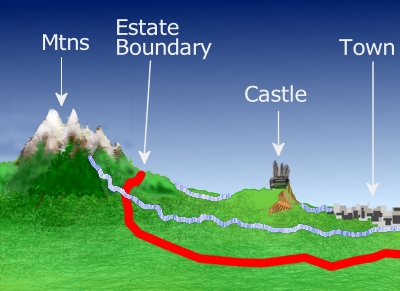
And, while I’m here, a quick profile sketch for the town and its’ environs:

Note that I have literally spent only about 10-15 minutes generating this diagram of the town layout!

Anyway, back to the background:

    The existing manor house was expanded by the Count into a reasonable Castle, with a commanding view of the area. From the town-side, it was protected by a 120m cliff-face; on the other three sides, a wall. The castle not only occupied a clearly strategic position, it functioned as a buffer and protection from the monsters that emerged from the wilds of the Grayspire Mountains from time to time.

    The Count saw great potential in his new Estates and spent a fortune bringing in the best architects and designers to prepare for future growth of the small community. And, to be fair to him, Thisselwyne held great promise; the lands were sandy and semi-arid but reasonably well-irrigated, and better soil lay a foot or so beneath the surface. The dominant crop of the region was Thessel, a sort of sturdy second-rate barley that thrived on relatively low rainfall and could be used for a bread-like cake, or for fodder. Silver had been found in the Grayspire Mountains, as had granite. And all this was to funnel through the community of Thisselwyne. Expecting it to boom in importance and population was only reasonable.

    It was a bright future that was never to be realized. The greater silver deposits were more accessible from the far side of the Mountains, and never reached the town. The granite proved to be flawed, suitable only for smaller blocks and tombstones. The advent of improved agricultural practices and better irrigation made wheat a more practical and popular crop, and Thessel fell out of favor. As a result, the township has experienced only modest growth in the ensuing centuries, and now is home to some 1600 citizens.

    Count [to-be-determined] waited, year after year, full of optimism for a future that never came. He died, childless, 35 years after he arrived, and the Estate returned to the Throne.

There’s more, but it’s better dealt with as information that the players gather when they arrive.

    The Castle Today

    The Castle itself consists of four parts, each containing a number of connected buildings and chambers. To the West, facing the mountains, is the home of the Grayspire Abbottry, an order of cloistered Monks and their Abbot, who survive by virtue of a small vegetable patch, some donations from the town, and by maintaining the rest of the inhabited parts of the castle, who they also feed. The Northern Face of the Castle contains a small Inn dedicated to providing lodgings for those for whom a spell of Fresh Mountain Air is medically prescribed, and some rooms kept for the Monarch, should he ever bother to visit (he never has). In the center of the castle is a courtyard. On the opposite side of this open cobbled area are the quarters of the Order of Grayspire, a small and decrepit Order of Paladins, all that remains of the Castle’s traditional Defenders. The Southern part of the castle lies in ruins, though some parts are more whole than others, notably the tower of the foot-notable Wizard Homankle, a live-in guest of Count [to-be-determined] when the Castle was constructed.

    Homankle was a student of great promise, who attracted the patronage of the Count. Like the town, though, it was a promise never-fulfilled; with the death of his patron, he fades into obscurity in terms of historical significance. A figure of great mystery, no-one ever saw his face after his graduation from the Arcane tutelage of the Archmage Wyndamere.

To construct a map of this structure, I would cut and paste from other maps, looking in particular for maps of a castle with an appropriate courtyard. I would use a map of a ruined Wizard’s Tower for the Tower of Homankle, and a mirror-image copy of that map for the matching tower in the Southwestern corner, most of which is now missing or collapsed.

    As part of his planning, Count [to-be-determined] wanted to ensure that the castle was the focal point of the town as it grew; he foresaw the day when the township surrounded the entirety of Mount Thisselwyne. The grounds of the mountain were dedicated to the town cemetery, and a Necropolis of crypts and vaults constructed beneath the Castle. For a few hundred years after his death, the castle occupants maintained these in good order and security, but as the Abbottry and Paladin Order fell into disrepute, they became neglected and ignored, and one-by-one, various monsters and horrors discovered the new safe haven to be to their liking. So long as they leave the castle occupants and the township alone, they are ignored; periodically one will overstep the mark, and a mob will be formed by the town’s Official Adventurers with torches and pitchforks and make a superficial attempt to cleanse the Necropolis.

    The Official Adventurers

    The last decree by Count [to-be-determined] was the establishment of the town’s Official Adventurers, seven individuals who would be responsible for the protection of the town. In return for accepting the town’s invitation to reside in the area and perform public service on behalf of the citizens, they were to receive not only a partial repayment of their own taxes and tithes from the township’s taxes, but were also to receive a small percentage of those taxes directly. Like the other institutions established in that era, this has fallen into disrepair in the centuries since, and these roles are now merely titles bestowed by the town council upon themselves for the payments and perqs.

    Currently, the Official Cleric is the Abbott from the Castle, and the Official Paladin is the head of the Order of Grayspire. The Official Rogue is the Master of the Town Market (and the most prominent merchant in the town). The Official Warrior is the head of the Stonecutter’s Guild, and the Official Ranger is the Master Of The Docks who ship the blank tombstones created by the Guild to customers downriver. The Official Wizard is the owner of the town Tavern, Bakery, and Brewery, and the Official Bard is the Secretary of the Council. When one of their number passes away, the Council selects another prominent towns-person of “approved character and mind” to replace them, bestowing the now-vacant title (and the benefits thereof) upon the lucky recipient.

Names and personalities to be determined at a later time. Suffice it to say that these are conservative, greedy, and old, and entirely inadequate to the current crisis.

    It won’t take the PCs long to discover that something in the local environment seems to be keeping the citizens healthy and longer-lived than is normal – they arrive as the locals are celebrating the 160th birthday of the tavern-keeper and Official Wizard. Interrogating the locals produces only shrugs until they ask the Abbot, who is aware of the pattern (and 187 years old, himself); starting about 520 years ago, lifespans began to extend and the number of citizens requiring interment in the cemetery or necropolis began to decline. He puts it down to a steady diet of boiled Thessel, greens, and a teaspoon of Absinthe in every meal.

    The State Of Emergency

    The Necropolis has always had a minor problem with Undead, but lately it has grown much worse. What’s more, those interred in the castle grounds (i.e. the official town cemetery) are also rising. Keeping the bodies in state within the town boundaries has also failed, as has burying them elsewhere. The town Guard, maintained at Royal Expense and supposedly present primarily to ensure that the King’s Taxes are paid on time and in full, are also incapable of dealing with the situation.

    And so, they have appealed to the Throne, and the Throne has posted a reward, and has selected the party as the winners of the lucky door prize, the first to be granted the opportunity to claim the reward and earn continuing Royal goodwill (as opposed to attracting Royal Ire)…

The Adventure Narrative

The starting point for all the above is the Adventure Narrative. The background establishes the history of the dungeon and its nature, and why dealing with it has suddenly become a critical priority. It also details the local support available to assist the PCs – not much, as it happens.

    In part 1 of the adventure, the PCs are directed to attend the presence of a Royal Envoy, who commissions them on the Throne’s behalf (not giving them much choice) to investigate the situation. They are able to learn the basic background and then travel to the town, where they learn the rest of the background by interacting with the locals. They can also choose whether to make their base of operations in the Town or at the Castle and set themselves up.

    In part 2, they can formulate theories as to what’s happening and investigate the above-ground ruins, discovering that the late Wizard was a Necromancer and that Count [to-be-determined] and the Wizard are actually one and the same person. They will also learn that there is a hidden sub-level beneath the crypts of the Necropolis where the Necromancer had his workshop. This establishes an apparent contradiction in the character of the Count – is he dark and evil (Necromancer, plus recent developments) or the benevolent, kindly, and wise ruler of local legend?

    In part 3, the PCs travel through the Necropolis (now full of Undead who won’t stay dead, even when destroyed by Turning, and other monsters) to the hidden entrance to the Necromancer’s Laboratory. Exploring the Laboratory (more monsters), they learn that he was a keen planar explorer, and fascinated by the differences in life and death amongst the inhabitants native to the different Planes. They also discover plans for the future growth of Thisselwyne, trade analyses and forecasts that by this point in time, it would be a small city of between 40 and 60,000 inhabitants, and the Necropolis and associated common cemetery would contain about 250,000 dead awaiting reanimation by means of something called the Crystal of Life. There are also suggestions that should this not come to pass, the effect of the Crystal would continue to grow, perpetually reanimating the dead of neighboring regions until its capacity was achieved. The problems they are now dealing with are just the tip of the iceberg…

    In part 4, the PCs discover the inner lair of the Necromancer, where he waits to be the last corpse reanimated by the Crystal Of Life. But there’s a problem: the Crystal is damaged. They find records describing what the Crystal is supposed to do (reanimate 249,999 subordinates and the Necromancer himself), perpetually regenerate those Undead, and place those subordinates under the command of the Necromancer while leaving them immune to the control of N’Valesh (whoever that is). The PCs are healed by the Crystal, from which it is possible to determine that Life Energy is leaking from the Crystal, probably from a crack that resulted from a minor cave-in 500-odd years ago. That means that it will never achieve full capacity, and never revive the Necromancer, and probably only provides limited protection from this N’Valesh. That could be a good thing or a bad thing, and the only way to find out is to interrogate the Necromancer – fortunately, there is a Speak With Dead spell on a scroll beside him, an insurance policy.

    The Necromancer, due to his nature, is somewhat more independent and loquacious than most shades. He is under the mistaken impression that the PCs are part of the Official Adventurers of the Township, an organization that he created as a fail-safe against just this sort of development. He tells them that N’Valesh is a power-hungry half-Devil half- Mind Flayer hybrid Necromancer who specializes in the Undead of the Elemental Planes – Reanimated Djinns and Elementals and the like – who he encountered in his planar travels. Although initially friendly, N’Valesh soon revealed his true nature, and attempted to imprison Homankle —

I am less enthused with that name every time I use it. Originally chosen because it’s very meh and so suits the perception of a Wizard who was only considered “foot-noteworthy”, I now feel that the name undermines the seriousness of the message being delivered. I want something that is more sinister and powerful, but which can also be viewed as positive. I would, if I were creating this dungeon for real, continue using it for now, with a note to do a global search-and-replace later, after selecting a more appropriate name.

    — but the Wizard was able to turn the tables and confine the Half-demon. But he always feared that N’Valesh would escape, or be freed, and would one day threaten the Prime Material Plane. Homankle spent the rest of his life planning to counter that threat, choosing an out-of-the-way location that was primed for explosive growth and could be shaped, culturally, to his needs; creating the Crystal Of Life; Recruiting the Order of Grayspire and the Abbottry to protect the town’s living population while his Undead army waged war against the Undead of the enemy. He had not counted on the decay of tradition and corruption of the institutions that he had set in place. Thus, he has no choice but to place the responsibility for dealing with the situation in the hands of the PCs. Whosoever holds the Crystal Of Life possesses the keys to command the Undead Army he has created – an unstoppable force to defeat an unstoppable enemy who can track the Crystal Of Life and wants to posses it for himself.

In other words, the Town of Thisselwyne – and, in particular, the Castle – are ground zero for the invasion AND the command center for ‘the allies’ in countering the invasion.

    In Part 5, the PCs have to take the tools made available to them, decide whether or not to employ them (and what to do with them), and deal with the invasion of Undead Elementals.

These confrontations were my original vision for the adventure, and everything else has been created to facilitate them. I drew a lot of inspiration for the battles between the T-800 (Arnold Schwarzenegger) and T-1000 (Robert Patrick) in Terminator 2: Judgment Day.

Dungeon Design

Assuming that you aren’t custom-making a dungeon, but are instead drawing upon someone else’s design such as those available from Dungeon-A-Day, the first step is to pin down exactly what your requirements are. In this case, a focal point, an adjacent complex (library, workshop, bedroom, etc, for the Wizard), and several tiers of structure radiating outwards from this focal point. Each tier is to contain a more elite form of Undead soldier. In succession:

  • Disorganized individuals
  • Individuals with weaponry in which they are practicing
  • Groups with weaponry in which they are practicing in coordinated fashion
  • Units patrolling and drilling, weapons at the ready, proficient and skilled in the usage
  • Honor Guard in the inner chamber.

While I envisage the base monster to be a typical skeleton, I would expect to depart from that foundation further and further with each tier. And, because these are subject to the Crystal Of Life, each tier will be more inclined to ignore the PCs unless attacked.

In essence, that’s a complex with five areas, each of which consists of multiple matching rooms. Something like the layout below would work:

Once again, I spent very little time working on this. You have each tier arranged in a ring with the throne room and Crystal Of Life in the central zone and a complex in a missing “segment” of the complex. Corridors wrap around each of the areas. The “entrance” is at the bottom of the map.

The general principle is this: break the plot down into the distinctive plot needs, then assign one to each successive section or area of the map. It can be a single room or a complex of rooms. If it’s multiple rooms, it’s likely that only one of them will need to serve the story needs.

Encounters

The story needs then have to be assessed in terms of mandatory or associated encounters, and encounter interactions. For example, if a creature takes up residence next to something else that thinks of the creature as lunch, pretty soon there will be no creature – or no hungry something. Either way, it clears the way for something else to occupy one of the spaces, but probably doesn’t erase all signs of the prior habitation.

Once you know what encounters are present because they are necessary to the plot, you can fill in the rest with whatever seems appropriate. Don’t forget the possibility of a room designated “no man’s land” between two factions that are each too difficult for the other to dispatch.

This is also a good time to contemplate the dungeon ecosystem. What do the inhabitants eat when they can’t get Adventurer?

I always like to be able to answer three questions about each area’s inhabitants: Why did they choose this location, how are they going to change it by interacting with it, and how did they get there?

Other Mandatory Content

Traps and treasure placements are allocated in the same way.

Architectural Style

Another ingredient needed before I can start writing up descriptions of each area is to decide, based on who created the place, on an architectural style on which to base the descriptions, on the presumption that there would be both a consistency and a number of trends to take into account – greater skill and expertise after they’ve been building the place for a while, less damage in some areas and more in others, and so on.

Imbued Dynamism

Right now, everything’s probably pretty static. Encounters wait patiently in each room to be disturbed by marauding adventurers.

That won’t do, not at all. So now is the time to change it, building in patterns of behavior based on the location and the neighbors. In particular, if there are any areas of natural illumination, they will become the timekeepers of the dungeon, synchronizing their activities with the patterns of light. Their neighbors will soon learn to tell time by the activities of the timekeepers, if only because they want to avoid them when they go a-wandering.

To Recap:

The plot should define the nature and functionality, in plot terms, of the dungeon. Basing the concepts and background on these definitions provides consistency. Breaking the dungeon elements of the plot down into individual pieces of narrative begins the process of populating the dungeon with encounters, loot, and complications, and ensures that these serve the plot purpose of the dungeon. Inherent logic is woven directly into the fabric of the location.

The result is that everything present is there for a reason and serves a purpose. And that actually makes creating the dungeon easier. Talk about your win-win!

Comments (2)

Wild Pathfinder 2.0 Speculation


This evocative image is by Pixabay.com / thommas68

Being invited recently to participate in play-testing for Pathfinder 2.0 (or whatever they are calling it) – an invitation that I had to, regretfully, decline – has, nevertheless, fired my imagination.

I keep returning to the question,

    “If I were one of the authors tasked with updating the game system, what would I do?”

Surprisingly, clear answers immediately came to mind.

Some of these ideas I’ve written about in the past. Where that’s the case, I’ll point readers at the appropriate article. Others are new subjects of discussion.

Because I rather suspect that few, if any, of these ideas will be incorporated into the official rules when Pathfinder 2.0 achieves its finalized form, they will be presented as House Rules that readers can choose to incorporate, or not, themselves.

Space is going to preclude going into too much depth regarding any of these subjects. If there’s demand for it, I might expand on one or two in a separate follow-up article.

Schools Of Magic

First, I would make the schools of magic more meaningful. Every mage would be required to select a “theme” to their magic, to be approved by the GM. Spells from that school are reduced in spell level one slot and become available automatically when the character reaches the requisite character level. Spells outside the school are NOT available automatically and have to be sought out, either on scrolls or from someone who already knows the spell and is willing to teach it.

I would also generate and include a suggested list as a table that players/GMs could simply roll on.

Spell description would be enhanced with additional flavor text to use in visualizing magic school / spell combinations.

Each mage would also be required to choose an “opposing theme” for magics that are reduced in effectiveness. “Reduced” how? well, the simplest way would be to increase the spell level of such spells by 1. But it’s not the only choice that I would offer.

Reducing Metamagics

I described these in Broadening Magical Horizons. These are a sub-class of Metamagic Feats that I introduced in one of my campaigns, to great effect. Unlike normal metamagics, which enhance a spell in exchange for placing the in a higher spell slot, these reduce both effectiveness and spell slot. They can be used to counterbalance or mitigate a normal metamagic enhancement, or can be applied to reduce the spell slot.

Every mage would be required to choose one reducing metamagic that they gain as a free feat.

For various “staple” spells that are likely to be included in one or more schools, I would also write up stat blocks for “reduced versions” that become available at lower character levels provided (1) you have chosen an appropriate school; and (2) you have the appropriate Reducing Metamagic Feat.

    Thus a fire-school mage would be able to cast a regular Fireball spell as a 2nd level spell instead of the normal 3rd level slot, would get a reduced version available as a 1st level spell, and a greatly reduced version as a 0th-level spell. The latter might be nothing more than the equivalent of striking a match – 1 point of damage if you stick your finger in the flame and keep it there – but it would be a perfectly reasonable Orison.

Spontaneous Metamagics

I would create new magic items that automatically add a level of metamagic feat (reducing or enhancing) to selected spells when in the mage’s possession during casting.

I would then incorporate explicit rules for mages to be able to decide on metamagic enhancements to their spells “on the fly” as opposed to pre-loading the versions memorized with the Feat. However, this is an option only available if you have a magic school that matches the spell. So Fire Mages could do it with Fireball and Flaming Hands and Wall Of Flame and the like.

The intent is to (1) increase the flexibility and precision with which mages of a particular school can cast spells from that school; (2) create magic items explicitly useful by particular schools of magic; and (3) clarify an area of rules that needs a little cleaning up..

Slowed Mage Power Progression

If you were to ask almost any D&D/Pathfinder GM what the biggest problems are with earlier editions of the game, they would probably talk about “game balance” or “level imbalance”.

Simply put, mages are too weak at low levels and too powerful at high levels, relative to other classes, and the other classes also suffer from similar inequalities of a lesser degree. The problem was most acute with AD&D, but has been present through every generation of rules up to 3.x/Pathfinder; 4th ed D&D attempted (again) to fix the problem, with (I understand) limited success, 5th ed D&D actually does fix it – at the expense of some (a lot?) of the unique class flavor. Not having played 4th ed or the final incarnation of 5th ed, I can’t speak to that definitively; those are just my impressions.

Well, Pathfinder 2.0 will need to fix this problem too, but do so in a distinctly different way to the approach of WOTC, and preferably one that doesn’t have that flavor price-tag attached.

Instead of spells gaining 1d6 or whatever with each character level, they would gain one step on a fixed “effectiveness chart”. This would read something like “+1, +d3, +d6” at higher levels, “+d3, +d6” at mid-levels, and only for the first 3 or 4 levels would the existing power progression apply.

So, fireballs might run “3d6; 4d6, 5d6, 6d6, 6d6+d3, 7d6, 7d6+d3, 8d6, 8d6+d3, 9d6, 9d6+d3, 10d6, 10d6+1, 10d6+d3, 11d6, 11d6+1, 11d6+d3, 12d6,” and so on.

On top of that, 1d6 of the effect is always to be designated “critical effect”. Casting a spell is to require a combat roll of some type, probably using INT in place of STR, and that 1d6 only happens on a critical hit. So “12d6” is really “11d6 +1d6 critical”.

This slows the progression of power levels of mages. The exact specifics can be fine-tuned to correct the upper-level power problem, while the effects of the magic schools rules goes a long way to solving the lower-level problem. Not all the way, but I’ll get to that a little later.

Clerical Revision

There would need to be similar revisions made to clerical spells and spellcasting. In particular, I would devise some clerical-only Metamagics that would emphasize the difference between divine magic and arcane magic.

All Clerical magic should come in three optional flavors (with Metamagics as the means of implementing the flavors in game mechanics): single target, multiple target, and area effect. Each of these should be a step down in terms of power effect, but a significant increase in effectiveness relative to what a mage could manage even if they could apply their metamagics to a clerical spell. Another Clerical Magic, one that’s at least one step further removed from area effect, would be Permanent, and there might well be an intermediate “semi-permanent” version.

These Clerical Metamagic impacts would increase with character level. A 20th-level Cleric should be capable of Blessing (for the normal duration of the spell) an entire region, or Permanently Blessing a building.

The current description of each clerical spell becomes the “base level” upon which these variations are created. If the “base level” describes an Area Effect, then the multiple-target version is more powerful than the existing spell, and the “Single Target” version more powerful again. If the “base level” is single target, then the multiple-target spell is weaker, and the area effect weaker again.

One set of changes that I would definitely focus on is “Holy Drip Bottle” syndrome. I posited a solution to this in the last two parts of my “All Wounds Are Not Alike” series (Narcotic Healing part 1 and part 2), but I think that might be a step too far for general use. Though I would definitely include it as an optional rule!

No, my preferred solution for general consumption is a little more far-reaching – and yet, ironically, the results would look and feel a lot more like traditional Pathfinder.

Changed HP subsystem

HP would get broken into two strands: Critical Capacity and Wound Capacity. The exact means of division requires a little more thought; the notion is that most of the existing HP would go into Wound Capacity, while Critical Capacity would be 1st-level HP plus 1 for each subsequent character level, or something along those lines. I might require every third lot of bonus HP from CON to be applied to Critical Capacity instead of Wound Capacity, or I might apply the bonus both ways at such levels – that would need to be play-tested.

An ordinary hit can only impact Wound Capacity until that is all gone. Any “unused” damage inflicted is lost. Only when a character has no remaining Wound Capacity can ordinary damage be applied to Critical Capacity. Total loss of Wound Capacity requires the character to save vs CON or lose consciousness. Any Critical Damage that has been inflicted increases the DC of this save.

But wait – didn’t I just say that you don’t lose Critical Capacity until you’ve used up all your Wound Capacity? Well, that’s not entirely true. All attacks have two components: critical damage and ordinary damage. Critical Damage is only inflicted on a Critical Hit, applies directly to Critical Capacity, and is otherwise ignored. Run out of Critical Capacity and you have to start making FORT saves to avoid starting a countdown to Death.

That countdown is punctuated at various points by key events – immobility/collapse, unconsciousness, coma, and (of course) death. The count between these events is 6+CON Bonus. The lower your CON, the more quickly you die. If you reach one of these landmark status points, that is your condition even if you are healed by Potion or Cleric. It requires a separate healing effect to remove the condition (or the passage of time). (The Immobility stage is designed to give characters one last chance to chug a healing potion).

This makes characters and creatures slightly slower to kill, overall, but more sudden and impactful when it does happen, and a lot harder to heal, and enables differentiation of the different healing spells according to the way they handle Critical Damage. Cure Light Wounds heals NO Critical Damage. Cure Moderate Wounds heals 1 Critical Damage per die of healing – subtracted from the total – with the balance being applied to Wound Capacity, and so on.

Which brings me back to magical attacks like Fireball. 1/3 of the dice of damage these do (round down) must be reserved as Critical Damage, that is only inflicted on a Critical Hit.

To score a Critical Hit, you have to roll a natural 20 on your attack roll, AND your attack total must be 20 more than the target’s AC. That makes them a lot harder to score if you are significantly lower-level than the target you are attacking, and reduces slightly their probability the rest of the time.

Backstab Revision

One of the major purposes of this combat change is to facilitate a major revision to the Backstab rules. The problem is that backstabs are (currently) either too lethal or not lethal enough, either inadequate or total overkill.

Breaking “Hit Points” into the two damage types permits a more controlled mechanism for Backstab attacks. Such attacks can do normal damage, plus a backstab critical component based on character level if the attack total is 10 more than the target’s AC. This is likely to be instantly deadly to anyone more than a couple of character levels lower than the Thief/Rogue, and a critical injury demanding immediate attention to anyone not several character levels higher. On a critical hit, the weapon’s ordinary damage is also applied to the Critical Capacity of the target, making this an effective but not instantly-lethal attack against targets roughly 50% higher in levels than the Backstabber.

Balancing this is the need to achieve an attack total ten higher than the target’s AC. This is easy to achieve against unarmored low-level opponents and becomes progressively less so as those two statements become invalid. Characters in heavy armor make extremely difficult backstab targets even at relatively low levels. This brings a dash of realism to the mechanism without compromising the fantasy element inherent in the genre. The result would be at home in both high and low-fantasy campaigns.

Paladin Changes

I’ve thought a lot about changes to, and variations on, the standard Paladin. That was to be the subject of the still-unfinished sequel to Assassin’s Amulet, after all. I still want to finish and publish that, one of these days, so I don’t want to steal my own thunder – besides, I can’t squeeze 60-odd pages of notes into one section of this article in any practical way!

Nevertheless, some of the mooted changes would be priority inclusions. In that unfinished work, I posit that the key to understanding the comparative differences between Clerics and Paladins is that each was designed (as an organization/community) to oppose different enemies. I then proposed three variations for GMs to choose between: (1) Clerics were designed to deal with rogue/dark gods on behalf of the good/light gods; (2) Clerics were designed to deal with the plots of Devils; or (3) Clerics were designed to deal with the Chaos and Misery inflicted by Demons.

In case (3), [standard] Paladins were created to oppose Devils, and needed to be organized and systematic to cope with the plots of these enemies; In case (2), [standard] Paladins were created to oppose Demons, and their order and system are specifically intended to be weapons and armor against the anarchy that Demons can inflict; and, in case (3), Paladins are the primary opposition to both groups. I then went on to tweak those Standard designs into specific forms designed to be effective against one of the two enemies.

This involved altering a number of the special abilities of the class, often in such a way that the existing effects could be retained as a special effect when the ability was applied to a normal person – the primary purpose of Laying On Hands was not to heal, it was to Exorcise, and so on. I also customized the spell lists extensively, and reduced the combat capabilities of the class (so that they were clearly less combat-effective than Fighters) but replaced those benefits with additional enemy-specific capabilities.

All of those changes, and the concepts in back of them, would be brought into Paladins if I were rewriting the Pathfinder rules.

Revised Skill DC subsystem

I showed in “How Hard Can It Be?” – Skill Checks Under The Microscope that the whole 3.x/Pathfinder DC scale is out of whack. A 14th-level character can succeed on a DC 40 check 50% or more of the time, given only slightly favorable circumstances. I solved this by applying a corrective calculation, New = 10 + 1.2 x (Old – 10).

EG:

  • Old DC 0: 0-10=-10; x1.2 = -12; +10 = -2.
  • Old DC 10: 10-10=0; x1.2 = 0; +10 = 10 (no change).
  • Old DC 20: 20-10=10; x1.2 = 12; +10 = 22.
  • Old DC 30: 30-10=20; x1.2 = 24; +10 = 34.
  • Old DC 40: 40-10=30; x1.2 = 36; +10 = 46.

In

Six Impossible Things Before Breakfast, I revisited the issue, looking at the standard of expertise that should be used as the basis for determining what the DC should be for any specific task.

Most recently, in The Black Meta-Art Of Setting Difficulty Targets, I analyzed the effect of compounded modifiers and got some very surprising (and revealing results) – if you have N modifiers of average range ±1-to-M, most of the time, the net effect will be of a single modifier in the ±1-to-4/3×M range, with a small but increasing error at higher N values that isn’t worth compensating for.

Were I one of the creative team working on Pathfinder 2.0, I would use these latter 2 articles to determine what the DC should be of the example tasks listed in the Core Rulebook (0-35 scale), then apply the corrective factor determined in the first article and quoted above, or add new entries for DC 40/45/50/55/60.

Revised XP System

This is another subject that I have written about, sparking quite a bit of controversy when I analyzed the vagaries of the existing XP system. But, if I were rewriting the system, I would ditch the whole existing structure and model its replacement on a series of articles published here at Campaign Mastery:

Magic Items and Magic Places

I would throw in a lot of new magic items, over and above those listed earlier. Magic items which conferred ranks in skills. Some of the magic items listed in The Bottom End Of The Magic Biz.

The entire contents of Let’s Talk About Containers: 22 Wondrous Items.

The ideas in Creating New Magic Weapons.

The content from all 7 parts of the Spell Storage Solutions series – “If I Could Save Magic In A Bottle,” “A Heart Of Shiny Magic”, “Just Another Pointy Stick”, “Not Just Another Pointy Stick”, “The Energizer Bunny”, “The Ultimate Weapon”, and The Crown Of Insight from “Let’s Make A Relic”.

Some content from “How Long Should Potions Last?” which was part of this Blog Carnival post.

Plus a deeper dive on the Spell Components concept, as suggested in the Some Arcane Assembly Required series.

Some content from Big Is Not Enough: Monuments and Places Of Wonder. And the location ideas presented in Six Wonders: A selected assortment of Wondrous Locations for a fantasy RPG and Five More Wonders: Another assortment of Locations for a fantasy RPG.

Encumbrance

I would take the ideas offered in He Ain’t Heavy, He’s My Servomech: User-friendly Encumbrance in RPGs and run with them.

And Lastly

Lastly, of course, I would look at the articles I’ve done on variant races and present them as optional choices for the GM, expanding the palette of choices within the game. Of course, I would include my Ergonomics articles –

Ergonomics and the Non-human about Elves, and By Popular Demand: The Ergonomics Of Dwarves about, well, that’s fairly obvious. And maybe the more recent article, (In)Human Survival: The Biology of Elementals and More, too.

By the time all that was finished, the game would be both radically different and distinct from its original version, and yet still recognizably Pathfinder. Of course, you don’t have to wait. It’s (almost) all waiting for you here already – just click on the links!

And, to the people who actually have the responsibility for drafting the next generation of the rules: Your solutions don’t have to look anything at all like the ones that I’ve proposed, but these are still the areas that I would be looking at. Of course, if you do happen to like one or more of the ideas presented here, contact me – my terms are very reasonable, I promise!

Comments Off on Wild Pathfinder 2.0 Speculation

A Sting In The Tail


Scorpion (in x-box colors) image from Pixabay.com / DirtyOpi

There’s a TV Series that every GM, regardless of the genre of their games, should be watching. It’s a show that I’ve discussed before, in a completely different context – in The Expert In Everything, and it’s name is Scorpion.

Why?

Simply put, because it contains so many lessons for the GM. To be specific:

    Character Evolution

    The characters evolve over the course of time in a way that seems quite natural and progressive.

    Submerging integrated plotlines

    What’s more, while there is the occasional big development thrust into the forefront, most of this development takes place in the background in small scenes. In effect, every character has their own plot arc consisting of numerous small scenes strung together. What’s more, these plotlines play off each other, intertwining regularly; it would be as accurate to describe them as the plot arc of one or more relationships within the group of protagonists as to describe them as plot arcs of a singular character.

    Even more usefully, there is often a spillover between these subplots and the main plotlines of the show that makes the whole thing far more seamless than the disjointed impression created by the preceding paragraph.

    Pacing

    For that matter, there are lots of lessons in the pacing of the series – it regularly goes from sedately-paced to high-octane action and back again in the course of an episode, yet slower scenes and plot arcs punctuate the action seamlessly. It achieves this by substituting dramatic or emotional intensity for pace and duration.

    This sounds complicated, but it’s not. But before I can explain it, though, I need to move on to another lesson that the show can teach the GM.

    Plot Structure

    When you break the show down to it’s plot elements, it’s a relatively straightforward recipe in 4-and-a-bit acts.

    In Act 1, the current status of the characters is established and the personal development plot arc(s) that are to take place in the course of the episode are then introduced. A problem or crisis then introduces the main plot. Using their capabilities as building blocks, the team arrives at a solution to the problem almost immediately, and set about implementing that solution. Unexpectedly, there’s a complication or setback that usually invalidates the entire initial solution and/or makes the situation both much more serious and critical.

    Act 2 brings a solution to the new problem, but successful implementation won’t fix the main emergency, before presenting a fresh complication / setback.

    This pattern is repeated in Act 3. Time, of course, has been passing, and that usually means that a bad situation has been worsening.

    Act 4 yields a desperate solution to the problem, which is then implemented. This leads to the Climax Moment, the last instant when everything that can be done, has been done, but the Audience has not yet seen the outcome. Quite often, the producers will tease the audience by showing the team members in a similar state of nervous anticipation before finally resolving the crisis/emergency.

    Along the way, at the points where the intensity matches that of the action, the character personal development arc slides in. This might be a thirty-second scene, a conversation against the background of the developing crisis, or simply a line of dialogue between two or more characters while they are implementing the solution to the current immediate problem.

    The show normally ends with an epilogue (the “and-a-bit” that I mentioned) which develops or resolves the character plot situation, and which may lead into the next episode’s personal development arc.

    All this is illustrated in the breakdown below:

Regular readers will recognize that I’ve been advocating these plot and structural techniques for many years. In fact, structurally, Scorpion comes closer to being an RPG than any other show I’ve seen.

History

This article should really have been written back in 2014. Scorpion was initially the subject of heavy criticism for implausible problems and neglecting simpler solutions than those chosen by the team. I mentioned this in “The Expert On Everything” with the comment that I didn’t think the show was quite as bad as it was being depicted.

Nevertheless, I rarely watched it; the timing was inconvenient and other shows had a higher priority. And, to be honest, I didn’t expect the show to last beyond that initial season, and didn’t want to invest too much of my time and attention into it. As a result, I didn’t get to see it in the light in which this article presents it.

But the network who owns the rights has been repeating earlier seasons as well as airing the current (4th) season in different time-slots, and with the addition of an external hard drive, I’ve had the capacity to record and time-shift these episodes, so I’ve been catching up – fast.

This somewhat hodge-podge non-sequential viewing has had the advantage of making the character development far more obvious than it otherwise would be.

The Sting In The Tail

Unfortunately, the network which produces the series (CBS) has decided not to renew it for a 5th season, according to Wikipedia, based on reports in Entertainment Weekly. So the final cliffhanger with which Season 4 ended will not be resolved. That’s the bad news.

But when the world hands you lemons, the only thing to do is make lemon meringue pie with them. The silver lining is that all four seasons are, or soon will be, available on DVD.

Amazon lists seasons 1-3 as currently available, and is taking pre-release orders for season 4, “the final season”, to be released September 11th in a very poor choice of timing.

Season 1: DVD $12.99 Blu-ray $21.49, 246 reviews, aggregate rating 4.8 out of 5.
Season 2: DVD $14.99, 504 reviews, aggregate rating 4.7 out of 5.
Season 3: DVD $17.45, 241 reviews, aggregate rating 4.5 out of 5.
Season 4 (not yet released) DVD $37.36, not yet rated.
A number of retailers are offering the first three seasons as a set; the prices are comparable to those listed above, but with the convenience of one-click ordering. Ignore the suggestions that this is the complete TV series – until the 4th season is released, in terms of DVD availability right now, it is, but that’s misleading.

Making use of Scorpion

You may have noticed that I’ve said next-to-nothing about the show’s content. There’s a good reason for that.

For most campaigns, the show will be of only indirect value. It’s unlikely that you will find many episodes that you can use to inspire a fantasy adventure, for example; they are too rooted in the modern day, and the problems and challenges encountered are too geared to the team members in the show to be readily translatable to others.

But the indirect value is enormous, and irrelevant of genre. The best way to use the series is to watch it – not as a piece of entertainment (you can do that, too, if you like what you see), but critically, as a demonstration of technique.

Notice how two or more completely separate plotlines relate to each other? Notice how the scenes segue? Notice the timing, and how the writers let the characters decide “what to do,” only to block the easy solution and raise the stakes at the same time? Compare the characters as presented in seasons 2 and 3 with how they were in Season 1, then go back through the episodes and trace the on-screen evolution of the characters. Unlike some shows, it all does happen on the screen in front of you.

If you equate a single episode to a game session or to an adventure, you will find yourself picking up subtle tricks of timing and pacing, of integrating comedy and drama, and – to some extent – of characterization.

Scorpion won’t solve your every problem. It won’t even improve every area of your GMing. But in those aspects in which it is relevant, it really is a masterclass for the GM. Grab it while you can!

Postscript:

I’ve just seen the second-last episode and can add another lesson to the list – what it looks like when you stretch credibility too far… Despite this, I stand by my recommendation. Just thought readers would like to know.

Comments Off on A Sting In The Tail

Voting has begun for the 2018 Ennies!


Just a brief note to advise that voting has opened for the 2018 Ennies. These are the tabletop RPG equivalent of the Academy Awards and the Golden Globes and the Pulitzers – they celebrate excellence within our hobby. There have been over 500 submitted products from 72 publishers in 23 categories, and the judges have narrowed the choices down to just 5 in each category (with a few exceptions). Voting is open for just 10 days, until July 21, 2018 at 11:59 EDT (that’s US time for those living elsewhere!)

You can view the list of nominees at this webpage, which is full of clickable links to enable you to learn more about the different nominees.

Voting takes place here. Just click on a category to view the nominations within that category and cast your vote. Note that clicking on a nominee again takes you to that nominee’s page, it doesn’t vote for them!

You can only vote once. You don’t have to vote in every category.

While I’d love it if you voted for Campaign Mastery, if you honestly think another entrant in the Best Blog category did a better job over the last year, vote for them – they will have earned it!

Best of luck to everyone nominated, and a big cheer of appreciation for the award sponsors.

(Oh, and if you don’t think this is a big deal – since voting opened, 70%-plus of the traffic to Campaign Mastery has come from the voting page. That’s almost 50% more than on all other sources combined!)

Comments Off on Voting has begun for the 2018 Ennies!

The Love Of RPGs: June 2018 Blog Carnival Roundup


rpg blog carnival logo

The topic of “Why Do You Love RPGs? Why Do You Love GMing?” seems such a simple one, but it’s actually very challenging to articulate why you love something.

It seems to me that this is one problem that’s actually holding the hobby back from broader acceptance – it’s really hard to “sell” someone on participating when you can’t explain why you do so.

And that makes the subject far more important than the fluff that it might initially have seemed to be.

Of course, it’s always possible that people have already written on the subject and can’t think of anything to add. I have certainly answered the second question before, for example.

But for one of these reasons, or (more probably) a combination of both, there were relatively few responses to the Blog Carnival this time around.

  • In For The Love Of RPGs, I list no less than seven reasons why I love the hobby and explained that I thought we fall in love with it for one of them but stay in love with it for one of the others.
  • Brent Jens, The Renaissance Gamer from The Rat Hole, offered June RPG Blog Carnival in response to the first question, in which he makes some really insightful points on the differences between shared and concurrent experiences.
  • Later in the month, he followed up with Why Do I Love GMing in answer to the second question, admitting that at first he didn’t love DMing, but then offering three reasons why he now not only did, but found that love growing stronger. What changed? You’ll have to read his article to find out! Since he didn’t provide a back-link to the article as part of the carnival, this roundup is your first chance to do so.
  • Rodney Sloan at Rising Phoenix Games provided Busting Out Of My Shell in which he described how he used RPGs to both escape and reconnect with, the personal reality of his environment and surrounding society. It’s the sort of answer that becomes more personal and profound, the more you muse on it.
  • Gonz at Codex Anathema stepped up to the plate with 13 Reasons Why which is all about why he loves Eberron as a game setting, but which also speaks to the broader question, albeit indirectly.
  • When he discovered the topic of the blog carnival this month, Gonz followed up by offering Why Do I Love You? with two points. His second is the capacity for forming relationships over the gaming table, but his first discusses the far more existential proposal that he loves the hobby because of what that love reflects about who we are as people when we are at our best. It’s short but deeply meaningful, and the perfect way to round out this collection of perspectives.

There are a lot of reasons to love RPGs. There may not have been many submissions, but between them, I think we’ve covered just about everything. And that makes this month’s blog entry the place to point people who look at you quizzically when you tell them what you do with your time – and why there’s no reason to be embarrassed about it (though some people are).

I could add something more, but this post is all about the other articles to which I’ve linked – so, rather than distract from them, I think I’ll quit while I’m ahead. Read, enjoy, and maybe discover why you love RPGs, too.

Comments Off on The Love Of RPGs: June 2018 Blog Carnival Roundup

Big News – 2018 Ennies Nominations


partying concert crowd image by pixabay.com / ktphotography

Yesterday, the list of nominees for the 2018 Ennies was announced and Campaign Mastery is one of them, nominated once again for Best Blog!

Sincere congratulations to my fellow nominees, in both my category and in all the others (full list here). No-one who isn’t there can know how much hard work goes into achieving each and every one of these nominations. And my thanks to everyone who has congratulated me for the nomination.

To anyone finding Campaign Mastery for the first time as a result, let me welcome you. The goal here is to post evergreen content, so you have almost ten years of archives to dig into… have fun!

I’ve made the point in the past that everything I’ve ever done in my life seems to contribute to my RPGs and to this Blog, as though it was all preparation for doing this. The obvious implication is that everyone I’ve ever known has made some contribution, great or small, to achieving this honor – and for that, I thank you all!

Last time we were nominated, I was absolutely chuffed to take home (metaphorically speaking) the Silver. It would be wonderful to go one better this time around, but let’s be honest – it’s a strong field!

Voting opens on July 11, and when it does, I’ll put up a post with the link.

In the meantime, I’ll just enjoy the satisfaction of Campaign Mastery being judged one of the five best blogs of the last year!

Comments Off on Big News – 2018 Ennies Nominations

(In)Human Survival: The Biology of Elementals and More


Grass growing in a drought

Image by pixabay.com / NMueller

I’ve been reading a fascinating book lately: “The Biology Of Human Survival” by Claude A Piantadosi, M.D. This relatively hard-to-find book from Oxford University Press deals with the biological processes by which humans react to various conditions, and hence the hazards posed by those conditions, in a way that is both technically accurate and yet accessible to the reasonably-educated layman.

Right now, I’m only in the latter stages of Chapter 4, the last of what I think of as the ‘foundation’ or ‘preliminary’ chapters before we get to the chapters dedicated to the different conditions that can threaten survival. And already I’ve been getting all sorts of ideas from it – and, somewhat surprisingly, most of them are Fantasy oriented.

Today’s article is going to present a paraphrased summary of selected content from those first few chapters and then look at the ideas that have resulted thus far. So, let’s get started…

colored clouds writhing around each other

Is this a pair of Air Elementals in combat?
‘Color’ by pixabay.com / rawpixel

feather

Or is this an Air Elemental?
Feather Image by pixabay.com / ArtsyBee,
cropping by Mike

Butterfly

Or this?
Butterfly Image by pixabay.com / ArtsyBee,
Background splash and foreground distortions (simulated perspective) by Mike

Basics Of Survival

Survival is achieved by optimizing conditions in three layers. Internal – within the body; surface – near the body; surroundings – farther away from the body. When conditions are incorrect for survival in one of the three it removes a protection that the body has against survival.

When the body encounters conditions that threaten survival it is called stress. The body has a great many reactions to stress which function automatically to reduce this stress. For example, in a hot environment, we sweat, lowering internal body temperature back toward a more tolerable level.

The central concept of a life-support system is to surround the organism with an environment that minimizes physiological stress, mimicking an environment in which the organism is comfortably able to survive.

Preparations for potential disaster/accident/threat may modify the specifics, but that doesn’t alter this fundamental principle.

Adaption

Human beings are amongst the most adaptable species on Earth, but the limits of biological adaption are far smaller than most people realize. About 2/3 of the Earth’s surface is salt water which we may visit briefly but can’t inhabit without technological intervention which produces an artificial environment either on the surroundings scale (submarine, mining platform) or surface scale (wetsuit, etc). When visiting, we can only cope with conditions at the surface, even if we carry a supply of oxygen. Of the remaining land, only human ingenuity and technological intervention permit survival in one half. The rest is too hot, too cold, or at too high an altitude, or is a river or lake – same problem as the seas.

Four critical variables determine the odds of survival in any situation. These are (1) The physics of the environment; (2) the limits of human physiology; (3) the duration of exposure; and (4) adaption, which includes behavioral responses such as what the victim knows about survival dangers and how to prepare for / react to such situations.

Complications arise because of the multidimensional nature of environmental stresses, for example, human physiological responses are different if an environment is hot and dry compared to one that is hot and wet, with some compounding the problem, and some mitigating. A further complication lies in body shape – size, weight, level of body fat, strength, etc.

All physiological responses are therefore a compromise between competing biological imperatives all with the purpose of increasing the potential for survival.

Racial distinctions are also important; every human organism carries a set of inbuilt adaptions to the environment. Some predate the emergence of homo sapiens as a species, and extend back to the first mammals, or even beyond; others have arisen as a result of occupying a specific environment for long enough that pro-survival traits have been the subject of natural selection amongst the population. Many of the differences between races, both overt and subtle, such as skin color, are the result of such adaption. Others, such as the Asiatic eye shape, confer no known survival advantage (yet) and appear simply to be random mutations that have been retained through the generations.

Burning logs

Is this a fire elemental? Or just an environment around the real thing?
Fire Image by pixabay.com / amaterate

Gas fire, brighter and bluer

Or is this a fire elemental?
Fire image by pixabay.com / 41330

Red and black fractal image on sunset colors

Or perhaps this?
Fractal image by pixabay.com / astronira

Balls of brightly colored energy and spark-like protrusions

Or perhaps this…
Element image by OpenClipart-Vectors,
‘shadow’ effect by Mike

Acclimatization

When exposed to an environment that stresses the organism, a process of adaption begins as the physiology responds to the stress. Some of the resulting changes are aimed at simply coping with the immediate stress, others have the effect of increasing the organism’s tolerance for the particular stresses being experienced in the contemporary environment. The latter is known as Acclimatization.

Not all environmental stress produces this effect; it has to exceed a threshold level, but not by so much that survival is imminently threatened.

Intensity and Duration of the stress are also important factors; the more extreme the conditions, the faster, more intense, and more numerous are the physiological adaptions. You can think of the organism as having a number of parallel responses to environmental conditions of different sensitivities and intensities, with the combination optimized somewhat through natural selection. Redundant responses tend to be lost or modified to remove the redundancy unless they confer some regularly-encountered survival benefit under other conditions. As a general rule, gradual adaption is more effective.

All such adaptive responses are completely reversible unless they have been maintained for so long that the underlying morphology (shape and structure) of the organ affected has been altered by the exposure. However, the time required for such reversal to occur is unrelated to the time required to undergo it in the first place; some are faster, others slower.

One example should be recognizable by just about everyone: we all get used to Winter as it proceeds, to a greater or lesser extent. The more extreme the cold temperatures, the greater this acclimatization. This makes us feel warmer on wintery days once our bodies have made the adaption. However, if warm weather intervenes with unexpected rapidity, even temporarily, not only will we feel the warmth more severely, but if it persists for a week or so, we may lose some or all of that adaption to winter – so a return to frigid conditions feels even colder than the same temperature did before the warm weather arrived. To some extent, of course, the advent of artificial warming and cooling has mitigated these adaptions and made us more prone to be dependent on artificial means for comfort.

Cross-Acclimation

The complexity of biological organisms is revealed by the phenomenon of cross-acclimation, which is to say the integrated adaption to environments with multiple or successive stresses. For example, adaption to the cold helps animals survive ionizing radiation but interferes with the capacity to survive even short-term exposures to a lack of oxygen. Adapting to a lack of oxygen (e.g. at high altitudes) decreases the shivering response to cold. These combine to make it harder to climb tall mountains in Winter than in Summer. On the other hand, acclimatizing to heat acts to increase tolerance for hypoxia.

It is known that adequate supplies of food and water are necessary for acclimation to occur. Manufacturing the compounds that trigger these effects takes energy, and the chemicals must then be transferred through the bloodstream to the locations where they can be effective. Even well short of the point of causing death, malnutrition and dehydration diminish tolerance to every known environmental stress. In particular, malnutrition impairs tolerance for cold and disease and dehydration to heat and cold. The combination of both in a cold environment constitutes a triple-whammy!

We’re still in the relatively early stages of understanding these complex interactions. More than 100 different neuropeptides and hormones have been discovered that are produced by the human body in varying amounts and combinations under the influence of different stresses. Many more are believed to be undiscovered. At least a dozen, for example, are able to influence the internal temperature of the body, while others may increase or decrease sensitivity to internal temperature in other autonomic responses, inhibiting reactions to body temperature increases in some cases and triggering them in others – depending on other conditions.

While reading this section of the book, I had the distinct impression that this aspect of biochemistry was still at a pre-Mendeleev equivalent stage. Before Mendeleev, a whole bunch of Elements were known to chemistry; he created the first systematic ordering of them, in the form of a periodic table, by virtue of which he was able to predict the discovery of, and some of the characteristic traits of, still unknown Elements. At the moment, we assume that there are more neuropeptides and hormones waiting to be discovered because we are still finding them, and have not yet accounted for all the physiological changed known to occur. Either some of the ones we know about have secondary effects, therefore, or there are more to be discovered. As yet, there is not enough known to systematically organize the knowledge we have on the subject, or at least, that’s my impression; and that means that we can’t predict the properties of the undiscovered chemistries, knowledge that would help us identify what to look for and where.

In other words, our knowledge on the subject in general is still rather Empirical.

Most of the molecules that we have discovered so far have both unique and redundant functions, which is to say that each has a specific role to play in regulating the organism and has other effects which are primarily the role of another such molecule.

Starvation: A side-note

People have been dying from starvation throughout human history. Around one million such deaths occur annually, even today, or about one in 6000. And yet, there is still a lot we don’t know about it. Some facts have nevertheless become clear:

  • Death is only attributable directly to starvation in a small percentage of cases; increased susceptibility to illness and infection as a result of malnutrition is a far greater killer. This is especially true of children, where the numbers are 23% and 77%, respectively.
  • Children, by virtue of the fact that their bodies are still developing, are prone to a host of complicating aftereffects from malnutrition, including a delay in mental development, a permanent decrease in intellectual performance, and an increase in childhood mortality from other causes.
  • Physical stunting of growth is a primary effect of malnutrition and is often used as an indicator of starvation. There is good news from this indicator: stunting worldwide fell from 47% in 1980 to 33% in 2000. However, one third of all children in developing countries exhibits at least some stunting by the age of 5, with two-thirds of these being located in Asia, primarily south-central Asia; One quarter of the children affected live in Africa; and one-sixth live elsewhere.
  • Predictive methods for death through malnutrition are more effective for men than for women. Men also tolerate starvation less effectively than do women. The reasons for these facts are unknown.
  • Adults can survive weeks or months without food depending on the amount of fat on the body. A 70kg man can fast for about 70 days, losing all but 3% of fat and one-third of lean body mass (a small amount is essential to maintaining brain, bone marrow, and cell membrane functions). Death from starvation can occur at any point after 50% loss of body mass. During the Dutch Famine of WWII, previously well-nourished individuals survived a year of hunger followed by 6 months of severe starvation, all compounded by the stress of war and foreign occupation. However, while obesity may carry a greater store of energy for the body to draw upon, it greatly increases the risk of death from other factors. Finally, certain compounds are required for normal bodily function – vitamins and the like – and the lack of these can also cause death or disease long before the point of death from starvation is reached.

Types of Adaption

When you dig into it, there are 5 types of adaption that can occur (others may categorize and generalize these differently), the last of which has three notable sub-types:

  • Intracellular responses
  • Intercellular responses
  • Macro-organic responses
  • Metabolic function responses
  • Whole-body responses:
    • Tolerance
    • Acclimatization
    • Evolution

These are all important and interesting in their own ways, and – for our purposes – to varying degrees. A brief look at each is therefore in order (and also because their meanings might not be immediately apparent to the casual reader):

    Intracellular responses

    Internal responses within a cell. Quite often, different cells will have different intracellular responses to different stimuli. People have absolutely no direct control over these responses; they are often (usually?) part of the internal regulatory systems that keep the organism alive. However, some of them can have both direct and indirect effects on mental state, such as triggering the fight-or-flight response.

    Intercellular responses

    The way cells interact (and bonding together into an organ is a type of interaction in this context) is the second order of response. Quite often, chemicals released as an Intracellular response will bond to receptors on the walls of other cells, modifying the behavior of that cell. Some can even change the shape of the cell, which in turn produces changes in the shape of the organ.

    Macro-organic responses

    Changes that affect the functioning of an entire organ constitute the third level of response to an environmental stress. As indicated above, such changes are often the result of intercellular responses by those specialized cells that constitute the bodily organ. There are often several orders of response, trading responsiveness for effectiveness and overall impact. A quick response will normally be the least effective but most responsive; a slower but more more substantial response follows if the stress has not been abated by the “quick response”. Another way to look at it is “The more significant the alteration, the more difficult it is” – sometimes, interim responses do nothing but prepare bodily systems for the change that might be forthcoming.

    Metabolic function responses

    Macro-organic responses can result in a change in a specific metabolic function of the organism, shutting some down and putting others on overtime. In effect, the organism changes the way it functions in response to the stress. For example, in response to infections, the internal body temperature changes to a value that is inimical to the propagation of the infectious agent, and – through layers of such responses – fever continues to climb in an attempt to make the body a more hostile environment for the viral or bacterial agent to operate in. At the same time, digestive processes slow (so appetite is reduced) (on the principle that food supplies are as readily available to ‘the enemy’ as to the cells that make up the body), breathing alters (changing the acidity levels of the blood, another ‘hostile environment’ factor), and production of white blood cells goes through the roof to combat the infection.

    Many medications stimulate or cause similar effects. For example, my Diabetes-management medication causes my liver to approximately triple its activity levels, increasing my need for fluid intake and flushing more sugar out of my bloodstream.

    crystals of Bismuth form regular geometric shapes and refracted light gives them bright colors

    You might consider this an Earth Elemental.
    Bismuth “glazed includes” image by pixabay.com / Hans

    Energy-like veins of white through blue shapes that resemble petals

    Or this might inspire you.
    ‘decor’ image by pixabay.com / MR1313
    Background splash by Mike

    3D molecular representation over layers of lattice

    I know at least one GM who used something like this to depict his Earth Elementals.
    tetra-methyl-uronium rendering by pixabay.com / WikimediaImages,
    Background by Mike

    shiny metallic amulet with a jewel-like center

    …and this is a valid if unusual choice.
    ‘gold’ image by pixabay.com / peachpink,
    background and additional fill by Mike

    rock with patches of brightly contrasting color all over it

    It’s always hard to ignore this as a possibility.
    ‘bornite’ image by pixabay.com / CoffeeVampire

    rocky island against a purplish dawn sky

    …and this is, perhaps, the most traditional interpretation.
    ‘beach’ image by pixabay.com / Pexels

    Whole-body responses

    Of course, it’s a short leap from altering individual metabolic functions to altering the way the organism as a whole copes with the situation – often requiring nothing more than a change in perspective. In fact, this is where medicine started. But this becomes significant in conjunction with the point made earlier – that the ‘switching off’ of a response takes place at a different rate to the ‘switching on’ of that response.

    This poses a natural enhancement to survival rates, because it means that, having recently encountered a significant environmental stress, physiological processes remain primed to cope with a recurrence for some time.

    In general, laymen think about responses as taking fractions of seconds, seconds, or – at most – minutes. Some are actually more substantial, if more subtle, and take hours, days, or even weeks to manifest – and to switch off. And some responses, at this scale, can be permanent once triggered.

    This becomes clearer when you look at the three sub-types of whole-body response.

    Tolerance

    “Tolerance” is the capacity for the organism to achieve stable equilibrium with it’s environment in a shorter period of time. In other words, once you get used to a particular condition, you become able to get comfortable in those conditions more quickly. This usually occurs at the expense of tolerance for some other conditions that are not so regularly encountered. My personal experience is that Tolerance is acquired more easily with youth. I will never forget wearing a short sleeve shirt one day in 1981 and being perfectly comfortable, dressed that way, outdoors, while it was snowing. Only lightly, but snowing, nevertheless.

    My personal experience is also that tolerance is also relatively fragile – constant temperatures and especially constant levels of windchill are required. Gusting winds, regardless of the external temperature, repeatedly activate more short-term responses or deactivate them, disrupting the stability of tolerance.

    One way of looking at tolerance is that the baseline environment of the organism becomes altered to match the most frequently-encountered conditions, and it is this perspective that places Tolerance in the whole-body category. In reality, of course, it is compounded from lower-level responses that have not yet fully deactivated from the last time they were triggered.

    It is also important to note that there are limitations to Tolerance. No matter how much underwater swimming you do, you will never become Tolerant to the point of being able to breathe in that environment. What will happen is that lung capacity will improve, capacity to withstand changes in pressure may improve, capacity to tolerate temperature changes as one descends may improve, muscle responses and even the shape of individual muscles will alter to become more efficient at moving in that environment, and so on.

    Acclimatization

    The second type of whole-body response requires more long-term exposure than mere tolerance, which can be acquired in days or hours (depending on the severity of the conditions encountered). This is Acclimatization, which was discussed at length earlier in this article.

    Acclimatization can take days or weeks to manifest, and more days or weeks to be lost. In fact, it’s probably more accurate to speak of it “diminishing” or “increasing” over such spans. A span of (relatively) warm weather in mid-winter may cost you some of your acclimatization, but – depending on the duration and intensity – probably won’t completely reverse it. That takes the change of seasons to achieve.

    There can also be an argument made that some acclimatization processes take years or decades to be lost. I am used to the weather that I encounter where I live (Sydney); even moving just a few hundred miles away would produce subtly different climatic patterns that would not quite match up. Some days would be comfortable, but a greater percentage of days would not – until I again Acclimatized.

    It should also be noted that Acclimatization to conditions in which comfort is more easily achieved is more rapid than acclimatization to extremes. Thus, when capacity for Tolerance shrinks with age, we are drawn to warmer climates (but not hot ones) where the demand for Tolerance is reduced. Ideally, for maximum comfort, we would migrate like the ducks, flying south (from the North American / European perspective) for the Winter, and returning north for the Summer.

    Evolution

    Random mutations that confer an advantage when particular conditions are experienced occur all the time. Until such conditions are encountered, provided that they don’t also cause a concomitant survival liability, there is no particular reason for these potential traits to either spread or to be lost. However, when the triggering conditions are encountered, these mutations confer a notable survival advantage, and so tend to spread through a population.

    Sometimes, they confer an advantage that outweighs an inevitable liability, because of a particular stress that will routinely be encountered. That’s why black people are susceptible to sickle-cell anemia – it’s the side-effect of an evolutionary advantage because it confers greater resistance to Malaria. Only a small percentage of the population are affected by the susceptibility, but a large percentage of the population would encounter malaria over the course of their lifetimes – and so this particular double-edged sword has spread widely through this population group.

    Were it not for the use of technology to sustain individuals afflicted by such hereditary diseases, the spread of black populations to areas in which Malaria is encountered far more infrequently – a socioeconomic phenomenon – would have commenced a process of racial divergence that would eventually split the two populations into different races.

    Of course, these are extreme examples. Most are not so dramatic. But even a slight propensity for the more efficient metabolizing of food can confer an advantage in an area where famines occur more regularly. The more subtle the advantage conferred, the more it will be drowned out by other factors, and the more slowly it will spread through a population.

    Extrapolating too far along this line of thought brings the conclusion that an analysis of the prevalence of a particular racial feature can derive a direct measurement of its’ value in terms of survival, for example, comparing the incidence of fair-haired people in (say) France or England relative to Scandinavia. What’s the percentage of dark-haired Spaniards? The conclusion is at least partially fallacious because it assumes that survival is the only factor at play. Where it not for that, you would be forced to conclude that being red-headed was a pro-survival trait amongst certain population groups.

Why all this is useful knowledge, I: Aging

Aging is the biological process of growing older. As a condition that afflicts everyone who lives long enough, it seems only natural that humans would evolve to become more long-lived. Unfortunately, there are far too many external factors to assess with any certainty that such selection is taking place. Certainly, the ability to produce offspring at a more advanced age would inevitably increase the propensity for an individuals genes being passed on.

If we view aging as the symptoms of an ‘environmental stress’ (time), and apply the concepts described earlier in this article, it becomes possible to devise a system for the simulation of aging in humans for use in an RPG. This approach seems eminently reasonable when the leading contenders for the mechanisms of aging are considered: accumulated damage to metabolic systems and processes, and accumulated transcription errors in the DNA when cells reproduce.

We could stipulate, for example, that from the commencement of adolescence to the achievement of adulthood, characters gain the benefits of 5% of their ultimate (mature) CON every 2 years, and that prior to this time, the rate is 5% per year, rounded down.

Adolescence generally starts at about 10 years of age, give or take, and adulthood is roughly 20 years of age. That’s a 10-year span, so characters get the last 25% of their CON between those years. That also leaves 50% of their CON to be acquired from Birth to 10, so the newborn’s con is effectively 25% of the adult. A healthy child is more likely to become a healthy adult, and there is enough of a difference to be noticeable.

More to the point, tracking HP “bonuses” from CON backwards in time on this scale shows how narrowly the margins of survival can be – a typical human can end up with a birth CON of 2, giving them d8-4, or perhaps d6-4, hit points. Of course, if this yields 0 or less HP, the individual might not survive long enough to become an adult! At best, they will have 4 (or 2) HP – which isn’t a lot of margin for the survival of illnesses and accidents. This yields a fairly reasonable simulation of child mortality rates prior to the technological age, for all that it seems extreme by modern standards.

Of course, we already know that adults in the game have survived this experience. So our attention turns to the other end of the scale. Every d10-1 years, starting at age 25, the character has to make a CON save at DC5+Age or lose 10% of their current CON (round loss down, minimum 1).

Some spans, the character will age rapidly. Some spans, they will decline slowly if at all. This rule actually combines a number of very subtle considerations that are worth noting:

  • ‘their current CON” – this means that a character may be able to survive more than 10 failed rolls. For example, a character with CON 16 would lose 1 CON for every failed roll – so they could theoretically fail 16 times before dying of old age. At average CON levels, that changes to 10 failed rolls.
  • It also means that characters become frail a lot faster than they die, which is an accurate modeling of reality. That in turn makes survival through the last stages of life as problematic as infant survival was; when you only have 1 or 2 HP to your name, any accident or illness can be fatal.
  • The roll required keeps getting harder. There will come a point where failure is automatic. The higher the character’s CON, the longer this can be delayed.
  • The average of a d10-1 rolls is 4.5, which means that characters ON AVERAGE will have to make two saves every 9 years, starting at age 25. So, 25; 34, 43, 52, 61, 70, 79, 88, 97, 106, and so on are 1, 3, 5, 7, 9, 11, 13, 15, 17, and 19 rolls, respectively, on average.
  • My rough calculations say that a CON 10 character will die of old age at about 70 years of age on average, but poor rolls on the d10-1 can drop this substantially. Higher CON characters will tend to have higher lifespans, but again, can die more quickly. In rare cases, good rolls may yield a considerably greater life span.

Another way of interpreting all this is that we are constantly aging and repairing the damage that results, but gradually lose that capability as we grow older.

brightly-colored swirls of color float on inky blackness

This might be what you imagine a Water Elemental to look like…
‘Abstract’ image by pixabay.com / Prawny

an ice crystal against a chilly pale blue background

…or you could pick something like this – I have, more than once! Or… well, you get the idea.
‘Ice Crystal’ image by pixabay.com / geralt

Why all this is useful knowledge, II: Elves

With this new view of aging, it becomes trivially easy to describe a biological mechanism by which long-lived species like Elves last as long as they do. For example, a cell reproduction mechanism in which two cells combine to become four, rather than the simple mitosis of human cells, would enable a tell-me-twice DNA test that greatly reduces transcription errors, slowing the aging process. Other mechanisms are also possible; this is just an example.

This becomes interesting when you start thinking about the consequences. The cell reproduction mechanism described, for example, would also slow growth and healing of injuries, but would make it far more likely that an individual could heal an injury that would kill a human. It would spread infections through the body faster, but also assist the Elf in overcoming them more quickly – so fevers would be shorter and sharper. At some point, though, a critical threshold would be reached in which the fever won the battle – so death from fevers and infections would be both more rapid and more likely. Overall, the risks to the species wouldn’t change; but the fine details would be just different enough (and all plausibly-connected for verisimilitude) to establish the long-lived as a different species.

Why all this is useful knowledge, III: Elementals

And that signposts the way to the real value of this subject – considering non-human species from other environments and making these more “real” by understanding how their biology (or equivalents) function.

In turn, that could suggest new abilities for such creatures. In cases where such nascent potentials are realized, I tend to refer to the creatures as “Noble” or “Royal” Elementals.

    A functional approach

    Rather than a really abstract approach requiring a lot of technical detail and understanding, it is sufficient for our purposes to take a broader, more abstract, more generalized, more “conceptual” approach. This has been in the back of my mind throughout the writing of this article, and was – arguably – the original point that I wanted to make. As writing has proceeded, I have been contemplating the alternatives, and the one that I kept coming back to as the one that made the most sense from a practical point of view is a functional approach.

    To that end, I have listed 12 essential biological functions below. Any organism should have some process that replicates these functions for the organism. Detail each, making them as unique or common to all Elementals as you like, and you define the basic biology of the species. Each answer can suggest one or more interesting abilities or traits, or can simply provide an interesting detail about the race.

    Cohesion

    Something binds the organism together. In humans, that’s the job of the skin. It can be tough or pervious to material objects, it can be natural or inherently magical, it can be some form of force. Depending on its nature, it may be easier or harder to knit back together when it is penetrated.

    Structure

    Something keeps incompatible biological processes separate. In the human body, these are performed by discrete organs, which are held in place by the skeleton. Other arrangements are obviously possible – just look at the sheer variety of structures and shapes we have found amongst other life-forms here on earth. One option that is always fun if justified by the native environment is some form of adjustable morphology (i.e. shape).

    Sensory

    Humans have multiple senses. Some have suggested as many as 13. Some senses tell us about our internal status, some about our bodies relative to the world around us, and some gather information directly about the world. What would appropriate analogues be for the organism under consideration, what can they perceive as a result that we can’t, what can they not that we can?

    Communication

    In order to facilitate communications, you need to be both Send and Receive information through the normal medium with which the body is surrounded. This may be achieved through the senses already defined, or it might be that a new sense is required.

    Rationality

    Every sentient race needs some analogue of a brain, even though it may be distributed throughout the organism in some cases. And this needs to be protected from harm. Depending on the communications method chosen, you may even be able to externalize it, leaving it behind and out of danger.

    Manipulation

    Every sentient race needs some means of manipulating their environment. In many cases, these will be the source of the usual attack forms, so that can provide a clue, but it might also be something completely separate from the natural weapons.

    Mobility

    Every sentient race needs some means of moving around their natural environment, seeking nourishment if nothing else. How do the creatures move?

    Ingestion

    For that matter, what do they consume? Humans need air, water, and food. What do Elementals need? This begins the process of transforming an environment into an ecology which is the natural habitat of the species. Don’t ignore the possibilities for inspiration, but don’t get too side-tracked either; other processes also need to be contained within the environment..

    Distribution

    The nutrients need to be broken down into useful form (digestion) if they aren’t already and then distributed through the body of the organism – the function of the blood and heart in the human system. But this also conveys response agents, and that can be significant.

    Waste Disposal

    Once the nutrients have been extracted, there’s usually something left over. This needs to be removed, and there needs to be some process in the natural environment that recycles it. What’s more, most species do not thrive when living in their own wastes, humans included; so think about the diversification of the environment needed to explain this. This continues the process of transforming an environment into an ecology.

    Healing

    You should probably have been thinking about this already, prompted by the “Cohesion” and “Distribution” functions. But it’s time to get specific – how does the organism react to damage? Is it vulnerable to any particular type of damage as a result, and/or resistant to one? Can such vulnerabilities be used as a clue to the original question? Can they be overcome by the intelligent manipulation of the environment, just as humans use clothes and fire? This question begins explorations of the social structures of the race in question! Again, don’t fall into the trap of getting distracted, there’s still more.

    Reproduction

    How does the species reproduce? There are several different techniques employed by life on earth that you can draw on for inspiration. For example, one variety of elemental might “bud”, in the process transferring half of it’s memories and skills to the progeny, effectively creating two identical individuals with completely divergent experiences and personalities where once there was one. If you think that makes this variety of Elementals too powerful, you can specify that there is a percentage of the information that is lost, overwritten by redundant copies of the information that HAS to be transferred (such as how to move).

    Personal Environment

    Let’s throw a kong-sized monkey wrench into the works. Contemplate this: being summoned to the Prime Material Plane by a Wizard or other magic user exposes the elemental to an environment that is about as far removed from it’s native environment (in most cases) as it’s possible to get. How do these metabolic functions react? What are the consequences? How does the elemental survive? Is it like diving, where you can live within a hostile environment for a period of time before it kills you? Is it possible to develop a Tolerance? Is it possible to acclimatize to selected environments within the plane that might provide a refuge?

Be careful to maintain consistency; it’s always useful to contemplate the answers you’ve given already for inspiration each time you come to a new item. The more unified you can make the resulting variant creature, the more plausible you make it.

In the past, I’ve modeled Fire Elementals on Jet Engines, Water Elementals on single-celled organisms with self-polymerizing surface capabilities (reducing the effect of stabbing and slashing attacks), given Earth Elementals cryonic crystalline brains and cryogenic touches, and made Air Elementals the absolute masters of force-fields. But there are hundreds of alternatives to explore.

And, of course, it doesn’t stop with Elementals. The same basic principles apply to everything from Mind Flayers to KuoTua to Rakshasa. You don’t have to rewrite what’s canon, if you don’t want to; you can simply add to it.

Related Posts

There are a host of other posts that you might find relevant to this one (and vice-versa):

Comments Off on (In)Human Survival: The Biology of Elementals and More

Professions Of Character


Montage of characters

This collage combines Medical-Doctor-1236694 from freeimages.com / Kurhan; police-1239587 from freeimages.com / Sandor Pinter; male-1525673 from pixabay.com / namwealthyaffiliate; isolated-1194899 from pixabay.com / TheHilaryClark; star-wars-1118389 from pixabay.com / InspiredImages; man-3244896 from pixabay.com / anarerate; knight-2939429 from pixabay.com / Janson_G; beak-1294093 from pixabay.com / OpenClipart-Vectors; waiter-3296597 from pixabay.com / Alexas_Fotos; and crowd-2361583 from pixabay.com / puzzleboxrecords.

We all roleplay our character’s professions or character classes, right?

Actually, we don’t. What we usually roleplay is someone pretending to belong to a profession, because that’s a lot faster and easier.

The difference between the two might seem small, but the impact when you compare the two is like night and day.

Awareness of the difference actually derives from a show about Air Crash disasters (I watch a lot of them, so I’m not sure which series it actually was); at one point in one episode, an expert investigator states that “Air Crash Investigators never like to close the door on any possibility” – by which he meant that the profession trains people to consider every possible contributing factor to be valid until completely ruled out – and if they run out of possible causes (it has happened in the past), that simply means that something has been ruled out that should not have been. So everything goes back on the table and gets rechecked – again. (EDIT:) Furthermore, even when they have found an apparent cause, they don’t stop there; not only does that cause need to be confirmed in absolute detail, other events may have contributed to the disaster. As a result, they learn to investigate everything in microscopically-minute detail.

And that got me to thinking.

Every profession trains its members to think in certain ways. Fire and Rescue people are trained to identify the nearest accessible exits whenever they enter a room. Law Enforcement are trained to consider everyone a potential threat until proven otherwise, and to protect themselves accordingly. Soldiers, especially in an era with reliable firearms, look for ambush possibilities and are uncomfortable until they are cleared, and also tend to form closer bonds with their fellow soldiers. (Actually, Soldiers are the one case where most people will make the requisite adjustments to character mindsets, without even realizing that they are treating these characters differently to the rest).

These are relatively simple and straightforward manifestations of the principle. I want to focus on four more substantial characterizations.

    Money People

    The superficial characterization of accountants, bookkeepers, and the like, is that they reduce everything to a bottom line. The truth is usually the exact opposite; they are inclined to break numbers into distinctive line items. Often, their problem is seeing the forest for the trees.

    There is also a perception that such careers make people tightfisted, or attracts the miserly. The reality is that money people spend as freely, or even more freely, as everyone else – so long as it isn’t their money. However, this is always controlled spending – or, perhaps targeted is the better term. It’s spending with a purpose.

    No, if there is one drive felt by all money professionals, it’s efficiency. Bang for buck – with ‘bang’ being something that changes with the circumstances. It could be quantity of product purchased, or a maximized income/expenses ratio, or minimal financial liability, or any of a dozen other priorities.

    Doctors

    Doctors are guided by two simple rules above all: first, do no harm; and second, regardless of what you may think of what they have done, you treat the patient in front of you.

    Both of these can cause great ethical complications for a doctor caught up in the wrong circumstances. Harm, for example, can be a subjective thing, not an objective; and then there’s the whole question of short-term harm for long-term gain, and vice-versa. And somewhere into this question, the patient’s wishes have to come into play. And, these days, quality of life. So, this simple question quickly becomes very complicated.

    The second seems a lot more obvious. But we’re talking about people here, not automatons. What if the doctor is so repelled by the patient’s past deeds that he doesn’t trust his objectivity? No problem, pass him on to another doctor, comes the obvious answer – but what if there is no other doctor? There may be no specialist as qualified in the procedure that needs to be performed, or none that can reach the patient in time.

    And then there’s distributed harm. Is it ethical for a doctor to factor in the harm that the patient may do to others in reaching his decisions? Suddenly, the two conditions are in contradiction.

    Every doctor has their own personal answer to these conundrums. Some personalize death or disease as The Real Enemy. Others prefer to think of positive outcomes, focusing on their patients health.

    Lawyers & Psychiatrists

    It’s a common misconception that lawyer-client confidentiality (or doctor-patient confidentiality, for that matter) protects everyone, no matter what. Under certain circumstances the lawyer is compelled by law to breach that confidentiality – such as the client/patient revealing the intent to commit a crime (in some jurisdictions, the shield is only pierced by the threat of a crime of violence, which can include self-harm).

    Even without a legal requirement, a lawyer can ALWAYS choose to violate the privilege, so long as they are prepared to wear the consequences. Depending on the legal code, the authorities may or may not be able to act on any knowledge so obtained without risk to their own careers – much depends on whether or not they were a knowing recipient of privileged information. And even then, if they can show that they would have learned the information anyway, it’s often going to be admitted into evidence.

    It’s well known that lawyers have limited options about turning a client away once they have accepted a case. It may be possible to hand the client off to someone else, but where that would materially disadvantage a client in court, even that might not be possible.

    At the same time, the legal profession requires a lawyer to assist the client to the best of their ability. This poses challenges similar to those faced by a doctor, described earlier.

    Lawyers generally have to learn to set questions of right and wrong aside, or more precisely, to redefine them into terms of being an effective advocate for their client. Instead, they focus on what is legal and what is not, and – perhaps – on the abstract ideal of the law, justice. Even if an individual client is released when the lawyer knows they are guilty, that can be balanced by the fact that the protections provided by the law keep many more people out of unjust punishment than they allow criminals to escape just punishment.

    As a general rule, this leads many to reject absolutes in general, and embrace a relativism. This is necessary so that they can do their jobs and only worry about assuaging any moral qualms afterwards.

    Politicians

    Something similar happens to politicians. How much moral weight do you assign to the rules when you make the rules?

    Corruption is an inherent problem in politics as a result. It may not be for money – giving preferential treatment to an organization because you share the same religious beliefs is behavior that’s just as corrupt.

    Politicians learn to look for compromises. It’s virtually certain that compromise will be necessary throughout their career. Even if the government is not a democracy, you often have to compromise between benefits for sub-population A vs sub-population B, or between rival concerns. One way to raise money quickly, for example, would be to halve the size of the military overnight – but there might be unintended consequences!

These are all individual elements of a greater society. Technological and social context is all-important. In the 19th century, for example, the insane were routinely confined to asylums where the majority received little or no treatment for their problems beyond the distribution of sedatives to keep them (relatively) docile. Some institutions went so far as to explicitly state that it was forbidden to strike a patient, no matter what the provocation – which, by extension, implies that other institutions were fully prepared to condone such measures for the control of patients. Medical practitioners of the time were no less caring than those today; but there was a fatalism involved, a sense that the mind was beyond their power to control or manipulate. The best that could be done for these “poor souls” was to care for them physically and remove from them all sources of stress and triggers of distress, and give them the chance to heal themselves. Furthermore, it was social anathema to admit to anyone that a family member was in such a condition. Euphemisms were used, instead – “staying with friends” or even “convalescing in foreign climes” or simply “traveling”. The date of committal was often viewed as the date of death by families, as victims became dead to their spouses and children. Clearly, the attitude of a physician would need to be modified to take these social attitudes into account.

Personality Disjoint

Most players and GMs are quite capable of looking at the tentative personality profile of a character and stating what it was about that character’s class or profession that attracted them to that career in the first place. They may also think about what the character learned from their incorporation into that stratum of society, and will certainly assess how the character would think of his profession going forward.

Although clearly all related to the central focus, the personalty as it will present during play, there is nevertheless something disjointed about these disparate elements.

This stems from two factors: incompleteness, and the absence of a narrative. Too many people think that a character background is synonymous with a character’s history; a true background incorporates the impact that the historic events have on the personality and mindset of the character, and carries those influences forward into subsequent ‘chapters’. That’s the narrative element that was mentioned.

The incompleteness stems from the fact that there is no structure by which the partial elements listed in the opening paragraph of this section can feed back into the character or influence his circumstances. They are described as static phenomena, signposts to what actually took place over a period of time.

You don’t have to make very many or very strenuous attempts to correct this personality disjoint to discover the absence of consideration, in most cases, of how the professional training experienced by the character has shaped his personality and patterns of thought. In hindsight, it’s obvious.

A shortcut

Unfortunately, few of us have time to generate a “full” background – in the meaning given above – and make it consistent, and fewer still are capable of assimilating the whole of that background at each game sitting. To be practical, we need a shortcut.

Fortunately, the examples presented earlier in the article provide the basis for one.

What we need to do is distill all the contributions on the character’s thinking into a simple “road map” that we can inhale quickly and then express in play. The simplest format for such a map is a list of NO MORE THAN ABOUT HALF-A-DOZEN basic rules that the character lives by.

At least one of these, possibly more, should derive from, or have been modified by, the character’s professional training and experiences prior to this session of play.

  • One should describe how the character handles conflicting requirements.
  • One should describe how the character deals with commands from figures of authority.
  • One should describe how the character feels about his profession, and what personal standards it imposes on them.
  • One should describe how the character behaves towards those who fail to adhere to the standards expected of such practitioners by the character.
  • One should cover snap judgments by the character – on what subjects does he or she make them, how often are they right, and what do they do when they are wrong.
  • It may also be useful to have one detailing how the character responds to being placed in authority over others. Does he apply his personal standards, cut them some slack, become a martinet, treat them like personal slaves?

Throw in one or two deriving directly from the profession itself – the two listed for the Doctor earlier, for example, appropriately modified for social context – and you have an easily-digestible and navigable “road-map”.

This is NOT a character profile; it’s not even the character’s personality. It’s a set of lenses and filters through which that personality will manifest. A description of the personality should be a short paragraph preceding these modifiers. Clearly, that personality will influence several of the questions. Both are incomplete without the other.

There’s Impact In Numbers

Doing this for one character may or may not be enough to demonstrate two things:

  1. That it becomes easier to “wear” the character in play;
  2. That it becomes easier to identify and roleplay the most important professional decisions of the character.

Point 1 should be proven very quickly. Point 2 has to wait until events trigger one or more of these considerations, which is why it may take a couple of applications of the process before the validity of the technique can be demonstrated.

So, in and of itself, the technique can provide value returns for effort. But, the more widespread these principles are, another phenomenon begins to manifest: professional interactions become more manageable, and more susceptible to roleplay.

That means that there is a distinct benefit to viewing the PCs as a team, and getting each player to complete a set of “guidelines” for them to use in roleplay (they are not so hard-and-fast to be describable as “rules” that have to be obeyed). They are a tool. This enables the players to relate to the rest of the team through the lens of their unique representation of their profession and the contribution they make to it.

It also enables interaction at a professional level between NPCs and PCs with greater ease and depth.

Evolution Of Character

One final note: these are not set in stone. They can be changed, and no doubt will evolve over time. Such evolution is normally traumatic.

Clever players and GMs can deliberately design ongoing characters in such a way that they are not what the game role they are to occupy requires, but so that they can evolve into meeting such requirements after suitable professional trauma caused by that shortcoming. This incorporates a deeply personal story arc into each major NPC and into PCs, almost effortlessly.

In the case of PCs, the planned evolution should be factored into his campaign planning by the GM. This act of collaboration on the development of the PCs personality makes the entire game more enjoyable for both, defuses any sense of an adversarial relationship that might develop, and integrates the characters into the campaign more strongly.

Two characters can start off virtual cookie-cutter templates and evolve in distinctly different directions in two different campaigns, simple by virtue of the character development that takes place. And that makes this a very powerful tool, indeed.

Comments Off on Professions Of Character

Could Dungeons and Dragons Make it as an E-sport?


Monster Footprint

Dungeons & Dragons is one of the most influential games of all time. The stories generated by Dungeons & Dragons campaigns have inspired fantasy novels and movies.

Not only has the game itself remained popular for a number of decades, it has spawned countless other tabletop RPGs and even full-blown computer games.

Yet, despite its popularity, Dungeons & Dragons has not yet transitioned into the realm of eSports.

That might be about to change, however. There are a number of reasons to be optimistic about the game’s chances of making the transition.

The Rise of eSports

Even those who aren’t computer gamers themselves must have heard of eSports by now. Those of us who are old enough to remember what such gaming was like in the days before the internet, even before broadband, have witnessed a seismic shift in the way that gamers interact with their games, and with one another. Back then, we shared our passion for gaming by playing split-screen multiplayer, and by buying gaming-related magazines.

Today, gamers have a multitude of ways to connect with one another, and they no longer need to be in the same physical location to play together. Players don’t even need to know who they are playing against in the modern world!

While some people have been taken aback by the rapid rise of eSports – eSports are reported to have generated $660 million in revenue and $485 million of investments in specific brands in 2017 – it has hardly been a surprising development for gamers themselves. Any parent with young children will probably already be familiar with how popular a spectator sport gaming has become. Esports are continuing to gain legitimacy in the eyes of gamers and non-gamers alike, with the rise of services like eSports betting website Betway contributing to the increasing popularity of eSports.

Marketing research firm Newzoo is predicting that 2018 will be a booster year for eSports. Revenues could fly as high as $905 million – a 38% increase on the last year. Most analysts are also expecting a similar increase in brand investment, with an average projection of a .48% increase.

Some games naturally lend themselves to being utilized as eSports titles than others. There are even some games, such as Dota 2, which have been designed with eSports in mind. Dungeons & Dragons might not seem like the most obvious choice for an eSport, but it actually has many of the elements that make a successful eSport.

Dungeons & Dragons has a large and dedicated following, accumulated over several decades. It isn’t something that was usually played digitally (this is changing, however), but this doesn’t mean there won’t be people interested in spectating it – if the experience is rich enough. With a potential audience of 191 million gaming enthusiasts, it seems a near certainty that there are a significant number of Dungeons & Dragons players among their members, especially given the overlap between the two groups.

Competitive D&D

Over the decades, the rules of Dungeons & Dragons have been refined and focused. The game has undergone a number of iterations, with the rules of each being codified in the Dungeons & Dragons rulebooks. With the current generation of the rules now well-established, any player who wishes to learn how to play Dungeons & Dragons can do so. This level of accessibility is important if a game is to become a popular eSport.

Hasbro, the company who owns the rights to Dungeons & Dragons, have been focusing their efforts heavily on promoting the game through Twitch. So far, their strategy has proven successful. Dungeons & Dragons is gaining popularity on the platform. The millions of viewers it has attracted demonstrates that there is clearly a sizeable audience, but is it enough to sustain an eSport?

A Dedicated Community

Dungeons & Dragons is well established as a popular tournament game at Gaming Conventions. While many players enjoy playing Dungeons & Dragons together as a single party, it also has a long history of competitive play. This is the final piece of the puzzle in terms of the key features of a successful eSport. There are a number of platforms and services, such as Roll20 and Fantasy Grounds, which allow Dungeons & Dragons players to play together online, though these games are rarely in tournament form – but that seems a small step in comparison to those already taken.

As it stands, Roll20 seem like the more logical platform from which to launch Dungeons & Dragons as an eSport. Every indication we have so far is that the community at large would be receptive to the idea of Dungeons & Dragons becoming an eSport, and some think it would give the game an appreciable boost in popularity.

Dungeons & Dragons has all the key ingredients of a successful eSport, but will it ever get that final nudge it needs? There are people hoping that this will be the case, but there are no guarantees. What do you think about D&D’s chances as an eSport? Could it work? Would it be popular? The commercial success of any venture is unknown in advance, but the potential is there.

Perhaps more important to those of us who are already players of RPGs, what do you think the impact would be on the game? Would the rules have to evolve, and would this come at the expense of the traditional tabletop version?

As always, the future is terra incognita, and the journey of discovery will have many unexpected twists and turns.

If you have opinions on the subject, I look forward to hearing them.

Comments (2)

Inhabiting the Character Space and 16 other ways to help shy players


Shy Girl

Image by Pixabay.com / LuidmilaKot

On Quora recently, I (and others) were asked for GMing techniques to help shy players come out of their shells.

As it happens, I already had this article underway, in one of those serendipitous coincidences that stretch credibility to the point of near-fracture.

As it happens, I have 17 techniques to offer by which the GM can help a shy player learn to express themselves. None of them will be sufficient on their own, but some combination is almost certain to unlock the potential within the shy player for self-confidence.

I ought to know – I was a very shy child growing up, and easily intimidated. I still feel social anxiety at times, though I’ve learned to suppress those tendencies to the point where it isn’t normally a problem, even under adverse conditions. RPGs helped me to overcome it, but the process actually began with some public speaking (which is really being thrown in the deep end) – techniques 5 and 9 actually derive from that experience, which I have described before, but will reiterate when we get there.

I’m presenting these in a deliberate sequence that makes sense to me, in terms of placing the discussion into a logical narrative. But first, some preliminaries:

Diffidence is not Shyness

Diffidence and Shyness aren’t quite the same thing, though there can be substantial overlap.

    Diffidence

    Diffidence is a hesitation in putting your thoughts and ideas forward because you aren’t confident, either in them, or in your ability to express them, or in your capacity for formulating a thought or idea that’s worth the time its examination would require. Quite often, the person exhibiting diffidence will anticipate being embarrassed by the failure of their suggestions, and so avoid this social failure by attempting to avoid attracting attention.

    This hesitance frequently ignores the notion of inspiration – just because your idea is no good, or is only part of the answer, doesn’t mean that it can’t suggest a more comprehensive solution to someone else. Even negative or flawed contributions to a brain-storm can be beneficial.

    Shyness

    Shyness is being nervous or timid in the company of other people. This manifests in an arrested fight-or-flight reaction – the person feels scared, so their adrenalin surges, their breathing becomes more rapid, their heart pounds, and they acquire a rabbit-in-headlights expression. Panic attacks – a sudden overwhelming feeling of acute and disabling anxiety – may be triggered. Shyness often results from feeling intimidated, and feeling intimidated often results from being shy – a catch-22 that is at the heart of this emotion.

Some of the solutions I will present focus on overcoming diffidence more than shyness, some vice-versa, and some can be applied equally to both problems.

Both often show similar outward manifestations – a player who sits back and observes more than they participate, who speaks in hushed tones, who is hesitant and uncertain, and who often has problems making decisions out of fear of doing the wrong thing.

For the rest of this article, as a literary convenience only, I will consider the two to be manifestations of the same underlying condition, and describe them only as “shyness” and the sufferers as “shy”.

I should also add an important caveat:

I am not a psychologist or any sort of trained therapist, just an experienced GM who would do his best to help a friend (or a stranger) enjoy a social activity – but who has some experience on both sides of the equation. If a professional advises against any of these practices in a therapeutic capacity, listen.

The Preliminaries

Before getting into the solutions, there are a few important questions to consider.

    Does the player want help?

    Few of these will work without the active cooperation of the shy person. It’s important to present them in a positive context when you propose them. “I think the group would benefit from a greater participation by you, and would like to help you achieve that,” for example, or “I think you would have more fun if you were able to interact with the others a bit more and have some ideas on how to help you do that” – accentuating the positive benefits to be gained, and completely ignoring any negatives of the current situation.

    If the player tells you, “I’m fine”, don’t try and force them. And don’t nag them about their problem by repeatedly coming back to them with a different potential benefit, that will only feel like you are criticizing them. Instead, simply reply, “Okay – the offer’s on the table if you ever change your mind.” There are some techniques below that are GM-only – implement them, and be patient.

    Does the player need help?

    Things become a little more serious when the player’s shyness is actively subverting the enjoyment of the game by others. When that is the case, the best solution is to try to arrange some one-on-one gaming outside of, and concurrent with, the group situation. It doesn’t even have to be the same campaign or setting or rules system; choose something that the player will enjoy.

    Sell this proposal to the player without reference to his or her shyness – but use it as a means of implementing some of the techniques offered below in a more private setting, and use the player’s interactions at the group game-table as a way of determining which techniques should be carried over.

    Of course, the GM-only techniques should be implemented in the group setting.

    Does the player have a reason to be shy?

    I once knew a girl who was so intimidated by the beauty and success of her sister, a promising actress who had been granted a role in a major Australian TV production, that she became extremely shy and withdrawn. At the same time, she was incredibly proud of her sister’s success and so frightened by the possibility that her condition would harm her sister’s reputation or career that she became even more shy and even neurotic. When I first met her, she could barely whisper, and that only with great hesitation and reluctance. The last time I spoke to her, after an additional 9 months or so of therapy, she was able to smile and say goodbye in an almost-normal tone of voice.

    She had a reason to be shy, a psychological one, requiring professional intervention. My experiences with her led directly to my caveat earlier in the article. But it also pointed out something to which a lot of readers might not give sufficient weight: that there can be a legitimate reason for people to be shy, not just a cause for shyness to have become embedded within their personalities.

    Some people are afflicted with a stutter, and are shy because it embarrasses them. Some may have suffered some form of physical disfigurement and be self-conscious. It’s even possible for the emotional aftereffects of such injuries to outlast the injury itself.

    It’s extremely unlikely that these techniques will be a lot of help in these situations. If the player you are concerned about has a reason for being the way they are, talk the options below over with them and see what they think will help, if anything.

    It might be that none of them will help, but something else will – renaming a key NPC or the character name to avoid a stutter trigger, for example.

The Solution Techniques

Okay, with the preliminaries and foundation discussions out of the way, it’s time to get into the solutions!

    1. Inhabiting the Character Space

    For this technique, you need to help the player find a large, high-quality image that represents their character in their eyes. Before the player speaks, they should look at the image and imagine that it is the character talking. Sometimes, it can even be enough for them to have a mental image of the character in order to implement this technique.

    Obviously, the choice of image is paramount; you need a character who looks confident and sincere. An image that looks worried or fearful won’t work, and results are often mixed with an “angry” image.

    It’s astonishing how big a difference this simple technique can make.

    2. Refuge in numbers

    The character and the player are not the same person. Most characters have at least one good stat or skill. Reminding yourself (as the player) that “you have an 18 STR” or whatever before you start to speak and trying to make yourself sound like you are someone with 18 STR (or whatever it is) can also work wonders.

    In essence, this technique comes down to pretending that you are confident, even if you aren’t, but using the numbers provides a touchstone to access that pretense internally.

    This sometimes doesn’t work well with technique 1, I’m afraid. You can focus on one thing and lose the other. But sometimes, the player can integrate the two into something more effective than either on their own, by looking at the image and reminding themselves that “he” (or “she”) has “18 STR” (or whatever).

    3. Shy Player / Shy Character?

    It may seem counter-intuitive, but sometimes giving a shy player a character to play who is also shy can give the player the confidence to play more forcefully. Suggest that the player “play the character like C3PO in Star Wars” – 3PO may be nervous and hesitant and somewhat cowardly, but he has no problems making sure that others know it!

    After a while, the player can grow so comfortable roleplaying that they have no trouble handling a more outgoing character – even if the player themselves remains shy! What’s more, shyness is something that is gradually eroded by this success.

    4. Shy Player / Expert Character?

    Another technique is to make the character an expert and, as part of your game prep, producing relevant text for the player to read to the group as his character. In effect, you are assisting the player by providing them the results of their character’s expertise; all they have to do is read it as though they know what they are doing.

    It’s a funny thing, but some people can read aloud with perfect confidence that they lack when speaking – especially when the words have been issued, ex-cathedra, by the GM.

    You can further enhance this with Birthday and Christmas gifts of reference books on subjects that the character knows well and the player doesn’t.

    5. Matching Character and Player expertise

    Similarly, making the character an expert in some area in which the player has expertise can use the player’s awareness of his expertise and experience to overcome their personal shyness. Every single working day adds to the foundations of upon which this solution rests; all this technique does is tap into that well.

    Or you could choose a subject with which the player is interested, rather than one that relates to their profession. For example, let’s say that the player is into science fiction – how could you use that to assist them in D&D?

    Well, first you need to make it relevant – so call it “speculative fiction” instead. Then ask the player what he or she thinks is the equivalent to writing novels in the fantasy environment? They might respond that it’s tales told by Bards and Storytellers, or they might speculate about Dwarven Scribes producing scrolls containing fantastic tales. It doesn’t matter, so long as it’s plausible. So, if the character is fascinated by this variety of in-game speculative fiction, what’s his favorite story? Who is his favorite author or Bard? What’s the most recent tale he’s read/heard?

    Dropping in-game reminders of this expertise not only gives the character more personality, the expertise itself can translate to a mode of game-play for the character. In a dungeon or other encounter, the character might give forth with “this reminds me of a story…” The character might be given to wild speculation, but they won’t be wrong all of the time, and the exercising of the character’s imagination in this way leads them to ideas of what to do and what might be going in the game.

    6. Shy Player / Assertive Character?

    Sometimes, a shy player responds better to being pushed out of their comfort zone by playing a character who is extremely assertive. Of course, this technique conflicts with technique number 3. This is particularly effective at overcoming diffidence – a character who is headstrong, who doesn’t try to explain what he thinks is happening but simply acts, right or wrong leaves no time for hesitation.

    If the character’s choice of action is actually wrong, have the other PCs stop him in character. If the character is right, even if the other players don’t think so, they don’t stop him in time. And remember that he can always be right for the wrong reasons!

    7. Table Position

    I wrote about this subject in The Arcane Implications of Seating at the Game Table – was it really more than 5 years ago?! Essentially, you have two choices: put the shy player next to you so that you can naturally turn to them first (see 8 below) and can hear them even when shyness makes them whisper or mumble; or have them face you (see 14 below).

    There are lots of factors that go into determining the seating order around the game table. For the Zenith-3 campaign, I usually have the player of the Team Leader next to me, and another player is usually opposite me to the right because that gives them access to the power point. But sometimes, when the plot is a mystery, I might have the player of the Detective character sit next to me, and so on. Accommodating shyness in this way is just another criterion to take into account.

    8. Going Round and Round

    I never let an opportunity to go around the table pass me by. When PCs are having their own little plotlines, I’ll do so. When there’s a group discussion, I’ll do so, to make sure that everyone has the chance to have their say. When requiring character saves or skill checks, I will do so.

    Sometimes I will vary the starting position in this routine. Whichever way I go, the goal is to end up at a specific character. If it’s a policy decision by the PCs, that’s the team leader, who has the final say. If it’s a strategy discussion, it’s the field commander, for the same reasons. If it’s a surprising situation that the characters weren’t expecting, they react in speed order (or initiative sequence). In some role-playing situations, it may be a different PC’s player, because they have the greatest relevant expertise.

    Unless a shy player was deliberately going to be last in this sequence, he should always be first to speak. Letting other players go first enables the shy player to simply agree – effectively hiding in the corner without contributing, even if they have another idea.

    But this requires active intervention on the part of the GM when other players criticize any suggestion put forward by the shy player to ensure that it is phrased in a positive way, not a negative (or worse, personal) way. I do this by putting my two cent’s worth (ex-cathedra) after the shy player has spoken: “[Shy Player’s PC]’s plan would work if it weren’t for [X] – [Next PC to speak], do you have any thoughts on how it could be improved to cope with that?”

    9. Working From Prepared Notes

    When I was in 3rd class, my school had an eisteddfod. One of the events was a public speaking contest, but they had only one entry, from a year 12 student (called 6th form at the time) – nine years my senior, in the final year of school before entrance to University. The subject was Nuclear Power, and the student had been researching and preparing for weeks. The teachers knew that I was interested in science, so the morning of the contest, when no other participants had come forward, they begged me to do something on the subject. No pressure, because no-one expected anyone with so little prep time to succeed, and failure would not be reflected on my record.

    I went home immediately and spent the next few hours thinking about the subject and listing talking points on a sheet of paper, practiced it twice, then went back to the eisteddfod, and proceeded to (very nervously) talk off the top of my head on each talking point in succession – which I had arranged in a reasonably logical sequence.

    My opponent had prepared his talking points on index cards, which he had carefully typed up; they contained more facts, something I was ready to concede. His problem was that my off-the-cuff narrative had already dealt with the objections that he thought insuperable, derailing his arguments, and shaping the debate between us in a way that he hadn’t prepared to counter. So he started trying to rearrange his speech on the fly, reading from one index card and then shuffling through the deck to find the next point in a horribly disjointed manner. I knew the subject at least as well as he did, and even I had trouble following what he was talking about.

    It didn’t surprise anyone, after seeing this performance, when I was the unanimous winner. (And my rival was the first person to congratulate me, even before the verdict, which was good of him).

    Not bad for someone who was so shy I almost wet my pants on stage!

    And that’s the key point to this technique for overcoming shyness – have the player come up with little talking points and anecdotes for his character to present. He may be shaky at first, but the inevitable rehearsal in private that comes from preparing these in advance will begin to make itself felt, and eventually he will be coming up with things off-the-cuff in the course of play.

    On it’s own, this technique will probably not be enough, but in conjunction with others, it can be very effective.

    10. Shy Players with Assertive Players

    Just as some players are shy, others are assertive. Some GMs refer to the latter as “Alpha Players”, and there is a truism that the two should never mix at the same game table.

    Alphas tend to grow frustrated by the hesitance and indecision of the shy, and the shy tend to be intimidated by Alphas.

    Most of the advice I’ve seen on the subject recommends either splitting them up or deputizing the alpha to coax suggestions out of each of his fellow players.

    I have another technique – I make the PC of the alpha player an unofficial “big brother” to the PC of the shy player in-game. It might be that they remind him of a puppy that they used to have, or their real little brother who [insert tragic circumstance]. Most alpha players have a high opinion of their abilities (and sometimes that’s even justified) and will relish the chance to show off their roleplaying chops and the additional challenge involved. It only takes a hint or two that their PC is getting the impression that the shy player’s PC is being intimidated into silence by the forceful presentations of the others (never make it them who’s the problem) and they will make it their role-playing mission to elicit the opinions of the shy player – and without even realizing it will, in the process, moderate their own behavior.

    This is a variation on that “usual advice”, but differs in that it is oriented around their characters, which makes it far more palatable and interesting to all concerned.

    For bonus points, have some heavy try to bully the shy player’s character so that the Alpha’s character can come to the rescue. This really cements the roles and relationship between the two.

    11. Coupling Shy Players with Shy NPCs

    Yet another technique is to throw a shy NPC into the party who ‘adopts’ the shy player’s PC as his protector, teacher, hero and/or parent-figure. The shy player feels the responsibility and forgets – at least partially – their personal shyness. As the shy player comes out of his shell, so does the NPC.

    This is slower than some of the other techniques but – if it works at all – works well in conjunction with most of the other suggestions.

    12. Side Chatter as a warm-up

    It’s often the case that once a shy player gets started, they are perfectly able to express themselves – it’s just that they are normally finished speaking before they get ‘warmed up’. Encouraging them to engage in side-chatter in character, in-game before offering their opinions on something can achieve that warming-up before they get to the important bit. Their character’s favorite phrase should become, “this reminds me of the time…”

    At first, you may have to provide the anecdotes, or help the player come up with them, but eventually they will be creating them for themselves.

    Enhance this by occasionally mentioning that the characters are around the campfire, listening to [shy player’s character] concoct another tall tale for your entertainment, or winning free ales in the tavern by entertaining the patrons, or whatever. Making this a roleplaying touchstone to the character gets the player used to speaking out.

    13. Encouragement Awards

    Most GMs factor character abilities into determining how difficult an encounter was, and hence what rewards should be provided. I like to, and try to, factor in the player’s abilities as well. Making a positive suggestion is twice as hard for a shy player, and so they deserve a greater reward for the effort.

    This probably shouldn’t be anything as crass as extra gold or experience points. Other forms of reward are preferable. Allied with suggestion 12, this can be a potent technique for turning encounters into a parley – “[PC] starts telling another of his anecdotes. The [encounter leader] stops to listen. When the brief tale is over, he bursts out laughing. ‘MORE!’ he roars.” A combat encounter has just become a roleplaying encounter, with the shy player’s PC in the forefront, and an NPC has just offered positive reinforcement

    This won’t happen every time, of course. But even a little can go a long way.

    14. Be a Supportive Focus

    Have you ever noticed how many shy players will look at the floor, or at their character sheet, while speaking? Submissive behavior like this is another of the symptoms of shyness. Instead, encourage them to focus their attention on you while they are speaking.

    Not only does this help them forget (momentarily) that there are other people at the table, but you can use your body language to encourage them – nodding your head and so on. And look at them when you ask a question.

    To facilitate this, you need to make a move that will lead some GMs uttering howls of protest: you need to ditch the GM Screen. The shy player needs to see you reacting positively to his speaking up.

    The other plank of this technique is no easier: go a little softer on the PCs when they are following a suggestion of the shy player, even if it’s not a great idea that’s been accepted by the others. If you encourage him or her to speak up and then kill the party when they listen, it sends all the wrong messages to the players, and especially, to the shy player. If you need to redress the balance, you can be a little meaner the next time they don’t listen, or simply reduce the reward they achieve from the softened encounter.

    Get the players to pay attention to you and then send the right signals.

    15. Private Rehearsals

    This technique employs the theory that if you can give a shy player a single starring scene in a day’s play, it will form a wedge into their shyness, enabling them to eventually transcend their problem.

    Tell the player (privately, and days in advance) that there will be a scene during the next day’s play in which their character will have to publicly address X on the subject Y, where X is someone important or a crowd of specific demeanor or affiliation. “Thundervall will have to make a speech to persuade an angry crowd not to take justice into their own hands,” for example.

    This gives the player the chance to draft his character’s speech in advance, and even to rehearse it a time or two – which should help them deliver it in front of the other players, as I know from experience (see 9 above). It does NOT deliver the context of the situation to the player – why the crowd are angry, who they are angry at, whether or not they are justified, etc (it might even be an anticipated reaction by the other PCs!) – so they will need to adjust their prepared speech on the fly, but should have the confidence to do so from their rehearsals, especially if this has been pointed out to them at the same time that the GM offered up the hint.

    The prep and practice makes the player more comfortable and able to deliver his lines, and the absence of context forces the player to roleplay, not just recite. Once they get used to doing so, they will start speaking up at other times.

    If you think this is unfair to the other players, you can drop them the occasional hint along similar lines. Just make sure you leave something out of your advance briefing! A character who is supposed to be an experienced soldier or expert tactician might be given a tactical problem to think over in advance, for example.

    This technique is all about the GM helping a character to do the things in-game that he is supposed to be good at – helping a shy player overcome their shyness is a side-benefit of getting them to interact more substantially or forcefully on a regular basis.

    16. Encouraging Aphorism Of The Day

    There are thousands of aphorisms out there that are either directly related to self-worth, self-confidence, self-expression, or can be interpreted as being relevant. Compile a list of them (to be refreshed when necessary) and at the start of each day’s play, give one to the player to think about as play proceeds.

    Personally, this technique doesn’t do much for me, but others find it valuable. It would also help if the aphorism was in some way directly relevant to the planned events of the day. Selecting the aphorism in advance and using it as inspiration makes this relatively easy.

    An example might be “For evil to triumph, all that is needed is for good men to remain silent” – though I would probably replace “men” with a gender- and race- neutral term like “people” to make it more generally applicable.

    17. Positive Reinforcement

    If the player makes a positive suggestion, call it out. Provide as much positive reinforcement as you can, and squash negative reinforcement immediately.

The Shyness Inequality

All players may be equal in the eyes of the game system, but the reality can be very different. Some players inevitably have greater handicaps to overcome simply to make a contribution, never mind competing on equal terms with the typical player who has no difficulty expressing themselves. It follows that the GM should take these impairments into account in order to more closely approach that idealized equality.

This assists those players who have such handicaps to improve, so that they can truly become the equal of the other players at the table.

The shy player deserves just as much opportunity to have fun as the more outspoken player. Creating that opportunity is your responsibility as the GM. Your group, and your game, improve as a result. And it’s also the decent thing to do.

Comments Off on Inhabiting the Character Space and 16 other ways to help shy players

Survivors Of The Underdark: A New Dwarven Paradigm


Original image by pixabay.com / werner22brigitte
Cropped and contrast-enhanced by Mike
Open the full-sized file in a new tab by clicking the image.

Long-time readers of Campaign Mastery will know that I love concepts that re-imagine standard game elements like races and classes through the prism of a completely new context. During a conversation at the game table a month or two back, I found just such a new context for a staple D&D/Pathfinder race, Dwarves.

Traditionally, D&D – and Fantasy games in general – have used one of two paradigms to describe Dwarves: The treasures-of-the-earth-obsessed and the dying-race-who-delved-too-deep and who now face competition for resources from other Underdark races, or some blending of the two.

In Creating Alien Characters: Expanding the ‘Create A Character Clinic’ To Non-Humans, I offered a glimpse of a more spiritual third choice built around the traditional earth-sensing abilities of the Dwarves as an example. In By Popular Demand: The Ergonomics Of Dwarves, I took an entirely different tack and reasoned my way to a very distinct vision of the Dwarven race based upon their musculature and environment – making a couple of assumptions along the way that could be equally valid the other way around, as the comments make clear.

And, early in the Orcs & Elves series, as background, I describe (very briefly) the Dwarves of my Fumanor (D&D) Campaign as having

“….a very martial culture which is fanatically violent, a cross between Star Trek The Next Generation Klingons and the Taliban. During the Godswar, the Dwarves had retreated to the lowermost part of their mine-shafts, sealing off the passages behind them. Other groups had taken refuge in these upper levels and a number of power struggles were (and are) underway as a result. From the Dwarfish perspective, they’ve been betrayed and picked on by every other race in existence and they have had enough; from the time they sealed their tunnels behind them, they were determined to live their lives on their own terms, and anyone who wanted anything from them had to earn it on those terms. Adding an extremely sense of honor and a propensity to get drunk, rowdy, and rough, and you’ve more-or-less got them nailed. If it’s a Dwarf, it’s respected and trusted; if it’s not a Dwarf, it has to prove itself as good as a Dwarf or it’s considered subhuman – and the challenges are deliberately not easy. How the Dwarves became this specter of extremism is unknown.”

So that’s 5 very different visions of Dwarves and their society. In this article, I am going to propose a sixth: the Survivalist.

Let’s work through some of the traits most commonly associated with Survivalism and see just how they would fit the traditional Dwarven paradigm. (The last couple of items are more speculative and deal with the consequences of adopting this paradigm.)

1. Doomsday

Probably the most commonly identified trait of survivalists is the belief that the “world as we know it” is vulnerable to disruption from a great many potential causes and that only those prepared for it will survive and prosper.

The acute form of this belief states that such a disaster is imminent, and this experiences periodic resurgence depending on socioeconomic, medical, and political developments. The initial fears were of nuclear war; in the 1970s, economic or ecological collapse and or running out of oil became more dominant; in the Reagan era, nuclear war again took center stage; more recently, bird flu and swine flu, mad cow disease, and the outbreaks of Ebola have highlighted medical disasters. The currently dominant drivers are climate change, medical crisis (especially the rise of resistant diseases), and economic collapse. Policy choices by President Trump are perceived as increasing the nuclear threat faced by the world, and may once again bring the original concern back to the fore.

These beliefs drive behavior that is proportionate to the perceived threat and its imminence; the more acute the anxiety felt by an individual or community, the more extreme the preparations and behavioral changes it considers justified in making.

The Survivalist model of Dwarves therefore assumes that their ancestors perceived some threat that was so serious that the entire race made radical changes to their society, migrating underground. This logically implies that prior to the advent of this world-view, they lived on the surface.

There are, of course, three possible alternatives to contemplate when thinking about what the doomsday threat was that drove the proto-Dwarves to this action:

  1. The Disaster has not yet happened;
  2. The Disaster either is happening right now, or is imminent;
  3. The Disaster has happened and been forgotten by the surface survivors.

Each of these has different implications for the resultant Dwarven Race and its society.

    Disaster Has Not Yet Happened:

    If the disaster has not yet happened, there would be a significant sub-population who don’t believe in it, or certainly not to the same extent as the more extreme adherents within Dwarven Society. These would be more willing to “brave” the surface. Of course, they would view those who exercised greater zeal in their beliefs as being just a little “strange” and would tend not to mention them except in a depreciating or oblique manner. “My crazy uncle Grimly…” “Everyone has a crazy uncle somewhere in the family…” – that sort of thing.

    But there would also be some members of the society who would strongly oppose these interactions with the surface world, because the disaster could begin at any time. And these are likely to represent a significant power bloc within Dwarven Society, having been dominant enough to actually bring about the general migration in the past. They may be dominant to this day, in which case those Dwarves who risk going “above-ground” would be considered “adventurers” in the Victorian sense of the word, with all the connotations that this entails. While thrilling to their tales of “beyond civilization”, the typical Dwarf would nevertheless look down on those who took such foolhardy risks.

    Every “clan” would be different in their tolerance for such “Adventurers” – some would be extremely opposed, on the principle that these wild cards are placing the entire society at risk by revealing the clan’s secrets, others would be more tolerant.

    Disaster IS Happening:

    Profoundly different social traits emerge if the disaster is believed to be happening right now, because you would need some enormously powerful motivation to leave the safety of your sheltered society and venture into the surface world. This scenario can quite obviously form the basis of the entire campaign, as the PCs strive to deal with the effects of the unfolding calamity, whatever it is.

    Dwarves who DO emerge to join the struggle would be those who have formed deep bonds pre-collapse with surface people and institutions, and those who can’t tolerate just sitting back and doing nothing. There would be a significant sub-group of missionaries attempting to persuade the surface races of the wisdom of the Dwarven Solution and proselytizing them to enact it for themselves before it’s too late.

    It’s hard to be more specific without knowing the exact nature of the emergency and how obvious its manifestations are. Possibilities range from total acceptance of the reality of the disaster to total rejection of the Dwarven beliefs. And either could be right, or wrong.

    Disaster HAS Happened (and may happen again?)

    This model postulates that the disaster has occurred and the survivors on the surface have forgotten it. That obviously means that Dwarves, as a society, would be less reticent about interactions with the surface world, who might not even believe that anything so dramatic has actually taken place.

    There is a logical subdivision within this model based on the potential for recurrence; if there is no serious expectation of this, then Dwarves remain underground because they have grown accustomed to it, and there may even be some communities who have returned to the surface, displacing whoever had moved in while they were below ground, an ongoing source of tension and friction – Old Grudges Die Hard (Thank Goodness!).

    If there is a serious concern that events of the past could recur, this model more strongly resembles one of the other two cases described.

There are significant implications for the Dwarven Norm from another angle as well: consider the typical Dwarf encountered on the surface and how representative they are of the society as a whole. If you assume that these have stats and abilities as described by the game mechanics, you will find that this disaster evaluation will give quite different implications for the real typical Dwarf.

In other words, how typical are the Dwarves that the Surface World encounters and uses as the basis of their opinions of the race of Dwarves as a whole? Are they exceptionally well-prepared and highly-trained, fiercely independent, relative to that greater population? Or are they closer to the norm?

Underground passage or shelter in the middle of a field.

www.freeimages.com / Patrick Hajzler

2. Isolation/Shelter

If disaster is coming, it only makes sense to try to protect yourself from it. What’s more, desperation can drive people to acts they would never otherwise contemplate, a knock-on effect of the disaster. It follows that survivalists present as being at best slightly paranoid and untrusting of strangers. They tend to isolate themselves as individuals or as a community (depending on how widespread the belief is within the community) and don’t fully trust anyone who doesn’t share their perspective.

No matter where they go, most survivalists carry a “Go bag” packed with life-saving essentials. These are known within the survivalist fraternity by other terms, but those don’t matter to us in this context. In some cases, that’s the full extent of survivalist preparations undertaken by the individual; in others, it’s the merest tip of the iceberg.

These traits and tendencies would also manifest in our “Survivalist Dwarves”; they would perpetually have their “kit” ready to move out, and would always be prepared to abandon anything they couldn’t carry, refusing to form attachments to anything non-portable. They would be wary when dealing with strangers, an attitude easily mistaken for xenophobia. Winning the full trust of a Dwarf would be slow and difficult, but such trust, once earned, would be absolute. Until then, the Dwarf would be, to at least some degree, standoffish, alone even when standing in the middle of a crowd.

And Dwarves would have a natural tendency to “fort up” – even at the expense of comfort and convenience. Their first task, upon selecting a campsite for the night, would be to see to the defenses, and they would pursue this objective for as long as improvements were possible given the circumstances and available light. Other races would be far more superficial in their devotion to this, making sure that tents are erected etc while there is enough light to do so; a Dwarf would prefer to sleep on the ground if they can’t get their tent up in the dark.

3. Underground

As a matter of practicality, it’s a lot easier to achieve substantial isolation and defense with an underground installation than with one on the surface. Your external walls, to all intents and purposes, can be almost infinitely thick. The prototypical survivalist shelter was designed to protect the inhabitants from a nuclear exchange, and some of the designs could – in theory – survive anything short of a direct hit.

Most are not that protective, because digging that deep is quite difficult and expensive. To compensate, they are emplaced some distance from any probable target. At the upper end of the range, we have facilities like that of the NORAD command center at Cheyenne Mountain, 2000 feet below the surface.

Dwarves are known to live underground, so this seems to be an obvious connection to the Survivalist model. But there are some hidden implications that I’ll come to in the more speculative sections of this article.

4. Hidden

Cheyenne Mountain is not a good example for this next Survivalist Trait, which can be seen as putting into practice the maxim that “a danger avoided is even better than one that can be overcome”. That’s because overcoming a danger inherently carries the risk of failing to do so, and inevitably consumes resources. When supplies may be hard to come by, either can be fatal.

Consequently, survivalists don’t want the locations of their shelters to be widely-known, and may go to considerable lengths to conceal them. Every act of entry or egress poses a risk to that secrecy, so the most paranoid are likely to employ extraordinary practices to avoid detection.

If we consider Dwarves as inhabiting such a shelter on a permanent or semi-permanent basis, it follows that they would be extremely paranoid about detection of their facilities when members of their society come and go. Trade would be conducted remotely some distance from their tunnels.

5. Self-sufficiency

One danger to this secrecy comes from employing outsiders in the construction of the shelter. It follows that a poorly-done task done in secrecy by the individual is preferable to a more expert task done by some outsider.

And, of course, being dependent on outside contractors for anything is problematic if the doomsday actually occurs. It is an inherent priority within the survivalist community that you be as self-sufficient as possible.

That means learning to do everything you need to do, for yourself. If you are constructing a shelter and come across a task for which you are not currently skilled, the need to immediately become skilled in that task becomes a priority.

Many survivalist shelters are likely to evolve over time – an initial version that’s “good enough for now” being modified at a later date when the survivalists’ skills have improved.

Not enough attention tends to be paid by Survivalists, to my mind, to the social and psychological effects of isolation. This is a natural outgrowth of reliance on self-sufficiency, and is the major vulnerability of most doomsday preppers.

If we postulate the entire Dwarven Race as Survivalists, this problem is irrelevant except in one respect: it establishes a limit to the functional value of the analogy.

Nevertheless, the inescapable logic demands that the society as a collective would be as self-sufficient as it could possibly be. Others might be able to do something better – Halflings might make the best furniture, for example, and while there is access to the outside world, those who could afford to do so would be free to buy the results of their expertise – but the Dwarves would be ready to do at least an adequate job on their own. At anything that they deem to be necessary.

6. Practical Skills

It follows that the more broadly-defined a skill is, the more highly it would be valued. “Carpentry” is better than “Furniture Maker”, “Metalworking” is more useful because of it’s broader applicability than “Blacksmith” and much more useful than “Goldsmith”.

The implication is that Dwarven creations would be utilitarian and minimalist, even ugly-but-effective. These are traits that are often assigned in fantasy societies to Orcish “craftsmen”, a note of passing interest.

A further implication is that Practical skills would be valued over more abstract skills, but there is a subtle trap here that needs to be avoided: the misidentification of skills as “non-practical”. An example that highlights this is Accountancy. Many people would instinctively place it in the “abstract skills” category, but Bookkeeping is essential to any form of trade, and Payroll skills are likewise essential to any society with a financial underpinning. In a more medieval society, you might be able to do away with Payrolls and the principles of Higher Finance, but Bookkeeping would still be essential. Casually dispensing with Accountancy throws the practical baby out with the abstract bathwater.

7. Survival Emphasis

Everything that a survivalist does is framed around the principle of enhancing their chances of survival – no matter what – to the greatest possible extent. There is a natural emphasis on hunting, fishing, and other outdoorsy activities and a demand to be highly skilled in these areas. Herbology and First Aid and the like also fall into this category.

Most of these are lumped together in the D&D/Pathfinder systems as “Survival”, with the option of breaking out one or more specialist activities if the GM so desires – is “Hunting” a separate skill or not? If so, does that imply that “Survival” teaches no hunting ability, or is there an overlap? If there’s an overlap, how is that reflected in the mechanics, and is that the correct approach? Repeat that list of questions for the other skills I’ve mentioned, and perhaps, for more.

For the record, my usual answers are: Yes, these skills are available as separate from Survival; and Yes, there is an overlap; “Survival” includes the basic fundamentals of the more specialist skill, but can’t be used in any specific capacity. A “Hunter” can devise a trap designed to appeal to a particular type of creature, using “Survival” means that you have to take pot luck. “Survival” lets you dig a simple pit trap and conceal it; “Hunter” lets you place one where you are more likely to trap prey, and construct it in such a manner that it is harder for the prey to escape from, once trapped. Where you are using “Survival” alone, the DCs for “Hunting” or “Fishing” or whatever are 10 higher than using the specialist skill.

One particular case that is explicitly broken out from “Survival” is “Tracking”, and it puts this issue into perspective as something that the GM needs to think about with every campaign.

These facts would manifest in our Dwarven Society in some peculiar ways, because some skills would be just as essential and practical, while others would need to be supplanted with equivalents. This is analogous to a survivalist learning Hydroponics instead of Farming.

The issue of food is one that I’ll return to a little later. For now, I want to continue focusing on the skills/expertise subject.

8. Weapons Proficient/Arsenal

Most survivalists have an arsenal of weapons of different types, from knives to pistols to rifles of different types, and are proficient in their use. What’s more, weapons are in the “indispensable need” category – so survivalists become adept at creating their own weapons if necessary, at performing expert maintenance on their weapons, at making their own ammunition, etc.

Most fantasy campaigns don’t have firearms; many treat Mages or Warlocks as substitutes because of their ranged combat capabilities. However, Dwarves are generally not considered to be great at Magic (usually to distinguish them from Elves), and that’s something that is at total odds with the Survivalist model.

Until now, the Survivalist model hasn’t done that much beyond imparting color to the Dwarfish societies that derive from it. Here, for the first time, the model forces us to go beyond the usual view of the race.

Survivalist Dwarves would naturally become proficient with the available types of weapons, especially those useful in close conditions. Axes, Hammers, Swords, and Knives fit the bill; pole-arms less so. Crossbows make a certain amount of sense; the greater range of effectiveness of longbows is wasted capability, and the greater potential for inflicting damage relative to short-bows would make them desirable. However, they are (relatively) complex and hence potentially unreliable, so I suspect that Crossbows would be discarded after an initial salvo and short-bows employed thereafter.

But I can’t see, under these circumstances, how Dwarves would not seek to encourage proficiency in the arcane arts in anyone with the potential to learn them. This is probably not going to be magic as the surface world knows it, though there might be some parallels and overlap. It might be as simple as an emphasis on Warlocks over Wizards, or it might be Wizards with a slightly different spell list.

My preference, from a strictly theoretical viewpoint, would probably be the latter, but digging up or creating suitable spells could be quite an involved process. It might even be necessary to remove certain spells from the main list, such as the “cloud” spells, where they make more sense in an underground or confined environment.

In place of “fireball” they might have “explosion”, for example – the same basic description in terms of effects, but with concussion effects instead of fire-based effects.

That then raises the question of finding another way to distinguish between Elves and Dwarves. Under this model, it might be only High Elves who consider Magic to be an acceptable career path; most Elves considering it to be unnatural. Those are more decisions for the GM to make – all I can do is put the problem on your radar.

9. Hardy

Survivalists are generally considered to be relatively hardy. This is probably a cliche more than a reality, to at least some extent, though the principles of self-reliance mean that the survivalist would train to avoid being dependent on others for rescue from any given situation. If you break an arm or a leg, you have to deal with the problem yourself, and you have no time for self-pity. Splint it, take painkillers if necessary (but not so much that they distort your perceptions), and get yourself to safety. So there would be some foundation to the cliche, a basis in reality.

This is another area in which the popular vision of Dwarves accords with the Survivalist model perfectly. Though I can’t help but throw a spanner in the works, at this point: once again, the examples that we see and that give rise to the perception of the Dwarfish race as unusually hardy might not be all that accurate a reflection on the race as a whole if the only examples that go above-ground are exemplars of this trait. It’s equally possible that Dwarves on average are actually sickly and frail, but the only examples that anyone encounters are the rare ultra-fit and resilient members of the species!

This is a lesson in making assumptions and assuming that the official sources are gospel that is worth absorbing even if you don’t adopt the Survivalist model. Don’t change things just for the sake of being different, but don’t be afraid to make changes that are sensible in light of the campaign and setting that you are using!

10. Hard Currency

Survivalists like to stockpile hard currency that has some form of inherent value in the belief that the institutions that stand behind “soft money” might not be there tomorrow. Historically, this includes spices and salt.

Dwarves, too, are often described as having great affection for Gold and Silver and other “hard currencies”. To some extent, the fact that everyone in most fantasy games uses these as the medium of exchange masks this trait, and the fact that these resources have to be mined from underground can be used to explain the rest, because the people most likely to, and most able to, extract them are Dwarves.

Of course, the true origins of this trope of Dwarvishness are the Dwarves in The Hobbit, modified by the (historical) events of the Mines Of Moria in the Lord Of The Rings. But those are rarely Canonical within a campaign, so some other justification is needed for the trope if it is to be retained.

The Survivalist Model doesn’t so much change behavior as it does alter the perceptions of that behavior. Under this model, Dwarves extract hard currency because other races find it valuable, and then trade as little of it as possible to maintain a strategic reserve against future need. From an outside perspective, this can easily look like hoarding it. But this is a note of distinctiveness that you, as GM, will need to make explicit through the attitudes of NPCs because it’s so easy to sweep it underneath the blanket justification given in the previous paragraph.

A series of small encounters early in the campaign could be used to impart the revised perspective to the players and give an opportunity to discuss a ‘reset’ of the usual impression of the race. For example, the PCs come across a merchant who is counting the legs on his horses and the wheels on his wagon while getting out a set of scales to weigh the coins he has just been paid with. When they ask what he’s doing, he explains that he just sold (something) to a Dwarven Buyer, ending with the merchant exclaiming “Greedy-expletive-Dwarves!” – at which point, he should suddenly realize that there’s a Dwarf in the party (if there is), and eye them warily while making some sort of half-apology: “…no offense intended, of course”.

11. Food Reserves

Another trope of Survivalism is that they have enough food stockpiled in some durable form to sustain them for as long as is necessary. No more trips to the Supermarket when civilization falls!

This is a point of social vulnerability that a lot of people aren’t sufficiently concerned over, in my opinion. In medieval times, cities stored enough foodstuffs that they could survive the winter with no food coming in at all. Much of their lives in the warmer seasons revolved around harvesting and preserving sufficient supplies to last the frigid season, and crop failures were a real danger.

Industrialization made the transport of goods much easier, and these reserves began to steadily decline. Until the advent of home refrigeration in the 1950s and 60s, cities normally held enough food to last the residents for 4-6 weeks, about half a winter.

Over the years since, that has steadily declined, and in the modern era where fresh produce is more desirable than preserved, and where every last efficiency has been squeezed out of the system, most cities hold just a week of reserves on the shelves of their supermarkets. From the point of view of the supermarket, their inventory is dead money – they have spent it, and won’t be reimbursed for it until the produce is sold. The smaller these reserves, the less of their capital is tied up, doing nothing. Somewhere in the near future – some sources have quoted 2020, others 2050 – it is estimated that the reserves will diminish to a mere 3 days worth.

Of course, purchasing is not uniform – some weeks, everyone wants lemons, or carrots, or whatever. As these reserves shrink, and the emphasis becomes more and more about stock turnover, it becomes more and more frequent for something to be out of stock when you do your shopping.

There was a time when the ambition was to have enough stock on the shelves that any reasonable demand could always be satisfied. Then that was eroded to “the usual levels of demand”, making space for a greater variety of goods. Now it’s “the usual levels of demand until the next shipment arrives”, making space for still greater variety.

This represents an increased dependence on transport infrastructure, a point of vulnerability that has not escaped the attention of survivalists.

One of the ever-present problems to verisimilitude in a fantasy environment is “what do the underground-dwelling races eat?”

Halflings are no problem – they have farms on the surface. Dwarves and Drow provide a more substantial challenge.

You may be able to pay lip service to the problem by suggesting mushrooms and underground rivers and the like, and ignoring the fact that these don’t permit farming on a sufficient scale to provide for a substantial population. There also needs to be some adjustment of attitudes to food variety, and you need to simplify biochemistry to dispense with the notion of nutrients. “Food is food and automatically provides everything you need for health,” in other words.

The ecology of the food chains that provide for these races has to either be tossed aside as glibly as possible, or the GM needs to invest a LOT of deep thought into resolving the issue – time that could probably be deployed onto something more productive in terms of the campaign.

The Survivalist model makes that a lot harder to do, by virtue of the food reserves trope. It’s entirely possible for Dwarves to have been living off the reserves that were initially brought into their tunnels for centuries, supplemented by the occasional source of fresh produce and mushroom cultivation and fishing underground rivers and lakes – but those supplies won’t last forever, and it’s far more credible for them to have either run out completely or be almost all gone than for there to still be plenty.

This would be an unimaginably profound crisis within Dwarven Society, one capable of rocking the social foundations to the core. If you were the leader of such a society, would you tell your citizens that they were facing incipient starvation – or would you keep it a state secret and resort to desperate measures to replenish your supplies as secretly as possible? Either way, the Survivalist Model leads to a crisis in Dwarven Society.

As usual, there are three alternatives to consider:

  1. The problem has been solved, and the crisis is historical, which requires you to work out what the solution is; it may be something that common Dwarves would find socially unacceptable or repugnant (the Soylent Green scenario), and this might be the focus of an adventure or of the entire campaign.
  2. The Crisis is current, and the problem is partially or completely unsolved, which implies that the PCs are going to have to find a solution. Again, if I were the leader of such a society, I would surreptitiously dip into the currency reserves to secretly trade with the outside for more food as a stop-gap – but that will only last for so long, it’s putting off the inevitable. This problem is going to be a featured element of the campaign, even if the PCs are not directly involved.
  3. The Crisis is coming, but has been recognized in time to solve it – probably by means of some draconian measures. Like starting wars to thin out the population, or exiling some Dwarves to the surface to resume farming, or conquering some surface race for slave labor to farm for the Dwarves in sufficient quantity to replenish the stockpiles – preferably without your dirty political laundry becoming public amongst your followers. Once again, this will be a featured element within the campaign.

These examples clearly demonstrate that you can have an (ignorant) Dwarf in the party and make the Dwarves the villains of the campaign. You could even have the surface world enjoying a golden age that is about to come crashing down around everyone’s ears.

There are lots of ways to play this issue, but the repercussions clearly make this a central aspect of any campaign run using the Survivalist Dwarves’ Model.

In my very first D&D campaign, I solved this problem with the use of edible crystals which the Dwarves farmed. At the time, I didn’t perceive the plot potential of the situation, just the challenge to verisimilitude. If you don’t want to explore these issues, you can do something similar to evade the problem – just be aware of what you are throwing away.

12. Hoarding

Anything you can’t make – and your time will be limited – has to be stockpiled in advance, and in sufficient quantities to last the duration of the emergency. Hoarding and Survivalism go hand-in-hand.

That’s less of an issue in a non-technological age, because there are fewer critical supplies, but that doesn’t make the issue go away completely. Leather and Cloth for new clothes, for example, would continue to be needed.

But, in general, once you’ve built up your reserves, you can draw on them and trade for replenishments, because these are not consumed at the same frequency as food supplies.

However, it is incumbent on you to make a few key decisions: How many Dwarves are there, what do they need per year, how long is the shelter supposed to be able to survive if replenishment is no longer possible, and how large do the storage caverns need to be to accommodate the resulting stockpiles?

Once again, these issues are usually conveniently ignored by the GM, but the survivalist trope shines a spotlight in their direction.

13. Evolution?

This starts moving into the more speculative aspects of the Survivalist Model. It seems natural for the Dwarves to start with more normal humanoid dimensions and to have been underground long enough for natural selection to have evolved them into the current physiology.

This makes the assumption that a Dwarf’s smaller stature is not the result of malnutrition, whereas that is a profound influence in the real world. The perception of Asians as short stems principally from this phenomenon, for example.

But the African Pygmy shows that it’s not the entirety of the story, and provides a plausible time-span for such evolution. The popular perception is that they branched off in the late Stone Age, but this view has “no archaeological support and ambiguous support from genetics and linguistics” according to various sources. Genetics suggests more firmly that the divergence occurred roughly 60,000 years ago.

60,000 years is an improbable time-span for supplies to have lasted. If the Dwarves migrated underground that long ago, the problems cited earlier would have overwhelmed the society by now. Either we need to drive evolution at a faster rate, or discard the notion that Dwarfish proportions are the results of their underground lifestyle.

    Challenging An Assumption

    How long have African Pygmies been possessed of their short stature? By using the 60,000 year number, we are assuming that they have only just reached that point in their racial existence.

    Well, we have some information that we can apply to answer this question. There are two different population groups of African Pygmies, known as Western and Eastern – and the division occurred about 20,000 years ago. That means that only 40,000 years at most were needed for this trait to become entrenched in the population.

    It beggars tolerance for coincidence that this should have happened just before the division – it makes far more sense for it to have happened already. We can plausibly knock off a quarter of that 40,000 years with this factor alone, at least speculatively. So that’s 30,000 years.

    Accelerating Evolution

    It seems to me that placing an organism into a new environment which naturally selects for a particular trait – in this case, smaller stature and broader musculature – would drive evolution at a far greater rate than having this occur as a natural divergence. How substantial a factor this would be is unknown, but it certainly suggests that it is plausible to cut that time-frame massively. Perhaps by half, perhaps to a fifth or a tenth.

    Enhancing Nature

    And none of this makes any allowance for artificially goosing development, though in a world with Gods and Magic, that’s a factor that can never be completely ignored. That alone could halve or quarter the time requirement.

    The Combination

    Okay, so the basis is down to 30,000 years from changing assumptions. Accelerating evolution drops that to 15,000, or 6,000, or even 3,000 years. Enhancing natural development could drop those numbers to 3,750 years, or 1500 years, or even 750 years.

    THOSE are plausible numbers for how long it took the Dwarves to assume their current stature, especially the last two. Since it seems equally improbable for everything to have worked perfectly to achieve the outcome in the shortest possible time, I would choose the 1500 years. That even leaves enough margin that they can have had their current dimensions for a plausible length of time, say 500-1000 years.

    The Engineering Implications

    This would be reflected in the engineering of the Dwarves. Their oldest tunnels and rooms would be reflective of their original proportions, declining (because digging is hard work, as noted earlier) as their stature reduces. You should be able to estimate how new a tunnel or chamber is by its height.

14. Population Growth and Rationing

Living on reserves becomes more difficult in the long term if your number of citizens is not carefully controlled. A certain rate of growth could be factored in, but everything becomes simpler without it. I can easily foresee a situation in which population is tightly controlled and food strictly rationed.

It takes two people to form a couple, so the optimum in terms of generational replacement would be for each couple to have two children. But, statistically, you would need to be careful of gender imbalance – so it might be necessary to temporarily increase that rate in order to preserve the gender representation, and then reduce it later. In addition, you need to replace any losses through accident or act of violence.

If I were setting up such a system for real, it would take the form of a minimum number of children permitted per couple plus a lottery system for the balance. In addition, some additional children would be allocated as rewards for exemplary service to the community or achievement. This is the fairest system that I can envisage.

Of course, an ongoing problem would be the issue with having unauthorized children. This can be discouraged by rationing food and other supplies by family unit and not per person, but that punishes the child for the parents’ crime, something that offends my sense of justice.

A far better punishment is for some of the lottery “tickets” (or equivalents) to be marked differently to show that the recipients would have been winners if not for an unauthorized birth, then gather those receiving such tickets and the unauthorized parents together for the latter to explain themselves to the former. This social humiliation spares the child (at least in theory) while punishing those actually responsible. Backing that up with some sort of Community Service would complete the picture. Repeated offenses, of course, might demand more extreme punishment, up to and even potentially including expulsion from the community – creating additional slots for the next lottery.

These are indicative of the types of social issues that would derive from the Survivalist Model. There may be others that I haven’t thought of, and you might choose different punishments or even an entirely different method of restricting population growth.

Of course, these need to be interpreted in context. If there is a supply crisis, as discussed earlier, expulsion to the surface might be appropriate for a first offense – and for lesser offenses as well.

Completing the Survivalist Model

The Survivalist Model impacts on Dwarves in three ways: it places some elements of the race into a new perspective, it imposes additional requirements on the social structure of the race, and it pushes the race (in some ways) outside the traditional envelope.

Or, to put it another way: The first provides enough parallels and commonalities to establish the credibility of the model, the second described ramifications and repercussions that do not conflict with established racial canon, and the third deals with the implications that take the race beyond that canon, justifying the effort involved.

Dwarves as Survivalists works. And – from memory – there were three, maybe four completely distinct campaigns that derive from that concept, without stretching hard. Which, in my book, justifies the effort involved in this article!

Comments Off on Survivors Of The Underdark: A New Dwarven Paradigm