Campaign Mastery helps tabletop RPG GMs knock their players' socks off through tips, how-to articles, and GMing tricks that build memorable campaigns from start to finish.

Randomness In RPGs


Nothing says “organized randomness” like a fractal image!
This one is courtesy pixabay.com/Shabinh,
cropped and color-enhanced by Mike, and looked so gorgeous that you can get a larger version by clicking on the thumbnail.

Anarchy.

Chaos.

Flexibility.

Uncertainty.

Control.

Challenge.

Unpredictability.

All of these words can be used to describe the influence of Randomness within an RPG. Every GM uses randomness in all seven of these ways, the relative significance being the primary variant. But why do RPGs contain a random element?

Randomness in RPGs derives from two sources, neither of which can by considered truly random, as you will soon see.

    Player Choice

    The one thing at the table that the GM has, theoretically, no control over, is the players. In practice, there is the GM’s understanding of the psychology of the players, of the characters that they are playing, of how the player plays the PC; there is knowledge to some extent of how the PC will react to a broad range of triggers and conditions, and can manipulate mood and situation to play on those factors to at least some extent. So player choice is never purely random, even though it may sometimes seem capricious (at best) to the GM.

    The better the player, the more he will hone in on some “inner truth” about each character that they play, which they can use as a foundation and guiding principle, ensuring greater consistency of characterization over many sessions. Sometimes, a less-skilled player will find a character that simply “fits” their psychology like a glove, subconsciously finding that “inner truth”; such characters are very likely to become a favorite of the player in question.

    And sometimes, no matter how experienced and capable they may be, an experienced player will be unable to find that “inner truth” at the core of a character, and will consequently struggle to roleplay them either effectively or to their satisfaction.

    The more consistent the characterization, the more predictable it becomes to the GM, and hence the more control the GM has over this aspect of unpredictability at the game table.

    Such control can never be absolute, however, because of the presence of the second source of randomness.

    Die Rolls

    Die rolls are employed to collapse the quantum uncertainty of an outcome into a finite resolution of uncertainty. If the game mechanics are d20 based, there are 20 possible outcomes of any given die roll; modifiers may shift those possible outcomes one way or another, but there remain just twenty possible results.

    That can, of course, change if some exploding die roll mechanism is incorporated into the rules, but let’s keep this discussion simple.

    Right away, the randomness of any outcome can be seen to be restricted to just those 20 discrete possibilities. For the additional flexibility and scope of randomness, some game systems are percentile based; others employ non-linear probability to achieve greater variability. I’ll get into that in a moment.

    In practice, in many cases, the degree of variability actually collapses still further. Success or Failure – a binary state, almost certainly of unequal probability, but nevertheless a simple yes-or-no proposition. Some GMs add interpretations of degrees of success or failure as a rules refinement to overcome this simplicity when the situation is suggestive of more than two possible outcomes. Others subdivide a task and require appropriate checks for each subdivision.

    If, for example, the character is attempting to bake a cake, you could divide this into ingredient selection, ingredient mixing, baking, and decoration. Get any one of them wrong and the end result may or may not be edible. But – unless it’s particularly important, or one of those steps presents an unusual challenge for some reason – most of the time, the same results can be achieved with a degree-of-difficulty measure.

    That means that if a character succeeds by 10, their outcome will be just a little more appetizing than a character who succeeds only by 5. The only thing that a character who just barely succeeds will be confident of is that the cake won’t accidentally poison those who eat it.

    Another way of handling these nuances is to ignore margin of success and instead apply modifiers to the roll. A master baker’s minimum standard of success is going to be a lot higher than that of an unskilled home baker for whom edibility is the primary objective. That is easily simulated by “raising the bar” by one every time the master baker adds X to his skill level. X could be two, or three, or perhaps four. I don’t recommend it to be more, or less, than that (out of twenty). This modifier determines success or failure according to different criteria than the simplest such meaning. You can even have a rule that, above a certain skill level, that simplest such criteria is always achieved except on a critical failure.

    The psychology of the character should also factor into this discussion. A perfectionist will have a much higher standard of success than the ordinary practitioner. “It’s light, moist, delicious, and beautifully decorated.” – “Yes, but the bottoms dried out just a little too much, the baking tray was too close to the heat, so the cooking is just a little too uneven. I’m ashamed to put them forward for others to eat.”

    In the non-linear probability model, the fact that some outcomes will occur with lower frequency. This can be seen when you plot the probability by outcomes of various dice rolls.

    Probabilities of 1d6, 2d6, 3d6, 4d6, distorted to match scale of results

    Graphs generated using AnyDice.com

    The graphs to the left show the probability of outcome of 1, 2, 3, and 4d6, stretched horizontally to the same size. As you can see, 1d6 is a flat or linear probability (as you would expect), 2d6 is a straight line up and another down, peaking at the mean result of 7, 3d6 is a somewhat imperfect bell shaped curve, while 4d6 gives a very smooth bell curve by comparison. That means that with multiple dice, extremely low and extremely high results are quite improbable while outcomes close to the mean are relatively likely. The more dice you add, the greater the likelihood of a “central” result, a fact that I took advantage of with the “additional dice against a moving target number” mechanic in my Zener Gate rules.

    It can take a while to intuitively grasp the impact of an nDx roll’s probability curve, whereas a flat roll can be instantly understood by almost everyone, making a linear system easier for beginners to get a handle on. Once you do, you can generally operate with reasonable ease, but you do need to shift mental “gears”.

    Since nDx gives access to a limited number of low-probability outcomes, enabling a match to be made between a target number and the significance of success in achieving that number, that is more nuanced than a linear curve of similar size in terms of outcome range. The minimum percentage chance of an outcome on d20 is 5%, by definition. The minimum percentage chance of an outcome on 3d20 is 0.46% (3 or 18), and the next most improbable result is 1.39% (4 and 17), and the one after that is 2.78% (5 and 16). Only at the 6 and 15 results do the probabilities roughly match – 4.63%. The “missing” chances have to go somewhere, and the place they go is on results closer to the mean (10.5) than 6 and 15. Results of 10 or 11 account for 1/4 of the outcomes, and results of 9 and 12 are almost as likely at 23.14%.

    But the collapsing into known possible outcomes mean that while the outcome in any individual case might be unknown and unknowable, in terms of the outcomes, these are very much predictable – and a good thing, too, because it enables creation of adventures that can encompass a range of outcomes.

Those are the only two mechanisms by which randomness enters the game. Everything else is under the direct control of the GM. And, as you can see, by changing definitions and difficulty settings, or by the manipulation of the players, even these are under the indirect control of the GM to at least some extent.

Which leaves out answer to the question of what purpose randomness serves within an adventure on very shaky ground. It must serve some useful purpose, or why bother having it?

So, what are the possible uses, given these new facts?

Image courtesy pixabay.com/TheDigitalArtist,
cropped and enhanced by Mike.
Once again, a larger version is available by clicking on the thumbnail!

Giving Players The Illusion Of Freedom

A cynic is sure to suggest that one possible purpose is to give players the illusion of being free to act as they see fit. Determination of success or failure is down to the die roll, an independent arbiter, and not the capricious whims of a GM. Die rolls, in other words, provide a metagame mechanism by which players can seize control of the game from the GM, or at least attempt to do so.

Empowering The Players

This posits a very adversarial relationship at the gaming table though. A less adversarial function that amounts to the same thing would be the GM willingly yielding an element of control over the game to empower the players, giving them confidence in their control over their characters.

Die Rolls For Everything?

Taken to its extreme, players might be permitted to roll dice, or be asked to roll dice, for absolutely everything that their characters want to do, down to whatever level of minutia the GM sees fit. “Make an armor roll to put on your left boot. Okay, now make another one for the right boot…”

Sounds ridiculous, doesn’t it? Yet, I’ve been in games (very briefly) that operated in exactly this manner, if not quite to this extreme. In fact, the very premise of task subdivision derives from such interpretations of the presence of die rolls within an RPG. The difference is that task division separates a complex task into multiple logical stages that can be clearly articulated and the impact of their success or failure on the ultimate outcome can be interpreted by the GM.

Derailing the Plot Train

This is one of the most important functions of die rolls in a game. By injecting a source of unpredictability as to outcome, however shaped and controlled by the GM, they enable the deliberate derailing of plot trains.

Instead of saying “no”, the GM says “It probably won’t work, but roll…”

The problem is that a failure to succeed is sometimes interpreted by a player as the GM manipulating the circumstances to ensure that the dice say ‘no’ for the GM, acting as a proxy for his will. That brings us back to that issue of “Illusion of freedom” again.

The illusion of a plot train is just as damaging to a campaign as a plot train. The only solution is to permit the dice to fall where they may at least part of the time – and make sure the players know it.

The dice, in other words, won’t do your job for you. It’s your responsibility to avoid plot trains, through your choices, through listening to the players, and occasionally risking a little anarchy slipping through the cracks.

Anarchy

This function of randomness within an RPG actually relates directly to the events that inspired the entire article. Since they’re relevant, the time has come to relate the story (in very compressed form, I assure you).

    On Saturday, the adventure opened with the characters in the middle of an emergency. I started by relating to them how things got to this point – a villain, confronted in a reasonable way, tactically, with the characters doing the sort of thing that they would have predictably done anyway, but things didn’t go according to plan, resulting in the emergency.

    How the players chose to deal with this emergency was up to them – I followed my usual maxim of “where there’s one solution to a problem, there will be others,” and – in fact – the solution they came up with was much better than the one I was prepared to offer if they were truly lost – and if they rolled well enough on an appropriate skill.

    With the emergency resolved, they had to come up with a plan to deal with the villain responsible, which was actually the point of the whole encounter, which was part of a much larger picture that’s been building up in subplots for several adventures now. It took only seconds for me to recognize that the players were coming up blank.

    I could have had someone make a die roll, but instead chose a non-random approach: an NPC offered a plan that was (a) in keeping with his personality as the players have come to see it; (b) tactically sound; and (c) within the group’s capabilities, giving everyone something to do. Accepting the plan was purely the PCs prerogative – sometimes they do, sometimes they don’t (and sometimes the plans are deliberately designed to contain unacceptable shortcomings or risks so that they will be rejected – the NPC isn’t just a mouthpiece for the GM to tell the players what to do). But, in this case, the plan sounded (and was) reasonable, if a little left-field, so they accepted it.

    And then one of the players repeated a line he had used earlier, and which is a common one at my gaming tables: “tell us where the plan goes wrong.”

    According to my adventure plan, it didn’t. But I saw an opportunity to inject a little anarchy and derail any perceptions of plot trains, so I had the team’s leader (chosen by the other PCs) roll on behalf of the team. If that roll had been good enough, the plan would have succeeded as described, but that wasn’t the outcome; the die roll indicated that it was about 66% successful. Since the plan had five steps, I decided that it was stage 4 that failed, chose a rational cause for that failure to have occurred, and presented the PCs (effectively) with a new problem.

    If the PCs failed to solve that problem, I was prepared to let the villain escape – the anarchy factor, because I would have to come up with a new encounter with him on-the-fly – but immediately after devising the problem, I saw a solution that would enhance the credibility and viability of the main plot function of the adventure (in scenes that we have yet to play). This was only possible because one of the usual players was absent on this particular day, due to ill-health, and I happened to be wearing the “Runeweaver Hat” at the time, i.e. I was running the PC as an NPC. So he offered a solution to the problem that worsened a long-term problem being created by the villain ultimately responsible and left it to the team’s leadership and the player whose character would be directly affected to choose whether or not to accept the proposal – with no certainty on the player’s part that it would work, of course.

    He did, and play proceeded.

As you can see, a little anarchy can be a good thing, prompting player engagement and permitting the occasional refinement of the “big picture” on the fly. If I had thought of it in advance, I might have scripted the entire encounter the way that it eventually played out – but I didn’t. Instead, I let the players AND myself think on our collective feet.

Challenge

Which also illustrates the challenge that randomness can provide the GM – not every random factor can be anticipated, or should be. Keeping the main plot more-or-less “on course” is the challenge, or modifying that main plot to incorporate unexpected changes in circumstance.

The players won’t always notice that you have done so, but even the occasional appreciation of such changes reinforces their perception (correctly) that the PCs, and the choices that the players make for them, do ultimately make a difference. And that makes the game more fun for them, and for the GM, both directly and vicariously.

Problem-solving is a routine challenge for the players. Permitting the occasional spur-of-the-moment bout of problem-solving by the GM brings the two roles closer together, and directly tears away at any perceived player-vs-GM adversarial relationship.

Image courtesy pixabay.com/Talaverabeads,
color depth enhanced by Mike.

Flexibility

Deliberately incorporating a controlled level of unpredictability into a game forces the GM to be more flexible in his planning, and that gives him the scope for greater flexibility at the gaming table.

Players who read my adventure plans after the fact are astonished at three things: How much of it has been planned in advance, how much has been deliberately set up in past adventures or to feed into future situations, and how much of what some might consider “the important bits” has not been planned.

I’ve spoken of this before: if you can get contextual inference to do the “big picture work”, such as consequences of the fact that an adventure is even taking place, then you can be indifferent as to the outcome of that adventure once it is underway. Again, this neutrality affords you flexibility and gives the players license to be creative.

Control

At the same time, in most adventures, there are critical moments (which often seem to be of superficial significance at the time), beats that I need the adventure to hit in order for the big picture to continue evolving according to my larger plans.

Randomness through die rolls, controlled by the techniques described earlier, and
coupled with the manipulative techniques and triggers described, permits steering of these moments within a narrow range of possible outcomes. Setting situations up so that either outcome serves your purpose in different ways can be difficult, but smart players recognize that a die roll can fail, and are prepared with both back-up plans and with arguments that enhance their likelihood of success in the first place.

The incorporation of some genuine anarchy provides an effective camouflage for these moments. And, even if they notice at the time, most players are prepared to let such moments slide, first because they are of only superficial significance at the time, and second, because they are confident that when they do snowball into significance, the players will be given greater flexibility in how to respond.

You only get that level of trust on the part of the players by earning it. Every piece of deliberate anarchy that you court in a campaign can be thought of as money in the “credibility bank” – ‘funds’ that you then draw on when you need to.

At the same time, I put a lot of research effort into my adventures. Once again, every measure of credibility that you can incorporate adds to the willingness to let something slide, for the sake of the adventure, when you inevitably mess up. Keeping a positive balance in both “accounts” earns you brownie points for when you really need them. And that’s a form of big-picture control, too.

Predictably Unpredictable In A Controlled Way

I try to be predictably unpredictable in my adventures. Plot twists, but not all the time. Things planned only vaguely. Multiple option branches within a limited range of possibilities. Player flexibility and the occasional injection of anarchy – as much to enhance my own enjoyment of the game and the challenge of running it well, as to provide entertainment for the players. But all controlled and confined to the immediate situation or to longer-range circumstances that I can work around, to the ultimate benefit of the big picture that’s taking shape and evolving in the background.

Randomness is the tool that enables all of this to occur. And that more than justifies its presence within an RPG.

bonus extra!

BONUS CONTENT!

This is a section that I was going to drop in wherever it seemed to belong but which, at the end of the day, didn’t seem to quite fit anywhere; it’s just a little bit off to the side of the main subject of this article, but too good to ignore, and not large enough to spin off into its own article.

D&D Combat is described not as simulating every blow exchanged, every parry and thrust, but as representing the cumulative result of many individual attempts to inflict harm upon an enemy.

That definition is at odds with the variability of linear probability die rolls. You can even argue that 3d6 provides too much variability.

A far more realistic simulation of this principle could be achieved by defining the success of a combat interaction as the % that the attack value represents over the sum of the attack value and the defender’s armor class, then multiplying that by the damage roll, or even multiplying it by the maximum damage that can be inflicted.

  • Attack of 10 vs an AC of 15: 10/25 = 40%. So in a round of combat, the attacker does 40% of the damage it’s possible for him to inflict.
  • Attack of 5 vs an AC of 25: 5/30 = 16.66%. So in a round of combat, the attacker does 17% of the damage it’s possible for him to inflict.
  • Attack of 20 vs an AC of 10: 20/30 = 66.66%. So in a round of combat, the attacker does 67% of the damage it’s possible for him to inflict.

If you still felt it necessary to have some randomness, add the same d6 roll to the attack value:

  • Attack of 10 vs an AC of 15, Attacker rolls a 4: [10+4]/25 = 56%. So in a round of combat, the attacker does 56% of the damage it’s possible for him to inflict.
  • Attack of 10 vs an AC of 15: Attacker rolls a 6: [10+6]/25 = 64%. So in a round of combat, the attacker does 64% of the damage it’s possible for him to inflict.
  • Attack of 10 vs an AC of 15, Attacker rolls a 1: [10+1]/25 = 44%. So in a round of combat, the attacker does 44% of the damage it’s possible for him to inflict.

If you still want to preserve the extreme results of a critical or a fumble, you could use an exploding d6. This works as follows: if you roll a 6, roll again, and add 5 to the result for every additional die rolled. If you roll a 1, roll again, and subtract 5 from the result for every additional die rolled.

  • Attack of 10 vs an AC of 15: Attacker rolls a 6, then a 1 for a total of 5+1=6: [10+6]/25 = 64%. So in a round of combat, the attacker does 64% of the damage it’s possible for him to inflict, and a critical hit.
  • Attack of 10 vs an AC of 15: Attacker rolls a 6, then a 3, for a total of 5+3=8: [10+8]/25 = 72%. So in a round of combat, the attacker does 72% of the damage it’s possible for him to inflict, and a critical hit.
  • Attack of 10 vs an AC of 15: Attacker rolls a 6, then a 6, then a 4, for a total of 5+5+4=14: [10+14]/25 = 96%. So in a round of combat, the attacker does 96% of the damage it’s possible for him to inflict, and a critical hit.
  • Attack of 10 vs an AC of 15: Attacker rolls a 6, then a 6, then a 6, then a 2, for a total of 5+5+5+2=17: [10+17]/25 = 108%. So in a round of combat, the attacker does 96% of the damage it’s possible for him to inflict, and a critical hit.
  • Attack of 10 vs an AC of 15, Attacker rolls a 1, then a 4, for a total of 4-5=-1: [10-1]/25 = 36% – and a fumble.
  • Attack of 10 vs an AC of 15, Attacker rolls a 1, then a 1, then a 6, for a total of 6-5-5=-4: [10-4]/25 = 24%, and a fumble.
  • Attack of 10 vs an AC of 15, Attacker rolls a 1, then a 1, then a 1, then a 2, for a total of 2-5-5-5=-13: [10-13]/25 = -12%. If I were writing this game system, I would have this damage be inflicted on someone on the attacker’s side – PLUS a fumble.

If that makes fumbles and criticals too frequent for you, you could employ a d20 check as usual to confirm. But, since it minimizes the significance, you could probably achieve the same result by requiring a second exploding result before a formal critical or fumble was declared: so a 6 then a 6 gives you a critical but a 6 then a 5 just gives you a better hit; a 1 then a 1 gives you a fumble, but a 1 and then anything but a 1 simply gives you a worse hit. That makes the chances 2.78%, a little over half what they are in the d20/pathfinder system.

The effects of gaining attack levels aren’t so much in overwhelming damage, it’s in the reliability of that damage. Being able to do 35 points or whatever every – single – turn – is usually more valuable and a more reliable indicator of expertise than someone who might do 60 points if they get lucky, but might only do 10.

But the major reason I like this as a variant combat system for d20/Pathfinder is the impact on the mage/fighter game balance. Let the ever-flashy mages roll all their dice in an attack – they might get lucky, they might not. But against a fighter with lots more hit points who is repeatedly hacking away 20 or 30 HP every round, sometimes more, the fighter will win at least as often as he loses. Think about that.

Refinements are possible. Do you add any STR bonus (or DEX bonus for bows) to the damage before or after you apply the percentage shown? I can see things working either way. The latter does mean that you can literally achieve ineffectual blows with low strength.

It’s always fun to play with randomness!

As I said, not directly relevant to any of the discussions of the main article – but too interesting not to throw out there, anyway.

Comments Off on Randomness In RPGs

Construction Methodology and RPGs


Image courtesy pixabay.com/TheDigitalArtist

There’s a show that I like to watch now and then on a local Free-To-Air lifestyle channel called “Rescue My Renovation”. It appeals because it not only explains what was done wrongly but the correct way that it should have been done, and why.

This presents practical information that I’ve found useful from time to time in both real life and behind the GM screen (I never forget that every one of the techniques employed was a lesson learned the hard way at some point in the past).

Host John DeSilva comes across as personable and a genuinely nice guy, a “favorite uncle” who just happens to be a builder.

I’m not a handyman by anyone’s measure. My father, brother, and brother-in-law are far more in that category than I would ever claim to be, and my uncle is an honest-to-god builder, but I’ve picked up enough from hanging around them every now and then, and from shows like this, that I can quite happily deal with any construction-related situation that comes up while in the GMing hot seat.

The show is from the US’ DIY Network, part of the Discovery group of channels, and quite deservedly received a solid 7.7/10 on IMDB. I’m always a little suspicious of the “reality” of “Reality TV”, but all the indications are that this one is absolutely genuine. There has also been some criticism of renovations performed by the DIY Channel’s former incarnation, but none of that has landed on the doorstep of this particular program.

It’s pity that the show seems to have very quietly vanished after the 2014 season – never formally canceled, just not being filmed any more (more than anything else, that tells me that the DIY Renovation craze of the last 2-3 decades is faltering, but that’s just a side-note).

In this particular episode, DeSilva recited what is practically his mantra – (paraphrasing”) there is a right way to do things and a wrong way. The right way is demolition, get your framework right, call in your specialist services (plumbers, electricians, etc), floors & walls & ceilings, and finishing – paint, decorations, furniture, and so on.

My first thought was that this wasn’t completely true, and had even been violated a time or two on the show. That’s because it didn’t make mention of two additional services that aren’t always needed but are critical when they are involved: Architecture and Design.

And my second thought was that there are lessons here for the creators and GMs of RPG Adventures. In fact, a number of different areas of application immediately tumbled forth into my consciousness, one after the other, making this article all-but-inevitable. But, before I get into those applications, let me expand a little on that first thought.

Architecture

The construction methods of most homes are well known and don’t actually need architectural design – you decide the dimensions and layout of the rooms, which gives the dimensions and overall shape of the construction, lay out your foundations accordingly, build everything with an ample margin of safety on your tolerances, and simply apply all the lessons of practicality that have been mastered over the centuries when it comes to this sort of thing.

There are three occasions when architects are still required. First, when there’s some problem with the site that needs to be fixed or accommodated that will compromise a straightforward design; second, when you want to achieve something fancier than a robust, sturdy, design, including pushing the boundaries of what is permitted by the local government with authority; and third, when the resulting building needs to be certified for use by the general public – department stores, shopping malls, petrol stations, and the like, or for other special purposes (everything from prisons to opera houses falls into this category). And “problems with the site” can include spanning the borders between two or more such local governments – all of whom must be satisfied.

The reasons architects aren’t really needed (aside perhaps from satisfying Local Governments) for most basic constructions and renovations is that the structures and designs are fairly standardized, and so the loads and methodologies can also be standardized to a large extent.

Minor variations are easily accommodated by that ample margin of safety that I mentioned – If the frame can support two-and-a-half times what it is normally going to be called upon to bear, variations in design, layout, and construction can generally be accommodated without a second thought. An experienced builder will even know when the design limits and safety margins are in danger of encroachment and call in specialists before their own reputations are endangered.

In fact, commercial construction operates in a very similar way – decide what the loads are likely to be and then build in an ample margin of safety. It’s when these margins are eroded by compromises that buildings become unsafe.

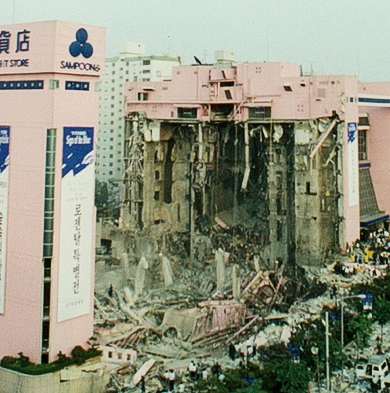
This was driven home by a recent episode of another TV show, Seconds From Disaster, dealing with the Sampoong Department Store in Seoul, which collapsed in 1995. You can read the Wikipedia page to which I’ve linked for more details, but, in brief:

  • The building was originally designed to be an apartment block, but during construction to create a large department store.
  • Substandard concrete was used for ceilings and walls.
  • Column strength was compromised by a reduction in size from the 80-90cm indicated in the design to 60cm to maximize floor space. In addition, in part to save money, they contained only 8 steel reinforcing bars instead of the required 16, reducing their load-bearing capacity by about 50%.
  • Floor slabs were incorrectly constructed, with their strength compromised by placing the reinforcing steel mesh 10cm below the surface instead of the normal 5cm – which doesn’t sound like much, but actually makes a big difference to their strength and to the loads being transmitted to the columns, effectively reducing the strength of the structure another 20%.
  • The columns were deliberately spaced as far apart as possible, again to maximize floor space, a decision that also increased the load each had to sustain
  • The original design was for four floors, but a fifth floor was added during construction. Originally intended to be a roller skating rink, during construction the decision was made to convert it to contain eight restaurants. In South Korea, restaurant patrons are seated on the floor, so this change required the inclusion of heating elements within the floor, dramatically increasing their weight.
  • As a result, the columns were supporting approximately four times the weight that they had been originally designed to take. Eventual collapse was inevitable, needing only a trigger event to set events in motion. Things were made worse when the columns were cut back to make room for fire suppression systems installed around the escalators.
  • That occurred when three 15-tonne air conditioning systems were relocated on the roof by placing them on rollers and dragging them to their new location. But it would be another 2 years before the progressive failures led to the ultimate collapse; in that time it was inspected by city officials a number of times and certified as safe, the last time just a couple of weeks before the collapse.
  • There were ample warning signs on the day of collapse (early signs were noted more than two months earlier, before that final inspection) and both the Building Engineer and Manager recommended that the building be closed, only to be ignored by the building’s owner, who insisted that the store remain open. At the time, it made profits of about US$4 million per week, and was used by an average of 10,000 customers per day. This was about 5 years after construction was complete.
  • 502 people were killed and more than 1500 trapped during the collapse, which took just 20 seconds to unfold. The investigation triggered a comprehensive review of constructions within South Korea, which found that 1 in 7 high-rise structures needed rebuilding, and 4 out of 5 needed major repair work. Only one in 50 was deemed safe. The Owner of the department store was jailed for 10 1/2 years for criminal negligence. His son and the CEO of the business was jailed for 7 years for corruption and accidental homicide, and 21 others including 12 city officials.

Image provided by Seoul Metropolitan Fire & Disaster Headquarters via Wikimedia Commons, Licensed under the Creative Commons Attribution-Share Alike 4.0 International license. Cropped, sharpened, and contrast increased by Mike.

What I find most astonishing and enlightening is the fact that despite these multiple, willful, and flagrant compromises of the load-bearing capacity of the structure, it stood for 5 years. That speaks volumes about the scale of the margin of safety required of modern construction. While I’m sure that the standards are not as strict when it comes to domestic dwellings, there’s a LOT of room between “barely strong enough” and the commercial building standard.

Interior Design

It’s not entirely inaccurate to state that the architecture determines what a space can be used for, while the Interior Designer decides what it will be used for, as well as what it will look like. Whenever an interior designer has been called in on Rescue My Renovation, it has always been at the beginning of the project, for two very good reasons:

  1. The more time they can be given to tweak and refine designs, the better the final result is likely to be, especially if there are problems to be overcome or unusual requirements to be satisfied.
  2. Determining their base requirements before work commences permits all subsequent stages of the work to be guided be the desired end result. If additional structural reinforcement is needed at some point – a beam running across a wall, for example – it is a lot easier to incorporate it before you put the walls up.

The more fancy features are to be incorporated, the more critical (2) becomes. You don’t simply drop an interior courtyard and water feature into the design and expect a happy ending!

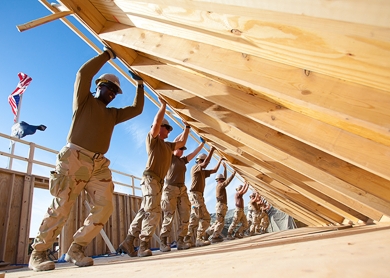
wooden building frame

Image provided by pixabay.com/PublicDomainPictures

RPG Relevance Pt 1: Adventure Design

The entire process of construction – which is exactly the same as that of renovation, save that the latter has the additional initial stage of demolition – is analogous to the normal process of designing an adventure.

  • You start by determining the structure that you intend to follow.
  • You then determine roughly what the content will be for each structural component;
  • …and then you create whatever content you require.

You may be guided through this process by a desired plot situation, or a desired stylistic objective, or can simply put things together guided by the stylistic traits of the genre.

    For example, in my Zenith-3 campaign, adventures comprise two different primary structural elements. The first is personal development for the PCs, interpersonal relationships, roleplay-dominant scenes, background developments, and so on. The second is the major plot of the adventure. In terms of game sessions, I will normally aim for a ratio of 1-2 to 1, measured in game sessions, of these elements.

    The simplest possible structure is to have all the “Personal” plots take place, evolving the background, the characters, and their personal soap operas, into a new situation, and then the major plot – like walking through a series of vestibules, waiting rooms, and the like, before reaching the living room.

    Major Plots are almost always designed to connect to one or more PCs personal plots, and may also incorporate significant background evolution. The last adventure, for example, contained three or four game sessions of personal plots and a two-session main adventure, which significantly advanced one plotline of one the PCs and included a minor advance in a group plotline. The other PCs weren’t just along for the ride; they all played a part in determining the outcome and got their equal share of the spotlight, but one PC was the obvious focus of the adventure.

    The next adventure, which I’m in the process of writing at the moment, has three structural elements, the first of which has already been dealt with in-play. You can describe this additional phase as housekeeping – decisions on future directions for each of the PCs. Next weekend (if all goes according to plan), we will enter the personal-plots phase of the adventure, much of which is built around the ramifications of decisions taken in past adventures. It will then segue seamlessly into the major plot, which – from a PC perspective – will (at least initially) appear to be just another of these personal plot-lines (that’s a favorite technique of mine, it means that the players can never tell what’s going to be significant so they have to pay attention to everything).

    In isolation, the personal events are just things that happen, that show the ongoing Personal Lives of the PCs. When the campaign first started, each adventure was typically separated by 2-3 game weeks of time; currently, the interval is 1-2 game weeks. As the campaign continues to ramp up, that will become 3-7 days, then 2-5 days, then 1-4 days, 0-3 days, 0-2 days, and finally 0-1 days. As the campaign approaches its climax (assuming we get that far), there may be multiple adventures in succession over a single game day.

    Even if they aren’t consciously aware of it, this impacts the players perception of the lives their characters are leading. Right now, pacing wise, they are reasonably comfortable. That will change.

    This inevitably alters the balance between the personal plotlines and the main plots, shrinking the first and expanding the latter. Over time, there will also be an increase in suffusion between the two.

‘Suffusion?’ you say? What’s that?

You’ll note that there’s nothing about the duration of the main plots in preceding paragraphs. Sometimes these are a single concentrated incident, sometimes they are a succession of events in close sequence, and sometimes there are inevitable pauses and gaps and delays – but a person doesn’t stop being a person just because they are in down-time during a major plotline. Which means that I can occasionally sprinkle a main adventure plot with “personal developments” that may or may not be unrelated to the main plot.

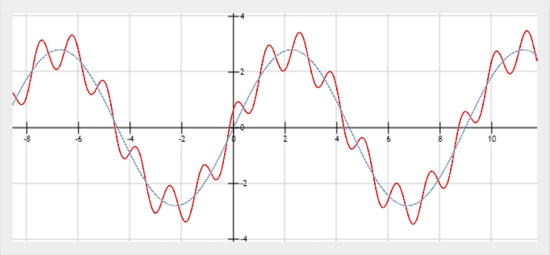
I deliberately referred to the ‘personal lives’ content as holding no greater significance in isolation a little while back. That’s because when you view them collectively, themes and trends can be detected – because life is not a random assortment of ups and downs, there are identifiable highs and lows and patterns. It’s more like the pattern below:

oscillations around a rising and falling trend

Function plot made using FooPlot.com

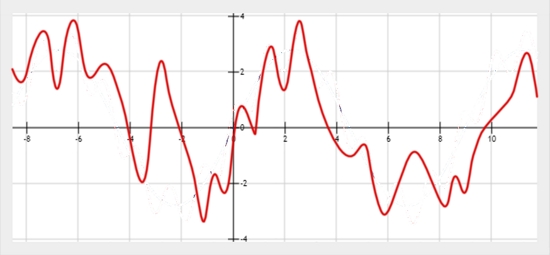
Well, actually, that’s a bit too regular and predictable. Life is even MORE like this:

Oscillations of a rising and falling trend, distorted in width and amplitude

“Function” based on the plot made using FooPlot.com shown previously

Sometimes, these highs and lows deal with a single individual, sometimes they are spread across a whole group, and sometimes they are something in-between. The only thing that you can say is that, over time, and ignoring other factors, they will tend to average out to a consistent level of some sort. If we were talking about a happy, healthy, moderately wealthy individual, that average would be on the plus side of the ledger; if not, it might be on the negative.

We’re talking about PCs here, so stability is a meaningless concept. Instead, their lives will lurch from success to catastrophic failure and back again, and the only certainty is that tomorrow will be different! But there will still be highs and lows, trends and events that buck them. Or, at least, there should be; the term “comfortable PC” should be an oxymoron if applied to anything other than a strictly temporary situation. Life should be calm only because it’s winding up to deal a haymaker!

These trends can happen accidentally, but many of my plotting techniques are aimed at controlling and directing them, to “suffusing” my smaller plots with broader narratives.

Those clued in, mathematically, will recognize the base graph shown above as being the sum of two sine curves of differing period and amplitude – one small and fast, the other larger and slower. These are analogous to individual plot developments in the life of a PC and to trends and larger plotlines affecting those specific events. Since there is always going to be some “splash” from one PC’s plotlines affecting another PC, there should in fact be at least two more such components PER ADDITIONAL PC, and then there are the individual major plotlines of each adventure, and the even broader plotlines that link those together.

But the techniques by which this incredible complexity is achieved are simple and straightforward, and the equivalent of what an interior designer does during the construction of a room or building. You can even extend the analogy by considering each major character – every PC and every NPC treated as a PC – as a room and the entire campaign state – the campaign as it is at any given moment – as the totality of all those rooms. The totality of the campaign, from start to finish, is the story of the “construction” and “redecoration/re-purposing” of the entire building.

The first step in creating an adventure is to decide on the structure for that particular adventure. Once that’s done, you’ve defined the “spaces” that need to be filled. Some of these will be essential narrative elements, and I then add more to more-or-less equalize the spotlight time across the different PCs.

I know what most of those essential narrative elements will be because I’ve broken a single plotline – large or small – into smaller pieces. Putting these in place within the adventure is the equivalent of putting up the walls and flooring. I rarely go so far as to include specific dialogue or flavor text; those are the “finishing” stage, the painting, decoration, and furniture.

Sometimes, if I’m in need of direction, I will select a graphic or visual image or concept – a piece of furniture – and frame the rest of the “room” around it. More usually, the plot defines what I’ll need, and I go out and look for it, or create it from scratch. And sometimes, there’s an ongoing give-and-take back-and-forth.

bare roof truss

Image courtesy pixabay.com/Capri23auto

RPG Relevance Pt 2: Campaign Design

I don’t think I need to spend a whole lot of time belaboring this point; quite obviously, designing a campaign is just a matter of scaling up the processes used in designing an adventure.

The fundamentals are still designing a structure, applying elements to the specifications resulting from that design, and then creating details of those elements to decorate and finish the design.

The major difference is that these are – or should be – all designed and intended to change over time.

It’s always my preference to avoid showing the campaign elements the way that I want/need them to be for the main campaign; instead, I show them the way they used to be and show the PCs the events that transform them, having those events impact on them in the earlier phases of a campaign. This not only makes the players feel like part of the campaign world, it gives the major campaign events poignancy and direct relevance to the players – it gives them Gravitas.

It’s important to realize that the more of your design work that you can complete at the Campaign level, the less you have to do at the Adventure level. This is important because you can usually delay the start of a campaign until the design work is finished, but it’s more effort – and more dangerous – to delay the start of an adventure until it’s finished, or to start playing it without having finished creating it!

Another analogy that occurred to me at about this point in thinking about this subject is that genre is analogous to architectural style. This not only influences the structure and shape of the building, but defines what furniture and decorative elements are or are not appropriate within. These rules can be broken, if the need is sufficient, and these deviations can even shed new light on genre elements by exposing them within a new context through the resulting contrast. But you have to know what you are doing, or you will be relying on a lot of serendipity in your designs.

Image provided by Pixabay.com/skeeze

RPG Relevance Pt 3: System Design

That chain of thought led me to the third aspect of relevance: RPG system design.

If the genre of the game is considered to be the architectural style, the functions that the system is designed to facilitate, and their relative priority, can be thought of as the framing infrastructure – the timbers and beams and foundations that define the shape of the structure.

Characteristics, Characteristic Checks, saving rolls, combat mechanics, a skill system, experience systems, and archetype expressions (character classes in D&D, for example) – these will be common to almost every game system, present in one form or another.

Those with the highest design priority will be the richest and most detailed, while those with lower priority will tend to be more vague and generalized.

Other design priorities may be embedded – a magic system, a technology system, interplanetary or interstellar travel, cosmological principles, a particular look-and-feel. If a Star Trek game system felt like you were running a Battlestar Galactica campaign, you would consider that design a failure because it did not convey the essential flavor of the source that you were aiming for, just as a Star Wars campaign that felt like a Terminator or Jurassic Park movie would be wrong. Some of these will be defined by the genre, others may not.

The actual substance of each of these game system elements is akin to the decoration and finishing of the rooms in a building. Ideally, they will work together in harmony, and will be practical, functional, spaces. In practice, there’s always at least one room that’s a little bit clumsy or awkward, over-decorated or even ugly.

The redecoration/renovation motif is relevant, too; quite often, you can replace one piece of the design with something else. The only thing that you have to do is make sure the doors and windows match up – the inputs from other design elements, and the outputs to those elements. If you wanted to, for example, you could replace all the character races in D&D with something else. Or change the character classes. Or replace the Saving Throw system. Or tweak the Combat system. Or whatever.

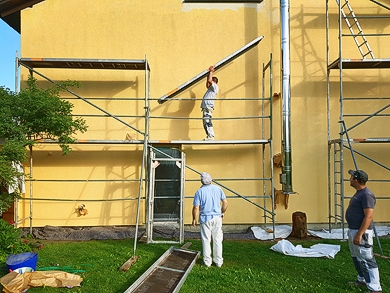
Scaffolding to paint the exterior of a house

Image courtesy pixabay.com/stux

Conclusion

In almost every respect, then, RPGs are analogous to construction, and the methodology that has evolved to produce habitats and structures that don’t collapse around our ears can be applied to the hobby to its betterment.

You can not only construct better, more reliable, adventures, you can understand those adventures more clearly – enabling more rapid and purposeful ad-hoc invention and intervention when necessary (the equivalent of emergency repairs)!

You can construct better, more effective, campaigns, that are more engaging and more entertaining while requiring less work to maintain, because you more clearly understand campaign structure.

You can construct better, more efficient, more flavorful rules systems and subsystem tweaks, because you not only have a more holistic understanding of the way game system structures interact, but can more readily isolate one structural element from another. You can see more of the connecting threads behind the set designs and, from them, derive a deeper understanding of what the designers were trying to achieve.

And all of that can only make you a more effective GM in the final phase of RPGs, without which all of the above is meaningless – play. Which makes the game better for everyone involved. Amply justifying the time spent on this subject – writing it, on my part, or reading it, on yours – I think.

Comments Off on Construction Methodology and RPGs

If Wishing Made It So


Last week’s post was (technically*) the 1000th here at Campaign Mastery. Appropriately for such a number, it dealt with big-picture abstractions and the fundamental principle upon which the blog is founded – having more fun at the gaming table. That make’s this post (again, technically*) the 1001st – a number that itself both the seeds and burden of inspiration.

* for various reasons, there are any number of posts that shouldn’t get counted, in my opinion, like being forced by the technology to publish an article in three simultaneous posts because of its length – which happened early on. Depending on which posts you consider eligible for counting, the “True” 1000th will fall in December… or January… or possibly March…

I don’t know about anyone else, but my first thought upon encountering the number 1001 is to remember Scheherazade’s stories, and that leads me to think about Arabian stories in general, which leads me to Genies, which leads me to Wishes. So that’s the potted history that’s in back of this article.

GM Role

Nothing reveals the GM’s role in an RPG as “the arbiter of reality” more sharply than the sudden intrusion into the game as a Wish. Depending on how old-school your campaign style is, this could quite literally change everything.

More recent incarnations of game mechanics have tightened the reigns, to the point that a Wish seems underwhelming and over-sold, promising big things and unable to deliver. Starting from 3e D&D onward, the spell – whether granted by an item or by the spell-caster’s own abilities – increasingly seems unworthy of the name.

Such “Wishes” are detrimental to the sense of wonder, of fantasy, that should be inherent in the genre, at least in my opinion.

And yet, this whole question is inextricably entwined in one of the oldest complaints about the D&D game mechanics, that of the game imbalance between Mages and everyone else at higher character levels. Part of the assorted attempts at resolving that complaint, both official and unofficial, that have been instituted through the years, inevitably involves a catastrophic neutering of the power of a Wish.

My general inclination is to reject this neutering, at least in part. It’s my contention that since the GM dictates the availability of wishes in items, a better solution is to divide the problem in two – “Wishes”, as per the spell, can be as constrained and limited as the needs of game balance dictate, while rarity and difficulty of creation can be used to constrain the impact of more powerful “Wish” items.

The name “Wish” for a Mage Spell is thus revealed to be a matter of Wishful Thinking, a pun that sealed this attitude to the subject in stone as soon as I conceived it.

But, at the same time, this is – potentially – letting the genie out of the bottle. Some constraint and restraint is required, or a Wish is the equivalent of giving a monkey a buzz-saw and inviting them to “do their worst”.

Three Primary Considerations

When a Wish is made in one of my campaigns, there are three questions that have to be answered before any adjudication of the results can be possible. These are Campaign Damage, Hubris, and Balance.

1. Campaign Damage

Will granting the wish inherently damage the campaign, for example by providing an easy answer to one of the central dilemmas that the entire campaign is intended to resolve?

The more “high fantasy” the campaign is, the more this becomes a problem, an irony that is not lost on me!

2. Hubris

Will granting the wish inherently elevate the PCs to a position greater than that of the Gods? Or, to rephrase the point, if all it took was a wish to solve the problem then don’t the PCs think the Gods would have thought of that already?

No problem defined as being too great for the Gods to solve with a wave of their hands is subject to direct solution through a Wish.

3. Balance

Will granting the wish inherently elevate one individual PC above his peers in deliverable game power to an excessive extent?

“I want +20 Armor and Sword!” – No, no, no, no, no. Not going to happen.

“I want +10 Armor and Sword!” – will happen ten minutes before the first.

“I want +50 to my Hide In Shadows!” – getting closer to the mark, but still – no.

“I want my sword to have 1 inch per character level range so that I can hit targets at a distance.” – Hmm, interesting, let’s talk….

Ways Of Saying No

There are lots of ways of refusing an unreasonable request. At the GM’s discretion, any or all of these may also burn a “charge”, i.e. a Wish – too bad if you only have one!

1. Outright Denial

The simplest and most direct is simply to say “no”. But, having gone to all this trouble to inculcate a sense of wonder into the campaign, an arbitrary and outright denial that punctures that bubble of suspended disbelief seems counter-productive; an argument that I have heard advanced for adopting the “weak Wish” proposals from the outset.

2. Temporary Change

It’s far more satisfying to reinforce that sense of wonder by having the transformation requested occur – for a while. And to remind the PCs that sauce for the goose is also good for the gander – if the PCs use this as a temporary power-up, so will their enemies.

Of course, it won’t be necessarily obvious that the change is only temporary…

3. Delusion

In one campaign that I ran, making a wish that was beyond the power of the Wish to deliver simply caused the character making the wish to be subject to the delusion that their wish had been granted – Monkeying with the character’s sanity being the only way for the Wish to actually deliver the request.

My thought is divided on the question of whether or not the players should be informed of this in advance. It would largely depend on the social attitude towards those who were “strange in the head” in the culture, and whether or not the PCs would have had the opportunity at some past time to observe such an individual. “Old Frederick, he got one of them wish thingies, and wished to be King Of The World. Hasn’t been quite right since, going around in finery and issuing meaningless orders and imagining that people fall over themselves to obey.”

At a metagame level, players should be aware that attempts to rort the system risks bringing the wrath of the GM down upon their heads, and that this is not a good idea. But some people just can’t help themselves.

4. The Rules Lawyer

I normally eschew “rules lawyer” approaches to problems. But if a player asks for it, I’ll unleash both barrels. On one occasion, a player who was granted a wish submitted his request in writing, with 16 typed pages of detailed specifics of the request’s fulfillment that would not constitute the granting of the Wish in the opinion of the character making the wish.

This for a request that, if presented in a straightforward manner, I would have had no problem fulfilling.

You see, there was a movement in the 70s and 80s that cast the players and GM into adversarial roles; a notion that the GM should be doing his level best at all times to kill off the PCs, and anything was fair game if it avoided this fate. The rules, and in particular a strict interpretation thereof, was the player’s only defense. This, despite an outright statement in the GM’s Guide that the rules as published were only guidelines and suggestions, and the GM was free to interpret or rewrite them as they saw necessary.

Of course, abuse of that authority led to greater demands by players to control their own destinies, for the GMs to be forced to adhere to the rules, and for the rules to be sufficiently comprehensive that the GM would not be required to make arbitrary decisions.

I don’t hold to that principle at all. Instead, I adhere to a variation on the original old-school approach – “the GM is free to interpret or rewrite the rules as they see necessary for the betterment of the game.” The game is not served by denying players the ability to do anything not explicitly permitted by the rules; it is not served by capricious or hostile rules interpretations. The purpose of the game is not to “win” – it’s to have fun, and the players and GM are engaged in a cooperative effort to that end.

Three pages of legalese is a violation of that principle. It was certainly no fun to read it, and would have set an unwanted precedent to let the player get away with it. Nor was it appropriate for the INT 14 character to have submitted such a wish!

Almost immediately, I spotted a major hole in the reasoning of the player. Putting it on paper took no more than 1/4 of a page. I then handed it to the player in question and gave him a choice: submit a simple request that didn’t assume that the GM was an enemy power, or I would rule based on that 1/4 page response (to the character’s severe detriment), and to go away and think about his choices for a week or so.

These days, I am even less tolerant. In essence, if you act as a rules lawyer, on the basis that you will not only ruin my fun but that of everyone else at the table, you are asking for it with both barrels.

5. The Monkey’s Paw

The nastiest way to say no – and what I mean by “with both barrels” – is to go full-blown Monkey’s Paw on the PC. And then run a mini-adventure in which the crippled and maimed PCs quest for another Wish with which to undo the first.

As a general Rule Of Thumb

If a wish doesn’t violate one or more of the three Primary Considerations, I won’t reject it. Even if it does, I may use one of the alternative rejection methods, depending on the results of considering a fourth issue: How Much Fun Will It Be To Grant The Wish?

The answer falls into three categories:

  • None or minimal – rejection if a violation, shrug and say OK if not. But try to persuade the player to make a different choice.
  • Fun for a while, but not in the long term – rejection via method 2 if a violation, shrug and say OK if not. When it stops being fun, I can give the player the chance to rescind his wish, or provide another Wish to undo the effect.
  • Fun, fun, fun – rejection via method 2 if a violation, evil grin and ready agreement if not.

The Scale Of A Wish

Because I always think about the scale in terms of answering the question of just what can be done with a Wish, especially an item-borne wish, long experience has shown me that the scale of the wish has a big bearing on all four considerations. When I aggregate all the possibilities into a master list, I end up with a 12-step scale.

1. The Cosmic Wish

The most likely to violate Principles one and/or two, this is a substantial reordering of the game universe. But it’s also an invitation to the GM to be at his most creative, so there’s always an off-chance that I’ll say ‘yes’ – though that “yes” might bear an uncanny resemblance to a “Monkey’s Paw” refusal, at least at first.

There is a fairly predictable pattern to the way events would unfold. First, the player would achieve whatever his direct intent was (a good thing, from his point of view). Second, negative consequences and ramifications would begin to be observed, leading others to discover the reordering of nature. Third (if it hadn’t been undone already), positives would be discovered, showing that the change isn’t uniformly good or bad, just different.

It’s a key element of human nature to notice the negatives first, unless blinded by optimism, but it’s dangerous to reject a policy simply because some negatives have been observed; the question has to be whether or not the change on the whole is better, worse, or neutral, and that can’t be done without identifying the positives. Most people won’t wait, and substitute an ideological bias one way or the other, leading to a false appraisal.

Often, this is because the negative effects will happen more or less automatically, with no need for action, while the positives will require some effort to achieve. The benefits are potential, in other words – and manifesting/achieving them thus becomes another thread within the campaign, potentially unveiling a whole new opposition force, upending established alliances, and – in general – upsetting the apple-cart of predictability.

BUT – and it’s a big one – you always have to ask the question of why someone else doesn’t use a Wish to restore the status quo. That leads into complicated issues of Destiny and Causality that might not be everyone’s cup of tea to contemplate. The simplest answer is simply to state that no Wish can ever completely undo the effects of another, and that resistance to change increases with each attempt to rewrite reality – and don’t worry about why.

2. The Divine Wish

In my campaigns, the Gods are limited in some respect. Omnipotence and omniscience don’t work well as campaign premises – something that I wrote about back in 2010, in A Monkey Wrench In The Deus-Ex-Machina: Limiting Divine Power (and don’t miss the discussion in the comments!)

That means that it might be at least theoretically possible for a Wish to impact at a Divine level – replacing one Deity with another, for example, or elevating a PC to Divine status. Assuming that you can skirt any problems with the three Principles, this simply opens new cans of worms for any PC who didn’t realize that in some respects, Gods in my campaigns are going to be as circumscribed as humans, if not more-so!

Indeed, one of the driving factors throughout the history and in-play time of my Fumanor campaign was Lolth’s attempts to ascend to True Godhood, because she had never made this discovery, and the PCs recognized it as a consequence of opposing some of the machinations she had set in motion.

In the Rings Of Time campaign, this was also true – but this time, it was the PCs, having been used by “The Gods” to do their “dirty work”, who determined to claim the rewards of Divinity. After all, they had done the work of the Gods already.

But it’s more difficult to evade the Principles at this scale. Not impossible, though.

3. The Planar Wish

A wish that affects just one plane? Theoretically possible, but there would be domino effects and repercussions that would need careful study before you could be sure that one of the three Principles would not raise a veto. If inspired, though, this is the sort of thing that I had in my with rejection method number 2.

4. The Civilization Wish

Wishing a change to an entire specific race? Again, possible – but this is quite likely to impact on Principle number 1, or simply not be fun, at least after a while. So it’s something that I would have to think very carefully about before granting.

Wishing that all Gnomes grew an extra inch in height? No problem. Wishing that the Drow reformed? Big problems. Wishing that Elves respected human leadership? Hmm, maybe. Wishing that Dwarves were less stubborn? Maybe. Wishing that humans discovered gunpowder? That’s more problematic – how do you know what Gunpowder is or can do, to wish for that? Wishing for humans to have an additional racial advantage to bring them more in-line with the Demi-human races? Assuming that potential problems with Principle 3 can be avoided, that might be possible.

The devil is in the detail.

5. The National Wish

Instead of an entire race, how about one particular Kingdom or Tribe? For example, if one Tribe of Orcs is known to be more willing to negotiate in good faith or be opposed to war, Wishing for that Tribe to be ascendant over the others might be completely reasonable – and raises an entirely new question for a GM to ponder: “How long does it take?”

A wish may not be able to get there directly, but may be able to start a domino chain of events that leads to the desired result. Directly elevating that Orcish Tribe, for example, might be beyond the power of a Wish, but starting a Civil War that would eventually have the same result might not be.

Of course, should such a Tribe discover – after gaining that ascendancy – that it was the result of PC interference in internal Orcish Politics would not only fracture the tribe, politically, but probably start the War that the PCs were trying to avoid. But the temporary respite might be worth it.

It’s in putting such options on the table that Wishes achieve their ultimate value in an RPG – providing they haven’t been neutered.

6. The Regional Wish

With each reduction in scope, the likelihood of a Principle 2 violation recedes, while the likelihood of a Principle 3 violation grows. A wish that affects only one geographic region, such as a bountiful harvest, or a Gold Rush, brings this point into sharp relief. In fact, it’s fairly difficult to imagine a Hubris violation at this small a scale. If the Wish were limited in duration, I would be even more strongly inclined to grant it – for example, “I wish for good weather for the next two weeks”, or “I wish for it to rain on your city for a year and a day”.

7. The Local Wish

Actually, I would regard that last one as a “Local Wish” – one affecting just part of a geographic region. These rarely have much impact beyond flavor, and that makes them eminently grantable for the most part. One still needs to keep a weather eye out for domino effects, especially if affecting a Capital City or vital Trade corridor.

One can also strike trouble with overreaching in some other respect – “I Wish for this fortress to be Impregnable” is asking for trouble of the Monkey’s Paw variety – some virulent disease that devastates the population would lead most invaders to bypass such a fortress without attacking, for example.

8. The Family Wish

With the Family Wish, the danger of a Principle 3 violation becomes ascendant, though targeting the wrong family might still incur Principle 1 problems, and I can still envisage potential overreaches – wishing that your family was the Royal Family, or that you were Heir to the Throne, for example. On the other hand, if I can think of enough additional burdens and consequences of interest – if I can see ways of making it fun, in other words – there might only be Principle 3 dangers to consider.

This brings up an important principle that hasn’t been mentioned so far (and note the lack of capitalization): balance can sometimes be achieved in the face of an overreaching wish that would otherwise produce a Principle 3 violation through the imposition of additional life complications for the character. This, in essence, plays Principles 3 and 4 off of each other. The key to resolving such possibilities is whether or not they would result in one character receiving a disproportionate share of Spotlight Time.

9. The Personal Wish

With the downsizing of a wish to this scale, Principle 2 violations (Hubris) largely fall away, but the potential for Principle 3 problems (Imbalance) becomes acute. Nevertheless, this can be a viable solution for some campaign problems – a player takes multiple levels of a particular class with laboring under a misinterpretation of the class mechanics, for example, and wants to trade them all in for levels in a completely different character class. Provided that power levels are equitable, this would be a perfectly satisfactory application of a Wish.

Class and Ability synergies have to be carefully watched, however – if one class permits a character to always attempt a Reflex Check for half damage, and another grants the ability to always take no more than half damage after a Reflex Check, the combination represents a significant power upgrade for the Character.

Often, decisions at this scale are the subject of negotiated compromises instead of outright verdicts. The guiding principle is always the 4th – more fun for everyone is the goal.

10. The Sub-personal Wish

Rather than affecting the whole of a character, Wishes at this scale affect just one attribute or aspect of the character. The considerations are very similar to those of The Personal Wish, but are less likely to result in problems.

I have a set of rough guidelines that I follow. If the character has a positive stat modifier, a single wish can raise that stat to 18 (sometimes 20, depending on the campaign); if not, it can only raise the stat to 14, and a second wish is needed to get to 18. Thereafter, a single wish increases the stat to the minimum required for the next highest stat bonus.

Similarly with magic items: if the original item is +0 or +1, it can become a +2 item. A +2 item can become a +3, a +3 can become +4, and +4 can become +5. If the game system progresses beyond that limit – Pathfinder does, from memory – so does this principle.

11. The Potentiality Wish

When you reach the top of the scale, you enter the realm of the Potentiality Wish – that is, wishing for an item or ability to have the potential to exceed that threshold. In D&D (3.x), that means +6; in Pathfinder, I think it’s +11.

The wish has two effects: it enables the item to be enchanted to that degree, and it ensures that there is someone out there, somewhere in the game world, with the skill and expertise to so enchant the item. I make no promises about who they might be (ally or enemy), or what might have to be done in the form of a quid-pro-quo to earn their cooperation, or how much it might cost the PC.

Another way to think about Potentiality is that the player has wished for an Adventure with one particular reward to be written into the campaign narrative. Every other aspect of that adventure is the province of the GM.

12. The Mechanical/Trivial Wish

Sometimes-contributor Ian Gray takes his Wishes down to an even smaller scale – he wishes for just +1 to one particular attribute or item at a time. His reasoning is that the GM is far more likely to grant such requests (while not paying attention to the total being achieved), and is far less likely to “monkey” with the outcome.

I discussed this at greater length in The Power Of Synergy: Maximizing Character Efficiency about 6 years ago (how time flies!) but that article then moved off on a different tangent to this one.

What is your default position?

Some GMs have a default position, when it comes to wishes, of saying “no” unless it can be shown that there will be no ill-effects. This reflects the woeful restriction of Wishes in the game rules, the unnecessary sacrificing of genre and flavor for practicality, and an admission that the GM either lacks the time, enthusiasm, or imagination to properly scope out the potential consequences and assess them.

Other GMs have a default position, when it comes to wishes, of saying “yes” – provided that the request is on an approved list. This is almost as bad, and for exactly the same reasons.

My default position is to say “maybe – let me think about it for a minute.” And then the actually spend that minute in deep thought about the consequences, the campaign, and the Four Principles that I have described in this article. If there’s a problem, can it be mitigated? If there’s a reason to say “no”, can it be worked around? Can fulfillment of the Wish be delayed until that objection is no longer a problem? Is there a means of saying “yes?” and coping with the consequences?

Ninety times out of a hundred, that 60-second review will produce a definitive outcome, ranging from a “yes” to one of the five ways of saying “no”. Occasionally, it will lead to a “I’m inclined to say…” either yes or no, followed by a “but,” and further discussion. On rare occasions, I may have to say, “I need to give it more thought.”

That’s the virtue of the four principles – and the flexibility provided by multiple ways of saying “no”. They cut through the fog, by posing specific questions and prompting productive lines of thought.

Ultimately, when you boil the first three Principles down, they are all reflections of a potential to reduce the amount of fun at the game table, making them specific derivatives of the fourth and final principle – and that’s why the fourth can occasionally override the others, showing a path through the valley of “no” to the signpost that reads “yes”.

Forget about saying “yes” or “no” by default. “Is it more fun?” should be the gold standard of decision-making at the game table, the question that overrides all others, and you can usually get there by compromising. This is just one example of how that can be put into practice.

Comments (6)

Scratching Your Itch


Smiley Emoticon by Pixabay.com/3dman_eu, color-shift & background by Mike

I know a number of former GMs who gave up the job. Some of them reverted to being players, some of them occasionally still dabble in the big chair, and some were so traumatized by the experience that they gave up RPGs entirely.

There are always three parts to the equation that dictates a GM’s longevity.

The first is the amount of work required and the GM’s capacity for completing that work in a timely fashion while maintaining some sort of personal life beyond RPGs. No GM should ever be put in a position where they have to choose between family and an activity with friends, and if one is, most of the time you can expect the activity with friends to be the loser. And, even if things never get that far, stress resulting from overwork can force the GM to abandon his role, anyway.

The second is the degree of skill with which the GM executes the various tasks, both in-game and prep, that comprise that game function, and his ability to recognize and acknowledge that skill. A GM who feels, rightly or wrongly, inadequate to the demands placed upon him by the big chair, will often take any excuse to abdicate his role, if necessary by shutting down the campaign and beginning a new one with a different concept, game system, and possibly even genre. This outcome is still more likely if the GM is, in fact, inadequate in the estimation of the players concerned; their lack of support can discourage the GM before experience gives him the chance to rise to the standard demanded. Of course, the standards applied by the players may be unrealistic, or the GM might even be genuinely swamped by the demands being placed on him. It can be hard to judge. And, of course, the still more-likely prospect may be that they are somewhere in between these extremes.

My co-GM’s experience in the early days of the Pulp Campaign is relevant. Although extremely knowledgeable in a number of fields – in fact, of us all, probably the most knowledgeable in those fields, including genre knowledge – his ability to execute a campaign was not up to the same standard.

This had previously killed off a Traveler campaign when the players wanted more information about the different factions in a civil war before committing themselves instead of diving in up to their necks, and were insistent on peaceful trading in the meantime. He could not find a way to engage us in adventures; his entire campaign plan was predicated upon us choosing a side in the war and actively engaging in the military campaign.

After a couple of okay-but-not-brilliant adventures, frustrations were beginning to mount in the Pulp Campaign. In particular, his plan to backstop the players and fill any gaps in their capabilities with ultra-capable NPCs, a lack of expertise in the game system that showed no signs of improving and which led him to continually over- or under-estimate how effective his NPCs would be, and the sheer number of players (9 or 10) – which resulted in none of them receiving an adequate share of the spotlight – had the campaign on the rocks.

All the players acknowledge that they were at the point of pulling the plug. Some were intending to give it one last chance to improve, others were already prepared to pull the pin.

That was when I stepped into a co-GMing role. I had virtually zero genre knowledge, but knew how to string plotlines together into bigger pictures, knew the game system, and how to solve most GMing problems. I was able to put together a coherent concept for the campaign that emphasized the collective power of the PCs and minimized the individual capabilities of the NPCs, was able to put some depth into the plotlines and incorporate them into a more sweeping plotline, and able to provide the expertise needed to challenge the PCs without overwhelming them. What’s more, I was able to expand the adventures to encompass the palette of capabilities of all the characters. As some players left the campaign because they weren’t in love with the genre, we were better able to focus these efforts on those who remained, and so ended up with a stable line-up.

We’re currently running through the 31st adventure since we teamed up, and working diligently on the 32nd, which we expect to begin early next year. We’re also into our 12th year of co-GMing the campaign, so it’s gone from a near-death experience to extreme longevity!

The third critical factor is the amount of fun that the GM extracts from the process. What floats their boat, ticks their boxes, and keeps them happy to invest the kind of effort that’s required to create a campaign to modern standards?

That’s the subject for today’s article.

Itches to scratch – Prep

There are two parts to GMing – prep and play – and they are about as different as chalk and vulcanized rubber. Prep is the 90% that players rarely see; but for some GMs it is the reason they get up in the morning and think gaming.

RPG Prep is creating plots and situations; creating characters; creating locations; contingency planning; and may also involve creating maps, props, flavor text, research, psychology, strategy, and big-picture conceptualizing.

Inevitably, there will be parts of this cocktail that appeal more than others, and parts that any given GM does better than others, and parts that they perform more efficiently than others, and the likelihood that any of these attributes coincide is vanishingly small, but happens more often than some might think.

That’s because the things that we’re good at tend to be performed better and/or more efficiently, both because we’re more inclined to devote our full attention to them, and because our skill in performing those tasks is part of the reason why we enjoy them. It can convey a sense of being in control of an otherwise uncontrolled melee of competing demands for our attention.

When Practical Solutions fall short

Equally, there will be some approaches to the craft of GMing that work for a particular GM, and some that fail miserably, no matter how objectively practical the approach might be. A good example is Johnn Four’s “5 room” systems – while I can appreciate the practicality, having tried the approach a couple of times, I found that for me, they sucked all the fun and coherence from my prep, turning it into something that had to be done rather than something that could be enjoyed for its own sake. It felt like the process was in control, not me.

Waning enthusiasm for game prep is a sure sign that your prep system isn’t scratching your personal prep “Itch”.

Johnn has also tried my techniques, and found that while he started strongly while utilizing them, he was unable to sustain coherence and output in the medium-to-long term; his campaigns escaped his control, and his enthusiasm for them waned in proportion. He needed a more loosely-structured approach that nevertheless suborned everything into a consistent pattern – the “5 room” system that he now espouses.

Once again, waning enthusiasm is the key indicator.

Every GM is different, and every GM needs to find their own solutions. That creates good blog content, because the only certainty is that your solutions might fit others. I can share my techniques and Johnn can share his, and we’re both right – and might both be wrong when it comes to the needs of “GM Johnny”.

Moreover, exposure to multiple techniques means that you can cherry pick what you need to get you past a particular creative “hump” or problem. You learn something even if the overall experience is negative and your response is, “I’m never doing it that way again!”

The conflict between Need and Desire

My process, in a nutshell, is to create a to-do list and then prioritize the items on it. Some may generate new entries or alter existing ones, so the list is always growing and evolving.

I divide the list into “must’s” and “desirables”, estimate how long the must’s will require (minimum) to complete to a minimum acceptable standard, and make sure that I allocate at least that much time to them. That automatically adds “Polish [X]” to the list of “desirables”.

Of course, I’ve added refinements and complications that suit me to that process, but that’s what the essentials boil down to – making sure to do the essentials to the minimum acceptable standard and then spreading what free time remains on the remainder, selected by value to the adventure and how much that process scratches my personal itches.

That means that some parts of the GM’s task are forever being neglected by my prep, but I know I can live with that because if I couldn’t, it would be on the “must do” list. For example, having some idea of what a villain can do with his powers is a “must” for my superhero campaign, actually translating that into game mechanics is close to the bottom priority of the “desirables” list, more often not done than complete. I trust myself to be able to improv a translation of concept into game mechanics during play, and find I get more “value” (both in polish and in fun) from polishing the abstract concepts.

I’ve described my planning process and some other techniques in previous articles, most notably

There are a couple of problems with this technique.

  1. All your “itches” might end up in the “desirables” column.
  2. Itches that make the “musts” tend to be front-loaded into the start of game prep.
  3. You can easily overindulge because you enjoy what you’re doing.
    1. It all feels like work

    If all the parts of game prep that you enjoy end up on the desirables list, your game prep is a list of chores that have to be finished before you can go and play – if you get any “play” time at all.

    Every now and then, you can cope with this, but it’s not sustainable, even if it is the “responsible” approach.

    Now, I’m not smart enough to solve the problem of work-life balance to universal satisfaction, and this is just another reflection of that social issue. But I have a solution to this particular problem – distributing the “musts” throughout the available prep time, and – in the process – leaving a little room for indulgence in the daily or weekly schedule.

    For example, if you have a total of 10 hours a week to devote to game prep, and the “must do” list for the current adventure you are working on requires 6 of those hours, that leaves 4 hours for fun. You can either spend all six of those hours up-front, making sure that the “musts” get done, or you can decide that for every two hours spent on “musts”, you will spend one hour of the available prep time on a “desirable” that scratches your personal itch. That uses up half the time allocated to ‘desirables’ before the ‘musts’ are complete, technically violating the principles of the prep structuring process, but it’s a lot more sustainable over the long term.

    The real problem, which I can only partially solve through efficiencies like “Partial NPCs”, still arises when there isn’t even enough time to complete the “musts”. But that’s beyond the scope of this article.

    2. That’s the fun part over with

    A similar problem arises because of the natural human tendency to prioritize the tasks that we enjoy most, when all other factors are identical. If you apply that tendency to the list of “musts”, it’s easy to see that you will do as many of the fun parts first as you can – and then find the rest of your game prep to be a chore.

    The solution, once again, is to deliberately distribute the fun and the work – and, in fact, to prioritize the “work” over the “fun”, as that provides an incentive to get the “work” done.

    That’s not always possible, because of the principle of “dependence,” which I haven’t mentioned so far. Simply put, it means that some tasks depend on the output of other tasks, and so can’t be carried out until the dependent tasks are complete. The prioritization process is vastly complicated than the elegant model described by the earlier synopsis because of this factor.

    There are only two ways of approaching this problem – either you do all the dependents first, regardless of the prioritization sequence with “fun” as an incorporated factor (the top-down approach) or you create some jigsaw pieces without knowing whether or not they will fit (a bottom-up approach).

    The choice for me is a simple one – if I have ample time in hand (“Musts” consuming 50% of the available prep time, or less), I’ll go with the bottom-down approach because there’s time to completely redo a jigsaw piece that can’t be hammered and filed to fit. If time is tight, the more serious strict dependence must be followed.

    But here’s a fun fact that shows the underlying complexity of the whole situation: with a little discipline, the more you indulge the “fun when it’s scheduled” bottom-up approach, the easier it becomes to do so. The solution is to save and index discarded jigsaw pieces.

    Let’s say you have an idea for an interesting location. Normally, you shouldn’t spend time on it until you finish outlining the plot and know whether or not it’s going to be needed, but if you have the scope for some self-indulgence, if it turns out not to fit the plotline, you can save it for an occasion when it does match your needs.

    The more you indulge in the bottom-up approach, the more leftover puzzle pieces you stockpile against future needs, so the smaller the risk entailed in future indulgence. Of course, the more such puzzle pieces that you stockpile, the more dependent you are on your indexing process to quickly find what you are looking for.

    3. The Danger Of Overindulgence

    Self-indulgence at any time leads to the potential for overindulgence. In this case, that usually takes the form of spending more time on a list item than the minimum needed to produce something of playable standard – simply because you are enjoying working on what you creating at the time.

    This is actually both a manifestation of, and a cause of, “Can’t see the forest for the trees” syndrome, where you loose perspective on the bigger picture and begin to obsess about the details of one part of that bigger picture.

    You can actually reach the point of counter-productivity – the more details you load into a list item beyond the necessary, the greater the danger of incongruity and incompatibility between the details and that bigger picture.

    The self-discipline required to avoid overindulgence is the price you pay for permitting distributed ‘fun’ prep. Everyone will have their own line that they should not cross, and it won’t be a fixed thing for any given individual over time, either. To guard against over-indulgence, the best solution is to end each prep session with a review of how what you have done fits into the whole. You will soon recognize when you have over-indulged – and when such indulgence begins to threaten your capacity to complete the other items on your “must” list.

    Personally, I punish myself for any over-indulgence by insisting that the extra time spent eats into the time reserved for other social activities. I might have to forego watching a TV series that I enjoy, or stay home and work instead of going out, or getting up early, or whatever. It’s important that it be an activity that I would enjoy so that it’s an actual punishment.

Itches to scratch – Play

For some people, prep contains the only parts of GMing that they actually enjoy; running an actual game is the price they pay for the stimulation needed to trigger prep. Some of these people spend all their time designing adventures and campaigns and never actually playing them!

Other people go so strongly in the other direction that they would (and do) eschew prep almost completely, relying on their capacity to improv. (While I can do that, I find it too stressful; but it’s better than not GMing at all).

Most people fall somewhere in between these two extremes. And that means that there are some parts of sitting behind the GM screen that they enjoy and some that they don’t, or don’t enjoy as much. Interpreting rules and dynamic rule creation, depicting multiple characters in a session, communicating persona or plot, being the center of attention or the ringmaster – these are all aspects of being a GM that may constitute an “itch” that the process of GMing scratches.

Don’t ever let anyone tell you that the amount that you relish what you may be doing has no impact on your performance. There are NPCs that I’ve played that were strictly mechanical, by-the-numbers, resulting in an at-best adequate performance, and others that were so joyous to depict that I threw myself into the part, chewing the scenery most entertainingly. Players notice the difference. It can even change from week to week – this week, a smarmy official might be the big winner, next week a crazed scientist or mage.

Isolating and analyzing different activities comes far more naturally when prepping for a game session than it does when actually running a game session. That’s because such analysis and it’s documentation represents additional tasks at exactly the time when we’re already maxed out.

The only acceptable methodology is to review your memories of the events of the game session, perhaps aided with a prompt or reminder of some kind, such as a recording of play or log of events, both in- and out-of-game. Although not as visceral and in-the-moment accurate, this can at least provide the basis for some generalized appraisal – and more detailed analysis can be misleading, anyway – see, for example my comments on relishing playing particular NPCs a few paragraphs ago. If one of those showed up on a given day, “roleplaying NPCs” might get quite a high score, whereas on a day when none of them front up, “roleplaying NPCs” might get quite a low score. Only when that pattern is correctly identified can you think about functional strategies for increasing your enjoyment of your time behind the GM screen.

With a reasonable understanding, however, you can start adapting your GMing style to scratch your in-game “itches” more frequently and mitigate or change the elements you don’t enjoy as much.

Vicarious Engagement

One source of pleasure behind the GM screen that is often overlooked, and which deserves special mention, is Vicarious Engagement. This occurs when the players are engaging in the material you have prepped for them and clearly having fun, and you can vicariously enjoy the entertainment you are providing.

This is far more powerful than most people realize, because it feeds back into virtually every other aspect of GMing. If the players are having fun, they will be more tolerant of rules interpretations, they will react more strongly to the NPCs who are supposed to elicit reactions, they will immerse themselves more fully in the plot and in their character’s reactions to the circumstances in which they find themselves, they will be more forgiving and tolerant of the GM in general.

If, on the other hand, they are not having barrels of fun, that also feeds back into everything the GM does. They will be less tolerant of the need for rules interpretations, they will be more blase even toward provocative NPCs and frankly dismissive of those not designed to elicit a strong reaction, will not display heart-felt reactions in any event, will go through the motions rather than engaging with the plot, and will be less forgiving of anything and everything.

There are two sides to every coin, and it’s easy to see the negatives without appreciating this feedback/amplification effect. Having fun is infectious, and misery loves company; use these truisms of human psychology to your advantage. And contemplate this scenario: if you are able to fake your own level of enthusiasm enough to push your players onto the “enjoyment” side of the above equation, the principle of vicarious engagement can feed back to you to make the pleasure that you were feigning genuine, even if only to a lesser degree.

This same process has often been recommended for those feeling down – forcing yourself to smile has the same chemical effects within the brain as actually enjoying yourself, and those in turn make you feel better. It’s ten-cent pop psychology, but it works to at least some extent, and any improvement is a good thing!

A Log Of Labors

The best approach is to maintain a log of your activities over a couple of game sessions, both prep and in (reconstructed) play. That will give you some indication of which situations come up most frequently, and permit you to assess which ones you derive the most satisfaction and pleasure from – and that’s the basis of reasonable steps to improve your satisfaction with all aspects of your GMing.

Nor should you fall into the trap of thinking that the two are disconnected. They aren’t – inadequate prep of NPCs, for example, leads to greater improv, which may lead to either greater or lesser enjoyment from those NPCs behind the GM screen. The optimum strategy in your particular case might be to prepare less, not more.

What makes you Itch

Another way to look at it is to assess, as dispassionately as possible, your GMing strengths and weaknesses, then modify your prep and GMing style to maximize the value of the first and mitigate the second.

Find your itch, and scratch it. You will be a better GM for doing so, and it only takes flipping a few elements from negatives to positives to radically alter the overall balance within a campaign.

Not that you should perform this kind of postmortem all the time. It’s too distracting and self-obsessive for that to be good for you. An annual check-up is usually enough, plus (perhaps) a review a month or so after implementing any changes to see if they’ve had the desired impact.

If you have more fun at the game table, there’s a preponderance of probabilities that your players will, too. If your players have more fun at your game table, not only will your game be strengthened, but you are more likely to enjoy it too. Scratching your itch is a win-win. You won’t find a better bargain than that!

Comments Off on Scratching Your Itch

The Splash Vector: Delivering plots to unhittable PC Targets


Image of a volcanic eruption courtesy Pixabay.com/Life-Of-Pix

There are lots of good reasons to have a strong supporting cast in an RPG.

They permit interactions which reveal or highlight aspects of a PC that otherwise might get an infrequent airing, for one thing.

Trusted NPCs can serve as proxies for the PCs, or can supplement their skill-base.

Or, fourth, they can facilitate plotlines and subplots that would otherwise be impossible to deliver to a PC.

It’s the latter function that I want to focus on in this article.

The Splash Vector

There are any number of situations in which there’s a reasonably obvious right-or-wrong decision to make.

Sometimes, there may be more difficult choices on offer, in which a player character can be presumed to exercise due caution and do their homework, because of that degree of difficulty.

“Disasters never ‘just happen’,” as the tagline from the Canadian documentary series Seconds From Disaster reads; “They are a critical chain of events…” Break the chain, and the disaster doesn’t happen, or doesn’t have as severe an impact (depending on how late in the piece that opportunity is taken).

In essence, it takes a minimum of one error or circumstance to create the potential for disaster, and at least one more to transform that potential into a manifest reality. Even then, there may be multiple opportunities to discover the imminent catastrophe and mitigate, minimize, or even avoid it entirely; these have to be avoided if the catastrophe is to become both inevitable and to exact it’s maximum toll.

Which is what the GM usually wants to flirt with – the deeper into this chain that a twist can be inserted to turn catastrophe into disaster averted, the more dramatic the situation is, and the deeper the architect of that salvation has to become immersed in the plotline.

Last-minute escapes are more thrilling than situations which are easily averted.

The decisions involved in these chains of events also deserve some scrutiny. These are either overt actions or failures to act, and – if overt – can either be what would normally be the correct choice (but isn’t, for reasons unknown to the protagonist of the story), or can be an incorrect choice of action; either will deepen the crisis to it’s next stage. Even the right action taken too late, or not taken strenuously enough, can transform the danger of a potential disaster into an actual disaster.

But here’s the thing: if you’ve been able to engineer a situation in which the usually-correct choice of action will only make things worse, and a player can usually be relied upon to make the correct choice of action – for reasons I’ll get into in a moment – why wouldn’t you make them the central figure of the resulting drama?

It’s only when you can’t rely upon the Player to let his PC get into the situation all the way up to his neck, or when your plot objectives require a less immersive situation – another point I’ll get to in a moment – would you need to target a Supporting Character and draw the PC into the situation by virtue of the relationship between that Supporting NPC and the PC, i.e. to utilize the Splash Vector.

The diagram to the left illustrates all this in the simplest way possible. This catastrophe chain consists of 9 events, though the last three are variant outcomes of the same singular event, If I’m honest.

Event 1 is the initial error or condition. It defines the blue-to-green zone, which contains mistakes or circumstances. The green-to-red zone deals with discovery and response. Event 2 is discovery after the fact, and is the reason maintenance work on aircraft has to be inspected before that vehicle returns to the sky. Both of these, on discovery, lead to inconvenience or difficulty, nothing more.

Event 3 is where things start to get interesting. Something unexpected starts to happen; it has to be correctly assessed and diagnosed and the correct remedial action, if any, taken. At each point from event 3 onward, the correct choice of action leads to the previous outcome – so, getting the assessment and diagnosis right, and taking the right action, at Event 3 leads back to mere inconvenience or difficulty.

Getting to Event 4 means that one of the trilogy of actions at Event 3 was not handled correctly for whatever reason. It represents one final chance to resolve the situation before it becomes dangerous, or to discover and correct that Event 3 failure. Success leads to Worsening Difficulties, preventing the situation from escalating leads to Potential Danger. Making the wrong choice leads to Event 5.

Event 5 means that the situation represents a potential danger. Pilots and the masters of other vessels have a phrase, “Pan-Pan-Pan” (sometimes just “Pan-Pan”), which is used to alert others that the vehicle has an urgent situation that does not yet threaten the lives of those aboard or the operation of the vehicle itself. Handle this correctly and the best possible outcome is that the danger remains only potential; the slightest shortcoming in response (including simply taking too long to reach a decision) leads to the danger manifesting, and leads to the declaration of an emergency, and a mayday to alert others that assistance may be needed.

Event 6 arises from a failure to prevent the situation from worsening – if there was ever an opportunity to do so, of course. The best outcome from this point is an emergency satisfactorily resolved, with passengers, crew, and/or vehicle having been placed in danger but not harmed to the point of disaster. This event represents the final opportunity to prevent such a disaster, and margins at this point are usually razor-thin.

Events 7-9 represent disaster, with various degrees of mitigation. Loss of life is now inevitable, only its degree is now in the command of those ‘controlling’ the situation. If we’re talking about an aircraft, event 7 might be a successful crash landing with successful evacuation and no casualties but a wrecked multi-million dollar investment, or it might be less than a third of the souls aboard being lost. The maritime equivalent is the ship sinking but all the passengers and crew rescued. A “mayday” call means that the commander of the vehicle is anticipating an Event 7, even if that’s only a worst-case outcome. Event 8 is a moderate disaster – some casualties are expected, but there is also an expectation of some survivors. Event 9 means that there is no hope of survivors (though sometimes there are a few, anyway).

Some chains of events may have more opportunities in given stages, or none at all. The worst situations go directly from Event 1 or 2 to Event 7, with the crew never being aware of the danger they are in until it is too late to do anything about it. These were once commonplace, but have mostly been engineered out. These days, the worst case you can reasonably be expected to confront is a chain that runs Event 1 to Event 6 to Event 7-9.

Olympian Heights vs Confirmation Bias, Logic Errors, and Hubris

Putting a PC on the path of such a disaster chain – depending on how softly you define “disaster” – is a regular occurrence in RPGs, because the implication is that there is something that can be done about the situation – of the PCs are sufficiently quick-witted and aware of the situation.

They are aided in this respect by the GM, who usually issues multiple warnings of imminent cataclysm, and by the separation between player and character. Because they are not personally in danger, this presents the players with the perspective from Olympian Heights, and that alone can permit a more rational decision-making process than those that would be experienced if they really were in such a situation.

There are several basic responses to emergency situations:

  1. Counterproductive Fight-or-flight
  2. Denial
  3. Confusion
  4. Freezing
  5. Panic
  6. ‘We have to do something, now – this is something’
  7. Incorrect action taken through misdiagnosis of the situation – at best, this only consumes time, at worst it makes the situation worse
  8. Correct action in insufficient measure, too late, or both
  9. The correct action to prevent or mitigate escalation

Now, how many times does a player have a PC choose anything but the last three – and with the full expectation that they are choosing the 9th and last option? It’s rare. Very rare.

That means that any of the other outcomes have to be applied to the character by the GM. Options 7 and 8 are usually tolerable, because that still leaves the player in command of the character, though there can sometimes be disputes about the character realizing in time that their action wasn’t having the desired effect.

Options 1 to 6 are less tolerable, even if they are reasonable responses for this particular character in this particular situation.

There are three major reasons for characters making the wrong choice of response – Hubris, in the form of overconfidence; Logic Errors which lead to incorrect or insufficient responses being made; and Confirmation Bias, in which we become so convinced of what we are doing that we can become literally blind to anything that contradicts out interpretation of the situation, and which I discuss in the context of players in this article.

Players are susceptible to each of these, but are less likely than their PCs to succumb because of the Olympian Perspective. (That perspective can also leave them more vulnerable to Confirmation Bias because it reduces the price-tag of speculation; most player Confirmation Bias results from the player assuming that his theory of events is correct, leading him to ignore as red herrings the evidence that the GM intended the players to use to disprove incorrect theories).

That means that unless you can be sure that there’s no opportunity to mitigate the situation prior to Event 4 at the earliest, PCs make unsatisfying targets for these situations.

Which brings me back to the Splash Vector, but first I want to talk a bit more about the choice of whether or not to expose PCs to a situation. In other words, I want to discuss a few more reasons why there’s a problem, and look at the scale of that problem, before I demonstrate the ways in which the Splash Vector can provide a solution to the GM.

Immersion Depth and Plot Significance

The more easily the correct course of action can be determined, the earlier in the catastrophe chain the sequence can be broken by an intelligent character behaving rationally.

It follows that the earlier a PC becomes involved in the plotline of such a situation in an active way, the lower the significant impact that plotline will have on the character, and the lower the player’s immersion within the plotline.

The logic given at the end of the previous section has already stated that only a few situations relative to the total pool of possibilities are definitely suitable for PCs. The reduction in impact means that some of the remainder can still be of use, with the assumption that the threat will be defeated at some intermediate point – Events 3-6, in other words. However, the immersion factor means that the earlier within this sequence that the intermediate point is reached, the less valuable the situation is to the GM.

As a practical measure, anything that can obviously be dealt with at Event 3 can be ruled out. Easily-solved problems at the Event 4 stage are trivial and also not, therefore desirable. Problems that can be easily resolved at Event 5 are therefore the minimum that are of value even as a subplot.

That’s at least half the potential plotlines that have been ruled out.

But it gets worse. Not every problem metastasizes into the next stage of the disaster chain. A huge number of potential inconveniences or difficulties never escalate beyond the irritation stage. I have no data on which to assess the relative proportions, but each Stage comprises more situations than the next higher Stage.

Let’s see what that means using 4 different values: 75% metastasize, 50% metastasize, 10% metastasize, and 0.5825% metastasize (I’ll show you where that last number derives from, along the way):
 

  • 75% advance to the next stage, 25% are easily resolved at the current stage:
    • 75% of 6 become 7-9, so 6 is 4/3 of 7-9.
    • 75% of 5 become 6, so 5 is 4/3 of 6, which is 16/9 of 7-9.
    • 75% of 4 become 5, so 4 is 4/3 of 5, which is 64/27 of 7-9.
    • 75% of 3 become 4, so 3 is 4/3 of 4, which is 256/81 of 7-9.
    • 75% of 2 become 3, so 2 is 4/3 of 3, which is 1024/243 of 7-9.
    • 75% of 1 become 2, so 1 is 4/3 of 2, which is 4096/729 of 7-9.
    • So, for every stage 7-9 situations, there are 5.6 stage 1 events. Minimum. And about one in six mistakes leads to a disaster.
    • Another way of stating this is that for every 800,000 Stage 1 events, 200,000 are easily resolved and 600,000 will escalate to stage 2.
    • Of those 600K Events, 150,000 will be easily resolved and 450,000 will escalate to stage 3.
    • Of those 450K Stage 3 events, 112,500 will be easily resolved and 337,500 will escalate to stage 4.
    • Of those 337,500 stage 4 events, 84,375 will be easily resolved and 253,125 will escalate to stage 5, where they will be useful as a minor subplot or better.
    • Which means that useful plots comprise an estimated 31.64% of the total. And that’s with an unrealistically high proportion of escalation.
       
  • 50% advance to the next stage, 50% are easily resolved at the current stage:
    • 50% of 6 become 7-9, so 6 is 2x 7-9.
    • 50% of 5 become 6, so 5 is 2x 6, which is 4x 7-9.
    • 50% of 4 become 5, so 4 is 2x 5, which is 8x 7-9.
    • 50% of 3 become 4, so 3 is 2x 4, which is 16x 7-9.
    • 50% of 2 become 3, so 2 is 2x, which is 32x 7-9.
    • 50% of 1 become 2, so 1 is 2x, which is 64x 7-9.
    • So, for every stage 7-9 situation, there are 64 stage 1 events – and 1 in 64 mistakes leads to a disaster. I don’t know what the error rate is during aircraft servicing, but there are an estimated 39,000 commercial and military aircraft in operation currently, so that would be about 2 newsworthy air disasters a day at a 1/64 rate. That seems to be about 1/365th or so of the true rate – call it 1/400th for ease of calculation, or 0.5825% metastasizing – which is where the fourth of the values comes from, but is getting ahead of ourselves a bit.
    • Another way of stating this is that for every 64,000 Stage 1 events, 32,000 are easily resolved and 32,000 will escalate to stage 2.
    • Of those 32K Events, 16,000 will be easily resolved and 16,000 will escalate to stage 3.
    • Of those 16K Stage 3 events, 8,000 will be easily resolved and 8,000 will escalate to stage 4.
    • Of those 8,000 stage 4 events, 4,000 will be easily resolved and 4,000 will escalate to stage 5, where they will be useful as a minor subplot or better.
    • Which means that useful plots comprise an estimated 6.25% of the total. And that’s with a still-unrealistic proportion of escalation.
       
  • 10% advance to the next stage, 90% are “easily” resolved at the current stage.:
    • 10% of 6 become 7-9, so 6 is 10x 7-9.
    • 10% of 5 become 6, so 5 is 10x 6, which is 100x 7-9.
    • 10% of 4 become 5, so 4 is 10x 5, which is 1,000x 7-9.
    • 10% of 3 become 4, so 3 is 10x 4, which is 10,000x 7-9.
    • 10% of 2 become 3, so 2 is 10x, which is 100,000x 7-9.
    • 10% of 1 become 2, so 1 is 10x, which is 1,000,000x 7-9.
    • So, for every stage 7-9 situation, there are 1 million stage 1 events, with this progression rate, which is the one I instinctively selected as being “realistic” until I did the calculations in the previous results group, and hurriedly inserted a reasonably accurate value earlier into the article!
    • For every 1,000,000 Stage 1 events, 900,000 are easily resolved and 100,000 will escalate to stage 2.
    • Of those 100K Events, 90K will be easily resolved and 10,000 will escalate to stage 3.
    • Of those 10K Stage 3 events, 9,000 will be easily resolved and 1,000 will escalate to stage 4.
    • Of those 1,000 stage 4 events, 900 will be easily resolved and 100 will escalate to stage 5, where they will be useful as a minor subplot or better.
    • Which means that useful plots comprise an estimated 0.01% of the total. And that’s with a still-unrealistic proportion of escalation.
       
  • 0.5825% advance to the next stage, 99.4175% are “easily” resolved at the current stage – calculated “realistic” values:
    • 0.5825% of 6 become 7-9, so 6 is 1717x 7-9.
    • 0.5825% of 5 become 6, so 5 is 171.7x 6, which is 29,472x 7-9.
    • 0.5825% of 4 become 5, so 4 is 171.7x 5, which is 5,059,554x 7-9.
    • 0.5825% of 3 become 4, so 3 is 171.7x 4, which is 8,685,292,912x 7-9.
    • 0.5825% of 2 become 3, so 2 is 171.7x, which is 149,114,663,056x 7-9.
    • 0.5825% of 1 become 2, so 1 is 171.7x, which is 25,599,083,786,461x 7-9.
    • So, for every stage 7-9 situation, there are roughly 25.6 million million stage 1 events!
    • For every 25.6 million million Stage 1 events, 99+% are easily resolved and 15 thousand million will escalate to stage 2.
    • Of those 15 thousand million Events, 99+% will be easily resolved and 8,737,500 will escalate to stage 3.
    • Of those 8,737,500 Stage 3 events, 99+% will be easily resolved and 5,090 will escalate to stage 4.
    • Of those 5,090 stage 4 events, most are easily resolved and 3 will escalate to stage 5, where they will be useful as a minor subplot or better.
    • Which means that useful plots comprise an estimated 0.00000000001171875% of the total. Or 99.99999999998828125% of possible plotlines are useless for the purposes of directing at a PC.
       

Fortunately, we don’t have to think of all those possible mistakes as GMs – we get to cherry-pick one that we can make interesting or relevant. The full list, potentially, includes everything from not storing enough soft drinks to forgetting to attach the engines when the vehicle was last maintained, and all points in between, plus every possible weather configuration of note, and the risk of collisions, and, well, anything and everything you can think of, quite literally, and more that you don’t.

Modern design and engineering has redundancy and safety measure heaped upon redundancy and safety measure. That’s why so few of those problems escalate beyond the inconvenience stage. But, if we broaden the concept of “disaster” to include adverse personal developments, there are far fewer protections. Nevertheless, the principle remains clear – more plots are almost certainly unsuitable for PCs than plots that are suitable. That was the case with every possible metastasizing rate that we considered. In fact, you need a rate of just over 89% escalation before it stops being true.

And some people think it’s easy coming up with Adventures that are interesting, internally logical, and engaging – just a side-note observation :)

The Splash Vector (cont)

The Splash Vector simply means that instead of targeting a PC directly, you target an NPC with whom they have an established relationship, who then asks the PC to step in and get them out of trouble at some point deep in the disaster chain. In other words, we target the NPC and hit the PC with the ‘splash’ so that the PC can’t dodge the problem by taking the relatively obvious escape routes early on in that chain.

Players can have no objection to NPCs exhibiting the full gamut of possible reactions to a crisis. NPCs are just as susceptible to Confirmation Bias, Logic Errors, and Hubris, as anyone else – and the GM doesn’t even have to require a roll to test for it. In fact, they can be “forced” to (mistakenly) make the worst possible choices until they have escalated a situation to the point where it will be difficult (and interesting) to solve without a disaster taking place.

A lot of those rejected plotlines – and they outnumber the directly-useful ones, remember – are suddenly back on the table.

Let’s take an example:

    NPC has an accident of some sort and are subsequently sued. They hire a lawyer they saw on a TV advert, and don’t tell anyone about the accident or lawsuit. They lose the case and now have 30 days to come up with a substantial sum of money. They do the worst possible thing and borrow the money from a loan shark with ties to organized crime for what they think are ‘easy terms’.

    That alone might be enough trouble for the PC to have to deal with, especially if the goal is merely to seed the campaign with the presence of a gang boss who is known to the PC – this is a great way to bring them to the PC’s attention. Or you might need to escalate matters a little:

    The loan shark manipulates circumstances so that they default and then blackmail the NPC into doing illegal acts for him. Which leads to the NPC being arrested and charged. The NPC’s blind faith in people leads him to retain that same TV lawyer again. At which point the PC learns of the situation, and has to somehow extract his friend / partner / relative from it.

Or another:

    NPC receives an email from a Nigerian Prince in exile who needs help in recovering 1 billion dollars in gold. The PC would know better, but the NPC is taken in – and has their money and their identity stolen.

    That’s enough for some entertaining role-play between the two (provided that the PC somehow learns of what’s going on, probably through the boasting of the NPC), but the actual process of closing an old credit card and replacing it with a new one, etc, is likely to be more tedious than entertaining, so anything more than a roleplay can probably be hand-waved away. This is absolutely fine if having the NPCs identity be stolen is just an establishing condition for a bigger problem, in which case it’s better from the perspective of the GM trying to engineer “interesting times” for PCs that this PC remains ignorant of the situation for a little while longer.

    …That identity is then used to acquire a credit card, which is used to purchase high-end electronics, which are resold – and, of course, no attempt is made to repay this money… Meanwhile, the NPC is so confident that he’s about to become wealthy that he goes into debt splurging and buying gifts for everyone. At which point the PC realizes that something is wrong, extracts a confession from his friend (face-palm when he learns of the Nigerian Prince) – just as the police show up to arrest the NPC for credit fraud…

It doesn’t matter what the trouble is, an NPC can either get into it more plausibly than a PC can, or can make a poor choice that makes a bad situation worse.

Splash Vector Requirements

Of course, for this to work, you need an NPC with the right qualities and personality, and you need to have established a relationship between the NPC and the PC in game time. The more remote that relationship, the greater the risk that the PC will say “No”, or decide that it’s too much work or too difficult a problem.

But it’s not for the GM to state that there’s such a relationship, or to dictate it’s depth and whether or not there is sufficient strength in it that the PC will put himself out so much for the NPC. That’s all up to the player.

That means that the GM can’t take the relationship for granted. Instead, he should ensure that the relationship develops by involving both PC and NPC in mutual events in-game prior to drawing on that investment.

There are times when you can drop an NPC into the plotline “cold” with an alleged relationship to a PC and have it accepted as the plot hook, but it feels forced, because it is.

As a general rule of thumb, if the relationship is a personal one, even if it hasn’t been established in-game, a personal crisis is justifiable – a relative having gone missing, or being held hostage for an impossible ransom, or whatever. If the relationship is not, a personal crisis probably won’t play, but if the promise of “adventure” is high, you have your next best chance of pulling it off.

Once an NPC is established in-game – and you’ll never know for certain whether or not they’ve been established enough until the time comes to pull the trigger – anything becomes possible. If the relationship is not yet enough, the previous rules of thumb stand.

Confidence

One technique is to use these facts to boost confidence in the relationship, via a simple four-point plan.

  1. Embed the NPC as a regular figure within the campaign. Have them interact with the target PC on a number of occasions.
  2. Use the rules of thumb given in the previous section to engage the PC in a high-adventure personal crisis, i.e. one that could be safely used with a drop-in NPC.
  3. Have the NPC provide significant assistance to the PC at some personal cost, repaying the debt incurred in (2). The (2)-(3) combination greatly deepens the relationship.
  4. If the response to the events of (3) give you confidence that the relationship is ready-to-use, go ahead with the real test of the relationship. If you are still lacking in confidence, return to step one (interactions) to more deeply embed the character.

Of course, you will have to be subtle about it – this plan falls apart if there’s any whiff of orchestration involved.

A broader field of opportunity

For that reason, I will often embed several NPCs into a campaign with no intent to use any of them for anything in particular – then wait to see which ones “take”. This gives a broader field of opportunity, because it means that I can pick and choose which relationship is most “ripe for the picking” at the time that I need one.

There are a couple of indicators that can be usefully employed to measure that readiness. If both you and the player can name the NPC without looking it up, that’s one sign that they are entrenched within the campaign. If the NPC is fun to play, and it has become easy to involve him or her in some way, that’s another. The combination makes it even more certain.

Of course, you will need to customize these indicators to suit your group, and the way that they play. A player who is naturally good at remembering NPC names (or who maintains a list of them) will obviously discount the efficacy of the first of those signals that I mentioned.

A little cold-blooded prep can also go a long way – deliberately seeding the campaigns with NPCs whose relationships you expect to need at some future point, i.e. deliberately emplacing the NPCs that the future plotlines will require. If nothing else, this gives you the chance to see whether or not those necessary NPCs “take” or if you need to tweak them or even replace them.

Think of this as giving some method to your madness when it comes to casting choices. Having a direction is always a good thing!

Comments Off on The Splash Vector: Delivering plots to unhittable PC Targets

Structural Concepts Of Genre


background-1909992 by Pixabay.com/KreativeHexenkueche

It’s not often that I start one of these article with no certainty about where it’s headed, and with no intention of even attempting to be comprehensive, but that’s the situation in which I find myself this week.

Last week, I participated in an extended conversation through Twitter with Daniel Lonson and several other GMs about the need for a definitive lexicon for use in defining the intended Genres of an RPG Campaign.

You can read Daniel’s original post on the subject at this link. But the upshot is that there are certain labels that get thrown around by GMs and players with little or no agreement as to what they actually mean, a situation that can lead to expectations that aren’t met and all the negative effects that can flow on from there.

This strikes me as something of greater relevance to convention gaming than to regular campaigns, simply because the former is a gathering of strangers while in the latter case, the players presumably already know each other.

But I can also see the relevance when it comes to third-party products – if you buy a module labeled as “high fantasy”, and the editors/publishers have a completely different interpretation of that term to the one you use, you can feel ripped off by false advertising. That’s a situation that’s bad for the consumer, bad for the producer, and bad for the industry in general.

To some extent, this is not a new problem, nor one that is exclusive to RPGs, as I pointed out to Daniel. Sci-Fi fans have been arguing over the dividing line between Science Fiction and Science Fantasy for decades, and into which category specific works (such as Star Wars) fall.

Then there’s the question of all those works that were written in good faith, only to be invalidated by more recent scientific discoveries, should be placed – are they still Science Fiction, or are they something else? Can Hard Science Fiction still be placed in that category even when the foundations are invalidated?

These questions have never been answered definitively to the point of universal acceptance. Not even close, in something close to a century of debate on some issues.

I was also concerned that defining the genre of a campaign risked painting the GM into a corner in which he was afraid, or unable, to go beyond the stated definitions, where they thought that the only way to satisfy everyone was to stick as closely to the narrowest definition of their selected genre. This could be stultifying and even counter-productive.

Nevertheless, the longer the extended conversation continued, the more I began to dimly grasp the foundations and principles of a possible solution. This article is intended to formalize and structure my thoughts on the matter, providing a foundation and structure for future discussions – before other thoughts crowd them out of my head.

The problem, of course, is that it’s really hard to definitively describe what you can only grasp in nebulous half-formed concepts. As I wrote to Daniel, “I feel like we’re still groping in the dark a little, trying to comprehend the shape and structure of what we’ve stumbled into. But at least we’ve groping in a useful direction.” – a sentiment with which he readily agreed, saying, That’s pretty much where I am too! I’m happy to do nothing but to let this topic simmer in the back of my mind.”

The initial concept

My first thought was built around the example of distinguishing high fantasy from low fantasy as a “test case”, deriving a system of thought from the process, and then extending that system of thought into a more comprehensive set of genres and sub-genres, to provide the sought-after universal lexicon.

The problem is that there are no universal hard-and-fast standards. Examining this sub-genre in any depth brings that very firmly to your attention. But I thought I saw a way around this – if you could list half-a-dozen genre elements that everyone could agree were usually, or even just often, associated with high fantasy while not being common in other forms of fantasy, then we would be on our way.

If we were to define a continuity from low fantasy to high fantasy, then simply by stating that “X of the Y high-fantasy elements will frequently feature in this RPG/Campaign/Adventure”, you could assign a score on a scale of 0 to whatever, where whatever was the number of defined high-fantasy elements.

This avoided the binding of hands that initially concerned me, while still enabling a definitive lexicon; where individuals placed the dividing line between what they labeled “high fantasy” and what they did not no longer mattered. This bypassed completely the need for language.

What’s more, by being more expansive on the list of defining traits, I could foresee the construction of a genre “fingerprint” that conclusively identified where a campaign or adventure was going to sit, on average or most of the time.

Traits such as “realism of violence”, “level of pseudo-science assumed to be canon”, “degree of historical foundation”, “presence of ‘alien’ races”, “scale of magic”, “presence of magic”, “PC impact on history/world”, and many, many, more.

Collectivization and Simplification

What’s more, it was my hope that most of these could be subordinated to a more general rating. If we could pin things down to four or five general criteria that could be numerically derived from the subordinates on a universal 0-to-10 scale, it would become practical to define the exact genre of a work in a manner that was readily comprehensible.

Maybe “High Fantasy”, “Science Fiction”, “Adventure Scope”, “Historical Foundations” and “Soap Opera” would work for those general criteria. For example, a typical D&D fantasy campaign set in the Forgotten Realms might read:

    High Fantasy: 6/10
    Science Fiction: 1/10
    Adventure Scope: 4/10
    Historical Foundations: 2/10
    Soap Opera: 3/10

If you were to examine those scores, not knowing anything about the system or setting or planned campaign, you would conclude that most adventures will tend to be localized, with relatively low PC ‘personal life’ content, that high fantasy elements will be present from time to time but not overwhelming, and that while specific elements might be inspired by history, the game setting itself was an invented one.

If you compare that with my Zenith-3 campaign, you get an entirely different ‘fingerprint’:

    High Fantasy: 6-9/10
    Science Fiction: 7-9/10
    Adventure Scope: 4-10/10
    Historical Foundations: 4-6/10
    Soap Opera: 7/10

From these scores, you can determine that the fantastic will be routine, whether science-fiction or high fantasy in nature, but that there would be a large pseudo-science foundation to the latter, that adventures can vary from the local to national to international to interplanetary to inter-dimensional multi-reality in scope, sometimes without notice, that the game world is more strongly rooted in historical foundations, but twists or distorts that reality, and that PCs “personal lives” are a very strong element within the campaign.

Bringing the discussion back to the original point, however, the usefulness of these fingerprints is directly related to the value of the definitions of the lexicon employed. If we can’t agree on what “High Fantasy” is, for example, a rating for its involvement is making a promise that might well be misunderstood through vocabulary differences – we’re right back where we started.

This is about the shape of the answer, not about the content of the answer.

Complicating the picture: Intensity and Frequency

In terms of any of the specific topics, there are two criteria that are being boiled down into a single numeric scale, or worse yet, into a binary yes/no. Those criteria are Intensity and Frequency.

This diagram illustrates the problem. It shows four very different campaigns that all have the same overall rating in one topic – let’s say the scope of magic within the campaign, for the sake of argument – if the overall rating is simply measured as the linear distance from the 0,0 point, which is the most obvious way of approaching it. That rating is a perfectly average 5.

The Red campaign gets there with infrequent highly-cosmic events. The purple, more than twice as frequent, but slightly diminished in intensity. The blue shows the same increase again in frequency, but the intensity is down to 4/10. And the green? The intensity barely nudges the scale at about 1.5/10, but it happens almost all the time.

This also gives an impression of just how difficult it is to assign meaningful values to these attributes without a lexicon to define them. Is intensity 7 continental cataclysm? Or national disaster? The threatened destruction of one plane of existence, or merely of triggering the Big One in San Francisco? Or, perhaps, in Washington, DC?

A lexicon is essential to providing context. And that’s a wholly separate discussion for each of the specific criteria.

The second problem illustrated is exactly how to take the two scores – Intensity and Frequency – and combine them into a single overall score, distill them down. There are lots of ways of doing so. We could multiply them together and divide by 10, or take the square root of the multiple, or average them, or take the square root of the sum of the squares, just to name a few.

Let’s take Intensity 8 and frequency 2 as a test case, shown by the purple double-ring above and to the right of the red campaign on the diagram above. The average is 10/2=5, which undersells the intensity fairly dramatically. The product over ten is 1.6, which totally misstates the situation. The square root of the product is 4, somewhere in between these two, but closer to the simple average. And the square root of the sum of the squares? 64+4=68, the square root of which is going to be 8-point-something. That somewhat oversells the intensity while underselling the relative infrequency of the event.

You can’t really decide on the basis of a single test result. Is four more representative than 5? Perhaps you might want to bias intensity as the more important factor, or to bias the more extreme of the two results. Which factor is more important – or do you want to weight results toward a high outcome only if BOTH are high (that’s what XY/10 does).

To properly evaluate this, you need at least three values – low intensity high frequency, high intensity low-frequency, and one that’s somewhere in the middle. And maybe a high-high and a low-low combination as well. And referees who have run campaigns with those characteristics, who can then assess the different ways of combining the scores and rank them in realism of description of the campaign. And be prepared to discuss their reasoning.

Once one has been solved, you can introduce a new question into every subsequent discussion: is the “standard model” that was just derived appropriate? In a lot of cases, the answer will be yes – and in some cases, it might be no, requiring a new appraisal.

Complicating the picture: Chronal Morphology of Campaign Criteria

Morphology is shape, and Chronal Morphology is how that shape changes over time.

You see, over time, the PCs grow more powerful, and that means that the threats become more dire, and that can mean that the entire “fingerprint” of the campaign can change.

There are three patterns to that change, and they are mutually exclusive (though they can nevertheless be combined). Campaigns are generally either Discontinuous in this respect, or they are Continuous, or they are Fixed.

I am using the term Continuous to describe a campaign in which the criteria – it might scale of magic once again – gradually increases as the power level goes up. Discontinuous refers to a campaign which increases the criteria only at certain checkpoints – be they after certain adventures, or in certain phases of the campaign, or whatever. A shape of Fixed obviously indicates that the fingerprint criteria doesn’t change.

Combinations are possible – a campaign might be fixed with respect to one of the criteria and continuous thereafter, or two fixed levels might be ‘joined’ by a Discontinuity, and might – once a certain level is reached – plateau off at a new ‘fixed’ level.

To be meaningful at a campaign scale, trends are important. Whatever model is eventually accepted needs to take into account the potential for Chronal Morphology in its criteria.

Just a beginning

So that’s an outline of what I envisage. It’s more of a work order than a body of work, at the moment – a summary of what I think needs to be done in order to achieve the overall goal of a common, definitive, lexicon for describing campaigns, genres, and adventures.

Those involved need to:

  1. Agree to the plan below, or devise some satisfactory variant, with convincing reasoning for the variance;
  2. Define a list of general criteria that is sufficiently diverse as to collectively describe all the possibilities;
  3. Define a list of characteristic traits that collectively assess a campaign’s position within one of those general criteria (and a single trait may manifest in multiple general possibilities;
  4. Define, for each trait, what different numeric standards of Intensity and Frequency represent, and which of the two (if either) should be considered the dominant or defining characteristic of that trait;
  5. Determine, for each trait, how intensity and frequency are to be reconciled, in accordance with the decisions made in (3);
  6. Define a methodology for combining the different traits that make up each of the general criteria;
  7. Define a simple linguistic or graphic representation of the general criteria – the genre “fingerprint” of the product, be it campaign background, game supplement, module, or game system;
  8. Demonstrate, through the application of the results to multiple test cases, the efficiency and accuracy of the resulting genre fingerprint, and – in particular – identify any “weak spots” in the lexicon;
  9. Establish a mechanism by which revisions and improvements to the standard definitions can be made.

That’s years worth of work for a team of GMs. But it’s a beginning – a blueprint for a process. That in itself represents a step forward.

Comments Off on Structural Concepts Of Genre

The Biochemistry of Anagathics and Elves


Photograph by Pixabay.com/geralt

Anagathics (n) – drugs and treatments that halt and reverse the progress of aging.

At least, that’s what they are called in Traveler – since we don’t exactly have any proven medications that achieve this yet, nor even research into the science on which such treatments could be based that’s advanced enough to make treatments even theoretically practical, there’s no real need for a label for the generic field of study. At the moment, we’re still in the early stages of understanding the root science, usually referred to as Gerontology.

And, of course, so much of the field is corrupted by the often-questionable pseudo-science used to market the latest salves and creams from purveyors of beauty products that most attempts to research the subject online falter – if not crash-and-burn outright.

Back in July, two-and-a-half months ago, I reported on some ideas deriving from the book I was reading at the time, “The Biology Of Human Survival” by Claude A Piantadosi, M.D., and applied those to defining elemental biology and how it could be used to inject new color and vitality into those well-known fantasy creatures, in (In)Human Survival: The Biology of Elementals and More..

There were even sections (written ad-hoc as the article took shape and ideas flowed) regarding elves and aging – the primary subjects of today’s article.

The section on Aging drew on analogies with environmental stress over time to derive a practical method of simulating aging in RPGs. The section on Elves built on the concepts described and applied the notion of redundancy as a safeguard against data corruption to the DNA of long-lived species.

Reading the book is slow going – I don’t have a lot of time, and many of the sections require thought to digest and analyze, since my knowledge of physiology is amateur at best. As a result, I have only recently completed a chapter which is actually largely dedicated to the subject of aging.

And that, in turn, has prompted some new thoughts on the subject of aging and what might one day be done about it – appropriate for many sci-fi campaigns – and the possibility of a “naturally-evolved” equivalent, which applied the concepts to that staple of fantasy gaming, Elves.

Describing those ideas, and their source, is the purpose of today’s article. I had hoped to be reviewing a kickstarter campaign currently underway for a fantasy game product, but the permissions required didn’t arrive in time. Most of the factual content derives from Chapter 12 of the above-cited book, “Air as Good as We Deserve”.

Oxygen, The Enemy Of Life

Every higher organism that we know about requires oxygen to survive. So it’s really interesting to note that oxygen is poisonous to most animal cells.

It was Joseph Priestley, discoverer of Oxygen, who first suggested that it in it’s pure form, it might not be good for us. More than a century later, the reality of Oxygen Toxicity on the Central Nervous System was proven by Paul Bert, a French scientist.

The toxicity of Oxygen is a function of the partial pressure of the oxygen in the atmosphere being breathed. The partial pressure is the pressure that would result if that gas occupied the entire volume at the same temperature as the mixture of gasses of which the gas concerned is one element. If you add up all the partial pressures of a mixture of gasses, you get the total pressure exerted by that mixture.

Although the details are a lot more technical (and useful), in a nutshell, if the air is 30% oxygen, the partial pressure of the oxygen is 30% of the total pressure of the air (assuming both to be at the same temperature).

While we need a minimum partial pressure of oxygen in order to breathe – the required pressures etc being one of those “useful details” I alluded to – that’s all you need to know to be able to follow this article, which is more concerned with too much oxygen.

Different organs are impacted to different extents; the two most directly concerned are obviously the lungs and the brain.

Above 3 atmospheres of oxygen, brain functions are disrupted by Oxygen Toxicity in an hour or less. At about 1.5 atmospheres, brain functions are not affected (and if that were all that were involved, life would be indefinitely sustainable). In-between those values is where the interesting happens. At 2 atmospheres, toxicity occurs after about 5 hours of exposure. This shows that as oxygen pressure rises above that 1.5 atmospheres threshold, survival time plummets.

The lungs are somewhat more resilient, being able to cope with 5 atmospheres of pure oxygen for about 6 hours. However, Oxygen Toxicity occurs eventually at much lower pressures – at about 1.2 atmospheres, the tolerance limit is about 30 hours. This is noticeably lower than the effects on the brain.

It’s how the oxygen becomes toxic that is of greatest interest and relevance. In a nutshell, the oxygen is not perfectly “consumed” by the lungs, resulting in the creation of two different free radicals – any chemical – atom, molecule, or ion – that contains at least one unpaired electron is a “radical“. They can often be thought of as the products of an incomplete or partial chemical reaction, and the chemistry of radicals has many important biological functions – for example, free radicals are used by white blood cells to create hypochlorous acid with which to kill microbes, and muscles can only relax after contraction through the functioning of a radical-based (Nitrous Oxide) reaction. NO is also an important mediator or trigger in many other processes, from blood clotting to neurotransmitter function and the immune system. Excessive production of NO is toxic through the formation of secondary chemical derivatives named Reactive Nitrogen Species; Insufficient NO appears to be involved in hypertension and related cardiac conditions.

The unpaired electron of radicals makes them extremely chemically reactive.

So the body naturally contains and produces radicals, and would die without them. Because of this, biochemical controls are present to eliminate excessive radicals (and to trigger the creation of more if there aren’t enough). Higher oxygen pressure becomes toxic by increasing the rate of incidental radical creation beyond the limit that these control mechanisms can cope with, permitting the radicals to damage and puncture cell membranes, shut down key enzymes, break down DNA, and trigger carcinogenic mutation within cells. Obviously, the higher the partial pressure of oxygen, the more free radicals result, and the more damage to the organism these radicals can inflict in a given time-span. The tapestry of biochemical processes upon which life depends can literally become so threadbare that it unravels completely.

The bottom line: while cells require oxygen-based reactions to generate their energy, oxygen in excess can tear those cells to pieces because the biology can’t absorb that much oxygen in the environment..

The damage that results comes from free radicals, and that – interestingly enough – is one of the damage mechanisms of radiation, and stress, and pollution (poisoning, in other words), and diseases. Free radicals are thought to be produced by damaged biochemical processes in cancerous cells, responsible for some of the toxic effects on neighboring cells that permit cancers to grow, and to spread to other organs, and to metastasize from benign forms to virulent.

Oxygen is a necessary evil; no other reactions convey as much energy to and through biological systems. But it’s very much a deal with the devil when it becomes too much of a good thing.

Oxygen, The Enemy Of Life part II

How many of my readers have spent any serious time thinking about the way cellular structures work? You have a bloodstream that carries key ingredients to a cell – but it doesn’t flow through the cell, so it’s “cargo” has to be released, delivered through a cell wall, where chemical “handlers” make use of it to fuel the various functions of the cell.

Our fundamental biochemistry evolved through a number of stages. To start with, early “cells” probably couldn’t do anything more than reproduce – they would not even have had cell walls at that point, just what we now consider the cell “nucleus”. That might have come next as a natural defense against environmental changes, providing a means of optimization and containment of the biochemical environment. Somewhere along the way, the ability to encode information into complex molecules as a means of preserving information came along, probably right after self-replication. Then, function differentiation enables cells to behave differently, and some learn to form larger, multi-cellular organisms. Further biological differentiation separates the great biological kingdoms – microbial life, plant life, and animal life (probably in that order).

As soon as plant cells adapt to utilize chlorophill, they begin consuming carbon dioxide and releasing oxygen as a waste product into the atmosphere. Prior to this time, there was little or no atmospheric oxygen to speak of, it was all in compounds with other elements. That atmospheric oxygen also dissolved into the water, where animal life learned to extract it using gill structures. Eventually, some aquatic life migrated onto land, and well, we all know the basics of the rest of that story.

The anatomy of our cell structures reflects this evolution, because the environment in which those key biochemical reactions can take place was defined by the environment in place when the reactions were first developed.

That’s why cells have walls – to contain an environment within that differs from the environment without. Huge amounts of our early evolution is directed at optimizing the conditions under which those reactions occur most efficiently.

All of which means that there are parts of some cells where free oxygen is an absolute no-no. Why? Either there are chemicals involved that would react with oxygen, or there are chemical reactions that would be disrupted by Oxygen radicals, or both.

In fact, you can view free radicals as overcoming – through their increased reactivity – the protections that have evolved to keep oxygen away from where it is unwanted.

Defeating the enemy?

Keeping oxygen away from where it’s unwanted is thus a critical necessity of cellular biochemistry for both animals and oxygen-producing plants. So critical is this function that in human biochemistry a number of mechanisms have evolved to cope: special enzymes, radical “scavengers”, and cellular “machinery” to repair oxidative damage. There are 5 major antioxidant enzymes; a few of the more significant radical scavengers include vitamins C, A, and E, and whole families of related compounds. These defenses are all maintained in specific locations in cells where unregulated oxygen reactions are undesirable.

When production of those pesky Reactive Nitrogen Species discussed earlier exceeds the cellular capacity of antioxidant defenses, the normal oxidant-antioxidant balance is disrupted, which is called oxidative stress. If not checked, oxidative stress alters other biological processes in a domino effect by altering the structures or functions of proteins, lipids, and nucleic acids. Oxidative stress is also associated with the damaging effects of atmospheric pollution, diseases such as arteriosclerosis (the hardening of the arteries) and Alzheimer’s, and other aging processes.

Supplementary antioxidants have been shown to augment the natural defenses against oxidative stress. Although it seems to have calmed down recently, it wasn’t all that long ago when “antioxidant” was a ubiquitous marketing must-have when it came to selling foods. The driver of the decline was the rejection as unproven of the underlying science by the US Food & Drug Administration in 2012.

The human capacity to produce and utilize antioxidant defenses declines with age, something that is still seized upon by the makers of skin treatments, even though the scientific evidence of antioxidant benefits varies from the promising but inconclusive to the outright dubious. The fact that many if not all such studies have been funded by the cosmetics industry and comprise largely anecdotal evidence or other methodolical flaws leaves the case in an underwhelming state.

Nevertheless, as the old saying goes, “Where there’s smoke, there’s fire” – and there is enough smoke around the relatedness of aging and antioxidants that this share of the dietary supplements field alone is worth more than $2 billion annually, world-wide, and rising. This field is a blend of genuine science, traditional remedies of uncertain efficacy, and snake oil products / sales pitches, which always raises questions of reliability about any information originating from these sources.

At best, then, the science of supplementary antioxidants as beneficial is unproven. The theory seems reasonably sound, but there have been a long succession of such theories that sounded good only to fail deeper scrutiny.

The problems seem to be three-fold:

  • First, do antioxidant supplements actually survive the process of consumption to reach the bloodstream and increase the antioxidant load of the body? Or does the presence of dietary antioxidants simply trigger a reduction in internal generation of antioxidants to maintain the same overall levels? Or does the dietary process so disrupt the antioxidants that they have no effect?
  • Second, does an increased antioxidant load in the blood lead to a supplementation of the body’s natural capacities, particularly in individuals whose capacity for self-generation of anti-oxidants is affected by aging or other factors – can the antioxidants get from the bloodstream to where they are needed?
  • And Third, is the decline with age of antioxidant capacity cause or effect (or both?) Can any actual improvements in condition be medically proven? Or are the benefits overblown?

But, for the moment, let’s assume that there are direct correlations between various diseases and symptoms of aging and the body’s accumulated cellular damage from free radicals. This is sometimes known as the Free Radical Theory Of Aging.

It might not be the whole story – in fact, it almost certainly isn’t. But it’s enough to suggest that antioxidant therapy might produce a mitigation of the aging process, all else being equal.

One of the major alternative theories of aging is that of replication error in DNA – it is well known that there are occasional “transcription errors” when DNA replicates. The theory is that these errors accumulate over time to produce the effects of aging.

There’s a significant overlap between these theories that can’t be entirely ignored – free radicals are known to cause DNA damage, so as a causative mechanism for accumulated DNA damage, a link between the two theories can be established.

Personally, the DNA-damage theory of aging explains why, when you get old, your new skin cells are “old”. It’s as though the specifications to which the cells are manufactured keep changing, and not for the better. That supports the latter theory.

On the other hand, such damage would be more or less random in nature, while aging symptoms are largely uniform across the species. What’s more, I know of no instance in which hands are reduced to stubby appendages or feet/legs to flippers purely from aging – both known outcomes from induced mutation from radiation or from chemicals such as Thalidomide. That raises serious doubts about the DNA-damage theory, in my book.

It is possible to resolve this problem by specifying that aging is controlled by specific types of genetic damage that cannot be repaired properly, and that gross mutations of the type raised in the preceding paragraph are either weeded out or repaired naturally, and that it is this repair mechanism that is damaged or inhibited by the external mutation factor.

This in turn suggests that a specific type of unrepaired damage leads to each symptom of aging or perhaps that a few such problems lead to a cluster of related symptoms, raising the prospect that a few specific treatments aimed at repairing those specific forms of damage would, collectively, provide substantial improvement in longevity and quality of life.

This may or may not be a true position, so far as the science is concerned. But RPGs often require simplification of scientific principles, and it’s a good enough working theory that we can move on to impacts.

The rise of new problems

Human lifespans have been increasing for quite a while, anyway, as causes of death are eliminated or brought under control. Malnutrition, Infection, the lack of remedial surgical techniques – one by one, previously fatal conditions have been controlled or contained as mortality factors.

The Wikipedia article on Life Expectancy contains a most interesting table showing the life expectancy at birth for typical representatives of different eras and locales. In Classical Greece, for example, the expectation was 25 to 28 years – but if you lived to age 15, you would probably live to an age of 37-41 years. And rare individuals might well exceed this range – this is very much an average, the peak of a bell curve.

Assuming that the bell curve is symmetrical about a peak of 39 years from the starting point of 15 years, we get an estimated peak of 39+(39-15)=39+24=63 years. For anyone to live longer, their age has to be offset by an increase in the numbers dying early, which violates the symmetry but preserves the overall average.

The late medieval English Peerage had a life expectancy at birth of 30 years – but if you survived to 21, your life expectancy was an additional 43 years for a total of 64. Again, if the bell curve is symmetrical about that 64 years, we get 107 as the end-point.

The 1950 world average life expectancy was 48. The 2014 world average is 71.5 years. But there is no longer any resemblance to symmetry. In developed countries, the number of centenarians is rising by 5.5% a year – at which rate, it will reach a global total of 4.1 million in 2050.

There’s more than a little truth to the suggestion that each breakthrough in life expectancy simply brought a new type of mortality into common experience. I doubt that very many citizens of ancient Greece experienced Cancer-related deaths, for example – disease, malnutrition, and infection would have carried them off before they were routinely old enough for that to be a common cause of death.

There was a time when heart disease was the biggest killer in the western world. When that was defeated, cancer arose. Now that we have started learning techniques for dealing with that, enough will survive to discover a new source of mortality – there are some suggestions that mental conditions such as MS, Alzheimer’s and Parkinson’s diseases increase mortality directly, or those might even be the major killers in a post-diabetes world; 9.7% of the US population suffer from that disease, which carries a 10-20 year reduction in life expectancy, and the rates are growing.

“Aging,” as we think of the term, therefore means different things in different eras, and is more related to infirmity through age-related conditions than about survival directly – these days.

Perhaps it’s not so inappropriate that such a large part of the “publicly known” research is coming out of industries concerned with the cosmetic and superficial, after all.

So anagathic treatments would be more about ameliorating the effects of aging than about actual improvements in longevity, though there would be some cross-over.

Let’s think, then, about what outcomes are most reasonable to achieve.

Sci-Fi Anagathics

It’s entirely likely that different symptoms would be impacted to different degrees. To some extent, this might be due to prioritization of research, or weighted severity of impacts – appearance might be reduced by X years, while propensity for arthritic problems is reduced by Y years, for example. Increased mobility and capability would lend itself to a somewhat more active lifestyle than simply sitting around in a nursing home, and that in itself could add another 10-20 years to the average lifespan.

Benefits can therefore be divided into three categories:

  • Preventative (delays the onset or worsening of the condition within the effectiveness range of the medication);
  • Remedial (repairs damage already experienced); and
  • Indirect, as described above.

Rather than try to list every possible condition experienced during aging, I would suggest employing broad categories and subdividing when necessary:

  • Cosmetic (Skin, Hair, Spots)
  • Sensory (Taste, touch, sight, sound, balance)
  • Structural (Bone brittleness, circulation)
  • Mobility (Musculature, balance)
  • Intellectual (Memory, reasoning, flexibility)
  • Internal (Digestive, resistance to Cancer, resistance to Organ Failure)

Nor is it really necessary that one treatment do it all. Several independent treatments are more likely, reducing the likelihood of complications. Medical plans stretching out over the coming decade or so would specify which anagathic treatment was to be administered and when.

The most logical form of that treatment is nanotechnology of two types – one delivering antioxidants to where they are diminished or depleted, and the other targeting a specific aging aspect or group of symptoms.

It’s likely that the treatment would be less effective each time it was administered; first-generation Anagathics would delay the aging process, but only provide limited restorative capabilities.

The age achieved when first administered would also be a factor.

Later-Generation Anagathics

These limitations would be eroded, generation-on-generation. Effectiveness would increase, especially in terms or restoration. Treatment might even be split into two strands – specific restoratives and a more preventative cocktail that rises in strength as the subject ages lives longer.

The tolerance and effectiveness of repeat doses would increase, as would the efficacy window of each treatment.

It’s entirely reasonable to expect each generation of Anagathics to be punctuated by the rise in statistical significance of a new leading cause of death among the subjects, or perhaps, the return of one thought defeated (through an entirely different causal chain). For example, as we age, appetite generally diminishes; some of that may be due to programmed inactivity, some of it due to the weakened senses of taste and smell, and some of it simply programmed in because the elderly consuming fewer calories would provide a survival benefit to the species as a whole.

It’s also worth noting that reducing the diet to a point short of malnutrition has been shown to produce an extended lifespan – suggesting that this may be an anagathic treatment that we already enjoy without realizing it!

The Ultimate Anagathic

It’s quite possible that preventative Anagathics would improve to such an extent that they can be taken regularly without diminution of effectiveness, leading to the virtual abandonment of restorative treatments as no longer necessary. Lifespan could be extended to an effectively unlimited degree – so long as you kept taking them. But there would still be limits to the human lifespan; no mechanism can be designed to last forever, and we would now be a long way removed from what we have been prepared for by evolution.

Once again, this is likely to take the form of some new mode of death that’s already known and relatively rare, but that the race survives long enough (the anagathically-extended ones, anyway) to experience as a more frequent outcome.

Social Effects

These would be inevitable, and would likely take two contradictory forms at different points along the age scale. Initially, people would take advantage of relative health to become more active – perhaps even more active than they had ever been. As they aged further, however, they would probably become far less likely to tolerate personal risk.

Larry Niven’s Known Space series looks at the impact of anagathic treatments on the society at large in a number of the stories, especially cases where the treatments are less than legal – for example, having a brain transplanted into a clone body. Look especially for the stories involving Beowulf Shaeffer.

Equally, some of Heinlein’s stories are relevant and useful – in particular, Methuselah’s Children, Time Enough For Love, and Glory Road.

But there would undoubtedly be effects beyond those suggested by these sources. Business effects, for example – with the one CEO likely to live for hundreds of years, and similar prognostications for management, advancement is likely to be stultified. This is likely to cause frustration at the pace of promotion which leads to horizontal transfers as a means of accelerating that pace. Even so, opportunities would be limited, so it would be far more common to start your own business, or take some years off to acquired additional qualifications.

We already live in a world in which 30% of new businesses fail in their first two years, 50% in the first five years, and 66% within the first ten – now contemplate the statistics if the number of new businesses increases five- or ten-fold. While a few of them would survive, economies can’t grow fast enough to sustain that level of enterprise; even if the total number of successes at each milestone doubles, that’s a small fraction of the much larger pool.

Investment in start-ups would become far more risky, simply because more of them fail; so fiscal conservatism would become more acute, even approaching the point of policy paralysis.

Of course, if Anagathics are less widely-available, due to expense for example, the social impacts would be equally profound if different in character. Jealousies and resentments would be magnified by the rarity.

The one thing that can be accurately forecast is that there would be profound social consequences.

Let’s talk about Elves

It’s easy to translate these concepts into an explanation for the longevity of Elves and other races. Some campaigns give Dwarves an increased lifespan, for example – a naturally higher restorative factor, repairing the damage of aging, would be in keeping with their naturally higher Constitutions.

But shifting to an organic basis that has naturally evolved means that the organism would have naturally evolved to accommodate it. For example, you might find that the clotting mechanism that deals with wounds would be more rapid, restricting blood loss and enabling quicker healing with less risk of infection.

In particular, repairing damage becomes easier if the ongoing rate of damage is reduced, just as it’s easier to repair a machine if you can turn it off. One of the key factors in the survival rate in pure-oxygen atmospheres is metabolic rate.

Rodents have a high metabolic rate, after 50 hours of exposure, they start to die from a combination of lung injury and other factors. By 75 hours, 50% of them will be dead. Only one or two percent will survive through the 100-hour mark. After 120 hours, virtually all will have expired.

Primates, including man, are less susceptible; 100 hours is roughly when we start dying. At the 150-hour mark, the chances of survival are about 50-50. At the 200-hour mark, only one or two percent will survive; and by 275 hours, the survival chance has dropped to essentially zero.

Birds have a lower metabolic rate; at about 175 hours, they begin to die, but by the 200-hour mark, 98% or so are still hale and healthy. At 250 hours, 75% will have survived. At 300 hours, that’s down to about 25%, but that’s still high compared to the higher metabolic-rate species. It’s not until 400 hours that bird survival rates hit 0%.

Turtles have one of the lowest metabolic rates known amongst air-breathing species. At about 250 hours, they start dying, but by the 400-hour mark, only about 5% will have died. The shape of the curve suggests that a fair number would survive past the 1000-hour mark.

This suggests that Elves, with naturally anagathic capabilities, should – if anything – have a deeper sleep state than that of humans, whereas most of the game systems seem to suggest the opposite.

This threw me for a loop for a few minutes, threatening to bring my entire theoretical construct crashing down. But then I had an interesting notion regarding personality development. What if Elves maintained a simplified “archive copy” of their past personality profile which could take over while the “real mind” was waking up? Perception of issues would be simplified, and the most recent developments in personality would be absent.

There are all sorts of personal experiences that produce profound personality development. Personal tragedies, marriages, the birth of children, and so on. These landmark events and the profound changes they induce in thinking would trigger the creation of a new archive personality.

While the character sleeps, this backup personality – almost indistinguishable from the main personality – is on standby to command the body while the main personality is snapping out of it’s sleep state.

I particularly like this notion because a comparison between the ‘old’ mind and the current one would reveal the impact of spells such as Sleep and Charm, and even permit the backup to take over if such outside influence was detected. Thus, the Elvish resistance to such spells can be explained as a byproduct of their longevity.

Couple this with a natural resistance to changes to DNA as suggested in the article linked to at the start of this piece, perhaps in conjunction with the addition of fresh fruit (EG blueberries or blackberries) and nuts as a dietary need to provide the antioxidant “payload” to be distributed through the Elvish body, and Elvish Longevity can be fully explained, With bonus justifications for other Elvish Traits.

Why is this useful?

If you have some logical rationale that explains an unusual capability, not only can you use that knowledge in formulating descriptions of the capability ‘in action’, but you can interpret new phenomena in the context of that explanation – making your job as GM a lot easier and more interesting.

For example, accepting the above justification of Elvish longevity and ‘repose’: An elf joins the rest of the party in a tavern. They all get roaring drunk before their social outing is rudely interrupted by a press-gang. An elf can switch to his back-up (not drunk) personality – he may be thinking in crude, black-and-white extremist terms, relating directly to where that personality was last updated, but he’ll at least be thinking clearly.

Now, the ability to go from dead drink to wide-awake and thinking clearly is useful, but it’s “ordinary” enough not to be all that impressive. But, unlike most such cases, an elf can go back to being dead drunk as soon as the battle’s over…

Everything that you can define, pin down as being just a little different from everyone else, helps make your campaign unique – and easier to run.

Comments Off on The Biochemistry of Anagathics and Elves

The Earth Below: An original DnD Cosmology and Campaign Setting


“Equinox 2194645” by Pixabay.com/Comfreak

Or, “Dwarves are from Marz, Elves are from Venusia”, which was almost the title of this article!

I was thinking about another post (that you will hopefully see in a week or so) when an idea for a completely original D&D/Pathfinder cosmology occurred to me. In a matter of minutes, it had become a fully-fledged Campaign Setting.

You could view this setting idea as adding science to fantasy, or covering science with a load of fantasy and imagination. Unfortunately, the local presentation sequence masks that mostly-ubiquitous theme because the beginnings are almost completely Fantasy in nature. Oh, well.

There’s more than a little Flash Gordon in this campaign setting – travel between worlds may not be routine but is easy for those who know how, and migration between those worlds is a regular, if unpredictable, event. One can quite literally turn the corner and find yourself somewhere else, caught between two hostile armies – or almost anything else you can imagine.

There’s also lots of scope for GMs to further develop the setting to suit themselves. This is the barest beginning.

The layers of reality

All of existence is contained within a number of layers of reality. The bottom-most – depending on who you ask and the prevailing wind on the day – is the Earth. Above the Earth is the Air domain followed by that of Water, and above that, the Fire. These four are known as the Inner Planes. Beyond the fire are the Astral Reaches, which contain the Many Worlds, and beyond them, the Outer Planes. The most distant of those planes are The Abyss and Hades, a shared domain, and beyond them once again lies the Earth.

Many who are less precise in their speech identify the Many Worlds as planes in their own right. Some consider The Abyss and Hades to be elements of the Earth Plane, and not planes of existence in their own right, and – truth to tell – definitions get a little fuzzy when you look to closely at the details.

Issues Of Alignment

Some layers align more closely with one specific alignment, others with another. This influences who feels at home there, but there are exceptions to almost every specific rule you care to nominate. These alignments are, therefore, more in the nature of guidelines than they are of laws, but humans were ever wont to over-simplify.

The Layer of Earth

The Earth is home to sub-layers of light and dark – referring to the alignments that are comfortable living there, and not to any mere physical property. Parts are pro-chaos and others, pro-order. These energies leech their way to the surface over time; for a race to stay comfortable, it must attune itself to their surroundings, or morphically challenge the shape of the energies by actively pursuing a philosophy conducive to a particular alignment, transforming their realm into one of the few fixed points.

Humans are native to the surface of the Earth, and they have grown adept at transforming the earth beneath their feet into bricks and mortar and stone, which they use to envelope themselves in the protections of Earth. In the shallows and deeper places, Water gathers into seas and oceans, fed by rivers when chaotic conditions within the Water Plane deposit some of its substance upon the Earth as rain.

Many races and species from elsewhere have found comfortable existences in the near-Earth. Dwarves, Halflings, Gnomes, and more abide there, close to the surface. Deeper still is the Underdark, whence fled the Drow to join other creatures both friendly and hostile. Life is more primal in these regions, and forces extremes of perspective on those who abide there; think of it as ideology turned up to 11.

Beneath the Underdark lies the Deeper Stone, where dwell Elementals of Rock, Stone, Soil (Earth), Sand, and Glass. Little is known of their domain, save that they no longer require pockets of Air in which to reside; instead, they swim through the Deeper Stone as though it were water, in the process creating ripples of light and darkness that propagate through to the surface above.

The Layer of Air

The natural domain of many creatures that fly, and adopted home to many more, most races require a little Air in which to abide unless they be water-breathers. As one ascends in height above ground, the creatures who reside their increase in size and power until one reaches the Upper Air where dwell the Elementals who are native to this realm. Creatures of Wind and Gas, they have many distinctive sub-forms.

Air is naturally chaotic in small things but orderly and even stately in more serious matters, Implacable but difficult to move. They tend to look at the big picture and the long term.

The layer of Water

This is a relatively thin layer, only 5 or so miles deep, but is home to all manner of great sea creatures. Go Big or Go Home might well be a motto, at least of the Near Waters, those closest to the Air. The Far Waters are home to the Elementals of liquid, steam, and ice.

Water is similar to Air in its alignment – chaotic in the smaller details but orderly in the greater – but tends to focus on short-term gains, even if these are only temporary. The operating philosophy of this realm is therefore the complete opposite of their atmospheric neighbors.

There are those who claim the Moon is a location within the layer of Air, while others call it a location in the layer of Water. In truth, it wanders back and forth between the two in a regular cycle, the mysteries of which have not yet yielded to intelligent inquiry.

The layer of Fire

Uppermost of the inner layers is the realm of flame. Most of this realm is beyond mere vapor, but near to the great floating halls of the ice Elementals of the layer below, the fire congeals into something almost earth-like, providing a surface upon which those accustomed to great heat may reside in comfort.

Conflict in the layer of water is prone to attracting the ire of the layer of Fire, producing a flash of light and heat that – once begun – will rarely stop until it strikes Earth as Lightning. Such conflict also agitates the layer of air beneath, creating dark clouds, and the uneducated believe that these are the origins of the bolts of lightning that strike occasionally; the educated know better.

The layer of Fire is almost a contradiction within itself; naturally inclined toward chaos, it prefers to maintain a completely orderly existence in order that the disruption caused by the inevitable outbreaks of anarchy may become all the more significant.

The great white spot, otherwise known as the sun, is a good example. This maintains an orderly track across the plane of fire, clearly visible from the layers below. At first, appears to be a large speck; closer examination shows it to be a ball. Closer examination still shows that its surface constantly heaves and thrusts, and yet it rarely exceeds the natural boundaries that give the illusion of a simpler shape. Elementals of fire and flame, crystal, lava, and gem, are native to this realm.

The Astral Reaches

Location of the Many Worlds, of which more will be said anon, the Astral Reaches are a place of emptiness, where there is neither air nor earth nor water nor fire, and yet it is filled with those things (and more) in constant transit. Astral Corridors connect everywhere with Everywhere else – until they collapse, leaving those traveling within in an environment that is almost certainly profoundly unnatural to them.

Distance may be said to have no meaning here, though it is truer the mark to say any distance has all possible meanings at once, and the traveler has no say in which of those meanings he will experience. Twins may set out to travel from A to B, each holding the other’s hand; to one, mere minutes may have passed, while the other experiences the passage of days, weeks, or even years.

Since distance is measured by the time it takes to transit it, the term itself has little or no meaning within the Astral Reaches.

Similarly, alignment has little significance in the Astral Reaches, though pockets here and there may “lean” this way or that. Statistically, half of it trends orderly, and the other half to chaos – but which half is which is not something that is permanently fixed.

Some creatures, such as Beholders, are believed to be native to the Astral Reaches – no-one knows for sure.

The Many Worlds

Within the Astral Reaches may be found the Many Worlds, locations of substance congealed by the droppings left behind in semi-stable pockets and eddies.

    Mercurus

    The closest to the Fire is Mercurus, native home of the Gnomes. One face of Mercurus constantly faces the Sun, aligned thus by great machines constructed by the Gnomish Ancestors; most Gnomes live in constant service to the great underground machines, which are forever breaking down and needing repairs. These repairs are carried out as rituals and by rote; the nature of the machines is long forgotten.

    Entirely distinctive ecosystems have grown to exist within the worlds of shadow and light which lie naturally side by side, and great pillars of stone and metal have been erected to manufacture environments conducive to the farming and maintenance of these ecosystems by the Gnomes.

    These two pursuits have made natural miners and engineers of the Gnomes, who live underground in the managed environments created by their ancestors. Because there can be little expansion of living space, population pressures mount until terrible wars become inevitable. To control this tendency, there are harsh restrictions on the number of young permitted, and excess population are “encouraged” to resettle elsewhere.

    No-one can be sober and straight-laced all the time, and the Gnomish outlets for pent-up needs of self-expression are wild parties and childish pranks. The latter makes them welcome visitors in most places, the latter ensures that permanent residence is not welcomed anywhere. Many are vagabonds, endlessly traveling through the Astral Corridors to this place or that. Hidden colonies have been established almost everywhere.

    Some resent the way their race is treated by others, and a Gnomish Cell is frequently part of any resistance to established authority (and prone to create such a resistance if none already exists). Nevertheless, most Gnomes are easy-going and friendly folk.

    Venusia

    Next most distant is Venusia, native home of the Elves. Half forested and half swamp-like, Venusia is green and lush, and many species beyond the Elves derive from it.

    Altitude is a measure of status amongst them; “high-born” is meant both literally and figuratively. Over the years, these statuses have been reinforced to the point where they may be considered sub-races, but the potential for all paths lies within each and every elf, from the most common farmer and tender of roots to the owlish habits of the grand masters in their lofty residences. Gregariousness and Isolationist at the same time, at least in potential; practical and studious and artistic; romantic and hard-nosed. Individual preference and the opportunities provided by society shape these potentials by restricting those aspects of the Elven character to which the individual can give expression. Elves are always a study in contradictions. “What is good for you may not be good for me, thus I can council you to do that which I could never contemplate in conscience clear” is an Elvish proverb that sums up the race remarkably well.

    Marz

    Third most distant from the earth is Marz, native home to the Dwarves. Marz began to die an incalculable time ago, following the great War Of The Worlds with their neighbor, Phaeton. Phaeton was destroyed, but the victory was a Pyrrhic one; the Martian ecosystem was devastated in the process. The Dwarves were forced to relocate underground, where they cling to existence rather than become like Gnomes, who they disdain. This stubbornness and pride forces them to refuse to admit that there is anything wrong with their home or the way that they live; nevertheless, there are more expatriate Dwarves living just below the Earth and in the upper Underdark than there are survivors on their native home.

    Of necessity, they have learned to be efficient and effective excavators, though they would rather be artisans. Because they are deemed more reliable than Gnomes, they are generally thought of as being more skilled than the latter by Humans. Dwarves are intolerant of Elvish culture because it reminds them too much of what they would rather be doing but – pride once again – that they can’t admit to.

    “Boots and all” is a popular Dwarfish philosophy that succinctly sums up their race. Once they set their minds to something, it is almost impossible to turn them aside; they will dedicate their lives to accomplishing it, even if the need to do so has long passed, or if it will no longer achieve the goals initially set for it.

    A secondary trait is a ruthless pragmatism – even if the end-product of a Great Work is no longer useful for the intended purpose, Dwarves are adept at finding some way to use it to their advantage. At the very least, they will find someone to sell it to for hard currency.

    Underneath the surface, Dwarves are hot-headed and passionate, likely to fly off the handle at any provocation, though they will often mask these discontents. Only those whom a Dwarf trusts implicitly are permitted to see his temper when one gets really upset. “Time withers the mightiest branch and renders to loam the hardest rocks; be ye therefore like unto the passing of days, patiently grinding down that which opposes ye,” is another telling Dwarfish proverb.

    In terms of alignment, Dwarves are naturally inclined toward order, but the objectives of their potential to dedicate whole generations to a Great Task are dictated by a Chaotic Fractiousness. It may be six generations before a Clan can get around to seeking revenge for an insult, but when they do, the entire clan will focus obsessively on that task until it is complete.

    Phaeton, the shattered world

    Phaeton was the fourth of the Many Worlds until it’s native Orcs offended the Dwarves. Orcs are the type to build up towering resentments and blame others for their own misfortunes, and they breed like rabbits; once entrenched, they are almost impossible to dislodge. Populations are controlled through violence, either toward each other, or toward the outside world. There are as many survivors infesting the earth today as there were living on Phaeton at the time of its destruction.

    Despite outward appearances, the most powerful social force amongst the Orcs are their women, who do as they please regardless of the edicts of male Orcs. Thus, despite the unrelenting population pressure, restrictions on the number of offspring are unacceptable to the Orcs.

    Phaeton was unrelentingly pro-chaos in alignment, and many who know of it’s fate consider the current state of the Shattered World to be an entirely appropriate expression of that alignment.

    Jove

    Jove is one mighty world surrounded by smaller ones in a tight cluster. The outermost places in that cluster are the native home to Halflings and Kobolds, the former aligned to order and the latter to chaos. Native to the innermost places are creatures that can be considered “supersized versions” of those races, Hill Giants and Trolls, plus the Bugbears of G’mede. Native to Jove itself are the True Giants, whose nature depends on the ascendancy of a particular point within the cluster relative to their place of birth, at the time of their birth. The True Giants include Stone, Fire, Frost, and Storm varieties, but it is rumored that there are more varieties than just this dominant set of four.

    Giant society is strictly hierarchical in some ways according to the sub-race into which an individual is born, by virtue of natural ability, but in all other respects, the races are strictly egalitarian, measuring all Giants as equals. Unfortunately, they are also very protective of their privacy, so specifics are hard to come by.

    Only when gathering in expatriate enclaves do Giants tend to socially discriminate amongst the other sub-races, seeking out environments and circumstances more closely matching their racial preferences.

    Saturnus

    Saturn is home to another great cluster, and a ring that surrounds the plane of the world at an angle. It is considered one of the most beautiful worlds in the sky as a result of this phenomena.

    Half the world (the half on the leeward side of the rings relative to the sun) is chaotic in nature, the other half is orderly – but the term “half” is misleading in this context. Chaos is in fact natural only to 25% or so of Saturnus – but, since the World rotates clockwise relative to the point at which the rings rise, which “half” is variable over time.

    Saturnus is the native home of the Dragons, and – like the Giants – whether or not a hatchling is metallic or colored depends on the alignment of the hatching place at the time, relative to the rings – the offspring of Brass Dragons may be Brass or Blue.

    Some say that there are a few who hatch at the exact moment of transition and are Neutral in alignment; this writer can neither confirm nor deny this claim.

    Despite the natural disagreements in philosophy and nature, all Dragons are respectful of each other and avoid conflict with other Dragons. This is the result of a dragon-wide treaty negotiated eons ago that was founded upon, and forces recognition of, one basic fact: Dragons are so powerful that any conflict between them costs the aggressor almost as much as it does the party who is the focus of the aggression. The only rule even the Chaotic Dragons will always obey is that Dragon does not fight Dragon.

    Not on Saturnus, anyway. Unlike many other species, Dragons do not permanently relocate to elsewhere, such as Earth; though they often tour around and may establish a “summer home” or equivalent. They are tourists, and some tourists are obnoxious and/or decadent.

    All breeds of Dragon tend to fall victim to an addiction if exposed to it whilst away from Saturnus – “Gold Fever”. They can quite literally become addicted to hoarding wealth, fondling it, playing with it, even bathing in it. The way this wealth is acquired tends to be filtered through the sub-racial philosophy of the individual – colored Dragons kill, loot, and steal to enlarge their hoards, metallic dragons hire themselves out for various endeavors to earn the gold to add to their collections.

    Neptunus

    Little is known of Neptunus, the water-world, save that many of the creatures native to the realm also reside in the plane of Water and occasionally escape to the seas and oceans of the Earth. The generic description “Great Sea Monsters” describes them, by all accounts.

The outer planes

Each plane has its own nature. Several are naturally connected to one another by some means, effectively daisy-chaining groups of related planes together. Many are inhabited by either natives or inhabitants who have emigrated from elsewhere. More are being discovered all the time – for example, none know which of the outer planes is the original home of the Rakshasa or the Ilithids.

Residents tend to be extremely powerful and disinclined to tell tales – not verifiable ones, anyway.

Hades and The Abyss

Although given different names, these are really two different names for a single location which shares some characteristics in common and several distinct points of differentiation. Whether these are natural, or a side effect of the inhabitants that populate these distinct sub-realms is not known.

Both consist of “bubbles” that drift through the deepest reaches of the Earth – sometimes in solid form, sometimes liquefied into magma by heat – either randomly or at the direction of the ruler of each sub-domain “bubble”. Sub-domains are linked and connected to form “planes” of similar natures, and several of these planes are daisy-chained together through further tiers of linkages to form complex relative structures. The individual constituent sub-planes may be neighbors or remote from one another, and it can vary from one day to the next; however, the distances between them is abolished by virtue of the portals that link one to another, creating what is effectively a “virtual plane” greater than the scope of any individual plane.

Inhabiting Hades are the Devils and their servants and subordinates. Creatures of a dominantly orderly nature, they believe in promotion through merit and strict observations of hierarchy, and spend their time plotting, planning, and scheming – then putting those plans into action when they have been polished and perfected. Hades is also named the “Nine Hells”, describing the “sub-planes” of which the virtual plane is constructed. The population is slow to grow, and it is a rare honor for a new Lord Of Hell to be enthroned – and, since such are always the former lieutenants of an existing Lord, who knows (many of) their secrets, this represents an announcement of power by the new Lord’s former master. Of course, this constraint is intolerable to the new Lord, a tool to be manipulated and discarded as soon as possible – so it is to that end that the new Lord immediately bends his plots and schemes.

Just to confuse matters, Hades is also the name of one of the individual Nine Hells.

Inhabiting The Abyss are Demons and their slaves. Creatures of dominantly chaotic nature, they believe in the dominance of force and the constant challenging of unruly subordinates to weed out the unfit. Population growth is higher than Devils, but so are “losses” along the way. Demon Lords essentially reach their station by slaughtering the rest of their generation. Loyalty is forced through might and intimidation, punishment and bribery. This inherent tendency to chaos is tempered by the individual desires of specific Demon Lords, which biases what would other be pure chance.

Other Races, Places, and Phenomena of note

There are a few other points of interest that should be noted.

    Positive Energy

    Mention has been made of waves of energy, alternately positive and negative, rising through the Earth from unknown sources.

    The positive energy is channeled through their belief structures by Druids and Clerics to empower the class, and is also manipulated by Elves to shape their abodes. These two character classes have also learned to store such energy for later use.

    Negative Energy

    The negative energy can be harnessed by Necromancers. If present in sufficient quantity in the vicinity of a corpse, it can transform the dead into Undead – an unfortunate result, given human propensity to bury their dead. Divine energy can disrupt the flow of negative energy that sustains the Undead – if enough Divine energy can be directed toward the problem, which is not as easily done as said.

    Burial at sea produces the same effect, though the corpse will almost certainly have been reduced to bones by the time silt sufficiently covers the body to convey the Negative Energies into the remains.

    Some cultures burn their dead, the only sure way to avoid this problem. Elves wrap their dead in leaves and leave them at the feet of trees to decompose; this makes Elvish Undead very rare (it usually works) but the few who rise again are far more dangerous than most.

    Drow

    Some elves have proven receptive to the Negative Energy, distorting their characters and personalities after exposure. Accepting this source of personal power begins the transformation of an Elf into a Drow.

    Drow are hunted and killed by the Elves if they can, but all too often the nascent Drow escapes into the Underdark in search of like-minded radicals, having performed as much mischief as they can manage without being detected prematurely.

    Indeed, the Drow maintain Menzoberranzan and other strongholds as focal points of Negative Energy that they might serve as beacons to the newly transformed. It is therefore a truism that the more trouble society is likely to have from Drow, the less it will be troubled by Undead, and vice-versa.

    Arcane Energy and Astral Streams

    As the corridors of Astral Existence (also known as Astral Streams) move through the other planes of existence, the friction between states of reality generates Arcane Energy, which is harnessed by Mages, and upon which many creatures rely for sustenance or harness for additional abilities, such as the Draconic ability to Fly (their wings have insufficient span to support them unaided; the wing shape acts as a living focus for the Arcane Energies. Hence, if the wings are damaged, the flight ability is impaired, a fact that hid this process for centuries).

    This also means that Arcane Energy is readily available throughout existence.

    Some Astral Streams (statistically, half of them) flow upward from the ground; if conditions are exactly right, these can serve as carriers of Positive or Negative Energy, such that anywhere that conduit touches will observe a release of that energy for as long as it lasts – minutes, days, weeks, years.

    Some connection between this phenomenon and the Drow “Negative Focal Points” is widely believed to exist, but has never been proven; the Drow have been uncooperative and the Elves close-mouthed.

    Passage between worlds

    When an arcane spell is miscast, or is sufficiently powerful, it diverts nearby Astral Streams toward the focal point of the energy (i.e. the caster). If one is sufficiently bent so as to come into contact with the Arcane Energy release, it opens an unstable and temporary passageway into the Astral Stream; any matter or creature entering this Unbound Portal is swept from it’s native realm, to be deposited an unknown span of time later somewhere else.

    Astral streams cross infrequently, but regularly, and some travelers have learned to navigate the resulting “network” – though that term implies a stability and permanence of structure not present in reality.

    Some locations seem to attract multiple and reliable intersections, creating Astral Nexi, great switching points within reality. Arcane Schools and the like frequently occupy such locations because they provide a convenient power boost to those who know how to harness it, and because the concentration of miscast spells by inept apprentices inevitably creates one at such locations anyway.

    There is an inverse relationship between a nexus, and the probability of emergence; it is as though these were special Astral Places, no matter where they may be located in another realm. In fact, more isolated the stream being used as a conduit between worlds (voluntarily or otherwise) is from other Astral Streams, the more likely it is to serve as an emergence point.

    Some areas have been identified that seem to deter the presence of Astral Streams in the same way that an Astral Nexus gathers them, and thus are more reliable destinations than others. Some means of enhancing this trait, such as circles of standing stones, magic circles, pentagrams, etc, have been devised over the millennia.

    One fact remains consistent, however, as a deterrent to the development of cross-world trade and tourism: such points are inevitably a long way from the easiest points of access to the Astral Network.

    Ethereal Flows, The Afterlife and The Wall of Death

    When mortals expire, their spirits (unless trapped Necromantically) travel along another set of transitory conduits to an Afterlife. These conduits are NOT the same as the Astral Network, and have been dubbed Ethereal Flows.

    Some flows lead to a particular outer plane, part of the Afterlife Cluster; these are said to be positive in nature. Others lead to Hades; these are said to be negative. Convention describes the outer planes as “up”, visible only as Stars in the night sky from the Ground, while Hades is described as “down”, defined as the directions of these flows.

    The terms come from the determination that positive Ethereal Flows are attracted to those receptive to positive energy, i.e. those who have lived good lives, while negative flows are attracted to those who are more receptive to negative energies. It is theorized but unproven that Ethereal Flows share a relationship to Clerical Magic that is analogous to that of Astral Streams and Arcane Magic.

    A third group is neither positive nor negative; some theologies claim that this occurs when one of the “wrong” type of Ethereal Flow captures a Deceased Spirit. Because their hold on this Flow is more tenuous than if they were strongly bonded with it, they are near-certain to be cast off somewhere as a disembodied spirit; these have natural access to the Astral Streams and can eventually make their way to a location of significance to them – place of birth, place of death, place of dishonor, or place of residence – where they can attempt to gather enough of the spiritual energies appropriate to their natures (positive or negative) that they will eventually be granted a more secure grip on an Ethereal Flow.

    Legend states that if the Spirit believes strongly enough that they have an unfinished task to complete or is sufficiently agitated at the time of death, they will thrash around in the Ethereal Flow and may break free in a similar fashion.

    The Spirit who is carried by a Positive Flow to a “happy” afterlife (the definitions of which vary widely) eventually passes through The Wall Of Death. Prior to this event, the spirit can be restored to the body through various Spiritual (or sometimes Arcane) spells and practices; there is an Ethereal Cord connecting the body with the spirit.

    Passage through the Wall of Death severs that Cord. Thereafter, even response to various means of communications with the Dead is completely voluntary on the part of the Spirit; they can be supplicated and importuned, but the choice is always that of the Spirit. Beyond that, the only way to contact an uncooperative Spirit is to employ Arcane abilities to travel to the Afterlife without first having died and then to search out the Spirit. Almost every Theology actively discourages and even seeks to punish this practice.

    It is widely known that beyond a certain interval, spirits of the Deceased can no longer be contacted at all by any means. It seems certain that the Afterlife itself is merely some form of staging point to a further existence of some kind.

    The Gods

    Positive Spiritual Energies are gathered and stored by Clerics after filtration through the Cleric’s theology, his Faith. You may be wondering, what happens to the energies that they accumulate beyond their capacities to store that do not get liberated as Clerical Spells?

    The answer is: the same thing that happens to Positive Energies that pass through the Pious who do not have the capability to manifest it as Divine Magic, according to the strength of their Belief. It takes a hundred or more non-clerics to so “shape” spiritual energy to the same extent as a first-level Cleric.

    If there is sufficient belief, the object of that belief spontaneously manifests into existence, usually somewhere in the outer planes (simple statistics, there are lots more of them than there are other locations). The % probability, per day, of this occurring is 0.001xW+0.1xTCL, where W is the total number of non-clerical worshipers and TCL is the grand total of all clerical levels. Only worshipers of the exact same Theology count. 1000 levels of cleric gets you to 100%, even without worshipers, as does 100,000 Faithful. Neither are probable nor easy to achieve, but a lesser number will be sufficient, given enough time. The threshold is 0.1% per day, or 1% every 10 days – which has a cumulative probability of success of 99.9% in a mere 6904.3 days. But 60% might be enough, or 30%, or 5% – you only need to get lucky once!

    If necessary, any trappings – even an entire plane of existence – will manifest as surrounding environment for the Deity, who will match the understanding and sophistication of the Worshipers at the time. The God will know what the worshipers believe he knows, will have the personality they think is his, will have the imperatives that they believe in, and will believe any tale of origins that they do. He will conform in every respect to the Deity they believe in at that exact moment.

    Deities are a mixed blessing to a Theology. Visible manifestations of divine Force help gather new believers, some Spells may come more easily, and – in a pinch – a Cleric may be able to draw directly on the power of the Deity, or of the congregation.

    But, because they can never change from that initial conception, they tend to lock the Theology in stone as well; Deviation from Doctrine leads to a loss of benefits, at the very least, if not prosecution and punishment.

    If the faith nevertheless changes, or the church is overwhelmed by a schism, the chance of divine death is 100 minus 2x the chance of spontaneous manifestation. So if the followers ever fall beneath a critical number, the God is in trouble. But that’s not necessarily the end of the story.

    Imagine the following: A deity manifests after a couple of hundred years of being worshiped by a fair number of Believers. There is almost certainly a great chance that the God will disappear equally spontaneously a day or so later. He may come and go a number of times before he is able to stick around, each time with no memory of not having existed for as long as the worshipers think he has been around.

    As faith in the Deity grows stronger, the day comes when his existence is relatively secure, and he no longer risks spontaneously not existing on a daily basis – well, not very often, anyway, and even if he does, he can be certain of re-manifesting shortly. It’s like having a night off from Divine Duties and drinking too much.

    But, one day, he or one of his worshipers responds to a change in the surrounding cultural situation by revising an Article Of The Faith. He convinces another, who convinces another, and before you know it, half the Faithful believe in a different God, or a different version of the same God. Suddenly, the old God’s head is back on the chopping block, and should he ever fall, there is an unknown danger that the Deity to manifest will not be him, but the version of him believed in by the rebel faction.

    And, should that deity ever manifest, his knowledge, beliefs, and reality will conform with the revisionist beliefs, even to the point of remembering always being this way, and doing all the things ascribed to him by the revisionists.

    Meanwhile, the original faithful are left without a deity to reinforce their beliefs. It seems clear that the revisionists had it right all along, because THEY still have a God to support them. The old faith collapses completely, and the population converts to the new way of thinking.

    Gods evolve, then, not continuously but in fits and lurches that occur eventually after the Faith of which they are at the center, changes. The Gods are always out-of-step and lagging behind the times.

    Which is why they vest so much trust and authority in their priesthoods. Interpretation of Doctrine can change without changing the Doctrine itself, essentially translating the modern world into terms comprehensible by a simpler entity. Should they ever fail to do so, or should they change Doctrine too much, their faith is on the path to extinction. The safest solution is to keep converting new populations to the “True Faith”.

    It’s a LOT easier to gather and persuade 10,000 ordinary people than it is to accumulate 100 levels of Clerics who believe. The combination yields a 20% chance of manifestation (and a 60% chance of extinction). But the beliefs of those 10,000 are going to evolve as the society develops in sophistication and in response to outside events. A conservative approach to evolving theology is both mandated by the need to preserve and sustain the God they believe in, and something that will eventually condemn that deity to the scrap heap of lost religions, supplanted by something newer and more sophisticated. The only option: ultra-conservatism, forbidding any sort of change in culture and society until you are rejected as out-of-touch.

    Being a God in this universe is never more than a temp job..

The Wrap-up

The above may have taken hours to write up and explain, but almost all of it was the result of ten minutes inspired thinking in, and after, my shower the other day. Think about the consequences in terms of the adventure potential, and I think you’ll see why I was excited by it.

You’ve got the fact that Aberrations or other exotic creatures can spontaneously manifest anywhere. You’ve got waves of Undead, with whole cemetery rows potentially rising from the dead – when things take a bad turn. You’ve got Deities scheming to sustain their own existences, and Devils scheming to gain power, and others scheming for the sake of scheming. You’ve got Demons stirring up mischief because that’s how they measure rank amongst themselves. You’ve got a whole new cosmology to explore, and whole new relationships between races. At any turn, any failed spellcasting roll, you may find yourself in a whole new bundle of trouble. You’ve got new races and new variations on many old favorites. You’ve got Gnomes as something more akin to Palestinians who were forcibly relocated to the West Bank, and a deeply-held Dwarfish secret shame. And you’ve got the age-old confrontation between progressives and arch-conservatives, a battle that neither side can afford to win – or to lose.

If you can’t get an adventure or twenty out of that lot, hang your dice-bag in shame.

Comments Off on The Earth Below: An original DnD Cosmology and Campaign Setting

How Many Molehills Make A Mountain?


Dolomites in autumn image courtesy pixabay.com/kordi_vahle

The GM puts a problem in front of the PCs – a couple of thugs extorting the locals. The players come up with a plan to solve the problem which works perfectly. The public shower the PCs with rewards and gratification.

Sounds pretty boring to me. Where’s the challenge? Where’s the adventure?

Roadblocks, Tripwires, Deceptions, Mistakes, Obstacles, Complications, Plot Twists, and Conundrums are absolutely vital to making an RPG interesting for participants. Scriptwriters use the general term “setbacks”, which is as good a choice as any.

How big should a setback be?

Minimum setback: one molehill

The GM puts a problem in front of the PCs – a couple of thugs extorting the locals. The players come up with a plan which works perfectly until one of the thugs grease the floor in front of the PCs. The PCs make a couple of DEX rolls to keep their footing, finish executing their plan, and run the thugs out of town. The public shower the PCs with rewards and gratification.

This is a molehill. It doesn’t do anything more than briefly inconvenience those confronted by it. This establishes a minimum scale for problems.

Maximum setback: the nuclear option

The GM puts a problem in front of the PCs – a couple of thugs extorting the locals. The players come up with a plan. The GM detonates a nuclear weapon, killing everyone. The plan fails because there is no-one left to complete it.

Sounds like quite a setback, doesn’t it?

Setting aside any problems with verisimilitude for the moment, this blatantly ridiculous example establishes a logical maximum for setbacks: the greatest possible setback that should be presented to the PCs is one that they can do something about, however difficult that might be, and that leaves the door open for further attempts or solutions if the first attempt fails.

You can even argue that the more remote the chance of success, the more scope should be left for other solutions because the PCs are more likely to need that scope.

Other Setback Constraints

There are other constraints that we should routinely apply in selecting a constraint beyond excluding those that are too easy and those that are too difficult. As a general rule:

  • players must either already possess, or be able to acquire, any tools or knowledge required to overcome the setback.
  • setbacks must be rational in terms of the established genre.
  • setbacks must be rational in terms of the established circumstances and relevant background.
  • setbacks must be discernible with sufficient game time for a solution to be implemented.
  • setbacks should be novel in some respect, or at least, not used recently.

When most GMs start out, the setbacks they choose are generally semi-random, consequences of the in-game situation, often taking advantage of errors or failures by the PCs. Call them “targets of opportunity”. Regardless of how difficult they may be to overcome, these setbacks are trivial in plot terms.

With a little more expertise, GMs start designing setbacks directly into the adventures. This is easy when the ultimate problem to be overcome is not the same as the problem initially presented to the PCs. The setbacks are no longer plot-trivial, and the fact of the setback often has ramifications and repercussions in future adventures.

A little more experience permits GMs to begin using setbacks for their impact on the overall plotline of the campaign, both having the setback derive from circumstances deliberately engineered to create the setback, and having the fact of the setback expose or develop another plot threat and a larger-scale problem for the PCs to solve. Because these setbacks can, to some extent, be foreseeable – even inevitable – if you know the whole of the campaign background and present circumstances, smart players can sometimes anticipate them and prepare accordingly.

The progression described is clearly one of embedding complications and potential solutions more deeply into the campaign’s foundations, and of that permitting both greater scope for story-telling and greater depths of interaction between campaign and participants.

Of course, it’s possible to get even more convoluted in your plotting.

The current phase of my Zenith-3 campaign is coming to a close, having established the broader campaign background, setting, and context, having presented the players with a set of problems that have been solved, one by one, the cumulative effect of which have been to set the stage for a whole new set of problems and setbacks. The whole purpose of Phase I is to get the campaign established and ready for Phase II. Phase II will lead to Phase III, and so on.

Phase VI (or is it VII?) brings together plot elements and consequences from all the previous stages of the campaign in an epic confrontation for the fate of their universe. Subsequent phases are brief post-scripts to deal with consequences and fall-out – as far as I can anticipate it.

While I can discern the broad shape of future phases at this point, many details and specifics derive from PC successes and failures, choices and strategies, that have yet to occur. Some of these are binary options – a phase could be X or it could be Y, but it will inevitably be some variation on one of them. The campaign setting continues to evolve as adventure outcomes accumulate within the campaign background.

Another way to look at all this is – I’ve built certain plot landmines and signposts into the background, but can’t fully predict when the players will stumble over one of them.

To some extent, once your thinking shifts to this new paradigm of seeing and thinking about setbacks in terms of their campaign impact, you can never go back again. You are no longer running on instinct alone, but have engaged the PCs in a battle of wits – them against the campaign’s capacity to give them grief. This is often mischaracterized as a Player vs the GM conflict; it’s not, because the GM is a completely neutral participant whose only objective is to involve the players in interesting situations and plotlines that are, or can become, within the scope of their character’s abilities to resolve.

A hierarchy of setback scale

In both examples considered above, another subtle point can be sometimes overlooked. It’s not enough to think about setbacks in terms of plot alone. You have to be continually aware of the solutions required and of the PCs capabilities to satisfy those requirements.

It’s possible to define a scale of setback in terms of the degree of challenge they offer the PCs – from those that require nothing more than a successful die roll to those that require the acquisition of specific skills or knowledge to those that require the achievement of a specific intermediate position in a plot context before a solution to the larger problem can be even contemplated.

The advancing of power levels

The problem that needs continual solution by the GM is selecting a setback of appropriate scope and challenge to keep the players interested. This is one of the most difficult judgments a GM faces, because the goal posts keep moving as PCs advance in power level.

If the PCs are first level, the addition of a third thug of moderate expertise – say, 5th level – is something akin to the nuclear option. If the PCs are high-level – say, 15th level or higher – the addition of a 5th level thug is necessary to even make the confrontation a minor molehill.

A microcosm of the problem can be appreciated by considering the differential between favored save progressions and normal save progressions in Pathfinder/3.x. There are several other ways of achieving the same end, but they all tell the same story regardless of game system.

At low levels, disregarding magical assistance, feats, and class abilities, there isn’t a lot of difference in terms of the likelihood of success. Assuming an initial stat modifier of 1, a good save at first level is 3/- on d20 (15%), while a normal save is 1/- (5%). This initially seems like a lot – the chance of success has tripled – but a more accurate measure is the chance of failure, which is a ratio of 85% to 95%, or 0.895.

At 6th level, with the same stat modifier, a good save is up to 6/- (30%) and a normal is up to 3/- (15%). The chances of failure are 70% to 85%, a ratio of 0.8235. Even though the chance of success on a good save has only doubled, while that of a regular save has tripled, comparing these ratios shows that the change in the good save is more significant than that of the regular save.

At 18th level, with the same stat modifier, a good save is up to 12/- (60%) (double) and a normal one is up to 35% (slightly more than double). The character is more likely to make a good save than to fail one. The ratio of failure chances is 40% to 65%, or 0.615. You only need to glance at this result relative to the previous ones to see that whatever effect it describes has not only continued, it has accelerated.

But this simple picture is so improbable as to defy belief, let alone real world applicability. A character class’s favored save is favored for a reason. That reason usually implies that the character class will receive other class-specific benefits, over and above those of a “generic” character, from a high value in the stat on which a favored save is based. That’s not always the case, but it’s usually so.

That has two effects: it means that the favored save is more likely to have a higher stat bonus than a normal one, and that the character is more likely to invest their potential for improvement – feats, magic, and stat increases – toward improving that stat bonus (instead of another). Taking a guesstimate of these impacts into account makes a big difference. At first level, only the higher stat bonus is relevant – let’s call that an additional +2 (it could be more). At 6th level, +1 more than that seems reasonable. By the time a character hits 18th level, it would not be difficult to add another +4 to that incremental mark.

At first level, that makes the favored save 5/-, the chance of failure 75%, and the ratio favored-to-normal 0.789. It would take about 10 character levels to achieve this improvement in ratio through advancement alone (guesstimated).

At 6th level, the favored save is 9/-, and the chance of failure 55%. This gives a ratio favored-to-normal of 0.647 – not that far removed from the ratio at 18th level.

And at 18th level, the favored save is 19/-, the chance of failure a mere 5%, and the ratio is 0.077.

These numbers speak volumes to me, but not everyone is so mathematically-inclined.

To put them in context for most people, I need to describe them another way.

    The mathematics of second chances

    If you have a 10% chance of success at something, and will be given a second chance if you fail, the chance of success is 10% + 10%x90% = 19%. In such cases, it’s often easier, mathematically, to look at the chance of failure: 90% of 90% = 81%, so the net chance of success is 19%.

    It’s when you start examining third chances and so on that things get more complicated following the “chance of success” route, because you have to track every possible way that you can succeed and assess each of them. The chance of failure is easier because you just have to keep multiplying by 90% until you run out of chances.

    Third attempt: 72.9% chance of failure, so 27.1% chance of success.
    Fourth attempt: 65.61% chance of failure, so 34.39% chance of success.
    Fifth attempt: 59.049% chance of failure, so 40.951% chance of success.

    …and so on.

    Mathematically, that progression can be described as PT = 1 – (1 – PS)^N, where N is the number of chances PS is the chance of success on a single attempt, and PT is the total chance of success. Or, even simpler, TF = PF^N, where TF is the total chance of failing at all attempts, PF is the chance of failing at a single attempt, and N is the number of attempts you can make.

    This is especially useful when some of the rules of logarithms are applied, which is what you have to do when you want to go from PT (or TF) to N:

    N = log (TF) / log (PF) (probabilities in decimals, NOT percentages).

    That means that I can “index” the relative improvement in chance of success or failure relative to some arbitrary standard.

The obvious standard in our case is the lowest chance of success, 5%. If you only had a 5% chance each time, how many chances does the highest total chance (95%) represent?

The answer, it turns out, is, 58. That’s as good an answer to the rhetorical question in the title of this article as you’re going to get.

Another way of looking at this answer is that a setback that rates as almost-impossible-to-overcome to the first-level character is only one-58th that size to the 18th-level character.

Two Philosophies Of Setbacks

There are two core philosophies to dealing with setbacks, and – to some extent – every GM drinks somewhat from both wells.

The first argues that there is a threshold of attention beneath which any problems should be ignored as trivial.

The second states that there can be a cumulative effect of many small problems, a synergizing that makes them, in compound, greater than the sum of their parts.

One task that highlights both philosophies is the setting up of camp at the end of a day’s adventuring. For first level, it’s entirely justifiable to make a big deal of this – everything from who’s turn it is to do the cooking to who’s on watch to having trouble getting tent pegs to “stick” are problems to be solved.

By the time characters are 6th level, you only need to mention the camp routine when something significant disrupts it. It’s more a matter of “this is what your character is doing, when….” – what was a mountain of note is now a molehill used only for background and context.

But there is also the line of thought that says such trivial problems should occasionally be mentioned for their verisimilitude value, even if they no longer represent substantial setbacks that need to be overcome.

The Practical Solution

When plotting an adventure, I try to make sure that every PC is given some kind of challenge or setback to overcome in the course of the day. Sometimes, players take so long that one PC may miss out, but that usually means that they get a double-dose of spotlight time the next session.

That problem can be minimized by inter-cutting from one plot sequence to another – if you have four PCs (A, B, C, and D), you might present problems to three of them (A, B, and C), then permit A to undertake a partial solution before interrupting to give D his problem, checking in with C, then back to A, who overcomes their personal setback, then to B, and so on.

Or, to put it another way, breaking each of these personal stories into smaller scenes and then arranging those scenes into a sequence that keeps the spotlight moving.

Any of these individual plot threads can then metastasize into the major group problem for the game session or lead into a larger plot. That’s what I call an iceberg plot thread – the problem, as originally presented to the player concerned, seems quite soluble and not especially distinguishable in terms of difficulty from the plot threads of the other PCs, but 9/10ths – or perhaps, if you prefer, 57/58ths – of the plot aren’t yet showing. Sometimes, the focal PC encounters additional complications and setbacks relative to those experienced by the other PCs, at other times, the satisfactory solution to their personal problem reveals something much larger that they can’t deal with alone.

Spontaneity and the risk of Unplanned Madness

While I tend to plan these things with great care, so long as you keep the general principles of what we’ve discussed in mind, there’s no need to do so. My personal finding is that I have more then enough to think about at the gaming table already, but others may feel differently. There are certainly benefits to spontaneity that can make this choice rewarding, just as there is a risk of unplanned madness and anarchy.

There is also a middle ground that may appeal to some, in which a general direction is planned in advance but the specifics are chosen from the options presented by the moment. Again speaking personally, I find this option to be more conducive to plot trains and plot holes than either of the alternatives.

Spontaneity also risks not being able to come up with a solution at the moment it’s needed. It avoids the danger of plot trains by replacing it with unreliability. Still, if you are sufficiently creative to avoid that danger, it can be a viable choice.

Pre-planning maximizes the danger of plot trains while minimizing the threat of not being able to come up with appropriate setbacks and challenges. You avoid that danger by actively and deliberately incorporating player choices and player-determined solutions to the problems that the PCs face. It places much greater emphasis on planning and prep, but if those can be accommodated, is the best solution.

How big is a setback?

Which brings me back to the rhetorical question posed in the title of this article, and the earlier thread of discussion – exactly how big should a setback be?

Much of the article has considered this from various perspectives, and shown that it’s not as straightforward as it might first appear. There are questions about second chances and about open-endedness that are critical to defining any specific answer. Only by generalizing and taking the whole question to a metagame level can any meaningful answer be derived.

A SINGLE setback should be no smaller than the minimum needed to function as a plot development and no larger than the maximum needed to create at least two viable alternative plot paths while minimizing the risk of completely unplanned plot outcomes.

Of course, you can utilize multiple setbacks and second chances, in combination, to manipulate plot trajectories on the larger scale. In effect, you are defining the initial conditions of the adventure (based, in part, on the outcomes and content of prior adventures); defining (in general terms) the outlines of one or more possible outcomes; and defining multiple paths between these start- and end-points, while leaving the specifics and the choice of which path to follow to the players.

The key-word that has been omitted from all the discussion to this point is anticipation.

Give the players one or more choices, know what the consequences of those choices are and how they will relate to the overall objective of the players, and the result is an adventure structure that rewards player participation, tolerates player inventiveness, rejects utterly the concept of plot trains, and yet still achieves the overall plot ambitions of the story-line.

Plot Maps

Plot Maps can be a useful tool for such planning. These are somewhat similar to a flowchart, which is a visual aid that most people can understand quickly and easily. A Plot map has three primary structural components:

  • The narrative scene, which has no decision content and is usually a box shape;
  • The choice scene, in which a decision is made between two or more outcomes which are described in narrative scenes and which is usually depicted as a diamond or a box with beveled edges; and
  • the Consequential Narrative, which contains different narrative elements depending on an earlier choice. These contain content like second chances, or the consequences of decisions made much earlier in the game. I sometimes use a regular text box for these, and sometimes use a “tilted” box. I also sometimes use a color code and other times not – a lot depends on whether or not the map is something that I’m roughing out long-hand or is something that I expect to need to refer to, in-game.

Plot Maps always come in two parts – the map itself, and the key.

Beside this text, you can see an example plot map. The key that goes with this map would read something like:

• A1: Jonas meets Detective. The Problem.
• A2: Seek help or go it alone?
• A3: Go it alone – setback.
• A4: Resolve setback with a choice.
• A5a: Solution method 1. Consequences later in the adventure.
• A5b: Solution method 2. Consequences later in the adventure.
• B7: Jonas gets help from Harrow. Harrow cannot participate in B6; consequences later in the adventure.
• A6: Partial solution narrative.
• A7/A7a: Variations on balance of solution narrative – A7a with Harrow.
• A8: Solution presents a fresh problem.

Obviously, “Jonas” and “Harrow” are PCs, while the “Detective” is an NPC. Equally obviously, none of these scenes contains enough information to run the adventure from them; they aren’t even at the standard of a bullet-point outline. But they ARE a road-map to what you need to write in greater detail, and the map itself makes the relationship between two unrelated plotlines clear – those between PCs A and B, who I named Jonas and Harrow for the sake of example.

Between them, A5a and A5b are supposed to account for 100% of the consequences of A3, which in turn is an unknown percentage of the total ways this plotline could play out. Between them, though, A3 and B7 account for 100% of the choices.

Sometime later in the adventure, there will be another Choice Scene in which the players have no choice to make; instead, the road map will separate out one or more of A5a, A5b, or B7 when the consequences of the choices made here impact later in the adventure.

Of course, there are more than two solutions to any problem. The GM can anticipate the most likely ones, but can’t anticipate every possibility. By outlining the major alternatives, however, the GM gains the choice of which one most closely resembles the unshown “third choice”, permitting him to use that choice as the foundation of an improvised narrative.

For example, the player of PC B might be unsympathetic and prefer to continue with his own plot thread, believing that PC A is competent to solve his own problem. Thus PC A might choose B7 at A2, but PC B overrules that choice; after roleplaying the exchange between the two, the GM proceeds to ad-hoc a variant on A3, and the adventure is back on track.

At this point, it becomes relatively easy to approximate the difficulty of the setback. The initial problem has to be serious enough that PC A would consider interrupting whatever PC B has going on in his own plot thread, but not so serious that PC A can’t contemplate solving it on his own. The setback also has two possible outcomes, but isn’t serious enough that it forces PC A to rethink his decision not to involve PC B.

Mathematically, what works is for the setback to be about 2/3 the seriousness of the initial problem. And that, in turn, sets the initial decision (A2) as being about a 2/3 value – so there’s one chance in three that PC B will become involved.

Why those numbers? Because 2/3 of 2/3 is 4/9, which is extremely close to 50/50.

That means that the path A1-A2-A3-A4-A5a-A6-A7-A8 has a roughly 50% probability of occurring; path A1-A2-B7-A6-A7a-A8 has a roughly one in three chance of occurring; and the remaining path, through A5b, has the rest – roughly one in six. That assessment gives a guideline as to how much time the GM should spend on those options – bearing in mind how much they all have in common.

Being able to target the development of the adventure in this way is always useful; it means that most of your prep effort as a GM goes where it is going to be needed.

The net effect is of enabling you to have your plot “cake” and eat it too. You have structure where it’s useful, and spontaneity where you need it – but it’s structured spontaneity, improvising in the service of the bigger picture.

And 58 molehills make you a mountain.

Comments Off on How Many Molehills Make A Mountain?

Thinking Alien Thoughts: Roleplaying First Contacts


This is something of an unusual article.

As many of you know, I got my start submitting guest articles for Roleplaying Tips, and eventually co-founded Campaign Mastery with the writer/editor/publisher of that email newsletter, Johnn Four.

A recent article was about “How To Think Like An Alien” – Johnn no longer numbers the issues in the subjects, so I’m not sure which issue it was, but it hit my inbox on 13 August.

I thought the article was excellent, but incomplete in one or two important respects. Today’s article here at Campaign Mastery is intended to correct that situation.

    Johnn’s article is now available online; just click the link below to open it in a new tab. You have to read this article before continuing with my contribution to the processes.

    How To Think Like An Alien by Johnn Four – Roleplaying Tips, Aug 13, 2018

Alien image by pixabay.com/TheDigitalArtist, background added by Mike

The missing half of the equation

It’s relatively easy to give the natives a strange thought process, and have the PCs eventually figure out the way they think as described, but this can consume a GM’s total attention, leading them to forget that the NPCs are also trying to figure out how the PCs think.

The “aliens” often seem to understand the human side almost completely, an unrealistic situation if this is really a “first encounter”.

I’ve seen this mistake in innumerable examples within science fiction, so much so that it is the norm and those that don’t make this mistake are very much within the minority. A notable exception that gets it right more than most is “Mars Attacks!” Literary examples that get it mostly right include “The Black Cloud” by Fred Hoyle and the “Lensman” series by E.E. “Doc” Smith. Another novel in which understanding alien points of view is central to the plot is “The Gods Themselves” by Isaac Asimov, especially the middle portion of the novel.

Of course, an RPG environment is quite different to a literary one. The lesson, from a role-playing perspective, is “Don’t make the alien society so complicated that you have no room for the counterpoint.”

Established Protocols

The more a society anticipates potentially coming into contact with aliens, the more they will have thought about the problem and prepared in advance. SETI, for example, have established protocols in place for dealing with possible signals from an advanced society.

These protocols deal with the obvious problems – verification, ensuring that no part of the message(s) are lost once one is first detected, and analysis of the message. But they also deal with more complex problems – who speaks on behalf of humanity, what they should establish and what they should not mention, how to deal with rogue parties who don’t want to play ball with the protocols and attempt to open a second line of dialogue with the aliens, and so on.

In effect, some of these protocols mandate the immediate creation of a world government based on the United Nations, with the military forces of the members under their command for explicit purposes. The national leader of the nation in which the contact occurs is notified, as a matter of course, even as the protocol’s provisions effectively sideline him or her.

That’s a point of major difference between the typical D&D world and the human historical models on which they are based – there are so many sentient races in existence that the “obvious mistakes” in first-contact would have been experienced and a practical set of procedures and protocols established, though these would be colored by racial imperatives and personality profiles.

A chief concern of the SETI protocols is that the aliens not perceive human society as something to be exploited. Of course, if the technological divide is too great, we may not recognize the exploitation in time.

One form of this phenomenon was explored in a Star Trek novel, of all places – “Spock’s World” by Diane Duane, another of the handful of sources that get alien contact “right”.

Consistent Alien Perspectives

One technique that can greatly reduce the effort required of the GM is to have simple guidelines as to the alien “thought patterns” that are both consistent and can be readily extrapolated to identify human reactions that are analogous to the alien behavior.

The starting point is always the race themselves. I’ve written about how to create logical, internally-consistent aliens in the past: Alien In Innovation: Creating Original Non-Human Species.

Once you’ve got the basics of the biology down pat, you can think about the way that they think, guided by biological necessities and priorities. Although no article of mine actually discusses the process explicitly, I have talked about creating consistent alien personalities (which encompasses their thought patterns) in Creating Alien Characters: Expanding the ‘Create A Character Clinic’ To Non-Humans.

Once you have the alien’s thought patterns, you can think about how their mental and physical structures affect their technology – see Studs, Buttons, and Static Cling: Creating consistent non-human tech.

But I would actually run the aliens through the processes described in my Distilled Cultural Essence series first.

It’s common to see technology as the driver of society and culture, and perhaps even more correct to do so, but in terms of making it as easy to create something as possible, I usually find it easier to get a satisfactory result by expanding personality patterns into social structures and implications, then choosing technologies that fit, than vice-versa.

Of course, the principles explained in Ergonomics and the Non-Human and its sequel, The Ergonomics Of Dwarves can also be very helpful.

Universality Of Application

Alien Species abound in almost all gaming genres.

In fantasy games, there are things like Elementals and Undead and Beholders and Ilithids (and more) – none of whom will think in exactly the same way as humans. On top of that, you can have distinctive thought patterns in new population groups even if the racial profiles are the same.

Westerns have Indians and other native tribes.

In Pulp and Cthulhu and other age-of-steam / pre-WWII genres, not only can you have strange tribes but some human cultures and subcultures are so different from the norm of the characters that you can consider them alien.

The sci-fi applications are obvious.

This universality is because “the outsider” always makes good story-fodder, and an RPG is about a shared experience in storytelling.

Language

A non-human language is obviously going to be constructed from the sounds that the species can create and will exclude any that they can’t. There are lots of factors that go into determining those sounds, and not all of them are obvious – birds, for example, look very similar in structure from one species to another, but the variety of sounds they can produce and that are specific to one species are incredible. Some of the differences are too subtle for anyone but an expert to distinguish; others are blatantly obvious. Being Australian, the example that comes immediately to mind is the Kookaburra, with it’s distinctive laugh which can be heard on the Wikipedia page for the species.

But there are still more possibilities. Crickets create their distinctive chirp by rubbing their hind legs together.

Even if you stick to more mammalian structures, mouth shape, throat shape, and many other factors remain – compare the sound of a cow with that of a horse with that of a dolphin.

It’s probably going too far to suggest that any sound that you can imagine is a plausible “vocalization” for a non-human species; inorganic sounds still sound inorganic.

This 2014 article from “The Atlantic” gives the inside story of the creation of the unique vocalization of the Wookies for the original Star Wars, which combined the voices of four bears, a badger, a lion, a seal, and a walrus. A key consideration, according to a quote from the article, was to select sounds that were appropriate to the physiology: “He didn’t have articulated lips; he could basically open and close his mouth. So you also needed to create a sound which would be believable coming from a mouth that was operated like his,” according to the quote from Ben Burrtt, the sound designer on the film.

It’s important to give some thought to what sounds the alien species can make, and how they structure these to produce their language.

The second edition of the 20-volume Oxford English Dictionary contains entries for 171,476 words in current use; 47,156 obsolete words; and around 9,500 derivative words included as sub-entries (according to the dictionary’s website). Call it a little over 228,000 in total. Also according to Google, the human voice is able to create 500 basic sounds (only a small fraction of which are used by any given language). That means that two syllables are enough to encode 250,000 words – every word in the English language, plus almost 22,000 up our sleeves for new technical terms.

Of course, this language would be a nightmare to learn. Languages have rules that generally group words with related meanings together (horse, horses, horsehide, etc for example, or run and ran). English is actually one of the worst languages in this respect; my Thesaurus groups its words into just 990 individual concepts. Even assuming that we need a different word for use as an adjective, etc, and suggesting that this degree of compilation goes too far in abstracting its concepts, 9,900 words would seem to be ample for general communication.

Another key concept is the hearing range of the species. I once read somewhere that Dolphins have a hearing range that extends up to 100,000 Hertz (depending on the species) – much higher than humans, who generally top out at 20,000 Hertz. Potentially, up to four fifths of the tones they might be able to make are completely inaudible to Humans – and, from the Dolphin point of view, even a tonal language would be shockingly monotone and flat.

Now consider how we humans incorporate additional emotional nuance through the tone of voice (in English at least), and what an “unnaturally flat” voice generally is considered to mean – serious, calm, unexcited, and – to at least some extent – uninteresting.

Here’s another way of interpreting it: take a paragraph or two of English dialogue and remove all question marks and exclamation points, replacing them with commas and full stops, respectively. Then read the dialogue to yourself and see how it changes.

Here, for example, is a passage from Triplanetary, the first book in the Lensman series:

    “I am a poor, ignorant specimen of ape that can be let play with apparatus, am I?” he rasped, as he picked up the key tube of the specialist and opened the door of his prison. “They’ll learn now that it ain’t safe to judge by the looks of a flea how far he can jump!”

Compare that with:

    “I am a poor, ignorant specimen of ape that can be let play with apparatus, am I,” he rasped, as he picked up the key tube of the specialist and opened the door of his prison. “They’ll learn now that it ain’t safe to judge by the looks of a flea how far he can jump.”

The emotional tone is completely different. What was a rhetorical question now contains an overtone of anger and bitterness, while the latter exclamation becomes a simple statement of fact and implied expression of ruthlessness. The passion has all been squeezed out of the passage.

Simulating alien Accents

But it’s probably more important to think about what kind of accent an alien physiology mandates when the aliens speak English – and a heck of a lot easier. So make up whatever you want for the alien voice, but then take that into account when deciding how their English sounds.

Personally, I would employ the same basic methods as described in the two “Ergonomics” articles described earlier. Write the passage of dialogue in English and decide what your aliens can and can’t do with his mouth and voice (based on the ‘native’ vocalization you’ve created), then precede the passage with appropriate notes:
“Don’t move lips”, “tongue to one side and held immobile”.

More advanced techniques replace impossible phonetics with spaces – for example, here’s a recent passage from an Adventurer’s Club case describing the history of one John F Brinkley:

    “A fraud, a quack, a loopy practitioner who claims to be a medical doctor – he has no legitimate medical education and bought his medical degree from a “diploma mill”, and is better known as the “goat-gland doctor” because of his national infamy, international notoriety and great personal wealth. He has made a fortune espousing the xenotransplantation of goat testicles into humans as a universal male panacea. He has clinics and hospitals in several states centered around Kansas, and despite the fact that right from the start, the medical community thoroughly discredited his methods, he has been able to continue his activities for almost two decades now. He lures victims to his facilities by blasting radio across the border from Mexico, where he isn’t required to adhere to US regulations. In 1930, he was stripped of his license to practice in Kansas and neighboring states, and launched a campaign to become Kansas Governor so that he could appoint his own medical board and regain those licenses and might even have won had it not been for widespread ballot tampering by his opponents!”

…and here’s that same passage with every “d”, “l”,”t’, and “z” replaced with “-e-“, every “j” replaced with “-ay-“, every “n” replaced with “-eng-“, every “q” with “-coo-“, every “s” with “-th-“, every “w” replaced with a “-h-“, and every “x” with a “-ch-” – which, when you run through the basic sounds of English is every change that occurs if you can’t touch the roof of your mouth with your tongue:

    “A frau-e-, a -coo-uack, a -e-oopy prac-e-i-e-io-eng-er -h-ho c-e-aim-th- -e-o be a me-e-ica-e- -e-oc-e-or – he ha-th- -eng-o -e-egi-e-ima-e-e me-e-ica-e- e-e-uca-e-io-eng- a-eng–e- bough-e- hi-th- me-e-ica-e- -e-egree from a “-e-ip-e-oma mi-e–e-“, a-eng–e- i-th- be-e–e-er k-eng-o-h–eng- a-th- -e-he “goa-e–g-e-a-eng–e- -e-oc-e-or” becau-th-e of hi-th- -eng-a-e-io-eng-a-e- i-eng-famy, i-eng–e-er-eng-a-e-io-eng-a-e- -eng-o-e-orie-e-y a-eng–e- grea-e- per-th-o-eng-a-e- -h-ea-e–e-h. He ha-th- ma-e-e a for-e-u-eng-e e-th-pou-th-i-eng-g -e-he -ch-e-eng-o-e-ra-eng–th-p-e-a-eng–e-a-e-io-eng- of goa-e- -e-e-th–e-ic-e-e-th- i-eng–e-o huma-eng–th- a-th- a u-eng-iver-th-a-e- ma-e-e pa-eng-acea. He ha-th- c-e-i-eng-ic-th- a-eng–e- ho-th-pi-e-a-e–th- i-eng- -th-evera-e- -th–e-a-e-e-th- ce-eng–e-re-e- arou-eng–e- Ka-eng–th-a-th-, a-eng–e- -e-e-th-pi-e-e -e-he fac-e- -e-ha-e- righ-e- from -e-he -th–e-ar-e-, -e-he me-e-ica-e- commu-eng-i-e-y -e-horough-e-y -e-i-th-cre-e-i-e-e-e- hi-th- me-e-ho-e–th-, he ha-th- bee-eng- ab-e-e -e-o co-eng–e-i-eng-ue hi-th- ac-e-ivi-e-ie-th- for a-e-mo-th–e- -e–h-o -e-eca-e-e-th- -eng-o-h-. He -e-ure-th- vic-e-im-th- -e-o hi-th- faci-e-i-e-ie-th- by b-e-a-th–e-i-eng-g ra-e-io acro-th–th- -e-he bor-e-er from Me-ch-ico, -h-here he i-th–eng-‘-e- re-coo-uire-e- -e-o a-e-here -e-o US regu-e-a-e-io-eng–th-. I-eng- 1930, he -h-a-th- -th–e-rippe-e- of hi-th- -e-ice-eng–th-e -e-o prac-e-ice i-eng- Ka-eng–th-a-th- a-eng–e- -eng-eighbouri-eng-g -th–e-a-e-e-th-, a-eng–e- -e-au-eng-ch-e-e- a campaig-eng- -e-o become Ka-eng–th-a-th- Gover-eng-or -th-o -e-ha-e- he cou-e–e- appoi-eng–e- hi-th- o-h–eng- me-e-ica-e- boar-e- a-eng–e- regai-eng- -e-ho-th-e -e-ice-eng-ce-th- a-eng–e- migh-e- eve-eng- have -h-o-eng- ha-e- i-e- -eng-o-e- bee-eng- for -h-i-e-e-th-prea-e- ba-e–e-o-e- -e-amperi-eng-g by hi-th- oppo-eng-e-eng–e–th-!”

though you might find it easier without the hyphens:

    “A fraue, a coouack, a eoopy praceieioenger hho ceaimth eo be a meeicae eoceor he hath engo eegieimaee meeicae eeucaeioeng aenge boughe hith meeicae eegree from a “eipeoma miee”, aenge ith beeeer kengoheng ath ehe “goaegeaenge eoceor” becauthe of hith engaeioengae iengfamy, iengeerengaeioengae engoeorieey aenge greae perthoengae heaeeh. He hath maee a foreuenge ethpouthiengg ehe cheengoeraengthpeaengeaeioeng of goae eetheiceeth iengeo humaength ath a uengiverthae maee paengacea. He hath ceiengicth aenge hothpieaeth ieng theverae theaeeth ceengeree arouenge Kaengthath, aenge eethpiee ehe face ehae righe from ehe theare, ehe meeicae commuengiey ehoroughey eithcreeieee hith meehoeth, he hath beeeng abee eo coengeiengue hith aceivieieth for aemothe eho eecaeeth engoh. He eureth viceimth eo hith facieieieth by beatheiengg raeio acrothth ehe boreer from Mechico, hhere he itheng’e recoouiree eo aehere eo US regueaeioength. Ieng 1930, he hath therippee of hith eiceengthe eo praceice ieng Kaengthath aenge engeighbouriengg theaeeth, aenge eauengchee a campaigeng eo become Kaengthath Goverengor tho ehae he couee appoienge hith oheng meeicae boare aenge regaieng ehothe eiceengceth aenge mighe eveeng have hoeng hae ie engoe beeeng for hieethpreae baeeoe eamperiengg by hith oppoengeengeth!”

Some words – “be”, “from”, “a”, “he”, “of” – are unchanged. But they are in the minority.

Some – “fraue”, “egree”, “Mechico”, “hath” – could possibly be puzzled out, or are an archaic form of the current word in the latter case.

Most, however, are just gibberish – though it’s a consistent gibberish.

In practice, this is a longer speech than I would actually deliver “in tongue” – one or two sentences would be more than enough, and then have the PC roll to correctly “interpret” the rest of the speech, which is duly delivered in English on a success. But it amply illustrates the point.

Of course, your “aliens” might be fundamentally human or humanoid. Does that sbsolve you of the above technique? Heck, no! Remember my telling you that the human voice can produce 500 distinctive sounds (regardless of pitch or timbre of the voice)? English uses just 44 of these “Phonemes” – which leaves 456 others up for alien-language grabs.

Too much work. I’m not a linguist and most probably, neither are you. So just use a more judicious sprinkling of “alien conversions” to simulate your “alien” language, and be done.

You will find in the latter part of most entries in the “On Alien Languages” series, the conversions that I used in one of my campaigns for Dwarvish, Elvish, etc. Unfortunately, this series was never finished (because the campaign shut down), so the discussion of “why” promised in the last published part was never provided – and, because much of it would be redundant after this article, probably never will be.

The Wrap-up

It’s both important and useful to be able to think like aliens, and not as hard as it might initially seem. It’s equally important to present the aliens AS alien, and this is also not as difficult as you might think – though it does usually require some thought and advanced planning.

These shortcuts are vital, because you also need to roleplay the aliens trying to figure out the PCs, part of the “alien encounter” plot that is often either overlooked or oversimplified – when it shouldn’t be, and doesn’t have to be.

Comments Off on Thinking Alien Thoughts: Roleplaying First Contacts

Patterns Of -archy: Family Units in RPGs


Image courtesy Pixabay.com/narsuine
(No, this is not my family)

Although I’ve lived in the state capital for more than half my life, and am a creature of thoroughly urbanized habits and propensities, at my core, I come from a small town almost 600km away named Nyngan, as explained in Location, Location, Location: Nyngan, in which I describe the township and how to adapt it as a template for various genres of RPG.

This article will draw a number of general conclusions from my family experiences.

As foundation, I need to describe those family experiences – in a fairly abstract way, no family secrets revealed!

But, while those family experiences relate to a family orbiting around a Matriarch, I want to make it clear before we begin that the central figure can just as easily be a Patriarch.

Of course, I’m sure some will have misread the title of this article as “Patterns Of Anarchy”, but that’s all right – there’s some of that in every family, too!

When I was growing up, my paternal grandmother was the Matriarch of the clan, the hub around which the entire family seemed to revolve, keeper of the social calendar, organizer and chief caterer of almost every social occasion and especially festive occasions like Birthdays, Christmases, and New Years. (I’ve starred myself, not out of vanity, but simply to provide a reference to the perspective from which changes should be viewed. Distance on the diagram roughly correlates with distance in real life).

There were a few branches of the family living in the remoteness of Sydney but it was from Nanna that all family news was disseminated.

It didn’t seem to matter too much when someone moved away – the Matriarch remained the point of central connection, and eventually, most absentees returned.

For example, the diagram above illustrates the time my family relocated to Peak Hill in an attempt to save my Parent’s marriage. When that attempt failed, everyone but my father relocated – back to Nyngan.

Some family members made more permanent migrations, of course. You can see that process beginning in the diagram above. And, of course, there was also the inevitable passing away of family members. But always, the Matriarch was the central point of the family.

And then she wasn’t. Everyone passes away eventually, but it’s fair to say that the passing of some comes as a bigger blow than others.

The loss of an “-arch” creates a vacuum, an empty space at the heart of the family. For a while, old habits will persist, and the family will be drawn together in grief. But that doesn’t last. When this period of transition is complete, either someone else has stepped into the role, at least temporarily, or the family begins to drift apart, its cohesion shattered.

But being the patriarch or matriarch of a family is a pretty-much full-time job. You can’t do it and do anything else requiring a substantial time commitment, like holding down a job.

In the case of my family, one of my Aunts became the social and communications hub, even though she lived in Sydney and hence was remote to most of the family, as shown above. I know – I was boarding with her at the time, while I went to University. It was always a case of “who was going to be visiting next”, and when.

When she also passed away, it spelled the end of the family matriarchy.

In modern times, there are multiple family hubs, all interconnecting to some limited extent. There remains one nexus in Nyngan, revolving around three aunts (of two generations) and some nieces and nephews and their families. My mother forms a hub for her side of the family. My father has become something of a hub, especially since my sister and her family are located relatively close by, and he is a primary gateway to news from the Nyngan hub. There are two separate hubs in the national capital, one focusing on an Aunt and the other on my Brother and his large family.

I wanted to create a diagram for this stage in order to complete the sequence, but found that I simply no longer knew enough about the family. Whole branches had drifted away – there were cousins whose marital status and children I simply didn’t know – my cousins Cherie and Michael, for example. Is my Aunt Vera still alive? I don’t think so, but I’m not sure. Even some of the elements in the diagram above are merely “best-guess” and some are mere assumptions made in ignorance.

There are still occasions when a substantial percentage of the family get together, as we used to – at the last such, about 40 members were present, and at least one or two guests who aren’t yet officially part of the family. And smaller gatherings also occur – in fact, you can graph it, there’s a simple linear relationship between the number of family members involved and the frequency of gathering. I think, too, that it is significant that gatherings for weddings and significant birthdays continue to outnumber those for funerals; it shows that the family continues to grow.

In fact, it’s fair to state that a number of these ‘nexii’ are in the process of becoming the center of family ‘-archs’ for their branch of the family, though I doubt that any of the people at the heart of them consciously realized that this would occur. Dynamic processes and individual stories have just combined with circumstances to mold relationships that way.

Dynamic Processes

It’s important to recognize that the apparent stability of these diagrams is largely a fiction. Each family member has his or her own story to tell, and the above diagrams are simply a snapshot of the aggregate total of these dynamic processes. If I were to compile any sort of “recent” family history in the form of these diagrams, I doubt that any of them would be valid for more than a year or two at most.

This apparent stability is what makes the diagrams a useful tool for analyzing the changes from one period to the next, as each is recognizably an evolution of the previous one (I could have produced fewer diagrams, but then this visible connection between the contents would have been lost).

The diagram shown illustrates this fact by tracking the histories of my sister and myself, respectively. Like me, she lived on a property (a ‘ranch’ or ‘sheep farm’, for the benefit of non-Australians) outside of Nyngan for a while, then moved into town with the rest of the family. Then we moved to Peak Hill for a while, and then we moved back to Nyngan. Some time later, she moved to Sydney to study Nursing, but eventually she moved back to Nyngan. Again. And then she and her family moved to the Hunter Valley region, where for a while they seemed to move every few months before settling.

You’ll notice that I’m mostly omitting the reasons for these migrations; some were good and some bad. That’s because the reasons aren’t as important in this context as the fact that they occurred at all.

As for my personal travels, let me simply rattle off a list, in sequence, of the places that I’ve lived: Nyngan (bush), Nyngan (town), Peak Hill, Nyngan, Haberfield (Sydney), Nyngan, Circular Quay (Sydney), Nyngan, Crookwell, Cooma, Bondi Beach (Sydney), Lidcombe (Sydney), Top Ryde (Sydney), Petersham (Sydney), Nyngan, Wiley Park (Sydney), Burwood (Sydney), Lewisham (Sydney), Lakemba (Sydney), and now, Belmore (Sydney). You don’t need to know where these places are; in the general overview, only two broad locations matter: Nyngan and Sydney.

Adding to the picture generated by the sheer number of entries is the fact that the last two locations of the list comprise the last 25-26 years of my habitation. All the rest deal with the first 29-30 years.

Every time I moved, there was a reason. Some of the moves were voluntary, some weren’t; some were hasty scrambles as what appeared to be stable long-term situations collapsed (metaphorically) out from under me.

Yet, if I were to state – truthfully – that most of my life has been spent living in Sydney, and most of the rest in Nyngan, none of this complexity is apparent.

RPG Relevance

So it is with families in an RPG.

There was a time when I asked every player for their PC’s family background and a list of members. What I learned fairly quickly was that any such listing is just a frozen snapshot of an aggregate of personal stories, and that keeping up with them was a full-time job.

I still think it’s important for PCs to have a narrative that contains their life story to date, even if its only for their reference. But it only impacts me as GM when one of those family-member NPCs matters to the in-play game – in other words, when one of those personal narratives intersects with the personal narrative of the PC.

And, when that happens, I don’t need to update the whole family – just the part of it that the PC is going to be interacting with and any gossip that the interacter might have to share. In effect, the family dynamic gets scaled down to manageable proportions.

Things change a bit when there’s an “-arch” in the picture, regardless of whether it’s a Patriarch or Matriarch. Suddenly there’s a clearing house into which all family information flows, ready to be regurgitated whenever an out-of-touch family member gets in touch. This means that the whole “picture” needs updating from time-to-time, but the need for doing so is usually going to be fairly infrequent. Once again, in effect, the problem is scaled down to manageable proportions.

Patterns Of Individualism

This can be made even easier for the GM simply by allocating traits or patterns to the different family members – not ones that necessarily have anything to do with anything else being tracked by the GM, mind you, but ones that specifically relate to their position vis-a-vis the family collectively.

One relative might change girlfriends like the weather. Another might be involved in a scandalous relationship. A third might be unable to hold down a regular job, while a fourth is a jailbird. There will probably be a relative who is getting some form of promotion or lucky break every time they turn around, and there will be several who are held up as examples of virtuous behavior within the context of the family, and so on.

There will be branches of the family that are rarely heard from, branches that are sometimes in favor and sometimes on the outs with the rest, branches that have been estranged or simply distant for so long that the family has almost completely lost track of them.

You can even categorize family branches or sub-units by how close they are to the conduit through which news normally flows to the PC, a far more useful arrangement than a simple chronological sequence of birth (which is how players usually list family members).

Over time, these patterns can change, but they tend to be relatively fixed for long stretches of time. And that means that they can be used to shortcut the process of updating the whole-family picture when that’s necessary.

Families can be daunting

Quite a lot of the time, I find that GMs find the amount of work involved to be so daunting that they ignore the family members of the PCs except when they serve some vital purpose, or can have such a purpose forced upon them.

This isn’t all that surprising, because families are a LOT of work if you try keeping up with all the dynamic changes within on a real-time basis. But they can also be a great source of adventure hooks, occasional resources, and ongoing complications for a PC – too useful a resource to waste.

What the above section shows is that families can be made practical, from the GM’s perspective, and that this valuable resource doesn’t have to be left on the shelf.

Types of “-arch”

I’m going to conclude this article by looking at the different types of bond that can unite a family. It’s possible for the family “-arch” to fill multiple functions simultaneously, or their role can be singular in nature, that’s up to you.

Below, I’ve given eight nine ten eleven different types of “-arch” a cursory examination. Some of these, depending on society and culture, can favor Patriarchs, while others favor Matriarchs. It’s also possible for a couple to share the role, though this can grow complicated if they are ever separated.

There are definite impacts in terms of the replacement of the “-arch” when one becomes deceased. In some cases, dispersal of their role might not be an option, meaning that someone will inherit the role. The family may have little or no choice in who that is; it could be a hand-picked successor, an external appointee, or the only viable candidate due to geographic positioning. Some roles will demand a carefully-crafted succession plan; others will be more spontaneous, a reflection of individual personalities than anything else.

And, with each new occupant of the position, relationships with various family branches will begin to change. There will some who become estranged, while others draw closer to the family heart. Familial duties may be reallocated, redefined, and/or redistributed – usually without the consent of the person being “volunteered” by the new “-arch”, but always with some ulterior motive in terms of family unity or cohesion.

    1. Social Hub

    This is the type of “-arch” with which I am most familiar. I described it earlier as the person who sets the social agenda, makes the arrangements, is often the host and central accommodation for those in attendance, decides how lavish an event will be, who will be invited and whose attendance will be required, will structure transport plans, etc.

    2. Communications Hub

    The communications hub gathers the latest “news” of all branches of the family and disseminates it, perpetually reminding members in the process that they are part of a greater whole. Once it was done with mail, then by telephone, and these days it might be by social media or other electronic means.

    3. The Caterer

    The caterer likes to cook, and is usually good at it, and as a result, is the natural host for family gatherings and celebrations and feasts of all types. They are often the sort of person who interprets “don’t bring anything” as “only bring one or two dishes”. Waistlines in families with such a member are often expanding. There was a time when this would predominantly suit a Matriarch but these days that’s not necessarily the case, and there has always been a male equivalent (“the family barbecue”).

    If the prospective caterer is not a good cook, family members won’t be enticed to gather. If they don’t like to cook, they won’t do enough of it, often enough, for their position to become central to the family. Only if their cooking is too good to resist and occurs at regular, perhaps even pre-arranged, intervals, can an individual become The Caterer.

    4. Financial Hub

    When one family member controls the purse-strings, they are usually the focus of the family. It takes an individual of noteworthy drive and independence to forge their own path against the wishes of this individual.

    What’s more, the qualities needed to acquire or sustain the fortune that makes the individual the Financial Hub of their family usually make them equally strong-willed and determined not to let anyone escape their familial authority. To the casual observer, they can even appear petty and petulant.

    Of course, the mere existence of this role means that it is also possible to view corporate entities as families, perhaps dysfunctional ones. This can be a beneficial perspective because it enables those same shortcuts used for managing family structures to be applied to this type of game entity.

    5. Power Hub

    Some families have a history of being involved in the wielding of authority. Sometimes called political Dynasties, probably the best-known example are the Kennedies, though there are others – the Bushes, for example.

    Simply by virtue of having the ear of someone in Authority, the family members of the Power Hub receive a certain level of indirect Authority and political Protection.

    But this only works if the majority of the family present a united political front, usually one dictated by the Power Hub. That means that all the usual apparatus of Authority needs to be brought to bear on the family as though they were a political party or similar body. Stray too far from the politics of the Power Hub and they will no longer support your position, which immediately compromises the power imbued by their authority; and if too many stray too far, the ability to be “one perspective in many places at once acting in unison” is dissipated.

    Political parties have Party Whips to keep members in line, serve as the ears of the leader within his party, maintain the schedule of events, and so on. Families that revolve around a Power Hub will usually have a member who serves a similar function, keeping tabs on members and manipulating things behind the scenes to protect the authority of the Power Hub (doing the dirty work so that the Power Hub himself always has clean hands, in other words).

    6. The Matchmaker

    The role of the matchmaker is not restricted to selection of new family members; they orchestrate connections between family members with needs or problems to other family members with the knowledge and resources to satisfy or solve those needs or problems; and no union is ever ‘sanctioned’ until it is blessed by the Matchmaker.

    I once saw a somewhat poetic description of this role as the “choreographer of family assets”. In some cases, the Matchmaker can micro-manage virtually every substantial decision of the family. Get on the wrong side of the Matchmaker and you my as well be disowned by the family; they simply will be busy elsewhere when you need them.

    More vindictive personalities may then take the extra step of making sure that disaffected members come to need the services for which the Matchmaker is the gatekeeper. Others simply subscribe to the concept of the whole (family) being stronger than the sum of its parts.

    7. The Enabler

    The Enabler is, strictly speaking, a variant on the Matchmaker – one who expressly does not dictate who will or won’t be members of the family, but simply plays “matchmaker” between needs and family “assets”. Of course, in order to know what individuals can contribute, they need to get to know all members of the extended family very well.

    8. The Expert/The Maker

    Also described sometimes as “The Builder”. Sometimes the Patriarch, sometimes the wife of the actual Builder, this role holds the family together by providing a specific practical function to the family at cost prices or even less. Imagine a family in which every branch’s home was constructed by the one family member; the members come to him because he is cheaper than commercial rates, and he gets ongoing employment in his trade and family unity out of the bargain. How difficult would it be to refuse that family member just about anything?

    The greater the differential between commercial costs and the “family rate,” the more beholden the family becomes.

    What if the family member doesn’t gift in whole or part the dwellings, but retains partial or full ownership over them and rents them to family members at a pittance, transforming themselves into a property magnate in the process?

    Turn this person against you, and your rent may suddenly rise dramatically – an implied threat that would rarely, if ever, need to be actually carried out.

    Of course, part of the quid-pro-quo would be the return of ‘the favor’ – a lawyer would be expected to represent the family, a doctor to give free consultations, and so on.

    Equally, of course, rather than a builder, the central figure might be one of these other professions who provides free or discounted services to family members “in good standing” – and makes it worth their while to do so through the acquisition of similar benefits from other family members.

    Let’s be clear – every family with any internal cohesion does a few such favors, one member to another. the role of “The Expert” goes beyond that to transform the family into a semi-structured collective, binding the family together with the power of mutual self-interest.

    9. The Great Protector

    Some families have a figure who does nothing but solve problems, or tell the affected member how to solve their problem by the most expedient route. Over years of doing so, such individuals become the Great Protectors of their families, sheltering them from harm, caring for them, and even (occasionally) inflicting painful lessons (the “cruel to be kind” principle).

    Traditionally, when this is a Maternal role, the Great Protector focuses on social issues, while a Paternal role is more likely to have a more liberal role within the family. But these roles are less likely in modern times to be constrained in this way.

    10. The Spiritual Guide

    This type of “-arch” is less common these days and more likely to be held by a Patriarch than a Matriarch – though that could vary in different cultures. A family controlled by a Spiritual Guide is, by definition, one in which religion is the supreme force within the family. That religious belief is the binding agent of the family, and the Spiritual Guide is its spokesman and absolute ruler.

    Of course, the paternal nature of most modern religions organizations shows that the same “short cut” techniques described can also be used to simulate internal relations within a religious order or body.

    11. The Noble

    Probably the least-likely type of “-arch” to occur to the casual reader, but in a feudal structure the serfs who live on it are considered to be part of the land, and the Noble granted that land (and accompanying titles) is the protector of those serfs and the liaison between them and his superiors. In effect, they can be considered his extended “family”, and – to whatever extent they overlap with his own self-interest – he represents their interests within society.

    The Noble obviously fills many of the roles described above – he grants or denies leave for marriages, he controls the economy of his domain, and so on. He is clearly a Power Hub, to boot (consider the authority of his children derived by virtue of their relationship with him), and is often the Social Hub as well. When he celebrates, everyone celebrates; when he does not, individual celebrations are, at the very least, disrespectful (at least in his eyes).

    Of course, he has his own family, who occupy a wholly different tier within his society, and that might be why this perspective frequently escapes notice. Or it might be because too few of them took the responsibilities of this position toward the serfs within their domains seriously.

Families don’t have to be scary, but they do have to be managed, and central to the definition of each (and to how that management is best achieved by the harried GM) is an understanding of the type of “-arch” at the familial center, if any.

In fact, I would define this fact before I started considering siblings and parentage. That’s how important it is. And the one inescapable fact is that every PC will have a family of some kind; you can’t escape them. They might be dead, or lost, or estranged, but they are there nevertheless. Ignore that fact at your peril.

Well, if you can’t ignore it in safely, the only thing left to do is to manage it!

Comments Off on Patterns Of -archy: Family Units in RPGs

Re-Re-Re-…-Re-Revisiting Star Wars – Observations of Player Logistics


Star Destroyer image by Pixabay.com/Janson_G, Starfield background by Pixabay.com/FrancescoValla, editing and compositing by Mike

At the end of the last Pulp session, one of our players informed my co-GM and I that they might not be able to attend the next session. Because sessions of this campaign are a month apart, this constituted ample notice, and we’re going to be able to carry on without him. We’re sure that his absence from the player-Gestalt will be noticed; some ideas and historical reference are more likely to be forthcoming from his contributions than those of any other participant, though they each have their strengths.

Quite a while back, I analyzed a comprehensive list of possible strategies a GM can use to cope with a player absence (Missing In Action: Maintaining a campaign in the face of player absence). Nevertheless, I knew that even this list was sometimes inadequate to the needs of the real world, which is why I was so delighted to add a new solution to my stockpile a few months ago (Tales of Yore: An Absent Player Solution).

Even so, I’m always on the lookout for more techniques in this area, because no two campaigns are quite alike and the demands they impose on GM responses to this all-too-common real-world problem are likewise not prone to cookie-cutter one-size-fits-all solutions.

Which brings me to (the original) Star Wars.

Millennium Falcon image by pixabay.com/JAKO5D

Star Wars…. again

I recently had occasion to watch this movie for the umpteenth time, and – as is often the case – began to review what I was seeing from the perspective of an RPG campaign. But, because of the aforementioned notification, my point-of-view within that broader context was a little different to that of each other occasion: If Star Wars were an RPG campaign, and the protagonists all (or mostly all) PCs, what would the plot structure teach about gaming dynamics?

Analysis

To answer this question, I listed every “scene” (using a more PG-relevant definition of the term than the one used by movie and TV types), breaking the movie down into individual adventures of roughly equal playing time, then looking for patterns and attempting to relate them to the familiar problems faced by GMs.

Naturally, I had to impose a rule or two, a ‘campaign style’ if you will, in order to define boundary points for those adventures. So, the primary rule is this: Adventures end on a cliffhanger. The secondary rule is this: Characters whose players are absent are to have minimal relevance to events, though they may be handed pages of exposition if the content is relevant to their character; this is a mechanism by which the GM can inform the players of the game mechanics and background of the campaign.

These rules seem reasonable given that a primary stylistic inspiration for the movie were the Saturday Movie Serials of Lucas’ youth.

So, here goes:

Adventure #1
  • The battle in space
  • Secret Mission / Droids into Escape Pod
  • Leia Captured, Intro Vader
  • Droids in the Desert
  • Droids split up
  • Captured by Jawa
Adventure #2
  • Droid reunion
  • Prisoners of the Jawa
  • Arrival, intro Luke
  • Purchase / Threat of separation / ‘Bad motivator’
  • Cleaning / Partial Message
  • Ominous Tales Of Old Ben
Adventure #3
  • Runaway droid
  • Mystery of Luke’s father (not a farmer) [presume this was overheard by Luke]
  • Pursuit by Luke & C3PO
  • Hints of Sandpeople / Reunion with R2D2
  • Fight with the Sandpeople
  • Luke & C3PO defeated
Adventure #4
  • Rescue by Old Ben
  • Obi-wan & background exposition
  • The Message
  • The Quest – refused (“I’m just playing my character” I)
  • Leia – Intro Moff Tarkin & Death Star
  • Threat to destroy the rebellion
Adventure #5
  • Jawa slaughter aftermath
  • Fresh motivation for Luke
  • Leia interrogation begins
  • Luke signs up to the Quest
  • Arrival at Mos Eisley
  • Checkpoint / Jedi mind tricks
  • Cantina
  • Luke gets into trouble
Adventure #6
  • A quick bar-fight
  • Intro Chewbacca & Han Solo / Negotiations
  • Greedo
  • Death Star To Alderaan
    • INSERTED SCENE: Jabba & Han
  • Millennium Falcon
  • Stormtrooper informant (not witnessed by a PC, Presumed to have been inferred by Obi-wan)
Adventure #7
  • Stormtroopers vs. Millennium Falcon
  • Imperial Cruiser vs Millennium Falcon (raising the stakes)
  • Leia vs Tarkin, the threat to Alderaan
  • Leia surrenders the location of the rebel base
  • Alderaan destroyed
Adventure #8
  • Jedi training / Downtime / Exposition
  • Leia’s deceit revealed/discovered
  • Alderaan arrival – Millennium Falcon
  • Short-range Tie fighter
  • “That’s no moon – it’s a space station”
  • Tractor beam / Bravado / Captured Falcon
Adventure #9
  • Smuggler’s holds
  • Stormtrooper disguises
  • Obi-wan to sabotage tractor beam
  • Discovery of the Princess
  • Han & Chewie accept Luke’s side-quest
  • “Prisoner transfer” bluff – will it work?
Adventure #10
  • The gunfight
  • Han’s failed bluff roll / “Luke, we’re gonna have company!”
  • Rescue Leia
  • Cornered / gunfight
  • Trapped in the garbage chute
  • ….with the creature!
Adventure #11
  • The walls begin to close
  • C3PO / R2D2 bluff
  • Droids to the rescue
  • Obi-wan sabotages tractor beam
  • Running firefights
  • The chasm (a literal cliffhanger!)
Adventure #12
  • Chasm Swing
  • Firefight continues
  • Vader confronts Obi-wan, the duel begins
  • Re-boarding the Falcon
  • Ben’s “Surrender” / Luke fails his stealth roll
Adventure #13
  • Exit the Death Star / Did Obi-wan have enough time to finish?
  • The sentry ship firefight
  • Escape
  • “That was too easy…”
  • Arrival Yavin IV, but the Empire will be coming
Adventure #14
  • Briefing / Death Star weakness
  • 30 minutes to Imperial Victory
  • Han Leaves (“I’m just playing my character” II)
  • Personal moments – old friends & goodbyes / calm before the storm
  • Fighter launch / 15 minutes to Imperial Victory
Adventure #15
  • Attack on the Death Star part 1: defensive emplacements
  • Attack on the Death Star part 2: fighters vs fighters
  • Gold Squad attack run vs Vader
  • One minute to Imperial Victory
Adventure #16 (Extra length)
  • Luke’s squad attacks the death star – the final throw of the dice
  • “Use the Force, Luke” / shut off the Targeting computer
  • R2D2 hit
  • Rebel base in range of the Death Star / Luke stripped of escort
  • Vader lines up on Luke’s fighter
  • Millennium Falcon intervention / Vader escapes
  • A shot in a million / reunion with Han
  • Victory celebrations / R2D2 repaired / campaign wrap

Whew!

A couple of notes:

1. The garbage-masher monster is clearly used as a filler, something to occupy the characters in the garbage unit until the Droid characters are available to not be there to save the day! Either that, or he changed plans after thinking of a way to involve the Droids in the escape! Either is plausible.

2. “I’m just playing my character” I and II – we’ve all had adventures and even campaigns go off the rails because one player insisted in his character taking a left turn, even knowing – at a meta-game level – that it was going to cause the GM a plot problem. Examine these two incidents carefully, and note how our fictitious GM has been able to get the campaign (and adventure) back on track without telling the players “I can’t let you do that”.

Appearance Tally

You begin to see some interesting patterns when you look at the presence or lack thereof of each of the main characters in individual adventures.

  • Leia – has brief but significant roles in 1, 4, 5, 7, and 8. For adventures 10-14, she is an equal participant – and note that this is when the character joins the main party. Finally, she is a minor character, present only to look worried or proud, in adventures 15 and 16.
  • R2D2 is a major character in 1-5, has a minor presence in 6-8, has significant roles in 9 and 11, minor roles in 12-13, significant roles in 14 and 15, and is seemingly killed off early in 16 leaving only a minor presence at the end.
  • C3PO – is a major character in 1-5, a minor presence in 6-7, significant roles in 8, 9, 11, then a minor presence in 12-13, a substantial presence in 14, and is even more marginalized than Leia in 15 and most of 16.
  • Luke – is a featured character from his first appearance in Adventure 2 all the way through to the end of the campaign in Adventure 16. Note that there is absolutely no reason why he couldn’t have had solo scenes in Adventure #1, and some versions of the script included such scenes, introducing Biggs (who would then turn up again in the rebel base).
  • Ben/Obi-wan – has a substantial role in 4-6, 8-9, 11, and 12. Note that in the latter two, his action is separate to that of the main party.
  • Han – has significant roles in 6-14 and 16. It would have been easy to give him a minor role in 15, simply by removing his final line from 14 and setting it on-board the Millennium Falcon in 15 – “Don’t look at me that way, I know what I’m doing.”
  • Chewie – always has slightly less-significant roles than Han, but makes significant contributions in 6-13, and has a minor presence in 14 and 16.

Vader and friends pic by Pixabay.com/Voltordu

Campaign Pacing – quests within quests within quests

Looking over the detailed breakdown, it’s hard not to be struck by the fact that for much of the movie, the goal is simply to get into a position to undertake the next quest. You can divide the movie into three acts: Tattooine, Death Star, and Yavin IV. The whole purpose of the Tattooine sequence is to get the PCs to the Death Star; the whole purpose of the Death Star sequences are to escape to Yavin IV, having united the party; and the over-arching quest of the whole movie is encompassed by the final battle.

Within each of these, there are smaller quests – the Droids escaping the Empire, R2 getting to old Ben, rescuing the Princess, and so on. And within each of those is the quest simply to get out of whatever trouble the PCs were in at the end of each adventure.

Stately inevitability

It’s also worth noting that there appears to be an inevitability to the appearance of certain characters. Consider how the outcome of subsequent events might have been changed had Luke and Obi-wan hired some other freighter captain and ship back in the Bar on Tattooine!

These are exactly the kind of look-the-other-way meta-gaming that players and GM are routinely forced to confront in an RPG.

Han can demand an outrageous price for his services during his introductory negotiations, but he knows that if the player handling Ben makes a half-reasonable counter-offer (with assistance from the GM, who is pulling the strings) he will have to accept it to get the party together and the adventure on the road.

The PC Roster

So, which of the characters are PCs, which are NPCs, and which are sometime PCs?

It’s hard not to look over the adventure content breakdowns and synopsis in terms of minor/significant roles in given adventures and not get the impression of players being there some of the time and absent at others.

    R2D2 model image by Pixabay.com/aldobarquin

    The initial roster: two droids

    It’s obvious, in this contextual interpretation, that the two Droids are amongst the players initially signed up to play in the campaign. The first five adventures feature them quite heavily.

    It also seems clear that thereafter, they begin to be sidelined except when the GM makes a special effort to include them, and that the player handling R2D2 feels this more acutely and loses interest more quickly, or perhaps, is more overcome by external circumstances.

    My personal impression is that, if Star Wars were an RPG, R2D2 at least (and possibly both droids) are NPCs in adventures 6 & 7.

    In adventure 8, R2 is an NPC but C3PO is present. In 9, both are present, but in 10 they are both absent. In 11, they both play significant roles – but are non-participating observers for the main action. And, at this point, the player behind R2 leaves the campaign, only to be lured back by the promise of a significant role in the space combat Big Finale (14 and 15). His role is not quite what was advertised and by 16, he’s had enough. (However, he and the GM remain friends, and with the promise of more hacking opportunities in future, he comes back for the sequels!)

    The initial roster: is Leia a PC?

    I have two – no, three – thoughts, when it comes to this question.

    First, take a quick look back at the character’s first 5 appearances – these are exactly the sort of sideways involvement you might write in for a character whose player informs you that their appearance will be sporadic until half-way through the campaign. Aside from the first adventure, is there any one of those appearances that could not have been written as solo-play vignettes and dropped into place whenever the player was next present? This is not the only such example – so I’ve given this thought it’s own subsection in the discussion below.

    Second, Leia might have been PLANNED to be a PC, and the driving force behind Luke’s plot. It would be easy to rewrite Star Wars as R2D2 hiding aboard the Death Star while the Princess and her Protocol Droid escape to Tattooine in an escape pod. Of course, various character interactions would change, but it’s easy to imagine Leia recruiting Luke and Obi-wan, conducting the negotiations with Han for a much more dangerous mission than simple providing transport to Alderaan, and so on. Heck, she’s a General in the resistance, so she could even play Chess with Chewie with only minor changes to the dialogue! But, having integrated the planned PC with the plotlines for the first adventures, the player is forced to downgrade his attendance – this sort of thing happens in real life – and the GM scrambles to a solution at the last minute before the first adventure.

    Leia is clearly a PC in 10-14. Anything more is questionable speculation.

    As for my third thought:

    The Obi-wan/Leia coincidence

    Let’s say you’re a player and create Princess Leia as a character in the new space opera campaign, “Star Wars”, only to be told that the campaign will sideline the character until half-way through aside from brief but significant appearances. But the GM then offers you a bargain: in the meantime, you can play a character who is significantly more powerful than the other PCs, but who is to be written out at that midpoint. The “downside”: you will get to be the GM’s conduit for backstory and campaign concepts to the other players/PCs. So, from time to time, you will have to interpret information provided by the GM into character dialogue / exposition.

    Aside from one sequence when she’s a Hologram, Leia and Obi-wan never have a shared scene in the movie. Even when they appear in the same adventure – 4 through 6 and 11-12 – they are plot-isolated from each other.

    You can add depth to this speculation by asking this: Would it have significantly changed this movie if Ben had survived his battle with Vader, however badly injured, and been amongst the Leia/C3PO group in the rebel base, then used his powers (despite his desperately weakened state) to reach out to aid/guide Luke (“Use the Force, Luke”)? Given the obvious answer, why did Obi-wan have to die? Was it so that the player would never be confronted with playing two characters simultaneously? (Of course, in the real world, the answer is completely different – but in the fictional context of “If Star Wars were an RPG campaign”, this makes perfect sense!)

    Variations on the theme are possible. Leia may have been another player’s planned PC, as described earlier, but that player had to withdraw. After Adventure 9, the player tells the GM that he’s unhappy with the character and wants to leave the campaign. The GM responds with a counter-offer: take over Leia, and let’s give Obi-wan a heroic send-off. If you were playing a campaign in those circumstances, it’s something you’d at least have to think about. Instead of playing Adventure 10, you spend game time rewriting Leia and growing more enthusiastic about the idea… it sounds at least plausible, doesn’t it?

    One explanation: The Obi-wan Dichotomy

    Assuming that some form of the above speculation would be correct in this context, it remains to offer some plausible reason why the player in back of Obi-wan might tire of the character.

    For me, there is one notable potential answer, something that bugs me every time I watch the movie – and, if you hear it, you may find yourself similarly afflicted. It doesn’t ruin it completely, but it nags at me.

    So if you don’t want to risk it, scroll down to the next section heading NOW.


    Still with me?

    It’s my contention that the downfall of “Obi-wan” was, and is, “Old Ben”. This folksy characterization submerges the powerful and wise Jedi Master beneath a cloak of eccentric old-timer. From the time of the discovery of the Jawa Massacre, the character is in full “Obi-wan” mode, having thrown off that cloak, but the other characters – especially Han – continue to treat him as “Old Ben” even if they have never met that persona. Every time the character tries to get mystic and spiritual, his pomposity is punctured by Han’s sarcastic pessimism. “Where did you dig up that old fossil?”

    Some characters naturally lock into place in the genre and style of the “campaign” – Luke, Han, Leia, even 3PO in a strongly character-driven way. Others don’t quite develop the boisterous exuberance of the adventure setting. Obi-wan, the Jedi Knight, fits right in – but he only really appears in the combat sequence with Vader and the “These are not the droids you are looking for” scene. The rest of the time, he is trying to be mysterious and spiritual, but the other characters won’t let him.

    The inevitable result is frustration. It’s worth noting that Leia is just as spiritual and mystic,especially in the sequels, as is Luke on occasion, but they use it as a surface patina to that “boisterous exuberance” that I mentioned, and Leia in particular punctures it with wit, sarcasm and a touch of boots-and-all fatalism, deflecting Han’s jibes in the process.

    I think that, in the real world, at least one generation of the shooting script might have used “old Ben” for the character name when dialogue is given, and that this colored the perceptions of the inexperienced actors even if it was later changed. And “Old Ben” stuck.

This illustrates five lines of the conversation between three people (A, B, and C) as described.

Player Groupings: Pairs and Triangles

Another point that I noticed was this: it’s natural for the GM to try and pair characters together. It makes conversations easy to anticipate, it’s easy to find points of commonality or conflict that can drive role-play, and so on.

Star Wars does this, too – the two droids; Luke and C3PO when R2D2 goes off on his own; Han and Chewie, Luke and Ben, Han and Leia, Luke and Leia. All of these are bonding moments of one kind or another, either reflecting a pre-existing bond or forging a new one – even the incendiary fractiousness of the initial Han / Leia relationship cements into place a relationship between the two characters.

Triangles are far harder to predict, but far more capable of driving character development and dynamic roleplay. Triangles contain three relationship pairs, tripling the capacity for a conversational reaction to an in-game event or statement.

What’s more, it’s typical for the outsider to then react to the interplay between the members of the relationship pair having the conversation, which will usually engage a different relationship pairing with one of the two members of the previously-invoked pair, and momentarily making the other member the new outsider, compelling them to engage with one of the two – either their original conversational partner or the new entrant.

Each piece of dialogue between them stimulates a new one – provided that all three participants are equally extroverted in self-expression. And, to some extent, the GM can manipulate the flow of this conversation simply by looking at one of the players as though expecting a reply. If one is not immediately forthcoming, simply shifting gaze to the person who was just spoken to transfers the psychological onus.

Note that if you look down at any point, however, this “stage direction” is broken, and the driving factor becomes the personalities of the players, not the characters.

It follows that groups of three – even if one is an NPC – are far more effective roleplaying structures than groups of two.

It’s also worth contemplating a group of four – after all, if three is better than two… Unfortunately, this theory doesn’t stand up to scrutiny. If you have four, you can have two simultaneous conversations (making it harder for anyone to be heard), which can lead to two or more people replying to the same player at the same time (garbling both responses, in all probability), and corner-to-corner conversations, which are even worse as people try to talk over the top of another conversation. And, just in case you thought that was the sum total of the potential for trouble, the square can fragment into two pairs, leading to two of the players “involved” in the square ignoring the other two, and vice-versa.

The same problems beset combinations of 6, or 8. As a general rule of thumb, even-numbered groups larger than two are bad news for roleplaying; add an NPC into the conversation ASAP!

That being said, smaller groups are ultimately more responsive – so groups of two and three are always to be preferred – when it comes to roleplaying.

Drop-in plot sequences

Throughout the movie, characters are given scenes that can be dropped in whenever the ‘player’ is in attendance (and held back or downplayed if they are not). Does it really matter whether or not the Droid’s bluff when discovered in the Death Star) takes place in adventure 10 or 11? So long as they are out of contact when the main group get stuck in the garbage masher, the sequence can be dropped in anytime after they leave to rescue Leia from the Detention level.

The same is true of Ben sabotaging the tractor beam, prior to the confrontation with Vader – the movie has that in what I have designated adventure 11, but it could just as easily be in adventure 10.

Leia’s early appearances are obvious examples, as mentioned earlier.

This is exactly the sort of restructuring that can be performed if a player give sufficient notice that they won’t be able to attend – provided that you have planned your adventures that way.

Which brings me back to the Pulp campaign, and the impending absence of a central character. Due to the plot circumstances, we can’t really have the character go off on his own, but there are only a couple of significant contributions / character moments planned that can’t be handed off to one of the PCs who are in attendance. There are a couple of occasions when the character’s skills might be useful – we can roll for those, as necessary, and we normally have a “plan B” in case the character fails the skill check, anyway; the latter may change the path of the adventure, but not it’s overall trajectory. And the character has one vital clue to impart to the other PCs that no-one else can supply – but it’s entirely possible, even likely, that this won’t come up until the player is back with the group. Given enough notice to isolate the scenes and sequences that have to belong to that character from those that simply give him a fair share of the spotlight, and to redistribute the latter amongst the other PCs, we can simply have the character retreat from the spotlight most of the time.

Comments (2)