Professions Of Character
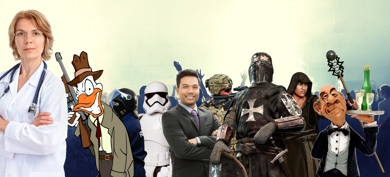
This collage combines Medical-Doctor-1236694 from freeimages.com / Kurhan; police-1239587 from freeimages.com / Sandor Pinter; male-1525673 from pixabay.com / namwealthyaffiliate; isolated-1194899 from pixabay.com / TheHilaryClark; star-wars-1118389 from pixabay.com / InspiredImages; man-3244896 from pixabay.com / anarerate; knight-2939429 from pixabay.com / Janson_G; beak-1294093 from pixabay.com / OpenClipart-Vectors; waiter-3296597 from pixabay.com / Alexas_Fotos; and crowd-2361583 from pixabay.com / puzzleboxrecords.
We all roleplay our character’s professions or character classes, right?
Actually, we don’t. What we usually roleplay is someone pretending to belong to a profession, because that’s a lot faster and easier.
The difference between the two might seem small, but the impact when you compare the two is like night and day.
Awareness of the difference actually derives from a show about Air Crash disasters (I watch a lot of them, so I’m not sure which series it actually was); at one point in one episode, an expert investigator states that “Air Crash Investigators never like to close the door on any possibility” – by which he meant that the profession trains people to consider every possible contributing factor to be valid until completely ruled out – and if they run out of possible causes (it has happened in the past), that simply means that something has been ruled out that should not have been. So everything goes back on the table and gets rechecked – again. (EDIT:) Furthermore, even when they have found an apparent cause, they don’t stop there; not only does that cause need to be confirmed in absolute detail, other events may have contributed to the disaster. As a result, they learn to investigate everything in microscopically-minute detail.
And that got me to thinking.
Every profession trains its members to think in certain ways. Fire and Rescue people are trained to identify the nearest accessible exits whenever they enter a room. Law Enforcement are trained to consider everyone a potential threat until proven otherwise, and to protect themselves accordingly. Soldiers, especially in an era with reliable firearms, look for ambush possibilities and are uncomfortable until they are cleared, and also tend to form closer bonds with their fellow soldiers. (Actually, Soldiers are the one case where most people will make the requisite adjustments to character mindsets, without even realizing that they are treating these characters differently to the rest).
These are relatively simple and straightforward manifestations of the principle. I want to focus on four more substantial characterizations.
Money People
The superficial characterization of accountants, bookkeepers, and the like, is that they reduce everything to a bottom line. The truth is usually the exact opposite; they are inclined to break numbers into distinctive line items. Often, their problem is seeing the forest for the trees.
There is also a perception that such careers make people tightfisted, or attracts the miserly. The reality is that money people spend as freely, or even more freely, as everyone else – so long as it isn’t their money. However, this is always controlled spending – or, perhaps targeted is the better term. It’s spending with a purpose.
No, if there is one drive felt by all money professionals, it’s efficiency. Bang for buck – with ‘bang’ being something that changes with the circumstances. It could be quantity of product purchased, or a maximized income/expenses ratio, or minimal financial liability, or any of a dozen other priorities.
Doctors
Doctors are guided by two simple rules above all: first, do no harm; and second, regardless of what you may think of what they have done, you treat the patient in front of you.
Both of these can cause great ethical complications for a doctor caught up in the wrong circumstances. Harm, for example, can be a subjective thing, not an objective; and then there’s the whole question of short-term harm for long-term gain, and vice-versa. And somewhere into this question, the patient’s wishes have to come into play. And, these days, quality of life. So, this simple question quickly becomes very complicated.
The second seems a lot more obvious. But we’re talking about people here, not automatons. What if the doctor is so repelled by the patient’s past deeds that he doesn’t trust his objectivity? No problem, pass him on to another doctor, comes the obvious answer – but what if there is no other doctor? There may be no specialist as qualified in the procedure that needs to be performed, or none that can reach the patient in time.
And then there’s distributed harm. Is it ethical for a doctor to factor in the harm that the patient may do to others in reaching his decisions? Suddenly, the two conditions are in contradiction.
Every doctor has their own personal answer to these conundrums. Some personalize death or disease as The Real Enemy. Others prefer to think of positive outcomes, focusing on their patients health.
Lawyers & Psychiatrists
It’s a common misconception that lawyer-client confidentiality (or doctor-patient confidentiality, for that matter) protects everyone, no matter what. Under certain circumstances the lawyer is compelled by law to breach that confidentiality – such as the client/patient revealing the intent to commit a crime (in some jurisdictions, the shield is only pierced by the threat of a crime of violence, which can include self-harm).
Even without a legal requirement, a lawyer can ALWAYS choose to violate the privilege, so long as they are prepared to wear the consequences. Depending on the legal code, the authorities may or may not be able to act on any knowledge so obtained without risk to their own careers – much depends on whether or not they were a knowing recipient of privileged information. And even then, if they can show that they would have learned the information anyway, it’s often going to be admitted into evidence.
It’s well known that lawyers have limited options about turning a client away once they have accepted a case. It may be possible to hand the client off to someone else, but where that would materially disadvantage a client in court, even that might not be possible.
At the same time, the legal profession requires a lawyer to assist the client to the best of their ability. This poses challenges similar to those faced by a doctor, described earlier.
Lawyers generally have to learn to set questions of right and wrong aside, or more precisely, to redefine them into terms of being an effective advocate for their client. Instead, they focus on what is legal and what is not, and – perhaps – on the abstract ideal of the law, justice. Even if an individual client is released when the lawyer knows they are guilty, that can be balanced by the fact that the protections provided by the law keep many more people out of unjust punishment than they allow criminals to escape just punishment.
As a general rule, this leads many to reject absolutes in general, and embrace a relativism. This is necessary so that they can do their jobs and only worry about assuaging any moral qualms afterwards.
Politicians
Something similar happens to politicians. How much moral weight do you assign to the rules when you make the rules?
Corruption is an inherent problem in politics as a result. It may not be for money – giving preferential treatment to an organization because you share the same religious beliefs is behavior that’s just as corrupt.
Politicians learn to look for compromises. It’s virtually certain that compromise will be necessary throughout their career. Even if the government is not a democracy, you often have to compromise between benefits for sub-population A vs sub-population B, or between rival concerns. One way to raise money quickly, for example, would be to halve the size of the military overnight – but there might be unintended consequences!
These are all individual elements of a greater society. Technological and social context is all-important. In the 19th century, for example, the insane were routinely confined to asylums where the majority received little or no treatment for their problems beyond the distribution of sedatives to keep them (relatively) docile. Some institutions went so far as to explicitly state that it was forbidden to strike a patient, no matter what the provocation – which, by extension, implies that other institutions were fully prepared to condone such measures for the control of patients. Medical practitioners of the time were no less caring than those today; but there was a fatalism involved, a sense that the mind was beyond their power to control or manipulate. The best that could be done for these “poor souls” was to care for them physically and remove from them all sources of stress and triggers of distress, and give them the chance to heal themselves. Furthermore, it was social anathema to admit to anyone that a family member was in such a condition. Euphemisms were used, instead – “staying with friends” or even “convalescing in foreign climes” or simply “traveling”. The date of committal was often viewed as the date of death by families, as victims became dead to their spouses and children. Clearly, the attitude of a physician would need to be modified to take these social attitudes into account.
Personality Disjoint
Most players and GMs are quite capable of looking at the tentative personality profile of a character and stating what it was about that character’s class or profession that attracted them to that career in the first place. They may also think about what the character learned from their incorporation into that stratum of society, and will certainly assess how the character would think of his profession going forward.
Although clearly all related to the central focus, the personalty as it will present during play, there is nevertheless something disjointed about these disparate elements.
This stems from two factors: incompleteness, and the absence of a narrative. Too many people think that a character background is synonymous with a character’s history; a true background incorporates the impact that the historic events have on the personality and mindset of the character, and carries those influences forward into subsequent ‘chapters’. That’s the narrative element that was mentioned.
The incompleteness stems from the fact that there is no structure by which the partial elements listed in the opening paragraph of this section can feed back into the character or influence his circumstances. They are described as static phenomena, signposts to what actually took place over a period of time.
You don’t have to make very many or very strenuous attempts to correct this personality disjoint to discover the absence of consideration, in most cases, of how the professional training experienced by the character has shaped his personality and patterns of thought. In hindsight, it’s obvious.
A shortcut
Unfortunately, few of us have time to generate a “full” background – in the meaning given above – and make it consistent, and fewer still are capable of assimilating the whole of that background at each game sitting. To be practical, we need a shortcut.
Fortunately, the examples presented earlier in the article provide the basis for one.
What we need to do is distill all the contributions on the character’s thinking into a simple “road map” that we can inhale quickly and then express in play. The simplest format for such a map is a list of NO MORE THAN ABOUT HALF-A-DOZEN basic rules that the character lives by.
At least one of these, possibly more, should derive from, or have been modified by, the character’s professional training and experiences prior to this session of play.
- One should describe how the character handles conflicting requirements.
- One should describe how the character deals with commands from figures of authority.
- One should describe how the character feels about his profession, and what personal standards it imposes on them.
- One should describe how the character behaves towards those who fail to adhere to the standards expected of such practitioners by the character.
- One should cover snap judgments by the character – on what subjects does he or she make them, how often are they right, and what do they do when they are wrong.
- It may also be useful to have one detailing how the character responds to being placed in authority over others. Does he apply his personal standards, cut them some slack, become a martinet, treat them like personal slaves?
Throw in one or two deriving directly from the profession itself – the two listed for the Doctor earlier, for example, appropriately modified for social context – and you have an easily-digestible and navigable “road-map”.
This is NOT a character profile; it’s not even the character’s personality. It’s a set of lenses and filters through which that personality will manifest. A description of the personality should be a short paragraph preceding these modifiers. Clearly, that personality will influence several of the questions. Both are incomplete without the other.
There’s Impact In Numbers
Doing this for one character may or may not be enough to demonstrate two things:
- That it becomes easier to “wear” the character in play;
- That it becomes easier to identify and roleplay the most important professional decisions of the character.
Point 1 should be proven very quickly. Point 2 has to wait until events trigger one or more of these considerations, which is why it may take a couple of applications of the process before the validity of the technique can be demonstrated.
So, in and of itself, the technique can provide value returns for effort. But, the more widespread these principles are, another phenomenon begins to manifest: professional interactions become more manageable, and more susceptible to roleplay.
That means that there is a distinct benefit to viewing the PCs as a team, and getting each player to complete a set of “guidelines” for them to use in roleplay (they are not so hard-and-fast to be describable as “rules” that have to be obeyed). They are a tool. This enables the players to relate to the rest of the team through the lens of their unique representation of their profession and the contribution they make to it.
It also enables interaction at a professional level between NPCs and PCs with greater ease and depth.
Evolution Of Character
One final note: these are not set in stone. They can be changed, and no doubt will evolve over time. Such evolution is normally traumatic.
Clever players and GMs can deliberately design ongoing characters in such a way that they are not what the game role they are to occupy requires, but so that they can evolve into meeting such requirements after suitable professional trauma caused by that shortcoming. This incorporates a deeply personal story arc into each major NPC and into PCs, almost effortlessly.
In the case of PCs, the planned evolution should be factored into his campaign planning by the GM. This act of collaboration on the development of the PCs personality makes the entire game more enjoyable for both, defuses any sense of an adversarial relationship that might develop, and integrates the characters into the campaign more strongly.
Two characters can start off virtual cookie-cutter templates and evolve in distinctly different directions in two different campaigns, simple by virtue of the character development that takes place. And that makes this a very powerful tool, indeed.

Discover more from Campaign Mastery
Subscribe to get the latest posts sent to your email.
Comments Off on Professions Of Character