The Narrative Approach To Dungeon Design
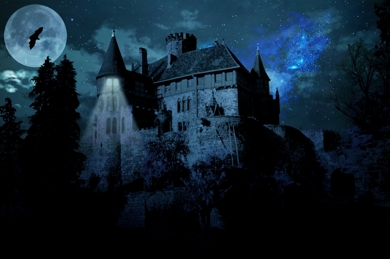
“Haunted Castle” Image by pixabay.com / tombud
How do you design your dungeons? For me, the only technique worth contemplating is the Narrative Approach, in which the dungeon’s location and structure derive from the adventure in which they are to be found, and the encounter content and similar details derive from the location, structure, and adventure.
Sounds good, doesn’t it? But, as is often the case, there can be a gulf of light-years between theory and practice, and the devil is always in the detail.
And that’s where this article enters the picture. While it won’t be possible, for reasons of space and time, to do a complete dungeon as an example of the way I approach the situation, especially since I intend to divert from time to time to examine specific issues more comprehensively, I want to at least provide an overview of the process and some guidance relating to specific issues.
The approach to be described is the one that I used to create the room descriptions and content for Assassin’s Amulet (in which the “narrative” was the day-to-day operation of the Assassin’s Guild at the center of the adventure content), so it can be considered proven.
For the purposes of this article, I’m also going to assume that you are one of those people who can’t create your own dungeon maps, or who aren’t satisfied by your abilities in that line.
Adventure Title
Quite often, I don’t decide on what the title is going to be until I’m a long way into the design process, and I’ll usually list 3-4 alternatives using free association and then select between them. But in this particular case, I had the tagline (given below) right away and an obvious title came to mind immediately thereafter:
- “The Necropolis That Time Forgot”.
The Adventure Tagline
The tagline came to me within moments of initially contemplating this subject as the basis of an article. Sometimes it takes me a lot longer.
The remote community of Thisselwyne, known throughout the Kingdom as “The Capital Of Tombstones”, has a problem: the dead won’t stay that way…
I had rather more difficulty coming up with a good name for the village. I knew that I wanted it to have a backwoods quality and an English tone, and to have a particular rhythmic pattern – two quick syllables and a third syllable equal to the sum of the first two in normal pronunciation. This pattern emphasizes that last syllable as though it were a crack of doom or peal of thunder, generating a sense of foreboding that doesn’t exist for any other reason.
I generated one name that fit this pattern, and then kept changing it every time I read it over until I was satisfied that it fit the parameters and didn’t carry any unwanted implications (the penultimate version was “Thisselwyche”, but that would have my players asking about ‘The Witch’ for which the town was named – since there is none, that would only muddy the waters of the background).
It’s a name that literally sounds more important, more portentous, than it is.
Adventure Background
This came to me in bits and pieces, mostly from the end-points backwards.
Let me explain that, because it’s important to the process. I started with a general idea of the adventure narrative – which I haven’t shared with you yet, beyond the tagline given above – and worked backwards from the content to the initial situation and context which would be presented to players.
Then I worked forwards again, adding in other implications of that in-game starting point, fleshing out the basic ideas.
I then repeated the process, this time working from the situations as the players find them to what caused them to be, reasoning from effect to cause to effect to cause, to generate a historical background that was consistent with (a) the true situation, as the PCs would discover it to be, (b) the initial situation, as the players would perceive it, and (c) a historical foundation that justifies and explains both (a) and (b).
It sounds complicated, but it’s not. It is, however, tedious and repetitive, and so wouldn’t make good reading.
Thisselwyne is a small township at the foot of Mount Thisselwyne, location of Thisselwyne Castle. In fact, the Estate lays claim to the entire Mountain, and a substantial region around it. Mount Thisselwyne is an isolated peak near the Grayspire Mountains, from which flow the Gislack and Wardner Rivers, who merge just below Thisselwyne..
824 years ago, the Royal Estate was traded for a much smaller landholding on a major trade route, and so for the first time in its history, the Estate gained its own Nobleman: Count [to-be-decided] became Lord and Owner.
Count [to-be-decided] needs a name. But this is an important personage in the background and directly relevant to the adventure that is to unfold, so this is an important name to get right. The problem is that I haven’t yet got the character requirements completely clear in my mind, so I can’t settle on a name because I don’t know what baggage and implications I need the name to carry.
I have some clues: the Count is to be slightly studious, strongly virtuous, and friendly in demeanor. He is to be forward-thinking and optimistic in outlook.
And, while I’m here, a quick profile sketch for the town and its’ environs:
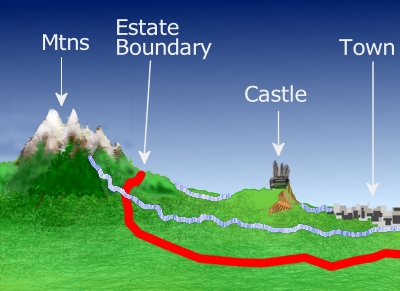
Note that I have literally spent only about 10-15 minutes generating this diagram of the town layout!
Anyway, back to the background:
The existing manor house was expanded by the Count into a reasonable Castle, with a commanding view of the area. From the town-side, it was protected by a 120m cliff-face; on the other three sides, a wall. The castle not only occupied a clearly strategic position, it functioned as a buffer and protection from the monsters that emerged from the wilds of the Grayspire Mountains from time to time.
The Count saw great potential in his new Estates and spent a fortune bringing in the best architects and designers to prepare for future growth of the small community. And, to be fair to him, Thisselwyne held great promise; the lands were sandy and semi-arid but reasonably well-irrigated, and better soil lay a foot or so beneath the surface. The dominant crop of the region was Thessel, a sort of sturdy second-rate barley that thrived on relatively low rainfall and could be used for a bread-like cake, or for fodder. Silver had been found in the Grayspire Mountains, as had granite. And all this was to funnel through the community of Thisselwyne. Expecting it to boom in importance and population was only reasonable.
It was a bright future that was never to be realized. The greater silver deposits were more accessible from the far side of the Mountains, and never reached the town. The granite proved to be flawed, suitable only for smaller blocks and tombstones. The advent of improved agricultural practices and better irrigation made wheat a more practical and popular crop, and Thessel fell out of favor. As a result, the township has experienced only modest growth in the ensuing centuries, and now is home to some 1600 citizens.
Count [to-be-determined] waited, year after year, full of optimism for a future that never came. He died, childless, 35 years after he arrived, and the Estate returned to the Throne.
There’s more, but it’s better dealt with as information that the players gather when they arrive.
The Castle Today
The Castle itself consists of four parts, each containing a number of connected buildings and chambers. To the West, facing the mountains, is the home of the Grayspire Abbottry, an order of cloistered Monks and their Abbot, who survive by virtue of a small vegetable patch, some donations from the town, and by maintaining the rest of the inhabited parts of the castle, who they also feed. The Northern Face of the Castle contains a small Inn dedicated to providing lodgings for those for whom a spell of Fresh Mountain Air is medically prescribed, and some rooms kept for the Monarch, should he ever bother to visit (he never has). In the center of the castle is a courtyard. On the opposite side of this open cobbled area are the quarters of the Order of Grayspire, a small and decrepit Order of Paladins, all that remains of the Castle’s traditional Defenders. The Southern part of the castle lies in ruins, though some parts are more whole than others, notably the tower of the foot-notable Wizard Homankle, a live-in guest of Count [to-be-determined] when the Castle was constructed.
Homankle was a student of great promise, who attracted the patronage of the Count. Like the town, though, it was a promise never-fulfilled; with the death of his patron, he fades into obscurity in terms of historical significance. A figure of great mystery, no-one ever saw his face after his graduation from the Arcane tutelage of the Archmage Wyndamere.
To construct a map of this structure, I would cut and paste from other maps, looking in particular for maps of a castle with an appropriate courtyard. I would use a map of a ruined Wizard’s Tower for the Tower of Homankle, and a mirror-image copy of that map for the matching tower in the Southwestern corner, most of which is now missing or collapsed.
As part of his planning, Count [to-be-determined] wanted to ensure that the castle was the focal point of the town as it grew; he foresaw the day when the township surrounded the entirety of Mount Thisselwyne. The grounds of the mountain were dedicated to the town cemetery, and a Necropolis of crypts and vaults constructed beneath the Castle. For a few hundred years after his death, the castle occupants maintained these in good order and security, but as the Abbottry and Paladin Order fell into disrepute, they became neglected and ignored, and one-by-one, various monsters and horrors discovered the new safe haven to be to their liking. So long as they leave the castle occupants and the township alone, they are ignored; periodically one will overstep the mark, and a mob will be formed by the town’s Official Adventurers with torches and pitchforks and make a superficial attempt to cleanse the Necropolis.
The Official Adventurers
The last decree by Count [to-be-determined] was the establishment of the town’s Official Adventurers, seven individuals who would be responsible for the protection of the town. In return for accepting the town’s invitation to reside in the area and perform public service on behalf of the citizens, they were to receive not only a partial repayment of their own taxes and tithes from the township’s taxes, but were also to receive a small percentage of those taxes directly. Like the other institutions established in that era, this has fallen into disrepair in the centuries since, and these roles are now merely titles bestowed by the town council upon themselves for the payments and perqs.
Currently, the Official Cleric is the Abbott from the Castle, and the Official Paladin is the head of the Order of Grayspire. The Official Rogue is the Master of the Town Market (and the most prominent merchant in the town). The Official Warrior is the head of the Stonecutter’s Guild, and the Official Ranger is the Master Of The Docks who ship the blank tombstones created by the Guild to customers downriver. The Official Wizard is the owner of the town Tavern, Bakery, and Brewery, and the Official Bard is the Secretary of the Council. When one of their number passes away, the Council selects another prominent towns-person of “approved character and mind” to replace them, bestowing the now-vacant title (and the benefits thereof) upon the lucky recipient.
Names and personalities to be determined at a later time. Suffice it to say that these are conservative, greedy, and old, and entirely inadequate to the current crisis.
It won’t take the PCs long to discover that something in the local environment seems to be keeping the citizens healthy and longer-lived than is normal – they arrive as the locals are celebrating the 160th birthday of the tavern-keeper and Official Wizard. Interrogating the locals produces only shrugs until they ask the Abbot, who is aware of the pattern (and 187 years old, himself); starting about 520 years ago, lifespans began to extend and the number of citizens requiring interment in the cemetery or necropolis began to decline. He puts it down to a steady diet of boiled Thessel, greens, and a teaspoon of Absinthe in every meal.
The State Of Emergency
The Necropolis has always had a minor problem with Undead, but lately it has grown much worse. What’s more, those interred in the castle grounds (i.e. the official town cemetery) are also rising. Keeping the bodies in state within the town boundaries has also failed, as has burying them elsewhere. The town Guard, maintained at Royal Expense and supposedly present primarily to ensure that the King’s Taxes are paid on time and in full, are also incapable of dealing with the situation.
And so, they have appealed to the Throne, and the Throne has posted a reward, and has selected the party as the winners of the lucky door prize, the first to be granted the opportunity to claim the reward and earn continuing Royal goodwill (as opposed to attracting Royal Ire)…
The Adventure Narrative
The starting point for all the above is the Adventure Narrative. The background establishes the history of the dungeon and its nature, and why dealing with it has suddenly become a critical priority. It also details the local support available to assist the PCs – not much, as it happens.
In part 1 of the adventure, the PCs are directed to attend the presence of a Royal Envoy, who commissions them on the Throne’s behalf (not giving them much choice) to investigate the situation. They are able to learn the basic background and then travel to the town, where they learn the rest of the background by interacting with the locals. They can also choose whether to make their base of operations in the Town or at the Castle and set themselves up.
In part 2, they can formulate theories as to what’s happening and investigate the above-ground ruins, discovering that the late Wizard was a Necromancer and that Count [to-be-determined] and the Wizard are actually one and the same person. They will also learn that there is a hidden sub-level beneath the crypts of the Necropolis where the Necromancer had his workshop. This establishes an apparent contradiction in the character of the Count – is he dark and evil (Necromancer, plus recent developments) or the benevolent, kindly, and wise ruler of local legend?
In part 3, the PCs travel through the Necropolis (now full of Undead who won’t stay dead, even when destroyed by Turning, and other monsters) to the hidden entrance to the Necromancer’s Laboratory. Exploring the Laboratory (more monsters), they learn that he was a keen planar explorer, and fascinated by the differences in life and death amongst the inhabitants native to the different Planes. They also discover plans for the future growth of Thisselwyne, trade analyses and forecasts that by this point in time, it would be a small city of between 40 and 60,000 inhabitants, and the Necropolis and associated common cemetery would contain about 250,000 dead awaiting reanimation by means of something called the Crystal of Life. There are also suggestions that should this not come to pass, the effect of the Crystal would continue to grow, perpetually reanimating the dead of neighboring regions until its capacity was achieved. The problems they are now dealing with are just the tip of the iceberg…
In part 4, the PCs discover the inner lair of the Necromancer, where he waits to be the last corpse reanimated by the Crystal Of Life. But there’s a problem: the Crystal is damaged. They find records describing what the Crystal is supposed to do (reanimate 249,999 subordinates and the Necromancer himself), perpetually regenerate those Undead, and place those subordinates under the command of the Necromancer while leaving them immune to the control of N’Valesh (whoever that is). The PCs are healed by the Crystal, from which it is possible to determine that Life Energy is leaking from the Crystal, probably from a crack that resulted from a minor cave-in 500-odd years ago. That means that it will never achieve full capacity, and never revive the Necromancer, and probably only provides limited protection from this N’Valesh. That could be a good thing or a bad thing, and the only way to find out is to interrogate the Necromancer – fortunately, there is a Speak With Dead spell on a scroll beside him, an insurance policy.
The Necromancer, due to his nature, is somewhat more independent and loquacious than most shades. He is under the mistaken impression that the PCs are part of the Official Adventurers of the Township, an organization that he created as a fail-safe against just this sort of development. He tells them that N’Valesh is a power-hungry half-Devil half- Mind Flayer hybrid Necromancer who specializes in the Undead of the Elemental Planes – Reanimated Djinns and Elementals and the like – who he encountered in his planar travels. Although initially friendly, N’Valesh soon revealed his true nature, and attempted to imprison Homankle —
I am less enthused with that name every time I use it. Originally chosen because it’s very meh and so suits the perception of a Wizard who was only considered “foot-noteworthy”, I now feel that the name undermines the seriousness of the message being delivered. I want something that is more sinister and powerful, but which can also be viewed as positive. I would, if I were creating this dungeon for real, continue using it for now, with a note to do a global search-and-replace later, after selecting a more appropriate name.
— but the Wizard was able to turn the tables and confine the Half-demon. But he always feared that N’Valesh would escape, or be freed, and would one day threaten the Prime Material Plane. Homankle spent the rest of his life planning to counter that threat, choosing an out-of-the-way location that was primed for explosive growth and could be shaped, culturally, to his needs; creating the Crystal Of Life; Recruiting the Order of Grayspire and the Abbottry to protect the town’s living population while his Undead army waged war against the Undead of the enemy. He had not counted on the decay of tradition and corruption of the institutions that he had set in place. Thus, he has no choice but to place the responsibility for dealing with the situation in the hands of the PCs. Whosoever holds the Crystal Of Life possesses the keys to command the Undead Army he has created – an unstoppable force to defeat an unstoppable enemy who can track the Crystal Of Life and wants to posses it for himself.
In other words, the Town of Thisselwyne – and, in particular, the Castle – are ground zero for the invasion AND the command center for ‘the allies’ in countering the invasion.
In Part 5, the PCs have to take the tools made available to them, decide whether or not to employ them (and what to do with them), and deal with the invasion of Undead Elementals.
These confrontations were my original vision for the adventure, and everything else has been created to facilitate them. I drew a lot of inspiration for the battles between the T-800 (Arnold Schwarzenegger) and T-1000 (Robert Patrick) in Terminator 2: Judgment Day.
Dungeon Design
Assuming that you aren’t custom-making a dungeon, but are instead drawing upon someone else’s design such as those available from Dungeon-A-Day, the first step is to pin down exactly what your requirements are. In this case, a focal point, an adjacent complex (library, workshop, bedroom, etc, for the Wizard), and several tiers of structure radiating outwards from this focal point. Each tier is to contain a more elite form of Undead soldier. In succession:
- Disorganized individuals
- Individuals with weaponry in which they are practicing
- Groups with weaponry in which they are practicing in coordinated fashion
- Units patrolling and drilling, weapons at the ready, proficient and skilled in the usage
- Honor Guard in the inner chamber.
While I envisage the base monster to be a typical skeleton, I would expect to depart from that foundation further and further with each tier. And, because these are subject to the Crystal Of Life, each tier will be more inclined to ignore the PCs unless attacked.
In essence, that’s a complex with five areas, each of which consists of multiple matching rooms. Something like the layout below would work:
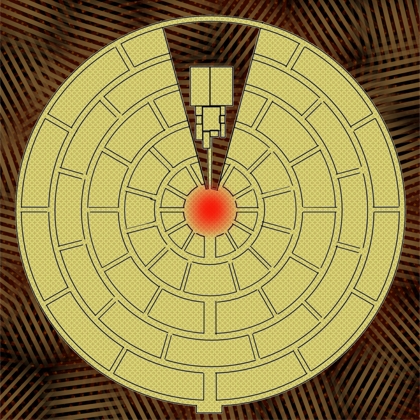
Once again, I spent very little time working on this. You have each tier arranged in a ring with the throne room and Crystal Of Life in the central zone and a complex in a missing “segment” of the complex. Corridors wrap around each of the areas. The “entrance” is at the bottom of the map.
The general principle is this: break the plot down into the distinctive plot needs, then assign one to each successive section or area of the map. It can be a single room or a complex of rooms. If it’s multiple rooms, it’s likely that only one of them will need to serve the story needs.
Encounters
The story needs then have to be assessed in terms of mandatory or associated encounters, and encounter interactions. For example, if a creature takes up residence next to something else that thinks of the creature as lunch, pretty soon there will be no creature – or no hungry something. Either way, it clears the way for something else to occupy one of the spaces, but probably doesn’t erase all signs of the prior habitation.
Once you know what encounters are present because they are necessary to the plot, you can fill in the rest with whatever seems appropriate. Don’t forget the possibility of a room designated “no man’s land” between two factions that are each too difficult for the other to dispatch.
This is also a good time to contemplate the dungeon ecosystem. What do the inhabitants eat when they can’t get Adventurer?
I always like to be able to answer three questions about each area’s inhabitants: Why did they choose this location, how are they going to change it by interacting with it, and how did they get there?
Other Mandatory Content
Traps and treasure placements are allocated in the same way.
Architectural Style
Another ingredient needed before I can start writing up descriptions of each area is to decide, based on who created the place, on an architectural style on which to base the descriptions, on the presumption that there would be both a consistency and a number of trends to take into account – greater skill and expertise after they’ve been building the place for a while, less damage in some areas and more in others, and so on.
Imbued Dynamism
Right now, everything’s probably pretty static. Encounters wait patiently in each room to be disturbed by marauding adventurers.
That won’t do, not at all. So now is the time to change it, building in patterns of behavior based on the location and the neighbors. In particular, if there are any areas of natural illumination, they will become the timekeepers of the dungeon, synchronizing their activities with the patterns of light. Their neighbors will soon learn to tell time by the activities of the timekeepers, if only because they want to avoid them when they go a-wandering.
To Recap:
The plot should define the nature and functionality, in plot terms, of the dungeon. Basing the concepts and background on these definitions provides consistency. Breaking the dungeon elements of the plot down into individual pieces of narrative begins the process of populating the dungeon with encounters, loot, and complications, and ensures that these serve the plot purpose of the dungeon. Inherent logic is woven directly into the fabric of the location.
The result is that everything present is there for a reason and serves a purpose. And that actually makes creating the dungeon easier. Talk about your win-win!

Discover more from Campaign Mastery
Subscribe to get the latest posts sent to your email.



November 27th, 2018 at 5:52 am
I’ve learn some just right stuff here. Certainly worth bookmarking for revisiting. I surprise how so much attempt you put to make such a magnificent informative web site.
November 27th, 2018 at 1:07 pm
Thank you, Damon. What I do here aims to increase the pleasure in people’s lives, a goal that amply justifies the effort.