The Bottom End Of The Magic Biz
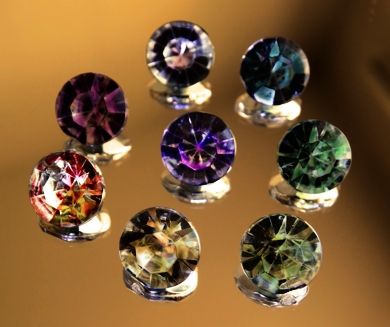
What mysterious powers do these eight gems posses? And is the whole greater than the sum of its parts?
Inspiration
I have to be honest and say I’m not completely sure who to thank for inspiring this article. At some point in the last month or so, a tweet appeared in my Twitterfeed proclaiming that the GM sending the tweet always liked to hand out useless magic items – or possibly it was a re-tweet of someone else’s comment.
Unfortunately, I didn’t bookmark it or favorite it and with more than 4000 active to semi-active people in my following list, my timeline gets thousands of tweets every day. I’ve searched for it, without success.
So thanks, mystery person, whoever you are, and hopefully you’ll read this…
Regardless of the source, it sparked a thought. Most of the time, when people refer to “useless magic items” they don’t really mean “useless” – there are a couple of other terms that might be more appropriate to consider…
Useless Magic Items
These magic items have a function that is virtually valueless or impossible to use.
A Nose Ring that when licked, transports the wearer’s belly-button fluff d12 feet to the left. A hair wash that colors the hair in paisley patterns. A button that will only stay done up if the other buttons on a short are unbuttoned. Ink that can only ever be seen by whoever is NOT the intended recipient of the message at the time of writing.
Most “useless” items are placed for their comedic value or because they are expected to be valuable – and aren’t. However, some GMs like the idea of an apprentice’s first creations being trivial items simply because they are a lot easier, just as a lot of computer programmers start their education by writing a program to display the word “hello” on the screen.
Trivial Magic Items
Trivial Magic Items do minor tasks, but do them well. A buckle that polishes your shoes overnight. A backscratcher that always finds the exact right spot. A pen that vibrates when the teacher is watching. A Pillow that guarantees pleasant dreams. Some GMs like these items because they show the integration of magic into the society as a form of technology. Others like the fact that it bamboozles those who cast “Detect Magic” on anyone or anything. And some employ the same logic as given for Useless items.
Conditional Magic Items
Conditional Items only work under specific circumstances or for extremely limited time frames or on very specific targets. The magical effect may be reasonably trivial or may be of considerable functionality within the scope of its limitations. A wand of levitation that only works on hay bales. An oil can that only works on dungeon door hinges. A lantern that will only light when its daytime. A mask that provides three rounds of breathable air when immersed in water. A gem that screams when placed in a bag with gems of lesser value. A scabbard that cleans, polishes, and sharpens any blade placed in it in a month with an R in it. A salt shaker that released the exact right amount of salt required to perfectly flavor a meal, once a week. A sextant that automatically orients on the brightest star that is currently visible.
Some of these items are just plain silly. Some are sensible, but limited. And some are clearly failed attempts at creating something remarkable. Most can be quite useful, but only under the right circumstances.
GMs who like Trivial Magic Items tend to like these because they show a continuity between Trivial Magic Items and normal magic items. As a general rule, they are more useful than a trivial magic item but have similar value because of the restrictions on when they are useful.
Breathless Magic Items
Breathless Magic Items do something useful, but only very infrequently.
A piece of chalk that writes a passage in a language not known to the user – once a month. A token of feather fall that only works under the full moon. A tankard that reinvigorates ale that’s gone flat – but only when the owner has already drunk his fill. A Healing Potion that only works on Acid Damage. A wand of 1d6 Fireballs that automatically recharges itself to three charges when empty – taking a month to do so. A wand that on Mondays, lights every candle within 60′ of the wielder.
Most of these are simply another variant on the Conditional Magic Item.
Restricted Magic Items
Restricted Magic Items are items with all the power of a conventional “listed” item but suffer from Conditional restrictions, or have excessively long or complicated activation procedures. Because of their greater utility when they are useful, these are more valuable than the types of limited item described above.
A wand of Fireballs that can only be used once a week. A sword that summons Lightning Bolts if held overhead for three minutes. Boots of Spider Climbing that will only work if the owner’s feet are wet enough.
Another example might be a variation on the old “luck stone” that confers +2 on all saves and +1 on all skill checks – so long as a 40lb lead ball is held in the off-hand, causing -2 to all attack rolls…
Incomplete Magic Items
This type of magic item is inspired by the Rod Of Seven Parts, and by the Wand Of Orcus. It can be a magic item that is trivial until all its parts are reunited, or it can be useful and combine to become extremely so.
Consider a suit of plate mail that has been broken up and the pieces scattered; each part that is recovered and recombined increases the magical bonus of the whole, for example. Or a wand – each piece of which increases the output of the wand by 2d6.
In the meantime, however, it’s value is limited by the fact that it is only a fraction of what it could become, and by the challenges to be overcome in achieving that potential.
Of course, it’s equally possible that the last parts were never finished….
Incompatible Magic Parts
Nothing works perfectly the first time you attempt it – well, almost nothing. Especially if the task is extremely technical in nature and the principles in back of it are as much about instinct and feeling as they are intellectual analysis.
Let’s take a hit record as an analogy. Let’s say that recording went really well, and only took about four hours, and furthermore, the band had not rehearsed the song previously, crafting it through jamming. Also, for simplicity, let’s say that it’s exactly four minutes long. How many times did the band play it before they got it “down”? Well, if they simply played it all the way through until they got it right, there’s time in that four hours to play it 60 times. If, for three quarters of the time, they only played a minute or two of the track until they got that part of it down pat, that’s three hours of a minute-and-a-half (on average) performances, or 120 – plus the final hour of 15 full run-throughs. And that’s for an unbelievably fast recording.
I recently acquired a copy of a double CD combining the Motels All Four One and Little Robbers albums, with bonus tracks from an earlier album, Apocalypso, that they recorded but didn’t release (because the record company refused, considering it sub-par). Most of the tracks were then re-recorded for All Four One, but a few of them were abandoned in favor of new compositions including the hit single “Take The L”. Two thoughts came to me as I listened to this CD for the first time: Number one, that the polish revealed by comparing the versions of those songs that appeared on both “albums” was the difference between most indie label recordings and the work of the major labels in days past, because it’s too easy to get too close to the trees to see the forest; and number two, that the difference was undoubtedly hundreds of more rehearsals, some rewriting, and – in some cases – an entirely new direction or “take” on the music than the one that the producer of “Apocalypso” provided (which might be because he functioned more as an engineer than a producer, according to the liner notes).
To get the “finished” versions of “Mission Of Mercy” and “So L.A.” on All Four One involved dozens, maybe hundreds, of additional rehearsals and perhaps live performances and tryouts; you can hear the difference that comes from playing around with the music so many extra times and hearing it with fresh ears.
The Beatles multi-CD “Anthology” sets, which are full of rehearsal recordings and alternate versions, further back up this point.
Or you might look at an artist developing a new major artwork. They don’t spend all their time working on the picture directly; instead, they do sketches of the subject, arranging the contents in different ways, experimenting with color and media and technique. A single landscape, done the old-school oil-painting way, might involve dozens of preliminary sketches. And landscapes are easy in comparison with, say, a formal portrait, which is supposed to not only capture a recognizable image of the subject, but often to flatter them and/or say something more about them, through symbolism, representation, and other tricks of the trade.
Incompatible Magic Parts take the principle of “Incomplete” and apply this logic of reality to them. Here, for example, is a Wand Of Lightning Bolt in multiple parts: each part independently does 2d6 electrical in the form of a short “lightning spark”, and they are clearly designed to mate into a larger, more powerful, object. So you put them together only to find that the combined whole does 1d8 electrical in the form of an even shorter and weaker “lightning spark” – the parts are Incompatible.
Have you ever put one battery in a device that takes two or more, back-to-front? For a very short time, you might get the device to function – but (best-case) the batteries will go flat hundreds of times faster than they otherwise would. If the device didn’t short out or explode, or the batteries – and I have seen all the possible outcomes either directly or through reports from electrician friends who had to diagnose and repair the problems.
Of course, even if the intent was to construct a half-dozen of these mated pieces to create something truly epic, after the failure of these two pieces, you would either start over or give up altogether. The results are an object lesson in the crafting of magic items and a curiosity, nothing more.
Or, it might be that the act of creation was interrupted, and the useless can still become the mighty – with research and effort.
There Is Always A Story
There’s always a story in back of one of these items. Sometimes more than one, but let’s not get too complicated.
A Creator
Someone made this. Who?
A Motive or Purpose
Why? What were they trying to achieve?
A Value
Whoever took it to wherever the PCs found it must have had a reason to have taken it there.
A Journey
For that matter, it may have changed hands many times en route. To put it mildly, each of these must have undergone a journey. If these items could only talk… wait, that’s an entirely different subject. What’s it’s history?
This backstory should tie into everything found with or near the item in question, which may offer clues to the answers to those questions for the PCs to speculate over. Or, if they stumble across such an item in a merchant’s tent or bazaar, where did the seller get it? This may obfuscate the question, but it only shifts it and adds a page or two to the story of the item, it doesn’t erase the existence or relevance of that story.
Of course, it goes without saying that con men would love these things. Low cost, but a clever story by a facile tongue could inflate their apparent worth enormously!
It cuts the other way, too – there will be lost treasures out there, valueless in practical terms, but of enormous value because of who made them, or where, or when, or because of their history. But if you don’t know that backstory, you would sell them for coppers on the platinum piece. Even in medieval times, there were wealthy collectors…
Placement: Never Trivial
Magic items such as those described might be trivial or (almost) worthless in comparison with the value of “true” magic items, but their placement should never be trivial. Used properly, they can add coherence and continuity to the concepts of an arcane education, or a campaign history, can put a little mud on the boots of the most revered mages and craftsmen that humanizes the legend, can create quests and anecdotes and mythologies to entertain the players and bring the world to a higher state of both verisimilitude and entertainment value.
They have a huge story potential – don’t waste them.
From a GM’s perspective, used properly, they may be worth several times their weight in rare gemstones!

Discover more from Campaign Mastery
Subscribe to get the latest posts sent to your email.




May 1st, 2018 at 8:42 pm
I love “trivial” magical items and trinkets, trying to find unexpected ways to use them and wondering about who made them is a very enjoyable part of an RPG in my opinion :)
Red Dice Diaries recently posted..Whitebox Race Class: Tiefling
May 1st, 2018 at 10:47 pm
@Red Dice Diaries: I hope I’ve given you a few new ideas to speculate on, then :) Thanks for the feedback!