Campaign Mastery helps tabletop RPG GMs knock their players' socks off through tips, how-to articles, and GMing tricks that build memorable campaigns from start to finish.

An Application of INT


What is INT, and (in practical terms), what can it be used for?

I was strolling down the street the other day and noticed a logo consisting of a name and a number of dots, and for some reason, it sparked a new way of looking at INT scores, one that emphasized a practical application of the stat which would make a measurable and definitive difference of a single point of stat gain (on the 1-25 scale used by most game systems – adjust as necessary for systems like Traveler which runs on 2-12, from memory).

Champions / Hero Games represents a particularly thorny conversion problem that I’ll tackle separately a little later in the post.

Apprehension Of Number

Let’s start simple. If you look at the image below,
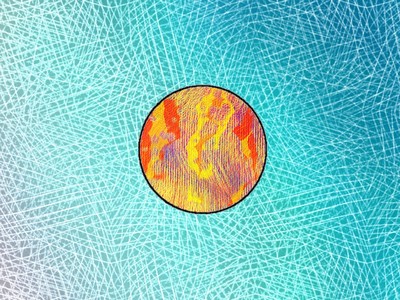
then you can see at a glance that there is one spot or counter. That’s just too easy.

Second Test

So let’s make it a bit harder, and see how people do. Can you count the spots below with a glance lasting 3 seconds or less?
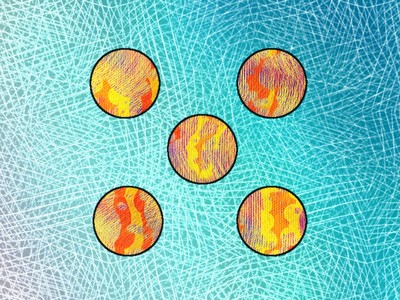
Who got something other than 5? No-one? That’s what I expected. Anyone who can read a d6 would have no trouble.

Third Test

Let’s get harder again. Remember, 3 seconds or less.
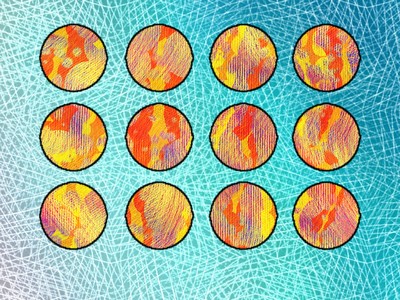
Most people will still have succeeded. The answer, of course, is 12. But a few people will have to have counted four across and three down – each possible with a second or so of observation – and then put those numbers together to deduce 12. That’s still doable in 3 seconds, but it’s cutting it close.

Applied INT

This method of interpreting INT posits that the number of counters, coins, or whatever – when arranged in a simple pattern – that a character can count at a glance is equal to their INT score.

If the average person is defined as INT 10, then a character with that 10 can’t count this many at a single glance – but they can grasp 4 with one, and 3 with another, and multiply those to get 12 in the rest of the three-second window.

A character with INT 12 or better has no need for that – one glance is enough.

Fourth Test

It’s my experience that most RPG GMs and players rate fairly high in the INT stakes. They might not be in the genius bracket, but they are well above average – let’s suggest that their INT scores, on the D&D/Pathfinder scale, are between 12 and 18.

How many counters are depicted in the next image?
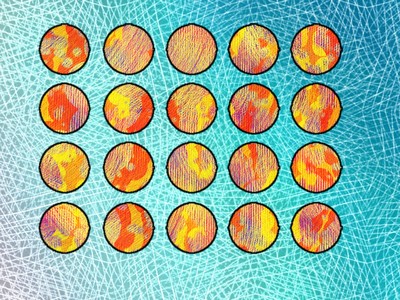
A few people could answer with a glance, but most people will have to break this down into 5 and 4 and then multiply to get 20.

Second and Third principles

The few will have INT scores equivalent of 20 or better. The majority won’t have that, and will have to have applied a process of simplifying the problem into three steps – and those steps each take as long as a single glance. That’s the Second Principle.

Furthermore, because there are two separate perception events to be performed, characters with INTs less than 10 taking this test would not be able to get the ‘5’ with a glance, they would have to actually count them. That’s the Third Principle but it’s not complete yet.

Fifth Test

So let’s look at something a bit more challenging. Same rules – let’s see how you do with this one:
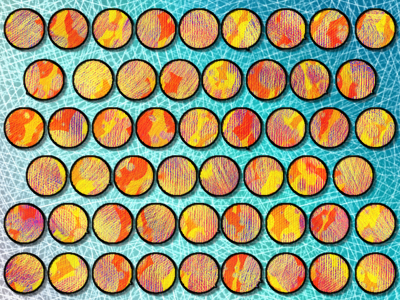
What’s going on? Well, most people won’t be able to get the number of columns or rows without counting them – and it’s complicated because there are some missing counters on two rows of the pattern. I think you’ll agree that subtracting 1 from a count, or 2, is a trivial exercise – but it adds a process. So now we have five processes – count the number of token columns across, count the number of token rows, do the multiplication, count the number of missing tokens, and subtract that count from the previous total.

For the record, there are 9 columns, 6 rows, and 2 missing tokens, giving a total of 52 tokens.

  • There are too many tokens for anyone to count at a glance – unless they have INT 104 (the INT score is halved because counting at a glance requires two operations – putting the missing tokens back in, then taking them away once you have a total).
  • Characters with INT 18 or more might be able to tell at a glance that there are 9 columns, but I wouldn’t bet on it. Once you have more than 5 or 6 in a row, almost everyone has to count them – which means that the ‘extras’ count for more. Maybe 2 each, maybe 3 each. Simply putting them in a long row without a gap separating them into smaller groups makes a difference – instead of 9 (requiring INT 18), it’s 13 (requiring INT 26) or 17 (requiring INT 34) to count them with a glance. So we have to allow for this in our Third Principle.
  • Counting: everyone starts at 1 unless they have trained themselves not to. If you can get 5 tokens at a glance – and anyone with average INT can do so – then it’s a lot faster to start counting at 5. I probably would accept an argument that characters with INT 20+ employ this trick instinctively. So that’s a Fourth Principle.
  • Most people will count the number of rows correctly, but the lack of alignment makes it harder to do so with a glance. 6-at-a-glance usually requires INT 12, but those gaps would boost this by +1 or +2 token-equivalents each – so INT 14 or 16. That’s a Fifth Principle.
  • Centering the columns that are missing tokens will also have thrown a lot of people off. Under time pressure, many will count two half-counters missing from each side as two counters missing on each of the affected rows, and so will get the wrong answer. Adding a couple of seconds to the time available – 5 seconds instead of 3 – is enough to relieve that pressure and overcome the problem for most people. For those with INT of 6-10, you might have to add this extra twice, and for those with INT 1-5, you might have to add it four times (exponential relationship). So that’s a Sixth Principle.
  • The observant may have noticed that I’ve added a bit of shadow to the image to make the counters look more three-dimensional. That was in preparation for another image in the series that would examine how much difficulty was added by vertical stacking, but it quickly became apparent that a single glance was only enough to count a small stack, one small stack at a time. That means that a character with INT 1-5 can count or estimate one stack at a time; a character with INT 6-10 can do two (using relative heights to short-cut the second, if there’s a difference); a character with INT 15 can’t do any better; a character with INT 20 can do three stacks at once; and it would take INT 40 to do four stacks at once. But it’s not all doom and gloom – square counters placed side-by-side halve these INT increases above INT 10, so 3 columns INT 15, 4 columns INT 20, and 5 columns INT 30. 7th Principle.

It should also be pretty clear that I’ve thought very carefully about the examples that I need to demonstrate the principles!

Sixth Test

Having taken simple numbering about as far as I can – going any further wouldn’t really show anything you haven’t seen already – it’s time to move in a different direction.

In the tests so far, you will have gotten a big advantage from the structured arrangement. But Test 5 showed that this advantage is easily negated. So let’s look at that.

The image below has a number of tokens positioned randomly. At a single glance, can you tell how many of them there are?
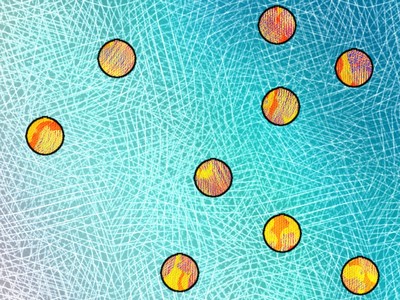
My testing (on myself, naturally) has shown that this is right on the cusp of being too much. My single-second glances either moved up and right (missing the counter bottom right) or moved down and right (missing the counter at top right). A second glance usually filled in the missing piece of the puzzle. So Nine counters, arranged randomly, are just as hard to get right as 15 counters arranged in a pattern.

15/9 = 1 2/3.

In other words, random placement increased the INT requirement 66%, or multiplies the number of tokens that can be counted in a 3-second glance by 0.6.

But that’s a fairly inconvenient number – so let’s make it +50% INT requirement or 2/3 the number of counters at a glance.

That specific impact is my Ninth Principle,, while the general statement that ‘complications multiply the INT requirement by ‘a factor’ is the Eighth Principle.

This should come as no surprise – the 52-counter Test as good as demonstrated the general principle – but this makes it explicit.

As a confirmation, I simplified the problem:

Seventh Test

Taking one or more counters away should make it a lot easier to count them at a glance, despite the random placement (which I re-randomized for this test):
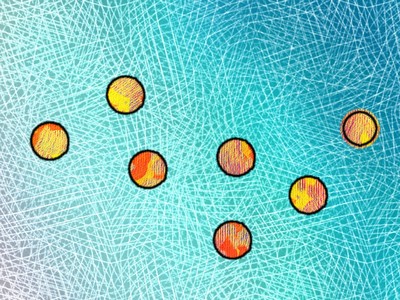
I still found myself getting “six +1” from a glance, but a single glance was enough to get the correct total. The correct answer is 7 tokens, of course.

7 = INT requirement of 14 × 1.5 = 21. That’s a little high, but I wasn’t quite getting them at a glance. 6 = INT requirement of 12 × 1.5 = 18, which is about right.

So I consider this validation of both the general principle and the specific +50% requirement.

Eighth test

The job is also made easier by the counters all being the same size. So let’s see what happens if that is no longer the case.
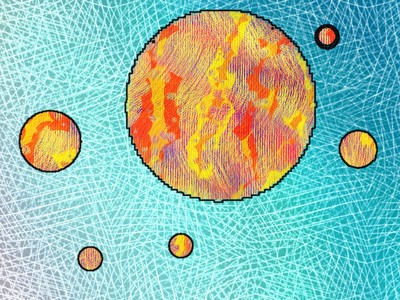
How many did you get at a glance? My results were “4+1 = 5”. That +1, as demonstrated in Test 7, is significant, but even more important is that this is the wrong answer. The correct answer is 6, not 5, and this time, a second glance wasn’t enough – the problem was that my brain wasn’t associating the big one as being the same as the smaller ones, I had to consciously remember to count it.

Adding it in is trivial, as noted earlier – you just have to remember to do it. That’s an extra process, so the +2 second rule comes into play with a second ‘complicating factor’, and suggests that a third complicating factor would add twice that, or another 4 seconds, to the time requirement.

Okay, so that takes care of the ‘error correction”, and means that I can turn my attention to analyzing the “4+1” part. The impact of the diversity of sizes was to make what was a “6+1” into a “4+1”.

6 / 4 = 1.5, or +50%.

There it is again. So two complications = two +50% INT requirement increases, compounding – or 4/9 the capacity to count at a glance. Again, let’s simplify the latter to 1/2.

Ninth Test (Virtual)

This test demonstrates a moving window, so that you can’t see the whole image at once – presuming the movement takes 1 second to show the whole image, you would only have the equivalent of a single glance to get a result. If it takes 3 seconds, you would have enough time for two, and putting them together, which is the minimum requirement. The slower the movement, the more time you have to deal with the situation and get an answer.
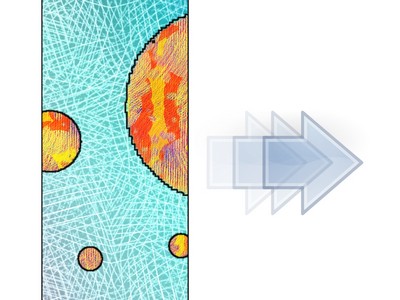
I wasn’t able to generate the series of animations that would be required to actually demonstrate this – I made do with a piece of scrap paper into which I cut a window, which I then moved at various speeds to get a sense of the impact. The image shown is illustrative only.

My estimate is that it would NOT take +4 seconds, but WOULD take +2 seconds – a total of 7 seconds, not 9. So that separates additional difficulties (Sixth principle) into two compounding effects – one based on INT and one on the number of difficulties, and inserts an additional clause to the principle: additional difficulties multiply by whatever the indicated INT-based time adjustment is to get the net increase.

Putting it all together

The principles, as they are currently arranged, are clunky and ill-defined. With a little effort, it should be possible to compact and compress them down into something more useful – so let’s do that before progressing. To start with, i divided them into General Principles and Specific Counting Principles, the latter only applying to this specific task.

    General Principles
    1. Characters can apply their INT score to tasks, which are measured in ‘Operations’ or ‘Ops’.
    2. Tasks use a defined number of Ops per Task.
    3. If a character’s Ops count is not sufficient to complete the task in two or less glances, it must be broken down into sub-tasks that are within the character’s capabilities.
    4. The number of sub-tasks dictates how long the Task takes:
      1. An at-a-glance task takes 1 second.
      2. A two-sub-task task takes 3 seconds – one for each sub-task and 1 to integrate the results.
      3. If two sub-tasks are not enough, a time penalty applies. This time penalty is equal to the product of an INT-based time multiplied by the number of additional sub-tasks.
        • INT time penalty for INT 11+ = 1 second.
        • INT time penalty for INT 6-10 = 2 seconds.
        • INT time penalty for INT 1-5 = 4 seconds.
    Perception / Counting of objects
    1. Characters can count objects at a glance in an ordered pattern for 1 Ops per item.
    2. If they have insufficient Ops to complete the task in a single glance, they have to grasp the number of columns and rows and combine the results for a 3-second glance. Each of these sub-tasks has an Ops cost of 2 pts.
    3. Characters with INT 20+ get an advantage in that they can start counting at INT/2 entries in the row/column.
    4. It takes 3 seconds to count INT/2 entries in a column or row. This is referred to as the Base Count.
    5. Gaps are considered 2 or 3 ‘entries’ in a column or row count.
    6. If items are stacked in a third dimension, characters with INT 1-5 can count / estimate 1 stack at a time; characters with INT 6-20 can count / estimate 2, characters with INT 21-40, 3, and characters with INT 40, 4.
    7. If the stacks can be placed next to each other and are of a shape suitable for comparisons of stacking to be made visually, these change to INT 1-5, 1 stack; INT 6-14, 2 stacks, INT 15-19 3 stacks, INT 20-29 4 stacks, and INT 30+, 5 stacks.
    8. Every complication to the count increases the Ops required for a task by +50%, compounding.
    9. Complications include: Random / disordered arrangement, significant size variations, windows blocking perception or other animated phenomena, three-dimensional stacking, and a column or row count that is more than the Base Count in line.
    10. An incorrect answer can be identified by spending an additional time unit (refer general principles) on verification. This also counts as a complication for the purposes outlined above.

    So far, so good. But I promised practical application, and while being able to instantly count the number of steps in front of a building a-la Sherlock Holmes, or the number of poker chips in a stack, is a neat party trick, I doubt that it will be of practical value very often.

    So, let’s talk about Mathematics.

    Maths

    Depending on the game system, it may or may not require a specific skill to utilize INT this way. If it does, the processes outlined below still apply but the character will have extra Ops to use – see “Applied Skills” later in the article.

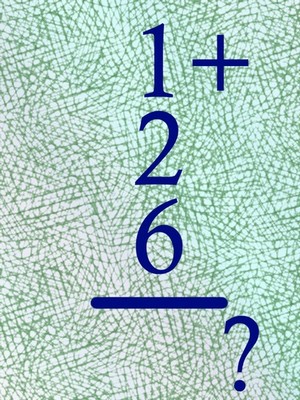
    Let’s start with a calculation that is pretty much at-a-glance for most people of gamer caliber – in fact, anyone over INT 10:
    A Fourth Addition Element

    Adding a fourth element to the addition and for most people, it becomes a two-step operation – usually the first three at a glance and the fourth then has to get ‘read’ separately and integrated.
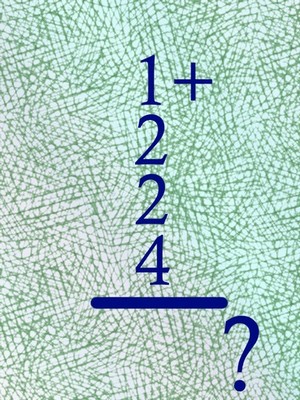
    That means that each element to be added in a column of numbers normally consumes 4 Ops to do at a glance. As before, if you have to break the task up into two or more separate sub-tasks, it takes additional time.

    Thus, INT determines how many single-digit numbers you can add up at a glance:

  • INT 1-4 = 1, and presumably the arithmetic is done on fingers and toes.
  • INT 5-8 = 2.
  • INT 9-12=3.
  • INT 13-16=4.
  • INT 17-20=5.
  • INT 21-24=6.
  • INT 25-28=7.
  • Each additional number beyond this maximum adds 1 to the time-count, plus one for the integration of results.

But there are complicating factors to consider.

Totals more than 10

If the total comes to more than 10, it takes more mental capacity to do the calculation. We’re just not as good at instinctively grasping the total.
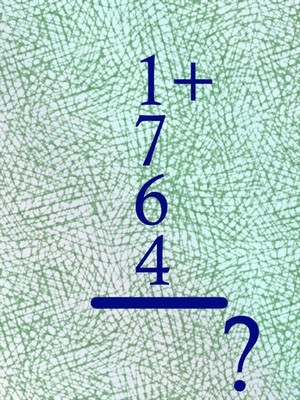
There are multiple ways that this can be broken up. My instinctive method is to add the two largest numbers together (7+6=13) and then add the 1 and the 4 together (1+4=5), and then put the totals together (13+5=18) – but some people will do the 1+7 first. while others will instinctively notice that 6+4=10 with their first glance.

Whatever the method you use, the mechanics so far as Applied INT are concerned are the same: Each element in a total greater than 10 has an Ops requirement of +1, and each element greater than the resulting ‘at a glance’ total adds +50% to the total:

  • INT 1-5 = 1, the arithmetic is done on fingers and toes.
  • INT 6-10 = 2.
  • INT 11-15=3.
  • INT 16-20=4.
  • INT 21-25=5.
  • INT 26-30=6.
  • … and so on.

So, four numbers, total more than 10:

  • INT 1-5 = 1, plus 3 more = 5 × 1.5 × 1.5 × 1.5 = 16.875 = 17 Ops for at a glance; so +3 time units of 4 × 1.5 × 1.5 × 1.5 sec each = 13.5 sec each = (3+40.5 = 3+41) = 44 sec.
  • INT 6-10 = 2, plus 2 more = 5 × 1.5 × 1.5 = 11.25 = 11 Ops for at a glance, but 2 +1 sub=processes is enough to solve the calculation, so 2 × 1.5 × 1.5 = +9 sec each additional sub-process, giving a total of 3+18=21 seconds to solve the calculation.
  • INT 11-15=3, plus 1 more = 5 × 1.5 = 7.5 = 8 Ops for at a glance. Total time = 3 seconds.
  • INT 16-20=4, so a single glance of 1 second is still enough.
  • INT 21-25=5, so a single glance of 1 second is still enough.
  • INT 26-30=6, so a single glance of 1 second is still enough.
Upping The Ante: numbers greater than 10

In the calculation below, I’ve added a 5th element, and three of them are double digits. Obviously, the result is going to be two digits, maybe even three (depending on how big the numbers are). Each element that’s more than 1 digit counts as two elements.
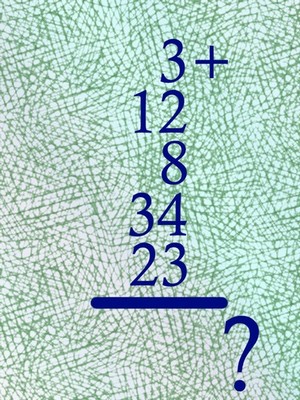
So the base number of Ops per element is 5 × 1.5 × 1.5 × 1.5 (for three double-digits) × 1.5 (for a total greater than 10) = 25.3125 =25 Ops for at a glance. Only characters with INT 25 could do so, everyone else will have to break the task up.

And it now matters what sequence you do the math in. My mental process instinctively does the easiest part first (3+8=11), then the next easiest part (11+12=23), then the next easiest part (23+23=46), and then the hardest part (46+34=80). But my mental capacity is enough that the first two of those (three numbers) can get done at a glance, so it only takes me 2 additional sub-tasks at 2 seconds each, or a total of 7 seconds, to do the mental arithmetic – and most of it (the four additional seconds) is devoted to that last calculation.

  • INT 1-5 = 1, plus 4 more = +3 time units of 4 × 1.5 × 1.5 × 1.5 × 1.5 sec each = 20.25 sec each = (3+81) = 84 sec.
  • INT 6-10 = 2, plus 3 more, so 3 additional sub-tasks at 2 × 1.5 × 1.5 × 1.5 = +6.75 sec, giving a total of 3+20.25 = 23 sec.
  • INT 11-15: but adding two numbers both >10 at a glance is now possible – Ops count of 5 × 1.5 × 1.5 = 11, and the initial 3+8 is an at-a-glance 1 second calculation. Three sub-tasks thus gets this and the next two calculations done in the initial 3 second burst, leaving 2 more at 2 × 1.5 × 1.5 = 4.5 sec each, or a total of 3+9=12 seconds.
  • INT 16-20=4 so the first 4 numbers get totaled in the initial 3 seconds, +1 sub-task at 4.5 seconds as above, for a total of 7.5 seconds.
  • INT 21-25=5, so a single glance of 1 second is still enough.
  • INT 26-30=6, so a single glance of 1 second is still enough.
A more serious calculation: Subtraction

Here, every number has at least two digits, two of them have three, and there’s a negative number i.e a subtraction, buried in the middle. Unsurprisingly, the triple digits are an extra complication, and the double digit subtraction is another. What’s more, any non-trivial subtraction takes twice as long as an addition, so the subtraction counts not as a 5th element, but as a 6th element as well.

At a glance: 5 × 1.5 ^ 6 elements × 1.5 × 1.5 (triple digits) × 1.5 (result greater than 10) × 1.5 (result greater than 100) = 288.3251953125 Ops. NO-ONE is solving this at a glance unless they have some freakish ability (Lightning Calculator exists in the Hero System and GURPS, but not in several other game systems).

Fortunately, our powers-of-ten maths permits us to deal with each column separately – so this is 3 calculations:

1+3+5-4+5 = 10, keep the zero and carry the 1;
1 (carried)+3+2+8-3+3 = 14; keep the 4 and carry the 1;
1 (carried)+1+2 = 4; integrate the total to get 440.

Trying to do the math any other way is a LOT slower, as the trends from previous calculations clearly showed, and the at-a-glance made clear.

First calculation: 6 elements, all single digits, but we can save one since 1+3=4 and there’s a -4 in there – so (1+3), then (-3), then (5+5) to a result. That’s 4 sub-tasks. Some characters will be able to do this at a glance.

Second calculation: 6 elements, all single digits – but the last element is a 3 and there’s a -3 right above it, so (3-3), then (2+8=10), (10+1 carried=11), (11+3=14). Again, four sub-tasks. Same.

Third calculation: 3 elements, all single digits. Many characters will be able to do this at-a-glance.

Fourth calculation (integration of results) – include in third calculation for an additional sub-task.

  • INT 1-5 = 1. Calculation 1 is plus 3 more sub-tasks= +3 time units of 4 × 1.5 sec each = +18 sec total = (3+18) = 21 seconds. Calculation 2, same as calculation 1, = 21 seconds. Calculation 3 is 1 + 1 more at 6 seconds = 9 seconds. Total: 51 seconds.
  • INT 6-10 = 2. Calculation 1 is plus 2 more sub-tasks at 2 × 1.5 = +6 seconds for both, so 3+9 = 12 sec. Calculation 2: same as calculation 1, 12 sec. Calculation 3 is covered under the 3-seconds / 2 sub-tasks rule. Total = 27 seconds.
  • INT 11-15 = 3. Calculation 1 is +1 sub-tasks at +6 seconds = 9 seconds. Calculation 2, same as calculation 1. Calculation 3 is 3 seconds. Total = 21 seconds.
  • INT 16-20=4. Calculations 1 & 2 & 3 all take 3 seconds each, for a total of 9 seconds.
  • INT 21-25=5. All three calculations are at-a-glance, so 3 seconds total.
On Paper

Let’s calculate the time required for totaling 40 two-digit numbers.
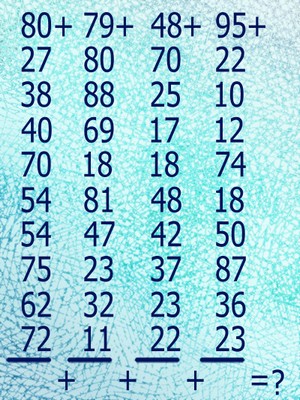
The total might be less than four digits, but it probably isn’t – (40 × 100 =4000, -20 (max is 99, not 100) =3980; average = 1990; 999/1990 = 50.2% chance enough numbers are low enough that the total is 999 or less). However, an average of 1990, divided into 4 columns, means that each column is likely to be only 3 digits in length.

This would be a lot easier to do it on paper, and that’s not something we’ve looked at – how much faster is it?

For a comparison, we need to work the problem both ways. Fortunately, this is already broken into 4 calculations of 10.

Doing it the hard way: 4 × 9 = 36 sub-processes, plus 3 more integration steps, plus trying to remember each total. Okay, I’ll let you write those down. Or, one at a time, 39 sub-processes, no integration, but there are massive penalties for complications – all 2 digits, probably 4 digit answers. No, that’s not viable, there’s too much overhead. 36+9 it is.

I’ll bunch the calculations together even though that’s harder to read.

At a glance: 5 Ops (base) × 1.5 ^ 10 (all double-digit numbers) × 1.5 × 1.5 (triple-digit results) = 648.73 Ops. Not going to happen unless the character has a freak talent.

  • INT 1-5 = 1. Calculation 1 is plus 8 more sub-tasks= +8 time units of 4 × 1.5 × 1.5 × 1.5 sec each = +13.5 sec each = (3+108) = 111 seconds. Calculations 2, 3, and 4 are the same. Calculation 5, the integration, is 3 sub-tasks at 4 × 1.5 × 1.5 × 1.5 × 1.5 = +20.25 seconds. Total:444+20=464 seconds = 7 minutes 44 seconds. And an incredibly high chance of making a mistake. And that time is probably being generous; if I assume that there’s an additional penalty because we have ten numbers in a row, it inflates to 686 seconds, or 11 minutes 26 seconds. Working flat-out. Most people can’t concentrate that hard for that long, and a low INT character would find this especially challenging. So that’s probably another 2 complication levels, elevating the total to 1519 seconds, or 25 minutes, 19 seconds. Finally, remember that this represents 39 INT rolls – maybe at +2 because the character can take his time, but INT is not his strong suit – the odds of multiple mistakes along the way are pretty enormous. In conclusion, then this is probably beyond the abilities of such a character.
  • INT 6-10 = 2. Calculation 1 is plus 8 more sub-tasks at 2 × 1.5 × 1.5 × 1.5 sec each, × 1.5 (ten numbers in a row) × 1.5 (concentration) = +15.1875 seconds each = 121.5 seconds, +3 seconds = 124.5. Calculations 2, 3, and 4 are the same. Integration is 3 sub-tasks at 15.1875 × 1.5 × 1.5 = 34.17 seconds each. In total, 601 seconds, or 10 minutes 1 second, and again with virtually zero confidence in the answer.
  • INT 11-15 = 3. Calculation 1 is +7 more sub-tasks at +15.1875 seconds each = 106.3125 seconds, +3 = 109.3125. 2, 3, 4, are the same, so 437.25 seconds total, Integration is 3 sub-tasks at 34.17 seconds = +102.51 seconds. Grand total = 540 seconds – which is 9 minutes. If you did it enough times to get three totals that agrees, you’d be reasonably confident that it was error-free – but that could take hours.
  • INT 16-20=4. Calculation 1 is +6 sub-tasks at +15.1875 seconds each = 91.125 seconds, +3 = 94.125. Calculations 2, 3, and 4 are the same, so 376.5 seconds. Integration is still 3 sub-tasks at 34.17 seconds = 102.51 seconds. Grand Total = 479 seconds, or 7 minutes, 59 seconds – call it 8 minutes. But, for the first time, there’s a fair likelihood of getting the right answer at the end of that 8 minutes. You would probably do it again to check your work, though.
  • INT 21-25=5. Calculation 1 is +5 sub-tasks at +15.1875 seconds each = 75.9375 seconds, +3 = 78.9375. Calculations 2, 3, and 4 are the same, so 315.75 seconds. Integration is still 3 sub-tasks at 34.17 seconds = 102.51 seconds. Grand Total = 418 seconds, or 6 minutes, 58 seconds – use 7 minutes. And, for the first time, you would be confident in your answer first time around.

Now, the easier way: 4 calculations of 10 single digits, a 2-digit carry, so 4 more calculations of 10 single digits and the carry. But there’s a trick that makes it even easier, since we’re doing this on paper.

Cross out all the zeros in the column you’re adding up. Do all the digits that add up to 10, and cross those off as you go as well. These multiple single-digit 2-item sums are all going to be at-a-glance, pretty much, and they vastly reduce the complexity of the rest of the calculation by eliminating elements.

A 7, but there are no 3s – skip.
8 & 2 make 10.
4 and 4 and 2 make another 10.

And here’s what’s left:
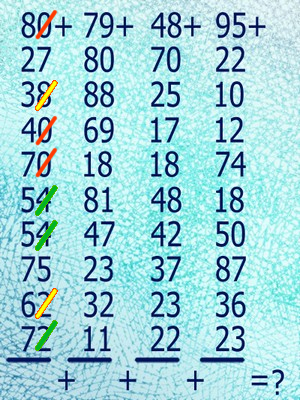
That’s a single addition of 7 and 5. Column total = 20+12=32, determined with just 4 sub-processes.

Repeat the trick with the tens column:

7 and 3 (carried) = 10. 8 & 2 = another 10. 5 and 5 = third ten. 6 and 4 = a fourth ten. 7 and another 3 = fifth 10 There’s even less left over.
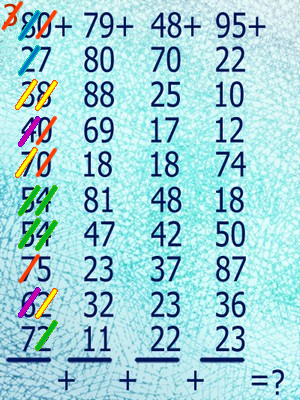
And there’s no doubt about the accuracy because these small calculations are so simple. So the first string of 10 double digits total 572.

For characters of INT 1-5, these small calculations will take 3 seconds each, plus 14 seconds for the final integration – a total of 44 seconds.

For everyone else, 10+14=24 seconds. But take an extra 20 seconds, no need to rush.

No need to continue – the results are blindingly obvious at this point. Instead I’ll leave the other three columns for readers to practice on. (BTW: When I’m adding time – minutes or seconds – I look for total of 10s and 6’s).

  1. Doing maths on paper or a blackboard or whiteboard or whatever – doing it written down – divides the Ops requirements by 2, round down, minimum 1 – unless there is some identifiable trick that makes the math easier, in which case it’s divide by 4, round up, minimum 1. This divisor gets applied to the Ops cost per process.
Troubles Multiplied

Multiplication is all about technique. If you know how, it’s not hard at all, especially if you can do it on paper.
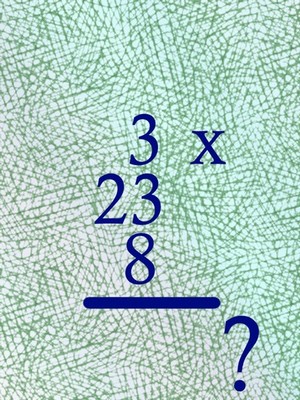
It doesn’t take much longer than addition, really – on paper. Multiplication has a cost of 6 ops for the first one, doubling for each additional multiplication (if you’re doing them mentally).

There are shortcuts that I use all the time. Doubling is easy, tripling is a little less so, quadrupling is doubling twice, five-fold is add multiply by ten and halve, times six is x2 x3, times seven is times 10 – the original number three times (but still the hardest calculation on this list), times eight is x2 x2 x2, times 9 is times ten minus the original number, and times ten is trivially easy.

But the calculation offered above is a little more complicated than that, because it is multiplying three numbers together.

You could go 3 × 8 = 24, and you’re left with 23 × 24 – which is 4 at-a-glance calculations, plus the first one. On paper, you can solve that as fast as you can write – 3 × 4=12, 2×4+1 carried=9, write a 0, 2×3=6, 2×2 = 4, add 490+92=582.

If I were doing it mentally, I’d employ the shortcuts and look for the most efficient route: 3 × 23 = 69, double, double, double again. It takes about twice as long as doing it on paper – for this particular calculation.

Division

Mental division can be hard. Even very hard. Making life easier is the fact that errors also shrink in proportion to the divisor, so you can approximate and generally get away with it.
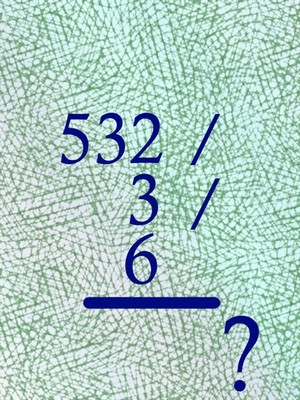
There are also some shortcuts, but they are a bit trickier.

  • /2 is easy.
  • /3 can be slightly easier – add up all the digits, keep going until you have a single digit. If that’s 0, 3, 6, or 9, the original number is evenly divisible by 3; if there’s a remainder, that’s also the remainder of the original. Then see below for the ‘perfect divisibility’ technique – it’s so simple, you won’t believe it!
  • /4 is /2 /2.
  • /5 is x2 / 10.
  • /6 is /2 /3.
  • /7 is a royal pain. It’s usually faster to do /6 and /8, add, and /2. This isn’t quite accurate – it gives 49/48 of the correct answer – but I can usually live with that margin of error. You can even minimize it a bit more by always rounding down.
  • /8 is /2 /2 /2.
  • /9 is /3 /3 but that’s also a bit of a palaver. Sometimes it’s easier to average /8 and /10 and live with the error – 81/80ths of the correct answer. You can estimate the error by dividing the original number by 80 – you’re only really interested in the integer results. You can also check your results by dividing by 3 and repeating the sum-the-digits trick, but that’s usually not worth the effort, either.
  • Divide by 10 is easy.
  • Divide by 11 is messy, but you can get within 1% of the correct answer by dividing by 10 and subtracting 1/10th of the result. You will be 1% low, but rounding up will usually more than compensate.
  • Divide by 12 is /4, /3.
  • Divide by 15 is x2, /3, /10.
  • Divide by 16 is /2, /2, /2, /2.
  • Divide by 17 – I can’t remember ever having to do so. I don’t have a shortcut for this. It’s going to be about 6% less than the division by 16, for whatever that’s worth.
  • Divide by 18 is /3, /3, /2.
  • Divide by 19 – another painful calculation. No satisfactory shortcut
  • Divide by 20 is /10 / 2.

So let’s look at the problem stated above. 532 / 3, to start with: 5+3+2=10, 1+0=1, so there will be a remainder of 1, and 531 is what we should be dividing. That’s 300/3 + 231/3.

    The perfect divisibility trick

    Here’s a peculiarity: run through the multiples of 3 and note the final digit each time: 3, 6, 9, 12, 15, 18, 21, 24, 27, 30. Strip out those tens digits and you get 3, 6, 9, 2, 5, 8, 1, 4, 7, 0. Let’s arrange those: 0, 1, 2, 3, 4, 5, 6, 7, 8, 9. So the final digit of a number is diagnostic of the division by 3 – there are No repeated digits in that list!

    300 / 3 = 100; 231 / 3 = 21 / 3 + 210 / 3. so 532/3 = 177 1/3.

    177 / 3?

    1+7+7 = 15; 1+5 = 6 – so perfect divisibility by 3.
    177 – 27 = 150. So 177 / 3 = 50+9 = 59.

    59 / 2 = 29.5. But there would be a small fraction left over from the previous calculations – enough to tip the rounding to round up. Call it 30. Or 29 and a remainder – whatever’s most convenient.

Higher Maths

The same principles can reveal a character’s facility with higher maths, simply increasing

There is a progression to the higher math elements. Each step of the progression adds 1 to the cost of that operation, plus a base value of 6 Ops.

  • Algebra = +1
    • Exponent 2: Squares = -2 – this is just multiplication
    • Exponent 2: Square Roots = +1
    • Exponent n, greater than 2 = +2 per, or per part thereof.
    • Areas, simple shapes = -1
    • Areas, complex 2-dimensional shapes = +0
    • Areas, three-dimensional shapes = +2
    • Volumes: simple shapes = +1
    • Volumes, complex 3-dimensional shapes = +3
    • Each additional dimension = +1 to the above
  • Basic Calculus
    • Simple Differentiation = +2
    • Simple Integration = +3
    • Complex Differentiation (involves math below this point in the list) = +4
    • Complex Integration (same definition) = +6
    • With discontinuities: +1 to the above
  • Trigonometry
    • Basic (2-dimensional) with right-angle triangles= +2
    • Basic (2-dimensional) with non-right-angle triangles = +3
    • Complex (3-Dimensional) = +4
    • Additional dimensions over three = +5, base, plus 1 per extra dimension
  • Logarithms = +3
  • Three dimensional vector sums = +3
  • Exponentials = +4
  • Probability
    • Simple = +4
    • Factorials = +4
    • Complex, 2 independent variables = +5
    • Complex, 2 dependent variables = +6
    • Additional variables = +1
  • Harmonic Motion & Elasticity problems = +5
  • Partial Differentiation, Partial integration = +5
  • Fibonacci Numbers, Primes, etc = +6
  • Multi-variable Analysis & Simulation = +7
  • Higher Applied Math = +8, +1 per additional difficulty
  • Higher Theoretical Math = +10, +1 per additional difficulty
  • Unsolved Mathematical Problems = +12, +1 per additional difficulty

The reader will appreciate that I didn’t want to bog down in specifying a lot of exotic math types that they will never have heard of, so the last three are fairly generic and the GM gets to assign whatever he thinks appropriate, starting at the base value.

Everything prior to those I’ve had occasion to use or study. For example, at one point I became really interested in studying that rate of change of probability with increasing numbers of dice – there’s a lot of this sort of math buried in the Sixes System.

Rate of Change is differentiation, in this case of probability, with each additional dice after the first being an additional variable. So Rate of change of probability = 6+1 (algebra) +2 (simple differentiation +4 (simple probability) [+1 per additional dice] = 13; 2-dice=14; 3-dice=15; 4-dice=16, and so on. Which seems really impractical to do when you’re getting up to 10 or 15 dice!

But each step up that chain is a partial solution to the next problem up, and don’t forget the ‘doing it on paper’ modifier, and it becomes a lot more practical. Once you’ve identified a pattern of change from one number of dice to that number +1, the whole world opens up before you, and solving the individual problems become much simpler, because you don’t have to ‘reinvent the wheel’ each time..

Quite honestly, the housing price calculator (see: The Price of Bricks and Soil (and more)) with it’s multi-variable analysis – some of them dependent, some independent, and some partially both – was a little more difficult.

Mysteries & Puzzles

Okay, so now things begin to get a bit more interesting. I mean, who really cares how long it will take a character to solve a maths problem? On the rare occasions when it’s necessary, most GMs (including me) will simply pluck a number out of the air that seems reasonable, and move on.

Hopefully, the math tricks and shortcuts will be worth reader’s time.

But now, we’re looking at a question that’s not so easily answered, and one in which the difference between what the player is capable of, and what the character can do, matters massively – with the GM expected to make up the difference, without messing with player agency, and while keeping the game-play interesting and role-playing, not roll-playing.

Let’s say that the adventure revolves around an Agatha-Christie style murder-mystery, the PCs gather clues and have to then use those clues to eliminate the suspects who are innocent in order to apprehend the guilty party.

If we knew the INT score of the player of the smartest character when it comes to solving this sort of puzzle,, we could simply let the player work at his own pace while applying a conversion factor to go from ‘real time’ to ‘game time’. We could then use that conversion factor to schedule plot developments in ‘game time’.

We have the basic tools – more than enough of them to actually test a player’s applied intelligence. ‘Total a column of ten 2-digit numbers’ would work fairly well, for example. We then calculate how long it would take their character, and we have an instant conversion rate from one to the other. Or perhaps some of the simpler mental arithmetic challenges.

It would probably be better to run a number of small tests and average the results, that’s up to you.

Solving mysteries – Ops and Sub-tasks

Analyzing each clue to determine its significance relative to the bigger picture is a sub-task requiring 1 Ops points. Integrating that clue with the state of the investigation to this point is a sub-task requiring 2 Ops points. So that’s a total of 3 Ops points and two sub-tasks per clue.

Because clues tend to be more abstract than numbers and numeric operations, the time penalties are increased × 2.5 to 5 seconds and 10 seconds, respectively, rising by 1 second for each clue after the first.

Number Of Clues

As a general rule of thumb, it takes 1 clue to eliminate 1 suspect. At least, it would if no-one lies or tries to fabricate an alibi (which is a specific kind of lie, in my book).

It takes an additional clue to prove that someone is lying and another additional clue to determine the motive for the lie, and it may well take a third additional clue to establish the truth – sometimes, that 3rd extra isn’t necessary.

On top of that, the GM is likely to throw red herrings across the party’s path, each of which needs still another clue to identify. Another way to phrase this is that some of the clues may be misleading and need another piece of information to clarify their significance. That adds another clue and another sub-task to the total, per red herring.

And, just to make matters worse, each clue is probably buried amongst a mass of other information, with the rest being irrelevant – so you often need to analyze three or more pieces of information just to determine what’s an actual clue and what isn’t. That adds one more sub-task per clue.

Furthermore, not all the clues may be available – someone (either the criminal or someone protecting someone else for whatever reason) may have actually destroyed key evidence.

Finally, mysteries that would be easy to solve if the information was arranged and delivered in logical sequence become a lot harder when the clues are delivered in a more random and realistic sequence.

I’m reminded of the episode of MASH in which BJ Hunnicutt is sent a mystery novel, The Rooster Crows At Midnight with the last page missing, and the whole camp tries to figure out whodunit.

Put all this together and you might be forgiven for thinking that no mystery can ever solved! But that’s no fun.

The Process Of Solving A Mystery

1. Crime Scene. What would be required to actually carry out the crime?

2. Initial Suspects. Rule out – provisionally – anyone who doesn’t possess the attributes necessary.

3. Interview Suspects. Analyze their statements to determine which information is relevant and which is chaff.

4. Analyze clues for verifiability. Verify everything that you can. Anything that can’t be verified is a possible lie.

5. Investigate possible lies and deceptions. Now that you have better questions, re-interview suspects.

6. Look for pieces of the puzzle that don’t fit. If all the evidence except one indicates that a person is guilty, focus on verifying that one; if you can do so, then some of the evidence against that person is a red herring. Theorize that each, in turn, is a red herring and look for a way to use the evidence, or additional evidence, to test that theory.

7. No Red Herring exists without someone attempting to construct a false narrative to cast blame on that person, and that means a lie or misdirection. Look for evidence of falsification and motives for doing so. If you find it, you can eliminate that red herring.

8. Means, Motive, Opportunity. Focus on these one at a time (and not necessarily in that order). If you get stalled on one front, turn to one of the others.

9. If evidence is missing / destroyed, treat that as a separate crime committed in furtherance of escaping justice. This is often a simpler puzzle to solve, and successfully doing so will often tell you what the missing evidence was.

10. Construct a set of theories of the crime in which each of your remaining prime suspects is the guilty party. Look for ways of testing those theories. For a theory to pass, it has to satisfy all three evidentiary legs listed in 8. Failure to pass doesn’t mean that the theory is necessarily wrong – but it does make it possible wrong. Determining the case in respect of a theory is the purpose of testing that theory.

11. One or more theories may pass, becoming your leading theories – test those looking for ways to disprove them.

12. Continue to narrow your field of prime suspects and eliminating theories. Each theory you bust may eliminate a prime suspect, each suspect that you eliminate also busts all theories based around them.

13. If you run out of theories or prime suspects, it usually means that you have eliminated someone you shouldn’t, often as a result of a flawed assumption. Double-check everything looking for both.

14. Ultimately, there will (hopefully) be one single theory (and only one) that satisfies the Means, Motive, Opportunity triangle and explains away any apparent reason why they could not have been the culprit. That is the solution.

As a Function Of Intelligence

Each of these 14 logical stages is a separate task in its own right. They do not have to be conducted concurrently, but neither do they need to be conducted in isolation. Breaking things down into their stages of investigation in this way is the equivalent of the simplification into fewer and/or simpler sub-tasks that was demonstrated in some of the math examples.

The higher the INT of the character, the more they can do simultaniously, and the faster the character can reach a conclusion. The total number of sub-tasks remains the same, but the number of them that can be processed at once makes the smarter character more efficient.

A critical quantity is the number of suspects. A high-INT character might be able to consider them all concurrently, whereas someone less-gifted might have to do so one or two at a time. Everything else is proportionate to the number of suspects, which is why heavy emphasis is placed on reducing that number as quickly as possible in the process.

There’s more that could be said – I could do a breakdown by INT, for example – but time is beginning to press, so I’ll leave it at that and move on.

Plans

Characters make plans all the time. Each step in a plan is a sub-task to achieving the overall objective. Planning a sub-task requires 4 Ops, plus 1 for each sub-task after the first in the unified whole.

The higher the INT, the more sub-tasks can be planned in advance; when you run out of available Ops points, the remaining sub-tasks become vague and non-specific.

The Unpacking Example

Unpacking after my forced relocation back in March was troublesome. Quite often, things could not be stored where they were eventually supposed to go, because I needed the empty space to unpack something else. In the meantime, the things to be unpacked had to be kept in storage. A lot of my planning for the task involved creating the space needed to accomplish the next step.

Each step in the process therefore became dependent on the successful completion of the previous step. To unpack the fiction library, I needed to have unpacked the non-fiction library. To unpack the magazines, I needed to have unpacked the fiction library. To unpack the non-fiction library, I needed to have unpacked the “to read” library. To unpack and set up my office space, I needed to have finished assembly of all the bookcases. And so on.

It was not dissimilar to solving one of those sliding-panel puzzles. There was only so much operational space to employ at a time, which limited the size of the process that could be carried out, breaking the overall task into sub-steps that would fit within the space available. Right now, the end is finally in sight.

Viewed from another perspective, to unpack something you need (1) to be able to get to where it is stored; (2) a location in which the contents will be stored when they are unpacked; (3) space to unpack and organize the contents of one or more boxes; and (4) a place to store the empty box. Put all four steps together and the contents in question go from ‘packed’ to ‘unpacked’. And the space used to store the previously ‘unpacked’ becomes empty and available for some other purpose – temporary storage space or working space or whatever.

You can get some impression of the scale of the problem by the fact that there were more than 500 boxes to be unpacked. Most of them were relatively small in size because of limitations of physical capacity. And a big complication was needing the space to assemble the furniture that would eventually be filled with the contents of those boxes. Which in turn was a function of the planned layout of the new residence.

Characters Planning

It’s exactly the same when a PC makes a plan. Or rather, when the character’s Player makes a plan. The question is, how much assistance does the GM need to provide? How much will ‘go right’ simply because the GM is able to presume that a character of that level of INT would get that planning right – and how much is he justified in having things go awry because the character’s INT could not anticipate every contingency?

To answer these questions, you need to break the main plan down into its necessary sub-steps, at least in general and vague terms. The number of Ops points available gives the maximum number of sub-steps that can be employed, but most tasks won’t need anywhere near that number.

    Zenith-3 Mission Example

    Team Zenith-3 were handed the problem of intervening to stop a bunch of domestic-US terrorists from utilizing a black market nuclear weapon that they have purchased from a Russian General. At it’s simplest, this is a fairly basic operation:

    1. Contact Agent
    2. Get Specifics of the mission
    3. Plan the mission
    4. Carry out the plan.

    In-game politics had to be taken into consideration. The PCs are not welcome in the country where all of the above had to take place.

    So they had to adopt new identities. And enter through Central America. And travel through post-Ragnarok Central America and post-Ragnarok Mexico to get to that country.

    But to enter Central America, they needed the support of Brazil, which is under the control of an enemy. So they had to go to Brazil and obtain that assistance.

    So now, the plan looks like this:

    1. Adopt new identities.
    2. Brazil.
    3. Get Local Assistance (i.e. navigate Brazilian Politics)..
    4. Central America. Insertion.
    5. Meet Guide arranged by the Brazilians.
    6. Travel through Central America.
    7. Travel through Mexico.
    8. Leave the Guide.
    9. Enter the target country.
    10. Contact Agent
    11. Get Specifics of the mission
    12. Plan the mission
    13. Carry out the plan.

    Steps 1 through 9 were a lot of work to carry out for a one-off mission, and it seemed more prudent to take advantage of that effort to establish a longer-term operation that could not only deal with the immediate, known, problem, but could also handle other problems as they arose.

    So the plan was modified to incorporate this as part of the mission.

    10. Select a region to contain ‘home base’.
    11. Search the region for a suitable dwelling to use as a ‘home base’.
    12. Purchase said dwelling.
    13. Adapt and install facilities to make it an actual home base.
    14. Contact Agent.
    15. Get Specifics of the mission
    16. Plan the mission
    17. Carry out the plan.

    Additional mission requirements were identified and inserted. Establishing the new identities and forging a working relationship with the local police forces, for example. Arranging the finances need to purchase the property and refurbish the resulting base. Settling on the parameters of the search. Obtaining vehicles to carry out the search. Establishing some operational procedures for performing missions in the target country.

    A big one was that there would not be enough time in the schedule to achieve everything. So that added a time-travel item to the list. Deciding how far back to time-travel. Avoiding paradoxes as much as possible and working around the ones that were inevitable, like being in two places at the same time.

    And so on. Few of these could be planned in advance; each one had to be planned out as it became imminent. And there were unexpected developments – in each region that they traveled through, they would have to earn the right of passage from the local ruler. Their guide would initially be, officially, an enemy – they had to keep him or her in the dark as to their true purpose (by the time they parted ways, they had cemented a loose alliance with him and come clean about their primary mission).

    Here’s the key point: most of these steps weren’t aimed at the primary mission (the terrorist plot) or even at the secondary mission (establishing a base of operations); they were necessary simply to get the PCs into a position to execute the next step.

    You can read a lot more about what actually happened and why in the series A Long Road (be warned, it’s very long – about the length of a typical paperback novel).

Analyzing The Process

This is a great example of the planning process because it demonstrates the principles of Step-wise Refinement and Iteration, explained in more detail in Top-Down Design, Domino Theory, and Iteration: The Magic Bullets of Creation.

In essence, start with a simple overall plan, factor in the complications one at a time even if you don’t know what the specifics are going to be, yet, and repeat this simple process until you’ve covered everything you can think of.

This takes a hugely-complicated plan and breaks it down while not pushing anyone’s INT capabilities too far. As each step gets encountered, it then gets broken down further into specifics.

Flawed Plans

Very few plans can be made without an error creeping in, somewhere. There will always be unexpected plot twists and surprises. It doesn’t matter if it’s a PC plan or an NPC plan.

The more of your INT that you aren’t using for a broad plan, the more you can anticipate things going wrong and preparing contingency plans.

That was the whole thesis of Making a Great Villain Part 1 of 3 – The Mastermind, in which I looked at ways that the GM could run NPCs who were far smarter than the GM himself.

Early In A Plan

When a plan is just getting underway, it’s far easier to roll with the punches and find an alternate route to achieving a goal, no matter what surprises get thrown at you. Some characters will develop resources and capabilities with no idea of what they will eventually do with them – they are simply accumulating resources that might be beneficial in achieving their overall ambitions.

The Midpoint

At some point, though, they will recognize a pathway to their goals that derives from these capacities, and the specific additional needs that they have in order for that plan to succeed. This marks a transition from Early Planning to Late Planning.

Late In A Plan

Once a pathway is seen, activities become more purposeful. Flexibility gets traded for greater certainty, and the closer the character gets to achieving their goals, the more flexibility will have been traded in this way.

Complicating factors that the Intelligent character will take into account will be misdirection and security. Most plans fail because not enough attention has been paid to one or both of these – and GMs are usually careful to preserve these blind spots to give the PCs a reasonable chance at successfully stopping the plot.

The more Intelligent the villain, the better they should be able to respond to the exposure of such flaws in their plans. There can be exceptions, when obsessions and blind spots come into play, but as a general rule of thumb, unused Ops points should permit the formulation of alternatives and contingencies at the rate of 1 per 2 available Ops points.

The simpler the plan, the more routes to victory. The more detailed the plan, the more restrictive it is.

That means that a character with INT 18 has markedly different capabilities than one with INT 16, for example.

But beyond Masterminds, who can often be characterized as simply having “enough INT”, the more important application here is for determining the capabilities of a lower-INT villain – one with INT 8 vs one with INT 9, for example.

INT 8: A 4-step plan with 2 contingencies.
INT 9: A 5-step plan with 2 contingencies – or a 3-step plan with 3 contingencies.

Applied Skills

Mathematics as a skill simply adds one Ops point capacity per skill level, and – at the GM’s discretion – reduces the Ops cost of specific tasks by 1 for every 5 skill levels. It is also entirely reasonable to restrict characters from even understanding certain mathematical tasks unless they have a total skill (INT bonus plus skill points) sufficient to that task.

The same can be applied to every other INT-based skill – in fact, to every skill, period.

Carpentry, for example, is more commonly DEX based than INT based. But why should we let that stop us?

Estimate By Eye

The golden rule of carpentry is measure twice, cut once. It’s therefore incredibly impressive when someone eyeballs a job and cuts a piece of timber accordingly – and it fits perfectly.

But let’s be honest – any fool can cut more-or-less to length, in fact, to within 3 inches or so. Furthermore, if the cut is too long, that’s easily corrected – it’s just a little wasteful of wood. It’s coming up short that’s the real problem.

So let’s assign the basic task – sawing the piece of timber – and appropriate number of Ops points. It’s fairly basic, so maybe 2, maybe 3. For every Ops point unused, the character can use them to improve his ‘by eye’ measurement for 2 Ops points each step. These are in 1/2 inch increments until the error is 1 inch, then 1/4 inch until the error is 1/2 inch, then tenths of an inch.

So,
3 Ops points = 3 inches plus or minus.
5 Ops points = 2.5 inches short or over.
7 Ops points = 2 inches short or over.
9 Ops points = 1.5 inches short or over.
11 Ops points = 1 inch short or over.
13 Ops points = 0.75 inches short or over.
15 Ops points = 0.5 inches short or over.
17 Ops points = 0.4 inches short or over.
19 Ops points = 0.3 inches short or over.
21 Ops points = 0.2 inches short or over.
23 Ops points = 0.1 inches short or over.
25 Ops points = perfect fit.

Planning ahead

Being able to visualize blueprints in your head and execute them is another impressive trick. Initially, this is only enough to create the parts list in their general shapes (5 Ops). Being able to shape them exactly as you need is the next step – either 10 Ops points and +1 per component after the first four. Knowing how they are to fit together and designing them to so is 15 Ops points +1 per component more than the first four.

An example: A drawer to fit a certain-sized cavity. First four components gets a box the right size (measured) with no top and no bottom. 5th component adds a bottom. Sixth and Seventh are a pair of rails for it to slide along, or a groove to fit an existing one if the cabinet was designed in advance. Eighth is a face-plate, with holes pre-drilled for a handle. Ninth is the handle itself, and Tenth would be the assembly.

So, 21 Ops = do it all without blueprints.
20 Ops = do all but 1 component without blueprints.
18 Ops = do all but 2 components without blueprints.

16 Ops = do 5 components without blueprints OR do all ten without blueprints but needing to add intricate details as you go.
15 Ops = 4 components without blueprints OR do nine without blueprints but needing to add intricate details as you go. One piece will have to be measured.
14 Ops = do eight without blueprints but needing to add intricate detail. Two pieces have to be measured.

10 Ops = do four pieces without blueprints (the open box) but everything else needs to be measured.
… and so on.

Hero System Conversions

The hero games system defines 10 in a stat as normal human, but permits scores less than zero, there is no minimum. So a score of 1 won’t mean the same thing. Each +5 doubles capability, which is often undefined. Each -5 halves it. The rate of change in capacity is not defined in the d20 system.

All of which makes conversion difficult, and why there are dozens of conversion regimen to choose from.

The simplest is simply to read the stats from one into the other. STR 18 in Hero = STR 18 in D&D. The most complicated, and potentially the most accurate, uses character Lifting capabilities to map conversion rates for every possible d20 stat value, then arbitrarily equates the results to all the other stats (except body, which does the same thing using hit points).

There are no right answers. So let’s use a wrong one.

HERO -> D&D HERO -> D&D HERO -> D&D HERO -> D&D

0 = 0
5 = 5
10 = 10
15 = 12.5
20 = 15
25 = 17.5
30 = 20
35 = 22.5
40 = 25
45 = 27

50= 29
55 = 31
60 = 32
65 = 33
70 = 34
75 = 35
80 = 36
85 = 37
90 = 38
95 = 39
100 = 40

110 = 41
120 = 42
130 = 43
140 = 44
150 = 45
160 = 46
170 = 47
180 = 48
190 = 49
200 = 50

thereafter,
+20 = +1

so 400 = 60
600 = 70
800 = 80
1000 = 90
1200 = 100
and so on.

I have chosen these values because the flavor that I expect this system to generate (based on the D&D scale) matches the in-game flavor that I would expect of the Hero scale equivalent indicated.

In other words, the look-and-feel is about right, and the mathematical niceties are not so important as that.

Wrap-up

And that, fortunately (because I’m out of time) is where my notes for this subject come to an end. Can the system be tweaked / refined? Yes, endlessly. But down that road, eventually, comes the hard reality of a different scale for every stat and skill, and that’s not an end worth achieving. This is a close-enough system that yields results useful in the real world from a generic basis.

And that should be good enough.

Comments Off on An Application of INT

The Mundane Application Of Genre Part 3


In Part 1, I shared a simple technique for creating immersion within the specific genre of a campaign, and applied it to Fantasy campaigns.

Part 2 took a solid look at Science Fiction campaigns (and was supposed to also include everything I cover this time around.

This vertically-oriented pair of images symbolizes the genres being studied this time around. It’s a composite of two separate items:
robot-8765694, Image by Ara_a from Pixabay
and man-8149696, Image by Roberto Lee Cortes from Pixabay

These genres were not chosen capriciously; between the four of them, they comprise fundamental structural elements that encompass every other genre that I could think of. But let me not get ahead of myself.

I should start with a reminder:

Recapping The Process

This and the next section are repeated verbatim from Part 2. Read over them if you need to refresh your memory or if you haven’t been here before, otherwise, you can skip down to the next colored panel, below!

    0. Make a list of possible Mundane Activities (optional, but it helps).
    1. Pick A Mundane Activity.
    2. If it’s not something the PCs will perform in this game session, go back to step 1 and make a different choice.
    3. Imagine a more genre-appropriate method.
    4. Check for game balance issues. If necessary, vary the method to something that avoids the issues, or go back to step 1.
    5. Apply genre-appropriate color language. Document the language for future consistency.
    6. Create the bubble of narrative and attach it to the day’s play.

Recapping the Genre Discussion Structure

The Genre discussions focus on the considerations that generally apply to the most common and instructive genres – the application of the technique, in particular those that apply to steps 3, and 4. Fantasy RPGs were covered in Part 1.

Sections are arranged in a logical structure:

    The existing parts of play that connect directly to the Genre.

    Discussion of the points at which the process described above connects to the simulated reality within this particular genre.

    Third, any conceptual tools that can help with the transformation of a mundane activity into a genre-specific activity.

    Finally, any potential Game Balance and Campaign Issues get briefly examined.

That’s enough naval-gazing – let’s get to it…

If you skipped the above, resume reading here!

Genre Discussion 3: Superheros

Someone posted a survey on X (formerly Twitter) the other night asking for readers’ favorite RPG Genre. The choices offered were Modern, Fantasy, Science Fiction, and Horror. My response was that my superhero campaign encompasses all four.

The setting is modern – well, it’s actually near-future and recent past. But the near-future is somewhat more advanced, technologically, than we are actually likely to be by the time our calendar catches up, and even the recent past sections have slabs of sci-fi content tacked on.

Magic exists, and the campaign occasionally diverts into outright Fantasy, but often views it through a sci-fi prism for internal consistency. Whenever the Fantasy isn’t the immediate focus, though, that generally gets hand-waved, as does a lot of the sci-fi – it’s hard sci-fi when it has to be, and very sift sci-fi the rest of the time.

There are “Gods” (both ‘real’ and ‘wannabe’, and all the trappings that go with them. There’s healing so advanced that it might as well be labeled magical, but it has hard restrictions that are more sci-fi oriented. There are psychic powers and ancient evils and would-be destroyers of reality. Those are definitely trending into Horror territory – and some of the consequences of the other genres are horrific in nature.

Consider, for example, the fate of a parallel-world version of one of the PCs, who suffered near-fatal injuries before crash-landing in the primary campaign (near-future) setting; her life was saved by technology, replacing damaged biology with cybernetics, but in the process, parts of her humanity were also stripped away, leaving her a twisted reflection of what she once was. Barely recognizable, even when you know her origins, everything that she was has been removed and replaced, either physically, mentally, or emotionally. If that’s not a horror concept, I don’t know what is!

    Multitudinous Genre Connections That Sometimes Miss The Mark

    That’s the real power of the superhero genre – it contains just about anything you can think of, wrapping it all in an idealistic moral coating that propels the characters into these situations whatever their personal preferences might be.

    But this heady brew comes with its own imperatives and rules; the superheroic genre is not simply an amalgam of other genres, it is an internally self-consistent genre that reinterprets the trappings of other genres within its own framework.

    It’s not enough simply to combine the list of Fantasy genre connections with those of the Sci-fi genre. While they will be relevant and useful some of the time, on other occasions, the same genre-reference will miss the mark quite badly.

      The Superheroic Genre

      The difference in circumstance is, perhaps, best rationalized as the superhero genre sometimes needing to supersede the constituent genres, which are subordinated to it.

      Moral issues, drama, plot twists, questions of fate and destiny and good and evil, and the soap opera that comes with the superheroic territory – when any of these are directly connected to the events in-game, the superheroic genre itself takes prime position, and any other genre reference takes a back seat unless it can serve the superheroic genre itself.

      Objectives and Motivations

      Fantasy elements and trappings usually have to be ‘filtered’ through another genre to some extent (but not always; when the Fantasy is a dominant sub-theme, it’s the non-Fantasy elements that get filtered. That’s the difference between a Dr Strange campaign and an Avengers campaign in which Dr Strange just happens to appear).

      The primary difference between a ‘straight’ Fantasy campaign and a Fantasy-oriented Superheroic campaign lies in the Objectives and Motivations of the participating characters. If the primary objective is one of gaining wealth, or prestige, or social standing, or simply surviving in a dog-eat-dog world, its a straight Fantasy campaign; when there is a higher purpose involving the protection of others, it can either be a Straight Fantasy with some superheroic elements, or it can be a Superheroic campaign within a Fantasy environment.

      Those two alternatives actually comprise a continuum – any given campaign of this type can occupy any position along that spectrum, and there ultimately aren’t a lot of differences.

      Perhaps the biggest one is that – for the most part – superheroic campaigns have self-sufficient characters who may seek artifacts for a specific purpose but otherwise rely on their own innate capabilities, while Fantasy campaigns are about acquiring the power needed to achieve the end. Under this model, the Lord Of The Rings is more superheroic than Fantasy, which only goes to show how subtle some of these distinctions can be.

      The Filtering Of Fantasy

      The only rival for this is the “filtering” that I’ve mentioned several times. This is principally an intellectual and philosophical difference, and as such can be very hard to pin down. Fortunately, I have a fairly extensive example to which I can point.

      A while back, I published a summary of the basic in-game concepts of “How Magic Works” from within the campaign in The Meta-Physics Of Magic.(7576 words).

      This incorporated a number of in-game mini-lectures from a Master magician to the more self-educated PC who was the spellcaster of the party. I worked very hard on these conveying the impression of someone who had studied “Magic” at a University level, and who knew more about it therefore than most practitioners of the art. Along the way, he discussed the internal physics, philosophy, and practical application of Magic – and, in the process, captured the perfect example of a Fantasy campaign element viewed through a science-fiction / superheroic lens.

      If you want more of the backstory and context, and a slab of lecture from the same NPC on time travel, that’s available too (in a three-part series), A Long Road – Zenith-3 Notes for all (aka Zenith-3 synopsis & notes).

      Be warned, these are LONG posts – 16,072 words, 35,147 words, and 53,566 words respectively, a total of 104,785 words. If I accept Amazon’s stats of 250-300 words per page, that’s 346-420 pages – a thick paperback! (You may want to use the Print-on-demand feature at the bottom of each post to save it as a PDF for off-line reading).

      Interactions with Sci-Fi

      Examining Sci-Fi content in a superheroic content actually brings us closer to the primary thesis of this series. Again, the differences between straight sci-fi and sci-fi in a superheroic context are subtle and hard to pin down; they boil down to a difference in emotional focus.

      In straight sci-fi, conveying a sense of wonder to the players is key. The subtext is “the universe is amazing”, even in a hard-nosed Traveller campaign. This can be tricky because to the characters in the campaign, it might not be all that amazing – they live, breathe, and work in that environment. For comparison purposes, a Star Trek campaign explicitly focuses on the sense of wonder, and the characters share in it. It’s all about exploration and discovery.

      In a superheroic campaign, sci-fi elements can occasionally project that sense of wonder, but the focus is suborned by the needs of the superhero genre – action, drama, soap opera, and so on. That makes the sci-fi in a Superheroic context more akin to a Star Wars campaign, if that helps!

      An ongoing strand within my superhero campaign is always the ordinary lives of the characters. These are ordinary people who have become extraordinary and who find themselves living in an equally-exceptional world within the broader reality, aware of things that the “man (or woman) on the street” rarely notices.

      For the November 2016 Blog Carnival, the subject that I pitched up to participants was “Ordinary Life in RPGs”, divided into three alternate strands – The Ordinary Life of the GM, The Ordinary Life of the Players, and The Ordinary Lives of the PCs. It’s the last one that’s relevant in this context, obviously, but all three strands came in for attention. You can read the Carnival Roundup at this link for a synopsis of the posts.

      In particular, Ordinary Lives in Paranormal Space and Time (5520 words) seems directly relevant.

      Rather than conveying a Sense of Wonder, you are mostly trying to convey the exact opposite – that however extraordinary the technology around them, dealing with it is just part of the PCs daily routine.

    All that having been said, there are a few direct connections to the Superheroic Genre, which either supersede or superimpose themselves on any other genre elements.

    Existing Genre Connection: Using Powers

    The most obvious one is when the PCs (or NPCs) use the powers that make them superheroic. These should never be matter-of-fact or vanilla game-mechanics (even though the game mechanics tends to dominate such occasions); that just means that the GM has to work that little bit harder. Rather than a sense of wonder, though, what should be conveyed is a sense of Extraordinary Agency. These are the shticks that separate these characters from mere mortals, and that should be emphasized and celebrated each and every time (though not necessarily to the same intensity each time – as with many things, familiarity breeds contempt; overuse can blunt the impact and make the flavor rather blase).

    I pay particular attention to how other capabilities interact with powers, and how different powers interact with each other, simply because the variety provides subtle nuances that help keep these interactions distinctive, while adding verisimilitude to the fantastic.

    One final point that I need to make before I move on: I am firmly of the opinion that these extraordinary capabilities are just something that most PCs and NPCs have at their fingertips whenever they want them, and that this means that they would be used for convenience as well as for dramatic effects. When applicable, they should be used casually, just as someone who was a bit stronger than most would get used to that strength and adjust their ordinary life to exploit it. That might mean carrying grocery bags that are too heavy for most people, or whatever. Comics are full of this sort of thing; and it always adds to the sense of verisimilitude of the extraordinary abilities in question. So I’m always pushing my players to embrace this concept – with, it must be admitted, only limited success so far, despite decades of trying. This in no way invalidates what’s been written above; there is a huge difference between the casual use of extraordinary abilities and the dramatic use of such abilities in a life-or-death context!

    Existing Genre Connection: The Edge Of Dystopia

    The mere existence of supervillains that need to be opposed – or invaders from other realities, or whatever – automatically places the PCs as the shield between the ordinary world and world-shaping / destroying calamities. By definition, all superheroic campaigns occupy the thin boundary between a prosaic (and protected) existence and the edge of dystopia.

    Sometimes, the best that can be salvaged from a situation is a “recoverable, temporary, dystopia”; at other times, dystopia can be prevented completely, though dramatic requirements generally require this to be by the skin of the PCs teeth.

    This all contrasts markedly with most Sci-Fi – with Star Wars again being the stand-out exception. As a general rule, most sci-fi where this isn’t the case (2001 A Space Odyssey, for example) lacks the drama to make a good adventure / campaign setting. There can be exceptions, but this is a useful rule of thumb.

    Existing Genre Connection: Subterfuge and Paranoia

    Is James Bond a superhero? Tell you what, I’ll come back to that in a moment.

    The existence of enemies, not just of the PCs, but of all existence as it is currently experienced by the man on the street, demands a certain level of paranoia when encountering something strange. In a straight sci-fi or fantasy campaign, the dominant attitude is often “We have to understand this” or “What does this explain?”; in a Superhero campaign, it’s “Who’s behind this and what is their agenda? How do we fight it if we have to? DO we have to?”

    Coupled with this and accompanying it is a second phenomena, exemplified by Clark Kent’s glasses. Secret Identities are part and parcel of the universe, and everything that happens to that disguised character has to be considered in terms of the impact on that secret. So much so that it’s an almost-ubiquitous ongoing trope in superhero comics: trapped in his secret identity, the character can only watch as an emergency unfolds, and he has to use his wits to get into a position to intervene without revealing his secret.

    I have often thought that Kent should have some subtle body prosthetics to make him look a little less “perfectly in shape” as his superheroic identity – he should be able to wear a superman suit for a charity gig and it should be immediately obvious that he is not the man of steel. Nothing so obvious as a pot belly, just a somewhat less defined musculature, a slight ‘softness’ around the middle.

    But, beyond that, there is the whole trope, shared with some Horror campaigns, of “things man is not meant to know”, redefined in this case to mean “things ordinary men are not ready to be told about.” Secrets and subterfuge are an inherent part of a character’s role within the campaign. Everyone has their secrets, and those secrets need to be protected, and that mandates a level of paranoia about exposure of those secrets.

    Which brings me back to James Bond, and the super-spy genre in general. If your concept of superheroics can encompass ‘street level’ characters who wear ordinary clothes instead of spandex (or equivalent), then James Bond ticks every box for a superheroic campaign. I would argue that if Batman is a superhero, then so is James Bond. The only thing really missing is a personal life divorced from his “day job” – but, logically, if he has a cover identity (and he implicitly does, in the original novels), then he has to spend some time keeping that cover identity ‘alive’. Just because it’s always off-camera doesn’t mean that it isn’t there. In the spy game, this is commonly called a “Legend” – for more, see Wikipedia’s article on Espionage, in particular, the section on Organization.

    Points Of Contact: All this and Melodrama, too

    I’ve mentioned drama and soap opera a number of times already. Put those together, and it spells Melodrama. Most of the time, Melodrama is used as a contrast to the action-oriented main sequences, often for light relief.

    In melodrama, molehills cast shadows so long and intense that they appear to be mountains. Even relatively trivial circumstances are depicted as possessing a significance far in excess of the way normal people would view them in real life. Because of the superheroic reality hidden beneath the ordinary lives of the characters, these exaggerations are perceived as being of genuine substance – the example offered earlier of a character who needs to use his wits in order to intervene in a situation in his heroic identity while protecting his secret is a good example.

    Rather than belabor the point further, I’ll simply point readers at Melodramatic Licence: Drama in RPGs and move on.

    Potential Game Balance Issues

    I’ve covered a lot of ground in this discussion, and the potential for game balance issues hasn’t even been mentioned so far. That’s because, as a rule of thumb, these are the same as those already discussed in reference to the Fantasy and Sci-Fi genres – i.e. the application of abilities to circumstances for which they were not intended to be relevant.

    Read almost any story set in the 1970s or earlier, and consider the impact on the plot of ready access to ubiquitous mobile telephony, were such to be available. Leave out Google, and Google Maps, at least for a first glance; the mere access to instant person-to-person communications from wherever characters happen to be unravels a lot of plots directly, and distorts most of the rest, sometimes greatly, sometimes only a little.

    Take, for example, a basic Agatha Christie story. You have a crime, and a list of suspects, none of which can initially be ruled out. Inevitably, investigation follows, and either triggers another criminal act, or the original act demands a second act. This is supposed to provide clues to narrow down the suspect pool. At the instant of the second crime, you telephone the first name on your suspect list and establish their whereabouts – if they are not alone, or their location can be verified, they have just been eliminated as a suspect. On average, by the time you get about half-way through your suspect list, you will have identified the perpetrator and can subject them to intense scrutiny to understand their motives. And the story has all the impact of wet spaghetti.

    It must also be pointed out that because the characters (generally) already have extraordinary capabilities, many such game balance issues fade into insignificance. Of greater import, generally, are relative power levels within the range of those extraordinary abilities.

    That’s both good and bad – good, because it makes the whole question less of an issue, and bad, because it encourages you to stop looking for these problems, leaving you to be blind-sided on the rare occasions when they are not quelled into insignificance.

    As a general rule, game balance issues only matter in a superhero campaign when one PC makes another redundant or irrelevant. When one character can do 80-90% of the story on their own, they have gone too far.

Genre Discussion 4: The Wild West

Westerns aren’t my forte. I’ve never run one, and the genre holds little appeal to me. Nevertheless, I’m familiar with most of the basic tenets and tropes. This puts me in a position to undertake an analysis but not to back it up with actual experience – so take what’s below with a grain of salt.

As a general rule, Western campaigns are distinct from all the other types discussed so far. But that doesn’t leave them completely isolated; much of what is written below will apply to any low-tech non-fantasy campaign (Sherlock Holmes for example) and even most low-tech campaigns with a fantasy element (Call of Cthulhu, for example).

In most campaigns, the things that a character can do in-game that are not possible for the player in the real world are generally employed as a genre connection. In Westerns, the exact opposite is true – it’s more about how much harder activities are that we take for granted that provides the strongest connection to the time period and hence to the genre.

There is often a technology employed that has been superseded by more modern innovations, and this also permits the GM to load his narrative with genre-specific flavor text. The more research that has been done (even if it’s only watching genre-related TV and movies), the more the GM will have picked up almost by osmosis – and it doesn’t even matter very much if it’s historically inaccurate, because the players will share the same zeitgeist and referents.

    Existing Genre Connections: Grit

    ‘Grit’ has a double meaning in this context. First, there’s the ‘grim determination, never-say-die’ meaning which was a necessary attribute on the frontier. All characters should exhibit this trait to some extent, but no-one will notice unless the GM makes doing so clear. It might not be going to far to list it as an additional stat for whatever game system you are employing, assuming it (or something equivalent) is not there already.

    Way back in the day, I even saw the suggestion that it should be (24-CHA) on a 3-18 D&D stat scale – implying that characters without “Grit” are effeminate pretty boys (and the female equivalent, shrinking violets). On a d20 scale, that should be (26-CHA). I’m not sure that I agree with this, and I certainly didn’t think so at the time, but there is a certain plausibility to it, perhaps exemplified by the logic described in “A Boy Named Sue” – or, to put it in the Australian vernacular, characters who look rough as guts tend to have what it takes to survive and prosper, no matter the challenges.

    The second meaning is the one that I originally had in mind when I outlined this part of the article: people didn’t bathe as often; there generally wasn’t as much opportunity to do so, for one thing, and it could be dangerous unless you had trusted ‘friends’ to watch your back. While there could and would be exceptions, once a week was considered adequate, even normal. Attending court or some public festival would generally require either an extra bath, or more likely, bringing forward your next scheduled one.

    The GM should construct a list of adjectives and short descriptive passages for each day after a character’s last bath and sprinkle these into his flavor text at the start or end of each day. For example:

    0 days – pristine and polished, scrubbed clean
    1 day – clean and natural
    2 days – a little trail dust. Pronounced 5 O’clock shadow.
    3 days – feeling like you are part of the country around you
    4 days – feeling a little gritty. The beginnings of a beard, still scraggly.
    5 days – the grit has become grime and the body odor is a little distracting
    6 days – feeling filthy and grubby, itching, caked with dust. You need a shave.
    7 days – body odor makes your eyes water, the itching is constant and persistent
    8 days – food tastes like garbage, your sense of smell has shut down
    9 days – you feel like a horse’s rear end, shaggy and unclean, way overdue for a bath.

    For characters who are part of their local community, or who want to be, they will likely attend Church on Sunday, and that requires them to have bathed and changed into their best clothing. Afterwards, before changing back to workaday outfits, you might wash them or (more likely) hang them from a tree-branch and beat them clean with a stick.

    Soap at the time was generally fairly caustic and harsh, and many avoided using it on themselves for this reason (it was regarded as fine for clothing). It didn’t have the purity or consistency of the modern stuff and often felt as grainy and gritty as the dust you hoped to wash away. Poor examples might be akin to washing yourself with coarse sandpaper. From the mid 1860s, the same soap would be used for everything, no matter how harsh – there’s no such thing as shampoo, at least for most people, at least until the late 1870s. It was also common to share bathwater, possibly with a top-up of heated water (one of the great controversies of the era was whether hot or cold water was to be preferred).

    Two articles that may be of value:

    Emphasizing cleanliness, or the lack thereof, provides a useful connection to the genre, especially given the double-meaning of ‘grit’.

    Existing Genre Connections: Weapons

    Of course, even if the game mechanics involved are fairly generally unchanged from one weapon to another, the more specific you can get in this respect, the better, because those specifics are a direct line to the genre – and can help avoid mistakes that a knowledgeable player will expose.

    I make extensive use of a 1983 game product from Firebird Ltd called ‘The Armory’ (by Kevin Dockery), designed for MSPE and Espionage/Champions. You would expect this 41-year-old game supplement is in short supply these days, but see what I’ve found:

    • Amazon no longer list it.
    • The Shop On the Borderlands list it for £10.50, but have no copies available.
    • I did find four second-hand copies on eBay for prices ranging from AU$8.27 to AU$494.54 (plus postage in both cases).
    • Hero Games list it for sale as a Dark Champions supplement for US$7.50 – which I presume to be a PDF version, though the Hero Games listing doesn’t say.
    • I think that’s a PDF because Hero Games also list it through DriveThruRPG for the same price (AU$11.39) and they are explicit about the format – this is a PDF of scanned images.

    I think it says something about the ubiquity of the product that it’s still so widely available, even if it is in PDF form. But, if you can wait a little while (a few months), there is another option.

    My Pulp Co-GM and I recently backed a fundraising campaign through GameFound for what is (in effect) an updated version by Evil Genius Games (funded in just three hours!) designed around the Everyday Heroes game system based on d20 Modern (“5e compatible”). I’d have told readers about it, but it came to my attention too late to do so.

    Evil Genius’ website list their version as available for purchase from “Later This Year”, the expected delivery date quoted on the fundraiser is February 2025. So, maybe 4-6 months from now, you’ll be able to buy this “in color” version from the link supplied. Of course, being a new product and of modern production standards, this option is going to be a fair bit more expensive – maybe US$45 or US$50, plus P&H.

    Beyond that, there are any number of websites out there dedicated to old weapons, some useful, some not. Wikipedia can also be an extremely valuable resource – start with the manufacturer’s page (if you know the name) or do a “nationality weapons-type manufacturer” search, eg “French Pistol Manufacturer” or “Swiss Rifle Manufacturer”. The same search in google, bing, or duckduckgo can also be fruitful – and don’t neglect an image search while you’re at it! Nothing helps immersion quite like an image, especially of something exotic or fancy.

    Existing Genre Connections: Human Activity

    The past is increasingly a foreign country to those used to modern life. Two examples highlight just how different things were back then.

    The first is a sequence in Back To The Future III, in which a traveling salesman is touring the country selling the latest invention, Barbed Wire. Before this, people didn’t fence off their herds; they relied on cowboys to keep them together, brands to establish ownership, and generally let the cattle or horses wander where they wanted to in search of food. Confrontations were inevitable when those herds wandered onto someone else’s land, and rustling was a constant danger. Landowners had to look after the hands they employed, because they were completely reliant on them; mistreat or abuse them and they would move on to someone else’s employ, perhaps taking part or all of your livestock with them!

    The second is more general – back then, everything had to be done by hand. And that usually meant a skilled specialist. The further out you went, the fewer of these there would be. Another way of looking at this is that specialists would have growing ‘sales territories’ depending on how essential their specialty had to be.

    Some tasks were ubiquitous and would be found almost everywhere – blacksmiths, saloon-keepers, undertakers, carpenters – but many more would not. Bakers, Lawyers, Dentists, and Stonemasons for example. And some professions would fall somewhere in between – doctors, for example. So that’s three different progressions.

      The US, north to south, is roughly 1650 miles. I looked up an 1850s map of Mississippi and noted the distances between communities, finding that one of two situations generally held true: (1) a triangle formed between three townships would have two sides 20-30 miles long and the third side would be 15-20 miles; or (2) the third side would have a fourth community in the middle, 5-7.5 miles removed from both the vertices. There were 4 of the first for every example of the second, so that works out to an average distance between communities of 20.22 miles.

      That says that there would be roughly 81.6 communities along the north-south line, maximum. Call it 82. Assuming that this is the maximum settlement density west of the Mississippi, and the further west you go the more it declines until you get to the coast – not an entirely true assumption, some areas would have more (Texas) and some less (Arizona) due to geography / climate, you can create a set of tables which combines distance West of the Mississippi with the distance to the nearest town on the other axis to determine a % chance of a particular service being present.

      I estimate that the relationships would hold for a distance of about 1700 miles (then you get too close to the west coast), so that gives horizontal units of 85 miles for a table with 20 entries, or 170 miles for one with 10 entries.

      An example progression might be:
      82/1.1 = 75; 1650/75 = 22 miles separation; 100%.
      75/1.1 = 68; 1650/68 = 24.265 miles separation; 100×22/24.265 = 91%.
      68/1.1 = 62; 1650/62 = 26.613 miles separation; 100×22/26.613 = 83%.
      62/1.1 = 56; 1650/56 = 29.464 miles separation; 100×22/29.464 = 75%.
      … and so on.

      Note that I plucked the “/1.1” out of thin air; the correct answer might be higher (a greater sparsity of professionals) or lower (a slower decrease in professionals). It might even vary from one table to the next.

    I didn’t have time to actually do a full table, and don’t really know enough about the genre to do so definitively, so I’ll leave this as a proposed general principle.

    The key point is this: For everything that needs doing, it has to be done by hand. While there might be someone who knows what they are doing available, the further west you go, the less true that is likely to be, and the more will have to be done by willing (unskilled) amateurs. They can compensate for that lack of skill to some extent by increasing crudity of product, but that can only take them so far. There’s more to be done than there are people to do it; everyone should always be busy doing something, and usually doing it the hard way. Describing what someone is doing, and how difficult they are finding it, gives a line into the socioeconomic reality of a region, and that connects what the PCs see and encounter with the genre.

    Existing Genre Connections: Animal Life

    The creatures that inhabit the wild west (aside from people) are genre staples – cattle, horses, coyotes, rattlesnakes, eagles, vultures, and so on. While you can sprinkle the occasional oddity – a thunderbird or bigfoot or whatever – into the mix, at least 95% of the creatures seen (not necessarily encountered) should be one of these iconic staple creatures, because that connects that encounter directly to the genre, and by extension, also connects those rarities. If the reality is mundane (but challenging), the PCs won’t bat an eyelid at the occasional Zombie Were-Panther (or whatever).

    Existing Genre Connections: The Natural World

    The other (related) beat that you should regularly hit is descriptive scenery, emphasizing the natural quality of everything from horizon to horizon. It’s very easy to take it for granted, and it’s also easy to overdo it; so you need to master the art of efficient narrative. I know that I harped on about it in part 2, but it bears reemphasizing!

    The Secrets Of Stylish Narrative. and Part 6 in particular (because it offers the entire series as a downloadable PDF and a checklist) should be helpful.

    Ideally, you want to be able to drop three or four words into a narrative passage now and then to remind people of the environment in which their characters exist. “The sky and desert are a watercolor swimming in heat-haze” is a good example. “It’s dryer than an old cow skull” is another, “and the sweat dripping from your brow the first water this land has seen in a decade.”

    Point Of Connection: It’s Harder

    This actually follows on from an earlier point – anything that the PCs want to do, or want to have done, will be harder work than the players are used to. But don’t just tell the players that – show how and why, break the task down.

    “You want a new hat? The nearest milliner is in Jefferson City, 80 miles away. Or you can try the Widow Goode’s place in town, if you are willing to accept less expertise. Ideally, you will want a calf-hide or maybe a piece of horse-hide, and it will need to be treated by boiling it in urine for a day or two. If you want to die it, you’ll need to buy the die from the general store – their stocks will probably be limited…”

    Point Of Connection: It’s Unusual

    It goes almost without saying that if there’s something that’s normal in the setting but unusual from the perspective of the players, it needs to be spelt out. A couple of sites that might be useful in this regard:

    Point Of Connection: Social and Societal Issues

    Perspectives on a lot of issues have changed massively since the era of the American Frontier. That leaves the GM a lot of scope – he can approach some issues from a modern perspective that will resonate with the players, but should equally tackle some from the perspective of the people living in that era.

    It can be extra work to bring a society from that era to life for the players, but doing so establishes and re-establishes a direct connection between campaign and genre.

    Point Of Connection: Servants

    One interesting dichotomy that’s sure to show up at some point is the issue of Slavery. There won’t be a lot of it in evidence on the frontier, people can’t afford to buy slaves, and on the frontier there would be a lot more pragmatism, a lot more acceptance of a man’s (or woman’s) worth being based on what they can do; the wealthy just over the Mississippi is where it would be encountered more commonly. In modern times, the divide on the issue is viewed as a north-south thing, thanks to the civil war, but that hasn’t happened yet. However, for those with the eyes to see and the news to observe, there are already rumblings and discontent, storm clouds on the horizon.

    One of the tools that my Co-GM and I regularly use in Pulp is to use newspaper headlines and controversies of the day to regularly establish the game world (with the occasional twist, of course). Tracking the course of the debate, one step at a time (with suitable delays – it takes time for news to spread, based on proximity to the nearest telegraph office / railroad) can serve a similar function in a wild west campaign. Plus other relevant news, of course.

    Potential Game Balance Issues

    The biggest possible game balance issue stems from players applying modern attitudes to old-world problems. The assembly line is not even a glimmer in Henry Ford’s imagination – everything is hand-crafted and this is viewed as only natural and right.

    I suggest establishing a code phrase that you can have an NPC drop into a conversation whenever this sort of thing becomes an issue – a ‘staying in character’ way of warning a player that their proposal (whatever it is) is stepping too far out of genre. Something like “That’s just not the way things are done,” for example.

    Not only should you actively pull strings and metagame to stop genre violations (after delivering this warning, of course, giving the player warning of what’s coming if the continue), but there should be social ramifications of violating social norms. Everything and anything from trumped-up charges and a threatened hanging to characters being run out of town.

Other Genres

I said at the start that these are iconic representations, between them, of most genres. Adapting the principles described covers just about everything you can imagine.

There are a couple of principles to keep in mind – the filtering of one genre through another; resolving conflicting genre elements; the dichotomy between “what’s possible / easier” and “what’s harder / not possible, and what gets done instead.”

One final point remains to be made: Connecting a campaign to genre is easily done, but often risks game balance issues and other problems. If your focus is on doing so through mundane tasks and “everyday life,” those problems don’t go away, but they do shrink in scope and threat. As a GM, you still need to be on your toes whenever an “interesting question” gets posed, because the rulings you make under such circumstances are more likely to have repercussions.

    GM: “The Purple Worm opens its mouth to swallow you whole.”

    Player: “I cast blade barrier down its throat, snout to tail. If I can. How much damage does it do?”

    GM: “An interesting proposition…”

This is an example from real life – it happened in my Fumanor campaign. Since I couldn’t see any reason why it wouldn’t work, I permitted it, and arbitrarily ruled that its HD were effectively divided along its length given the nature of the attack, because every 10′ length of Blade Barrier was triggered. It very quickly became puree.

But I made it clear that this only worked because there was enough room within the creature for the blade barrier to fit – don’t try doing this to a Dragon, where that is not the case, it won’t work!

    Player: “This is the 1950s, right? I’ll patent the basic design of a color television camera and receiver, then set up a factory to make both. I’ll give the cameras away for free to any studio that wants them, and sell the receivers. I’ll use modern automation in the factory and train employees as necessary to keep the costs down, and put a really low level of profits on the price-tags – I want to undercut or price-match the manual assembly-line black and white models. As the manufacturers of those sets go bust or look like going bust, I’ll buy their TV manufacturing arms off them, and modernize to keep up with demand, while rehiring all their workers…”

    GM: “It’s going to take time, and it’s not going to be that easy. A lot of the basic patents have already been issued, and you’re going to have to make the assembly-line automation yourself – what they can do locally isn’t up to job…”

Dangers to a campaign come in many shapes and sizes, but genre-busting is one of the most deadly, if you’re not careful.

Wrap-up

I’m sure some readers thought, when reading the basic tenets of this article, “But that’s all so obvious, so simple. I Already do that.” If you’re one of them, congratulations on being next-level as a GM – but I bet that you’re doing so in a fairly piecemeal fashion.

For others, especially beginners, this powerful technique may never have occurred to them, though they may have been looking for a way to achieve this, or have felt that something was lacking but didn’t know what.

And, I’m sure, in some cases, a GM wasn’t even aware that something was lacking; the status quo of mechanics breaking immersion was the price you paid for the ability to interact with the setting.

Whatever your level of ability as a GM, this technique can step it up a notch, possibly into a whole different league.

Comments (2)

The Mundane Application Of Genre Part 2


In Part 1, I shared a simple technique for creating immersion within the specific genre of a campaign, and applied it to Fantasy campaigns. This time, Science Fiction!

Recapping The Process

    0. Make a list of possible Mundane Activities (optional, but it helps).
    1. Pick A Mundane Activity.
    2. If it’s not something the PCs will perform in this game session, go back to step 1 and make a different choice.
    3. Imagine a more genre-appropriate method.
    4. Check for game balance issues. If necessary, vary the method to something that avoids the issues, or go back to step 1.
    5. Apply genre-appropriate color language. Document the language for future consistency.
    6. Create the bubble of narrative and attach it to the day’s play.

Recapping the Genre Discussion Structure

The Genre discussions focus on the considerations that generally apply to the most common and instructive genres – the application of the technique, in particular those that apply to steps 3, and 4. Fantasy RPGs were covered in Part 1.

Sections are arranged in a logical structure:

    The existing parts of play that connect directly to the Genre.

    Discussion of the points at which the process described above connects to the simulated reality within this particular genre.

    Third, any conceptual tools that can help with the transformation of a mundane activity into a genre-specific activity.

    Finally, any potential Game Balance and Campaign Issues get briefly examined.

That’s enough naval-gazing – let’s get to it…

Genre Discussion 2: Sci-Fi

There are people who would argue that sci-fi GMs have it easier, because there is a collective zeitgeist that can be broadly tapped into by GMs and players. If you mention a “control panel”, everyone will immediately be able to visualize what you’re talking about, even if their individual visions diverge wildly.

This diverges from Fantasy, where worlds and perceptions vary more radically, and are often mutually incompatible, or so this argument goes.

It can even be argued, and has been on occasion, that getting more specific in your narratives can be detrimental, interfering with that collective zeitgeist.

This school of thought states, therefore, that the bare minimum of details be provided in description, and only important details should be mentioned.

The Contrary Argument

Of course, there are also those who disagree. They point out that imagination is not an all-or-nothing deal, that people can take new details and refine what they are seeing in their minds’ eyes, and that there are times when it’s important for everyone to be on the same page.

Furthermore, they point out, if only important details are specified by the GM, it naturally calls attention to those details even if that should not be the case; there are times when you need to camouflage those details in a cloak of other specifics. Nor can you only do so when that’s important, or the practice becomes self-defeating; the only solution is to make descriptive text more ubiquitous.

My take on this debate

Personally, I think both sides have a point, but they are not so far apart as it might seem; the first group argue that minimal description is better than an excessive amount of description, which is obvious by definition; the second group argue that there are purposes beyond the immediate, raising that minimum level higher, but not to the point of excess.

Restated in this way, the differences between the two lines of argument and their adherents largely vanish, and debate can turn to more productive nuance like “how much is excessive?” and “what is the minimum of description needed?”

Individuals Will Vary

I have to point out that the minimum required will vary with individuals. The concept of a shared common reference frame is all very well, but it will be granular, different for everyone, depending on their exposure to science fiction in both visual and literary form, and on the power of their imaginations.

What’s more, simply because he or she is focusing on the campaign world and relaying that vision as necessary to the players, I contend that the worst-possible judge of those limits is the GM.

I visualize the situation as 2d6 x 2d6 – the first 2d6 is the power of individual’s imagination, the second is their exposure to the genre (others might prefer 3d6 x 3d6). You would expect the GM to score highly in both departments, anything else would be unusual. If you graph such a compound die roll, it looks something like this:

The actual die rolls – scaled – are shown to the left. As you can see, it’s quite anarchic. 2d6 are in dark blue, 3d6 in striped green. But it’s the cumulative total that’s of greater interest, shown to the right, and looking a lot more orderly. The GM zone (high in both qualities) is, naturally, at the bottom; what’s of more interest is the yellow bar, showing the effect of more efficient narrative.

Lowest Common Denominator? Less? More?

Let’s pick someone who’s dead average in both criteria – 7 and 7 (2d6) which yields a score of 49, scaled down to 12. Out of what? 12 x 12 = 144, / 4 = 36. So 12 is about 1/3 of the way down the chart.

Satisfy them, and your narrative will frame the situation for half. That’s not good enough – everyone has blind spots and you don’t want your game falling into one of them.

Apply some efficiency to the narrative and you are well into the 85-90% range. Maybe more, depending on how efficient your text is. This works because those with a lack of genre reference (a lack of zeitgeist) can often supplement it with imagination, and vice-versa. Anyone truly deficient in both is probably not going to be participating in a sci-fi campaign in the first place!

So how do I make my narrative more efficient?

I regarded this as so important that I wrote an entire series about it: The Secrets Of Stylish Narrative. But you might like check out Part 6 in particular, because it offers the entire series as a downloadable PDF and a checklist.

Touching Base – what does all this mean?

What we’re trying to define here is how frequently you reference something that reminds players of the genre of the campaign. Do it too often, and you risk desensitization and hence a lack of impact; too infrequently, and players can’t fully visualize their environment and surroundings, and that risks disconnection from the genre and the campaign. Somewhere in between is the sweet spot for maximum immersion without bogging down.

The analysis says that most of the time, pitching your narrative at the average player, and applying some efficiency of narrative, will encompass that sweet spot. If you have a player who is relatively unimaginative, or who has relatively little genre zeitgeist to draw on, may require slightly more fulsome descriptions, but not as much as most people think.

With that target in mind, let’s see existing genre connections we have to draw upon.

    Existing Genre Connections: Tech Challenges

    Some challenges that the PCs have to overcome are directly tech-related, for example “Calculate the orbit of the planet and the navigational changes needed to take us there” – or simply, “Navigate to the planet”. Anyone with any expertise in space travel immediately knows not to aim for where the planet is now, but where it will be when you get there, which complicates the roll – but, ultimately it is still just a skill roll, made according to the appropriate game mechanics.

    The character acting as Navigator makes his die roll, the GM interprets the results, and announces, “Two hours / days [or whatever” from now, the planet will loom large on the viewscreen.”

    Job done.

    Existing Genre Connections: Tech Dramas

    Equally, there are some situations that can’t exist without tech. This is easy to lean on too heavily, something that various Star Trek franchises were often criticized for, but that doesn’t mean they should not be part of your campaign.

    “We’ve blown a plasma conduit, we’re only at 1/3 power until it’s repaired.”
    “Alert engineering to get on the job. Can you reroute power around the affected section?”
    “I think so.”

    That passage of dialogue could have come from almost any episode of Voyager, or from multiple episodes of Next Gen. Each genre has its own tech dramas.

    “We’ve blown a Discriminator – R2, see what you can do to lock it down,”

    is a Star Wars equivalent that most players will recognize – it seemed to happen every time Luke took his X-wing into combat. And once or twice to the Millennium Falcon, I seem to recall.

    Every such situation automatically connects to the genre. Again, job done.

    Existing Genre Connections: Tech Weapons

    “No Blaster! No Blasters!!”

    Every tech weapon is a direct reminder of the genre, if it is described as such. Blasters, Lightsabers, Proton Guns – anything like that counts. But take the word “Proton” out of that last example, and it completely loses its mojo; “Gun” alone is too generic.

    Never refer to a weapon as a “weapon”. If you have to, define a class of weapons that the specific weapon belongs to, but most of the time that won’t be needed – “You draw your Blaster” works just fine. Where most game systems fall down is in providing specific model numbers – “Abrams Baster 2277 model 3”, for example. This doesn’t change any of the specifics associated with the generic term “Blaster” (unless you want it to) but it implies that it does, for immediate verisimilitude.

    Existing Genre Connections: Vehicles

    More than almost any genre, Sci-Fi is about going places in vehicles. The only genre that even comes close is Pirates/Swashbuckling – and maybe Spellajmmers. Pulp also often relies on characters taking transportation from one place to another, but it’s not as ubiquitous as the other examples.

    Every interaction with the vessel is, or should be, a genre touchstone. Ditto every interaction with any other type of vehicle that gets encountered.

    Forget the term “Car” and anything associated with it. It’s a “Hover-sled” or a “Transport” or a “Grav-wagon” or even an “E-Car”. “Car” should be reserved for internal-combustion engines, and described in sneering tones for how primitive and dirty the technology is – because that implies that the usual technology is NOT so mundane.

    Again, most game systems are great at giving you generics and nowhere near as good at specifics. Quick quiz: How many models and manufacturers of Cars has planet Earth produced over the last century or so? How many can you name off the top of your head? How many more can you recall if you are given a few minutes to think about it?

    In any sci-fi campaign, there should be at least as many, and they should all have their identifiable characteristics and foibles. Well, specifying the details for all of them is a lot of work, but assigning a specific name and a peculiarity or trait to each vehicle that actually shows up in play is far more doable.

    Consult The Care And Feeding Of Vehicles In RPGs (Part 1 and Part 2) for more.

    Existing Genre Connections: Interfaces and Tools

    There is no tech that should not have a control interface. And every control interface is an opportunity to connect to the genre.

    Some genre contact can be conveyed through the look-and-feel of technology, but for the real juice, think about the control interfaces and how they are used.

    This is so obvious to me that I wrote an article specifically devoted to it: Studs, Buttons, and Static Cling: Creating consistent non-human tech.

    The trap that many GMs fall into if they follow that advice is not documenting how the controls are manipulated in canned text, and hence being inconsistent, and that can kill the effect faster than a short-circuit.

    Many GMs also don’t realize that they don’t have to explain why. Take a look at any transporter sequence from any Star Trek – the odds of anything being explained in detail are extremely low, but the sheer consistency of the way they manipulate the controls creates its own iconography that translates from one series to another, no matter hoe the tech changes.

    The same is true in Stargate. The sequence – announced, sotto voice, military style, is always the same (except when it deliberately .isn’t), and the very deviation from normal is implicit in the dialogue:

    “Chevron one encoded – Chevron two – Chevron three – chevron four – chevron five – chevron six – chevron seven will not lock!

    Babylon-5 is normally a standard-setter, but – while they did show some non-human control panels from time to time – not a lot of thought seemed to go into them. Admittedly, they usually had other fish to fry, but this is one case where it’s “do as I say, not as I do” much of the time (there are exceptions).

    Existing Genre Connections: Automation & Power

    Even the most mundane tool can be ‘sci-fi’d up” with automation and power. A screwdriver is a simple tool. An electric screwdriver applies power. An electric screwdriver that automatically adjusts the torque to the situation and self-rights – sweet! A sonic screwdriver – well, that’s next level, or just showing off.

    If you have a spare five minutes sometime, do a little research into the differences in electric plug design from one country to another. Start with UK vs America vs Australia and go on from there.

    Then throw in the differences in control interfaces. Australia has a switch for every electric socket, without activating it, no power flows. That means that you can leave things plugged in bit turned off and they won’t run up the electric bill. It means that if you’ve left the device switched on accidentally, it won’t start up as soon as you plug it in. It means that if there’s a wiring fault, you have a chance to notice when you turn the power on but before it zaps you!

    Most places in the world don’t have this. The UK requires each plug to be separately fused, or used to, so that there is at least some safeguard against faulty wiring. The US generally (as I understand it) makes no attempt to incorporate such protections except at the whole-of-supply switchboard level, which Australia also does – but I’m not so sure about the UK.

    It can be extremely eye-opening!

    Point Of Contact: Expertise – Task meets Genre

    So much for the easy pickings. Now it gets a little more difficult, but far more important.

    The points of contact previously listed make it fairly clear that any GM who makes the effort can translate any contact with game mechanics, and a few more things besides, into a connection to the genre. But, as I assess the collective results, two great gaps appear.

    The first are those long stretches of play when there are no game mechanics involved, just one character interacting with another, or simply looking around. And the second is that all of these existing genre references fall a little flat – where’s the sense of wonder, the sense that (from an early 21st century point of view) these people can do Amazing things?

    Part of this can be addressed through this point of contact. Many things that are hard for us, or hard work at least, should come easily to PCs and NPCs in a sci-fi campaign. They should have tools that we have barely thought of – though that’s quite hard to do, because we (specifically, the GM) has to imagine them.

    The more mundane the task, the less impact there will be on game balance.

    Does anyone remember what it was like when the programmable vacuum cleaners first came onto the market? Before too long it was “Show them the terrain to be cleaned and sit back and let them do the rest”. They could be set to clean according to a fixed schedule, or sent into action at the push of a button.

    In fact, there have been innovations in just about every field you can think of over the last 30-odd years. Everything from Bread-makers to air-fryers to better non-stick pans to more effective water filtration to home solar panels to dash-cams and google maps.

    Back in the 1990s, I spent a period of time writing sci-fi – a short story every day – just to dip my toe in the waters. I would write a new story in the morning, and edit a story written previously in the afternoon. By the time I finished (because I had found full-time work elsewhere – this was a plan “B”) I had written 20-odd stories in 23 days. At the heart of each of these stories was a ubiquitously-common piece of household, commercial, or industrial equipment that I tried to “futurise” – what would it be like in 50, 100, 500 years? What would we use instead? What else could it do? What was the developmental path that led to the improvement, and what else could / would be done with that technology?

    Every time a character performs a mundane task, the GM should pull out a piece of advanced tech to do it better, or smarter, or easier, or safer, or some combination of these four. Every time a character attempts a more difficult or technical task, the GM should ask themselves what tech could do to make it more of a mundane task – and how far toward that goal technology had advanced?

    Point Of Contact: Customization & Personal Preferences

    Such things don’t stop there. The other area that should advance is the ability to customize or personalize tools and technology.

    At least, that was my thinking up until Windows 7 was released, back in – what, 2010? No, 2009.

    You see, I was a big fan of Windows 98, and its XP successor. It could run any Windows software, and for every function, if I didn’t like the way Windows did something, I could download something that would perform that function exactly the way I wanted. Everything was customizable, and every installation was a fingerprint of the user.

    Windows 7 began to erode that, with Windows 10 completing the migration. Beyond the areas that Microsoft let you customize, its mostly one-size-fits-all, these days. And people have grown used to it being that way. Sure, other operating systems still permit customization – but most of them are fiddly and complicated. Some of them will even run Windows software – but not necessarily the software that I want them to run. Drivers and hardware compatibility remained a perpetual concern when I was running Ubuntu on the laptop I was using at the time; I was never confident enough to go-Ubuntu for my desktop computer.

    It’s my overall impression that modern PCs have enough processing power under the hood that even an inefficient generic process is good enough – in the minds of the powers-that-be, at least.

    Maybe there will come a time when it’s not enough for people, and task-specific apps begin to proliferate again, each offering something that they do better, faster, cleaner, smarter than the app next door – which will have its own strengths and weaknesses. The optimum approach will be to select and employ the most effective tool for each stage of a complex process. Or maybe not. (In fact, we are starting to reach the limits of how far we can push the existing technology to make it more processor-powerful, so any limits in the current paradigm should start showing up in the next decade or so).

    But people are NOT cookie-cutter clones. And the ability to customize tools will always be an improvement if key functionality is preserved.

    A hammer that extends to the perfect length? With adjustable weights and grips so that its always perfectly- balanced – for you? I’d buy that, assuming that it still worked as a hammer and didn’t cost more than having such a tool was worth to me. And I don’t think that will change all that much into the future.

    So customization and personalization will definitely have some sort of role in future tech; what that role will be is up to the GM. But once they have done so, each tool becomes a reference point for the genre, and for the campaign.

    Self-sealing Stem Bolts, anyone? (Okay, some readers might not ‘get’ that reference – look it up!)

    Point Of Contact: Scale

    Another point is that it should be much easier to do things at scale that we would normally consider isolated tasks. The combination of communications and automation should enable a single individual to do the work of dozens.

    Exactly how this is achieved is the sci-fi connection. Something will inevitably make this possible in at least some cases, and that something is up to the GM.

    This is a decision with big implications, all contained under the sub-heading, “what else can this technology do?” so the GM should think about this very carefully.

    A couple of examples:

    1. Linked ships so that the best navigator can set a course for multiple vessels at the same time, while less-skilled navigators check his work and function as back-ups.

    2. Digging a hole while wearing a telepresence suit that causes a dozen robots, carefully spaced, to mimic every movement.

    You can combat some of the resulting problems with an increased emphasis on artisanship. Assuming that core functionality is assured by industrialized processes, this leads to the customization and individualism that I discussed earlier.

    The alternative is to stay with very industrialized cookie0-cutter products and accept whatever the consequences are. The choices do result in a very different look-and-feel to a campaign, though, as one would expect the same ethos to extend into ship design and architecture and social processes and even the application of law and custom.

    Make the choice that best fits your campaign setting and make sure that the ramifications and style spread throughout the campaign universe.

    Point Of Contact: Efficiency & The Lack Thereof

    Another area to consider carefully are the effects of future tech on personal efficiency. What can and will be improved? How will that manifest when the PCs attempt to do things?

    The decision made in the previous section is obviously also highly relevant. The artisan approach is inherently less efficient than the industrial one; either that is considered an acceptable trade-off, or – more likely – tool efficiency makes up enough of the difference that the manufacture of goods and performance of services is left at whatever standard the GM wants to be extant.

    The combination, in other words, lets the GM create and justify an environment and social setting that is whatever he wants it to be – but that mandates the GM making such a choice, and preferably not doing so blindly.

    The sheer act of defining and implementing such standards makes virtually every task, every application of skill, another point of contact between genre and game-play.

    Point Of Contact: Malfunctions

    This is the last point of contact that is inherent within basic gameplay, and it’s probably the most obvious. In fact, little more needs be said about it – when something goes wrong in a high-tech (or low-tech!) environment, there is an obvious and direct point of contact with the genre and sub-genre.

    Potential Game Balance Issues

    These have been touched on along the way but it should be obvious – making characters more efficient, more effective, and/or more capable, obviously holds potential game balance issues that need to be carefully considered.

    These are mitigated to some extent by the fat that whatever a PC can do, an NPC can also do. Sauce for the goose, in other words.

    It’s where the PCs can do things that an NPC can’t that trouble lurks, because any such capacity is amplified by the technology, perhaps beyond the point of control – and the same is true in the other direction, as well.

    Some differences should be obvious, and celebrated; it’s part of the magic of sci-fi. But always in a controlled manner; sooner or later, if you don’t control the limits of technology, they will control you.

And that’s where I have to leave this article for this week, not for lack of time (as might more usually be the case) but because my eyesight has suddenly gone bad on me.

Scaling the text to 250% makes it legible but blurred, but it still demands intense concentration or a magnifying glass to read or write, and perching my reading glasses right at the end of my nose (most uncomfortably)! At first I thought it was tiredness, but I got plenty of sleep over the weekend and it’s still an issue, so that’s, at best, only part of the problem.

I’m going to have to get this checked out over the next couple of days, not that there’s any room in my budget for new eye-wear in the near future.

In the meantime, I’m going to have to work in shorter stints for a while. So I’ll pick this up with superheros and the Wild West next time around!

UPDATE:

I rested a while, and my vision improved a bit.

It’s starting to get more problematic again at the moment, just as I need to do final editing and formatting of the post… fortunately, in those terms, it’s a simple one. It still took three times as long as it would normally have done!

But tiredness and eyestrain are definitely part of the story, and I’ll just have to accommodate them, at least for now.

Comments (6)

The Mundane Application Of Genre Part 1


It goes without saying that we want players to sense the distinctive ‘aura’ of a campaign’s genre, but all sorts of things get in the way of that, so it only happens occasionally and fleetingly. But there’s an easy solution, and it works in literary applications as well!

This vertically-oriented triptych symbolizes fantasy, sci-fi, and superhero RPGs. It’s a composite of three separate artworks:
fantasy-5758199, image by syaifulptak57 from Pixabay,
jedi-8177497, image by Bùi Xuân Tr??ng from Pixabay, and
woman-8026810,
image by Wolfgang Eckert from Pixabay.

When I broke this article down into sections, it quickly became clear that it was too much for one post, so I’ve split it in two. Part 1 discusses the process and looks at the Fantasy Genre; Part 2 will look at Science Fiction, Superheros, The Wild West, and other genres.

If you really want to immerse your players in a sense of the genre of a campaign, the easiest way to do so is to apply that genre to mundane tasks in the same way that those tasks might be carried out if the campaign was “real”.

Throw in a little technobabble or other appropriate language, and you’re golden.

It’s that simple. Well, almost. I’ve broken this down to 7 basic steps, 1 of which is optional. If you carry them out in game prep, that’s generally preferable; if not, then you’ll have to think through steps 1-to-5 quickly and then improvise step 6. Some will find that easier than others.

This article will walk you through those 7 steps, and then I’ll look at some examples of applying them to some specific genres.

0. Make a list of possible Mundane Activities (optional, but it helps).

  • Get yourself a clipboard and a pad and pen, and for a week or so, jot down everything you do.
  • At the end, put any routine tasks that the PC would not normally have to perform in pencil brackets (so that if/when circumstances change, you can quickly adjust your list), and
  • add in any routine tasks that you don’t have to perform, but the PCs would.

It’s a lot easier to pic a mundane activity from a list that you’ve prepared in advance, especially one that breaks the day into time periods.

Here’s an example, based on my typical day, translated into a Superhero campaign list where some tasks have already been noted in-game as automated, needing only a verbal command:

Version 1 becomes Version 2

My Typical Day

Excerpted Campaign List

Beginning
Dress
Make Bed
Shower

Breakfast
Sort Medications
Make Cereal
Make Coffee
Have Breakfast, Take Medications
Rinse Plates / Dishes / Cutlery

Morning
Sweep Floor / Vacuum Carpets / Chores
Do Laundry / Clean Bathroom
Answer E-mails

Lunch
Make Lunch
Get Soft Drink
Eat Lunch
Rinse Plates / Dishes / Cutlery

Afternoon
Make / Check Shopping List (optional)
Go Shopping (optional)
Unpack Shopping (only if shopping)
Scan Groceries (only if shopping)
Put Shopping Away (only if shopping)
Take Garbage Out
Make Coffee / Get Soft Drink
Work Period 1
Start Cooking Dinner

Dinner
Make Coffee / Get Soft Drink
Serve Dinner
Eat Dinner, Take Medications
Watch TV News
Rinse Pots / Pans
Rinse Plates / Dishes / Cutlery

Evening
Washing Up, Dry Washing
Put Plates & Cutlery away
Check TV Schedule

Night
Work Period 2
Watch TV (optional)
Work Period 3
Emails / Social Media
Watch TV (optional)

End Of Day
Change into nightclothes
Put Laundry out
Set Alarm (optional)
Go To Bed

Beginning
Dress
Make Bed
Shower

Breakfast
(Sort Medications)
Make Cereal
Make Coffee
Have Breakfast, (Take Medications)
Rinse Plates / Dishes / Cutlery

Morning
(Sweep Floor / Vacuum Carpets / Chores)
Do Laundry / Clean Bathroom
Check for Emergencies
Answer E-mails
Daily Training / Exercises
(Work Period 1) — not a mundane activity

Lunch
Make Lunch
Get Soft Drink
Eat Lunch
Rinse Plates / Dishes / Cutlery

Afternoon
Check for Emergencies
Make / Check Shopping List (optional)
Go Shopping (optional)
Unpack Shopping (only if shopping)
(Scan Groceries)
Put Shopping Away (only if shopping)
(Take Garbage Out)
Make Coffee / Get Soft Drink
Check For Emergencies
(Work Period 2) — not a mundane activity
Start Cooking Dinner

Dinner
Make Coffee / Get Soft Drink
Serve Dinner
Eat Dinner, (Take Medications)
Watch TV News, Check For Emergencies
Rinse Pots / Pans
Rinse Plates / Dishes / Cutlery

Evening
Washing Up, Dry Washing
Put Plates & Cutlery away
Check For Emergencies
Check TV Schedule (only if no Emergency)

Night
(Work Period 3) — not a mundane activity
Watch TV (optional)
(Work Period 4) — not a mundane activity
Emails / Social Media
Watch TV (optional)

End Of Day
Change into nightclothes
Put Laundry out
Set Alarm (optional)
Go To Bed

The only activity that might need further explanation is “Scan Groceries” – A marketing firm rewards me with points for informing them of what I buy by scanning the bar-codes of each item and recording how much it costs; those points accumulate until you ‘spend’ them on a reward. At the moment, I have enough for a brand-new $1000-dollar (Australian) smartphone with points to spare. In the past, I’ve bought color TVs and magazine subscriptions and books and CDs.

1. Pick A Mundane Activity.

  • Figure out what period of the day it is, based on other in-game activities that have already been played.
  • Pick a mundane activity from the list that immediately suggests that it would be different in-genre.
  • If there isn’t one, check the periods immediately before and after. Repeat as necessary until inspiration strikes.

2. If it’s not something the PCs will perform in this game session, go back to step 1 and make a different choice.

I wasn’t originally going to be so pedantic as to include such an obvious step as this. But I was contemplating the difference between activities performed only once or twice a week, such as laundry, and decided it was necessary.

This paid off big-time when I contemplated non-contemporary / non-Fantasy / non-Sci-Fi campaigns, for example a Western campaign. Doing Laundry? Bathing? Maybe once a week, maybe less – but you would always do it before attending a social function. Which would include going to church if the character is a regular.

3. Imagine a more genre-appropriate method.

  • Mark the item on the list so that you can tell at a glance that you’ve already translated it into genre terms. This maintains consistency throughout the campaign.
  • Decide how that task is going to work in the genre of the campaign.
  • If you can, make it interactive.

This is the core of the concept. You want to take a mundane task that wouldn’t normally even rate a mention and make it a genre-affirming activity. Something that takes between 30 seconds and 2-3 minutes to resolve in-game.

In the process, you tell the players a little more about the game world and the local society and the expectations that this society hold toward them, you give the genre itself a momentary piece of the spotlight, and you make the character’s lives seem more real.

Let’s pick a couple of examples (you can use these if you want, as a starting point):

    In a Fantasy campaign, one of the most ubiquitous magic items might be a Scarab that crawls over dirty clothes, cleaning them and performing minor repairs. These have to be replenished every now and then. This takes a mundane activity that would normally get in the way of a day’s play, and so would be hand-waved, and turns it into something genre-affirming. You don’t have to include it every time; the occasional mention is enough. One PC, one mundane activity per game session, is plenty.

    A sci-fi example: Rinsing plates, dishes, and cutlery is done with a sonic wand that vibrates loose particles of food from the surface. They then get loaded into a dishwasher that cleans them, dries them, applies an antibacterial coating, and automatically places them back in their usual storage location.

Customization

In particular, I want to point out a further refinement as an example of how to make these little scenes interactive.

Think about how this in-genre process might be different for different characters. Phrase it in the form of a standard question to be put to the player about their character’s preferences, one in which you have enunciated the options that are appropriate.

If it’s relevant, do some research in advance – for example, if the character is Norwegian and the task is making breakfast, look online for “Typical Norwegian Breakfast” so that the player can make an informed choice.

This is an opportunity for the player to add some color and nuance to their PC. The Barbarian who likes his woolen clothes to be extra-soft-and-fluffy. The Mage who over-starches their robes. The fighter who doesn’t trust magic and so does everything the hard way – and then carefully oils all the leather fittings – even if it means that he has to get up hours before the rest of the camp, and so always takes last watch.

4. Check for game balance issues. If necessary, vary the method to something that avoids the issues, or go back to step 1.

It’s very easy to make these in-genre solutions to mundane problems too powerful. Clever PCs can then use the ‘technologies’ in ways that the GM didn’t intent, effectively making the PCs more powerful than they should be, and throwing game balance out of whack.

    For example, you might have come up with some sort of magical liquid-soap dispenser to make a cleaning task more colorful and less mundane. A PC might take that idea and the next time a difficulty opponent shows up in a battle, uses the dispenser to ‘spray’ soap into the eyes of the opponent, temporarily blinding them.

    Oops. You might attempt to cover your mistake by stating “The magical soap cleans his eyes, he’s now at +1 to hit.” Bad move, it will only make it worse – from then on, the PC will spray the eyes of all the PCs as a prelude to combat, and your problem becomes worse.

The time to (try) and nip these things in the bid is before they ever appear in-game.

So think like a PC gifted this new technology and think of how it might be ‘perverted’ (from a GM’s perspective) before introducing it. You won’t get it 100% right, won’t think of everything, but even a lesser strike rate will be invaluable.

The other thing to remember is that whatever a PC can do, an NPC can do too. Use this principle to cover those cases where you’ve let something slip through the cracks – and remember that every such item makes your campaign more distinctive, so it’s not all doom-and-gloom.

5. Apply genre-appropriate color language. Document the language for future consistency.

Write it down as a piece of flavor text so that you can use it again in the future. I would use a separate list for this, indexed by time period and the activity that has been translated, so that I can go from list to prepared narrative very quickly.

6. Create the bubble of narrative and attach it to the day’s play.

It would be traditional to call it a “block” of text, but I wanted to coin a different term for this, one that implies that it is smaller and more ephemeral than is implied by the usual term “block”.

The more generic you can make the Narrative Bubble, the more easily it can be defined more precisely and individually for different PCs and NPCs – so the more useful it becomes as flavor text.

Genre Considerations: Introduction

That’s the whole process. But I wanted to look more deeply into the considerations that generally apply to the most common and instructive genres – the application of the technique, in particular those that apply to steps 3, and 4. That’s what the rest of this post, and the part 2 to follow, consists of.

Genre Discussion 1: Fantasy

I’m putting Fantasy first because it was in thinking about FRP (Fantasy Role-playing) that the problem of genre immersion first occurred to me. It was only when I re-framed the problem into a Sci-Fi context that I realized the answer, which is why it’s second on my list.

As I broke the subject down into sections to be written, a clear logical structure emerged. I start by listing (and briefly discussing) the existing parts of play that connect directly to the Genre, well, all the ones that I could think of.

That’s followed by a discussion of the points at which the process described above connects to the simulated reality within this particular genre.

Third, any conceptual tools that can help with the transformation of a mundane activity into a genre-specific activity.

Finally, any potential Game Balance and Campaign Issues get briefly examined.

Let’s get started…

    Existing Genre Connections: Spellcasting

    One of the most obvious connections between play and the fantasy genre is the casting of spells and the existence of magic more broadly.

    Of course, you can downplay this connection to genre with minimalist description and flavor text, which makes the campaign feel less fantastic and more grounded, more Low Fantasy. Or you can make magic use far less prevalent and play up the fantastic when it does happen with some colorful narrative and achieve largely the same result.

    But if you really want High Fantasy, you need to not only have magic use prevalent, but play into that with flavor text.

    There’s an art to doing so with minimal verbiage. I employ a technique I call the Half Sentence as a first choice.

      The Half-sentence Technique – Low-level Version

      The basic concept is that you employ half a sentence of description of the casting, emphasizing unique special effects as much as possible, before describing the effect that the spell has from a character’s point-of-view.

      Any sort of joining words are forbidden except at the end of the half sentence. No “and”s or “but”s or anything else of the sort. “Then”, “Before”, and other relative temporal terms are also to be avoided as much as possible.

      The Half-Sentence technique – Advanced Version

      There are a LOT of spells in most FRP, and coming up with minimalist descriptive text that is unique to that spell can become difficult quite quickly. Half-a-sentence is not a lot.

      For that reason, from third level onwards (in D&D / Pathfinder terms), I transition to the advanced version of the technique, which provides 1/2 a sentence per spell level. Third character level, because that’s usually when 2nd-level spells become available.

      It’s not necessary to use every one of those sentences – they are just what’s available.

      What’s more, I reduce the number according to casting time, halving it for 1-round castings, or dividing by 3 (and rounding up to the next highest 1/2) for instant spells.

    I also want to point out that this should not be used every single time. The first spell of a battle – okay. A higher-level spell than the ones already cast? Maybe.

      A good rule of thumb is to take the allocation of descriptive sentences and spread them over multiple rounds of combat, keeping some in reserve for higher level spells if those are available to the combatant.

      A little can go a very long way, and excessive use can frustrate players who want to get on with the battle.

    I also try to make Druidic and Clerical spells different in flavor to Mage spells even if they are exactly the same in the rulebook.

    You can balance things out a bit by applying the same technique to physical attacks and other actions by non-mages. Again, a little of this can go a long way.

    But really, this is low-hanging fruit – some sources have even done the heavy lifting for you, putting effect descriptions in the sourcebook. Certainly, the better ones have done so!

    Existing Genre Connections: Magic Weapons

    Magic Weaponry is another potential connection to Genre, but one that’s far more frequently overlooked in a GM’s haste to get to the fight.

    Does the magic weapon have a display or sensation when it’s drawn? Does it have a personality?
    Does the magic weapon have a special ability that needs descriptive text when triggered?

    It’s especially important to impart some flavor text in the event of a critical hit. Arm’s Law, part of Runemaster, can be very helpful when you’re starting out, but learning how to improv such narrative for yourself can only be put off for just so long.

    Existing Genre Connections: Magikal Beasts

    As soon as a Dragon or a Beholder shows up, you immediately establish a connection to the Genre because these things don’t exist in nature. Huge Spiders, Ogres, Trolls, etc … your sourcebooks are portals to the wonder of the Genre. All you have to do is weave the description of the Magical Beast into your description of the scene, possibly abbreviated or summarized.

    A technique that I employ whenever I can is to remove a sentence from the provided description and use it to provide some other sensory trigger – scent, sound, or even taste. That means making the visual description more succinct, of course. The more unusual the visual display, the less I employ this – but for something like a Hellhound? Absolutely.

    In some campaigns, I have used “glowing eyes” to indicate that a creature has been buffed up pre-encounter with magic of some kind. You can even hint at the general type of buff using different-colored glows.

    Existing Genre Connections: Fantastic Locations

    As you might surmise from reading

    or the sequel,

    I work very hard at emphasizing the fantastic when describing locations.

    If you need help in this department, a good place to start is with

    All of the above were part of the Blog Carnival of September 2013, which I hosted, and you may also get tips and ideas from the other contributions, which were summarized at

    Beyond that, consult

    Point Of Contact: Task meets Genre

    Unfortunately, the standard / default option of translating a mundane task is the only one generally available for use with the Fantasy Genre, with the possible exception of some exotic vehicle.

    That’s not really enough, so let’s add one that few GMs seem to think of.

    Point Of Contact: Domestication

    Humans, especially, love to take some creature from the wilderness and domesticate it (or try to) – just look at the sheer variety of pets that people can have.

    But I’m talking about actively farming creatures either as a working beast (like the dog or the horse), as a tool (the cat, which hunts rats and mice), or as a meat source (cattle and the like). Heck, War Elephants make the point pretty succinctly.

    It’s a sure bet that there have been attempts to domesticate virtually every creature in the Monster Manual, if not more. Of course, domesticating sentient creatures is also known as Slavery, so they might be an exception to the above rule.

    Most of the time, these attempts would not have a fixed purpose – first, domesticate the animal, then figure out what you can do with it!

    Some of these attempts will have failed, some will have succeeded, and some will be ongoing.

    But this can be a very dangerous line of thought, as you’ll see when I get to the Game Balance section of this discussion.

    The Medieval Lens

    When adapting a task, you need to first understand how that task (or its equivalent) was performed in a Medieval society. Or in ancient Rome, or Greece, because most of them won’t have changed very much in between.

    This includes factoring cultural expectations and changes. There were times in French History when no gentleman would be caught dead in public without his wig. Since this mandated wearing them daily, there was little or no chance to clean them, and as a result, they frequently became infested with insects and even (from time to time) vermin. Because they bathed not much more often than they washed their wigs, most had a natural stench, which they attempted to conceal with scented powders and perfumes.

    Labor-intensive without the Labor

    Most tasks had labor-intensive solutions. The higher up the social ladder, the more of this labor could / would be supplied by someone else, either because they were commanded to do so, or because they were paid to do so.

    It follows that taking the labor out of a task using magic has significant social and economic ramifications, but this is such an obvious field of magic that continual research would be sponsored. Wave enough money at a problem, that problem tends to go away (eventually).

    The problem is those social and economic ramifications, and PC conformity to them. Bathing is almost certainly an infrequent activity, and may involve the use of small fire Elementals to heat water, for example.

    Don’t neglect public utilities – streets illuminated by magic lamps, some means of cleansing / purifying water, and so on – describing one of these has the same impact as if the PCs had to do it.

    Take those magic lamps – PCs would expect to have some for use in camp, and when exploring dungeons, and would need a darned good reason not to have them.

    Potential Game Balance issues

    Always, there is the need to consider the game balance impact. Sometimes, these are of negligible impact – that’s a green light.

    The more magic is used to supplement or replace labor, the greater the pool of potential labor becomes for other purposes, like standing armies and law enforcement and thief’s guilds. Those are usually acceptable, though they should be pointed out to the players when entering an affected society, especially for the first time.

    But it’s domestication that is the real danger. I forget in which article I wrote about it, but when I was developing the house rules for my first D&D campaign, I tested them with a one-off for a set of experienced players. And, because the intent was to stress-test the rules, I asked them not to go easy on me.

    One of them asked about domesticated monsters, and especially whether or not Black Puddings or the like had been captured and were being used for garbage disposal. I thought it sounded reasonably easy to capture a piece of a Black Pudding, and all you had to do was then feed it to get a bigger one, so it sounded reasonable. The players proceeded to fill potion bottles with little bits of Pudding. When they encountered a Monster of significant levels, one of them would lob a potion-bottle of Black Pudding at the Monster. Most opposition literally melted away at that point.

    That one question-and-answer had a profound effect on Game Balance.

    Anytime you extend the range of capabilities of a society, you run the risk of handing the PCs a tool that will have significant campaign effects. Sometimes, you can offset that with additional requirements or downsides, other times you have to say, “heck no!” and abandon that particular technology. And if that means forfeiting this particular chance to connect back to the parent genre, so be it.

That’s where part 1 has to end. Part 2 will pick up where I left off, probably next week, covering the Sci-Fi, Superheros, and Western genres. Well, Sci-Fi at least, there might need to be a part 3!

GMs who only run Fantasy campaigns should still read the rest of the article for ideas, just as some of the Fantasy Content material above will apply to non-Fantasy campaigns.

It will be worth remembering, too, that this two-part post was conceived as a single article; practicality of writing may have forced its division, but that shouldn’t be how it is read.

Comments Off on The Mundane Application Of Genre Part 1

Use Encounter Sub-stories to add interest


Sub-stories are akin to small anecdotes of a dramatic nature that can add interest, depth, color, and backstory to encounters. What’s not to like?

I couldn’t bear to shrink this down any further.
Image by Curious Hunter from Pixabay

I’ve started writing this article at least half-a-dozen times over the years, but it’s always fallen apart on me before I got to the interesting parts, simply because it’s been so difficult translating the concept into words that would make sense to anyone not seeing what I was driving at.

Finally, I think I’ve found a vehicle – an example – that will touch on everything that I want to explain. The text might seem to jump around a little from one topic to another at first, bear with me.

An Encounter Focus

It’s not often that Campaign Mastery focuses down onto an isolated encounter. Generally, I talk here about bigger pictures, and I’ll get to those later in the article, but the focus this time is on a single big encounter, and how to enhance it.

The Sub-story Concept

I want to start by establishing some context to the subject in general. The sub-story is usually attached to the defining encounter of either the whole adventure or a significant part of it. That has to happen when designing the adventure and prepping to run it.

Even if your modus operandi is off-the-cuff improv game-play, i.e. making stuff up as you go along, inventing a sub-story at the start makes so many other aspects of creativity easier that it’s worth doing in your head at the start.

So this article is about designing a significant encounter within an adventure, and (to a lesser extent) about then playing that significant encounter when the time comes.

End-Of-Level Encounters

Video games have had end-of-level or ‘boss’ encounters for what seems like forever. And the recipe is usually pretty much the same – a significantly tougher encounter; a bigger, more significant fight; and, usually, a bigger, more substantial reward for defeating the ‘boss monster’.

Over the years, I’ve seen that same concept applied to RPGs as well, and the recipe has usually been translated across pretty much verbatim from the video game.

It’s a logical progression: you have to dismantle the Boss’ support network and flunkies just to get to the Boss. It’s also not uncommon for the Boss to be pretty much invulnerable until one or more of his protections gets taken down.

The Sub-story can be used to add “Roleplaying” to what is otherwise just a bigger fight – introducing color and narrative and plot and depth – to such end-of-level combats. It can also add more options for the resolution of that end-of-level conflict than simply swinging a sword until the enemies are a smoking ruin or blood-stained smear, which smarter groups will often find attractive. At the very least, it can add some meaning and context to what is otherwise a fairly vacuous slug-fest.

The Two Ghosts Encounter

The vehicle that I’m going to use to explain and demonstrate the concepts and application of those concepts is something I’ve entitled “The Two Ghosts Encounter”.

The situation is that you have decided – either randomly, using tables, or because you think it interesting, or because they are a significantly tougher opponent – to have the ‘boss encounter’ be a ghostly in origin, and the encounter mechanics suggest that, for a party of this level of ability, two ghosts is the right level of difficulty to pose a challenge to the party. When you start designing the encounter, that’s pretty much all you know about it, okay?

So let’s dig into the design process and see where the sub-story fits in.

    The ‘Two Ghosts’ Encounter – setting

    The setting for this encounter and its surrounding adventure should be somewhere that’s appropriate for ‘Ghosts’ to appear. The first thing that comes to mind is a haunted mansion, so let’s go with that.

    The ‘Two Ghosts’ Encounter – foundation

    The foundation is where this encounter is to take place, within the context of the setting. You don’t want it to be accessible directly from the outside or the rest of the adventure will be an anticlimax. So, even if our haunted mansion has a graveyard, that can’t be where the climactic encounter takes place.

    So, instead, lets put a family burial vault in the basement. Let’s further state that there is some sort of barrier in place that can’t be bypassed until the first floor of the mansion is cleared, the legacy of a past attempt to solve the problems of the haunted mansion.

    Those problems, whatever they are, will be the reason the PCs get recruited to deal with the situation.

    The ‘Two Ghosts’ Encounter – Ghostly Mythos

    I have always regarded Ghosts and Mummies as different to all other forms of Undead. In terms of game mechanics, from the time of AD&D (and through all subsequent editions, so far as I know), Ghosts have been based on Positive Energy and not Negative.

    It’s always been a foundation concept of mine that Ghosts need a reason to come into existence, some driving obsession or force that demands that they refuse to be carted off to whatever afterlife there is. The process of resisting such ascension by sheer act of will is what somehow fills them with that positive energy.

    Another way to look at it is that they have too much life to be prepared to die.

    So motivations and agendas matter, when it comes to ghosts. While each individual case will be different, they will all be variations on a common theme. This has, of course been part of ‘ghost lore’ since ling before there were RPGs – ghosts always have baggage, unfinished business as it were, a reason to stick around on the moral plane.

    If you don’t resolve that business to the ghost’s satisfaction, you can ‘destroy’ them all you want, and they will simply reform. I’ve occasionally likened it to the ghost casting an extra-dimensional ‘shadow’ into the Positive Energy Plane, and destroying their manifestation on the Material Plane does nothing to affect that ‘shadow’, enabling the ghost to reform.

    In some campaigns, I’ve even interpreted this as resulting in the Ghost becoming stronger and more dangerous – gaining levels / hit dice. I’ve also had (sometimes) a connection forged between shadow and the mortal who ‘ended’ the ghost (temporarily) permitting them to be attacked by the returning ghost, because that mortal has interfered with the ‘mission’ or ‘obsession’ of the Ghost.

    Other times, I haven’t incorporated either of those ideas, and simply left matters at “It doesn’t help your reputation when you claim to have cleared a ghost from it’s haunt only for that Ghost to be back in residence as though it had never left”.

    The other part of ghostly lore that is fairly ubiquitous across my campaigns is that the Positive Energy of the / a ghost attracts Negative-Energy-based undead and other such creatures like moths to a flame. Even those sentient higher-functioning undead types can’t say exactly what it is that attracts them, just that it does, and they feel more comfortable settling into the vicinity.

    So Ghosts tend to be surrounded by Specters and Poltergeists and Zombies and Ghouls and (potentially) Vampires and Liches. And that’s the reason the locals can’t just ignore the Ghosts and leave them alone.

    Additionally, in some campaigns, I’ve enabled Ghosts to travel beyond their Haunting for limited times, especially to seek retribution. How far, I’ve kept fairly tenuous.

    Oh, and mechanics-wise, simply restoring the status quo to what it was without progressing the ghostly motivation or otherwise developing a long-term solution earns only a small fraction of the experience points.

    A Note about Specters

    D&D often did a fairly poor job of explaining the difference between a Ghost and a Specter, and why this difference took place – what was different about a situation that led a deceased becoming one and not the other?

    Motivation. That’s what I kept coming back to. In the case of a Ghost, it was a quest to complete something or achieve something. Only then could the spirit receive the last rites, which summoned the appropriate deity to convey the once-restless spirit to its final destination or to the next step along the way (according to your in-game mythology).

    For a Specter, it’s all about hatred, and possibly jealousy. There is someone or something they hate so much that they cannot rest until it is destroyed. Of course, like Ghosts, they can’t travel very far from their Crypt or for very long, so their chances of ever achieving that goal are slim-to-none.

    In campaigns where I’ve given ghosts a power-up, as described earlier, I also generally do the same for Specters, most frequently by giving them the ability to temporarily Possess a living body. Each time they do so, it costs the host 10% of their hit points but not a character level. The Specter can then have the person say or do things to advance its agenda, and then exit the body. The host will vaguely remember doing things, as though they had dreamt doing so, but has no idea why, just that it made sense at the time.

    Any healing or cure magics will restore the lost hit points, but they are lost again should the Specter ever return to that host, so the hist gets progressively weaker. If they die from Possession, they become a lesser Specter under the control of the original, taking on its agenda as though it were their own.

    This sub-specter gains experience from acts that further the agenda, even if it does so in the most abstract or indirect way, until it reaches full Specter status in its own right.

    Until that happens, the original Specter is rendered a little more vulnerable, because any harm that comes to the sub-specter are also visited upon the “parent specter”.

    There’s also often a subconscious clash of wills at the time of Possession, success is not automatic. Should the Specter be rebuffed, that ends its activities for the day.

    Like Ghosts, it’s not enough to simply destroy the Specter; you have to defeat it’s “Shadow” and you can’t rest or heal in between the encounters; the best that you can do is temporarily inhibit it’s ability to manifest in the Prime Material Plane – one day for every level or HD that it had before your intervention..

    So to permanently end one, you have to destroy it on the Prime Material Plane, transit to the Negative Energy Plane, and Destroy it all over again, all without resting or healing (it’s considered part of the same battle).

    Should a sub-specter be attacked, the Parent Specter can lend it hit points from itself, effectively taking the blow on behalf of the servant. This flow of hit points can also operate in the other direction, so the more sub-specters a Parent Specter has, the stronger it becomes.


    Turning Ghosts and Specters

    This is the ‘easy’ way of disrupting their presence on the Prime Material Plane. It has no effect on any sub-Specters and does not prevent them from re-manifesting. It generally has a somewhat longer-lasting effect than ‘physical’ destruction of the spirit.

    For every point over the minimum result needed to turn the Spirit, a cleric or equivalent adds an extra day before the spirit can again re-manifest.

    Sub-specters are not affected by the turning of the parent Specter, and vice-versa, but they will lose purpose and direction, and be able to do nothing but protect themselves. This can make them a lot harder to locate.


    Messing With The Remains

    Something that people often try is messing with the mortal remains of the Ghost or Specter. Cremating them, scattering them, consecrating them, boiling them in holy water, whatever.

    Because the Ghost / Specter is a metaphysical construct of Positive or Negative energy, this does little except piss them off. While there is a bond of some sort between the physical remains and the spiritual manifestation, the latter is not affected by actions performed against the former.

    Mortal remains are considered to have 1/10th the number of hit points that the Specter or Ghost has, so they can be destroyed. Doing so merely liberates the Ghost or Specter from it’s connection to the location where those remains were housed, permitting them to wander the world freely by night, and making them that much more dangerous.

    The mortal remains do serve as the link between metaphysical manifestation and “shadow existence”, however. If the mortal remains are destroyed, the Ghost / Specter cannot restore itself to the Prime Material Plane without reforming them, a process that takes one day per hit point of mortal remains (actually, one night per, but you know what I mean).

    There are Necromantic rituals that can speed or delay this process, so one of the things that Specters often do is to create a cult that will perform those rituals should it become necessary.

    Eventually, the mortal remains will be restored, exactly as they were before, and the Specter / Ghost can then set about restoring it’s Spiritual Manifestation.

The ‘Two Ghosts’ Encounter – the sub-story pt I

With that big slab of Ghostly Lore out of the way, let’s return to constructing the encounter, and devise a sub-story to explain how the first Ghost became one, and therefore what their Purpose is.

    The daughter of a minor or major noble (to be decided) was to be wed to a handsome young man, presumably also of Noble blood. Preparations for the nuptials were well-advanced, and he had journeyed to the home of this noble family for the ceremony.

    As such events often are with Nobility, this was an arranged marriage whose purpose was to cement alliances and power structures, but the young woman in question genuinely loved the urbane noble she was to wed.

    Those affections were not returned, however. He viewed the union as a political convenience, nothing more. As a result, he was perfectly willing to ignore or abandon it should ‘a better offer’ come along, and as the wedding preparations continued, one such opportunity manifested itself, with the daughter of a more politically-powerful family (and a distant cousin of the bride-to-be).

    This led to her being jilted at the altar, publicly humiliated. Her family, of course, declared war on the family of the insincere suitor, but that was not enough for the jilted bride. Unable to avenge the humiliation and rejection, because of the protection created by the new political alliance, she took her own life.

    So strong was her sense of being wronged that she refused to pass on until the last member of the groom’s family were made to suffer. She desired nothing more nor less than to make them suffer exactly what she had suffered – rejection, humiliation, and death.

That seems serviceable. A nasty little story of wounded pride, of a young girl’s head full of romantic ideals that were sacrificed to a hard political reality by an insincere suitor.

Of course, the Ghost will have little opportunity to wreak such vengeance unless the family of the groom make the mistake of returning to the Mansion that her restless spirit now roams, or to it’s vicinity, at least.

In the meantime, her Ghost will attack any men that enter her sphere of power as surrogates for the family of the Groom, and will seek to protect any females who do so from suffering her own fate.

    Translating the sub-story into detail I

    Next, we need to represent the sub-story in some tangible way within the confines of the encounter setting, so that the setting itself reflects at least part of the story.

    It’s fairly common for people to be buried with some treasured personal possession, something symbolic of their life or their death. I often refer to such items generically as a personal token.

    What could be more symbolic of our sad little sub-story than the Ghost’s wedding dress?

    But we don’t want her simply to be buried in it, we want it to be on display somehow, so that we can incorporate it into our description of the crypt.

    Funerary customs vary widely from one era to another and between different cultures, so we can pretty much invent whatever such that we want. So why not have such tokens interred behind glass alongside the vault of their owner, displayed behind glass?

    Only the wealthy and powerful could afford to do this, so that tells part of our story. We will need some other tokens for the other family members buried in the vaults, so that we introduce the concept to the PCs as they enter the vault. This will enable them to interpret the actual token associated with our Ghost when they get to it.

    Adding sensory nuance I

    But so far, that’s a fairly static display. I prefer scenes that are more dynamic, containing some sort of motion or change. And we still need to hint at the rest of the story.

    If the wedding dress is displayed on some sort of manikin, we could have the end of the sleeves being red-brown with dried blood. And maybe have it dripping, or have arterial spray appear on the walls despite the intervening glass? And, of course, when the Ghost is encountered, it will be wearing a ghostly representation of the same wedding dress.

    What other senses can we engage to flesh out the story?

    Sound is covered by ghostly moans and groans and female sobbing punctuated by anguished screams of frustration.

    Scent – perhaps a delicate feminine perfume lingers in the air? That’s so distinctively unusual that it should get attention.

    Taste – perhaps the flavor of bitter almonds fills the mouth (suggestive of arsenic poisoning) or the flavor of champagne, representing the celebrations that were about to unfold? The first doesn’t really fit the suggestion of slashed wrists, the second doesn’t seem appropriate since the celebration would have been canceled following the ceremony not taking place. Unhappy with both ideas, I’ll leave taste out for the time being, and see if anything occurs to me.

    Even without it, there are enough clues that the heart of the story should be deduced from them. The Anguished screams of frustration, the wedding dress, the hint of suicide. That’s enough to be going on with.

The ‘Two Ghosts’ Encounter – the sub-story pt II

So let’s turn our attention to the second Ghost. We need to incorporate it into our story, which means adding to it.

My mind keeps returning to the consequences of the suicide, which don’t really seem immediate enough. A grieving father who genuinely cared for his daughter even though he was willing to use her to advance the family fortunes would not have been satisfied.

    When his daughter’s lifeless body was discovered in her bedroom, Viscount Kerr was inflamed, in part because he had been the architect of the original ‘arrangement’ between the families, in part because the incident had occurred under his own roof.

    He immediately demanded satisfaction from the young Baronet, drawing his sword to emphasize his point. Unfortunately, he was not as quick as he once had been, and the Baronet – one of the better swordsmen in the country – defeated him fairly easily, inflicting a belly wound that would prove fatal just a few days later. Realizing what he had done, the Baronet released his weapon and fled the scene.

    But Viscount Kerr’s guilt over his role in his daughter’s death would not permit him to move on. He vowed to protect her until he had earned her forgiveness, no matter how long he might wait. It was some time later that he realized that both of them had become Ghosts, bound to their mutual not-quite-death-not-quite-life existence by their separate goals and motivations.

With that, the sub-story is complete – we just have to devise delivery mechanisms to get it into the players’ hands.

It may be getting ahead of myself, but I also want to point out just how different the encounter has become due to the establishment of relationships between the two Ghosts. There are other significant differences that derive from the sub-story, which I’ll get to in due course.

    Translating the sub-story into detail II

    So we need to emplace one or more clues in the burial vault that hint at the rest of the story outlined above. We could start with the displayed tokens of his life, being the sword that was the instrument of his challenge, crossed by the sword of his demise. The first contains a number of deep cuts and nicks that show that it was hard-used on the occasion of its last use; the second is marred, but not as deeply, and three-quarters of the blade is still covered in the dried blood of its last victim.

    Next, we might think about a couple of inscriptions that go beyond merely naming the victims. Maybe:

    • Georgina Kerr, Age 16. Her innocence was taken by betrayal, her life by humiliation.
    • and,

    • Viscount Ferdal Kerr, Age 34, father of beloved Georgina. Wounded pride blinded him, love of his daughter ended him.

    Again, those present enough clues that it should be possible to deduce the outlines of the story, though you would need to put them all in the right order.

    Adding sensory nuance II

    It’s my sense that Viscount Kerr’s ghost won’t go around putting on displays the way Georgina’s’ ghost was doing. In fact, until she is confronted, there will be no hint of his existence – and then he will rise from the floor and place himself between the threat and her shade, perhaps saying something along the lines of “You shall not hurt her again!” – again, reflecting the sub-story.

    There would, perhaps, be signs elsewhere in the mansion. Arterial spray appearing spontaneously on the walls of Georgina’s bedroom. A pool of blood and a mysterious chill in the air where the Viscount lost his life – perhaps the main staircase, because that gives the impression that he rushed down directly from the discovery of the body to seek to avenge Georgina. And perhaps the repeated ring of blade meeting blade when standing in the exact spot (before the pool of blood manifests, of course).

    If the blood is real enough that whoever was standing in it then leaves tracks for a half-dozen to a dozen paces, then the arterial blood would also be real enough to sustain some creatures that feast on such – and that makes a nice pair of clues that there’s more to these Ghosts than players might have read in their Monster Manuals. My players might expect that of me, but it’s still polite to at least suggest fair warning!.

The ‘Two Ghosts’ Encounter – Delivering the sub-story

The sequence of clues could be important to making rational deductions about the sub-story, as noted in the previous section. So we should think for a minute about how they are to be revealed, and how we can apply a sequence to them that matches what we want to convey.

When the PCs first reach the burial vault, we want to make sure they know that’s what the chamber is. So we probably need a couple more family members in vaults at the entrance to make that clear.

    This area appears to be an underground burial crypt, no doubt reserved for the masters of the mansion, which is why you could find no trace of them in the cemetery outside. Each vault is marked with an inscribed brass plate and some token of the deceased’s life is visible behind a pane of glass with decorative frosting around its borders. Immediately within the chamber, on either side, are two vaults:

    • Lorhaz Kerr – Birthdate, Death Date, Age 57, “Founder Of A Dynasty.” Token: An Axe and Shield.
    • Walthoa Kerr – Birthdate, Death Date, Age 63, “Mother Of A Family.” Token: A half-knitted shawl and ball of homespun wool.

    Five more pairs of vaults lie to either side, the last barely visible in the light of your torch at the entrance. You also note oil lanterns affixed neatly next to each inscription. These burial conditions might be rudimentary, but there was no shortage of money spent on honoring the dead.

    In the distance, two beyond the sixth pair of vaults that are so hard to make out, the oil lantern somehow lights itself. You can’t see anyone beside it, perhaps there’s some clever mechanism involved. You can’t read the inscription from here, but the glass-fronted memorial chamber contains what appears to be a lacy wedding dress that must have cost a pretty penny even back in the day. There’s something not quite right about it, though – but you can’t make out enough detail at this distance to say what it is.

    Then the next lantern ignites spontaneously, revealing two crossed swords. Again, everything is too distant to make out details.

    And then the next pair, and the next, and the next, as though whatever agency is responsible is approaching you. There’s a pronounced chill in the air, and you have the distinct impression that something is inviting you in – in the manner of the spider and the fly. You fleetingly lock eyes with each other as you ponder what to do next. What are you doing?

Yeah, that will work. Tantalize with clues, and put them just out of reach.

It goes without saying that every other encounter in the “Haunted Mansion” should be reflective of the situation within, however indirectly. Giant rats, Giant Spiders, Spectral Hounds, Zombies in the Graveyard, and so on.

Making the sub-story significant

So far, we’ve made the Two Ghosts the centerpiece of a small three-level dungeon. There’s more work to be done – the barrier, and tests to be passed before it will be lowered, and that piece of backstory – but the main elements are in place.

But it’s all very isolated; it has no real meaning at the campaign level.

You might be fine with that; some GM’s are. Lots of TV shows are strongly episodic in the same way.

Others, like me, prefer a continuity that links one story or adventure to another. There are lots of options; pick one that suits:

  1. If the PCs have a political problem, Viscount Kerr could provide some insight or piece of key (historical) information that sets the PCs on the path to a resolution of the problem – If they get to talk with him.
  2. The Ambitious Baronet would also be long-dead by now. But his family would still be around, and still engaged in all sorts of political manipulation. Either Georgina or Viscount Kerr – or both – could open up a new line of adventures for the PCs – again, if they get to talk to them.
  3. Perhaps the mansion was built on the remains of an old watchtower, which – unknown to the Kerrs when the mansion was built – contained a connection to some nest of horrors / evils deep underground. While the Ghosts held sway, these were blocked – but they will now be free to make their way to the surface world. (Surprise – there are some additional levels to the Dungeon!)

There are undoubtedly more, but those three examples are enough to demonstrate the principle.

The key point is that the PCs have to reach the point of negotiating / communicating with the Ghosts, not just fighting them, for any of these to come to the PCs attention.

    Resolving the ‘Two Ghosts’ sub-story

    If the PCs don’t know any better, they have no reason not to simply slug it out with the ghosts. So, at the first mention of Ghosts in the adventure, you should find a way to convey the relevant Ghost Lore to the PCs. Perhaps the party Cleric was given instruction regarding ghosts as part of his general education about Undead. Or there might be a mage in the party who knows about such things from his Brief Introduction To Necromancy – again, part of his basic education. Or maybe there’s an Elf who’s been around long enough to have heard others speak of the subject in huddled tones. The exact choice will depend on the makeup of the Party.

    My favorite approach is to divide the information up amongst the PCs, and throw in a little misinformation as well, generally in the form of rumors and superstitions.

    There are two approaches to resolving the ‘Two Ghosts’ plotline. The first is to destroy the Ghosts in combat – but the Ghost Lore already tells the PCs that this is just a temporary solution. They can then – if they are able – pursue the Ghosts’ “Shadows” into the Negative Energy Plane and go again.

    The second is to find a way to satisfy the Ghosts’ mission, then give the last rites to their mortal remains and send them off to a satisfied afterlife, or to face eternal judgment, or whatever the appropriate situation is within the campaign theology for the region..

    Alternate Solutions to the ‘Two Ghosts’ encounter

    Satisfying Georgina is the key to laying the Ghosts to rest. While she is obsessed, she can’t even think about why her father is also a Ghost. Once she can be laid to rest, so can he.

    Things will be a lot easier for the PCs if at least one of them is female. Georgina will seek to protect her from the males in the party, and that gives the female a chance to start a conversation with the Ghost.

    That’s actually fairly rare here in Australia – there just don’t seem to be as many female players as there are in the US. Stereotypical roles may be interfering; I don’t know what else to put it down to, but it’s a fact. One (male) player that I know used to run female characters almost exclusively to balance out parties, and take advantage of any opportunities presented with less competition than usual. And two of the (male) players in my superhero campaign is running female characters. Just thought it was worth a mention.

    Without having a handy female to get past Georgina’s defenses, the party will have to get more creative. Are Ghosts subject to Hold Person? That would immobilize them long enough to start a conversation, even if it’s very one-sided at first.

    A cleric invoking the God Of Justice (if there is one) and requesting leniency in Georgina’s afterlife Judgment because what happened to her was Unjust, might also wedge the door to a conversation open – just a crack. Promising to punish the Family of the Baronet by exposing one of their plots might then fall on receptive ears.

    Being a glib public speaker would no doubt also be an asset.

    The approach is up to the PCs – the Ghost Lore spells out that muscle is not enough, what the PCs do with that information is up to them.

Generalizing sub-stories into Themes

This isn’t always necessary, but I find that it helps spark the imagination into the future. In fact, I generally recommend deciding on a few themes at the time of campaign creation, but it’s never too late (at least in this area). A theme is something that can be explored in multiple forms or impact multiple adventures over the course of a campaign.

Possible themes that come out of the Two Ghosts plotline include Justice Deferred, Innocence betrayed, Vengeance, History haunting today (metaphorically), Life, Death, Eternal Rewards, Honesty, Personal Honor, and Infidelity.

That’s too long a list for any reasonable campaign. Pick the three or four for which you have the most good ideas after excluding any that you’ve used in the past, and just go with those.

How do you use a theme?

I’ve dealt with this before, but in brief – every time you come up with an idea for an adventure, go over the list of themes and ask how that theme can manifest within the adventure. Every time the situation indicates a wandering monster, try to integrate one or more of the themes. That’s it, it’s that simple.

The fact that you’ve chosen themes that already give you ideas mean that you can develop those ideas into adventures to specifically explore the theme, which makes it easier. Themes help one campaign distinguish itself from a similar one; the players may never know that you have intentional themes, but they will pick up on the differences in coherence and cohesion that result in the adventures.

Reflecting sub-stories in Random Encounters

This article is fast steaming toward a conclusion, but there are a couple of applications of the sub-story that I have yet to highlight. The first of these is applying the sub-story to Random Encounters.

I always try to look at Random Encounters as a way to extend or enlarge the story, or a way to cement verisimilitude. I may not always succeed but that’s always my initial question – how can I use this encounter to improve the adventure?

Either of those purposes involves connecting the encounter to the sub-story in some way. For example, we might ask ourselves,

With the patriarch of the family and his sole heir both dead, what became of the family and their title?

    Lady Urial, the late Viscount’s wife, blamed the family of the Baronet for the events which had devastated her family, not unreasonably. She abandoned the Mansion immediately after laying her husband and daughter to rest in the crypt, dismissing some servants and taking the rest with her. She returned to her family’s holdings in the South and spent her days in the gardens there, scheming the downfall of the house that had destroyed her family. She dissipated the family fortunes – never extensive to begin with – in one maneuver after another, all designed to humiliate and thwart those she deemed her enemies. Only two servants remained to care for the mansion, which she could never bear to sell.

    The family title was inherited by a distant cousin of the former Viscount who brought so little luster to it that it fell into disuse. After the death of his cousin-by-marriage, he journeyed to the Mansion, dismissed the last servants (which he could no longer afford to keep) and prepared to sell the mansion, a plan that went awry the first time he encountered the Ghosts. He fled, screaming, never to be seen again; the conjecture is that he tripped somewhere out in the wilderness and perished at the (metaphoric) hands of some wild beast.

Okay, that adds a third chapter to the story. Now we need to connect it to the wandering monster. We can either roll for it’s nature (rejecting anything that doesn’t seem to fit the themes / sub-story), or we can narrow down the options and make a deliberate choice. My general technique is to roll and use the results as inspiration – but to be quite prepared to pick something completely different if that’s better for delivering the story.

In this case, I think a creature that has found the diary of the last servant, which contains the key information that although various visitors have claimed the Mansion to be haunted, she has never been troubled by the alleged spirits, and that she was just a young girl of similar age to Georgina when the latter was alive; they became close friends, and she misses her friend desperately after the tragic events. The diary is full of little touches that pay tribute to the relationship – things like putting a bouquet of fresh flowers in Georgina’s bedroom every morning, in memory of her friend. It also talks of the cousin and his fate.

Getting back to the encounter, I want a creature that’s smart enough to know that written words have value, but not enough intelligence / education to actually read those words. So it’s grabbed the diary and is looking for someone to tell him what its’ worth.

What creatures actually fit this profile could vary from one campaign to another. It could be a band of Goblins, or it could be a Bugbear, or an Ogre. Which of those would make the most sense, given where the mansion is located in the game world? Once that is decided, I next think about how to ‘dress up’ the encounter to make it a reasonable challenge for the PCs, but one that they are likely to win – I want the diary to fall into their hands. I also make the note that it never directly addresses what happened except in the most general of terms; it’s full of the servant’s reaction to the events however, and would also be full of the preparations for the wedding and the fact that the Baronet made a drunken attempt to bed the servant just days before the wedding was to take place.

The sub-story as non-crescendo

The example offered, of Two Ghosts, clearly makes this sub-story the crescendo of the ‘dungeon’, the central trunk of a vine that weaves in and out of every room and encounter. But it doesn’t have to be that way; that just happened to suit this particular example. Sub-stories can be smaller, a little slice of the daily life (or “life” if that’s more appropriate) of whatever is encountered.

The great power of this approach is that every encounter is ‘doing something appropriate to its existence’ when it is encountered. They aren’t just sitting around waiting for a PC to show up.

    A blind Goblin woman has taken refuge in the house’s kitchen with her son; he goes out each day to capture food for the duo while she does ordinary home chores. The Ghosts ignore them, first because they are only in the kitchens, i.e. Servant’s country, and because they aren’t human and human standards can’t be expected to apply to them, and thirdly because the woman is blind and cannot perceive most of the ghostly shenanigans. When the PCs arrive, the Goblin woman might be cooking something, or sweeping the floor, or doing laundry.

Right away, the Goblin Woman feels more like she’s part of the game world, real and solid and interesting. It’s suddenly not a combat encounter – unless the PCs are really heartless – it’s a roleplaying situation. She can tell them what it’s like, living surrounded by Undead (“We don’t unlock the door at night”). She can make them see Goblins as something more than sword-fodder just with her very existence – while at the same time making the PCs less sympathetic to the race in general by pointing out that her Tribe or Clan abandoned her and her son to die, and she has survived to spite them..

This won’t be the case with every encounter – some of them will still need to be resolved using drawn weapons and violence – but it gives each encounter a level of substance that you can’t get any other way. And it makes every encounter that bit more memorable – and trust me, players will notice that sort of thing, especially when it starts happening time after time.

A Powerful Tool

Sub-stories are a powerful tool, as this last example shows. You control how far they spread, how they interact and interconnect, whether or not they are the central focus of an adventure / quest / ‘dungeon’ or go no farther than the immediate vicinity. Once you get into the habit, you can usually devise one in the span between two breaths, drawing inspiration from selected key themes, concepts, and existing game prep.

They should be part of every GM’s repertoire!

Comments Off on Use Encounter Sub-stories to add interest

The 52-Engine: an alternate DnD combat system


This post details a more tactical combat system for D&D and similar rules systems than the standard one. At the heart of the system lies not d20 or 3d6, but a standard deck of 52 cards.

The core concept of the mechanism came to me when I was shuffling cards for a game of patience while I waited for the computer to do something (I forget what). It’s biggest downside is that it does require a bit of table space.

All the examples have been generated using a real deck, I’ve just transcribed them into a series of digital images..

0. Allies and Enemies

This system works only for the normal “us vs them’ combat scenario. From the PCs point of view, “us” will be referred to as Allies and every other participant is referred to as Enemies. If there are multiple factions of Enemies, each Enemy can choose to attack a PC as normally described by the system or can choose to attack another Enemy combatant as thought they were a PC.

1. Combat Round 0

Anyone who gets a surprise attack resolves it, in sequence of descending DEX.

2. Initiative, Round 1

All combatants generate an initiative value:

  • DEX mod +
  • Any Initiative Modifiers +
  • Magical attack modifiers +
  • any circumstantial modifiers defined by the GM +
  • a die roll as usually defined by the game mechanics (d20, 3d6, d6, whatever).

The GM assembles a list of all combatants in initiative sequence. It will be simpler later on if the Allies are listed down the left-hand-side of whatever is being used and the Enemy are listed down the right.

2.1 Ties

Ties are not permitted. Break ties in order from highest total to lowest. Break ties in the following sequence:

  1. Highest initial Initiative total goes first (refer to the example).
  2. Any combatant with the benefit of Surprise goes first;
  3. Highest actual die roll goes first
  4. Highest Initiative Modifier goes first
  5. Highest Magical attack modifier goes first
  6. Highest DEX goes first
  7. Highest INT goes first
  8. Lowest STR goes first
  9. Roll-off between the two, highest goes first

Either the combatant with the “goes first” result gets +1 to their initiative total to break the tie, or the character who doesn’t have the “goes first”

I’ll keep examples fairly simple. So here’s a five Allies / four Enemies list, with invented initiative numbers:

Alan 4+1+3-1+6=13
Alphonse 3+1+2-1+10=15
Alice 3+0+3-1+4=9
Artichoke* 1+0+1-1+8=9
Able 2+0+2-1+5=8

Evans 3+0+2+1+8=14
Emberry 3+0+2+1+5=11
Eckhart 2+0+2+2+7=13
Esther 1+0+2+1+7=11

* “Artichoke” is an NPC working for the Allies in some capacity. He will attack only if directly confronted, and otherwise do his best to stay out of the way.

This shows three ties to break: Alan & Eckhart, Alice & Artichoke, Emberry & Esther, at initiative numbers 13, 9, and 11 respectively.

Initiative 13: Eckhart has the benefit of surprise, so he wins the tie. Someone already has initiative 14 so Alan’s initiative drops to 12.

Initiative 11: Esther rolled a 7, Emberry rolled a 5, so Esther wins the tie. We can’t add one to her initiative because that would create a new tie with Alan; instead, we subtract 1 from Emberry’s total to give him Initiative 10.

Initiative 9: Artichoke rolled an 8, Alice only managed a 4; Artichoke wins the tie. Initiative 10 is already occupied by Emberry, but so is Initiative 8, by Able. This time, we have no choice but to create a new tie. Alice drops to Initiative 8.

Initiative 8: Because Alice had an initial total of 9, she wins the tie, and Able drops to initiative 7.

The integrated list is:

Alphonse 15
                              Evans 14
                              Eckhart 13
Alan 12
                              Esther 11
                              Emberry 10
Artichoke* 9
Alice 8
Able 7

3. Shuffle the deck

Continue shuffling until both the GM and whichever player controls the PC with the highest initiative are satisfied that they are sufficiently randomized. Any technique is permitted.

3.1 Padding

No more than 10 columns is possible with only 52 cards. If 10 columns or more are required, then for each additional column, the deck needs to be ‘padded’ with additional cards from a second deck (preferably one with a different back to facilitate easy pack-up).

The number of additional cards required depends on the number of columns required (see below).

10 columns: +5 random cards
11 columns: +10 random cards
12 columns: +15 random cards
13 columns: +20 random cards
… and so on.

This is an unusual situation to arise, it should be noted; most of the time, a single deck is plenty.

4. Deal cards

Cards are then laid face-up on the table as follows:

Left to right, 2 columns +1 per Ally combatant, -1 if the Allies were surprised, +1 if the Enemy were surprised and the Allies were not. (covers situations in which both sides get surprise).

4.1 Column modifier

Whichever faction has the highest net Initiative on their side can choose to either add an additional column or subtract a column. As a general rule, either decision helps both sides, but fewer columns helps Enemies a little more. But this isn’t quite that cut and dried, so this can be a significant tactical decision.

The Allies have the initiative but the Enemies have had the benefit of a surprise attack round.

Evans and Emberry attacked Alan (obviously a fighter-type), Eckhart targeted Alphonse (appeared to be a lesser fighter-type), and Esther targeted Able (probable spellcaster). Artichoke and Alice received no damage.

Alan’s HP are now 158-27=131.
Alphonse’s HP are now 72-9=63.
Able’s HP are now 39-12=28.
Artichoke and Alice are still on 44 and 83 HP, respectively.

Alan decides to add an extra column, replacing the one lost to Surprise, bringing the total to 2+5-1+1=7. Yes, Artichoke counts!

The diagrams below depicts the tactical situation after the surprise round is resolved.

It’s a terrible thing when you spend a lot of time (about 4 hrs) and effort on an illustration only to find that the text isn’t quite as legible as you thought it would be. So below there is an enlarged crop…

4.2 Column Depth

Each column is laid out five cards deep. The remaining cards are then set aside for the Enemies’ use.

The first row is used to define the number of columns.

Additional cards are then laid in each column to complete the next row down before starting a new row.

Below, the initial 7×5 layout is shown.

Sometimes the initial row will favor one side or the other. That’s the vagaries of random chance mixing things up. If the other side starts with a better set of options, you simply have to weather the storm.

4.3 Allies Surprise Enemies

If the Allies surprised the Enemy faction and were not also surprised, they can take one card each from a row of their choosing. Any cards above this card drop down a row. It is to the Allies’ advantage to create columns of the same suit or matching pairs adjacent to each other either vertically or horizontally, as low down the column as possible.

They may remove multiple cards from the same column.

4.4 Enemies Surprise Allies

If the Enemies surprised the Allied faction and were not also surprised, they can add one card per combatant to the top of an existing column.

They may not add more than one card to any one column.

The cards to be added are drawn from the face-down remainder of the deck of 52.

The Enemies got Surprise against the Allies in our example.

Evans adds the QS above the 9H.
Eckhart adds the 10H above the 8S.
Esther adds the KS above the 2D.
Emberry adds the JS above the 5H.

The layout now looks like this:


I took a moment to contemplate this layout if the Allies had surprised the enemies instead, and assuming that Alan would take away the extra column that would otherwise be there. If that had happened, these are the four cards that I would have removed:

The columns then collapse, like so:

This is a bad layout for the Enemy. There are too many pairs in adjacent columns – though they will get to take advantage of some of them if the Allies bring two adjacent to each other at the wrong time – and too many other attacks, as shown below.

With so many danger zones, the Enemy can’t hope to block them all, or even the majority. They can only hope it gets better from here.

4.5 Limited Time

You don’t get forever to make up your mind. 20 seconds per decision.

Enemies get an extra 10 seconds for each Enemy combatant over 2, so if there are 4 enemies, the GM gets 40 seconds to make his decisions.

Allies get an extra 10 seconds for each Ally below 4. So if there are only two Allies, they would get 40 seconds each to decide their moves.

If you run out of time, your combat round ends, and any action points not used are forfeighted.

Each action taken is a decision, so if you make a move, the clock restarts.

The intent is for this to be a fast-paced exchange in which each side has to make decisions and live with them without time to find the ‘best possible’ sequence of choices.

The smart players will be planning their moves before it is their turn in the initiative sequence, and modifying those plans on the fly as the battlemap evolves. The GM has more combatants to look after, and more to keep track of, generally, so the time is weighted slightly in their favor. Nevertheless, expect more of his choices to be instinctive and improvised.

This gives the Allies a deliberate long-term advantage over the Enemies.

5. Combat Round 1

Combat proceeds in initiative order. A combatant may choose not to act, but this drops their initiative total to one less than the next combatant to act (if that initiative slot is free) or to the next lowest initiative slot that is vacant.

Alphonse has the initiative for the allies. He can either choose to act now, or can hold his action; if he does so, his initiative will drop from 15 to 13 (but that slot is occupied) and then all the way down to 6 and last. He decides that this is too high a price to pay, and chooses to act now.

5.1 Action Points

The number of actions that a combatant may perform when it is their turn is determined by their combat bonus, which is equal to:

  • DEX bonus or STR bonus (depends on type of weapon) or other Bonus (by character class) [Classed combatants only] or 1/3 of CR or equivalent [Enemies without class levels only]
  • + Magical Attack Modifiers
  • + Attack Bonus (from Character Level or Hit Dice)
  • + any applicable Class Bonuses
  • + any applicable circumstantial modifiers approved by the GM
  • – the sum of all Magic Defense Bonuses of opposition currently placed within attack range of the character.

Most of these values will not change from round to round, so this is not as complicated as it sounds; unless the character changes weapons midway through the combat, the total of the first three will stay the same, and the fourth is likely to stay the same, too.

Alphonse has a DEX mod of 3 and a Magical Attack Bonus of 2, as shown by the initiative calculations, but his weapon of choice is STR based – let’s give him a STR bonus of +3 to match the DEX.

He gets +5 attack bonus from his character level, a + 1 class modifier, and is within melee range of the weapons of Eckhart, who has a Magical Defense Bonus of +3.

3+2+5+1-3 = 7.

5.2 Action Choices

Each point of Combat Bonus permits the character to take additional actions in addition to a single action that every conscious combatant receives each round (no matter what their Combat Bonus may be).

The available actions are:

  • Remove a card from the bottom row of the layout. This also removes any card of matching suite above it without an intervening card of a different suite. For example, if a column has the 4, 7, and Jack of hearts followed by the Ace of Clubs (going up the column), removing the 4 also removes the 7 and Jack. Cards removed are placed in a “discard stack”. All cards above the card(s) removed immediately drop down the column to replace the card(s) removed. If this action completely clears a column, it creates the opportunity for a Critical Hit, if not,then it creates the opportunity for a normal hit. This action abandons the casting of any incomplete spell unless the combatant has already suspended the casting (see below). Available only to Allies or Enemies “acting as” Allies, i.e. attacking another Enemy combatant.
  • Remove a card from somewhere else within the layout (costs two action points). Any cards of matching suit that are adjacent to the first horizontally are also removed. Every second card so removed creates an opportunity for a normal attack. Removing four or more cards in this way elevates that attack to a possible critical attack. Cards removed are placed in the discard stack as above. All cards above the card(s) removed immediately drop down the column to replace the card(s) removed. This action abandons the casting of any incomplete spell unless the combatant has already suspended the casting (see below). Available only to Allies or Enemies “acting as” Allies, i.e. attacking another Enemy combatant.

  • Add a card from the face-down pool of cards in the possession of the GM. If there are no cards remaining, the Discard Stack is shuffled and becomes the new Pool. Each card placed after the first creates the opportunity for a normal attack. Placing 4 or more cards in a column, or completely refilling a column to the maximum depth of 5 cards, creates the opportunity for a critical hit. Available only to Enemies who are attacking the Allies.
  • Remove a matching pair from anywhere in the field of play. The pair must be adjacent either horizontally or vertically. Even if there is a third matching card, only two cards are removed. Cards above those removed immediately drop down into the empty slots. This action creates the opportunity for an immediate Critical Hit. Cards removed are added to the Discard Stack. This action is not restricted by faction.
  • Execute an attack action. Only available if you have created the Opportunity for one or more normal attacks using preceding action points. Attacks are automatically deemed a success and inflict whatever the normal damage inflicted by the character / weapon combination dictates, plus any special consequences that are dictated by weapon / class descriptions. A character may execute as many attacks as they have created opportunities, each costing one action point.
  • Execute a critical attack action. This is automatically deemed a success and does whatever normal ‘critical hit’ damage is indicated for the character / weapon / item / spell combination. Some weapon / armor combinations restrict the number of effective attack actions, see below.
  • Move their full movement allocation or part thereof. Entering an opposing faction member’s melee range does NOT create an attack of opportunity, but departing from one DOES. This action may only be performed ONCE per combat turn.
  • Cast one round of a spell, if they are capable of doing so. If a spell has been begin in a previous combat round, the character can spend one action point to continue the casting or to suspend the spell incomplete, permitting them to perform another action. Spells take effect immediately before the character’s next action in the round after casting is complete unless they are instantaneous.
  • Use a magic item.
  • Use a class or special ability.
  • Move a 5′ step in addition to any 5′ step performed as default. If this moves a character out of an opposed combatant’s melee range, it does NOT trigger an attack of opportunity. May be performed multiple times in a combat turn.
  • Add +1 to their initiative total. If this results in a tie, the initiative total is increased until it matches an available empty slot in the initiative sequence.
  • Perform any other action that seems reasonable to the GM, eg getting back up after being knocked prone or taking cover, dropping a weapon, drawing a weapon, etc.

All conscious combatants, regardless of their available attack points, gets one attack point and one 5′ step of movement each turn. Some magical effects may prohibit part or all of this, as usual for that spell’s description.

If I were to follow the pattern established in the article so far, at this point I would offer the first complete combat round as an example, but there are some additional rules to spell out before that is possible.

5.3 Armor Type / Armor Class

Every armor type has a class of damage to which it is more vulnerable. Attackers using weapons that inflict the ‘vulnerable’ damage type have to pay one less action point to execute an attack (either ordinary or critical).

None – vulnerable to all

Cloth / Padded – slashing
Soft Leather – crushing
Hard Leather – piercing

Bone – crushing
Chain – piercing
Any of the above plus a shield – slashing

Banded – crushing
Ring – piercing
Half Plate – slashing

Full Plate – piercing

5.3.2 Natural Armors

Monsters may not wear actual armor, but may have tougher skin that does the same job. Subtract any magical defensive bonus and stat-based bonuses from the AC specified to determine an Armor-equivalence.

5.3.3 Armor Rating

Each armor type also has a rating that measures how many attacks have to be successfully executed before one will register, i.e. actually do damage.

None = 0
Cloth / Padded = 0
Soft Leather = 0

Hard Leather = 1
Bone = 1
Chain = 1

Banded = 2
Ring = 2
Half-plate = 2

Full plate = 3

Shield = score above +1

Ordinary hits count as one successful attack.

Critical hits count as three successful attacks.

Surprise attacks are always ordinary hits but ignore this requirement.

These need not be from a single attacker. One combatant can ‘pave the way’ for another combatant to inflict harm, or can wear through the defenses of the target over multiple combat rounds.

Spells also bypass this requirement, but count as a successful attack if they damage or impair the target.

5.3.2 The Effects Of Magic

If the armor is enchanted, the amount of magical bonus minus the attacker’s magical bonus adds to this requirement.

Ratings cannot drop below zero.

Ratings cannot increase to more than 2 more than the base rating, no matter how high the magical defensive bonuses; the additional benefit garnered from a higher defensive bonus than this lies in making it harder to undermine / remove that benefit.

So a combatant wearing +2 chain who is attacked by an unenchanted weapon has a rating of 3; if attacked with a +1 weapon, the rating is 2; if attacked by a +2 weapon, the magics cancel out, leaving only the base rating of 1; and, if attacked with a +3 or better weapon, the rating is zero.

A combatant wearing +3 chain who is attacked by an unenchanted weapon has a rating of 3 (not 4, because of the cap); if attacked with a +1 weapon, the rating is 3; if attacked by a +2 weapon, the rating is 2; if attacked by a +3 weapon, the magics cancel out, leaving only the base rating of 1; and, if attacked with a +4 or better weapon, the rating is zero.

5.4 Combat Flow

It’s the objective of the Allies to empty one or more columns, or to remove as many cards as they can. It’s the objective of the Enemies to fill empty spaces as quickly as they can. The more action points that you have, the more you can do in combat.

Initially, the field of battle is congested with cards; this creates more opportunities for Allies. As the Allies empty the field of battle of cards, it creates more opportunities for Enemies – in the process refilling the field at least somewhat. So success by either side gives the opposition a greater opportunity to achieve their own success, and the advantage in battle will frequently switch back and forth from one faction to another.

It is common for a fast-acting combatant to be unable to achieve a significant breakthrough, but be able to set up an attack opportunity for another member of the faction. At higher character levels, it may be possible to do both in a single turn.

Long-term success in combat is as much about manipulating the layout to create sets of cards that other combatants on your side can utilize, or poisoning such to limit the effectiveness of the Allies’ options.

Alphonse has 7 AP and a free action. He is currently in Melee with Eckhart, who is a fighter-type.

Eckhart is wearing +3 Ring mail, which is vulnerable to piercing; Alphonse is using a +2 Mace which does crushing damage.

Ring Mail has a threshold of 2 hits, but Eckhart’s mail is +3 to Alphonse’s’ +2, increasing the threshold to 3 hits. so Alphonse needs to hit Eckhart three times to actually score damage. One of these will bounce off the magic and the other off the ring-mail.

However, a critical hit will count for all three of these hits, so the first thing Alphonse does is look at the field of battle for opportunities for taking a critical. If not, he will simply remove a couple of cards and translate one of them into a regular attack against the threshold (note that if Eckhart’s ring-mail. had been +4 instead of +3, even this would not be enough).

The only critical hit chance he sees is the 10 of spades next to the 10 of diamonds, but one is all he needs. For his free action, Alphonse removes the pair, creating a critical opportunity. The cards above the pair immediately drop down and the two are placed in the discard stack.

He then spends his first Action Point executing the attack, which does 20 damage, reducing Eckhart to 82 HP.

There are no remaining critical hit opportunities. Alphonse decides to invest a couple of his Action points improving the board by removing the 6 of Spades from column 1, bringing the trio of hearts into play, and a second removes the 6 of diamonds, creating a critical hit opportunity with the 2 eights. He has now used 3 of his 7 action points..

He next removes the pair of eights with one action point and executes another critical hit with his 5th action point, this time hitting Eckhart for another 17 damage.

The 10 and King of Hearts drop down, and now there’s a vertical critical on offer with the two Kings. What’s more, removing them would create still one more critical chance by emptying the column, though Alphonse doesn’t have enough Action Points left to actually execute that attack. Still, any round in which you execute three critical hits and deny your enemy a fourth one, AND create an almost-empty column that they will have to refill, is a successful one!

He executes the third critical for another 17 points damage to Eckhart, who is now down to just 48 from his initial tally of 102.

That’s the end of Alphonso’s combat round. Next to act will be Evans, and then Eckhart.

5.5 Initiative Order Is Important

Which gives me the opportunity to point out another tactical consideration. One of the considerations that Alphonso had to keep in the back of his mind was that any opportunity that he left on the table would fall into the laps of the two Enemies that were to act after him. He had to be careful not to give them any cheap opportunities.

Evans, the first of this pair of Enemies to act, on the other hand, knows that Eckhart will follow him, so part of his responsibilities to the team is to leave Eckhart with an opportunity or two if he can – he’s just seen the fighter get ripped sideways by a supposedly inferior combatant, and that needs to get turned around in a hurry if his faction are going to come out on top.

Evans is currently battling with Alan. Equipment alone tells him that Alan is the most proficient combatant on the Allies team, just as Evans is the most proficient of the Enemies.

Evans has 5+2+7+3-3 = 14 attack points, plus a free action.

He is using a +2 Sword (does slashing damage) against an opponent in +2 Full Plate, with a +1 Shield to boot, which is vulnerable to piercing damage, not slashing. Full plate has a base threshold of 3 attacks. Furthermore, the Defensive bonus total (+2+1+1) way outmatches his +2 attack, increasing the 3 to a threshold of 5.

Critical hits will count for 3 of the 5, so every second critical will do damage. This is NOT going to be an easy fight!

He first looks for existing critical hit opportunities, and spots the Aces of Hearts and Spades in columns 1 and 2.

What’s more, when the cards drop, that will align the aces of Clubs and Diamonds in rows 2 and 3 for another critical.

That does one critical worth of effective damage.

The threes of Hearts and Clubs are his next targets, again in Columns 1 and 2:

That then exposes the 2s of Diamonds and Hearts for a fourth Critical Hit – but again, only the 4th one will count, not the third.

So far, that uses 7 of his Action points. In total this round, he has inflicted 66 hit points on Alan.

Refilling column 2 from the face-down deck creates another critical, for the cost of 3 action points plus 1 to execute it He draws and places, from the bottom up, the Queen of clubs, the 4 of clubs, and the 3 of diamonds:

That leaves him with three action points and he needs another critical if he is to score more actual damage this round. Refilling column 6 uses two action points, leaving one to execute the attack, and inflicting another 33 points on Alan; the total is one more than half the total remaining after the surprise attack.

He draws and emplaces the 5 of spaces and the 4 of diamonds, ending his turn with a flourish.


I think that’s probably enough of the full descriptive narrative. But here are some highlights from the rest of the combat round:

Eckhart refilled columns 1 and 7, using all the original face-down deck. The combat then entered a new tactical sub-phase in which everyone knew that the refill deck was full of pairs of cards. He was not as effective as Alphonso had been; landing only one telling blow.

Alan used several of his attack points to elevate his initiative total so that he would go first next round. He also doused himself liberally in healing potions. He then took advantage of a new critical hit opportunity in column 1 (a pair of 9s), removed a pair of 10s in columns 6 and 7, removed the 8 of hearts, exploited the resulting critical hit opportunity of a pair of 7s, which in turn created another opportunity with a pair of 8s.

Esther worried at Able, who seemed unable to defend him or herself very effectively – unsurprising, being a mage. But there were no critical hits and few normal ones available, so opportunities were limited, and Able managed to hold on – barely.

Emberry also found the going tough, and was unable to do enough to penetrate Alan’s’ defenses. Three normal hits were scored but that wasn’t enough to beat the threshold.

Artichoke maneuvered himself into a better position of concealment and effectively vanished from the sight of the Enemy combatants.

Alice employed a magic item to create a fog that hid the Allie’s movements for three rounds, and denying them attacks of opportunity.

6. Subsequent Initiative

When all combatants have acted or held their action, the combat turn ends and a new one begins. The first thing that happens is a re-sequencing of initiative, from slowest to fastest.

From the highest current initiative total down, members of the opposing faction increase their initiative values to one less than the last combatant who attacked them. Those on higher initiative totals get +1 initiative as necessary to “make room” on the initiative chart.

This breaks combat up into mini-battles of A vs B; the exchanges are no longer separated by intervening actions taken by others.

This is only done ONCE per combat. Thereafter, the only way to change initiative is to (a) Hold an action; or (b) use action points to increase your initiative total.

7. Subsequent Combat Rounds

These are then executed, one after another, until the battle is resolved, one way or another.

8. Reflex Saves

A combatant who is targeted by an effect that gives a Reflex Save for reduced damage must take that action before the spell takes effect. Unless the spellcaster has the highest or lowest initiative number, this divides the combatants into two groups: those who have already acted in this combat round and those who have not.

Those who have already acted can still attempt a reflex save if they are permitted to by the rules pertaining to such saves. In 3.x, there is a feat that permits reflex saves when you wouldn’t normally get them, for example; I don’t know if there’s any equivalent in later iterations of the game systems, so I am assuming that there is.

8.1 Reflex Saves for those who have already acted

These may be attempted for the cost of 1 action point from their next combat round, and the cost of a second action point from their next round if successful.

8.2 Reflex Saves for those who have not yet acted

These may be attempted for a cost in action points as above, but the deduction is to their available action points in the current combat round.

8.3 The effect of Cover (if applicable)

Cover that is available within a 5′ step reduces the action point cost by 1. It’s up to the GM to decide what is, or is not, “cover”; as a rule of thumb, it must conceal half of the combatants’ body from the point of spell effect. It may be fair game for a combatant to leap into the air so that the torso of a giant creature is between them and the effect, for example.

If the cover is 10′ away or more, it may still be reachable with a dive that automatically leaves the defender prone, requiring an action point to stand up before they can do anything else. The limit is 5+STR in feet, minimum 10′.

Defenders who are small or less in size suffer a -5′ penalty to this value.

Defenders who are large or bigger gain a +5′ penalty, but so little will count as cover that this is largely irrelevant most of the time.

Some forms of cover may only be delaying the inevitable – diving into a vat of oil will protect you from the immediate effects of a fireball, but the damage will still take place when you emerge from under the surface.

Some forms of cover may incur alternate damage – diving into a vat of acid will protect you from a fireball, but….

Design Notes

That’s the end of the game mechanics. Fini, complete.

While there are a lot of options for the use of action points, most characters will only have a limited number of them to spread around in any given turn – in many cases, less than the number of options.

The ability to create opportunities for other members of your faction to then exploit, to plan combat moves in advance over multiple rounds and modify those plans as the battlefield situation changes, and to perceive and execute successful combinations of actions, yields a huge benefit in battle.

While individual combats remain central, the playing card “Field Of Battle” that is used by everyone means that those combat actions are not resolved in a vacuum; what one combatant does, or doesn’t do, has ripple effects that impact others.

The GM – being one person – has an advantage in coordinating his efforts. It’s for that reason that the mechanics give an overall advantage to the Allies.

All that’s left to do is show you a couple of rounds of the combat example.

So here’s how the rest of the battle played out: Using the fog, Alan withdrew from close combat with Esther, Alice taking his place and in position to attack from behind.

When the fog cleared, the Allies were able to initiate surprise attacks on the Enemies. Alan rained blows on Evans, and Alice took down Esther. Alphonse and Eckhart continued their equally-matched knock-down drag-out brawl. A rejuvenated Able took down both Emberry and the weakened Evans with a single well-chosen spell. Eckhart, as the only remaining combatant, then surrendered, his position hopeless.

This was absolutely a team victory; each of them made a contribution to the success of the effort. But it was a very close-run thing; slightly better luck on the part of the Enemies could have taken down one or two of the Allies in that furious opening round, and without them the links in the chain that led to overall victory would also have been broken.

So that’s 52. It’s dramatic, it’s tactical, and it has wrinkles and bones in it enough to satisfy the most hardened of combat junkies. I hope that there’s nothing I’ve overlooked, and there’s nothing unclear. If there’s anything, let me know in the comments below.

The mechanics should slot straight into any version of D&D / Pathfinder. In addition, other games should also integrate the system easily. Anything that uses the same basic combat system should support it’s use.

Variations

I’ve deliberately not left a lot of room for major variations, but some tinkering is always possible. There is one variation that does need to be explicitly spelt out, though: More Rows = More Matches = More Criticals. This is an exponential relationship, or it feels that way; so if you find the example just a little too frenetic and would like to slow the pace down a little, reduce the depth of the standard field from 5 to 4.

It should be noted that all combat with the 52-engine starts very frenetic and then slows down in subsequent combat rounds, though; I chose a depth of 5 to keep the action moving somewhat more quickly in later rounds. Another word of warning, too: such a reduction makes clearing columns much easier, and that’s another road to a critical.

A hybrid option is also possible, in which you start with 4 rows and add a card to the top of each column in the second or third combat round. Nor is there any need to be consistent about this – you can vary it based on how dramatic you want a particular combat to be!

One Final Thought

While it doesn’t show off the system to the same extent, it’s also possible to only utilize thee mechanics when you want that extra Oomph for an encounter. This game mechanism automatically incorporates a visual representation of the state of combat, and that can’t help but ramp up the drama level a little. My biggest concern would be that players would not have had enough practice to sue the system to its’ best.

Addendum

Here are the stats that I allocated to the various combatants in the example, just for reference. Most of the numbers / character configurations were plucked out of thin air and may not be true representations of the game rules.

Alphonse

    Cleric Lvl 11
    HP 72
    Magical Attack +2
    Dex Mod +3
    STR Mod +3
    Char Level +5
    Magic Def Bonus +4
    Class Bonus +1
    Chainmail +4 (V: piercing)
    Mace (crushing) +2
    Normal Damage d6+5
    Critical Damage (2 x d6) + 10

Evans

    Fighter Lvl 14
    HP 133
    Magical Attack +2
    Dex Mod +4
    STR Mod +5
    Char Level +7
    Magic Def Bonus +4
    Class Bonus +3
    Half Plate +4 (V; Slashing)
    Sword (slashing) +2
    Normal Damage d8 + 7
    Critical Damage (3 x d8) +21

Eckhart

    Fighter Lvl 12
    HP 102
    Magical Attack +2
    Dex Mod +5
    STR Mod +3
    Char Level +6
    Magic Def Bonus +3
    Class Bonus +2
    Ring Mail+3 (v Piercing)
    Axe (slashing) +2
    Normal Damage d6 + 5
    Critical Damage (2 x d6) +10

Alan

    Fighter Lvl 15
    HP 158
    Magical Attack +4
    Dex Mod +4
    STR Mod +4
    Char Level +7
    Magic Def Bonus +3
    Class Bonus +4
    Full Plate +2 + Shield +1(+1) (V Piercing)
    Sword (slashing) +3
    Normal Damage d8+7
    Critical Damage (3 x d8) +21

Esther

    Monster HD 10
    HP 75
    Magical Attack +2
    Dex Mod +2
    STR Mod +3
    HD +5
    Magic Def Bonus +2
    Class Bonus +0
    Armor Equivalent = Ring +2 (V Piecing)
    Normal Damage (2 x claws) = 2d6+10
    Critical Damage (2 x 2d6)+20 + Bite 2d4 + 10

Emberry

    Monster HD 10
    HP 85
    Magical Attack +2
    Dex Mod +3
    STR Mod +2
    HD +5
    Magic Def Bonus +2
    Class Bonus +0
    Armor Equivalent = Banded +2 (v Crushing)
    Normal Damage (2 x claws) = 2d6+10
    Critical Damage (2 x 2×6)+20 + Bite 2d4 +10

Artichoke

    Thief Lvl 8
    HP 44
    Magical Attack +1
    Dex Mod +5
    STR Mod +1
    Char Level +4
    Magic Def Bonus +2
    Class Bonus +0
    Soft Leather+1 + Shield +1(+1) (V Crushing)
    Sword (slashing) +1
    Normal Damage d6+2+d6 sneak
    Critical Damage (2x d6) +4 + 2d6 (sneak)

Alice

    Ranger Lvl 10
    HP 83
    Magical Attack +3
    Dex Mod +4
    STR Mod +4
    Char Level +5
    Magic Def Bonus +3
    Class Bonus +2
    Chain +2 + Shield +1(+1) (V Piercing)
    Sword (slashing) +3
    Normal Damage d10+7
    Critical Damage (2x d10)+21

Able

    Wizard Lvl 11
    HP 39
    Magical Attack +2
    Dex Mod +4
    STR Mod +0
    Char Level +3
    Magic Def Bonus +3
    Class Bonus +0
    Soft Leather +3 (V crushing)
    Dagger (slashing) +2
    Normal Damage = d4+2
    Critical Damage = (2 x d4)+4

Comments Off on The 52-Engine: an alternate DnD combat system

Messin’ with the Anti-G


Today’s article is sci-fi in orientation but fantasy GMs should stick around, there’s stuff for you too before I’m done. In a similar way, this is all about “world” design, but the techniques can be applied elsewhere, for example, adventure creation. So Buckle Up, we’re about to take a wild ride together.

Whether the tech in your campaign is new-school, old-school, or something else entirely, this article might be of value to you.
Image 1: spaceship-1516139 by Gerhard Bögner
Image 2: rocket-2265040.png by Alexander Antropov
Image 3: m5-hovercar-5029121.jpg by Paul Birman
Image 4: dragon-4425077.jpg by Xandra Iryna Rodríguez,
all from Pixabay.

Theory / Concept -> Alternatives -> Implications & Applications

I’ve mentioned in passing, in multiple posts, the notion that designing a campaign should involve central concepts that make the campaign unique, with various game elements being customized to accord with that theory.

The races and character classes in D&D being one example. I find that some are more easily altered than others, though. Elves and Orcs are more amenable to change than, say, Halflings. Changes to the (usually unstated) underlying question of how magic works directly affect Wizards and Sorcerers and sometimes Clerics. Different answers to the question “What are the Gods” directly impact Clerics and often Paladins. And so on.

I’ve also talked about considering alternatives and looking for ways that such conceptual elements can interact in interesting ways when choosing between them can produce uniqueness that is greater than the sum of its parts, and the pyramid of design (most recently, for example, in AI Miseducation and Rehabilitation).

In discussing the Rings Of Time campaign, I make the point that notes on concepts that weren’t chosen should never be thrown away, as you never know when they will come in handy. Or maybe I’m the only person who ever gets asked to create a new campaign at the drop of a hat?

In a nutshell, circumstances arose in which I was asked to throw a campaign together at zero notice, and was able to do so using concepts that were discarded when developing my Fumanor campaigns.

So the design work done to investigate and select campaign concepts is never wasted in the long run even if that particular alternative to a “Big Design Question” (see my early post at Campaign Mastery, A Quality Of Spirit – Big Questions in RPGs) doesn’t get used in the specific campaign for which the options were considered.

You have to do at least some of the design work to choose between the alternatives, and the work done on rejected concepts is not only good practice, but can be regarded as an investment in future campaigns. I may not have a D&D campaign that’s running right now, but I’m perpetually coming up with a stockpile of campaign concepts to put toward the next one, if and when they are needed.

(Wow, for a sci-fi oriented post, there’s been a lot of stuff about Fantasy so far! Bear with me, almost there).

The Asimov Inspiration

One of the books that I’m currently reading is a collection of non-fiction articles by the late Isaac Asimov, in which one article discusses the units of energy and work and force and so on. At one point, he casually uses Gravity as an example of a Force with which we’re all familiar, and that happened to connect with a thought about artificial gravity (often used in sci-fi settings) and anti-gravity (ditto), specifically giving rise to a number of alternative concepts of how those might work in a sci-fi setting.

I didn’t want to throw away the ideas, even half-formed and half-baked as they were, for the reasons described earlier. But instead of simply filing them away in my campaign notes somewhere, I decided that they would make the foundations of a great article illustrating the processes involved, so I’m sharing them here for anyone to use.

Gravitic Engineering

The skills system in my superhero RPG rules is the most comprehensive that I’ve ever seen, anywhere. One of the skills is “Gravitic Engineering”, and it covers the application of “Gravitics” (short for “Gravitic Physics”) which – in turn – is all about the Science of Gravity. You with me so far?

“Gravitic Engineering” takes “Gravitic Physics” and applies it to create ‘mechanisms’ (generic term) for the creation and manipulation of Artificial Gravity and Anti-Gravity, which are described as two mutually-incompatible technologies that have to work in harmony to create the sort of dog-fights in space that you see in Star Wars, which are what I wanted to embed in the superhero rules.

Simply put, the two applications are so fundamentally opposed that the interaction between both is a specialist field within super-science / future science engineering.

And, along the way, they help explain superheroic Flight, leading to more of those dog-fights being inherently part of the game universe – a nice bonus!

A Warning to those who take their Science seriously

I’m not a physicist. My state of knowledge is more or less at the level of the “rubber sheet” theory of gravity; I know that this has been superseded, and was never anything more than a metaphor to describe how physicists thought Gravity and the Theory Of Relativity worked in the first place.

None of the content is intended to be serious or even hard science in any realistic sense. I’m not aiming for that; what I want is credible-sounding technobabble that is internally consistent, nothing more.

At best, you might describe it as pseudo-science, if I were to take it seriously – which I don’t. So any responses of “gravity doesn’t work like that, and here’s a more up-to-date understanding of the physics” are missing the point, okay?

What Is Gravity?

I’ve never pretended that the Campaign Physics embedded within the game system held all the answers. Originally written in the mid-1980s, though, it stood up for twenty-odd years before research and theoretical physics discovered something that wasn’t compatible with it (and I forget what that something was). It was written to describe the “state of the art” of science available to super-scientists within the game world in a supplement to the campaign background.

In fact, it was written to be one step beyond the super-science available in-game at the time, but the campaign’s super-scientists quickly caught up over the next 10 years or so of game-play. It’s been extended multiple times along different vectors in the course of many adventures as a result.

One of the ideas that I had, and immediately fell in love with, was the notion that there were two mutually-incompatible theories of gravity, and each of them led to practical engineering outcomes that proved that theory to be correct. According to the other theory, the engineering shouldn’t work – but in both cases, it does.

No-one has any idea of how to square the circle and unify the two theories.

    Artificial Gravity

    Artificial Gravity represents a divorce between Mass and the Gravitic Attraction that mass creates, enabling that attraction to become much stronger than the mass normally possesses. It permits people to walk around normally within a microgravitic environment such as a starship or space station.

    Gravity is normally a pretty weak force, in fact it’s the weakest of them. It takes the mass of the whole of planet earth to create a 1G environment at the earth’s surface. Since E=mc^2, it takes a huge amount of energy, correctly applied, to substitute for Gravity. Apply that much energy incorrectly and most things simply cease to exist for all practical purposes.

    The solution to being able to turn gravity on and off with a switch is to use a smaller amount of energy to act as a lever or catalyst, creating a disproportionate effect for the amount of energy pumped into the system – there’s no other practical answer.

    Explaining Artificial Gravity (let alone manufacturing some engineering solution to actually use it) requires explaining exactly how this works, and where the energy that is ‘triggered’ comes from, and why it doesn’t blow the object experiencing or creating the artificial gravity to smithereens.

    Anti-Gravity

    Anti-Gravity means turning off or turning down the natural gravitic attraction between two objects. Which sounds simple enough on the face of it, but the doing is a great deal more complicated. If you have anti-gravity of some sort, then you can fly, lift heavy objects as though they were much lighter, and so on. In particular, they let you accelerate at ridiculous (and normally lethal) rates, achieving much higher speeds in a short period of time than would otherwise be possible.

    Quite often, the existence of an Anti-gravity is implied in a game setting without ever being explicitly stated and without the ramifications and other applications being properly explored. For example, in Traveller, the time it takes to move around within a solar system is ridiculously short – less than a handful of days is usually enough to get from the outer solar system (Neptune / Uranus / Saturn) to the Inner (Mars / Earth / Venus / Mercury).

    (It can be argued that the Jump Drives that enable Interstellar FTL in that game system impart enough velocity to make such travel times possible – but that then requires you to be able to slow down from such speeds in that sort of time-frame or less without reducing the crew to strawberry jam on the bulkheads – it’s exactly the same problem all over again, just in a different direction).

    Things begin to grow even more complicated when you consider properties such as Inertia and Momentum. Consider: you use artificial gravity to pick up something weighing a lot, and then throw it at something else. Does it hit the target with the impact that it’s true mass says it should, or with the impact that goes with it’s apparent mass? I would argue the latter. But then, what if at some point before it gets to its target, the anti-gravity gets switched off? Does it fall to the ground short of the target? (arguably, yes). And if it hits the target anyway, what is the impact like? (I would argue that it’s velocity instantly slows, proportionate to the change in apparent mass, because conserving momentum in this way is a lot simpler to understand than having momentum appear out of nowhere).

    So there are a lot of interactions with classical physics that need to get explained.

    On top of that:

    Anti-Gravitic Polarization

    The key to using both at the same time is to have the anti-gravity only apply to gravity being experienced in a specific direction (that of or opposing the ship’s thrust). Without that, you can have artificial gravity but can’t use it at the same time as you’re using anti-grav; the two are mutually incompatible.

    Which requires some explanation of how this is possible. And of what happens at the fringes when the two rub shoulders.

    The Rubber Sheet, distended by Mass

    Before we can tackle those complicated questions, we need some sort of working understanding of what gravity is, beyond “it’s what makes things fall down”.

    The classical post-einsteinian description is that the universe is like a multidimensional rubber mat along the surface of which, things move. The mass of objects causes the mat to deform, or maybe the existence of the objects causes the mat to deform, creating the mass (the difference between the two descriptions might become important, deeper down the rabbit hole).

    Objects in motion are effectively pulled toward valleys and pushed away from peaks, just like a ball rolling over uneven ground.

    As descriptive analogies go, this isn’t bad – most people can picture a ball rolling over uneven ground and get a feel for what Gravity does, even if they don’t understand how or why.

    Achieving Arti-G and Anti-G – the simplified models

    Artificial Gravity can be thought of as amplifying an existing gravitic attraction – in a specific direction. Yep, there’s polarization again.

    Here’s a cross-section of a basic corridor:

    It’s a simple square. If we assume that there’s an object in the ‘middle’ of that corridor, like this:

    …then it can be seen that each of the four walls will have roughly the same attractive power on the object (and vice-versa).

    If we attach a body to that object that extends toward one of the four walls, then proximity causes that wall to have a slightly greater attractive effect – but it doesn’t matter which of the walls we’re talking about.

    Eventually, if acted upon by nothing else, things will come to rest against whichever of the four walls happens to be closest to the object’s center of gravity.

    With artificial gravity, everything changes. One direction becomes down, and massively, dominantly, overwhelmingly so. We might be talking 1/500th of a G up and to either side, and 1G ‘down’ – a 500-to-1 ratio. So our rubber sheet gets far more deeply deformed in that one direction.

    There are three parts of the reality that can be altered to achieve this: either the properties of the sheet itself (I know, I’ll come to that shortly); the properties of the object being affected; or the properties of the interaction.

    A little thought will show that the same three options apply to anti-gravity as well.

Adapted from Image by [[:en:User:{{{1}}}|{{{1}}}]] aka Tompw at the English-language Wikipedia and used under the terms of the Creative Commons Attribution-Share Alike 3.0 Unported license.

Mass and the deformation of space-time

Oversimplifying, Mass Creates Gravity, right?

Actually…

sorta…

ummm, no.

The 64 million dollar question is does mass cause the deformation of space-time — or does some other attribute of an object cause the deformation, and we then interpret the consequences of that deformation as ‘Mass” and “Gravity” (the first being a measure of the degree of deformation, and the second being the strength of the interaction between two deformations and the impact on the motion of objects)?

No-one knows. Occam’s razor means the first is the popularly-accepted view just because it’s simpler, but when you try to dig into the mechanisms by which these phenomena operate, that simplicity vanishes.

So let’s go right back to the basics. What is 1G? We all know that, right?

    1G

    That’s the force of gravity that we experience at the surface of the earth, 9.8 meters per second per second, expressed as the acceleration created by the Force, right?

    Umm, not so fast.

    If the earth was made of completely uniform materials, and wasn’t lumpy, then yes.

    Neither of those things are true. The gravity at the top of a mountain is ever-so-slightly less than at sea level, which is ever-so-slightly less than at the bottom of a hole – the deeper the hole, the greater (in relative terms) the difference. Heck, even ‘sea level’ poses a problem – with waves and tides, the sea is anything but level!

    What’s more, the earth isn’t quite a perfect sphere – it bulges outward at the equator just a little and is squashed just a little along the axis of rotation.

    An on top of that, some natural materials are more dense than others. If there’s a large lump of high-density material, it will create a slightly greater gravitic force. The closer to the surface / point of measurement, the more pronounced this effect. And the materials of which mountains are made are some of the highest-density types of rock.

    These two facts are fighting each other, everywhere on Earth. 9.8 m/s^2 is an overall average, good enough for most uses – but there are times when it’s an oversimplification.

    This Image is a frame extracted from an animation created by NASA and therefore in the public domain according to the terms of the NASA copyright policy page. Wikipedia Commons then provides a long list of caveats and warnings, refer to the image link above before re-using it..

    Combine them, and exaggerate to make the consequences visible, and the effect is rather profound, as shown to the right. This view is of the North American side of the planet, the lump you can see in the lower left is Australia, from whence I write. Hawaii looks like a volcano (upper middle left)!

    Image taken from Lunar Gravity Model 2011, which was licensed by the author(s), Geodesy2000, under the terms of the the Creative Commons Attribution 3.0 Unported license. I have reorganized the images into a vertical orientation and re-sized them. Follow the image link provided to access the unaltered image, which is available in much higher resolutions than that shown here. I am unsure of the meaning of the caption but have left it unchanged.

    Lunar Mascons

    Things get even more extreme on the Moon, first because it’s so much smaller, and second because there is greater variation of density. In fact, the moon is “the most gravitationally ‘lumpy’ major body [currently] known in the Solar System” according to Wikipedia.

    The mascons (mass concentrations) have been known to play havoc with lunar orbits, which “alter the local gravity above and around them sufficiently that low and uncorrected lunar orbits of satellites around the Moon are unstable on a timescale of months or years. The small perturbations in the orbits accumulate and eventually distort the orbit enough for the satellite to impact the surface” (same source).

    The moon in fact has only four orbital “channels” which may be employed with any expectation of orbital stability. Outside of these channels, the largest mascons “can cause a plumb bob to hang about a third of a degree off vertical, pointing toward the mascon, and increase the force of gravity by one-half percent” (same source).

    Implications

    So no, we can’t even be certain of what “1G” means. The 9.8 m/s^2 value (which I think – from memory – translates into 32 ft/s^2) is nothing more than a convenient approximation.

    What can be said is that using the net Mass of an object only gives such an approximation; what really should be used is the global sum of density multiplied by volume, and that’s an important clue to how Gravity works.

    What determines the density of a substance?

    The chemical structure of the substance causes it to have a particular molecular shape. That shape is the result of the configuration of electrons into electron shells of the constituent elements, which in turn are a consequence of the number of electrons the element has.

    The number of electrons, in turn, has to match the number of protons in the atomic nucleus. This combination is such a definitively fundamental value that changing it transforms one element into another, completely changing its chemical profile.

    There are two types of arrangements – ones in which an electron is donated by one atom to another to create a covalent bond between them; this creates relatively loose molecular structures, which in turn have lower densities than the alternative.

    The other arrangement ‘shares’ electrons with neighboring atoms in search of a stable configuration, which requires the atoms to pack together in a more compact molecular structure. Crystalline structures like graphite, diamond, metallic substances, and the like, all depend on this type of structure and cause them to have significantly higher densities (and higher melting and boiling points, amongst other characteristics).

    So it’s the number of protons that is important?

    Kinda, sorta. The nucleus of an atom of a particular substance has a number of protons that is definitive of that element, but these all have the same electrical charge, which is trying to make the nucleus fly apart. Countering that is another force, but it’s not strong enough to do it without adding neutrons to the mix. These effectively ‘buffer’ the protons from each other. Adding or subtracting a neutron or two creates a different isotope of the element, each of which has a different level of stability; if there are too many or too few neutrons, the nucleus doesn’t hold together strongly enough, and it becomes prone to shedding parts of itself, process known as radioactive decay (that’s all a slight oversimplification, but it’s close enough for us to work on).

    So what’s the difference between a proton and neutron?

    A proton consists of two up quarks and one down quark. These have electrostatic charges of +2/3e and -1/3e each, respectively. Calculate 2/3 + 2/3 – 1/3 and you end up with 3/3. But the quarks themselves contribute less than 1% to the mass of the nucleus; the rest exists in the form of quantum chronodynamics binding energy, which includes the kinetic energy of the quarks and the energy of the gluon fields that bind the quarks together.

    A neutron consists of one up quark and two down quarks, with electrostatic charges as given previously. 2/3 – 1/3 – 1/3 = 0 electrical charge. Again, most of the mass of the neutron comes from the energy being used to hold it together. So, if gravity is lurking anywhere, it’s in this binding energy and intrinsic to the atomic structures of the molecules of the substance.

    To look any deeper, we really need to go back a step and think about the traits that are common to forces, and what a force really is.

    Forces Of Nature

    There are five principle forces of nature – Electrostatic, Magnetic, Weak Nuclear, Strong Nuclear, Gravity. There are other things like friction and centripetal motion that are also labeled as forces but that are not actually considered the same thing as these five; these days, they are labeled “Fictitious Forces” or “pseudo forces”; they arise from the interaction of frames of reference where one is accelerating relative to the other.

    The fundamental definition of a ‘real Force’ is “an influence that can cause an object to change it’s velocity, ie create an acceleration. Velocity can be thought of as “speed in a specific direction”, so causing it to change direction counts, even if the speed of travel remains the same..

    • Electrostatic Force is caused by interactions in the static electric charges of two bodies. If the right electrostatic materials are connected by a conductor, a current or dynamic electrical energy flows along that conductor.
    • Magnetic Force is caused by magnetic fields interacting. If you move a conductor through a magnetic field, it induces a current to flow through the conductor. This was discovered at more or less the same time as it was found that a chemically-generated electric current creates a magnetic field.
    • The Strong Nuclear Force holds atomic nuclei together. As it became clearer that the components of the nucleus were either neutrally-charged or had the same charge, and therefore repelled each other, it became obvious that some force had to be resisting and overcoming this repulsion. This is also the force that has to be overcome during nuclear fission and fusion.
    • Weak Nuclear Force is what holds particles together. It causes radioactivity.
    • Gravity is the attraction of one mass to another. It’s the oldest of the forces and superficially – in practical terms – the best understood. It’s also the least understood when you dig into the fundamentals of why it works.
    Combination Theory

    First, Electrical and Magnetic forces were combined into one force, Electromagnetism, by the work of James Clerk Maxwell, in 1864.

    The concept that what had been considered two separate forces was actually just two different modes of expression of the more fundamental Electromagnetic Force, struck the world of classical physics like a lightning bolt; it became one of the most cherished goals of modern physics to complete the task of unifying everything into one unified field theory that explained, well everything.

    The next force to succumb was the Weak Nuclear Force, which was combined with the Electromagnetic to create the Electroweak force.

    Finally, quantum theory brought the Strong Force into the fold – kinda, sorta. You don’t have to read very far into the subject to discover that it’s really complicated down in the nitty-gritty details. For example, within a certain distance, the Strong Force attracts particles, but beyond that distance, it repels – so it keeps nuclei discrete from each other.

    The presence and behavior of the strong force depends on multiple factors including the spins of protons and neutrons amongst others. These days, the fundamental forces are described as “Interactions”, each of which has one or more particles that interacts with the particles that experience the forces. It is often said that the “interactive particles” carry the forces.

    The electromagnetic force is ‘carried’ by the photon, which “creates electric and magnetic fields, which are responsible for the attraction between orbital electrons and atomic nuclei which holds atoms together, as well as chemical bonding and electromagnetic waves, including visible light, and forms the basis for electrical technology.” — Wikipedia, Fundamental interaction.

    The weak interaction is “carried by particles called W and Z bosons, and also acts on the nucleus of atoms, mediating radioactive decay.”

    The strong interaction is “carried by a particle called the gluon and is responsible for quarks binding together to form hadrons, such as protons and neutrons. As a residual effect, it creates the nuclear force that binds the latter particles to form atomic nuclei.

    There is also a fifth force described by quantum theory – or more properly, has been proposed to explain certain anomalies and breakdowns of the current theory. This is theoretically possible but unproven, and the characteristics of this fifth force are inconsistent; this is one of the cutting edge areas of research in physics. The anomalies are enough to show that current theory is incomplete; “fifth forces” are speculative attempts to plug the gap.

    Gravity is the outlier. Currently attributed to the curvature of spacetime, described by Einstein’s general theory of relativity, i.e. the ‘rubber sheet’ that we have been discussing.

    Physicists detest outliers. Another of those cutting edge problems is to make Gravity a force like the others. Amongst other things, that requires a particle to carry the force – one that has never been observed in nature, called the Graviton.

    Gravitons

    Scientists have been looking for the fabled Graviton, and determining what its characteristics would have to be, since the 1930s. So far, it’s proven a stubborn nut to crack. As of right now, its existence is purely hypothetical.

    But, if it exists, it defines that interaction between two objects that causes the effect we observe as Gravity.

    The Wikipedia page linked to, above, is both fascinating and frustrating. You can skim over the technical terminology to get an overall sense of the concept, but can’t escape the sense that you’re missing something. Maybe that’s because the theory has been unproven for so long, and it’s not you that’s “missing something” as a reader, but the scientists concerned – and you, as a reader, are simply reacting to their sense of a gap in the theory.

    “The Graviton plays a role in general relativity, in defining the spacetime in which events take place. In some descriptions energy modifies the “shape” of spacetime itself, and gravity is a result of this shape, an idea which at first glance may appear hard to match with the idea of a force acting between particles.” — From that page.

    “Unambiguous detection of individual Gravitons, though not prohibited by any fundamental law, is impossible with any physically reasonable detector. The reason is the extremely low cross section for the interaction of Graviton with matter. For example, a detector with the mass of Jupiter and 100% efficiency, placed in close orbit around a neutron star, would only be expected to observe one Graviton every 10 years, even under the most favorable conditions. It would be impossible to discriminate these events from the background of neutrinos, since the dimensions of the required neutrino shield would ensure collapse into a black hole.” — same source.

    Part of the problem might be in those derived traits – what if they are oversimplifications, causing us to look for Gravitons that don’t exist and wouldn’t be in the places we were looking, anyway? Whether or not this is completely or partially true, our ‘hypothetical answers’ have to explain our inability to detect them so far.

Which brings me back to the theories of gravity that I mentioned earlier in this article. These are not being proposed as real-world solutions to the problems, or as any sort of universal truth, I must again emphasize – they are, at best pseudoscience and technobabble, just reasonably well-defined examples.

Theory Of Gravity #1: Micro-wavicle Quantum Bindings

The first theory extends from the Quantum Theory described earlier. If mass derives from the interactions of the strong and weak forces, then the particles that give rise to those interactions must also yield a secondary interaction in the form of Gravitons. In particular, interactions between the Gluon that binds quantum particles together.

So Gluons experiencing the strong and weak forces create Gravity, according to this theory.

    The smallest known

    To start this element of the discussion, I want to draw attention to something that I came across on Quora mere minutes after reading pretty much the same thing in the Asimov book that inspired this article: Why is the Planck length the smallest measurement unit, and why [isn’t] there anything lower?

    Go ahead, read it now, I’ll wait – it’s short, barely more than a screen-full.

    .
    ..

    ….
    …..
    ……
    …….
    ……..
    ………
    ……….

    All done? Okay, so the proposal is this: There’s a binding sub-particle within the Gluon that is smaller than the Planck Length (i.e. impossible to observe). It has various energy states / structures similar to electron shells. When the gluon interacts with the strong and weak forces, a Graviton is emitted. These are present in huge numbers, are wavicles like photons, but very rarely interact with matter in any detectable way except en masse. They will yield to statistical modeling, however. In a nutshell, we can’t see them, but we can see the impact that they have in aggregate.

    When a Graviton intersects an atomic nucleus, it’s never alone. The swarm of Graviton from this particular source interact with the Weak and Strong forces to attract the Gluons, and the particles that they hold together, in the direction from which the Gravitons came, i.e. it’s an attraction. No repulsive force is possible, because that would require the source atoms to have negative mass. The heavier the source at the macroscopic level, the more Graviton are emitted, and the more Graviton are captured. The resulting gravitational attraction is exactly what we observe at the macroscopic level.

    The Graviton are absorbed by the target, forcing the sub-gluons into a more energetic state, which they spontaneously shed in the form of their own Graviton. Mass therefore creates space-time.

    Engineering based on Theory #1

    Pump energy into a material substance – and some are more receptive to this than others – in exactly the right way, and you artificially force the sub-gluons into a higher energy state, which leads them to both transmit and absorb more Graviton than their actual mass warrants. The result is an increased and artificial gravity that pulls objects toward the mass being “gravitationalized” (to coin a term). The gravity field is effectively polarized because it always acts in the direction of the gravitationalized mass.

    The results: gravity can be increased in any desired direction through the artifice of embedding materials prone to this behavior into the surface or subsurface of the “floor”.

    Engineering Structure

    If this was deployed in a single strip, things would get messy, because everything would be attracted to that specific line. Unless standing right on the line, you would feel like you were leaning toward the strip, and could even overbalance and fall even though perpendicular to the broader surface. Instead, multiple strips would be laid in close proximity, running the length of the corridor or room. These don’t even have to be straight lines, they can bend to follow the curvature of a facility.

    Energy

    The more energy you pump in, the higher the artificial gravity. Obviously, there is some kind of limit, beyond which the Gluons can’t pump out Gravitons fast enough, and individual atoms start breaking down into their constituent particles – best to avoid that!

    Beyond that, we have to consider the sheer scale of energy needs, and the practicalities of generating and shunting that much energy from source to destination, and any peculiarities of configuration involved.

    Early models are likely to be highly inefficient and demand as much energy as can be delivered, probably for not a lot of result in terms of G-forces.

    Both the efficiency of the artificial gravity generation and the capability of energy systems are likely to improve side-by-side for a while. Then energy systems will max out, and all improvements will come from better efficiency in converting that energy into gravity. Some of that efficiency would undoubtedly be turned toward reducing the energy demands for achieving the same result, so the energy demands would slowly reduce to the merely insane.

    How much energy are we talking about? Well, 1G = 1 Earth Mass in energy, and that’s at 100% efficiency. But an earth mass would provide that gravity for something approaching eternity – we don’t need that. So we can divide by billions of years, and then 365.25, and then 24, and then 3600, to get the energy demands per second. And that will be in an uncomfortable small unit, ergs, which we then have to translate into something more useful, like Megawatts or Gigawatts.

    Mass of the earth = 6 ×10^24 kg = 6 ×10^27 g.
    Speed Of Light = 3 × 10^8 m/s = 3 × 10^10 cm/s
    E=mc^2, so 6 ×10^27 × 3 × 10^10 × 3 × 10^10 = 6 × 9 × 10^(27+10+10) = 5.4 × 10^48.
    Lifespan of the Earth = about 9 billion years or 10^10.
    E/s = 10^38 ergs / year = 2.738 × 10^36 ergs / day = 1.14 × 10^35 ergs / hr
            = 3.17 × 10^31 ergs / second = 3.17×10^24 joules / second = 3.17×10^18 MJ / sec
            = 880556260000000000 kW h = 880,556,260,000 GWh.
    Call it 881 Billion Gigawatts.

    The largest power plant in the world today is the Kashiwazaki-Kariwa Nuclear Plant, delivering 7.965 GW. One hundred and eleven of those will do the job. Plus spares to allow some to be down for maintenance. This is comparable performance to what a Fusion power-plant of similar size could theoretically produce – except that the scaling of efficiency is not linear, it’s by volume. So, in theory, you could make 150 plants of 8 GW, or 1500 plants of 0.8 GW that take up 1/1000th the physical size. Let’s be cautious and call it 1% of the physical size. That means that if they were arranged and configured properly, our 1500 reactors are only 1.5 times the size of the Fission Power Plant we’re using as a standard.

    Somewhere along the line there would be a sweet spot where efficiency of design is optimized; we don’t care about that. The important thing is that this sounds a heck of a lot more practical than that 881 Billion Gigawatts did.

    Advancing Tech

    In fact, from the time of first invention, all this represents a practical difference between tech levels – the amount of energy they can safely employ, and the resulting artificial gravity.

    Some materials are likely to be prone to Graviton emission, others to Graviton reception – natural variations between atomic and chemical structures are enough to ensure this. It’s also possible that there would be variations between isotopes. That’s a LOT of combinations to try. It’s also possible that compound strips of material would be more effective than any single absorbing elements can be. On top of that, I can imagine the development of some sort of “wave guides” that use quantum effects to increase the polarization.

    So there are plenty of options for future refinements in terms of describing the technology in “practical” terms, with just a little technobabble thrown in to hold it all together..

Theory Of Gravity #2: Fragmentation Of 3-Dimensional Space In 6 dimensions

This theory of gravity starts from the exact opposite theoretical foundation to the previous one, by asking, “Assuming that the deformed space-time sheet is real, where is it, why can’t we perceive it, what’s it made of, and what are its properties?”

    A Separate 3-dimensional Space

    The simplest answer to the third question is that it’s in a separate dimensional space that is in some way co-existent with the one that we can perceive by virtue of living within it.

    One theoretical way of achieving FTL is to break the local piece of our space-time off from the main frame of reference and then accelerate that ‘local’ frame of reference in the direction we want to go, while the ship happily sits, cruising at sub-light velocities, within the local frame of reference.

    This breakaway is not easy to achieve. It’s entirely possible that something like Jump Gates are needed, or perhaps there are ways for ships with sufficient internal power to create a ‘bubble’ of space-time independent of the general reference frame.

    The conjoined three-dimensional space is sometimes named “subspace” even though this is a misnomer; it’s our space-time that’s a subspace within the greater existence, under this theory. Nor does it have to be the only one; this model supports branching time-lines and parallel worlds.

    The maths involved is greatly simplified by assuming one temporal flow common to both, but this isn’t necessarily the case, either. The universe, after all, has no need to dumb itself down for our convenience in describing it! The physics in my superhero campaign, as has been explained in multiple other posts, assigns each ‘dimension’ its own temporal vector within a 3-dimensional temporal space; we perceive travel along that vector as the passage of time. Events within each space-time of sufficient magnitude can twist, accelerate, or decelerate travel along that vector relative to another one, giving rise to a number of transitional phenomena when traveling from one space-time to another.

    I won’t go into that any further in this post; if you want to check out some of the game-world consequences, see Time Travel In RPGs, a 3-part series,

    and

    A Long Road: Zenith-3 Notes For All, another 3-part series (especially part 3 of the series). Be warned – Part 2 is 35,000 words and part 3 is 53,565 words!)

    A Foam-like Graviton Gel with our 3-dimensional space on top

    So, what’s the sheet made of? Well, actually, according to this theory, it’s just the surface of a foam-like Gel made of Gravitons. Everything above the surface is our natural space-time (or other such), which we perceive as “reality”, full of planets and stars and galaxies, matter and energy.

    In addition to showing the Graviton ‘foam’, this version of the image illustrates two separate space-times – one distant and large enough for an entire galaxy and another holding a single planetary mass. To achieve this, I have added a modified version of Kised_truncated_icosahedron_spherical.png by Tomruen via Wikimedia Commons, licensed under the Creative Commons Attribution-Share Alike 4.0 International, a foam image by Mdiproducts LLC, released into the public domain, and a view of NGC-4414 which is in the Public Domain because it was created by NASA and ESA. NASA Hubble material (and ESA Hubble material prior to 2009) is copyright-free and may be freely used as in the public domain without fee, on the condition that only NASA, STScI, and/or ESA is credited as the source of the material. [It is possible that by combining this with the other elements, I may have violated the terms under which the image has been made available, so be cautious about re-using the resulting image – but it’s a small enough element that I don’t think anyone will object].

    Let’s update the “gravity well” diagram from earlier in the post (shown to the right):

     
    Wow, that’s quite a startling difference, which is why I wanted to share an approximation of what I was seeing in my mind’s eye; now we’re all ‘on the same page’ in terms of visualization.

    The Mass Crater of Earth

    Exactly as visualized, a gravity well is a depression in the surface of the Graviton ‘gel’ caused by the mass of the object, which sinks into the foamy ‘substance’.

    But Graviton don’t compress very well; at some point, the upward resistance equals the downward mass potential. The greater the surface area presented, the more opportunity the resistance has to act, so the depth of the gravity well is therefore proportional to the mass of the object divided by the surface area.

    Foams are delicate. Objects with mass disrupt the foam, spraying Gravitons out into the space surrounding the mass by the billion. These Gravitons diffuse through the volume of space, carrying less collective attractive force as they spread out, so gravity gets weaker with distance.

    Lunar Gravitational Attraction

    These Gravitons do nothing until they intersect another mass. They then displace the Gravitons that the second mass – the moon, say – would otherwise be spraying. This forces the displaced Gravitons to fire out not at random, but in a line directly away from the originating mass (Earth), which propels the second mass toward the first, creating the gravitational attraction that we experience and observe

    At the same time, of course, Graviton from the lunar mass are impacting on the Earth, so it attracts us as much as we attract it.

    The Graviton Cycle

    Clearly, the outflow of Graviton caused by Graviton reception must always equal the inflow. Some Graviton will not reach a target mass before the attraction they create becomes immeasurably small; they fall back into the general foam, pushing aside those that are already there and increasing the internal pressure within the Graviton gel. The only way of relieving that pressure is to spray more Graviton out, and that only happens where there is a mass shattering the foam, so there is a never-ending cycle of fresh Graviton being forced into the disruptive influence of the mass, and hence a never-ending flow of Graviton from the mass. No state other than equilibrium within the system is possible.

    It’s as though each mass were a ‘hole’ in the foam sheet through which a spray of Graviton erupts, and the mass perches atop this spray like a ping-pong ball floating atop the outlet of a garden hose from underneath it.

    The total number of Graviton is therefore the exact number required to account for the total mass of the universe and everything within it.

    Black Holes, White Holes

    But that’s not enough to create the foam and its internal currents; there needs to be more. The addition comes from Black Holes.

    There has long been speculation about what happens to the objects swallowed by these celestial monsters. The information of structure and state can be considered a form of energy, and energy is the same thing as mass – but the mass of the black hole doesn’t grow by the amount of the mass PLUS these additions, just by the amount of the actual mass of the object. There has long been speculation that the excess is emitted from White Holes, but no such object has every been observed.

    That’s because the white holes are in the ‘overspace’, not in our observable universe. And, since only Gravitons can exist without a space-time surrounding them, created by a mass, and the black hole keeps the actual mass, the ‘extra’ is converted into raw energy of some unidentified sort which then ‘condenses’ into the only acceptable form – more Graviton, ready to be vomited forth by the black hole.

    Cosmic Regeneration

    Even in universal heat-death, objects will still get consumed by Black Holes, and the Graviton Cycle will continue. Except that everything in the observable universe is structurally locked and static, so there is ultimately no relief for the buildup of Graviton.

    Eventually, there is too much Graviton Pressure, and every mass in the universe gets pushed out of the foam by it, lightest masses first. Gravity ceases to exist, and all the potential energy that used to be there instantly gets liberated, explosively. The last to go are the black holes themselves, so powerfully explosive by this point in time that the space-time itself can’t withstand the force; it gets torn asunder.

    The resulting shockwave hurls the debris of the lesser explosions outwards, reducing the energy density as these intersect other space-times, until eventually new particles condense. As soon as one with mass is produced, a new space-time begins to form in a ring within the shockwave expanding both inwards and outwards, eventually enveloping the former black holes.

    The sudden appearance of mass causes the space-time to contract as all these masses attract each other – the center of the ring is the center of gravity. So a series of implosions and explosions occurs until stability is achieved, and a new Universe emerges from the ashes of the old.

    In other words, the Graviton gel and it’s flow prevents the second law of thermodynamics from creating perpetual heat death in the form of ‘holes’ in the closed system, eventually triggering a new big bang.

    Contrast with Theory #1

    It has to be pointed out that this theory of gravity is totally incompatible with Theory #1; in that case, the entire concept of a space-time ‘sheet’ was discarded, and in this theory, it’s indispensable.

    Can they both be true?

    It’s theoretically possible, if there are two completely distinct systems of creating gravitic attraction. Just because theory #1 doesn’t need a space-time to distort, that doesn’t mean that there isn’t one, of the nature described in theory #2. But the interactions between the two theories create phenomena that have never been observed, at least potentially; explaining their absence complicates everything, when the hope of physicists was that explaining Gravity in terms of quantum mechanics would simplify their understanding of reality. It’s like climbing an impossibly tall mountain until finally you reach the summit – and discover a neighboring peak that’s even steeper and more impassable.

    Engineering based on Theory #2

    If a sentient species ever finds a way to interact (directly or indirectly) with the foam, they can effectively control the release of Gravitons, and hence induce or reduce Gravity.

    It’s easy to show that if there is Graviton Motion, and Graviton resistance to compression, they have to be banging into each other continually, attempting to move but unable to do so. Influencing that motion is the simplest means of interacting with the Graviton foam.

    The key to doing so stems from known facts about Black Holes: they can become electrically charged, and if there is any sort of internal motion of that charge, they will emit an electromagnetic field. What’s more, if the internal ‘structure’ of a black hole consists entirely of Gravitons from the hole’s gravity well, which they do under Theory #2, it means that Gravitons can both carry a charge and emit an electromagnet field under the right conditions.

    Humans are pretty adept at manipulating charged particles in vacuum tubes and other electromagnetic interactions.

    There are two interaction modes possible: increasing the ‘motion’ of the Graviton Quiver and reducing it by drawing energy from the Quiver.

    The first adds ‘heat’ to the system and produces enhanced gravitational attraction – artificial gravity, in other words – and the second generates power and creates anti-gravity as a byproduct, and both are fully controllable electronically.

    Artificial Gravity

    The big problem with generating artificial gravity this way is the heat. Thousands, if not millions, of degrees. Something beyond simple fusion, we’re talking Nova or Supernova conditions. This is so far beyond what’s technically feasible that the reality is that this simply doesn’t work.

    Anti-Gravity

    This, on the other hand, works perfectly. And the potential as an energy supply is incredible.

    In 2022, humans used 25,530 terawatt-hours of energy, ie 2.553×10^16 Watt-hours.

    1000 gigawatts = 1 terawatt. Let’s assume that we’re talking about a billion times this much to allow for future growth – and the total has been growing every year.

    So 10^9×10^12×2.553×10^4 Watt hours = 2.553×10^(9+12+4) = 2.553×10^25 Watt-hours per year.

    2.553 x 10^25 Wh/yr = 7 x 10^22 Wh/day = 2.917 x 10^21 Wh/hr = 8.18 x 10^17 Wh/sec = 8.18 x 10^8 GWh/sec. = 227222 GWsec/sec.

    227,222 GW/sec = 2.27222×10^21 ergs/sec.

    Divide by C^2 to get M: 2.27222×10^21 / 9×10^20 = 2.525 g.

    That’s roughly the weight of one US penny. To power human civilization at 2022 levels for 1 BILLION years. Or to power a future society, using a Billion times as much energy, for a year.

Two concepts of Gravitic Engineering

So, there you have it. Two completely different concepts of gravity, one that is great for artificial gravity and one for anti-gravity. And you get a theoretical hyperdrive / Jump Drive / FTL Drive as a side-benefit. These are not the only options, there are undoubtedly more out there.

Practicalities

The Anti-gravity is fairly easy. It actually generates a massive amount of power – which has to be stored or dissipated, and that’s the hardest part of the engineering.

But it’s not so easy when it come to artificial gravity, as noted earlier. The energy requirements are prodigious – so it’s a good thing that a zero-G power plant generates so much. Way beyond fusion.

I would suggest levels of 0.25G, 0.5G, 0.75G, 1G, 1.5G, 2G, 3G, 5G, and 10G.

3G is enough to render most people not in some sort of power armor helpless. It immobilizes, break bones, but probably doesn’t kill. 10G is enough that even test pilots and the like will struggle to stay conscious, and permanent damage will result to anyone not wearing a pressure suit. Death is certainly not impossible. You’re trying to breath with a family car sitting on your chest. Broken bones are the least of your troubles.

2G is a shock weapon at best, more useful for keeping things pinned down. That safe doesn’t weight 600 lb, it weighs in at 1200 or so, and is that much harder to remove as a result.

1.5 G is the same, but even less so.

1 G and below are for crew comfort and efficiency.

But you could easily max artificial gravity out at 1.5G or even less and put subsequent improvements into greater efficiency of power generation / transmission.

Choosing for other purposes

Which theory you go with depends on the tech that you want to be available in-game. Some GMs will be happy just to have a reasonable hyperdrive, others want a shirtsleeve environment on board starships. Star Wars arguably uses both, and – while it’s never stated – so does Star Trek. I’ve found both to be necessary for superhero campaigns.

If you choose one, that leaves the other one to be exploited in some other campaign, immediately affecting the look-and-feel of the campaign.

What you do with these conflicting visions is up to you.

There’s magic in them-there bones

I haven’t forgotten Fantasy GMs. Lots of creatures are capable of Magical Flight in fantasy gaming (or are incapable of flying without magical assistance, which amounts to the same thing).

The second theory explains how this is possible – these creatures have the ability to reduce their own mass to the point where some otherwise impossible biology is sufficient to create flight. If you permit selective polarization of gravity, it becomes easy to accelerate in a particular direction and then glide.

Decide how you want the ability to work and it will give you masses of detail to employ for look-and-feel. You never have to tell the players how magical flight works – not until they hitch a ride on one, anyway, and even then, just describe the sensations that they experience. Once you know why it works, the narrative prose becomes a lot easier to craft, either improv or in writing.

Final Observation

It’s easy to add nuance of technology if you want it. Deciding that a certain rare type of crystal is a necessary component, for example. These are conceptual starting points; what you do with them is up to you.

Comments (4)

Adding Stealth Dynamics To Sandboxes


It seems natural to me to follow an article about campaign structures with one about adventure structures. So that’s what I’m going to do. Furthermore, since the campaign structures addressed were specifically about Sandboxed campaigns, so will be this Adventure Structures post – though it can easily have relevance beyond those limits, that’s just a lucky coincidence.

When Eiffel first proposed the famous Tower that bears his name, there were many who did not believe it could support it’s own weight, just as there are many GMs who don’t think that a sandboxed campaign can support complex plot structures. Both groups were wrong.
Image by Edi Nugraha from Pixabay

Fundamental Sandbox Structure

When most people think of sandboxed adventures, they mean that the adventure is completely self-contained, incorporating everything that it needs – every NPC, every monster, every situation. Which of those situations the PCs then encounter is up to the players – that’s player agency.

Trigger events

Some of those situations (they are normally encounters but need not be so) are ‘triggers’ that advance the main plotline of the adventure, the concept at the core of the story. The first of these is usually the plot hook; beyond that it will vary.

Well-written modules / adventures are not static; the background will remain in a state of status quo until one of these ‘triggers’ is activated, and then everything will evolve as a result (usually) of PC and NPC actions.

The simplest way of doing this is to have one set of encounter parameters for each possible encounter before the trigger is activated and another set for after. But that’s a lot of work and potential redundancy, so most adventure writers simply spell out what’s changed and let the GM improv (perhaps with some guidance) the new encounter content.

Note that I’m using ‘encounter’ to specifically and predominantly mean ‘roleplaying encounter’ and not ‘combat encounter’.

Cumulative Triggers = Plot

Trigger follows trigger until the situation is right for the PCs to resolve the adventure. Until that point is reached, they usually lack some key piece of information that prevents such a resolution. The final trigger, then, makes it possible or even inevitable that the final piece of information can be obtained by the PCs. That might be a where, it might be a who, it might be a how or a when.

We can symbolize that adventure structure as a solid bar, like this:

Plot Breakdown

Or we could go so far as to subdivide it into the different phases of the adventure, separated by trigger events. There can be several different triggers that lead to a phase transition. I normally think of adventure phases as ‘chapters’ because I find it helpful to think of them in that context, but that’s not necessary.

That would look like this:

So, our plot consists of triggers that lead to chapters that eventually contain a new trigger until we get to the concluding chapter of the adventure – after which, new adventure begins.

Side-plots

Almost inevitably in any given adventure, some PCs will get a greater share of the spotlight because of some synergy between the character construction and the content of the adventure. If it’s an adventure about Undead, clerics (and perhaps paladins) will dominate. If it’s an adventure about a military situation, fighters and their variations will probably dominate. If it’s a mystery, puzzle, or about magic… well, you get the point.

To create greater equity at the game table, GMs share the spotlight around as much as they can, but there are limits because of that synergy. To make up the deficit, a lot of GMs will throw in what computer-based RPGs call a ‘side-quest’ and what we more literary types call a ‘sub-plot’ that features one of the otherwise somewhat-disenfranchised PC types.

These are at their best when they give the PC(s) in question a connection to the main plot, a motivation for assisting in the solution. They are at their next best when they connect the campaign as a whole to the character, even if they don’t link directly to this adventure.

Obviously, we don’t want any of these once the final trigger has been activated, when it would pose a distraction to the adventure conclusion. So they have to take place in earlier Chapters.

I can modify the structure diagram to display a couple of such subplots:

This example has one subplot occur prior to the plot hook, connecting the character who is featured with the main plot at the point of the plot hook; and a second subplot to take place later in the adventure in two parts, neither of which having anything whatsoever to do with the main plot. These relationships to the main plot are indicated by the yellow arrows.

Before The Plot Hook

It’s normal for there to be play of some sort before the plot hook sits down and introduces itself. This stems from anything the PCs said (at the end of the last adventure) that they wanted / needed to do before going on their next adventure, plus anything that they add at the start of the adventure of a similar nature. The GM will also frequently throw in something related to the main adventure in order to set the stage – establishing / reminding the players of a key part of the background, etc.

Notice that in the first two diagrams, there was just enough space for the PCs to specify what they are doing when the plot hook arrives, but this version allows considerably more scope for the PCs to simply be ‘living their lives’ (within the sandbox) until the adventure presents itself.

What the pre-hook section shows is that all the PCs are doing whatever the heck they want as play begins, and most of that will be unimportant in terms of the main plot – but there is one specific exception to that, in which events are intended to do nothing but ensure that a PC who would otherwise be unaffected has some skin in the game when the hook arrives.

This not only ensures that PC a greater share of the spotlight than they would otherwise receive, it makes them more receptive to the plot hook – a form of metagaming that is perfectly fine in my book, because it doesn’t dictate what a PC should think, do, or choose, it simply gives him or her some (possibly indirect) personal connection to the subject of the main plot – and, perhaps, an extra slice of the relevant background information.

Existing Elements

It should be clear that, by definition, these subplots have to derive from interaction between the featured PC and the existing game sandbox. This fact becomes of critical importance as we move to the next refinement of the structure.

Growing The Sandbox

What if either the main plot or one of these subplots needs to go beyond the established sandbox? In the campaign structures article, I made a point of discussing the concept of ‘nested sandboxes’ – each one of which consists of the prior sandbox plus some campaign element that hasn’t been mentioned / developed so far, and anything in between.

Not a problem – that’s the other thing that the pre-hook is for, establishing any background or additional material that the PCs need to know before the main adventure can begin.

We can quite happily add a few such items to our structure, as shown symbolically below.

This shows four such additional pieces of development – two that feed directly into the main plot, and one each that feeds into the two subplots (the aqua arrows).

The Unwanted Metagaming Connection

Unfortunately, there’s an immediate problem with doing things this way. The very fact that the GM is making a point of adding these pieces of information tells the players that they are important to the adventure when their players would not know this.

Really good players will be able to set that knowledge aside when occupying the persona of their respective PCs; less accomplished players may struggle to do so. Both groups will be completely aware of the fact as players, though, and that can influence decision-making and tactical planning.

The best way to solve this problem is to remove these chunks of pre-adventure and slot them into an earlier adventure as subplots – little pockets of play that have absolutely no purpose but to foreshadow and background things that will be important, eventually.

The Artistry Concern

Doing so is an art, there’s no question. It’s too easy to be heavy-handed, attaching greater immediacy of importance than you wanted, or too light-handed, letting the background element vanish into such obscurity that it might as well not have been there in the first place.

The goal is to hit a sweet spot right in the middle of these two extremes – making it not important enough or immediate enough to follow up on right now (when the PCs have more important fish to fry), but significant or interesting enough that it will be remembered when the right “button” gets pushed.

Long-range planning

If you’re the type that plans a long way ahead, like me, then you probably aren’t running a sandboxed campaign in the first place. There is a perception, after all, that sandboxes are inherently static and unchanging except perhaps in response to the PCs and their actions. In such cases, you can drop background information months or years in advance of its becoming important, and indeed some adventures in my Zenith-3 campaign exist for no other reason than to establish relevant background.

The sandboxed alternative

If you’re running a sandboxed campaign, then your prep is intentionally more focused on the immediate, short, and medium term, and less on the really long-term that’s required to employ this technique. Which means that an alternate strategy is called for.

There are several to choose from, some more effective than others.

One of the most common is simply to make something up out of whole cloth that accomplishes the immediate subplot sequence of events and then lurks in the background waiting to be used as a building block. I’ve certainly employed that approach in the past – and the problems with integrating them into a coherent overall plotline are what led me to my current approach. Throwing mud at the wall to see what sticks can be fun, creative, even innovative – but it can also be a black rabbit-hole that sucks your entire campaign into it’s gaping maw.

Limit the spread, Focus on the target, Distract with something else

This 1-2-3 approach is what I would propose as a more useful alternative.

  1. Limit the spread: If you think of the target PC as a vector for conveying the information to the party when the time is right, it helps define the level of emphasis required, almost subconsciously. As a planning tool, this helps reject subplots that place too much or too little attention on the subject matter.
  2. Focus on the target: Make sure that you establish some relevance between the information and the PC ‘vector’ at the time the information is given to the PC, while downplaying its relevance to any other PC. This is best done simply by being casual when imparting the information; there any number of techniques to achieve this. One of the best is to take advantage of the player propensity to ignore handouts (see: A Helping Handout for uses that mitigate that propensity) when they are busy actually playing – “I didn’t want it to get in the way, so I wrote it down for you to read at your leisure” can hide a multitude of sins. The real secret is not to rely exclusively on any one technique – mix and match and vary your approach as much as you can.
  3. Distract with something else: At the same time, you don’t want the other players paying attention to what you’re doing because it can be easily spotted by the casual observer who isn’t busy playing. So that means distracting the other players with their own situation, whatever it may be – and the best way of ensuring engagement with that distraction is to make it about something that the player already wants to do.
Migratory Backstory

But all that is still often not going to be enough to distract from information that isn’t directly relevant to an immediate subplot. And it’s not a good idea to slug players with too much background at once, anyway – that’s a recipe for important details to be overlooked and then reconstructed through the Plastic Memory with some romanticized imaginary content filling the gaps.

If you have a general idea of what adventures are going to be happening next – even if you’re only planning one adventure ahead of the PCs – then you can migrate the backstory into little mini-encounters in the previous adventure.

That removes three of the four items from the front of this adventure. The final remaining one may or may not also get migrated – the immediacy of its relevance to the subplot offers quite a bit of distraction in its’ own right, possibly enough.

But it also means that we have to find space in the current adventure for whatever additional backstory will become relevant in the next adventure, or maybe the one after that.

If I modify the symbolic structure to this new technique, it now looks like this:

Three of the four preliminary pieces of backstory have been moved to be at the center of a minor encounter in a prior adventure – so at the time that this adventure starts, they are established canon and part of the contemporary sandbox. The fourth connects to the pre-hook subplot, and through it, to this adventure.

At the same time, in the second, third, and fourth chapters (counting the preliminaries as ‘chapter 1’) new mini-plots have been inserted to provide necessary background for the next adventure or maybe the one after that. Readers may also notice that the GM has done something clever – the second subplot, the one that has no connection to or bearing upon this plot? It now carries the third piece of “future-relevant” background. So now it has a purpose beyond just sharing the spotlight around, and the GM is getting two things done for the price of one.

There has to be a twist

Even with those additional layers of sophistication, this is far too linear a plot for most GMs. Let’s insert a plot twist, and maybe an alternative outcome path, just for good measure.

Plot Twists

I’m sure everyone knows what a plot twist is, but in the interests of being comprehensive, and catering to the absolute beginners out there, I’ll define it anyway: A plot twist is a plot development that is completely unexpected and completely changes perceptions of what is going on. The villain is suddenly revealed to be a Hero? An ally is suddenly revealed to be the true villain? Yeah, you get the idea.

If you need help with your plot twists, especially if they seem too predictable, help is at hand. A two part article from here at Campaign Mastery dating back to Dec 2014 breaks down no less than 11 kinds of plot twist (one of them with 6 sub-variations). So consult Pretzel Thinking – 11 types of Plot Twist for RPGs, Part 1, and Let’s Twist Again – Eleven types of Plot Twist for RPGs pt 2 to add variety to your plot twists.

Alternative Outcome Paths

When there is more than one way that an adventure can end (disregarding the obvious one of a Total PC Kill), that’s an alternate outcome path. Note that the differences need to be fairly significant to qualify.

Alternative Outcome Paths usually imply an adventure somewhere down the track to “set things aright”, either by overthrowing the big bad who claimed power in this alternate history, or even traveling back in time to undo a mistake, or something similar.

Unless that sort of retroactive historical change is what the campaign is all about (for example, my Zener Gate campaign), you don’t want the circumstances that permit this act of correction to be too easily achieved. They are simply too dangerous to the campaign. Similarly, if the plan is for the PCs to overthrow the evil overlord they let into power, this shouldn’t be an easy task – gathering resources, gathering intelligence, making a plan, executing that plan (and throwing in a plot twist of some sort, to boot) – it may not be full-on epic quest necessarily, but it’s going to be a major part of the campaign (hopefully one that the players will talk about for years afterwards!)

Showing these structures

Adding a plot twist is just a 90-degree bend in the plot block followed by another in the opposite direction. Adding an alternative adventure outcome is just the same but in the opposite direction, and it’s usually sealed off from the expected outcome. I’ve added one of each to the structure below.

Final Touches

There’s one final part of the plot structure that needs to be added in – An Aftermath. This can be nothing more than the PCs listing things they want to do before their next adventure, or it can be realizing that the campaign world has just had a major shakeup and they were in the front row for the fireworks – it depends on the outcome of the adventure and what it implies for the next adventure.

Adding an Aftermath to each of the adventure resolutions looks like this:

Plot Dynamics In A Sandbox

I want to wrap this article up by pointing out how dynamic the plotline has become. Instead of a linear plot, we have a structure in which the plot itself changes in response to player choices. There is no set order for their completion, that’s also up to the players. They may not even have to complete them all – just enough to give them the tools to advance the plot. There are subplots to engage PCs and give them a fairer share of the spotlight, both of which serve multiple purposes at a campaign level. There are other mini-subplots that do nothing but set up future adventures and (perhaps) evolve part of the background. There’s a significant plot twist, and at least two outcomes are acceptable from a campaign standpoint – and player agency will determine which of those trees bears fruit, and when. Those outcomes can be anything from catastrophic reordering of the game world to “what’s for supper?”.

The whole thing remains thoroughly sandboxed, but that does not mean that it can’t be dynamic, evolving, and riveting. Player agency is sustained throughout.

Let’s briefly contemplate workflow and prep time. Without this structure, you would still have background material to prep; NPCs to prep; encounters to create (or at least outline); and a plot twist. You would also need to consider the possible consequences of the PCs failing to achieve whatever the goal of the adventure is (i.e. alternate endings). The structural changes remove some of this prep and replace it with the equivalent for use in a future adventure. In fact, the only prep time addition is having some vague idea of what the next adventure or two are going to be about.

That’s not a lot of additional prep investment for such rich rewards.

That’s why I have described these as “Stealth” Dynamics – you aren’t doing anything much different, but the dynamics ‘sneak in’ anyway. The sandboxing is still there, the workload is no different, there is no reduction in player agency, and the campaign is as open to improv as it ever was – but the outcomes are as different as night and day.

But Wait, There’s More!

The other thing to take away from this article is the power of iteration of even a simple process; at each stage of the development, a simple complication was introduced and massaged around until it was satisfactory, and that process was repeated until there were no more complications to add. The structure evolved right in front of you.

Adopt the same approach to designing your adventures, and you make them rich with detail for very little effort. Adopt it to the design of your NPCs and you make them believably complex without harming the core character that you needed for the plotline. Use it for the creation of magic items and house rules. Start your maps simple, then just embellish one thing at a time until the result is a place worth adventuring in. And, finally, use it for developing your campaign background – start with a simple concept, then add in one complication at a time, exploring the consequences and tweaking until satisfied – then move on to the next item.

It’s hard to overstate just how powerful a tool it is, and how simple it is to utilize.

Comments Off on Adding Stealth Dynamics To Sandboxes

Order In The Sandbox


Today, I get to focus on one of my favorite subjects, campaign structure! There are lots of choices out there, but today I’m going to focus on one that I don’t use all that often, the improv sandbox.

Sandboxes come in all shapes and sizes - Autumn Landscape

Sandboxes come in all shapes and sizes!
Image courtesy splitshire.com, CC0

This article was prompted by something I saw on the screenwriter’s blog that I linked to an article or two back, The Story Guy Newsletter by Scott McConnell (Click Here to read his posts online and subscribe if you find them worth your time).

The subject this time was how to untangle a story that has become too convoluted. That’s not usually a problem in an RPG because we don’t have to tie up every plot thread in the one adventure; we can leave something dangling to be picked up in a later adventure.

It’s at the campaign level that things can become messier over time, especially if you do a lot of improv in a sandboxed campaign – something I was reminded of by a Reddit thread.

The two thoughts connected, and I quickly devised the organization methodology that I’m going to focus on in this article, but the more I looked at it, the more I realized that it’s utility went beyond just organizing your way out of a plot quagmire; if you employed it from the get-go, it would prevent you ever getting into that sort of tangle in the first place.

Long-time readers will recognize the system as a simplified version of the structure that I use most frequently (see, for example, Back To Basics: Campaign Structures), though that involves a lot more pre-planning.

1 The Sandbox

The concept of the RPG Sandbox is simply a restriction on the scope of the campaign to a small subset of the entire game world; content beyond the sandbox may be hinted at, but the campaign overall is self-contained within the scope of the sandbox.

The chief benefit of sandboxed campaigns is limiting the scope of required prep. Other than rare and isolated exceptions, no campaign adventures take place outside the sandbox, so no development of them is necessary.

    1.1 Improv in The Sandbox

    A significant number of GMs who sandbox their campaigns also like to improv the adventure content as much as possible, responding directly to player agency – at most, they do some prep detailing the locations and events that the players indicated they were heading into in the previous day’s play.

    The GM may not have a choice. The shorter the interval between game sessions, the stronger is this inclination, simply because there is greater restriction on the amount of prep time available. Playing on two or more consecutive days – what I used to call an “RPG Marathon” – is the most extreme example. Playing once a week is more typical. Playing once a fortnight allows greater scope for prep; playing once a month or less frequently allows a lot of scope for prep.

    It’s more normal for the prep requirements to dictate how often you can play, but this isn’t always possible.

    At one point, I was living many hundreds of miles from my gaming group. As readers can imagine, this was quite a handicap to regular play. Once every 3 months or so, I was able to save enough money to travel to the group. But every week, I would prep enough game material for a full day’s play, so that I had 12 game sessions’ worth when I reached the city.

    My players, kept informed of when I would next be available, would use RDOs and a day or two of annual leave to add to the playing schedule. I also made maximum possible use of Public Holidays. With luck, 5-6 days of game play would be possible, with 2-3 game sessions per day (3-4 hrs in length); only a short break was taken between one adventure and the next.

    In effect, we were still playing to a weekly schedule; it was simply compacted in time to a couple of days every three months. To make this practicable, there were often several simultaneous plot threads, so that each could be the spotlight for an adventure or two without too much cross-connection between them. Even so, of necessity, the later adventures in a marathon were a lot more loosely defined than the early ones.

    This is an example of game play dictating the time available for prep, with attendant consequences. Amongst other techniques, later adventures would be contained within ‘temporary sandboxes’, deliberately confining their scope to a sufficient extent that prep could be completed in 30-60 minutes, which I often did while everyone (including me) ate. But even so, there was a lot more improv later in the marathon than later.

    It wasn’t the ideal situation, but it worked.

    1.2 Plots entangling

    You can only sustain improv over multiple game sessions before your loose plot threads start to become entangled. This is often a consequence of forgetting the significance of past improv’d events – you may have had a clear idea of where things were going at the time, but that clear idea has vanished like dew on a summer’s morning.

    No problem, you just improv a new significance to the past events, creating the day’s adventure, advancing that plot thread more-or-less randomly, and perhaps connecting it to some other plot thread that it was never intended to intersect. That’s enough to get you through that day’s play, but by the time you’ve thrown in a plot twist or two along the way, plots are beginning to grow entangled, and often hampered by mutual contradictions if you look too closely.

    So you improv an explanation for the contradictions, adding a new layer of confusion to the whole ball of wax, and cementing the plot tangles into place. Two relatively straightforward plotlines can become so convoluted and complicated that they bring the entire campaign to its knees.

    Remember, too, that the GM has the advantage of having had a clear idea of where things were going, at least at one point; if the resulting morass is too complicated for him to figure out, what hope do the players, bereft of that advantage, have?

    So that’s the worst-case outcome that we are trying to prevent if not evade completely.

2 The Plot Map

The solution that I have devised uses three tools. The first of these, I have named “The Plot Map”. It’s a simple page of square-grid graph paper – preferably 1/4-inch or 5mm separation of squares. Especially large or detailed campaigns may need multiple pages.

    2.1 The Vertical Axis

    Along the left-hand side, using as little space as possible but aiming for maximum clarity, list every important NPC and organization within the campaign that the PCs have interacted with (provided they still exist). Some larger organizations may be listed as a generic entry or as individual branches, that’s up to you to decide once you understand how the whole package works.

    Where possible, it’s best to list these in sequential order of appearance within the campaign, or as close to it as you can get.

    The list should include any NPC that has only appeared once, if the GM thinks there’s a reasonable likelihood that they might turn up again in a future adventure. In particular, anyone who has resources that the PCs can draw on, or who is an active enemy of the PCs (or vice-versa) should be listed. NPCs who don’t meet those criteria aren’t generally as important.

    2.2 The Horizontal Axis

    Vertical divisions along the horizontal axis are adventures. A dot gets placed on the map each time that NPC appears in an adventure, and an index number (I’ll get to those shortly) gets written next to each dot.

    2.3 Connecting The Dots

    The dots are then connected by a horizontal line.

    Where there has been a revelation of a relationship between two entities, or a new relationship established in the course of an adventure, a colored curved line may be used to connect the two – that’s up to the GM. For example, there may be one line for the Chancellor Of The Exchequer and another for a Snake-worshiping Cult; if the PCs have just discovered that the Chancellor is a member of the cult, it’s reasonable to connect the two. The same is true if the Chancellor was (instead) persuaded by the PCs in a previous adventure that the Snake-Cult was a significant threat to the Kingdom, or if he simply became opposed to them for some reason.

    If you choose to forego the vertical connections, you can fit the entire campaign prior to the last adventure on the first vertical division after the names; if not, you may need more just to keep the connections clear.

    Depending on the neatness of your handwriting, you may be able to space adventures one division apart, but it would be more normal to need two.

    Other possible refinements include color-coding for the role played by the NPC / Group in the adventure, but this can rapidly become complicated if the PCs had one perception of that role and the NPC another. I generally wouldn’t do so, myself – it’s one complication too many.

    You’ll get a clearer idea of the structure from an illustration later, when I discuss how it is used.

3 The Plot Concordance

The second element of the solution is a full-page-width table in a spreadsheet or word processor. I don’t know of any decent one that isn’t a plain-text editor only that can’t handle a table being placed on a page.

In the past, I’ve used Word, StarOffice, and currently use LibreOffice for this purpose. There are others – I don’t know for a fact that they support this function, but it’s such a ubiquitous part of word processing that I would expect this to be near-universal.

    3.1 The Horizontal Axis

    Across the top, you list first the whole group, then each of the PCs, and thirdly any significant pairings of PCs, one to a column.

    Trusting that the meaning of the first two of these is clear, let’s talk about what I mean by a “significant pairing”. If two PCs have a mutual enemy, or some other relationship that means they would share the spotlight in some adventures related to the connection, that’s a ‘significant pairing’. There might even be three-way connections, depending on the campaign and the characters.

    For example, in one campaign, three of the PCs decided to form a conspiracy aimed at overthrowing a local Bishop who was blatantly corrupt and despicable. They deliberately left the 4th PC – a cleric of the same faith as their target – out of the conspiracy.

    3.2 The Vertical Axis

    Subsequent cells in the row will contain plot-thread titles, plot index numbers, and an empty cell for spacing, respectively.

    While that’s the minimum structure, I’d actually go further. I wouldn’t let any cell grow more than two lines line before shifting to a new cell, so that the spacing remains fairly tight.

    I’d also start a new cell when another plot thread ‘links up’ with this one. So the number of cells with content would vary from one ‘plot heading’ to the next.

    Again, you’ll get a clearer idea of what I’m talking about when you see an example being used later in the article.

4 The Master Plot Index

That’s twice that I’ve referred to “index numbers”, so readers may be wondering where those numbers come from. The answer is the Master Plot Index, which is a series of simple text lists.

    4.1 Plot Developments

    The first line of any such text list is the name given to that plot thread – this should match the one listed in the Plot Concordance. Each entry in the resulting list consists of two items:

    1. An index number (starts at 1 and ends at whatever);

    2. a minimalist summary of a plot development, which lists any significantly-affected / involved PCs and NPCs. Ideally, you would get this down to a single line of text, more commonly, you’ll need two or even three. It’s most important to list unresolved plot developments, but the more comprehensive you can be, the better.

    4.2 Plot Endpoints

    Beneath these summaries, there’s a separate entry that is distinguished from the others somehow. This contains the intended resolution of the plotline, again in severely-minimalist form.

    I would probably use a plain-text editor for this, because not all word processors permit multiple documents to be open and viewable at once, and some of those that do can take a significant amount of time to switch from one page to another. I use Kate for the purpose because it does let me view multiple documents at once (useful for some purposes) and is a lot faster than recent versions of Wordpad, which used to be my go-to. But even Kate can be more word-processor than you need for this purpose.

What you end up with is an ongoing list of the significant campaign events, grouped by plot thread, and a map of which plots advance in each adventure, connected to each other by the concordance and the index numbers.

5 An Existing Campaign

Things are a lot simpler if you start using these tools from the very beginning of a campaign, but the original intent was to use them to wrestle some control over an entangled existing campaign, and that will take more work. So that’s the place to start. There are three primary processes to apply, most with multiple simple steps. I’ll try to make it as easy as possible.

    5.1 Populate the Master Plot Index
      5.1.1 Unsorted

      The first “Plot Thread” that gets listed is called “Unsorted”. Leave blank space for entries below it.

      5.1.2 Plot Thread Titles

      Think about the plotlines that you have underway. Give each one an appropriate name. Leave black space for entries under each. try to keep them as sequential as possible, so the first adventure, then the second, and so on. Note that an individual adventure may touch on multiple plot threads, especially early in the campaign when you’re setting ‘campaign pieces’ in place.

      5.1.3 Populate ‘Unsorted’

      List every plot development or key fact that you need to know to run the campaign in bullet-point form as described earlier, up to the beginning of the most recent game session. Be as exhaustive as possible. Don’t worry about numbering them yet. Continue until you can’t think of any more. Don’t be concerned if you know you’re forgetting some.

      5.1.4 Migrate ‘Unsorted” into Plot Threads

      Starting with the top item, cut it from the “unsorted’ list and paste it under the appropriate plot thread heading. Repeat until either they are all done, or one of 5.1.5 or 5.1.6 needs to happen for progress to continue.

      5.1.5 Generating Additional Plot Threads

      This won’t always be necessary, but it often is, especially if there are plot threads that have been carried through to a conclusion. If you need to, simply insert a new heading at the appropriate spot.

      5.1.6 Adding additional ‘Unsorted’ items

      Don’t be surprised to find your recall being stimulated as your organize things. Add new items as they come to mind.

      5.1.7 When ‘Unsorted’ is empty, rationalize the plots

      Time to get creative. In your own mind – no need to put anything in writing if you don’t want to – make sense of each of the plotline as an isolated story outline – beginning, middle, and end. What doesn’t make sense, and how do you have to change things so that this problem is resolved?

      Try hard not to make plotlines too similar. If two plotlines are essentially the same, look for a way to (eventually) link the two so that they eventually become one plot thread. This creates a future event, Merges with [plot thread title], and a matching entry under the heading [plot thread title].

      List any events/revelations that have not yet happened/come to light below the existing items in each plotline. You will need some way to distinguish these from the ones from the past. This can be as simple as putting a % or > sign in front of the text. Or maybe putting the (eventual) list entry numbers in brackets.

      Note down any plot twists that you want to use in the plotline – again, avoid using the same plot twist in multiple entries. It’s better to forego a plot twist than to program the same one for multiple plotlines – unless you can come up with a single plot twist event that will affect multiple plotlines, of course!

      If you want to continue with the ad-hoc approach, it’s best to be as general as possible.

      5.1.8 Enter Plot Resolutions

      Now that you have decided how each plotline is to end, at least in theory, add this information in the space reserved for resolving the plot. This outcome is not locked in stone; you can change anything or everything as plots proceed to keep them interesting to the players. This is a general guideline of what you (perhaps subconsciously) intended all along.

      5.1.9 Number the list entries

      The last step is to start at the top of the first plot thread and number each of the entries. Don’t restart the numbers when you cross down to a new plot thread.

      One possible refinement is to number anything from the initial campaign background / briefing as it was given to the players “0”. This helps distinguish implied promises deriving from the initial briefing so that you can make sure the campaign (eventually) ticks all those boxes. Anything with a non-zero number is therefore something that happened or came out in play.

    You may not have realized it, but you’ve just unentangled your plotlines! The rest of the process dos two things: helps to keep your plots untangled in the future, and turns the work into an awesome planning tool that will actually enhance your improv plotlines.

    5.2 Populate the Plot Concordance

    The Plot Concordance is mostly just a reorganization of the information in the Master Plot Index. As such, this is a relatively simple process.

      5.2.1 Allocate and Enter Plot Threads

      Starting with the first plotline on your list, determine which PC(s) have the most direct interest in this plotline, the most engagement (it might be the whole group).
      Find the matching names in the column headings, and list the heading there. Append the PCs names to the name given the plotline in the Master Index.
      Repeat for all plot groups.

      5.2.2 Muse over Empty columns

      Do you have any empty columns?

      An empty ‘all-hands’ or ‘whole-group’ column (however you’ve labeled it) means that the group of PCs will lack cohesion and may drift apart as the campaign proceeds. That’s obviously not good, but it’s better than having a half-baked idea in this particular space. So don’t do anything about it now, just note it down mentally as something to fix when opportunity and ideas strike.

      An empty ‘single PC’ column means that character, and their player, are not getting their fair share of the spotlight. This problem is arguably both more immediate and more important than an empty whole-group column. Again, not something to fix right now, but something to intend doing something about ASAP.

      An empty ‘PC group’ means that the PCs in question have something in common that no adventure has yet drawn attention to. This is not a critical problem, provided that every individual is getting their fair share of the spotlight. It’s entries in these columns that are more important than the lack of them, because they add to the cumulative spotlight-share that each character is getting.

      Don’t be surprised to discover that one particular PC is all over your Plot Concordance like a rash – it often happens that one particular character becomes the linchpin or focal point of a campaign, simply because they are more engaged with gameplay than others. So long as they are reliable attendees, this is not necessarily a problem. Instability in their attendance record signposts a potential campaign problem that you need to think about, though.

      5.2.3 Extract Past Plot Element Numbers and post them

      Because we already have a sequential list breaking down the plot, consisting of numbered items, we don’t need another one – the list of item numbers is enough. Put them on a single line, separated by commas and spaces, until there are so many that they stop fitting, then continue on another line.

      5.2.4 Extract Future Plot Element Numbers and post them

      We may have untangled the plotlines in your head and on paper, but it won’t happen in the game until those necessary plot developments that you wrote down actually take place or get discovered (depending on their nature). Since they also have numbers, and some sort of a flag to indicate that they are future events in the plotline, it’s easy to list them (with the flag) on the next line. When they actually happen in-game, all you need do is remove them from one list and append them to the other.

    And that’s all there is to it.

    5.3 Populate the Plot Map

    It’s likely that there will be more empty holes in your Plot Map than anywhere else. That’s because an NPC can be a featured character in more than one plotline at the same time, simply by virtue of having some sort of relationship with the PCs.

    That’s fine – just do the best you can.

      5.3.1 Initial Dots

      This is actually blindingly easy in terms of the initial population – because every NPC / Organization on your list has presumably already shown up in the campaign at some point, they all get a dot in the first column or columns if you needed more than one.

      5.3.2 Numbering The Map

      This, on the other hand, could be incredibly messy if someone has shown up a lot. You only have a limited amount of space to use – enough for one, or at most, two index numbers.

      There are two ways to solve this – one that’s easier, one that’s more useful in the long run. My preference and recommendation is to choose the second, but that’s up to you.

      The easier one is to list the first number in each plotline listed in the Concordance. This makes it easier to locate the matching concordance entry, which then gives you everything you need to get plotline information from the index.

      The more useful one is to list the most recent in-play number. This makes it a little harder to find the matching concordance number, but because the numbering starts more or less sequentially within each plotline, and will become more strongly and accurately so over time, the lower the number, the longer it has been since the NPC / Organization last appeared in the campaign.

      So make your choice and annotate the logical map accordingly.

    5.4 Bonus Technique: Annotate a Geopolitical Map

    If you have a hardcopy of your game map – the type of map that shows terrain, landmarks, population centers, and so on – you can annotate the locations where events occurred with the corresponding event number. This is useful because every time the PCs choose to go to or through a specific location, you can identify events that occurred there in the past, and use that information to help you come up with new events within a given plotline.

    Equally, if you decide to add a development in a given plotline, the map shows you where those developments should logically take place. Either way, the information helps you define and fill out the improvised plot development, while keeping the geography of events consistent.

6 Ongoing Campaign Tracking

As the campaign continues to unfold from this starting point, after each game session, you have to update the three tools with the latest plot developments. This might be taking an item from the future developments list or it might be independent of those. It doesn’t have to be pre-planned, it may have been entirely spontaneous on your part, or a decision by the players that resulted in the event. Either way, the process is the same:

  1. Add the event to the plotline in the Master Index;
  2. Number it;
  3. Add the number to the plotline in the Concordance;
  4. Add a tracking point to each NPC who had a significant role in the day’s play on the Map
  5. Add the number to that tracking point and draw a line connecting the character’s appearance tracking point to their previous entry.

That’s as painless a record-keeping process as I could make it.

Readers may have noticed that I earlier specified that the most recent game session should be left out of the initial compilation. That’s so that you can get a head start with the Campaign Tracking by making the most recent session the first one indexed, as the start of an ongoing process.

This is an example of the map once this first round of information is entered. I find that, having done one, the process becomes pretty self-explanatory as soon as you look at the document. Because I had to shrink it to fit the column space at Campaign Mastery, I’ve included a closeup of the first few entries.

Notice that this person is even more organized than most, distinguishing between NPCs and Villains in their character list. They’ve also had a go at indicating relationships with the vertical bars, but after three of them, they’ve given up on that.

This is the matching Concordance. I’ve simply invented some characters and plotlines out of whole cloth for illustrative purposes, I have no idea what any of them are!…

And this is the Master index that matches. Because I don’t know the content of the supposed “plotlines”, I’ve just greeked some random text to illustrate the results of the process.

7 Ongoing Inspiration, directed plotting

I promised earlier that the results would not only help keep your plotlines untangled, they would make improv plotlines better / easier. This section is all about how you use these three tools in that way.

    7.1 The Plot Map

    We start with the plot map. Here’s a simulated example of one that’s been in use for a while. In fact, it’s the earlier map with 5 additional game sessions added.

    The day before play is the time to start putting ideas together in your head for what might happen the next day, if you haven’t done so already. You don’t have to make any decisions yet, this is simply trawling for ideas to have on standby.

    Let me start by drawing your attention to the string of hollow circles and lightly filled circles on the right hand side. The hollow circles identify characters who have yet to feature since the map was started. The filled ones show characters that haven’t featured for a while. None of which means that you have to use them in your next game session; this is just a reminder of their existence and a prompt to spark your imagination.

    7.2 The Master Plot Index

    Next, look at the Master Plot Index and remind yourself of both the resolution that each plotline is supposed to be progressing towards, and any clarification events that have been listed to occur (eventually).

    Again, you don’t have to use any of this in your next session; it’s helpful just having them in mind when you engage your creativity.

    7.3 The Plot Concordance

    The concordance supplies a third source of information. Look at the last number in each panel; the highest one shows the plotline that was most recently progressed, the next the second most recent, and so on. Look for the lowest of those numbers – in the example, that’s a “7” and it’s part of the plotline named “Nagatele” (which presumably is everything the GM in question needs to know). This tells you what plotline you want to consider prioritizing – but skip it until you have a reasonably good idea.

    The whole point of these tools is to spark and focus your creativity into the spaces that have been unchanged for the longest period. Even if the only practical impact is that you try to think of ideas that plug one or more of these holes before you go looking for other plot ideas, that in itself is a massive increase in campaign cohesion.

    7.4 Wandering Twists

    So the dice are indicating a wandering monster or other random encounter. A quick glance at the three tools can suggest a way to advance one of the plots (or just have it be relevant to the encounter) – suddenly, that random encounter has Significance. The tool to use for the purpose is the Concordance, because it lets you see a high-level view of the whole campaign.

    And if no ideas come to you, you can always run it as a typical random encounter. The only difference is that you have given yourself the opportunity to make the encounter more important.

8 Structured Unstructure

These tools are not about restricting or preventing you from your chosen plotting method of improv deriving from what the players decide to focus on in the current game session. You can pre-plan or improvise exactly as much as you always do. That’s what makes this methodology different to the other plot structures and schemas that have been offered on Campaign Mastery in the past.

9 Afterwords

I had a couple of thoughts that I didn’t find a way to incorporate into the main text of the article. It’s possible that these aren’t anything new to you, but the only way to find that out is to throw them out into the public and see what happens – so I have tacked on this final segment of the article specifically to house them.

    9.1 Playing In The Sandbox

    Players are sometimes like children, they love to push beyond any boundaries that have been imposed. The sandbox itself is just such a boundary. The desire to find out what lies beyond the marked lines on the map is a fairly universal drive, so this is not all that surprising.

    It can be extremely convenient to emplace something on the fringes of your sandbox to turn the curious back. This could be a natural barrier, or a hostile race-in-residence, or any number of other options; the nature doesn’t matter, it’s subordinated to the game purpose of the inclusion.

    The best time to emplace these ‘cushions’ is when you’re first setting up your sandbox, but the only time when it’s too late is when the players are already exploring the sandbox fringes – and sometimes, it’s not even too late then; you can use the ‘Nested Sandboxes’ idea, below, to emplace the barrier just beyond the sandbox.

    Of course, the usual mechanism for ‘enforcing’ the Sandbox is simply never setting anything interesting, in terms of adventure, beyond the barrier. Sandboxes are at their most artful when they are completely invisible to those subject to them.

    9.2 Sandbox Nesting

    Another way of thinking about a sandbox is for the boundaries to be reminiscent of a snake’s skin – every now and then, the old one gets shed, enabling the new one to grow beyond the limits to which the old one constrained the wearer.

    In other words, the campaign isn’t just set in one sandbox, it is contained within a series of them, each nested within the next, with the transition from one to another completely under the GM’s control.

    I used this technique in the original Fumanor campaign and its sequels, expanding the PCs horizons east, south, east, east again, south, north, and then – in three stages – west. There was never anything overt keeping the players inside those sandboxes; it was just a matter of there being nothing of immediate interest outside the current sandbox.

Ultimately, Sandboxes are about focus. So long as the settings for adventures are kept within the Sandbox and there’s nothing accessible beyond, they work. Plot elements can originate from beyond the edge, signaling that there is more beyond, but their impact is always felt within the confines that the GM has set, a restriction designed to give him as much time as necessary to develop what lies beyond in playable depth. It’s like writing on the edges of the map, “Here there be Dragons”!

Comments (3)

Fuzzy Plastic Memories III – Application


Introduction

This wasn’t intended to be a separate post at all; it is the second half of the response to a guest article published back in March, before the unwanted disruption of my life caused by relocating to a new apartment (I’m still unpacking!)

Rather than repeat a lot of material from Part II, I think I’ll just drop a couple of links and then steamroller straight on ahead.

Memories are ‘plastic’ because they can be reshaped easily – in fact, it’s almost impossible to resist this happening. Every time you access a memory, it gets read and rewritten – but the rewritten version is NOT identical to the old one, it contains new associations and interpretations and can omit details that don’t fit the revised narrative. If a memory hasn’t been accessed for a while, it can throw content away out of sheer “efficiency” (after all, if you needed those details, you would have accessed the memory more often). Like plastic, a memory can be and will be reshaped.

Memories are ‘fuzzy’ because they can ‘steal’ information from other sources – memories statements made sufficiently strongly by others – and write them into the memory as though they had always been there. This is why Police try to separate witnesses rather than letting them compare notes., at least until they’ve had a chance to document each person’s recollections, and why witnesses at trials are normally not permitted to hear each other’s testimony.

Put both phenomena together, and a third naturally emerges: Memory is unreliable unless reinforced by notes or other documentation. Logically, most of the attention goes to fighting the phenomenon, because an unreliable memory can be quite inconvenient.

But there are times when it’s useful, even necessary, to take advantage of this flaw in memory architecture. In real life, triggering memories of trauma can be tempered, for example, or simply made more tolerable. I’m not really here to talk about that sort of thing, though; my focus is on the RPG applications of the principle.

5 Harnessing Memory Plasticity

There are four direct ways that the GM can attempt to employ memory plasticity on the part of players. Before I get into them, though, I really need to take a moment to discuss the ethics of these proposals.

These are all attempts to psychologically manipulate the players. They are not certain to succeed, and the chances of success plummet in the face of resistance, while rising slightly in the event of cooperation. The best way to secure cooperation and reduce resistance is to openly admit what you are doing (but not necessarily how).

If the technique is abused, or misused, or only used to make the GM look better, he should be aware that each and every one of the techniques listed can also be applied by the players against the GM. This will rarely work, of course, because the player will not have secured the GM’s cooperation, but even the occasional success is undesirable. The best defense against this possibility is to give the players no reason to resort to such measures.

Your game table is not, or should not be, a playground for PsyOps manipulations. The goal is for everyone to have fun, not to “win”.

    5.1 The Overlooked Detail

    The most innocuous use of plastic memory is to employ fuzziness to retroactively insert some detail that was overlooked last time, something that would not have made any difference then, but that is likely to be important going forward.

    The best technique is simply to narrate one PC ‘noticing’ the missing detail, but set the discovery in the past tense, at the conclusion of a brief synopsis of ‘last time’. This segues from past to present and sneaks the lost detail into the mix in the process.

    Inevitably, one of the players will say “I don’t remember that,”, to which you respond “My bad – I didn’t realize that this small detail had been overlooked last time. I don’t think it would have changed anything at the time, but wanted to set the record straight so that you can make informed decisions going forward” – or words to that effect.

    The worst crime a GM can commit is to threaten or deny player agency. This technique casts your use of the plastic memory into the light of supporting such agency, making players more likely to simply accept it and move on with play.

    5.2 Retroactive Revision

    A bigger change from further back may require more extreme measures. In such cases, it’s better to get the justification out of the way up-front (including a mea culpa for the stuff-up) and then lead into a synopsis that incorporates the correction.

    The purpose of leading with the mea culpa and explanation is to secure player cooperation and deny player resistance. This has to be done to make them receptive to the revised backstory

    5.3 The obscurity of temporal remove

    However, this can also trigger player cynicism, in which a player develops the attitude that the GM is serving his own interests and/or convenience first and anything else a distant second or third. Once this notion sets in, regardless of it’s accuracy, it can be devilishly hard to shift. In this case, it can be triggered when players don’t perceive any need for the correction, don’t recognize its significance, and so start looking to assign ulterior motives.

    If the relevance of the correction is not going to be immediately apparent, i.e. be a decision-making element in the current game session, you will often be best served by ignoring the need for a correction until just before it will become significant.

    Some GMs may be tempted, in this circumstance, to try to sneak the change through with no announcement at all, especially if they think they can get away with it. My advice is don’t do it.

    You see, there’s a second effect making such an announcement has: it lends the change gravitas, implying significance, and that makes it more readily accepted by the players. The more importance that gets attached to the retroactive change, the more the announcement of being at fault acts to suppress resistance to the change on the part of the players, because the GM is showing his human side through the somewhat-embarrassing announcement that highlights his own capacity for making mistakes. It humanizes the GM and that makes him a more sympathetic figure.

    Most of the time, you can maintain an air of infallibility if you want; this is one occasion in which the needs of the campaign supersede such a perception.

    5.4 Sowing Confusion With NPCs

    With everything the GM does to avoid the problems that can result from game-table memory plasticity, it has to be acknowledged that the pristine clarity of recollections, reinforced with regular synopses and making sure to call attention to all the important considerations just before a critical decision can produce a quite unrealistic level of confidence in players regarding their understanding of what’s going on.

    Every now and then, it’s useful to inject a small measure of uncertainty and confusion just to restore a little realism to the campaign. The best way of doing that is with an NPC who has a different interpretation of past events common to both groups.

      “We remember the same things, I just remember them differently>”

    This immediately raises the question of ‘who’s right”, casting doubt on everything the GM has been reminding the players of. Is the synopsis an accurate one, or has it been crafted by the GM to preserve misinterpretations and mistakes made by the players at the time?

    The unrealistic hyper-confidence is instantly dispelled.

    The GM can reinforce this effect with phrases such as “as you recall,” rather than employing absolute certainty within the narrative. This can make it harder work to get through however, so it’s best used lightly – a hint, not a sledgehammer.

6 The Strength Of Continuity

Some campaigns are more strongly affected by the impact of memory plasticity than others. Arguably, for example, the more episodic a campaign, the less pristine the continuity has to be, and the greater the lapses that the GM can simply ignore.

There are several subvarieties to contemplate, as well – the Adventurer’s Club features strong continuity of characters, and in some of the plot elements, where those are used to bind parts of a narrative arc together – but outside of that, there’s far greater looseness in this campaign than there is in, say, the Zenith-3 campaign, in which continuity is rigidly fixed over decades of real time (and years of game time). A casual comment by an NPC two decades of real time ago can hang around, gathering dust, for decades until the right context manifests and it suddenly becomes critically-important this week.

The Warcry campaign, despite being a spin-off from the Zenith-3 campaign, is the exact opposite of the Adventurer’s Club campaign; because it was (in part) designed to be a test vehicle for rules changes, it has near-absolute continuity of plot while characters can morph and change on a weekly basis, and retcons are assumed to account for any discrepancies between current character capability and past performance.

Plastic Memory can be an extremely useful tool in adjusting and correcting campaign continuity, once the GM knows what he is doing with it.

    6.1 Episodic Continuity

    In more episodic-continuity campaigns, what the players remember of a past event whose ramifications are still unfolding can actually be detrimental; the situation being confronted in the current adventure can differ from those memories in any number of critical elements.

    What the players remember may no longer be accurate reflections of the current in-game circumstances being presented by the GM.

    Using Plastic Memory, the GM can contradict those memories, leaving the players better able to react to the circumstances in front of them without preconceptions from the experienced past getting in the way. In the Adventurer’s Club campaign, for example, we have reset the game date at least twice, and will shortly do so again; the current game date is 1938, but it will soon become 1932, 3, 4, 5, or 6, just to create more space within the campaign for future adventures. We already know how the campaign will end, and when, in game-time (a mish-mash of 1939 and 1941, in which the events of Pearl Harbor and the outbreak in Europe of WW2 roughly coincide).

    Naturally, there is a fine line; you can’t contradict absolutely everything from one episode to another, even in episodic continuity. Because there is continuity of characters, you want to at least appear to pay lip service to continuity, only violating it when it’s essential to the current plotline.

    6.2 Serial Continuity

    Strongly-serial continuity campaigns, often also described as “Strong Continuity” campaigns, have a completely different problem. The continuity is supposed to be fixed, which means that any mistakes made will perpetuate forwards in time.

    The plastic memory phenomenon permits revisions to that continuity without violating the general principle. More accurately, it permits players to take changes made retro-actively onboard, literally revising history to a more accurate account of what would have happened, but for the mistake made.

    In both cases, the phenomenon introduces the flexibility to incorporate just a little of the opposite continuity mode where it’s necessary to maximize the plot potential of the campaign.

    6.3 Plastic Continuity

    In any time-travel campaign in which multiple entities with disparate agendas can rewrite the past to their liking, and there is no such thing as an original or “stable” base history – the Warcry campaign, for example – what you end up with is a “Plastic” Continuity. Episodic at times, Serial in others, perpetually in flux at some critical moments, and with the Episodic capacity to completely replace or rewrite the ‘established’ Serial continuity.

    In some ways, it can be said that this model contains the flaws and problems of both types of ‘simple’ continuity, and can therefore use Plastic Memory in both of the ways described in the preceding sections.

    But there’s an additional advantage, overcoming one of the biggest headaches that comes with this “Plastic” Continuity. You see, when an Episodic Continuity Event completely rewrites some part of the “Common Reference” Serial continuity, the GM can normally be expected to prepare a revised History of both the Campaign and the associated World History. And that’s a LOT of work.

    The usual solution is to state that temporal manipulation imposes a kind of “Historical Uncertainty Boundary”, beyond which the truth of history cannot be certain because of the multiple interventions that have taken place one way or another and the potential for future interventions that could be taking place as the narrator speaks. This limits and restricts the amount of prep work the GM has to contend with, while enabling him to cast his mental net further forwards or back as needed.

    6.4 Flexibility vs Sweeping Epic Planning

    One of the eternal debates of tabletop RPGs is always the extent of forward planning the GM does. There are all sorts of variations possible, but the arguments tend to polarize around the flexibility of sandboxes and the sweeping epic of detailed planning, comparing and contrasting the advantages and disadvantages of both, and focusing in on related topics like player agency, and whether or not there can be too much of it, leading to player indecision, and whether player agency is even possible under the ‘Sweeping Epic Planning’ model, and…. well, you get the idea.

    To the best of my knowledge, no-one has attempted to integrate the concepts of Fuzzy Plastic Memory into any of these debates – but because the concept is fundamental to how players experience continuity, that potentially a significant omission.

    I’m fighting hard to avoid getting (sucked? suckered?) down the rabbit holes of these debates! Suffice it to say that I don’t hold any of the common positions in these debates; I believe that it’s possible to have sweeping, epic (general) plans which dictate the actions of NPCs and – in bold strokes – other events outside the control of PCs while still leaving those PCs in a sandbox – or, more accurately, a succession of overlapping sandboxes.

    The phenomenon of plastic memories injects a measure of uncertainty and flexibility into the process – usually unwanted, but occasionally useful, because it offers a tool that can alter or amend the finer details of past events while leaving the broad strokes uncompromised.

    With sandbox campaigns, this permits a measure of larger-scale planning, because there is a mechanism for fixing conflicts if they threaten the stability of the sandbox enclosure. With epic-planning campaigns, they prevent the rigidity of the planning from undermining player agency by providing mechanisms to alter the plans to accommodate player decisions.

    Either way, you end up with a more structured but dynamic campaign perspective, and that’s a good thing, right?

    6.5 Campaign Identity

    One of my most strongly-held tenets is that every campaign should have its own identity, it’s own personality, it’s own brand if you will. A distinctive atmosphere that distinguishes this campaign from Joe and Jenny’s campaign just down the road, and Ronald-from-across-the-street’s campaign, and from the previous campaign that you ran.

    Lots of things contribute to that uniqueness. Naming conventions, social and political structures, campaign philosophy, house rules and the impact that they have on the game world sandboxing vs pre-planning, realism vs fantasy, high fantasy vs low – the list just keeps on growing.

    Many of these fall under the umbrella heading of Campaign Philosophy, which I can define as “one or more general principles used to derive more specific campaign traits, conditions, rules and content.” These should never be chosen at random; they should always integrate to create a total greater than the sum of their parts, and how this integration takes place is the subject of still more of these general principles. Unfortunately, “random choice just because” is often the approach taken by GMs, if they even bother with high-level thinking in the first place. Note that even if the GM puts no effort in this area, these are emergent properties of decisions made along the way if the campaign lasts long enough.

    Added to that long list can now be a group of entries related to Memory Plasticity – what level of revisionism the campaign will tolerate, whether or not it’s permissible for players to initiate a revision, and so on.

    6.6 GMing Style

    The need to always get it right, or try to, can be stultifying to a GM’s style. That’s not necessarily a bad thing, forcing GMs away from the radical and toward a more workable common denominator, but it’s not commonly a good thing, either. Understanding how to employ Plastic Memory to his advantage liberates the GM to be more experimental and to more fully express his personal style.

7 Confusing The Issue: Perception, Cognition, and Recollection

Oh, if only it were all so simple! Everything in the previous section is accurate – when viewed from the standpoint of the GM. But with multiple participants comes multiple perspectives, and those of the player(s) might not accord with the GM’s view. What seems completely reasonable to him can look completely different to the people on the receiving end, who may prefer the stability of a fixed timeline.

And the potential complicating factors don’t stop there. In fact, I have identified no less than 11 of them.

    7.1 Perception

    Ultimately, players rely on the GM to tell them what their characters can see. The two basic models for doing so are Theater Of The Mind and Representational (and there are any number of hybrid systems).

    Strangely, these two are not alike in the way that Plastic Memory alterations are received. Perhaps it’s because the Representational approach engages more than one sense, but players are more receptive to “Oops, I left something out that might be important” with pure Theater Of The Mind.

    The most common hybrid approach uses Representation as an abstraction – that “glowing pool” might not be a glowing pool in the scene, it’s just an indicator that there is something there. The GM then uses Theater Of The Mind to set the scene, with the Representation conveying the physical locations of the elements described. One advantage of this approach is that errors are far less likely to result – if the GM puts an indicator on the Representation but forgets to identify it in his narration, a player is sure to ask, “What’s that?”. If the GM mentions something that he has forgotten to emplace on the map, the omission becomes immediately obvious.

    Because errors are less frequent and more quickly corrected, players are going to be far less forgiving and more resistant to retroactive changes.

    These factors can also give the overlooked detail a greater significance than is actually warranted in the minds of the players, and this effect can be particularly hard to combat. “It must be important, look at all the fuss he’s going to just to put it in.”

    All these are things that the GM has to take into account when applying Plastic Memory corrections to character perceptions.

    7.2 Cognition

    A different can of worms gets opened when the GM retroactively adds in something that a character thought of or associated during a plot sequence or conversation, because this can be viewed as an overt manipulation of player agency.

    Telling a player, “It reminds you a bit of…” at the time is viewed as the GM helping the player comprehend the in-game events, making connections that the character would perceive immediately from what they perceive through their senses.

    Saying, “Something you noticed at the time but didn’t think too much of now comes to mind,” followed by the missing detail is a more overt correction, and is far more received as the GM interfering in the character’s thought processes in order to achieve a plot outcome, more commonly known as “railroading”. And it is far less tolerated.

    Plastic Memory manipulation is therefore far more problematic in matters of cognition, and has to be handled far more delicately and cautiously. The admission that the omission was an error on the part of the GM is critical to defusing this potentially explosive situation; emphasize it strongly. This is not the time to present an air of infallibility!

    7.3 Super-human Memories?

    “My character has an eidetic memory. He never forgets anything.” spells instant trouble when applying Plastic Memory manipulations, because the GM is really targeting the player as a means of conveying a corrected impression to the character. Again, the best answer is to place heavy emphasis on the GM attempting to correct his mistake before the error leads a player to make incorrect decisions.

    It gets even trickier if decisions have already been made based on the inaccurate world-view perceived by the player. “If I had noticed that, I might have tried to do X instead of Y” is essentially a direct confrontation between player and GM over the issue of player agency. The submissive “My bad” will not longer cut it in such circumstances; the GM will need to have a plan of action prepared that addresses the issue before he even raises the question.

    There are no good answers to the question of how to handle this problem. They are all problematic in one way or another. The least worst is to let the player retroactively change his response and for the GM then to further amend the continuity retroactively to incorporate the changed decision. His goal has to be fully accommodating player agency while still having the ultimate outcome be as close as possible to the resolution that took place on the day. Serving two ends at the same time is never easy, but the alternatives are even worse.

    Alternatives, you ask? One GM tried to retroactively introduce a hidden enemy using mind-control to influence the character into ignoring the ‘overlooked detail’. Another tried to retroactively cloak the overlooked detail in an illusion (a somebody-else’s-problem field) to explain why it was overlooked at the time.

    Both fell flatter than a pancake. In the latter case, it led to a player leaving the game immediately; in the former, the whole campaign fell apart.

    Not doing much better, another GM tried to pretend that the player had overlooked the detail at the time, claiming that he had made no mistake. Unfortunately, he had posted a detailed synopsis constructed from his own adventure prep which made no mention of the overlooked detail. BIG mistake. Not only did the player immediately drop out of the campaign, he also dropped out of the friendship he had formerly had with the GM.

    I can’t recommend any of these approaches.

    7.4 Filing and Misfiling of Memories

    It happens to all of us occasionally – I’m notorious for it: forgetting what happened last time. I’m good at remembering the big picture, and at recalling the smaller picture of the adventure, but terrible at remembering how far into that adventure the characters got – especially since I’m perfectly happy to change the adventure completely if the players make unexpected choices.

    If I can, I make a note in the adventure’s text file, “Up to here” (while deleting any old occurrences), but sometimes I can’t do that for whatever reason. Part of the problem is that for a week or two afterwards, I have perfect recall of the information, and then one morning, it’s just gone. No fuzzy-memory warning period, it’s like flipping a switch.

    Anyway, there is a period of reintegration when you get reminded of what happened. It generally takes only a few seconds, but for those few seconds you can be vulnerable. Earworms presenting at such times are especially difficult to dispel – and earworms are always troublesome in that way, anyhow.

      Reintegrating Memories

      But that’s a side-issue. Integrating the plotline with past events proceeds naturally; where you have to be careful is integrating undocumented past planning and intentions. Not sure what I mean by that? Then let me expand on the process, and you’ll see where it fits in.

      In any adventure, there are plot points aimed at the bigger picture. These exist not only to securely attach the current adventure to that big picture but to develop / change the background, ever so slightly, so that it evolves in game time with the lives of the characters. Dynamic, not static. Most of the time, in adventure prep, I’ll have figured out a scene that actually services that plot parameter, but every now and then it will be dependent on player decisions, and not formally plotted out in advance. That means figuring out how to achieve the plot point as play proceeds.

      And it you don’t reach the place in the plot where the improvised scene actually takes place, your planning tends to vanish when the rest of the adventure progress gets forgotten – and because the players never get told of those yet-to-be-realized plans (obviously), they can’t prod your memory about them. You’re on your own.

      it also happens when you only figure out how to achieve a plot point after play has started for the day – not a common problem for me, but one that occasionally manifests (or, worse still, the variant of having a plan but thinking of a better answer once play is under way).

      Enter Plastic Memory

      Plastic Memory gets a couple of bites at the cherry in such situations. First, the foundations of your memory reintegration are the flawed memories of one or more players (between them, they usually get it right, but one or more will be radically wrong about some of the details along the way). That’s usually enough to connect to your lost memories, at least in part, but those memories are also subject to the problems of Plastic Memory.

      Still, by functioning as an ‘editor’ trying to reconcile what the player(s) are saying with the memories that they trigger, you can usually get back to being in the same mindset as when play stopped, despite the Plastic Memory problem. (This also gives you the chance to correct the player on anything that he has misremembered, invoking plastic memory manipulation to get everyone on the same page).

      So, the parts of the story that you and the players have in common can usually be restored without too much trouble. It’s the parts that only you, as GM, have that are a problem, because they are invariably tainted by plastic memories.

      My solution

      The best approach that I have found is to start from scratch, asking myself (in general terms) how I can achieve the plot point with just the information that I currently have. Sometimes it will be the first thing that I think of, sometimes the second or third, but sooner or later, one of these general answers will connect with the ‘lost plan’. (This also gives me one last opportunity to change my plans if they don’t seem as good in hindsight as they did at the time).

    7.5 Associations and Misassociations

    When a memory gets filed, it gets indexed all sorts of ways – think of it as ‘tags’ like you would use on a blog post. These associations are generated subconsciously and generated using a mobile phone’s auto-complete function.

    For example, let’s say that something reminds you of a friend from school. Your memories of that friend are recalled, deleted, and rewritten with at least one additional ‘tag’ describing the ‘now’ – so that when someone, a day or two later, mentions that old friend, you respond with “I was just thinking about him (or her) just the other day.”

    That’s memory association, and it can happen with any of the senses. There are some scents that instantly transport my memory to a particular time or place (I’ll come back to that in a minute). There are some passages of music that instantly remind me of a particular place or time – especially vivid associations in my case are triggered by “Goodbye Stranger” by Supertramp, “Into The Lens” by Yes, “The Long Run” by the Eagles, and “Up The Junction” by UK Squeeze (just known as ‘Squeeze’ to most of the world). Flavor is a bit more problematic, because multiple instances tend to blur into each other, diluting the strength of the association. A few survive – Baked Turnips and Baked Pumpkin, Home-made Ginger Beer, and Lime Milkshakes – but most are fairly generalized.

      Using Memory Associations to improve GM performance

      In Sydney, as in most parts of the world, there are certain places that are particularly strongly connected with a particular culture. There are certain spice shops that are indelibly Indian in nature, while others are more Moroccan or Middle Eastern. Each of these has a particular scent that immediately connects my thoughts with other aspects of the cultural experience. I could not articulate the difference if you paid me, but it’s there and distinctive, and I can invoke those associations just by recalling the scent – I don’t even have to smell it again.

      Musk Sticks

      I always thought Musk Sticks were originally a British confection, but apparently they are 100% exclusively Australian. So most of the world won’t get that reference. Hopefully this picture and the linked article will help. Image By Samuel Wiki – Own work, CC0, https://commons.wikimedia.org/w/index.php?curid=85381092

      I’ve learned to use these associations as a GM to put me into a particular head-space, in which the ‘flavor’ of the setting comes to hand more easily. I doubt enough of the association gets conveyed to the players for them to make an association in their own minds, but even without that, it helps me conjure up a vivid and consistent imaginary environment. Kzin, for example, is Musk Sticks and dried Mushrooms overlaid on a Middle Eastern background – at least as far as scents go. And that associates with architectural style and cultural elements and all sorts of other things, which I can use as inspiration when describing Kzin.

      Misassociation

      So long as the associations are vivid and accurate, there’s no problem. But memory plasticity erodes the accuracy unless the memory is refreshed from time to time – the more vivid, the less frequent this has to be.

      It’s when of these associations gets misdirected to some other association by memory decay that problems arise – suddenly, you can’t put yourself into the right mind-set by recalling the scent, the wrong scent with the wrong associations comes to mind instead.

      Correcting a faulty link

      You can use the Plastic Memory phenomenon on yourself to correct a faulty mental link, and it’s a lot easier than you might think.

      All you have to do is put the cart before the horse.

      For example, if I misassociated the Middle Eastern Spice scent so that it no longer led to the Kzin in my mind, that means that the outward association from the scent no longer points to the right mental “page” – but that connection is still there, from the last time it was used.

      So, by recalling that time, and the way it was used, and my headspace at the time, I can actually follow the association from “Kzin” to “Middle Eastern Spice”. This rewrites both memories with the connection between them reforged.

      I may have to do this a half-dozen times to overcome the incorrect link, and you can never do so completely perfectly, but 99% of the time, the technique works.

      Short Vs Long-term memory

      Within limits, that is. Those limits are all bundled up with the difference between long and short-term memory.

      When we first have something to remember, it gets filed into short-term memory. If there’s a particularly strong association, it will eventually get recorded into long-term memory; if not, the memory will get generalized to some extent and lumped in with dozens of similar memories under a general heading. The less distinctive the short-term memory is, the more generalized the recollection will be.

      So that point of transition is all-important to the way the memory gets handled. The problem is that there’s no comprehensive consensus on when that happens.

      Everyone agrees that one occasion is during sleep, usually REM-sleep (and don’t worry if you don’t know what that is, it doesn’t matter in the context of this article). The consensus fractures when you ask if that’s the only time it happens. What if you take a cat-nap? How about if you are forced to stay awake for a protracted period? Can it happen while you’re awake? Are there consequences if the process gets interrupted?

      There are few, if any, good answers to any of these questions. There simply hasn’t been enough research into this aspect of memory function (yet). My own opinions (for whatever they are worth, which isn’t much):

      • Is sleep the only time short-term memories get transferred to long-term storage? Nope – but it’s the most efficient.
      • What if you take a cat-nap? – it depends on how deeply you sleep in that cat-nap, but it’s certainly possible.
      • How about if you are forced to stay awake for a protracted period? Can it happen while you’re awake? – It seems impossible for it not to happen at some point, eventually. I find myself wondering if those brief periods of grogginess that we experience after a while are a really-low priority mechanism for this transfer, if the reason we zone out for a few seconds or minutes is because our heads are busy with “something else” and not paying much attention to the outside world.
      • Are there consequences if the process gets interrupted? – Interrupting the process is like being wrapped in gentle environmental sounds (gentle wind and surf, say) and someone dropping the needle onto a record in the middle of a track at high volume. Some music in this example would be more disruptive than others – contrast a high-energy metal track with a lullaby – and the more disruptive and attention-getting the track, the more likely it is that the memory being transferred is damaged or even lost. So, take away the musical metaphor and replace it with ‘attention-grabbing phenomenon’ and you will have my best-guess answer.
    • Again, I don’t know any of these as fact. They might all be completely wide of the mark. The most that can be said is that they make sense to me.

      But the operative principles remain – those half-dozen repeats should be separated by at least half a day, and preferably a full sleep period, to achieve the maximum rebuilding of association links.

      As I was preparing to move on to the next section, a though occurred to me – I idly wondered whether trauma recovery could not be enhanced by more immediate treatment, while the incident was still fresh. The current trend is to send people home to get their heads straight, as it were, and to employ followup treatment only if necessary. Having some form of rapid-response quick therapy could potentially be effective, diminishing the strength and severity of the traumatic event. Just a passing thought, but it seems to fit.

      7.6 Obsessions, Misperceptions, and Hobbies

      The Plastic Memory phenomenon intersects with all of these in the same way. In essence, these are repetitive thoughts, patterns of thought, or patterns of activity. Obsessions are obviously this type of phenomenon, usually to such an extent that they are harmful to the life of the individual. The other two are a little less obvious.

      Misperceptions only matter (in this context) when someone else has mispercieved something we’ve said or done; there is a tendency to repeat the critical conversational passages or deeds over and over in our heads, trying to figure out where things went off the rails. Again, there’s that repetition factor.

      Hobbies tend to involve a head-space in which we are approaching sub-problems with the same process time after time; the specifics of each sub-problem may vary, but the problem-solving approach is the same. Think about solving a crossword, for example – each clue is a sub-problem, but the approach is still the same – what are the possible answers to the clue, do any of them fit the space and known letters, do any of them fit if one of the earlier answers is wrong,with modifications – that’s the heart of the Plastic Memory phenomenon.

      In the first two cases, this gradually transforms and morphs the memory of an event with which we are obsessed into a form that meshes better with our state of mind – so paranoia would infuse the memory with all sorts of shadowy hints and clues to implied meanings and so on. Tones of voice can change (in a recalled conversation), for example, and facial expressions twist, or we can convince ourselves that while the other party tried to hide it, we picked up on something they didn’t mean to convey, something that reveals “the truth”.

      The third case is the other side of the coin – it’s how we ‘learn by doing’, growing our skills subset, trying things and learning from the results.

      All these are more applicable, in RPG terms, to the mindsets of characters. The key is that mental states evolve over time, and this not only explains the phenomenon, it gives the GM (and occasionally, player) some direction as to the nature and pace of the changes, enabling characters to be depicted more realistically.

      7.7 Recollection

      This has to be included for the sake of completeness, but it’s all been said already – in all of Part 2 of this series, in fact.

      In a nutshell – guard against revising memories when you recall them. This frequently involves preparations made ahead of time for greater effectiveness. Whenever we remember something, we make that memory both fragile and vulnerable.

      7.8 The Lack Of Recollection

      Something altogether different happens when we strive to remember something and can’t bring it to mind. When this happens, we tend to try to remember, over and over, and in that repeated failure, we not only lay down a new memory track, and set of associations, but we open the door to Memory Plasticity. Try (and fail) too often, and we can actually replace the memory we are trying to connect to with the absence of that memory. Forever after, that memory will be more elusive, attempts to recall it being diverted to memories of the last time (or past occasions in general) when we couldn’t remember it.

      The Lack of Recollection can become a chronic self-inflicted condition. This can happen with vocabulary, spelling, faces – you name it.

      The solution to the problem is the same as outlined in 7.5.

      7.9 Cognition Of Recall

      The above begs the question of what happens when we become aware of a decline in our ability to access memories, absent some medical cause – just natural aging.

      In particular, it suggests that the expectation of a failing memory can potentially be a self-fulfilling prophecy, a blanket in which we cloak our minds. Every time this blanket redirects the memory function to a “404 page not found” (to use a modern metaphor), it increases the thickness of the blanket. In a nutshell, because we expect our memories to fade, we are more tolerant of the occasions when it does so, rather than undertaking remedial action – and gradually making the problem worse.

      I’ve known elderly people with only the faintest grasp of who they were and when they were, and I’ve known people of similar vintage who had memories like steel traps – again, in the former group, without any specific medical problem to cause the condition, just old age. And every now and then I’ve wondered at the difference and how it came about.

      Could it really be this simple? AS with other pieces of speculation in this article, I don’t know – but the pieces seem to fit. It might not be the whole answer, but I think it’s at least part of it.

      7.10 Permanent Plasticity

      Permanent Plasticity is not a natural phenomenon; it requires brain trauma. In essence, it prevents, at least in part, the recording of long-term memory, so that the sufferer finds themselves ‘reset’ back to a default state at the beginning of each day.

      Naturally, there will be discrepancies between the world around them and the ‘yesterday’ that they remember, and much of their day will be spent in a period of emotional distress as they attempt to make sense of the world. As they experience each day, the ‘working copy’ of their recalled memory gets modified, erased and rewritten with modifications – all of which get thrown away the next morning.

      I can imagine that someone suffering from this problem would write themselves a brief message (it has to be in their own handwriting) explaining “My name is X, I have been in a car accident that has damaged my memory. The world is confusing to me every day, but the people here will look after me.” It would need to be brief and simple so that it could be quickly assimilated, so there would not be room for much more.

      Each day, the person awakes in a strange place, finds this note, and has to decide whether or not to believe it – but it’s in their own handwriting, so they would be more prone to do so. Over time, consistency of stimuli would result in a pattern, a daily routine of substituting contemporary reality for experiences no longer remembered.

      This section arose from contemplating the intersection of Memory Plasticity and damaged memory systems; I’m sure it’s not the only such intersection, but it’s the one that came to mind. Consider it an example, not a complete list of possible conditions.

      Again, this is more about individual characters and characterizations.

      7.11 The accumulation of Flaws and Failures

      The final subject in this section has to do with human failings of other sorts. The repetition effect described earlier would apply to all such. Let’s take alcohol dependency for a specific example.

      Each time the symptoms of alcohol withdrawal manifested, the memory track associated would be amplified, the symptoms would feel more acute, and the victim would become aware of them more quickly and strongly. The problem thus becomes progressively worse, because once he starts drinking, he doesn’t know how to stop, and his tolerance also increases somewhat.

      It doesn’t matter what the flaw is, or whether or not the victim is aware of it – repetition opens the door to memory plasticity. But in many of these cases, there is a measure of wish fulfillment and self-delusion involved; it is entirely possible to think that you are actually improving, when you are growing worse.

      In most such cases, the problem is a private one with very few aware of how severely it has progressed (or even that it exists at all). That’s an important element to the problem because it makes any sort of reality check more difficult to find.

      Nevertheless, most characters who suffer from such problems will get the occasional sharp prompt, and will promise themselves that they will moderate in future, or even quit completely. And they mean it sincerely, no matter how many times they have made the same declaration. That’s only possible through Memory Plasticity, enabling the addict to blame those past failures on one or more mistakes or traps they fell into that they will avoid, this time. The problem, of course, is that these ‘mistakes’ and ‘traps’ are not the cause of the failure at all, just manifestations of the fallout.

      And, of course, the more divergent from reality their world-view becomes, the more prone they are to unintentionally self-destructive actions and behaviors while under the influence, a third consequence of Plastic Memories.

      The basic behaviors of Addiction are easy to replicate in a game setting, but the more you understand the causes and the changes that result, the better you can factor in the fringe consequences that are different in detail in every case, making the sufferer more of an individual than a disease profile.

8 Conclusion: The Pond Of Reflection

Imagine a pond of reasonable size. The surface is perfectly flat and calm, a mirror to the surrounds. Any discontinuity of memory is akin to dropping a pebble into the pond. See the ripples spreading in your imagination. It doesn’t matter if the pebble was dropped deliberately or accidentally kicked into the pond, the ripples still look the same.

Now focus your mind’s eye on one of the ripples, and on the distorted reflection that it contains. Is that distortion a truer reflection of reality than the still image? Reflections are inherently distorted, after all, but our minds ‘correct’ our perceptions when we examine them.

How plastic is reality, and our perceptions of it? Do we simply ‘edit out’ discontinuities in our perceptions?

There is some evidence that when we focus our attention, that’s exactly what happens. — the invisible gorilla.

This series started by examining the impact of some observed characteristics of human memory. It’s only now, when you can see how far and wide the trail of breadcrumbs of consequences have taken us, that it becomes apparent how tightly bound to the very definition of being human these observed characteristics really are.

But wait – we aren’t quite done, yet! After breaking the subject down into its talking points for the preceding two parts, I had a number of post-script thoughts that wouldn’t fit into the existing text no matter how I rearranged it.

The evolutionary benefits of Memory Plasticity, for example. Or the impact of the reliance on technology. And a whole bunch of stuff on “alien” thought processes and patterns.

I was going to append these discussions to this article (just as this text was supposed to be attached to Part II), but there simply isn’t enough time to do so. So these thoughts will have to wait for a Part IV to come…

Comments (2)

Inside The Locked Room


Usually I shortlist three or four images and then select between them, but this castle was so atmospheric that I couldn’t refuse it. Image by Enrique Meseguer (aka darksouls1) from Pixabay. This small-sized version just scratches the surface, follow the image link to salivate over larger versions.

I love it when I discover something that GMs should be using and aren’t, because it means that I get to analyze the reasons, and devise solutions to whatever is holding people back – and I learn things and develop tools for my own use in the process. By my count that’s win-win-win-win – and in this case, we can tack on an extra ‘-win’ because the players get to experience something that has been rare up until this point.

The latest such discovery is the ‘locked room mystery’ which is WAY underused in general, but especially in Fantasy – D&D and Pathfinder GMs, I’m looking at you here!

Why Are They Underutilized?

I can see five possible reasons. Not all of them will apply in any specific case, Campaign, or GM, but most of them will have some influence over the mindset of the hesitant Gamesmaster.

Those five are (1) Perceived Difficulty, (2) Perception of Antiquity, (3) Fear of Failure, (4) Fear of Boredom, and (5) Fear of Accusation.

If I’m going to offer solutions to each of these, I’m going to have to at least glance at the problems in detail. So, let’s do that.

    Problem #1: Perceived Difficulty

    Mysteries are often perceived as being harder to create / run than other types of adventure, and some people are of the opinion that the locked room is more difficult than any kind of mystery.

    Both are less applicable when it comes to modern day low-tech campaigns, but there aren’t all that many of them rolling around. Instead, one or more of the following apply to most campaigns: (a) High-tech (b) Magic (c) Far Future (d) Recent Past with Weirdness (e) Remote Past, Realistic (f) Remote past, fanciful (g) Remote Past, fanciful low-level (h) Time-travel (i) Interdimensional Travel (j) I-don’t-know-when-its-set-but-it’s-not-now. Any one of these ten can trigger a perceived level of difficulty that may seem insuperable.

    The common element is that any of these can introduce capabilities that are beyond the modern-day common standard, and hence either introduce esoteric solutions that have to be meticulously prepped against by the GM, or that make it seem too easy for the GM to ‘cheat’ by employing one of them.

    There’s also a perception that the GM has to have analyzed every possible solution to the locked room so that he can rule them out to create the mystery, and that sounds like a lot of work for little benefit.

    Problem #2: Perception of Antiquity

    I know some people who dismiss the entire concept of a locked room mystery as being ‘old hat’ or ‘Victorian’. There’s a concern that the players won’t become sufficiently invested to make the kind of effort that is needed to solve one, or that there won’t be enough action to keep some of the more unruly player elements satisfied.

    In other words, GMs are concerned that the locked-room mystery won’t fit their campaign. And, to some extent, that’s a valid concern – if you were to run a modern-style locked room mystery instead of one modeled to fit the context of the non-modern-day campaign.

    I’m not so sure that they are relevant to a correctly-contexted version of the concept – a fantasy-oriented one for a D&D campaign, or a hi-tech one for a sci-fi campaign. But that doesn’t matter; the problem isn’t the reality, it’s the perception of reality by a reluctant GM.

    Problem #3: Fear of Failure

    If there’s a perception of Locked Rooms being hard, then there is an implied corollary that they it’s easy to make a mistake. Again, there’s a kernel of truth in that assessment – I myself have been caught by having demonstrably ruled out the correct solution to the mystery, leaving no viable solution. At least, none that I could think of.

    N heads are better than one

    If that specific problem ever happens to you – and it can happen outside of locked-room-mystery context – the best solution is to shut up and listen to the players speculate until they find an improbable but acceptable solution. Steal it, file off a few serial numbers, and present it (or some simple variation) as the correct answer – and compliment them on being so perceptive.

    Of course, if this happens regularly, then it seems certain that there will be some pattern to the problem, some element of the GMing style that needs adjustment. The most common form of this problem would be a propensity to run off-the-cuff adventures and want to deny solutions that are ‘too easy’ – so if the PCs guess correctly early on, they have to be wrong, and the solution has to be something else.

    As soon as you get clever in rejecting the correct answer in this way, you are headed for trouble; it’s only a question of when, not if. Use this technique as a last-resort escape hatch if you paint yourself into a corner.

    Problem #4: Fear of Boredom

    A lot of GMs are also concerned that the game will bog down due to the nature of the mystery, and that players will resort to die rolling when they should be roleplaying and collaborating amongst themselves.

    This, of course, is a perennial problem in TTRPGs; why should a locked-room mystery be any exception? But the contention is that such mysteries actively encourage such behavior because the playercharacter; they have different personalities, skills, abilities, drives, and mindsets.

    Well, the people who think so are both right and wrong. They are correct insofar as a lack of engagement can be even more lethal than usual in locked-room mysteries (and mysteries in general, for that matter); they are wrong in thinking that either the general form or the locked room are especially prone to this, and/or that the problem won’t be corrected with the same techniques as in any other situation.

    Problem #5: Fear of Accusation

    Finally, there’s that potential accusation of cheating. Every GM faces this, sooner or later, and it doesn’t have to be in any particular type of adventure, though it can be argued that mysteries in general are more prone to such accusations, and locked-room mysteries more-so than any other. I don’t agree with the premise, but can’t actually refute it.

    That makes it the problem with the most potential merit of them all. Fortunately, it’s fairly easily solved.

Solutions

With the five problems explained and their validity either confirmed to at least some extent – even if they are only in the GM’s head, that doesn’t make their presence there any less real – we can turn our attention to solutions. These don’t map one-to-one to the problems – for one thing, there are seven of them!

In some cases, they are only partial solutions; in others, they are applicable to more than one problem.

    Approach

    The approach you take to designing your locked room mystery is vital. The place to start is always to decide how someone has committed the deed and made it seem impossible for it to be done that way.

    That creates the mystery, and it tells you that every other possible approach is not the right answer. All that remains is finding ways for the PCs to rule those wrong answers out of contention, and voila! – the locked room mystery is complete!

    Well, aside from descriptions of locations, a sprinkling of distinctive personalities, a red herring or two, and maybe some additional misdirection so that motive or opportunity can’t short-cut the story – the usual prep, in other words.

    This not only makes Locked-room mystery plots much easier to create, it makes them much easier to run, too – if you already know how the crime was actually committed and then covered up, any answer the players come up with that you hadn’t thought of is automatically wrong, and you can ad-hoc a reason for that being the case and a plot pathway that leads the investigators to that reason.

    Appreciation

    That “usual prep” is the key to solving problem #2 – you need to make the trappings wrapped around your mystery interesting enough to sustain player focus while they are engaged in the procedural process of solving the mystery.

    A rule of thumb that I like to use is that every suspect the PCs encounter should have their lives changed in some way by either the crime, or the PCs presence, or simply by being there. It doesn’t have to be a big change, and it certainly doesn’t have to be for the better.

    What’s more, they often shouldn’t assess those changes completely correctly.

    In a traditional locked room mystery,, the suspects (except the villain) are all completely truthful, though any of them may be evasive and attempt to cover their tails with excuses, denials, or simply being mum and playing dumb. They are worried about making themselves look guilty, especially if they had a reasonable motive, and never seem to realize that such behavior actually does make themselves look guilty more than coming clean would have done!

    In a more modern variant, this is all taken a step further; most of them will have some reason to lie to the investigators; eliminating them from contention is about finding some reason for the lies and deceptions and lack of cooperation other than being guilty of committing the crime.

    Even this can be mixed up by the creative GM, as I have pointed out in the past – the absence of an alibi can be prima facae evidence of innocence (see Taking everyman skills to the next level: The Absence of an Alibi – Dec 2011).

    One of the best options, from a GMing / Gameplay perspective, is the suspect who was actually busy committing some other crime somewhere else at the time, especially if their potential penalty is comparable to the penalty for the crime being investigated. This guarantees that they will be uncooperative for “entirely innocent” reasons!

    Process

    Can you trust the players to come up with their own process for solving the crime? How can you not?

    It’s a fact that the most popular television shows of the last 60-70 years have been police procedurals. On top of that, there have been movies, and some players may have read Sherlock Holmes or Agatha Christie. Throw in all the legal-based TV shows like Perry Mason LA Law, The Rockford Files, the NCIS franchises, and so on, and it’s extremely unlikely that any of them will not have the foundations of a process.

    The hard part is always keeping those procedures interesting. Momentum, sustained by steady progress, will work for a while. When you detect signs that this is no longer enough, it’s time to confound a basic assumption that most of the players will take for granted without even realizing it – their expectations of a static and stable situation.

    I think of these as the “wandering monsters” of the mystery plotline. Someone shows up to complicate the situation, or introduce a new and unrelated problem, or there is an unexpected development in the ‘private life’ of a PC. These always have to be either smaller in scope than the main mystery, or more long-term.

    Just as you would do, I prepare a list of these in advance, with at least one ‘targeting’ each PC individually. When the time comes to pull one out of my back pocket, I don’t choose randomly; I pick one that will make life more ”
    interesting” for whoever is showing the greatest degree of boredom, even if it’s indirectly (one of my favorite techniques is to inflict a problem in which a different PC is the solution, at least partially.

    Yes, this is metagaming, but it’s metagaming of what I consider an acceptable variety, because the purpose is to make the game more entertaining and not to detract from player agency..

    Passing A Roadblock

      The Phone Rings. (Wait for someone to answer it).

      “Hi, this is Monica Desalt down at City Hall, (Wait for reply)

      “I’ve been cleaning up in the archives for an inspection next week and came across a box full of records people had discovered over the last 5 or I don’t know maybe 6 years that had been mislabeled or misfiled. Someone decided that putting them wherever they were meant to be was too much trouble. Sorry, I seem to be rambling on a bit. (pause for reply)

      “Anyway, when I started doing what whoever it was didn’t do, I happened to notice that you people down at Tanzerbaum had attempted to access one of them, and the system, not finding the right record, had defaulted to an older copy. I’m sure that the work you do, whatever it is, is super important to you, so I thought I’d check with you to see if the updated report might be useful. Do you want me to shoot you a copy, or will you wait 24 hours for it to reappear in the system?” (Pause for reply).

    For every important clue or piece of information, I come up with two or three alternate ways to get the information to the PCs, preferably via some form of roleplay, sometimes involving die rolls.

    These are “Wandering Monsters” that just happen to be helpful to the party. Some will be reluctant, some will try to avoid giving the information in question and have to be persuaded or forced, others will mention the important bit in a side-comment, one that will have to be correctly interpreted. The example above is a relatively straightforward one, any skill checks required would be fairly easy ones; some of them will be that direct, others will be trickier.

    Once, in one of my games, it was a wandering extra-dimensional sphinx, from a place where truth was used to power up transportation jellies. This sphinx, or more properly, this Cryosphinx Astronaut, offered to sell the PCs a straight answer or two for every trio of riddles they successfully solved.

    Another time, it was a seemingly normal human, but who happened to be a very baroque dresser. He observed that they were stuck at exactly the point he thought would encounter difficulties, knew the solution to this part of the puzzle, and would trade it if they pulled off a small bank heist for him. Questioning revealed that he had seen the construction of the crime scene in person 200 years earlier because he was a Vampire that happened to live in the area. All he wanted was about 10 pints of Ab negative from the blood bank; he’d get them himself but it would raise questions that he didn’t want the locals asking. Pitchforks and wooden stakes and the like usually followed, a great inconvenience to one of his kind. So they had to obtain the necessary without telling anyone why they needed it… This replaced an intellectual puzzle with one that could be solved using non-intellectual methods.

    As you can see, the strange and exotic are fine so long as they match the reality profile of the campaign overall.

    “Wandering Monsters” of this kind happen by whenever the PCs start getting so tangled up that they request a skill roll or a save of some sort for their characters to do what the players couldn’t. (When the players already have the information they need, but are failing to add 2 and 2 together to get 4, I’ll sometimes permit one of those, too).

    Key points to remember when designing these encounters: How does the WM have the answer? How does the WM know that the PCs need the answer? Is the encounter interesting enough? Does the encounter solve the immediate problem on a silver platter, or does it simply offer a leading hint? Is the encounter too easy or too difficult? Is the quid-pro-quo one that the players should be willing to pay, and if not, how can they solve this new problem? And, above all, does the encounter prevent the direct solution of the problem by roll-playing instead of role-playing?

    The Asimov Prescription

    For a long time, many writers and editors felt that mystery plotlines were impossible in science fiction because it was too easy for the writer to “cheat” the audience by introducing some new technology that could solve the mystery instantly. Asimov thought this was bollocks, and said so, and to prove the point, wrote many mystery novels and short stories set in a science-fiction setting. Others gradually came to the party, such as Niven, but they were basically following the rules that Asimov had laid down.

    Mysteries in Fantasy suffer from the same problems, but squared and cubed, because you already have a “technology” (magic) that breaks the ‘normality’ rules and doesn’t even have to make as much sense as a science fiction plot device. But Asimov’s solution to the science fiction problem works equally well for this genre, too, as many authors have shown over the years.

    I discussed Asimov’s basic principles in The Butler Did It: Mystery Plotlines in RPGs (July 2012), and his technique in Leaving Things Out: Negative Space in RPGs (Dec 2013), because they work equally well when applied to RPGs as they do in literature.

    I specifically looked at the Fantasy RPG Mystery in Boundaries Of The Fantastic (Jan 2021). Readers may also find Ghosts Of Blogs Past: An Air Of Mystery – Using an RPG to write mystery fiction (July 2013) to be worth their time.

    Asimov’s prescription was very simple: Don’t cheat the reader. Not once, not ever.

    There is a presumption of innocence baked into a reader’s assumptions – that the author is playing fair. That’s why it is so shocking to readers and so heavily condemned when an author violates this principle, even if they’ve never been told about it.

    In sci-fi, that means making sure than any new tech is discussed and demonstrated early in the story, and in particular laws and limitations, and then sticking meticulously within those restrictions for the rest of the story.

    In fantasy RPGs, it means establishing some reason why the PCs can discount any magical ability that they don’t have and won’t acquire within a level or two, at most. (The best, most common, one is simply that the victim wasn’t important enough to justify using such means; the very existence of some mystery about the crime implies a fear of discovery that only makes sense if the perpetrator is vulnerable to the accusation).

    And, if they do have access to something like Teleport or Wish, ensuring that they also have access to some means of detecting the use of such after the fact, and some expert who can provide answers on the limits of those abilities.

    This can pay further dividends into the future when the PCs do get their hands on these abilities, by establishing that they have to obey those same restrictions – in effect, introducing house rules to constrain the plot-wrecking easy-answer potential of those powerful magics.

    If the GM has established a pattern of never cheating the players, they will be inclined to assume that he’s not doing it in the mystery plotline. It’s that simple, really. Don’t Cheat The Reader (players).

    A bible for traditional Locked-Rooms

    I usually talk about the inspiration for an article at the start, but in this case, it makes more sense to discuss it here.

    There is a book, “Golden Age Locked Room Mysteries” edited by Otto Penzler (Link is to Amazon, I may earn a small commission if you buy a copy).

    I obtained my copy through my local library because it contains a Perry Mason short story that I haven’t read, but that’s neither here nor there. The introduction to the collection is the direct source of inspiration for the article. In the course of that introduction, Penzler discusses the 1935 novel The Three Coffins by John Dickson Carr (aka Carter Dickson), published in England as “The Hollow Man” (Amazon link as above, but this new edition won’t be published until Oct 1, 2024. If you want it sooner, try this link instead, which leads to an omnibus volume [in short supply] which includes The Three Coffins). He writes,

      “In perhaps the most arrogant display of his command of the locked room mystery, he has his series detective, Dr. Gideon Fell deliver a lecture to a captive audience …

      “In this display of erudition, Fell spends fifteen pages enumerating all the ways in which a locked room does not turn out to be impenetrable after all, and in which the impossible is clearly explained. He offers scores of ideas for solutions to the most challenging puzzles in the mystery genre, tossing off in rapid succession a greater cornucopia of invention than most mystery writers will conceive in a lifetime.

      “When he has concluded his seemingly comprehensive tutorial, he informs the attendees that none of these explanations are pertinent to the present case and heads off to conclude the investigation.”

    My immediate thought was, “what a great reference tool for GMs”. By the time you throw in the other examples offered by the authors and TV shows mentioned earlier, there are plenty of sources of inspiration to draw from.

    This wrestles the notion that these plots are hard to write to the ground and pummels it mercilessly into the pavement, directly attacking problem #1 and contributing to all the others as well.

    Low-level vs High Level

    I already hinted at this in a couple of the preceding sections, but thought I should make a point of highlighting it.

    The greater the capabilities that the PCs have access to, the more possible solutions to the Locked Room there are if the GM is playing fair, solutions that will have to be ruled out one by one in the course of the plot. Locked Room mysteries are at their easiest (from the GM’s point of view) with low-level characters – but that only makes the occasional one in a high-level campaign all the more rewarding – when they work.

    The number one rule is always to “make the plotline interesting” – no matter what the type of adventure is.

Types of Locked Room Mystery

So let’s look at some ways to do so.

    The Traditional (Impossible Murder)

    Because locked-room mysteries are rare in RPGs, they are automatically going to be more interesting. Throw in some cleverness (original or borrowed) and you don’t need that much more, really.

    But it’s worth noting, as Penzler does in the introduction quoted earlier, that the form<.em> of a locked room can exist without the trappings of the locked room. With sufficient cleverness, you can dispense with the locks. With a little more creativity, you can even dispense with the room.

    A snowy field with only one set of tracks, when the victim was known to be alive after the end of the last snowfall can be just as compelling a locked room mystery as any other.

    For that reason, he generalizes the sub-genre to “(apparently) impossible crimes”. Thinking about that definition leads you naturally and directly to the design process that I gave earlier.

    The more you generalize, the broader the palette of options becomes. The Gods in most fantasy milieu are immortal, only their avatars can be killed (with limited exceptions) – so if one is found, stone cold dead, and not even the Gods can work out how it was done, you have an apparently impossible crime – and that’s a locked room mystery, no matter where it happened! Someone then has the bright idea of calling in some mid-level mortals to solve the crime, because they are more accustomed to doing so, mortals who just happen to be the PCs…

    Or maybe it’s one of the Princes Of Hell (same logic, but adds an extra twist)…

    The Impossible Larceny

    Another variation is to change the nature of the crime. This is basically taking the Heist plot and putting the PCs on the other end of it – having to figure out whodunit.

    A Pretty Little Bauble: The Heist in RPGs (Dec 2017) might be useful reference).

    The Dungeon Twist

    This notion came to mind while reading the Penzler introduction that I quoted from earlier. It basically applies the concept of a layered defense to a generic dungeon.

    Let’s start with the concept of the central room of a dungeon being a locked room – one in which something has happened. Each room leading to that central chamber adds a layer of defense to the inner chamber – and (entirely “coincidentally”) rules out one of the possible solutions.

    You have a situation in which the entire dungeon creates the “locked room mystery”.

    Imagine there’s a famous Wizard who abides in a well-protected tower to prevent his being annoyed by people stopping by to consult him, extort him, whatever. Out of the blue, the PCs receive a letter from said Wizard which starts off, “If you are reading this, then despite my many protections, I have been killed. I charge you with the responsibility of discovering who and how, and bringing them to justice. As reward, should you succeed, you will qualify under the terms of my last will and testament to be my heirs…”

    Mission Impossible: The Role Reversal

    Or you could turn this on its head, and have an enemy of the PCs protected in every way that he can think of. If the PCs don’t bring an end to him, he will make their lives an unendurable misery, but he’s politically well-connected; any overt means like wide-scale devastation will cause consequences that are undesirable, from the PCs perspective. This creates a ‘locked room’ that the PCs have to find a traceless way into – in effect, charging them with creating the Locked Room mystery.

    There are any number of Mission Impossible plots in the TV series that are essentially similar to this premise. Disguises, misdirection, psychological manipulation, and outright deception are the tools – what the PCs do with them is up to the players.

Locked Rooms Should Hold No Fear

I hope that all this has shown that there is more scope and potential to the locked room mystery than a locked room, and that GMs should have no hesitancy in pulling the occasional example out of their back pockets. And if the example plotlines thrown out in the last sections don’t entice you, I don’t know what will.

Comments Off on Inside The Locked Room

The Intersection of Ability and Desire


Jukebox

A jukebox is a great metaphor for a personality – the individual experience is a series of choices that define and shape the personality as they accumulate.
Image by PublicDomainPictures from Pixabay

One of the newsletters to which I subscribe offers advice for scriptwriters (“The Story Guy Newsletter”). Occasionally, there’s a nugget that can be adapted to service a TTRPG, it’s well-written, and not too long to read (having said that, I’m about 4 behind).

One post that dropped shortly before or just after I moved talked about the creation of coherent, realistic, and interesting personalities. While reading it, I happened to think to myself how much richer the foundations were that we had access to when creating an RPG PC or NPC.

And with that thought, this article began taking shape…

Click Here to read the newsletter article online.

Click this link if you feel that you, too, would find this newsletter interesting enough to subscribe. Note that this is a completely unsolicited reference from me.

The Central Core

Central to the premise of the article’s method was defining what the character was good at, and what they were not, then using that information as a starting point to grow the character.

Scriptwriters obviously have a more open field in such considerations, but we TTRPGers have something better – we have stats!

All we have to do is interpret them, and there are lots of articles and advice out there on how to do so.

But then there was an extremely profound point made – partially by the newsletter content, and partly by my own extrapolation of that content. “What is the character bad at when they shouldn’t be, and why?” – and, of course, the corollary, “What is the character reasonably good at, when they shouldn’t be, and why?”

The Character Diagram

Musing on that, and on the concept of archetypes / character classes, led me to sketch out the following diagram:

A box divided into four quadrants

Inside this colored box, absolutely everything that a character might know how to do can be placed. The position of any given item reflects natural ability (from race / species and stats) and how useful / necessary that ability is for the character’s archetype / class.

The Definitive Arrows

It’s the four red arrows (and the two subordinate arrows) that then become most instructive. These are literally definitive of the character, so let’s study them one-by-one.

Up-Left: Career Advantages

These are things that come naturally to the character. These advantages may be the reason why the character has the class / archetype that he does, even if it’s not one he would have personally chosen.

If he did choose it, that tells you something else about the character, and how he will respond to the down-left elements. But we’ll get to that in due course.

The more of the character class / archetype / career that can be found in the top left, the more competent the character will be within that career.

Up-Right: Hobbies & Interests

As you progress further to the right on the chart, the more effort replaces natural capability – thought there may be some ability, it takes effort to translate it into actual skill. The further up the chart, the more effort has been invested by the character in becoming competent. And you don’t invest that much effort unless you’re forced to, or you are genuinely interested in the subject.

Straight Up: Forced Studies

If you presume that all abilities and skills start somewhere in the lower 2/3 of the chart, and that study / practice then moves them up the chart, then you can add in another upward arrow (a shorter one) that points to a middle region in between the two discussed so far.

(Actually, for technical reasons that I’ll get to in a moment or two, it’s an invisible line running from top to bottom through the whole chart, not just a region in the upper space). This is where ‘enough’ forced study can place a skill or ability, at best.

How much is enough?

Answer – it’s a relative term. Every X units up the chart requires twice as much effort as the previous 1/2X did; in other words, it’s a logarithmic vertical scale. Certain sources of ability act on potentials as a linear function, so that +X moves a skill upward X units. The third factor is the initial starting position of that skill or ability, because that defines the scale of effort required to achieve a given vertical shift in a skill.

You’ll also note the conspicuous absence of any sort of scale or grid-line on the chart. That’s because these points are ultra-technical and don’t yield any great increase in knowledge of the character commensurate with the effort involved. I’ve deliberately kept the whole thing more abstract because of this.

Down-Right: Disinterest

If you start in the middle of the chart and head down and to the right, you’ll find the region where all the skills the character doesn’t need or want end up. Those skills that the character is no good at, and doesn’t care about enough to change that condition.

This region gets more interesting when some ability that carries a social or professional expectation lands there. I vividly remember statements by some of my peers in school asking why they needed to learn X, when they would never use it. Sometimes it was Algebra, or Physics, or Art History – the specific skill varied from one student to another, but almost all of them had something that they were willfully putting into this ‘worthless’ category.

Once there, it was clear that minimal effort would be expended on that subject by that student. They simply didn’t care about that subject, and no-one could “make them” care.

Down-Left: Career Handicaps

The fourth major arrow points to the bottom-left quadrant of the chart. In this region, one finds the skills that the character has to be good at or it will impact their ability to progress in their ‘chosen / assigned’ career, but that don’t come naturally to the character.

It’s at this point that the observation made earlier becomes important. If the character chose his career / archetype, then he has done so in spite of these disadvantages; either his desire for that particular relevance is enough that he is willing to work on these handicaps, or he is willing to tolerate the handicaps holding him back.

If the career was chosen for him, perhaps because of demonstrated ability, perhaps for reasons of tradition or whatever, these become the reasons why the character finds his occupation to be oppressive and unsatisfactory. If there is enough of importance to his or her career down in this corner, they ultimately become a career roadblock.

Up-Middle from Left-Down: Midnight Oil

Finally, there is the minor arrow pointing upward from that last region. Note that it’s not pointed toward the center of the chart; there is a bias toward the left-hand-side. In fact, the angle is about 35° to the horizontal.

This arrow shows the path that improving the skill will take until it hits the middle vertical discussed in ‘forced studies’ above. Making sure that it extends down far enough to ‘capture’ the study effect is the reason it’s a vertical band the height of the entire chart.

Four Movements

Exactly where the skill or ability is located within the lower-right quadrant is critical. To illustrate this, I threw together four examples.

From four points in the lower left quadrant, skills forcibly studied migrate at 35 degrees to the horizontal up and right until intersecting the center of the diagram, from where they further migrate vertically.

Movement #1

#1 shows a skill that’s mediocre more than deficient, but that the character is only going to improve because he has to. If each unit of movement (and I chose the scale to match the size of the “dot”) is 1/4 of a year of intense study, then the character can completely master the skill in question in 1023 / 4 = 255.75 years. If each step is a month, this drops to 1023 / 12 = 85.25 years. That’s a lifetime’s study for a human. If it’s a fortnight, there will be about 25 periods in a year (and 2 weeks off for holidays and religious festivals), so that gives 1023 / 25 = 40.92 years. That’s fairly reasonable in terms of a working life – the character achieves mastery of his profession about 5 years before he can start to think about stepping back / retiring. or he might still have another decade in him after that, who knows?

Movement #2

In #2, the character is genuinely unskilled, but is just as indifferent. To get to roughly the same position in terms of ability, it’s going to take longer – 8191 / 1023 = a smidgen over 8 times as long, to be exact. Even if the time-span represented by 1 step is a single week, a mortal lifespan isn’t going to be enough, and a day seems to short a period of study for even a single step.

But most of that time is spent in the final steps of the chart. At the same time as #1 reaches mastery, this character reaches adequacy.

One final factor needs to be pointed out – any improvement to raw abilities (skill bonuses etc) operate linearly, not exponentially. A single +1 (magical or innate) can be worth years or decades of study.

Movement #3

This represents pretty much the worst-case starting point. Unsurprisingly, we’re talking about the longest period of study if that’s the only means of improvement. But with +5 in innate or magical assistance, the time involved matches that of case 1.

Movement #4

The more to the left, the more important the ability is, in terms of the profession / career / archetype, so even a small shift leftward massively increases the significance of the handicap. Being mediocre in a critical area is a massive handicap.

Normal Career Progression

There are typically low-level positions which only involve a subset of the abilities of the professional. As a character progresses in their career, climbing the ranks within his profession, more and more skills become critical. You don’t need supervision skills until you have the authority to supervise someone. You don’t need management skills until you have personnel to manage. – and so on.

What this system describes is a situation in which a character’s career stalls each time they reach their level of incompetence – the Peter Principle in ‘glorious’ action. Diligent study can prepare you for the next step up the ladder, but this grows ever more-difficult to sustain; there are just so many hours in the day.

But opportunities can arise unexpectedly, and even if we aren’t ready for them, it’s human nature to grab hold with both hands and hope to grow into the role. This is especially true if the ability to self-appraise is deficient, as it seems to be in many people; most of us wear (metaphoric) blinkers of some sort..

Developing a Character with the chart

Life, and personal history, is broken down into a sequence of milestones. Sometimes, these happen in close succession, and sometimes they are months or even years apart.

Each milestone represents a significant development or event in one of the four quadrants. It’s exceptionally rare for two milestones to occur in the same quadrant of the chart twice in succession.

Beyond those restrictions, the only limits are your imagination.

Quadrant 1

Professional life. It might be a new posting, a new boss, a promotion or opportunity for promotion, an achievement, a significant challenge – you name it. But it should always be potentially positive for the character.

Quadrant 2

Hobbies / Social Life. It could be a significant event within one of the hobbies – a chess tournament for example, an eclipse-watching*, the death / movement elsewhere of a friend, a discovery of some kind, recognition, even a personal feud.

* My spell-checker suggested “apocalypse-watching” for this word, which raises all sorts of inteersting notions!

Quadrant 3

This is where events from the character’s personal life that are not directly hobby / social life -related, manifest. A romantic attachment, the end of a romantic attachment, death of a partner, birth of a child or sibling, death of a child or sibling or parent or close relative…. There’s lots to choose from.

Quadrant 4

Events in Quadrants 1-3 are distractions from progressing any skills or abilities that fall into this category. Using whatever scale the GM has decided on (try to be consistent in this!), assess the impact of non-Q4 events in terms of time away from effective study. Count up how many periods it has been since your last development in Q4, subtract the ‘distraction penalty’, and the result is how much time you have to progress skills in this area, as per the four movements described.

It’s up to the character to decide whether or not to advance one skill a lot, or several a little, or some combination.

Note that in any game system in which skills must be purchased through some internal game mechanic such as skill points, if the character doesn’t have the required skill points to advance the selected (skills), the ‘event’ is them realizing that they haven’t been putting enough effort into their studies, being reminded of this by some employment / career setback.

The nature of a milestone

It’s easy at this point to fail to see the forest for the trees. You aren’t trying to build a history of the character per se; you are building a history of the formative events in the character’s personality.

A subtle distinction, but an important one, I think. Whatever the event is, it had to have some influence on the personality, for good or ill.

Alignment Influence

It can be argued that, in games where alignment is still a thing, it should influence that “for good or ill”. Good-aligned characters should have preponderance of good influences on their personality; Bad-aligned characters should have a preponderance of influences pushing them to the Dark Side, and neutral characters should have a more balanced list.

Nothing wrong with going that way if you want to, but I’m always attracted to characters that invert or subvert expectations. The evil character who had mostly good things happen to him, such that his ego has become uncontrollable. The long-suffering good character who has experienced (almost) nothing but woe and tragedy and managed to maintain a positive outlook despite it. So think carefully before you discard such interesting options.

It’s the central character concept that should control the way in which you apply any alignment influence. What I suggested as inversions or subversions are ‘central concepts’ of a personality, and now that you know that, you should be able to generate your own and use it as a guideline for any other purpose – such as how alignment will influence the milestones that get generated by the process.

Characters With A Purpose

If you are generating an NPC to have a particular role in an adventure or campaign, your first question (right after defining that role or purpose) should be “what sort of character would lend itself to filling that role or achieving that purpose?”

Even if you can’t be definitive in your answer at this point, simply asking the question plants it in your head, where a more specific answer can percolate, even while the purpose itself steers your choices of milestone.

The ultimate answer to the question is the ‘core concept’ of the character.

More help with central concepts

Back in early 2010, I wrote and published a series offering a suite of techniques aimed at generating character concepts, “The Characterization Puzzle” (and there have been others since). They work wonderfully well at forming the initial focus of a character concept for use with this process.

Altenatively, you could say that this process is a wonderful way of translating those more abstract concepts into a character definition.

If you’re having trouble defining a character concept, that’s the place to start.

First milestone

The first milestone in most people’s lives tend to be one of only a few things. Something family related; something that demonstrated to the person that they had a natural bent in a particular direction; something that fascinated them, leading to an interest or hobby from an early age; or something that they were forced to study for some reason – with the first two outnumbering the third by a fairly massive margin.

That’s something from each of the four quadrants, but the first two tend to outweigh the third in frequency, and the third also occurs more frequently than the fourth. Most early education tends to be practical life skills, it would take a pretty arrogant and presumptuous personality to say something like “I don’t need to know how to read or write, I’ll be rich enough to hire someone to do that for me.”

So I would suggest a d20 breakdown as follows:

1-6

1st quadrant (profession / talent)

7-12

3rd quadrant (family)

13-17

2nd quadrant (hobby / interest)

18-20

4th quadrant (forced to study)

Interval to next milestone

Once the first milestone is established, it becomes a tale of breadcrumbs, one event leading into the next as the character’s history and personality takes shape.

The interval to the next milestone is therefore a critical question. It’s rare for this to be very short, and rare for it to be very long; 3 months-to-12 months tends to be the most frequent gap.

I suggest a d20 table such as the following:

1 (or less)

1-20 days (d20)

2-3

1-3 months (d3)

4-6

3-6 months (d4+2)

7-10

6-9 months (d4+5)

11-14

9-12 months (d4+8)

15-17

11-16 months (d6+10)

18-19

13-18 months (d6+12)

20

15-24 months (d10+14)

Two modifiers:

  • subtract +1 for each increase in stat bonuses etc since the last roll.
  • subtract +1 for every 2 positive events in succession after the first.

The first shortens the interval in response to a change in the character that makes a success or positive milestone more likely, and includes the acquisition of a relevant magic item.

The second counterbalances a run of good fortune / success with a more neutral or negative event; the longer that run, the more quickly something will happen to rain on the character’s parade.

Choice of Quadrant

There’s only one rule here, but there are a few recommendations. That rule:

    Unless the character has received a linear boost (stat modifier increase or magic item or equivalent), no two events in succession should be in the same quadrant.
Implementing the rule

So roll a d3 or d4, as appropriate, and count quadrants clockwise from the last event, and there you have it.

Recommendations:

I have two for you to consider.

  1. No quadrant should go more than 6 events without representation.
  2. If there is a logical consequence or interaction between the previous event and a prior one, that should take place either instead of, or in addition to, the indicated milestone.
Longer term development

After the first 4-6 events, you have to start thinking about the bigger picture. The character’s age at the start of play and the 6-month average between events gives you some idea of how many of them there will potentially be – though, since we haven’t specified how old the character was at the time of the first event, there is some flexibility in that respect (have you ever known someone who just drifted along for the first 20-25 years of their life, or more? I have).

But by now you should have enough information to make a vague estimation of the direction in which the personality is heading, and time enough to turn the character’s life around if you don’t like it.

So, from this point on, it’s better to avoid the random rolls and make deliberate choices (while keeping the rule and recommendations in mind). This process is a starting point, a framework, and a structure; the majority of the personality’s evolution will still be directed by the creator.

Because I Haven’t Explained It Already

I should probably close by explaining the title of this article, for anyone who doesn’t already see it. The vertical axis on the original chart is Ability, from low to high; the horizontal axis is desire, from pro-forma on the left to fascination on the right.

Different Stats

One other point that needs to be made: the description above generalizes because it doesn’t nominate any specific stat as the basis. I think that’s actually a good thing, because it gives permission to generalize when considering a character. I would group stats three ways: Physical Ability, Mental Ability, and a wild-card. That wild-card could be Health (CON-based) or it could be Class-based or Social Based. You decide what’s important to the character, based on the central concept.

The more extreme a result (high or low) that you get for a stat, the more suited it is to being the foundation of a table.

Of course, as soon as you have three tables, you need to have some mechanism to choose between them. So maybe you aren’t completely done with your random die rolls, after all – how you choose to handle this aspect of the character development is up to you (but don’t use the same answer all the time – variety of approach yields variety of characters).

Wrap-up

Nothing can guarantee that you will end up with a unique individual being generated at the end of any creative process. In fact, a good starting point is a variation on some existing trope / concept: “A Batman-type whose goal is religious reform instead of Criminal Justice,” for example.

The trick is always manifesting and translating that concept into logical implications and a coherent backstory that sheds light on other aspects of the personality, making it more rounded and complete. That’s where this process enters the picture.

It’s not there to do the heavy lifting for you; it’s there to make that heavy lifting a little easier. Hopefully, readers will find it a useful tool to add to their kits.

Comments Off on The Intersection of Ability and Desire