Campaign Mastery helps tabletop RPG GMs knock their players' socks off through tips, how-to articles, and GMing tricks that build memorable campaigns from start to finish.

Ask The GMs: The Great Handouts Question


GMs sometimes ask more than one question. Where these directly relate to each other, or the context is important to the answers, they are generally lumped together. When they aren’t, which is far less frequent an event, they get split up and answered separately. Which brings me to today’s topic: Writing characters out when players leave the game.

Ask the gamemasters

This question comes from Nic, who wrote (regretfully, more than 5 years ago):


Hi guys,

I have three questions which I hope you can answer (though not all at once, as they’re unrelated to each other):

1) What kind of “trapdoors” do you use to ensure characters can be written out of a campaign? Sometimes a player can’t continue to play for whatever reason, and I’m sick of the clichéd, “He got killed,” “He just left,” solutions. It’d be nice to have a story fueled reason, and one that does not preclude a character from making a return at a later point.

2) Do you utilize handouts for campaigns/adventures? More specifically, I’m about to begin a campaign in my own world setting, and I’m wondering should I provide a handout with some background reading? If yes, what should I include and how detailed should I get?

3) I often have the need to bounce my campaign ideas off others, to point out massive plot holes and the like, or just for some extra inspiration and ideas. My problem is that anyone who I could plausibly do this with is someone who I already game with. Can you recommend any decent online forums or the like where GMs congregate to help each other out? If there isn’t one in existence, are you guys in a position to begin one?

Many thanks for your time. I love your website and hope you can answer my questions and gain some interesting topics to post about. Keep up the good work!

Cheers,

Nic.

PS, Thanks for all your help with my campaign so far!

As I explained in the last ATGMs, I don’t know whether Johnn offered Nic some guidance at the time, but I dashed off a quick note in reply that – in hindsight – was barely adequate. Because these questions are completely unrelated, as Nic himself suggests, I’m answering them properly in separate ATGMs posts. A little while back, in preparation for these articles, I discussed the questions with a number of my other GMs, and between us, came up with answers of… let’s just say, “varying” depth. Their thoughts have been folded into the response presented below. Last time out, I answered the first of Nic’s Questions, so that brings us to #2 on the list…

ATGMs-Mike

The Great Handout Question: Pre-Campaign

Player pre-campaign handouts can be anything from a single A4 page to a 200-page reference book. You can pack page after page with information. The Great Handout Question is: how much is too much?

This is not as easy to answer in any specific way as you might think.

How long is a piece of string? The answer is, it’s either too short, too long, or exactly the length it needs to be.

The Tolerable Minimum

The bare minimum that you should provide is whatever the player needs to know to generate a character, and to make choices between major character options. In particular, if any choices that are usually available are off the menu, players need to know that going in – even if you don’t explain why to them.

The Acceptable Average

But that is a barely-tolerable minimum. A far better choice is to add any House Rules that the player needs to know. But that can be quite a wide range, and more than half of them might not be relevant to any given combination of race and class, if we’re talking D&D or anything resembling it. In the major series that I wrote at the start of the year, New Beginnings, I encouraged (virtually insisted, in fact) the method that I employed for Fumanor – one or two documents common to everyone and a smaller supplemental document for each race and each class – which are only handed over if appropriate to the needs of that player.

Ah, but how do they know what they want to play without reading them all?

Radical changes can be highlighted in very brief summary form (e.g. “Elves are very different, Sorcerers are completely different, Rangers are not available”) in one of the common documents in brief enough form that a player should be able to cherry-pick three or four of the many combinations (“I was thinking of running a Dwarven Bard, or maybe an Elvish Rogue.”) They can also list two or three alternatives and get the GM’s opinion.

One way to encourage diversity in characters within the group is for there to be limited numbers of each option. “Sorry, all the Dwarves are gone, and so are all the Rogues. You can be an Elvish Bard, or a Human something-else, if you like.”

Another interesting approach – and one that I have some reservations about – is to auction these documents off to the players with starting XP. “You have 2000 starting XP and have to get one race and one class package. First up, how much am I bid for the first of two possible Elvish Briefing Packs?” Setting a maximum number of options that can be bid for prevents anyone from buying them all.

An alternative to the somewhat dubious “auction” proposal is the Quiz, in which – instead of the players paying for information, they get rewarded for having read and assimilated it. A quiz or two with 10 questions worth 50 XP each can net players extra starting XP, or extra starting gold, or extra starting gold in unusual equipment like potions and minor magic items, or whatever. Sure, you have an ulterior motive for this generosity – but greater investment into the campaign should bring some reward, don’t you think? I used this approach quite successfully at the start of the Zenith-3 campaign (I still have the questions filed away somewhere).

One thing that I strongly recommend if you adopt this approach is that each briefing packet include a one-paragraph summary setting forth what the relevant race knows about the other races, or class knows about the other classes, and any noteworthy relationships between the two. “Dwarves sold the Halflings into slavery 400 years ago, and while they were liberated by the Munchkins 100 years later, the two still detest and distrust each other unreservedly. If a Dwarf told a halfling it was raining, the halfling would put his hand out the window to see if it got wet.” or “The Wizard’s Guild is resentful of the tax-exempt status of the Churches and has been teaching all apprentices that Priests are systematically destroying the economy to replace the King with a figurehead appointed by the Supreme Pontiff. The Church, in turn, believes Wizards are in league with the underworld and are to be ceremonially burned at the stake – if the King would let them, which he won’t.”

You don’t have to do this, but it makes life a lot easier in the long run.

A Serious Optimum

One step beyond the Acceptable Mark is ideal, and adds a brief summary of anything that the typical character of campaign starting age would know – depending on their race and class. If each race has a different creation myth, synopsize the appropriate one and include a one-line summary on the heathen theories held by the rest, for example.

I also like to ensure that every race knows some truth about the campaign world that the others don’t, even if they don’t know that theirs is the right story. “The other races may all know that the Elves have an elected Monarch; only the Elves know that his sole purpose is to be a figurehead to those other races, and that he has no actual authority or respect within the Elvish realm, which is secretly guided by the Conclave Of Trees.”

Most people will retain the specifics and details of only about 10% of what they read after a week, if it’s more than a handful of pages in length. Another 10% will be represented by their interpretation of what they have read. The rest? Gone, or – at best – half-remembered. And there will always be one-on-five who simply don’t read everything that you hand out.

It may be enough that they have it on hand, and can reference it and find whatever they are looking for – though you don’t want them doing so during play, you want this stuff to be directly accessible. It’s practically certain that at least one player won’t have read it and one more will have misunderstood part or all of it.

These averages go up with organization, concision, and brevity, and go way way down with additional page-count. They can be enhanced by reinforcement and cross-referencing at a rate barely faster than the page-count goes up – if you’re a good writer. Most GMs aren’t writers of that caliber. It follows that every extra page beyond the barest minimum has to be culled ruthlessly.

To some extent, this can be mitigated by spreading them out in time. These week, the character construction mechanics. Next week, the societies, The week after, the Politics. And so on.

An Extreme Excess

Campaign Briefing Documents are not the place to write your Great Fantasy Novel. There are several good reasons for this.

  • First, it takes a long time to write.
  • Second, you drown your players in artistry when what they need are just the facts, in as accessible and cross-referenced a manner as possible. Information overload is a very real threat.
  • Third, every word of representation confines their capacity for self-expression within a role in the world. The more trouble you go to in finding and expressing a unique ‘voice’ for Elves, or Dwarves, or Wizards, the more narrowly you constrict and constrain the modes of expression for the player seeking to represent one in-game, and the more you force them out of their comfort – and interest – zone. Eventually, they will be so hemmed in that they will have no interest and/or confidence in their ability to play an Elf, or a Dwarf, or a Wizard – and then you’ve lost a player.

You might think you’re helping them find the uniqueness of the archetypes. You aren’t; instead, you are signaling your distrust in their roleplaying abilities, trying to make them actors in your staged production.

There are exceptions, but they are very difficult to quantify. The basic rule of thumb is to think of every possible reason not to do it, then listen to those reasons.

One of the major exceptions is after you’ve been playing for a while, when the players are settled in on their characters, and when you are accommodating what their creativity has offered and not binding them to function within the creative space that you have provided. I’ll get back to this point in a moment, but first:

Delivering the Rest

Obviously, with so much compression, compacting, and outright redacting from your source documents to derive the essential minimum to whatever standard you choose to aim for, there’s a LOT of information that is going to be left out. That information still has to be delivered to the players eventually.

There are lots of tools and techniques available for use as the delivery mechanism for the missing information. The first is to dole it out to the players as take-home reading as they encounter racial, political, or professional archetypes within the game. This can smack of giving the players homework, but they don’t have to read it; you are simply offering something that can enhance the game for them. 90% of them will at least glance at it – eventually – though time is always limited.

You can publish it in a Wiki or a Blog, using the technique suggested in Have WordPress, will game. That lets them explore, annotate, comment, discuss, and participate in the creative process.

You can begin each day’s play with a ‘tales of’ flashback segment in which you narrate the missing campaign background – skipping around to ensure delivery of something relevant to the coming day’s play, or better yet, using some sort of color-coding to distinguish between the story that’s been shared and the story available for you to build the day’s play around. “Hmmm, I haven’t told them about the rise of the thieves’ guild yet, why not an encounter with the guild today?” This hopefully reinforces the content, cementing it in the player’s minds.

I once handed out a talking, self-writing book, the Tome Of Past Destinies. Every three hours or so, game-time, it would add another paragraph of story. Of course, it was gifted to the players by Beelzebub, so it was not only biased in subtle and manipulative ways, it wasn’t completely trusted – but that’s fine.

Those paragraphs would fade after within another three hours or so, game-time, so the players built “Book-stops” into their routine. Sometimes what they got was useful, sometimes it only hinted at something significant, and sometimes it was directly relevant to the cause of whatever situation they had gotten themselves into.

The idea was that each character present or encountered was connected to the lives of their forebears, and hence to the experiences of those ancestors, and so was the world around the PCs; as they traveled, the Tome picked up all the dangling threads of history that were left behind, wrought comprehension from the point of view of the past lives of the PCs and their ancestors, and presented what it found. So there was some degree of association from paragraph to paragraph, but bias and perspective changed without warning or clarification, and occasionally some interesting anecdote would crowd out what the PCs really wanted/needed to know (but that I wanted them to find out the hard way). As a plot device for the delivery of backstory, it worked well.

What enabled it to work even better was a function that Beelzebub didn’t mention – that every now and then, the Tome could subtly rewrite history to serve it’s master’s ends. The written word gives form and truth to history – change the word, and you change the history. The players were smart enough to figure this out, or find it out, and accepted that this would mean that every word they read enhanced Beelzebub’s power and influence over the world – but that was a price they were willing to pay, at least for now, because they had thought of something he hadn’t: They could write in the book, too.

The Backfire Effect

It might seem like the best approach is to deliver as much of the information in-game as possible. For the original Zenith-3 campaign, I had already given the players a history of the game universe and the prior campaign on which it had been built, because that was where their characters were coming from and would have experienced, directly or indirectly. Global disasters and interstellar wars were recent historical events that every character would need to integrate into their backgrounds. That alone was 155 pages of heavily compressed and summarized content.

The plan was for them to receive information about where they were going in-game, in a briefing that would also set in motion various plotlines. Sounds good in theory, doesn’t it? My good intentions backfired. You can read about the near-disaster that ensued (if you haven’t already) in My Biggest Mistakes: Information Overload in the Zenith-3 Campaign.

My conclusion was that while information overload in handouts was a genuine and dire possibility to be avoided at almost all costs, most of the alternatives were worse. ‘Give out the handouts and let the players assimilate them at their own pace’ is a much better solution!

I learned a lot from that disaster.

Currently, things have stabilized into the employment of a new in-game routine. I incorporate what the players need to know, and the opportunity to learn it, into each adventure, having at least given them a solid foundation in pre-campaign briefing material. A page or two of narrative might stall the pace of the action for a while, but because the players are involved in finding and analyzing the material, and it’s all directly or indirectly relevant to the adventure at hand, that’s an acceptable compromise, and keeps them interested. I can even use one encounter/adventure, and the information packet that comes with it, to establish things that are going to be far more important in a later adventure, making the world seem more consistent and complete, more real.

The Inclusion of Misinformation

I may have hinted at this, but wanted to bring it out into the open. There is absolutely nothing wrong with giving the players misinformation in campaign briefings. There are two sides to every conflict, and each will document and think differently about it, save in cases of total defeat. If there was a war between Elves and Dwarves, both sides will see that historical event differently. Elvish history will record their perspective and Dwarfish history, theirs. And, should those events ever become relevant in the modern-day campaign, the different narratives (each completely internally consistent) will then come out into the open. It might be that neither side knows the full, true story, and both are wrong in significant details!

A telltale giveaway that information might be unreliable is the choice of phrasing – “The Legend Of”, “The Myth Of”, “The Tale Of,” etc.

I only ever insert willful misinformation when (a) I have a plotline involved that will revolve around the misinformation to at least some extent in mind, and (b) it makes sense for the information to be recorded or documented incorrectly, from a given source’s perspective and established character traits.

The Great Handout Question: Pre-game

I’ve used Pre-game handouts from time to time, but they are always irritating to me. It ultimately means that you start by handing the stack of pages to one player, who passes on each page as he reads to the player on his left, who in turn reads and passes it on. And all the while, you’re sitting there, twiddling your thumbs, and burning game time.

I’ve had greater success delivering such handouts electronically before the game, but the 10% retention rule still applies, so that’s an imperfect solution, too.

I’ll still fall back on this as a last resort, but will look hard for a way to deliver the information in-game through roleplay before accepting it as the most viable solution to a problem.

Length is a major issue. A single page – that can be coped with. Two or three pages – less so. More is too much unless you have absolutely no choice.

The Great Handout Question: In-Game

The same length standards apply to in-game handouts. These are essentially a mechanism for providing players with a permanent record of information that is to become relevant later in the adventure; you can deliver it in-game at the time, but giving a copy that the players can re-read and digest at their leisure helps ensure that the information is on-tap when needed.

The current adventure in the Pulp Campaign, for example, has made use of two such handouts. The first is a writeup on the magical properties of jade, and most of it is cribbed from a number of resources on the web – with just a line or two inserted that supports the adventure. The second was more substantially rewritten, and reinvents Kali significantly – while staying faithful to the source material in most respects. It simply puts a new and decidedly more pulpish spin on things.

Each of these is just two pages long – and much of one is taken up with a prominent illustration. By delivering this information to a single PC in-game, he can be reading it while you are doing something else with the other PCs at the table; when he is finished, we usually call a five minute break so that we can discuss it with him in private. He then delivers a precis of the content to the other players, exactly as his character would do in any subject in which the character was an expert and the others needed a quick education.

(Eventually, I will publish these handouts – and a bunch of other stuff – here at Campaign Mastery. The illustrations I might not be able to use, however – they are probably subject to copyright.

The Great Handout Question: Post-game

For anything longer than those two or three pages, this is by far the better way to go, because it gives the players time to read and digest the information. Be aware that everyone leads a busy life, and will have limited time to devote to such activities, and that this approach may mean that you aren’t available to discuss what they have read and clarify any misunderstandings.

Where there was a lot of potential for that to be a problem, or there was a lot of material, I have occasionally arranged a private social get-together with the player concerned. We can talk about gaming, about other things of interest, maybe play a two-player game or two – and talk about the campaign briefing material, its significance, and its implications.

But don’t assume that a given player will be available without pre-arranging it – before you commit to this approach!

In conclusion

Handouts can be a great solution to the difficult problem of putting backstory into the hands of the players. They aren’t the only solution, and they have definite limitations and drawbacks to take into consideration when planning how and when to deploy them, but the bottom line is that they can be infinitely better than some of the alternatives, no matter how attractive and plausible those alternatives may have seemed at the time!

Further Reading:

This isn’t the first time that I’ve discussed handouts.

I wrote about them at length in the latter parts of the New Beginnings series, as I mentioned earlier.

They were also (quite obviously) the specific subject of discussion in A Helping Handout.

Readers who want more thoughts on the subject should check out those articles.

My Original Answer

Here’s my original answer to Nic, presented verbatim:

quote start 120quote end 120

Usually yes, sometimes no. The key is to make sure the players have everything they need in order to make character development decisions – so if you intend to radically change Elves, then any player contemplating a character that has anything to do with Elves needs to know about it prior to play. But I have used a post deus-ex-machina to totally reinvent the background that the PCs knew (justifying them starting ignorant), and have also once stated that ages 5-13 comprised a character’s first level, and then ran a number of mini-scenarios that hit the high points of history along the way, as the characters learned about their world – so, again, justifying starting them ignorant.

You can see why I described it as “barely adequate” at the start of this article!

About the contributors:

As always, I have to thank my fellow GMs for their time and their insights:

Blair-atgms

Blair:
Blair Ramage was one of the first players of D&D in Australia, using a photocopied set of the rules brought over from the US before they were on sale here in Australia. When the rulebooks finally reached these shores, he started what is officially the fourth D&D campaign to be run in this country. He dropped out of gaming for a long time before being lured back about 15 years ago, or thereabouts. For the last eight years, he has been co-GM of the Adventurer’s Club campaign with Mike.

ATGMs-Saxon

Saxon:
Saxon has been vaguely interested in gaming since the early 1980s, but only since going to university in the late 1980s has the opportunity for regular play developed into solid enthusiasm. Currently he plays in two different groups, both with alternating GMs, playing Dungeons and Dragons 4th ed., the Hero system (Pulp), a custom-rules superhero game (also based on the Hero System), Mike’s “Lovecraft’s Legacies” Dr Who campaign, WEG-era Star Wars, FASA-era Star Trek, and a Space 1889/Call of Cthulhu hybrid. When it’s his turn he runs a Dr Who campaign. He cheerfully admits to being a nerd, even if he’s not a particularly impressive specimen. He was a social acquaintance of both Mike and Blair long before he joined their games.

ATGMs-Nick

Nick:
Nick also lives in Sydney. He started roleplaying (D&D) in the mid-1980s in high school with a couple of friends. That group broke up a year later, but he was hooked. In late ’88 he found a few shops that specialized in RPGs, and a notice board advertising groups of gamers led him to his first long-term group. They started with AD&D, transferred that campaign to 2nd Ed when it came out, tinkered with various Palladium roleplaying games (Heroes Unlimited met Nick’s long-term fascination with Marvel’s X-Men, sparking his initial interest in superhero roleplaying), and eventually the Star Wars RPG by West End Games and Marvel Super Heroes Advanced Set. This also led to his first experiences with GMing – the less said about that first AD&D 2nd Ed campaign, the better (“so much railroading I should have sold tickets”).

His second time around, things went better, and his Marvel campaign turned out “halfway decent”. That group broke up in 1995 when a number of members moved interstate. Three years later, Nick heard about what is now his regular group while at a science-fiction bookstore. He showed up at one of their regular gaming Saturdays, asked around and found himself signed up for an AD&D campaign due to start the next week.

A couple of weeks later, He met Mike, and hasn’t looked back since. From ’98 he’s been a regular player in most of Mike’s campaigns. There’s also been some Traveller and the Adventurer’s Club (Pulp) campaign, amongst others. Lately he’s been dipping a tentative toe back into the GMing pool, and so far things have been going well.

ATGMs-IanG

Ian:
Ian Gray resides in Sydney Australia. He has been roleplaying for more than 25 years, usually on a weekly basis, and often in Mike Bourke’s campaigns. From time to time he GMs but is that rarest of breeds, a person who can GM but is a player at heart. He has played many systems over the years including Tales Of The Floating Vagabond, Legend Of The Five Rings, Star Wars, D&D, Hero System, Gurps, Traveller, Werewolf, Vampire, Warhammer Fantasy Roleplay, and many, many more.

Over the last couple of years he has been dirtying his hands with game design. He was a contributor to Assassin’s Amulet, the first time his name appeared in the credits of a real, live, RPG supplement. Recently he has taken to GMing more frequently, with more initial success than he was probably expecting (based on his prior experiences). Amongst the other games he now runs, Mike and Blair currently play in his Star Wars Edge Of The Empire Campaign.

ATGMs-Mike

Mike:
Mike is the owner, editor, and principle author at Campaign Mastery, responsible for most of the words of wisdom (or lack thereof) that you read here. You can find him on Twitter as gamewriterMike, and find out more about him from the “About” page above.

Next in this series: The answer to Nic’s third question, maybe inadequately: The GMs Help Network.

Comments Off on Ask The GMs: The Great Handouts Question

The Unexpected Neighbor: Portals to Celestial Morphology 1/4


This entry is part 1 of 4 in the series Portals to Celestial Morphology

rpg blog carnival logo

Welcome to the first part of Campaign Mastery’s major contribution to the November 2015 Blog Carnival. The theme this time around is the Unexpected, and this series is all about taking something that is usually assumed to be basic and reliable – Portals and Gates – and throwing some unexpected surprises into the mix…

Most GMs (and certainly, most players) assume that a Portal is nothing more than an express train from point A in the celestial firmament to point B, a shortcut across planar boundaries that connects two points in localized space that are otherwise remote. In fact, planar travel without the use of Portals is so inconvenient in comparison that the Portal connection can probably be considered the fundamental point of configuration of the relationship between the two planes, assuming it is at least semi-permanent.

In other words, establishing any sort of lasting connection to another plane is tantamount to rearranging the planes of existence in such a way that the formerly-remote destination can now be considered cosmically-adjacent to the plane of departure.

That alone can be a bit of a head-scratcher for the GM, who has to keep track of and understand the tactical ramifications of such devices, whether they be of the plot or the fictional-construct variety. Those planes that were neighbors of the destination plane, and hence virtually as distant from the point of departure, are now just one plane removed, practically rubbing shoulders with the departure plane. This makes control of the destination plane a critical tactical element to anyone who is capable of mounting an interdimensional conflict, no matter what the scale – though it isn’t strictly necessary to control the entire plane, just the area which contains the destination point of the Portal. It’s a potential supply line that must be cut!
I’ve been musing on these subjects for a while now, as I worked on other things, and felt it time to expand people’s horizons just a little bit, by throwing multiple conjectures and possibilities out there for GMs to contemplate. This is just the warm-up! Let’s go blow some minds, shall we?

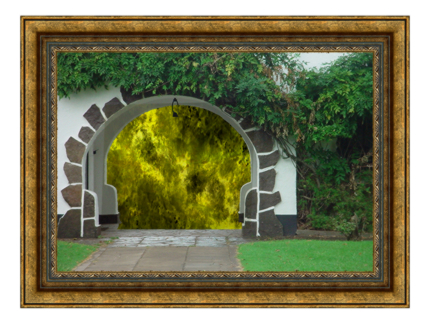
Image based on ‘Delicate Arch 1’ provided by FreeImages.com / Steven Ritts, Vintage Frame Image by FreeImages.com / Stasys EIDIEJUS. Click on the image for 1024×768 version. Click on
This Link for the original photo by Steven.

Parameters

There are a couple of key parameters that readers should bear in mind through the fun and games that follow. I’ve listed six, but there may be others that haven’t come to mind.

Direction

The first, and perhaps most important, is Direction. Portals and Gates can be Mono-directional, Bi-directional, or Unidirectional.

  • Mono-directional: Objects can only pass from one specific end of the Portal or Gate to the other end, and not vice-versa, as though the Portal was a one-way street.
  • Bi-directional: Objects can pass from either end to the other, but travel can only be in one direction at a time, rather like a Stargate, or a road that is too narrow for traffic to pass. Attempts to travel in the other direction when something is already in transit the other way can be blocked (you simply can’t enter the Portal) or can result in a collision of some kind, with the consequences open to the GM to decide.
  • Unidirectional: Objects can pass from either end to the other at the same time.
Permanence

What’s the behavior of the Portal over time?

  • Temporary: Portal lasts for a finite amount of time, and then it’s gone, or changes in nature, or in destination.
  • Enduring: Portal lasts for a very substantial period of time, enough that people start to think that it’s permanent, and start to build plans around it – and then it’s gone, or changed. If it’s affected by “sunspots” or some equivalent, the change may be temporary – and recurring.
  • Recurring, Reliable: Portal isn’t there all the time, but – like old faithful – it appears on a predictable basis. More complex versions may follow a pattern that connects to many different destinations in a predictable manner, or varies parameters in a predictable manner. Still more fun can be had by linking the patterns to different times of year (the zodiac approach) or phases of the moon (the lunar approach) or to some other parameter – anything from the total life-force of the travelers (Hit points) to overall or individual alignment to the amount of magic being carried by each person or by the group.
  • Recurring, Anarchic: This is exactly the same as the last category, but without two key words: predictable and pattern. The Portal is there at unpredictable times for unpredictable durations, and may be consistent in its other parameters, or unpredictable, or even cyclic.
  • Permanent: Portals connect A to B permanently until disrupted or destroyed. Other parameters may change randomly or according to some pattern, but the Portal itself is constant.
Size

While the values for this parameter described below suggest consistency, that’s not necessarily the case.

  • Small: One person at a time can pass through the Portal. Others may have to wait to enter until that traveler arrives, or they may be able to follow like links of sausages. That first variation also introduces the variable of travel time for the GM to play with.
  • Medium: A small group of up to four or five can pass through the Portal together. Anyone more has to wait – see my comment on travel time a moment ago.
  • Large: A wagon or large group can pass through the Portal together in squads or units. Anything up to say, fifty or so at a time. More have to wait.
  • Immense: An army, or a fully-crewed ship, can pass through the Portal together. Travel time can be tactically significant.
Travel

This parameter can be independently assessed for each end of the Portal.

  • Stable: The location of the Portal entrance/exit is fixed in geographic location relative to something. You can add color by having that be something that is unaffected by the growth and erosion of the land around it – so that (on a mountaintop) you have to periodically excavate down to the Gate, or build a platform in order to reach it if the ground elevation has subsided. Perhaps the Portal can only be reached at High Tide?
  • Proximate: The location is relatively fixed, relative to some surface feature, but that feature only defines a locus of probability within which the Portal can be located at any given time. This variable works well if the Portal is recurring, rather than people seeing it move, though fun can be had either way.
  • Defined: The Portal is in one of a set number of locations, usually but not necessarily in close proximity, but which one is prone to change from time to time. This works well if the ‘Portal’ is a Stonehenge-like feature, for example, and which henge leads to the Portal changing either predictably or randomly.
  • Wandering: The Portal moves, either randomly or in a predictable manner, and is not bound to any particular geographic locus. Unless it recurs with great rapidity or doesn’t move very far at a time, this can confuse people as to whether or not it is the same Portal each time. That can be great for generating paranoia if handled properly, but it’s just irritating to all concerned under any other circumstance. But, having a Portal that “walks around the world” in a straight line over a period of time – one or more years – bringing a tactical advantage and/or penalty to first this nation and then that – can add a very interesting new wrinkle to a game setting. If you go this route, I would suggest that the number of Portals in the game be very strictly limited so as not to dilute the effect.
Disruption

Everything always comes out the other end of a Portal at the same size and in the same condition as it left, right? Why should that be so? Portal travel can be profoundly unnatural, and involving all sorts of twisting and stretching and compressing. The effects can be physical, or mental, or spiritual (an alignment shift each time you use a Portal sounds like fun); and temporary or permanent. There may or may not be ways of shielding against, or mitigating, the effects. It can even be a matter of timing, if a Portal is unstable or recurring – stable when it first forms and becoming more disruptive as “the candle burns”, or perhaps starting out as very disruptive, becoming more stable as it “firms up”, and then growing in disruptive force as it begins to fade. Also, contemplate the merits of a fixed degree of disruption vs. a percentage disruption. The first keeps low-level characters out of the things and prevents armies from using them, but the more elite the operative, the better able to cope they are; the second opens the door to more egalitarian usage. Lots of possibilities…

  • Safe: This is what players expect, and it’s the condition that makes it safe for a number of applications of Portals to become interesting. If Portal travel is too difficult or dangerous, other variations won’t matter because they won’t be used – except in extreme circumstances. Of course, if that’s the desired outcome….
  • Irritating: There’s minor and temporary disruption of some sort. No more than 10% HP loss, or a loss of 10% of a stat for an hour or so.
  • Demanding: Either the degree of disruption or the duration of the recovery required go up a notch in seriousness. 30% loss of hit points, or of a stat, for example, or 10% semi-permanent loss, or something intermediate in both. This can be managed but will generally require planning for recovery in advance. Mitigating capabilities begin to become significant at this level of disruption – meaning that some people can use the Portal and others can’t.
  • Difficult: A further advance in the danger posed by Portal travel, to the point of temporary near-incapacitation. Up to 75% loss of hit points, or 50% of a stat, with a reasonably quick recovery – or half that and a slower recovery, or half that again with semi-permanent effects. Mitigating capabilities are very significant at this level of disruption.
  • Dangerous: Whatever the effects of the disruption are significant to the point of making the traveler an easy target. This can be fine, if the destination is into an area held by friendly forces that will protect the traveler until they have recovered – but it makes a Portal a tactical vulnerability to the side that has one as much as it can be a tactical advantage.

One more fun thought: why not adapt the Call Of Cthulhu insanity system for the effects of Portal travel? You start with a temporary quirk that can be overcome, but if you use Portals too often, you end up with a crippling psychosis – and every individual has a different reaction, and threshold before going off the deep end…

Repeatability

There should be some way of disrupting or destroying a Portal, though it may be dangerous. The question is, what happens then? Will a/the Portal reform of it’s own accord, or must a new one be intentionally created? And will it connect with the old destination, or go somewhere new, or something in between?

  • Precise: A new Portal using the same departure point will lead to the same destination point. This implies some cosmological relationship between end points, but it may be so complex as to defy analysis.
  • Self-Locking: A new Portal using the same origin point will lead somewhere close to the old destination point (close being a relative term, of course); over time, the destination point will slowly move back into the old groove until eventually, it is as though there was never an interruption of services.
  • Resistant: A new Portal from the same origin may resist following a path to the same destination; some sort of ‘potential’ which the old Portal link followed has been disrupted or consumed. Wait long enough without trying to re-establish the Portal and conditions may or may not recover. Think of the path between the two end points as being akin to a lightning bolt, following the path of least resistance; the very act of doing so removes the condition that made this the path of least resistance. Another way to think about it might be that the end-point builds up a resistance to the spacially-disruptive presence of a Portal. Or perhaps there is a lot of dimensional disruption that results from the destruction (permanent or temporary) of a Portal that will leave a new one more unstable in one or more respects – again, probably mitigating over time. How long do you have to wait? Who knows enough about Celestial Morphology to even guess? But lots of wizards and philosophers will have opinions, I’m sure! It’s also possible that this resistance can be overcome with the expenditure of greater effort in creating the new Portal; perhaps some sort of artificial/unnatural/arcane mechanism is required, akin to putting up a lightning rod?
  • Vague: A new Portal from the same origin may be directable to some point near where the old one was, but the “healing” of the universe after the old one was destroyed/disrupted has left a “scar” where the old exit was located. Perhaps No magic will work in the immediate vicinity afterwards – that rather depends on just what magic “is” in the specific campaign.
  • Unpredictable: A new Portal from the same origin will connect with another point completely at random, uncontrollably. The best that you might be able to do is ensure that it’s the same plane of existence, or perhaps you can target a region – somewhere within 100km of the old one. This option makes the stability of established Portals all the more significant, and turns the Portal entrances into locations to be very heavily fortified and protected to ensure that no-one disrupts the ‘bond’ connecting them. Which may be exactly what the GM wants the PCs to undertake…

I’ll be repeating the essential contents of this panel at the head of each of the articles that follow, but not the full discussions of possibilities. They need to be kept in the GM’s mind because I’m liable to switch gears between them without notice!

Ideas #1-4 – Temporally unstable Portals

Why do Portals only ever seem to connect with the “now” of their destinations? Is it that time travel is difficulty to manage? If so, I can sympathize – and direct the reader to my trilogy of articles on the subject – (This article, on how to handle alternate histories, might also be helpful).

Or perhaps it is “Too Sci-fi”, demanding a greater understanding of the underlying physics of the game world than the GM wants to invest his energies in creating – though, to my mind that is not only missing a bet, it is a critical error in thinking on the part of the GM. Missing an opportunity because a little sci-fi in your fantasy lends it verisimilitude and credibility that is ten times as hard to achieve in any other way, and because (unlike in real sci-fi) you can be as fuzzy and woolly and grandiose in your thinking as you want, using fantasy elements to fill in the gaps – so you can have all the fun without all the tedious hard work. And a critical error in thinking, as explained in one of my very first articles at Campaign Mastery, A Quality Of Spirit – Big Questions in RPGs.

Maybe it’s “Too Cosmic”, and – as a GM – you’re only interested in low-level adventures when the risks are great and the capabilities limited. That’s fair enough, but it overlooks the potential for low-level adventures or even whole campaigns centered around Portals created by someone else!

Or perhaps, as with the tragic circumstances that led the Apollo 1 fire to be lethal for the three Astronauts on the launch-pad, it is simply a failure of imagination – that it isn’t done simply because most GMs never think of it.

There are four things that Time Travel lets the fantasy GM do that are incredibly more difficult or outright impossible any other way:

  • Directly connect the PCs with the backstory / campaign history;
  • Directly connect the PCs with the consequences of their actions and choices, permitting them to reshape the campaign to their desires;
  • Increase the degree of difficulty and tactical complexity of situations by introducing people from the future that want to change, or prevent change, to what the PCs are doing;
  • Play games with cause and effect that make the improbable possible (and very entertaining) and provide the PCs with a back-door escape from campaign-ending mistakes.

    Go watch Bill & Ted’s Excellent Adventure again to see what I mean – and then follow it up with Terminator 2: Judgment Day, rounding out the “hard work” of “campaign research” with Back To The Future! (Link is to the 30th edition set of all three movies with a fourth disk containing two hours of extra features).

Surely, all that makes it worth thinking about?

I have four ideas to throw at you from this basic category.

Idea #1: The Future

Connecting to the future is a good deal for the GM. It means that the PCs can uncover what’s known about their enemies long after the fact, discover who they are and what they want, and make decisions accordingly, with no risk of altering their own history.

Oh, if only it were that simple! History is written by the winners, and – even to some extent in the modern world with all our ability to capture and broadcast events as they happen – manipulable in significance and interpretation. Don’t believe me? Where do you think conspiracy theories come from? People reinvent the facts to fit their beliefs and ideology all the time, and it’s as easy to swallow and believe a lie as it is the truth. Everyone does it, and after putting it all into a blender, experts come along and write a “definitive” version of history that accords with their values, philosophies, opinions, and preconceptions.

What’s more, history is easily lost and forgotten. The true facts might never have been recorded, or the records lost, or damaged, or simply be equivocal. Historians then romanticize something to fill in these blanks, supported with the best evidence they can find, and that then becomes the “official history”.

The passage of time means that more and more source materials are lost, until only the speculations and interpretations remain; and, since these too, are subject to the ravages of time, inevitably the authoritative accounts become harder and harder to distinguish from the speculations that they supplanted. Because historians always need to be busy doing something to earn their keep, and like to make sense of things as best they can (always taking into account their values, philosophies, opinions, and preconceptions), they rely less and less on these authorities and rewrite the history.

When you can’t tell what’s true and what’s not, the best you can do is go with whatever seems to make the most sense. And that’s completely discounting the distortive effects of propaganda and willful falsehood for political or entertainment purposes. not to mention the capacity for honest mistakes!

100 years after the death of the last participant, the details and specifics begin to grow fuzzy. Four hundred years after that, and specifics of any sort are hard to come by, and reliable ones even moreso. 500 years further, and even generalities are reliant on fragmentary records that need to be interpreted, often completely devoid of context. 1000 years removed again, and most of the records are completely gone without a trace, and beyond broad generalities, reports of reports of reports are often the most reliable sources of information. Languages are changed almost beyond recognition, and vagaries of meaning and word-choice are lost; all that is often left is a literal translation shorn of context and any hope of assessing bias.

The reliability of the information the PCs can obtain decreases with every year into the future they travel; but the unknowns also diminish, filled with something, factual or speculative.

Even today, we’re still learning new things about the events of the Second World War that can completely reshape our understanding of events and why they occurred. Every new revelation only emphasizes how incorrect and incomplete the recorded histories of only ten years ago were.

Examples? Stalin’s motivations and thinking in allying with Hitler are now understood to be a means of buying time (forestalling the inevitable invasion by Hitler’s forces) until his spies could determine the intention of Japan; it was only when he became convinced that the Japanese were not going to again try and invade Siberia that the forces held ready in the East could be released to come West – forces that German Intelligence had either ignored or discounted. That’s one. The state of the German economy under Hitler, perpetually on the precipice of collapse without massive infusions of stolen cash from conquests, explains a lot of previously-obscure objectives and military strategies.

No matter what they learn, there will always be something that’s unknown, something that’s incorrect, something that’s misinterpreted, and something that leads them into a false sense of security. The GM is in total control of their sources of information and can plausibly manipulate it however he sees fit – giving the players all the essential backstory in an entertaining form, while keeping major twists and turns up his sleeve with which to surprise them when the time comes.

On top of that, there will undoubtedly be factions that want to expose future-traveling PCs to willful misinformation in order to manipulate the past in their favor, and groups who simply want to stop the PCs from doing anything at all. For every ally they gain, they add two or three enemies – who will know parts of the truth more clearly than the PCs, and are able to take advantage of it, accordingly!

And all of that presupposes that the Portal connects with the future of the portal’s location, i.e. it’s future self. Things get even more intriguing if you contemplate a portal connecting not with another plane now but with that other plane at some point in the future. How will the Elemental Plane Of Fire change with a couple of centuries, or millennia, under its belt? What hazards will exist that the PCs have never heard or thought of? And how reliable will any information be with planar boundaries to cross?

On top of that – as if all this wasn’t enough already – the very concept of temporal instability suggests that there is no consistency in terms of when the PCs will arrive. This time, it might be next week; next time, 836 years from now. Every time they go there, the destination plane can have changed completely, presenting a new face to the players. Each time, they will have to start from scratch, seeking out new allies and overcoming new enemies and obstacles.

Such a portal is a direct line into adventure and into the backstory of modern events. In fact, the greater danger is that those modern events will be overshadowed by the sheer scope of what is on offer down the rabbit-hole!

Idea #2: The Past

It’s not too difficult to dream up a temporal cosmology that permits the PCs to do anything they want in the past without affecting their own time. A pipeline into the past therefore permits the PCs to interact directly with the causes of the troubles they now face, exploring the context of their situation first-hand instead of being exposed to page after page of exposition or written history. I truly wish I had thought of this option back when I was first contemplating the need for the Orcs and Elves series, it would have saved me a huge amount of time and trouble – and prevented shutting the campaign down for long enough to do the work. Significantly, it has not restarted afterwards!

Connecting to the past means that there are no easy answers on tap to the PCs, no matter how incorrect those answers might be. They will only learn what they go out and discover for themselves. It’s a way to bring the past to life in a way that is infinitely better than just about any alternative that I can think of.

But that’s only after the PCs have figured out where and when they are. If they already know that Portals lead into the past, that’s all well and good; but if they have some desperate plan to solve their problems by sneaking around them across planar boundaries, a surprise trip into the past can be all the more entertaining.

But the fun doesn’t stop there – the easiest way to permit the PCs to act without altering their personal futures is to assume that no Portal or Gate leads to the multiverse of origin, they all lead to parallel-world versions of the multiverse. You also need to postulate some sort of temporal resonance that binds characters who travel by Gate to their own timeline, so that when they return to their present, they really do return to their present.

(Not that doing so will necessarily be as simple as clicking their heels together and saying “there’s no place like home” three times! The Portal they use might be mono-directional, requiring arcane engineering at the destination end to become bi-directional (even temporarily). And if it’s not a temporary change, if it lasts for any span of time at all, they have just opened a doorway for the forebears of their enemies straight into the PCs stronghold).

But this fact, by it’s nature, limits the accuracy and validity of the information the PCs can develop about their own situation. And details that they get wrong can easily get them killed – or in even worse trouble.

Temporal instability always compounds complication with complication, and – from the GM’s perspective – it’s all gravy.

Idea #3: Anarchic Time – Closed

I’ve kind of jumped the gun on this idea a little. Anarchic time Portal travel means the destination is unpredictable. ‘Closed’ means that there is a limiting window within which that destination will occur. This works well with the concept of “critical events” that change the shape of time so radically that you can only get through them the hard way, dividing history into discrete “eras” – travel can be unlimited but unpredictable within the same “era” but not beyond it in either direction. Past and Future are equally probable.

A further option is the “Inverted Closure” – in which unlimited travel back and forth to any other era is possible, but is forbidden within the contemporary era. That means that there are no easy solutions to the problems faced by the PC’s time; recent events, and the consequences of the PCs actions, are fixed and immutable by means of Portal Travel.

This notion works well with the idea that destiny is an overall “shape” to which events will conform, though the details may vary. Something will always happen to bring about the transition between eras; prevent one by meddling in the past, and something more dire will take its place because the defeat of that enemy force has left a vacuum that the new enemy can take advantage of.

There are other ways of closing the temporal options. Perhaps the temporal shift in destination happens with every dimensional transit, no matter how it’s achieved – and is a fixed number of years for each dimensional boundary that must be crossed.

Think about that for a minute. How do you know that a Fire Elemental summoned into the Prime Material Plane is contemporary with the character doing the Summoning? Is it a question you would ever think to ask? Similarly, if you Gate into the City Of Brass, how would you ever know that it was not the contemporary version of the city? It could be from a thousand years in the future or the past, and you would never know – you simply accept it as you find it. You would not even ask the question, “when are we?” – and that throws a new unpredictability into the picture, and a new cause of misinformation into the research of the PCs.

A guiding principle to remember is “Predictability creates opportunity; anarchy creates experiences.” If a phenomenon is predictable, a character can use it to their advantage, can plan for it, and make it beneficial; only the shape and degree of the benefit changes. Unpredictability cannot be integrated into planning except in the form of contingencies – whatever a character finds is what they will experience, and it may or may not be relevant to their purposes in travel.

Idea #4: Anarchic Time – Open

Anarchic time is akin to Quantum Leap, you never know what you’re going to get mixed up in next. There is an interesting analogue to this idea in the form of a well-known principle of Quantum Mechanics, Heisenberg’s Uncertainty Principle; it suggests the concept that you can either know where your destination is, or when you will arrive, but never both. The more accurately you determine one, the fuzzier the other becomes.

This takes away the tactical advantages of Portal Travel, but replaces them with a sense of exploration, of discovery.

But it also opens the door to a whole different class of complications, without the PCs (or anyone from their era) ever setting foot into a Portal.

Picture your PCs going about their business when a Future Traveller pops up and tells you, “You must do [x] or everything will be lost,” and proceeds to spin a horror story of how ruined everyone’s lives will be if the PCs don’t agree. Alignment tests, etc, show that the time traveler is lawful good and being completely honest, and he is carrying bonafides that are quite convincing. And so the PCs set forth – only to be intercepted by another time traveler who tells them, “On no account must you ever do [x] or everything will be lost,” and proceeds to spin an entirely different horror story of how ruined everyone’s lives will be when the golden age promised by the first time traveler falls apart. Once again, his bonafides are impeccable, and he is Lawful Good, and telling the absolute truth. And, at the same time, unknown to all concerned, a third time traveler is warning the target of action [x] that the PCs are coming to tear his world apart, and he must stop them before it’s too late; and a fourth is somewhere else, warning the PC’s government that they are about to precipitate a conflict with the target of [x] and have to be stopped by any means necessary.

Without warning, the PCs are now ground zero in a Time War. Their enemies know they are coming, and are acting to stop them doing something they aren’t sure they want to do anymore, their allies have turned against them, and no matter what they choose, there will be someone pulling strings to make sure it is the wrong choice (from the point-of-view of their personal comfort and safety).

And, perhaps, to top it all off in a Twelve Monkeys twist, they are all working from misunderstood fragments of misinterpreted history, and [x] is not the critical event, it is the time travelers putting forces in motion to achieve or prevent [x] that makes doom inevitable – right up to the very last instant, when the PCs can rewrite history by doing the unthinkable and making peace with someone who temporal manipulation has made their enemy, no matter how undesirable and untrustworthy that individual might be…

The one thing that can be counted as fact concerning any conflict is that there will be at least two contradictory opinions over the justification of the conflict and outcome. Any time traveler with the capability must be sorely tempted to kill Adolf Hitler before he starts World War II – but what if that places the Nazis under the command of Heinrich Himmler, or Hermann Göring, possibly making the situation worse? Hitler ruled Nazi Germany with an iron fist, but there were times when his decision-making process was dubious; this led to spectacular victories, but many of these were all-or-nothing gambles, and eventually one was unsuccessful. Both Himmler and Göring were more cautious, and possibly even more ruthless and fanatical (it must be remembered that Göring appointed Himmler head of the SS because he thought the incumbent was not ruthless enough). It’s easy to imagine another time traveler trying to undo the damage being done by the first!

In fact, that’s one of the central themes of one of my favorite books, The Proteus Operation by James P. Hogan.

That’s the sort of fun that Anarchic Open portal travel lends itself to creating.

Idea #5 – The Neighbor Of My Neighbor Is Closer Than You Think

I’m going to close out this first part of the series by stepping outside the Time Travel group of ideas to revisit an option that I mentioned at the very start of the article. Portals effectively distort spacial relationships – and if you don’t know there is such a portal, the consequences can be a very nasty surprise indeed.

But that’s fairly traditional thinking – Teleport always been used as a means of getting forces behind enemy lines. Portals and Gates are just a more structured and permanent way of achieving the same thing, perhaps on a larger scale. That, after all, is the principle theme of Raymond E. Feist’s Riftwar Saga and its sequels.

But what if rifts formed spontaneously from time to time – and you had a prophecy that told you when one would form, and where it would lead? Or simply knew that a neighbor nation was working on a way to make one? What political and military maneuverings might you undertake in preparation for the day when the connection was established?

The whole principle of trade, for example, is based on the scarcity of objects and materials in one place relative to another; buy those commodities where they are plentiful, and therefore cheap, and transport them to where they are rare, and hence expensive, with the price going up with every league traveled. If a portal is going to reliably connect that plentiful region with that region of demand, reducing the travel time to a day or two, isn’t that essentially the same thing as having that resource-production area physically only a day or two away? Does the portal open the way for your armies to encircle an enemy? Or simply open a new front in a war?

Do you think the people who are going to be disadvantaged would ignore the threat if they knew it was coming? Or even suspected that it might be?

I once read somewhere that logistics, more than any other factor, determine the outcome of wars. And Portals – even to other planes of existence – can change the logistics. Tactically secure positions become vulnerable, while tactically vulnerable positions may have an army of reinforcements just a few paces removed.

The more control you have over such portals – and the more readily you can create them – the greater their military impact. A portal can be every bit the super-weapon of a fantasy campaign, and should be treated accordingly; the discovery of unsuspected and almost unlimited gold deposits pales in comparison. How much fun can you have with that? Try reading The Redemption Of Althalus by David and Leigh Eddings, one of my favorite Fantasy novels, and then argue the point.

What if the US was suddenly physically a part of Europe – perhaps connected by the equivalent of a narrow land bridge? Or Barsoom?

How would the US react if it was Mexico that suddenly had that connection – and it was to the Middle East, or Southeast Asia? How would China react? Pakistan? North Korea?

What extra-planar physical resources are out there, and what can you do with them – if you could only bring them back? How might your neighbors react? How might the neighboring planes react to the one taking the resources?

Food for thought, isn’t it?

To Be Continued…

This is just the beginning – I have 15 more nasty tricks that you can surprise your players with that are still to come in this series!

Comments (7)

All Over Bar The Shouting: Fantasy Tavern Generator Pt 6


This entry is part 6 of 6 in the series Mike's Fantasy Tavern/Inn Generator
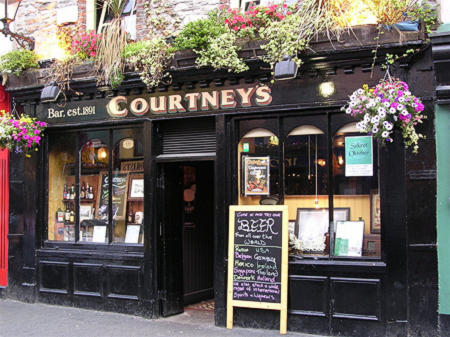
Irish Pub image provided by FreeImages.com/Benjamin Flux

Image provided by FreeImages.com/Benjamin Flux

Part one of this series used six tables to define the physical properties of a tavern (no guest accommodations) or inn (with guest accommodations), plus – because the modifiers needed were at hand – the meals provided by the kitchens.

Part two used another six tables to determine everything that directly contributed to the ambience of the establishment, from the personality of the owner through to the decorations on the walls. In this final part of the generator, we’ll deal with the bartender’s family and process the worksheets that bring the whole tavern or inn together, ready for use.

Part three used another five tables and subtables and one worksheet to populate the extended-family-in-residence and establish what entertainments the tavern provides to keep the punters happy. That was supposed to be the final part (aside from a behind-the-curtain techniques discussion to be written down the track), but the examples grew uncontainably large, so the decision was made to separate the worksheets from the final set of rolls.

Part four contained the first worksheet, and provided detailed instructions for use (together with some tips and tricks for getting exactly the result you want from the generator.

Part five contained tables 17a through 17h and 18a through 18d – everything needed to generate the second level of the tavern or inn, which is usually where the owners reside, and where there will be guest accommodations if the tavern is also an inn. But there wasn’t room for the examples.

Which brings me to this penultimate part in the series – Worksheets 19a through 19c, Tables 18f through 18j, and Worksheets 20a through 20i, which detail the remaining levels and the tavern patronage.

Still missing – squeezed out to make room for extra tables – is the completion of the examples, yielding three finished taverns for GMs to use in their own campaigns. And I have one additional “behind the scenes” article detailing many of the tricks and techniques used to create these tables, so that other GMs can use them.

I have to apologize for the lateness of this article, on two grounds.

First, it took a lot longer to write than expected – the length shows that I wasn’t dilly-dallying but it still took a long time. There were a couple of dead ends that I chased myself down; in the end, I generated more pages in hand-written notes for this one part of the series than for the entire rest-of-series put together.

Secondly, this should have posted yesterday, or – if it wasn’t going to be ready – reshuffled the publishing schedule to put up a filler article. I’ve done that before, and consider that to be a lesser evil than missing deadline. The problem is that this was so close to being finished that – while I knew it would be a tight squeeze – I was certain that it would be finished in time, give-or-take an hour or so.

I didn’t count on my brain frying late in the day – with about six hours work to go. I struggled on for several more hours at a diminishing fraction of my normal productivity, but by the end of my endurance I was still about three hours short of completion. Hence the delay – I not only had to do that three hours of work, but fix a mess of mistakes made while I was struggling.

So, Mea Culpa – I missed the deadline, but I got here in the end.

Worksheets

Tavern Generator (cont): Worksheets 19a-19c: Upper Floor Calculations Worksheets

As usual, we pick up the process right where we left off; the basic principles and general technique remain the same. Note that it is impossible to use this content without having completed the earlier parts of the process.

Table 19a: Second Floor Calculations Worksheet

In the process of working out what you were doing for the first residential level, you also made all the decisions necessary for all the other residential levels, so this worksheet is much simpler (and resembles Table 17h). To further simplify it, a cheat has been employed that uses any leftover space for storage – probably for linen, cleaning products and tools, and so on.

We start by allowing for a cheat that may have been specified earlier: the substitution of a “suite” for any family accommodations. If this option hasn’t been employed, any family accommodations on the first floor have to be replaced with additional guest rooms on subsequent floors. After calculating the number of relative spaces to be filled, we divide the result by the relative size of the guest rooms (and round down) to determine how many will fit, and note the result as (m). To this, we add the number of guest rooms located on the first floor.

With this total as a guide, we set the number of guest rooms to be located on this floor. You have many options here – the number can be greater than the guideline, indicating that this level of the inn is larger than the first floor, or smaller – refer to the sidebar that follows the table for some of the many options available to the designer.

I would also pay special attention to the amount of storage space from the first floor and how close to the next value up the rounding was in the division above – “2.9” will round down to 9, but if there was a lot of storage space on the first floor, you could allow a little less space for that purpose on this level by trimming the storage space.

Once you have determined how much space is consumed by guest accommodations (including connecting corridors), we make the usual allowances for stairs up (which there may not be, if this is the upper level of the inn), stairs down (which there have to be), any other spaces that have been designated as appearing on this level, and then determine the subtotal of allocated spaces. Subtracting this amount from the total indicates how much space is used for storage, since that’s the only purpose we haven’t set aside room for.

While you could continue down the worksheet at this point, while the particulars are all fresh in mind, I would calculate the actual sizes and adjust them, as usual, in the spaces on the right-hand trio of columns, before continuing.

After doing so, you move on to the third part of the table, in which you calculate the number of guests that can be accommodated on this level, and establish and maintain a running total of the total guest capacity. Once you have done so, you’re ready to progress to a third level, and even a fourth level, in exactly the same way.

1Worksheet

Instructions Working         Calculated
Areas
[Relative Size
x (l)]
(from Part 5)
Area Adjustments Final Areas
Size family accomm, 1st floor
+ relative size “other” 1st floor spaces = + =
– relative size suites on this floor = =
/ relative size guest quarters, round down = (m) / =
+ # guest rooms, 1st floor = + =
# guest rooms, this floor (n) =
x rel size guest accommodations = x =
+ stairs up = + =
+ stairs down = + =
+ other spaces (if any) = (o) + =
total spaces, 1st floor (guideline reference)
total spaces, this floor
– (o) = storage space this floor =
total footprint, this floor
total footprint, ground floor (for comparison)
(n)
– rooms occupied by extended family = =
x #guests/room (range) = x =
+ #guests in suites (if any) +
= #guests accommodated on this floor =
+ #guests accommodated on previous floors +
= total guests accommodated =
Sidebar: Possible layouts and relative level sizes

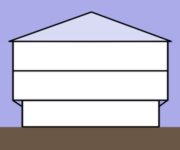
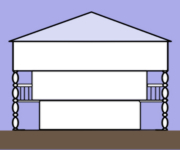
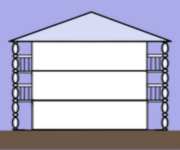
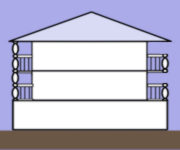
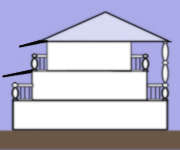
Below, I have illustrated half-a-dozen of the innumerable layout possibilities with reference to floor areas alone.

Figure 1

Figure 1

Figure 2

Figure 2

Figure 3

Figure 3

Figure 4

Figure 4

Figure 5

Figure 5

Figure 6

Figure 6

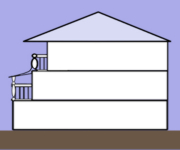
Figure 1 shows what is perhaps the most common and recognizable configuration. The ground floor is (slightly) smaller than the residential floors.

In Figure 2, the first floor is significantly larger than the ground floor, and has a balcony (not considered part of the footprint of the floor). The second floor is significantly larger again, requiring support from below. The balcony therefore forms a canopy over the surrounds of the ground floor. Two such buildings can be almost side-by-side, separated by mere feet, and there is still enough space to form an alleyway between them for foot traffic or access to an attached stables.

Figure 3 is another familiar layout. All three floors have the same footprint, but the above-ground floors have balconies (not considered part of those footprints). This is typical of the Western Saloon.

Figure 4 will also be familiar to most readers, especially those from Australia; it is that of the quintessential Outback Pub (or would be if it were not for the presence of a third level, which is uncommon). The two residential levels are smaller than the ground floor, permitting them to have balconies. Additional roof support is shown on the left-hand side, but might not be needed, as shown on the right.

Figure 5 is similar to the previous layout, but with each level progressively smaller, producing a more Mediterranean impression. Roof supports may or may not be needed, enabling awnings, as shown on the left. This does not work if roof support is needed, as shown on the right, but this arrangement – although it looks strange – ensures that each residential level is well-shaded, and hence may be found in hotter environments, or where construction materials of sufficient strength are not available.

There is absolutely nothing that states that buildings need to be arranged symmetrically, as Figure 6 illustrates. Each level is still smaller than the one below it, and it still has balconies and awnings, but what is obviously the back of the building presents a flat facade to whatever lies behind. There have also been occasions when what we consider the back in this illustration was in fact the front (and heavily reinforced against attack), with the balconies facing away from the source of danger; arrange many such structures next to each other without gaps, and you present a fortified “wall” to the world. However, this was more normal in cases of individual dwellings and not those providing public accommodations, because the strangers residing there would not be as readily trusted as known families. Nevertheless, string many such “buildings” of narrow width in a semi-detached row and you have something that would serve as an Inn.

Worksheet 19b: Third Floor Calculations

Instructions as per Second Floor.

1Worksheet

Instructions Working         Calculated
Areas
[Relative Size
x (l)]
(from Part 5)
Area Adjustments Final Areas
Size family accomm, 1st floor
+ relative size “other” 1st floor spaces = + =
– relative size suites on this floor = =
/ relative size guest quarters, round down = (m) / =
+ # guest rooms, 1st floor = + =
# guest rooms, this floor (n) =
x rel size guest accommodations = x =
+ stairs up = + =
+ stairs down = + =
+ other spaces (if any) = (o) + =
total spaces, 1st floor (guideline reference)
total spaces, 2nd floor (guideline reference)
total spaces, this floor
– (o) = storage space this floor =
total footprint, this floor
total footprint, ground floor (for comparison)
total footprint, first floor (for comparison)
(n)
– rooms occupied by extended family = =
x #guests/room (range) = x =
+ #guests in suites (if any) +
= #guests accommodated on this floor =
+ #guests accommodated on previous floors +
= total guests accommodated =
Fourth Floor Calculations Worksheet

Instructions as per Second Floor.

1Worksheet

Instructions Working         Calculated
Areas
[Relative Size
x (l)]
(from Part 5)
Area Adjustments Final Areas
Size family accomm, 1st floor
+ relative size “other” 1st floor spaces = + =
– relative size suites on this floor = =
/ relative size guest quarters, round down = (m) / =
+ # guest rooms, 1st floor = + =
# guest rooms, this floor (n) =
x rel size guest accommodations = x =
+ stairs up = + =
+ stairs down = + =
+ other spaces (if any) = (o) + =
total spaces, 1st floor (guideline reference)
total spaces, 2nd floor (guideline reference)
total spaces, this floor
– (o) = storage space this floor =
total footprint, this floor
total footprint, ground floor (for comparison)
total footprint, first floor (for comparison)
(n)
– rooms occupied by extended family = =
x #guests/room (range) = x =
+ #guests in suites (if any) +
= #guests accommodated on this floor =
+ #guests accommodated on previous floors +
= total guests accommodated =

Tables 18f-18j and Worksheets 20a-20i: Bar Patronage Calculations

The last tables! The final worksheets! This set of calculations is used to work out the capacity of the bar area, based on my own observations and a bit of research into crowd densities.

Process Overview: Clear Sequence

I’m describing the process in the sequence which explains it most clearly for the reader, NOT the sequence in which calculations are most conveniently carried out, which is what I have used to design the worksheet.

The basic principle is simple: determine the maximum density of patrons that can be accommodated, making the assumption that if more wanted to use the facilities than this, they would go elsewhere (as there is clearly enough demand to justify a rival), while if there were fewer patrons than can be accommodated, some of the space would be dedicated to some other activity that might entice greater patronage. Certainly, this is a flawed assumption; areas would have been allocated based not on current demand but on some past estimate, and may even allow for some future rise – or fall – in demand.

The peak hour or hours of patronage are then determined, which gives the hours in which patronage is assumed to be at this peak value, i.e. that have a Capacity-In-Use Value of 100%. Consulting reference tables provided which can integrate three daily peaks – sufficient for a 24-hour-a-day operation servicing shift workers – Capacity-in-Use adjustments are then made, assuming that the minimum demand is 5%. However, this assumption will rarely be correct; so the next step is to correct for the genuine minimum Capacity-in-use that the GM desires.

Combining these values then yields a table by which the GM can determine the size of the crowd at the bar at any time of the day that it is open – another decision he gets to make, of course.

Finally, the GM can use the same system to determine the number of seated patrons on an hour-by-hour basis; combining these two values will determine the total number of patrons present regardless of when the PCs enter the inn.

Process: Logical Sequence

Keep that nice neat picture in mind, because it’s not quite that simple, and it’s quite easy to lose track of the relevance of what you are doing moment-to-moment when caught up in a mass of detail.

Here’s an outline of the reality:

  1. Tables 18f, 18g, and 18h converts the drink menu results from table 9 into a “meal equivalent”. You’ll note lots of empty spaces in these tables that result from the cherry-picking of results in the generation tables!
  2. These are then used on Tables 18a and 18b (which appeared in Part 5 of the series) to determine Domestic Demand and Passing Traffic demand, exactly as was done for meals.
  3. Worksheet 20a then combines these values to determine an overall demand for alcoholic refreshments in the area. This is an almost-exact copy of Worksheet 18c.

Side-note: as noted in the previous parts of this series, you can use the 18a/18b tables and the 18c worksheet to determine the demand for ANY commodity from ANY retailer based on the economy, passing traffic, and price – all you need is some system to convert the price into some “meal equivalent” as I have done here.

  1. Tables 18i and 18j calculate factors that are applied to determining how much market share of the available demand this particular institution receives in a more sophisticated and accurate way than that used for meals. To use table 18j, a brief calculation is carried out in Table 20b.

Side-note: I thought carefully about going to all the trouble of these two worksheets. Ultimately, I decided that while you often can’t judge the quality of food until you’ve actually paid for a serving placed in front of you, most drinks aren’t brewed on the premises and hence would have a consistent reputation that could reliably be used as a guide to the desirability of a particular offering. That means that food demand will be reasonably evenly spread amongst the available suppliers, while choice of available libation is something that can be made with some certainty before you order – and if what’s on offer doesn’t suit, you’re more likely to go somewhere else until you find one that does. So the simpler “divide by the number of competitors plus one” approach will work for food, but not for drinks.

  1. Worksheet 20c combines these and other factors (most of which have already been determined in earlier parts of the generation process) to determine a Popularity score for this institution relative to its competition, and how many effective competitors this institution actually has. The Popularity score is for information only, giving the GM a guide to the way the institution will be perceived locally; the effective number of competitors is then used to calculate this institution’s share of the market. Finally, it combines that result with the overall demand calculated above to get the peak bar demand for the tavern, relative to its capacity.
  2. Worksheet 20d then determines the peak capacity of the bar by first calculating the Patron Density at 100% demand, and then applying the size of the bar to get a total head count at peak demand.
  3. Worksheet 20e then generates a series of demand curves for use in worksheets 20f-i, showing how each demand peak will build up and then fall off.
  4. Worksheets 20f, 20g, 20h, and 20i break the day into hourly demand values. Up to four daily peaks in demand can be accommodated, but two – at lunch and at the end of the working day, or even only one – are more common. There are numerous exceptions, however, which are discussed in the relevant subsection. In reality, this is one massive worksheet, but practicality required that it be broken up; I tried using blocks of 2, 3, or 4 hours, but it didn’t work, the results were too coarse. After each hour is populated with values from Worksheet 20e for each peak, the total hourly demand is calculated. Where peaks overlap, or demand is high, it may be greater than the bar can service; some people will order meals while they wait, some will go elsewhere, some will seek entertainment – either that provided by the tavern or from some other source – and some simply go home. A series of adjustments is applied to the demands to allow for these factors, effectively telling the story of the clientèle. This yields the percentage of bar capacity in use at any given hour of the day that it happens to be open. Factoring in the results from Worksheet 20d converts these percentages into an actual head-count.

The end result is such that at any hour of the day when a PC enters the tavern, the GM can tell how crowded the bar is, and know something about the makeup of the clientèle. Between this information, and that determined in preceding parts of the Tavern Generator, the GM will know just about everything there is to know about the place (except perhaps how profitable it is)!

So, it’s drinking game time…

Random Capacity-In-Use

If you want to use a random roll to determine the capacity in use for a tavern that is not going to be visited repeatedly within the campaign, I recommend [1+(d10x10)-d10]% – or simply d10x10% for a faster, more approximate roll. This enables you to skip straight through to the section on Patron Density.

Tables 18f, 18g, and 18h: Libations to meal equivalents

This set of three tables converts the drinks options on offer that were determined in Table 9 into a “roll” on the meal table (Table 5) so that the result can then be used in Tables 18a and 18b.

Table 18f is very simple: cross-reference the number and quality of the common libations on offer and get a score.

Tables 18g and Table 18h give modifiers to the resulting value for Uncommon and Rare drinks, respectively. All that you need do is look up the values and get the total, then use that as the roll on table 5 (in Part 1 of the series) to get the price.

My efforts to keep Table 9 manageable came back to bite me in working out these tables, big-time. Consider: 1-3 drinks that are popular locally, of five possible grades of quality, plus 0-4 uncommonly-demanded drink options of 5 possible quality grades, plus 0-3 rare drink options of 5 possible grades – that’s a total of 3x5x5x5x4x5 = 7,500 possible combinations that I managed to squeeze into a single table of 36 results – by cherry-picking outrageously from amongst the 7.5K.

In hindsight, I would have been better off doing three tables, one for each degree of rareness – one table of 15 results, one of 25, and one of 20, and having a complete range of results.

When it came time to work on these tables, I found that I didn’t have enough variety of results to accommodate a complete spread of conversions covering all the possible “table 5” results. Although I worked out a system, there were so many gaps I couldn’t tell whether or not it made real sense – and certainly, not every possible result on Tables 18a and 18b were being represented.

Fixing the latter problem meant fudging the contents of tables 18g and 18h – which is why they seem rather anarchic. In effect, I was forced to compromise realism to obtain usefulness. So don’t be surprised when the table values don’t appear to make sense – but do seem to hint at an underlying logic; your mind is not playing tricks on you, there really are patterns partially there.

No Dice Used

Meal menu score equivalent by Common Libations Offered and Quality
Number of Drinks Offered Quality
V. Poor Poor Average Good Excellent
1 3 4 5
2 4 5 6 7
3 6 7 8

(NB: There are no values for excellent, or for 3 drinks of very poor quality, or for 1 drink of good quality, because these do not appear amongst the results of table 9. The pattern should be fairly obvious; if you want to complete the table, the only extra thing you need to know is that “excellent” should be worth an extra +1, so the column should read 8, 9, 10.)

No Dice Used

Meal menu score equivalent modifier by Uncommon Libations Offered and Quality
Number of Drinks Offered Quality
V. Poor Poor Average Good Excellent
0 +0 +0 +0 +0 +0
1 +2 +3 +5
2 +2 +3 +5 +7
3 +8
4 +7 +10 +12

(NB: Lots of missing values for the reasons explained earlier, and the values in the table have been tweaked to achieve a specific result in a completely unrealistic way. The values should start top left with 2 (ignoring the not-offered row), and go up by 1 each step across the table, with good worth an extra +1 and excellent worth an extra +2; the next row then starts with 3, and follows the same pattern, and so on, i.e. Row 1: +2, +3, +4, +6, +8; Row 2: +3, +4, +5, +7, +9, etc. I know it doesn’t look anything like that…)

No Dice Used

Meal menu score equivalent modifier by Rare Libations Offered and Quality
Number of Drinks Offered Quality
V. Poor Poor Average Good Excellent
0 +0 +0 +0 +0 +0
1 +2 +5
2 +7

(NB: And if the previous table was underpopulated, how would you describe this? Mostly missing values, and the values in the table have been tweaked to achieve a specific result in a completely unrealistic way. The values should start top left with -3 (ignoring the not-offered row), and go up by 2 each step across the table, with good worth an extra +1 and excellent worth an extra +2; the next row then starts with -2, and follows the same pattern, i.e. Row 1: -3, -1, +1, +4, +7; Row 2: -2, +0, +2, +5, +8. I know it doesn’t look anything like that. The logic behind the penalties to the result is that having a poor but rare option is more likely to turn potential clientèle hostile than encourage them to return; it’s effectively conning them with promises of something special and then failing to deliver.)

(Also, the ranges of results would then need to be adjusted. Results from common drinks are equated to results from 3-8; with uncommon, but no rare, from 9-15; and with both rare and uncommon, from 16-20. These correspond to small meals, large meals & hearty meals, and feasts, respectively.)

Look up the total of result on Table 5 as though it were a die roll and get the price from the last column.

Tables 18a and 18b lookups

For the next steps, you need to know the Local Economic Index and the Passing Trade Index, both determined in Part 5. All you have to do is cross-reference these with the “price” result and note the resulting Local Demand and Passing Trade scores.

The result from Table 18a is referred to as (p) on the following worksheet, and the result from Table 18b as (q).

Worksheet 20a: Overall Refreshment Demand

This is worked in exactly the same way as Worksheet 18c. It is biased toward local demand because passing traffic can ebb and flow, even on the most-used thoroughfares, while the locals form a reliable foundation for a business.

1Worksheet

Worksheet 20a: Overall Refreshment Demand
Instructions Values Results
Meal Demand, Local (p)
+ Meal Demand, Passing (q) + =
x Meal Demand, Passing (q) x = (r)
Meal Demand, Local (p) x 2 =
+ (r) = Overall Demand

Worksheet notes:
Demand is on a scale of 1-10. Demand >7 will attract at least one competitor, Demand >10 will ensure the presence of at least 1 competitor.

Demand Adjustment Factors

There are several of these, and many of them have been encountered previously in determining the meal demand. However, while the previous decisions may have been correct in terms of meal demand, and may provide a guideline for bar demand, the GM should not feel himself bound by the previous answers, even on things that seem like they would not change – for example, owner’s greed. It’s quite possible for a person to be greedy where one service is concerned and generous in another; this could indicate an ulterior motive, or the view that one service is his bread-and-butter while the other is an inconvenience for which customers should pay through the nose. Just as important as deciding the answers is deciding what those answers tell you about the institution and the people who own and run it.

Tables 18i and 18j determine the first two adjustment values. The others are determined according to the following interpretation:

  • Demand is greatly reduced: x0.77, round down
  • Demand is somewhat reduced: x0.87, round down
  • Demand is slightly reduced: x0.95, round down
  • Demand is generally unchanged: x1
  • Demand is slightly increased: x1.05, round up
  • Demand is somewhat increased: x1.15, round up
  • Demand is greatly increased: x1.3, round up

These are exactly the same as the values used in determining meal demand.

The criteria are shown in table 20b, which follows, and which has space for the results to be entered.

Table 18i: Corrected Common Room Area vs Corrected Tabled Area

There are two ways of comparing demand-for-meals with demand for refreshments. Neither tells the whole story on it’s own, so both are taken into consideration. The tabled area can be used both for patrons who are drinking and for the eating of meals, while the Common Room (aside from cheap overnight accommodation for those who can’t afford or won’t pay for a room) is only used for patrons who have bought refreshments from the bar. So the relative sizes of these two areas is one way to compare the relative priority placed on refreshments vs meals in any given establishment.

For this table to work, it is critical for both spaces to be measured in the same units. It doesn’t matter what those units are, just that they be the same for both. Don’t get confused!

If there is any doubt, use the lower table entry, eg a value of exactly 1.75 could be at the top of one range or the bottom of another; always use the choice that places it in the column to the left or the row that is higher up.

No Dice Used

Table 18i: Common Room Size vs Tabled Area
Tabled Area (TA) is: Adjusted Common Room Area (ACRA) is: Demand Modifier (s)
(used in Table 20b):
>2 1/2 x ACRA >2.5 x ACRA <2/5 x TA <0.4 x TA x0.77 & round down
1 3/4 – 2 1/2 x ACRA 1.75 – 2.5 x ACRA 2/5 – 4/7 x TA 0.4 – 0.57 x TA x0.87 & round down
1 1/4 – 1 3/4 x ACRA 1.25 – 1.75 x ACRA 4/7 – 4/5 x TA 0.57 – 0.8 x TA x0.95 & round down
4/5 – 1 1/4 x ACRA 0.8 – 1.25 x ACRA 4/5 – 1 1/4 x TA 0.8 – 1.25 x TA x1 & round off
4/7 – 4/5 x ACRA 0.57 – 0.8 x ACRA 1 1/4 – 1 3/4 x TA 1.25 – 1.75 x TA x1.05 & round up
2/5 – 4/7 x ACRA 0.4 – 0.57 x ACRA 1 3/4 – 2 1/2 x TA 1.75 – 2.5 x TA x1.15 & round up
<2/5 x ACRA <0.4 x ACRA >2 1/2 x TA >2.5 x TA x1.3 & round up
Worksheet 20b: Table 18j indexes

The second way to compare the relative priority placed on refreshments vs meals is to compare the sizes of the areas devoted to supplying the two commodities to patrons – in other words, comparing bar size with total kitchen size. That will happen in Table 18j, but to use that table, you need to do some minor calculations to determine what values to look up on that table.

1Worksheet

Worksheet 20b: Indexes values for table 18j
Instructions Values Results
Actual Size: Food Prep Area
+ Actual Size: Cooking Facilities + =
+ Actual Size: Pantries etc + =
/ Size 2 = Kitchen Index (t) / = (t)
Actual Size: Bar Area
+ Actual Size: Wine Cellars etc + =
/ Size 2 = Bar Index (u) / = (u)
Table 18j: Kitchen Index (t) vs Bar Index (u)

Simply take the values determined in the previous worksheet and look them up. If there is any doubt, use the lower table entry, ie the column to the left or the higher row.

No Dice Used

Table 18j: Total Kitchen Size (t) vs Bar Size (u)
Kitchen Size Index (t) Bar Size Index (u)
<1 1 – 1.5 1.5 – 2 2 – 2.5 2.5 – 3.5 ≥3.5
≤0.5 x 1.05 up x 1.3 up x 1.3 up x 1.3 up x 1.4 up x 1.5 up
0.5 – 0.75 x 1.05 up x 1.15 up x 1.3 up x 1.3 up x 1.35 up x 1.45 up
0.75 – 1 x 1 x 1.05 up x 1.15 up x 1.3 up x 1.35 up x 1.4 up
1 – 1.25 x 1 x 1 x 1.15 up x 1.15 up x 1.3 up x 1.35 up
1.25 – 1.5 x 0.95 down x 1 x 1.05 up x 1.15 up x 1.3 up x 1.3 up
1.5 – 2 x 0.87 down x 0.95 down x 1 x 1.05 up x 1.15 up x 1.3 up
2 – 2.25 x 0.87 down x 0.87 down x 1 x 1.05 up x 1.15 up x 1.25 up
2.25 – 3 x 0.77 down x 0.87 down x 0.95 down x 1 x 1.05 up x 1.2 up
3 – 4 x 0.7 down x 0.77 down x 0.87 down x 0.95 down x 1 x 1.15 up
4 – 4.25 x 0.7 down x 0.77 down x 0.87 down x 0.95 down x1 x1.05 up
4.25 – 5 x 0.66 down x 0.77 down x 0.77 down x 0.87 down x 0.95 down x 1
5 – 5.25 x 0.66 down x 0.7 down x 0.77 down x 0.87 down x 0.95 down x 1
5.25 – 7.25 x 0.6 down x 0.7 down x 0.7 down x 0.77 down x 0.87 down x 0.95 down
>7.25 x 0.6 down x 0.66 down x 0.7 down x 0.7 down x 0.77 down x 0.87 down
Worksheet 20c: Popularity & Competitors

This is another worksheet whose contents should – at least in part – look quite familiar, being very similar to Worksheet 18d. Three sets of calculations are actually carried out on this worksheet; the first assesses this establishment’s popularity and the impact on demand that results, and the second and third then turn the process on it’s head and determines exactly how many effective competitors that it has.

The term “effective competitors” needs a little clarification before we proceed. A competitor who is more popular than the establishment being considered will count as more than “one equal competitor”. At the same time, anything that this establishment does to increase its market share also reduces the market share available for the competition, and vice-versa. (Technically, to at least some extent, it’s a zero-sum game; there are only so many customers to be divided up amongst all those who want them).

The first calculation modifies the demand levels determined in Worksheet 20a for various factors by multiplying the running total by the effects of one consideration after another until we’ve covered them all. The second starts with the base number of competitors determined by the GM on the basis of the “global” demand (again, Worksheet 20a) and assumes that whatever this establishment does (with exceptions), the others will do the exact opposite, at least in comparison, calculating the effects of these factors on their demand relative to this establishment. Finally, the third set of calculations takes the result and applies the effects of this establishments popularity factors to determine what influence they have on the relative strength of the resulting number of competitors. The end result of this third column of calculations is the total number of effective competitors relative to the popularity of the subject tavern, which is then used in a quick post-script calculation to determine the exact market share this tavern currently enjoys.

1Worksheet

Worksheet 20c: Popularity, Effective Competition, & Market Share
Calculation Set 1
Instructions Working Results
Base Demand from Worksheet 20a
x Adjustment factor from Table 18i x =
x Adjustment factor from Table 18j x =
x Adjustment factor for Actual prices vs fair price x =
x Adjustment factor for exceptionally low or high overhead and staff costs x =
x Adjustment factor for Owner’s generosity/greed x =
x Adjustment factor for Exclusive deals, captive markets, and targeted clientèle x =
x Adjustment factor for X-factors affecting this establishment x =
x Adjustment factor for competition/price wars (if any) (or lack of same) x
= Popularity of this establishment (1-10 scale) =
Worksheet 20c: Popularity, Effective Competition, & Market Share
Calculation Set 2
Instructions Working Results
Number Of Competitors
+ 1 – Adjustment factor from Table 18i +1 – =
+ 1 – Adjustment factor from Table 18j +1 – =
+1 – Adjustment factor for Actual prices vs fair price + 1 – =
+ 1 – Adjustment factor for exceptionally low or high overhead and staff costs + 1 – =
+ 1 – Adjustment factor for Owner’s generosity/greed + 1 – =
+ 1 – Adjustment factor for Exclusive deals, captive markets, and targeted clientèle + 1 – =
-1 + Adjustment factor for X-factors affecting only competitors -1 + =
x Adjustment factor for competition/price wars (if any) (or lack of same) x
= Base Value for Calculation Set 3 =
Worksheet 20c: Popularity, Effective Competition, & Market Share
Calculation Set 3
Instructions Working Results
End Result Of Calculation Set 2
/ Adjustment factor from Table 18i / =
/ Adjustment factor from Table 18j / =
/ Adjustment factor for Actual prices vs fair price / =
/ Adjustment factor for exceptionally low or high overhead and staff costs / =
/ Adjustment factor for Owner’s generosity/greed / =
/ Adjustment factor for Exclusive deals, captive markets, and targeted clientèle / =
x Adjustment factor for X-factors affecting only competitors x =
+ 1 – Adjustment factor for competition/price wars (if any) (or lack of same) + 1 –
= Effective Total Competitors of Equal Popularity =
+1 for this establishment = (v) +1 = (v)
Demand
x Popularity, this establishment = (v) x =
/ (v) /
= Market Share (%) =

Worksheet 20d: Peak Capacity

It’s all well-and-good to say that an establishment is “full” or “crowded” or “jam-packed” or even “at 100% capacity” but what do those numbers actually mean? Believe it or not, there is some statistics that can be used to determine an answer.

The common area can be divided into three areas: the tabled section, which we’re already treating separately, and which can accommodate a set number of people (1 per chair, basically); an area equal to that of the bar, which will be at peak patron density (I’ll get to that in a minute); and a fraction of that number that is based on the popularity of the establishment.

In a nutshell, according to crowd-density statistics, the lower-end density occupancy will consume an area the same size as the bar (or whatever’s left if there isn’t enough space), with any area in-between at an intermediate average between the two extreme results. At a popularity of 10/10, the density in this bottom-end section will be half that of the densest area. Obviously, with diminishing popularity, this lower-end density will be lower, as in fact will the area that is at peak density.

All these values can be combined to determine the average patron density within the room, the patron density around the bar, and the patron density in the most remote corners of the tavern.

But first, some context: Crowd Densities

Peak crowding will be 5.5 persons per square meter (i.e. per 11 sqr feet) at absolute 100% capacity.

5.5 people / square meter is the equivalent of squeezing 61 people into a 10’x10′ room. You could do it (barely) but they would be packed in like sardines. However, anyone who’s been to a popular bar during the busy hour will know that this is perfectly appropriate to the area just around the bar! To put these numbers in perspective, take a look at this web page which includes graphic illustrations of different crowd densities and has a graph that shows the effect on movement of people within the crowd.

Peak Density

I tried putting these into a worksheet but wasn’t able to figure out how to handle conditional complications. It could be done with a flowchart but that’s not easy to fit in the calculations. So I’ve resorted to a simple list of instructions.

The calculations for Peak Density are very simple:

  • Peak Density = 5.5 x Popularity / 10.
  • If the result is > 5.5, Peak Density is 5.5.
Area at Peak Density

This is slightly more complicated.

  • Adjusted Bar Size x Popularity / 10 = demand for peak capacity.
  • If Demand for peak capacity is ≥ Adjusted Common Room Size, then the entire Common Room is at peak capacity. Skip the Minimum/reduced Density sections below.
  • If not, then Demand for peak capacity is at peak capacity.
Minimum Density

This is simple to calculate:

  • Minimum Density = 2.75 x Popularity / 10.
  • If Minimum Density > 5.5, Minimum Density is 5.5. This is most improbable.
Intermediate Density

This is also a very simple calculation:

  • Add Maximum Density and Minimum Density together;
  • Divide by 2.
Areas at Lower Patron Density

These are somewhat more complicated.

  • Common Room – Demand for Peak Capacity = Area at lower patron density.
  • If Adjusted Bar Size ≥ Area at lower patron Density there is one zone at Minimum Patron Density that is equal in size to the Area at lower Patron Density.
  • If Adjusted Bar Size < Area at lower patron Density then there is one zone of Minimum Patron Density equal in size to the Adjusted Bar Size and a second area at whatever is left at the Intermediate Density.
Total Peak Patronage

Finally, we get to a section that will work well as a worksheet…

1Worksheet

Worksheet 20d: Patron Density at Peak Demand
Patron Density Level Area x Density = Patrons
Peak Density x =
Intermediate Density x =
Minimum Density x =
Totals /

The total of the first column should equal the Common Room Size, and is a useful cross-check. The total of the third column is the actual number of patrons present in the common area when the tavern is operating at it’s highest level of demand. Dividing the second number by the first gives an Overall (average) Crowd Density, a value that will be used in later calculations.

The next logical question is, how often does the tavern operate at that peak level of demand?

Peak Demand Times

It doesn’t matter if you call it Peak Hour, Rush Hour, Happy Hour, the Afternoon Rush, or Pink Elephants – every business that provides refreshments will have a period of time that is their daily peak demand period. Some may have more than one. Worksheet 20e calculates the size of these peaks and constructs demand curves (by defining points on those curves), but before you can use the data, you need to make some decisions.

Some people may decide to populate the table first and determine the shape and number of peaks afterwards, but I prefer to do the abstract thinking about clientèle and when they will prefer to frequent the establishment and only calculate the worksheet entries that I actually need.

The Patterns of Demand

The shape of demand curves is dictated by three elements: Buildup Rate, Duration At Peak, and Decline Rate. These are all defined in hours. Duration at peak can be anywhere from 1 to 4 or even 5 hours. There are three Buildup Rates: Slow, Typical, and Fast; and three Decline Rates, also Slow, Typical, and Fast. The GM starts with a single Peak and trades Duration for different attributes that better describe the pattern of business of the particular Tavern, including the purchase of additional lesser Peaks.

Businesses whose primary bar trade is of the middle classes will typically have just one peak demand period. Businesses whose primary bar trade is composed of a mixture of middle classes trade and passing trade will typically have two peak demand periods, as will establishments that are popular for dining. Businesses that cater to lower-bracket workers will have either one or three peak demand periods depending on whether or not there is a lot of trade from shift-workers.

Three types of medieval profession commonly lead to the three-peak pattern: Thieves and Rogues; the Watch; and Miners. These are all 24-hour-a-day activities. Most others are diurnal in nature, i.e. the people work during the day and go to the tavern as they finish work to carouse. Because both starting times and down-tool times vary with both profession and circumstance, there is a buildup to peak demand as the peak hour approaches.

The Primary Peak

The busiest peak of the day starts with a base duration of 3 hrs and Typical Buildup and Decline Rates.

The following adjustments are permitted:

  • Shorten the Peak Duration by 1 hr (to a minimum of 1 hr) to slow either Buildup or Decline of the Primary Peak from Typical to Slow, or from Fast to Typical if some other adjustment has increased it.
  • Speed either Buildup or Decline of the Primary Peak from Typical to Fast, or Slow to Typical, in order to increase Peak Duration by 1 hr (maximum 5 hrs).
  • Reduce the Peak Duration of the Primary Peak by 1 hr (to a minimum of 1 hr) to obtain a second, smaller peak of demand. This adjustment can only be made once.
  • Reduce the Peak Duration of the Primary Peak by 1 hr (to a minimum of 1 hr) to obtain a third, even smaller peak of demand. This adjustment can only be made once and requires the prior purchase of a Second Peak.
  • Reduce the Peak Duration of the Primary Peak by 1 hr (to a minimum of 1 hr) to increase the base demand level of all non-peak hours by +3%. There is a maximum net adjustment permitted of &PlusMinus;9%.
  • Increase the Peak Duration of the Primary Peak by 1 hr (to a minimum of 1 hr) by reducing the base demand level of all hours by -3%. There is a maximum net adjustment permitted of &PlusMinus;9%.

Already, you can see a great deal of flexibility is built into the system.

The Second Peak

The second peak is only 80% of the size of the Primary Peak. It starts with a base duration of 2 hrs and Typical Buildup and Decline Rates.

The following adjustments are permitted:

  • Shorten the Peak Duration of the Second Peak by 1 hr (to a minimum of 1 hr) to slow either Buildup or Decline of the Second Peak from Typical to Slow, or from Fast to Typical if some other adjustment has increased it.
  • Speed either Buildup or Decline of the Second Peak from Typical to Fast, or Slow to Typical, in order to increase Duration of the Second Peak by 1 hr (to a maximum of 5 hrs).
  • Reduce the Peak Duration of the Second Peak by 1 hr (to a minimum of 1 hr) to obtain a third, even smaller peak of demand. This adjustment can only be made once, and only if a third peak has not been obtained by shortening the primary peak.
  • Reduce the Peak Duration of the Second Peak by 1 hr (to a minimum of 1 hr) to increase the base demand level of all non-peak hours by +3%. There is a maximum net adjustment permitted of &PlusMinus;9%.
  • Increase Peak Duration of the Second Peak by 1 hr (to a minimum of 1 hr) by reducing the base demand level of all hours by -3%. There is a maximum net adjustment permitted of &PlusMinus;9%.
The Third Peak

The Third peak is only 50% of the size of the second peak. It starts with a base duration of 1 hr and Typical Buildup and Decline Rates.
The following adjustments are permitted:

  • Shorten the Peak Duration of the Third Peak by 1 hr (to a minimum of 1 hr) to slow either Buildup or Decline of the Third Peak from Typical to Slow, or from Fast to Typical if some other adjustment has increased it.
  • Speed either Buildup or Decline of the Third Peak from Typical to Fast, or Slow to Typical, in order to increase Duration of the Third Peak by 1 hr (to a maximum of 5 hrs).
  • Reduce the Peak Duration of the Third Peak by 1 hr (to a minimum of 1 hr) to increase the base demand level of all non-peak hours by +3%. There is a maximum net adjustment permitted of &PlusMinus;9%.
  • Increase the Peak Duration of the Third Peak by 1 hr (to a minimum of 1 hr) by reducing the base demand level of all hours by -3%. There is a maximum net adjustment permitted of &PlusMinus;9%.
Cross-Peak Adjustments

In addition, there are some adjustments that can be made to one peak in order to achieve an adjustment in another.

  • Reduce the Buildup of any one peak from Typical to Slow or from Fast to Typical in order to Increase the buildup of another peak from Slow to Typical or from Typical to Fast.
  • Speed the Buildup of any one peak from Slow to Typical or from Typical to Fast in order to Increase the Duration of any other peak.
  • Shorten the Duration of any 1 peak to increase the Duration of another Peak. Note that no peak can be shorter than 1 hour or longer than 5 hours.
7-day patterns

In theory, a GM can alter one aspect of the demand curve for one day of the week to adjust the demand curve on another day. Shortening the demand on Monday, Tuesday, Wednesday, and Thursday would enable the Peak Demand Duration to be extended by an hour on Fridays and Sundays and by two hours on Saturdays. Shortening the Decline on Sunday (people go home early to be ready for work the next morning) could add another extra hour of Peak demand on Friday.

I built this flexibility into the system with every intent of making it available to GMs, only to determine at the end of the day that it required far too much paperwork; one daily pattern is already quite enough work. But if you want to go to the trouble of generating a set of tables 20f, g, h and i for each day of the week that has a different pattern, you can.

Certainly, anyone who has ever worked in or frequented a tavern or bar will tell you that these 7-day patterns definitely exist in the Real World.

Worksheet 20e: Demand Curves

This worksheet defines the shape of the curves that describe the changes in demand through the course of the day.

The first three columns index the entries according to the buildup and decay rates by time, and match them with a Relative Demand percentage in the fourth column. For example, the Fast Buildup pattern links “H-1” with a value of 25%, indicating that an hour before the demand hits it’s maximum, 25% of the patrons have already arrived – and will be replaced as fast as they depart as the demand swells over the course of the ensuing hour, until it hits it’s peak.

In the fifth column, the GM multiplies the Relative Demand by the Peak Demand. This value is assigned by the GM out of 100%, taking into account the popularity and market share of the establishment. A good baseline for the Peak Demand is Popularity x Market Share / 10. The results are the actual demand for the Primary Peak.

In the sixth column, the GM calculates 80% of each of the values in the Primary Peak, giving him the values of the Second Peak, and in the seventh column, he divides those results by 2 to get the values of the Third Peak.

1Worksheet

Worksheet 20e: Patronage Pattern Summary
Popularity:           x Market Share: x           /10 =
Overall
Demand
Estimate:          
Overall
Peak
Demand
Chosen:          
Patronage Pattern Associated Relative Demand
Fast Buildup Typical Buildup Slow Buildup
H-2 H-3 10%
H-1 H-2 25%
H-1 42%
H-1 60%
Peak Demand 100%
Fast Decline Typical Decline Slow Decline /
H+1 71%
H+1 60%
H+1 H+2 50%
H+2 30%
H+3 25%
H+2 16%
H+3 H+4 12%
Worksheet 20e: Patronage Pattern Calculations
Relative Demand x Overall Peak Demand =Actual Demand, Primary Peak x 80% = Actual Demand, Second Peak / 2 = Actual Demand, Third Peak
10% x           =           x 80% =           /2 =          
12% x           =           x 80% =           /2 =          
16% x           =           x 80% =           /2 =          
25% x           =           x 80% =           /2 =          
30% x           =           x 80% =           /2 =          
42% x           =           x 80% =           /2 =          
50% x           =           x 80% =           /2 =          
60% x           =           x 80% =           /2 =          
71% x           =           x 80% =           /2 =          
100% x           =           x 80% =           /2 =          

Worksheets 20f, 20g, 20h and 20i: Tavern Patronage

This is where it all comes together. The following four tables break the day into hour-long segments and map out how many patrons will typically be on the premises ie in the common room and entertainment/recreation areas at any given hour of the day.

At the top of the table is space to document the patterns of each of the three peaks (just leave the spaces empty if you haven’t bought a peak).

This is followed by the headings for the main table, showing the time at the start of each hourly period of activity.

Preliminary Work

Start by writing 0 in all three peaks and in the baseline adjustment for any hours that the bar is not open for business.

For the Primary Peak:
  • Decide in which hour timeslot the peak demand will start and write the Peak Demand percentage for the Primary Peak (from Worksheet 20e) in that slot.
  • Continue writing that value in subsequent slots until you reach the specified peak duration – so a duration of 3 would give three columns with that percentage in them.
  • Write the H-1 demand percentage value that goes with the buildup rate purchased for the primary peak into the hour preceding the first peak hour (assuming it doesn’t already have a 0 in it). Write the H-2 demand percentage in the slot preceding that, and so on.
  • Write the H+1 demand percentage value that goes with the decline rate purchased for the primary peak into the hour following the last peak hour (again assuming it doesn’t already have a 0 in it). Follow that with the H+2 value, and so on.

Note that these four Worksheets are to be treated as one very wide continuous Worksheet. If one of your peaks goes past the end, simply continue on the next sheet. In other words, if H+2 was at 11AM, H+3 would be at Noon, even though that’s on a separate “Worksheet”.

For the Second and Third Peaks:
  • Repeat the process given above for the other two peaks.
Baseline Adjustment:

One of the options available in customizing the demand curves was to reduce one or more peak characteristics in order to obtain +3% baseline adjustment in all non-peak hours each time, or to improve one or more peak characteristics at the price of -3% each time. The next line takes these adjustments into account (but don’t skip it if you didn’t alter the baseline).

  • In the peak hours, no adjustment to the baseline takes place, so write the standard baseline of 10% into those timeslots under “Baseline Adjustment”.
  • Hours in which the bar is not open for business should already have a 0 in this row.
  • Every other hour gets a modified Baseline ie 10&PlusMinus;Adjustment %. So work out what this value is and write it into any timeslots in this row that don’t have a value recorded already.
Working Sum:

Simply add up the four values: Primary Peak, Second Peak, Third Peak, and Baseline Adjustment, and write the totals in this row. I normally leave hours in which the tavern is closed (ie all four values at 0) blank as a reminder that I don’t need to worry about subsequent working for those timeslots.

Adjustment 1:

Leave this blank for now, and treat the contents as being zero; we’ll come back to it later.

Adjusted Sum = Total Hourly Demand

Leave this blank for now, and treat the contents as being the same as the “Working Sum” above.

Excess Threshold: Entertainment / Recreation

There are four ways that you can possibly exceed 100% capacity, and the next four rows of the table deal with the impact of these methods.

The first is patrons taking advantage of any separate entertainment or recreation facilities provided by the tavern.

  • Estimate the patron density in the entertainment area (use the crowd density link that I provided earlier as a guide).
  • Multiply by the adjusted size of the area.
  • Multiply by 100.
  • Divide by the Peak Capacity head-count of the Commons from Worksheet 20d, or alternately, by the size of the commons and the overall patron density from 20d.
  • The result is the percentage that this activity adds to the capacity threshold.

Some activities may only be available during the day, or vice-versa, so once you have the peak demand value (just calculated), enter it into the worksheet in the appropriate space and use it as a guideline to guesstimate the values in the other hours.

I find it best to fill in the entire row, whether the tavern is open for business or not, and regardless of whether or not it has a potential excess to deal with, simply so that the pattern of usage is documented.

Excess Threshold: Outside Drinking

The second method of expanding capacity beyond 100% is people drinking in the streets outside the tavern’s doors. This was quite common in Australia until a few years ago, when it was officially banned, at least in my state. There will be strict limits on how much of this can go on before the authorities take a dim view of it. The location of the tavern will have a big impact on how much of this will be tolerated, and time of day will also be a factor; once people start heading for bed – and that happens early in most medieval societies – tolerance may decline very quickly.

These effects mean that the capacity increase represented by this activity will vary from one hour to the next, and be far more variable than that of the Entertainment/Recreation option. Once again, the easiest approach is to calculate one peak value and let the GM determine the rest with that as a starting point:

  • Look up the minimum patron density (used in worksheet 20d).
  • Divide this by 2.
  • Multiply by the length of the building facades accessible by the public. This can be just the front of the building, or may include a side alley, a public park or another business’s frontage next door. So it’s a rather arbitrary amount that the GM should determine arbitrarily.
  • The result is the number of people outside the tavern, at peak. If the result is more than about 20, it will probably attract official attention of the unwanted variety unless the patrons can disperse themselves in a park setting or something similar, i.e. keep out of sight. However, a great many factors can alter that “trouble threshold”, so this is something each GM should decide for each establishment.
  • Multiply by 100.
  • Divide by the Peak Capacity head-count of the Commons from Worksheet 20d, or alternately, by the size of the commons and the overall patron density from 20d.
  • The result is the percentage that this activity adds to the capacity threshold.
Excess Threshold: Companionship

The third answer is for people to hire the company of a companion and take a room for an hour or two. Prostitution is quite illegal in most places, but that never stops it happening – if the companions are available. To determine whether or not this is occurring in this particular establishment, look at the accommodation prices – if there’s an hourly rate given, the answer is yes. If not, no. Time of day is also a big factor to take into account, and don’t neglect the personality profile of the Barman – some will encourage this activity and others do their best to ban it!

To assess the efficacy of this final solution, you need to look at the number of typically unoccupied rooms, multiply by two occupants, and divide by the peak head-count determined earlier.

This is really a very inefficient solution to the problem of excessive bar demand, but the house usually gets kickbacks from the companions that compensate for the inefficiency and extra expenses.

Excess Threshold: Meals

The final solution is for people to occupy table space that is not being used already for meals. Worksheet 18d calculated the demand for meals at peak meal times for use in estimating the capacity to cope with paying residents, but never put the result into context. So, here’s the context:

  • Demand x Average number of occupants / room = number of meals required per daily peak.
  • Divide this by the length of the daily peak (start at 1, 2, or 3 hours) to get the average seating demands per hour.
  • Adjust by the average length of time it will take to consume a meal, measured in hours:
    • Table 5 result rolled: 3, 4, or 5: 20 mins per meal, divide average seating demand per hour by 3.
    • Table 5 result rolled: 6, 7, or 8: 30 mins per meal, divide average seating demand per hour by 2.
    • Table 5 result rolled: 9, 10, 11, or 12: 45 mins per meal, multiply average seating demand per hour by 3/4.
    • Table 5 result rolled: 13, 14, or 15: 60 mins per meal, no adjustment needed.
    • Table 5 result rolled: 16, 17, or 18: 90 mins per meal, multiply average seating demand per hour by 1.5.
    • Table 5 result rolled: 19 or 20: 30 mins per meal per course, multiply average seating demand per hour by the number of courses divided by 2.
  • Divide by the average number who can be seated per table to get the number of tables required to be in use for meals.
  • Compare this with the number of tables provided.
    • If the number required is higher than the number available, you need to extend the length of the daily peak by an hour and recalculate (simply multiply demand by the old peak length and divide by the new). Continue until the demand CAN be accommodated, or until you reach 6 hours – which is when the NEXT demand peak will start. When you reach this point, the tavern has a problem – they don’t have enough capacity to seat everyone who wants a meal!
      • Taverns usually solve this by forcing strangers to sit together, filling every available chair. So multiply demand by the average number who want to be seated at a table and divide by the maximum number who can be seated at a table.
      • If that’s not enough to solve the problem, then the tavern has a SERIOUS problem. The usual thing for Patrons to do (under the circumstances is either (1) go elsewhere, or (2) go into the common room and have a drink – so this actually REDUCES Excess threshold (actually, it increases patrons, but it’s the same thing, effectively).
      • Subtract the tables available from the demand. Multiply by the seating per table and multiply that by 100. Divide the result by the peak capacity of the common room from worksheet 20d. Stick a minus sign in front of the result to get the adjustment to excess threshold. And be aware that a percentage of the crowd will be rowdy/unhappy as a result.
      • If, however, it is enough, then subtract the demand from the tables available, multiply by the seating per table, multiply that by 100, and divide the result by the peak capacity of the common room from worksheet 20d to get the adjustment to the excess threshold.
    • If the number required is less than or equal to the number available, then the tabled area has excess capacity that can be occupied by patrons just drinking, even during the peak demand for meals. Subtract the number required from the number of tables available, multiply by the number of seats per table, multiply that by 100, and divide by the peak capacity of the common room from worksheet 20d to get the adjustment to the excess threshold.
  • Write the appropriate adjustment into the times of day that the GM considers to be peak meal demand.
  • Repeat for any other meal demand peaks. Lunch, Dinner, and sometimes Breakfast are the usual, though an establishment run by (or catering to) Halflings might have several additional peaks!
  • Unlike bar services, few people linger for very long after eating – and even fewer sit down for any length of time before they want to eat! An hour before and after a peak and demand will be halved, which increases the modifier to the excess threshold by making more seating available. Divide (Available Tables minus 1/2 of Peak Demand) by (Available Tables – Peak Demand) and multiply the result by the Peak excess adjustment to get the excess adjustment on either side of the peak period.
  • The rest of the time, usage will be negligible; multiply the number of tables by the number of seats and multiply the result by 100, then divide by the peak capacity of the common room from worksheet 20d to get the adjustment for those hours.
Excess Threshold

Each of these avenues may raise the threshold before demand exceeds the capacity of the tavern by a small amount – just a few percent each – but that can be enough. The hourly totals for each of these threshold-raising activities, plus 100, gives the excess threshold for that hour. It is very important that the excess threshold be calculated for each hour that the tavern is operating.

Adjustment 1

There are two sets of adjustments. Adjustment 2 deals with Excess, and we’ll get to that shortly; Adjustment 1 deals with patrons emerging from whatever they were doing instead of drinking in the common room, i.e. the Excess Threshold over 100%.

Excess Threshold over 100% buys the tavern time, but the people who were diverted will be back – Half in one hour, 1/3 of that in the hour after, and 1/4 of that in the third hour after. To make this easier, three lines have been provided for Adjustment 1 – back above the Total Demand. That’s right, Excess Threshold above 100% adds to the demand in successive hours – which can cause the problem to compound. Note that not everyone will return; some will continue with whatever activity they were doing (denying their spot to someone else, but having no net effect on the numbers), some will find a different diversion, and some will go elsewhere in an angry mood.

Start with the first hour of peak demand of the Primary Peak.

  • Identify the amount of excess threshold to carry forward.
  • In the first row of Adjustment 1, and one column to the right, write in an adjustment equal to 1/2 of the excess threshold (round down).
  • Go right one column and down one row to the second adjustment line and write in an adjustment equal to 1/3 of the first adjustment (round up).
  • Again, one column to the right and one row down to the final row for Adjustment 1, and write in an adjustment equal to 1/4 of the second adjustment (round off).
  • If there is no excess threshold to carry, write an explicit “zero” in the relevant adjustment spaces.
  • If the fractions reach zero, again, write an explicit “0” in the relevant adjustment space on the table.

Then move on to the second hour of peak demand of the primary peak, and repeat. Continue until you have completely populated the entire 24-hour day.

Underneath the three rows for Adjustment 1 is “Adjusted Sum = Total Hourly Demand”. This can now be calculated by adding the “Working Sum” to the “Adjustment 1” amounts just allocated. In effect, this rolls forward as much of the excess demand as can be coped with. It may effectively extend a peak period; this can all be considered fine tuning of the demand curves.

I tried a whole heap of simpler methods to solve this problem of demand in excess of capacity. None of them worked, or if they did, they turned out to be a LOT more complicated than this relatively simple recursive mechanism – and a lot more complicated than they first appeared, too.

Excess

Once you know what the real demand levels are, you can calculate the amount by which they exceed supply.

If the total hourly demand, including adjustments from deferred patronage (i.e. excess threshold), is less than or equal to the excess threshold, then all is well. If it isn’t, things get more interesting. Record the amount by which demand outstrips the capacity to supply in this row by subtracting the excess threshold from the total demand.

Do this for all entries on the table. First, a negative result is useful information to the GM – a measure of how much space there is available in the common room, i.e. how much it isn’t crowded, and hence how good the service is likely to be – and how much time the staff will have to chat to PCs; but second, because it will help in the next step, which involves dealing with this excess.

Adjustment 2:
Start with the first hour of Peak Demand of the Primary Peak. Track columns right until you come to an hour with a positive excess (if there are any) – you might not have to move at all, this is one of the areas of greatest probability of an excess.

Divide the excess by 4. In the first hour with a negative excess, allocate as much of the result as necessary to either balance out that negative excess to zero, or you run out of adjustment needed. If you still have adjustment to allocate, move to the next hour with negative excess and repeat the process.

Then repeat with the next hour with a positive excess, and proceed until you’ve dealt with all 24 hours.

It should be clear that 3/4 of the excess is not allocated in this way. Of the remainder: a like number went elsewhere but will return to the tavern if they are lodging there; twice that number will leave and seek other accommodations – and spread unfavorable reports about the establishment.

I have provided three rows for Adjustment 2, but I don’t expect them all to be needed.

Common Room Total Occupancy

This row simply adds together the hourly demand and the last set of adjustments to give a bottom line total occupancy, by hour.

x Average Patron Density = Patrons Present

The final thing to do is to convert that total into an actual number of people present. That’s simply a matter of multiplying the occupancy percentage by the patron density determined in worksheet 20d.

The Worksheet

1Worksheet

Worksheet 20f: Tavern Patronage 6AM-Noon
Primary Peak Second Peak Third Peak
Buildup Rate
Peak Duration
Decline Rate
Baseline Adjustment
Timeslot 6AM 7AM 8AM 9AM 10AM 11AM
Primary Peak
Second Peak
Third Peak
Baseline Adjustment
Working Sum
Adjustment 1 Row 1
Adjustment 1 Row 2
Adjustment 1 Row 3
Adjusted Sum = Total Hourly Demand
Excess Threshold: Entertainment & Recreation
Excess Threshold: Street Consumption
Excess Threshold: Companionship
Excess Threshold: Meals
Total +100 = Excess Threshold
Excess
Adjustment 2
Adjustment 2
Adjustment 2
Common Room Total Occupancy
x Average Patron Density = Patrons Present

1Worksheet

Worksheet 20g: Tavern Patronage Noon-6PM
Timeslot NOON 1PM 2PM 3PM 4PM 5PM
Primary Peak
Second Peak
Third Peak
Baseline Adjustment
Working Sum
Adjustment 1 Row 1
Adjustment 1 Row 2
Adjustment 1 Row 3
Adjusted Sum = Total Hourly Demand
Excess Threshold: Entertainment & Recreation
Excess Threshold: Street Consumption
Excess Threshold: Companionship
Excess Threshold: Meals
Total +100 = Excess Threshold
Excess
Adjustment 2
Adjustment 2
Adjustment 2
Common Room Total Occupancy
x Average Patron Density = Patrons Present

1Worksheet

Worksheet 20h: Tavern Patronage 6PM-Midnight
Timeslot 6PM 7PM 8PM 9PM 10PM 11PM
Primary Peak
Second Peak
Third Peak
Baseline Adjustment
Working Sum
Adjustment 1 Row 1
Adjustment 1 Row 2
Adjustment 1 Row 3
Adjusted Sum = Total Hourly Demand
Excess Threshold: Entertainment & Recreation
Excess Threshold: Street Consumption
Excess Threshold: Companionship
Excess Threshold: Meals
Total +100 = Excess Threshold
Excess
Adjustment 2
Adjustment 2
Adjustment 2
Common Room Total Occupancy
x Average Patron Density = Patrons Present

1Worksheet

Worksheet 20i: Tavern Patronage Midnight-6AM
Timeslot Midnight 1AM 2AM 3AM 4AM 5AM
Primary Peak
Second Peak
Third Peak
Baseline Adjustment
Working Sum
Adjustment 1 Row 1
Adjustment 1 Row 2
Adjustment 1 Row 3
Adjusted Sum = Total Hourly Demand
Excess Threshold: Entertainment & Recreation
Excess Threshold: Street Consumption
Excess Threshold: Companionship
Excess Threshold: Meals
Total +100 = Excess Threshold
Excess
Adjustment 2
Adjustment 2
Adjustment 2
Common Room Total Occupancy
x Average Patron Density = Patrons Present

Further Thoughts

It should occur to GMs that there would not be a lot more work required to determine how profitable the Tavern is. You already know the
price charged for meals, and have some idea of the number of such meals ordered; You know how many patrons there are at various times of day, and have some idea of the range of drinks on offer. You know how much of the labor is free (provided by the wife and children), how much of it is done for a share in the profits (any other relatives and business partners), and how much has to be done by paid workers. To make such a profit-and-loss calculation, all you need is:

  • Wages per hour or per day of the paid-for staff;
  • Average number of drinks orders per patron per hour;
  • Estimate of the price charged for the different beverages on offer;
  • Relative rate of purchase of each;
  • Cost of drinks;
  • Cost of food;
  • Average serving time (number of dining customers per hour;
  • Guest Room patronage rate, annual average or by season;
  • Average annual cost of licenses, maintenance, and other expenses.

Simply work out and total the incomes and the costs, and hey-presto: an annual profitability report. I mention this not because it’s part of the tavern generator per se, but because it is very useful for the GM to know if his players/PCs ever decide to buy or otherwise acquire a tavern or inn.

(In fact, I think a reasonable foundation for a fantasy campaign might be the PCs coming into possession of an Inn that is losing money heavily, say in a poker game, and their struggles to make it a profitable business – at which point they can sell it. Early adventures deal with unscrupulous neighbors, staff dissatisfaction, rival taverns, organized crime, law enforcement, religious disapproval, local politics, national politics, military threats, plague… throw in some nasties in the basement that need clearing out, a long-forgotten hidden tunnel connecting to a smuggler’s run, and the like, and there’s plenty to keep a solid campaign running! The tavern simply becomes a plot vehicle for everything else).

So, here it is – the final working part of the Tavern Generator. A day later than expected, but the size should make the reasons for that fairly clear! All I need to do now is finish the examples for the next (and final) part: “The Shouting”…

Comments (1)

A Stack Of Surprises: Blog Carnival November 2015


Welcome to the Blog Carnival Host Page for November 2015!

rpg blog carnival logo
In the coming month it is once again Campaign Mastery’s turn to host the Blog Carnival (if you’re quick, you can still catch the tail end of the October Blog Carnival about creepy things coming to town over at Of Dice And Dragons). This time around I thought I would offer a variation on one of the themes that we’ve tackled previously. Last time around, there was a tremendous response to it, and I’m hoping that this variation (which will offer slightly broader scope) will present just as great a response.

The theme is “Surprises” and it encompasses anything and everything that might make a player who thinks he knows it all respond with “I wasn’t expecting THAT!

You could describe a creature who isn’t what he seems, or offer a clever deception of some sort, or write about a plot twist, or anything else that comes as the unexpected. Or you could take a broader approach and look at surprises in general, or what to do if your plot twist isn’t surprising. Or anything in between.

But it doesn’t stop there – the weird and the spooky are also fair game under this heading, for anyone who didn’t get enough of it over Halloween – or who gets inspired by someone else’s Halloween post. And then there’s the topic of politics, which is always full of surprises, or conspiracies.

Then there’s the mechanical approach, looking at the game mechanics of surprise, either in the abstract or specific sense. To kick-start that one, why doesn’t someone muse on whether or not Surprise penalties are, or should be, stackable? Tell you what, I’ll take care of that in just a moment (feel free to weigh in with your own thoughts on the subject)!

It’s not written anywhere that surprises have to be unpleasant. Serendipity and good fortune of all kinds are also relevant topics to this subject. Some social events like birthday parties are meant to be surprises, and gifts are always best when they surprise and delight. Doing anything more than a box of chocolates for Valentine’s Day counts as well.

In fact, anything that’s unexpected is fair game.

Later in the month, for example, Campaign Mastery will be offering a little gem that I’ve been polishing for a while, discussing some of the nasty tricks that the GM can play with Portals and Gates…

And to all my readers out there, I suggest you bookmark this post and check back here regularly over the course of November to see what links have been added in the comments section. The only certainty is that it will be surprising!

Now, about that question of Stacking…

Image from FreeImages.com/mokra

Image from FreeImages.com/mokra

Does Surprise Stack?

As long-time readers will probably have noticed, I like these hosting articles to be more than simply a place for people to send links to their own Blog Carnival submissions; otherwise, until someone does so, this post actually holds no value to the reader.

I had a lot of trouble deciding how to theme this month’s carnival; I knew that the article on portals mentioned earlier was going to be part of the Carnival, but there were a number of possible themes under which that article could fall, and I wasn’t confident that I could fit both it and the Hosting Topic discussion into the same article. (NB: I’m saving the other topic ideas for future Carnivals!) Back when there were only ten sneaky twists, maybe, but the list has now grown to twenty – so many that I may split the in two, or three, or even four, even if that plays hob with my planned publishing schedule.

The deciding factor was thinking of this question, and realizing that it would make an interesting subject in its own right.

So let’s get down to brass tacks. Is Surprise Stackable? That’s such a difficult question to answer right off the bat that I’m going to start by simplifying it before looking at the theoretical and broader question. So, is Surprise stackable under the published rules of the two games that I GM regularly, Pathfindinder/D&D and the Hero System?

Pathfinder/D&D

Obviously, there are two sections of rules that need to be examined. The first covers surprise itself, and the second covers the restrictions on stacking.

In D&D/Pathfinder, there is no such thing as Surprise per se. Instead, there are any number of conditions that can leave a character Flatfooted for a round. By imposing a game-mechanics penalty instead of providing a bonus to the opposition, the whole question of stackable bonuses is avoided. But the term itself is interesting; there is no such thing conceptually as being caught “even more flatfooted”, you either are or you aren’t, end of story. So multiple surprises taking place at the same time have no direct effect.

Things get a little more interesting when there is some ability that sometimes lets a character avoid being caught flatfooted – whether that is a saving throw or a spot check or whatever. When that’s the case (and some would argue that it should always be the case), it can be argued that what stacks is not the condition, but the chance of experiencing that condition – i.e. that multiple vectors for surprise should result in multiple checks, and failing any one of those checks is no better or worse than failing all of them; either way, you are caught flat-footed.

There’s nothing on this point that I’m aware of in the rules, so that would be a question for the GM to adjudicate. So the answer for these game systems is “No AND possibly yes, both at the same time.”

Hero System

The Hero system does give a bonus for attacking an opponent who is surprised, and leaves that condition up to the GM to decide. However, because that is a bonus to the attacker or attackers, it clearly doesn’t stack. Once again, the target either is or is not surprised; there is no such thing as being “more surprised”. Because this is a binary condition, the attacker either gets the benefit or he doesn’t.

Once again, things get a little more interesting when there is some mechanism dictated within the encounter for avoiding being surprised using abilities such as Danger Sense. These aren’t certain of preventing surprise, but they do give a chance of avoiding the condition; and again, arguably, multiple vectors of surprise should result in multiple checks, of which the character only has to fail one.

And, once again, the rules are mute on this particular situation, leaving the decision up to the GM.

What Is Surprise?

According to Wikipedia, Surprise is an “emotional state experienced as the result of an expected significant event.”

The page dedicated to the subject goes further, stating that it is “a startle response experienced by animals and humans as the result of an unexpected event. Surprise can have any valence; that is, it can be neutral/moderate, pleasant, unpleasant, positive, or negative. Surprise can occur in varying levels of intensity ranging from very-surprised, which may induce the fight-or-flight response, or little-surprise that elicits a less intense response to the stimuli.”

Now, combat bonuses shouldn’t be handed out for a state of mild astonishment, so we’re talking about the more extreme cases here. Even so, this is still surprising in light of the total absence of a mechanism in either of the game systems for a stacking of surprise effects.

In terms of how to roleplay a surprised character, I long ago came up with my own definition: “Surprise is a state of mental disorientation induced by the extremely unexpected in which instinctive reactions take the place of intellectual analysis and considered responses. If no instinctive reaction is triggered, the character remains disoriented and incapable of understanding what is taking place and what they should do about it for as long as the condition lasts. Sufficiently disorienting events may induce a state of shock which prevents emerging from the disorientation for a considerable period of time.”

There are a couple of important points to come out of this definition. The first is that surprise is a relatively transient condition but one from which people do not automatically emerge; there needs to be some sort of game mechanism to trigger the end of the state of surprise. Secondly, there are multiple degrees of surprise, from the momentary (taken in stride unless some other psychological condition is triggered) to the mild (doesn’t last very long, reacts according to training without conscious analysis) to the strong (may last for some time, character responds instinctively) to the extreme (induces a still more debilitating condition in which the character cannot even respond instinctively).

Momentary Surprise

This is what happens when you turn on the lights and unexpectedly see a spider on the wall. It can be alarming, but unless you suffer from arachnophobia, it’s not going to incapacitate you, and even then, it might not. Some impairment of judgment may occur. Those experiencing this state effectively recover in a second or two at most.

Mild Surprise

Slightly more severe is “Mild Surprise”. If you haven’t had any specific training in dealing with emergency situations or combat situations, the chance of being placed in this state is relatively high when those things occur. You are either disoriented, standing around gaping and trying to make sense of what is going on, or you react according to relevant training. What’s more, training reduces the likelihood of entering a more extreme state in favor of entering this state. Some impairment is normal, but training also mitigates this effect. The more intense this state (i.e. the closer to a condition of Strong Surprise), the longer it will last, but eventual recovery is certain. There is also a cumulative effect that is slow to dissipate and which not only makes the victim more prone to deeper states of surprise, but may cause characters to become delusional and react inappropriately to circumstances by entering this state. In World War I, this was known as “Shell Shock”; in World War II, the term was “Combat Fatigue”; more recently, the term in use became “Post-Traumatic Stress Disorder” or PTSD; and the current term is “Combat Stress Reaction”.

Strong Surprise

This is a state of surprise so intense that it overcomes any training and places the character in a disoriented state in which instinctive behaviors occur without conscious thought. This is fight-or-flight territory, in other words. Combat/emergency training mitigates against entering this state and usually decreases its duration somewhat. Characters do not automatically recover from this state, and it may persist for minutes or even hours, even with appropriate training. There is a cumulative effect that is slow to dissipate, as with Mild Surprise, that makes deeper states of surprise more likely to occur.

Extreme Surprise

Some events are so traumatic that the character cannot comprehend what is going on, cannot think rationally, and will not even act on instinct. You see this a lot following disasters. Extreme Surprise triggers a complete mental breakdown. Entire personalities can permanently change (unless and until the individual receives therapy), though this is rare. It can last for minutes, hours, or even – in extreme cases – days or even indefinitely. Sufferers will usually emerge from the trauma only if and when their rational minds can be “reached”, i.e. made cognitively aware of the world around them.

How Long Does Surprise Last?

There are three parts to surprise states: the impairment of cognition, the biological adrenalin response, and the psychological impact on awareness of surroundings and circumstances. These all interact and interrelate to some degree.

The impairment of cognition persists until the surprised individual constructs a new world-view in which the unexpected element or experience is integrated, accepted, and understood to have occurred. The degree of surprise determines how much of the individual’s mental capabilities are directed to attempting to process this task. Extreme surprise lasts for so long because the individual’s mind attempts to avoid revisiting the traumatic experience, and so cannot process it. This produces a catch-22 situation in which they cannot process the situation until they have processed the situation to at least some degree.

The biological adrenalin response, once started by a perceived threat or the anticipation of intense activity, persists for as long as the triggering condition continues, or until the situation becomes routine. It then lingers for a period of time that varies from one individual to another according to the body’s metabolic rate – so continued activity or exercise produces a faster normalization. Quite often, the flood of hormones and chemical triggers involved reduce awareness of pain and exhaustion, and the sudden onset of awareness of these can cause the person to “crash”, i.e. suddenly feel exhausted, lethargic, and weak as a kitten. This phenomenon can also make the body slower to react to a new adrenalin surge and less effective at doing so. These effects compound with additional periods of stress until the person rests for a sufficient time to restore their system to baseline levels. I could not find any information as to whether or not there is a relationship between this diminution of effect and PTSD “buildup”; I suspect that there may be such a connection but it would be relatively minor, because the buildup rates of the two effects are significantly different.

The main function of surprise or the startle response is to interrupt an ongoing action and reorient attention to a new, possibly significant event. There is an automatic and involuntary redirection of focus to the new stimuli. Studies show that this response happens extremely quickly, with information reaching the pons within 3 to 8 ms and the full startle reflex occurring in less than two tenths of a second.

The psychological impact is the most difficult to measure. There is no evidence that I could find suggesting that greater intellect or determination shortens or prolongs the psychological effects of surprise. However, I did find some suggestion that the psychological impacts persist until the surprised individual takes action that they perceive as effective in dealing with the surprise, or until the triggering event otherwise ends, is disrupted, or subsides. The first case is more relevant to negative surprises, such as unexpected attacks; the second relates more to positive surprises like a birthday party.

The Psychology of Surprise: Two links of relevance and interest

Two links that I came across in my research are worth pointing the reader towards.

The first, Using the Psychology of Surprise to Increase Your Conversion Rate, deals with using positive surprises as a sales and marketing technique. In a nutshell, we like pleasant surprises, and newness, and these can overcome reluctance to purchase. A pleasant surprise leads to heightened levels and incidence of customer satisfaction, it makes non-customers more curious and willing to try your product, it makes your brand more memorable, it catalyzes interest or desire into intent to purchase, and it turns satisfied customers into zealots who promote your product to others.

The same article also points out that because a surprise creates an emotional fluctuation in a person’s experience, they become more likely to do things they would not normally do or not do the things they normally would. Emotional uprisings create cognitive imbalance, and that leads some people to do things that they know they shouldn’t do when they get angry, or behave in ways that defy common sense when they become grief-stricken.

The second article is to a PDF, so clicking the link may offer to let you save it instead of opening it in your browser. It’s a three-page White Paper on the effects of surprise and deception in a military and political sense, and as much as the first article generally assumed that the surprises were positive in nature, so this assumes that they are negative and produced by hostile action. “For the victim, surprise is an event: sudden, stunning, traumatic, and humiliating. Surprise catches the victim at his weakest, exposing and exploiting failings and vulnerabilities. The after-shocks linger on in the victim’s memory, shaping and impacting future behavior. Assuming the victim recovers – as is usually the case – the event precipitates a scramble to find scapegoats, allocate blame, and reorganize ‘the system’ that failed to warn of the impending disaster.”

I recommend reading both of them.

Both of these links suggest that not only do the psychological effects persist well beyond the event itself, but that they can be reinforced with further experiences of a similar kind, though too similar a repetition leads to an adjustment in thinking and deteriorating effect. Since the basic premise of combat training is to familiarize the trainee with the conditions that will be experienced in combat and build in behaviors that are appropriate to combat conditions when cognitive impairment ensues due to surprise and/or stress, it follows that such desensitization is employed to diminish the surprise value of events, inflicting some slight psychological harm through simulation under relatively controlled conditions to “immunize” the trainee against the full shock of the real thing.

This produces more reliable, and more effective, soldiers, who are more likely to survive, at the price of a diminishment in longer-term mental health in some individuals – a tolerable trade-off when they make the difference between achieving their commander’s military objectives, or not. It is also one reason why volunteer armies are more effective per soldier than conscript armies; it takes time and effort to produce this “immunity” and no-one recruits a conscript army until they need one, usually urgently.

Can Surprise Stack?

With that research under our belts, we are at last ready to ask the question that should logically precede that of Should surprise stack in a simulated environment like an RPG, and that is, Can surprise stack?

The Psychological Argument

Disorientation or Intense focus on the trigger – and those are the only two possible responses to a threatening surprise – requires processing of the change in situation before the surprised individual can function properly. A second surprise that adds to the complexity of the situation that needs to be processed, or that yanks attention away from one perceived threat to another, can only add to the effects. The only logical answer from a psychological standpoint is “yes”.

The Physiological Argument

Glands don’t have throttles – they either flood the body with the chemical responses to a situation, or they don’t. This is an evolutionary inevitability; the glands don’t have the capacity to “know” how big a threat the organism may be facing, and this would require rational analysis of the situation. Animals that did not automatically assume a worst-case scenario under such circumstances would sooner or later underestimate a threat, and would not survive the mistake; it follows that “all or nothing”, maximum possible response, confers an evolutionary advantage. Physiologically, the only logical answer is “no”.

The Hyper-Awareness Argument

A lot of fiction – and more than one player over the years – have tried to sell me on the idea that characters in combat become “hyper-aware” of their surroundings. Once in combat, they argue, their characters could no longer be taken by surprise.

I didn’t buy it for campaigns based on the Hero System, because there is a specific game ability that confers the ability not to be surprised, and it works both in and out of combat, but it was harder to refute for D&D / Pathfinder – at least until I did the research for this article.

That research describes a tunnel-vision effect, in which even identified threats can be momentarily forgotten when the character involuntarily focuses on an unexpected threat. Someone can be just as surprised in the middle of a battle as at any other time. In fact, the very existence of different levels of surprise response invalidates the basic premise of the argument, as one source of surprise serves to escalate the effects of the other.

So this “no” argument doesn’t hold water. I’m tempted to claim that as a de-facto “yes” but that would be very poor logic on my part.

The Tactical Argument

Picture this: you are riding through a narrow pass when a large group of armed bandits emerge from cover in ambush. They take you by surprise.

Now Picture this alternative scenario: you are riding through a narrow pass when a group of armed bandits emerge from cover in ambush. Before you can recover from the surprise, a second group on the other side of the pass rise and point weapons at you, and then a third toward your rear, cutting off your retreat.

Assuming the two situations contain an equal number of attackers, do you really think that the second group don’t gain a tactical advantage in the form of heightened surprise by forcing those they are ambushing to respond to a multi-vectored threat?

Provided that the numbers in each of the smaller groups are large enough to pose a threat, I can’t see why the surprise magnitude could possibly be the same in both cases. In the first, there may be surprise, but there is a single threat to focus on; in the second, you face threats in all directions. Your situation is evidently more desperate, and likely to produce a more intense state of surprise – and that requires surprise to be stackable.

At the same time, an increase in surprise effects is about the only way to reflect the tactical advantage that the ambushers have in the second scenario. Can anyone seriously suggest that they don’t have one simply be virtue of their positioning?

That’s an unqualified “yes” in my book. The score is two “yes”, one “no”, and one rejected “no” argument.

The Tunnel-Vision Argument

When surprised, the startle response leads you to focus intently on the cause to which the startle is attributed. It could be argued that this makes you far less likely to be even aware of any other source of surprise, and that in order to do so, the second source of surprise has to first get your attention, breaking the hold of the original source of surprise. This argument therefore states that surprise can be perpetuated or even replenished but doesn’t stack.

How can this jibe with the “intensity of surprise” factor? The suggestion would be that the intensity of effects has nothing to do with being surprised multiple times, but instead has to do with degree of threat posed and scale of the discordance with perceived reality causing the surprise. Having more oranges doesn’t mean that the peel colors becomes more intense – just that you have more area of orange peel on display.

This is a far more difficult argument to refute. There is a counterargument that suggests that the only way for a second surprise to achieve this perpetuation is for it to be even more surprising – and that this inherently means that it does have to potentially induce a deeper state of surprise. But that simply gives an escape clause that means a “yes” argument might still be valid; it doesn’t necessarily invalidate this “no” line of reasoning.

So the score is now two-all in the “yes” vs “no” debate, and one sent to the showers.

Conclusion 1: Can Surprise Stack?

It has to be remembered that the rules system exist to imperfectly simulate reality and that the compromises with a more accurate simulation should only be for reasons of playability, of genre, or – very occasionally and carefully – in the service of plot. So to a certain extent, it doesn’t matter whether or not surprise effects can stack in the real world.

With the final score tied between the “yes” and “no” cases, there is an emerging suspicion that further attempts will simply confirm that we’re substituting logic for evidence, and logic is only as good as its assumptions. That means that on the basis of current knowledge available to me, augmented by a reasonable level of documentary research into the subject, a definitive answer can’t be found; so I will yield to a compromise answer of “plausibly yes”, just as Mythbusters do, and move on.

There are a number of effects that stacking of surprise can simulate more effectively than alternative game mechanics constructs. There are also more accurate ways of simulating intensity of surprise. So there are going to be cases in which the most appropriate answer is an assumption of “yes, it can, and maybe it should and maybe it shouldn’t” and others in which it is an assumed answer of “no, or if it can, reality should be compromised in this respect.”

Having moved the goal-posts so that they are touching each other, then, it is time to examine the real question:

'rabitt' by FreeImages.com/catarina pereira

‘Hey Rocky, watch me pull a Vorpal Bunny out of my hat…’
Image provided by
FreeImages.com/catarina pereira

Should Surprise Stack?

I’m already hinting at there being no one-size-fits-all answer to this question. This is hardly surprising, as there are so many cases in RPG Game Mechanics already where a compromise is necessary. Quite often, the differences between two game systems within the same genre of equal levels of playability come down to “system ‘X’ is more realistic in rules area ‘A’ while system ‘Y’ is more realistic in rules area ‘B’ because you have to choose one of the two; trying to be more realistic in both compromises playability too severely.”

But we’re not at that level yet. Just because it’s plausible that surprise effects could stack, doesn’t mean that there is no general, one-size-fits-all, answer to the question of whether or not they should stack.

The Realism Argument

Despite the way in which most participants (including me) describe it, combat in an RPG doesn’t actually describe the chances of hitting an opponent. Instead, the game mechanics describe a relative erosion of combat capability as a result of the conflict with the other party; damage represents the cumulative sum effects of exhaustion, of minor wounds and pulled muscles and nicks, and yes, of debilitating injuries received. Eventually, this leaves one combatant vulnerable to the other. The chance “to hit” is not the chance of hitting with one attack, it’s the chance that one of several attacks will diminish the combat capabilities of the opponent to a measurably significant standard – an indeterminate probability function in terms of the outcome of any one attempt to strike the foe that when statistically analyzed for an entire round’s attempts, can be stated to have an overall probability of effect. A randomness function – the die rolls – is then applied to collapse the cloud of possible outcomes into one definitive overall outcome for that round of combat.

The realism argument essentially states that permitting the effects of surprise to stack yields a far better simulation of reality viewed globally over all these attempts to inflict injury or death than not permitting them to do so. Coupled with some differentiating methodology within the game mechanics for yielding the depth of surprise resulting from any single surprising event, and appropriate rules for emerging from a state of surprise based on the intensity with which it is experienced, and rules for the accumulation of effects over time and a recovery-from-cumulative-effects mechanism, would yield a set of game mechanics in which the full gamut of possible surprise states can potentially be induced. It would feel far more realistic to participants.

Collectively, that’s a huge impost on the playability of the game. Some compromise will almost certainly be necessary. There are several degrees of compromise possible (from most realistic to most compromised):

  1. No compromise at all; or
  2. Ignore cumulative effects of repeated exposure to combat situations;
  3. …and leave depth of surprise as a narrative-based condition that the GM can impose to benefit plot, permitting existing surprise benefits to stack;
  4. …or ignore cumulative effects but permit depth of surprise and employ stacking as a modifier to the depth-of-surprise determination;
  5. …or ignore cumulative effects and stacking altogether, but impose a depth-of-surprise mechanic;
  6. …or completely ignore cumulative effects and depth of surprise, but permit existing surprise benefits to stack;
  7. …or simply leave things as they currently are within the rules system, and with no stacking permitted – a complete compromise of the realism;
  8. …or completely eliminate surprise from the game mechanics.

The realism argument boils down to: there is a better compromise than the one enshrined in most game mechanics. Whether that compromise is #6 on the list, or #5 on the list, or whatever, is a matter for individual determination within the bounds of genre, campaign, rules system, and GMing capacity. But you need to understand the whole story before you can make that determination, because its all a matter of cost-vs.-benefit.

Personally, I like #4 or #5 for most campaigns, but would use #6 for heroic-adventure campaigns like those set in the Pulp or Space Opera genre. As a player, #3 would infuriate me, and therefore I would not expect my players to be sanguine about it either; #2 still seems to compromise playability more than this one area of reality simulation warrants, and #1 and #8 are real extremes. Since the realism argument explicitly rules out #7, if you accept thus argument at all, the choice has to be between #4, #5, and #6 as “the best compromise”.

But, of course, there’s one more consideration: unless you’re designing a new game system from scratch (and hopefully all this has provided food for thought for such designers), any choice other than #7 represents imposing House Rules. Some players hate that, some GMs hate that, and some occasions (eg convention gaming) don’t really allow for that. This veto represents a compromise with a reality of an entirely different sort to “game realism” and may trump everything in this article!

On this basis, the answer to the question has to be “yes” – with the provision of a veto.

The Dramatic Argument

The purpose of an RPG is the entertainment of the participants, through the vicarious exploration of dramatic events and possibilities. The question can therefore be reframed, “Does stacking of surprise – and the introduction of other relevant rules – enhance the drama of combat?”

Unquestionably, I think the answer has to be “yes”, provided that the mechanics in question are not so onerous as to slow combat to a crawl. The potential for surprise to be individual, and to occur at any time there is an unexpected development (even deep within ongoing combat) can effectively diminish the PCs ability to react to a situation in the most effective manner theoretically possible, can lead to bad choices being made, and can introduce an additional roleplay element into combat itself. These are all good things in terms of making combat – occasionally – unexpectedly more dangerous and difficult.

That’s the danger of the Vorpal Bunny – it looks so cute and inoffensive, until…

The Heroic Argument

The other side of that argument re-frames the question to ask “is it more Heroic?”

It’s a pertinent question, but an unsatisfying one, because the answer is both “yes” and “no”.

Overcoming obstacles is Heroic, unquestionably. Placing obstacles to characters acting Heroically is not Heroic, equally unquestionably.

One could argue that the answer is “yes, provided that the conditions can be overcome”, but that in itself is inadequate; it can also be argued that having the most effective character in terms of combat prowess brought unstuck by surprise diminishes that character’s heroism but facilitates the opportunity for other characters to rise to the situation in a Heroic manner.

It can only be assumed that the more combat-effective a character is, the less likely it is that the character will be impaired by surprise on any given occasion, and the more likely it is that the character will succeed in overcoming this handicap in time to assist in saving the day; and so the occasions when the character’s heroism is diminished for the entire confrontation are exceedingly rare, and proportionate to their combat capabilities. It comes down, then, to how the GM uses surprise.

Using it for its own sake is bad, because it runs the risk of compromising a character’s participation, and hence that player’s enjoyment of the game; using it correctly transforms it into a mechanism for redistributing spotlight time in a situation in which combat prowess is capable of usurping the GM’s control over that element.

Ultimately, I think the answer is therefore another qualified “yes”. Surprise is a tool that the GM can exploit to benefit the game (when it is used correctly) and stackable surprise (plus extras) enhances the effectiveness of that tool.

The Game-play Argument

The game-play argument states that the rules are complicated enough already and this is a relatively minor part of life, not worth the additional difficulties of game administration imposed, even to the level of stacking the effects of existing surprise mechanism. But that’s an extreme position in and of itself, and is very dependent on the degree of impost represented by the additional rules.

A better way to frame the argument is to state that further compromising of playability must be balanced by the value provided by the additional rules, and that can’t be argued with. If you were to break the rules involved down into additional workload imposed on game-play, you get a virtually identical list to the one presented above, from greatest compromise to least compromise.

Once again, the question is whether or not the increase in realism and drama is worth the limited compromise with game playability, and that in turn is a function of how well-written the additional rules actually are.

I can, for example, envisage a system in which perception capabilities function as a “saving throw” against being surprised; in which the margin of failure of such a surprise is read against a table to determine the intensity of the surprise; in which multiple surprise vectors adds a penalty to that check; and in which low-intensity surprise conditions last for a fixed length of time based on character experience levels or some appropriate stat, but higher ones persist until the character makes a successful “save vs surprise” based on the intensity. Net total: One roll (that is already being made most of the time anyway), one table lookup, some combat effects from failure that are more differentiated than the ones built into the game system already but which mostly consist of statements restricting the character’s choice of actions in a relatively simple manner (e.g. “You have tunnel vision and for the next X rounds, or until it is defeated, are aware of nothing but the threat directly in front of you”), and maybe an additional saving throw on rare occasions.

That’s not a hugely complicated set of mechanics; the biggest difficulty is in either memorizing the table, or having it in front of you and accessible without delay. This is essentially a blueprint for option #4 on the list. Ignoring the modifier/penalty for multiple surprise vectors turns it into a blueprint for option #5, which would make the system slightly faster in play.

Nor is there any necessity for such a mechanic to be used on every occasion. TORG distinguished between “Standard” combat and “Dramatic” combat in which the stakes were higher, the outcomes more meaningful, and the dangers greater, and I’ve always found that to be a useful concept. In fact, I employ that routinely, and some shades in between, in determining whether or not to employ “cinematic combat” techniques instead of the full game mechanics – essentially defining the “full load” of rules as only applying to “Dramatic” combat.

Sidebar: Should surprise be scalable?

Time to lob a hand-grenade into the entire debate, I think! As characters advance in capability, the fixed penalty that results from surprise in some game systems becomes less and less meaningful, as does the risk that a character can even be surprised. In effect, simply living the adventuring life represents some equivalent of “Combat Training”. An entirely different position of compromise within the spectrum of simulations of reality results if the chances of surprise, and the dangers imposed by surprise, scale with character capability. The argument runs: characters may become more experienced at knowing what to look for, and so may be surprised less frequently, but when they are surprised, that should only make the effects more severe. Experience mitigates against the lower-intensity surprise levels, in other words, but not the higher-intensity ones.

Discussing this question in full is beyond the scope of this article, but it needed to be mentioned somewhere, as it is the elephant-in-the-room of this whole debate.

With that final nail, the gameplay argument – which attempted to argue a “no” case – ends by conceding an answer of “yes, conditionally and provisionally”.

The Sacrosanct Rules Argument

Some GMs and players feel that the published rules are sacrosanct and cannot and should not ever be violated. House Rules should consist of, at most:

  • Choices between options presented within the official rules;
  • Clarifications and rulings resolving areas in which the official rules are vague without actually changing any of them; and
  • Game Table etiquette and social interactions, such as “we take it in turns to buy the drinks or provide the food”.

I’ve discussed and debated this any number of times with different players and GMs, without reaching any final resolution beyond agreeing to disagree, that there’s room under the umbrella of RPG gaming for all philosophies. I can certainly accept and agree with an argument that the more interaction with strangers your adventure/game table is going to have – at conventions and in demonstration games – the closer the rules should be to “as published”. Beyond that, I can also accept an argument that points out that any House Rules represent an additional barrier between the game and the casual participant, and have had players choose not to join my games simply because the burden of reading and analyzing the house rules was too much for them. As with many other things, there is a compromise, and this barrier represents one of the criteria that should be used in determining where the point of compromise lies for any particular game – at any particular point in time.

The Unsurprising Conclusion

To that extent, no answer can ever possibly be universal. The point of an article like this one is not to say “you must” or “you should” do X – it’s to raise and discuss the question, examine the alternatives and the factors that should go into a decision between them, and give GMs the tools and information to make their own decisions.

The answer to the question raised – “should surprise stack?” is “yes, sometimes, conditionally.” That defines a compromised simulation of realism that is usually workable and usually appropriate. And definitely food for thought.

Do you have something to say on the subject of surprise? You can comment below, or better yet, put it into a contribution to the Blog Carnival and simply link to it below.

Or if that debate seems covered like a blanket by what I’ve written – and that was certainly my goal – the opening section offers many other possible topics to address in a carnival contribution.

I have noticed that I don’t always get backlinks to articles coming through automatically. You can enhance the likelihood of an automatic notification by linking to this page very early in your submission, instead of waiting until the end; but, on the premise that safe is better than sorry, you’re best off dropping a comment with a link to your article. So it’s over to the rest of RPG Bloggerdom…

Comments (21)

To Every Creator, An Optimum Budget?


Wide path and narrow path

Image provided by
FreeImages.com/Renaude Hatsedakis

I’ve worked on it up to the last minute and beyond, but the final installment of the Tavern Generator still isn’t ready. I’ve solved the problems that confronted me last week, though, so it’s now full speed ahead on wrapping it up, hopefully this time next week! In the meantime, here’s another quick little fill-in article – hopefully short won’t exclude profound…

Blair, co-GM of the Adventurer’s Club campaign, and I were talking last week – we usually spend an hour or two just being social before getting down to plotting how deeply we can get the PCs into hot water without broiling them. As usual, I had bookmarked a few internet articles and posts that I thought he would find interest or amusing (I have a 99% success rate at choosing these, at least with him) and one of these sparked a conversation about Hollywood budgets.

Hollywood budgets

The proximate spark for this conversation was an article on the [US] Summer Season’s winners and losers at the cinema box office and a report that Avengers: Infinity War would reportedly have a production budget of 1 billion US dollars.

Some revel in the big budgets

Some producers have proven adept at harnessing big budgets to create a massive spectacular that doesn’t allow the effects to overwhelm the delivery of story, and by modern Hollywood scale, for two movies, that’s actually a pretty lean budget.

Most major movies these days have budgets of more than $400 million, as was shown by the first article I linked to. Age Of Ultron, the most recent offering in the Avengers franchise, had a production cost of $250 million, and that’s practically a shoestring – despite the overall cost being estimated at $1320 million. Most of the difference comes in the form of the cinemas’ share of the box office receipts, estimated at some $770 million, and that only happens when the movie makes money hand-over-fist; it’s the type of problem every Hollywood studio likes to have!

Not everyone can cope

Others seem less able to cope, one way or another. Michael Bay and the Transformers franchise have often been castigated for letting the effects overwhelm the story – a complaint that has cropped up repeatedly ever since Star Trek The Motion Picture, which cost a staggering 46 million US dollars at the time. Staggering because the original budget was $8 million and that was doubled after movies such as Close Encounters and Star Wars were believed to have changed audience expectations.

The Transformers franchise can more fairly be said to replace plot with action, in my opinion, but the fact remains that some producers seem to lose their way when confronted with telephone number budgets and all the things that can be done with that sort of money, becoming self-indulgent – or perhaps, effects-indulgent – to the point where the stories get lost.

Some people do better when forced to get creative

It’s also true that some producers and directors do better when the budget is tight and they are forced to get creative, and focus on the story that they are delivering. Blair commented that one of the biggest mistakes Hollywood had ever made was to give Warren Beatty a big cheque!

Wrath Of Khan, the second Star Trek movie, cost a lot less than the first and delivered a far better product. Star Treks III and IV had Leonard Nimoy at the helm, cost less still, and were also far more successful that the original Star Trek had been – and, for the most part, the reduction in budget didn’t really show on-screen.

‘Twas Ever Thus

To a certain extent, this has always been the case, of course. It used to be the case that those adept at delivering big results from small budgets either emerged from, or found their niche in, Television. These days, it can be hard to remember how jaw-dropping the special effects on Babylon-5 were at the time – the standards have changed so much – and the production team on Stargate SG-1 regularly worked miracles on minuscule budgets.

These days, those lines have become a lot more blurred, and the dominant cost of production is far and away in cast. Special Effects budgets – allowing for inflation – haven’t really increased all that much; the technology has simply advanced to the point where they can do more with a certain dollar budget than they could have done in the past.

To every creator, an optimum budget

What I’ve related thus far is a slightly-annotated version of our conversation at the time. We reached the conclusion that for each individual, there was a sweet spot in terms of budget. Exceeding this sweet spot opens the door to self-indulgence and effects for the sake of effects; falling below that means that they have to struggle to execute their delivery of the story to a satisfactory standard.

Time Is Money: the RPG Relevance

It was only as the conversation moved on to other things that I realized that the same would be true for all creative endeavors – including Game Prep for an RPG. Give a GM too much time to prep, and they will spend it on gilding the lily and locking themselves into a plotline; too little time, and there will be an inevitable compromise on the quality that will show as cracks here and there. The personalities of NPCs might be less developed than they should be; there might be maps and props that are necessary for the players to get a clear picture of what’s going on that are not available; there can be holes in the plot, and explanations that don’t make sense, and descriptive narrative that fumbles its way around creating a mental image without ever quite being clear, and that require clarification as the game proceeds.

The more prep time you have, the less flexibility you have, and the less on-the-spur-of-the-moment creativity you have to use to fill in the gaps. Not enough prep time, and you gain flexibility (at the price of direction) and are far more heavily reliant on those creative instincts to overcome and wallpaper over the shortfall.

A functional perspective

A lot of the advice that gets offered on game prep focuses on the how, and especially on the question of efficiency, on doing more with a limited time budget. Occasionally, you will get an article that assumes unlimited prep time, with results that sound great in theory but that you can never put into practical use. A few recognize that time management and prioritization are even more important aspects of game prep. And I’m including, in both categories, the advice offered to date here at Campaign Mastery, and advice that will undoubtedly be delivered in the future.

But focusing on efficiency, on getting more done in a limited time budget, may be missing half the point. Enabling a GM to do more with his prep time may carry him past his personal optimum point and into the realm of self-indulgence – or it might not be enough to get him all the way to that optimum point.

The neglected question of game prep is knowing when to stop.

Finding your optimum

Already a not-simple question, it only becomes more so when you consider the number of variables that have to be taken into consideration.

  • First, every adventure is different; some require more prep than others. The secret here is to do what they do with their effects budgets on TV series – ensure that the total over a given period of time (a season) is practical, and then divvy it up. To gain the necessary prep time for a complicated adventure, you may need a low-prep adventure or two before it. Most of the advice that I have offered has taken this approach, often without drawing attention to the principle – such as the “Just-In-Time” principle embodied in the prep schedule described in the New Beginnings series.
  • Second, every GM is different. Some require more prep than others as a general overall statement.
  • Third, every Genre is different, and some need more prep than others. In general, technology and research are the big ticket items when it comes to greater prep – so genres like Sci-Fi tend to be relatively high-demand, genres like Fantasy tend to be lower, and genres like Pulp and Superheroes straddle the fence, sometimes high-prep and sometimes low.
  • Fourth, each GM will have different needs in terms of the different elements of prep. Some may be wizards at inventing and delivering personalities on-the-fly, but struggle without a carefully prepared map; others may be able to improv a map but need to put greater effort into their plots or narrative; and so on.
  • Fifth, every adventure is different (again) in terms of the relative demands for different types of prep.

That means that each GM’s optimum will not only vary from adventure to adventure, but is actually a cumulative expression of a number of smaller optimums. There is no perfect optimum for any given GM, it will continuously vary from adventure to adventure within a Comfort Zone.

That’s the best guideline that I can offer. The perfect amount of prep is whatever is required for the GM to feel comfortable and confident in his ability to deliver the adventure to the players.

The advantage of such a fuzzy standard is that it also scales to apply to all the sub-activities collectively referred to as Prep.

The Lesson for Beginners

Beginners tend to either drastically over-prepare or drastically under-prepare, often plunging wildly from one extreme to another, and even doing both at the same time (under-preparing characterizations and over-prepping maps, for example). With increased experience, GMs generally grow more confident in their ability to cobble something together on-the-fly, even if they do so by taking something they’ve found elsewhere and filing off the serial numbers.

From time to time, I hear justifications offered in terms of preparing for the PCs to wander off-script, and needing prep to cover the many possibilities. This is really making work for yourself unnecessarily.

The true value of any game prep is it’s absolute usefulness IF it is used in-game multiplied by the likelihood that it will be needed. That’s not really helpful – so instead, let’s define game prep as being sufficient time to achieve a satisfactory standard of usefulness for whatever is being prepared.

So, you’ve got a choice: you can spend 5 hours prepping maps that have a 5% chance of being needed, or can spend 2 hours prepping characters with an 80% likelihood of use and 3 hours doing something else. Compare the true values: 5 hrs x 5% = 15 minutes of value. 2 hrs x 80% = 96 minutes of value. Conclusion: do the characters – for an hour and a half. Then spend 15 minutes on doing some rough sketches for the maps.

Prioritize. Do the prep that is 100% going to be needed first. Then the prep that’s 90% likely to be needed, then 85%, and so on. The percentage tells you how many corners to cut.

Complicating This Analysis

You knew that looked too simple, didn’t you?

Some prep is not only going to be useful immediately, or eventually, but beyond. It has a lingering residual value. A map that’s a one-off is not all that useful. A map that will be used every second session or so for the next 20 game sessions is a different story. Doing that map early represents an investment in the campaign, and one that will yield rewards well into the future.

The real likelihood of something being needed is actually the total of a number of values: the likelihood that it will be needed next adventure, plus the likelihood that it will be needed in the adventure after that divided by two, plus the likelihood that it will be needed in the adventure after that, divided by three, plus the likelihood in the adventure after that, divided by four, and so on.

L (tot) = L1/1 + L2/2 + L3/3 + L4/4 + ….

That gives the proportion of value that you get from devoting time to that particular project right now.

It also provides scope for a little fuzziness in your thinking. If you aren’t sure how likely it is that you’ll need something next adventure, but are 100% sure that you will need it sometime in the next three, divide that 100% in three for the value this time around, double that for the likelihood that you’ll need it in the next two, and set the third at the full 100%, and then apply the formula: L (tot) = 33.3/1 + 66.6/2 + 100/3 = 100%. So, spend 1/3 the total time required to complete it for this adventure right now, and another 1/3 next time, and finish it off in prep for the third adventure – but don’t sweat it if you go a little over time-budget. Any extra time spent now will get repaid in additional time off (or time available for other purposes) down the track.

A Further Complication

The final complication that needs to be articulated is a psychological one. Investing in future prep needs now helps shape your thinking about those future prep needs, effectively yielding “interest” on your investment. A map helps clarify the relationship between the subject and its surroundings, and that can help in forming narrative. An inspiring image not only helps create the narrative, but sparks the imagination in directions that make coming up with plot that leads to that narrative easier – so spending time searching for such an image helps every other aspect of game prep.

By way of example: The Adventurer’s Club

We take full advantage of this phenomenon in our game prep for the Adventurer’s Club campaign, in three ways.

  1. Archive and store inspiring images and content as we come across it, then examine that archive for relevant content as soon as we have a rough idea of the adventure.
  2. As we work on more specific content for the adventure, search for additional images, maps, etc, as soon as the plotting makes them become relevant.
  3. Once each section of plotting is complete, look over the work done and the resources collected, and fill in any gaps.

The adventure that we’re plotting at the moment is a case in point (I’m going to have to be careful what I reveal, our players read Campaign Mastery). After coming up with the broad general plot, inspiration was drawn from an old photograph that I had found and archived of New York after a blizzard (the plot is set in January, in New York City). As we worked, maps were generated and additional images found – the interior of an up-market hotel, a prison, images of Forest Hills in the 1930s, a boat, a couple of theaters, a hospital, a crime boss, and our villain. After the day’s plotting, I realized that there was a high likelihood that one or more PCs might visit Mayor La Guardia’s office – so I went out and found a suitable image of that. Each of these images not only helped clarify what was taking place and where, but provided the context and foundation for working out what would happen next.

There are additional images that I could dig up. The New York Harbor-master’s Office is an image that we have used before (I actually created it from two or three other images combined together) – I could dig that out of the archives and re-use it, because we have at least one scene taking place there. I could go hunting for an underground car-park. A church basement might be handy to have. We’ve already used an image of the church, I could find that and copy it forward. But these aren’t necessary – they simply clarify and expand on what is happening. So I’ll worry about that after the final must-do items on our list are dealt with. Hmmm, maybe an image or two of a [redacted] as well…

Comments (2)

Ask The GMs: Parting is such a frayed plot thread


GMs sometimes ask more than one question. Where these directly relate to each other, or the context is important to the answers, they are generally lumped together. When they aren’t, which is far less frequent an event, they get split up and answered separately. Which brings me to today’s topic: Writing characters out when players leave the game.

Ask the gamemasters

This question comes from Nic, who wrote (regretfully, more than 5 years ago):

Hi guys,

I have three questions which I hope you can answer (though not all at once, as they’re unrelated to each other):

1) What kind of “trapdoors” do you use to ensure characters can be written out of a campaign? Sometimes a player can’t continue to play for whatever reason, and I’m sick of the clichéd, “He got killed,” “He just left,” solutions. It’d be nice to have a story fueled reason, and one that does not preclude a character from making a return at a later point.

2) Do you utilize handouts for campaigns/adventures? More specifically, I’m about to begin a campaign in my own world setting, and I’m wondering should I provide a handout with some background reading? If yes, what should I include and how detailed should I get?

3) I often have the need to bounce my campaign ideas off others, to point out massive plot holes and the like, or just for some extra inspiration and ideas. My problem is that anyone who I could plausibly do this with is someone who I already game with. Can you recommend any decent online forums or the like where GMs congregate to help each other out? If there isn’t one in existence, are you guys in a position to begin one?

Many thanks for your time. I love your website and hope you can answer my questions and gain some interesting topics to post about. Keep up the good work!

Cheers,

Nic.

PS, Thanks for all your help with my campaign so far!

I don’t know whether Johnn offered Nic some guidance at the time, but I dashed off a quick note in reply that – in hindsight – was barely adequate. I think, at the time, we were acutely aware of our growing backlog, and had big plans to try and address the problem – at one point, we were talking about making one-in-four articles an ATGMs response until we got caught up (i.e. doing one a fortnight). For a great many reasons, those plans all eventually came to naught.

Because these questions are completely unrelated, as Nic himself suggests, I intend to answer them properly in separate ATGMs posts.

A little while back, I discussed all three questions with a number of my other GMs, and between us, came up with answers of… let’s just say, “varying” depth. Their thoughts have been folded into the response presented below.

ATGMs-Mike

The Interweaving of Player and Character

It’s always traumatic when a player leaves a campaign. It’s even more traumatic when you have to actually ask a player to leave. I’ve experienced the first on a number of occasions, but only ever had to experience the second once, thank goodness. And, as a sort of intermediate between the two, on a couple of occasions, I’ve had to ask a player to remove a character from the campaign – even if that risked the player walking, too. At least twice, characters were able to take up solo campaigns in the same campaign world – and on one of those occasions, the player continued in the original campaign with a new character, as well.

There are all sorts of nuances and shadings to the whole question of player departure, and that makes this a difficult question to answer. And there are all sorts of repercussions; any plan for an exit has to at least consider these ramifications, and preferably to take them into account. So that’s the best place to start.

The Effects Of Departure

I counted up eight different types of effect when I outlined this section. When I was finished listing these ramifications, I found – unsurprisingly – that the RPG experienced a potential consequence at every level. It doesn’t matter what the reason for the departure is, there will be an effect of some sort at each of these levels.

At The Personal Level

The nature of these consequences will depend on the relationship between those at the game table and the departed player, and the cause of departure. I’ve had players leave for many different reasons over the years – everything from “I’m joining the army” to “It’s not fun anymore”, to a conscious act of campaign sabotage, to an argument over GM authority, to – sadly – the death of a player. Each of these had a deep emotional effect on me at the time, for the simple reason that the player was no longer at the table. But, if it comes to a choice between losing a friendship and losing a player, I’ll write the player out immediately, by whatever means necessary, and deal with the fallout within the campaign afterwards.

You need to keep a sense of perspective. Quite often, there will be a tendency to focus on the negatives of the situation; it can feel like a personal betrayal, a friend telling you that the effort you have invested into your game and relationship was wasted. Resist this, at all costs, and focus on what has been preserved, instead.

At The GM Level

In most campaigns, the players bring more than their presence, their characters, and their personalities to the table. It can be little things, but whatever contribution the player made to the game often goes with them – whether that’s an ability to solve puzzles, think laterally, remind you of the rules, or provide transport to the game! How you GM the game will change, and will have to change, as a consequence.

The reasons for the departure can also have a big impact on the nature of this effect. Acrimonious departures can either be a trigger for a proactive change (even if the other players were reasonably happy with the way things were going) or can cause a GM to become defensive and resistant to change (even if the other players are also unhappy with the way things were going). The most common reflex is a loss of confidence to at least some extent, as the GM begins to second-guess decisions that have been made in the past, asking whether these contributed to the situation, or whether there was something more that they could have done to prevent what subsequently transpired. I’ve seen GMs who suffered this effect so badly that they were never able to sustain a campaign again – they would start things off but eventually the doubts would overcome them leading to prep-paralysis and an abandoned campaign, often without warning.

On top of that, the other effects of the departure that are discussed below will mandate a sudden and unexpected increase in the amount of prep that you need to do. Everything needs to be reassessed and re-evaluated, and that takes time, and quite often that time will come at the expense of other aspects of game prep. It might be better to cancel a game session or two in order to gain the time required – but that possibility has to be weighed against the inevitable loss of momentum that results.

At The Campaign Level

Whatever plans you had for the campaign might need to change, depending on how central the departed player’s character was to those plans. A key departure can be the death-knell for a campaign.

Take my Shards Of Divinity campaign. Everyone involved knew that one player was the central focus of that campaign, and when that player decided to stop playing in the campaign, it lost its reason for continuing. That wasn’t exactly a surprise, however; there had been innumerable missed sessions in the year leading up to that point, making it clear that interest was waning, relative to other activities. Ultimately, though, I put a large part of the demise of that campaign down to the death of one of the players, and to the exuberance that he brought to the table; his absence changed the dominant tone of play, and the game became a lot less fun to play.

At The Plot Level

The absence will usually have a profound effect at the plot level. Entire plotlines might exist purely because of the character that is departing, antagonists existing for no other reason than to confront and confound that PC. All these need to be revisited and revised.

Sidebar:

That doesn’t mean abandoned, however. I have observed in the past how all the NPCs seem to miraculously know that a character has left the party! Doesn’t it make more sense that at least a few of these would retain their old motivations, show up expecting to confront the character, only to find that he’s not there anymore?

At The Tactical Level

Whatever abilities and traits the character brought to the party in combat situations, they’re gone. Not only will the other PCs need to cover any resulting shortfall, but they will also need time to adjust to the new game balance. Some may try too hard, some may not try hard enough; either way, the PCs combat capabilities are going to be experiencing upheaval for a while.

At the same time, the GM also has to adjust to the situation; whatever foes were appropriate to a challenging encounter in the past will now be relatively much stronger than the PCs. Flexibility in planning and even the occasional GM cheat to enhance or diminish the opposition may be needed for a while.

At The Player Level

I’ve touched on this already – the collective persona of the party will inevitably change with the departure of the player. Some types of gameplay will be revitalized, some will become less welcome, and others might now become possible. Picture a team whose “ideas man” has departed and you will get some notion of the level of impact that can be felt at this level.

On top of that, the players are all human, too, and will notice the absence of the player in other ways. It might be that the departed person was one half of a pair who continually engaged in side-chatter; with that player gone, the other will focus more on the adventures at hand, and expect to be entertained as much as if the departed player hadn’t left. Things that were tolerable because of the entertaining way the departed player handled them will become less so.

The entire dynamic on the player’s side of the game table will change – only the extent of change is in doubt.

At The PC Level

Was the character who is departed always the one who handled negotiations? Was he the character who the others relied on to spot Danger? Did he understand a particular race better than the rest? Did he cook the meals? Or was he the strongman who carried all the party treasure?

It’s not just in combat that the missing character would have made a major contribution. For an unknown period of time, the other PCs have been developed in a way shaped by the presence of the now-missing PC. Vital skills and knowledge might now be lost, and – for a while – they may struggle to make up the deficit.

At The Spotlight Problems

Finally, there is the question of rationing out the spotlight equally amongst the players. There have been times when a player’s departure has meant that another player came to dominate the game table, either through the competence of his PC or because the absent player was the one who created opportunities for the others to contribute. This can happen so easily and quickly that you don’t even notice it happening!

A Big Deal

That’s why a player’s departure is such a big deal, why the GM needs to take stock after it happens (if not sooner), and why specific advice on how to handle it is so difficult to offer. So, why I (and my fellow GMs) are going to do our best, it’s practically certain that our advice will be inadequate to cover all eventualities and situations. The only way to combat that is to make the advice so generic that it’s practically worthless, which won’t help anyone.

Why Is The Player Leaving?

Before you can plan for a departure, or rebuild the campaign after one, you need to understand the motivation behind the departure. Is it something that you were doing, or not doing? Is it because of real world circumstances? Is it because of a personal conflict? Are there changes that can be made to the campaign to prevent the departure? Is it worth making those changes, or would that only cause trouble with another player?

Why is the player leaving, can anything be done about that reason, and is the price of doing so worth the reward of keeping the player in the game?

Can the player simply be absent for a while, with his character either “in exile” or an NPC, until he returns?

On the other side of the coin, it’s my firm belief that a player who is not in attendance, because he wants to be absent, drags the whole game down – so if a player really wants to leave, I will accommodate him or her as quickly as possible. Note that this is a very different situation, and response, to that which obtains if the player doesn’t want to leave but has been left with no choice for some reason!

The more notice that you can be given, the better the planning that you will be able to put in place to deal with the situation. Departures that are sprung on you are the worst.

Staying with a new Character

Is staying in the game with a new character a viable alternative? Even temporarily? Will that mitigate and spread out the effects, giving everyone more time to come to grips with them, or will it simply drag out a bad situation?

Does The Character Have To Stay?

If the character is too central to the campaign, one option worth considering is to have the character stay, even though the player that created him has departed.

Ex-PCs as NPCs?

The most obvious way of achieving this is for the character to continue in the campaign as an NPC, either indefinitely or temporarily.

In both the Zenith-3 and Adventurer’s Club campaigns, I consider the PCs to belong to the campaign and not to the player. They are part of the fabric and continuity of the game world, and while they might no longer be a part of the game on a day-to-day basis, they are always somewhere, doing something – and fully capable of making a “guest appearance” on occasion, or showing up to present the remaining PCs with some new problem to solve.

This is modeled on the fact that in comics, no-one ever seems to die forever. Any absence is temporary, at best, and the Zenith-3 campaign is a superhero campaign modeled on the style of Marvel Comics in the 70s and 80s. In the case of the Adventurer’s Club, it’s simple pragmatic verisimilitude – if a player leaves, their character gets written out of future adventures, but if the circumstances of the character’s departure are such that the character is alive and well somewhere, that’s where they can be found, should the need arise.

Even if the decision is that the campaign is better off if the character in question “retires” from the game in some fashion, these possibilities show that it is not necessary for the dates of departure of the player and the character to coincide. In fact, they can turn the impending absence of the character into a plot element under the GM’s control…

Old Character, New Player?

If keeping the character in the game would leave an NPC getting too big a share of the spotlight, that still doesn’t put the kibosh on the option. When Nick Deane decided to leave the Zenith-3 campaign, his character Blackwing was central to too many of the plotlines then underway, so a new player took over the character. Not only did Jonathon then steer Blackwing through those outstanding plotlines, he represented a whole new (and rather more homicidal) take on the character that generated a whole new slew of plotlines. When Jonathon, in turn, had to relinquish the character, another former player in the campaign, Saxon, generated (with assistance from Ian Gray and myself) a third incarnation in which he started to come to terms with his out-of-control personality elements and rebuild his life. Meanwhile, Nick’s absence didn’t last all that long, and he had returned with another character, one who is even more central to what is going on than Blackwing was. Both the characters being played and the campaign have emerged substantially healthier than they would otherwise have been from this little soap opera!

Departure as an opportunity

That’s because a departure also represents an opportunity to the GM. If a character isn’t quite working, if his baggage has grown stale, this is a chance to reinvent and revise the character, and the campaign elements with which the character to which the character is central. It’s even possible that when the player sees what you have planned, they might change their minds and stick around – it’s happened before!

When a player departs, the GM should always ask themselves “Is there a way that I can take advantage of this to make the game better?”

Contemplate, for example, the benefits in making a character (who the GM knows is soon to depart) even more central and important to the party, i.e. making them even more dependent on that character’s presence – throwing them in the deep end, in total dissaray. when the character departs at “the worst possible time” from the party’s point of view!

Who will step up to the plate?

Choosing the right player to take over an existing PC is a very important decision. You need a player with a strong vision of and for the character, and the roleplaying skills to take a character that was designed for someone else and make it their own.

That’s another truism that merits attention: I believe that every player creates his characters to play to his strengths and abilities. If they deliberately choose to “push themselves” in one area, they will usually ensure that the other areas are well within their natural scope so that they can give that focus the attention it needs and deserves. That, in turn, often means that the area in which the player is “pushing themselves” becomes the central defining fact of the PC in question. This is a phenomenon that I’ve witnessed many times, but one that a lot of GMs seem unaware of – recognizing it means that they can build campaign elements around the aspect of the character that the player wants to explore, rather than the more generic themes represented by the rest of the character.

I don’t think you can ever personalize a campaign to the tastes of your players too much, provided that you do so collectively and even-handedly, without favoring one character over another.

The Timing Matters

The more advance notice you’ve got, the more you can plan for the departure. It should be clear from the discussion so far that the timing of the departure matters – in fact, it’s critical to how you handle the situation. The less notice you have, the more you should contemplate preserving as much of the status quo as you can.

Immediate Departure

The most difficult situations are the ones that take effect immediately. “I joined the army, I deploy for basic training next week.” “I’ve got a new job in a different city, starting next week.” “I’m sorry, he has passed away.”

As with most situations, surprise is not the friend of well-thought-out and implemented planning. You have to do something right away, regardless of how full of holes it is. That makes it important to seize any opportunities presented by what you have already got planned.

When Stephen Tunnicliff passed away, we were in the early stages of an adventure in which he was to receive a noble title; he had paid the character points for this perq, and he had asked us to write in such a plotline. Rather than abandoning the plotline unfinished, we tweaked it slightly to make it a memorial to all the things that Stephen had brought to the campaign, and asked another mutual friend (and an ex-player in the campaign) to handle the character until the end of the adventure. It didn’t take much adjustment to the planned conclusion to have the character retire at the adventure’s end – he was now a nobleman, with new responsibilities, and resident in the castle of Vlad Dracul in what was once Transylvania! It was a fitting end for the character, and tribute to the player.

Temporary Departure

A temporary departure is another substantively different question entirely. Different options are on the menu. One key question is whether or not the character can wait until the player returns. It’s not fair to give the character to a new player and then ask them to relinquish it, so some negotiation and discussion is definitely in order.

One of the few advantages of the once-a-month schedule that most of my campaigns are on is that for a handful of game sessions, a lot of real-world time can pass. This makes a temporary solution to a temporary departure more practical to implement – six game sessions later is half a year, and a lot of things can change in that time!

Inevitable Departure

Almost as easy to manage is the situation in which you are told that by the player that they have to depart the campaign on a fixed date. It doesn’t happen often, but even a couple of game sessions’ notice can make a big difference. This is the counterbalancing downside to only playing each campaign once a month – a month’s notice is one game session, possibly less. If we played weekly, that would be four or maybe five game sessions advance warning, lots of time to design and implement an exit strategy for both player and character.

Eventual Departure

The most relaxing version of possible circumstances are the ones that both Nick and Saxon presented when they decided (separately and at different times) to leave the Zenith-3 campaign: “I’d like you to write me out sometime soon, when it’s convenient to do so.” I’ve already described how those worked out, so I won’t go into it again. This means that you can design an exit strategy and implement it at the point that is most convenient and least-harmful to the campaign.

That doesn’t mean letting the grass grow under your feet; it means that you can take as long as you have to, within reason. The point that I made earlier about a player who doesn’t want to be there remains valid and in effect.

Why Does The Character Leave?

Having looked at things from the player point of view, it’s time to turn to the actual subject of the question – handling things from the character’s point of view.

Even if you are handing the character over to a new player, it should not be a case of the new player taking the still-warm seat vacated by the departing character; there should be some sort of life-changing experience for the character concerned to provide an in-game justification for the inevitable change in style that will result. It’s easier (and more accurate) to think of this as the old character departing and a new one (who just happens to be a new version of the old character) taking his place.

So you will need some event that triggers the need for a change in the PC. That change can either lead him down a different path to that of the party (if he’s being retired) or simply to become a slightly different person (in the hands of a new player).

Viewing this event as a transformative one opens up a great many more options than the stock-standard “the character gets killed” or “he just left” that Nic complains of in his letter – even without getting especially creative. Assuming that he’s departing: Adventuring with the party has been the character’s job – now he has a different job.

A very important note

It’s very important that the transformation, the opportunity to change, and the acceptance of that opportunity, all happen in-game and not be the subject of hand-waving. If hand-waved, it will seem contrived; if the players see it happen in-game, it will seem like the natural outgrowth of the character’s circumstances and actions. If that requires you to insert a mini-adventure or even revise the adventure you have planned in order to achieve these new goals, so be it – that’s part of the planning of an exit strategy that I’ve been talking about.

Stock Reasons

Why does someone change their lifestyle, or their job descriptions, or where they live, in the real world? Illness (mental or physical), changing or finding religion, getting promoted, falling in love, getting married, family problems, an offer too good to refuse, falling in with the wrong crowd, or going to prison. Did I leave anything out? Oh yes: job satisfaction, personal conflicts, professional jealousies, internal politics, stress, having achieved everything the character set out to achieve, or just being in a rut.

“Real Life” presents all these options, and they are all valid reasons for the character to change, or depart, the adventuring party. But, for the most part, they are all still fairly mundane unless dressed up a bit with some added drama. Which is why I tend to label them all as “stock reasons”, and only use them as a last resort, and when I need something in a hurry.

It’s far better to have the character’s leaving be an exit strategy built into the character from the very beginning – or from whenever people read this article!

Trapdoors – Inbuilt

Many characters will have a trapdoor built into them by the very game system. Others will have one inbuilt by the combination of game setting and particulars of the character in question – an elf might be seduced by hints at a “final solution” to the “Drow Problem”, for example, or if the Elves had been defeated and scattered by some enemy, a means of reuniting the Elves and restoring their former Kingdom.

To activate the trapdoor, one need only dangle the opportunity to achieve the quest or goal before the character as the outcome of an adventure with the other PCs, while ensuring that the others have too many irons in the fire to contemplate coming to the character’s assistance. This presents the character with an “offer he cannot refuse” – even if it means departing from the adventuring party.

Trapdoors – Player Created

My personal preference is to build a trapdoor into each character during construction. A quest or mission to which they are willing to devote their lives, but which they cannot see a way to achieve. This could be something deeply personal or emotional in nature – finding true love, for example – or something more palpable, such as discovering who murdered the character’s parents and why. The number of permutations are almost endless.

These are more deeply personal and more derivative of the character as he has been portrayed in play, and hence have a greater impact and greater plausibility.

Trapdoors – Imposed & Exotic

A poor fourth choice is to impose a solution from the outside. Revealing that the character was replaced with a Doppleganger at some point in the past, for example, or utilizing a dues-ex-machina. There may be times when this is the only choice available, short of the possibly-worse “he died” or “he left”, but that’s usually a result of the combination of surprise timing and inadequate advance planning.

Vanishings

Perhaps the least used option is simply to have the character vanish without warning or explanation. The mistake most GMs make when they contemplate or use is that they don’t let the PCs make a fuss about the disappearance, permitting metagame knowledge to direct the course of play. This is a devastating wound to the plausibility of the situation.

If one of your friends wasn’t heard from for a couple of weeks, stopped going to their usual haunts, with no answer on their telephone, how would you react? If they had simply seemed to vanish from the face of the earth, and you were someone used to solving problems and doing your own detective work, what would you do?

Having a PC vanish without a trace, and permitting – even encouraging – the PCs to react appropriately solves the verisimilitude problem. All you now need to do to complete this underused 5th solution is to insert, at some later point in the campaign, a solution to the mystery. If the PCs have some secret enemy who they are to confront in the grand conclusion, having the PCs rescue a weak and long-tortured long-lost member of their number in the process, for example!

Who will step up to the plate?

Another way to have the departure be more immediate without seeming contrived is to have the character killed in the adventure, leaving their life’s work unfulfilled – but giving them a death scene or post-death scene in which the burden of finishing those tasks gets laid upon one or more of the other PCs. This provides an unexpected twist that makes the stock-standard death scene far more interesting.

He Faked It

One final option to contemplate is having the departing PC fake his own death for some reason. It needs to be a good reason, but by re-framing the question in this way, you open up a whole new category of ‘trapdoors’ to use!

When does the Character leave?

So, given that it can be a date and time completely separate to the departure of the player, when should the character leave the adventuring party?

There are essentially four options here, excluding the “maybe never” that results from a new player taking over the character.

Between Game Sessions

This, for me, is the worst possible choice, because it takes the choice of how to react away from the other PCs. The only way that it works, in my opinion, is when you use the “Vanishing” solution – but the surprise factor would be even stronger if the player who was leaving was at the game table, in on the joke, and watching the fun unfold!

Unless you use this method to turn the situation into an asset, it’s nothing but a liability, a random bolt from the blue that undermines the credibility and realism of the game world.

One Final Session

This is only marginally better (if I exclude those cases where this overlaps one of the later categories). It does enable some sort of motivation for the retirement to be put forward, but that’s as far as the advantage goes because of the exclusions – by definition, this can’t be an opportune time (that would be “when the time is right”) and can’t wrap up the current adventure, either. That means that rather than the departure seeming contrived, the justification put in place for the departure seems contrived.

One Final Adventure

Waiting to the end of the current adventure works rather better, provided that your games tend to be at least reasonably episodic. That’s because there is inherently a sense of endings that comes with the resolution of a plotline and of new beginnings at the start of the next adventure, and both are appropriate to the out-of-game situation. Even if the real-world situation mandated an immediate-departure situation for the player, I would strongly consider keeping the character around as an NPC until the end of the adventure still in progress, even if that new adventure was due to begin at the next game session.

For those whose campaigns are more strongly stream-of-consciousness daily-lives in nature, with no strong divisions between “adventures”, I would define an arbitrary number of game sessions – two to three – in which to develop and implement a planned exit strategy – with the “clock” starting at the end of the game session in which the GM is first informed of the desired departure.

When The Time Is Right

This is the best option of them all, because it enables the GM to fold the motivation for the character’s departure into some other event that was already going to be a watershed in the lives of the PCs; all the departure does is up the ante.

Signaling A Change

It’s equally important for a new owner to take charge of the character only after some significant event in the character’s personal life that can justify the change in personality. An intermediate period when the character is handled as an NPC might be the best choice – the GM has a clearer idea of how the character will behave than a new player will, at least in theory.

Compounding the Problem: A New PC & Player?

So there are many possible justifications for an exit, and many combinations of timing and circumstance in terms of presenting that justification in-game. The best choices are those that spread the shocks over a period of time – giving the other players a chance to get used to the idea that one of their number is leaving, or has left, and giving the characters a chance to adjust to the forthcoming departure of the character (or to run around in search for him if he’s just vanished).

The alternative – having it all land on the game table like a ton of bricks – only compounds the problems and shock. However, that can sometimes be preferable to having the game dynamic change twice in short succession – as would be the case if one player left and a new player took over the character a short time later. So there needs to be either a very short interval between these two events or a lengthier one. It’s hard to get specific because there are so many variables to consider.

General Advice: Have A Plan In Advance

The best advice that can be offered, beyond outlining the many options that need to be considered, is to have a plan in advance. Every six months, sit down with your campaign plan and ask yourself, for each of the players, “What will happen if [Player X] decides to leave? What’s the best way to handle it?” You don’t have to spend a lot of time on this – a minute or so each will usually more than suffice, and with most campaigns, that’s five or six minutes total.

That’s a pittance in game-prep terms, but it can save hours of angst when you aren’t in a condition to think as clearly should the circumstance manifest.

General Advice: Be appropriate to the Genre

A consideration that should always form part of your thinking is the manner in which departures take place within the genre of stories that are taking place within the game. “He died” works, and means something quite different, if you are running a Zombie Apocalypse!

General Advice: Be Dramatic

Because of the emotional baggage that comes with a player departing the game, we tend to underplay the concurrent departure of the character. In the process, it’s easy to do more damage to the campaign than the departure itself inflicts. There can also be a tendency to lash out at the shortcomings (real or imagined, but usually exaggerated) of the departed player or character, which is also damaging. I strongly recommend avoiding both these; acknowledge, without over- or under-playing it, the impact of the departure of the player, while reassuring the other players that you have a plan for this eventuality that you are putting into effect, and making a big deal out of the departure of the character. This is a momentous event in the lives of the PCs – set circumstances in place that are commensurate with that, and you turn the departure into a milestone that celebrates what the player had brought to the table.

And that eases the pain of departure for everyone.

Past Advice

I’m going to end this discussion by pointing to some past advice relevant to the issue. There are a few articles here at Campaign Mastery, and there are a few examples in media worth looking at.

Previous Articles

There are a couple of previous articles that are worth mentioning in this context.

  • I specifically want to point people to The Ultimate Disruption: The loss of a player in which I consider what a GM has to consider when he loses a player. Is the campaign still viable? What can be done about it? And, what should be done about it? I go on to review my campaigns in light of the then-recent passing of my friend and player, Stephen.
  • Interviewing Potential Players – “Filling the empty chair” was written by Johnn during the time when he was working on Campaign Mastery, and I contributed to it. In response to a question raised by a review of the book, Johnn added this extension to the book on how to use an interview to screen prospective players for a good gaming ‘fit’ and potential problems.
  • This Survey For New Players Ensures A Good Fit – Roleplaying Tips reader Zerfinity sent Johnn the player recruitment survey that he used to build his new group. Johnn offers the survey in this article because it answered the question of a reviewer of “Filling the empty chair” (paraphrased): How do you select a new player if you get multiple responses to your ‘gamer wanted’ ads?
  • Missing In Action: Maintaining a campaign in the face of player absence – How do you maintain a campaign when several players are unable to attend regularly?
My Original Answer

Here’s my original answer to Nic, presented verbatim:

quote start 100
quote end 100

Complicated. The main thing is making sure that for every plot thread revolving around that character that is crucial to the overall plot, you have some other character who can step in. If a plot thread is not critical to the overall plot, it can be dropped or perhaps reconditioned and recycled. Watch the five seasons of B5 (and especially the commentaries) for more on techniques for handling this.

You can see why I described it as “barely adequate” at the start of this article!

Appending to my original answer

There are a couple of other examples in media that are worth looking at.

  • “Stargate: SG1” – the departure of Teryl Rothery (Dr Janet Fraser) in Season 7 was made a big deal by a two-part episode, “Heroes“. This is an example of how to do it right.
  • “Major League 2” – (you will need to have seen Major League for context) – look at the way the characters evolved in between the two seasons. This gives an idea of the degree of change that a new player can bring to a character (even though these were all played by the same actors!)
  • “Stargate: SG1” – the departure of Don S. Davis (General George Hammond) after Season 7. It is now known that he left for health reasons, at the time this was not made clear. They also managed to bring the actor back a time or two before his death to reprise the role. But at the time this was very badly handled; they didn’t seem to have a trapdoor planned for the actor’s possible departure at all. It would have been better to have shot, sometime in one of the preceding seasons, a scene that provides a reason for George Hammond to have gone incommunicado – a secret mission of some sort, or an offer of a promotion – that could have been inserted into the plot of the Season Eight opening episode. Instead, they “told” instead of “showing” – and the whole thing felt contrived. This is an example of how not to do it.
  • “Bewitched” – Arguably the most famous case of one actor replacing another occurred when Dick Sargent (who had originally been offered the part) replaced Dick York (who was ill) in this TV series. The show ran for eight seasons, last for three with the new “Darren”. This is an example of successfully pretending that there had never been a change of cast at all – nevertheless, there were differences between the two actors’ portrayals of the role. The success of the substitution is a landmark in television history.
  • “Return Of The Jedi” – The replacement of the image of Sebastian Shaw as Anakin Skywalker with that of Hayden Christensen remains one of the greatest sources of vitriol directed at George Lucas’ revisions to the original trilogy. Another example of getting it wrong.
  • The James Bond franchise – the ultimate example of one actor replacing another in the same role. ‘Nuff said.

In conclusion

The loss of a player, for any reason, is always traumatic. There’s no need to make the trauma worse by being ham-fisted in handling the loss of the character as well. For obvious reasons of that trauma, when it’s happening is probably the worst possible time to plan and implement an exit strategy; so have a plan in advance, even in very rough draft. That plan should be an outgrowth of the character and the genre. Get the player who runs the character involved and together, prepare a contingency plan or two.

About the contributors:

I have to thank my fellow GMs for their time and their insights. This time around, the contributors are the usual gang of five (who are all players in the Zenith-3 campaign, making it easy to pick their brains in a social-conversation way).

ATGMs-Mike

Mike:
Mike is the owner, editor, and principle author at Campaign Mastery, responsible for most of the words of wisdom (or lack thereof) that you read here. You can find him on Twitter as gamewriterMike, and find out more about him from the “About” page above.

Blair-atgms

Blair:
Blair Ramage was one of the first players of D&D in Australia, using a photocopied set of the rules brought over from the US before they were on sale here. When the rulebooks finally reached these shores, he started what is officially the fourth D&D campaign to be run in this country. He dropped out of gaming for a long time before being lured back late in the last century, or thereabouts. For the last eight years (almost nine!), he has been co-GM of the Adventurer’s Club campaign with Mike. Blair is occasionally active on the Hero Games bulletin boards

ATGMs-Saxon

Saxon:
Saxon has been vaguely interested in gaming since the early 1980s, but only since going to university in the later 1980s has the opportunity for regular play developed into solid enthusiasm. Currently he plays in two different groups, both with alternating GMs, playing Dungeons and Dragons 4th ed., the Hero system (Pulp), a custom-rules superhero game (also based on the Hero System), Mike’s “Lovecraft’s Legacies” Dr Who campaign, WEG-era Star Wars, FASA-era Star Trek, and a Space 1889/Call of Cthulhu hybrid. When it’s his turn he runs a Dr Who campaign. He cheerfully admits to being a nerd, even if he’s not a particularly impressive specimen. He was a social acquaintance of both Mike and Blair long before he joined their games. Saxon chronicles the adventures of Limp-Asparagus Lad for the Legion Of Net.Heroes

ATGMs-Nick

Nick:
Nick also lives in Sydney. He started roleplaying (D&D) in the mid-1980s in high school with a couple of friends. That group broke up a year later, but he was hooked. In late ’88 he found a few shops that specialized in RPGs, and a notice board advertising groups of gamers led him to his first long-term group. They started with AD&D, transferred that campaign to 2nd Ed when it came out, tinkered with various Palladium roleplaying games (Heroes Unlimited met Nick’s long-term fascination with Marvel’s X-Men, sparking his initial interest in superhero roleplaying), and eventually the Star Wars RPG by West End Games and Marvel Super Heroes Advanced Set. This also led to his first experiences with GMing – the less said about that first AD&D 2nd Ed campaign, the better (“so much railroading I should have sold tickets”).

His second time around, things went better, and his Marvel campaign turned out “halfway decent”. That group broke up in 1995 when a number of members moved interstate. Three years later, Nick heard about what is now his regular group while at a science-fiction bookstore. He showed up at one of their regular gaming Saturdays, asked around and found himself signed up for an AD&D campaign due to start the next week.

A couple of weeks later, He met Mike, and hasn’t looked back since. From ’98 he’s been a regular player in most of Mike’s campaigns. There’s also been some Traveller and the Adventurer’s Club (Pulp) campaign, amongst others. Lately he’s been dipping a tentative toe back into the GMing pool, and so far things have been going well. He is the least active on social media of the gang of five.

ATGMs-IanG

Ian:
Ian Gray resides in Sydney Australia. He has been roleplaying for more than 25 years, usually on a weekly basis, and often in Mike Bourke’s campaigns. From time to time he GMs but is that rarest of breeds, a person who can GM but is a player at heart. He has played many systems over the years including Tales Of The Floating Vagabond, Legend Of The Five Rings, Star Wars, D&D, Hero System, Gurps, Traveller, Werewolf, Vampire, Warhammer Fantasy Roleplay, and many, many more.

Over the last couple of years he has been dirtying his hands with game design. He was a contributor to Assassin’s Amulet, the first time his name appeared in the credits of a real, live, RPG supplement. Recently he has taken to GMing more frequently, with more initial success than he was probably expecting (based on his prior experiences). Amongst the other games he now runs, Mike and Blair currently play in his Star Wars Edge Of The Empire Campaign. Ian haunts his Facebook page very occasionally, and it’s rumored that he might also have a twitter account – a rumor that he has neither confirmed nor denied.

Next in this series: The answer to Nic’s second question: The use (and abuse) of Handouts in RPGs.

Comments (1)

The Breakdown of Intersecting Prophecies


The recent trip to attend a couple of surprise family functions was the closest thing I’ve had to a holiday in almost 3 years, and only the second in about 5. Anticipating that it would be difficult to get back into the work habits that had built up in that time period, I even made the effort to write a number of shorter articles while away (raising the question of how much of a ‘vacation’ it really was, I suppose). Nevertheless, this preparation has not been enough. The final part of the Tavern Generator series was teetering on the knife edge of being finished if I pushed the deadline by 24 hours when unanticipated problems arose in the writing – specifically, one small element that I thought was a no-brainer and all figured out suddenly turned out to be not figured out at all, and requiring quite a bit of careful thought. What Stan Lee used to call “The Dreaded Deadline Doom” had struck again!

I try always to have a contingency plan in my games for the times when things go pear-shaped, and I’ve applied the same principles of Prep, Planning, and backups to Campaign Mastery from pretty much the very beginning. That’s why I’ve only missed one deadline that I can remember (and had to extend another by a day) over the last 7-odd years of twice-a-week publishing – and why I was even able to pinch-hit for Johnn a few times when the real world smacked his schedule around.

In this case, I had a number of small “filler” articles in the back of my mind, ready to pull out when the occasion warranted. Well, the occasion warrants….

Tarot Cards

Image provided by
FreeImages.com/Ruxandra Moldoveanu

I was once told, or read somewhere, that every RPG prophecy should contain three parts:

– One part that is literally true;
– One part that is metaphorically or allegorically or symbolically true;
– and One part that is outright fabrication, wrong, mistranslated, or simply misinterpreted.

Or, in other words, a truth, a half-truth, and a falsehood. Makes a superficial kind of sense, doesn’t it?

Except that it doesn’t. Any prophecy that can be subdivided in this way is in fact a melange of smaller prophecies, each of which only possesses one of these attributes.

Or, to look at it from the other direction, the collective term for prophecy shouldn’t be prophecies, the plural, it should be prophecy, the singular. And that offers a very useful and interesting tool to the GM.

Many Hands & Chinese Whispers

It’s routinely assumed that a prophecy will have only one author, or it will be described as a collection of prophecies. That collection may be thematically related, may even be ordered and structured in such a way that they appear to form a coherent narrative of sorts. I remember reading a fascinating book in which the prophecies of Nostradamus were sequenced in such a way. Why?

Well, because the prophet himself wrote them in poor poetry, used metaphors and poetic imagery as identifications, translated them into a language in which he was only half fluent at best, then encoded that before randomly ordering them, because what he was doing could be construed as witchcraft, and could lead to his violent death.

And, if you consider each quatrain as a single prophecy, which most Nostradamus interpreters do, it’s easy to apply that three-part breakdown; and, if you do, it becomes very easy to assign an interpretation to each that appears to have been fulfilled by one or more key historical events, guaranteeing your employment as an interpreter and visionary either directly or in print.

In fact, every Nostradamus Prophecy has had multiple hands involved – the prophet himself, the translator, the interpreter, the author, the historian(s) used as reference, and the editor of the translated book – and each of these may in fact be several individuals. It’s a collective effort that masquerades as a single individual.

The Power Of Fraud

In fact, it’s this three-element nature of prophecy, coupled with shrewdness, honed powers of observation, and – occasionally – planted stooges, that make many so-called mentalists and mystics appear credible, even completely convincing. Throw in the occasional use of probability, and you have a winning formula that has been applied to fleece the gullible on many occasions for a great many years.

Probability, you ask? It works like this: How many people do you know, or have you known, even if only in passing? Hundreds? Thousands? Take a room full of relative strangers – let’s say an audience of fifty – and multiply the first figure by the size of the audience. Now pick a slightly-uncommon name, like Persephone – what are the odds that the name will mean something to one of the audience members? You can even gild the chances of a match by being a little vague about the name – “Perse-something, hard to make out, might be Persephone or Percival…”

The bigger the audience, the more certainty there is of a match.

In older times, when there was less homogenization and less travel, it was even easier. A little research into names that were once popular locally but have fallen into disuse, and you can greatly increase the chances of a match.

It works the same way with prophecies. When you have all of subsequent history to pick from, the likelihood of a matching event occurring sometime by sheer chance goes way up, especially if your prophecy has been rendered a little vague in the documentary process.

Verifiability

For a prophecy to be genuinely verifiable, it has to be specific as to time, place, circumstances, participants, referents, and content. There aren’t all that many that are – and, to the best of my knowledge, every prophecy that fits this description has failed utterly. Most of them being prophecies of the end of the world, I must admit. There was even one, as I recall, that wasn’t published until after the foretold date of doomsday! The most recent example that springs to mind is that of the Mayan Calendar.

Predictions, on the other hand – meaning speculations based on observable trends and best knowledge – have a much better track record, especially if a little looseness is also allowed in interpretation. The history of Science Fiction is full of successful predictions that X would be discovered or invented.

Even there, selective memory – we tend to remember the successes and forget the multitude of failures – gilds the perceptive lily. Nevertheless, this sort of “prophecy” and “prophetic fiction” is worth reading purely for the mental stimulation of thinking about the future, and what it might hold. But, because most Science Fiction needs to at least pretend to plausibility, some level of engineering discussion is frequently included, and that makes these predictions far more verifiable than old-style prophecy.

Prophecies In RPGs

This melange of facts provides opportunities to the GM when it comes to prophecies in an RPG. Some GMs hate the things, and so do some players; they see the prophecy as binding them to a plot train. Even if the prophecy deals only in circumstances and confrontations, and never in outcomes, players feel like the choices they make are going to be measured against the standards of trending toward delivering the prophesied circumstance, and the GM will bias his interpretations of those choices accordingly.

In other words, that the GM will favor choices that follow his script and oppose, block, or nullify those that don’t.

Quite a long time ago, I wrote an article explaining why it didn’t have to be that way – The Perils Of Prophecy: Avoiding the Plot Locomotive – in which I discuss prophecies within RPGs, the benefits, the pitfalls, and how to avoid the problems (don’t skip the comments, there are some additional techniques worth considering described there).

But prophecies can be used in other ways, and those are worth exploring, too.

Prophecy for Character Generation

Time is a funny thing. A prophecy is no longer a prophecy once it has come true, or been overcome. That means that you can generate a set of prophecies about a character’s life – “tell their fortune” – and then change temporal perspective so that these predictions aren’t yet to happen but are in fact the character’s history. I devised and described just such a technique (with somewhat broader application) in Ten Million Stories: Breathing life into an urban population, based around the simple device of a deck of playing cards.

Many, many years ago, I wrote an article on doing the same thing with a Tarot deck, and using “traditional” Tarot layouts and interpretations. (I no longer have a link and am not even sure that the darned thing was ever published; it’s now just a vague memory). Nor was I the first to do so; there have been many similar suggestions made through the years. Why? Because such fortune-telling generally produces a tale of challenges to be overcome – or to fail to overcome – key events, and dramatic moments, cutting the dullness of day-to-day life out of the narrative as dull and unimportant.

Prophecy for Campaign Element Generation

But that’s not the only thing that such fortune-telling can be used for. Let’s say that you need to generate a city: Tell it’s fortune, and let that “prophecy” become part of the historical record that defines that city. Or a business, or a government, or a political movement.

There are three big advantages to this approach:

  • First, there is an unpredictability that matches well with real life. You think events are trending one way, and suddenly, BAM! something happens that turns the entire situation on its side, if not its head.
  • Secondly, your end goals can shape the narrative to whatever extent is necessary. If “predicted” events oppose that shape, they become a challenge that was successfully overcome; the only question is, “at what cost?”. If they don’t, they either help steer things in the desired direction or are a side-issue that adds color and depth. Or perhaps the challenge was too strong to overcome, but there was some sort of generational reaction or rise from the ashes of the past. Because you are in charge of the interpretation, you can make it both dramatic and have it service your ultimate needs while generating color and the sort of anarchic history that rings as authentic.
  • Thirdly, you have the capacity to filter the prophecies through the matrix of the three interpretational types quoted earlier in the article. This constitutes an “emergency brake” on the whole generation system. I once generated an organization using this approach; the intention had been for this group to be on the cusp of achieving a particular “destiny” with only the PCs standing in their way. The challenges that beset the organization were, however, clearly more than they could handle; and little by little, their goals and ambitions and proprieties and core values were eroded away by the needs of sheer survival. Their “destiny” became a hollow promise that they no longer really believed was attainable, and the members were cynical and embittered. The PCs, rather than being the last roadblock, came to symbolize everything that had stood in their way. Rather than opposing the PCs because the prophecy said they had to overcome them in order to achieve their “destiny”, they became a group who hated the PCs with a passion, and who had shed any moral restrictions on what they might do in order to tear the PCs down – and rather more colorful and interesting for that passion. Ultimately, that fixation and hatred became an obsession, and that obsession led to the final destruction of the organization – but not before they had sewn a lot more mayhem into the PCs lives than the more impersonal “because it’s our destiny” that I started out with.
  • And finally, prophecies can conflict with each other, and that is often when they are at their most interesting.

When Prophecies Collide

David Eddings made his name as a fantasy writer by expounding the concept of two contradictory Prophecies in active contention with each other, each attempting to orchestrate events in such a way that their foretelling would be the ultimate truth.

This was the concept at the heart of The Belgariad, though it was relatively subdued as a theme because of the device of telling the story through the eyes of Garion. In the sequel pentalogy (which might not be a word but should be), The Mallorean, Garion has become Belgarion, the instrument of one of the prophecies, and the theme is addressed more substantially; but it is only in the sequels to those, Belgarath The Sorcerer and Polgara The Sorceress that the theme comes to full flower and is subject to the closest examination. I tend to read them as a twelve-volume series.

The first set of five were central concepts in my development of the conflict between Order and Chaos in my Superhero Campaign and the path leading to Ragnerok, and to the conflict between The Gods and The Chaos Powers in the Fumanor campaign setting, and also to the conflict between the Creator (who so loved the idea of creation that he gave his life in order to preserve the existence of his creations) and his jealous offspring, the Angry Ones, that is central to my Shards Of Divinity campaign.

But Eddings’ works on the subject struggle with the need to have both sets of prophecies be literally true in between the points of confrontation between the two, critical moments whose outcome depends on the machinations set in motion leading up to singular event of collision between the contradictory prophecies. For dramatic purposes, it’s necessary for the outcome to be in doubt at each of these Events (his terminology) and yet the mere fact that the prophecies continue afterwards and show a trend towards another such Event is a clear indication that in the long run, it doesn’t matter; no matter which side seems to win, that victory will not be final.

This innate conflict between the validity of the prophecies and the necessary uncertainty of outcome can only be resolved by preselecting the path to the ultimate victory as “the one true prophecy”, one which could fail for all eternity at many points along the way, but which is shepherded through these moments of crisis by planning and preparations for either of the alternative outcomes.

The first time you read the series, this leaves you with a slightly dissatisfied impression, though most can’t put their mental fingers on the exact cause. It’s the subconscious impression that somehow, it was all destined to unfold this way that undercuts the dramatic tension within the story, and the longer that the series continues, the more solid and concrete this impression – and its negative effects on enjoyment – becomes. This is not as great a problem when re-reading the series, because you already have foreknowledge of events and their outcomes, and that is why the cause of the dissatisfaction is so difficult to pin down.

Take away the necessity for both to be literally true, and you get a far greater latitude and erase that inherent flaw in the Eddings approach.

Nine Combinations

With two prophecies, and three possible interpretations, there are nine possible combinations of outcome:

  1. Prophecy #1 and Prophecy #2 find a way to both be literally true, probably in succession.
  2. Prophecy #1 is literally true, but Prophecy #2 is metaphorically true, as might be the case when victory is achieved at the cost of the qualities that made the victory worth fighting for.
  3. Prophecy #1 comes true and Prophecy #2 does not – yet. Clearly, no matter how much circumstances resembled those described by Prophecy #2, this was not the foretold occasion.
  4. Prophecy #1 becomes metaphorically true, while Prophecy #2 becomes literally true. For example, the Fall Of Rome resulted in the “civilization” of the “barbarian tribes” who defeated the Empire. Thus, Rome can be said to have survived the conflict in one sense, but not in the literal one. (And yes, I know this is an oversimplification of history).
  5. Both prophecies become metaphorically true – for example, a conflict which leads to a peace settlement in which both sides somehow get what they wanted all along; the incompatibility of those ambitions being an illusion recognized at the time by neither combatant.
  6. Prophecy #1 becomes metaphorically true, while prophecy #2 fails utterly – for now. Nobody really wins when this happens, but one side loses more than the other. For example, contemplate the case when one side in a conflict is defeated, but their ideals and principles are adopted by the winning side, producing a metaphoric success for Prophecy #1 and seeming truth for Prophecy #2; but those adopted qualities lead to the eventual defeat and overthrow of the seeming victors, nullifying the truth of Prophecy #2.
  7. Prophecy #1 fails and prophecy #2 becomes literal truth – this is the same as combination #3, but the winners and losers are reversed.
  8. Prophecy #1 fails and prophecy #2 becomes metaphorically true – this is the same as combination #6, but the outcomes with respect to each prophecy are reversed.
  9. Both Prophecies fail utterly. Or perhaps, each sews the seeds of failure in the other. It’s also possible that the prophecies remain valid but simply haven’t happened yet – because people tend to want prophecies to come true, giving them a sense of purpose to the universe – even if it places them on the losing side.

Combinations In Sandboxes

Again, viewing these foretold events as historical leads to great clarity, and insight into how these conflicts can arise. A little thought shows clearly that the flaw lies in thinking each “story” is completely self-contained; when another “past prophecy” leads to an interaction that breaches that containment, it can upset the applecart.

This is most likely to happen in consequence of the sandbox approach – in other words, you have an established historical line, and when you generate a new piece of the sandboxed collage, the generation technique yields a prophecy that conflicts with that established historical line.

Solution 1: Breach The Sandbox

The easiest solution to this problem is to assume that anything in the newly generated content that conflicts with established history points outward, and doesn’t refer to those campaign elements whose history has already been known – in other words, a technical violation of the sandbox principle. But this doesn’t have to happen very often for the sandbox to be so full of holes that it falls apart.

Solution 2: The Untold Story

A more difficult solution is to have the “other side” in the story be an “untold chapter” in the history that has not been revealed to date. This can be achieved by altering the relative importance from the perspective of the established game content so that events are downplayed in the established narrative – to the point of not making any difference whatsoever – while still remaining significant in the development of the new campaign elements. This occurs quite frequently when there is a considerable disparity between the two, whether that be military, economic, or political.

Solution 3: “This is another fine mess you’ve gotten us into”

A third solution is to assume that the ultimate resolution has yet to play out, placing the PCs in the heart of events – though this brings the whole issue of “prophecies” back into question.

Solution 4: “The power is in your hands”

And a fourth solution – one of my favorites, though I don’t get to employ it very often – is to put the power of decision as to whether or not such a prophecy is literally true, metaphorically true, or completely fictitious – in the hands of the PCs, and make it very clear to them through events and reactions that their choices are the factor that determines the future history of the world. They are both the levers and the hand that pulls them.

Choosing

I’ve employed all of these. Solution 1 enriches the world, and is best employed early in the campaign, and in the campaign creation process. Solution 2 enriches the history of the world, and works best in the early-to-middle part of the campaign; it seems forced beyond that point, as I’ve learned the hard way, though it can still be managed if you’re careful. Solution 3 is the most difficult to employ, though it’s one of the easiest to implement anytime – so it tends to be my solution of last resort. And Solution 4 can be used anytime, but is (perhaps) at its most effective late in a campaign, when the stakes are high and the atmosphere charged, and events are looking to be resolved anyway. This is simply an event to be resolved that wasn’t previously on the PC’s horizon – and may even prove a stepping stone to the resolution of a problem that was.

Regardless of your choice, prophecy can be used to embellish and strengthen your campaign – and the players need never know, avoiding any concerns about the baggage that often seems to accompany such instruments.

Fortune's Wheel RPG Promo

This article was inspired by an email that I got a week or so back, from Peter Hollinghurst, about his new game, Fortune’s Wheel, currently in seeking crowdfunding through Kickstarter. Here’s what Peter had to say about it:

quote start 45

While it’s a fully fledged game with a setting book, its also very much geared to helping GMs and players flesh out their games.

It’s Tarot-based and has a mix of tips and aids to get card meanings really working to create a rich layer above and beyond dice rolls – because its interpretative rather than prescriptive its much more flexible and powerful than the usual roll-the-dice-and-look-at-a-table-and-there-is-your-result approach I had used myself over the years.

As an example – if you wanted to use dice to get an idea for a setting you would just roll the dice, look up the result, take the result as the setting or roll again.

In Fortunes Wheel you draw a card and interpret it through the picture, the card meaning and any connections that spring to mind – so a card in the suit of cups might make you think of taverns, the image of the people on the card might suggest whats happening in the tavern and what sort of tavern it is – but it could also bring to mind a lake and people boating on it or a host of other things.
quote end 45

The tables we do have in the game are really just prompts, starting points to help people out. We have used the system to get an incredible level of detail, background and even whole adventures started from a few card draws.

There’s a free sample quickstart PDF available from the Kickstarter page. At the moment, the fundraising effort needs a great deal more public support than it has received, so make a point of taking a look by clicking on the link provided or on the image above; there’s something for just about every GM, regardless of game system.

Prices seem quite reasonable considering what you get, and as always, if the campaign fails to reach its target, it costs you nothing but a little time and disappointment.

Comments (4)

The Conundrum Of Coincidence


pair of dice, result unresolved

Image provided by FreeImages.com/PLRANG Images for design

The concept of “coincidence” was a thorny problem for philosophers starting from the ancient Greeks. Plato, in Phaedo, defined “inquiry into nature” as a search for “the causes of each thing; why each thing comes into existence, why it goes out of existence, why it exists”. Aristotle went further, developing a theory of causality, commonly known in modern times as “the doctrine of the four causes” which made the search for cause and an explanation of the processes which lead from cause to outcome the central tenet of what would become “natural philosophy” and, eventually, “physics”. The Aristotelean view of the universe is one in which all events, by definition, have a cause, and there is no such thing as chance; and without chance, coincidence cannot exist, only the illusion of coincidence.

It was early research into quantum theory that challenged and overthrew this deterministic perception of reality, but because Quantum Mechanics is perceived as hard to understand, there were many people who had philosophical objections, most famously including Einstein. Nevertheless, the Quantum view of reality has slowly won on every point in the debate, and is no longer under any serious doubt.

Nor, for the purposes of examining the role of chance in the universe, and hence the scope for coincidence, is it all that difficult to understand. Essentially, it comes down to:

  • Chance determines the outcome of certain subatomic events – not just when they will happen, and what the outcome will be, but whether or not they will happen at all.
  • This is not a completely random selection of outcome, it is a chance determination of which of a narrow group of possible outcomes will result.
  • These events normally occur on too small a scale to affect the macroscopic world, but occasionally, consequences can cascade like falling dominoes to have an impact on a larger scale.
  • The probability of this happening on any given case is infinitesimal but there are so MANY different particles experiencing random outcomes that it is inevitable that macroscopic chance events occur constantly. The larger the system under observation, the more such events will occur.
  • Nevertheless, the observable trends dictated by natural law are so dominant, and the random chance events are so constrained by the limited potential for interactions that result from those limited choices of outcomes, that the universe has an emergent property of apparent determinism. Only in inherently unstable systems can outcomes become impossible to predict over any length of time.
  • ALL systems are inherently unstable to some degree, and the level of instability therefore determines the difficulty in predicting events and outcomes within that system over a given period of time. Or, to put it another way, the reliability of a forecast is dependent on the interval into the future of the forecast and the level of instability of the system.
  • Thus, weather is very hard to predict reliably; and when we roll a die, the number that comes up is essentially random, but the certainty that one of the numbers showing WILL come up is incredibly high. much higher than the probability of the dice standing on an edge, even on an inclined surface (what my gaming group calls a “cocked die”, requiring a re-roll), and much, MUCH higher than the likelihood of the dice spontaneously becoming a lemon tart when rolled.
  • One of the most unstable situations that can be contemplated involves human perceptions and decision-making. We still don’t clearly understand the role that individual neurons have in behavior, but the reality is that only a relatively small number need to experience a different outcome to significantly change the behavioral choices of the individual. Again, established patterns and trends dominate sheer chance – so people tend to have relatively consistent personalities and abilities – but chance has a far greater role in decision-making, and hence is far more likely to cascade into measurable differences in outcomes where a single individual is concerned.
  • Which means that coincidences in the field of human behavior, and the consequent interactions between people, can and do happen, and are a real and measurable phenomenon.

Yet, the Aristotelean, Deterministic, Newtonian, “Classical Physics” understanding of the universe implicitly denies chance. Hence the problems, and the conflicts, between that view of the universe and the world of Quantum Mechanics.

It’s not much less of a problem for GMs.

Coincidence, for better or worse, is a recognized phenomenon whenever random chance dictates the outcome of events, and that happens in the real world all the time at a quantum level, and quantum effects cascade and grow into manifestly different outcomes at the macroscopic scale. It is also a recognized phenomenon that occurs whenever free will enters the picture, because people are almost as unpredictable as quantum collapse, or perhaps even more so – at least a quantum possibility can only collapse into a small number of pre-definable outcomes. Thinking is fuzzier, and more flexible, than that.

It follows that coincidence is necessary within any game world for credibility, and therein lies the paradox; players know that the GM controls the world, and therefore that the world they inhabit is inherently deterministic. Coincidence cannot occur in such an environment, not by chance; and so the presence of coincidence undermines credibility. Whenever something happens by coincidence, players assume that “coincidence” is GM code for “important piece of the plot”!

How can this dilemma be resolved?

Past practice

In the past, it was my practice to simply avoid coincidence at all costs. I would ensure ironclad justification for everything that happened, even if the mechanisms were not always evident to the players at the time. In many ways, this policy served me well; months after the event, the players might stumble across some scrap of paper or planning that locked into game canon part of this justification, and by the time the campaign came to an end, the whys and wherefores had all been explained. The only X-factors with which they had to contend were their own decisions and random rolls of the dice – and they expected me to fudge those from time to time, despite ample evidence that I didn’t do so.

But that involved a lot of work, and I was never completely convinced that all of it was necessary.

The Possibility Of Justification

Eventually, I realized that the possibility of justification was enough. It didn’t matter if there was genuinely a plausible explanation or not, just that such an explanation was possible; there was no need to provide verifiable proof.

Surprisingly (to me at the time), my games markedly improved immediately. This was because I didn’t have to labor at cementing every logical brick into place; I simply ensured that there could be a logical explanation and moved on. This freed up considerable time to polish other aspects of the game. When the players encountered an apparent coincidence, they either formulated their own explanation or simply assumed (from my past practice) that there was one that they weren’t seeing, and moved on. Play sped up, and became more dynamic.

Still, the conundrum that I posed at the start of this article nagged at me, until relatively recently, I instituted a change of GMing policy, quietly and without fanfare.

A Change of Policy

Besides the obvious and established “not a coincidence” explanation afforded by the possibility of justification, I introduced three other explanations for coincidences occurring:

  • Coincidences just happen sometimes
  • The convergent evolution of plot events
  • Predestiny doesn’t have to be predictable
Coincidences Just Happen Sometimes

Every now and then – and I’ll get into the timing in a moment – I simply have something happen by coincidence, with no master plan, no relevance to events, and quite evidently, no need for explanation beyond these four words: “Coincidences Just Happen Sometimes.”

Logo of the villainous corporation, "Monochrome"

Logo of the villainous corporation, “Monochrome”

The Convergent Evolution Of Plot Events

Sometimes, what appears to be coincidence isn’t, but instead is an inevitability in some shape or form.

For example, one of the PCs in the Zenith-3 campaign was putting in some hours at a nominated charity – working in a soup kitchen for the homeless – when she was approached by a homeless man and asked to help find his friend, Harry. At the same time, another PC, in a completely different part of the city, was encountering four homeless people who had been subjected to experimental cyber-surgery and sent to rob a bank in order to test the military-spec prototype upgrades, the established M.O. of a shady organization known as Monochrome. (These four were not informed that they had also been fitted with phosphorous grenades to ensure that no matter how the experiment turned out, no evidence would lead back to the perpetrators).

This seems, on initial glance, to be coincidence of the most heavy-handed kind, but was it? The missing person had been gone for long enough to have the cyber-surgery and for the wounds so inflicted to heal. PC one works with the homeless regularly, and is known to help many people who ask for it; with the Police uninterested, the NPC had little choice but to accept the situation until the opportunity to approach the PC presented itself. In any event, this was the first opportunity that he would have had, because the PC had been busy doing other things recently.

Nor could Monochrome wait very long before testing their prototype hardware. There was always a risk that this time, the police would take an interest, or that the publicly-known and recognized PCs would tumble to things. So it was inevitable that the disappearance report and the criminal activity would be closely-connected in time.

Finally, given who the PCs were (the superheroes of this world, complete with government sponsorship), when four cyberpunks of unknown capability with unrecognizable equipment made a public appearance, if a PC had not happened to be nearby, the PCs would have been called in to deal with the situation.

The dominoes were in motion, and their fall, inevitable. This, of course, is an example of “The Possibility Of Explanation”.

Predestiny Doesn’t Have To Be Predictable

Thirdly, let us say that for plot needs, it is predestined, predetermined, or prophesied that a given event will take place. It might even be predestined that it involve one of the PCs. None of that explains why or how the PC becomes involved; chance or coincidence can be just as plausible a reason as any. But, if the event is occurring for metagame reasons, is that really chance? This takes the frequent player assumption, and accepts it – some things DO happen for metagame reasons.

The Inevitability of Causality

Finally, things aren’t a coincidence if someone deliberately engineers them to occur that way. If a villain has been heavily investing his time in, say, Temporal Magic, or Energetic Particle Research, it’s not exactly a surprise when they make a breakthrough in the field, nor that they would turn this discovery to villainous ends. Their involvement in a plotline that starts with the deployment of such technology is therefore no coincidence at all – they are either responsible, or they want the knowledge of the person who is.

The 1:3:1:1 ratio

I said earlier that I would get into the question of timing, i.e. the frequency of coincidence after explaining the different “modes” of coincidence.

I try to maintain the ratio given in the subsection title overall. The first number is the occurrence of true coincidence, no matter how trivial; the second refers to the “Possibility Of Explanation”; the third to an occasion in which the appearance of coincidence is actually an error in logic, or to metagame causes in other words; and the fourth to the frequency of occurrences that aren’t coincidences at all.

This ratio permits enough randomness for coincidence to be plausible, while ensuring that most of the time (five-sixths, in fact) there is some other explanation – only one of which is the GM metagaming, and a relatively minor one at that. It keeps everything at acceptable and plausible levels.

Player Dismissal

Players will not accept coincidence as an explanation for events save as a last resort. That’s fine by me; let them think paranoid thoughts, it’s very entertaining to watch!

There is no such thing as coincidence – in reverse

Often, as a result, players will go to great lengths to explain away apparent coincidence. That’s fine, too – I listen to them speculate, and if I like their line of thought, I give it a home in the game reality. If not, I assume that there’s some other explanation.

That’s where things get interesting. Their decisions and actions will be derived from a mis-perception as to the cause of events. If there’s an obvious error in logic, I give a character – PC or NPC – who hasn’t yet voiced enthusiastic support for the theory an intelligence check to spot the flaw; if they fail, they fail. If everyone has come out in favor of it, I make a secret roll for the character with the highest INT to spot the flaw just after the PCs have gotten themselves in trouble through their incorrect assumption.

This only becomes a problem when there is too great a gap between interpretation and correction. After a while, what was speculation becomes accepted dogma, and that’s far harder to correct. As soon as I get the impression that this is taking place, someone will raise doubts about the conclusion.

Sometimes, a coincidence is just a coincidence

More often, though, players will simply default to dues-ex-machina assumptions, i.e. that it’s the GM pulling strings. But, so long as they can also assume that the motivation for doing so is to create more fun for everyone, neither they nor I have any reason to complain. And that’s how I solve the Coincidence Conundrum.

Comments (4)

The Challenge Of Writing Adventures for RPGs


Screaming in frustration

Image provided by Freeimages.com/ralaenin

Since I only got back to work on CM late last week, I decided at the last minute that I might need an extra week to finish up the Tavern Generator. So I’ve brought this post forward from it’s originally-scheduled position later in the month. This is yet another of the articles I wrote while on “Holiday”…

I was musing this morning on the fact that, in many ways, writing for an RPG is one of the most difficult creative activities one can pursue. More than anything else, this is the reason why not everyone is cut out for the role.

Rigid Format

Consider the rigidity of the format, for a start. Only on rare occasions can you hand-wave events to have them transpire in the manner most felicitous to the telling of an entertaining story; most of the time, you are bound to follow the game mechanics with some measure of rigidity. This means that if a particular result is required, you have to impose the logic of those game mechanics and alter the initial circumstances until the outcome matches requirements – something that is counterintuitive (reversing the flow of cause and effect) and far more difficult than simply having the outcome required for dramatic purposes, transpire.

Uncooperative Characters

You often hear novelists and scriptwriters complain about characters having a mind of their own, being uncooperative and stubborn, or taking over the story and moving it in unexpected directions. Ha! If they only knew…

Writing for an RPG is, by definition, writing with protagonists that are beyond the control of the author, who have minds of their own that are entirely separate and distinct from that of the GM. Even their capabilities might be, to some extent, unknown to the GM – this is especially true at the start of a campaign, but occurs regularly to some extent thereafter, simply because the GM has to do his writing in advance.

Multi-thread Anticipation

The upshot effect of the free will of the players is that any RPG Adventure is not one story, it’s several in parallel; like quantum states collapsing into a certainty, or Schroedinger’s Cat, however, the actual form that will result after the collapse is totally unknowable until that moment has actually been played.

Various articles here at Campaign Mastery have talked about Time Travel and Alternate Histories and the “critical moments” when decisions (or chance) can radically alter outcomes; this describes the reality of an RPG perfectly, and is one of the reasons why this perspective on time works so well for RPG applications. For long parts of the story, it will be more-or-less predictable; but then you will come to a critical event which can unfold in any of several different ways, with different outcomes, and become completely uncertain. Once past that critical moment, a new direction of plot is established, and things return to relative predictability – at least for a while.

The problem for the GM is that he has to encompass as many of these alternate tomorrows as he can anticipate – and every one that fails to materialize is therefore overhead, adding to the workload of the writing process without providing any tangible benefit to the storyline.

Many GMs solve this problem very cleverly, using something you might call “convergent plot evolution” – best summed up as “you can take the high road or the low road or even the side road, but the destination will still be the same.” Some simply live by their wits, while others adopt a blend of the two approaches – living by their wits while trying to steer the ship in a given general direction. Still others take the position of “I’ll get you into a fine mess and leave you to find your own way back out” – in other words, they set up an initial situation and leave resolution of that situation to the creativity and interaction of the players. Personally, I adopt a hybrid of that approach and “convergent plot evolution” in terms of the broader context – so the outcome of any given adventure is in the hands of the players, and I’m content for it to be so because the plot has already served it’s purpose in terms of advancing the broader narrative, the overarching plot thread.

But it all still rests on the efforts spent anticipating and preparing for the multitude of possible plot directions that the PCs might follow.

The vagaries of session length

Writing for an RPG is unusual in another respect: you don’t know how much time you need the story to occupy. It’s completely unpredictable. Novelists can – within reason – simply write until the story comes to an end. Short stories are more restricted, but nevertheless can be any suitable length within the parameters of the form. TV scripts are – in theory – far more rigidly defined, but 10 seconds of padding here and there can always be added in by the editors, and there are often ad-libs and varied deliveries filmed that take slightly different time frames; so a second can be added here or trimmed there from any given scene. Repeat hundreds of times and you could alter the running time of your story by as much as ten minutes an hour – or tweak it until it is exactly the length required. Which means that there is both a minimum and a maximum number of pages of script, but within that range, there is plenty of flexibility.

RPGs aren’t like that. You can know at the start of a day’s play that you need to reach either a resolution of the adventure or a break-point (a point at which the story can be interrupted, frequently a cliff-hanger, but it can also be a moment in which nothing is happening). But you don’t know how many pages of material you will need to fill the interval in between, and may not even know when writing the adventure when play will commence or end – making the scheduling of break points much, much harder. On session-length grounds alone, I could argue that writing for RPGs is the most difficult form of them all.

Screwed-up page

Image provided by Freeimages.com/Adam Ciesielski

Innovation and Creativity

One problem that is common to all forms of writing but is more acute in television scriptwriting and RPGs is the need to constantly innovate and be creative. A novelist might write one, two, or even three novels in a year. Someone writing short stories might need to write a new story of publishable quality once a week, and find a home for that writing. A television script writer might need to fill 26 or 36 episodes a year with new stories – though there is usually a team of writers doing so, reducing the workload on any one pair of shoulders. If a GM runs his campaign once a fortnight, he will also need 26 new stories a year – but without anyone sharing that workload. And if he runs his campaign weekly, that’s 52 “episodes” a year to be filled.

I only run my campaigns once a month, but I have multiple campaigns in operation at any given time – sometimes that number is three, sometimes four, and at one point it was ten! Right now, I only have two, with two more in hiatus. This is a comfortable level that I am able to manage given my physical condition and the demands of Campaign Mastery.

For convenience, let’s say 50 new plots a year is typical. Over a five-year period, that’s 250 new story ideas. Over ten, it’s 500. I’ve been GMing since 1981, so even at just the average rate, that’s 1700 stories. The struggle to be innovative and creative is constant, and not everyone can do it, and few can keep it up year after year.

broken pencil

Image provided by Freeimages.com/Phil Ragen

The Necessary Scope

Every writer does research, and 90% of that research never makes its way onto the page – though it can often be recycled for some other purpose. When writing a literary work, verisimilitude is essential (and that requires research) – but the scope of that research is limited to a relative handful of subjects; unless it directly affects the plot or involves details of a real-world setting, it can largely be hand-waved or created out of whole cloth from the imagination of the artist.

GMs, on the other hand, are expected to be Experts In Everything, and the entire world needs to be fleshed out to at least some extent because you can never know in advance exactly what you’re going to need. You can dodge this bullet somewhat by creating as you go – so long as you’re willing to risk writing yourself into a corner with contradictions – but even so, the scope demanded of writing for an RPG is greater than almost any other literary form (historical fiction might match the RPG in this respect, hence the caveat).

And, even less than other literary forms, the RPG writer is unable to predict or restrict what they are going to need to know. The last thing you want is to have to stop the game because “I haven’t figured that out yet” – but continuing on without that research being complete is when most of us get into the deepest trouble.

The Hanging Judges

Let’s be honest, in most forms of entertainment, the critics don’t matter. Sorry, critics, but it’s the truth. People will either like or dislike any creative product with or without anyone else’s opinion, and if the opinions are biased, or perceived as same, third party opinions will be discounted completely.

The best reviews always furnish the reader with enough information to be able to make allowances for any bias on the part of the reviewer – and we all have such biases; I’ve never met anyone who was completely neutral in their likes and dislikes.

RPGs aren’t like that. You are writing directly for a very select and small audience, your players, and your game will live or die on their verdict. Fail to entertain them too often, and they will find something else to do – or some other game to play in.

With any other form of literature, it doesn’t matter if half the potential readers hate what you’ve written, so long as the rest love it. The more approval, the better, quite obviously, but you have the capacity for at least some genericism in your target audience. When writing for an RPG campaign, the target audience is so small that even ambivalence can only be tolerated for so long.

Fortunately, the fact that you are all friends usually comes to your rescue – you will have a much clearer idea of your target audience’s foibles, likes, and dislikes before you even sit down to start writing, and can target them more effectively as a result.

That’s one reason it can be so traumatic adding a new player to the mix – you may or may not know their preferences, but even if you do, the adventure will almost certainly not have been written with them in mind. They inevitably change the table dynamic, and hence the tastes and reception that your efforts will engender.

Unlimited freedom – within limits

Unlike most other forms of writing, the GM has one saving grace to get them out of trouble: within these very narrow constraints, they have virtually unlimited freedom. Don’t like the way Elves are portrayed in your chosen game system? Change it. Don’t like the pantheon of gods on offer? Replace them.

There are no editors or censors or network executives to be appeased, the only compromises to be made are those of practicality, and what you have the time to do.

Not even novelists have this degree of freedom.

The Rewards

Being a GM is one of the most difficult pursuits you can adopt. So why do people do it?

First and foremost, it’s usually a lot of fun to revel in that unlimited creative freedom. Second by a very small margin, it facilitates a social interaction between the GM and his friends. The biggest reward that you can earn as a GM is a player saying “that was a lot of fun, I’m looking forward to next time.”

That’s the reward: getting to face the challenge all over again, because you have surmounted all the obstacles and entertained your audience.

Burnout happens when that is not enough to keep you going. When a former GM tells me that they used to run a game, but don’t any more, there are only three possibilities that leap to mind: either their efforts weren’t right for their target audience, or were technically deficient in some area, or they forgot that the GM has to have fun, too.

GMing should not be all hard work. Yes, there’s plenty of that, but the rewards are otherwise not enough to sustain you over the long haul. It’s very easy, when it stops being fun, to keep going because of social pressure; you may not be having fun anymore but the players are still enjoying the campaign and don’t want it to stop. This only makes a bad situation worse, a death-spiral of apocalyptic proportions that can lead a burned-out GM to quit the hobby altogether for years, or to simply renounce the GM’s chair forever.

Always remember that the first person you have to entertain is yourself, and the rest becomes much easier. In fact, it becomes merely the hardest form of literary pursuit imaginable. And every GM can perform three impossible tasks before breakfast…

Comments (7)

Getting Into Character Pt 2: PCs


Based on an image by FreeImages.com/Henry Gretzinger

Based on an image by FreeImages.com/Henry Gretzinger

This is the second of a two-part article that I wrote while away attending a brace of family functions. (Actually, technically, it’s the third of four-and-a-half, but why get picky?)

It’s so much easier when you’re dealing with an NPC. You have total control over everything. The character is what you define it to be and the circumstances are those that you engineer; it would be quite easy to make an NPC the central focus of an RPG adventure. But that’s not what RPGs should be about: the PCs are the stars.

If you want to make a PC the focus of an adventure, you will need to get inside the head of that PC – and that’s entirely under someone else’s control, and may not even be defined within the mind of that someone else. That makes it infinitely more difficult.

The Place To Start: Context

Before you can begin planning an adventure that will make one character the central focus, you need to know what the context of the adventure is going to be. I wrote about this some time ago in Ensemble or Star Vehicle – Which is Your RPG Campaign?.

Star Vehicles comprise adventures in which one character is the central focus most if not all the time, even when other characters have the spotlight. Ensemble Casts give everyone their share of the focus, and some characters may have no more than peripheral involvement in the significant components of the plot.

That doesn’t mean that non-featured characters have nothing to do in the course of the adventure, it simply means that the adventure can be divided into two components: one with long-term impact, repercussions, and significance, and one that is self-contained and has no such long-term relevance.

There are even hybrid models, in which adventures successively focus on different characters – so this adventure is a star vehicle for character X, the one that follows is a star vehicle for character Y, that’s followed by an Ensemble adventure in which all the characters are equally prominent, and then a star vehicle for character Z, and so on. That, for example, is the way the Adventurer’s Club is usually run. The Zenith-3 campaign, in comparison, is far more ensemble in nature most of the time, and – by definition – the Lovecraft’s Legacies campaign is a star vehicle (one player, one PC)!

The characteristics of the campaign in this respect determine how the other characters are to be handled in the course of the adventure. For example, in order to ensure that Character A is highlighted, you may need to ensure that Character B is kept busy doing something else or their reactions to events might drown out the reaction of Character A, they might take control away from Character A, or steal the spotlight in some other respect. This is centrally important to the structure of the finished adventure.

A Clarification

Evidently I wasn’t clear enough in the above paragraph, or perhaps I misspoke. Don’t neglect the other PCs! But make their presence and involvement all about the character in the spotlight, and the situation that the plot focuses on. They can have a conversation about it, they can give an interview about it, they can decide to do something about it, they can state their sympathies or voice their congratulations or try and be supportive, or whatever.

Here’s an example to consider: It’s PC#1’s Wedding. PC#2 is the Best Man, PC#1’s sister is Maid of Honor, and the other PCs are guests. PC#1 is so deliriously overwhelmed that he couldn’t tell you what day of the week it is – or at least, that’s the way the player indicated to the GM that he was going to play it, when asked in advance. When PC#4 hears a rumor that the PCs arch-enemy is lurking around the ceremony somewhere, intentions unknown but presumed hostile, the other PCs can choose to join together to hunt the enemy down and drive him off so that nothing interferes with The Big Day, all without letting #1 know anything unusual is going on.

Half the day’s play can be all about PC#1 without his playing any significant role in it – though if I were writing this up as an adventure, I would keep cutting back to wedding preparation scenes (and would have re-watched Father Of The Bride for ideas, most likely). That at least gives the player something to do and the PC the chance to actually roleplay that deliriously overwhelmed status.

Stage 1: Preliminary Planning

Before you can get into detailed planning, or even analyze the PC who is to be the focal point of the adventure, you need to have some idea of what questions you need to ask. That requires having some idea of the broad scope of the adventure. “Something that the character wants to do something about, leads to the uncovering of something that makes the character angry, which leads the character to make what seems to be the right choice of action but which only makes matters worse, forcing the character to re-examine some of its most fundamental beliefs.” No specifics, just a vague outline.

There are innumerable such patterns beyond the example quoted.

Stage 2: The Interview

Once you have your preliminary planning sorted, the next step is to talk about the character with the player who controls it. In fact, it is often useful to have this be an interview conducted in-character, in a situation in which the PC is doing his best to cooperate by answering correctly and concisely. Even if there are details noted on the character sheet, which is often the case when dealing with games such as the Hero System, you want to tap into the way the character thinks when it is being roleplayed by the owner.

Start by setting the context, which is that you are working on an adventure that will feature the PC, and you want to get the players’ take on how the character thinks. All truth, but, like the questions that follow, shorn of all other context so that the questions don’t give away any of the intended content of the adventure.

Questions such as:

  • “In order of intensity, high to low, list the top three things that make [PC Name] angry.”
  • “Tell me, in as few words as possible, three circumstances that would make [PC Name] want to act upon a situation immediately, even if there was no urgent need to do so.”
  • “What three things give [PC Name] the greatest pleasure?”

While these questions will include everything on the list of dominoes to fall that you compiled in your preliminary planning, at least 1/3 and perhaps as many as half should be totally unrelated.

In an interview, it’s often common for the response to include miscellaneous verbiage. People tend to reply to questions in full sentences, or to revise and clarify responses, or to consult the character sheet. You don’t want any of this. If the reply is “Probably… Injustice, especially for the poor and helpless – no, make that poor or helpless – and…”, trim it down to the essentials: “Injustice for the Poor/Helpless.”

At the same time, don’t be afraid to insert follow-up questions that may prove enlightening: “Is [PC Name] particularly conscious of apparent economic class, or is there some means that you use to determine whether someone qualifies as Poor or Helpless? Do you base everything on appearances or the claims of the person affected?”

These clarifying questions are frequently the most useful and revealing. It’s entirely likely that such questions will force the player to probe more deeply into the character than they ever have before, and reveal shortcomings to the persona that were not previously appreciated.

“Well… I guess I rely a bit on description but mostly I just take your [The GM’s] word for it.” Which, of course, would leave the character open to being deceived. Such material is Gold for both the GM and the player in terms of understanding the character. In fact, I would probably ask a further follow-up question immediately: “So, would you describe yourself as a sucker for a convincing sob story?”

Make sure you note the results in writing, and especially highlight any discrepancies that appear between past play and the answers that arise. These should be specifically questioned during the interview process. Why? Because sometimes there is a large gap between the character the way the player thinks that they play him, her, or it, and how they really play the PC. You want the latter, not the former.

Stage 3: Basic Planning

Basic planning consists firstly of translating the results of your interview into simple bullet points:

  • Sucker for a sob story
  • Often judges by superficial appearances
  • Sympathizes with the poor and helpless
  • Feels guilt over unearned luxury

Include the answers to all your questions, even those that weren’t part of your original plan.

Secondly, you need to map a series of reactions and situations that will form the final plotline. Again, bullet-points are the best technique. The format is: situation, response, result – and repeat as often as necessary. To save time, precede each entry with the PCs name.

Thirdly, you need to map out the likely reactions to each situation of each of the other PCs, especially in light of the subject PC’s responses. Where this will enhance the plotline, you can permit the character to simply join in; where the reaction is going to be counterproductive, you need that character to be involved in some other situation at the time, which means inserting an empty “situation, response, result” set for the additional PC. Continue until you know what each PC is doing at each point in the adventure.

This might result in one or more having a mini-adventure that is completely unrelated to that of the main character. However, I find it beneficial to maintain the theme of each “situation, response, result” trilogy – so if the situation is supposed to deceive the subject PC, have the other PCs involved in some other form of deception.

I also try to contrast these thematic similarities with that of the main character – so if the main subject is to be deceived into doing something they shouldn’t, another character might be asked to help plan a surprise party for someone, and a third to look into a case of counterfeiting, and a fourth might foil the attempted theft of something only to learn that the object in question is a duplicate used by the owners to protect the real thing from such acts. Some of these are neutral, some are negative, and some are positive – but they all involve some form of deception. Another possibility might be a character receiving a “Nigerian Bank” spam email… the possibilities are almost endless, unless you have failed to generalize sufficiently in the translation stage.

If, therefore, you run out of alternatives, the solution is to expand on their number by interpreting the responses you got during the interview in a slightly broader fashion.

An extra tip:
It’s easy to confuse events that are supposed to occur to different PCs simultaneously with one set of “situation, response, result” relating to the subject PC, with the set that precedes or follows. You can solve this by dividing each trio of notes relating to the subject PC into separate Acts, or just put a blank line between them, or simply by numbering each trio of responses relating to the subject PC and applying the same number to those of all other PCs who are to be involved in something else at the same time.

One more tip:
By forcing the player to dig deeply into the specifics of the characterization that they have been applying to the character, you may persuade the player to alter or amend the way they play. For example, the player may decide that the character should henceforth be more cynical when it comes to swallowing “sob stories”. There are two ways to deal with this:

Firstly, in the interview process, you could ask outright, “Will this realization alter the way you play the character?” – but after the fifth or tenth time, this wears VERY thin. The alternative is to allow for the possibility in your planning.

To illustrate this, imagine that you have formulated a plan consisting of situation/response/result statements that have been numbered 1 through 5: “[PC Name] situation 1, [PC Name] response 1, [PC Name] result 1, [PC Name] situation 2, [PC Name] response 2, [PC Name] result 2,” and so on. To response 1, you would list the alternative response, with a note that this leads to plan A. At the end of your main plan, you would then start plan A with [PC Name] result A1, [PC Name] situation A2, [PC Name] response A2, [PC Name] result A2,” and so on:

  • [PC Name] situation 1
  • [PC Name] response 1
  • [PC Name] result 1
  • [PC Name] situation 2
  • [PC Name] response 2
  • [PC Name] result 2
    ….
  • [PC Name] result A1
  • [PC Name] situation A2
  • [PC Name] response A2
  • [PC Name] result A2
    ….

This more than doubles the scope of the planning, but it means that you are prepared for the major alternatives. If there were 5 response stages in the main plan, then options A through E will deal with variations based on those branches of the major plan, F through I will deal with the alternatives to responses in the A line, and so on. Go as deeply as you need to – you are only writing one line for each at this point.

Stage 4: Final Subject-specific Planning

Once you have your bullet-point plan and alternatives mapped as deeply as you feel necessary, it’s time to expand on the particulars. Specifically, you need to write up the details of the situations, and may need to clarify exactly how the response leads to the result.

You don’t need to do them all – I would at least do the main plan, but might leave the rest in bullet-point form an rely on my capacity for improv if things go that badly off-track.

If you are planning your adventure sufficiently in advance, you may even get hints as to the effects of the interview simply by paying closer attention to the way the character is played in between the interview and the planned adventure.

Stage 5: Other Beats

With the main action sorted, at least sufficiently for play, its time to turn your attention to the situations that apply to the other characters. While it might be clear to all concerned that a single PC is the focus of the adventure, the others should not be neglected in the process.

What not to discuss: Preserving the mystery

I’ve touched on this already, but want to emphasize it again: Avoid any discussion of outcomes, specific situations, or internal logic. Save all of that for the adventure itself, so that the responses of the featured PC are as “uncontaminated” by foreknowledge as possible.

Stage 6: Execution and Follow-up

The adventure is now ready to play. At it’s conclusion, some of the information that came out in the course of your interview will also have been brought to the attention of the PC (as opposed to his player) – so it is only reasonable that you have a discussion with the player about the longer-term consequences and how the player wants the character to develop as a result.

It might be that the player wants to eliminate the misjudgment potential that was exploited. There is nothing wrong with this, though the GM might rule that it is not that easy a change to make; but a clear path to doing so should be agreed between the two.

However, not every character flaw can be, nor should be, redacted. Remind the player that if all the character’s flaws are eliminated, they will effectively be ruling themselves out of such featured roles in the future, and that will eventually impact the character’s opportunities for further development. It can often be more fun for the player to retain a character flaw, knowing it to be a character flaw, and knowing that – from time to time – it might get the character into trouble.

Fun, after all, is the primary objective of the game.

Comments Off on Getting Into Character Pt 2: PCs

Getting Into Character pt 1: NPCs


Anonymous Face

Image by FreeImages.com/Henry Gretzinger

I’m interrupting the flow of things with this two-part article, which is being written while I’m away from my usual resources. Technically, I’m supposed to be on Holidays, but in reality the vagaries of transport requirements have taken me away from those resources sooner than I wanted; the consequence is that I might not have time to prepare the next (and concluding) part of the tavern generator. So I’ve put that on hold for a week while I’m away, and instead have written this “quick” and “short” two-part article.

One of the challenges of GMing an RPG is operating many different characters in close succession, or even at the same time. This is a difficult art to master, and one that even experienced GMs struggle with on occasion. There are any number of tricks and techniques that can be used to ease this burden. Presenting some of these – my favorite techniques for doing so – is the purpose of this article.

Technique# 1: Know The Character

Before you can start, you need to know what you’re getting yourself into. That means knowing the personality of the NPC, his ambitions, his motivations, his likes and dislikes, and the things that make him overreact or even go completely spare.

These are vital facts because they give you cues to action and reaction, enabling snap decisions (or dithering as may be appropriate to the character). This capability essentially means that there are many decisions that the character can make that you don’t even have to think about – a godsend, because it permits you to invest more of your attention elsewhere.

Accessibility

While a deep understanding of the character is essential, it is absolutely critical that the information is concise and well-indexed. You can’t rely on memory – there are far too many distractions and events demanding your attention as GM for that – and you don’t have the time for studied and polished subtlety and nuance.

Superficiality is a far lighter burden than poor access to the information that you do have, as is easily demonstrated: Consider an NPC with a 7 page psychological profile. Even with section titles, such as I am using for this article, that’s still a huge amount to read and assimilate when the NPC turns up in the middle of the day’s play. This hypothetical NPC has an exquisitely deep character, but you can’t take the time to read through it to extract the content that you need to know in order to play the character. A much shallower presentation – a single paragraph of 8-10 lines, with the key words standing out in some way, permits the GM to read the material in advance and remind himself of it simply by glancing at those key words. The difference is between a functional level of characterization and (effectively) nothing at all.

Content and structure

It’s always tempting to achieve a deep understanding of the character, and that’s an approach that I whole-heartedly support – up to a point. But that deep analysis should always be used purely as a starting point for the generation of a synopsis or summary that contains nothing but what you absolutely have to know in order to run the character, shorn of any justification, explanation, or context. The fewer the barriers placed between you and getting into character, the better.

When I write, as I have explained previously, I generate a list of subjects or thoughts which are then sequenced in a way that permits a reasonable flow of “conversation” before being expanded – sometimes into a single paragraph, sometimes into a whole section of material. This expanded form, after a little editing, is what gets published in these articles.

I use the same technique to generate and understand the PCs and NPCs that I create. But I carefully retain the original list, because it provides a starting point for the next phase of character generation – the creation of the synopsis that I described at the start. In fact, I will reorder the content of the fuller explanations in order to make the synopsis more digestible, even if that sacrifices the neat “narrative flow” within the more expansive character writeup. After all, I’m not creating the character to be read like a biography, I’m creating it to be played.

In other words, the structure of the content should always be that which best facilitates the end-purpose – even if that means the content is slightly compromised in a literary sense.

The Difference between GMing and Playing

I always advise players to make all character decisions in character, to forget questions of what is best in terms of achieving team goals or practicality and – first and foremost – to be their characters as much as possible during play.

It might be going too far to choose “the yellow die” because “my character prefers yellow”, or to only write in green ink because “my character always uses green ink” – or it might be the stroke of genius that permits deep immersion within the character. The most practical and efficient course of action is rarely the most entertaining!

That doesn’t mean that those team goals should be ignored; but it should always be a case of “this is what my character would want to do – how can that bring the team closer to their goals? If it can’t, how would the character prioritize between the two choices, and how much of a compromise is required?”

While this deep immersion would also be the ideal for playing an NPC as the GM, it’s rare that you will have that luxury. Ninety-nine-point-nine times out of 100, it’s simply not possible.

And it’s a dangerous practice to indulge even on that one-in-a-thousandth time – because the next time the NPC appears, it’s most unlikely to be another one-in-one-thousand opportunity. Your comparative performance as the NPC can only suffer, and the discrepancy can be jarring to players, throwing them off their stride. A “feedback loop” sometimes arises in which everyone is off their game for the day – with no-one completely sure of why the magic just isn’t there this time.

As a GM, you have to be able to drop in and out of character at lightning speed, no matter how convoluted the psychology or how alien the perspective might be. This is the standard of ability of the majority of players, not that of the real elite. Being a good player can actually make you a worse GM – and being a good GM rarely helps you to be a great player. The skill-sets might overlap, but they are not the same!

The more concise and accessible the need-to-know facts and characterization prompts are, the more easily you can achieve this dropping-in-and-out of character – or even fake being in-character when your mind is really on the thousand-and-one other things that the GM has to manage.

Implementation advice

It doesn’t really matter how you do it, and there are a myriad of approaches – but do whatever you have to do in order to facilitate this accessibility, and do it in advance. This is just as important an element of game prep as generating the NPC in the first place!

Some methods that I have used, with varying degrees of success, are:

  1. bolding key words;
  2. highlighting key words;
  3. underlining key words;
  4. index cards containing the keywords;
  5. primer notes containing the keywords; and,
  6. hyperlinked pop-up notes.

Nor are these the only ones; and then there are combinations, as well. I’m not going to rank them in effectiveness because what works for me might not work so well for you, and vice-versa.

Technique #2: Find The Uniqueness

Every character will react to every situation slightly differently. In order to make the character stand out from the crowd in the minds of the players, you need to give them a point of distinctive uniqueness. If their reaction to events is going to be the same as that of several others (including, possibly, PCs) you need some distinctly identifiable way of expressing that reaction – unless the character is deliberately intended to mirror and represent the reaction of the faceless masses, with all their contradictions, of course.

Before you can express the uniqueness that makes this NPC distinctive, you need to know what that uniqueness is – that’s only common sense.

This is something entirely distinct from the quick-access personality primers discussed in Technique #1. The character’s “uniqueness” will vary with the situation they are in, their perception and assessment of that situation, their reaction to those perceptions (or to surprise if they were not previously aware of the situation), and the manner in which they express that reaction. None of these cognitive processes define uniqueness; this is a relative quality, one that can only be assessed in terms of this particular situation and the contrasts between the NPC and other characters experiencing the same situation.

But that long line of cognitive responses is very useful to the GM because any one of those processes can be the thing that sets this character’s thought process, and hence reactions, apart. Not to mention speed of response, degree of emphasis, and persistence of response.

That’s seven different variables that the GM can tweak to individualize the character! On top of that, there’s predisposition and state of mind, two more variables to play with.

Critically, several of these processes take place entirely within the character’s head, where the strings being pulled by the GM are hidden from view; all the players are aware of is that the character seems to be an individual. As a result, you can have almost-identical characters in almost-identical situations (or even in the exact same situation) who will react completely differently to that situation – making each unique and distinctive, compared to those around them.

Part of the GM’s “job” – unofficially – is to tweak and manipulate these variables, as subtly as possible, just enough to confer a uniqueness on each of the major NPCs involved.

This not only makes the individuals stand out in the players minds – remember, they don’t get to read the GM’s notes that explain how this NPC is different) and brings the character to life from their point of view.

It doesn’t matter how much of the NPC’s head-space you occupy, or vice-versa; at least, so far as the players are concerned, it doesn’t show. All they can react to is what they can “see” and hear.

Actually, I think it actually matters a great deal – it’s the nine-tenths of the metaphoric iceberg that doesn’t show. This “hidden headspace” – if it remains consistent over multiple events and multiple encounters – slowly becomes recognizable to the players, revealed by the implications of the decisions made and the actions chosen. That sort of long-term payoff is one of the distinguishing characteristics of the very best of GMs – provided they haven’t let the pursuit of it get in the way of anything else they need to do in the meantime.

By making each character unique in the player’s eyes, you give them a metaphoric “hook” to hang that NPC’s personality on. This makes it easier for them to relate their characters to the NPC, making for better roleplaying all round.

Technique #3: Manifesting The Uniqueness

I once explained the above (in more compact form) to another GM, and the reply was that it only worked when the circumstances were right for the character to manifest his distinctiveness. I was somewhat at a loss; he had clearly not understood what I was saying, which was to change the character, or his internal circumstances so that the game situation was the right one to bring out the distinctiveness.

But really, the GM creates the basic plotline; he has no excuse if it doesn’t allow the NPC to be sufficiently memorable. It doesn’t require much change, after all, to completely transform things.

When I dug deeper into the objection, what he was actually saying was that the plot currently went in the direction he wanted it to go, and altering it to elevate an NPC into prominence would threaten to derail his plans. (Yes, he actually used the term “derail”). Again, where do I start? It’s bad enough to railroad the PCs, but even worse to do so with bland characters. This is so far removed from good GMing practices that it beggars belief that this GM was in his third decade behind the screen.

Setting aside the larger problems for the moment, this is still no reason not to make the NPC more distinctive. You have total control over both what the NPCs triggers are and the events that will activate those triggers; all that’s needed is to pick one combination that makes the NPC distinctive and then apply domino theory if you really must tie yourself to a preordained plotline.

Plot as an instrument of characterization

Better practice still, why not use this power to enhance the uniqueness of the character by using it as a springboard into a demonstration of some other aspect of the personality? Use a flaw to bring a positive attribute to the fore, use a positive attribute to get the character in over their head, or to make a mistake with the best of intentions and make the character a more rounded individual.

This is most easily achieved by observing one simple fact: however the character reacts to the situation he finds himself in, as he perceives it, this will create a new situation in which some other character can react. Daisy-chaining one reaction to another in this way is fairly easy simply because the GM has control over the makeup of both the characters in question. This makes it easy for events to spin out of control (from the PCs perspective) or cancel out, or anything in between.

But it works even with established characters; it’s simply a question of working backwards. You want reaction “B” from NPC 2? Then find a trigger within NPC 2 that will lead to that reaction, and then identify any possible combination of circumstances and action by NPC 1 that would lead to his response being that trigger. Extend the technique as far as necessary.

This working backwards is NOT a plot train because it is emergent behavior from the personalities involved – it’s just that they have been cherry-picked and tweaked in such a way that they will advance the plot, and thereby complicate the lives of the PCs. When viewed from this perspective, all plot trains are matters of putting the cart before the horse; they define the plot and insist that the PCs follow it, which means that the NPCs create and enforce the predetermined plot. There is nothing wrong with an inevitability existing in relation to a plot development; the flaw is in trying to force the plot to a particular destination contrary to the characters involved.

You may now be wondering how the PCs figure into all this? They – and through them, the players – create the initial conditions, or the later conditions, through their own reactions. They are still a part of the world that the GM does not control, and if they can find or manufacture the right lever and fulcrum, and something to stand on, they can still move the world. Or get a whole bunch of NPCs to help them do it.

Motivation, circumstantial interpretation, and choice of response – understand those, and allow the characters to manifest them in a manner appropriate to their personalities, and the world is your oyster.

Here’s another way to look at it: you are using the plot to provide the NPC with an opportunity to express his character. Nothing wrong with that.

Technique #4: Plotting to Character

Why stop there? Why not set aside part of the plotline to demonstrate the personality of the antagonist? Once you know what is unique about the character and how to roleplay them, why not design part of the plot simply to give that character room to put on a show of who he is? If the antagonist is a villain, give him the chance to do something villainous – and then either have him not do it (expanding the personality beyond a caricature) or have him do it with relish (playing to the cliche), with good reason (within his personality profile).

In addition, however, there will always be circumstances and combinations of response and triggering circumstance that the GM feels uncomfortable with, or does not think that he can play, or where the NPC’s internal logic seems strained and possibly broken. Things that don’t make sense.

Why not plot to avoid such problems? This involves two steps: Knowing what the trouble-spots are, and avoiding them.

Knowing the trouble-spots

Where trouble will strike is going to be different for every combination of character and GM. There are some aspects of a personality that the GM just doesn’t feel confident in depicting. Anticipating these can only be done by considering the likely situations that the NPC is likely to find themselves in whilst in the presence of a PC – if there’s no PC present, this is fairly easy to hand-wave, which is the best way of avoiding the problems.

Personally, I often have trouble dealing with small talk – it requires too much immersion within the character. If I can arrange things so that there are few other demands on my attention, this can be managed, but the rest of the time, I know it to be a problem.

But I try to anticipate when an NPC is likely to have an extreme reaction that is going to be tricky to play by looking at the events to come, and looking at the personality triggers that I have built into the NPC.

Avoiding the trouble-spots

There are essentially three ways to avoid trouble-spots: change the situation, change the character’s predisposition or interpretation ever so slightly, or change the way that the character will react to something more manageable.

Changing the situation is often either the easiest solution or the most difficult. It depends on whether the situation is a key “domino” in the plot; if you can alter the situation so that it still serves the same plot function, then that’s the easiest solution. If the situation is not amenable to sufficient revision in circumstances, that leaves only the changes to the character and his circumstances.

Changing the way the character usually reacts to situations like the one that is being presented is relatively easy if the character has never appeared in that sort of context before, provided that the alternative is one that is consistent with the character otherwise; however, quite often elements of the NPCs personality have already been established, and so this alternative has to be taken off the menu.

Usually occupying the middle ground in difficulty is altering the mindset of the character so that they react differently, i.e. in a way that the GM will find easier to play. Quite often, the easiest way of doing so is to introduce a preliminary encounter for the NPC that the PCs might never even get to see that puts him into a particular frame of mind or emotional state. These will then alter the way in which he interprets the events-that-cannot-be-changed and hence the way he reacts to the situation. There will be occasions when the other alternatives have been ruled out, and this is therefore the only viable solution; to avoid overuse, I always consider this last, and give priority to either of the other answers if they will solve the problem.

Technique #5: NPC Interactions

The big secret to having two NPCs interact in the game is ensuring that each is distinctive. I’m useless when it comes to doing different voices, so I have had to evolve other techniques. These are mostly based on gestures and physical activity, and making the emotional content different – one character angry, another calm, and so on.

“Physical activity” could be anything from waving hands wildly (a very Italian cliche, but it works) to looking over the top of my glasses to holding one arm tightly to my chest as though it were in a sling. One character might scratch his ear constantly, or stroke the side of his nose.

The most extreme technique was to make two signs, each with the name of an NPC on them, and holding one in each hand, flat to the table; raising one indicated which NPC was speaking. On another occasion, I did something similar without the names using pieces of differently-colored cardboard. These two methods met with mixed success; the players got confused as to which character was represented by which color of cardboard, and at one point in the first conversation I got confused (after being interrupted by a player) and held up the wrong sign, much to the amusement of the players who were present!

Techniques #1 and #2 help immensely, by ensuring that the NPCs have different triggers and hence are experiencing different emotional states at any given point in the conversation that I am roleplaying between them.

Technique #6: NPC Decisions

Just as I mark or indicate key words to synopsize the personality content, I extract and key-word a summary of what matters to the NPC. This enables a quick decision when one is needed. In some cases, I will apply a similar technique to indicate the character’s boundaries, things that they will never do.

If you use highlighting as your methodology, I strongly recommend using different colors for these different types of content. It is essential that you do so with consistency if you follow this advice, however; that means that as soon as you glance at a given NPCs information, your eye will naturally go to the information that you seek.

If you write in the margins, use different colored inks for the same effect. Every brain cell that you can spare from the task of finding and interpreting the information you need is one that can be applied to some other task.

Technique #7: Passing Prominence

Something that few GMs spend enough time thinking about is how the NPC will hand the spotlight back to one or more of the PCs after they have said their bit. There are innumerable ways to end a conversation, but not all of them are equally felicitous in the way they hand the roleplaying baton back to the characters who should actually be the stars of the show.

There are three methods that I employ in particular:

  • Ending with a question;
  • Ending with a trigger;
  • Ending with a name.

Ending with a question is an obvious technique because it prompts the PC to answer the question; it spurs a response from the PC with whom the NPC was speaking.

Ending with a trigger is more difficult, but if you can identify what triggers a PC has, you can play on those to your game’s advantage. This is relatively easy in the Hero System, where psychological limitations and triggers are an inherent component of every character; but it is more challenging in systems like Pathfinder or DnD where these are not explicitly specified, and the PCs personality is whatever the player thinks it is at the time.

Ending with a name is the most difficult technique at all, because it is very hard to actually make the dialogue flow in such a way that the name-drop feels natural and unforced. “Wouldn’t you agree, Damian Selfridge?” simply doesn’t work that well. However, the technique can be far more successful when the NPC isn’t speaking to the PC but is simply being overheard: “We have nothing to fear from the Kredlin-worshipers, Tamar; we have a secret weapon to deploy. His name is Damian Selfridge…”

Even though this statement is not directed to the PC, it naturally throws the spotlight onto him – or, more specifically, his player – for a reaction.

The Exhilaration Of Success

I must end with a slight word of warning: it’s easy to go too far with any of these techniques, especially when flushed with success. A little is far better than a lot. I try never to have more than five key words selected within any given category, and I am very stringent on only having the three categories that have been described in this article at most.

Applied properly, these techniques can greatly improve your representation of NPCs at the gaming table; taken to far, the benefits will be drowned out.

Comments (2)

What is An Adventure?


Deep Forest by FreeImages.com/Petr Vins

Image by FreeImages.com/Petr Vins

I’ve been making a conscious effort to use the term “Adventure” lately in articles here at Campaign Mastery, instead of any of the alternatives, simply because more people seemed familiar with it, and it seemed to be the most ubiquitous reference, but a few weeks back, I had a troubling thought: We all think we know what we mean by “An Adventure”, but do we really? When I stopped to think about it, I couldn’t actually put my mental finger on the definitive characteristic of the “object” named by the term. What is An Adventure?

Perhaps it would be best to start by asking whether it even matters?

Subtle Distinctions

It didn’t take a lot of thinking about the subject to realize that there was a profound but subtle point to using the correct terminology, because it reflects the approach that we use to “adventure” design, and that’s one of the three most important interfaces between the players and any game – the others are the GM, and the Rules.

The “Adventure,” in functional terms, is how Story connects with the Player Characters, and through them, to the Players. That makes it pretty darned important.

More practically, knowing what it is that you are supposed to prepare, and why, makes it easier to direct your efforts in the most profitable direction. Today’s article is all about exploring game prep from a different, more philosophic, direction to see what can be learned.

The Dictionary Definition

According to Google, “Adventure” is a noun that means “an unusual and exciting or daring experience”. The Merriam-Webster dictionary is a little more fulsome, listing the meanings as:

  • An undertaking usually involving danger and unknown risks;
  • The encountering of risks (e.g. “the spirit of adventure”);
  • An exciting or remarkable experience (e.g. “An adventure in exotic dining”); or
  • An enterprise involving financial risks.

None of those definitions fully encompass the usage of the term in RPG circles, however. The first Meriam-Webster definition perhaps comes closest, but it still seems incomplete. So, let’s turn to some of those RPG sources in search of enlightenment.

The 3.x Definition

The Player’s Handbook for D&D 3.5 devotes a substantial subsection to the concept. Copyright restrictions mean that I can’t quote it directly, or in full, but that doesn’t matter, because they don’t really define it, either, except perhaps with the phrase “epic quests for fortune and glory.”

More pertinent, perhaps, is the statement that follows that line: “These quests unfold as stories created by the actions your characters perform and the situations your GM presents.” Right away, that destroys what most GMs will think is meant by the term “adventure” – because they apply it to what they bring to the table, and that – according to D&D, anyway – isn’t an Adventure; it only becomes an adventure when it is presented to the players and their responses become the Adventure.

The Pathfinder Definition

Pathfinder is even less helpful on the subject, though it seems to say the same thing – “the players take on the roles of heroes who form a group (or party) to set out on dangerous adventures. Helping them tell this story is the Game Master (or GM) who decides what threats the player characters (or PCs) face and what sort of rewards they earn…”

Exactly what is it that most GMs think of as “The Adventure” or “An Adventure”? Pathfinder goes on to suggest that participants in the game should think of the GM as the narrator – an omniscient voice-over guy, who – being omniscient – has the ultimate authority over what is really happening (as opposed to what the Players may think is happening).

If we can’t, or (more properly, shouldn’t) call it an “Adventure”, what should we call it? “Narrative” and “Narration” is only part of it, after all – an important component, but far less than the whole.

Synonyms for Adventure

Perhaps we can get an answer to that question by considering synonyms for the term adventure, and seeing if any of them fit the bill. Google offers the following: exploit, escapade, deed, feat, trial, experience, incident, occurrence, event, happening, episode, affair.

  • An Exploit is a term used more in titles these days than in everyday speech, except when talking about the far more modern usage of referring to a flaw in a computer system, network, or software. In the literary sense, an Exploit is indeed often considered a story or quest full with dangerous encounters along the way – but that’s actually misusing the term, according to the dictionary, which defines it as “a bold or daring feat” and implies through an example – “through a series of colorful exploits, the daring adventurers achieved their mission” – that it takes more than one Exploit to make up a single story. That immediately rules “Exploit” out, we need something that encompasses that entire series, plus the narrative framework that surrounds it.
  • The term, An Escapade, if used to apply to the entire adventure would accurately describe one type of adventure, but not every possible adventure. If applied to a single encounter or subplot, then it is too small a term to encompass the whole. “Escapade” will not work.
  • Similarly, if the overall story of the Adventure is described as achieving something, of performing A Deed, then this is too specific in story structure, while if it is applied to a smaller story structure, it is too narrow to encompass the totality. In fact, these same problems scuttle all the remaining synonyms offered – we will have to look further afield.

Slices of Game

Things might be clearer if we narrow down exactly what it is that we’re talking about, using descriptive terminology since we don’t have a working definition.

Events & Scenes make Acts, Acts make Adventures, Adventures make a Campaign

The Anatomical Structure of a Campaign

  • A “Campaign” is made up of Adventures that may or may not have a larger linking narrative and may or may not impose definitive contextual gaps in between (i.e. has a common attribute of “serial” or “episodic” continuity).
  • Adventures are a single story or episode within the larger narrative of the Campaign, linked thematically, tonally, stylistically, and conceptually into a single sub-narrative. An adventure may also contain elements that violate those qualities but form part of a dispersed wider narrative. One Adventure may link to another in various ways, but each can be considered isolated and self-contained within the context of the Campaign. If the Campaign is a book, an Adventure is Chapter; if a Campaign is a book series, each Adventure is a separate volume.
  • Adventures can be divided into Acts in which different dramatic considerations are in play, within the service of the Adventure as a story or plotline.
  • Acts are comprised of Events and Scenes, each of which may be broken down further into elementary constituents of PC actions/interactions, GM Narration, Dialogue, etc.

So, are we all on the same page? Then let’s begin.

The question is what the part of the Adventure that the GM brings to the table, and may generate prior to play, should be named – and what that name reflects about the structure and nature of the overall Campaign that the GM is providing.

Adventure vs Story

You can think of an Adventure as a Story being co-written by the Players and GM. Each has their own specific limitations to what they are entitled to do – the Players are (theoretically) confined to the actions, thoughts, dialogue, emotions, and reactions of one or perhaps two specific characters each, and these are supposed to be the protagonists of the story. The GM is (theoretically) confined to everything else, including the antagonist of the story.

In practice, the creative lines are more blurred. The GM can select and impose events and circumstances that will deliberately provoke a given reaction from one or more of the Player Characters, can involve characters with whom those Player Characters have formed relationships (which should remain consistent over time, either evolving or remaining static). The Players can choose actions that confine the GM to a smaller part of the whole narrative that he has in mind, can make intuitive or logical leaps that cut across the lines of plot development as the GM envisaged them, and steer the campaign in directions to their liking, whether that fits into what the GM was planning, or not. Furthermore, simply by virtue of being the protagonists, the Player Characters shape each adventure to conform to their individual abilities and mindsets, with a cumulative effect that is at least as strong as the influence of the GM on that overall shape.

You could even say that the Campaign consists of tectonic layers that can move in different directions, with the Players controlling every second layer.

Clearly, what the GM provides is plot, context, and content, but not a whole and complete story. Is it even possible to craft a story without protagonists? Perhaps, as a literary experiment, it could be done, but I think it would suffer greatly in terms of story as a result, and would be nothing more than a curiosity.

Adventure vs Plot

Is it the case, then, that what most GMs describe as an adventure simply a plot and the elements that constitute and manifest that plot?

Alas, no. Any plot created by a GM is incomplete without the direction and contribution of the players and the PCs that they manage, no matter how much it may anticipate and manipulate those directions and contributions. Furthermore, in most games, there is a random element controlled by neither Players nor GM, to which both are to some extent subservient. Good GMs can, and do, build allowances into their adventures for these random turns of the dice, but there is a limit to how much can be done. While the GM can prepare an outline of a plot, the only way to be sure of following it is to deny the capacity for their character’s self-determination to the players, and that is quite rightly frowned upon – to put it mildly.

At the same time, what GMs routinely prepare and call “An Adventure” is far larger and more detailed than a mere synopsis, which is what you would generally equate with an “outline”.

The other type of writing that routinely uses the terms “plot” and “outline” is the media, and they have an intermediate stage between script and outline called a treatment. Could this be the term we’re looking for?

Adventure vs Treatment

It was interesting to note that only two of the half-dozen dictionaries that I checked (online) even mentioned the media-oriented usage of the word. From those stem three definitions:

  • A written sketch outlining the plot, characters, and action for a screenplay but not including certain elements of a finished screenplay, such as camera directions and dialogue.
  • An adaptation of a novel or other literary work that serves as the basis for a screenplay.
  • A preliminary outline of a film or teleplay laying out the key scenes, characters, and locales.
Definition 1:

“A written sketch” suggests something that is not as fully-realized as most RPG Adventures, so that’s a warning note. Obviously, most of the “action” is generated as the game proceeds by the interplay between random chance, players, PCs, GM, NPCs, and environment, so we can ignore its inclusion in the first definition, at least in this context. Plot and characters are definitely part of what the GM prepares, so that all tracks – with that initial caveat. Unfortunately, it all then unravels: camera directions aren’t included (the RPG version not only includes the camera directions, and the lighting directions, and the sound effects, it includes the shot-and-edited footage, or its equivalent; I could forgive that, but dialogue being excluded? When you put it all together, this is simply an expanded synopsis. I generate these all the time, as a tool for turning my outline into a full Adventure; it’s the equivalent to an RPG of storyboarding a movie, and barely 5% of what’s in a full Adventure.

Definition 2:

“An adaptation of a novel or other literary work that serves as the basis for a screenplay”. This is definitely not what we want, but it is analogous, provided that a synopsis can be adjudged a “literary work”. So there’s a similarity of process, but not of product. Like several of the other possible terms that have been looked at, Treatment – at least in this sense of the word – isn’t a match.

Definition 3:

But then we come to Definition 3, and you have think again. We have the same caveat as suggested by definition 1, i.e. what we are looking to give a more appropriate name is far more substantial than this definition seems to allow; and the usage obviously has to substitute “RPG” for “film or teleplay”; but the rest of the definition seems right on the money. Aside from the things that it leaves out, but an adventure does not.

It’s definitely the closes match that we’ve found so far. But while the definition could be stretched to cover an RPG Adventure-in-waiting, the need to stretch it sort of leaves me wondering if there is anything better?

Lost Stairway by FreeImages.com/Michel Meynsbrughen

Image by FreeImages.com/Michel Meynsbrughen

Adventure vs Module

Of course, when an adventure is published in (hypothetically) ready-to-play form, we refer to it as “A Module”, indicating that any given example is an optional extra to the core requirements for a game. Can we extend that term to cover what we, as GMs, produce?

I don’t think so, and the reason comes back to some of the things that I wrote earlier about the impact that the players and their characters have on a game. By definition, a commercially-satisfactory Module has to either include the characters as pre-Gens, or be character-agnostic. That criterion doesn’t apply to any of the “Adventures” that I create for my games, and never has; and, in fact, I have several times purchased or obtained “modules” through RPGNow and the like that failed in this respect quite noticeably, requiring at least some – and sometimes a complete – rewrite before they can be used; not because the characters in my game were so unusual in their abilities, or were completely different in character level, but because the characters in my campaign were not the characters in the author’s campaign.

Personally, I find that quite forgivable if what’s there is entertaining and interesting enough. And to be fair, I have only ever run two professionally-written module that needed zero rewriting – “Tomb Of Horrors” (AD&D) by Gary Gygax himself, when I was just starting out, and “Deep Horizon” (D&D 3.0) by Skip Williams. Also, to be fair, most of the modules that I have run were adapted to service an entirely different genre or game system.

  • “Tomb Of Horrors” was included in the Dungeons Of Dread hardcover compilation in 2013. A few copies are still available through Amazon.
  • There are also some copies of the original module available through Amazon, including 7 new copies – but even the cheapest costs more than the compilation. Possibly worth it if you want to run the module though, given the removable pages of illustrations that extensively display to the PCs what they are seeing.
  • “Tomb Of Horrors” was also rewritten into a 4th Edition D&D Module by the same name. From reviews, it has some creative new ideas, but also loses a lot of the fearfulness within the original, replacing “save/win/make-no-mistakes or die” with “save/win/make-no-mistakes or almost die”. There are also copies of this version available on Amazon.
  • Finally, there are copies of “Deep Horizon” that are quite reasonably priced at Amazon.

Development of a commercial-quality Module is a lot more work than most GMs put into their own home-brewed “Adventures”. Comparing the two is like saying that a billy-cart is the same as a Ferrari – because they both have four wheels on the ground. Or perhaps that’s being unkind, and the comparison should be between a Kia and a Formula 1 car. Either way, you get the point.

Extending the term “Module” in this way weakens the standard that it represents, and that standard is already under sufficient pressure. One of the unfortunate side-effects of sites like RPGNow is that it becomes a lot easier to publish something that’s substandard in quality. As I said earlier, I’ll forgive a lot if what is there is good enough to serve as a foundation, but I’m thankful that RPGNow uses the term “Adventure” instead of “Module”.

Military climber training wall, Image by FreeImages.com/Adam Rapp

Image by FreeImages.com/Adam Rapp

Adventure vs Drama

Perhaps I’m not finding what I’m looking for because I’m looking for the wrong thing. Maybe “Adventure” is not actually a noun when used in the RPG sense, but an adjective describing the whatever-it-is that a GM produces, and people use the word as a noun because there is nothing better, or as a verbal shorthand. Certainly, when a film is described as “an adventure”, that’s the reality – the correct usage would be “An adventure film”. Adventure thus describes a genre, and not the actual product itself.

Any television show that is described as “an adventure” is generally classified as a subtype of Drama, and certainly in past articles at Campaign Mastery have shown how many elements of Dramatic fiction (regardless of medium) are relevant to the creation of RPG adventures.

Should an RPG adventure be classified as a form of literary construct within the category of “Drama”?

It took a bit of reflection before I reached the conclusion that it could not. Why? Because of the inherent differences between an RPG and a Drama. Several of the principles of “good drama” like Chekhov’s Gun simply don’t apply to an RPG due to its unscripted nature, for example. And I discovered the hard way that the standard forms of dramatic plot twist don’t work with RPGs, either, and had to create my own list (Part 1 and Part 2). For all that some aspects of drama apply, such as the techniques of Emotional Intensity (Part 1, Part 2), too many don’t for this to be a functional description.

Adventure vs Narrative

When you look over the definitions quoted earlier, the key word that leaps out at me is “narrative”. The Pathfinder definition of the GM”s role in the game makes specific mention of this function. Is this what a GM brings to the table?

The term “narrative”, in this context, has one huge advantage – it is unrestricted in scope, unlike many of the possibilities that have been considered so far. A Narrative can be long or short, it can be detailed or a vague outline, or a blend of both (though that would make it rather inconsistent in a literary sense).

“Narrative” is essentially a synonym for “story”. The actual definition is “A spoken or written account of connected events; a story”. If we think about this in the context of a shared creative space, and define what we seek to properly identify as the GM’s share of the story, his corner of that shared creative space, then this might work – though perhaps “semi-narrative” might be more appropriate.

Even the fact that the GM’s efforts are obviously incomplete and occasionally vague in terms of definitive plotline, due to the as-yet-nonexistent contribution of the Players, is acceptable from this perspective as an inevitability of the collaborative process. You can even state that the non-literary elements that the GM incorporates, like necessary skill checks and outcome interpretations, and NPCs, are more about giving direction to those elements that have not been worked out in advance.

The major thing that I don’t like about the term, in this usage, is the implication that the story – or even the GM’s contribution to it – is relatively stable and fixed. While some games – usually those run by GMs with a more literate style – may hold true to this, my experience is that no Adventure ever runs exactly the way it was written. This is a necessity of the collaborative experience; it comes back to the Players conferring free will on their characters and having the freedom to interpret the situations that the GM presents to those characters as they see fit. The GM can shape those situations as he sees fit in anticipation of specific responses that move the anticipated story in the desired direction, but ultimately the responsibility for decisions and interpretation belong equally to the players and GM.

I suppose you could employ the term “Draft Narrative” to get around this problem, but that doesn’t quite work for me, either; it goes too far in the other direction. No, we need to keep looking.

Adventure vs Scenario

For most of the last 35 years, the term that I have used to describe what I bring to the table when I sit down to run a game is a “Scenario”, but I have stepped away from doing so in these pages over the last year or so because many readers seemed to have difficulty grasping what I meant by the term.

My fundamental premise for presenting an Adventure for collaborative exploration at the game table is this: Present the players’ characters, i.e. the protagonists, with a situation, one that I as GM understand fully. Let them decide what to do about it, and how. To some extent, these decisions may be foreseeable, enabling some sense of how the story that results might unfold, and permitting some components of that story to be crafted in advance for a higher quality of outcome; but there is no guarantee that this anticipation will prove accurate. More often than not, the GM will – at some point – need to improvise or interpret.

That is where understanding that initial situation, the participants and causes and motives and backstory, becomes so useful; it provides the tools to determine how the non-protagonist participants will act and react to unexpected changes in the situation as a result of player-derived PC free will.

Rather than crafting some specific outcome in advance, and then laboring to force the unfolding story to fit into that mould, such an understanding leaves me free to focus my attention at the game table on making sure that the story is of satisfying quality, no matter how it turns out.

Waterfall Image by FreeImages.com/Martin BOULANGER

Image by FreeImages.com/Martin BOULANGER

So, what is “An Adventure”?

I look on things this way: the story is a boat on a river. The Players have their hands on the tiller, and control the rudder; I have control over the winds, tides, and currents. Initially, I will have almost total control over the situation, and can set the boat moving in whatever direction I want; but, over time, the players will first come to understand, and then, to master the individual conditions that I have set in motion. Ultimately, the final destination will be of their choosing, and will be the best possible outcome given the restricted options open to them as a result of those initial conditions. It’s a metaphor, but a useful one.

My “Adventure Phases” follow a predictable internal content pattern: very detailed at the start of each act, or phase, of the story, and increasingly vague as that act or phase progresses. My preparations focus intently on:

  1. encapsulating the necessary understanding of the situation to be presented to the players;
  2. providing any tools and raw materials necessary for integrating player choices into the developing situation;
  3. anticipating the most likely turns in the plot, with notes and plans concerning how best to ensure a satisfactory experience for all participants in the current phase of the plotline and in the adventure overall;
  4. drop-in plot elements that can be inserted wherever appropriate to ensure that success does not come too easily, and is at the same time, never entirely out of reach; and
  5. ensuring that events that are currently out-of-reach of player interference set up the next phase of the plotline, enabling that next phase to begin on as firm a footing as the start of this phase of the Adventure did.

The only official stops on my railroad are the ones that lead to a more entertaining story, regardless of which branch-line the players choose to follow.

Each phase of the adventure thus consists of three distinct types of events/scenes/encounters:

  1. Those over which the players have no control, which are designed to set up the next phase of the adventure;
  2. Those over which the players have some measure of control or influence, which cumulatively give them more control over the shape of the phase outcome, and hence over the overall Adventure outcome; and,
  3. Those that are designed as small characterization set-pieces, personal milestones and vignettes that exist for no other reason than to keep the players in touch with the ordinary lives and circumstances of their characters, over which the players have total control once the initial mini-situation is set in motion.

There is a certain amount of artistry and skill derived through expertise and experience that permits these to overlap to a certain extent, or permits one to act as a springboard into another, but that evolves of its own accord as you GM. These are the fundamentals.

By keeping the type and characteristics of these events in mind, and the necessary pattern of preparation content, I can restrict my attention on the most useful forms of game prep, and focus on ensuring the correct flow of emotional intensity within the Act that I am currently working on. This delivers to me, at the start of the days’ play, the tools and prefabricated materials to provide the most interesting and entertaining day’s play possible at the start of a game session, which then becomes the goal of actual play. To the maximum extent possible, every other concern and consideration has been prefabricated into those constituent prefab game elements.

The “Adventures” that I craft for my campaigns are half-finished blueprints; they can only ever be half-finished because the owners (the players) have not yet made the crucial decisions that will finish the specifications and parameters of the completed design. And my job, as GM, is to be the construction foreman and architect who produces the best possible finished “building” that can be constructed within the parameters of those decisions.

The “Adventure” that I bring to the table is not a finished work; its a set of building blocks, a foundation, and an attitude: the determination to make the day’s play as much fun as possible for the participants. There is no single term that is a definitive fit for this assemblage, because the content varies from case to case, from “adventure” to “adventure”. What doesn’t change is the process of putting those building blocks together into an entertaining collaborative storyline.

And that means that the most appropriate term for what I prepare before play is “an adventure” – not because it describes the product, but because it describes the process at the gaming table.

Comments (6)