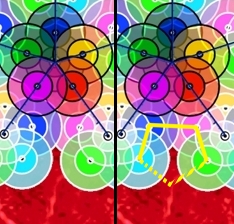
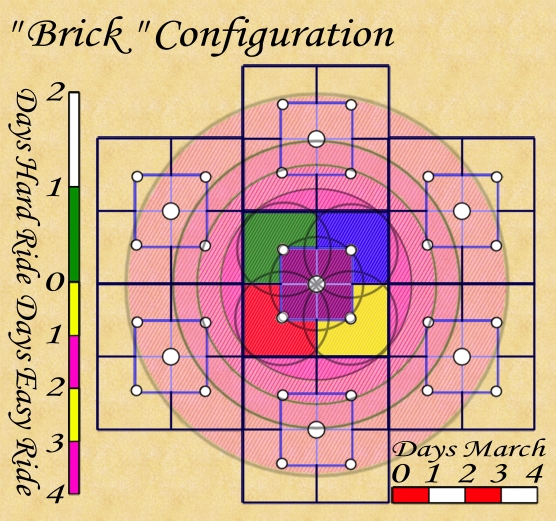
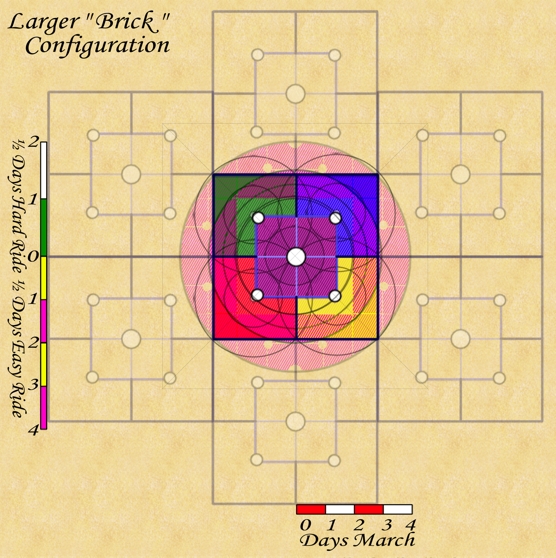
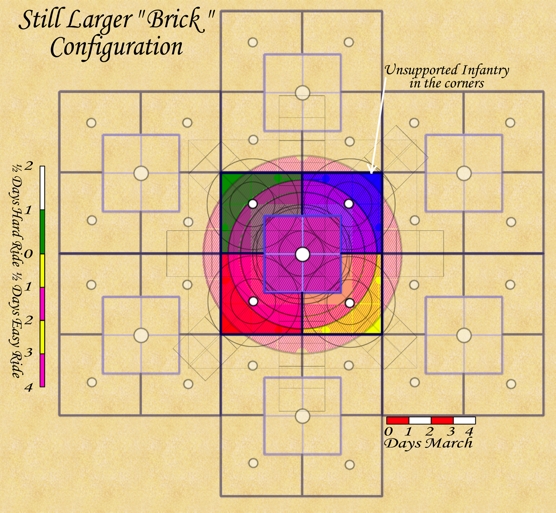
Campaign Mastery helps tabletop RPG GMs knock their players' socks off through tips, how-to articles, and GMing tricks that build memorable campaigns from start to finish.

Keep Your Ace Up Your Sleeve (plus 4 more)


A quick post today about GMs seeking validation plus one or more bonus topics, number depending on time.

I made this composite from two images. The black and white background image is man-5467816.jpg by Trent Garverick, which I extended to the right about 20%. The color image, to which I applied perspective and some tricks to make it look a little more 3-dimensional after that distortion is hand-998957.png by Gerd Altmann. It’s a combination designed to make it unclear who is on who’s side out of this pair and the viewer. Both images were sourced from Pixabay.

1. Keep Your Ace Up Your Sleeve

What’s the biggest metagaming mistake you’ve ever made outside of anything approaching a plot train? Let me tell you mine.

The scenario was over, and it hadn’t gone according to plan for the PCs. They had missed vital clues and had to scramble to pull off something approaching a victory.

As the players packed up, one commented that it had seemed a lot harder than it had any right to be. I answered, “Small wonder. You missed the vital clues, ignored the opportunity to gather intelligence, let the enemy keep and use against you his greatest asset, and failed to exploit his vulnerabilities. So he escaped, but you still managed to scupper his plot, so you shouldn’t look a gift horse in the mouth. It could have been a lot worse.”

So far, no problem. But then I expounded, “You should have done X, which would have revealed Y, which would have permitted you to do Z – and that would have given you a chance to exploit those weaknesses…” and continued along those lines for several minutes.

Basically, I was showing off how clever I had been, but also how fair, giving the players every opportunity to even the odds, mostly because I didn’t think the criticism justified.

And that was the big mistake. As I said, the villain in question had escaped – and the next time he showed up, it had all the impact of wet spaghetti. If I had kept back a few things, the players would have had ample opportunity to discover them after the fact in play or during the interval between his appearances. But they may have missed things, or misinterpreted them, and still found him a challenge the second time around. Instead, in search of a pat on the back, I spilled the beans.

I was reminded of this by a recent article that I read on the power of implication in writing, of not spelling out anything that the reader didn’t need to know in order to appreciate the plot. I’m not sure that the things that I revealed after the session were quite what the author of the article had in mind, but it came close enough to it to recall the incident.

I tend to be a fairly ‘user-friendly’ GM. I never kill PCs capriciously, and often go out of my way to give them a get-out-of-jail-free card when circumstances tie them down on the tracks in front of an oncoming (metaphoric) train – unless the players make a bone-headed decision in getting into that situation. When that happens, I’ll generally sound a couple of polite warnings – “Are you sure you want to do that?”, that kind of thing – but if they persist, all bets are off.

I make sure that there is always a way for the PCs to win, if they are clever enough to find it, and that there is a path open before them that leads them to the information necessary for them to do so. At the same time, villains will go to all kinds of lengths to camouflage their weaknesses; that path is certainly not guaranteed to be easy. But it’s there – and it’s my experience that where there’s one path to victory, there are usually several.

I work hard to remind the players of anything vital that they may have forgotten that their characters had learned, on the assumption that it was even more important to the PCs and would not have been forgotten. That’s part of the compromise necessary when you only get to run a campaign once a month, something I’ve discussed in the past.

And I never make the mistake of equating a players intelligence or experience with that of their character, and vice-versa – if there’s something the character should reasonably know, I make sure to tell the player about it – and remind them of it if / when it becomes important.

If the players make reasonable and responsible choices, if they come up with some clever plan to exploit something I had overlooked or assumed, that’s fair game – as demonstrated in my discussing another of my big mistakes My Biggest Mistakes: Magneto?s Maze ? My B.A. Felton Moment.

(I should add – at the same time, I plan months or years in advance, deliberately salting the campaign with clues to things that will become important later on, and my players tend to learn this fairly quickly – so taking notes is something someone usually takes fairly seriously).

So if I had stuck to my opening statement in response, all would have been well. The PCs, stung by their near-defeat, would have earned most of the intelligence that I gave away for free, and would therefore have valued it more – and would gleefully have used it to be far better-prepared when next the villain was confronted. They would have earned the satisfaction of taking him down a peg, even though he would be far better prepared for them the second time around. It would have been great, if not necessarily epic – but I robbed my players of that, and turned his return into a ho-hum occurrence.

I want to make it clear that (in general), I trust my players to compartmentalize player-knowledge from character knowledge, and they rarely let me down. But some bleed-over is inevitable – the player knowing what to look for makes it a lot easier to suggest ways and places to look for the right answers, for example, and even separating the two can’t wall off the emotional consequences of being handed priceless intelligence on a silver platter by as big-mouthed GM.

I still have to work hard at not falling victim to this mistake at regular intervals, but I have gotten better at keeping my Ace up my sleeve for future use. Every time I feel tempted to show off how clever I’ve been, I remind myself of how much fun the players will have discovering it for themselves (or at least I try to). Only if the villain is to be consigned to the dust heap, if the players achieved something close to a total victory despite their mistakes along the way, do I occasionally indulge myself – dotting I?s and crossing T?s to complete resolution of the adventure in the minds of the players, when it’s important to draw a line in the campaign so that they can move on.

It’s a lesson worth learning.

2. Keep the cards your NPCs can’t see face-down

Something I’ve always been fairly good at – swings and roundabouts, we all have our individual strengths and weaknesses – is being able to keep what an NPC knows separate from the bigger picture that I have as GM.

If it’s reasonable that an NPC is able to deduce something, they have a fair chance of at least suspecting it. If it’s reasonable that they know something, then they know it.

If it’s reasonable that they lack some foundation for such a deduction, and they know it, it’s reasonable that they would identify that shortcoming and do something about it – and more than one villain has tipped his hand in the process.

But, if there is no reasonable way for them to know something, they don’t know it. And that leads them to make mistakes – exploitable mistakes.

If they are the arrogant type, they can then get taken by surprise and have to scramble for a solution to the problem, a solution rooted in their preparations and resources. Desperate moves often fail to work, though occasionally one will get lucky – especially if they are fairly intelligent (see also my advice on running a Mastermind Villain).

If they are not so arrogant, but are instead the cautious and stealthy type, they may be paranoid enough to have made some general preparations that can be utilized to counter the surprise moves.

My villains are also always capable of making a mistake, or of making an incorrect assumption that leads to a mistake, or of misinterpreting something even if they have the basic facts right. Again, this is largely a function of intelligence, but they all have blind spots.

The difference between the smart ones and the not-so-smart-ones is often that the smart ones will know, or assume, that they have blind spots or have made mistakes, and will have plans to compensate.

It’s also very important to me that the villains have a defined personality, and that this personality expresses itself in their ambitions and the plans that make to accomplish those ambitions. Their way is often not the most effective or efficient road to success, it may even throw up insurmountable roadblocks, but they are who they are.

BUT, unless they have a flaw that gets in the way, they will always learn from their failures and from their successes. They will always filter their perceptions of these through that personality – and that has led some of them to “improve the wrong things” or fix things that weren’t broken – but even the most arrogant will learn something. Whether or not that something is actually helpful is a whole different question, of course!

As I said at the start, this is something that’s always come fairly naturally and easily to me; it’s not something I’ve had to work at especially hard. For a long time, I thought that being able to do this casually was a serious prerequisite for being a GM – so it surprised the heck out of me when I observed that some GMs really struggle with it.

Here’s the funny thing – if something comes naturally to you, it’s really hard to analyze and communicate what it is that you do for the benefit of someone else. Often, the best that you can do is make sure those “someone else’s” know that this is something they do have to master if it doesn’t come naturally to them.

I very much find myself in that position with this subject. I can describe it’s importance, and what the limitations are that I put on my NPCs, and how that can manifest in poor decisions, or in good ones – but beyond that, I can’t explain to someone else how to do it.

That’s not really all that satisfactory, I know, and that’s why I haven’t talked much about this in articles here – but it dovetails with the first piece of advice so strongly that it’s time to lay my cards on the table (to extend the metaphor).

So, if it’s not one of your strengths, learn how to do it. And then offer up a guest post on your solution to the problem, I’ll happily publish it!

3. Debunking Red Shift / Blue Shift

Last night, I watched a short video on what you would see at the speed of light, or approaching the speed of light, and they repeated the hoary old chestnut of everything behind you appearing red because of Red Shift and everything before you appearing bluer because of Blue Shift.

No, I’m not denying doppler shift – but I am stating outright that physicists and science fiction authors have been getting this wrong, basically forever. It’s annoying to me when it happens because the error seems so obvious to me – but I’ve never been both annoyed enough and writing a broader article at the same time, before.

Well, this time I am, so let’s dig into it.

The error lies in treating visible light as visible light – okay, maybe not quite so obvious.

As you accelerate, light from in front of you gets shortened in wavelength – blue shift – and light from behind you gets lengthened in wavelength – red shift. You can hear this happen with sound waves when a car or train passes you.

But that doesn’t mean that you stop seeing reds from in front of you, or stop seeing blues behind you. The visual spectrum remains just as wide as it ever was.

Red shift: let’s say you’re traveling fast enough that everything that was red shifts into the infrared, where we cannot see it. That doesn’t mean you stop seeing red – what was orange becomes red, what was yellow becomes orange, and so on. And, what was low ultraviolet becomes visible as blue.

Blue shift: traveling at the same speed, everything that was blue gets shifted into the ultraviolet, and can no longer be seen. Everything that was Aqua shifts into the blue, everything that was green becomes aqua, everything yellow becomes green, everything orange becomes yellow, everything red becomes orange – and the near-infrared becomes visible as Red.

We still see the full spectrum of color, regardless of whether we look before us or behind us.

What’s more, the shifts described are small enough that I doubt there’s going to be very much difference in WHAT can be seen – not yet, anyway.

If we travel fast enough, these shifts become so pronounced that the entire visible spectrum at rest gets shifted out of our visual range – but those wavelengths will get replaced by other waves that have shifted into our visible spectrum.

Here’s the electromagnetic spectrum:

Image by Victor Blacus based on an image by Penubag, courtesy of Wikipedia, used under the Creative Commons Attribution-Share Alike 3.0 Unported license.

And here’s the same, strongly red-shifted:

Derivative work based on the above, made available under the same license terms as the above.

This is a 1000-fold frequency shift, And, if I blue-shift by what I think is the same ratio, I get:

Derivative work based on the above, made available under the same license terms.

Eventually, these shifts will be so pronounced that what we see will in fact be visibly different from what we’re used to. At these extremes, I would expect to see visible differences, so I went looking. Besides, extra eye-candy never hurts!

First, the Pillars Of Creation, part of the Eagle Nebula, in visible light, as captured by Hubble in 1995

Public Domain image, courtesy NASA.

And now the Infrared image, also captured by Hubble. Infrared is very useful to astronomers because these frequencies are not blocked by the gas cloud.

Public Domain image, courtesy NASA.

So, if you were heading away from the Eagle Nebula fast enough, that’s what you would see behind you.

Now, for the Blue-shift: this is the image of the Crab Nebula with which most of us will be most familiar (because it’s such a spectacular image).

The image combines 24 separate Hubble images, but the colors aren’t real, they are encoding spectrographic data identifying the different elements that were expelled during the explosion. Blue in the filaments in the outer part of the nebula represents neutral oxygen, green is singly-ionized sulfur, and red indicates doubly-ionized oxygen.

But it still looks gorgeous.

Public Domain image, courtesy NASA.

Without the false coloring, it looks like this:

Public Domain image, courtesy NASA.

(I’ve also seen it colored red). X-rays reveal the high-energy processes occurring, and also pass through any dust that might be in the way, rendering it effectively invisible:

Public Domain image, courtesy NASA, taken by the Chandra X-ray Observatory.

And, just for the sake of completeness, here’s the same location in Infrared:

Public Domain image, courtesy NASA

Note that I suspect these images are of the bright ‘core’ of the original image, not of the whole thing!

EVENTUALLY, the view in front would go dark simply because there’s nothing putting out gamma rays of sufficient frequency to be shifted into the visible spectrum.

But, if you”re ever running a sci-fi game that takes the PCs close to the speed of light, understand what they would see and get the details right!

4. Other (Possible) Cosmic Errors

This isn’t the first such thing I’ve written about. A while back, I boiled three others down into infographics.

This is reduced in size to fit Campaign Mastery’s display area. Right-click and open in a new tab to be able to see it more clearly (768 x 384 size).

Well, I recently saw another video in which 10 paradoxes were described, and this was one of them – but they reported that the second one had been solved, because the spacecraft was the one experiencing the G-forces associated with acceleration. Now, I’m not quite sure why that would make the difference, but it is a point of differentiation between the two. “Problem” 1 remains, so far as I know. Not that the perceptions of the pilot contradict the laws of physics, but it’s an interesting point that I haven’t seen raised anywhere else.

If you’re making the 4 light-year trip to Alpha Centauri and time dilation means that it appears to take 6 months, the pilot would perceive themselves as traveling at around 8x the speed of light.

Actually, because it would take time to accelerate to that speed, that might be a really bad example, involving G-forces sufficient to smear our pilot all over the bulkhead, but let that go; instead, realize that the need to accelerate and decelerate means that at peak, he has to be going even faster to get the total travel time down to a perceived 1/2 year, so his perceived speed would have to be even higher than 8c. A lot higher.

Moving on:

This is reduced in size to fit Campaign Mastery’s display area. Right-click and open in a new tab to be able to see it more clearly (768 x 384 size).

I spent a whole article on this at one point, and copped quite a bit of flack for it from someone who insisted that we would be totally ignorant of anything located outside our observable universe. But this infographic simplifies the point that I was making a great deal, hopefully making it clearer.

Finally, we have this:

This is reduced in size to fit Campaign Mastery’s display area. Right-click and open in a new tab to be able to see it more clearly (768 x 384 size).

The point of this infographic is that the speed of expansion measured by Edwin Hubble has been used to determine that the universe is expanding, a statement repeated so often that it is more or less taken for granted these days. And it might be – but it might not. The problem is that the closer we get to the big bang, the faster objects appear to be receding from us, and a lot of people who should know better have misstated that as “the closer we get to to the big bang, the faster objects are receding from us”.

Now, I admit that I might be totally wrong about this, and Hubble et. al. have in fact taken this into account and still get the same results – but I’ve never seen or heard anyone saying so.

Now, assuming that the visible universe is just about all there is (an assumption I know to be incorrect, and which I’ll cover in a moment), then there must be a center of gravity to the universe that is attracting everything toward it and slowing the motion down – which is why closer objects are not receding as quickly at the more recent point in time at which we are observing them. In fact, if we look only at the Local Group, space doesn’t seem to be expanding at all, so far as I can tell. Which could mean that the expansion has stopped and contraction is about to begin.

I don’t think that’s the case – it beggars my belief in the power of coincidence that we should happen to develop telescopes powerful enough to see the edge of the universe at the precise instant where expansion has stopped. All I think I can say for certain is that the question that has been considered closed by a lot of learned people might not be as definitively answered as they think.

Oh, before I move on – the reason these are 768 pixels wide is because they were originally done as just one graphic – but they were too hard to read if made any smaller. I tried, but couldn’t shrink them any more – and didn’t have the time to redo them. In fact, they’ve been sitting around on my hard drive since the fifth, of may waiting to be used!

5. A Kickstarter For Consideration: The NPC Chronicles Soundboard

I’m going to quote directly from the email that I received about this because I don’t think I can explain it any more succinctly:

    The NPC Chronicles soundboard brings characters to life with hundreds of recorded dialogue segments, voiced by pro voice actors.

    The software comes with eight different NPC archetypes (and counting), each of whom has sixty unique lines of dialogue that can be used individually or strung together for more complex conversations. Each and every line in the software has been written by professional scriptwriters and performed by professional voice actors to create a coherent NPC archetype that’s engaging, nuanced, and memorable! Its easy to use, and fully customizable so you can add your own sounds and dialogue into it as well!

    It’s great for DMs who want to add more flavor or depth to their NPCs. It is also hugely helpful for players with disabilities – anyone with a speech impediment, physical limitations, or social anxiety, can use the soundboard to help bring their voice to the table.

    Link: NPC Chronicles

As I write this, there are 53 days to go and they have only reached AU$1888 of the AU$8926 goal (I suspect both numbers have been converted by Kickstarter from some other currency, probably Euros to judge from the prices quoted to back it).’

The basic level is €16, which is about AUD$29, about USD 18.65, and about 13.85 Pounds Sterling. That gets you the soundboard, a lifetime license and all future updates, and of course, any stretch goals.

That’s described as being 50% of what they intend to charge retail if the project succeeds in getting funded.

The next backer tier up costs €33, gets your name in the credits section (not that important) but also gets you the right to vote on stretch goals for additional NPCs.

Higher tiers offer 50% if Tabletopy soundboard immediately – this was the result of a similar Kickstarter run three years ago, with, they say, thousands of satisfied users – and a custom dialogue of up to 30 seconds recorded by the Voice actor (that last one is a little pricey, though).

The final thing to note about this campaign is the expected delivery date – October 2025. Fifty-three days from now is October 1 – so they expect to be able to deliver almost immediately if the campaign succeeds.

There is a lot more that could be said about it, but at this point, I think you should head to the link above if you’re interested and check it out for yourselves.

And, that’s a wrap! Next week, I hope to bring you the next part of the Trade In Fantasy series – it’s almost finished, but I have taken advantage of this extra week to add another quartet of diagrams and the text that goes with them…

Comments Off on Keep Your Ace Up Your Sleeve (plus 4 more)

Trade In Fantasy Ch. 5: Land Transport, Pt 3


This entry is part 16 of 20 in the series Trade In Fantasy

While working on the subject of population and its distribution, I stumbled onto a method of using a Realm’s economics for worldbuilding and history generation. Originally subordinated to the main thread, I’ve decided to break it out into it’s own post. Note that the unfinished part that’s been set aside for the next post is already slightly larger in wordcount than this one (but it is almost finished)!

Ledger image by RaphaelQS, CC0, via Wikimedia Commons. The dragon shadow was created from dragon-3176769.png, original image by Gordon Johnson from Pixabay, manipulated by Mike

Table Of Contents

In part 1:

Chapter 5: Land Transport

    5.1 Distance, Time, & Detriments

      5.1.1 Time Vs Distance
      5.1.2 Defining a terrain / region / locality

           5.1.2.1 Road Quality: An introductory mention

    5.2 Terrain

      5.2.0 Terrain Factor
      5.2.1 % Distance
      5.2.2 Good Roads
      5.2.3 Bad Roads
      5.2.4 Even Ground
      5.2.5 Broken Ground
      5.2.5 Marshlands
      5.2.7 Swamplands
      5.2.8 Woodlands
      5.2.9 Forests
      5.2.10 Rolling Hills
      5.2.11 Mountain Slopes
      5.2.12 Mountain Passes
      5.2.13 Deserts
      5.2.14 Exotic Terrain
      5.2.15 Road Quality
           5.2.15.1 The four-tier system
           5.2.15.2 The five-tier system
           5.2.15.3 The eight-tier system
           5.2.15.4 The ten-tier system

      5.2.16 Rivers & Other Waterways
           5.2.16.1 Fords
           5.2.16.2 Bridges
           5.2.16.3 Tolls
           5.2.16.4 Ferries
           5.2.16.5 Portage & Other Solutions

In Part 2:

    5.3 Weather

      5.3.1 Seasonal Trend
      5.3.2 Broad Variations
      5.3.3 Narrow Variations
           5.3.3.1 Every 2nd month?
           5.3.3.2 Transition Months
           5.3.3.3 Adding a little randomness: 1/2 length variations
           5.3.3.4 Adding a little randomness: 1 1./2-, 2-, and 2 1/2-length variations

      5.3.4 Maintaining The Average
           5.3.4.1 Correction Timing
                5.3.4.1.1 Off-cycle corrections
                5.3.4.1.2 Oppositional Corrections
                5.3.4.1.3 Adjacent corrections
                5.3.4.1.4 Hangover corrections

           5.3.4.2 Correction Duration
                5.3.4.2.1 Distributed corrections: 12 months
                     5.3.4.2.1.1 Even Distribution
                     5.3.4.2.1.2 Random Distribution
                     5.3.4.2.1.3 Weighted Random Distribution

                5.3.4.2.2 Distributed corrections: 6 months
                5.3.4.2.3 Distributed corrections: 3 months
                5.3.4.2.4 Slow Corrections (2 months)
                5.3.4.2.5 Normal corrections: 1 month
                5.3.4.2.6 Fast corrections: 1/2 month (2 weeks)
                5.3.4.2.7 Catastrophic corrections 1/4 month (1 week)

           5.4.4.3 Maintaining Synchronization
           5.4.4.4 Multiple Correction Layers

    5.4 Losses & Hazards
    5.5 Expenses – as Terrain Factors
    5.6 Expenses – as aspects of Politics

Today

    5.7 Inns, Castles, & Strongholds

      5.7.1 Strongholds
           5.7.1.1 Overall Military Strength
                5.7.1.1.1 Naval Strength
                5.7.1.1.2 Exotic Strength
                5.7.1.1.3 Adjusted Military Strength

           5.7.1.2 Mobility
                5.7.1.2.1 Roads
                5.7.1.2.2 Cross-country

           5.7.1.3 Kingdom Size and Capital Location
           5.7.1.4 Borders
           5.7.1.5 Terrain
           5.7.1.6 Internal Threat
           5.7.1.7 Priority
           5.7.1.8 Threat Level
           5.7.1.9 Zones
                5.7.1.9.1 Abstract Zones
                5.7.1.9.2 Applied Considerations
                     5.7.1.9.2.1 Sidebar: Why do it this way?

                5.7.1.9.3 Preliminary Zones, Zomania

           5.7.1.10 Kingdom Wealth
                5.7.1.10.1 Legacy Defenses
                
      5.7.1.10.2 Military Training
                
      5.7.1.10.3 Disaster Relief
                
      5.7.1.10.4 Religion
                
      5.7.1.10.5 Magic
                
      5.7.1.10.6 Tools
                
      5.7.1.10.7 Entertainment
                
      5.7.1.10.8 Resource Development
                
      5.7.1.10.9 A Hypothetical Disaster
                
      5.7.1.10.10 Housing & Funding Boosts
                
      5.7.1.10.11 Food
                
      5.7.1.10.12 Diplomacy
                
      5.7.1.10.13 Trade
                
      5.7.1.10.14 Education
                
      5.7.1.10.15 Transport (Road Maintenance)
                
      5.7.1.10.16 The Impact On Population

           5.7.1.11 Military Need: Theoretical Scenario 2

Next Time (work in progress):

           5.7.1.12 Stronghold Density
           5.7.1.13 Zone Size
           5.7.1.14 Base Area Protected per Stronghold
                5.7.1.14.1 The Distance between defensive centers
                
      5.7.1.14.2 The relationship between defensive patterns
                
      5.7.1.14.3 The shape of the defensive pattern
                
      5.7.1.14.4 What is 100% coverage, anyway?
                
      5.7.1.14.5 Calculating Area Protected
                     
      5.7.14.5.1 Three Satellite
                     5.7.14.5.2 Four-Satellite

                5.7.1.14.6 Configuration Choice(s)
                5.7.1.14.7 The Impact On Roads
                5.7.1.14.8 The Impact on populations

           5.7.1.15 Economic Adjustments
           5.7.1.16 Border Adjustments
           5.7.1.17 Historical vs Contemporary Structures
           5.7.1.18 Fixed Forces
           5.7.1.19 Mobile Forces
           5.7.1.20 Reserves
           5.7.1.21 Zone and Kingdom Totals

      5.7.2 Castles
      5.7.3 Inns

5.8 Villages, Towns, & Cities

    5.8.1 Villages
         5.8.1.1 Village Frequency
         5.8.1.2 Village Initial Size
         5.8.1.3 The Generic Village

    5.8.2 Towns
         5.8.2.1 Towns Frequency
         5.8.2.2 Town Initial Size
         5.8.2.3 The Generic Town

    5.8.3 Cities
         5.8.2.2 Small City Frequency
         5.8.2.3 Small City Size
         5.8.2.4 Size Of The Capital
         5.8.2.5 Large City Frequency
         5.8.2.6 Large City Size

    5.8.4 Economic Factors, Simplified
         5.8.4.1 Trade Routes & Connections
         5.8.4.2 Local Industry
         5.8.4.3 Military Significance
         5.8.4.4 Scenery & History
         5.8.4.5 Other Economic Modifiers
         5.8.4.6 Up-scaled Villages
         5.8.4.7 Up-scaled Towns
         5.8.4.8 Up-scaled Small Cities
         5.8.4.9 Upscaling The Capital & Large Cities

In future parts of this chapter

      5.8.5 Overall Population
           5.8.5.1 Realm Size
           5.8.5.2 % Wilderness
           5.8.5.3 % Fertile
           5.8.5.4 % Good
           5.8.5.5 % Mediocre
           5.8.5.6 % Poor
           5.8.5.7 % Dire
           5.8.5.8 % Wasteland
           5.8.5.9 Net Agricultural Capacity

           5.8.5.10 Misadventures, Disasters, and Calamities
           5.8.5.11 Birth Rate per year
           5.8.5.12 Mortality
                5.8.5.12.1 Infant Mortality
                5.8.5.12.2 Child Mortality
                5.8.5.12.3 Teen Mortality
                5.8.5.12.4 Youth Mortality
                5.8.5.12.5 Adult Mortality
                5.8.5.12.6 Senior Mortality
                5.8.5.12.7 Elderly Mortality
                5.8.5.12.8 Venerable Mortality
                5.8.5.12.9 Net Mortality

           5.8.5.13 Net Population

      5.8.6 Population Distribution
           5.8.6.1 The Roaming Population
           5.8.6.2 The Capital
           5.8.6.3 The Cities
           5.8.6.4 Number of Towns
           5.8.6.5 Number of Villages
           5.8.6.6 Hypothetical Population
           5.8.6.7 The Realm Factor
           5.8.6.8 True Village Size
           5.8.6.9 True Town Size
           5.8.6.10 Adjusted City Size
           5.8.6.11 Adjusted Capital Size

      5.8.7 Population Centers On The Fly
           5.8.7.1 Total Population Centers
           5.8.7.2 The Distribution Table
           5.8.7.3 The Cities
           5.8.7.4 Village or Town?
           5.8.7.5 Size Bias
                
      5.8.7.5.1 Economic Bias
                5.8.7.5.2 Fertility Bias
                5.8.7.5.3 Military Personnel
                5.8.7.5.4 The Net Bias

           5.8.7.6 The Die Roll
           5.8.7.7 Applying Net Bias
           5.8.7.8 Applying The Realm Factor
           5.8.7.9 The True Size
                5.8.7.9.1 Justifying The Size
                5.8.7.9.2 The Implications

    5.9 Compiled Trade Routes

      5.9.1 National Legs
      5.9.2 Sub-Legs
      5.9.3 Compounding Terrain Factors
      5.9.4 Compounding Weather Factors
      5.9.5 Compounding Expenses
      5.9.6 Compounding Losses
      5.9.7 Compounding Profits
      5.9.8 Other Expenses
      5.9.9 Net Profit

    5.10 Time
    5.11 Exotic Transport

And, In future chapters:
  1. Waterborne Transport
  2. Spoilage
  3. Key Personnel
  4. The Journey
  5. Arrival
  6. Journey’s End
  7. Adventures En Route
5.7 Inns, Castles, & Strongholds

I’ve drawn a lot of inspiration from a game supplement that I downloaded many years ago, but it suffered from some profound flaws, not least of which being that you had to determine the total population of a kingdom or realm with little or no support from their system. Once you had done so, everything else fell out of the system in a fairly straightforward manner – so many villages of this size, so many towns of that, so many cities, and so on. Everything but where to put them, and what size the town over the next hill was going to be.

The intention is to do things a little better. No, a lot better. I want GMs to be able to work out what the population should be, taking everything possible into account. I then want to use a simplified version of the process from that game supplement that works to determine the distribution of that population. And then, a system that doesn’t require you to have placed all of these on a map, that lets the GM determine exactly what size the community over the next hill is going to be, taking into account all the relevant factors, so that the whole process is sandboxed, and a map can be built up over time and travels from A to B by the PCs.

A lot of systems that I have seen take the village size and work out what the reasons are. That can be a stimulus to the imagination, but this system will let the GM decide the relevant facts and from them, the consequences, assigning meaning to the size of a community – and telling him exactly what goods and services the PCs are likely to find.

Because of this layered approach, if your game world is different in some way, you can build in any variations that you need and see what the consequences and implications are, instead of making ad-hoc assumptions, plucking critical numbers out of thin air, and getting hamstrung when those numbers turn out to be wrong, requiring you to go back to square one repeatedly.

My method may seem like a lot more work – but it’s actually a shortcut direct to meaningful results.

And it starts here, by looking at three types of infrastructure component that are so dependent on factors outside basic population that they will tie you in knots if you try to make them dependent on settlement size. Instead, we’ll allocate them and use them as factors contributing to settlement size.

    5.7.1 Strongholds

    What is a stronghold? It’s a fortified point, basically. That fortification extends beyond local defenses; it’s all about the ability to project military power over an area. It could be a tower, a fort, an outpost, or anything else short of a full-blown castle.

    These are expensive to build – the crown has to pay for them, and has to pay the soldiers to man them, and has to equip those soldiers and make sure that they are fed and their needs met.

    Two things decide how many of them there are: economics and need. Economics, because – as I said – they have to be paid for, and need, because you don’t want to pay for any that aren’t needed. Things get interesting when one or both factors have changed over time, because in a Fantasy Game, these things tend to last until forcibly removed from the landscape.

    So we’re looking at answering the question of how militarily secure a kingdom or other fantasy realm is – I’ll just use Kingdom for short. The answer is defined in terms of time – how long it will take a military force to leave the stronghold and travel to the trouble spot.

    So Mobility is going to be a key factor. And Terrain. And History. And Priority, because no Kingdom can ever afford to be as secure as they would ideally like to be. And Military Capability, and how much of that capability is held in Reserves.

    Why keep any of it in Reserves? Because the one reserve force can be dispatched to many possible locations at need, in whole or in part. The Military effectiveness of the reserves is therefore multiplied by the number of strongholds they can reinforce, and that permits the on-station personnel to be reduced in number – and therefore to cut expense, which frees money up to be spent elsewhere.

    What’s more, it’s not going to be uniform throughout the Kingdom. There’s an inner core that’s going to be relatively strongly held, there’s a Zone around that which will be only weakly held, and a zone around that which is a little more variable – in some places it will be even weaker, in others it can be as strong as the central core or stronger.

    And these zones are going to be subdivided according to threat level. If the Kingdom has been at peace with a neighbor for a long time, with a relatively stable border, there will be a downgrading of military need in the nearby parts of the kingdom; and if there’s a history of invasion, or uncivilized wilds abut the Kingdom, all sorts of things can come out of the undergrowth without warning, which will increase the military need.

    It also has to be remembered that most armies are conscripted from the locals at hand. Standing armies are kept as small as possible, because everyone serving in a standing army is not being productive in any other area – they aren’t growing food or functioning economically except as a source of income, redistributing wealth from the crown (acquired in the form of taxes) to the professionals in the middle class, and from them to the people providing the fundamental resources – the lowest tier of society, the farmers, loggers, and miners.

    If the Kingdom has expanded, historically, there may be several such rings. If the Kingdom is a significant naval power, the central core might be on the coast or it might be in a heartland a long way removed from it; if they aren’t, then the heartland is the only answer. If the Kingdom has contracted, then one or more of these zones may have been shed, in whole or in part, and now lie outside its boundaries, held by someone else.

    Are you starting to get a handle on just how complicated all this can get?

    Fortunately, we can keep it all fairly abstract at the moment – the key outcome that we want is the percentage of the population who serve in the military in each of these zones.

      5.7.1.1 Overall Military Strength

      Give the Kingdom a rating out of 5. Use a single decimal place if you feel the need to nuance it just a little. Higher is stronger. After various things are done to this value, it will get divided by ten to become a percentage.

      5.7.1.1.1 Naval Strength

      Give the naval strength of the Kingdom a rating out of five, higher is stronger. Don’t fret if the rating you assign is higher than the overall, but bear in mind that the higher this value is, the more of the overall value will be deemed to derive from it.

      5.7.1.1.2 Exotic Strength

      In a fantasy world, there are other sources of military strength. In essence, though, this comes down to Mages, Clerics, and Magical equipment within the military. Give the Kingdom a rating out of 5 for these factors in combination.

      5.7.1.1.3 Adjusted Military Strength

      As a general rule, 30% of the overall military rating will come from the naval power and 70% from ground troops. In some cases, that may vary.

      However, the Naval strength gets boosted by 30% of the exotic strength rating – they don’t get the full amount because there’s limits to how useful they are at a naval level. And the overall military strength gets multiplied by the other half.

           AMS1 = [OMS × ES / 2] – [NS + (ES/2)] × 0.3

      but we also need to take the Exotic strength back out of the result so that we are left with a measure directly related to manpower.

           AMS2 = AMS1 × 2 / ES

      Let’s plug in some numbers as examples:

           OMS = 3.5 ES = 2 NS = 2
           AMS1 = [OMS × ES / 2] – [NS + (ES/2)] × 0.3
           = [3.5 × 2 / 2] – [2 + (2/2)] × 0.3
           = 3.5 – 3 × 0.3
           = 3.5 – 0.9 = 2.6
           AMS2 = AMS1 × 2 / ES
           = 2.6 × 2 / 2 = 2.6

           OMS = 3.5 ES = 3 NS = 4
           AMS1 = [OMS × ES / 2] – [NS + (ES/2)] × 0.3
           = [3.5 × 3 / 2] – [4 + (3/2)] × 0.3
           = [3.5 × 1.5] – [4 + 1.5] × 0.3
           = 5.25 – 5.5 × 0.3
           = 5.25 – 1.65 = 3.6
           AMS2 = AMS1 × 2 / ES
           = 3.6 × 2 / 3
           = 7.2 / 3 = 2.4

           OMS = 3.5 ES = 4 NS = 2
           AMS1 = [OMS × ES / 2] – [NS + (ES/2)] × 0.3
           = [3.5 × 4/2] – [2 + (4/2)] × 0.3
           = [3.5 × 2] – [2 + 2] × 0.3
           = 7 – 4 × 0.3
           = 7 – 1.2 = 5.8
           AMS2 = AMS1 × 2 / ES
           = 5.8 × 2 / 4
           = 5.8 / 2
           = 2.9

      AMS1 is the overall effective strength of the army, cavalry, etc – the land forces – and AMS2 is how much of that comes from the number of men in service.

      It’s important also to note that the use of magic is a force multiplier, just the same as the use of advanced technology. Other Force Multipliers will arise in the course of this examination, and they have to be treated the same way – they mean that individual soldiers have a disproportionate impact on the battlefield.

      5.7.1.2 Mobility

      Mobility is a key factor identified in the subsection introduction. It, too, is a force multiplier – but because it can be <1, under some circumstances, it actually reduces combat effectiveness.

      At this point, because they have different mobilities, we also need to distinguish branches of the military – cavalry etc vs infantry. Every military installation will have a mixture – both branches can range from 0% to 100%, but ratios of 1 cavalry unit to every 5, 10, or 20 infantry are quite common at the low end for mobile forces and 5, 6, 7, or 8 to every 4 infantry units at the high end.

      The exact mix in any given installation is going to vary. A military unit’s strength gets divided by the ‘Distance in days of travel’ to get their ability to project power; the larger the area that a given installation has to protect, the more they will lean on cavalry because they are inherently more mobile.

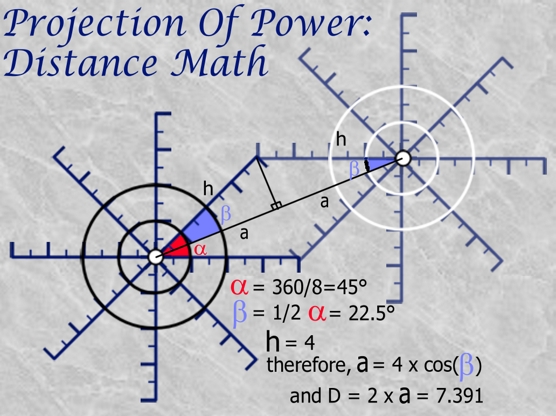
      An infantry unit projects it’s full power for 1 day’s travel outwards, then 1/2 at 2 days, 1/3 at 3 days, 1/4 at 4 days, and so on. If you add up that series, you get an ultimate total of infinity, which is of no use to us, but there’s a practical consideration here – just how far are the military units required to be able to project power? That sets an upper limit to the number of terms, and hence the overall effectiveness.

      A cavalry unit projects it’s full power for 3 day’s travel outwards, then 1/2 at 5 days, 1/4 at 7 days, and 1/8 at 10 days. At 14 days travel, the strength is 1/16th. But, again, there’s a practical limit – in this case, because cavalry units are expensive in every way, 7 days from the place where they are based is an absolute practical limit; beyond that, it gets cheaper to set up a new defensive installation and divide the cavalry units between the two.

      Cavalry moves at about 3 times the speed of infantry, so if we assume the same limit to projection of power, we get 21 days travel as an absolute limit – but again, that’s massively inefficient. At 1/21 power, the benefit that they can bring to bear on a problem is essentially nil. It’s far more reasonable to look at the 1/4 of cavalry and use that as the basis of reasonable estimates of infantry expectations. 1/5 isn’t that much smaller than 1/4 – it’s 0.05 – but 1/6 is more significant at 0.08333333. So I would, on that basis, use the 7 days number, where the difference tops 0.1 for the first time.

           Infantry: 1 + 1/2 + 1/3 + 1/4 + 1/5 + 1/6 + 1/7 = 2.593.
      (Probably more precision than necessary).

           Cavalry: 1 + 1 + 1 + 1/2 + 1/2 + 1/4 + 1/4 = 4.5.

      Mobility is a force multiplier.

      If a given installation is 70% infantry and 30% cavalry – not at all unreasonable – and it starts at the average military strength (AMS2) of 2.9, as per the third example earlier, then:

           2.9 × 70% × 2.593 = infantry strength = 5.26379
           2.9 × 30% × 4.5 = cavalry strength = 3.915

           Total strength of installation: (5.26379 + 3.915) × ES/2
           = 9.17879 × 4 / 2 = 18.35758

      What does this mean? That for the given mixture of forces, 7:3 infantry-to-cavalry, their effectiveness is that of a force 18.36 times the size. Does that seem reasonable?

      Well, let’s see. ES =4, which means that there’s a lot of use of magic on the battlefield, and low-level magic weapons are likely to be standard issue. So, 3 cavalry, 7 infantry, 1 mage and 1 cleric, all with + 1 weapons ( + 2 in some cases maybe) and + 1 armor. Would that be the equivalent of 18 ordinary people with ordinary swords and armor and no magic – with a little bit left over? As a GM, I would expect the military group to win easily, given any level of military training and/or experience. But they would take injuries, maybe even losses, in the process. Take away that training / experience, and they would probably still win – but losses would be higher, and it wouldn’t be quite as certain. Give the 18 a defensive position, and the balance of probabilities shifts in the other direction – probably enough to make it a 50-50 battle. So yes, given what we’ve taken into account thus far, this seems reasonable.

      But here’s the thing: We aren’t looking for the military effectiveness; we want to make the force as small as possible in order to achieve the defined overall effectiveness of – in this example – 2.9.

      So we want to scale the 2.9 back, not project it forward.

           AMS3I (I for infantry) = 2.9 / 2.593 = 1.1184
           AMS3C (C for cavalry) = 2.9 / 4.5 = 0.6444
           AMS3T (T for total) = 1.1184 + 0.6444 = 1.7628.

      That means that for the territory it protects to be protected to a strength of 2.9, we only need a strength of.1.7628. As implied earlier, these values are in tenths of a percentage point, so 0.17628% of the population within the protected area serve in this hypothetical installation.

      So far.

      5.7.1.2.1 Roads

      Good roads benefit both infantry and cavalry, doubling the area they can protect at the same strength. Which means that in areas where the roads are good, you only need 1/2 as many fortifications.

      5.7.1.2.2 Cross-country

      Cross-country doesn’t bother cavalry too much but distresses infantry slightly – depending on the nature of the terrain. Other terrains have the opposite effect. Since we haven’t dealt with terrain yet, this might seem a complicating factor – but it’s not so. By definition, there are only the two, and if roads are adding a modifier, then cross-country must be what we’ve already defined. So, no problem at all – unless the terrain itself is a factor, something that I’ll get to in due course.

      5.7.1.3 Kingdom Size and Capital Location

      Draw a simple freehand map of the Kingdom on a piece of paper. Do it fast, but be reasonably accurate; there’s a lot of leeway, here. Which sides are flatter – the top & bottom or the left & right? Whichever one it is, that’s your baseline.

      Draw boxes parallel to the baseline to a height or width such that as much of the kingdom on the line of that box is inside the box as it is outside.

      How many boxes you do is up to you, but repeat until you’ve done the entire Kingdom.

      Use the map scale to estimate the area of each box. Add those up to get an approximate total area for the kingdom – we’ll need it later.

      Finally, make a critical decision: where do you want the Historical Capital to be? This may not be the capital any more, another city may have usurped it’s primacy, but everything we’re doing in this section is based on the historical, so we use the old capital.

      Let me show you some examples:

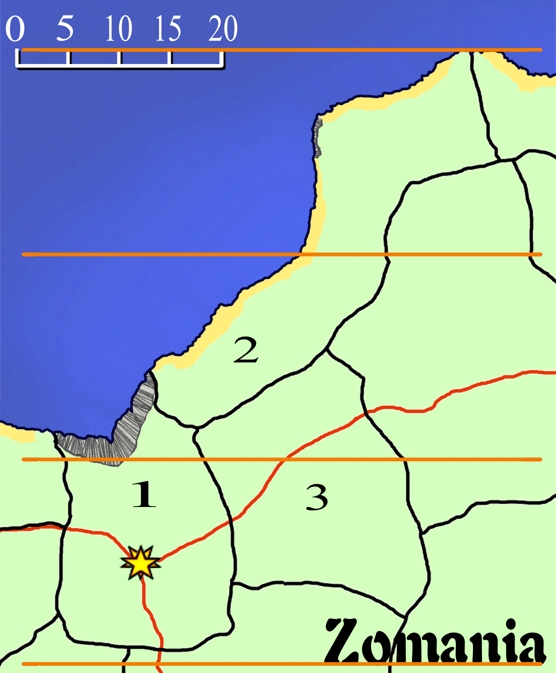
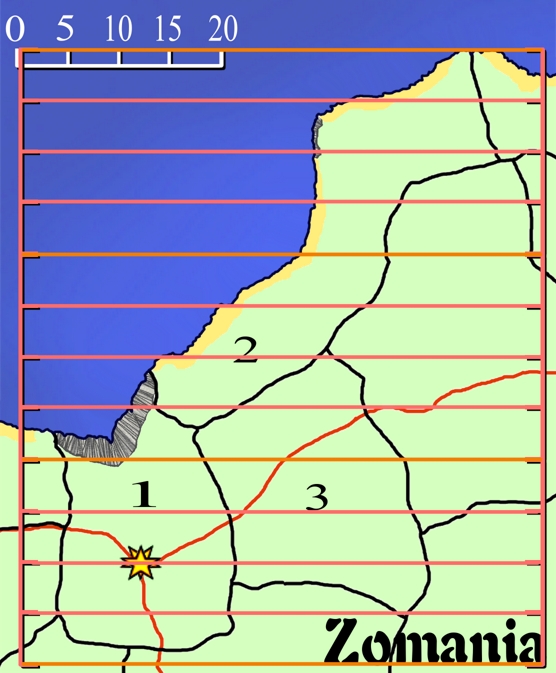
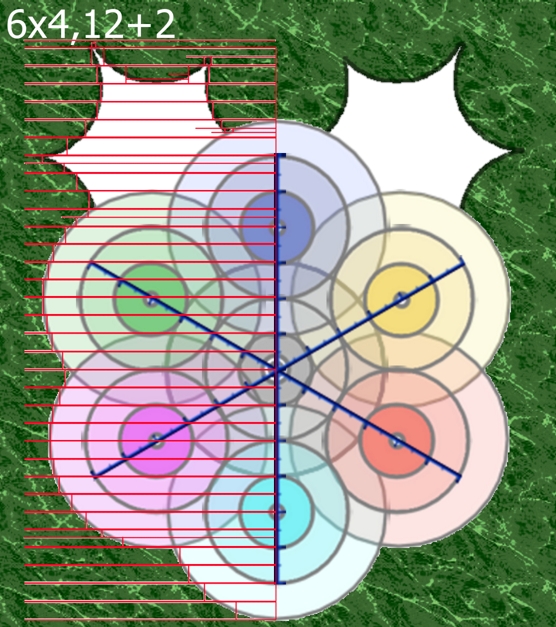
      Here are two examples. The first one shows more of the working. I set the height of the boxes by eye to be roughly one scale division since the scale is 10 miles. This map used 6 rows – the more rows you use, the more accurate your estimate of area, but 6 is enough for a reasonable estimate. The blue boxes are positioned and given widths so that the area inside the borders but outside the boxes is roughly equal to the area outside the borders but inside the boxes. It’s not quite perfect – rows 2, 3, and 4 don’t have quite enough red, and neither does row 6. Blue is extra area, so if there’s too much of it, it means the estimate will be a little high. The total I came up with for this example was 2857 square miles. The correct number is probably closer to 2845 or 2840. Still, that’s an error of 0.42% – I’m not fussed.

      The second example has only 1 box that doesn’t look quite right, box 3 doesn’t have enough red. So I’d round the area calculated down to 4000 square miles (even though the true area is likely to be more like 3980 sq m) and live with the error of 0.5%.

      Of course, if I were doing this in real life, I’d draw two vertical lines, use a ruler to measure the division lengths and mark them on the ruled lines, then draw my box top and bottoms by using the marks. That would also give me the conversion to go from a width measured with the ruler to an accurate box size, so the results would be a lot more accurate – and probably a lot faster..That means that you wouldn’t have the horizontal division marks that the examples show, leaving the map suitable for the next steps.

      So, to capital placement. You have to presume that there’s going to be a reason for it – usually a combination of security from the terrain, fresh water supply, and good food capacity close at hand. Just look at where the ancient civilizations had their capitals, and this pattern recurs time and time again.

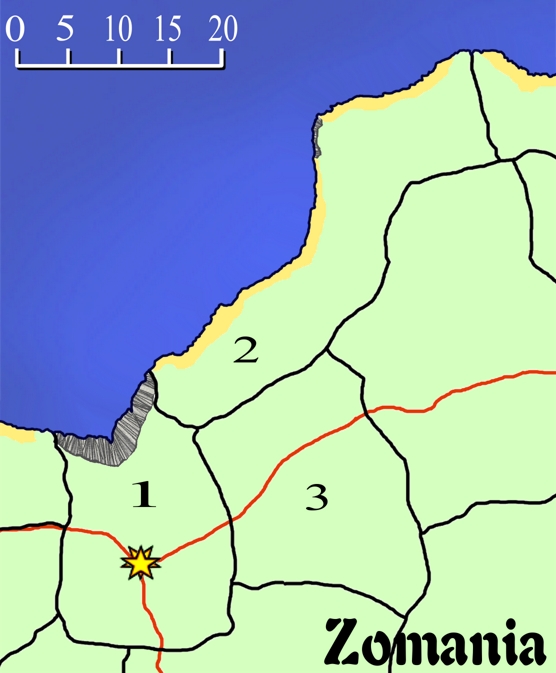
      In the case of Zomania, the example kingdom I offered up in part 1, place I was thinking for the capital is midway between distance markers 100 and 120, where the northeastern road connects with the southeastern road. That’s a short distance from the coast, 10-15 miles or so.

      Zomania works out at 14460 sqr miles for the mainland and 1540 sqr miles for the island, a grand total of 16000 square miles. And no, despite that being such a nice, round, number, I did not aim for that result!!

      5.7.1.4 Borders

      When I say borders in the heading, I don’t mean what the borders are for the Kingdom under discussion; I mean where the borders with each specific other nation end. The average number of borders is with 2.7-2.8 nations. The median is 2 or 3 – disputed territories and other complications make it hard to be precise – but I’m going to go with 3. That means that there are as many countries that have fewer than 3 neighbors as have more. The upper limit is for BIG countries like China and Russia, both of whom have 14 neighbors.

      So small countries are likely to have 1-3 neighbors, medium countries 2-4 neighbors, large countries 3-6 neighbors, and very large countries, 4-15 neighbors.

      Small = up to Cyprus or Lebanon – around 10,000 square km or smaller (3861 sqr miles).
      Medium = 10K – 100K square km (3861-38610 sqr miles) – typical examples would be South Korea and Portugal.
      Large = 100K – 1M square km (38610 – 386K sqr miles) – typical examples would be Japan and Germany.
      Very Large is anything bigger than 1M square km in size. There’s a long list of these, including Mauritania, Colombia, Bolivia, Ethiopia, South Africa, and Peru, to name just a few.

      These would, arguably, be far less common in a Fantasy environment than they are in ours. They are probably Empires, not individual kingdoms, if there is anything that size.

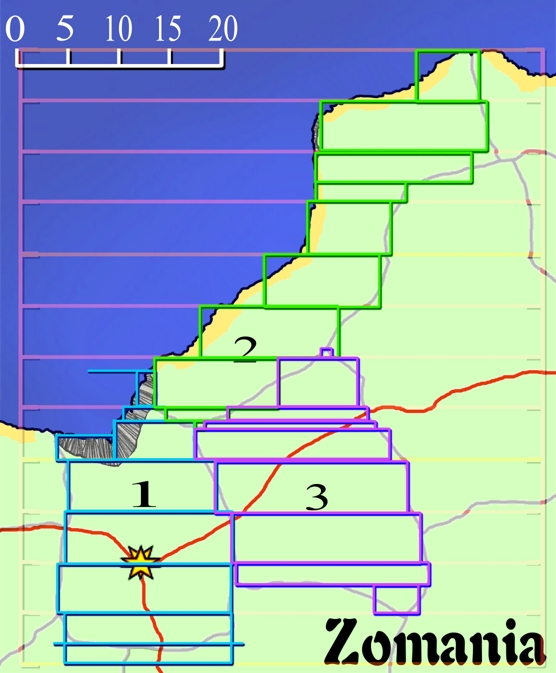
      Below, I’ve marked the map of Zomania with the capital and borders with 4 neighbors.

      Side-note: Color selection for the borders was a pain, because I had used so many colors in the textured map. I would have had more choices if I had used the outline map shown for the size illustration. It will be useful in the long run, but this is something that you really need to think about from pixel one of making a map, and I didn’t.

      So border #1 is at the top in purple. border #2 is hard to see, it’s in yellow, and lies on top of the south-easterly road and the terrain around it. Border #3 is more of a burgundy color, deeper than the red used in the roads, and it goes to the south-eastern corner of the Kingdom and a little beyond. I was strongly tempted to extend it to include the road to the southeast, but – thinking ahead – decided that not doing so would permit me to illustrate a more ‘international’ trade pattern. Then, the last border runs along the eastern edge of the kingdom and encompasses two major roads across the border. The other thing that I thought about was actually splitting this in two, so that I didn’t have two roads into the same neighboring kingdom, but there was nothing to be gained from doing so in this case – because one road into a kingdom was already well served with the purple and yellow borders; two roads into the same kingdom raises questions about efficiency and routing, and I again thought that might be useful later on. If I were generating this Kingdom for actual use in an RPG, I would almost certainly have split the border in two half-way up that eastern edge.

      The other thing to discuss before I move on is, where is the tricorner? Where does one border end and the next begin? I’ve always been fascinated by borders and stories of how states and countries got their shapes, and that was heavily on my mind. Let’s briefly run through the options:

      ▪ Natural Borders – a lot of borders follow rivers and other geographic features.
      ▪ Climatic differences – because these demand different land use and human habitats, it’s convenient to make them different administrations and cultures.
      ▪ Parallel to or in line with, existing borders.
      ▪ Connecting to, or containing, landmarks.
      ▪ Laziness & Convenience – you see this a lot if you look at what my Pulp Co-GM refers to as “the Ruler States” in the US. These follow lines of latitude or longitude and are entirely artificial – and usually reference one of the other border influences.
      ▪ Past history – the final ingredient. Kingdoms don’t grow outwards uniformly; it’s a bit here and then a bit there and then a bit somewhere else, meaning that growth tends to create tendrils and blobby protrusions. When the time comes to clean things up and formalize them, if you control the territory on both sides of a geographic feature, it’s easy to draw a line between the outer edges and lay claim to everything in between.

      That list, of course, barely scratches the surface. It makes no mention of surveying error – but that’s a key thing in real life. If you look at a map of Australia, the border with Western Australia looks like a straight line:

      Map by Richard Russell & Dominic Dwyer, CC0 v 1.0 public domain, via Wikimedia Commons

      But when you zoom in on Google Maps to the tricorner, you find this:

      Map derived from Google Maps, edited by Mike; derivative work, copyright remains with Google.

      Two teams set off from opposite sides of the continent, one headed north and one south, both on the exact latitude line – or so they thought. The plan was to meet in the middle. When they actually did so, they found that the northern team’s starting point had been about 110m west of where the southern team though it should be. When the Northern Territory was created, about a decade later, the border was run east-west along the same line as the ‘correction point’ where the two teams ‘met’.

      This sort of thing goes on all the time in establishing borders, and sometimes leads to conflict and disputed territorial claims. Some compromise is usually reached in the end, but it was not at all uncommon for a grant of land to contain inherent contradictions because of false assumptions. See, for example, Border Irregularities of the United States.

      5.7.1.5 Terrain

      Draw rough outlines of the different terrains on the map. Be fairly discriminating; the concept is that different land use will result from different terrains and that each will have its own challenges, resources, and priorities, which are better handled by making each separate subdomains within the Kingdom. And it helps when doing a breakdown of the different terrains within the Kingdom, something that we’ll do later. Pay particular attention to anywhere that the boundaries between three types of terrain grow close to each other; this is a natural line of division between the two, usually on a north-south or east-west line, but sometimes at 45° from a natural feature.

      5.7.1.6 Internal Threat

      It’s also time to start thinking about the internal politics, and in particular anywhere that is going to be a natural ground for bandits to hole up because the terrain makes it difficult to police.

      On top of that, you don’t want any resource to be the exclusive domain of one administrative sub-region within the Kingdom, because doing so means that any dispute with that administration denies that resource to the Kingdom. Split it two ways and you gain a lot more security from internal threats.

      And, on top of that again, and under this heading, cultural, social, and religious clustering – which can lead to other sources of internal conflict in the Kingdom – can demand different administration and sub-domains. When you dig into the early history of the US, this shows up as a strong factor – lots of Germans settle in one part of the country, lots of Greeks in another, Quakers here and Protestants there and what have you. These people want to be administered by someone who accepts their point of view in any conflict that arises, demanding different sub-regional authority.

      Past cases of insurrection and rebellion are also a historical factor that applies under this heading.

      5.7.1.7 Priority

      As with the terrain, is there anywhere where the natural resources are going to demand different priorities of the administration that runs the local area? For example, where there is a coast, there will be a long coastal fringe separating communities that are maritime / fishing in priority from inland, where crop cultivation is the priority.

      But this consideration also deals with the historical growth of the Kingdom, as described earlier. While ego and ambition can lead Kingdoms to claim territory that they don’t actually control yet, administrative efficiency is highest when each sub-domain has rough economic parity. That means that surrounding the historic Capital (which, as noted earlier, might not be the contemporary capital). sub-domains will be smaller, older, and wealthier, while those at the fringes will be larger, younger, and (generally), poorer.

      5.7.1.8 Threat Level

      I’ve talked about internal threats – this factor deals with external threats, even those posed by supposedly friendly countries. This factor deals with the potential for outside threats. The need for a timely response to any external threats demands separate political sub-domains so that the (hopefully temporary) fall of one does not imperial the entire Kingdom.

      Where there are natural barriers to external threat, sub-domains tend to be larger; where there is an open pathway – where roads cross international borders, for example, or a river flows from one country into another, it makes them smaller.

      5.7.1.9 Zones

      With all this in mind as the forces that shape them, it’s time to carve the Kingdom up into the highest level of sub-domains. The first major decision is how many of them there should be; but I prefer not to look at that; just count them at the end. Instead, thinking about the different factors listed, drawing lines of separation – internal boundaries and borders – defines these areas.

      Overall kingdom size is also clearly a factor. A sub-domain is all about the projection of power from the central position to a number of smaller sub-sub-domains, which in turn exert authority and project power over the actual lands.

      5.7.1.9.1 Abstract Zones

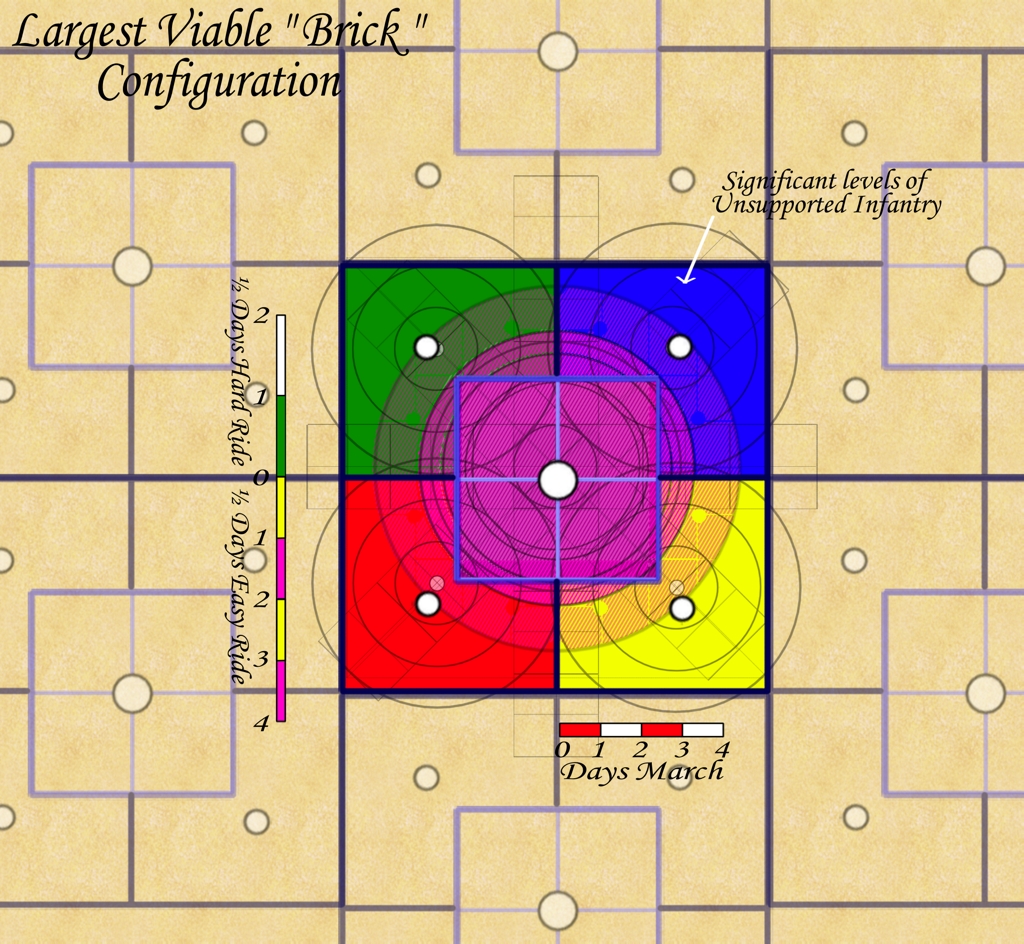
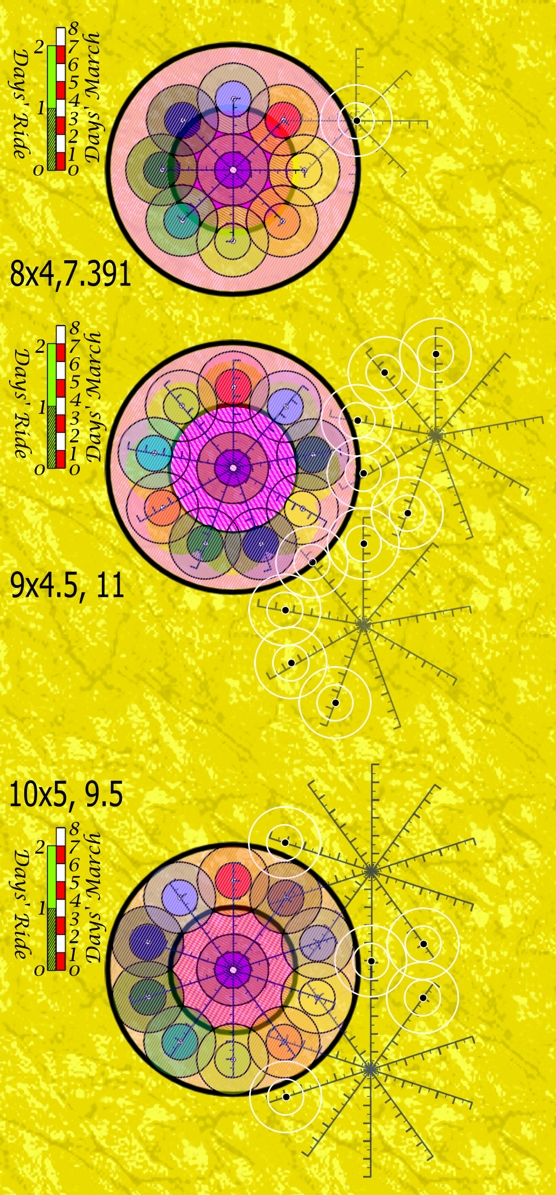
      In pure theory, at the limits of power projection for the central zone around C1, this illustrates the way things generally look. This has four lobes of sub-sub-districts, each with a fortification at a range that C1 can reinforce it – and they can all reinforce C1. What’s more, a problem at certain points can be resolved by one lobe with a second proving assistance – there is an overlap.

      If you think about multiple such zones, you find that there are either gaps that are not well administered – generally, a no-no – or there is a projection of power overlap between C1 and its neighbor. Probably oriented 45° relative to this zone, part of one of its zones would then overlap with both Lobes 1 and 2.

      This creates a network in which each interior division of the Kingdom can be reinforced in the event of trouble by its neighbors, who can then be reinforced by their neighbors, and so on – greatly reducing the need for a standing army for defense. If you happen to have such an army, it is therefore freed up for military adventures abroad, conquering new realms for you.

      5.7.1.9.2 Applied Considerations

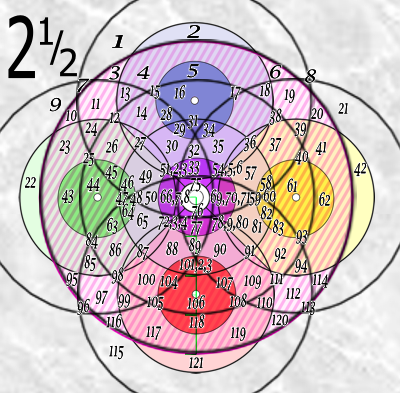
      Taking terrain and other such factors into consideration distorts the shape, as can be seen by the second illustration. We now have 5 lobes and not 4, for a start.

      Lobe 1 is essentially unchanged.

      Lobe 5 is similar in shape but projects further because there’s a road through friendly territory.

      Lobe 2 is flattened toward C1 by the presence of swamp; it’s hard to project power through that terrain, you have to go around it.

      Lobe 3 projects out into the gap between swamp and forest, but angled along the edge of the forest, indicating that the forest is more economically important than the swamp. It’s also a lot smaller than Lobe 2, indicating that the forest is largely untamed, and so poses a greater threat to C1 than the swamp does.

      Lobe 4 is both extended outward and bent by the presence of a road that crosses a border into friendly but potentially hostile territory. Because all the threats are to the South, East, or Southeast, C1 itself has moved a little in those directions to enable it to respond to trouble more expeditiously.

      But this is still abstract theory. In reality, lobes are less likely to be round; they could be square, triangular, hexagonal, and all manner of strange and complicated shape, because of all these distortions.

      It should also be noted that zones are frequently tugged in both directions at the same time by different influences. The stronger factor will always win out in the end, but be diminished somewhat by the contradictions.

      5.7.1.9.2.1 Sidebar: Why do it this way?

      I’m sure someone is asking that very question at this point. There are lots of answers that will become evident as I use the Zones concept through the course of this chapter, but I thought a higher-level discussion would clarify matters in the meantime.

      In response to that question, I invite the reader to contemplate the geography of Egypt. You’ve got the Nile River (densely populated), especially the delta, you’ve got the coast (slightly less densely populated), and you’ve got the desert. Before you can contemplate the total population, let alone the distribution of that population, you need to consider the carrying capacity of the land, i.e. how many people it will support.

      Now contemplate a fantasy realm with mountain chains to the east and south. Are these like the alps? Or the Himalayas? What is the carrying capacity? In the regions adjacent to the mountains? “Aha”, you cry, “it depends on the climate!” And so it does – but the overall climate is the same there as in the fertile lowlands. Medieval France, Britain and Germany all had very different carrying capacities – which one does this fantasy Kingdom more closely resemble? Or is it a bit of all three, in different parts – at least in this respect?

      You need to subdivide so that you can apply local factors and considerations, locally.

      5.7.1.9.3 Preliminary Zones, Zomania

      Keeping all that in the back of my mind, as well as the influences mentioned earlier but not taken into account It’s also worth pointing out that, as said, borders often follow natural features, but most of these have not yet been placed on the map; what usually happens is that you place them and then take them into account. What I’m doing here is interpreting that relationship the other way around, using borders to indicate where some of those terrain features are going to be.

      I’ve numbered them in sequence of their capture / conquest – there turned out to be rather more than I was expecting, but that’s okay. If you follow the numbers in sequence, you start to get a feel for the history of the Kingdom, but I won’t go into that yet, it’s not relevant. Analyzing the groupings, sizing, and numbering, it’s clear that the Kingdom is mostly at peace with their Eastern neighbors, somewhat less so to the southwest, and very much less so to the Northwest.

      Why would I prefer fewer zones? Because each one has to be appraised and assessed individually. Fewer zones means less work – and faster preparation of these posts.

      So, for that reason, I’ve gone back in and merged a number of the zones.

      You’ll notice that this consolidation could have gone a LOT further than I have taken it, and that the numbering seems to skip around a bit more in this latest iteration of the map. That’s because of the emerging history of the place.

      ▪ Initially, it would have been zones 1, 3-6, and half of present-day 2 and 7, all as one domain.
      ▪ These are then subdivided into the first 7 zones.
      ▪ Expansion along the coasts leads 2 and 7 to assume their current size and shape.
      ▪ 8 &9 are added.
      ▪ 10 & 11 are added.
      ▪ 12 is added. 12a is initially excluded but is at some point incorporated. The swamp of 12a blocked further expansion from 9 or 10, at least initially.
      ▪ 13 & 14 are added. This brings Zomania into contact with the Realm to the East.
      ▪ 15, 16, and 17 are added.
      ▪ 18 is added.
      ▪ 19, 20, and then 21 are added, something not possible until new technology in sailing ships becomes available.
      ▪ 22, 23, 24, and 25 are added. Initially, there would have been another neighbor to the Southeast, but it was half-conquered by the neighbor to the east; the road marks the division between the conquered lands and the residue of that kingdom, now more Southern than Southeasterly.
      ▪ 26, 27, and 28 are added. Contact with a third neighbor, to the Southwest.
      ▪ 29, 30, 31, and 32 are claimed. Contact with a fourth neighbor to the West, and a mutual neighbor to that neighbor’s North.
      ▪ 33 and maybe 34 are added.
      ▪ the last territorial expansion is into 35, connecting to that neighbor to the Northwest.

      Also, if you look closely at 16-18-33, you’ll see that the road makes a sharp diversion around 16. It seems very likely that 16 originally encompassed all three of these zones, but that they were lost in a war with one of the neighbors and later regained.

      Once you have your list of zones, go through and for each one, rank the current threat to which it is exposed out of 5. If there was a historical threat that has since been resolved, rank that and divide by 2 before adding that to the current threat level. The capital city always adds 1; a former capital (if there is one) adds 1/2. In addition, for each past war, add 1/2 to whichever capital then held sway.

      To get these, I’ve assigned threat levels to each of the neighboring Kingdoms and also to the Swamp. Forests are a little more dangerous than plains, mountains are more dangerous again.

      ▪ Zone 1: Current 2 + capital 1 + past wars 5/2 = 3 + 2.5 = 5.5
      ▪ Zones 2 & 7: Current 2
      ▪ Zones 3, 5, & 6: Current 1
      ▪ Zone 4: Current 2 + past 4/2 = 2 + 2 = 4

      ▪ Zone 8: Current 1
      ▪ Zone 9: Current 1 + past 3 /2 = 2.5
      ▪ Zone 10: Current 2 + past 4/2 = 2 + 2 = 4
      ▪ Zone 11: Current 1 + past 2/2 = 1 + 1 = 2
      ▪ Zone 12: Current 2 + past 5/2 = 2 + 2.5 = 4.5

      ▪ Zones 13 & 14: Current 1 + Past 2/2 = 1 + 1 = 2
      ▪ Zones 15 & 16: Current 1 + Past 1/2 = 1 + 0.5 = 1.5
      ▪ Zone 17: Current 1 + Past 2/2 = 1 + 1 = 2
      ▪ Zone 18: Current 1 + Past 3/2 = 1 + 1.5 = 2.5
      ▪ Zone 19: Current 1 + Past 3/2 = 1 + 1.5 = 2.5
      ▪ Zone 20: Current 1 + Past 4/2 = 1 + 2 = 3
      ▪ Zone 21: Current 2 + Past 4/2 = 2 + 2 = 4

      ▪ Zones 22 & 23: Current 2 + Past 2/2 = 2 + 1 = 3
      ▪ Zone 24: Current 3 + Past 2/2 = 3 + 1 = 4
      ▪ Zone 25: Current 2 + Past 1/2 = 2 + 0.5 = 2.5
      ▪ Zone 26: Current 3 + Past 4/2 = 3 + 2 = 5
      ▪ Zone 27: Current 4 + Past 4/2 = 4 + 2 = 6

      ▪ Zone 28: Current 3 + Past 4/2 = 3 + 2 = 5
      ▪ Zone 30: Current 2 + Past 5/2 = 2 + 2.5 = 4.5
      ▪ Zone 29: Current 2.5 + Past 4/2 = 2.5 + 2 = 4.5
      ▪ Zone 31: Current 2 + Past 4/2 = 2 + 2 = 4
      ▪ Zone 32: Current 3 + Past 3/2 = 3 + 1.5 = 4.5
      ▪ Zone 33: Current 3 + Past 4/2 = 3 + 2=5
      ▪ Zone 34: Current 3 + Past 4/2 = 3 + 2=5
      ▪ Zone 35: Current 3 + Past 5/2 = 3 + 2.5 = 5.5

      The final step is to total the Current and Overall threat ratings:
      ▪ Current: Zones 1-7: 3 + 2 + 2 + 1 + 1 + 1 + 2 = 12
      ▪ Current: Zones 8-12: 1 + 1 + 2 + 1 + 2 = 7
      ▪ Current: Zones 13-21: 1 + 1 + 1 + 1 + 1 + 1 + 1 + 1 + 2 = 10
      ▪ Current: Zones 22-27: 2 + 2 + 3 + 2 + 3 + 4 = 16
      ▪ Current: Zones 28-35: 3 + 2 + 2.5 + 2 + 3 + 3 + 3 + 3 = 21.5
      ▪ Grand Total, Current: 12 + 7 + 10 + 16 + 21.5 = 66.5

      ▪ Overall: Zones 1-7: 5.5 + 2 + 2 + 1 + 1 + 1 + 4 = 16.5
      ▪ Overall: Zones 8-12: 1 + 2.5 + 4 + 2 + 4.5 = 14
      ▪ Overall: Zones 13-21: 2 + 2 + 1.5 + 1.5 + 2 + 2.5 + 2.5 + 3 + 4 = 21
      ▪ Overall: Zones 22-27: 3 + 3 + 4 + 2.5 + 5 + 6 = 23.5
      ▪ Overall: Zones 28-35: 5 + 4.5 + 4.5 + 4 + 4.5 + 5 + 5 + 5.5 = 38
      ▪ Grand Total, Overall: 16.5 + 14 + 21 + 23.5 + 38 = 113

      I’ll be using these values a little further down the track.

      But we need to adjust the totals for size – I could have broken Zomania into 3 or 5 zones instead of 35, and the total of the ratings would be completely different.

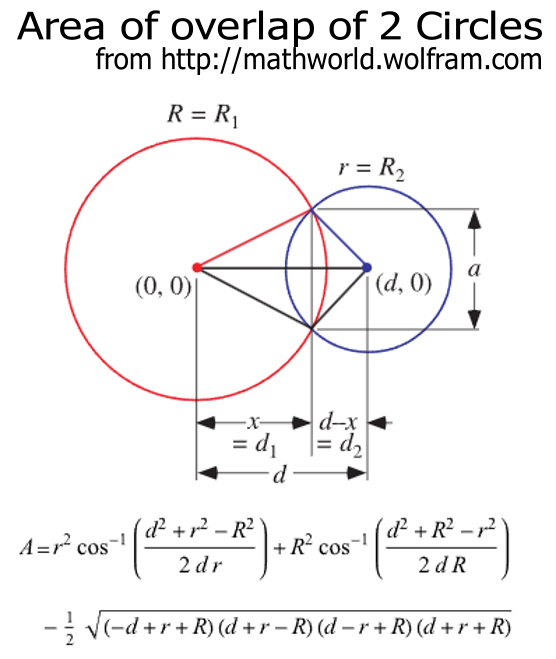
      16000 square miles / 35 zones = 457.143 square miles to a Zone, on average. But look back to the initial diagram showing the four lobes: if I give each of the circles a radius of one, then we have a square of 2 × 2 and four semicircles of radius 1, a total area of 23.74 units – where each unit is defined as the distance an army can project power from a fixed position. And that was calculated as 2.593 days for infantry and 4.5 days for cavalry back in 5.7.1.2.

      Cavalry are so much more expensive in every respect that you would never use them as your primary military resource. So a unit area is going to be [3×6 (for 3 miles per hour) / 24]^2 × 2.593 = 1.46 square miles. We have 23.74 of these in a basic control zone, so 34.66 square miles. Multiply by the normal rating maximum of 5 and we get 173.3 square miles in a standard Zone.

      Our totals have to be adjusted by a factor of Average Zone Size / 173.3.

      ▪ Adjusted Grand Total, Current: 66.5 × 457.143 / 173.3 = 175.4
      ▪ Adjusted Grand Total, Overall: 113 × 457.143 / 173.3 = 298

      But not so fast: We also have to adjust for the overall military strength, relative to an average of 2.5. I’m going to select the third example from 5.7.1.1.3 as indicative of Zomania – that was an overall military strength of 3.5, and an adjusted strength of 5.8.

      ▪ Adjusted Grand Total, Current: 175.4 × 5.8 / 2.5 = 407
      ▪ Adjusted Grand Total, Overall: 298 × 5.8 / 2.5 = 691

      5.7.1.10 Kingdom Wealth

      Wealth isn’t just about what resources a Kingdom produces, it’s about what it can hold onto. The more wealth it has, the better the defenses that it can build, and the more wealth it will gradually accrue – so wealth can be be viewed as an investment in military strength.

      You can actually think of a Kingdom’s economy in terms of a self-employed person’s household. You have so much income coming in, and have to expend that on various things to keep the household productive, safe, and happy – in that order.

      ▪ Productive covers administration, tools, transportation, resource development, trade, and education.
      ▪ Safe covers military, justice, food, housing, and diplomacy. In a fantasy campaign, it can also cover magic and religion.
      ▪ Happy covers entertainment, luxuries, and social mobility, as well as savings for rainy days and other disaster relief.

      That’s 16 subcategories, but they aren’t necessarily equal in terms of the demands placed upon the public purse. Administration is generally cheap so long as enough is spent on ‘Happy’. Tools include things like fishing fleets. Transportation is mostly roads but also includes food & resource distribution. Resource Development not only includes opening up new sources of wealth like mines, but also obtaining the grain for next year’s crops and tax collection. Wouldn’t it be nice if you could afford everything?

      Well, you can’t. Because if you could, then you would be seen as a glittering prize worth capturing, which ramps up the threat level, and demands additional military spending, and before you know it, you’re back in break-even territory. Military infrastructure in particular is expensive to maintain and incredibly expensive to construct. Military units drain available manpower for other essentials.

      Trying to represent all of this into something workable can be a nightmare, and is generally so full of ad-hoc assumptions that it’s not worth a whole lot, anyway. The solution is to generalize and abstract, and then leave specific interpretations up to the needs of the moment.

      Below, I’ve ranked each of the categories on a scale of 1-4, representing how much of the public purse they generally represent, and then multiplied the square of those ratings by 10 for reasons that will become clear in a little bit.

      ▪ Administration 10
      ▪ Tools 90
      ▪ Transportation 90
      ▪ Resource development 90
      ▪ Trade 40
      ▪ Education 40
      ▪ Military X
      ▪ Justice 90
      ▪ Food 160
      ▪ Housing 160
      ▪ Diplomacy 10
      ▪ Magic 90
      ▪ Religion 160
      ▪ Entertainment 40
      ▪ Luxuries 10
      ▪ Social mobility 40
      ▪ Savings & Disaster Relief 90

      You may have noticed Military = “X” – simply drop in the Overall rating from the previous section. In the case of Zomania, that would be 691. And then add whatever you think appropriate in terms of military expansion and training – because that only pays for what you’ve already got. That might be +10%, +20%, +25%, +30%, +40%, or even +50% – but it’s most likely going to be one of the middle values, +25% or +30%. I’ll choose + 25% and set the military budget to a relative value of 864 points.

      If you add all of these up, you get a total of 2074 points – out of a budget of how much?

      That’s up to you. Below, I have provided a deliberately biased, asymmetric, and non-linear random table, but I would discourage it’s use. Instead, you should be thinking about the consequences and ramifications of cutting or increasing different elements of the budget and the impacts on national character and government style and making a deliberate choice that describes the Kingdom that you see in your head.

      The one thing that a single glance at the table should tell you is that there is NEVER enough money to do everything you want in the most idealized and perfect way possible. Trimming ‘the fat” from any of the line items listed above has real impacts on the culture and society, sending ripples and shockwaves up and down the connective tissues that hold it all together.

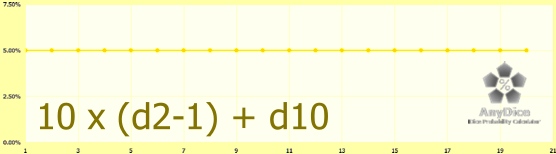
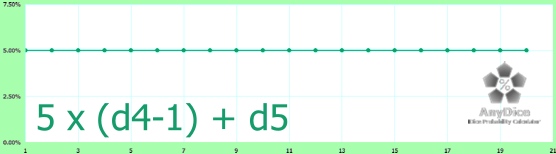
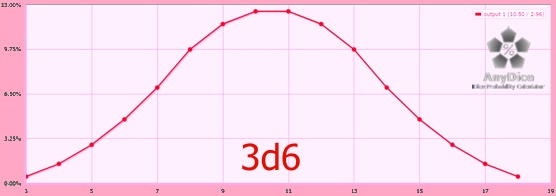
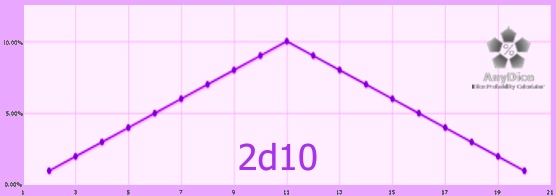
      d%

           d%
           01-02 = 500 + 10 × d20
           03-05 = 600 + 10 × 2d6
           06-10 = 700 + 10 × d12
           11-12 = 725 + 10 × d10
           13-17 = 750 + 10 × d8
           18-20 = 775 + 10 × d6
           21-25 = 800 + 8 × d20
           26-29 = 825 + 8 × 2d6
           26-34 = 850 + 8 × d12
           35-39 = 875 + 8 × d10
           40-44 = 900 + 6 × d20
           45-48 = 930 + 6 × 2d6
           49-52 = 970 + 6 × d12
           53-56 = 1000 + 5 × d20
           57-71 = 1020 + 5 × 2d6
           72-76 = 1050 + 5 × d12
           77-81 = 1080 + 5 × d10
           82-85 = 1100 + 5 × d8
           86-89 = 1150 + 5 × d6
           90-92 = 1200 + 4 × d12
           93-95 = 1250 + 4 × d10
           96-97 = 1300 + 2 × d20
           98-99 = 1400 + 2 × d10
           00 = 1500 + d20 + 2d6 – d12

      Cutting the budget in any area by 40% still permits that area to operate at 80% effectiveness. Repeat as necessary:

           60% budget = 80% effectiveness
           60% × 60% = 36% budget = 80% × 80% = 64% effectiveness
           60% × 36% = 22% budget = 80% × 64% = 51% effectiveness
           60% × 22% = 13% budget = 80% × 51% = 40% effectiveness
           60% × 13% = 8% budget = 80% × 40% = 32% effectiveness
           60% × 8% = 5% budget = 80% × 32% = 26% effectiveness
           60% × 5% = 3% budget = 80% × 26% = 21% effectiveness

      But the reality is that you’re going to have to trim the military budget and then use these cost-cutting measures to tidy up in the corners as it were.

      Let’s say that Zomania is doing fairly well, and has a budget of 1050 + 5 × d12, which – when rolled – comes out to 1100 budgetary points.

      5.7.1.10.1 Legacy Defenses

      1. Eliminate the upkeep of legacy defensive structures that are no longer needed. Right away, that cuts the budget by the amplified difference between current and overall:

      864 – (407 + 25%) = 864 – 509 = 355. Our budget of 2074 shrinks to 1719.

      Consequences: old infrastructure falls into decay and ruin. Some of it can be protected from this by basing other administrative functions from the existing structures, and some of it will naturally survive because a subordinate local can call it ‘home’ and cover the upkeep out of his own household budget. Some of what’s left can be recouped by selling it to wealthy individuals – binding them to the crown with the addition of noble titles and a few minor privileges and the potential to increase that rank through service. And one or two can be turned into Museums, letting part of the education budget do double-duty.

      This repurposes 20% of the administration (10), Justice (90), Education (40) and Social Mobility (40) budgets – salvaging 36 points of the 355, and probably boosting income by a like amount so 72 out of 355. That still leaves 80% of them becoming abandoned ruins and “dungeons” in the D&D meaning of the term.

      Spending = 1719, Income = 1136. Deficit = 583.

      5.7.1.10.2 Military Training

      Let’s cut the military training in half – instead of fully-funding it, Officers being promoted now have to pay half the costs themselves. Again, 20% of the social mobility budget can be dedicated to scholarships to take the edge off those cuts.

      Fully-funded, that was 509-407=102; so that saves us 61, cutting spending to 1658, and increasing income by 80% of this cut = 49 + 1136 = 1185.

      Spending = 1658. Income = 1185, deficit = 473.

      5.7.1.10.3 Disaster Relief

      But now it gets more difficult. The Savings & Disaster Relief funds are dead money – instead of the state funding this, let’s simply have the state deal with the immediate problems and promote citizens-helping-citizens in time of need. 3% of the existing allocation of 90 points still gets us 21% effectiveness, and saves 87 points, cutting spending to 1571.

      Spending = 1571. Income = 1185. Deficit = 386.

      5.7.1.10.4 Religion

      Religion doesn’t need to be fully state-funded. It can earn money through donations and fees for services. The state only really needs to fund certain events like coronations, state funerals, and royal births. So let’s carve out 92% of that budget, taking it from 160 down to 13, a savings of 147, reducing spending to 1424. This has the effect of making the church an independent force within society – we could tax the donations that we expect them to take in to make up for this deficit, but that would put them off-side.

      Maybe simply taxing income earned for services, which would be about 60% of the savings, and at a relatively low 10% rate, under the guise of ‘social equality’. That’s additional income of 10% × 60% × 147 = 9, a total now of 1194.

      Spending = 1424. Income = 1194. Deficit = 230.

      5.7.1.10.5 Magic

      Magic, again, doesn’t need to be fully state-funded. Let’s cut 64% out of that budget of 90, reducing our spending by 58. We can replace some of this from the Social Mobility budget in the form of subsidized apprenticeships – another 20% of that budget can be turned to the task – in return for the occasional service to the crown. So spending is reduced to 1366, but the actual effectiveness is going to be closer to the 80% mark than the base 64%.

      Spending = 1366, Income = 1194. Deficit = 172.

      5.7.1.10.6 Tools

      The biggest untouched cost areas are Housing and Food, but most rulers will be loathe to cut that budget, say by instituting some sort of annual property tax. That’s the sort of thing that stirs resentments and fosters rebellions.

      Instead, let’s look at Tools. Cut the funding to a mere 22% of the current 90, but make the savings available as loans to be repaid as an additional tax. Sure, one in ten won’t be able to make the repayments, but they can sell their tools to someone who thinks they can do better, starting the cycle over again.

      Savings of 70, and income goes up by 63.

      Spending = 1296, Income = 1257. Deficit = 39.

      5.7.1.10.7 Entertainment

      Entertainment for the masses doesn’t have to be fully subsidized, but we don’t want to cut the spending by much lest we put this social safety valve out of reach of the public. Let’s cut 20% of the budget and recoup the losses by charging admission – distributed over vast numbers, that’s likely to be a trivial expense, and we can even enhance the perception of a fair deal by sloughing any excess into subsidized foot and drink at the venues. So that’s a reduction in spending of 8 and an increase in income of 8.

      Spending = 1288, Income = 1265. Deficit = 23.

      5.7.1.10.8 Resource Development

      Let’s slow resource development just a touch – 20% of 90 saved. Let’s further stipulate that if a private party is willing to pony up the full value of a resource, they can buy it from the government after a set period of time – ten or twenty years. In the short term, that will put the squeeze on the budget, but in the long run, it will move this expense off government hands by generating additional income to cover 80% of the costs. If this scheme was enacted a long time ago, that would cut the government’s contribution to just 20% or so, with income rising by the difference.

      So that’s 18 saved, and additional income of 72 – eventually.

      Spending = 1270, Income = 1265 (eventually, 1337). Deficit: currently 5, rising to a surplus in 10-20 years of 67.

      A deficit of 5? That’s easily made up – borrow from someone, even at 100% interest, and in a couple of years all is well.

      You’ll notice that Zomania is a fairly wealthy kingdom; it didn’t have to make deep cuts on any of the services that it really didn’t want to touch. Housing, and road maintenance (Transport), and so on. Nor did it really have to do much to Education, or Justice, or Diplomacy, or Social Mobility. And they did nothing to monkey with Food or Trade. And – most of all – the didn’t have to impose excessive taxes.

      5.7.1.10.9 A Hypothetical Disaster

      Housing: 160 Transport 90 Education 40 Justice 90 Diplomacy 10 Social Mobility 40 Food 160 Trade 40. Add those up and you have 630 points more-or-less untouched.

      So, just so that I get to talk about those items, let’s impose a natural disaster that wipes, say, 400 points out of the budget, at least for a while. A War would do that, or a famine, or a pestilence – the usual things. Or even a milder combination of all of them coming at once.

      Spending = 1270. Income = 1337-400=937. Deficit = 333.

      5.7.1.10.10 Housing & Funding Boosts

      Housing. The government institutes a property tax or starts charging rents roughly equal to 60% its costs, and starts turning paupers out into the streets. To soften the blow, it ploughs 10% of the savings into increased Social Mobility. We don’t have a metric for 40% of budget, the closest we have is 36%, so we’ll use that.

      36% of 160 is 35, a savings of 125. Increased social mobility spending is 10% of that, or 12 points – which is a more than 25% increase on the allocated budget in that area. To get the effectiveness of increased spending:

            + 67% of budget = + 25% (i.e. 125%) effectiveness.
            + 111% of budget (i.e. 278%)= + 31% (i.e. 156%) effectiveness
            + 185% of budget (i.e. 463%)= + 39% (i.e. 195%) effectiveness
            + 309% of budget (i.e. 772%) = + 49% (i.e. 244%) effectiveness

      Fractions are proportional within the band. So raising the social mobility budget from 40 to 52 = 130% budget; 130/167 = 0.78; so that produces 78% of + 25% or + 20% effectiveness. So this would also raise income by + 20% of the 12, or 2.

      Spending 1270-125 + 12 = 1157. Income 937 + 125 + 2=1064. Deficit = 93.

      5.7.1.10.11 Food

      Cutting into the food budget creates a new category of spending – health – which until now has been subsumed by the Religious budget because Clerics can do healing. So there isn’t a lot that can be done here. Whatever you save on the food budget gets eaten up by the health budget – if both are to operate at 100% efficiency.

      But if there’s a gap? There are some small savings possible.

      60% of the food budget is 96, a savings of 64. Results: food is only 80% of what’s needed for health.

      New budget item with a base value of 64: Health. 60% of 64 is 80% effective at bridging that 20% health gap so 96% healthy populace for a savings of 26. But income will also fall to 96% of what it was, a loss of 43. So this is actually cutting off your nose to spite your face. To be effective at saving money, the cuts would have to go a lot deeper.

      So let’s leave food alone.

      Spending 1157, Income 1064, Deficit still 93.

      5.7.1.10.12 Diplomacy

      If the big loss of income was due to war, increasing the diplomacy budget might not be a bad idea. It’s a relatively small increase in costs for a potentially big dividend in security. Instead of a paltry 10, let’s whack it up to 40. That’s 400% of budget.

      278% of that gets us to 156% effectiveness, and leaves 122% further increase. 122%/185% = 0.66, so that gets us 2/3 of the additional + 39, or + 26% effectiveness. So for 30 additional spending, our diplomats become 156 + 26=182% effective.

      Spending rises of course. But there is an upside: Increased diplomatic success increases trade deals, which in turn increases income. Right now, Trade is a 40-unit item; 182% of 40 is 74; so that’s + 34 in direct income.

      Spending 1157 + 30 = 1187; Income 1064 + 34=1098; Deficit = 89.

      5.7.1.10.13 Trade

      Buoyed by the success of this measure, the Kingdom decides to further boost the Trade budget, from it’s current 40-for-74-worth to 200. That’s a BIG investment – but it leverages the diplomatic gains for a win-win, economically. 200-40 = 160; 160/40=4; so this is a + 400% increase in the budget for this area, to a total of 500%.

      463% of this gets us to 195% effectiveness, and leaves 37. 37/309 = 0.12; 0.12 × 49 = 6; so the total is 201%. But then we apply the diplomacy bonus, × 1.82, and get 365.82% effectiveness over the 40-unit base. 365.82% × 40 = 146, an increase of 106.

      So we’re spending 160 more and getting an income increase of 106. Whoops.

      The principle that the decision-makers in this hypothetical situation have failed to take into account is that of diminishing returns. Small increases – or decreases – give you more bang for your buck, as it were.

      So, instead of this great splurge on trade, let’s drop it back to a more sedate + 67% of budget. That gets + 25% effectiveness. 1.67 × 40 = 67, a + 27 spend. It nets us 1.25 × 40 × 1.82 = 91 income, an increase of 51 – of which, we were already getting 34 from the diplomacy alone.

      Nevertheless, that’s far more effective, in budgetary terms.

      And it’s buoyed further by a second principle which has not yet been taken into account: residual benefits. A big splurge on trade ONCE doesn’t just increase income for the year in which it happens (or the following year, depending on the timing and economic mechanics within the Kingdom) – it generates it for × years and then tapers off at a rate of Y% per year.

      As a general rule, × is going to be 3, 5, or 10 years; and Y is going to be somewhere between 20 and 50%.

      To get the net impact overall, you have to add up the increases over the entire period and divide by the period to get an average annual impact.

      The more that you initially invest, the higher × should be, and the lower Y.

      So let’s examine the two choices offered and see where we end up.

      The big spend: 10 years, 30% decay, base 91.
      91 × 10 + 0.7 × 91 + 0.7^2 × 91 + 0.7^3 × 91 and so on.

      0.7 ^ n × 91 = 1 tells us how long the residual benefits last.
      n × log 0.7 = log 1/91
      -0.155 n = -1.96
      0.155 n = 1.96
      n = 1.96 / 0.155 = 12-point-something years.

      91 × 10=910
      (1) 0.7 × 91 = 64
      (2) 0.7 × 64 = 45
      (3) 0.7 × 45 = 32
      (4) 0.7 × 32 = 22
      (5) 0.7 × 22 = 15
      (6) 0.7 × 15 = 11
      (7) 0.7 × 11 = 8
      (8) 0.7 × 8 = 6
      (9) 0.7 × 6 = 4
      (10) 0.7 × 4 = 3
      (11) 0.7 × 3 = 2
      (12) 0.7 × 2 = 1

      Total over 22 years = 1123. Overall yield = 51 per year.

      Similarly, the increase in costs are spread over the same period: 160 / 22 = 7-point something, so it will sometimes be 8 and sometimes 7. That’s a net increase in income overall of 43 a year.

      The small spend: 3 years, 50% decay, base 51.

      0.5 ^ n × 51 = 1
      0.5 ^ n = 1 /51
      n × log 0.5 = log (1/51)
      -0.30103 n = -1.7076
      n = 5.6 so 5 years.

      51 × 3=153
      (1) 0.5 × 51 = 26
      (2) 0.5 × 26 = 13
      (3) 0.5 × 13 = 6
      (4) 0.5 × 6 = 3
      (5) 0.5 × 3 = 1

      Total over 8 years = 202. Overall yield = 25.25, so 25 most years, occasionally 26.

      Cost: 27 / 8 = 3.375, so usually 3, occasionally 4 (but 4 more often than the 26 occurs).

      Net effect: 3 spent for 25 return.

      Both choices are thus shown to be viable. But we’re currently running a deficit of 89, and the bigger outlay yields a number better than that, so that’s the better choice under these circumstances.

      Spending: 1187 + 7=1194; Income 1098 + 51 = 1149. Deficit = 45.

      5.7.1.10.14 Education

      Cuts to Education will yield reduced income in a generation and other negative consequences. We really don’t want to mess with it too severely. But a brief, small, cut in the budget may be something that can be coped with. If the underlying economy is good (which it is for Zomania), this becomes less disastrous.

      The severity of the impact depends on the number of years of formal education being provided by the government. If it’s 10 (unlikely) then a 1-year cut will impact 10% of current students, a 3-year cut, 30%, and so on. Balancing this in terms of economic impact are the students who are not affected, being educated either before or after the cuts. The average productive lifespan outside of education is the base for measuring the economic impact – 30 years is a reasonable average number. A 1-year cut affects 10% of current students who are 10 in 40 of the economy – so that’s 10% × 10 / 40 = 2.5% economic cost.

      If the average schooling is only 5 years (still high for a medieval period), that adds another 5 years to the productive life (assuming unchanged average lifespans) so a 1-year cut would be 20% × 5 / 40 = 0.025% economic loss.

      We could cut Education completely out of the budget, and let the citizens learn from other citizens – but the social consequences would be horrendous. Literacy and the upward mobility of skills and talent would be decimated. Churches would be only too happy to step into the breach – with indoctrination in their wake.

      Education is only a 40-point item. Even this extreme action would not balance the books.

      Rather than general cuts, mandating a series of milestones at which a certain level of ability must be demonstrated before further education is permitted / required would permit selective cuts – in effect, putting the most poorly-performing students out on the street to earn a living as best they can. But this adds a requirement for some sort of standardized testing, if it is to be fair, which is an additional expense. The more checkpoints you have, the greater this expense.

      Savings come from the number of students who aren’t being educated, as a result, and there is some offset from them being economically productive for a longer period.

      The maths can get quite convoluted, but precision isn’t all that necessary; we can use the general effectiveness model and just interpret the consequences.

      Forget being fair – it costs too much. Instead, let’s cut the budget for education by 40% and set a base scholastic level of 3 years, with an additional 2 for the best, and higher education only for the best of the best, provided through the Social Mobility budget as scholarships.

      That saves us 16, offset by 20% × 16 = 3, and an economic cost of 20% × 40 / 5 of 0.025% – a loss of income of 1149 × 0.025% = 0.2875 units – more than covered by rounding errors.

      Spending: 1194-16=1178; Income 1149 + 3 = 1152. Deficit = 26.

      5.7.1.10.15 Transport (Road Maintenance)

      Roads don’t decay overnight. We can accept a temporary decrease in road maintenance if we later boost it so that we end up more or less at 100%.

      How long is a better question – earthen roads deteriorate more quickly but are cheaper to repair, and aren’t used for vital transport. Better roads deteriorate more slowly but are more expensive to repair and are used for vital transport.

      If the fundamentals of the economy are good – as is the case with Zomania – the better answer is the backroads and cart-trails. If the fundamentals are more shaky, the better roads give you more leeway to recover.

      The Transportation budget is currently 90. As a general rule, expense × quality = 1 – so the roads better than the median quality cost as much as roads that are worse.

      We need 26 to balance the budget, and are running out of places to find it. 26 is 29% of 90. So we could cut the budget for maintaining the 29% least-used roads in the Kingdom completely and balance the budget. Or we could cut it to 60% (keeping 80% effectiveness) and cut the next-most-used 29% of roads by however much more we need.

      60% × 29% × 90 = 16, and we would normally spend 26 on those roads of our 90 budget, so that’s 10 saved. We need another 16.

      We can save another 10 on the next 29%.

      We could save another 10 on the third-tier roads, but we don’t need that much – saving 6 is enough.

      6 / 26 = 21%. So we’re talking 89% of budget for this third tier of roads. If 40% reduction in budget yields 20% loss in effectiveness, then 21% reduction yields 11% loss in effectiveness. So these roads will be permitted to deteriorate to 89% condition.

      Now, we want to schedule the counter-balancing increase. 10 saved on the bottom 29% means 16/26 spent, or 0.615. The reciprocal of that is 1.625, and 1.625 × 26 = 42, so saving 10 now means spending 42-26=16 later.

      The same for the second tier. While these will be better-quality roads, making them more expensive to repair, they will deteriorate less, so it all evens out.

      The third tier we aren’t affecting as badly – 89% condition. 1 / 0.89 = 1.1236, and 1.1236 × 26 = 29.2, so 3 extra needed.

      Total: we will have to spend 16 + 16 + 3=35 extra on roads, eventually.

      Those are values per year. So if we stint on the maintenance for 3 years, that’s 35 × 3=105 that we have to spend, eventually.

      We also have to think about how quickly roads decay.

      ▪ Earthen tracks and trails will last about 5 years without maintenance, maybe 10 if they are used regularly.
      ▪ Add some gravel or cobbles and you double the lifespan to 10-20 years.
      ▪ Add a binding agent of some kind, like tar, and you double that again, to 20-40 years.
      ▪ Clay-fired bricks are roughly the same.
      ▪ Concrete and high-quality asphalt increase that by about 25%, to 25-50 years.
      ▪ Pneumatic Tires (yes, I know Americans spell it Tires) add another 25% to the Clay-fired brick value (30-60 years).

      That doesn’t mean that the road is completely gone. It means that there are damaged sections. This decay doesn’t start until the minimum period has passed – so 3 years of non-maintenance of even a dirt track doesn’t have a serious impact.

      ▪ Earthen tracks 50-100% + 10%/year.
      ▪ Add some gravel or cobbles 25-50% + 8%/year.
      ▪ Add a binding agent of some kind, like tar: 10-20% + 5% / year.
      ▪ Clay-fired bricks: 7-15% + 3% / year.
      ▪ Concrete and high-quality asphalt: 5-10% + 2% / year.
      ▪ Pneumatic Tires: halve decay for everything better than gravel roads.

      The significance of the road, multiplied by the decay level, gives the economic impact.

      An earthen track – the bottom 10% of roads, and therefore the least significant roads – isn’t maintained for 5 years. Roll d6 and add 4 to get a range of 5-10: I get 8. So there is no measurable impact for 8 years. At the end of that time, roll 10 × d6 + 4 to get 50-100 – I get 60%. So if there’s an economy of 1150, 10% of that is 115, and that’s reduced by 60% to 46, so the economic impact is 115-46=64 points.

      If there’s an alternative route that is less than twice as long, this impact can be halved. 23 points.

      If your road maintenance is 80% effective, divide or multiply everything by 0.8 – so 8 years becomes 10 years, 60% × 0.8 = 48% damage, 115 economic significance drops by 48% × 115 = 55, so the economic cost is 115-55 = 60 points.

      There are Roman-built roads that you can drive on to this day, 2000-odd years later. Presumably, they’ve had some maintenance over the years, but still…

      5.7.1.10.16 The Impact On Population

      Both increased spending and an increased budget act to increase the level of viable population. There is a delay while you wait for the children to mature (and survive) but that’s too complicated.

      Divide each of these results by 1000 and multiply them together. Jot the results down as the Economic Population Factor.

      In the case of Zomania, ignoring the hypothetical disaster, we had 1270 / 1000 and 1337 / 1000, or 1.69799. Call it 1.7 for convenience. That’s the proportionate increase in population density that the economy supports.

      5.7.1.11 Military Need: Theoretical Scenario 2

      I was able to balance the Zomania budget, even under the hypothetical scenario offered, without encroaching on the military strength of the Kingdom. That’s because the cut was calculated to give scope to demonstrate various elements of the budget and how it assists worldbuilding.

      That means that I need a new theoretical scenario in order to demonstrate the cutting of the military budget – always one of the last resorts of the ruling class, but sometimes you have no choice.

      Let’s say that the war, costing 400 treasury units, was actually a foreign venture – the equivalent of England invading France – and that, as military ventures go, it was a total disaster. Half the attacking force was wiped out, and the rest limped home.

      Instead of 691 points, the military strength of Zomania has been (temporarily) cut to 345 points.

      The first thing to do is to compare the losses with the budget for military expansion, because that indicates how quickly the military can be rebuilt. We were budgeting to take the military from 691 to 864, an increase of 173 points. Following a disastrous campaign, we can expect 25% of the survivors to retire as soon as they can, so we not only need to replace 345 points, we need to also replace another 1/4 of that, another 88 points, or a total of 433 points.

      433 / 173 = 2.503. So that’s 2 1/2 years.

      There are three ways of distributing the losses.

      ▪ You can distribute them evenly throughout.
      ▪ You can keep the most important units mostly intact and deepen the losses in the areas under less threat.
      ▪ Or, you can cut the central command and training centers to the bone, on the basis that these losses will be easiest to replace, and trim any additional losses as per the second option.

      Ultimately, these are just guidelines. Budgets will be adjusted in each zone individually. The total of the current values was 66.5; so multiplying (4 – each current zone’s rating) by 433 / 66.5 = 6.5 would distribute the losses with a weighting for military need. From there, we can tweak further – probably halving the losses in rating 3 zones, and then working out the shortfall by further cutting from zone 1.

      ▪ Zone 1: Current 2 + capital 1 = 3; 4-3=1; 1 × 6.5 = 6.5, round to 6. Halve to 3.
      ▪ Zones 2 & 7: Current 2; 4-2=2; 2 × 6.5 = 13.
      ▪ Zones 3, 5, & 6: Current 1; 4-1=3; 3 × 6.5=19.5, round to 20.
      ▪ Zone 4: Current 2; 13, as above.

      ▪ Zone 8: Current 1; 20 as above.
      ▪ Zone 9: Current 1; 20 as above.
      ▪ Zone 10: Current 2; 13 as above.
      ▪ Zone 11: Current 1; 20 as above.
      ▪ Zone 12: Current 2; 13 as above.

      ▪ Zones 13 & 14: Current 1; 20 as above.
      ▪ Zones 15 & 16: Current 1; 20 as above.
      ▪ Zone 17: Current 1; 20 as above.
      ▪ Zone 18: Current 1; 20 as above.
      ▪ Zone 19: Current 1; 20 as above.
      ▪ Zone 20: Current 1; 20 as above.
      ▪ Zone 21: Current 2; 13 as above.

      ▪ Zones 22 & 23: Current 2; 13 as above.
      ▪ Zone 24: Current 3; 3 as above.
      ▪ Zone 25: Current 2; 13 as above.
      ▪ Zone 26: Current 3; 3 as above.
      ▪ Zone 27: Current 4; 4-4=0; no reduction.

      ▪ Zone 28: Current 3; 3 as above.
      ▪ Zone 30: Current 2; 13 as above.
      ▪ Zone 29: Current 2.5; 4-2.5=1.5; 1.5 × 6.5 = 9.75; round to 10.
      ▪ Zone 31: Current 2; 13 as above.
      ▪ Zone 32: Current 3; 3 as above.
      ▪ Zone 33: Current 3; 3 as above.
      ▪ Zone 34: Current 3; 3 as above.
      ▪ Zone 35: Current 3; 3 as above.

      Adding those reductions up:
      ▪ 3 + 13 × 3 + 20 × 3 = 102;
      ▪ 20 × 3 + 13 × 2 = 86;
      ▪ 20 × 6 + 13 = 133;
      ▪ 3 × 2 + 13 × 3 + 0 = 45;
      ▪ 3 × 5 + 13 × 2 + 10 = 51.
      ▪ 102 + 86 + 133 + 45 + 51 = 417. Required: 433. Difference: another 16 needed.

      There are 12 zones currently rated 1, losing 20 each; increasing those losses to 21 leaves 4 more to find. In this case, having limited the losses, I would increase the 10 to a 12-point loss and the 0 to a 2, so that no zones were completely untouched.

      Note that this would not be the result of combat alone; the 4-rated zone would have borne it’s fair share of the losses. This outcome also reflects a redistribution of men from the secure 1-rated zones to where they are more urgently needed. If it was only for a few months, they might leave their families in place; but for 2 + years, probably not.

      Fortunately for the citizens of Zomania, this is a theoretical exercise, and we can now return to a situation in which they are strongly defended and relatively wealthy.

      But that will have to wait until next time. This post has grown so large that I’ve made the decision to cut it in two, letting the economic technique of world building feature, and getting into the purpose of it and what it’s used for in the next one.

      You can look at this in either of two ways; Either I’m giving you 17,800-odd words less than I’ve already written (the negative perspective) or I’m already 17,800-odd words ahead when it comes to getting the next one done.

      Add to that the 39 50 diagrams that are hopefully worth at least 500 words apiece and you can see that the next part of this chapter is well on its way!

Comments (5)

Topologia: A Strange Campaign Setting, Part 3

This entry is part 3 of 5 in the series The Topologia Game Setting

Today, Part 3 of the Topologia campaign setting details the Shadowfen and horrors that abide there, lots of creatures exportable to similar environments!.

The Shadowfen

No photo credit provided. Source: Pixabay. I thought about editing this image to insert all sorts of hidden menaces, and then it occurred to me: How do you know that I didn’t?

Strictly speaking, the place should be called the Shadowfens,, plural, because the multiple similar environments under the one umbrella title. This is a terrible place where nothing much is really fixed in place and it seems like everything you can see (and several things you can’t) are trying to kill you. No-one likes to live there, but some have little choice in the matter – criminals and bandit groups tend to congregate there because it is so hard to recapture them.

The roots of the vegetation hold what little land there is together, forming buoyant little islands that float.

Some of them are thick enough to support the weight of a person but many of them are not. Plunging through the thin ‘topsoil’ can leave your leg trapped in the roots, some of which have barbs pointing downward to protect the roots from vegetable-eating fish – these cause no trouble going down but create severe lacerations when you try and lift the trapped leg. This can force the careless to choose between hacking off a leg or hanging around long enough to be something else’s lunch. Whatever remains after the feast becomes mulch to nourish the vegetation, so everybody (except the victim) wins from this strategy.

Movement In The Shadowfen

The water between these islands is rank but not quite stagnant – the Everflow passes through the middle, flowing from East to West, and even though it meanders a lot, it still generates tidal flows in and out.

The waters, for the most part, are shallow, only a foot or two deep, but there are hidden hollows and depressions that run deeper. Some of these are quite gentle depressions filled with sticky, cloying, mud; others are sharp-edged cracks which can trap a foot or cut an unprotected leg. Blood in the water, of course, is an open invitation to all sorts of nasty, hungry, critters.

These dangers lead all who come here to contemplate alternatives.

    Swimming in the Shadowfen waters

    Some fools try swimming in the water instead of slogging their way through the mud and leeches, and this seems to work – for a while. Under the silt and mud, however, there is a great deal of rotting vegetation, and every now and then, bubbles of explosive byproduct erupt to the surface. When this happens, the natural buoyancy of the water diminishes catastrophically, anyone without solid footing will be sucked under, at least temporarily. This often causes panic, which is the last thing that you should do in an emergency. The popular sentiment is, “You swim, you die”.

    Boats in the Shadowfen

    The obvious solution is to use small boats or rafts, but these are no less susceptible to being sucked under. Rafts have a big advantage over boats in that they have some buoyancy even plunged underwater; they will return to the surface, eventually. Small boats and canoes that fill with water usually will not (there are exceptions which I’ll cover a little later).

Walking, although slow, difficult, and tedious, is the only (relatively) safe solution.

Every step is tortuous; you are effectively lifting 3x your limb’s weight with every step and then putting it down, only to start over. Those with business to conduct within the Shadowfen quickly learn or re-invent the Rotating Point-Man Technique.

    The Rotating Point-Man Technique

    The group proceeds single file. This obviously puts one member in front; he uses a pole or stick to test the surface underfoot, and everyone else does their best to walk in his footsteps.

    The point man walks through the mud and muck for a set period of time, leading the group from one ‘island’ to another, probing for a solid surface strong enough to walk on. If it is, they scramble up onto it as best they can, and for as long as the island lasts, progress is quick and easy.

    When their time on point is up, they let themselves get overtaken by the person behind them, who then becomes the new point person, taking the pole or stick from the former pathfinder as they pass them. Once relieved of this tool, the former point person lets the rest of the group pass him or her until they are last in line, to ‘rest up’ for their next stint in front.

    CON in minutes is a good quick-estimate of how long someone can take point. They then need to rest for 3-4 times the number of minutes they were on point to recover.

    Each minute that they were on point adds 1 to the difficulty of any physical activity (including attacking in combat) and 1/2 to the difficulty of intellectual tasks and judgment calls. It’s extremely fatiguing to be on point!

    The penalty applies to attack and damage rolls, and half of it applies to armor class – but weapons always do at least 1 point of damage even with this penalty.

    It follows that even weak creatures who are adapted to the environment can pose a significant threat; unfortunately, many creatures to be found in the Shadowfen are NOT accurately described as ‘weak’.

Insects

Swarms of insects fill the air. Some are harmless; some have a painful bite which can persist for up to 72 hours depending on the species; some carry diseases like malaria or Yellow Fever, that can prove fatal; and some burrow into the skin to lay eggs that will do 1 point each when they hatch. One or two such bites are relatively trivial, but 1 or 2 hundred are a very different matter.

Green Alligators

One of the milder threats that can be encountered are Green Alligators. Unlike most such creatures, they operate in packs with a level of social cohesion.

One or two will feign attacks from either side, forcing an unwary party into a trap where the rest of the pack, another 5-10 strong, are waiting.

Green alligators only grow to 2-3 feet in length, and their bites are rarely directly lethal, but the cuts they do inflict can attract many more dangerous predators. They like to inflict 2-3 moderate wounds and wait for blood loss to weaken a target. That’s when they close in for the kill.

They will often attack and wound 2-3 different targets at the same time just in case one or two fall prey to other dangers – that way, they are more likely to feast.

The best tactics against Green Alligators is not to fall for their bluff; the whole target group should attack one of the flanking alligators that are trying to steer them into the trap; kill it as quickly as possible to open up a route around the trap that has been set.

Black Gators

Black gators work alone, and can grow to 15-30′ in length – with corresponding increase in their strength, resilience, and natural armor. They have no need to employ the patient tactics of their smaller green kin.

Typically, they will wrap their massively powerful tails around their target’s legs and then roll over, sweeping the target off it’s feet and under the water, While the target is struggling, the gator then bites out the victim’s throat, causing massive blood-loss and death within seconds. They are also notoriously bad-tempered.

Thunderbeasts

In modern times and in a modern-day place, we would call these dinosaurs – but they are smaller (a bit), warm-blooded, and herbivores. Like deer, they can be skittish and a herd can stampede at the slightest provocation.

Their hides are well armored; some species have external bony structures for defense, some simply have inch-thick leathery skin like elephant hide, and some have hardened layers of scales.

The smaller species have brightly-colored plumage which they can display as warnings when threatened, like 2-ton peacocks.

The biggest dangers that these pose are (1) crushing people underfoot who can’t get out of the way of a charge or stampede quickly enough; and (2) attracting more dangerous predators that hunt them, for these will often turn to the weaker humanoid targets for an easier meal.

Some species of Thunderbeast are large, with horns and spikes for attacks; some have spikes or clubs on the end of their long and powerful tails; a few can spit venom or acid. Some are simply so strongly armored as to be able to ignore just about anything. Amongst the middle-sized species, several have bony protuberances from their spines. One species has chameleon-like camouflage abilities, and this can make them the most dangerous of all.

Most are extremely territorial, but they migrate regularly, giving up their old territory (now devoid of food) in favor of another. It happens regularly that two different bands of Thunderbeast target the same “island”; if there diets are sufficiently different, or the island is large enough, then this is no problem, but if there is a dietary overlap and a more intense competition for limited resources, the result can be a bloody war between the two groups, until one of them is finally driven off.

Thunderbeasts come by weight, usually an even number of tons to a group. Divide this by the average weight of that variety of Thunderbeast to determine numbers.

One in four will be a youngster with only 10% or 20% of the typical resilience and armor of an adult. There will be a patriarch or leader who (effectively) gets the additional strength, size, and resilience given up by the youngsters. If there are more than 9 in the group, there will also be a younger challenger to the leader; divide the extras into whole units and round up for the leader, then allocate the difference to the challenger. If there are more than about 24 in the herd, there will be two challengers – round the lesser one’s 1/3 down, the larger one’s 1/3 up, and assign the difference to the middle challenger.

    EG: 16 tons of Thunderbeast, weighing about 2/3 of a ton each on average.

    16 / (2/3) = 16 × 3/2 = 8 × 3 = 24 Thunderbeasts.

    24 / 4 = 6 youngsters. Half have 10% normal stats, half have 20%, so use 15% overall as the average. This leaves 85% or 0.85 per youth to be ‘redistributed’.

    0.85 × 6 = 5.1.

    Given the size of the herd, there will be one leader and one challenger. Divide the 5.1 by two and round up to get the share for the leader, plus the normal 1 he already has:

    5.1 / 2 = 2.55, round up to 3 and add 1, so the leader has 4x the stats of a typical member of this species of Thunderbeast.

    5.1-3 = 2.1, plus the natural 1 that all adults have makes 3.1, so the challenger has 3.1x the stats of a typical member of the herd. Not enough to defeat the leader, but enough to take over should the leader be killed.

    Eight of the 24 are thus defined, leaving 16 to be ‘normal’. 60-70% of these will be females, the balance will be males.

    16 × 0.6 = 9.6; 16 × 0.7 = 11.2; 10 is nicely in the middle. So 10 females and 6 males. Unless threatened, the females will not attack (but they will stampede), so in terms of combativeness, the herd is a leader, a challenger, and 6 subordinate males. 2/3 of these will follow the leader outright, 1/3 the challenger, who – for the moment – will also follow the leader.

Bat Swarms

The Shadowfen is home t multiple species of bat. The most common are the Duskwings, which actually comprise more than 30 species, all minor variations. Rarer and much more feared are Whisperwings, and even rarer (but less fearsome) are Razortooth Bats.

    Duskwings

    Duskwings are dark brown and red in color, each species under this collective title slightly different. This species have driven out or out-competed just about everything else with wings in the Shadowfen.

    Every island hosts a colony of bats, and 97% of them are Duskwings. Some have shorter wings, some larger; in some species, the ears are smaller, some larger, some flatter, some more erect, and so on.

    On smaller islands, there may be only a dozen or two in the colony; on larger ones, a colony may number in the hundreds or even thousands.

    Duskwings are essentially harmless (but annoying); they eat insects, and consider a humanoid nothing more than a convenient-but-strange tree.

    Razortooth Bats

    Razorteeth are the largest and rarest species of bat within the Shadowfen, and in most lists, that would see them listed last of the three major species as the deadliest variety.

    Roughly 1% of the colonies Razorteeth. If the colony is small, they will be twice as large as normal but only 1/2 in number, and the equivalent of a Hawk or Eagle. These are sometimes called Gryphonwings. While their preferred prey are mice and other small mammals, they will occasionally attack something larger; collectively doing 1/2d6 each every round, all in a multitude of small bites and lacerations. The bats will then eat their fill and leave whatever’s left for something else to consume.

    But, if the colony is large, they will be 1/2 normal size and four times in number, and they will attack in waves of swarms, doing 1HP per swarm member per round. Think of them as piranhas of the air. Only metal armor has any real hope of defeating their intent, but wearing heavy metal armor in this kind of environment is probably going to be even more lethal than the bats. These smaller Razortooth bats are commonly called Swarmfangs.

    Whisperwings

    One in fifty colonies, or 2%, are Whisperwings. Smaller than Duskwings, these bats navigate by sonar that is too high-pitched to be heard by human ears, and while they can fly, they are prone to glide silently until they strike – hence the name.

    Whisperwings are blood-suckers. Their saliva contains a saliva that prevents clotting. They dig into the flesh and clothing with their claws and drink greedily for just 5-10 minutes, extracting perhaps 5-10mL (10-20 teaspoons). This is enough to sustain the Whisperwing for a day or so. It then releases it’s grip and flies away.

    Obviously, victims aren’t inclined to wait for the Whisperwing to eat its fill; they usually do everything they can to dislodge the attacker. If the target of the attack is still active, a second Whisperwing will attempt to take the place of the first. One of them is bad enough, but 2 or 3 might be able to feast at the same time, and the blood loss can quickly add up.

    Whisperwing bites in and of themselves can be quite dangerous, but the true danger posed lies in the persistent effects of their saliva, causing a slow, cumulative bleeding.

    Once they think they have done enough damage, the Whisperwings will simply follow their prey and wait for blood loss to take effect; when the prey falters, they will strike again and again.

    The Insidious Threat (Effective Blood Loss):

    The true danger begins after the bats depart. The powerful anticoagulant agents in its saliva will prevent the bite wound from clotting for several hours (usually 4-6 hours, sometimes more). From each bite, a victim will experience an effective blood loss of approximately 200 mL (6.75 fluid oz) over that period. It happens as a slow, steady trickle that might go unnoticed or be easily dismissed, especially if the victim is asleep or inattentive.

    Cumulative Impact on a Human Victim (Approx. 5 Liters Total Blood):
    1. 1st Bite (Effective Loss: ~200 mL cumulative) –

      Symptoms: Very subtle – a slight lightheadedness when standing up too quickly, a feeling of being “off” or unusually tired. The small wound might ooze subtly for hours, perhaps staining clothing or bedding, but easily mistaken for a minor injury.

      Victim Awareness: Likely none (of the true danger). The victim might not even realize they’ve been bitten by anything significant.

    2. 2nd Bite (Effective Loss: ~400 mL cumulative) –

      Symptoms: Noticeable pallor and coolness of the skin. Persistent fatigue. Heart rate might be slightly elevated even at rest. More pronounced dizziness or faintness upon exertion or standing. Increased thirst.

      Victim Awareness: The victim might feel consistently unwell, attributing it to a lingering cold, stress, or general malaise. The recurring small, oozing wounds might be puzzling but still dismissed as minor.

    3. 3rd Bite (Effective Loss: ~600 mL cumulative)

      Symptoms: Definite signs of mild shock. Skin is clammy, pale, and cool. Heart rate is noticeably elevated (to 100-110 bpm). Breathing becomes slightly faster and shallower. Mental fog, difficulty concentrating, and/or increased anxiety. Significant thirst.

      Victim Awareness: The victim is now clearly unwell, probably wanting to stop and rest. For the first time, there might be a sense that the “minor” wounds are bleeding for an unusually long time, leading to concern, but the cumulative effect might still not be fully understood.

    4. 4th Bite (Effective Loss: ~800 mL cumulative):

      Symptoms: The victim enters the more serious stages of shock. Blood pressure may begin to drop, and the pulse becomes weaker. There is a sense of profound fatigue and weakness; even simple tasks become exhausting. There are significant mental alterations, which – being mental – might not be recognized: confusion, irritability, disorientation, and/or even brief periods of semi-consciousness. There is a marked increase in breathing rate, but the breaths are shallow and feel ineffective. There is muscle weakness and potentially cramping.

      Victim Awareness: The victim is gravely ill, likely struggling to function, and may be unable to recognize the cause or seek help effectively.

    5. 5th Bite (Effective Loss: ~1000 mL cumulative – 1 liter)
    6. Symptoms: Symptoms are now reaching critical levels. Severe shock. Blood pressure is noticeably low. Heart rate is very rapid and weak (>120 bpm). Breathing is rapid, shallow, and distressed. Extreme weakness, barely able to move. Mental status severely impaired, potentially lapsing into unconsciousness, disorientation, or delirium. Skin is ashen, cold, and the victim would experience profusely sweating. There is barely enough blood to carry oxygen to vital organs; the body tends to shut off blood supply to the limbs, which lose significant power and strength as a result. It’s possible that a victim can no longer stand.

      Outcome: At this point, most human prey are incapacitated, unable to flee or fight effectively, and will potentially collapse into unconsciousness. Saving throws are needed to avoid this from the most minor of tasks. If the initial bites were to the limbs, this is as bad as things are likely to get; over the next 48 hours, symptoms will progressively improve if the victim remains protected. But if the bites were to the torso or neck, as seems more likely, things get worse.

    7. 6th Bite (Effective Loss: ~1200 mL cumulative – 1.2 liters)

      Symptoms: Life-threatening levels of hemorrhagic shock. Profoundly low blood pressure, barely noticeable pulse, gasping or irregular breathing. The victim is either deeply unconscious or comatose. Chest and/or abdominal pain as organ dysfunction begins. There is a high risk of irreversible brain, heart, or kidney damage, without immediate medical intervention of a very effective nature. There is a serious risk of death without such support.

    8. >6th bite (Effective loss ~1400 mL cumulative – 1.4 liters)

      Symptoms: Without critical medical intervention, the victim is comatose and dying. Even with such intervention, serious organ damage can result. Extreme pain in the limbs, chest, and abdomen. Skin is ashen and gray, and may have a blue color. Muscles in the limbs are also dying and affected limbs will almost certainly need to be amputated before sepsis causes another fatal blow to the system.

    Magical healing can restore the immediate damage and deny the blood loss, causing the victim to feel fine. However, at lower levels of healing magic, the victim will continue to bleed internally, and nothing short of Heal will restore the lost blood. This causes a sudden resurgence of symptoms a couple of hours later and an unusually rapid progression towards the level of greatest impact.

    Close observation under these conditions may reveal areas of unexpected bruising in the abdominal area 30 minutes to an hour after the healing took place. This is the only visible warning until 30 minutes later when the symptoms begin to recur.

    The bloodletting

    As soon as the victim slows enough that it seems likely to succeed, another Whisperwing attack will take place, with the sole intent of inflicting 2-3 additional bites. This causes the symptoms to dramatically worsen over the ensuing hour or two.

    When the victim can no longer resist, the entire colony will swarm the victim, each consuming additional blood until they have taken on board as much as 50 mL each, or the victim is sucked dry. This makes them sluggish and barely able to fly, but it will sustain a Whisperwing for a full week or more. This swarming behavior is known as the Bloodletting.

    Though seriously drained of blood, the flesh remains palatable to most carnivores. Little survives the Bloodletting.

    Other treatments

    Once the danger is appreciated, there is a strong inclination to wash the wounds in an attempt to wash away the anticoagulant, but most of it is absorbed rapidly into the blood supply of the victim, so this is actually of very little benefit, and risks trading one problem for an even more serious one, infection.

    If the bites are to a limb, a tornique is a treatment far more likely to be efficacious. Failing that, padding the wound and keeping it under pressure can halve or even quarter the blood loss, permitting the victim to survive until the anticoagulant begins to wear off.

    Symptom Tracking

    It’s extremely important for the GM to track the actual blood loss per wound each hour and use that, multiplied by the number of wounds, to describe the onset of symptoms as the problem progresses. If necessary, use smaller time intervals. Subtracting 11 and adding a d20 to the number of minutes creates additional realism and tension.

    EG: 3 bites = 600mL loss over 4-6 hours = 100-125 mL loss per hour. ‘Bite 1’ level of effects require 200 mL loss, so 200/125 × 60 = 96, so 96-120 minutes after the attack the first symptoms appear. 192-240 minutes after the attack, the symptoms will worsen to “bite 2” levels, and 288-360 minutes later, “bite 3” level symptoms will manifest.

    EG2: 4 bites = 800mL loss over 4-6 hours = 133.33-200 mL loss per hour = 2.22-3.33 mL per minute. 200mL (bite 1) effects in 60-90 minutes, bite 2 in 120-180 minutes, bite 3 in 180-270 minutes, and bite 4 in 240-360 minutes ie 4-6 hours. This is when there will be another attack by the Whisperwings seeking to add a fifth, sixth, and possibly 7th bites.

    Secondary Attacks

    Of course, bleeding into the water attracts the attention of all sorts of other predators. Nothing more need be said about that, really!

Spiders

There are five common varieties of spider of note: Weaverbugs, Kola Spiders, Moss Hunters, Shadowsails, and Lightfoot Terrors.

    Weaverbugs

    The Weaverbug ‘spider family’ – representing 93% of spider encounters in the Shadowfen – are harmless and are actually insects. Small, the largest specimen is only a cm across (about 4/10ths of an inch) and most species are half this size or less. There are dozens of species in this family and in general, only an expert can tell them apart. They have antenna that are shaped like legs and move in a similar way to legs, and which can even be used to support the ‘spider’, but detailed examination (under a magnifying glass or using a shrinking spell on the examiner) confirms that they actually only have 6 legs, not 8. These come in a wide variety of colors and are almost completely hairless, but so small that it’s hard to notice either characteristic. Unlike most insects, and blurring the line a little, these do use webbing for various purposes.

    Kola Spiders

    Kola Spiders are venomous but their bite isn’t strong enough to pierce most human flesh; they are only dangerous to infants, small children, and those already wounded. Which puts the bites of Whisperwing Bats into a wholly different context! They are comparatively rare, comprising 3% of all spider encounters in the Shadowfen.

    They are uniformly black over the majority of their bodies with reddish or bluish sheens. There is little visible hair, they have very smooth abdomens and thoraxes. There are multiple species, distinguishable by textural patterns – brown or white spots – on the bodies. The typical size is 1-2 inches across.

    Each species has a different venom with slightly different effects. Assign each a lethality rating from 0-19 and then distribute those points as follows:

    • Organ Impact: Heart 4, Brain 4, Lungs 3, Nervous System / Muscle Control 3, Blood 2, Kidney 2, Liver 1, Skin 1
    • Hours Of Impairment: score 1 for each hour or part thereof
    • Quarter hours before impairment is noticeable: 0=5, 1=4, 2=3, 3=2, 4=1
    • Degree of Impairment: Lethal 6, Critical 5, Serious 4, Rotting / Necrosis 3, Minor 2, Painful 1
    • Recurrence of Symptoms (fresh save each time): 2-4 times a day for 1-6 days = 8, daily for 1-2 weeks = 7, every 2-5 days for 1-4 weeks = 6, weekly for 1-3 months = 5, every 2-4 weeks = 4, every 4-8 weeks = 3, Four or more times over the next 6 months = 2, Two or three times over the next 1-6 months = 1, Once or twice over the next week or fortnight = 0, At Bite Site only = -1, Never = -2
    • Recurrence of symptoms, initial save result persists: As above but additional +1
    • Save vs Symptoms: +1 for each penalty to the save, -1 for each bonus, maximum &PlusMinus;6
    • EG: Holy Cross Spider Venom, Rating 13 – affects Heart (4) and Muscle Control (3), Duration 1 hour and 2 hours respectively (1+2=3), Delay 1/4 hr and 2/4 hrs respectively (4+3=7), Impairment Minor x2 (4), Recurrence Never (-2), subtotal 4+3+3+7+4-2 = 19, so +6 to the saving throw to resist the poison. Causes heart palpitations and nervous twitching, sometimes accompanied by profuse sweating. Some people experience similar symptoms after consuming a strong curry.

    Note that giving the bite two symptoms seriously weakens the lethality. Compare with:

      EG2: Blood Rose Spider Venom, Rating 13 – affects heart (4), Duration 1 hr (1), Delay 15 minutes (4), Impairment: Lethal (6), Recurrence Never (-2), subtotal 4+1+4+6-2=13, so +0 to save. Causes cardiac arrest.

    Kola spiders are rarely aggressive unless cornered or threatened. Their targets are small mammals and bats, and a single kill can provide food for a weeks or two.

    Moss Hunters

    Moss Hunters are venomous enough to be dangerous, though the bites of most will only make you sick for a couple of days. Unlike Kola Spiders, Moss Hunters tend to be furry and often black and/or green of various shades. They are generally anywhere from 1-6 inches across. Their bite can pierce skin, and for -2 lethality, even soft leather (-6 Lethality for hardened leather and chain mail!)

    Determine Lethality as 3d6+2, and immediately adjust the total for the ‘piercing’ ability.

    Moss hunters can be very hard to detect; they typically don’t string webs between trees, instead lurking on trunks and branches, under or in fallen logs, and under leafy cover.

    Most are not overly aggressive.

    Shadowsails

    Shadowsails use webbing between their pairs of mid-legs legs to enable them to glide long distances, can be significant in size (about 10cm across) and are highly venomous.

    These are actual hunter-killers, and are more likely to be aggressive when encountered. Fortunately, only 1% of spider encounters are of this kind.

    They will rarely attack anything larger than a typical human, and their preferred targets are more on the scale of a typical lamb or medium dog.

    Venom is 2d8+8 lethality, but they routinely give up 4 or 6 points of that to be able to pierce protections. Their appearance is black, gray, and/or white, and there are about a dozen species within the family.

    Lightfoot Terrors

    The largest spiders to be encountered in the Shadowfen, these come by their name honestly. They grow up to 3 feet across, and they hunt in packs of 6-20 adults. They camouflage both themselves and their webbing using leaves bitten off trees and held in place by webbing..

    Their venom tends not to be highly lethal, but still scores very high on the lethality index because their bites are fully capable of penetrating any solid armor of less than +2 magical enchantment, and any non-solid armor (including hardened leather) regardless of magical bonuses.

    Only one species of Lightfoot Terror are known at this time, and they comprise about 1% of spider encounters in the Shadowfen.

    They have the intelligence of a dog or cat, and are fully capable of bringing down a steer. When hungry, they are extremely aggressive, and are also territorial.

    Venom Lethality 2d10+10, minus 12 for their piercing abilities.

    Ghostnacknids, Ghost Spiders, Spirit Spiders, and Phase Spiders

    There are unconfirmed reports of a sixth family of dangerous spiders somewhere in the Shadowfen. These have the power of invisibility and/or insubstantiality, according to reports. The most common description is “pale and translucent white-green, ghost-like”. They are reported to be almost silent in their movements, a slight rustling of leaves, nothing more.

    Some believe these to be the evolved ghosts of a former spider species; others think them still living. No-one knows for certain that they exist. Like Lightfoot Terrors, they can be multiple feet in diameter (including legs). They do not climb, if they exist at all – they are a ground-level threat. They are reportedly able to walk on water, and some describe a opalescent glow suggestive of a will-o-the-wisp.

    One report suggests that they are intelligent enough to be tool-users and have language; this claims to have encountered a temple built by Ghost Spiders to a spider deity who elevated them from an animal state.

    Everything about them is myth and legend – at least for now..

While most of the swamp is green and teeming with life, pockets are more like this image, which I ALMOST chose for the featured illustration. But, while this is more evocative, the other is more representative. No image credit provided, source Pixabay.

Snakes

It’s fair to say that travelers never notice 99.99% of the life around them in the Shadowfen. Most of it is tiny insects, worms, and the like, much of it hidden beneath the carpet of fallen leaves.

Not everything is so inattentive. There are multiple varieties of snake that call the Shadowfen home, and most of those won’t get noticed by casual travelers, either.

Snake venom is generally nastier than spider venom simply because the snake delivers more of whatever the compound is with a single bite. In fact, up to 100 times more. This means that even venoms that are relatively non-toxic can be delivered in sufficient quantities to pose a deadly threat. Per cc, snake venom is generally weaker; but per bite, it is often worse. This is reflected in comparatively high Venom Lethality Scores.

    Leafsnakes

    By far the most common variety are the most infrequently noticed. Leafsnakes consume the bugs and insects that live on the fallen vegetation, under which they glide almost completely unnoticed. Completely harmless to humans, they grow no more than a foot in length, and most species average around 20cm (8″) at most. Some, also known as Pygmy Snakes, don’t grow more than 1/4 this length. They tend to be only a few millimeters (2 tenths of an inch) in thickness, too. 73% of snake encounters will be with harmless Leafsnakes.

    Nirvana Constrictors

    Like all pythons, Nirvana Constrictors wrap themselves around prey and squeeze it to death. Strong enough to break bones, anything that is no taller than half the snake’s length is vulnerable. For most humans, normal pythons have to be around 10′ long to pose a threat.

    But the Nirvana Constrictor has a hidden ace up its metaphoric sleeve – it’s skin exudes a contact poison that causes diminished intellect and induces a state of euphoria with hallucinations. None of this lasts, but even if the constrictor is unable to crush the human (who will do just about anything they can to cooperate), this leaves the victim easy prey for the many other threats of the Shadowfen – with the python on hand to consume it’s fair share of the spoils.

    Strange as it may seem, there are some people who actually seek out young nirvana pythons, ones that are too small to threaten them, and take them as pets for these mind-altering experiences. This is a story that never ends well; the ‘pet owners’ are normally too out of it too often to notice when their pet has grown too large, with predictable results. But this then exposes others to the threat posed by the constrictor, and for this reason, keeping them as pets is illegal.
    As a general rule, Nirvana Constructors are shy and avoid confrontation with humans. Only if desperately hungry will they attack anything human-sized, no matter how large they have grown, so if not taken as pets, they are generally harmless.

    Nirvana Constructors will be around 2% of the snake encounters in the Shadowfen.

    Green Mambas

    From one of the more harmless varieties to one of the most lethal – Green Mambas are fairly small, only 2 or 3 feet in length at most, and only about an inch in diameter, but their venom is highly toxic, While bad-tempered, and prone to attack without warning or display if disturbed, they do not seek out humans. Their venom is a defensive weapon, from the snake’s point of view.

    In color, these snakes are black with a vivid green underbelly. They like to climb trees and hang with their heads down from tree-limbs, going to ground only to hunt.

    They are surprisingly common to encounter, constituting around 3% of the snakes found in the Shadowfen, but only one time in three will this generally lead to a confrontation – unless there is something more menacing in the vicinity, the Mamba will prefer to slither away peacefully. The big problem is that what they consider a threat and what humans consider a threat can vary widely, and lead to hostile responses for no apparent reason.

    Black Mambas have a Venom Lethality of 30, and they don’t waste as much of it on penetrating bites – hardened leather is enough to turn one aside. They don’t need the penetration because they are also adept at leaping – if coiled to spring, they can cover a distance three times their own body-length. This is more than enough to target necks, faces, and other unprotected parts of the anatomy of their targets.

    Riversnakes

    Riversnakes have mastered a trick few other serpents can manage (or rediscovered it) – they actually have gills and breathe underwater. As such, there are usually many more of them around than people are ever aware of.

    While their bite is potentially toxic (Venom lethality d6+6), it tends to be survivable, and they hardly ever attack humans. Fish and small amphibians are their primary diet. When encountering a swimming snake, if it dives under, it can usually be ignored; Riversnakes don’t linger at the surface for very long. If it stays visible, it’s probably something more serious.

    3% of snake encounters will consist of a Riversnake brushing up against a traveler in the water.

    In general, they move too quickly to ever step on one accidentally, so you have to really work at it to get one mad enough to attack you.

    Brown, Black, Red, Blue-belly, & Indigo Crown Snakes (and half-a-dozen other snake species)

    These common snake varieties account for a massive 15% of snake encounters. Lengths are generally around 2-4′, bodies are about 1-1.5 inches in diameter, and they are all toxic to some degree.

    They have been listed as a group because collectively they are very similar in nature. The sequence shown is in decreasing order of aggression and lethality. The likelihood of encounter shown takes the relative level of aggression into account.

    • Brown Snakes (2%) – highly aggressive, likely to take a bite just to see if it can. Lethality d6+16.
    • Black Snakes (2%) – aggressive if you move towards them once they notice you – and they are more likely to do so than you are to spot them. Lethality d8+13.
    • Red Snakes (1%) – aggressive if cornered or extremely hungry. The name is a slight misnomer, they are actually black snakes with a red belly. They will generally respond to a threat with a show of force – if that results in the threat backing off, that’s generally an end to the confrontation. If, however, they feel they have actually been attacked (not necessarily by whoever they consider a threat), they will not back down. Lethality d6+12.
    • Blue-belly Snakes (2%) – a mottled green on top, and a vivid blue underneath, like Red snakes they use their bellies as a warning to potential threats. Those bodies are less round than those of other snakes in the Shadowfen, which sometimes leads to these being described as “Ribbon Snakes”. Some (but not all) can also puff out their necks to make themselves look bigger and more threatening. They are slightly more dangerous than Red Snakes because they can spit their venom. If they hit a target in the eyes – and they are very accurate at distances of less than 5′ – their venom causes temporary blindness in addition to any other effects (this has been taken into account with their Venom Lethality rating of d12+4).
    • Indigo Crown Snakes (1%) – identifiable by a snout that is a vivid purple except on top of the head, which is somewhat flatter and blunter than most, and almost twice the size that would normally be expected of their body size. Indigo Crown snakes are very close to harmless – their bites can be troublesome, but they are incredibly placid by nature. Comparatively rare, but highly prized by farmers because they prefer to live on mice and other animals humans consider pests. Venom Lethality rating of d6+6.
    • Other Snakes (7%) – roll d4+1 to determine which of the above they most resemble in behavior. Re-roll half of the results that come up 4 or 5. Lethality of d8+8.
    Frost Serpents

    Frost Serpents are white with scales outlined in a pale blue, grow up to 12′ in length and up to 3 inches in diameter, and have two unique tricks to their names: They are warm-blooded, and they exude cold as might a Cold Elemental.

    This gives them a significant advantage over other creatures, because most slow down when extremely cold. Blood is shunted away from the limbs and extremities and used to keep the torso and it’s vital organs warm, resulting in a loss of strength, dexterity, and coordination.

    The fiery hot blood of Frost Serpents permits them to be unaffected by this, making them extremely dangerous, but it comes at a cost: they need to consume ten times as much food as a typical snake, making them perpetually hungry and hostile.

    Their breath is especially icy and constitutes a breath weapon akin to that of a small white dragon. Lethality (not counting cold attacks and environmental effects) is only 4+d6, but they hardly need venom to be deadly. Fortunately, only 1% of snake encounters are with a Frost Serpent.

    Bloodfangs

    While Red Snakes and Blue-belly Snakes try to scare threats away, they do at least have some level of threat with which to back up those intimidations. Bloodfangs are charlatans in comparison. When confronted, it puffs up it’s head and neck to almost three times normal size and begins to drip blood from its fangs, looking for all the world like a vampire in snake form. But it’s all show.

    A Bloodfang’s teeth are hollow, which is where they store the blood supply used for this grizzly display. And that means that there’s no opportunity for the Bloodfang to store venom; it’s teeth are connected to the blood supply.

    Since they aren’t used for attacks, and because they are hollow, the Bloodfang?s teeth are also fairly weak. They serve just fine for killing amphibians and small mammals, but that’s about it. You might think that this would make the Bloodfangs an effective substitute for Indigo Crown Snakes, but Bloodfangs are wanderers and won’t stay local, making them unreliable as pest controllers.

    Venom lethality d6+6.

    Again, only 1% of snake encounters.

    Trumpet Snakes

    The loudest snake ever!! Trumpet Snakes have conical snouts with multiple nostrils that they can open and close – just like the musical instrument for which they are named. Instinctively, they rise up and sway back and forth while ‘playing’ a melody on their ‘trumpet’. Those who encounter them often stop and relax, enjoying the ‘performance’ – and leaving themselves vulnerable.

    Trumpet snakes have no fangs. They swallow prey either whole or in large chunks that their mouths can tear off a corpse, after it’s decomposed for a day or two.

    They kill with their music – those ‘nostrils’ get closed by dart-shaped venomous ‘barbs’ that the powerful lungs of this snake can fire a distance of up to 10 feet.

    Venom lethality 2d6+8.

    Like the other most dangerous snakes, only 1% of snake encounters are with Trumpet Snakes – but they are amongst the most memorable.

    Goldentailed Diamondheads

    The last significant variety of snake are Goldentailed Diamondheads (1% chance per snake encounter). These are the most colorful of snakes with golden feathers on the rear half. Their bodies are a reddish brown with black patterning everywhere save the top of their heads, which sport a distinctive white diamond-shaped pattern on the top.

    They have no venom to speak of, like several other snake varieties; instead, they can spit a stream of acid, akin to a small black dragon.

    The name is actually a misnomer; these are actually lizards, but they withdraw their limbs into their bodies to move from place to place. The legs, specifically the claws, are only used to dismember a victim after it has been killed by an acid attack.

Other threats in the Shadowfen

There are four other significant encounters that might take place in the Shadowfen. This excludes a whole host of encounters that are probably not going to be of great significance, such as with Frogs, Toadstools, Mice, and so on.

    Daydreamer

    The daydreamer is a nocturnal feline with great leaping powers. They tend so spend their days sleeping in the nooks of trees, hence the name. Think of them as a Puma and you won’t be too far off the mark.

    Fenwolves

    Fenwolves most closely resemble wolves crossed with chimpanzees. They perambulate from tree-limb to tree-limb, dropping to the ‘ground’ only when it is considered safe. They walk on all fours, their forelimbs being longer and stronger than their hind legs.

    They are quite intelligent as a species and have been flirting with tool use for as long as they have been known about while never quite grasping the concept. If there is a task that needs doing and am implement nearby that improves the process involved, they will start doing the task manually, notice the tool, figure out how to use it after trying various alternatives, complete the task – and then discard the tool.

    They appear to have a 2000 word vocabulary of hoots, hollers, shrieks, and shouts – but fill most of their dialogue with random noise that means nothing. The current theory is that this practice stems from a time when there were two related and competing species, and that the Fenwolves began to suspect their rivals of attempting to decipher their words; to confound this, they began introducing nonsense in between actual communications.

    In combat, they attack as a pack under the command of a pack leader who seeks a position above the combat and directs his ‘troops’ with specific instructions. Their snouts are those of a rottweiler, but it’s their arms that are their greatest natural weapons. They not only give the creatures a reach as great as their body-length, they make them dexterous, nimble, and lightning-fast. They clearly have a stratified society with rewards and social mobility.

    The uninformed may think that the chimpanzee-aspects of their personalities will leaven and improve their canine instincts. To educate them, I present the following paraphrased anecdote to describe the personality of the Fenwolf:

      A new keeper at a zoo was thrown into the deep end when placed in charge of the ape enclosure. Part of her job was to retrieve the food bowls at the end of each meal. For the first week or two all went well, and the apes soon learned that placing the bowl within reach of a slot in the solid door meant that they were fed more quickly, and even got the occasional treat as an extra. At the end of this period, one of the apes placed the bowl just out of reach; the keeper was naively about to reach through the slot for it when a more senior keeper who had been keeping an eye on her hollered at her to stop. Taking the new keeper to the edge of the slot, she discovered that the chimp was waiting behind the door to rip her arm off when she extended it, giving the chimp access to the enclosure keys.

    Fenwolves are carnivores, making them that much worse. They are fully capable of feigning friendship until in a position to take advantage of those they encounter. They have no morality or ethics, being concerned first with the welfare of the pack and second with their personal gratification. Anything more is a distant third and to be exploited in order to achieve the first two goals.

    They are much stronger than they appear on the surface, and capable of inflicting significant harm – a capability exacerbated by their ability to lull intruders into a false sense of security. It must be remembered that in a hostile environment like the Shadowfen, they not only hold their own but are probably best considered the apex predator. Clever and problem-solvers, they are extremely dangerous – when they want to be.

    The best approach to dealing with them is to mirror their apparent mood – if they are calm, you be even more calm. If placid, offer them food to make them even more placid. If aroused, sit back on your haunches and crouch submissively; once they feel in a position of dominance, they will be less threatened and will calm down. For a while. And, at the first opportunity, get as far away as possible, distracting from possible pursuit by leaving another gift of food.

    Don’t be surprised is the same pack show up the next day, and the one after, and the one after that, however; they will exploit fully any benefit they can gain. They will establish a pattern of seeming to leave after being satisfied – until one day when, having lured you into closer proximity with their ‘placid ways’, they attack. A key warning behavior comes from sitting on armor and weapons with childlike innocence – they recognize tool use in others and are covertly denying access to those tools. They may even make a game of it, carrying one of their members aloft on a shoulder-height shield carried by two or three more, with the rider pointing and giving directions to its bearers. All the better to lull those they encounter into a false sense of security.

    They do not seem to have a sense of humiliation the way that others do; their egos are such that they are completely happy to play the fool or the child – if it gets them what they want in the end.

    Swamp Tuskers

    There’s a legend from the Australian Outback of the Razorback, which in turn has been conflated with a similar legend from the southern US – which one came up with the concept and associated it with the term first is completely unclear. A razorback is a feral pig of unusual size, strength, ferocity, and meanness. In modern times, feral pigs are pigs released or that have escaped from domestic captivity,as distinguished from those who were always wild.

    Swamp Tuskers are to Razorbacks as Wild Pigs are to Feral. The size of a hippo and just as strong, armored, and bad-tempered; the only saving grace is that most of them are not as intelligent as pigs are, generally.

    Porcine intelligence is commonly underrated; farmers often conflate innate laziness for a lack of understanding. They are slower thinkers than most species but more methodological, and quite capable of making associations within their environments. Swamp Tuskers are generally less adept at this, as is often the case with bullies of unusual size and strength, especially when coupled with a sour and hot-headed disposition.

    About one in fifty is a true menace, however, retaining more of the normal porcine intellect and coupling it with their capacity for violence and destruction. They are quite capable of raiding from the ‘security’ of the Shadowfen into surrounding territories in search of better food supplies.

    In the swamps, they translate their intelligence into a natural affinity for the environment, seeming to instinctively know which ground is strong enough to stand on and which is dangerous, where hostile forces are located, where to avoid and where food is available for the taking. It is thought that they maintain and continuously update a mental map of their surroundings which manifests as this ‘instinct’.

    If it were not for the Fenwolves, sheer size and ferocity would probably make Swamp Tuskers the dominant hunters of the Shadowfen.

    Bandits & Criminals

    There are lots of environments easily reachable from Splinter or Gardenia to which criminals and bandits can flee and establish themselves, but most of them come with drawbacks. The Desert is short of food save in the oases of the Dramedyn. You could live on fish for a while, but as a long-term refuge, it’s a bust. Ditto the wastelands of the Ironbarb Crags. The forests are full of elves and elvish creatures, and the mountains, of Dwarves – either of whom would take great delight in trading a captured human criminal for rewards and considerations. The one place where the only threats are natural and environmental and where food is ample (if you know where to look) is the Shadowfen.

    Inevitably, then, this is where they run to, that the same dangers that pose a risk for them will also work to shield them from the law.

    At any given time, there are not going to be many such – one bandit camp and perhaps half a dozen living solitary lives in the wilderness – but they are not the trusting kind and don’t make good neighbors. They are more likely to kill you first and ask questions later.

    From time to time, when an especially nasty specimen has fled into the Shadowfen, the Crown will sponsor an expedition into the fens to hunt for them. If bandits learn something of the sort is under consideration, they will often hunt down the perpetrator themselves and leave him or her trussed-up somewhere where an authority will (eventually) find them – in effect, trading a limited policing function for their own continued liberty.

    Anyone who knows where in the fens they are based poses a threat to that liberty, and they respond to such exactly as you would expect: they hide if they can, but prepare for violence without mercy.

Resources from the Shadowfen

Aside from those fleeing legal repercussions, you would have to wonder why anyone would enter the Shadowfen. Dangers abound there, after all, and very little of what has been described as resident would qualify as especially tasty. Fishing along the river is as close as you get, and that can be done without going deeply into the fens at all.

There are four major resources and one minor one to attract brave outsiders, and they succeed in doing so with great regularity.

  1. Oil
    From deep beneath the ground, sometimes what flows to the surface is more substantial than just bubbles of marsh gas. Dark black or blue slicks form little rainbows on the surface, killing many creatures – but when collected and purified (and, usually, perfumed), this supplies lighting for the village of Splinter and some of the larger hamlets of Gardenia.

  2. Lumber
    Elves could supply all the lumber that is needed from their forests, but they manage this resource very sharply and occasionally, what they are willing to sell is not enough. The lumber of the trees that grow in the Shadowfen is quite different to the hard- and soft-woods provided by the Forests; it’s ideal for boats and light purposes because it contains little pockets of air, making in naturally light and buoyant. It’s also better, for the same reasons, for the construction of any tool handle that doesn’t need the resilience of a hardwood, being that much lighter than the alternatives – so rakes and brooms and the like. You would prefer not to use it for an ax or pick, but within it’s limitations, it can be the most desirable option.

  3. Herbs
    There are a number of herbs that grow in the Shadowfen that simply will not prosper outside of it – mints, lemondrops, snowdew, and so on. Farmers have been trying and failing to domesticate these wild herbs for as long as anyone can remember. The dangers of the Shadowfen are such that supply of them can be irregular, but that only reinforces their popularity as an occasional treat.

  4. Fungus
    There are also varieties of Mushroom that grow in the Shadowfen and nowhere else. Fanshrooms over one foot across; Thunderhead Mushrooms that stand 3′ tall and 1′ across, enough to feed a large family several meals on their own, let alone when married to meats and other vegetables; and Purple Glories, with their ‘thin’ six-inch stalks and broad purple crowns, up to four feet in diameter, large enough (but not strong enough) to seat an adult, and quite strong enough to bear the weight of a child of 5 summers. Each part of a Purple Glory carries a different flavor, ranging from creamy to nutty, and has many different recipes deriving from them. It is not uncommon in Splinter for them to be halved or quartered for sale. But first, they have to be found and gathered.

  5. Fish
    I spoke dismissively of the fishing outside of the river with good reason; while there are many varieties of aquatic life that can’t be found outside of the Shadowfen, they are generally considered tasteless or bland or even unpalatable. That said, they can be cheap and abundant, and there are times when that outweighs other considerations.

    In fact, it is quite normal for a family to build a meal around a Flatfish, Pufferfish, Slime Eel, or Gray Catfish in order to save enough money to be able to eat better for a day or two afterwards.

    It is the height of cuisine in Splinter and Gardenia to make these fish palatable or even tasty. Sauces, herbs, and spices are the usual technique but the best answers use such expensive ingredients that they defeat the purpose of the cheaper meal. “Any fool who can burn water can make Slime Eel tasty by throwing enough wealth away,” it is said. The art comes from devising a new recipe that achieves the same ends without great expense, and doing so without employing overly-strong flavors is even more widely revered.

    Some examples:

         Flatfish:
              Pan-roasted Flatfish in Cress and Nut Soup;
              Fillet of Stuffed Flatfish Turine with Mushroom;
              Flatfish cured in Spiced Wine with Tubers.

         Pufferfish:
              Pork Stew in Pufferfish;
              Flambe of Puffer;
              Ground Puffer with barley and Herb Sauce.

         Slime Eel:
              Comfy of Eel in White sauce with radishes;
              Eel cooked in Mushroom Stalk;
              Dried Eel stewed in Lemondrops.

         Gray Catfish:
              Herbed Catfish with Wintermelon;
              Roast Apple and Catfish;
              Spiced Catfish.

Adventuring in the Shadowfen

No-one enters the Shadowfen casually; it is always done with a specific purpose in mind, and few remain once that purpose has been achieved. Threats will be encountered daily (if not more often) before that purpose is complete. Adventuring in the Shadowfen is clearly mission-oriented and episodic, and that means that it has never been systematically explored.

It follows that no-one knows what might be hidden away in there, waiting to be discovered. Surprises will only get uncovered by accidental discovery, an unexpected complication to an unrelated mission.

Regions Of The Shadowfen

All this means that little is known in terms of regions of the Shadowfen, and the tendency of smaller ‘islands’ to wander unpredictably only adds to this confusion. Still, there are a few observations that can be made.

    North vs South

    The Zugarth Mountains lie to the east – but a spur of them runs to both the North and South. From three sides, then, there are water-sources feeding into the Everflow – small wonder that the place is waterlogged, to put it very mildly.

    The fourth direction, to the west, is no more welcoming. In this direction lies the Ironbarb Crags.

    The Shadowfen is divided into two unequal parts by the Everflow, which enters from the Northwest and flows to the west before finding a gap in the mountain spur and turning to the North through it.

    Unless, of course, you’re actually traveling on the river (see ‘Faster Ways Out Of The Shadowfen, below).

    About 1/4 of the Shadowfen lies to the north of the Everflow, and 3/4 of it, to the south.

    Largest Island

    The largest island found within the Shadowfen to date is named Giselle – no-one remembers why. It’s a solid landmass about 18 miles across, roughly circular in shape, with a teardrop tail to the north that ‘droops’ to the west. Well, actually, ‘solid’ is a bit of a misnomer; it’s a bog with veins of dryer land running across it from the south to the north. As such, it’s one of the very few permanent features of the environment, and the center of economic activity. Located just south of the Everflow on it’s eastern side, it’s relatively easy to find and often acts as a staging point for deeper explorations.

    Blackwater

    Due south (more or less) of Giselle is “Blackwater”, a region of the Shadowfen in which the waters are unusually dark in tone. Sometimes Blackwater has a very dark reddish shine, but most of the time it’s an even darker blue. No-one knows what causes it. Islands that ‘float’ into the area and linger tend to die off (see the image above); whether this is related to cause or effect is not known.

    Blackwater causes more deaths than any other single phenomenon in the Shadowfen, because – from time to time – travelers who cut across it (instead of circling around it) report seeing something glinting in the riverbed, like gold. Growing excited, they bend their efforts to attempting to retrieve whatever they have seen – finding nothing, but staying too long in the vicinity of a lot of hungry creatures on the dying ‘island’ landmass.

    No matter how many times people get warned about Blackwater, though, people still get taken in by whatever causes the glinting, even though nothing of value has ever been retrieved from the riverbeds there.

    Green Lake

    Another strange and inexplicable phenomenon lies in the approximate center of the Shadowfen on the western side – a region about 12 miles across that is never occupied by landmass, only a vast lake of greenish algae floating on the water. It is speculated that ridges in the riverbeds shape the currents to produce this phenomenon, steering ‘land’ islands away from the ‘lake’, but no-one knows for sure.
    From time to time there are reports of amphibious humanoids that live in underwater caves in the center of Green Lake. These reports are completely unverified – not even the existence of the caves is certain – but, if true, this is undoubtedly related to the causes of the Lake.

Faster Ways Out If The Shadowfen

There are, fortunately, more quick ways in and out of the Shadowfen than most places in Topologia. It can, in some ways, be considered the hub around which the entire setting revolves (though the same can be said of Splinter, or of the Zugarth Mountains).

  • Splinter Sewer / Moss Curtain
    It’s almost impossible to find the other end of it, but wading through the sewers in Splinter sometimes leads you to an area where moss forms a curtain over a sewer pipe. Brush it aside and you emerge into one of the thousands of creeks and streams that separate floating islands in the Shadowfen. Turn around, and the curtain of moss is hanging from a tree limb – brush it aside, and there is just more creek beyond it. Unlike most of the topological worms that connect place A to point B, this is almost always just one way.

    But, at the same time, there can be times when you can be rushing up one of those streams and the sky will suddenly dim and grow dark, and you will find yourself back in that same sewer. And if you then reverse course, you end up back in the Shadowfen – but nowhere near wherever you were.

    Because the islands float around and rearrange themselves continuously, you can never predict either arrival point or where that ‘return passage’ might be – both are best taken as questions of sheer luck, good or bad.
  • Rainbow Bridge
    I talked about this one under the heading of Gardenia. While this is a true two-way crossing, the location of the Shadowfen end of the bridge is largely unpredictable – but it is always somewhere close to the Everflow, and that makes it one of the more convenient choices – especially if you bring a boat that is suited to the environment.

  • Stagnant Green Pool
    Not to be confused with Green Lake, this is a pool about three feet across, thick with algae and slime. Water currents heading toward it seem to mysteriously always turn aside, sometimes at the last possible moment, leaving the waters with a stagnant stench that is literally eye-watering. It is also comparatively deep, as waterways in the Shadowfen go, more than enough that the carpet of green is above your head if you stand on the bottom.

    When you do so, and look up, and dare to open your eyes, two sources of green light can be dimly seen through the foul water – one above you and one not. Swim for the second of these, and you will emerge in a completely different stagnant green pool deep in the Forest of Asthar.

  • Hollow Tree
    I described this as a feature of the Glassdust Desert. This end of it works exactly the same way as the other. Where in the Shadowfen you arrive is once again unpredictable – this time, you might be close to the Northern mountain spur, next time in the central eastern regions, and the time after that, in the southwestern fens. The only certainty seems to be that it will be an inconvenient distance from there to wherever you want to go.

  • The Everflow
    As usual, the path of the Everflow is critically important to the topological confusion that is Topologia. Downriver of the Shadowfen, you find the Ironbarb Crags, then the Glassdust Desert, Gardenia, and the town of splinter – beyond which lies the Everflow Plunge and the Shadowfen again.

    Unless, that is, you entered the Shadowfen directly from the Zugarth Mountains, in which case the Everflow – without ever dividing or joining with another watercourse of similar size – will flow from the Shadowfen into the Ironbarb Crags, the Glassdust Desert, the Forest of Asthar, Gardenia, and then Splinter.

    Upriver is far simpler – at least so far. The Everflow appears to head up into the mountains but enters a thickly wooded area that turns into the Forest of Asthar on the lower slopes, ultimately winding its way into those mountains – which have to therefore be 60 miles or more further away than they appear to be from the Shadowfen. Which, in turn, means that parts of the Shadowfen are up to 60 miles further away than you think.

    Such are the paradoxes of Topologia.

Wow, I hadn’t really intended to write anything of anywhere near this length for any of the Topologia posts, let alone one describing a single land within the campaign setting – but inspiration kept striking, I guess. Enjoy!

The good news is that at least 90% of this content can be isolated from the rest of Topologia and used as a standalone bog somewhere….

Comments (2)

Topologia: A Strange Campaign Setting, Part 2


This entry is part 2 of 5 in the series The Topologia Game Setting

Today, Part 2 of the Topologia campaign setting details the Glassdust Desert, the Fields and Farms of Gardenia. But first, a section that got inadvertently left out of last week:

Walking Out Of Splinter

There are four compass directions, and walking in one of them leads to the edge of a different territory.

The river runs from East to West, ending at the Everflow Plunge. If you walk alongside it, you get to the Cliffs, and at their base, you find the Shadowfen, as explained previously.

If you walk in the opposite direction, you come to the edge of the Fields of Gardenia, exactly as you would expect from what’s been described already. But that still leaves north and south.

Heading North takes you into the Forests of Asthar, and more specifically, into the Brambles, a part of the forest where stinging nettles and other noxious undergrowth makes passage all but impossible. However, it’s possible to walk west to the cliff from the far side of the river and then north, skirting the Brambles. This carries you into the Scarletwold, an area in which the leaves always display the reds and golds of autumn, no matter what the time of year. These trees were always objects of fascination for the Elves, who long ago awoke them and decreed their independence of the Elvish people. They are unremittingly hostile toward non-elven travelers and harbor many creatures who make passage still more difficult; Spirit Wolves and Ghostkin and more.

For many years, it has been an unofficial rite of passage for youths seeking to prove their courage to spend a night under the outermost trees of the Scarletwold; so close to the town, they rarely encounter anything terribly dangerous but a lot that is scary. Anyone penetrating deeper is taking their life in their hands, however.

Heading south leads you into the Ironbarb Crags, a rocky and volcanic wasteland where the earth melts and from time to time erupts into great geysers of lava, where water placed on the ground quickly boils, and where the wind carves rock into great chasms and strange flowing shapes. The Crags are the domain of lizardfolk, dragons, and many fell things that are quite comfortable breathing the noxious fumes that fill the air. The part of the Crags closest to the town are the Crystal Spires, and they are actually the safest part of the Crags, except when it rains. When water falls from the skies it awakens venomous vines and other plants that animate and crawl this way and that, and the passages through the beautiful crystal towers are subject to flash flooding with water that itself burns and dissolves metal and flesh. Such events do not last long, but can quickly kill any who dare set foot in the area, save for those few who are naturally resistant.
It is the dangers poised at the edges that make the ‘alternative travel means’ so popular.

The Glassdust Desert

This desert is vast area of shifting dunes. When first you enter, and around an oasis, these are only 10-20′ in height, but as you travel deeper, they grow taller until the achieve almost 200m in height (650′).

The taller the dune, the finer the grains of sand, ultimately becoming akin to ground glass. Any creature without large soft pads for feet can sink a foot into this fine sand with every step, and the entire weight of the dune then resists the lifting of that foot.

The Great Salt Lake

Struggle through, and in the very center of the desert you will find a vast dry salt lake, from which salt is mined and purified for trade to the townspeople by the Dramedyn.

It rains five or six times a year, mostly in winter, and when it does, the salt lake comes back to life for a week or two, erupting in a riot of color as flowering plants spring forth from beneath the salt surface. As the lake again dries out, these brown and wither and seeds drop from the dying plants, 30-50 of them from each flower; most will not survive the conditions, but always there are enough to spawn a new generation the next time conditions are right.

The water-sources

Scattered throughout the sands are wells and oases but the sand moves around so much that these seem to wander the desert in their own right; every attempt to map their locations has failed, they never seem to be in the same place the next time you look for one.

Possibly this is because a reset has left memories that no longer accord with the current position – but perhaps not.

The Dramedyn

Inhabiting the desert are the Dramedyn. These are centaur-like camel-men who carry entire tents on their backs when they migrate.

They form 12 loose tribes who follow complicated paths from oasis to oasis; they have the natural ability to ‘small’ water from twenty miles away; unless guided by a Dramedyn, you need to be extremely lucky to find water.

Dramedyn are generally placid and peaceful, with a sly sense of humor, but they are proud and can be quick to anger. They are also known to hold grudges.

…until the next reset, at least.

Within their tents, they kneel on large cushions using their hind legs. When awake, they remain standing on their front legs; should they kneel on those, so that their bodies are angled toward the flooring, they are able to lock their arms to provide additional support while they sleep.

At need, Dramedyn can traverse the desert for about four weeks without water. This is more than enough time to get anywhere in this region, so if they undertake hostile action, they can literally come from anywhere.

The Dance Of The Dramedyn

The 12 tribes migrate roughly every 4 weeks to the next in a series of 12 major oases. Somehow, they time and coordinate these movements so that the tribes do not accidentally cross paths during a migration, averting possible conflicts.

The migration pattern between the 12 oases, if they were arranged in a circle (and including amongst their number two favorable spots on the River Everflow), would look like this:

It is the responsibility of the tribe who is about to migrate to the more upriver of the river landings to pause at the Salt Lake and mine as much salt as they can in about a week. If there has been a recent rainy day, they need to migrate a week later than they normally would, and this can result in conflict if the Tribe heading for the current campsite has not also delayed their migration.

Sometimes tribes have no choice; diets at any given oasis tend to be constricted, with all other supplies needing to be brought with the tribe. Only by regularly visiting all 12 micro-climates can a satisfactory level of nutrition be maintained. “Dramedyn cannot live by dates alone,” as they themselves say.

Unfortunately, the reality is more complicated. The oases are not evenly distributed around the edges of the desert in this way; some are close, and some are further away.

Because 12 sets weeks of 7 days each only totals 336 days, wherever a tribe is located at the start of a year, they will return to before the end of that year, and in fact be close to leaving it at the end of that calendar year (measured by the turning of the seasons). Over time, this means that each tribe will experience each location in all four seasons, a 12-year cycle referred to as “The Great Circle”.

Variations between Tribes

Every tribe is a little bit different. Much of this derives from the personality and leadership style of the tribe’s chieftain.

If you draw up a list of characteristics – “Relationship with humans”, “Greed”, “Generosity”, “Friendly Demeanor”, “Hard Bargainer”, and anything else you want, as a general rule, on a scale of 1-12, all 12 possible values will be represented – though they will be distributed randomly.

A table with the tribes numbered 1-12 along the top and the characteristics down the side permits using a d12 roll to select which tribe has the next value. So you roll once for the “1” and then a second time for the “2” and so on – ignoring any that have already been allocated numbers.

It should be noted that these are relative values that do not override the basic nature of the Dramedyn – even a tribe with a “1” for “Relationship with humans” will still be polite and willing to receive any that visit his tent. He’s just less likely to give them anything more than the minimum courtesy and hospitality. And likely to get angry of they insist or complain.

Relationship Between Tribes

Dramedyn practice a strict formality with their own kind based in traditions, many of them millennia old. Or so they think, anyway. These are designed to use customs as social lubricants – fulfill your obligations as demanded by tradition, to the letter, and there is less chance of conflict arising between tribes.

This leads to some practices that even the Dramedyn consider archaic, but that they will not change.

The Exchange Of Daughters

When female Dramedyn reach an appropriate age, they are left at the Salt Lake the next time the tribe passes near it, with a suitable dowry. The size of the dowry indicates the authority within the source tribe of the female’s father.

When another tribe passes the salt lake a few days later, they will pause to permit their unwed males to interact with the females and, if they seem compatible, to marry one. The tribe’s chief gets half the dowry and the bachelor’s father, the other half. Both are expected to match it in value relative to their own social standing in a gift to be delivered by the couple to the tribe of the newly-wedded daughter. They are then expected to return to the tribe of the former bachelor, with the daughter being formally adopted into that tribe.

The Exchange Of Sons

Bachelors get only 8 opportunities to look for a bride; after that, they are exchanged by the father of the bachelor for one of the daughters, who joins his harem. The father then has the obligation to deliver the compensatory ‘gift’ to the former tribe of the new concubine.

The bachelor, who has been effectively expelled from his tribe, is given the responsibility (along with others in the same position) of defending and protecting the unwed females at the Salt Lake. In so doing, he earns kudos and appreciation from those protected, and when next a tribe stops to look for brides, the prospective brides regale the chieftain. with tales of the battle prowess of the sons.

If he is sufficiently impressed, he may adopt the bachelor into his family and tribe, and must then marry the bachelor to one of his concubines – at his own pace; he can wait years for a suitable match.

If the bachelor has a bad personality, the reports are likely to be less than glowing, and the chieftain. less likely to adopt the bachelor – leaving him at the salt lake for another tribe to swing past.

Exchange Of Sweethearts

Should a couple form within a single tribe, Dramedyn custom permits them to wed, but at a price: they must leave that tribe and find another to join.

Nor are they permitted to accept the first offer given to them; they must wait for three offers to be received from different tribes, and are then allowed to choose the one they want. Variations between the tribes are strongly reflective of the offers that are made and the compatibility of the tribe with the couple.

Until the day they receive the third offer, they are honored visitors amongst any tribe they may encounter, and are expected to offer whatever skills they possess in return for that hospitality. This gives them a chance to demonstrate what they have to offer the tribe, and for the tribe to demonstrate what they have to offer the couple.

It is not uncommon for the most generous offer to be rejected in favor of a smaller one from a tribe that is a better ‘fit’.

The couple are considered envoys and representatives of their old tribe, so the refusal of offers must be done very carefully so as not to give offense and create a state of war between those tribes.

Trade Goods

In addition to salt, Dramedyn sell preserved game, fruits, etc (if they have any spare). They also sell the finest sand from the tops of the tallest dunes, which in turn makes the best glass.

In exchange, they will buy flour, preserved meats and fish, made goods like lanterns, fabric for clothing, and so on.

Unlike Elves and Dwarves, Dramedyn do not visit the town; the cobbled roads hurt their feet. Instead, they expect traders to come to them.

The Lost Tomb Of Ezrarch

Somewhere in the desert, a long way from anything else of note, travelers will sometimes come across a strange construction of stone. This is the Lost Tomb of Ezrarch. Who Ezrarch was is not remembered, only the name is known.

It is rumored that the tomb contains uncountable wealth in valuables, but there is a terrible curse that comes from disturbing them – at some random time in the next 30 days, any item taken AND all other wealth belonging to the trespasser will magically transport itself into the tomb. No ifs, buts, or maybes, no plea bargains – it’s all gone, including anything magical that they possess, even if they were miles away and wearing it at the time. The owner will fall asleep, or into a deep reverie if they don’t sleep, and when they come to, their goods are just gone.

Phistil, the Guardian of the Lost Tomb

Why, then, would anyone seek out the Lost Tomb? The answer is, the guardian. A cryosphynx of unprecedented size and age, she has three roles to play.

  • If you come to her with a question, and answer her riddle, she will give you a clue as to the answer or a direction in which to find the answer. Sometimes, this is so profound that it gives the asker +1 INT – until the next reset.
  • If you come to her with a problem, and answer her riddle, she will impart a single piece of relevant wisdom. Sometimes, this is so profound that it gives the asker +1 WIS – until the next reset.
  • If you come to her with neither, but present her with a gift that she likes, she may reward you with one of the above with no riddle to overcome. Or she will give you the gift of entry to the tomb (see below).
The Dangers Of The Desert

All manner of creatures who like the heat abide in the desert besides the Dramedyn. Snakes, and scorpions and who knows what. It’s even rumored that there are Salamanders and Fire Elementals. But the desert itself is the biggest danger; near the taller dunes, even a strong breeze can act as a flensing wind, flaying flesh from bones. Lack of food or water can kill almost as quickly. It’s a good thing there are a lot of tribes of Dramedyn out there…

Leaving The Desert

There are 5 ways out of the Glassdust Desert.

  • The Lost Tomb Of Ezrarch has an exit into the Mountains of Zugarth. If you do not earn passage with a suitable gift to the Guardian, you must answer a riddle to earn passage AND tell her a riddle she has never heard before. The first hard, the second is even more so. But it’s an option.
  • Somewhere in the desert, not close to anything else of note, is an archway of rock with a hole in its underside. There is usually a rope ladder hanging down from the hole. Climb up the rocks to the arch, climb up the ladder into the hole, climb up the hole, and you will emerge from a hole in the ground near to the central square of the town of Splinter.
  • I’ve modified this image from the Arches National Park in Utah to include the passage to and from Splinter (with a rope ladder for the townspeople’s convenience and to remove a photographer that was visible on one of the rocks). Original image by Rosy / Bad Homburg / Germany from Pixabay.

  • Somewhere in the desert, not close to anything else of note, there is a pillar of fire concealed by the sand dunes and the heat-haze of the desert. Walk through it, and (if you aren’t incinerated), you will find yourself in the Ironbarb Crags.
  • Somewhere in the desert, not close to anything else of note, there is a dead tree almost 40′ in height and with a base almost six feet across. The interior of the tree is hollow. If you walk to the far side, and grope around, you will find a second hollow space within; squeeze into it (about 1′ across by 4′, so it’s difficult but not impossible) and you will find yourself in a completely different dead tree hollow, one located in the Shadowfen.
  • Lastly, there is the Everflow. Going Upriverleads directly to the Ironbarb Crags, then Shadowfen, the Forest of Asthar, and finally, the Zugarth Mountains. Going Downriver leads to the Fields of Gardenia and then to the town of Splinter. Beyond splinter lies the Everflow Plunge – which (in theory) drops you back into the Shadowfen from a height of more than 1,000 feet.

The Fields & Farms of Gardenia

This rather green valley is actually labeled ‘desert’ – and in the original image, there is a highway running off into the distance straight down the middle! It’s been extensively modified by me, obviously! Original Image by Sabrina Eickhoff from Pixabay

Gardenia is a vast plain and valley that is just big enough and fertile enough to feed the population of Splinter as well as the rest of Topologia. Should that population falter, a share of the losses will be amongst the farmers who abide here, meaning that fewer crops are planted/sewed and hence there is no vast amount of waste. If necessary, farmers who are no longer needed in that role will relocate to Splinter and take up a new social role / profession.

What astonishes the locals and the inhabitants of Splinter is that – to them – the converse is also true – if there is a vast upswelling of population, somehow Gardenia will grow by the precise amount necessary to feed the greater population.

The reality is, of course, twofold: that the entire ‘world’ of Topologia is an artificial ‘pet enclosure’ designed and constructed to provide adequate food for the current level of occupation, and that it keeps resetting to this baseline position.

Geography of Gardenia

The river runs from East to West in long, lazy, bends through the middle of Gardenia. The northern region is very different to the southern, however, though both are full of fertile lands appropriate to the name.

Beyond Gardenia to the south are the Zugarth Mountains, preceded by foothills that are also considered part of Gardenia. Numerous small, shallow, streams. .emerge from the mountains and run down to join the river. These often come together or split en route, effectively creating a network of lozenge-shaped islands, but these waterways are easily crossed. The soil in this direction is fairly heavily clay, becoming more balanced as the river is approached.

Beyond Gardenia to the north are the sands of the Glassdust Desert, and – as you would expect – the soil is comparatively sandy in these regions. The border falls where the land ceases to be agriculturally productive, even though it is supported by viaducts and waterways used to irrigate the land. These tend to be deeper and wider than the streams to the south, but there are abundant bridges, ferries, and fords enabling passage by foot.

The vast forest to the east also provides vegetable matter in the form of leaves and occasionally trees to fertilize the soil, so it is somewhat richer to the east and slightly less productive as you approach the town.

Agriculture in Gardenia

This geology impacts the agricultural practices, suiting some crops better than others. Closest to the desert is a belt of Barley, but this soon gives way to wheat-fields. Windmills and Waterwheels are used to transform the wheat into flour for easier transport.

The wheat-fields. give way to lands used for the growing of vegetables from about 2/3 of the distance to the river, though crop rotation is practiced routinely. Pockets of slightly less-fertile soil support vineyards. There are also pockets of corn and tomato plantations, strawberry fields, blackberry bushes, and so on.

South of the river are bands of more of the same, but not all of this land is cultivated; much of it is left fallow and used for the growth of grasses for the support of cattle, pigs, and horses. Much of the farming in these parts supports root vegetables like pumpkins, potatoes, and turnips.

Past the 2/3 distance to the mountains from the river, these strips of farmland give way to orchards, while the natural strips become increasingly used to support sheep and – eventually – goats, as the mountains draw near.

Farm Ownership

This is operated on a variation of a more 19th century model than the feudal / medieval. Farmers own both the land and produce that they produce, but they have to buy these from the King every year; come January 1, title reverts to the crown. Unless there’s a war that has to be paid for, these expenses are generally amortized over the entire year, and amount to between 1/3 and 1/2 of the production value. Some small quantity is paid in kind to feed the royal household and the army that they command. A further 10% is taken in tax (usually after sale and conversion to hard currency).

Every farm strikes hard times now and then and fails to clear these debts in the course of the year. Some debt can be rolled over and added to the debt owed in the next year; but after 2-3 bad years in a row, this begins to exceed sufficient production to support both the debt and the residents. A fourth year in which the debts remain unpaid results in foreclosure and the farmland being available for purchase by another family, who will hopefully be more prosperous.

The former owners then have to work for someone else for a living until their debts are cleared, plus a penalty period of 2 years; the family are then free to purchase any new farmland that becomes available, with their past debt record expunged. It is generally hoped and expected that this period of ‘apprenticeship’ will show the family what it was doing wrong, enabling them to be successful the second time around – but there are occasions when the problem is laziness or sloppiness and those personality traits are often harder to shift. As a result, there are always some who are found working other people’s farms.

Farmhouses

These start out quite rustic, but get improved year after year as the farms prove successful and well-managed. Looking at them gives a quick indication of the level of success of the family – those who are productive year after year grow country mansions as well as crops!

Most are not successful to that extent, and live in comfortable and sometimes extensive cottages.

Families, Neighbors and Reputation

Farming is hard work, and it’s not uncommon for farmers to have large families. This encourages a ‘clan’ mentality in which the family owns the farm and shares in the labor of running it, even though the title may vest in the head of the household. Daughters who are not the eldest child usually have to marry and move away from the family farm, but there is a bride-price paid by the farm that acquires a new worker in this way, usually equivalent to five years’ worth of labor by the ‘lost’ daughter. Sons normally remain on the farm when they marry.

There are times when there is more work than their are hands to perform it; this often happens when a daughter with many years experience marries and the bride-price used to hire a less-skilled replacement. When this happens, the first resource available for assistance are the nearest neighbors. It is commonly expected that farmers will trade in favors and helping hands when necessary, fostering a local community spirit; come need for a barn-raising, for example, it’s quite common for the neighbors to gather workers from the rest of their neighbors and simply show up one morning – once the farmer has the necessary construction materials. It is expected that the beneficiary will feed these workers.

Of course, if one has a bad reputation for whatever reason, people are less likely to volunteer their time and efforts to help out. Being stiff-necked or cantankerous earns you few friends, and sooner or later, that comes back to bite you. Being niggardly, unwilling to pay debts promptly, or not giving your share to such group activities, is generally noted and means that you are more likely to be on your own when trouble strikes.

The result is a reputation, especially amongst townsfolk from Splinter, of generosity of both purse and spirit, an earned goodwill that makes life a lot easier in troubled times.

Itinerant Specialists

There are some annual tasks that are manpower-intensive, such as shearing time, when more labor is needed than is available. Many farmers whose crops are quite able to be managed without a lot of activity in such times supplement their incomes by learning a specialist secondary trade and making themselves available for such tasks. A few with large families can even devote themselves full-time to a series of such endeavors and become Itinerant Specialists who spend their entire year working a ‘circuit’ of support activities – picking crops here, shearing sheep or goats there, and so on, and then moving on to the next task.

Hamlets in Gardenia

Especially where two or more agricultural activities meet, the largest employer in the region may erect additional buildings and form a hamlet, a small village where there is sufficient economic activity to support secondary industries and services. There are dozens of these small communities scattered through Gardenia, none with populations of more than one or two hundred people.

The residents of these communities use the proceeds of their activities to buy the land of their dwelling and business from the farmer who establishes the hamlet, paying rent to them in the meantime. They are thus a source of considerable wealth for those landowners.

Should a hamlet be established where there is insufficient economic support for it, because another one is too close for example, however, and this can become a road to quick ruin. They are not cheap to create, and if there isn’t enough demand, the businesses will fail, rents will not be paid, and the landowner can find themselves out of pocket by significant amounts.

It follows that being host to a prosperous hamlet is a significant feather in one’s cap.

Note that the landowner is also expected to give up more than just the land and buildings occupied by hamlet residents and businesses – they have to provide suitable means of accessing the broader community through roads and the like, and these rights-of-way are purchased from the original landowner by the community, funded by local taxes.

Dangers and Adventuring In Gardenia

There are always those who find it easier to take from others rather than perform hard work for themselves. Bandits, they are commonly called. There are also perpetual threats from the mountains, in the form of creatures who hunt the meat-on-the-hoof of the farms, and the occasional monster from the Desert. And the forest is home to many dangerous beasts that sometimes venture forth. Throw in politics and the way some landowners seem to go off the deep end from time to time, and there’s plenty of adventure growing alongside the fruit and veg.

But adventurers can’t be expected to do all the work on their own. There are two forces emplaced whose primary responsibility is dealing with these threats.

Each hamlet has a sheriff and a couple of deputies who are charged with investigating banditry and putting the perpetrators in prison. Typically, 10 days for a first offense, 30 for a second, 60 for a third, and then up through years – 1, 2, 5, 10, 25, life. Other offenses count as well – including murder and the like – and may catapult the offender up the chain with breakneck speed.

Sheriffs generally know their limitations and those of their manpower, and will often deputize adventurers for specific tasks – capture this bandit leader or whatever – when those resources are inadequate. Once the task is complete, the deputization lapses.

To counter the more significant threats from outside Gardenia, small elements of the army are often deployed along the borders. Sometimes in hamlets (which can supply the needs of the force) but equally-frequently in forts and strongholds. But their task is to protect the farmers and their lands; they will not pursue a ravaging monster back to whence it came. For tasks beyond the purely defensive, they turn to adventurers, recognizing that there are things a small band of specialists can do that a large group of fighting men cannot.

It is also worth paying attention to the dichotomy of the farming footprint and the implications for encounters. North of the river, carnivores will find little of interest; the biggest threats come from herbivores and omnivores and those that attack for reasons other than a square meal. South of the river, there is a lot less of interest to herbivores but – as noted – plenty for hungry carnivores to hunt. There are exceptions to these patterns of course – northern carnivores can hunt farmers – but, these are the broad general patterns.

GMs are encouraged to find ways of keeping the threat levels posed comparable. There is a strong tendency in most game supplements that provide encounters to reserve the higher threat levels for carnivores; but, in nature, herbivores can pose almost as great a threat, and the scales are more evenly balanced.

Noblemen and Royal Offspring

These defensive establishments are usually commanded by a Nobleman or a junior member of the royal household, and both can be a source of unwanted problems. These usually come from a sense of entitlement, one way or another. There are offenses that are exclusively the province of the nobility within the criminal code; these require the direct command of the King to prosecute. But even when such permission is given, the army is duty-bound to obey the commands of the offending Noble, and the local constabulary are in no way adequate to the task of capturing the offender. This task, too, falls to adventurers.

Leaving Gardenia

There are five quick ways out of Gardenia.

  • Barn
    Near the center of Gardenia, and about half-a-mile from the river to the south, there is a large Barn used for the slaughter and dressing of animals. From the outside, it has only one entrance or exit; once inside, however, light reveals a second exit on the far side. Opening these doors leads directly to the town of Splinter.

  • Rocky Arch
    Somewhere in the northwest corner of Gardenia is an archway of rock. If you circle around it, there is nothing strange until you are within 40 degrees of directly face on from the southern side, when the area under the arch abruptly fills with a mysterious mist that momentarily obscures the view through the arch completely and then clears to reveal a rocky wasteland beyond. Similarly, from in front of the arch in the wasteland, the fields of Gardenia become visible. One can simply step from one place to another.

I’ve obviously edited this image to show the passage through the archway to the fields, but there have also been a number of other subtle changes to the lighting to get the archway to ‘pop out’ a little more from the landscape..
The base image, geology-4258703.jpg, is by Pete Linforth from target=”_blank”Pixabay, and the fields is a modified extract of my modified version of the fields image shown above (refer to it for image credit).

  • At the eastern end of Gardenia, there is a bridge of multicolored stone, crafted to resemble a rainbow, named the Rainbow Bridge, which crosses the river. No matter from which side of it you approach, as you get to the middle a curtain of blinding green light momentarily descends, and when you vision clears, you are able to descend the bridge into the Shadowfen.
  • Valley Rope Bridge
    At the extreme south of Gardenia, about 1/3 of the way along it’s length, you will find Utopia and Nirvana, the tallest peaks in Gardenia. About 2/3 of the way up them is a perpetual band of cloud. Climb up to this part of Utopia peak and you will find a tunnel through the mountain leading to a rope bridge, whose far end vanishes into the fog towards Nirvana. Crossing the bridge is not for the fainthearted; it is poorly made and very loose, swaying alarmingly up to 30 degrees with each step – the direct depending on your center of gravity at the time. Some can only bring themselves to cross it on all fours. Mounts panic and many have fallen through the ropes to either side to their doom. The bodies show that the bridge is entirely within Gardenia. At the far side, there is a second tunnel through Nirvana to a set of stone steps carved in the rock that descends into the forests of Asthar. Most animals will refuse to enter the tunnels unless forced, so mounted individuals tend to avoid this shortcut.

  • Mine-shaft
    Somewhere in the northeast of Gardenia, an erection of steel lowers a basket into a hole deep in the ground using a clever pulley system. Take the trip down, and you will discover a seam of pure coal being worked by Dwarves. Ascend back up the shaft, and you will emerge into a cavern, whose mouth lies in distant Zugarth.

  • The Everflow River
    Much of the traffic to and from Gardenia utilizes the Everflow. Heading Downriver takes you directly to the town of Splinter without passing through the Ironbarb Crags or the Glassdust Desert first, even though going upriver from Splinter carries you through both of these lands before reaching Gardenia.

And that’s a wrap for part 2 in this series! In the next part: The Shadowfen and the Ironbarb Crags!

Comments (6)

Topologia: A Strange Campaign Setting, Part 1


This entry is part 1 of 5 in the series The Topologia Game Setting

Part 1 of a campaign setting with some unique features – like limited immortality, topological insanity, a touch of the Wild West, and the Church of the Holy Octopod…

40,000 words done for the next post in the Trade In Fantasy series and it’s still not ready to post. So it will be a monster when it does appear… This series isn’t a time-out, it’s a fill-in – inspired, believe it or not, by an phone company advert!

The Town Of Splinter

This image gives an impression of Splinter. It’s actually the city church of a place called Ludwigslust. Image by Stephanie Albert from Pixabay

Picture a town from the Wild West named Splinter – saloon, bank, general store, sheriff, jail, blacksmith, the whole nine yards – in a lushly fertile valley (the image above may help). A river runs along one side of the town, down which farm produce is delivered by barge every Saturday. On Sundays, the residents of the farms that produce this food and the town congregate in the church for prayers to the octopoidal god Cthelchek. Farmers and townspeople then attend a feast laid on by the local monarch, King Jeremy, and then a huge open-air market where produce and supplies for the week to come are purchased and where clerical and arcane services can be obtained.

On Sundays when the moon will be full in the coming week, Elves from the Forest Of Asthar make the journey to the town to join in these celebrations and trade the leathergoods, soft fabrics, and magical trinkets that they produce.

Two Sundays after the Elves come the Dwarves of the Zugarth Mountains, miners who wrestle iron, copper, tin, lead, silver, gold, and the occasional gemstone from the earth and rock, trading those commodities for the supplies that they will need over the month to come.

On the nights of the dark of the moon, the town transforms completely. Strange shadows emerge from the walls to reveal gargoyles who are invisible and inanimate the rest of the time. The buildings twist and transform into gothic nightmares, or so it seems to anyone seeing them from the outside. In the graveyard, the hungry spirits of the long-dead rise and stalk the streets, usually accompanied by swarms of bats. Roving packs of giant rats emerge from the sewers to steal away anything that is not firmly attached to building or ground. Locals and visitors bar their doors and windows and do not open them for any reason until the break of Dawn.

At such times, the dark God Kechleth holds sway, rousing the populations of fell creatures and evil folk that surround the town’s environs and sewing mayhem wherever possible. Twisted, evil, and malignant, he plots and schemes the downfall of Cthelchek and the civilization that worships and empowers him. A thousand times has he sought its destruction by a thousand different means, and a thousand times, he has failed or been thwarted, most frequently by the bravery and self-sacrifice of noble Adventurers. Kechleth is the sworn enemy of all that is wholesome and civilized.

Heroes In Splinter

Most people in Splinter and its surrounds are ordinary people leading ordinary lives. But every now and then, chance or fate steps in and touches someone facing this ordinary existence and elevates them to the extraordinary. The populace believe them to be ‘touched by Cthelchek’ and devote every effort to training and preparing them to confront and combat the evils of Kechleth.

It goes without saying that every PC is automatically one of these extraordinary heroes, though most of the ‘extraordinary’ is only potential when they begin their adventuring.

Cthelchek and Kechleth

What the population, and especially any PCs, don’t know is that Cthelchek and Kechleth are one and the same being. When the dark of the moon falls, all the instincts and thoughts and hate that are normally suppressed in the benevolent Deity worshiped by the populace come to the fore and take over their shared body. His great advantage over Cthelchek is that he remembers everything that the Deity has done since Kechleth was last extant, every preparation made against his rule – but his actions are secret, unknown to his better self.

Splinter and it’s surrounding environs are a fantasy town unlike any other; a wholly artificial creation of the Ilithid Cthelchek for his experiments in torture and mortal psychology. As his experiments progressed, Cthelchek began to think of the subjects as his pets, and developed a soft spot for them and for the ‘reality’ that he had created to house them. This drove him quite insane, causing the suppression of his natural instincts and nature, which only re-emerge when the moon is dark. Make no mistake, by his own standards, Cthelchek is irrational, even mad, most of the time. If any aspects of Splinter or the world of Topologia don’t make sense, that’s why.

Time In Splinter

Splinter, as a reality, is extremely episodic – far more so than is usually even possible even in ‘episodic’ campaigns. One weekday feels like the last; every week feels much the same as the one that came before and the one that will follow. What differences there are form part of a monthly cycle, and a few – like the seasons – a very mild yearly cycle that repeats endlessly. It’s always the year 143 of the reign of the Tredor family, currently headed by the 45-year-old King Jeremy Tredor.

King Jeremy and The Population Of Splinter

The surname is evocative; every inhabitant not born within Splinter was stolen from their natural reality by Cthelchek and programmed to occupy a place within the unnatural reality he had created. King Jeremy, or one of his ancestors, may well have been an ordinary Merchant in their first life – but this memory and identity was erased and replaced. If Jeremy ever seems out of his depth, this is the reason.

Death In Splinter

Named individuals do not die in Splinter – not for good, anyway. A few days, a week, or even a few weeks later, they will be back in town AT FIRST LEVEL – and no-one who’s not a PC or Kechleth is even aware they were ever “gone”. If they died some distance from the town, it might be remembered that they were “away” for a while, and have now returned – nothing more. Nor do the reincarnated remember being killed or dead.

Undeath In Splinter

Cthelchek is the agency responsible for the resurrections; the “Moon” is actually a visible manifestation of the arcane device he created to perform the task of ‘restoring’ his ‘testing ground’, though he does not remember doing so. Cthelchek is himself as subject to the “Resets” as any member of the populace; after each, he vaguely remembers having created the world, and simply ‘discovers’ it as it now is.

However, changes that he makes to the town or its surrounds – material improvements, the ‘seeding’ of new mines, whatever – do accumulate over time. Remember that Cthelchek is completely unaware that he is also Kechleth, though the reverse is not true – Kechleth knows and hates that he has to spend most of his time in that form, and actively schemes to undermine and sabotage his creation; he just doesn’t get to act for very long at a time or very often. This means that he has to plant ‘seeds’ and leave them to mature on their own.

Change In Splinter

The only source of change in Splinter therefore derives either directly or indirectly from the actions of the Dark God, Kechleth. Much of what Cthelchek does each cycle is to overcome whatever “damage” Kechleth has done to his ‘domain’; the more overt and obvious, the more quickly this can be done, leaving more time for ‘improvements’ to the Domain. The more subtle and subversive it is, the longer it can persist before Cthelchek even notices it and takes remedial action. This remedial action may not be rational. As a result, despite the repetitive nature of the cycles, the setting does slowly evolve over time.

PCs In Splinter

This raises the question for the GM – are PCs the creations of Cthelchek as weapons against Kechleth, or are they some devious scheme by Kechleth intended to force Cthelchek into awareness of his true nature, making Kechleth dominant all the time? Either are equally possible, despite what the PCs, Cthelchek himself, and the Church of Splinter believe to be the case.

When a PC dies, they get reset and resurrected the same as any other named character. If the player chooses to continue with the same PC, it retains it’s memories of past experiences, including death, though it doesn’t know how it remembers certain things. If the player chooses to create a new PC, one that can follow a different developmental path, then their former character never gets touched by the event that made them something special and becomes an NPC like any other, while a new person gets ‘touched’ and becomes special in their place. The former PC no longer receives the gift of reset-spanning memories, and the new PC has no memory of the past adventures – though other surviving PCs can spin wondrous tales of those who came before them.

Danger & Adventures In and Around Splinter

Splinter is a town under constant threat from hostile forces, or sometimes by the forces of “nature”, or some combination of the two. These enemies are manipulated or controlled by Kechleth, many worship him as their God (though they may perceive his nature to be different than it is – as a God Of War, or a God Of Death, for example).

Adventures are basically “menace of the week” against a backdrop of the PCs figuring out the world around them and finding a way to take action about it.

Note that these menaces are ‘reset’ periodically in exactly the same way as the town – PCs can broker a peace treaty between the town and the Orc tribe of Zasleen to resolve one adventure only for both townspeople and tribe to forget that a truce ever existed.

This week, Kechleth recruits a vain shopkeeper into creating a dark Cult to attack the town from within; next week, a Trio of Beholders assault the town from without; the week after, the Elven Village is Razed by what appear to be Dwarves, sparking war between the two with the Village (which depends on both) caught in the middle; the week after, a strange tomb appears in the wasteland…

Threat Levels in Splinter

Especially early in any campaign set in this environment, threat levels should be much higher than GMs would normally inflict. You WANT one or more PCs to die fairly quickly so that they can discover the unique ‘reset’ attributes of the setting.

Alternatively, you could begin the campaign immediately after a reset in which one or more of the PCs were killed in backstory. Whichever character has the lowest hit points might be a good choice.

I’ll cover the ‘reset’ and what it means for PCs more extensively in the final part of the series.

Leaving Splinter

There are 5 ways out of town. Each leads to a different environment. Everyone knows of them, and most are two-way bridges between these environments. Attempting any sort of geographic or topological analysis of the town and its environs is an exercise in futility; there is, at best, a thin veneer of logic. But everyone ignores the irrationality because “that’s just the way it is”.

  • A Hole In The Ground near the central town square, where the markets and feast are held, leads to a split in an underground rock; climb down it to emerge from a hole in the underside of a rocky arch in the desert. Or climb up it from the desert to emerge from that hole in the ground in the center of town.

I’ve modified this image from the Arches National Park in Utah to include the passage to and from Splinter (with a rope ladder for the townspeople’s convenience and to remove a photographer that was visible on one of the rocks). Original image by Rosy / Bad Homburg / Germany from Pixabay.

  • Next to the stables is a large barn. When you enter it, you find that it has doorways at both ends – one leading to and from Splinter, and the other located in the Fields of Gardenia.
  • Opposite the Saloon is the Sheriff?s Office; an alleyway alongside it leads to the Wood Store. Like the barn, entry reveals a second doorway, into the Forests of Asthar (which is where the wood comes from, obviously).
  • There’s a rocky mini-mountain on one side of town, not far from the Butchery, Blacksmith, and a distillery. An Arched Brick-lined tunnel through the heart of this hillock emerges in the mountains, near to the Dwarven Village of Zugarth for which they are named. Building stone is extracted from a quarry nearby, and wagons from the Dwarven Village convey ores that they have mined and smelted when they come to trade.
  • There is a River, as mentioned previously. It is named the Everflow. Going Downriver leads to the top of an impossible cliff with a huge waterfall, named the Everflow Plunge. Chalk is mined near the head. Anything thrown down the watercoarse can be found (after a diligent search) somewhere in the Swamps of The Shadowfen.

The Everflow Plunge, with added Roc and bat-swarm. The base image is by Andreas from Pixabay. The Roc was created from eagle-1753002.jpg, no image credit provided, sourced from Pixabay. The Bat Swarm was created using this image set by Parker_West from Pixabay, with lots of subtle color tweaks.

  • Going Upriver leads to the Fields of Gardenia, the Gilded Glassdust Desert, The Ironbarb Crags, The Shadowfen, The Forest of Asthar, and finally the Zugarth Mountains.

That’ll do it for part 1. There are six other environments and their contents to describe, so I’ll do them one or two or three at a time (I’ve already done 2700 words for the next part), then wrap it up with other elements – like where Cthelchek and Kechleth are and how the PCs can (eventually) get there.

Comments (1)

Michael Schumacher and RPGs


The career of Formula One legend Michael Schumacher holds some important lessons for RPG GMs.

Ferrari f310, Image by Ralph from Pixabay, cropped by Mike

Time Out Post Logo

I made the time-out logo from two images in combination: The relaxing man photo is by Frauke Riether and the clock face (which was used as inspiration for the text rendering) Image was provided by OpenClipart-Vectors, both sourced from Pixabay.

Backstory

A video on the achievements of legendary F1 driver Michael Schumacher inspired this article when I connected a couple of stray thoughts together.

Having roughed out the content in my head, I decided not to write it, to do something else instead. I quite literally had second thoughts as to how useful or relevant it might be.

And then I had a fresh insight, a new angle, and third thoughts entered the picture, and, well, here we are.

Schumacher Achievements

For those that follow Formula 1 even casually, it’s hard not to know of the legendary achievements of Michael Schumacher. In his time, he set no less than 31 records, including Seven Championships (a record now shared with Lewis Hamilton). He won his first two back-to-back racing for the Benneton team and then moved to Ferrari, where he achieved an unprecedented FIVE more consecutive titles.

Along the way, he scored 91 Grand Prix wins, 155 Podium finishes, 66 pole positions, and 77 fastest laps. In 2002, he stood on the podium at every one of the 17 races that season; he had the most consecutive seasons with a win (1992-2006), and he won the French Grand Prix no less than eight times.

It has to be remembered that if Formula One is not the most elite racing series in the world, it is at least equal with others as the Pinnacle of motorsports, attracting the best drivers and the most competitive teams.

Perhaps his greatest achievement was in the 1994 Spanish Grand Prix, when early in the race, his gearbox failed leaving him stuck in 5th gear. For most drivers, that would have spelled the end of their race; Schumacher not only did most of the race in that gear, he finished an astonishing second!

Early Days

And yet, it almost didn’t happen at all. Schumacher started competitive Kart racing at the age of 4, and won the direct-drive Karting European Championship in 1987 at 17 years of age.

Graduating to junior formulae, he dominated in Formula Konig in his debut season before moving on to German Formula 3 in 1989. He finished third that year, and won the title the following year – and then his career seemed to stall.

With no F1 seats available, he was recruited into the World Sportscar Championship, which is generally NOT regarded as a leading feeder series into Formula 1 or the other sporting Pinnacles – it’s a second-tier series, or at least it was regarded as such by the Elites. While he became a race-winner in that series, for the most part, he was not dominant. Virtually no-one in F1 Fandom knew his name.

The Golden Opportunity

For the 1992 Belgian Grans Prix, the Jordan team were in trouble. One of their drivers had gotten into a heated confrontation with a taxi driver and sprayed him in the face with mace or pepper spray or something similar. Whatever he used was illegal in England, where the incident occurred, and he was promptly arrested. Meaning he was not available to drive the race.

Eddie Jordan was notorious for his color and for spending as little as possible. Somehow, the name Schumacher floated across his desk, and – since it was for a single race as a fill-in – he decided to take a chance. It didn’t hurt the cause that Michael had sponsors who would pony up at least part of the cost of running the car for the weekend.

To appreciate what happened next, you need some appreciation of where Jordan stood in the F1 pecking order. This was their first season at this level; their car was good, sorta, and their drivers were a promising young talent (now in jail) and a long-past-his-prime older driver. Usually qualifying around 8th-10th, reliability had seen them regularly challenging for the points (i.e. top 6) before being sidelined with a mechanical failure. Nevertheless, they had been one of the talking points of the grid all year. Their record for the year was 10th, 13th, 8th, 4th & 5th, 4th, 6th, 6th, 5th & 6th, 7th & 9th.

Jordan 191 driven by Schumacher, image by nakhon100, CC BY 2.0, via Wikimedia Commons, cropped & resized by Mike, original image

Schumacher seized his opportunity with both hands, and qualified 5th. At the start, he overtook Jean Alesi for 4th and was closing up on the three cars in front when his clutch failed and he coasted to a halt. Whether this was a failure of the car or over-exuberance by Schumacher was never made clear. But – especially for a first-time driver – it turned heads.

There was something about the cars, and their power levels, and the downforce and traction they provided, that just clicked immediately with Schumacher.

The following race, he had been signed up as a regular driver for Benneton and rewarded the team with a 5th place. Betrand Gachot, the promising up-comer, was replaced by a name Americans will know – Alex Zanardi, another up-and-comer at the time. Schumacher repeated his 5th place and followed it with another 6th – scoring points finishes in 3 of his first four races. It was a sign of things to come.

Lessons For GMs

When he was in cars that exploited his talents and mitigated his weaknesses, Schumacher shone, immediately. When he was in cars that did not, he was mediocre.

So it is with GMs and Game Systems. Some combinations just click into place effortlessly, some are hard work, and some are totally incompatible – that GM’s mind and talents simply don’t work in the way that the game system expects them to, and the two are constantly engaged in a cold war.

It doesn’t matter how much the game system seems to fit the description of what the GM wants, in terms of genre and style; it simply won’t deliver, and the exercise is going to be one of frustration.

Some people think that there is a similar connection between Genre and an innate resonance with GMing style, but my experience suggests otherwise – given the right campaign concept within the overall genre, a GM can still shine.

But even a good campaign concept in a genre that the GM is familiar with can’t rescue a mismatch in the game system.

Some Characters Make Things Worse

Game systems are complex, multifaceted things. Most have some core elements that are ubiquitous within play; if you have a problem with those, there’s not a lot that can be done about it. But if your problem is with a specific part of the rules, then it can appear as though everything is hunky-dory until a character – PC or NPC – taps into the vulnerable point in the GM-Game System relationship.

This presents a dilemma to the GM – ditch the game system (which is otherwise working just fine), change the problem area, or ditch the character. Or do nothing as the campaign flounders and limps.

Some personal examples
    AD&D 2nd Edition & Fumanor

    When I first conceived of the Fumanor campaign, it was intended to operate as an AD&D campaign. My prospective players were a bit “meh” on that idea – in fact, I had been shopping the campaign around for about 10 years at that point – but were willing to take it on if I switched up a gear to 2nd Edition. They were even willing to provide (on loan) the necessary rulebooks.

    So that’s what I did, and for a while it looked like things were going fine. Slowly, though, I became aware that the characters were progressing a lot faster than I intended. Encounter levels were geared to challenge the party, and that aspect of things was working well; they weren’t too easy, they weren’t too hard. But the rewards that the players were earning from those encounters were out of line with expectations and risks.

    Initial attempts at solving the problem failed, and by the time they had been unsuccessfully tried, the problem had reached crisis levels.

    Rolemaster & Fumanor

    Drastic action was needed, and so the decision was taken to switch the whole campaign to the Rolemaster system. On paper, it was the perfect solution. Ways were found to translate the characters from one system to the other, and away we went.

    It was an unmitigated disaster. Prep time required skyrocketed out of control, and even with that prep done, the results failed to meet anyone’s expectations. And when the prep wasn’t done, the results were even worse.

    The experiment lasted for only a few months and it was an uphill slog getting them to last that long.

    D&D 3.0, D&D 3.5, & Fumanor

    The players and I had several long discussions about what wasn’t working, and why. My solution was to go back to my original AD&D proposal, but my players still weren’t sold on that. Instead – on a trial basis – they suggested shifting to D&D 3.0, which cleaned up a lot of the elements of 2nd Ed that had been causing problems.

    The game system and I just clicked into place immediately. It gave me flexibility where I wanted it, it let me implement the campaign tweaks that were needed, it compensated for the characters being 8-10 levels more advanced than expected in campaign design terms. It was Formula 1 to my Schumacher.

    When the slightly-more-evolved version known as 3.5 came out, shifting to it was a no-brainier. And even when 4th ed came out, there was no desire on anyone’s part to change. The entire campaign, and its subsequent sequels, were played out under the 3.5 banner.

    Paulo Lumierre & The Adventurer’s Club

    When I first hooked up with the Adventurer’s Club campaign, it was as a player, not a co-GM. Paulo Lumierre was a hypnotist modeled on Derren Brown and some of the things that he had demonstrated being able to do in his television specials.

    The way Hypnotism works in Champions 4th Edition is as a power called Mind Control. You roll an attack where the equivalent of your To-Hit is based on your mental stats instead of your physical ones (this is called an Ego Attack). Similarly, the target’s defenses are based on their mental stats. If the attack succeeds, then you roll however many d6 you have in a power called Mind Control. Your objective is to get multiple times the target’s Ego stat; the more multiples you get, the greater your control over them.

    The version of the power that I constructed was laced with restrictions and limitations – you can’t tell a hypnotized person, “You’re a chicken” and expect it to work, it’s more “You think it would be fun to pretend that you’re a chicken”. It’s like making them feel that it’s a joke and they are in on it. I had to be within just a few feet of the target – there were hefty range penalties on the attack roll – and so on.

    Paulo broke new ground in that it had a mechanism built into his “Power” to address susceptibility to hypnotism. If the first Mental Control roll (4d6 in his case) was in the bottom 1/3 of results, then the target was Resistant and could never get more than a superficial control result. If it was in the middle, then he got an extra 4d6 Mind Control against that target; if it was in the top range, then he got an extra 6d6 again.

    The average Ego stat is 10. A stubborn or narcissistic target might have 15-20.

    4d6: low of 4, average of 14, high of 24. Bottom 1/3 was or less, Top was or more. 10% of the time, I’d get in the bottom 1/3, and 10% I’d get in the top; the rest of the time, I was in the middle. So 90% of the time I’d get nothing more, and while some weak-willed people might get x2 or x3 their ego, there was a significant chance that I wouldn’t even get 1x, especially if they were stubborn.

    Most of the time, I?d get another 4d6, taking the total to 8d6. I’d get 1x the average ego virtually 100% of the time and 2x 96% of the time. 38% of the time I’d get 3x it, and 0.74% of the time, I’d get 4x. If the target’s Ego was substandard – 6, say – then those numbers become 100% x1, 99.99% x2, 98.63% x3, and 82.11%, x4. If they were high – 14 for example – then they are 99.92% x1, 54.05% x2, 23.77% x3, and 0% x4. Maximum ‘Human Normal’ is Ego 20: 96.11% x1, 0.74% x2, no chance of x3 or x4.

    If the character was susceptible, I’d get a total of 14 dice. Against a low Ego: 100% x4. Against Average: 100% x1, 100% x2, 99.92% x3, and 93.10% x4. High Ego: 100% x1, 99.98% x2, 87.85% x3, 15.61% x4. Maximum ‘normal human’ (Ego 20): 100% x1, 93.10% x2, 5.02% x3, virtually 0% x4.

    Villains can have higher Ego values if the GM wants them to. We usually limit ourselves to 25, maybe 30 if it’s part of their defining “Shtick”. There was a low enough chance of significant control over one that it was virtually impossible for the character to ruin an adventure. If I got close enough, I might be able to put a flunky to sleep or even turn them against the master villain, but the character was smart enough not to even try attacking the villain directly.

    The clever bit was that these values for the number of dice were permanent – if I later went to re-hypnotize the same NPC, I would immediately get the same number of d6 against them, even if it was a completely different adventure. You don’t gain or lose susceptibility or resistance, it’s an innate part of you.

    I had no problems whatsoever running the character. The GM of the campaign at the time, on the other hand, couldn’t seem to grasp how it was limited and restricted – what I could and couldn’t do with it. Instead, he started to impose ad-hoc immunities to the power – “It?s a mutant, it can’t be hypnotized” was probably fair enough (and they were dangerous enough that I wasn’t inclined to get that close to one, anyway) but “He’s a cop, you can’t hypnotize him” went too far.

    We were discussing all this in the car on the way home after my second or third session as a player and some of the problems that I had perceived in his knowledge of the game system; I offered to help him if he wanted assistance, and the next thing I know I’m co-GM. And what was expected to be a 6-12 month long campaign, starting way back 2004, is still on the books today, 21 years later.

    Marcus Phillips & The Adventurer’s Club

    Which is not to say that it’s all been smooth sailing. Ian Gray started the campaign with a female super-spy character employed by the British Library – a sort of “Jane Bond”. But he did his usual superlative job of constructing the character and it quickly proved to be the most combat-effective of the PCs. After a while, he got tired of the character and dropped out of the campaign for a few months while he thought about new PC options.

    What he came up with was Marcus Phillips – at least, he thinks that was the name, it was a long time ago. Marcus was a field tester of military-grade hardware – every adventure, we would give the character a certain number o build points in gadgets to test and he would have to find a way to try them out in the course of the adventure. Because these were prototypes, we could “build in” all sorts of funky flaws and failure modes, so a small Gadget Pool could go a long way. I think there was even a mechanism that let us ‘save points’ from one adventure to the next so that we could afford to throw more expensive hardware his way from time to time.

    As a concept, nothing wrong with it. And I had the Champions 3rd edition supplement “Gadgets” to draw on for ideas, so we seemed good to go.

    Unfortunately, too many of the gadgets in the supplement were either (1) Magical or (2) too powerful or (3) too expensive or (4) too limited or (5) not in keeping with the 1930s game setting, something none of us realized at the time. It wasn’t very many adventures before the well ran dry.

    The Champions system is great for a lot of things. Ad-hock creation of gadgets is not one of them – if it’s for a Villain, we have an unlimited budget (at our discretion) and don’t need to specify full game mechanics. When it’s for a PC, neither of those cards is on the table. We quickly ran out of viable ideas and the flaws started becoming repetitive.

    Neither of the co-GMs (Blair Ramage and myself) could come up with goodies fast enough to feed to beast. Our ‘intuitive grasp’ of the mechanics – well, my intuitive grasp of the mechanics, because that was always something that I brought to the partnership – had reached its limits.

    The character didn’t even last long enough to develop a really distinctive personality. This was no reflection on Ian, or on the PC that he had created – it simply pushed us into an area of the game mechanics we weren’t equipped to cope with very well.

    Through mutual consent, the character went away and was replaced with a Polish mining engineer, and all was well in the campaign. But Marcus remains one of the ones that got away.

The Rules-As-Written Metric

How do you judge – in advance – whether or not a game system is going to be a good fit?

When I came up with the Zener Gate campaign concept, I looked at potentially a dozen different rules systems. These were culled down to a short-list of four:

  • Triumphant Super-Heroic Role-Playing;
  • Villains & Vigilantes 3.0;
  • OVA The Anime Roleplaying Game;
  • and, from out of left field, Maid, the Role-playing game.

None of them were quite right, and ultimately I chose to develop a bespoke game system for the campaign – I did it right here in the pages of Campaign Mastery. And it worked – with only minor tweaks, these rules sustained, and remained in place for, the entire campaign.

Reflecting back on the decision-making process that led to that decision brought a relevant insight:

The greater the players insistence on rules-as-written, the more those rules have to match GMing style and abilities perfectly.

The more a game system has to be cut, bent, folded, stapled and mutilated to get it to do what you want, the less likely it is that it was ever a good match for you in the first place.

The more that the rules-as-written accommodate the campaign that you want to run, the more likely you are to ‘click’ with it. If they are flexible in the areas where you want to get original and creative, that’s a big tick. It’s not the sole criteria but it’s a very good start.

And that brings me back to contemplating “Old-school Gaming”.

Old-school Gaming

When AD&D was king, it was expected that GMs would modify and tweak the rules, especially to cover anything needed on which the rules weren’t clear. There was greater flexibility to make the game system dovetail with the intended campaign.

This gave rise to perennial water-cooler discussions about House Rules and their inclusion – discussions that continue to this day to some degree.

As game systems became more advanced, there were less and less things that weren’t addressed within the game mechanics, and less and less scope for adjusting the mechanics to fit the campaign. Some even advocated changing campaign concepts to better fit the mechanics.

Old-school gaming opposes all of that. Simpler mechanics that get enhanced in the areas where a given campaign demands enhancement, mechanics that get out of the way when you need them to – that’s one of the strongest attractions of these systems.

And that just ‘clicks’ with some GMs.

For Balance: Criticism

Getting back to the base narrative of this article, I have to admit that in his championship-winning days, I wasn’t a huge Schumacher fan. I had massive respect for his abilities as a driver, but those abilities seemed to be married to a win-at-any-cost attitude that – to my eyes – severely damaged his abilities as a driver. Like most Australians, I advocate a hard-but-fair ethos on the sporting field – that’s why Sandpaper-gate aroused such animosity in the general public here. This wasn’t how we wanted our team to win, it wasn’t how we wanted to be represented on the sporting field.

There were persistent suggestions of cheating by the team in the 1994 season, and when it was proven that they had the capability of doing so, those suggestions became outright suspicions.

In the British Grand Prix of 1994, Schumacher was penalized for overtaking Damon Hill on the formation lap. He and Benetton then ignored the penalty and the subsequent black flag, which indicates that the driver must immediately return to the pits. He was disqualified and banned for two races.

By the time of the season-ending Australian Grand Prix, Hill and Schumacher were separated by just a single point. Whoever finished in front of the other, assuming both scored points, would be the Champion. During the race, Schumacher made a mistake and hit the wall; he then appeared to deliberately steer his car into the middle of the track so that when Hill rounded the blind corner, the pair collided. With neither scoring points, Schumacher was Champion. Even today, there is no clear consensus as to whether or not this appearance of impropriety was reality.

In my eyes, Schumacher had the talent and ability to win championships without the need for such ‘tactics’.

In the 1997 season, Schumacher – now driving for Ferrari – was again leading by a single point going into the final race, and was again leading the field. Towards the end of the race, Schumacher’s Ferrari developed a coolant leak and loss of performance indicating he might not finish the race. As his rival that year, Jacques Villeneuve, approached to pass the stricken Ferrari, Schumacher deliberately turned in on his rival. Villeneuve limped back to the pits for repairs and subsequently finished fourth, enough to claim the title. Schumacher was given no penalty at the time despite public outcry, but two weeks later was stripped of his second place and disqualified for the entire season.

I have to admit to not agreeing with this late penalty. I would rather have seen Schumacher relegated to a last-place start for the two or three races at the start of the 1998 season; if he was good enough to win from that position (and he had done so in the past), so be it. But an after-though penalty exacted no real pain and would taught the driver nothing – but that’s just my opinion.

There were numerous other incidents along the way, some caused by Schumacher, and some by the team. But the cumulative effect was to sour me on the undoubtedly-brilliant German, both as a person and as a racing driver.

The Second Coming

At the end of 2006, Schumacher retired from Formula 1. In 2009, a freak accident caused serious injury to his former Ferrari team-mate Felipe Massa and Schumacher came close to filling in for the popular Brazilian driver; a neck injury sustained earlier in the year ultimately proved too tall a handicap to overcome, and the ‘unretirement’ never eventuated. Schumacher later described this as his ‘toughest moment’.

The possibility clearly whetted his appetite, and at the end of the year it was announced that in 2010, he would drive for the Mercedes team. This was the team’s first season back in the sport since 1955.

But this wasn’t the Schumacher of old. With nothing to prove to anyone, he had loosened up, and seemed to have become a genuinely nice guy with a fun sense of humor. He seemed to have shed the ‘win at any cost’ mentality I spoke of earlier, and seemed a much better person for the change.

It was during this period that I became aware that in 1994, following the deaths of Ayrton Senna and Roland Ratzenburger, Schumacher had relaunched the Formula 1 Driver’s Association, a representative body enabling the drivers to collectively negotiate with the heads of the sport over safety matters, serving as its president until his retirement. I gave him belated kudos for that initiative.

In later life, he displayed commendable philanthropy, serving as a special ambassador to UNESCO and giving millions to charitable causes. He was also an active participant in many road safety campaigns.

The Sad Final Chapter

On December 29 of 2013, he was skiing with his 14-year-old son when there was an accident leading him to fall and hit his head on a rock, causing critical injuries despite wearing a ski helmet. According to the doctors who examined him, had he not been wearing a helmet, he would almost certainly have died immediately.

Although reports on his condition have been zealously guarded by his family, it is known that he suffered serious brain damage, and is at least partially paralyzed.

There have been statements made that he does not want his current condition to mar the fans memories of him at his best. As a result, he has completely withdrawn from the limelight, preserving his legacy as one of if not the greatest racing driver of all time. Personally, and again this is just an opinion, if he did not have the oft-reported trouble communicating, I think that he would have turned the injury into a powerful advocacy for disabled rights, securing an additional legacy. It’s an ignoble ending to a spectacularly noteworthy career.

Even his enemies and fiercest rivals will concede that he deserved better. That sad, there was a report at the time (still unverified) that he sustained his injury as a result of preventing his son from a serious fall. So there may be a touch of heroism about the ending of his story, too.

But RPGs are not F1

I’ve included the last two sections in an attempt to present a complete and balanced picture of Schumacher as both a person and a sporting legend. They hold no direct relevance to the main theme of this article. Having done so, let me now return to that theme.

Schumacher had no control over the rules and restrictions under which he raced. Those were always the domain of others and outside his control. Were that not the case, could he have ‘tweaked’ those parts of the driving environment that held him back?

When it comes to RPG mechanics, we – as GMs – are not so hamstrung. That gives us great power to reshape the rules as necessary to achieve that ‘best fit’ between our personalities and skills that is an ideal world. We can reshape game systems to play to our strengths and shore up our weaknesses.

But there are limits to this power. In fact, there are three of them that are noteworthy restrictions.

  1. Player resistance to rules changes – I’ve touched on this already. Most players have no problem with additional mechanics to cover situations not envisaged by the writers of the game system, especially if they are rooted in established mechanisms; it’s when you start changing the rules-as-written that resistance can begin to mount. If the players can see that the RAW are not working, they can be tolerant of changes that are clear improvements – but the less this is the case, the stronger their resistance will be.
  2. Correct identification of the aspects of the rules that clash with our styles or campaign intentions – This can be trickier than it might seem. It’s easy to focus on an obvious problem and miss the possibility that it’s only a problem as a consequence of some more subtle and more deeply-rooted issue. RPG mechanics are often a conceptual spiderweb, with many different strands conflating to produce a singular point of intersection in the playing experience; superficial changes can thus look promising without correcting the underlying issue. For example, the problem might appear to be “attacks succeed too often”; is this a problem with the attack mechanics, with the bonuses, with the weapons, with the interpretation of tactics into mechanics, with the magic system, or with several of these things? Is the problem actually “PC attacks succeed too often” or is it “All attacks succeed too often”? And is a more realistic game balance actually desirable or is it better to make things more dramatic? Is the problem that attacks are too easy, or that defenses are too weak, or is it better addressed by restricting the damage done by attacks? What seems like a simple issue can be anything but – and only correctly identifying the problem permits a correct solution.
  3. Limits to our imagination which restrict our ability to find viable solutions to the problems we do identify – Even if you correctly identify the problem, and it’s something that the players will support fixing (or will at least tolerate it), the hard limits of a failure of imagination can still bring you unstuck. Ultimately, many astronauts felt that this was the true cause of the Apollo 1 fire – no-one thought the test was dangerous, no-one had adequately tested egress from the capsule under the conditions experienced, and no-one realized that Velcro could burst explosively into flame in a pure oxygen environment. Way back in 2009, I identified the Piety subsystem that I introduced as one of my greatest mistakes as a GM – what I didn’t realize until just a few minutes ago was that there was nothing really wrong with the system itself, the problem was that there were no limits to how much Piety a character could accumulate. Adding such a hard limit (and permitting some narrow exceptions) would have solved all the problems and preserved the good things that the system was trying to promulgate within the rules that applied to that particular campaign. It’s too late now, of course!

We have the capacity to rewrite the way the world works in support of our genre and campaign visions. It’s a power that’s easily abused, and often difficult to use correctly – and that feeds back directly into player reluctance to accept anything but Rules As Written.

That power, and past abuses of it, feed directly into both Edition Wars and the basic appeal of Old-School Gaming in my opinion. That’s the reality, within which we must all operate. And I think that’s the reason for the reluctance to embrace AD&D as the system of choice for the original Fumanor campaign.

Wrap-up

We want the PCs, by and large, to be Schumachers within our campaigns, rising above the worst adversity that we can throw at them. We want our campaigns to be hard but fair.

The more effortless our integration of game-play and game-mechanics, the more of our attention we can turn to the other elements that make a campaign compelling, entertaining, and generally-wonderful. Until you experience the natural harmonizing that is possible when everything just ‘clicks’, you don’t realize just how big a difference it can make.

GMs should never change things for the sake of changing them. The more clearly we can distill the reasons for a mooted change, the more likely we are to get that change ‘right’, i.e. to the betterment of our games.

That’s what we can learn from the remarkable record in Formula One of Michael Schumacher.

Readers may be surprised to see another Time Out post – especially given the two-part guest post that preceded this one – instead of the next installment of Trade In Fantasy. Work on the series continues – so far, I have over 13K words done for the next part – but its’ not yet at a suitable break-point. It’s getting there,. but it’s not quite there yet.

It may be ready for next week, but I’m anticipating throwing another filler post up instead – a game setting that I thought up last night, inspired by a TV advert of all things.

I can only say that I think it will be worth waiting for!

Comments (1)

The Call To Arms: A Guest Article by Alexander Atoz Pt 2 of 2


This is part 2 of the guest article on Wars in TTRPGs by Alexander Atoz. Wars are inevitable in most RPGs, sooner or later, but GMs often struggle to walk the fine line between making the conflict seem realistically big enough and keeping the experience personal to the players.

Vast armies lend themselves to Roll-playing, not role-playing. But there is a path through the thicket, and Alexander is here to show it to you. As usual, I’ll chime in every now and then with my own two cent’s worth. In particular, I want to focus my attention mostly on sci-fi and future wars, having noticed some trends and patterns over the years.

— Mike

How to Run a TTRPG War (reprised from Part 1)

In most TTRPG adventures, the player characters are the story. The villain’s forces are usually small enough that the heroes can take them down personally, over the course of a campaign. Even when allies appear, they’re often just background dressing – advisors, informants, or reinforcements waiting offstage. The PCs are the ones who make the difference.

But what happens when the enemy is too vast to defeat with swords and spells alone? What do you do when the battlefield holds thousands of combatants – too many to count, let alone control? How do you keep your players in the spotlight when the scale of conflict threatens to swallow them?

In this article, we’re tackling the largest kind of conflict you can run in an RPG: war.

The article is divided into two major sections. The first covered ancient warfare – where armies fought for supremacy in a single, decisive battle. This part will explore modern warfare, where front lines stretch across continents, and no one skirmish can decide the outcome alone.

Modern War

Modern war, unlike its ancient counterpart, involves armies spread across vast distances. For example, during World War I, the Western Front’s trench system covered a length equivalent to one and a half times the width of Europe — due to its many curves and turns — and that was just one front of the war.

WWI also introduced air combat. While doing so ignores the consequences of victory in an Air War – something I’m sire Alexander will cover along the way – It can often be helpful to think of such things as an entirely separate ‘front’ within the larger conflict. Ditto surface fleets, submarines, satellite weapons, ICBMs, you name it. Ultimately, victory in any conflict is either political or a crushing defeat for one side that permits the victor to dictate terms – and even then, the politics post-war needs to be a strongly-considered factor, or you are simply sewing the seeds of another one down the line.

In terms of control, it comes from boots on the ground. Everything else is there to enable those land forces (including mechanized infantry) to travel as fast as they can, as successfully as they can, while protecting them as much as you can. By considering each of these variant types of conflict as separate fronts that in and of themselves are not decisive to the outcome, the consequences of success in one of them (and the cost of doing so) can be reduced to tactical advantages being given to the ground troops, greatly simplifying the whole war into a more manageable whole.

Even in Sci-fi campaigns like Star Wars, where the capital ships are capable of annihilating a population from orbit (or even the entire planet, in the case of a Death Star), military conflicts can be simplified into this simpler form. Threatening to destroy the population gains you nothing; threatening to use your superiority of position to land ground forces after wiping out all opposition is a whole different story. Ultimately, it may not even be necessary to land ground forces until after the surrender, but it’s the threat of doing so that dictates who’s the winner and who’s the loser.

Oh, and destroying the planet? It makes you look tough and scary, and that can be a benefit in itself as Moff Tarkin pointed out – but it costs you any resources that the planet may have contained. You can’t wipe out everywhere or you’ll rule an empire of ashes – cutting off your nose to spite your face. That’s why nuclear deterrence didn’t end war in the 20th century. Keep this things in mind as you read on.

— Mike

In fiction, stories about modern warfare often focus on isolated operations or small-scale missions. The sheer scale of the conflict makes it impossible to tell a personal story that encompasses the whole war. The same is true in RPGs: even if the campaign weren’t centered on player characters, it would be infeasible to portray the entire war. Instead, the GM will typically run individual missions set within the broader conflict.

Modern wars offer fertile ground for high-stakes, small-team operations, especially those carried out by special forces. These missions are often pivotal and intense, and they’re perfect for RPGs. Smaller unit sizes also make it easier to ensure the PCs play meaningful roles rather than being just another squad in a vast army.

It’s implied rather than stated, so let me make it clear: Do Not make the PCs the Generals. If the generals on both sides are NPCs, it gives you far greater control over the conflict, enabling you to shape it in a way that best delivers adventure to the campaign.

Mission Types for the Start of a War

As with ancient wars, I’ll begin by breaking modern warfare into its component parts — starting, though not limited to, mission types. At the end, I’ll explore how to structure a full campaign around these elements.

1. Surprise Attacks

These are especially effective in the early days of war, when the enemy is not yet on full alert. The attack on Pearl Harbor is one of the most famous examples, designed to cripple the U.S. Navy before it could fully engage. At the same time, Japan launched additional strikes to seize critical resources before embargoes could take effect.

This doesn’t have to be before war is declared. Earlier in history, the Confederacy used rapid assaults at the start of the American Civil War, exploiting the fact that Union forces hadn’t yet mobilized.

In RPG terms, these missions give the players the thrill of hitting hard before the war really starts, with high stakes and limited intelligence.

2. Preemptive Strikes

Sometimes a nation strikes first to avoid being overwhelmed later. The Six-Day War began with Israel launching a surprise airstrike to destroy enemy air power before it could be used against them. Had they waited, the combined armies of neighboring Arab states would have been unstoppable.

This type of mission suits a campaign kickoff: your players must act decisively to buy breathing room for their side — because if they don’t, the next battle may be unwinnable.

3. Defensive Positions

Elite units are sometimes tasked with holding the line to buy time for the main force to regroup. The U.S. Airborne Division did exactly this in the Battle of the Bulge, slowing Germany’s last major offensive.

While that wasn’t the start of the war, it’s still a great framework for an opening mission. For instance, at the start of the American Civil War, Washington D.C. was essentially undefended for weeks — Confederate forces could have marched right in.

A defensive stand can serve as a tense opening scenario: outnumbered and outgunned, the PCs must hold out until help arrives — or doesn’t.

4. Covering the Retreat

Tactical withdrawals are sometimes the only option, especially in the early stages of a war. During the Korean War (1950-1953), American troops conducted a fighting retreat to delay enemy forces and buy time for reinforcements. In World War I, the Allies executed what became known as The Great Retreat, falling back toward Paris while reorganizing for a counterattack.

In World War II, when France fell with unexpected speed, the British army found itself trapped at the coastal town of Dunkirk. In one of the great miracles of the war, the Nazis were slow to press their advantage, and Britain seized the opportunity to evacuate over 300,000 soldiers — using everything from naval destroyers to privately owned fishing boats. To protect the evacuation, British and French forces launched fierce rearguard actions, holding the perimeter and delaying the German advance.

These scenarios are perfect for running battles, escort missions, or desperate last stands with shifting objectives and time pressure.

5. Capturing the Leadership

Wars sometimes begin with an attempt to decapitate the enemy leadership. The American Revolution unofficially began with the British trying to arrest rebel leaders — foiled by Paul Revere’s midnight ride. In World War II, there were several high-risk attempts (some successful) to kill or capture enemy leaders.

This type of mission combines stealth, speed, and political weight — whether the players are sent to capture enemy leaders or to thwart a strike against their own.

Active Countermeasures Missions

These next mission types are best suited for the middle of a war, when front lines have stabilized and the fighting has escalated into a prolonged conflict.

6. Raids for Information

Some of the most valuable operations during wartime aren’t about firepower — they’re about intelligence. During World War II, Allied special forces raided a German radar facility and captured a scientist to assess how far the Axis radar program had progressed. In another case, they sank a submarine and retrieved vital code-books from inside, keeping the retrieval operation secret so the Germans wouldn’t realize their codes had been compromised.

During World War I, a German diplomat was forced to disembark from a seized ship and reportedly complained about having to leave his luggage behind. A British officer heard this, had the luggage searched, and discovered valuable code-books. (That’s the official version. An alternative version is that British agents illegally raided a German embassy and the first story was invented as a cover).

Capturing enemy staff officers has occasionally yielded useful intel through interrogation, though deliberate raids to do so are mostly the stuff of movies — realistically, pulling it off is a matter of luck, and almost impossible to plan for.

Still, in a game, it can be a tense, low-combat mission with high payoff if the players succeed — or a framing device for enemy forces to try the same against them.

Don’t neglect the value of an Intelligence mission prior to the opening of hostilities. Usually, the PCs aren’t tasked with developing the Intelligence themselves, they are tasked with retrieval of an Asset and what he or she knows, from territory that is unfriendly if not yet openly hostile. The opposition comes from enemy counter-intelligence.

In the Adventurer’s Club campaign, we had militants in Japan preparing a surprise attack against China with demonic support in the mid-1930s, then placed the PCs in a position to become aware of this through contact with a Yakuza member who thought it just a skirmish between two criminal organizations at first. The PCs were blackmailed into performing a preemptive strike against the enemy Yakuza, leading them to discover the truth. Using this discovery, they were able to transform the Yakuza blackmailing them into an ally and with his resources, led a raid that banished the supernatural forces being assembled. They knew full well that this would not end the impending war, but it weakened the enemy of their ally and delayed it for several years while they regrouped, and preserving the shock value of Pearl Harbor.

From their point of view, it started as a Gang War plotline, became an Intelligence Mission, and then a Raid for Sabotage.

— Mike

7. Raids for Sabotage

A famous example of wartime sabotage is the Norwegian special forces attack on the Vemork heavy water plant, to slow German nuclear bomb research. There were many others: British commandos destroyed a dry dock to prevent repairs to the German battleship Tirpitz, and additional missions targeted dams, prisons, bridges, and industrial infrastructure.

More recently, Ukraine carried out a drone strike that reportedly destroyed around 40 Russian aircraft — an estimated $7 billion in damage.

Depends who you ask – I’ve heard $17 billion.

— Mike

Before the era of aircraft and rapid deployment, sabotage was usually the realm of partisans and spies. You can send your players on espionage missions too — after all, one of Britain’s top officers during the American Revolutionary War was captured while coordinating with American Major General Benedict Arnold, and executed as a spy.

8. Raids for Morale

Morale is a battlefield factor that often outweighs logistics or tactics. Napoleon famously stated “In war, moral forces are to physical as three to one.” In other words, a force with high morale can fight like an army three times its size.

Washington’s famous crossing of the Delaware was intended to boost morale after a string of defeats — motivating his demoralized troops to reenlist and striking a vulnerable enemy at just the right moment.

In World War II, President Roosevelt ordered an expensive raid on Japan’s home islands of absolutely no military value, purely to rally American morale in the wake of Pearl Harbor.

Morale raids can also work in reverse. During the War of 1812, British forces burned Washington D.C. — not for strategic gain, but to shatter American morale and humiliate the young nation on the world stage.

In your game, a morale mission may not turn the tide of war directly — but it can inspire allies, demoralize enemies, or shift political dynamics in powerful ways.

Advance Tactical Missions: Small Units, Big Impact

Small elite units are often used to lead an army’s advance, gaining ground or setting the stage for larger operations.

These mission types are designed to give allied forces a tactical advantage, either immediately or at some point in the near future. They enmesh those conducting them in the ‘mechanics’ of the war and are only suitable once fighting has actually broken out..

9. Seizing Bridges, Mountain Passes, or Similar Objectives

While made famous by World War II paratroopers, this tactic predates them by centuries. Paratroopers could simply go farther and faster than earlier forces. Sending elite units ahead to secure key choke-points — bridges, passes, crossroads — prevented the enemy from moving their full forces into position or created bottlenecks the main army could exploit.

This makes for a classic “hold until relieved” mission, or a stealth approach that turns into a pitched defense once the enemy realizes what’s happening.

10. Achieving Surprise

The original German Stormtroopers (not to be confused with their later Nazi namesakes) were developed during World War I. These troops moved just ahead of the main army, capturing trenches and sowing chaos in the enemy’s lines. Then the rest of the force would move in behind them to consolidate gains. Many nations across many wars have used similar tactics to establish momentum or collapse fragile defenses.

Your players can be the spearhead, tasked with punching a hole just wide enough for the rest of the army to pour through.

11. Diversionary Tactics

Small forces are often used to mislead the enemy. A few examples:

  • ?Raids from one direction to distract from a flanking maneuver.
  • Attacks on bridges to mask river crossings elsewhere.
  • Sabotage of railway lines or infrastructure to force enemy redeployment.
  • Dummy columns, fake encampments, or extra campfires to disguise the army’s true location.

These kinds of missions are ideal for clever groups who like deception, misdirection, and asymmetric warfare. Done right, the players might win without ever engaging the main force directly.

Other Factors of War

In addition to direct missions, modern warfare includes many peripheral elements that still make great RPG material. Most of these aren’t typically handled by frontline troops — special forces or otherwise — but with the right framing, they can still impact your players. After all, in good storytelling, everything revolves around the protagonists.

These mission types are rarely sufficient unto themselves for an adventure. But they can serve as a gateway into one.

— Mike

12. Scouting

Reconnaissance units are often sent ahead of the main force to scout terrain, identify enemy movements, or evaluate defensive positions. While pure stealth missions can sometimes lack gameplay variety, things get interesting when the plan goes sideways — maybe the players are spotted, or maybe they uncover something urgent that demands fast decision-making.

You can also give the players the job of evaluating the information, and making the decision of what to do next. Usually, scouts don’t choose the battle plan — they just report. But if your players are operating with limited backup, radio silence, or surrounded by indecisive (or dead) commanders, they might end up making the call themselves.

Let them shape what happens next, even if it’s not technically their job.

13. Propaganda

Wartime heroes are often used to inspire the public, encourage enlistment, and promote national unity. Sometimes this involves staged appearances or interviews. But what happens when a nosy reporter or an anti-war protester starts asking questions that your players aren’t prepared to answer — especially if they know something classified?

This is a great opportunity for a social challenge under pressure. Public image matters — and your players may not all agree on what to say.

14. Diplomatic Visits

Keeping other nations neutral — or better, bringing them to your side — is a major strategic concern. In World War I, Germany tried to lure Mexico into attacking the U.S in order to keep the U.S. tied up elsewhere and not available to join the Allies. This move backfired when Britain intercepted their Telegram to Mexico and passed it on to the U.S.

During World War II, the Allies worked hard to keep Spain neutral — a critical goal, since Spain joining the Axis could have allowed Germany to seize Gibraltar, a vital area that controls ship traffic into and out of the Mediterranean.

These events rarely involve field soldiers — but this is an RPG, and the rules of story apply. Maybe a neutral nation’s leader wants to meet the heroes they’ve heard so much about. Maybe your players rescue a missing VIP from that country. Either way, you can run a high-stakes diplomatic encounter disguised as a social quest, or a quest disguised as diplomacy.

Field soldiers can be used as security for diplomats, however. And if things subsequently go sideways, they may have to step up to the plate in ways they were never expected to have to function.

–Mike

Use politics as a pressure cooker. Even hardened soldiers can sweat under the weight of global consequences.

15. Escape

Sometimes the players are captured. Sometimes they’re just cut off behind enemy lines. Either way, getting home turns into its own adventure.

A capture scenario should come with a valid in-world reason — it should never feel like the GM is punishing the players for succeeding. Done properly, though, it can make for great story. Just make it clear that it’s happening through no fault of their own, so that they can accept it as plot device.

Escape stories naturally blend survival, navigation, stealth, and discovery. They also give you an excuse to plant intelligence they weren’t supposed to find.

It can be really effective to combine this with an intelligence mission – “get yourselves captured (deliberately) in such a way that you are certain to be housed at X. Identify the prisoner in X who has been sending us Intel under the code-name Y. Break him out before the enemy realize that the prisoner is actually Y.””

— Mike

Mission Complications

The following aren’t mission types — they’re complications you can layer onto almost any scenario to raise tension, create drama, or challenge assumptions.

Incomplete Information

This is one of the most common — and realistic — issues in military operations. Reinforcements don’t arrive. Promised firepower turns out to be a fraction of what was expected. Intel on enemy positions or capabilities turns out to be dead wrong.

Used sparingly, misinformation can be devastating. One small error in the mission brief is often worse than a completely false picture — because what’s correct gives players a false sense of confidence.

Use this to undermine certainty and force on-the-fly adaptation. Just don’t overdo it, or your players will stop trusting anything.

Something that’s happened more than once is that the perfect equipment turns up – for six months ago. The processing of the request has taken so long to be complete that by the time it arrives, the seasons have turned.

Again, it’s easy to overdo this.

I once saw, in a book, an analysis of humor (it comes from Robert Heinlein’s The Moon Is A Harsh Mistress, if you must know). Some jokes are funny once – but any repeats or variations thereafter just fall flat. Other jokes are funny just about forever. This is an example of the first category – so save it for when you have a really good one to offer.

— Mike

Incompetent Leadership

Another staple of wartime storytelling: the officer in charge gives an order that’s tactically foolish — or outright suicidal. If the players disobey, they may not be able to prove they were right afterwards. And even if they are right, it still might not matter to the chain of command.

The best-case outcome is they find a way to “reinterpret” the order and still succeed. If not, they might face a court martial or earn a recurring enemy in the form of a petty, vindictive superior.

This isn’t just a story challenge — it’s a roleplaying dilemma. Following orders versus doing what’s right? Classic drama.

Again, this is easy to overdo – and the more often it’s repeated, the more it strains credibility. Why has the incompetent officer not been replaced already?

There’s a difference between Incompetent and Green, just as there is a difference between theory and reality. A Green officer may be full of theory and short of practicality; that has exactly the same effect as an incompetent officer giving orders, but it’s far more credible.

But even better is when an Officer has a legitimate tactical priority that can be honestly disagreed with but that isn’t actually wrong – just expensive in equipment and personnel. Almost-impossible objectives can be set and have to be attempted, even at great cost, if the resulting benefits are great enough. Sometimes, commands can’t afford to be conservative and pragmatic, they have to be bold.

Finally, before moving on, I want to mention the Charge Of The Light Brigade, in which orders were misinterpreted that led a bunch of light cavalry to charge down a valley against virtually the whole artillery of the Russian Army. Orders can be tossed off in haste, with no time to check them, incorporating vagueness and contradictions, that then have to be interpreted by the forces receiving those orders – the PCs. If time were not critical, clarification would be requested – but if that’s not an option, it’s up to the unit getting the orders to make the best of it.

Communications and Control are one of the biggest differences between modern warfare and that of ancient times, as was pointed out in Part 1. This is one area where it can make a palpable difference on the battlefield.

— Mike

New Technology

Necessity breeds invention, and nothing breeds necessity like war. The American Civil War introduced the telegraph, rifles, ironclads, and (rudimentary) land mines and machine guns. World War I brought tanks, bombers, gas masks, and modern helmets. WWII added radar, ballistic missiles, jet aircraft, synthetic rubber, computers (sort of), duct tape, the atomic bomb, and more.

Of course, not every new invention works as intended.

  • You can give players prototype gear to field-test — complete with buggy mechanics.
  • You can give those breakthroughs to the enemy, justifying a sudden difficulty spike.
  • Or you can use material shortages to take away gear your players have grown reliant on.

Nothing keeps players on their toes like realizing they’re beta testing the future of warfare — in a live combat zone.

When it comes to Science Fiction campaigns, it’s important to remember the difference between “new to the players” and “untested equipment”. No matter how strange the gear is to the first, if it’s been around for a while and tested competently, the expectation should be that it will be used competently, and have a battlefield role that justifies its inclusion in the standard kit – or even in the non-standard kit of specialist units.

It is beholden on you to fill the gap in knowledge that is created when you retroactively introduce new military technologies. What’s the in-the-field experience with the equipment? How was it intended to be used, and what is it actually used for? Thing about these things in advance, and include any relevant information when first describing the equipment to the players.

And if it should be technology that isn’t in existence (and might never be in existence in reality), so that there isn’t any real-world reference to draw on, Make it up. There’s no-one can say you’re wrong under those circumstances, after all.

— Mike

The Role of Allies in a Battle

When it comes to military missions, my first choice is usually to have the PCs represent the entire squad. This keeps the mechanics clean and the narrative focused.

If that’s not feasible, I recommend giving the players one distinct area of the battlefield to handle, while other allied forces tackle separate zones.

In which case, spend some time thinking about the neighboring units, who’s in charge, their style and reputation, etc. In particular, whether or not they are weak and might need sudden reinforcing or reliable and strong, freeing up reserves that might be held back from that task for something else.

— Mike

You can have background troops active elsewhere, but I suggest referencing them only occasionally. Mentioning them too often risks pulling attention away from the PCs and creating narrative clutter.

In my own blog, dragonencounters.com, I’ve experimented with a scenario where allied and enemy forces occasionally spill over into the players’ area — adding dynamic pressure without turning the spotlight away. That approach worked well for a single battle, but I wouldn’t recommend using it repeatedly across an entire campaign. It has the potential to get frustrating fast.

(It also needs adjusting for the mechanics of the ally in question, which is why I didn’t include it here.)

If you do include allied NPCs in combat, simplify their mechanics aggressively.

I typically:

  • Let them roll to hit but deal average damage.
  • Roll once to determine how many hit, then assign the hits as dramatically appropriate.
  • Use the same simplified method for enemies attacking allies.

Only when player characters are involved — either attacking or being attacked — do I use full rules.

And, as pointed out in part 1, it’s often advantageous even then to use a cut-down set of mechanics.

— Mike

There are few things as stupid as forcing your players to sit there watching you roll dice against yourself.

I would give each of the players a facet of the NPC game mechanics to handle die rolls for before I went down the ‘roll-dice-against-yourself’ rabbit-hole for more than a single set of rolls.

— Mike

Playing Through a Modern War

The scale of modern war makes it challenging to structure a story around specific heroes. Unlike ancient warfare — where a single figure could believably shape the tide of battle — modern conflict spans continents, dozens of fronts, and millions of troops. But there are still ways to focus the lens on the player characters. Here are several narrative models that work well.

Option 1: Local Story, Global Stakes (Inglorious Bastards, Rogue One)

Focus the players’ efforts on a single operation or subplot within the larger war. Maybe they’re racing to recover a crucial prototype before the enemy gets it. Maybe they’re the only ones who uncover a major threat, and have to stop it — even if that means going rogue.

This approach works well whether the characters are elite agents with a defined mission, or ordinary soldiers or civilians who stumble into something massive.

If you want them to visit multiple fronts or factions, the classic RPG solution applies: their commanders won’t help them save the world until they complete “Quest X” first.

Option 2: The Tipping Point (The Dirty Dozen, Valkyrie)

The players take part in a series of elite missions. Over time, their actions accumulate into a pivotal blow that changes the course of the war. They may not win the war outright, but they tilt the balance.

(When taking this approach, you’ll need to give the players access to information that most frontline soldiers wouldn’t normally have. There are a few ways to justify this in-game:

  • Their commander might trust them enough to share sensitive intelligence, encouraging them to watch for unexpected opportunities.
  • They could stumble onto captured documents or prisoners that reveal the enemy’s broader strategy.
  • Or you could simply grant them a wider, near-omniscient view of the battle –without explanation — leaning into cinematic convention rather than strict realism).

Historical examples:

  • During the American Revolution, Washington’s surprise victories (including crossing the Delaware) convinced France to join the war, changing everything.
  • In WWI, Allied interception of the Zimmermann Telegram helped bring the U.S. into the war.
  • In WWII, the Soviet victory at Stalingrad reversed the German advance — though this would be hard for players to replicate directly, (it’s from the battles involving tens of thousands of troops), they might be assigned an all important part, such as sabotaging the supply lines or baiting the trap (not actual historical parts).
Option 3: A Slice of the War (Band of Brothers, Black Hawk Down)

This is the most grounded approach: the players are just one squad in a much larger conflict. They won’t win the war — but they’ll survive parts of it, shape their own legacy, and maybe walk away with a few turning points of their own.

To make this format engaging, two things help:

  1. Player Choice in Missions ? This breaks realism, but enhances player agency. Even if they’re “assigned” missions, give them options whenever you can.
  2. Recurring Threads ? Introduce persistent elements: a rival enemy unit, a half-finished mission, a mysterious commanding officer, or a long-running secret project. Revisit the ones that resonate with the players, and quietly retire the ones that don’t catch on.

(This technique works in any campaign, war-based or not).

Military Climaxes

One challenge in telling stories set during modern wars is how they end. Real wars often conclude with one side collapsing under the weight of attrition, logistics, or political instability — not exactly the high-stakes, cathartic finale that fiction demands.

Fortunately, history offers inspiration for more dramatic campaign climaxes. Here are a few you can adapt.

A Final Push

As World War I drew to a close, Germany launched a desperate offensive before American forces could fully arrive — an all-or-nothing gamble to win the war.

Similarly, in World War II, the Germans tried one last offensive in the Battle of the Bulge, hoping to turn the tide in the west. That attempt had almost no real chance of success, but it still created immense drama.

You can mirror this with an enemy surge that the players help stop just in time. Afterward, you can narrate reinforcements sweeping the field, the enemy surrendering, or collapsing in retreat.

Historical footnote: After D-Day, as the Allies advanced through France, German forces began fleeing in chaos. Had the Allies not run out of gasoline, they might have rolled straight into Germany. But logistics stalled them, giving the Germans time to regroup — delaying the end of the war by nearly a year.

This structure gives you a final battle that feels earned: the enemy’s last desperate charge, with the players right in the middle.

Capture the Leader

At the end of World War II, Allied forces raced to capture Hitler’s bunker before he could flee to the mountains and wage a long-term guerrilla campaign. He lacked the resources to do it — but history is full of leaders who escape, regroup, and reignite conflict.

Napoleon escaped from actual exile, returned to France, reclaimed power, and fought another war before finally being defeated for good.

In your campaign, a dramatic final mission could involve intercepting the fleeing enemy commander, either to prevent a resurgence — or to eliminate the last thread of resistance.

An old favorite is to find a way to raise the stakes at 59 minutes into the 11th hour. If New Development [X] is not stopped by a desperate, potentially suicidal mission, the all-but-defeated enemy can stage a comeback and the exhausted allies would lack the means to stop them – creating a pivot point at the climax. The forces charged with this desperate mission are, of course, the PCs.

In superhero and fantasy games, this is easy – the villain simply does a deal with some supernatural being for massively increased personal power. Who cares if the price is 10,000 souls – if they can be taken from the enemy!

In Science Fiction games, it’s a little harder – you generally need to have pre-established some race that’s keeping out of the conflict and sitting on the sidelines, a neutral party. The enemy leader does a deal with them to give them something they really want – desire, in fact, badly enough to risk allying with a losing side.

A variation is an 11-hour alliance forming to keep some technology out of the hands of the victorious allies, not because the third party explicitly wants it for themselves. Especially if you can drench this is a things-science-is-not-meant-to-know vibe, though that tends to be bringing in the supernatural again. Still, there are ways to make it work.

The great advantage of this sort of approach is the it makes the focal point of the entire war smaller and drops it squarely on the PCs shoulders. In real life, it would almost certainly never happen that way – but who cares?

— Mike

Defuse the Bomb

Some leaders, when they know they’ve lost, try to take everything down with them.

During the 2003 Iraq War, Saddam Hussein ordered his own oil fields set ablaze, causing billions in damage. That same spiteful logic could easily extend to nuclear or magical destruction in a fictional setting.

While not part of any formal nuclear doctrine, it’s not hard to imagine a fallen regime choosing to destroy its own territory out of vengeance — or to make a final stand. In a fictional setting, this kind of scorched-earth scenario makes for a powerful, terrifying climax.

Your players might:

  • Infiltrate ahead of advancing troops to disable launch systems.
  • Smuggle in covert operatives before the collapse.
  • Race against the clock to stop a “scorched-earth” protocol.

This is the ultimate ticking time bomb. It’s not just about winning — it’s about stopping the world from ending when you do.

Two words of warning:

When this works, it works very well. When it doesn’t work, it can fail dismally. A lot of the difference comes down to the credibility of the ‘final solution’ and how you have foreshadowed it.

The other major factor is race-against-the-clock fatigue. If you’ve used time pressure a lot in the buildup to this finale, it is at least as likely to fall flat because players have become used to the ticking clock; it has become ho-hum to them.

So if you intend to go down this route, (1) do your groundwork carefully and in advance, and (2) go easy on the against-the-clock pressures leading up to the Big Finish.

— Mike

Turning Ancient into Modern — and Modern into Ancient

While this article draws a clear line between ancient and modern warfare, that line is far from absolute. With the right technologies — or magical equivalents — an ancient war can take on modern dynamics, while a futuristic battlefield can suddenly resemble something far older.

Technology Has Unexpected Impacts

Technology often reshapes society in ways that are hard to predict. As one example out of many: The invention of the record player transformed music from something ephemeral and live to something reproducible and commercial. Then the internet and musical piracy upended that model again — causing a return to live performances as revenue sources and shifting artists toward sponsored content.

And it’s not just a modern phenomenon. In the ancient world, innovations like aqueducts and chariots were equally transformative, reshaping military logistics, social structure, and empire-building in unforeseen ways.

In the same spirit, I firmly believe that any spell, magical item, or monster — no matter how minor — would drastically alter the world it exists in. Its influence on warfare would be inevitable, and often surprising.

Making Ancient War Feel Modern

Even in a low-tech fantasy world, magic and monsters can introduce elements we associate with modern warfare:

1. Instant Communication and Logistics

Spells like Message or Sending, or fast-flying mounts, function like radios or long-range comms. Create Food and Water or magical transportation removes the need to keep armies close to supply lines.

Result: Armies can split up, coordinate across vast distances, and move more freely — just like modern forces.

2. Area-of-Effect Spells Reshape Formations

Eisenhower once predicted that future armies would have to spread out due to the threat of nuclear weapons. In fantasy, Fireball, Earthquake, or Hurricane spells serve a similar purpose. Grouping troops too tightly invites catastrophic losses.

Result: Massed infantry formations become a liability. You start seeing fire-teams instead of phalanxes.

3. Magical “Territory” Creates Strategic Spread

A magic-rich zone, ley-line nexus, or divine relic site may be too important to ignore — forcing armies to spread thin across terrain to control them. Similarly, if the enemy can summon monsters or Undead behind your lines, you need rear defenses.

Result:Armies stop behaving like medieval blocks and start acting like dispersed, multi-front networks.

Making Modern War Feel Ancient

On the flip side, futuristic warfare can be pulled back toward ancient-style structure under the right conditions:

1. Teleportation Creates Local Vulnerability

In settings with teleportation or sci-fi equivalents (“Beam me up, Scotty”), a spread-out army is a sitting duck. The enemy can isolate and destroy units before reinforcements arrive.

Result: Massing troops in tight formations becomes a survival tactic again.

2. Area Shields and Psychic Threats

Some sci-fi settings feature massive mental manipulation or battlefield-scale energy attacks. Protecting troops might require grouping them under overlapping shield generators or psionic defense fields.

Result: The safest place becomes within the protective bubble — just like in ancient shield walls or tortoise formations.

3. World-Shaking McGuffins

Some stories center on a single object that defines the war: the One Ring, the Death Star, the Tesseract. In worlds like that, controlling or destroying the McGuffin is the only objective that matters.

Result: All strategy collapses into one point: protect the artifact or destroy it — just like a pitched battle over the sacred banner or the king himself.

Final Thoughts

Modern warfare is vast, messy, and logistically overwhelming — but with the right tools, it can become the backdrop for powerful, focused stories.

Whether you’re highlighting elite special ops, moral dilemmas, collapsing regimes, or magical terrain-shifting chaos, the key is always the same: keep the spotlight on the players. Use what war offers — scale, danger, invention, and desperation — but twist it until the drama hits home.

If that means bending realism to make the campaign work, do it. After all, war may be hell — but your campaign should be unforgettable.

Honorable Mentions

There are several other aspects of war that deserve attention — but each one could fill an article on its own. Here’s a quick roundup of major factors that can shape a war, a battlefield, or your campaign:

Navies

Naval forces play a critical role in warfare, even if they’re often overlooked in RPGs. Fleets are essential for maintaining supply lines, transporting troops, and blockading enemy ports. Cutting off a nation’s access to food, weapons, or raw materials can win a war without firing a shot inland. That’s how the Union crippled the Confederacy in the American Civil War, and how the Allies tightened the noose in both World Wars.

Ship-to-ship combat does exist — but it’s often just the visible tip of a logistical iceberg. Whoever controls the seas usually controls the flow of the war.

You can draw a line connecting the Blockade Of Berlin and more recent conflicts such as Desert Storm, and say, ‘somewhere along that line, air transport equaled or overhauled naval transport’. You wouldn’t be entirely wrong to do so.

In general, what happens is that freighters carry the material and troops to somewhere where they might be needed in the near future (there’s always somewhere). These are conveyed, a few at a time, to Aircraft Carriers and loaded upon aircraft, which deliver them to the target zone.

This means a much faster delivery of material to the focal point than going all the way home, restocking, and taking off again. The “Op-tempo” is much higher. So the point Alexander has made is not invalidated by the mass transport of men and material by air.

— Mike

Disease

Until very recently, disease — not combat — was the number one killer in most wars. Marching and camping in unsanitary conditions makes armies ideal breeding grounds for outbreaks. Throughout history, disease has cut forces to half-strength or worse, often deciding the outcome before the next battle was even fought.

Up until the late 19th / early 20th century, a scratch that drew blood had a 40% chance of leaving a soldier permanently unfit for service and 40% of those, dead, or so I’ve read (I suspect some exaggeration in specifics but not in principle). Now throw in the penchant for armies to provide boots that are too small or too large…

Modern medicine has made people complacent, insufficiently cognizant of how deadly and dangerous things used to be.

In the US Civil War, surgeons became so adept that they could amputate an arm in under 60 seconds and a leg in less than 2 minutes – and keep it up for hour after hour. Think about that for a minute. It was the standard treatment for wounds – even wounds that might have healed were given the treatment because they might not heal, and it took far more resources to care for an infected invalid than an amputee. Brutal, but that was the reality.

Alexander has used the heading “Disease”. I think it could equally have been “Medicine”.

— Mike

Don’t overlook [Disease] as a campaign complication. Quarantine, supply shortages, or moral dilemmas about infected allies can create serious tension.

Weather

If weather can hinder a single traveler, imagine what it does to an army. Mud can bog down wagons, cold can freeze weapons, and rain can ruin supply chains. Weather worsens morale and often worsens disease, too.

Ancient armies usually turned back for winter. Modern forces dig in — unless they’re desperate. Germany’s final offensives in both World Wars (1918’s spring offensive and 1944’s Battle of the Bulge) were launched in winter, precisely because time was running out.

I strongly recommend the highly simplified and abstracted systems discussed in Trade In Fantasy Ch. 5: Land Travel, Pt 2 – I would go with a three- or five-result set of results:

  1. Strongly advantageous to you
  2. Advantageous to you
  3. Neutral
  4. Disadvantage to you
  5. Strongly disadvantageous to you

Note that these are Net positions – if conditions are advantageous for you and disadvantage the enemy, the net result is “strongly advantageous to you”.

— Mike

Guerrilla Warfare (As a Companion to Conventional War)

Used in tandem with regular military forces, guerrilla tactics are extremely effective. Strikes on convoys, supply depots, or rail lines can bleed the enemy dry — especially when they can’t catch the attackers. The risk is high (guerrilla fighters are rarely taken prisoner), but the impact is undeniable.

Guerrilla warfare is also highly romanticized in fiction. Think Lawrence of Arabia, the French Resistance, or The Great Locomotive Chase. (All of them real, by the way). The image of a small, determined band harassing a massive invader is powerful — and very gameable.

Guerrilla Warfare (On Its Own)

Guerrilla tactics alone usually can’t eject a determined occupier. Without a regular army to back them up, insurgents aim not to win by force, but to wear down the invader through exhaustion and attrition. They rely on the support of the local population and often require outside supply lines to stay viable.

Still, when guerrilla warfare is paired with political resistance, public backlash, and external allies — as in Vietnam — it becomes a nearly impossible challenge to defeat outright.

This isn’t the image I was originally going to use for this part of the article but this action shot was too dramatic to refuse. Image by Amrulqays Maarof from Pixabay

A great article, Alexander – thanks for offering it! I want to close up with a couple of points about wars in Sci-Fi and in the near future.

Near-Future Conflict

The existing trend is, and has been for some time, destruction from an ever-greater distance. Missiles, Rockets, Drones. The early race was to miniaturize radar enough to fit them to aircraft – fire and forget. Alternatives used heat-sensors (jet engines put out a lot of heat). The response was to develop decoys and the like, to which there were two counter-responses: Either increasing the kill-zone caused by detonation (so that even a near-miss was good enough) or making the missiles themselves smarter / more discriminate. Countermoves to that led to Stealth technology, reaching the point where on-board Radar was all but useless; this led to aircraft with more powerful indirect radar systems, which led to a new crop of missiles designed purely to hunt and kill such aircraft. Which led designers to put the radar-guiding aircraft at ever-greater altitudes and even to play games with the radars themselves, using sneak peeks and smart systems to reduce vulnerabilities. And on and on it goes. These days, the fire-and-forget range is something like eight-to-eighty miles, I think. But ultimately, it’s detection – identification – target – attack. And trying to prevent one or more steps in the chain from being successful, on the other side of the hostilities.

The same concepts are now beginning to show up in terms of ground forces. Projecting power is the name of the game, and rapid-deployment mobility to exploit the damage done.

I can foresee this leading to a return to the trenches of World War I – defensive structures shielding highly mobile forces on both sides from attack for long periods of time until one side achieves a lucky strike that is more successful than normal. Long periods in which nothing changes and no-one advances, punctuated by sudden breakthroughs and breakouts where the whole landscape of the battle changes abruptly – before settling back into another period of ‘stagnation’ and attrition.

Far-Future / Sci-Fi conflict

This is all about command and control over interplanetary distances. If you have the communications and sensory capability to achieve this, the warfare will look modern; if there is any sort of significant delay, the shape of the war will migrate backwards in time to match. If it takes minutes or hours, you’re back in early WWII or late WWI. If it takes several hours, you’re in the 19th century. If days, you’re even earlier, and more than likely looking at Ancient Warfare as your basic model.

War in Star Wars is basically modeled on the age of Sail. You can have fleet actions, you can have bombardment from space – if you can get through the screening force of defensive ships – and so on.

War in Traveler is more akin to Imperial Rome, with a bit of the Phoenicians and early age of sail thrown in – and a fair smattering of the East India Company and some Viking Raiders to boot. Command and communications are even less sophisticated than in Star Wars – messages have to be carried by ships or drones, and even a neighboring star system can be a week away. Which means a lot of emphasis on local initiative and less on grand unified strategies.

If C&C is so powerful a need, the obvious thing to do is to move the commanders closer to the action so that they can exert greater control – but there’s always a compromise: the closer to the front they are, the more vulnerable they are. This road leads to insanely big ships like Imperial Dreadnoughts and Star Destroyers – ships designed to protect the commanders while carrying them close enough to the front lines to be effective. Think of them as combined Battleship, Aircraft Carrier, Troopship, and Mobile Command Bunker.

If you analyze the technology that’s available to the armed forces within your campaign in terms of how close to the action the commanders have to get, how long it takes for situations to be analyzed and orders issued for strategic responses, etc, you can narrow any given conflict down to be analogous to some time frame in either the near future or the past – either modern or ancient – and that gives you the analogy you need to analyze the military situation, the options, and the consequences.

Star Wars may look ultra-modern with its fleet engagements etc – but when you dig beneath the surface, it’s all about one decisive conflict dictating the course of a war (until the next one). In other words, it’s more akin to ancient wars than modern ones, those spectacular space battles between fleets notwithstanding.

— Mike

This is the image I was originally going to go with :)
Image by Vlad Aivazovsky from Pixabay

About The Author: Alexander Atoz

Alexander Atoz is the writer behind DragonEncounters.com, a blog dedicated to helping GMs make the most of the monsters in the D&D Monster Manual. So far, he’s covered over 120 monsters in depth – including all fourteen demons, all eleven devils, and all forty dragons.

Each dragon type has been given four separate articles, one for each of the four age categories, offering at least one unique combat scenario that reflects that dragon’s changing tactics and personality. None of the encounters repeat, meaning a GM who runs multiple dragon fights will always be giving players something new.

While combat encounters are the blog’s foundation, Alexander goes well beyond the battlefield. He frequently explores how to use monsters in story-driving or support roles – especially underutilized good-aligned creatures. Rather than simply turning them into villains or quest-givers, he offers ways to integrate them into the campaign in subtle and satisfying ways.

For example, his article on aarakocra shows how they can serve as long-range messengers, helping expand the scope of your campaign world. In his couatl write-up, he suggests ways to use its disguise abilities to guide players unobtrusively, streamlining plot progression without railroading.

His young and adult bronze dragon articles explore how to position powerful allies so they contribute meaningfully to the story – in ways that have them fighting both alongside the players and elsewhere in the game world, and either way without overshadowing the players.

In addition, every article involving good-aligned creatures includes guidance on how to prevent the inevitable player attempts to “recruit them for the party”.

The blog also digs into social trickery, deception, and narrative roleplay. His glabrezu article explores how such a fiend might earn the party’s trust, while his guide to doppelgangers offers a trove of infiltration and manipulation ideas beyond the standard “evil shapeshifter”.

Beyond individual monsters, Alexander has written system-neutral advice as part of a number of his articles that are applicable to a wide range of games. Topics include how to run horror, designing chase encounters, handling powerful neutral third-parties, and more – all aimed at making sessions more dynamic, more surprising, and more memorable.

Comments (2)

The Call To Arms: A Guest Article by Alexander Atoz Pt 1 of 2


Today I bring you a guest article on Wars in TTRPGs by Alexander Atoz, in two parts. Wars are inevitable in most RPGs, sooner or later, but GMs often struggle to walk the fine line between making the conflict seem realistically big enough and keeping the experience personal to the players.

Vast armies lend themselves to Roll-playing, not role-playing. But there is a path through the thicket, and Alexander is here to show it to you. I’ll chime in every now and then with my own two cent’s worth.

— Mike

Image by Sue Rickhuss (artyangel) from Pixabay, edited by Mike to remove a web url and phone number.

How to Run a TTRPG War

In most TTRPG adventures, the player characters are the story. The villain’s forces are usually small enough that the heroes can take them down personally, over the course of a campaign. Even when allies appear, they’re often just background dressing – advisors, informants, or reinforcements waiting offstage. The PCs are the ones who make the difference.

But what happens when the enemy is too vast to defeat with swords and spells alone? What do you do when the battlefield holds thousands of combatants – too many to count, let alone control? How do you keep your players in the spotlight when the scale of conflict threatens to swallow them?

In this article, we’ll tackle the largest kind of conflict you can run in an RPG: full-scale war.

The article is divided into two major sections. The first covers ancient warfare – where armies fought for supremacy in a single, decisive battle. The second explores modern warfare, where front lines stretch across continents, and no one skirmish can decide the outcome alone.

Each section is further divided in two parts:

  1. A breakdown of major elements that define that type of war – and how they affect your game.
  2. A set of structures and strategies for building an entire war-based campaign.

Along the way, we’ll also cover:

  • How to run large-scale battles
  • How to use allies without stealing the spotlight
  • How to decide whether your war should follow an ancient or modern model, and,
  • The ways that magic, monsters, or advanced tech might blur the line between them.

Let’s begin.

Ancient Wars: What Makes Them Different

Before diving into the ways a TTRPG campaign can use war as a central theme, it’s helpful to look at the different types of war – starting with the ancient world – and what sets them apart.

Smaller in Scale, Bigger in Impact

Ancient wars were typically much smaller in scale than their modern counterparts. Many such conflicts were decided by just one or two significant battles. In the case of famous campaigns that lasted years, many of them consisted of no more a few big battles every year.

Contrast that with WWI, where both sides maintained a line of trenches, all occupied, that covered 440 miles, and maintained that position for about four years straight.

The smaller scale of ancient wars wasn’t due to a lack of ambition, but rather a series of practical limitations that affected logistics, leadership, and long-term campaigning.

Let’s unpack those constraints – especially as they shape both soldier experience and command structure – because understanding them can give you all sorts of tools when building your game.

Communication: The Fog of Antiquity

In an era without telegraphs, radios, or reliable messengers, ancient armies couldn’t coordinate across distances. Splitting your forces meant each group was essentially on its own, unable to reinforce or support each other.

Armies did employ horsemen messengers, signal flags, and occasionally carrier pigeons, but the information they carried was unreliable, often blocked or intercepted, and in any case not timely.

Compare this with modern tactics, which routinely divide forces to flank, encircle, or control terrain – because coordination is possible. In antiquity, that just wasn’t an option.

In your game: Player characters in an ancient setting may have broader authority and looser objectives. But the information they receive will often be outdated, garbled, or wrong, even when the information is about their own sides’ capabilities. Planning around fog-of-war becomes a significant challenge, and sending messages to ask for help is downright unreliable, or its own quest if the players are the ones sent.

Command Structure: Independent but Vulnerable

In modern warfare, the generals are often hundreds or thousands of miles from the front. But in ancient wars, the high command was right there in the field.

The lack of modern communications meant that ancient generals couldn’t micromanage from a distance, they had to be there in the field. Also, it gave individual commanders much more autonomy.

This also helps explain why discipline varied wildly. Medieval knights, for example, often pursued their own glory rather than obeying orders – a nightmare for coordination, but gold for storytelling.

(Historical note: The Roman army is a well-known exception. It maintained tight discipline and deliberately included a surplus of officers to ensure leadership continuity in battle.)

In your game: This limitation means commanders in ancient campaigns had to stick together. Orders from high command were either delivered in person or not at all – which made frontline leadership far more autonomous.

This creates rich opportunities. Want your players to earn a commander’s favor? Resent their interference? Carry out a politically motivated assassination? All of that’s on the table when the leaders are riding with the troops.

In addition, your players will have much more authority to disobey orders, which might be already infeasible when they arrive. Granted, this is something your players would do, regardless of your permission, in any setting, but any soldiers on their side will be much more ready to listen to them.

Supplies and the Cost of War

Ancient armies often carried a large share of their supplies with them – but almost never enough. Supply lines existed, especially for large empires like Rome or Persia, but they were difficult to maintain. Poor communication, hostile terrain, and raiders made it risky to count on deliveries from the rear – especially for smaller or less organized forces. Even Rome couldn’t guarantee consistent resupply deep in enemy territory.

And that’s just the logistics. One of the most overlooked realities of ancient and medieval warfare is the staggering cost of it all. We imagine royal treasuries overflowing with gold, but outfitting, feeding, and paying even 10,000 soldiers was a national-scale expense – something few kings could cover from personal wealth.

Historically, this was handled through emergency taxes, levies on the church, forced loans, and high-interest borrowing from merchants or early banks (Yes, really). Campaigns were often cut short not by strategy or weather – but by empty coffers.

For TTRPGs, this adds rich flavor and decision pressure. You don’t need to count every coin, but the consequences of limited supply are a great narrative lever.

  • Time pressure builds as the army runs out of food or funding.
  • Players can’t just ?send word to the rear? and expect a rare item to arrive – they’re part of a force that may be struggling to feed itself.
  • NPC commanders may be forced into risky engagements, not because it’s wise – but because they can’t afford to wait.
Optional Guideline for Tracking Costs

If you want numbers:

  • A basic soldier might cost 1-2 gold per day, including food, pay, and gear upkeep.
  • An elite warrior or magically supported unit might run 5-10 gold daily.

    Not counting the cost of any magical equipment. Even giving every member of the unit a 5GP potion each is a big outlay – if you’ve hundreds or thousands of combatants.
    — Mike

  • A modest force of 500 could cost 15,000 gp/month or more – and that’s before siege engines or mounted troops.

You don’t need to tally it all – but knowing the pressure is there gives both players and GMs an extra axis to build on. After all, war isn’t just about bravery. It’s about whether you can keep your army alive until the end.

Smaller Populations

Ancient armies were constrained by the simple fact that there weren’t that many people to recruit. Archaeologists and historians estimate that most field armies in antiquity topped out in the tens of thousands, with only a few exceptional cases – like the Roman army at Cannae or the mythical numbers claimed for Xerxes – reaching low six digits. And even those often included non-combatants or support personnel.

By contrast, World War I saw over 70 million soldiers mobilized, spread across multiple fronts and nations. Ancient states lacked the population, economic base, and administrative capacity to sustain fighting on multiple large-scale fronts at once. Most had to put everything they had into a single army – and that made every battle count.

Consequences

Because ancient wars were often fought with a single main army per side, a major battle could decide the outcome of an entire war. There were rarely reinforcements or second chances. If the army broke, so did the campaign – and often the state behind it.

This also means that underhanded tactics – the kind that feel far-fetched in modern military fiction – can seem surprisingly plausible in this context. A well-placed trap (a rigged dam, a poisoned grain store, a fire in the enemy camp) might not destroy an entire army, but it could weaken it enough to tip the scales in the next engagement.

To be clear: most of these tricks almost certainly wouldn’t work as written. But in a fictional setting where a bit of plausibility is all you need, they’re fair game – especially since real ancient armies have been wiped out by a single ambush, disastrous terrain choice, or freak weather event.

Weapon-Related Tactics

In the pre-gunpowder era, virtually all battlefield weapons were either melee (spears, swords, axes) or short-ranged (javelins, slings, bows). While some ranged weapons – like composite bows or ballistae – had decent range, they weren’t decisive on their own.

The dominant battlefield strategy in most open-field engagements was to mass troops into dense formations – phalanxes, shield walls, testudos – and attempt to break the enemy’s line by brute force or disruption.

Even if you think you know what a Phalanx is, Phalanx | Wikipedia is worth reading. There’s a link at the bottom to Shield Wall as well as Pike Square, Schiltron, and Tercio.

“Testudo” was new to me, and surprisingly isn’t listed amongst those comparable formations. So if you need to brush up on the Tortoise Formation, the page to consult is Testudo Formation | Wikipedia.

— Mike

Once an enemy force began to break and flee, they were highly vulnerable; at that point, cavalry and light infantry would pursue and rout them before they could regroup.

Image by William Adams from Pixabay, cropped by Mike

Consequences

In terms of running a TTRPG campaign, this section doesn’t introduce many new constraints – but it will matter when we talk about how battles are structured mechanically.

One key consequence is that training mattered more in ancient warfare than in many modern conflicts, adding to the reasons why losing an army was so decisive.

Another implication is in security and stealth: guards couldn’t simply shoot a fleeing thief from across the courtyard. Archery was useful, but slow to reload, hard to aim in chaos, and ineffective against armor.

I feel that this is the most contentious claim in the entire article. I was always taught in history that the English Longbow was the reason plate mail went out of fashion, and bows in most RPGs fire more quickly than swords can swing.

But those are numbers for Skilled Bowmen – most weren’t that good.

Using a bow involves the development of significant physical strength in specific muscle groups that weren’t used for anything else. This requires not only hundreds of hours of training but years of practice, frequently starting at a very young age with smaller and lighter bows.

Medieval longbows had a pull force ranging from 80 to 150 pounds. This wasn’t just about pulling the string back once; it was about being able to shoot effectively for extended periods under battle conditions. Skeletons of medieval longbowmen often show distinct physical adaptations like enlarged left arms and bone spurs.

If the pull strength of the bow wasn’t great enough, penetration of armor became impossible. While bows at the upper end could penetrate plate mail, the chances of doing so declined rapidly with reduce pull force – one source suggested that it was as much as half the square of the percentage below 150 for full plate, so 135 lb = -10% -> 100/2 = 50% chance of penetration. That sounds a little high to me – I’d maybe use 1/3 of the square or even 1/4 – but it gets the idea across.

Bows were even less effective against chain-mail, which was cheaper to supply, anyway, because plate was rigid, while the chain gave way, reducing the effective power of the arrow up to 20%, and distributing the force of impact over a wider area, further reducing it’s effectiveness.

And that’s just to use the bow at all. At the same time, you had to work on Accuracy and Rate Of Fire. While the basics of shooting could be learned relatively quickly, achieving the accuracy and speed needed for military effectiveness took years.

Archers had to master a rapid rate of fire (10-15 arrows per minute was expected for a skilled archer) and be able to hit targets at considerable distances (minimum of 200 yards for practice, with war ranges up to 400 yards).

The English longbow was particularly feared for two reasons: One, it developed a greater pull strength than any other non-compound bow, giving it greater range and penetrating power; and two, English children spent hours practicing bowmanship every Sunday. It was part of the culture.

In practice, archery’s primary power was to force the enemy to adopt a defensive position with raised shields, something incompatible with fast maneuvering; this pinned them down long enough for your infantry to close. Avoiding friendly fire then required the archers to stop what they were doing, so it was a tactical advantage but not a decisive one.

Of course, the other side knew this, and so their bowmen targeted yours. You can’t do much with a bow while cowering behind a shield. Only about 10% could actually fire on the enemy infantry / cavalry; the rest had to take out the enemy’s archers, first.

— Mike

If someone slipped away into the dark, the only way to stop them was to run them down.

You probably already knew this. But it’s worth noting how these constraints shaped both the tactics of war and the feel of personal combat in a pre-firearm world.

I now move on to outlining what a campaign built around an ancient era war might look like.

Part 1 – Assembly

Given the structure of ancient warfare, the opening act of your story will often be assembling the army. This isn’t just a matter of raising troops – it’s a chance to create a web of political, logistical, and interpersonal challenges for the players to solve.

Rallying the Troops

Different quests can focus on calling in favors from allies and reluctant vassals, persuading them to send soldiers or support. Depending on the era and setting, the monarch may have near-total power over his lords … or almost none at all.

In history, vassals usually did respond when called – especially under feudal obligation – but they might do so half-heartedly, late, or with excuses. Modern RPG players are so familiar with the “do X for me first” quest structure that you can easily justify delays or conditions without raising eyebrows.

If that feels too artificial, you can frame the delays as rallying aid from neighboring kingdoms rather than formal vassals – or just play up internal politics: rival generals, cowardly nobles, or ambitious clergy getting in the way.

As mentioned above, raising money was also a major factor of getting a war together. That said, this one might be best omitted. While it actually is highly realistic, it won’t feel that way.

It is to have your fund-raising cake and eat it too – make the actual raising of the funds easy and behind-the-scenes, but detail the PCs (and other similar groups) to escort the wealth back to the King, and from there, to wherever else it had to go. Enmesh the players in the logistics of currency transportation; it gives you a chance to show off the impact that the war preparations are having on the society and provides first-hand experience of the overcoming of the difficulties involved.

— Mike

Then there’s the matter of securing passage. In many historical campaigns, armies had to negotiate with local rulers, city-states, or even neutral powers to pass through their territory. Sometimes this meant diplomatic agreements or bribes; other times it meant fighting for every mile.

And of course, this being a fantasy game, players might need to gather intelligence or prepare magical countermeasures to deal with supernatural threats the army could face.

Delays, Sabotage, and Disease

Once assembly begins, complications are likely. In real history, armies were often delayed by disease outbreaks, poor roads, or political foot-dragging. You may prefer something more dramatic: enemy spies, assassinations, or magical sabotage. Fantasy makes such actions more plausible – and more fun.

In fact, it’s entirely believable that a fantasy army might employ necromancy, curses, or magically-induced plagues. Even in real-world warfare, sabotage has always played a role, from the guerrilla tactics of ancient rebels to the industrial espionage of the 20th century.

As for biological warfare: real-world nations haven’t used artificial plagues on a major scale – most likely only because a sufficiently large war hasn’t demanded it since it became practical. WWI saw treaties against poison gas ignored, and WWII gave us strategic terror bombings of civilian populations (carried out by both sides). It’s not hard to imagine fantasy nations crossing similar lines under pressure.

GM Advice: Use Sabotage Sparingly

If you include enemy action delaying army assembly, do it once – maybe twice, tops. Players want to feel like they’re progressing, not treading water. One good way to handle this is a minor act of sabotage that turns out to be a distraction from a larger threat – giving you tension and misdirection without repetition.

Consider having acts of sabotage come from a third party, either a known ally of your enemy or someone looking to curry favor with them. A relatively small outlay can gift an ally significant advantages, even turning the outcome of a war. This raises the prospect of reciprocal countermeasures – i.e. sending the PCs into the enemy’s allied nation to persuade them not to do that any more, or else.

— Mike

Part 2 – On the March

Once the army is ready, the next stage of your campaign will be traveling with it. This is a rich opportunity for adventure – not every battle happens on the battlefield.

Depending on your GM style, you have two broad approaches here:

  • Side Quests Along The Route
  • Strategic Decisions with Tactical Fallout
Option 1: Side Quests Along the Route

The players can be sent on small missions in support of the army’s advance. These might include:

  • Scouting out a fortified position ahead
  • Negotiating with a neutral faction (although this may have been a major theme earlier in the campaign)
  • Securing a bridge, ford, or mountain pass
  • Investigating a nearby abandoned temple or dungeon the army must pass close to.

These quests help maintain the party’s traditional adventuring rhythm, while still contributing meaningfully to the larger war effort.

Look for ways to highlight how the military venture impacts on the ‘standard adventure’, for example adding time-pressure. The PCs might not have as far to go for logistical support eg healing – but what support is available may be more restrictive. And it’s possible that clearing a dungeon under orders means that you don’t get to keep the loot, or part of it.

One other thing to mention, in terms of scouting out a forward position: Surprises. Every war should have surprises, on both sides. Such scouting expeditions are a great way to spring these surprises on the army the PCs are part of. Having the PCs discover that the enemy has an elite unit consisting of pilots and archers mounted on Wyverns, or are summoning a Demon to molest the army, for example.

The PCs don’t necessarily have to be the ones to solve these problems (but someone is going to have to) – it’s enough for them to discover the problem.

— Mike

Option 2: Strategic Decisions with Tactical Fallout

Alternatively – or in addition – you can give the players strategic choices that shape the army’s march:

  • Which route to take (faster but riskier? longer but safer?)
  • Whether to prioritize speed or reconnaissance
  • How to handle a diplomatic incident or skirmish with locals
  • What to do about brewing dissent, plummeting morale, or captured spies

Because you don’t want to burden the players with micromanaging the entire army, it helps to frame these decisions as reactions to new information or consequences of earlier choices, not as a general “what should the army do?”

When presenting decisions, avoid vague “What do you do?” prompts. Instead, offer two or three concrete, contrasting choices. And if your players come up with something unexpected but plausible, go with it – as long as it moves the game forward, it’s gold.

Best Practice: Mix Both Styles

Personally, I recommend combining the two approaches. Let the players make meaningful decisions about the army’s course – and then have those choices lead to small, one-session quests.

For example:

  • Choosing to march through the desert might require an expedition to secure or purify water sources.
  • Choosing the mountains could require clearing or defending bridges and passes.
  • If the army skirts a haunted temple, the players might have to delve into it and exorcise its spirits – before half the camp is too sleep-deprived to function and morale collapses.

This way, the army’s journey becomes both strategic and personal – and the players never feel like passengers.

Part 3 – Climactic Army Battle

After all the buildup – gathering forces, marching with the army, facing minor threats – your players will expect (and deserve) a major battle as a payoff. Even if the campaign is character-focused, the war needs its battlefield moment.

But how do you run a massive army-on-army clash in a player-character RPG without bogging everything down in new mechanics?

Use Familiar Combat Mechanics, Lightly Adjusted

My recommendation is to stick with the core combat rules of your RPG system, adjusted slightly to accommodate army-scale action.

That means each unit of the army should have:

  • HP (representing cohesion / morale – more on this in a moment),
  • Movement rules,
  • Damage output,
  • Any other necessary stats – all in the same language your players already know.

This saves everyone the trouble of learning a one-off mass combat system that will be used once or twice and never again.

Let Players Help Design Their Units

In most RPGs, characters have unique powers or features that don’t map cleanly onto groups of soldiers. Instead of trying to force a direct conversion, invite your players to design army units inspired by their characters:

  • Let each player pick 2Â?3 of their own abilities or tactics.
  • Apply those to one or a few units under their character’s leadership.
  • These units can fight “in the style of” the player – archery-focused, berserker-style, healing support, whatever fits.

This gives players a sense of personal investment in the battle, ensures they understand the rules of the units they’re controlling, and saves you a lot of prep time. It also makes sense, if their characters had a hand in training or simply served as inspiration.

I’ll also mention that in my experience, players are often much more fair-minded when building rules collaboratively than they are when trying to argue for a specific combat edge to a specific situation.

(And if they do push boundaries a bit? Just adjust the enemies to match. It works, and I wouldn’t even call it cheating. The rules have just been finalized, and now you have to implement them via the other side as well.)

One Key Change: What HP Means

Here’s the one place you do need to change something: what HP represents.

In character combat, HP usually means how much damage a character can take before collapsing. But with units, players naturally assume that losing 10% HP = losing 10% of the soldiers – which creates two problems:

  1. By the time one side “wins,” they’re reduced to a handful of exhausted survivors.
  2. An army unit that’s lost 50% of its soldiers shouldn’t logically be fighting at full power.

You could try scaling damage output based on remaining HP, but that’s a terrible idea. It bogs down play in math, and worse, it kills the pacing. Instead of a climactic finish, you get a slow, grinding war of attrition – death by a thousand dribbles of damage.

Instead: HP = Morale and Cohesion

Make it clear – both before and during the battle – that a unit’s HP reflects how much punishment it can take before morale crumbles and the soldiers scatter. That’s how many real-world battles were decided anyway: not total annihilation, but a rout.

If you want to make the numbers feel more epic without changing the outcome, you can multiply HP and damage by 10 or even 1,000. The math stays simple, but the visuals become more satisfying: “The line held with 2,400 HP … barely.”

Optional: A Preliminary Battle with the Vanguard

If you (or your players) want more than one large battle, a good solution is to start with a smaller clash involving the vanguard.

The vanguard is a forward detachment of the army – often tasked with scouting, defending against ambushes, and keeping the main force from being caught unaware. It makes sense for the PCs to be traveling with them, given their capabilities and autonomy.

If the players made strategic decisions in Part 2, an enemy attack on the vanguard can be presented as a consequence of those choices – good or bad. It creates a natural escalation.

Just be careful not to stack too many large-scale battles back-to-back. Before the final clash, it’s best to include a small, one-session quest – securing a pass, sabotaging the enemy, protecting an injured scout – to preserve the rhythm of the campaign as a character-driven RPG, not a wargame.

The closer you get to the Big Battle, the greater the danger that you, as the GM, have to overcome – the danger of part of the lead-up overshadowing that climactic battle. Because it’s far more likely to be run using the normal combat mechanics and the ‘major armies’ variant proposed earlier, the clash of Vanguards presents this danger at it’s most acute.

“Very well,” some will think. “I’ll take it just a little easier on the players in the penultimate battle and so avoid that problem completely.” And that is a great way of avoiding turning the climax into an anticlimax – but it introduces a new risk or two.

Specifically, it gives a false impression as to the strength of the enemy. “I didn’t think they would be such wimps” is the feedback that results, and right away your big finish has one foot in a bucket and one hand tied behind its back.

And then, when the climactic battle does eventuate, you can be accused of beefing up the enemy. Or of trying to lull the players into a false sense of security. Of being unfair in general – just to make matters worse.

All this hassle can be avoided by being more intelligent about a pre-Climax one-session quest. It should not be divorced from the war but should play into it, enhancing the excitement of the climax and not distracting from it; but at the same time, the primary antagonists should be chosen so as to give minimal impression as to the enemy strength and abilities.

One approach that works, but can often be over-used as a result, is a “Common Enemy” to appear between the two armies, causing the Vanguards – or a scouting group even in advance of the Vanguards – to have to work together to defeat it. Because of the in-game circumstances, this can acquire all sorts of overtones –

  • is this really an 11th-hour last chance at Peace (no, it isn’t)?
  • Is it exploring what might have been had the war not arisen (well maybe)?
  • Is it informing the players as to the motivations of the enemy (it’s a very good opportunity to do so, at the very least)?
  • Or, is it foreshadowing the end of the war and the subsequent peace? (Again, maybe, maybe not).

But above all, what it is is NOT undercutting the climactic battle.

It would also be easy for the enemy to come across as too ready to make peace or implement a detente, or as too bloody-minded to do so when it’s in their own best interests.

For those reasons, it can actually be much better to have the war provide nothing more than the backdrop and some time pressure, and have the opponent be completely unrelated to the major enemy. These issues may seem melodramatic to the reader, but I would advise the GM to take them very seriously.

Oh, and one more piece of advice that I may as well drop in here – when dealing with / describing ancient armies, put heavy emphasis on color as a narrative trait. Back then, it was common for standards to be used to distinguish and identify one group from another on the battlefield, perhaps with tunics in matching color schemes. Large collections of fighting men (and presumably, in a Fantasy campaign), women, can frequently become a riot of color as a result. In more modern warfare, the dominant color is going to be “bland” – chamo or khaki or whatever. So contrast strongly with that to emphasize that this is a war in a Fantasy milieu.

— Mike

Part 4 – Climactic Character-Based RPG Battle

Readers of fantasy may be surprised that I’ve placed the players on the offensive side of the war. After all, in most fantasy novels, the protagonists are almost always on the defensive. It’s the villain who commands the massive army, and the heroes must rally a last stand or sabotage the threat from afar.

This makes sense for fiction – but not always for RPGs.

Why Traditional Fantasy Structures Don’t Work in RPGs

In many fantasy stories, the protagonists spend the war on a side quest: slaying the Lich?s phylactery, destroying the artifact, or assassinating the dark general – all while the main battle rages elsewhere.

That kind of structure is hard to replicate in TTRPGs, because it keeps the players removed from the central conflict. If they’ve helped gather armies, made strategic decisions, and marched with the troops, they’re going to want to see it through – not watch the ending from a side room.

And unlike fiction, where the villain almost always survives until the last page, TTRPG villains can absolutely be destroyed mid-campaign – sometimes earlier than expected. That makes it harder to rely on a looming, external threat to carry dramatic tension all the way through.

Solution: A Fortified Villain and a Final Assault

To preserve the feel of a classic RPG climax, I suggest placing the villain in a fortified city or stronghold – either retreating there after the army’s defeat, or never leaving it in the first place.

The natural medieval response would be a siege. But sieges are long, static, and not suited to a final session or emotional high point. Instead, make the siege unfeasible – either because:

  • The villain has reinforcements en route, meaning time is running out (classic epic fantasy), or
  • The villain has begun an apocalyptic ritual that must be stopped before it completes (classic D&D adventure).

Either way, the party must infiltrate the city, overcome obstacles and defenders, and confront the villain in his lair – giving them the kind of personal, high-stakes battle that best suits the medium of roleplaying games.

UPDATE:

Alexander has provided some additional commentary about the inserts that I dropped into his article that are worth making a permanent part of this post:

    I especially enjoyed your point about the extra vanguard encounter and the dangers that it represents. I did not think of that.

    (I don’t think I’d have them ally with the main villain, though. That is a legitimate plot move, and I have enjoyed it, but it doesn’t feel like the right fit for a war campaign. I would instead have them face a small group of allies of the villain, or a different villain that might be associated with the main villain (think Saruman), without having the main villain make an appearance. That said, I already stated that it is now your article … Treat this email as a comment made by a reader who enjoyed the post.)

That about wraps up Part 1. In part 2, Modern warfare.
— Mike

About The Author: Alexander Atoz

I used a screen capture of Alexander’s site to create these banners. Unfortunately, I’m not all that happy with either of them – the subtext is just too hard to read either way. It says, “Combat scenarios for every monster, allowing them to utilize their combat potential to the fullest for the first time ever.”

Alexander Atoz is the writer behind DragonEncounters.com, a blog dedicated to helping GMs make the most of the monsters in the D&D Monster Manual. So far, he’s covered over 120 monsters in depth – including all fourteen demons, all eleven devils, and all forty dragons.

Each dragon type has been given four separate articles, one for each of the four age categories, offering at least one unique combat scenario that reflects that dragon’s changing tactics and personality. None of the encounters repeat, meaning a GM who runs multiple dragon fights will always be giving players something new.

While combat encounters are the blog’s foundation, Alexander goes well beyond the battlefield. He frequently explores how to use monsters in story-driving or support roles – especially underutilized good-aligned creatures. Rather than simply turning them into villains or quest-givers, he offers ways to integrate them into the campaign in subtle and satisfying ways.

For example, his article on aarakocra shows how they can serve as long-range messengers, helping expand the scope of your campaign world. In his couatl write-up, he suggests ways to use its disguise abilities to guide players unobtrusively, streamlining plot progression without railroading.

His young and adult bronze dragon articles explore how to position powerful allies so they contribute meaningfully to the story – in ways that have them fighting both alongside the players and elsewhere in the game world, and either way without overshadowing the players.

In addition, every article involving good-aligned creatures includes guidance on how to prevent the inevitable player attempts to “recruit them for the party”.

The blog also digs into social trickery, deception, and narrative roleplay. His glabrezu article explores how such a fiend might earn the party’s trust, while his guide to doppelgangers offers a trove of infiltration and manipulation ideas beyond the standard “evil shapeshifter”.

Beyond individual monsters, Alexander has written system-neutral advice as part of a number of his articles that are applicable to a wide range of games. Topics include how to run horror, designing chase encounters, handling powerful neutral third-parties, and more – all aimed at making sessions more dynamic, more surprising, and more memorable.

Comments (3)

Culture And The Face Of Danger


An observed pattern sheds surprising light on how RPG styles differ from one nation to another.

Image from Pixabay, no artist information provided. Described elsewhere as “Stock Art”.

Time Out Post Logo

I made the time-out logo from two images in combination: The relaxing man photo is by Frauke Riether and the clock face (which was used as inspiration for the text rendering) Image was provided by OpenClipart-Vectors, both sourced from Pixabay.

This is the latest in my series of time-out posts in between the Trade In Fantasy series.

The YouTube viewer that I use most often displays, at the end of a video, thumbnails of other videos that you might like to watch, based on what you’ve watched recently and what’s popular at the moment. Out of 12, there are usually 2 or 3 that intrigue me enough to write them down for later viewing.

Today (as I write these words, a few days in advance of my next post), I saw one that connected with other things that I’ve seen to reveal a rather profound thought, and that’s what I’m writing about today.

Not Supermen

A lot of Americans seem to think we Australians are a breed of supermen and women, or at least born with something extra that lets us… ‘ignore’ is not quite the right word, but it will do for now – ignore danger.

It’s a well-known trope that everything in Australia is trying to kill you, it’s just that some critters aren’t very good at it. We’ve:

There are also

…and more besides – and we take it all in our stride.

In part, we do so because we’ve grown up with these dangers all around us, and learned that if we’re calm and sensible and behave accordingly, we can usually get through without trouble. I was always taught as a child not to make any sudden moves when you see a black snake, because it’s generally more scared of you than you are of it – but to be very wary of brown snakes, because they’ll attack because a blade of grass is bent the wrong way; that male funnel-web spiders are especially aggressive in the heat when they are out searching for mates, especially after heavy rain or in high humidity but they were all to be treated as dangerous, and so on; that you are far less likely to encounter anything dangerous on patrolled beaches, always to swim between the flags, and if the flags aren’t up there’s usually a good reason for that, and so on.

In contrast, while there are some dangerous fauna in the US, it’s encountered a lot less frequently. They have

  • rattlesnakes in the desert but few deadly reptiles elsewhere;
  • there are brown bears, but they aren’t aggressive unless surprised, threatened, or protecting young;
  • grizzly bears may attack, but are far less frequently encountered;
  • there are sharks in some waters,
  • and alligators in the everglades (but again, this threat is localized);
  • there are black widows in some places;
  • and there are mountain lions (cougars), but they are, and, like the brown bear, less likely to attack if you don’t do anything stupid.

Compared to Australia, the wilderness is as safe as houses, most of the time – unless you’re in a swamp.

The ten most dangerous animals (to man) in the US are 1. Deer 2. Cows 3. Dogs 4. Black Widows and recluse spiders 5. Venomous Snakes 6 Cougars 7. Horses 8. Black Bears & Grizzly Bears 9. Alligators and 10. Sharks.

Profound Thought

So here’s the profound insight: These differences in environmental hazards filter through to our gaming experiences and the way we react to dangers in various game environments.

Because Americans see dangerous wildlife as exotic and especially perilous, they treat these with a great deal of respect and even apprehension; to Australians, being surrounded by the deadliest native creatures 24/7 is the normal state of affairs. We want to understand what makes them tick, so that we know what to avoid doing to upset them, but in general, we’ll leave them alone if they’ll leave us alone.

Americans are also conditioned by their culture to be suspicious of authority and lone shooters. It’s a danger they face daily, at least it sometimes see that way. Political intrigue is simply a fact of life, to be ignored until it poses a direct threat to the individual. So these things tend to generate less interest as a general rule, and be viewed as less threatening (most of the time).

While Australian politicians have had their fair share of political scandals, we tend to be a pretty unforgiving lot when there’s even a whiff of impropriety. Because we aren’t used to them, conspiracies and corrupt administrations and alien societies that seem threatening are more apt to be of compelling interest to us, and are viewed as far more dangerous even if they don’t yet threaten us directly. They threaten us more, so we tend to be both fascinated and more prone to take action against them.

For this reason, our political attacks are often more directed at creating a scare narrative with the political opposition at its heart.

Both sides, then, feel more threatened by the unfamiliar, and this causes them to evaluate different types of threat in different ways.

If you’re an American GM prepping a game for an American group of players, and an Australian happens to sit in, they won’t have the same triggers and priorities as the rest of the group – trying to push their buttons will elicit different reactions to those that might be expected. And the same is true of the converse position.

A Third Perspective

Let’s see what this principle can tell us about a third group, European gamers (excluding the English, whose experiences have been quite different).

This was ground zero for two world wars and the communist takeover post WWII. There were puppet regimes, corrupt administrations, incompetent governments and some who just seemed impotent to alter the course of events. But these taught the Europeans that they were stronger together than they were apart; with American hegemony as the common touchstone in the west, this led to the formation of the EU.

Individual nations had different experiences, but the totality meant that they had no need to imagine darker times – they were used to them. And they had little reason to trust most authorities, at least early on.

As a result, European TTRPG tend to be darker and earthier than those of the more optimistic Brits and Americans. See, for example, Looking into The Dark Eye, a guest article by Lena Richter, which reviews and introduces the Dark Eye, an RPG system that was (and probably still is) more popular in Germany than D&D.

Then, there’s the nations of Eastern Europe, who had their own nightmares to survive until the fall of the Soviet Union. In Poland, Warhammer is King, especially 2nd Edition, according to some; others put Call Of Cthulhu on top, with WRPG and 5e fighting it out for second spot. Still others put 5e on top with one of the others in second. But D&D 5e permits a wide range of tones and styles; the others are more definitive. I would expect their local D&D to be a little more Dystopian with the PCs representing what little hope can be found in the extant game world, according to this theory.

One commentator makes the sharply relevant point that those over 30 tend to go for CoC and WRPG over D&D; that it is only those with markedly different life experiences – the Soviet Union collapsed in 1991, 34 years ago; you would expect a more optimistic outlook from younger gamers.

The people of Ukraine are, sadly, too busy with a real-world nightmare to worry about gaming these days. Back in the day, it was Pathfinder and D&D slugging it out. I get the impression the two were more evenly matched than was the experience in the US, which seemed to migrate constantly to whatever was newest and shiniest. I hope that you can soon game again, my friends!

Of course, D&D is popular all over; if not in first place, it’s usually not far away. But there are a heap of local games and those, in aggregate, tend to be more illuminating as to the ‘local flavor’.

The perspective Anglaise

Britain’s experience with governments deemed untrustworthy tends to be more recent. Thatcher’s England seems to be where most of it started, a new rebelliousness being in the air (hence Punk). Before that, there was Churchill’s fall from glory, though he is still reverenced as the leader who brought them through World War 2, battered and bruised but unbroken. “Staunch” is the word that comes most evocatively to mind.

During the Punk era, it was not uncommon to diss the Royal Family, but that didn’t seem to last very long beyond that point; I suspect the major grievance was that they didn’t reign Thatcher in (because that’s not the way that Queen Elizabeth operated). From the royalty perspective, there were several stumbles that marred their popularity through the 80s – the messy divorce of Charles, now King Charles, and Princess Diana; her death and the failure by the Royals to recognize the popularity that she had amongst the general public; Scandals involving Prince Andrew. But each time, they bounced back, and by the time of her passing, Queen Elizabeth was as popular as she had ever been.

This creates a disconnect between temporal government and the underlying “British Ideals” that they are supposed to manifest, and that the Royals embody. Hope and idealism are always present, but those in charge of delivering on them are frequently seen to have feet of clay. There are times when exceptional circumstances demand that they rise to the occasion, and sometimes they do so (Churchill), and sometimes when they don’t (Chamberlain, in the modern popular perspective – though I think he’s judged over-harshly; I think he was playing for time, for Britain was desperately unready to fight WW2, and the ‘Peace In Our Time’ speech designed to tell Hitler what he wanted to hear. But that’s just my opinion.)

So, what would Brits most fear, and how would that play into their gaming? I think the process of collapsing into Dystopia is preeminent, the failure of those elected to safeguard them, the abdication of responsibility. The situation currently being experienced in the US is probably perceived as far worse than it actually is, because from this perspective, they are living through the British ‘worst nightmare’.

Accepting that D&D / Pathfinder is almost certainly dominant, we must look lower down the rankings for clues as to the dominant style. My research says that Free League Publishing (from Sweden) have become a significant player in the marketplace, adapting their “Year Zero” system to a variety of popular franchises. Call Of Cthulhu remains popular, unsurprisingly, and games from ‘small’ publishers like Steve Jackson Games on down have splintered and dug out toeholds in the market. Another significant game is obviously going to be the science fiction of Cubicle 7’s Doctor Who franchise.

From all of the above, Staunch Defense against “The Darkness” in an environment where temporal authorities can’t protect the population for any of multiple reasons would seem to be the dominant characteristic. That, of course, is the overriding theme of the Harry Potter series, too – small wonder that it is perceived as quintessentially English / British (depending on who’s doing the looking). And that seems to fit.

A look Eastward

To close out this examination of the principle, let’s look at Japan.

Japan is the world market in which D&D / Pathfinder is weakest, at best being equal number 1. Call Of Cthulhu is equal number 1 in some respects, perhaps the similarities between the country’s respective experiences in World War 2 creating resonance. But I can also see CoC tapping into the Anime zeitgeist of the country. More obviously anime-based games and games reflecting the Samurai traditions and history are also popular.

Eyes Forward

I am deliberately avoiding offending anyone by trying to apply this principle to the extant changes occurring in the US right now. I’m not sure that I could avoid coloring the results with my personal opinions. Suffice it to say that polarization is going to impact the popularity of certain styles of RPG, certain game systems, differently. I’ll leave the contemplation of specifics to individuals who can make their own assessments of how the current political and social environment is going to influence the next decade of gaming there.

What can be said is that, at the end of the day, no matter which game and which themes are the most popular amongst those around you, we are all playing RPGs, and that alone should create a bond that can bridge and transcend the divisions. At least, that’s my hope for the future.

If all goes according to plan, next week I’ll have part 1 of a 2-part guest article for everyone, while I continue to work on the next couple of parts of the Trade In Fantasy series (over 7K words written so far). These are going to be monster posts – the first thing that happened when I started on them was adding another 24 sub-sections to section 5.7! Those 7,000+ words carry me through 5.7.1.4 – I still have 5.7.1.5 – 5.7.1.18 to go, plus 5.7.2 and 5.7.3 at the very least. If they are of similar length to what’s already done (and I hope they are much shorter), that will be another 10K words – and the following installment (if it’s not cut in two) is likely to be 2-3 times that total length! I’ve got my work cut out for me…

Comments Off on Culture And The Face Of Danger

Distributing The Narrative


Why splitting the party is a natural development, learning to handle it, and techniques that it opens up for the GM. Plus a writing tip or 2! That’s today’s prescription.

I composited 5 images to create what you see above. The background is nature-6517866 by Karl Egger, foreground extended by me. The four figures are (1) man-2484478 by Mohamed Hassan, (2) man-2683842 by Mohamed Hassan, (3) businessman-8925552, also by Mohamed Hassan, and (4) man-2642261, a third image by Mohamed Hassan, all from Pixabay.

Time Out Post Logo

I made the time-out logo from two images in combination: The relaxing man photo is by Frauke Riether and the clock face (which was used as inspiration for the text rendering) Image was provided by OpenClipart-Vectors, both sourced from Pixabay.

This is the latest in my series of time-out posts in between the Trade In Fantasy series.

Phases Of Experience

“Don’t Split The Party” is advice that is still offered to RPG players on a regular basis. For a group of new players, it’s sound advice, and for a new GM as well, because it simplifies the narrative structure and makes the tales of adventures more coherent – and when you’re new to all this, those are things you still need to learn to achieve.

Level 2

There’s a second stage when you have a bit more experience under your belt, in either capacity, in which players feel confident enough to have their characters go off alone to do things that logically don’t require the whole party, like attending worship services or shopping. These low-key activities help teach the GM how to handle richer, more complex narratives with multiple threads running simultaneously.

There can also be a sub-stage in which the players feel ready but the GM does not, in which excuses to keep the party together are contrived by the GM. That can last until a player complains.

Level 3

But eventually, the GM learns how to handle this and everything that takes place gets split into group action and individual action. The key to success in this is to pay extra attention to making sure that everyone gets their own fair share of the spotlight, so you spend a bit of time with one player and then move on to the player next to them at the table.

Because the ‘action’ is overlapping, possibly even simultaneous, these solo narratives consume far more table time relative to game time than when everyone is in a group. This introduces a counter-force that can lead to GMs trying to push the ‘buddy system’ where PCs go around in pairs. I’ve even heard of cases where GMs added an extra player (or worse yet, ejected an existing player) just so that they had even numbers with which to make this work. I think most will agree that’s going too far.

Level 4

Once they start to get used to it – and it generally doesn’t take too long – most GMs learn how to handle split parties when there’s nothing major going on. As soon as that happens, they start finding ways to use it to their advantage. After all, if one character buys into the plot on offer and then pulls in the rest of the group, that can be a far easier ‘sell’ than getting everyone on board for that adventure.

You can start using events in a solo encounter to preload players with critical briefing notes. You can use solo encounters as preludes and prologues and plot hook delivery systems. It’s only a matter of time before an NPC that the PCs don’t like or trust saunters up to one of them in a crowded marketplace and warns them not to stick their noses into X – where X is exactly what the GM wants the party to stick their collective noses into. Hook, baited, cast, and swallowed.

Level 5

After a while, GMs realize that there’s no more problem doing theater-of-the-mind combat sequences for each PC on their own at the same time than there is running a larger combat sequence for the whole group. Combat Time is a whole other issue – think about how long a typical battle takes, as a ratio of real time to game time, and it’s usually a very different ratio to what happens in roleplay, where large swathes of time can be hand-waved to keep things moving along.

Instead of simply warning off the PCs, an enemy now targets each of them as a preemptive strike to prevent them interfering (presuming that the PCs are growing famous enough to justify such action).

Level 6

At about the same time – and it can even swap with the ‘Level 5’ described above – GMs start coming up with solo plot threads for each PC in addition to the main plotline that affects the whole group (the metaphor starts getting a little blurry around at this point).

And, after a while, as the players grow still more adept at treating their characters like real people that they are ‘inhabiting’ within the game world, these plotlines will start interacting, and richer and more complex constructions enter the picture.

Level 7

The natural outgrowth of Level 5 is a streamlined combat system in which, for the sake of gameplay, the GM simplifies game mechanics so that a combat sequence involving one PC can proceed at the same time as non-combat sequences occupy the others. This, at least partially, addresses the problem of Combat Time.

They soon learn that it’s incumbent upon them to make these combat sequences less consequential than whole-group battles, because the player will have a justifiable complaint if they perceive that they lost an important battle because of the streamlining. If the only consequences are plot oriented, there are no such causes of complaint.

Level 8

The last barrier having fallen, once the GM and players get good enough at their respective crafts, it becomes natural to have two or three or even more plot threads running per character in addition to the main group plot. Entire game sessions can consist of solo activities that advance some of these plots, and the ‘quiet spots’ in one plot thread can be distracted from with the greater heat in another.

The GM is now weaving complex tapestries of stories, and even crafting narratives in which a story flows from one solo PC to another, or represents two sides of the same coin, or solo tales explore side-issues tangential to, but stemming from, the main plot. It’s no biggie to have the whole group (minus one PC) engaged in the main plot while the absent PC is dealing with a plot thread that’s related to it, or foreshadows a future group plotline, or is a complete side-issue that’s no less important to them than the main plot.

Level 9

It doesn’t take too long for GMs to realize that of-camera side-plot engagement is a great way of handling player absences, at least some of the time – if you ended on a cliffhanger with Character Y present, it’s harder to write that character out of the ongoing group narrative .if the player has to miss the next session. But, at the start of adventures, it’s a lot easier, because the action starts in down-time for the group, and it’s sometimes possible even in the middle of a plotline.

If he hasn’t already, the GM starts curating a list of plot seeds that can justify a PCs sudden absence and the adventures that he writes start evolving – different end-of-play points getting chosen in a multi-session plot to facilitate PCs coming and going, should it be necessary.

This was actually forced on me prematurely, when one of my players – completely without warning – announced that he’d signed up for a stint in the army and his appearances would be sporadic for a while. But any job that occasionally forces players to work during your normal game time can have the same effect.

Level 10

Congratulations – when you get here, you have achieved mastery over the fine art of splitting the party. Group Unity of action is now purely plot-driven; if a plot requires engagement by a particular PC at a particular point, they are advancing that plot, and if not, they can be advancing a narrative in which they alone hold the spotlight. The players have reached the point where they see nothing strange about this, and view it as making sure that each of them gets a more complete adventuring experience from a session’s play.

There are teething problems from time to time – you never stop getting better at this – but it’s all nuance and recovering from the occasional fumble.

Previous posts on this topic:

Writing for an RPG is different

Why am I bringing all this up? Because I wanted to show how splitting the party is a natural progression of skill on the part of GMs and players. This sequence of development can be stopped at any point by a collective decision, but the results are deliberately artificial.

I’ve mentioned in a recent post (The Momentum Of Breadcrumbs) about the Dr Who books that I’ve been reading lately. One of them had, towards the end, a complete breakdown of an individual episode, and as I read it, I realized that it would never work in this structure within the confines of an RPG.

Why? Because critical scenes were shown to the audience, as a way to build tension, excitement, and interest, and there was not a single protagonist of the series in any of those scenes. Instead, the antagonists were having their own narrative thread in which context for the main action to follow was explored and displayed for the entertainment of the audience.

Yes, there are ways in which such sequences can occasionally be presented to the players – warnings from deities, dream sequences, prophecies, and what-have-you – but these often fall flat and don’t have the desired impact, and they are really easy to over-use.

Get your fingers burned in this way once too often, and it’s normal and natural to restrict yourself to slightly more linear plots.

RPGs are the only medium in which non-protagonist scenes can be dropped in as required. TV, Movies, Books, Short Stories, Comics, Plays, Radio Plays – they get to do it whenever they want. RPGs, not so much.

That’s what today’s article is really all about – I have a way in which these scenes can be dropped into an RPG from time to time to offer a little later, but first, and for the heart of the article, I want to explore the ramifications, and why they mean that GMs and players should actively pursue the split-the-party line of self-development described.

Splitting The Party as a Tool For Complex Narratives

So, most of the time (it would be all of the time except for the technique I’ll describe later, which can’t be used all the time), you have to keep the focus on the protagonists at all times. That means that you need some alternative methods for getting backstory developments to the attention of the ‘audience’.

The thing is that playing an RPG is a participative act, not a passive one. So you need a way to get the PCs to participate in that backstory, most of the time.

Two options immediately spring to mind: Active roles and Inactive roles.

Active Roles

An active role means that PCs are present to witness the development, but not forced to actually intervene immediately – they can go away, think about their options, and make plans before throwing their hat into the ring.

This is a lot easier to arrange, and a lot more likely to result, when it’s one lone PC becoming aware through happenstance of a problem too big for one PC to handle. Especially if your narrative feeds those cues to the player in question.

And if they don’t take the hint, make sure to capture them, not kill them – rescuing a friend and ally is a great motivator. Of course, the other PCs are starting a bit behind the eight-ball; not only are they missing the expertise and contacts of the captured player, but all they know is that he or she went somewhere and didn’t come back. It will take time for the seriousness of the situation to become apparent, and all the while, the enemy’s plots are maturing and becoming that much harder to counter.

The question naturally arises, what to do with the player whose character has been captured? Well, there are three possibilities: A substitute or an active engagement, or a combination of both.

    A Substitute

    Give the player an NPC to run in the interim. One that is a lot weaker than the PC that he usually plays. A great choice is often a turncoat or spy from within the enemy’s organization, one not privy to everything that’s going on, but one who knows that the PC has been captured. But this isn’t something that can be done all the time.

    You want the player to have something to do, but at the same time, you want to teach that player a lesson – not to bite off more than they can chew when you’ve explicitly warned the player this was what they were doing.

    Another option is a character with a short-term story arc that will occupy the player until the other PCs decide to investigate the disappearance of their missing ally.

    In this circumstance, I once had a mage accidentally disconnect from his body and become a disembodied spirit, and able to ‘escape’ in that form; not only was he able to sound the warning about what the bad guys were up to, and participate somewhat vicariously in his own rescue, he then brought in a whole other plotline about how to get his spirit back into the body from whence it came.

    There’s a lot you can do in this line with a little creativity.

    One word of warning, though; this worked out so well that the player in question then concocted a hair-brained scheme to let himself get captured by an enemy as a way to gather intelligence. Suffice it to say that things did not work out for him so well the second time around; his released Spirit was captured in a phylactery and tortured, watching the Cannibalistic bad guy literally eat his body in front of him. The other PCs eventually rescued him and got him stuffed in a Golem body – one about 4′ tall….

    Active Engagement

    This is trickier to arrange, it needs just the right kind of villain. Someone with the arrogance – or the legitimacy – to think that he can turn the PC to “the dark side” (or his side, whichever works). Or who is so arrogant that he considers the PC to be helpless, and decides to show off, James-Bond-Villain-style.

    This can’t be done at the game table where all the other players can hear what’s going on. In fact, it’s better handled in a completely separate solo game session, if that can be arranged – and the PC then spends as long as it takes waiting for the plot (and his friends) to catch up with him.

    And what if the villain has not miscalculated and the PC really does turn coat? Have a plan ready for this eventuality!

    A Combination

    Perhaps the best answer is to blend the two. Most of the time, the player runs a temporary PC – one with a definite in-game shelf life – but, every now and then, take the player aside for a brief contact with what his real PC’s situation is.

Inactive Roles

An inactive role doesn’t put the PC’s head in a noose. Someone comes to the PC and tells him a story. It may be incomplete, it may be full of holes, it may be legitimate or it may be a plant – but the goal is to have the NPC offer up the backstory development as news to the PC, who then decides what to do about it.

There’s a lot you can do with this.

The warning may be legitimate.

The NPC may be the villain looking to use the PCs as cat’s paws to do his dirty work for him – with fake scenes being enacted by minions for the PC’s benefit. The more convincing he can be, the bigger the eventual payoff.

The NPC may be a villain, out to have the PCs take down a rival who is just as bad.

Or, the NPC may be a villain who simply wants the PCs out of the way so that he can get on with “business”.

Unfortunately, you can rarely use all of these options in the one campaign. But if you mix them up to avoid getting predictable, you can have great fun.

The Players as Audience

Okay, so what’s this big technique, then?

I call it the Retroactive Flashback.

It works best at the start of the second session in a multi-session adventure, or in the session after the PCs become aware of the menace posed by the villain at the center of the plot, and his identity.

At the start of that session, you describe the flashback sequence to the PCs without explanation until the very end. You conclude with, “over the last [in-game time-period elapsed since the last session], you’ve all imagined something like this taking place. Whether or not it’s what actually happened, you don’t know.”

You can willfully distort this flashback to hide planned plot twists. You can leave plot holes, and introduce errors of logic. You can put this “imaginary sequence” into the head of one PC or all of them. Or an NPC who has just related it to a PC.

To construct it, you need to make sure that it doesn’t contain anything the PCs don’t know and cant infer as a reasonable supposition. So it’s inherently going to be incomplete – plug most of the gaps with stuff you’ve invented out of whole cloth.

Use it to get the players into the proper mindset for carrying the adventure forward.

Look, it’s a technique that could easily be overused or abused. It’s not a justification for weak storytelling. But it’s a way to insert the antagonist-focused scene without the PC scrying it, or dreaming it, or learning of it through a deus-ex-machina.

You can actively guard against abuse by ensuring that each time you sue it, you have some opportunity for the story to be ‘corrected’ further down the track. If you can’t come up with a good way of doing that, don’t use the technique. But that’s up to you.

And, Speaking Of Writing…. (Bonus Content)

I got taken in by a piece of spam the other day – it doesn’t happen often, but I’m human and have my lapses just like everyone else.

I got an email from a seemingly-legitimate source through the Campaign Mastery feedback page. It read,

    First off I want to say awesome blog! I had a quick question which I’d
    like to ask if you don’t mind.

    I was curious to know how you center yourself and clear your head prior to writing.

    I have had a tough time clearing my mind in getting my ideas out there. I truly do take pleasure in writing however it just seems like the first 10 to 15 minutes tend to be wasted simply just trying to figure out how to begin.

    Any ideas or hints? Cheers!

    ————————-
    Time: May 26, 2025 at 3:16 pm

I dashed off a quickish reply a few days later when I had a spare moment and thought nothing more of it – until the email came back as “undeliverable – no such address”.

Well, I think that my advice is sound, and deserves to be out there. And it might just be beneficial to other GMs. So I’ve decided to toss it in as some extra content to this (relatively short) article:

    I find that the notion that you need to center yourself before writing is actually a myth. Instead, you need to direct yourself so that the thoughts crowding into your head are productive and beneficial to the end product.

    Writing starts with a moment of inspiration, an idea, something to say or discuss.

    I immediately create a file with an appropriate name in which the development of the written piece will take place, and summarize as briefly and succinctly as possible that idea at the start of it.

    I then break down the discussion plan as a bullet-point outline of what the content of the piece will be, from an introduction through to the logical conclusion of the original thought or idea. This -road map’ is not fixed; I will add, subtract, and amend it as I write, but it’s a foundation. Enthusiasm for the idea is usually enough to carry me this far, no matter what the distractions, and it takes little enough time that I can interrupt other tasks long enough to carry it out. I will often also include a single sentence summarizing the intended content or point of each section, because there’s nothing worse than coming to a bullet point and not remembering what you meant by it.

    Save the document and set it aside for when you have time to develop it.

    Writing session 1: I start with the introduction, which is usually about what has inspired the article or recent events in life. These require little or no pre-planning, it’s just stream-of-consciousness, but it clears the mind. I then turn to the first of my bullet points, and start writing. When I’ve finished with that one, I move on to the next, and so on.

    If it’s a short piece, or the words flow especially well, and there’s little or no research required, I may finish the item in one sitting. More commonly, though, I’ll get just a fraction of the way there.

    Writing session 2+: I re-read the introduction. This helps connect me back to the original inspiration. I’ll then skim the last completed section, which helps me get back into the flow of writing the article. That brings me to the next of my bullet points, which gives my writing and thoughts direction. The first two steps clear out the cobwebs and get you ready to focus.

    If I’m dealing with a larger work, a multipart post or book chapter, there may be subdivisions within each bullet point – the top level ones become chapters and the subordinate ones sections within the chapter.

    I know this approach doesn’t work for everyone, but I find it works for me.

Have fun out there, and I’ll see you all next time!

Comments (2)

Trade In Fantasy Ch. 5: Land Transport, Pt 2


This entry is part 15 of 20 in the series Trade In Fantasy

Yet another post talking about the weather – but this time, from the perspective of what detail to throw away.

Table Of Contents

In part 1:

Chapter 5: Land Transport

    5.1 Distance, Time, & Detriments

      5.1.1 Time Vs Distance
      5.1.2 Defining a terrain / region / locality

           5.1.2.1 Road Quality: An introductory mention

    5.2 Terrain

      5.2.0 Terrain Factor
      5.2.1 % Distance
      5.2.2 Good Roads
      5.2.3 Bad Roads
      5.2.4 Even Ground
      5.2.5 Broken Ground
      5.2.5 Marshlands
      5.2.7 Swamplands
      5.2.8 Woodlands
      5.2.9 Forests
      5.2.10 Rolling Hills
      5.2.11 Mountain Slopes
      5.2.12 Mountain Passes
      5.2.13 Deserts
      5.2.14 Exotic Terrain
      5.2.15 Road Quality
           5.2.15.1 The four-tier system
           5.2.15.2 The five-tier system
           5.2.15.3 The eight-tier system
           5.2.15.4 The ten-tier system

      5.2.16 Rivers & Other Waterways
           5.2.16.1 Fords
           5.2.16.2 Bridges
           5.2.16.3 Tolls
           5.2.16.4 Ferries
           5.2.16.5 Portage & Other Solutions

Today:

    5.3 Weather

      5.3.1 Seasonal Trend
      5.3.2 Broad Variations
      5.3.3 Narrow Variations
           5.3.3.1 Every 2nd month?
           5.3.3.2 Transition Months
           5.3.3.3 Adding a little randomness: 1/2 length variations
           5.3.3.4 Adding a little randomness: 1 1./2-, 2-, and 2 1/2-length variations

      5.3.4 Maintaining The Average
           5.3.4.1 Correction Timing
                5.3.4.1.1 Off-cycle corrections
                5.3.4.1.2 Oppositional corrections
                5.3.4.1.3 Adjacent corrections
                5.3.4.1.4 Hangover corrections

           5.3.4.2 Correction Duration
                5.3.4.2.1 Distributed corrections: 12 months
                     5.3.4.2.1.1 Even Distribution
                     5.3.4.2.1.2 Random Distribution
                     5.3.4.2.1.3 Weighted Random Distribution

                5.3.4.2.2 Distributed corrections: 6 months
                5.3.4.2.3 Distributed corrections: 3 months
                5.3.4.2.4 Slow Corrections (2 months)
                5.3.4.2.5 Normal corrections: 1 month
                5.3.4.2.6 Fast corrections: 1/2 month (2 weeks)
                5.3.4.2.7 Catastrophic corrections 1/4 month (1 week)

           5.4.4.3 Maintaining Synchronization
           5.4.4.4 Multiple Correction Layers

    5.4 Losses & Hazards
    5.5 Expenses – as Terrain Factors
    5.6 Expenses – as aspects of Politics

In parts to come:

    5.7 Inns, Castles, & Strongholds

      5.7.1 Strongholds
      5.7.2 Castles
      5.7.3 Inns

    5.8 Villages, Towns, & Cities

      5.8.1 Villages
           5.8.1.1 Village Frequency
           5.8.1.2 Village Initial Size
           5.8.1.3 The Generic Village

      5.8.2 Towns
           5.8.2.1 Towns Frequency
           5.8.2.2 Town Initial Size
           5.8.2.3 The Generic Town

      5.8.3 Cities
           5.8.2.2 Small City Frequency
           5.8.2.3 Small City Size
           5.8.2.4 Size Of The Capital
           5.8.2.5 Large City Frequency
           5.8.2.6 Large City Size

      5.8.4 Economic Factors, Simplified
           5.8.4.1 Trade Routes & Connections
           5.8.4.2 Local Industry
           5.8.4.3 Military Significance
           5.8.4.4 Scenery & History
           5.8.4.5 Other Economic Modifiers
           5.8.4.6 Upscaled Villages
           5.8.4.7 Upscaled Towns
           5.8.4.8 Upscaled Small Cities
           5.8.4.9 Upscaling The Capital & Large Cities

      5.8.5 Overall Population
           5.8.5.1 Realm Size
           5.8.5.2 % Wilderness
           5.8.5.3 % Fertile
           5.8.5.4 % Good
           5.8.5.5 % Mediocre
           5.8.5.6 % Poor
           5.8.5.7 % Dire
           5.8.5.8 % Wasteland
           5.8.5.9 Net Agricultural Capacity

           5.8.5.10 Misadventures, Disasters, and Calamities
           5.8.5.11 Birth Rate per year
           5.8.5.12 Mortality
                5.8.5.12.1 Infant Mortality
                5.8.5.12.2 Child Mortality
                5.8.5.12.3 Teen Mortality
                5.8.5.12.4 Youth Mortality
                5.8.5.12.5 Adult Mortality
                5.8.5.12.6 Senior Mortality
                5.8.5.12.7 Elderly Mortality
                5.8.5.12.8 Venerable Mortality
                5.8.5.12.9 Net Mortality

           5.8.5.13 Net Population

      5.8.6 Population Distribution
           5.8.6.1 The Roaming Population
           5.8.6.2 The Capital
           5.8.6.3 The Cities
           5.8.6.4 Number of Towns
           5.8.6.5 Number of Villages
           5.8.6.6 Hypothetical Population
           5.8.6.7 The Realm Factor
           5.8.6.8 True Village Size
           5.8.6.9 True Town Size
           5.8.6.10 Adjusted City Size
           5.8.6.11 Adjusted Capital Size

      5.8.7 Population Centers On The Fly
           5.8.7.1 Total Population Centers
           5.8.7.2 The Distribution Table
           5.8.7.3 The Cities
           5.8.7.4 Village or Town?
           5.8.7.5 Size Bias
                
      5.8.7.5.1 Economic Bias
                5.8.7.5.2 Fertility Bias
                5.8.7.5.3 Military Personnel
                5.8.7.5.4 The Net Bias

           5.8.7.6 The Die Roll
           5.8.7.7 Applying Net Bias
           5.8.7.8 Applying The Realm Factor
           5.8.7.9 The True Size
                5.8.7.9.1 Justifying The Size
                5.8.7.9.2 The Implications

    5.9 Compiled Trade Routes

      5.9.1 National Legs
      5.9.2 Sub-Legs
      5.9.3 Compounding Terrain Factors
      5.9.4 Compounding Weather Factors
      5.9.5 Compounding Expenses
      5.9.6 Compounding Losses
      5.9.7 Compounding Profits
      5.9.8 Other Expenses
      5.9.9 Net Profit

    5.10 Time
    5.11 Exotic Transport

And, In future chapters:
  1. Waterborne Transport
  2. Spoilage
  3. Key Personnel
  4. The Journey
  5. Arrival
  6. Journey’s End
  7. Adventures En Route
5.3 Weather

In a previous part of this series I spent an entire post detailing a very rich weather system because ships at sea are utterly dependent on the weather and on very precise details. On land, such specificity is a burden, not a luxury, and so this chapter includes a much simpler weather system. I very strongly want to let it be shaped by the previous one, though, so that if further detail is needed – and from time to time it will be – you can simply drop in whatever part of the previous system is relevant, use it for as long as you need it, and then put it away again.

    5.3.1 Seasonal Trend

    The place to start, therefore, is with a seasonal trend. How much hotter or colder does it get, each day, on average? And how much does the daily minimum change?

    How much does the daily chance of precipitation in some form increase or decrease each day?

    How much does the average amount of such precipitation rise or fall?

    Is this region or area known for strong winds, and what times of year do they arrive?

    These five facts define a seasonal weather pattern. You can specify it in months if you want, on the assumption that a season can be subdivided into three parts – early, middle, and late – or into 6-week spans (so a season of two halves) – or you can even do seasonal spans (4 weeks late of one season and 4 weeks early of the next as one long trend, then four weeks at the height of the new season, then start again – dividing the year into eight unequal portions).

    Tropical climates don’t even need that much variation – they have two seasons, wet and dry. And there isn’t so much a transition as a catastrophic changeover.

    As readers will have seen in my series, The Diversity Of Seasons, I like to model game weather in my campaigns on a real location as much as I can, for two reasons: first, there may be historical weather records that I can access, ensuring a realism that simply can’t be achieved any other way; and secondly, because an annual weather summary makes it a lot easier to boil a specific climate down into exactly the sort of trends described above.

    But, for this system, I think even this is more richly detailed than necessary. So instead, let’s start here:

    For a major location or a region, write down a one-line answer to each of the following questions:

    1. What’s a good-weather day in summer like?
    2. What’s a bad-weather day in summer like?
    3. What’s a good-weather day in autumn like?
    4. What’s a bad-weather day in autumn like?
    5. What’s a good-weather day in winter like?
    6. What’s a bad-weather day in winter like?
    7. What’s a good-weather day in spring like?
    8. What’s a bad-weather day in spring like?

    Now, we’ve reduced those 5 parameters down to just one or two: How much more or less likely are bad weather days? How much more or less likely are good weather days?

    The assumption, of course, is that most days are going to be somewhere in between.

    If that’s all you’re ever going to need, that’s it, you can move on to the next section. Sadly, it probably isn’t, and you’re back to looking at those 5 numeric parameters.

    So let’s pick somewhere and set them, just as an example. For no reason in particular, let’s pick a place I know nothing about aside from general perceptions: Brensbach, Germany. No, that doesn’t work, no weather data. All right, Bonn. There’s probably lots of climate info on Bonn.

    Wikipedia tells me Bonn is in one of Germany’s warmest regions, so I’ll take that on board.

    Looking at the climate chart, there are three values to pick between for daily maximum temperature – Record High, Mean Maximum, and Mean Daily Maximum. The first is the most extreme ever recorded, not useful in this context; the second is the average of the highest in any given month over a number of years, so that’s a contender; the third is the average of all maximum temperatures in the month over those many years. What’s the difference?

    Here are three (invented) weather records in graph form for June for Bonn:

    In the fictional-2022, there were some highs and some lows and a slight drop in average temperature over the month (the black line). In fictional-2023, there is a slightly more extreme drop in maximum temperature but it’s still fairly consistent. In fictional-2024, there are four major warm periods separated by colder ones and the overall temperature has declined noticeably by the end of the month.

    Note the days circled in yellow – those are the individually-hottest days in the course of the month. In two cases out of three, they occur early in the month.

    The figure supplied by Wikipedia for the Mean Maximum is the mean of all the individually hottest days for all the Junes on record in Bonn. In terms of forecasting the weather, not very useful. Averaging the maximum temperatures for every June day on record gives the Mean Dally Maximum. That’s the one we want.

    But the difference to the other one is also useful – we can write the daily June average as (in this case) 22.5°C &PlusMinus; 9°.

    The numbers for July are 24.1°C &PlusMinus; 8.8°.

    The difference from June to July is +1.6°C &PlusMinus; 8.9°C

    Notice that I’ve averaged the &PlusMinus; values for each month.

    Over 30 days, that’s +0.0533333°C – too low to be useful – or 1°C every 18.75 days. Fahrenheit, because the size of a degree is smaller, might appear to be more useful for this, but here’s a though to consider: it’s my contention that 1°C is the smallest temperature change that we humans notice. If it’s 22°C right now, and an hour from now it’s going to be 23°C, we will actually notice the difference.

    In some places, Summer will be May-June-July. In other places, it might be mid-May-June-July-mid-August.

    I don’t care about any of that. It’s too detailed, too fussy. I want to compare the middle months of each season with the middle month of the next season, and those distinctions mostly get washed away in the process. So the process for setting the post-midsummer change is to compare June (midsummer) with September (mid-Autumn).

    June numbers again: 22.5°C &PlusMinus; 9°.
    September: 20.0°C &PlusMinus; 7.4°.

    Ignoring mid-season, that means that late summer and early autumn in total (about 60 days) yield -2.5°, &PlusMinus 8.2°. And, 2.5 / 60 = 0.0416667, or -1° every 24 days.

    I can do the same for the minimum daily temperatures:

    June: 11.8°C &PlusMinus; 5.1°
    September: 10.3°C &PlusMinus; 5.5°.

    60-day change: -0.025°/day or 1° every 40 days, &PlusMinus; 5.3°C.

    Average Precipitation is per month. In June it was 81.5mm (3.21 inches). But the row after next gives the average number of rainy days as 14.1 – so divide one by the other to get an average daily rainfall on wet days of 81.5/14.1 = 5.78mm / rainy day, or about 0.2276 inches. That’s more than a shower, it’s a light rain over several hours or a shorter, more intense, rain, like in a thunderstorm. 14.1 out of 30 = 47% chance of rain each day.

    The September numbers: 62.5mm over 13.6 days = 4.59mm / rainy day; and 13.6/30 = 45.333% chance of rain each day.

    Over 60 days, we go from 47% chance of rain to 45.333% chance of rain, so the overall chance is 47% -1% every 36 days.

    The amount of rain on a rainy day goes from 5.78 to 4.59 mm, a change of -1.19mm, or 0.0198 mm/day or -1 mm every 50.42 days, or -0.1 mm every 5 days. That last isn’t bad, in terms of usefulness, but it might be even better to calculate it over rainy days and not all days.

    Same change of -1.19mm; but instead of 60 days, we’re looking at the average of 47 and 45.333% times that sixty days, or 46.1665% x 60 = 27.7 rainy days.

    -1.19mm / 27.7 rainy days = -0.04296 mm / rainy day or 23.277 rainy days per -1 mm or 2.327 rainy days per -0.1 mm.

    Once a weather profile for an area has been calculated, it will never change absent some extraordinary geographic interference. The only remaining question before we can move on is how far does this climate representation extend?

    This is a far more rubbery question. There are no good answers, because climate is just too complicated, and impacted by all sorts of factors. To offer some sense of the complexities involved: Africa and Australia are about as far apart as you can get and still be in the same hemisphere – except for South America, which is further from Australia..

    This map was produced in 1961 by the Central Intelligence Agency of the USA and is available in raster form from the US Library Of Congress. As a work-product of the United States Government, it is considered to be in the Public Domain in the United States. Image courtesy of’ Wikimedia Commons. Cropped by me with notations moved inboard and contrast / color-depth increased.

    When inland Australia has a relatively wet year, there is usually drought in Africa. When it rains there, we have drought here, and heightened bushfire dangers. You might expect that all that ocean in between had a decisive role to play, but no. Is it our weather that changes theirs, or their weather that changes ours, or is the relationship still more complicated than that? I would bet on the latter. It’s my understanding that it’s a question of whether or not the potential rain falls from the atmosphere there, or stays up there until it gets to here, but I have low levels of confidence in that understanding.

    The fact that weather is so complicated is both a good and a bad thing, from an RPG systems perspective. It means that almost any output from a game mechanic can be rationalized and interpreted plausibly; but it also means that any decent system gets easily bogged down because there are so many aspects of the weather to pin down..

    5.3.2 Broad Variations

    In Australia, we are very familiar with El Nino and La Nina phenomena and the Southern Oscillation Index, and the impact that they have on our weather, and are slowly becoming more aware generally of the impact of the Indian Ocean Dipole on our weather. To quote from Wikipedia:

      Across most of the continent, El Nino and La Nina have more impact on climate variability than any other factor. There is a strong correlation between the strength of La Nina and rainfall: the greater the sea surface temperature and Southern Oscillation difference from normal, the larger the rainfall change.

      During El Nino events, the shift in rainfall away from the Western Pacific may mean that rainfall across Australia is reduced. Over the southern part of the continent, warmer than average temperatures can be recorded as weather systems are more mobile and fewer blocking areas of high pressure occur. The onset of the Indo-Australian Monsoon in tropical Australia is delayed by two to six weeks, which as a consequence means that rainfall is reduced over the northern tropics. The risk of a significant bushfire season in south-eastern Australia is higher following an El Nino event, especially when it is combined with a positive Indian Ocean Dipole event.

      … Australia … experiences extensive droughts alongside considerable wet periods that cause major floods. There exist three phases – El Nino, La Nina, and Neutral… Since 1900, there have been 28 El Nino and 19 La Nina events in Australia including the current 2023 El Nino event. The[se] events usually last for 9 to 12 months, but some can persist for two years [or more], though the ENSO cycle generally operates over a time period from one to eight years.

    What this means is that there are multiyear long-term cycles of varying duration and intensity, which compound with the typical climatic pattern. It’s the same everywhere, though the intensity of such effects can vary. As a general rule, you cycle from hotter-dryer to cooler-wetter, but there’s enough variability to cause complications.

    I propose getting around these implications and complications by applying separate cycles for rainfall and temperature, even though that’s not actually accurate.

    Any of the values recorded in the previous section can be affected. One combination of factors might mean warmer nights and cooler days; another might not affect night-time temperatures at all but could push daytime maximums up or down.

    Ultimately, these boil down to two factors: how much, and for how long?

    How much: roll d-something (based on the level of variability of the season and rounding down) and divide by 2. When the current phase of the cycle ends, make the same roll and apply it in the opposite direction – so if you’re getting +3.5°C on the daily maximums, and you roll 2.5°C, then the modifier drops to +1°C. And, since that’s still a positive number, the next roll will also subtract from it.

    How long: 6+d12 months, but if you roll a 12, subtract 2 and add a d6 and another d12.

    11/12ths of the time, you’ll get a flat 7-18 months, average 12 months. One time in 12, you’ll get a 16+d6+d12 pattern, which looks like this:

    Each time you generate the weather, you simply add this modifier to the result and take it off the variability.

    5.3.3 Narrow Variations

    That leaves only the more frequent and common daily cycles. There are two phenomena that these have to replicate: one off-events where the system ‘clears its throat’ and protracted events that impact weather over multiple days.

    This is rather trickier, because long-range events are rare, but get more likely the shorter they are; while short-term events last a day or two, three at the most, and the shorter the duration, the more likely they are. So we have two completely distinct probability curves, in terms of duration.

    That requires, generally speaking, two die rolls. And, given the shapes involved, divided die rolls at that.

    Roll 1: 2d8 / (d4+3), minimum result 1
    Results > 2, use Roll #2 instead: [(3d8+4) / 2d4] +2

    When you plot these, this is what you get: 93% of the time, you’re talking a 1-2 day event, with 1 happening 64% of the time. But on the remaining 7%, there’s a peak probability of 3-to-8 days, but an outside chance of an event lasting up to 12 days – and an extremely remote probability of another 4 days beyond that (amounting to just over 1% of the 7%).

    Intensity of event follows the same basic curve as the second results roll without the +2, divided by 2 instead:

    Roll3: [(3d8+4) / 2d4] /2, round down.

    So instead of 4-5, the answers are 1-1.5. For practical purposes anything more than 4.5 is going to be 1% or less.

    If you really want to, you can divide the result by 4.5 and multiply by double the variation determined after the long-term weather patterns are taken into account. I don’t think it’s worth the effort myself – but I would probably have stopped at the “% chance good days” in the first place.

      5.3.3.1 Every 2nd month?

      There are all sorts of things that can be done to make the system more robust. I don’t think they are necessary, either, with one possible exception.

      The first is to divide the year up a little differently. Say that seasonal transitions take a little less time and are more abrupt, and that the mid-season period is longer and more consistent therefore. This is less realistic but makes the changes more dramatic, and hence, more impactful in game terms. It also means that you can ignore all the complicated stuff more of the time and just run off the core season.

      Another approach is to ignore the seasons entirely, and let them emerge naturally from the weather. This approach means that you are always transitioning from the previous month to the next month and ignoring what’s recorded for the in-between.

      So:
      January = the average of December & February.
      February = the average of January & March.
      March = the average of February & April.
      …. and so on.

      This ‘second month’ approach smooths over the maths quite a lot. You’re no longer worried about trends; instead, you take the average that you calculate and that is the base weather. Apply the long-term cycles and short term variations as usual.

      5.3.3.2 Transition Months

      Another technique is to say that the seasons are 2 1/2 months long, and average the relevant months to get a base weather for the entire season. That leaves transitions taking 1 week of the end of the season and the first week of the next, which you get by averaging the two months.

      Shortening the transition months like this makes weather transitions so sharp as to be unrealistic, but you are going to be counting on random variations to hide that fact. If that doesn’t seem enough, weight the outcomes of the random rolls to favor the results that should be trending – if you’re heading into summer and the dice indicate a cool day (down 4 degrees on the average), flip the result to make it 4 degrees warmer than the indicated average.

      5.3.3.3 Adding a little randomness: 1/2 length variations

      This is the one that might be worthwhile – it halves the length of random variations by making the results the number of “half-days” instead of “whole days”. You can then roll a random number for exactly when the change comes through – I would suggest adding or subtracting up to 6 hours, in other words, d12-6 hours. That means that you can get evening shifts, dawn shifts, and noon shifts as well as midnight shifts in the weather.

      I would further simplify: if the indicated duration is 1/2 day or less, it counts for zero against the pattern; if it’s more than 1/2 a day, then it counts as a full day.

      5.3.3.4 Adding a little randomness: 1 1./2-, 2-, and 2 1/2-length variations

      I was talking about these general principles to someone once, and they suggested expanding the half-day variation principle to longer durations, effectively compensating for the /2 by multiplying a d5 by the duration, or maybe a d6. Presented here for the sake of completeness, this is not something I would recommend..

    5.3.4 Maintaining The Average

    Ever have a time when a series of die rolls for the same thing came up high all the time, even when rolled days apart? I’ve seen it happen. In the extremely long run, it all averages out of course, but the fact of the matter is that simple weather generation systems are necessarily poorly granular – there’s often quite a lot of variation and not a lot of subtlety to the results. So there’s one further refinement that’s worth considering, no matter how you roll for your weather.

    If you only generate results when you need them, this lack of granularity gets amplified.

    But there is a relatively simple solution: keep track of your results, I mean the end numbers not the bits in between. How hot did it get? How cool at night? How many rainy days were there, and how much rain fell?

    From these, you can set yet another correction factor to bring the overall average back to whatever it’s supposed to be.

    There are three factors to consider: when to calculate and apply a modifier, how long it needs to last, and how big of an adjustment?

    If the weather system tells you there’s five days of heavy rain, you can expect floods. That much rain ruins the fit to the average expectation – the solution is to compensate for the greater rainfall by making other rainfall lighter or shorter or nothing more than threatening clouds, until the overall average is back where it’s supposed to be.

      5.3.4.1 Correction Timing

      Because you want as much of the correction to take place ‘naturally’, i.e. through daily variations and general weather patterns, these corrections shouldn’t happen all that frequently. For that reason, the timing of them should be linked to the long-term weather cycles and not to anything shorter.

      There are four basic options. Which one should you choose? I would roll randomly, they are all as likely as each other.

      5.3.4.1.1 Off-cycle corrections

      Off-cycle means that as soon as the cycle ends you make the calculation and use the correction instead of rolling for a new long-tern cycle result. Once you’re back to average, you roll a new long-term cycle result to take it’s place and carry on your merry way.

      5.3.4.1.2 Oppositional corrections

      Oppositional Correction means that when the long term cycle indicates the opposite of what it did when the accumulated error took place, this additional modifier will compound with that long-term trend to make matters better – or worse.

      You’re supposed to have a dry season but you roll a lot of rain? Compensate by making the following wet season trend drier than usual.

      5.3.4.1.3 Adjacent corrections

      This divides the compensation in two and applies them to both the next cycle phase and the one after that. In effect, it spreads the adjustment out over a longer period, making it less noticeable.

      5.4.4.1.4 Hangover corrections

      Finally, you can keep hold of any required adjustments until there’s a long-term trend in the indicated direction and then apply them. This means that long dry periods get (eventually) balanced by floods, and long wet periods get (eventually) balanced by droughts. The redress might not happen next year, or even the year after – it’s longer term than that.

      This can mean that you end up with several such modifiers / corrections taking hold all at once. That happens in reality, too – a long run of medium-to-good years followed not just by a drought or cold snap, but by a massive drought – the kind that affects parts of Africa every now and then – or little ice age, like the ones reported in England in 1650, 1770, and 1850, each separated by intervals of slight warming. Modern climatology conflates all three into something referred to as the Little Ice Age.

      Between 1649 and 1666, for four successive winters, the Thames froze over – something that only generally happened one year in ten even in the Little Ice Age. The most severe freezing of England ever recorded was during the Great Frost Of 1683-84 when the Thames froze for months at a time, and the ice reached as much as 11 inches thick (See River Thames Frost Fairs for more information).

      That’s what an accumulation of corrections can look like.

      5.3.4.2 Correction Duration

      The next factor to consider is duration. There are five patterns, each roughly twice as likely as the one that follows it, and with the largest one subdivided along similar probability lines. When you map that onto a d% roll, you get:

      01-29 Normal Correction (1 month)
      30-44 Slow Correction (2 months)
      45-52 Distributed Correction 3 months
      52-77 Distributed Correction 6 months
      78-90 Distributed Correction 12 months
      91-97 Fast Correction (1/2 month)
      98-00 Catastrophic Correction (1.4 month = 1 week)

      The above takes into account two factors: that most errors will cancel out, leaving a relatively small net correction; and a lot of weather events are like a cascade of dominoes, or a chain reaction – something builds up until it can no longer be contained and then lets go – but it doesn’t happen all at once.

      5.3.4.2.1 Distributed corrections: 12 months

      I’m going to deal with these in sequence of decreasing length rather than a sequence derived from the probability shown above. A 12-month distribution is as long as a correction gets, and is one of the more improbable outcomes.

      It does not mean that an adjustment is applied daily for 365 days. Rather, the size of the total adjustment required dictates the number of days.

      The minimum adjustment is generally 0.5°C if your source measurements are to 0.1°, 1° otherwise if they are in °C, and 2° if they are in °F.’

      For every 2 of this size, there will be one of twice as long. The pattern is A, BB, CCCC, DDDD DDDD, and so on.

      You want the largest such pattern that is less than the total adjustment.

      1 A = 1
      2 B = 2 (+1 = 3)
      3 C = 3 (+3 = 6)
      4 D = 4 (+6 = 10)
      5 E = 5 (+10 = 15)
      6 F = 6 (+15 = 21)
      7 G = 7 (+ 21 = 28)
      8 H = 8 (+ 28 = 36)
      9 I = 9 (+ 36 = 45)
      10 J = 10 (+ 45 = 55)
      11 K = 11 (+55 = 66)
      12 L = 12 (+66 = 78)
      13 M = 13 (+78 = 91)
      14 N = 14 (+91 = 105)
      15 O = 15 (+105 = 120)
      16 P = 16 (+120 = 136)
      17 Q = 17 (+136 = 153)
      18 R = 18 (+153 = 171)
      19 S = 19 (+171 = 190)
      20 T = 20 (+190 = 210)

      That should be far enough! In fact, it almost certainly goes too far, but that’s better than the alternative.

      So let’s walk our way through the table and then I’ll explain the process of using it. the first number is the number multiplied by the minimum adjustment to get the actual adjustment for a specific scale. Those scales are labeled A, B, C, and so on. The third number is the weight of the adjustment, which I’ll explain in a moment, while the fourth number (in the brackets) is the cumulative weight.

      The presence of a given level of adjustment – M, say – implies that there’s at least one adjustment of each smaller size also required. So the number to compare with the total is the cumulative.

      Allocate the largest single adjustment and subtract it from the total correction. Divide the result by the cumulative value of the next lowest score – you’re only interested in whole numbers, so it’s not too difficult a calculation. That’s how many adjustments there are of that next smaller scale. So allocate them, deduct their total correction from the goal, and repeat until you know how many A events there are going to be.

      An example: Let’s say that we need a total of 84mm of additional rainfall.

      ▪ 78 is less than 84, and gives an L adjustment. 91 is too high.
      ▪ So there is 1 L adjustment of 12 x the base. Let’s use 1 mm as the base. So on on day, there will be +12mm of rain.
      ▪ Subtract 12 from the total required: 84 – 12 = 72.

      ▪ The next lowest rating, K, has a cumulative weight of 66. There’s only room for one of those in 72.
      ▪ Subtract the value of K from the new target of 72: 72-11 = 61.

      ▪ The next lowest rating, J, has a cumulative weight of 55. There’s still only room for 1. So far, we have three events: L, K, J.
      ▪ Subtract the value of J from the target total: 61 – 10 = 51.

      ▪ The I rating scores 9 and has a total weight of 45. Still only 1 event.
      ▪ Subtract the value of I from the target total: 51-9=42.

      ▪ The H rating scores 8 and has a total weight of 36. Still only 1 event.
      ▪ Subtract the value of H from the target total: 42-8=34.

      ▪ The G rating scores 7 and has a total weight of 28. Still only one event. So far we have 1 each of L, K, J, H, and G.
      ▪ Subtract the value of G from the target total: 34-7=27.

      ▪ In the same way, we add a single F and a single E event, accounting for another 11 of the total adjustment and leaving 16 to get.

      ▪ And then we add a D event with a weight of 5, leaving 11.

      ▪ You can see that we’re close to a multiple higher than 1, but C doesn’t quite get us there; it has a total weight of 6. Add one C event.
      ▪ Subtract the C value from the target: 11-3=8.

      ▪ The weight of a B event is 3. So there are TWO b events in this adjustment, with a total value of 6.
      ▪ Subtract the 2xB value from the target: 8-6=2.

      ▪ There are two A events, worth 1 each.
      ▪ The total sequence is AA, BB, C, D, E, F, G, H, I, J, K, L.

      if the scale of the proposed adjustment seems too high for you – it should be less than the total variability if you know it – the solution is to allocate more of the top level events, retreating steps down the table until you get a daily adjustment you can live with.

      SECOND EXAMPLE:
      We need a total adjustment after a long cold spell of +120°C. If we’re using 1/2 degrees, that’s a total requirement of 120 / 0.5 = 240 units if adjustment. Our daily capacity is no more than 4°C, or 8 of those adjustments. That’s an H event.

      ▪ H events have a total weight of 36. 240 / 36 = 6 and a remainder. So there are going to be 6 H events for a total adjustment of 6 x 8 = 48. This leaves 192 to go.

      ▪ G events have a total weight of 28. Divide the target of 192 by 28 and you get 6 and a remainder. So there are 6 G events, for a net correction of 6×7 = 42 units. This leaves 192-42=150 to go.

      ▪ F events have a value of 6 and a total weight of 21. Divide the target of 150 by the total weight and you get 7 and a remainder. There are 7 F events of total value 7×6 = 42. 108 to go.

      ▪ E events have a value of 5 and a total weight of 15 each. Divide the target of 108 by 15 and you get 7 and a remainder. 7 E events are a total correction of 35 units. 73 to go.

      ▪ D events have a value of 4 and a total weight of 10 each. 73 / 10 = 7 and a remainder. There are 7 D events, worth a total correction of 28. 45 to go.

      ▪ C events have a value of 3 and a total weight of 6 each. 45 / 6 = 7 and a remainder (what a surprise!) There are 7 C events which are a total correction of 21. That leaves just 24.

      ▪  events have a value of 2 and a weight each of 3. 24/3=8. There are 8 B events accounting for 16 units of adjustment and leaving 8.

      ▪ Which obviously means that there are 8 A events.

      ▪ 8 + 8 + 7×6 = 58 events in total.

      Having broken the correction up into individual adjustments, the next step is to determine the distribution of those adjustments.

      There are three basic models for doing so: Even distribution is the simplest, randomly even is the next most complicated, and weighted is the most realistic.

      5.3.4.2.1.1 Even Distribution

      The number of events of a given scale can either be lumped together to form a single longer event, or kept separate to form more events. Group them as you see fit.

      EXAMPLE 1 CONTINUED:
      ▪ A, A, B, B, C, D, E, F, G, H, I, J, K, L = 14 events. That’s a workable number – no grouping.

      EXAMPLE 2 CONTINUED:
      ▪ 8xA, 8xB, 7xC, 7xD, 7xE, 7xF, 7xG, 7xH – that’s a total of 58 events, as noted earlier. That’s a bit unwieldy. I’ll break each of the lower “7x” into a 3x, a 2x, and two 1x events (C through E)., and the higher ones into a 3x and a 4x grouping. So I end up with:

      ▪ 8xA, 8xB, C, C. CC, CCC, D, D, DD, DDD, E, E, EE, EEE, FFF, FFFF, GGG, GGGG, HHH, HHHH = 8 + 8 + 3+ 3×3 + 3×2 = 16+3+9+6 = 34 events.

      For those events that have a compound duration, add 1 to the total duration of the adjustment and then subtract the total length of those events.

      EXAMPLE 1 CONTINUED:
      ▪ There are no compound-length events.

      EXAMPLE 2 CONTINUED:
      ▪ There are 12 compound length events – CC, CCC, DD, DDD, and so on. They total 2+3 + 2+3 + 2+3 + 3+4+ 3+4 + 3+4 = 15 + 21 = 36 days. 12 months = 365 days so 365+12-36 = 377-36 = 341 days.

      Divide the result by the total number of correction event groups. Round down to (user’s choice) whole days, half days, or quarter days. That’s the interval between the end of one correction event and the start of the next.

      EXAMPLE 1 CONTINUED:
      ▪ 365 days / 14 = 26 days. So every 26 days, there’s a correction event lasting a day.

      EXAMPLE 2 CONTINUED:
      ▪ 341 / 34 = 10. So there are 10 whole days between correction events.

      The final consideration is event sequence. For this, you need to actually list them without compression in 8xA and the like. Distribute them as evenly as possible. Then take a die of the next smaller size than the number of events and roll; count along the list to find the first event. List it in sequence, cross it out, and roll again, counting ‘1’ as the next listed entry. If you get to the end of the list, go back to the start and keep counting. When the number of events gets low enough, choose a smaller dice.

      EXAMPLE 1 CONTINUED:
      ▪ A, A, B, B, C, D, E, F, G, H, I, J, K, L, 14 events in total, so use a d12.
      ▪ Distributed: A, B, C, D, K, G, H, A, B, E, F, I, J, L.
      ▪ Roll #1 is a 9. The 9th item in the list – A, B, C, D, K, G, H, A, B – is B. List it and cross it off the Distributed list (WordPress doesn’t make that very easy so I’ll put them in brackets instead).
      ▪ Roll #2 is an 11. E, F, I, J, L. gets me to 5. so A is 6, then B, C, D, K, G. The second event is G.
      ▪ Roll #3 is an 8. H, A, (B), E, F, I, J, L is 7, so A is 8. The third event is A.
      I started with 14 events, now I’m down to 11, so a d12 is now too cumbersome and gets reduced to a d10.
      ▪ Roll #4 is another 8. B, C, D, K, (G), H, A, (B), E, F – the fourth event is F.
      ▪ Roll #5 is a 6. I, J, L gets me to three, so B is 4, C, 5, and D is 6. The fifth event is D.

      ▪ And so on – ultimately, my sequence list is B, G, A, F, D, K, B, L, J, H, C, E, A, I.

      EXAMPLE 2 CONTINUED:
      ▪ 8xA, 8xB, C, C. CC, CCC, D, D, DD, DDD, E, E, EE, EEE, FFF, FFFF, GGG, GGGG, HHH, HHHH , 34 events in total.
      ▪ Distributed: A, FFF, B, E, C, A, B, DDD, A, GGG, B, C, A, HHHH, B, EEE, A, B, D, CC, A, FFFF, B, E, DD, A, GGGG, B, CCC, A, HHH, B, D, EEE.
      ▪ 34 events, so start with a d20: Roll#1 is a 3, so B.
      ▪ Roll #2 is 19, so FFFF.
      ▪ Roll #3 is 5, so GGGG.
      ▪ Roll #4 is 11, so C.
      ▪ Roll #5 is 19, so DD.
      ▪ Roll #6 is 8, so EEE.
      ▪ Roll #7 is 17, so D.
      ▪ Roll #8 is 15, so A.
      ▪ Roll #9 is 11, so A again.
      ▪ Roll #10 is 17, so DDD.
      ▪ Roll #11 is 7, so B.
      ▪ Roll #12 is 7 again, so A.
      … and so on.

      5.3.4.2.1.2 Random Distribution

      Random distribution is not that much more difficult. Instead of a fixed number of days between events, double the number and choose the next smaller die size.

      If there is a large size dice indicated, halve the number to get a more practical alternative and roll two of them.

      EXAMPLE 1 CONTINUED:
      ▪ 26 days calculated between events. 26×2 = 52. I could rig up a d52 simulator using a deck of playing cards. Or I could use a function that I rarely need at AnyDice and get it to roll a string of d52s for me. But none of those are convenient enough.
      ▪ So halve it again. Now I’m back to a 26. I could use d20. But I actually have in my unusual dice collection a d24. So 2d24 will work just fine.
      ▪ In fact, my first 10 rolls are 18, 30, 10 ,36, 15, 15, 39, 20, 27, 36. Continue until you run out of events to schedule.

      EXAMPLE 2 CONTINUED:
      ▪ 10 days calculated between events, double it to 20, and it’s tailor made for a d20.

      The goal is to have a random roll that averages the gap between correction events that you calculated previously. It doesn’t hurt for it to be a dumbbell curve, either; in fact that’s probably preferable to a flat roll.

      5.3.4.2.1.3 Weighted Random Distribution

      In this model, half the events are to take place in the season most appropriate for them to do so, at half the base interval. One quarter of the events are to take place in the season most unusual for them to do so, at 3/4 the base interval. The rest occupy the rest of the total time-frame.

      1. Calculate 1/2 the total events, round down. Multiply by 1/2 the base interval (rounded down).
      2. Calculate 1/4 of the total events, round down. Multiply by 3/4 of the base interval (rounded up)
      3 Subtract these two subtotals from the total correction time.
      4. Subtract the two event count subtotals from the total number of events.
      5. Calculate the rest-of-the-year average by dividing the remaining correct time by the remaining number of events. Round down.
      6. Split these non-adjacent season events in two as evenly as possible.

      EXAMPLE 1 CONTINUED:
      14 events. Base interval 26 days. Total time allowed = 365 days.
      1. 1/2×14 = 7. No rounding needed. So 7 events 13 days apart = 91 days.
      2. 1/4×14 = 3.5, round down to 3. Calculate 3/4 x 26 days = 19.5 days, round up to to 20. So 3 events 20 days apart = 60 days.
      3. 365 – 81 – 60 = 224 days.
      4. 14 events – 7 – 3 = 4 events.
      5. 224 days / 4 events = 56 days. So 4 events 56 days apart.
      6. Over two non-adjacent seasons = 2 events per non-adjacent season.

      EXAMPLE 2 CONTINUED:
      34 events. Base Interval 10 days. Total time allowed = 341 days.
      1. 1/2×34 = 17, no rounding needed. So 17 events 5 days apart = 85 days.
      2. 1/4×34 = 8.5, round down to 8. 3/4 x 10 = 7.5, round up to 8. So 8 events 8 days apart = 64 days.
      3. 341 – 85 – 64 = 192 days.
      4. 34 – 17 – 8 = 9 events.
      5. 192 days / 9 events = 21.33 days, rounds down to 21. So 9 events 21 days apart.
      6. Over 2 non-adjacent seasons, one will have 4 events and one will have 5. Choose randomly.

      5.3.4.2.2 Distributed corrections: 6 months

      Having established the basic methods, I don’t need to repeat them. Instead of full seasons, though, we’re now talking about 1/2 seasons.

      5.3.4.2.3 Distributed corrections: 3 months

      It’s a similar story here, but three months is a season. So weighted adjustments are no longer necessary or possible, unless you want to break the 12-week season into sub-seasons of 3 weeks each.

      5.3.4.2.4 Slow Corrections (2 months)

      Two months is less than a season. Note that the shorter the time interval in which to make the corrections, the more frequent the corrections have to be and the more extreme they might need to be.

      5.3.4.2.5 Normal corrections: 1 month

      Sydney recently experienced a series of rain events lasting about 3 1/2 weeks. While there were one or two days without rain, and perhaps half-a-dozen in which part of a day had good weather, most of the time, it was dark and gray all day and raining for at least part of the day. This produced short-term flooding in some vulnerable areas and more serious flooding in one region.

      Four weeks is unusually long for an intense heat-wave, but there have definitely been times when I have experienced a long “warm wave”. It’s also long for a “Cold Snap” but an appropriate duration for a period of “chilly weather”.

      5.3.4.2.6 Fast corrections: 1/2 month (2 weeks)

      Regionally catastrophic and generally uncomfortable one way or another. I have experienced deluges, heat-waves and chilly periods of this length before. By the time you get to this rapidity of correction, it’s not so much about intervals between days, it’s about how much on any given day.

      If you have to, assign each day an adjustment and then use the interval / random systems (your choice) to either top up or mitigate the adjustment accordingly.

      5.3.4.2.7 Catastrophic corrections 1/4 month (1 week)

      This doesn’t happen very often. Maybe one year in ten or eleven, something like this will happen. Remember that “errors”” needing correction have built up over a 6-30 month time frame – so having all of that readjustment to average take place in just 1/4 of a month can’t be considered anything less than catastrophic. Weather events of 24-120 times the usual intensity. Monsoonal downpours (171mm is the record for my neck of the woods) – in One Day. That’s 6.7 inches. But, in actual fact, that happened in one HOUR.

      I’ve experienced a week of 50°C+ (122°F) peak temperatures – measured, as always, in the shade. From memory, the unofficial “in the sun” number was more like 67°C (152°F). It didn’t cool off much at night, either. That year, it reached the point where we couldn’t concentrate enough to game – all you could do was sit and pant and melt (metaphorically). Roads were melting. Metal in street signs became fatigued. People died.

      I’ve experienced a week or so of darn-near subzero temperatures, again unusual for this part of the world. Five layers and a heater and still cold (but part of that was too many layers, causing sweating, which made me even colder. I know better, now).

      5.3.4.3 Maintaining Synchronization

      Something else to watch for, with all these levels and layers of adjustment is when seasons actually turn. For many years now, it has seemed like the seasons have changed in Sydney a week or two sooner than expected.

      Certain landmark dates spring to mind. The second weekend in October is one. That’s the weekend of the Bathurst 1000 motor race, probably the premium such event in the southern hemisphere and certainly the biggest in Australia. The weather has generally just started to turn warm, though the nights are still a bit chilly.

      One such weekend, about twenty years ago, it was so hot that the local (to where I was living then) Mr Whippy van ran out of ice-cream and had to phone his wife to get more out of the storeroom and drive it to him. it was 40-something degrees (C) in the shade, and I was acutely uncomfortable because at the time I didn’t own a fan.

      For the last decade or so, that race has taken place against a backdrop of what felt like the lingering depths of winter. In a phrase, it’s been “bloody cold”. So the onset of winter seems early, the onset of summer seems late, and the summer itself seems a lot milder overall, with fewer really hot days.

      These are all within the scope of random variation. But they are also patterns.

      People perceive patterns very readily – even patterns that are just coincidence or otherwise aren’t really there. The problem is that randomly-generated weather sometimes doesn’t exhibit those patterns, or doesn’t do so consistently.

      You could ague that the long-cycle variations and extended corrections are the system’s attempts to create those patterns, ready for the players and PCs to recognize, and you would not be altogether incorrect. The problem is that those long-term cycles have been through multiple cycle periods and these patterns have persisted even in the face of them changing. So this is something even deeper and more long-term in its stability.

      It’s not something that these mechanics, as presented so far, take into account. Instead, the system lays the onus of creating and accommodating these patterns on the GM. For some people, that’s not good enough. So for them, I recommend yet another layer of adjustments (and these do need to feed into the system for later average corrections). Pick two or three milestone weather events and schedule them through your campaign calendar year.

      Suggested examples include:
      ★ The first long soaking rain of spring;
      ★ The first big thunderstorm of summer;
      ★ The first really hot day of summer;
      ★ The first night of frost on the ground;
      ★ The first snowfall of the year.
      ★ The commencement of the harvest.

      Make whatever adjustment is necessary on that date each year to achieve that milestone. And half of it for the 2 days that follow, and 1/3 of it for the three days after that, and 1/4 of it for the four days after that.

      And leave those adjustments there, for year after year. This effectively overrides the system’s randomness to synchronize the seasons with the calendar.

      5.3.4.4 Multiple Correction Layers

      I can’t recommend letting a spreadsheet do all the math for you, highly enough. You will have to input base values and the various layers of adjustment, but let it put everything together.

      But, unless the PCs are mostly staying in one place for a really long period of time, they will never notice. Therefore, I would only worry about the multiple correction layers and detailed adjustments for the current Base Of Operations and maybe the nearest big city (if the two are not the same).

      Maybe for the capital of the Kingdom.

      Whenever the PCs venture away from this fixed point in the geography of the campaign, use the simplest possible system – the chance of good weather / chance of bad weather.

      If it looks like it might be important, use the more detailed system to generate the weather experienced historically wherever the PCs are now. But the rest of the time, forget it. They will.

5.4 Losses & Hazards

In keeping with that principle, have a PC-owned or operated business experience losses and climatic hazards as seems appropriate. There will be some such almost every year. Use the detailed system as a guide to what could happen and invent the numbers out of whole cloth as you need them. Use the detailed system to justify whatever you come up with.

“As you know, when Skyrym is full in August, flooding of the plains is never far away.”

Is it reality? Is it superstition? is there a causal connection? You don’t care – the weather is what it is, never mind what caused it to be that way. So invent numbers that can be justified and that seem reasonable and that enhance the plot and make the background seem more real, and forget the simulationist reality as much as you can.

5.5 Expenses – as Terrain Factors

Okay, this is now edging it’s way back to where the subject of discussion left off last time. It’s also a part of the subject that has been touched on previously, but it’s time to integrate it into the overall conversation about land travel.

If you have a choice of two routes, both of the same length and difficulty, the better one to choose is the one that has the lower expenses, yes? Obvious.

It’s when things stop being equal that they get more complicated. Route X is shorter but steeper than Route Y, and that increases the overheads from using that route – but Route Y has a fee or charge that has to be paid. Now which one is better?

One way to decide is to arbitrarily set a terrain factor to represent the overheads and expenses that will be incurred.

Every route will have some cost attached to it. Some of those costs will happen every trip, some may be amortized over many trips, averaged out.

There’s also a relative factor to take into account – when you don’t have much money, every expense looms three times as large. When you have the luxury of being able to afford a faster but more expensive route, you can often get longer to sell your wares or a better marketplace in which to do so – higher demand and people willing to pay more. Handle such matters correctly, and make additional profits; handle them poorly and remain relegated to struggle-street.

There is a lot to be said for the notion of making the tale of the business’ success a narrative thread in it’s own right. Two steps forward, one step back, two steps forward, a challenge that has to be overcome… weave that into your background and you can get most of the benefits of a hands-on business operation run by the players through their PCs without actually bogging down with the minutia. The principle of ‘expenses as a terrain factor’ offers a method of creating the narrative that surrounds these events, justifying and explaining them. “Until now, we couldn’t afford X – but now we can.”

5.6 Expenses – as aspects of Politics

By far the bigger expenses, though, are not the relatively fixed and stable ones, they are the soft costs that derive from politics and the political winds that are blowing. Bribes and Taxes and Commissions and Levies and Surcharges – the whole nine yards.

Most rulers are rational; they won’t strangle the operations that are (or could) make their domains richer, because they will get to skim some of that cream off the top.

Rather than looking at this sort of expense as an aspect of a business operation, I recommend regarding it as a plot development that attaches significance and relevance to the campaign by means of the business operation. Use the profitability of the business as a delivery system to make the politics around them matter to the PCs.

Treat the overland business operation as a plot development delivery system.

Overland transport is uniquely positioned for this purpose, when you thin about it.

River travel leaves you no choice but to go where the river takes you. What are choices and options and variables for overland travel are relatively fixed and simplified on a river.

Maritime transport is mostly over the free-for-all seas and oceans. It’s only really when you put into port, or come across another vessel, that there’s any real chance for social or political engagement.

Overland travel means choices. And choices are both levers to be pulled and storytelling opportunities. Go out of your way to create them, manipulate them, and use them.

The more you bottleneck the choices open to the PCs, the less opportunity there is for engagement.

But, on the other hand, to a certain extent, you don’t want the players to be so actively engaged in the business operations. So there is a fine line to be trodden here. Always keep it in mind – but don’t waste the opportunities that land travel offers you; save them for when you need them.

Next week, while I gird my loins for the big posts to come in this chapter, I’ll take a time out with one of a pair of smallish posts that came to mind today. I think.

Comments Off on Trade In Fantasy Ch. 5: Land Transport, Pt 2

Trade In Fantasy Ch. 5: Land Transport, Pt 1


This entry is part 14 of 20 in the series Trade In Fantasy

The difference between the level of detail that you want when a PC is actually present and what is needed when it’s all NPCs and should happen purely in the background is almost total. Earlier treatment of the subject within this series focused on paring back and simplifying to the level of detail required for the first; this time, I’ll be far more abstract and simple in my approach, as befits the latter.

Table Of Contents

At this point, I’m not sure of how far I will get in today’s post. I’m anticipating that this chapter will break into at least three parts, however.

In today’s post:

Chapter 5: Land Transport

    5.1 Distance, Time, & Detriments

      5.1.1 Time Vs Distance
      5.1.2 Defining a terrain / region / locality

           5.1.2.1 Road Quality: An introductory mention

    5.2 Terrain

      5.2.0 Terrain Factor
      5.2.1 % Distance
      5.2.2 Good Roads
      5.2.3 Bad Roads
      5.2.4 Even Ground
      5.2.5 Broken Ground
      5.2.5 Marshlands
      5.2.7 Swamplands
      5.2.8 Woodlands
      5.2.9 Forests
      5.2.10 Rolling Hills
      5.2.11 Mountain Slopes
      5.2.12 Mountain Passes
      5.2.13 Deserts
      5.2.14 Exotic Terrain
      5.2.15 Road Quality
           5.2.15.1 The four-tier system
           5.2.15.2 The five-tier system
           5.2.15.3 The eight-tier system
           5.2.15.4 The ten-tier system

      5.2.16 Rivers & Other Waterways
           5.2.16.1 Fords
           5.2.16.2 Bridges
           5.2.16.3 Tolls
           5.2.16.4 Ferries
           5.2.16.5 Portage & Other Solutions

And in the weeks ahead:

    5.3 Weather

      5.3.1 Seasonal Trend
      5.3.2 Broad Variations
      5.3.3 Narrow Variations
           5.3.3.1 Every 2nd month?
           5.3.3.2 Transition Months
           5.3.3.3 Adding a little randomness: 1/2 length variations
           5.3.3.4 Adding a little randomness: 1 1./2-, 2-, and 2 1/2-length variations

      5.3.4 Maintaining The Average
           5.3.4.1 Correction Timing
           5.3.4.1.1 Off-cycle corrections
           5.3.4.1.2 Oppositional corrections
           5.3.4.1.3 Adjacent corrections
           5.4.4.1.4 Hangover corrections

           5.3.4.2 Correction Duration
                5.3.4.2.1 Distributed corrections: 12 months
                5.3.4.2.2 Distributed corrections: 6 months
                5.3.4.2.3 Distributed corrections: 3 months
                5.3.4.2.4 Slow Corrections (2 months)
                5.3.4.2.5 Normal corrections: 1 month
                5.3.4.2.6 Fast corrections: 1/2 month (2 weeks)
                5.3.4.2.7 Catastrophic corrections 1/4 month (1 week)

           5.4.4.3 Maintaining Synchronization
           5.4.4.4 Multiple Correction Layers

    5.4 Losses & Hazards
    5.5 Expenses – as Terrain Factors
    5.6 Expenses – as aspects of Politics
    5.7 Inns, Castles, & Strongholds

      5.7.1 Strongholds
      5.7.2 Castles
      5.7.3 Inns

    5.8 Villages, Towns, & Cities

      5.8.1 Villages
           5.8.1.1 Village Frequency
           5.8.1.2 Village Initial Size
           5.8.1.3 The Generic Village

      5.8.2 Towns
           5.8.2.1 Towns Frequency
           5.8.2.2 Town Initial Size
           5.8.2.3 The Generic Town

      5.8.3 Cities
           5.8.2.2 Small City Frequency
           5.8.2.3 Small City Size
           5.8.2.4 Size Of The Capital
           5.8.2.5 Large City Frequency
           5.8.2.6 Large City Size

      5.8.4 Economic Factors, Simplified
           5.8.4.1 Trade Routes & Connections
           5.8.4.2 Local Industry
           5.8.4.3 Military Significance
           5.8.4.4 Scenery & History
           5.8.4.5 Other Economic Modifiers
           5.8.4.6 Upscaled Villages
           5.8.4.7 Upscaled Towns
           5.8.4.8 Upscaled Small Cities
           5.8.4.9 Upscaling The Capital & Large Cities

      5.8.5 Overall Population
           5.8.5.1 Realm Size
           5.8.5.2 % Wilderness
           5.8.5.3 % Fertile
           5.8.5.4 % Good
           5.8.5.5 % Mediocre
           5.8.5.6 % Poor
           5.8.5.7 % Dire
           5.8.5.8 % Wasteland
           5.8.5.9 Net Agricultural Capacity

           5.8.5.10 Misadventures, Disasters, and Calamities
           5.8.5.11 Birth Rate per year
           5.8.5.12 Mortality
                5.8.5.12.1 Infant Mortality
                5.8.5.12.2 Child Mortality
                5.8.5.12.3 Teen Mortality
                5.8.5.12.4 Youth Mortality
                5.8.5.12.5 Adult Mortality
                5.8.5.12.6 Senior Mortality
                5.8.5.12.7 Elderly Mortality
                5.8.5.12.8 Venerable Mortality
                5.8.5.12.9 Net Mortality

           5.8.5.13 Net Population

      5.8.6 Population Distribution
           5.8.6.1 The Roaming Population
           5.8.6.2 The Capital
           5.8.6.3 The Cities
           5.8.6.4 Number of Towns
           5.8.6.5 Number of Villages
           5.8.6.6 Hypothetical Population
           5.8.6.7 The Realm Factor
           5.8.6.8 True Village Size
           5.8.6.9 True Town Size
           5.8.6.10 Adjusted City Size
           5.8.6.11 Adjusted Capital Size

      5.8.7 Population Centers On The Fly
           5.8.7.1 Total Population Centers
           5.8.7.2 The Distribution Table
           5.8.7.3 The Cities
           5.8.7.4 Village or Town?
           5.8.7.5 Size Bias
                
      5.8.7.5.1 Economic Bias
                5.8.7.5.2 Fertility Bias
                5.8.7.5.3 Military Personnel
                5.8.7.5.4 The Net Bias

           5.8.7.6 The Die Roll
           5.8.7.7 Applying Net Bias
           5.8.7.8 Applying The Realm Factor
           5.8.7.9 The True Size
                5.8.7.9.1 Justifying The Size
                5.8.7.9.2 The Implications

    5.9 Compiled Trade Routes

      5.9.1 National Legs
      5.9.2 Sub-Legs
      5.9.3 Compounding Terrain Factors
      5.9.4 Compounding Weather Factors
      5.9.5 Compounding Expenses
      5.9.6 Compounding Losses
      5.9.7 Compounding Profits
      5.9.8 Other Expenses
      5.9.9 Net Profit

    5.10 Time
    5.11 Exotic Transport

And, In future chapters:
  1. Waterborne Transport
  2. Spoilage
  3. Key Personnel
  4. The Journey
  5. Arrival
  6. Journey’s End
  7. Adventures En Route

Chapter 5: Land Transport

As usual (because it’s best practice in my view), I am going to start with an overview of this chapter’s content as plans currently stand.

It’s not worth putting into a formal sidebar with section number, but I thought it worth mentioning the process used in generating what follows. I started with a broad chapter title, and listed as many subheadings as I could think of, while considering what the subject needed to provide the reader / user.

From that, an overview of the game processes to be contained began to emerge; as it did so, subheadings within the major sections were defined. These served to further define the process, creating even more subheadings, and so I cycled back and forth between further defining and enhancing the mental overview and listing explicit subjects and topics in the table of contents that was emerging. This cycle continued until every factor that I could think of was incorporated into the process.

In an ideal world, and if the table of contents is done properly, it should be possible to then abandon, ignore, and forget the conceptual framework and re-create it from scratch from the section and sub-section titles alone (plus the occasional explanatory note along the way). Doing so has the huge benefit of a second chance to discover things that have been overlooked or left out, producing another set of refinements to the TOC.

Next, narrative flow needs to be considered. I try to follow an internally-logical path from one topic to another in these chapters because that makes the content easier for the reader to assimilate and understand, and if there’s something in the systems and sub-systems provided that a reader doesn’t like for whatever reason or wants to tweak / change, the surrounding content places those changes into context. So I spent quite a bit of time moving content around until the narrative flow seems most useful.

Then the overall process needs to be rebuilt from the section titles all over again, because those have changed. This involves summarizing the narrative flow – which is what follows this panel – and then revising the TOC to make sure that everything is covered.

It’s a lot of work, and practicality sometimes means that place-markers are left for later definition and development – the entire weather system and discussion of navigation in the previous chapter started as such placeholders. You can actually track the evolution of the content by comparing the TOC within a chapter as it changes from one post to another.

In this particular chapter, there’s only one such placeholder, as noted above and currently labeled as section 5.11, “Exotic Transport”. I have only vague memories and a single explanatory note as to what was going to be included under that heading, and I’ve said most of what needs to be written on the subject already, I think. So that section might end up being nothing but a reference back to that earlier posted content, or it might turn into a vast and sprawling tranch of content within this chapter. I won’t know for sure until I get there.

I think of the TOC as a road-map to what I have to write about. Actually doing that writing, and breaking sections down into smaller bodies of text if they grow too large, requires amending the TOC as I go to keep it a true reflection of the content.

That means that the TOC you see above has been amended after writing the chapter introduction below, tweaking the work order of the chapter as a whole.

Let’s make this as simple as possible. Overland travel needs to take into account terrain, weather, losses, expenses, and profitability per average load.

  • Terrain – one of the biggest and most complicated of details. Longer trips will usually have to cross several different terrains. About 1/3 of this chapter will focus on terrain, it’s that important.
    • Road quality is a constituent factor under the general heading of terrain. It’s what distinguishes one example of a particular terrain type from another, well one of the main things.
  • Weather – Weather is another complicated subject but when you boil it down to its essence it amounts to a seasonal trend and a random variation over that trend for individual trips, and just the seasonal trend when looking at several trips in aggregate, perhaps with a smaller degree of variation. Having assembled a fairly comprehensive weather sub-system for the sea transport chapter, again from the perspective of a PC being present to have to deal with the daily, even hourly, fluctuations, the goal this time around is to get as broad, simple, and general as possible. What might not be as immediately obvious is that – ultimately – this can be treated as just another component of terrain.
  • Losses – Hazards to be overcome are important features of a specific area of terrain. A the ultimate in abstraction, we don’t care what the hazards actually are, so we can divorce them from the terrain factors, and simply deal with the % of cargoes that are going to be lost over a year’s worth of trips – most of the time. Weather fluctuations can increase or decrease the losses percentage a little, so if that’s to be treated as an aspect of terrain, the divorce can’t be complete.
  • Expenses – Wear and tear on equipment, wear and tear and replacement of NPCs – these are so heavily associated with terrain that they might as well be considered accounted for as another sub-item within that general heading. That leaves human expenses – and those tend to revolve around a new subject, politics. But if we distinguish terrain of a given type within Political Realm A from terrain of the same type within Political Realm B, we can also add political landscapes into the terrain calculation. However, because of the world-building that can derive from it, I am resistant to doing so; it should be an average cost per trip over a year, and measured in currency.
  • Profitability – The ultimate bottom line, this is the average per load that is left over after cargoes have been sold and money set aside for the next trip’s expenses. It doesn’t generally take into account other overheads at the point of sale – warehouse rental, sales outlets and staff, and so on, but I’m not going to let that stop me. Seasonal variations in availability (and the demand for transport that results) and weather trends over a season can be complicating factors, so I want a mechanism to take specific weather rolls from earlier items in the list and factor them in along with seasonal trends including growing patterns to get a monthly or quarterly series of profit numbers that the GM simply has to add up, deducting those expenses mentioned earlier, to get a single number over whatever time-span is appropriate – usually a year. This also needs to incorporate a factor for business growth or contraction.

Terrain isn’t the only factor, but population distribution and communities tend to follow trade and other factors as well as influencing those factors by their presence. So some systematic approach to the relevant aspects of world-building needs to be provided, and that’s a huge second tranch of subject matter for this chapter. Ideally, this should support a high level of sandboxing, such that a particular community can be generated on the fly when a PC approaches it and ignored until it becomes significant in that way. So I’m dedicating a subsection of the Population section of the chapter to the subject, and deliberately keeping it in mind when constructing that simple world-building approach.

There are so many other factors and elements that impact the size of population centers that properly dealing with that subject also means at least taking those factors into account along the way – so, more world-building.

A single trading trip through multiple different terrains and terrain variations as described above can be compounded into a trade route, but ultimately, that’s more detail than a truly generalized system needs – it simply means choosing the route that yields the most profitable outcome by minimizing the negative impacts of the factors already listed. These again come back to the terrain specifications – but some practical example of doing so also needs to be demonstrated.

5.1 Distance, Time, & Detriments

Any commercial operation in a game environment comes down to either performing a service for someone or moving something from one place to another for profit. This entire series / supplement focuses on the latter, because there’s not much nuance to the first.

So, moving something from one place to another – that in turn comes down to how far it has to go, how long that’s going to take, how much it’s going to cost, how much you’ll make at the end of the trip, and what difficulties will have to be overcome between the start and the finish.

But if you then take PCs out of the equation, things get even simpler, because you don’t need to attach specific details to specific trips; so long as the system employed maintains plausibility, you can aggregate much of the experience and average it over multiple individual trips, ignoring specifics (almost) completely.

It’s a completely different mindset to have to get your head around, so the game mechanics need to do as much of the work for you, as simply and cleanly as possible. Explaining those game mechanics and how the complexities get fed into them and stripped away to stark simplicity creates the credibility that enables the GM to show plausibility within the system and creates the confidence to simply accept the numbers that spit out as an end result as being ‘fair’ and ‘justified’.

It has to be understood that you can always interpret the system as containing specific incidents if they are desired or needed. The narrative with which the trading operation and its current status can be as richly detailed as you want or need it to be – the important thing is not to provide any unnecessary or unwanted detail along the way.

So, the simplest description of the process of moving something from one place to another completely ignores what that something is, how big it is, how heavy, and so on. It’s a generic and generalized commodity as soon as it gets put on the wagon or whatever mode of transport is to be used. All you need to know is distance, time, and speed – and, in fact, you only need to know two of those, because that’s enough to give you the third.

Everything else falls under the general heading of detriments – things that slow the speed, or increase the time or distance. You start with a best-case scenario – perfect roads through flat, solid, stable terrain; passing seamlessly from one checkpoint or settlement to another until that trip is complete.

    Time Vs Distance

    How can this be simplified further? Well, if the variable of speed is taken out of the equation by equating any losses to additional ‘time taken’, you can simply set an idealized speed for the particular mode of transport and describe everything else that happens in the same way.

    Or you could do it in terms of additional distance. Which, then, of these two approaches is the better choice for simplicity?

    The human experience is generally to think about most such things in terms of extra time. If I have to go to another suburb for shopping or medical treatment or whatever, I don’t care about how far away it is, I care about how long it’s going to take, and what time I have to leave in order to reach the designated place at the designated time. But that’s a very modern perspective, framed around the reliability and accessibility of transport; back in more olden times, distance was the critical factor because you had to walk that distance.

    I’ve told the story before, of how – when I was very much younger – I couldn’t afford busses and trains both to and from gaming, not if I wanted to eat at all during the day. So I would travel to gaming using public transport, and eat, and then walk home, a distance of around 11 kilometers (7 miles). On a good night, with a light load, it would take three or four hours – but I rarely had a light load, and sometimes didn’t have a good night, and – especially when first setting out to do this trip – it could easily take a couple of extra hours. Over time, I found a few nuances and shortcuts which saved maybe 1/4 of a mile – which doesn’t sound like a lot, but with a heavy backpack, and on a rainy night, every step was zealously guarded.

    I think the fastest I ever managed was 2 1/4 hours for the trip – giving me an idealized speed over the shorter distance of 4.7 km/h (exactly 3 mph). With 100-120# of books in my backpack – I used one of those large school-cases, full to the brim, and carried it in a backpack, with the top protruding above my head, and wearing some comfortable running shoes.

    I have thought a lot about this choice, and ultimately decided that distance is the more easily-handled measure. Time means the complication of multiple units – weeks, days, hours, minutes, seconds – while distance can be reduced to a single unit, either kilometers or miles.

    There are 1000 meters in a kilometer, 5278 feet in a mile – but the latter becomes 1055.6 ‘five-feet lengths’, so describing everything as being a ratio of 1000:1 involves an error of about +5.56%. That’s not ideal, but if there are five factors compounding to give an adjusted distance and those factors average just 1.09% high, it completely wipes out that error. In fact, if there’s a rounding error of 2.5% on average, IE measurements to the nearest 5%, that adds up to a maximum possible error of a whopping 27.5%, completely annihilating the significance of that error.

    I intend to keep the rounding errors to 0.5%, i.e. numbers in whole percentage points. That gives a maximum possible error over 5 factors of 2.525%, over 10 of 5.11%, over 20 of 10.5%, and over 25 of 13.3%.

    But the numbers will be a lot more reliable than that; sometimes, the rounding error will be one way, and sometimes the other. If half (round down) of the factors are low and the rest high, the accuracy of results becomes: 5 factors (2 low, 3 high) = -0.78%; ten factors (5, 5) = -0.0125%; twenty factors (10, 10) = -0.025%; and over 25 factors (12, 13) = +0.47%.

    So there are three rules of thumb that GMs need to apply:

    ▪ Long distances are 1000 units of the usual shorter distance;

    ▪ Factors should be measured to the nearest % and rounded off;

    ▪ Unless you’re using imperial measurements (miles) in which case, the first 5-10 should always be rounded down.

    That should compensate completely for the error inherent in the first rule.

    5.1.2 Defining a terrain / region / locality

    Let’s imagine, for a moment, a perfectly rectangular Realm or region. Reality will be more complicated but let’s start there.

    The shortest distance from one side to the other will be parallel to the shortest side – it doesn’t matter what the units are, just call it length a.

    The longest distance will be corner to corner, a distance defined as c^2 = a^2 + b^2.

    The average will be in the middle of those two values: 2c^2 = 2a^2 + b^2.

    The number of values for which c > b makes for an interesting question.

    2c^2 > 2b^2
    2b^2 < 2a^2 + b^2 b^2 < 2a^2 b < 1.414 a. In other words, the more square the shape is, the greater the difference going corner to corner relative to the long side. Once you hit a long side 1.414 times the length of the short side, the average length will be somewhere less than the long side's distance. That makes for a convenient ready-reckoner. If you have an odd shaped region to cross, put it in a (mental) box. If the long side is less than 1.414 times the length of the short side, the average length across your shape will be closer to the length of the long side; if it's less, the average will be closer to 1.5 times the short side. It's not the sort of rule of thumb that I personally would use if I had any other choice, but it's worth having in your back pocket, just in case.

    When you define a region on a map, there are two things that are critically important: terrain boundaries and political boundaries. It’s fairly rare for the two to overlap; something like what’s below would be far more common:

    There are a couple of regions down on the southern coast where a political boundary exists for reasons of physical geography (lack of land) and that this coincides with a terrain boundary (lack of land), but for the rest of it – no. Terrain boundaries cross political boundaries with gay abandon and vice versa.

    Viewed as separate maps, you can more or less make sense of what’s going on.

    Putting the two together, even having deliberately planned symbology to make that possible, is just confusing.

    The dominant aspect of any region, so far as the GM is concerned, is always going to be political. A number of those boundaries are going to follow natural terrain features, and politics is always going to dictate differing policies and practices when it comes to the treatment of even identical terrain, so that’s the most convenient umbrella under which to organize information.

    In the forests of Kingdom A, hunting is permitted; in the same forest in Kingdom B, it is not; and Kingdom C, which has a small piece of the same forest permits hunting of some animals and not others, after purchase of an appropriate license, which – as a practical measure – is restricted to certain group in favor with the government of C – just as one example.

    So, for each Realm or kingdom, you need some idea of the roads, and some idea of the terrain that it passes through. Don’t worry too much about population levels and communities just yet; focus on the Realm as a conceptual entity. What makes it culturally and socially distinct from its neighbors?

    But we’re actually not interested in that; it’s the roads and the terrain that they cross that we’re interested in.

    Unless your map is huge, you aren’t going to show all the roads, anyway – but, skirting any political trouble-spots, the roads that do get shown are going to be the best, anyway, and that generally means the most useful – if they are going where you want to go.

    Beneath the terrain map, you need to list each of the major terrains that are found within the kingdom in question.

    For now, that’s all that we need to do – have somewhere to record specifics.

      5.1.2.1 Road Quality: An introductory mention

      I’m going to discuss this in greater detail later on, but the mention of ‘the best roads’ being the ones present on any high-level map has brought the subject up, so I thought a brief mention of it was worth going into, since it very strongly relates to what follows (and what has been discussed already).

      We’ve done more work on the subject of roads and road quality for the Pulp Campaign that I co-GM than I’ve ever done for one of my campaigns before, and it’s changed the way that I look at the subject fairly fundamentally.

      Roads are categorized in terms of their quality and given a percentage rating. This percentage gets used in all sorts of ways – likelihood of the road causing a breakdown (most frequently, a flat tire) for example – that I’m not going to go into in this discussion. But one of the key purposes is “safe top speed” for different classes of vehicle. A poor quality road might only permit 30 or 40% of top speed with normal levels of safety and twice that, maximum. The details and specifics don’t matter here, I’ll go into those later.

      In effect, road quality alters safe speed, which alters travel time, which is the equivalent of imposing a greater distance at normal running speeds. if a road permits only 40% of normal top (safe) speed, then in effect, all distances along that road are 100/40=2.5 times as long.

      But here’s the thing: Terrain is a factor that’s only semi-divorced from road quality. A great road through a swamp might not mean the same thing as a great road through flat farmland, which might not mean the same thing as a great road through rolling hills which is not the same thing as a great road through mountains which… well, you get the idea. But, at the same time, good roads mitigate the effects of terrain, while bad roads amplify any negatives. So it’s a little complicated.

      Our usual practice is to take whatever the rating is and average it with 100; then multiply by a terrain factor to get a score that is no longer relative to the terrain type but which can be applied as an absolute value.

      The reason for the averaging with 100 is that we think that there would be a lot of overlap between the two values – terrain would impact road quality, in other words, and not to do so would be to count those commonalities twice.

      In this case, I’m going to take simplification a step further and include that ‘averaging with 100’ in the actual determination of what the rating should be. And I’m going to generalize and apply the one value to all kinds of traffic, not vehicles by any sort of class or weight system.

      Another determinant that we use is distance from a major city, population 100K or more. This is a campaign set in the 1930s, in a world in which (for various reasons) the Great Depression was not as bad as the version of that event that our history experienced. This means that some of the social and political changes that resulted were not as strong, or didn’t happen at all, and not everything that was put in place by FDR to deal with the recession was as well-funded, as far-reaching, or as popular.

      One of the big employment programs used by FDR to stimulate the economy was building up the American highway network. We figure that where there’s enough traffic to justify it, those works would still have gone ahead; it’s the in-between bits that would not receive as much love from officialdom.

      50 miles away from a major population center, the roads noticeably worsen. 75 miles away, and they seriously deteriorate. 100 miles away, and they stop being paved, even if they are a major highway in modern times. 125 miles away, and we’re talking about the quality of the goat-track.

      While some of this principle will still be a factor, it won’t be quite as cut and dried in a fantasy environment. Standards will be different and priorities will reflect that. Some roads will even receive more care and attention than they would in the 1930s Pulp World. A ‘good’ road will mean something completely different in this new context.

      The final thing to mention before I move on is weather. Whatever a road condition is, any weather other than dry and at least partially sunny automatically makes it worse. As a simple rule of thumb, rather than getting too technical, we ruled that road condition drops one step when it’s wet or foggy, and a second step in snow or heavy rain. This poses a problem for ‘poor’ roads, or whatever the bottom rating is – they can’t go any lower and still be there. So, again, the rule of thumb is that one step below the minimum halves whatever it’s normal rating value is (if positive) or doubles the loss (if negative), two steps and it effectively isn’t there any more. I intend for that particular ruling to carry over into the version of the road-quality sub-system presented in this chapter.

5.2 Terrain

Terrain, for these purposes, is defined as a geographic or geological condition affecting a region or area generally. With geographic changes come ecological and environmental changes, so those get taken into consideration as well.

    5.2.0 Terrain Factor

    In terms of game mechanics, different terrains are accorded a Terrain Factor. These assume an average standard road quality, neither good nor bad, and define three values: low impact, typical impact, and high impact.

    Low and high impact are presented as a ‘normal range’ of effect for the terrain type. When the GM notes a particular terrain as occurring in a particular location in his game world, he gets to pick any value within that range that he feels appropriate. Some swamps are wetter and marshier than others, in other words.

    Typical values are as much informative as they are a fall-back option; they will often not be in the exact middle of a defined low-to-high range. If most examples will tend to be closer in impact to the low effect, the typical value will be closer to that lower value – which means that a specific example has to be a whole lot better than usual to get into the higher values, and vice-versa (that’s why the term ‘typical’ was chosen instead of ‘average’ or ‘normal’).

    There are also a couple of anomalies presented within the system. Good and Bad roads have a general modifier in addition to the overall road quality system, so they get entries in the discussions below.

    5.2.1 % Distance

    I prefer to work in legs of around 100 km / 100 miles, because that makes everything easier. After a rough breakdown, I’ll look at how much left over there is going to be, and whether or not there is a continuous terrain segment crossed by the path of about that length. If so, I’ll put the leftovers in the middle.

    But I hardly ever get to do so. Length divisions of 20 km / 20 miles are far more common, as shown below. These still make it relatively easy to estimate the % distance that any given terrain holds sway, and that’s the important thing right now.

    Welcome to the Kingdom of Zomania, which I hope to use for several (if not all) examples in this chapter. It’s a Kingdom with a slice of mainland, a large island, a reef and some volcanic islands, and a variety of terrains.

    Ignoring those islands and focusing on the mainland, a rectangle roughly 190 by 95 whatevers in size (miles or kilometers, choose for yourself). That’s 2-to-1, way more than the 1.414 critical value, so the corner to corner in a straight line is going to be 212.4 and the estimated average straight-line across is going to be about 116.

    Roads rarely run in straight lines point-to-point, and the roads I’ve drawn are no exception – note the huge diversion around that epic bay, which would be perfect for fishing. In fact, when I measured it out (as you can see on the map), I got a little under 240 miles – which is going the long way, corner to corner, and off to both sides of that line.

    Let’s break it down:

    ▪ 0-20 forested mountains, tall peaks
    ▪ 20-25 same with only medium peaks
    ▪ 25-35 dense forest, rolling hills
    ▪ 35-47 light forest, rolling hills
    ▪ 48-54 lightly wooded low hills
    ▪ 60-80 marsh
    ▪ 80-140 farmland, presume at least one big city
    ▪ 140-160 medium-density woods
    ▪ 160-215 farmland, rolling hills
    ▪ 215-220 medium-density forest, hills
    ▪ 220-238 dense forest, low mountains

    That’s ten different terrains. But, if you wanted a more general estimate, let’s look at 0-80, 80-160, and 160-238:

    ▪ 0-80 = 60% forested, same 60% hills/mountains, 25% marsh, 15% farms
    ▪ 80-160 = 25% woodland, 75% farms, presume at least one big city
    ▪ 160-238 = 25% forested, 25% low mountains, 75% hills & farmland

    which could be simplified to

    ▪ 0-80 = forested hills/mountains or marsh, some farmland
    ▪ 80-160 = farms with some woodland
    ▪ 160-238 = hilly farmland, some forest/mountains

    The keyword “some” indicates a direction for adjusting an average – farmland is easy going (generally), so less impact from the ‘forested hills/mountains or marsh’, and greater (negative) impact on the farmland on 80-238.

    The more precise you are – the ten-terrain breakdown – the more precise your results but the more work you have to do. If you anticipate the PCs ever traveling along this road, the full 10-terrain version is probably more useful in the long run, but if not, go with the simplified 3-terrain model and it will be good enough.

    5.2.2 Good Roads

    ▪ Good roads reduce negative impacts from terrain by / 2.

    Since the baseline is average roads through ideal flat, firm, terrain, every impact of terrain is a negative.

    5.2.3 Bad Roads

    ▪ Bad roads increase negative impacts from terrain by 25%.

    Again, because the baseline is average roads through perfect terrain, every terrain impact is a negative.

    5.2.4 Even Ground

    ▪ Range: +0 – +25%
    ▪ Typical: +5%

    This is the baseline.

    5.2.5 Broken Ground

    ▪ Range: +5% – +25%
    ▪ Typical +15%.

    When the ground gets rocky, you slow down and have to occasionally maneuver.

    5.2.5 Marshlands

    ▪ Range: +25% – +100%
    ▪ Typical: +50%.

    When the ground gets sticky, you get slowed down a lot. Road builders will prefer to go around such features, but sometimes that’s not a feasible option.

    5.2.7 Swamplands

    ▪ Range: +50% – +200%
    ▪ Typical: +150%

    When the ground goes underwater on a regular basis, you slow to a crawl, and it’s more likely to be worse than better. Road builders are prepared to go more than twice as far if they can avoid this terrain, and it will still be faster most of the time.

    5.2.8 Woodlands

    ▪ Range: +5% – +20%
    ▪ Typical: +10%

    Diversions around the occasional stand of trees are no big deal, but they can add up.

    5.2.9 Forests

    ▪ Range: +10% – +100%
    ▪ Typical: +25%

    Denser woodlands tend to be seriously detrimental to progress unless there has been a road cut through the middle of the trees. Because this weakens a naturally defensive terrain, some Kingdoms may choose not to do so, but for most, the effort is worthwhile for major roads; smaller roads will wend and wind this way and that, and be far less cleared.

    5.2.10 Rolling Hills

    ▪ Overall downhill: Range: +6% – +20%
    ▪ Overall downhill: Typical: +8%
    ▪ Overall uphill: Range: +9% – +22%
    ▪ Overall uphill: Typical:+15%
    ▪ Overall balanced: Range: +5% – +18%
    ▪ Overall balanced: Typical: +10%

    Going uphill takes a lot longer than going downhill, but it’s rare that you can make up all the lost time. More often, you need to deliberately slow downhill progress to maintain control. So both legs are bad, but one is worse than the other.

    Note that good road quality has only half the usual impact – most of the factor for this terrain results from elevation change, and there’s only so much that is usually done about that until the advent of heavy machinery and explosives.

    HOWEVER, if your fantasy realm permits the use of magic to achieve the same results, apply the full effect good roads.

    5.2.11 Mountain Slopes

    ▪ Overall descending: Range: +125% – +350%
    ▪ Overall descending: Typical: +225%
    ▪ Overall climbing: Range: +175% – +450%
    ▪ Overall climbing: Typical:+350%
    ▪ Overall balanced: Range: +150% – +400%
    ▪ Overall balanced: Typical: +250%

    There’s little that’s more inconvenient than having to go up the sides of a mountain, but if there’s no pass then a way has to be found – usually one involving a lot of strep slopes and switchbacks. Both have a seriously detrimental effect on progress in the actual direction you want to travel. As noted on Rolling Hills, above, even going in a generally downhill direction is not all that good – there will be times when you have to use a block and tackle and part of your animal team to slow-walk down, just as there will be times when you might need to do so to climb (especially if you have a heavy load).

    There’s even less that good roads can do to help you in this situation, while bad roads make things worse all round.

    ▪ Good Roads: x 1/4 normal benefit
    ▪ Bad Roads: x 1.25 normal penalty

    For the record, a bad road in this case is the sort of thing you can see in South America, where the edges are crumbling and there are impossibly steep slopes and rockfalls to contend with and the road is often only wide enough for a single vehicle when you encounter someone coming the other way – meaning that one of you has to back up until you reach a passing point.

    Ever seen someone trying to back up a horse-drawn carriage when they can’t simply put animals on the other side and pull? At best it’s 1/20th speed and the animals will be extremely unhappy, it doesn’t come naturally to them (If you haven’t seen it, take whatever nightmares you envisage and double them).

    5.2.12 Mountain Passes

    ▪ With Valley: Range: +25% – +135%
    ▪ With Valley: Typical: +75%
    ▪ Naked Pass (no Valley) Range: +75% – +150%
    ▪ Naked Pass (no Valley) Typical: +110%

    As a general rule of thumb, mountain passes involve 1/3 the climb to reach and then 1/6th the descent through the flat of any valley, then 1/6th the ascent and 1/3 the descent, of going up the slope and then down it.

    As previously, road quality doesn’t help much.

    ▪ Good Roads: x 1/4 normal benefit
    ▪ Bad Roads: x 1.25 normal penalty

    5.2.13 Deserts

    ▪ Range: +15% – +75%
    ▪ Typical: +25%

    Sand doesn’t stick together very well and wheels can easily get bogged down, as can any creatures not specifically adapted to sand travel. Rocky deserts are half these values. Note that some extreme places in the world have sand dunes that are even more catastrophically monumental – these locations can involve triple the penalty range shown, and will have ‘typical’ values far closer to the extreme end of the results. They can quite literally be a mountainous climb and/or descent with the equivalent of bad roads AND the penalty for insecure footing, combined.

    5.2.14 Exotic Terrain

    I’m afraid I can’t help too much with exotic terrains – and there are some examples here on earth, such as the famous Pendine Sands, and beaches, and so on. Just pick whatever terrain seems most analogous to you and tweak it to fit whatever you have in mind. Here’s what little guidance I can provide:

    Pendine Sands: A dry salt lake-bed – but underneath, just an inch or two down, it’s like glue. There are also some similar terrains in Africa such as the Makgadikgadi Pan.

    ▪ If your vehicle, with load, is enough to sink more than an inch or so into sand (which will almost always happen), use Desert Sand. If your animal’s weights divided by the minimum number of legs they have on the ground at once (usually 1/2 of however many they have), are enough to sink more than an inch into the sand, apply the desert modifier a second time. How much weight are we talking? About 3,000 pounds per square foot. But most animals won’t have feet that are anywhere near to a square foot – 3″ diameter gives 0.05 square feet, so multiply the weight divided by the number of limbs (as discussed) by 20, and hope that your answer is less than 3,000.

    ▪ Areas such as Hawaii will often combine steep mountains with lava flows. Use mountains and favor more extreme results.

    ▪ Icy lakes are much firmer (if the ice is thick enough) than a swamp – but that’s not necessarily a good thing when it gets slippery, because it’s very easy to slip and break bones. Compacted snow negates this problem for the most part. Otherwise, treat it as Swamp.

    ▪ Compacted snow – loose, freshly-fallen snow will compact underfoot (and under wheels) to about 1/6th of it’s depth, 1/10th in a snowdrift. It will compact if more than 3-5 days old to about 1/3rd of the initial fall – which means that the depth underfoot will only compact to 1/2 its current depth.

      Let’s run a quick example or two to see how that last, works:

      3′ of snow. Compacts to 1/6 = 6 inches depth. So walking / driving through it puts the bottom of your feet / the vehicle 2’6″ below the surface.

      3′ of snow fell a week ago. Another foot has fallen since. 3′ compacts naturally to 1/3 depth, or 1′. Add another 1′ of fresh snow, and the surface is 2′ thick. When this compacts, the bottom 1′ will halve in thickness to 6 inches and the top foot to 1/6th or another 2 inches – so your feet and wheels will sink about 8″ into the snow.

      10′ of snow in a snowdrift which you can’t see because it’s mostly in a gully, has fallen in the last couple of days. It will compact to 1/6th of it’s depth when you put weight on it unless that weight is distributed using snowshoes and sled bottoms/runners – so that’s 10/6 = 1 2/3 feet = 1 foot 8 inches, or 20 inches total. Which means you plunge such that the bottom of your feet / wheels is 10′-20″ = 8′ 4″ beneath the surface. If you (or your vehicle) are only 6′ in height, that’s a problem.

    5.2.15 Road Quality

    Road quality is a factor that multiplies by the terrain factors given above. There are four different models (though I don’t expect the last one to be of much value in straight fantasy campaigns – it’s been included for two reasons: one, universality, and two, to accommodate Steampunk).

    The major difference between the models tends to be at the higher end; each step up introduces better road quality than was previously available. Some of the labels may be the same, but standards may have evolved – what was once a poor road is now nothing more than a good track; what was a good road is now fairly average, and so on. That means that the defined quality represented by a narrative label usually improves with successive models.

    The other factor that often occurs with a step up in models is that roads are often improved or upgraded. What was once a back road may become a major road when the old roads get upgraded into highways.

    What this system doesn’t really take into account is any form if infrastructure decay. It assumes roads are being actively maintained to whatever standard they are set. If that’s not the case, you should feel free to downgrade the road quality accordingly. As a rule of thumb, 5 years without maintenance drops a road half-way to the next category down, another 10 years takes it all the way down, 15 years drops it into the next worst category, 20 years into the category below that, then 25 years, 30 years, and so on.

    Environmental effects – rain, fog, strong winds, snow – drop the quality 1-2 steps.

    Classifications below minimum: If decay or climatic effect drops a road below zero, take whatever it’s rating normally is and double it (if it’s a negative impact) or halve it (if it’s a positive impact). A third downward step means that the road is effectively not there until conditions improve – if there is a trailblazing standard or ‘none’, that’s as good as you get under those conditions.

      5.2.15.1 The four-tier system

      The four-tier system allocates all roads into one of four categories – none, track, backroad, and road. It’s appropriate for simulating Roman Empire -level Kingdoms – which are generally well below the standards of most Fantasy campaigns. Prior to the Roman Empire, simply use this system without the ‘road’ option; anything that would normally be a ‘road’ is now a backroad, anything that was a backroad is now a track, and anything that was a track is either still a track or simply doesn’t exist.

      Roman roads are like spines – they run from a central point as far as they can go, in as straight a line as possible. Anything running off that central spine is a backroad. The main difference is that Roads are paved, possibly with nothing more than gravel and some sort of binding agent like clay – but this is still a vast improvement over bare earth.

      ▪ None = 1.5
      ▪ Track = 1.2
      ▪ Backroad = 1 (the standard)
      ▪ Road = 0.8

      For example, if a terrain section is heavily forested rolling hills, 20 units long:
      Heavily Forested: +50%
      Rolling Hills, overall balanced: +10%
      Combination:
           Bad Roads = +60% x 1.25 = +75%
           Good Roads = +60% / 2 = +30%
      Road quality:
           None = 1.5 x +75 = +112%
           Track = 1.2 x +75 = +90%
           Backroad = +60 = +60%
           Road – base = +30 x 0.8 = +24%
      but only half impact against the hills:
           +50 / 2, +10 / 2 =
           +25 x 0.8, +5 x 0.9 =
           +20% + 4.8% = +25%.
      So, the 20 units are the equivalent of:
           None = +112%= 20+22.4 = 42.4 units
           Track = +90% = 20+18 = 38 units
           Backroad = +60% = 20+12 = 32 units
           Road – base = +25% = 20+5 = 25 units.

      5.2.15.2 The five-tier system

      The five-tier system upgrades roads to highways with better paving and adds cross-roads to form a secondary spine across a country, turning some former backroads into major roads. Backroads not so upgraded aren’t a lot different and neither are tracks.

      It’s also possible that secondary roads more or less parallel to the highways will be added to supplement them – these will also be major roads.

      Backroads remain the ‘standard’ with none and tracks being ‘bad roads’ and major roads and highways being ‘good roads’.

      For the first time, in other words, it becomes possible to talk about a road network.

      ▪ None = 1.5
      ▪ Track = 1.2
      ▪ Backroad = 1 (the standard)
      ▪ Major Road = 0.75
      ▪ Highway = 0.7

      5.2.15.3 The eight-tier system
      This is effectively the version of the system that we use for the Pulp version of the 1930s. But it’s also appropriate for some old Kingdoms to use, at least in their central regions. And any Realm that defines itself in terms of Trade will encourage this standard throughout.

      There are two primary justifications for the upgrades represented here – commerce and military. And while the military might want better roads in order to be able to move troops around more efficiently, there’s almost always something to do with the money that has an even higher priority in their eyes – so, really, commerce is where it’s at.

      ▪ None = 1.5
      ▪ Poor track = 1.2
      ▪ Track = 1.1
      ▪ Poor backroad = 1 (the standard)
      ▪ Good backroad = 0.9
      ▪ Major road = 0.75
      ▪ Poor highway = 0.7
      ▪ Good highway = 0.6

      5.2.15.4 The ten-tier system

      As I said earlier, ten tiers really requires industrial capabilities of some sort – heavy machinery, explosives, and so on, or equivalents thereof. It’s not strictly applicable to a pure fantasy campaign, but it’s relevant to sub-genres like steampunk that meet the requirement, and of course, for any non-fantasy genre that you want to apply this content to.

      Most of the categories get an upgrade in this tier.

      ▪ Trailblazing = 2.25
      ▪ None = 1.7
      ▪ Poor Track = 1.3
      ▪ Track = 1.1
      ▪ Poor Backroad = 1 (the standard)
      ▪ Good Backroad = 0.85
      ▪ Major Road = 0.7
      ▪ Poor Highway = 0.6
      ▪ Good Highway = 0.5
      ▪ Freeways & Superhighways = 0.4

    5.2.15 Rivers & Other Waterways

    The thing about waterways is that they have to be crossed if you aren’t using them as your mode of transport. And there are 5 basic ways of doing so – Fords, bridges, Tolls, Ferries, and Other (especially Portage).

      5.2.15.1 Fords

      A ford is a place in the waterway where the water is shallower and, usually, where the river bed is firmer, rockier, and less muddy, so that there is less chance of getting stuck. But it still consists of forcing your way through the river.

      A lot of GMs (and other people, to be fair) have the impression that fords are straight across. While they can be, it’s a lot more common for a curved or even a recurved course:

      If you’re lucky, someone has driven in flags to march the channel, but most of the time that doesn’t happen, because they get swept away frequently. So the only solution is to gingerly feel your way.

      And that takes time. Not a lot of time, but time. For each ford, add 0.05 to the road quality value.

      5.2.15.2 Bridges

      Option number two is to use a bridge. These are normally straight, and most of the time, don’t add anything to the time – but there’s an exception if you have to stop and pay a toll. The other circumstance that can be relevant is if the bridge is too narrow for passage both ways at the same time, and there’s someone coming the other way.

      If there’s a delay of this type, add 0.02 ti the road quality value.

      5.2.15.3 Tolls

      Of course, if there’s a toll, that has to get added to the expenses for this (and every other trip along this route). Bridges are not cheap and require regular maintenance and occasional replacement..

      5.2.15.4 Ferries

      Another type of river crossing that is never free* is to take a ferry. This is especially relevant for broader waterways.

      * Okay, so there is a free version – it’s essentially a raft connected to trees on either side by long ropes. You drive your vehicle onto the raft and then pull it across the river yourself using the ropes. As you do so, the rope that connects to where you came from unspools and you have to spool the rope that no longer is needed to reach the far shore.

      Ferries are slow, especially in an era before motorized engines. On top of that, you may have to wait until enough traffic accumulates to justify the ferry crossing. And when you arrive, it may well be on the opposite shore, so you may have to wait for there to be sufficient demand built up on that side, as well.

      For each ferry crossing, add 0.3-0.5 to the road quality value.

      Ferries are often relatively expensive, to boot – so that needs to be listed in the expenses section.

      5.2.15.5 Portage & Other Solutions
      Portage is, the term used for when a boat has to unload its cargo and be carried overland to a point further up or down stream before it can continue – so what’s the relevance here?

      Well, it occurred to me that in a fantasy environment there might well be a land-based equivalent where some creature carries the wagon and its load across the watercourse – for a fee, of course.

      I could have chosen to invent a new term to describe that, but I thought that adding another meaning to the existing term would be more understandable.

      So, how fast would it be? Well, have you ever been to the beach or a swimming pool and tried to walk while even only half-submerged? It’s SLOW – and that’s without factoring in a heavy load, which might even have to be carried across in stages. You could spend hours getting across.

      If your usual travel speed is 10 mph – just for the sake of argument – you would take 2 hours to cover 20 miles. Adding two more hours to that would be the equivalent of dropping your average speed from 10 to 5 miles an hour – halving it.

      So Portage would add +1 to the road quality factor, +0.25 for each trip required after the first.

      I’m sure there are things that I haven’t thought of – parting the ‘red river’ as it were for example. As with the exotic terrains, find the nearest equivalent and adjust as necessary – bearing in mind that an extra 5% can be quite significant when coupled with a slower terrain.

Okay, so I got here – despite still suffering from the lingering effects of the head cold that I mentioned last week. I read somewhere that colds are only supposed to last 7 days, but I can’t remember the last time I experienced one that was gone that quickly. 2-3 weeks is more often the norm that I experienced.

I had originally intended / desired to include the weather subsections in this post, but decided even while writing the chapter outline that doing so in my current mental condition wasn’t going to happen – given the time, i think that decision has been borne out.

Next time, I hope to get down to the population subsystem (sections 5.7 & 5.8). So I would anticipate the next part in this chapter to be even shorter than this one, and for that to be followed by a longer one that will take more than one week to write, probably with one or two time-out posts in between. Then there will be another relatively short post to round out the chapter.

Comments (3)