Auto-update and the RPG
A rant about Auto-updating software leads into a discussion about how updates to source material and game systems impacts RPGs at various levels.

Image by Clker-Free-Vector-Images from Pixabay, text added by Mike – and yes, I know it’s mispelt!

I made the time-out logo from two images in combination: The relaxing man photo is by Frauke Riether and the clock face (which was used as inspiration for the text rendering) Image was provided by OpenClipart-Vectors, both sourced from Pixabay.
I hate Auto-update
I hate auto-update.
There, I’ve said it. The reasons are many, and I’ll look into them individually below, but for me, it’s a colossal pain in the backside with few redeeming benefits that aren’t worth the costs.
The other day, I went to update my budget, as I do at least once a fortnight. My position is not the most financially secure you could find, and I have to keep tight control over my expenditure. I use a spreadsheet for the purpose, one that I have built up over many years with layers of complexity and a focus that rarely leaves me financially flat-footed.
And as soon as I opened the office suite that contains the spreadsheet software, it began to download and install the latest update, leaving me to twiddle my thumbs for several long minutes while it did it’s thing. That, compounded with another headache that I’ll get into a little further down the track, inspired this post.
So let’s get into the reasons for this hatred – I promise you, they are gaming-relevant, or will be by the time I’m finished!
Delay
The first reason should be obvious from what I’ve already written. I may not be a professional game designer, but I’m a publisher and work hard at meeting deadlines. If you look back over the history of Campaign Mastery, the number of times I’ve missed a deadline are few and far between, with the exception of when I had to move, a couple of years back.
Auto-updates are an unexpected interruption that impairs my ability to publish on time, on my capacity for professionalism in what I do. And that’s assuming the update doesn’t then get in the way.
Learning Curve
Updates generally do three things: they patch security holes (that’s good), they extend functionality (that can be good), and they change the way the functions you are already familiar with work (usually to integrate and accommodate the functionality enhancements) – and that can be very bad, because (without warning) that adds a learning curve to the current workflow, further impacting my efficiency and again threatening my ability to make deadlines.
Here, it’s not the update itself that’s at fault, it’s installing it when your time is already fully committed – the “auto” part of “auto-update”.
Inefficiency
Until you get through that learning curve, and adjust to the new workflows involved, you are (by definition) more inefficient. And that’s a problem when there is a deadline that’s already tight.
But, worse still, while the new functionality may be more flexible and able to do things that the old couldn’t, it can be inherently less efficient. That’s okay if you actually find the enhanced functionality to be useful – but nine times out of ten, it’s a side-show to the core functionality that’s already present. And sometimes, it’s an active hindrance.
I’ve been building a website as an in-game resource for the PCs for an Adventurer’s Club adventure. So far it consists of 84 pages of hand-coded HTML (about 9 more to go) and 461 separate images, many of which had to be generated in multiple sizes.
Here’s a small section of the front page:
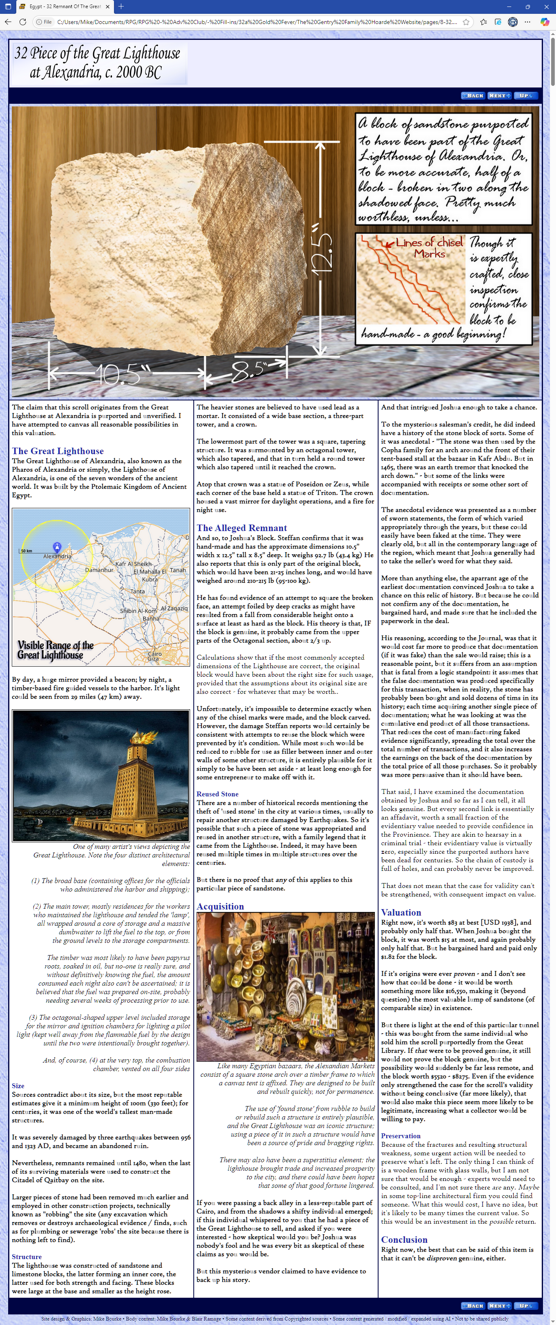
And here’s what just one of those pages looks like:
You might just be able to notice that I have used a slightly different font for the body text, for the image captions (okay, that might be hard to see), the Headings, and the subheadings. I was coding this to look right in Chrome, because that was the browser that I normally use and that the intended recipient also has access to. A little over half-way through, a Chrome update took away rendering websites in anything but one of the two default fonts that you specify – a serif or a sans-serif. Oh, you can still control the weight, size, and color of the text – but the font? Noooo way!
I can understand why they did so. There have been some truly horrendous web pages constructed by people who don’t know what they are doing with fonts over the years – but at least as many have committed crimes using color (yellow on white… navy blue on black…. orange on green….) as with font crimes. Now, those of us who knew what we were doing found our designs compromised by the need to hand-hold amateurs.
It completely changed the word flow, wrecked the alignment, wrecked the column spacing… it made the site look amateur, and not a particularly skilled amateur at that.
After playing around a bit, I discovered that Edge had also made this change, but that IE, the legacy browser included in Windows, had not – but it had other subtle differences, in particular Unicode display was hit-and-miss. A lot of characters had to be re-coded, every page revised.
About 3/4 of the way through the project, Microsoft finally did away with IE. Users were not given a choice – the browser software was still on their computer, but attempting to open it, or a page using it, loaded edge instead.
Now, I don’t like Edge. I found it to be a LOT slower than either Chrome or IE, more cumbersome, and harder to work with. And, what’s more, all the work that I had just redone was seemingly thrown out the window.
Then I discovered compatibility mode in Edge, which turned on the legacy ability to display different fonts as specified by the website. So that’s what the site is now coded to use. But automatic updates at least doubled the length and difficulty of this project, because the software developers presume to know what’s best for me..

Unintended Consequences
An assumption that we, as users, are forced to make is that the changes have been adequately tested and that the automatic update won’t break something we rely on that’s more important than just font rendering.
Probably nineteen times out of twenty, this is a not unreasonable assumption. But the twentieth time can trigger a full-blown emergency.
Another Chrome update resulted in a lot of text being displayed in a corrupt manner in Tweets. I wasn’t the only one affected, but no-one could figure out what was happening, mostly because Chrome updates itself without telling you its’ doing so. Eventually, it was discovered that hardware acceleration was the culprit, and disabling that meant that you could actually read what people were saying. And the next update fixed the problem – again, without telling you.
In the cowboy days of the late 90s and early 2000s, it often felt like end users were being used as guinea pigs by software developers. So this event brought back a lot of bad memories.
But even when an update does exactly what it promises, there can be unintended consequences. We all develop our own styles of working based on our needs, our skills, and our circumstances. No-one else has exactly the same operational needs and means of satisfying them that I do – that’s a conceit, but closer to the truth than people realize. That used to manifest in a users having a million different hardware and software configurations; it used to be said that no two systems were alike unless designed deliberately to be so.
Forcing a measure of conformity onto people would have made support a lot easier to perform – but at the price of flexibility and efficiency and customization. But those days are not quite so removed from the modern reality as many people seem to think – there are still thousands of different software packages out there, a hundred different ways of approaching the same task, and each of them – of necessity, because they keep changing the operating system – only partially integrated into the whole. And sometimes, that breaks things.
At one point, my Laptop – the same one I’m using now – died. Instead of booting up, I got a Windows error message. Some piece of critical software had been broken by an update – I never found out which one. The solution: a complete reinstall of Windows. Except that this froze solid and wouldn’t complete. The reason: it ran using Windows Update and this laptop didn’t have the RAM needed to permit the function to execute. Instead, it got locked into an endless cycle of trying, failing, and trying again.
Fortunately, for Christmas, one of my friends had given me a RAM upgrade that took this machine as far (in that respect) as it could go, and that was enough to break the logjam (once it was installed).
Auto-update means that your system’s reliability is compromised without warning – and, sometimes, with no way back.
Confusion
Does anyone remember when Word introduced the Ribbon? I certainly do. I was working for CLAN, a charitable organization, at the time, and the first thing anyone knew about it was when the person in charge (not sure of their formal job title and that doesn’t particularly matter anyway) went to write a letter – and discovered that the entire user-interface was changed, she didn’t know where any of the functions were any more and several of them no longer worked the same way, anyway. All productivity in the office stopped for the day as we rallied around to try and work out how to complete what should have been a five minute task – writing and emailing a letter.
I said at the start that I hate auto-update; well, I also hate and mistrust cloud computing, because it leaves the end user hostage to the latest brain-wave of the developers. But it’s all part and parcel of the same thing, manifesting in two different ways – all auto-update does is bring all the inherent disadvantages of cloud computing right to the user’s doorstep.
Even if everything works as it’s supposed to, if you no longer know how it’s supposed to work, so far as you’re concerned, it doesn’t work any more. Productivity and confidence and acquired skill all vanish into a cloud of confusion, and you have to start learning how to use a piece of possibly-critical infrastructure all over again.
It’s bad enough when this is because of your own mistake, but at least you should be aware of the risks and able to take measures to mitigate them. It’s something that you can be forced to tolerate when it’s the result of changes to legal requirements and legislation – we all have to live in the real world, and interface with the systems put in place by outsiders within that real world. But when its being forced on you, not because of some legal requirement but because some software engineer decides something should be done differently to maximize their employers profits, tolerance wears thin.
Lack Of Control
I’ve touched on this already, but it’s worth spelling out explicitly – in the modern era, users are not in control of their own systems and infrastructure. It used to be that if what you had was good enough for you to be productive, you could choose whether or not to replace a piece of functional software.
At the very least, you could defer installation until you had time to properly assess what the update offered and what benefits it could bring, and get a little ahead of that learning curve.
Not any more. Your systems’ functionality is now under someone else’s control – in fact, several ‘someones’, most of whom aren’t even talking to each other.
When I was a systems analyst, there was a term for it – Production Environment. Changes that impacted the Production Environment were very carefully managed, with lots of options to back out of a change at the first indication of unexpected problems. This was necessary so that software could be designed to meet the operational needs of the business in a stable operating environment, where problems could generally be assumed to be a flaw in your code, something that could be controlled and tested for and corrected, if necessary.
If the Production Environment was unstable, you could never be sure if your software bugs were your code’s fault (and correctable) or if the environment itself was misinterpreting what it was being told to do – not without five to ten times as much testing and expense. It was the difference between bespoke software development being economically viable and not.
Home users are no longer in control of their Production Environment and are not even consulted on changes to it, and sometimes, not even notified that its changing.
System Interaction
One more example and I’ll end this rant and move on to why this is relevant to RPGs, which is what most readers will care about.
The art software that I use is Krita, in its 3.3.3 mode. When I had to update Windows (as described earlier), I had to reinstall all my software, and in many cases, that meant downloading fresh copies. And that meant getting Krita 5.2.6, the latest version.
I’ve explained before that one of the reasons I liked Krita 3.3 is that I find its functionality to be intuitive to my way of working. I knew immediately what 95% of its functionality did, and its limitations, and what I could do with it, and so was instantly productive with it; I’ve used any number of other art programs and found them to be not so instinctive.
Somewhere along the developmental path between 3.3 and 5.2.6, Krita lost that intuitive connection with my workflow. Not only did unexpected things happen when I tried to do something I was familiar with, but I couldn’t figure out how to get it to do the things that I needed it to do. So I backtracked. I tried the highest iteration of Krita 4 (I don’t remember what the version sub-number was) – same problem. It just didn’t make sense to me, and I soon used up what limited time I had to expend on the learning curve.
So I retreated again, back to Krita 3.3.3 – I had been using 3.3.1. And hey presto, the magic was back! The changes between 3.3.1 and 3.3.3 were small enough that I could absorb them and keep right on working.
And all was fine – until the most recent Windows Update. And now, suddenly, the workspace won’t pan left. If I’m drawing a box or a selection window, or a straight line, if I’m going from left to right, or up to down, or down to up, and I move beyond the bounds of the currently displayed area, the image being worked on pans in the required direction, permitting control and accuracy. But if I’m going from right to left – nothing. The part of the image displayed stays frozen in place, making it impossible to be accurate or controlled in that direction.
Who do I blame for this? It’s hardly Krita’s fault – the operating system is what’s changed. But how can Microsoft have anticipated this particular consequence? It doesn’t seem entirely fair to blame them, either. I can only try to work around it (being aware of the problem) and hope that the next update from Microsoft fixes the problem – which it will only do if others are encountering problems stemming from the same change, which may or may not be happening.
I could try rolling back the change – but I’m not sure that would fix anything. It’s not like I was given any choice in the update other than when it would be applied, so at best it might just be buying me time.
I could try updating to the Krita 4 branch again. It might not be affected. I could try reinstalling Krita 3.3.3 – there’s a reason why I keep all these downloads archived! That’s probably the least damaging alternative. But the bottom line is that, one way or another, I’m going to have to spend a lot of time on this, with no certainty of a successful or even positive outcome. And that’s just to get back to the position I was in before this problem manifested! In other words, it’s not time spent getting better at what I do, or being productive – it’s time that I’m being compelled to waste because of someone else’s (botched?) decision.
Why do they do it?
I guess it’s only fair to give the other side of the argument. Why are updates forced upon us?
Reason number one is security, and when it comes to Windows, that’s always been a big thing. I wouldn’t dream of going online without Antivirus and a Firewall and having other anti-nasty software up my sleeve. But those are not enough – all sorts of vulnerabilities are discovered all the time and it’s only a matter of (a very short) time before someone tries to exploit those vulnerabilities in the wild.
I’m fairly competent when it comes to my computer, and in particular, getting it to enable me to do what I want it to do. I used to be even more of a hotshot in this department back in the Windows 98 days, when I knew how to tweak all sorts of settings that vastly extended and improved its functionality and efficiency for dong what I wanted to do. I’ve even been able to recognize, block, and eliminate malware that got past the defenses that I had in place at the time before it was able to do any damage.
But that’s a last line of defense – it’s far better to fix those windows of vulnerability (pun intended) before they manifest. So I tolerate browser updates, no matter how infuriating they might be, and keep my other defenses up to date, too.
The second reason is that occasionally, there is a functionality enhancement that is worth the effort of learning to use it. On “paper,” Krita 5.2.6 sounded really promising, able to perform all sorts of tricks that I couldn’t even dream of performing with 3.3.1. If it had been as good an intuitive fit, I would not have hesitated to make the upgrade. Software creators need to enhance their products to stay competitive – if they don’t, they will be lost in the myriad of other out-of-date software that’s fallen by the wayside.
What’s more, a more cohesive user-base makes it easier to develop new functionality, because everyone is starting from a common foundation. This also enhances the speed and reliability of the software.
The third reason is that enforced conformity at least makes support a little bit easier. And that’s a big thing. In 2023, it was estimated that software support cost between USD $500 – $600 Billion dollars. It’s routinely estimated to be 15-20% of the total costs of ongoing software development, and is a constant spur to that development. The percentage only goes up if quality assurance is considered part of that budget – to 35-40%!
Auto-updates might only reduce the costs of support 1% (it’s probably more) – but that’s 50-60 BILLION dollars a year (spread amongst many companies, of course).
And the fourth reason is security, again. The more consistent the platform, the fewer ‘gaps’ there can be for malware to crawl in. The current existential environment for computers is more hostile than it has ever been. Campaign Mastery has, for example, withstood, to date, more than 124.9 Thousand attempts to breach its security, over 1068 of them in the last month alone. The time was when these were rare events, now there are more than 35 a day. Worldwide, yesterday, there were more than 356,000,000 attacks on just the websites using the same protection that I am – and the trend is upward.
And, finally, there can be regulatory requirements that have to be met. These tend to only matter in certain industries and not be a factor for home use – until home users start getting into investment and cryptocurrency and the like. Well, a lot of home users are doing so – whether or not that’s wise is a whole different subject.
So there are good reasons for software vendors to LIKE auto-update, and even – in some cases – for it to be essential to the home user. I’m not a fool, and when this is the case – browser updates for example, and anti-virus / anti-malware – you do have to bow before (and acknowledge) the necessity.
Here’s another way to look at things: Windows used to differentiate between critical updates and non-critical updates. Auto-update revokes the necessity for doing so – by making all updates “critical”. That there are advantages to all sides for doing so is just a happy accident.
The RPG Equivalents
An RPG can be subdivided, through successive layers, into Rules, Campaigns, Adventures, Encounters, Tools, and Style. I’m leaving Story off this list because it doesn’t generally change as a result of outside forces – it can and does change with moments of GM inspiration, change of setting (a sub-part of Campaigns), and in response to player choices and actions, but those are all expected and appropriate. Of course, they can go wrong, but that’s beyond the remit of this article.
1 Rules, Part 1
Arguably, the aspect of an RPG that is most analogous to everything that I’ve described are changes to the rules, so I’ll be spending quite a bit of time focusing on that. So much so that I’m dividing the subject into two, mostly to group the examples into recognizable categories and patterns.
Rules changes can shake the very foundations of an RPG campaign. They not only can alter the way established actions are interpreted within the game framework, but add or subtract from what actions are possible / permissible, and often wrap new frameworks and contexts around those actions. The very concept of what a Wizard is, or a Rogue, can change completely from one rules edition to another.
These relatively broad strokes are comparatively easy to excise and replace with established canon when applying a new game system to an established campaign, so they are not a huge issue, at the end of the day. But many of the changes are more subtle, and these can escape attention until it’s too late.
Like the software auto-update, these changes can fundamentally alter the methods to be used to achieve something or to simulate something within the rules structure. The results can be confusion and delay, unintended consequences can be crippling (especially if the systems are inadequately playtested), and a GM can find that he has just ceded large parts of the control of his campaign to the system authors. Sometimes this is beneficial, but most of the time, the changes just get in the way.
It’s arguable that the story in an RPG derives from the tug of war between the plot direction created by the GM through NPCs and the intentions, purposes and choices of the players through their characters, all shaped through the game system and the parameters that it establishes. If a key PC ability gets changed fundamentally midway through the campaign, that’s a big impact. If a GM loses the ability to steer the campaign because of changes to concept or canon, it leaves the PCs free to wish-fulfill, and that can doom a campaign just as surely.
But the most dangerous changes are even more subtle than that – social concepts and underpinnings that the GM never perceived the need to articulate can be completely upended. That’s a lot of what lies behind the game community reaction to the softening of Orcs in the most recent iteration, for example. Now, I don’t intend to buy into that argument one way or another in this article; instead I want to focus on the fact of the change, rather than the substance of that specific change. And, while there might be objections or dissonance when applying the new rules to a new campaign, these changes can be catastrophic when applied to an existing campaign.
I think that each iteration of a game system carries with it a certain stylistic expectation that is forced on those who employ that iteration for their games. If the changes from one iteration to the next support the content that the GM intends and desires for the campaign, the game system can be said to support the campaign, and all is well; if there is a dissonance or conflict, the game system is fighting the campaign, and the results will be less than satisfactory all round.
For any given campaign, then, the totality of what is specified by the game mechanics and what is left open for the GM to interpret / create means that some game systems suit that specific campaign better than others, and that a change of game system inevitably creates a ripple of change in the unspoken undercurrents and assumptions upon which the campaign is based.
It’s for this reason that I rarely run RAW in my campaigns; there are always tweaks that are designed to make the game system conform to and support the context, backstory and concept of the campaign. This is exactly the same as adapting the way you perform a task after a new software version is released, with the big difference being that the software change is forced on you by auto-update; a rules change can be refused (especially since they don’t come ‘free’ but have to be purchased, perhaps at great expense).
I have two suites of RPG game systems where multiple iterations impacted ongoing campaigns, hence the division of this part of the subject into two parts. I’ve talked about both of them before – I’ll try not to repeat myself too much – but I’m not sure that I’ve ever looked at their histories in this exact context, so there will necessarily be some repetition of things I’ve written in the past.
1.1 Fumanor – AD&D to 2nd Ed
Fumanor: The Last Deity was written over a ten year period of playing non-Fantasy games, accumulating and polishing ideas. At the time, other GMs were soaking up all the interest in Fantasy with long-running campaigns, and no-one was interested in another one that had to run at the same time as the one they were already in.
Imagine you’ve learned to use a computer on someone else’s Windows 98 machine, and you finally save up enough to buy your own – only to find, when you bring it home, that it has been ‘upgraded’ to Windows Me. Superficially, the operating system looks much like what you know, enough that you think nothing more of it and dive straight in to doing things. Every now and then, it does something a little flaky, but you put that down to your unfamiliarity with the OS and just clean up the mess. Now imagine that you’re only using the computer once or twice a month.
For anyone familiar with the history of the Windows operating system, the above says entirely too much, it’s like being trapped in a Stephen King novel until some metaphysical reader finishes reading the story – and he only reads a page or two at a time.
That’s very much akin to the situation with the Last Deity campaign, where – when I finally found some players who were interested in what ten years of effort might look like – those players wanted me to run it using D&D 2nd Ed.
Now, I’m not trying to equate 2nd Ed with Windows Me – I can’t and won’t definitively label 2e as a Lemon, which Windows Me definitely was. But, as I described recently in my article here on Michael Schumacher’s achievements, there were some behind-the-hood differences that just didn’t mesh with my expectations and planning. It took a fair while to figure this out, and by the time I did, the campaign was in drastic trouble – the PCs hit level 5 when I expected them to reach level 3, they hit level 9 when I had designed for level 5, and were at level 12 or 13 when I expected level 7 or 8. On those trends, by the time the campaign came to a close, the PCs would be level 40-50 instead of the anticipated level 20.
1.2 Fumanor: D&D 2nd Ed to 3.0
As recounted in the article linked to above, the immediate “solution” was a Frankenstein’s monster – core Rolemaster with the D&D 2e Magic system bolted on. It didn’t work, and it was almost immediately apparent that it wasn’t working. I think we played something like 3 or 4 game sessions – once a month – and half of that time was spent debating what to do next.
My preference at the time was to go back to the original intent of an AD&D campaign, but again I bowed to the wishes of my players and migrated lock, stock, and barrel, to D&D 3.0, supported by the players collectively giving me copies of the core rulebooks for Christmas that year. This was moving from Windows Me to Windows XP – more things had changed, and many more things were slightly different under the hood, but it was far more stable and cohesive.
And it – and I – ‘clicked’ immediately. I didn’t take the unexpected levels off my players, in fact (as I recall) I let the entire Rolemaster Fiasco count as a character level – but I was able to match challenges to PC capabilities while slowing their progress enough that it more-or-less matched my original intent. Those extra levels gave them an edge that meant they were usually successful in the end, but getting to that end was hard enough that everyone had fun despite one or two false starts (see The Woes Of Piety & Magic from the “My greatest mistakes” series).
1.3 Fumanor: D&D 3.0 to 3.5
In contrast, the upgrade to D&D 3.5 went through without a hitch, without even causing much of a ripple. Of far greater concern at the time was that there were mutual incompatibilities between the Epic Levels sourcebook and Deities & Demigods – both relevant because of the additional levels the PCs had earned. They still had about eleven levels of advancement planned in terms of overall plot within the campaign when it switched to 3.0, and were at about level 13-14 at the time – so I was looking at an end-point of Level 25 or thereabouts.
In actual fact, they were closer to level 30 by the end of the second phase of the Last Deity campaign – but the system, and I, were able to cope with that.
“Auto-update” doesn’t have to end in disaster, in fact it can be a positive experience. But it’s a risk – as Forest Gump phrased it, “Life” (or in this case, D&D system updates) “is like a box of chocolates, you never know just what you’re going to get”.
1.4 Refusing the 4th Ed Update
Fumanor: The Last Deity II was followed by a brief mini-campaign using the same characters as a prelude to two new sequel campaigns which are usually considered either “The Last Deity: Aftermath” or an add-on to “The Last Deity II” (and not a wholly separate campaign). The purpose of this interim was (1) to look at what became of the PCs after the Last Deity campaign, (2) to show that the game world’s problems hadn’t been magically cured by the results of the campaign, and (3) to establish the preamble for the true sequel campaign, “Fumanor: Seeds Of Empire”.
By this time, 4th Ed was out, and the Edition Wars were in full bloom. The Wikipedia Article on D&D editions soft-pedals the fury with which 4th Edition was met by many fans – and things that have been learned since, like actively ignoring feedback during development and playtesting underscore the reasons for much of that fury. If any edition of the game system deserves comparison with the Windows Me fiasco, it’s probably 4e. Personally, my ire was centered on the changes to the OGL, which (in my view) was one of the great advances that had made 3e such a success.
The absence of certain character classes from the Core Rules, classes which were going to be at the heart of the planned sequel campaign, made the decision not to upgrade to 4th Ed a no-brainer. “Fumanor Seeds Of Empire” would stay D&D 3.5.
One of my key players then threw a curve-ball into plans, accepting a job in Canberra, the national capital, 275 km (171 miles) away. While he would be able to return to Sydney every 2-3 months for the day, the 4-hour trip was not something he could do more often. He didn’t want to leave the campaign completely, though, and asked me to try to find a way to “make it work”.
What I came up with was an entirely separate spin-off sequel campaign using ideas that I had been building up for a possible sequel to “Seeds Of Empire”. This became “Fumanor: One Faith”, and it was to take place concurrently with “Seeds Of Empire” in game time – whenever this player happened to be available, we’d play “One Faith”, and whenever he wasn’t, “Seeds Of Empire” would take the spotlight. Other players would be the same (with different characters) in both, though all would have the choice of opting out of one of the campaigns if they wanted, and new players could choose to join either or both.
After only one or two sessions of both campaigns, circumstances had changed, and the player in question was fully available, so it turned out not to have been necessary – but the set-up had been revealed and the characters were hip-deep in dramatic developments, Lolth having conquered the Elves at the cost of losing the worship of the Drow, who felt abandoned and betrayed, and had reconverted to worship of Corallon. Such social upheaval doesn’t come easily, and pockets of resistance to the “new ways” of doing things were stirring up all kinds of trouble. There were also time bubbles and cybernetic Druids (with mechanized Giant Dobermen) and all sorts of other strangeness – the PCs never knew quite what to expect, only that it would all make sense in the end.
The impetus went out of both campaigns when I took a year off to write the Orcs & Elves series, which filled in key parts of the background – once one group of PCs reached a position of learning these hidden secrets. This primarily impacted the Seeds Of Empire campaign (and took a lot longer than I initially expected), but at the same time, the One Faith campaign was knocked for a loop by the death of one of the players – both campaigns entered a hiatus from which they have never resumed. They are still officially ‘ongoing’ but it’s been 12 years since either were actually played.
1.5 The ‘D&D Next’ experience
Learning from the lessons of the 4th Ed debacle, WOTC started off doing things right when it came to D&D Next. All my players and myself were part of the playtesting, myself as GM, and I created the Tree Of Life campaign as a test-bed, using the game system the way I would if it were ‘complete’ – as an ongoing campaign whose background facilitated the anticipated changes in ‘reality’ caused by ongoing revisions to the rules system.
We were all diligent in submitting our feedback, but over time, noticed a trend – every iteration was taking the game system closer to the 4th ed model and further away from suitability for an ongoing campaign. Problems to which we had offered solutions were not resolved, in fact were ignored completely. Our feedback appeared to be falling on deaf ears, and we quietly despaired and dropped out. Again, the death of Stephen Tunnicliff had a major impact, ending our participation in the playtesting, but it was already on shaky ground with us by that point. If the campaign had been explicitly designed to suit what became 5th ed, it might have worked, but as things stood, we were never tempted to start a genuine 5e campaign, and there was absolutely no question that Seeds Of Empire or One Faith were ever going to migrate to the new game system iteration..
1.6 Pathfinder, 1st Ed
By that time, of course, Pathfinder had emerged and established itself as the true spiritual successor to what is often generically referred to as “3.x”. Migrating to Pathfinder was an option seriously considered, but we had just made substantial commitments in purchasing 3.5, money was tight, and Pathfinder was a bridge too far at the time. On top of that, there was a general sense of ‘If it ain’t broke, don’t fix it’ amongst all participants in the ongoing campaigns. I had other D&D campaigns at the time, and if I had copies of the rules (since acquired), I would have switched one of them over to the new system as a test before committing to what I regarded as the centerpieces of my D&D ‘universe’. But they didn’t survive the death of Stephen either, so there was never an opportunity.
1.7 Pathfinder, 2nd Ed
I also picked up copies of Pathfinder 2nd Ed through a deal done with the Game Store where we were regularly meeting to play. At one point, I tried to interest my players in a new campaign to try them out, but there was no serious interest on anyone’s part. So this was another ‘auto-update’ that didn’t happen.
But, when reading through the rules, with a view to possibly upgrading the theoretically still-ongoing Fumanor campaigns to the new system, I was overcome with a strong sense that something was subtly different in terms of the flavor that the game system carried. I couldn’t put my finger on it – still can’t, to be honest – but it felt “too different”. So, were the Fumanor campaigns to restart tomorrow, they would continue to be 3.x campaigns.
But, were I to undertake a new D&D campaign, both Pathfinder editions would be given serious consideration. And it’s that ‘underlying flavor’ that would determine which game system would ultimately be chosen.
Because in gaming, ‘auto-update’ is a voluntary thing. And that’s to its benefit, in my opinion.
2 Rules, Part 2
The other tranch of game systems that I want to look at in this context is what is now known as the Hero System. But this is already a long article, so I’ll try to be brief!
I’ve run multiple campaigns oriented around the Hero System, starting with a campaign rooted in the original “Champions” (with a superhero team that decided, with a total lack of originality, to name themselves “The Champions”).
Again, I’ve talked about these campaigns before, so I’ll try not to simply repeat myself, but some echoes of the past will be inevitable.
2.1 Champions
As a long-time reader and fan of superhero comic books, when i was given a photocopy of the Champions rules, I devoured them in one night and immediately created a campaign to try them out. This was a solo campaign in which I was both player and GM, and immediately I found that the game system wasn’t quite what I wanted. It was fine for low-level characters, but I wanted the Cosmic Scope of the Fantastic Four and Doctor Strange, the Epic Capabilities of Thor and Superman, and a game system that let characters of all points in between to come together to solve problems too big for any one of them, a-la the Avengers.
2.2 My Homebrew System ver 1
My first character was a superman-analogue, Ullar, going up against an immortal Wizard / Necromancer inspired by, and named for, Marvel’s Mandarin (not the fake-out that appeared in the Iron Man 2 movie).
The day after I started, I was invited to actually run a one-off campaign for a mixture of experienced players and novices at a private home. Since I could envisage the rules changes that I wanted to make quite clearly, I agreed . The next 6 days were spent writing and testing rules and developing background – without sleep, a measure of my excitement.
The changes that were made were fairly minor in and of themselves – more options for disadvantages and advantages and limitations, mostly, and a relative power structure that permitted multiple power-level characters to co-exist without treading on each other’s toes too much. Cumulatively, though, these had exactly the impact that I wanted.
At the end of the week, I travelled to the home of Robbie and Trish and they and their neighbor generated characters and played through an epic one-off game which brought their super-group together and pitted them against the same villain, who had again found a way to resurrect himself, a back-door escape from his defeat in the solo campaign (which formed the background of the new adventure).After GMing for 20 hours straight on the back of a week without sleep, I was dead on my feet but “The Ultras” had become an occasional ongoing campaign) – and I was invited to move in, permanently, but that’s a whole other soap opera
2.3 The Champions Campaign
A week after that, an entirely separate group of players enthusiastically signed up for what became “The Champions” campaign, which used both the Ullar and Ultras campaigns as background. It was late August, 1981 – and that campaign and its descendants continue to this day, 44 years later. In fact, the Saturday just passed would have been the ‘official’ 44th anniversary.
2.4 My Homebrew System ver 2
Twelve pages of hand-written notes are all well and good, but one of the players persuaded his sister to type them up, and this became the game system for the next year or so.
2.5 Champions II
In that time, Champions II came out, but these weren’t revisions, they were additional supplements. In some cases, they added options that I had already integrated into the system, on others they added options that I hadn’t considered, but a single page of ‘conversion notes’ were enough to integrate them into my homebrewed variation. These were painless auto-upgrades, in other words.
We were playing two 6-8 hour game sessions a fortnight – I was alternating with my original AD&D campaign at the time – and the occasional extra session at someone’s home. At the end of the first year of this, the PCs finally defeated my “Mandarin” for the third time, by discovering a world in which his rule was the lesser of two evils (the fascists had won WW2) and, essentially, handing it over to him.
At about the same time, I moved away from Sydney but every couple of months I saved up enough money to visit and for a week or so, we would play multiple game sessions a day for a week – overall, the net average stayed about 1 session a week even though I was living 540 km (336 miles) – a nine hour train trip – away. It was a bit like living in Albuquerque and traveling to Denver to play, or commuting from San Francisco to Los Angeles.
After a year or so, I returned to Sydney, and started three spin-off campaigns.
2.6 The Project Vanguard Campaign
The project Vanguard Campaign were superheros in training – the next generation, inspired by The New Mutants. It used the same homebrew rules.
2.7 The Project Vigilant Campaign
The Project Vigilant campaign was to focus on protecting the PCs, who were of primary school age, inspired by Power Pack. In theory, these characters weren’t supposed to have adventures. Hah! Tell that to the PCs…
This campaign also used the same homebrew rules.
2.8 The Team Neon Phi Campaign
This was a James Bond / super-agent campaign, and it actually prompted a small expansion of the homebrew rules. It would run for about 5 years.
So now I had four campaigns, two game sessions a week, plus my AD&D campaign (2 sessions a month), and one weekend off – a monthly cycle. When the AD&D campaign wound down, for a short time, we went to a fortnightly schedule, but people started to burn out and wanted to go back to having time to do other things. So the monthly schedule became fixed. I spread the four campaigns (with double-sessions of the core Champions campaign) over the 6 game sessions for the first three weekends of the month (with one spare, occasionally used when one of the non-core adventures needed some extra playing time) and all was well.
2.9 GURPS
I think it was around 1987 that I was first exposed to GURPS supers, and stole a few ideas that were also integrated into the homebrew.
2.10 Champions 4th Ed
In 1989, Champions 4th Edition was released. This was a comprehensive and cohesive update, and it triggered a full rewrite and expansion of the homebrew, one which referred extensively to the official rules but which fully integrated the changes that I had made, and added in still more. There were lots of extra skills, for example, and several new powers.
2.11 My Homebrew System ver 3
Five volumes of the revised Homebrew system were produced, running to an average page count of about 75 pages each. They were 80% complete at this point, but that didn’t stop their wholesale adoption through all of my Champions campaigns. I even wrote a new printer driver to enable more complex production of the rules. Ultimately, it was the printing that spelled the end of work on this iteration of the rules – printer-ribbon hardcopy was just too pale and hard to read, and the formatting into double-column justified text was a pain at the time. It was in a playable but incomplete state, and that was where it stayed.
This iteration of the rules – and only a single hardcopy was ever produced – remained in effect right up to the end of the spin-off campaigns and two years of “miniseries” – one for each PC (and fictionalized ones for some of the key NPCs). This also coincided with the Graduation Exercises for the members of Project Vanguard, forcing players to choose one of their characters to retire.
The 10th anniversary of the original campaign kicked off the early stages of something that had been brewing in the background for quite some time – Ragnarok. Unfortunately, I mishandled the early stages, and player frustration and discontent over the pacing that resulted eventually caused the campaign to shut down, at least temporarily. I set about writing up the events as a fictionalized work that encompassed the entire history of the campaign with a view to restarting it five years “post-Ragnarok”, but at the same time, got distracted by my new TORG campaign, and early attempts at getting Fumanor up and running.
2.12 The Zenith 3 Campaign
Eventually, the history was complete and new players came onboard, attracted by the richness of the History and the sprawling expansiveness of the setting. This became the Zenith-3 campaign.
2.13 My Homebrew System ver 4
Initially, it was run using the same homebrew rules, but these were now about 10 years old – I had a new computer and a new laser printer and the limitations that had impacted and curtailed the previous version were no longer in effect.
One of my players, realizing that there was only one hardcopy of the rules, then made the fatal mistake of offering to write up a new version of the core mechanics, were were still contained in about 12 typed pages from the early 1980s. He thought it would only take a week or two.
Hah! First, he had queries – some of the house rules weren’t even written down, or interpretations of them. Then he had suggestions, some of which were accepted, some debated, and some rejected after discussion about why. In the meantime, I had been collecting notes about changes to the rules, some of which he liked and some of which he found faults in.
This became version 4 of the homebrew rules – a version that never saw play. It was based on the concept of the rules being homebrewed revisions of the official 4th edition game system, and referenced it as much as possible. But copies of it were old and hard to come by, so the decision was made to commit to creating a standalone set of rules. A complete game system, in other words.
Version 5.
2.14 My Homebrew System ver 5
I have a binder with over 500 pages of 5-point type. At the time, it was legible. These days, it’s legible with a magnifying glass!
That’s because it’s been printed half-sized, with 2 pages on each physical sheet of paper. The totality – still unfinished – is over 1000 pages long.
As soon as enough of it was finished, the campaign switched to it.
This was deliberately designed to be a system upgrade, and it necessitated complete revision of the characters.
2.15 The Warcry Campaign
Also using this new set of rules was a new spin-off campaign, which resulted when that players’ PC became too powerful to be compatible with the adventures being produced for the main campaign. This was also conceived as a test-bed – proposed rules changes could be implemented and playtested before being incorporated into the “official” rules.
2.16 Champions 5th Ed
While we were working on Version 5, Hero Games released Champions 5th Ed. Initially, financial constraints meant that it wasn’t even considered for integration with Version 5, though some ideas were lifted out and some reference pointers in our notes pointed to it.
2.17 The Adventurer’s Club Campaign
Then along came the Adventurer’s Club campaign. This was originally set up using the official Champions 5e, but slowly diverged from it a little as house rules were added and accumulated.
2.18 Refusing the Champions 6th Ed Update
When the news broke of Champions 6th Edition, we were all excited. This was billed as a top-to-bottom rewrite, with the avowed goals of doing a lot of what was being done in the Version 5 homebrew, so work on Version 5 was shelved until its actual release.
I and the other GMs here with which I have discussed the issue agree that this was the most disappointing game release, like, ever. It kept bits of the system that we had discarded. It didn’t look all that different from the 5th edition, in fact – just split into two volumes – with some added inserts.
The price alone made us hesitant to upgrade any of the campaigns to use this new rules iteration. The issues with the supposed “rewrite” confirmed that hesitation. While a few of us have copies for reference, none of us would migrate an existing campaign to the new version – too much risk for too little gain at too high a price.
So those are my primary experiences with rules system updates, and quite a mixed bunch, they are, too. There’s everything from positive improvements to virtually no change worth noting to catastrophic failures and outright rejections. Each one is akin to an adventure in and of itself. Sometimes, you eat the monster, and sometimes, the monster eats you. And, occasionally, neither of you are hungry enough to bother.
But, seriously, as with computer technology, decisions regarding upgrades to game systems are all about risks, risk management, and rewards. If the potential reward is high enough, it’s worth taking a chance – but leave yourself a back door and a commit/reject deadline. If the are some potential rewards and the risk seems minimal, go for it. But under any other circumstance, back away, very slowly – because not all the risks are quantifiable. Some of them lurk unnoticed in the high grass.
Campaigns
This advice is doubly appropriate when it comes to auto-updating Campaigns. This is all about game settings, really – have you ever run a game setting designed for one iteration of the rules while using a different set of rules? It’s not as hard as it sounds.
When a new campaign sourcebook is released, you have to decide whether or not it’s compatible with the campaign that you are actually running. If not, then shelve it – use it as the starting point of another campaign, but don’t try and shoehorn it into your existing game world.
That requires careful reading with an eye toward the implications and consequences of bringing the content into your campaign. No-one can explicitly guarantee compatibility with any certainty.
The same goes, in fact, for any non-core game supplement. Parts of it may be compatible, and even useful or inspiring. Parts of it may not be.
It’s also always worth remembering that this form of upgrade is not an all-or-nothing; you can integrate parts of a resource while refusing or rewriting other parts.
Adventures
Few adventures stand in isolation. As soon as any customization of the game world or game system takes place, compatibility with adventures that you haven’t written yourself is placed at risk.
That doesn’t mean that you have to write every adventure yourself – you can take a published adventure module and adapt it as necessary. I used Danger At Dunwater, which I set at Loch Ness, for part of the discovery of the Atlanteans in my Champions campaign. I also used The Ghost Tower Of Inverness as part of that campaign’s pre-Ragnarok Buildup (I forget where I placed it).
It’s your job as GM to make whatever material you introduce to your campaign compatible with whatever’s already there. Sometimes, that’s easy – and sometimes, it’s not. In the Warcry campaign, I’ve gotten great mileage from some adventures written for the Star Frontiers and Space Master game systems. It all needed adaption, but the conceptual foundations of the adventure fitted the campaign at the time.
Encounters
The smaller you get, the smaller the risks. Creatures and encounters can evolve considerably from one iteration of a game system to another, or from one sourcebook to another – but if one particular version of a “Troll” happened to fit what I wanted in terms of the action, I’ll incorporate it, regardless of the game with which the source material is supposed to be compatible.
In particular, roleplay-oriented encounters dance on the edge of a blade, I’ve found – they are either more readily compatible or require a lot more adaption than straight combat encounters. That’s because a lot of sociology and in-game circumstances can be taken as read within the encounter as written, and that can be directly contradictory to their equivalents in the established campaign.
Straight Combat encounters will always need adaption because the game mechanics are going to be different, but this is usually similar in degree of effort required. Non-combat encounters are either easier or significantly more work – there isn’t a lot of in-between.
Core Tools
Heading toward the conclusion of this article brings me closer to where it began, looking at the impact of the core tools that a GM uses to prepare for a game session. These are either pen and paper (unlikely to be affected) or software, and that’s where things can get sticky.
A long time ago, I was using a particular office suite as a word processor. I wrote an adventure, saved it, and thought all was well. Auto-update was still in relative infancy, but this particular software occasionally invoked it for what the makers deemed critical updates – usually fixing things that made the software crash, so – in principle – a good thing. Again, there was a distinction made between critical updates and functionality upgrades, a distinction that is less prevalent today.
Came game day, and when I opened the file with the adventure to print it out – usually left until the last minute so that tweaks and refinements were possible right up to the 11th hour – all I got, instead of my text, was a complaint about a corrupted file. Fortunately, I remembered most of it – as adventures go, this one was pretty straightforward – and play was able to get underway.
Afterwards, I discovered that an error was inadvertently propagated through the update that meant that all text saved in that particular file format could not longer be read by the the software, and that an urgent patch was being pushed to fix the problem.
There’s all sorts of software that we rely on for all sorts of things, these days. I have one piece of software that I use for writing plain-text files – like this article. I have another that I use for formatted text and PDF production and spell-checking these articles. I have another piece of software that I use for editing images, and one that I use for displaying them in-game. I have two internet browsers (in case one lets me down or gives unexpected results), and one of those has at least 10 additional add-ons for various functions. I no longer have a separate email client, my ISP providing a cloud-based alternative. I have font display and character display software, I have two calculator apps (one of which does nothing but convert units), and – of course – there are the usual system tools, including the windows browser.
That’s a lot of things that can go wrong in unexpected ways. And, sometimes, they do. Because I save in common file formats for the most part, there’s usually a way around most of them (but occasionally, the file itself becomes corrupted by a software gremlin, and there’s not much can be done about that). But I also maintain a regular backup regime – I might lose a week or two of work, but not much more than that, and that’s a worst case scenario.
So I’m insulated against these problems as best I can be. On rare occasions it isn’t enough – especially if the whole operating system goes down a rabbit hole – but for the most part, I have defenses that protect me. And those practices and defenses are present because I’ve been bitten so many times in the past that I’ve learned to consider these necessary best practice, in fact, the only practice that makes any sense.
But it’s still inconvenient at best, and catastrophic at worst.
Style
My final category is Style. Everyone has their own, and in part, it depends on the tools that they employ to enhance their storytelling and interactions with players, with rules, and so on. Change the software and you can inadvertently impact your style.
The problem is that style can be an extremely delicate thing, far more sensitive than most people think. It can also be a far more robust attribute than most people realize. That’s a contradiction of course, but it’s also a reflection of reality.
A GM’s style impacts how he or she wants to use the tools that they have, and the way that they plan to use those tools in furtherance of the gaming experience. A GM’s style is impacted by changes to those tools, what they can and can’t do, and how efficiently they do it.
When I display a large piece of text, the editing software that I am using scrolls not in lines but in whole paragraphs. If a paragraph is too long, the end of it never becomes visible – you need to widen the screen and shorten the paragraph in order the see it all. That causes me problems from time to time with these articles, especially when there’s an image with a long caption, because the HTML code also counts as part of the paragraph.
But I know it’s an issue, and my style has adapted to accommodate it – shorter, punchier paragraphs being 90% of that adaption.
The tools you use impact your style – subtly, in the event of a small change, or massively, in the circumstance of a change of greater substance. And those changes can be thrust upon you without warning through auto-update.
Which brings me back to where I started in this article: I hate Auto-update.
But I have to live with it, and so do you.

Discover more from Campaign Mastery
Subscribe to get the latest posts sent to your email.
Comments Off on Auto-update and the RPG