Campaign Mastery helps tabletop RPG GMs knock their players' socks off through tips, how-to articles, and GMing tricks that build memorable campaigns from start to finish.

The Great Reset Button In The Sky


This montage is based on a storm image by Artur Pawlak, with lightning strikes from an image by skeeze and another from an image by AIAC Interactive Agency. Editing and color effects added by Mike. The button is from a set by 538778. All the images were sourced from Pixabay.

I Spent much of the weekend a few weeks ago performing my regular data backup.

Everyone in IT has horror stories resulting from inadequacy of backups. Even IT professionals and past professionals like myself – who know how essential backups are – have lost irreplaceable material to inadequacy of backups. That’s because there are two parts to the backup equation and people focus so intently on the first that they tend to ignore the second.

The first part:
     data → backup process → storage

The second part
     storage archive → restore process → restored data

When my old computer’s hard drive was failing (about 10 years ago), I very carefully backed up everything that I considered essential. Much of the most irreplaceable data went to a DVD-ROM that I had burned. This was a backup performed under considerable time pressure; the PC could fail completely at any moment because the Operating System itself was being rapidly corrupted. As a result, all my focus was on the first process.

Swapping the old hard disc into a new computer wasn’t an option; the cause of the Operating System corruption was impending hard disk failure – or so it seemed at the time.

Thus, there was total reliance on the backups to preserve my data.

I had a low level of confidence that everything could be saved, but I had to try.

This pessimism turned out to be Justified: the DVD-ROM could not be read by the drive in the new PC. I still don’t know why.

I persevered, having little other option. I was able to recover about 75% through other archives. Eventually, on a third machine, I managed to find a settings tweak that enabled recovery of the archived file from the failing Hard Disk – only to discover that the low-level program used to compile the archive would not function under my new operating system. It was Windows 3.1 software, and Windows 7 didn’t want to know about it. Nor does Windows 10, for that matter. But it worked perfectly with XP.

Essentially, it was a hundreds-of-Gb locked filing cabinet – with misplaced keys.

The remaining information was lost.

My documents and web links were saved. Everything CM-related was saved. Some artworks were lost, and some corrupted. Some material relating to old and unplayed campaigns was lost, but everything relating to the then ongoing campaigns was preserved. Some of my carefully-curated music files were lost – my Rolling Stones collection, for example – but a lot was preserved through other archives, too. And I still had the original CDs for a lot of what was lost. Lost and irreplaceable were all my original musical compositions with only a few exceptions. That includes the half-mixed MP3 versions that I was planning to put out as my first CD.

Even if the best-case scenario had prevailed, and all the data had been restored, or at least recovered, there would still have been some losses. A Backup is a snapshot of the way things were at the moment of the backup; at best, you can return to that moment in time. It’s a bit like reloading a saved game when computer-gaming – anything done (for good or ill) since the last save never happened.

But I’m not actually here to talk about the vagaries of computer dependence. Suffice it to say that lessons have been learned and the current backup protocols are unlikely to yield the same outcome should the worst occur!

I was preparing for this particular backup the day after my superhero campaign had resumed after a lengthy Covid-19 -induced hiatus, and the two thoughts connected to raise an interesting question: Backup and restore of a campaign? How?

Two processes

It’s clear that we’re talking about two processes – focusing on the first will get you nowhere unless you have already solved the second. The lessons of the computer world are directly applicable.

The first is making preparations for a potential future disaster. What prep-work is required will depend on the solution to the problem, and has to be specified as part of the description of any solution. Let’s call it the “backup process”.

The second is rebooting the campaign using that prep. This process will vary according to the prep process, which should have been designed with this usage in mind.

It’s not enough to be able to back up the campaign, in other words – you need to be able to use that backup to press the great reset button in the sky.

Different Emergencies, Different Protocols

What may not be as clear at first glance is that different problems will require different solutions. Specifically, there are two different types of problem and a host of different circumstances under which each can apply.

Problem #1: The PCs are about to make a mistake of campaign-killing proportions. This may or may not result in a total party kill (TPK). The GM can see it coming, and has hinted as broadly as he dares, but they aren’t taking any notice. A train-wreck is inevitable.

Problem #2: The PCs are killed. All of them, a TPK. This might be at the hands of the main antagonist (better) or in a random encounter (worse). They may have been unlucky, or may have made a mistake, or it might be the DM who has made the mistake. The train-wreck is either in progress or is complete.

Seven Solutions

I have seven solutions to offer, some better suited to one of these problems than the other. With some solutions, it will be necessary in the case of Problem #1 to let the disaster play out – at least to the point where the players can see that defeat/failure is inevitable – before the reset button can be pushed.

I have to admit to hating some of these solutions with a passion – but not so much that if it was the only way out, I wouldn’t use it; I would just try to impart some clever and original spin on it.

It only makes sense to me not to rely on any one or two solutions to the crisis. Between the two subtly-different problems and the range of possible circumstances, any one of them might be “the best answer” or “the right answer”.

That mandates that they all be low-impact low-prep sustainable solutions, so that it’s practical to have them all on standby. So that’s an additional factor to be taken into consideration.

The solutions I’ll be looking at are:

  1. The Nightmare Is Ended
  2. Dystopian Recovery
  3. New PCs, Same Old Problems
  4. Back In Time
  5. The Jailbreak Adventure
  6. Temporus Interruptus
  7. The Great Reset Button In The Sky

1. The Nightmare Is Ended

One of the solutions to the problem that I especially despise is “it was all a dream”. Nevertheless, this can be a vital escape clause, and times when – because what took place wasn’t a single catastrophic error but an accumulation of smaller mistakes over a longer period of time – when this is the best answer.

One example is where the players have completely misinterpreted something the GM has said. If you notice this discrepancy at the time, you can correct the problem – but are then fighting Confirmation Bias, which is often a losing fight. The article to which I have linked offers possible solutions to the problem, but they generally require game time to implement – and that’s a luxury you might not have. So there are times when this is the best answer.

    Prep Component

    Prep consists of three things:

    • keeping your campaign well-documented;
    • selecting points within the game play that will be suitable platforms for a restart;
    • having, on tap, some sort of original twist on the “it was all a dream”. This may in fact be a full adventure in its’ own right or a single scene.

    The first item you should be doing already.

    The second is a little trickier to offer advice on; it has to be before the “critical mistake” was made or the situation became irrecoverable, but there are a host of other considerations – what the PCs were doing at the time, what the state of the campaign was, and so on. There are so many variables that the decision will be half-instinctive. Ideally, you would like to be able to sum up the PC’s situation, and the current state of the campaign, in a single paragraph of no more than half-a-dozen lines, but that’s rare. Lulls in the emotional intensity are also preferable to moments of high intensity, because the restart will inevitably be such a lull. Ultimately, each GM will have to assess his own campaign as it proceeds to locate the most recent ‘reset point’, and such determinations will be as much instinctive as they are logically justifiable.

    The third item is probably the most difficult. In a sci-fi or superhero campaign, you could have “glitches” in the artificial reality around the PCs start to show up in an adventure following the train-wreck. It gets harder in a fantasy campaign, or in one more tightly rooted in reality. Even a pulp campaign would struggle with plausibility with such a plot device despite the weird science element of the genre.

    That’s not to say that it can’t be done – a divinely-sourced “cautionary tale” works in a fantasy context, for example, or a “tortuous nightmare” from a demon or devil. Such a revelation might be achieved by simply starting another adventure (after the party have ‘died’) in which they are all killed, and then another – with the deaths seeming increasingly improbable, or the enemies they face increasingly overpowered (Vorpel Bunnies?)

    So there are ways of doing it in virtually every campaign – the literal “it was a bad dream” (‘What did you put in those beans last night?’) is the worst choice but is always there if nothing else will serve.

    Without such a twist, I would prefer any of the other solutions to this one.

    Implementation

    Implementation is comparatively simple – everything after point “X” in the campaign didn’t happen – but the PCs get to keep experience and objects acquired since, and anything consumed is gone. The PCs, in other words, are healthy versions of the characters as they are, despite everything else being reset.

    This compromise with reality is necessary to make the option palatable to players, and because any alternative risks desynchronization of characters, which occurs when PC#1 resets to a point X game sessions previous, PC#2 resets to a different point in the campaign, (because those are when their backup copies derive from), while PC#3 doesn’t reset at all (no backup copies). Since that’s obviously unfair to some, the only solution is to keep the characters as they are.

2. Dystopian Recovery

The second solution is to let the campaign die the resulting death, and start a sequel campaign in which the bad guys have won, and the new PCs have to find a way to undo it or overthrow them – in other words, to recover from the consequent dystopia.

    Prep Component

    This requires you to always know what the antagonists are trying to achieve, which is something that I’ve been recommending as good practice for a decade or more.

    It also requires some awareness of the significance of the PCs within your campaign. There’s a whole article to be written on that question, but for the moment, suffice it to say that some campaigns treat the PCs as extraordinary, or in privileged positions by happenstance or opportunity or fate.

    Another question that often feeds into the status of the PCs is how the campaign treats prophecies and ‘destinies’. Do they have an underlying reality, or are they the products of arrogance and wishful thinking?

    Many GMs won’t be able to answer those questions, because they haven’t considered them important – until now, when they manifest in tangibly different outcomes. If the PCs weren’t unique, their loss won’t end opposition to the antagonists. If they were in a privileged position but were otherwise normal representatives of their societies, such opposition becomes a lot more easily discounted. And if they were exceptional by virtue of being PCs, then such opposition becomes irrelevant.

    The answers don’t have to be the same from one campaign to another; but there will be manifest differences in campaigns resulting from the answers. Sometimes, these differences are more noticeable than other times, is all.

    The prep required is, therefore, to know and understand your campaign – not just what has happened, but why it has happened, and why it has happened to these specific characters.

    Implementation

    It may be tempting to start the new campaign at the moment (approximately) that the old one ended, and to actually have the antagonists success occurring in “real time” within the new campaign. This means that most of your campaign notes, maps, etc, will apply 100% to the new campaign.

    Charting the course of a war that you already know will be successful can be a lot of work, however, and risks a premature confrontation between the new PCs and the old enemies – which would bring the “rebooted” campaign to another train-wreck moment. There can also be a problem with the players knowing more about what’s going on than their characters should.

    All these problems are avoided – at the cost of more prep work – by setting the new campaign some time after the first. That means that all those campaign notes will need to be updated at once (instead of piecemeal as the campaign unfolds) but offers the opportunity for what the players know to become “common knowledge”. Any logical failings within the conduct of the conquest can be written off as history being fogged, distorted, or lost after the fact. As the winners, the antagonists will surely have rewritten history to their tastes and perceptions!

    A big factor is how much time you have to complete this work, because your campaign is shut down until it’s done! Experience tells me that the shortest such interval that’s realistic is two or three months, and possibly longer.

    That’s a shutdown that’s avoided by an immediate restart. So the situation is not as black-and-white as it might at first appear.

3. New PCs, Same Old Problems

Which gives rise to the next solution: new characters, at the same experience level and capabilities achieved by the old ones, who simply take over the problems faced by the old PCs. This can provide an opportunity to revisit those “big picture” decisions embedded in the old campaign – perhaps the old PCs failed because they weren’t the ones “predestined” to confront the antagonists, no matter what they thought, but the new ones are.

The big advantage that this brings to the table is that little or no prep is required (other than the generation of new characters and their backstories). What’s more, it keeps “Dystopian Recovery” in your back pocket should this group of PCs also fail to stop the antagonists.

The players, knowing more about the antagonists than they probably should, can actively design their characters to face the challenge – which fits in nicely with the concept of a “predestiny”.

    Prep Component

    There is still a little prep to be done – aside from the generation of new characters. If these PCs are to be predestined to confront the antagonists that wiped out the previous crop, do they know it? What do they know about it? Are they to have specific roles to play in overcoming the adversaries? The answers will influence the design and creation of the new PCs. (Another key question: why hadn’t the old PCs heard of these New ones?)

    But that’s about it. Everything else is normal adventure prep.

    Implementation

    The assumption would probably have to be made that this group of new PCs came together at some point historically. The new campaign should probably start with the confrontation with the antagonists and will need to be written specifically for the new characters. Do they get to witness the defeat of their old characters? Or do they arrive some short time after that has happened? Did the old PCs have any gear that was essential to overcoming the antagonists? These are decisions that can be taken quickly – while the players are generating their new characters, in other words – but are probably better taken with some deeper thought. It depends on how much of the old campaign was pre-planned, and how much was improvised.

4. Back In Time

Another variant on the same theme is to actually go back into the campaign’s history and roleplay the development of the new PCs from their first meeting / first adventure. If the problem arose because the GM was overwhelmed by the complexities of the more powerful PCs, this might be the right choice.

    Prep Component

    Most campaigns evolve over time. History gets added and fleshed out and supplemented. All that canon needs to be integrated into a new campaign background. If you’ve been maintaining good records electronically, this can be largely a cut-and-paste operation; anything else is more work.

    You can get away without contemplating the big questions posed in “New PCs, Same Old Problems”, but you might be better off taking the time, anyway. It will help guide you in answering the biggest headaches that are sure to arise: the new PCs not liking the way something turned out in their old PCs past experience and deciding to do something about it.

    Ultimately, this is a time-travel campaign, with all the attendant problems – even if the PCs are unaware of it.

    Can the new PCs change the history of the old campaign? If not, what stops them? What are the consequences, either way? If not, what does that do to player/character freedom of will? If the PCs have a destiny, who else has one? Will it inevitably happen in some fashion, or do the PCs have to embrace it first – and what does that entail? What if they decide to leave the antagonists alone? What if they decided to do the equivalent of killing Hitler’s mother?

    The more the new PCs change the game world experienced by the old PCs, the less value and relevance their ‘inherited’ player-knowledge will have. The less that they are free to change it, the more value and relevance it will have – and the more the new PCs may be able to take advantage of that.

    Big decisions. Big problems. Answer them in advance or be caught out by them.

    I know of some GMs who require all players to generate a “backup character” in case the primary falls – it’s not an idea that I really approve of, because it also brings behavioral problems with the players, such as deliberately suiciding a character to get to the backup.

    I also know of some GMs who run two different groups of PCs in the same game world at the same time with the same players, just so that if one falls, the other group can take ownership of the more significant issues belonging to the first group. If you can make this work, more power to you – the potential for problems is extraordinary, and the list of such problems far too extensive to go into here! Suffice it to say that they all stem from character interaction (overt, covert, or metagame).

    Implementation

    Implementation of this situation is relatively straightforward, especially if you’ve done the prep before you need it. You just tell the players, “your characters are all dead. Get out your backup characters / roll up some new ones. Here’s what you need to know…”

5. The Jailbreak Adventure

The name of this solution will make a lot more sense when I tell you that the “Jail” is imminent death. Without warning, the PCs (still alive) find themselves somewhere else – it might be the afterlife they are expecting, or not. Wherever it is, they have to “break out” and get back to their mortal bodies with the means to refresh / rejuvenate them.

This could be done as a shared delusion, with no real healing/rejuvenation – the characters simply went above and beyond what mortals are supposed to be able to do, winning a victory for the ages – and then succumbing to the wounds they have received.

It could also be done as an objective reality – the healing / rejuvenation is real, but the opportunity to draw on this reality is constrained in some way and will not be granted a second time.

This really is a “get out of jail” for the campaign, but the PCs have to earn it ‘the hard way’ – hence the title.

    Prep Component

    This is, essentially, a mini-adventure that you are dropping whole into the old one to give the PCs a way out That could be with the cooperation or opposition of whoever runs this place. There may or may not be a price to pay, but it should definitely NOT be a freebie.

    You may be tempted to make the price tag something to be paid in the future – I’ve tried this and it doesn’t work very well; it smacks of being exactly what it is, an escape hatch being dropped in to save the PCs. Verisimilitude is lost, Suspension of Disbelief is broken, and your Credibility is shot to pieces, in one fell swoop.

    Avoiding those three undesirable outcomes – which can happen even if you don’t make the ‘deferred payment’ mistake – has to be the number one design consideration of your adventure. The more ‘tacked on’ it feels, the more you flirt with one or more of them.

    Sow the seeds of plausibility early, and water them with attention in the campaign from time to time. This is ultimately a limited Divine Intervention, whether you label it as such or not – prepare accordingly. Do whatever you can to avoid this being perceived as a dues-ex-machina.

    The place to start is with the “big questions” posed above. From the answers, you can determine who has intervened, and what the price will be. If this IS the afterlife, then the intervention has occurred post-mortum – but people have been brought back from the dead, before.

    In some old-school gaming, the long lives of the Elves was bought at the price of them not being subject to resurrections. Thinking about this situation became a cornerstone of my Rings Of Time campaign, in which the PCs goal was nothing less than Ascension. The path to that for the Elven character was for him to die and be “rescued” from the Elven Afterlife by his Dwarven companion (the other PC).

    You need this stand-by drop-in adventure ready to go at a moment’s notice – so make sure to update it / review it anytime that it might become necessary.

    Implementation

    Implementation is nothing more than the PCs waking up somewhere else, feeling fine, as you pull out your adventure notes from wherever you store them.

    But implementation is also learning to live with the consequences – and whatever you decide in terms of those ‘big questions’ will have consequences. If you aren’t prepared to pay that price, put this solution back on the shelf.

6. Temporus Interruptus

This is a variation on the above. “I have intervened a instant before you perish from your mortal existence because no-one will notice your absence. Agree to my terms or I shall return you hence, in condition unchanged from that you experienced previously. Do a “small” task for me, and it might be that when you return, it will be in markedly better condition, with what you need to have a chance of avoiding the downfall that was so imminent.”.

    Prep Component

    The credibility of the rescue depends on two things: convincing the players that their characters were dead and gone from the moment battle was joined (even if it wasn’t), and making the NPC making the offer, and the offer itself, as credible as possible. That means that whatever the “task” is, it has to be difficult but within the players’ capabilities, and yet it has to be something that the being who has interceded cannot do himself. Get these things right, and it will seem like this was always your intention.

    That often means starting your ‘sales pitch’ before the PCs have even fallen – the flavor text that you use to heighten the drama of the conflict can do that job, especially if you save the really good stuff for such life-and-death battles.

    Adding those components to the requirements listed under item 5, “The Jailbreak Adventure,” completes the recipe.

    Implementation

    This solution bypasses most of the credibility issues described in “The Jailbreak Adventure” by crystallizing them into the specifics described above. As I said, do it right, and it will look like this was always what you expected to happen – a hidden extra chapter between the confrontation and the victory.

    You are giving the PCs their lives, and a victory to boot – make sure that the price demanded is commensurate.

7. The Great Reset Button In The Sky

This is the most analogous to the computer-based inspiration for this entire article, and is the only solution to the problem that I haven’t seen written up somewhere in some form over the years – which is why I have lent it’s name to the title of the article as a whole.

Prep comes in three parts: “Checkpoint Adventures,” “Character Backups,” and Synchronization of the Backups with the Adventures. The latter is how the problems described in earlier solutions are avoided.

Implementation is simple: “It is X days/weeks/months ago. Your characters are as they were. Nothing from this date forward is set in stone, so don’t rely too heavily on what happened last time after the point. Your characters are currently….”

    Checkpoint Adventures

    A checkpoint adventure is one that is designed to be a good platform for a campaign reset. That means that all the ongoing plotlines at this point have to be in a stable position at the end of the adventure – not resolved, necessarily, but ‘on hold’ for a period of in-game time, literally “a problem for another day”. Ideally, the checkpoint adventure will touch base with each of those plot threads in some fashion, so that your notes for the adventure will function as a player briefing on the state of the campaign.

    Furthermore, the adventure’s primary plotline should come to a concrete and definitive conclusion. For this reason, Christmas-themed adventures seem particularly suited to the purpose. “Peace on earth and goodwill to all” – at least temporarily. “No Boom Today. Boom Tomorrow. There’s always Boom Tomorrow,” to quote Ivanova from Babylon-5.

    Another good time is at the end of a major plotline, for obvious reasons.

    None of this will happen by accident, or at least, should happen by accident.

    Character Backups

    Players have to be told that the purpose of the adventure is to provide a “Checkpoint” to which the campaign can revert if things fall apart before the next checkpoint is reached. Before you next play, you need a copy of their character sheet, dated – because that’s what they will be required to revert to in the event of a catastrophic disruption of the campaign.

    These are easily produced using ‘copy file’ and ‘rename file’ if they are electronic in nature, but in most cases, will require a photocopy.

    Make sure that players know that if you have to reset the campaign, they WILL reset to the last backup version provided – even if that’s the one you made when the campaign first started – so it’s in the player’s interest to ensure such provision in a timely fashion.

    …Synchronized with the Checkpoints

    It’s obviously vital for the character backups to synchronize with the end of the Checkpoint adventure fairly closely if not perfectly.

    It can also be useful getting players to synopsize what’s happened to their character since the last checkpoint and where they want to go in the near future with their characters. No matter how succinct they may be, these will help the players recapture their character’s frame of mind at the time of the backup. This isn’t essential, but it can be useful.

    The Do-overs

    That caution offered regarding relying on player knowledge needs to be more than an idle threat, and should become apparent with the first post-reboot adventure. NPCs who have not already been established should be different, their functions within the plot should be different, the plot itself should be different… you may end up getting to the same point in the campaign that caused the reset, but you should get there by a different path.

    Don’t forget that you, as GM, can (and should) also be capable of learning from the past experience of running the subsequent adventures and be making an attempt to do them better this next time around. “Don’t do it the same, do it better” should be your mantra.

Play On! (With Twists)

Of course, that’s good advice that can be applied (to some extent) to all the offered reset buttons.

Make no mistake – the less experience you have as a GM, the more prep work will be required to prepare for the worst, but the more likely you are to need that prep. But even seasoned campaigners like myself get caught out from time to time.

I have the advantage that I not only like to think about “the big questions” in advance, but that I formalize the answers and even implement changes to the game mechanics (if necessary) to implement those decisions and their consequences. That, plus a willingness to improv if I have to (especially if I’ve prepared in advance for it) put most of these solutions at my fingertips, should I need them.

GMs, do your homework – you never know when you’ll be called to the front of the class!

Comments (2)

Interesting Journeys: You Can Get There From Here


Image by Free-Photos from Pixabay

I originally started writing this as a contribution to the May 2020 Blog Carnival, hosted by Moebius Adventures, but when I wasn’t able to finish it in time, I set it aside for later completion. It is now “later”…

Travel

The theme of the May carnival was “Are we there yet”, and the subject matter was the journey.

Travel is all about three things: time, space (usually a distance and direction), and things observed or encountered along the way.

There’s a hierarchy to these elements as most GMs and game systems apply them. Time is subordinated to Space and Events – or, more precisely, the potential for events – is subordinated to time.

“It takes so long to get to here” subordinates the time element to the spacial element – the destination to be reached, relative to where you are, defines the time that the journey takes.

Most systems then assign a flat percentage chance of an encounter transpiring to the passage of time – one, two, four (or whatever) chances per day of travel. More sophisticated systems may amend the chance according to the terrain, or to the total elapsed time since the last encounter.

This implicitly defines “departure” and “arrival at destination” as encounters – which is fair enough; I will frequently employ “last sight of where you were” as a psychological full-stop to whatever transpired where the PCs were, and “first glimpse of destination” as a prelude to whatever is going to happen at that destination.

It also implies that a change of terrain is, in itself, an “encounter”.

All well and good; that all makes a certain level of common sense. But it’s all been written about before; I started to wonder if there were other approaches or perspectives that might enable journeys to be elevated to “the next level,” and immediately made an association with a couple of philosophical musings that have occupied my mind from time to time over the last couple of years.

Time

To start with, I thought about the nature of time as it would be observed by PCs. Instead of the relentless simplicity of marking time by the clock – a device that commoners didn’t really have access to until the latter parts of the 19th century – time would be marked by a succession of mundane but implicitly variable events – first light, dawn, morning, noon, afternoon, sunset, twilight, night.

On top of that, there may be the completely independent but also variable events of moon-rise and moon-set. If your environment has multiple moons, or a binary star, all this may become more complicated.

But the time that these events transpire doesn’t matter. Instead, these are simply markers that are used to label “when” something did or will (perhaps “should” is better) occur.

In reality, Time is the period of existence between significant events – milestones, if you will.

This is both the physical reality and the subjective reality of the PCs, when you think about it. All our clever timepieces transform some change into a measure of time by means of defining a degree of such change as a specific time interval. We use hours, minutes, and seconds for those intervals. This is obviously true of such things as water-clocks, where a fixed quantity of water can drip from a container in a given period of time, so that the quantity of water remaining provides a ‘reading’ on the time interval since the ‘clock’ was last filled; it is equally obviously true of sundials, which uses shadows and the motion of the sun through the sky to mark time. It doesn’t matter if it’s the flow of electricity from a battery in an electrical clock, or from an external supply, or the mechanical release of energy from a pendulum’s swing, or the release of energy contained in the contraction of a wound-up spring – all objective measurements of time operate on this fundamental principle. The only difference between these measurements and the subjective reality observed by PCs would be in the definition of “significant”.

So, let’s start by discarding the ‘regularity’ of modern time-keeping devices, at least in terms of the fantasy milieu. Steampunk and modern and sci-fi campaigns are a completely different kettle of fish due to the ubiquity of timepieces and the psychological and social impact of being able to keep a precise schedule.

Rainwater coverage

Bear with me, it’s time for the conversation to take a left-field turn.

I was watching the first drops of rain fall on one of my windows at one point…

Assume a surface of area A. This surface starts dry but one raindrop after another falls until total coverage is achieved. It’s informative to break this process down and look at the events between these two milestones.

To simplify, let’s divide the span into tenths, and assume constant rainfall in both number and size of droplets. Let’s also assume that in each of these tenths, twenty droplets fall.

At the 0.1 mark, 20 droplets fall, covering an unknown percentage of the surface. Call this unknown percentage A1, and the total area that is wet at this point, W1. Obviously, W1 = A1 × A / 100.

At the 0.2 mark, 20 more droplets fall, covering another unknown percentage of the surface – but there is a chance that some of these will land on part of the surface that is already wet. This chance – assuming even distribution overall – is going to be 100 × A1 / A (%). So A2 = A1 × (1 – [A1 / A]), and W2 = A1 + A2.

At each successive time mark, the chance of a droplet falling onto a dry part of the surface diminishes. By the 9th time mark, there is far less than A1 still dry, but most of the droplets will land on an area that’s already wet.

Even at the 10th time mark, there is (in theory) still a small part of the surface that is still dry, but that part is so small that it has fallen below the threshold of detection; to all intents and purposes, the surface is completely wet.

Some people may find all this easier to visualize if each time period makes a simple percentage of the surface wet – say, 25%, or 1/4.

    At time mark 0.1, that would mean 1/4 of the window was wet and 3/4 was not.

    At time mark 0.2, 1/4 of the raindrops fall on already-wet surface, leaving 3/4 to add to the total that is wet: 3/4 of 1/4 is 3/16ths. So the total that’s wet is now 7/16ths.

    At time mark 0.3, 7/16ths of the raindrops fall on the wet surface, so 9/16ths do not. 9/16ths of 1/4 is 9/64ths, so that’s how much more surface becomes wet. 28/64ths is already wet, so the total is now 37/64ths. More than half the surface is now wet.

    At time mark 0.4, 37/64ths will land on the wet surface, leaving 27/64ths. That means 27/64ths of 1/4 get added to the wet area, or 27/264ths. The area that’s already wet is 37/64ths, or (37 × 4) 264ths, so the wet area is now 148/264th – so the wet area grows to (148+27) = 175/264ths. About now, it become easier to work with decimals than fractions: 0.66288 is wet, 0.33712 is dry.

    At time mark 0.5, the rainfall is divided 0.66288 (wasted) to 0.33712 (useful), so 0.08428 lands on the dry surface (1/4 × 0.33712) – so the wet area increases by 0.08428 to 0.74716, leaving 0.25284 dry.

    At time mark 0.6, the rainfall is divided into 0.74716 waste and 0.25284 useful, so there is a 0.06321 increase in the wet area, to 0.81037 – in other words, 81% of the surface is now wet. The dry part is now 0.18963, or 18.963%.

    Enough rain has fallen at this point to cover the entire surface one-and-a-half times over, but almost one-fifth of the surface is still dry!

    Time mark 0.7: 81% of the fall is wasted, 18.963% is not. The wet area increases by 0.0474075 to 0.8577775, so 14.22225% is still dry.

    Time mark 0.8: Increase in wet area 0.035555625, wet total is 0.893333125, so dry remaining is 0.106666875, just over 10%.

    Time mark 0.9: Increase in wet area 0.02666671875, wet total is 0.91999984375 (close enough to 0.92), and 8% (or 0.08) of the surface is still dry.

    Time mark 1 (final): increase in wet area is 0.02, total wet is 0.94, and 6% of the surface is dry. Which shows that by our time definitions, 25% coverage isn’t quite enough. The actual number needed doesn’t matter; what matters is the progression – each time the dry area decreases, more of the raindrops are wasted, and the increase of wet area gets smaller.

Generated using fooplot.com

This is an example of Xeno’s Paradox – which we have avoided with the concept of a threshold of detection, and the assumption that if we can’t detect anything above that limit, the amount is actually zero.

The mathematical expression that describes this is y = 1 – (1 / x), and if you graph that, you get the graph to the left/right:

My Coffee’s Gone Cold

Another practical problem that I’ve thought about from time to time is this: my kettle is essentially a cylinder of water surrounded at the base and sides by plastic, and with a capacity of a bit under four liters (7 pints in American terms). If I boil the water, will it cool faster as coffee in a mug that is a smaller cylinder 2.5″ tall and 3″ across, or am I better off leaving the hot water in one big mass until ready to drink the coffee? (Of course, I could simply measure it, but where’s the fun in that?)

Heat is list to a mass of boiling water in two significant ways. The first is by evaporation – the carriage of kinetic energy by water molecules as steam away from the central mass. Because all the other sides are enclosed, the top is the only part of the mass where this can occur – so the smaller that horizontal surface is, the slower the water will cool. Since the diameter of the coffee mug is half that of the kettle, the surface area of the mug is 1/4 that of the kettle. Which argues strongly that I should make my coffee as soon as the water is hot.

The other method is convection cooling the container, which in turn cools the water inside. The most significant factor here is exposure to the air, so the area of the top and the sides dictates, in relative terms, which container is more effective at retaining heat. We already know that the coffee-cup is at a significant advantage in terms of the surface area of the top, but the surface of the sides of the jug is certain to be many times as large as that of the mug. In the case of the mug, 47.124 square inches to the side and 7.07 sq in at the top. The kettle is taller, too; about 10 inches or so. That gives it’s sides a surface area of 377 square inches and the top an area of 28.274 sq in. The totals are, mug 54.194 sq in and kettle 405.274 sq in.

It doesn’t really matter how significant one method is, relative to the other; in both cases, the mug wins, easily. Or does it?

There’s one other factor to contemplate. Because it is a much larger mass of boiling water, the kettle has a lot more energy to lose. This is a question (essentially) of the VOLUME of the two shapes. The kettle holds ten cups worth – so it has ten times the energy stored within the water. Is the kettle ten times larger in either measure? In terms of the convection, the ratio is close to that (405.274 / 47.124 = 8.600) but close doesn’t cut it; it’s not ten times. And for the method that I consider likely to be the more significant, evaporation, the kettle is only 4 times the mug, which isn’t even close to a factor of 10.

Conclusion: I’m better off leaving the hot water in the kettle until the time comes to use it – it will retain more heat for longer.

But that gets you thinking about the evaporation process. The time when there is the most energy to be carried off by steam is when the water is hottest. If you divide the passage of time up, and measure the heat loss through evaporation alone, the greatest amount of loss will be at the start, when the water is hottest, and the least will be at the end, when the water has cooled somewhat.

Already, the parallels between the rainfall question and this phenomenon are clear. In the former, the largest loss of dry area was in the first time interval (0.25+something); by the tenth time interval, the loss wasn’t even 1/10th of this. The numbers might vary, but the same mathematical principle applies.

Fixed Effect Milestone, Relative Time Intervals

What if, instead of marking how much took place in a specific time-frame, we divided the total change into intervals and measured how long it took for each such % change?

Obviously, the shortest such intervals would occur at the start of the process, while the longest would be at the end of it, by a significant margin. Each milepost would be a constant multiple of the temporal ‘distance’ from the preceding milepost. Again, it doesn’t matter what the actual numbers are.

Let’s illustrate this with a 20% gain:

1
1.2
1.44
1.728
2.0736
2.48832
2.985984
3.5831808
4.29981696
5.159780352

That’s ten intervals worth. The numbers grow even more spectacularly with greater gains, as shown by a 50% gain:

1
1.5
2.25
3.375
5.0625
7.59375
11.390625
17.0859375
25.62890625
38.443359375

Again, ten intervals worth. This is an exponential relationship (n to the power of x).

If we add those together to get the total time-span in “units”, we get 113.33 and a fraction. So, if the total is complete at the tenth interval, the first time measurement is 1/113.33, and the last is 38.44359375/113.33 – or 0.88% from the start and 33.92% from the end, respectively.

But let’s go back to those 1.2 factor results, which aren’t so extreme, and convert them to percentages of the total (trust me, there’s a good reason):

1 + 1.2 + 1.44 + 1.728 + 2.0736 + 2.48832 + 2.985984 + 3.5831808 + 4.29981696 + 5.159780352 = 25.958682112

100 × 1 / 25.958682112 = 3.85%
× 1.2 = 4.623%
× 1.2 = 5.547%
× 1.2 = 6.657%
× 1.2 = 7.988%
× 1.2 = 9.5857%
× 1.2 = 11.503%
× 1.2 = 13.803%
× 1.2 = 16.564%
× 1.2 = 19.877%

We can test the accuracy of these numbers by adding them up and seeing how close the total comes to the ideal 100%. For reasons that will become clear, I’m going to show each subtotal along the way:

3.85%
+ 4.623% = 8.473%
+ 5.547% = 14.02%
+ 6.657% = 20.677%
+ 7.988% = 27.334%
+ 9.5857% = 36.9197%
+ 11.503% = 48.4227%
+ 13.803% = 62.2257%
+ 16.564% = 78.7897%
+ 19.877% = 98.6667%

That’s pretty close. In fact, let’s round those off (and tweak them just a little) to something a little more convenient:

5%
10%
15%
20%
30%
40%
50%
60%
80%
100%

Those are the intervals of the total time that approximate milestones in the progression.

Travel

Any trip can be divided up into intervals and will therefore follow these approximate milestones.

The most significant in terms of what has happened previously and reactions to it will be when it is freshest, i.e. close to departure. The gap between these minor milestones is therefore going to be an exponential relationship.

Which means that if we look at the total distance to the destination, or the total traveling time in hours not spent camping, we can use the percentages derived above to get the intervals between the events – 5%, 10%, and so on.

What’s more, as a general rule, the more immediately-significant an event is, the sooner it is likely to occur – so we can rank these events in relative immediate significance as 100%, 80%, 60%, and so on. Of course, events are rarely so predictable, so there would be some random noise to that assessment – maybe plus-or-minus 10% or 20% or whatever.

This also does not factor in some agency deliberately waiting until a threshold of time or distance is achieved – waiting until characters are far enough out of town for an ambush, for example. So there are going to be limits.

Nevertheless, there is a ruthless kind of usefulness to this sequencing – especially if you also add in a little randomness to these approximate times.

Travel. II

Things get flipped around if the relevance is to the destination. The intervals are from the destination – so 4% away, 8.5% away, and so on – while the significance is 100%, 78.8%, 62.25%, and so on.

The terrain and environment that’s most significantly different from that at either end of the journey is obviously going to be the bit in the middle. The greatest likelihood of an encounter that would be suppressed by proximity to civilization is, likewise, going to be in the middle.

In Practice:

That means that you can map out your encounters.

ENCOUNTER INTERVAL MAPPING & SUBSTANCE

Interval Mark

% Chance Encounter Relates To Departure Point

% Chance Encounter Relates To Terrain

% Chance Encounter Relates To Destination

Total %

5%

80

5

5

90

10%

60

15

10

85

15%

50

30

15

95

20%

40

50

20

110

30%

30

80

30

140

40%

20

80

40

140

50%

20

50

40

110

60%

10

30

50

90

80%

5

30

60

95

100%

5

15

80

100

You may have noticed that these totals often don’t sum to exactly 100%. Some only come to 95%, others reach a whopping 140%.

There are two ways to interpret this:

  1. The individual percentages need to be adjusted to get a correct percentage breakdown of the encounters at each stage of the journey; or
  2. The combination of the various factors (i.e. the total) is the adjustment to the base chance of an encounter according to where in the journey the PCs are.
    Adjustment One:

    This is done by multiplying each chance shown by 100/Total. For example, the 20% distance line contains the following chances:

    • % Chance Encounter Relates To Departure Point = 40
    • % Chance Encounter Relates To Terrain = 50
    • % Chance Encounter Relates To Destination = 20
    • Total = 110

    So these relative values become absolute values (suitable for a die roll) as follows:

    • % Chance Encounter Relates To Departure Point = 40 × 100/110 = 36%
    • % Chance Encounter Relates To Terrain = 50 × 100/110 = 45%
    • % Chance Encounter Relates To Destination = 20 × 100/110 = 18%
    • Total (included to check the logic) = 110 × 100/110 = 100%
    • Cross-check: 36+45+18=99, so one of these needs adjustment to accommodate the rounding error.

    There are two schools of thought regarding these rounding errors:

    • Add or subtract an equal share any adjustment to the largest values, effectively “swamping” the error in the biggest percentage; or
    • Add or subtract an equal share of any adjustment to the smallest values, effectively highlighting the rarest encounter by a smidgen.

    The actual approach used is up to the individual. Note that if there is only one “lowest value” or “highest value”, you don’t need to worry about the “equal share” part of the prescription.

More Epic Journeys

This approach is fully scalable – you can apply it to a long journey through several townships, or to individual legs of such a journey.

More epic journeys result from doing both, and combining the results.

To map out the encounter patterns for such an epic journey, we need to first divide the epic journey into intervals at the same milestone markers – 5, 10, 15, 20, 30, 40, 50, 60, 80, 100 – and then relate them to physical milestones on the geographic map. These define the stages of the overall journey.

Next, for each interval, we need to define a ratio of global vs local significance. I would use 80-60-50-40-30-30-40-50-60-80 – meaning that in the first leg of the greater journey, 80% of encounters will relate to the overall journey and only 20% will be local.

These values then scale the contributions to the encounter table of the greater journey to each leg of the trip.

Example:

  • Leg 1:
    • Global:
      • % Chance Global Encounter Relating To Departure Point = 80 × 80% = 64%
      • % Chance Global Encounter Relating To Terrain = 5 × 80% = 4%
      • % Chance Global Encounter Relating To Destination = 5 × 80% = 4%
      • Subtotal = 90 × 80% = 72%
    • Local:
      • % Chance Local Encounter Relating To Departure Point = 80 × 20% = 16%
      • % Chance Local Encounter Relating To Terrain = 5 × 20% = 1%
      • % Chance Local Encounter Relating To Destination = 5 × 20% = 1%
      • Subtotal = 90 × 20% = 18%
  • Leg 2:
    • Global:
      • % Chance Global Encounter Relating To Departure Point = 60 × 60% = 36%
      • % Chance Global Encounter Relating To Terrain = 15 × 60% = 9%
      • % Chance Global Encounter Relating To Destination = 10 × 60% = 6%
      • Subtotal = 85 × 60% = 51%
    • Local:
      • % Chance Local Encounter Relating To Departure Point = 60 × 40% = 24%
      • % Chance Local Encounter Relating To Terrain = 15 × 40% = 6%
      • % Chance Local Encounter Relating To Destination = 10 × 40% = 4%
      • Subtotal = 85 × 40% = 34%

… and so on

Narrative Key-points

But there’s an even more powerful approach available to GMs – the use of these to flag narrative key-points, which are then used as guidelines in formulating specific encounters

For example:

  • 5% – Departure, Attempt to delay the journey (possibly indefinitely)
  • 10% – Attempt to turn the journey back
  • 15% – The journey encounters a setback
  • 20% – Attempt to redirect the journey / entangle them in a side-quest
  • 30% – Progress is blocked by an independent force manipulated into engaging by an enemy – enemy loses track of the journey
  • 40% – A temptation is put before the party
  • 50% – The motivations for the journey are misinterpreted
  • 60% – The journey receives unexpected aid after a setback
  • 80% – Enemy reacquires the journey and mounts a significant attack to prevent it’s successful conclusion
  • 100% – Reach Destination (campaign milestone), begin destination Adventure

This transforms the journey into a story with ten chapters, an Adventure in its’ own right.. This will usually be a smaller-scale adventure than the Adventure that takes place at the journey’s end, but so long as that Adventure is larger than any individual chapter, the story will “feel” right.

(NB: I kept the example fairly generic; in actual usage, specific individuals and groups would be named).

Ten Intervals Is Too Many?

Ten intervals is easy to work with, mathematically, but may not be the most useful breakdown. I would actually start with the narrative breakdown, and count up the number of intervals required on the basis of that narrative. That’s why I’ve been careful to show my working in this article – to give you the flexibility to do it differently. So if you really want to apply a basic three- or four-act narrative structure to your encounter planning, you can.

Conclusion

Each entry on a journey can be a single line mentioning the weather, the ecology, the society, the terrain, or supplies. Or it can be something more substantial, but still inconsequential in terms of the main plot. Or it can represent a development or milestone in an ongoing plotline.

Throwaway passages reinforce the sense of traveling, and “anchor” the journey. They make it feel like something that’s actually happening. Everything on top of those throwaway narrative passages – which may be a single sentence in length – adds to the “reality” of the journey. Even ‘wandering monster’ encounters become a milestone along the journey.

But, by providing a guideline as to the content of any encounters, this process anchors the journey with respect to departure point and destination, giving them an added reality that both enhances the journey between them but also enhances the locations themselves. That’s a lot of reward for very little effort.

Make your journeys a memorable story in their own right. It may take you more game time to get to your destination, but it will feel more real when you do.

Comments Off on Interesting Journeys: You Can Get There From Here

Impressions Of Time


Sometimes, all you need is to give an impression. Image by Dzoko Stach from Pixabay

Today I’m going to discuss the art and utilization of the Synopsis.

While I might omit these from time to time in my campaigns, notably at the start of a new adventure, or even position a “big-picture status update” after an opening action / dramatic sequence, they are routinely part of my mid-adventure structure.

This examination has been driven by my preparations for the next game session, and inspired by a number of television shows’ usage of the “Previously on [x]…” mechanism.

The Principle

According to LiteraryTerms.net, a synopsis is “a brief summary that gives audiences an idea of what a composition is about. It provides an overview of the storyline or main points and other defining factors of the work, which may include style, genre, persons or characters of note, setting, and so on.”

Many usages of synopses (that’s the plural of the term) refer to the presentation of a novel or work to a prospective publisher, and the purpose of the synopsis clearly has an impact on the content.

Usage of a synopsis in an RPG adventure far more closely accords with the usage in television series, in which the story is not yet complete and the purpose is to prepare the groundwork for the plotline to continue by refreshing recollections of recent events, though there are some TV shows that also use a synopsis as a teaser and introduction of recurring characters and situations that have not been prominent in recent episodes.

Most RPG usages would omit such applications in favor of a reminder of past interactions at the time a character is reintroduced, as would be the case in a serial work of literary fiction.

Nuanced applications are also possible, if appropriate. The presentation of different perspectives, the retroactive correction of plot errors and holes, and the provision or highlighting of information that was overlooked or not available at the time, are four ways in which a synopsis can form an active part of the plot. Skipping over periods of inactivity or plot segments which are likely to be dull to actually play through is another, and one that is actually demonstrated within the example below.

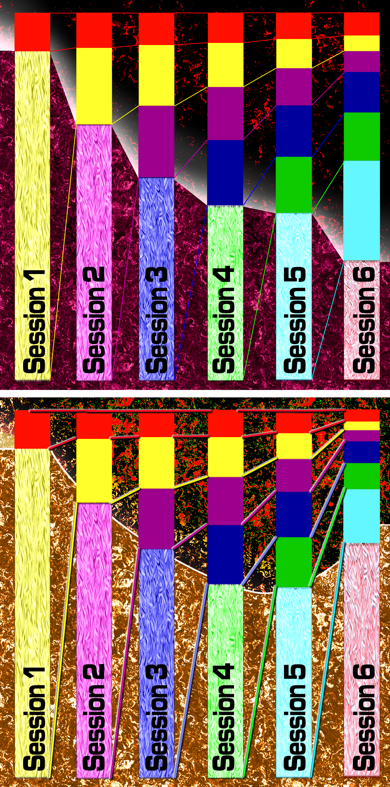
The red content is a reminder of past adventures that orients and places this adventure into bigger-picture context. To that, each game session played adds to the synopsis, causing it to inflate; such growth is usually not quite in proportion to the playing time, because it focuses on significant elements and discards or compacts details, so the contribution will sometimes be less and sometimes more. The second set of bars shows a more aggressive compaction strategy.

Full Narrative

There are two basic types of synopsis: Full narrative, and compressed narrative. There are also a number of variations between these two extremes.

A synopsis, by it’s nature, is a compact summary of the story so far. It enables the highlighting of past events, a reminder of significant developments that unfolded in a more narrative form, and the placing of events into a larger context.

Arguably, what you leave out or condense is as important as what you leave in. Dialogue is rarely sufficiently quotable as to include in an RPG synopsis (while it is the dominant form of synopsis used in television), for example.

With greater distance from events, there should be greater condensation; more recent events should usually be presented in greater detail than those of several game sessions earlier, for several reasons: helping recapture the mood and thought processes of the characters as they were, most recently being the most prominent of them, in other words, recent events are of more immediate significance.

It is natural, even with this condensation, for synopses to grow in length as adventures proceed, and this is illustrated by the first of the sets of bar charts. Note that in writing the synopsis for adventure 5, the GM has tried not to let the synopsis grow any larger, compressing earlier material almost enough to ‘make room’ for the new material to be added.

Until now, this is also the pattern that describes the synopses that have appeared in the current Zenith-3 adventure. But for the next adventure, I’m looking at employing a more aggressive approach, because the current phase of the adventure is heading for a conclusion, and the phase to follow will involve the characters resetting their circumstances. Much of what they went through to get to that point will then have limited significance in comparison to the fact that they are there. In fact, information conveyed in the first game session – the briefing – will arguably bear a greater reprise in the future. Much of it has been irrelevant (beyond justifying it) during their journey, so it has been barely mentioned.

The synopsis provided at the start of each day’s play has therefore been responsive not only to the content of previous days’ play, but also of the immediate plot needs.

An example

All very good in theory, but you might like a practical example.

Below is the synopsis from the most recent game session. It omits a lot of the context and background that I would normally provide readers because the players in the campaign already have it. However, I have broken it up by game session, each in a separate panel, so that you can get a sense of how much compression has taken place.

When you see something like “(15-6-1-01)” that indicates showing the players a picture – “Adventure #15, Act VI, Scene 1, Picture 01” to be precise. These may be subject to copyright, so I can’t share them here.

It should also be noted that the early parts of the synopsis are much fuller than I would normally employ, because Covid-19 restrictions meant that this was our first game session in six months, and memories may have grown distant in that time. A refresher was indicated.

The Russian Government, after six years of War with the 4th Reich, are beginning to struggle financially, and are resorting to desperate measures. Like selling some of their obsolete nuclear weapons to arms dealers.

UNTIL got wind of just such a sale to an alliance of Domestic US terrorists. Normally they would have simply passed the information on to THUNDER, but there were some indications that the North American version of UNTIL were compromised.

This put UNTIL in a bit of a bind; it was only a few months away from a critical Federal election that would determine how the US would reintegrate with the rest of the world. The balance was delicately poised, and being seen to pursue any sort of potentially political objective on US soil would, if discovered, tip it disastrously.

Their solution: bring in agents capable of dealing with any problem and give them the cover identities they would need to form a mythical superhero team, Team Shadow, who could operate with impunity on American Soil. Of course, this might not be the last time such operatives were needed, and if a thing was worth doing, it was worth doing well, so the plan was to create a resource that could be parachuted in to solve such ‘problems’ long-term. In short, bring in Zenith-3, show them some new ways to use their powers, and disguise them as completely different heroes.

  • Blackwing became Basalt (15-6-1-01), a man transformed into rock.
  • Runeweaver became Spectre (15-6-1-02), a ghost from the Revolutionary War.
  • Mr Image was recast as Union Jack (15-6-1-03), an identity and look that he likes so much that he thinks he’ll keep using it when he returns to Earth Regency.
  • Defender became Zantar (15-6-1-04), a Kzin tourist rescued by the team who joined up to repay the debt of honor.
  • St Barbara assumed the identity of Nightshade, a Ninja-like character (15-6-1-05), using her powers to perform impossibly-acrobatic maneuvers and throw Shuriken of ‘Shadow Energy’, and
  • Vala became Zeitgeist (15-6-1-06), a character who seems mostly normal and very human.


Team Shadow were to be inserted into the US using contacts UNTIL had within the 5th Reich, which turned out to be nothing like the team’s expectations. This was an environment in which everyone knew who all the other spies were, and conducted elaborate games with each other, where favors and obligations were better than money as an item of trade-craft. Dr Muerte, for all his supervillainish personal inclinations and fascist leanings, turned out to be a very effective administrator.


The team made landfall in Guatemala and began their Mexican tour. Post-Ragnarok, the nations of Central America and Mexico had collapsed into a number of much smaller Kingdoms based on the old state lines. The farther south that you looked, the more primitive these societies were – and Team Shadow were starting so far south that they weren’t even in Mexico yet.

A short distance inland, they met the guide and ‘Diplomatic Escort’ from Demon House Aries that Muerte’s Intelligence Officer had arranged for them, Maynor Estuado Morales (15-6-1-07). Again, he wasn’t quite what they expected; he quickly proved to be urbane and witty, and possessed of a warm charm. The team already knew that House Aries was a little different from the other Houses of Demon, anyway, after they had helped liberate Blackwing from the curse of his Amour, which was slowly taking over his mind and body.

Maynor explained en route that in return for permission to continue traveling through their respective territories, the rulers of the local Kingdoms would expect the team to perform some service.


These services were usually something minor, but the urgency with which these arrangements had been made was enough that even the thickest, most brutish of the local rulers- Heif Zubal – could tell that Team Shadow were something extraordinary. So far, they have included recovering “Lost Jewels”..,


…hunting “Monsters”..,


…and chasing down a Bandit operating with seeming impunity (15-6-1-08).


Along the way, you have come to trust Maynor quite a lot, and have confessed your roles as ‘UNTIL agents’ with paranormal abilities to him, and dropped a few leading hints about your mission’s importance to him. He has agreed to assist in their mission as far as possible, without compromising his or their political neutrality.


They also reached a treaty with the alien Rheezok for the mutual defense of the Earth against the Ice Queen (15-6-1-09) or any other threat; the PCs intend that the Rheezok’s presence be officially sanctioned on humanitarian grounds as they are refugees, but the PCs will have to work with the more progressive elements of the UN to have the emergent nation recognized officially.


Despite the delays that these ‘services’ represent, the team has, since coming ashore, covered 2,275 km, climbing to over 1800m altitude and descending again six times in the process – in 2 days, 8 hours total – and that’s with several hours worth of delays along the way as you undertook these side-quests.

Since you have been told by your guide that the whole trip should take 2-3 days, you think you’re a behind schedule, but Specter and Nightshade have a plan to use a little time-travel when you leave your guide behind. So long as you cross the border before Noon of July 4, when UNTIL believes the Nukes are to be detonated, you should be able to give yourself a couple of days to investigate AFTER a week or so spent resting, establishing your new cover identities, and setting up a base of operations deep in the Redneck Heartland.

It is now 3:15 AM, Friday, July 4, so time is beginning to become an issue.


Just over an hour ago, the ultra-pious King Maneul de Vasquez Jalihandre Nevados, Ruler of Leon, tasked you with an hour of your time spent assisting in the reconstruction of a church here in Tampico that has lain in ruins since Ragnarok.

Normally, you would have waited until morning, but because of the press of time, you decided to go to work immediately. Maynor had warned that Magic would be used to determine whether or not each was sincerely working as hard as they could, so the cover of Darkness would enable you to use your full abilities (within the guises of Team Shadow) with relatively low risk of detection.

It worked out well. Nightshade and Zeitgeist cleared rubble from the site while Maynor and Specter dug new foundations, and Union Jack & Zantar poured concrete between the stone slabs carried into place by Basalt. Maynor and Specter took it in turns to speed up the curing of the concrete, so construction took only about half an hour (instead of the months probably expected).

The group then turned their attention to the interior, Maynor, Basalt, and Nightshade producing wooden panels, polishing and varnishing them, then mounting them, while Specter put his new woodworking skills to good use carving pews, Zantar hung silken curtains, and Zeitgeist laid tiles.

By the time you had finished, the Church was ready for decoration with appropriate religious iconography; as soon as that was complete, it would be ready to hold Services, and would look something like this: 15-6-1-10, -11.

At the end of the appointed time, one of the local priests inspected the work, and seemed to approve, unable to say much more than “It’s a miracle,” repeatedly.

The last block is significant because it represents play that didn’t happen “in real life”; past experience has shown that the players have trouble and derive little enjoyment from “mundane” applications of their powers. While I would have let them play through this if it had been at the end of the session and I needed some filler, I thought it more useful to skip over it and get to the more interesting bits.

This is a judgment call that would vary from campaign to campaign as different player mixes would react differently.

Compressed Narrative

So let’s compare that with the synopsis that I’m preparing for the next game session:

Russia sold nukes to an arms merchant.

Intelligence reports that they were purchased by an alliance of US Domestic Terrorists to be used to make a ‘grand statement’ as part of the 4th Of July festivities.

To prevent this, Zenith-3 have assumed new identities and are preparing to enter the US having traveled through Guatemala and Mexico.

At each step, they have needed to perform a task for the local ‘King’ to earn permission to continue through his territory.

They have prevented the resurrection of a Mayan deity, hunted a T-Rex and been hunted by Raptors, concluded a pact with the alien Rheezok, and rebuilt a christian church that has lain in ruins since Ragnarok, six years ago.

Maynor Estuado Morales, your ‘diplomatic escort’ and guide from DEMON House Aries, has become a trusted ally, though the full details of your mission have not been revealed to him, nor your specific true identities. But he has recognized Specter as a fellow mage, self-schooled for the most part, and given him a crash-course in Arcane Theory that filled in a lot of blanks for the mage.

At Monterrey, the capital of the Kingdom of Coahuita, they have just exited the Elemental-powered steam train that has conveyed them and gotten their first glimpse of the City Of Arcane Steam. One ruler, and one task, awaits them, and then they can cross the border and begin their real mission…

This is practically in bullet-points. The most recent day’s play gets a whole two paragraphs; the preceding six game sessions are dealt with in 5 sentences.

Shifting Focus

The degree of compression has two significant effects. First, the focus of the adventure is clearly about to shift. So far, it’s all been a road movie; soon, it will be about recuperating, establishing roots and their new cover identities, and beginning the final part of the adventure: finding and capturing the nukes before they get used somewhere.

The more you emphasize what was in your synopsis, the more you root the day’s play in a logical outgrowth of those events. The less emphasis you place on the past, the more you signal a shift in focus for the adventure.

Impact on Pacing

In terms of pacing, the adventure is heading for a false crescendo. Time is running out for the PCs – it’s already July 4th, and most parades will be starting or at their height by Noon. The rules of time travel mean that it will be much harder to prevent the act of terrorism once detonation has actually taken place. By the time the sun is overhead, they want to be crossing the US border. That gives them just hours, and still several hours traveling to do. I want the players to feel the pressure of time, and a leisurely synopsis sets the wrong tone for that.

Afterwards, it will enter a lull, before rocketing toward a climax (by way of a plot twist or two). There will be time in that lull for a fuller recap of the intelligence received in the first part of the adventure.

My intent is for this next game session to include the false crescendo and most of the lull that follows. The subsequent game session in September will begin with the end of the lull as the players are pitched into investigating the mystery of the nukes – who has them and what to they want to do with them?

Mid-adventure Usage: Travel Vignettes

But that’s not the only way to use synopses. Space is time, when you are traveling; compress one, and you also compress the other.

I have been using synopses to compact time and space when the PCs travel, giving the players to a sense of how big Mexico is, and how quickly the PCs were traveling. The adventure’s scenes are full of notes like this:

♦El Ciebo → Gracias de Dios → El Coba → Tenosique → La Pita → Rio Final → Batancan → La Libertad Chapas → Entre Hermanos → Januta → Frontera → El Bellotte → Paraiso → Comalcalco → Cardenas → Huimanguillo → Bellos Horizontas → Los Choapas → Nanchual → Coatzacealcos ★

Key:
   ♦indicates an encounter of significance.
   → means “to”.
   ★ Indicates the capital of one of the Mexican “Kingdoms” (they aren’t all called that, and they aren’t all Monarchies).

(I’ve added the key for the benefit of readers).

Fully describing each location would be tiresome and boring, because nothing of significance happens there. Simply listing the names, or even skipping to the next important location (Coatzacealcos in this example) is quick and painless – but fails to convey the bone-weariness that such a trip would cause. The PCs have literally been going at full pelt for three days now, and have only just been able to get their second lot of 2 hours sleep in that time.

Giving an impression of each locale, and any geographic transitions in between, has a cumulative effect. Turning the above transition into a single paragraph that “hits the high points” of the journey, while not necessarily naming all those towns and villages specifically, conveys the travel and its extent without going too far. This technique works in any game setting, any genre.

It makes the travel seem “real” in a way that simply hand-waving it and transitioning directly to the destination doesn’t – though if the dramatic circumstances are right, I would simply have the PCs arrive; it’s all about the dramatic needs of the plot and the pacing required.

Complex adventure structures

Contemplate two adventurers having separate adventures that don’t take place concurrently, but that are being played concurrently. That means that the outcome of Adventure #1 (still in progress) would be known to the starring character of Adventure #2, even though the players and GM concerned do NOT know that outcome.

Now expand the complexity with a third adventure, which partially overlaps both, and a fifth, and you get the ‘concurrent play’ approach that Blair and I use for the “solo chapters” of the Adventurer’s Club campaign. Sometimes, all or several of these plot threads will come together to reveal the main (all PCs) adventure, sometimes only one will, and sometimes, none of them do, they simply frame the circumstances of what the PCs are doing when the call comes and the adventure proper gets underway.

This is a complex adventure structure.

Synopses play a critical role in connecting one of these plot threads to another. We may not know how the PC will solve the situation we put before him (or even if he will make any attempt to do so); our job is to make their lives interesting, not predestined. Using a synopsis (without the punch-line of the outcome) gives us a way to refer to a solo plot-thread within another such plot thread while not preempting the outcome. This enables us to run each of these solo stories simultaneously at the gaming table as though they were one big adventure.

There’s a lot more utility and complexity to synopses than is shown by the simple definition given at the start of the article. Use them improperly, and they can steal from that potential, putting players into the wrong mindset; used wisely, and you create more room for better play.

Comments Off on Impressions Of Time

Simulated Unreality: Game Physics Tribulations


Image by Susan Cipriano from Pixabay

RPGs have a lot of genre elements that do not exist in the real world.

Magic, Divine visitations, strange creatures, non-human races with exotic capabilities, exotic potions and arcane enchantments of all kinds, and that’s just the fantasy genre!

On top of that, there’s the look-and-feel of the environment, and that means that certain actions sometimes have disproportionate or unrealistic consequences.

Style & Narrative

Some of these are a matter of style; others can be communicated through a richer palette of narrative.

Stylistic elements often require tweaks of the rules – critical hits and fumbles, for example. Some can be achieved by amending the GM’s palette of options to include things that would not be present under a more ‘normal’ reality, or by excluding more normal things from that palette.

Narrative elements simply require the use of appropriate descriptive text by the GM to get players into the “mood” and into the mindset that their characters should possess by virtue of deriving from the genre environment in question. That’s true for all genres – whether exploring caves on the frozen moons of Jupiter, unraveling the latest scheme of Diabolico, Having Firewire-7 ports installed into your cyberware, or playing escort to a traveling caravan through Troll Country.

That leaves a few genre elements which need to be explicitly catered for within the rules. Game and campaign designers often approach these elements from a game mechanics perspective. And that’s a problem, because the hierarchy of dominance in an RPG puts these game mechanics at the very bottom of the pile, at least so far as I’m concerned.

I originally presented a hierarchy of genre elements as part of the discussion of the Pulp Genre in Blat! Zot! Pow! The Rules Of Genre In RPGs (Jan 2011) and revisited the subject in The Blind Enforcer: The Reflex Application Of Rules (April 2014). I expanded it slightly and clarified it in The Language Of Magic: A Sense of Wonder for the Feb 2019 Blog Carnival (Feb 2019, obviously); the hierarchy arose again, most recently, a month later, in Into Each Chaos, A Little Order Must Fall: Coping With Randomness, which is where the diagram to the right comes from.

This is a tool that has multiple significances, and can be used in many different ways, but they all come down to (1) the playing of a game; (2) the uniqueness of the setting; (3) the needs of the adventure; (4) the influence of the genre; and (5) the game (meta-) physics and game mechanics provided by the rules system, and the relationship between them.

For example, in the article from which the diagram is drawn, I employ it to generate a series of questions to be used as prompts for GM decision-making when a PC does something completely unexpected:

    This is frequently the result of a player announcing an unanticipated course of action … and the GM insisting on a die check to see whether or not the action is successful (regardless of whether or not it will have the desired effect). Sometimes it’s the result of the GM forgetting a character capability, and sometimes it’s a consequence of the player applying an ability in a way that the GM hasn’t thought of – “I cast Blade Barrier down the purple worm’s throat – what happens?” (an actual example from the latter days of the Fumanor: The Last Deity II campaign).

    It’s at times like this that I fall back on the hierarchy pyramid…

    • What do the official rules say (if anything) about any similar situation?
    • What do the house rules say (if anything) about any similar situation?
    • What seems the most “realistic” given the base assumptions of the campaign world?
    • What seems the most appropriate interpretation given the genre of the game?
    • What is the interpretation that works best in terms of the adventure plot?
    • What is the interpretation that works best in terms of the health of the campaign?
    • Are there any practicality considerations that should be taken into account?
    • What is the interpretation that will produce the maximum fun?

    Remember that any subsequent answer overrules one that’s already in place – the house rules trump the official rules, “realism” trumps the house rules when they are inadequate, genre trumps “realism”, plot needs trump Genre, campaign needs trump the needs of any one plot, practicality of implementation trumps everything else, and fun trumps all.

It’s worth briefly revisiting the different layers of the hierarchy to look at what they contain and how they relate to the practice of playing an RPG.

  1. Official Rules: – The official rules that come in the game system are the foundations at the bottom of the pyramid.
  2. House Rules: – Because house rules explicitly supersede official game rules, they have to sit above that foundation in the pyramid.
  3. Simulation: – This is the level of Game Physics within the game world, and the subject of today’s discussion. Because the rules (house and official) are an imperfect codification of the game physics, if there is ever a conflict between what the rules say should happen and what the principles that have been established say should happen, it’s the official rules that get overruled – so the Simulation layer has to sit above the rules layers. This is what makes it possible to translate a campaign from one game system into another. The game physics is a metagame level of in-game ‘reality’ – the characters might understand them in a completely different way to the comprehension of the GM and players, especially in a ‘hyper-realistic’ genre.
  4. Genre: – There are several different places in the hierarchy where Genre can fit, and that’s at the heart of today’s subject, too. But because the one set of rules can be a broad church providing for multiple genres, the specifics of one particular genre override generic rules and even game physics.
  5. Plot: – plot refers to the decisions made in-game by PCs and NPCs within the current adventure; it’s the story of that adventure. Since an adventure can contain out-of-genre elements and influences, this level dominates the genre if a ruling can be justified in terms of the needs of the current adventure.
  6. Campaign: – This level contains anything that persists beyond this one adventure. That includes characters and characterizations (as exemplified by the PCs, quite specifically) and any narrative that defines or displays the way the game world works – the style and look-and-feel of the game environment. There are some who would argue that the Plot layer should supersede the Campaign layer.
  7. Gameplay & Practicality: – The uppermost level of the pyramid recognizes that a rule can be technically correct but unplayable – see, for example, My Biggest Mistakes: The Woes Of Piety & Magic for concrete proof of this fact. No matter what anything else says, the needs of practical gameplay are the ultimate censor and trump card. At least, according to the official pyramid.
  8. Fun: – GMs are in the business of entertaining through creativity, narrative, plot, and stimulated interaction between characters and the players who “voice” them. Fun isn’t given a level of the pyramid because it functions like the walls and capstone. If you have two equally-balanced choices, the most ‘fun’ choice should always win. If you have a technically-correct and/or practical answer to any question that is boring as heck, it should lose to a less correct, less-practical answer that happens to be more fun. For example, I’ve seen any number of proposals over the years for reducing the number of dice rolled for damage in RPGs, because that would make the math easier. Consider if all HP were divided by 4 in a D&D campaign, and weapon damage was divided by 5 – so a weapon that did 1d6 would do one point 4 times in 6 and two points the other 2 times. A weapon that does 1d4 would simply do 1 point every time, no roll needed. But there is a vicarious thrill in rolling dice, and an inherent drama in the GM rolling lots of dice (especially without explanation). More dice therefore equates to more fun, at least in some respects. Ease of math has no hope, in the face of that reality.

Is Genre The Birthplace Of Game Physics?

To some extent, the obvious answer is ‘yes’; part of the genre definition is that characters are able to do “X”, something that violates the basics of real-world physics as simulated by the core game mechanics. “X” could be anything from wielding a “particle pistol” to generic superhuman feats to spellcasting – and that means that “X” is part of the “observed universe” of the characters and analytic types will have invested effort in trying to understand how it works.

This, in turn, is usually expressed as a pseudo-scientific narrative that vaguely outlines the “principles” upon which “X” is founded – a campaign level synopsis of what is therefore presumed to be in the game physics layer (I don’t know anyone who actually goes to the trouble of writing up their game physics in terms of actual equations).

That means that there are multiple layers of translation and interpretation that lie in between the actual “in-game” physics and the genre-related functions that the physics is intended to perform for the game – a looseness that can both benefit and harm.

Genre to Game Mechanics

Most game designers take a different approach to writing the game rules. Having identified “X” as something that the genre demands, they will adopt a “practical” approach by trying to use some existing mechanics as a means of interpreting “X” within the game system. Sometimes that is all that’s needed, sometimes it only provides part of the answers, and additional specific rules are needed. For example, Fireballs in D&D use many of the same damage-handling game mechanics as an attack with a sword, but the rules concerning the number of fireballs the mage can cast, it’s range, and several other mechanics, are entirely separate. There is absolutely no reason why characters couldn’t have an additional stat to describe their resilience to magic, which is used instead of hit points – but from the first, the additional rules required have either never been considered or have been rejected as unnecessary or inefficient.

And yet – one of the major ongoing problems with D&D has always been the relative power levels of magic and more physical mayhem; separating the damage handling subsystems would seem an obvious way of tweaking them in isolation from each other. So it certainly can’t be argued that such proposals would be without merit on their face!

Basing the handling of a genre element on existing game mechanics is always dangerous, potentially compromising the implementation of an important genre element with the simulation provided by the game mechanics. For that reason, such game mechanics are popular targets for house rules, representing attempts by a particular GM to more accurately simulate the genre element as they see it within the campaign.

Never The Twain Shall Meet

So, now, we have two different paths to the implementation of Genre Element “X”:

  • Genre → Campaign → Simulation
  • Genre → Practicality → Game Mechanics ( → House Rules)

Both paths are completely independent of each other. That means that the in-game interpretation of “reality” can be completely different to the “reality” simulated by the game mechanics.

The conflict becomes acute when two additional interpretive steps are inscribed into the second sequence:

  • Genre → Campaign → Simulation
  • Genre → Practicality → Game Mechanics ( → House Rules) → Simulation → Campaign

Where now does the Campaign draw it’s narrative from? Taking it from the explicit “underlying in-game theory” of the first progression means that the actions taken, and their outcomes, may make no sense in terms of action-and-reaction encompassed by the narrative. “Of course, the area was magic-rich, so of course I drew my dagger.” The character is attempting to use the game physics to explain a decision made according to the game mechanics when the two are in contradiction.

Taking it from the game mechanics – equation two – means that actions and consequences may make no sense in terms of the character being able to justify their choices with their understanding of the world. “I suspected the creature was susceptible to fire, so I hit it with a fireball even though we were standing in puddles of flammable incendiary oil. Magic Fire goes out the instant it burns the target, so it was perfectly safe.” Here, the character is trying to offer game-physics reasons (and quite possibly making them up out of whole cloth) to explain his character’s game-mechanics decision. At the very least, he is almost certainly adding to that game physics; at worst, he is flatly contradicting something in the official explanation. The odds that the game rules would explicitly state or even imply that you can cast a fireball in perfect safety while standing in a pool of flammable matter are remote!

The examples are deliberately extreme, and employ fictional game mechanics to illustrate the point, which is that neither of these approaches is all that satisfactory, always entailing a risk of contradiction.

A third path to complicate the mess

Quite often, people will try to base the game physics for Genre Element “X” on real-world physics, using the real thing as analogy. This gives the following pathway:

  • Real World Physics → Simulated Unreality → Campaign → Game Mechanics

For example, do Laser Pistols suffer from the inverse-square law, i.e. do 1/16th the damage to a target 4 times farther away? On the face of it, this sounds entirely plausible and immediately makes “Laser Pistols” sound more realistic.

Problems come when the game mechanics don’t actually employ the inverse square law anywhere, instead giving a flat range and damage level for Laser Pistols. But if the in-game physics described in the flavor text do suggest this, the likely result is a House Rule.

Perhaps the GM decides that the quoted damage values are for an “optimum range” that is 1/10th of the stated range; he then provides a set of tables that convert the stated damage according to the multiple of this “optimum” range. Now, weapons range in most game systems is a function of accuracy, so the next step would be to set your own “optimum range” value, permitting simplicity and practicality of interpretation.

With a third pathway, the chances of confusion and frustration obviously increase markedly. By putting a differential between the actions that a character can reasonably take according to his understanding of the world, and the optimum choice of actions based on the game mechanics, the verisimilitude of the whole campaign suffers.

In terms of the Hierarchy

If you look at these processes in terms of progression through the different layers of the pyramid, you can easily see that they are a mess, skipping layers in both directions higgeldy-piggeldy It’s no wonder, then, that the results are a dogs’ breakfast; the disrespect of the logical hierarchy is not the cause of the problems, but it is indicative.

Game Physics ↔ Game Mechanics

I always feel that the compromises inherent in making game mechanics playable mean that the simulation layer, in which the pseudo-scientific principles are formulated and contained, should be dominant over the game mechanics as an initial principle, but recently had a bit of a revelation in this respect.

If you are forced to compromise your simulation as expressed by the game mechanics, and you are quite certain that the fundamental aspects of those mechanics will remain constant into the future bar a little tweaking, then those simulation content should then be amended to incorporate the compromises.

That means that you can quite happily draw inspiration from your imagination, from real-world physics, and from your game mechanics design, in equal measure. What’s more, you can bounce back and forth between the two (almost) adjacent layers repeatedly, so that the game mechanics are a closer reflection of the conceptual creations and vice-versa.

What’s more, this permits the embedding of narrative language into the campaign layer that matches both – the incongruities vanish.

If this were the only problem, we could mark it solved and bring the article to a successful conclusion. Unfortunately, it’s not.

Roleplay or Rule-play

Ideally, your game mechanics, as used in play, should not only reflect the genre conventions and elements, but should reinforce them during play. I’m constantly reminded that my co-GM is an expert (in relative terms) on the Pulp Genre; I’m more of an expert in RPG story construction and gameplay. Some of the players in our co-GM’d Pulp Campaign are even less au fay with the genre conventions than I am.

In a perfect world, you could simply hand the rules to a complete novice and come back in an hour or two to discover them playing a perfectly acceptable representation of the genre. But that’s a big ask, and few game systems can pull it off.

And that presents an immediate problem:

Genre → Rules → Pseudoscience → Roleplay – or Rule-play?

If the rules are an imperfect reflection of the Genre, then players can follow the rules when the GM is interpreting the game situation from the perspective of the simulated reality, or vice-versa.

The inevitable result is frustration and dispute, with one side saying “but the rules say…”

This is exactly the sort of problem that the hierarchy pyramid was created to solve. According to the pyramid, if there is a conflict between what the Rules say happens, and what the metagame physics says happens, the metagame physics wins.

In other words, we start with the “science” of the Genre, i.e. with an abstract or meta-level interpretation of both the Genre conventions and how they are to manifest within the campaign; this is then used to generate modifications to the rules, which can then be used to add to the richness of the pseudoscience. This in turn then gets reflected in the Genre description as a section on “Genre Interpretation,” which is used as the narrative engine and interpretation framework for play.

  • Genre → Pseudoscience → Rules → Pseudoscience → Genre Interpretation → play

If you track these through the layers of the pyramid, you get:

  • 4 → 3 → (2 →) 1 → 3 → 4 → 5, 6, 7

This is a clear progression, nowhere near as messy as the previously-described approaches. Because both GM’s interpretations and players’ interpretations are framed by the metagame rules of the Simulation of in-game “Reality”, with the GM creating house rules or interpretations of the standard rules accordingly, there is no conflict or contradiction; everything is stemming from common ground. A player may disagree with the actual changes the GM is making, but not the purpose or motivation behind them. And if they actually have a better rules solution to the specific problem, most GMs will be happy to listen – after the day’s play, of course.

Side-Benefits

I think we can all agree that this is a worthwhile end, in and of itself, but on its own, it may not be enough to justify overturning an established rule. There is an argument that the more you customize the rules, the more you lose common ground with other campaigns, the more work you have to go to when integrating new source material, and the more you create uncertainty in the players and a lack of confidence in knowing how their players work.

The published and standard rules are a common ground between players and GM – never mind with everyone else who uses the same game system.

That said, I’ve always regarded a willingness to adjust the rules when there is a problem perceived as being a positive trait in a GM. It’s a commitment to doing whatever extra work is required to support the campaign – and a sign of how much the GM values what the players are contributing to that campaign (or are expected to contribute).

Fortunately, there are a number of side-benefits to the approach described.

    Meta-level differentiation of campaigns from one another

    By varying the interpretation of the Genre’s standard elements, introducing new Genre Elements and Optional Genre components & influences, you make each campaign distinct from all others.

    A long time ago, I was speaking with one of my players (no names) about another GM’s campaign. They were describing how that GM fumbled interpreting the rules to cope with the in-game situation with which he was presented. Another player, overhearing the story, interjected, “That’s just [GM’s] way, he always does that.”

    Another example that may help provide a little clarity – one of the GMs that I have known for almost 40 years now (a little under a year to reach that milestone) has always opposed the Vancian magic system of D&D because his meta-level signature is that all magic is psionic in nature but misunderstood by the practitioners. For some readers, that statement says everything that needs to be said; others may be saying to themselves, “Vancian? What’s that mean?”. For the benefit of the latter, then:

    In Howard Jeff’s 2014 “Game Magic: A Designer’s Guide To Magic Systems In Theory And Practice” (Link is to Amazon.com; limited copies remain. The hardcover is quite expensive – but you CAN get it as an e-book. Yes, I get a small commission.), he described the salient distinction as:

      “In the Vancian model of magic, magic users must memorize all the spells which they wish to cast. When they cast a given spell, it disappears from memory and must be memorized again if the magic user so desires.”

    The idea of spell memorization was inspired by the way magic works in Jack Vance’s Dying Earth stories. Gary Gygax was very clear about the reasons for the choice, writing in 1976,

      “If magic is unrestrained in the campaign, D&D quickly degenerates into a weird wizard show where players get bored quickly… It is the opinion of this writer that the most desirable game is one in which the various character types are able to compete with each other as relative equals, for that will maintain freshness in the campaign.”

    But others have described it as an imperfect way to produce an artificial equality between spell-casters and more martial character classes.

    Different formulations of the Pseudo-science behind how and why magic – a staple element of the Fantasy Genre – works yield different restrictions (I haven’t met anyone who doesn’t agree that magic in an RPG needs some restraints on it if the other characters are to do anything more than become meat shields for the protection of the Spellcaster). For example, a non-Vancian approach might be to reduce the number of spells substantially, and have spells of any given Spell Level usable at full force only a limited number of times a day, thereafter halving in effect with subsequent castings. With four hours of rest per halving, plus four hours, the clock is reset.

    This example shows quite clearly how this approach permits the consistent customization of campaigns, regardless of core rules system.

    Bonus Verisimilitude

    This side-benefit derives from the increased internal consistency that results. It doesn’t need anywhere near as much explanation as the previous one! The more internally consistent and harmonious you can make the rules structure and metagame concepts that the rules are intended to reflect, the more you permit characters to engage with the campaign at a conceptual and character-driven level, rather than at a game mechanics level. And that makes the whole campaign feel more “real” to the players.

    Better Roleplay

    Inevitably, this side-benefit manifests as a consequence of the preceding one. The more you can keep players “in character”, the better they will roleplay those characters. There are rare exceptions, just as there are some actors who can drop into character on cue – but they tend to be noteworthy. It’s far common for actors (and players) to have to put their character on, like a cloak, every time they break it.

    Even simply engaging the game mechanics can be considered a partial break – often, it’s easier to step back into character if the disruption is not protracted – but this is very much a best-case scenario. Only the best players are still firmly “in their character’s heads” at the end of a major combat sequence, for example.

    The more paths back into verisimilitude that you can provide, the more easily the players will be able to roleplay their characters, and that makes it easier to drop back into character after a disruption.

    Better Game Mechanics

    Another way at looking at the whole issue discussed by this article is to describe the genre conventions and elements as “intentions” – they are guidelines to what the GM “intends” to achieve within the game setting and mechanics, which in turn makes the adventures that he has in mind a better stylistic “fit”.

    The term “better” is always a subjective one, but by making the game mechanics more responsive to those intentions, you make them more fit-for-purpose – and (provided that there is no “hit” to playability), that makes them “better” by at least one objective criterion.

    Meta-interpretations of outcomes = Better Narrative

    Understanding conceptually how the more fantastic elements of gameplay would be expected to function if the game world were a reality makes narrative descriptions of that environment easier to write and more accurate to the intention, too. Again, “better” is both a subjective and relative term, but if one of the purposes of the narrative is to bring the world to life for the players, I would argue that any change that makes the narrative more fit for that purpose makes it “better”.

    What’s more, the internal consistency means that narrative communications are more likely to be clearly and correctly understood and interpreted by the players – and that makes the narrative “better” in a second, major, respect.

    And finally, the verisimilitude makes the subject of the narrative more believable, making it easier to suspend disbelief in the otherwise impossible. That makes narrative “better” in still a third respect.

    Unification of function and purpose

    The last side-benefit is the most abstract and abstruse. You could describe it as making the campaign more robust by better-embedding the central genre elements and their distinctive interpretations within the components of the campaign at several different levels, so that they can mutually reinforce and support each other.

Okay, surely now the article can come to an end, right?

Note quite yet. I haven’t yet explained where this article came from – a real world example of everything that’s been discussed here.

The Woes Of Piety & Magic, Part II

The section title is a direct reference to my 2009 contribution to the Blog Carnival (one of many, that month, because Campaign Mastery was hosting it, as we are right now), My Biggest Mistakes: The Woes Of Piety & Magic – well, to part of it. This article can be considered a sequel to that discussion, at least indirectly.

In the 2009 article, I discussed the failure of my first attempt at codifying a magic system for use within the Champions game system (now known as the Hero System):

    The Hero system doesn’t do AD&D-style spellcasting any favors. It’s designed for characters who have only a few abilities, not a vast repertoire of spells. Designing a magic subsystem for my superhero game was high on my list of things to do after exhausting most of the possibilities offered in the 4th Ed rules.

    I wanted a system where each spell was designed like a formula – plug in values for range, character points of effect, etc, multiply them all together, and what pumped out the end was a cost in “Mana” – effectively a points pool of available magic, similar to Endurance; look that value up on a table and you got the skill roll needed to successfully cast the spell. The virtue of this approach was that if you wanted to double the range, you could double the mana cost, or halve the number of dice of effect, or halve the area of effect, or whatever, and the rest was unchanged – it was universally flexible while remaining balanced.

    In theory, it worked brilliantly. In private testing, the few spells I tried out also worked exquisitely well. In practice:

    I’m at home working with formulas and mathematics. Others are not, and found the design subsystem for spells to be very difficult to follow, and the casting system for spells to be impossible to use in play. So much so that the first player to try the system ended up as a mage who refused to cast spells – when the ultimate design objective was a system that permitted a mage to use magic casually (Want the coffee from across the room? Cast a spell to fetch it).

    And the second player to try the system became obsessed with the penalties for spell failure, which were modeled on the “side effects” rules, to the point where, once again, the character also refused to cast spells.

    It needed to be replaced, and so it was, by a system modeled in part on early Elemental Controls, and which is far closer to the standard powers description. It’s actually less flexible and less elegant from my perspective, requiring more work in designing spells; but it makes designing spells and casting spells easier for every player who’s tried it, and they are the final arbiters. If anything, the revised system was [is] too powerful and too flexible, requiring a number of additional tweaks and restrictions on ad-hoc spellcasting to maintain game balance; but these have been (relatively) minor adjustments; on the whole, the system works.

The problem with that write-up, which wasn’t obvious at the time, was that what works at one power level may not scale all that well. Come the big finale of that campaign and its evolution into the current one in 2011-2012, the spell caster was able to take advantage of a number of temporary boosts and system flaws to start lobbing 5,000 dice spells around.

Yes, you read that right. On a scale where 5d6 is roughly a stick of dynamite, a pound of C4, a car-bomb, etc. What’s more, every additional 2 dice (roughly) doubles the amount of firepower – so 21 dice is roughly a ton of high explosives (20 dice is roughly a tonne), 41 dice is roughly a kiloton, 61 is roughly a megaton, and so on. 72 dice is roughly the size of the largest nuke ever created by man, the Russian “Tsar” bomb. The asteroid that wiped out the dinosaurs had an impact the equivalent of 112 dice. At 130 dice, you get the average output of the sun – per second. 176 dice is the size of the typical nova, while the typical supernova clocks in at 210 dice. The biggest explosion ever witnessed by man was an exploding galaxy some 40,000 light years away, and it works out to be 310 dice in size. The Big Bang has been calculated as producing the energy equivalent of 402 dice.

Which really puts that 5,000 dice into perspective, doesn’t it? 3.1×10^728 times as powerful as the Big Bang.

To make sense of the nonsense, I was forced to assume that the ratio of increase didn’t hold true – that it might be for every additional 2 dice for a while (the useful part of the scale, up to say a Mt), then it becomes a doubling for every 10 dice for a while (up to the largest nuke, say), then a doubling every 20 dice until you get to the sun’s output per second, then a doubling every 100 dice until you get to a nova, then doubling every 200 dice until you get to a supernova, then doubling every 1,000 dice thereafter.

That gives the following:

  • 1 stick of dynamite etc = 5 d6
  • a tonne of high explosives = 20 d6
  • a ton of high explosives = 21 d6
  • a kiloton = 41 d6
  • a Megaton = 61 d6
  • Largest Nuke ever detonated = 116 d6
  • Dinosaur-killing Asteroid Impact = 671 d6
  • Average output of the sun, per second = 1,251 d6
  • Typical Nova = 3,551 d6
  • Typical Supernova = 6,951 d6
  • Largest Explosion Ever Witnessed = 56,951 d6
  • Big Bang = 152,951 d6

So the spells were roughly the power of a “baby” supernova. This was enough that I could get through to the end of the campaign, and various adjustments were already planned that I thought would deal with the problem on a more lasting basis.

About 40% of the way through Adventure Structure: My Standard Formatting, I describe the plot of the big finale in question in a boxed-off area as an example, for anyone who’s interested – it’s not especially relevant to this discussion.

It then took me about 3 months to get all my ducks in a row for the start of the next campaign (with mostly the same characters).

I have to pause at this moment in the story to mention Ian Gray. A bit more than 25 years ago, Ian made the biggest mistake of his life when he offered to help update the Rules. Large parts of the essential game mechanics existed as amendments to some typewritten pages with virtually no explanation. Other parts of the system were quite detailed. 25 years on (and counting), and we still haven’t finished – even though we’ve been using this iteration of the game system for 23 of those 25 years.

Anyway, Ian had decided that the rules for Magic were over the top and needed paring back. So he wrote up a whole new magic system a couple of years ago (without telling me), based on an analogue of the second law of thermodynamics. He also drew on in-game experience of the metaphysics of how Magic was supposed to work, which in turn had been based on the old and expunged game mechanics. He had explained the new rules to the mage player, gotten his sign-off, and even converted the character over to the new mechanics.

All along, then, there has been step-wise evolution as the rules reached their current status. The mage is now capable – if he really pushes himself – of getting up to maybe one or two hundred dice. Most of the time, he’s dealing with 10-20 dice of effect – on a par with every other PC. And, so far as I’m concerned, we’re back on the universal doubling-every-2-dice, which is MUCH simpler.

During the Covid-19 shutdown of the campaign, which lasted 5 months, I had time to review those rules beyond simply skimming them, and to tweak the existing metagame simulation concepts to match. In our first adventure back underway, a couple of weekends ago, the opportunity presented itself (in the guise of a more educated mage) to explain the ‘reality’ of magic to the PC mage, along with some of the more interesting metagame consequences that were not yet encompassed within the rules.

Because of the understanding of the revised metagame concepts that I had, all I needed to run this segment of the game was some bullet-points and my portable whiteboard – sometime in the next month or so, I intend to write them up (with more permanent illustrations) for presentation here at Campaign Mastery as a change of pace.

For the last year, the concept of magic and how it worked had been at odds with the game mechanics in place within the campaign. The result was all those negative impacts described earlier in this article. All those melted away, to be replaced by all the positive impacts mentioned, in the course of about 45 minutes of roleplay, which had all the other players kibitzing and following along, fascinated, as their world grew in richness around them.

Of course, at the time, i was unaware of everything else that I’ve described in this article; it was after the players had left for the day that the contents came to me while reflecting on the day’s play. I started outlining this article immediately – because if the impacts of a contradiction between game mechanics and conceptual mechanics weren’t obvious to me, even with all my experience and expertise, I didn’t think very many others would be aware of them, either.

I usually put this sort of preamble at the start of an article, but in this instance, I thought it would distract from the points I was trying to make, and sound too much like I was trying to sell the reader on the problems and fixes to them that I was proposing. I wanted the analysis and solutions to justify their own presence – but thought that this context, as a real-world example of the things I had identified ‘in theory’ was too important to leave out.

So that’s how you came to be reading these words instead of something else!

What we used to need in the Zenith-3 Campaign was greater synergy between the game mechanics and metagame pseudo-science – but I fixed that, last week. You can, too. Because if there’s one lesson from this story, it’s that it’s never too late.

Comments Off on Simulated Unreality: Game Physics Tribulations

Blog Carnival Aug 2020: What We Need Is/Are…


rpg blog carnival logo

Campaign Mastery is hosting the August 2020 Blog Carnival, and the topic that I’ve come up with is “What We Need Is/Are….”

What does your campaign need more of? What does your campaign world need more of? What do you need more of in your adventures? In you characters? In your players? What does gaming in general need more of?

Or, you can take the opposing perspective. What does your campaign have too much of? What element is over-represented in your game world? What do you need less of in your adventures? In your NPCs? In your PCs? In your players? What does gaming in general need less of?

Of course, everything that can be phrased one way can be rephrased into its opposing variant.

“What we need is less time wasted in meaningless combat” can be re-formulated as “What we need is more meaningful combat”, for example.

What does your current game not have enough of, and how can you correct that? One answer per campaign, please – unless you’re identifying a deficiency in your GMing that you notice is present across multiple campaigns! Answers can be serious, or lighthearted; literal or….. well, not.

Possible examples:

  • What we need are more mice.
  • What we need is more plot.
  • What we need are more treasure tables.
  • What we need are more Goblins.
  • What we need are more elephants.
  • What we need is more Magic.
  • What we need are more players.
  • What we need is more tapioca. And salsa. And corn chips. And Dip.
  • What we need is more social interaction.
  • What we need is faster combat resolution.

Covid-19 restrictions give us all the opportunity to be a little introspective. So I’d be a little disappointed by general answers such as “What I need is more prep time” or something along those lines. “What we need are more game sessions” is also of dubious value in the current social climate – but it might be valid if it was true before the Coronavirus came along.

This post will serve as the anchor post for the Carnival, so drop me a line in the comments with a link to your submissions. In an attempt to boost the participation rate (and I haven’t cleared this with Scot, the overall admin for the Carnival, so I hope he’s on-board), I will also happily accept links to any podcast in which this is a topic of conversation or anything similar. Of course, I also welcome all blogger participation, whether that be from newcomers or old hands!

Image by SeppH from Pixabay, crop by Mike

What We Need in the Zenith-3 Campaign Is: More Pace

I always like to ensure that my anchor posts contain inherent value for readers. In this case, that’s easily provided by picking one of my campaigns and putting some aspect under the microscope.

The Zenith-3 campaign was shut down in February due to Covid-19 restrictions and reopened this weekend, picking up just where it left off, in mid-adventure. I have a couple of observations about that process later in this article, but the real relevance in this title stems from before the shutdown.

In Bridging The Plot Divide: A ‘Writer’s Block’ Bonus Breakthrough, I wrote about a writer’s block situation in my plotting for this campaign. Specifically, I had established a scary situation in which Domestic Terrorists had bought a couple of Nuclear Weapons from an arms dealer who, in turn, was dealing with a Russia in serious economic distress after 6 years of war in which neither side had made great gains.

The problem was, what were they going to do with these weapons? To create time pressure on the PCs, and for the symbolic value, the plot was to transpire on the 4th of July in the current campaign year of 1986. But all the plots I was coming up with were horribly tired and cliched, and nowhere near challenging enough for the PCs. I needed more mystery, more engagement, and more complexity – in a nutshell, the plot needed to be richer.

The article linked to above deals with the process of getting through that writer’s block, and the requirements that made it more challenging. In this submission, I want to focus on the impact that it had on the campaign’s pacing.

The Pacing Problem

This problem had been existing for several months prior to the Covid-19 shutdown. Because I knew that I didn’t have anything planned, I instituted stall tactics – some conscious, and some subconscious. These padded out the plotline, slowing it down just when any rational assessment of plot dynamics suggested that it should be accelerating. But I needed to buy time to come up with a solution.

I’m normally pretty good at this sort of thing – I’ve lost count of the number of times someone on Twitter has described a plot hole and I’ve been able to immediately throw something their way. Anyone who has used that social media platform with lots of followers knows that tweets are immediate – you either respond now or lose the opportunity. Yes, you can ‘like’ a tweet to keep it, or re-tweet it so that it appears in your timeline; either will let you come back to it if there’s something on the tip of your tongue but it isn’t leaping up and down in front of your mind’s eye. But 99% of responses will be spontaneous.

So I only expected to need to stall for a short period of time.

Plot synopses became longer and more detailed – not because they had to be, but because I needed to fill time. And I began implementing stall tactics to try and delay the PCs getting to the point where my planning had run aground.

Stall Tactics

Negotiations with the alien Rheezok (and their backstory) were expanded from a (relatively) brief and decisive encounter to almost a full session, and instead of one or two PCs being involved, were expanded to include all PCs as active participants. This gained me about half a game session.

The following session, what should have been an incidental toss-off (buying a meal in a street market) was expanded into a full-blown shopping expedition, gaining another 3/4 of a game session.

You can see the trend. A (relatively) simple task – chasing down a bandit – that should have been child’s play for the PCs, over in an hour, became an entire session’s play and the exposure of corruption within the local regime and ongoing treason against that regime by a trusted relative of the leader.

Fortunately, I was able to delve more deeply into the world-building prep that I had engaged in, so none of these delays was actually wasted game time. But the more you slow the plot down, the harder it becomes to involve everyone. Variety gives more hooks on which to hang contributions by each individual.

This image combines “ability-2672659.png” by BedexpStock and “abstract beam blast” by Kevin Sanderson, both from Pixabay.

Solution

I didn’t find my way through the plot hole until June. It is possible that the breakthrough would have been stimulated into existence by the ongoing press of time had we continued playing; it was easy to turn the shutdown (and corresponding absence of time pressure) into procrastination.

With that additional spur, I would have come up with something in time for the April game session (we play once a month), which would have been the last-minute, or close to it. Whether or not it would have been as satisfying as the solution achieved, I don’t know.

The impact on pacing

In the most recent game session, the first since the solution to my plot problem was devised, there was an immediate impact that I think everyone noticed.

I actually started writing a lengthy synopsis, in part because of the long shutdown, and scrapped two pages of it, delivering a far more compressed version that mentioned a number of past events only in passing.

We then skipped over what would have otherwise been almost the entire game session in a few paragraphs of narrative. This material would not have drawn significantly on the world-building, and would have contributed nothing – it was necessary, but still filler.

When plotting it, I was mindful of trying to strike a balance between the pace that the adventure should be cracking along with at this point, and the more stately pace of the previous game sessions, factoring in the long shutdown. The speed of the introduction, which led directly into that passage of narrative-instead-of-boring-stuff was just the injection of pace needed to get the game moving again.

In fact, I underestimated the amount of material I would need to have prepped – as had several of the previous game sessions, the day’s play ended a little early, and my thoughts were already turning to what I will need for the next session.

Lingering Impacts

I actually found myself fighting my own instincts in those ruminations. The instincts that I had been developing as a result of the stall tactics were to make the next step in the campaign an emergency or a threat that would force the PCs to take action, in opposition to the in-game environment and world-building that I had been engaged in.

Since this would have taken playing time, it was the undoubted path that I would have chosen were I still needing to stall. There remains a lethargy in the plotting that I now have to actively work at avoiding. But I’m aware of the problem, and the need to confront it; at the same time, I have to be careful not to go too far in the other direction.

As always, game pacing is a delicate balancing act.

There is a passage of play coming up which has the potential to drag significantly, and which I can’t really liven up with encounters or emergencies. The need to keep up the momentum of the story means that I’m going to want to hand-wave as much of that time as the players will permit me to get away with.

There will still be a bit of a slow-down, but that’s appropriate since part of what they are intending to do in that period is to rest. The in-game situation has given them only about 4 1/2 hours rest in the last 76 or 77 hours, plus some half-dozing while mounted on riding dinosaurs.

The plan is to accelerate the preceding game-play as much as possible while maintaining verisimilitude, so that the slow-down feels like the characters are resting, enabling me to skip through that slowed passage as quickly as possible. This will be challenging simply because the players will be driving a lot of it; I can’t make decisions in advance, but have to respond to their inputs.

For example, they will want to rent a House. I know some of the criteria that will be involved; they need five or six bedrooms, to take possession immediately, they need a great deal of privacy, and they have a limited budget. Those don’t grow on trees! But I don’t even know what city or town or US state they will choose for this base of operations, which makes things trickier!

I will probably employ a magician’s force, preparing two or three options and having those same two or three options present wherever they choose to settle. That will enable me to incorporate the levels of detail and color that are appropriate to a location that will be revisited a number of times as the campaign proceeds.

What the Zenith-3 campaign needs, at this point, is greater pace. I’ve already started delivering on that need, but with the next couple of sessions, I want to double-down on that delivery.

Some takeaways

I want to call out a couple of key lessons from the situation described.

  1. Stall Tactics are perfectly satisfactory when necessary – but you need sufficient depth of material that you can fill those dead spaces.
  2. It’s possible to build passages of plot where you can speed things up or slow them down in order to manipulate the pacing of the campaign.
  3. You should always think about what’s going to happen next, and what its pacing demands will be, when planning a passage of play.
  4. Plot problems can be opportunities.
  5. Plan your pacing targets before you write – and review what you’ve written to be sure that you’re meeting those targets.
  6. No problem is impossible to solve – but different solutions can have different price tags and consequences. Exercise care when choosing.

So, now it’s over to the other bloggers out there. What do your games/campaigns need more of?

Comments (6)

Adventures That Send A Message


Puppies are cute I
Image by StockSnap from Pixabay

It’s a classic television trope: the message story (sometimes called the Aesop). But there are some serious problems that you’ll encounter adapting the concept to an RPG adventure. Fortunately, they aren’t insuperable.

The Problems

There are four issues that frequently present themselves in creating message stories:

  1. There needs to be a script
  2. Players won’t follow the script
  3. Players may disagree with the message or dislike message stories generally.
  4. Players may dislike the fact that there is a script.
    There needs to be a script

    In order to convey the message, you need the plot to follow a particular direction. If it doesn’t, the message doesn’t come through. It’s all well and good to have two societies at war because one side is black on the left, and the other, on the right; but if the PCs simply side with one, the message that you hoped to convey falls to earth with a deathly thud.

    But that smacks of railroading the game, and that’s never a good thing.

    Players won’t follow the script

    Even if you avoid that trap – and there are ways of doing so, a couple of which are especially useful in this context, which I’ll cover in the ‘solutions’ part of the article – no plot survives contact with the PCs unscathed.

    Sometimes they will be correct in stating that their PCs wouldn’t want to get mixed up in whatever you’re leaving on their doorsteps. Sometimes they will be contrary just because it sounds like fun, or fits their prejudices (the players, not the characters), sometimes because they are ideologically opposed to railroading and anything that smacks of it, and sometimes just to be contrary.

    I’ve even seen occasions when the players deliberately chose an unorthodox path through an adventure simply because they thought the GM was getting too confident or cocky.

    And sometimes, the PCs will be taken down a different road simply because in trying to hide or avoid a railroading situation, you haven’t given the players enough information to recognize the path forward. A solution that is obvious to you may not be at all obvious to the players when the time comes.

    You need a script that not only won’t generate resistance, but which is protected and buffered against willful interference.

    Players may disagree with the message or dislike message stories generally

    This continues with the themes raised in the previous point. For example, let’s talk for a minute about that black-and-white vs white-and-black conflict that I mentioned a moment ago. This, of course, is a famous allegory from a Star Trek episode (the original series). Let That Be Your Last Battlefield.

    Perhaps you want your PCs to encounter a similar situation and discover that the reason for the unique half-and-half appearance is that this was engineered into the race’s genetics a long time ago to end a terrible war between the blacks and whites. The message is that superficial solutions solve nothing, and meaningful solutions require the addressing of the deeper and less obvious real problems, perhaps because you think that the PCs have been employing band-aid solutions while avoiding the real problems that you’ve been putting in front of them.

    That’s a legitimate message, both in the campaign meta-context and in broader terms. But there can be alternative perspectives, and counter-arguments, for example “Solve the immediate problem today and worry about the rest tomorrow”, which presumes that those deeper root issues may well be insoluble but that doesn’t matter so long as they are kept from boiling over, one day at a time.

    Anyone who subscribes to that more pragmatic approach is likely to object to a plot designed to force-feed a message with which they disagree.

    On top of that, some people have problems with message stories in general, because they are perceived as heavy-handed moralizing and tokenistic back-handed support of an important issue.

    My earliest awareness of this was discussion of Lt. Uhura’s role in the original Star Trek, where she was perceived by some as a token Black Woman, present to do nothing but signal the diversity of the cast, and by extension, of the future. The problem wasn’t that she was there, it was that they never gave her anything significant to contribute. This almost led to her leaving the show after the second season, but she was persuaded not to be Reverend Martin Luther King. Just ‘being there’ made her a role model and inspiration, something she had not fully appreciated previously.

    George Takai has made similar comments about his casting as a token Asian and his efforts to break out of the ‘racial bubble’ that came with it, for example the assumption that his character would know martial arts because he was Asian – instead, he suggested that his character employ fencing for that plot sequence, which created a memorable impression on cast, crew, and audience and broke the stereotype.

    A lot of TV shows are very happy to break stereotypes when they think about them by making the stereotype central to the plot, but their support of the issue is only skin deep and makes no lasting change.

    The heavy-handedness has manifested in characters being given flaws that have never been observed in their makeup before, for no other reason than conveying the message about those who suffer from that flaw, to cite just one example.

    The cumulative weight of bad message shows has been enough for some people to have decided that they simply don’t like message shows – and that same attitude would extend to RPG adventures.

    Players may dislike the fact that there is a script.

    Again, I’ve telegraphed this item in my previous commentary. Some players hate railroading with a passion, others only mildly loathe it. A few may go along for the sake of the campaign, or because they trust the GMs – under protest.

    That’s a prejudicial hump that any message adventure has to surmount, and it’s not always easy to do so.

The Solutions

So, let’s talk about the solutions to these problems. There’s no one magic bullet; instead, there are a group of techniques that, when applied collectively, make the message adventure more palatable.

    1. Gift-wrap the message

    Most people know to do this, anyway. Don’t address the issue directly, because you may hit on a raw nerve; instead, gift-wrap it in an allegory or a metaphor.

    An Allegory is the use of a character, place, or event in a narrative to deliver a message, frequently through employing symbolic representations or personifications.

    “The story of the apple falling onto Isaac Newton’s head is another famous allegory. It simplified the idea of gravity by depicting a simple way it was supposedly discovered. It also made the scientific revelation well known by condensing the theory into a short tale.” – an example offered by Wikipedia.

    A Metaphor is the indirect referencing of a subject by directly referencing a situation, person, or object that can be seen to have qualities that are representative of the original subject.

    From Wikipedia:

    One of the most commonly cited examples of a metaphor in English literature comes from the “All the world’s a stage” monologue from As You Like It:

      All the world’s a stage,
      And all the men and women merely players;
      They have their exits and their entrances …
           – William Shakespeare, As You Like It, Act 2, Scene 7

    This quotation expresses a metaphor because the world is not literally a stage. By asserting that the world is a stage, Shakespeare uses points of comparison between the world and a stage to convey an understanding about the mechanics of the world and the behavior of the people within it.

    Puppies are cute II
    Image by Elena Rogulina from Pixabay

    The following web pages may be useful. Allegory:

    …and Metaphor:

    Not all messages are created equal

    ‘Puppies are cute,’ as a message, won’t elicit the same response as something more controversial. The more intense the feelings or opinions that your story is to engage, the more strongly your players will either agree or disagree. This will color their character choices; I’ve even seen a player quit a campaign because the background required his character to adopt a stance that the player strongly disagreed with. Choose your message with care.

    Know your targets

    Why are you doing a message story? Who are you trying to communicate the message to?

    You should know very clearly why you are presenting this message to the players, and make sure that this purpose stacks up in terms of entertaining them.

    • If the goal is to educate them about part of the campaign background, that’s legitimate.
    • If the goal is just to educate them, unless you’re a teacher in a classroom setting, that’s NOT an appropriate justification.
    • If the goal is to lecture them or convert them to your point of view on something, that’s a LONG way removed from an appropriate justification.

    There are legitimate reasons to tell message stories in an RPG every now and then. Make sure that your motivation is one of them.

    There is also a subtle but profound difference between pitching a message at the characters and not at the players. If there is only one right answer, if you are forcing the characters to act in a certain way or think a certain way, that generally means that you are pitching your message at the players, because you are dictating the reactions of the characters. If the characters are free to react as they see fit, and all possible reactions are catered for (see below), then what ensues may be a challenge to the players’ roleplaying abilities, but if the story is good and internally coherent, they will find it to be fun, anyway.

    Agreeing with your players

    If you know that your players have a strong opinion on something, DON’T try to send a contradictory message. We play games for fun, not for social commentary or to be lectured at.

    I know I’ve made that point a couple of times already, but it bears repeating. I really want to drive it home. If you take nothing else away from this article, I want this advice to stick.

    I should also make the point that pretending to agree with your players when you don’t is much harder than most types of falsehood in an RPG and more likely to generate ill-will than most. They may feel like you are trying to sucker them, telling them what they want to hear.

    Searching the soul of the characters

    Perhaps the best reason to do a “message” story is because it will force the players to consider their character’s positions on a subject that doesn’t often come up in conversation and that isn’t obviously black and white.

    The critical thing is for you to be a completely neutral arbiter in such situations regardless of your personal feelings or opinions. That starts by accepting that the opposite side of the fence on any issue may just have a valid point or two to make. Two past articles at Campaign Mastery address this problem directly:

    Puppies are cute III
    Image by Diego Hernando Otálora Barrero from Pixabay

    The Binary Script

    The Binary script is a plot outline that is written two ways, depending on whether or not the players choose to agree with the message or disagree with the message.

    It’s one thing to pitch a problem or moral conundrum at the characters and let them choose how to react. This means that you are couching your message in the form of events or characters within the game world, and not relying on a particular response by the players or characters to deliver your message, or to make it relevant.

    You may find this article to be helpful: Rainbows Of Neon Gray: Moral Topology – even though it’s only indirectly relevant.

    The Trinary Script

    Even better than a Binary Script is a Trinary Script. This adventure structure adds a third option in which the players may choose to consider both options extreme, and seek to chart a middle course or compromise.

    This is particularly relevant if it is possible to devise a process that will deliver the deeper reform that your message is advocating in incremental stages, no matter how long they may take; a long term solution but one that will be of little value without dealing with the immediate brush-fire.

    The unfinished Script

    Don’t pre-script the ending of a message adventure. Script the situation that delivers the message, draft the alternative courses that the plot might then follow (Binary or Trinary scripts), but let the actual outcome be free floating; take things up to the point of a plot twist (there should always be a plot twist!) and let the players have total freedom from that point.

    Heavy-handed NPCs

    It’s always better to have the players perceive an NPC as a heavy-handed moralizer, especially if they are occasionally in error or flawed, than to have them think that about the GM (you) or your adventure.

    A point that I’ve made before is that players will accept all sorts of things if they can point to an NPC who is to blame that they would never tolerate if they seemed to be coming from the GM. That usually requires establishing the NPC in advance, so that whatever antisocial behavior you seek to attribute to him or her or it can be seen as a logical outgrowth of that personality.

      Divine Heavy-handedness

      A number of my games have contained the presumption that divine might can only be used clumsily because a Deity never needs to learn finesse. Those with finesse, in contrast, tend to have relatively little Divine Might, so they learn to use it as a lever to get what they want.

      That doesn’t mean that Thor or Odin are thick as posts; it just means that they tend to be very heavy-handed when they intervene.

    If you are going to restrict the courses of action open to your PCs, it’s far better to do it using an NPC established within the campaign for that purpose than to try and do it as the GM.

    Too Many Messages Sink The Ship

    If you follow the advice given, you should be able to craft the occasional “message” adventure with perfect impunity. More importantly, you should be able to add them to your campaign toolkit, something to be used for the enhancement and betterment and exploration of the campaign by taking the PCs into areas they wouldn’t usually inhabit.

    But Message Adventures are like a strong spice; they can easily overwhelm. Too many such stories in too short a time blunts the appetite for more; it’s easy to grow sick of them.

    Multiple messages in the same adventure are definitely too many for most players to cope with, even if each is targeted at a different PC.

Used sparingly, Message Adventures can spice up a campaign and take it into rarely-trodden byways; they can be vehicles for atypical levels of action (much more or creating far more introspection); they can be a positive asset to a campaign. But be careful not to over-use them.

Message Ends :)

Comments Off on Adventures That Send A Message

Confections Of Blog-Carnival Compartments


rpg blog carnival logo

The Blog Carnival for July 2020 is on the subject of “What Would You Like To Know?“, and is being hosted by Of Dice And Dragons.

I actually find it easier to come up with topics for Carnivals than I do to answer this question. If I had to provide an answer to the question, it would be along the lines of “Information that I can’t easily find elsewhere” – which I don’t consider very satisfactory, as an answer.

In an attempt to discern a more satisfactory answer, I did a bit of navel-gazing on past topics and their relative success, especially those that Campaign Mastery has hosted.

Let’s run through them (links are to the the wrap-up post for each topic, and the number in [square brackets] is the number of entries received, divided into those from outside contributors and those from CM shown after a ‘+’ sign):

The decline of the Blog Carnival is clear to see from the statistics shown. There were extraordinary reasons for the low turnout in November 2015, so the decline in participation seems to have started in 2018. The changing home location of the carnival would not have helped matters, because not everyone would have received the notification; for a long time, before Scot over at Of Dice And Dragons put his hand up, it looked like the whole thing was going to fold. 2010-2014 seemed to be the highlight years.

Two things seemed to do really well back in the early days: subjects upon which people were opinionated, and subjects that provided drop-in content that people could employ in their own campaigns.

I always try to include at least one article on the subject with the anchor post. As you can see, that was the only contribution to the most recent blog carnival hosted here. The question that lingers is whether that was due to external factors or is the result of the topic I chose.

The challenge that it posed was “Describe a scene observed around you as it’s equivalent somewhere or somewhen else, ready to be dropped into a campaign.” – explicitly an attempt to capture drop-in content, the second of those “popular” categories that I noted above.

Analyzing the site traffic for the week in question shows NO traffic heading for a specific page (which is where potential participants would have been led), with a fairly normal level of traffic to the site overall. So it doesn’t seem to have been a problem with contributors deciding that the topic was too hard; rather, a shortage of contributors interested in the blog carnival at all.

For comparison, I opened up a couple of more recent Carnival – “Are We There Yet”, hosted by Fitz at Moebius Adventures was the first. He seemed to get a grand total of four contributions (for the record, I started an entry and didn’t get it finished in time – but I haven’t thrown it away, and will eventually finish it). Last Month’s Carnival, provided by The Expanding Frontier was on “Organizations” and received a grand total of 3 entries plus two from the host.

Hardly earthshaking numbers, and far removed from those experienced in the heyday of the Carnival.

It’s my impression that too few bloggers are reading each other’s content these days. I used to be grateful for the bloggers who aggregated and reviewed blog content each month; not only did I often gain insight into the subjects that I had written about, and site traffic, but often discovered other articles of interest. There have been several of these over the years, but they seemed to have been killed or died out, one by one.

Perhaps the rise of podcasts and video-blogs is part of the problem. With a web page, it’s easy to link to something, or to skip to a specific paragraph; that’s a lot harder with a podcast, you have to make your own notes. Sure, the result is more immediate, but it’s also more ephemeral and short-lived. And it means that there are fewer people writing blogs out there. As for including a link to someone else’s content, there are obvious problems! By definition, then, these are insular and less community-oriented.

Another issue that has undoubtedly had an impact is the fragmentation of the RPG community. Social scandals and a seeming unwillingness to make an effort to repurpose content to your own setting or game system have caused a number of GMs to become more insular, interested in content that’s directly relevant to them and not so much anything that isn’t. This contrasts sharply with the way RPGs were, as recently as a decade ago. Many people no longer see RPGs as a wider community, they see RPGs as a collection or assemblage of smaller, more isolated communities.

You have to wonder about the impact of Covid-19, too. On the one hand, being stuck at home would give bloggers more time to write, with fewer outside distractions; on the other, not only are there fewer active games taking place due to restrictions on social gatherings, and hence less inspiration (and less need), but there’s also the problem of screen overload – simply put, if people are working at home by computer all day, they are less inclined to using that same device for their recreation.

Nevertheless, I remain convinced that the right topic will reawaken the sleeping beast. With that in mind, I thought that a quick analysis of the different types of subject that could be chosen might lead back to an answer to the original question posed.

A continuum from specific to general

Topics can range from the very specific to the very broad and general. The more specific a topic is, the more it will attract bloggers who find that subject to be relevant to their gaming. The more general, a subject, the broader the umbrella that it offers for contributions, but the less motivational it is.

In olden days, the broader and more general a topic within the Blog Carnival, the more responses you got. I’m not sure that’s still the case. The last three carnivals hosted here at Campaign Mastery, and both of the recent carnivals that I checked out earlier could be considered quite broad.

What’s the alternative, though? A subject that appeals to a small niche group may be more likely to attract contributions from those who are part of that niche (if they even know that the blog carnival exists), but those contributions are less likely to be of any interest to anyone outside that niche. And every blogger seeks to write to their audience, whether they realize it or not, intentionally or otherwise. So this would seem to be a dead-end.

But it does raise an issue that is directly related to this month’s topic, and to my whole analysis: is the number of contributions a valid metric of the success or failure of a subject? Should the question be what the Blog Authors would like to read more of, or what subjects would most interest their readers?

There’s an assumption that we all make, that the two are one and the same. Sometimes, it’s correct. But it should be borne in mind, for those times when it is not.

To some extent, this is diffused by frequency of posts and breadth of readership. When Campaign Mastery could publish twice a week, I had more than twice as many readers as I typically do now. That meant that a subject could appeal to a specific subgroup of readers and the rest would probably be served by the second post of the week. For any given subject, there were enough readers to make it a viable subject. I have to choose my subjects more judiciously now.

Courting Controversy

GMs are an opinionated lot – we have to be, because part of the skill-set is the ability to appraise situations and formulate a response quickly. There are certain subjects that everyone has an opinion on, and these hot-button topics would probably generate a lot of submissions – and each would generate a lot of controversy. The current hot-button is racism in RPGs; before that it was Sexism in the RPG industry. Making either of those the subjects would undoubtedly attract a lot of content – but it would be very polarizing, and divisive, and – in the long run – I’m not convinced that these would be healthy subjects for the carnival. They are too reminiscent of the Edition Wars.

Nevertheless, there is a touchstone there – a good topic should call on bloggers to crystallize their thinking on a ubiquitous subject, and should be something on which everyone has an opinion. What is to be avoided are topics which are unduly polarizing, in which disagreement with whatever is posted leads to judgments of the author.

Seasonal Topics

At least 7 of the last 8 October blog carnivals have been related themed around Halloween. as though that were the only thing that happened that month. The problem is that most bloggers have only so many articles that fall under that umbrella, and once they’ve been written, that author is no longer a contributor to that carnival. If there was always fresh blood arriving in the parent organization, that’s all right; fresh blood brings new ideas, after all.

If you have a new slant to offer, a seasonal topic can be a great idea. But seasonal topics require a bit more effort than other topics, or you will end up with people simply rolling their eyes and saying “not again” to themselves.

The Communication of Knowledge

Something that rarely seems to arise in the Blog Carnival are factually-oriented subjects. In fact, they seem to be rare in RPG blogging, generally. Yet, these are subjects that would be of use to a lot of GMs out there. What do you know about that I don’t, and how would that knowledge be useful in representing characters who know about the subject in an RPG? It could be leather-working, or how armor is fitted, or the basics of medieval defenses, or how long it takes to clear land, or dig holes, or any one of a vast number of topics. What traits to architects have in common, generally? What’s the social life of a beekeeper? The working week of a blacksmith, or a computer programmer? You may know about such things because you’ve done them in real life, but I haven’t, and so don’t know what you know. Heck, I don’t even know that I don’t know.

That’s why I visit sites like Quora regularly – I never know what I’ll learn next. That’s why I watch professionals – plumbers, electricians, etc – closely, whenever they enter my domestic orbit; I don’t know their profession, and the more I learn about it, the more realistically I can portray them in games.

An article on the history or candle-making, or how prospectors identify mineral deposits, might be absolutely fascinating.

What I want to read more of

Hmm – it seems that I’ve found my way to answers to the question posed by Scot as the subject of this month’s carnival, as I had hoped.

  • Drop-in content
  • Social subcultures
  • Reference & Educational material
  • Stimulating subjects

Heck, I’d love to see “Pick a past host of the Blog Carnival (not your own site) and write a review of a past month’s content when they weren’t hosting the blog carnival”. We could introduce each other to each other – and to our readers.

Of course, it would be poor form for me not to point out a vested interest in the entire subject – Campaign Mastery is the host of Next month’s Blog Carnival. The subject will be “What we need is/are more…”

What does your current game not have enough of, and how can you correct that? One answer per campaign, please! Answers can be serious, or lighthearted; literal or, well, not.

Possible examples: “What we need are more mice. What we need is more plot. What we need are more treasure tables. What we need are more Goblins. What we need are more elephants. What we need is more Magic. What we need are more players. What we need is more tapioca. And salsa. And corn chips. And Dip.”

Of course, I’ll be posting a proper anchor post a little closer to the commencement date… consider this a sneak preview. But there’s a relevance to the current subject of discussion that can’t be ignored, either.

Comments (2)

Webs Of Gossamer: Retrofitting For Plot Pt II


Image by Pexels from Pixabay

Last time I outlined the first half (roughly) of a process for the introduction of a system of organization for plotting to an existing campaign.

I hope everyone’s already familiar with what was in Webs Of Gossamer: Retrofitting For Plot Pt I because I don’t have time to do much of a recap.

Instead, I’m going to dive right in (there may be a few nibbles as we proceed)…

10. Identify cross-links and cross-purposes

At this point you have half a dozen plotlines broken down in detail but sitting in splendid isolation. The next step is to start looking for cross-links, places where one plotline can complicate another.

For example, one point in our plot spine consists of the following two events:

  • When the PCs return to Tribwich and confront Konrad, he will claim to have been extorted into deceiving them by the leader of the Mercenaries. He will know nothing about the people who were following the PCs and trying to get them killed, but promises to look into it when he can; he dislikes not knowing things.
  • PCs Vs The Mercenaries Of Tribwich plotline.PCs drive the mercenaries away after forging a secret alliance with Konrad.

We already have an external plotline indicated there, a side-plot hanging off the main plot thread, and an indication of what it’s supposed to be about. It’s probably a fairly straightforward “Find the Mercenaries, Attack the Mercenaries, Rout the Mercenaries” kind of thing. There should be some sort of setback – “Discover that the Mercenaries have a ‘secret weapon’ or ‘hidden ally’ “ sort of thing, which will contemplate the Routing, as well.

Just as the PCs are about to achieve said rout, we could complicate their lives and the current situation by bringing in an element from another plotline that both PCs and Mercenaries have to work together to solve:

The “Rake The Embers” plotline
A refugee arrives from the Elemental Plane of Fire and begs for protection from the PCs and Mercenaries, not recognizing that they are in the middle of settling their differences. She is being pursued by a pair of powerful Elementals because she wants to warn of a plot to set the Prime Material Plane ablaze as a replacement for their home, which is (mysteriously) going out.

This plotline adds more moving pieces to the aggregate plotline of the campaign. You could start it anywhere, and only the relative strength of the forces involved would need to change. But starting it “now” has some big advantages – because it’s remote to the main setting of the spine, plot developments can be sprinkled throughout the campaign from this point forward in relative isolation, and simply fester and bubble away in the background the rest of the time; and at this point in the campaign, the problem is way beyond the PCs capabilities.

Your goal is to drop future developments from all your plotlines into the main spine of the campaign. Note that since none of them ARE the main spine of the campaign, they should all be resolved completely before the PCs have their final confrontation of that spinal plotline.

11. Resolve complications, preliminary timeline

The easiest way of doing all this is to (1) make copies of your plotlines, and (2) cut-and-paste into the copy of the spine. This enables you to merge all the plotlines into one multi-threaded document. Keeping separate copies that isolate each plotline makes them easier to comprehend; the preliminary timeline that results from the merger is an index to when, in relative terms, the plotline will advance.

The preliminary timeline will have complications that you need to resolve – times when you need the PCs to be distracted by something else to give events time to mature. The best solution: drop in additional standalone plots at such times, little mini-adventures that do nothing important but take up time that the PCs would otherwise use to derail whatever the “master plan” wants to have happened.

Sometimes you will notice that a plotline implicitly gives the PCs a resource or capability that will complicate (there’s that word again!) a later stage of a different plotline – or a later stage assumes that the PCs will have a capability that you haven’t explicitly “baked in” like a contact or an ally. The answer, once again, is to drop in a mini-adventure that gives the required capability or that denies them the use of it at the critical moment.

So your next step is to go through your preliminary timeline looking for these exact issues, and inserting mini-adventures to resolve them. You don’t need to figure out the content of these adventures at this point; you simply need to flag the need for them, and the meta-purpose that they are intended to achieve.

12. A plotline (or two) for each PC

Once you have done that, it’s time to take a second look at your starring cast. Each of your PCs should have at least one plotline that focuses on them as an individual. You may even have a couple – one on their home life, one on their professional life, and one that leads to them having the chance to achieve whatever the ‘one big thing’ was that each wanted to do with their lives, or at least getting a step closer to that being done.

You need to create these plotlines, based on what your players have provided in terms of the background of their characters, and on the results of your discussions with the players.

To illustrate this: one of the personal plotlines for a DMPC (“Dungeon Master’s PC”) in my Champions Campaign revolves around one of their enemies, who has a very strong sense of honor, joining the team to repay the debt of honor that he has decided he owes them for saving his people from a civil war. He simply showed up and announced that he was joining the team in the first adventure of the campaign. Slowly, the PCs have begun to trust and respect him, and slowly, he has begun to trust and respect them. A major step in the “rehabilitation” of this character will come when he tells them his real name – to date, he has simply used his non-de-gurre of “Defender”. This is one step in a plot thread that radically shifts the DMPC’s point of view and reshapes the fortunes and destiny of his people (if all goes according to plan).

That particular plot event could happen almost anytime – but I want it to be in a relatively quiet moment, in terms of the campaign, so that I can take the time to make it feel significant to the players, because it will offer further insights into his species’ culture and society, laying the groundwork for a future visit to his home-world.

13. Integrate into the timeline

Once you have a plotline (or more) for each of the PCs and DMPCs, these need to be integrated into the timeline, the master plan, in exactly the same way as has already been discussed. In some cases, these can provide the mini-adventures you have already identified the need for; in others, they need to be standalone items added in to a master list.

One point that should have been made earlier, but that I don’t think was, is that this integration is a two-way deal; you shouldn’t merely update the master timeline to contain the elements of each plot thread, you should update the description and breakdown of each plotline to mention the context and circumstances within which the plot event occurs.

14. Create the blanks, fill in the blanks

Having pruned back your list of required mini-adventures by using PC-centric plotlines to fill some of the requirements that you’ve identified in the main timeline, it’s time to create empty files for each of the remainder and populate each with ideas. This essentially sets each up as another plot thread (a very short one) that is dealt with in exactly the same manner as the larger ones.

15. Finalize the timeline, divide into adventures

Finalizing the timeline is a simple process – you just go over it again, looking for anything that you’ve missed.

Dividing the content of your master timeline into adventures is – at best – a preliminary breakdown.

One adventure may comprise events from several plot threads as well as the main action of that plotline. I often look for a theme that I can make common to several of these events and use that as a logical grouping. That theme often also provides the title of the adventure (you do name your adventures, right? You should – Hints, Metaphors, and Mindgames: Naming Adventures (Part 1) and Part 2 will both help and explain why.

You’ll also find some advice and technique in Yrisa’s Nightmare and other goodies and The Surprising Value of Clickbait to a GM, which is why they are also connected to the “A Good Name” series.

Crafting an Adventure

Congratulations! Your campaign is now a loosely-knitted interweaving of multiple plot threads that interact and conflate into a bigger picture.

Now it’s time to look at how you use it.

This is a fairly simple process:

  1. Create a document to hold the new adventure;
  2. Copy in the various elements that comprise that adventure from the master plan;
  3. Review the ‘big picture’ of what each of the events means in terms of advancing the specific plot thread that they are part of;
  4. Sequence the events within the adventure;
  5. Start expanding on the details, making lists of the NPCs that you need, updating any NPCs involved that you already have, writing narrative passages, and (in general) turning a checklist of content into an episode of the campaign.

I’ve actually described this process in some detail; it’s essentially the same as the one discussed in Tips for and from RPG Campaign Geriatrics – look for the diagram about 3/5ths of the way down the page, then scroll up to the “Plot”, “Structure”, and “Planning” sections (which continue beyond both that diagram and another big one) some distance later.

Integrating new plotlines

You can’t run a campaign for any length of time without two three four things happening: (1) you come up with a brilliant new idea that you want to incorporate into the master plan; (2) you decide that a plotline that seemed brilliant at the time is actually a bit stale and passe; (3) the players want to move in a different direction for a while; and (4) you fail to have an adventure ready in time.

    Brilliant New Ideas

    It’s relatively easy to incorporate a new plotline – you simply repeat the process given above. However, every new idea runs the risk of destabilizing another plotline that you had underway by introducing contradictions or complications that you haven’t factored in. So long as you are aware of the dangers, that can usually be managed.

    Your “Campaign Master Plan” is not a blueprint, to be followed slavishly; it’s a collection of ideas for the advancement of the various plotlines that comprise the campaign, a starting point. Don’t fall into the trap of setting yours in stone.

    Refreshing Stale Ideas

    No-one is brilliant all the time. Some of your ideas will just suck. That’s all right, some of mine do, too. The time to recognize that is when you are writing the adventure, but we all get distracted by our own brilliance at times, too; confirmation bias is just as large a cognitive problem for GMs as it is for anyone else (see “I know what’s happening!” – Confirmation Bias and RPGs).

    Sometimes, too, your pacing is off for one reason or another and a plotline is simply taking too long to get to the point – you can tell that everyone’s getting tired of waiting for it.

    When that happens, you have two choices: junk what you’ve got planned for that adventure and start planning it from wherever it had gotten up to, or compress the plotline, as described in When Good Ideas Linger Too Long: Compacting plotlines.

    Again, nothing is set in stone. The key point to remember is to examine cross-connections to your other plotlines, because changing whatever you had in mind produces an adventure that may not achieve the same metaplot functions that the original did.

    I’ve learned over the years that it’s often better to keep plot descriptions short and bullet-pointed and only expand them into full adventures when the time of play is imminent. I’ve offered a number of campaign examples in this format; one of the best (in terms of an example) is Control-Alt-Delete – A Modern-day SciFi Campaign.

    A Change Of Tack

    Sometimes the players Zig when you wanted or expected them to Zag. Campaign Mastery tackled this problem quite a long time ago, in Ask The GMs: Giving Players The Power To Choose Their Own Adventures, and more recently in Giving PCs Choice And Having Your Plot, Too. The bottom line is that at the end of the day, so long as the players have fun and the metaplot functions that you needed the intended adventure to serve are satisfied, how you get there doesn’t matter.

    It’s important, therefore, to know what the meta-goals for any adventure are (the big picture) and to be prepared to throw everything else away if the players want to do something else instead.

    Sometimes, you don’t have to be that extreme, because once the players deal with whatever side-excursion they have in mind, they will be happy to follow the path that you expected them to take in the first case; you need to bear in mind what it was that the players want their characters to achieve with this excursion.

    There are other occasions when the divergence is more serious – the players may want to resolve a plotline now, rather than waiting for the time when you wanted to resolve it. Again, the short answer is to let them try. If they fail, your original plans simply have added context; if they succeed, you can draw upon those later plans to improvise the adventure. Having your campaign planned actually makes it easier to (successfully) diverge from that plan – something that the GM can take advantage of, when they need to.

    The Dreaded Deadline Doom

    Every now and then, we all get bitten by this. Your options are simple: abandon the game session, run your unfinished adventure (improvising the parts that aren’t yet done), or drop in a fill-in adventure.

    The first choice, in my opinion, is a last resort; too many missed game sessions and you won’t have a campaign any more; people will find other things to occupy their time. Choosing between the others is a question of the adventure in question and how much of it you have finished.

    You can improvise settings and locations.

    You can improvise characters.

    You can improvise narrative.

    None of these will have significant long-term impact on the campaign if everything follows the plot that you’ve outlined, but there is a greater potential for conflict between plot and the characters who are supposed to be driving it. In general, if the adventure has reached the point where the players know everything that they need to know to resolve the plotline, I would go with the planned adventure and improv whatever I had to; if they don’t, then a drop-in self=contained adventure would be preferable.

    These situations are inherently unpredictable in their timing. Something my co-GM and I have taken to doing for the Adventurer’s Club campaign is preparing a fill-in adventure in advance, ready to go. When a critical player is absent, or other circumstances mandate it, we wheel it out.

Recommendation: An Ideas File

I strongly advocate that GMs keep another document: a file in which new ideas can accumulate until you need one to flesh out an adventure, or to be the kernel of a drop-in adventure.

By the time the first Zenith-3 campaign had run it’s course, I had so many ideas for plotlines for the next one that they form a distinctive pair of plot “threads” within the campaign plan – and I was fairly certain the well was dry, making this my last superhero campaign for the foreseeable future. But I’ve since come up with a handful of ideas, which I will keep on standby as fill-ins should I need them!

Complicating The Picture

When I outlined this article, one of the last steps involved in planning it was to review the information I had been given by the person requesting the assistance to make sure I hadn’t missed anything. This is something that you should do when creating adventures, too – a quick review of the big picture in case there’s something important that has been overlooked.

There’s an implication in what I was told that I hadn’t picked up on – a suggestion that the GM actually had four different groups adventuring in the same campaign world at the same time. Everything I’ve written about assumes a single group in a campaign environment.

Lacking a term for this sort of multi-ply campaign, I’ve coined “Megacampaign” to describe them.

This adds a new level of complexity, and your planning has to take it into account. This section is how to do that, using the principles and approach already provided.

    Megacampaign Plans & Timeline

    In a nutshell: create separate master plans, as described, for each campaign, and then integrate them into a Master Plan / Timeline for the overall campaign. This enables you to have the effects of what Group 1 do show up in the background of adventures by Group 2, and so on.

    In general, it’s that simple. But I have some additional advice for such situations, some additional planning elements that will help.

    Isolationism

    First of all, do your best to keep the different adventuring groups separate and distinct. If one group is based in the capital city of the central Kingdom, the others should be somewhere else. If a second group moves to that capital city temporarily, as happened in the example campaign that I concocted in the first part of this article, then the master plan should move the first group away from there for as long as necessary. This helps keep the campaign plot threads isolated and prevents one group getting in the way of a second.

    Checkpoints

    An ongoing problem will be synchronization. between the campaigns. Assuming that they play with the same frequency can help, but won’t be enough; some adventures will take a single game session, some will take two or three or four or eight or whatever.

    Whenever something major is planned to occur in one timeline, something that will have knock-on effects in the other campaigns, that creates a Checkpoint. These should be highlighted in your campaign planning to make sure that each campaign is ‘ready’ for the event.

    In other words, you want to keep the campaign date roughly the same in all the campaigns.

    Checkpoints won’t occur in every adventure (they will probably become more frequent as the campaign draws to a conclusion)..

    Consider the diagram (done in some haste, so not as neat as I intended, but it will serve). You can clearly see a Megacampaign consisting of three separate concurrent campaigns. Each contains adventures of different lengths in in-game days.

    At the bottom of the diagram, you can see a Checkpoint – an event in Campaign #2 that will have repercussions felt within the other campaigns. In Campaign #3, the impact is slight, it’s just an event in the background (at least for now), but in Campaign#1, the repercussions will trigger a significant new adventure.

    The problem: there’s a substantial gap in time at three points in two campaigns before the date in question is reached – Campaigns #1 and #3 are ready for the event to take place before Campaign #2 actually delivers the event.

    Some of that gap can be accommodated, if you anticipate the need, with a couple of days spacing between adventures – your introduction to the adventure simply starts off, “a couple of days after….” and proceeds from there. That won’t work with every adventure; some are too tightly connected with the adventure that precedes or follows.

    But if that’s not enough, then you will need Filler.

    Filler

    Filler is another word for a standalone small adventure whose sole meta-purpose is to chew up time, giving PCs that are in a campaign waiting around for a checkpoint to be reached something to do while they wait. Of course, the PCs don’t know that they are waiting for timelines to sync up – and you don’t know how long (in game-days) the filler has to be; you have to wait for the actual event to occur in Campaign #2.

    That makes Filler more complicated, because it has two separate time dimensions to be accommodated – game-time and game sessions. This can usually be managed, if you know about the problem in advance, but it’s something that you have to keep in mind.

    This is where the ideas file can be a lifesaver, because it gives you something you can drop into a campaign as “filler”.

Because organizing a campaign into a system helps you keep track of the Big Picture, it actually makes the campaign more flexible and responsive. Prep and campaign management become much easier.

It might be easier to create a campaign in a structured and systematic way in the first place, but it’s by no means too late when you start finding yourself drowning; it just means that there’s a little additional work involved in making sure that the major plot threads already underway are documented and integrated into a comprehensive master plan.

The two parts of this article show how it can be done; the rest is up to you.

Further Reading

Although I’ve touched on some of the articles that I’ve written or co-written on campaign structures in the text as they became relevant, there are a lot more that were omitted for various reasons, mostly a lack of direct relevance to the problem at hand. They contain a lot of advice that can be integrated into the structure created by the process in this two-part article or otherwise be helpful, especially in the longer term.

When asked the question that sparked this article, I responded with that list of relevant reading as preliminary reading. I thought it germane to include it (with a few additions) here as a footnote to the main content. The sequence has been selected with some care, so tackle them in the order shown if you’re interested. There will be some redundancy with articles referenced in the article body.

This list is not exhaustive; it’s very much a cherry-pick from amongst the hundreds of articles on the subject of campaigns. In addition, you may find other articles of value indexed on these pages (and you should find a summary of most of the above as well, so that you know what to look for within them):

Comments Off on Webs Of Gossamer: Retrofitting For Plot Pt II

Webs Of Gossamer: Retrofitting For Plot Pt I


Image by Gerd Altmann from Pixabay

So let’s say that you have an RPG campaign that is doing well. Your plotlines are interacting with each other, your adventures are compelling, your players are happy, and everyone’s having fun, but you’re starting to struggle to keep on top of the entwined complexities of your plots and your prep is becoming a nightmare because nothing is organized.

I was contacted a couple of weeks ago by one of my readers from the early days of Campaign Mastery who was in just such a bind and at the end of his rope; he was at the point where he was even contemplating having to kill the campaign because it was becoming more than he could manage.

He was smart enough to have analyzed the problem and recognized that the problem was the lack of organization making it hard to keep track of everything that was going on and losing sight of both the big and intermediate-scale picture as a result. What he wanted was a way to parachute some structure and organization into his campaign planning so that he could keep and even extend the complex interaction between plotlines that was a feature of the existing campaign while getting on top of the planning and taking the hard work and frustration out of it.

I’ve written about campaign structuring many times in the past, and was able to provide a huge list of links to those articles, but none really looked at the problem of retrofitting an existing campaign into a structure. So that’s what today’s article is all about (and next week’s, too).

Something I should make clear up-front: there is going to be some hard work involved. We’re talking about filtering and sieving a quivering morass of entangled plotlines to distill a coherent structure out of them. None of the step involved is overly arduous but there are a number of them, and some have to be performed several times. With even a complex campaign, it should be possible to do this in a couple of “weeks” (depending on how much time you can invest) [see below] – but that’s the rub, isn’t it?

The First Decision

The first decision that has to be made:

Should the campaign take a holiday while the process is ongoing?

There’s actually quite a bit to unpack in this question. The process relies on starting with a reasonably solid synopsis of play from at least one, and preferably two, game sessions. These can’t be too removed from the date of play, or essential details will be lost. But continuing play after you have this foundation will enormously complicate the process and can bring the whole procedure unstuck.

My recommendation, therefore, is to schedule a holiday for the campaign for two or three game sessions – allowing a “game session” to generate the first adventure within the new structure – to start after the next one or two game sessions.

I would assume that you can probably get a decent synopsis out of the last game session, and so would only need to continue for one more session afterwards, but that won’t always be the case; it depends on how sieve-like your memory is, and how long ago it was. So this is something that you will have to decide for yourself.

The other point to consider is that this schedule has no wriggle room, no contingency for things going wrong, or for work becoming demanding, or even for the process taking longer than I think it will. If you are totally confident about those things, then you probably don’t need this process at all! For everyone else, adding an extra game session or two of shutdown as contingency is probably a very wise move.

    Scaling The Shutdown

    The span of time between game sessions is a good indicator of how much free time you have to devote to the process. If you only run every second week, the time that’s available is the amount of prep time you would normally spend getting ready to run a game session. Other activities are likely to have occupied any leftover free time, though you may be able to squeeze a little more effort out by briefly sacrificing some of them. Assuming that game sessions are approximately the same length the world over – a VERY big assumption – that means that the calendar can be based on a game-session count and be more accurate and useful, than on a simple count of weeks.

    Use your own judgment, and add 50%.

    Plan For The Shutdown

    If you tell the players why it’s necessary, they will usually accommodate you, especially if the alternative is to kill the campaign completely. So making sure that everyone is on the same page is part of planning the shutdown.

    The other part is this: just because the campaign is temporarily shut down, that doesn’t mean that you and your players can’t get together as you usually would and play a board game, or maybe one of them would like to try a no-pressure fill-in adventure or two. It’s probably a good idea to make this completely different in genre to the usual campaign.

    You can also take advantage of the impending shutdown to gather planning intelligence. Ask each player “What is the one thing that your character would most like to achieve by the end of the campaign”, and take careful notes – promising nothing, but you’ll see what you can do, mind you!

The Overall Structure

The overall structure that this process will implement is something that I’ve come to call the Spiderweb Structure, but it didn’t always go by that name. This is the structure that I have in place in my superhero campaign, and which I have discussed a number of times. I’m going to assume that you’re familiar with the essentials of what that implies and comprises, because if you aren’t, the process itself will educate you in that respect.

But I want to talk about some generalities and guiding principles to use in your conversion process before we get too bogged down in actual processes.

    Perspective

    All your planning – with one set of exceptions that I’ll get to in due course – should be done from the point of view of the villains. What do they want, how will they get it, what do they know that others don’t that will advance their plans, what don’t they know that will force them to modify those plans, and how will their implementation of their plans impact on the lives of the PCs?.

    At it’s most elementary, you can view this campaign structure as a set of NPCs for whom those questions have been answered. But continually advancing and revising plans for each of these instigators is a daunting proposition because the workload increases geometrically according to the number of such NPCs.

      1 -> base
      2 -> 2^2 = 4 x base
      3 -> 3^2 = 9 x base
      4 -> 4^2 = 16 x base
      5 -> 5^2 = 25 x base
      6 -> 6^2 = 36 x base
      7 -> 7^2 = 49 x base
      8 -> 8^2 = 64 x base
      9 -> 9^2 = 81 x base
      10 -> 10^2 = 100 x base

      20 -> 20^2 = 400 x base

      50 -> 50^2 = 2500 x base

      80 -> 80^2 = 6400 x base

      …per game session.

    My superhero campaign has 10-15 years yet to run, 36 interacting plotlines, many with multiple instigators with the PCs caught in the middle. If there’s an average of two such instigators per plotline (and that’s probably understating it), that’s 72 such plotters to keep track of – every game session.

    One such plotline – “reasonably” self-contained – involves 27 moving pieces (the instigators) and 11 adventures. Along the way, it touches on and influences:

    • World Politics
    • US Domestic Politics
    • The Russia-4th Reich War
    • The 5th Reich & Central America
    • Alliances & Enemies
    • 4 “criminal” organizations
    • A new alien race
    • The role of Magic in the game world
    • Time Travel
    • Inter-dimensional Physics
    • ….and a whole lot more, besides.

    Not all of the plot threads are as sprawling as this one. But two-per-plot-thread is an underestimate, if anything – five is a more likely average. And 5×36 = 180 plot instigators, or 32,400 x the complexity. If it takes 10 minutes for the base update (1 instigator), that’s 324,000 minutes per game session, or 675 eight-hour days between game sessions. NOT what anyone would consider practical.

    But that’s the point of this structured approach: it compartmentalizes, reducing complexity and redundancy, and makes this unruly mess practical to administrate.

    A good story

    At it’s heart, each of those 36 plotlines is one good story. Sometimes, two or more – but always at least one serial narrative that has been broken into multiple episodic segments. Actually, it’s been broken into multiple Events, which have then been grouped into episodic segments, but you get the point.

    Multiple layers of good story

    None of these episodic adventures takes place in isolation; each is surrounded by the legacies and context of past adventures and dangling unresolved plot threads, that will influence them; but the heart of the plan is one or more good stories.

    And that’s the first scalpel that can be used to cut through that morass of plotlines: if a connection or interaction between two concurrent plot threads will enhance a plotline, it’s in if it can be made to work; if not, never the twain shall meet, and the job of the campaign plan is to make sure that they don’t.

    A single adventure might be one episodic segment from one plot thread, but it is more frequently an amalgam of episodic segments from several plot threads.

    More layers of good story

    Another element that I stress is that each PC has to have some personal plot thread or milestone in each adventure. That might be inherent in the Events comprising the episodic segment at the heart of the adventure, or it might be something parachuted in to give that character a connection to the adventure.

    Pacing

    When the whole lot is compounded, that too has to form a good story. A much bigger and more rambling affair, to be sure, but a cohesive narrative.

    It’s easy for it to form a story; that happens anyway, through sheer continuity of protagonists (i.e. PCs). The tricky part is to make it a good story – with reversals of fortune, and plot twists, and interesting character interactions, and menaces overcome, and an ultimate triumph (or at least, an attempt at one).

    One of the key elements is the overall pacing of the campaign, and how the pacing of individual plot threads and segments within plot threads, combine to create that overall pacing. I’ve written extensively on plot pacing in the past – you can find everything under one umbrella in this article (Part 1, Part 2) and this series; but – for now, suffice it to say that pacing should be lumpy, but intensifying. Lumpy – there should be times when events flow thick and fast, and times where there is room for some introspection, punctuating those manic periods. Over time, those periods of calm should become shorter, or more manic in their own right, or both, while the manic periods should become more and more extreme, until the campaign reaches….

    A Crescendo

    Every campaign should have a crescendo, and there should always be a palpable sense that things are building towards something big. You don’t have to wrap up every loose end, tie off every dangling plot thread, in such a finish; that’s what sequel campaigns are for. See Been There, Done That, Doing It Again: The Sequel Campaign Part One of Two: Campaign Seeds and Been There, Done That, Doing It Again: The Sequel Campaign Part Two of Two: Sprouts and Saplings, when the time comes. See also A Grand Conclusion: Thinking about a big finish and the article linked to at the start of it (“How To Stage A Blockbuster Finish”) for more on the subject.

These principles are your guide, telling you what you are trying to achieve in different phases of remainder of the campaign.

The Overall Process

The process that I am going to describe in both this post and the next is not a short one. There are 15 steps, some of which need to be repeated multiple times. Each step is fairly simple and straightforward, and I’ll be looking into them in as much detail as I think necessary, but wanted to start with an overview.

  • Synopses -> Multiple Plot Threads
  • Character Ambitions -> Additional Plot Threads
    • Each Plot Thread -> Current Status
    • Each Plot Thread -> Planned Resolution
    • Each Plot Thread -> General Narrative, Now to Then
    • Each Plot Thread -> Specific Events
    • Groups of Specific Threads -> Collected into Plot Segments
  • One Plot Thread -> Central Plotline
    • Central Plotline -> Campaign Spine
    • Each other Plot Thread -> connects with Campaign Spine
    • Each other Plot Thread -> other cross-connections, Context
    • Each other cross-connection -> additional Campaign Spine elements
    • Campaign Spine -> Core Timeline
    • Campaign Pacing -> Revised Timeline
    • Revised Timeline -> Campaign Plan
  • Campaign Plan -> Adventure Plans
    • Each Adventure -> Plot Segments comprising the adventure
      • Each Plot Segment -> Events within the Adventure
    • Planned Adventure -> Sequence of Events
    • Planned Adventure -> Start and Finish
    • Planned Adventure -> Pacing within the adventure
    • Planned Adventure -> Other adventure events
    • Planned Adventure -> Ready-to-play adventure
  • Making the Campaign Plan dynamic, not static

Most campaigns will consist of 3-6 plot threads, plus one for each PC. Some may have less, a few may have more.

That’s a lot to pack into just 15 steps – but those steps only carry you through to the Campaign Plan. The rest is all about using that plan, translating it into adventures.

The rest of this article is going to detail the first nine steps of the plan, which will comprise 70-80% of the work involved:

  1. Start With A Synopsis
  2. Add another Synopsis
  3. Break the Synopsis into Plotlines
  4. Structure the future of each plotline
  5. Select a core plotline
  6. Flesh it out into events
  7. Ensure that it tells a solid story
  8. Flesh out the instigator
  9. Repeat for the other plotlines

Next week, steps 10-15, and using the campaign plan to create adventures, and some final advice:

  1. Identify cross-links and cross-purposes
  2. Resolve complications, preliminary timeline
  3. A plotline (or two) for each PC
  4. Integrate into the timeline
  5. Create the blanks, fill in the blanks
  6. Finalize the timeline, divide into adventures
  • Crafting an Adventure
  • Integrating new plotlines
  • Player Responsiveness
  • Recommendation: An Ideas File

That’s the plan. Let’s get started….

1. Start With A Synopsis

Synopsis 1 is a snapshot of the campaign as it now exists, through the lens of your most recent game session or two. The focus shouldn’t be on events, it should be on decisions, and especially decisions by NPCs, which is quite distinct from the usual PC-oriented approach such synopses take.

You want this to identify the plot threads that are already running, and where you think they will go in the near future.

    “Tired of their repeated interference in his earning a dishonest gold piece or two, Estrahd sent a couple of heavies to follow the PCs into the Caverns of Zilnych and lure the creatures that abide there into attacking them.”

    “Konrad The Sage sold the PCs a false map to the Caverns of Zilnych because he feared they would interfere in his plot to discredit the Ruling Council of Tribwich..”

What did the NPCs do, and why? What is the desired outcome, IF it has not yet come to pass?

If there has been a decision or judgment made by the PCs that has yet to play out, that is also relevant.

    “Juniper has convinced the other PCs that the two shadowy figures attracting all the wandering monsters are in the employ of Konrad the Sage, after discovering that the map they were sold is completely unreliable after the first couple of caverns. Because the PCs (and their tails) are now trapped behind a dead-fall, there isn’t anything they can do about this, yet, but when they can do so, Konrad will become the focus of their attention.”

2. Add another Synopsis

The other synopsis that is of value is one of the campaign overall, to date. This will hopefully capture any plotlines that are currently lying fallow, i.e. that played no direct part in the most recent adventure.

    “The Ruling Council of Tribwich has responded to recent civil unrest by imposing martial law and hanging a couple of beggars. They are hiring mercenaries to supplement the town Watch, and have increased the levies charged against adventurers to enter the town to pay for it.”

3. Break the Synopsis into Plotlines

This is a lot more easily done using an electronic document. From the examples listed above, three plotlines are obvious:

  • Konrad vs the Tribwich Council,
  • Estrahd, and
  • the Caverns Of Zilnych.

There are times when I think that putting each into its own document is more useful, and times when having them all compiled into a single document is the better choice. I normally come down on the former, simply because it means that I can have several of them open at the same time, making it easier to find cross-links.

Into each plotline, copy & paste first the relevant content of Synopsis 2 (overall campaign) and then the relevant content of Synopsis 1 (recent game session(s)).

4. Structure the future of each plotline

Turn each plotline into a “good story”. Where is the plotline headed? It’s often easier to skip right to “the end” of the plotline and then fill in the middle (between “now” and “then”).

Use a short paragraph or two. Make sure that everyone has times when things swing in their favor, and a reverse or two that they have to overcome. Use an estimate of the intelligence of the instigator, if you know it, to determine how likely it is that they will make a mistake, and how they will avoid making it a fatal error.

This narrative might not even mention the PCs.

    “Konrad has fallen into the classic trap of thinking that the end justifies the means. To prepare for the Rain Of Blood that the auguries prophesy, and which no-one else believes in, he is convinced that he needs to be in a position to dictate policy throughout the Kingdom of Aztil. His plan is to seize control of the town of Tribwich, use it to blockade Silver caravans to the Capital from behind the scenes, and appeal to the Crown for military support to suppress the “bandits” who he blames for the disruption. Restoring the shipments should earn him favor in the Royal Court; he will follow this with a contrived “emergency” which only he fully understands, but which he can manufacture, eg a Dwarfish uprising. This will distract from a campaign of assassinations and discrediting of the other members of the Inner Court, ensuring that he has the ear of the King when the time comes and the Moons align to release the Whisper Dragon and it’s Rain Of Blood.”

    Here we have a character of good intentions, suffering from the flaw of hubris (perhaps amongst other faults), who is intent on a ruthless pursuit of influence and power. What’s missing are the setbacks that have to be overcome. The first of these is the attention of the PCs, but a facile story about a “curse” should overcome that. He underestimates the opposition that he will face, a common wish-fulfillment failure of schemers; that could bite on a number of occasions, and should do so as often as possible. The Town Council, expecting the ‘Bandits’ to do what they are told, the ‘Dwarfish uprising’, and avoiding any overt connection with the plots and schemes of the Court. Finally, what if he’s wrong about the nature or timing of the threat? He also makes no allowance for existing intrigues, or for a real emergency arising while everyone’s dealing with his ‘manufactured’ one.

I would actually consider these two paragraphs to be not quite enough – the ultimate resolution needs to be defined, but perhaps that is part of another plot thread, one that has not yet started, the Whisper Dragon.

Perhaps Konrad is only half-right; the dragon will be released, as he has divined, but is a guardian against the Rain Of Blood (whatever that is!) And/or, perhaps, what Konrad is doing is what releases/awakens the Dragon. There are other possibilities, but those two are enough speculation for now – in an example.

5. Select a core plotline

The core plotline is the narrative “Spine” around which the campaign will be structured, the “all roads lead to this” plotline. It should also stretch from “Now” to the end of the campaign, and have a climax suitable to ending the campaign.

    There are two contenders amongst the examples – the first is the Konrad plotline, in which case the Whisper Dragon is a furphy, and he is completely wrong, and the core plotline is all about obsession and the slippery slope of good intentions. The alternative is the far more dramatic and still-vague possibility of the Whisper Dragon plotline, in which the campaign seems to be about those things until the plot twist adds a whole new layer to the story and one final chapter.

I have to confess that I would be strongly tempted by that option, but this isn’t about me or the choices I would make.

6. Flesh it out into events

Once you have outlined the plotline that is to be the spine of the campaign, the next step is to break it down into a sequence of events.

Simply because it’s the more well-developed, for the sake of example, I’ll choose the Konrad plotline – and develop it about half-way.

    • (Past event) Konrad begins destabilizing the local politics of Tribwich.
    • (Past event) Through subtle mind-altering magic, the Thought Shadow, he has led the Ruling Council of the town to paranoia and heavy-handed enforcement of the law, stirring unrest amongst the populace.
    • (Past event) The Council, influenced by the Thought Shadow, have imposed martial law and hanging a pair of beggars on charges of Treason. They are hiring mercenaries to supplement the town Watch, and have increased the levies charged against adventurers to enter the town to pay for them.
    • (Current event) When approached by the PCs because they heard that he might have a map to the Caverns of Zilnych, Konrad worried that this might be a pretext to investigate his activities. He sold them a false map that would leave the PCs trapped within the Caverns.
    • The Mercenaries will begin overstepping their bounds, influenced by the Thought Shadow, creating further resentment of the Council.
    • The PCs escape the Caverns, thinking that Konrad has hired mercenaries to attempt to assassinate them by proxy while they were trapped.
    • When the PCs return to Tribwich and confront Konrad, he will claim to have been extorted into deceiving them by the leader of the Mercenaries. He will know nothing about the people who were following the PCs and trying to get them killed, but promises to look into it when he can; he dislikes not knowing things.
    • PCs Vs The Mercenaries Of Tribwich plotline.PCs drive the mercenaries away after forging a secret alliance with Konrad.
    • Konrad leads the townspeople in an open revolt against the Council and forces them to abdicate their positions. He replaces them with a puppet government answerable to him.
    • He ‘rewrites’ recent history to cast himself as a liberator who came to power after the evil and corrupt Council were deposed by a popular revolution. He sends the PCs to deliver reports to this effect to the Capital, getting them out of the way, at least for now.
    • PCs in the Capital City plotline.
    • Konrad uses the Thought Shadow to manipulate the greediest of the former councilmen. In disguise, he offers the councilman the funds needed to re-hire the mercenaries to operate as “bandits”, intercepting the Silver Caravans from the Dwarfish Mines.
    • He also hires the Mercenaries to ambush and kill the PCs as they return from the Capital.
    • The Ambush plotline. The PCs overcome the ambush but are injured. A crazed Druid heals them but imprisons them in his Grove (think Alice In Wonderland). The PCs eventually escape.
    • With the PCs out of the way, Konrad sends an urgent message to the Capital accusing the Councilman of an open revolt against the Crown and Banditry, and requesting Military assistance in clearing the “Bandits” from the region.
    • The PCs arrive to find Royal Soldiers in command of the streets and a former Councilman hanging from a Gibbet for High Treason (Konrad acts like he’s pleased to see them safe and whole; he feared the worst).
    • …. and so on.

    Konrad needs to next parley his demonstration of loyalty to the crown into influence over the Royal advisors. The PCs should learn that he had nothing to do with the people who tried to kill them in the Caverns; when he heard their story, he quietly investigated and now lays the blame (correctly) at the feet of Estrahd to distract them in the meantime (another plotline)….

7. Ensure that it tells a solid story

It’s one thing to lay out a sequence of events this way, with each step in the story leading to another one; but too many people don’t re-read it afterwards to make sure that it “plays well,” i.e. that it tells a solid story.

That means that it has a middle, an end, reversals, plot twists, and so on. As you gain more experience with this method of planning, and more confidence, there will be less need for this, but the assumption being made is that you are starting from scratch in the middle.

You will also have noted that I’ve jumped the gun a little, integrating a couple of side-plots when they were needed to keep the PCs occupied elsewhere – or simply ensuring that they lead lives of adventure, wherever they happen to be. If the PCs are at the Capital City, for example, they should have an adventure there!

These plots may either be already in existence (though they haven’t yet undergone the process of expansion, first into a self-contained plotline, and then into a sequence of events), such as the Estrahd plot thread, or be entirely new, such as the Druid’s Wonderland plot idea.

I also want to call attention to the fact that this is all about what NPCs are doing, and not what the PCs are doing. Nor do these plotlines really require the PCs to follow any given plot direction; they are free to pursue their own agendas. That won’t stop the NPCs from fearing what the PCs might do, or acting against them.

8. Flesh out the instigator

The next step is to go into a lot more detail about who Konrad is, and what he wants to achieve, and why that impacts the PCs.

There are those who would suggest that this should predate the expansion into events, and from a pure story-telling perspective, they have a point; but I feel that doing things in this sequence enables the events to shape the character to fit the needs of the story, rather than the character forcing events, perhaps in contradiction to the outlined story.

I have a strong sense that I have a clearer vision of the personality and capabilities of Konrad from the event-by-event outline above than I did when I started writing it, for example; if I had outlined the character first, the personality would have dictated events that might have been in contravention of the story goals. Better to have the character emerge organically from the story.

9. Repeat for the other plotlines

Repeat steps 6-8 for the other plotlines. In some cases, you should have done this already, though they might need to be rewritten to fit the “spine” now that you have a clearer idea of what it is.

    For example, some of the above is clearly designed to put the brakes on the Estrahd plotline until it suits Konrad to re=awaken it.

    That doesn’t mean that Estrahd won’t make other, perhaps more serious, attempts, or that the PCs won’t interfere in his plans again before Konrad points them in the direction of their “enemy”; on the contrary, there should be regular reminders that there’s someone out there who doesn’t want the PCs around. Of course, when Konrad’s moves against the PCs get noticed by them, they will probably blame those on that “hidden enemy” as well.

As anticipated, I didn’t have enough time to completely write up the process, but this should be enough that you can start to see the campaign taking shape. I might have been able to do so if it weren’t for the examples, but I think they perform an essential role in illustrating and clarifying the process.

Next week, I’ll pick up where this article leaves off. The good news for anyone attempting to put this process into practice is that it will probably take you a lot longer than that delay to get all this done.

Part Two of this article is now available: Webs Of Gossamer: Retrofitting For Plot Pt II

Comments (2)

The Pay-What-You-Want Conundrum (plus a review)


Last weekend, Ed Johnson, author of Bars, Clubs and Bands, contacted me to ask that I take a look at a guide that he had written for adding bars and nightclubs to role playing games including modern fantasy and modern horror, which was available for pay what you want on DriveThru RPG

I took a look at the free preview and was impressed. But I’ll get to the review a little later.

This supplement makes a perfect springboard for an article that’s been bouncing around in my head for a while now, an inherent problem with the pay-what-you-want model that I’ve never seen openly addressed in an RPG context.

Pay-What-You-Want

The Pay-What-You-Want model is an undoubted success. RPGs are actually latecomers to the practice, and are still largely dipping their toes in the waters. The history section of the Wikipedia page dedicated to the subject contains many fascinating stories, and I encourage anyone interested to take a couple of minutes to read it..

There are a couple of key points from that page (and some other sources) that are worth highlighting.

  • The Pay-What-It’s-Worth model got a big popularity boost (and became a subject of intense scrutiny) when Radiohead released their seventh album, In Rainbows, as a digital recording using a PWYW system, and (according to Thom Yorke, in a 1977 interview) made more profit on the release than on all their previous albums combined.
  • Market Research firm Comscore analyzed sales of the album and found that downloaders paid an average of $2.26 per download, globally, and 62% paid nothing. Of those who paid, the average paid was $6 globally, with 12% paying between $8 and $12, around the typical price of an album on iTunes at the time. But Radiohead themselves dispute the findings, so take those numbers with a grain of salt.
  • There is some suggestion that some customers will refuse to “buy” a product for nothing because they don’t think they can afford what they think the product being offered is actually worth.
  • Some retailers/producers don’t like the model because it risks being ego-deflating to see how consumers actually value their work.
  • Ayelet Gneezy, Uri Gneezy, Leif D. Nelson, and Amber Brown tested the effectiveness of PWYW by selling roller coaster photos to visitors of a roller coaster park. Although many more people bought the photo when it was offered under PWYW, the average price paid was very low ($0.92), resulting in no income increase to the firm over standard pricing, and selling fewer photos. However, when PWYW was coupled with a charitable cause (buyers were informed they could pay what they wanted AND that half of the amount they pay would be donated to a patient support organization) the average amount paid increased substantially (to $6.50), resulting in a significant income increase in addition to generating substantial charitable contribution.

Some definite food for thought in those five points!

    The honorable approach

    Ideally, from a consumer perspective, PWYW results in people paying what a product is worth to them. In the process, as with all free and discounted samples, you can hope to build up customer loyalty to the brand and to the product line.

    But that gives rise to a conundrum: how do you know what a product will be worth to you until you have bought it?

    If you know the publisher or brand or product line already, you might have the basis of an informed guess. Take away any of those foundations, and your price estimate becomes more uncertain.

    There might be some standard that you can employ – “most RPGs cost $X for a digital copy, so for this digital copy I’ll look at paying $X, maybe less if it’s got a low page count, or more for a really high page count” – but you have a foundation valuation upon which to base a decision.

    I think that it’s important to distinguish between speculative purchases, buying something because it sounds like it might be interesting, and purchases with intent to use, where the purchase has been made to satisfy a specific need. In general, I personally would be less inclined to pay full price for a speculative purchase, and more inclined to do so (assuming affordability) for a purchase with intent.

    The value of a preview

    Sometimes, you can turn to reviews or to a preview to establish some foundation for an informed purchase. Reviews always have to be taken with a grain of salt; review systems are so easily compromised. I tend to look for reviews that provide additional information or context; I have a friend who looks exclusively at the 1- and sometimes 2-star ratings and whether or not the complaints appear to have merit or justification for the low rating. There’s been at least one occasion that such a 1-star review drove an immediate purchase decision by showing that a book was more fit-for-purpose than the default assumed standard because of what the reviewer considered flaws!

    Previews introduce a new variable into the whole question: how representative is the sample excerpted?

    This is a question that I’ve grappled with personally, if indirectly, when deciding what and how much of the content in Assassin’s Amulet should be incorporated into the free preview. The general guideline adopted was to provide just enough of the content from each section to be directly useful in and of itself, and a lot of behind-the-scenes material concerning the section and how to adapt it to a situation other than the one assumed in the sourcebook. Other parts were already selected for excerpting to promote the book in blog posts – and there was some overlap between the two.

    The objective wasn’t so much to be representative, as to entertain the reader and convince them that if the preview was useful, the full text would be even more so. Did it work? I don’t know, as I have no standard for comparison. What I think probably did shine through was the sense of pride in the finished work. If you knew any of the authors, that was probably enough!

    What I can state is that there’s a ratio of about 4 or 5 to 1, which is to say that 20-25% of downloads of the preview are matched with a download of the full product, and it continues to sell a few copies every year.

    The bottom line, though, is that in order to Pay-what-you-want, you have to decide what you want to pay.

    Overestimated Value

    I think everyone out there has, at some point, bought an RPG product – paying either a set price, or what they estimated the product was worth to them – only to find that the product didn’t live up to expectations.

    This has the opposite effect of that desired when it comes to PWYW – rather than building brand / product-line loyalty, it builds a disincentive into the purchaser’s psyche that future products have to overcome.

    Any such impact is going to be amplified if the purchase was with intent – you buy something to meet an identified need, only to discover that the product isn’t actually fit for the purpose. The inevitable frustration gets added to the disappointment.

    Conversely, there is a greater assumption of risk implied in speculative purchases, and most customers will instinctively recognize this, even if they aren’t aware of it consciously. That recognition will mitigate any disappointment over the product, and make the negatives easier to throw off.

    It is also somewhat likely that this effect is mitigated by PWYW. When someone else sets the price, they are estimating the value of the product to you without knowing anything about you and your needs – and that’s a recipe for trouble. if you overvalue a product that has been purchased using PWYW, and hence overpay (in your opinion after the fact), you have no-one to blame but yourself. It might lead you to be more conservative in future valuations, but nothing more.

    Underestimated Value

    It’s not often acknowledged that the opposite is also a problem for honest customers, in that there is a sensation of guilt when you have paid less than the value that you ultimately associate with a product.

    When the publisher has set the price, there’s not much that can be done about this situation except to consider the product to be a bargain. Such was the case with The Complete Guide To Doppelgangers from Goodman Games, which I reviewed (and expanded) in Pieces Of Creation: The Hidden Truth Of Dopplegangers.

    At the time of that review, it was priced at $3.50; I think I paid $5 for it. In my opinion, it has more like a $10 value, and I’m happy to tell that to anyone who asks!

    The emotional dynamics are slightly different when you have set the value. There’s relatively little sense of guilt when paying someone else’s underestimated value; that stops being the case when you have set the price.

    If there is a product – call it Product Y – whose comparable products all cost $5, and for which you pay only $2.50, only to discover that the value to you is more like $10, you definitely feel guilty over not having paid that $10, and feel acutely guilty at not having at least paid the comparable $5 for the item.

    The Ideal Solution: Delayed PWYW

    There have been a number of attempts to make the PWYW model more useful and profitable to sellers while maintaining the inherent appeal to customers. One such attempt is employed by OpenBooks.com – a shift from ex ante payment to ex post payment.

    In other words, you get to read the book and then set the value that you place on the product.

    The people who would have been inclined to pay nothing will probably still do so. But the people who would have paid something, on average, are likely to pay more than they otherwise would have done, on average – because they can comfortably assess the value of the product. There is no need for the slight edge of conservatism that erodes valuations.

    If you would normally sell 3 copies of product Z at a fixed price of $2, shifting to a PWYW model might get you 5 sales, three of which pay nothing, one of which pays $2, and the fifth pays $5 – so you get $7 instead of $6. But with an ex post valuation, that $5 might be $8, and the $2 might be $3.50 – so you are getting $11.50 in sales. What’s more, one of those pay-nothings might choose to pay a dollar or two on top of that!

    Of course, that only works if the product is good enough to justify someone paying that much for a copy. Contemplate the formula:

    Market Segment × Segment Value = Price share.

    If 10% percent of the market will value your work at $1, that’s a 10-cent contribution to the total REAL value that you can expect to realize from the product. Do a similar calculation for the entire market of potential sales, add up the contributions to the overall valuation, and you get an estimate of what the total price of the product should be.

    Here’s an example:

      40% × $0 = $0
      20% × $1 = $0.20
      30% × $5 = $1.50
      8% × $10 = $0.80
      2% × $20 = $0.40

      $0 + $0.20 + $1.50 + $0.80 + $0.40 = $2.90.

    This is an example of a product designed to appeal strongly to a small segment of a market. At $3 a copy, it would probably be overpriced; at $2.50, you have excluded the share from that top 2% of customers, and you lose the $0 and most of the $1 customers, but the price will be about right for the rest of the market. You’re selling to that 38%. And, since 100/38 = 2.63, going to a PWYW model would not only bring back those $0 and $1 customers, but capture the extra revenue from the occasional $20 valuation; you would get more income overall ($2.90 instead of $2.50) and sales would be up 250%.

    But that’s in a perfect world, where you can value the product after you’ve bought it. If you can’t, then you might get only 75-80% of those prices – $2.90 becomes $2.17-to-$2.32, and you would lose money as a PWYW. But this is very sensitive to a number of variables, especially those percentages. Look at what happens if I fiddle with those a bit:

      30% × $0 = $0
      30% × $1 = $0.30
      20% × $5 = $1.00
      13% × $10 = $1.30
      7% × $20 = $1.40

      $0 + $0.30 + $1.00 + $1.30 + $1.40 = $3.70
      $3.70 × 75% = $2.78.

    The $2.50 price is still fine, but now going to a PWYW model would both increase sales and income even with the conservatism inherent in valuing before purchase; and would go up enormously if you could value after the sale.

    Again, that’s an excellent product in the opinion of it’s narrow target market. A poor product will arguably earn less under a PWYW system, and less again with after-purchase valuations.

    And that’s the rub when it comes to setting a price for your product: you have to estimate what it’s going to be worth to people and the demographic breakdown of your sales. PWYW lets consumers tell YOU what your work is worth – but paying in advance muddies those numbers..

The Practical Solutions

Unfortunately, unless the marketplace has been set up to handle it, ex post pricing is not available – and make no mistake, it needs a LOT of work to implement. You need followup reminder emails and systems to track whether or not a payment has been made, and policies about how long a product can be unpaid, and enforcement, and a whole host of other issues. Most marketplaces, like DriveThru RPG, don’t consider it worth the hassle.

So, let’s look at some practical alternative solutions.

    Suggested prices

    I take suggested prices with a grain of salt, because you can never tell what the basis for the suggestion is. Does it reflect what the publisher would like to get? Does it reflect what the publisher thinks is reasonable for the product relative to others on offer? Is it priced to suggest a bargain? Or is it a reflection of the production costs (see Value for money and the pricing of RPG materials Part 1 of 2 and Part 2 of 2)? Or is it some complex hybrid of all of these (the most likely)?

    You also have to wonder to what extent the desired price-tag drove the production decisions and vice-versa.

    I will often relate what I find in the product preview to the recommended price after factoring in the length of the product, in order to create some context for interpretation of the suggested price. If the preview shows extensive artwork and expertise, then a higher price-to-page count ratio is explained; if it is more bare-bones, then the ratio has to be lower. But this is a vague and rubbery standard. Ultimately, either the visuals are the product’s chief value, or they are an extra that might add a little to the value of the content (at best).

    The artwork in Assassin’s Amulet is definitely in the latter category, for the most part. The exceptions are the map at the heart of the product and the variations on that map that were included, which are integral to the overall value.

    Price per word

    As a rule of thumb, you get around 800 words to a page. In the 1990s, when I was writing short stories, the average price per word that a publisher would pay for one was around 10 cents a word.

    A PDF with 10 pages of content is thus worth 800×10x$0.10 = $800. That value is then amortized, or spread, over the minimum number of copies that the publisher wants to sell – if 100 copies is the goal, that sets a price-tag for this element alone of about $8. And that’s without considering any other production cost.

    Instead, you’re likely to get $2 for it. That requires a shift in the goal posts – 500 copies sold gets the writing cost down to $1.60, 1000 gets it down to $0.80. Those prices are more in line with the payment you can expect to receive – but the number of sales are not.

    The typical payment per word of RPG products is about 1/4 of what low-end magazines were paying per word 40 years ago. Maybe less.

    Nevertheless, this gives a basis upon which to value a product that you can estimate based on the content of a preview. Is what you read there worth “the usual price”? More? Less?

    Price per page

    “2.5 cents per word, divided by 100 copies” is all well and good, but not very practical. Writers work by the word, everyone else works by the page. When you do the math, it works out to a standard of about 20 cents per page. As it happens, that’s about what the local Cybercafe charges to print a page of text, but that’s sheer coincidence.

    That’s a workable foundation. Adjust the price per page to the value you perceive from the preview, multiply by the number of pages (less an allowance for boilerplate and covers and so on), and you can quickly come up with a reasonable estimate of what you think a product is worth to you.

    Buying Twice

    But there’s an even better answer, if you’re buying through DriveThru RPG or RPG Now – you can buy a product once at a minimum price or even $0, and then – once you’ve read it and can evaluate its real value to you – go back and buy it again, this time paying what you think it’s actually worth.

    This bridges the gap between speculative purchase and purchase with intent. Base your initial purchase on the speculative value, and add a bonus for actual achievement of the purpose for which the product was purchased if you bought with satisfaction of an actual need in mind.

Which brings me back to “Bars, Clubs, and Bands“.

Click on the image to go to the DriveThru RPG page for Bars, Clubs, and Bands.

Bars, Clubs and Bands

In terms of speculative value, I paid $1 for my copy. If I didn’t expect to get any value out of it other than this review, I would have paid $0, but I liked what I read in the preview – with caveats. I was fairly certain that it would hold actual value to me as a product beyond merely reviewing it, or using it as a launchpad for this article, and the author deserved some compensation for that. I regard this review as constituting some value as well; whether or not the sum of those two contributions equals the value that I place on the product, or if I need to “top up” my payment with a little more, remains to be seen.

    Expertise

    It’s clear fairly early on that the expertise in the area claimed by the author in his introduction is backed up by the content. He knows what he’s talking about, and that comes through very clearly.

    That has a big impact in two ways: the reliability of the information, and the comprehensiveness of his handling of the subject matter.

    Interestingly, this comes through more clearly when reading the whole supplement than it does in the preview. It also raises expectations regarding the value of the product.

    Content

    The content, in the areas of Bars and Clubs, is comprehensive and excellent (with caveats). The content, in the area of Bands, is relatively sparse and not up to the same standards of comprehensiveness as the rest. What mention is made of the subject is good.

    The introduction makes clear that the author is qualified to discuss bands, contracts, riders, how much they expect to get paid, promotional activities, recording, negotiations for live recordings, etc – but there’s very little of that.

    So that’s a negative, and two positives.

    What content is there is placed in the context of being system agnostic; this is a detailed description of the real-world situation in the US at the start of 2020, or at the time of writing. It’s relatively adaptable to what you are likely to find in most westernized countries around the world – and I’m in something of a position to judge that, simply be seeing how much of the content was directly applicable to the situation in my native Australia.

    The answer is that a great deal of it is transferable – and, in the recent past (say, about 10 years ago), it was a very close match. But the Australian situation has been migrating away from supporting live music over that period, and that makes some of the content less applicable. It wouldn’t take too much research or expertise to discern this, however, and once you know that, it’s easy to de-emphasize those parts of the text.

    I think that a similar situation would obtain to bars in Germany, or in Moscow – you need to do a little additional research to fully use what’s presented here. That said, the fact that Ed has been so comprehensive means that you have all the foundation pieces that you need.

    Communication

    Ed’s style involves a lot of very long paragraphs. As an editor, I would have liked to see more subheadings to separate those paragraphs and then a greater breaking up of the text within. But the style communicates the information with an air of expertise, of knowing the subject well, and that’s – not priceless, but significant.

    Visual Style / Visual Reference

    The style, visually, is fairly austere. Illustrations are small, and certainly not something you could whip out at the game table to show players and set a scene. The textual content is in two columns, and the illustrations have clearly been sized to fit those text columns. So the layout is bare-bones.

    That’s not necessarily an entirely bad thing, even though it once again means that you will have some additional “legwork” to do before you can actually use the material. It does mean that costs have been kept down; the lack of eye candy means that there is relatively little “extra value” provided by the visuals, but the core value was always going to be found in the words, anyway.

    Flaws

    I replied to Ed when I accepted the offer of writing a substantive review with some initial impressions based on a cursory examination of the preview, and offered three criticisms. I’m going to expand on those for a bit.

    The good news is that a complete reading of the text has only added one more to the initial list that I offered in that communication. I’ll get to that fourth problem directly.

    Flaw #1: numbers without context

    “The average bar earns around $25k to $30k per week against an expense of around $5600 for staff, food, drink and rent/mortgage. This does not include insurance, breakage and other expenses.”

    Nice and straightforward. But ‘average’ implies a range, and there is no indication of the relative ratios (low end to high end) – I would expect from my own general knowledge that 90% of bars would have takings of only about 10% of this, with expenses of 40% or so of that shown, while a few high-end nightclubs might take in ten times this amount. But this distribution model could be exaggerated or even totally off-base.

    This statement is therefore inadequate, unless supplemented by a couple of ranges coupled to an indication of how widespread the applicability of the results. A small graph would do it, like the one to the right (illustrative purposes only):

    This illustrates a situation in which the greatest number of bars earn about 60% of the average, declining rapidly in frequency as incomes diminish from that point, while some earn considerably more than average. Without scales, you can’t tell how much more, but the graph suggests double – but it might not be a linear scale The other information shown is the range of expenses as a percentage of the average – so that for each level of income, you can see what the range of expenses are. There are some shown where the average quoted is the minimum, and some where the expenses are more than your income – because some bars, logically, should be losing money at any given time.

    This is an example of how the information could be presented – I am not an expert in the subject! – so don’t use this graph as real information.

    Flaw #2: numbers without historical variation

    “Average drink price is $10.50 while average VIP bottle service is $239. Average per person expenditure is $55 per visit.”

    All nice and straightforward – but were the prices the same, 30 years ago (1990)? 60 years (1960)? 90 years (1930)? I already know they weren’t just because the dollar has inflated. For example, you can get a rough economic translation to mid-1930s prices by dividing by 10 – but that assumes that the salary of the barmen was the same (adjusting for inflation), and ditto the ingredients, and I doubt either of those is true. So “average drink price (1930) is $1.05 while average VIP bottle service is $23.90; average per person expenditure is $5.50 per visit” is not going to be correct. But I don’t know what the right numbers are going to be.

    Flaw #3: absence of history

    Nor do I have any information about how tastes have changed; I just know that they have. Were ales more popular than Lagers back then – and what’s the difference, anyway?

    I know just enough to know that I don’t know, if you know what I mean. I have the references to dig the information out, at least about the 1930s, but the 1960s? No way.

    The same is true of everything in the supplement – there’s too much focus on the right now, and no information on, say, the last century of history.

    Flaw #4: sample venue layouts

    These are all oriented across the page, and that has shrunken them in size. Rotating the images 90 degrees would have permitted them to be much larger: Take a look at the image to the left. The first is an actual screenshot from the supplement, and the second has the floor-plan rotated 90 degrees and enlarged 147% to fit onto exactly the same page. You can imagine how much more useful the image would be when printed.

    A minor omission

    One more minor omission: the supplement talks about the volume in such establishments, for example, but the numbers provided only really apply when a band or DJ is in operation, and historically, volume levels would have been different in the past. That’s okay, any GM can fudge that; it will still be loud, just not as loud, perhaps.

    But I saw no mention of the fact that the hearing difficulties – ringing in the ears etc – can persist for an hour or more after a band’s performance. This is something that I know from personal experience. I’ve also been to gigs where the effect lasted a lot less – only a few minutes – so it’s very variable and markedly responds to small differences in the volume levels.

    Overall assessment

    There’s an awful lot to like in this supplement. Where information is included, it communicates it clearly and in straightforward language, and it covers everything you might need to know as a GM to drop a bar or nightclub into an adventure as either a one-off or ongoing location.

    In many ways, the majority of the flaws can be expressed in terms of what’s NOT there. What’s included is excellent; what’s missing is the problem.

    The useful content starts about 1/3 of the way through page 2 – before that, you have cover, contents, and introduction. Once it starts, it doesn’t really let up until you reach page 61. So there’s a lot of content of value.

    Based on the 20-cents-per-page standard, that’s 59 x $0.20 = $11.80. Even if the flaws cut the price in half, and I then knock another 1/3 of the result (for the missing “band” content), I get a value of about $3.93 – which is almost double the suggested price.

    But I’m not convinced that those reductions are fair – they are quite severe, and assume that the value of the content is fundamentally and fatally flawed as a result, and I don’t think that’s the case. Is the product weakened by the omissions I have described? Yes, absolutely – but what’s there is still first-hand knowledge and expertise from someone who knows the subject.

    This is $5 or $6 value, in my opinion, even with the flaws I’ve identified. It won’t do it all for you – but it never actually promises to do that, anyway. If you run any games set in the 20th century or beyond, this is a game product that is worth your money.

    And now, if you’ll excuse me, I think I owe the publishers a little more of my money.

Comments Off on The Pay-What-You-Want Conundrum (plus a review)

The Sixes System Pt 8: Genres


This entry is part 9 of 9 in the series The Sixes System

Image by Msporch from Pixabay

0. Fundamentals (repeated for all posts:)

— The Sixes System is a minimalist game system suitable for any and all genres.

— It has been used in my Dr Who campaign since September 2014, which has just come to a successful conclusion.

— Characters are constructed using a point-buy methodology with NPCs generatable using die rolls for speed.

— Success or Failure on tasks is determined by adding dice to a pool based on ability and circumstances which are then rolled against a target number determined by the GM.

21. Genres and the Sixes System

Skills can be divided into four broad categories. There are (1) skills that are so quintessentially human that they are common to all characters, regardless of species and genre, just because they are being played by Humans; there are (2) skills that define a character’s professional abilities within the bounds and context of genre, often implicitly but in generalities; there are (3) skills that define what knowledge the character has within the bounds and context of genre, but which usually do not actually explicitly say so; and there are (4) skills that define a genre by specifying what a character can and can’t do within that genre.

So far as characters are concerned, Genre comes down to (1) abilities and (2) equipment. Abilities can be further divided into (1a) things they have learned to do, and
(1b) things that the character can innately do for one reason or another. Everything else is up to the GM.

That’s actually fairly profound, when you think about it. If you ‘universalize’ (to coin a term) the game mechanics, characters are 90-95% translatable from one genre to another, and this explains why. You can have a Darth Vader analogue in a superhero campaign, or a fantasy campaign, or a western campaign; you can have s Batman in a medieval setting, or an anime setting, or a spy setting.

Some people might argue that this means that Genre is irrelevant, because characters can survive without it. One or two might grant an exception for any genre elements that are important enough to be enshrined within the game mechanics.

Others – and I’m one of them – would argue that this reflects the potency of Genre. Like a spicy curry, you need to balance it with a lot of fluffy white rice – but it’s the curry that carries the flavor.

The 90:10 rule

I once was told that, to be a success in any job, identify the 10% that is nine times as important as the other 90% put together – then master that 10%. I think the maxim overstates the principle – it should be more like 30% and 3 times as important – but as a generality, it holds up fairly well, and the stronger version is far more memorable.

Take what I’m doing right now. The 30% that is absolutely critical to Campaign Mastery is being able to write well. If I can do that, then it doesn’t matter as much if I’m a little lax at site maintenance, or answering emails, or organizing sponsorship, or map-making, or American spelling, or promotion, or editing. There are technological solutions to some of that, and I think I’m fairly good at some of it, and the rest? I’m good enough to get by. But none of that would matter if I weren’t able to generate the content. Do that right, and I wouldn’t get fired, no matter how poorly I did the rest of it (within reasonable limits, of course).

And it’s true of every job out there – there’s one-third of it that’s absolutely critical, and two-thirds that are useful filler, and are nice-to-have, but they won’t save your job if you mess up that one-third.

Genre-based content is the one-third of a character (less, actually) that really matters. Characters can change professions. Characters can be physically transformed into a different species. Characters can change their personalities (and should, under sufficient provocation). Personal Lives are as changeable as the weather. But genre is the glue that holds characters together, and binds them to the world around them. You can take the Vader out of Star Wars but you can’t take the Star Wars out of this particular Vader; it is the distinguishing feature.

Image by Ralph Klein from Pixabay. Cars like this never look out of place in spy campaigns!

Genre In The Sixes System

In the Sixes System, Profession or Dominant General Ability is expressed through the choice of optional characteristic, and everything else – special abilities, equipment, knowledge (within genre restrictions) – that’s all covered by skills. Everything else is up to the GM to convey through story and setting.

That means that any discussion of genre, and how to adapt the rules system to it, only needs to touch on five critical factors.

  1. Professions & Stat Choices
  2. Genre Skills
  3. Equipment within Genre
  4. Character Points
  5. Personality Traits

Some of these will be more important than others, but which ones will vary from genre to genre.

I should (once again) point out that these are not intended to be rigorous definitions of genre; they are general in nature, more introductions than anything else. They will assume that the GM and player are reasonably familiar with the genre already, and try not to tell them things that they already know. The question this section is going to try to answer is “What does a Player/GM who is well-versed in the genre in question, need to know in order to use the Sixes System within the genre?”

Let’s get started. Half now, half in the next (and final?) part of the series.

PS: I’ve shuffled the order given in the contents around a little to separate a couple of the bigger categories.

The Secrets Of The Images

Each part of this series has featured illustrations that are representative of one or more of the genres to be discussed. Part one used elements from Dr Who (for obvious reasons, given the immediate history of the game system). Part 2 was illustrated with Fantasy elements. Parts 3 and 4 were Sci-Fi (and a little Cyberpunk on the side). Part 5, Detective and Western; Part 6, Cthulhu and Horror (with a little Sci-Fi on the side); Part 7 was Superhero; and this article is built around a Spies and Secret Agents motif. Next time – ah, but that would be telling!

21. Specific Genre Notes

    21a. High Fantasy

    High Fantasy is all about stretching the sense of wonder. Adventures can relate to anything from the nature of magic to the fabric of the universe to the machinations of dark Gods.

    That’s a lot of flavor to convey, so it’s important to use every opportunity.

      Professions & Stat Choices

      Avoid any sort of 6th stat choice that doesn’t add to the fantasy flavor. Instead of “Fighter” choose “Swordsman” or “General” or even “Leader”. Where you can’t do so, try to add racial distinction to the profession – “Elven Archer”, “Dwarven Miner”, “Halfling Farmer”. Then make sure to define the difference that the distinction represents. Instead of “Thief”, try “Cut-purse” or “Scout” or “Spy” or “Burglar” or even something like “Adept Hand” or “Shadow Warrior” or “Escapologist”:

      Genre Skills

      The most important Genre Skills are going to relate to magic and sorcery. The fact that mages have to invest heavily in this area to contain all their spells automatically means that they will want to skimp on non-essential stats – let them, within reason. Anyone that takes a Mage should also take a disadvantage related to Magic or Sorcery; what this might be is up to the GM and the player. This serves three important purposes: (1) It distinguishes the character; (2) It (at least partially) funds spells; and (3) by controlling the value, it enables the GM to determine the overall effectiveness of the character relative to those without spells. This is something that some systems are notorious for struggling to achieve.

      It’s also going to be essential to character differentiation that there be some distinction between magic items used by the non-mage and magic spells used by a mage. The most common solution is to restrict magic items to “pre-programmed functions” with limited flexibility of application, while mages are capable of finesse and finer manipulation of effects. Some of this will come down to the way the GM interprets what characters attempt to do with their respective tools and the target numbers that he sets as a reflection of those interpretations.

      It’s often better to use broader skill interpretations if they can sustain the sense of genre.

      Equipment within Genre

      I used examples of magic items in the equipment section, so there’s no need to repeat here. It’s important that the GM limit the number of magic items that can be carried by any individual – “One personal protection, one off-hand, one weapon-hand, one boots, one belt, one cloak, and one miscellaneous for every x-hundred construction points” is a valid formulation. Some might permit a ring instead of a belt; others might simply tally these up and state “no more than 6 plus 1 per x-hundred construction points”.

      This becomes important because mages can take magical gear, too, yet the use of such equipment is a vital point of distinction between non-mages and spell-wielders. As an example of the sort of genre-rule that might be enforced, contemplate mandating an extra 6 to cast a spell for each point in protection from magical armor. I would also rule that very few be “at will” magic items; most should require attention, or at the very least, concentration, to activate – so that there is a limit to the number of magic items that can be activated at a time.

      Character Points

      High Fantasy generally mandates the expenditure of a number of skill points in various forms of exotic knowledge, as well as the purchase of magical equipment, and characters (in general) tend to be verging on the superhuman. 100-150 points is not unreasonable, +25 if your party will be 3 or fewer including allied NPCs.. I would also recommend a limit of 30-40 points from disadvantages.

      Personality Traits

      There is a temptation to make these relatively ordinary, simply because so many other aspects of the characters can be considered extraordinary. Fight this, or mandate that each “ordinary” personality trait be matched with something that is game-world or genre- specific. An “ordinary” trait is one that could be placed on a modern-day character and not look out-of-place – so “alcoholic” and “money-miser” and “gambler” and the like qualify. “Fascinated by myths & legends” skirts the line, because “myths and legends” might have a nuanced meaning in the context of the fantasy campaign, where they might be truths and current information.

      I also recommend that you discourage the use of cliches. “Hates Magic” has been done to absolute death. “Addicted To Magic” is better – that’s one of the themes a character is exploring in my superhero campaign. “Mages are security blankets” is a good one. “Magic irritates the Gods” is another. “Magic pollutes the Divine Environment” is an interesting belief that might or might not be true.

      It’s not unreasonable for you to provide a list of potential traits that reflect the thrust of the adventures that are to occur within the campaign. “Magic is a strategic weapon” works in a number of contexts – but not all. “Demons pervert everything” is a similar case – being anti-Demon in some way in a campaign that is to feature Demonic manipulation, schemes, or invasion helps explain why this character is one of those at the forefront of the resistance to whatever it is, i.e. is a PC.

      Be over-the-top and larger-than-life in this area.

    21b. Low Fantasy

    Low fantasy is about grit and violence. If there’s a high-level mage out there, he’s almost certainly a bad guy to be opposed by an entire party. Gods are interfering busybodies with feet of clay – and vulnerabilities that can be discovered if they step over the line.

    Image by SamWilliamsPhoto from Pixabay, crop and tonal tweak by Mike

      Professions & Stat Choices

      Embrace the grit. Endorse the mundane. Reject anything too highfalutin. But, at the same time, you need to embrace the genre – once again, “Fighter” is off the menu. Instead of racial alternatives, though, national differentiation is preferable.

      Genre Skills

      In terms of skill definition, this is better suited to narrow definitions and specifics.

      Equipment within Genre

      Less magic. You can either make magic more expensive to achieve this, or simply limit the number of items more strictly – maybe to four, maybe less if hems are considered an armor type in their own right when on their own, and part of the suit when partnered with matching pieces. Ditto shields.

      Character Points

      70-90 character points, plus a maximum of 15-20 in disadvantages, is my recommendation. If you only have a few party members, add another 5-10 points. With an average of 6.5 XP per adventure likely, that’s 10+ adventures before you can even think about matching up with a starting high fantasy character. Except that they get more in disadvantages and more magic and broader skills, so you’ll probably need to double that, minimum. 20-odd adventures is a largish campaign, in my book – so that works.

      Personality Traits

      The advice in this area is, once again, the exact opposite of that given for High Fantasy. Embrace the gritty and the specific.

    21c. Superhero

    The superhero genre is a lot trickier than it often seems to the uninitiated. Adventures can span the range from gritty street-crime to cosmic and multiple points in between – with the same characters. It’s easy for characters to be too overpowered for one or too under-powered for the other. Both present challenges to the GM.

    The best solution is a two-word term: “Thematically Matched”. The general concept is that each character should have a theme or broad concept, and that each should resolve into a broad item, one or two narrowly-defined items, and two or three extremely narrowly-defined items. Not all areas of the concept need be reflected in abilities. “Items” might be skills, or equipment, or super-abilities.

    For example, the theme might be “Mental Abilities”; the broad item might be “Psionic Awareness” (which is so broad that it actually requires further definition before anyone will know what it means), the two narrow items might be “Psionic Search” and “Psychometry”, and three specific items might be “Telepathic Communication”, “Telepathic Whisper”, and “Telekinetic Throw”. High on the shopping list might be “Telekinetic Deflection”.

    The idea is that the broader items can be used in multiple ways that gives the character broad utility on the more “Cosmic” occasions, while the specifics permit the character to function in a more “street-level” adventure without the broad item being overwhelmingly powerful. The Narrow items provide flexibility and extra punch under specific circumstances to both; they aren’t applicable all the time, but are useful when they do come to the fore.

      Professions & Stat Choices

      It should be obvious from the above that the theme should be reflected in the optional stat choice. Sometimes, that will be easy, and sometimes hard. Where that doesn’t work, the (distant) second choice should something like “World’s Greatest Detective” or “Crime-fighter” or “Defender Of The Earth”. The problem with using these calling-cards as central focus is that more than one can lay claim to the title, and every time someone else does so, it diminishes the uniqueness and cachet of the character – even if their claim is less worthy in some respect. So you should avoid them if you can.

      Genre Skills

      It’s useful to try and put a super-heroic “spin” on as many skills as possible. Instead of “Oratory”, consider “Inspirational Speeches”. Instead of “Deduction”, contemplate “Instinct For Truth”. There are a lot of skills where this won’t be reasonable or even possible, and more where it won’t be reasonable for the specific character in question, but don’t miss any valid opportunities.

      Equipment within Genre

      Equipment in superhero campaigns covers four primary fields: (1) Skill Enablers; (2) Fantasy Gear; (3) Sci-Fi Devices; and (4) Pulp Gadgets. The great thing about the universality of the sixes system is that (1) are presupposed to be there, and used, unless circumstances dictate otherwise; and (2) through (4) can be imported directly from the relevant genre or sub-genre.

      This is true, even in many inobvious cases. For example, take Cerebro, the mutant-detecting psionic enhancement featured in most of the X-men movies (and in many issues of the comic before that); while overtly it’s a superhero gadget, you could easily work it as Fantasy Gear (a crystal ball), or a Sci-Fi Device (some sort of advanced Sensor) or as a Pulp Gadget.

      Character Points

      Super-heroic characters are best constructed as a two-phase operation: an initial build followed by a bundle of extra points that can only be spent enhancing or improving something that the character already has, but can’t be spent on anything new. The first part is conceptual, the second part elevates the power levels to the desired baseline.

      Conceptual: 100-110 points, plus a maximum of 30 points in disadvantages.

      Elevation: Street Level: +10-20 points, +10 in disadvantages; Medium Level: +30-40 points, +20 in disadvantages; High-level, +40-50 points, +30 in disadvantages.

      Personality Traits

      Superheroes are easy in a different respect: it’s generally easy to get them involved in an adventure, because they have strong senses of responsibility, or are obsessive/driven, or are driven by fate (which includes ‘reluctant hero’). But it’s necessary that the character sheet actually reflects whichever of these matches the character description, and puts an individual spin on it.

    21d. Mystery/Detective

    Mystery/Detective genres (as distinct from crime and police campaigns) tend to be fairly rare, and even more so in modern times. I’m not entirely sure why that is – except, possibly, that such adventures are a lot more work to write and run.

    The Sixes System lends itself very strongly to such campaigns, thanks to its inherent flexibility.

      Image by himanshu gunarathna from Pixabay.
      Beautiful women abound, and are always dangerous, in spy games!

      Professions & Stat Choices

      Characters can have any profession that requires the solving of puzzles. Doctors, Lawyers, and Police are obvious ones. Unlike most genres, however, I don’t recommend that the profession be the 6th stat.

      Instead, the player should attempt to distill the method by which the character solves mysteries into a single comprehensive term, and use that for their 6th stat. Elimination (the Agatha Christie model), Observation (the Sherlock Holmes model), Interrogation, and (obviously) Deduction are just some of the many possibilities.

      A secondary consideration that should be spelt out by the player is how this approach impacts and advantages them in their professional life.

      Genre Skills

      Without the stat to be the primary driver of profession, the use of skills becomes more important. The temptation would be to list the profession as a single skill, but – even if bought to a high level – that tends to devalue it; the profession becomes easy to lose sight of, as the forest no longer contains the trees.

      Instead, the profession should be broken into separate activities and each of those manifested in a separate skill to construct a suite of related abilities and expertises. This prevents the character from over-investing in capacities that are not relevant to the profession, while still retaining enough flexibility that the character can cope with most situations in which they may find themselves.

      Another problem that permeates the genre and may explain the relative dearth of representative RPG campaigns is the inherent difficulties raised by multiple characters with the same general focus. I have seen it suggested that there is a 90-95% overlap between such characters, and while I think that an exaggeration, there’s enough truth in there to make it a concern for any GM contemplating such a campaign.

      The approach that I have recommended here is designed to actively combat this problem in two ways; firstly, multiple characters in the same profession can have different strengths and weaknesses relative to each other; and secondly, the diversion of skill points into multiple professional activities reduces the scope for overlap, reducing the overlap between characters of different professions.

      Equipment within Genre

      This tends to be a fairly low-equipment genre, and most equipment will be 1-point gadgets. As a general rule, the GM should think carefully about anything that exceeds this guideline.

      Character Points

      Characters for this genre should be built on 80 points, plus 5 for each PC fewer than 4. Disadvantages should be initially limited to 10 points, but GMs may wish to increase this to 15 after trying the lower limit.

      Personality Traits

      Again, this is a problem when you no longer have profession to distinguish one character from another. To resolve it, consider all the detective doctors that you’ve seen depicted on television, and contemplate the differences in personality and mannerism between them. Start with Marcus Welby MD; then Dr Kildare; then Dr Mark Sloan (Diagnosis Murder); then House, and Dr Watson (Sherlock Holmes – multiple interpretations). Where you go from there is up to you – but those are quite enough to prove the point: no matter how similar these characters might be, they are also clearly distinct and different from each other.

      This is the goal that you have to set for personality traits. Anything that is too generic, or too routinely associated with the profession in question, should be rejected; encourage things that promote distinctiveness. Now, that’s always good advice, but this genre demands that you be more heavy-handed than usual.

    21e. Crime & Cops

    At first glance, you might think that everything written about Detective/Mystery campaigns would apply double to campaigns that deliberately focus on Crime and Law-enforcement. And, to some extent, that’s true. But one of the big impacts of TV shows such as CSI and NCIS is that it becomes obvious that there are many different ways of fighting crime, and success generally rests on a combination of all of them.

    Which means that there is greater potential for focusing on those differences.

      Professions & Stat Choices

      With that in mind, if a character is to be a specialist in some specific form of crime or crime fighting – Cybercrime or forensics or even accountancy (“Follow The Money!”) then those professions would be eminently suitable for reflection in stat choice. If, however, a character is to be a generic “Policeman” or “Detective,” then I would apply the techniques described in the previous section with full force.

      Genre Skills

      See above.

      Equipment within Genre

      As per 21d.

      Character Points

      As per 21d.

      Personality Traits

      As per 21d, but using cop shows instead of medical detectives. Diversity is the key to successfully adapting this perennial television genre to RPGs – something that I’ve never actually seen done.

    Image by mohamed Hassan from Pixabaym background by Mike

    21f. Spies/Agents

    This genre seems to come in waves, becoming popular for a while and then fading away again. Part of the problem seems to be that it is a common sub-genre. within a whole bunch of other genres – you can have a spy/agent campaign within a Fantasy milieu, or in a Sci-Fi setting, or in the old west, and these are still viewed as predominantly attached to the parent genre and not as a variation on the spy/secret agent genre. As a result, it lacks the cohesion and critical mass to receive the recognition and ongoing support that it deserves. It’s fan-base is too fragmented.

    Of course, there can be good reasons for such fragmentation. Conceptual Integrity is not a phrase that drops into many conversations, but it goes a long way to explaining the situation, and the approach of the Sixes system bows to it as well, in the form of the following instruction: If there is an element of another genre within the proposed campaign, said campaign will be better-executed using the rules and interpretations associated with that genre and not with the advice within this section.

    In other words, if your spy campaign is set in a sci-fi environment, use the sci-fi genre rules; if a Fantasy setting, use the Fantasy genre advice; and so on.

    The purist form of the genre is reserved for modern-day campaigns, set between the end of World War 2 and the very near future – not far enough away to be considered cyberpunk, to be more specific – and it is to that “pure” form of the genre that the advice below is intended to apply.

    It breaks rules and ignores principles that have been held as sacrosanct in other genre discussions, and that’s appropriate, given that Genre should always override rules and game mechanics – or perhaps that should read “Genre appropriateness”. Anyway…

      Professions & Stat Choices

      It contradicts the approaches taken with other genres, but there is nothing wrong with characters from this genre using generic labels for their sixth stat like “Spy” or “Secret Agent” or “Mole”. That’s because the differences from one character to another within this genre are much less distinct and more reliant on specific skills than any other.

      On the assumption that a GM’s productive time and attention are limited, he is better advised to spend his time scrutinizing those, and ensuring that characters are distinct in their capabilities and that there is not too much overlap, than in looking too closely at the sixth stat; in this context, the sixth stat is just a delivery vehicle for the skill specializations.

      That said, a more-than-acceptable compromise is to use the sixth stat to shoehorn additional flavor into the character – there may be a difference between “British Secret Service” and “CIA Agent” and “KGB Operative”, even though these superficially mean the same thing. The differences lie in style, and approach, and attitude, and a whole bunch of unwritten flavor elements – but just because you can’t put your finger on them, doesn’t mean that they aren’t as real, and as important, as the distinction between Strength and Charisma.

      This will work very well so long as the GM and the player are on the same page in terms of those undefinable distinctions – which they will be, at least some of the time. It’s when there are differences in interpretation that things can become a little sticky. At such times, the GM should Pause The Game and have a (brief) round-table on the specifics, with the GM going last and taking on board what the players have said. He might change his mind, based on what the players have said, or may revise his position to a third possibility, or may be able to articulate his own position more clearly as a result of the input – but until player and GM agree, the game can’t go forward.

      Another way of looking at this is to state that each organization has it’s own style, which is expressed in everything from it’s recruiting practices to it’s attitude, and which will constrain both what they will and won’t do, and how they will do it. Violations of these unwritten rules are even more important (in many ways) than violations of the written rules and laws, insofar as violations of those laws can be excused (internally) or justified in terms of that “unwritten code”.

      It follows that the number of players should be limited. The amount of playing time is inverse-exponentially proportional to the number of players. From personal observation with other rules systems – and it seems to apply regardless of game mechanics – four can work well, three requires more work by the GM, two is just fine, and One… one is a special problem in that the one player has to be “on” all the time, and that’s hard when you have to share the burden of creating the right atmosphere and style. If your “one” is capable of that, is at least as big a fan of the genre as you are, then that’s fine; but if not, then trouble will eventually strike, and it will be your responsibility as GM to lead the way out of the valley of darkness.

      Genre Skills

      There is an art form to defining skills sufficiently narrowly as to enable distinctiveness while being sufficiently broad-based that the character can at least be competent (if not proficient) in other areas.

      The simplest approach that I have found is depicted by the diagram below (don’t worry, I’ll walk you through it):

      This illustrates three “agent” characters and the relative degree of overlap between their skill-sets. Those expertises have been grouped into 3 broad categories: Specialist skills for the specific character (detailed and usually at a high level), related areas of expertise (broader and at a moderate level), and Other General Spycraft (very generally defined and at a relatively poor level).

      The first character has 6 specific specialist skills, 4 related areas of expertise (or one that has been divided into 4 skills), and “other general spycraft” has been broken into 6 general skills.

      The second character has a completely different specialty, one that overlaps in part with the “related expertise” of the first, and in part is even more widely separated from the specialist expertise of the first. The second character’s related expertises are also split – half overlap with the specialist skills of the first character, and half overlap with what he considered general spycraft. The two have enough in common that they could communicate professionally, but they are very different characters.

      Note that since each player can define his skills as he wishes, within the bounds of what the GM considers acceptable, the skill boundaries don’t quite line up between the two characters.

      Character #3 is different again. Like the others, he has 6 specialist skills; half of these overlap with the other half of character #1’s ‘related’ areas of expertise, the other half are in areas defined as “general spycraft” by the other two characters. Unlike those characters, #3 has five areas of related expertise, two of which comprise three of character #2’s specialty, and three which do the same with respect to character #1. Note that there is ‘half a skill’s overlap’ between the “related” areas of expertise of characters #2 and #3.

      On the far right, I’ve done a symbolic representation of the trio as a team, using a score of 4 for areas of specialist expertise, 2 for areas of related expertise, and 1 for areas of general spycraft. First, I totaled the expertise of the three characters; as you can see, this has produced a narrow 1/2 skill in which both Characters #2 and #3 are experts, and Character #1 knows what the other two are talking about. There is a second area where both characters #2 and #3 have related expertise in an area in which Character #1 is a specialist; so the total is 8 out of a possible 12. Everywhere else, they are collectively at 7 or less, in total, and there is a small area in which all three of them are completely inexpert.

      Which is as good a time as any to talk about why three characters don’t make a great foundation for a spy/agents campaign. With four, you can have two strands of action running concurrently, two teams of two agents – one functioning as support/backup for the other. With three, you either have one team “unprotected” or you have all three on their own – that’s either extra work or a diminished capacity for character interaction and roleplay for someone. Yes, you can work around that, but it’s not easy to do so.

      Image by Majabel Creaciones from Pixabay, background by Mike.
      ….Right, ALWAYS dangerous.

      Equipment within Genre

      Gadgets in this genre tend to be more powerful than in pulp, but are often not intended to survive an adventure. Where a character has spent points on such gadgets, the GM either has to replace the item at the end of the adventure or give the points back. Few gadgets would be worth more than 2 dice, however, with the potential exception of vehicles – but, having said that, Bond didn’t leave many of his vehicles in one piece at the end of a case.

      Character Points

      As a general rule of thumb, I would recommend 65-70 character points, plus 20-25 for specialist skills, plus 10-15 from disadvantages. Characters should generally have no more than 10 points in equipment (including weapons) – it’s more about improvising with what you’ve got than having a tool for every occasion. But there can be exceptions to this last guideline, especially for characters that need to buy multiple knives or dual-weapon use as a choice of fighting style.

      Personality Traits

      Color and Glamour run hand-in-hand with this genre. Most characters should reflect this in some respect. Obsessions of any sort can be tricky for a character, but not as much as the icy-cold professional; the last should really be reserved for GM use in villains and their henchmen. The right balance is for the characters to care about something, even if they aren’t sure quite what it is, but not to the point where they will sacrifice Queen and Country (or equivalents thereof) to further them.

    21g. Anime/Mecha

    I’ve never GM’d this genre, so take this advice with a grain of salt. The closest I’ve come was running some NPCs in my superhero campaign – one bunch of villains, and one bunch of Soviet Heroes forcibly inducted into the PC team for a while. I’m actually going to lean rather heavily on the latter experience in this context.

    Each branch of the Soviet military took a stock-standard Iron Man -type super-suit and modified it to suit their particular combat style, then selected a “Hero” to wear it from amongst their ranks. The Pilot went for speed, maneuverability, missiles, and cannon. The Tank driver went for strength and armor, and could barely get off the ground, and so on.

    The end result was that each was clearly a derivative of a common foundation, but each also had a distinctive personality both in action and in more “yak-yak-yak” moments (to quote one of them). And that’s what you’re aiming for with this genre.

    Characters should be generated as they are outside their armor. Players should then generate a “variant” character, preserving anything non-physical in nature from the first, which reflects their “In-Mech” abilities. GMs may provide a limited pool of additional points for stats and skill enhancements – a small number goes a surprisingly long way. For example, a Mech with a 1-point “Sensor platform” may enhance many skills that have been defined individually.

    This works because the two characters are at different scales, but those scales don’t interact, or if they do, the machine generally wins. If a Mech (of STR 3) grips you and squeezes and you aren’t in a Mech yourself, it doesn’t matter much if you have STR 20 – the hydraulics will win (if you are in another Mech, that’s a different story!)

    Anything that can stand up to a Mech – say, a dragon – will likewise make easy work of any character not in their Mech. The two scales simply don’t intersect.

    The same is true of Mech-mounted weapons vs personal weapons, but the GM should use common sense – if a character fires a bazooka at a Mech, whether it has an effect or not depends on the campaign, but it seems reasonable that it should.

      Professions & Stat Choices

      Avoid, at all costs, professions such as “Sentinel Pilot”. Instead, the stat choice should be something the character is good at whether they are suited up or not. Wearing the Mech should enhance that action, but more importantly, that field of expertise should impact the way the wearer uses his Mech.

      Genre Skills

      Mech-related skills should be defined in terms of things that the character is likely to want to know how to do. “Repair” and “Field Repair” or “Jury Rig” should be kept separate – one assumes spare parts, specialist diagnostic equipment, and every tool you are likely to need, and the other assumes their absence. No more than a dozen points should be permitted in these skills, collectively.

      Equipment within Genre

      There’s an important distinction to be made between the Mechs and related equipment, and equipment for use when the character is not wearing their combat suit. Thinking about that distinction is what gave rise to the notion of treating the two as two separate characters who share one directing consciousness.

      Personal equipment is probably only 6-10 points. Mechs may be built on 10-20 points, plus everything that is saved from stats, skills and abilities that don’t transfer – that includes everything from STR to shotgun skill, and definitely includes some of the Purposes – Attack and Defend, for example! Analyze could go either way, and deserves careful thought on the GM’s part.

      And note that because the character scales are different, it’s entirely acceptable for a character “In Mech” to have a lower Stat or Purpose than he has “Ex Mech”.

      Character Points

      Build the normal characters on 70 points, plus 10 points from non-mech disadvantages. Provide the points for mech-related skills as a separate pool, to be used for nothing else.

      Characters can “reserve” character construction points “Ex-Mech” to expend on beefing up their Mech. The actual value should depend on the campaign that the GM intends to run – if the action is to be 50% in-Mech and 50% ex-Mech, two for one is justifiable. Save 5 points from your character and you could get 10 points to spend on your Mech. If the ratio is 66% to 33% (more out-of-armor adventure content than in-heavy-metal adventure), then 3-to-1 is called for.

      In other words, divide 100 by the In-Mech percentage and that’s the exchange rate.

      A more difficult question is whether or not to permit the exchange to operate in the other direction – effectively, characters compromising their Mechs because they have overspent on primary construction. I have to admit to being of two minds on this question; it might be permissible under some circumstances and not under others. Decide on a case-by-case basis.

    Image by Toby Parsons from Pixabay, contrast adjust by Mike.
    ….and hot cars are NEVER out of place.

      Personality Traits

      This is a really interesting discussion. A character can have more insecurities than you can shake a two-by-four at – out of armor – and feel totally invulnerable in his or her Mech. At the same time, a different character could be totally self-confident outside of their Mech, and still feel inadequate, forced to attempt to over-achieve, in armor.

      The personalities can therefore be totally different in some respects – and yet, they are both outgrowths and expressions of the one characterization. Players and GMs should consider the question of how the character’s mindset changes when wearing their Mech, and ensure that this is reflected in their personality traits.

And, still to come, in the final part of this series:

    21h. “Low” Sci-Fi
    21i. “High” Sci-Fi
    21j. Dr Who / Time Travel
    21k. Cyberpunk
    21l. Pulp
    21m. Wild West
    21n. Horror

I’d like to promise this for next week, but my experience in writing the above shows that it is harder to shift mental gears between genres than I think it used to be! That means that I’m likely to need to post something else, which eats time away from writing the series. So one week’s delay can become two, three, or even four.

Oh yes, you might wonder about those strange labels – “Low” and “High” aren’t normally terms associated with Sci-Fi genres. Well, not until now, anyway. Stay Tuned, it will all make sense in the end!

Comments Off on The Sixes System Pt 8: Genres

Bridging The Plot Divide: A ‘Writer’s Block’ Bonus Breakthrough


This entry is part 7 of 7 in the series Breaking Through Writer's Block

Sometimes, to get through the most solid of walls, all you need is a door. Image by Gianni Crestani from Pixabay

A long time ago – 2013 – I wrote a series on Writer’s Block. Recently, that problem reared it’s ugly head in a very specific circumstance within my (still shut-down-for-Covid-19-reasons) superhero campaign. I’ve never encountered a writer’s block this bad in my entire life, to be honest.

You see, I have a long string of related events planned for the campaign, all of them consequences of a previous event having occurred, regardless of whether or not the PCs resolve that previous event when they come to it. I have some flexibility in the timing, but the basic outline is more or less linear. You can even divide it into multiple strands or plot threads that cross-connect and weave into one another.

At the same time, I had the initial setup for this part of the campaign worked out in detail – a nice little travel-yarn to set the stage for everything else. As the impetus for that initial setup… no, that’s getting a little ahead of myself.

The Backstory

In-game, the US has just gone through a period of extreme isolationism – yes, even more extreme than what’s been happening in the real world – and a subversive invasion by a group of extra-dimensional refugees who used knowledge and power to re-frame politics within the nation. The old political parties were rent asunder, and then found common cause with one faction of former enemies to create new political parties with new agendas and priorities, and each being steered by one faction of these refugees.

As I hinted, that period of isolationism is coming to an end, and both political parties can sense it. One wants to re-engage with the world but on favorable terms for the USA – these are modern-day empire-and-alliance builders. The other wants to re-engage with the world as the one true super-power (politically speaking). “Equal with everyone but more equal than anyone else,” if you get my drift. This group are – dare I say it? – more Trumpian than the first (It’s probably worth a side-note to point out that these geopolitical changes were first planned and described in my campaign notes back in 1996, twenty years before life imitated art)..

Not everyone is happy with this notion of being part of the wider world whether Americans liked it or not. There are a number of hard-line militia groups who liked isolationism and “America First, Last, and Always” just fine, thank you. Most are weekend warriors who never amount to anything all that significant. A few rise to the level of Domestic Terrorists, ready to use violence to achieve their goals.

One of those has just bought a pair of nuclear weapons from Russia, who needs money to deal with the resurgent 4th Reich (backed by a third faction of these refugees, it should be added). It won’t be long before Moscow and Leningrad are under direct threat; the Russians may have the backing of most of NATO, but the two biggest guns (the UK and USA) have been busy with their own problems, so that hasn’t helped them much.

The closest thing to a world government is the UN, a rather more muscular organization than in our reality, thanks to their military arm, UNTIL (in fact, it was the alien whose string-pulling and back-room deals led to the founding of the organization that it would eventually become a world government, but UNTIL and the UN have thrown off those machinations and been charting their own course).

The PCs are superheros who work with (in some respects) or for (in other respects) UNTIL. There is a critical presidential election coming up, and the political consequences of being seen to interfere are too dangerous to contemplate. In order to have agents who are free to operate without that perception and effective enough to get the job done, UNTIL have organized new superhero identities for the PCs and are sending them in via back channels.

The first phases of the plotline dealt with establishing the political situation. The second dealt with the initial insertion and a bit of cloak-and-dagger through the streets of a revitalized Sao Paulo. The third was a series of hand-offs between different “Kingdoms” within what used to be Mexico, and were designed to challenge the players, get them used to operating in these new identities, and enrich their world. They also grew close to their guide, a representative of the faction of refugees behind the political party that the PCs would prefer to win, but who are less likely to come to the aid of the Russians and others in trouble. In fact, there is almost an unofficial alliance between them – for the duration of this mission.

The Problem

But there’s the rub. For days now (game time) / months (real time), the PCs have been getting closer to the border and their real mission. They’ve encountered delays and difficulties that have upped the ante. All they know is that these good ol’ boys have a couple of nukes and plan to use them for some sort of public display on the 4th of July. They have a Plan.

Well, good for them. But I didn’t know what it was – not the faintest idea. I had the beginning, and the end, but not the middle – a Plot Divide.

There were all sorts of possibilities, but I had some rather strict criteria to apply. The plan:-

  1. Had to be plausible, in the context of a superhero campaign;
  2. Had to be plausible, in the context of this superhero campaign;
  3. Had to be plausible, even clever, in the context of this group’s objectives;
  4. Had to be im-plausible, in the context of giving ideas to any real-world groups who might hear of what was being described;
  5. Had to challenge the Players;
  6. Had to entertain the Players;
  7. Had to fail to get in the way of later events;
  8. Had to be spectacular enough to justify the build-up;
  9. Had to contain at least one major surprise or plot twist;
  10. Had to engage the characters (and players) in different ways so as to facilitate spotlight rotation amongst the party;
  11. Had to contain a plausible way for the critical information to fall into the PCs hands at the right time so that they could act on it.

Nothing I was thinking up made it through this rigorous checklist. For week after week, everything I came up with was (1) too limp and uninspired; or (2) too predictable; or (3) too plausible, or too implausible, in the wrong ways.

The Light Dawns

Until last weekend, that is, when I eventually found a solution that worked. I can’t go into specifics, my players read this, but I can talk about the key to the solution.

I had to go back to the fundamentals. What do this group want? How can they use these weapons in a symbolic statement on July 4th, 1988, to achieve these goals?

I knew the answer to the first question in a superficial way, but hadn’t dug deep enough. The solution wasn’t their immediate political desires, but something more substantial and extremist-libertarian. It would require adding something to the recent history of the fictional-USA to provide them with a target whose destruction would serve those more fundamental ends, but that’s the advantage of having walled the place off from the PCs for so long – I can invent whatever I need to be there – in this case, something I’ve been calling “Warehouse 13”..

Plausibility? Check, Check, Check, and No

This objective, and these tactics, were clever, rooted in the ideology of the group, and made total sense given the totality of the in-game situation including the addition of the developments that provided the target. At the same time, without that history to create that target, they wouldn’t tell any such group anything they didn’t already know, wouldn’t give anyone plausible real-world ideas.

Surprise? Diverse problems and Spotlight Rotation?

The players, whose thoughts had been following similar arcs to my own, would be both surprised and challenged, and would have to deal with a crisis on multiple fronts, with multiple facets, at the same time. Some of those would suit the more action-oriented characters, some would suit the deeper thinkers.

No roadblock to the future?

Just the opposite – done properly, Warehouse 13 would facilitate the future, putting more of the building blocks in place and tightening the integration of the plot threads.

A Trail To Follow

Executing this plan would require my fictitious militia to have access to certain expertise that they would not be likely to have, innately. That meant that they would have to hire that expertise, and that in turn would create a trail that the PCs could follow. And in the process, it would create yet another layer of the onion, another uncertainty as to whether or not the PCs could fully trust the people who were giving them orders. One of the themes of this campaign is that “friends will become enemies, and enemies, allies”. There are multiple examples of this occurring throughout the campaign, and more on the way.

Fun?

You betcha! With at least one plot twist that I haven’t yet mentioned, and lots of scope to ham things up in the name of roleplaying, and surprises and challenges to be faced, it should be heaps of fun for all involved.

The Payoff

Finally, this plotline had a climax that was worthy of the buildup. What’s more, I had the option of pulling my punch-line – if it looked like the players were going to succeed too easily, I could up the ante, if not, then I could file that part of the idea away for a later occasion.

This ticked all my boxes. It rings true because it derives, fundamentally, from who this group were, and what they wanted.

As a result, I’m no longer feeling like I want to delay and hold things up in the campaign to avoid the inevitable. Instead, I’m eager and looking forward to it!

And, speaking of inevitable, I’m still plugging away at the final two parts of the Sixes System. It’s proving more difficult than I expected switching my headspace from one genre to another, but I’m getting there!

Comments Off on Bridging The Plot Divide: A ‘Writer’s Block’ Bonus Breakthrough