Campaign Mastery helps tabletop RPG GMs knock their players' socks off through tips, how-to articles, and GMing tricks that build memorable campaigns from start to finish.

The Inversion Substitution: Quick Characterization


This montage combines an image of the Grand Prismatic Spring of Yellowstone by Steppinstars from Pixabay with an image of an Icelandic lake by nextvoyage from Pixabay to illustrate the point that a change of perspective can yield creative insights. Bridging section and rotation of the Prismatic Spring image by Mike.

It’s happened to us all at some point: the adventure has sidetracked down an unexpected alleyway and brought the PCs face-to-face with a character that you’ve made up on the spot.

When this happens, you’re generally thinking only in physical terms, at least in the immediate term; that is because the first interaction that the players will have with this new NPC is through their awareness of his or her physical presence, and that requires some sort of physical description.

In fact, and in general, you start with a noun and an adjective, and from that beginning, everything else sprouts. You embellish with details and then try and come up with a personality – and that’s where the cardboard stock-character problem creeps into the games of the most astute GMs.

“The angry Elf”. “The ancient Ogre.” “The harried Grandmother.” “The albino Barkeep.” See what I mean?

In the past, I’ve shared many different methods of creating characters, but they pretty much all rely on having the prep time and anticipation of the need. The whole point of this situation is that you don’t have those luxuries. You need a technique that will produce playable results in seconds, and only a handful of them at that.

Yet, at the same time, you should not be willing to compromise your standards any further than absolutely necessary, and whatever the product is, it should be both immediately playable, and extensible after the fact.

It should be a springboard for ideas that you can capitalize on immediately, and develop and finesse later, when you have the time. And it needs to be even faster than the time it takes to say so.

Now, techniques like that don’t grow on trees. I’ve been looking for a better one for quite some time now, and only marginally satisfied with the ones already at my disposal. But finally, the right combination of thoughts finally clicked into place to satisfy my prescription. Today, I share the results with you, my readers. Today, I offer you the Inversion Substitution.

The Inversion Substitution Technique

This is a four-step technique.

  1. Replace the adjective with something ridiculous, in your mind, and look for a context or interpretation which makes sense.

    EG: “The Albino Barkeep” – becomes “The Chocolate Barkeep”. That could mean dark, or sweet, or smooth, or bitter.

  2. Then replace that substituted word with something that does make sense – but if the current term describes personality or an emotional state, use something social, or political, or physical – and vice-versa.

    EG. “Albino” describes a physical condition so use a personality or emotion item – “The lonely barkeep”, “the jealous barkeep”, “The greedy barkeep”, “the love-struck barkeep”.

  3. Replace the noun with something personal to the character.

    EG. “The albino Lothario”, “The albino musician”, “The albino drunkard”, “the albino ex-soldier”.

  4. Finally, put all these thoughts together. At least one of the terms should refer specifically to how the character will relate to at least one other participant in the encounter – usually a PC, but I’m keeping in mind that this might be a scene that they are observing or overhearing and not engaging in. One more should describe the character’s appearance or apparent social standing. Everything else goes to personality traits that can be expressed at once.

    So far, we have “The Albino Barkeep”:
    — ‘chocolate’ -> dark, sweet, smooth or bitter;
    — lonely, jealous, greedy, or love-struck;
    — Lothario, musician, drunkard, or ex-soldier.

    That’s 4 x 4 x 4 = 64 possible combinations. In practice, you wouldn’t work through all of them, you would cherry-pick something that seems consistent and interesting.

    CHOICE 1:
    Dark -> brooding, angry, slow-boiling. Jealous. Dresses like a Lothario. = “The albino barkeep is perpetually at a slow-boil because he and ‘his girl’ have had a fight over the way he attracts other girls to his side. To get back at him, she has started going out with other men – hence his anger. This is an imminent Shakespearean tragedy.”

    CHOICE 2:
    Smooth = suave, sophisticated. Love-struck. Musician. = “The albino barkeep is overdressed in an immaculate 3-piece suit and putting on airs to try and impress someone he is sweet on. He is spending every moment not serving a customer trying to write an ode to his beloved.”

    CHOICE 3:
    “Bitter” implies anger, betrayal. Greedy. Ex-soldier. “The albino barkeep is dressed in a faded military uniform with decorations from some long-forgotten border war. He is instantly suspicious of everyone other than a regular, sure that the government has sent them to spy on him. To anyone who will listen, he will complain bitterly about the way ex-servicemen are mistreated by the government, how they are all corrupt, etc. His obvious biases would make this a perfect breeding-ground for sedition, a gathering-point for paranoid hard-heads looking for privacy, no questions asked. Make no waves, and you might eventually fit in; attract attention and you will become everyone’s target.”

    Those are three perfectly-serviceable characters, all of them with much greater depth than what you had a few seconds earlier.

Note that it doesn’t matter what the original adjective was, but some choices add whole new twists. For example, try applying the above three personalities to:

— The Gnomish barkeep, or
— The Undead barkeep, or
— The artificial barkeep.

Why this approach works:

The first substitution is designed to kick-start your imagination by deliberately picking something ‘ridiculous’ and then trying to make it sensible in some way. By relegating one of the terms to description, which can be set aside at will (so long as you’re running through this process before opening your mouth and committing yourself), you are able to cherry-pick the resulting ideas to form the core of a personality profile.

Because it doesn’t try to give you anything more than a starting point, there are very few constraints on you. You can extend the concept in response to direction questioning and interaction with the others in the scene, or in subsequent scenes, if you have to; anything not so extended can be detailed as extensively as desired after the end of the session. Until then, it places demands on the GM that are as small as possible.

Comments Off on The Inversion Substitution: Quick Characterization

Wisdom Of The Ages: A Fantasy Campaign Concept


Image by Elionas2 from Pixabay, background frame by Mike

Folk wisdom is a funny old thing. Sometimes it’s a pearl, other times it’s what in Australia might be called a Pearler.

Much of the time, it’s sensible, practical advice when applied to situations that are comparable to that which gave rise to the saying; – and incredibly foolhardy when not.

For example, take that old aphorism, “Beware Of Greeks Bearing Gifts”. This, of course, is not meant to insult or even discriminate against our Greek cousins should they approach with bountiful parcels in hand; rather, it speaks to one specific occasion, when a clever ploy (hiding a band of soldiers, presumably a small one) inside a wooden horse which was gifted to the Spartans. You see, the Spartans had an excellent army of their own, and solid city walls, that the Greeks could not overcome – from the outside.

Yet many people think that another saying – “Never look a gift horse in the mouth” – derives from the same incident, which makes absolutely no sense. If you looked in the mouth of the gift horse, you might discover that it was full of Greek soldiers! Shouldn’t the saying therefore be, “Always look a gift horse in the mouth”? – with a meaning that something that seems too good to be true might well not be as honest as it seems. It seems to me that in this internet age of scams and identity theft, such a saying ground into the consciousness of all and sundry might not be such a bad thing.

There’s even “don’t bite the hand that feeds” to pick up the slack – it only takes a little expansion of the meaning of “the hand that feeds” to give this saying 100% applicability to every situation in which the original “Don’t look a gift horse” would apply.

I think that popular “wisdom” is wrong in attributing the original to the Spartan incident, anyway. It is far more likely to refer to some long-forgotten situation in which a horse was gifted to someone (or sold for a really cheap price), who showed ingratitude by making sure that the horse was healthy by checking it’s teeth – implicitly showing that he thought the gift-giver couldn’t be trusted not to have given him a sick horse.

Of course, it could have been a forgotten tale of the time someone gave away a horse with bad teeth and consequent ill-health to someone who deserved better from the gift-giver – and the meaning has simply gotten all twisted around because the original incident was lost.

Nor does folk wisdom make any allowance for changing technology or expertise. Lemon and Crab-grass may well be the way your gr’gr’grandmother did it, but that doesn’t mean that better ways have not been discovered since.

Bollocks or Brilliance? The only way to find out is to put the aphorism to the test by applying it in real life and seeing what happens. As a guide to sensible and courteous behavior, they are shaky at best. As a guide to practical actions, they are positively rickety.

I was all set to write an article asking “What are the aphorisms in your game world that we don’t have in our culture?” and “Are they right or wrong, misapplied, or misunderstood?” When a new thought intruded: “What a cracking idea for a fantasy Campaign!”

You see, I was contemplating how GMs might go about revealing the answers to the players. The dull way would be to give them a list. It would almost certainly be quickly forgotten, just another meaningless handout. But if you built a whole adventure around an aphorism, applicable either literally or metaphorically, what then? And why not extend the concept to all sorts of folk wisdom – everything from survival tips to naturalist advice to healing potions and lotions to, well, you name it!

Characters shouldn’t be able to advance a level until they’ve completed the current adventure – and each of these adventures should earn the party enough XP that they will gain a level.

So, let’s cook ourselves up some folk wisdom!

The process is simple: Take an existing piece of folk wisdom, replace one or more of the key terms with in-game terminology, create an incident that spawned the folk wisdom or some underlying logic that makes perfect sense (even if it doesn’t make such sense in our world), write the results down, decide if the folk wisdom is going to be right or wrong in the case that is about to engulf the PCs, and then build an adventure around that piece of folk wisdom.

There are some practical considerations that you should observe: anything related to healing should be early in the campaign when Cure spells are hard to find, for example.

Adventures should follow some sort of standard template, too: A briefing/assignment to which the party can’t say no, someone offering the players the relevant folk wisdom as advice (sometimes it will be good, sometimes it will make matters worse), and then the adventure itself gets underway. At the end of the adventure, XP is conferred, PCs level up, and the celebrations begin. Roll the credits and start thinking about the next one.

A good piece of folk wisdom will contradict reasonable advice for our world at least half the time – and remember that this advice has to be right, at least half the time. By the time you’ve explored the consequences and ramifications and differences that this fact leads to, your game world might be very strange indeed – so it’s probably necessary to have all your pieces of folk wisdom lined up before character one is generated, and rigorously analyzed.

Furthermore, it would be best to establish a pattern of the folk wisdom being helpful (even if that only becomes obvious in hindsight) before you throw a “bad” one at the party – otherwise, they will simply ignore them after the first time one bites them. It would be especially desirable if it could become obvious to the party that the flaw in the first “bad one” wasn’t with the folk wisdom but in their interpretation or application of it.

That implies that you will need to choose the sequence of “pieces of folk wisdom” very carefully. This is your hand-crafted adventure seed, after all – and the seeds of adventures suitable to a party of 18th-level characters will be very different to those suitable to a party at 5th level.

Chart a course, a through-line for the entire campaign, a (short) statement about the way the campaign will change and evolve as the characters progress through it, and use that as your guide to the selection and sequencing of folk wisdom.

You may well find that you need many more items than you initially think. Besides, if you give the party three pieces of advice more-or-less at once, one that will turn out to have short term relevance, one that will be relevant to the middle of the adventure, and one that will be important to the resolution of the adventure – and don’t tell them to the PCs in order – they are never going to spot the bad ones. Especially if they decide “that can’t be right” (when it is) and get themselves in deeper trouble as a result.

Don’t be afraid to mess with game physics, cosmology, biology, evolution, history, etc, in order to achieve the counter-intuitive validity that at least some items on your list should have. Yes, rose bushes do wander under the full moon, in search of their lost love. It just so happens that their lost love is a legendary Vampire…. but take care to be consistent about it, try not to contradict yourself.

Think of it as just another way to lead the players down the garden path (to the pit trap at the end)….

Comments Off on Wisdom Of The Ages: A Fantasy Campaign Concept

The Sixes System Pt 7: Characters


This entry is part 8 of 9 in the series The Sixes System

Image by alan9187 from Pixabay

0. Fundamentals (repeated for all posts:)

— The Sixes System is a minimalist game system suitable for any and all genres.

— It has been used in my Dr Who campaign since September 2014, which has just come to a successful conclusion.

— Characters are constructed using a point-buy methodology with NPCs generatable using die rolls for speed.

— Success or Failure on tasks is determined by adding dice to a pool based on ability and circumstances which are then rolled against a target number determined by the GM.

Image by mohamed Hassan from Pixabay

17. Characterization

There are four principal avenues of characterization in the Sixes System.

First, and perhaps strongest, is the choice of Optional Characteristic. Not necessarily how high a score the character has, though that is a secondary aspect, but the actual choice of characteristic. This choice serves to define what the character is naturally gifted at, and how the character will think and will approach any situation. A scientist, for example, should always be questioning and trying to understand; action may be required as a result of that understanding, but intelligence/data acquisition and analysis should always comes first. An Engineer will think in terms of systems and mechanical responses. A (medical) Doctor will translate the world in terms of health and well-being. You get very different interpretations of the character of Doctor Strange if he is a healer who happens to know magic, or a sorcerer who was once a healer. Personally, if creating the character using the Sixes System, I would define the stat as Sorcerer Supreme, implying that he has a responsibility to Magic itself and to those who use it which he acknowledges.

Second, and stronger than anything bar the Optional Characteristic definition, are the choice of Disadvantages, if any. Most characters will have some, and many will have several. These serve to restrict the otherwise free reign that a player has over his character – either prompting him to be inclined in a certain direction, or forcing him to avoid certain choices of action. Note that the value of any disadvantage should be campaign specific, and based on how frequently the disadvantage will restrict the character as well as how severely. As a general rule, the more abstract a Disadvantage is, the more frequently it will be a factor. GMs should also think carefully about the implications and consequences of choices of Disadvantage. A character who is “Nervous going into battle” may manifest this fear in many ways – shaking of the hands, a quivering voice, indecision and hesitation, a cold sweat, and other signs of stress like snapping at people. If the player doesn’t want the GM to have free reign in this area, he needs to define the Disadvantage more explicitly – and accept that its impact will probably be reduced, and hence its value to the character, as a result.

The third strongest characterization definition is implied and not explicit, unlike the first two items. This is the choice of skills and how they are defined by the player creating the character. To anyone who has read any of the comics (far more than is shown in the movies), Spider-man should have a skill in Wisecracks, or perhaps in Banter. I would permit the character to add “Distracting” to the title, thereby defining what it was that this was used to achieve. That skill, on the other hand, doesn’t belong anywhere near the Terminator – any Terminator!

The weakest, by far, are the actual characteristic values. This is in direct contrast to the experience offered by most RPGs. Once again, the characterization imparted is more by implication or consequence than it is explicit in definition, though the values may alter the relative frequency of occurrence of certain behaviors. A character with a Disadvantage, “Apologetic and Sincere after making a mistake,” yields a very different individual if he has a low Intelligence score or a high one. And note that this means that the character is not Intelligence-Oriented (See section 1.2).

18. NPCs

One benefit of the game mechanics is that it’s really easy to generate NPCs when you’re in a hurry.

  1. Stats: roll 2d6 for the values. At least one should be 9+. Generate a value for the optional stat even though you don’t know what it is, yet.
  2. Purposes: roll 1d6 for the values. At least one should be 3+.
  3. Decide what the character does. Label the primary stat accordingly.
  4. Skills: Make a list of possible skills that the character might need to use.. Ignore anything that doesn’t fit that definition, you can always add to the list if necessary. Roll 1d6 for the values, reading the results as 0, 1, 1, 2, 3, 4.
  5. List any Disadvantages that will be obvious factors in the character’s in-game manifestation – behavior, appearance, etc. Ignore the rest, but assume that they are there.

That’s it, you’re done.

But, even better, if you have some idea of the characterization and profession already, you can generate a single stat – the optional stat – and move on to step 2 immediately. As I said in step 5, you can always generate the rest if and when you need them.

19. The Scales Of Ordinary

The above technique generates characters of typical PC levels. There are times when a more mundane character is needed.

  1. Stats: roll 1d6 for the values. Add 2 to one of the results. Generate a value for the optional stat even though you don’t know what it is, yet.
  2. Purposes: roll 1d3 for the values. Add 1 to one of the results.
  3. Decide what the character does. Label the primary stat accordingly.
  4. Skills: Make a list of possible skills that the character might need to use.. Be more generalized than usual. Ignore anything that doesn’t fit the “might need to use” definition, you can always add to the list on-the-fly if necessary. Roll 1d6 for the values, reading the results as 0, 0, 1, 1, 1, 2. A result of 0 means that the character either doesn’t have the skill, or has it in an even more generic form, or has it just as a hobby. If that doesn’t seem right, “steal” a skill point from somewhere else.
  5. List any Disadvantages that will be obvious factors in the character’s in-game manifestation – behavior, appearance, etc. Ignore the rest, but assume that they are there.

It should be remembered that characters are rarely “all they can be”. They are normally deficient in some areas related to their field of expertise. If a character is supposed to be an expert in their field, you can steal points to take that specific skill up to a very notable three or even four.

Image by naobim from Pixabay, Background by Jorge Guillen both from Pixabay, Color & background modifications by Mike. (I’m quite proud of the job I did on this one, so you can click on the image above to get the full 1285×1466-pixel version).

20. The Scales Of Extraordinary

You may also need to generate the occasional extraordinary character, superior to normal. This is appropriate for arch enemies to oppose a group of PCs, for example.

  1. Stats: roll 3d6 for the values and discard the lowest. Generate a value for the optional stat even though you don’t know what it is, yet. Rearrange the scores so that the user-defined characteristic is highest.
  2. Purposes: roll 2d6 for the values and discard the lower die for all but one Purpose, where you must discard the higher die. This lower purpose should have a value of three or less.
  3. Decide what the character does. Label the primary stat accordingly.
  4. Skills: Make a list of possible skills that the character might need to use.. Ignore anything that doesn’t fit that definition, you can always add to the list if necessary. Roll 1d6 for the values, reading the results as 0, 1, 2, 3, 3, 4. Pay special attention to any abilities that you want the character to have, including spells and super-powers.
  5. You may raise one skill to a score of 5 by ‘stealing’ two skill points from another one or two skills.
  6. List any Disadvantages that will be obvious factors in the character’s in-game manifestation – behavior, appearance, etc. Ignore the rest, but assume that they are there.

These settings are intended to accurately model superiority while still leaving room to grow and space for imperfections, flaws, and shortcomings.

Image by Dina Dee from Pixabay

Designer’s Notes & Discussions: Characters

There’s only one innovation of note within this section, and it’s actually more contained elsewhere and only expressed here.

    The Innovations

    “A character is defined, within the Sixes System, by what he tries to achieve and how he goes about accomplishing the achievement” – that’s how I explained it to the player in the Lovecraft’s Legacies campaign when he was creating his interpretation of the 11th Doctor, informed by the analysis I presented back in 2014 (Dr Who and the secrets of complex characterization). And it’s a fair representation of the way characterization works in the game system.

    This does mean that it can take a bit of effort for a player or GM to get their head around when first encountering the system – it’s fine once you get used to it. I often find that the adjustment is more easily made by first converting a character – like Batman or Spider-man, or Buzz Lightyear or whatever – that the player/GM already knows very well. That way you can experiment a bit, you can nuance different elements of the character and get some idea of how that would alter the characterization rendered during play, and so on. For example, if you chose Batman’s “Optional Stat” to be “Crime-fighter”, you get a very different character to choosing “World’s Greatest Detective” – perhaps with an Obsession for fighting crime. Remember, too, that the same character sheet has to apply to both Batman and Bruce Wayne!

    It is far often easier to have a character in mind – a profession and a distinct personality and even a history – and then to realize or actualize that character through the game mechanics, than it is to start with a completely blank slate. This points up one final aspect to the game system that needs to be highlighted: The mechanics of this system are very character- and role-play- driven, and not the other way around.

    This can be either a benefit or a curse – that’s entirely a function of how you use what has been provided.

The final two parts of the System write-up deal with adapting it to suit different genres of campaign. I’ll post something else next week and resume this series at the start of next month. These aren’t meant to be comprehensive guides to the genres in question – certainly nothing on the order of the series on Pulp that I co-wrote a few years back – more information on how best to integrate the genre with the game system.

Comments Off on The Sixes System Pt 7: Characters

Converging Roads To Euthia – a Review


Over the years, there have been many attempts to combine RPGs and Board Games, with varying degrees of success. So pervasive is this pattern that it can only be concluded that it’s a far harder bridge to cross than seems initially apparent.

Attempts…

    …like Monopoly, for which I developed variant rules within 6 months of exposure to RPGs, as a way of introducing some of the key concepts to my family. This simply gave each playing piece an individual special ability. I don’t remember most of them, these days, but let’s see… The boot could take one of his movement dice and give it to another player (before rolling). The thimble could advance to the next red property anytime they rolled double-sixes, collecting money if they passed go. The iron could add one free house per turn to a dark purple property (Old Kent Road and the other one), even if they didn’t own both of them. The train could advance to any other railway station if they landed on one; if un-owned, they could buy it from the bank, if owned then they had to pay the owner as usual, adding the extra movement to their die roll. The top hat earned $5 every turn for each Dark Blue (Mayfair, Park Lane) property they, or anyone else, owned. The Cannon could prevent any other piece from landing on the space they currently occupied, forcing them to move one space less. The dog could, if they landed on a space one behind another piece, choose to follow that piece instead of rolling next turn, and didn’t have to decide until that player rolled for movement. Hey, what do you know – I think that’s all of them! But there isn’t much roleplay to it.

    …like Illuminati, which gave individual (and secret) victory conditions to each player. Like the monopoly variant described, this influenced in-game behavior to at least some extent, but that extent was quite limited – especially if tactical deception and misdirection were employed to disguise the victory condition. Again, there wasn’t a whole lot of roleplaying involved.

    …like Gloomhaven, which is a more modern representative of the concept (review at gamecows.com/best-RPG-board-games/) and promise to unite the two, but reading the review, it seems more like an RPG with a tactically-abstract combat engine than a true Board Game. Still, coming at the problem from the other direction and putting the shoe on the other foot is an interesting approach.

    …like Mice & Mystics (review, same location), which certainly evokes D&D and a number of other RPGs with its name! But when you dig into the review, it starts to seem more like a Board Game with story elements that are more or less central to the game-play – any roleplay involved is something you bring with you and tack onto the top, and neither inherent in, or central to, the game.

    …like Descent, which takes the player-vs-GM ethos (of which Campaign Mastery has been critical in the past as bad GMing) and formalizes it by building a board game around it that takes the form of a dungeon-bash. No matter how well it might play as a board game, it’s so far removed from real RPGs that it rings hollow as a true union of the gaming spheres.

    …like Mage Knight, which started as a miniatures game and got rebooted into an RPG that uses a deck-building mechanic to customize characters. But in terms of personalities and the expression of the same? – it’s still a tactical card / board game. There’s no enforcement of personality, nor even definition.

    There are others, but the above give a sense of the state of things – there’s still a gap between RPG and Board Game elements, the two don’t seem to quite join up. “Puerto Rico” (now available in a Deluxe expanded edition, link is to the Amazon page) is as much an RPG as some of them, however great they might be as board game or as an RPG.

    Into this sphere now comes Euthia: Torment Of Resurrection, which describes itself as “a board game” and an “open-world Fantasy RPG”. Given the existing examples of such hybrids, the question has to be posed: has someone finally nailed the brass ring?

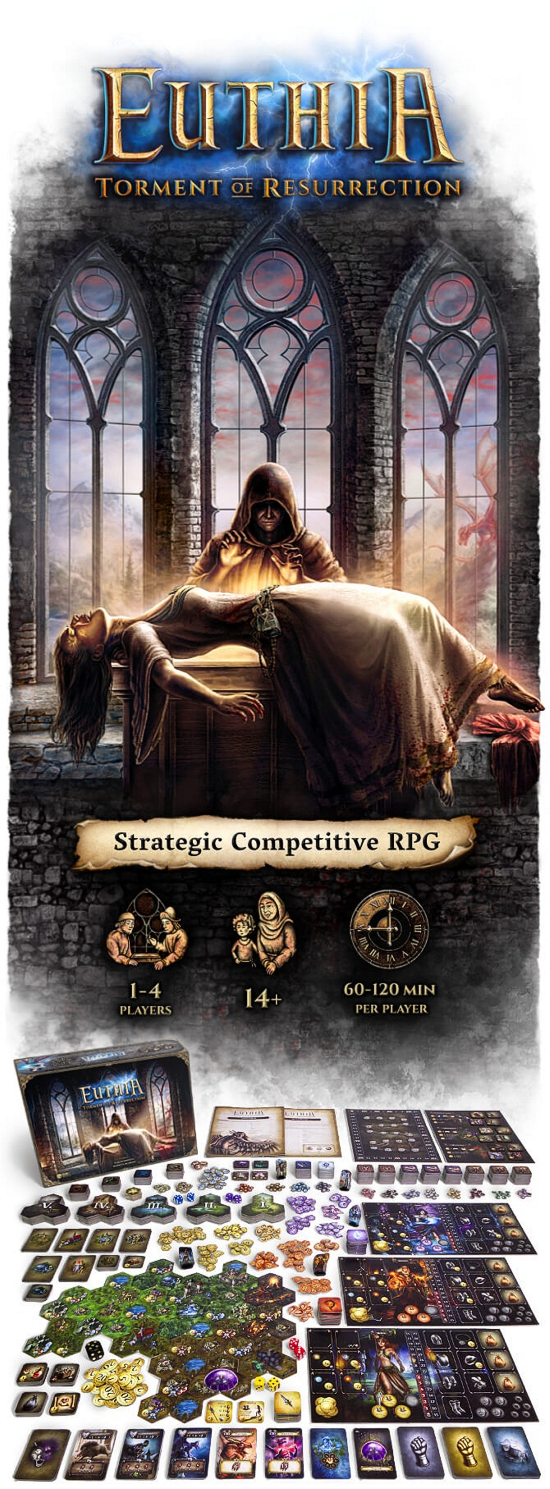
    Well, it certainly looks impressive:

    …. but to really answer that question, we’ll have to dig a little deeper.

Convergence

Gaming formats have been converging for quite a while, now, so the time might be right for a successful blending of the two forms. Computer RPGs have been around for donkey’s years, and starting looking a LOT like tabletop RPGs from around the time of the SSI games of the 90s, starting with Pool Of Radiance.

More recently, online communications have reached the point of permitting the playing of true RPGs through an online interface, like Roll20 (Wikipedia page).

This convergence is significant, because Euthia isn’t actually trying to bridge the gap between Tabletop RPGs and Board Games; instead, it wants to connect to computer RPGs.

But It’s just possible that the Computer-game definition of an RPG is the perfect middleman for a shotgun wedding between a tabletop RPG and a board-game.

Certainly, when you look at some of the game elements, what springs to mind most readily are the ‘rulebooks’ that accompanied those old SSI computer games, transformed into a board game.

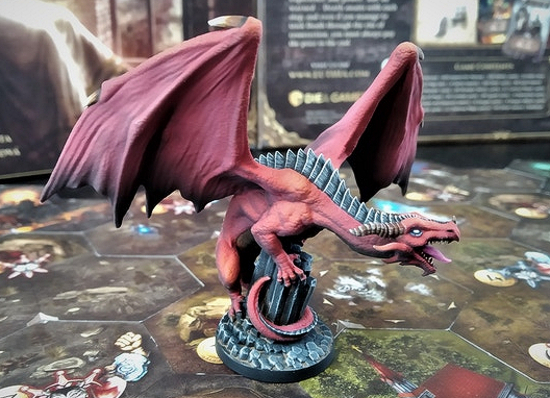
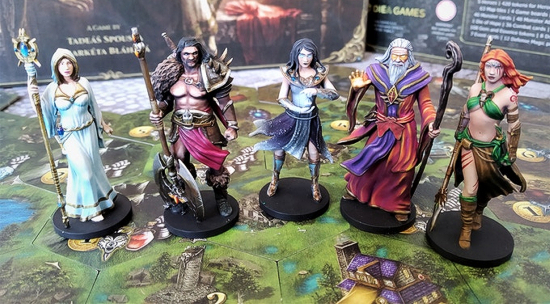
The game comes in two variants – one with Miniatures, and a (less-expensive) one without. For their display and development set, these were painted by Zbynek SibalZbynek Sibal (sorry for mangling your name into the English character set, the accents just wouldn’t display properly for me), who (like the other creators, hails from the Czech Republic). I think he’s done an incredible job.

Characters

Some computer-based RPGs offer character generation; others do not. The primary concept of most of them is that the computer assumes the role of the GM and the player is, well, the player. In some cases, the character is pre-ordained, such as was the case with The Hitch-Hiker’s Guide To The Galaxy computer game.

Character generation is a key attribute of tabletop RPGs.

Or is it? It’s quite normal for convention gaming to feature pre-generated characters that the participants then have to interpret.

Euthia has fixed characters, one to a player – but the definitions are as much a question of defining those characters as though they were the representatives of an entire character class in a Tabletop game as defining them as individuals.

Beyond that foundation, a character’s personality as an individual is up to the player. Unlike other games, there’s the potential for these personalities to actually impact game-play – so Euthia is actually more like a tabletop RPG than a computer game, at least in this respect. In terms of meeting the brief of a merger between these two forms of gaming, Euthia gets a big tick, then.

Even more significant is that there Euthia can accommodate from 1-4 players – but there are 5 archetypes (and a sixth is likely to soon be unlocked as a stretch goal).

For example, “Ael” is described as “a kind-hearted person who likes to help others” despite “being punished for using magic”. “Dral” is a “master of fighting,” whose “skill in handling weapons is unparalleled”. There’s lots of scope for further refinement in those descriptions – I can’t even tell, from reading them, whether or not the two would get along. What I can see is a situation in which they find common purpose, seeking the same outcome for different reasons..

Cooperation

Which brings me to the subject of cooperation. This is one of the strongest points of distinction about tabletop RPGs – that they are more cooperative and collaborative than traditional board games.

The PCs in Euthia are all rivals, but can nevertheless come to agreements with each other for short-term alliances. Trustworthiness as allies would obviously be informed by the preset character traits, but those pre-definitions are not the final word on the subject. Beyond those, the personality and competitiveness of the player becomes a contributing influence. It doesn’t matter how trustworthy the character description says the character is – if the player is one of those cut-throat ultra-competitive types, how much would you trust them?

Sound familiar? These are the same issues that RPGs have struggled with from the day someone first decided to pick the pocket of another PC.

Packaged Scenarios

Unlike most board games, there are multiple adventures and side-quests in Euthia, like volumes in a multi-novel epic. This makes it more like a tabletop RPG than most board games.

Unlike tabletop RPGs, a GM doesn’t get to design adventures; but you don’t get to design adventures in a computer RPG, either, and I know of several RPG campaigns that rely exclusively on canned adventures. This erodes the distinction between the different forms of game.

And the playing time is significant:

  • Main story scenario Farruga: 60 minutes per player.
  • Main story scenario Mirrezil: 90 minutes per player.
  • Main story scenario Brasath: 120 minutes per player.
  • Side-quest scenario The Hunt: 30 minutes per player.
  • Side-quest scenario Faer Invocation: 50 minutes per player.
  • Side-quest scenario Eminent Threat: 40 minutes per player.
  • A main plot with 5 chapters and 12+ individual tiles for each.
  • 86 Quest Cards like “Bring Raw Demonium to the Sorceror”.

Add all those up and you get a lot more than 390 minutes per player (6 1/2 hours). You might be able to get through the whole thing with two players in one extended gaming day, but I doubt it. Four? No way.

No, this is more like a campaign than an individual adventure. The more players you add, the more true this is.

And there are so many random elements – like those 86 quest cards, or the 40 different monsters (+4 more added on), plus encounter cards, plus dragons, plus spells and equipment, that the game could be played multiple times with each occasion bearing little-or-no resemblance to any other.

“Every hero has a different starting point, unique abilities, and a different learning curve. You will never see the same map twice.” – More like an RPG than like a typical board game, then.

Game Contents

Make no mistake, Euthia is still a high-end modern board game. Take a good look at the components shown in the photo at the start of this article.

The components (some of which I’ve mentioned already) include:

  • 4 Game Boards
  • Starting Map Tile
  • 12 Chapter I Map Tiles
  • 12 Chapter II Map Tiles
  • 12 Chapter III Map Tiles
  • 14 Chapter IV Map Tiles
  • 12 Chapter V Map Tiles
  • 40 Monster Cards
  • 24 Gold cards
  • 24 Silver cards
  • 21 Control cards
  • 66 Merchant tiles (goods the merchant has to sell, not all available at once)
  • 68 Alchemist tiles (magic items the Alchemist has to sell, not all available etc)
  • 51 Dragonslayer tiles (rewards for killing dragons)
  • 68 gold tokens
  • 42 treasure tiles
  • 64 gem tokens
  • 25 Mountain resource tiles
  • 25 Lake resource tiles
  • 24 Cave resource tiles
  • 4 Elemental Cards
  • 86 Quest Cards
  • 31 Quest Tiles
  • 5 Hero Boards
  • 5 Hero Standees
  • 22 Hero Tiles for Ael
  • 21 Hero Tiles for Dral
  • 21 Hero Tiles for Maeldur
  • 21 Hero Tiles for Keleia
  • 23 Hero Tiles for Taesiri
  • 30 Action tokens
  • 130 Shield Tokens
  • 60 Damage Tokens
  • 50 Trade Tokens
  • 150 Interaction Tokens
  • 10 Hero Dice
  • 19 Dragon Cards
  • “Die Of Hope”
  • 36 Combat Cards for solo play
  • Rulebook & Appendix
  • 80 Other components!

And that’s without any add-ons, and without the miniatures and stretch-goal inclusions! They even have a tutorial video on how to unbox the game!

From a roleplaying perspective, perhaps the most interesting inclusion is the game setting itself – a bespoke game world with its own lore and legends. You get some of this information through the game elements and rules/appendix, but still more will be unlocked as part of the stretch-goal-after-next.

You can even give yourself a sneak preview by downloading the draft versions of the rule-book and appendix from the Kickstarter page!

Yes, there’s a very good reason for my including this graphic from the Kickstarter campaign page. Don’t worry, I’ll get there.

Gameplay

“Euthia: Torment of Resurrection is a competitive strategic role-playing board game set in an open fantasy world. Players choose one of five heroes and uncover a modular map full of quests, precious natural resources, and dangerous enemies. The heroes gain experience, learn unique skills, obtain new equipment and treasure, and explore places of elemental power.”

The key elements of the gameplay are:

  • Explore and Search
  • Mine Resources
  • Trade with Merchants
  • Gain a reputation by defeating Monsters
  • Complete Quests
  • Interact With Elementals
  • Unveil and Train to Level Up
  • Specialize and Enhance your abilities
  • Face the ultimate challenge of the Scenario
  • Start another scenario
  • Other players are rivals and enemies – but cooperation is possible

One form of roleplaying of which Campaign Mastery has been critical has been described using the rather derogatory term, “Roll-playing”. Despite that, there is an element of “roll-playing” in every RPG – players who will roll a die for an interaction with an NPC because they have an interpersonal skill rather than using that skill to guide what the character says and does.

And, to some extent, that’s entirely acceptable; it has to be, because the player is not the character. The game mechanics function as an interface between the player’s capabilities and those of the character that they are portraying.

Good Roleplaying is acting as though you had the interpersonal skill even if you don’t.

When PCs come to town and find a merchant, they will want to look over his wares. If there’s something there that catches their eye, they are just as likely to roll a die for their attempt to buy it as they are to take up valuable table time talking to a “nobody important”.

Now, as a GM, I don’t want the players to know which NPCs are important and which are not, so I’ll want them to talk with all of them. The practical line to walk is somewhere in between. But, setting that aside – in what way is the process of rolling a die in an attempt to buy something to determine the outcome of the negotiations any different to any other resolution mechanic – including the one in Euthia? Rhetorical question.

There are those who will decry the board game aspects of Euthia as not being those of an RPG – and they are missing the above point, or ignoring it out of some sense of “purity”. The problem is that no board game could ever meet such narrow definitions, and neither can a lot of RPGs.

Reasons To Be Cheerful, Part IV

There are an awful lot of good reasons to be enthusiastic about Euthia, then. In addition to those I’ve highlighted already, I’d like to touch on a few more:

  • Game Craftsmanship – you don’t have to look at many of the illustrations on the Kickstarter to realize that this is first-class quality. And, while the game’s pieces are not a conclusive indicator, it would be very strange if that level of Craftsmanship did not extend to other areas of the project.
  • Game Substance – the mere existence of what I think of as the “supplementary material” – lore and world-building notes and the like – suggests that this will be a game of substance.
  • Sense Of Style – the whole Kickstarter page reeks of quality and style. There is nothing amateurish about it. And that, in turn, bodes well for the quality of that substance. A graphic demonstration is provided by the “Gameplay” title above.
  • Sense Of Humor – there’s a gentle undercurrent of humor in the content of the fundraising page; never at the expense of the important business, but layered on top of it, a constant reminder that people play games like this to have fun. Well, Campaign Mastery puts a pretty high value on fun, too.

You can see an example of that sense of humor in the breezy attitude taken in the “Why This Might Not Be The Game For You” section, which I have excerpted from the Kickstarter text:

  • Storytelling – Can’t live without flavor texts on cards? Then this might not be the game for you. That’s not to say, however, that we don’t have plenty of Lore behind Euthia and its characters to brighten your mood.
  • Preference for Cooperation – As stated in our introduction, Euthia is a competitive, not cooperative, game. There are some changes in the Rulebook you can try to cooperate with other players, but note that it could change the game experience.
  • Small Kitchen Table – Can you hardly eat lunch with four people present at your kitchen table? You might need to buy a bigger one for your living room!
  • Time per Player – If you hate planning your moves, watching your opponents develop their strategies, or want to be playing every minute of the game, you may want to avoid playing a three- or four-player game.
  • In-Game Over-thinkers – Do you know anyone who overthinks their strategies? I personally don’t, but others hate me for it. There are many situations which might require thinking through the best move to play, but that’s the fun part, right?
  • Can’t Handle Dying – If you’ve read the story behind Euthia, you know that dying is a part of the game. If you can’t stand watching your hero die, be warned. While it is possible to stay alive, it’s going to be a challenge.
  • Rivalry Between Players – When others take all [the] trading places and you have to pay them for trading, it sucks. But when they steal your treasures and quests right in front of you and kill you with a monster in combat, always remember, they can be next!
  • Dice In-Game – Are you scared of dice? Don’t tell me, same here. But we manage to make it fun & fair. Shii’s blessing will help you on your journey.
  • Long Rulebook – It’s long, we know. But let me assure you that you will find everything that you need to know. If you don’t want to read it, just watch [the] How to Play video.
  • Tons of Components – When it comes to cleaning up the table after the game, you will hate us. We hate us! If you don’t like tons of components but still want to play the game, head over to Tabletopia and give it a try. One mouse-click and your table is clean and ready to start over again.

The Campaign Mastery verdict

In terms of being a tabletop RPG – board game hybrid, Euthia comes as close as anything else on the market – with caveats. Those caveats are mostly an expression of that not being what the game is even trying to achieve – bringing the flavor of a computer-based RPG into a board game.

That, they seem to have achieved, in spades.

Yes, it’s a lot of money – but look at the quantity of game components that you get for the money.

I have been assured by those behind the game that even if the fundraising campaign has ended, there will still be purchase options available for those who need them. They may not be as cool as the package a supporter gets, but don’t let the price deter you any longer than necessary.

    The Public Verdict

    The public at large seem to have no doubts. Not only have podcasters been falling over themselves to review the game, it met it’s fundraising target in just four hours and is presently 247.6% funded – it may well be 250% by the time you read this. That means that they have blow through four stretch goals in 6 days and are closing in on a fifth (US$14,789 to go as I type this).

    I don’t know that Euthia is successful enough as a design entity to be called a game-changer; that appellation is thrown around all-too-casually for my liking.

This is clearly a significant event in the history of board games. Whether it proves to be one in the history of RPGs is harder to judge – but with success, there will be imitators and encouragement for others to try. And that can only mean that Euthia will deserve some of the credit, should any of them succeed.

Unfortunately, the launch was just a day or so too late for me to cover it last week, though we have been advertising it for the last couple of weeks. So anyone deciding to join the party after this review will be fashionably late.

As a GM and an RPG enthusiast, I can heartily recommend this board game. Take from that what you will!

Comments (2)

A Good Name 11: Culinary Delights


This entry is part 11 of 11 in the series A Good Name Is Hard To Find

This image of a Pavlova by Belinda Cave from Pixabay shows just how mouth-watering they can be – Merangue, Thickened Cream, and Fruit, how can you go wrong!? Cropped by Mike.

A Tale Of Australian Cuisine

I have the advantage of living in a country which is remote from just about everywhere, in which much of the culture has been imported from Europe and the US, and parts of Asia. That’s particularly true when it comes to diet.

Our basic recipes have all been imported from elsewhere, modified to suit local needs and local conditions and local produce, and repackaged as Dinky-Di True-Blue Australian. Even when they aren’t, or the claims are a little questionable – did New Zealand really invent the Pavlova? They certainly think so!

A growing trend in the late 20th century and into the 21st has been the use of native ingredients (rather than imported stock). We are the only country in the world that doesn’t blink at the notion of eating our national symbols (the kangaroo and emu, chosen because neither can walk backwards). Offer an American a serving of bald eagle, and they would be horrified (setting aside the fact that they’re an endangered species) – it would be an affront to their patriotism.

These native ingredients have exotic names and unusual flavors. Typically, they will get substituted into existing recipes, many of which are variations on the imported originals.

Australian Burgers often have beetroot and sometimes pineapple on them. Australian Pizza is different from both Italian and American in small and subtle ways. Australian Chinese Food is different from American Chinese Food and from Chinese Chinese Food.

The great foodie explosion here over the last couple of decades has eroded some of those distinctions, as though serving the Australianized Dishes was low-brow and gauche, while serving the traditional versions is exotic and up-market. This ignores the fact that the Australianized versions became popular for a reason. The inroads being made by “native ingredients” can be seen as a cultural counter-movement to this highfalutin’ pretentiousness, a way to Australianize recipes that is culinarily-acceptable in the face of this search for “authenticity.”

A Tale Of Tales

Cooking programs on TV have exploded in popularity right alongside these trends. Masterchef Australia – an Australianized version of a British show that failed – is now shown in more than 40 countries and rates highly in all of them. In part, that’s because we are a natural melting pot which is quite prepared to mix one good idea with another and see what happens.

We have never been so well-served with information about food. The US has a ‘food network’ on Cable TV – we have one cooking channel Free-To-Air, and until recently, had two, and neither of the two best-rating food shows on TV were shown on either. Almost every major network has its own food shows, some more than others. At first, there was a tendency to schedule these in direct competition with each other, but eventually the network executives figured out that a lot of people would watch BOTH if given the chance. Competition between the shows is still strong – but its’ no longer direct.

A Tale Of Names

I’m sure most people will have heard of Top Gear – it used to be the BBC’s #1 export around the world. They did a special in two parts called “The Ultimate Road Trip”, and then a sequel, “The Ultimate Road Trip II” (also in two parts). A major plot thread in the second pair of specials revolved around one of the presenters, Richard Hammond, discovering that the only place Spaghetti Bolognaise is named that is outside of Italy – in Bologna itself, the name refers to a completely different dish.

I’m sure that to many viewers in Britain and the US, this was an astonishing discovery. It certainly wasn’t news to me, or to a great many other Australians, though; we had learned the fact from “Food: Fact or Fiction” or from “Good Eats” or from any one of a dozen celebrity chefs who have mentioned it in the course of various programs – and I think it was even mentioned in a Masterchef Australia Masterclass back in the early days.

Nevertheless, the name has stuck, and been carried world-wide, and the dish itself is responsible for a significant part of the tourism enjoyed by Bologna (or it was, until Covid-19).

Nor is it the only example. Place names have been attached to an extraordinary number of dishes through the years, such as

Boston Cream Pie, Philly Cheese-steak, Buffalo Wings, Boston Baked Beans, Mississippi Mud Pie, Nashville Hot Chicken, Long Island Iced Tea, Chicken Kiev, Singapore Noodles, Swedish Meatballs, Bisque (believed named for the Bay Of Biscay), Cantaloupe (transplanted from Persia to the Papal Gardens in Cantalupo near Rome), Fig Newton (actually invented in Philadelphia), Frankfurter – the list just goes on and on.

Add in the number of dishes named for people, like Peach Melba, Fettuccine Alfredo, Caesar Salad, Carpaccio, Bananas Foster, Frangipane Tarts, Earl Grey Tea, Kung Pao Chicken (named for a late Qing Dynasty official whose title was Gong Bao, or Palace Guardian), Margherita Pizza, Bloody Mary, Mornay Sauce, Nachos, Napoleon Brandy, Oysters Rockefeller, the aforementioned-Pavlova, Praline, Strawberries Romanoff, Salisbury Steak, Beef Stroganoff, Crepes Suzette, and (most famously), Sandwiches – to name just a few of the ones most people will recognize.

Add in the still-greater number of examples of produce named for either of these two things – Moreton Bay Bugs come to mind (a type of seafood), and Barramundi (a fish). And Philadelphia Cream Cheese (which actually comes from New York, it was named thus to give it Cache in an era when Philadelphia was a culinary giant in the US), Vidalia Onions, Brussels Sprouts, John Dory, Boysenberries, Galliano (liqueur), and Bartlett Pears

Names are not always a reliable guide to origins. Aside from the Spaghetti Bolognaise example mentioned earlier, consider: French Toast (actually English), Creme Anglais (French), Welsh Rarebit or Welsh Rabbit (English), English Muffins (American), Scotch Eggs (English), Swiss Cheese (American), Hawaiian Pizza (Canadian), Szechuan Ginger Beef (Canadian), Dom Perignon (Champagne), Mongolian Barbecue (a Taiwanese Stir-fry!), and Mongolian Beef (which doesn’t come from Mongolia).

Then there are Places named after foods – Oyster Bay, for example.

There are two phenomena at work here of which a GM should be cognizant: The human appetite for variety and exotic flavors – i.e. the “Native Ingredients” trend – and the use (and misuse) of people and places in food names.

The “Native Ingredients” Trend

If it looks edible, a human will eventually stick it in their mouth. If it doesn’t or isn’t, another human will cut it open to see if part of it is edible. If the answer is still no go, still more humans will try to find a way of cooking or processing the ingredient to make it palatable.

Combine all that with the multitude of exotic creatures found in a D&D campaign – a multitude that should be matched if not exceeded by the number of exotic plants in any rational bio-system – and you have a cornucopia of new dishes awaiting invention and naming.

And that’s before we even get into the culinary traditions of the other sentient races.

The Famous Names Trend

Famous people of the past, famous places, and obscure places that just happened to invent something, sometime, should all be reflected in the names of the exotic produce and exotic recipes that should fill your culinary landscape.

These name-drops should come without explanation, for the most part – they should simply be there, part of the landscape, a moment of color.

That changes when the PCs travel to or through one of these locations. Locals should revel in the distinction that comes from being the source of a famous dish (if correctly attributed), and PCs should be told of expectations (whether it’s true or not). I understand that tourist requests for Spaghetti Bolognaise are greatly irritating to chefs from Bologna (though the waiters don’t let on, of course). To give in would be to undermine the true individuality and identity of the region – so if you want what you think is a Spag Bol, you should ask for a Beef Ragout (pronounced Rag-ooh).

A geography of Cuisine

In addition, there should be some dishes that are common in one geographic area and rare elsewhere – in Lapland, reindeer meat is easily available, but elsewhere, it is uncommon, while other forms of deer meat are exotic but not unheard of.

Remember, too, that most preservatives were unknown, but that various techniques of preparing food to last were not – and that if it’s on the menu, someone has to go out and get it.

Pate de Flambe Draco sounds exciting – but it would be dreadfully expensive if it really derives from the Livers of Red Dragons, costing hundreds or thousands of gold an ounce. Unless, of course, it’s something rather more common with strong spices and the name is misleading.

Play games with the foods, and the names of foods, in your campaign – both to entertain yourself and your players, and to earn a little extra verisimilitude on the side. That’s a winning dish in my book!

Comments (4)

The Sixes System Pt 6: Doing More Things


This entry is part 7 of 9 in the series The Sixes System

Image by Mark Frost from Pixabay, contrast slightly enhanced by Mike

0. Fundamentals (repeated for all posts:)

— The Sixes System is a minimalist game system suitable for any and all genres.

— It has been used in my Dr Who campaign since September 2014, which has just come to a successful conclusion.

— Characters are constructed using a point-buy methodology with NPCs generatable using die rolls for speed.

— Success or Failure on tasks is determined by adding dice to a pool based on ability and circumstances which are then rolled against a target number determined by the GM.

13. Simple Attacks

A simple attack is one-on-one. It may or may not involve the use of a weapon. Success or failure is determined in the same way as any other skill use with one exception: the target value is based on the defender’s stats, not the attacker’s abilities. If the means of defining the target value hasn’t been explained to the attacking player, they will see no overt differences between an attack roll and any other example of skill use.

  • Attack Roll: #d6 = Stat used* + Purpose used + Appropriate Skill* + Weapon* ranks
    &nbsp:&nbsp:&nbsp:&nbsp:&nbsp:* = may be defined by weapon specifics.
  • Target Number: (Stat used for defense + Purpose + Relevant Skill, if any) × A + #sixes × (6-A).
    • These values normally derive from the Defending Character, but there can be exceptions. Most artillery doesn’t target a specific individual or location or vehicle, it targets the surface where those things are expected to be. In such cases, it can be more appropriate to treat this as a normal skill use instead of an attack.
    • The defending character can normally specify what defensive technique they are employing, which in turn defines the Stat, Purpose and Skill. However, some weapons may mandate one or more of these specific elements; this is especially true of area effect attacks, where a direct strike is not necessary in order to inflict harm.
    • A is a critical value, the required average, which varies with the manner of attack and is set by the GM accordingly. Some weapons and some defenses may specifically adjust this value. This process is so important that it will be detailed in its own subsection, below.

Range is simply a factor that the GM should use to allocate required sixes and is divided into three categories: close, moderate, and long. Specifics will vary from weapon to weapon, but there are some generic values to use (in the absence of anything more specific) given in subsections 4.5 and 4.6.

13.1 Setting A

The attack mode in combination with the defense mode defines the A that is required. In general, the more such a combination relies on battering through defenses by force, the higher the target but the higher the damage that occurs on a success. The more a combination is all about speed and maneuvering, the lower the target (success comes more easily) but the less damage is done.

Base A is normally 3. This may be increased to 3.5 if the GM wants successful attacks to be more infrequent, effectively de-emphasizing combat, or reduced to 2.75 if the GM wants the campaign to be more of a meat-grinder. It is entirely permissible to establish one general baseline and to vary that for specific combat encounters.

While there are some rules below, this is extremely responsive to genre, and GMs should feel free to establish some variation to better simulate the style of adventuring that he wants.

The following list integrates all the options in sequence of likelihood to damage:

  • Force vs Resistance: +1 A, +1/d damage
  • Force vs Force: +0.75 A, +2/3d
  • Force vs Finesse: +0.75 A, +1/2d
  • Force vs Dodge: +0.5 A, +1/3d
  • Resistance vs Force: +1 A to disarm, +0.5 to damage without disarming, +1/4d
  • Resistance vs Resistance: +0.5 A, +2/3d
  • Maneuver vs Resistance: +0.5 A, +1/3d
  • Resistance vs Finesse: +0.25 A, +1/3d
  • Finesse vs Resistance: +0.25 A, +0d
  • Maneuver vs Force: +0.25 A, -1/3d
  • Finesse vs Dodge: +0 A, -1/2d
  • Resistance vs Dodge: +0 A, +0d
  • Finesse vs Force: +0 A, -1/2d
  • Maneuver vs Dodge: +0 A, -2/3d
  • Finesse vs Finesse: -0.25 A, -1/d
  • Maneuver vs Finesse: -0.5 A, -1/d

This is the same list, but in related groups of attack mode:

  • Force vs Force: +0.75 A, +2/3d
  • Force vs Resistance: +1 A, +1/d damage
  • Force vs Dodge: +0.5 A, +1/3d
  • Force vs Finesse: +0.75 A, +1/2d
  • Resistance vs Force: +1 A to disarm, +0.5 to damage without disarming, +1/4d
  • Resistance vs Resistance: +0.5 A, +2/3d
  • Resistance vs Dodge: +0 A, +0d
  • Resistance vs Finesse: +0.25 A, +1/3d
  • Maneuver vs Force: +0.25 A, -1/3d
  • Maneuver vs Resistance: +0.5 A, +1/3d
  • Maneuver vs Dodge: +0 A, -2/3d
  • Maneuver vs Finesse: -0.5 A, -1/d
  • Finesse vs Resistance: +0.25 A, +0d
  • Finesse vs Dodge: +0 A, -1/2d
  • Finesse vs Force: +0 A, -1/2d
  • Finesse vs Finesse: -0.25 A, -1/d

Image by Vlad Mineev from Pixabay, contrast enhanced and slight tonal shift by Mike

Some definitions:

  • Force as an attack is confronting defenses head-on and battering your way through them. Think broadswords and axes – and most firearms and crossbows.
  • Force as a defense is confronting attacks head-on and attempting to prevent the attack even reaching any defense. Think of it as defending yourself with a broadsword.
  • Resistance as an attack is attempting to use a shield to create an opening in the enemy’s defense and then taking advantage of it.
  • Resistance as a defense is using some sort of shield to absorb the attack. It includes taking cover.
  • Maneuver is attempting to re-position yourself relative to the target through some sort of movement (includes acrobatic & gymnastic moves) in order to attack a vulnerable flank or rear.
  • Dodge is the defensive equivalent of Maneuver and represents an attempt to be somewhere where the attack isn’t, or to position your body and limbs to achieve the same end. It includes throwing yourself prone in order to take advantage of low cover.
  • Finesse as an attack is employing a weapon that relies on speed and skill, not force. Think rapiers and epees and lightsabers. Finesse also includes any other form of ‘attack’ through skill use, eg Engineering (to drop a ceiling or support timber on an enemy), Persuasion (talking the enemy out of attacking you), Intimidation (convincing the enemy that it’s too dangerous to attack you), etc., and the use of bows.
  • Finesse as a defense is employing a weapon that relies on speed and skill to deflect an attack into a place that the defender isn’t or to block it. It also includes tricks like attempting to shoot a weapon out of your enemy’s hand.

Obviously, there may be situations not covered by the above; these should be interpreted by the GM using these as guidelines. In general, the higher the A adjustment, the more ‘bang’ the character should get if he succeeds.

Furthermore, the busy GM can ignore all of this as he sees fit – no tweaks to the chance to inflict damage and no adjustment to the amount of damage any given weapon inflicts – or can substitute his own values that seem appropriate to the situation, using these as a guideline.

13.2 Allowing for Cover

Cover works by adjusting A:

  • no cover: -0.5 A
  • partial cover: +0 A
  • substantial cover: +0.5 A
  • total cover: +0.75 A
  • active cover: as above +0.25 A, to a maximum of +1 A.
    Active cover is cover behind which the target can maneuver without being observed by the attacker. It includes things like trenches and walls, and may also include vehicles, etc., depending on the circumstances.

The GM needs to adjust the above for circumstances – if a character has cover but the cover is a flimsy material and the attacker can see through it in some way, it might as well not be there, and there is a lot of ground in between these extremes – so considerable judgment is needed.

13.3 Improvised Weapons

Improvised weapons are almost always Finesse attacks. They do 1 Color A dice in addition to any from base stats (see 13.6).

13.4 Voluntary Adjustment

This is a game where intentions matter. Characters are at liberty to examine the circumstances of the fight and voluntarily “pull their punch”. This adds a further +0.5 A adjustment but halves any damage inflicted and adds an extra Color A damage die (see 13.6 below). When this is done with firearms, it represents a deliberate attempt to only wound the target.

13.5 Kill-shots

In some genres, it may be appropriate for characters (especially villains) to occasionally attempt a Kill-shot. This adds an additional +1 A but triples the number of Color B dice, making it far more likely to produce lethal effects (see 13.6 below).

Note that it is entirely possible to attempt a “Kill-shot” with an Improvised Weapon, but this is generally a sign of desperation.

The downside of a Kill-shot attempt is that the attacking character is at -4 to their defense for the next round. So it banks heavily on putting the target down. Snipers attempt to use concealment and camouflage (and sometimes a prone or low position) to protect them despite this vulnerability.

Note that a coup-de-grace qualifies as attempting a Kill-shot.

13.6 Damage

The number of dice of damage inflicted is specified by weapon. If a character is attempting to use a raw skill (punching with Strength, martial arts with DEX or some other appropriate stat), the number of dice is the Stat used + Purpose used divided by five.

Each excess six that is rolled adds 1 additional damage dice to the total unless the character is “pulling his punches”, in which case it takes 2 excess sixes to add an extra die.

Half (round up) of these dice should be color A, the rest color B.

  • Color A = temporary stat damage to defensive stat (lasts 1 round)
  • Color B = enduring stat damage to defensive stat (heal 1 per hour)
  • Difference = persistent damage to defense purpose (heal d6 per day)

Most of the attack forms described in 13.1 come with a damage adjustment. These are “extra damage dice” relative to the number of dice already in a damage pool, and should be included before division into the two colors.

    For example, Resistance Vs Resistance attacks do +2/3 dice. If the number of damage dice is 2, that isn’t enough to meet the threshold, and no bonus is awarded for the attack.

    If the character rolled one extra (natural) six more than required by the defending character’s target and the GM’s adjudication of circumstances, that becomes a third damage die, which does meet the threshold, adding 2 more dice to the total, which is 3+2=5 dice as a result. If the attacker rolled 2 excess sixes, that becomes 4+2=6 dice; a third excess d6 becomes 5+2=7 dice; and a fourth takes the baseline to six dice, and adds another +2 dice to the total, for 6+4=10 dice of damage.

The dice indicated are rolled and totaled within their colors and any defense provided by armor or shields, is applied to the roll. The remaining dice are totaled and the damage applied to the target.

    Armor normally subtracts 0-5 per die (low values are far more common than high); Shields subtract 1 per die from color B and difference. However, weapon bonuses and magic reduce the value of armor and shields.

    If you were in Armor 4 plate mail, with a shield 1, you are effectively eliminating all dice that don’t roll a six from the damage roll, and reduce those to doing only one point.

    If your weapon had a +1 enhancement, you not only get an extra die with which to attack (and an extra chance to roll a six), you reduce the effectiveness of the defense by 1 – so only 1’s, 2’s, 3;s, and 4’s are eliminated from the damage roll, 5’s are reduced to 5-4=1, and sixes are reduced to 6-4=2.

    If your weapon had a +3 enhancement (exceptionally rare), you would not only get three extra attack dice, but would reduce the defense to 5-3=2. Only ones and twos would be ineffective; 3’s would inflict 1 point, 4’s would do 2 points, 5’s would do 3, and 6’s would do 4.

    If you had the 10 dice of damage demonstrated above (four extra sixes on the attack roll), that would be 5 dice of each color. Each of those dice could do 0 or 4 or anything in between – the average is 10/6. Multiply that by 5 dice and we get 50/6, which works out to 8 and 2 left over – so 4 times in six, the average will be 8 points and 2 times in six, the average will be nine.

    That’s an average of 8 points of temporary damage and 8 points of enduring damage – and it could be worse. Few characters will have stats of 16; the odds are good that the success will make the character unconscious, and if the stat is 8 or less, may even put the character into critical condition.

Image by Sarah Richter from Pixabay, top and bottom added by Mike

13.7 Forced Maneuvering

On a successful attack, the attacking character may move the defending character 2m per d6 damage in any direction physically possible. Note that many weapons will require the last die of movement to be “down”, and some weapons may add or subtract “virtual dice” for the purposes of causing movement. If an attack does no damage, the attacked character may choose where this movement leaves him positioned.

13.8 Effects and Natural Healing

A round, for these purposes, is defined as other characters having the opportunity to do something. “Walk up and execute a coup-de-grace” is “something”. “Take the money and run” is “something”. “Tie him up” is many “somethings” – “bind his hands” is “something”.

    13.8.1 Unconsciousness

    If a character runs out of stat due to temporary stat damage, he is rendered unconscious. He gets a recovery attempt 1 round later per point of stat below zero; if this succeeds, the character comes to, but must spend the next round reorienting himself, which includes attempting to estimate how long he was ‘out’. He will recover the remainder of his temporary stat loss one round later.

    If the recovery check doesn’t succeed, the character will heal 1 point of temporary stat damage per minute; each time they do so, they may make another recovery attempt.

    Recovery attempts are determined by adding half of the character’s highest remaining stat to the (temporarily reduced) stat affected by the attacks he has endured (the half-stat should play into the GM’s choice of descriptive language for the process). To this, the character may add the value of whichever Purpose best describes how the character would attempt to recover – usually Defend/Repair, but occasionally Attack/(Re-)build or Analyze/Understand.

    The result is the number of d6 that the character has to roll. Only dice that come up six are counted; they persist until the next check, when they are assumed to have been rolled and come up sixes. After each check, the character heals 1 point of temporary stat loss per six rolled. If those are sufficient to return the character to positive stats, the character will wake up but remain groggy for the next d6 rounds, at the end of which time, any remaining temporary stat damage will be recovered.

    If multiple stats are negative at the same time, the character can only heal one of the affected stats each minute, and all of them have to be positive before he will awaken.

    If the character is so badly impacted by temporary damage that the recovery total is zero or less dice, he is in a coma.

    13.8.2 Coma

    Comatose patients can be healed by medical intervention as though the temporary stat damage was Persistent (see 13.10 below).

    Recovery attempts take place once per hour, and the character can now add 1 dice for every stat above zero. However, in order to heal one point of damage, all dice on the roll must come up sixes (Sixes still accumulate from roll to roll).

    Only when sufficient recovery has taken place that the character is positive in all stats does he return to a normal “unconscious” state and resume rolling as described above, with a pool total of no sixes.

    13.8.3 Critical Condition

    If a character has accumulated sufficient Enduring stat damage that a stat is reduced to zero or less from that alone, he is in a critical condition and will lose 1 point from one of his Purposes each minute (player’s choice as to which).

    Treatment by a Paramedic or Surgeon (see 13.9 below) may first slow this loss to 1 every 2 hours, 1 every 3 hours,.1 every 4 hours, and so on up to 1 a day, then none – a total of 24 steps. Additional sixes above target count as additional steps along this sequence.

    Multiple rolls may be thus required to stabilize the patient, i.e. prevent further losses. Failure reduces the benefits by 1 step and prevents further attempts by a Paramedic; full surgery is required. A critical failure reduces the benefits by 1 step per natural 1 rolled.

    A paramedic’s function is purely to stabilize the patient sufficiently that they can survive surgery. What that actually means is a decision to be made by the GM, who can assess wound lethality as grades 1 through 4 – where 4 is the most serious. More on that in section 13.10. As a general rule of thumb, 3 hours without a loss is ample for a grade-1, six hours for a grade-2, 12 hours for a grade 3, and 18 hours for a grade 4. This should be ample time to perform the surgery involved, with a reasonable allowance for setbacks and complications along the way.

    Of course, there’s the caveat that the more serious injuries (grades 3 and 4) might need such surgery before this can be achieved – in fact, the more serious the injury, the more likely this is to occur.

    13.8.4 Death and Resuscitation

    If one of the character’s Purposes is reduced to zero or less, they are facing Immanent Death – or, more precisely, are technically Dead but may be able to be resuscitated. Every 10 seconds that passes reduces all four of the Purposes by 1 and requires a survival check. This is either a Strength or Self-defined Stat roll – no skills, and no purposes. Some character traits may add additional dice, and some disadvantages remove dice, however.

    To continue dying, the roll must produce one natural six for each point of Purpose below zero. On a success, the character may restore 1 point to that Purpose. If the character doesn’t produce enough sixes, they may apply the one(s) they have rolled, but their condition will worsen. Eventually, as the Purposes deteriorate, more sixes will be required than the roll permits, and the character will be irretrievably dead.

    For example, let’s say that a character takes 7 points of damage to his Defend purpose, which was only 4 to start with. That puts him at -3. His other Purposes are 4, 3, and 2, respectively. His self-defined stat is Pulp Hero at 9; the GM considers that to include heroic survival of injuries, and so can be used for a survival check. Since his Pulp Hero is 9, and his strength only 7, the player accepts that offer.

    When the time comes to make a survival check, he loses one point from each of his Purposes: which are now 3, 2, -4, and 1 as a result, which means that he needs 4 sixes on his 10-dice roll. The odds are not good. The character does well, rolling three sixes, but not well enough. He applies the three successes to his defense purpose, raising it to -1.

    When the next survival check is due, the character again loses 1 from each of the 4 Purposes, reducing them to 2, 1, -2, and 0, respectively. The good news: the character only requires 2 sixes on his 10 dice. The bad news: he only gets one. He applies that 1 to the defense Purpose, again raising it to -1.

    When the third survival check is required, the Purposes again decline, now to 1, 0, -2, -1. The character now needs 3 sixes. He only gets one, which he applies to his defense, again lifting it to -1. His Purposes are now 1, 0, -1, -1.

    Forty seconds after being wounded, his Purposes are again reduced, now reaching 0, -1, -2, -2. The character needs five sixes from his 10 dice. He gets two, and applies them all to his defense, finally getting it up to zero. He is clearly fighting for his life and just barely clinging on.

    Fifty seconds after his injury, the Purposes are reduced once more, to -1, -2, -1, -3. He needs 7 sixes from 10 dice to stabilize, and knows that is not likely to happen. What’s more, if the slide into oblivion is not checked, at the 3 minute mark, his Purposes will be -2, -3, -2, and -4 – a total of -15. Since there is no way to get 15 sixes from 10 dice, he will be fully dead, having taken a minute to die. To hang on for one more roll, he needs to recover to the point that the loss in Purpose will be only 10; and 10-4=6. So one six will be enough to buy him another chance.

    He again does well, again getting 3 sixes. He applies one to his Explain, and two to his Analyze, improving his position to -1, -1, -1, -1.

    At the one minute mark, still clinging to life, his Purposes deteriorate again, to -2, -2, -2, -2. That means that he now needs 8 sixes from ten rolls to recover, but two will be enough to buy another ten seconds. He rolls, and gets those two minimum; he applies them both to his attack, just so that he can say that he has recovered ground in all four Purposes. He is now at 0, -2, -2, -2.

    At one minute and ten seconds, he enters what he knows will be terminal decline. His purposes drop to -1, -3, -3, -3, and he needs all ten dice to come up sixes – but four will continue his protracted death spiral. He doesn’t need Table 6 to know that there is very little chance of rolling 60 on 10d6 – in fact, there’s less than 0.1% chance, according to that table. But getting 4 dice to come up box cars might just be possible. He rolls, and gets 2 sixes, and dies.

Image by Etienne Marais from Pixabay, slight tonal shift by Mike

A paramedic can attempt to resuscitate the dying character. This requires a paramedic or surgeon roll. Every six – natural or virtual – over the minimum requirement adds 1 to the character’s wounded Purposes. This requires CPR and mouth-to-mouth as a minimum; if a defibrillator is available, it permits any one results to be re-rolled. If the result is enough to elevate all the character’s Purposes above zero, the patient has been resuscitated. But paramedic rolls for this purpose can only be made every thirty seconds. If the paramedic rolls no sixes over the minimum, he at least prevents the next survival check.

The example therefore shows how critical it is for a dying patient to receive immediate medical intervention.

    If a paramedic was at the patient instantly, before the first survival check, the paramedic would have needed three sixes to resuscitate the patient – quite doable. Even a single extra six or two at this point would have been enough, given the patient’s rally at the ten second mark. Let’s assume that there’s no defibrillator, that the paramedic has 8 (stat) +3 (purpose) +3 (skill) +2 (medical bag) = 16d6, and that the GM requires 2 + 2 = 4 sixes. That means 12 dice at an average (set by the GM) of 3.5 – giving a target of 42+24=66. The paramedic rolls 2 × 1’s, 3 × 2’s, 4 × 3’s, no 4’s, 3 × 5’s, and 4 × 6’s. That’s a total of 59 – not enough.

    Thus, the patient’s story described above continues unchanged until after the thirty second mark, when the purposes have declined to 0, -1, -2, -2, and the patient needs five sixes from his 10 dice. The paramedic can make a second check before that. This time he rolls 75 – nine more than the target, which is 9/(6-3.5) = 9/2.5 = 18/5 = 3 and three-fifths extra virtual sixes. That adds three to the character’s Purposes, reducing them to 0, -1, -1, 0. The character only needs two sixes from his 10 dice, which is what he achieved – so the patient has been successfully resuscitated.

    But what if the Paramedic didn’t reach the character until twenty seconds after the injury – still very quickly? With all else unchanged?

    That means that the first (failed) attempt took place at 20-something seconds, and the second can take place at 50-something seconds. The patient’s grim determination to hang on has brought him to the point of having Purposes of -1, -1, -1, -1 at the 50-second mark. The Paramedic roll yields three extra sizes, as explained above, so three of these can be raised to the zero point. The next paramedic check is possible at 80-something seconds.

    At the one-minute mark, the patient is able to skip his next survival roll, because the paramedic check succeeded, and he does not deteriorate, either. At 70 seconds, he again begins to slip away, his Purposes deteriorating to -1, -1, -1, -2, and he needs five sixes. He gets two, and applies them to the failing Analyze Purpose.

    At 80 seconds, he declines to -2, -2, -2, -1 and gets 2 sixes, which he applies to his Attack Purpose. This is the point at which he died without intervention; with the paramedic’s assistance, he has been able to hang on. His purposes are 0, -2, -2, -1.

    The paramedic rolls one of those amazingly lucky rolls that come along every now and then – no 1’s, 2’s, 1 × 3’s, 4 × 4’s, 6 × 5’s, and 4 × 6’s, an even better total of 79. That’s 13 more than the target. 13/(6-3.5) = 13/2.5 = 26/5 = 5 and one-fifth sixes more than needed. He applies the five points of healing and gets the Purposes to 0, 0, 0, 0. Since none of them are below zero, the character is no longer dying.

    Thirty seconds later, the paramedic is able to make a normal paramedic healing check. For this check, because the patient is no longer in danger of dying, the referee lowers the average for success to 3, and reduces the number of sixes needed to 2+1=3.. But the Paramedic has to decide how many of his three ranks he is going to allocate to healing and how many to a successful roll. Since the patient is no longer at risk, he decides to set aside all three for healing, and rely on his medical bag to give him the edge needed for success. That means that he now has 8 (stat) +3 (purpose) +2 (medical bag) = 13d6.

    That sets a target of 3 × 10 = 30+18 = 48. The paramedic responds with another good roll, mostly fives, for a total of 55, 7 more than the target. But the degree of success is no longer important; once he has succeeded, he does 1d6 healing per rank in his paramedic skill. He rolls 3d6 and gets 13. The patient would like to distribute this healing amongst his Purposes, but he can’t (as explained below); he has to first apply it to stat damage (temporary and then enduring), which will almost certainly consume all 13. The patient will have to recover most of his lost Purposes at the normal rate, though further medical care may assist in that process.

Note that the recovery of Purpose at the full rate shown requires complete bed-rest. If characters are active for part of the day, the recovery is proportionally reduced. A character that rests only for 8 hours and otherwise maintains a normal work schedule is only resting for 1/3 of the day, and so only gets 1/3 of the healing – a d2, in other words. A character who rests for 12 hours a day is only resting for half the day, and only gets d3 recovery. A character who rests for 16 hours a day is resting for 2/3 of the day, and recovers 2/3 of the normal rate, or a d4.

Various medical supports can double this rate or add +# to it. Medication administered under a doctor’s supervision adds +1 to +3 (depending on the effectiveness of the drug and the skill of the doctor). Constant nursing attention (or a bio-bed of some sort) can double it. Regeneration tanks or other such techniques can triple it. A rank-4 regeneration spell could quadruple it. But the character has to be healing naturally in the first place.

13.9 Further general guidelines

Attacks and defensive responses need to be specified in the usual manner. Where the character being attacked has no way of knowing that he IS being attacked, he cannot make any defensive action that is predicated upon such knowledge – you can’t dodge a sniper’s bullet. However, if the normal activity warrants it, an object may fortuitously intervene – this is for the GM to adjudicate. The more distant the shot and the slower the muzzle velocity of the round, the more travel time is involved for the attack, and the more likely it is that the character will have partial or full cover when it does, or have turned aside.

13.10 Healing Interventions

Natural healing rates are specified by the type of damage inflicted. When that’s not enough, or a character is in more serious condition, medical intervention may be required.

Medical intervention: does 1d6 healing per skill rank on success. Ranks allocated cannot be used to improve the chances of success. Damage is healed in order temporary – enduring – persistent. The Interval before a further intervention roll is permitted is the current timetable of healing (next round, next hour, or next day) – so it’s per round while there is temporary stat damage, per hour once all the temporary stat damage is healed (which may take longer than a round if the character is unconscious or comatose) Only once all stat damage has been healed can healing be directed toward Purpose damage – this is why it is called persistent damage, it lasts a long time. A critical failure on an intervention check does 2d6 damage.

The medical skills that are used to treat the different kinds of damage are:

  • Temporary Damage: First Aid
  • Enduring Damage: Paramedic
  • Persistent Damage: Surgeon or Surgery

These are restricted in Skill Ranks:

  • Paramedic Ranks cannot be higher than First Aid -1
  • Surgeon or Surgery cannot be higher than Paramedic -2

A surgeon’s function is to remove malfunctioning and permanently damaged organs or parts of organs and replace them as necessary. A minor (grade 1) surgery is one in which no organ removals or organ replacements are actually necessary. This includes everything from stitching a bad wound to excising cysts or ingrown toenails. Removing non-essential organs is grade 2 and includes removing tonsils and appendixes, bowel resections, intestinal repairs, and even minor microsurgery to reattach digits. Grade 3 refers to more serious or substantial surgeries like skin grafts, minor coronary bypasses, etc. Grade 4 refers to repairing damage that is immediately life-threatening.

13.11 Healing Magic and Science

Healing spells and hi-tech wizardry should specify which of these skills it is equivalent to, and respect the limitations appropriately.

An example, using D&D/Pathfinder terminology, might be:

  • Cure Light Wounds Spell (First Aid), 4 ranks
  • Cell Regenerator (Paramedic), 3 ranks
  • Cure Serious Wounds Spell (Paramedic), 1 rank
  • Programmable Cyberdoc (0 ranks)

This character can heal using his different tools. His paramedic skill, i.e. his skill in using the “Cell Regenerator”, is as high as his “Cure Light Wounds” permits. He is better at using the Regenerator than he is using his other Paramedic-substitute, “Cure Serious Wounds”. He knows the minimum possible to actually Program the Cybernetic Doctor; his skill can be improved by 1 rank (= Paramedic -2). It seems likely that he has only just increased his skill with the Skill Regenerator and did not have enough points left to improve his skill with the Cyberdoc.

Image by Viergacht from Pixabay

14. Complex Attacks

A complex attack is one that is aimed at achieving a strategic goal as well as a tactical one. Tactics amount to one-one-one resolution of attacks; a complex attack is designed to achieve something in addition to the attempted success of the attacks.

A character only gets his full defense against a single attack at a time, even if the attack mode is different. Each subsequent attack in the same round on the same target is at -2 defense. A character being attacked may choose to dodge one attack, deflect a second with his shield, and brush aside a third with his weapon (more becomes problematic) – but doing all this at once is a big ask.

However, it may be even more effective for the attackers to employ Coordinated Team Actions (described in 5.14). These are decisions that must be made in advance.

Furthermore, with the piece-meal approach, the first attack may reduce a stat through damage, reducing the value for subsequent defensive moves. This is especially true of finesse and dodge as defensive techniques, because they may both rely on Dexterity; and force and resistance, because they may both rely on Strength. However, the character will usually be able to use his self-defined stat for at least one attack mode, distributing the impact across three stats instead of two.

As a general rule, if there are goals beyond the simple success or failure of an attack, the GM should assess them on a 1-4 scale (1 = easy, 4 = extremely difficult) and use the degree of success converted to additional sixes to meet the target. This might require one successful attack, two successful attacks, or even more. The referee is free to increase the number of sixes required if the target figures out what the attacker is trying to achieve and resists, or to reduce it (possibly to the point of immediate success) if circumstances change in a way more favorable to success.

I’ve demonstrated how to count virtual sixes in the examples above, but for the record:

  • Subtract the required average from six. This determines the amount by which a roll must succeed to total a six more than required.
  • Divide the actual margin of success by this (and round down) to determine the number of virtual sixes achieved over target.

    For example, the required average is 3-and-2-thirds. The roll is 16 over target.

    • 6 minus 3 2/3 = 2 1/3.
    • 16 divided by 2 1/3 = (3 × 6) divided by 3 × (2 1/3) = 48 divided by (6 + 1) = 48/7 = 6 and 6 sevenths – so, almost 7 sixes but not quite.

    For example, the required average is 3-and-one-quarter. The roll is 7 over target.

    • 6 minus 3 1/4 = 2 3/4.
    • 7 divided by 2 3/4 = (4 × 7) divided by 4 × (2 3/4) = 28 divided by (8 + 3) = 28/11 = 2 and a-fraction-that-can-be-ignored. Two sixes more than the actual number rolled.

Image by Pete Linforth from Pixabay, contrast enhancement and tonal adjustment by Mike

15. Operating Machinery

It can be assumed that a machine will do what it is commanded to through whatever control interface it is designed to employ. Therefore, if the outcome of a skill check is unsuccessful, either more time is required (and will change that failure into a success), or the greatest likelihood is that the instructions issued to the machine are wrong – which includes the possibility that the machine simply cannot do what the character operating it has asked it to do.

Translated into game mechanics, that means that a single skill check can and should encompass the entire gamut of possible outcomes – with the bottom line that if the skill check succeeds, the machine does what the character wants it to do.

This includes operating vehicles and computer systems and everything in between. Only the most basic of machinery – muscle amplifiers like axes and saws and hoes and the like – may not do so. And even then, the right skill usually does so – lumberjack or farmer or whatever.

Even mechanical breakdowns can usually be traced to inappropriate instructions. Of course, it takes a truly spectacular failure to damage the machinery so significantly that it stops functioning – but if the machinery is delicate or worn, the degree of failure (and chances of success) start going way up and way down, respectively.

In other words, the normal game mechanics provides all the scope that you need to simulate (and check) the operation of any device; condition plays into the average required, which reduces the number of virtual sixes that are possible.

16. Character Interactions

There are all sorts of character interactions, and they all come down to an interpersonal skill against a resistance to that check. That means that the usual combat mechanics can be used to resolve such interactions; the manner of attack might be different, and the Stat and Purpose used to resist the interaction may be different, but the mechanism still works.

For the record, such ‘attacks’ are considered to be finesse attacks.

Character Interaction Skills – and this is just a partial list – include

  • Bargaining or Bartering
  • Bribery
  • Conversation
  • Interrogation
  • Oratory
  • Persuasion
  • Seduction

…But the list could also include all sorts of things that aren’t quite so obvious, like “Savoire-Fair” or “Cool under fire” or “Calming Influence” or “Slippery as an Eel”. If the intent is to change the thoughts, decisions, or emotions of the target in some way, it falls under the general banner of Character Interaction.

Designer’s Notes & Discussions: Doing More

    The Innovations

    We often speak of a character’s training and/or skill when we speak of their ability in combat, but rarely is the skill system used as a framework for a combat system. In hindsight, it’s hard to see why. It’s even harder to understand why it’s taken this long for someone to have thought of it – and I include myself amongst those I’m criticizing.

    It’s only when you reach this point that the universality of the skill mechanism becomes apparent. It works because it has several simple move parts that interact with each other to produce outcomes capable of both simple and complex interpretation.

Okay, so my internet is working but my telephone is not, following the switch to fiber-optic connection. I have three more articles written and uploaded, ready to go, but I’ll delay them if I get another part of the Sixes System finished in time.

Comments Off on The Sixes System Pt 6: Doing More Things

Twisting The Tale of Canned Adventures


I didn’t quite get the next part of the Sixes System written up in time – I’m only a few hours short of target, having written almost 6000 words, but time has run out. So I’ll use one of my standby articles and finish the Sixes System up for publication before next week’s disruption.

Have you ever bought a module and started running it, only to discover that at least some of your players have already read it, and may even have played it or GM’d it for others? It doesn’t happen every time, but very little deflates a campaign more quickly.

I try very hard to assume that this could be the case every time I crack open a commercial module – either it’s no good, or it’s already been read.

The obvious solution is to change the content – and if you’re going to change the content anyway, you may as well integrate the contents more tightly into your campaign while you’re at it.

There are a number of constituent parts that can be altered relatively easily. In increasing order of severity, these are:

  1. Narrative
  2. Context
  3. Characters
  4. Locations
  5. Encounters
  6. Maps
  7. Antagonist
  8. Pacing
  9. Outcomes
  10. Plot

Ten components of the module. Change them all and there is very little left of the original; it becomes simply a skeletal outline upon which you have built a very different structure to that which was originally present. But if you’re going to go that far, why not simply write your own adventure in the first place?

Since changing nothing is out of the question unless you are certain that the players don’t know the adventure, and changing everything is going too far, the optimum solution has to be somewhere in between.

As a general rule of thumb, changing 1/3 to 1/2 of these ten items is usually more than enough to make a canned adventure almost unrecognizable.

Which ones you choose is something that can’t be reduced to a hard-and-fast rule. That’s because, the better the original module, the more strongly these ten items will interrelate and interact. Sometimes, changing an item on the list will be easy, and sometimes, hard; sometimes it will have negligible impact (and is hence a waste of time even if it is easy), and other times it will have a profound impact on the adventure within the module.

The only thing you can do is read (or at least skim) the module and then consider each item on the list until you find which items will yield the maximum positive impact for the minimum effort.

Let’s consider the ten options in more detail.

1. Narrative

Changing the narrative is the easiest thing to do, and has the least impact. In effect, you are changing anything and everything that has to be described, without changing the tactical interpretations that translate those narrative elements into game mechanics. That constraint undercuts and minimizes any benefits from this change – if made in isolation.

Nevertheless, this is a great way to put your own stamp on a module with minimal effort, and that alone can be enough. There is an added benefit in that you will become far more familiar with the contents of the module, making it easier to run.

And, once you commit to more substantial changes, it is essential that those changes be reflected in the narrative; once you remove those key words, “in isolation” from this type of change, all bets are off.

2. Context

Context means three different things when discussing third-party modules. First, the background that doesn’t interact directly with the content of the adventure; second, with the background that does interact directly with the content of the adventure; and third, with the motivations for, and restrictions on, actions by both PCs and NPCs within the adventure.

    Remote Background

    Altering the remote background of an adventure has no direct impact on the adventure, though it may introduce or lessen time pressures, etc, that may have a secondary effect. If there are no Orcs or Goblins in the adventure, the breakout of war between Orcs and Goblins will have minimal impact.

    Contact Background

    If there are Orcs or Goblins in the adventure, though, that can be a different story – or it might be plausible that the participants haven’t heard about the outbreak of conflict yet, and might even get the news in the middle of the adventure. I love making this sort of change to adventures because they tie the adventure into the campaign, making it less a series of events in isolation and more of a seamless tapestry.

    To be clear, I recommend doing this anyway, to whatever extent is necessary, at least in terms of the current situation within the campaign. But this is also an opportunity to evolve that background by advancing plotlines that aren’t even part of the adventure as published, taking advantage of the contact between background and adventure to bring that background to life.

    If a war were to break out between Goblins and Orcs (to use the same example), and the PCs are not to be directly involved (yet or at all), what makes the better choice: simply telling the players that it’s happened, or having them be in the middle of an adventure involving Goblins and/or Orcs at the time, so that the events can have a direct impact on the campaign and not simply be wallpaper? My vote is for choice #2 – and, in fact, since I try to pre-plan everything, this might even be the reason for my purchase of the adventure.

    Motivations & Restrictions

    When you change the context in which decisions are made, you risk changing what the logical decision should be. You may also impose restrictions on what choices are valid ones for a character to make. Even when that’s not the case, it gives the character something that they can and should address in enacting their choices. “This war won’t last forever, and I intend to be ready to capitalize on the peace that follows.”

When the campaign circumstances impact on the choices, motivations, and restrictions within an adventure, you are reshaping the skeleton of the entire adventure. This can result in superficial changes, or it can completely rewrite half the content. The more significant the changes, the more you make a canned adventure part of the campaign, and the deeper the impact. A degree of judiciousness is called for.

An alternative formulation

Everything in the ‘context’ section assumes that you are changing the adventure to integrate the campaign background. It would be remiss of me not to at least mention the converse approach: changing the background to accommodate the adventure as written.

This turns a canned adventure into a driver of background events, and that can be a useful tool to possess. But if the changes are too sudden and widespread, this can also stress plausibility to the breaking point.

Used with care and planning, this can be an entirely valid approach.

Nor do you have to choose one technique and stick with it exclusively; there is absolutely nothing wrong with a hybrid approach, a push-pull integration between background and adventure. The ultimate expression of this technique is choosing a canned adventure because it mandates the changes that you want/intend to take place within the background – to set the stage for one or more future adventures.

3. Characters

I’m talking about changes that are more substantial than merely changing a character’s motivations, here. Species, race, class, and profession, and circumstances – they are all on the chopping block. Instead of a Fire Mage being the main bad guy, maybe now it’s a fallen Paladin.

The important thing is to ensure that any such change has its logical ramifications expressed throughout the adventure – our fallen Paladin shouldn’t do things the same way, or even do the same things, as the original Fire Mage would. And people won’t react to the character the same way, or to his or her actions.

As with background changes, character alterations can be superficial (the character is a supporting cast member who only appears in one scene or encounter) or can reshape the entire adventure, or anything in between.

I talked in the previous section about contextual changes resulting from the campaign background being reflected within an adventure as an ideal way to bring the background into focus and make it seem dynamic and evolving; so I should not neglect to point out that just because the adventure doesn’t have an Orc or a Goblin in it (as published), there is nothing wrong with inserting such a character into it purely to achieve this – but it will integrate all the more seamlessly if you can replace a key piece of adventure infrastructure with such a character.

4. Locations

If you simply transplant an adventure setting from one place to another, whole, it might be a superficial change. To actually alter the location is something rather more substantial.

Ideally, every character has a reason for being where they are found within a plot. Why does this house suit them better than that one? Why do they live in this town, and not the one a few hours down the road? A character’s location should be an outgrowth of their personality and circumstances – and, to whatever extent that is not the case, they should make efforts to reinvent and redecorate their location to suit themselves. The longer they have resided in that location, the more it should become like an old comfortable shoe, an extension of who that character is.

Sadly, few adventure designers think very deeply about these questions. Environments are often superficial, just tacked-on infrastructure, with little more than superficial nods to the residents.

Changes made to the environment within an adventure should therefore also be reflected in the characters who abide there. If an adventure has a priest from a small chapel and you replace that with a decrepit cathedral, you are not only adding to the history of the locality (why was a cathedral built here? Were there enough worshipers to justify it? Or was the builder operating under the ‘field of dreams’ theory? What happened to the worshipers that the place is now in disrepair? What impact does the change have on any encounters in the location?) but you should be materially amending the character of the priest, and arguably, making him a more interesting character.

Consistency, as always, is important.

5. Encounters

Changing the content of encounters, potentially opening or closing outcomes from the encounter, are an obvious change, and something that some seem to do without rhyme or reason. For that matter, a number of commercial modules used to give the same impression of the encounters with which their pages were populated, so this is not exactly a new problem.

One thing that being restricted to once-a-month game-play within any given campaign does is force you to clear out a lot of deadwood. No encounter can stand unless it advances the plot in some respect; there just isn’t enough playing time to waste on it, otherwise. IF an encounter doesn’t advance the plot, then there are only two choices: add a minor strand to the plot, or cut out the encounter in some way.

Note that establishing or sustaining an atmosphere (or verisimilitude) is a perfectly valid justification for a particular encounter. Even if I were to suddenly find myself able to GM a campaign twice a week, I would remain parsimonious in terms of encounters; each would need a clear reason to be part of the adventure. I would sprinkle in more encounters of the atmosphere/plausibility type however.

The better-written an adventure is, the more changing encounters within that adventure will change that adventure in consequence. I always find it helpful, when prepping a canned adventure, to make notes identifying the reason an encounter is to take place, from an authorial meta-game perspective. If no reason is obvious, you need to first question the need for the encounter, and second, to give it a reason to exist if an encounter is desirable for some reason, such as pacing, or because something is logically going to occur at some point. These metagame justifications define the purpose of the encounter and are the only thing that needs to be preserved. If you can change the encounter to do more than simply satisfy that purpose, you will materially change the adventure for the better, and make it more your own in the process. And sometimes, that can be enough.

6. Maps

Changing the map can come with changing the location, or it can be entirely separate as a consideration. This is especially true of D&D-style “dungeons” whose artificiality as a concept bothers me a lot more than it does others.

Altering the flow of encounters, altering the sequence of events, has an obvious level of impact on the adventure. If you don’t do so, then you are altering the micro-environment within which the encounter takes place.

Make sure that your changes are rational and have sensible consequences. Do that, and you can be sure that the adventure you deliver will have significant differences to the published module – but it’s a lot of work, and there is always a sense that the changes have been simply tacked on.

My approach is this: if changes to the context and location demand it, make changes to the map – if not, don’t; there are other choices that can have a much better bang-for-buck ratio.

7. Antagonist

I’ve touched on this already, but it’s worth revisiting. Changing the antagonist of an adventure should be a fundamental change to everything within the adventure, from the context to the setting to the incidental encounters. This is the type of change that impacts almost everything else (and so can be a lot of work) but it also provides a guideline to follow (if interpreted correctly) that can make that work a lot easier.

There is also a middle ground in which the adventure’s antagonist is nothing more than a hired gun for someone else. This can result in minor changes to the adventure on a nuts-and-bolts scale and sweeping alterations in context and the big-picture of which the adventure is but a part – something to contemplate if time is a factor.

8. Pacing

Tedium – tedium – tedium – ACTION! – tedium tedium ACTION!

This would be tolerable at the start of an adventure – you could even lose the first Action sequence if the “tedium” was sufficiently-interesting roleplay, or of sufficient interest to the PCs. But if that’s the shape of the end of an adventure, it will all fall rather flat.

I’ve written a number of articles on pacing here at campaign mastery, because it’s an often-overlooked ingredient in both single adventures and whole campaigns. Aside from closing up plot holes and integration into a campaign, one of my strongest objectives in revising a canned adventure for use in one of my campaigns is always to tighten the pacing.

This can be tricky, simply because you don’t know which path the players will follow to get to the finish, and don’t want to restrict their choices to achieve predictability. The cure, quite frankly, is worse than the disease!

My approach is, as much as possible, to eschew the map-oriented approach of most dungeons as much as humanly possible. Instead, I will structure a plotline and let the players find their own path through it, adjusting each step of that path to wherever the PCs happen to be, or happen to be going, at the time.

Here’s a fun experiment in pacing. Take a canned adventure that you know well – a dungeon crawl works especially well – and have the encounters take place during overland travel, altering the encounters as necessary. Some encounters will thus occur closely to each other, others separated in time quite substantially. There may even be unrelated encounters along the way – fellow travelers, villages, etc – as usual. The experience will be completely different to that of the canned adventure.

9. Outcomes

How an adventure is resolved is a big part of the content, and often one of the things that the players will remember for years after the rest of the adventure is forgotten. Putting additional options on the table, or taking existing options away, can therefore have a significant long-term impact on perceptions of the adventure.

Which outcomes are possible depends on the tools and circumstances and antagonist and encounters that lead up to the climax of the adventure. So this is not a trivial exercise, though it may not be as involved as some of the others that have been discussed.

10. Plot

Finally, we get to the biggest change of them all, the one that can require everything else to change – an alteration to the story that is being told by the adventure. Typically, there will be relatively small (but fundamental) changes necessary to the first half of the adventure and progressively greater divergence as you approach the climax.

    When I ran “Danger At Dunwater” – the AD&D adventure – as a plot in my superhero campaign, I changed the antagonists to mermen, refugees who had fled the destruction of Atlantis, changed the location to Loch Ness in Scotland, and made the central plot a story of conflicting politics within the leadership – one group who thought the time right to come into the open and rejoin the nations of the world, and one who thought that this would be the destruction of Atlantean Society and who were prepared to make any sacrifice to prevent it (including their lives or those of their followers) – making them terrorists with altruistic motives.

    Of course, I also had to change the locations, and the principle NPCs, and the pacing, and tie all this into the existing campaign background; about half the original canned adventure was jettisoned, and the rest was altered to some extent, either superficially or substantially, to reflect this changed plot.

    In part one of the resulting plot, attempts by the ruling first faction to emerge from their isolation (and the Nessy deception they had been perpetrating for decades) were – somewhat clumsily – sabotaged by the second faction, leading the PCs to become involved. The PCs discovered the Atlanteans, so the ‘first contact’ mission ultimately had to be counted a success – and began negotiating with faction #1. Faction #2, led by the priesthood, then accused surface dwellers of killing the ambassadors and presented ‘proof’ to the court.

    In part 2, the PCs had to find a diplomatic solution to this crisis or be imprisoned. The prison would not be able to hold them, but escape would trigger a war between New Atlantis and the Surface world at a time when other problems were becoming critical, and would have a disproportionate impact on the world as a result. In the event that they managed a diplomatic solution, acts of terrorism would begin aimed at disrupting the negotiations, culminating in the exposure of the High Priest which would trigger an attempted coup against the Royal Family who headed faction #1. The PCs could either intercede or not – but if they did, it would destroy what was left of the Atlantean culture, and if they didn’t, their nominal ‘allies’ would be killed and the Atlanteans would become a potential enemy of all mankind. Their best answer was to find a third path, which they did, ultimately reunifying the two factions and establishing an alliance with the rest of humanity.

    ‘Danger At Dunwater’ is a low-level AD&D adventure. The PCs were veteran superheros on a par with the Avengers or Justice League; quite obviously, it would have to change completely to be compatible with, and challenging to, the PCs. If you were to compare the outline above with the module, you would find a scene or two that seemed to fit, and a couple of the characters would seem familiar, but not much more. You would find greater resonances with the back-cover blurb than with the content. And yet, the end result is both undeniably based on the module, and completely integrated into the campaign.

I’m a strong advocate of writing your own adventures, and there are lots of benefits to doing so. But there can be value in incorporating the creativity of others into your tapestry; entire campaigns have been built that way. And this can take a lot less time than writing an entire adventure from scratch of equivalent length.

If you assume that a well-informed player will have at least heard of the adventure, may have read it, and may even have played through it (as player or GM), and amend it accordingly, the benefits can be tremendous – and you are more likely to keep that player entertained while limiting the damage that can be done through ‘spoilers’. You can turn a bad situation into a win all round.

Comments Off on Twisting The Tale of Canned Adventures

The Sixes System Pt 5: Campaign Infrastructure


This entry is part 6 of 9 in the series The Sixes System

Photo by Donna Hyora from FreeImages, cropped by Mike

0. Fundamentals (repeated for all posts:)

— The Sixes System is a minimalist game system suitable for any and all genres.

— It has been used in my Dr Who campaign since September 2014, which has just come to a successful conclusion.

— Characters are constructed using a point-buy methodology with NPCs generatable using die rolls for speed.

— Success or Failure on tasks is determined by adding dice to a pool based on ability and circumstances which are then rolled against a target number determined by the GM.

7. Personality Profile

Characters define their personalities as though they were skills. These constitute one third of a character’s “profile”, with Handicaps (things the character is incapable of) being the second, and Disadvantages the third. This provides a game mechanism whereby characters can attempt to do things simply by being themselves, a useful generalization.

Characters are expected to spend 10-20 points on these definitions and may spend more with GM approval. Personality elements are rated as being 1, 2, 3, or 4 point elements.

Profile elements are to be defined in a positive or neutral way, and may be redefined by the GM to meet this requirement, or refused if the player cannot make a case for a positive or neutral impact. (‘Refusal’ means that the GM thinks the element is more of a disadvantage than a positive aspect of the personality).

One-point elements are a minor character trait, preference, or tendency that is easily overcome by any stronger influence. These are often described as “Likes”, eg “Likes Justice”, which would be interpreted as a preference for justice to be seen to be done in some general abstract sense, but not enough to actually try and achieve it in any particular case – a ‘what goes around comes around’ sort of attitude. The character needs to make a “skill” roll to invoke this personality element, with one “six” required for every 2 character elements rated 2 or better. One-point elements cost one construction point each.

Two-point elements are a strong character trait, preference, or tendency that routinely shapes the character’s attitudes, opinions, and behavior. These are sometimes described as “Prefers”, eg “Prefers Just Outcomes” but are most often described as a personality trait without qualifications eg “Fierce Advocate”. GMs may force characters to make a “skill” roll to act against a two-point character element, with one “six” required for every other character element rated 2 or better. Two-point elements cost 2 construction points each.

Three-point elements are driving character traits, preferences, or tendencies that approach but do not reach the levels of monomania or obsession but that routinely drive a character’s behavior and choices. These are sometimes described as “passions”, for example “Passion about Justice”, as a “Drive” eg “Driven to achieve Justice”, or as a personality trait with no qualifiers, eg “Reformer”. These are traits that can get a character into trouble, and can add extra dice to an argument couched in the appropriate terms – for example 3-point “Passionate about Honesty” trait and a demand to help “Expose the lies”. Characters need to make a “skill” roll against a three-point element, with two “sixes” required for every other character element rated 3 or better. Three-point elements cost 3 construction points each. Another example worth noting is “Strong Journalistic Ethics” which could drive a character to uncover, document, and publish a truth regardless of personal risk, or go to prison rather than reveal a source.

Four-point elements are character obsessions. When triggered, these permit (or even require) a character to engage in behavior they otherwise would not tolerate, especially in terms of overcoming a 1- or 2- point trait. While positive in nature, these are potentially self-destructive, areas in which the character knows no restraint. An example might be “Protective of his men” for a military leader, or “Patriotic”, or “Integrity”. To attempt to restrain a 4-point trait with a lesser trait (3 or less points), subtract the trait being so used from 4 to get the number of dice conferred on a “skill check” to break from the obsession, which is also one-half of the number of “sixes” required. EG: using a 2-point trait to overcome a 4-point obsession is a personality roll (choose stat and purpose appropriate to the situation) with the trait adding 2 extra dice to the pool – with a requirement of 4 sixes.

In general, characters should have two 2-point traits for every 3- or 4- point trait, and at least 3 1-point trait for every 2-point trait, but this can be varied from character to character with GM approval.

8. Base Values

Normal characters are built on 80 Construction Points. 30 of these are to be spent on stats, 8 are to be spent on purposes, and 30-50 are to be spent on skills and equipment. With 10-20 points spent on a personality profile, a character may have 2 whole points left at this point, or may be committed to raising as many as 28 points through Disadvantages, part of which may have already been raised through Handicaps.

Superior characters are built on 100-120 Construction Points (depending on the degree of superiority). They are initially constricted as “Normal” characters and THEN the additional points are spent improving the character as per section 12, below. Note that a Superior Character can also gain additional points through the selection of Handicaps, but because these reduce the total spent on Skills, the points so raised can only be spent on improving other skills.

Exceptional characters are built on 150 Construction Points. 50 of these are normally spent on stats, 12 on Purposes, 30-50 on skills and equipment, and 10-20 on personality. That leaves 18-48 points which may spent improving the character as per section 12, below. Note that an Exceptional Character can also gain additional points through the selection of Handicaps, but because these reduce the total spent on Skills, the points so raised can only be spent on improving other skills.

In addition, where a campaign is being designed for a reduced number of PCs, the GM may award a “Competence Baseline Bonus” of 25 or even 50 construction points. These should be issued judiciously; guidelines and discussion are provided in the designer’s notes, below.

9. Disadvantages

Disadvantages are just like Traits, but are negative in nature and value.

Normal characters can have a maximum of -20 points in disadvantages, and these points can only be spent on additional skills and equipment.

Superior characters can have a maximum of -30 points in disadvantages, and a maximum of 6 of these can be spent on anything other than skills and equipment.

Exceptional characters can have a maximum of -40 points in disadvantages, and a maximum of 12 of these can be spent on anything other than skills and equipment.

1-point disadvantages are petty and minor flaws. They influence but do not dictate. Examples might be “Dislikes Pork” or “Distrusts TV News”.

2-point disadvantages are minor character flaws. They can dictate behavior but are more commonly expressed as a stronger bias or prejudice. Some can be couched as positives, but the implications are negative in some way. Examples include “Careful with money”, “Angered by Waste”, and “Intolerant of Deception”.

3-point disadvantages are normally the most extreme permitted. They frequently dictate behavioral choices and embroil the character in difficulty. A character can force his way past them, on occasion, and even accept exceptions to the general rule, but the general rule remains ‘valid until proven otherwise’. Examples include “Once Bitten, Twice Shy”, “Prejudiced against [Race or Nationality or Skin Color or similar characteristic]”, “Acts without listening”, “Hates Criminals”.

4-point disadvantages may only exist with GM permission. They represent extreme addictions or obsessions that have, and continue to, place the character in negative situations. We’re not talking about “addicted to chocolate” here – unless the character goes off their nut without an hourly munch or daily pig-out, and is willing to steal or kill for another bite. There are no exceptions to 4-point disadvantages, only temporary reprieves; a 4-point prejudice interprets even actions contrary to the prejudice as a deliberate attempt to obfuscate the truth expressed by the prejudice. The Punisher probably has a 4-point disadvantage against organized crime. Batman doesn’t have a 4-point disadvantage against crime in general, because he is willing to admit that criminals can reform.

Photo by Robin Davis from FreeImages

10. Penalties

Violating a characterization or taking extreme actions of any sort in the absence of a 3-point disadvantage should be penalized in two ways simultaneously. Firstly, the experience awarded to the character should be decreased by 1-4 points, and secondly, the GM should ‘award’ the character a disadvantage of matching value – so that the character gets just as much XP as they were going to get, but part of it comes with a price tag attached.

The Disadvantage is intended to ‘stretch’ the character to include the deviation henceforth, or the character punishing himself for his violations of what he considers ‘right’, or other consequences of the action in question.

11. Experience

GMs should award experience at the end of each adventure, even if that falls in the middle of a day’s play. A rough guide is 3 points plus 2 per game session consumed by the adventure. Adventures which take more than 3 game sessions should be subdivided into multiple parts and experience awarded for each part separately.

Against this foundation, the GM should award infraction fines, penalties and bonuses. He need not state what they, or the base award, are; he need only give the total for each PC.

Penalties are described in the previous section. An Infraction Fine is a penalty too minor to attract a forced Disadvantage, and is appropriate for a one-off infraction. They are punished with a 1- or 2- point reduction in experience.

Examples of infractions might be using knowledge that is inappropriate for the character to have, reading the GM’s notes, etc. (Penalties are more for acting out of character).

In addition, not engaging with the adventure may be considered a minor infraction, because it encourages side-chatter and other disruptive behavior.

Bonuses are extra XP awarded for brilliant ideas, advancing the plotline, solving a plot hole that the GM hadn’t noticed, advancing the campaign, etc. I recommend capping bonuses at 3 per adventure, but that’s something each GM should decide for themselves on a case-by-case bonus.

More advice on XP awards can be found in the designer’s notes.

12. Improving Characters

The rules regarding improving characters are fairly straightforward: One stat, one Purpose, Skills Up One, One Trait, One Disadvantage Down One.

One Stat: Only one stat can be increased at a time, and only by one point, without GM permission. At any point, the GM can decree that the character has achieved the maximum permitted in a stat; thereafter, improvement costs double, and in any adventure in which the elevated stat is not used, it will reduce by one toward that maximum, so the character has to keep paying to elevate it.

One Purpose: Only one purpose can be increased, and only by one point, without GM permission. At any point, the GM can decree that a Purpose has achieved the maximum permitted, and no further increase is allowed.

Skills Up One: Skills may only be improved by one rank at a time without GM permission. The GM is free to mandate that specific in-game training is required to further advance a skill; such training will typically only permit an increase of one rank.

One Trait: Characters may only add one trait to their existing personality profile, and may only increase one trait, by one rank, without GM permission.

One Disadvantage Down One: Characters may only reduce one disadvantage at a time, and only by one level, without GM permission. An exception will usually be made for in-game resolution of a disadvantage, but GMs and players should think in terms of “broadening and softening” the disadvantage, not paying it off outright.

In addition, some disadvantages and character traits may be declared “protected” by either GM or player; these can’t be weakened or removed without changing the character concept as a result of major in-game developments. Green Arrow (in the comics, not the “Arrow” TV series) used to be wealthy, and came across as a Batman who used trick arrows instead of Detective skills and Bat-gimmicks. His personality was very cookie-cutter until the character was stripped of his wealth and became a passionate environmentalist and hot-head. In game terminology, a three-point trait (“wealthy”) was paid off and replaced with a two-point trait (“passionate environmentalist”) and two-point disadvantage (“hot-headed”), giving the character +3-2+2=3 additional points to spend – which permitted him to buy the skill “environmental activism” and the additional 2-point trait “outspoken”. The editor – acting as our GM-equivalent – had to sign off on these changes, and actively work to incorporate them into the plots thereafter; sometimes, this was a little clumsy, sometimes it was a little heavy-handed, but it all paved the way for the landmark issue in which Speedy is revealed as a Drug Addict – having started using as a psychological crutch to help him live up to Green Arrow’s example, back when Arrow seemed to have it all.

Photo by Thomas Römer, background photo by Bill Graham, both from FreeImages, color in foreground image by Mike

Designer’s Notes & Discussions: Infrastructure

    The Innovations

    This is the first time I’ve seen personality traits encoded within a skills system. The Hero system has some Psychological Limitations within its Disadvantages, but often this pays points for restrictions that actually positive benefits, as though the restriction itself was the dominant attribute of the trait.

    This is the first game system I’ve seen that explicitly adjusts its mechanics and parameters for a low number of players, though some board games have done this for years.

    Character Traits notes:

    Although it might seem that these operate to force a character to act or react in a specific way to a situation, and can be used in that way, they should primarily be used as a guide to roleplaying, with rolls only employed when a character attempts to deviate from his normal priorities, goals, and motivations.

    A character can struggle repeatedly with an issue (i.e. this can be a case in which the character will eventually succeed with more time), or can have second thoughts (a re-roll) at the player’s discretion.

    Note that even if a trait is overcome, the character will seek to re-frame his circumstances in a way that conforms to his trait – for example, a character with a “Love of Justice” may be blackmailed into committing criminal acts but will seek to find a way out of the situation, for example leaving clues that point to “the real criminal” or launching a covert investigation to find and remove the blackmailer or the evidence that he has against the possessor of the trait. He will, in other words, search for a way to “get right” with his trait.

    Traits can also be used to restrict or limit Disadvantages – a character who is strongly “self-protective” will not make foolish choices even with an “Impulsive” Disadvantage; he may agree to do dangerous things but will take active measures to protect himself while doing so, and will always take the safest route. Note that without a trait to negate it as an option, the “easiest” choice may be to change his mind or beg off!

    “Competence Baseline Bonus” Guidelines

    The Doctor Who campaign had one Exceptional PC (the Doctor, obviously) and one recurring Superior NPC allied to that PC. The Doctor was given a 25-point “Competence Baseline Bonus”, but the NPC was not, because in most eras and locations, the Doctor could access a second Superior NPC for further assistance, or a group of Normal NPCs. In fact, the nature and identity of these “Guest Stars” was a feature of the campaign – with the threats faced being adjusted in scope accordingly.

    If the campaign had been just the Doctor and Companion, I would have extended the bonus to the companion, and been open to increasing the Doctor’s bonus to the maximum 50 points, probably in increments, until the right balance was achieved – 35 points, 40 points, 50 points.

    It should also be noted that the bonus was only bestowed after it became clear that the character as it was in play was not an adequate reflection of the capabilities that the character had demonstrated in his televised exploits (up to the point in his continuity where the campaign was inserted), and would not become so in reasonable time through the expenditure of experience.

    The 25 points was only just enough, still forcing the player to make careful choices, and still affording the character room to grow. Minor discrepancies in competence could then be dismissed as the Doctor bluffing or faking his way through a problem, or through the use of the “more time” option.

    Experience Awards

    XP awards in the Sixes System are almost self-correcting. Not only do you have an ongoing measure of character competence (the targets required), but it’s easy to tell if you’ve given too much experience – it will become too easy for the PCs to do things. The target numbers, if you pay attention, are an ongoing measure of how competent the characters are, and therefore how much XP they have received.

    At most, then, it should only be an adventure or two before you realize that you are being too generous, three at the outside. But unlike other game systems, it’s easy to correct the problem – simply reduce the XP award for a game session if it seems too easy to you after the fact.

Next week, my internet connection is going to be disrupted when new equipment is installed – hopefully this disruption will be brief but some others have had substantial problems. Admittedly, some have also had no problems at all, and because most of the country has already been hooked up, I can only hope that they’ve worked out most of the bugs in the process by now. But my physical phone connection is temporary and may complicate matters.

What’s more, because of Covid-19 restrictions, my standard backup solution is not available – articles on a USB stick and a trip to the nearest Internet Cafe.

My plan at this point is to write a number of short ‘filler’ articles this week (I have five ideas, but not all will work out in the time available) and schedule these in advance – then re-schedule publication if the worst fails to materialize. So the next several weeks will be covered, no matter what happens.

In the meantime, Stay safe, stay well, and I’ll see you on the other side of what could be a traumatic experience but which could be painless if all goes well ?

Comments Off on The Sixes System Pt 5: Campaign Infrastructure

The Sixes System Pt 4: Doing Things 2


This entry is part 5 of 9 in the series The Sixes System


0. Fundamentals (repeated for all posts:)

— The Sixes System has been used in my Dr Who campaign since September 2014, and has just come to a successful conclusion.

— Characters are constructed using a point-buy methodology with NPCs generatable using die rolls for speed.

— Success or Failure on tasks is determined by adding dice to a pool based on ability and circumstances which are then rolled against a target number determined by the GM.

6. Setting Targets

It wasn’t until I started laying out the tables that will be found a little later in this article that I realized just how much this section was the heart of the entire game system. Everything to date feeds into this section, one way or another. All of section 5 (‘Doing Things, Part 1’) can be viewed as an interface between the rest of the game system and this section, which underpins everything. Accordingly, this is the material that it is most important for the GM to master.

The good news for GMs is that even if you never use the Sixes System for one of your games, mastering the content in this section will still be beneficial, because at the end of it, you will understand dice and die rolls more clearly than you did before. Unless you’re some kind of expert already, of course!

Setting a target would be really tricky without a simple process to follow that takes all the complexity and submerges it someplace where it won’t bother anyone. I’ll explain why, and discuss the difficulties involved, a little later. For now, let’s detail that process. There are six simple steps:
 

  1. Difficulty Factor
  2. Eligible Dice
  3. Target Average
  4. Base Target
  5. Number Of Sixes
  6. Amended Target

Alien Image by 024-657-834 from Pixabay

6.1 Difficulty Factor

Circumstances are generally either for or against the character doing what he has described; it’s very rare for all the factors involved to cancel out, leaving a base roll.

If the circumstances make life easier for the character, they are described by a negative Difficulty Factor; if they make life more difficult, they are described by a positive Difficulty Factor.

Difficulty Factors are either “0” (i.e. nothing noteworthy), “1” (slight), “2” (significantly beneficial/adverse), or “3” (extremely beneficial/adverse).

In the most extreme of circumstances, the GM might contemplate a “4” but this is NOT recommended.

If the character is especially skilled or competent, these numbers (except 0, of course) may be increased by 1 or even 2.

6.2 Eligible Dice

Adding 1/2 the value of Stat that the character is using to the value of the Purpose with which he is using the Stat and subtracting the Difficulty Factor gives the number of Eligible Dice.

Note that this is not the full count of the die pool available to the character when the action is attempted, a fact that will become significant later in the process.

6.3 Target Average

The third step is to select an appropriate target average, based on the difficulty of the task under typical circumstances (remember that the specific circumstances involved in this specific attempt have already been taken into account).

The average for any d6 is 3.5, or 7/2, so that’s the base line. It takes an astonishingly small deviation from that average to significantly alter the likelihood of success. There is perpetually a knife-edge between “too easy” and “too hard”, a fact that has greatly influenced the system design. Quite literally, a range of ±1 normally covers the full gamut from 95% chance of success to 95% chance of failure – or more.

There are tables later in the rules to assist you in selecting an appropriate Target Average. But there’s a simpler way, and it’s this that I use when playing the system.

    1. Average 3

    Three is the average recommended for easy tasks, so if that description matches the difficulty of the task, then that’s it, you’re done.

    2. The ED Range

    Subtracting 1/2 the ED from the product of 3 and ED gives a Target Average of 2.5. Adding 1/2 the ED from the product of 3 gives a Target Average of 3.5.
    Adding the ED from the product of 3 gives a Target Average of 4.
    Adding 1.5 times the ED from the product of 3 gives a Target Average of 4.5.

    Those two numbers – ED and 3 – and a determination of the relative ease of the task – is all that you need to know in order to set the Base Target.

    3. The Difficulty Modifier

    So, decide the relative ease, and rate it on a scale of 0 to 2×ED. Then subtract 1/2 of ED. This is called the Difficulty Modifier (not to be confused with the Difficulty Factor already determined).

6.5 Base Target

Multiply the ED by 3.
Add the Difficulty Modifier.
That’s your Base Target.

Image by Steve Bidmead from Pixabay

6.4 Number Of Sixes

The next question, is how many Sixes are you going to require in the roll? This isn’t quite as simple as it sounds, because the law of averages states that 1/6th of the ED will come up sixes, and that needs to be taken into account.

The most accurate answer is to take the Difficulty Factor and add ED/6. But that’s too complicated to do in your head.

The next most accurate answer is to take the Difficulty Factor and add 1 for every 6 dice after the first three – so +1 (cumulative) at ED 3, 9, 15, 21, and 27. (You’re unlikely to ever see an ED higher than that). But that’s too much work when you’re bust with other things, too.

So, the simplest solution is to further compromise with practicality: Difficulty Factor +1 for every 6 ED. And that’s good enough.

6.6 Amended Target

Multiply the number of 6’s that you determined in the previous step by 6, and add the Base Target. The result is the Amended Target that you announce to the player.

    An example:

    1) Stat: 10. Purpose: 4.
    2) Difficulty Factor -1 (fairly beneficial circumstances).
    3) ED = 10/2+4-(-1) = 5+4+1=10.
    4) Difficulty Modifier range: 0-20.
    5) Difficult task, so a Difficulty Modifier of 17-ED/2 = 17-5 = 12.
    6) Base Target = 3 × ED + 12 = 30 + 12 = 42.
    7) Number of Sixes = -1 (Difficulty Factor) +1 (for ED 10) = 0.
    8) Amended Target = 0 + 42 = 42.

    Same example, more adverse conditions:

    1) Stat: 10. Purpose: 4.
    2) Difficulty Factor +2 (challenging circumstances).
    3) ED = 10/2+4-2 = 5+4-2 = 7.
    4) Difficulty Modifier range: 0-14.
    5) Difficult task, so a Difficulty Modifier of 10-ED/2 = 10-3.5 = 6.5 – round up to 7.
    6) Base Target = 3 × ED + 7 = 24 + 7 = 31.
    7) Number of Sixes = +2 (Difficulty Factor) +1 (for ED 7) = 3.
    8) Amended Target = 3 × 6 + 31 = 18 + 31 = 49.

    Example 3: Same Character, Different Stat & Purpose, Very Difficult task, even more adverse conditions:

    1) Stat: 12. Purpose: 3.
    2) Difficulty Factor +3 (very adverse circumstances).
    3) ED = 12/2+3-3 = 6+3-3 = 6.
    4) Difficulty Modifier range: 0-12.
    5) Very Difficult task, so a Difficulty Modifier of 11-ED/2 = 11-3 = 8.
    6) Base Target = 3 × ED + 8 = 18 + 8 = 26.
    7) Number of Sixes = +3 (Difficulty Factor) +1 (for ED 6) = 4.
    8) Amended Target = 4 × 6 + 26 = 24 + 26 = 50.

Analysis: What’s Actually Happening Here?
  • Step 1 notes the characteristic and purpose, and the number of dice resulting from them.
  • Step 2 determines the base number of sixes required for a success.
  • Steps 3-6 work out what average is required on the rest of the dice, given the difficulty of the task:
    • Step 3 works out how many dice are left after the sixes are excluded.
    • Step 4 works out how big a variation the difficulty can cause in the subtotal.
    • Step 5 determines a number within that range to reflect the difficulty of the task.
    • Step 6 bypasses working out the average by skipping straight to (effectively) calculating # of dice multiplied by that average. This is something that would have to be done anyway, so this simply cuts out a number of intermediate calculations.
  • Step 7 adjusts the number of sixes for the size of the die pool.
  • Step 8 adjusts the target number to include the value of the required sixes.
6.6 The Scale Of Activity: The Impact of Skill and Equipment

Note that the Character gets more dice in his pool to use to reach the target from Skills and Equipment. So there is room for the GM to err a little on the high side when it comes to setting targets.

The tables given in the System Introduction show just how potent adding just one or two dice can be. Potentially, the character can be adding ten to the die pool as it stands for the above calculation – but 2, 3, or 4 are far more common values.

Even that’s significant. How significant? Two dice is an average of +7 to the total rolled. Three dice is an average of +10.5 to the total rolled. Four dice gives an average +14 to the total!

Equally important, these add significantly to the number of opportunities to roll a 6 – and sixes are worth their weight in gold in this game system.

To demonstrate this, let’s assume that the character from the third example above has a Skill of 2 and Equipment worth +1, for a total dice pool of 6+3+2+1=12 dice. Without the extras, he is faced with rolling 50 or better on 9d6 – an average of Five and Five-Ninths!, an almost impossible target. Which is only fair enough given the difficulty of the task and the adverse circumstances. Now, put those three extra dice back in – the required average drops to 50/12, or four and one-sixth. What was an almost impossible roll is now merely very difficult – the chances have improved from 0.01% to 10.36%, a more than 1000-fold increase!

Every extra die is like gold – if the character can get two additional dice from related skills, his chances rise still further, to 46.91%. Throw in a convincing line of argument about partial successes and a second chance, and you would almost start to feel confident about getting there in the end – which is what justifies trying to do something so difficult even under these adverse conditions. Even throwing in an extra 6 requirement because the character is extremely competent would only raise the target to maybe 52, maybe 53 – which, with 14 dice is 34.92% and 29.37%, respectively. Call it one chance in three. Given the subsystems that can bolster attempts to achieve success, you’d take those odds – if you had to.

Reference Tables: Target Numbers

What follows are six tables, the last of which is presented in three parts. Between them, they tell you everything you need to know to set a target – only simple addition required. But they also reveal patterns that will be both compelling and fascinating to anyone with a mathematical bent. Each will be followed by some notes and the occasional side observation. It’s important to remember that none of these values has been selected at random; they are all an outgrowth of basic probability theory and the fundamental concept of six-sided dice. Which means that those patterns are also not coincidental, but are part of the usually-hidden structure of the universe – and would be shared by any universe in which d6 could exist.

1

# dice
TABLE 1 – TARGET BY ROLL AVERAGE

-1

-3/4

-1/2

-1/4

+0

+1/4

-1/2

+3/4

+1

2.5

2.75

3

3.25

3.5

3.75

4

4.25

4.5


6

15

17

18

20

21

23

24

26

27


7

18

20

21

23

25

27

28

30

32


8

20

22

24

26

28

30

32

34

36


9

23

25

27

30

32

34

36

39

41


10

25

28

30

33

35

38

40

43

45


11

28

31

33

36

39

42

44

47

50


12

30

33

36

39

42

45

48

51

54


13

33

36

39

43

46

49

52

56

59


14

35

39

42

46

49

53

56

60

63


15

38

42

45

49

53

57

60

64

68


16

40

44

48

52

56

60

64

68

72


17

43

47

51

56

60

64

68

73

77


18

45

50

54

59

63

68

72

77

81


19

48

53

57

62

67

72

76

81

86


20

50

55

60

65

70

75

80

85

90


21

53

58

63

69

74

79

84

90

95


22

55

61

66

72

77

83

88

94

99


23

58

64

69

75

81

87

92

98

104


24

60

66

72

78

84

90

96

102

108


25

63

69

75

82

88

94

100

107

113

 
The first table lets you take a certain number of dice and a selected average result, and gives you the relevant target. The averages selected range from one less than the normal average result on a d6 to one more, i.e. from 2.5 to 4.5, in 0.25 intervals. These are the smallest intervals at which each table entry for a given number of dice is unique; smaller divisions and rounding would mean that the same target would appear under multiple columns. Since the system mechanics relies, in part, on the concept of a higher average translating to a higher target, that is an unacceptable outcome.

If the die pool (excluding required sixes) is 14 dice, for example, an average roll (ave=3.5) gives a target of 49; a target average of 3 gives a target of 42, of 4 gives 56. Just pick the average that you want and find the entry that matches the die pool to get the target.

I find that this is also useful for analyzing the impact of requiring a certain number of sixes in combination with a given target. Take the average of 3 and the target of 42. One six in addition would result in a total of 48, which on the 15-dice line (14+1) is just short of a 3.25 average; since this is below the normal average on a rolled d6 of 3.5, it’s still a fairly easy roll. Two sixes gives a total of 54 and on the 16-dice line, that’s mid-way between 3.25 and 3.5 – still fairly easy. Three sixes is a total of 60, and the 17-dice line, which is exactly on the 3.5 average target – so there is basically a 50-50 chance of success.

You can also track the impact of additional dice from skills and equipment to get some idea of the effect, but that is better handled as part of the next table.

A number of observations are possible concerning the data in this table. The first is that tiny differences in the average translate into significant differences in target numbers. The second is that there are obvious patterns down the columns, because each entry is the addition of another ‘average’ amount. The columns for 3 and 4 averages show this most clearly.

It’s the progressions at an inclination that are most interesting, even though there are less of these. For example, start with the 10-dice and 4.5 average, a target of 45. Now track the targets shifting one column left and down each time, to get the pattern 45, 47, 48, 49, 49, 49, 48, 47, 45. Fascinating.

You may also note the color coding. The darker-colored values at the extremes are not recommended; they tend to be too easy or too hard. The effective range of usable averages (under normal circumstances) is the inner set of values.

2

# dice
TABLE 2 – % PROBABILITY OF TARGET RESULT

-1

-3/4

-1/2

-1/4

+0

+1/4

-1/2

+3/4

+1

2.5

2.75

3

3.25

3.5

3.75

4

4.25

4.5


6

93.92

85.54

79.42

63.69

54.64

36.31

27.94

14.46

9.65


7

93.88

86.28

80.83

66.78

50

33.22

25.72

13.72

6.12


8

96.11

90.93

82.11

69.46

54.05

38.02

23.77

12.98

6.07


9

96.08

91.29

83.28

64.96

50

35.04

22.04

8.71

3.92


10

97.48

91.66

84.35

67.6

53.63

32.4

20.5

8.34

3.9


11

97.46

92.03

85.33

69.96

50

30.04

19.10

7.97

2.54


12

98.34

94.57

86.24

72.08

53.33

33.81

17.83

7.6

2.54


13

98.33

94.77

87.07

68.52

50

31.48

16.67

5.23

1.67


14

98.9

94.98

87.85

70.63

53.09

29.37

15.61

5.02

1.67


15

98.89

95.19

88.57

72.56

50

27.44

14.64

4.81

1.11


16

99.27

96.66

89.24

74.33

52.89

30.57

13.74

4.61

1.11


17

99.26

96.79

89.86

71.35

50

28.65

12.91

3.21

0.74


18

99.51

96.91

90.44

73.13

52.73

26.87

12.13

3.09

0.74


19

99.51

97.03

90.98

74.77

50

25.23

11.42

2.97

0.49


20

99.67

97.92

91.49

76.3

52.59

27.91

10.75

2.85

0.49


21

99.67

97.99

91.97

73.73

50

26.27

10.13

2.01

0.33


22

99.78

98.07

92.41

75.26

52.47

24.74

9.55

1.93

0.33


23

99.78

98.14

92.83

76.69

50

23.31

9.01

1.86

0.22


24

99.85

98.69

93.22

78.03

52.37

25.66

8.5

1.79

0.22


25

99.85

98.73

93.59

75.78

50

24.22

8.03

1.27

0.15

 
Table 2 contains the same data as table one – but translates the target into a percentage chance of success.

Take the target from the example used in describing the previous table – an average of 3 and 14d6. The resulting target works out to an 87.85% chance of success, as you can see by finding the intersection of these two values.

We then looked at adding one mandatory six – equivalent to an average of just under 3.25 on the 15d6 line. That’s a chance just a little better than 72.56%, according to this table.

Two sixes was exactly midway between 3.25 and 3.5 on the 16d6 line – so somewhere in between 52.89% and 74.33%. It’s hard to be more precise because these are non-linear curves. But it’s a fair bet to be 63%-plus-or-minus something.

Three sixes was exactly 3.5 on 17d6 (a target of 60) – and, not surprisingly, that gives a 50% chance of success.

What happens if the actual dice pool gets 4 additional dice from skills and equipment? Well, we need to use table 1, and find the equivalent average on 17+4=21 dice. Sixty, on the 21d6 line, is midway between an average of 2.75 and 3. Looking those up on table two gives a probability of 91.97-to-97.99% – so that’s about 95%, give-or-take, or the equivalent of 1-19 (or 2-20) on a d20.

You can’t really come to grips with what this table is telling you until you relate it back to table one, which provides the context. But you don’t have to track very many of the rows across to realize that a small linear change in target yields a huge difference in the probability of success, and the more dice in the target pool, the sharper that difference. Look at the 23-dice row for example – +1/4 over the basic average of 3.5 more than halves the chance of success. In other words, the more dice in the pool, the more important small changes in the target become – an outcome some people find counter-intuitive.

This also means that the more dice in a pool, the less significant any given number of sixes becomes. You can also observe this trend by considering the averages described in the example above.

3

# dice
TABLE 3 – TARGET BY AVERAGE ROLL

-2/3

-1/3

-1/6

+0

+1/6

-1/3

+2/3

2.8333

3.1667

3.3333

3.5

3.6667

3.8333

4.1667


6

17

19

20

21

22

23

25


7

20

23

24

25

26

27

30


8

23

26

27

28

30

31

34


9

26

29

30

32

33

35

38


10

29

32

34

35

37

39

42


11

32

35

37

39

41

43

46


12

34

38

40

42

44

46

50


13

37

42

44

46

48

50

55


14

40

45

47

49

52

54

59


15

43

48

50

53

55

58

63


16

46

51

54

56

59

62

67


17

49

54

57

60

63

66

71


18

51

57

60

63

66

69

75


19

54

61

64

67

70

73

80


20

57

64

67

70

74

77

84


21

60

67

70

74

77

81

88


22

63

70

74

77

81

85

92


23

66

73

77

81

85

89

96


24

68

76

80

84

88

92

100


25

71

80

84

88

92

96

105

 
Table 3 is exactly the same as table 1 – but it uses a tighter and non-linear grouping of results: ±1/6, ±1/3, and ±2/3.

And yet, despite this non-linearity, the targets look surprisingly linear. Take the 9d6 row (and ignore the extreme results) – 29-30-32-33-35. Or the 21d6 row: 67-70-74-77-81. Just another peculiarity of mathematics.

3

# dice
TABLE 4 – % PROBABILITY OF TARGET RESULT

-2/3

-1/3

-1/6

+0

+1/6

-1/3

+2/3

2.8333

3.1667

3.3333

3.5

3.6667

3.8333

4.1667


6

85.54

72.06

63.69

54.64

45.36

36.31

20.58


7

86.28

66.78

58.58

50

41.42

33.22

13.72


8

87.02

69.46

61.98

54.05

38.02

30.54

12.98


9

87.72

71.81

64.96

50

42.39

28.19

12.28


10

88.4

73.89

60.79

53.63

39.21

26.11

11.6


11

89.03

75.76

63.63

50

36.37

24.24

10.97


12

92.4

77.44

66.19

53.33

40.11

27.92

10.36


13

92.76

74

62.6

50

37.4

26

7.24


14

93.1

75.75

65.08

53.09

34.92

24.25

6.9


15

93.44

77.34

67.35

50

38.23

22.66

6.56


16

93.76

78.8

64.16

52.89

35.84

21.2

6.24


17

94.07

80.14

66.37

50

33.63

19.86

5.93


18

95.79

77.46

68.42

52.73

31.58

22.54

4.21


19

95.98

78.85

65.55

50

34.45

21.15

4.02


20

96.16

80.14

67.55

52.59

32.45

19.86

3.84


21

96.31

81.33

69.42

50

30.58

18.67

3.66


22

96.51

82.43

66.79

52.47

37.82

17.57

3.49


23

96.67

83.46

68.64

50

31.36

16.54

3.33


24

97.6

81.4

70.37

52.37

29.63

18.6

2.4


25

97.7

82.46

67.94

50

32.06

17.54

2.3

 
Just as table three is the same as table one (but with different divisions), so the above is the same as table two – but with divisions as per table three.

These are harder values to calculate in your head – but that doesn’t matter, because I’ve done all the calculation for you. That’s the whole point of these tables.

But I should probably remind everyone at this point that I don’t personally use these, because there’s such a simple way of doing it all directly. At most, these will be used for confirmation, or to give me a clearer idea of the range of targets within which I should be operating.

5

# dice
TABLE 5 – TARGETS BY % CHANCE, WITH ANALYSIS

95

88

75

60

50

40

25

12

5

Spread

Narrow
Spread

Platau

Platau
Group

#dice


6

14

16

18

20

21

22

24

26

28

14

6

2

2-3


6


7

17

19

21

23

25

26

28

30

32

15

7

3

2-3


7


8

20

22

25

27

28

29

31

34

36

16

6

2

2-3


8


9

23

25

28

30

32

33

35

38

40

17

7

3

2-3


9


10

26

29

31

34

35

36

39

41

44

18

8

2

2-3


10


11

29

32

35

37

39

40

42

45

48

19

7

3

2-3


11


12

32

35

38

40

42

44

46

49

52

20

8

4

3.-4


12


13

35

38

41

44

46

47

50

53

56

21

9

3

3-4


13


14

38

41

45

47

49

51

53

57

60

22

8

4

3-4


14


15

42

45

48

51

53

54

57

60

63

21

9

3

3-4


15


16

45

48

51

54

56

58

61

64

67

22

10

4

3-4


16


17

48

51

55

58

60

61

64

68

71

23

9

3

3-4


17


18

51

54

58

61

63

65

68

72

75

24

10

4

3-4


18


19

54

58

61

65

67

68

72

75

79

25

11

3

3-4


19


20

57

61

65

68

70

72

75

79

83

26

10

4

3-4


20


21

61

64

68

72

74

75

79

83

86

25

11

3

3-4


21


22

64

68

72

75

78

81

83

86

90

26

10

4

4-5


22


23

67

71

75

78

81

83

86

90

94

27

11

5

4-5


23


24

70

74

78

82

84

86

90

94

98

28

12

4

4-5


24


25

73

77

82

85

88

90

93

98

102

29

11

5

4-5


25


26

77

81

85

89

91

93

97

101

105

28

12

4

4-5


26


You may or may not have realized that Table 2 started off being part of Table 1, just as Table 4 started out being part of what is now Table 3. They were split because the Theme used by Campaign Mastery permits only about 550 pixels of content on a line, and the tables would have spilled out of the ‘contents’ area into the navigation panel to the right.

Why, then, has this table not received the same treatment? Primarily because the four columns to the right of the “5” column are analysis of the 9 columns to the left (including the “5” column, and the value of this analysis would be almost completely wiped out by breaking the table up. Secondarily, by the time the article reaches this table, I would hope that the RHS Nav would have ended – and I’ll pad the article with illustrations, if necessary, to achieve this. That left only one objection – that it might not render properly on a mobile phone, or when printed. Well, the first is a risk that is always present – Campaign Mastery wasn’t designed to be viewed on such devices – and the second has been solved by providing the tables in separate, downloadable form.

But I thought it important to explain this to readers in order to place the content description below in context.

If you can determine a percentage chance of success (as shown in tables 2 and 4), then you can construct a table in which nominated percentage chances are the headings, and the table content provides the target numbers that yield that %chance of success (or better). It was this thought that led to the creation of table 5.

The columns that read “95”, “88” and so on are the % chance of success. You’ll notice that the extremes are color coded as “not recommended”.

There’s a subtle element of game psychology that explains why this is the case.

Even on very likely actions, there should be a reasonable risk of failure (given that there are so many ways in which the chance of success is improved – additional dice, virtual sixes, more time, and cooperative actions being the major ones). Similarly, even on very unlikely-to-succeed actions, there should be a measurable chance of success, perhaps one far in excess of what is reasonable.

All RPGs are Adventure Games of various flavors. That means that you can’t remove the thrill of uncertainty. But, at the same time, the PCs are the stars of the show, and should succeed in doing the near-impossible on a reasonably-regular basis.

Structurally, then, this can be thought of as combining tables 1, 2, 3, and 4. Except that the whole “averages” concept has been embedded and submerged in favor of selecting a given chance of success – which is then modified by the requirement of sixes, the inclusion of extra dice for skills and equipment, and the litany of chance-enhancing game mechanics features mentioned in the panel above.

What comes across quite starkly in the table, even from the first row, is how small a change in target is needed to have a significant chance in the chance of reaching that target.

The “Spread” column is the first of the analysis features. It subtracts the lowest target number – the one in the “95%” column – from the highest target number – the one in the “5” column. This is the maximum range of results that you have to play with in setting a target. You can actually halve the spread and write the range of useful values as 50%-target plus-or-minus (spread / 2).

Outside of this range, the chances of success or failure are so high that you normally not even have to roll.

The “Narrow Spread” deals only in the more useful range, defined as the lighter-colored entries. Once again, the low-chance value (in the “25%” column) is subtracted from the high-chance value (in the “75%” column).

Finally, the “Plateau” represents the range between a 60% chance of success and a 40% chance. When you look at the shape of a statistical bell curve, which all rolls of Nd6 are if N>1, you find that there is a slow rise, a rapid rise, a leveling off, a rapid decline, and then a slow decline. The plateau is defined, for the purposes of this analysis, as the range described.

You quickly reach the conclusion that the size of the plateau includes a 0.5, which rounds down unless paired with another the same. The plateau for 6d6 is not actually 2, under this theory, it’s 2.5 wide. Rounded, that becomes an alternating pattern of 2’s and 3’s for even numbers of dice and odd, respectively.

You then congratulate yourself on the insight, and are so busy doing so that you never actually absorb the fact that you’re wrong.

If you look more closely at the table, you find that it’s the even numbers of dice that have the twos, the ’round downs’, and the odd numbers that have the “round ups”. At best, you’re half-right – the pattern is the result of a rounding error, but it’s caused by the definition of the target numbers as “the first target number which has the indicated % success rate or better”. This is the same phenomenon that caused every second row in the middle column (the “3.5 average” column) to have values greater than 50% on tables 2 and 4.

Having discerned this pattern, I noticed a pattern within the pattern, and that is described by the “plateau group” column, which is color-coded for easy reference. From 6d6 to 11d6, the plateau is 2-3 target numbers wide; from 12d6 to 21d6, it’s from 3-4; from 22d6, it’s 4-5. Or maybe the ranges are 6-11, 12-22, and 23-?. Or 6-10, 11-21, 22+. It’s hard to decide exactly where the border lies.

Anyway, the point of all this is that it quickly lets you zone in on the range of possible target numbers that are appropriate for the challenge facing the character.

It’s a tool, in other words.

Which brings me to the three-part table six. I wanted to present the basic information in as many formats as possible so that the most useful one could always be employed. Tables 6-1, 6-2, and 6-3 exchange the two axes of tables 2 and 4, putting the number of dice across the top, and listing every possible target for any of the dice indicated. There are a number of possible entries – in order, high to low:

  • 100 (red background) = 100% certain, guaranteed to succeed.
  • ~100 = 99.9% or better chance of success.
  • >99 = between about 99.1 and 99.9 % chance of success.
  • ~99 = between 89.9 and 99.1 but not 99.0 % chance of success.
  • Number between 99 and 1 without a symbol: the number % chance of success.
  • ~1 = between 1.1 and 0.9% chance.
  • <1 = between 0.1 and 0.899% chance.
  • ~0 = between 0.1 and 0 % chance, i.e. 1 in a thousand rolls or worse.
  • — = 100% certain failure (unless additional dice are brought in.)

This table isn’t about the patterns across a row, it’s about the specific chances of success for any given target and number of dice. They show just how compressed the information in tables 1-5 actually were. But more than that, because I was able to extend these up to 30d6, larger than any reasonable die pool should ever be expected to get.

Wherever possible, I have ‘collapsed’ rows which had exactly the same results – this can be seen for target numbers 57 and 58 on table 6-1, where two rows had exactly the same content; they have been conflated to make the table a little smaller. That means that there is no difference between the two target numbers within the given range of numbers of dice,

6 1
TABLE 6 – % SUCCESS BY TARGET & NUMBER OF DICE

-Target

4d6

5d6

6d6

7d6

8d6

9d6

10d6

11d6

12d6


6/-

>99

>99

100

100

100

100

100

100

100


7

99

>99

~100

100

100

100

100

100

100


8

97

>99

>99

~100

100

100

100

100

100


9

95

>99

>99

~100

~100

100

100

100

100


10

90

98

>99

~100

~100

~100

100

100

100


11

84

97

>99

>99

~100

~100

~100

100

100


12

76

94

~99

>99

~100

~100

~100

~100

100


13

66

90

98

>99

>99

~100

~100

~100

~100


14

56

85

96

>99

>99

~100

~100

~100

~100


15

44

78

94

99

>99

>99

~100

~100

~100


16

34

69

90

98

>99

>99

~100

~100

~100


17

24

60

86

96

>99

>99

~100

~100

~100


18

16

50

79

94

99

>99

>99

~100

~100


19

10

40

72

91

98

>99

>99

~100

~100


20

5

31

64

86

96

>99

>99

>99

~100


21

3

22

55

81

94

99

>99

>99

~100


22

1

15

45

74

91

98

>99

>99

~100


23

<1

6

28

59

87

96

99

>99

>99


24

<1

6

28

59

82

94

98

>99

>99


25

3

21

50

76

91

97

>99

>99


26

2

14

41

69

88

96

99

>99


27

<1

10

33

62

83

94

98

>99


28

<1

6

26

54

78

92

97

>99


29

<1

4

19

46

72

88

96

99


30

<1

2

14

38

65

84

94

98


31

~1

9

31

58

80

92

97


32

<1

6

24

50

74

89

96


33

<1

4

18

42

68

85

95


34

<1

2

13

35

61

81

92


29

<1

1

9

28

54

76

90


36

<1

<1

6

22

46

70

86


37

<1

4

17

39

64

82


38

<1

2

12

32

57

77


39

<1

1

9

26

50

72


29

~0

<1

6

21

43

66


41

~0

<1

4

16

36

60


42

~0

<1

2

12

30

53


43

<1

1

8

24

47


44

<1

<1

6

19

40


45

~0

<1

4

15

34


46

~0

<1

3

11

28


47

~0

<1

2

8

23


48

~0

<1

~1

6

18


49

<1

<1

4

14


50

~0

<1

2

8


51

~0

<1

2

8


52

~0

<1

1

5


53

~0

<1

<1

4


54

~0

~0

<1

<1


50

~0

<1

2


56

~0

<1

1


57-58

~0

<1

<1


59

~0

~0

<1


60

~0

~0

<1


61-62

~0

<1


63-65

~0

~0


66

~0

~0


67-72

~0


73


6 1
TABLE 6 – % SUCCESS BY TARGET & NUMBER OF DICE (cont)

-Target

13d6

14d6

15d6

16d6

17d6

18d6

19d6

20d6

21d6


13/-

100

100

100

100

100

100

100

100

100


14

~100

100

~100

100

100

100

100

100

100


15

~100

~100

100

100

100

100

100

100

100


16

~100

~100

~100

100

100

100

100

100

100


17

~100

~100

~100

~100

100

100

100

100

100


18

~100

~100

~100

~100

~100

100

100

100

100


19

~100

~100

~100

~100

~100

~100

100

100

100


20

~100

~100

~100

~100

~100

~100

~100

100

100


21

~100

~100

~100

~100

~100

~100

~100

~100

100


22-24

~100

~100

~100

~100

~100

~100

~100

~100

~100


25-27

>99

~100

~100

~100

~100

~100

~100

~100

~100


28-30

>99

>99

~100

~100

~100

~100

~100

~100

~100


31

>99

>99

>99

~100

~100

~100

~100

~100

~100


32

99

>99

>99

~100

~100

~100

~100

~100

~100


33

98

>99

>99

>99

~100

~100

~100

~100

~100


34

97

>99

>99

>99

~100

~100

~100

~100

~100


35

96

99

>99

>99

~100

~100

~100

~100

~100


36

95

98

>99

>99

>99

~100

~100

~100

~100


37

93

98

>99

>99

>99

~100

~100

~100

~100


38

90

96

99

>99

>99

~100

~100

~100

~100


39

87

95

98

>99

>99

>99

~100

~100

~100


40

83

93

98

>99

>99

>99

~100

~100

~100


41

79

91

97

99

>99

>99

>99

~100

~100


42

74

88

95

98

>99

>99

>99

~100

~100


43

69

84

93

98

>99

>99

>99

~100

~100


44

63

80

91

97

99

>99

>99

>99

~100


45

56

76

89

95

98

>99

>99

>99

~100


46

50

71

85

94

98

>99

>99

>99

~100


47

44

65

82

92

97

99

>99

>99

>99


48

37

59

77

89

96

98

>99

>99

>99


49

31

53

73

86

94

98

>99

>99

>99


50

26

47

67

83

92

97

99

>99

>99


51

21

41

62

79

90

96

98

>99

>99


52

17

35

56

74

87

94

98

>99

>99


53

13

30

50

69

84

93

97

99

>99


54

10

24

44

64

80

90

96

99

>99


55

7

20

38

59

76

88

95

98

>99


56

5

16

33

53

71

85

93

97

99


57

4

12

27

47

66

81

91

96

99


58

3

9

23

41

61

77

89

95

98


59

2

7

18

36

56

73

86

93

97


60

1

5

15

31

50

69

83

91

96


61

<1

4

11

26

44

63

79

89

95


62

<1

2

9

21

39

58

75

87

94


63

<1

2

7

17

34

53

70

84

92


64

<1

1

5

14

29

47

66

80

90


65

<1

<1

3

11

24

42

61

76

87


66

<1

<1

2

8

20

37

55

72

85


67

<1

<1

2

6

16

32

50

68

81


68

~0

<1

1

5

13

27

45

63

78


69

~0

<1

<1

3

10

23

39

58

74


70

~0

<1

<1

2

8

19

34

53

70


71

~0

<1

<1

2

6

15

30

47

65


72

~0

~0

<1

1

4

12

25

42

60


73

~0

~0

<1

<1

3

10

21

37

55


74

~0

~0

<1

<1

2

7

17

32

50


75

~0

~0

<1

<1

2

6

14

28

45


76

~0

~0

~0

<1

1

4

11

24

40


77

~0

~0

~0

<1

<1

3

9

20

35


78

~0

~0

~0

<1

<1

2

7

16

31


79

~0

~0

<1

<1

2

5

13

26


80

~0

~0

<1

<1

1

4

11

22


81

~0

~0

~0

<1

<1

3

9

19


82

~0

~0

~0

<1

<1

2

7

15


83

~0

~0

~0

<1

<1

2

5

13


84

~0

~0

~0

<1

<1

1

4

10


85

~0

~0

~0

<1

<1

3

8


86

~0

~0

~0

<1

<1

2

6


87

~0

~0

~0

<1

<1

1

5


88

~0

~0

~0

<1

<1

1

4


89

~0

~0

~0

~0

<1

<1

3


90

~0

~0

~0

~0

<1

<1

2


91-92

~0

~0

~0

<1

<1

1


93

~0

~0

~0

<1

<1

<1


94-96

~0

~0

~0

~0

<1

<1


97-98

~0

~0

~0

<1

<1


99

~0

~0

~0

~0

<1


100-101

~0

~0

~0

~0

<1


102

~0

~0

~0

~0

~0


103-105

~0

~0

~0

~0


106-108

~0

~0

~0

~0


109-111

~0

~0

~0


112-114

~0

~0

~0


115-117

~0

~0


118-120

~0

~0


121-126

~0


127


6 3
TABLE 6 – % SUCCESS BY TARGET & NUMBER OF DICE (cont)

-Target

22d6

23d6

24d6

25d6

26d6

27d6

28d6

29d6

30d6


22/-

100

100

100

100

100

100

100

100

100


23

~100

100

~100

100

100

100

100

100

100


24

~100

~100

100

100

100

100

100

100

100


25

~100

~100

~100

100

100

100

100

100

100


26

~100

~100

~100

~100

100

100

100

100

100


27

~100

~100

~100

~100

~100

100

100

100

100


28

~100

~100

~100

~100

~100

~100

100

100

100


29

~100

~100

~100

~100

~100

~100

~100

100

100


30

~100

~100

~100

~100

~100

~100

~100

~100

100


31-40

~100

~100

~100

~100

~100

~100

~100

~100

~100


41-49

~100

~100

~100

~100

~100

~100

~100

~100

~100


50-51

>99

~100

~100

~100

~100

~100

~100

~100

~100


52

>99

~100

~100

~100

~100

~100

~100

~100

~100


53-54

>99

>99

~100

~100

~100

~100

~100

~100

~100


55

>99

>99

>99

~100

~100

~100

~100

~100

~100


56-57

>99

>99

>99

~100

~100

~100

~100

~100

~100


58

>99

>99

>99

>99

~100

~100

~100

~100

~100


59-60

99

>99

>99

>99

>99

~100

~100

~100

~100


61

98

>99

>99

>99

>99

~100

~100

~100

~100


62-63

97

99

>99

>99

>99

~100

~100

~100

~100


64

95

98

>99

>99

>99

>99

~100

~100

~100


65

94

97

99

>99

>99

>99

~100

~100

~100


66

92

87

99

>99

>99

>99

~100

~100

~100


67

90

96

98

>99

>99

>99

>99

~100

~100


68

88

94

98

~99

>99

>99

>99

~100

~100


69

85

93

97

99

>99

>99

>99

~100

~100


70

82

91

96

98

>99

>99

>99

>99

~100


71

79

89

95

98

>99

>99

>99

>99

~100


72

75

86

93

97

99

>99

>99

>99

~100


73

71

83

92

96

98

>99

>99

>99

>99


74

67

80

89

95

98

>99

>99

>99

>99


75

62

77

87

94

97

99

>99

>99

>99


76

57

73

84

92

96

98

>99

>99

>99


77

52

69

81

90

95

98

99

>99

>99


78

48

64

78

88

94

97

99

>99

>99


79

43

60

74

85

92

96

98

>99

>99


80

38

55

70

82

91

95

98

>99

>99


81

33

50

66

79

89

94

97

99

>99


82

29

45

62

76

86

93

97

99

>99


83

25

40

57

72

83

91

96

98

>99


84

21

36

52

68

80

89

95

98

99


85

18

31

48

64

77

87

93

97

99


86

15

27

43

59

74

84

92

96

98


87

12

23

38

55

70

82

90

95

98


88

10

20

34

50

66

78

88

94

97


89

8

17

30

45

61

75

85

92

96


90

6

14

26

41

57

71

83

90

95


91

5

11

22

36

52

67

80

88

94


92

4

9

19

32

48

63

76

86

93


93

3

7

16

28

43

59

73

84

91


94

2

6

13

24

39

54

69

81

89


95

1

4

11

21

34

50

65

78

87


96

1

3

9

18

30

46

61

74

84


97

<1

3

7

15

26

41

57

71

82


98

<1

2

5

12

23

37

52

67

79


99

<1

1

4

10

20

33

48

63

76


100

<1

~1

3

8

17

29

43

59

72


101

<1

<1

2

6

14

25

39

54

68


102

<1

<1

1

5

11

22

35

50

65


103

<1

<1

1

4

9

18

31

46

60


104

<1

<1

<1

3

8

16

27

41

56


105

<1

<1

<1

2

6

13

24

37

52


106

~0

<1

<1

2

5

11

20

33

48


107

~0

<1

<1

<1

4

9

17

29

44


108

~0

<1

<1

<1

3

7

15

26

40


109

~0

<1

<1

<1

2

6

12

22

35


110

~0

~0

<1

<1

2

5

10

19

32


111

~0

~0

<1

<1

1

4

8

16

28


112

~0

~0

<1

<1

<1

3

7

14

24


113

~0

~0

<1

<1

<1

2

5

12

21


114

~0

~0

<1

<1

<1

2

4

10

18


115

~0

~0

~0

<1

<1

1

3

8

16


116

~0

~0

~0

<1

<1

<1

3

6

13


117

~0

~0

~0

<1

<1

<1

2

5

12


118

~0

~0

~0

<1

<1

<1

2

4

9


119

~0

~0

~0

~0

<1

<1

1

3

7


120

~0

~0

~0

~0

<1

<1

<1

2

6


121

~0

~0

~0

~0

<1

<1

<1

2

5


122

~0

~0

~0

~0

<1

<1

<1

1

4


123

~0

~0

~0

~0

~0

<1

<1

1

3


124

~0

~0

~0

~0

~0

<1

<1

<1

2


125

~0

~0

~0

~0

~0

<1

<1

<1

2


126-127

~0

~0

~0

~0

~0

<1

<1

<1

1


128-129

~0

~0

~0

~0

~0

~0

<1

<1

<1


130

~0

~0

~0

~0

~0

~0

<1

<1

<1


131-132

~0

~0

~0

~0

~0

~0

~0

<1

<1


133-134

~0

~0

~0

~0

~0

~0

<1

<1


135

~0

~0

~0

~0

~0

~0

~0

<1


136-138

~0

~0

~0

~0

~0

~0

~0

<1


139-144

~0

~0

~0

~0

~0

~0

~0


145-150

~0

~0

~0

~0

~0

~0


151-156

~0

~0

~0

~0

~0


157-162

~0

~0

~0

~0


163-168

~0

~0

~0


169-174

~0

~0


175-180

~0


181+

 
This trio of tables contain the raw data from which all the other tables were derived. There are five ways to use them.

  1. The most obvious one – find the right column for the dice pool, track down to the row that contains your target and read off the percentage chance.
  2. Almost as obvious – find the right column for the dice pool and track down that column until you find the base chance of success that you think is right, then left to get the target number that will deliver your chosen percentage.
  3. You can estimate what the required number of sixes involved does to the chance of success. Remember that each is essentially +6 to the target and +1 to the number of dice.
  4. You can quickly determine the impact that skill and equipment has on the chance of success – these add (or in some cases, subtract) from the dice pool without changing the target.
  5. Having no skill reduces the size of the dice pool by two without changing the target. So it’s very easy to see what effect that has on the chances of success, and whether a roll is even necessary, or if the nominated task is beyond someone without the appropriate skills – just go left two columns and read off the chance of success. Note that equipment can replace some or all of those lost dice.
Click the button to download a compressed folder containing the above tables (with a small error in one that won’t detract from the usefulness) in both PDF and XLS formats (111kb).

I have to admit that if I had these tables available, I might have used them now and then, even with the quick and easy method given earlier; so I gave some thought as to how to make them accessible. The downloads I am providing are the solution I came up with.

I don’t think they should take the place of the system of calculation that I use, but use for verification, for estimating the impact of a sixes requirement, and for estimating the capabilities conferred by a given number of skill ranks for a particular PC or NPC* cannot be underestimated.

* It has to be for an individual, because no one else is likely to have exactly the same combination of Stats and Purposes, and this is especially true in light of the self-defined stat.

Image by Parker_West from Pixabay

Designer’s Notes & Discussions: Doing Things

    I’ve been a little lazy in this article in terms of separating notes and observations from the rules. I thought I should start what remains in this section by explaining why. The purpose of these posts is to communicate how this game system works, and I have set a structure in place that, in general, promises to do that with minimal distraction and side-issues – but I am perfectly willing to set that structure aside if that seems to me to be more effective in achieving that purpose.

    That being said, I do still have a few points to discuss, mostly related to the probabilities involved, and hence applicable to any system that uses multiple d6 to determine damage – and indirectly relevant to any system using multiples of some other die size..

    Observations of Results Distribution

    The more dice there are in a roll, the more room for small drifts from even distribution because that only needs one or two of them to roll higher than averages would dictate.

    At the same time, the more dice there are in a roll, the smaller the room for large deviations from the mean outcome, because that requires an increasing number of dice rolling significantly higher or lower than the average.

    The entire action resolution system rests on these two effects.

    These phenomena mean that characters with high stats & purposes can perform moderately-difficult tasks under normal circumstances with greater reliability, in addition to being able to attempt more challenging actions with some chance of success. The influence of skill ranks and equipment on these probabilities are even over both, as are the circumstantial difficulties that need to be overcome, whereas the stat/purpose effect is more relevant to the reliability question.

    In other words, you can have low Stats and Purpose, but if you have enough skill and equipment bonus, you can still attempt difficult tasks and will, every now and then, succeed.

    Another way to look at the results distribution is that the probability curves become increasingly narrow with flat trails to either side. I have seen some who describe the difference between a 3d6 roll (which does not display this curve shape) and higher die rolls (which do) as being a “pinch” in the probability curve.

    For these higher dice populations, a probability curve consists of four features distributed amongst 7 regions on the curve:

    • A pair of regions of low-probability extreme results which grows rapidly in range with additional dice and is very flat in terms of the probability of a specific die roll. One of these will exist for high rolls and one for low.
    • A pair of regions of rapid increase in probability of results, the probability rising in almost a straight line.
    • A pair of regions of transition between these regions, often quite small, perhaps even only a single result.
  • A central region in which the probability looks like ballistic motion, rising to a peak and then declining. An increasing share of the total number of possible results will be found within this region.

  • In addition, there is a pair of regions at which the high-rising probability joins the “ballistic” motion. Interestingly, if you scale the probability curves of multiple different die rolls and superimpose them, you will find that these points are very closely the same, in relative terms, regardless of the number of dice (Ndn with N greater than 3). Larger numbers of dice show that there is actually a curve formed by these points.

Below are a number of probability curves for your consideration.

The first shows the true results of 9d6, 15d6, 21d6, and 27d6 (increases of 6d6 each time)- values chosen to make the features described above more readily visible. They are a series of steadily-flattening patterns, which is exactly what you would expect with results being distributed over a greater range of results. Note the red line showing the trend in maximum single-result probability.

The second graph aligns the minimum possible result of these die rolls and also scales them so that the maximum possible results are also aligned. This naturally means that the points of maximum probability are also aligned. The curves were all scaled so that the maximum probabilities were the same for each of the die rolls, enabling a more direct comparison of the shapes of the curves. Finally, each result was raised to permit each of the curves to be seen. All of which sounds more complicated than it was. The patterns of probability that I describe are made quite clear by the direct comparison this set of graphs provides.

The third graph is, I admit, an afterthought. Similarly to the second graph, it shows “ridiculous” numbers of dice, scaled to fit: 25d6, 50d6, 100d6, 200d6, and 400d6. Given that the area under each is going to be the same (100%, in total), it clearly shows how the “effective” range of results continues to narrow as the number of dice increases.

Implications: Number Of Sixes

The average number of sixes in any given die roll are equal to the number of d6 divided by six. If you get a remainder, that indicates a chance at one more than the integer result, which you can guesstimate as 100 sixths of the remainder (%), (roughly, multiply by 17). So,

Remainder 1 = 17% of +1;
Remainder 2 = 34% of +1;
Remainder 3 = 51% of +1;
Remainder 4 = 68% of +1;
Remainder 5 = 85% of +1.

The environmental and circumstantial difficulties to be overcome are represented by requiring more dice to come up sixes, or ‘virtual’ sixes, on top of this minimum expectation.

It is only logical that the more dice you are rolling, the more opportunity you have for some of those dice that aren’t expected to roll high to do so. In other words, with increasing dice in the pool, you have more opportunities to get the additional dice imposed by circumstantial difficulties – and those are dice from any source, including skill levels and equipment.

In game terms, then, the system naturally makes characters able to routinely overcome adverse conditions, regardless of whether that’s through native talent (Stats + Purpose) or acquired expertise (Skill + Equipment).

In fact, if Skill+Expertise totals 6, you can reasonably expect one of the them to be a “bonus” six, completely on top of whatever can be achieved through ‘natural ability’. But 1/6th of the time, one rank is all that you need.

All this makes perfect sense, but it’s a reassuring reality check to observe that the game system conforms with the logical reality that it’s trying to simulate. The great news is that it does all this with no additional workload imposed on the GM.

Implications for Game Mechanics

In general, then, small die pools tend to be either spectacular successes or failures and will less often be routine expectations. As die pools grow, the probability of a result at or near the average increases.

These are facts that the GM should take into account when setting targets. The smaller the die pool, the lower the target should be if the character is to have a reasonable chance of success, in relative terms. As die pools increase, it gets harder to achieve even a modest increase in the average result, but easier to achieve that average result.

Whereas with a die pool of only 6-10 dice (on the low end), I might expect an average of 4 or more for an inherently difficult task, with a die pool of 11-14 dice (fairly common) an average of 3.75 might represent the same task, and a die pool of 15-18 dice (quite high) might require an average of three-and-two-thirds.

Why the Virtual Sixes?

Originally, there were no Virtual Sixes in the rules, as I have explained elsewhere, and the demand for additional sixes was far more critical than the target (which represented the inherent difficulty of the task. In favorable conditions, it was too easy to work miracles; in unfavorable conditions, it was too hard to achieve even modest successes. What’s more, the need to stop and actually count the number of sixes rolled was slowing the game system down quite noticeably. Bringing in the ‘Virtual Sixes’ system enabled me to determine a target at the same time as the player was rolling and totaling his dice – as close to 100% efficiency as you’re going to get.

The Limitations Of Virtual Sixes

The problem is that this devalues the rolling of an actual six. That was something that I addressed with the critical success mechanics. It follows that even though they are described as an optional rule, I strongly advise in favor of them.

What’s more, I found that the player organizing his die roll into tens for easy counting made it easier for me to – at a glance – determine whether or not the number of sixes were greater than required, or if there was a significant population of ones (in the event of a failure). It represents virtually no overhead to the GM, in other words. That starts to change with pools of more than 18 dice, when the maximum number you need to count to with that glance becomes (for a very difficult task) 6 or more – even under ideal circumstances.

But, what I discovered was that the length of time it took to sort and total more dice increased faster then the increase in overhead caused by this problem. I still had more than enough time to determine a target AND count the number of sixes or ones – and I could tell with that initial glance which one of those options might be relevant. The Critical-Hits-and-Fumbles rules remained an option with no overhead cost – for me.

I’m not everyone – others might not find it so easy (though they will improve with practice). So I’ve provided the simplification of playing without the criticals – but don’t recommend it unless you are forced into it by a total inability to do simple math, AND don’t have the game tables to hand.

Recommendation: Critical Hits and Fumbles

I strongly recommend playing up the drama of critical hits and fumbles. That often means that the former should be led up to in the narrative by narrowly escaping failure until ‘the stars align’ and the character does something spectacularly well – all of it part of the ONE die roll. PAD if you have to.

Similarly, a fumble shouldn’t be a simple “you drop your sword”, it should be more in the nature of a train-wreck or farce with the character in the starring role. I try to avoid dues-ex-machina when doing this (unless I’ve set the stage for them already) but that’s the only censor. So, unless combat is taking place in a region known to be extremely volcanicly active, I generally won’t have a fissure open beneath the character’s feet – but I’m quite happy for them to lose their grip on their weapon in mid-swing, propelling it into the ceiling or high up a wall, cutting the cords holding a chandelier along the way, which crashes to the ground right next to the character, showering him with shards of glass or crystal.

Part 6 of the Sixes system will deal with doing more things – like combat – but there are a few quick pieces of infrastructure that I should put in place first. So Part 5 will deal with them: Base Values (how many character points a character should be built on), Disadvantages and what they can be used for, Character Penalties, Experience, and What you can do with it (i.e. Improving Characters).

Comments Off on The Sixes System Pt 4: Doing Things 2

Rainbows Of Neon Gray: Moral Topology


Image by Yuri_B from Pixabay

Part 4 of the Sixes System is almost done – It only needs another day-and-a-half of work. Sadly, 1.5 doesn’t fit into 1, and I reached that point with only 1 more working day to get a post ready. So here’s one of the fill-in articles that I’ve been keeping in my back pocket for just such a contingency…

It is said that everyone has their price, a button that – if pushed in just the right way – will get them to roll over and say “Uncle”.

In theory, having a player specify what his character’s “squeal-point” is, would make them a more rounded character. It doesn’t work that way, unfortunately; Players inevitably sense an ulterior motive at work if a GM asks the question, and GMs can’t help but play with that button when it would serve their interests more to leave it alone until exactly the right time.

It is also said that there is a line that each person will refuse to cross, no matter how villainous. That’s more fertile ground for the GM, because it throws a tiny little swirl of light in the Villain, making their motives unclear and complex.

But these two thoughts, taken together, can form a powerful tool for the delineation and creation of more interesting PCs and NPCs – because I think they are both oversimplifications of more complex phenomena.

Moral Topology

If you were to map an individual’s life in some fashion – job, hobbies and interests, individual relationships, spending, relationship with government & authority, recreation, education, travels, etc – you would find that each area has different lines that the person will not cross, and different prices or valuations that the person places on them. Quite often, moral dilemmas come down to which of two of these the person values more highly.

This means that you could describe a personal morality as a topography – higher means more moral, i.e. more stringent lines that won’t be crossed, and a much higher value. Lower means less moral restraint.

What’s more, each of these broad areas would have specific peaks and valleys. For example, few people would contemplate an act of murder, but many will flirt with speed limits and parking restrictions, and it’s considered normal to push the limits when filling out tax returns.

It is possible for public policy to push morals higher in selected areas, simply by increasing the price of a “moral” violation through fines or imprisonment. Those who are prone to moral behavior in their relationships with authority will increasingly desist from such behavior. This has been proven by the implementation of drink-driving laws, and laws making it an offense to use a mobile phone while driving.

At the same time, there are some who react to challenges to their independence by embracing the very behavior that is being suppressed. Rebellion and Independence are necessary additions to all such maps.

Moral limits, in this context, are triggers for a change in behavior; they don’t determine what the new behavior will be or value one above another.

Different Topological Interactions for different Demands

It’s still more complicated than that, of course. If someone makes a demand of you, some areas of the individual’s morality will be engaged, while others will not. The areas that are triggered are cumulatively measured against the value placed on loyalty to the person or organization making the demand, if the loyalty is higher than the price to be paid for any violations, then we accede; if not, then we don’t.

For example, let’s say that your boss comes up to you and tells you that he needs you to falsify a document to be sent to the government. Do you do it? It’s easy to give a blanket answer, but it’s not that simple. If the reason is just that the boss wants to make more money – no. If the boss is willing to share that money with you – probably not (depends, for some, on how much money). If the boss were to tell you that if you don’t, the business will go under and everyone will lose their jobs – that’s a harder choice, and largely depends on the state of the job market at the time. In the 50s and 60s, when work was plentiful, the answer would be a no – but for anyone who grew up more recently, when the number of applicants started outnumbering the number of vacancies by up to five-to-one, you might have to think twice. And, if in a corner, you might need to find some third option – like becoming a whistle-blower.

Every demand – no matter what it is – can thus be viewed as presenting a fixed topological overlay to the morality “map”. Where the morals form a deeper valley than the demand, you find it to be reasonable – under the circumstances. Where a moral ‘peak’ tries to push through the overlay, you have some sort of objection – a line that you won’t cross. However, every line has its price; and if that price is met, the “line” is lowered to a new position.

Compare the example with a demand that you work a couple of extra hours on the weekend. This automatically comes with extra pay, according to most laws, the amount being deemed sufficient by the lawmakers to compensate the worker for the inconvenience involved; but that level of inconvenience would differ both from one individual to another, but with transitory individual circumstances. If you were being asked to miss a friend’s wedding, for example, the answer is probably a ‘no’. If the overtime is to be un-payed, there’s a lot less incentive to accept – but you might do so, anyway, either in self-defense (if the business was struggling and you wanted to help keep it afloat to protect your employment), or because your employment was directly threatened by the boss. Each of these changes – what you are being asked to give up, how inconvenient acceptance is going to be, what the price being attached to the demand is, all change the face of the demand, and how we will respond to it.

Different Moral Topologies for different Temptations

Temptation is the other side of the coin to Demand. Temptation is all about offering a reward, or a value, in return for doing something – that something might be morally questionable, or legally dubious, or personally catastrophic in one or more areas, or just plain wrong in one of these areas. The temptation may be an offer from the outside or an opportunity that has been observed by the individual on the inside.

It’s easy to sum up all of the above with one simple question. “Here’s a lovely piece of delicious chocolate – do you eat it?” A huge number would respond with an immediate, even enthusiastic, ‘yes’. Some, like those trying to control their weight, or who suffer from diabetes, might hesitate – but most will say ‘yes’ anyway, and make room within their diet plan for the extra calories involved. Others will weigh the pleasure of eating the chocolate against the extra time in the gym needed to burn off those calories, and may or may not refuse. So there is a clear price to the consumption of the tid-bit, and various ways of paying that price. It’s not a temptation unless you are looking for a reason to say ‘yes’; you will only say ‘no’ if you can’t find such a reason (assuming that you like chocolate, of course).

“Here’s a lovely piece of delicious chocolate laced with arsenic – do you eat it?” Suddenly, the price of enjoying the treat rockets up to a life-or-death decision. Almost everyone who said “yes” before is now saying “no” – and society considers those who aren’t doing so to be mentally abnormal.

The temptation – to enjoy a delicious piece of chocolate – is the same in both cases, but the prices are extremely different, they engage in different areas of the moral map, and so yield markedly different results.

The details, therefore, matter, and markedly influence how we interpret the various temptations that come our way, which we will accept, and which we will deny.

Ambition is like Rainwater

That was about as far as my initial burst of thought on this subject took me; I had the one insight (moral topology), deriving from reflection upon the two maxims that I listed earlier, and that was it – at least until I began organizing this article a day or two later, when a fresh thought came to me.

In this context, Ambition is like rainwater – it will run to the lowest point of the moral topology, forming lakes that will fill until they overflow, overcoming lesser boundaries.

Ambition is wanting something, or wanting to achieve something. It might be a promotion at work, or the respect of your peers, or a solid-B average, or becoming a millionaire, or buying your own home, or marrying someone and raising a family, or studying beekeeping – there are as many ambitions as there are characters. In fact, we can generally sustain two or more ambitions in most of the different regions of our map.

The questions are always, What would you do to satisfy the ambition? What would you not do? What price is too high? And always, what is the smallest possible price we can pay?

There may be multiple different ways of satisfying the ambition. Choosing between them is a function of the price and the degree of satisfaction; we naturally want to maximize the reward while minimizing the pain. That price might not be purely or even mostly financial, there is often a time component, for example. If you’ve always wanted to study astronomy, that ambition might be satisfied by stealing a telescope – but the potential price is high (jail) and the potential for self-education in the field using the telescope is limited, especially if it gets found and taken off you. But how about buying a black-market telescope? Is that quite as morally worrying as stealing the telescope yourself? Some will answer ‘yes’, but others will have no problems with a bargain – “don’t look a gift horse in the mouth”.

The low-ground of the topology are our weak points, the areas in life where there is the least amount holding us back. That can be a good thing, making us agreeable to what someone else (who we value) wants – or it can be a very bad thing, when we see a shortcut that isn’t quite moral or legal to getting what we want.

Ambition isn’t general, affecting the entire morality map; it’s regional or even specific. In other words, moral weak points aren’t relevant if they don’t provide an avenue to the satisfaction of the ambition.

It follows that the arrangement of the different areas of morality is critically important, because quite often decisions are based on the way the different areas relate to each other.

An RPG is not a 500-page novel

You don’t have pages of exposition to explore a character’s thought processes; it follows that the morality map has to be simplified, even abstracted as much as possible (to be fair, a good novelist shouldn’t use multiple pages for this purpose, either!).

One attempt at doing so is clearly the traditional alignment of D&D, but this has extreme problems – it’s too generalized to be useful, either full of exceptions or an invitation to a cliche or caricature of a personality.

Click on the thumbnail to open a larger (higher-resolution) version suitable for printing and pasting.

But it’s possible to take that basic concept – two axes – and map out where a character stands on a given topic, as though we were taking a spot measurement of the moral topology. Let’s call the result a Moral Compass.

One axis should be desire vs caution – or, perhaps, risk-vs-reward ratio, from low to high. Most people will find the first pairing easier to visualize. One extreme points to a character who is very risk-averse in a particular area, even for considerable reward, the other to a character whose desire is sufficient to outweigh considerable risk.

The other should be fear vs bravery within the specific field of morality that is being considered.

What those fields should be is up to the individual – the more strong opinions he holds about what he will and won’t do, the more of them are needed. Of course, this should be carefully documented.

The image below is of a blank moral compass. Below are nine examples – all for the same player (Matthew), character (DeBarre), and topic (Patriotism) but showing all the possible choices, so that each can be analyzed.

This is important because there are some superficial contradictions in the axis labels – how can you be cautious and brave at the same time?

  1. Bravery & Desire both high: The character has no fear of consequences and will take any reasonable risk which has a reasonable chance of benefiting his nation, with or without orders. He is quite capable of sacrificing his life for even a moderate chance of gain for his nation. A suicide-bomber mentality. Capable of betraying anyone if the reward is high enough.
  2. Strong Desire, balanced bravery-vs-fear. The character will accept moderate risks, if the benefit to his country is strong enough; and will accept small risks for a moderate return. He considers his life to be valuable and not to be thrown away unless a tangible benefit to his nation would result. A professional soldier. Will be cautious if approached for any kind of illegal activity, but can be corrupted.
  3. Strong Desire, high fear. The character is capable of sending hundreds of people to die on a battlefield but won’t risk his own life; it is too valuable, at least in his opinion. Will pursue risky foreign-policy and military options if there is no personal risk and potential gain for his nation. The ruthless-commander type. No potential gain is worth the risk of illegal activity – a by-the-book mentality
  4. High Bravery, moderately cautious. If his nation gains, any risk is acceptable, but must be managed. He will actively pursue measures to reduce the risks involved, even if that compromises the chances for gain. Resources should not be thrown away without a clear objective to be gained. Not overly self-protective. Many would consider this the ideal military commander; he will keep his men alive if he can, but will do what is necessary to achieve the mission. Not the type to take a bribe or betray his country at any price, but is fully capable of playing along to get more information and getting himself in too deep.
  5. Moderate in all ways. Will protect himself, but not be overcautious; will look for certainty of achievement before committing himself. A planner, who can hesitate to seize opportunities and who is as protective of the status quo as he is desirous of advancing it. Can be seduced into corruption and betrayal but will always try to cover his backside.
  6. Strong Fear, Moderate Desire. Will protect himself first, and look to advance his nation second. Will tolerate measured and controlled risk to others if the reward is reasonable. A back-seat driver who is capable of issuing orders so long as he can dodge responsibility for them. Might be promoted into middle-ranks of command but will lack the ambition and drive to rise higher – and is fine with that. Better to be an adviser, a whisperer behind the throne, than to stick one’s neck out. The “Yes, Minister” ideal of a civil servant. An honest Joe, most of the time – unless there’s an opportunity for substantial gain at minimal risk. Likes to bet on sure things.
  7. High Bravery, High Caution. The reluctant hero who will see a commitment through to the end, and knows it – so he is careful not to over-promise. Will follow orders to put himself at risk, but constantly belly-ache about it. Very typical of privates and other low-ranking military types who will do their duty but never volunteer. Annoying but reliable. Unwavering loyal to his country, so long as they behave honorably.
  8. High Caution, moderate Bravery. Take no risks, but accept responsibilities. There are times when this personality type makes the ideal leader – such as preserving as much as possible after a defeat, or when severely outmatched. Will always take back doors to success without direct confrontation. Put someone of this personality in charge of your intelligence apparatus in peace-time, and you will only have to take half the precautions they recommend to be reasonably safe; the trick is to know which half! Supports his nation so long as they don’t put him at risk – genuinely conservative.
  9. High Caution, High Fear. This person will never take a chance, either personally or indirectly. That could make them a good supply sergeant or other specialist role. Loyal to his country just enough not to make waves, but otherwise can’t be bothered. Not brave enough to commit treason for any reason.

Of course, there can be other interpretations. That’s part of the virtue of the system!

Abstractions – Things an important character cares about

You can also choose to forego that level of detail, and no-one would think any the less of you as a GM. An alternative is to get the player to list a few abstract guidelines to the character’s priorities, or to do it yourself for an important NPC.

Let’s start with three things that the character cares about that he already has, or is already in the process of acquiring. Name them, one to a line or so, and then think about them.

What will the PC do to protect each of them if it’s necessary? (This shouldn’t be the same answer for all). Some things will be more sensitive to risk, temptation in some things will be sweeter.

Examples: What will a character do to get a promotion? Where will he draw the line?
What will a character do to become rich? Where will he draw the line?
What will a character do to become successful – and how does the character define success, anyway?

Abstractions – Things an important character opposes

Next, list three things that the character hates or would oppose. These shouldn’t simply be the opposite of any qualities that he values – those can be taken as read!

What will the PC do to protect himself/others from these things if it’s necessary? Again, the same answer for all is unacceptable. The PC should be more sensitive to some subjects than others. The answers will also likely vary from one relationship to another – note any important deviations from the standard.

Things to think about in relation to these issues: What might a partner do to their husband/wife to protect their children?
What might someone put on their children’s future to protect/benefit their parents?
What burdens might someone impose on their parents to benefit their children?
What will a character do to help someone they care about that they wouldn’t dream of doing to benefit themselves?

Abstractions – Ambitions, Things a character wants to do

This is the area to go wild. List three ambitions that are long-term bucket-list items, no matter how pie-in-the-sky; list three that are mid-term and reasonably realistic; and list one or two that the character expects to achieve in the next six-to-twelve months.

What will the character sacrifice to achieve them? How strong is each desire? How will the character react to something that threatens these achievements in the short-term – or forever?

Try to distill these questions down to a single answer. “This character confronts obstacles by digging his heels in and refusing to change unless forced.” or “This character confronts obstacles, no matter how trivial, by immediately abandoning any plans for achieving them and looking for a different path to his satisfaction. This never bothers him because he never grows too attached to anything.”

The Depths Of Morality – even more complex characters

It’s entirely possible that a character’s morals are more akin to an onion skin, a series of lines that will not be crossed – unless the reward is good enough.

What will a character with a chronic illness do to be free of his medical problems?
What will he or she do if it’s a husband or wife with these problems?
What will he or she do if it’s his or her child?
What will he or she do if it’s someone else’s child?
What if it’s a friend? Or a parent? Or a sibling?

This is far too complex for simple modeling of the sort I’ve offered in this article. But you can simulate it fairly effectively by prioritizing and nesting ambitions – in which one of the things that can be sacrificed is the capacity to achieve one of the long-term goals (or, more likely, one of the short-term goals because you can always start one of them again in a year or two).

Such a character may be bought – but that only takes you through one layer of the onion, and brings into play a new line that the character will not cross – not without some additional benefits or reassurance, anyway. And that, in turn, will only cut through to another moral limit.

“Listen, I don’t mind a little petty mischief on the side, but you’ll have to pay me a lot more to get me to commit murder.”

“Okay, so we had no choice but to kill him, but I won’t abandon my wife. We have to take her with us.”

“All Right, so the cops got to her first, but I’ll never buy my freedom by betraying my country.”

“I guess, technically, that was committing treason, but I’ll die before I step aside for mass murder. I’ll do whatever I have to, to stop you.”

(Sorry about the chunkiness of that example, I’m running out of time to get this posted).

At the same time, there is the opposite phenomenon – the Slippery Slope. A good person lets one small thing slide, has to let something more substantial go undetected to keep his slip secret, and so on – one thing leading to another until the stakes are truly enormous and the person has to ask “how did I get myself into this mess? It all started so innocently…”

I have no problems with a villain who will knock on the hero’s door to alert them to a bigger threat that he’s uncovered, and even work with the PCs to eliminate the threat. Only afterwards should the PCs discover that the Villain has been able to obtain something that will materially advance his own plans. He need not have had any ulterior motives; just have seized an opportunity when it presented itself. Or maybe the PCs discover what their “ally” has done just when they are most dependent on him for assistance, turning this into a ‘deal with the devil’.

Morally-complex characters don’t have to be all gray, and not all gray needs to be washed-out and faceless. Morality can be a rainbow of neon gray – and your characters, both the PCs in your game and your NPCs – will be more realistic, and more interesting, as a result.

Comments Off on Rainbows Of Neon Gray: Moral Topology

The Sixes System Pt 3: Doing Things 1


This entry is part 4 of 9 in the series The Sixes System

Image by dric from Pixabay

0. Fundamentals (repeated for all posts:)

— The Sixes System has been used in my Dr Who campaign since September 2014, and has just come to a successful conclusion.

— Characters are constructed using a point-buy methodology with NPCs generatable using die rolls for speed.

— Success or Failure on tasks is determined by adding dice to a pool based on ability and circumstances which are then rolled against a target number determined by the GM.

5. Resolving Actions

The broad process is simple:

  • The player decides what the character is trying to do;
  • The player and GM collaborate on translating that desired action into game mechanics;
  • The translation determines the number of dice that are in the character’s pool;
  • The GM sets the target required, based – in part – on some elements of the size of the pool;
  • The player rolls the dice in the pool;
  • The outcome is determined and interpreted by the GM based on the roll.

Typically, it proceeds about that fast in play, too.

When you break it down step-by-step, there are a number of small details that complicate the process, which is detailed below in its entirety. Two symbols will appear now and then in the detailed procedure:

    † needed to determine the target number in step 14;
    ‡ further explanation in subsequent subsections.

It should be remembered that many of these steps are designed to proceed virtually simultaneously, or can be carried out that way.
 

  1. The player describes the action that his character is attempting to perform. Note that if the player includes a triggering condition, the GM may abort the die rolling process at this point and wait until that trigger is met, or he may carry the process through to the actual point of rolling and hold there until the triggering condition is met. The second is more dramatically effective but more work for the GM.
  2. The player proposes a stat and the GM either concurs or modifies the choice.‡
  3. The player announces the value of the stat.†
  4. The player sets aside dice equal to 1/2 this value
  5. The player proposes a purpose and the GM either concurs or modifies the choice (may be combined with 2 above)‡
  6. The player announces the value of the purpose (may be combined with 3 above)†
  7. The player sets aside dice equal to this value, announcing the total number of dice.
  8. The player chooses a skill from his list that he considers appropriate and the GM either concurs or modifies the choice. NB: The character might not have an appropriate skill.‡
  9. The player announces the number of ranks that he has in the skill.
  10. The player sets adds dice to the pool equal to the number of ranks. It simplifies the process if these are in a different color to the other dice in the pool. Note that if the character does not have a suitable skill, he will be directed by the GM to remove two dice from the existing pool.
  11. The player announces any other skills that he has that he thinks might contribute to his chance of success. The GM concurs or disagrees.‡
  12. The player adds one dice to the pool for each additional skill accepted (usually done as each skill is accepted).
  13. The player announces the effect value of any equipment contributing to the success or failure and adds to or subtracts dice from the pool accordingly. The number of dice of color 2 may not drop below 1 due to poor equipment, and good equipment can only replace dice of color 1 unless the character has a skill in using it that applies.
  14. The GM assesses the conditions, situation, and what the character is attempting to do and determines both a target number and a number of “sixes” required. These assessments and how to set a target are defined in section 6 of the rules.
  15. The GM announces the target number. He does NOT announce the number of sixes required.
  16. The player rolls the accumulated die pool and organizes the results for easy counting (totals of 10 are best). While he is doing so, the GM counts the number of ‘true’ sixes that have been rolled and compares this to the requirement that he determined in step 14, above. He also counts the number of true ones.‡
  17. The player announces the total and the GM compares that to the target.
  18. There are four possible combinations of interest:
    • The total equals or exceeds the target and the number of true sixes exceeds the requirement (possible critical success);
          (a “true six” is a die with a result showing on its face of 6).
    • The total equals or exceeds the target (success);
    • The total fails to reach the target, and the number of true 1’s is greater than the number of true sixes (possible critical failure);
    • The total fails to reach the target, but the number of true 1’s is not greater than the number of true sixes (failure).
  19. Critical Success and Failures are considered an optional rule outside of combat. They are interpreted as adding extra flair or flamboyance to the outcome or the performance of the act described by the player. (In combat they are ‘critical hits’ and ‘fumbles’ and NOT optional). If the GM does not exercise this option then critical successes simply become successes.
    • On a critical success, the character succeeds in performing the action described, possibly with extra flamboyance as described.
    • On a non-critical success, the character succeeds in performing the action described within a reasonable time frame. He may encounter difficulties en route, described by the GM in narrative, but overcomes them, also in narrative.
    • On a non-critical failure, the character may fail outright or achieve a partial success. The GM may also determine that additional time may yield a success.
    • Fail outright: the character fails and may not make a further attempt; the game narrative moves on.
    • Partial Success: this may permit the character a second attempt at the GM’s discretion. This process is described in section 5.9 below.
    • Further Time to Succeed: game focus shifts to determining how much extra time will be required and what else might take place in the meantime. The character can abandon the attempt at any point. This process is described in section 5.10 below.
    • On a critical failure, the events should be more spectacular and may result in negative consequences beyond the obvious. The GM may still permit a partial success, albeit with an additional handicap resulting from those consequences.
    • The failure should be such that additional time and effort will not and cannot achieve a success. This last restriction applies even if the (optional) other critical success & failure rules are not implemented by the GM.
  20. The GM describes the action in narrative form, incorporating the character’s attempted action into the unfolding story.‡

There is a lot to unpack in that process, and some steps are missing significant details, as shown by the ‡ marks!

    5.1 Choosing A Stat

    Most of the time, the choice will be obvious from the described action. The Self-defined Stat will usually account for about as many rolls as the rest of the stats put together, with exceptions where something like Strength is considered the defining characteristic by the player. The shared stat is the least-used, and it’s generally a last resort.

    In theory, the choice should be value-agnostic, but in reality, it never will be. In part 1 of the game system, I recommended listing stats in sequence from high to low; this not only improves speed of play, it assists players in making decisions (“Is stat #1 appropriate? No? Then how about Stat #2?”) – it places stats in their order of relevance and importance to the character, and the things that the character tries to do in-play should be a reflection of those defining traits.

    There will be times, however, when you need to fall back on the exact definitions provided in part 1, and even do a little hair-splitting, before you can come up with the right choice.

    Note, too, that the player proposes the choice of stat, and the GM can either accept that proposal or modify it if he has good reason to do so. Some players will have problems with this, especially if the rulings are inconsistent, because the GM is almost certainly forcing the player to choose a lower-value stat. So it’s important to always have an iron-clad justification that derives from the players’ statement of what the character is attempting to do.

    5.2 Choosing A Purpose

    Experience shows that choosing a purpose is often trickier than selecting the appropriate stat. Is trying to change someone’s mind about something an attack? Or a defense? Or – well, you get the point.

    It’s for this reason that the rules about tie-breaking were included. The specific definitions may also provide guidelines in a nuanced situation.

    The other weapon that the GM has in his arsenal is always the question, “How?” The player will usually respond in relatively detailed form (from past experience) which the GM can then abstract to reach a decision on the overall process.

    It can sometimes be that the player is attempting to do too much at once – breaking the one plan into a couple of die rolls for different sequences of events can cut many a Gordian knot.

    One other aspect of the tie-break rule needs to be pointed out: just as the player can with stats, so the tie break means that the purposes can be considered in sequence until one is found that fits. This can greatly speed the resolution of this question.

    5.3 Choosing A Skill

    This is usually straightforward – once the rules described in 5.4 and 5.5 are taken into account. Without those rules, splitting hairs is often undertaken in an attempt to choose the right skill.

    5.4 A difference that is no difference: Speeding the process

    If two skills have exactly the same number of ranks, it doesn’t matter which one is ultimately chosen (except possibly to the GM’s flavor text). So choose one and be done with it.

    5.5 Related Skill contributions

    A related skill is one that can’t be used to perform the entire action, but which may make part of it significantly easier.

    A term that I came across in relation to motor-sports about twenty years ago is “Mechanical Sympathy” on the part of a driver, meaning that the driver in question had a clearer understanding of the limitations of the mechanical components of his vehicle and of the amount of stress being placed on them by different maneuvers, and could manage those stresses to reduce the likelihood of something breaking.

    A term often used by Pilots is spacial awareness; a pilot who has a better spacial awareness than another has a clearer idea of exactly where other aircraft are, relative to his own, and where they will be. This can allow them to maneuver and put the enemy into his cross-hairs far more efficiently than a pilot with a more limited spacial awareness.

    In neither case can these attributes control the vehicle – they are not Driving and Piloting, respectively – but Mechanics and Spacial Awareness (respectively) can clearly improve a character’s ability to do so.

    In practical terms, a related skill is anything that the GM thinks would help the character perform the task in question. That becomes significant when trying to select between two skills of the same rank – because you can pick one (it doesn’t matter which) and the other becomes a related skill.

    Some game systems / GMs require a successful skill roll against a related skill before it can contribute to the main problem. Others place limits on the number of related skills I recommend against both practices with this game system; the former is usually associated with much larger benefits than the +1 rank that this system confers, and the latter is less significant because of the small size of the
    related skill’ benefit. Instead, this system views the skills, experience, and expertise that the character can bring to bear on the problem of carrying out a desired action to be a compound of all the relevant skills, experience, and expertise that he possesses. The combination of a nominated skill and any number of related skills is a quick and straightforward mechanism to achieve that compounding.

    5.6 True Sixes vs Virtual Sixes

    The development history of this game system is replete with good ideas implemented that, in practice, went a little too far and needed moderation. The very name of the game system, The Sixes, refers to one such idea – the notion of setting a target and then reflecting situational difficulties as a number of dice that must come up sixes within the scope of the target. The results, in practice, were all little too knife-edge; so the ‘moderation’ was introduced, in the form of the concept of Virtual Sixes.

    By incorporating the sixes requirement target into the main target number, virtual sixes come into existence, because any die that exceeds the specified average contributes to a total in excess of the target. If the target average is 3, for example, every 4 rolled contributes 1 pip toward a “virtual six”, and every 5, two pips – with a total of three pips needed to transform an on-target roll (a three) into a “six”. So, against a target average of three, a four and a five creates a “virtual six”, distributed over two dice, and three fours creates one distributed over three dice.

    A target of 3.5 is more interesting. A four contributes half a pip in excess of the target, a five, one and a half pips, and the target requirement is – theoretically – a total of 2 1/2 pips. So the minimum number of dice over which a virtual six can be distributed is three, and it may take five.

    Equally, ones and twos, being below the target, undermine virtual sixes by taking away pips.

    But the bottom line is that a total rolled in excess of the modified target is enough to satisfy BOTH targets. And that means that a very fast, very simple mechanic can encompass a raft of subtle complexity – beneath the surface. And it makes it easier for a good roll to succeed, while still preserving the essence of the game mechanics.

    5.7 True Ones vs True Sixes

    Remember what I said about good ideas going too far? The ‘moderation’ of virtual sixes is an equal fit for that description. The thought runs that natural sixes should represent some sort of advantage – if there are enough of them.

    If you have more natural or ‘true’ sixes than you do ‘true’ ones, the odds are pretty good that you’re going to achieve any reasonable target. The greater that inequality, the more unreasonable the target that you can expect to achieve. So an excess of sixes becomes naturally associated, conceptually, with critical hits, and an excess of ones with a fumble.

    As a general rule of thumb, the number of dice divided by 6 gives the expected number of both sixes and ones, on average. Natural variation will add or subtract one to each tally every now and then, especially if rolling 12 or more dice – the more dice, the more opportunity there is for one of them to ‘go rogue’.

    The natural consequence is that if you have a large die pool – i.e. good Stats, strong Purpose, and significant Skills – you are both more likely to achieve a critical hit – or a fumble.

    5.8 Describing A Success

    It’s important that the GM be guided in his narrative by the constituents of the successful or failed die roll, and by the original description of what the character was trying to achieve and how he was trying to do it. The definitions of the different elements provide clues to such interpretations.

    This matters because the narrative should provide reinforcement and reminders of the game mechanics even as it abstracts the game mechanics. It’s as though there was a virtual layer between the player’s narrative and the game mechanics labeled ‘abstract interpretation’ – or possibly, ‘metagame interpretation’.

    For example, if the character is using attack and a skill labeled ‘intimidate’ to coerce an NPC’s decision, then he is (1) actively trying to intimidate the NPC, and (2) instructing the NPC on ‘how to get on his good side’ or ‘get him off you back’ or whatever. That requires the player to be clear from the outset on what he wants the NPC to do or agree to. So the GM should first describe the intimidation and the NPCs reaction to it, and then the demand and the response.

    5.9 Partial Success

    A partial success generally means that part of the action was completely successful, but that another part went off the rails somehow, but sometimes it means that some of what the character wanted to achieve was done, but not enough to completely achieve the whole. How the GM interprets a situation depends on what the PC was trying to do.

    The GM should be particularly mindful of two possibilities: More Time To Complete, and Second Chances.

    Image by Peter Lomas from Pixabay

    5.10 Further Time To Success & Second Chances

    Further Time means that the task is going to take longer than the PC originally thought it would, for some reason, but – given that time – the die roll was good enough that they will succeed eventually.

    How much extra time – and, in fact, anything else about the process – are entirely up to the GM’s sense of what’s reasonable. Is it reasonable that the player be able to set the research aside, do something else for a while, and then resume it? Then it might take weeks or months, but as long as the player makes room in the character’s life for the ongoing effort, he will get there eventually.

    A Second Chance means that whatever went wrong with the previous attempt to create the partial success, it isn’t unsalvageable. As a general rule of thumb, targets should be one grade easier, maybe more – part of the task has been completed just fine, and doesn’t have to be re-done.

    The difference is that a second roll, made immediately, catches the error and corrects it. NB: The GM is perfectly entitled to decide that the failure rules out any attempt by the character who failed to notice and correct the mistake, but that another PC can make a roll to step in and fix the mistake at the last possible minute – if he has the skills to do so.

    5.11 Describing A Failure

    As a general rule of thumb, outright failures should bring a full stop to attempts to achieve the character’s goal by the described means, but should not exact any further penalty (except in unusual circumstances). Attempting to defuse a bomb, an outright failure would not mean that the bomb goes off immediately, but it does mean that the character was unable to defuse it for some reason which the GM then has to provide in his narrative.

    It’s possible for a character to fail and not know why but it should be relatively rare.

    5.12 Describing A Critical Failure

    At the very least, a critical failure should actively rule against another attempt by that character. It may in fact rule out any chance of success by ANY character (the bomb detonates). On a less critical task, perhaps a key tool breaks – something of that nature.

    The very least outcome should be that the character is frustrated. It should only get worse from there. But the GM should be careful not to put words or actions in the PCs ‘mouth’ – having something happen that will frustrate or anger the PC is fine, deciding how the character will express that emotion, or what he will do about it, is going too far. By all means, tell the player that his character is angry and frustrated as a result of the failure – but let him them describe how those emotions manifest.

    5.13 Shared Actions

    There are two types of shared action: Constructive, in which each participant has an identified role to play, and Collaborative, in which there are no such defined roles. An example of the first might be two people building a wagon or boat or whatever; an example of the second is two characters searching a library for a clue about something, or engaging in a research project together.

    The two participants do not have to be equal, and usually will not be; whoever has the larger die pool when the time comes to roll will take the lead in the project.

    In a Constructive shared action, the participants roll separately to achieve “their part” of the whole. I like to use the basketball team analogy: ‘A’ grabs the rebound and passes the ball to ‘B’, who takes it part way up the court before passing it to ‘C’, who immediately passes it to ‘D’, who rushes the basket and attempts to score. While all rolls can take place at once, and this can be described as the single action “We grab the rebound and try to score”, the success of the whole is dependent on each part being successful enough. If B fails, his attempt to pass to C may be blocked, for example; either way, C and D find themselves with a clear path to the basket but no ball. However, B might have a chance to correct the failure, or another player (D or A) might attempt to do so. So the ball gets passed to D, say, and then to C, who stalls while D gets into position, passes the ball back, D shoots, he scores….

    In a Collaborative shared action, there is one die pool – that of the character who is taking the lead. Other characters may contribute skill ranks to the total, increasing the size of the pool. Alternately, the GM may permit separate die rolls against a single target by both, with ones and true sixes being added to the lead character’s total; if the score reaches the target, the team succeeds.

    5.14 (Advanced) Coordinated Team Actions

    The most extreme type of shared action is when two or more individuals combine to achieve a specified strategic outcome with a pre-planned (and usually practiced) tactic. These outcomes can’t be as grandiose as “beat the enemy”; they have to be more granular and specific than that. But one character pinning the enemy down so that his or her slower but more powerful ally can get a clean shot? Totally acceptable. Attacking while falling back to lead an enemy into position for an ally to knock them off the balcony by swinging from the chandelier? Totally acceptable. Tickling a dragon (literally or metaphorically) to get it to expose the hole in its defensive armor to an ally’s bow-shot? Totally acceptable.

    The GM can rule statements of intent as too broad to be a coordinated team action, but he cannot define an activity as a coordinated team action, even through an NPC; at best, he can suggest it to the players involved. The players have to invoke this sub-section of rules. If they do not, the GM must define what they are attempting as either a Collaborative or Constructive shared action, and use the rules in the previous section to resolve the action.

    Declaring a Coordinated Team Action means that the players are foregoing the option of a partial success for an all-or-nothing combined action that has a better chance (overall) of success.

    Coordinated Team Actions have to be split into components, each to be performed by a different character. Implementing this may require accepting a broader action description than the GM would normally permit; if that occurs, the GM should compensate by designating one part of the action to be the ‘heart’ of the action, using that as the basis for the skill check, and increasing the target average one step (this will make more sense after reading section 6, below).

    The character responsible for the first component of the coordinated team action (sequentially) rolls as usual, and sets aside any (true) sixes and ones if successful. Note that the GM cannot determine a partial success, but can permit the action to succeed after extra time is taken, based on whether success is better or worse for his narrative. The character responsible for the second component then rolls as usual. He can replace any die (other than one with a true 1 showing) that he has rolled with a six from the first component, but must also replace another die (other than one with a true 1 showing) with a matching true 1 if there are any remaining unallocated. If there is to be a third component to the tactic, true sixes and ones are then set aside (provided that the second component was a success), and the process repeated.

    Let em offer an example (shorn of context to make it more universally applicable).

    The coordinated team action is to have three components. The first component has a pool of 12d6 and a target of 27. The player rolls 2×1’s, 2, 2×3’s, 4×4’s, 2×5’s, and 1×6, easily achieving the target; the 1’s and 6’s are preserved.

    The second component has a pool of 10d6 and a much harder target of 33. The player rolls 1, 4×2’s, 2×3’s, 5, and 2×6’s, for a total of 32 – one short! But he can import the preserved true six in place of a rolled 2 – at the price of importing a true 1 in place of another 2. That makes his roll 2×1’s, 2×2’s, 2×3’s, 5, and 3×6’s – a total of 35. The second component succeeds; the three 6’s and two 1’s are preserved for the benefit of the third character.

    The third component is the coup-de-grace, the payoff for the whole team action. Everything else has been about creating the right conditions and positioning to create the opportunity for this part of the whole action. It is 12 dice against a really difficult target of 45. The player rolls 2×1’s, 3×2’s, 2×3’s, 4, 2×5’s, and 2×6’s, a total of 40 – not even close. He turns to the dice whose results were preserved from earlier components. He replaces one 2 with a six, another with a matching 1. He replaces the last 2 with another 6 and one three with a matching 1. That leaves only an unmatched six in the inherited dice, with which he replaces the last three. His roll is now 4×1’s, 0×2’s, 0×3’s, 4, 2×5’s, and 5×6’s, a total of 48. The teamwork succeeds, and the Coordinated Team Action is successful.

    Note that while many of the terms are suggestive of combat, because that is where the majority of Coordinated Team Actions will be utilized, these can be used in any other coordinated activity if the GM approves the request.

    That makes the GM’s power of veto especially important to understand. In essence, the GM should look for a purity of purpose, i.e. an objective which is simply stated, but very specific; an intentional chain of events that are intended to provide the opportunity for that purpose to be achieved, in which no character plays more than one role; and the dramatic benefit to the plotline of multiple characters uniting to achieve something that they could not accomplish with individual efforts. In particular, the logic connecting the components of the proposed coordinated team action that makes each preliminary step essential to the success or failure of the whole, must be (relatively) iron-clad.

    This rewards characters working out tactics that combine the efforts of two or more of them at the same time.

    Image by WikiImages from Pixabay

    5.15 (Advanced) Uncoordinated Team Actions

    An uncoordinated team action can be described as several characters attempting to do the same thing, and failing to trip each other up or get in each other’s way. For example, it might be determined that a target is vulnerable to attacks from the rear, so a plan is hatched to surround the target; whenever he turns toward a character, whoever is on the opposite side will attack while the character faced will step back out of reach (a brutal but effective strategy which relies on sheer weight of numbers to whittle away a defense).

    Or, it might be determined that a character’s motivation is his weak point, with multiple characters successively targeting the reasons why the target is where he is, doing what he is, by engaging in conversation. Some may use persuasion, others ridicule, or intimidation, or even bribery. All of them are doing essentially the same thing – trying to find a way to reach the target and reason with him.

    Uncoordinated Team Actions cannot be invoked by the GM, even through an NPC, just as the GM can’t invoke a Coordinated Team Action. Only a player can make that call. The GM can, however, veto one or deem certain contributions as ineligible to be included because there is insufficient commonality amongst them.

    The GM sets a target based on the character with the smallest pool. This target will be the same for all characters. Actions are resolved in sequence of small pools to high. (break ties with a die roll). If any one of the characters succeeds, the overall action will succeed. It follows that – all else being equal – there will be an increased chance of success with each subsequent character’s attempt. Unfortunately, all else is not equal.

    Any true ones rolled by the first character to attempt the team action are preserved and ‘displace’ unrolled dice for the next and subsequent characters, providing a cumulative handicap that has to be overcome. However, each subsequent character in the uncoordinated attempt may discard one of these inherited dice after his roll.

    Once again, an example might be useful about now: Five characters, die pools of 9, 10, 10, 11, and 13. The GM sets a target of 38 based on the 9-die pool.

    The 9-die pool character goes first. He rolls very well – 2×1’s, 2, 4×5’s, and 2×6’s – but his total of 36 is still short of the target. Worse still, both ones are preserved to handicap the others.

    One of the 10-die pool characters goes next – but two of his 10 dice are displaced by the ones preserved from the first attempt, so he only gets to roll eight dice – but he also rolls very well. His results: 2×1’s (+2 more that were conserved), 2×4’s, 2×5’s, and 2×6’s, for a total of 34 – not enough, and now there are 4 ones to be conserved – except that he discards one of them.

    The other 10-die pool character follows – but three of his 10 dice are displaced by the ones preserved from earlier attempts, so he only gets to roll 7 dice. His roll is good, but not as spectacular as those who have gone before – 3×1’s conserved, 2×3’s, 3×4’s, 5, and 6, a total of 32 – not enough, but at least he hasn’t added to the penalties faced by the rest. In fact, he is able to make a contribution by eliminating another of the conserved ones, reducing their number to 2.

    Second last to attempt to act is the character with an 11-die pool. He inherits two ones, so he gets to roll 9 dice. His roll is very average – 1 (+2×1’s conserved), 2, 4×3’s, 4, 2×6’s, for a total of 33. The target is proving elusive, and now the group are down to their last chance. Three ones should be conserved, but this character is able to at least discard one of them, even though he has rolled a replacement.

    The last character has a 14-die pool, with two conserved ones. He rolls 12 dice, getting a very good result: 2×1’s (+2 more, conserved), 4, 6×5’s, and 3×6’s, a total of 56, and succeeds easily.

    The GM’s narrative should be filled with a comedy of errors as one PC after another almost trips (literally or metaphorically) over each other.


    You may be wondering what the advantage is to this game mechanic – after all, if the 14-die pool character had gone it alone, he would have probably succeeded on a roll like that, and would not have inherited any ones.

    The answer is that it provides multiple attempts to reach the target, and only ONE of them needs to succeed. What’s more, the target that is set is based on a lower number of dice – and a glance back at the introduction post will show how powerful that can be. If I were to set the target for the 14-die pool alone, it would have been 48, not 38 – and his chance of success would thus be substantially reduced. You can think of an uncoordinated group action as all the early attempts showing the most skilled character all the ways to fail, eliminating blind alleys and letting him focus in on a path to success.

    5.16 Long-term Actions

    There is nothing stopping a character from declaring an action that will take weeks or months to come to fruition. “I’m going to design a deep-space observatory satellite for positioning in Neptune’s L3 and L4 points relative to the sun, and an ion-propulsion constant-G rocket to get it there,” says the science nerd of the team when faced with the prospect of an interstellar invasion. “I’ll position two more in the orbit of Uranus. Between them, we should have a constant early warning system.” “You realize that this will take quite some time?” replies the GM. “Yep,” replies the player. “O-o-k-a-y, then,” answers the GM. “How many dice will be in your pool?”

    Long-term actions differ from most actions in that the GM secretly rolls the success or failure of the project, then determines from the roll how much work is involved before the project comes to fruition. Each natural 1 indicates a breakthrough of some kind is involved; each natural 2 or 3 indicates a problem or bottleneck that has to be overcome. The GM counts these up, assigns descriptions to them that can be provided in narrative form as the project proceeds, (two steps forward, one step back principle) and decides how long it will take to achieve the required sub-success. In addition, the GM can add any other breakthroughs or problems that he can foresee, in the form of additional 1’s and 2’s, REMOVING 6’s, then 5’s, then 4’s and so on as necessary. The difficulties may well mean that the project is officially a failure until they are overcome, or they may simply handicap the result.

    When a milestone is achieved (i.e. the character makes a breakthrough or solves a problem), the GM should permit the character to roll against a difficulty assigned to the task. If the character succeeds, the ‘1’ or ‘2’ becomes a ‘6’. Achieve enough successes, and the overall project goes from a failure to a success – at which point, the character has the option of ending it, or continuing to eliminate problems and shortcomings that the GM can use to compromise the results. This means that a character who improves his die pool while a project is underway can bring his improved capabilities to bear on the ongoing problem.

    One more example: A character has 12 dice in his pool when he begins a long-term project. The GM sets a difficulty of 52 to the overall project, and then rolls 3×1’s, 2×2’s, 2×3’s, 2×4’s, 2×5’s, and a 6, which total 37 – nowhere near enough. To make matters worse, he imposes an additional 3 problems (on the principle that problems, which are more easily solved than breakthroughs needed, should outnumber the harder problems), replacing the 6 and both 5’s with 2’s. The total is now 27; more importantly, there are 3 breakthroughs (natural ones) required, and 5 problems to be overcome along the way.

    The GM doesn’t tell the player about the problems right away, but he does announce two of the three breakthroughs needed. He resolves that the milestones of the project will be:

    • Breakthrough #1 (success: a 1 becomes a 6, total becomes 32)
    • Awareness of Problem #1
    • Awareness of Problem #2
    • Solution to Problem #2 (success: a 2 becomes a 6, total becomes 36)
    • Breakthrough #2 (success: a 1 becomes a 6, total becomes 41)
    • Awareness of Problem #3
    • Solution to Problem #1 (success: a 2 becomes a 6, total becomes 45)
    • Solution to Problem #3 (success: a 2 becomes a 6, total becomes 49)
    • 1st Prototype construction
    • Discovery of Problem #4
    • Discovery of Problem #5
    • Solution to Problem #4 (success: a 2 becomes a 6, total becomes 53)
    • 2nd prototype construction to test solution – succeeds but reveals the need for Breakthrough #3.

    The character will be able to end the project at this point, but the consequence will handicap and maybe even cripple his creation. But it will achieve part of the intended purpose, and will partly achieve the rest. The GM is required to assume that the character will choose to continue his efforts, though:

    • Breakthrough #3
    • Third prototype succeeds
    • Assembly begins.

    The GM decides that the breakthroughs needed are (1) Sensor Precision, (2) Ion Engines, and (3) Signal Compression, respectively. The problems are (1) Cavitation in the Drive, (2) A Computer Programming Bug (3) Electrical Stability (4) Analysis Of observations & rejection of irrelevant data and (5) Progressive Memory Corruption (indexing error) that will eventually leave the on-board computer with insufficient RAM. If the player goes ahead with the Prototype 2 design, the observatory will be able to report or observe, not both at the same time.

    No more detail is needed; the GM can wing it when describing specifics if the player wants them. Though the GM may want to develop some specific technobabble if he isn’t good at extemporizing such. The project will proceed at the speed of plot – the GM sets a baseline of 1-2 game sessions for each breakthrough, and 1 for each problem. This means that he can provide ongoing narrative on what the character is doing to advance the project at regular intervals, and change/update the report regularly. Thus, the character will feel like he is making ongoing progress.

    Again, most of these will be research projects or artistic projects (including writing a book). The term “breakthrough” is capable of multiple meanings, some literal.

    5.17 Turn Structure & Initiative

    As a general principle, the GM just goes around the table and asks each player what their characters are doing, then decides what the NPCs are doing in reaction / response, and so on. Whoever makes the decision to act, first, has (effectively) the highest initiative.

    In a lot of cases, who has the opportunity to choose first to act will be obvious from the circumstances. But, from time to time, a die roll may be needed.

    The GM selects a stat for each PC based on their personality and what they are doing, and translates that into a die pool. He may or may not permit a Purpose – this usually indicates some sort of forewarning. The player then rolls an initiative total; most sixes goes first, break ties with most 5’s, then most 4’s, and so on.

    If a character is deemed to be ‘surprised’ by the GM, they may not act until they roll a cumulative total based on the depth of the surprise. This is a skill check like any other, except that the totals keep getting added together for the character until he comes out of surprise. Certain actions – including someone else saying “snap out of it” or words to that effect – may confer extra rolls toward the target.

    Total Surprise: 120
    Deeply Surprised: 90
    Moderately Surprised: 60
    Slightly Surprised: 30

    The stat selection is obviously very important. It should be based on how the GM expects the character to react to being surprised.

I should point out that two sections of the rules above have been labelled “advanced”. It is recommended that players and GM spend several game sessions getting used to the rules before implementing the rules in those sections.

I knew from the moment I broke this post down into topics that it would be a struggle to get it finished in time. If absolutely everything had broken right, it might have been possible to pull it off, but it didn’t.

That left me with a choice: a filler post or splitting the planned part 3 into two posts. And I had a filler topic in mind, ready to go – but events left no time to actually write it. And so, my choices narrowed down to one, if I was to post on time.

All of which means that the other half of what was intended to be above this wrap-up will appear in the next post. As always, I’m happy to resolve anything that readers don’t understand, but I would ask readers to bear in mind that this was all written with the expectation that the other half would be here.

Comments Off on The Sixes System Pt 3: Doing Things 1

We Interrupt Our Regular Programming 2: Covid-19 Myths


This article has now been split into three parts, because of the pace of growth of this middle section.

Part 1: Covid-19 Facts, Analysis, and Advice
Part 2: Busting Covid-19 Myths
Part 3: Should My Game Be Canceled?

Each part will link to the other two, and they will all be extended and updated as necessary.

Dont Panic + Floral Pattern

Don’t Panic, Art will still be here tomorrow!
Pattern image by
Matt Dragseth via FreeImages.com, text and layering by Mike

Part 2: Many A Covid-19 Myth Jabbed

  • UPDATE March 19, 2020: 35 additional myths busted throughout the article, leading to the splitting of the original article into three.
  • UPDATE March 22, 2020: Section 2.17 / 2.18 updated with more information about Pet infection & possible zoonosis.
  • UPDATE March 27, 2020: New myths busted: 3.18 and 3.19 inserted, busting new myths about alleged treatments.
  • UPDATE March 27, 2020: Additional information about 3.7, the impact of Cold Weather / Hot Weather / Winter / Summer, added.
  • UPDATE March 27, 2020: New myths busted: 2.22 inserted, busting a new myth about race and Covid-19.
  • UPDATE March 27, 2020: New myths busted: 2.23, 2.24, 2.25, and 2.26 inserted, busting new myths about ways to protect against Covid-19.
  • UPDATE March 28, 2020: New Myths busted: 1.4 (Russian response), 2.27 (Flu Vaccine), 3.22 & 3.23 (Putative prevention methods).
  • UPDATE March 29, 2020: Section 2.17 / 2.18 updated with more information about Pet infection & possible zoonosis.
  • UPDATE March 30, 2020: Added a new section, “4. Coronavirus Scams”. Regretfully.
  • UPDATE April 5, 2020: More things that won’t cure/prevent Coronavirus added in sections 3.24, 3.25, and 3.26. Added a new entry about the return of Prohibition in the US and UK in section 1.5, and a myth about Covis-19 and 5G phones in 1.6.
  • UPDATE April 25, 2020: Added mention of Newsguard to the introduction. Added 1.7 about children being separated from parents, 1.8 about body-bags and a temporary hospital in an ice-skating rink, 1.9 about Sandra the Orangutang, 1.10 about a South African Priest, and 1.11 about a Poem allegedly about Covid-19. Added 2.28 about cleaning face-masks; and added 3.27-3.34 with new alleged cures and treatments. And added some more information about transmission to pets to 2.17/2.18. And fixed a couple of numbering errors.

Misinformation about Covid-19 has been spreading at warp speed in all directions since the beginnings of the current outbreak. It’s time to puncture some of those myths as many of those myths as possible. Do NOT spread these myths. Doing so undermines legitimate channels of information and could potentially kill people if they act from a position of unwarranted security. Alternatively, it could spread panic, and that helps no-one, as I explained in my opening remarks to part 1.

For the purposes of this debunking, I have (generally) divided the myths into three four categories:

  • 1. Origins & Responses
  • 2. Detection, Susceptibility & Spread
  • 3. Treatments & Cures
  • 4. Coronavirus Scams

I have no doubt that many entries in the second and third categories are the result of ignorant but well-meaning advice. People offering such myths should be corrected, not censured. The first category stems from a lot of speculation and not enough fact and should be squashed as quickly as possible when you encounter it. Don’t attack those echoing or repeating what they’ve heard, or even their belief in a theory; just puncture the theory and move on.

Never presume malice when fear and stupidity can account for people’s actions.

A brief word about format.

I write in the paragraphs above not to spread the myths. To ensure that I am practicing what I preach in this respect, I’m not even phrasing the myths in the form of misinformation that’s about to be busted; instead, I’m phrasing the headings in terms of the facts. For example, the myth might be:

    “Eating [XYZ] increases immunity to Covid-19.”

This will be phrased as “Eating [XYZ] does not increase immunity to Covid-19.”

The first states a myth; the second states the truth of that myth.

UPDATE April 25, 2020: NewsGuard

NewsGuard have compiled a list of websites knowingly propagating or originating Coronavirus / Covid-19 misinformation, with 169 entries when I first made my notes for this update (now 190-odd). They want the public to use it when they see something outrageous or suspicious to see if the source is a known purveyor of nonsense – before you hit “share” or “retweet”. It seems to be helping a bit too – if it weren’t for Donald Trump, the number of new myths being added to this article would be a lot shorter than in recent weeks. Each site listed is also given an individual credibility report.

Check the list for yourself at the NewsGuard Coronavirus Misinformation Tracking Center.

While in the neighborhood, you might also want to read their article on the top Covid-19 myths, how they emerged, and how they spread across the internet.

While on the subject, fact checkers in Georgia have determined that the majority of misinformation circulating through the country originates with “openly pro-Russian” news websites and is overwhelmingly political in nature, including some BBC and CNN “clones” with inserted content, deliberately designed to mislead readers. While it’s questionable whether or not these are significant contributors to the global misinformation that is circulating, and hence are not listed as myths being “busted” on this page, it is food for thought. Amongst the misinformation being spread, according to the (Australian) ABC’s Factcheck newsletter, are stories that the virus was man-made in the US, that the EU had “abandoned” Italy, and that only authoritative countries like Russia and China could handle the outbreak. I don’t knoe about anyone else, but I find the thought that someone would seek to gain political advantage from the current situation to be deplorable and despicable.

1. Origins & Responses

    1.1. Covid-19 does not derive from bats.

    The best evidence at the moment says that the first humans to contract it were fishermen in China. Bats may be hosts to all sorts of nastiness, but that doesn’t make them the source of all ills. Other sources trace the initial outbreak to a live-animal market.

    A few weeks before Covid-19 became known, there was a mild hysteria over Chinese bat soup. The potential for diseases to spread from Bat to Consumer was one of the frequent comments (which assumed that the soup was not hot enough to kill any pathogen present). The last such commentary predated news of the virus by a matter of days at best. I think that when the news broke about Covid-19 (and long before it was named that), people put two and two together to make 23.

    1.2. Covid-19 was not genetically-engineered. It did not escape a lab, and it was not released by the Chinese to wipe out “unproductive” segments of their population.

    More anti-Asian paranoia, this time courtesy of a disgraced Australian ex-politician appearing on right-wing TV. This virus has become one of the most intensely-studied diseases in the world over the last few weeks and months. No-one has reported finding the genetic markers that would be necessary signposts of artificial construction. And the Chinese revere their elderly, particularly in comparison to the West. They are not considered “unproductive” members of society. So this frothing fails to find credibility on every front.

    1.3. Covid-19 was not created by the US to harm the Chinese Economy.

    Where to begin with this rather silly conspiracy theory?

    (1) There is no evidence that Covid-19 is artificial, as noted above.

    (2) China doesn’t want to be the biggest economy in the world and has taken active measures to try and prevent that from happening; they don’t want the additional scrutiny that comes with the position, they don’t want the added responsibility, and they don’t want to be the currency of international trade because that means that the value of that currency would then be no longer under their control. And the US knows all this. So there was no need for such an action.

    (3) The reason that the US and other nations have outlawed biological weapons is because it is too easy for these to rebound on the sender. Once released, a virus doesn’t care two bits about international boundaries. All you have to do is look at the number of deaths in the US, the number of cases there, the disruption being experienced by the US Economy, and you can immediately see that at least some of that would have been forecast to occur, and that the cost would be massively greater than the hypothetical gains.

    I have absolutely no doubts that if Covid-19 had been cooked up in a lab somewhere in the US, there would have been some hyperactive idiots who would argue in favor of its deployment – and a lot of people shouting them down. If the proposal was even seriously contemplated, there would have been mass resignations and a lot of people speaking out about the proposal regardless of classification in the name of ‘national security’. This theory is total nonsense.

    1.4. President Vladimir Putin did not release lions and/or tigers into the streets of Moscow to force citizens to stay indoors in response to the threat of Covid-19.

    This has been doing the rounds on social media lately. It’s completely false. The footage/photo(s) that accompany the claim are from a 2016 film production in South Africa.

    1.5 Alcohol has not, and is not going to be, banned in parts of the US or in the UK because of Covid-19.

    Some people have equated the economic effects of official responses to the Covid-19 effects to the Great Depression (in reality, they are likely to be somewhere in between the GFC and the Depression, in terms of severity), and extrapolated that as a result various US states and the UK will ban the sale of alcohol. The closure of taverns, pubs, and other licensed premises has added further fuel to this fire, ignoring the fact that social distancing is the reason for those closures.

    There have always been those arguing in favor of temperance; one need only look at the links between alcohol abuse and domestic violence or automobile accident deaths to understand their position. During the 1920s, the US listened and enacted Prohibition. Result: Criminals supplied booze and organized crime became extremely powerful. The alcohol was not subject to any sort of quality control measures, and was often based on methanol, not ethanol – making it extremely poisonous. More people died as a result than were saved, which is ultimately why Prohibition was repealed. Bottom line: it didn’t work, and everyone knows it (though they may not know why)..

    It’s not an experiment that is ever likely to be repeated.

    This is speculation, so I’m setting it apart from the above answer. What might happen is that a new tax is placed on alcohol, with the intention of progressively increasing it. This is what was done with tobacco, at least here in Australia, and alcohol kills far more people in a year than tobacco did prior to the anti-smoking campaigns. It’s an accepted fact that for every dollar that the price rises, the percentage of people who smoke drops by a specific percentage, and I don’t see why the same wouldn’t apply to alcohol. Note that I don’t think this will happen, and I won’t agree with it if it does, but it’s possible.

    Related to the above, a facebook post here in Australia that was eventually shared more than 100,000 times which claimed that “all bottle shops will be closed at mindnight” was an April Fools’ Day prank.

    1.6 5G phones/networks are not responsible for the Coronavirus.

    This appears to be a vested axe-to-grind being retooled to buy into the crisis, in other words, an attempt to capitalize on the death and misery of thousands. That’s reprehensible and disgusting. But it’s also possible that this is simply paranoia about mobile phones and radiation combining with fear and confusion about the virus – in other words, adding two and two together to get twenty-two (I’m trying very hard to give them the benefit of the doubt, but it’s not easy in all cases, as you’ll see).

    There are at least three versions of this “theory” floating around out there, debunked by the fact checkers at Full Fact in the UK (Theory 1Theory 2Theory 3). Reuters have also investigated the claims and dismissed them.

    A video, supposedly showing a 5G tower in China being torn down to stop the spread of the virus is wrongly captioned, according to Snopes. The video is not from 2020, dating from prior to the outbreak of the Coronavirus and the tower shown has nothing to do with 5G networks or Covid-19, making it a completely bogus wilful misrepresentation.

    New: 1.7 Children are not being separated from their parents by hospitals

    I’m not sure where this story originated but it has been circulating through the US, UK, and here in Australia. Children being transported to hospital can be accompanied by at least one parent. There may be restrictions on the number of visitors at the hospital, this varies from one institution to another. Fact checkers in all three nations have confirmed that at least one guardian/parent is OK.

    New: 1.8 five hundred body-bags have NOT been delivered to a makeshift hospital in an ice-skating rink in Adelaide, South Australia.

    As far as I can tell, this started with someone speculating that an ice-skating rink COULD be used as a temporary morgue. The ice-skating rink themselves have crushed the story, stating that to save on power bills while restrictions are in place, their refrigeration units have been shut down, anyway.

    New: 1.9 Zookeepers are not washing their hands so often because of Coronavirus that an Orangutang has begin to imitate the hand motions.

    There is a video that has been making the rounds on some social media in which a caption makes this claim while showing footage of Sandra the Orangutang wringing her hands in a hand-washing motion. The video actually dates from weeks before the first known case of Covid-19; the caption is – at best – wrong, and – at worst – deliberate misinformation.

    New: 1.10 A South African Priest did not instruct his congregation to drink Dettol to prevent Coronavirus, killing 59.

    This has been debunked by AFP and Politifact, and the South African police have decried and dismissed the story as false claims. A South African pastor did make churchgoers drink Dettol back in 2016; none died, but many became sick as a result. Afterwards, the manufacturer contacted the pastor to advise “in the strongest possible terms” that Dettol is not suitable for human consumption and advising him to stop the practice immediately. That incident is likely the foundation of the current fiction.

    1.11 The Poem being circulated on Facebook, allegedly written by “Kathleen O’Mara” was not written in 1869 and is not eerily prescient.

    The tale is that this poem was supposedly written in 1869 and reprinted during the 1919 pandemic. In fact, it was written by a teacher in Wisconsin named Catherine O’Mara in March, 2020.

2. Detection, Susceptibility & Spread

    2.1. Chinese populations are not more susceptible to Covid-19. You are not more likely to catch it from an Asian or middle-eastern person than from any other particular nationality.

    When the initial outbreak occurred in China, people prone to paranoia about Asians (and perhaps some with vested interests in anti-Asian sentiments) began spreading the notion that Asians were more susceptible. This was quickly debunked, and largely vanished from the conversation.

    It was initially replaced with the slightly more valid suggestion that you were more likely to contract Covid-19 from an Asian – but that wasn’t because of their ethnicity, it was because they were more likely to have been in one of the initial hot-spots (China, Korea). This suggestion has also gone away as the virus has spread, but not before inciting sporadic acts of violence in different parts of the world against Asians.

    The other major population segment about whom people are often paranoid are those deriving from the Middle East, and the third major center of an outbreak is Iran. While I’m unaware of any suggestion that such people should be avoided out of fear of Covid-19 – perhaps there wasn’t time before some other rumor took center-stage – the same ‘logic’ applies, and the same counterargument punctures the suggestion. Hopefully, with the fourth major center being Italy, such paranoid delusions are now behind us.

    2.2. The Chance of catching Covid-19 is currently low, unless you visit an infection hot-spot.

    This is true even in places like Italy, which is a known Covid-19 hot-spot. While there is a chance that you will catch it eventually, as many as 75% will never contract it. Yes, if you have recently been in Wuhan, or South Korea, or Iran, or Northern Italy, then you have a significantly increased risk – to such an extent that if you show symptoms your infection will be considered likely until proven otherwise, and you will be told to isolate yourself until you know for certain, as a precaution.

    2.3. You are not more likely to catch it from someone who has been quarantined or released from isolation.

    Once you have recovered from the virus, you are no longer infectious. So either you never had it, or you are no longer able to spread it; either way, the risks these people pose to the general population are not greater than that of a random stranger. Just the opposite.

    2.4. Covid-19 is not spread through mosquito bites

    The Coronavirus is a viral respiratory infection that spreads primarily through droplets generated when an infected person coughs or sneezes, or through saliva droplets or nasal discharge. There are no known cases of it being transferred from the blood of the victim.

    2.5. Thermal Scanners have only limited effectiveness in identifying people with Covid-19.

    Thermal scanners are good at identifying those with significant levels of fever. But people are infectious for up to two days before they develop a fever, and not everyone develops a fever. Testing has suggested that thermal scanners, at best, will pick up one case in three – until symptoms manifest.

    2.6. Youth does not protect against Covid-19. The elderly are not more likely to catch it.

    It is less likely to be serious in young patients, and more likely to be serious in elderly patients, but there is no evidence that any given age bracket confers protection against the virus. Everyone should protect themselves, because anyone can catch it.

    2.7. Antibiotics are not effective at preventing or treating Covid-19.

    For as long as I’ve been alive, patients have been demanding antibiotics when they have a serious viral infection. For a long time, doctors went along with this, on the presumption that it would do no harm. People took the medications until they felt better and then stopped. In the 1990s, possibly earlier, word began to circulate of a new breed of super-bugs that were resistant or even immune to antibiotics. These have only become more prevalent and dangerous over time, and the cause of their rise is the over-prescription of antibiotics. So the myth that antibiotics will do any good other than possibly protecting against (rare) secondary infections by bacteria is not only demonstrably false, but places the future health of the planet’s population at greater risk.

    2.8. Being able to hold your breath for 10 seconds without discomfort or coughing doesn’t mean that you don’t have Covid-19.

    Most young patients with Coronavirus will be able to hold their breaths for a lot longer than 10 seconds, and many elderly without the virus won’t be able to do it. So this “test” delivers both false negatives and false positives. Its therefore a totally unreliable guide.

    2.9. Donating Blood is not a way to get tested for Covid-19.

    So far as is known, no blood bank anywhere in the world is testing donations for Covid-19. There is no evidence that it is even carried by the blood. Giving blood is a good thing, but do it for the right reasons and not to obtain a false sense of security.

    2.10. Covid-19 is more significant than the flu or automobile-related deaths.

    The myth runs that because X people die in car accidents in a year, Covid-19 is not a big deal. A related myth draws the same comparison with flu deaths.

    Obviously, the specific numbers will vary from place to place. So let’s take the US: Car accidents kill about 30,000 a year. Colds and Flu kill about 27,000 a year on average. Covid-19 could kill 300,000. It probably won’t, but it could. Car accidents aren’t contagious, they don’t cause mass panic (whether or not they should is a discussion for another day), and they don’t cause stock market crashes and global recessions.

    2.11. Hand Sanitizer is not more effective than soap and water at killing Covid-19.

    Soap and water actually kills and washes away the virus from the skin. Most home hand sanitizers are anti-bacterial, and may be less effective for the killing of viruses. Hospital-strength hand sanitizers may be a different answer but why not simply use something you know works?

    2.12. Disinfecting every doorknob in your home is not an effective risk management strategy for the prevention of Covid-19.

    I’m sure (with no evidence) that this was devised by someone to give someone else who was verging on panic, something to do. And then spread.

    If you have Covid-19, then cleaning every surface within reach will give you something to do while you are in isolation and will reduce the risk of infecting others – but it’s a non-stop never-ending job until up to 9 days after you recover. And if anyone visiting you takes reasonable precautions – washing their hands after touching anything – it’s wasted effort, anyway.

    If you are a healthy person who is caring for a Covid-19 patient, cleaning common surfaces might be more useful. While wearing a mask, etc – because you are still far more likely to contract it from direct exposure to someone’s coughing or sneezing. Just make sure that your hands don’t go anywhere near your face until you’ve washed your hands.

    2.13. Children can have Coronavirus even if they don’t have headache and/or fever.

    More than 50% of children with Covid-19 don’t have fever and more than 15% have no symptoms whatsoever but they still have the virus and others can still catch it from them. That said, unless they have come in close contact with someone who has the virus, they are unlikely to have caught it, so don’t panic.

    2.14. If you have a cough or sniffle or sore throat, the odds are that you have an ordinary cough or sniffle and not the Coronavirus.

    Unless a patient is having extreme difficulty in breathing, wait 24 hours and see if the symptoms have improved. If it hasn’t, call your GP and tell them that you have a persistent cough / sniffle. They will determine whether or not you need to get tested for the Coronavirus based on your particular circumstances. If you have a fever, don’t wait that 24 hours; contact your GP by telephone and inform them of your condition – and then self-isolate unless or until you have trouble breathing.

    By far the most likely story right now is that you do not have Coronavirus. So don’t panic, don’t head straight for the local hospital’s emergency department, and don’t head straight to your doctor.

    2.15. Covid-19 cannot mutate into an airborne pathogen.

    Maybe in a Scifi/Horror movie. In real life, it doesn’t happen. Even when viruses mutate, as they all do, their mode of transmission doesn’t change. Influenza has mutated many thousands or millions of times but it remains a droplet infection.

    2.16. Coronavirus does not thrive in the sinuses.

    Again, people are confusing Covid-19 with other illnesses (the common cold in this case) that have an overlapping symptomology. It’s not the common cold.

    Some people have extrapolated from this erroneous foundation to speculate that blow-drying your nostrils with warm air will kill the virus. It won’t, but it might kill the helpful bacteria that help the body fight off colds and other infections. It certainly won’t kill any virus in your throat.

    2.17. Covid-19 is not spread by pets.
    2.18. Pets are extremely unlikely to catch Covid-19.

    There have been NO cases reported of pets getting Covid-19. There have been NO cases reported of people getting Covid-19 from pets. Since there are now 200,000 confirmed cases worldwide, any such report would represent a 1 in 200,000 event or more. If it was even seriously suspected anywhere that this had taken place, it would be headline news around the world. It isn’t and hasn’t been.

    UPDATE 22 March 2020:

    There are now unconfirmed reports from Hong Kong* that two dogs have contracted Covid-19 from their owners. It is noteworthy that a different breed of dog also owned by one of these individuals did not contract the illness. There are still NO reports of a human catching Covid-19 from a pet.

    * It’s apparently a thing in Hong Kong to kiss your pets, and there have been suggestions that this is how the Virus was transferred. Hong Kong’s health authorities have been warning residents to stop this practice while Covid-19 remains a threat. I have to emphasize (1) that this is just a theory; and, (on the other hand), (2) there are still no reports, confirmed or otherwise, of this sort of event from anywhere else. So Don’t Panic!

    UPDATE 29 March 2020:

    Reports overnight from the veterinary department of Liège’s university in Belgium describe a case of a cat contracting a strain of Coronavirus. It is not confirmed that this is Covid-19, but it is believed that the cat contracted the illness from its owner. Veterinarians have questioned the testing methods, and said that even if it were true, it would be a rare and isolated incident, and not an event that should influence the general public.

    To amplify that last point: There are now more than half-a-million active cases, worldwide. If pet-to-human or human-to-pet transfer were a thing, it would be completely obvious by now, and the vet downstairs from me would be inundated with appointments – not closing early.

    UPDATE 25 April 2020:

    There have now been two confirmed cases in the US of dogs catching Covid-19, presumably by licking their owner’s faces. Two – after several months. There are now more than 2.8 million confirmed human cases, world-wide, and we have two confirmed cases of pets catching the disease – and NONE of anyone else catching the Coronavirus from a pet. This isn’t something worth worrying abour.

    2.19. Exposure to someone who has been exposed to Covid-19 is an extremely low-risk situation.

    Let’s say that there’s a 15% chance of catching it from someone who has the virus (it is probably lower). That person doesn’t become infectious immediately, and there is an 85% chance that they won’t get it at all. Even if they ‘beat the odds’ and subsequently become ill, at worst there is only a 15% chance that you will have contracted it. The greater likelihood is that neither of you will get sick, or (if you do) that it will have been as a result of direct contact with an infected patient.

    2.20. It’s not suspicious that Celebrities are catching Covid-19.

    There are only three protective measures: social distancing, good sanitation, and self-isolation if necessary. A better lifestyle won’t protect you. Being wealthy won’t protect you. Being a germaphobe probably won’t protect you except insofar as you are already practicing those protective measures. There are relatively few people infected at the moment, so the risks are minuscule verging on the tiny – but growing.

    But that’s for you and me (assuming neither of us is a household name). Celebrities (by definition) come into contact with dozens of people more than most, every single day. So I would have been greatly surprised if celebrities did NOT catch Covid-19.

    The virus doesn’t discriminate. It has no way of knowing if you are Tom Hanks or Hom Tanks. It doesn’t pick and choose. If you are exposed to it, it will try to infect you. If you get it off your hands before it can do so, you won’t catch it. If you stay far enough away from people that it doesn’t get onto your hands in the first place, you can’t catch it.

    2.21. Coronavirus isn’t just the flu.

    No. The symptoms are different (but there is partial overlap) and Covid-19 is roughly 35 times as severe and likely to result in death. It’s not just the flu.

    2.22. People of any race can catch Coronavirus.

    Some sites known for spreading misinformation and rumor as fact – literally, fake news – have been suggesting that Black people can’t catch Covid-19. The “theory” states that the melanonin in their skin makes them more resistant.

    It’s a pack of total nonsense. Covid-19 doesn’t attack the skin; skin cells are too tough for it. The best it can do is hang on until the skin brings it in contact with a bodily location which is more vulnerable, like the nasal cavity or mouth, eventually (in at least the worst cases) reaching the lungs and/or gastro systems.

    No race is demonstrably more immune than any other, just as no race is demonstrably more vulnerable.

    2.23. Gargling / Drinking Oils will not protect against Covid-19.
    2.24. Gargling / Drinking Herbal Tea will not protect against Covid-19.
    2.25. Gargling with Salt Water will not protect against Covid-19.
    2.26. Gargling with Mouth Wash will not protect against Covid-19.

    I’ve bunched these all together because they all seem to have emerged from different places at the same time. I could have added things like Cow Urine to the list, but those are fairly localized to one part of India, whereas these have the potential to spread beyond their site of origin, even if they have not yet done so.

    Coating the throat with oil doesn’t protect you. Even if the oil is herbally-infused, or contains garlic.Save this stuff for cooking with.

    Probably the number-one herbal tea market in the world is China. It didn’t do them much good. If you like Herbal tea, drink it for that reason alone; it’s more than good enough justification.

    The Salt-Water Gargle is something that my old doctor (before I moved) was very big on, and I can confirm from personal experience that it is great for preventing (or unblocking) blocked sinuses and the headaches that they cause, and for mitigating against colds. But it doesn’t do squat against Covid-19.

    Finally, anti-bacterial Mouth Wash can be a valuable adjunct to good oral health. It does a pretty good job of killing the mouth bacteria that cause tooth decay and bad breath, and if you care enough about those things to use Mouth Wash, you probably also brush thoroughly and regularly, which also helps. Covid-19 is a virus. Mouth wash is useless against it; it lurks inside the cells, as noted already.

    2.27. The Flu Vaccine does not make you more susceptible to Covid-19.

    There’s a myth that the Flu Vaccine makes you 36% more likely to catch Covid-19. This appears to be people with an existing ax to grind, popularly characterized as “Anti-Vaxxers”, who feel threatened and marginalized by the public, political, and media support for a Coronavirus Vaccine. It has long been held by some people that the flu vaccine stresses the immune system and reduces the protection against other illnesses. Others point at the medium that is used to contain the flu vaccine, which used to have a slight impact along these lines – but that medium hasn’t been used for at least 5 years. So the whole thing is a nonsense.

    New: 2.28. You can’t disinfect a facemask by.microwaving it.

    The Washington Post spoke to Benjamin Neumann, chair of the Department of Biological Science at Texas A&M University about this suggestion. He replied that while there was some laboratory evidence that microwaves could kill some viruses, there has been no confirmation that Covid-19 is one of them.

    Furthermore, some masks – like the top-of-the-line N95 surgical masks have a small metal plate attached which “absolutely cannot go in a microwave”; other masks have a metal strip or wire to shape the mask to the user’s face, and can’t be microwaved safely; and still others will be rendered ineffective by the heat created by the microwaves.

    It’s also a fire hazard, according to Reuters, and can potentially destroy your microwave oven. The CDC says that a washing machine should be more than sufficient to clean a face covering, with the detergent breaking down the virus.

    If your mask can’t stand up to that, you really shouldn’t be reusing – or trusting – it, anyway.

3. Treatments & Cures

    3.1. There is no known treatment.

    There have been false reports of cures circulating, thanks to con-men. These are no more effective than a placebo and conceivably could be harmful. Trust me, when there is an effective treatment, you will hear about it.

    3.2. Traditional Cold and Flu remedies are a shot in the dark and can NOT be assumed to keep you safe or make you safe to be around.

    Which brings me to Traditional treatments. Those advocating such treatments are unable to answer one simple question: don’t they think that the Chinese, Koreans, Iranians, and Italians would have at least tried such treatments, and that the range of cultures means that a similarly broad range of possible treatments would have been trialed? How, then, do they explain the death rates in those places being so much higher than elsewhere? Eat chicken soup if you like it, but don’t expect it to be a miracle cure.

    3.3. Ventolin will not cure the symptoms.

    There are panic-stricken idiots out there who seem to think that Ventolin, which asthmatics need in order to breathe, will relieve the symptoms or cure Covid-19. No, No, No! Just because asthmatics are more susceptible to developing a more serious case requiring hospital treatment in the event of being infected by Covid-19 doesn’t mean that an anti-asthma medication will help anyone else – it won’t.

    3.4. Ibuprofen is safe for Covid-19 patients to take.

    There is no evidence to the support the ‘reckless opinion’ that Ibuprofen should be avoided.

    3.5. Summer won’t make Covid-19 go away.
    3.6 Going someplace warm will not protect you.

    In the Southern hemisphere, autumn and winter is fast approaching. Conversely, in the Northern climes, summer is approaching. Some people have erroneously equated Covid-19 with influenza, and therefore expect that it will go away as summer takes hold. An extension of that logic is that going someplace tropical or semi-tropical will protect you from the virus. There is no evidence to support these contentions; just the opposite, in fact; the evidence says that the virus can spread just as readily in hot weather and warm climates. Just look at Spain’s experience as proof! What these will do is make self-isolation more frustrating, but DO IT ANYWAY if that is what is appropriate. Adopt protective measures.

    3.7. Winter won’t kill Covid-19.

    I have to admit that this myth makes absolutely no sense to me. I can only surmise that some people have taken the thought that Covid-19 is not like the flu and ‘run with it’, assuming that the Coronavirus is the exact opposite of the flu, and therefore goes away in conditions wherein you are at an increased risk of catching the flu. But that’s only a guess.

    Regardless of the weather around you, the human body is designed to maintain an internal temperature of 36.5-37°C. Various immune-system responses increase that temperature when you have a virus because they are also optimized by nature to operate at a normal body temperature, and the disruption to normal biological activity within the host caused by an elevated temperature is less than the disruption to the infection. Running a fever is, biologically, the lesser of two evils. That means that the body is just as conducive to hosting the virus regardless of the external temperature.

    UPDATE 27 March, 2020:

    There is a Chinese paper circulating that suggests that Covid-19 has an infectious rate of 1.6% in summer and 2.6% in Winter.

    This paper has NOT been peer-reviewed for validity, and has been criticized by medical experts for comparing countries without taking into account those countries differing national responses to the outbreak. Australia is NOT New Zealand is NOT the Bahamas is NOT Brazil is NOT… well, you get the point.

    Each of those nations has responded to the situation in its own way, and ignoring those differences in favor of assuming their data can simply be aggregated because they are all warm at this time of year does not make the findings all that credible – and completely undermines their reliability.

    3.8. Taking a hot bath does not prevent Covid-19.
    3.9 Taking a cold shower does not prevent Covid-19.

    It may make you more comfortable, depending on the temperature of the environment (or it may be less comfortable). Taking a hot bath does not have any substantial impact on your internal body temperature, only on how hard your body has to work to maintain that body temperature. If it’s cold out, your body shivers to prevent a decline in body temp. If it’s hot out, you sweat so that you can be cooled by evaporation. If it’s hot and humid, the effectiveness of this cooling mechanism is hampered, which is why a temperature can be insufferable/lethal in high humidity conditions that would be quite tolerable on days of lower humidity. So neither a hot bath nor a cold shower will aide you in avoiding infection; they will only increase or decrease your comfort level relative to the surrounding environment.

    3.10. Hand Dryers will not kill the virus.

    Use soap and water. That will and does kill the virus, if you have it on your hands from touching something handled by an infected person. A hand dryer does nothing but dry your hands afterwards (and some studies say that paper towels are even more hygienic, but that’s neither here nor there).

    3.11. Ultraviolet disinfection lamps should not be used in an attempt to kill Covid-19.

    UV lamps shouldn’t be used to sterilize hands or other areas of skin. Period.

    UV can cause skin irritation. UV causes sunburn and skin cancer. UV can contribute to dehydration and heatstroke. Artificial sources may be less powerful than the sun, but that only mitigates the dangers, it doesn’t eliminate them.

    And it has not been demonstrated that any level of UV will kill Covid-19. Certainly not as effectively as soap and water.

    3.12. Spraying your body with alcohol or chlorine will not kill Covid-19.

    Such substances will not kill any virus that has already entered your body, and can be harmful to clothes and to the mucous membranes (eyes, nose, mouth) that help to protect you from the virus. These substances may be useful in disinfecting surfaces, but not for human cleanliness.

    3.13. Vaccines against Pneumonia do not protect against Covid-19.

    Such vaccines target, and provide protection against, specific illnesses that cause this condition. They provide no protection against any disease that doesn’t match this genetic profile. Covid-19 is so different from all illnesses against which we can currently vaccinate that it will require its own specific vaccine.

    That said, there is a caveat: Any illness has a negative impact on the immune system until the body has recovered. If you are susceptible to these respiratory conditions, vaccination against opportunist attacks is strongly recommended. It does no good to fight off Covid-19 only to get Pneumonia anyway.

    3.14. Saline nasal sprays do not protect from Covid-19.

    There is limited evidence that regularly rinsing the nose with saline solution can help recovery from the common cold. There is no evidence that such rinsing prevents ANY respiratory infection, and there are no cases in which such practices have protected people from contracting Covid-19.

    3.15. Eating Garlic does not protect from Covid-19.

    Garlic may have some anti-microbial properties, but there is no evidence that eating Garlic has protected people from Covid-19. On the contrary, just look at the situation in Italy, where Garlic is a recommended home remedy for just about everything. Okay, that might be a slight exaggeration…

    3.16. Eating Bananas does not protect for Covid-19.

    Bananas are good for a lot of things – but this isn’t one of them.

    3.17. Taking vitamin C will not protect from Covid-19.

    Vitamin C is great for preventing Scurvy. There is – at best – anecdotal evidence that it helps ward off the common cold (and there are lots of studies out there that find this claim to be dubious). There is NO evidence that Vitamin C helps protect against Covid-19 in any way.

    3.18. Drinking lots of water will not push the virus into the stomach where it will be killed by stomach acids.

    The virus penetrates and lives IN the cells of the host. It may do so by way of the throat, but it can’t be washed away.

    3.19 Sniffing boiling orange peel & cayenne pepper does not eradicate a Covid-19 infection.

    The “theory” allegedly goes that this forces mucous to be discharged from the nostrils, washing away the virus. While it may make your nose run, that is only likely to spread the virus further, and this can exaggerate any existing respiratory problems – perhaps to the point (cumulative with other factors, like the impact of Covid-19) of death.

    There is some suggestion that the difference between the 15-20% who require hospitalization and the 80-85% who do not relates to whether or not the virus, or discharge containing the virus, gets into the lungs. There is absolutely no proof of this, either way; but if it is the case, this so-called “treatment” only becomes more dangerous.

    Seriously, this is playing Russian Roulette with your life and the lives of everyone who comes near you. Don’t do it.

    3.20 Chloroquine is not the answer (but this might eventually change).

    President Trump waxed poetic on the potential of Chloroquine, an anti-malaria medication in development, as a Covid-19 treatment, in his March 19 statement. In the course of that address, he stated that it had been approved by the FDA. It hasn’t, that’s number 1 – the FDA has NOT certified Chloroquine as safe for human consumption. It is undergoing laboratory testing as a possible treatment, nothing more.

    The lessons from the first SARS vaccine should be remembered clearly – 60% of those to whom the medication was administered became worse, some fatally, and it had to be withdrawn. And that was after the FDA gave the green light.

    Unfortunately, this enthusiasm led a couple to self-administer a medication for the killing of parasites in pet fish which contained Chloroquine Phosphate. He died, she is still in critical condition. The source I saw did not state whether or not they had even tested positive for Coronavirus! But even if they have done so, given the 80-85% who will only experience mild symptoms, the “cure” would seem to be far worse than the disease. It’s like cutting your head off to cure a headache – sure, the headache won’t bother you any more, but…

    It’s entirely possible that in a safe dosage, Chloroquine will prove to be effective. It’s equally possible – if not far more probable – that sufficient dosage to impact the disease will be completely unsafe, or even that it has minimal or no effect. Such outcomes are common with new medications.

    The FDA approvals process

    The FDA approvals process is currently estimated to take 5-10 years. Even fast-tracking a Covid-19 treatment as much as humanly possible, it’s hard to see it being ready in less than six months, possibly longer, by reducing the safeguards.

    Think about what’s involved. First, you have to determine what (if any) dosage is effective.

    Then you need to find a delivery mechanism that is controllable and safe for humans and effective at delivering the drug; and ensure that there isn’t some horrible reaction to the combination.

    Then you have to manufacture enough of the drug to have a human trial, and plan that trial, and enough placebo for those not selected to get the drug. Get that planning wrong and you can end up with another Thalidomide – where no-one noticed that the drug had not been tested on Pregnant Women even though it was an anti-morning sickness medication. So there are numerous cross-checks to make sure that the test doesn’t have gaps or holes, and may even need to be conducted in several phases.

    Then you need to analyze the results and have that analysis confirmed by an independent third party.

    Along the way, there will be inexplicable impacts – a percentage will undoubtedly have adverse effects – and each of these cases needs careful analysis to ensure that they aren’t indicative of a broader contra-indication.

    Only if all these hoops are successfully jumped through can a treatment get approval for public use.

    So, what’s happening with Chloroquine and the other potential treatments being looked at, world-wide? Well, a lot of things are being done in parallel that normally wouldn’t, because of the costs involved. Manufacture is proceeding on the assumption that the lab testing will show that the medication is effective. A different group are designing the trial on the assumption that the manufacturing process will be safe, and that the lab tests will be successful. Once enough of the medication has been manufactured for testing, the pharmaceutical company would normally stop; this time, they are going to proceed with manufacturing and packaging doses on the assumption that the human trials will be positive. The instant they are given the green light, they will be ready for mass-distribution.

    There are so many places where this process could go off the rails. But it only has to work once for the dozens of treatments and vaccines currently in development or being tested for efficacy against the virus. What are the odds that one of them will tick every box? I alternate between pessimism (based on how long it took to develop effective anti-HIV medical treatments despite bucketloads of money) and optimism (based on the human history of developing vaccines). Right now, no-one knows.

    It’s at least as likely that by the time a successful treatment has been developed, it will no longer be needed, because the Pandemic has burned out or been brought under control. But public confidence will take years to recover if that’s how this crisis ends – not with a flourish but with a soft whimper – whereas a successful cure / treatment / vaccine will reduce this to a mere annoyance, part of the fabric of society, just like the flu.

    UPDATE April 25, 2020: A study in the US has now found that Chloroquine is of no benefit to sufferes of Covid-19.

    3.21. Social Distancing is not an over-reaction; the virus will do significant damage.

    The number of confirmed cases, world-wide, exceeded 200,000 overnight. If there are relatively few cases, and only 10,000 or so American Deaths, that will STILL be a significant event.

    Social Distancing is designed to slow the rate of transmission of the virus, not stop it. The goal is to keep the number of victims in severe distress below the limits of the nation’s respirator capacity, so that there is medical assistance available to everyone who needs it. In Italy, that limit has been exceeded, and doctors are forced into triage situations, deciding who gets treatment and lives, and who does not, and dies, as they would in a war zone.

    If you don’t see that happen eventually wherever you are, it will be because social distancing has worked; it will not be evidence that it was unnecessary.

    3.22. Let’s talk about immunity after recovering from Covid-19 for a moment.

    Sure. No-one knows for certain but it’s very very VERY likely that those who recover from Covid-19 will have an immunity to it for a period of time afterwards. How long that immunity will last is uncertain – it could be a year, a decade, or life. It’s an important question, because it will determine how frequently people will need to be vaccinated. But, once we have a vaccine, it’s a problem that’s at least a year away, and until we have enough vaccine for an effective mass-vaccination program, we have higher priorities.

    3.23. Sipping or Drinking water will not cure Covid-19.
    3.23. Drinking Tea (Herbal or otherwise) will not cure Covid-19.

    These appear to be derivations of the myths busted in 2.23-2.26, above. They don’t work.

    3.24: Drinking Alcohol will not prevent Covid-19.

    As I understand it, the theory runs that alcohol-based hand sanitizer works as a means of killing Covid-19 so drinking alcohol should also do so. Problem is, as has been noted before, your stomach is where the alcohol ends up, and that’s not where the virus is. Maybe if you snorted it, and gargled it, and rubbed copious amounts of it into your eyes, it might possibly help a little – but that’s as good as it gets (ever had alcohol in your eyes? It’s not worth it).

    3.25: Vitamin C will not prevent Covid-19.

    I know I’ve already busted this (see 3.17, above) but it seems to be the myth that perpetually rises from the dead. Look, Vitamin C is at best a marginally beneficial substance in fighting off the common cold. There’s no evidence whatsoever that it helps in preventing Covid-19.

    There is a report that high doses of Vitamin C delivered intravenously may be beneficial in the management of Covid-19, which has been investigated by the Australian Government’s Therapeutic Goods Administration, who found no ‘robust, scientific’ evidence to support the validity of the ‘treatment’.

    3.26: Regular use of a sauna will not prevent or mitigate Covid-19.

    This story comes from YouTube, where a man identifying himself as “Dr Dan Lee Dimke” announces what he describes as the Achilles heel of the coronavirus – exposure to high temperatures. He claims that ending the virus is “remarkably easy” and cites “scientific studies” – a ‘few days of 20-minute sauna sessions will do the job. If you don’t have a sauna, spray water onto your face and aim the hot air from a blow dryer up your nose for 5 minutes twice a day. It looks authoritative, according to medicinenet.com – but it’s completely bogus, according to Anatoliy Gruzd, PhD, holder of the Canada Research Chair of Social Media Data Stewardship at Ryerson University, Toronto, where the Canadian Government has provided nearly a million dollars in funding to tackle Covid-19 misinformation.

    New: 3.27: Natural Ginger Ale is neigther a cure nor a preventative.

    This actually qualifies as a form of “Herbal Tea” which supposedly confers the dietary benefits of Ginger – which some claim includes bolstering the immune system. Not only is this claim unproven, not only are the dietary benefits of ginger unproven, but there is no evidence that those benefits can be transmitted by means of a Ginger Ale. Drink it if you like it – but for the flavor, not the health benefits.

    New: 3.28: Lemon Juice and Bicarbonate Of Soda did not prevent people in Israel dying of Covid-19.

    This has been squashed several times, but continues to crop up – which is suprising. The claim is false in many different ways, not least of which is that there have in fact been 198 deaths in that country. Even on the date of the first identified Facebook post, March 30, there had been 15 deaths.

    There are those who suggest that this myth got started because Israel initially seemed to have relatively few deaths from Covid-19. There are also claims that the myth was an attempt by anti-zionists to imply that Israel engineered the virus, which falls victim to the same problem as many other Covid-19 conspiracy theories, ie that the virus is not artificial. Which makes this the first Covid-19 myth about a Covid-19 myth – a dubious distinction, to be sure.

    New: 3.29: Induced Coughing does not assist in resisting Covid-19.

    This myth gained massive publicity after being touted by author J. K. Rowling, who claimed to have had all the symptoms of Covid-19 and to have recovered with the help of this technique, which she learned from a video by a doctor from Queens Hospital, London.

    — This technique will not clear virus from the lungs
    — It can actively spread the virus over an even greater area
    — It can actively infect others
    — One of the symptoms is coughing, anyway
    — In some places, depending on who is around you and where you are, this may even be illegal, if it is construed as deliberately coughing on an essential services worker (doctors, nurses, police, etc). In my state of New South Wales, that’s a A$5000.fine.

    It won’t help you, could kill others, and could ruin your life. Talk about bad advice!

    New: 3.30: Cocaine does not cure Covid-19.

    I’ve never met anyone who could follow the alleged logic of this proposal, which first appeared at the end of January, 2020. The only sense I can make of it is that a stimulant might help overcome the lethargy that is one of the common symptoms. It turns out that this was produced by an online News Generator, which is a site designed to produce “Breaking News” Memes; but someone has deliberately obscured the watermark in the top-right corner to hide the origins of the story.

    New: 3.31: There has been no Vaccine trial in Senegal.

    The claim that seven children have died after being given a Covid-19 vaccination in Senegal is completely false and has been debunked by at least 6 fact-checking agencies in multiple countries. The allegation is contained in the voice-over to a video posted to Facebook.

    The reality is that a man selling cosmetics door-to-door was arrested in Senegal for claiming to have a Vaccine in a joking manner – while wearing a Health Ministry T-shirt. If it weren’t for that last detail, he might not even have been arrested, just warned – but it was felt that the “official” air lent to his claim, regardless of its manner, elevated this “joke” to the level of a scam. But that hasn’t stopped it being distributed by a number of groups of anti-Vaxxers, unfortunately.

    New: 3.32: Hand Sanitizer is not dangerous to pets.

    Facebook claims that hand sanitizer contains elethyne glycol, which is used in anti-freeze and is toxic to humans, are completely false. So long as you don’t let your pet lick your hands immediately after applying hand sanitizer, there is no problem; break this fairly-obvious rule and your pet might get sick from the sanitizer, which are usually alcohol-based, but unless they are already at death’s door, even this is unlikely to kill them – though it will probably make them very miserable. For the brain-dead out there, let me point out that this does not mean that it’s a good idea to feed your pet hand sanitizer.

    New: 3.33: People with Diabetes are not more likely to catch Covid-19.

    In fact, there are no known co-morbidities that have been proven to increase the risks of infection, though it seems sensible to expect that those with compromised immune systems could be so proven. However, those with other co-morbidities are far more prone to become gravely ill, or even die. Chinese data suggests that the worst such impact is from smoking, but this is not supported by data from other countries, where respiratory problems like asthma are considered more serious.

    New: 3.34: It is not safe to inject or ingest bleach or disinfectant. Don’t breathe the fumes, either.

    We can thank the man in the White House for spreading this story all over the place, but he doesn’t appear to be the originator of this particular idiocy. That particular dishonor is reserved for Mark Grenon, leader of a group falsely promoting the use of an industrial cleaner as a Coronavirus cure.

    The group, named Genesis II, claims to be a church, with Grenon as its “Archbishop”, who are in fact the largest producer and distributor of Chlorine Dioxide (the cleaning agent in question) in the US, claiming that it is a “miracle cure” for 99% of all diseases, including Cancer, Malaria, HIV/Aids, and Autism. Grenon claims to have written to Trump in the week prior to the infamous press conferance to tout the benefits of his church’s “product”.

    In reality, this substance is toxic and can cause life-threatening side effects, according to the FDA, who have successfully forced the removal of Covid-19 claims from the websites of supporters in the Federal Courts.

    Nevertheless, it must be admitted that there is a microscopic grain of truth to the proposal, especially as reformulated by President Trump; the Coronavirus is contained within lipid-based cell walls when expelled from the body of an infected subject, ie an oil-like substance. Soap breaks the oil down, exposing the virus within to a hostile environment it is not equipped to face; it breaks down almost immediately. That’s why and how washing hands and cleaning surfaces kills it. So, if it were possible to coat the interior of the lungs in such a material without drowing in it, it might well kill the virus. It’s not; the “cure” would be 100% fatal.

4. Coronavirus Scams.

Two words that I hoped never to connect to each other, even though I knew better. Rather than trying to list every scam that comes to light, this section will provide specific advice on how to avoid the most prevalent cases.

  • Do not open any video you receive in an e-mail.
  • Do not click on any link to a video that you receive in an email unless you know and trust the source.
  • Be careful buying online. You can’t buy a reliable test kit. You can’t buy a preventative agent. You may be able to buy low-quality masks. There has been at least one case of fraudulent hand sanitizer (won’t do you any good) being sold online.
  • If you receive a contact seemingly from an official government body requesting details in order to process support or payments, check the link and proceed with caution. Remember that it’s easy for a link to claim to lead to one site and to actually lead to another. Be particularly suspicious of any such links using a link shortener like bit.ly. Government services don’t use them, so this is always a red flag.
  • The CDC and WHO will NOT send anyone a direct email with news about the outbreak. This is a scam, don’t click on it.
  • More Information / Source: https://9now.nine.com.au/a-current-affair/coronavirus-scams-and-bogus-products. Note that this article specifically covers scams currently targeting Australians, but if these scams are not targeting your nation yet, you can bet that they – or something similar – soon will be. But that’s why I’ve kept the information and advice as broad as possible.
  • While there may be legitimate apps for the purpose, at least some apps claiming to track Coronavirus are actually ransomware. Only get your apps from a trusted source.

This article continues in part 3 in which I analyze the question: should your next game session (pick-up basketball game / scout jamboree / whatever) be canceled?

PRINCIPAL SOURCES (in no particular order):

  1. ABC-TV (Australia): Coronavirus symptoms explained – what happens when you get COVID-19 and how likely is a full recovery?
  2. ABC-TV (Australia): Coronavirus FAQ: Frequently asked questions about COVID-19
  3. Australian Government Dept Of Health: Coronavirus (COVID-19) web-page as retrieved 14th March 2020
  4. KVIA.com: Coronavirus Outbreak Timeline Fast Facts
  5. Facebook: Coronavirus Q&A with Dr Norman Swan
  6. ABC 7 (New York): Busting COVID-19 Coronavirus myths: Facts from the Centers for Disease Control
  7. ABC News (Channel 24, Australia): “The Virus”, broadcast March 8th, 2020
  8. ABC 7 (New York): How is Coronavirus spread? Symptoms, prevention, and how to prepare for a COVID-19 outbreak in the US
  9. Worldometer: Coronavirus Web-page
  10. ABC News (Channel 24, Australia): Covid-19 Stimulus Package Review & Analysis with David Spears, broadcast March 12th, 2020
  11. World Health Organization via New York State Senator Alessandra Biaggi (Twitter Account)
  12. Dr Faheem Younus, MD, Chief of Infectious Diseases, University of Maryland UCH (Twitter Account)
  13. ABC-TV (Australia): Fact Check Website

Comments Off on We Interrupt Our Regular Programming 2: Covid-19 Myths