Campaign Mastery helps tabletop RPG GMs knock their players' socks off through tips, how-to articles, and GMing tricks that build memorable campaigns from start to finish.

RPGs In Technicolor, Part 2


This entry is part 2 of 3 in the series RPGs In Technicolor

Image by jplenio from Pixabay

I’m going to zip right along under the assumption that you’ve read Part 1 of this article because I don’t really have the time to recap.

Color impacts on Cognition

There have been studies that showed that exposure to the color red can impact scholastic performance by as much as 20%; other studies looking at the same alleged phenomenon have been inconclusive.

Green has been linked to a greater capacity for creative thinking.

It can be very hard separating out two contaminating factors in such studies, especially if they are broader than the simple red-or-green test that has achieved measurable results (cited above).

The first is the second-hand impact on cognition from emotional state, for which the evidence of color impact is far more strongly established. While this is likely to be less significant than any direct impact, it can enhance or subdue cognitive impacts. Purples, for example, are known to stimulate the imagination – which is great for art and writing, but not so good for other subjects like math, where they can assist the student in mental wandering and daydreaming. This is the sort of situation that I usually file under the heading of “context”.

The second is the third-hand impact of association/suggestion. Certain scents are known to stimulate cognitive function (lemon & green apple especially), while other scents are known to be calming and to suppress mental ability (lavender, for example). This means that lemon-yellow walls should remind occupants (at least somewhat) of Lemons, and that association alone has been shown to be enough to trigger the memory of the scent, and the memory has the same effect as the real thing (though perhaps attenuated). Bright green reminds people of Green apples – same story. Purple, on the other hand, is more likely to remind people of lavender, and that’s going to impair intelligence. So, once again, this factor can either undercut any primary effect, or reinforce it.

Operating at a similar intensity as this tertiary effect is a third phenomenon that I suspect exists, but which is even less studied than this whole question – the influence of secondary colors.

Most people, when they paint their walls, paint the flashing and doors and skirting boards in another color – often, but not always, white. On top of that, white ceilings make rooms seem roomier and cooler, and so are also common. And then there’s the color of the carpet or flooring – which is sometimes a monotone carpet, and sometimes something far more complex.

Humans have been decorating rooms for thousands of years – you’d think we would have a better handle on the impacts by now!

We’ve been painting for even longer – the oldest known painting is on a Spanish cave wall and was done at least 64,000 years ago.

Some rather obvious facts are known – large monotone areas minimize distractions, while isolated features of brighter color encourage focus. Too great a variety of colors tends to be confusing but the human mind has a great knack of “inventing” patterns in such situations, whether they are really there, or not. Some colors are warm and some cool – and if two colors of differing “temperature” are placed side-by-side, these values are subjectively increased if there is a strong contrast between them and a black or dark background, and pulled back towards neutral if there is no strong contrast. These principles, in theory, can be used to enhance or counter any impact on cognition, just as they are manipulated in art to make a snowy landscape feel cool and vice-versa.

But that’s about as far as color theory can take us – in fact, some of the above is not even established color theory, but are my own observations (and hence open to dispute).

According to Psychological effects of color on cognition by Timothy Makori, studies show that classrooms’ wall colors affect the attention of students in which the purple color positively correlates with the highest attention followed by blue, green, yellow and red in that order (Duyan & Unver, 2016), while the use of red or green color-exam booklets does not show any significant difference in performance in institutions of higher education (Arthur, Cho, and Munoz, 2016). However, in other experiments researchers indicated that the use of orange and yellow color-background web-based learning positively impacted on the students’ performance as they were able to complete the tasks faster than their peers with similar jobs in gray and blue website-backgrounds (Kumar et al., 2013)

Note that some of these findings are contradictory to those described earlier in the section. In part, that can be explained by another article, The Influence of Colour on Memory Performance: A Review by Mariam Adawiah Dzulkifli and Muhammad Faiz Mustafar, even though I actually accessed it to look at the impact of color on another aspect of cognition, memory.

Part of the article is a review of other potentially relevant studies, and one of them finds that color helps focus the attention of a subject (well, duh) and paying attention improves recall (likewise).

So what appears to happen is that certain colors of paint on the walls don’t attract the attention of the student, permitting a greater concentration on the lesson, and hence a better academic performance.

To be honest, there’s a lot more information in both these rather densely-packed reports than I had time to unpack, which means that closer examination should reward anyone interested in the subject.

For now, suffice it to say that science has proven a statistical connection between the color of the environment without yet being able to specify comprehensively what that effect is or how intensely thinking may be helped or hindered, beyond educated guesses – but that the impact could be significant, even profound, in at least some cases.

The use of Color in Identity

The colors of clothing choices are an essential expression of personality, especially in cases where such expressions are limited by convention.

There are some professions, for example, where the person is to be the center of attention, and these generally feature a red coat or jacket. Formal business suits are generally charcoal-gray or black, usually with a white shirt – which leaves the choice of tie as the color focus.

In many professions, there is no choice whatsoever – judges typically wear black, for example, and waiters are typically white shirts with black pants. Surgeons can wear just about anything until they have to actually perform an operation, and then they will dress in whatever scrubs are provided by their workplace – though personal (hats? caps? skullcaps? I’m not sure of the correct term) have been shown to be acceptable on some TV shows.

And, at the same time, there have been a few professions that used to be very tightly regulated in terms of what is acceptable and now have a more relaxed stance – Dentists, for example, used to wear white tops, but in more modern times, I have seen both mid-to-light blue and light green. While I’ve never seen a dentist with a fluero yellow shirt, it wouldn’t surprise me greatly were I to do so!

In other words, we are transitioning from a uniformity perspective to a functionality-plus-self-expression perspective when it comes to professional clothing – very slowly, to be sure. And the more conservative the career, the longer it will resist such change and the more slowly it will evolve stylistically as a result.

Take judges, perhaps the single most conservative establishment group. A judge might be able to get away with wearing a brooch as a point of self-expression, but in some jurisdictions not even that would be tolerated. That’s because the law is supposed to be impersonal and even-handed and just, at least that’s the ideal, and anything that suggests that a judge is a person with opinions and attitudes of their own gets in the way of them embodying that ideal.

By and large, though, when you look at society as a whole, there has been a trend for greater scope and levels of permissiveness of self-expression over the last six or seven decades. Which is another way of saying that there has been greater latitude for the use of color in clothing as a means of saying something about the wearer.

Bright colors – reds and yellows and even bright blues and greens – tend to say the most. Because they are bright, they carry an air of flamboyance, they make a personal statement. The pattern and shape of the colored apparel defines the content of that statement.

It’s possible for that statement to be quite nuanced. For example, if you see someone dressed in relatively conservative navy and white, but with a slightly-oversized gold lame bow-tie, you get a very strong indication of a particular personality – especially since bow-ties are no longer ‘in’.

Someone wearing a three-piece black suit, white shirt, black tie, and neon-pink handkerchief neatly folded with the point protruding from their breast pocket, is making a statement.

Black has an interesting duality to its nature in this regard. The ultimate expression of uniformity and conservatism, it is also the exemplar of rebellion. Compare and contrast a biker with black leather jacket and black t-shirt with one wearing the same clothing – but lime green in color. Would your reactions be the same when confronted by such individuals? I doubt it.

The right touch of color in a person’s clothing can speak volumes about who they are and what they value – or about who they want you to think they are. A banker or lawyer in a 3-piece suit is the same as any other banker or lawyer in a 3-piece suit. Add a brightly-polished gold fob-watch to the ensemble and they are visually hinting at success, with the implication that they are more trustworthy and can better help you.

One surprising side-note: the same poll (mentioned in Part 1) that identified brown as the least popular color overall found that it was the most popular color for clothing. There is a perception that brown clothing signals a lack of pretension and that such clothing lasts longer and is more practical because stains are less visible.

There is also a school of opinion out there that suggests that color choices are more aspirational than reflective – that the more conservative you are forced to be, the more likely you are to rebel with loud clothes.

This places the used-car salesman in bright check jacket on the same design continuity as a James Bond, who dresses conservatively to hide his flamboyance because it’s not really appropriate in his line of work to call attention to yourself.

A unifying perspective that I find helpful is to think of a person’s clothing choices as them trying to market who they want to be seen as. That provides a helpful tool in getting a handle on their personality and then reflecting that personality in wardrobe choices, especially color. One image mentally-conjured by a selective choice of words can be worth a thousand more words than you actually use.

Beyond Human?

Most fantasy non-humans derive from a very earth-like world, and so the colors of their environment will be very similar to our own. The cultural associations may be (should be) different, but the biological ones should at least be similar.

This is a level of detail that most GMs never get into, let’s be honest, or when they do, they tend to do something throwaway without contemplating the implications. “Elves can’t see red, it’s just dark to them, but they see more subtle shadings in blue, yellow, and green” is something I’ve seen a number of times.

I have even seen suggestions that ‘red is painful to behold’ for elves while Dwarves ‘love red, seeing shades that humans can’t’.

Another time, I saw a GM positing that Infravision and Ultravision gave species that had these abilities the capacity for seeing colors that those without couldn’t.

All of these suggestions are creditable attempts to push beyond human perceptions and at least contemplate the effects. The simplistic answer is to simple extend the perceptual spectrum into higher or lower frequencies within the spectrum, and that’s as far as most GMs go.

The first simply opens up part of the spectrum. Where humans might see 1.2 million shades of green, such non-humans see 2.4, or 3.6 – so there are subtleties of tone and color that elves distinguish between two closely-related shades that are all one color to humans. So far, so good. But then the overly-creative GM usually posits that this capacity permits two colors that look the same to humans appear starkly distinct to elves – as though an extra color was imprinted on their eyes. This goes beyond the first suggestion, treading into the territory of the fourth.

Before we follow it, let’s take a look at the second suggestion that I’ve mentioned. This does something the first doesn’t – it takes away something to compensate for the extra ability, making non-human races equal to, but not superior to, humans. “Different, not better.” It also goes a step beyond most in specifying a biological reason for the renowned antipathy between Elves and Dwarves – one is quite literally painful for the others to behold.

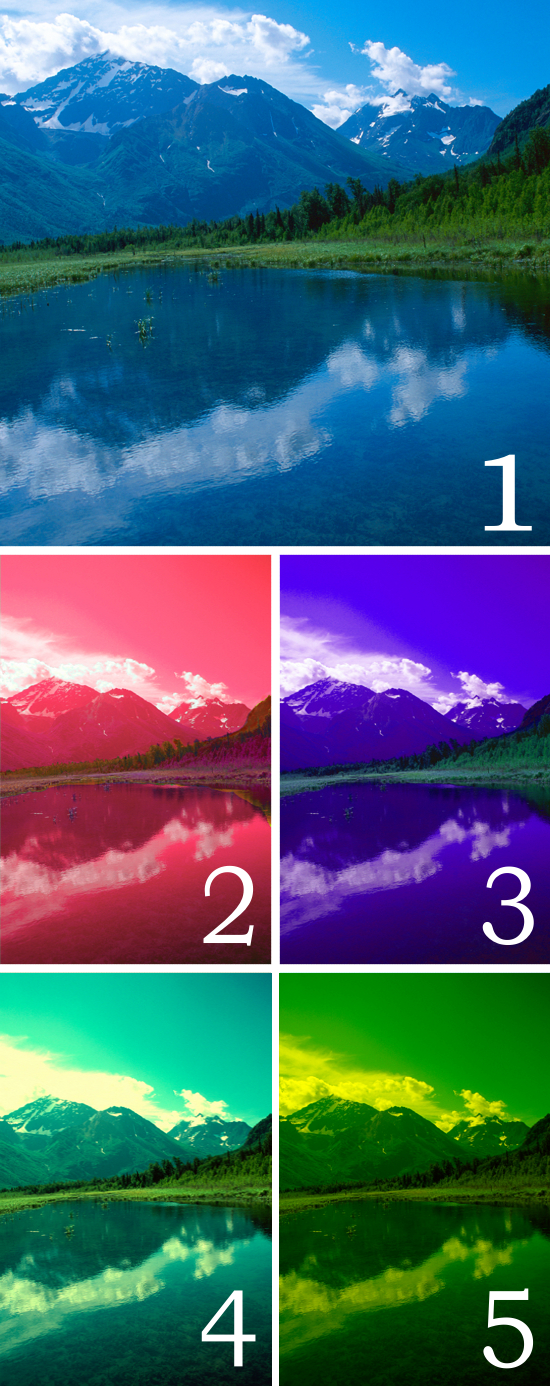
So far, so good. But most people have no idea what this type of change would actually look like. So let’s try to get some sort of idea, so that we all know what we’re talking about.

“Alaska Landscape” by U.S. Geological Survey is marked with CC0 1.0, Public domain, via Wikimedia Commons.

Image 1 is a cropped version of the original – the way you or I would see it. Image 2 is what most people imagine the image would look like if you could see infrared instead of blue-violet. Everything has shifted into the red.

On the other hand, if you saw UV instead of red, image 3 is what they imagine that would look like.

Both images 2 and 3 are wrong. Image 4 is what happens if you subtract the blue and violet from the image, then remap what remains onto a normal color spectrum. It’s not red, it’s predominantly cyan – and doesn’t look all that different to the base image, when you get right down to it.

Image 5 runs the same process in the other direction, producing a more dramatic change. If you were to tell someone who ‘saw’ colors this way that the sky was blue and the trees were green, they would be confused because there isn’t that much difference in their eyes between the two.

Not what you were expecting? I’ve also seen images like 2 used to depict ‘red shift’ – completely ignoring the fact that what was UV would shift down the spectrum into the visible light band, replacing the blue that would otherwise be lost. And the same applies in the other direction – a ‘blue shift’ would not be as obvious as many otherwise professional science fiction writers would suggest.

In fact, given how narrow the optical spectrum is, you might be hard-put to actually perceive any difference at all until the red- or blue-shift was significantly pronounced.

Trying to take this analysis any further becomes deeply frustrating very quickly, because we simply don’t know why we react in certain ways to some colors and not others. There are lots of educated guesses and assumptions – like yellow being fatiguing because it requires greater adjustments to the rods and cones of the eye, while green is restful because it requires no adjustments whatsoever – but the fact is that we don’t know why colors have the effects on us that they do. We aren’t even sure of what the effects are. How, then, can we reasonably translate those phenomena into minds of even near-humans?

Does that mean that it’s open slather for the GM to be as inventive as his capabilities permit when it comes to color and non-humans? I would suggest not. Instead, and in the absence of anything more definitive, I would suggest that the first GM was on the right track – ‘mapping’ the spectral response of a species onto a portion of the human range when psychology and biology are taken into account – even if you can’t quantify what those psychological and biological differences are.

Let’s take that “can’t see red but sees more shades of blue and green” proposal. The reddest color that would be visible would be a sort of orangish-yellow, so we label that “red” and presume that it has the same effect on elves that “red” has on us. Pure Yellow would then have the same effect on an elf that Orange has on us – daffodil merchants take note! A very greenish yellow would have the same effect as Yellow, and so on. And the missing “red” color? Well, we rarely see things as a pure tone – reflected light and reflected colors and the psychological impact of neighboring colors all come into play. So this would be a black with a strange shine or sheen.

When I’m trying to picture these color effects, I’m thinking about certain recent auto paints that change shade depending on the angle of light. I’ve seen blacks that reflected purple, and ones that reflected neon green, and ones that reflected sky blue, and several other choices to boot.

But the wilder possibilities don’t end there.

Beyond Earth?

To go further though, we need to contemplate creatures that aren’t just non-human, but are alien to us. What’s the distinction? Non-humans share our basic biology, making life simpler but a little more bland for the fantasy GM. Aliens have completely separate biology, though it might be analogous to our own. And that means that they could perceive what we describe as “Impossible colors”.

You see, the human eye takes color information that strikes it and places it onto two different color maps; this information is then synthesized in the brain into the whole spectrum of color. When one of these color maps isn’t processed properly, an individual is at least partially color-blind.

That doesn’t mean that they can’t see colors; it means that certain colors are simply shades of gray to them, or shades of aqua, or whatever. Since white is a combination of all colors, and black is the absence of them all, gray is itself a compound color; take one of the ‘base ingredients’ out and you are left with something that will inevitably look the same as a value of the color combination that the color-blind person sees – and so they label both of them gray. We don’t (and can’t) know what they are actually seeing – the presumption made is that they see gray correctly, and therefore that the statement “it looks like gray on gray” has meaning.

But we humans are a clever lot, and able to look at an objective physical reality as something separate to what we perceive with our limited senses, at least in the form of theory.

Enter the so-called “impossible colors”. Wikipedia got too technical for me on the subject, so I have relied on two more straightforward sites for this section:

Impossible colors come in two flavors. First, colors that our brains construct by mixing signals, effectively hiding combinations from us – bluish-yellow and reddish-green for example. We see green and brown instead; and Second, colors that we could see if the red, blue, and green cones in our eyes biologically responded different in response to light.

The reason the human eye can’t perceive these colors is because signals from the rods (light-dark) and cones (red, green, blue) interpret signals in an antagonistic manner termed the opponent process. Scientists believe there are three opponent channels:

  • Blue versus yellow
  • Red versus green
  • Dark versus light.

In 1983, a couple of scientists devised a test that allows some observers to see some these impossible colors. Some participants saw a new color, others saw a pattern of red and green (or blue and yellow dots), while others saw regions of one color on a background of the other color. Some of the participants who saw a new color were still able to imagine it following the test. Participants were generally unable to name the new color. Many had trouble describing what it looked like. Visit the websites listed above to try some of the tests for yourself.

When the study was repeated in 2006, it threw into question the whole concept of ‘impossible colors’. But a similar experiment that took place in between, in 2001, suggested that equal luminance was important, but the 2006 study didn’t control for this factor (and neither did the original study) – so it might be that both were flawed. The jury is still deliberating on the very existence of impossible colors, in other words.

On top of those are more definite phenomena, like Chimeral Colors – these are colors that the brain can see even though they aren’t part of the visible spectrum. Colors that fall into this category include:

  • Stygian Colors, i.e. colors that are both saturated and dark. An example is Stygian blue, which appears as dark as black.
  • Self-Luminous Colors appear to glow although no light is emitted. An example is self-luminous red; and
  • Hyperbolic Colors, which appear more than 100% saturated. Examples include the green afterimage produced by staring at pure magenta and then looking at green leaves.

Again, check out the links above to try some of these for yourself!

There are precedents for the principle that alien species may have different biologies within their eyes – and if you change the opponent channels, you change which colors are impossible (and add our ‘impossible colors’ to the visual spectrum). Pigeons have double-cones that permit them to see into the ultraviolet and sharpen their color vision.

There would be some physical consequences to contemplate. For the eye to capture infrared, it would need to be much larger – perhaps twice the size we’re used to. Humanoids with such eyes would look more like anime characters than regular humans.

This isn’t a problem with UV; instead the problem is that UV carries so much energy. It damages human skin cells and can cause skin cancer, and it can damage the cells of the eye and cause cataracts, as well as burning the retina. No species would evolve the capacity to see into the UV spectrum without evolving some sort of defense – probably a second set of eyelids that are only opaque to UV. Again, there are biological precedents here on earth, with some species having multiple eyelids.

Alternatively, these extra eyelids might function as additional thickness of lenses, meaning that it might take a conscious act of will to see into the UV spectrum, and that it would be painful (like looking too closely at a bright light) to attempt at inappropriate times.

Either form of nictating membrane is plausible.

Ultimately, the structure of our eyes is a compromise aimed at most efficiently processing the range of light that comprises the visual spectrum. That spectrum is as wide as it is practical to make it, and while it might be possible to shift up or down the electromagnetic spectrum by a small amount, the physics of electromagnetic radiation aren’t changed – so there would be a tendency toward convergent evolution in the design of this organ.

Of course, it’s not quite that simple. Cognition takes place within the brain, not in the eyes – and we know so little about the whys and wherefores of cerebral structure that we have no idea what alternative structures might be possible, only that any such alternative would inevitably change the processes of cognition – and that includes perception.

That’s not enough to stop us from speculating and imagining, though – as I said before, we’re a creative bunch. For example, it is quite likely that the same processing shortcuts that create optical illusions might be responsible for our capacity to represent reality with a two-dimensional image; take away one, and you take away the other. This would be a considerable hindrance to social and technological evolution until some reasonable substitute was developed – no blueprints, no abstract diagrams, no illustrations. Not until stereoscopy, anyway – but it’s arguable that this would be invented much sooner (and be far more than a curiosity).

Alternatively, it might be that by closing one eye and squinting – a trick that artists use to see broad areas of dark and light for compositional purposes – such a species could manage to make sense of diagrams or paintings. Or perhaps when nature takes away with one hand, she gives with the other – this species might be better at separating different mental processes, enabling a ‘virtual squint’. This, in theory, would also permit them to perform multiple tasks independent of each other at the same time – one eye, one hand, one task – more than compensating for the handicap to their capabilities.

Let imagination be your pilot and plausibility your handmaiden.

The Colors Of The (Real) Spectrum

This is a section that has bounced around this article, at first here and then there, and never quite fitting into the existing narrative line. And yet, it seems important to actually present it somewhere.

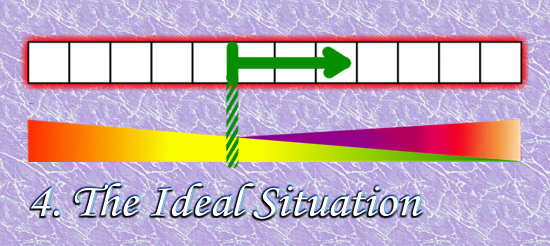
The diagram below summarizes the colors of the spectrum, but presents them in a way that forces people to take a slightly fresher look at them. I’ve packed as much information into it as I could without getting too technical.

For a start, even though there are wavelengths specified for the ‘pure’ colors of the spectrum, I wasn’t confident of matching those colors exactly – so I chose to actually interrupt the spectrum at those points. It would be more accurate, in other words, to describe this as a diagram of the transitions between the colors of the spectrum! This also drives home the artificiality of the designations currently in use – you could easily divide the spectrum into eight colors, or nine, or even more if you didn’t space them at uniform intervals.

Because UV waves have more energy than IR waves, I’ve chosen to show the former as white and the latter as black. Neither is strictly accurate!

The color with the narrowest bandwidth is actually cyan; it takes only a small shift to the green to make it seem more green than blue, and only a small shift to the blue to make it seem like a tone of blue and not a separate color.

There are two notable absences from the list of colors: Purple and Indigo.

Purple doesn’t actually exist – it’s a synthesis between blue and red that only happens in our heads. I would describe it as the most famous invented color of all, but I’m afraid that Indigo is an even better candidate.

Described as a slightly purplish blue so dark as to be almost black, and – as a color, and not a dye – it’s been controversial ever since Newton whipped out his first prisms. Some claimed to see an 8th color in the spectrum, others saw nothing of the sort.

The description alone should have been a clue – blue lies on the wrong side of violet. Hence indigo is somewhere between blue and violet, with a tonal value that is almost black.

The final notes worth observing from this diagram are afterthoughts that I squeezed in at the very top – I took the width of the human visible-light spectrum and shifted it first to exclude blue and violet, and then to exclude red and orange. From this, you can see that the highest spectral color visible to an Infravision candidate with the same spectral range as a human is a slightly blue version of cyan – which is, as noted, almost a blue itself, while the lowest color visible to an Ultravision candidate is a slightly orange-tinted yellow color.

Beyond Reality

Of course, as creative types, we aren’t limited to the colors of the rainbow or their infinite variations. When real life doesn’t go far enough for us, we add to it and invent whole new colors.

From Wikipedia:

  • One of the earliest examples of fictional colors comes from the classic science fiction novel from 1920, A Voyage to Arcturus by David Lindsay, which mentions two new primary colors, “ulfire” and “jale”.
  • The Colour Out of Space, a 1927 story by H.P. Lovecraft, is named after an otherwise unnamed color, usually not observable by humans, generated by alien entities.
  • Philip K. Dick’s 1969 novel, Galactic Pot-Healer, mentions a color, “rej”.
  • Terry Pratchett, in his Discworld series, describes “Octarine” [Wikipedia page], a color that can be only seen by magicians; and
  • Marion Zimmer Bradley in her novel, The Colors of Space (1963), mentions “the eighth color” which is visible during FTL travel.
  • Finally, “Plueragloss” is the favorite color of a character who is a natural inhabitant of the afterlife in the television show The Good Place. In the show, plueragloss is described as “the color of when a soldier comes home from war and sees his dog for the first time.”

[Links are to Amazon and may earn me a small commission, unless otherwise indicated.]

As you can see, there have been many imaginary colors through the years, though I was a little surprised that it took us until 1920 to come up with one! I also have a vague memory of Isaac Asimov and EE ‘Doc’ Smith having stories with invented colors in them, though I wasn’t able to find the references in the time available.

Contrasting Choices

I wanted to include this section because sometimes it seems very strongly relevant, and at other times, it seems almost redundant.

There are certain combinations that sometimes seem to play games with human perceptions. These can be manipulated by artists and clothing designers to achieve specific effects.

Light Vs Dark

If you have equal sized swathes of a light color and a dark color side-by-side, the dark colored swathe will appear larger than the light unless they are close together and lined up perfectly – in which case the eye will follow the outlines to estimate the relative size.

This might be the ultimate reason why dark suits and light shirts are such a predominant choice for officials and businessmen – because we are subconsciously aware of the effect, and so mentally attribute the larger dark mass of the suit to the color and not to the fact that the wearer is overweight.

A dark suit, when coupled with a light shirt, in other words, is slimming.

There are limits to this phenomenon, and if you exceed them, the brain is prone to over-correct its error, giving the impression that the individual is even more overweight than they are.

Warm Vs Cool

These colors can coexist beside each other quite comfortably if one or both have a very dark tonal value. When that’s not the case, the brain inserts a dark mental division between them that doesn’t actually exist. This is especially noticeable with sky blue on a bright red.

Earth Vs Sky

Brown and Blue are, I have been told, a fashion no-no of the highest order. But there are limits to this – I have a sand-colored t-shirt that looks just fine with blue denim jeans.

The restriction itself has always seemed somewhat odd to me, because these are the colors of earth and those of sky, and those two are part of any natural terrain.

Plant Vs Sky

Almost as problematic is Green and Blue. And yet, these are the colors of leaves (and other vegetation) and the sky, and those go together quite naturally.

It sometimes seems that brown doesn’t go with anything very readily (except itself). Perhaps it’s a good thing that there are so many varieties of color under the general umbrella of “autumn colors”!

Near Vs Far

Most people are familiar with the fact that colors fade as they become farther away, due to the increased amount of air between observer and observed. What should be equally well known, but sometimes isn’t, is that the same phenomena that colors the sky blue also shifts distant colors toward the blue.

Take another look at the unmodified Alaska Landscape photo earlier in the article, and you will see this effect on the distant mountain. So pronounced is this effect on the eastern mountain range here in Australia, accentuated by the blue-green color of Eucalyptus trees, that the range is known as “The Blue Mountains”.

If the sky is a different color, this effect will also be different. And if there is no air, the resulting brightness will wash out details from any distant point.

The Color Wheel

A color wheel is a way of arranging colors so that the relationship between them becomes definable.

So much for the really easy part.

The first color wheel was developed by Isaac Newton and featured only the primary colors of light, which – when combined – produced white. It took very little time to learn that when mixing paints, inks, and dyes, combining the same three colors produced black.

This led to the color wheel of light being described as “additive” and the color wheel of paint being “subtractive”.

Below is an image of a color wheel.

Image provided by Mohamed Ibrahim via Clker.com.

Notice that color that’s to the far left on the wheel? Most people would call that a purple. It’s not – it’s a dark violet. The color that’s technically a purple is the one just up from it that is actually a purple. And the one to the upper right of that, which looks like a very dark orange is actually a red. You heard it here first!

So much for the easy part. Now it starts to get complicated.

There have been lots of color wheels since Newton. Some have had 7 colors, some 10, some other numbers. The example wheel has twelve.

Color Spaces

There are different ways of defining color on TVs and computers, and these produce different color wheels showing how the base colors combine. The method of definition with which most readers will be familiar is the RGB (red, green, blue) model which websites use to define specific colors – roughly 64000 of them – using three values from 0 to 255. “0,0,0”.is black, and “255,255,255” is white, for example.

Another “color space” is called the HSV model. It, like a third, the HSL model, is simply a “geometric transformation” of the “RGB cube” into “cylindrical form”. Which makes perfect sense if you know what those terms mean.

RGB specifies three values that can be thought of as measurements along the sides of a 3D cube. The “RGB color space” can thus be thought of as the volume of that cube.

If you reshape the cube into a cylinder, you get different colors on the color wheel, and different colors being displayed. Early color monitors used these color spaces, with the graphics card of the computer translating RGB (and whatever else it understood) so that it would display correctly.

Other color spaces and color wheels are used for specific media, for example four-color printing. But most of these have now started to fall out of favor, with a computer doing the hard work of translating what you have into whatever your hardware needs – and increasingly, the standard in use is the RGB color space.

Tonal Factors

A number of color wheels (and paint charts) have a ring of pure color and then a number of rings in and rings out showing different tonal values of the same color, representing the combination of white or black with the base color. Unfortunately, there’s a third possibility that complicates things – combining the base color with both white and black, i.e. with gray.

Sometimes this doesn’t make a lot of difference – it just looks like a “dirty” version of the base color. Sometimes it makes a huge amount of difference – “slate blue” is blue mixed with gray, for example.

Color Schemes

Artists and designers of all types use Color Wheels to create “color schemes”. A color scheme is a selection of colors to be used in a design. Rather than a haphazard throwing together of colors that might clash or be illegible, they are designed to work together as a coordinated whole.

Color schemes can be simple, or incredibly complex. A basic color scheme uses two colors that look appealing together. More advanced color schemes involve several colors in combination, usually based around a single color; for example, text with such colors as red, yellow, orange and light blue arranged together on a black background in a magazine article.

Analogous Colors

Analogous colors work well together when used in the same way, but they don’t contrast strongly. These are colors that are right next to each other on the color wheel, like yellow and green. Yellow text on a green background? Doable – with a strong tonal difference. Without that? Hopeless.

Complimentary Colors

Complimentary colors are harder to work with; these are colors opposite each other on the color wheel. Violet and Yellow; Blue and Orange; Red and Green. Used in the same way, against the same (neutral) background, with sufficient tonal contrast to that background, they can be an effective and quite distinct choice, especially if used sparingly.

Consider a document listing various ways to react to a situation – a staff training document, say. Heading each “bad choice” with a title in red, and heading each “right choice” with a title in green, makes for a very effective mnemonic, effectively loading additional information into the document through the choice of colors.

Triadic Colors

If your color wheel divides by three the way the example one does, then you can pick every fourth color to get yourself a set of Triadic Colors. Yellow, Red, and Blue are Triadic on the example wheel.

If you know what you are doing, Triadic colors can be really powerful combinations. Blue text and Red text against a paler yellow background, for example.

I have also seen Triadic colors described as “harmonic colors”. Some of the combinations are quite eye-opening – violet, light orange, and green, for example.

It can also be said that these will usually select one warm color, one cool color, and one color that will be neutral (relative to the other two colors).

Tonal Contrast=Legibility

I’ve mentioned this a few times, but it’s worth emphasizing again – a strong tonal contrast (dark vs light) makes text legible. The closer in tone two colors are, the less distinguishable they will be from one another no matter what colors they are and the harder it will be to make out any detail.

That’s why black and white photographs work. If you ever design something – uniform, costume, web page, birthday invitation – and you find it hard to read, take a screen cap and use a paint program to desaturate the colors, and I’ll bet that you find that your choices are too close in tonal value – too close to the same shade of gray.

Campaign Mastery – an example

Campaign Mastery’s foundation color scheme is visible on every page – it’s the background, which ranges from a dark blue to a mild blue-green containing quite a lot of gray. These colors form a three-space adjacent set of colors on the color wheel. If you were to map them onto a color wheel with a full range of tonal values – essentially a color cylinder – you would find that the key values form points on a continuous, smooth, spiral. The colors used for headings (like the one below), subheadings (like the one above), and sub-subheadings are also on this spiral – with the last being as light as I can make it and still have it be legible, and the other two falling exactly at 1/3 and 2/3 of the way to black from that sub-subheading value. It’s not something that you’re likely to be consciously aware of, but this continuity plays an important role in communicating the relative importance of a heading – and the text size follows the same pattern.

When I started getting assistance from my local GMs for Ask-The-GMs, I started using another color on this range – a pale green – as background to the potted biographies that were included. This shifted the overall tone of the pages too far to the green, so I had to compensate by shifting the headings a little more to the blue.

Characterization Application

Whenever I create a character, I assign them a dominant color. This may appear as a memorable ‘splash’ in the description of the character or what they are wearing, and if that’s the case it’s the ONLY color that I will mention.

Players can assume (or not) that a character named Hiroki Fujiwara is Asian and therefore probably has yellow skin, while ‘Walking Bear’ Higgins is probably Native American and has red skin – and they might even be right! – but I usually won’t waste time saying so UNLESS this is the dominant color of the individual.

More often, the color will be an invisible ‘tint’ that will permeate the space around the character, and as such, won’t be directly mentioned at all – but it will influence my choice of language in the character’s dialogue and any other descriptions of the scene or environment.

Have you ever noticed how some people seem to carry a miasma about them, an aura that communicates and generates an emotional response? There are some people who are gloomy, and others who exude vitality and energy, and others who have an aura of mystery, and so on. Those are examples of such ‘invisible tints’ in action. Assigning such characters a ‘hidden color’ in this way gives me a shorthand reminder of how I want the character to be perceived by the players.

But this technique is more powerful than that. If I have a particular environment – cool blues, for example, or corporate grays – and I want an individual to feel like they fit in, I can use the color wheel and the principles spelt out above, to select an appropriate ‘color’ for the character and use that as the foundation of their personality, dialogue and expressions. If I want them to stand out, I can pick a complimentary color. If I want them to be at odds with the PC, I can assign the PC a probable color to match their mood at the time based on the emotional values described in part one. A straight line between that color and that of the environment, drop a line from the midpoint of that line at a right angle, and I will get a Triadic color to the combination. Shift it one around towards the environment, and you have a color that fits in with their environment and is almost certain to be exactly the type of person who will frustrate the PC when they encounter them, or interact with them in an interesting way.

Color is a tool. You can use it to shape narrative, define personalities, trigger moods, and even turn your player’s intelligences up and down a little when that seems appropriate – if you use them properly.

As readers can see below, there’s been a supplemental addition to this article. Click here to read my afterthoughts (content I meant to include but forgot)… (opens in the same tab/page)

Comments Off on RPGs In Technicolor, Part 2

RPGs In Technicolor, Part 1


This entry is part 1 of 3 in the series RPGs In Technicolor

Image by jplenio from Pixabay

In Pigment On Canvas – Six GMing Lessons from Oil Painting I drew inspiration from the oil painting techniques of two TV programs, Masterclass In Oils with Ken Harris and The Joy Of Painting with Bob Ross.

In the course of Episode 7 of Season 7 (1985) of the latter, Bob made a very interesting observation while painting “Barn At Sunset”. In fact, he made two linked observations deriving from his experience as a professional artist:

  • Men buy paintings dominated by cool colors, especially blue, and like more dramatic images like mountains and waterfalls.
  • Women buy paintings dominated by warm colors, but are more likely to buy a painting that compliments or matches an existing decor.

These statements touched off a firestorm of questions in my mind.

Are these stereotypes still valid? There have been seismic social shifts since the TV show was first broadcast, what effects have they had?

To what extent are these trends consequent to the early childhood color stereotypes (blue for boys, pink for girls)? Do children whose bedrooms are painted in a more neutral color (yellow, green, or white) have different responses? How about children who have to spend a lot of time surrounded by Hospital Green?

What other manifestations might be observed? Clothing color choices? Cake preferences? Whether you like steak rare or well done?

And, as always, the RPG perspective wasn’t far from my thoughts: How can these facts be used in characterization, and are there any related facts that can be so used?

Color Associations

This isn’t the first time that I’ve talked about color here at Campaign Mastery, but I’m not usually discussing it literally!

Now this is a very big topic (although it might not seem so at first glance), and takes in some controversial territory along the way, so I pondered the best place to start for several hours. (It might be that I’ll have to split the article into two or even three, as there will be a lot of research required – and, even though I’m quick at that (see Lightning Research: Maximum Answers in Minimum Time for my techniques), that was definitely a part of my thinking, too).

To cut to the chase, I decided that discussing the symbolic value of color would be a good place to start, because this would be one of the more variable sections in size required – it might be relatively short, or it might take up the whole of a ‘part 1’. (You’ll be able to tell from the article title what the outcome was!)

The symbolism of color

Color has been used in a symbolic way for at least 90,000 years. The earliest examples are probably red for blood. The meaning attached to a particular color vary from culture to culture and over time within a culture as well, and on top of that, can be context-sensitive to boot. So don’t expect to find hard-and-fast universal rules – even for something as trivial as red being the color of danger!

That said, there are some associations that are more common than others, especially across western culture. If we accept that as a standard, it becomes easier to both note and appreciate exceptions.

For this section and the specific subsections below, I drew heavily on one Wikipedia page in particular, Color Symbolism – credit where it’s due!

    Blue

    Blue symbolizes the sky, and a greenish shade, the ocean. It often symbolizes serenity, stability, sadness, inspiration, wisdom, and reliability. In the Catholic faith, the Virgin Mary is most often depicted wearing blue to symbolize her being “full of grace” (a state that permits her to be serene at all times, to connect the dots between these meanings). Blue is often symbolic of cold, especially in combination with white, but it is also the color of a natural-gas flame – which may be why it represents warmth in the Netherlands, where it is also the color of Femininity – in contrast to the more common symbolic value of masculinity (see also Pink, below).

    Blue symbolizes purity in India, and evil & infidelity in other parts of East Asia. It is the color of mourning in Iran.

    In the US, Japan, and Korea, blue is often symbolic of high quality, trustworthiness, and dependability. Blue and Green are often used to denote improving or upwards trends in financial markets, with Red denoting downward or worsening trends – except in mainland China, Japan, South Korea, and Taiwan, where these color associations are reversed, which sometimes creates confusion when western media outlets report on the finances of those nations.

    Yellow

    Yellow represents sunshine, and the new, and joy in general. It can sometimes be used to represent cowardice or fear. Children tend to like yellow as a color, and it is commonly used to market products to them. Because it is bright and noticeable, it is also used for school buses and taxi-cabs in many western sub-cultures, though this can vary enormously and is one of the easiest points of distinction to use when depicting a foreign culture. Some shades of yellow are unpleasant and unpopular. Yellow and yellow-related tones are often representative of a comfortable warmth (as opposed to a dangerous level of warmth).

    The French sometimes use yellow to symbolize evil, though there has been some cultural contamination from other western cultures. In China, it is symbolic of happiness, and is sometimes used to represent high quality, trustworthiness, and dependability, as is Green.

    Yellow is the color of envy in Germany and Russia.

    Green

    Green is the color of vegetation and symbolizes growth, nature, fertility and healing. The latter symbolism has also been inverted; Green can represent sickness or disease. It’s no accident that the most common depictions of the Coronavirus on TV reports are either Red, for danger, or Green. It can be a relaxing color, but it can also symbolize jealousy. In some contexts, it can represent inexperience or naivety, or a newcomer.

    Green is the color of danger in Malaysia, and of love in Japan.

    In the US, it is the primary color of money and because the US is the most common global currency standard, this meaning has also spread beyond the borders to many nations even if they have more colorful currency. That meaning has naturally extended to incorporate greed.

    See also “Black” below!

    Black

    Bones may be white, but Black is the color that symbolizes death, grief, and evil. A black flag is representative of piracy. In the past, black was worn as the color of mourning. Black can also be the color of formality – black suits, for example, are more formal even than navy blue. I have a vague memory that none of the above is true in many Asian societies, where White or Green has these meanings, so pay careful attention to that when it’s appropriate!

    Black can also symbolize distinctiveness (“black sheep”) or rebellion (“black leather jacket”).

    White

    Throughout western society, white is symbolic of purity, perfection, faith, innocence, softness, and cleanliness. This symbolism is reflected in wedding dresses and wedding cakes, for example. In some societies, White is the color of mourning, however!

    Pink

    Pink is the color of babies and children, and hence is often symbolic of softness, sweetness, love. Wikipedia reports “there is an urban legend that pink was a masculine color before the mid 20th century, based on evidence of conflicting traditions before about 1940. Del Guicide (2012) argues that pink-blue gender coding has been broadly consistent in the UK and the US since it appeared around 1890.”

    Red

    Red is often associated with Love (Roses, Hearts), Passion, Lust, Danger, Warnings, and Importance. A ‘splash’ or streak of red can be symbolic of violence, anger, and blood. In China, it symbolizes good luck, happiness, and is used for many holidays and weddings. Red is symbolic of Masculinity in France, and this association also appears in the UK at times. Red and White are often symbolic of Christmas; green is a secondary symbol in this respect. red and purple are symbolic of love in China, Korea, and Japan. It is considered the color of unluckiness in Chad, Nigeria, and Germany, but is considered a lucky color in China, Denmark, and Argentina. In China, red is the traditional bridal color, while in India, it is symbolic of ambition and desire.

    Purple

    I was hoping to avoid mentioning Purple in this section, but… Traditionally associated with power, wealth, and royalty (who were the people who usually had the first two), luxury, and decadence (which some would argue also derive from royalty). In Japan, it represents evil and infidelity.

    Purple can be symbolic of Reliability in China, South Korea, and Japan. It is the color of envy in Mexico – which makes it interesting that it is often a part of the wardrobe of Mexican officials (especially in the form of a sash)..

That seems to at least partially answer one of my questions – there is such variety in the interpretations and symbolism of color that the “Blue is for boys and pink is for girls” concept is parochial at best. It is still true of the US, however, which was the target market for The Joy Of Painting, so the association can’t be completely dismissed – but it now comes with an enormous caveat attached (in addition to the one about stereotypes).

The Colors of Royalty

Purple is not only the color of Prince, it is the color most frequently associated with Royalty. The reason for this is simple: in ancient times, Phoenician purple dye (also known as Tyrian Purple) was extremely expensive, being made from the secretions of a predatory sea snail originally known as ‘Murex’. Extracting the dye involved tens of thousands of snails and substantial labor – to get enough for a single garment.

As a result, purple was the color worn by Roman magistrates; it became the imperial color worn by the rulers of the Byzantine Empire and the Holy Roman Empire, and later by Roman Catholic bishops. Similarly in Japan, the color is traditionally associated with the emperor and aristocracy.

Notably, this die improved in color with age instead of fading, making it symbolic of immortality – a quality that rulers and religious leaders alike wished to incorporate into their popular images!

The Phoenicians also produced a deep blue dye from a related family of snails which became known as Royal Blue. These days, it would probably be considered a shade of indigo with a little bright blue mixed in, at least to my eye.

The final color often attached to royalty is Red, usually as a backdrop to white or gold.

The association of these colors with Royalty creates many secondary associations, as described in the section on Purple above (which is why I hope to avoid including it – I wanted to put it here). In particular, the qualities of Royalty came to be represented by the color Purple – both good and sometimes bad. But it’s the rarity that causes that association to exist, combined with individuals of both wealth and the power to restrict access to the limited supply.

If Purple was common, and some other color was rare, that would arguably be “the color of Royalty”. It doesn’t matter if it’s chartreuse or nutmeg or sand.

This in turn becomes more significant when contemplating camouflage benefits – some colors will stand out more than others. It will usually be the case that in environments where people want to stand out – throne rooms and the like – they will choose a complimentary color with a strong tonal contrast for decorations and furnishings.

US Banknotes from Wikimedia Commons. Refer to this page for copyright and usage documentation.

The Colors of Wealth

Some places around the world have very brightly colored money. Some do not.

Money – as in, the symbolic representation of wealth by a paper instrument to facilitate its transfer from one individual to another as part of a transaction – started as a written note on plain paper. These were promissory notes that had been in use in China since the 7th century, which gradually evolved into the modern concept of paper money somewhere during the 10th to 13th century. The concept was carried back to Western Europe by travelers such as Marco Polo in the latter century, and in 1661, Stockholm Banco issued the first European banknote.

Between the 17th and 19th centuries, banknotes became attached to the value of a preset fixed quantity of gold, replacing the use of gold coins in Europe. This practice became known as the Gold Standard. The notes were legal tender, and redemption into actual gold was soon discouraged; the abstract entity of the banknote symbolized ownership of that gold, which was held in trust by the bank or the government.

Color was originally introduced to the banknote as a means of thwarting counterfeiters. At first, one color plus black was the limit, then a second color was added in some countries, and then brightly colored banknotes.

US currency actually uses three colors a black, a green, and a third “magnetic” black which can be read by machines. But the currency itself appears relatively plain because the two blacks can’t be distinguished visually (or not easily).

The story of the evolution of color in currency can be clearly seen in the image below, which I assembled from a number of sources for reference in the Adventurer’s Club pulp campaign:


(An edited excerpt from the adventure):

Until the 1950s or 60s, it was routine for Canadian Banks to issue their own currency. The Canadian Government had authorized a common currency back in the 1850s with fixed denominations that made sense at the time but were inadequate to modern needs; when attempts to update the legislation became mired in politics, the Banks took it upon themselves – with government approval – to fill the void by producing their own currency.

Counterfeiters were quick to take advantage of this chaos, ‘inventing’ spurious banks and literally printing money by the bale-full, but these were quickly run down by the Mounties – some of these cases giving rise to the legend of the Mounties always getting their man, no matter where he ran to.

In the 1920s, only a few larger institutions still produced banknotes and everyone knew who they were, so that ploy was no long viable for counterfeiters; the weakest link in the chain was now the design of the currency, which (in the case of the Bank Of Canada) employed only a single ink tone – albeit with some sophisticated engraving. Everyone else had equally sophisticated engraving and at least two colors of ink, making them that much harder to falsify.

(Note that the history of Canadian Currency provided is absolutely accurate, used to enhance the credibility of an improbable situation involving blackmail, the FBI, and some counterfeit Canadian printing plates).

Compare those to the modern Australian Currency:

Aside from the polymer construction and bright colors – and, if anything, these images undersell the brightness of the colors! – modern Australian currency features top to bottom clear strip, Holograms in a clear window, details that are only visible from certain angles, serial numbers, and raised braille dots to denote the denomination – and probably other security features, to boot.
Refer to this page for copyright/usage information (applicable to each banknote image above individually and to the compiled image).

And yet – and this is the interesting point – the color that Australians most commonly associate with currency is either Gold (the color of our 1- and 2-dollar coins) or the green either of American currency (or of the old Australian $2 note).

Before anyone suggests that the polymer notes haven’t been in circulation for long enough – that’s true, however the notes that they replaced were also brightly colored and in use for decades, first issued in 1966, and the pre-decimal currency that preceded it was also brightly colored – and in the same basic colors as many of the modern notes (the ten pound note is blue & green, just like the $10 note – only the shades have changed).

To the best of my awareness, every culture has a color which they associate with wealth – but whether or not that color bears any relation to the colors of their currency is an open question.

It could be argued that the very multicolored nature of Australian Currency acts against any one color coming to represent wealth, leaving us open to a more forthright influence – the USA – but I couldn’t find any research on the subject either way, so this is just speculation. I can state that Australians tend to think of their currency as the prettiest banknotes in the world!

I also find myself contemplating the velvet of casino gaming tables. While can be found in an enormous variety of colors these days, the traditional color is a fairly bright green – not dissimilar to the green of pool and billiards tables, though more fluorescent (a marketing person might describe the latter as “louder”), and whether or not these associations contribute to Green being the color of wealth?

Of course, representations of metallic shiny gold will always symbolize wealth. The same is not true of silver or platinum, perhaps because these are harder to identify – such could be a representation of stainless steel, at least visually.

The Olympic Flag

The five Rings in the Olympic Flag are 5 different colors because one of those colors appears in every national flag.

Which raises the whole question of color, in the flag, as being symbolic of national identity, which is a complicated question in and of itself, simply because there are so many national flags out there, and each one will have a story of its own.

Take, for example, the British Flag (sometimes erroneously called the Union Jack – it only has that designation when it’s flown on a ship, the rest of the time it’s more properly referred to as ‘the Union Flag’ (at least according to some! Others disagree!) – except in Canada where it is the Royal Union Flag). The origins of an earlier form of the flag date back to 1606. James VI of Scotland had inherited the English and Irish thrones in 1603 as James I, thereby uniting the three crowns in a personal union, although the three kingdoms remained separate states.

On 12 April 1606, a new flag to represent this regal union between England and Scotland was specified in a royal decree, according to which the flag of England, a red cross on a white background, known as St George’s Cross, and the flag of Scotland, a white saltire (X-shaped cross, or St Andrew’s Cross) on a blue background, would be joined, forming the flag of England and Scotland for maritime purposes.

In 1801, the present-day design was decreed by Royal proclamation, adding the red saltire of St Patrick to symbolize Ireland.

So it’s Red, White, and Blue – the most common choice of flag colors going. The American Flag, the Australian Flag, New Zealand, France, Russia, and many more, are combinations of these three colors.

We already know that the flag combines three separate flags – and so the symbology of the colors derives from those flags. But those meanings are somewhat muddied by the act of coalescing them three-into-one.

Take the Blue. It hasn’t been the same throughout the history of the flag – at first, it’s only use was at sea on civil and military ships of England and Scotland; in 1634, Charles I further restricted it to royal ships. Only in 1707 was it adopted by the land military – with a slightly different shade of blue, closer to the blue of the Scottish Flag. In 2003 a committee of the Scottish Parliament recommended that the flag of Scotland use a lighter “royal” blue instead of the Blue that had now become standard!

Does the blue in the flag of Scotland, and hence the blue of the Union Flag/Jack, mean the same thing as the blue in the US flag, or the blue in the Australian Flag, and so on?

Well, check out the Wikipedia page for “Flag Of Scotland” and you will quickly learn that there has been a historically broad range of colors used – from the blue used in the Union Flag/Jack to a sky blue. So widespread were variations that in 2003 a committee of the Scottish Parliament met to examine a petition for the standardization of the flag.

Heraldry doesn’t specify what shade of blue is used, instead using the more generic term “azure”.

The fact that the specific shade of blue has become important points to a broader significance through national and cultural identity than mere identification. it’s presence at triumphs and struggles, either military or sporting, makes a national flag an emotional tie between an individual’s sense of national pride and achievements by others.

These experiences accumulate over the years until the flag comes to symbolize the nation in the hearts and minds of the individual, or at least, that’s the theory. How strongly those emotions are invoked by components of the flag is an open, and more difficult, question. I looked for, but couldn’t find, anything official on the subject. Even if I had, it would probably have focused more on shape than on color.

In fact, the closest thing to a definitive statement on the subject comes from the Wikipedia page on “National Flag”, which (in its preamble) states, “A national flag is typically designed with specific meanings for its colors and symbols, which may also be used separately from the flag as a symbol of the nation.”

So, in an attempt to put this subject to at least ‘park’ this subject and move on, let me offer the following suggestion:

National identity as associated with the national flag, or other symbols of nationhood, connects through achievement and shared experiences (however vicarious) to a symbolism that is an emergent property of the elements of the flag, including its shapes and colors.

The question this leaves unanswered is whether or not color alone is enough to invoke that sense of national identity. I’m not convinced that there is a simple yes/no answer to this question; a unique or unusual color may be enough, and certainly a color combination may be enough IF the colors aren’t generically used.

For Red, White, and Blue, there are so many flags using these colors that it seems unlikely. For Mexico, or Argentina? It’s quite plausible.

Corporate Colors

Significant content for this section derived from three websites:

These are all worth visiting for additional information. I also drew on memories of a graphic design course that I took many years ago.

Colors in a corporate logo are not chosen at random (usually). They are the results of deliberate and careful thought, and often, intense debate.

“Picking the right palette helps establish your identity better and adds versatility to your designs.

“Color choices also give your logo depth by forging a visual connection to your company’s values and personality. The right combination can visually communicate the feeling your company is projecting to consumers.

“More than just aesthetic appeal, colors help your brand connect with consumers on a deeper psychological level. When you choose your logo and brand’s color palette, you’re also selecting the emotions and associations you’re seeking to evoke.

“Science has shown repeatedly that our brains react in diverse ways to specific colors. By understanding how each color affects the mind and the emotions it stirs up, you can create a more effective brand. It’s important to remember that this is a nuanced and complex field that requires careful thought.” – Tailorbrands

Now, we’ve already talked about the general symbology of color, so let’s move on to some specifics:

    Red

    Bright, hot colors are often used to suggest a bright, playful, energetic organization. This is especially true of Red, which can be labeled “Brash”. Red is also the most blatantly sexual and passionate color. Brands which use Red include Pinterest, Lego, Kellogg’s, and Coca-Cola.

    White

    White is used as a surround to convey a sense of exclusivity and luxury. It is also used to create an impression of Hygiene, Purity, and Cleanliness – usually in cleaning products or brands who manufacture such products. Used in different ways, it can suggest clarity or focus, stripping away irrelevancies and excessive complexity. Finally, it can be used with other colors to suggest youth and innocence.

    Yellow

    Yellow is the color of sunshine and honey, and that bleeds through into its use in corporate logos, where it is used to suggest friendliness and cheer along with youthful energy. Brands whose logos are predominantly yellow include Cat, Hertz, Nikon, and Post-it.

    Orange

    Orange attempts to fuse and conflate the values of red with those of yellow. What emerges is not truly either, but is symbolic of energy, dynamism and aggressiveness. Brands which use orange in their logos include Fanta, Amazon, Firefox, and Harley-Davidson.

    Purple

    Purple, as established earlier, has a strong connection with Royalty and thus it’s use in a logo exudes luxury and sophistication. That makes it a favorite amongst brands of cosmetics and high-end retailers – but at least one chocolate company has been using purple this way for as long as I can remember. However, it can be seen as pretentious if the symbol doesn’t match other aspects of the business, and in particular is (or should be) avoided by businesses looking for a more down-to-earth relationship with the consumer.

    Brands that leverage purple include Cadbury, Hallmark, and FedEx.

    Green

    Green is generally considered a restful color, and is often thought to suggest balance and calm. In some contexts, it can suggest a connection to nature, but this will often need to be reinforced in some other way. It lacks the energy of Red, Orange, and Yellow, and is thus more suited to conservative organizations. Brands who use green for their logos include John Deere, Android, Starbucks, and Spotify.

    Blue

    The sky may be blue, but most tones of blue are more strongly suggestive of terrestrial phenomena. “Sky blue and white” doesn’t make people think of the sky – it makes them think of cold and ice, and that impression (in turn) leads to an imputed suggestion of clinical dispassion. For that reason (amongst others), blue is often associated with medical organizations of various types.

    Darker shades of blue are more reminiscent of the oceans, and this association connects the color with many qualities associated with a calm ocean – permanence, comfort, confidence, and calmness – all qualities that most medical organizations also like to exude, along with many investment firms, banks, and legal firms. This usage, in a dog-chasing-its-own-tail way, has imputed some additional characteristics to blue in a logo – wisdom, loyalty, sophistication, experience, and respectability.

    The darker the shade of blue (while still being distinct from black), the stronger that last association becomes. But there is a downside – businesses using a dark blue can also be seen as having excessive formality and conservatism, of being out-of-date and out-of-touch.

    Brands which use Blue as their foundation include American Express, Dell, Ford, GE, and Twitter.

    Brown

    Brown is an especially difficult color to work with. The right tone can be suggestive of the permanence of earth, and the practicality and lack of pretension of being down-to-earth. But some shades are generally unpleasant and are rarely used except as a detail color. You won’t see much Yellow-Brown, or Blue-Brown, for example, and greenish shades of brown just look confused. The darker the brown, the more distance is placed between the color and these disruptive shades.

    Brown is often more significant in relation to other colors in the logo, used to “ground” energetic colors like yellow and orange in “reality”. Brown can be symbolic of nature, respectability, confidence, security, and seriousness.

    Red-browns are the one tone that has no negative associations AND is visually appealing. It serves the same function as a brown-red pairing would do, but in a single color.

    Pink

    Pink is regarded as essentially feminine by most marketers, but they can also be interpreted as a “light red” (depending on usage) – suggestive of the values of red, but in a more controlled and harnessed way. Pink is also strongly associated with babies, and therefore with motherhood, and therefore with all the virtues of the idealized mother – caring, nurturing, and protective. Romance and Love are natural associations that derive from the same source but viewed in a different direction, while Tranquility is associated with all pale colors but especially strongly with pink.

    Brands who employ Pink include Barbie, Dunkin’ Donuts, LG, and Taco Bell.

    Gray

    Gray is one of the most neutral shades available. Brands often choose it for its timeless, practical, and unbiased feeling. It’s ideally used as a secondary color to provide a calmer and more neutral background to bold colors. Because we’re used to the gray of metal, it has also come to be symbolic of machine values – practicality and efficiency.

    Black

    Black is the absence of colors, which is to say that all colors are equally absent from it. It is representative, when used correctly, of professionalism, seriousness, authority, and respectability. But it can also symbolize elegance, sophistication, and class – and through association, can imply luxury and glamour.

    Lastly, because black never goes out of style, it is always perceived as representing modernity.

    Black Logos are used by ABC, the BBC, the New York Times, Gucci, and Tiffany & Co.

    In combination

    I’ve talked a lot here and there in the above about color combinations. No corporate logo is ever just one color – at the very least, it’s one color set against a background of another. Other elements of design – font, illustration, framing, contrast – also convey messages. Ultimately, the goal of a logo is to exemplify one particular organization’s ethos and philosophy as they want to be perceived. A brand logo is all about appearances, and the impression that the brand wants to convey – it’s about the marketing of a company or organization.

“Research has shown that people make subconscious judgments about a person, environment, or product within 90 seconds of initial viewing. Between 62% and 90% of that assessment is based on color alone. As a consumer, your decisions about where to shop and what brands to trust are heavily influenced by logos, whether you realize it or not. We associate certain fonts, colors, and designs with qualities that are entirely unrelated, like product quality and reliability.” – webfx.com

Color is recognized by the human brain right after shape and before typography and text. That means that the symbolism of color (and of shape) is already unwinding in our brains when we see the logo before we actually perceive who this reaction is about.

Our biological heritage makes the utility of this approach clear.

Shape first: some shapes are inherently threatening, even when only seen in silhouette. A bear, for example. A snake. The survival benefits of extra-fast processing of shape far outweigh any negatives from ‘false positives’.

Color second: Some shapes are indeterminate, or not an immediate threat. That means that we can afford to take the mental time to think about whether a berry is edible, and whether or not that fruit is ripe (or over-ripe), or if the meat is cooked. Color can second-guess and backstop shape – some animals might threaten but it’s (usually) just for show – leave them alone and they will usually leave you alone. Color can distinguish between general principles and specific exceptions.

An illustration of tonal illusion

There are some who suggest that dark/light tonal recognition precedes full color analysis by the brain, but this is not established, and is complicated by the fact that the brain interprets such values relative to the tones in contact with the tone being analyzed – an effect that artists have been making use of (or attempting to counter) for centuries.

Which gray rectangle is darker? Take your time – I’ll wait.
.
.
.
.
.
.
.
.
.
.
.
.
.
.
.
.
.

All done? You sure? Take another quick look:
.
.
.
.
.
.
.
.
.
.

You probably said the one on the left. Our brains are hardwired to see it that way.

In fact, they are both the exact same shade of gray. I’ve used three tricks to fool you. First, the rectangle on the left has a light yellow dot enclosed within, a very light color, while the rectangle on the right has a dark blue one. The gray contrasts more strongly with the yellow, so we perceive the gray as darker – it’s an attempt by the brain to highlight significance by exaggerating contrast.

Second, the shapes are suggestive of a 3D representation – and there’s a clear suggestion that the light source is behind and to the left of the first panel. That means that it’s in deeper shadow than the one on the right – which reinforces the false impression from the first deception.

And, third, I’ve put a lot of what is technically called “negative space” on the right-hand side. This contrasts strongly with the right-hand rectangle but also with the blue dot, and means that the image can be divided roughly into thirds – the left-hand rectangle, the middle rectangle, and the right hand empty space. And our brains associate like values between the empty space and the yellow dot – and that makes the gray surrounding the yellow dot seem to be more like the darker tone (overall) of the right-hand rectangle-and-blue-dot.

It all adds up, without contradiction, to the left-hand rectangle being darker than the right in our minds – and so that’s the way our brains interpret what they are seeing. (Man, I love stuff on optical illusions, they are just so fascinating!)

Me? For the purposes of this article, I’m going to designate tone as a quality of color, rather neatly sidestepping the whole argument.

The third thing that we process, after shape and color, is anything that requires cognition. That includes typography and activity (in the case of a moving image). This takes so long that sound has already been processed and recognized by the time we get there.

You can test that assertion for yourself – if I say the word “Elephant”, most people (having been cued) will remember an elephant trumpeting. But if you hear an elephant trumpet even in your head you will think the word ‘elephant’ – and more quickly and certainly than you remembered the sound of the trumpeting. Evolution favors reaction over analysis because if you don’t react, you might not have time to analyze

Clever logo design takes advantage of this hierarchy. But even if your designer isn’t clever enough to do this, you still process the emotional resonance of the colors of the logo before the meaning and identification of the entity to which the logo pertains. You could say that the broad associations with color undercut cognition, and brands like to use that to their advantage, deciding what ‘message’ they want the logo to convey to the prospective customer.

Quite obviously, there will be some cultural differentiation, here. Colors to a Mexican, or an Eskimo, will mean different things and have a different association, than they will to an American.

Color impacts on Mood

A lot of people don’t realize that the color of their walls impacts on their moods and emotional state. It doesn’t especially matter if those colors are paint, or a poster, or a potted plant.

It’s been a truism that color impacts on mental state and mood for as long as there have been interior decorators (never mind interior designers), if not longer.

Predominant sources for this section include:

The last page also offers as free downloads some Color Meaning and Symbolism Charts.

Before getting into specifics, one important caveat: color-related emotion is highly dependent on your personal preference and past experiences with that particular color – which includes sociological and cultural associations. In other words, everyone agrees that color has an effect – but there can be legitimate disagreement over what those effects are.

Yellow rooms make some people anxious. Blue rooms are generally calming. Some colors have been associated with increased blood pressure, increased metabolism, and even eyestrain!

“Given the prevalence of color, one would expect color psychology to be a well-developed area,” researchers Andrew Elliot and Markus Maier have noted. “Surprisingly, little theoretical or empirical work has been conducted to date on color’s influence on psychological functioning, and the work that has been done has been driven mostly by practical concerns, not scientific rigor.” – quoted by verywellmind.com

Some colors are prone to making people more aggressive and argumentative. Some make people feel like the ambient temperature is cooler than others – even in temperature-controlled conditions.

VeryWellMind have links on the page referenced above to a number of pages dedicated to specific colors. Rather than being exhaustive, I’ll just hit the highlights and leave readers to research further if they are interested.

  • Black – tends to isolate the resident. This can be a negative – fueling emotional states of isolation and loneliness – or a positive, freeing the resident from external distractions and enabling them to be more creative.
  • White – also has two sides to it, making some inspired and refreshed while others find it austere, cold, and lonely. Peacefulness, Emptiness, Cleanliness, and Innocence are all emphasized for some people by white rooms. White, like all light colors, can make a space feel larger and less confined – whether that makes you feel more alone is a matter of personal psychology.
  • Red – red walls (and clothing) has been found to have genuine physiological effects, including elevated blood pressure, elevated metabolism, increased heart rate, and increased respiration rate. These cause energy levels to spike, just as they would if you got a burst of Adrenalin. Unsurprisingly, then, the list of emotional responses to red mirror those of a person who is emotionally worked up – passion, rage, aggression, anger, power, and expressions of dominance. People seeing others in front of red backgrounds generally find those other individuals are more attractive than when they see them silhouetted against other colors.
  • Blue – is a third color with at least two sides to it. Blue can convey serenity, calmness, or sadness and coldness. Pale blue can be technically white in terms of its effects. Research has shown that (regardless of gender), people are more productive in Blue rooms – making this a popular choice for office spaces. Blue has also been shown to reduce appetite, and some diet plans recommend eating off blue plates (which brings a whole different meaning to the phrase “blue-plate special”!) Blue has also been shown to lower the pulse rate and body temperature. I know one family who painted their walls a very neutral light gray and add color through blinds and other decorations – blue in summer and yellow in winter – but I don’t how much they save in electric bills, if anything. YMMV.
  • Green – is considered to invoke tranquility, peace, and to be ‘refreshing’. Researchers have found that green can improve reading ability – some students find that laying a transparent sheet of green paper or plastic over reading material increases reading speed and comprehension. It has also been found that a green work environment produces a reduction in minor illnesses like stomach aches. Darker greens are especially calming and soothing to some, while brighter greens invoke greater vibrancy, energy, and motivation. Green is also believed by some to evoke compassion – one reason why it is a common color for doctors and nurses in hospital situations (along with blue and white).
  • Yellow – while it can be bright and bubbly, it can also create visual fatigue. Yellow can increase metabolism but is also known to create feelings of frustration and even anger. It tires people out, and tired people can sometimes be snappish. The impact of yellow is known to be highly dependent on color saturation and slight tints. Yellow is also known to stimulate the appetite – so a yellow kitchen is not a good idea if you’re overweight.
  • Purple – I don’t know of many walls painted in any shade of purple other than a fairly light violet. It is often a tranquil color and there have been suggestions that the association with mystery makes people more imaginative. Some people have reported dreaming more vividly in purple rooms. A grayish violet is linked with an impression of sophistication for some.
  • Brown – can be drab and boring, especially in pale tones like beige. It can create feelings of loneliness, sadness, and isolation. In large quantities of similar tone, it can seem vast, stark, and empty, like an enormous desert devoid of life. More women than men choose brown as a preferred color, but it’s still one of the three least favorite colors for both genders – except in clothing, but that’s a separate issue that I’ll deal with a little later. It is also worth noting that under-stimulation can also be stressful! Use beige as an accent, not a theme!
  • Pink – paler shades have been known to increase more feminine emotional traits like kindness and empathy, but it’s very easy to use too dark a shade that can be aggravating. One particular shade is known as “drunk tank pink” because it is often used in prisons to calm inmates. However, it has also been shown that this effect is transitory; once accustomed to the color, inmates became even more agitated than they had been.

That last point – about the reactions being transitory – also applies to many of the other impacts of color on mood, for example the calmness induced by blue.

There is also some intriguing anecdotal evidence that’s worth being aware of:

  • Warm-colored placebo pills were reported as more effective than cool-colored placebo pills in one study.
  • Blue-colored streetlights can lead to reduced crime according to anecdotal evidence.
  • Red causes people to react with greater speed and force, something that many sports teams attempt to take advantage of.
  • Black uniforms are more likely to attract penalties on a sporting field. Additionally, students were more likely to associate negative qualities with a player wearing a black uniform according to a study that looked at historical data of sports teams and how they were dressed.

Finally, it can’t be under-emphasized how important the cultural context can be. The colors of a favorite sports team can be inspirational and promote a sense of security and confidence. That’s not due to the colors; that’s due to the association the individual has with those colors.

And, with that, I’m plumb out of time (and then some). I’ve gotten about half-way through – which is better than I expected at some points in the process! So, next week, look for RPGs in Technicolor, part 2!

To whet your appetite, here’s what’s planned:

The effects of color on cognition, the use of color in identity, Non-human terrestrial color interpretations of color, non-human alien interpretations of color, contrasts, color theory, and applying color theory to characterization – in other words, most of the application of the information presented to RPGs!

Comments Off on RPGs In Technicolor, Part 1

Full Nondisclosure in an RPG


Image by philm1310 from Pixabay

I’m going to start this article with a bit of tooting of my own horn.

One of the many steps that led to the creation of Campaign Mastery in November 2008 was the publication in early 2007 of a two-part article on “Scenario and Story Arc creation” called “Hipbone’s Connected To The Thighbone”.

These days I’d describe it as “Adventure and Campaign Arc creation”; my nomenclature has evolved, something I might write about in a future post.

Anyway, this was one of the first articles I wrote to make something of a splash – Martin Ralya (now of Gnome Stew, then of Treasure Tables) wrote (with links):

Part one is all about building adventures. It includes some great advice about loosely assigning roles to the PCs: Stimulator, Foil, Detective and Driver. (Even if you skim the article, read this section – it’s excellent).

Part two opens with advice on tying the various elements of your adventure into a unified whole, and then moves into story arcs, finishing with a brief note about extending this technique to campaign creation.

Adventure creation is an area where I can just never get enough help – it’s something I’ve always struggled with as a GM. Even if this is one of your strengths, though, you might find some surprises in these two articles.

Comments on Martin’s heads-up included (selectively quoted):

John Arcadian: So that is really a great article and way to look at it.

V V _GM: I subscribe to Roleplaying Tips, and that is one of the best articles they’ve had in my opinion.

Martin Ralya (post author): If you [meaning me] ever want to write a guest post about adventures for TT, consider this an open invitation …

This was an obvious ego-boost for someone relatively new to the Published-RPG-Writing game. Unfortunately, I never had the opportunity to take Martin up on his offer.

Moving on: Anyone familiar with what I’ve written here at Campaign Mastery who is reading those articles today will see that I haven’t really changed my approach to the task all that much in the thirteen-plus years since, and therefore they still stack up.

Arguably, the first part was the more completely realized at the time; the second part was comparatively short of specifics and details, which is why several articles here at Campaign Mastery have superseded / expanded on what was written back then.

These days, a link to Martin’s post lives in a bookmarks folder marked Idea Sources at the very top, for three reasons:

  1. If ever I need a quick boost of enthusiasm, this gives me a quick rev-up;
  2. I’ve always had it in the back of my mind that I would one day update it, even though detailed and specific articles here at Campaign Mastery have stolen a lot of that thunder;
  3. There’s always more to say on a big subject like this. Which is where today’s article comes in.

Obscured by Distance

Often, you need a plotline to ripen before it becomes a sufficiently-challenging problem for the PCs to solve.

The diagrams above describe what this actually means in campaign terms. This adventure is intended to operate for a total of 12 game sessions – 5 of them before PC involvement (section 1a, pre-plot) and 7 of them as that plot unwinds (1b, PC involvement).

Below that is a triangle the length of the entire adventure which is fattest at the start of the 12-session adventure and almost non-existent at the end, describing the vulnerability of the overall adventure to being derailed by the PCs doing something unexpected.

Combating this, in theory, is PC Focus, which is depicted as a triangle with its fattest end at the end of the 12-session plotline and thinnest point at the start. This indicates that, in theory, the PCs should transition from barely being aware a situation exists to being concerned enough to intervene at the start of the 7-session PC Involvement mark. (Another way to look at this is the scope for the inclusion of subplots and side-plots in an individual game session).

If everything goes according to plan, then, the diagram below shows what is expected to happen:

At the start of the 7-session game arc, there is virtually zero PC involvement in the plotline, growing as the seriousness of the situation becomes apparent (I’ll get to the question of what the PCs ARE supposed to be paying attention to, a little later).

From the end of the third game session, this plotline becomes the dominant focus of the campaign (PC Focus exceeds Plot vulnerability, in other words the PCs start setting the agenda). Or you could say that the problem has “fully matured” into a crisis, if that’s more appropriate to the campaign genre!

Now let’s imagine that one of the PCs becomes sufficiently concerned by the possible consequences that they start investigating the problem early, ignoring whatever the GM wants them to be doing. That’s their prerogative, as a Player Character.

Diagrams 5 and 6, above, show what happens. 5a and 6a show the point at which the PC starts meddling in the GMs plans – yellow for 2 1/2 sessions early, red for almost immediately.

5b and 6b stack the two triangles one atop the other, with the PC involvement truncated to the point of engagement. This is what happens if the GM has prepared for this possibility and his contingency plans work perfectly. In effect, as a result, the adventure still fills out it’s allotted total of 12 game sessions, and the adventure has not succumbed to the vulnerability exposure.

GMs have to cope with this sort of thing all the time. We get really good at coping with it (most of the time). I can count the number of adventures that have gone this seriously astray on one hand (okay, perhaps two) from 40 years behind the game screen.

(I got started early – I offered up the Tomb Of Horrors to a pair of first-level characters, expecting them to discover it to be too tough for them (the adventure is designed for characters of 10th-14th level) and that they would go elsewhere to ‘build themselves up’ to being tough enough to cope with it. Surprisingly, they persisted, stopping to heal as frequently as necessary, and earning enough experience from even partial successes that they were able to cope. One of those players could take the hobby or leave it and played thereafter only for the entertainment of the other, who still remembers those game sessions around the kitchen table fondly – despite officially being way below the target age for the game.

Two 1st-level characters taking on encounters intended to trouble four 10th-14th level characters? You can bet that I was scrambling! But diplomacy and reason work just as well when you’re a novice as when you’re experienced – if you’re smart enough to use them – and they were. Traps intended to be lethal only work if you haven’t punched a hole through a copper piece, and tied a piece of string to it, which you can throw through apertures ahead of your physical entrance – if you can pull the copper piece back, you know it’s safe to proceed, if you can’t….

Unfortunately, sometimes there’s nothing you can do. I’ve been the player in question in other GM’s campaigns (twice, in different incarnations of Ian Mackinder’s Traveler campaigns, for example), as my PCs agenda (or paranoia) completely took over the campaign, to the point that he chose to shut them down before things got out of hand.

5c and 6c show what happens. In 5c, by the time the players are supposed to first become aware of the impending crisis, it is becoming the focus of their attention – and half-way through the 6th game session, the adventure comes to an abrupt end. What should have been 12 game sessions, and the central focus of 7, has lasted only 6 1/2, with the climax only 1 1/2 game sessions long. Almost half the adventure has gone up in smoke.

In 6c, the adventure lasts only 5 game sessions, and is all over at the point the GM intended for the players to start taking it seriously. It was still the focus of attention for about 1 1/2 game sessions, but the problem had so little time to snowball that it was relatively easy to nip it in the bud.

Distracting the players

Ideally, you want to tease the players with breadcrumbs that – if followed – will achieve 5c or 6c, while keeping the players too occupied with higher-priority problems to actually engage in that process. That way, when they get to game session 6 and the crisis unfolds, they will look back and see that you’ve been building up to this adventure for a while.

There are two basic approaches to distracting the players. The first is to occupy them with subplots from their personal lives, with the breadcrumbs hidden in the background.

The alternative is to overlap your adventures, so they are too busy with the climax of Adventure A to prevent Adventure B from manifesting.

This is actually a lot harder than the first technique, and quickly becomes unrealistic; it won’t be too long before your players are demanding some down-time for their characters to rest, recuperate, and resupply (if nothing else). What’s more, without the (relative) calm of such downtime, “campaign fatigue” soon settles in.

For that reason, I tend to leave it until a campaign is approaching its’ epic conclusion and I’m wrapping major plot threads up with every adventure. That way, it feels to the players like they are “clearing the decks” and girding their loins for the impending ultimate battle.

Since this is ultimately what they would want to do at such a time, it comes across as being their own idea, and that you are delivering exactly what they want – in other words, like they have control of the campaign.

Outside of that, “Adventure on Adventure” is a rarity in my campaigns, and it’s always notable when things get unusually busy. Instead, I’ll use the sub-plot model.

I’ve discussed this approach a number of times, here at Campaign Mastery, but never looked so closely at the “why” of such a plot structure.

That’s the omission that this particular post is intended to solve.

I’m deliberately keeping it small so that people will have the chance to go and read those early articles – and so that I have time to think about what I’ll be posting over Christmas, 2020, which is only about 6 weeks away at this point!

So lets’ sum up:

If your plots need time to mature, there are three techniques that you can use to keep the players from prematurely focusing on them:

  1. Keep the developments so small and remote that they barely register on the players, creating a crisis that they could not see coming;
  2. Distract them, either with personal lives / subplots, or with the dramatic conclusion of another adventure in which they are already involved;
  3. Have a ‘Plan B’ ready to go if these should not prove sufficient.

An example

I wasn’t going to provide one, but as I wrote, one came to mind, and I couldn’t resist sharing.

  1. Tease without delivering much information, making an event seem trivial:

    “Your clock radio goes off, waking you a little after 6AM. Bleary-eyed from lack of sleep, you fumble for the radio-alarm’s off button, hearing just part of the last item of the news bulletin: ‘Dramatic developments today in the world of chess…’ “

    Unless the character is a chess aficionado, this seems like a splash of color, nothing more.

  2. Next game session, “As is your habit, you watch the evening news while eating the delicious meal of TV dinner, soft drink, and something sweet and over-calorific. Tonight, there’s been a threat of war between Nadibia and Rumfordine; the economy is trending down again, and speculation is rising that the property bubble is finally going to burst; Modorolla have released a new model of mobile phone; and a Chess Champion has committed suicide after withdrawing from the World Championships one match short of winning the tournament without explanation. Your phone rings….”

    The critical news is there, and can even be identified by the fact that you’ve referenced the events twice now. The ‘Dramatic Development’ was obviously the withdrawal from the Chess tournament.

    But you’ve distracted beforehand with more substantial news that makes this seem trivial, and distracted immediately afterwards with the phone call, which provides the beginning of a personal plotline.

  3. Third game session. An intelligent surmise from what the players know already is that an organized crime syndicate have probably gotten involved in the world of chess and forced the favorite to throw the tournament before the final game – an event so unlikely that they would have gotten very big odds against it happening. So it’s time to shake things up a bit and make them less predictable.

    “An amazing new health regimen, reportedly a closely-guarded private discovery, has enabled Guinevere O’Hara to rejoin the Olympic team-in-training. As viewers may remember, Miss O’Hara suffered a crippling spinal injury while competing six months ago. At the time, she was favorite to take the Gold Medal in a number of skiing events. Medical reports at the time stated that she would never be able to walk again, but today Miss O’Hara dazzled the crowd with a perfect jump before announcing that she was resuming her Olympic campaign. In other news….”

    That’s a lot more attention-getting, but still not really enough to cause more than superficial attention. A little later, though,

    “…On a day of sporting miracles, it is our sad duty to report that Roger Fulward, often described as the voice of boxing, was accidentally killed in his home this evening. Somehow, a connection within his television set shorted out, killing the legend of the sporting and broadcast worlds. Fulward is one of 125 reported accidental electrocutions today, raising the question of whether or not there is an issue with manufacturing standards. Inspector Graves of the [local forensic authority] stated that this was an extremely improbable coincidence if there was no more material explanation. Investigations are proceeding.”

  4. Still not a crisis, but there’s clearly something going on. It doesn’t seem connected to the chess stories, though, so the true extent of the situation the GM is setting up won’t be recognized. Which brings us to Game session four.

    “Controversy today as the Doctor who examined Guinevere O’Hara six months ago stated publicly that as her spinal cord had been completely severed in two places, it was quite impossible for her to be walking, let alone competing at an Olympic standard, without the use of artificial supports or implants, which are expressly banned by the IOC. In response to this statement, Miss O’Hara launched legal action for medical malpractice and slander, and undertook a medical scan to prove that technology was not the means of her miraculous recovery.
         Meanwhile, in other news, the spate of electrocutions nationwide has continued to spike alarmingly, with reports 743 people lost their lives today in [local state name]. Authorities report that no pattern can be discerned from the specific circumstances apparently surrounding the deaths. The appliances in question were all different, say investigators, of different vintages, and manufactured by different corporations, all reputable brands. They report that it all appears to be a bizarre coincidence, and warned all users to carefully check cords and outlets for damage and avoid overloading circuits. The government has commissioned an emergency public advice notice, in a move described as a band-aid measure by the leader of the Opposition.”

    A lot to unpack there, and clearly this has moved from the tail end of the serious news to the main headlines.
    .
    Later in the adventure, “The strangeness surrounding electrical deaths took another twist late this afternoon as an Autopsy revealed that Chess Champion Gary Dominic did not in fact commit suicide as first thought, but was killed when his pacemaker malfunctioned. Chess fans took the news with relief, many suggesting that this redeemed his reputation. Dominic joins a list of 1,842 electrocutions or electricity-related deaths that have taken place statewide over the last three days. Urgent inquiries are being made to electrical supply equipment as the one thing that most of these deaths have in common, but no-one has been able to suggest how this could have occurred or how it could be so selective and yet so widespread. There is a growing movement to remove electrical devices from the home as dangerous, and stockpiles of many are beginning to accumulate on curb-sides…”

    Okay, so now I’m hinting darkly at a MUCH larger problem – and the Pacemaker, which doesn’t rely on outside wall current at all, vastly complicates any theories as to what’s responsible. I’ve also connected the two seemingly unrelated events, suggesting that this has been going on unnoticed for quite a bit longer than it seems..

    It’s not clear yet what the PCs can do about it, there has been no “call to action”, but they are certain to be paying close attention, and may even react to the story in some fashion – checking the sanctity of their electrical equipment, or joining in the dumping.

    The other thing that’s happened is that I’ve been positioning these news bulletins closer and closer to the end of the days’ play. That means that even though there’s been an update to the overall story each day of game-play, they seem widely spaced – there’s a discernible time-gap between developments that helps sell the idea that things are getting worse.

  5. And so, finally, to Pre-plot part 5, the fifth game session. I’ve set things up to be able to turn the last installment into a cliffhanger ending – that was the intent behind the careful timing mentioned above.

    “The electrical epidemic continued to worsen today, as authorities report 8,655 new cases in the state of [local state]. Investigations have shown the phenomenon has spread to neighboring states as well, who collectively reported almost three thousand cases over the last 24 hours.
         It has also been discovered that this is but one of three such clusters world-wide – one centered on the city of Birmingham in England and one in Tokyo.
         Collectively, more than 46000 people have succumbed to this mysterious malady. Medical experts today stated that in fact these are not cases of electrocution, but something far worse; the victims are, generally still alive but in a comatose state, and almost completely drained of electrical energy. Every few minutes, enough potential builds up to trigger heartbeat, respiration, and other autonomic responses.
         Fortunately, their metabolic demands in this state are so low that they can be sustained by this level of activity. Some have suggested that it’s akin to what happens in deep meditation, or when people survive being frozen – but those are considered hearsay by the broader medical community.
         This means that the individuals who have been autopsied in recent days may well have been vivisected alive, adding to the grief and trauma experienced by both family members and the medical personnel involved. We now go live to Patrick Du—”

    There’s a zzap sound from the other room, where your [NPC Relative] was cooking Dinner, and the lights and TV go off. You call out, but there’s no answer…

    The Rest Of The Adventure

    Okay, obviously I have something in mind for the rest of the adventure – it’s that Miracle Cure, which repairs physical damage temporarily by stealing “vitality” from others. There’s one case in England, one in Japan, and one in [the local country] – but only one of them has been publicly revealed. The more people they steal from, the more superhuman the “Healed” become – and if any one of them is defeated, that power is transferred to the other two, so they will become successively harder to overcome.

    As for the how: An electrical storm in exactly the wrong place at the wrong time released a demon from hell – but he could only escape from his confinement there in electrical form. He divided his presence amongst three different people around the planet because his presence in this form would burn out any single body if that body had not been reinforced and rebuilt to be strong enough. He hadn’t yet figured out which body to ultimately claim, or how he was going to reunite himself – but the PCs will solve that problem for him.

So there it is – an example that quite obviously focuses on the Pre-plot, because that’s what this article is all about.

Until next week, then, stay safe and have as much fun as you can create!

Comments Off on Full Nondisclosure in an RPG

The Curse Of Excess Prep Time


In cooking, the equivalent of RPG prep time is known by the French term, Mise En Place (pronounced ‘me-son-plus’). Image by pop picnic from Pixabay

There’s a little-known curse that sometimes afflicts GMs. It reads, “may you have far more prep time than you need.”

It’s not a situation that is encountered very often; more frequently, the converse is the norm, and almost every GM would give a good d20 for an extra hour a day. Or even an hour a week.

Covid-19 has turned the RPG Hobby on its’ head in the same way that it has done so for so many other activities.

Before the virus took hold, I had three campaigns operating – one with two players, one with four, and one with five and a co-GM.

Several of us, including myself, are in higher-risk categories so the Pandemic forced a shut-down of all three of them.

As my state and my country have gotten on top of the virus and reopened, one by one I’ve been able to restart these campaigns (with the exception of the last).

The two-player campaign was the first to resume, recommencing as soon as restrictions on gathering were eased. A month later (and some careful measurement) later, and I found that there was just enough room around my table for the second to restart. I can’t quite space people 2m apart, which was the requirement here, but I can give each a 4-square-meter bubble, which was the underlying requirement.

The last remains on hold, and may have to stay that way until there is a vaccine and it is widely distributed here. 2020 is out, and 2021 is therefore in serious doubt; the expectation is that even when a vaccine is proven both safe and effective, it will take a year to manufacture enough doses, and there will need to be a carefully controlled phased release – Doctors, nurses, and other front-line healthcare workers, then the elderly and those in the highest-mortality categories, and so on down. That puts me about third in line, but some of my players will be towards the back end of the queue.

And we still don’t know how long an immune response will stay active. The Vaccine could be good for anywhere from a lifetime to a handful of months, with the smart money on 1-3 years, 5 if we’re lucky.

I reached out to the youngest of those players last month to wish him a Happy Birthday, and he commented that at least I had plenty of prep time (as though this were a good thing) as a result of the fact that we weren’t playing.

If only life was that easy….

Unlimited prep: past experiences

This isn’t the first time that I’ve effectively had unlimited prep time at my disposal.

My first job was working for a bank in the Australian Snowfields. Once a month or so, I would get a rostered day off, and combining those with Public Holidays meant that every 6 weeks or so I could spend half a day traveling back to Sydney, a couple of days playing, and then half a day traveling back to my residence again. Arrangements were made a couple of weeks in advance, no more, and I had no TV – so there was nothing to do outside of work but read and perform game prep and – occasionally – socialize.

What prevented me from falling too deeply into any of the traps described later in this article was the desire to actually game – I worked toward the available playing time, so there was an ongoing impetus to keep moving forward instead of getting bogged down..

When my career plans within the bank were frustrated by changes in policy, and that job went away, I immediately laid plans to move back to Sydney, choosing accommodations recommended by one of my friends from Gaming (made on one of these excursions).

There was a time, subsequently, when I moved out of Sydney (where my game is played) to my home town, hundreds of miles away. I didn’t let that stop me from gaming, though – I saved what I could and 3 or 4 times a year, I was able to travel to Sydney for a week. This was a longer trip – 14 hours or more – but I usually booked a sleeper compartment and traveled overnight. While in Sydney, we played almost every day, my players taking their annual leave to coincide with the trips – and full use was made of public holidays to boost the available gaming time. It wasn’t unusual to get through 12-15 adventures in a trip.

The need to prepare so much in advance kept me from falling too deeply into any of the traps, though I got bruised by one or two along the way.

More than a decade later there was the third occasion: For many years, I’d been thinking about running another D&D campaign, and accumulating ideas (it took me that long to find players who were willing). The resulting depth showed in the campaign – though a lot of the ideas I’d had were tossed aside as not dovetailing well with each other. In fact, there was enough leftover material that I could turn it into a second campaign.

In that decade-plus, I had plenty of brushes with the dangers of unlimited prep, but having another campaign running prevented me from focusing too intently on what I was doing – and then I started to rewrite/update the rules to my Superhero campaign, which took almost all the free time that I had outside of immediate game prep, so development of the D&D campaign was set aside.

Besides, it’s not the same thing – unlimited prep time in the middle of an ongoing campaign is altogether different from unlimited prep background development time.

The final occasion was when I took a year to update the background of the Superhero campaign, turning what had seemed like a final epic event (Ragnarok) into a new Beginning. Once again, the fact that I was recapping past adventures kept things moving forward with regularity, preventing many of the traps from biting.

So it’s fair to say that I had never been presented with quite the same situation as this lengthy period of forced non-gaming.

The Dangers Of Excessive Prep Time

There are seven reasons why excessive prep time can be (and usually is) a problem. It’s rare for a GM to be susceptible to more than one of them at a time, but far from uncommon to find that one of them takes the place of another.

    “Improving” Descriptions

    One of the most overt problems is expanding descriptions in the guise of “improving” them. This can refer to descriptions of actions, situations, settings, and/or individuals.

    What usually happens is that the descriptive language becomes more Flowery & Verbose, and a lot more opaque and difficult to decipher for players.

    It may well be the case that initial expansions are, in fact, improvements – but the line can be hard to find and is easy to cross.

    Over-complicated Plots

    A bigger danger is that a GM will revise his plotlines, taking advantage of the opportunity to increase the number of moving parts that the GM (and the players) have to keep track of. Again, initial changes may be improvements – dotting I’s and crossing T’s and cleaning up loose ends – but it’s easy to cross the line.

    One of the hardest tricks to master is having plot depth while keeping plot focus to a manageable degree. The best way to master this is by watching TV that manages it – but there aren’t a lot of shows where that’s the case. You need a series that is not especially episodic, but which nevertheless focuses on only a few elements, or one or two particular plotlines amongst the several that they have running at the same time, leaving the rest to fade (temporarily) into the background.

    In many areas, Babylon-5 is my gold standard, but not in this case; instead, the accolades go to the middle seasons of Stargate SG-1. Say, seasons four through eight.

    Plot Trains

    One of the dangers of ‘enhancing’ a plotline is that you can fall in love with your own vision of how it will play out, and then become defensive towards it when things transpire differently. Predicting what a player will say and do, given the situation that you have presented to them, is never easy, but sometimes you can call it exactly right for a whole game session, producing tremendous satisfaction on the part of the GM, because it means that his prep focus was also spot-on – and that in turn means that he has wrung every last drop of entertainment out of his game. Such sessions are often personal favorites of the players too – everyone enjoys a good friendly challenge and competition is stimulating.

    The results of obsessive focus on one possible outcome path through an adventure is commonly known as a plot train, and they have been the enemy of Good GMing for as long as I can remember.

    It’s one thing to focus on the most likely course of events; it’s quite another to force the players to follow that course by denying alternative answers

    Mental Rust

    Perhaps the most insidious problem is this: every day that you aren’t GMing, your skills are atrophying and mental rust is developing. The most successful GMing happens when you are at your sharpest.

    It takes time to get back into mental gear. I know from the period when I was only able to game three or four times a year in concentrated marathons that I was not as good a GM in the first such session as I was in the last.

    Clumsy responses, vague statements, miscommunications, and a greater tendency to ‘stick to the script’ are the results.

    The longer you go without gaming, the thicker this mental rust becomes, and the longer it will take you to buff it away.

    Perfection Never Comes

    Another problem is that you can focus so much on getting one part of the adventure “just right’ that you neglect the subsequent ones. News Flash, folks: it will never be perfect, there are simply too many variables. There may be times when it seems perfect, but that just means that reactions have matched anticipation (see above). While that can be gratifying – strike that, it IS gratifying – it doesn’t mean prep was perfect, or can ever be perfect.

    Tinkering

    Unlimited prep time means that you finally have the time to put together that critical hits table that you’ve always wanted to do – or the new magic system, or the ranged combat system that truly takes ballistic motion into account, or to rewrite everyone’s basic concept of Elves, or whatever.

    All this falls under the general heading of tinkering.

    “Tinkering” implies that you are puttering around without a specific purpose in mind – and that means that you have no specific criteria on which to objectively judge whether or not it’s an improvement on the existing rules or content.

    Without that, you can transform a playable game system / campaign into something unplayable and unrecognizable, sometimes without thinking.

    If there is some clear deficiency in the rules as they apply to your campaign, that’s one thing. Trying something because it sounds ‘cool’ is something quite different.

    The problem is that you have a lot more time to come up with ‘cool’ ideas when you have unlimited prep time available. When you have another game session perpetually on the horizon, you have no choice but to focus on the essential needs.

    Reinventing The Wheel

    The last danger is to fall into the trap of doing make-work – reinventing wheels endlessly simply to fill the time.

    Having careful notes of past sessions can help avoid this problem, at least in one of its manifestations. I’m really terrible at making such notes, so do as I say and not as I do! As a result, there was one occasion when I inadvertently introduced three different explanations for the same past event, all of them incompatible with each other, and all of them supposedly canon within the campaign – I had simply forgotten that there had been a previous explanation!

    I got out of it that time by having an NPC enemy of the NPC enemy spreading misinformation and dropping in a time loop in which the PC faked the third explanation to delay and hold back a third enemy with a deliberate deception. Taken as read was that the PC at the time wasn’t taken in completely by either, but played along to give whoever was responsible enough rope to hang themselves – but I don’t think that would work a second time!

    But most of the time, this is a rules-oriented problem, stemming from a vague desire to make something “better” – quite often, succeeding (but making something else intolerably worse). In particular, attempts to correct perceived flaws in “game balance” quite often fall into this category.

Good ways of using extra prep time

If you’re really desperate to do something useful with your extra prep time, I thought I would throw in some suggestions. These are just off the top of my head, there are undoubtedly others.

    Polished and Compressed Narrative

    You could go over your narrative elements (I listed them at the start of the equivalent section, above) and polish them, tighten them up and compress them. I showed how in a multipart series some time back – Polished Loquacity: The Secrets of Stylish Narrative (link is to part 1, there are links to the rest of the series at the foot of that part).

    I usually aim for about 1/2 to 2/3 compression and then claim some of the gains back by adding additional descriptive or characterization elements. But 1/4 or even 1/5th the original length of text is quite achievable if you work hard at it.

    One word of warning – compacting narrative means that it takes less time to read. You can find that you need more adventure than you thought – maybe a lot more!

    One way of achieving this is to incorporate a safety net – an optional plot complication that exists for no other reason than to pad out the adventure by an hour or so. Put a couple of those in succession, and you’re prepared no matter how quickly you get through your primary material.

    Flexible Options

    Most GMs are pretty good at attempting to anticipate player choices and prepping accordingly. This can be a good opportunity to look for alternatives and prep for them, too – doing so is never wasted effort, even if they don’t get used it’s good practice and “keeps your hand in”.

    It’s not enough to think about how you will handle it if the players do something different. How will the antagonists respond? Will there be anyone else who will muddy the waters? Will any of the PCs’ allies do something foolish?

    Bear in mind the potential for short-sighted opportunism and miscommunications amongst the ranks of the enemy, too!

    Deep Plots

    Think back over the last year or two of the campaign (assuming that it’s been running that long). Were there any plots in which the antagonists’ goals were (in hindsight) too simplistic, or even outright stupid?

    It’s usually the case that early plotlines in a campaign are relatively simple, even incongruously so – that’s because everyone is still getting used to the game setting and maybe to the rules, too.

    Now’s your chance to devise a fix.

    Start by assuming that what (historically) happened was what the villain wanted the PCs to think had happened, or maybe it’s what (historically) they appeared to want to achieve. Then brainstorm until you find a more fitting goal that they could have actually achieved while maintaining this deception, or even as a consequence of the deception – no-one looks for the master villain amongst the ranks of those already defeated!

    Once you have a more sophisticated vision, you need only do two things: update their progress to allow for the in-game time that has passed, and work out how all this will start to come to the PCs’ attention. If you’re feeling generous, or have still more time on your hands, you can work out what the PCs can do about it, just to prep for that.

    Patch any continuity holes while you’re at it!

    Core Refocus

    This is also a rare opportunity to reflect on the campaign and recognize that it’s probably drifted away from the core of your initial vision. That happens to all campaigns, part of the to-and-fro between players and GM. This is an opportunity for a subtle reset in your mindset, a refocusing on that core, even if it’s in the form of a single adventure that does little more than highlight how far things have evolved.

    Both players and GM can sometimes get too close to the trees to see the forest. Often, this can give the impression that the PCs have had no substantive impact on the game world (maybe because they haven’t) – this is a golden chance to gain / offer some perspective.

    Needed Refurbishment

    Are any of the campaign elements feeling tired, over-used, or just plain hokey? Now’s your chance to do something about it – or to revel in that, if you want. Change things up, replace that aging Mentor, trash that boring base of operations, dress up that old enemy.

    Deeper Understanding

    Part of what I did with my Covid-induced downtime was to revise and revitalize the underpinning in-game concepts that describe how magic works in my superhero campaign so that they were more reflective of the current evolution of the game mechanics. I’ve described the results and the process elsewhere – see The Meta-Physics Of Magic and Creating a Campaign Physics for details.

    Enhancements on the side

    Have you always wanted to paint that particular Mini? Now’s your chance. Are there any game processes that are a little clunky? Now’s you chance to slipstream the process, maybe by simply reformatting a table into an easier-to-use format. Look ahead – are there any game props that you know you are going to need? Now’s your chance to prep them with as much time as you need to do the task well.

What I Did in my Covid Shutdown

I did very little of the above, either good or bad, and that was intentional. The past experience that I described earlier made me aware of the traps, and I didn’t want to fuel any frustration over not being able to use my efforts right away – and I didn’t feel any pressing need to fill the game prep ‘void’.

What I did do was:

  • Thought about my campaigns.
  • Did some re-engineering of the background narratives and concepts for magic.
  • Solved a plot problem that had been holding me back.
  • Took time away from the campaigns to recharge (putting off burnout for an unknown period of time). Instead, I wrote up some solo-play championship rules for Formula De and started a Lockdown Championship, writing up post-game reports – extremely lengthy ones! – and posting them to board-games group’s Facebook page.

Once it was confirmed that a campaign was restarting, of course, I resumed the normal prep schedule for that campaign.

A timely warning?

Europe is heading back into Lockdown. The US should already be in Lockdown – depending on the outcome of this week’s election there, it might be in Lockdown by this time next week.

For the time being, at least, the virus has been suppressed in Australia – but that could change at any time. We were pretty close to suppression a few months back, but then two breaches of quarantine happened, and led to what was – in some respects – a huge cluster of thousands of infections and 800 dead.

So no-one here is fooling themselves – the virus is still out there, prodding at our defenses on all fronts to see if it can find a chink in our armor. There are those, as there are elsewhere, who feel that the economic impact of a shutdown is more important than the health outcome. Personally, I think most people would prefer to be unemployed than dead.

At any time, then. we might all find ourselves faced with the prospect of effectively unlimited prep time.

It might be that I should have written this article back in February/March. I thought its contents fairly self-evident. Perhaps I should have known better – but it’s better late than never.

PS: One More Thing

I got a message through Campaign Mastery from Anthony Schilling

Hey guys! I’ve been on a Cthulhu kick lately and enjoyed reading through your site. I actually launched a Kickstarter to share a bunch of Call of Cthulhu themed models I made on my 3D printer! My project reached its goal, but I figured you guys might enjoy taking a look and it might be something your other readers will enjoy!

Anthony is being a little modest in his message. As I write this, there are still 31 days remaining in the kickstarter campaign, and it passed its target on or about the day it launched. It’s on track with no further support to achieve its first and maybe its second stretch goals at a canter. The figures look tremendous. Anyone with a 3D printer should check the project out, if you haven’t done so already!

But what if you don’t have a 3D printer? Anthony has thought of that, too, and has a backer’s tier just for those who want him to print and mail the figures.

Plus, at the common support level ($29 US), you get access to tutorials for printing, finishing, and painting the figures.

If you need a project with which to fill your Covid-enforced prep time, you could do a lot worse – which, at the end of the day, is what this article has been all about!

The ‘Great Old One’ Tier at various stages of painting. Click the image to go to the Kickstarter.

Comments Off on The Curse Of Excess Prep Time

The Four Frontiers Of ‘Alien’


This article offers a new perspective on the behavior and society of non-humans and how they might interact with a human culture. Image by Greg Montani from Pixabay

The First Frontier: Appearance

Early science fiction depicted aliens as having animal heads or other elements of animal anatomy. Fantasy, myth, and legend carry the principle even further back in time – the Minotaur of Knossos comes to mind. And I would not be at all surprised to be told that centaurs predate even those tales.

I can picture the scene in my head – the first time a tribe who has not achieved it witnesses riders from a tribe that has domesticated or ‘broken’ horses, perhaps clinging to the mane or around the neck (because the bit, bridle, and reigns have not yet been invented) and the results are so outside their experience that they blend the two into a single creature. And at the speed of a galloping horse, even moderate cover would have the pair out of sight in fairly short order – making a correction to the impression that much less likely to occur.

But most of those early creations (there are some notable exceptions) cross only the first frontier of ‘alien’: appearance. Biologically, Culturally, Socially, and in their relations with humans both as individuals and as a Society, these are no more than humans in rubber masks.

The Second Frontier: Biology

One of the first massively-popular novels to actually advance this minimum threshold is HG Well’s ‘War Of The Worlds’, first published in 1898. The martians not only looked a lot more alien than a humanoid with a strange head, they had a different biological inheritance – even though their basic biology was obviously the same as ours (otherwise, they would not have been susceptible to terrestrial diseases).

You could say that Wells advanced to the very brink of crossing the second frontier, Biology, but lacked the knowledge to cross it (or felt that his audience had insufficient foundation to accept anything further – and he might have been right).

Even today, writers and GMs have to occasionally curb their creativity, limiting it to what they can communicate to their audience in a timely fashion – for writers, that’s an editor and his readers, for a GM it’s his or her players.

Nevertheless, by the time that the great pulp magazines arose and began publishing science fiction, some noteworthy authors had began to envisage alien biologies that went beyond humans – at first, simply by tacking on biological traits from the animals whose heads adorned human bodies.

Feline races weren’t just fur-covered, they began to exhibit other feline traits, and the same was true of every other hybrid concept out there. Once the threshold had been crossed – and I don’t know who was the first to do so, or in what story – even by a little, it became a matter of slow and steady progress for the terrestrial shackles to be thrown off.

The author I read most frequently from this era is EE ‘Doc’ Smith, and he definitely had a toe (if not an entire foot) over that boundary.

By the time of James White’s Sector General series, writers were so far beyond that frontier that they could barely see the border checkpoint in the distance behind them. It was no longer acceptable for a competent writer to simply slap an alien head on an otherwise humanoid creature – an alien head meant alien senses, alien diseases, and other attributes of non-human biology.

The Third Frontier: Psychology & Behavior

EE ‘Doc’ Smith’s creations (in the Lensman series more than the early Skylark stories) also flirted with the Third Frontier, but in an extremely limited way – the individuals were humans with exaggerated psychological situations which existed for one of two reasons: as an outgrowth of environment or unusual senses; or to make them seem more alien.

The latter was a perennial problem for decades. Certainly, it persisted into the 1980s in some quarters and in some media. Does anyone remember the complaints that the aliens in Star Trek: The Next Generation were just humans in forehead appliances? There were times when the complaint was richly justified, especially in the early season or two, but they slowly inched past the problem now and then – only to beat a hasty retreat in the next episode, or so it often seemed.

That’s one of the reasons I was a bigger fan of Deep Space Nine than of Next-Gen; the aliens in DS9 were more fully realized, more rounded, and more adventurous, conceptually. Voyager started off more akin to Next-Gen in this respect, chock full of aliens that weren’t alien except in ways that made no logical sense, like the Kazon, an interstellar species that was hamstrung and left too primitive to justify their having space flight by a lack of…. water? – but also got better as it went along (with the occasional regression).

If they were planet-bound, this might have made sense. As soon as you give them starships, given how prevalent water is in the universe, they stop making sense.

Isaac Asimov once stated that the reason so few aliens appear in his stories is because he found it hard trying to work out how they would think, and didn’t want to do the kind of hatchet-job aliens that populated the worst science-fiction of his era (not an exact quote, I’ve paraphrased quite a bit). It’s noteworthy that outside of the original Foundation trilogy and his Robot stories, my favorite Asimov is The Gods Themselves – in which he does feature aliens with not only an alien biology, but a society which is justified by the strangeness of the biology, and an alien psychology (with just enough resonance with human behavior to be comprehensible) that fits both.

Which shows that there was the occasional work that crosses the frontier, even while the ‘mainstream’ persisted in more …limited… expressions of creativity in the area (to put a gentle face on it).

Even famous and popular works like “2001: A Space Odyssey” suffer from this problem – aliens behaving strangely because that’s “alien”.

This all betrays a human-centric perception of reality that was slow to fade (and still lingers in some corners). The notion that all ‘alien thought processes’ take an aspect of human behavior and amplify it beyond what is reasonable, implies that humans are the centrists, the perfect compromise between extremes.

Nevertheless, aided by TV shows such as Babylon-5 and an accumulated body of exemplars (like the works of Larry Niven), creators slowly moved beyond these being exceptions and made aliens with a rational psychology borne out of environment and physical capabilities the ‘acceptable standard’.

RPGs are very much at the threshold of this transition right now. D&D and 2nd Ed were very strongly ‘humans in strange bodies’. 3e began to expand beyond that, as had many specific articles in The Dragon over the years, but this was still very much just the occasional flirtation. I haven’t read 4e, so I can’t comment on it, but Pathfinder 1st Ed was contemporary with it, and while it flirts with the third frontier of Alien more frequently, and more consistently, and even crosses it a time or two, it’s inconsistent. Even D&D 5e advances just an inch or two, still not crossing that line.

Science Fiction RPGs are often even less advanced for the most part – many of them are still stuck in the ‘humans in strange bodies’ or ‘humans with animal heads’ stage. There are some exceptions out there, which I will continue to laud when I encounter them!

That presents GMs with a huge opportunity. Take Orcs, as an example – beyond the information in the core rulebooks, there’s a gulf of undescribed social and behavioral patterns and realms. Put those together in an appropriate and self-consistent way that the players can discover, and you immediately elevate your game above the typical.

The more races that you treat this way, the richer your campaign world becomes, and the higher into the ranks of the elite GMs you climb. Of course, there’s only so far that this enhancement can take you, before other aspects of the GM’s craft become limiting factors – but this is a fun and (relatively) easy way to give a game a serious leg up – but be warned, it can be a never-ending job!

(For those who might ask me to put my money where my mouth is, or who want a practical real-world example of the richness that can result from this creativity, check out the Orcs and Elves series here at Campaign Mastery – but be warned, it’s NOT short (and still unfinished)).

The Fourth Frontier: Cultures, Societies, and Inter-species Relationships

No, I’m not talking about Riker (or Kirk) getting intimate with the attractive alien of the week!

I am talking about the generalization of individual behavioral traits into a consistent cultural and social structure (something that I hinted at in the previous section), and of a bigger issue: how one species interacts with, and relates to, another.

Science Fiction writers have been ‘going there’ almost as long as they’ve been crossing the Third Frontier, or at least trying to – the imagination needs some foundation to build on, and there hasn’t really been enough state of the art for them to advance too far.

We have, after all, only the one technological civilization to study, and even that one we understand extremely imperfectly.

Slowly, the boundaries of ignorance are being peeled back. And by bringing together discoveries in a great many fields, the speculative creator can start to reason his way to the fourth frontier by analogy. It’s not much, but it’s a start.

There have always been philosophical debates and discussion over the way humans would interact with alien societies; it’s been a matter of serious (theoretical) study from the first SETI proposals, back in the 1970s. But it’s largely been abstract and without strong foundation in reality, or been far to human-centric, based on the interactions of one human culture with another (and presuming that nothing had been learned from those experiences). Now, that’s changing, thanks to a growing understanding of the relationship between humans and the animals that they have domesticated, which provides a whole new perspective on the inevitable questions.

GMs willing to put the research and skull-sweat into their creations now have the opportunity to advance not only beyond the Third Frontier (where only the best games dare to tread), but to cross the Fourth Frontier Of Alien.

Which brings me to the inspiration for this article – a question on Quora about the way (domesticated) dogs perceive humans, and an answer that went far beyond my own understanding of the subject. I had previously seen something similar about how cats perceived humans that was interesting but less authoritative, so I was primed.

I’ll get to the specifics in a moment. First, I have to acknowledge that I’m reading FAR more into the answer than the author intended, and second, to thank him for granting permission to reproduce his answer in full, below. Nathan Stevenson is a Dog Enthusiast and presently studying Canine Psychology, which makes his answer authoritative in my book!

Question: “When a dog bonds to a human, what kind of relationship does the dog think of it as? Does it think of the human as its puppy, mother, sibling, or another dog?”

The person raising the question, Pedro Gracia, then goes on to credit another Quora user, Paul S Cilva, for a similar question which was modified to the above.

(There are 11 other answers at this page).

Nathan wrote, in response:

Dogs do not see humans as other dogs. They are intelligent enough to realize that we are another species, since dogs mostly communicate with body language that we really can’t mimic. We don’t have tails or snouts, we can’t move our ears and we have half the requisite number of legs. Trying to communicate like a dog will probably only make your dog confused, and also make you look hilarious and you might even end up on a viral video if you’re particularly (un)lucky.

As for what a dog sees a bonded human as, I’d say the closest thing would be a leader. Domesticated dogs have human interaction basically hard-baked into their lives, and dogs have been so bred and conditioned over the centuries that human contact is basically a requisite. As such, dogs quickly learn that humans are a good source of food, shelter and comfort, but they are also the ones who know how the world works, and as such it tends to be a good idea to do what they say. When a dog knows exactly how to react to a given situation thanks to their human they will trust that human more. Alongside providing the dog with food, shelter and comfort, the human will gradually build the dogs’ trust and the bond will be formed.

Dogs do not see us as other dogs, and since there is a species difference there is no concept of being dominant over each other. Dogs should respect and obey their humans, but they will only do so if the trust and the bond is there.

Applied Theory

My first thought, on reading this, wasn’t actually about Canine Bipeds – it was about Kobolds, a (fictional) species that is smart enough to recognize that humans can communicate with bodily language that their lizard-based biology can’t replicate – they would have limited expressive capability, and might well have restricted vocal capacities, to boot. Kobold, as a language, would evolve far beyond hissing sibilants.

I then came across a post in the Traveler RPG Facebook Group which mentioned canine-headed aliens. And that made me think of Felines, and Ursoids, and all the other humanoid aliens with unusual heads (or unusual bodies with human heads) that humans have been inventive enough to create.

And that thought reminded me of a documentary I once watched on the intelligence of Octopi – no link, I’m afraid – which suggested (and demonstrated) that while they almost certainly didn’t have sufficient brains to be sentient, they had far greater problem-solving skills than most non-hominids, more even than some ape species.

While Dolphins and similar species may have greater intelligence, Octopi have limbs capable of manipulating tools and controls that these other aquatic species lack – and that may give them a greater practical applied intelligence than the dolphins.

And that reminded me of the Hyver that I once played in a traveler campaign, who saw it as his task to “domesticate” the other members of the crew (since he was clearly the superior life-form).

Hyvers are an interesting species to reference, because they are the only traveler race that isn’t humanoid. And so this was a memory that led me back to the answer by Nathan, and how it might be relevant to the handling of alien (i.e. non-human) species in roleplaying games, both fantasy and science-fiction in orientation.

A [highly speculative] History Of Domestication

I almost always have a rough plan in mind for these articles before I start; sometimes I have something even more formal or comprehensive. Almost every section in last week’s article on wood was pre-planned, both in the context of inclusion, and in terms of having a rough idea of what the content would be about and how one section would flow into the next. The few exceptions were add-ins placed in the middle of existing lists covering some application that I hadn’t thought of.

Today’s article has been somewhat different – I had a general notion of the overall structure, and bits and pieces of how it would fit together, but less of a coherent plan. As a result, this section was left out even though I had intended to discuss the subject – it would have simply gotten in the way and side-tracked the flow of the article, taking attention away from the points that I really wanted to make.

One of the abiding impressions from the answer is that Dogs have been domesticated for a very long time – and that cats haven’t been domesticated for anywhere near the same length of time.

We know that domesticated cats were treated royally in ancient Egypt (where they had the cat-headed deity, Bast). So if the above is correct, dogs must have been first domesticated in pre-history.

That makes sense to me – I imagine the story went something like this: A hunter catches a wild dog (scaring off the rest of the pack, somehow) and tethers it to a peg or stick or branch outside his dwelling – whether that be a cave or an adobe hut – because he can always eat the dog if he gets hungry, but in the meantime, it will react to anyone or anything approaching that might threaten his safety. To keep the dog alive while it is still useful, he feeds it. This may have been the pattern for a long time, or the story may have advanced relatively quickly; it doesn’t matter much.

What probably happened was that a dog pulled free of the tether, but instead of running off to freedom and an uncertain diet of whatever he could catch, chose to stay. The hunter observed this, and left the dog free when he left for the day’s hunt – only to find the dog following him / accompanying him.

It might be fanciful, but that’s the way that I see the partnership between dog and man beginning. The hunter may well have been Neanderthal or even more primitive – but it was a long time ago, I think.

So I thought it might be useful to actually see what Wikipedia has to say on the subject of domesticated animals, especially historically – just to see how close to the mark my speculation was. Consider it a logic check on the whole article, in a way.

According to the Domestication Of Animals page, “The dog was the first to be domesticated and was established across Eurasia before the end of the Late Pleistocene era, well before cultivation and before the domestication of other animals” – and the Late Pleistocene is an unofficial designation between the start of the last Ice Age and the end of the preceding one – which is when Neanderthals were the dominant humanoid species in Eurasia.

They were followed by the first domesticated livestock – goats, pigs, sheep, and cattle. About 5000 years later, the horse followed, and about 1500 years later, the cat and the chicken – at least 11,000 years after the dog, in about 2000BC.

It’s also important to note the difference (heavily emphasized at the start of the Wikipedia page) between domestication and taming – the latter is what I have provided a speculative account of; domestication involves the genetic manipulation of the species through selective breeding to the point of achieving a different, specific, subspecies adapted to the needs of the partnership.

How long before they were domesticated were humans taming and training wild dogs? I don’t know, but suspect that it was a fair while – innovations seemed to come fairly slowly back then! But, at the same time, I suspect that it was fairly inevitable. It probably started with a conversation: “Your dog is good at guarding. Mine is good at hunting. If they breed with each other instead of a wild dog, maybe we will get puppies that are good at both.”

This is relevant when you compare the degree of adaption to a human partnership. Cats have been domesticated for about 4000 years,.and are still relatively independent; humans are largely a convenience. Dogs have been domesticated for between 15 and 30,000 years.

I wanted to try and convert that into generations – but it’s not that easy.

Cat years to human years: 2+y(c) = approx 25+4*y(h).

Which is to say that the first 2 years of a cat’s life are roughly equivalent to the first 25 years of a human life, and each year thereafter is roughly equivalent to 4 human years. The feline equivalent of a centurian is therefore (100-25)/4+2 = 20.75 years. But a Feline generation is going to be less than that first two years – maybe a year and a half. So that gives us roughly 2667 generations of domesticated cats.

Things get even more complicated for dogs. The first year is ~15 human years (and a generation, by the same rough standard used for cats); the second year is ~9 human years; and each year thereafter is about 5 human years. So that’s about 15,000 generations of domestic dogs.

Perhaps, 12,333 years from now, the cat will be as adapted to human partnership as the dog. Or perhaps there are psychological differences between the species, and cats will always have that air of independence about them. Without a crystal ball, who can tell?

The cow might give us a clue. It’s been a domestic animal for somewhere in between the two – but cow generations are a bit longer in real terms. A 1-year-old calf is the equivalent of about 14 years of age, so our “15-year generation” standard is a little older than that – about 1.074 years old. A 20-year-old cow is equivalent to 90 human years old – a 76/19 ratio, or roughly 4-to-one, the same as a cat. Yet, cattle are very domesticated compared to the cat – perhaps as domesticated as the dog, in the case of the females (bulls are a different matter). Hmm… that suggests both that there is such a ‘species’ factor, and that different genders can be ‘domesticated’ more quickly than each other – but here, I think the evidence is misleading us – Bulls are bred for qualities other than domestic tranquility!

If we accept that, and that dogs achieved their current state of domestication some time ago (it hasn’t only just happened), then we end up with a rather rubbery timeline in which 5000 years is roughly enough for complete domestication.

The Horse is therefore of interest in this respect – 3500 years of domestication, and they still have to be ‘broken’ or tamed. Either there will be a big shift in another 1500 years, or again we’ve been selecting for other things, or there is an inherent difference between species.

I justified including this section as a logic check on the deductions, and to put the answer by Nathan Stevenson into some context. I think that it’s done both jobs very well!

Which brings me to a long list of related links that might be of interest (generated with a series of Google & Duck-Duck-Go searches):

Cats:

[1] Some people to whom I have mentioned this factoid have disputed it, claiming to have heard cats meow to other cats. If you accept that cats only meow when a human is around to interpret the sound, the reports can be reconciled. Wild and Feral cats do not meow.

Bears:
  • Bear Behaviour – Understanding black and grizzly bears – BearSmart.comBears are normally shy, retiring animals that have very little desire to interact with humans. Unless they are forced to be around humans to be near a food source, they usually choose to avoid us. Bears, like humans and other animals, have a ‘critical space’ – an area around them that they may defend.
  • Dispelling Myths About Bears – BearSmart.comBears have fascinated humans for millennia. As one of the most adaptable and versatile mammals on earth, their behavior stirs fear, awe, wonder, and curiosity in us. Unfortunately, there are still many myths surrounding the lives and behavior of bears that negatively impact our relationships with them.
  • What do bears think of campers & hikers? – Quora (8 answers) – To overgeneralize, black bears see humans as an aggressor and grizzly bears see humans as a threat.
  • BEAR INTELLIGENCE – all-cretaures.org…some even dare give them the equivalent intelligence of a 3-year-old human…
  • Top 10 facts about polar bears – WWFPOLAR BEARS ARE ACTUALLY BLACK, NOT WHITE. Polar bear fur is translucent, and only appears white because it reflects visible light. Beneath all that thick fur, their skin is jet black.
Dolphins: [2]

[2] I didn’t get an exact match to my search for “What do dolphins think of humans?” My personal theory, which might not be worth the time taken to expound it, is that they think we are oversized (depending on the species) calves, clumsy and perhaps backwards children to be protected and rescued when necessary, and played with – but not trusted with anything serious. Studies have found that dolphin calves ‘babble’ the same way human babies do – and no doubt that’s what humans attempting to make dolphin noises sound like to a real dolphin, too!

Octopi:
Horses:

I think I’ll stop there – I’m not sure that snakes and spiders would provide much enlightenment, anyway, because of the size differential, and that’s enough to get everyone’s minds ticking over….

Until next time, have fun!

Comments Off on The Four Frontiers Of ‘Alien’

The Miracle Of Wood


Image by Bessi from Pixabay

Whew! Finished at last!! This is a long one, folks – more than 16 thousand words, or about four normal Campaign Mastery articles. Heck, that’s approaching game supplement levels… Needless to say, I had no idea it would be anything like that long when I started. I Hope it’s worth the wait!

Awakened Trees

Most of the time, when you hit “Publish” on a post, you stop thinking about it, and start thinking about the next one. Sometimes, though, ideas linger and connect with other thoughts and inspire what is, either directly or indirectly, a sequel to the original article.

This article is an indirect sequel to Creating a Campaign Physics, or more specifically, to the example used at the conclusion of that discussion, but you don’t have to have read that article first to get the good juices out of this one.

You see, I kept thinking about the “Awakening” of the trees, and realized that these would not be available for lumber and for all the other uses to which we put wood, and how these would impact the cultural, social, agricultural, and economic landscape. And the more I thought about it, the more significant those impacts became.

Including these thoughts in the original article wasn’t an option – it had already been out there for several days, and it didn’t take much contemplation to realize that this discussion would quickly consume the article. Further, it was important enough to merit an article in its own right.

So, here we are.

Groves, Stands & Pockets

It’s unreasonable to think that Elves would have gone around waking up every tree. It seems more likely that they would have awoken those with interesting stories to tell – the isolated birch in a pine forest, the oak overlooking a broad valley, the kind of elm that they had never seen before, and so on.

As land was cleared for other uses, or for the timber to be consumed – presumably a predominantly human activity – they would quickly have learned not to disturb these isolated examples of Awakened Trees. First, because the trees could defend themselves; second, because monsters could enter into symbiotic relations with these trees, providing mutual defense in return for shelter; third, because the Elves would have been angered; fourth, because the Druids would have been angered; and fifth, because the common folk, being closer to nature, would have both resisted any such action, and been angered.

It’s an unwritten rule of all monarchies: Thou shalt not mess with the consent of the governed. Doing so sparks rebellions and revolutions. You can get away with murder the rest of the time if you obey this one simple rule; as soon as you set foot down this path, you begin to slide into dictatorship and oppression, forcing your rule and your rules on the populace. Banditry and sedition are inevitable consequences, forcing still more acts of oppression, a slippery slope that knows only one end: a change of ruler, if not of entire governmental structure.

Laws in a medieval time-frame are intended to protect the powerful and their privileges, first and foremost, and this sort of thing is exactly what there would be laws about.

A more enlightened government might have overt different motivations and arguments, but would be just as likely to promulgate laws protecting such trees.

Either way, you would end up with such trees, and a small space of land around them, being inviolate and protected. This would enable other trees to spring up around the protected tree (if there weren’t any there already), and the inevitable result is a number of small groves or pockets of trees dotting the landscape.

A Druidic Connection

The resulting increase in suitable habitations dovetails nicely with the game world developed in the previous article, which made a big deal about the greater presence and influence of Druids.

I don’t know about anyone else but to me, the connection between Druids and their Groves is an iconic part of the heritage of D&D. I even wrote most of a game supplement The Druid’s Grove on the subject (50,000 words and counting).

For the curious, where it ran aground was when I got into the original spells – I had the ideas but found actually creating the spells to be quite tedious.

And then the campaign, and the Druid within it, went away, and with it, my enthusiasm for the project.

But I’ve kept it on ice – I intended to broaden it and recycle it for the second sequel to Assassin’s Amulet, and even used parts of it as a template for the still-unfinished second part, dealing with Paladins – which is why it’s never been released, even as an unfinished work. One of these days, I’ll come across someone who LIKES creating spells and has a similar philosophy toward them..

In the meantime, I’ll drop one hint: it’s built around Fibonacci Sequences, inspired by the fact that they exist all over the place in biological / natural settings “such as branching in trees, arrangement of leaves on a stem, the fruitlets of a pineapple, the flowering of artichoke, an uncurling fern and the arrangement of a pine cone, and the family tree of honeybees” (to quote the Wikipedia article linked to, above. I could also add blades of grass, wheat stalks, growth patterns of tree clumps, and seeds on a sunflower… so using it for patterns within a Druid’s Grove seemed like a natural.

So it’s obvious that there would be some impact on the use of wood in such a world. of course, any number of other factors could cause an equivalent impact without this particular game world concept at all, so this is where I leave that past article behind and begin looking at the more general form of the questions raised.

I think the place to start looking at the consequences is by contemplating wood – it’s types, finishes, all the things that we used to use it for (many of which we still use it for!), historical record, etc. Lots of this material will be familiar to most readers, so I won’t belabor the point (besides, there are too many items to get through to go into too much detail!)

Once we’re all on the same page regarding the nature and usage of wood, we’ll have the context necessary to examine the history of wood usage using Britain as a base model. And the combination in turn will let us assess a number of different models for the impact of some sort of restriction on the availability of timber and timber products.

And then, I have a twist in store for everyone. So fasten your seat belts, don your clogs, and let’s carve our initials in the tree of wood!

Image by Peter H from Pixabay

Properties Of Wood

Wood is a structural tissue found in the stems and roots of trees and other “woody” plants that is both porous and fibrous.

It’s a natural composite of cellulose fibers that are strong in tension and embedded in a structure of lignin (a class of organic polymers) that resists compression.

Those facts give woods their structural properties, and the term “wood” is generally applied to both timber and to other plant materials with analogous properties, like bamboo (which is actually a grass).

    Tree Rings

    To a lot of people, one of the defining characteristics of wood is the grain, which is the result of slicing through the growth rings of a tree. These rings consist of a light portion and a dark portion, and arise because new growth occurs between the existing tree and its bark. Climatic and environmental circumstances are reflected in the thickness of each band. In most (but not all) species of tree, rings become more closely spaced around the outside of an old tree than at its heart, indicating that growth doesn’t increase growth rate sufficiently to offset the increased radius of the trunk.

    In regions of marked seasonal disparity, growth occurs in a discrete seasonal pattern, resulting in more pronounced growth rings; in environments where this seasonality are less prominent, such as Singapore, growth rings are indistinct or completely absent.

    The light part of a tree ring is known as earlywood or springwood. The outer, darker, portion is known as latewood or summerwood.

    This image (and the enlargement provided below it) displays many of the properties of wood that are discussed. Image by Marisa04 from Pixabay

    Knots

    As trees grow, lower side branches and buds often die, and their bases become overgrown and enclosed by the trunk, creating a knot in the wood. the dead branch may not be attached to the tree except at it’s base, and knots can sometimes drop out when the wood is sawed into boards. Knots weaken the timber and increase the tendency for splitting along the grain.

    Heartwood & Sapwood

    Genetic programming naturally subjects inner layers of a tree-trunk to chemical processes that make it darker, stronger, and more resistant to decay than the outer rings. This is called “heartwood” because it is found at the ‘heart’ of the tree. There has been considerable debate over whether or not the wood actually dies in the process, because while the material can still react chemically (to decay organisms, for example), it can only do so once. Perhaps the most accurate description is to say that it is suspended at the moment of death; it can be awoken from this suspension at need, but will inevitably die for good afterwards.

    The fact that trees can exist with the heartwood completely decayed away shows that it is not essential to the biological processes of the tree, though it confers strength, resilience, and the ability to resist winds to the tree while present.

    In some species, heartwood is obvious, such as Yew; in others, like pine, it may not be distinct at all.

    From Wikipedia: “It is remarkable that the inner heartwood of old trees remains as sound as it usually does, since in many cases it is hundreds, and in a few instances thousands, of years old. Every broken limb or root, or deep wound from fire, insects, or falling timber, may afford an entrance for decay, which, once started, may penetrate to all parts of the trunk. The larvae of many insects bore into the trees and their tunnels remain indefinitely as sources of weakness.”

    The living part of a growing tree is the ring around the heartwood, also known as the sapwood (because this is where the sap of the tree is found). Sapwood has two main biological functions: it conveys water and dissolved nutrients to the leaves when the tree is growing, and conveys reserves stored in the leaves back to the cells of the tree when it is not.

    Wikipedia: “The more leaves a tree bears and the more vigorous its growth, the larger the volume of sapwood required. Hence trees making rapid growth in the open have thicker sapwood for their size than trees of the same species growing in dense forests. Sometimes trees (of species that do form heartwood) grown in the open may become of considerable size, 30 cm (12 in) or more in diameter, before any heartwood begins to form, for example, in second-growth hickory, or open-grown pines.”

    Hardwood & Softwood

    It’s very common to classify wood as either hardwood or softwood. As a general rule, the wood from conifers like Pine is called a softwood, while the wood from dicotyledons (usually broad leaved trees like oak) is called a hardwood.

    These terns are often misleading to the layman, as hardwoods are not necessarily hard, and softwoods are not necessarily soft. Balsa, for example, is a hardwood but is actually softer than any commercial softwood, while Yew – a softwood – is actually harder than most hardwoods. Mahogany is a medium-dense hardwood that is often preferred for strong furniture. One of the densest known woods is Black Ironwood, which is so dense that it sinks in water; it is hard to work and is especially abrasion-resistant, making it suitable for carving and decorative items.

    The actual differences between the two relate to subtle details about the structure and growth of the tree. In Coniferous or ‘softwood’ species the wood cells are more uniform in structure and principally of one kind, tracheids. The structure of hardwoods is more complex, with dedicated vessels or pores to conduct water; in some cases, these are visible to the naked eye, while in others, they are too small to be seen without some kind of magnification. Examples include some varieties of Oak and Ash trees.

    In some hardwood species, known as ring-porous, the larger pores are concentrated in the portions of a tree ring that are formed in spring, and the cells of summerwood can be markedly different in size (smaller) and structure, and contain a great deal more wood fibers, giving the tree strength despite the induced weakness of the pores. Well-known ring-porous species are Oak, Ash, and Chestnut (visible pores) and Buckeye, Poplar, and Willow (invisible pores). Others are Black Locust, Catalpa, Elm, Hickory, and Mulberry.

    Hardwood species that do not exhibit this behavior are known as diffuse-porous species. Pores are more evenly distributed throughout the growth ring. Alder, Basswood, Birch, some varieties of Buckeye, Maple, Willow, Aspen, Cottonwood, and Poplar.

    And there are some species, like Walnut and Cherry, that straddle the two groups, and form an intermediate category of subspecies..

    Latewood in Softwoods

    The combination of properties means that the more latewood a species possesses, the stronger the tree species and the harder the timber that results. This fact is used to grade pine, for example, for stiffness and strength, and hence for suitability as a structural building material. The number of rings is not as important as the relative proportion of earlywood and latewood.

    The grades of pine are generally grouped into two categories, ‘Heavy’ (stronger) and ‘Light’ (weaker). White Pine is an example of a ‘Light’ Pine; rings are indistinct and there is very little difference between earlywood and latewood. As a result, the wood is very uniform and easy to work with, but not as strong as heavy pine.

    Balsa

    Balsa is a large tree that can grow up to 30 m tall. Balsa wood is a very lightweight material, even though the Balsa is actually a hardwood. Ecuador supplies 95% or more of commercial balsa, but it is native from southern Mexico to southern Brazil, and can now be found in many other countries (Papua New Guinea, Indonesia, Thailand, Solomon Islands).

    It is a pioneer plant, which establishes itself in clearings in forests, either man-made or where trees have fallen, or in abandoned agricultural fields. It grows extremely rapidly, up to 27 m in 10–15 years. The speed of growth accounts for the lightness of the wood, which has a lower density than cork. Trees generally do not live beyond 30 to 40 years.

    Balsa wood is the softest natural wood ever measured, a consequence of the rapid growth rate. Surprisingly, the structure of the wood makes it not much lighter than water and barely able to float.

    For commercial use, the wood has to be dried in a kiln for about two weeks, which results in a timber with a light weight and a high strength-to-weight ratio. While the natural wood rots quickly, the dried wood is fairly resistant to decay. These properties have made it popular for bridge design tests using models, model buildings, and model aircraft, but the wood is strong enough that it was used for the wings of the real de Havilland Mosquito in World War II.

    It is also popular as a core material in composites; the blades of many turbines and propeller aircraft are partially balsa. It is also used for boat decks, for the core of table-tennis bats, and for surfboards (often laminated with fiberglass).

    Magnificent bamboo! Image by mdrosenkrans from Pixabay

    Bamboo & Palm Trees

    Plants that produce structural materials that resemble woods are often also called “Wood”, creating the category of “Monocot Wood”.

    Bamboo is technically a member of the grass family, and include some of the fastest-growing plants in the world. Some species can grow 910mm (36 inches) in a day – an inch every 40 minutes.

    Giant Bamboos are the largest plants within the grass family.

    Bamboo’s strength-to-weight is similar to that of timber, and comparable to the stronger woods, at that. This has made it a popular building material throughout southeast Asia.

    It is also used for everything from fuel to writing implements to textiles to paper. Bamboo has been used for staves, swords, bows, and primitive firearms. But this category doesn’t end there.

    Palm Trees are one of the most cultivated plants on earth. Other members of the same botanical family are climbers, shrubs, and stemless plants – truly a diverse collection of structures! All told, there are about 2600 species known.

    Human use of palms dates back to the Middle Eastern cultures of 5000 year ago and Mesopotamia, where date wood, pits for the storage of the fruit, and other remains of the Date Palm have been found by archaeologists. They are mentioned more than 30 times in the Bible and more than 22 times in the Qoran, a measure of their cultural significance.

    Products from palm trees include coconut, oils, fruit, nuts, wax, rattan, and of course, palm wood, also known as coconut timber or a number of variations on that term. Coconut trees stop delivering fruit at roughly 70 years of age and then have to be cut down to make room for new trees in a coconut plantation. Until recently, the timber was a waste product of this necessary practice.

    Since the mid-1980s, people have begun to explore this byproduct’s commercial potential, leading to a range of different products including flooring, posts, and furniture. In these applications, the product has been seem to be equal, if not better than, conventional hardwoods – good news given that a number of hardwood species are now at or approaching endangered species status.

    The wood is similar in appearance to Mahogany, but lacks that timber’s iridescence. Color tones and hues range from golden to near ebony with dark brown flecks. These correlate with the strength and density of the timber: the palest colors are the lightest, the darkest the hardest. They also directly correlate with the density of the timber, which provides a ready objective classification: 200-400 kg per cubic meter is soft/medium (low-density timber); 400-600 kg per cubic meter is medium/hard; and 600-900kg per cubic meter is hard (high density timber).

    Petrified Wood

    Petrified wood is a specific type of fossilized remains of vegetation which results when trees or tree-like plants have most or all of their organic structures replaced with mineral precipitates, producing a three-dimensional representation of the original organic material.

    To become petrified, the wood must be buried in water-saturated sediment or volcanic ash. The water reduces the available oxygen which inhibits decomposition by bacteria and fungi. The hollow spaces within the cells are filled first, and as the cell walls slowly degrade, they are replaced by further minerals being deposited in the resulting hollow space surrounding the initial deposits.

    Decay rates need to be balanced with the rate of mineral templating for cellular detail to be preserved properly.

    Petrified wood was discovered during the Great Depression when people flocked to mountains or deserts hoping to discover any sort of rock, gem, or stone that could be used for jewelry as a source of income. Petrified trees in large number have since been found in Africa, Asia, Australia, Europe, South America, and of course, North America.

    Cork

    Cork is actually produced from the bark of a Cork Tree, principally composed of suberin, which is a hydrophobic substance – making cork impermeable, buoyant, elastic, and fire retardant. These properties have led to its use in a wide variety of products, from shoes to musical instruments. It has also been used as a substitute for leather in handbags and wallets, and as bricks for home construction, amongst other applications.

    Harevsting Latex from a Rubber Tree. Image by Abhilash Jacob from Pixabay

    Rubber

    A lot of people forget that rubber originally came from the treated sap of a tree. These days, artificial rubber is made from petrochemicals, but natural rubber is still in use too. Besides the obvious automotive applications, it is used in glues, cements, adhesive, insulation, and friction tapes, insulating blankets, footwear, hoses, machinery mountings, rain-wear, diving equipment, gloves (medical, household, and industrial), waterproof matting and flooring, rubber bands, elastic, and erasers – just to name a few.

    Yes, people got by without rubber (at least until the auto was invented) – there are other glues, for example – but that’s nevertheless an impressive list. If the material were available in medieval times, I can well imaging it being used to cushion the metal panels in plate mail, for example.

    Leaves

    Leaves have been used for all sorts of purposes, mostly relating to food and pharmacology, for millennia. This includes some tree-leaves, but it’s very difficult trying to restrict research to just that variety of leaf and to exclude herbs and the like.

    Palm leaves have been used as plates and bowls, as have banana leaves. Food can also be cooked in them. The usage of maple leaves is fairly obvious! Many tree oils derive from leaves, which are used for all sorts of purposes – from polishing furniture to being the basis of many perfumes (Sandalwood oil). Eucalyptus oil, amongst many remedial uses, is sometimes used to dye leather (a dark Tan coloration). And some leaves have ceremonial applications – Mango Tree leaves are hung at weddings in Indian culture, for example. And of course, there are fig-leaves – I think I need say no more about that! Which reminds me – I have seen clothing in which the cloth was made from pulped mulberry leaves offered for sale at least once – and have seen disposable coffee cups made from mulberry leaf pulp, too….

    Fruit, Berries, & Nuts

    There are around 2000 types of fruit, of which the Western world uses only about 10%. There are about 400 species of berry, and about 17 species of edible nut. The uses in cuisine are obvious.

    But, on top of that, there are uses in everything from face masks to skin care to hair, fabric, and leather dyes. Leftover peels have another long list of usages, mostly revolving around scents and perfumes, but also including cleaning and polishing. Some can reportedly be used to remove rust from iron surfaces.

    Many of these usages are traditional, but most are new, resulting from the movement toward recycling and all-of-plant usage.

    On top of that, there’s been a lot of botanical re-examination underway over the last couple of decades. If something is inedible to humans, for example, there’s a good chance that it will be inedible to other mammals and perhaps beyond – so boiling such plants to extract and concentrate their essence can produce a liquid repellent for the protection of plants and orchards! And, being organic, it may be less environmentally-damaging than alternatives. Again, some such uses are traditional (and may have even been discarded), others are new ideas. Not all of them will ‘stick’ – but some will.

Image by siala from Pixabay

Wood Finishes

Having glanced over the long list of plant components and discovered that all of them are used for things (at least these days), let’s take a moment to consider how the appearance of wood can traditionally be enhanced or manipulated.

    Raw

    Raw timber is considered rustic these days, but every process that you can remove from the manufacturing process makes a product more affordable by the lower social echelons. Such timber is more likely to break, rot, or decay, but some varieties of wood naturally resist such problems.

    And, in an emergency, raw furniture can usually be used for firewood; other finishes not only impact on the flammability but increase the likelihood of unwanted / undesirable byproducts.

    Raw-timber products were disposable before the concept of disposable products were invented.

    It should be noted that not all raw-timber applications have gone away, though many have been adapted to technology that wasn’t available in a pre-industrial era – sometimes, because the product itself hadn’t been thought of, yet. For example, I have a number of bookshelves made of chipboard. This transforms the shavings and sawdust left over from the construction of wood panels and boards into something useful. Because its’ recycling what would otherwise be waste product, these tend to be relatively cheap. Therein lies a trap however: they can become so profitable that useful timber is rendered down to feed the particle board industry, and demand always drives prices up – and the combination generally means that demand spikes periodically and then falls.

    Some such boards have a veneer attached – it could be vinyl or some other compound – to look more up-market. IKEA have made a fortune (and become a household name) doing this and selling ready-to-assemble furniture.

    Painting

    In decorative applications, wood with knots and wood-grain may be desirable – this is especially true in more modern times. But there was a time when it was considered undesirable. There are two techniques for hiding unwanted marks on the timber, one expensive and one cheap: staining, or lacquering extremely dark colors, or painting.

    When wood is painted, such as for skirting boards, fascia, door-frames, and furniture, resins within the timber may continue to ‘bleed’ to the surface of a knot for months or even years after manufacture, producing a yellowish or brownish stain. A knot primer or solution, correctly applied in advance of painting, may alleviate the problem but it is difficult to eliminate completely, especially when using mass-produced timber stock.

    For this reason, timber without knots is often preferred for such applications, and may even be set aside for this purpose by a timber yard – with a premium added to the price.

    Staining

    Wood Finishing – which is the generic term for treating timber to achieve a desirable finish to the surface – can be up to 30% or more of the manufacturing cost. Aside from aesthetic motivations, this provides resistance to moisture and decay, can make wood easier to clean, keep it sanitized, and can modify other wood properties, such as the hardness of flooring and the sound of musical instruments.

    Defects in the wood are removed by various means including sanding and removing of gauges and other defects. Marks and stains may be bleached out. Timber may be dyed or colored or stained, especially to reduce the variation between sapwood and heartwood, and can be used to give bland-looking woods like Poplar the appearance of more prized woods such as Ebony, Mahogany, or Walnut. Color choices are not restricted to those found naturally – blue, green, black, and purple have all been used.

    Chemical staining is difficult to control, even in modern times, because some parts absorb more stain than others, which can lead to a blotchy or streaked appearance. For this reason, wood staining has gone out of fashion to some extent, though it persists in high-end hand-stained form.

    Oils

    There are a number of oils that are used to polish timber surfaces. Amongst the most popular are Boiled Linseed Oil, Tung Oil, and Hardwax oil. Except for the latter, these processes can be fairly expensive because the curing time can be lengthy. Attempts to speed the process with metal-based drying compounds failed because the residues were poisonous, while the natural drying process produced a relatively safe surface.

    Linseed Oil gives wood a warm yellow ‘glow’ that emphasizes natural grains, and darkens with age.

    Note that many products labeled “Tung Oil” are actually oil-varnish blends. Pure Tung Oil produces a more neutral ‘warm glow’, accentuates the grain, is lighter colored than linseed oil, and has some water resistance. Many coats are usually necessary, the first diluted or thinned to speed the overall process.

    Hardwax Oil can produce finishes that range from Matt to satin, with the latter more frequently preferred over the former. It gives moderate protection to the finish and water resistance, but it may require periodic reapplication.

    Oils used in this way can be susceptible to becoming rancid through oxidation, while rags, cloths, and paper saturated with such oils may spontaneously combust after a few hours from the heat released as they dry by oxidation.

    Wax

    Waxing a wood deposits a layer of relatively soft, translucent, material onto the surface. This is easy and relatively cheap as a finishing technique, but wax comes with a number of drawbacks – it has to be reapplied frequently, and to achieve a desirable finish it needs to be buffed or polished even more frequently.

    One of my old bosses bought himself a beeswax desk. It looked good, but the wax had to be reapplied every sic months to a year, and had to be polished by hand – a labor-intensive process – every week, a task he expected one or more of his staff to perform.

    Without such buffing and polishing – which is admittedly much easier these days using appropriate drill attachments – the finish is a dull and even sheen. The difference that such treatment is remarkable.

    Lacquering

    There are a number of lacquering agents (including shellac), the oldest of which is probably varnish. These all coat the surface of the wood in a substance that dries or cools hard.

    Other lacquers include nitrocellulose, conversion varnish and Acid-Cat Lacquer, Alkyd Varnish, Polyurethane oil-based varnish, Polyurethane water-based varnish, two-part Polyurethane, Oil-varnish blends such as Danish Oil and Teak Oil, and Epoxy resin.

    With such a wide variety, the difficulty of application is variable from the very easy to the very difficult and only performed in professional workshops. Not all of these methods were available in Medieval times. Some of them produce a ready-to-use surface in less than an hour, and some of them demand sanding in between coats.

    Lacquering was developed in Asia and was carried into the Middle East and then Europe, originally using the sap of a tree. The process was first developed to a high art in China during the Shang Dynasty (1600-1046 BC), but prehistoric lacquered products (known as lacquerware) have been unearthed in China dating back to the neolithic period. The earliest such object unearthed thus far was found at a Hermadu Culture (5000-4500BC) site in China.

    The word ‘Varnish” comes from the medieval Latin word Vernix, meaning odorous resin (more vernacularly, ‘smelly resin’), and Vernix itself derives from Middle Greek, a word which means amber or amber-colored glass. Early varnishes were developed by mixing resin (eg pine sap) with a solvent and then applying it to a surface. It was well known in ancient Egypt.

    Many oil painters apply a clear varnish to their paintings. Over time, this varnish yellows and begins to obscure the painting, but it can be removed and a new coating applied, and this preserves much of the original color beneath (though some paint compounds also change color with age). Nevertheless, this is the best known method of preserving old paintings.

    Carved

    Lacquering and Varnishing techniques mean that the surface of the object can be built up and sanded flat, meaning that it didn’t have to start that way. Furniture makers were quick to realize the possibilities, carving reliefs and decorations into wooden surfaces before preserving them with a finish built up in many layers.

    Inlaying

    Further artistic touches were also quickly realized – embedding metallic foils and glittering dust in layers of lacquer or varnish resin, for example. Substantial shapes of metal could be cast and glued into recesses within the wood panel designed for the purpose and the whole then coated in layers of finish until the metal lay just below the surface, providing a contrast with the wooden base.

    The more expensive a piece of furniture, the more artistry will usually have been employed in its production, and vice-versa. It is also likely that the rarest and most expensive materials would not be available to those without sufficient skill to use them wisely.

    You can find more details of the different finishes, including photographic reference for what they look like, at this Wikipedia page.

The Functions Of Wood

The preceding sections hint at the many and varied ways in which wood has been used by cultures all over the planet.

In order to properly evaluate the impact of a reduction in the supply of wood and wood products, though, I always expected that I would need to go further, and look at these in a more comprehensive way. I have no doubt that I’ve left things out – but its the totality that I think is most important here.

While I have organized this list into a number of categories, I then found it necessary to break those up still further. I’ve tried to use indentation to make these clear, but if that didn’t work, I’ll have resorted to far clumsier naming conventions. I’m pushing the boundaries of what I know how to do, here!

    Image by liggraphy from Pixabay

    Houses

    People have been building houses out of wood for a very long time. They probably started by building fences and palisades out of timber, and timber posts were used in Neolithic roundhouses and longhouses. Little remains of these structures – only the very lowest parts of the walls and post holes have been unearthed by archaeologists, making the reconstruction of the upper parts largely conjectural.

    The basic principles of wooden architecture were essentially worked out from stone-work precedents – lintels, mortise-and-tendon joints, and tongue-and-groove joints were all developed in the Neolithic.

    The name itself means “new stone age”, and is applied to the period from 9000- to 5000BC (roughly). The time-span is so named because it was the last period of the age before wood-working began.

    In the (copper and) bronze age(s), a new tool was developed, the saw, and it made woodworking possible beyond stone age tools like simple axes and chisels. The ability to cast metal made relative precision possible, and if the tools became damaged, they could be recycled simply by casting them again.

    Woodworking took a major step forward with the beginning of the Iron Age. Iron itself is not much harder than bronze, but 900 years into the Iron Age, steel was invented (about 300BC). One of the many new tools that steel made possible was the hand-plane.

    Ancient Greece contains the first timber structures that can be established as having existed, but no timber structures survive so knowledge of how they were put together is limited. The spans are mostly short and suggest simple beam and post structures spanning stone walls; for longer structures, it’s uncertain whether it was the Greeks or Romans who invented the truss, but the Romans certainly used Timber roof trusses. The now-famous Greek temples were built of wood until until about 650BC, but we don’t know when this practice began. The implication is that woodworking was still labor-intensive and expensive, and therefore reserved for high-status buildings; the fact that the Temples were built of stone from 650BC onwards suggests that timber was becoming more common and its use more common. The timber structures were replicated precisely in stone, a practice now referred to as “Petrified carpentry” – and this has preserved the construction techniques for archaeological examination; the techniques are clearly those appropriate to wood.

    Chinese temples from approximately the same period as the latter days of Ancient Greece use wooden frames, usually without trusses, relying on post-and-lintel construction. The oldest wooden building to have survived is the Nanchan Temple in Wutai, parts of which date from 782AD.

    By the time of the Middle Ages, wooden construction was very much the ‘poor citizens’ choice, while stone and brick were prestige materials.

    It was in the renaissance that water mills in Western Europe began to be used to saw timber and convert trees into planks. The size of bricks became standardized by law in many regions, because brick makers were typically paid by the brick, giving them an incentive to make them a little small. Stone was still the premium choice of material, but this industrialization meant that wooden houses could be constructed in more uniform and reliable manners. The relative affordability of wooden structures also gave rise to multi-story wooden dwellings in villages as the professional (middle) class grew; it became common for a family to live in premises above their place of business, instead of in an attached structure. This saved massively on land costs, and enabled buildings to crowd in closer to each other.

    In the 17th century, the manufacture of glass began. Most fantasy games are set in a hodge-podge amalgam of elements of the middle ages, renaissance, and this period in time. There was still no equivalent of the Roman concrete, whose secrets had been lost; the best that could be managed was a lime mortar.

      Frames

      Frames are constructed of strong beams. Even today, problems can arise when two sections need to be connected, because this creates a point of weakness in the resulting structure that often needs to be reinforced by a pillar or column. Steel frames avoid this problem, while introducing other restrictions and considerations, but that doesn’t start until the 18th century. It follows that there open span of a building is largely limited to the height of the tallest trees of suitable lumbar. Timber frames are still being used today, especially for brick buildings – the combination being more resilient and stronger than either material alone would be.

      Walls

      Timber walls are still in use in some types of construction (Log cabins, etc), but were replaced by other materials in most places – some time after the period in question. Wood paneling is still used for high-end interior walls, however, and was even more ubiquitous in this role in the medieval time-frames of fantasy gaming.

      Floors

      I can clearly remember when people started tearing up the carpets and linoleum floors to expose the timber flooring underneath, which would then be finished and polished. My apartment is furnished with a wood-tiled floor everywhere except the bathroom, laundry, and part of the kitchen. High-class floors are now, as in the medieval period, made of stone (especially marble), but quite often these were relatively thin panels of stone atop a wooden base. Middle-class dwellings almost certainly simply omitted the stone and used basic timber, perhaps cheaply finished, perhaps raw. Upper Low-end floors might have been untreated timber, perhaps with terracotta tiles on top, perhaps not. The very bottom rungs would still have used earthen floors, perhaps sealed with some sort of resin or other preservative.

      Roofs

      Wooden shingles are really pushing credibility to the very edge in most fantasy settings, but are too much a part of the iconic look of towns and villages that most people picture. Other materials were generally preferred, though timber boards were often used as a ‘base’ for such roofs. Thatch and (for the rich) stone such as slate are the roofing materials of choice in most fantasy game settings, as they were in the medieval period.

      The reason for this is simple: Thatch is cheap and relatively replaceable, and – most importantly – light. More substantial roofs require more substantial walls of stone, thicker and heavier beams, and so on. Timber might be relatively cheap (compared to slate) but it is relatively heavy (relative to thatch).

      Doors

      Doors have been made of wood for almost as long as wood has been used as a construction material, and certainly from the iron age – hinges have been recovered from a number of archaeological digs.

      Window Frames

      Glass doesn’t get used as a construction material until the 17th century, and glass windows tend to be massively undervalued in most Fantasy RPG settings. Before then, windows undoubtedly had shutters – if one had a window at all – or were open holes through a wall, perhaps covered with a cloth or leather flap. Windows were one of those things that really took the world by storm, and most existing structures belonging to the wealthy were retrofitted with glass windows at some point. This is so ubiquitous an image that glass windows seem to be everywhere in fantasy game towns and villages – not to mention every fortress and castle.

      Staircases

      Wooden staircases are likely to arrive somewhere wooden frames and wood-panel / plank walls. The light weight and relatively short lengths required would have made this a desirable construction material for the purpose, and it’s likely to have stayed that way until the advent of concrete. But a timber frame was likely needed to fix the top of the staircase to; while it’s possible for a wooden tongue to have been inserted into notches in stone, I remain unconvinced that this would be regarded as secure, so that’s my reasoning. I could be wrong, though.

    Furniture

    The only thing more ubiquitous than wood as a construction material is wood as a manufacturing material! And one of the biggest such applications is the creation of wooden furniture, which takes advantage of the relative strength and light weight of the material.

    And what a broad range of furniture wood has been – and often still is – used for. I can’t hope to be complete; so I’ll just hit the high points:

      Chairs

      I don’t have any wooden chairs. But a lot of people do, and they are often regarded as higher-class in formal dining settings than any of the alternatives. While these may have started off relatively primitive, this is one field in which Ergonomics and Design are always looking for improvements.

      And then of course, there are rocking chairs and stools and wood-framed sofas and…

      Tables

      I strongly suspect that tables and benches were amongst the first timber furniture, and we’ve only been learning how to make them better ever since. Once we get to the middle ages, you can add desks to that list – I can’t picture them fitting in sociologically prior to that point..But with bureaucracies come desk jobs, and desk jobs require a desk… The first versions were probably simple shelves, but proper examples would not have been far behind, needing only some way of joining multiple planks together and getting a straight edge – the saw, in other words.

      Image by David Nisley from Pixabay

      Chests & Steamer Trunks, etc

      And, of course, other containers of all sorts, with the common structural element of opening at the top (and possibly the front) to reveal a storage space. Before the chest, you either had a cast-metal lock-box or a sack to use for these purposes. They’ve become somewhat out of date at the moment, and arguably hit their peak in popularity in the 18th and 19th centuries – but “tea chests” were commonplace even in the 20th century until the early 1960s. These were thin-walled wooden boxes with riveted metal edges (usually 1/2mm-thick steel bands) – about 1/20th of an inch or so – with an opening at the top. Some had metal-lined interiors.

      It was cheaper to dispose of a used Tea Chest and make a new one than it was to gather them and take them back for re-use; it wasn’t long before they started to be re-sold by the tea importers, so they became commonplace for non-food storage in the United Kingdom, Australia, and New Zealand. Thin-walled, reasonably sturdy, fairly large, and cheap made them desirable – I remember when I was a (young) child, we had one in the laundry (but I don’t remember what we used it for) – possibly as a dirty clothes hamper? Not sure.

      And just a couple of years ago, I was in a store selling Middle-eastern handicrafts and saw a beautiful little hand-made chest about ten inches across, made of stained and lacquered rosewood, with polished brass fittings, for just A$30. I intended to buy it for a Christmas gift that year, but it was sold before I could round up the money. So they are still around.

      Wardrobes

      …and chests-of-drawers, and all sorts of other furniture that isn’t a desk but contains drawers. These are still used today, despite the development of walk-in closets with built-in drawers or shelves that (effectively) take you inside a wardrobe.

      Cupboards

      Either open-faced or with doors in front, semi-portable storage for linen and kitchenwares and the like have been a standard furnishing for centuries. At their simplest, these are just shelves attached to a couple of side-walls with some planks at the back to provide rigidity. At a pinch, you could even lose those last, and you would still have a cupboard – though you normally need a couple of doors on the front to deserve that title.

      That makes them just a little more complex than a table, but simpler than a wardrobe.

      Bookshelves

      A development of the cupboard, I’ve got lots of these – eleven by my count (12 if you count the CD rack). Most of them are full “cupboards without the doors”, and the remaining three don’t even have the backing – and are prone to tilting sideways if you aren’t careful. I can fit three more into my residence if I have to, but would need to immediately fill one to create the space required.

      Bookshelves are designed to display their contents without the need to open a door, which stems from the time when books were a status symbol. But scroll manuscripts were undoubtedly placed on shelves right back into ancient times.

      Beds

      Wood-framed beds were ubiquitous as soon as we stopped sleeping on the floor. They range from the elaborate four-poster bed to the dirt-simple. I find that they often form an inflexion point between RPG campaigns – some have them (relatively) rare, others stock every inn with ‘hotel rooms’ containing honest-to-goodness beds – and charge merely ten times the going rate for space on the floor in the common room (when it should be 100 or 1000 times as much).

    Tools

    Use of wood in tools is also about as old as wood itself, no doubt dating back to the first wooden clubs made by picking up a broken branch.

      Handles

      The first thing that I thought of were handles for tools like axes.

      Poles

      …and that brought handles for other tools, like rakes, to mind – which I immediately generalized to poles in general.

      Bats and other sporting equipment

      I then went in the other direction from axe handles, to clubs, and thence to bats and other sporting equipment – everything from hockey-sticks to polo mallets.

      Utensils

      Something of an afterthought – but wooden-handled utensils are common-place. The big trick here is finding some way of binding the wood to the working surface, though wooden spoons are still routine.

      Bowls and Buckets

      That led me to bowls, and buckets, as a second afterthought.

      Barrels

      And to barrels. What more need be said?

      Boards

      Chopping boards and platters.

      Measurements

      And, last but not least, T-squares, rulers, and the like.

    LOTS of tools there. I can’t think of too many fields of human activity that aren’t affected in some way.

    Image by Shon Flaherty from Pixabay

    Sculptures and Decorations

    For a change, I didn’t really need to subdivide a section – wood may not last as long as stone, but it’s a lot more easily worked and readily available. And if your work isn’t up to a standard that you are proud of, you can burn your rejects for light, warmth, and cooking – and no-one will ever know.

    Weapons

    Of course, clubs got mentioned in the section on tools. But wood is used for a surprisingly large number of weapons, too.

      Polearms

      The tour of mayhem starts with spears and polearms of all sorts (or, as one of my players once described them, can-openers with reach). No matter how fancy or functional the head of such a weapon may be, without the proverbial 10′ pole (or 8′, or 6′, or even 4′) to stick into that head, it’s not worth very much.

      Bows & Arrows

      And, of course, bows have been made of wood for a VERY long time. Even composite bows prior to modern materials comprised wood and something else – bone or horn, usually – inlaid into the wood to reinforce it. Take away the wood or wood-analogue and bows are pretty much gone.

      And, of course, so would be the wooden projectiles that they fire..

      Practice Swords

      Not something that a lot of people would think of – but it’s quite common for swordplay to be taught and practiced with wooden weapons, at least until the instructor can trust the student not to skewer himself or his teacher in the course of training.

      Battering rams and Siege weapons

      And finally, there’s the big end of town – battering rams and trebuchet and the like. Wood is vital to them – whether you’re talking about a siege tower on wheels, a wooden gift horse, or something more mechanically sophisticated.

    Vehicles

    Mention of ‘wheels’, of course, immediately brings to mind another category: vehicles.

      Image by DEZALB from Pixabay

      Carriages

      Carriages, are of course, the most common wheeled vehicles of medieval times – and stay so, with design and construction improvements, all the way through to the 20th century, when the coach-builders turned to constructing automobiles on supplied chassis. This category would include trolleys and wagons of all sorts. Take away the wheels and add some runners, and you have a sled – so add that to the list.

      Boats & Canoes

      Almost certainly, hollowing out a log to make a primitive canoe was one of the first wooden vehicles to be constructed. Boats only grow more sophisticated in design and construction technique from there.

      Ships & Barges

      If you super-size a boat, you get a ship. And if you make a ship big enough and broad enough, with a flat bottom suitable for shallow landings, you have a barge.

      Rafts

      And if you take away everything but the deck from a barge, and construct it out of whole logs and branches, it gets called a raft. I think it likely that simple boats predate rafts – but wouldn’t blink very hard if presented evidence or argument to the contrary.

    Food & Pharm

    Included purely for completeness, this was reasonably extensively covered under “Fruit, Berries, & Nuts” earlier – plus mention of the pharmacological applications of many wood-derived oils like Eucalyptus.

    Getting this photo probably involved getting way closer than was safe! Image by skeeze from Pixabay

    Fire

    The original application of timber was, of course, to make fire. This happened sometime in Prehistory, somewhere between 1.7 and 2 million years ago. There is some evidence that naturally-occurring fires may have been used for cooking even earlier than this date, as far back as 2.3 million years ago. The earliest Hearth to be found dates to 790,000 years ago, but didn’t become commonplace until about 250,000 years ago. We’ve been at this a long time.

    Of course, fire is a tool for which vastly more purposes have been found than cooking!

      Cooking

      The early dates are – not speculative, but not conclusively proven, either. But there is clear evidence that Homo Erectus was using fire to cook food 500,000 years ago – like I said, a long time.

      It’s no surprise, then, that we have developed a vast array of techniques for cooking food. The method that is believed to be the oldest is simple roasting, in which a fish or bird is placed on the end of a stick and held over an open flame, but baking on heated stones within a fire would probably not have been very far away. Officially, though, the second cooking technique to be developed was Steaming of food wrapped in leaves and placed over/in hot embers.

      It would soon have been learned that cooking techniques influence or alter the flavor and/or texture of the resulting food almost as much as including different supplementary ingredients. For a very long time, however, food would have been ‘whatever we find or have on hand’, and the art of cooking would have been about the best compromise that used ingredients at hand to best effect.

      As an elite social class began to separate from the ordinary citizens, and wealth began to concentrate in their hands, it becomes possible for there to be at least some discretionary use of ingredients, and at the same time, some ingredients begin to be reserved for the sole use of the ruling class. This is the beginning of ‘recipes’ as we understand them today, in which ingredients are selected and cooking methodologies employed to match or compliment those ingredients. Starting with the rise of a professional class in the renaissance, this flexibility begins to slowly spread through the rest of society, until it is now thought of as the norm.

      Most RPGs occupy that interesting intersection point in which some downward spread of technique has begun, but is still mostly reserved for the middle and upper classes, and a true culinary master is a prized possession and valuable diplomatic asset.

      I have found that extrapolating these properties can give solid foundations to ‘feasts of the Gods’ which add credibility and color to such beings. An entire subtext can be built around the extent of the preparations exhibited by such ‘feasts’ that ranges from “they want something from us” to “something’s up”.

      Smoking

      Smoking foods as a preservative technique dates back at least to ancient Mesopotamia. This culture also developed irrigation, cultivation, animal and plant domestication, and salting.

      In modern times, smoking has experienced something of a resurgence; you rarely heard of it outside of a few varieties of cheese and fish back in the 1970s and 80s, and it was uncommon right up to about 2010 or so. From that point onwards, the awareness that smoking using different materials – tea, cherrywood, sandalwood, pine chips, and more – can incorporate additional variations in flavor – has spread broadly, fueled by the use of the technique in high-end cooking shows on TV.

      Yet, these are not new techniques or variations; they are rediscoveries of methods that have been around for millennia. The principle difference would have been that the focus back then (i.e. in ‘FRP Times’) would have been on the techniques that would best preserve whatever was smoked for the longest time, with flavor only a secondary consideration, whereas now flavor is the primary consideration and presentation the secondary. Presentation would have been a distant third place in olden times, if it was considered at all.

      It follows that social class in an RPG can be conveyed as simply as having a preserved meat to snack on that is not only well-cured, but is tasty and pleasing (or remarkable) in appearance to boot – implying that the kitchen that supplied it is sufficiently high-class that preservation need not dominate the culinary preparation of food, or not until supplies for late in the season are considered.

      Heat & Light

      The other purposes to which wood was put in prehistory, and which continue in limited service through to the present day, are for the provision of light and heat, especially when sheltering in the outdoors.

      Domestically and in other urban settings, wood has largely been supplanted in these roles by oil, gas, and electricity. The latter two are rarely found in RPG settings, though occasionally “Magic” is employed as a substitute.

      As a result, though, the industrial necessity for wood is often overlooked or underestimated in modern times. The number of products which would have relied on heat from wood fires, from charcoal fires, or from coal fires (coal being yet another form of preserved wood) is more vast than can be readily appreciated.

      Ceramics might not be the first thing that comes to mind when you’re listing timber products, but in medieval times they were just as dependent on woodfires as a wood-fired stove. Image by marcelkessler from Pixabay

      Pottery

      Clay turns into very slippery mud very easily with the addition of water. Preventing this involves shaping the clay and then baking it in a kiln. Again, while in modern times energy is provided in other forms, in a Pseudo-medieval RPG era, wood was undoubtedly the principle focus.

      Various substances – combinations of fats, oils, and earths – become glass-like and bond to ‘fired’ pottery – they are called ‘glazes’, and the process is ‘glazing’. There are (I think) some that will do so even when applied to raw clay, though these are rare and relatively hard to control to the same degree and finesse of the more usual types.

      I have also seen some glazes which remained water soluble or poisonous (especially those that are lead-based), and which required the application of a clear glaze or varnish over the top to make them safe. While it’s unlikely that fantasy societies would have sufficiently advanced medical science to recognize the dangers (look at how long it took us to do so), this suggests various artistic techniques that might well have been employed in a fantasy setting.

      I’m not aware of any famous artists being commissioned to paint scenes on pottery which would then be preserved by glazing, that doesn’t mean it didn’t happen, and it certainly doesn’t mean that it can’t happen in your fantasy worlds.

      Tanning and Dyeing

      In addition to the need to heat or melt compounds for purification purposes in the production of wood finishes like varnishes, heat is central to the crafts of tanning leathers, and the dyeing both cloth, leather, wood, and other materials.

      One reason these are often referred to as ‘the smelly professions’ is that the fires boil the solutions, and this creates odors. Another is the boiling of urine to get ammonia, which is often used as a bleach in these processes.

      It’s easy to imagine local ordinances requiring the use of a magic wand to create local wind conditions that keep these smells away from the urban centers of a high-magic society! It’s equally easy to imagine such magics being restricted for use when the Palace was directly affected by such smells!

      Scents

      And, speaking of scents, the burning of incense comes to mind. In fact, the very word “incense” derives from the Latin word for “to burn”. Incense is burnt to release a fragrant odor, and both aroma and material are referred to by the term.

      Incense is composed of plant materials, often combined with essential oils, and may have a clay, charcoal, or wood-powder binding agent that is usually combined with plant saps that form gum. There are two varieties: indirect-burning (which cannot combust on its own, and requires a separate heat source) and direct-burning which is lit directly from a flame and then fanned or blow out, leaving a glowing ember that smolders and releases the fragrance. These days, the latter are far more prevalent, and I have no doubts that some people will never have heard of the former.

      A vast variety of materials have been used in the making of incense; historically, there has been a preference for using local ingredients. Trade in incense materials is a major part of commerce along most trade routes.

      Many varieties of incense use tree-derived materials (powdered wood, powdered leaves, oils, and saps). Sage and Cedar were used by the indigenous populations of North America, for example, and Sandalwood is a popular Indian incense variety.

      Varieties and variations on Incense are common in religious ceremonies and home practices, but there are some that aren’t often regarded in this respect: mosquito coils, for example, which are used to repel the insects. I can also personally attest that a number of incense varieties reduce night-time insects in general if burned near a light source. Incense has been used as an aphrodisiac in a number of cultures, both ancient and modern; and incense clocks are used to time social, medical, and religious practices in parts of Eastern Asia.

      The value of incense products may be inferred by the gifts of the three wise men in the biblical account of the first Christmas: Frankincense and Myrrh, two of the three gifts, were used in incense at the time.

      Ash

      The ash of various woods also has value and function. Gardeners traditionally use it as a good source of potash to increase soil fertility, and it is also employed as an odor control agent in composts. It is used as a “flux” in pottery, reducing the melting point of the glazes – which means that materials that could not be employed in a home kiln or potter’s kilns in past ages become available for use. Wood ash has been used to create cleansers and soaps for centuries. And it is sometimes used in cooking, especially soaking corn in an ash-based alkali solution.

      And, of course, driving the moisture out of wood by strongly heating it produces another critical material: charcoal. Traditional methods of charcoal creation use the wood being converted as the heat source, burning it while restricting the air supply available to support combustion.

      Charcoal burns hotter, more consistently, and more reliably than pure wood. It is a central ingredient in everything from gunpowder to fireworks to barbecues and as an artwork material.

      Red Colobus monkeys in Africa eat charcoal for the purpose of self-medication; their diet consists of leaves that are high in cyanide, so they have learned to consume charcoal which absorbs the cyanide and relieves the indigestion that results. This practice is passed from mother to infant.

      Humans have used charcoal for medical purposes for centuries, often consumed in the form of charcoal biscuits. Research into its effectiveness remains controversial, according to the American Journal of Gastroenterology.

      Metalwork

      Of course, the generation of heat is essential in metalworking, for everything from casting metal to a blacksmith’s forge.

      While it would be possible to imagine a very different society in which wood was not essential to the manufacture of metal products in one form or another – using oil, or magic, or Elementals, or whatever – such would not arise by accident; the essential techniques would be developed using wood-fires and then adapted to other heat sources only when wood became scarce or inadequate.

    Paper

    Last, but not least, we come to probably the single largest use of wood on the planet today – paper production. Right now, 42% of the non-fuel harvest is consumed in the manufacturing of paper and paper products, and this is expected to rise to more than 50% by 2050.

    Fantasy games tend to assume that we are at the very start of the paper revolution. Printing is either non-existent or done by hand with movable blocks of type, and the common citizen doesn’t know how to read – and doesn’t need to, as society doesn’t expect him to be literate; criers will announce anything he needs to know, and professionals can be hired to write (in beautiful penmanship) anything he needs to permanently record – wills and deeds and the like.

    Vellum and parchment are more common – much more common – than paper. Most fantasy supplements under-quote the price of paper ten-fold, and few point out that this is unbleached paper, a light dirty brown in tone. Do a search for “raw paper” and you’ll see what I mean.

    It can take an hour or more to set the type for a single page. You then print as many copies of that page as you think you will need, plus (perhaps) a few extras – because once you are done, that type is broken back down so that the next page can be set. Normally, because it makes binding easier, two pages are printed at once – on one side of the physical page. If you can do one pair of pages in 2-3 hours, you can get 3 or 4 pairs of pages done in a day. A 200-page book, with printing on only one side of each page, using 100 sheets of paper, is 25 days work – and if you’re expected to take the sabbath off, and have to deal with customers and binders and whoever is producing the leather covers, that quickly blows out to a month. That might produce as many as 50-100 copies. And, of course, the content is almost certainly right over the printer’s head; he doesn’t care or need to know what the words mean, he just has to pick the right piece of type. Working off a written manuscript, errors are inevitable, and are preserved forever – and can inadvertently change the meaning of a piece of text irretrievably. In fact, it would be rare to have errors less frequent than every printed couple of pages. On top of that, the occasional page would be smeared or off-center. The pages would not be evenly cut; rough-cut is so much easier.

    Alternatively, you could pay a scribe to produce a single, (almost) letter-perfect, exquisitely-crafted copy in a similar time-frame. And since the scribe is a single individual, perhaps with an editor to verify the accuracy of the text, whereas the printer is likely to be a team of two or three or more, and to have greater expenses to boot, the cost of each copy is likely to be fairly similar.

    That’s if printing is even in existence in your world; you might well be still in the illuminated-manuscript-and-scribes stage. In which case, the underestimate of the cost of paper is likely to be twenty- or twenty-five-fold, not ten-fold.

    The other perception that modern-day players and GMs often get wrong is the thickness of the paper. Because the sheets are hand-made, not the result of an automated industrial process, the thicknesses are both higher and less consistent than would be expected. Two-and-a-half times is probably a fair average – some sheets being twice as thick as typical paper these days and some three modern-sheets thick (at least in places). Not quite a cardboard, but heading in that direction – by modern standards. The thickness of a modern-day ream of paper would be a stack of about 200 pages.

    And then, as now, paper is priced by weight. So those 200 pages, if all else was equal, would cost as much as 500 pages do now – but, as explained, very little is actually equal or even equivalent.

    This all changes if you bring Asian influences into your campaign world, because that also introduces rice-paper – incredibly thin and delicate stuff. That’s up to you.

An alpine village from Switzerland. Most people will focus on the mountains and the slopes; I want you to look at the distribution of the trees, and how thick the forest Isn’t. Image by pasja1000 from Pixabay.

The Historic Depletion Of Wood

When considering the myriad of applications for wood and wood products, it’s no surprise that lands that were once forested were stripped, but it’s still astonishing how far land clearance went, and for how long it has had substantial impact.

When considering the question of historic land-clearance, the greatest difficulty can be deciding where to look. Should our model be the forests of Eastern Europe and Germany? Or the tree-dominated landscapes of Switzerland? Or should we look to the forests of France and Belgium? Or should Medieval Britain be our guide?

Or is a more holistic view, in which all of the above are relevant to different parts of our game world, be our guide? This is (obviously) going to be the most realistic, but it increases the world-building efforts, and research required, four or five-fold.

The alternative is to compare the differences between these different locales, and then pick one of them as a standard which can be modified as necessary. Which means a quick spot-check on historical forestry in the different regions and then whichever one is most easily researched can be investigated in greater depth.

In fact, I can write most of that spot-check off the top of my head using general knowledge acquired from numerous documentaries over the years!

  • The Bavarian forests are legendary, and something I think of whenever I see or think about a slice of Black Forest Cake (yum!). These are how most British think English Forests looked like back in the time of Robin Hood, and how most gamers think of thick forests even today. Travel is either on foot or by river except along cleared paths, which are rare. That’s because the forests are so thick that expanding settlements produce enough timber to meet the needs of the population.
  • Switzerland is how most gamers think of the non-forested regions – perhaps flatter, that’s all. Clear regions of rolling green are separated by clumps and walls of trees – woods and forests and the like. Picture-book stuff.
  • France is how the agriculturally-dominated areas, where the rural population is at its highest, are generally perceived. Trees act as windbreaks and barriers between farms (perhaps because no-one could agree on who should clear them or should be allowed to clear them). When you think of Farmer Maggot, it’s the French countryside that usually comes to mind.
  • Finally, we get the rocky mountaintops of Northern England or Wales, which is the domain of most Dwarven settlements, in the minds of many GMs and players. Which bears little or no resemblance to the landscape of rural England, of course, but the popular zeitgeist can’t have everything.

Unfortunately, the popular zeitgeist is wrong in a number of key respects.

  • While some of the Bavarian forests were that thick, most was not all that different from a Swiss forest today.
  • Low altitude trees, and especially non-evergreens, are very different to the alpine trees common in Switzerland. You can’t just create a generic bundle called “trees” or “forests” and lump them all in together like that.
  • 34% of France, today, is forested. This is not only a lot higher than most people picture for Farmer Maggot’s fields (even with the Wood a rock-throw away), it’s about what people picture for England in the Robin Hood era, a fallacy sometimes described as the Sherwood Syndrome – something I’ll get back to.
  • Try to follow this logic: Dwarves live in mountains. Fantasy mountains are like the Alps. Therefore Dwarves live in Alpine regions that are rocky like Scotland and Wales. I could keep up until that last hairpin bend, I’m afraid. Either Dwarves live in Scotland/Wales -like conditions, and at considerably lower altitudes than the high mountains, or they come from an Alpine setting – you can’t have it both ways.>/li>

Having modified the ‘generic’ fantasy image with a splash of reality, which has the general effect of making most regions a little more like the ‘average’, we now have a context in which to interpret the historical record. I use English, so England is the easiest baseline for me to research; if this article ever gets translated into French or German, other choices may be more appropriate.

    Image by jplenio from Pixabay

    The Consumption Of English Forests

    There has been a belief amongst historians for a long time that the Romans were responsible for a lot of land-clearing in England.

    Lately, though, archaeological evidence has been building up in opposition to that theory.

    There is also a common perception amongst laypeople that Medieval England was a land of enchanting (and enchanted) forests; this is also incorrect.

    In fact, there appears to have been a long history of successive inroads into the available timber supply.

    England’s forests were rather more uneven in density than most people think, with considerably more open spaces – clearings and the like.

    The first great wave of clearing was in the Bronze age, in about 1000BC, when intensive farming was carried out on a scale that is only slowly becoming recognized. When the Romans arrived about 2000 years later, villa was able to abut villa for mile after mile, with the gaps filled by small towns and farmsteads. The forests were already confined, and while the Romans did build roads through them (they were obsessed with straight lines when it came to such things) very little clearing was needed by the time of the Roman Conquest.

    It was during the Bronze age that southern Britain was more or less completely stripped of pine trees, for example, because (unlike the other varieties of tree), pine burnt readily whereas other species’ logs, if more than about 10 inches in diameter, was almost completely fireproof without being logged and dried.

    Even in the bronze age, forest conservation and cultivation was taking place, for the purposes of providing what wood was required for the many purposes listed earlier, and a few more besides – pigs were released into the forests every autumn, there to feed themselves and have litters ready for spring hunting.

    Little by little, the remaining forests shrunk as the desire to create productive farmland grew. By the time of the Domesday Book, more than half (perhaps as much as 75%) had been eliminated and most of the remainder thinned out considerably.

    William The Conqueror then pronounced the Forest Law, which held that all forests were Royal land, for the raising and hunting of game. He began to enlarge the forests, planting large areas with trees to create preserves where deer could thrive, for example. Some woodlands were too sparsely populated with trees to be labeled forests, and these remained the source of timber of the lower classes. Isolated trees do not a forest make!

    In effect, small stands and groves were left untouched, often claimed by lesser nobles, while trees were dispersed throughout the remaining land, most notably at the borders and boundaries of agricultural fields and plots.

    The next great intrusion into the old growth of England took place in the early Industrial Revolution. Wood was needed for railroad timbers, and for possessions to be sold to the newly-affluent. Records show that the forests retreated to about 5% of their original coverage within the United Kingdom during this time. But this was also the low=water mark, the beginning of serious reforestation efforts that have now restored the English woodlands to about 35% – still some distance shy of the European average of 44%, but directly comparable to the French “average” that we discussed earlier.

    (Of course, all this is terribly condensed, and as a result, may be inaccurate or misleading – though I did my best!)

    From this basis, we can project backwards and assign some rough numbers to an appropriate reality.

    • Farmland: 5-10% trees, mostly at the boundaries of rural plots, and along the banks of rivers.
    • Rural Townships: 5-10% of the urbanized area around or near the town in small stands or pockets, carefully managed.
    • Woodlands: 5-10% of the countryside, with trees about half the density of a forest, making them relatively easy to travel through on foot or mounted. The densest parts of the woods are often beside the roads, because they are protected as part of the “King’s Highway”.
    • Forests: 5% of the countryside except in more alpine regions, where they may be up to 50% of the available land, especially slopes that are too steep to be conveniently logged or farmed. The former are at 125-175% of the typical English tree density of a woodland, the latter are more Swiss (about 200% tree density).

    It rarely suits RPG purposes to have the Forest Law apply as extensively and universally as it actually did in the time of William The Conqueror. Instead, specific forests and woodlands are typically reserved for royal use, while other forests and woodlands are publicly available.

    So that’s the “standard” that I will be assuming as a baseline for the rest of this article.

Image by Albrecht Fietz from Pixabay

Percentage Loss Impacts

Which means that we’re finally in a position to start thinking about the impact that would be posed by a restriction to the supply of wood and wood products, from any cause.

This article is already more than twice the usual length, so I don’t have room to get too specific; instead, I want to paint a general picture of the impact and leave the specifics to individual GMs. I want to look at five levels of reduction: 5%, 10%, 20%, 30%, and 50%, and anything more would simply take too long.

I’ve tried to avoid excessive value judgments, as these assessments will vary from campaign to campaign, depending on the availability and suitability of alternatives. Sometimes, an available alternative was obvious, and so spelt out. I’ve also tried very hard to park any idealism in preference to hard-nosed realism in my assessments.

    Five percent

    Five percent reduction would normally come out of the luxury applications, but there’s no indication that the Nobility would be any less rapacious. It follows that the lower end of the market would have to make up the shortfall; where there was a cheap alternative, it would be used. But overall, not much would change.

    Ten percent

    At this level of reduction in availability of wood, significant changes start to happen. Previously uncompetitive alternatives become practical, because they release more timber for high-end products for which there are no alternatives. Timber products rise in price by 15-20%, as do agricultural products and anything that requires timber for its transport. Because timber is more expensive, staining and lacquering become more common – there’s not much difference between a little bit too expensive and a lot more expensive, at the end of the day. Timber rustling becomes a thing.

    Twenty percent

    Now things are really starting to bite. Timber products become a status symbol. Any application of timber in which paint is used to hide imperfections becomes an undesirable use of wood. Architecture is affected, with alternative construction techniques and types of buildings that use less timber becoming prevalent or never going out of fashion – so more longhouses (which use less timber) than small cottages. There would be consequent social impacts. What wood products exist are reserved for high-status individuals – the rich and powerful and well-connected – and would cost 2-5 times as much. This would include having a personal dwelling. Bows and Arrows are no longer something that can be provided to armies; but there might be elite military units that are trained in their usage and supplied them.

    Thirty percent

    Large-scale use of wood – a polished timber floor, for example – becomes symbolic of great wealth, a status symbol the equal of polished marble. Only the wealthy can afford timber products at all, but so great is the demand for the material in applications where there is no alternative at all that nobles and communities claim ownership of such as common property. There is, for example, no more individual cooking; an entire community are served by a single cooking fire. Wastage of wood becomes a criminal offense the equal of banditry, and received capital punishment. Wood products cost ten times as much as the prices quoted in official guides, or more, or not available at all. Power balances become directly influenced by the forests that can be controlled – and protected from raiders. Society becomes more tribal, more like that of the Vikings, in many respects. Agriculture is affected, production declining by 10-15%, and prices for food almost double as a result, except for produce farmed locally (which still increase, but not by as much). This impact is the equivalent of a never-ending drought in terms of the food available to the lower classes, and mortality rates rise accordingly. Small wars are fought over renewable food resources like groves. There are profound changes in other aspects of society; not even the wealthy can afford individual homes; they get isolated rooms in communal housing. The politically-connected can afford to build out of stone, with government subsidies that are used to bind loyalties – so those in favor get castles, and get to expand existing structures of the sort, and those not in favor don’t.

    Fifty percent

    At the fifty percent reduction level, secondary impacts derail whole industries. Every possible alternative has to be exploited, and if it’s not enough, demand has to be reduced – which generally means smaller population levels. Agricultural productivity is down 25%, and food costs 4-10 times as much; government rationing applies to all agricultural products. No-one could afford substantial use of wood in things like walls and floors; the elite may still have wooden furniture. Construction is stone pillars and thatched walls and roofs, with hessian ‘shelves’ stretched between pillars the predominant furniture for those less affluent. Everything listed in the official soucebooks costs 2-3 times as much as usual, and is correspondingly rare. Many wear animal-hide loincloths and cloaks, because they can’t afford better. At this price point, products of pig iron and bronze are comparable in price to a timber equivalent; steel is still more expensive, but not ruinously so.

In estimating these consequences, I have assumed that there is a multiplicative effect – that production costs will increase, and so will transport costs, and so will storage costs, and so on. At the same time, I have assumed that increasing price will have a deflatory effect on demand.

Before I compiled that long list of wood products, I had intended to present a sample set of products that would not be impacted – but I now think that there wouldn’t be any, only a reduction in the scale of the impact.

Primary sources for this section include:

Image by Pexels from Pixabay

Supplemental Timbers

Of course, since we’re talking about a fantasy game environment, we can mitigate some of the damage by postulating the existence of some new and exotic varieties of tree. I’ve got half-a-dozen or so varieties to suggest, and there should undoubtedly be more. In fact, it’s entirely plausible for magical creation of new tree breeds to be a recognized branch of the arcane arts – under these circumstances. It would only require the accidental creation of one such variety for that outcome to transpire!

I have to apologize for the consistency in the naming – I seemed to get into a rut in that respect, at least to start with. None of the names is all that bad in itself, but collectively… I did better with some later inclusions.

    Flamewood

    Picture wood that naturally burns ten times as slowly. One log could last for almost 40 hours instead of the more usual four. Picture a wood that slowly regenerates after being burned until, a week later, it is ready to be burned again – less a tenth of what fuel was there the first time around. Picture a wood that can be induced by fire magics to greater temperatures than any basic timber – 1st level, melting silver or gold; 2nd level, melting copper; 3rd level, melting brass; 5th level, melting iron; and 7th level, becoming hot enough that steel can be refined, as though the wood were a like quantity of purest coal. How much would you pay for a ton of such wood?

    Well, the bad (or perhaps, good) news (depending on your point of view) is that there isn’t that much of this rare variety of timber. The trees are short, and often hard to spot, and not very good at reproducing, and very slow to grow. If you’re lucky, and find a century-old mature specimen, you might get a full quarter-ton of Flamewood from it. Plant 100 seeds and you might get a single plant that survives.

    Firewood costs 1000 times as much as regular wood for a twentieth the standard amount. It is a dark brown in color, but with a bright red sap, and it’s leaves are the colors of autumn all year round; it is often mistaken for a dead tree of some other variety. But if you look hard enough, you might get lucky.

    Wetwood

    Wetwood is about as common as White Birch – which is to say that it isn’t rare, but it’s hardly the most common variety of tree, either. It’s usually fairly indistinguishable from the varieties of tree around it, because the tree has a natural ability to camouflage itself. It is only when it’s bark is removed or it is cut down, or a branch is broken, that it can be identified. It’s sap is naturally a self-sealing lacquer which dries hard, imparting a reddish-brown or dark golden tint to the cut timber. It is a great deal harder to work than most woods (think ironbark, for those familiar with that plant. For those who aren’t, pick another variety of ironwood that is better known to you and your players).

    This wood is not only prized for its rarity, but because it makes the finishing process much cheaper (eliminating several processing steps). However, once it is cut to shape, carpenters have only a short window (an hour or so) to use the timber before the process begins. As a result, it is usually kept in inconveniently large and heavy sections of timber – and note that it is WAY too dense to be floated downriver under its’ own buoyancy.

    That means that it costs more than most premium timbers to acquire and transport, but yields a greater percentage profit and the value of products made from it is proportionately higher as well.

    The Mockingbird Tree

    Another rare tree, and one that is highly prized for a completely different reason. It’s branches bud, but do not produce fruit; however, any seed that comes into contact with such a bud will generate seemingly natural leaves and fruit, the only difference being that the seeds within will be those of the Mockingbird Tree.

    This remarkable property means that you can attach any fruit to a limb, and that limb will produce seemingly authentic fruit of that variety so long as there is a single piece of fruit remaining of that variety – in fact, of any seed-bearing plant. The one tree can grow apples and oranges and lemons and apples and grapefruit and pumpkins and squash and plums, all at the same time.

    What’s more, multiple varieties of fruit can be seeded to the same limb, provided that they do not mature at the same time of year.

    This is a tree that will make you the envy – and the enemy – of farmers throughout the district or region.

    Gravelgrain

    This tree is prized not for it’s timber, which is fairly unremarkable and ugly, and takes stains unevenly (resulting in furniture with a splotchy appearance no matter how skilled the artisan), but for the bark, which fragments into pieces roughly sized between 1/2 and 1 cubic inch and is very regular and even in size. These fragments are remarkably durable, and the resulting ‘gravel’ lasts for years. Beware of immersing it in water for any length of time, however; each of these pieces of ‘gravel’ is actually the seed of another Gravelgrain tree, and germinates under such conditions.

    The tree is native to bogs, swamps, and areas which experience regular flooding, and it is known to have particularly deep and strong roots.

    Strip the bark from most living trees and they die; Gravelgrain will simply stop growing until new bark has formed, 3-5 years later. Careful forestry management can thus yield substantial amounts for gravel surfaces costing a tenth or so the expense of rock gravel.

    Skywood

    The wood of this tree is exceedingly light, and grows lighter as the tree passes from mature to venerable. There are no known ancient trees of this variety; such would be more than a thousand years old.

    Newly-mature trees are favored for ships, being almost as buoyant as cork but as strong as a hardwood.

    Over the next couple of centuries, the timber grows lighter still, but also more brittle; this makes it suitable for single-use applications like siege equipment.

    Past the age of 400 or so, the timber can no longer be submerged by it’s own weight, but it is as fragile as a clay pot. No longer suitable as a construction material, it is often packed into boxes of metal or stronger wood which are attached to the hulls of vessels as buoyancy aids. This can permit such vessels to have substantially more metal armor than can be carried on a vessel of normal wood.

    In theory, somewhere between 800 and 1000 years of age, the tree’s wood becomes lighter than air itself, and broken limbs float on the breeze like a dandelion seed. No one knows for certain, because the timbers shatter and break under their own weight before that happens.

    Cloudwood

    Cloudwood is unremarkable as a tree. What is more noteworthy are the gossamer foliage and seeds (one seed for each leaf) that carries this tree to everywhere in creation; in spring and summer, it is as though every branch was bedecked in dandelion-heads. If the winds are right at the right time, these can remain aloft for months on end. Fortunately, most of the seeds are infertile, or Cloudwood would be a serious ecological problem.

    The tree gets it’s name for the color of the wood from the tree which has cloud-like inclusions. These make it relatively unpopular as timber; it’s not strong enough to be used as a construction material, and too unattractive for most (unpainted) furniture.

    Relatively recently, it has been found that the wood contains an oil that makes the surface of the raw timber relatively soft and smooth – not as much so as polished timber, but more than any other untreated wood – so it is becoming increasingly popular as a lining for drawers and cabinet interiors in certain quarters.

    Silveroak

    Silveroak trees are very similar to other varieties of Oak; most of the differences are not apparent to superficial inspection. The leaves have ‘veins’ on their undersides that lean toward the silvery-gray in color; and the acorns are a bright gray. And Silveroaks are universally large and magnificent specimens.

    The real differences are in the growth patterns of Silveroaks relative to other varieties: Silveroaks experience what in humans would be called a ‘growth spurt’ every year until the age of about 50 years, growing at a rate 5 times that of other oak varieties each year. This then declines to double the normal rate of growth for the next 75 years. In a single century, then, a Silveroak appears to be a mature old-growth tree of 350 years age, and in 125 years, it appears to be 400 years of age.

    Even after this initial burst, Silveroaks continue to grow more quickly than most Oaks; only the rate declines. For 300 years after that first 125 (up to about age 425), Silveroaks grow at 150% the rate of other oak trees. At this age, 425 years, a Silveroak appears to be a tree of twice its real age, in terms of size and foliage.

    At the same time, it remains a youthful and vigorous tree, with limbs both supple and strong – far more so than is usual for a tree of such size.

    There is a price to be paid, of course: in this case, relative longevity and ‘middle age’ are both severely curtailed. Past about 750 years, Silveroaks abruptly seem to lose their resistance to a great number of natural enemies and pests and begin to rot from the inside out. Between 800 and 850, they will reach the point of being an increasingly hollow shell, progressively weakening. Only one in ten thousand will see a millennium in age – while most Oak trees are just getting started at that age.

    Further shortcomings have also been noted; the size of the canopy means that management of groves of Silveroaks is comparatively difficult, and only 1/4 as many can be planted in a given area, more than compensating for the rapid growth. The size of the canopy also means that other plants tend to wither and die in their shade, so farmers consider them a pest and remove them whenever possible.

    However, the quick growth entices enough promise for all the usual applications of wood that perpetual attempts to find ways of overcoming the forestry problems are continuously undertaken. There is always another optimist with a new idea they want to try. So many wealthy patrons have lost money bankrolling such endeavors that the very name ‘Silveroak Plantation’ has become synonymous with bad or misleading investments, and the facility with which deceivers can claim such plantations have failed has made these a common tool for con-men. Many of these stories are apocryphal but persistent.

    Tubertrees AKA Vampire Vines

    Tubertrees are also a variety of oak, but are altogether more remarkable, as they grow completely upside down, with no trunk visible above the surface. Instead, all their growth occurs in their root systems, which yield grass-like tendrils that protrude up like a grass. The distinctly oaken character of the leaves is the only indication that a field has been colonized, and at first, they appear only to be scattered weeds (rather than parts of a single much larger plant). Individual stalks are thus cut down by farmers without mitigating the growth of the overall plant markedly, until a tipping point is suddenly achieved and the Tubertree strangles all the other plants in its’ ‘footprint’ by stealing the lions’ share of the nutrients. One year, a circular plot around the ‘trunk’ is completely dominated by Tubertree leaves, seemingly out of nowhere, up to 100′ in diameter.

    By then, it is too late for the easy eradication and removal of the tree; it’s roots are likely to protrudes dozens of feet both down and outward from the central trunk, are as tough as oak-tree branches, and may be a foot or more in diameter, i.e. the size of other tree’s trunks. This combination means that the field has to be excavated sufficiently to expose the roots before they can be dismembered by sawing them, and even then, the presence of earthen coverings tend to prematurely blunt saw blades, further making this pest hard to control.

    What’s more, the way that you have to dismember the roots, and their particularly knotty nature, means that the resulting timber is not useful for long timbers or large panels of furniture or flooring, and gives off a foul black smoke when burned, limiting the usefulness of the recovered timber.

    Tubertrees are nothing but inconvenience and hard work.

    In recent times, it has been proposed that a progressive eradication strategy would be more effective than the brute-strength approach described above; this involves planting of specific crops that target different aspects of the tree’s needs. Shallow-root broad-leaf plants, for example, are able to grow despite the limited nutrients available from the Tubertree’s leftovers, and the resulting foliage limits the sunlight that can reach the leaves of the Tubertree, weakening it enough that an aggressive grass can begin to steal nutrient from the roots, leaving them vulnerable to termites and other pests, which can then be exterminated and plowed under. Leaving the roots in place to rot, with supplementary fertilizer, can reinvigorate the soil, leaving it just as productive as it was originally, if not better; but such rehabilitation programs are likely to take a decade or more, so there are significant disadvantages to this approach; most will continue to implement the quick-and-dirty and labor-intensive manual approach even though it leaves the soil permanently weakened in productivity.

    Early attempts at controlling Tubertrees involved using animals with unselective diets – goats and pigs – to consume the foliage of the Tubertree. These attempts were total failures, and the manner of the failure gave the Tubertree it’s other popular nickname – Vampire Vines.

    The sap of the tree has a soporific effect on those who consume the leaves, causing them to fall asleep; and this is a sleep from which they will never awaken; quick-growing vine-like tendrils penetrate the flesh of the sleeping creature and drain it of blood, which is used by the tree to enhance the soil in which it is growing. The carcass is progressively broken down and consumed by the tree until nothing remains; even an ox can be consumed in a week or so.

    There have been unverified claims that in spring and early summer, the trees exude a sweet odor that tempts animals to approach and linger to the point of slumber, providing a food ‘hit’ just when the tree is looking to grow most vigorously. How potent, and how soporific, these effects might be is entirely speculative, and differs from tale to tale. Travelers are nevertheless advised to tread warily when a sickly-sweet odor is on the wind. Tubertrees have been known to penetrate tents and mail while the subjects slept, oftentimes lethally..

    Ghostwood

    I described Ghostwood in my 2015 Article, Some Arcane Assembly Required – Pt 3: Tab A into Slot B. This wood can also be thought of as the Undead form of sentient trees (or, perhaps, as the “anti-undead” form of same). It is found on both the Negative Energy Plane and the Ethereal Plane. It is created by exposing a sentient tree to sufficient negative energy to destroy it – refer to the original description. The thing is that Planar Flux, which is intimately bound up in the (‘natural’ or ‘accidental’) creation process, works both ways – some Ghostwood gets returned to the Material Plane, where it inevitably causes serious trouble – again, see the original description. But if you want to trigger a Kingdom-wide apocalypse with the PCs caught in the crossfire (or recruited by one side), there’s nothing better. I’m including it here as a bit of a bonus.

    Still More

    GMs may derive still more inspiration from the list of imaginary plants (NB: Not all of them are trees!) maintained by Wikipedia on this page. Details are limited, so this is really just a starting point, but a good one.

    I encourage all GMs to supplement my imaginary tree-kinds with more entries of their own – my examples show you how to do it, the rest is up to you! Key points to remember are how the tree occurs in nature, how it interacts with the wildlife and vegetation around it, what use people have found for it, and how that impacts on commerce. The more useful it is, the rarer it should be, unless you want to make society relatively dependent on it – in which case, go for your life!

Images like this one from France give a false impression of the density of Forests. Understanding tree density is a good place to start appreciating the original wonder material, Wood. Image by Jörg Vieli from Pixabay

The Miracle Of Wood

You can’t really appreciate the impact that wood and wood products have had on society until you see a comprehensive review of the subject (and trust me, while my summation may have been broad, it was necessarily shallow). The breadth and depth of utility produces a proper awareness of the severity of the impact of any restriction on the availability within a society of wood.

To those functions are now added another – layers of campaign color. Truly, wood is a wonder material, and – used properly – can be a miraculous addition to a campaign. Trees don’t need to be able to walk around a-la Triffids and Treants in order to to excite and contribute. In truth, such things barely scratch the surface.

And that’s the real miracle of wood.

Comments Off on The Miracle Of Wood

Creating a Campaign Physics


I wasn’t going to show this image this large, but it looks too cool not to feature it. Even without the ‘little extras’ described in the adventure introduction a little later, it looks like an extremely angry river to me, at least!
Image by Hardebeck Media from Pixabay.
Click here to see and download a larger version. (You have to register to download).

“Game Physics*” have been on my mind lately, no doubt because of my recently published article on the underpinning theory of how Magic works in my superhero campaign. This article is primarily aimed at D&D / Pathfinder / Fantasy GMs, but it may also serve in other genres in which the underlying “science” doesn’t match what we see around us, in whole or in part.
     * see the footnote at the end of the article.

Creating an underlying “physics” can be a lot of fun and provides a distinctive attribute to make a campaign just a little different to everyone else’s. But it’s easy to lose your way, go too far, or make a right mess of things. The intention today is to lead you through the basic principles so that you can achieve success.

There’s a reasonably simple checklist that I use for the purpose; it’s the key to my success in this area, and the one time that I didn’t use it was the only time that the Campaign physics got “lost in the shuffle”. That particular failure has been nagging at the back of my mind for a while now, so I’m going to use it as an example and demonstration after a sharp look at the theory and process.

The Process

Although I’ve defined an explicit twelve-step process below, it’s rare that I would follow it rigorously. Much of the process is more instinctive, and more about deliberately courting a specific ‘flavor’ or atmosphere within the campaign to follow. There are some steps, however, that I deliberately focus on. I’ve labeled these as “critical” below.

That doesn’t mean that the other steps aren’t important, just that I might not focus explicitly on them while keeping them in the back of my mind.

The twelve steps are:

  1. Difference (critical)
  2. Reasoning
  3. Understanding (critical)
  4. Manipulation (critical)
  5. Consequences In-game (critical)
  6. Consequence Mechanics (critical)
  7. Consequence Campaign
  8. Consequence Adventures (critical)
  9. Veto or Approve (critical)
  10. Sufficiency, Excess, or Additional Difference (critical)
  11. Communication
  12. Display (critical)

Sequence is important, here, as many of these steps build on preceding decisions. Let’s walk through the process in detail:

    1. Difference (critical)

    The first step is always to define what the difference is, and what you hope to achieve with it.

    I try to avoid expressions and specifics of the sort that you would find in a physics textbook; a literary expression may be more vague, more abstract, but it is often more useful in not letting yourself get bogged down.

    It might be different if you and your players were physicists. Most people aren’t, and the fuzziness and looseness of a literary description is generally more easily understood and communicated.

    Sometimes, you start with a Game Mechanic that you want to input into the campaign for what seems like good reasons. This preempts a later step to some extent; if so, you’ll want to think about what the Difference is that manifests in that game mechanic, which is assumed to be reflected in the difference in game physics.

    2. Reasoning

    This step means different things in different genres. In sci-fi and modern campaigns, you will usually need to think about why this difference exists, and what other possible explanations there might be. This prepares you for players who want to understand the game world in an environment conducive to answers – remember that scientists in the game world will have been studying their physics for as long, and as intently, as scientists and philosophers have been doing, here on Earth.

    In all campaigns, regardless of genre, though, you need to at least suspect that the proposed change in the nature of reality will have the desired effect.

    Try to avoid the “We need to do something – This is something, so we’ll do it” logical fallacy. The best way of doing so is to have some reasoning, however vague, that connects proposed change to desired effect.

    3. Understanding (critical)

    This step is often overlooked.

    What do the people in-game – both NPCs and PCs – understand about the why of the difference? “It just is” or anything similar is a cop-out. Their understanding might be flawed, or it might be limited, or incomplete, but they will still have some understanding of why they observe a different phenomenon to that which a real-world person would expect.

    “God’s will” is also a cop-out most of the time – unless you can point to a specific deity and a specific motivation or intent.

    Critical thinkers, Magi, Common People, the Clergy, and alternative Faiths might all have different explanations, and one or none of them could be wholly or partially correct. Racial groups might also have a different “take” on the subject, especially those with unusual senses.

    4. Manipulation (critical)

    Once you understand what the understanding of the underlying physics is, what can the local population groups do with the difference? What does it make possible that would otherwise not be possible?

    If the answer is universally “nothing”, it’s very likely that your Difference is not profound enough, not broad enough. If specific categories or classes are the only ones that understand the Difference (or think they do), and jealously guard that secret because it gives them an advantage, that’s possibly not profound enough nor broad enough – but there is also the possibility that the discovery and revelation of the Secret could be pivotal to the campaign, and that would be perfectly acceptable.

    In particular, I find it beneficial to find some impact on the day-to-day ordinary, everyday lives of the common residents, because then I can remind the players of the difference just by describing what an NPC is doing..

    5. Consequences In-game (critical)

    What are the bigger-picture ramifications of a whole lot of people being able to manipulate the Difference? How does this play into the economy, into politics, into war, into society in general?

    6. Consequence Mechanics (critical)

    A huge list of questions underpin that rather sedate heading. How should the Difference be expressed in game mechanics? How much additional time will be required to use those adjusted game mechanics? How much will the game be slowed? Are there any shortcuts that can be used to mitigate these negative consequences?

    I’ve written a lot of articles about House Rules here at Campaign Mastery, and they are all relevant in one way or another to this question.

    It might seem like the ideal is for there to be no impact on the game mechanics, but I would be the first to disagree with that. A game mechanics consequence makes the Difference seem important to the players and the GM and can serve as a constant reminder of the presence of the Difference – and since the Difference is there to provide a distinctive whorl or loop in the campaign’s fingerprint, this helps achieve that purpose.

    If the original idea was a difference in game mechanics, that doesn’t complete this section, because of those dreaded words, “Game Balance”. You also need to look at all the other mechanics of the game for unwanted impacts, because if you don’t, you’ll stumble over these for the first time in play, and won’t be ready for them when you do.

    7. Consequence Campaign

    As is often the case when I compile these lists, I’ve already touched on at least one possible aspect of the Campaign-level consequences. Most of the time, though, you can leave this to sort itself out on its own.

    Still, some Differences mandate an impact on the Campaign overall, and that bears inspection and consideration.

    In particular, though, any impact on the game mechanics may also involve campaign planning implications – and those should be contemplated very seriously from the very start of your campaign planning.

    8. Consequence Adventures (critical)

    Arguably more important in terms of planning are any impact on the adventures that you can run. Are there adventures that derive specifically from the Difference alone?

    9. Veto or Approve (critical)

    Having assessed the consequences and implications (and made appropriate notes, I hope), the time has come to say yes or no to this particular proposal.

    There are several possible reasons to veto a proposed Difference. It:

    • Doesn’t have the desired effect;
    • Has too many undesirable consequences;
    • Demands intolerable game mechanics;
    • Is too easy to ignore or forget;
    • Doesn’t feel right;
    • Contradicts something else in the Campaign’s Game Plan;
    • Has NO consequences in one of steps 4-7, making it too trivial.

    There may well be others; I’m not going to pretend that this list is exhaustive, though it touches on most of the important factors that have been taken into consideration at this point.

    If, of course, the decision is to veto this particular change, it’s back to step one and the metaphoric drawing board.

    10. Sufficiency, Excess, or Additional Difference (critical)

    Assuming that your intended change survives, however, you then face a further decision – is this one change enough to make the campaign feel different and unique? Or do you require another one? Or, if this is one of several that have already been approved, is this a step too far?

    This step in the process can result in a last-minute veto, or it can cause the GM to decide that more tinkering is required, especially if the change is too specific or confined in scope.

    11. Communication

    None of the players who know me would ever set foot in one of my campaigns without expecting that I have tweaked the game physics in some respect, so I have little need to communicate that fact to them; it’s taken as read. They are more likely to simply demand specifics, in particular if those specifics will impact on their decisions regarding character construction..

    12. Display (critical)

    The last step is the most recent addition to this process, and one that stems directly from that failed change that I mentioned at the start of the article. How can you show off the difference, and have it make an indelible impression?

    My preference is to make the Difference a critical part of the first adventure if at all possible, though that may be deferred until the Difference makes an impact if that is not to occur in the first adventure for some reason.

Tales From The Trenches

I thought I would take a quick look at some of campaigns, past and present, in this context, for any object lessons embedded within..

Fumanor

When I started the Fumanor campaign, this step mandated a multi-session prologue adventure with the PCs at 0th level, with no class abilities, or with limited class abilities, but with their full PC-level stats. That gave me the opportunity to get specific about the impact on society and social practices in the game world of the Differences – and gave the players the chance to both design their characters with an intended class in mind without committing themselves to that path until they understood what was involved.

Shards Of Divinity

In the campaign in which a planned difference in game physics failed utterly, it was because this part of the process failed to cement the principle in place, because the campaign itself mandated a particular starting plot sequence and then left it to the players to decide where to go and what to do beyond that introduction, and they decided to head into the desert in search of a fabled dungeon that had resisted all efforts to loot it, and that left no room for the Difference to manifest itself.

Zenith-3

When it comes to the physics of magic in the superhero campaign, which I featured in The Meta-Physics Of Magic, about half the concepts had already been embedded within the campaign and made clear to the players, while the other half stemmed from seeking an in-game-world explanation for new facets of the game mechanics that had been introduced during the rewrite of that subsystem. It was by unifying the two sources that the resulting ‘reality’ achieved success and credibility within the campaign.

The Adventurer’s Club

In the Pulp campaign, one of the most important principles derived from the early adventures but wasn’t codified until we were several adventures in. That principle: the farther removed the PCs are from ‘civilization’, the weaker the hold on the world that ‘established physics’ has – and the stronger the presence of ‘the supernatural’. Demons, monsters, gods, giant apes, magicians (using Real magic, not Stage magic), ghosts, vampires, dinosaurs – they were all there to be encountered out in the fringes and beyond. At the same time, they were a comfortable arm’s-length away from that civilization, where they could be easily ignored by those unready to accept them.

This premise wasn’t articulated for quite some time, as I explained. Initially, I wasn’t a part of the campaign, and then I was a player. And then the campaign started falling apart for various reasons – all of them areas in which I was strong. So I offered to collaborate with the GM while staying on as a player, but he insisted on making me a full co-GM, beginning a collaboration that is now in its 16th year. The first adventure on which we collaborated, “Ghost Ship”, teased the possibility of the supernatural, played with the concept, walking it back with a mundane explanation for everything that had taken place, then teased the possibility again.

We drew on that ambiguity in developing the premise the next time an adventure took them beyond the fringes of Western Civilization, and immediately made it a featured element of the adventure. The deeper they traveled into backwoods China, the stronger the presence of the supernatural surrounding them, manifesting in encounters that ultimately led to a resurrected Chinese Magician from a thousand years in the past.

Mistakes of The Past

Of course, I’ve made my fair share of mistakes in this department in the past. You can read about a couple of them in a past post, The Woes Of Piety And Magic.

An example

This example draws on ideas that were present but ignored in the Shards Of Divinity campaign, which also started back in 2004, and lasted for 9 years of monthly play. But I’m going to ignore that failed attempt and do it over, running through the full process described earlier, because I think that with the more robust process, I can not only do it over, I can do it better.

    1. Difference (critical)

    Most geographic features and some inanimate objects are possessed of a rudimentary intellect and personality which expresses itself in various ways. This derives from the Lord Of The Rings and Caradhas The Cruel, a mountain with malice in its’ heart toward all who dare venture upon it’s slopes. This is a change that is intended to imbue the phrase “In harmony with nature” a whole new meaning and significance.

    2. Reasoning

    In most cases, the spirits of these objects are sleeping, but the Elves long ago awoke many of them in pursuit of someone new to talk to. They routinely awaken the spirits within the objects they create, which manifests as the benefits ascribed to Elven Mail, etc.

    3. Understanding (critical)

    As a result, Elven equipment is highly prized by most people. An Elven fishing net will fray if not cared for and appreciated, but can also be persuaded to repair holes with a little care and attention. An Elven lantern can burn dimly on request, or if it feels neglected. If it grows angry, it can flare up brightly at importune moments. The change is widely understood and creates a rift between Gods (and their Clerical servants) and Druids.

    The former grant their followers powers which compel nature to obey, regardless of the wishes of the spirit within. They hold the opinion that the spirits are external entities which merely reside in the feature of object. Druids are like marriage counselors, attempting to help societies live in harmony with nature, assisting in the cultivation of crops, etc. The bigger cities are strongly wedded to the Clerical perspective; the more rural the location, the more religion is merely tolerated, whereas Druids are welcomed.

    City-dwellers being naturally arrogant, smug, and superior, this naturally means that the Druidic perspective is belittled as superstition. Converting the rural masses to true faith (instead of merely paying lip service to the undeniable reality of Divine Might) is one of the most cherished objectives of the Church.

    Mages are generally divided on the subject, with a third faction who don’t know who’s right. Either way, they regard it as a distraction from the more serious task of opposing the demons that sprang forth from the same cosmic accident or act of creation that spawned the Gods. (A significant but troublesome minority hold that getting rid of the Gods will also get rid of the Demons, and the first step to this achievement must be getting rid of the Clerics and their churches, which means getting rid of the cities that accommodate, protect, and nurture them).

    Elves reputedly live the Druidic Ideal existence. The reality is somewhat different; they regard the spirits (and the nature of the objects they inhabit) as subordinate to their own existence, and so dominate and twist those natures as they see fit. In general, they respect the spirits, the way a good master respects and cares for his slaves and servants. The Drow are more malevolent, repeatedly crossing lines that most Elves find intolerable, mistreating and compelling the obedience of the spirits that dominate their domains.

    Elves view rural humans as earnest but ignorant, and ‘civilized’ humans (especially human Clerics)as being more like Drow than they are their rural kin. Since, according to those city folk, they represent the ideals of culture and civilization that all humans aspire to, they dislike any contact with humans and treat humans as untrustworthy.

    Humans who work with nature can accrue advantages over those who don’t, but are also restricted by the wills and desires of the surrounding landscape. In some cases, this relationship is casual; in others, it is almost parasitic, echoing cries of “Feed Me!” from a well-known Horror film.

    Humans who dominate nature liberate themselves from such considerations, but also eschew the potential advantages. It follows that Elven products are not especially valued by city folk, though the artistry may commend respect. They have far greater respect for the Dwarves, who also Dominate their environment (while considering their Mountains to be Divine in nature, a strange compounding of both belief systems.

    Most ‘uncivilized’ races have societies that are more akin to those of urban humans, without the culture and politeness and educational benefits. One thing upon which all Humans, Elves, and Dwarves can agree is that the Orcs and other such races are barbarians and perversions, weeds to be cut down whenever they intrude on the ‘gardens’ of civilization.

    Some larger entities, like winds and tides, may be inhabited by several different spirits at different localities. The western wind may be gentle and comforting in one place, and aggressive and chilly in another – at different times of year. All “natural” phenomena should be considered in terms of the ‘spirit’ persona whenever encountered.

    4. Manipulation (critical)

    Rural characters naturally gain advantages in primary production of various types, which in turn permits the cities to expand. However, Urban dwellers gain advantages in various other aspects of life like construction. In both cases, these people would have those advantages to some degree anyway, so this has minimal impact other than as stated. Nevertheless, rural dwellers outnumber city dwellers 2:1, which is why the Churches are so eager to expand into the rural domain – even though this risks upsetting the whole apple-cart.

    Social consequences are more about how something is done in an Awakened environment than what is done. However, the common belief leads to consideration of the environment being an active subject in any project, and the moods of the surrounding landscape have a direct impact on the desirability of a particular location as a residence, and hence (over time) the size and prosperity of a rural community. A location can be perfectly suited to the development of a large community, but recalcitrance on the part of the local environment confines that community to a modest size and a difficult existence. Another location might not seem so appropriate, but the Awakened landscape finds its neighbors and residents agreeable sorts, and so provides bountiful harvests that sustain a larger population and more comfortable existence.

    A prelude to military action can include actions designed to weaken or intimidate the spirits of the Awakened environment. A river that suddenly stops providing fish may be a sign of Orcs despoiling the waters upriver (the rural position) or simply that the Orcs are catching the fish for their own consumption before they reach the village in question (the urban explanation) – either way, investigation and military preparedness are warranted.

    5. Consequences In-game (critical)

    These have largely been addressed already by the preceding discussion, but there are some ramifications that might not be immediately obvious.

    The capriciousness of nature and weather is an Urban concept. The Rural mindset is that every untoward occurrence is someone’s fault. Where the former might send out a repair crew, the latter would send out an adventuring party.

    This, in turn, impacts on the prevalent justice systems, or in their application. In the rural environment, there are no accidents, but there can be mistakes. Those mistakes can inconvenience or impact the whole community, so it behooves the community to take action to rectify the situation – and punish those responsible (or irresponsible).

    Knowledge of this impacts on the mindsets of the respective populations. Urban groups are more likely to be headstrong and presumptuous, while Rural populations are slower and more cautious in their actions, which can give an outsider the impression that the populace are less intelligent.

    Describing an act as “unusually Civilized” can be a compliment from an Urban dweller, or a nose-tweak from a Rural citizen. Of course, when it’s directed at an Urban type by a Rural type, the Urbanite is likely to think it’s a compliment, anyway – something that the Rural peoples tend to take advantage of, insulting city dwellers right under their noses..

    6. Consequence Mechanics (critical)

    In dealing with or using any ‘awakened’ object, Charisma may be used as the Stat instead of the normal. When determining target numbers, the GM may adjust the target by up to +4 or -4 to reflect the cooperation of the environment.

    Every feature and awakened object will be given a personality, randomly generated, by the GM, unless one is implied by the size of the regional population / prosperity. Greater randomness should be used in determining the size of small communities, and cities will be 20-50% larger in population than expected. All foodstuffs will be reduced in price 25-75%.

    Anything with “Elven” in it’s description or name can be considered Awakened (eg ‘Elven Boots’).

    Significantly, this means that characters can no longer use Charisma as a dump stat – unless they are from an Urban environment!

    Characters will be required to define their perspective on the central question of the Environmental Spirits and hence, Urban or Rural affiliations. The exceptions are Mages, who have more options available. Note that the splinter faction identified may not be suitable as PCs.

    7. Consequence Campaign

    There are no shortage of enemies and conflicts to explore. Ultimately, the Mage Terrorists should become a central focus as they attempt to pervert an allegedly Elvish ritual in order to cause a Mass Awakening in the Urban regions, turning the environment against the city-dwellers – and the PCs have to stop them.

    As a general rule, the campaign should be pro-Rural in attitude, without being overt about it.

    8. Consequence Adventures (critical)

    Individual adventures should explore each of the conflicts established above. Perhaps 1 in 3 adventures might be so dedicated, leaving the others to be the outcome of actions and choices by the PCs. Every action should have consequences.

    9. Veto or Approve (critical)

    Game balance should not be impacted. There may be a small impact on the pace of play, but it will be minimal. For such a simple concept, the ramifications are widespread and will be central to the campaign, giving it a unique flavor, with “Harmony with nature” having a central role in defining the campaign. So it ticks all the right boxes and none of the wrong ones – I would approve this unless I already had concepts embedded in the campaign that might distract from it (as happened the first time around).

    10. Sufficiency, Excess, or Additional Difference (critical)

    The above hints at a complex relationship between mages, clerics, Gods, and Demons. This probably needs more exploration. Otherwise, I would consider this pretty close to sufficient. Anything else being added to the mix risks heading into ‘excess’ territory.

    11. Communication

    I would extract paragraphs from most of the above and pass them on to the prospective players, as there are definitely impacts on the choice of character class and background. I would also inform them that the first adventure would further explore the concepts and ramifications, and would start in a large rural community; PCs should have a reason to be in such a setting at the start of play.

    I would permit a maximum of one Elf OR one Dwarf, one Mage, and one Thief (because that’s a very urban profession and this is a Rural environment). Most of the party should be Human. First come, first served.

    12. Display (critical)

    When the PCs awaken in their respective inns and common rooms, there is substantial commotion. “The river is angry today,” explains someone to each of you, or words to that effect, and looking at it, you can’t help but agree.

    The surface is covered in black foam, the waters beneath are turbulent and crash violently against the wharf to which the fishing boats are tied, several of them now with holes in their hulls. From time to time, a blueish bubble of flame erupts from the agitated water; boats and wharf are both scorched and could burn at any time.

    There is a general streaming of the populace toward the Town Square, where a platform is being hastily erected as the Mayor looks on anxiously. It will look strange and mark you as outsiders if you don’t join the throng.
    (wait for Individual responses).

    “My fellow citizens,” the mayor begins as a hush falls over the crowd. “The river is angry. We do not know why. The town will pay 10 gold pieces to each brave adventurer who will form a party and venture forth to investigate and, if possible, to solve the problem. As you travel, you will, without doubt, come across other towns who will add to the reward, each according to their capacity. Who will brave the unknown for such a lucrative reward?”

    So should begin the first adventure of the campaign, placing the uniqueness at its’ heart front-and-center. All the PCs may agree to form a party, or there may be some who are reluctant. One or two NPCs will also put their hands up (cannon fodder to show that things are still dangerous out there). At least one character will be a Druid – an NPC if not a PC.

    What’s going on? Gnomish tinkerers have, far upstream, built an automated irrigation-and-harvesting system. Goblins have taken it over, killing most of the operators and driving off most of the rest; there is one brave survivor of the massacre who can be rescued by the PCs when they get there. The goblins, purely for fun and mischief, have corrupted the workings so that the machine belches black smoke and leaks unwholesome liquids into the river. The machine acts as a makeshift fortification which the PCs will have to get into. They can then smash the mechanism (earning the enmity of the Gnomes) or take the time to figure out how to shut it down (earning their gratitude). If the PCs think about returning for military assistance, the Druid will point out that the river isn’t just angry, it’s thrashing about in its death throes; if swift action is not taken, it will be too late. Once this task is complete, any NPC druid becomes superfluous and can be eliminated.

    (Treat the Goblins like Gremlins, from the movie of the same name).

It’s hard to ignore a concept when it is made the focal point of the immediate adventure, and when you take care to touch on it frequently. I have no doubt that the above campaign would succeed in exploring this concept and using it as a point of distinction where my first attempt failed.

The concept has been made far more central – in the Shards campaign, it was a side-issue. I had vague notions of it tying into the Fey Dreamworld, showing how the Fey could manipulate the “real world”, nothing more. The ‘spirits’ were to be Fey, too.

The procedure described takes a concept, develops it for use within a campaign, then tests it for suitability. If found suitable, it then examines the question of sufficiency, permitting the GM to choose between developing another concept and moving on to whatever comes next in his campaign creation process. That’s all you can ask of it; you have to supply the creativity.

A quick word about the title: I’ve been using the term “Game Physics” for as long as I can remember. It was only when writing this article that I suddenly realized that “Campaign Physics” was a more accurate and descriptive term – so I’ve used it, and intend to continue using it henceforth. And you should, too.

Comments Off on Creating a Campaign Physics

Pigment On Canvas – Six GMing Lessons from Oil Painting


This article was inspired by the work of two artists in particular: Bob Ross is the first. Click on the image to buy a copy of the Bob Ross 2021 Calendar, featuring twelve of Bob’s paintings (not including the one on the cover) from Amazon for (currently) US$14.99 (I get a small commission).

There have been three shows that seriously went into oil painting on Australian TV. The first was the Rolf Harris Show, in which Rolf used house-paints on a large board, paining in just two or three pigments; his art was often comprised of abstract shapes until the whole image came together in a fairly impressionistic way. But that one was a long time ago, and Harris’ conviction on molestation charges some years back have left his name and reputation thoroughly mired, so let’s forget that one.

The second one was a show on public broadcasting, back when that was widely available in Australia (before the government tried to pull the plug – it survived, but only in one Australian city, and it’s not mine). This was Masterclass In Oils With Ken Harris (no relation to Rolf so far as I am aware). This show was so popular that Ken was even nominated for the Australian equivalent of an Oscar, a Logie, in the year before Public Broadcasting went away for the majority of Australians. While some of the shows that I watched regularly have migrated to commercial TV, and some to Australian Cable TV, Masterclass In Oils (so far as I know) isn’t one of them.

Masterclass In Oils with Ken Harris, represented here by a modified image from the Facebook page, is available as DVDs (A$15) or direct downloads (A$10) from the Ken Harris Art School – just click on the image and look for the “online store” tab at the top (I don’t get any commission from them)..Note that DVDs are available in both PAL (Australian) and NTSC (US) Formats, just specify the format in your order (and note that, being Australian, the default is probably PAL).

The last is actually an older show that has only just made it to Australian TV in recent times, The Joy Of Painting with Bob Ross. This American show was quite popular 20 or 30 years ago, and the star is now sadly deceased. But one of our networks has picked it up and started airing it from the beginning of Season 2, one episode a weekday; they are now up to early in the sixth season.

Both Ken and Bob used quite different variations of a technique known as Wet on Wet, which basically means that the artist doesn’t have to wait for his paint to dry before he can move on to the next part of the project. Bob’s technique is (was) to use a special thinner (either “Magic White” or “Magic Black”, depending on the color of the canvas that he’s going to paint) so that oil paint will blend and spread on the canvas; Ken uses a special medium to achieve much the same end result, but in a quite distinct way. The other notable difference between them is that the largest brush Ken usually uses is about 2.5cm (1 inch) wide, while Bob uses three or four-inch house-painting brushes. The difference in their tools manifests as a difference in what they do with those tools, giving each an individual style that has both distinct and common elements with the other.

It occurred to me, the other day, that many of the principles of wet-on-wet oil painting contain lessons for RPG GMs – if taken as a metaphor and painted with an especially broad brush. Today’s article is going to take five of those principles and turn them into six such lessons.

Principle 1: You Need The Dark to be able to see the Light

That’s practically a verbatim quotation from Bob’s show. He’s referring to the need for a contrast in order for things to be clearly visible.

I actually use a lot of the wet-on-wet techniques in my digital artwork (with appropriate modifications), and this is a defining principle there, too. I actually did a series of snapshots capturing different stages of a piece of art to explain how this functions in an art sense, because that’s relevant to the RPG interpretations of this quite memorable principle.

Each of these images is larger than the display area within this post (unless I turned them all sideways, or painted them that way to start with – something to remember for next time) – to see them full-sized, just click on the image. To indicate images that can be ‘enlarged’ this way, I’ve given them a red border.

Let’s start with a background – two colors of sky, some clouds, a setting sun, some mountains, and a rough vegetation fill on black at the bottom.

The background. Note that this contains the only mistake in the process – the sun shouldn’t be at the center, it should be just inside the peak on the right. That’s because it was added as an afterthought and in great haste – and committed-to before the mistake was spotted. Originally, this background had neither sun nor mountains – one of the benefits of digital art!

I then decide where the featured tree(s) are going to be and, with a dark green, put in a generic indication of the shape formed by the leaves:

A mass of dark leaves added – it looks like a dark cloud hanging in midair.

Trees need a trunk, and some main branches. A dark brown does the job. In an oil painting, I would then add the lighter brown to give the wood some texture; in the digital world, it’s easier to work the other way around.

Adding a trunk, branches, and some suggestion of wooden texture. Note how fake the whole thing feels with the branches in front of the leaves! But there is method to this madness.

A lot of the believability of the painting as a whole will rest on the trunk making the tree seem real, so I spent quite a bit of time on it. The next step is to add a bit of reflected light to the side that’s away from the light source – except that I’ve put the light source on the wrong side of the tree by mistake. Oh, well….

Adding some reflected light to the trunk of the tree

It may have looked like the reflected light was a little heavy-handed, but the next step, adding a second, lighter color to the texture, covers up some of it, so that I end up with a four-color bark texture.

Enriching the trunk’s texture

The final step in terms of the trunk is to add some highlights on the side that was supposed to be facing the light source.

Trunk and branch highlights and some twigs here and there.

The dark shape that was already there represents the part of the tree’s foliage that is behind the trunk. Now it’s time to start adding the parts that are in front of the branches, taking care not to completely obscure everything that’s already there. As usual, I start by laying down some dark areas – this is a step that is usually skipped by those using actual paint. I’m concentrating on trying to define the shape of the groups of leaves that we can see, and I’m actually using a darker green than the background so that there will be greater contrast.

Adding dense dark foreground foliage. Note that you can still see the trunk and branches in places.

Next, I add highlights to those shapes. If I were working with actual oil paints, I would not to this until after the mid-tones were added (the next step).

Adding highlights to the foliage, giving the impression of individual leaves and defining the shape of the foliage.

Adding mid-tones over the top of the highlights gives the impression that the highlights are smaller shapes than the eye can make out, creating greater realism.

“Defining and restricting” the highlights with mid-tones creates the impression of smaller shapes within the larger one. With the actual “wet-on-wet” technique of Bob Harris, he mixes colors in his brush, loading it up with different colors of paint, so that he can do both this step and the previous one in a single operation.

I was starting to run out of time at this point, so I started taking a little less care than I had been doing to this point. Right now, the tree is ‘floating’ in front of the background; the next step is to correct that by putting some grass or bushes in front of the roots. This is done in exactly the same way as the foliage of the tree, and often uses similar or identical colors. So we start by adding a dark green background shape:

A dark base starts the process of anchoring the tree to the landscape.

At this point, I hadn’t decided whether or not to do bushes or grass, but now it was time to make that decision. I went for bushes, and added highlights appropriately. Notice again that with a digital painting, the idea is to put on too much highlight and then restrict it, whereas in an oil painting, you can add highlights and mid-tones at the same time.

The other thing that starts happening as a result is that the shape of the land begins to be defined – there’s clearly some sort of gully to the right of the tree.

If I were doing this painting “for real” (either with oils or digitally), I would have actually done the entire foreground, and not just the bit where the tree happened to be. I would also have left a patch on the left for a stream, providing a source for the reflected light. But since it wasn’t germane to the actual subject to be discussed, and I was short of time, none of that got done.

Bush highlights defining the shape of the brush at the base of the tree and the lay of the land. I was sloppy doing this due to a shortage of time, and would not be happy with the results in real life. I’ve covered too much of the dark.

As before, I then “restrict” the highlights with a mid-tone over the top. I’ve also changed my mind at this point and gone with grass instead of bushes – which only shows how effective this technique is, because you can’t tell that this wasn’t always what I intended to do.

Mid-tones define the shape of the highlights.

The final step is to add some more of the texture and color of the foreground over the top to blend the addition into the overall landscape.

A blending with the foreground completes the illusion of the tree’s base being part of the landscape.

Here’s a larger closeup of the tree – complete with the mistake of the “sun” being on the wrong side of the tree, and the wrong side for the mountain highlights, for that matter. Oops.

A closeup of the focal point of the painting. Because you can see a lot less of the parts of the painting that weren’t “developed” or “worked up”, it actually feels more realistic than the larger image.

Now, to the point: having led you through the process, I then took advantage of the fact that I was working digitally, and had put each of these steps into a separate layer of my image – I went through each of the dark layers and simply lightened them to a 50% value. Yes, the result doesn’t look real – it looks overexposed – but that’s not the point; the point is this: how much of the detail of the shapes and textures can you see?

Without the dark, you can’t see the light. Mid-tones alone are not enough to convey solidity and detail.

To conclude the exercise, I then applied an “automatic contrast” function within the painting application I was using (Krita, available free from krita.org (and no, I don’t get a commission on free products, either)):

Restoring part of the contrast was an interesting exercise. The mountains feel just as solid as they did before, but the tree doesn’t. You can see the overall shape of the foliage, but the detail is still mostly lost; greater contrast is needed.

Without the dark, you can’t see the light.

RPG Interpretation: Lesson #1

There are two useful lessons from this principal for RPG GMs. The first deals in characterization. Positive traits stand out more if they have darker traits with which to contrast. A single negative trait that impacts substantial areas of an NPC’s life is enough.

Example: A beggar who is homeless, dirty, unkempt, greedy, foul-mouthed, prone to violence, and no respecter of people or authority. Sounds like a pretty disagreeable sort, doesn’t he? But if he was an ex-soldier who intervened to prevent someone getting hurt or killed by a couple of thugs, or did something else heroic – rescuing people trapped in a burning building, perhaps – how much more noteworthy does the deed seem? Especially if one of the people rescued had turned the beggar away or mistreated him in some way a short time earlier?

Even if the overwhelming balance of the character is to be positive, you still need a darker thread that the character keeps under tight control, or maybe doesn’t even realize is there, to have a rich characterization.

Example: A used car salesman who has a lovely wife, 2.5 children (number three is due in 3 months), pays his taxes, treats his wife and kids well, works hard trying to satisfy his customers and get them the best deal that he possibly can. But he has a dark secret that he’s hiding, and the need to live it down is what continually drives him to be as close to the perfect man as he can manage. Perhaps his dark secret isn’t even a crime for which others would hold him responsible – guilt over an argument with his first wife just before she was killed in an auto accident, for example – so long as HE feels responsible for what happened. Note how this small stain on his history grounds the character in realism and makes him feel far more clearly defined.

The converse is also true – a villain who used to be a good guy, or who has a streak of good somewhere in him, both seems more realistic and at the same time, more villainous. Of course, such traits need to make sense within context – “Kittens? I love Kittens!” just doesn’t work (except maybe in a comedic sense). But a villain who makes sure that retirement homes and the elderly in general aren’t directly harmed by him because they remind him of his mother, the only person who (he feels) ever truly gave him unconditional love, works.

The maniac serial killer who is an expert on gastronomy, or a wine collector, works – see Silence Of The Lambs and consider Hannibal Lector without the “Faber beans and a nice Chianti” reference; how much nicer and tamer does he seem without these redeeming qualities?

And this principle applies ten-fold, one-hundred-fold, to mega-cosmic arch-villains. It’s popular to treat these as Forces Of Nature – and that’s one of the major mistakes that was made with the second Fantastic Four movie. They tried to treat Galactus as both a villain and a force of nature, with absolutely no humanity, and absolutely no justification for what he did.

So he eats planets? In the comics, he had a sense of mercy – sparing Norinn Radd and transforming him into the Silver Surfer to function as his herald, that he might give the population of a planet to be consumed the chance to flee, or make peace with whatever gods they worship. But none of that was part of the characterization of the Surfer in the movie, and they had removed the human-like personification of Galactus (too difficult, too expensive, or ‘too superhero’?) and this left the villain a hollow shell who couldn’t carry the film.

One of the biggest villains in my superhero campaign is a character named Torquemada, who transformed into a cosmic threat because he goes from world to world judging their morality against his “perfect standards” and executing any populace that don’t measure up to save future generations from being condemned to the fires of Hell. An ultra-pious uber-zealot – but he considers what he is doing to be an act of mercy, even kindness, and that is what makes his actions all the more villainous from an outside perspective.

Without the dark, you can’t see the light. Without the light, you can’t really see the dark.

RPG Interpretation: Lesson #2

The other RPG application of this principle can also be expressed by associating it with another popular aphorism: “It’s always darkest before the dawn”.

The sense of achievement in a victory is proportional to the desperateness of the situation just before the big comeback. If the PCs win easily, the victory seems flat or hollow, not an achievement of substance. This is the whole point of the articles that I have written on the emotional intensity – the emotional response of the players will derive from their sense of achievement, and that derives from the difficulties that they have had to overcome along the way.

Principle 2: Work from the back to the front to create depth

There has been just enough of this in the painting example offered above that it serves as an example of this principle.

The objective, in terms of painting, can be summed up as “the more layers you can create in an image, the greater the depth that is conveyed by one being in front of another.”

RPG Interpretation: Lesson #3

There is a fairly obvious literary analogue to this situation – the more layers to a plot, the richer and more complex that plot, provided that all the layers receive equal attention, are equally creative and compelling, etc.

But a literary work – like a painting – is something that you can take as long over as you have time. If it takes you three weeks to write a page, it takes you three weeks. The process is complete when the last word is written and not before. Many authors will rewrite scenes and even whole chapters once they have reached the end and know what they need to foreshadow, and what needs to be jettisoned because it’s unresolved.

Things are a little different when it comes to an RPG. It’s bang easy to create additional layers of plot – every encounter can add one, sometimes even two or three, no problem. The difficulties are two-fold: You have to be able to manage those ongoing plot threads, which includes keeping track of them, keeping them progressing, keeping them bubbling away in the background, and having them build to a climax at a time when you need such a climax; and, your players have to be able to keep track of all the disparate plot threads.

It follows that every campaign will be different in the depth that can be attained and delivered. Most of my players are capable of really complicated situations with dozens of plotlines festering away in the background; but one is less capable of that, and needs a more straightforward situation. I can satisfy both by keeping the “foreground elements” few and straightforward, whenever one of those background elements comes to the fore. Another way of looking at it is that I have one player who prefers (and is better at) dealing with the immediate situation in front of them, while the others maintain connection to all the surrounding context for him.

When working on an adventure, I always start with the background, and the plotlines that are running there. Initial events from the ‘feature’ plot will always – and should always – be assessed in terms of that background, which provides context and meaning to the events, and motivation to respond to those events. That response may or may not be entirely predictable, but most GMs can usually come fairly close with their assessments – enough so that they can continue game prep on the basis of a few assumptions. That means that you can plan for the most likely responses by the players, and how various game entities will react to the player character’s response.

You thus get a straightforward ‘rolling development’ – background, event, response, background – with a straightforward plot that ties it to the game world and campaign state.

Things get more complicated when a second plotline is introduced. If you can keep the two plotlines entirely distinct, it’s not all that hard to manage, but it’s generally a lot more fun to have the two interact and interplay with each other. The rolling development becomes “Background, Event (a), Response, Event (b), Response, Background” – in which all the ‘a’ events from one plot thread and all the ‘b’ events form another. It may be that at times there IS not ‘a’ event until after a further development of the ‘b’ plot.

And, of course, you can add more plotlines and layers as you see fit. It’s not abnormal in my campaigns for each PC to have one or two plot threads of their own as well as one or more all-of-group plotlines running. The fun comes when one of these has an impact on another of the plot threads, or when one plotline causes a PC to do something that complicates another. It’s also human nature: when people associate with each other on a regular basis, one persons’ plotline spills over into the life of another PC, sometimes unpredictably.

Which brings me back to the interpretation of the artistic principle of painting: Many layers create depth, and the best approach to creating many layers (the ONLY way, with oil paints) is to work from the background (where things are vague and blurry) to the foreground, where things are close to the ‘viewer’ and relatively sharp.

Of course, I could now complicate the whole picture by bringing up photography, and paintings that are designed to look like photographs, in which there is a “focal plane” where things are sharp, and anything significantly closer to the viewer is just as blurred as the background if not more-so.

Yet, this also works as an analogy for the game narrative shifting from one plotline – one ‘focal plane’ – to another, because the other planes are still there as influences – they are simply out-of-focus and not the center of attention at the time.

Principle 3: Staying Flexible Permits Blending

Flexibility, in the case of painting, comes from the use of a medium, either mixed into the paint (the Ken Harris approach) or applied to the surface of the painting (Bob Harris’ technique).

They are both about blending one color with another.

To frame this discussion, I put together another quick painting, this time to illustrate the process by which I created the sky in the earlier examples.

The process of creating a sunset sky involves six steps, described in the text below.

  • Step one was to select the colors – a darker blue, a red, a slightly orange yellow, a brighter yellow, and (underlying them all), white.
  • Step two was to blend these both downwards and upwards with the white underneath, then to blend them with each other. This is easy to do with an airbrush in digital painting, and not much more difficult to do with a clean, dry, brush in the wet-on-wet style – the medium means that the colors blend easily.
  • Step three was to splotch in many variations and tones of blue and white to roughly form clouds. In this case, there’s a medium-dark blue, with a dark blue band towards the bottom of it, a lighter blue above it, a gray above that, and a white on top the gray and penetrating down into the light blue. These are in a pattern of rough shapes that will become cloud formations.
  • Step four was to blend and swirl these colors to form the cloud banks. Note that if I wanted these clouds to be non-threatening, I would have put the lighter colors toward the bottom (the light source) and not the top – this gets interpreted by the viewer as very hostile, dark, clouds.
  • The first four steps are more or less the same as those on the painting shows (they might only use one or two colors, but that’s the only distinction). Step 5 is something of my own design: I tap on some highlights to the cloud formations in white…
  • …and then, in step 6, I more gently blend and streak these, sometimes in a completely different (by 90 degrees) direction to those of the underlying ‘cloud’ from step four, giving additional structure and texture.

    Perhaps not strictly necessary, but I think that it enhances the result.

RPG Interpretation: Lesson #4

When it comes to an RPG, you are blending plotlines. I alluded to this in the previous section; plotlines are at their most interesting (and unpredictable) when they start to interact with each other. Some of this, you can learn to do by design; some of it will be a happy accident; and some of it will happen because your players have PCs who know each other.

Interactions can be additive (players putting two and two together to get 22), divisive (one player blaming another for something the other player’s PC did), subtractive (deciding that whatever they are dealing with is intended as a distraction to keep them from interfering with something else that’s going on – and some of the time, they may be right about that), or multiplicative (where one problem compounds with another to make a far more serious problem that the NPC responsible didn’t anticipate – not that they necessarily care, one way or another).

They can be affirmative (the solution to one unlocking a solution to another), progressive (removing a roadblock that has been preventing a solution being found to problem #2), or complicating (making it harder to solve problem #2).

Some people write because they find the characters they have created to be compelling and want/need to find out what happens to them next. Such people are naturals to become RPG players and GMs, they just may not know it, yet.

The unpredictability means that while the GM may be better-informed than the players, and hence be able to make better-informed guesses, he doesn’t know what will happen any more than the players do. Part of that uncertainty, that mystery, stems from the interaction between plotlines, and it can easily force the GM into off-the-cuff ad-hoc play. I can suggest a course of action through an NPC – effectively, leading the PCs to a particular body of water – but I can’t make them drink it. At best, I can try and make them thirsty…

The more flexible the GM, the better he will be at integrating multiple plotlines into a seamless whole.

Principle 4: Layers Give Depth

Seems to me that I’ve mentioned this one already, but my notes suggest that I had something else in mind as an RPG-related meaning.

RPG Interpretation: Lesson #5

Plans, especially plans by villains and enemies. Very few such will simply try and bull their way straight through to a target; the smarter and more complex their plans will be.

There’s a lot of guff out there about a complex plan being more likely to break down, or being more easily thwarted. Don’t believe it – if it’s done properly, that is definitely NOT the case.

So, what does “doing it properly” consist of?

Blocking possible avenues of interference. Being prepared with a back-up plan should any of those blocks be overcome. Ensuring that anyone who might possibly oppose you is identified and has no idea of what you are really after. Having a bulletproof plan for how you will get whatever that is while appearing to go after something equally plausible.

In other words, every complication has a specific purpose, and can be abandoned or ignored should that purpose not become necessary.

In an article on running intelligent villains, I suggested that immediately the PCs decide to do something, you should ask yourself a simple set of questions (using die rolls if necessary):

  • Would the Bad Guy have anticipated that possibility?
  • If yes, what has he done to prepare to thwart it?
  • If not, can he adapt preparations for any other possibility that he may have anticipated?
  • If not, has he anticipated being surprised? Does he have a back-up plan?
  • If not, has he anticipated possibly being captured? What preparations or plans has he put in place to get him out – or to run his operations from the inside?

You don’t have to be as smart as the villain – you simply have to simulate being that smart. But the more of these questions that you can answer in advance, and have the PCs notice the preparations accordingly, the smarter the villain appears.

What are the top five groups likely to interfere in a villain’s plot in your campaign? It might be an Order of Paladins, a Circle of Mages, a greedy or weak underling, a Divine Busybody, or a Political Authority. In a different campaign, it might be This group of superheros or That group, or Interpol, or the FBI, or a rival villain after the same target.

If you can identify them, you can come up with a plan to have them distracted or tied in knots at the critical time – which leaves it all up to the wild cards, the x-factor – the PCs.

Or perhaps the PCs are one of those identified potential troublemakers, and they have to overcome the villain’s distractions/countermeasures before they can even identify who is after them and why, and begin to tackle the main plot.

Principle 5: Professional Pigments are fine for most purposes, but there’s always something that you’ll want to custom-build

In the case of both painters that I’ve derived most of my inspiration for this article from, the something has been the medium, and sometimes, the canvas. In the case of many painters from the old school, they will want to prepare some or all of their own pigments. In the case of Bob Ross, he had built a custom easel out of a stepladder because he wanted to hold his canvasses more rigidly.

In some cases, artists like to outline a painting in pencil before starting; others are more avant-garde in their approach. Ross was somewhere in between – according to Wikipedia, he always painted each picture three times – once as an off-camera guide for him to follow, once on-camera, and a third, more detailed version painted after the show was recorded for inclusion in one of his instructional books. The versions were generally marked on the side or back of the canvas – “Kowalski” for the off-camera version, “TV” for the on-TV production, and “Book” for the later version.

“Kowalski” refers to Annette and Walt Kowalski, who assisted Ross in creating his art supplies business. When he died, ownership of the business passed on to the Kowalskis.

RPG Interpretation: Lesson #6

It’s true for RPGs, too. You can buy as many modules, adventures, and game supplements from the pros as you like – bringing them to life will almost inevitably involve some creative effort of your own.

Me, I’m from the much older school that says it’s preferable to create almost everything yourself – with exceptions made for the things that you simply don’t have the time or expertise to do.

Trust me, if I had the time and ability, I would sculpt miniatures for the PCs and important NPCs exactly matching their images and proportions, 3D print them, and paint them. Every battlemap would be custom-built. Every scene would be illustrated, not just described. And every adventure would be carefully hand-crafted to fit the players and their characters.

Compromise is the art of the necessary. I use commercial images that represent the PCs well enough, I guess, and a combination of HeroClix, other pre-painted Miniatures, and Cardboard Heroes for the villains. I use commercial battle-maps or sketched layouts, and often have to get creative. Descriptions get compromised to fit what I can find in photographs/illustrations online or layouts that I can put together with the battle-maps that I have available. And every now and then, when one fits, I adapt material from a commercial source – but everything is extensively rewritten to fit the campaign, and 99% of the adventures are completely original.

Because that’s what I can do with my skills and available time. On rare occasions I might turn out an original artwork as an illustration – most often diagrams, such as the ones used last week to accompany the article on the Physics of Magic in my superhero campaign.

The more that you can do yourself, the shorter the line between your creativity and the game.

Even if you are running a commercially-sourced adventure, or other game product, it’s up to you to integrate it into your game world, so there will always be something that you need to, or want to, or should modify to fit.

Don’t waste your time and effort in fighting it – learn how to do what you have to. That’s what these painting lessons on TV are all about – education in technique. That’s what Campaign Mastery is about, too – it’s right there in our mission statement: “Expert advice on creating and running exceptional campaigns”.

And that’s what this article has been all about, too.

Comments Off on Pigment On Canvas – Six GMing Lessons from Oil Painting

The Meta-Physics Of Magic


Image by Karl Frey from Pixabay

(originally titled ‘Flowing Mana and other arcane concepts’)

Today, I thought I would share with you a few concepts from my superhero campaign that relate to the “science” of how magic works. I’ve addressed the circumstances under which these were presented in-play in an earlier post; this is more about delivering the high-concept ideas themselves for public consumption.

Context

I’ve always advocated looking at the Big Questions when creating campaigns, as a way of generating plotlines that are fundamental to that campaign – see, for example, this early campaign mastery post: A Quality Of Spirit – Big Questions in RPGs.

These concepts grew out of an evolving set of rules, and may need to be implemented in the form of House Rules to be adapted to any other campaign. However, they should work in any campaign in which magic use (or an equivalent, like The Force) is an element – that’s Cthulhu, D&D, Pathfinder, Pulp, Star Wars, etc.

Parts of this article have appeared in-game as a couple of quick tutorials on the way magic works by a graduate and lecturer at the Academy Of Magic (which no longer exists). At one point he prefaces the second part of his lecture with a wry complaint about teaching without a lesson plan meaning that important things are always left out.

That’s the context within which these concepts should be read – as off-the-cuff simplifications of a more complex and interactive process. They hit the highlights of the story but do not contain everything, and may not be anything better than a broad approximation when you dig into any aspect of them – a starting point, nothing more.

Heck, in your world, they might be entirely incorrect and yet describe the state of the art in Arcane Theory.

What you do with them is up to you.

Mana

Mana is an energy field generated by, well, everything – one that conventional instruments cannot detect. It has been described as the binding energy that maintains the continuity of things being what they are, and that is not entirely inaccurate, but misses the major point.

    Life

    Mana seems inextricably bound up in what makes the living alive.. In the absence of Mana, life withers and dies, often with no discernible cause, or through succumbing to some pre-existing condition.

    Mana powers spells, and the consumption of life is a powerful fuel for such activities.

    Organisms can be biologically ordered in terms of evolutionary complexity. They can also be ordered in terms of “Mana carrying capacity”, and – surprisingly – the two systems of classification accord fairly closely.

    There are some organisms that evolve, in mana-rich environments, to depend on Mana as a source of biological fuel, and – in time – evolve extraordinary abilities deriving from those Mana potentials.

    Image by Noupload from Pixabay

    Sentience & Spellcasting

    Most sentient beings are completely unaware of the Mana within them.

    A few seem to have a mana-derived “Sixth Sense” but are unable to do anything more with it.

    Some learn to collect additional mana within their beings, almost instinctively, and may even create spontaneous magical effects upon themselves or their locality without knowing the reasons these things occur. There are any number of psychological influences on these impacts; it is believed that lycanthropy is one material manifestation of this phenomenon, but research is difficult and often inconclusive.

    A few learn to both collect mana and express it in the form of uncontrolled or ‘wild’ magic. Such amateur mages usually learn discipline or self-destruct in the relatively near-term.

    Any such ‘wild mage’ or ‘natural mage’ has the potential to become a true student of the arcane; again, the psychology of the individual has a paramount effect on the outcome of such education. If you do not want to learn, you will not make sufficient effort to do so, and your education and understanding is fundamental to how much of your potential you can access.

    There have been reported cases of third parties functioning as intermediaries, providing the restraint and discipline required to restrict a ‘wild mage’ to (relatively) safe functions. There have also been cases where the belief in higher-order beings has been sufficient to serve this function. Both phenomena are little understood.

    A formal educational process is by far the most effective method of mastering an arcane talent. Furthermore, since there is often little time to respond to unexpected developments – spellcasting is always a somewhat chaotic process – constant practice is needed to develop instincts and the correct spontaneous reactions to untoward developments.

    There are several such educational frameworks, some better than others. Fundamentally, they all have general similarity of features when closely examined. The framework described and assumed below is not the only one, but it possesses all those common features and has a proven effectiveness.

    Geographic Features

    Singular geographic features are known to be extraordinarily large sinks of Mana. Mountains, Deserts, Lakes, Oceans, etc. The size is almost irrelevent.

    It is generally thought that Mana flows from the polar regions to the equator and then loops back around – but no-one has ever verified this conclusively.as a universal constant. It may be that it is only true of Earth.

    Cosmology

    Similarly, Celestial Bodies and entire planes of existence posses Mana; it binds reality together.

    Overall, any given plane of existence has a specific planar potential of Mana, which may be higher or lower relative to another such plane. The higher the potential, the greater the likelihood that the populace will include more residents capable of using Magic, and the greater the number of singular and noteworthy features.

Image by Genty from Pixabay

Mana Flow

The above completely misrepresents Mana in one critical aspect: the picture it paints is one of static potential, of a resource that can be depleted. But Mana is not gold or pixie dust; it is a dynamic phenomenon. Mana is constantly leaving whatever holds it, and being replaced with more from the surrounding environment. It is thus more correct to say that mana flows through everything, constantly.

The rate of mana flow is unrelated to the mana capacity of the object, location, or mage, but can also be improved or increased by those who have trained themselves to retain a greater capacity, or who have such a greater capacity naturally. Thus the two – greater capacity and greater mana flow – tend to be convergent aspects of reality in sentient beings and manipulated environments.

Mana streams repel each other, as a general principle, unless a mana stream is sufficiently strong to overcome that resistance and forcibly merge with the surrounding streams.

However, it is also possible for such a strong mana flow to spontaneously re-divide into smaller streams, a process called Mana Scission. It is believed by some that the repulsive effect is a chaotic expression of some underlying process that occasionally manifests in repelling forces of sufficient magnitude to overcome the binding force. Others believe that the organization of mana streams into larger flows, the binding of the streams together, ‘consumes’ some of the mana of the flow, weakening it’s capacity to resist the repulsive force. It is possible that both are correct, or partially correct.

It is also true that areas of low mana potential tend to diffuse or spread strong mana flows that enter them. “Nature,” it is said, “abhors a vacuum” – a flawed statement as the effect does not require a vacuum in which to operate, merely a differential potential of sufficient magnitude.

Open this image in a new tab to see it full-size

Mana flows are constantly changing, as people, animals, clouds, etc, move, go about their business, live, birth young, and die. Similarly, geological processes have an impact – usually small, but occasionally dramatic, such as a volcanic eruption or explosion. Mana flows are inconstant, with a stability inherently tied to the lifespan of the source of the outflow. What seems like a permanent flow of stable character can slowly drift or change, or abruptly destabilize. Such effects have ripple impacts throughout the locale. A mountain may provide a steady mana flow for thousands of years – but when the mountain erodes away, the organization of the flow will vanish, replaced by another; to all intents and purposes, the mana flow ceases to be concentrated by the mountain when it no longer exists.

Note that there is no net reduction in Mana; there is a reduction in Mana structure and organization, nothing more. But that can nevertheless be critical on any creatures or processes that depend on that concentrated mana flow.

    Image by Stefan Keller from Pixabay

    Portals and Planar flows

    Quite obviously, if one plane is at a higher mana potential relative to another, and a portal is opened between them, there will be a mana flow through the portal from the first to the second. Applied correctly, this can be used to stabilize the portal, transforming it into a semi-permanent rift between realities.

    As a general rule, the larger the reality in terms of contents, the more diffuse the mana flow will be throughout it; pockets of reality are more likely to have higher concentrations of Mana even though their total Mana potential is lower.

    There have been cases of explorers from low-mana environments spontaneously transforming into other biological forms when entering a highly concentrated-mana environment. These transformations may or may not reverse when the explorer returns to his native environment, or may only partially reverse. One documented case describes a human who spontaneously became a centaur and then “reverted” to being a horse on his return, because that form was more like that of his transformed self.

    It is therefore incorrect to regard any mana flow or system as existing in isolation. Such descriptions are valuable as theoretical simplifications and educational tools only.

Image by PhotoVision from Pixabay

Fundamental Spellcasting

A mage uses the accumulated mana within his body to initiate and shape a mana flow such that a particular spell effect manifests. Many parameters must be controlled by the mage or they will manifest in random determinants. The more tightly controlled and predictable a spell is, the more difficult it is to cast.

This use of the mage’s mana produces a “relative vacuum” within him that bends nearby mana streams toward him, and this recharges the mana consumed by the spellcasting process. But there are many details that this simple description glosses over.

    Mana Burn

    There is almost certainly going to be an inequality between the mana ‘consumed’ (i.e. disbursed from the mage’s internal store) by the spellcasting process and the amount which ‘arrives’ to replenish it. Each mage has a limit to the amount of mana that they can retain, and a higher limit that they can retain only temporarily. Exceeding either of these limits results in a phenomenon known as “Mana Burn” in which the mage’s physical well-being is diminished and his capacity for the successful casting of spells is cauterized. The mage may recover from these effects in time, if they are sufficiently mild, but permanent damage is also possible.

    Advanced arcane training provides a number of techniques and tools for the relief of such excess in-flows, but none of them are without their limitations. These include the storage of mana within external objects, the dispersal of the excess into recharging ongoing spell effects and so-called ‘permanent’ magic items, draining the excess into a spell of measured inefficiency, creating and maintaining a spirit-self semi-independent of the physical body (which can therefore go places and do things that the physical body cannot), or directly manipulating the local mana flow.

    At a larger scale than the individual, these effects are self-correcting – mana intensifies and then disperses back to a ‘natural’ level. Neighboring mana flows are disturbed, ‘pushed away’ by a sufficiently large concentration of mana within the mage, diminishing the inflow. At the individual scale, however, this holds little consolation, as the mage effectively immolates himself, or suffers some permanent change in form, or the permanent “burning out” of his arcane abilities, or some combination thereof.

    At their hear, all spells are exercises in controlling energy flows and shapes. It has been said that the purpose and arrangement of electrical components within a device does the same for the flow of electricity; if the flow of lightning through the device could be affected directly, the components would be unnecessary. This is, of course, not entirely true; many of the components serve to alter the nature and properties of the electrical flow, but it is nevertheless an instructive analogy; a spell is the equivalent of a self-powered ad-hoc television receiver, with the mage substituting words, motions, psychology, and material components for the components within.

    Schools Of Magic

    Mages are not equally adept at all magics. Through education, need, and predisposition, some forms of magical effect will come more naturally, or more fundamentally, to the individual.

    The structure normally used to describe the relationship between these ‘similar spells’ are “Schools of magic”, a slightly misleading term that derives from specialist educational facilities that teach a single topic from basics through to more advanced forms. But this implies that such formal definitions are the only structure possible, and that is misleading; the individual’s classification structure, the definition of his personal ‘schools’, are a personal thing and not subject to such artificial restriction.

    Such institutions can nevertheless provide a coherent and well-defined view of a specific specialty that fits the precepts of many prospective mages, perpetuating the self-referential definition of that ‘school’ of magic.

    One mage may have “weather magic” as a school; another may have “comfortable travel” as a school; and, until advanced spells are learned by one or both, the spells in these very different schools may be completely identical.

    In general, the school from which a mage first manifests a successful spell is known as his Primary School, the one that provides a central definition of the mage. A “Fire Mage” may have other schools like “Ice Magic” and “Aquatic Magic” that are (superficially) completely opposed to their Primary school – but they will nevertheless still be known as a “Fire Mage” first and foremost.

    There are many reasons for this: the mage can generally stock his Primary School with more powerful spells, a greater variety of spells, and a greater number of spells. He or she will generally find it easier to cast spells from that school, and it’s characteristics will have the most profound influence on his personality and mental processes, his view of the world, and his instincts. So the Primary School is defining of the mage, but this definition is not an inclusive restriction.

    Spells

    Arcane ability defines not only the number of schools that a Mage can posses, but the number of spells that they can ‘learn’ within that school. The spells that a mage has learned from within a particular school are known as the mage’s Spell List from that school.

    It is possible to learn more spells within a school than the indicated limit, but only at the cost of an arcane school that the mage may have developed at a later time.

    For example, a mages’ Primary School may have a limit of 7 spells, so his secondary schools will have limits of 5, 3, and 1 spells, respectively. Or perhaps his school provides less intensive focus, and the secondary schools have limits of 6, 5, 4, 3, 2, and 1, respectively – for three additional schools.

    The greater the focus on the Primary School, the greater the advantages that the mage derives from that school, but the less scope he has for variety.

    Let us say that a specific mage has developed only three schools in total, and now wishes to add further spells to his primary school. In the first case, that manifests in the ‘loss’ of the 1-spell school and adds that 1 spell, plus one for the lost school, to his Primary spell list – giving him 9, 5, and 3 as his limits.

    In the second case, he would lose the 4-spell school (the next to be developed) and add 4 (plus 1) to the primary school’s capacity: 12, 6, 5, 3, 2, 1 is the resulting capacity.

    It is possible to add some or all of these gains to a school other than the primary school, but no secondary school can ever have a longer spell list than the primary. So, if the second mage decided to add the 5 spells from the loss of his 4th school to his second school, he would get 7, 11, 5, 3, 2, 1 – but that violates this rule. So he needs to divert some of the 5 to his Primary school – two of them, actually – to be able to ‘fit’ the remaining three into the secondary school: 9, 9, 5, 3, 2, 1.

    As a general rule of thumb, each school grants an increased ability to attempt to do various things like adding spells, casting spells, etc. The larger this focus, the faster the capacity for additional schools and hence additional spells declines outside of the primary school.

    The further down the mage’s spell list that a spell is, within a school, the greater the difficulty in successfully casting it.

    All mages eventually reach their spell limit; the only way to increase it is to advance their knowledge of the Arcane, increasing their Arcane Talent.

    Ad-hoc Spells

    Mages are not constrained to merely casting the spells on their list; all mages can ‘invent’ spells on the spot, something known as Ad-hoc Spellcasting. The difficulties and costs involved are much larger, the time required can be substantially greater (minutes or even hours, depending on the spell), and the construction is a one-off; the spell must be re-designed each time it is to be cast. It is often the case that making these spells “affordable” (i.e. within the mage’s capacity),

    Rituals

    Another solution is to cast a Ritual. These have several advantages – they are in a spell book, not in the mage’s head, and so ignore the usual restrictions; additional mages can contribute to the mana costs and buffer the group leader from the effects of Mana Burn; and rituals use time and symbolic components to substantially lower the difficulty of casting a spell.

    Image by Peter Pang from Pixabay

    Spell Crafting

    Spells can be acquired in one of two ways – you can learn them from someone else, or you can craft an original spell yourself. This is akin to the process of creating an ad-hoc spell but with careful documentation of the parameters involved, which takes time, and often must proceed in small steps- Remember that any uncontrolled parameters will effectively be randomized – at the start, you might not even know how many parameters will be involved.

    It is quite commonplace for a mage to start with a spell that is not quite what he wants (which may or may not already be in his spell list) and adjust it to his requirements.

    Arcane theory can take the place of some of these castings, but not all. Some lessons have to be learned the hard way, even by the most accomplished of mages.

    Some mages have a knack for spell design that has led to their handiwork being spread far and wide, effectively becoming a standard.

    The end result is a spell that is sufficiently stable to be appended to the mage’s spell list, either within an existing school or as the first spell in a new school.

    Spell Refinement

    Mages can also take a spell that’s already on their list, refine it to more closely match their needs, or make it more efficient, or easier to cast, and then replace the original with this Refined version. Again, this process takes time, and improving one aspect of a spell often involves reducing effectiveness in another, or even losing control of that other aspect altogether.

Spell Detection and Identification

There are two methods of detecting spells – observing or sensing turbulence in the mana flow (usually only tells you that a spell of significant power levels has been cast), or using a spell that traces disturbances in the mana flow back to their source and gives the caster impressions of the cause of the disturbance.

Since there are many possible causes of mana flow discord, the latter is by far the more productive approach, but many mages employ a more instinctive initial approach to tell them when casting such a detection spell is more appropriate.

Such a spell can also detect mana stored in an object, give a sense of the level of mana within another mage or a creature, hint at the physical health and superiority of a non-magical creature, and locate enchanted items.

Once a spell or magical effect has been detected, a mage may cast an identification spell to gain some understanding of the intended effect of the spell. Duration is very important to such spells, as it takes time for the sentient mind to interpret the details of what they perceive.

  • The first round of observation gives an impression of the level at which the spell is cast.
  • The second round of observation gives an impression of the basic effect of the spell and the school of magic from which it derives.
  • The third round of observation gives an approximation of the total mana cost of the spell.
  • The fourth round of observation gives an approximation of the total spell effect in some appropriate numeric scale.
  • The fifth round of observation identifies the first of any special triggers or conditions or parameters of the spell.
  • Sixth and subsequent rounds of observation identify other special triggers or conditions or parameters. These follow in (fibonnaci sequence) rounds apart, starting with the sixth, then eighth, eleventh, sixteenth, then twenty-fourth, rounds of observation. The mage may not break concentration to do anything else, or the process restarts. Note that spells cannot be studied after they conclude, only while they are still operational.

To clarify that sequence:
1+0 = 1; +5 = 6.
1+1 = 2; 6+2= 8.
1+2=3; 8+3 = 11.
2+3=5; 11+5 = 16.
3+5=8; 16+8 = 24.
5+8=13; 24+13=37.
8+13=21; 37+21=58.
13+21=34; 58+34=92.
and so on.

Imprints

All objects contain mana – even Cold Iron (see below). Significant events in the ‘lifetime’ of an object in its current form leave an imprint on the object that can be read by certain spells or naturally-gifted individuals, a process called Psychometry.

Such spells may reveal mental visions of those events, conjure actual images of the events, or imbue the object with the capacity to tell its story. Each of these methods has its own shortcomings and limitations.

Mental Images distort specifics of the events to allegorically match experiences in the past of the caster. If it was given to a child as a gift, for example, the vision will be of the caster receiving a gift which is recognizable as the object. These visions are often disjointed and need careful interpretation.

Actual images show the events occurring but with no sound and no context. Sequence may be recent back, beginning forward, or random, depending on the spell. Those viewing the image may speculate on the context, even observing details that help the plausibility and accuracy of such speculations – but at the end of the day, they are still speculations, at-best, informed ones.

“No problem,” think many beginning mages – I’ll cast actual images and then mental images to give me context behind the events.” Unfortunately, it’s not that simple – reading an imprint generally disrupts that imprint. You can have context, or specific events, but not both.

As a result, many mages turn to the third alternative, which offers a compromise between both that is often more informative, giving the object an otherworldly voice and the sentience (temporarily) to use it, permitting the object to tell its story in its own words – the bits that it judges to be important, anyway. The caster’s opinion often differs.

Another trap for the unwary: like all constant spells, these ones require a fresh endowment of mana every round in order to continue functioning. With most such spells, the caster can choose when to stop “feeding the beast”, ending the spell; with such psychometric reading spells, however, the mage cedes control of the spell to the object, which will continue it’s display / recitation until finished, draining mana each round from the mage. And the reading can never be repeated – so if you miss something, that’s bad luck!

Curdles Of Mana (Stealth Casting)

Moving a hand in a circular motion and investing one or more points of stored mana creates a Curdle of Mana, also known as a Mana “Knuckle”.

There are a number of consequences to this action. Mana flows around the disturbance in the flow, at least for a while, so the Mage only has access to his remaining internal store to power any spell; this creates a zone up-flow where Mana is especially low, called a Mana Void; life-forms in a Mana Void acquire greater protection against the spell being cast and any resulting side-effects; spells are more difficult to cast because of the turbulence; and mana flows may be sufficiently distorted to force two flows to cross or combine, however temporarily, creating what is known as a Mana Flare, a point of wild magic in which random effects manifest.

Open this image in a new tab to see it full-sized

So why would you do such a thing? Because spells cast within a Mana Curdle are up to an order of magnitude harder to detect and identify. The more Mana invested in creating the curdle, the greater this effect.

The amount of mana invested in the curdle must be more than the cost of casting the spell, and the mana within the curdle leaks back to the mage (replenishing his reserves) at a rate that is less than the mana cost of the spell.

A Mana curdle plus an inefficient spell can be an excellent way of dispersing an excess of stored mana before it results in Mana Burn.

Casting Exhaustion

If the combination of Knuckle and Spell result in the total loss of stored Mana within the mage, he or she begins to die from what is named “Casting Exhaustion”. Even if this effect is mitigated a round later by an influx of mana from the knuckle, this still reduces the mage’s physical health, consciousness, and endurance. The amount is roughly double the percentage of the mage’s total current capability represented by a single mana point or by the spell cost, rounded up. So a mage with 20 mana capacity, currently containing twelve who casts a 4-point spell and an 8-point knuckle, completely emptying his mana reserves. 4+8=12, and 4 is 1/3 of 12, so surviving the Casting Exhaustion costs the mage 1/3 of his physical capacity, round up. The next round, he gets three Mana inflow from the knuckle, which diminishes to 5 points as a result, so the maximum spell power he can muster is three points – and consuming all of it in a second spell costs him 100% of his remaining health, advancing the process of dying considerably.

The mage can still be saved at this point; basic sustaining procedures (CPR etc) will prevent the onset of death. But without such intervention, the mage is certain to die.

When the knuckle dissipates, the mana streams begin to push back into the straightforward normal flow, pushing the Mana Void downstream – to exactly where the Mage is. As noted earlier, Mana Flows abhor a vacuum; in effect, as the void passes, the mage gets in one hit all the mana that he would have received from normal inflow during the time the Mana Knuckle was distorting the flow.

In the case of the example, the mage gets 3, 3, and 2 from the knuckle; plus perhaps 3, 7, and 9 from the resumption of the normal mana flow (three rounds worth). That’s a total of 28, more than the mage’s 20 capacity, but probably within his temporary limits; he needs to find a way to bleed off the excess quickly. Unfortunately, he’s probably still comatose at this point…

Mana ‘Knuckles’ are easy to create unintentionally. All mages are thus taught about them early in their formal educations, because the consequences can be so dire.

Suspended Castings

It is possible to partially cast a spell and then suspend the casting by placing it within a receptive object. Some such castings need only a command word to activate them, others a specific gesture, and still others simply require an influx of mana. The majority can be completed by the Mage simply completing the spell.

To suspend the casting, the mage must provide the mana required to cast the spell, plus an additional amount. Each extra point extends the ‘casting time’ by two orders of magnitude or one unit of measurement, whichever is lesser. So, seconds to minutes to hours to days to weeks to months to years to decades to centuries to millennia to tens of millennia to hundreds of millennia to millions of years – effectively, permanent.

This is the basis of virtually all magical equipment.

Some items are designed to be capable of multiple charge-ups, making them a multi-use tool. Others are designed to have a permanent effect whenever activated, drawing mana from the outside environment. Both are trickier to design and create than a straightforward one-shot item.

Image by Stefan Keller from Pixabay

Mana Tags

A Mage may store a point of mana within a mundane item or person, with a particular “tag” or Mark, by virtue of which, the mage can track the item or person, and by which any other mage can identify that the target has been ‘tagged’. There are various ways of obscuring or removing such tags – chiefly, dumping in more mana than was used in the tag – that makes these unreliable when used on another mage or his property. But despite the limitations, this is still a handy trick to know.

Elementary Summoning (Tagged Items)

An even handier trick is to use the tag to target a summoning spell, bringing the object or individual to the mage for a specific period of time, and perhaps forcing them to obey the mage’s instructions. In general, this permits a relationship to be formed between the mage and the target (if it is capable of such) – for example, summoning a mount or wild creature and then spending part of the summoning time in feeding, petting, and grooming the target will begin the process of taming it, a process that can be deepened and extended with additional summonings.

Summoning an untagged creature means that the mage will receive a random creature that meets the specified parameters. Such summonings are far more difficult, often requiring the mage to forgo or generalize his parameters to make the spell practical. One of the first things to “go” is often the capacity to force the target to obey the summoner. You can bring a horse to water, but if it’s untagged, you may not be able to make it drink.

Once the creature is in the mage’s presence, of course, he can tag it and begin establishing a relationship with it, as described. Such relationships decay in the natural way if not maintained; there are mages out there who spend their every spare moment summoning their ‘pets’ and ‘companions’ just to maintain the bond between themselves and the summoned creature.

Principles of Advanced Summoning (The Bargain)

The difficulty ramps up considerably when the creature to be summoned is sentient, even more if it is capable of spell use itself, and even more again if it is inherently magical. Most difficult of all are creatures that tick all three boxes, such as some Dragons.

Forced obedience is the first thing to go. Magic-users and up may even be able to prevent or delay their being summoned by force of will or magical counter-spell.

Either way, mundane negotiations are involved in getting the summoned creature to do whatever the mage wants them to do. What the demands are, and what may be offered by the mage, depend on what service is required and what the risks are.

There are also some creatures who are more susceptible to the power of command when in the physical presence of the summoner, and know it, so that if they accept the summoning, they have less resistance to instruction, but will drive a harder bargain at the outset.

Some creatures are able to cast spells upon the caster of the summons through the link – these may be benign, assessing the intent, honorability and honesty of the summoner; others may be more malevolent if the summoned creature resents the inconvenience of dropping whatever it is doing at the time to join the summoner.

Note that protracted negotiations may exceed the duration of the spell, requiring it draw a second ‘batch’ of mana from the mage before his mana recovery takes place, or even a third. Casting Exhaustion can occur before terms are agreed, if the mage is not careful.

Mana Combustion & Quick Recharges

Mana can be imbued within objects, the amount being a function of the nature and size of the object. Gems and Sygils and Talismans are common choices. Noble metals have a greater capacity than mundane ones. Once-living objects and objects created from once-living tissue, like bone carvings, also work well. Iron and Steel are poor choices – see “Cold Iron” below.

These objects come in two forms – Consumable and Permanent. Permanent items are harder to make and harder to recharge, but do not have to be destroyed in order to relinquish the mana stored within. They also tend to have greater capacities than a Consumable storage device, though the amount of Mana they can release in a single burst is likely to be smaller.

Consumable mana storage devices don’t hold as much as a Permanent device, but are quicker and easier to create/charge, and release their entire contents when destroyed. Mages must be cautious not to select storage devices that contain more Mana than they can handle, or Mana Burn can be induced by the act of recharging.

The final “quick recharge” method is the most dangerous – casting a “spell” whose sole purpose is to temporarily redirect local mana flows toward a target (usually yourself). This produces an acute Mana Flare and a single larger mana stream where once there was two – and the balance of the sum of the two streams plus the binding energy that held one of them together floods into the mage.

Like the creation of a Mana Knuckle, this is not really a “spell” in the conventional sense; it’s more akin to sticking your hands directly into the mana streams in question – or sticking your fingers into an electrical socket. This is known as “Mana Combustion” because measurements show that the system has less mana in total after the event than it did previously – the difference being that ‘binding energy’.

The resulting single mana stream is relatively unstable and prone to Scission.

    Cold Iron

    All iron and steel are “cold” to some extent. To enchant these, they need to be alloyed with some other substance which can contain the enchantment. The big trick is choose something that won’t weaken the material.

    It might seem that Coal, being once-living, would be the perfect choice, but while adding carbon to steel makes the metal stronger, the carbon itself is destroyed as a coherent entity within the metal in the process, so there is nothing for the ‘spell’ to latch onto. The materials most conducive to magic, silver, gold, and platinum, do not alloy with steel very well or very easily.

    Exotic materials are thus the best choices – but these are hard to obtain and harder to work successfully. Titanium, Cobalt, Rare Earth metals, Aluminum, and Mithral are the most common choices (Copper tends to weaken the metal too much and make it brittle).

    Modern composite materials like Kevlar and Carbon Fiber are a completely different story, as the Carbon remains intact, though an integral component of the material.

    “Cold Iron” is capable of cutting through Mana streams, and can penetrate spells and arcane defenses with relative ease. Mages sense its presence as a nauseating sensation, and many claim that it inhibits the casting of spells – others claim that this is a psychological effect and not a ‘real’ one.

    Knowledgeable mages hate and fear the stuff.

Greater Voids

Casting too powerful a spell can overwhelm the fundamental channels of reality along which Mana flows (no, no-one knows what they are). This inhibits the entry of mana into the area, kills everything too close to the spell, and creates a dead zone around which mana will flow without penetration.

These Greater Voids will slowly dissipate, but will last for years or centuries. Any living thing entering a Greater Void experiences a slower form of Caster Exhaustion as the mana slowly leeches from their essences. Mages are especially susceptible to this effect.

These are a frequent consequence when Rituals misfire or are miscast. For this reason, it is never a good idea to hurry a Ritual.

Dimensional Fissures

Sometimes, if the boundaries are sufficiently weakened by travelers or other disruptions, a Mana Void can spontaneously metastasize into a Dimensional Fissure, an uncontrolled portal into a higher-mana reality. This “punctures” the Mana Void, drawing Mana in from the higher-mana reality, and leaves a passage that may or may not be visible from one reality into another.

These fissures can be very hard to close, because they potentially have access to the whole mana flow intercepting the surface of the interface between realities in the higher-mana environment to use in maintaining its existence; that mana flow needs to be redirected from the Fissure and the accumulated mana within leeched out before it can be closed.

Nevertheless, most mages “drop everything” to do so, because in an expanding zone on both sides of such fissures, the nature of reality and natural laws begin to mix, often in wildly unpredictable ways.

Left open, eventually the two realities will coalesce – an end that some consider desirable, and so they attempt to induce the effect deliberately.

Mana Flares

I’ve mentioned Mana Flares a couple of times already. Mana Flares are places where uncontrolled or”wild” magical manifestations can spontaneously occur. Some theoreticians suggest that when a Mage suffers Mana Burn, it is because he has taken in more Mana than he can control, resulting in multiple internal mana flares.

Certainly, casting a spell on a mage who is also casting a spell is less likely to result in Mana Burn in the target mage. Two mages acting in concert are therefore more powerful, and more capable, than the sum of their individual capabilities. Fortunately, such concerted casting is much harder than it seems.

Magic Circles

You may have wondered at the differences between a Mana Knuckle and a Magic Circle.

Open this image in a new tab to view it full-sized.

A magic circle is a closed circle around the mage. The mage then imbues that circle – which must have some physical reality, even if it is simply a line drawn in the earth or with chalk – with a spell and a point of additional Mana. The spell protects the mage against spells cast by other mages, but the mage must remain inside the circle. The larger the circle, the more people can shelter within it and be protected, but the more mana must be invested in activating the circle. As a rule of thumb, the number of arms-lengths radius, multiplied by itself, is the requirement. So one mana can protect 1 person, 2 mana can protect three people (i.e. 1 plus 2), 3 mana can protect six (i.e. 3 plus 3), 4 can protect 10 (i.e. 6 plus 4),, 5 can protect 15, and so on.

The spell of protection is powered by the Mage’s mana. Mana impacting the magic circle is focused inward toward the Mage – so his risks of Mana Burn may be seriously increased. Once the protection spell is cast, the mage is free to cast some other spell, the cost of which should always be at least equal to the expected influx plus any capacity that the mage wishes to retain. In other words, any excess has to be expelled before it causes deleterious effects.

Part of the influx must be spent replacing the extra Mana required by the Circle, because the old mana investment is continually leaking out as the protection spell degrades. This creates a zone of Mana Turbulence, in which spellcasting is much harder than usual, and in which vast numbers of mana flares can occur.

Eventually, the protection spell will expire. Since it is the vehicle for the extra mana emplaced into the circle, it too ceases to have any effect. There are many consequences of this reality.

First, the Mana Turbulence flows slowly ‘downstream’ with the normal Mana flow, gradually smoothing out and becoming less disrupted, once the spell ends.

Second, in practice, any mage seeking to cast a spell upon another who is within a Mana Circle must expend additional Mana upon his spell greater than that of the circle before their spell can reach the target, and must also overcome the protection conferred by the spell of the mage within the circle. A single mage, concentrating on defense, may be able to withstand attack by two, three, even half-a-dozen, more powerful mages – for a while.

Third, any mage who is in between another and the inflow of mana to that second mage has a substantial advantage if they emplace a magic circle around themselves due to the turbulence in the Mana flow. Casting difficulties may as much as double or triple. For this reason, experienced Mages naturally place themselves to one side or another of the mana flow being used by the protected mage. Of course, if the latter has positioned himself to intercept the most powerful Mana flow, this also confers a disadvantage on the attacking mage.

Fourth, as you can see, duels between mages are often won and lost before the first spell is cast. Tactical preparations and strategic spell usage and hidden allies are essential to surviving such. Treat any such situation that may arise as life-and-death. Arcane-oriented societies frequently have rules regarding duels that MUST be observed for the civil good. Failure to do so will generally result in any passing mage joining with the participant in the right, regardless of other considerations.

Pentagrams

Finally, we come to the exact opposite of a Magic Circle – a Pentagram. This is a complex arcane structure that takes considerable time and effort to prepare.

Open this image in a new tab to see it full-sized

The mage stands outside the Pentagram and summons some creature, who is forced by the Summoning spell to appear within it. Observe the mana flow. It starts with the Mage, who invests all the mana he can spare into the Pentagram, reserving only what it will cost to cast the Summoning. New Mana then rushes into the mage from the Mana Flow to replace it, as usual.

The invested Mana courses around the points of the pentagram. To facilitate this, the mage should always position himself between the source of the Mana Flow and the head of the pentagram, which should point toward him. As with a magic circle, mana continually leaks from the pentagram and must be replaced by the Mage; it creates intense Mana Turbulence, and many Mana Flares downstream. This, in turn, affects the surrounding mana flows, which Sensitives can detect; it might not be known who or what has been summoned, but it will be known that something or someone has been.

In order to cross the Pentagram, either physically or with a spell, a mage confined within must not only overcome the Mana placed into the Pentagram by the caster, they must contend with the internal turbulence – tripling the cost of any spell cast AND the difficulty of successfully casting the spell.

On top of that, the Pentagram leeches its next load of replacement Mana from any spell so cast, permitting the caster to replenish his own reserves, and reducing the effectiveness of the spell so cast accordingly, and as much again will be reflected back onto the imprisoned mage. A one-point pentagram has little effect; a 10-point pentagram is a serious problem.

Consider a spell costing 20 mana being cast within a 6-point pentagram. Six points of the spell will be absorbed by the pentagram, renewing it, leaving 14. Six more will be reflected back at the caster, and Six will be lost to the internal Turbulence. That leaves just 2 to affect the caster of the pentagram – so the spell will only have 2/20ths of its normal effectiveness. And that’s before any defenses are taken into account.

The caster is not invulnerable, but is very well-protected. A pentagram does not guarantee that a summoned creature will remain within, but it is as certain a protection and a restraint as has ever been devised. Especially if the caster is also within a magic circle.

Final Word

Magic is a rich and complex tapestry, with many areas ripe for customization. Devising fundamental principles permits consistency and believability across many such customization instances. You don’t have to understand why something works the way it does – just define that it does, and then look at the ramifications as thoroughly as possible.

You could take the ones that I’ve outlined above (where a lot of the ramifications have been spelled out for you) and adapt it to your needs, or use it as inspiration, or simply use it as a list of the many areas that you can tinker with to make your world your own.

Once you have a description of how things work, rules are relatively easy to write/adapt to reflect that description. And that’s all it takes.

Comments Off on The Meta-Physics Of Magic

Norsing Around With Jordenheim


All illustrations are taken from the Jordenheim press pack unless otherwise noted, reproduced with permission from WRKS games.

It has always been my opinion that of all the pantheons, the Norse are the most suited to application within a superhero campaign. The Greek deities are too whimsical, the Romans too arrogant; the Norse are the most level-headed in many respects. What’s more, the Vikings had a sense of the rule of law that the others lack, and while any modern lawyer might find the forms unfamiliar, they would recognize the principles. The same is true of the government, in many respects.

On top of that, you had the established rivalry between Thor and Loki which naturally lends itself to larger-than-life situations, tailor-made for a superhero context.

When first I brought the Norse into my superhero campaign, I had a number of sources to draw upon.

  • First, but by no means foremost, were the Marvel Comics. While some inspiration came from that source, it was by no means my primary reference.
  • Second, and a far stronger reference, was the first story in “The Incompleat Enchanter” by L Sprague DeCamp and Fletcher Pratt. In particular, I liked the relationship displayed between Thor and Loki in that story.
  • Third, and a more visual reference, was a DC comics story which featured a villain pretending to be Thor. The hero of the story was the relatively little-known Sandman (and Sandy, the Golden Boy), and the art was by the Legendary Jack Kirby. I drew on this for the look of my Thor, after throwing in clothing a bit closer to the Marvel style.
  • Fourth, and a large source of inspiration, was “To Reign In Hell” by Stephen Brust. To paraphrase and redirect the tagline of that book, “The Norse know the prophecies of Ragnarok, in which Loki betrays them and is killed. Loki is no idiot. There is a discrepancy here that needs to be explained.” The answers that I found to that discrepancy lay in the characterization from the first source.
  • The final resource on which my initial view was drawn was the original AD&D Deities & Demigods. The look of my Thor in particular was the “Thor” of the DC comics dressed in the Armor shown in this volume.

As the campaign progressed, I added more resources, which subtly revised the initial creations.

  • The “Asgard Saga”, a two-part story spread through the X-men and New Mutants annuals one year, which delved a little deeper into the mythology and provided key visual reference for Asgard itself.
  • A translation of the original Norse myths into a single epic story in modern English prose, “Myths Of The Norsemen” by Roger Lancelyn Green.
  • A science-fiction novel, “Project: Millennium“, in which genetically-engineered replicas of the Norse Gods (with high-tech analogues of the mythological Norse arms and equipment) are pressed into battle against a vast human army based on the military forces of Richard III for the entertainment of aliens.

(All the above links are to copies of the books in question for sale on Amazon).

Over the years, Asgard and it’s fate have loomed as an ever more-central element of the campaign, and with each such deepening, I have invested more and more effort into gathering resources and enlarging my understanding of the foundations of both mythology and the people who believed it, the Vikings.

It was against this background that I reviewed “Journey To Ragnarok”, a series of 5e adventures built around Norse Mythology (reviewed in Goody and Project Roundup April 2017: Ten Goodies To Back or Buy) and “Yrisia’s Nightmare”, an adventure for Pathfinder and 5e D&D (in Yrisa’s Nightmare and other goodies) a couple of years earlier.

From which you may surmise that I’m always on the lookout for a good RPG interpretation of Norse mythology. Today, I’m going to tell you about another one, Jordenheim by WRKS games. This is a game system and setting, and revolves around the rise of a new religion, Khristianity, which threatens the supremacy of the Elder Gods. Jordenheim consists of four major regions, Norge, Suomi, Danmark, and Sverige, each with its own history, thriving cities, rich culture, customs, and trade. These regions co-exist with the Shroud, a realm created but abandoned by the Elder Gods, filled with magic, mythical beasts, and adventure.

I’ve had a copy of the core rulebook and press pack waiting for review for some time now – delayed first, because it wasn’t yet available to the general public, and second, by my desire to do as good a job as it looked like it deserved.

Between these two reasons, I’ve been waiting for three months to tell you about it! So let’s get started, before the Fimbulwinter takes us all…

Metaconcept & Background

Jordenheim started as a game universe by Kosala Ubayasekara to underpin the development of computer games by WRKS Games, but “Kos” loved the results so much that it was decided to import it into his other love, Tabletop RPG Gaming.

That meant that he either had to adapt it to a published game system like D&D or to find a bespoke solution. In researching their options, he came across one by a long-time friend, Dan Cross. The result is a simple but subtle RPG designed for 2–5 players plus a GM. While there are some gaming groups larger than this out there, that profile should match the majority of groups.

Metastructure

The Core Rules is the first volume in a planned 3-volume set, but is designed to be a standalone product. There’s very little information on the other two volumes and their intended content, but that’s worth bearing in mind if something seems inadequately covered.

Without more detailed information on the other volumes, this review will focus only on the Core Rules as a standalone product.

Structure

The 141-page PDF consists of six chapters plus 2 appendices:

  • World Primer – history, calendar, creation, the power of faith, culture, geography, ‘The Shroud’
  • Character Creation – backgrounds, character classes, advantages and disadvantages, combat prep, equipment, gender & age
  • Abilities & Feats – traits, skills, feat list (instant & maintainable feats plus feats by class)
  • Combat system – basics, time structure, initiative, action order, surprise, movement, standard attacks (blades, magic, archery, brawling, etc), defense pools, saving throws, combat options
  • Magical Powers – the origins of magic, anomalies, sources of magical power, the Pantheon, spell casting, spell structure, spells by deity, elder spell powers lists, Khristian Miracles
  • Game Mastering – character advancement, rewards, opponent & NPC development, magic, ‘full-fledged NPCs’, equipment & magic items
  • Appendix 1 – GM’s guide & combat example
  • Appendix 2 – Jordenheim pronunciation

Unlike some PDFs (and this is a bigger trick than it might seem at first), the page numbers in the contents list (from which the above summary was derived) match the page numbers within the PDF. The chapters and major sections are also bookmarked, but there are subsections which are not – for example, you can’t locate or go directly to the introduction from this built-in index. Instead, this matches the breakup stated in the table of contents.

Most of the time, this won’t be a problem, but it does mean that there’s more to Jordenheim than meets the eye of those descriptions alone. For example, scattered through the book are a number of tips for those brand-new to TTRPGs – and that makes this an excellent primer for those new to the hobby. I’ll have more to say on that in a later section.

Art

Art is by Florian Herold and Dominik Derrow with contributions from Cornelia Booysen. It generally isn’t framed off, placing the illustrations inline. To some extent, that limits the utility of this as a source of illustrations. However, it contributes to the sense of unity between illustrations and content to a far greater extent than might be expected; you often get the (quite deliberate) impression that the art has been painted directly onto the “page” that you are looking at, with the page “texture” underlying the image.

In addition to the art provided in the press kit, I’m including a partial screen capture from the high-res version of the Core Rules to show you what I mean:

This isn’t always the case, however; some art has a squared off background in a more traditional manner, rather than bleeding into the page. It is the presence of these examples that reveals the power of the more-frequently utilized approach; they are almost jarring in comparison.

That said, the press-kit has standalone versions of many pieces of the art, so the prospect of an “art pack” being made available if enough people request it is definitely non-negligible. Or one of those “later volumes” might be an art-book. Or WRKS may add a fourth volume.

The art itself has a soft, almost watercolor feel to it, fairly reminiscent of the art in Ysira’s Nightmare, but some of the techniques are strongly indicative of oil paint – and both might be the result of skilled digital artwork! This gives it a very atmospheric flavor that contributes to a “storybook” feeling.

I’ve scattered a number of representative pieces of eye candy through this review, but these are all smaller in size than the versions in the book, or cropped to fit the layout used by Campaign Mastery. Either way, what you are seeing here is only a hint of the content within the book.

Setting

At first glance, Jordenheim will look familiar as a location to most people and especially to Europeans. Okay, to most gamers – we tend to be more aware of other countries than the run-of-the-mill citizen. But that’s a whole other matter; let’s not get side-tracked. This is, however, not quite the Scandinavia of our world. Here, the Norse Mythology is closer to the truth, the gods are real, magic is real, and the monsters of the Norse Myths are real – and all of this has a profound effect on the history of the region.

Beside this text, I’ve presented a massively-reduced version of the Jordenheim map and a 75% scale extract from that map to provide both an overview and a sense of the style.

In Jordenheim’s cosmology, the universe is divided into two principle realms that co-exist spatially – the mortal world of Jordenheim itself, and the Shroud, more properly titled “The Shrouded Realm”, a place of magic and myth where the Gods and Alfar dwell.

This is not explained until the 36th page of the core book, even though it is really hard to make any sense of the repeated references to the Shroud in earlier sections without understanding it.

The mortal realms

Jordenheim is divided into four principle regions: Norge, Suomi, Danmark, and Sverige. Each is presented in ample detail to give them verisimilitude, with detailed geography, climate, ecology, culture, principle cities, economies, and histories. At the same time, there’s a lot of blank space around the edges of these pre-defined locales for the GM to make each region his own.

None of the choices made give a sense of being capricious; the geography influences the other aspects of each region in believable ways, the ecology influences culture and commerce, and so on. Together, they provide a believable foundation upon which to build.

The Shroud

The Shroud is as significant a place as the mortal realms in total within this game setting. The geography in parts mirrors that of the world “below”, as though the Shroud were a superimposed reality coexistent with the normal world – and this is the authors’ intent. In some parts of the world, the connection to the Shroud is more tenuous than in others, a function of belief in the underlying cosmology on the part of the residents.

Flora and Fauna also mirror those of the mortal realm, though the mirror is that of a fun-house – creatures of the Shroud can be larger and stronger, and may have abilities that their lesser representatives lack.

Elsewhere, there is less similarity between the two worlds. In essence, eight of the nine worlds of Norse Myth are condensed into this one existence, existing as regions or as sub-dimensions of the Shroud.

This simplifies a number of the mythological elements structurally, and defines a more concrete relationship between the traditional cosmological elements that is frequently absent in the source material. At the same time, it permits the Supernatural elements of the game to be distinct in each of the human regions, adding to the distinctiveness of those realms. From a superficial review I immediately had a number of ideas of how to incorporate this material into my own version of the Nine worlds!

I might argue that the structure of this part of the game-book might have been better served defining the Shroud at the start, and then incorporating each of the sections on its’ properties into the specifics of that region – so that “The Shroud in Sverige” becomes part of the “Sverige” entry – but there is also utility in this arrangement in that it highlights the differences between the two planes of existence. There is a certain majesty conferred upon the Shroud as a result that might be worth the price of the initial confusion that results from a direct reading of the content. But 30-odd pages is a long time to wait for an explanation of something fundamental to the setting.

Overall Impressions

I could drench this section in superlatives quite easily, but such things, if over-used, lose their impact. Suffice it to say that a superficial review conjured up ideas for at least half-a-dozen adventures with no effort whatsoever – and that’s before the machinations and troubles of the Gods and their enemies are taken into account.

One factor that might weigh heavily against this as a game setting in the eyes of many is that PCs are expected to be human (though other races do exist and half-bloods are possible).

A note on the mythology

Jordenheim draws heavily on parts of Norse myth that are often sanitized or ignored by other gaming sources, for example the origins of the Gods (which bear some resemblance to the origins in Greco-Roman mythology of their deities – just substitute “Giants” for “Titans” and the commonalities are impossible to ignore). That should be regarded as an added bonus to anyone valuing this as Norse-related source material, and is worth special mention.

At the same time, this is material of a more mature nature than that usually presented in RPGs – modern teens should have no problems with it, but it might not be entirely suitable for children (which is the reason for that sanitizing in the first place, i suspect). So that’s something else to bear in mind.

Game System

Characters are constructed using a points-buy system. The basis of a human character is 30 points. A cultural package based on the region from which a character derives costs 8-12 of these points, while a character class will cost 10-12 more. That leaves 6-12 points which can be spent improving abilities conferred by these packages or adding additional capabilities to the character. To spend more than this (and most characters will want to do so), a character can take disadvantages which provide additional construction points. There is an initial cap of 4 character points in disadvantages, so this provides only a small scope for added enhancements. Furthermore, disadvantages “acquired” in the course of play, or worsened, earn the character no points.

It takes a while before you notice that there are no stats at all in the usual sense. The system clearly operates on the premise that ability enhancement from better characteristics is indistinguishable from enhancements from skill and training, so why bother differentiating between the two?

This pattern of simplification is a constant theme throughout the character construction section, more frequently implied than overt.

Many of the abilities have costs higher than a character is likely to be able to afford at character creation, which immediately informs that experience rewards take the form of both monetary gain and additional construction costs.

The game system employs a full suite of dice (d4, d6, d8, d10, and d12 – at least) – with the die size used for a particular check a function of the number of ranks in the class ability in question. The implication is that this is a “roll a target or higher to succeed” game system. For any task of fixed difficulty, the chance of failure therefore declines with each additional level in a noteworthy fashion.

For example, let’s say a 4 is needed for success. 1 rank (d4) has a 25% chance of success; 2 ranks (d6) has a 50% chance of success; 3 ranks (d8) has a 62.5% chance of success; 4 ranks (d10) has 70%; and 5 ranks (d12) has 75% chance.

Notice that the increase from one rank to the next earns a progressively smaller improvement, if these assumptions are correct. Balancing that is that at each rank, you gain access to the potential for success at more difficult tasks – if a target number is 7, then one- and two-rank character need not apply; they cannot possibly get a result that high. Success only becomes possible with three ranks or more – possible magical assistance excepted.

Class abilities are structured into skill or trait ‘trees’, with a primary ability defined as the ‘trunk’ of the tree. This is not a superficiality; the availability of some class abilities is determined by the chosen primary ability. The more ranks you have in branches of your unique tree, the greater your character’s overall effectiveness – determined by adding together the maximum possible result on the relevant die roll. 1 rank = d4 = +4 to the total; 2 ranks = d6 = +6 to the total; and so on. Spending character points outside the tree thus increases a character’s breadth, but there is an automatic imperative to refocus on the core aspects of the character’s class.

A lot of the game system appears to function in this way, burying important game mechanics where they aren’t immediately obvious. This keeps the game mechanics relatively straightforward (though you still need to read them closely), but it also means that it would be really easy for game mechanics tweaks to have unintended and possibly game-breaking consequences.

That said, there are a number of very interesting and innovative approaches in these game rules. Even if you can’t translate them directly to another game system, studying them will definitely further your understanding of game mechanics.

Layout Issues

It was while reading through the early sections of the character creation chapter that layout issues within the core rulebook became a problem for the first time. To illustrate the problem, here’s another screen capture, one that shows the presentation of specifics of the first three ability ranks:

It’s really hard to see where one passage of text ends and the next starts – it’s a wall of text that is hard to interpret.

This isn’t usually a problem with Jordenheim, but in this particular section they have dropped the ball just a little bit. It would have been relatively easy to fix:

All I’ve done is broken the sections up with a little space in between them and done a quick-and-easy bolding of the identifying text of each section. This makes it immediately obvious what relates to what – and what doesn’t.

But this is a relatively minor quibble.

Overall, the game mechanics appear to have a subtlety and richness that is buried beneath a relatively simple surface and should make for good game-play – once you get used to the rules. But the character construction system would need to be read very closely before any attempt is made to run the system – this isn’t one of those cases where you can figure things out on the run, not very effectively, anyway.

That in turn should deliver on the promise of a “fast-paced rule set”.

Paper background by Mike

Combat

The concept of the ability tree doesn’t show it’s real importance until you start working on the combat capabilities of a character. When you get to step 4 of the character construction process, you find that the total of the maximum values of the abilities within your ‘tree’ is your hit points.

Defense comes in two varieties – passive and active. Active is accessed with actions like parrying, dodging, and so on, while passive is always there. Armor and shields offer straight damage reduction.

That means that a character who is trying to defend himself is better protected than an identical character who is not, but no matter how skilled the character may be, his protection will eventually run out if attacked for long enough. It’s easy to see combat between near-equals taking the standard strategic form of “defend until your attacker misses, then attack until you miss, repeat until one of you goes down”.

When you actually get to the combat section of the mechanics, however, you find that the mechanics are actually more sophisticated than this makes them seem.

There is no “to hit” roll in this game system; instead, the attacker rolls dice to determine a potential for damage to be inflicted and compares that directly with the value of the defense raised by the target. If the total is higher than the defense, then the armor’s damage reduction value is deducted from the remaining attack total; if there’s anything left, then both the active and passive defense pools employed by the target are reduced. If they get down to 0, the target is rendered unconscious; if it falls to a negative value based on the class level of the character (4, +4 per class level). So higher level characters are harder to kill, but in a completely separate way from their combat capabilities.

This avoids the compounding of combat effects that makes D&D level gains such a non-linear power progression, while still making a 3rd level character better than a 2nd level character.

Overall, the combat system is more complex than it initially appears, but – like the rest of the game system – has a deceptively simple surface.

The Magic System

The rulebook definitely scores some bonus points from me in this area. Characters gain very few spells in comparison with other systems, but there are a wealth of useful ones available – and those are different for each source. On top of that, there is another tier of spells that can only be obtained through adventuring. The result is that every mage is a different proposition, and no mage can be so universally powerful or skilled that they make other character archetypes redundant.

There are other nuances – spells don’t automatically last more than a single round, but can be maintained with a roll – one that is more difficult with increasing spell power. There is also a maximum extent to this extension of duration according to the character’s rank in the core ability of mages, “Devotion”, which comes from the character’s class level.

All told, the system is simpler than that of D&D or Pathfinder, but no less sophisticated, and avoids all the pitfalls that seem inherent to the magic systems within those games.

It’s when you look at the list of spells associated with each Deity that the same layout issues arise as discussed earlier, though in slightly lesser form. In a nutshell, there isn’t enough distinction between the name of a spell and the name of the deity that grants that spell. Sure, you can figure it out in a second or two – but it looks like one long list, not multiple shorter lists.

Publisher

WRKS games aims to be a publisher for independent game producers, a platform for publication, as they describe it. Their business model is to take a small flat fee from each copy sold, currently £1. If you’re interested, visit www.wrks-games.com.

They are London based, friendly, generous with their time, and professional. Exactly what an independent “studio” should look for in a publishing partner.

I get the impression that their primary focus is still on computer games, so this basic business model may vary with respect to RPGs – you can sell 100 computer games to every copy of an RPG supplement and the latter will still be considered a success relative to the former, and that changes the dynamics and viability of the business model.

If they care enough about a product, this may not make a difference to them, but don’t take the low flat fee as sustainable outside the computer game market, and don’t assume that it will apply if you pitch an RPG product to them.

Click the cover to buy Jordenheim

Physical Reality

Jordenheim comes as a PDF in two formats – a low-res version for digital use and a high-res version for printing. Both contain 141 pages, not counting a front cover (separate digital art in the review version).

How useful is it?

Now, we’re getting down to the nitty-gritty. There are five ways to measure this, each with a different standard to meet.

As a standalone product

I would rate Jordenheim as good-to-excellent in these terms. It has a unique flavor and sufficient depth that – as a self-contained product – it would certainly justify purchase – if you are at all interested in what it offers.

As an introduction to RPGs

The superficial simplicity of the mechanics make it a good choice, and the richness of the mechanics under the surface mean that it would be playable by a wide range of ages. But I have to deduct points in this category because the background material is hard to separate out of the product and demands a level of maturity that leaves it a less-suitable for children.

For ages 13-adult, I would consider it excellent for this purpose, with enough depth that players can explore it for quite some time. For those younger, depending on the individuals, it might be poor-to-good.

In terms of mechanics, it would be a lot easier than D&D or Pathfinder.

As a game setting

This basically ignores half the product, and some of the depth as a game setting comes from the character differentiation produced by the game mechanics. So detrimental would this deficit be that as a game setting alone, without the mechanics, I would rate it as mediocre but inspirational.

Replacing the mechanics would be possible, but would not be true to the flavor of the setting. The two strands of content supplement and enhance each other; the game setting is far stronger with the game mechanics than without them.

If I restore the mechanics to consideration, even if they are to be translated into some other game system, the value of the core rules as a game setting rises to excellent – if you are interested in doing something with Norse Mythology.

As a game system

It would certainly be possible to rip out the incorporated game setting and just use the game system, though it would be a lot of work because the two are so tightly integrated. You would need to generate a lot of material for your chosen game setting using the material provided as a template.

That said, I like the mechanics – a lot – and it might be worth the effort. I can see a swashbuckling Robin Hood campaign, or an Arthurian campaign, working well with this game system – if you’re willing to do the campaign prep to make them viable. Heck, a Barsoom campaign would probably work, too, as would a Middle-Earth campaign. Or an Arrakis campaign. Or… well, I think you get the point.

So many of the answers to the standard design questions relating to RPG mechanics that are employed in Jordenheim are different to those I’ve seen anywhere else that if you’re into game mechanics at all, this is a product that you have to check out.

As a gaming resource

Finally, as a resource / supplement to add to others, Jordenheim is excellent. The focus on elements of the Norse Mythology that are skimmed over or ignored completely by other products makes this a useful building block with no substitute.

Value For Money?

I’ve been building up to the most difficult questions of all: is Jordenheim value for money?

£24.99, the asking price, is roughly AU$44 or US$32. As usual, the Canadian Dollar is very similar in buying power to the Australian Dollar.

A typical game supplement costs about AU$75 for a hardcover of about 200-240 pages. This is shorter, so a proportionate decrease in that price-tag gives a comparison value of AU$48.

In other words, the cost is roughly comparable to what you would pay for a physical game supplement of comparable size.

Of course, not all costs scale to page count in a linear fashion – there are all sorts of overheads that are all-or-nothing, and all sorts of other variables. What’s more, the costs involved in the production of an electronic-only product are completely different to those of a physical product – see my 2012 article, Value for money and the pricing of RPG materials (Part 1, Part 2).

My Gut reaction is that if the specific content is of interest to you – a different magic system, differentiated spell lists by deity, differentiated feats and abilities by archetype/character class, a different game setting, a different combat system, or Norse Mythos reference material – then the quality of the work makes the price-tag acceptable, if not attractive. That takes in a very large swathe of the RPG community, so overall the answer is probably “Yes, this is value for money – just barely”. The more of those boxes that Jordenheim ticks for you, the more confident you can be in that answer.

Buying Jordenheim

You can buy the Jordenheim RPG Core Book for £24.99 from the WRKS online store.

More Information

Still need more convincing? Well, you can find out more about the Jordenheim Core Book at the Jordenheim page of the WRKS website.

Jordenheim has a distinct flavor all it’s own, and the more you read from it, the more that flavor sucks you into its world. Do yourself a favor and put it on your Christmas wish list – or decide that you just can’t wait that long.

Comments (4)

Carnival Roundup plus Henchmen! Henchmen! Henchmen!


rpg blog carnival logo

Campaign Mastery’s turn as host of the Blog Carnival has now passed into the dusty pages of history, and the baton has passed to Gonz at Codex Anathema, whose topic is “Whose Relic Is It Anyway?

That means that it’s time for a roundup of the submissions in response to our round of hosting – as usual, I’ve waited an extra week in case of late entries.
 

  • What We Need in the Zenith-3 Campaign Is: More Pace – Campaign Mastery – As part of the anchor post, I looked at the most pressing need in my Zenith-3 campaign, which is for the plot to start accelerating. As is usually the case, that acceleration will start small and then grow. We’ve had one game session since, and it constitutes most of that “small start”; if all goes according to plan, starting next session, things should ramp up considerably!
     
  • Simulated Unreality: Game Physics Tribulations – Campaign Mastery – I followed that up by looking at what had been the most pressing need in the campaign until the game session played just before the Carnival, of adjusting the game physics to more closely attune with (and justify/support) the game mechanics. There will be a follow-up post to this actually specifying how magic works in the campaign (now) in a week or two – I’m trying to decide whether or not I can justify it as a submission to the current Blog Carnival!
     
  • What we need is… more focus – The Expanding Frontier – Tom hadn’t intended to write a submission to this carnival, but found the question posed bubbling away in the background of his mental processes until it hit the right spot and the answers came spilling out. His problem is, n a nutshell, overcommitment – as someone who has experienced that myself a time or two, I can sympathize! But if you ever feel like you’ve got a lot on your plate, check out his review of all the irons he has in the fire at the moment. And if you ever find yourself in the same situation, check it out (especially the comments) for some direction on solving the problem. Step one is always recognizing that there is a problem… I couldn’t help but observe the similarities between his situation, and the more confined issue of too much game prep to do and too little time to do it all, so there’s wisdom there to unpack for all of us who GM.
     
  • What A DM Needs More – Codex Anathema – For his contribution, Gonz found himself ruminating on the balance of the “three pillars of D&D in it’s 5e form” – combat, exploration, and [in-game] social interaction – and finding that they are hugely out of whack. His solution was a greater emphasis on making non-combat challenges extraordinary and more interactive. In response, I reminisced in the comments of the anchor post for the carnival (the first link in this list) about some tweaks to the basic TORG skill resolution system that I was working on back when that was my primary campaign, and which had a similar sound to Gonz’s propositions, offered for whatever they were worth.
     

…And that’s it. But even if it didn’t result in a carnival entry, I can at least hope that I caused every potential participant to think about their campaigns in a different way for a while – which can only improve those campaigns.

Fame – and followers – always comes at a cost.
Image by Ivana Divišová from Pixabay, crop by Mike

Henchmen, Henchmen, Henchmen! – The Beginning

The time when a blog carnival roundup could amount to a full Campaign Mastery -scale article are long past – or, at least, haven’t prevailed for the last few years. But in his Facebook Group, The Okay Grognard Show, Mark Clover asked “How much do you subvert expectations when you create Henchmen as followers of PCs or Villains? Do all of the henchmen have to be goons?!?”

I intended to write a quick one-line answer, focusing on the villain side of the question, but felt the need to comment on the approach contained in that answer. And that grew a bit, and then a bit more. And immediately that I hit “post,” started realizing that I really wanted to expand on the answer – and to at least look at the other part of the question, PC followers. So that’s how I’m going to ‘bulk out’ this post.

Henchmen, Henchmen, Henchmen!

For me, the question of who a villain’s henchmen are always comes back to the psychology of the recruiter – but not the psychology now, the psychology then.

Any villain who needs to recruit a henchman has to find a balance between competing interests – ability, ambition, loyalty, and security. The first and last of these are undoubtedly the most important.
 

  • Ability – First and foremost, the henchman must be capable of doing what the boss wants him to do. To some extent, the capabilities of the henchman will shape the plans of his employer, but to some extent, those plans will impact on the initial selection of a henchman to be recruited.
  • .

  • Ambition – The more broadly-capable the prospective henchman is, the more justification he has for grand ambitions – and while that can be a lever for the recruiter to manipulate, it can also cause problems at inconvenient times. The combination of ability and no personal ambition is rare and prized!
  • .

  • Loyalty Bosses inclined towards anarchy and chaos might enjoy the wild and sometimes manic actions of a henchman of like character, but they would have greater trust in solid and demonstrable reliability and loyalty. Everybody loves a Lawful subordinate! This quality opposes and inhibits Ambition, and vice-versa.
  • .

  • Security – Henchmen, by definition, are less capable than the master villain in at least some respects – even if those are only a willingness and capability of exploiting others. That means that every recruit poses a security risk, opens another vector for the leaking of critical information. That could be as small a risk as being followed, or bragging too much, or name-dropping, or as large a danger as turning state’s evidence if caught. But it also carries a second implication – since nothing is ever the employer’s fault, blame for failures must be attributed to the shortcomings of lesser mortals, and those would be uppermost in the villains’ mind in the recruitment of replacements.

It’s the combination of security, and the need for specialized skills / knowledge / abilities, that leads to the selection of non-standard henchmen – i.e., subverting the goon tropes.

So I start by deciding (in relative terms) when the henchman was first recruited, and what the villain was planning at the time. I take into consideration where he can recruit from at the time, and who he is likely to find there.

As time moves forward, his plans may change, his priorities may change, his plans may change, he may gain access to a broader population base, and what he can offer will certainly change. So the more recent recruits will be markedly different to the early recruits. Once PCs start meddling, that it likely to introduce a third change – the villain may even start recruiting a set of operatives specifically to prevent the interference.

I once hit my PCs with a villain who was completely in over his head and struggling to cope. In the course of blocking his most recent scheme, they learned that this was his 34th attempt at achieving anything noteworthy, and the first to ever get this far – his previous plot collapsing when his critically-emplaced minion died of a heart attack mere days before the moment was due. By the time the villain finished his soliloquy, the PCs were so moved that they seriously thought about letting him get away with things, just for a little while! (The whole thing was inspired by a Road Runner – Coyote cartoon, and a Bugs Bunny ‘toon in which a guilt trip is laid on Bugs which makes him (momentarily) turn into a shoe’s heel).

There’s an element of opportunism to be taken into consideration, too. Sometimes a ripe plum will simply fall into the hands of a villain, so that can’t be ignored.

So let’s break it down:
 

  • Vague ambitions, Preliminary plans
    • ⇒ Generic Flunkies from the pool of available potential recruits

  • Early attempts
    • ⇒ early failures
      • ⇒ recruits who do not suffer the flaws blamed for the failures

  • Middle-period attempts
    • ⇒ amended ambitions (perhaps grander, certainly more specific)
      • ⇒ better planning and a modicum of experience
        • ⇒ modest or preliminary successes
          • ⇒ a broader pool of potential recruits resulting in more capable henchmen

  • Unexpected opportunism
    • ⇒ henchmen who break the mold
      • ⇒ revised plans and broader or altered ambitions to take advantage of the unexpected windfall.

  • Firm plans now in progress
    • ⇒ henchmen recruited for specific purposes and abilities
    • ⇒ henchmen who probably don’t fit the “goon” mold
    • May include specific anti-PC task force once the PCs have meddled or acquired a reputation

But GM’s should not neglect the potential for working backwards from henchmen to villain – a random henchman can fill in a number of blanks in the villain’s past, simply by looking at the answers to:

  1. Why was this henchman recruited?
  2. Where was this henchman recruited?
  3. What was he doing there?
  4. What does his nature, and that of the villain, imply about the villain’s plans and ambitions at the time?
  5. And what does that tell you about the villain’s origins, past, and psychology?

Tropes are unimportant. If it’s logical for the villain to recruit goons, given his ambitions and plans at the time, then he will recruit goons. The more grandiose the ambitions, the less likely it is that ordinary goons will suffice – but they may still be necessary as a stepping stone. The later in a villain’s career that recruitment occurs, the more likely it is that a henchman will be atypical, either because they were recruited for specific purposes or because they were an opportune pick-up once the villain was in a position to attract broader ‘support’.

Followers, Followers, Followers!

The story of followers of PCs turns the above on its head, because these are not necessarily people that the PCs would have chosen. So the answer to this side of the question rests on the issue of exactly why the follower is a follower of the PC?

I was actually contemplating this issue the other day, without realizing it; I recently bought a boxed set of the singles by the Bay City Rollers (3 CDs and a booklet), and was musing on the fact that they were only moderately supported within my school year, and mostly on a song-by-song basis, but were embraced far more strongly by my sister’s classmates, a year younger – and, so far as I recall, were supported even more weakly by those a year ahead of me in schooling, who generally saw them as a “tartan gimmick”.

I suspect that the answer to the question posed above is going to be different in the case of each different follower, that each will have some itch or need that the PCs do (or might be expected to) scratch or provide.

Some will be cases of the NPCs looking for what the PCs are providing to their followers; some will be cases of the NPC hoping or expecting to use the PCs for their own ends, and some of these expectations will be reasonable and some not.

Some will be followers because they admire or respect something about one or more of the PCs. Others may be followers because someone they like or respect is a supporter – though they may not go so far as to be a follower.

You would have to have been living under a rock for the last 40 years or so not to be aware of the potential price of celebrity. Whether they want to, or not, famous people find themselves in the center of a cult of personality, and the resulting echo chamber of endorsement and approval generally has two effects: either the resulting ego-boost goes to the person’s head, or they try so hard to live up to the hype that the pressure gets to them and they crash and burn – or both. The younger the celebrity, the less protection they generally have against these forces and pressures.

That said, the more one has grown up in a modern setting and seen these influences act upon others who came before you, the better armed you are to resist them yourself. Equipping the modern generation to cope with fame is built into the fabric of modern society. The real victims were those who were young and famous when the phenomenon was real.

With that foundation, let’s look at some specifics.

For every NPC that I create, or use within a plot, I ask a couple of questions:

  1. What desire / need might support for the PC(s) satisfy?
  2. What desire / need might antipathy for the PC(s) satisfy?
  3. How extreme is the NPC likely to be in their support / antipathy?
  4. Does this attitude impact the plot?
  5. Is that impact beneficial or harmful?
  6. Should I keep this NPC as written or replace them?
  7. If I keep them, how should this attitude on the part of the NPC be expressed? Clothes, iconery, verbally, mannerisms, actions?

All of this means that every follower is unique, not cut from the same cloth. Some may represent popular tropes, because those tropes represent or codify a truth about relationships or societies; others will subvert or ignore those tropes and be atypical.

Four examples come to mind – and I am sure that the players will all remember the first vividly even though it was 18 years ago, by my estimation, maybe more:
 

  • The PCs are summoned to the local police station where they encounter a middle-aged woman wearing a dotted shower curtain as a cape and nothing else, who is sure that she has what it takes to be a member of their group and that the group needs her. This encounter signaled to the players that their characters fame, at least locally, had reached the point where unwanted effects of celebrity would be occurring. The setting was an alternate 1960s, with Joe McCarthy as President.
     
  • The same campaign is now in a different alternate timeline in which it is the 2050s and the British Empire never fell (though it did evolve). They are required to host regular tours through “public areas’ (including the tourist shop) of their headquarters because if they didn’t, the fans would get in, anyway and they need the extra revenue, anyway – their facility is very expensive to maintain!
     
  • At one point I created an NPC whose hobby was killing dogs because one had once intruded on the shadow of a PC with whom he was obsessed. During the writing of the adventure, I decided that this sideshow would distract from the main plot too much and redid the character to someone who thought the PCs were all hype and no substance, and hence was mildly antagonistic, but who would do their job (in this case, provide the PC with necessary information). The results were entertaining without derailing the plotline.
     
  • There have, of course, also been various con-men with forged endorsements and people trying to make deals in their name and otherwise insinuate themselves into the PCs lives for their own purposes.

The Wrap-up

There you have it – Blog Carnival, Henchmen, and Followers. Since the latter two also revolve around needs, and their satisfaction, they are thematically consistent with the first – at least, that’s my story, and I’m sticking to it like an obsessed follower!

Comments (2)

A Character’s Day Off


Sometimes, you just have to let the world get into trouble without you…
Image by Gerd Altmann from Pixabay

Yesterday, I took the day off (actually, this was back in April 2018 – this post has sat around unfinished for quite a while, I’;m probably due to do it again!)

This morning (April 2018 again), I was reflecting on how much I enjoyed setting aside the stresses and strains of daily life and just enjoying myself, and how rejuvenating it had been, and how much I had needed it without having realized it.

And then, as is my wont, I thought about those notions in the context of an RPG.

When was the last time that you built a day off into your character’s lives?

The Day Off

The Sabbath used to be about religion. People were excused from work to attend religious services – and some of those lasted all day. What leisure time existed was reserved for the rich and politically affluent.

The rise of the middle class in the 19th century England required better-educated citizens in many occupations, creating heightened literacy and wealth, and the concept of leisure time began to spread downwards through the social strata. Greater ease of travel and a heightened sense of community created things to do, and the nine-hour workday became increasingly common; the 1874 Factory Act limited the working week to 56 1/2 hours, and began integrating a system of annual vacations into the working lives of citizens, starting with white-collar workers and spreading into the working classes. Hundreds of seaside resorts emerged through the combination of affordable accommodations and inexpensive railway fares.

At the same time, religious prohibitions against secular activities on Sundays began to fade in stridance.

By the late Victorian era, a leisure industry existed in all British cities, and the pattern was being copied across Western Europe and North America, providing regularly-scheduled entertainment of suitable length and convenient locations at inexpensive prices, including sporting events, music halls, and popular theater.

The roots of everything we consider ‘normal life’ can be traced back to these developments. As these activities became an integrated element of the economy, it caused irreversible social changes. First, it created an industry that profited from giving the citizens more leisure time, and that would lobby government. Second, it created a demand for greater wages at all levels of society, and a recognition that an improved standard of living was both achievable and attainable. This also created a demand for upward social mobility. And third, it became possible for the government to shift to a broader-based taxation system and increase both the funds available for public expenditure and the disposable income of its subjects.

Half-day Saturdays

In the US, this social transition took place over the years 1894 to 1915, though antecedents in the upper classes and white-collar workers extended back to the middle of the century. Employers began, voluntarily or otherwise, to reduce the working hours required of the workforce, in particular instituting half-day Saturdays. This gave both mid-level supervisors and the workers increased leisure time. Other types of workplaces were forced to follow suit. Vacations became regularly offered, though these were usually unpaid.

Some historians suggest that the increased monotony of factory work (as compared to the never-ending list of different chores associated with a more rural existence) also created or enhanced a deeper need and desire for time away from the workplace; they suggest that productivity improved with a happier workforce, benefiting both business and workers.

I can’t argue with the “deeper need,” because that is a commonly-recognized phenomenon even today, but my personal impression is that every such change had to be forced on the business world, and any such associated benefits were only recognized after the fact.

Other factors were undoubtedly at play, and contributing to the social movement – electrification made the streets safer at night, while improved health made leisure activities more accessible.

Public Holidays

In 1871, the Bank Holiday Act gave English workers a few paid holidays each year, but even at the end of the 19th century, most people had no paid holidays except bank holidays, and not everyone got those days. Nevertheless, the principle was established.

But there were a few other antecedents of note. The founding of modern Australia is commemorated every year on January 26, and this date was made a public holiday within the state of New South Wales (the original colony) as early as 1836. The country itself didn’t exist until Federation in 1901, after 34 years of negotiation between the independent settlements.

Independence Day in the US (July 4th) became an (unpaid until 1938) Federal Holiday in 1870. It had been recognized as a State Holiday in Massachusetts since 1781. The same Act of Congress also recognized New Year’s Day, Thanksgiving Day, and Christmas Day; in 1880, George Washington’s Birthday was added.

From these beginnings, the granting of public holidays has become widespread, as has the practice of these being paid days for non-casual staff. These days, public holidays are almost considered a “civil right” by most people.

The 40-hour week

Following World War 2, the US became the social leader of the world in many respects; policies were enacted there before anywhere else and began to spread globally as an international standard, though there remained some national differences.

In 1938, Congress passed the Fair Labor Standards Act, which granted overtime to all employees who worked more than 44 hours in a calendar week. Two years later, the Act was amended to reduce the working week to 40 hours.

Demand for an 8-hour working day was a catalyzing force in labor movements throughout the western world even before the War. It’s fair to describe the US as simply the first domino; with each country that adopted the standard, the pressure on the others to follow suit only increased. The Commonwealth Arbitration Court approved the 40-hour week in Australia beginning January 1, 1948, after decades of union agitation on the subject (and on working conditions generally), for example. (It is worth noting that skilled workers of various types had won themselves the 40-hour week in Australia and New Zealand in the 1840s and 1850s)!

The working week has been reduced to 38 hours in many countries since; in some professions, the 36-hour week is now the standard. However, some of these reductions exclude lunch breaks, whereas the 38- and 40- hour weeks usually incorporate a fixed time-frame for lunch.

Rostered Days Off and Flex-time

In the 1970s, the concept of the Rostered Day Off became important. This permits an employee to work additional hours over their minimum requirement and accumulate the extra time over a standard period (usually 4 weeks) to recoup as paid days off. Because employers needed to be sure that critical work functions were carried out, these days off needed to be controlled by a roster, and there were occasionally other restrictions – some employers resisted RDOs after public holidays, for example, and there was often a restriction on the number of RDOs that an employee could accumulate. Other employers were more generous.

Flex-time, or Flexible hours, was an evolution of the RDO industrial conditions that gave the employee additional flexibility in their working hours, dividing the working day into core hours, when all employees had to be present, and non-core hours to either side of that daily requirement; the employee, to meet their required working hours, had to work some of these, but could choose to work late, work early, or split the required non-core hours on both sides.

In some cases, employers offered one of these as part of the pay-and-conditions entitlements, in some cases they offered both, and in some cases they offered neither. Quite often, reductions or caps in overtime pay were traded in industrial award negotiations for these entitlements.

Work Harder, Get Ahead

In the 80s and 90s, Japanese Management Techniques began to infiltrate western work places, often against strong resistance by industrial unions. The concept that working harder and longer gave you a competitive advantage when the time came for promotions and pay rises was a key attribute of these management techniques, if often unstated. At the same time, “stress” was becoming a key word in workplaces across the western world. In time, the term began to fade in favor of a broader one, “Work-Life Balance”.

But It’s An Adventure, It’s Exciting

While military forces may be on-call 24 hours a day, 7 days a week (and such calls are more likely to occur when the unit is deployed or in a training cycle), the concept of down-time existed during the American Civil War. Soldiers have time to read and write letters, read books, participate in group recreations like watching films or live entertainment, and so on.

In many ways, the military life is representative of the circumstances of adventurers in an RPG. The adventure could start at any time, and is no respecter of time off; instead, an adventure is like a mission, with “time off” occurring after one “mission” and before the next.

Nevertheless, the psychological benefits of down-time are a well-established principle within the military.

But They’re Adventurers, They’d get used to it

To disprove this notion, the easiest approach is to look at the Ambulance Service, and especially at Burnout and suicide/depression rates. Nearly 90% of emergency service staff have experienced stress, low mood, or some form of mental distress. The same occurs in other emergency services such as firemen and police, medical dispatchers and emergency line operators, and so on.

That number will only have risen with the additional demands placed on them by the global pandemic.

Symptoms that arise with distressing frequency are PTSD-related, cardiac episodes, overeating & obesity, sleep disorders, and emotional dysfunction. On the job, fatigue and a reduced capacity for decision-making are common – which we often characterize as burnout.

61% of male ambulance personnel will be eligible for medical retirement below the age of 40, and 39% more will experience this by the age of 44, seventeen percent more again by the age of 49. Interestingly, women seem far more resilient in this respect (or find medical retirement less accessible) by a factor of 10.

Despite bring eligible, there is a great tendency for such workers to soldier on. Statistics show that none of those eligible claimed such retirement at less than 40, and only 2, 4, and 16% in the subsequent age bands.

There is a distinct peak of forced early retirement on medical grounds at 10-14 years of service, and 15-19 years is almost as high. If you get through that nine-year span still within the profession, your chances of avoiding forced retirement improve substantially.

Emergency personnel report having suicidal thoughts twice as often as other professions. Some of that differential may be due to a greater awareness of the dangers of such thoughts and hence a greater willingness to report them, and a reduction of the resulting stigma, but most of it has to actually derive from a higher incidence of mental and emotional disorders.

Despite these numbers, Health Care Practitioners in general are only 15th on the list of suicide rates, and Health Care Support staff are 17th, according to one major study by the CDC – 12.5 and 11.9 cases per 100,000 workers. Number one on this list are construction and mineral extraction workers, at 52.1 cases per 100,000. At least part of the reason has to be that these have ready access to the means, but a far greater part must be a willingness to admit a problem and seek help on the part of the medical profession.

Like adventurers, these professions involve acute stress and life-or-death decisions on a regular basis. In many ways, EMT personnel are directly comparable to adventurers – but we also have to factor in the military-like factors, which would only amplify the effects.

So The Characters Need A Day Off. What’s The Big Deal?

There are two problems to be solved: (1) simulating the need for a day off without interfering with the players freedom to play their characters, and (2) writing a day-off adventure that is nevertheless interesting, because the whole concept runs counter to what many players desire from their games.

    Problem 1: Simulating The Need

    The Solution is two-fold: one, placing the challenge before the player; and two, tonal nuancing.

    Placing The Challenge

    Simply tell the player that it’s been a long time since [character] had a break (it’s better if you can be specific) and perhaps they are starting to feel a little shopworn – and then let the player choose how to incorporate that into the way they play the character.

    Tonal Nuancing

    At the same time, you want to give the player something that he can play off of in expressing the weariness of the character. So ramp up the irritation level (from a character point of view) of the encounters and situations that you’re throwing at them. The notion being that things that they would normally take in their stride loom larger when you don’t have the energy to respond.

    Problem 2: Writing A Day-Off Adventure

    Everyone has a different idea of what a day off entails. For some characters, it might be relaxing with a good scroll (or with a naughty one!); for others it might be a day without deep moral and philosophical questions to worry about, when they can simply go completely hog-wild. Some play sports, some sleep in, some exercise, others laze and sub-bake. This is something that you will need to determine for each PC in consultation with the player.

    Once you know what the “requirements” are, you can build encounters around them. Take our would-be reader: He decides to take the day off over breakfast (interacting with the waitress), comes across a book that he would enjoy reading, bargains for it, buys it, sets up a comfortable chair in a sunny spot, reads all morning save when he is interrupted by someone who wants to know what he’s reading, and so on. You can fill a day without once mentioning what’s actually in the book, content-wise!

    Sometimes, you have an expectation of one type of leisure activity only for circumstances to dragoon you into another. You intend to go shopping, encounter a rather arrogant chess-player, decide to take him down a peg or two, and end up playing chess with the guy all day. That’s the equivalent of intending to read a book but getting caught up watching something on TV that you either didn’t know was on, or that you didn’t expect to find interesting.

Leisure-oriented plots may be a qualitatively-different type of roleplaying activity, and it might take you a while to wrap your head around them and what you can do to make them interesting, but you will get the hang of them.

And then something surprising will happen: you will find that your other encounters and plots improve as well. You’ve stretched your literary “muscles” in a new direction, but that direction has aspects and attributes in common with other types of encounters – and strengthening those “muscles” enhances your capabilities in those common areas.

Sometimes, the characters in your games need to let their hair down a little, too.

Comments Off on A Character’s Day Off