The Pay-What-You-Want Conundrum (plus a review)

Image by IULIAN TUCA SIMINICIUC from Pixabay
Last weekend, Ed Johnson, author of Bars, Clubs and Bands, contacted me to ask that I take a look at a guide that he had written for adding bars and nightclubs to role playing games including modern fantasy and modern horror, which was available for pay what you want on DriveThru RPG
I took a look at the free preview and was impressed. But I’ll get to the review a little later.
This supplement makes a perfect springboard for an article that’s been bouncing around in my head for a while now, an inherent problem with the pay-what-you-want model that I’ve never seen openly addressed in an RPG context.
Pay-What-You-Want
The Pay-What-You-Want model is an undoubted success. RPGs are actually latecomers to the practice, and are still largely dipping their toes in the waters. The history section of the Wikipedia page dedicated to the subject contains many fascinating stories, and I encourage anyone interested to take a couple of minutes to read it..
There are a couple of key points from that page (and some other sources) that are worth highlighting.
- The Pay-What-It’s-Worth model got a big popularity boost (and became a subject of intense scrutiny) when Radiohead released their seventh album, In Rainbows, as a digital recording using a PWYW system, and (according to Thom Yorke, in a 1977 interview) made more profit on the release than on all their previous albums combined.
- Market Research firm Comscore analyzed sales of the album and found that downloaders paid an average of $2.26 per download, globally, and 62% paid nothing. Of those who paid, the average paid was $6 globally, with 12% paying between $8 and $12, around the typical price of an album on iTunes at the time. But Radiohead themselves dispute the findings, so take those numbers with a grain of salt.
- There is some suggestion that some customers will refuse to “buy” a product for nothing because they don’t think they can afford what they think the product being offered is actually worth.
- Some retailers/producers don’t like the model because it risks being ego-deflating to see how consumers actually value their work.
- Ayelet Gneezy, Uri Gneezy, Leif D. Nelson, and Amber Brown tested the effectiveness of PWYW by selling roller coaster photos to visitors of a roller coaster park. Although many more people bought the photo when it was offered under PWYW, the average price paid was very low ($0.92), resulting in no income increase to the firm over standard pricing, and selling fewer photos. However, when PWYW was coupled with a charitable cause (buyers were informed they could pay what they wanted AND that half of the amount they pay would be donated to a patient support organization) the average amount paid increased substantially (to $6.50), resulting in a significant income increase in addition to generating substantial charitable contribution.
Some definite food for thought in those five points!
The honorable approach
Ideally, from a consumer perspective, PWYW results in people paying what a product is worth to them. In the process, as with all free and discounted samples, you can hope to build up customer loyalty to the brand and to the product line.
But that gives rise to a conundrum: how do you know what a product will be worth to you until you have bought it?
If you know the publisher or brand or product line already, you might have the basis of an informed guess. Take away any of those foundations, and your price estimate becomes more uncertain.
There might be some standard that you can employ – “most RPGs cost $X for a digital copy, so for this digital copy I’ll look at paying $X, maybe less if it’s got a low page count, or more for a really high page count” – but you have a foundation valuation upon which to base a decision.
I think that it’s important to distinguish between speculative purchases, buying something because it sounds like it might be interesting, and purchases with intent to use, where the purchase has been made to satisfy a specific need. In general, I personally would be less inclined to pay full price for a speculative purchase, and more inclined to do so (assuming affordability) for a purchase with intent.
The value of a preview
Sometimes, you can turn to reviews or to a preview to establish some foundation for an informed purchase. Reviews always have to be taken with a grain of salt; review systems are so easily compromised. I tend to look for reviews that provide additional information or context; I have a friend who looks exclusively at the 1- and sometimes 2-star ratings and whether or not the complaints appear to have merit or justification for the low rating. There’s been at least one occasion that such a 1-star review drove an immediate purchase decision by showing that a book was more fit-for-purpose than the default assumed standard because of what the reviewer considered flaws!
Previews introduce a new variable into the whole question: how representative is the sample excerpted?
This is a question that I’ve grappled with personally, if indirectly, when deciding what and how much of the content in Assassin’s Amulet should be incorporated into the free preview. The general guideline adopted was to provide just enough of the content from each section to be directly useful in and of itself, and a lot of behind-the-scenes material concerning the section and how to adapt it to a situation other than the one assumed in the sourcebook. Other parts were already selected for excerpting to promote the book in blog posts – and there was some overlap between the two.
The objective wasn’t so much to be representative, as to entertain the reader and convince them that if the preview was useful, the full text would be even more so. Did it work? I don’t know, as I have no standard for comparison. What I think probably did shine through was the sense of pride in the finished work. If you knew any of the authors, that was probably enough!
What I can state is that there’s a ratio of about 4 or 5 to 1, which is to say that 20-25% of downloads of the preview are matched with a download of the full product, and it continues to sell a few copies every year.
The bottom line, though, is that in order to Pay-what-you-want, you have to decide what you want to pay.
Overestimated Value
I think everyone out there has, at some point, bought an RPG product – paying either a set price, or what they estimated the product was worth to them – only to find that the product didn’t live up to expectations.
This has the opposite effect of that desired when it comes to PWYW – rather than building brand / product-line loyalty, it builds a disincentive into the purchaser’s psyche that future products have to overcome.
Any such impact is going to be amplified if the purchase was with intent – you buy something to meet an identified need, only to discover that the product isn’t actually fit for the purpose. The inevitable frustration gets added to the disappointment.
Conversely, there is a greater assumption of risk implied in speculative purchases, and most customers will instinctively recognize this, even if they aren’t aware of it consciously. That recognition will mitigate any disappointment over the product, and make the negatives easier to throw off.
It is also somewhat likely that this effect is mitigated by PWYW. When someone else sets the price, they are estimating the value of the product to you without knowing anything about you and your needs – and that’s a recipe for trouble. if you overvalue a product that has been purchased using PWYW, and hence overpay (in your opinion after the fact), you have no-one to blame but yourself. It might lead you to be more conservative in future valuations, but nothing more.
Underestimated Value
It’s not often acknowledged that the opposite is also a problem for honest customers, in that there is a sensation of guilt when you have paid less than the value that you ultimately associate with a product.
When the publisher has set the price, there’s not much that can be done about this situation except to consider the product to be a bargain. Such was the case with The Complete Guide To Doppelgangers from Goodman Games, which I reviewed (and expanded) in Pieces Of Creation: The Hidden Truth Of Dopplegangers.
At the time of that review, it was priced at $3.50; I think I paid $5 for it. In my opinion, it has more like a $10 value, and I’m happy to tell that to anyone who asks!
The emotional dynamics are slightly different when you have set the value. There’s relatively little sense of guilt when paying someone else’s underestimated value; that stops being the case when you have set the price.
If there is a product – call it Product Y – whose comparable products all cost $5, and for which you pay only $2.50, only to discover that the value to you is more like $10, you definitely feel guilty over not having paid that $10, and feel acutely guilty at not having at least paid the comparable $5 for the item.
The Ideal Solution: Delayed PWYW
There have been a number of attempts to make the PWYW model more useful and profitable to sellers while maintaining the inherent appeal to customers. One such attempt is employed by OpenBooks.com – a shift from ex ante payment to ex post payment.
In other words, you get to read the book and then set the value that you place on the product.
The people who would have been inclined to pay nothing will probably still do so. But the people who would have paid something, on average, are likely to pay more than they otherwise would have done, on average – because they can comfortably assess the value of the product. There is no need for the slight edge of conservatism that erodes valuations.
If you would normally sell 3 copies of product Z at a fixed price of $2, shifting to a PWYW model might get you 5 sales, three of which pay nothing, one of which pays $2, and the fifth pays $5 – so you get $7 instead of $6. But with an ex post valuation, that $5 might be $8, and the $2 might be $3.50 – so you are getting $11.50 in sales. What’s more, one of those pay-nothings might choose to pay a dollar or two on top of that!
Of course, that only works if the product is good enough to justify someone paying that much for a copy. Contemplate the formula:
Market Segment × Segment Value = Price share.
If 10% percent of the market will value your work at $1, that’s a 10-cent contribution to the total REAL value that you can expect to realize from the product. Do a similar calculation for the entire market of potential sales, add up the contributions to the overall valuation, and you get an estimate of what the total price of the product should be.
Here’s an example:
40% × $0 = $0
20% × $1 = $0.20
30% × $5 = $1.50
8% × $10 = $0.80
2% × $20 = $0.40
$0 + $0.20 + $1.50 + $0.80 + $0.40 = $2.90.
This is an example of a product designed to appeal strongly to a small segment of a market. At $3 a copy, it would probably be overpriced; at $2.50, you have excluded the share from that top 2% of customers, and you lose the $0 and most of the $1 customers, but the price will be about right for the rest of the market. You’re selling to that 38%. And, since 100/38 = 2.63, going to a PWYW model would not only bring back those $0 and $1 customers, but capture the extra revenue from the occasional $20 valuation; you would get more income overall ($2.90 instead of $2.50) and sales would be up 250%.
But that’s in a perfect world, where you can value the product after you’ve bought it. If you can’t, then you might get only 75-80% of those prices – $2.90 becomes $2.17-to-$2.32, and you would lose money as a PWYW. But this is very sensitive to a number of variables, especially those percentages. Look at what happens if I fiddle with those a bit:
30% × $0 = $0
30% × $1 = $0.30
20% × $5 = $1.00
13% × $10 = $1.30
7% × $20 = $1.40
$0 + $0.30 + $1.00 + $1.30 + $1.40 = $3.70
$3.70 × 75% = $2.78.
The $2.50 price is still fine, but now going to a PWYW model would both increase sales and income even with the conservatism inherent in valuing before purchase; and would go up enormously if you could value after the sale.
Again, that’s an excellent product in the opinion of it’s narrow target market. A poor product will arguably earn less under a PWYW system, and less again with after-purchase valuations.
And that’s the rub when it comes to setting a price for your product: you have to estimate what it’s going to be worth to people and the demographic breakdown of your sales. PWYW lets consumers tell YOU what your work is worth – but paying in advance muddies those numbers..
The Practical Solutions
Unfortunately, unless the marketplace has been set up to handle it, ex post pricing is not available – and make no mistake, it needs a LOT of work to implement. You need followup reminder emails and systems to track whether or not a payment has been made, and policies about how long a product can be unpaid, and enforcement, and a whole host of other issues. Most marketplaces, like DriveThru RPG, don’t consider it worth the hassle.
So, let’s look at some practical alternative solutions.
Suggested prices
I take suggested prices with a grain of salt, because you can never tell what the basis for the suggestion is. Does it reflect what the publisher would like to get? Does it reflect what the publisher thinks is reasonable for the product relative to others on offer? Is it priced to suggest a bargain? Or is it a reflection of the production costs (see Value for money and the pricing of RPG materials Part 1 of 2 and Part 2 of 2)? Or is it some complex hybrid of all of these (the most likely)?
You also have to wonder to what extent the desired price-tag drove the production decisions and vice-versa.
I will often relate what I find in the product preview to the recommended price after factoring in the length of the product, in order to create some context for interpretation of the suggested price. If the preview shows extensive artwork and expertise, then a higher price-to-page count ratio is explained; if it is more bare-bones, then the ratio has to be lower. But this is a vague and rubbery standard. Ultimately, either the visuals are the product’s chief value, or they are an extra that might add a little to the value of the content (at best).
The artwork in Assassin’s Amulet is definitely in the latter category, for the most part. The exceptions are the map at the heart of the product and the variations on that map that were included, which are integral to the overall value.
Price per word
As a rule of thumb, you get around 800 words to a page. In the 1990s, when I was writing short stories, the average price per word that a publisher would pay for one was around 10 cents a word.
A PDF with 10 pages of content is thus worth 800×10x$0.10 = $800. That value is then amortized, or spread, over the minimum number of copies that the publisher wants to sell – if 100 copies is the goal, that sets a price-tag for this element alone of about $8. And that’s without considering any other production cost.
Instead, you’re likely to get $2 for it. That requires a shift in the goal posts – 500 copies sold gets the writing cost down to $1.60, 1000 gets it down to $0.80. Those prices are more in line with the payment you can expect to receive – but the number of sales are not.
The typical payment per word of RPG products is about 1/4 of what low-end magazines were paying per word 40 years ago. Maybe less.
Nevertheless, this gives a basis upon which to value a product that you can estimate based on the content of a preview. Is what you read there worth “the usual price”? More? Less?
Price per page
“2.5 cents per word, divided by 100 copies” is all well and good, but not very practical. Writers work by the word, everyone else works by the page. When you do the math, it works out to a standard of about 20 cents per page. As it happens, that’s about what the local Cybercafe charges to print a page of text, but that’s sheer coincidence.
That’s a workable foundation. Adjust the price per page to the value you perceive from the preview, multiply by the number of pages (less an allowance for boilerplate and covers and so on), and you can quickly come up with a reasonable estimate of what you think a product is worth to you.
Buying Twice
But there’s an even better answer, if you’re buying through DriveThru RPG or RPG Now – you can buy a product once at a minimum price or even $0, and then – once you’ve read it and can evaluate its real value to you – go back and buy it again, this time paying what you think it’s actually worth.
This bridges the gap between speculative purchase and purchase with intent. Base your initial purchase on the speculative value, and add a bonus for actual achievement of the purpose for which the product was purchased if you bought with satisfaction of an actual need in mind.
Which brings me back to “Bars, Clubs, and Bands“.

Click on the image to go to the DriveThru RPG page for Bars, Clubs, and Bands.
Bars, Clubs and Bands
In terms of speculative value, I paid $1 for my copy. If I didn’t expect to get any value out of it other than this review, I would have paid $0, but I liked what I read in the preview – with caveats. I was fairly certain that it would hold actual value to me as a product beyond merely reviewing it, or using it as a launchpad for this article, and the author deserved some compensation for that. I regard this review as constituting some value as well; whether or not the sum of those two contributions equals the value that I place on the product, or if I need to “top up” my payment with a little more, remains to be seen.
Expertise
It’s clear fairly early on that the expertise in the area claimed by the author in his introduction is backed up by the content. He knows what he’s talking about, and that comes through very clearly.
That has a big impact in two ways: the reliability of the information, and the comprehensiveness of his handling of the subject matter.
Interestingly, this comes through more clearly when reading the whole supplement than it does in the preview. It also raises expectations regarding the value of the product.
Content
The content, in the areas of Bars and Clubs, is comprehensive and excellent (with caveats). The content, in the area of Bands, is relatively sparse and not up to the same standards of comprehensiveness as the rest. What mention is made of the subject is good.
The introduction makes clear that the author is qualified to discuss bands, contracts, riders, how much they expect to get paid, promotional activities, recording, negotiations for live recordings, etc – but there’s very little of that.
So that’s a negative, and two positives.
What content is there is placed in the context of being system agnostic; this is a detailed description of the real-world situation in the US at the start of 2020, or at the time of writing. It’s relatively adaptable to what you are likely to find in most westernized countries around the world – and I’m in something of a position to judge that, simply be seeing how much of the content was directly applicable to the situation in my native Australia.
The answer is that a great deal of it is transferable – and, in the recent past (say, about 10 years ago), it was a very close match. But the Australian situation has been migrating away from supporting live music over that period, and that makes some of the content less applicable. It wouldn’t take too much research or expertise to discern this, however, and once you know that, it’s easy to de-emphasize those parts of the text.
I think that a similar situation would obtain to bars in Germany, or in Moscow – you need to do a little additional research to fully use what’s presented here. That said, the fact that Ed has been so comprehensive means that you have all the foundation pieces that you need.
Communication
Ed’s style involves a lot of very long paragraphs. As an editor, I would have liked to see more subheadings to separate those paragraphs and then a greater breaking up of the text within. But the style communicates the information with an air of expertise, of knowing the subject well, and that’s – not priceless, but significant.
Visual Style / Visual Reference
The style, visually, is fairly austere. Illustrations are small, and certainly not something you could whip out at the game table to show players and set a scene. The textual content is in two columns, and the illustrations have clearly been sized to fit those text columns. So the layout is bare-bones.
That’s not necessarily an entirely bad thing, even though it once again means that you will have some additional “legwork” to do before you can actually use the material. It does mean that costs have been kept down; the lack of eye candy means that there is relatively little “extra value” provided by the visuals, but the core value was always going to be found in the words, anyway.
Flaws
I replied to Ed when I accepted the offer of writing a substantive review with some initial impressions based on a cursory examination of the preview, and offered three criticisms. I’m going to expand on those for a bit.
The good news is that a complete reading of the text has only added one more to the initial list that I offered in that communication. I’ll get to that fourth problem directly.
Flaw #1: numbers without context
“The average bar earns around $25k to $30k per week against an expense of around $5600 for staff, food, drink and rent/mortgage. This does not include insurance, breakage and other expenses.”
Nice and straightforward. But ‘average’ implies a range, and there is no indication of the relative ratios (low end to high end) – I would expect from my own general knowledge that 90% of bars would have takings of only about 10% of this, with expenses of 40% or so of that shown, while a few high-end nightclubs might take in ten times this amount. But this distribution model could be exaggerated or even totally off-base.
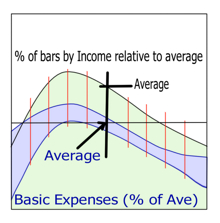
This statement is therefore inadequate, unless supplemented by a couple of ranges coupled to an indication of how widespread the applicability of the results. A small graph would do it, like the one to the right (illustrative purposes only):
This illustrates a situation in which the greatest number of bars earn about 60% of the average, declining rapidly in frequency as incomes diminish from that point, while some earn considerably more than average. Without scales, you can’t tell how much more, but the graph suggests double – but it might not be a linear scale The other information shown is the range of expenses as a percentage of the average – so that for each level of income, you can see what the range of expenses are. There are some shown where the average quoted is the minimum, and some where the expenses are more than your income – because some bars, logically, should be losing money at any given time.
This is an example of how the information could be presented – I am not an expert in the subject! – so don’t use this graph as real information.
Flaw #2: numbers without historical variation
“Average drink price is $10.50 while average VIP bottle service is $239. Average per person expenditure is $55 per visit.”
All nice and straightforward – but were the prices the same, 30 years ago (1990)? 60 years (1960)? 90 years (1930)? I already know they weren’t just because the dollar has inflated. For example, you can get a rough economic translation to mid-1930s prices by dividing by 10 – but that assumes that the salary of the barmen was the same (adjusting for inflation), and ditto the ingredients, and I doubt either of those is true. So “average drink price (1930) is $1.05 while average VIP bottle service is $23.90; average per person expenditure is $5.50 per visit” is not going to be correct. But I don’t know what the right numbers are going to be.
Flaw #3: absence of history
Nor do I have any information about how tastes have changed; I just know that they have. Were ales more popular than Lagers back then – and what’s the difference, anyway?
I know just enough to know that I don’t know, if you know what I mean. I have the references to dig the information out, at least about the 1930s, but the 1960s? No way.
The same is true of everything in the supplement – there’s too much focus on the right now, and no information on, say, the last century of history.
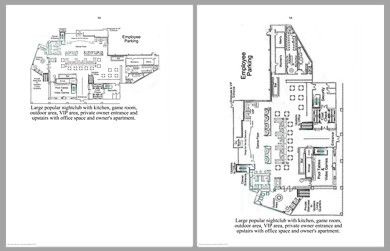
Flaw #4: sample venue layouts
These are all oriented across the page, and that has shrunken them in size. Rotating the images 90 degrees would have permitted them to be much larger: Take a look at the image to the left. The first is an actual screenshot from the supplement, and the second has the floor-plan rotated 90 degrees and enlarged 147% to fit onto exactly the same page. You can imagine how much more useful the image would be when printed.
A minor omission
One more minor omission: the supplement talks about the volume in such establishments, for example, but the numbers provided only really apply when a band or DJ is in operation, and historically, volume levels would have been different in the past. That’s okay, any GM can fudge that; it will still be loud, just not as loud, perhaps.
But I saw no mention of the fact that the hearing difficulties – ringing in the ears etc – can persist for an hour or more after a band’s performance. This is something that I know from personal experience. I’ve also been to gigs where the effect lasted a lot less – only a few minutes – so it’s very variable and markedly responds to small differences in the volume levels.
Overall assessment
There’s an awful lot to like in this supplement. Where information is included, it communicates it clearly and in straightforward language, and it covers everything you might need to know as a GM to drop a bar or nightclub into an adventure as either a one-off or ongoing location.
In many ways, the majority of the flaws can be expressed in terms of what’s NOT there. What’s included is excellent; what’s missing is the problem.
The useful content starts about 1/3 of the way through page 2 – before that, you have cover, contents, and introduction. Once it starts, it doesn’t really let up until you reach page 61. So there’s a lot of content of value.
Based on the 20-cents-per-page standard, that’s 59 x $0.20 = $11.80. Even if the flaws cut the price in half, and I then knock another 1/3 of the result (for the missing “band” content), I get a value of about $3.93 – which is almost double the suggested price.
But I’m not convinced that those reductions are fair – they are quite severe, and assume that the value of the content is fundamentally and fatally flawed as a result, and I don’t think that’s the case. Is the product weakened by the omissions I have described? Yes, absolutely – but what’s there is still first-hand knowledge and expertise from someone who knows the subject.
This is $5 or $6 value, in my opinion, even with the flaws I’ve identified. It won’t do it all for you – but it never actually promises to do that, anyway. If you run any games set in the 20th century or beyond, this is a game product that is worth your money.
And now, if you’ll excuse me, I think I owe the publishers a little more of my money.

Discover more from Campaign Mastery
Subscribe to get the latest posts sent to your email.
Comments Off on The Pay-What-You-Want Conundrum (plus a review)