Campaign Mastery helps tabletop RPG GMs knock their players' socks off through tips, how-to articles, and GMing tricks that build memorable campaigns from start to finish.

Cosmology and Research, Part 1


One of the essential skills that has to be in every GM’s toolkit is the ability to interleave research into subjects that they, and their players, know nothing about into the stories that they craft for their campaigns.

Way back in September 2014, I produced an abbreviated list of subjects that a GM arguably had to at least seem to be expert in, as part of The Expert In Everything?.

In 2016, I followed up with Lightning Research: Maximum Answers in Minimum Time, in which I describe the research techniques that I employ in order to be able to pull off that sleight-of-hand.

It’s not something that comes up every weekend, and quite often it’s fairly superficial, but recently I’ve had a couple of more intense such sessions.

I can’t really talk about one of them, because the adventure in question is still unfinished, and is months away from actually being played (in the Adventurer’s Club campaign), and I can’t talk about the second, because it would give too much away about the Adventurer’s Club adventure that’s only just started, but the third example is from the Doctor Who campaign, which lives rather closer to the margins. The relevant part of that adventure was played yesterday (as I write this), and written almost completely in the 48 hours prior, so it’s the most fresh example of the three, to boot.

What’s more, the research in question is inherently interesting (at least in my opinion), and that made choosing this topic an easy decision.

But on top of all that, a chance discovery (on my part) of a couple of tangentially-relevant stories provides an extra bonus that cemented the choice.

Here’s what I’ve mapped out for this article, a table of contents if you will.

  1. A Golden Period
  2. Planetary Types
    1. Classification Structure
    2. Terrestrial Planets
      • Carbon Planet
      • Coreless Planet
      • Desert Planet
      • Dwarf Planet
      • Ice Planet
      • Iron Planet
      • Lava Planet
      • Ocean World
      • Super-Earth
      • Mega-Earth
      • Sub-Earth
      • Ultra-short period planets
    3. Gaseous Planets
      • Controversy: When Is A Brown Dwarf Not A Brown Dwarf?
      • Gas Giant
      • Hot Jupiter
      • Super-Jupiter
      • Super-Puff
      • Eccentric Jupiter
      • Puffy Planets
      • Helium Planet
      • Gas dwarf (aka Mini-Jupiter)
      • Ice Giants
      • Mini-Ice Giant (aka Mini-Neptune)
      • Hot Neptune
      • Super-Neptune
      • Ultra-Hot Neptune
    4. Selected Other Types Of Planet
      • Blanet
      • Cthonian Planet
      • Circumbinary Planet
      • Circumtriple Planet
      • Disrupted Planet
      • Double Planet
      • Ecumenopolis
      • Mesoplanet
      • Eyeball Planet
      • Pulsar Planet
      • Sub-brown Dwarf
      • Sub-Neptune
      • Toroidal Planet
      • Ultra-short Period Planet (USP)
      • Superhabitable Planet
  3. Unusual Exoplanets List
  4. Nearby Habitable Systems
  5. List Of Named Exoplanets
  6. The State Of Cosmological Texts
  7. Controversy: Universal Expansion

 
That’s as far as I got in this article, so in part 2, there will be:

  1. Dr Who: Venturi Station

    1. The Needs Of Story
    2. Dr Who: Defining Venturi
    3. Further Research
    4. Plot outline
    5. A Cast Of Characters: Integrating Introductions
    6. Just-In-Time Infodumps vs. Background Teasers
    7. Spacing The Pacing
    8. Adventure Content
  2. Fantasy: Many Planes of Cosmological Grit

So this is, on the face of it, going to be an absolutely huge article. But by being brief, I have hopes that it can be completed and published on schedule.

Misplaced hopes, as it turns out – though I got a huge amount done, it wasn’t complete, as you can see from the above.

A Golden Period

We are living in a golden age in terms of advancing our cosmological knowledge. Never before have we learned so much about the universe we inhabit in such a short period of time.

The first exoplanet was detected in 1988, but that one (Gamma Cephei Ab) wasn’t confirmed until 2002. Just four years after that first detection, in 1992, exoplanets were confirmed around PSR B 1257+12 (which is a mouthful! This is a millisecond pulsar located in the constellation Virgo, believe it or not! And just three years after that, the first confirmed exoplanet around a normal star was found, 51 Pegasi b, currently named Dimidium.

As of 1 May, 2022 (just two weeks ago), there have been 5017 confirmed exoplanets discovered in 3,694 planetary systems, 822 of which have more than one planet. On top of that, there are 6587 detections from three mission still awaiting confirmation.

That’s absolutely massive – potentially, 11,600 exoplanets in 30 years, or an average of about 387 a year. More than one a day, on average!! Even if we assume that none of those unconfirmed contenders turn out to be real (something that I doubt), that’s still more than 167 a year, or about one every 2 days, 4 hours.

Arguably, though, it’s not the fact of their existence that is the headline news these days, it’s what has been determined about their natures, something we have been getting better at, and that will take a quantum leap forward once the Webb Space Telescope becomes fully operational, any day now.

Any science-fiction property – be it a game, campaign, adventure, novel, short story, TV series, or a movie – that predates 1992 and even hints at something to do with space is at a near-certainty of being out out-of-date, and that risk remains significant even if it was first played/published/broadcast just yesterday.

This presents both a huge demand on GMs as well as a huge opportunity. To make your game or game product cutting edge, all it needs to be is up to date with respect to the general classification and frequency of occurrence of exoplanet types, or to contain some good reasons for having differing answers. That’s the opportunity. The responsibility comes with avoiding the loss of credibility that comes from not being up-to-date.

Talk about a risk-vs-reward ratio…

So, this article will look to lay some foundations for a GM to at least pretend to know more than he does on the subject.

Much of it will be mercilessly cribbed from Wikipedia, which is an excellent resource for these known-fact information compilations, and which is kept relentlessly up-to-date by enthusiastic planet-watchers and astronomy buffs.
Planetary Types

    Classification Structure

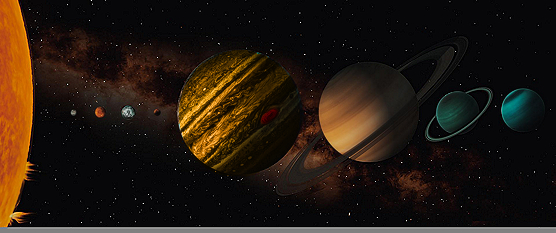
    Planets are, these days, generally divided into three main types, sometimes dubbed “Rocky”, “Gaseous”, and “Unusual”. Astronomers generally use “Terrestrial” for the first and “Other” for the last, but – for the most part – these definitions are too broad for usage these days.

    Terrestrial Planets

    These are planets composed mostly of silicates, rocks, and metals. The four innermost planets of our solar system (Mercury, Venus, Earth, and Mars) all qualify.

    There are several sub-types. Because this information wasn’t actually needed for my Dr Who adventure, I did very little research on them, in fact I’ve had to supplement my research for this article.

    • Carbon Planet – a (theoretical) type of planet that contains more carbon than oxygen. Some possible examples have been found but their nature has not been confirmed.
    • Coreless Planet – A coreless planet is a theoretical type that has no metallic core (and hence, no magnetic field). They are likely to be found in cooler regions (cosmically speaking) and further from the star.
    • Desert Planet – a theoretical type of planet with a surface similar to Earth’s hot deserts. Studies suggest that Desert Planets have a broader habitable zone than ocean planets.
    • Dwarf Planet – Probably the most famous non-Earthlike category, thanks to the controversy over the reclassification of Pluto. a Dwarf Planet is clearly a world (defined as possessing sufficient gravity to force it into a spherical shape) in solar orbit. The controversy stemmed from a later exclusion of Dwarf Planets from the list of Planets – while, ironically, retaining the term in the category title. It’s currently estimated that there are from 5 to 120 such bodies in our solar system, including Pluto, Ceres, Eris, Haumea, Makemake, Gonggong, Quaoar, Orcus, and Salacia). And the observant will note that there are already more than 5 names on that list!
    • Ice Planet – These planets have a surface of frozen volatiles such as water, ammonia, and methane. They may possess liquid oceans beneath an ice layer. In our solar system, the only known examples are planet-sized moons like Ganymede and Titan, but it is estimated that they will be common worlds in the Milky Way.
    • Iron Planet – If a Coreless Planet is one without an earth-like metallic core, Iron Planets are the opposite, planets that have little or nothing but planetary cores. Mercury is the largest example in our solar system, but it is expected that there will be larger versions commonly in existence because Iron is one of the most abundant substances in the universe.
    • Lava Planet – Terrestrial planets with a surface mostly or entirely covered by molten lava. There are several developmental paths that could lead to such planets – newborn planets, planets who have recently undergone a collision event, or a planet that orbits very close to the surface of its star. There have been possible Lava Planets found in at least three solar systems, but there are no examples in our solar system.
    • Ocean World – planets containing a substantial amount of water either as a surface hydrosphere or subsurface ocean. There are no prizes for guessing that the Earth is the most famous example. The term is sometimes used to refer to hypothetical planetary bodies with oceans of liquid other than water – ammonia (Titan) or Hydrocarbons (Titan again!). Theoretical studies by NASA have recently (2020) found that exoplanets with oceans are going to be far more common than was previously expected. Since water is a high-probability foundation for the development of life, this suggests that life may also be more common than was thought likely even after the confirmed discovery of exoplanets.
    • Super-Earth – A super-earth is a terrestrial ocean exoplanet with a mass of 5-10 earths. The term, which is not intended to carry implications regarding surface conditions, was coined to fill the gap between earth-like Ocean Worlds and Mega-earths. The term “gas dwarf” is sometimes used to describe planets at the upper end of the size scale, though Mini-Neptune is more commonly employed. There is some controversy over whether or not such planets should be considered Terrestrial or Gas Giants; they bridge the gap between those classifications.
    • Mega-Earth – The term is not yet routinely accepted; it was used to describe Kepler-10c when that world was first discovered to be a Neptune-mass planet with a density considerably greater than that of Earth. Further study showed Kepler-10c to be a typical volatile-rich planet weighing just under 1/2 of the initial mass estimate, so the term no longer applied to that exoplanet, but it is believed that such worlds remain theoretically possible.
    • Sub-Earth – These are terrestrial planets that are considerably smaller than Earth, and include Mercury and Mars, even though the former is also considered to be an Iron Planet. One of the earliest exoplanets confirmed is a sub-Earth around the millisecond Pulsar PSR B1257+12. The smallest example found to date, despite these being the most difficult exoplanets to detect, is WD 1145+017 b which has a radius just 15% of Earths, making it somewhat smaller than Pluto.
    • Ultra-short period planets – These are planets with orbital periods (years) of less than one earth day, and only seem to occur around stars of less than about 1.25 solar masses. While all the known examples are Hot Jupiters (see below), it’s theoretically possible for a ‘rocky’ world to posses this characteristic as well. Of course, such would be at temperatures sufficient to melt or even boil almost every substance known, so the appellation “rocky” might be something of a misnomer in such cases!

    As you can see, the definitions and classifications of terrestrial exoplanets are still evolving and while there are some areas of consensus, there are also some areas of disagreement; at this time, you could not say that there was a rigorous classification system. Right now, we are still discovering just what is possible within this category. This is one of the bleeding edges of Astronomy.

    Gaseous Planets

    Things are a little more settled with the Gaseous Planets. These are largely oriented into “Families” based on the commonly known exemplars within our solar system – Jupiter, Saturn, and Neptune.

    I’ve been a little more fulsome (and eschewed the bullet-point format for this part of the discussion because this was the focus of my research for the Dr Who adventure.

    But, before we get there, there was an unexpected area of controversy that shows that this sub-field is also still evolving, and that I found fascinating, which deserves presentation in a sidebar.

    Controversy: When Is A Brown Dwarf Not A Brown Dwarf?

    A few years ago, it was all so clear-cut. A Brown Dwarf was a star that was hot enough to fuse Deuterium, at least for a while, but not ordinary Hydrogen, which happened nicely and neatly at a mass of 13 Jupiters. Therefore, anything larger than that was a Brown Dwarf, and anything smaller was a Gas Giant, a Hot Jupiter.

    And then we found a few exoplanets whose density was too low to permit such fusion but which were well over the “13Mj” (Jupiter Mass) limit, and a few Brown Dwarfs were found that clearly did or had supported fusion that were only 10Mj in size.

    And then a few stellar bodies / rogue planets were found that were Brown Dwarfs in every respect but underwent no fusion, presumably because chance had given them insufficient Deuterium, just to completely demolish this rosy little picture.

    The dividing line / criteria for distinguishing one class of extrasolar object from the other is now the subject of “hot” debate. The official dividing line is still the mass of 13 Jupiters, but this is more often ignored than it is followed. Extra-solar planets as large as 60 Mj are now on the record – and it is worth noting that the upper limit of Brown Dwarf sizes are 60-90 Mj.

    Officially, an extrasolar body that orbits a star and does not show Deuterium Fusion is considered a planet, even above the 13Mj ‘limit”. Infrared and X-Ray observations are thus considered definitive, and this is likely where the consensus will land, in my opinion.

    Currently, there are two different methods of differentiation, one based on formation and the other on the physics of the interior; these can yield contradictory results in which one method classifies an object as a star (brown dwarf) while the other does not.

    But I find it both amusing and fascinating that an entire planetary definition has come and gone without my noticing!
    Image
    provided by flflflflfl from Pixabay

    Gas Giant

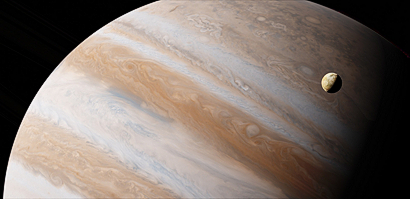
    Gas Giants are planets composed mainly of Hydrogen and Helium. Jupiter is the definitive example within the solar system. Saturn is often considered a second example, but some prefer to classify it into a separate class of giant planet due to a larger Helium content.

    The visible ‘surface’ of Gas Giants consists of an outer layer of compressed hydrogen and helium surrounding a layer of liquid metallic hydrogen, with a rocky core at the interior. Within the layer of compressed gasses are visible clouds mainly composed of water and ammonia.

    “Metallic” hydrogen is a state of matter in which hydrogen becomes electrically conductive due to extreme pressure. A Jovian core is at such a high temperature and pressure (20,000°K) that its physical and chemical properties are not yet fully understood.

    Theoretically, gas giants can be divided into five separate sub-sub-classes according to their atmospheric attributes, which produce distinctive appearances. These features are (I) Ammonia Clouds, (II) Water Clouds, (III) Cloudless, (IV) Alkali-metal clouds, and (V) Silicate clouds.

    Interestingly, cold Hydrogen-rich planets more massive than Jupiter but less than about 1.6 Mj will be larger in volume than Jupiter, but above this limit, gravity actually causes the planet to shrink back toward the size of Jupiter. Even Brown Dwarfs are very close to the typical Jupiter in size.

    Heat from the interior carried upward by local storms is a major driver of weather on gas giants, predominantly thunderstorms, and much if not all of the heat escaping the interior follows this mechanism, which is thought to be very similar to the mechanism that creates storms on Earth. The heat flows develop into small eddies and vortices within the clouds, causing them to form ‘curls’.

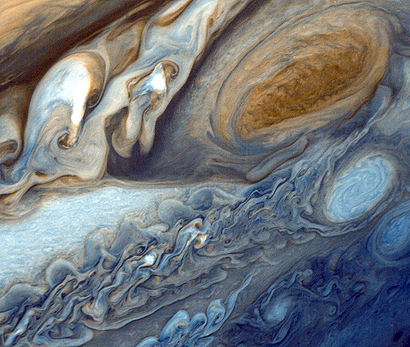
    The Great Red Spot is a high-pressure anticyclone system in which winds swirl at between 430 and 680 kilometers an hour. It has been observed to swallow smaller storms whole. Exposure to UV radiation creates brown organic compounds, which are then sucked into the upper atmosphere; it is hypothesized that these get stuck in Jupiter’s Great Red Spot, creating it’s red color. It is expected that such phenomena will be frequent occurrences in extrasolar planets of this size.

    Condensation of helium creates a Helium Rain on gas giants, but the different masses of Jupiter and Saturn cause them to have different climatic mechanisms associated with this phenomenon. Some astronomers distinguish the two planetary types according to the Helium behavior; In ‘typical size’ gas giants, this distinction is largely ignored, but it remains relevant when considering much larger examples. The surface temperature of Saturn is about 900°C.

    Hot Jupiter

    When a Jupiter-class planet is very close to its primary, it has a very short orbital period (‘a year’) and becomes super-heated. We’re talking about “years” of less than 10 days, for the most part (one has been found with a year of 111 Earth days, and one has been found with year of just 1.3 earth days!)..

    These exoplanets are the easiest to detect using the radial-velocity method because they induce relatively large ‘wobbles’ in the parent star’s motion.

    The term ‘Hot Jupiter’ is an informal designation that is almost universally employed.

    Although there is great diversity amongst the Hot Jupiters that have been discovered to date, there is a long list of common attributes.

    They must have a mass of somewhere between 0.36 and 11.6 Jupiter masses, for example.

    They have very circular orbits with low eccentricities; there are competing theories as to why.

    Some collide with (and are absorbed into) their parent stars, otherwise they would be even more common.

    Many have unusually low densities. They tend to be much larger than their mass warrants, and it’s not clear exactly why; several explanations have been posited but none proven to be the dominant mechanism.

    The closeness to the Primary causes most to be tidally locked, with one side always facing the parent star. This is thought to create extreme and exotic atmospheric conditions. The day-night temperature differential is estimated to be about 500°C.

    They are more commonly found around F- and G- type stars and are less common around K-type stars. Hot Jupiters around red dwarfs are extremely rare. In general, their prevalence decreases exponentially with absolute stellar magnitude.

    More than half of the Hot Jupiters studied have orbits that are misaligned with the axis of rotation of their parent stars, and a significant fraction have completely retrograde orbits. There are many proposed explanations for this.

    Even when taking surface heating from the proximate star into account, many Hot Jupiters have a larger planetary radius than expected; this may be caused by interactions between the atmospheric winds and the planets’ magnetosphere creating an electric current through the planet that heats it up. The hotter the planet, the greater the ionization of the atmosphere, which in turn leads to a greater magnitude of magnetosphere interaction and hence a larger current being generated, leading to greater heating and expansion of the planetary atmosphere. This theory matches evidence relating to observed correlations between inflated radii and planetary temperatures.

    Super-Jupiter

    A Super-Jupiter is an exoplanet that is considerably more massive than the planet Jupiter. By 2011, there were 180 confirmed Super-Jupiters, some hot and some cold. Up to about 80 Jupiter masses, their size remains very similar to that of our local Jupiter. Beyond that, they become so massive that fusion can initiate, turning what might have been a planet into a brown dwarf.

    That means that their surface gravity and density are proportional to their mass. CoRoT-3b has a mass of around 22 Mj and is predicted to have an average density greater than that of Osmium, the densest natural element under standard conditions. It’s surface gravity will be over 50 times that of Earth.

    Super-Puff

    Super-puffs have a mass comparable to that of the Earth (up to a few times Me) but a radius larger than that of Neptune. This gives them a very low density. They are cooler and less massive than low-density Hot Jupiters.

    One hypothesis is that they have continuous outflows of dust to the top of their atmosphere, so that the true surface is much smaller than the apparent surface. Gliese 3470 b is considered a possible example of this mechanism.

    Another possibility is that some super-puffs are smaller planets with large ring systems which are being mistaken for planetary surfaces. HP 41378 f is considered an example. See also “Puffy Planet,” below.

    Ultra-hot Jupiter

    Ultra-hot Jupiters are Hot Jupiters with a daytime temperature in excess of 2200°K. At such temperatures, most molecules dissociate into their constituent atoms and stream away from the hot side to the night side (tidally locked, remember) where they recombine into molecules again. Logically, there must be a reciprocal flow from cold side to hot, completing a closed cycle, but what this could be remains to be determined.

    The most extreme example is TOI-1431b, which was found to have an orbital period of just 2-and-a-half days; it’s day-side temperature is 2427°C, hotter than 40% of the stars in the Milky Way, and even it’s night-side temperature is 2300°C.

    Eccentric Jupiter

    An Eccentric Jupiter is a gassy exoplanet that orbits its star in an eccentric orbit, which carries it both close to its primary and some distance away. HD 96167 has a comet-like orbit that carries it out from roughly the equivalent of the orbit of Mercury to the equivalent of the center of the Asteroid belt (in terms of orbit size).

    Together with the discovery of Hot Jupiters, Eccentric Jupiters required a complete reexamination of theories of solar system formation as the existing theories did not adequately explain the phenomena.
    Puffy Planets

    Puffy Planets are less-extreme Super-puffs; they have a large radius and low density. They are sometimes called “Hot Saturns” due to their density being similar to that of the ringed planet.

    They orbit close to their parent star, and the intense heat from solar radiation absorption plus internally-generated heat inflates the atmosphere.

    Six have been confirmed so far, and it is suspected that some Hot Jupiters will be reclassified as Puffy Planets upon further examination.

    Most puffy planets will be at or below Jupiter mass because anything greater would generate enough gravity to counter Puffing, and keeping them at roughly the same size as Jupiter.

    Hot Jupiters wit masses less than that of Jupiter and temperatures in excess of 1800°K are so inflated and puffed out that they are on unstable evolutionary paths that will eventually cause their atmospheres to evaporate and become lost to the planet.

    Helium Planet

    A Helium Planet is one with a helium-dominated atmosphere, which contrasts with “ordinary” gas giants like Jupiter and Saturn. We don’t have an example of a Helium Planet in our solar system, but there have been some attempts to shift the boundary of “helium-dominated” to cause Saturn to fall into this classification.

    Two formation mechanisms have been posited that would lead to Helium Planets – remnants of White Dwarf stars and Hydrogen evaporation from standard Jupiter-like gas giants.

    Helium stars would have a white or gray color.

    It is expected that a distinguishing feature of the chemistry of Helium Planets that would separate them from regular Jupiter and Jupiter-family exoplanets would be evidence of carbon monoxide and dioxide in the atmosphere, resulting from a loss of the hydrogen that would normally bond with the carbon to form methane.

    Gliese 436 b is a possible Helium planet and does exhibit this chemical signature.

    Gas dwarf (aka Mini-Jupiter)

    Wikipedia lists a planetary type by this name but doesn’t have, and appears never to have had, a page on the subject, or a mention anywhere else of the planetary type. That means that I can only theorize, with at least a 50-50 chance of being totally wrong.

    So, speculating (but not wildly), the existence of Mini-Neptunes (see below) could suggest the existence of similar Gas Dwarf planets that have a hydrogen-dominated atmosphere. These would need to be sufficiently distant from their parent star that they would not outgas sufficient Hydrogen to change the nature of the planet to a dwarf Helium Planet; their small size would suggest that they would have trouble holding on to an atmosphere in any event, so it’s entirely possible that if the hydrogen were to go, so would the helium, leaving only the heavier compounds of a Mini-Neptune (and a much smaller planet).

    This also means that they would be sufficiently distant that significant Puffing would not take place, resulting in a cool, sub-Jovian planet in both mass and size.

    That’s all semi-educated guesswork. It’s just as likely that someone created the category by mistake – but at least it sounds logical.

    Ice Giants

    The original meaning of the term Gas Giant included Uranus and Neptune, but these days the significant differences in their chemistries have placed them in a separate class, Ice Giants. These are giant planets comprised mainly of elements heavier than hydrogen and helium, such as oxygen, carbon, nitrogen, and sulfur.

    In astrophysics and planetary science, the term “ices” refers to chemical compounds that are volatile, i.e. have freezing points above about 100°K.

    Ice Giants lack a significant solid surface, they are primarily composed of liquids and gasses. The principles of their formation is problematic because the building blocks that would have gone into Gas Giants such as Jupiter would have been close to solar escape velocities, and more likely to have been thrown out of the solar system or into cometary orbits than to have accreted into the planets that we see today.

    Either there were a lot more of these than solar system formation theory suggests, or the formative principle is different; proposals based around pebble accretion or gravitational disk instabilities have been proposed that might plug this theoretical gap. Many Ice-giant candidates have been observed amongst the exoplanets discovered, suggesting that they are relatively common in the Milky Way, and therefore that the mechanism must be fairly ubiquitous.

    The gaseous outer layers of Ice Giants have several similarities to those of Gas Giants. These include long-lived equatorial winds of high speed, polar vortices, large-scale circulation patterns, and complex chemical processes driven by ultraviolet radiation from above and mixing of layers in the lower atmosphere. Their chemical compositions promote different processes to those of the Jupiter family.

    Because they receive far less sunlight than the Jovian family, internal heating becomes far more relevant to the atmospheric weather of Ice Giants. There are still no complete models explaining how the observed atmospheres of ice giants function. This is a hot subject of research in planetary physics as exoplanetary properties are not yet understood, even in general theory.

    The largest visible feature on Neptune is the Great Dark Spot, which forms and then dissipates every few years. It is similar in size to the Great Red Spot, which has persisted for centuries.

    Of all giant planets of the solar system, Neptune emits the most internal heat per unit of absorbed sunlight (an approximate ratio of 2.6). Saturn has the next highest (ratio of 1.8); Uranus emits the least, at a ratio of about 0.26, which is so extremely different that it is attention-getting. The suspicion is that the extreme axial tilt of the planet, 98°, is relevant to this observation. That axial tilt also creates seasonal patterns unique within the solar system.

    The internal heat of Uranus is very low; it is the coldest planet in the solar system, with a temperature in the upper atmosphere of -224°C. The deepest parts of the mantle are so hot and under so much pressure that methane decomposes into elemental carbon. One potential result is that the mantle will experience a rain of liquid diamonds. Higher up, sunlight causes methane to form compounds like Acetylene and Diacetylene, and this can potentially support organic chemistry of great complexity in the regions that bound the diamond nucleation zone and the upper atmosphere, potentially supportive of life.

    Because of their large sizes and low thermal conductivities, planetary interior pressures range up to several hundred GPa (Giga-Pascals) and temperatures of several thousand Kelvins.

    The compressibility of water in ice-giant models could be off by as much as 1/3, according to an announcement in Match 2012. The consequences of this are still reverberating through the relevant planetary science studies.

    The magnetic fields of Uranus and Neptune are both unusually displaced and tilted. Their strengths are intermediate between Gas Giants and those of terrestrial planets, 50 and 25 times those of the Earth, respectively. Despite these greater field strengths, the equatorial field strengths are only 75 and 45 percent of that of the Earth, indicating that the sources are relatively deeper than the field strength itself indicates, compared to Earth. The magnetic fields are believed to originate in an ionized convecting fluid-ice mantle deep within the planets.

    Mini-Ice Giant (aka Mini-Neptune)

    A gas dwarf is a gas planet with a rocky core that has accumulated a thick envelope of volatiles but which is less massive than Neptune but which has a radius of 1.7 and 3.9 earth radii. They are divided into a three-tier classification regime based on the metallicity of short-period exoplanets (in astronomy and astrophysics, a “Metal” is any substance that is neither Hydrogen nor Helium.

    Studies of such planets are loosely-based on what we have learned about Uranus and Neptune. Without a thick atmosphere, they would be classified as ocean planets instead. The 1.7 Earth-radius lower limit is a little fuzzy; the dividing line is considered to be somewhere between 1.6 and 2.0 Earth radii. Any planets with a larger radius that have been observed had significant levels of Hydrogen and/or Helium, as did any planet more massive than approximately 6 earth-masses. Beyond this observation, they appear to have a diversity of compositions that are poorly explained by simple models using a single mass-radius relationship.

    It is this diversity of composition that explains the “fuzziness” mentioned in association with the lower limit; depending on the composition, the dividing line can be as low as 1 Earth-radius to as high as 20 earth-radii.

    Neptune-like planets are considerably rarer than sub-Neptunes despite being only slightly bigger. This “radius cliff” separates sub-Neptunes from Neptunes, with a dividing line of 3 earth-radii. The divide is thought to be a function of planetary formation; the atmospheres of planets smaller in radius than the limit struggle to achieve the pressures required to force Hydrogen into the magma ocean, which limits radius growth. Only once the magma ocean becomes Hydrogen saturated can radius growth continue, and that can only occur with planets larger than the critical boundary.

    Hot Neptune

    As might be expected from the description / definition of a Hot Jupiter, a Hot Neptune is a Neptunian giant planet that orbits close to it’s star, typically in an orbit of less than 1 AU (closer to it’s star than the orbit of the Earth around our star). The first Hot Neptune to be found was Gliese 436 b, in 2007; it is located about 33 light years from our solar system.

    Recent observations have revealed a significantly larger population of Hot Neptunes than was previously expected. In part, this can be explained by these planets being easier to detect, for the same reasons as Hot Jupiters, but this is not enough to account for the discrepancy. One notable example is Kepler-56 b, which has a mass somewhat larger than Neptune’s and orbits its star at a radius of just 0.1 AU, closer than Mercury orbits the Sun.

    Super-Neptune

    A super-Neptune is a giant planet of Neptunian character which is more massive than the planet Neptune. These are generally described as being approximately 5-7 times the size of Earth and with masses of 20-80 Earths. Exceeding this limit generally requires the planet to have sufficient Hydrogen and/or Helium to qualify it as a gas giant, even under the revised nomenclature. Planets falling within this mass range might also be referred to as a Sub-Saturn, indicating that the additional mass contains more Hydrogen-Helium than is normal for a planet within the Neptunian class. However, “sub-Saturn” is not an official designation, while “Super-Neptune” is.

    There have been relatively few planets of this kind to be discovered. The mass gap between Neptune-like and Jupiter-like planets is thought to occur because of “Runaway accretion” occurring for planets of larger than 20 earth-masses; once the threshold is crossed, it becomes so much easier for them to acquire additional mass that they rapidly grow into planets the size of Jupiter or larger, much of it Hydrogen / Helium, which pushes the planet out of this category and into the Super-Jupiter category.

    Ultra-Hot Neptune

    So far, only one Ultra-Hot Neptune has been confirmed; LTT 9779 b has an orbital period (year) of 19 hours and an atmospheric temperature in excess of 1700°C. It is so close to its star that its atmosphere should have evaporated into space, so its existence requires an unusual explanation.

    There is a possible second example awaiting confirmation orbiting Vega. It is believed to be slightly more massive than Neptune, orbiting Vega every 2.43 days, and – due to the highly energetic star – has a temperature of 2500°C, which will make it the second-hottest planet on record if it is confirmed.

    Selected Other Types Of Planet

    There are a number of other planetary types whose names caught my attention. If they subsequently proved interesting enough, I’ve kept them on the list below; if not, they’ve been redacted.
    • Blanet – A blanet is a hypothetical exoplanet class that orbit black holes. They are basically planets like any other, i.e. they have enough mass to be rounded by their own gravity but not enough to start fusion reactions. In 2019, a team of astronomers and exoplanetologists showed that there is a safe zone around a supermassive black hole that could harbor potentially thousands of blanets in stable orbits. What is more, the accretion disks that form around black holes would force matter into this safe zone and so foster planet-building processes, so this is considered to be a self-fulfilling prophecy, a natural trait of such Black Holes. The term is a portmanteau of “BLAck hole” and “plaNET”.
    • Cthonian Planet – Cthonian planets are a hypothetical class of celestial objects resulting from the stripping away of an gas giant’s atmosphere and outer layers through hydrodynamic escape. Such stripping is most likely to occur as a result of stellar proximity. The remaining rocky or metallic-core planet(oid) would resemble a terrestrial planet in many respects but significantly differ in others. If the core material of a gas giant (or even a brown dwarf) has an appropriate composition, it can stay compressed for billions of years despite the loss of the atmosphere that contained enough mass to perform the compression. HD 209458 b is an example of a gas giant in the process of becoming a Cthonian Planet, a process that will take many billions of years. Similarly, Gliese 436b has already lost 10% of its atmosphere. CoRoT-7b is the first exoplanet that might be fully transformed into a Cthonian Planet, but other researchers dispute this classification. TOI 849 b, a planet more massive than Neptune and located very close to its host star was found in the Neptunian Desert (a region of space virtually devoid of planets), may also be Cthonian.
    • Circumbinary Planet – A planet that orbits two stars instead of one; the stars are usually in a binary star system. At one point, these were considered impossible, as the presence of the binary star would both disrupt planetary formation and ‘suck up’ all the building material needed for such formation; but several examples have been discovered, disproving this belief. The discovery has shed fresh light on some aspects of planetary systems such as orbital dynamics and axial tilt precession. It has also been noted that there is a general absence of such planets around shorter-period binary systems, suggesting that the old theory might not be completely inaccurate after all.
    • Circumtriple Planet – A celestial mass that orbits three stars in a trinary system at the same time. Star System GW Ori contains a huge accretion disk of dust and gas located about 1300 light-years from earth; astronomers have observed a gap in the cloud and hypothesized that a planet has swept that region clear. There are other gravitational oddities about the star system that could be explained by the presence of a planetary body of Jupiter size. The body itself has not been observed. If it exists, it will be an extremely rare phenomenon in the universe, potentially the rarest type of planet in the known universe, and quite likely the only example within the Milky Way.
    • Disrupted Planet – A planetary body disrupted or destroyed by nearby or passing astronomical body or object; the study of the process is known as Necroplanetology. For a long time, it was thought that the Asteroid Belt of our solar system was a Disrupted planet (some science-fiction suggested that it had contained an advanced civilization which had destroyed itself and its planet, which would – ironically – mean that it no longer met the criteria for this designation). This theoretical origin of the Asteroid Belt may have inspired the origin story of Superman as a refugee from the destroyed planet of Krypton. It is no longer thought that the Asteroid Belt was ever a solid singular body; it is rather thought that the gravitational attraction of Jupiter disrupted the planetary formation process.
    • Double Planet – The typical ratio of masses between a planet and a satellite is around 10,000 to 1. In extremely rare cases, a satellite may be massive enough that both it and the planet it orbits with both revolve around a point external to both planetary bodies. The Earth-Luna double is one such example; both actually orbit about a point of balanced mutual attraction. Pluto and Charon were proposed to be an even better example, but this proposal failed when Pluto was controversially struck off the list of planets. This resulted in the definition being amended to state that one of the planetary bodies in question must be a bonafide planet before a system could qualify as a double-planet. Later revelations about the origins of the moon have only made the probability of double-planets forming even more rare than it was already thought to be; in conjunction with arguments about the significance of Luna to the development and evolution of life on Earth, and of sentience, some have suggested the absence of a moon of significant mass relative to an earth-like planet may constitute a choke-point in the formation of life-bearing worlds.
    • Ecumenopolis – The name given to describe a (hypothetical) planet-wide city. Term coined in 1967, but the concept originated in Asimov’s Foundation series, and was initially proposed by American religious leader Thomas Lake Harris.(1823-1906). Lake also depicted interstellar empires and “ancient astronauts” in his writings, making him a lost grandfather of Science Fiction.
    • Mesoplanet – Speaking of Asimov, this term is another of his contributions to science. Mesoplanets are planetary mass objects smaller than Mercury but larger than Ceres. Asimov observed that there was a considerable gap between the smallest object considered an undoubted major planet (Mercury) and the largest object undoubtedly considered a minor object (Ceres) and proposed the term to describe objects fitting into that size gap. At the time, only one planetary object, Pluto, fell into the category, and rather than declare it arbitrarily one or the other, he suggested placing it into this new subcategory (“Meso” means “middle” in Greek). Other objects have since been discovered that would be included are Eris, Haumea, Makemake, Gonggong, Quaoar, probably Sedna, and possibly Orcus. Astronomers generally describe these as “Dwarf Planets” these days; other, smaller, bodies have been proposed by astronomers disagree about their potential dwarf planet status.
    • Eyeball Planet – A hypothetical model describing tidally-locked planets induces spatial features which come to resemble an eyeball. The concept is that the planet will be hottest at the perpetual ‘noon’ and cool somewhat at positions removed from this point, producing ring-shaped zones in which some materials liquefy and others do not. The theoretical model thus posits a series of concentric rings as surface features of some such planets. It further calculates two viable types, a ‘hot’ eyeball and a ‘cool’ eyeball, depending on he chemistry of the liquid and whether or not it forms on the near-solar side or the far side. Kepler-1652b is potentially an eyeball planet, and the TRAPPIST-1 system may contain several such planets.
    • Pulsar Planet – Pulsar planets are discovered through the influence of the planet’s gravity on pulsar, inducing a wobble that impacts on the precision of the timing of the pulses produced by the Neutron Star. The discovery was unexpected; such stellar objects have previously gone supernova and it was thought that any planetary bodies orbiting such stars would have been destroyed in the explosion. In 1991, it was announced that a planet had been detected around PSR 1829-10, but this was later retracted – just before the first real pulsar planets were announced. Two astronomers announced the discovery of a multi-planet system around PSR 1257+12, and these became the first two extrasolar planets confirmed to exist. There was some initial doubt about the discovery because of the prior retraction and because of questions about how pulsars could have planets; however, the planets proved to be real and cosmology had to adapt to incorporate their existence. Two additional smaller planets were later added to the system using the same technique, but one has since been retracted. The oldest known planet is currently a Circumbinary Pulsar Planet, 12.6 billion years old. It is believed to have been a planet orbiting the pulsar’s companion star before becoming a Circumbinary planet. In 2006, a Magnetar, 13000 light years from earth, was found to have a circumstellar disk, thought to have formed from metal-rich debris (NB. the astronomical definition of ‘metal’) left over from the supernova about 100,000 years ago. The disk appears to be quite similar to those around sun-like stars, suggesting that planetary formation may be possible even around Pulsars, and that Pulsar Planets may be far more common than previously suspected. It may be that these have unique properties in common due to their origins, which would elevate the term “Pulsar Planet” into the main types of planetary bodies.
    • Sub-brown Dwarf – Just when you thought the Planet-Brown Dwarf controversy was complicated enough… These are astronomical objects formed in the same manner as stars and brown dwarfs (through the collapse of a dust cloud) but of planetary mass, and therefore below the limiting mass of the fusion of deuterium. Some astronomers call these free-floating planets, some call them planetary-mass brown dwarfs or Y spectral class brown dwarfs, and some label them rogue planets.
    • Sub-Neptune – Again, a definition that seemed settled until now – the term has also been applied to planets with a smaller radius than Neptune but a larger mass, or to a planet with smaller mass or larger radius, like a super-puff. Both meanings can also be used in the same publication. Consistency seems lacking but consensus will eventually resolve this confusing situation… it is to be hoped.
    • Toroidal Planet – A hypothetical exoplanet with a torroidal or doughnut shape. While there is no rigorous theoretical understanding as to how one could form in nature, the shape itself is potentially quasi-stable. It is considered extremely improbable that any naturally-occurring Toroidal Planet will ever be discovered, and should one be found, it will immediately become classified as one of, if not the, rarest object in the universe. But so many exoplanets are now thought to exist that if there is a formation mechanism that has been overlooked so far, no matter how improbable, it remains possible that such a planet exists – somewhere.
    • Ultra-short Period Planet (USP) – Exoplanets with orbital periods (years) of less than one earth-day are designated USPs. Few exceed two earth radii in size. About one in 200 sun-like (G-type) stars has an USP, and most of them have an earth-like composition (70% rock 30% iron). K2-229b has a higher density, suggesting a more massive iron core, while WASP-47e and 55 Cnc e have a lower density and a corresponding composition of more pure rock, or a rocky-iron body surrounded by a layer of water or other volatile substance. The main difference between these planets and Hot Jupiters is that USPs almost always have longer-period planetary companions, while Hot Jupiters are rarely found with other planets within a factor of 2-3 in orbital period.
    • Superhabitable Planet – The Drake Formula, which I wrote about in A Game Of Drakes and Detectives: Where’s ET?, often seems to assume that because life was known to have evolved on Earth, Earth and its solar system must reflect the optimum chances for the development of life. In 2014, Rene Heller and John Armstrong introduced the concept a Superhabitable planet, a hypothetical exoplanet or exomoon that may be even better-suited to the emergence and evolution of life. Critical of the existing conceptual models as unjustifiably anthropocentric and geocentric, they proposed to establish a profile for exoplanets based on planetary and stellar features; analyzing the measurable properties of a planet which offered the greatest potential likelihood of life, they identified eight characteristics and concluded that existing search methodologies had ignored the most likely targets for success. 24 planets matching the Superhabitable profile have been identified but – so far – only two have been confirmed: Kepler-69c and Kepler-1126b. One of the unconfirmed, KOI 5715.01, is regarded as potentially the best match to the profile.
    Unusual Exoplanets List

    Wikipedia also maintains a couple of lists that are worth keeping an eye on, and occasionally exploring. This first of these is a list of exoplanet extremes.

    This list is full of one jaw-drop after another.

    Nearby Habitable Systems

    Next up, we have a list of the Habitable Systems closest to Earth – (but refer to the discussion of Superhabitable Planet above for relevant discussion).

    List Of Named Exoplanets

    It would be nice if this list explained why these particular exoplanets were considered worthy of being named, given that so many have now been found that these have clearly been singled out. But this List Of Named Exoplanets is what it is.

    The State Of Cosmological Texts

    There have been so many changes in the last couple of years that if you have an astronomy or cosmology text that is more than 5 years old, it’s almost certainly out-of-date, and even hot-off-the-presses publications run the risk of being significantly outdated in some areas. That doesn’t make older reference works useless – well, not completely – but it does mean that they might well mislead more than educate. At best, they are a starting point. I’d offer up a recommendation or two, but they would almost certainly date very poorly.

    If this subject is relevant to your games, the advice is therefore to seek out the most recent book written for your academic level in this subject. This is going to be an evolving landscape – cutting-edge right now might be a year out of date, and might get supplanted as “most recent” six weeks from now – good luck if you happen to be reading this in late June, not so much, if not.

    That advice also presumes that all such works are going to be equal. We all know better than that, don’t we?

    You might use reviews to assess this factor, but there are complications. The newer a book is, the less likely it is that it will have a lot of reviews – that’s number one. And you can’t assume that all reviews are created equal, that’s number two. Unfortunately, that’s where you are going to have to use your own best judgment. But I have a suggestion for you to consider. And it comes from, of all places, learning the art of musical composition.

    You see, I couldn’t decide between the For Dummies book on the subject and the Complete Idiot’s guide. So, feeling extravagant at the time, I bought both. And what I learned was that the combination was better than either book on its own. What one explained in a way that left me confused, the other explained clearly. Often, one would provide the foundation concepts and the other would expand on that material.

    I would, therefore, select a university which has an Astronomy or Cosmology course and which lists study materials online and select the first-year textbook their course demands; and then look for an alternative pitched just a little down from that, in hopes that it would fill in any foundational blanks in the more advanced book. (Actually, because I already know a little on the subject, I might go for a second-year text and a supplementary first-year text, but you get the general idea).

Controversy: Universal Expansion

How fast is the universe expanding?

Well, my answer has always been a slightly vexed “no-one knows”, because the further away we look, the further back in time our information is. So we can only ever know how fast it was expanding, and one datum is not enough to extrapolate a current value.

But I thought that this one known datum was at least fairly solidly known – at least until I read this answer on Quora:
Krister Sundelin’s answer to “Why is there a crisis in cosmology?”

In a nutshell, we now have several different methods of calculating the Hubble Constant (the rate of expansion of the universe), which have been refined and made more reliable and accurate over the years – and the three methods don’t agree.

It’s possible that the solution to this problem lies in the logical fallacy I espoused above, but it’s equally possible that it doesn’t – I would need to do a lot more research to try and answer that question.

It’s worth noting that the answer given is months old at this point, and that brings in the pace of cosmological discovery that I mentioned earlier. I made an attempt to do that further research, or at least to see if the discrepancy had been resolved since; what I learned was that it has, if anything, deepened. There is now evidence that the rate of expansion is not constant, but is a variable that has changed over time – and that the rate of expansion is accelerating in a non-linear way.

If my complaint was the sole factor at play, it might explain a constant change, but not a non-linear one. What’s more, while a consensus has been reached that this is (or was) taking place, no adequate explanation has been found as to why.

If you’re as intrigued as I was, aside from the link given above, I would suggest reading
Ian Kimber’s answer to “What is the Hubble Constant controversy, and how would it change the way we understand the cosmos?”

and

Anders Rehnberg’s answer to “Why is there not a unanimous way to calculate the Hubble Constant?”

Finally, it may be worthwhile looking at the most directly relevant Wikipedia page, on Hubble’s Law

Okay, so here we are, about 2/3 of the way through the article (which is already more than ten times the usual length) and I’m right out of time. So I’ll pick this up with a shorter “Part 2” article next week, which might also give me the time to explain why this can all be relevant to D&D….

Comments Off on Cosmology and Research, Part 1

Charisma: A Lovely Little Dump Stat?


The young of most species exude a natural charisma.
Image by DivvyPixel from Pixabay

While introducing the players to the characters for the chase mechanics playtest a couple of weeks ago, I found myself ruminating on (of all things) the Charisma stat and what it represented.

You might think that this is a simple question – but it’s not, as readers will see by the end of this article.

This is a stat that is so devoid of functional value that I once almost removed it completely from a D&D campaign as far more trouble than it was worth, and some of the reasons why seem like a good place to start.

The Problem With Charisma 1: The Conflict with Player Agency

Charisma is ultimately all about using game mechanics to define, describe, simulate, and manipulate in-game interpersonal relationships. When it’s a PC using such abilities on an NPC, there’s no problem, and when it’s an NPC influencing another NPC, there’s no problem. But as soon as the target is a PC, regardless of whether it’s being done by an NPC or another PC, the owner of the target PC loses some control over his character, and with it, some measure of player agency.

This can be a small problem or a very large one, depending on a number of factors, but it’s always a problem of some scale. The scale can sometimes be minimized by using Charisma / Interpersonal mechanics to dictate the character’s state of mind but leaving the expression of that state of mind to the owner, and that’s a practice that I would recommend regardless of what game mechanics might recommend, except in cases of mental / magical domination

The Problem With Charisma 2: Contradictory social standards

The most overt characteristic associated with Charisma is physical attractiveness – Beauty and Grace. But as soon as you learn a little social history, you suddenly find yourself mired in some very deep waters even with this seemingly most innocuous of interpretations.

Consider a character with Charisma 18. We interpret that as describing an individual of great physical beauty.

Go back in time 200 years, and you will find that the very definition of “Great Physical Beauty” has changed somewhat. Does that mean that our CHAR 18 character only has CHAR 14? The standards of Beauty during the French Revolution were very different to those of the Roman Empire, which were different to those of the ancient Greeks. Even in modern times, Beauty can vary from one culture to another with some small overlap.

Body weight, hair styles and cleanliness, beards or no beards, even the clothing that is socially acceptable (and how much it reveals or hides) all combine to make standards sufficiently different as to be comparing apples and oranges.

Does that mean that our CHAR 18 character would only be CHAR 16 to an Elf and CHAR 6 to a Dwarf? What about the beauty standards of Goblins and Orcs?

Ultimately, what these issues raise is the problem that CHAR has a “soft” definition (at best), with no foundation in objective reality. Other stats also suffer from this problem, but not to the same extent – CON, for example, can be considered “the indexing of a character’s physical Resilience to a predefined universal scale”. CON 18 means the same thing whether you’re a Halfling or a Bugbear.

In many ways, this was actually easier to deal with back in the AD&D era, because CHAR was implicitly defined as being from the perspective of in-game contemporary human society, by giving other races an explicit adjustment to their CHAR to bring their local cultural interpretation into line with the “absolute” Human scale.

Back in that D&D game in which I contemplated abandoning the stat, the premise was that the appearance of physical health was the foundation of Beauty in a medieval society, in combination with the airs, graces, and absence of effects of hard labor that derived from social status. Since the former was already covered by CON, and the latter wasn’t actually defined anywhere, this interpretation left CHAR rather unsupported.

In that same game, Orcs were gifted with a natural regenerative ability that left physical health largely something that could be assumed, but they had a relatively short lifespan on average, so their standards of attractiveness were oriented around a youthful appearance in spite of advancing years.

With the Halflings, it was being well-fed that was the defining trait of Beauty, and hence of CHAR. The Elves held grace of motion and expression to be Beauty, and so on.

Food for thought, isn’t it?

But physical beauty is only a small fraction of what I now perceive as the constituents of CHAR, and that’s where this model collapses.

The Problem With Charisma 3: The problem with time

Vanity and a youth-oriented society mean that Beauty is now seen as an attribute of youth. The number-one sales pitch for beauty products is that it will restore a youthful appearance or hide (or somehow undo) the effects of aging.

So long as CHAR was defined in terms of comeliness, that meant that time – and aging – would inevitably have eroded CHAR.

This complication only became more complex when other aspects of CHAR were acknowledged.

For the purposes of illustration, this diagram simplifies CHAR into 4 elements:

  • Beauty – attractiveness in all its forms
  • Skill – things the character has learned to do like Command
  • Class – Social Class. Except in the case of nobility, this tends to drop off as a character ages after ‘retirement’. This plots Child, Apprentice, Journeyman, Master, Senility as the five major stages of a long life.
  • Nature – a catchall for the bonuses due to character class, race, and the perception of same by the general public.

The top four panels of the diagram rates each of these factors out of 10, because we all know how to do that, with age increasing across the bottom of the diagram. The larger panel on the left simply adds these four factors together. The larger panel on the right weights the different contributions to emphasize appearance and social rank. Note that 1+1+1+1 = 1½+½+1½+½, so the totals are directly comparable.

That, of course, is not the only way the contributions can be weighted, and one can spend innumerable hours down the rabbit hole of playing around with the weightings to see what happens. You could, for example, decide that the contribution of Beauty is equal to everything else put together, and that social class is half of the rest.

The Problem With Charisma 4: The problem with definitions

Working definitions are all well and good, but the more closely you scrutinize everything that Charisma is used for, the more those temporary structures start to fall apart. The diagram hints at this, too, in that it could easily be decided that it was comparing apples and pomegranates.

But this is just a symptom of a problem identified earlier: that there is no conclusive definition of what Charisma is and what it covers.

Which brings me back to the thoughts sparked during the playtest. It wasn’t that these thoughts were anything particularly ground-breaking or profound; it was more that they suddenly crystallized, having been floating around in the back of my head for quite a while..

The Anatomy Of Charisma

.
Let’s smash the box that’s labeled “Charisma” (or any equivalent) and see all the things that are rattling around inside. Maybe that way a definition can be reached.

    The Anatomy Of Charisma 1: Beauty

    To start with, let’s dispose of the bleeding obvious, something that is referenced by just about every description of Charisma going, regardless of genre. Charisma represents the physical attractiveness of the character, the extent to which can be objectified by those who are so inclined.

    There are still innumerable terms that can be applied to describe a high level of Beauty – “Cute”, “Pretty”, “Gorgeous” – and there will be others that are more poorly defined, such as “eyes that you can melt in”, or “perfect listener”.

    The Anatomy Of Charisma 2: Physique

    Also implicit in the concept of Beauty can be the concept of physique. Lean, Strong, Lithe, and more. Again, this is an association with youth, health, and vigor, but you can have these qualities without being exceptional in those respects, you just have to work a little harder at it.

    A poor physique would naturally detract from other aspects of Charisma, while a healthy or powerful physique would enhance those aspects. So this is definitely part of the story, and one that is often overlooked or subsumed into “Beauty” when it shouldn’t be.

    The Anatomy Of Charisma 3: Magnetism

    Some people don’t need attractiveness to be attractive (though it helps); they have a natural charisma that not even they can explain, but it draws people to them like moths to a flame. They don’t have to be known to those attracted, so it’s not fame, or wealth, or power, or any of the other ‘aphrodisiac qualities’; it’s best described, therefore, as sheer animal magnetism, but that is a label, not a definition, so bear that limitation in mind.

    Most game systems don’t go this far when defining Charisma. This, and everything else that follows, gets left out, and that’s important to note.

    The Anatomy Of Charisma 4: Presence

    Related to, but not necessarily the same as, the preceding item is a character’s Presence. Characters with this often find themselves propelled into performing or politics (sometimes both). In fantasy campaigns, the Church would be another obvious career path.

    Presence makes an individual seem larger than life, someone to listened to. That doesn’t make them more convincing, or anything like that; it simply means that they can hold an audience enthralled.

    In extreme cases, the location of an individual with Presence within a room can be sensed without looking, simply by extrapolating subconsciously from the directions that almost everyone else is looking.

    Some people can simulate or emulate having this quality through learning to be great orators. Others can take a moderate level of Presence and elevate it.

    I have often read that Adolf Hitler had a kind of magnetism, but further explanation of what was meant by that clearly suggests that it was actually a high Presence. Even today, 80+ years later, and not knowing a single word of the language, when watching one of his recorded speeches you get a sense of it; how much more powerful it must have been without those barriers.

    Churchill was a great speech-maker and an above-average orator, but his speeches could not conjure the overwhelming passion that Hitler could. The difference in quality of the two (setting aside all historic and political differences) is that Churchill had less Presence. That’s all right, he had plenty of other qualities on his side!

    The Anatomy Of Charisma 5: Seductiveness

    I view seductiveness as a form of hypnotism in which the target of the seduction becomes more and more enthralled in the prospect of some form of romantic association with the seducer. It’s the art of bending every thought that starts to stray from that singular objective back until all roads lead to dalliance.

    It can be learned, but the results of doing so can be mechanical and performed by rote; some people have the quality naturally. They may not be the prettiest people (though adding Beauty to the mix can be a knockout blow), but they do more with whatever they’ve got.

    If you’ve never been the subject of a seduction, it induces a kind of mental fog in which everything and anything else other than the potential romantic interlude fades almost into insignificance; you can still see it, but it just doesn’t seem to matter as much as it should. It forms a bubble around the participants that can be as strong as armor plate or as delicate as a film of soap, depending on who is attempting to penetrate it and their relationship with those within.

    When the bubble is pierced, the subject shakes their head and tries to clear their thoughts, discovering that considerable time has passed while they were enthralled. If the seduction is permitted to run its course, it must be renewed when next the two encounter each other or it will simply become a wild fling in the mind of the subject, something to remember with pleasure; but if it is renewed, it can bind the target in chains of passion for days, weeks, months, or years. When mutual, it can be the foundation of a love that lasts a lifetime, but there is something just a little cynical in the concept of seduction as an expression of romantic attraction – but that’s a side issue.

    So long as players and GM think of seduction as a form of Slow Hypnotism, they can handle roleplaying appropriately fairly easily.

    The Anatomy Of Charisma 6: Manners

    Etiquette is mostly reserved for highly formal occasions, these days. Society encourages the forthright expression of thoughts over the form of presentation of those thoughts – quite rightly, in my opinion – but I never forget the purpose of formalized modes of expression.

    Etiquette is a set of rules designed to grease social and formal interactions, aimed at maintaining the functionality of that interaction regardless of the opinions, feelings, and any ill-will between attendees.

    We naturally soak up the basics of etiquette as children. Listen when other people are speaking and don’t interrupt, for example, how to use a knife and fork, and so on. Until about a century ago, perhaps less, there was formal instruction in etiquette within schools, and there have been specialist schools in the subject for even longer and even more recently than that. I don’t recall where and when, but sometime in the last 30 years the headmistress of such a school was interviewed, prior to educating the participants in a reality show of some kind.

    Even today, when you meet the Queen Of England (and, presumably, other royal families and monarchs), they have someone who explains the etiquette that is to apply at that meeting – do this, don’t do that, etc.

    If Charisma is to incorporate one’s social class in some respect, then high skill in Manners and Etiquette are clear contributors to Charisma because these subjects are inextricably entwined with nobility and the upper class. This is especially true in fantasy games, with societies untainted by modern egalitarianism.

    The Anatomy Of Charisma 7: Persuasiveness

    Interpersonal skills come in three basic varieties – intellectual, forcible, and passionate. In the latter, you are attempting to directly engage the emotions of the listener in order to get them to do something – vote for you, or whatever. The first is an INT-based form of persuasiveness rooted in facts and logic; the second is about threats and an induced fear of the speaker, and is all about intimidation, and is arguably rooted in some demonstrated capacity to make good on those threats. This includes all argument by authority.

    The last one, however, is clearly positively influenced by many other aspects of Charisma, to the point where natural Persuasiveness is itself a quality that would have to contribute to Charisma itself.

    Characters who could naturally talk a law-abiding citizen into a criminal act arguably have a high level of Charisma regardless of their appearance. Any extension or other application of that ability must also mean the same thing, and so we end up at the point where Persuasiveness itself must be considered an element of Charisma.

    The Anatomy Of Charisma 8: Sincerity

    Palpable Sincerity (whether genuine or falsified) is close kin to Persuasiveness. Giving the sense that you sincerely believe in something that you have said makes your argument all the more persuasive if your judgment is respected by the listener, either in broad or in the specific case of the individual.

    “I have always found their judgment to be sound” plus a Sincere expression of some belief equals a compelling argument for the person making the statement to accept that belief.

    There was a time when Science and Scientists were regarded in this way; in fact, it is only within the current Pandemic and the debate over Climate Change that this has not been the case in recent times. This is because Science, demonstrably, works.

    Prior to Science holding that authority, it was held by Religious bodies. The transition occurred when science challenged religious doctrine and science won. It didn’t happen overnight, it was a relatively gradual shift, and one that is still far from resolved in the minds of many.

    An air of Sincerity is still respected and persuasive, and that makes Sincerity another element of Charisma.

    The Anatomy Of Charisma 9: Leadership

    What is a natural leader? Well, aside from having to make right choices at least some of the time in a tactical sense, a natural leader inspires others to follow.

    This question has been given a strong airing of late due to the Invasion of Ukraine, and the inspirational performance of President Zelenskyy, compared to other politicians; who you are comparing him with depends on where you are from, to some extent.

    It’s arguably a touchy subject, so I’m not going to go too deeply into it (or we will be here all day). Instead, I will simply state the obvious – the appearances, behavior, and actions of President Zelenskyy have been described as expressing a natural gift for Leadership that he didn’t even know he possessed until he needed it. Can anyone reasonably deny that those televised appearances showed this Leadership to be Charismatic?

    This demonstrates with a real-wold scenario that Leadership is an inalienable element of Charisma.

    Some people can give an order, and there will be a natural inclination to follow that order. Captain America had this quality (in the comics, less so in the movies). Superman (prior to the recent DC-Universe revisions) once had natural leadership in a similar way, and (again in the comics more than the movies) Batman found that he had it too, much to his surprise.

    That ability to inspire others is Leadership, and it is clearly a contributor to Charisma.

    The Anatomy Of Charisma 10: Authority

    I’ve referenced this already, under the heading of Sincerity, but having the weight of Authority on your side is not quite the same thing. An amalgam of demonstrated expertise and recognition of that expertise, or of the bestowing of authority upon an individual based on the perception of expertise, brings Authority to an individual.

    Religious men and women are perceived as knowing the mind and will of God more clearly than lay people; if religion matters to you, those individuals speak not only as themselves, but with the authority of their church behind them. I once posited the question of how much more authority must such people have in a Fantasy world in which the gods are Demonstrably real?

    But that would simply reinforce Belief, and it is actually Belief that gives Authority its power to sway and direct. And that’s true of the Authority of Scientists, too; if people believe in the power of science, then they will accord Scientists with the authority to make definitive statements about something that is happening, or that is going to happen.

    The modern problem is that people started believing in the scientists instead of the scientific process; the first permits absolute pronouncements that then become treated as gospel, the second implicitly accepts that the pronouncements are simply the results of the best model available right now, but that evidence to the contrary causing a reassessment is always possible. To those who imbued the scientist with Authority and not the process, this looks like flip-flopping and betrayal.

    Extended for too long, there can also be “The Boy Who Cried Wolf” syndrome, where pronouncements are automatically disbelieved or received cynically – and sometimes, they should be – but most of the time, the scientist is not trying to deceive, they are simply explaining the foundations of the science (particularly the scientific method) badly.

    (I think that it says something about my perspective on this that “Scientific Method” is a foundation skill in my superhero campaign. Without it, you can learn and recite facts by rote, but you can’t evaluate evidence that contradicts the ‘authority’ of what you’ve learned, or understand the implications of anything new.)

    Be that as it may, it is also possible to show that political authority is exactly the same (except in dictatorships, perhaps). “Leaders” get elected by convincing the public that they have the expertise to run the country / state / whatever, effectively, and can solve the problems that are currently manifesting. That belief results in the people vesting that “Leader” (who may have no Leadership whatsoever) with the Authority to speak on their behalf, to tell them what to do, and to make decisions for them.

    All authority springs from Belief. This is an external boost to the Charisma of the Authority that results from the Belief.

    But some people naturally seem to be able to speak with a Voice Of Authority, to seem like they are more across any given subject than anyone else (even if they are not). This kind of Authority is a direct attribute of Charisma.

    The Anatomy Of Charisma 11: Nobility

    Nobility, in this sense, is not directly related to social class, though it is a general expectation that members of the uppermost social class will posses Nobility. It’s more of a sense that the individual has respectable social values that will direct their behavior.

    In a one-faith community, the pronouncements of religious doctrine tend to over-ride personal Nobility most of the time when the two do not accord; in any plurality, where an individual must speak to adherents of many faiths, there is more scope for (and demand for) a personal Nobility that suggests that the person will do “the right thing” no matter what religious doctrine may state, and any leader who permits dogma to override what is generally considered “the right thing to do” tends to get pilloried.

    Nobility is perhaps more akin to Etiquette – a system for making moral judgments and acting on them. But because the spirit of Nobility automatically makes the individual more attractive as a leader and more persuasive, those who posses it have a higher Charisma than those who do not (even if they are, in all other respects, equal).

    The Anatomy Of Charisma 12: Pivot of Inspiration

    The ability to inspire others is closely related to several of the attributes described already. Some people can take the seemingly impossible and make it seem possible, inspiring others to go beyond the limits that they thought restricted them. Such people tend to be social pivots, around whom events swirl, drifting this way and that, rudderless.

    There can be a lot of debate about why people respond to Pivots Of Inspiration the way that they do. Some of the arguments and analyses can be fairly convoluted, to say the least. I don’t think any of that matters, in this context; instead, it suffices to say that some people can inspire others to attempt things that they thought impossible. When those attempts fail, we rarely hear about it; when they succeed, they become the stuff of legend.

    The ability to inspire others, to make events move in a particular direction, is clearly an often under-appreciated aspect of Charisma.

    The Anatomy Of Charisma 13: Shared Confidence

    This isn’t about the ability to seem confident yourself, we’ve already covered that; this is the ability to make others feel confident, which is clearly related to the Inspiration attribute discussed above.

    This is where Winston Churchill shined, during the second world war, and especially the Blitz and the Battle Of Britain. It’s also an area where President Zelenskyy scorers highly, which has led to many comparisons between the two Leaders.

    There is a dark side to this aspect of Charisma – it is all too easy for a Charismatic person to inspire Confidence in others, who then inspire greater Confidence in the original source, creating a self-amplifying feedback loop that convinces people that it will all work out the way they expect in the end, no matter how unrealistic those expectations have become.

    This is where the Charisma of cult leaders comes into the picture, because the ability to inspire confidence is also the ability to persuade others to drink the Kool-Aid, or to otherwise engage in fanatical behavior.

    The Anatomy Of Charisma 14: Repository of Trust

    Getting others to trust you is another item that has been touched on already. In this case, however, I’m not talking about using expertise or the opinions of others to persuade people to grant that trust; I’m talking about something more fundamental. Some people are naturally convincing; successful con men rank high in this regard, for example. Others are naturally unconvincing – they could tell you water was wet, and you would want to check for yourself the next time it rained.

    Being able to inspire trust in others is also clearly related to the last two attributes of Charisma, further cementing all three in place.

    The Anatomy Of Charisma 15: Self-confidence

    Closely connected to the ability to inspire confidence is others is the power of being confident in yourself, regardless of the obstacles to be overcome. In cases where events fail to follow the script, this self-confidence is usually reclassified as a form of personal delusion; but when they do work out, against all odds, they imbue an individual with a Charismatic attraction that cannot be denied.

    It is my contention that this charisma is a mere amplification of a quality that already exists, that derives directly from an individual’s self-confidence. If you are confident in yourself, that on it’s own enhances your charismatic attraction to others through the power of Sincerity.

    The Anatomy Of Charisma 16: Self-control

    Finally, there is something charismatic about someone who is always calm and measured even when everything around them is going to hell in a hand-basket. Where this self-control comes from is unimportant; what matters is that the self-control that results is itself a contributing element to a high charisma score.

    Charisma as a weapon

    It can often be helpful to think of Charisma as a weapon that operates in the domain of interpersonal relations. It can be even more helpful to use this concept as the foundation for a definition of Charisma, which is the fundamental problem at hand in this article.

    “Charisma is the stat that describes how good you are at influencing people to change their minds and do what you want them to do instead of what they want to do.”

    That’s not a bad working definition.

    Charisma as a defense

    The question then arises, what is the defense against such attacks in the interpersonal space.

    A lot of my games have equated Wisdom with Willpower – so much so that I have, on a number of occasions, re-branded the Wisdom stat accordingly. But I now think that I was wrong, and that Charisma is a better expression of a characters determination – because that, too, can be charismatic.

    And that makes sense of all sorts of other attributes that are often derived or implied by Charisma, like Bravery.

    So that general working definition needs one final amendment – “Charisma is the stat that describes how good you are at influencing people to do what you want them to do instead of what they want to do, and how effectively you can resist being influenced by the Charisma of others attempting to change your mind, and your drive and determination in general.”

Roll- vs Role-playing

It’s very easy for interpersonal skill use to devolve into Roll-playing, where one or both sides simply roll dice to determine an outcome. This is largely because that is less-threatening to player agency; combat damage is an accepted aspect of the game that can override player’s choices and wishes.

If an enemy manages to snare you in a lariat or net, players accept that their choices of action have been constrained by the enemy. There are all sorts of other examples, too. Roll-playing places interpersonal skill use by someone else – PC or NPC into the same context, rendering it acceptable.

This solves some of the problems associated with such skill use, but at the cost of role-playing, which is what the game is supposed to be all about. However, this is a problem that is relatively easy to solve; the GM simply has to allow a bonus for those who roleplay their character’s attempts to invoke the interpersonal skill.

    GM: “You like the looks of that goblet, eh? That will be 15 sestari, my friend. A bargain, I assure you.”

    Player: “Fifteen? I wish to buy something to drink out of, not add a new wing to your mansion! I will pay three.”

    GM: “You wound me, noble sir. Look at the exquisite workmanship, the beauty of the firegems. Surely one would not expect to purchase such a work of art for less than ten sestari!”

    Player: “It’s pretty enough, but hardly a national treasure or relic of a past age. Five.”

    GM: “It has been a hard time for me, lately. To feed my family, I regret that I have to dispose of many objects at lower prices than they deserve. Let us compromise and agree upon…” Make a bargaining roll at +2. If you win, his offer will be Six, if you lose, his offer will be eight. Or you can accept an offer of 7 without rolling.

    Player: “Seven sounds pretty fair. I’ll accept that offer, and throw in a half-sestari for goodwill toward his family – if he really has one.”

This exchange shows how Roleplaying can be used to supplement Roll-playing, even to the point where there is an option not to roll at all. If (as sometimes happens), on the other hand, the player had ignored the lead offered by the GM to start roleplaying:

    GM: “You like the looks of that goblet, eh? That will be 15 sestari, my friend. A bargain, I assure you.”

    Player: “I offer him three, and made my bargaining roll by six.”

    GM: “Okay, I’m going to drop your margin of success to four for not even attempting to roleplay. [Rolls] He beats his bargaining skill by five, which is one more than your total. So he wins but doesn’t get it all his own way; you end up paying 12, and are convinced that this is 2 more than it’s actual worth to most people.”

Carrot and stick. Works a lot better than either of those choices on their own.

Notice, too, in the first example, that the GM responded to a reasonable attempt at roleplaying on the part of the player by making the seller’s counter-offer less than he would otherwise have done if the value was actually 10. By roleplaying a brief exchange (regardless of how well or how badly), the GM let the player have a win and buy the item at a bargain price.

In the second version, the player’s choice to go straight to die rolls sped things up, but took some of the fun out; and cost the player the opportunity to go for a bargain.

The Problem With Charisma 5: The dump-stat

And so we come to the ultimate problem, the one that I hinted at during the introduction to the article – when Charisma is considered just a reflection of attractiveness, it’s easy to make it a dump stat, a place to park a low stat score.

If you define a high charisma as being exceptional in one of the defining attributes, and moderate in most of the rest, it provides a realistic characterization. You can even permit exceptionally good results in a second attribute, or a third, for every aspect of Charisma in which the character is deficient. This makes Charisma a powerful tool for character definition.

But if you point out that a low CHAR score means being deficient in most or all of these applications, players will suddenly be a lot more hesitant to make it a dump stat.

How many attributes should be substandard for a given score? That’s up to you. There are many possibilities, including the potential for one of them to be ‘abysmal’ in exchange for one being ‘average’. Or two being abysmal for “above average”.

As a general rule of thumb, though, I would define a standard ‘mix’ that derives from each possible score – that’s not too much work – and a set of equivalences that let one be raised at the expense of another.

“And what are you good at, you silver-tongued devil?” becomes a perfectly valid answer to the problem of making Charisma as important as all the other stats. Do this, or something like it, and it will never be an automatic first choice for a dump stat again.

Comments Off on Charisma: A Lovely Little Dump Stat?

RPG Quora Answers By Mike – Part 3


This entry is part 3 of 3 in the series RPG Quora Answers By Mike

Image by Gordon Johnson from Pixabay, background coloration by Mike

It took so much longer to plan out the article that I intended to publsh today, and it contains so many sections that I hasd grave doubts that I could finish it in time.

Rather than risk having nothing to post in what is already shaping up to be a very busy week, I decided to present another episode of this ongoing (occasional) series.

As usual, it contains links to 40 or so of my RPG-related answers on Quora.

Some of these will be little more than a paragraph, some may be more substantial, but few will be anywhere near the length of the usual post here at Campaign Mastery.

When we left off in Part 2 of this series, I was up to mid-April 2019…

How do I play an evil DnD character that pretends to be good?

What do you find is the most fun D&D Class to play?

Were decades of earlier centuries as distinguishable from each other, like, for example, the 70s, 80s or the 90s of the 20th century?

What would air warfare look like in DnD?

What book marks the beginning of the urban fantasy genre?

When running an AD&D game, what do you do to really make your players sweat?

(This post was used as the foundation for an article here at Campaign Mastery, Occupying a PCs Shadow).

In Dungeons and Dragons, how would the horde forces be structured?

In D&D, what did you think about the Lost Laboratory of Kwalish Module?

What, in your experience, is the most important element of running a tabletop RPG game?

What are your favorite “collaborative” board games? Why?

As a DM, what do you avoid in your games?

What table should I get if I want it to be good for tabletop games but still usable as a normal table?

Is it a general truism that it’s a bad idea to invite a spouse or SO to join an established D&D group? Do you have any stories where it did or didn’t work out?

Dungeons & Dragons Players and Dungeon Masters: What was the most fiendish puzzle or trap you have come across in your games and how did you play out the situation?

As a DM what pop culture references have you added to your campaign?

As a DM, how did you manage and build encounters for a large party?

As a DM, how do you run random encounters for your party while they are traveling?

Do you use any visuals for encounters in D&D or do you go with “theater of the mind?” Can visuals be too intricate and subtract from the role play experience?

What are ways someone can incorporate technology in the gaming experience for Dungeons and Dragons? Such as using text to deliver private messages to players.

(There’s something poignant about this question after the 2020 restrictions on play due to the Covid-19 pandemic, even if technology has moved so far in the time since it was written that it might be as dated as the dodo).

How did Dungeons and Dragons became such a phenomenon?

What action did your character take, during a D&D game, that shocked the DM?

In D&D 5e, to what extent do you consider Acrobatics and Athletics to be interchangeable?

What are the most popular tabletop roleplaying games aside from Dungeons and Dragons?

What are the pros and cons of each edition of D&D?

What’s the most common mistake players make when constructing player-characters for dungeons and dragons or any role-playing game?

If camera accessibility was as prevalent throughout history as it is today, what are some moments that would have gone the most viral?

What is the difference between Drama and Melodrama as a genre, in regards to fictional storytelling?

I’m about to publish two more ebooks, what should I do differently this time that I might not have thought about a few years ago?

How do blogs get away with using copyrighted images?

D&D 5th Edition: What happens if you cast the ‘Detect Thoughts’ spell on a person while they are sleeping? Is it up to the DM to decide what happens?

D&D 5th Edition: Can I cast reaction spells like Shield or Counterspell when I’m in the middle of casting a spell with a long casting time and don’t stop casting it? Counterspell has only Somatic components. What about casting shield?

How do you approach creating an adventure for a roleplaying game?

D&D: How do you make convincing NPC’s if you’re not great at multiple voices?

What’s the hardest bug you’ve debugged?

People who play Dungeons and Dragons, what is the stupidest thing that happened because you rolled a 20?

When your Dungeons and Dragons campaign has less than three players is it a good idea for the Dungeon Master to provide some helpful DM NPC party members to fill out the group?


As a DM, how to avoid unconscious metagaming when dealing with a high AC character?

The Earth is transformed into a free-for-all battle arena. Everyone gets gifted with superpowers and only 1 000 000 people may survive. What’s your power and what’s your strategy?

In D&D, when the DM presents the Party with one path that leads to gold and a different path that leads to honor and protection of the weak, which do you find the most rewarding to pursue?

The last time I posted one of these collections, I had been posting on Quora for a bit over three years, and was up to about 1400 answers in total. So now, it’s three years after that, and the total is now somewhere between 1800 and 1900 answers – and closer to the higher number, it’s been at 1.8K for a while now! So there will be several more of these occuring from time to time – but I’ll keep those in my back pocket for times when the Dreaded Deadline Doom begins to loom.

Comments Off on RPG Quora Answers By Mike – Part 3

A Step Forward – Chase Mechanics Reviewed


Chase mechanics are some of the hardest things in an RPG to get right – so much so that a lot don’t even try (and sometimes go to considerable lengths to hide the fact). So I was very interested when Evil Genius Games offered me the chance to review the chase mechanics from their upcoming release, “Everyday Heroes”, especially since these were specifically designed to recreate the chase scenes from the modern remake of Casino Royale.

To facilitate this, Evil Genius provided a PDF excerpt from their rules and a partial mini-adventure that featured the chase mechanics.

A poor beginning

To start with, the chase rules were supposed to be self-contained, and clearly weren’t – in fact, the first substantive paragraph of the rules section consists of the sentence “Individual participants roll initiative to determine turn order as normal. (emphasis mine).

It soon became clear that the game mechanics were built around a modern-day interpretation of D&D 5e, and that without experience in that game session (and a copy of the rules) GMs could quickly flounder.

Fortunately, one of my players had such expertise, and I had at least participated in the playtesting, so I had a clear understanding of what ‘advantage’ meant, for example. But I wish all that was spelled out in the introduction, if nowhere else.

It did not help that the mechanics demand the tracking of three separate variables – Escape and Capture points, and a time limit known only to the GM. This is at least one more than necessary, and maybe two.

One two many players

The first sequence is supposed to be one player against the GM, who is running the bad guy. Problem: I had two players present. This was solved by giving one player the villain to run, and the other, the hero (If I had a player sitting around doing nothing while another engaged in a chase sequence within an RPG, I would at least consider doing the same thing).

Mechanical Flaws

Each player then copied down a copy of the characters, and I read the chase rules aloud. The ‘two stats and time limit’ came in for immediate criticism – at least half of it from me, it must be admitted.

The ‘two stats’ were immediately junked and replaced with a simplified mechanic, called Chase Points for lack of need for anything better. This was a simple number that initially reflected how many moves ahead one side was of the other. If the villain (trying to escape) swung the total X in his favor, he would escape; if the hero (trying to catch the villain) swung the total by X in his favor, he would make the capture, initiating combat.

The initial set-up from the mini adventure stated that the hero had just spotted the villain climbing over a fence into a construction lot. Count 1 for the hero to spot the villain, count a second 1 for the hero to move to beside the fence, and count a third 1 for the hero to climb the fence – it would take an abstracted three moves for the hero to get to where the villain already was, so I set the initial chase points at 3. The reason this matters is because it measures how long the villain has to do something before the hero catches up with where the villain started doing whatever it was.

As per the set-up narrative, three was also the X selected – so if the villain got the chase number up to 6, he would escape, and if the hero got it down to 0, the villain would not.

The Chase

The player operating the villain spent a round looking around for a construction shed on the construction site where he might find tools and a second round heading for it. Gaining entry, he spotted a screwdriver (what he was looking for) and a couple of sticks of dynamite – without fuses, which were obviously stored separately for safety (he had rolled a nat 20, but there were limits to how generous I was going to be, but this was a Bond chase, after all; it wouldn’t be complete without something going ‘Boom’).

He decided to spend an extra turn ferreting out the fuses. This was long enough that the hero had spotted the villain, reached the fence but looked for a gate instead of climbing over, giving him time to keep half-an-eye on the villain’s activities. Spotting him going into the shed, and noticing warning signs of explosives, he climbed aboard a bulldozer in the construction site, raising the blade to provide some shielding against a possible explosion, and drove straight at the shed. That’s a total of four moves, so he got his mechanical mount headed in the right direction just as the villain emerged from the hut.

Note that if the chase rules were being run exactly as written, it would all be over by now – the time limit suggested was three turns… This was clearly nowhere near enough. In the end, 12 turns were consumed, and by the 10th on, it was clear that it was approaching a climax. 15 would have been too long; twelve proved just about right for an epic bond-style chase.

The chase played out from there, involving an industrial crane (intended, from the source material) used as a bridge to a multistory car park across the street (improvised), a semi full of mattresses for the hero to jump onto, and a school-bus blown up to provide enough cover for the villain to escape.

But, by now, the flaws and benefits of the game mechanics were clear to us all; the rest of the chase was for fun, and to make sure that we hadn’t missed anything.

Verdict

The player operating the villain thinks a lot more quickly than the one who was operating the hero, by both players’ admissions. That meant that by the time the hero-player had come up with a counter-move, the villain-player had been gifted enough time to plan his next move. Only the character edge built into the hero character gave the hero-player a chance to keep up.

If participants are equally quick on their mental feet, and the chase scene is not too complex, and the GM brings the right flamboyant attitude to the table, the mechanics could work very well – with the modifications described earlier.

Unfortunately, this is often not the case. The result is that the slower player begins to grow frustrated, the quicker player begins to grow bored, and the GM starts to struggle to keep the action flowing, and the game, interesting.

In addition, some GMs are not good at extemporizing and improvising, and there’s a LOT of that needed with this system.

IF you have the right ingredients, then this system can be fast-paced, high-energy, action, with minimal scope for mechanics to get in the way – exactly what you want for a chase sequence. But that will only be true of a few groups out there.

The News Gets Worse

Like most game mechanics for chases, the rules would clearly struggle to cope with anything more complex than simple one-on-one.

    Many on One

    One car is being driven by a baddie, and the chasing car is full of PCs, only one of whom can operate the vehicle at a time. Despite being one-vehcile-vs-one-vehicle, the PCs can clearly take multiple actions at effectively the same time. Or it could be aircraft, or jet-skis, or starships. I’ve never yet found a set of chase mechanics that handle this extremely common situation well.

    Then change it up, and put each of the pursuers in their own, independent, vehicle, and everything gets more complicated.

    To give the efforts of Evil Genius their due, simply adding the number of enemies in excess of one to the target X would probably handle these problems as well as any other rules that I’ve seen, if not better.

    So it might be, starting from, say 2, that the villain needs +3 to escape, while the heroes need -8 to capture (in the first instance) and vice-versa in the second. This creates more room for the side with multiple participants to cause problems for the escaping villain, or to overcome problems that the villain creates for the chasing pack, without letting the combat last too long or come to a conclusion too quickly.

    One on Many – one is enough

    Many targets, one pursuer, but any one of the targets will be enough. Maybe the PC just needs to grab someone to tell him what the hooting alarms and flashing lights mean in the villain’s lair (he knows it’s probably not good). But they are panicking and running everywhere in response to those same alarms…

    The PC is now operating in a target-rich environment, and he only needs one of those targets to pay off. This scene would be run fairly easily using the modified chase rules. Now, the fact that there are multiple characters on one side of the chase works to the benefit of the pursuer.

    If I were running this sequence in an adventure, I would set things up so that if the PC stops, he can grab one of the panicked flunkies in a single round, and start interrogating him the round after, regardless of die rolls, or the PC can head for a particular position and attempt to grab a flunkie in passing (which would be far less likely to succeed). In fact, as time ticked away, it would become that much harder to succeed, as the flunkies escape, one by one.

    To be honest, I would probably run these events ‘at the speed of plot’ – if I wanted the PC to know what the alarms meant, then after a round or two, I would throw a flunkie his way; if not, then after a round or two attempting to overrule me with a great die roll, the flunkies are all elsewhere and unavailable for interviews. The player will have to use his character’s own expertise to work out why the alarm is going off.

    Who the character is, makes a big difference. A technology-oriented character might ‘get’ the answer right away, possibly even without a roll; a character less adept in technology might have to make a roll, even though most warnings are fairly explicit (if sometimes cryptic to a non-specialist). “Coolant contamination” might mean everything to a nuclear engineer, but most laymen will have no idea why it’s bad; all they know is that the alarms and reactions tell them that it is bad.

    I couldn’t find what I wanted, so I made my own.

    One on Many – all are needed

    In this variation, it’s one vs many again, but all of the many have to be caught.

    Our hero accidentally knocks over the drum containing the radioactive Gummy Bunnies, who immediately bounce their way in all directions, looking for a path to freedom (these examples are indicative and not to be taken all that seriously). The chase is to capture all the escapees before it is too late and one (or more) escape into the city beyond.

    Again, this can be handled with some simple additional rules – that’s the good news. Set an overall target for all the Gummy Bunnies – any that aren’t caught before the hero’s advantage reaches Y are out and loose, and free to mutate into something nastier.

    To determine Y, use a Fibonacci Sequence. Let’s be generous and let the chaser grab one of the bunnies right away – that means that the first number will be a 0. If the hero can spot his next target at the same time (reasonable under the circumstances), then the second number would be one more.

    A Fibonacci sequence works by adding together the two previous numbers to get the next number in the sequence. They turn up in all sorts of odd places in nature.

    We want as many entries as there are Bunnies – let’s say eight of them.

    0 and 1 are the first two. 0+1=1 is the third. 1+1=2 is the fourth. 1+2=3 is the fourth. 2+3=5 is the fifth. 3+5=8 is the sixth. 5+8=13 is the seventh. and 8+13=21 is the eighth. It looks a lot clearer without the verbiage: 0, 1, 1, 2, 3, 5, 8, 13, 21.

    So 22 is our Y – or 20, if we want to make it harder for the PC.

    Round 0 – he catches one.
    Round 1 – he catches a second. If he makes a good enough roll, he might also capture the third. If he doesn’t, the bunnies get one step further ahead of him.
    Round 2 – he’s supposed to be looking around for the fourth target, but he might be spending the turn capturing the third.
    Round 3 – in the worst case scenario, he’s now looking around for the fourth, and can attempt to capture it in round 4. In the best case scenario, he’s captured the third and is starting to look for the fourth.
    …and so on.

    If the PC does something to improve his success, like throwing down some of the rabbit’s food to attract them, or finding a way to capture two at once early on (when they are all close together), he can get ahead of the curve and will make the target; if he makes a mistake (a bad roll to catch one), then one or more might escape.

    Many on Many – the ultimate nightmare

    Five PCs vs 5 Villains resulting in 5 simultaneous chases. It doesn’t matter what mechanics you use for this, it’s going to be a nightmare.

    This is where those simplifications made to the Evil Genius rules really pay off. One number per chase for a total of 4 – that’s a lot better than a total of 8 to track. Run turns of each chase consecutively, sharing the spotlight around. Be alert for collateral ‘damage’ from one chase sequence impacting another chase, either to the for the better or the worse (that sort of thing helps unify and tie the whole thing together). If the villains look like giving the PCs the slip, the PCs can always exchange targets (a well-known trope and tactic). Do it right (using some kind of counter to track the four chase numbers) and the results would be a gripping game session.

The Ultimate Verdict

So the chase mechanics provided by Evil Genius are (1) not perfect, but (2) flexible and adaptable enough to be better than anything else in situations where there really isn’t anything adequate — IF you have the players to take advantage of the system’s strengths.

The larger the group, the less impact one player being a slower thinker than the rest will have, because focusing attention elsewhere gives them longer to make a decision. If it’s a recognized problem, you can always designate one or more players as being able to offer ‘suggestions’ to the slower player. There have been past games in which a successful skill roll earned this as an advantage – the better the roll, the more people were allowed to make suggestions (usually, a limit of one suggestion per contributor).

Yes, this is metagaming – but I don’t consider all metagaming to be bad, as I have pointed out many times before.

Would I buy a copy of the game system (when it’s available? This is the real bottom-line question. As always, it would depend in part on the price, and it would depend in part on whether or not I had a copy of the D&D 5e rules already, because what has been offered is not self-contained.

Assuming that the 5e rules are not a question – which would be the case for a lot of people out there – then the answer becomes a more solid “maybe”. At maybe US$20 – very likely, because the genre is one of value to me. At half that, then yes, even if the genre was not so beneficial. At more than that? At more than double the $20, I would start to hesitate – a lot. I would be very unsure whether or not I would get my money’s worth at that sort of price point.

Others might disagree, and that’s fine – what value one gets out of any given game product is an individual thing. But at the very least, it’s worth putting onto your radar.

Update 27 April, 2022

A reply from Evil Genius

Chris Ramsley was kind enough to send me a response, reproduced below in full.

Dear Editor,

Thanks for taking the time to try this system out! It looks like you’ve highlighted a lot of the things we wanted to do with this system; mainly the flexibility of the concept.

I think a lot of the trouble you’ve run into has more to do with the presentation of the demo than the system itself. It’s really only meant to be “played” exactly as written. Your inclination to start improvising and giving players more agency is, I think, the correct way to handle a chase scene in a real game session. It’s just that the demo is saying “play out this chase exactly as in the movie so you can see how the dice get rolled,” while I think what you’d like is a taste of the full system.

I’d like to send you the full playtest rules as well as the playtest scenarios we gave to playtesters to try out chases – one for foot chases and one for vehicle chases. These should allow for the real flexibility you’re looking for that the demo just doesn’t provide.

Here are a few more specific notes:

    A poor beginning.

    A playtest version of the rest of the system is necessary to play the demo and should have been sent along with it. The basics of 5e should be enough to understand it, so I think you were okay on that front with a player that knew those rules, but the playtest material will include everything you need this time around.

    The demo is also set up so that player choice is very limited. It’s not a real session of an RPG, but rather a quick little thing to play through to see how the rules function. It’s presented so that you can get a taste of each of the major mechanics and see how they play out. It’s very clear in your article that you didn’t play it out as written, and as a tiny demo, it has no guidance for what to do if you go “off script.” The full chase rules, on the other hand, heavily encourage creativity, so I think you’ll enjoy them a lot more.

    One two many players.

    The example is a simple demo that recreates the movie chase, meant to be playable even if you don’t have a big group to play it with. I think having two players play Bond and the villain is a great idea though. The full rules will allow you to run with more player characters, which is more fun because some rules only apply to players and not NPCs.

    Mechanical Flaws.

    Tracking one score for each side is ultimately a lot less to keep track of than something like combat, where everyone is tracking hit points for instance. The two numbers could theoretically be combined into one, but the chase system also works for multiple different groups, not just two. You could have two teams each trying to catch a third, five different people in a race, or any other weird combination you can imagine, without having to modify the system in any way.

    The points represent a narrative force, and not an actual distance, which can vary throughout the chase, so there’s no need to choose a starting number; everyone just starts at 0. Actions are then played out in a highly abstracted way. Chases are meant to be extremely fast paced, much like a chase in a movie is. Running a chase for 12 rounds is going to be boring no matter what, which is why the round limit is set to 3 in the demo. You can choose any round limit you like in the full rules, but a regular chase will be 3 or 4 rounds, and even a very long chase probably won’t be more than 6 or 7.

    Each round begins with a complication, which it seems like you didn’t use; or at least used only sparingly. These are key to making the chase work. They provide context for the chase and inform player action, and give a way for players to score points or give points to the enemy. The full rules have a lot to say about them and include a lot of advice for the GM.

    Verdict.

    Being able to plan ahead very well shouldn’t matter very much in a chase. Ultimately whatever your plan is, you’re making an opposed roll against one of your opponents, or in some rare cases against the scenario. If you can come up with a way to use a skill you’re good at against a skill they’re bad at, that’s going to be helpful, but the way you’ve described the way your demo chase went suggests you played it very differently from how the system works, so I think getting the full write-up that explain everything more carefully should help a lot.

    The news gets worse.

    The system is designed to allow for any number of participants and functions well with vehicles. It looks like you’ve done a lot of math here, and I’m glad to tell you it’s much easier to run these kinds of chases than all that.

I think if you take a look at the playtest material and see how they play out in a “real” game, you’ll get a better feel for how it all works. There are examples of a few different kinds of chases, and all of them are made for a group of players, not just one Bond.

Sincerely,

Chris “Goober” Ramsley.
Co-designer of Everyday Heroes™
Evil Genius Productions LLC

Mike’s Response

Hi Chris,

Call me Mike!

You’re absolutely right about the inclination to go full-game rather than follow-your-nose. How the system responds to player agency is a critical element, and where a number of past game systems have fallen down. You touch on this point a number of times in your response. It definitely sounds like the full rules are a lot closer to what I was hoping for!

Regarding coalesced tracks, I get your point about needing to be able to handle several different independent factions. But I tend to think 2-party chases will be more common, and anything else an exception. And coalescing the tracking means that there are only two tracks needed with 3-4 factions.

I specifically want to mention that reducing everything to die rolls (even opposed rolls) as suggested makes game-play super-boring. It’s no wonder that chases are over so quickly if that’s the approach. Whereas, despite taking time to discuss the mechanics and our impressions, our chase lasted about 12 rounds and despite the problems described, was fun. And that’s the number one target for any game mechanics ticked.

Finally, since it has come up, the standard structure of a round that evolved in the course of the test ran as follows:

  1. Decide whether or not a complication is needed to liven things up or throw a spanner in the works – in other words, these were treated as plot twists within the case.
  2. If so, announce it.
  3. Player attempting to escape announces what he wants to do next.
  4. GM evaluates proposal. Is it too big for a single turn? What die rolls might be needed to achieve what the player wants to do? etc.
  5. Player makes the rolls required, GM evaluates results, describes the action and effects.
  6. Player attempting to capture announces what he wants to do next, given what the prey has just done.
  7. GM evaluates proposal. Is it too big for a single turn? What die rolls might be needed to achieve what the player wants to do? etc.
  8. Player makes the rolls required, GM evaluates results, describes the action and effects.
  9. GM determines whether the pursued has extended his lead, or the pursuer has closed the gap, or the status has remained quo.
  10. Count another turn complete and Repeat.

Mike

Comments (2)

Themes Should Be Like Gravity


I’ve written over 1,800 answers on Quora and for every one, I’ve read 40 or 50 answers (probably more) written by other people in response to a question by someone else again.

A surprisingly small amount of what I’ve read has been directly RPG-related.

That’s because most of the content that gets offered derives from my past upvotes and the classifications that Quora links them with.

I started off answering questions about music, pop culture, politics, science, technology, and maths, as well as RPGs, but a lot more people write on those other topics than write about RPGs, so they naturally came to dominate my feed. And on top of that, I’m less familiar with D&D 5e than I am with 3.x, so I tend to rule myself out of pontificating on 5e subjects, further shrinking what is already a niche subject.

And, on top of that, my best content will always show up here at Campaign Mastery; sometimes I can do an abbreviated version as an answer, sometime not. This accelerates that existing trend.

So, when a really good question comes along in my feed that is RPG-related and has a number of answers already, I don’t expect to be able to add much – at least, I hope that I am not able to do so, because that means that the existing answers are good enough that I can pick up some takeaway tips.

Last week, the question “How do I incorporate a theme into my TTRPG campaign despite the fact that players will be unpredictable? I play D&D 5E if that helps” came to my attention.

There were five answers which ranged from the ‘excellent’ on up. None of them were a waste of my reading time, and you can read them too, just by clicking on the ling above..

One of those answers was by a Quora user who I’d not encountered before, Erin Schram, and it was so inspirational that an article immediately came to mind – not to repeat what he had written, but to add to it, and all the other answers.

Themes should be like Gravity

As anyone who’s been reading my works for a while knows, I love a good analogy because they can reveal perspectives and permit analyses that otherwise could be missed. A good analogy abstracts the subject matter and presents it as an overview that tells truths that would otherwise be like hacking through jungle with a machete to unearth.

The inspiration in this case was just such an analogy, or perhaps, a general principle, so central to the question as to bear repeating at least twice to drum it in – so I have.

Explaining Themes

Erin’s answer points out that Theme can mean a number of different things. He then rejects those that merely define a style for a campaign or game system, and offers up “the word theme means recurring elements in the narrative that tighten the story. That way we could have a side quest that still feels on theme despite not directly involving the main plotline. The theme can also justify amusing plot twists.”

This is correct, but doesn’t go far enough. Themes should be more than narrative elements; they should also impact character design, relationships, plot, environments and locations. A theme is a conceptual element that defines a campaign; it is the difference between two campaigns run within the same style / sub-genre / rules system, the thing that sets them apart from each other in a coherent and cohesive way.

That last point is important; you don’t need to have a theme to separate two campaigns. Two different GMs can begin from the same starting point with the same campaign elements and setting and the two campaigns will be completely different. The same GM can even run two different campaigns with the same foundation elements and they will be different, though those differences will probably be relatively small.

The benefit of having themes is not that they make the difference, it’s that they codify the difference, permitting consistency and forging additional coherence by linking multiple adventures through the thematic content. This not only makes it easier to create distinctiveness in a campaign, it gives you a head-start on applying your creativity in general.

Exploring The Analogy

Gravity is a force that affects other bodies at a distance. In fact, Gravity affects anything and everything, even light, at a distance! It brings macroscopic structure to the universe by balancing or overcoming other forces such as electrostatic charge.

In a similar way, a theme should influence and inspire, but will rarely control content. A good theme is both as ubiquitous as gravity but also as capable of being overcome.

If you think of your campaign as it is at any given instant as a ball floating through a universe of possibilities, theme is a companion object exerting a gravitational attraction upon the campaign. Rather than running headlong into the companion object, a more interesting picture is almost inevitable.

Either:

  • …the campaign will be dominant (greater gravitational force) and the theme will simply float around the edges of the campaign, coloring content from time to time like a lunar tide; while the campaign may be tugged this way and then that by the theme, which wants to travel in a different direction, these influences will cause only a minor perturbation in the course of the campaign. Or,
  • …the theme will be dominant (greater gravitational force) and the campaign will float around the theme, returning to it regularly and exploring it from multiple angles and interpretations; the course of the campaign may deviate temporarily from the influence of the theme, but such deviations are only temporary. Or,
  • …the pair will be relatively equal in force, and both will orbit around a mutual center of gravity. The directions of travel of both will ultimately be a compromise between both.

Except that the pseudo-gravity of the theme can do things that ordinary gravity can’t – they can wax and wane at command, for example, or change the influence that they are imparting to the campaign simply by reinterpreting the theme or its consequences. What’s more, themes can evolve in the course of a campaign; they often come in matched pairs, like Liberty and Responsibility, Individualism vs Collective Unity.

When this happens, neither is the true theme; the real theme being explored is the conflict between the two philosophies and the consequences of extremism in either direction.

I was reading something else just recently that drove this point home; another Quora answer about why Elric of Melnibone had not achieved adaptions and the fame of other fantasy works like Game Of Thrones and The Lord Of The Rings. The response suggested that the Law-vs-Chaos conflict that forms one axis of the typical D&D alignment space has been adjudged a mistake in recent times and is now being downplayed by the game in favor of the much simpler Good Vs Evil, or the morally more neutral Us vs Them.

While it might be true that this conflict is now being de-emphasized, the assertion only drove home the point that for most of its 40-plus years of history, my superhero campaign has explored this conflict and how it complicates simple answers of morality and gives rise to individual choice in determining answers to moral questions.

For example, one implication of Order is having well-developed plans, while the equivalent Chaos implication is being flexible and able to adapt to circumstances that change unexpectedly. Another set of implications are Government and Anarchy. And then there is Purpose vs Acceptance, and the list just goes on and on. On top of that, while it is true that Order vs Chaos impacts on and complicates Good vs Evil, it is equally true that Good and Evil impact and complicate Order and Chaos. A perfectly valid theme within this space would be an exploration of Doctrine vs Command Authority, for example.

Like Gravity, a theme can exert an influence over events without necessarily manifesting as a fall from a great height. Gravity continues to exert an influence even aboard a jet plane at 45,000 feet, after all.

The influence can manifest itself in different ways depending on what aspect of the campaign is being considered.

Plots

A theme creates conflict between groups or individuals, which create objectives and motivations. Or it can simply color these aspects of an existing conflict. A theme can lie at the heart of an individual adventure, or it can simply color and shape that adventure by providing context for some of the adventure content.

More commonly, a single adventure will have a specific theme of its own, perhaps deriving from a broader campaign theme, perhaps compounding or colliding with such a theme. I’ll cover that subject a little later.

Central Characters

Each of the central characters – including the PCs – should have, or should develop in the course of the campaign, a position with respect to the theme. This position, and its consequences for the character’s choices, can easily form the heart of adventures focusing on that central character; but most of the time, it will influence character choices, not control them. A theme can cause an enemy to manifest an unexpected virtue, or cause an ally to betray some cause in which he has hitherto believed in.

Even if the theme does nothing more than define (in whole or in part) a character’s background and the choices that have led that character to whatever position they currently hold within the campaign, that is a valid manifestation of the theme.

It is also possible for a central character – PC or NPC – to have their own individual theme, that influences behavior in the course of an adventure at any opportunity. This is part of their character that they carry around like a blanket or pair of gloves. Sometimes this manifests as a personal character arc – a character seeking redemption for some past misdeed, for example, or seeking to expiate a debt.

Locations/Environments

Except when shaped by sentient beings, it can sometimes be difficult to relate these to a theme, except in the most abstract form, or by using the theme as a metaphor for the location or environment. Only on rare occasions will a direct interpretation be possible.

That doesn’t mean that you shouldn’t check for the possibility!

Often overlooked, in particular, is the application of a theme to the way characters can be expected to react to a location or environment. This can be invoked simply by using intentionally-loaded emotive terms to describe the location, possibly supplemented with observed behavior of incidental characters.

A place of deep shadows, seemingly designed with the intent of permitting characters to furtively migrate from one to another, in which everyone always feels curious and calculating eyes upon them, will naturally trigger a response in behavior on the part of any PC entering such a location. It should influence (but not control) the nature of any encounters, especially unplanned incidental ones.

Once again, any given location or environment can have a theme that manifests only there. These become touchstones around which descriptions, encounters, and events are framed.

‘Tranquility’ is an easy one that’s often used for bucolic rural settings, for example. It gets more interesting when applied to a city park that is surrounded by violence, anger, and intolerance. But even without that, the intrusion of a force of violence into such a location creates an impression that colors the responses of those witnessing it.

Minor Encounters

Minor encounters rarely have their own theme, they simply aren’t important enough. Which means that when you assign them one, the encounters immediately become more interesting and memorable.

A consequence of doing so is that the players can no longer tell whether or not a casual encounter is a minor one or not. This forces them to pay closer attention, just in case – and even if it seems like it’s not significant, after the fact, my players know that I’m perfectly capable of dropping that same character into a future adventure in a more significant role.

A theme is far more dominant with a minor character. It will often be reflected in vocalizations, personalities, and clothing, for example.

Because these personal themes exert a stronger influence over such characters, they are less impacted by broader themes that may be in play. That can sometimes make them islands of stability or fonts of chaos in comparison to the events that surround them.

On final tip before I move on: GMs can often undervalue and under-utilize such minor encounters. To combat this, I try to think of such minor encounters as a conduit, building block, or tool that can be used by the PCs to solve whatever the problem is that currently confronts them. They are a resource in other words – one that may not be necessary, or that may play a pivotal role in advancing the campaign narrative.

Multiple themes

Nor is it necessary for a campaign to have only one theme. After all, you already have a plethora of more localized themes, as the preceding sections make clear. But this immediately creates complications for the GM – good ones, perhaps, but complications nevertheless.

Those problems come in the form of interception points, where two themes intersect. This sort of thing happens all the time, of course – if a campaign element has its own dedicated theme and the campaign has a theme, those two themes will intersect every time that particular character appears.

Opportunities

Churchill once said, “A pessimist sees the difficulty in every opportunity; an optimist sees the opportunity in every difficulty.” The way themes can interact, or be triggered, or shaped, by each other presents opportunities that can be exploited; this is often a design criteria in the selection of themes both overarching and specific, because they create a specific mode of intersection between the two that makes resulting events a self-evident logical progression. Not only do you get more plausibility, but you get parts of the plot that literally write themselves – a character or group, defined by their localized theme, react to the overarching theme in exactly the right way to create interesting stories / characters / locations / events.

Progression within themes

In most campaigns, there is also a progression in relative impact from campaign-level themes. Some will be present at full strength from the very beginning, others will be minor contributors to situations but grow to dominate the campaign by its very end. This naturally creates a campaign-level plot arc, the overall story of the campaign.

Complex Thematic Structures

More complex arrangements are also possible; if, for example, there is any chance that the campaign might be extended to continue beyond this primary story arc, you should build the seeds of “what comes next” into the campaign either from the beginning or from the midpoint of the first campaign, the point at which you can discern its ultimate shape in reality and not in plotting theory (the two are rarely the same).

Another example: it is possible to craft a theme that only applies at specific times or under specific circumstances, which therefore uses local themes and game developments as triggering circumstances, as tumbling dominoes, or as plot twist generators.

Themes as Prophecy

It’s even plausible to take the basic campaign elements as a set of descriptions of the initial state of the campaign and interpret every development that occurs through a matrix of interlocking themes in order to simulate, in broad strokes, the entire campaign. This is generally a waste of time, however, because the accumulated impacts of free will on the part of the players and their characters will cause the reality and the simulation to drift apart exactly at the point where a good simulation would be most useful.

That provides one final tip: plan for the campaign you want to run and revise those plans, over and over again, each time the players choose a different path. There should always be consequences that result from PC actions, anyway; at least the intersections between themes give some indication of what consequences the GM should play up and which ones he should seek to minimize.

No Self-contained Answers

Like most such techniques, themes cannot be the be-all and end-all of campaign construction. They are more akin to seeds that sprout through the campaign, flowering at times and wilting on others; they are tools to assist in the creation of adventure and plot elements, and sources of inspiration; but no tool can do it all.

Learning the limits of what can be done with themes is not easy; experience is the best teacher. Experiments and trial and error, perhaps conducted on a small scale, and then expanded, are the best approach.

As a primer to get you on your way, remember this: every personality trait, every characterization of an environment or location, every single-sentence plot summary that describes what you have planned before actual play – these can all be considered themes, or manifestations of themes, however temporary or limited in scope. So you are probably performing these experiments already, without even knowing it!

Comments Off on Themes Should Be Like Gravity

The Difficulty With Deities


rpg blog carnival logo

I was thinking about this month’s Blog Carnival subject (Gods Of The Multiverse), hosted by Gonz over at Codex Anathema, when I was struck by a thought that had never occurred to me before.

Deities, by their very nature, don’t belong in Dungeons and Dragons – or in most other RPGs, for that matter.

Before you can look for solutions, you need to identify a problem. In order to solve this problem, I need to explain why I think that’s the case.

Exceptional Characters

The PCs in almost every RPG are not supposed to be ordinary, they are supposed to be extraordinary. No matter what the situation is within the game, they are supposed to be able to cope with it and turn a difficulty into victory.

And, most of the time, they can do so – but all that changes as soon as Deities enter the picture. Beings of immense power that can literally rewrite reality with a snap of their fingers – what can even an exceptional mortal do about that?

AD&D solved this problem by handicapping Deities to the point where they were not much better than extraordinary mortals of high power. Shortchanging them as a concept is the only solution.

Later versions of the game restored some of the conceptual heft of Deities, but only barely enough – and the Deities & Demigods of 3.x managed to be incompatible with the rules contained in other official supplements, so it was hardly a perfect solution.

I have often accepted the principle of these rules structures while finding other ways of expressing the concept, limiting deities within my campaigns in other, less obvious and more subtle ways. I hinted at some of this in an early post at Campaign Mastery, A Quality Of Spirit – Big Questions in RPGs.

Bottom line: Deities, as promised on the lid, negate player agency, and the only solution is to handicap them.

Ordinary Characters

Not all games employ the Heroic Fantasy mode. Johnn used to run a Murder Hobos campaign, back when he was still contributing to Campaign Mastery, for example.

Deities are even more overwhelming in such a campaign, at least in pure form. But because the characters are more down-to-earth, the watered-down official version of the deities can be just as overwhelming and not quite as out-of-place.

Limiting Deities

In both cases, though, the more integral to the campaign world you can make the limitations of deification, the better, because it permits the deities that may occur in the campaign from time to time to be more pure conceptually. In other words, it lets deities be deities.

In general terms, that’s the solution to the problem, and it’s one that I’ve been putting into practice for many years. So the sort of limitations that I have been imposing on the very concept of Deities are exactly what we need to be talking about.

In the rest of this article, I’m going to offer up a series of ways of limiting Deities. I’ve used all of these at times, sometimes just in one specific campaign, sometimes in several – and all of them (usually) without explaining the very existence of these limitations to the players in advance of the campaign; to players (and to PCs), Deities are the shiny all-powerful beacons of mythic might that they purport to be. Only through play do the cracks in this facade become revealed.

1. Conceptual Limitations

Most Deities have what my players call a “portfolio” – some attribute that is their specific focus. Thor is the God Of Thunder, Neptune is god of the Seas, and so on. The question is always, how much power, knowledge, skill, and authority do they have outside this conceptual framework?

In a lot of my games, Deities have their special portfolio and all that goes with it, in which they are supreme (or close to it); each pantheon (and there may only be one pantheon in a campaign) then has a set of more general attributes which are at a lower standard than their specialty; and there may be a third tier at a lesser standard again that is generic and applies to all Deities unless otherwise specified.

Some of my games impose a fourth layer of attributes that are applicable to demigods; in other games, demigods and ‘true’ gods differ only in their origins.

I have occasionally defined a ‘flaw’ or ‘ignorance’ – the opposite of s specialty, this is an area in which the deity is no better than the average mortal.

But always, these are conceptual limitations, i.e. limitations that derive directly from the character concept.

2. Hostages to Belief

In a number of my campaigns, I have made Deities hostages to the belief in them. Sometimes this is simply because it is Belief that gives them their power; sometimes it is because true faith is the conduit by which Clerics and Priests are empowered; sometimes, it is something more exotic.

In my Fumanor campaign, Deities found that their natures, personalities, portfolios, and abilities were in part a direct product of the belief in them, and were in part a fundamental reflection of who they were in prior belief systems. Theology was codified because that created stability and predictability in their relations with each other, but they were often blindsided by human creativity.

In the Shards Of Divinity campaign, this was taken a lot further; the Deities were not only expressions of the belief in their natures, but were hostage to changes in those beliefs. This fact was weaponized by their enemies at one time, which led to the creation of Paladins to root out heresies and dispel them.

3. Power Supply

I’ve touched on this already, but the question of where the Gods get the power that they employ to work miracles (and bestow on mortal followers) is an almost ubiquitous limitation in my campaigns. Sometimes, this is inherent, and capped somehow; sometimes, it is external and limited in some other fashion.

I always like to have Belief play a significant role – so if belief doesn’t hold deities hostage, it is not uncommon for belief to be the power supply. But at least once I decided that there was a completely distinct potency that was blocked by belief except within the scope of a portfolio. You might think that this means that deities would do their absolute best to fly under the radar and not be subject to the restrictions of Belief, but ‘unspecific deities’ were nigh-on powerless against deities within the scope of their portfolios, so it was generally considered to be a necessary evil. Nevertheless, there were a few beings who had the potential to be deities but chose not to subject themselves to that limitation.

Having deities powered by belief can create an interesting dynamic in which miracles for the faithful are needed (occasionally) to sustain belief, but to gain further power, the miracles have to be for, and be seen to benefit, the general public. At the same time, such miracles consume some of the power granted to the deity, so the results are a delicate three-way balancing act, with many different valid choices.

4. Mortal Hands

One of the most common restrictions is the Great And Powerful Oz – in which the gods have NO power against anyone but their own kind, but are able to empower mortals to be their hands, eyes, and ears.

The major variations that apply to this restriction revolve around omniscience, not omnipotence (which has already gone by the board). Are the Gods aware of everything their worshipers do and see? Are the aware only of what those worshipers choose to share? Are the gods omniscience but trapped by the multiple possible pathways of destiny? Or perhaps they are aware of everything in some fashion, but that awareness is cloaked in symbolism and allegory, with interpretation both necessary and difficult?

One idea that I’ve never used treats the Gods as the directors of a celestial intelligence agency, sending mortals (the PCs) into dangerous situations so that the Deity knows what is going on and can plan to resolve it. Of course, this puts the PCs into all sorts of dangerous situations – and once they have done their job, they have to get out all on their own….

5. Ancient Treaty/Unlocking a Door

Sometimes, Deities can have virtual omnipotence – but so do their enemies. To prevent the destruction of everything, there has been a treaty or agreement between those enemies that provides a functional restriction where none existed.

A variation on this theme gives the deities virtually unlimited power – but they have ancient enemies of similar power that have been ‘locked away’ somehow, and if the deities use too much of their power, they risk unlocking the door…

6. Cosmic Problems

Another popular choice amongst GMs who favor high fantasy is not to limit Deities very much if at all, but instead to redirect that might by giving the deities problems commensurate with that power.

A common variation is to have both deities and their enemies be equally matched, and so both sides need to resort to mortal proxies. This solution is sometimes dismissed because there is an impression that this sort of ‘proxy conflict’ needs to be imposed from an even greater force; this is actually not the case. What you need is someone at the same power level who is neutral to both sides, but who will ally with the enemies of whichever side breaks the rules. Since the addition of this third party would make either side unstoppable, neither would chance it – overtly, at least (There would undoubtedly be all sorts of stealthy under-the-table maneuvering going on!)

7. Public Relations Nightmares

Something that isn’t used as often as perhaps it should is reduction of effective power due to public opinion. You can be as omnipotent as you want, but if actually using that power overtly would cause a mass uprising against you – and potential ending of your power supply – then you are hamstrung.

Picture some divine enemies who dress themselves up as a seemingly-legitimate Faith, then willfully abuse their power (stopping just short of annihilating the mortals being deceived)… True deities might well find that they are all tarred with this brush and become forced into a low-profile existence, even though innocent. This would effectively give the clever enemies who orchestrated this PR Nightmare something close to free reign.

Deceptions of all sorts can be used in this way, effectively strangling the power that Deities can bring to bear.

8. Nonexistence

What if there were no Deities, just a bunch of Faiths who had access to Spiritual Power through the worship of congregations? If every “Divine Visitation” was a deception to further the belief in the figurehead?

Not even existing is the ultimate restriction!

9. Fragmented Divinity

This is a concept straight out of my Shards Of Divinity campaign. The story – which the PCs never learned fully while that campaign was underway – was that there was a Deity, singular, who created the universe. But he was lonely, so he attempted to create more of his kind, expecting that his seniority would keep his children in line while the resulting universe was populated with sentience and wonders.

Like all children, they chafed at the restrictions that he placed on them, and especially at the fault that he found in their creations when they sought to emulate him. Ultimately, they rebelled and tore him to pieces, shards of which were then scattered throughout reality.

When those shards encountered the fevered imaginations of mortals, they became Deities. Together, these Deities were able to expel the “Angry Ones” – the spoiled brats – from Reality, but lacked the power to destroy them; only their Father had sufficient might to achieve this.

The Deities that were so created believed fully the creation myths of the mortals, not knowing any better. They exiled the angry ones out of self-preservation, with no appreciation of the history involved. Nor did they realize that reassembling the Creator would lead to the complete destruction of his universe, which was sustained by them due to their existence as the remnants of the Creator. Of course, they also possessed all the human flaws that their mortal creators could think up.

Meanwhile, the creations of the Angry Ones were themselves a threat, and many of them the equal of anything that the Gods could create. Lacking the power to confront these enemies directly, they set about empowering mortals.

The ultimate goal of these enemies was to bring back their creators, and they worked diligently at this, to the point where success was imminent.

The PCs were supposed to discover that the Fey gained their powers of illusion from the largest fragment, which retained some ‘echoes’ of the thoughts and will of the Creator. These master manipulators had orchestrated the rise of one particular mortal and were shepherding him down the path that would leave him in possession of the Fey Shard, and able to use it to summon all the others and reconstruct the Creator, this being their ultimate and only defense against the Angry Ones.

The Fey thought that in so doing, they would be ascended and would supplant the Angry Ones as the children of the Creator. But the mortal they had caused to be born and who they were manipulating and protecting was a PC with a will of his own, and the intelligence to deduce what the Fey did not know themselves – that reassembling the creator would require the totality of the Creation to be sacrificed.

There were a couple of alternate outcomes that could result.

  • The PC could fulfill the destiny carved out for him by the Fey, destroying them and him in the process;
  • The PC could be subverted by the Angry Ones, elevating himself to primacy over them, supplanting the Creator that they had destroyed; and destroying everything else in creation;
  • The PC could choose to gather, refocus, and re-scatter the Shards, sacrificing the Angry Ones to perpetuate magic throughout existence, and elevating himself to Primacy over a new generation of Deities.
  • The PC could permit Magic to die throughout reality, erasing his own source of power, annihilating the Angry Ones, ending the existences of all beings who relied on Magic to survive, and let a Mundane World exist for eternity – and having to live with the knowledge of that choice throughout his remaining life.

Everyone involved was able to see the potential destiny of this PC, and were attempting to manipulate him toward the end that they favored while undoing the manipulations of their rivals and enemies, which was ultimately what the Campaign was all about.

10. The Snow Job

Deities in the Rings Of Time campaign were quite different. Essentially, they were flim-flam men with little actual power of their own, who ‘borrowed’ mortals of sufficient power to solve problems for them. The PCs, inheritors of a vast Dragon Hoard, whose betters had sacrificed themselves in capturing, found themselves to be the latest such trouble-shooters, and eventually ferreted out the truth. Once they had solved the immediate problem (a rogue faction of ‘Gods’), they were thanked and dumped back on the Prime Material Plane with virtually nothing to show for it while the “gods” went around taking credit for it.

They then set out to earn the rewards that they felt should belong to anyone doing the hard work of being a deity (themselves, in other words), thereby making themselves the enemies of the “gods”, who promptly recruited a new troubleshooter (the sister of one of the PCs) to deal with the upstarts.

These “gods” were not without power, but it was nowhere near what legend ascribed to them. They were more Micromanagers than Deities.

(It’s worth remembering that all this was cobbled together on the fly with ZERO prep in advance, using leftover and discarded ideas developed for the Fumanor campaign. As such, it’s surprising how coherent it all turned out to be).

The Difficulty With Deities

Most of these solutions have fundamental impacts on the truth of mythology and religion within a campaign. They may or may not have any impact at all on what is commonly believed by characters within a campaign, but the underlying reality usually gets changed – either a little, or a lot.

It therefore becomes important to have that impact integrated into your campaign in any other appropriate way; consistency is important.

These limitations will also impact greatly on the look and feel of clerical magic, on the potential for corruption and excess within organized religion, on the viability of non-belief, on the presence of multiple pantheons, on the ways Deities interact with mortals (if they do so at all), on the origins of Demons, Devils, and Undead, and on many other aspects of the campaign world.

Once you have settled on one or more limitations, you need to think through the implications in search of other ways in which these limitations will manifest within the campaign.

I especially want to call out the impact that these different solutions have on the truth, and on the perceived truth, of creation myths. These should be at the heart of the questions, “Who are the Gods?” and “Where does their power come from?” It’s no coincidence that the Shards Of Divinity example was all about the Creation Myths – both the true but incomplete ones of the Angry Ones creations, the true-but-even-less-complete ones of the Dragons who taught Mortals to use Magic, the partially-true-but-incomplete ones of the Fey, or the completely inaccurate ones told by the Faiths and the Deities that they had inadvertently created to be their centerpieces.

Where does the universe come from? Who are the gods, really? Where do they get their powers? And where does magic come from?

And, most importantly, How do you avoid the existence of Deities from treading on the toes of PC Agency in your campaign?

That last one is the real question; the others are signposts to the answer.

Comments Off on The Difficulty With Deities

The Atomic Theory of RPGs


Foreground: Image by slightly_different from Pixabay, editing and compositing by Mike;
Background: Bubble Chamber event captured Dec-16-1958 by the US Department Of Energy, courtesy the National Archives at College Park – Still Pictures, Public domain, via Wikimedia Commons; distorted and colorized by Mike.

When I studied Chemistry in Secondary School (which, when I started, was known more commonly as “High School”), we started with the Dalton Model of Atomic Structure, of atoms as fundamental units of matter that could not be subdivided, and then moved on to the Thompson “Plum Pudding” model.

In essence, this describes a negatively-charged pudding with positively-charged raisins floating in it.

We then moved on to the Bohr “Solar Atom” structure, before being presented with a glimpse of the more complex world that was still being deciphered at the time.

This approach was chosen because it established that everything we were being taught was a generalization and an approximation, a tool that was useful for understanding the essentials of Atomic structure as it pertained to chemical reactions.

My first year university course in the subject basically trod the same ground, though it covered it a lot faster.

Even today, the “Solar Atom” provides a gentle introduction to the chemical world, even though we know better – we know that electrons are quantum energy fields that collapse into particles when observed, particles that occupy energy states that match the ‘electron shells’ or ‘orbits’ of the Bohr model (noting that my understanding of these things is way out of date, and that I have simplified outrageously), and that quantum theory explains why the innermost shell can only hold 2 electrons (at most), and so on – all assumptions that simply had to be taken for granted by the simpler model.

I’ve always found it useful to occasionally strip and coalesce phenomena into its simplest possible structure, even though that structure is impossibly oversimplified. It then becomes possible to introduce the complications of reality, one at a time, and gain a greater understanding of why they are, and how they interrelate.

The other day, I idly wondered, ‘why not do that for RPGs and see what can be learned?’ – and so, this article was born.

The Atomic RPG

What is the absolute simplest RPG model that you can think of?

Try this: one stat, for how effective a character is. You state what you want to try and do, and roll against this stat, and if you succeed in the roll, your character succeeds in his action.

This is the “monotomic hydrogen” of RPGs. The stat is the solitary proton, the electron is the die roll (a virtual thing that actually exists in all possible results until you actually roll a die and read off a result), and the description of intended action are the electron shells that contain the die roll and give it significance.

Combat mechanics

Let’s think about combat with this ultra-simple RPG. There are all sorts of models that could be used, but perhaps the simplest is the one from the Hero System: You have the average result as a threshold of success, and the difference in “ability” (attacker minus defender) increases or decreases that threshold. Roll under the net threshold, and you succeed.

Hold up – we need some way of tracking damage, don’t we? The simplest possible mechanism is a fixed unit of damage, but increased sophistication and chance would result from using a die roll – say a d6. If you get hit, you lose a d6 in temporary reduction to your one and only stat.

That immediately produces an interesting and rare dynamic in which an initial failure can cascade through subsequent rounds until it results in victory; it literally gets progressively easier to win a fight. But luck can only go so far; if there’s a big enough differential between the combatant’s ability scores, luck has to start going your way over two or three or even more rounds or you quickly become shish kabob.

The Helium RPG

Helium adds a second proton and a second electron, and needs to add some neutrons to hold it all together. I’m leery of pushing the analogy too far, but let’s push on and see how we go.

Instead of one stat, we now have two, and some form of differentiation in definitions. The most obvious one is to separate the character’s abilities into physical and mental prowess. This lets us track these independently

At this point, if you were to add both stats together, they would always have to total the same number, because we have no mechanism for variation. A character could be good physically, or good mentally, or some sort of compromise between the two.

So far, so good, but as soon as we do this, we need some guidelines for the GM to use in deciding which stat to use, and that’s our first Neutron.

We need to think about Smart vs Smart contests, and relegate our previous “combat” structure to Brawn vs Brawn contests. Each of these needs to be defined, and we have to think about the resulting damage and what it means. There has to be an analysis of Smart vs Brawn, and if that can ever happen, and what it means. Those complexities are the second Neutron – essential mechanics to hold the whole thing together and control the interactions.

The complexity of our model has suddenly shot way up.

Atomic Number Rising

The number of protons in an Atom defines its Atomic Number. this is a convenient indexing of elements, it doesn’t mean much more than that – at first glance.

But each positive charge in the nucleus needs to be balanced by a negative charge, and so we add more electrons, and have to start worrying about how they pack, and energy being pumped in to increase an electron’s ‘orbit’, which it then yields as a photon. And an interesting pattern begins to emerge.

The second electron shell can hold 8 electrons, and if we add those (one at a time) to match the increasing atomic number, we get the basic structures of Lithium, Beryllium, Boron, Carbon, Nitrogen, Oxygen, Fluorine, and Neon. The third shell can also hold eight electrons, and that gives us Sodium, Magnesium, Aluminium, Silicon, Phosphorous, Sulfur, Chlorine, and Argon.

Whoops – except that this third shell can actually hold 18 electrons, but there are configurations involving electrons in the fourth shell that are more stable. So the next two elements, Potassium and Calcium, both add their extras into that fourth layer. Once there’s a pair of electrons there, the next bunch of elements all add to the third layer again, until it gets up to 16. When we add one more after that, to take us to 17, one of the outermost 2 electrons finds its way into the third shell, so that the pattern runs 2/8/16/2, 2/8/18/1, 2/8/18/2, 2/8/18/3, and so on. Things continue on from there until we get to 2/8/18/8, Argon.

If you line the elements up in a table so that the number of vacant spots in the outermost shells line up, clear patterns of chemical properties begin to show up. In fact, this table structure was first noted from those patterns of properties, and later explained by electron configurations. So strong are these patterns that they were successfully used to predict then-unknown elements and their properties – chemists then went looking for, and found, these hitherto-unknown elements. The number of empty spots also matters – a lot – to the chemical reactions that these elements prefer to undergo.

When you align the elements according to these patterns of electron configurations and similarity of properties, the resulting table is something most of us will find familiar – the Periodic Table of the Elements.

Image by User:Double sharp, based on File:Simple Periodic Table Chart-en.svg by User:OffnfoptOwn work, CC BY-SA 4.0, Link, background added by Mike. Click on this image for a larger version in a new tab.

The above depiction shows the elements up to Atomic Number 118, and all of them have been either found in nature or synthesized in an atomic laboratory. Wikipedia’s article (from which it derives) has an excellent description of the structure of the table, which I don’t think I can improve on:

The table is divided into four roughly rectangular areas called blocks. The rows of the table are called periods, and the columns are called groups. Elements from the same column group of the periodic table show similar chemical characteristics. Trends run through the periodic table, with nonmetallic character (keeping their own electrons) increasing from left to right across a period, and from down to up across a group, and metallic character (surrendering electrons to other atoms) increasing in the opposite direction. The underlying reason for these trends is electron configurations of atoms.

I would add that there are also trends down groups concerning melting points, boiling points, electrical conductivity, densities, and more.

The RPG Analogy

We can subdivide our two stats as much as we want. It’s common, for example, to subdivide the mental stat into two or three, one dealing with learned knowledge and the capacity to learn more, and the other either representing spirit, willpower & determination, or wisdom, or empathy; and it’s common for the ‘brawn’ stat to be subdivided into measures of strength, physical health and robustness, dexterity and/or agility and/or nimbleness, and possibly a third branch dealing with attractiveness. Some systems add still more stats.

If we accept the analogy that the simplest breakup (brawn and brain) corresponds to the innermost electron shell, then all these stats represent additional electrons in a new, outer layer. Most RPGs have six or seven such sub-stats.

This shows exactly why these additional stats are defined – they are all parameters whose values differentiate one simulated individual from another. They enable an individual to be better than average in one respect while being poorer in a counter-balancing other respect.

That’s a very pernicious concept; once it is accepted, any area in which it is not the case suddenly comes under sharp scrutiny.

Species, Archetype, and Class

The second and third items in the heading are different words for essentially the same concept, but just so that we’re all on the same page, let’s toss out some broad definitions:

    Species –

    Genetic traits and abilities, even in a world that doesn’t understand genetics. Fundamental properties deriving from what a being is, not what they have studied / learned.

    Archetype –

    A profession or occupational description and the suite of standard capabilities that are assumed to come with it, in the most general sense. Often employed in discussions of the most general manner to describe the traits common to all who are exemplars of the archetype.

    Class –

    Some game systems codify archetypes into specific character classes. Pretty much everything said of archetypes can be applied to character classes and vice-versa.

With that out of the way, let’s fit them into our atomic model. Conceptually, this can be done in several different ways, but given that specific expertises and abilities are defined by these choices as ways of simulating the overarching characteristic, that makes them most analogous to ‘just another stat’ in our model.

For example, a species of “Elf” will carry with it certain assumptions that distinguish it from all other species. Those assumptions – the ‘species profile’ – will find expression through the game mechanics as abilities and traits unique to an “Elf”. The same is true of a character class, such as “Wizard”, or an archetype such as “Muscle-man” (more often referred to by the generic term “Brick”).

The Skills Story

Right now, the knowledge stat (or whatever is serving in that capacity) defines the character’s capabilities in every sphere of knowledge. His strength stat (or whatever is serving in that respect) defines the character’s capabilities in every type of physical act, save those in which some other stat (Acrobatics, Dexterity, or whatever) is a more accurate choice. Normally, anything involving speed of reflexes, speed of motion, or finesse of motion, comes under that umbrella rather than raw strength, for example, and so on.

As soon as you differentiate statistics into multiple parameters, this becomes not only hypocritical but counterproductive. That’s because the purpose of our simulation has shifted – rather than being an abstract representation, we are now engaged in attempting to simulate a more rounded individual in the form of the designated parameters of the game system.

The obvious solution is to implement some sort of skills system in which no individual can possibly know it all. But this brings in a whole new group of assumptions about how the mechanics will work, and at this point we have minimal guidance on which to base solutions.

Fortunately, that minimal guidance is directly relevant and easily analogous. We defined an attack as the value of an offensive characteristic plus an average roll less the defensive characteristic of the target, because that was the simplest way of integrating all those elements. All we need to do is determine some analogous values and a basic set of game mechanics pops out the other side.

A skill use is the value of that skill plus an average roll less the difficulty of the task being attempted.

But this represents a further refinement again of the purpose of the game mechanics – we have just shifted from attempting to simulate a rounded individual through designated character parameters, to attempting to simulate a rounded but flawed and incomplete individual through designated character parameters.

Attack Rolls & Defensive Capability

Individuals don’t remain static. They get better at some things with training and education, they get better at most things with practice and experience, and they get worse at many things as they age and become more infirm – but might also get worse as their physical condition changes.

That’s inherent in the very concept of Skills. And it forces a reappraisal of some of the things that we had thought settled. In particular, our combat mechanics.

Attack Rolls

It no longer seems reasonable that a character’s attack roll remains static throughout his or her lifetime. If you can improve skills through education and training, you can improve other parameters. In particular, attack rolls and the character’s defensive capability.

Attack Rolls, first. If we uncouple these from direct relationship with the value of a stat, we can treat different weapons, or classes of weapons, as skills, and we can increase or decrease these independently of the root parameter measurement. It’s not just how strong you are, anymore; now it’s about how well you use that Strength.

That means that your attack roll can and should start considerably depreciated, and increase with time and expertise to become considerably better than the raw stat alone.

Defensive Capability

Next, defensive capability. Should that keep pace with the improving attack capability? This is not quite as simple a question as it first appears; the PCs are supposed to be exceptional individuals, and a player has invested some degree of effort in creating one of them. That always argues yes, in fact it argues that defensive capability should slowly outstrip the offensive ability.

But if you do that, the PCs will find it harder to succeed against anyone even a little bit better than they are, which makes adventures more fraught.

What’s more, because there will be multiple attempted attacks in any combat, any small imbalance will be geometrically magnified.

Single Attacks vs Maneuver Chains

And that brings in yet another consideration: does an attack roll represent a single blow (which will make combats last a long time) or is there some sort of time compression involved, with each attack representing an entire string of maneuvers?

Balancing these disparate considerations is most easily accomplished by divorcing the capacity for absorbing damage from being directly tied to the representative parameters. Assuming that time compression is mandated for playability reasons, we need to apply whatever the compression factor is to the capacity to absorb damage, either by deflecting it with defensive capabilities or by creating a semi-independent measure of this parameter – hit points.

The Hero system uses the “one action, one roll, deductions from damage done, no time compression” approach. D&D uses the “one roll, one string of actions, with time compression” approach, and compensates by increasing hit points with each progression in overall capability. Instead of deducting damage from most attacks, it also applies compression to the value of an individual hit point so that damage represents a cumulative impact of one or more successful blows, and applies a generous layer of abstraction.

It should now be noted that while we have an allowance for adverse or beneficial circumstances in our skill use, there is no such allowance in the combat mechanism. It’s easy enough to implement one, simply by applying a modifier to the attack roll.

Weapon Differentiation

But that opens the door to a new concept: weapon differentiation. Not all weapons are alike – some may strike more easily but more slowly; others my strike more heavily but compromise one or both of these parameters. These considerations can easily be addressed now that we have abstracted damage capacity, because that lets us abstract the damage done, as well. In fact, we can inflate or compress scales of hit points as desired to land us in a sweet spot in terms of weapon differentiation.

The latter is far easier to balance, but the actual choice doesn’t matter too much in this broad analysis.

What is more important is that a choice – weapon employed – brings with it a set of specifics within the game mechanics. Depending on the degree of abstraction in the game mechanics, there may be only one or two of these, or there may be a half-a-dozen or more.

Again, the specifics are just values that are held by the variables that go into character description within the game mechanics; so these are “protons’ within our RPG ‘solar atom’ just like anything else, and the mechanics that interpret the values are the corresponding neutrons, while the mechanism of actually collapsing a set of theoretical interpretations into a specific value are analogous to electrons in our model.

Radioactivity

Before I get onto the subject of applying these theoretical concepts to practical purposes, there’s one more analogy that emerges as an extension to this model.

When an atomic nucleus grows too large, it becomes unstable, prone to shedding parts of itself as particles and – in the process – becoming some simpler element. We describe this property as ‘radioactivity’. Continue to add to the atomic mass and cataclysmic failure becomes not only possible but an eventual inevitability.

As a child, too smart perhaps for my own good, I formulated the proposition that since Iron was the end-point of all nuclear processes (an oversimplification), it could be suggested that every atom higher on the periodic table could be considered radioactive; it was just that the isotopes and elements that we consider ‘stable’ within this range have such lengthy decay rates that we don’t notice the decay.

I have no idea of the relationship between this premise and reality, and don’t care (for the purposes of this discussion); the point is that the same thing happens if rules systems become too complex. Arguably, my Zenith-3 rules lie some distance above the critical threshold, but by focusing attention on one subsystem at a time, the whole is just barely manageable. So it’s not the equivalent of Plutonium, or anything higher on the atomic table – but it might be Lead, or Mercury, or (my personal choice), Gold.

Why is all this important?

Aside from codifying the relationship between these elements of game mechanics as applied to actual play, there’s a symbolic relevance that should not be neglected.

The nucleus – the ‘proton elements’ and the ‘neutron infrastructure’ that supports them in matched pairs – define individual characters within a game system. The ‘electrons’ – again paired with the protons – represent the capacity of those character-defining elements to interact with anything else, and in particular, to interact with other characters.

This is the precise relationship of atomic structure within the chemical elements with the chemical reactions that make up the natural world. So this model – though it proved insufficient in chemistry – informs us as to some general principles in game design that are easily overlooked, and those have practical application.

Matched Pairs

You have to consider the characteristics that describe a character, including things like species and character class, as inseparably bound to a set of mechanics that interpret the traits of the specific values those characteristics can contain.

Because it’s our tendency to collect those interpretations and then sort and separate them into collective properties – putting all the weapons into a single table, for example – this truth can sometimes get obscured.

This obfuscation means that people think they can change one part of the game mechanics without impacting on characters and character balance. The reality shows that it is impossible to make such a change without fundamentally affecting actual characters, for good or ill. Those effects can be subtle, or grossly overt.

Similarly, you can’t change a characteristic without altering both the supporting game mechanics AND the way those mechanics interact with other characters and/or the reality external to the character.

I’ve lost count of the number of times I’ve seen game mechanics proposals that looked fine on paper, but that failed abysmally when put into actual practice. Some of these mistakes were mine – see, for example, My Biggest Mistakes: The Woes Of Piety and Magic – some belonged to others.

If you understand the relationship between these game design components, you can at least know where to start to look for unwanted consequences, and have at least a shot at understanding why the game mechanics of which you were so proud have collapsed into a screaming heap – and what to do about it.

The Door To Options

But that’s not the only, or even the most powerful application of this analogy, useful though it is; even more significant is this – it gathers under the one umbrella, all the ways in which characters can interact with anything external to them (including die rolls for things like understanding of the game world).

While, at first glance, it might seem that all these potential interactions are viable, the reality is that some combinations need to be forced into combination; they aren’t ‘natural’. Other combinations are more relevant, and describe some aspect of the game reality that you might find useful.

These can be obvious – STR vs STR, for example, or an Attack Role vs DEX to attempt to hit a character performing some acrobatic maneuver – or more subtle.

“He’s trying to grab me by the shoulders? I want to twist so that he gets a handful of cloak, enabling me to simply divest myself of it and roll to one side, but I want it to look accidental so that he doesn’t actively resist.”

You could simulate that as a DEX (motion) vs STR (grip), but that would be fairly obvious. If you want a motion to look accidental, it might be more appropriate to use CHAR (the perception of the character and their actions by others) vs STR (grip). You might decide not to go this way; but at least you will have considered the available alternatives, including those that might not have occurred to you otherwise.

This can be a way of taking the spotlight from one of the combat monsters and momentarily shifting it to a character that normally wouldn’t get such attention, simply by specifying that this is the avenue of advancing the plot that is preferred from a plot perspective.

Comprehension is the bonus

Ultimately, this analogy captures aspects of game design and function, calling attention to inobvious parts of the system, and giving the GM a greater range of options and a deeper understanding of the game system being used. That potentially makes you a better GM – not instantly, but the potential is there, if you work on it. This is a road map to such enlightenment, not a set of Cliff’s Notes.

And don’t forget how the functional purpose of the game mechanics changed as the contents became more complex. That gives you a tool for the analysis of new game systems that you might encounter ‘in the wild’.

You can’t ask a lot more of an abstract representation than all that!

Comments Off on The Atomic Theory of RPGs

The Hole We Leave Behind


This atmospheric image is by Enrique Meseguer from Pixabay. Cropped and contrast-enhanced by Mike.

Shane Warne, February 2015, Image by Tourism Victoria from Australia, CC BY 2.0, via Wikimedia Commons, tonally enhanced by Mike.

Shane Warne was one of the greatest cricketers since the game began. His specialty was Leg Spin, which involves using your fingers during the delivery process to get the ball to spin so that it curves through the air, and when it bounces off the pitch, it ‘turns’ to one side or the other – frequently in the direction that it was not curving – or dips and speeds up or rises and slows down. Like a baseball pitcher’s slow ball, the objective is to make the ball be somewhere that the batsman doesn’t expect it to be.

It is a measure of his genius that it was said that “Some sportsmen have a purple patch every now and then of twelve to eighteen months, if they are lucky. Warnie’s lasted 18 years.”

Warne passed away recently of a heart attack, at the age of 52. A private memorial for family and selected friends was held a couple of days ago, a state funeral will take place within the next week and is going to be broadcast nation-wide on a commercial network advertising-free – which shows the level of esteem in which he was held; we don’t even do that for the former leaders of the entire country! (As will inevitably happen eventually, when Queen Elizabeth II ultimately passes away, we might accord her a memorial on a similar scale, though of course, she will not be buried here).

Last night, a tribute show was broadcast, and it reminded me of some of the underlying concepts from the Legacies Setting that never saw the light of day. These were intended to form part of the content for the eventual second installment of that series.

The concepts are sufficiently meritorious, I think, that they deserve to be shared. Since it now seems unlikely that this will ever happen in Legacies 2, this is the most appropriate space for that sharing.

1. Every Life leaves a Legacy

Every living being makes a mark upon the world through their interaction with sentience. It doesn’t matter if you are a beloved pet or most learned instructor in some exotic art, prey to be hunted or a hunter of prey; nor does it matter how sentient you are, only that you interact in some manner with a being that is sentient.

The marks we leave are a compound of our every shared experience as perceived both publicly and privately. That sharing can be indirect – the person may have written a poem or song, or an educational or spiritual text, and it matters not how well established the mark they made already is, by the sharing of that work (however misunderstood it might be) with a new generation, the mark of the author is refreshed and deepened.

Doers of great deeds leave especially deep and strong marks, etched in the difference to history that they have made, even if their names were not known at the time. In some instances, it can be that anonymity elevates such contributions from the specific to an overarching generality.

One of the most special people that I have ever met was my uncle Stan; the son of Polish immigrants who I believe came to Australia around the time of WWII and settled unobtrusively in the small country town in which I grew up, he was taken from us quite suddenly and at a very early age. It seemed half the town wanted to speak at his funeral, and he was one of the only people I have ever encountered about whom everyone had a positive story and there were no negative stories whatsoever. Although the family had chosen to anglicize his surname to make it easier for his children to learn to spell, they themselves chose to revert to the original spelling to commemorate him; and that in itself is sufficiently rare to speak volumes of the man. Generous, kind, warm, helpful, loving, intelligent, supportive – name an accolade, and he owned it. He left his mark upon the world, though few from beyond that small country town would even have known his name. I was honored to be one of his pallbearers.

It was at this funeral that I first began having the thoughts that would crystallize into the concept of Legacies, the mark on the world that we leave behind, many years before I would even hear of RPGs.

2. The Hole We Leave Behind

When our personal stories come to an end, the accumulated deeds and thoughts of our lives form a hollow space in the fabric of society, a hole that we leave behind. Although the shape of this hole may change through the years, although its size and depth may vary, we all leave our marks in the form of the impact that we have on the lives of others, for good or ill, and regardless of intentions, however imperfect we may be. The accumulation of those marks, both those still growing and those now fixed, create the strands of history.

These are most noticeable when an individual encounters or creates extraordinary circumstances. The singular and defining events that transpire at such times are what fill our history books, and confer a kind of immortality.

One such thread that remains poignant to me, and which also contributed to this concept, is the tale of the unknown soldier whose remains were used to mislead the Germans ahead of D-Day. While he would have undoubtedly had left a personal mark on the lives of the family and friends who knew him, his death and the role that it permitted him to play in history enabled him to make a deeper impression upon the world. It doesn’t matter to what extent the deception was successful, or to what extent it saved lives during the landings; even if this trickery played no role in the outcome whatsoever, his story has entered the popular zeitgeist, and that alone is a mark made upon society.

Sometimes, the most significant impact we make upon the world is with our passing. Archduke Franz Ferdinand will forever be remembered as the catalyst that triggered the first World War of the 20th century, and that has forever overshadowed any other contribution that he made to the society around him, for it forever altered the lives of millions. Indeed, it’s entirely possible that had there not been a First World War, we would never had a second.

Even when the mark made stems from our lives, and not the ending of those lives, we are sometimes not the architects of our personal legacies; circumstances occasionally creates singular events in which the course of history can turn on the choices of individuals, sometimes extraordinary, and sometimes not.

Into the hole that we leave behind get placed the interpretations and commemorations of others, the reflections of and upon the deeds and communicated thoughts that we created in life. Over time, as perceptions change, so may the perceptions and interpretation of that legacy. Few ever consider themselves as the villains of a story, however dark and evil the deeds we commit.

Some legacies can be said to cast a shadow, making the person an pivot-point in the lives of others for long after they have ceased to add to that legacy. Take Winston Churchill – although certainly not perfect as a person, he rose to the occasion during the Second World War to leave an indelible mark upon history. He has served as an inspiration to others long after his passing, and even today, the ability of the President Zelenskyy of Ukraine to invoke that memory speaks to the enduring quality of his Legacy.

3. The Worlds That We Create

These things should also be true of the worlds that we create with our imaginations. Every circumstance, every event, every object, all have connections to Legacies both widely known and completely forgotten. Sometimes, caught up the heat of the moment, this gets forgotten; at other times, it is foremost in our minds.

That’s the way it is in the real world, too. Sometimes, you can be so busy living life that you lose sight over the unfolding of events and decisions that have led you to your current circumstance and how you are reacting to it. Everything that we know how to do, everything that anyone ever taught us, all make a contribution to the way that we react and behave, even at such times; the Legacies of others may be overlooked, but remain as profound as ever.

One of the fundamental principles of the Legacies Setting was to make the contributions of the past more impactful, immediate, and noticeable within the campaign world than is usually the case, by giving them greater manifestation within the objects, locations, histories, and circumstances that presented to PCs to create the ingredients of their adventures and to NPCs to create the elements of their lives.

One of the principal sources of inspiration for this comes from the collected DVD extras of the multi-DVD editions of the Lord Of The Rings. First, the One Ring itself can be viewed as a character within the story, one as fully-realized in its own way as any other. Manipulative, deceptive, determined, sometimes malevolent, sometimes seductive, you can’t buy into the story without accepting it as a character in its own right.

But more than that – the heritage of each race is displayed in their architecture, tools, weapons, and armors, and in their characters, characteristics, and preconceptions. The histories of each race are palpable influences over their “modern” representatives and their interactions.

One thread within the epic tale that is barely touched upon in the various commentaries is that what sets the Nine Walkers apart from the others who appear in the tale is their ability to rise above these histories and legacies.

  • The friendship between Gimli and Legolas is displayed in the movies, but announced more profoundly in the original books, and forms one example.
  • Gandalf The Grey becomes Gandalf The White, in the process ascending beyond what he was, both in powers and limitations.
  • Boromir rises above the narrow perspective of his legacy at the last, though it almost destroys him first.
  • Aragorn rises above his own experiences to become the King – he doesn’t just accept the titles and privileges, he accepts and feels the responsibilities and cares that we would hope were felt by our leaders, and that changes him, taking him beyond what he was.
  • And, of course, the coming of age of the Hobbits is the one aspect of all this that was discussed; one of my abiding criticisms of the movies is that the tales of Merry and Pippin are short-changed in the adaptions, especially the ultimate demonstrations of how much they have grown from their experiences in the Scouring Of The Shire. Still, that means that however much I might enjoy the adaptions, the books themselves have something more to offer, and can’t simply be set aside.

The third significant source of inspiration was the fundamental concept of Legacy Items, in which the past ownership of the item was essential knowledge. They encapsulated the perspective that the most significant participants in the campaign were the Legacy Items themselves, with their owners a necessary adjunct to that story. This is largely the reverse of the traditional relationship – but as the owner grew in power, so the Legacy Item was able to tap into more and more of its own innate power, and so the two advanced side-by-side.

A lot of the early development work that went into The Legacies Setting post-Assassin’s Amulet was geared toward taking this principals and finding ways to reflect them in all aspects of the game universe. Today’s article is intended to share a lot of the notes, thoughts, and concepts with readers.

4. Every weapon has a history

Every weapon has a past, and some of that past matters. It may have been used in a famous battle, or had a past owner of note, or it might have never been tested in battle. When it is so tested, it may find itself unequal to the challenge, or it may come to revel in the blood of enemies – or simply to revel in blood. Past owners may have been flamboyant, or driven by ego, or may have preferred to stay in the shadows.

And, although not sentient, the traits of past owners always leave a mark, in imprint upon the weapon. It can be said that each and every weapon of significance has a personality, in part innate, bestowed upon it by its creator, and in part learned from the styles of its past owners.

When an experienced weapon first comes into the possession of a new owner, it will seek to lead him down a pathway familiar to it. The new owner can resist these urges and prompts, and seek to turn the weapon down a new path; or can identify them and unlock a mundane advantage from them, a small but useful benefit beyond the simple articulation of embedded magics.

Sometimes, the weapon’s preferred approach will compliment the style of the new owner, and sometimes, the two will conflict. In the case of the former, a synergistic bonus may arise, and the owner will quickly realize that this particular weapon “feels right” — for him. Where the approaches are too different, the weapon may feel opposed to the owner, seeking to betray him, producing an ‘anti-synergistic” penalty.

No matter how identical they may appear from a strict retelling of specifications as given in the dungeon master’s guide (or equivalent), no two weapons are ever completely identical.

Unlocking those points of distinctiveness, understanding and harnessing them, can steer a character down paths not contemplated, or advance a character in a journey already underway, or lead to the emergence of temptations and personality traits that the owner resists – or indulges.

A lot of inspiration for this section came from the description of the Elvish swords found in The Hobbit. If you keep that in mind while reading the game mechanics and creation process below, you can almost see Tolkien’s fingerprints running through it.

In game terms, the GM should select 1-2 personality traits to be embodied within the weapon’s ‘approach’ or ‘style’. It may be that a particular enemy type or enemy style are embedded within these traits, eg “Jealous of Elves”, “Hatred Of Salamanders”.

From those traits, he should select 1-2 skills within the system to receive a synergy bonus or penalty of plus-or-minus-1 (other rolls may also be considered, eg +1 FORT save).

If a synergy bonus is in play, it also applies to either attack rolls or damage rolls, not both, and the GM should choose which. Similarly, a synergy penalty should apply to the other of these options.

For every +2 magical bonus in the weapon, or part thereof, the number of personality traits should increase by 1, as should the rolls that will benefit or suffer.

The GM should then craft a brief backstory – past owners / encounters / battles – which give rise to all these personality traits save one, which is deemed to have come from its creator.

Finally, the GM should devise a pathway for the discovery of this backstory – some of it may be easy to find, some of it incredibly difficult, some will lead into potential adventures, some will be suited to the occasional spot of downtime. At least one part should only be discernible by paying attention to when the GM imposes a synergy bonus or penalty.

The same applies to armor and shields; they all have history. These items in particular tend to be customized to reflect the first owner’s identity and interests, which means that a visual clue is far more likely to be the starting point to tracing the history of the item.

Wands and miscellaneous magic items have to be treated a little differently, as they don’t offer the same sort of traceable clues. So these items tend to focus more on the intent of the creator at the time of creation – the purpose of the item – than on the owners.

Each mage should have a specialty, a particular sphere of magic in which they are more interested or gifted. This can either be a type of magic, a unifying concept that ties several spells together, a particular environment, an ally (for whom the item was crafted) or enemy… you get the idea.

Spells that match this unifying category (or that are cast in an appropriate environment or setting) gain +1 on any targeting or saving roll or, if there is no such roll, +1 per die on any effect or damage roll, or, if there isn’t either of these, +1 to the duration in whatever numeric units are used. If nothing else is appropriate, the mage gets +1 to attempt to avoid being counterspelled.

For each such synergy, there should be an opposing vulnerability. This need not be a diametric opposite, it can be something completely different. The mage might have an affinity for water and ice magic, for example, but a vulnerability to kittens and other felines.

Magic items crafted by these mages receive a similar +1 when appropriate. Some magic items will contain some sort of visual clue as to the nature of this synergy bonus, others will not. If there is no such visual clue, the only way to discern the synergies is by communing with the item through deep meditation. At least an hour is required per magical plus or special ability contained withing the item.

It is common for religious items to confer a synergy bonus on the wielder and a synergy penalty on all others within range of an effect of the item. The wielders of such items can choose to double the penalty and apply it to themselves instead (so if the synergy and penalty are exact opposites, the net effect is a synergy penalty). Doing so permits the synergy bonus that would normally be granted to the wielder to be conferred on another character within 60′ of the wielder.

Synergy bonuses and penalties can stack, and can stack with any other form of bonus or penalty. That means that if you can gather a set of items, they might confer a synergy bonus of +3, +4, or even +5. However, these benefits must be spread as evenly as possible amongst the different applications or benefits, which keeps them from being overwhelming to the game system. +1 to hit, +1 to damage, and -1 to saves is hardly as big a deal as a modifier of three to any one of these items. The GM is free to modify this rule as he sees fit to construct synergistic collections.

One common choice might be to create a set of items that actually confer a synergistic penalty per item until the entire set is reunited. Throw in some sort of breadcrumbs to lead from one item to the next, and you have a sweeping adventure.

5. Manifesting History

It might be going too far to suggest that you should be able to write history from the place names alone, provided only that you could establish a chronological sequence for the bestowing of those names – but certainly under such conditions, place names should signpost important developments in history.

Too often, we approach the naming of places without a plan, and with no regard for how history will have influenced those names. And that’s a shame, because there’s a win-win to be had here – not only does using history make it easier (and a lot less work) to craft good names, but there’s a payoff in verisimilitude.

It should be no different in a campaign based on the Legacies framework.

Place names come down to

  • Commemorations of Notable People
  • Commemorations of Notable Events
  • Commemorations of Impressions
  • Sources of local Pride
  • Commemorations of Value
  • Commemorations of Past/Native Language
  • Commemorations of Identification
  • Impositions by Invaders
  • Attempts to rewrite History
  • Wit and half-wits
  • Other
Commemorations of Notable People

Important people get things named after them. Usually when they do something spectacular, or die. But a lot of things also get named after the first people to discover them, or the first to fully explore them.

Commemorations of Notable Events

If something significant happened somewhere, a place will often be named or renamed to make a record of the event. The more significant the event was to the locals (or those with the authority to change the name if that isn’t the locals), the more likely it is to be so documented.

Commemorations of Impressions

Lots of places get named for the way they look, or the way some singular individual thinks they could look. The latter can also reflect a lot of wishful thinking. Strangely, such names often seem to have the opposite effect – name somewhere Paradise Gardens and you’re asking for trouble….

Sources of local Pride

It’s probably going too far to name a town after the local sporting club, but this sort of thing does happen all the time. It doesn’t matter what it is – the world’s biggest catfish, the best apples in the world, etc (in the eyes of the locals).

Commemorations of Value

If there is a local commodity of particular value, expect that name to show up in a number of manifestations within the local names. Often with a fair dab of poetic license.

Commemorations of Past / Native Language

A lot of the place names in Australia derive from the Indigenous Australian names for those places. We’re so used to them, we hardly notice anymore, until it gets pointed out to us. There are probably some places in England that retain names derived from the names bestowed by the Romans – not many, but a few!

Commemorations of Identification

When communities are formed, they will often virtue-signal that they want to be like somewhere that already exists, or that there are a lot of residents who formerly hailed from someplace else, by taking on some variation of the name. There are a whole host of American towns that are named after British towns and cities, for example.

Impositions by Invaders

Conquerors and invaders regularly rewrite languages and rename places and objects. If the period of conquest lasts long enough, the changes can outlive the conquest. Nowhere is this lesson more forcefully represented than in the place-names of England.

Attempts to rewrite History

This is a somewhat contentious one, but places can be named to glorify those who failed to achieve something that was locally supported, in essence, treating the loser as the winner in order to pretend that they won instead of losing. I’ll say no more, lest I offend someone.

Wit and half-wits

There are always a few who are too clever by half, or not half as clever as they think they are. And sometimes, a name intended as a joke can get taken seriously for whatever reason (no sense of humor, perhaps?) – and so you end up with places bearing extremely unlikely names. Quite often, these names don’t last very long, but there always seems to be another one.

Sometimes, names acquire a second, more humorous, meaning, because the language changes or evolves.

Other

And sometimes, names just occur to people out of thin air. Sometimes, these are the results of too much imagination, and sometimes too little.

Do a rough outline of your world’s history in chronological sequence. Rate each event on a scale from 1-10, where a ‘1’ is almost trivial, while a ’10’ is earth-shattering. That’s how many places should be named for something associated with that event. How many places are named for famous Generals?

Next, add these together one at a time, from most recent to most remote. If the most recent event was rated a three and the event before that was rated a 7, then the most recent event would be numbered 3 and the one before that would be numbered 10 (because 3+7=10), and so on.

Go over your map and make a list of the places to be named using a simple coordinate system. If the item is not a specific point, pick a specific point that includes the location and make a note of what it is – region, river, mountain range, whatever. Work out a rough estimate for when the place was last named or renamed. It makes life easier if you do this in a spreadsheet or in some other document that can be sorted. When the list is complete, sort according to the date named.

You can either start with the most recent place-name and work backwards, or the oldest and work forwards. But all you have to do is pick one of the name sources and use your history to correlate historical events with names deriving from those events, or individuals, or whatever.

Each scale of map introduces new locations to be named. There will be some carryover from a larger-scale map, so always start big and work to small.

Easy.

6. Societal Legacies

Social legacies tend to be a bit more subtle and harder to trace. These come under three headings, generally:

  • Social Reforms
  • Social Evolutions
  • The founding of Organizations.
Social Reforms

For every right and privilege that is enjoyed by anyone but the Clergy and the Nobility, there had to be a time when those rights and privileges did not exist. Even such things as the codification of civility, and the formalities that accompany the most elevated of meals, had to be introduced from somewhere or by someone, and those individuals and their contributions to society tend to be remembered. Sir Walter Raleigh, for example.

Sometimes these formalities start out as personal practices instituted in a particular time and place and never intended to become general to a whole population. But one of two things can happen to spread the practices and embed them within a broader society: Either someone encounters them and adopts them, and they spread because they have some inherent social value or symbolism; or someone sees a way to take advantage of these customs for their own benefit, or for the benefit of a cause they believe in, and so they construct deliberate campaigns to insert them into common practice.

It must also be admitted that oftentimes, social reforms meet heavy opposition, and this too can be a valid legacy.

Social Evolution

Most changes in society don’t happen because of a Reformer, though; most are simply a matter of something being popular for a while, and then not. The more you look into such things, however, the more you discover connections to more serious and potent sections of history.

During WWI, many women took up work that had previously been the province of men, because the men were off fighting the war. When the men came back, they were forced to relinquish those positions, but many had grown to enjoy the independence and prosperity; the result was a record number of new businesses being founded. This independence of spirit and sense of optimism also found expression in new social activities, which quickly evolved a specific style and dress-code. The ‘flappers’ of the twenties remain icons of the time, even recognizable today. The Great Depression ended the fun and games and destroyed this giddy optimism, and ‘flappers’ went out of style.

So the story of one particular dance craze touches on a Global War, Economic Depression, Employment, Emancipation, and Equal Rights – and that’s just a superficial examination of the story. This isn’t the sum total of the important stories of the day – but it touches on a lot of them.

Some people leave a mark on Society, sometimes deserved and sometimes not. Martin Luther King earned his mark on Society with the optimism of his vision and the earnestness with which he pursued it. For some, his message fell on deaf ears; but others embraced the vision, to a greater or lesser extent. His idealism was not enough to remake the world, but it provided the beginnings of a blueprint for harmonious relations between disparate populations that remains as valid today as it was back then. When he was killed, King became a martyr to the cause of equality, and his legacy reverberates even today.

Other people become the centerpiece of such visions seemingly by accident. JFK was certainly not perfect, and definitely not the best President the US had ever seen; he made many mistakes, and may well have been defeated at reelection because of them. Still, his approach to the Space Program encapsulated a vision of hope for the future to many, no matter how cynical and practically political his motivations may have been. National Prestige and the Global leadership role of the US demanded that the US engage in, and win, the space race; Kennedy had demanded a confrontation on ground that the Americans had a chance to win on, manned flight to the moon. Most other possible achievements in space conceded an advantage to the Russians that made success unlikely. And yet, even knowing all that, the Kennedy aura remains, right up until the moment of his death in Dallas, Texas. Many feel that the optimism with which they saw the future died alongside him, only to be slowly and incrementally rebuilt over many decades, if at all. Kennedy has become larger than life as a result, and his place in history secured; he remains inspirational, not because of who and what he actually was, but because of who and what the myth makes him out to be.

Individuals sometimes evolve Society, but more often, Society evolves around them, captures them in a whirlwind of change for which they are (at most) only partially responsible, and elevates the individual, reshaping them into a perceived figurehead for the cause. This means that sometimes, the cause can be set back or even ended by exposing the feet of clay of the figurehead, but it doesn’t always work.

I have seen documentaries on the Art Nouveaux movement in design, and the Bauhaus movement in design, that shed new light on the great social and political movements of the day.

Not every social era evolves its own artistic style or movement in this way, but when they do, those artistic styles and movements can be a touchstone that ties seemingly coincidental events and concepts together with indestructible bonds that create a sense of inevitability.

The Founding Of Organizations

In general, though, the most accessible Legacy of an individual is an organization that outlives them and continues to speak for, and work toward, the causes espoused by the individual. These can be anything from private clubs to merchants’ guilds. The modern-day political parties all started off with one individual at their nexus, frequently their first leader.

Every organization that exists within a campaign should have a history, however brief, establishing when and by whom they were founded, where, and why. These never exist in isolation; they should always be related back to the patterns of the society of the time, which gives context to the original organization.

Organizations, Social Changes, Reforms – these are all Legacies left by others, and the impact of those social Legacies should be noticed from time to time within the campaign.

7. Political Legacies

Noble families tend to be better than most at keeping track of the Legacies of the past individual members of those families, but everyone who gets involved in politics leaves some sort of a mark in history, no matter how small. This is true for those born into politics (that’s those Noble Families again) to those who serve and advise them, to those who defend them and conquer for them, and to those who seek to influence them. Elected Politicians and unelected political figures, all make a difference.

Most RPG campaigns view the great events of history as pivoting around larger-than-life individuals, because that implies the promise that when they advance far enough, the PCs will be counted amongst those individuals.

That’s fair enough, but it marks a distinct difference to the observed reality of the world around us, where individual political legacies are mostly feathers accumulating on one side of the scale until sufficient to overcome the resistance of the weight on the other. In other words, they are mostly collective accumulations of small changes that eventually form a significant force to achieve something.

Unfortunately, most GMs don’t recognize the inherent discontinuity in these world-views, and place their societies-driven-by-heroes-and-villains in worlds that have no room for heroes-and-villains. If that is done deliberately, it sets the stage for confrontations between the individual and the faceless masses of the status quo that can act to reaffirm that original perception of history. Social and political inertia become the ultimate enemy with which the individual must contest.

If it’s done carelessly, political elements within the campaign can feel ‘tacked on’ and superficial, and even contradictory, without the reasons for these reactions being recognized (let alone understood); at best, something just doesn’t feel ‘right’. Done correctly, they can be the bedrock and foundation of the campaign.

One of the earliest and most central elements to the Fumanor series of Campaigns was that the political infrastructure of society had a specific place within it for Adventurers, be they PCs or NPCs. This affirmed both the concept of Individuals as driving social forces, and the slower backdrop of collective wills forming a second layer within the society, and defined a relationship between the two.

Such questions can be, should be, the philosophical underpinnings of a campaign.

When creating a campaign, list the three most significant political problems in need of a solution within the game world.

Give each of the leading politicians a stance on these issues, one that makes sense given whatever is already known about them.

Who are the figureheads of the causes? Who are their opposite numbers on the other side of the debate? Where does public opinion lie? What are the consequences of doing nothing? What are the consequences should one side or the other win? What are the consequences that the advocates expect should one side or the other win (often not the same thing at all!)?

Sometimes, these debates and conflicts will form part of the campaign backdrop, a splash of color and nothing more; at other times, they may be a motivator for someone more significant within the campaign; and on rare occasions, the debate may be the central factor in an adventure, forcing the PCs to decide what side of the debate they are on.

8. Economic Legacies

Every business has a history – refer “Organizations”, above. I’m talking about something related to that, but that hasn’t really been covered explicitly.

Every mine has a history, every orchard, every granary – and every trade agreement. At the global campaign scale, these are usually trivial and irrelevant; but at the local scale, they can be all-consuming, or merely significant, factors.

Who has heard the concept of the Company Town before? When there is one major employer, or one industry that dominates the local landscape, the people tend to support that employer or industry over others. The company / industry becomes the central binding focus of everyone in the town, because even if they don’t get their income directly from the company / industry, they will get their money from people who do.

Who has recognized that the same principle holds true in RPGs like D&D? A mining town that exists purely to mine silver, or copper, or slate, or shale, or marble, or whatever, will place the ongoing interests of that source of wealth at the heart of their community interests. It doesn’t matter if the mine is owned by some nobleman or other who doesn’t give two hoots for the workers; what income and sustenance they receive is still directly bound to the productivity of the mine.

The history of the town is the history of the mine; the two are completely intertwined and interconnected. And the history of the residents, collectively, is also part of the history of both the town and the mine. The town, therefore, can be viewed as the collective legacy of past generations.

This is the level of Economic Legacy that most PCs will usually have to deal with, because it creates motivations for adventures.

Something is interfering with the workings of the mine? Send in some PCs.

The mine has petered out, so the locals have taken up banditry to get the gold they need to buy stolen ore from another mine? Send in some PCs!

The PCs are just passing through when word gets out that falling production means that the owners are imposing still more draconian living conditions in order to cut their expenses? You’ve already sent the PCs into the middle of this powder keg, they just don’t know that they are at ground zero – yet!!

But there’s another order of Economic Legacy that most GMs ignore: Trade between nations or regions.

For each of the economic units for which you are looking at trade, list their three biggest exports, who they go to, and – on a scale of 1-10 – what the annual revenue generated by each export is.

When you’ve finished, draw up a very crude map of these economic units and place a dice or markers totaling a value of (say) 40 in each of them.

Simulate a year’s trade by increasing the money in the exporter and decreasing the money in the people they are exporting to – this simulates the buying of that commodity.

Repeat two or three times more.

In an ideal world, imports should balance exports, so everyone stays at the starting money you gave them. In the real world, this is never the case – there is always some inequity. Money will begin pooling somewhere, and someone else will begin running short.

In those places running short, the standard of living takes a hit, and causes a readjustment of the price charged for their exports, but there’s a limit to that – said limit being the point at which someone else will sell to the importer the product that they want at a better price than the current suppliers want to charge.

So make those adjustments to values, and simulate another two years of trade.

The concluding balances give you some indication of the relative prosperity and levels of economic distress within the regions or nations of your game world. This is a simple Economic Generator. What’s more, you have just simulated the last 50 or so years of trade between each.

These trade factors indicate who can dominate who, who is dependent on whom, and who each nation is most likely to resent. These aren’t the only factors dictating relations between these economic units, but they are a start. Factor in relative military strength and you are just about there.

These relations will have an influence over every adventure, over the attitudes of every NPC, and even the relationships between PCs. Powerful juju, then.

All of thee economic transactions exist because some individual made the arrangements for them to happen – made offers, accepted offers, haggled over prices, etc. These figures are no less famous than generals – within their particular sphere of interests.

And now realize that in many RPGs, the participants in international trade behave like Mafia Dons (but are more careful not to get caught)…

9. Every Dungeon Is A Tombstone

This is the one part of the Legacies structure that most GMs will recognize. Every Dungeon should have a history – who created it, and why, and when – and the identity of the creator and circumstances of creation should influence the construction and contents of the dungeon.

There are a couple of milestones that GMs should keep in mind – the discovery of Steel being the most significant amongst them. Key discoveries/inventions in architecture are others – when the Lintel was invented, for example. Your PCs should be able to read the architecture of a dungeon and be able to guesstimate an approximate age of construction.

Now, that’s a lot of research work – the first time you do it. But once you have done it, it takes only moments to apply it on subsequent occasions.

10. Every Hole Has A Depth

I’ve made this point a couple of times already, but its time to look at it squarely. Some Legacies are local in nature, the person being basically unknown beyond a specific local region. Others are known internationally, and there are all sorts of scales in between.

The more widely-known an individual, the deeper the hole that they leave behind, and the longer the shadow that the hole casts upon the world. The more fields in which an individual is well known, the larger the hole.

All this is a metaphor, of course, a way of applying dimension to a persons reputation post-life. Reputations derive not only from public deeds, but from private ones that become publicly known afterwards, and the enduring impacts that a person had. Reputations often morph and change over time, as ‘less-relevant’ or side-issue facts get forgotten. Most reputations shrink in relevance over time, anyway.

But the holes left behind when a person dies can be more significant than the direct impacts of the living on any given issue, if the person in question was significant enough or influential enough with respect to the issue or some associated tangent to it.

At least one essay that I have seen describes the titans of the past as the mythological giants of the society. George Washington, Abraham Lincoln, and Winston Churchill are all globally recognized as Giants in our modern society; in the metaphor that I am using of holes with depth and shadow, they have left very deep holes into which many people have deposited interpretations of their significance, and which cast long shadows, which are capable of shifting narratives and perspectives on issues even today.

Every campaign world should have its Giants, too – people whose reputations have grown beyond their personal control, who have become larger than life, and who have died either before or after that has occurred. Who are the Giants of your campaign world? How large a hole has their passing created, and how long a shadow do they cast in the modern or near-future setting of your campaign era?

11. Big Shoes: Filling A Void

It doesn’t always happen, but often someone will step forward and attempt to fill a void, replacing a lost champion of a cause with themselves or someone else. Often, these attempts fail, because the successful replacement to fill a void has to be able to capture the public imagination to the extent that the hole is deep, but someone trying earnestly will often score enough brownie points to at least be partially successful.

Many of these attempts go astray because they require the candidate attempting to fill the void to subordinate his personal opinions, philosophies, and preferences to the documented opinions, philosophies, and preferences of the person in whose shadow they intend to dwell, and that can be a very hard thing to sustain. And if their sincerity is ever seriously questioned, the whole reputation can unravel.

On very rare occasions, the replacement manages to carry an issue further than the original ever could, and can become larger than the hole he was seeking to fill. Once that has happened, the individual has more scope to be themselves so long as they don’t directly contradict the interpreted morality and principles of the original void.

GMs have to ask themselves, who has left the greatest voids in their campaign worlds? Who is trying to fill that void, however poorly, and how is that going, and how is it likely to go in the future?

12. The Times Always Elevate The Ordinary

Even in the presence of those who seem to have been always destined to be Giants, Ordinary people find themselves elevated by extraordinary times into positions of unexpected prominence. Tales of ordinary people doing exceptional things in dire circumstances become legends. The fact that nothing in their lives prepared them for such roles makes those legends all the more significant, because they have further to climb in order to achieve.

Such stories tend to get spread far and wide because they give people heart in difficult times, and morale is a powerful determinant of outcomes. A weak force can be outnumbered significantly, but if morale is high, and the more numerous forces have more typical morale (or worse), the weaker force can still emerge victorious.

A key factor in such tales that often gets overlooked is that it is much harder to raise the morale of a large force than it is to do so for a smaller one. Asymmetric forces are a breeding ground for such legends.

Who are the Ordinary Heroes of your campaign world, and where did their legends unfold?

13. A World Of Interlocking Legacies

The history of a game world should not be about the events that transpired, it should be about the characters and personalities who made those events occur. The world should be full of references and signposts to the legends of the past. Every time a group of PCs go somewhere for the first time, the GM should be able to insert a small factoid about the place and its role in history. “Birthplace of the Lion of El Tridad, who held off an entire tribe of Wild Orcs single-handed until relief arrived.” — “Scene of the final victory over the forces of the Black Viceroy.” — “Famous for its melons, first planted by the man who would become mayor for 112 years.”

Such little factoids bring the campaign history to life, and unify that history with the landscape.

Some legacies cast long shadows, and that includes the remnants of the evils of the past – places of vile ritual, of abject villainy, of fell creatures and foul magics. Every dungeon to be cleansed should have a context within the history, and these facts should have practical value to those who seek to expunge such legacies.

Every magic item should touch on or tell a story, or several, and those stories should being manifest benefits and penalties that connect the current owner with the legends of the past.

The result is an epic quality that cannot be achieved through shortcuts. The amazing thing is that creating that epic quality doesn’t have to involve that much extra work, if any; on the contrary, it can actually be less work in some respects.

Let the legends live on!

Comments Off on The Hole We Leave Behind

How Long Can You Hold Your Breath?


WARNING —

This turned into a very long post of more than 12,500 words – that’s three times my usual length.

Get yourself a drink and a snack before you start!

How Long Can You Hold Your Breath?

It’s a simple enough question, isn’t it? And so easy to resolve – all it takes is a wristwatch or stopwatch – anything with a seconds counter, really!

Things get a little more interesting when you aren’t given the chance to take a deep breath first, because you could be at any point in your breathing cycle from having just taken a breath to having just exhaled. If we accept the premise that most ordinary breaths won’t be as deep as a deliberate intake, then we can map the results against the take-a-deep-breath standard, on the basis of the volume of oxygen in the lungs.

I’m not trying to suggest that these are proportionate to the real events; the typical human, at rest, breathes 12 to 20 times a minute, each breath being 3-5 seconds in length. We can easily exceed that simply by talking; an automatic mechanism prolongs the use of a breath, so you don’t need to breathe as often.

I don’t know about you, but I can hold my breath for a lot longer than the 2-3 breaths suggested by the diagram. So don’t read into it things that aren’t there. In fact, the average person can hold their breath for 30 seconds and some for a great deal longer. The general upper limit is around the two minute mark, but that’s with training and excellent health. The world record would take some beating, though – Aleix Segura Vendrell of Barcelona, Spain managed a proven 24 minutes and 3 seconds in February 2016!

But the diagram does incorporate a number of fiddly little technical details. When we take a deep breath, it doesn’t take that much longer than an ordinary breath; most of the added oxygen (relative to a normal breath) gets used up fairly quickly; and we have nowhere near exhausted the available oxygen when we can’t hold our breath any longer. That’s because the breathing reflex is actually a response to the partial pressure of Carbon Dioxide, which effectively poisons the breath that’s remaining.

Healthline.com list the following as the effects of holding your breath:

  • 0:00 to 0:30. You might feel relaxed as you close your eyes and tune out the world around you.
  • 0:30 to 2:00. You’ll start to feel uncomfortable pain in your lungs. The most common misconception about holding your breath is that you’re running out of air – you’re not. Learning to slow your breathing and increase intake during inhalation is part of this. But holding your breath is difficult and dangerous because carbon dioxide (CO2) is building up in your blood from not exhaling.
  • 2:00 to 3:00. Your stomach starts to rapidly convulse and contract. This is because your diaphragm is trying to force you to take a breath.
  • 3:00 to 5:00. You’ll begin to feel lightheaded. As CO2‚‚ builds to higher and higher levels, it pushes the oxygen out of your bloodstream and reduces the amount of oxygenated blood traveling to your brain.
  • 5:00 to 6:00. Your body will start to shake as your muscles begin to uncontrollably contract. This is when holding your breath can become dangerous.
  • 6:00 and longer. You’ll black out. Your brain badly needs oxygen, so it knocks you unconscious so your automatic breathing mechanisms will kick back in. If you’re underwater, you’ll probably inhale water into your lungs, which is life threatening.

But wait – those are normal people. Athletes are different, and fall into two groups: endurance athletes and burst athletes (I couldn’t find an official term, so I made one up).

When working hard, a burst athlete will breathe about 45 times a minute, while endurance athletes will only breathe 30 times a minute. Untrained humans naturally fall into the burst athlete category; it takes practice and training to do better. That training slows the consumption of oxygen early in the process to extend the breath’s duration later on by lowering the relative CO2 levels.

So, even with all that complication, it’s still a fairly simple question that is fairly simple to answer. Here’s a far more difficult one: How long can a character hold his breath?

There are multiple possible answers to contemplate.

Some options

I’ve broken those options down into Eight general categories. Magic Items, Magic in general, Metagaming a solution, Single Saves, Compound Saves, Stat Derivatives, Character Stat choices, and initial character status. Each of these represents a consideration that any solution to the question will need to have taken into account, even if it is eventually decided that it’s not part of the solution. To a certain extent, this review is to establish design parameters for the mechanics.

I’m also mindful that, like the Lifestyle rules a few weeks ago, the results have to accommodate a large variety of game systems, with different tolerances for realism. At the very least, D&D, Hero System, and Zenith-3 rules will need to be accommodated.

    1. The Tray of Many Rings

    There are some magic items in just about every game system that supports such things that makes the question moot, at least for some, and possibly for the whole party if enough of these items have been accumulated by the PCs. In most campaigns, by the time characters reach high levels, it’s not even an issue unless extraordinary measures are taken.

    Whenever I encounter a broad question like the one under discussion today, and where magic items can solve the problem, I always have nightmarish visions of a PC (the keeper of the loot) whipping out a jeweler’s tray with fifty or so rings on it, consulting the tags, and lifting such a ring out of the tray for each PC.

    Of course, there’s usually a limit to how many magic items of a given type a character can wield at any given time, so this might restrict the characters in other ways – but they can always take off the ring when they no longer need it and replace it with their usual choice, so really, it’s not much of a restriction – most of the time.

    If the question doesn’t matter to you, you might continue reading out of intellectual curiosity, or to prepare yourself for one of those rare occasions when magic items can’t solve a particular dilemma that the characters face, but in general, magic can completely override the relevance of the question.

    One solution is to make sure that the party never have enough such items to equip everyone; this preserves at least a minimal level of suspense about the situation.

    Actually, it doesn’t matter if this is a solution to the problem if the PCs don’t think it is. Contemplate this – a long series of submerged passageways, far lengthier than the PCs can swim before running out of air. No problem, they break out their magic trinkets as above. Half-way down the passageways, they encounter some kind of anti-magic field that knocks out their magic items, however temporarily. (To be especially mean, portcullis might also drop on both sides, making the danger even more dramatically real). Suddenly, the problem seems very relevant to the players, life-or-death even! But even better, there’s a ‘fool me once, shame on you, fool me twice, shame on me’ factor – one such trap implies that there could be more. And that means that their h-so-clever magic item solution can no longer be relied on.

    If magic items solve the problem, and the GM prefers to keep the counter for a more appropriate time, the answer is, indefinitely.

    GMs should always scrutinize the fine print that comes with descriptions of such magic items. There have been occasions when players have been known to (gasp) cheat. But there are also some creative solutions that might be employed – summoning an Air Elemental to create a moving air pocket around the PCs, for example.

    So, what are the effects of an anti-magic field on a life-form that is innately magical?

    It’s always worthwhile if you can find the time to scour the rulebooks for paths around the problems that you intend to pose. Being able to anticipate possible solutions that the PCs might use lets you plan in advance what the outcome will be. You won’t usually be able to cover everything, but the better you know the players and their PCs, the more accurately you will be able to predict what they might do.

    2. Other Magics

    Magic Items typically solve such problems at an individual level0 Magic Spells, on the other hand, can solve them for a whole party. Of course, anti-magic fields that temporarily negate spells can certainly go some distance to making the question relevant again even in the face of a determined spellcaster. So can other techniques, such as temporal manipulation effects that make spells run out sooner.

    Whenever a PC uses a spell to overcome some obstacle for the entire party, GMs should at least glance at the fine print on the spell. Again, learning to anticipate PC solutions to the basic problem at least gives you a head-start on any rulings that you might have to make.

    As a general rule, though, magic can solve most problems if the practitioner is skilled enough, and there are times when that’s fine – the whole question might be nothing more than a way to give a mage PC some spotlight time! You’ll need to decide such things – that’s what the ‘pay’ you for, you’re the GM!

    Which reminds me of a variant elemental plane that I once submerged the PCs in. It had a high level of dissolved copper sulphate which turned the water bright blue, and limited visibility even more than usual. It also made the water a splendid conductor of electricity, which was the primary attack mode of the inhabitant creatures…

    3. Metagaming a solution: The Speed Of Plot

    A character succumbing to a breath weapon is one thing, drowning on the way to the battle is quite something else. There are few more ignoble ways for a Hero to perish. It may be realistic for a character to drown, but there are times when realism does the GM no favors – it’s fun if the hazard can be overcome, it’s no fun if it can’t.

    Being unable to access part of the adventure simply because they aren’t able to reach it is also no fun for those unable to participate.

    There is, therefore, some justification for threatening characters while making sure that there is some means of getting through or around the obstacle. The alternative is to force the party to divide and have plotline in readiness for those left behind, to operate in parallel with the adventuring of those who have gone ahead.

    Either solution is an example of Metagaming a solution to the challenge. The outcome proceeds “at the speed of plot”.

    Whatever the mechanics of our solution to the broader question, they have to take this potential into account, presenting the GM with the options that he needs to be able to go in any direction desired. The bark has to be potentially worse than the bite – but at the same time, the bite has to have enough teeth that the bark is taken seriously. That’s a delicate balancing act to pull off.

    It might even be that we need two subtly different sets of mechanics, a harsh option and a soft option. That’s never my preferred approach, but at the very least, we should be alert to the possibility as we proceed.

    3a. But What About Player Agency?

    There’s also a counter-argument that has merit – that player agency is violated when the GM leads the players by the nose in this way, that while the GM would have the responsibility of making the players aware of the inherent risks in proceeding, once they have done so, they should be ready to face the consequences of that choice.

    It’s a position that I support, at least some of the time. As I said, it’s one thing to fall to a breath weapon, and another to drown on the way into the dungeon.

    One solution to this aspect of the problem is to mandate that an ‘active threat’ of some kind presents itself as characters approach the critical point of the challenge. But that’s entirely too predictable and not all that acceptable. A better solution might be to provide life-sustaining but debilitating air pockets (stale air) – enough to sustain life, but not enough to maintain full capabilities, at least for a while.

    Debilitation

    But that raises another issue to be considered – simply being exposed to conditions that warrant engaging any proposed mechanics must trigger some sort of temporary debilitation. Pulling yourself from the water, you lung burning as you gasp for air, your muscles feeling like lumps of lead as a result of the effort involved – no-one should expect to be at their best in dealing with whatever is waiting for the PCs. The mechanics need to generate this debilitation, specify the way that it manifests, and also provide a recovery mechanism.

    That recovery mechanism will need to be fairly sophisticated and flexible, capable of dealing with everything from active conflict through to less-stressful activities through to lying there like a fish gasping for air but doing nothing more. Te system needs to determine how and when a minimum level of restrictions are mandated, and ho those mandates are lifted.

4. Single Saves

There’s always a lot of justification in terms of playability for a single roll to determine results, even if that represents a compromising of reality. But there can also be an inflexibility to this approach, and it might be a compromise too far.

5. Compound Saves

There is also something to be said for requiring multiple saves, with rising penalties or difficulty levels. This builds tension and excitement – so long as the rolls don’t happen too frequently, which would create tedium and additional work.

But this in turn opens up a new can of worms – how should those difficulty numbers increase? In a linear fashion? Geometrically? Exponentially? Fibonacci Sequence? And at what intervals – fixed, variable, or one of those other sequences?

6. Stat Derivatives

For that matter, as already identified, the fundamental basis of the mechanics needs to be determined – should they be determined, in whole or in part, by characteristics, or some derivative of them, with no rolls at all? This trades agency – the capacity to fail or excel – for mechanical simplicity.

7. Will or Strength or Con?

There’s the question of what characteristics are fundamental – the heading identifies three that could plausibly relate to the situation. And the question of debilitation also comes into play here – is the debilitation impact to be separate from the increase in difficulty targets or can the one set of numbers cover everything?

8. Initial Status

Finally, the system should take into account the character’s initial state – someone who has been engaged in combat or doing something else strenuous should not have the same capacity as if they were alert and rested.

Not simple at all.

The most realistic approach would probably be to have a stat-based buffer, perhaps modified with a saving throw of some sort, followed by a series of Will Rolls as the character resists the natural urge to breathe, and then a series of Con Rolls to resist the involuntary burning need to breathe for just a little longer.

It would also be necessary to distinguish between resting characters and characters who are working hard, or engaging in combat while operating within these mechanics. Any sort of activity should consume some of the character’s capacity, so that such activities reduce the duration of a character’s capabilities. It’s one thing to simply hold your breath for a while, and quite another to hold your breath AND run or swim, AND fight a battle. Any such effects should be on top of any environmental considerations the GM considers appropriate – it’s much harder to swing a weapon underwater, for example, to the point of virtual ineffectiveness; thrusting is better, but not by very much, and having anything in your hands or any sort of load can severely compromise your mobility and ability to swim.

It’s not difficult to come up with such a system – whether or not it’s realistic enough in its determinations is another question, but any system can be tweaked; so a perfect answer isn’t necessary, just something to serve as a guideline.

A realistic system

I had an unfair advantage when considering that list – I already had the rudiments of a system in mind, without having yet done the hard work of actually attaching numbers to the general principles. But the preceding section was still a valuable check to ensure that nothing had been overlooked. It’s a system with eight elements: Time Measurement, Buffer Time, Progressive Difficulty, Will Checks, Con Checks for more will checks, Initial Character State, Debilitation State and consequences, and putting the whole thing together to yield definitive answers to the question.

    1. Measuring Time

    Forget anything so rigid as minutes and seconds. This system is going to measure time in Events. An event is any action, any locomotion, using any ability.

    If you do something that inflicts damage, it’s one action per dice of damage or per five points if there are no dice rolled. If you take damage, it’s one action for every 5 points inflicted before any defenses are taken into account (that matters in the Hero system).

    Moving however far you can swim, or anything more than staying in the same hex, is an action. And staying still in the same hex under adverse conditions – like having to hold your breath – counts as an action. Pausing for a second to listen or look at something? That’s an action. Trying to grab something or pick something up, you’d better believe that that’s an action…

    The mechanics will give you plenty of them, so don’t be afraid to chew them up.

    This completely decouples time from the rest of the system mechanics – except that the normal limits of how much you can do in any period of time within your game system remain.

    In the Zenith-3 system, for example:

    • you can attack, use a skill, or use an active power;
    • you can actively defend yourself;
    • or you can move (or use a movement power)

    – but you can only do two of those in a given round. You can use any passive powers you might have at any time. And using two different active powers counts as your two choices.

    You can also pay additional Endurance and take various penalties to attempt additional actions beyond the two.

    The point is that the more active you are, the faster you will burn through your allocation of events.

    It’s just possible that someone might wonder why taking damage burns through event points. In response, I would say: Have you ever contemplated how hard it would be to keep holding your breath while getting punched in the belly? Or suffering a serious burn or cut?

    2. Buffer Time

    You get so many events before you have to start making rolls. This is a critically important number. You get 5 points for every turn or round that begins before you run out of event capacity, and you get a certain number based on your constitution.

    How many depends on the game system.

    • For D&D/Pathfinder, you get your FORT save. It doesn’t matter if this is on 3d6 or on d20.
    • For the Hero System, you get your CON save, plus two for every point by which that save exceeds 11. This is rolled on 3d6, but is calculated as 11+(CON/5), round up.
    • For the Zenith-3 System, you get one-fifth of your CON save, plus 10, plus one for every ten by which your CON save exceeds zero (or part thereof). This is a d% save ranging from -100 to +250 – with an average of -11 because the mathematics were perverse and wouldn’t give a neat answer.

    Any other game system will have some equivalent to one of these, so just use them as a guideline.

    So, for example, if you are a pulp hero with a CON of 22, your save is 11+(22/5), round up, or 16 or less. That gives you 16+10=26 events, plus 5 each time you get to start a new action round before using up all of those 26-plus.

    Note that this is not attempting to be a full parity conversion from one system to another, just a ballpark figure.

    3. Progressive Difficulty

    Every 5 Events that you count off adds one to your progressive difficulty. This is a cumulative penalty applied to all saves and rolls that you make. In D&D / Pathfinder, the penalty is -1 per difficulty point; in the Hero system, it is also -1; and in the Zenith-3 system it is -10.

    These penalties appear quite low, but they will NEVER go down until you can both breathe normally AND undergo a complete recovery afterwards, so they can add up.

    They apply to every roll that you make, effective immediately they are incurred.

    4. Will Checks For More time

    When your time (in the form of available events) runs out, you reach the point where you want to take a breath but can use your willpower to resist this urge.

    • The difficulty of this check in D&D / Pathfinder is 10+Penalty.
    • In the Hero system, it is your usual saving roll-penalty.
    • In the Zenith-3 system, it is your usual saving roll-(5 × difficulty). Other standard difficulty modifiers also apply.

    If you succeed, you add 5 more actions to your event capacity, plus one quarter of the number determined in step 2, LESS the cumulative penalty. Each turn or action started before these run out also adds FOUR to this total.

    Eventually, you will have to roll again. If you succeed, the same thing happens but now each round only adds THREE to the total. Then two, then one, and then – finally – none.

    5. Con Checks For More Will Checks

    When you fail one of these Will checks, you enter a more dangerous stage in which your will has faltered just long enough to inhale some water.

    The difficulty modifier immediately worsens by 1/2 of the amount by which you failed the will save plus 5.

    You have to immediately make a CON save (FORT save in D&D / Pathfinder) with this new difficulty modifier.

    If you SUCCEED, the difficulty modifier goes up by 1, and you get an additional series of will saves for more time, and immediately lose 10% of your remaining hit points or BODY.

    The additional will saves are calculated as:

    • In D&D / Pathfinder the difficulty is (20-Save)+Penalty.
    • In the Hero system, it is your usual saving roll +10 -penalty.
    • In the Zenith-3 system, it is your usual saving roll + 30 – (5 × difficulty). Other standard difficulty modifiers also apply as usual.

    Eventually, you will fail (or the penalties will grow to a total that makes success impossible). That will put you back into the situation of making another CON save for more Will checks, as above.

    If you FAIL one of these CON / FORT checks, all hope is not lost. The difficulty modifier goes up by the amount by which you failed, you immediately lose half your remaining hit points or BODY or 10 points, whichever is worse, and you get an additional series of will saves for more time.

    With the second CON / FORT check, if you succeed, the HP loss is unchanged at 10% loss. With every odd-numbered CON / FORT check, that loss increases by 10%. So with the third, it’s 20% of what’s left, and the same with the fourth; with the fifth and sixth, it’s 30%; with the seventh and eighth, it’s 40%; and thereafter, it’s 50% or 10 points, whichever is worse, the same as if you had failed.

    With each successive CON / FORT check after the first, the initial starting point for the WILL saves improves by 10 – but the penalties are quite likely to have increased by more than that, so the effective starting point gets progressively lower.

    Let’s say you start with 100 HP, for an example. The first CON check succeeds and drops you to 90HP. The second one succeeds and drops you to 81HP. The third one succeeds and costs you 20% of 81, or 16 HP, leaving you with 65. You fail the fourth, costing you 32 HP, and leaving you with 33. You fail the fifth, costing you 16 HP, and leaving you with 17. You fail at the sixth, and lose 10, leaving you with 7 HP. You fail at the seventh, and you are out of HP, unconscious, and drowning. The increase in difficulty penalties makes this quite a likely scenario.

    Let’s say you start with 200 HP, as a comparison. The first CON check succeeds and drops you to 180HP. The second one succeeds and drops you to 162HP. The third one succeeds and costs you 20% of 162, or 32 HP, leaving you with 130. You fail the fourth, costing you 65 HP, and leaving you with 65. You fail the fifth, costing you 32 HP, and leaving you with 33. You fail at the sixth, and lose 16, leaving you with 17 HP. You fail at the seventh, lose 10 HP leaving 7. You fail at the eighth and are out of HP, unconscious, and drowning.

    Doubling the initial HP bought you one whole extra set of Will rolls.

    Again, for a comparison, let’s consider 50 hp. The first CON check succeeds and drops you to 45 HP. The second one also succeeds and takes another 4 HP, leaving 41. The third one is probably more problematic, because this is likely to be a lower-level character, but let’s say that it succeeds, too, just because that’s what happened in the previous examples; you will lose 20% of the remaining 41 HP, or 8 HP, leaving you with 33. You fail the fourth, losing half of that 33, which is 16 HP. That leaves you with 17 HP. You fail the fifth, dropping that 17 to 7 HP. You then fail the sixth, and are out of HP, unconscious and drowning. So halving the initial HP (but changing nothing else) costs you a single set of Will Rolls.

    If, however, we presume that the character’s save is considerably lower, and more quickly overcome by penalties, it is far more likely that they would fail that 3rd roll, and so lose half the 41 HP, dropping your total to 21. Fail the 4th, and you’re down to 11 HP. Fail the 5th, and you’re down to 1 HP. Fail the sixth, and once again you’re out of HP, unconscious and drowning. So the impact cuts it finer, but you still last just as long as you otherwise would have done – so long as nothing is nibbling on your toes or otherwise causing distress!

    6. Initial State

    That shows that the system is responsive to initial conditions, but the impact is largely one of making you more vulnerable as initial HP drop.

    So, to initial state: the ratio of HP lost vs the fully-healed total, rounded to the nearest 10%, is the fraction of initial actions that are considered consumed, which brings the first check on that much more quickly. This same fixed ratio is applied to each subsequent set of actions permitted by a Will Roll. Always round in the character’s favor.

    If the character has no opportunity to take a deep breath, the GM should secretly roll a d10 for how far they are through their normal breath cycle, and apply the result in 10% increments. In practical terms, this simply multiplies one percentage by another. Technically, since we want to know how long the character will last, we need to subtract this roll from 100 before multiplying.

    Let’s say that a character who normally has 200 HP has been in combat and is down to just 142 HP when they take a deep breath and go swimming. 142/200 is 71% but that gets rounded to 80%. If you normally would get, say, 24 events before your first Will roll, that drops to 80% of 24. which equals 19. How quickly those get used up depends on what the character is doing – it could be 19 actions, it could be just one. Most likely, the character will use 2-3 per turn, and would normally get 5 back.

    That’s right, if a character never does anything except swim, they can effectively hold their breath indefinitely – all they have to do is be sure not to use any more than 5 event points per turn / round.

    Of course, engaging in combat changes that usage markedly. Move, plus defend, plus take 3 dice of damage, plus an attack or two doing 1 dice each (2 Events each, one for the Attack Roll and one for the damage) – that’s 9 event points each round. Throw in looking for additional combatants and assessing the state of the battlefield – something that’s normally taken for granted – and you’re up to 10. You’ll still get quite a few rounds of combat in.

    Unless, of course, a Mage drops a fireball into the situation, for an additional 6 dice (3 if you make your save). That’s an extra action for the save, and an extra 3 for the damage if you succeed, or six if you don’t. That 10 rockets up for a round to 14-to-17. Is the damage inflicted on the enemy worth the loss of breath? Finishing the combat more quickly is definitely worthwhile…

    Things start to become different in this whole situation when the initial condition is factored in. Characters normally get 5 additional event points at the start of each turn or round – but if the character is down to 80% HP when they go swimming, not only do they only get 19 Events instead of 24 (in the case of our example), but each round they only get 80% of the 5 additional events – four.

    ☆ Round 1: 19 Events available, 10 used; 9 remain. Penalties -2.

    ☆ Round 2: 9 Events available, plus 4, = 13. 10 used, 3 remain. 10+10=20, so penalties are -4.

    ☆ Round 3: 3 Events available, plus 4, = 7. 10 to be used but the character doesn’t have that many left. The Will Roll itself will use one Event, so the character can only get through 6 of their desired 10. Twenty already used +6 makes the penalty -5.

    Based on the initial value of number of events, this probably drops the character to a nine or less chance on 3d6 or d20 for that will roll.

    If they succeed, they would normally get 5 more actions to your event capacity, plus one quarter of the number determined in step 2, LESS the cumulative penalty. Each turn or action started before these run out will add four to this total. But they aren’t fully fit.

    So, Apply the 80%: 80%x5=4 more Events, plus one quarter of 19 (which already takes the 80% into account) = 5, minus 5. 4+5-5= plus 4 Events; and each round they will now get 80% of 4, which rounds back to four.

    ☆ Round 6, continued: 0 events available, +4, =4. completing the full slate of actions uses all four – the character will have to start Round 7 by making another Will Roll. 26+4=30, so the penalty is now -6.

    ☆ Round 7: 0 events available, +4 = 4. The character wants to use 10. 3 used in combat and one for the Will Roll is not enough to worsen the penalty. That Will Roll is now effectively 8 or less on 3d6 or d20 (depending on your game system). Either way, that’s difficult but doable.

    Success gives 4 more events, plus 5, minus 6. 4+5-6=3, and each round they get 80% of 3 event points, which rounds back to 3.

    ☆ Round 7 continued. 0 events remain +3 = 3. The character gets to use two more Event points and must again make a Will Save. 30+4+3 events = 37 used in total, so the penalty is now -7, which makes the Will Save a 7 or less. Getting progressively worse.

    Success gives 4 more events, plus 5, minus 7: 4+5-7=2.

    ☆ Round 7 continued. 0 events remain +2 = 2. The character gets to use just one more Event point before they have to again make a Will Save. 37+2=39, so on the verge of a -8 but not quite there yet. The Will Save remains a 7 or less.

    The character has had a good run of luck with these saves – but sooner or later, that luck will run out. They have, so far, succeeded on one roll at 9 or less, one at 8 or less, and one at 7 or less. Now they have to make a fourth – but even if they succeed, they will only get enough Event points to make a fifth (at 6 or less), and not to actually do anything.

    The overall chance on d20s is easy to calculate: 9 × 8 × 7 × 7 / 20 × 20 × 20 × 20 = 3528 / 160,000 = 2.205% chance of making the 4th save; × 6/20 = 0.6615% chance of the fifth. It’s practically certain that one of these rolls will fail.

    The chances on 3d6 are harder to calculate, because they aren’t linear. For the 9 or less roll, 1+2+3+4+5+6+5 +1+2+3+4+5+6 +1+2+3+4+5 + 1+2+3+4 + 1+2+3 + 1+2 chances out of 216 = 6×1 +6×2 +5×3 +4×4 +3×5 +2×6 +5 = 6+12+16+15+12+5 = 66; out of 216, that’s 30.555%.

    For the 8 or less: 1+2+3+4+5+6 +1+2+3+4+5 +1+2+3+4 + 1+2+3 + 1+2 + 1 = 6×1 +5×2 +4×3 +3×4 +2×5 +6 = 6+10+12+12+10+6 = 56 / 216 = 25.926%.

    For the 7 or less rolls, it’s 1+2+3+4+5 +1+2+3+4 +1+2+3 + 1+2 + 1 = 5×1 +4×2 +3×3 +2×4 +5 = 5+8+9+8+5 = 35 / 216 = 16.203%.

    For a 6 or less roll, it’s 1+2+3+4 +1+2+3 +1+2 + 1 = 4×1 +3×2 +2×3 +4 = 4+6+6+4 = 20/216 = 9.26%.

    Putting those together: 30.555% × 25.926% × 16.203% × 16.203% = 0.208% chance of making the 4th save, x9.26% = 0.019% of the 5th.

    Once in about 5263 attempts, you would expect that series of rolls to come off. But even if you make the 5th, that only demands a 6th and then a 7th and an 8th immediately, still without letting the character actually do anything else in between. In essence, they have entered a “roll until you fail” loop. All that a success on the 5th roll gets you is an additional -1 penalty.

    Any fair GM encountering this situation will let the character fail automatically and keep the better penalty number of -7, in my opinion. But some players are stubborn and will insist on trying for the 5th save, anyway.

    The penalty modifier immediately changes. If the character rolled a fairly average 10, they fail the 4th roll by 3, so the change is -1+5=+4. But this is very variable – if they had rolled an equally-average 11, they would have failed by 4, so the change would be +3. Either result is equally likely, and that one difference in the penalty value makes a big difference. But let’s be generous in our assumptions, and give the character the +4. That means that instead of a -7, they are now looking at a -3 in penalties.

    Now we’re in the province of the CON saves – at minus 3. Maybe a 13 or less, overall? They have a pretty good chance of success, the first time around.

    If they DO succeed, they lose 10% of whatever hit points they had left after all those rounds of combat, which might not be very many, and the difficulty modifier improves by another 1 to -2, and they get another set of Will Saves, which means that they get another 19 Event points, and each round, they will again get 4 additional Event points.

    ☆ Round 7 continued. 19 Events remain. The character gets to finish his turn using six of those event points, and leaving 13. 6 events used = -1 additional penalty, which returns to -3. Each round they start, they would normally get 3 Event Points, but they only get 80% of that, which is 2.4 – and that, happily for them, rounds in their favor back to 3.

    ☆ Round 8: 13 Events remaining, +4 = 17 to use. 10 used, leaves 7. 16 Events used worsens the penalty by 3 from the initial -2 to -5.

    ☆ Round 9: 7 Events remaining, +4 = 11 to use. The character uses 10 of them. 10 more Events used =26, which worsens the penalty from the initial -2 by -5, to -7 in total.

    ☆ Round 10: 0 Events remaining, +4 = 4 to use. The character uses 3 and is forced to make another Will Save to try and get some more. 29 events used is still a -5 adjustment to the penalty, which remains a -7.

    The successful CON roll didn’t buy much time, did it? There’s still a reasonable chance that the character will make this Will save, but there’s a better chance that they will fail. It took four sets of Will Saves for things to get this difficult last time.

    The character fails. So it’s time to make a second CON check. The character fails this roll, too, and starts to drown.

    Things would get a lot worse for the character if their initial condition was worse. At 50% or below, some of those roundings would stop being in their favor – four would become 3, and 2 would become 1. Instead of 19, they might only have 12 Events, and fewer each round to boot. In effect, there is a geometric progress of difficulty with HP loss.

    In reality, this very much represents a worst case for the character. The penalty applies to their attack rolls, for example, and if they miss, they don’t inflict damage, which therefore only costs them one Event Point for the attempt. It also affects damage inflicted in the case of most melee weaponry (water resists movement far more than air) – and that might also be enough to negate that Event point (do no damage, take no pain). So the potential is there for a character to last much longer in underwater combat.

    7. Debilitation State

    Whatever the final penalty is when the character drags themselves from the water (STR check, that’s another Event!) becomes their debilitation state. Each round, they have to make a CON / FORT save at the current penalty level. If they succeed, they improve that penalty by 1. The penalty continues to apply to all attacks and damage in the meantime.

    The GM should assess the debilitation state and estimate any other impacts (END used, for example) that are relevant.

    If the character actually failed one or more Will Checks, and was therefore forced to make a CON / FORT check, they have swallowed water (or whatever the noxious substance is). The CON check sequence tracks the worsening physical condition that results but doesn’t take the actual effects of the whatever into account.

    Each CON / FORT roll that the character fails should be noted by the GM. They add half the number of rounds or turns spent in the hazardous environment and 2 for every CON check that was failed while in the Hazardous environment, and compare the results to the characters CON. If the total exceeds the CON then the character has swallowed enough of the hazardous substance that it could potentially be lethal – they are coughing up water. (Of course, if their HP dropped to zero, they drowned).

    NONE of the HP lost to the hazardous environment are actual; they will return in proportion to the recovery from the debilitated state. This doesn’t include damage inflicted by an enemy, obviously.

    8. How Long is A Piece Of String?

    I found that example in the last section to be very beneficial. If I were to consider tweaks to the mechanics, I would reduce the initial number of Events conferred, increase the number of Events gained each round by a little, and maybe add a reduction in the initial number of Events conferred by a successful CON save – but overall, the system did everything required of it.

    • An initial buffer before the character gets into trouble;
    • Escalating trouble once it starts;
    • Responsive to initial conditions and physical and mental capabilities
    • Increasing difficulty in accomplishing tasks
    • A recovery system for afterwards;
    • A flavor that can create excitement and drama;
    • Mechanics that are unlikely to kill a character outright or force a split in the party.
    • Note that by the simple mechanism of roping characters together in a chain, even if one succumbs and the stronger characters have to make a STR check to pull them through, even low-stat characters should be Okay – after a while.

    The objective, after all, was never to kill the party or any of its members; it’s to pose a challenge and reflect an environment in which characters are at a severe and increasing disadvantage compared to those who can live there.

But that’s still a lot of fart-arsing around. We really need something that’s faster, and simpler, and more abstract. Perhaps modeled on the system given above, but faster, simpler, and cleaner. And it’s because I knew this was coming before I wrote word one of the mechanics above that I didn’t go back and apply those tweaks!

An abstract system

I’m structuring this in a very similar way to the system given above. In fact, I’ll be using copy-and-paste to get the initial draft of the mechanics (so don’t be surprised if parts of it sound familiar).

    1. Measuring Time

    Using Events as a timekeeping system is an important innovation that should be retained, because it ties the answer to the overall question with the activity levels of the character. Be very active, and you’ll burn through your allocation quickly; conserve your air, and you will last for quite a while. You may not get as much done in any given round, but the long term will be more than comparable.

    2. Buffer Time

    This also remains almost unchanged in this more abstract system:

    • For D&D/Pathfinder, you get your FORT save. It doesn’t matter if this is on 3d6 or on d20.
    • For the Hero System, you get your CON save, plus two for every point by which that save exceeds 11.
    • For the Zenith-3 System, you get one-fifth of your CON save, plus 5, plus one for every ten by which your CON save exceeds zero (or part thereof).

    I thought about reducing this allocation, as suggested in the concluding analysis of the realistic system, but these results are so straightforward that it wasn’t worth the effort.

    Every turn that you start with unused Events adds 6 Events to the total, until you have to make a CON check for more time; then it’s +5 each turn, followed by +4, +3, +2, and +1.

    This is slightly more generous than the realistic system.

    3. Progressive Difficulty

    This is also unchanged – every 5 Events that you count off adds one to your progressive difficulty modifier. This confers a -1 to every roll or save in D&D, Pathfinder, and the Hero system, and -10 in the Zenith-3 system.

    4. A Will Check

    This is where things start to change. Instead of a succession of Will Checks, I want to replace them all with a single roll in which the amount by which you succeed or fail translates into an equivalent number of successful will saves.

    • Make a Will Roll (with difficulty modifier) and determine the amount by which you succeed, if you succeed at all.
    • Compare that value with the list below to determine the number of “successful rolls” that result:

      Succeed by 0 = 1 success
      Succeed by 1 = 1 success
      Succeed by 2 = 2 successes
      Succeed by 3 = 2 successes
      Succeed by 4 = 3 successes
      Succeed by 5 = 3 successes
      Succeed by 6 = 3 successes
      Succeed by 7 = 4 successes
      Succeed by 8 = 4 successes
      Succeed by 9 = 4 successes
      Succeed by 10 = 4 successes
      Succeed by 11 = 5 successes
      Succeed by 12 = 5 successes
      Succeed by 13 = 5 successes
      Succeed by 14 = 5 successes
      Succeed by 15 = 6 successes
      Succeed by 16 = 6 successes
      Succeed by 17 = 6 successes
      Succeed by 18 = 7 successes
      Succeed by 19 = 8 successes
      Succeed by 20 = 9 successes

      <./li>

    • Each ‘success’ grants additional successful Will Saves before a CON check is needed equal to Base Number + Current Difficulty Modifier, with a minimum of 1.
    • Each new turn continues to add Events to his capacity as usual.

    Example: A character needs 8 or more to succeed on d20 (D&D). He rolls a 14, succeeding by 6. This is considered the equivalent of succeeding three times in a row. Each time his available number of Events runs out, he gets his base number, less the current difficulty modifier, additional Actions, with a minimum of 1 additional success.

    Example: A character needs 15 or less to succeed on 3d6 (Hero system). He rolls a 4, succeeding by 11. This is considered the equivalent of succeeding at five Will checks in a row, less the current modifier, with a minimum of 1 successful Will Roll.

    Each ‘success’ adds 6 more actions to your event capacity, plus one quarter of the base number, less the cumulative penalty.

    5. A Con / Fort Check

    The CON checks described in the realistic system had significant effects on the character even if they succeeded, so there should be minimal changes to this section.

    The difficulty modifier immediately worsens by 1/2 the number of Will Saves that were indicated above, minus 1, with a minimum worsening of 1.

    If you succeed, the difficulty modifier remains unchanged and you get an additional set of Will saves determined as above, using the worsened difficulty modifier. You also immediately lose 10% of your remaining Hit Points, or 10, whichever is greater. This “10% loss” increases by 10% with every odd-numbered Con / Fort check.

    If you fail, the difficulty modifier increases by the amount that you failed, and you immediately lose half your remaining hit points or less (or equivalent), or 20 points (whichever is worse). If you still have Hit Points remaining, you then get to make a Will Save as above for more events.

    6. Initial State

    This is handled in the same way as in the realistic system:

    The ratio of HP lost vs the fully-healed total, rounded to the nearest 10%, is the fraction of initial actions that are considered “pre-consumed”, which brings the first check on that much more quickly. This same fixed ratio is applied to each subsequent set of actions permitted by a Will Roll. Always round in the character’s favor.

    If the character has no opportunity to take a deep breath, the GM should secretly roll a d10 for how far they are through their normal breath cycle, and apply the result in 10% increments. In practical terms, this simply multiplies one percentage by another. Technically, since we want to know how long the character will last, we need to subtract this roll from 100 before multiplying.

    Debilitation

    These rules are also unchanged from the Realistic System:

    Whatever the final penalty is when the character drags themselves from the water (STR check, that’s another Event!) becomes their debilitation state. Each round, they have to make a CON / FORT save at the current penalty level. If they succeed, they improve that penalty by 1. The penalty continues to apply to all attacks and damage in the meantime.

    The GM should assess the debilitation state and estimate any other impacts (END used, for example) that are relevant.

    If the character actually failed one or more Will Checks, and was therefore forced to make a CON / FORT check, they have swallowed water (or whatever the noxious substance is). The CON check sequence tracks the worsening physical condition that results but doesn’t take the actual effects of the whatever into account.

    Each CON / FORT roll that the character fails should be noted by the GM. They add half the number of rounds or turns spent in the hazardous environment and 2 for every CON check that was failed while in the Hazardous environment, and compare the results to the characters CON. If the total exceeds the CON then the character has swallowed enough of the hazardous substance that it could potentially be lethal – they are coughing up water. (Of course, if their HP dropped to zero, they drowned).

    NONE of the HP lost to the hazardous environment are actual; they will return in proportion to the recovery from the debilitated state. This doesn’t include damage inflicted by an enemy, obviously.

    8. How Long is A Piece Of String?

    This system works almost exactly as the “realistic” system except that it’s been streamlined.

That’s more like it! But it’s too soon to call this a definitive answer. You see, asking the question also means that you need to think about the circumstances under which you might need an answer, and that leads to the consequences of failure / running out of breath.

The Need To Breathe

I was only able to come up with five reasons (and a catch-all) why you might need to hold your breath, each with its own consequences. I’ve listed these from solid to liquid to gas. to a lack of gas.

    Buried Alive

    At first glance, you might think that this category doesn’t belong. The problem when buried alive is often that you can’t expand your lungs enough to take a breath due to the weight pressing on your body, after all – certainly, that’s the problem when you are buried in sand, gravel, or loose earth.

    But, if by chance, you find yourself in a hollow after an avalanche or mine collapse, this might not be a problem; the difficulty then is that there is limited air to consume. Slow, shallow breaths, and minimal activity, are the primary survival techniques in this situation, but the inexperienced will tend to hold their breath for as long as they can, then gasp for a bit, then hold their breath again. If people could limit themselves to a single exhalation and gasp of air, this might work – but no-one can.

    That means that there are no real immediate consequences for taking a breath – either you can, or you can’t (but try anyway) – but there may be dire long-term consequences. The CO2 content of fresh air varies between 0.036% and 0.041%. With every intake of breath in an enclosed space, some Oxygen is breathed in and some CO2 exhaled. Up to about 1%, increased concentrations of CO2 make the lungs feel stuffy and cause rapid, shallow breathing in an attempt to obtain sufficient oxygen. It often also causes drowsiness. In concentrations of 1-3%, hearing is reduced, the heart begins to race, blood pressure rises, and mild narcosis results. From 3-5%, shortness of breath, dizziness, confusion and headaches result. Around 8%, Sight becomes dimmed, the victim starts sweating uncontrollably and experiencing muscle tremors and spasms, and eventually loses consciousness. And somewhere between 7 and 10%, individuals can suffocate even if there is sufficient breathable oxygen. The technical name for CO2 ‘poisoning’ is Hypercapnia.

    Rather than use this breath-holding game mechanic for such situations, it is often more useful to consider how long normal activity levels can be sustained in a given concentration of CO2.

    ⋄ Up to 1%, people can survive for a lifetime at full productivity.

    ⋄ From 1% to 2.5%, productivity is over 1 month, and any side-effects (mild respiratory stimulation) temporary.

    ⋄ From 2.5% to 3%, productivity is still >1 month, but the impact on respiration is more pronounced.

    ⋄ From 3% to 3.5%, productivity is >1 week, and there is moderate respiratory stimulation. Some side effects of exposure may persist after exposure.

    ⋄ From 3.5% to 4%, productivity is > 1 week and not only is there moderate respiratory stimulation when resting, there is an exaggerated respiratory response to exercise. Mild lethargy is common.

    ⋄ From 4% to 4.5%, productivity declines to >8 hours, and a flushed appearance to the skin becomes noticeable, otherwise as above.

    ⋄ From 4.5% to 5%, productivity declines to >4 hours and the respiratory stimulation is pronounced, as though you were working hard even when resting. Capacity for exertion begins to be impacted. Lethargy becomes more serious.
    .
    ⋄ From 5% to 5.5%, productivity declines to >1 hour, otherwise as above.

    ⋄ From 5.5% to 6%, productivity declines to >30 minutes and cognitive abilities begin to be impaired in addition to the effects listed above. Some individuals appear to be drunken. Some people experience recurring headaches and periods of confusion afterwards.

    ⋄ From 6% to 6.5%, productivity declines to >15 minutes and cognitive impairment becomes more pronounced. Permanent after-effects become more common, signifying permanent brain injury. Otherwise as above.

    ⋄ From 6.5% to 7%, productivity declines to >6 minutes. Panic, Convulsions, and Hyperventilation may result, limiting ‘productivity’. Unconsciousness may occur.

    ⋄ From 7% up, unconsciousness will result in less than three minutes. Individuals may experience Panic, Convulsions, and/or Hyperventilation. Once unconscious, death will follow in minutes.

    With this array of consequences in hand, all we need to know is how quickly C02 rises with breathing. Obviously, this will depend on exertion levels amongst other factors (temperature, food, pressure), which makes it harder to be definitive.

    As a general rule, the amount of CO2 produced is roughly equal to the amount of O2 consumed. It may be up to 30% below this number, but the usual practice in computing survival times to take the worst case, not the best case.

    24 cubic feet of oxygen an hour will become CO2 through normal respiration. This can double in periods of high stress or activity.

    If you have a volume of 500 cubic feet of air at 1 atmosphere, that’s 24 to 48 / 500 = 4.8% to 9.6% per hour – but this is a fairly blunt time measure. Let’s use 1/5 of this, an interval of 12 minutes – giving 1-2% of the available oxygen consumed.

    CO2 levels effectively start at 0. Air is 21% oxygen, so we need to multiply the accumulating CO2 % by 0.21 to get the overall percentage of C02 for use in the consequences listed above.

    ▸ 0 hours, 100% of the available O2, 0% CO2.
    ▸ 12 minutes, 1%-2% O2 consumed, CO2 1×0.21 – 2×0.21 = 0.21 – 0.42%.
    ▸ 24 minutes, 2%-4% O2 consumed, CO2 2×0.21 – 4×0.21 = 0.42 – 0.84%.
    ▸ 36 minutes, 3%-6% O2 consumed, CO2 3×0.21 – 6×0.21 = 0.63% – 1.26%.
    ▸ 48 minutes, 4%-8% O2 consumed, CO2 4×0.21 – 8×0.21 = 0.84% – 1.68%.
    ▸ 1 hour, 5%-10% O2 consumed, CO2 5×0.21 – 10×0.21 = 1.05% – 2.1%.
    ▸ 1 hour 12 minutes, 6%-12% O2 consumed, CO2 6×0.21 – 12×0.21 = 1.26% – 2.52%.
    ▸ 1 hour 24 minutes, 7%-14% O2 consumed, CO2 7×0.21 – 14×0.21 = 1.47% – 2.94%.
    ▸ 1 hour 36 minutes, 8%-16% O2 consumed, CO2 8×0.21 – 16×0.21 = 1.68% – 3.36%.
    ▸ 1 hour 48 minutes, 9%-18% O2 consumed, CO2 9×0.21 – 18×0.21 = 1.89% – 3.78%.
    ▸ 2 hours, 10%-20% O2 consumed, CO2 10×0.21 – 20×0.21 = 2.1% – 4.2%.
    … and so on.

    Of course, this is for just one character breathing the air. If there are four of them, multiply the C02 percentage by four…

    ▸ 1 hour 36 minutes, 32%-64% O2 consumed, CO2 32×0.21 – 64×0.21 = 1.68×4 – 2×1.68×4 = 6.72% – 13.44%. With 7% being the lethal threshold (effectively). that says that resting in such a space, four characters could survive for 1 hr 36 minutes awaiting rescue; if they take matters into their own hands, they have about half that long (48 minutes) to open an air passage.

    The final consideration is how realistic that 500 cubic feet is. That’s a space of 10′ x 10′ x 5′ – which is fairly small. Ten times this much would not be surprising – and that means 10 times the survival times. For four characters, that would be 16 hours at rest, or eight hours of exertion.

    The good news is that all this is a simple multiplication by a factor relative to the base assumption. It’s not too difficult to put together a table for each specific occasion that you need one.

    Compound exertion levels – some characters resting, some characters exerting themselves – are not much more difficult:

    NR + NE×2 = multiple of resting time for one character.

    EG: 3 characters resting, one character exerting themselves = 3+2=5 x resting rate for one character.

    CO2 is heavier than air, and can concentrate into pockets if released from volcanic processes; so long as the head is above the “pool” of CO2, you would not even notice. It is possible to go from trivial levels to lethal levels in a single step. Of course, smaller animals are more susceptible, and carrion-eaters such as vultures are drawn to the bodies and also succumb. Children have been killed by CO2 exposure in the vicinity of Mount Nyiragongo in the Congo.

    Clearly, the situations where you can’t take a breath at all are more dire than the alternatives within this category, but the alternative is no picnic!

    Under fluid

    As soon as you mention “holding your breath”, most people immediately think of underwater travel. In fact, drowning is so significant in this context that I’ve given it a section of its own.

    But what of fluids that aren’t water?

    This is surprisingly simple – simply multiply the effort by the square root of the viscosity of the liquid and divide the results of such effort by the square root of the viscosity.

    Which means that all you need to know is the viscosity.

    This table gives you most of what you will ever need, but it doesn’t list water so we have no referent. Wikipedia to the rescue; according to this list, water is the standard, with a Viscosity of 1.0016 at 1 atmosphere and 20°C (room temperature). I suspect that the units were originally defined to give water a value of exactly one, but more accurate measurements later ‘tweaked’ that value. Never mind, 1 is close enough for our purposes. And a couple of entries above, we find Methanol with a viscosity of 0.553 – and the big table lists Methanol (under Alcohol) with a value of 0.56. So far as I’m concerned, that’s a match – and that means that we can just read Viscosity values straight off the table.

    So, for example, Coconut Oil is listed as having a Viscosity of 30. That means a factor of √30 = 5.48. Which means that it takes 5.48 times as much effort to do something, like swim, and if your normal swim is 30′, you would only travel about 5½ feet.

    If you need to determine a stat, like effective STR, the easiest thing to do is to subtract √Viscosity from the stat, then add 1 for water. In coconut oil, that means that a character with STR 18 would only have an effective STR of 13. If a character has a 12+ chance of hitting (D&D), add √Viscosity to get an adjusted chance – and then factor in the difference in STR bonuses. 12+5.5-1=16.5 — call it 16+ — and then adjust for effective STR, and you end up with 19+.

    Drowning For Beginners

    It can take as little as 1/2 a cup of fluid entering the lungs for a person to start to drown. The exact amount varies with age, weight, and respiratory health. A rough guide is 1 milliliter per kilogram of weight – that’s 0.092 US standard teaspoons per pound.

    Children can then drown in as little as 20 seconds, an adult in 40 – or it can take considerably longer.

    Drowning is divided into six stages: (i) struggle to keep the airway clear of the water, (ii) initial submersion and breath-holding, (iii) aspiration of water, (iv) unconsciousness, (v) cardio-respiratory arrest and (vi) death – inability to revive. Under the circumstances we’re asking the question, (i), (ii) and (iii) have already happened.

    For several seconds after inhaling water, the drowning victim is in a state of fight or flight as they struggle to breathe. Then the airways close in a reflex action to prevent more water from getting into the lungs. They start to hold their breath involuntarily, no matter how little air they have left in their lungs. This continues until the person is unconscious.

    Breathing then stops and the heart slows; a person in this state can still be revived. The longer it persists, the worse their chances of a good outcome, though. This condition can last for several minutes.

    Eventually, the body enters hypoxic convulsion. This can look like a seizure. Without oxygen, the person’s body appears to turn blue and may jerk around erratically. There is still a slim chance of revival with modern technology, but the odds are now grim.

    The brain, heart, and lungs reach a state beyond where they can be revived. This final stage of drowning is called cerebral hypoxia, followed by clinical death.

    Four to Six minutes ‘breathing water’ will result in brain damage and eventually, death by drowning.

    What’s more, a person can drown on dry land hours after inhaling water in what is known as Secondary Drowning, especially if they have inhaled salt water; the body keeps diverting water to the lungs to dilute the salt, and the victim ends up drowning in the fluid.

    Gas Attacks

    While there are some gasses that prevent you from extracting oxygen from the air, most of the time you aren’t worried about that so much as other effects from breathing a noxious vapor. Most game systems will have specified effects for specific gasses, and the subject is too broad to really go into in any depth.

    There are a few exceptions to this: Carbon Dioxide (already covered) and gasses that like to explode, for a start. The latter are bad news at the best of times, but inhaling the exploding vapors makes a bad situation immeasurably worse. That’s what happens if you happen to fail your CON / FORT check at exactly the wrong time – bearing in mind that each die of damage from the explosion brings your next CON / FORT check that much closer AND adds to the accumulated penalty that makes the check that much harder to pass.

    I want to specifically call out an effect of gas that often gets overlooked – vision difficulties as a result of ocular irritation from the gas. This can easily lead a character to stumble or trip on an unseen obstacle, and that can cause a loss of sense of direction that can trap a character long enough to cause an inhaling of fumes.

    And that brings me to the last of the exceptions – smoke. This is another complex subject; rather than trying to unpack it here, I think it better to give you some further reading on the subject. Below are links to a number of web-pages of relevance, together with a quote or two from each page or a description of the content of relevance.

    • New York State Department of Health, Exposure to Smoke from Fires – “Inhaling smoke for a short time can cause immediate (acute) effects. Smoke is irritating to the eyes, nose, and throat, and its odor may be nauseating. Studies have shown that some people exposed to heavy smoke have temporary changes in lung function, which makes breathing more difficult.” – A good general introduction and overview.
    • Michigan State University, Smoke inhalation is the most common cause of death in house fires – “…once oxygen levels drop to half the normal amount, movement toward exits becomes difficult or impossible…” – lists the physical effects of declining oxygen levels.
    • WebMD, Smoke Inhalation – “A fire can produce compounds that do damage by interfering with your body’s oxygen use at a cellular level. Carbon monoxide, hydrogen cyanide, and hydrogen sulfide are all examples of chemicals produced in fires that interfere with the use of oxygen by the cell.” – goes into greater detail on the effects of smoke inhalation, and how they are treated in modern times.
    • Linkedin Pulse, Fire smoke inhalation is dangerous and the number one cause of death in house fires! – “Once you start to inhale the smoke, you are not getting enough oxygen to live. Depending on the density and heat of the smoke, it may take 2 to 10 minutes to pass out or die.” – goes into the time limits that apply to smoke exposure and also the impact on pets and animals.
    Bad Air

    Coal mines, amongst others, tend to have pockets of ‘bad air’ – often Carbon Monoxide or Methane. Small birds were often used as early warning signs of ‘Bad Air’.

    Some gasses are lighter than air, and accumulate in hollows in the ceilings. Others are heavier than air and accumulate in depressions. Either can be lethal.

    This article from Howden details the most dangerous gases in Mining – Firedamp, Black Damp, White Damp, Afterdamp, and Stinkdamp.

    And this article from the US Forest Service about the dangers of exploring abandoned mines might also be of interest.

    Finally, lest you be under the impression that it’s only Coal Mines that have problems with bad air, there’s this article from Western Australia: about Limestone Caves and foul air!

    High Altitude / Vacuum

    Holding your breath isn’t so much the problem at high altitude as the fact that there isn’t enough air to breathe! Of course, the ultimate expression of this lies in being blown out an airlock into space – and therein lies a tale.

    Some sources say that you shouldn’t hold your breath under such circumstances; others that you should. The first doesn’t provide a lot of scope for player agency, however, so in most of my games, Holding Your Breath is the way to go.

    Exotica

    Finally, there are exotic and strange possibilities. A room full of radioactive dust, for example. These are so varied in their possibilities that they are well beyond the scope of this article, which is already long enough at almost 12000 words and counting!

Master, Have Mercy…

These dangers bring back into focus the discarded ‘speed of plot’ solution and player agency be damned – at least some of the time.

How is a GM to decide? Well, here’s what I think about when making such decisions:

    What outcomes are acceptable?

    Are you willing to let a PC die on the sword of verisimilitude? Is this supposed to be a difficulty or challenge to be overcome, is it supposed to force the party to divide, is it a steering mechanism, or is it supposed to be a hazard that can kill, possibly in conjunction with a combat encounter?

    Temporary Impairment, not death?

    If the mechanics indicate one or more deaths are likely, that’s not necessarily a refusal. Sometimes, you can restore player agency and soft-pedal the consequences just enough for characters to survive with a temporary impairment instead of death.

    But I always remember the old woman in The Poseidon Adventure, who sacrificed herself to get everyone else through.

    If the death will to be noble and heroic, and there are no campaign-adverse impacts, it is not necessary to show mercy. If both of these are not true, then I apply a set of maxims –

    • No encounter is as important as the adventure;
    • No adventure is as important as player agency;
    • No player choice is as important as the broader plotline;
    • No plotline is as important as the campaign as a whole;
    • No campaign is as important as everyone having fun.

    and quickly reach the conclusion that it’s more important to make the events dramatic and exciting and fun than to be a Killer GM.

    As a general rule of thumb, I won’t kill a PC unless the player has them do something completely idiotic after ignoring multiple hints and warnings.

    But there are all sorts of shades of gray in between, and one of those is taking a character to the point of death without actually killing them – so long as that won’t make them helpless for the rest of the adventure.

    Descriptions and Narrative

    So, drama and excitement. Those have to stem from gameplay and descriptions and other narrative.

    Asking a player for his character’s stats automatically implies that your narrative is custom-tailored to the combination of that character and that circumstance. But it’s even better when that narrative is tailored to the individual character.

    As a side-point – I once had a character experience a near-death situation purely so that he could experience a flashback to a situation that the player never knew of, and that the character had been encouraged to ‘forget’. So a mercy approach may be just as essential to the overall plotline as letting characters feel the full impact of their decisions.

    A player should not know – building tension

    It’s absolutely critical that if you intend to be merciful, that you don’t let the player know. The only way to build tension is to keep them in suspense, and it’s the release of tension that is exhilarating.

    Escape Clauses and other Trap-doors

    If I can think of a plausible one, I’ll use an escape clause instead of temporary impairment. This lets me go all-out toward killing the character if that’s what’s appropriate (it usually is), secure in the knowledge that at the last possible second, I’ll throw them a surprise lifeline.

How Long Can A Character Hold His Breath? The answer is a whole lot more complicated than it first appears.

There is no one answer – but this article at least gives you a suite of tools to use in deciding what answer best suits your needs at any particular time.

Comments Off on How Long Can You Hold Your Breath?

The Emergent Properties Of Simulated Unreality


Not long ago, I saw a game result that bucked the established trend in outcomes, a potent reminder of the unpredictability of sports. After losing the first four games of a five-game series against Australia (T20 International Cricket), the Sri Lanka team posted a comprehensive win to salvage some pride and deflate Australian egos just a little.

It reminded me that a game consists of a number of smaller events, sub-contests within the scope of the overall game, which is itself a sub-contest within the broader totality of the series.

Win enough of these sub-contests, and you win the game. Win enough of the games, and you win the series.

So what does winning a sub-contest actually look like?

  • It could be viewed as a contest between individual batsmen and individual bowlers (or pitchers if we’re talking Baseball). The bowler / pitcher has just so many deliveries / pitches to get the batsman to do something he doesn’t want to do – swing at a ball that he shouldn’t, for example, or get his timing / accuracy wrong.
  • It could be the totality of that batsman’s time at bat against the entirety of the opposition team.
  • It could be the totality that batsman’s attempts to resist one particular bowler (cricket has multiple players delivering the ball to the batsman, unlike baseball, which has only the one specialist pitcher and perhaps a substitute / relief pitcher or two).
  • It could be the batsman’s performance in successive innings or times at bat within the game – the details are different cricket vs baseball, but the principle remains.

Each of these reveals something more about the course of the game, which is why statistical analyses of all these can be used to illuminate the course of the game.

Let’s boil all of these down into a generic category of analysis, which I’ll call a Granular Grouping.

Each granular grouping is the combined results of a group of deliveries or pitches – again, cricket and baseball aren’t quite the same in the way they do this. In baseball, this unit is an “innings” and multiple batsmen have to be overcome to signal the end of one; in cricket, it’s called an Over, and the batsmen concerned stay in the middle until removed from play. T20 cricket gets its name from the fact that each side gets a total of 20 overs in which to score (less if they do badly).

Again, let’s use a generic term, “Set Of Deliveries” for this, even more granular, breakdown of a passage of play.

And below that, we have a succession of deliveries that are the constituents of an individual Set Of Deliveries.

“Winning” one of these sub-contests depends somewhat on the context of the game at the time – it could be simply not getting out, or it could be scoring, or scoring a lot. In baseball it could be an RBI, or clearing the bases when they are loaded, or simply getting to first base. In general terms, it’s maximizing the potential benefit of the team relative to the potential gains at that point in time.

So, if we’re looking at a breakdown of the contest, it might be:

  • Series
    • Game
      • Granular Grouping
        • Set Of Deliveries
          • Individual Deliveries

But things take on a new perspective if we reverse that nesting sequence:

  •  
    •  
      •  
        •  
          • Individual Deliveries
        • Set of Deliveries
      • Granular Grouping
    • Game
  • Series

…because, viewed in this way, each item on the list becomes an emergent property of the preceding set of contests. ‘Win’ enough of the individual deliveries, and you will ‘win’ that set of deliveries. ‘Win’ enough sets of deliveries, and you will ‘win’ any granular grouping you care to examine. ‘Win’ enough of those granular groupings, and you will win the game. Win enough of the games, and you will win the series.

What’s interesting is that each level of this hierarchy imposes it’s own context and narrative and influence over the next delivery in the game. Someone scores that on paper probably shouldn’t? Advantage to their team. Someone doesn’t score that can usually be relied on? Advantage to the bowling/pitching team. Ahead on the scoreboard? Advantage, your team. Ranked way above the opposition? Then you are expected to do well, and that can lead to overconfidence and the occasional surprise from an under-estimated underdog. Ahead in the series? Complacency is always a danger. Nothing left to lose and everything to gain? Beware the wounded opponent!

You don’t even have to actually achieve these things – a trend in that direction is quite enough to influence the outcome at the next hierarchy up (always back the underdog – they won’t win as often, but it’s so much more satisfying when they do)!

Each game consists of an individual sequence of contests between bat and ball and the players wielding them. But you can never look at these individual sequences and tell the whole story of the game – you need the next level up the hierarchy to provide context and direction.

I can perform a similar breakdown of an RPG, and that’s where things get even more interesting:

  •  
    •  
      •  
        •  
          • Individual Die Rolls / Interactions
        • Individual Combats / Encounters / Narrative Passages
      • Acts or Plot Sequences within an Adventure
    • An Adventure
  • A campaign

It’s not the ‘winning’ or ‘losing’ that matters so much (though that can be important, too); the style and tone of each level of the hierarchy is an emergent property of the cumulative effect of the layer below it.

Sometimes, it can be hard connecting two layers that are widely separated in the hierarchy, and so this truism can get overlooked. When you are focused on individual die rolls or game interactions, you don’t often think about the broader pictures, and if you do, your thinking probably doesn’t go beyond that combat / encounter / narrative passage.

It’s too easy to focus on the trees and miss the forest, to lose sight of the bigger picture.

While working on Assassin’s Amulet, and before that back when we were first planning Campaign Mastery (and a few other collaborative projects), Johnn complimented me on my ability to keep sight of the shape of the forest even while focusing on an individual leaf within it.

Most GMs are not so adept at this, he said, and admitted that he himself was one of them.

I’ve always had a natural aptitude in this area, and was forced to develop it by circumstances which led me to need to write multiple adventures in advance and then play them in close succession; it’s far more normal to develop adventures in rough sequence with playing them. At most, you stay one or two adventures ahead. When you’re prepping six or eight adventures at a time, it becomes easy to drop hints and continuity in one adventure that won’t pay off until two adventures later. Continuity is naturally strengthened. And that strengthens awareness of the emergent properties that compound over different layers.

The skill was further sharpened by my training and experience as a Systems Analyst – in order to understand the purpose behind a particular line of code, you often had to understand the purpose of the module as a whole, and in order to understand the purpose of the module and how it interacted with others the way it did, you usually had to understand the system as a whole, even superficially.

When you’re a computer programmer writing code, it becomes too easy to focus on each individual line of code and forget the bigger picture, especially when that line of code is not doing what you want it to do. A Systems Analyst has to be able to take the problem reported by the system owner and drill down until they find the line or lines of code that aren’t doing what the owner wants or needs them to do, then understand why that is the case. You have to continually assess the impact of small-scale changes on the bigger picture.

There was one occasion when a system owner requested a change that would have slowed the performance of their whole system to an unacceptable level; the coding changes themselves were relatively trivial, but the collective impact of them would be disastrous. Awareness of the big-picture consequences of the change enabled me to report to them that making the change they wanted would require them to purchase faster hardware – presenting them with the choice of living without the coding changes (and accompanying procedural alterations) or investing far more than they had anticipated. The manager used his ability to look at the bigger picture to determine that the improved functioning of his department would justify the expenditure, and made the request for the faster equipment – going from a 286-based PC, first to a 386-based PC, and then to a 486 and finally a Pentium.

Returning to the question of the big picture in an RPG, it’s not actually all that difficult to implement a big-picture perspective. Two steps are involved – one at the start of each individual combat, encounter, or narrative passage, and one at the end.

Before

Take a moment to remind yourself of the role this combat, encounter, or narrative passage is to have within the bigger picture. It only takes a couple of seconds.

This reminder of context allows you to shape the specifics of the individual die rolls or interactions. Every tactical choice, every roleplaying choice, is given a specific direction by this contextual appreciation. Sometimes, that can mean sacrificing a little short-term entertainment or a “brilliant idea” for broader longer-term value from the confrontation; that’s when this reminder really pays off, by letting you better assess whether or not the “brilliant idea” really is “brilliant” or would actually fall into the category of “it seemed like a good idea at the time”. It won’t stop every such misstep, but it will reduce them in frequency, and the cumulative impact of many such decisions can be profound at the campaign level.

After

Few encounters / interactions will ever go exactly according to script / expectation – so much so that you can be better off not trying to get too specific in your planning. Ideally, the fact that the encounter / interaction has happened at all will be enough to propel the plot forward towards an entertaining resolution.

It follows that at the end of each interaction / encounter, a moment of attention to the impact on the bigger picture of the way the interaction / encounter actually played out is rarely a wasted effort. Either things are on track, or they are not; and if not, now is the time to start planning some remedial action.

It might be, for example, that the PCs have emerged from an interaction with completely the wrong idea about what’s going on. When this happens, you have two choices: alter reality (what you have planned, and have used as a guide to what has been established within the adventure) to conform with the player’s interpretation, or finding a way to let them discover and correct their error before it derails the adventure / campaign.

Big-picture reviews permit you to reshape the remainder of the adventure as necessary to accommodate the twin ambitions at the heart of any RPG story: letting the characters do what their players want them to do, while advancing the plot towards a satisfactory resolution.

The perfect RPG Text Editor

This doesn’t exist, so far as I’m aware. It relies on a nested document structure and an interface to match.

Consider the following diagram:

  • The left-hand column is the Campaign stream. For any given adventure, it contains notes from the previous adventure, the campaign significance of this adventure, and notes for the next adventure.
  • The second column breaks down the adventure into its structural elements. In this example, Introduction, Acts I, II, and III, and an Epilogue.
  • The third column breaks down Act I – labeled Phase One on the diagram – into four scenes and a conditional plot element with two choices, A and B.
  • The Fourth column contains specifics for the second scene of Act I, or the specific plot consequences of each choice in the conditional.

Notice that this is exactly the same sort of adventure breakdown that we’ve been discussing.

A word processor designed to use this structure would look something like this:

  • The campaign context window lets you move through the three campaign elements – notes from the previous adventure, the campaign significance of the current adventure or a plot overview, and any notes for the next adventure – something you can add to during play.
  • The Adventure Structure contains space for you to give an overall breakdown of the adventure.
  • The Plot breakdown is a brief synopsis of what’s supposed to be in this scene and how it relates to the overall plot.
  • The main text area is where you do most of your writing. This contains the specifics of the scene – narrative, encounters, dialogue plot branches and conditionals, and so on.
  • If you highlight text in the main window and drag it to one of the smaller windows, it will simple append it to the current item displayed in that smaller window. But if you highlight a list in the main window and drag-and-drop, it creates new entries – one from each bullet point in the list – and inserts them after the current selected item and before any other items that may already exist – except in the plot breakdown panel, there it simply inserts the text in the chosen position.

That means that your workflow would be like this:

  • Create a ‘new adventure’.
  • Import the ‘next adventure’ notes from the previous adventure. This creates a permanent connection between the two so that if those notes get updated, so do the imported notes in this adventure.
  • Import from a master document / campaign plan (or copy and paste) a synopsis of what this adventure is all about and how it fits into the campaign
  • Decide what the main beats of the adventure are going to be – how will the story break down? Create a bullet list spelling out this synopsis in the main text window.
  • When you’re satisfied, highlight the list and drag-and-drop it into the Adventure structure panel. Entries within that level of the document are immediately created from each of the bullet points of the list.
  • Look at the first item on the adventure structure. Think about how that will need to be structured and what content will be needed. Create a list in the main text area.
  • Do the same for the next part of the plot, repeat until you have a list of content required for each part of the adventure. Doing it all in the main window in multiple lists means that you create a detailed breakdown of the whole adventure – letting you change one part to fit another.
  • With the first part of the adventure displayed, select your first list and drag-and-drop into the plot breakdown panel.
  • Move to the second part of the adventure structure and drag-and-drop your second list. Repeat for all the others, too.
  • This leaves your main text area empty; your campaign context is giving you an overall summary of the adventure, your adventure structure is giving you a general summary of this part of the adventure, and the plot breakdown is a list of the component parts needed to turn this part of the adventure into something playable – which doubles as a ‘to do’ list.
  • So now you set about actually writing the narrative, writing any canned dialogue, describing encounters, etc, until you have satisfied the list shown in the plot breakdown panel. Any time you need to, you can glance at one of the other panels to remind yourself of how it’s all supposed to fit together.
  • Repeat for all the other items on your to-do list. Make any notes about how the next adventure will be affected and drag them into the “next adventure” panel.
  • Congratulations, your adventure is complete and ready-to-run.

I’m not going to provide a full adventure as an example, but I need something to demonstrate why this is so much better. So let’s zoom in a bit, just as this word processor would do.

  • Overall Purpose: Cagliostimo (villain) obtains a magic talisman that enhances his powers substantially, while the PCs smash a plot to replace the Crown Prince with an impersonator.
  • Adventure Structure: The PCs discover a plot against a member of the Royal Family while hearing rumors of Cagliostimo’s minions stirring near Elvensland.
  • Plot Breakdown: Missing informant ‘Wiezel’; Usual Haunts; Wiezel uncovered; what he overheard in the sewers; Ranger in the inn; rumors of Cagliostimo’s Goblin Ninjas; a hard decision.
  • Narrative describing a PC noticing that Wiezel is missing.
  • A listing of his usual haunts, with thumbnail descriptions. NPCs encountered at each, personality profiles, none of them have heard from Wiezel.
  • A hint as to where Wiezel has gone to ground.
  • Wiezel dialogue – why he’s in hiding (he’s terrified), how he came to be in the sewers at the wrong time and place, what he overheard – the plot against “the Royal target”, Wiezel discovered by the plotters, the chase, the escape.
  • Meanwhile, a Ranger arrives at the Inn (Party HQ), on his way to the Elvensland. Description, Dialogue, Tells the PCs of the rumors of Cagliostimo’s Ninjas.
  • PCs gather to update each other and have to decide – chase the rumors of Cagliostimo, or deal with the plot right in front of them. If the rumors were more substantial, the decision might be different, but the more immediate threat is right here, as Nessa (NPC ally) will point out.

If all this sounds a little bit like a relational database, it is. But it’s a purpose-driven database with a purpose-driven interface, and saves everything in a single plain-text file with a defined internal structure.

The available substitute

There is no program out there that is exactly like this. Some of the programs that are designed for scriptwriting come close, but none of them do it all. I doubt that it will ever be written.

So, what’s the next best thing?

Well, that’s what I use to write my adventures now – and these articles, too; a plain text file.

I start with the overall purpose of the adventure. Under that go anything carried forward from the last adventure (no automatic update, I’m afraid), which I have simply copy-and-pasted into the document. Beneath that, I list the adventure structure – broad bullet points describing how the PCs are going to get involved, what challenges they will have to overcome, and how the adventure will resolve. I then copy that list and break down each item into a summary of what’s needed for that act, just as I have above. I then copy that list and replace each item on it with the actual content.

It’s not as good as having the context information & synopsis right in front of you at all times, but it’s all there and easy to scroll to, so much better than nothing.

The Big Picture

The great advantage to this structured approach is that I can pay attention to the big picture when designing the next layer down, and this attention trickles down through the subsequent layers of the adventure. I don’t have to worry about the big picture while writing a particular piece of narrative, I just have to adhere to the ‘work order’ given by the next level up the hierarchy, which has, in turn, been constructed to deliver the requirements of the hierarchy level above it. In effect, the ‘big picture’ permeates the structure.

What’s The Downside?

There’s a price-tag attached to everything, and in this case, some of the spontaneity gets lost and replaced with deliberate direction – not to the players, but to the GM. That’s all right; if the players deviate from the prepared and expected course, you can easily retreat back to the next level up in the hierarchy and make sure that the important bits aren’t missed. So your capacity to cope with spontaneity and improvisation actually increases. But you do have to adjust your GMing style to welcome that improvisation rather than fighting it, which is often the natural instinct.

A bonus up-side

Quite often, in compensation, this approach is faster to write, and there’s much less chance of leaving something out.

There’s no such thing as a perfect solution. But this comes fairly close.

Comments Off on The Emergent Properties Of Simulated Unreality

Blind Alleys and Lost Treasures


Sure looks like the place to search for Lost Treasures to me!
Image by Dimitris Vetsikas from Pixabay, cropped and dramatized by Mike


rpg blog carnival logo

I spent most of my Sunday evening trying to put together a submission for this month’s Blog Carnival. It’s been a while since I was last inspired to create a submission – way back in June of last year, in fact.

Blind Alley I

The first thing you notice when you scroll to the bottom of the Blog Carnival archive, where dwell the oldest entries, are the number of past participants whose sites (for one reason or another) are no longer with us.

My first thought was to use the Wayback Machine to recover one of those lost submissions pages or roundup posts, to make it live again.

You see, it had occurred to me that while the anchor post or roundup may have vanished into the ether of the internet, some of the posts that were part of that carnival would still be around, now orphaned.

If a reconnection to those lost treasures could be found, that would constitute a worthwhile entry in the Carnival.

Sadly, without an exact url to the lost entry, it seems so hit-and-miss that the odds of success were vanishingly small. I tried anyway, without success.

Blind Alley II

No problem, I thought – I’ll simply pick something I liked from one of the many times Campaign Mastery has hosted the carnival to which I can add something.

Big problem: it takes way too long to go through the hundreds of links so contained in search of something that was both worth preserving, and to which I could add something.

If I’d had more time up my sleeve, it might have been possible, but I lost most of Friday afternoon collecting a new pair of eyeglasses from my Optometrist, and all of Saturday Night and Sunday Morning to accumulated exhaustion..

Reluctantly, I conceded that this was another blind alley – one that had a fire escape or trap door tantalizingly just out of reach.

Blind Alley III?

Never Mind, I thought, I’ll simply pick on of the roundup pages that are still active and find a link therein to a blog that is no longer with us according to the archive, and search the Wayback Machine for that.

I knew that this would take so much time that I would not have any opportunity to add to the subject matter, so I dropped that element of what I had intended to do. Instead, I was now searching for a lost treasure that deserved excavating.

It soon transpired that this was a lottery. Not only did the page in question have to be archived by the Wayback Machine (the chances were good), but I had to find it (the chances were so-so), and it had to be worth preserving – something that could not be assessed until after the effort of steps 1 and 2 had been made.

Even if there was a good chance of that, something that I could influence through my choice of Carnival subject, that was still a conflation of two reasonable chances and one so-so. At best, the net chance would be another so-so probability.

So that’s what I intend to do. But it’s entirely possible that this will turn out to be a third blind alley, and that time will run out before any success is achieved.

Reflecting on the bigger issue

Internet content, including blogs, comes in two flavors: the transient, and the stable.

Transient content rapidly loses its relevance. That includes things like Kickstarter reviews – which might be extremely relevant when published, but which can deteriorate with extraordinary speed once the fundraising campaign concludes, one way or another.

Some submissions to the Blog Carnival are like that, too – the links might go out of date, or the campaign they relate to come to an end. This diminishes, but may not completely extinguish, their value.

Some submissions are more stable, being about a game system; their lifespan is largely tied to that of the game system to which they refer. Each time that game system diminishes in relevance, so does the blog content that relates to it.

Take D&D 3.x -related content; while it may have been highly relevant back in the day, despite 4e having been released, that relevance will have declined with the advent of 5e. But only a small fraction, because most of it would still be relevant to Pathfinder. That value would have been again attenuated when Pathfinder moved to its second edition, however. At best, it probably holds only 1/3rd of the value that it once possessed.

And some are stable and evergreen; this is what Campaign Mastery tries to deliver (though sometimes we pander to those demanding more immediacy of value). A lot of the earliest blogs posted here are still relevant and useful, more than a decade after first publication.

The stability of RPG-related internet content

In general, RPG-related material retains more stability and value than most types of internet content. I still have internet-sourced material from AD&D and Champions First Edition filed away, and while it may be out of date, it can still be a source of reference and ideas. In 99% of cases (if not more), the source site has long ago vanished, but the material that I found to be of (potential) value then has been preserved.

That makes CM a Resource for the gaming community, something I take a lot of pride in. But it begs the question: what happens on the day I become too ill, or too destitute, to maintain it? If I die, the resource will continue to be available for a while – but eventually, it will shut down. And all those who would have one day benefited from that resource will be the poorer for it.

(Have no fear – I’m not suffering from an excess of mortality (that I know of) – but a past scare or two, and the still-raging pandemic, should remind us all that tomorrow is always a complete unknown).

This is what has befallen those lost hosts of the Blog Carnival – their owners have fallen by the wayside or migrated into other endeavors, and their contributions are now lost. Some of that content will have depreciated markedly; some will be evergreen, and undeserving of such a fate; and some will be somewhere in between.

Implications For The Blog Carnival

There has been some concern that the Blog Carnival was no longer worth preserving, worth continuing. Fewer and fewer blogs get published these days, on gaming (or on any other subject, for that matter), and it gets harder every year to find willing hosts and subjects that excite and create a willingness to participate.

This month’s subject matter grew out of such a discussion. It was hoped that digging into the past would re-energize the Blog Carnival of today. It may succeed – or it may not. If web traffic to the archive rises markedly, then even if there are no entries to celebrate (other than this one), it will still have been at least a partial success. I don’t have access to those statistics, so I can only guess.

If the Blog Carnival is lost

But it begs the question – what would be lost, were the Carnival to go away?

I have lamented, in the past, the disappearance of the bloggers who simply reviewed the material of other blogs that they found to be of interest, because these were a static connection from the now to the content of the past.

The Blog Carnival is a free-floating variation on this idea. Each roundup post indexes content for posterity. I would therefore argue, after much reflection, that even if it were to cease as an ongoing practice, it’s legacy should be secured as a window to the past. Even if most of the links cease to function, if they are there, they still hold value. It was the removal of dead links that created the first Blind Alley upon which my intentions for this post floundered.

If a monthly carnival cannot be sustained, let it be two-monthly, or quarterly; if a quarterly carnival cannot be sustained, make it twice a year, or even annual (making the subjects bigger, and allowing more time for participation). Bring Video Bloggers into the fold, and Facebook Groups of relevance.

But that’s just the opinion of someone with no responsibility for the maintenance and organization of the Carnival. Ultimately, the carnival host (Of Dice And Dragons) and that site’s owner, Scot, will have to make the call.

The Responsibility Of the RPG Blogger

And it brings me back to the question, which every site owner should contemplate – what arrangements can they put in place to preserve the content that they have created, so that it does not wither and vanish as so much already has?

I have plans in place should something happen to me. I will probably never know if those plans come to fruition, because I have no intention of abandoning ship voluntarily any time soon. But at the same time, I have to be realistic; slowly-deteriorating health has made the twice-weekly schedule, with which Campaign Mastery began, unsustainable. Eventually I will no longer be able to post weekly, and may have to shift to a fortnightly schedule, or less. That might take five years, it may take twenty. Economic factors may accelerate or delay this event. I don’t know what the future holds – I just know that I have prepared for it, to the best of my ability. Anyone reading this should do likewise.

Lost Treasure Quest I

In October of 2008, Musings of the Chatty DM offered up Super Heroes in RPGs. One of the submissions was by The Fine Art Of The TPK which is now hosted on Blogger with a redirect from the direct link. The comment accompanying the submission suggests that this was the case, even way back when. The problem is that when you open that link, you get a permission denied; the blog, it seems, is now open to invited readers only.

Wayback Machine results: failure. It has captured the Arabic version of the login page to Blogger, to which it redirects a request for the web page.

Lost Treasure Quest II

Same host, same Carnival. The Geek Emporium submitted Super Heroes of the Apocalypse: The Templars. They don’t appear to have ever hosted the Carnival, but the post comes up with a 404 these days.

Wayback Machine results: failure. The Wayback Machine has captured the same 404 page that comes up when you open the link.

Lost Treasure Quest III (I know there’s gold somewhere in them hills!)

Same Carnival, Greywolf submitted Secret IDs for D&D which now leads you to a link that offers to reset your default search engine and not to the content promised.

Wayback Machine results: Success! After an initial failure where the Wayback Machine took me to a completely unrelated page that it thought “I would enjoy more”, it kicked back with Blog Carnival Superheroes: Hero with a Secret ID, which is the actual title of the submission. Better yet, the Wayback Machine has also captured the comments that go with the post.

This is definitely worth reading for anyone who isn’t running a superhero campaign, as well as anyone who is and wants a broader take on NPCs who may be leading a secret life in a non-superheroic way or environment. Score!

But why stop there?

Lost Treasures Quest IV

Same Carnival, Reverend Mike’s The Book Of Rev submitted Superheroes? BAH! The Villains Are Where It’s At!

These days, that leads to a 404 in Indonesian!

Wayback Machine results: Hmm, that doesn’t look promising: “Saved 4 times between June 21, 2019, and February 24, 2021. I suspect that it may simply have captured the same 404. But we might get lucky – I’ll go for the earliest one and see what comes of it…

…and the answer is, a different version of the same Indonesian 404, this one mostly in English.

Never mind, one in three successes – now one in four – means that failure is going to occur more often than success, so it’s time to press on!

Lost Treasures Quest V

Same Carnival, another submission by The Geek Emporium, which leads to exactly the same 404 page as the last. Maybe we’ll have better luck with the Wayback Machine this time…

Wayback Machine results: DOUBLE PLAY, Baby! Not only did I find a copy of the submission, but discovered that the Wayback Machine captures and archives a lot of the linked articles – which gave me a link to the earlier lost article on the Templars that works!

Super Heroes Of The Apocalypse: The Templars

Supervillains of the Apocalypse

The first offers a view of what heroism might look like in a post-apocalyptic world (Mad max, anyone? How about Barb Wire?); the second creates a post-apocalyptic villain. And that could be adapted to many campaigns simply by employing the plot mechanism of a villain who has fled an apocalyptic wasteland, but cannot leave behind the things that living there have done to him.

Lost Treasures Quest VI

Same Carnival, another submission by The Geek Emporium…

Wayback Machine results: Immediate success!

Pulp Hero of the Apocalypse

This offers up a character concept that could be for a PC or it could be for an NPC with the potential to ally with the PCs in that environment. But, in light of the comments I made above, perhaps the greatest potential would be as an NPC pursuing the villain and so alerting the PCs to the danger. The character’s background is such that he would want to return to his desolate wasteland ASAP, and not stick around. He might seek to then emigrate with what remains of his family, but this would open the floodgates as others sought to follow him. Hundreds, thousands, potentially millions of refugees appearing out of nowhere, desperate to find a better life – that sounds like a full-blown campaign to me!

It hasn’t escaped my attention that all my successes have come from the one site. So I’m going to ignore any other links from The Geek Emporium and look for someone else’s lost offering.

Lost Treasures Quest VII

The next submission is from a site that is definitely gone, The Dice Bag. I know because their hosting of the November 2008 Carnival (on Religion in RPGs) was the one that I tried searching for by keyword, without success – that was Blind Alley I. But this time I have that exact URL that I did not have for their blog carnival hosting duties a month later, so let’s give it a whirl….

Wayback Machine results: Oh dear, this does not look promising. “Saved 1 time February 25, 2021″… still, we might get lucky!

And suddenly, there’s a second link, one dating back to December 2008. The original capture simply tells us that GoDaddy had parked the site by 2021, which doesn’t help us at all.

…Aaaand, Hey Presto! The Things That Should Not Be

The submission, when I actually look at it, is rather disappointing, but I wasn’t expecting much, having been forewarned by the comments accompanying it. It’s more of an announcement that Bob has been inspired by Tom (the Dice Bag) and has a lot of good stuff coming as a result, just not yet.

But serendipity – digging for worms and striking gold – yields a link at the bottom to where the Wayback Machine has archived the lost blog roundup page!

ROUNDUP – RPG Bloggers Network Carnival – Religion

Not only that, but it appears that every one of the submissions has also been captured – at least, they all have links to elsewhere within the Internet Archive that is the Wayback Machine!

One of which is from another site that has long been gone (and is still missed by those who read it), Uncle Bear, who made two submissions to the Lost Carnival, and so would make the perfect test of this theory:

And… Touchdown! Religion and Fantasy, Opinion and Belief

In this post, Berin Kinsman (the first person to encourage me to write about RPGs!) offers an overview of the interactions between Gods and Mortals in an RPG environment and some of the implications and consequences. It made me immediately want to hit the “comment” button to add the worship of Pantheons to the discussion, but even without that, it is still a good read for anyone who has religion in their RPGs, and everyone who doesn’t – which should be just about everyone!

The Process – YOU can do this, too!

I don’t use the Wayback Machine very often, so I can never remember the url. So I started with a Google search.

That led me to The Wayback Machine Internet Archive .

Next, put a copy of the exact URL you want into the search field. Right-click, Copy-link and paste is the easiest and most accurate technique. Using Key Words does NOT find what you are looking for very often, even if the content in question is somewhere within the archive, at least not in my experience!

If you are lucky, that will take you to a calendar page, which is divided into two parts. The top part lists years, the bottom part dates within the chosen year. Here’s a snapshot of what comes up for Campaign Mastery in the top section:

Select the year that you are interested in by clicking on the calendar within the year you want, or the next one with a black bar to indicate that the Wayback Machine has an entry for the page you have requested captured at that time. As a general rule, go as early as possible! I have to admit that I’m curious about that spike in 2019, so I’ll pick that year.

The March result is what you would typically see when hunting for a specific post. The reason for the 2019 spike is clearly a bunch of saves in July.

You’ll notice that there are some results in Green, and others in Blue. The size of the dot indicates how many results took place on a given day.

if you hover your pointer over one of the days, a popup gives you details, as shown to the right.

On July 17, Campaign Mastery’s home page was saved three times – the first is a link in Green, the other two are in blue. The first blue link appears to have been taken just one second after the green.

If I right-click one of those dates, I can open the snapshot of the site as it appeared at that exact moment in a new tab; if you left-click, that will happen in the same tab as the Wayback Machine, which means that if the link doesn’t work or doesn’t lead to what you wanted, you are stuck; going back won’t take you to where you were.

I have to admit that I can’t see the difference between a green and a blue capture! But take it as read that there might be one.

Clicking on the bubbled dates does nothing,, you have to get the pop-up and click on the specific time. But if you right-click on a small bubble (indicating a single entry), you can open that result in a new tab without waiting for the pop-up. Right-clicking on a larger bubble without going through the pop-up takes you to the LAST entry – again, this might not be the one that you want!

Limitations of the Wayback Machine

There are some limitations to the Wayback Machine that you should definitely be aware of.

  • It can be hard-to-impossible to find what you are looking for without an exact URL.
  • It will capture 404s (page not found pages) and other non-results and treat them as results.
  • Despite their best attempts, they don’t have everything!
  • In the very early days, they did not save text formatting or images. In the slightly later days, they did not save images, but did preserve the formatting. In the modern era, they present a near-perfect snapshot of the site as it appeared.
  • FILES are usually not saved. So if the website offers a PDF or whatever, you usually can’t retrieve it. That means, for example, that I can open this page listing the music that I had composed as of June 2003, but the songs themselves remain lost.

So it’s not perfect. But it is still a gateway to the lost treasures of yesterday, and that’s what this post is all about!

Comments (4)

Image Compositing Project No 3, a Blue Monkey


This entry is part 4 of 4 in the series Image Compositing for RPGs

Palette image by Alexander Lesnitsky from Pixabay, tweaked by Mike.

In the first part of this series, I detailed the compositing modes that I use most frequently, along with a few other hints and techniques.

The second part showed project number 1, taking a black and white photograph (grayscale) and adding unconventional colors to transform the image into a blue-skinned alien on some strange other world.

In last time’s third part, I took images that were in color and showed how carefully stripping the color out permitted you to replace the original colors with your own, completely transforming the associated context of an image (a similar approach gets used to render objects underwater, FYI).

In this fourth part, I’m going to tackle a more challenging proposition, that of turning a monkey blue. This project has several things in common with the first two, but adds some new wrinkles to the technique.

WARNING:
This is a comparatively lengthy post – the equal, in terms of text, of all three of the parts that preceded it put together, approaching 15,000 words, and with 80-odd illustrations. Get yourself a beverage before you start, and settle back, we’ll be here a while…

Project 3: A Blue Monkey

The base image chosen is

– and when this project is complete, it’s anticipated that it will actually get used in the next Adventurer’s Club adventure.

Here’s the worksheet for today’s exercise:

  • Turn the monkey blue while keeping the fur realistic
  • Preserve the branch / tree that he is sitting in and maintain it’s integrity within the image
  • Extend that tree branch to widen the total photograph
  • Replace the background with something more aggressively and suggestively “jungle” using other images and clip art (hence the difficulty maintaining the tree limb’s integrity while the context of everything around it is changed.
  • Said replacement background to consist of multiple layers – a distant background, a middle-distance midground, and several layers of foreground.

Rule Zero is always to have a purpose when you start working on an image, and it’s been demonstrated a couple of times already. Rule One of photo editing is to use the purpose as a guide to needs and planning.

Since I had a clear idea of what I wanted to achieve with this image, I went looking for what I would need to ‘pull it off’.

The distant background will be this image:

but when I originally planned the image, because I wasn’t using the right search term, this was what I had found:

This had the color that I was looking for, but there is a reason why this image is so widely used in St Patrick’s Day -related pages – it’s all clover. So I was worried that it might look inappropriate. Nevertheless, there may still a role for this image in the planned composite.

In the midground is going to be this piece of clip art:

which was sourced from https://www.clipartkey.com/.

For the foreground, behind the extended tree limb, I have these Elephant’s Ear plants, also courtesy of clipartkey.

(watermarked image) via https://www.clipartkey.com/

I note that the image is watermarked, which is usually a big no-no, but in this case, the watermark seems to be behind the plant stems so hopefully it won’t cause too much of a problem – I just have to make sure that the tree-limb covers the watermark if it intrudes.

I also have these, similar, plants: to go even further in front:

To the extreme left of the image, we will have this:

It was supposed to have a transparent background; it didn’t, instead it had the checkerboard that is used to indicate transparency. It also had a shadow as though it were a cardboard cut-out hovering a little in front of the page! So both of those had to go, leaving me with a transparent png. It’s way too soon to tell if everything from freepik will suffer from the same problem – which would be enough for me to dump them from my resources list – but it’s something that I’ll be keeping an eye on.

Finally, to go in front of everything and help tie the whole image together, I have this:

– images of a pair of coconut leaves that DO have a genuinely transparent background. I may well use these twice – once coming in from the left, and once just overlapping the tree on the right, modified slightly in shape and definitely in scale and massively blurred because they are ‘so close to the camera’, i.e. the observer.

Here’s the plan of attack:

  1. Disassemble the primary source into three parts: monkey, tree, and background.
  2. Expand the canvas width to about 250% of what it already is, and use copies of the tree branch with suitable edits to extend the branch outward into the enlarged space.
  3. Design and implement the Monkey color-change.
  4. Position the distant background.
  5. Position and assemble the midground.
  6. Resize the distant background.
  7. Assemble the foreground. Use the size of the distant background to dictate the new left-hand side limit of the image.
  8. Further Resize and possibly blur the distant background.
  9. Ghost Leaves to fill any voids
  10. Coconut leaves left.
  11. Coconut leaves right.
  12. Final review of the composited image.

A twelve-step plan – with some of the steps being a lot more involved than others.

Step 1 – Disassemble the primary source into three parts: monkey, tree, and background.

There are a couple of tricks that I use when disassembling images that I should tell you about.

  • Work with images that are 2, 3, 4, or 5 times the scale that you eventually want the image to display at, with preference to 2 or 4 times. In extreme cases, you may need to go to 8x or even 10x scale.
  • When the images are grayscale, you can often get away with simply selecting the parts that you want and it will all come together in the end.
  • Things get a little trickier with color, because at the edges of the image, there will often be a transition from one color to another, from the object that we want to the part of the image that we don’t. Where that unwanted part of the image has a very different lightness or color to what we want to include and what we want to put in place of the material removed, you will often get a halo – and one that won’t completely go away using the copy-of-layer-underneath-and-blur technique. It needs help. The basic approach is to 1. select the area to keep; 2. shrink the selection by 1 or 2 pixels; 3. feather the selection by the same number of pixels as you shrank the image; 4. copy or cut the desired image and then paste (creating a new layer).
  • But, there are complications that result at the edges of the image overall – you often need to insert a step 3a, manually select the parts you want to keep that are at the edges
  • Where the color values between what you want to remove and what you want to replace it with are not too dissimilar, you can often get away with feathering out by an extra pixel or two. You may need to use soft erase in spots.

‘Feathering’ is a really hard concept to explain clearly – you either understand it all at once (usually from using it a time or two) or you simply don’t ‘get’ it. But I’ll try.

Usually, when you select a rectangular area, it will be a ‘hard select’ (there are exceptions, and they can be a pain to deal with). As soon as you add an angle, that goes out the window; if your selection line runs diagonally from one corner of a pixel to the opposite corner, it gets copied or cut at 50% opacity. If more of the pixel is “in”, the opacity goes up; if less, then it goes down. And complicated shapes are inevitably full of ‘partial pixels’. That’s a problem when the pixel content is largely unwanted.

The image to the right illustrates the situation – in theory, this depicts a 9-pixel block within a larger image. When you zoom out, it looks like part of a round object or red spot set against a sky-blue background. You can see the three fully-red pixels at the bottom left, and the fully-blue top right. Every other pixel is a blending of the two, from the mostly red to the mostly blue. Along comes our image editor, who wants to replace the blue with a deep green. So he starts by selecting what he wants to keep, doing his best to follow the shape of the object as her perceives it. (1)

He then copies and pastes what he wants to keep into a new layer. With the source turned off, everything looks perfect (2)

But, in reality, there’s some blue mixed in with those pale red in the pixels top left to bottom right, and when you drop a deep green in behind, that suddenly shows up as a ‘halo’ of sky blue of limited opacity. (3)

What we wanted to achieve is shown in figure 4. The green is compromised by red in the pixels around the edge, but there’s none of the blue (or very little of it).

Feathering The Selection

Feathering the selection selects an additional ring around the selection already made, at a reduced opacity.

Now, you either understood that completely, or quite probably, not at all.

If you feather by 1, the selected area grows by 1, but the outermost edge of the selected area is at an opacity midway between 100% and 0% – i.e. 50%. If you hit the delete key, the feathered selection is only reduced in opacity by 50%. If you copy the selection, those pixels are only sampled at 50% opacity.

If you feather by 2, the selected area grows by 2. Now you have a 1-pixel ring around your original selection (100%) at 2/3 opacity (66.6%), and an additional 1-pixel ring around that at 1/3 opacity (33.3%).

If you feather by 3, you get rings of 75% opacity, 50% opacity, and 25% opacity.

If you feather by 4, you get rings of 80%, 60%, 40%, and 20% opacity.

Now, if you shrink the original selection before feathering, the effect is of fading out the very edge of the part of the image that you want to keep in order to reduce the amount of the ‘contamination’ from the parts that you don’t want that get copied.

Feather is obtained from the “Select” menu at the top of Krita’s screen, down near the bottom. That’s also where you find shrink, grow, and other selection controls.

The problems with shrinking and feathering

There are two problems to this technique.

First, there’s a problem with fine details like hair or fur or blades of grass, or any selection that’s long and thin. These are areas where contamination is especially likely to occur. You can very carefully select each and every hair as best you can, but those finely-detailed selections are shrunken to the point of not being there when you shrink the selection. The larger the image (in number of pixels), the larger these fine details are, and the less you suffer from this problem. But some reconstruction of the edges of such materials is often necessary.

The other problem is that the software can’t understand that the image that you want to keep extends beyond the edge of the page, so it treats the edge of the page as the limit of selection. When you shrink that selection, it shrinks back from the edge of the page as well as the parts of the image that you have deliberately selected. And that means that when you feather the selection, you also fade out the edge of the image even though the object you are selecting continues beyond that edge.

That’s most easily solved using the Polygonal or Outline selection tools (a) with the addition-to-selection option (b). The latter comes up on the right-hand side of the editor when you select one of the selection tools on the left.

Anything that you select in this way after feathering, including parts already selected at partial opacity, gets re-selected at 100% opacity. So the edges of the image are quickly restored – at the price of losing the benefits of the feathering right at the edge of the image. So it’s a compromise, but one that lets you get on with the job.

The four modes of selection (and some other selection notes)

It’s probably worth spending a moment describing the settings for these tools. Mastering them is one of the most involved tasks in photo editing, and I’m still learning (even though I knew enough to do image editing and restoration as a professional thirteen or fourteen years ago). It takes years of practice to be even passable at this particular skill and you’re more than skilled enough to make a living doing such work long before even reaching that standard.

There are four main modes of selection: Replace, Intersect, Addition, and Subtract, called Actions by Krita because they are using mode for something else, as the enlarged screenshot above makes clear. These selections are all about how a new selection will relate to a selection that is already present on

  • Replace means exactly what it says – as soon as you make another selection action, any existing selection gets forgotten and replaced with the new.
  • Intersect means that no matter what you select now, only those parts of that selection that overlap a pre-existing selection will stay selected. It took me a long time to find this useful, and even now it’s the mode that I use least often.
  • Addition adds whatever you select to any already-existing selection, even if the two never intersect. That can be incredibly useful, because it means that you don’t have to do your whole selection job with a single set of inputs using your mouse (or other graphic interface tool, such a graphics tablet).
  • Subtract means that whatever you select now doesn’t stay selected, while anything that’s left untouched of a previous selection remains.

Replace is the default, and therefore the first one that you learn. Addition and Subtraction follow soon after. Intersect is the last one to be mastered.

In between, you will get to know the “select” menu options very well, because they can interact and modify existing selections, which in turn interact with new selections via these four modes. Again, I’m still learning what some of these do, so what follows will be incomplete at best. To start with, unless you already have part of the image selected, not all these will be available – in fact, most of them will be grayed out.

I should also add, right of the bat, that I have used a number of paint programs over the years, and almost all of them have selection tools that work in a very similar way, so this skill tends to be highly transferable.

  • Select All – selects the entire image. Which means that addition is meaningless, but subtract becomes very powerful.
  • Deselect – removes all existing selections. This is incredibly important because Krita won’t let you do anything to any part of the image that isn’t selected if any part of the image is selected – you can’t paint on it, you can’t draw on it, “move” and “edit” only affect the selected part of the image, and so on. This will forever catch you out.
  • Invert Selection Any part of the image that was selected, is no longer selected, and vice-versa. In combination with add and subtract, this can be very powerful – and quite useful.
  • Convert to Vector Selection – This is part of Krita that I have not yet explored. I note that the “mode” selection (above the four “action” sections) offers two modes, with bitmap being the default, and “vector selection” being the alternative, so I suspect that the two are related.
  • Convert Shapes to Vector Selection …ditto.
  • Convert to Shape… Shape is a vector graphic terms, as is Object. So, once again, I think this relates to the same unexplored part of the software.
  • Display Selection turns the dashed line that surrounds the selection on and off – though why you would want to turn it off has escaped me. The default is ‘on’.
  • Show Global Selection Mask
  • – I know nothing about this menu option.

  • Scale… I think this lets you keep the same shape within your selection but make it bigger or smaller. How that is different from growing or shrinking the selection, I’m not sure – but there have been times when that hasn’t quite done what I want, and the next time that’s the case, I intend to play around with this a little.
  • Select From Color Range… – This could be wonderfully useful or a total waste of time, I don’t know. It’s something else that I have to explore.
  • Select Opaque Ditto.
  • Feather Selection… – in many ways, “feather selection” is one of the recurring theme of today’s article, and how this project differs from the last two. The “…” on the menu item usually means that it opens a dialogue box in which various parameters can be set. In the case of feather, you select the scale of the feathering, from a low of 1 pixel to a high of whatever.
  • Shrink Selection…Makes a selection smaller. If, as a result, the selection is less than one pixel wide, that part of the image stops being selected.
  • Border Selection…I’m still learning about this, even though I’ve now used it a few times. I don’t know if the border is outside the selection boundary, inside the selection boundary, or centered on the selection boundary; I have a suspicion (unverified) that it’s the latter. I also suspect that choosing ‘1 pixel’ creates a border that is from one pixel outside the selection to one pixel inside the selection – i.e. two pixels wide. Because of these uncertainties, I will often use an alternate method of selecting a border.
  • Smooth I’ve played with this a time or two but, while I think I know in theory what it does, in terms of practical functionality and problems, I’m not so sure.

It probably doesn’t help that I’m a single lone user of this software, entirely self-taught. Being able to explore tips and tricks with someone else on a collaborative basis would be incredibly educational! The assumption, of course, being that they have mastered parts of the program that I haven’t touched, while I’ve mastered things that would never have occurred to them. Be that as it may…

An alternate method of selecting a border

Here’s a slightly complicated shape (1):

  • If I want to select a two pixel border outside the shape (which includes the text), I use the similar color tool to select the white in subtract mode, grow the selection by two pixels, and then select the black while still in subtract mode using the same tool. If I fill that with red, the second image shows the result. Note that because I’ve drawn a block box around the image, I also get a red box! (2)
  • An alternative method (and the one that I would usually use) is to select the black and put it into a separate layer, select the black, grow the selection by two, create a new layer underneath the black, and then fill the selection. Using blue this time, the second image shows how that works out.(3)
  • The third image zooms in on the third. Notice the jagged edges of the border? This is where I think ‘smooth’ might help. (4)
  • So I’ll do exactly the same thing in the fifth image right up to the point of having grown the selection. Then I’ll hit it with the smooth menu item and see what happens. This time, I’ll fill it with green….(5)
  • A closeup shows some improvement. But it’s still not completely satisfactory, and I don’t like the way the bottom tail of the “S” looks. (6)
  • There are a couple of possible causes, and perhaps several of them are ganging up on me. So this time, I will use the Similar Color tool to select the white, then invert the selection; that should mean that more light gray is part of the resulting selection. I’ll then cut-and-paste the selection into a new layer, grow the selection, fill it in a new layer below the pasted one with the black, in a pale blue this time, deselect, and blur the layer with a 2-pixel value. Finally, I’ll multiply by the base image, which means that all those pale grays in the text get merged with the blue fill instead of being obliterated, smoothing the text significantly. (7) This is what I hoped to achieve, as you can see from the close-up (8)!
Problems with the Contiguous (color) selection tool and the similar color selection tool

While I’m in the vicinity, so to speak, I should mention a couple of issues with these tools that can arise when dealing with colors that are close but not quite similar enough.

For example, let’s say we have a blue sky with some clouds, and that’s what you want to select. So you choose one of these tools and click to get the blue part of the sky. And then you switch to selection addition mode and add in the parts that haven’t already been selected.

Here’s the trap: not all of those colors will have been precise matches to the reference color of the exact pixel you clicked on. And those colors that were only a 50% match within the limits you’ve specified only get selected at 50% opacity – and there is absolutely no way to tell from looking at the image.

Here’s a cloudy landscape that I threw together in literally less than t0 minutes. It’s complicated by the rain, but anyway…

So, if I select the sky and the clouds using the color pickers instead of manually tracing out the edges of the land, I end up with this selection – not perfect but it looks like everything that matters is covered:

But if I cut the selection out, ready to post it into a new layer, I’m left with a very obvious remainder that has been left behind!

If I throw a black panel behind everything, the problem is shown to be even worse.

And, if I paste the cut layer back in, instead of restoring exactly what was there originally, I get this:

….Which isn’t bad, but now carries a hidden flaw, one that is revealed if I turn on the black panel again:

Now, if that effect was what you wanted to achieve, then congratulations! I’ve done oil slicks using a similar technique in the past. But most of the time, that’s not what’s wanted.

Here’s the correct way of dealing with the problem, starting back right after we’ve made the selection. I then create a new layer and fill it with a spot color – any spot color – not once, but several times. The first time I do so, I can see immediately that it was necessary, because the image now looks like the black-panel image above. The opacity of the fill is dictated by the opacity of the selection.

As you dump your spot color in, however, even those somewhat translucent areas get filled.

Next, i invert the selection, and with a paintbrush, correct the obvious flaws in the selection.

What I have just created is called a Mask, or – more specifically – a Selection Mask.

It defines the area that I want to select. Which enables me to turn off every other layer (so as not to contaminate the selection) and then select the mask – then turn the other layers back on (and the mask layer off) and hey-presto: a perfect cut, and a perfect paste.

Back to the project

So, with all that technique explained, I can now get on with dissecting the primary source image. I have one or two other tricks up my sleeve that I’ll show along the way.

As stated earlier, I want to separate a copy of the image into three constituent layers – the tree, the monkey, and the background – and then get rid of the background completely.

The tree can be handled as a straightforward selection, shrink, and feather, then cut and paste, with one refinement: I’ll create a version to be blurred (as explained in The Power Of Blur) from the initial selection, and after the second paste, grow the selection one pixel, invert the selection, and delete anything selected from the layer-to-be-blurred.

It should be noted that I am working with a version of the image that is 2224×1483 in size.

Step-by-step:

  • Initial selection with the Polygonal Selection tool.

As expected, this proved to be more challenging than it initially appeared, because of very fine fur over the top of the tree, as this closeup shows:

The bottom frame also gives you some idea of the scale to which I had to zoom to handle these fine hairs.

  • Create a selection mask

Notice the bottom left, where – in the real image – the branch of what appears to be another tree crosses the tree that I am preserving.

I don’t want to preserve that intruding tree-limb, and so have not included it in the selection mask.

  • Select area using the selection mask, then Copy-and-paste a copy of the tree into a new layer.

Note that if you get this wrong, you will end up pasting a copy of the selection mask into a new layer – you have to choose the layer that you want to copy from after defining the selection with the mask!

  • Deselect the selection. Duplicate the new layer so that I can control the opacity of the blur.
  • Blur the lower layer 2 pixels.
  • Adjust the opacity of the upper layer until the desired level of blur is achieved.

  • Go to the selection mask layer. Turn on the mask’s visibility.
  • Select the mask. Turn off the selection mask layer’s visibility.
  • Select the working copy of the primary source.
  • Shrink the selection by two pixels.

As explained earlier, this creates a problem at the edges of the image, because the software doesn’t realize that the object continues beyond the part that is visible. You can see both the effect of shrinking the mask, and the problem, in this closeup:

So I need to add a new step to the process:

  • Correct the selection using the Polygonal Selection tool.

This shows the result:

Also notice the image corruption in the green as a result of the original image having been saved in jpg format! Every time the image is loaded and saved, this damage would grow worse as more and more of the image information gets discarded by the process of saving the image. You should ALWAYS work in a non-destructive image format, no matter what file format you ultimately intend to use. The best one for single layers is a .png ; the best one for a project-in-progress is Krita’s own default format, .kra because it also preserves the layers and their settings.

  • Feather the selection by two pixels
  • Cut and paste the selection into a new layer above the blurred layer.

With the core image of the tree removed, this is what is left. Notice that you can clearly see the edge of the tree that has been left behind. The image below shows a zoom of the new layer with the pasted tree in it.

The effect of the shrinking and feathering is that the edge of the tree just fades away.

  • Grow the selection by 1 pixel.

It’s because I knew this step was coming up that I didn’t deselect – and that’s why you can see the selection line (“marquis” is the technical term) in both the previous images.

  • Invert the selection.
  • Go to the blurred layer and hit the delete key.

A trio of images here: the selection marquis after growing the selection, the selection marquis after inverting the selection, both against the blurred layer, and finally, after partially deleting the edge of the blurred image.

Notice how the edge of the tree is both blurred, and at the same time, more sharply delineated than it was!

  • Deselect the selection.
  • Remove the selection mask layer.
  • Turn on all the layers of image that you have created using the selection mask.
  • If there’s no further manipulation of those layers of image, merge them together. Start with the layer on top of the first pasted layer, and hit Control-E. Wait a moment; a new layer will be created that combines the layer you chose with the one below it. Repeat until done.

Here’s the combination of all the pasted tree layers:

Next, it’s time to turn my attention to the monkey.

This takes all the problems of the tree and doubles or triples them. The difficulty comes from the back-lit fur along the back and chest, through which hints of the existing background are visible. We need those to become “hints of the new background are visible”, but that’s going to take some doing.

The best approach to this problem is to deal with it in two parts – the body and fur of the monkey that aren’t back-lit, and then the parts that are. For convenience, let’s call the first part the “body” and the second part, the “fringe”.

One of the ways this complicates is that I can’t cut the body from the working image, I need to copy-and-paste, so that the fringe is not disturbed.

The actual process is very similar to that described above; the one difference is that because this part of the image has to “marry” the tree properly, I can’t shrink and feather (that would create a gap), I have to simply feather by 1.

As before, I start by selecting the body and creating a mask.

The “body” is any part of the monkey that is certain to be opaque to the background, less a tiny bit for confidence in that certainty.

I then deselect and ensure a perfect selection using the mask, then copy and paste from the working image into a new layer. Then I feather the mask by one and copy-and-paste a second new layer on top of the first.

Next, I make a duplicate the first layer, and then blur the bottom-most of the layers – the non-feathered one that was just duplicated – by 2 pixels. Finally, I play with the opacity of the non-blurred version until the amount of blur looks right. The opacity will be something very similar to that used for the tree.

Then comes the clever bit. I turn the selection layer back on and (temporarily) give it a composite mode of “erase”. This leaves the merest hint of an outline, thanks to the blur. The inside of my selection for the fringe has to be inside of that line.

Here’s the way the ‘line” looks:

On a new layer, and using a different mask color (preferably one that isn’t in the original image and will stand out), I simply draw over the top of the line, having turned the working image back on. Then, I can start to get creative.

Using brush sizes as appropriate, I draw everything that’s going to be 100% opaque in the fringe. I then set the opacity of the brush to about 60% and draw everything that’s going to be about 50% opaque; A third pass with 30% brush opacity for the parts that are going to be only 25% opaque, and the fringe mask will be complete.

Note the ‘spots’ of color placed somewhere out of the way so that I can use the Similar Color Selection tool.

    A few tips:
    Zoom is your friend – you want smooth steady strokes with your brush. Most people can do this for a certain distance and then their brushstroke veers off in a strange direction, just by a little bit. Zoom the image so that the length of the stroke required is within your range.

    Undo is also your friend – if it’s not right, undo it right away and do it again.

    The goal isn’t to get it perfect, it’s to get it good enough that you can get away with it. Never forget this vital distinction. Maybe it’s not quite right but is close enough, after all. This is not a technique that’s designed to be perfect, only good enough..

    Practice at speed – not only does the job go faster, but your brush strokes are much smoother at speed than slow and not-so-steady.

    If it sometimes feels like you are hand-painting each individual hair, it’s because sometimes you are, as the zoomed-in image of the mask makes clear.

    Finally, don’t be afraid to use your select similar colors tool and delete button to tweak the final result (after copy-and-pasting).

I can then use the similar color selection tool to take advantage of the ‘flaw’ in the way it works so that the opacity of the copied image matches the opacity desired – I just select a part that I know to be 100% opaque color. I will sometimes add a ‘spot’ in the center of the mask for that very purpose.

Using the selection mask in this way, I copy the fringe from the working image into a new layer, then shrink and feather by 2, and copy and paste a second layer below the first. I then drop the opacity of the top layer to about 50%.

It’s possible to go one step further, using the two masks, and the select similar colors tool in intersect mode, to grab just the extreme highlights, since one of the defining characteristics of back-lit hair is that it is near-white, but I’ll save that for when I’m working on making the monkey blue.

Here’s the completed monkey extracted from the source image, posed against a dark green background.

Step 2 – Expand the canvas width to about 250% of what it already is, and use copies of parts of the tree with suitable edits to extend the branch outward into the enlarged space.
Sidebar: Extending images, Focal Point, and visual flow

Extending images is never as easy as I make it seem in this section. Not only do you need to have the capacity to fill the expanded area with content, you need that content to match the rest of the image in detail, contrast, and color, which means that you need a source for the additional content. That’s the second primary requirement (I’ll cover the first shortly).

Thirdly, you need the edges to match – it’s really hard to have part of the image derived from a light background and part from a dark background. It’s not impossible to overcome this problem, but it doubles or triples the workload.

Fourthly, you need to consider the focal point of the image. There are two basic structures to most images:

I’ve boiled everything you need to know down into the five figures in this diagram.

Figure 1 shows a square image. The focal point, unsurprisingly, is in the center.

Figure 2 shows the second major layout used in good image composition, again on a square ‘canvas’, with the focal point located 2/3 of the way across the image, but stretching back toward the middle of the image. Figures 2a, 2b, and 2c show that any mirroring or rotation of this arrangement is also valid, something that is true of every subsequent figure (even though they aren’t shown explicitly).

Figure 3 takes us to a rectangular image for the first time, and brings up the “golden ratio”. No-one knows exactly why it works, but postcard relative dimensions are naturally pleasing to the eye (if that’s all there was to it, it could be written off as a function of human psychology, but the same ratio keeps showing up in strange places in mathematics, which should be objectively independent of human perceptions). Figure 3 itself shows the same focal point positioning as figure 1, but note that the circular focal region is slightly stretched by the longer axis. Again, it doesn’t matter if the image is landscape as shown, or in portrait orientation – that’s just a rotation of the layout. I’ve exaggerated the dimensions of the image a little for clarity.

Figure 4 contains a slight error, for which I apologize – the yellow “egg” is not quite vertically centered the way it should be. It shows the application of the 2/3-1/3 ratio to a rectangular shape. This particular arrangement is important because such layouts usually deal with the relationship between the primary focus (in pink) and a secondary focus (the yellow zone). This is the layout that I’m going to employ for the Blue Monkey composition, which will make the image not just about the primary focus (the monkey) but about the environment in which the monkey can be found (the secondary focus).

Figure 5 is an afterthought. It may have occurred to people that the many screen resolutions around these days are usually NOT in the golden ratio, and wondered about what happens in such cases. The answer is that the short axis dominates; dividing it by 3 and multiplying by 4 defines a part of the image about which all the usual design and layout rules still apply. Anything outside that zone is considered a ‘fringe’ that contains no content of relevance – and which is usually ignored unless a deliberate effort is made. The zone can be positioned to the right of the overall image, or in the center, or to the left; it can even shift, depending on what we are paying attention to, for example if there’s an icon of attention on the top left of the screen, the zone of attention will include that icon, and the natural tendency will be to have less awareness of the right-hand-side of the screen. The focal point will then relate to our perception of the wallpaper image. (Game designers take advantage of these phenomena all the time).

The fifth factor to take into consideration is the composition of the final image, which relates to the dark-vs-light areas of the image as much as anything else (you can do this stuff with color but that’s a lot harder). For those who read left-to-right, the natural tendency is for the eyes to enter an image at the top left and proceed to the right until something is encountered that redirects attention. When that happens, we follow the line of contrast down until meeting another. If we don’t find such an area of contrast, the eye tends to fall off the image – which can be useful in a comic book panel, but is otherwise undesirable. The goal is more commonly to direct the gaze continually back to the focal point, preferably by way of the secondary focal point, if any. Of course, if your language reads right-to-left, that is the way your eyes enter an image – producing something satisfactory to both groups of cultures is incredibly difficult, but it can be done. To analyze any image, squint at it, and you will find it blurring, losing detail but permitting the broad shapes – and the visual clues they provide – to become more readily apparent. There’s a lot more to this subject, but this gives you a basic grounding.

But by far the most important consideration is always “why?” Rule Zero applies not just to the editing of the image overall, but also to each major edit performed. This should always be your first consideration – defining a specific objective or reason for making this particular change.

In the case of “Blue Monkey”, I looked at the composition. The face of the monkey is the primary focus, because we’re naturally programmed to pay more attention to the identification of individuals. The original image works because the monkey’s face is pointed at the tree and that leads the eye to the tree-branch*, which leads us to where the monkey is sitting, which leads us back up his body to the face. Our attention is thus focused on the middle and right-hand side of the image, and the left is largely irrelevant.

* Okay, technically, the texture of the tree tries to pull the eye down out of the image – but notice the area of darker wood on the right? The eye gets pushed away by that until it encounters the horizontal rows of knots, which point the eye at the tree limb.

All that changes when an attention-getting change like blue fur is introduced. That becomes the focal point, because it’s unusual, and that pulls the eye downward to the tree limb, and then left – and out the bottom of the picture. To combat this, I need to make the background more important so that I can use it to lead the eye back to the focal point. I need room to make that happen, so I want to shift the layout from that of Figure 3 to that of figure 4. I will need a visual barrier to push the eye upwards past the tree limb, and horizontal layering within the background to pull the eye back to the right afterwards.

There’s a little more to this step than this indicates. Careful use of the palette knife and smudge soft brushes will be needed to ‘connect’ the two, and I’ll use these brushes to sketch out a general impression of the desired shape of the limb extension – from a copy of the tree layer. Use select to prevent disturbing anything you want to keep.

Before I can do that, I need to flatten the tree layers into a single layer. Start from the bottom layer, go up one layer and merge down until the process is complete. You may be tempted to simply group them together and then flatten the group – this way lies trouble, because not all composition modes are respected within a group.

The next part of the process is to copy and past parts of the real tree that can be distorted, twisted, rotated, or shaped to fit.

To start with, the results don’t look all that impressive – there are obvious transitions where one part of the Frankenstein’s monster has been stitched to another:

These problems stem from three sources:

  • The textures are at different scales because of the distortions;
  • Lighter sections are abutting darker sections with no transition;
  • There are no transitions between sections.

To solve this, following the approximate grain of the wood, I will copy and paste the endpoints of each section, move them, rotate them, but not resize them, deleting anything that doesn’t fit, then fade them out. I will also select dark areas and light areas and copy-and-paste those specifically into other sections of the tree-limb.

About 90 minutes later, I have this:

The tree limb was too long to show at anything close to full-size in a single screen-capture – I’ve had to use three.

Step 3 – Design and implement the Monkey color-change.

This is the most important part of the process, because this is what the image is supposed to be all about.

I have several different methods in mind; when that happens, I usually try one and see what the results are, then try the next one only if the previous one was unsatisfactory.

  • Method 1: select the body AND fringe masks, fill in a new layer with a mid-toned blue, set composition mode to color.
  • Method 2: select the whitest parts of the body + fringe, copy and paste into a new layer, then fill with a pale powder blue in a layer below the pasted highlights, set composition mode to multiply, adjust opacity.
  • Method 3: color adjustment curve to increase the blue content of the dark and mid-tones, especially the latter.

There are also obviously a number of combinations; I might like the look of Method 1 with a highlights layer as per method 2, for example. I might combine all three at different opacities and in different orders.

One thing that I will be doing in all methods is fading out the modified version to preserve the original pink of the muzzle, because I don’t think the creature will look realistic enough without that.

Method 1 turned out to need a darker blue than I originally thought I would need. Unfortunately, it looks like someone has died the hair of the poor ape a shade of electric blue.

This didn’t have as much effect as I was hoping it would. It’s just not quite blue enough.

The lighter-toned sections of this version are very good, especially when combined with the highlights from version 2.

I think that I will use a blend of all three methods. Highlights from Method 2, then the light tones from Method 3, then the middle tones from Method 1 (probably reduced in opacity), all over the top of Method 2. I want the blueness but not the garishness of Method 1, in other words!

I’m not sure of the best composite mode for these different layers, or the opacity. I may end up with several copies of the extract from method 3, one a low-opacity addition and one a middle-to-high opacity in normal mode or perhaps Alanon, or even multiply and addition in combination!

As per rule zero, I have a clear objective in mind, and so I can play around, keeping anything that takes me closer to that goal and ignoring anything that doesn’t.

    Hair and Fur Headaches

    It’s relevant to the business end of this part of the process, so it’s time to talk in a little more depth about making hair and fur look realistic.

    Have you ever looked closely at hair that is going gray? If you have, you will have noticed that the hair is not consistent in color. Some hairs are still dark, some are light / white, some have dark roots or light roots, and no two hairs are precisely the same in color.

    Once you’ve noticed that, you will soon discover (if you didn’t know it already) that monochrome hair always looks fake. That’s why the commercials for hair-coloring products try to emphasize ‘natural color,’ and what the mean by the phrase – they mean that hair colored with their product will look natural, with realistic highlights and variations in shade and tone.

    Beyond that consideration, some hairs will cast shadows onto others, producing still more natural variation. It’s almost impossible for an artist to spend too much time on getting hair right.

    As a general rule of thumb, any body of hair should have a dark element, and a light element, and a mid-tone element, and natural highlights and shadows in each.

    Which of these is dominant depends on what is supposedly behind the hair or fur. The fringe in the case of the monkey is against a darker background than the fur, so it’s all about the light hairs, with the others fading into the background. But in some parts, the background is lighter even than the fur – which causes the darker hairs to stand out more.

    This, of course, explains what is wrong with the “blue monkey’ transformation that resulted from Method 1.

In order to separate out the pieces I want from each of the transformations, I need to use the Similar Color selection tool, then copy-and-paste. This can be trickier than it seems, because you have two variables to contend with: the color range selected, and the base color on which you pick.

The first is controlled by a slider in the upper right labeled “Fuzziness”. The smaller the value, the more closely a color has to match the base color in order to be selected.

Too low a value, or too extreme a base selection, and not enough of the similar colors will be selected (though you can always add to your selection, you can’t determine how strongly an individual color has been selected – remember the demonstration with the clouds, earlier? The solution is to make the color ‘fudge’ as large as you can get away with, often with a bit of trial and error and educated guesswork. You can make life easier by having a low-opacity version of the modified base image underneath the selected components. Using a single-pixel feather and then shrinking the selection by a pixel can also solve a number of problems.

I frequently work with a fudge of 5 when using the similar color selector. I will sometimes use 3, or 7, or 10, and – in certain circumstances – 0 or 1.

But there’s a complication. Remember the image damage caused by the saving of the file as a jpg? Those are variations in color that aren’t there and aren’t wanted – but I don’t want them appearing as holes in the selection, either. The best answer is to choose a fudge high enough to include them, then manually edit the image to repair the damage. The selection mask prevents your edits from extending beyond the part of the image you are actually working on.

But a color range that broad can also pick up all sorts of unwanted colors as well. So you have mutually contradictory imperatives to satisfy. My practice is to go for a color range that is just a little too small, and use the addition tool to compound multiple selections. If I have to, when I look at a first attempt, I will then go to a color mask to achieve complete capture of the desired parts of the image.

It’s now 20 minutes later, and I’m satisfied. Below, I’ve curated the layers, viewed three different ways: In isolation, in closeup, and against a dark green background (because you saw earlier how illuminating that could be).

From bottom to top:

Layer 0: Base Image (for reference purposes) 100% opacity, Normal mode. Notice that the fur consists of light over mid-tones over dark over more mid-tones – no matter how simple it looks in the image on the left, the detail is incredibly important in achieving plausibility.

Layer 1: A copy of Method 2, 100% opacity, Normal mode – this is the actual base image being used, leaving Layer 0 as redundant.

The lightest shades are a sort of sky blue, the mid-tones are a slightly purplish-slightly grayish slightly dark blue. A lot of the detail and nuance have been washed out.

Layer 2: A copy of Method 1, 41% opacity, Normal mode – this shifts the base image slightly bluer – the darker the tone, the more it gets shifted.

Layer 3: Mid-tones from Method 1, 45% opacity, Normal mode, selected with Fuzziness 5 and feathered 1 pixel – this shifts the mid-tones even more toward the royal blue.

Layer 4: Light tones from Method 3, 100% opacity, Normal mode, selected with Fuzziness 5 and feathered 1 pixel. The opacities of Layers 2 and 3 were adjusted so that the results would blend well with this layer, color-wise.

Notice that against the transparent background, it just looks like a mess, but as soon as the dark background is deployed, it becomes a lot more coherent.

Layer 5: Highlights from Method 2, 68% opacity, Alanon mode, selected with Fuzziness 5 and feathered 1 pixel. This lightens and brightens the highlighted sections while permitting the blended color of the earlier layers to show through – just a little.

Because the color is slightly darker (because of the feathering), it’s easy to overestimate the opacity. The dark background shows the truth.

Layer 6: Another copy of Method 1, Opacity 60% Grain Merge mode – a little tweak of the colors, harmonizing and blending the layers beneath.

Layer 7: Dark tones from Method 2, Opacity 63%, Multiply mode, selected with Fuzziness 9 and feathered 1 pixel. Part of the effect of all the preceding layers was to wash the contrast out a little; this layer not only intensifies the blue color of the darker areas, it restores that contrast (and maybe even enhances it a little).

Because multiply makes things darker, I’ve deliberately lightened up the background so that the shadows can be seen clearly in the third panel. Most people, when they look at this, will assume that it’s light paint over a darker base color; in reality, the base color is the brighter green and the shadows are the contribution of this layer.

Layer 8: Yet another copy of Method 1, Opacity 33%, Alanon mode. A color tweak post contrast-enhancement, softening the harshness of the shadows created by Layer 7 just a little while shifting the non-dark areas just a little more to the blue.

Again, the image on the left makes this look like a more dramatic adjustment than it really is. The dark-background panel gives a more accurate perspective.

Layer 9: This is the original highlights layer selected from the base image, as described earlier. 100% opacity, Normal mode. Remember that I was very restrictive in choosing color similarity for this layer – it’s almost white.

You may notice the rather obvious darker stripes that appear to be running vertically though the image in the left two panels – these are actually optical illusions, as the dark-background panel makes clear. They also vanish when the overall image is composited. When I first observed this effect, I spent quite a bit of time investigating it, and discovered that this is another example of the human eye detecting patterns that don’t actually exist.

Layer 10: The last layer is a copy of Layer 9 that I have blurred 1 pixel, 39% opacity, Addition mode. The highlights from Layer 9 looked too stark, too severe, and didn’t quite blend. After trying various combinations of Opacity and Compositing Mode with layer 9 (and finding none of them satisfactory), this was my solution – a means of blending those highlights with the underlying image.

Looking at the first two panels, you could be forgiven for thinking they were empty, devoid of content; but the dark background reveals all.

So, let’s put it all together. Below are a series of screenshots as the layers are turned on, one after another – again, a whole-of-monkey impression and a zoom panel. This is a BIG image file, it will take a while to load!

Something that you should always do before considering a step complete is to review the compiled image. Doing so in this case showed that the efforts to save the fringe had produced an unwanted side-effect where monkey met tree image: a bright blue halo:

Fortunately, this is easily corrected, because I was very careful in working the tree (and had no such problems). It was a two-step process:

  1. Move the tree layer to be in front of the monkey; and then,
  2. Create a copy of the tree layer behind the original and blur it 1 pixel.

This covers the unwanted halo with tree and blends the pixels at the boundary together to unite the monkey and the tree seamlessly.

Step 4 – Position the distant background.

Steps four to 11 may comprise 2/3 of the list of steps, but they are far less involved, and so should go much quicker.

The one big decision remaining is to decide where the horizon line is going to be. This only has to be rough, because it will be covered over with midground vegetation.

If I position the horizon line in the middle of the image, it says that the monkey is roughly at eye height. If I raise it up, say in line with the monkey’s eyes, it suggests that we are looking up at the unusual creature; if I lower it, the impression is that we are looking down on it, which doesn’t seem right at all.

But I want the top of the midground to fall at about the 2/3 mark up the page because that will make for good composition, as discussed earlier – and that means that the horizon line has to be below that, so that the midground can cover it! So that means that it has to fall somewhere in between 1/3 from the top and half way down the page.

There’s a tuft of fur on the monkey’s back – it would be astonishing to the point of improbability if the horizon line just happened to perfectly line up with it. A tiny bit higher up or lower down is far more visually plausible; most people won’t notice the difference, but will find the image more credible without knowing why.

Taking everything into account, one consideration at a time, has narrowed the boundaries within which the horizon line should occur to a very small range. It doesn’t matter too much where in that zone it actually falls, because the intention is to cover it up, anyway.

The dimensions of the distant background are such that almost half the image are off the top of the canvas if I position the bottom near that horizon line – and it won’t go anywhere near all the way across the area to be filled. So I break it up into two parts, then duplicate the one that was the original bottom of the image and mirror it horizontally, then move it across to the right-hand side of the canvas, where it will mostly be covered by the tree-trunk. I also increased the original bottom a little in size. That gives me this:

If you look closely, though – there’s a problem: the three parts are not very seamless. The right-hand boundary isn’t bad, but the left-hand one needs some work. Using the Outline Selection Tool, I copied and pasted three patches of background – two from what is now the central panel, and one from the left-hand panel.

The topmost of these was set to a Multiply composition mode and the opacity adjusted so that the result matched fairly closely to the corresponding part of the left-hand panel. The lower-right one received the same treatment, but also needed to be darkened a fair amount to match. Finally, the bottom left patch was partially covered by the middle panel – there was some overlap because of the way I positioned them (not by accident); this now covers the seam between the panels.

As you can see from this closeup of the central panel, these quick tweaks have made a tremendous difference:

It’s still not quite perfect, but it’s close enough for some manual editing – a little brushwork and some Smudge is that’s needed.

Once that’s done, I merge the layers down, duplicate the resulting layer, reflect it both horizontally and vertically, and apply a lot of lens blue. This is background that’s supposed to be below the horizon line, but it’s only there in case there’s a hole in the midground. It’s essentially ‘noise’ that matches the color profile of the actual distant background:

Step 5 – Position and assemble the midground.

It was always anticipated that the midground would not be large enough horizontally to fill the canvas space. To fill it, I used the Outline selection tool to copy a portion of it, then resized that copy, mirrored and resized a second copy, and added a fourth copy somewhat smaller in size, positioned behind the others.

It took about five minutes to get this:

With the distant background turned on:

Notice the hole right in the middle of the image! Fortunately, I had created the blurred mirror image of the far background. Turning that on:

Step 6 – Resize the distant background.

Sometimes, though, you can anticipate problems that don’t arise. Compared to the midground, the background suddenly seems slightly out-of-focus, creating an impression of depth; I had anticipated the need to shrink the background and blur it to create this effect, but it wasn’t necessary.

It is also worth noting that the distant background is a little darker than the midground; this adds to that impression of distance. To emphasize it a little more, I slightly darken the distant background.

Step 7 – Assemble the foreground. Use the size of the distant background to dictate the new left-hand side limit of the image.

The midground doesn’t look quite realistic at the bottom of the image on the left for some reason – probably a slight difference in perspective and consequent misalignment of the horizon lines between the pieces of midground. That’s fine, that’s what the various foreground pieces are intended to overcome.

While positioning these, I’ve made a couple of changes to the original plan. In particular, the elephant’s ears have been moved to be in front of the tree, and one of the other tropical plants has been cropped out. It’s now very clear from the positioning just where the left-hand edge of the finished image will be.

That means that the next step is to crop the image.

The positioning of foreground elements makes the layout approach that I always had in mind fairly clear – they form a definite frame around the focal point of the image.

Step 8 – Further Resize and possibly blur the distant background.

Time for some fine tuning. The tree and the mid-ground are at similar levels of detail, and that doesn’t work – it forces the two to appear as though they were in the same plane, i.e. the same distance from the viewer.

So the midground needs to be blurred and possibly darkened – without impacting on the highlights too much. That calls for a duplicate layer with a Multiply composite mode, and tweaking the saturation, lightness, contrast, and opacity of that multiply layer. In addition, I don’t want all of the detail to be lost – so that means duplicating the layer, dropping it underneath its parent layer and then blurring it, then controlling the opacity of the sharper image.

How much blur? The image is now 5028×1483 pixels – right at the limit of what my computer can handle. With width the defining feature, for in-game use, that would drop to 1400 wide, or 27.84% of the current scale. CM use is limited to 556 wide, which is just 39.7% of that reduced-scale image. Put those two numbers together, and to make one pixel of difference, my blur radius needs to be 9 pixels. One and a half pixels would therefore be a radius of 13 or 14, and two pixels would be 18. (1 / 11% gives 9).

If the larger scale is the goal – and that’s the approach that I’m using for all these images, to generate them as if they were for one of my own campaigns – I don’t need to be so severe. 1 / 27.84 % = 3.6 pixels, so a blur radius of 4 would be one pixel of difference, 1.5 would be 6, and 2 would be 8.

It’s very likely that if I blur and adjust the midground this way, that I will have to be even more extreme with the background. So I need to leave scope for that, too.

The best technique when you aren’t sure is to do one at each, then play around with the opacities.

There’s a trick, or perhaps describe it as a technique, when it comes to doing this sort of thing. Get the highlights right first, then use the contrast and brightness curve controls to get the shadows and mid-tones right. It’s also worth remembering that distant objects a slightly bluer than those close at hand, so a slight adjustment of the color curve or the color setting in the Filter > Adjust > HSV Adjustment can also enhance the effect that you want to achieve.

As usual with this sort of operation, you adjust one thing and find that something else needs modification as a result. What you see above is the end result of considerable filtering. I ended up using blur 12 for the midground and blur 8, twice, for the distant background. Both parts got Multiplication layers, darkening, saturation, contrast and brightness, and an adjustment to the blue curve. I also decided to apply a lens blur to the vegetation in front of the tree, so that only the tree and the monkey are in perfect focus.

Step 9 – Ghost Leaves to fill any voids

Having verified that there are no voids, this step can be ignored.

Step 10 – Coconut leaves left.

I did this as part of the foreground image, so there’s no need to do it now.

Step 11 – Coconut leaves right.

And I decided against doing this.

Step 12 – Final review of the composited image.

I skipped ahead a little (it’s hard to stop when you get on a roll) and made a couple of final adjustments before saving the image above – little adjustments to the shape of the tree near the monkey’s head, mostly. They were made because the fringe at the top of his head was just a little too prominent and attention-getting; I wanted to tone that back just a little.

The final steps, as usual, are to resize the image to the desired scale (1400 wide, in this case), flatten it, copy the result, sharpen it, and reduce the opacity of the sharpened layer until the right balance is achieved.

Here’s the finished image (it won’t look very different to what you’ve already seen); click on this small version to open the full-sized result in another tab.

Click on the image for the full-sized version.

Extra Topic: Star-field Trickery

Before I sign off from this post, though, there are a couple of side-issues to bring up.

Here’s a 100%-scaled extract of a gloriously-detailed night sky:

If I reduce the zoom to 50%, the results are still usable.

At 25%, detail is being lost. Each of the pixels that was once a bright point in the sky has been averaged with darkness from all four sides

And if I reduce the entire star-field image from it’s starting size of 3840×2160 to fit the available space here at CM, the loss of detail is profound.

What looks brilliant during compositing can become a flat black bereft of detail when an image is resized to its intended resolution.

Because of this effect, it’s often better to create your own star-field, using zoom to compensate for extra scale on the canvas – If you are working at 200% canvas size relative to your intended finished image, zoom to 50% so that you will see the image as it will be when compositing is complete.

If you really need to, you can use a duplicate layer and addition composite mode to restore some of the lost contrast:

Alternatively, you can sharpen the image:

If you do, then multiplying with an un-sharpened version and controlling the opacity will give you some control over the depth of the star-field. At 100% opacity:

At 50% opacity:

And at 23% opacity:

Actual Starfields

Nevertheless, there will be times when you may need to use an actual star-field because it contains some object of interest that you can’t simply composite in. This could be the crab nebula or a planet Earth or the rings of Saturn or the international space station or a black hole – there are numerous possibilities. Your immediate problem is that getting that object to the correct visual size also renders the stars a particular size and density, and you have to then match that for any part of the image that this doesn’t cover.

The best solution that I have found is to

  1. Start with an image that is already at something close to the correct scale.
  2. create a temporary copy of that image and expand it to the working scale that you are using. This shows you the stars and their density – in other words, what you have to match.
  3. Either use an existing star-field or create one of your own if you aren’t worried about the constellations being recognizable. You may need several at different scales before you find one that’s anywhere close to being a correct match. For this reason, I keep several on file that I pull out as necessary.
  4. Do all the rest of your compositing.
  5. Reduce your image size to your intended size.
  6. Replace the temporary copy of the star-field with the real thing. You will usually notice that the two aren’t quite the same – the process of expansion and then contraction does funny things to the sharpness and clarity

One of the most common mistakes that I see (often because I’ve made the mistake myself, I must admit) is stars that look to big or too small, too many or too few. These all have an impact on the ultimate composition and what the visual is telling the viewer about the point-of-view of the viewer. It takes a surprising amount of effort to get this right, and sometimes (when you’re in a hurry) you will have to live with imperfections. That’s a problem that can be minimized with the process described above.

Manufacturing Starfields

It’s incredibly tempting to start with black and add colored stars – red, yellow, greenish, blue-white, and so on. No, no, no!

  1. Start by designing the composition of the image – what is going to be where, and how it will visually flow from one element to another.
  2. Then create a black background – and fill it with any illuminated dust clouds and anything else that is to go behind the stars.
  3. Think about the shape of the stellar neighborhood – is it a galactic arm? Where will the stars be thickest?
  4. In a fresh (transparent) layer, create you star-field. I DON’T recommend using the “SFX star-field” brush for this because the results are too light and too small – if you follow the usual technique of working large-scale to shrink your mistakes, you will also shrink the stars into non-existence. Instead, use the splat brush, and vary the brush size until you get the star-field populated. Keep an eye on the size of the splats and how they will look when the image is reduced in size. Do these in red, yellow, blue-white, etc, and do them to a greater stellar density than you want by about 200%.
  5. Make a copy of the star-field layer and blur it just enough that the blur will be visible when the image is shrunken in size. Then move it to behind the original star-field.
  6. Select your original star-field and turn up the lightness close to all the way using the HSV adjustment. You want the color to be just a hint at the fringe of the stars.
  7. In a new layer, use various sponge brushes to create clouds of very dark blue and black to obscure the stars you don’t want. Use multiple layers if you have to. Adjust the opacity of each individual layer so that some stars just barely show through. I will often have some of these layers set to multiply and occasionally will use white ‘dust clouds’ set to subtract. Sometimes, the airbrush tools can also be useful in this regard, and I’ve had some success with using the Soft Smudge and Palette Knife to create swirls and textures within the clouds.
  8. Any planets or objects usually go in layers on top of this star-field – but if that doesn’t work, you can always set them behind and use an erase brush to ‘reveal’ them. This can help enormously in achieving star-size parity throughout the image. Don’t forget the dark side of the planet or object – it will still be there, obscuring stars!
  9. Most of the tools that you have used will put paint beyond the edges of your canvas. This can be incredibly inconvenient for any number of reasons, including that only those parts on the canvas are affected by any menu transformation effects. So crop your image to its full size to get rid of these extras.
  10. That creates your artificial stellar background – everything else goes into the foreground/midground layers, which go on top of the star-field.

Starfields can be lots of fun, and incredibly creative activities. You can literally spend hours fiddling around with them simply because you’re enjoying yourself so much. It feels more ‘creative’ than most of the image compositing activities on offer. But losing yourself in this way can also mean losing sight of Rule Zero of image compositing, and ending up with something that just doesn’t work. The process above is a starting point for avoiding that problem.

Extra Topic: Matte Vs Glossy
Matte

Early comic books were colored in a very similar way to how a child fills in a coloring book, areas of flat color. Where depth was to be suggested, that was the job of the inker and his treatment of black.

Over several years, this began to change. Colorists would add splashes of a slight color variation to suggest a more three-dimensional image.

It doesn’t take too much effort to achieve this effect, but it still doesn’t look quite realistic. Comics got away with this because the mind’s eye was quite capable of treating the image on the page as a kind of visual shorthand and filling in the blanks.

Going further required an understanding of the differences in the way surfaces look depending on how glossy or matte they are.

Here’s a simple strip of color, which has some additional layers (shown separately underneath the composite image):

If I were to play around with the text, making the letters at the edge progressively just a little narrower, the effect would be even more strongly reinforced – but even without that, it’s easy to see this as a stubby cylinder seen edge-on. I could enhance it even more by creating even the narrowest of ellipses, filling it with base color, and then distorting the edge-image composite to match the edge of the ellipse – so that it was no longer seen perfectly side-on. But that’s not the point of this exercise.

The sequence in which these layers were created is strictly bottom-to-top. That’s why the shadow layers appear to be out of sequence – I did the first two and decided that I needed the third.

You will notice that I only needed one highlight layer. The color used is almost exactly the same as the base color, but lightened a little and increased in saturation just a touch.

There are a couple of lessons that you should take away from this image – the first is that realistic shadows are a lot more work than realistic highlights; when working on faces, a common mistake is to use the highlight color as their base tone and then attempt to add shadows, but this doubles or triples the complexity of the job because they are now asking the shadow layers to do two jobs instead of just one.

The second is that the highlights and shadows extend all the way to the edge of the colored area. That defines matte – there is no ‘shine’.

Gloss

A gloss finish requires a process that is both similar and yet not very similar at all.

There are still five layers, but three of them are now Highlights layers – two of them manipulations of the same highlights layer from the Matt Image and one new one. There’s only one shadow layer, but it actually consists of two copies of the old light shadow layer, edited, and two copies of the old medium layer, edited, and merged together. All of which sounds rather more complicated than it is.

(I forgot to add the checkerboard pattern that signifies transparency on this diagram, sorry – take it as read!)

The lowermost highlights layer uses the first of three different composite modes than can be used to apply a highlight, grain merge. Between atmospheric distortions, light source imperfections, and imperfections in the surface texture of the glossy surface, these always ripple, and while it’s possible to do too much in that respect, it’s quite often the case that more yields a better result (up to a certain threshold when an invisible line gets crossed). As usual, this is a variation on the base color – lighter and a little more saturated (saturation means ‘intensity of color’).

The second highlights layer is a 180-degree rotation of the first. Duplicate, Layer > Transform > Rotate 180°, and position it, and it’s done. Note that it has a different opacity and a different composite mode, producing a far more intense effect on the glossy composite image.

The Shadows layer is next. To create it, I reduced the horizontal scale of the light gray shadow layer to about 75%, duplicated and mirrored the result horizontally, reduced the horizontal scale part that faded to the right to about 2/3 of the one to the left, and positioned them so that they touched but did not overlap. I then did something similar with the middle-gray shadows layer, but I shrunk this even more horizontally, and left the two sides symmetrical. These were positioned so that there was no overlap with the light but no gap between them, either. All four of these layers were then merged and the oblique transformation option used to angle them toward the top right.

To look at the isolated shadows layer, you would think that the darkness of the two dark streaks at the heart of the shadows are fairly close in intensity, with the lighter one simply spread out a little more, but this isn’t actually the case, as you can see in the glossy composite image – but this is not a case of your eyes deceiving you! As with most shadow layers, multiply mode has been used so that the results are another variation on the base color.

Next, I created a third highlights layer from the original matte highlights layer in exactly the same way as the medium gray technique described above. This was squeezed still more, horizontally, and the oblique tool used to get an angle that matched that of the shadows layer. This was positioned so that it lay just to the right of the middle of the light-gray shadows layer. When I use addition mode, it puts a highlight streak through the middle of the bands of shadow, and it’s this that ‘compromises’ the light shadow just a little more than the medium-gray shadow in the composite image.

This technique works really well for creating silk curtains!

Extra Topic: Shiny, Shiny Metal

Polished metal is even more reflective than a gloss finish. The edges of the metal are even more strongly affected than in the gloss example, and this sometimes means compromising the base color towards a lighter, brighter, tone, and then using a colored ‘shadow’ in the actual base color to darken it.

Bur can be very useful for creating the halo around the surface edges.

In addition, a shiny metal finish will reflect shadows and direct light sources. The latter will consist of a very faded outline in the color of the light source and a very bright, almost white, area inside.

In general, the techniques for creating shiny surfaces and glossy surfaces are the same- there’s just more of everything, with the additional layers serving specific purposes..

Additional Bonus Topic: Curved surfaces

I threw the diagram to the right together at the last minute to amplify on a couple of points hinted at, but not stated explicitly, in the preceding explanations. It shows how artists construct the ‘edges’ of curved objects.

As you can see from the circle, each ‘panel’ in the edge-on view is the same size. You would think that this means that they would reflect less light toward the viewer, causing them to darken, but that never looks quite right in practice. The reason for this is that the light reflected may be less, but it’s even more concentrated, so the edges get brighter than the base color.

It can sometimes be effective to inset these brighter areas – moving them slightly toward the center of the ‘rim’; this reinforces the impression that it’s a reflection.

Here’s a very crudely-drawn image (blue and yellow in sympathy for Ukraine) that illustrates these points. Outside of the original ellipse for the head and some guidelines for proportions plus neck and shoulders, this is completely hand-drawn.

The shirt is semi-glossy matte; the body is glossy to the point of being semi-metallic (but with that color, it’s probably plastic).

I used a texture built into Krita for the background, with a dark green layer over the top set to Color and a lighter blue layer on top of that set to Multiply. That particular combination uses the combination of the colors of the two layers for the dark parts of the texture and the lighter color for the highlights (and it’s no coincidence that those are basically the colors of Campaign Mastery, variations on blue and a sort of sea-green, either).

I deliberately chose a very detailed texture to contrast with the smoothness of the figure. It took 15-20 minutes.

Surfaces – concluding thoughts & Post wrap-up

This all barely scratches the surface of these topics – it’s barely enough to get you started. Representing the surfaces of objects in a composition is one of the hardest things to do well – far more complicated than the simple compositions I have demonstrated thus far. It’s also worth noting that the remaining projects avoid fancy object finishes, simply because they are so hard!

In the next part of this series, I will tackle a project that is even more complex than the relatively simple Blue Monkey – because this will require the creation of layers of shadow from elements being composited. And, as I’ve pointed out above, shadows are a lot more complicated than most people realize.

Comments Off on Image Compositing Project No 3, a Blue Monkey