Campaign Mastery helps tabletop RPG GMs knock their players' socks off through tips, how-to articles, and GMing tricks that build memorable campaigns from start to finish.

Straightening a bent line: Measuring complex distances on a map


The illustration I found to accompany this article is so gorgeous that I had to share a full-sized version of it. Click to open in a new tab.

Exhaustion has gotten the better of me, I’m afraid, and has prevented me from making enough progress with the next part of the Orcs & Elves series. I always knew it was likely that sooner or later I would run into deadline trouble, and planned accordingly. So here’s an article that I prepared earlier and kept on standby against just such a necessity. I’m also posting it about an hour-and-a-half late because it took a lot longer than usual to get the layout right…

*******************************************************************************************

Map 1s
Measuring distances on a straight line from A to B is relatively simple. You get a ruler, you measure the distance, you measure the scale, divide the first by the second, and hey presto! You have a distance.

*******************************************************************************************

Map 2s
Even somewhat more complex maps consisting of a reasonably limited number of straight segments merely incorporate a simple addition to the problem.

*******************************************************************************************

Map 3s
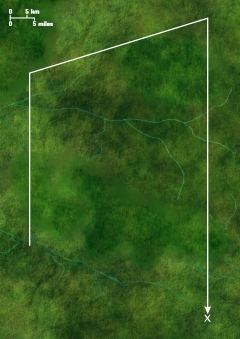
Sometimes, relatively complicated problems can be treated as a straight line and the results will be near enough. The map below right is clearly a very straight line. Given that a the length of this line is more or less 25+ times the length of the scale line, a 0.5mm margin of error in measuring the map scale adds up to 25×0.5=±12.5 mm or more in calculating the total length of the route described by the line, measuring from start-point to end-point. More than a 2 centimeters of error (on the scale of the map) – that’s plenty to swallow the error caused by the “crinkles” in the route. I would be quite happy to guesstimate that journey as being measured length + 2.5cm (I know that it will be longer than the straight-line distance because the route is all slight deviations from that straight line).

What’s more, the usual reason for needing a distance is to convert it into a travel time, and it’s most improbable that any mode of transport other than an aircraft will maintain anything close to an even speed (and, depending on the weather, not even an aircraft might be able to do so). Again, an error source that will more than consume any discrepancy from taking the simple straight-line distance.

*******************************************************************************************
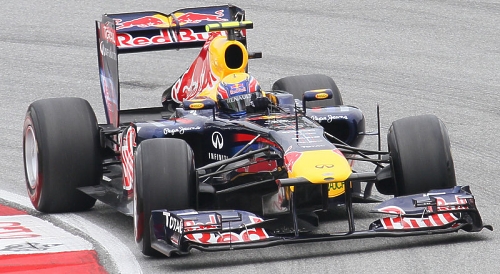
Mark Webber (Red Bull -Renault RB8), 2012 Malaysian GP.

Mark Webber (Red Bull -Renault RB8), 2012 Malaysian GP.

A side-note: people constantly underestimate the impact curves have on average speed.

It is a given that elite racing drivers are sufficiently skilled that they will take corner at the highest possible speed, and will therefore minimize the losses due to cornering in the course of a race.

I should start by saying that although there has been some improvement in absolute top speed (from about 300-310 km/h to almost 345 km/h) in grand prix racing cars over the last 20 years, by far the biggest improvement has come in cornering speeds, with some additional gains in acceleration and braking. On at least 6 occasions in that time, the authorities that control the series have slowed the cars down, by:

  • banning electronic driving aids and active suspension;
  • banning turbocharged engines;
  • banning exotic fuels and exotic fuel additives;
  • restricting aerodynamics and wing sizes;
  • banning super-sticky, super-fast, “qualifying” tires;
  • restricting the width of the tires;
  • banning V10s and mandating V8s;
  • mandating grooves in the tires;
  • restricting the ride height (the height of the cars above ground, which is a key factor in the aerodynamic efficiency of the car underside;
  • freezing engine development;
  • restricting in-season testing;
  • mandating a minimum life for components such as engines and gearboxes; and
  • restricting other (more technical) parts of the car design – and that’s a far from complete list.

Without these changes, mostly made on the grounds of safety, the cars at their fastest would be going considerably faster – perhaps 20-25 km/h or more in a straight line, and MUCH much more in corners.

I have chosen four Grand Prix to analyze from the 2012 season because (a) they offer a variety of circuit types, and (b) these particular circuits have not changed very much over the last twenty years, so a rough comparison becomes possible. Fastest speed varies with the aerodynamic set-up of the cars for the circuit and whether or not the straights are long enough for the cars to hit maximum speed. Also, all 8 races analyzed were run in dry weather.

  • Monaco Grand Prix: Tight, twisty street circuit, with very short straights. 2012 average race speed: 147.312 km/h. Highest actual speed recorded (in Practice 3, like all these speed values, because those are the only ones that seem to be publicly available): 281.6 km/h. Race speed is only 52.3% of maximum speed. 1992 Average speed: 139.337 km/h. Gain in 20 years: 5.7% speed increase.
  • Canadian Grand Prix: Slightly more open circuit with some tight corners and a variety of lengths of straight. 2012 average race speed: 198.028 km/h. Highest actual speed recorded: 324.7 km/h. Average Race speed is 61% of maximum speed. 1992 Average speed: 186.712 km/h. Gain in 20 years: 6%.
  • Italian Grand Prix: Fastest circuit on the race calendar; long, open and flowing. 2012 average speed: 231.176 km/h. Highest actual speed recorded: 345.4 km/h. Average Race speed is 66.9% of maximum speed. 1992 Average Speed: 238.855 km/h. Modern cars are only 96.8% as fast as those of 20 years ago – possibly because they take the corners at higher speeds, and hence braking and acceleration gains are minimal and straight-line top speeds haven’t quite caught up with where they were, but more probably due to race circumstances like pit stops. Slight circuit changes also factor in, as do many other influences.
  • Japanese Grand Prix: Fast, flowing, long circuit, with many medium-high speed corners. 2012 average speed: 207.632 km/h. Highest actual speed recorded: 309.6 km/h. Race speed is 67.1% of maximum speed. 1992 Average Speed: 183.808 km/h. Gain in 20 years: 13%.
Senna (McLaren-Honda MP4/7A) racing Mansell (Williams-Renault FW14B), Monaco, 1992. Note the differences to the RB8's Front wings, Rear Wings, and Nose - and those are just the most obvious differences.

Senna (McLaren-Honda MP4/7A) racing Mansell (Williams-Renault FW14B), Monaco, 1992

So, because of all those changes and restrictions, the cars are (mostly) going only a little faster than they were 20 years ago – and the average race speed is only about two-thirds of maximum speed. Corners that drivers used to have to brake for are now taken absolutely flat to the floor, such as the famous Au Rouge at Spa-Francorshamps.

It can be argued that when discussing ordinary traffic and obedience of the road rules, the losses due to cornering are reduced, because most corners can be taken at the legal speed limit. However, there are so many other causes of delay on a road with traffic that the variability is about the same.

The bottom line therefore, and the point, is that any given trip could reasonably take up to double the time at the posted speed limits, or 50% more than the time at the car’s top speed (if the speed limits are ignored) – even assuming good roads and weather – an error so large that any minor errors in measuring the distance to be travelled is irrelevant. And those are, very definitely, minimum adjustments.

Map 4s
So, a rough-and-ready measuring technique is quite good enough for practical purposes. What’s needed is a technique for doing so when the route to be travelled is a bit more complicated than these relatively simple ones, like the one to the right.

Well, I worked out just such a rough-and-ready technique a long time ago, and this article is going to share it with you, with step-by-step instructions.

Map Prep

Before you can use this technique, there are a couple of things you need to do to your map to prep it.

Step Zero: Print the map of the route

Since this technique leaves marks on the map, its best to work on a printed copy that can be thrown away afterwards.

Step One: Straight Lines

Using straight lines, I’ll then go over the route with a colored pen or texta, as shown:

Map 4 straight lines color -s

This should be done fairly quickly. Don’t bother with a ruler, just do the best you can, freehand. Hint: if you move the pen or pencil back-and-forth a couple of times along the line that you want it to follow keeping it just above the page, you’ll get much straighter lines when you lower it that last millimeter or so to the paper.

Of course, since this map is going to be thrown away when we’re finished, why waste a lot of ink on the printing? Make it a light grey and not only will you save money (if your printer is smart enough) but the colored marks we are about to make will show up all the more clearly:

Map 4 straight lines desaturated -s

Going The Distance

Next, I’ll prepare the essential tool – a sheet of loose paper, or better yet, an index card, and a sharp pencil or colored pen. 0.5mm markers are perfect for visibility but a pencil mark can be erased and redone.

*******************************************************************************************
Initial Position

Position a left-hand corner of the card at the point where the route whose length is desired starts, as shown:

distance 01

Pivot The Card

Pivot the card around that point until the edge lines up with the route. Wherever the route deviates from that straight line is the end of the segment that we’re about to measure:

distance 02

Mark the segment

Starting on the card, put a mark that runs off the edge of the card and onto the map:

distance 03

Pivot & Mark The Card

That mark becomes the new pivot point on both the map and the card. Rotate the card around that pivot point until it lines up with the next segment of the route and look for wherever the route moves off that line. Put another mark the same way you did the last one:

distance 04

Pivot & Mark The Card

Once again, the mark you just made becomes the new pivot point. Rotate the card around it until it lines up with the next part of the route and make a third mark – which then becomes your new pivot point, and so on:

distance 05

End Of One Side

Eventually, you will find that the remaining length of card is not enough to reach the end of a segment of the route. When that happens, extend the last mark you made on the card and put a distinguishing spot or mark on the end of it – I usually use a pennant-shaped triangle:

distance 06
Then position the next corner of the card at the start of the segment that wouldn’t fit – you’ll know where it is because it’s the last mark on the map – and carry on as before.

End Of The Card

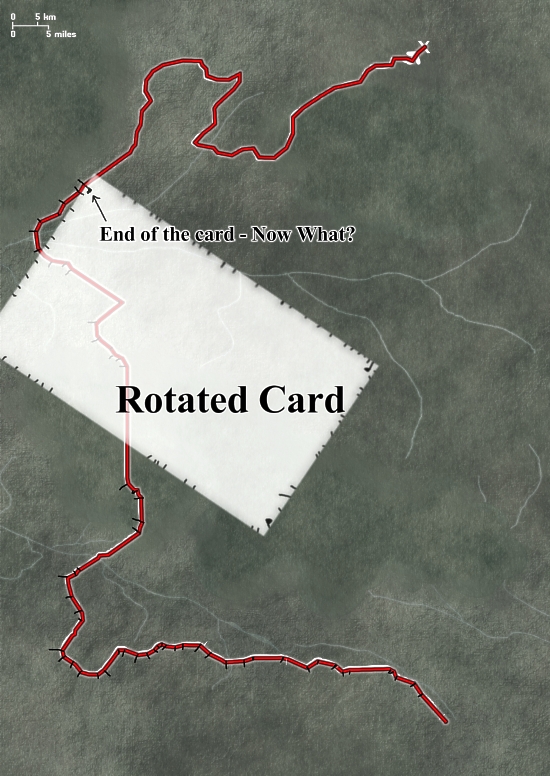
If the route is a long one, you may well reach the end of the card before you reach the end of the route:

Distance 07
There are two simple solutions to this problem: you can start using the same card sides again with a different color, or simpler yet, just turn the card over and start using the reverse side:

Distance 08
If that’s still not enough, you can do a subtotal, then cut off the edges of the card that has been marked, making a new (smaller) card and go again.

But a single 3″ x 5″ card will usually be more than enough for the most complex route printed on a single sheet of A4 paper – and letter sized pages are slightly smaller again.

Making the measurements

Once you have ‘measured’ the entire route, with all its twists and turns, on the card, it’s time to measure the card. Start in a top left corner and measure across to the first mark:

distance 09
Write down the result, then move to the next of the measurements:

distance 10
Eventually, you will have measured the entire route:

distance 11

distance 12

Conversion

But a distance in millimeters, or in inches and twelfths of an inch, or centimeters, doesn’t help much. Locate the scale on the map, as shown on the right:

*******************************************************************************************

distance 13

Conversion step 2:

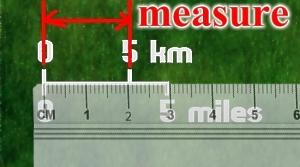
Using the same ruler or other distance-measuring device (so that internal errors remain consistent), measure the scale, as shown to the left:

*******************************************************************************************

Distance 14

Conversion step 3:

Next, note the relative distance that corresponds to the measurement you’ve just made, as shown to the right:

*******************************************************************************************

Actual Distance = Map Measure x Relative Distance / Scale Measure

Conversion step 4:

Next, perform the scale calculation shown above, and hey presto! Instant, reasonably accurate, measurement of the route distance – no matter how complicated the route might be.

*******************************************************************************************
Alternative to scale marks

Some maps don’t offer scale marks, instead stating the scale as a ratio, for example “1:250,000,000”. The trick to using this is to make sure you get your unit conversions right.

If you measure the map in millimeters, multiplying by the conversion rate gives you a number “in the territory” in millimeters – you have to divide by 1000 to get meters, and then divide by 1000 again to get kilometers.

If you measure the map in inches and fractions, multiplying by the conversation rate gives you a number “in the territory” in inches and fractions – you have to divide by 12 to get feet, or 36 to get yards, or 63,360 to get miles.

And, of course, there are 1.6 kilometers in a mile, if you need to make that conversion!

For example, if we measure 28.7cm of route on a map with a scale of 1:250,000, we multiply 28.7 x 250,000 to get 7,175,000cm – divide by 100 to get 71750m, then by 1000 to get 71.75km. Which I would round to 72 km without a second thought.

Accuracy

While errors can accumulate, the more segments you have, the more likely those errors are to average out. That makes this an extraordinarily accurate system – for its simplicity.

Efficiency

I have to admit that it took me most of a day to produce the graphics that you can see here, digitally. The early marks on the card grew fuzzier and fuzzier due to the repeated rotations of the virtual “card”. It’s a lot clearer, and faster, to use the real thing; a complicated route like the one shown might run as long as a whole 5-10 minutes of card twisting and marking.

That makes it one heck of an efficient system – but is the accuracy worth that amount of time investment when you could do something similar with the ruler and about 5 direct measurements plus a guesstimate?

Neat Tricks

The answer is yes, because there are a few really neat tricks that you can do along the way:

Neat Trick: Elevation

Most inclined roads have a gradient of about 1 in 10. A steep one might be one in 5. A really steep one might be one in four. Ordinary vehicles tend to have trouble doing better than 1 in 3, and that with a good road surface – if either of those are untrue, we’re getting into 4WD territory. Even a 4WD will struggle to get up any incline that’s steeper than one in 2.5, or maybe one in 2.

What does that mean? It means that as you mark each segment, you can adjust the length to reflect the incline. For 1 in ten, allow an extra millimeter for every centimeter or so. For 1 in 5, an extra 2 millimeters. For 1 in 4, an extra 2 1/2. For 1 in 3, about 3 1/2. For one in 2.5, an extra 4; and for one in two, 5 mm for every centimeter.

If you’re using inches, 1 1/2 twelfths every inch for 1 in ten; 2 1/2 twelfths for 1 in 5; 3 twelfths for 1 in 4; 4 twelfths for 1 in 3; 5 for 1 in 2.5; and a full half-inch extra for every inch (or so) for 1-in-2.

Neat Trick: Speed Demons

If whatever vehicle is being used is being driven at something close to its top speed with no regard for the road rules, then it will speed up on the downhill sections about half as much as it slows down on the uphill segments. If you know in advance that what you care about is the travel time, and not the distance, you can make allowances appropriately, shortening downhill segments and lengthening uphill ones. For heavy vehicles, the ratio is more likely to be about 1/3.

If, on the other hand, it is being driven to the speed limit, then it’s only on the steeper slopes that the vehicle speed will be affected. Anticipating what you need the measurement for permits you to make the adjustments that are most useful to you.

Neat Trick: Tight Corners

Similarly, if there’s a tight corner, you can lengthen those segments (signifying a slower cornering speed) to take those into account – that’s where that analysis offered in the sidebar earlier comes into its own, in terms of value. If the speed limit is 60, and the fastest you think the corner can be taken is going to be 30, you double the length of the corner segment. It takes a little practice to guesstimate, but with that practice, you can make these adjustments as quickly as you can make marks on the index card.

Neat Trick: Road Conditions

The same technique can also be used to allow for road conditions – rain, fog, snow, whatever. If you want to build in a traffic delay, you can do so – in a far more accurate way than arbitrarily adding time.

The more such additional variables you take into account, the more useful – and accurate – the end result.

Maximum Utility for your efforts

Again, with a bit of practice, you’ll find yourself becoming adept at determining how precise you need to be with your initial straight lines. The more of these little segments you create – and it’s those straight lines that you are measuring with the card – the more accurate the result; the fewer, the faster you can get a result.

As a rule of thumb, segments about the length of the scale marker on the map will be accurate to within 2 x (relative distance divided by speed) in hours.

If the scale is about 1 cm long for 5 km, then 1 cm segments gets an accuracy at 60km/h of 5×2/60 = 1/6 hrs = 12 minutes. Half cm long gets about 6 minutes accuracy. A millimeter long gets an accuracy that’s near enough to a minute.

Same scale at 120 km/h = twice the error. Being able to call a trip of 600-700 km on a complex and convoluted route to within 2 minutes travel time is plenty accurate for most practical needs – and not bad for a 5-10 minute effort.

The typical human eye is good for half a millimeter of accuracy without using a scale or comparison. An artist can often have finer resolution – my vision is accurate to about 1/10th of a millimeter by eye (I can see the difference between marks 0.4 mm apart and those 0.5 mm apart, by eye, and without a ruler). That’s plenty accurate enough to call a travel time of hours down to plus-or-minus 12 seconds if I had to.

Universality

With a little thought (and perhaps some research), you can use this technique with ANY form of locomotion. Horses. Carts. Walking. Motorcycles. Hovercraft. Duck Dodgers on his way to Planet X. Whatever you need.

And that makes it a useful technique to have in your repertoire.

Comments (3)

Breaking Through Writer’s Block Pt 1: Types Of Writer’s Block and ‘Blank Page’ Syndrome


This entry is part 1 of 7 in the series Breaking Through Writer's Block

1-1077693_30363053
I’ve long thought that the term “writer’s block” is an oversimplification and generalization of a whole range of different phenomena that can afflict the creative endeavor. I have a unique perspective on the subject, being a writer, an artist, and a composer; all three bring with them virtually the same problems when confronted with an empty page, a shortage of ideas, or an apparent inability to get what’s in your head down on paper.

After breaking down the types of writer’s block, I was able to list a range of subtypes to the phenomenon, and identify the solutions that I use to get past them. In fact, I identified so many solutions that what was originally going to be a single quick article has turned into a five-part monster! In total, this series will present no less than 64 specific cures for 19 specific forms of writer’s block. (I say “no less than” because I’m still finding additional cures and slotting them into place!)

Be aware, though, that this list – long though it is – is far from exhaustive. The “three minute (or less) NPC” isn’t on the list. There’s virtually no overlap with the “great villains” series which looks in detail at The Mastermind as a villain, Combat Monsters, and The Character Villain. I’ve left out one of my favorite tools, The Thumbnail Method and in fact the whole Characterization Puzzle series – simply because they have appeared before. I could keep extending that list, because an awful lot of the content here at Campaign Mastery is about techniques for generating content for your game, or improving it. And while all that is related to the focus of this series, it isn’t the subject at hand.

Major Types Of Writer’s Block

There are four major types of Writer’s Block that I intend to focus on in the course of this series. They are:

  • Blank Page Syndrome – Coming up with something to write about;
  • Primary – Conceptual holes of varying degree;
  • Translations – Technical & Process holes, and quick answers when you need to Improvise;
  • Crowding – Too many ideas, and coping with the Fallacy Of Memory.

Each of these can be broken down into subtypes.

Blank Page Subtypes

Blank Page Syndrome is what most people think of when they think of writer’s block. It’s when you sit and stare at a blank page and nothing comes into your head. I’ve identified two subtypes of this type of Writer’s Block:

  • Standalone – When nothing is known about the content that is required, which is rare for RPGs, but common when all you know is that you want to write a story or a novel; and
  • Isolated – Where some ingredients are known, but you have no idea what to do with them. This is far more common for RPGs and series of all sorts, for obvious reasons.

Primary Subtypes

I developed this breakdown of places where the writer could “break down” by considering the process of writing itself, from vague notion to completed text. You’ll see what I mean when you look at the actual list of subtypes; they are all about moving from the general to the specific.

  • Conceptual – When you have a more complete starting point but no plotline;
  • Specific – When you have a broad plotline but don’t know what specific event comes next;
  • Setting – When you have a specific event but need a place for it to happen;
  • Action – When you don’t know what a character will do next;
  • Persona – When you have an event planned but need a personality to participate in it;
  • Dialogue – When you have a participant in a conversation but no idea what they will say next; and
  • Narrative – When you have information to convey but have no idea how to explain it clearly.

The need to come up with something for the next page in any of these categories can be a mental road-block on the creative highway.

The occasions when this comes up most frequently for me – I can’t speak for any one else in this respect – is when something is present for plot reasons and not to serve a specific function in the current story – which, by virtue of the plot breakdown/integration techniques that I use, happens regularly. “Subplot: Introduce Character X” or “Subplot: Introduce Location X”, or “Subplot: Development in plot arc X” or “Reminder of unresolved plot arc X” – things like that crop up all the time. But these brief notes tell me only that something is required to happen at this time, they tell me nothing about what that “something” should be.

As an aside, that gives some insight into the difficulty of writing on this subject; at this point, I should probably link to all the articles I’ve written on plotting and plot sequencing, like the recent one entitled “Amazon Nazis On The Moon: Campaign Planning Revisited” and “The Seven Strata Of Story“. Articles on Writer’s Block are a sponge that soaks up every other discussion you can have on a subject; before you know it, the topic is as large as the entire literary universe, so large that the sheer scope of it makes the discussion impossible to manage. I’ve had to work very hard on confining the subject to manageable limits!

Most of the solutions to the primary types of writer’s block assume that you can devote time to the solution – I’ve still leaned towards quick solutions, because time is precious and prep-time especially so, but when you need to take five or ten minutes, you can usually do so, even if it means that something else doesn’t receive its usual polish; it’s better to have something concrete for the difficult parts and be able to improv the parts where you know what you want to do.

Translation Subtypes

My initial thinking was that the primary subtypes were all about generating content of the required type, while this major category was more concerned with taking the content from a prior primary content type and extending it downward to another subtype. Only when I started listing cures did I find that this distinction was entirely artificial, except in two respects: technical problems, relating to the author’s proficiency as a writer, and on-the-fly content for those times when we need to improvise something on the spot, or close to it. For example, the first category deals with translating from a vague general idea to the series of specific scenes or acts that are needed to express that idea; this is in no way different from generating specific scenes, and is therefore covered under the lower level of primary subtype already listed.

So the translation subtypes lean towards quicker, more rough-and-ready, on-the-spot, solutions. Don’t worry, I still found plenty to talk about!

The specific translation subtypes that I came up with are:

  • Translation: Conceptual to Specific – When you know what you want to have happen in general but don’t know how to get there from here;
  • Translation: Specific to Scene – When you know what the next part of the story is but don’t know how to manifest it;
  • Translation: Specific to Setting – When you know what is to happen next but can’t find the right location;
  • Translation: Specific to Action – When you know what is to happen but can’t describe the action;
  • Translation: Specific to Persona – When you know what is to happen but can’t visualize who is to do it;
  • Translation: Specific to Dialogue – When you know what the dialogue is to convey but it sounds forced;
  • Translation: Specific to Narrative – When you know what the situational context is but can’t describe it clearly;
  • Translation: Scene to Action – When the location and the action don’t seem to gel;
  • Translation: Action to Narrative – When you can see the action in your head but can’t describe it fluently; and,
  • Translation: Persona to Dialogue – When the dialogue doesn’t seem right coming from the character speaking.

Once again, each of these can easily derail the creative process and leave you sitting around with your chin in your hands and a blank look on your face as ideas avoid you in droves. This is especially bad in a “live” improv setting, when you don’t have any time to spend coming up with a solution.

That’s my breakdown of the types of writer’s block, and forms the road map to this series.

  • In the remainder of this first article, I offer 4 solutions to each of the subtypes of Empty Page Syndrome, which can also be thought of as “traditional writer’s block”.
  • In part 2, I will look at the first half of the Primary Writer’s Block subtypes, and offer cures for the problems of Conceptual, Specific, and Setting Blocks./li>
  • In part 3, I will finish the discussion of the Primary Writer’s Block subtypes, and offer cures for Action, Personality, Dialogue, and Narrative Blocks.
  • In part 4, I’ll move on to the Secondary Subtypes, and offer solutions for five of them.
  • Finally, in part 5, I finish up the solutions to the Secondary Subtypes, and move on to the Crowding Subtypes, and cures for those. I’ll then wrap the whole series up with some well-meant general advice.

As one of my players is want to say on the periodic occasion, “That’s the plan; tell us where it goes wrong.” So let’s get started…

Empty Page Syndrome: Standalone

There is nothing so scary as an empty page when you have no idea what you can use to fill it. I’m going to talk specifically about Fear and Doubt at the end of this section. This is the “purest” form of writer’s block, and the one that most people think of when they hear the term; it’s also the source of that most vexing question, “where do you get your ideas?” – which I’ve heard more times than I can count at Science-Fiction conventions and “meet-the-author” sessions and interviews. I talked specifically about that question and the many responses that I’ve heard in By The Seat Of Your Pants: Six Foundations Of Adventure, where I discuss where I got my ideas from back in the days when I normally had zero prep time other than the trip to the game itself.

“Standalone” means that there is a completely blank slate apon which to write. This can be liberating, because you are not tied down to past works in any respect other than those you choose; it can also be inhibiting, because there is nothing on which to spark inspiration. It’s rare for this particular type of writer’s block to impact on an RPG, but it can happen – when you are creating a new game system, or a new campaign. It’s far more common for this to strike when you are dealing with other forms of writing – articles and short stories and novels and scripts and poetry.

The biggest mistake that writers – of anything – make is sitting in front of a blank page and waiting for inspiration to strike. By definition, a blank page contains NO ideas, NO inspiration – it’s empty (unless you can do something with the concept of emptiness itself, of course). So sitting and waiting for something to magically appear on that empty page doesn’t get you very far.

I have five cures – or six, depending on how you count them – for this type of writer’s block to offer, in addition to the six offered in the article referenced above.

Cure 1: Start with an opinion

Everyone has opinions. It could be about society, social issues, crime and punishment, business practices, a food preference, medical quackery, a television show, the weather, politics, religion, sport – you name it. Step One of this cure for writer’s block is to pick one of those opinions. Any of them.

Step Two is to generalize it. Take it from being your subjective opinion to being a broader opinion held by many others. Take it from being about one specific example – “I hate broccoli” – to a broader subject “some people hate green vegetables”.

Here’s the tricky, or perhaps I should say ‘clever’ bit: Step Three is to assign a new context to the opinion. Off the top of my head:

  • What’s the evolutionary advantage in people having likes and dislikes?
  • An man is selected as ambassador to a highly-developed plant-race because he doesn’t like salads, and is therefore less likely to offend them. Unknown to the authorities who chose him, they practice ritual cannibalism.
  • How do people’s preferences change over time?
  • Orcs don’t eat beanz.

Final step: write about it.

Cure 2: Start with a word or common phrase

Pick a word from a dictionary or a thesaurus. What does it mean? If applied to a different context, what might it mean? If its a word related to human behavior or activity – and almost all non-nouns are – how might its meaning change when considering a non-human society? What is “property” to an Elf, an Orc, or the Slime-people of Betelgeuse VII? What role does “value” have in human society? Ent society? Goblin society? What would an Artificial Intelligence value, how does that differ from what its creators value, and how might their interactions with each be affected? How does the word change when you add emphasis (some do)? Pick something of interest, then write about it!

Pick a common saying or phrase. Again, apply it to a different context. “Dressed To Kill” for example – that has multiple meanings even in human terms, depending on who is doing the dressing and whether or not “Kill” is meant literally. What new meanings might it assume in a non-human society? “In Style” – humans have fashion tastes that change regularly; keeping up with the latest style is expensive, and therefore always being ‘fashionably dressed’ is a mark of wealth, especially in olden times. What might the equivalent be? “The trolls are wearing their breach-cloths long this year.” Why?

Cure 3: Pick a random paragraph or line from a random source.

Grab a book or other source of text. Open it to a random page, and pick a passage of text randomly. Put it into a new context. Describe that context, then throw away the original paragraph or passage. Insert characters, and let them react to the situation.

“Harmony in music can be defined as any combination of notes that are played together at the same time.” The key words are “harmony”, “music”, “notes” and “time”. “Harmony in a meeting can be defined as any combination of suggestions that are put forward at the same time for the same purpose or achieving the same goal.” So we have a meeting, and a number of suggestions being made. These may be at cross purposes (lack of harmony) or in synch (in harmony). But people are more complicated than music – and a suggestion may be aimed superficially at one end while its true purpose may be something quite different. Start filling in the blanks and unknowns and you will describe the context: what is the superficial goal, and what is the real goal? What’s the backstory? Throw away the original text, put characters into the situation, and you have the beginnings of a story.

Instead of inserting characters, you could think about some attribute or aspect of the situation in general, or as applied to a particular group. You might take that same quote (it’s a line from “Music Composition For Dummies”, by the way) and do some research on the definitions of musical notes, which would lead you to the concept of intervals (which describe how different one note in a scale is from the next in a particular key), and to the discovery that other styles of music use different intervals – but that they are all regular ratios of each other when expressed as a constant, audible, frequency. Before you know it, you have spent ten minutes identifying the respects in which human music might differ from non-human music. And that’s an article. Or, if you apply it to a succession of non-human societies, a whole series of articles.

I recently offered as a free download an MP3 of my composition “Ogre” which was supposedly an example of the style of Music performed by the Ogre Clans in Fumanor. (You can get it from if you want it). What wasn’t stated at the time was a lot of the compositional context – the fact that making music was a community activity, and that Ogres are offended by the notion of excluding potential performers due to a lack of skill. They all have to contribute something to the performance. (Actually, it was a community Male activity, while singing is restricted to the females, who don’t ruin their voices with a lot of shouting). Those couple of lines, and the music itself, offer a window into one possible Ogrish society. How is elvish society expressed musically? Choral arpeggios? Wind instruments? Is “Greensleeves” the most quintessentially Elvish piece of music in existence in your campaign? Perhaps Drow go in for brass instruments instead?

I can talk about all this off the top of my head because I know something about music as a subject. That’s why that book was on my bookshelf in the first place. It follows that if YOU grab a book at random off your bookshelves, it will almost certainly be on a subject that you know something about, and can therefore write about.

And, if you come up dry with the line or paragraph that you selected? Pick another source, and choose another line. The objective is to stimulate your creativity with a topic or situation, a starting point.

Cure 4: What’s the first thing you can remember right now?

There are three factors that make a memory more accessible: routine, recency or personal significance. Skip the trivial – “I remember staring at this blank page”, “I remember making a cup of coffee”, and so on; pick a memory that is less immediate. My first ones were “My mother phoned to tell me she and my stepfather are back from their Holiday in England, where they met a whole bunch of long-lost relatives”; and of my Grandmother, cooking.

Why is it significant to you? Go beyond those three factors and keep asking “why” until you have the core truth of that memory nailed down.

What might someone else find significant for the same reason? Write about that something else as a way of introducing someone who cares about it.

If that doesn’t get you started, write about someone else’s memory of the same thing as a way of introducing a character, and their backstory. “I remember my grandmother’s cooking…” is a perfect way of starting a story – and because it’s a memory that YOU care about, that passion should make its way onto the page with conviction that sells the story and compels the reader to keep reading. – because they will associate the scene with their own memories and personal history. You engage their emotions. Where you take those emotions from there is up to you.

Cure 5: Maintain an ideas stockpile

I talked about this technique when I wrote One Word At A Time: How I (usually) Write A Blog Post, and have mentioned it in passing on a number of other occasions. I’m not actually going to go into it in any detail here; I’m saving it for a detailed discussion in the “too many ideas” section, which will be in Part 5 of the series. Suffice it to say that if you have a list of ideas that you add to whenever you think of a new one, and only draw from when you need to, you will soon have ample ideas for a long time to come. Pick one and start writing!

A Brief Word About Fear and Doubt

By far the biggest writer’s block is fear and self-doubt. Writers continually agonize over the quality of their work, and whether or not it is worth reading; every negative comment is a razor that cuts deeply into the creative soul. Non-authors often think that these nerves will ease over time, especially if that time is filled with a profusion of successes; it doesn’t work that way. The longer a streak of success continues, the greater the pressure to maintain that streak; in time, you either find yourself compromising your creativity to maintain an increasingly bland popularity (playing it safe) or you maintain your artistic (literary) integrity and continue doing the best job that you can – taking the risk that others will find it less appealing because it’s not just “more of the same”. A lot of authors have one successful book or story and become paralyzed by the question “can I do it again?” – and don’t try, for fear of failure.

Some writers are able to value positive feedback in equal measure to the negative; others can dismiss the negative with “everyone’s entitled to their opinion, and I don’t happen to agree with that one”, while others devalue positive feedback while agonizing over those who are more critical. Writers tend to be a neurotic lot – especially after they have been writing for a while. In my case, I value positive feedback more highly, but find it has a more fleeting effect than negative comments, which tend to fester for a while. And I’m sometimes extremely defensive toward negative comments because of that.

It’s especially easy to concede defeat by fear and doubt when you’ve been working on something for a while and hit a dry spell, where everything you write seems rubbish to you, or when you discover (in a non-fiction item especially) some fundamental error that requires throwing away a lot of work. Sometimes, the sheer scope of trying to pick up the thread of where you were up to before a forced interruption can be enough of a handicap to induce writer’s block. I suffer from that last problem all the time – that’s one reason why I have so many unfinished RPG books, and so many unfinished article series here at Campaign Mastery.

The cure for these problems is the same: archive where you were up to, and then – just write.

If it’s rubbish, you can throw it away. People will respect you a lot more for saying “I wrote an article for this week but it turned out to be rubbish and not worth publishing” than they will if you make an excuse (“I was too busy”) or simply don’t post anything. Save those excuses for when they are the gods-honest truth, and you will be forgiven – if you don’t make a habit of it. The respect comes from being self-critical.

Better yet, if it’s rubbish – publish it anyway, with a caveat. Not all people have the same taste, and your “rubbish” might appeal to a whole new market. By showing that even a successful writer gets it wrong some of the time, you encourage others by presenting an achievable standard – and they might well be better at it than they think (that’s their self-doubt coming into play). And you can never tell when someone will read it and think, “there’s the germ of a good idea in there, but I can do better than this with it” and be inspired.

I once read somewhere that no-one can truly evaluate the quality or significance of their own work, only the level of their satisfaction at having written it – and the two have nothing to do with each other. It’s something I happen to agree with, so don’t let fear or self-doubt stand in your way.

Empty Page Syndrome: Isolated

When you’re writing a series, or adventures for an RPG, this form of writer’s block is more common than that of the previous type. This is when you have some known ingredients, but they exist in isolation; you have no idea what to do with them.

The following cures for this problem are presented in addition to the techniques presented in “Been There, Done That, Doing It Again: The Sequel Campaign” (Part One, ‘Adventure Seeds‘ , Part Two, Sprouts and Saplings).

Cure 1: Find something relevant and describe it

The tricky part of employing this solution is that annoying word, “relevant”. A character might be relevant; so might a personality, or a single personality trait, or a relationship, or a location. It all depends on what the raw ingredients are that you have to work with. Whatever you choose is likely to become the focus of the adventure or plotline, so it is probably best if it is something that has not had a great deal of exposure so far, and preferably something for which you currently have no plans for future exposure. If two characters have a personality trait in common but don’t know it yet, that’s a great foundation to work from – but not if you already have plans for that particular revelation.

A useful variant involves “finding something relevant” using the internet. When you do this, “relevant” includes “symbolic”, which is not always the case – the term is usually meant more literally. For example, one of the characters in the pulp campaign is a sea captain, ex Royal Australian Navy; plugging “sea captain mystery” or “sea captain controversy” into Google and looking at the first couple of web results, or plugging it into an image search and finding an image that’s inspiring, can get you started on a fresh plotline.

Another source is music, and especially song lyrics. Again, the trick is to find something that’s relevant. The Split Enz song “6 months in a leaky boat” always comes to mind when I think about ships and music, a core part of the chorus reads “I spent six months in a leaky boat, lucky just to keep afloat”. This is from the album “Time and Tide” – perhaps an adventure relating to tides within the time-stream? Another song on the album is “Dirty Creature” – that might have something to do with why the character in the song spent “six months in a leaky boat”. Free associate with related elements until you have some starting point; even if you subsequently throw out those initial thoughts, once you have a beginning, other ideas will start to flow.

Cure 2: Describe something you DO know in a different way or from a different perspective

An example of the first: How might a circuit board look to an electron travelling through it?

An example of the second: “History is written by the winners”. Assume that a past event or adventure (that the PCs appeared to win) was actually a win for the antagonist without changing the outcome – then figure out why that might have been so – and why no-one in the campaign has noticed until now.

A second example: “3010” is “666” in base six, and looks suspiciously like a date. Computers work in bytes, and there are 8 bytes in a bit, and 666 in base 8 is 1232 – which also looks like a date. Does that mean that the apocalypse for computers was in 1232? Or that it will come 1232 years after the first one was created? That would be 1941+1232=3173, which is 63 years after 3010 – does that mean an automated post-apocalyptic paradise for thinking machines after the human apocalypse? If all this seems half-baked, it makes as much sense as the “2010 Mayan calendar end-of-the-world” – or at least 100 previous predictions of the apocalypse. Don’t believe me? Check this long list of predicted apocalyptic dates – I draw your attention in particular to the one for 500 CE, i.e. the year 500. Now the fun part: find a way to use the idea. A cult that believes it, for example, and wants to destroy all computers to prevent it, thinking that 3010 is the date the computers will revolt against humanity. Or maybe an AI that believes it.

Again – once you have an idea, it will get you started. Once you get started, you can throw that idea away if something better comes to mind.

Cure 3: Look for a context in which the something is incorrect or out-of-place – then describe it

We all make mistakes. Logic mistakes; rules interpretation mistakes; personal mistakes. Well, that last one is of no real help using this solution (but it is useful in a variant, which I’ll get to in a moment); so let’s focus on the first two. Pick a mistake, then figure out what would have been necessary for the call / decision that was made to be correct, even if that reason’s basis wasn’t noticed at the time. In other words, retcon history to show that you didn’t make a mistake, but find a way to do so that doesn’t invalidate the subsequent game play; then have the consequences lob up in the new story.

The best example I can offer of this technique was the “Emperor Of China” which I described in “My biggest mistakes: A slip of the tongue” back in September of ’09.

Put your mistakes to work on your behalf, and they won’t seem quite so bad. They certainly aren’t doing anything positive for you until you do!

Cure 3A: Personal Mistakes

These yield a story when you have someone else make the same mistake. You have two choices: A PC has made this mistake without realizing it, or an NPC has/will make this mistake in the course of the adventure/story that you are about to write.

Just be aware that the story of your personal mistake, and its consequences, is very likely to come out in the course of play, and this can be embarrassing or worse (depending on the nature of the mistake).

Be very careful about using a personal mistake by someone else, especially one of your players – this can be perceived as being judgmental, and of revealing secrets, and remind people of things that they would like to forget.

Quite often, the things we regret are the formative experiences that make us the people we are. Use that.

Cure 4: Start with an unknown

There’s not much more stimulating than to realize that there’s something you don’t know – and then fill that gap. I didn’t know how the Orcish Clan Wars were going to play out in the “Orcs and Elves” series – I just knew that I started with one set of circumstances and that a war between the three major clans ended in another set of circumstances. I don’t know how the specific insecticide in my can works – but maybe there’s a plotline there when I find out. I don’t know how Tesla’s bladeless turbine works – but it sounds a bit like the bladeless fans that you can buy these days, and maybe there’s a story there. What could be done to the Solar Wind using a larger-scale version of that technology? I don’t know but the idea is reminiscent of E.E. “Doc” Smith’s “Sunbeam” (in the Lensman series). I don’t know how Bulgarian politics work (to pick a country at random) – but maybe there’s a story there.

Find something you don’t know, invent the answer (doing appropriate research) – then work the result into a story or adventure.

Cure 5: Start with a relevant question

This is very similar to the previous cure, but it is more focused. You’ve got six basic questions to work with: Who, What, Where, When, How, and Why. The question should relate to the past campaign or to one of the known elements. Can the laws of similarity and contagion be used (in a sufficiently flexible magic system) to connect a video recording of an object with the object itself to sharpen the image of that object on the video screen? This was a question that was posed in the most recent Zenith-3 scenario by an NPC to the PC Mage (who was absent that day, unfortunately). The answer was ‘yes’. What are the limits of this new capability? Those remain to be discovered – but there are some reasonable limits that I have put in place within the campaign. Is any of this covered by the rules? Not really.

Cure 6: Start with a relevant opinion

Finally, I’m going to return to the place where the solutions to this particular major type of writer’s block began: opinions. Pick an opinion about something – it could be yours, or someone else’s. You can either support it, counter it, or change it.

Supporting it works well if the opinion is that of one of your players or his character, but that accord leaves little room for conflict, and its the conflict that is usually at the heart of a good story. Having someone (an NPC) agree with the character’s opinion and using it to justify actions that the character can’t support is more interesting.

Opposing it works well if the opinion is that of one of your players or his character, because it automatically creates the conflict; just put that opinion into the hands of an antagonist, and start bringing the two together.

Changing it works well in some cases, especially where the opinion is related to some element within the game or background. “Character Type X is boring” you say? Okay, change that. Reshape that character type to make them non-boring. “Orcs are primitives”? Give them a culture. Do some research on “primitive” cultures and you will quickly find that their societies can be just as complex as our own. When I started GMing, Orcs were barbarians barely above the level of cavemen. The Clan-wars installments of “Orcs and Elves” show how radically that opinion of mine has changed. That made Bugbears savage primitives – until I started writing about their culture in that series, and suddenly they became deep and complex.

Next Time: In part 2, I tackle three of the Primary types of writer’s block: Concepts, Specific Events, and Settings for those events to occur in. But that might be in two weeks; I’m currently thinking of staggering entries in this series a fortnight apart to make room for other subjects.

Comments (10)

On The Origins Of Orcs, Chapters 63-65


This entry is part 24 of 31 in the series Orcs & Elves

19 Munich

I’ve got so much campaign prep to get done that if I don’t do it here, I’ll never get it done in time…

For those who read the player-redacted version of The Ages Of Existence (presented in Inventing & Reinventing Races in D&D: An Introduction to the Orcs and Elves series part 3), it should be clear that the story is now deep in The Age Of Genocide, as humans call it. In contradiction to the human history, the Age Of Empires starts before the Age Of Heresies and continues straight through into the age of Genocide. But humans have always thought their own history is the more important than that of anyone else.

That might give the impression that we’re only about half-way through, but as the Ages grow more recent, they also get shorter – which means that I expect fewer chapters per Age. Even with the fact that this entire Orcish side of the story was originally only supposed to be three chapters – not the 17-or-so that it has turned into. Two more weeks should get us past that part of the story, at least.

What’s more, as they advance, there’s more that I can do with a copy-and-paste from existing materials, and there’s less critical info that the players don’t already know – so I can get a lot more compressed. All of which means there should be more chapters per week and fewer weeks to the finish. My best estimate is that the Orcs and Elves series is 70-75% complete as of the end of the end of the Orcish Clan Wars. And that’s a good thing – fiction, even of the campaign background sort, is a LOT more work than a non-fiction article of the same length!

Just thought I’d offer that as a time-check for those looking forward to my posting something else on these Mondays.

Oh yes, one more thing. Once again, this is very much a first draft, as can be discerned from the over-use of “signaler” and “signaling” in Chapter 64.

*************************************************************************************************

Chapter 63

Clan Wars X: Huyundaltha On Tour

When Corallen set the Huyundaltha aside and taught them how to use their sheer “Elvishness” as a weapon in the defense of their race, he did more than simply create and educate them in a new fighting style and philosophy; he gave them new abilities that set them somewhat aside from their kin. Although the majority of Elves did not know it, the Huyundaltha were not simply a vocation, they were an entirely new sub-race of Elves – one that members of the core race could aspire to and join, for the differences between them were artificially imposed.

One of those gifts was a sharing of spirit, an ability to call apon each other’s reserves of stamina, clear-headedness, and resolve, of strength, nimbleness, and fortitude, and yes, of Elvishness itself, in time of need. Because it was contrary to their purpose for being, this was never revealed to even the most senior members of the Elvish Race; it was a secret known only to the Huyundaltha. When the inherent potential for bloodlust was aroused amongst the Huyundaltha expedition against Molgoth and his Cult Of Stone, those tainted by that disease of the spirit were not merely those present. While most remaining Huyundaltha were able to wall themselves off from it as anathema to their very Elvishness, they could do so only by sacrificing some of their own, drawing apon the spirit of Elvishness within them to protect the whole while leaving those donors unprotected.

Had there been warning, these donors might have been restrained. The reaction of the majority was instinctive, a part of their being. Twelve Huyundaltha gave of their souls and were corrupted in order to save the majority. These twelve were able to call apon the will and sense of purpose of their fellows to restrain their craving for blood, violence, and mayhem long enough to remove themselves from the conflict. Not to put too fine a point on it, they fled, lest their bloodlust turn them against their fellows. They had no inkling that this very bloodlust would become the key to victory against Molgoth. By the time the Demonic Agent of Chaos was destroyed, they were several days removed from the Elven Forest, on a self-imposed journey in search of redemption. They were listed as casualties of the final battle by their fellow Huyundaltha and, in its own somewhat existential way, that was truth.

They felt that destruction, even at that distance, and much of the insatiable need left them with that event; they had come to their senses, but still felt corrupted, tainted, by what they had experienced. Seeing themselves as condemned by their betrayal of the principles for which they stood, they remained resolute in their determination to exile themselves until they could achieve redemption. Travelling as surreptitiously as they could, feeling keenly that they were in hostile territory, they had observed parts of the Clan Wars of the Orcs, and pondered the meaning of events, and the motivations of those involved. They knew virtually nothing of Orcish Society, its organization, clan distinctions, and tensions; they perceived a monolithic culture inherently prone to violence. But their own recent experience opened a window to understanding and sympathy, and as they travelled through the Orclands and saw ample evidence of that propensity for violence, they also observed many acts of kindness and humanity that struck a familiar chord. A mother nursing her child; a beloved grandfather mourned; one sibling protecting another. Orcish society might be martial, and uncaring, and even cruel; but it was not inherently evil, and many Orcs had values in common with more civilized cultures. Perhaps there might even be sufficient common ground for eventual peace between Elves and Orcs.

This thought was something of a revelation to the Huyundaltha, and they decided to explore it further; they had no need to be anywhere urgently, and could linger over each new discovery for as long as desired. Those who dwelt in the walled cities were clearly the most civilized of the Orcs, and so they made the choice to watch events unfold and observe these dwellers in cities of stone. They had watched the betrayal of the alliance by the Bleeding Swords, had watched the division of the Army Of The One Eye, and had watched as Gruumsh exhorted the remnants of that army to cast the spells that would summon his army from beyond the sky.

This last development they had seen as greatly troubling, for the members of that army were not unlike Infelstreta, that which humans would term Demons. And then, their Elven Sight, enhanced by their nature as Huyundaltha, felt the first stirrings of the preparations within the city to repel the army encamped at their doorstep with forbidden magics, and knew they had to investigate. Entering the tunnels carved out by the Troglodyte Sappers at the commencement of hostilities, they had found the first Orcish Guard in sight and surrendered to him, demanding to be taken to the rulers of the city.

Chapter 64

Clan Wars XI: The Improbable Alliance

Of course, The Huyundaltha did not explain all of this to the council when presented to them under guard. They spoke of fighting a great evil, and of watching their neighbors, and the common ground between Elves and Orcs that they had unexpectedly observed, and of witnessing the conflict between Orcish factions, and – lastly – of sensing the casting of forbidden magics within the walls of the city.

The council of Orcs refuted the statement, and declared the Elves to be liars, and untrustworthy; the council admitted to ordering preparations made, but had not ordered the rituals to be commenced. The Drow Ambassador, Tathzyr, sneered at them, taunting them with the fragility and improbability of their story. This infuriated the Huyundaltha, who seized the weapons of the guards who held them and moved to attack the Ambassador, the expressions on their faces showing that they relished this turn of events. The Guards attempted to impose themselves between the Huyundaltha and the Clan Council, but the Elves danced between them as though they were no more mobile than trees and closed on the Ambassador.

This turn of events astonished Tathzyr; violence had never been the first resort of choice of his surface kin, and when driven to it, they never exhibited such savage glee at the prospect. Belatedly, he realized that these are not like any other elves of his experience, they stood astride both Elvish and Drow natures, sharing a little of both. A squad of archers armed with crossbows emerged from the shadows and took aim at the Elves, as the Clan-Chief instructed them to put up their arms, the Drow was under the Council’s protection.

Before the elves could respond, a messenger burst into the council chambers, covered in blood. Without waiting for instructions to do so, he reports on the beginning of the Divine Battle on the plains before the city walls, and the citizens of the city are in panic. The Shamans have a strangely glazed look, and have become motionless where they stood, as rigid as statues, and the rituals are enacting themselves without Orcish participation, and he has had to fight his way through the streets to warn the council.

The Ambassador was forced to concede to the council that it sounded very much like their visitors may have been correct, as improbable as it seems. Since they were now as trapped within the city as the rest of the populace, perhaps common interests should be set before ingrained hostilities, as unnatural as that might seem – in the face of the greater unnaturalness that confronted them all – and told everything.

The Clan council mulled this over for a few moments, but the bloodied figure of the messenger, now swaying with exhaustion, served as a sobering reminder and spur to decision. The council demanded the Elves give their parole, and the Huyundaltha agreed. The Ambassador then gave a compressed briefing that synopsized circumstances and events with great economy, and the leader of the Elvish band was accepted as another Advisor to the Clan Council. The most unlikely of alliances began with a council of war.

Chapter 65

Clan Wars XII: Council Of War

It might seem, to those who were not there, that the greater intellectual capacities of the Drow and Elves led them to dominate the council, but this ignores several important facts. While the Ambassador was arguably the most intellectually-gifted participant, he had limited understanding and less awareness of magic, much to the surprise of the Elves. The Huyundaltha possessed that awareness and as great an understanding of arcane and spiritual magical forces as could be boasted by any non-practitioner of the arts, but they were unfamiliar with the society, and were few in number. They were a martial order, but one trained to react and work in unison without need for lengthy and involved communications, almost by instinct; their training and abilities, by their nature, were not suited to operations in concert with members of other races. The Orcs, by contrast, were not merely a martial order, they were a martial society who practiced warfare as a professional art-form, and who had developed techniques for doing so in companionship with other races, and the clan council was comprised of the most gifted practitioners from amongst the clan. They were not merely muscle, they were experts, and this was their clan and their city, and that expertise enabled them to participate in the council of war as equals.

Sidebar: The Elvish Sight and Magic
Although at the time noted merely as a fact to be puzzled over when opportunity presented itself and accepted in the meantime, it is worth a brief diversion from the narrative to explore the inability of Ambassador Tathzyr to sense the ‘forbidden magic’ as did the Huyundaltha.

Only in recent times has it become clear that from the moment of division, Lolth began blocking her subjects from their training in the use of this sense. Some records suggest that she sought to transform this ability into another sense, akin to the first, but more adapted to the underground life of the Drow. Without training, “elvish sight” immediately began to stagnate amongst the Drow.

It is now believed that this was deliberate on her part and intended to aid her subjects in seeing her as a single divine being, forgetting her origins – and any vulnerabilities that this true nature might have entailed.

The few throwbacks who emerged in each generation were discovered at birth; the females were inducted into the priesthood, under Her direct control; the males were inducted into the Mages, a caste that were ruthlessly dominated by the rest of society, or marked as sacrifices to be killed in her name in stylized rituals.

It is often speculated that the lack of this sense was fundamental to the difference in character that can be observed when comparing Elves with Drow. While Elven sight can be used to sense arcane and spiritual forces, its primary function is as an awareness of life force and the bonds between all living things. This perception makes the Elves feel themselves to be a part of the natural world, its absence permitted the Drow to perceive themselves as dominant over nature, bending it to their will, and capable of acts of villainy and cruelty beyond anything that could be imagined by their Elvish kin.

There was little that could be done about the rituals casting themselves save to monitor events, and that was of little use if reports could not reach the council; messengers having to fight their way through the streets was entirely too problematic, proposed the Huyundaltha. The Orcs had developed a signaling system using flags that enabled them to coordinate tactics at a distance, replied the Council; the meaning attached to these signals was of no direct application, but new meanings could be assigned to those signals. The information would be simple, but communications would be immediate. It would take time to train the soldiers who knew this system of signaling in the new meanings, however.

Not necessarily, responded the Elves; they could learn the new meanings as quickly as they were devised and translate them into the old “language”, so that the Orcish signalers could convey them – provided they were instructed to signal exactly what they were told. This would require each signaler to be paired with an Elf, but not every site needed to be monitored in this way; what happened at one would match events at another. Some redundancy would be desirable, in case one pair were unable to signal due to events, but three or four such pairs should be more than enough.

Squads of soldiers should be positioned to defend these signalers and take action if instructed; those instructions must also be conveyed by means of this system of signaling, one of the Orcs suggested. Reinforcements should be stationed nearby, ready to take action should the first squad be attacked by whatever was being summoned, suggested another, tactics to which the rest readily agreed. They immediately began listing the intelligence and commands that might need to be communicated by the signals, which several of the Huyundaltha memorized before being paired with an Orc familiar with the signaling system.

One of the shaman should be removed from the place where they were preparing the rituals and brought to the council chambers for observation and examination, suggested the Ambassador. Yes, agreed the elves, and since presumably there were some Shamans-in-training who were not considered adept enough to assist in the preparations, someone should investigate to determine if they were all paralyzed in the same way as the participants were reported to be; if not, one of them may be able to invoke spiritual abilities to gain a better understanding of what problems afflicted the paralyzed, suggested the Elves. Squads were immediately dispatched to carry out these tasks.

The council then considered the problem of the divine conflict, and its participants. Gruumsh they knew, but why did the army summoned from beyond the sky not resemble the army of ascended Orcs that divine lore described? Who was his opponent, and what was his nature?

Did the Bugbears have a deity of their own?, asked the Elves, who had never thought of the creatures as especially spiritual before. They do, informed the Ambassador. When my Queen allied herself with the Ogres in ages past, the Bugbears adopted worship of her from their then-masters; but they gave her a Bugbear mate to symbolize the devotion of their race to her – some fictitious creation of their own delusions that they named Hruggek, who goes amongst his people in the guise of an ordinary Bugbear and delights in ambushing his opponents by means of that deception. They also had a god of the underworld where Bugbears found wanting were eternally tortured, though the Ambassador did not know his name, only that he was a great horned beast. Tathzyr had always been told that no such beings really existed, and it surpassed the bounds of his imagination to contemplate the Queen Of Spiders ever accepting such a mate. It simply wasn’t in her nature, agreed the Elves.

Nevertheless, this description so matched the events at the commencement of the divine battle that it was immediately accepted by the council that Hruggek, or some reasonable facsimile thereof, was now in battle with Gruumsh, the sound of the conflict having punctuated every word that had been said in the council. At this thought, the expression of the leader of the Huyundaltha grew troubled, but he said nothing of the reasons for his concern.

Much had been achieved in the first hours of the coalition between the unlikely allies, and the Clan Leader Agronak called for refreshments, and instructed the participants to take a few minutes’ break to calm their thoughts before the next problem was addressed. During this intermission, the leader of the Huyundaltha sought out the Drow Ambassador and began speaking to him in quiet tones so that the other council members could not overhear.

The similarities in the various situations could not be overlooked, he suggested. Their allies were probably not willing to accept the notion without some more concrete proof, but consider: Each of the forces involved had been disrupted by the intervention of the deity to whom they felt the greatest affinity. Gruumsh had led the Red Eye clan against the Mailed Fists, Ilneval had led the Bleeding Sword clan against the Red Eyes, Bahgtru had led the Mailed Fists in resisting both and advised them to prepare these now out-of-control rituals, and now Hruggek or some pretender to the name had led the Bugbears against the Red Eyes – and put them in position to oppose both the Mailed Fists and Bleeding Swords. If “Gruumsh” commanded an army that was not the one he was supposed to have, did that not cast doubts on his validity as well? None of the Orcish Deities would benefit from this general conflict; ‘Bahgtru’ may have suggested an outside influence, Luthic, as being responsible, but what if that was a half-truth? If ‘Hruggek’ and “Gruumsh’ were not what they appeared, none of the other ‘deities’ seemingly involved might be what they seemed, either.

What he did not mention out of consideration for the current alliance was that he was already predisposed to consider the possibility because the Elves considered Lolth to be a false Goddess – and that the Ambassador’s mind had probably rejected the possibility because it would naturally shy away from any such “heretical” thought. Repeatedly bearing down on the similarities in the way that he had left little room for the Ambassador to evade the proposition, and – by implication – the problem of how to broach the subject with the Orcs.

In the meantime, Goral, the Clan Warblade, had approached another member of the Huyundaltha and broached a subject that had vexed him repeatedly over the last few weeks. How could it be that no matter how secretly they laid their plans, the Red Eyes always knew where they were massing their forces to break out of the siege and were able to position their forces to prevent the success of the strategy? The Huyundaltha considered the problem while minotaur servants began distributing the refreshments ordered by Agronak. There can be only one possibility, he announced: you have a spy in your midst, or more than one, and they must be positioned to monitor the disposition of your forces. Impossible, came the reply; to foil such, we tried my issuing the instructions directly to the tribes concerned without notifying intermediaries, and chose the site at random. Abruptly, all heads turned toward the window as the fall of Gruumsh and the victory cry of Hruggek reverberated about the city.

At the sound of that victory cry, which was a signal as much as an exultation, each of the Minotaur servants drew weapons hidden in their peasant robes and stabbed at the nearest Orc with all his or her might. Only the ambassador remained at the window to witness the transformation of Hruggek into something that resembled both the underworld deity of the Bugbears – who quite understandably fled in terror from the apparition – and a Minotaur!

*************************************************************************************************

The Ongoing Elvish Glossary

I’m foregoing this while our attention is focussed on the Orcish side of the story, as it has no relevance to the narrative.

*************************************************************************************************

Next time: The Minotaur Revolution, The Hidden Dragon, and The Oracle of Gottskragg! Chapters 66-68!

Comments Off on On The Origins Of Orcs, Chapters 63-65

The Veil of Secrecy: A truth about organizations in games


926343_45454100s

Let’s talk about institutional secrecy.

Organizations have all sorts of reasons for keeping secrets. Good ones. Necessary ones. Bad ones.

I’ve watching repeats of JAG lately and recently they aired the Season 8 episode “Need to know” which is about a submarine which was lost at sea 34 years earlier, with the loss of all hands, while on a covert mission for the Central Intelligence Agency. The episode was about finding out what happened to give closure to the families of the men on board. There is a more complete synopsis at this website.

This brought to mind the subject of secrets, and the reasons they are kept, and in particular the work that I used to do for CLAN, the Care Leaver’s Australia Network, which is a support and advocacy organization dedicated to helping the children placed in orphanages and similar institutions in Australia, and in particular to their struggle for apologies and recognition from the organizations who ran those institutions, particularly with regard to the abuses that went on. Adding to that the recent admission of a cover-up by the Catholic Church in Australia of cases of child sexual abuse, including the creation of false documents, and similar admissions made in the US a few years ago and the huge settlements of compensation cases that accompanied it; and the book I am currently reading (a Biography of Nikola Tesla), which brought to mind the whole subtopic of industrial secrets, and you can see where the inspiration for this article came from.

The pattern of secrecy

Here’s the pattern when it comes to institutional secrecy:

  • An institution decides that it has to keep something secret;
  • Rumors and Allegations begin to circulate about the secret;
  • A wall of denials is erected in order to protect the secret;
  • In time, this gives rise to a second layer of secrets, aimed at protecting the parties to the first cover-up from embarrassment;
  • Some time later again, a third layer of secrecy is adopted, aimed at protecting the institution from the damage that would result if it were ever revealed that they had covered something up.
  • Eventually, the fact that they have a secret to keep becomes more important than the secret itself, which is usually common if unconfirmed knowledge. The initial secret has become institutionalized within the organization.

It doesn’t matter what the secret is. It could be something shameful, or something that needs to be secret for legitimate national security reasons, or a trade secret, or an outright criminal act. There may even be a concerted effort to destroy any records containing the truth and replace them with ones that protect the secrecy. A generation or so of management later, and the organization itself no longer knows that it is protecting a secret; the truth has been buried, leaving only rumor, innuendo, and official denials. Penetrating a veil of secrecy that has gone this far is a monumental task of assembling incongruities and details that don’t quite match up.

Of course, going the “false documents” route is extremely dangerous; if future managements are reassured that there is nothing to hide, they may well permit an investigation to “clear the air”, and find themselves then acting from a position of feeling their ideals have been compromised when the details don’t add up. Their sense of betrayal and outrage can lead to full cooperation with the investigation that, in turn, leads to the exposure of the true culprit. Well, it makes a good story; in reality, the likelyhood is that there will suddenly be a fresh wave of coverups.

What does all this mean?

Organizations in RPGs

RPGs are full of organizations. Orders of Knights. Political bodies and Courts. Businesses. Trade Missions. Diplomatic Missions. Schools Of Magic. Temples and theological hierarchies. Ship’s crews. Military Academies. Guilds. Armies. City Watches.

There are dozens of them. And they are all likely to have at least one secret that they would lie, bribe, and perhaps kill, to protect.

Too many secrets?

don’t have such a secret.
How likely?

  • Year 1: No secret = 0.98 to the first power = 2% chance of a secret.
  • Year 2: No secret = 0.98 to the 2nd power =~ 0.96 = 4% chance of a secret.
  • Year 3: No secret = 0.98 to the 3rd power =~ 0.94 = 6% chance of a secret.
  • Year 4: No secret = 0.98 to the 4th power =~ 0.92 = 8% chance of a secret.
  • Year 5: No secret = 0.98 to the 5th power =~ 0.9 = 10% chance of a secret.
  • Year 6: No secret = 0.98 to the 6th power =~ 0.89 = 11% chance of a secret.
  • Year 7: No secret = 0.98 to the 7th power =~ 0.87 = 13% chance of a secret.
  • Year 8: No secret = 0.98 to the 8th power =~ 0.85 = 15% chance of a secret.
  • Year 9: No secret = 0.98 to the 9th power =~ 0.83 = 17% chance of a secret.
  • Year 10: No secret = 0.98 to the 10th power =~ 0.82 = 18% chance of a secret.
  • Year 11: No secret = 0.98 to the 11th power =~ 0.8 = 20% chance of a secret.
  • Year 12: No secret = 0.98 to the 12th power =~ 0.78 = 22% chance of a secret.
  • Year 13: No secret = 0.98 to the 13th power =~ 0.77 = 23% chance of a secret.
  • Year 14: No secret = 0.98 to the 14th power =~ 0.75 = 25% chance of a secret.
  • Year 15: No secret = 0.98 to the 15th power =~ 0.74 = 26% chance of a secret.
  • Year 16: No secret = 0.98 to the 16th power =~ 0.72 = 28% chance of a secret.
  • Year 17: No secret = 0.98 to the 17th power =~ 0.71 = 29% chance of a secret.
  • Year 18: No secret = 0.98 to the 18th power =~ 0.7 = 30% chance of a secret.
  • Year 19: No secret = 0.98 to the 19th power =~ 0.68 = 32% chance of a secret.
  • Year 20: No secret = 0.98 to the 20th power =~ 0.67 = 33% chance of a secret.
  • Year 21: No secret = 0.98 to the 21st power =~ 0.65 = 35% chance of a secret.
  • Year 22: No secret = 0.98 to the 22nd power =~ 0.64 = 36% chance of a secret.
  • Year 23: No secret = 0.98 to the 23rd power =~ 0.63 = 37% chance of a secret.
  • Year 24: No secret = 0.98 to the 24th power =~ 0.62 = 38% chance of a secret.
  • Year 25: No secret = 0.98 to the 25th power =~ 0.6 = 40% chance of a secret.

You have to wait a long time for that to reach 100%. 263 years, in fact, before the chance of not having a secret to protect is less than 0.5% (at which point it would round to zero instead of rounding to 1%). But for the last century or so, the chance was in the 90%+ range.

But 2% is an extraordinarily low base chance. It might be appropriate for an order of Paladins or something along those lines, something where purity of spirit and purpose are enforced directly by Divine Power, but not for much else. What happens if we double it to 4% per year?

  • Year 1: No secret = 0.96 to the first power = 4% chance of a secret.
  • Year 2: No secret = 0.96 to the 2nd power =~ 0.92 = 8% chance of a secret.
  • Year 3: No secret = 0.96 to the 3rd power =~ 0.88 = 12% chance of a secret.
  • Year 4: No secret = 0.96 to the 4th power =~ 0.85 = 15% chance of a secret.
  • Year 5: No secret = 0.96 to the 5th power =~ 0.82 = 18% chance of a secret.
  • Year 6: No secret = 0.96 to the 6th power =~ 0.78 = 22% chance of a secret.
  • Year 7: No secret = 0.96 to the 7th power =~ 0.75 = 25% chance of a secret.
  • Year 8: No secret = 0.96 to the 8th power =~ 0.72 = 28% chance of a secret.
  • Year 9: No secret = 0.96 to the 9th power =~ 0.69 = 31% chance of a secret.
  • Year 10: No secret = 0.96 to the 10th power =~ 0.66 = 34% chance of a secret.
  • Year 11: No secret = 0.96 to the 11th power =~ 0.64 = 36% chance of a secret.
  • Year 12: No secret = 0.96 to the 12th power =~ 0.61 = 39% chance of a secret.
  • Year 13: No secret = 0.96 to the 13th power =~ 0.59 = 41% chance of a secret.
  • Year 14: No secret = 0.96 to the 14th power =~ 0.56 = 44% chance of a secret.
  • Year 15: No secret = 0.96 to the 15th power =~ 0.54 = 46% chance of a secret.
  • Year 16: No secret = 0.96 to the 16th power =~ 0.52 = 48% chance of a secret.
  • Year 17: No secret = 0.96 to the 17th power =~ 0.50 = 50% chance of a secret.
  • Year 18: No secret = 0.96 to the 18th power =~ 0.48 = 52% chance of a secret.
  • Year 19: No secret = 0.96 to the 19th power =~ 0.46 = 54% chance of a secret.
  • Year 20: No secret = 0.96 to the 20th power =~ 0.44 = 56% chance of a secret.
  • Year 21: No secret = 0.96 to the 21st power =~ 0.42 = 58% chance of a secret.
  • Year 22: No secret = 0.96 to the 22nd power =~ 0.41 = 59% chance of a secret.
  • Year 23: No secret = 0.96 to the 23rd power =~ 0.39 = 61% chance of a secret.
  • Year 24: No secret = 0.96 to the 24th power =~ 0.38 = 62% chance of a secret.
  • Year 25: No secret = 0.96 to the 25th power =~ 0.36 = 64% chance of a secret.

It’s clear that the chances are going up a lot faster, but it still takes 130 years – a little less than half the 2% value – to reach a probable 100%. But for a good 60 or more of those years the chance was 90% or better that they would. Which is another way of saying that nine in ten organizations that are 70 years or more old will have such a secret.

This is possibly correct for an organization like a church that has political agendas as well as some divine enforcement. But if a Paladin loses his honor it is fairly obvious, whereas a cleric can remain hidden so long as he mouths the correct formulas and doesn’t try casting any spells. It’s even possible that this value is too low.

How about at a neat 10% per year?

  • Year 1: No secret = 0.9 to the first power = 10% chance of a secret.
  • Year 2: No secret = 0.9 to the 2nd power =~ 0.81 = 19% chance of a secret.
  • Year 3: No secret = 0.9 to the 3rd power =~ 0.73 = 27% chance of a secret.
  • Year 4: No secret = 0.9 to the 4th power =~ 0.66 = 34% chance of a secret.
  • Year 5: No secret = 0.9 to the 5th power =~ 0.59 = 41% chance of a secret.
  • Year 6: No secret = 0.9 to the 6th power =~ 0.53 = 47% chance of a secret.
  • Year 7: No secret = 0.9 to the 7th power =~ 0.48 = 52% chance of a secret.
  • Year 8: No secret = 0.9 to the 8th power =~ 0.43 = 57% chance of a secret.
  • Year 9: No secret = 0.9 to the 9th power =~ 0.39 = 61% chance of a secret.
  • Year 10: No secret = 0.9 to the 10th power =~ 0.35 = 65% chance of a secret.
  • Year 11: No secret = 0.9 to the 11th power =~ 0.31 = 69% chance of a secret.
  • Year 12: No secret = 0.9 to the 12th power =~ 0.28 = 72% chance of a secret.
  • Year 13: No secret = 0.9 to the 13th power =~ 0.25 = 75% chance of a secret.
  • Year 14: No secret = 0.9 to the 14th power =~ 0.23 = 77% chance of a secret.
  • Year 15: No secret = 0.9 to the 15th power =~ 0.21 = 79% chance of a secret.
  • Year 16: No secret = 0.9 to the 16th power =~ 0.19 = 81% chance of a secret.
  • Year 17: No secret = 0.9 to the 17th power =~ 0.17 = 83% chance of a secret.
  • Year 18: No secret = 0.9 to the 18th power =~ 0.15 = 85% chance of a secret.
  • Year 19: No secret = 0.9 to the 19th power =~ 0.14 = 86% chance of a secret.
  • Year 20: No secret = 0.9 to the 20th power =~ 0.12 = 88% chance of a secret.
  • Year 21: No secret = 0.9 to the 21st power =~ 0.11 = 89% chance of a secret.
  • Year 22: No secret = 0.9 to the 22nd power =~ 0.1 = 90% chance of a secret.
  • Year 23: No secret = 0.9 to the 23rd power =~ 0.09 = 91% chance of a secret.
  • Year 24: No secret = 0.9 to the 24th power =~ 0.08 = 92% chance of a secret.
  • Year 25: No secret = 0.9 to the 25th power =~ 0.07 = 93% chance of a secret.

After 22 years, we hit the 90% mark – this is far quicker than a 4% chance was, in fact it’s less than half as long. But it still takes until Year 51 for rounding to take the chance to 100%. This is the right sort of chance for a basically honorable organization whose mission involves politics, statehood, and other such dangerous pursuits.

Doubling this to 20% per year gets us into the organizations that have slightly shady dealings every now and then.

  • Year 1: No secret = 0.8 to the first power = 20% chance of a secret.
  • Year 2: No secret = 0.8 to the 2nd power =~ 0.64 = 36% chance of a secret.
  • Year 3: No secret = 0.8 to the 3rd power =~ 0.51 = 49% chance of a secret.
  • Year 4: No secret = 0.8 to the 4th power =~ 0.41 = 59% chance of a secret.
  • Year 5: No secret = 0.8 to the 5th power =~ 0.33 = 67% chance of a secret.
  • Year 6: No secret = 0.8 to the 6th power =~ 0.26 = 74% chance of a secret.
  • Year 7: No secret = 0.8 to the 7th power =~ 0.21 = 79% chance of a secret.
  • Year 8: No secret = 0.8 to the 8th power =~ 0.17 = 83% chance of a secret.
  • Year 9: No secret = 0.8 to the 9th power =~ 0.13 = 87% chance of a secret.
  • Year 10: No secret = 0.8 to the 10th power =~ 0.11 = 89% chance of a secret.
  • Year 11: No secret = 0.8 to the 11th power =~ 0.09 = 91% chance of a secret.
  • Year 12: No secret = 0.8 to the 12th power =~ 0.07 = 93% chance of a secret.
  • Year 13: No secret = 0.8 to the 13th power =~ 0.06 = 94% chance of a secret.
  • Year 14: No secret = 0.8 to the 14th power =~ 0.04 = 96% chance of a secret.
  • Year 15: No secret = 0.8 to the 15th power =~ 0.04 = 96% chance of a secret.
  • Year 16: No secret = 0.8 to the 16th power =~ 0.03 = 97% chance of a secret.
  • Year 17: No secret = 0.8 to the 17th power =~ 0.02 = 98% chance of a secret.
  • Year 18: No secret = 0.8 to the 18th power =~ 0.02 = 98% chance of a secret.
  • Year 19: No secret = 0.8 to the 19th power =~ 0.01 = 99% chance of a secret.
  • Year 20: No secret = 0.8 to the 20th power =~ 0.01 = 99% chance of a secret.
  • Year 21: No secret = 0.8 to the 21st power =~ 0.01 = 99% chance of a secret.
  • Year 22: No secret = 0.8 to the 22nd power =~ 0.01 = 99% chance of a secret.
  • Year 23: No secret = 0.8 to the 23rd power =~ 0.01 = 99% chance of a secret.
  • Year 24: No secret = 0.8 to the 24th power =~ 0.00 = 100% chance of a secret.

Nine in ten slightly-shady organizations will have a secret that they are desperate to hide after just less than 11 years. And that’s completely ignoring the fact that such organizations come into existence for a reason, and that reason is probably itself a very deep secret.

So, what are the chances that an organization like this will have two such secrets? Well, it’s the chance that they already have one, multiplied by 100 minus the chance of not having one – which just happens to be the same as the chance that they already have one. If you could be sure that they would only acquire one such secret in a year, you would use the chance from the previous line, but there is no such restriction. And the chance of a third is the chance of two multiplied by the same chance again, and so on.

  • 67% one secret
  • 67 x 0.67 = 45% two secrets
  • 67 x 0.67 x 0.67 = 30% three secrets
  • 67 x 0.67 x 0.67 x 0.67 = 14% four secrets
  • 67 x 0.67 x 0.67 x 0.67 x 0.67 = 9% five secrets.

These numbers overlap – technically, the first chance is actually the chance of having at least one secret, so, convert them into a table, you get:

  • 01-09 = five secrets
  • 10-14 = four secrets
  • 15-30 = three secrets
  • 31-45 = two secrets
  • 46-67 = one secret
  • 68-00 = no secret

Remembering that these are secrets that the organization will lie, bribe, and possibly kill, to protect, and that ignores any secrets stemming from the creation reason in the first place.

It’s probably worth remembering that a serious spy organization might undertake half a dozen or more missions a year, most of which would constitute such a secret (instead of years, count “missions”). Five missions a year for three years at even a paltry 20% chance each is 96% of a dirty little secret, like targetting someone they should not have, or for reasons they should not have.

The Secret Of Secrets

So, what’s the upshot?

Whenever you create an organization, give a passing moment’s thought to how likely they are to have secret worth killing over, or dying for, given how long they’ve been around. It’s not necessary to assign numbers – I’ve done so just to offer your intuition a guideline. Give your d% a roll, and react instinctively to the result. Then start thinking about what their lethal secrets might be, and whether or not a PC might stumble over one in the course of their interaction with that organization – if not now, then eventually. Because secrets have a way of getting out…

Comments (4)

On The Origins Of Orcs, Chapters 59-62


This entry is part 23 of 31 in the series Orcs & Elves

17 1405915_70757092s

I’ve got so much campaign prep to get done that if I don’t do it here, I’ll never get it done in time…

This is the material that in the original plan (as revised a couple of weeks ago), would have been posted last week. Chapter 59’s content would have appeared as Chapter 55.

And so would the content of Chapters 60, 61, and 62.

Clearly, I had far too much content planned for inclusion in the old Chapter 55. In fact, I had so much content that I have not had time to even put it into full first-draft form; this is still very much just an outline of the content.

*************************************************************************************************

Chapter 59

Clan Wars VI: Point Of View

For a time, all had proceeded as Baghtru had prophesied to the Mailed Fist clan: “The Red Eyes will attack the Mailed Fists, seemingly in alliance with the Bleeding Swords, but this alliance will then be apparently betrayed by the Bleeding Swords, who will rush to occupy the Home Ranges of the Red Eyes.”

Compare this to events as perceived by the Mailed Fists: They were besieged by the Red Eyes and Bleeding Swords as forecast. The Bleeding Swords then betrayed the alliance with the Red Eyes and invaded Red Eye homelands to the Sunrise, also as predicted. What they thought they would gain by this is unknown, but was thought irrelevant because the Mailed Fists believed the Bleeding Swords were being manipulated.

In response, the Red Eyes had then divided the Army Of The Crescent Moon into three; one force, 150,000 strong and renamed the Army Of The One Eye, withdrew to the Sunrise (presumably to fight the invading Bleeding Swords), while a second subdivision of 70,000, now named the Army Of The Skull withdrew to the Sunset and into Bleeding Swords home ranges for reasons that didn’t make a lot of tactical sense, but this was (once again) thought irrelevant because the Red Eyes were also being manipulated. Unknown to the Bleeding Swords, a second levee of 54,000 Orc Soldiers was separated from the Army Of The Crescent Moon two days later to act as reserves for the Army Of The Skull, leaving 140,000 besieging the walled cities of the Mailed Fists clan. 40,000 of these were killed in attempts to overrun the walls and other skirmishes, at the cost of another 5,000 of the defending City Dwellers. The remaining 100,000 had no hope of overcoming the 105,000 defenders; it was all they could do to keep them contained and besieged until one of the other Armies returned.

The defenders within the cities had made repeated attempts to break the seige, concentrating forces on this side or that, but somehow the besieging army seemed to know about their preparations as quickly as they were begun, and reinforcements summoned from other areas accordingly. This was a puzzle, but one of little urgency, because the Mailed Fists expected that the Burning Swords would now secretly make overtures toward renewing their alliance with the Mailed Fists.

Much to their surprise, this didn’t happen. Instead, a horde of 200,000 Bugbears – known allies of the Burning Swords – passed through Burning Swords territory without conflict and fell on the Army Of The Skull like a breaking wave, grinding it into Orcburger in less than a week, before marching toward the central regions and the Army Of The Crescent Moon.

The involvement and actions of the Bugbears were completely unexpected according to the guidance offered by Baghtru, who had returned to his Citadel in the Frozen Wastes to spy out the movements of the enemy. He returned in spirit form with fresh intelligence of what was happening, but not why. He told the council of the Mailed Fists that his father had sent part of the Army Of The Eye to besiege his citadel and prevent him from returning in the flesh, and that he would only be able to spend limited time with his children until that siege was lifted.

He reported that as the Bugbears advanced, they had split off squads to capture and hold the territory that had come into dispute, so that the invading force was reduced in size by the time it reached the City Walls and confronted the Red Eyes blockading the cities of the Mailed Fist clan, but still outnumbered them better than two-to-one.

Now the Red Eyes – trapped between city walls and Bugbear Horde, unable to maneuver without weakening or lifting the siege of the Mailed Fists – sent out negotiators to attempt to establish peaceful relations with the Bugbears. Those negotiators were skinned, dipped in honey, and returned to the Red Eyes in contemptuous manner.

Chapter 60

Clan Wars VII: The Insights Of Ambassador Tathzyr

Lolth is not one to ignore a potential resource even if she had no immediate need of it. Living within the city of the Mailed Fists was an Ambassador of the Spider-Queen. Tathzyr normally kept a very low profile, bringing himself to the notice of the Orcs as little as possible, always aware that he was surrounded by a throng of hostile enemies who might turn on him at any moment. Shy, retiring, and scholarly (compared with most Drow), he was of the impression that both his Queen and the Orcs around him forgot that he was there, most of the time, and that was exactly how he liked it. It was with some disquiet that he received a summons from the Clan Council. When he reached the council, he was asked to shed any light that he could on the puzzles confronting the Mailed Fists.

Proceeding with caution and logic, he contributed little save tentative speculation; but chief amongst the notions that he hesitantly placed before the Council was the thought that if an enemy was not behaving as expected, it usually meant that some assumption about motives or objectives had been incorrectly assessed. Perhaps Baghtru had been misled, manipulated, in the same way as he believed the other Orcish Deities had been? He promised to use the arcane devices he had been issued by his Queen, against such need, to request any further intelligence that her infinitely greater resources and faculties could provide – but there was no treaty between the Mailed Fists and the Drow, and she might well refuse to disclose anything that she knew without one. Tathzyr desperately hoped that this line of arguement would persuade the Orcs that his offer was so unlikely to be productive that they would tell him not to bother. Instead, they simply grunted and pressed for an assessment of what he thought would happen next.

He replied that to assess the mind of an enemy, one had to attempt to put themselves into their boots. Gruumsh was in absolute command of the Red Eyes; in effect, the envoys sent by the Clan-Chief of the Red Eyes were personal representatives of Gruumsh. These had not just been rebuffed, they had been humiliated; when Gruumsh learns of this, he is likely to regard it as a personal insult, and do something Rash and Violent.

Now, the Bugbears, he continued: Gruumsh towers over the battlefield, unmistakable in his vastness. The Bugbears could not have failed to know that they were rebuffing and denigrating the personal envoy of a Deity. Something gave them the confidence to do so and while it was not apparent what that might be, it has to be of equal magnitude to Gruumsh – at least in the minds of the Bugbears. The Mailed Fist clan dared stand against Gruumsh only because they had the personal backing of Baghtru; the Bleeding Swords dared oppose him only because they had the support of Ilneval. The bugbears must have the support of a Deity of some sort, or think they did. Whatever Gruumsh did, the source of the Bugbear’s confidence could not fail to respond without all unity in his forces disappearing. Logically, then, he expected that the next development would be pitched battle between the Army Of The Crescent Moon and the Bugbear Horde, and an equally-direct confrontation between Gruumsh and whatever was backing the Bugbears.

Finally, consider the tactical situation: The Red Eyes were vastly outnumbered. Gruumsh has played at war for long enough to recognize this as a losing position; no matter how angered he might be, he is still a God Of War. Before he can properly punish the Bugbears for their disrespect, he will need to do something to equalize the forces of battle. From where can his additional troops be found? He cannot call apon the Mailed Fists, as he once might have done, because he is engaged in a Holy War with you. He has been betrayed by the Bleeding Swords. He has few remaining troglodytes to draw apon; they were engaged against the Bleeding Swords. It would take too long to negotiate an alliance with another mortal race and bring their armies to the battlefield. His only chance will be to call apon the troops that have supported him in his conquest of the places Beyond The Sky. The first sign of the coming conflict can only be the appearance on the battlefield of The Army Of The Eye.

Suddenly, Tathzyr realized that all eyes within the council chamber were focused intently apon him, that he had become so carried away by his own thoughts that he placed himself firmly in the spotlight, and that he had no idea of how to extricate himself from that position. Desperately, he tried to remember everything he had said – had he managed to insult the Clan, or the putative Deity, Baghtru?

The Orcish council shifted nervously in their seats at the silence that followed, until one by one their eyes turned to Baghtru. “Your thought is good, Tathzyr Consult your mistress. Tell her what is happening here. Tell her that I say you have spoken well, and with understanding, and should be rewarded.”

It was at that moment that Tathzyr discovered just how much he had exposed himself; if he disobeyed, his life might well be forfeit, and if he obeyed, his Queen’s attention would be firmly fixed apon him, and his life as he knew it would be over. With sinking heart, he acknowledged the instructions of the Orcish Deity.

Baghtru then rose from his position within the Council. “The Army Of The Eye is vast beyond numbering. Even a fraction will be enough for my father to bring superior numbers against the Bugbears, and leave enough spare to overrun your cities, my children.

“There are those who fight the Army Of The Eye; I did not wish to involve them but we may have no choice. They are creatures of horror and nightmare, over which little control may be exerted, and will be almost as dangerous to you as the Armies of Gruumsh. But I will teach the rituals of summoning to my shaman.”

Chapter 61

Clan Wars VIII: Rituals Of War

Tathzyr, the Drow ambassador, almost had it right. Any casual observer would have said that his prognostications were right on the money, and paid off any bets accordingly. Only very close examination, and consultation with an Orcish Shaman, would have revealed any discrepancies.

Mid-afternoon on the third day after the council meeting of the Mailed Fists, howls of fury informed all within earshot that Gruumsh had received some personal insult and was infuriated by it. In his anger, he swelled in size to tower fifty feet above the heads of the tallest Orcs, and with a wild gesture, leveled one of the inner towers of the City, which crashed down in ruins apon the citizens below. Observers within the city watched reverently as he cleared a large space in the centre of the Army Of The Crescent Moon and thrust the head of his spear into the vacated ground, which began to reshape itself into a model of the terrain of the Orclands. Uprooting the tree which had been sheltering his pavilion since the commencement of the siege, he set it afire with a glance from his one good eye, a flame that burned with unnatural speed and ferocity. In minutes, the entire tree was wreathed in flame, and before much more time had passed, it was reduced to charcoal. Crushing the embers between his fists with one angry blow, he watched them rain down over the miniature continent, where they flowed unnaturally until each marked the disposition of a single participant in the conflict. Comparing the size of the bugbear horde with the numbers besieging the cities of the Mailed Fists, he again bellowed in fury. He then fixed his gaze apon the cowering Shamans who accompanied the Army Of The Crescent Moon, who sprang up as though poked with a stick, and began to race back to the tribes to which they belonged. With a cruel smile, and a somewhat smug expression, but still with a glare in his eye, he retrieved his spear, permitting the earth to resume its former shape, and returned to his pavilion, shrinking to his normal 20′ stature as he did so, and there he remained.

Each of the tribes of the Army Of The Crescent Sword, under the exhortations of their Shaman, then began to make preparations for what appeared to be a great feast. Wood was collected and built into vast bonfires, around each of which the entire tribe would tramp and dance, their voices raised in a song of unnatural language. From time to time, the shaman would sprinkle something on the flames which caused them to erupt in a shower of sparks. When the Orcs were exhausted by their frenzied efforts, others would take their place. This ‘feast’ was obviously some vast ritual. Why was he not summoning them himself, for surely he could do so more quickly and reliably than his Shamans could? Was it possible that Gruumsh was so infuriated that he planned to sacrifice the entire Army Of The Crescent Moon in order to summon forth the unnamable, uncountable hordes of the Army Of The Eye, that otherworldly force that Gruumsh commanded in the world beyond the Sky? Filled with apprehension, the Mailed fists began preparing the rituals in which Baghtru had educated them.

As the crescent moon reached it’s zenith in the sky that night, white flames began to flow outward from the bases of each great bonfire, following lines unnaturally straight, and unnaturally curved at the same time, and each Orc dancing around the bonfires was surrounded by a circle of white Flame. At all points where the unnatural lines of flame intersected, the flames grew into towering pillars of fire, so great that those within the city could feel their heat through the thickened and reinforced walls of stone. Abruptly, these pillars became a black so deep that the night sky was but a deep indigo in comparison, and from each came a flood of monstrosities. No two were alike; all were like unto a blending of Orc and other fell creatures. Some had vast bat-like wings, others antlers, still others tails or scaly skin, or long forked tongues that licked the air. All were tainted and rotted as though a week or more dead; some were almost completely skeletal. Baghtru had described the enemies of the Army Of The Eye as “creatures of horror and nightmare”, but had not described the Army itself as comprising the undead issue of mating between Orcs and these creatures. By morning, with the fires reduced to pyres of smoke rising to the heavens, the Army Of The Crescent Moon had been swelled in number eight-fold.

Only an Orcish Shaman could have known that these new forces bore no resemblance to those described in their Holy Lore as The Army Of The Eye. What they were was unknown, but the fact remained: 105,000 defenders and 160,000 bugbears now faced 900,000 enemies – more than enough to overrun the cities or annihilate the bugbears, but not quite enough to do both at once without suffering extreme casualties. In his current temper, though, casualties were not going to be uppermost in the mind of Gruumsh. They had no choice; the Shamans of the Mailed Fists began preparing the rituals of summoning.

As the sun rode ever-higher into the sky, Gruumsh emerged from his pavilion once more. With a bellow, he raised his axe overhead into the air and then let it drop like a banner. What will continue to be described inaccurately as “The Army Of The Eye” turned as one, facing in the direction of the Orc-God’s gaze, and with a single great roar, charged through the lines of the Army Of The Crescent Moon, led by the War-God himself. Some 10,000 of Gruumsh’s Orcs were killed or maimed, trampled underfoot as the throng of monstrosities charged. And, even as they did so, the Bugbear horde appeared, a distant smudge on the horizon, no more than 20 miles from the city walls.

Chapter 62

Clan Wars IX: Battle Of Two Gods

As Gruumsh led his forces in a charge toward the Bugbear horde, he again began to swell in size. The bugbears responded with an uncoordinated and lumbering charge of their own. The crash of arms when the two armies reached each other was titanic, and clearly audible within the city. The sharpest-eyed inhabitants had once again been positioned in towers to spy what they could of the outcome, while others watched the forces which continued the siege lest they attempt to take advantage of the distraction to the sunset.

Then Gruumsh reached the enemy lines and began to swing his great axe, which had grown in stature with his own transformation. With every stroke of the blade, enemies and allies alike were tossed aside like leaves in the wind, many torn to shreds by the sheer force of the blow. The bugbears fought desperately, outnumbered by a crushing margin, until Gruumsh, panting with effort and soaked in blood and sweat, paused to recapture his breath. From behind him, one of the Bugbears began to glow and swell in size even as had Gruumsh; this apparition was also armed with a monstrous axe, though one with a longer handle and smaller blade. Without warning, the Deific Bugbear swung his axe, and the blade bit deep into the relatively unprotected back of the War-God of the Orcs.

This surprise assault was not enough to lay the War-God down, however; and what followed was a truly epic contest between two rivals fully matched in power. The earth split, nearby mountains spilled flame and molten rock from within their cores; the afternoon sky was ripped open to reveal the lurking night beneath it, and every swing of those gargantuan weapons was accompanied by a thunderous detonation of sound. So violent was the exchange that both armies retreated in disarray, for anyone nearby was torn to shreds by the magnitude of the forces unleashed, pausing to watch the contest from a distance, enemies standing uncaring beside each other and gazing in wonder at the battle.

For hour after hour, the contest raged; the Bugbear had speed and greater ability to maneuver, while Gruumsh struck less frequently, but with greater effect when he did land a blow. As the day wore on, though, it became clear that the Orc-God was struggling more and more; he had tired himself in mayhem before the Great Bugbear had emerged from his place of concealment as just another member of the Horde, and had received a terrible wound in the first blow. Gradually, he began to slow, and was forced to do nothing more than block the rain of blows from his enemy; and then he began to miss with even these defensive strokes, while his enemy seemed to remain as fresh as ever. Axe-stroke after axe-stroke found purchase in the flesh of the War-God, and his once pristine form was soon bleeding from over a score of deep wounds. Finally, his hands slick with his own blood, the great axe slipped partially from the hand of Gruumsh; the Orc-God snatched for it, while attempting to dodge the blow he knew was coming, but with one great overhead stroke, the Bugbear cleaved the Orc-god from the crown of his head to mid-abdomen.

For a moment, the Orc-god wavered on his feet, rocking back and forth as though trying to comprehend his defeat; and then, with a great crash, he fell to the ground, twitched thrice, and was still, and the Army Of The Eye crumbled to dust. With a great roar of victory, the Bugbear-deity raised his axe overhead, great horns erupted from his temples, and his snout began to lengthen and change in shape. The Bugbear horde stood and watched in disconcerted amazement, and then, as one, they turned and fled from the field of battle.

It might have been expected that the council of the Mailed Fists would have celebrated the fall of Gruumsh, or despaired, but they were too distracted by an unexpected development to react, for those guarding the tunnels carved through earth and stone by the Troglodytes at the start of the Clan War had intercepted a dozen intruders attempting to gain surreptitious entrance to the City while the besieging forces were distracted by the battle on the plain. But these were not Orcs, or Troglodytes, or Bugbears – they were Elves!

*************************************************************************************************

I don’t normally comment on articles in this series after the article itself, but I wanted to point out a couple of consequences of the difference between a proper first draft and the material above, now that I can do so without giving the plot twists away.

This post started as a single chapter, with a brief summary, which read something like “Bugbears refuse to negotiate with Red Eyes, Red Eyes summon nightmare army, Gruumsh killed by Bugbear God. Set up alliance” – where the “alliance” is defined in the notes on the following chapters.

Looking at the preceding, it seems like a reasonable single chapter, perhaps two at most. But what is not described is the context – how to get from the situation (as it was at the end of the last chapter) to the point where these actions make sense to the reader. Why do the Red Eyes send out negotiators? How do the bugbears react? How do the Red Eyes react? Why and How does this lead to the Red Eyes summoning the nightmare army? How does the battle between Gruumsh and the Bugbear God begin and end, and what happens in between? And one question whose answer is not going to be obvious from the preceding chapters: how does all this fit in with the overall narrative? Why is it happening, what’s the point?

Guided by the (still secret) answer to the last question, the next step is to fill in the answers to the rest of them – usually in the form of scrawled notes on a page with a lot of empty space around them. These are then connected by arrows to give the order in which particular points should be brought out, and writing these up in that order should give a logical narrative flow to the whole thing. Sometimes, the way this bullet-point blow-by-blow summary is translated into text suggests a minor tweak of this flow, but for the most part it works in a pretty linear fashion.

The differences between this rough draft and a finished first draft are three-fold: Descriptions are sparse or missing altogether; Dialogue is sparse or missing altogether; and the language of the actual text has to be cleaned up. I’m very aware, for example, that the word “besieged” is over-used in chapters 59 and 60. In the final form of the first draft, I’d put effort into rephrasing and polishing the text to eliminate that problem.

Why is all this useful information? Because a lot of the time, when preparing an adventure for a game, you have to follow this exact process – working out in broad strokes what is going to happen, filling in the blanks needed to get from A to B to C, then working out how best to get the things they need to know, in order to make decisions, to the PCs! The final polish to a finished first draft is adding descriptions, and exposition, and any key pieces of dialogue.

But, in a pinch, you can do without those polishing touches; the full-note-form is enough for you to be able to get on with play. And that’s the first point that this postscript is intended to emphasize.

The second point is this: If I had focused on getting the first chapter or two into fully polished first-draft form, I would have run out of time to get the third and fourth chapters done at all. That’s the equivalent of running out of game prep half-way through the day’s play, which is no fun for anyone. It’s better to have enough done, in somewhat rougher form, than to have part of what’s needed done to a higher standard and the rest not at all. This is analogous to a process called stepwise refinement – laying something out vaguely and then refining the details of each component to a higher standard. Something else for GMs to remember when they are pressed for time – and I’ve never known a GM who was actually running a game who wasn’t pressed for time.

*************************************************************************************************

Next time (if all goes according to plan): What the Elves are doing there, Who the guy with the big horns is, and answers to a great many questions begin to be discovered. Oh, and the most unlikely alliance of all. That’s All (supposed to be) in Chapters 63-65!

Comments Off on On The Origins Of Orcs, Chapters 59-62

Creating the World Of Tomorrow: Postscript – The Design Ethos Of Tomorrow


This entry is part 4 of 4 in the series Putting The SF Into Sci-Fi

Amazing_Stories_Quarterly_1928_Spring

I thought I was done with this series, I really did. But then I watched a seemingly-unrelated TV documentary series called The Genius Of Design from the BBC, (available on DVD from Amazon), and a persuasive new perspective was opened for my consideration. (You might want to read of the series to see why it is worth your consideration).

This is not so much about putting the science into science fiction, which was the heart of the subject; this is more about the look and feel of the world of tomorrow.

It’s the transformation of the mundane world that occurs as a result of the application of the design ethos to everyday life, projected forward into the future.

Extrapolating from today to tomorrow

Every society projects the historic trends in industrial design that have shaped it, into the look and feel of the world of tomorrow as they see it. Those at the cutting edge of design awareness and philosophy may be able to detect and incorporate emerging trends into this vision of the future, but in general that only occurs when specialists are speculating about the future of their own specialty. Marvin Minsky, one of the pioneers of artificial intelligence, hasn’t written a lot of science fiction, but the work he has done focuses very strongly on his specialty and has minimal depiction of the changes in the look and feel of the wider society beyond this specialty.

The Victorian Age was the age of large industrial machinery, of pumps and pistons and steam; the science fiction of the Victorian age, the visions of tomorrow of people like HG Welles, reflect this design ethos.

The Modernist view of the post-WWI period is reflected in the design of the machinery, and the society that wraps around that machinery, to give the classic ‘look and feel’ of early sci-fi like Metropolis and Space Opera. The latter style of fiction in particular, as exemplified by the early works of writers like EE ‘Doc’ Smith, projects the technological developments of the era into space – elements of which survive to this day. Thus, the “Battleship of space” is the most powerful weapon out there, and the while guns may now operate on “rays of radiant energy” instead of shells, their combat characteristics are clearly analogous to those of their earlier, sea-locked, namesakes.

In World War Two, supremacy came to be represented by the Aircraft Carrier. The look and feel of the space opera era, stretched to accommodate the carrier, and married to a stripped-back 1970s aesthetic, produces the imagery of Star Wars with its Star Destroyers and Death Stars.

The utilitarian style of the 1950s and 60s, when projected into the future, is expressed by the look and feel of the sets of the Enterprise on the original Star Trek TV Series. There is little ornamentation, and function clearly dominates aesthetics everywhere human that they go. For budgetary reasons, the show made use of a lot of sets and props from other shows and productions to represent alien worlds and civilizations, which is why some have Greek columns and so on; these can’t be considered indicative of the design philosophy of the future, they are too heavily compromised by production necessity.

In the 1980s, changes in design aesthetics were taking place, and the perfect reflection of those changes can be seen in the bridge of the Enterprise-D of Star Trek: The Next Generation. There is more space, there are carpeted floors, there is wood paneling, and there are artistic curves for no better reason than being able to use an aesthetic shape without compromising functionality. The same design trends, earlier in their development, and with less ostentation, can be seen in the visuals of BBC science fiction of the era – most especially, Blake’s 7.

It’s always easier to see these trends, and the implications of the consequences of past trends, from a distance. The changes in design aesthetic from the original Star Wars Trilogy to the Prequels is a mirror to the changes in the look-and-feel of the cutting edge of military design of the era, which in turn is reflected in the look-and-feel of everything from the shape of cups to the design of coffeepots and water jugs. Who can fail to see the connection in design style between the SR-71 blackbird – then the cutting edge of design – and the ships used by Obi-Wan and his mentor in those movies?

The connection between the way we see the future and the most “modern” look of the world around us is obvious in still more examples. The original Tron comes to mind. 2001 A Space Odyssey. Westworld (excluding the actual simulated past worlds themselves).

You can continually date the production date of sci-fi media by the way they envisage the look-and-feel of the future, because they are always looking forwards from the “now” of that production date.

The writers and designers of Star Trek Voyager were able to play on these values very cleverly in the “Captain Proton” episodes. I always knew that these worked by evoking the style of the 1930s sci-fi serials; I simply didn’t appreciate how – until this connection between “modern design” and the look-and-feel of the future occurred to me.

Necessity

To some extent, this is necessary. Audiences have to be able to relate to the world depicted and immediately feel like it is the future. That means taking the design styles that they think of as “Modern” and projecting them forward. It only takes a little imagination to see how badly it would work if someone were to put Wedgewood China on the table in the Death Star; it’s so incongruous that it immediately raises a chuckle, if not a laugh.

The Application to RPGs

Genre to Subgenre to Style to Look-and-feel – that’s the essential lesson to be learned. Traveller is very 1930s/40s/50s space opera sci-fi in style and subgenre, and the look-and-feel of everyday objects, as described by the GM, should reflect that design sensibility. Those objects would have a completely different look and feel if you were running a Star Wars RPG, or Babylon-5, or Dr Who. Even Car Wars has a very Mad Max look-and-feel behind it. The trick is to take advantage of the heavy lifting done by the designers of the original media apon which these games derive. Everything from clothing fashions to furniture, from spaceships to architecture, should correlate.

When those designers have let the aspiring author down by not actually showing an example, you can often extrapolate from what they have shown you without really thinking about the design philosophies behind it all. Most GMs do this instinctively.

Sometimes, the required object is so far removed from what has been shown in the original media that this is not enough, and this is also the case when (shock! horror!) you are trying to achieve something original. That’s when you have to start looking deeper, extrapolating the existing look-and-feel to the core principles and philosophies behind them, and then projecting those principles and philosophies into the conceptual designs of the desired object.

From this point, the article is going to start drifting down some strange byways, the relevance of which may not always be clear. Bear with me.

The Philosophies Of Design

Every time period in industrial design is characterized by a particular style. The unity of style that makes it characteristic derives from the philosophy of design that is expressed in individual examples of that style. Each time period is dominated by one or two such philosophies; they are like schools of art (and often parallel contemporary art movements). So intimately connected are these two strands of expression that art movements and design styles often share a common name, and seem to go together in a period setting. If the art doesn’t match the colors and textures of a room and the objects within, the whole doesn’t look quite right.

The initial subsections of this part of the article are synopsized highlights of excerpts from The Genius Of Design.

Pre-WWI

Following the turn of the 19th century, the height of design was the Art Nouveau movement. Over-decorated, with aesthetic properties so dominant that function was often compromised for the sake of appearance, conspicuous artistry was the hallmark of the age.

Post-WWI

The Bauhaus movement was a rebellion against Art Nouveau. Post-WWI, it sought to strip all ornamentation from design, and to simplify that design to the most fundamental and minimalist elements. It was dominated by the shapes that were possible from the bending of steel, especially tubular steel. There was, nevertheless, a certain elegance to the Bauhaus design which is one of the reasons why it persists to this day and still looks modern and futuristic, approaching a century after the beginnings of the style. The fundamental tenet of the Bauhaus movement was “Form follows function.”

WWII

World War II mandated efficiency as the core goal of design. Moving parts were reduced to the bare minimum, and function was elevated even higher, to the point where it almost completely obliterated any consideration of aesthetics or ergonomics (referred to at the time as “Human Factors”. Simplicity, and the ability to mass-produce a product as quickly and cheaply as possible, to be able to use and maintain it with as little instruction and expense as possible, these were the goals imposed on all design of the era. The diversion of substantial manufacturing capacity into the production of war material on all sides of the conflict meant that the same design ethos translated into what civilian products were available.

Post-War

The end of the war brought an end to the economic suffering tolerated by the civilian populations while the conflict was playing out. With manufacturing once again devoted to civilian production, the design ethos of the war became directed toward everyday objects; but the sensibilities of the time now redefined “functionality”. Comfort was the driving demand of the post-war consumer, and satisfying this demand while maintaining the efficiencies (and hence affordability) of objects became the primary requirement of design. To achieve this, it was necessary for the concept of function to expand, incorporating the new concept of “human factors”, which was becoming known as “ergonomics”. To succeed in this era, it was necessary for an object to first, perform whatever function it was supposed to achieve, second, be affordable to the mass markets now coming into existence, and third to provide comfort and reassurance to the user. Decoration, ornamentation, and aesthetics were all secondary contributors to this comfort and reassurance.

I missed one episode of the series, so these next sections are a personal extrapolation from other sources and of patterns that have been personally observed.

The Birth of Plastics

The post-war science boom of the 60s resulted in new materials reshaping the industrial landscape; the results were plastics, and Tupperware. Initially, these were so modern in their qualities – cheapness, light weight, and versatility – that a plastic product was synonymous with quality. One of the reasons why plastics became so ubiquitous was that they permitted the satisfaction of a rising trend: self-identification through color and style. In an extremely limited sense, aesthetics had made a comeback as a separate principle of design. By restricting the palette of choices, variations in design became mass-producible. This was the ultimate manifestation and recapitulation of the principle that first ushered in the world of modern industrial design; Henry Ford’s Model-T which was available “in any color you wanted, as long as it was black” vs. Chrysler who found ways of keeping the engineering the same while varying the external shell, and offering consumers a choice.

This was also the rise of the concept of the teenager, and of directed marketing. The underlying engineering of a transistor radio might be the same, but the exterior could be altered to appeal to one particular market segment – teen girls, teen boys, single men, stylish women, families, and so on and on. Prior to this point, people were thought of as transitioning from the stages of childhood directly into being “young men” and “young women”; it was the identification of an intermediate stage, the “teenager”, and marketing directly to that population segment, that established the concept fundamentally within modern society.

The ’70s

Over the next decade, environmentalism became a significant social force, and plastic products became so ubiquitous that the glamour was lost and “plastic” became synonymous with “cheap” and “nasty”. The pre-yuppies of the 70s began to decry the sacrifice of build quality for cheapness, and demanded a rebalancing of the price-vs-quality balance. A demand to return to “traditional values” was also gathering strength as a reaction to the hedonism of the 60s and early 70s, and coincided with the rise of appliances made of metals and woods. The “brushed aluminum” look seems symbolic of the era.

The ’80s

In the 1980s, the yuppies became ascendant, and these trends were carried to fruition. “Faux-natural” became the dominant look – simulated wood-grains on plastic and metal appliances and a seemingly-final divorce between appearance of materials and actual construction. It became acceptable to manufacture something out of whatever materials were appropriate to the engineering and make them look like whatever materials were in-demand aesthetically. The Yuppies were upwardly mobile, or wanted to think they were, and they insisted on looking like they were successful – at a price they could afford, but the lower classes could not. Aesthetics and ornamentation once again reigned supreme. This was a decade of excess.

Here is where the missed episode ended, and the series began to wrap up. What follows is a blend of the content and enlightenment it provided and some notions/observations of my own.

The ’90s

In the 1990s, we began to pay the price of the piper. Every extremist movement in design generates a counterculture that gains ascendancy, or incorporation, in the ensuing era. It was in the 90s that once again saw a stripping back of ostentation, which had once again reached the point where aesthetics were dominating functionality. Over the course of this decade, customizability and individuality would become resurgent, and the keywords were once again functionality and flexibility, but this time without the crassness and lack of true aesthetics of the 60s and 70s. In fact, there was something of a design “war” between the functionalists and the aesthetes over the course of the decade.

Computer Interfaces: Mac vs. PC

This was also the era of the rise of the personal computer, and this design war was reflected in the two dominant styles of Personal Computer. From Apple, we had the Macintosh, which sacrificed customizability of appearance for commonality of interface, which was a doorway into greater ease of use and hence functionality; from Microsoft, we had Windows, consistency was sacrificed to individuality and customizability. One was almost industrial in on-screen appearance, while the other was splashy and colorful for no better reason than that it made it stand out.

Integrated personal customization of aesthetics and interface was one of the defining differences between the two operating systems, and the hardware differences were simply along for the ride. People didn’t choose between the hardware differences of the two brands (there may have been exceptions), they chose between the operating systems and underlying philosophies, and bought whatever hardware was necessary to create an environment in which those operating systems could perform. The Mac had very limited customizability, while Windows was more flexible, more difficult to use, less reliable, but offered the user far greater control over not just what functions the device could perform but what those functions looked like on the screen. This was a battle that Windows would ultimately win, a victory of flexible ostentation over minimalism – a point to which I will return in due course.

IKEA and The Noughties

As it was on the computer screen, so it was in the real world. The surprise winner of the style wars was someone who had been there for decades without changing their essential design philosophy. The world evolved to catch up with their way of thinking and discovered the Scandinavian furniture company ready to satisfy their evolving tastes. IKEA had been founded in 1943, been small through the 40s, 50s, and 60s, growing in the 70s and 80s, and in the 90s and 2000s became absolutely dominant in the field of furniture retail. Offering quality products at an extremely affordable price by engineering them for self-assembly (cutting out one of the primary production phases and associated expense), the mix-and-match approach to combinational diversity permits the customer the ability to shape his furniture choices to fit his style and environment. In many ways, this is the ultimate expression of design; functionality combining with flexibility and aesthetics at a mass-consumer price.

From this point forward, I am again on my own, reporting my own observations and analyses. As the review intimates, The Genius Of Design doesn’t advance beyond the point of the Design War.

Hard on the heels of the first wave of global success by IKEA came the DIY renovation boom of the noughties. It was no longer enough to customize the choice of objects within an occupational space; now that space itself would be customized to fit the ‘vision’ of the home renovator. This was an expression of the same trend which won the operating-system war between Apple and Microsoft, and which had made IKEA a household name in 38 countries.

German design during the years following the rise of Hitler had obsessed over achieving perfection of function and delivering identical expressions of that perfection as products. The DIY era represents as completely-180-degrees turn in dominant philosophy as it is possible to envisage; while the underlying mechanics may achieve ‘functional perfection’ (or as close to it as it is possible to come), the objective of the German design philosophy is taken for granted, and the point of distinction between rival products is what you put on top of that underlying mechanics.

Looking ahead to Now

That subheading might seem strange, but it’s perfectly expressive when you realize that only distance lends perspective – in this case, distance in time. In this subsection, I’m going to try to identify the design trends that are just beginning to manifest themselves as new movements “now” – but to gain the necessary perspective, I have to look ahead to a time when current events are sufficiently distant that the significances can be seen.

It’s my personal theory that computer technology is more responsive to changes in design ethos because there is no need for the production delay, the lag between conceptual design and the manufacture of physical products that reflect that conceptual design. This enabled the Mac-PC design war to anticipate the rise of the DIY-boom, and it means that by examining the current trends in computing it should be possible to anticipate where design is heading right now, but hasn’t quite reached yet.

Apple Redux

Apple is at the forefront of two different design philosophies with three of its products. The first is the iPod, which strips functionality to its bare minimum and presents it in a form that is capable of infinite redressing and customizability. Lesser exemplars of this design philosophy are gaming consoles, which extract one function from the domain of the PC and place it in a purpose-driven appliance. It can be argued that the iPod is the ultimate expression of the minimalist/customizability architecture, but I don’t think so. The same underlying philosophy appears in the iPhone and the iPad, a trio of products that exemplify the modern design ethic, but which have not yet reached full expression.

At first glance, the iPhone and iPad seem to be cut from entirely different cloth to the iPad; but look beneath the surface and a similarity of design ethos becomes apparent. They are both successors to the “Mac” way of thinking, in which you can choose the functions that you have but not the look and feel, dressed up in the flash and color that won Microsoft round one of the contest between the two companies. Both the iPhone and iPad are computational devices that use “apps” to add selected functionality to the basic device; customizability of function, in other words – but these occur at the expense of customizability of interface. You have to use these products the apple way, or not at all.

Products to order

The phenomenal success of these products and this approach over the last five or so years marks this as a dominant design trend that has not yet fully manifested in other fields of design. yet, the promise of modern technology is that it will do so, through the advent of 3D printing. Using an appropriate App, the future of design appears to be the capacity to integrate desired functionality from standard IKEA-style mix-and-match building blocks to produce a uniquely-customized functionality that does exactly what we want it to, and then produces the product to order. It used to be that having products made to order was the mark of wealth and personal prosperity. My first prediction is that these technologies are about to democratize this mark of privilege.

Cloud Computing: Form over function

The second trend that has been gathering strength over the last decade or so is the advent of cloud computing. This essentially separates function from interface, enabling that interface to be a customized front end to a common functionality set. Another way of looking at this trend is this: the removal of the need to compromise aesthetics in order to accommodate functionality. How will this play out in the real world of physical products, how will it manifest? That’s a little harder to see.

A partial answer lies in the advent of another design trend: centralization. More and more, one product is doing the work of what used to be a multitude. Once, I would have had a sound system to play music on, and physical media on which that music was permanently stored; these days, the music is in the form of impermanent digital files, and my computing device plays them for me. The same device can be a word processor, an email application, and a telephone, all at the same time. Moreover, by simplifying the hardware requirements, cloud computing makes it possible for ever-greater functionality to be expressed remotely. We haven’t yet reached the point where our interface device connects to custom-made back-ends that provide only a specialist function, but the day is surely coming. Having a massive user-base enables a different kind of economy of scale, something more akin to the infrastructure developments of the early 20th century, and sooner or later someone will identify a function that requires custom-built infrastructure at the functional end but which can be controlled through a ubiquitous central front-end interface at a lower cost than is possible providing all functionality at the user end (if they haven’t already done so).

Don’t see it? Here’s one possible example of how life might change to express this design philosophy: You specify a meal several days in advance by selecting all the recipes from a menu on your central device. The device polls the appliances in your kitchen to determine what parts of the work you can do for yourself with the tools you have at hand and which should be prepped in advance by the machinery at the store. Ingredients are automatically ordered, including whatever preparation is needed to make the recipe compatible with your equipment, then delivered on an appropriate time and date. Your central control device tells you, step by step, at the right times, what to do to complete cooking of the meal – “Take chicken pieces out of refrigerator (do not open bag). Place in Microwave. Touch key when step complete.” You don’t have to tell the microwave/oven how long to cook them for; the recipe does that, via the central controller. The menu you have chosen, the recipes you have chosen, are assembled with minimal personal activity and intrusion in a way that has been customized to the capabilities of your equipment, and perhaps to your level of culinary expertise. It might even tell your TV to pause your programme while you are busy. Sounds like science fiction? I reckon it’s maybe a decade away, maybe less.

Neo Nouveau

Before the PC, Design had been focused on physical objects. In the modern age, with more and more functionality being provided by virtual objects in a digital domain, design has had to expand in meaning. It is now all about aesthetics, interface, and control. You can have many different MP3 players, but they all have the same basic functionality; every “virtual object” intended to perform a function is differentiated from all others intended to perform that function by aesthetics.

With interface divorced from functionality, there will be a resurgence in the ornamentation of those interfaces, and this will be reflected in products in the material world. 130 years after the Art Nouveau movement flourished, ostentatious decoration will once again be able to flourish.

Into The Future

Every trend gives rise to its countertrend, which becomes central to whatever comes after it, as I said earlier. So successful has the iPhone/iPad “App” interface been that Microsoft have copied it for Windows 8, abandoning its own fading central design ethos in the process. And already there is a backlash; people don’t like being told what to do, and don’t like to be told how to do it, and don’t like to feel out of control of the process. Microsoft always catered to the customizability market, and as a result, has been encountering resistance and vilification of its new OS from some quarters. The same thing happened when they introduced the “Ribbon” in Office 2007, and when they introduced Vista, both of which represented unpopular attempts to change the way people interacted with their computing devices; only by taking at least a partial backwards step were these changes made at least partially palatable. Already, there is talk of such a backwards half-step in Windows 8.1. A number of Microsoft customers went from Windows 98 direct to Windows XP to Windows 7, skipping every second generation of the OS. Unless Windows 8.1 contains just such a backwards step, I would fully expect a substantial share of the market to wait for Windows 9 – if the company survives that long. The problem is that by deciding “if you can’t beat them, join them”, they have hitched their collective futures to a trend that’s already at or approaching its zenith; instead of preparing to provide the next big thing, and accepting lean times in the meantime, they have mortgaged the future for more immediate expediency – and this at a time when it will only take a small improvement in user-friendliness for Linux to steal the market share that feels abandoned by Microsoft, and when Google is developing its own Operating System to compete with Windows. It’s either going to be a masterstroke or the biggest mistake in their corporate history.

In the interests of disclosure, I should state that I currently use Windows XP, and still have not been able to replace all the functionality provided by software that I used to have on my Win98 system just 2½ years ago. I may eventually be forced to migrate to Win 7 – but that day is years away, because I already know that some of the software that I use every day is not compatible with the new system and replacements are either not available or very expensive. Heck, some of the software that I use regularly was written for Windows 3.1, and there is nothing out there that is as user-friendly, even though there have been many years of software development since. So I may be biased – but every complaint about Microsoft’s products cited in the preceding paragraph came from one or more third parties, so I’m not alone.

That countertrend will be exhibited in every other aspect of design in due course, and the seeds of that trend are also evident, if one looks for them. As the review of “The Genius Of Design” points out, not everyone is a genius of design, and for every renovation that succeeds, there’s at least one that makes the viewer cringe. The opposite to self-expression through design and choice is the consultation of expertise, and a unified style with customization restricted to those choices that meet an arbitrary standard of good taste. Restraint and elegance for the masses, guided by consulted expertise and people who make a profession from “designing a living” will be the most probable wave of the future in rebellion against what I’ve described as the Neo Nouveau movement. Decoration will be sparing and restrained, used as a highlight or an accent – and “Less is more” will once again be in vogue. 2040 or 2050 might really look like the Bauhaus predictions – with decorative flourishes on top.

Getting To The Point

As the above should make clear, design trends don’t exist in a vacuum. They both shape, and are shaped, by the society around them, which in turn is shaped by the economic realities, which is itself an outgrowth of social and political forces. Successful designs embrace and satisfy whatever the dominant demand is of the surrounding society, and designs that don’t do so, don’t sell. Earlier parts of this series showed you how to determine the shape of the technology of the society by extrapolating from modern implements, appliances, and social trends; this postscript shows how to reflect the resulting changes in the design of everything else to be found in that world. The ongoing oscillation between decoration and functionality is part of human nature; it will continually find new modes of expression through new social trends and new materials, but the fundamentals and their impact aren’t going to go away anytime soon.

In fact, they probably won’t go away until we get exposed to some alien viewpoint – whether that be from outer space or from an artificial intelligence with its own sensibilities remains to be seen.

Comments (4)

On The Origins Of Orcs, Chapters 55-58


This entry is part 22 of 31 in the series Orcs & Elves

16 1406371_81534743s

I’ve got so much campaign prep to get done that if I don’t do it here, I’ll never get it done in time…

It’s a peculiar thing when you’re writing. You are continually reshaping and tweaking the content to be included to make the narrative as clear and valuable as possible, and sometimes what seemed like a good or even necessary idea at the time suddenly doesn’t make much sense when you expand your notes to full passages of text. Which brings me to this week’s article, which continues the tale of the Orcish Clan Wars.

Originally, everything presented below was to be included in a single chapter that followed last week’s chapters. It all seemed to make perfect sense when each chapter was synopsized as a single line of text. When I actually got there, though, the text took on a life of its own, and this didn’t seem to fit – so, last week, I decided to cut it. Only a single phrase survived the culling, and that was moved to the start of the preceding chapter: “The roles of the allies should not be neglected by anyone seeking to understand the course of this conflict”.

That was last week. This week, as I looked on it with fresh eyes, I suddenly saw how the material that had been cut not only belonged at this point in the narrative, but was absolutely necessary for the whole thing to make sense, and far from having to be cut, it had to be expanded – to fill this entire post.

This revelation came so late in the day that I’m not sure I’m going to get the whole thing finished in time. But sitting here talking about it certainly isn’t going to get anything done, so it’s time for me to get to work…

*************************************************************************************************

55

Clan Wars IV: The Fires Of Sunrise

Having breached the reserve lines of the Red Eye clan, the Bleeding Swords flooded out into the relatively undefended homelands of the rival clan. The Red eyes, engaged in what they had been told (by their God no less) was a Holy War had stripped their range of virtually every able-bodied combatant. Being an essentially mobile society, these had brought their women and children with them, many of whom were also fighting in The Army Of The Crescent Moon. Only those too ill, too injured, or too old to fight effectively had been left behind. Their role was to hunt for the tribes and convey those supplies forward to the Army. Prior to the launching of the invasion, a Great Hunt had stocked the army’s mobile larders with smoked and preserved meat as well as fresh, which would make Game on the Sunrise Coast scarce. As the ill and injured recovered, they were to have taken over the primary responsibility for leading those hunts. These supply lines were easily cut by the marauding Bleeding Swords clan, at least in the beginning. It was expected that this would be a short campaign, and that the Red Eyes would quickly be forced to capitulate.

In thinking thus, the Bleeding Swords committed a fundamental tactical error of judgment, failing to take into account the profound differences in thinking between the Clans. The Red Eyes were nomadic hunters; they held no affection for any territory over any other. The heart of their domain was not the land apon which they hunted, it was wherever they happened to be at the time. All else was simply a matter of convenience. They fought back against the Bleeding Swords not out of territorial sentimentality but out of fury at the betrayal of the alliance dictated by Gruumsh. In short, the Bleeding Swords expected the Red Eyes to think – and react – in the same way that they did.

Were it not for one essential factor (and their overwhelming rage), the Red Eyes would have been happy to cede possession of these impoverished hunting grounds to the Bleeding Swords. There was insufficient game remaining to feed an army of the size fielded by the Bleeding Swords; they would have simply surrounded the territory and starved the larger army out. This would, ironically, have been making the same mistake as that which had been committed by the Bleeding Swords; for it failed to take into account the gains in agricultural productivity that the practices of farming, herding, and animal husbandry could achieve. There would have been some losses at first, but a new equilibrium would quickly be established in which the Bleeding Swords would prosper with scarcely diminished strength.

The consideration that saved the Red Eyes from committing this tactical error was their alliance with the Troglodytes, and it was this alliance that dictated the shape of their defensive campaign once the first flush of blind rage had faded. Dividing their army into three, the Red Eyes dedicated one force – the Army Of The Crescent Moon – to the task of sealing the Mailed Fists up within their walled cities and townships.

The second force, The Army Of The Skull, was dispatched to raid and occupy the home range of the Bleeding Swords, in a tit-for-tat maneuver that was perhaps the most effective move that the Red Eye Clan could make. The fate of this army is a subject to be taken up at another time, for it is central to subsequent events; but for now, our attention should remain fixed apon the third force of the Red Eyes Clan, the Army Of The One Eye.

This force was dispersed into small hunting groups, and detailed to hunt Bleeding Swords as though they were a large herd of horses, wild cattle, buffalo, or other such natural grouping of wildlife. Strike without warning at a convenient location, kill a few enemies, then melt back into the natural terrain to emerge a day or two later to repeat the process. To infuriate the foe, where possible, the kills should be dressed and hung as though they were a side of venison, and the locations of these passed to the nearest nest of their allies, the Troglodytes. The Bleeding Swords were not sentimentalists any more than the Red Eyes; they had no funerary rites to observe, and would leave the dead to rot as they found them, but the vulnerability these kills implied would make them uncomfortable (to say the least) and prime them to react appropriately when those Troglodyte Allies showed up to claim the bounty offered. They would either move away from the location, disrupting the orderly progress of their army, or they would remain and be engaged in a battle in which the Troglodytes held all the advantages, suffering brutal damage. Either course was a net victory for the Red Eyes, at least on a small scale.

56

The Coldness Of A Reptilian Heart

Since Troglodytes and their society thus become significant, this is an opportune moment to discuss this race, who offend almost all sentient life.

To a Troglodyte, all life that is not Troglodyte is meat, or feeds meat. This includes the dead of their own kind. Exclusively carnivorous, they will eat anything or anyone they find or kill. A troglodyte nest consists of four or five mated pairs, twenty to twenty-five nestlings, and fourty to fifty eggs, and are located in all sorts of terrains. Their preference is cooler temperatures, and they are most active at night and when underground; they will naturally gravitate to caves and natural shelters to remove them from the midday heat in summer, though some will nest in the branches of a clump of sheltered trees or in swamps. Only in winter do they become dangerous when the sun is at its height. Possessed of a simple intelligence, their culture and societies are primitive and their grasp of technology almost nonexistent. Beads and decorations are prized, but even more highly values are implements of metal, and weapons of steel are valued most highly of all. They have no concept of loyalty other than to their own kind, and even that is limited and must be continually earned anew, a fleeting and ephemeral thing.

Each nest is ruled by the strongest male. Each winter, the males contest for primacy and for the favor of the most attractive and strong females, to whom they will partner and with whom they will mate for the next year. Each pairing will produce a clutch of eggs in the spring while collectively supervising the young of the female’s previous layings. At the beginning of summer, when they are at their most languid, they can no longer spare the energy to provide enough food for all; the adults feed first, and then the youngest clutch; those approaching maturity get what little remains. Hunger drives the weakest out to face the dangers of the world outside, encountering and competing with those of other nests, returning to the nest with the dawn. As they mature, their range in these nocturnal expeditions will increase; in due course, they will either challenge one of the weakening males of their own nest for his place, find a suitable location and attract a mate, founding a new nest, or find their way into an existing understrength nest and join it. The weakest, and the unlucky, simply starve. At the end of summer, as the leaves brown, the nests hatch, just as the Nest is growing more active and able to hunt for additional food to provide for the newborn.

They have a number of natural abilities that aid them in this lifestyle. Acute night vision, better than that of many other species; claws; and hunting instincts. Add to those a poison brewed from certain toadstools which induces temporary blindness, an innate ferocity, and a brutality born of their racial convictions, and the result is a species that is far more effective than their size suggests. They are also natural diggers and burrowers, able to conceal themselves below ground or erect earthen defenses in a fraction of the time it would take even trained soldiers from other races, and they are a race to be feared and respected, however disliked.

Troglodytes are fiercely territorial, and will fight to the death to protect their young and their eggs. Only if all the eggs are killed unborn will a nest be considered untenable and abandoned in a nest migration, as the adults search for a new location in which to nest. It is almost certain that an abandoned nest will be claimed by the young of some other nest within a season or two.

All may be meat, but that does not preclude the tolerance for certain “pets” who provide meat for the nest. The society of the Red Eye Clan is the only one that could possibly forge an alliance with the Troglodytes; a ritual outgrowth of the hunting-oriented society made it a social practice to share the spoils of a particularly-successful hunt with visitors from other tribes. Inevitably, given their proximity, a pair of hunting Troglodytes came across a Red Eye tribe about to begin such a celebration; recognizing the behavior of the reptilian strangers, and aware that they were intelligent enough to have created and using primitive weapons, the Chief Hunter decreed them fellow hunters, and that they must be included amongst the guests at the feast. In one night, the Troglodytes were fed more richly than they would normally fare in a week, and the basic relationship was established; the Orcs left offerings of meat and offal for the nests closest to their hunting grounds, and the Troglodytes left them alone and unmolested, and even joined with them for the occasional joint hunt or other mutual action.

Alliance did not come naturally to the Troglodytes, it was always a function of convenience to them. Nevertheless, its advent had a great impact on their society, essentially doubling their food supplies. Nests grew larger, and stronger, and prospered; and while they could never understand why the Orcs did this, they were perfectly willing to take advantage of it. Over time, a social symbiosis developed between the Red Eye Tribes and the Troglodytes. Both sides view the other as something to be tolerated for their usefulness, and consider themselves to be the dominant partners of the alliance.

Of course, the Red Eyes had no reason to explain any of this to the other clans, and less social opportunity; and the Bleeding Swords had fundamentally different social customs; so the invaders from the Bleeding Sword clan did not behave in the customary manner, did not offer the traditional obeisance or expected offerings which would have earned them tolerated status in the eyes of the Troglodytes. That made them meat, the same as any other animal. The Army Of The One Eye, on the other hand, did practice the proprieties, and even left offerings of meat; it did not bother the Troglodytes one iota that the Bleeding Swords might fight back, that simply gave them the opportunity to add treasured relics of steel to the spoils of their hunts. The Red Eyes may not have been territorial, but the Troglodytes were, and the Bleeding Swords had invaded that territory. The only significance of the home ranges to the Red Eyes was that the Troglodytes defended it for them.

57

Clan Wars V: The Fires Of Sunset

The third division of the Red Eyes, the Army Of The One Eye, had been sent to rampage through the home ranges of the Bleeding Swords that lay to the Sunset of the walled cities. Unlike the Red Eyes, the Bleeding swords were only semi-nomadic, and were territorial by society. Also unlike the Bleeding Swords, they had not sent virtually their entire populations to the front; their herds and the farms that fed those herds still required maintenance, and their martial leadership was separate to their social leadership. The clan leaders had remained behind, in their positions of power, save for a few who were more naturally belligerent. Of course, the phrase “more naturally belligerent” takes on a slightly different meaning when one is speaking of Orcs!

Seventy Thousand Orc Warriors – plus semi-combatants and family members – is a force that is not to be taken lightly, however; factoring in the renowned ferocity of the Red Eyes in combat, and the adoption of tactics that took advantage of their greater mobility, and the rampaging hordes of the Army Of The One Eye packed a punch beyond that of the mere numbers. While a strict nose-count may have given the advantage to the defenders, they were isolated and dispersed; by focusing their efforts on one or two tribal grounds at a time, the Red Eyes were able to overrun the defenses one bite at a time, capturing the herds, and slaughtering them to feed the oncoming army. Nor could the defenders strip their tribal lands of effectives to create an army capable of making a stand against the invaders; their alliance with the Bugbears was based on strength, and would be quickly abrogated if they betrayed any sign of weakness, exposing them to danger on two fronts.

Fortunately, that alliance also held the solution to their immediate problem, though it would come at a price. The leaders of the Bleeding Swords went to the chiefs of the Bugbears, and told them of the oncoming hordes, depicting them as an irritation that could be easily smashed by a superior force, and stating that while they had sufficient force to do so, they thought the bugbears might like to lead the counterassault – on the usual terms: captives as slaves, and first choice of the booty.

The Bugbears had been considered simple by the Orcs, an attitude they had been happy to foster; they knew instinctively that being underestimated would always bring opportunities for gain. They were craftier, and had a better grasp of the tactical situation, than the Orcs had given them credit for, and they chose this moment to show their hand. While they were happy to accept “the usual terms” for leading the attack on the invading Red Eyes, they insisted that the Orcs feed their Strongarms while they were fighting for the Bleeding Swords; and that for every Bugbear-length of territory that they recaptured from the invaders, they would keep one half, to be ransomed back to the Bleeding Swords with future booty and largesse – and that they would keep their share of the captured territory until payment was agreed and made. This amounted to a shifting of power in the alliance from the Orcs to the Bugbears, and would vastly complicate future relations; but the Orcs needed the Bugbears to fight off the rival clan, and this was the price that would have to be paid; the Red Eyes had already established that they could reach an accommodation with a more territorial ally, and if they didn’t agree, the bugbears could very well take what they wanted (and more) anyway, then establish a new border with the Red Eyes.

Faced with no other prospects save ruination, they reluctantly agreed, and renewed their alliances with the Bugbear tribes. Their allies enthusiastically launched themselves into the campaign, with the Bleeding Swords surprised to learn that the Bugbears were far more numerous than they had ever suspected. Rather than the 20,000-or-so Strongarms that they expected their allies to field as a strike force against the invading army, two-hundred-thousand armed and armored veteran warriors streamed across the border to meet the invaders in a titanic clash of arms, each the equal of a similarly experienced Orc. These were numbers sufficient not simply to defeat the enemy, but to grind his bones to powder; nor had the Bleeding Swords made any arrangements with respect to the lands currently nominally the property of the Red Hands, but this multitude would have no reason to stop until deep within lands. They might even divide the Orclands, sundering all connection between the Clans. But that, too, was a problem for another day.

58

The Measurement Of Abasement

Bugbear society is more complex and rich than the Burning Swords ever appreciated, because its depths do not show to the casual observer. The central principles around which it is organized are Strength, Intimidation, and Abasement. The strongest lead a tribe until successfully challenged over a question of “what to do next/today”. Like troglodytes, Bugbears consider all prey to be food, though they are more refined in that they demand that the meat be fresh, and will not eat offal. Minor contests of strength and brutality occur constantly within the tribe, with the pecking order continually being reappraised. While these contests are rarely carried to the point of permanent injury or death, accidents will happen; there are no old Bugbears.

A Bugbear will concede authority to one who is stronger, and their social interactions contain dozens of ways of reminding the lesser of their place; their dialect of Goblinoid contains over one hundred different ways of demanding “obedience”, with different nuances and contexts, many of them non-verbal. It is considered a sign of weakness to directly concede that another is superior, and a Bugbear will fight to the death against impossible odds rather than do so. However, there are numerous indirect means of acknowledging that another is – at least temporarily – superior in prowess, strength, or position (tactical, financial, or social). There is absolute equality between the genders, though the females are usually less ferocious than the males except when defending their cubs from direct attack.

At the same time, Bugbears are fully conversant with the concept of strength through numbers. A Bugbear who concedes superiority to another gains authority in proportion to the combined strength of the association; such concession carries the implication that the stronger will support and protect the weaker, so while he may concede some of his personal authority, he also gains a small part of the authority of the stronger partner in the arrangement. The stronger the Bugbear, the more lesser Bugbears have conceded to his authority, and the greater the strength of the group that results. Bugbear protocols may be superficially simple, but beneath the surface of what appears to be boasting and wrestling, sophisticated relationships are established with minimal bloodshed. “You will obey me because while I am weaker than you, I have greater numbers behind me” is conveyed by a single word describing the demand. “I obey because it amuses me to pretend to be weaker” is conveyed by a different word.

(Side-note: if bugbears were not constitutionally unable to bow to another – that being a direct concession of inferiority – their society would bear considerable resemblance to a more primitive version of that of feudal Japan, without the concepts of Giru and Gimu.)

Obligations are accepted or refused according to whether or not the individual believes he can carry out the obligation; once accepted, there are no excuses, it’s succeed or die trying. Accepting an obligation demands that the Bugbear commit his or her every resource to the completion of the task. Only if released from the obligation by a superior to whom the Bugbear has conceded authority can the Bugbear avoid this commitment. The entire society will turn against one who offends this propriety. Nevertheless, refusal to accept an obligation demanded by one to whom the Bugbear has conceded authority is a public humiliation that strips the Bugbear of all respect within the society; the remainder of those who have conceded to that authority will be shamed by association and exact violent revenge against the one who showed the superior as being too weak to enforce his demands.

As a result, Bugbear society is constantly collapsing and being reformed around new figures of strength; it is inherently anarchic.

*************************************************************************************************

Next time: The material that was supposed to appear this week: Nightmares are given flesh, the Orcish Gods join the brouhaha, the Huyundaltha find themselves in the middle of a powder-keg, and the unlikeliest of all possible alliances – all in Chapters 59-62!

Comments Off on On The Origins Of Orcs, Chapters 55-58

The Seven Strata Of Story


138585_1476s
A well-crafted campaign – or video game, novel, TV Show, movie, or short story – is composed of multiple layers acting in harmony and in concert. This is a simple point that is often overlooked, especially by novices or those focusing too intensively on a single medium, and not looking at the wider world around them.

Although there are many ways of dividing and structuring the layers within a single adventure or story, and many more ways of prioritizing and delivering each layers component of the overall story, I normally consider seven specific layers as the scaffolding apon which the specific elements of a particular story or adventure are erected:

  • Action Narrative Layer
  • Tactical Structure Layer
  • Plot Narrative Layer
  • Relationship Layer
  • Character Narrative Layers
  • Context Layer
  • Background Layer

What are these layers and what goes into them?

The Action Narrative Layer

The Action Narrative Layer contains characters doing things. In a game, this layer is subdivided into two sub-layers, one for PC actions and one for NPC actions; in other media, these merge. That’s because there is a qualitative difference between the two insofar as one is under the control of the GM/author and one functions completely independently of that individual. This also contains any narrative describing the immediate, physical, consequences of individual actions. A GM who knows the PCs and knows the players of those characters can sometimes anticipate what the choice of actions will be and can plan accordingly. Railroading occurs when choices in this domain are constrained to an unrealistic degree.

Without the Action layer, we would transition immediately from a character who has decided to act into the consequences of those acts; while such telescoping of action can sometimes benefit a written story, and even can be sometimes handwaved in an RPG, it is more common to describe the action layer content in a flashback after characterizing the results: “It was a disaster. The team had made entry by stealth, only for…”

It is still more common to simply continue directly from the setup for the action that is to take place into a description of events as they unfolded. “The team make their entry by stealth. Suddenly…”

The Tactical Layer

This layer serves as an intermediary between other layers and the action layer. It contains descriptions of the circumstances which direct and constrain the choices of action, and narrative elements located within this layer are frequently concerned with motivations for specific actions, and are goal-oriented. Connections from this layer to the action layer specify what the broad action is intended to achieve by the character performing it. Connections from the Action layer to the Tactical Layer describe changes to the tactical situation that occur as a consequence of the action. In a story without personality, or a narrative without a story, these two layers can be entirely self-contained, resulting in an extremely shallow experience. In some stories, there may be no action layer at all, and even no tactical layer. These signify that both antagonists and protagonists are helpless to act in the face of events, and once again these stories are usually completely unsatisfying, though there may be exceptions.

For example, I once read a brilliant short story that gave a first-person tour of the protagonist’s madness. The character never did anything, and neither did anyone else, because actions were both completely abstracted and subjective; they could more properly be described as stimuli that were completely contained within the character’s perceptions of events (I can’t remember either name or author or I would cite them). There were never any descriptions of events, only descriptions of his perception of events. That alone was enough to provide a skew to the writing, a disconnection between a more subjective vision of reality and the insanity of the character that put the reader off-balance immediately. Just as in a sensory-deprivation situation, people will latch onto any source of stimulation, it created an immediate connection between the skewed worldview of the character and the reader that served the overall concept very well indeed. That was what made the writing brilliant. But I’m not convinced that this could be sustained over any larger work, or that it would serve at all in a roleplaying context.

This layer contains the meaning of events, all of which occur in the action layer. The motivations, and how the consequences have changed the situation in which the characters had found themselves prior to the events taking place. Without this layer, the action is mindless and exists for its own sake – something that RPG Wandering Monster encounters are plagued with, a subject that I addressed in my article series on that subject.

The Plot Layer

The Plot Layer contains the overall structure and goal of the overall story. It can be completely self-contained or it can connect to the plot layers in other stories or adventures to form a larger structure. Every story should, well, tell a story; it should have a beginning, middle, and ending. It may have one or more reverses. It may be divided into two, three, four, or five acts.

Stories that seem muddled, or directionless, or pointless, are all deficient in their Plot Layers, or missing these altogether.

It should be noted that not everything needs to be resolved within the one Plot layer; the function of continuity is to bridge the gap from the Plot layer of one story to the Plot Layer of the next. Only in strictly episodic narratives should such a line between plots be drawn, dividing one adventure from another. This also mandates static characters that never grow and change, so most RPGs violate the “strictly episodic” concept at a fundamental level even if the plots themselves are self-contained.

The plot layer contains plans that a character makes to achieve some goal, and the goal itself; the plan manifests as a plot connection to the Action layer via the Tactical Layer, and may be discarded or fail, while the goal itself persists. Other characters may act, or implement plans to achieve goals of their own, that may reshape both circumstances (the tactical layer) and alter the goals of the first character. In other words, the plot layer is objective-driven, and those objectives should be manifestations of the interplay between character and environment.

The Relationship Layer

This is where all character interactions take place that are not actions. It is where, unsurprisingly, relationships between characters are described and where they manifest and change. It is also where changes in relationships as a consequence of interactions (including Actions) take place.

Because each participant can have a different perception of a single relationship, relationships can be thought of as a property of the participant, moving much of the content from this Layer into the Character layer below it; but the fact that the relationship is a shared interaction, and can therefore be described by a hypothetical super-observer (even in a first-person narrative) as an independent entity linking the characters concerned, means that this layer can only be removed if the relationships within the plot never change in the plot. Even confirming or reaffirming a relationship is enough to mandate a relationship layer.

The true significance of this layer, though, lies in the connections from the Relationship layer to the Plot and Tactical Layers. Only if the relationships never shape or steer events within the plot are those connections absent, and when this is the case, characters appear wooden and lifeless no matter how well-realized they may appear. It’s one thing to create an interesting character, but such interest is superficial and hypothetical until it manifests in that character’s interaction with other characters in the story/adventure.

The Character Layers

The Character Layers are where the Personality and Capabilities of the character live. Changes in either of these, or in the character’s awareness of these, take place at this level. While it can be occasionally convenient to consider these to be one large layer containing all the characters within a story, it is usually beneficial to divide this Layer into sub-layers.

If characters never change, never evolve, never discover things about themselves, this layer is missing. That also means that relationships are frozen, so the Relationship Layer is intimately connected to these layers.

I usually classify the character layers into four groups:

  • Protagonists
  • Antagonists
  • Color & Support Characters
  • Exposition Delivery Characters
Protagonists

Each Protagonist should have his own layer. Using our dictum of a good story having some development or event in each layer of a story, that’s the equivalent of saying that each Protagonist should have some unique contribution to make to the story. This is a principle that has been a deliberate policy in the Adventurer’s Club campaign, and that has immeasurably strengthened that campaign. It is also a general (but sometimes unstated) guideline in my other campaigns.

If a PC doesn’t have some unique contribution to make to an adventure, he needs some subplot of his own within the adventure. If he doesn’t have a subplot of his own, he should at least have some development in his personal life – the establishing of a new relationship, a development in an existing relationship of importance to the character, or some personal discovery or change in ability. That then becomes the subplot. Without these things, the PC is just another warm body.

Sometimes it can be difficult to accommodate something for each character, especially with a large cast. This is especially true of episodic TV, where some characters might be superfluous to this week’s story (even completely absent) and where time constraints preclude expanding the canvas to cover the absence.

Things are often simpler in other media where there is only one protagonist.

Antagonists

Antagonists should never exist in isolation; they should always have some connection or relevance to the protagonist. That relationship – even if the two have never met, and don’t even know of each other’s existence – is what makes the antagonist matter, and what stimulates the Protagonist to care about the Plot. What’s more, the Protagonists should be shaped, influenced, and perhaps even transformed, by the relationship.

Additional life and interest can often result from considering the antagonist to be another protagonist, with all the privileges and responsibilities that go with a starring role. “Q” from Star Trek The Next Generation fits that description.

Still more depth can be obtained by a less stereotypical view in which a character has an antagonists relationship with one protagonist, has a support character role with another protagonist, and is occasionally an protagonist in his own right. “Quark” in Star Trek Deep Space Nine, and “Charles Emerson Winchester III” in MASH both fit that description. “Winchester” also gains in comparison with the character that he replaced, Frank Burns, who served as Antagonist throughout his run, and is clearly one-dimensional in comparison to the former.

Color & Support Characters

Some characters are simply present to make situations more interesting, more realistic, or for the protagonists and/or antagonists to interact with, usually to display some aspect of the personalities involved. The more seamlessly these functions can be incorporated into the narrative, the more seamless and flowing the story becomes. These characters have no need to change and evolve, and are often static – though permitting them to do so gives a huge boost to the verisimilitude of the story and its setting. Sometimes, these can evolve to become minor antagonists in their own right, sometimes they were always intended to serve in that role; that occurs when the dominant characteristic of the minor antagonist is his role in the ambitions and plots of the major antagonist.

The other function served is to support the protagonist by taking any activity that is going to be dull, or beyond the capabilities, of the protagonist. He becomes, in effect, an extra pair of existential “hands” for the Protagonist. I would argue that Lestrade is such a character in the Sherlock Holmes stories (as are most of the other police officers).

Exposition Delivery Characters

The final category takes exposition out of the province of some omniscient narrator and delivers it by means of some distinct individual who exists for no other reason. The current plotline being prepared for the Adventurer’s Club campaign includes, by necessity, a couple of Guides whose job is simply to enable the characters to travel from point A to point B. Having done so, they become superfluous to the plot (though my co-writer and I have not yet decided what to do with them). Having given them interesting personalities for the PCs to interact with, at least enough to sustain interest for the extent of their involvement in the plot, we found that they made a convenient conduit to explaining the hazards of the environment in which the adventure takes place and exposition about the location.

It’s still the GM talking to the Players, but it is also the Exposition Delivery Character talking to the Protagonists, and that makes the content more interesting. It’s the difference between “show” and “tell” – there is an interaction and a relationship between the EDC and the protagonists. It might take an extra minute or two to impart information this way, but it is far more likely to hold the players’ interest.

Oh, and the duller and more technical the exposition, the more eccentric and vibrant the messenger needs to be. And the longer the exposition, the more you need to break it up into digestible chunks with something else happening in between. These days, I consider a full page of 12-point type to be the absolute limit (and the extreme) for exposition. A four- or five-line paragraph is better. If the exposition is going to be longer than half-a-page, it’s often better to provide it as written text instead of reading it aloud (because most people read faster than they speak).

The Context Layer

This Layer is often unnecessary. Like the Plot layer, this is about the bigger picture of what is going on and not the immediate interplay of action and reaction. Tone and style can sometimes be thought of as properties of content within this Layer.

If I had to encapsulate the content of this layer (and I do), I would describe it as the wider meaning of the plot. Subtexts and ironies, metaphysics and themes, morals, and insights, also lurk in this layer, running beneath the surface, as it were. The deeper and more complex the content of this layer, the more significant the writing is considered by literary critics; no matter how entertaining and popular, movies that lack a substantial Context Layer usually fare poorly at the stuffier (more formal?) awards shows. Die Hard doesn’t have much of a Context Layer. Fun movie, though.

A context layer that is antisocial in some respect can have profound impact on the reception of a work – for example, all the noise that was made about the Grand Theft Auto series a couple of years back, and more recently, Soldier Of Fortune. Whole articles could be devoted to the context layer elements that are inherent within games like D&D and Champions.

Like the Tactical layer, the Context Layer also exists to function as an intermediary, this time between the Plot Layer, the Character Layers, and the Background Layer. The characters have to emerge naturally and organically from the Background; they must have experienced the events that took place in that background prior to the opening of the story, and have been shaped by them. The plot should emerge organically as the inevitable consequence of the Characters and the Background. If either of these is not true, the character will be less than compelling, and will seem two-dimensional (no matter how complex it might be); and the plot will seem superficial. The more concrete the developmental connection between these elements and the background via the Context Layer that shapes and nuances them, the more real the characters and plot will feel, and that results in greater engagement in the end result.

The Background Layer

The Background Layer is the place for history, for events that are not instigated by the Characters, for the stuff that just happens. This content can be vague, muddled, misinterpreted, inadequate, misleading, or simply mistaken, but it can never be absent. It can be static and unchanging; but stories are always more interesting when the characters discover things about their world that they did not know, or did not previously understand. These discoveries can be so profound that they radically alter the character, or they can explain traits that the character did not understand.

The Background is the foundation, the bedrock, of the story. It’s “how everybody got here” at the start of a story.

It can also be frighteningly dull if imparted in a story or adventure from an omniscient narrator. When dealing with the Blog Carnival series on ‘My Biggest Mistakes‘ in September of ’09, I addressed this problem directly in the article Information Overload in the Zenith-3 Campaign. On the occasion that I discuss in that article, I tried to spice up the presentation of the campaign background by putting it into the mouths of various NPCs, each of whom had their own interesting delivery method to dress up what was otherwise a dull recitation of facts and figures, and while that helped, it was nowhere near enough, because it was still one character, always played by the GM, lecturing the players.

That’s why, for the new Zenith-3 campaign, I adopted a different approach: providing most of it in the form of articles that could be read at leisure, and building still more into adventures in small chunks. Some adventures in the planned campaign exist for no other reason than to place an interesting framework around some key piece of Campaign Background.

Layer Connections

Every development or event in one of these layers should have connections to one or more other layer. Nothing should exist in isolation. Reaction should follow “action” of any sort. Each of those reactions should then be considered an “action” in its own right, connecting with still more layers. This is what forms the narrative or plot. It is these connections that give rise to the “scaffolding” analogy that I employed at the start of this article.

More to the point, after each “action”, the author or GM should examine each of the other layers and ascertain positively what impact, if any, that layer’s content experiences as a consequence. Character development should be an outgrowth of experiences, not independent of them; if character growth appears divorced from experiences that are a principle element of the plot, then a subplot should provide the experiences that makes them internally consistent with the overall plot.

This is both easier to do, and harder, than it might at first appear. Easier, in that the larger task is – by virtue of the layered approach – broken into simpler sub-tasks; Harder, in that it becomes easier to lose track of the overall structure in focusing on one small part of it. When writers speak of their characters seizing control of the story and moving it in unexpected directions, this is the phenomenon that they are discussing; some sub-task’s result has introduced a development or reaction that is not in keeping with the direction of the intended overall action. Unless they can pinpoint exactly what the rogue element is, it is often easier to let the story evolve in a new direction. When we’re talking about RPGs, with the protagonists placed by definition beyond the control of the “author”, the phenomenon occurs all the more readily and regularly; “Sandboxing” is all about confining the scope of such changes to a manageable level. Sometimes, logic flaws in the original plot emerge as the reason for the change in direction; this is another way of saying “given these characters, this background, and these events, the outcome will be at variance to what was expected.”

Often, the easiest way to proceed is not to have any fixed destination in mind in the first place – placing “these characters” in “this situation” and seeing what happens, using the context, plot, tactical, and relationship layers as guides to how to shape future events.

The Action/Reaction Cavalcade

Some events are so drastic and dramatic that they reach into virtually every layer, changing personalities and relationships and objectives. Such watershed events are usually the focus of the plot in and of themselves. Consider the murder of Doctor Kimble’s wife in The Fugitive – is there a single character or relationship that has been established within the movie who is not touched or transformed as a result? It creates new relationships, connecting new characters (such as the Tommy Lee Jones character, Gerard), with the Protagonist.

Using the Layers

The layers are a planning and character development tool. They should be used to plan what an antagonist will do; how events should be shaped, when the GM/Author has a choice of outcome or reaction; and how to phrase and deliver context. Given a preexisting set of protagonists (the PCs), a GM can work backwards from desired action to motives & goals, to Antagonist via Background. The way the layers interconnect defines what is needed within a narrative to advance the story in the most effective manner, though some “layer developments” will have such far-reaching consequences that there may still remain the choice of sequence and manner in which these simultaneous reactions are described. As a general rule of thumb, the immediacy of any action in consequence should be coupled as tightly as possible to the reaction that caused that action, but there are so many reasons for violating that general rule that it is often little more than a vague intention.

A barely-adequate example

Let’s consider a simple plot to see how it works: “Stop The Bad Guy”. I’ll assume three protagonists.

What are the logical steps to the plot?
a) Protagonists become aware of Antagonist’s scheme
b) Protagonists stop the scheme
c) Protagonists locate the Antagonist
d) Protagonists confront the Antagonist

Right away, it can be seen that there are three action stages (b, c, and d). So we can tailor antagonist and scheme to give each of the three protagonists centre-stage in one of these stages. Protagonist 1 is central to stopping the scheme, Protagonist 2 is central to locating the Antagonist, and Protagonist 3 is central to the confrontation.

Why should they care? “Because the antagonist is an antagonist” is a superficial answer; the story would be far more powerful and interesting if one of the PCs was personally affected, and that drags in the other two by virtue of the relationship between them. This motivation should emerge as quickly into the plot as possible, so that tells us that the scheme personally affects one of the characters in some way. It might be Protagonist 1, who is instrumental in stopping the scheme. It might be Protagonist 3, who has a relationship with the Antagonist by virtue of the confrontation that is to come. It’s not likely to be Protagonist 2, because finding the Antagonist is not as sexy as stopping him or his scheme.

In fact, Protagonist 2 is a little underdone in this outline. So let’s redress the balance by making him the conduit to plot stage a – he’s the one who becomes aware of the antagonist’s scheme and tells the others.

Continue to fill in the blanks. Having beefed up Protagonist 2’s role, whichever of the other 2 is NOT directly connected with the antagonist will be relatively superfluous in comparison with the other two. Throwing in a transportation requirement between the “locate” and the “confront” stage might resolve that. But, since we want the action relating to any given protagonist to be distributed as evenly as possible throughout the narrative, this argues against the candidacy of Protagonist 3, who would feature in two successive stages. So the transportation has to be attached to Protagonist 1, and therefore the personal connection is with Protagonist 3, and is part of the climax of the plot.

So we’ve got something in the Action layer, the tactical layer, the plot layer, the relationship layer, the character layer, and – by definition – the background layer. At the moment, the character layer is weak (only one protagonist will be influenced significantly), and nothing at all in the context layer. Filling in those blank spaces requires expanding on the simple plot, defining the antagonist, and connecting everything to the background via a context. But its getting hard to continue developing this example in the abstract, because the protagonists involved will shape the antagonist and both the protagonist 1 and the antagonist will shape the scheme. We’ve now reached the point where specifics are required.

From those specifics, you can address the great unanswered questions of “how”. How is Protagonist 1 central to stopping or undoing the scheme? How does Protagonist 2 track down the Antagonist? How is Protagonist 3 central to the confrontation?

Using the principles of having a central plotline (and this example is terribly vague), established protagonists and background, and an equal share of the spotlight, every plot can be broken down this way, and any blank spots identified and filled.

Creating a coalition

For example, let’s say that this is the first adventure of a campaign, and that the PCs have no reason to be connected. The antagonist and his scheme can be the glue that brings the Protagonists together – simply give each of them a personal involvement in the scheme. One might have a support character with whom he has a relationship involved directly, another might be involved directly himself, or have a professional interest in the nature or subject of the scheme, and the third could have a personality trait that compels him to get involved. The outline that we have of the action makes it clear that the antagonist is remote to the scheme, and initially anonymous or hiding behind a false identity of some kind, which makes him quite likely to be a mastermind, using a flunky to execute the scheme. One of the Protagonists – probably number 2 – might recognize the flunky as being formerly associated with the mastermind, with whom he has a past protagonist-antagonist relationship.

Using the layers with the Amazon Nazis campaign planning technique

Just over a month ago, I described a simple campaign planning technique in Amazon Nazis On The Moon that dovetails nicely with this structured view of adventure development. That approach was to come up with an adventure idea or outline, and determine which PCs (protagonists) would logically feature in that adventure because of who or what they were. The rest of that technique related to planning and sequencing the adventures, which doesn’t matter to us right now.

From the perspective of the layers approach, that gives us a content description for the plot layer, identifies the protagonists, and connects one or more of them to the plot, from the outset. From that point on, it’s just a matter of breaking down the plot into logical stages and steps, and filling in the blanks according to the principle of equitable screen time. (Unfortunately, the example for which that article was named doesn’t feature any PCs outright, or I would be able to demonstrate). As it is, one of the PCs in the campaign is a female, and a fairly liberated one for her era (ex-Mountie, member of Canadian Intelligence on furlough) – a connection to the Amazons would not be too hard to establish. The biological aspects of the Amazons could be a connection with the Doctor who is a member of the party. Another member of the party is probably the best brawler, and could be given a starring role against the Nazis. He is also an uncomfortable passenger when it comes to flying, so there’s the scope for some interesting character development when confronted with a Rocket Ship. That leaves only the Priest and Paranormal Expert of the group in need of a share of the prominent spotlight. Perhaps he has a contact who can get the PCs into Germany without arousing suspicion, another Catholic Priest for example.

All you have to do is connect a plotline to the protagonists, use that plotline and its context to derive the nature and characteristics of the antagonist (or the nature of the antagonist and the plotline to come up with the context) and fill in the blanks, proceeding systematically through the narrative, until you have not just an element within every layer, but a development of some sort within those layers, as part of the story.

Action, Plot, Relationships, and Characters – the more closely connected to the story these are, the better the story that results. Something worth aiming for, don’t you agree?

Comments (1)

On The Origins Of Orcs, Chapters 52-54


This entry is part 21 of 31 in the series Orcs & Elves

1392243_79005187s

I’ve so much prep to get done for the Fumanor Campaign that if I don’t do it here, I’ll never get it done in time…

With this post, the regular Orcs and Elves series resumes. This content didn’t exist in the original draft, but I felt it necessary to show the Orcish events during the Third Dwarfwar. With the next part, the narrative streams merge…

*************************************************************************************************

Chapter 52

Clan Wars I: Tribal Loyalties

In modern times, there is an almost-universal common structure that is fundamentally replicated across all tribes of the Orcish Clans. Each tribe has a chieftain, selected in a manner traditional to that tribe and clan. He may be the strongest warrior, the best tactician, the son of the previous chief, the most skilled hunter, or even the most-feared member of the tribe, or something even more exotic – a few are even selected democratically! Beneath that chieftain is his strongest rival, the Warblade; in some cases, this is the head of a rival faction within the tribe, in others it is the second-best achiever in the same field as the chief. He is positioned close to the chieftain both so that the chief can monitor his strongest challenger, and so that the rival is in position to take immediate command if the chief falls. As the expected heir, the relationship between this leader and the chief is always a defining characteristic of the tribe’s traditions and character. Beneath this warrior and held still more distantly from the reigns of power is the number three, and he is the complimentary choice to the chief’s primary successor; where that successor is second within the chief’s faction, the number three is the head of the strongest rival faction, where the successor is the head of the strongest rival faction, the number three is the second strongest member of the chief’s faction. This position’s title translates as Conservator or Preserver, and it is his role to ensure the loyalty of the tribe to the Chief, and the loyalty of the Warblade to the tribe. If both Warblade and Conservator challenge the fitness of the Chief, he is considered overthrown unless he preserves his rule through single combat with the Conservator – normally to the death, though some tribes permit this contest to end at first blood. Surrounding this trio are the chief’s counselors; the most senior of the Axeblades (warriors), the most senior Huntsman, the most senior of the Craftsmen, one tribal member chosen for their wisdom and steady judgment, and the most senior Priest. Some tribes add a further position, the Custodian of tribal memory and tradition, others consider this part of the Priestly responsibility. In addition, the chief may appoint up to three ad-hoc positions on the council; some choose yes-men, some choose those with differing viewpoints to their own, some choose these on whim or on favors. Always, the goal is to have an uneven number of members of the council, so that the Chief may hear all sides of an arguement before deciding.

Beneath this leadership, Orcish society is strictly stratified. Sharing primacy – sometimes equally, sometimes with one dominant over the other – are the Axeblades and Hunters. These are followed by the Axemakers, who make weapons for the tribe; the Shieldmakers, who make the armor; the Wallmakers, who make the huts for the tribe to reside in; the Leathermakers; the Metalsmiths; the Netmakers; the Potmakers; the Scribes (not all tribes have these); and the Cooks. All other crafts are beneath the Cooks. Somewhere within this hierarchy – the position varies from tribe to tribe – are the Tribal Memory and the Theocracy. Sometimes, these last are stratified into subgroups of different rank in an independent hierarchy. Within each of these groups is a sub-hierarchy, and it is considering those that the unified structure breaks down completely. In some tribes, an experienced Axeblade or Hunter may rank superior to one or more other crafts, in others, he ranks only ahead of those of equivalent rank and experience within the other fields of the tribal hierarchy.

In the years immediately following the diaspora that resulted from the rebellion against the Ogres, there was no such tribal unity of structure. Tribal structures varied dramatically, and the only common ground was found in relative terms along clan lines. Within Orcish Theology, there were three primary schools of thought, and these were reflected in clan primacies.

The Red Eye clan favored the philosophies of Gruumsh and his mate Shargaas; they were hunters first and foremost, ill-tempered and willing to go to war over an impertinent glance. The Red Eyes were migratory, building only temporary structures; every season, they would move from one hunting ground to another, with a new tribe of the Red Eye clan settling into the vacated territory. This summer, one tribe might hunt wild cattle; in autumn, they would hunt deer; in winter, Elk; and in spring, game birds and fish. A complex series of interlocking migratory patterns resulted. The most common conflict was caused when one tribe lingered in a given hunting ground longer than the incoming tribe were prepared to wait. In the Red Eye clan, the Hunters were considered superior to the Axeblades save in times of war. Aided by troglodyte “allies” and with captured Minotaur slave labor, the Red Eyes held dominance over the Orcish conquests in the direction of the Sunrise. One of their most defining characteristics was the belief that permanent structures were disrespectful of the Gods, to be destroyed at every opportunity. The Red Eyes are a strictly honorable clan – so long as the treaties they honor favor the Red Eyes. The moment this changes, or appears to change in the eyes of the Red Eyes, they adjudge the other parties to have nullified the treaty and will act in what they perceive to be their best interests. Perhaps the most redeeming feature of the Red Eyes is that they are incapable of holding a grudge; once past their immediate fit of pique at the betrayal of a treaty, they are quite happy to negotiate a new one – from a position of strength, of course.

One race to whom the Red Eye trolls relate with genuine pleasure are the Trolls, who they consider to be Lieutenants and scouts in Gruumsh’s army. Isolationists even to their own kind, and each the equal in battle of a gross of trained Orcish Axeblades, despite using only the weapons afforded them by nature in the case of the Green and Horned Trolls, they are treated as chance-met royalty and welcome guests by the Red Eyes.

Sidebar: Trollkinds

Trolls are at best a quasi-stable race in terms of their biology. From whence they originated, none know. There are four primary kinds of Troll: Green, Spiked, Stony, and Black, to name them in descending order of size. Green are the most common, strongest, largest, and have tough leathery skin and sharp nails to augment their regenerative abilities. Spiked Trolls add sharp horns, but are smaller and slightly weaker, with thinner hides; they are nevertheless more dangerous, having greater regenerative capabilities than the Green. Adept at climbing and at living on seemingly nothing in snowbound mountaintop regions, the Stony Trolls are the rarest, and are rarely encountered in more temperate altitudes save in winter; their hides are thickened and toughened to the point of being like rock, but they have less endurance and can be active for only short periods of explosive activity, and are weaker and smaller than the Spiked (even disregarding the extra height of the latter’s horns). The fourth kind are the Black, whose hides are thinnest, but whose regenerative powers are the most substantial of all; while they have lost the natural weapons of the first two Trollkinds and the thickness of the Stony Trolls, they are also the most dextrous and nimble, and by far the most intelligent, and their hides have a dark black-green patina. Only a matched pair may mate, and one in four such matings will result in a Troll of some other Kind than its parents. For a pairing of Green Trolls, these abnormal offspring are Spiked Trolls three times in four, and Black or Stony in equal frequency the remainder of the time. For the other kinds, the most frequent “sport” is a Green Troll, also by a ratio of three-to-one, with the other kinds equally represented amongst the remainder. Why it should be so is another mystery; it does not appear to have an environmental trigger, though this may simply be the result of inadequate data from which to draw conclusions.

When a Red Eye tribe grows too numerous to be supported by the available hunting grounds, it will divide into two tribes, at the direction of the chief. Depending on his personal attitudes, he may choose to expel the weakest members of his tribe, or may strive to expel political troublemakers, or may attempt to equalize strengths between old and new; much depends on his own insecurities and how close to the end of his reign he is. The new tribe must seek out a new hunting ground for itself and insinuate itself into the complex dance of migrating tribes; rarely, they will come across a tribe which for whatever reason is under-strength and overrun it, but more often they will need to migrate to the edge of Red Eye territory and attempt to seize a place for themselves by force.

The Bleeding Sword clan favored the teachings of Ilneval and his mate Luthic; while they hunted and raided, they also maintained herds of meat animals. They would settle in a region for several years, until their herds had depleted the immediate region of preferred foodstuffs, then move on. Usually, when a tribe vacated a region, another would replace them, one with herds accustomed to a different dietary requirement. These transitions were times of high ceremony; formal introductions were made to the new arrival’s bugbear neighbors, feasts were held, and a general air of celebration accompanied the move. While they lacked the violent tendencies and bloodlust of the warlike Red Eyes, they made up for this deficit with numbers, cunning, and unified tactics. They also possessed a rudimentary sense of honor, treating their bugbear neighbors as true allies; when they went to war (usually against this or that tribe of the Red Eye Clan), they frequently invited their Bugbear neighbors to join in, employing them as shock troops in exchange for first choice of the spoils looted. This arrangement was quite agreeable to the simple and belligerent Bugbears. In the Bleeding Sword clan, the Axeblades received primacy of position, and were as close as Orcs came to a professional military class. One of the few things they had in common with the Red Eyes were the use of captive Minotaurs as slave labor. The Bleeding Swords dominated the regions to the sunset; while their dwellings were temporary structures akin to those of the Red Eyes, they tended to be more elaborate and better constructed, and often they would carry semi-portable domestic improvements with them to their new home ranges when the migrated, while leaving the essential core of their dwellings for the incoming tribe to occupy or destroy as befitted their needs. This infuriated any neighboring Red Eye tribes, who would often raid for the express purpose of tearing down the semi-permanent structures (and to express their unhappiness at not being invited to the migratory parties). The Bleeding Swords hold grudges against individuals, and are reluctant to trust an oathbreaker, often demanding surety in the guise of the firstborn son of the treacherous leader. They educate these hostages to good behavior in their own philosophies and treat him as a mis-educated but otherwise respectable individual; they will happily return such a hostage when the old leader dies, together with any mates and servants that he has acquired while a member of their tribe. While such returnees might succeed in taking their father’s place as tribal leader only one time in ten or twenty, each such success converts another Red Eye to the cause of the Bleeding Swords. Just as frequently, the returnee will be subjugated to a new leader, and will pass on information on defensive vulnerabilities that the Bleeding Sword tribe have overlooked, resulting in the Bleeding Swords being overrun and their leadership being replaced with a Red Eye; overall, the relative populations remain balanced, but there is a constant migration back-and-forth between the two populations of technologies and fresh genes as a result.

The Bleeding Swords have similar practices to those of the Red Eyes when population pressures grow too great. However, their veneration for the promises of their leaders means that they cannot expand in the direction of those lands held by their allies; while occasionally, they can join an understrength Bleeding Swords tribe, it is more common that they will need to expand into the lands currently held by an enemy – whether that be Elves, Humans, or (more likely) the Red Eyes. Population pressure thus gradually pushes the Red Eyes further to the Sunrise over the generations.

The third major Orcish Clan at this time in history are the Mailed Fists. Devotees of Baghtru and Yurtrus, they hold the enlightened philosophy that the other races have reasons for everything that they do, and while those reasons might not apply to their tribes, if the Orcs copy the practices, they might find other ways to benefit from the practices. In particular, the human practices of architecture, fortification and agriculture found resonance with the Mailed Fists. They remain as predominantly carnivorous as the other Orcish tribes, but agricultural practices permit them to maintain large herds of food animals. Since these techniques are incompatible with a migratory lifestyle, the Mailed Fists surround their crops and herds with fortified walls, and centralize their populations in simple cities of stone and earth. The most enlightened and culturally advanced Orcs, they elevate the Priesthood and the Keepers Of Memory to positions of superiority within their clan, and value cleverness and education more than either of the other clans. To the other Orc Clans, they are considered stupid, like their patron deity; by attaching themselves to one piece of dirt, they trap themselves; by elevating the weak (scholars) over the strong, they make themselves so weak that they need walls to make up the difference. Hated by both the other clans, the Mailed Fists are content to reside within their walled cities and fortifications while the tides of an impermanent world come and go outside. An almost ritualistic pattern quickly evolved in relations between the Mailed Fists and Bleeding Swords; when a Bleeding swords tribe migrates into a location neighboring a Mailed Fist settlement, it is almost certainly for the first time in a generation that those particular tribes have been in contact. As soon as the migratory celebrations have concluded (and the participants recovered), the Bleeding Sword tribe will attack to test the defenses of their Mailed Fist neighbor. If the attack succeeds, the settlement is deemed unworthy of survival and is torn down, the crops flattened, and the herds and survivors seized. Almost a hundred more times more often, the settlement, having anticipated the attack, will repel it with ease, and will then be able to negotiate peaceful cohabitation between the tribes for as long as the Bleeding Swords remain in the vicinity. The terms will vary with the personalities of the leaders concerned, and could be anything from a simple live-and-let-live to a full mutual-defense accord. Most commonly, an accord somewhere between these two extremes results, which regulates limited trade between the two. There are two factors which steer negotiations toward this middle ground: The fact that each treaty is considered a fresh start by the Bleeding Swords tribe, and the fact that the Mailed Fists have long memories, hold grudges, and talk to each other, which brings the established reputation of the Bleeding Swords tribe into play. Of course, the Mailed Fists are more likely to strike trouble with any nearby Red Eye clans, who regard the Mailed Fist tribes as weak and blasphemous. Nevertheless, if the fortified township holds firm, it can win a grudging respect from the Red Eyes, who will then use the opportunity to have their own scholars educations’ broadened, and who will trade crafts, ores, and other commodities with the townships – until the Red Eyes next grow irritable, of course.

The Mailed Fists were the first subculture within Orcish society to contemplate the race as a whole, and most of the unity within Orcish Theology and society is due to their influence. The other Orcish clans have long forgotten that the Minotaurs they use as slave labor originate as captives of the Mailed Fists, who established an alliance between themselves and the underground Zazhashum following raids from the settlements against the fortified positions of their former masters, the Ogres. For that matter, the other clans refuse to acknowledge that the race was ever humbled by service to the Ogres; selective recollection serving the pride of their leadership at the expense of historical accuracy. Captured Ogres can earn their release from The Mailed Fists with ten years slave labor, enabling the Mailed Fists to take advantage of the natural capabilities of the Ogres. Such conflicts always begin when an Ogre Magi begins growing too ambitious, and leads a strike into Orcish lands with the intent of reestablishing their empire; the Ogres, schooled by the Drow, cannot bring themselves to ignore the fortified settlements, and instead besiege them, normally resulting in the defeat and capture of the Ogres. A punitive expedition against the Ogrish positions in the mountains then follows, which ultimately pushes the Ogres into violating their promises to the Minotaurs with sheer weight of numbers (Ogre Magi being even less trustworthy than Drow or Red Eye Clans), resulting in the Ogres facing a two-front war. The Minotaurs, having even shorter memories than the Ogre Magi (but being inherently honorable within the bounds of their ritualized agreements), and finding common cause with the Mailed Fists, ally with them. Caught in an impossible situation, it isn’t long before the Ogres are forced to accede to terms, which they will honor (for about as long as it takes the sun to set, though lip service may last considerably longer). This arrangement is actually to the benefit of all three races; The Orcs receive the labor of the Ogres, which strengthens their defenses against other Orcish tribes and against the next Ogre raid; the Ogres are able to expand their numbers, and also receive an Orc-oriented education and training, because the Orcs are sustaining part of their total population through agriculture; the Minotaurs receive the benefits of trade with the Orcs, and their protection and assistance should an Ogre Magi cast covetous eyes in the direction of their tunnels, which happens at least as often as a raid into Orcish lands. By bleeding off the most aggressive of the Ogres and diluting their propensities through age and hard labor, the Mailed Fists actually stabilize all three populations.

Chapter 53

Clan Wars II: The Gods Move Amongst Us

It was in the 12th year of rule of the Red Eye Clan leader Zalgan that Gruumsh descended from his Palace In The Sky to inspect his people. The tribe threw themselves to the ground in supplication when he pronounced his displeasure at the Red Eye’s tolerance of the fortified cities and townships of the Mailed Fists; “These are not the way a true Orc should live,” he declared. After inflaming the populace of the tribe to an extreme beyond any they had felt previously within their memory, and instructing them to rouse others of their clan and march on these “sites of corruption and purity of evil”, he returned to his Throne warning that if he had to return again before this “monstrosity was abated” he would be angry beyond measure.

Approximately one moon later, Ilneval emerged from the Caverns in which he dwelled and went amongst the Bleeding Swords, who had begun to wonder if it was possible to treat with the Elves, whose nature seemed akin to the sensibilities of the Mailed Fists to them. They received him with deep bows and adoration, and he basked in the warmth of their unquestioned fealty, praising them for their perceptiveness in accommodating both consistent reality and the constancy of changing circumstance. He then warned them that his father had begun to slip into his dotage, and had determined to exact punishment apon his worshippers as a means of punishing Him for his role in past disputes between them, particularly in regard to the fidelity of the Mother Of All – for Gruumsh had confused him with his Brother, Baghtru. Gruumsh had gone to the Red Eyes and told them to pretend to make war against the Mailed Fists in order to move their forces into position for a general strike against the Bleeding Swords. They might even come to the leaders of the Bleeding Swords and demand that they join in an alliance against Mailed Fists, the better to lure them into position to be betrayed; the Red Eyes could not be trusted, after all. Morbag, the clan-chief of the Bleeding Swords, then revealed that he had received just such a demand from Zalgan, his peer amongst the Red Eyes, and had been wondering what it meant, and how best to respond. Together with Ilneval, he and his council of advisors – Clan government reflected that of each tribe, though the council members were drawn from different tribes – mapped out a strategy. Without actually promising to join with the Red Eyes, they would begin to march into the positions that they would occupy if they were doing so; when the Red Eyes began their misleading attack on the Mailed Fists, the Bleeding Swords would strike into the vulnerable rear of the Red Eyes and seize their territories. With luck, the entire Red Eye “infection” would be excised from the body of Orcdom like a pustulent limb, for this time they had gone too far. When Ilneval was satisfied with the plans for turning the deception of the Red Eyes against them, he returned to his caverns to continue watching for other betrayals of his principles and children by Gruumsh.

By season’s end, the townships of the Mailed Fists had begun noting unusual behavior on the part of the Bleeding Swords. They appeared to be migrating with unprecedented frequency, and apon arrival near a settlement of the Mailed Fists, the new tribe (no matter what their past reputation) they forewent the usual token assault apon their defenses – but also forewent the usual negotiating of treaties and migratory celebrations. This puzzled them so greatly that Clan-Chief Agronak and his Warblade Goral joined with the Clan Shaman Kudja to beseech Baghtru to enlighten them. Baghtru, normally one to keep a low profile, deigned to emerge from his citadel in the Frozen Wastes and go to his children, who greeted him as they would a father-figure and sage advisor, with profound respect but little show of fealty. This pleased Baghtru, who was not as ostentatious or insecure as his father or sibling, and he advised them that both Gruumsh and Ilneval were engaged in a complicated web of deceit woven by Luthic, the Mistress Of Betrayal. The object of this plan was to humble both of them and leave her in supreme command of the Sky, Matriarch over all she perceived, for her personal hunger for power was no less than that of her first husband. In this she was like Lolth, Queen Of Spiders, whose Drow had manipulated the Ogres into using the Orcs as pawns in the past. In fact, he whispered, he had suspicions that Lolth was another daughter of the All-mother. He was not the strategist that his younger brother was, but the tactics seemed clear enough to him. The Red Eyes would attack the Mailed Fists, seemingly in alliance with the Bleeding Swords, but this alliance would then be apparently betrayed by the Bleeding Swords, who would rush to occupy the Home Ranges of the Red Eyes. They would then approach the Mailed Fists with promises of treaties made in good faith; together the two Greater Clans of the Orcs could expel the Red Eyes from the Orclands, driving them against the Elves, and renewing the war that had been instigated by the Ogres when they were under the control of the Drow. With the destruction of most of the warriors of all three Clans, the women would step forward and form a matriarchy, subjecting all Orcs to spiritual emasculation, and leaving her own primacy amongst the Gods unquestioned. The Bleeding Swords might even suggest diplomatic overtures to the Drow from the Mailed Fists, seemingly out of common interest, for the Elves were the enemies of All due to their arrogance and smug assumption of superiority, but in reality to accustom the Orcs to the notion of a Matriarchy. The only possible escape from this web of deception was to occupy a position of strength. Their townships must be remade, with stronger defenses than ever before, forming an anvil against which the assaulting forces could only break and falter; and an outside force must be recruited and assembled to serve as hammer, crushing both Red Eyes and Bleeding Swords against that Anvil. The Mailed Fists had been tolerant of the other clan’s shortcomings and imperfections for long enough; now it was time to bring them to heel, or be subjugated from within.

Previously provided in part 10, this map may make the considerations of possible allies clearer. Click on the thumbnail for a large version in a new tab.

Much thought and debate was then expended on the consideration of who those possible allies might be. The Gnolls were too few in number and too remote, and were blocked by the Goblins; Humans had the numbers, but were also blocked by Goblins to the Sunset and Elves to the Sunrise; Dwarves were warriors to respect, but were themselves embroiled in a conflict with the Elves and had no forces to spare; Ogres and Minotaurs were already allies, but too few in number to sway the outcome; Bugbears had the ferocity but were already allied to the Bleeding Swords; an approach might yield allies but might also tip their hands; the Troglodytes were poor warriors and already enmeshed in the Red Eyes clan; that left only the Goblins themselves and the Drow as possible allies. The Drow were untrustworthy and too manipulative, and the Clans had nothing the Goblins desired. Where, then could they find the hammer to their anvil?

Chapter 54

Clan Wars III: Fueds Of Blood

The Mailed Fists had little time to consider. From our priviliged position, it should be clear that the puzzling movements of the Bleeding Swords were the final positioning of rival forces before the initial strike of the Red Eyes against the townships one spring Dawn.

The roles of the allies should not be neglected by anyone seeking to understand the course of this conflict, for these were instrumental in the tactics employed. The Red Eyes were allied to the Troglodytes; standoffish, warlike, subterranean creatures of lizardish disposition. Their instincts are stillness and striking without warning, preferably from a position of concealment. They make ideal sappers. While the Orcs maintained ranged fire apon the forces manning the walls of the fortified townships, their allies threw up breastworks for defense and concealment, and then began to dig pairs of tunnels. Breakthroughs to the surface were timed to coincide as nearly simultaneously as possible. A third of the Red Eyes forces followed down one of each pair of tunnels. The Troglodytes emerged, killed the nearest defender, then dove down the second tunnel, clearing the way for the Orcish forces following behind them. The defenders fell back from the Red Eye onslaught in places and repelled it in others; several defenders, in an excess of zeal or desperation, pursued the Troglodytes down the return tunnel, only to find the Troglodytes and the bulk of the Red Eye forces waiting for them behind the breastworks. Far from being a defensive structure, their sole purpose was to serve as a trap for the defenders. In any attack in a fortified position, casualties of six to one are not unexpected; so successful were these tactics that the Red Eyes initial assault achieved a kill ratio of three-to-one; but it was a tactic of surprise that would be far less effective a second time, and which had failed to overrun the defenders. The casualties were nevertheless horrific; of the 220,000 Red Eye clan forces, 31,000 were killed on the first day; of the 200,000 defenders, 90,000 were obliterated. That only left the attackers a two-to-one advantage – not enough to ensure a victory, but enough to ensure a protracted conflict. The Burning Swords, 480,000 strong, would have made the difference between a costly success and eventual failure, bringing the ratio of attackers-to-defenders to over 5 to 1.

It came as a considerable surprise to the attacking clan when, at sunset of the first day of battle, the Burning Swords, led by their Bugbear strike forces, abruptly charged away from the locations in which they had been carefully positioned by the Red Eyes. The strategy formulated by them was simple – they were to bottle the defenders up and prevent any flanking moves by the defenders while the Red Eyes led the assault. As they had been led to expect, just beyond the range of vision of the defenders, the Red Eyes had a hidden second wave waiting, another 250,000 strong. While this force might ensured victory if the battle against the Mailed Fists were genuine, if they were to fall apon the Burning Swords from behind and with surprise, they would have decimated the followers of Ilneval – which is what those followers had been warned was their true purpose on the battlefield, while the Red Eye forces already engaged prevented the Burning Swords from escaping to the flanks. The Herders would have been shoved up against the walls of the fortified town and slaughtered, even if the inhabitants stayed out of the battle.

It was twilight when the Burning Swords unleashed their bugbear allies on the unsuspecting Red Eye reserves. With surprise on their side, and superiority of numbers approaching 2 to 1, Victory for the Burning Swords force was practically a foregone conclusion. If they had chosen to do so, they could have engulfed and annihilated the Red Eye reserves, but their strategy was more long-term; so they concentrated on simply punching a hole through the reserve’s lines and then flooding through the gap to seize the territories and non-combatants in the rear lines. It cost the Burning Sword clan 10,000 of their best and 500 of their bugbear allies, but they inflicted 25,000 casualties on the Red Eye reserves, slaughtering a full ten percent of the waiting forces at minimal cost. The bloodiest day in Orcish History was followed by the bloodiest night of battle in that History.

The Red Eyes were infuriated by the betrayal of the Burning Swords, but were mindful that the destruction of the Cities was a Holy Commandment. They didn’t have the forces to pursue both objectives; just as had the Mailed Fists, they began to run through the litany of potential allies, and like the Mailed Fists, they soon realized that there was no-one. They could perhaps call apon their friendship with individual Trolls, but even that would not be enough to claim victory in both battles. It might be just enough for them contain the forces within the walled towns while the bulk of the army pursued the treacherous Burning Sword clan, but defeating them would cost so many lives that they could not hope to overrun the towns and safeguard their tribal lands.

To the Mailed Fist clan, the treachery of the Burning Swords was like a gift from the Gods. It transformed their situation from one of total desperation to one with a slender hope of a ruinous victory. The Burning Swords had turned out to be the allies that they needed so desperately, to their total surprise. Perhaps their long relationship with the Burning Sword clan had borne unexpected fruit after all; but until they had a clan-wide peace agreement, and no Red Eyes at their city gates, they would remain wary. The war was but one day old, and already two of the combatants had been on the receiving end of deadly surprises; who could tell how events might proceed from this point? While they awaited developments, they would continue to reinforce their walls as best they could, and would work to devise a defense against the sapper tactics of the Troglodytes which had proven so costly. And then they would pray that the next surprise would not disadvantage them as much as had the first of that blood-soaked day.

*************************************************************************************************

The Ongoing Elvish Glossary

I’m going to forego this while our attention is focussed on the Orcish side of the story, as the Elvish Language has no relevance to that part of the narrative.

*************************************************************************************************

Next time: Nightmares are given flesh, the Orcish Gods join the brouhaha, the Huyundaltha find themselves in the middle of a powder-keg, and the unlikeliest of all possible alliances – all in Chapters 55-58!

Comments Off on On The Origins Of Orcs, Chapters 52-54

Creating The World Of Tomorrow: Putting the SF into Sci-Fi pt 3


This entry is part 3 of 4 in the series Putting The SF Into Sci-Fi

1160073_20107643s

In part one, I looked at techniques for extrapolating from the world of today into a future world where technology has changed. These techniques have served me well in both fiction writing and developing sci-fi oriented game settings. In the second part, I examined some core technologies that everyone engaged in anything sci-fi really needs to make uniquely their own. In this third and final part of the series, I’m going to study the ways in which the technologies developed in the previous parts would actually shape the world around the characters, whether they be protagonists in a fictional work or PCs in a roleplaying game. Which is rather tricky to do in the abstract, but let’s get started and see how we get on…

The Human impact

The most immediate type of effect to look for and document – especially given that we started from a domestic technology foundation in part 1 – is on the day-to-day lives of the ordinary citizen. What does it enable people to do that they couldn’t do before? How does it impact the daily routine? What irritations and annoyances does the technology do away with?

Sometimes, where a new technology makes a daily event more efficient – faster and/or cheaper – the old technology forms the basis of a luxury or recreational activity. The less-efficient technology becomes associated with leisure. This possibility has to be assessed in terms of the societal imperatives of the culture; modern Australian society, for example, seems built around the philosophy of “work hard, play harder”, which means that if Star Trek’s Sonic Showers were invented today, “old-time” water showers would not necessarily become routinely associated with bathing in luxury and at leisure. On the other hand, the current bathing style – luxury bathtubs – might well be supplanted, the pace of a water shower updating the concept of what luxury consists of to something more appropriate to that “work hard, play harder” philosophy.

But the first flush of human impacts are only going to be the beginning of this story, the most direct impacts. The more profound consequences at the human level will be reflections of more substantial effects.

The Social impact

What are the impacts on society? What will be the impact on employment? What types of job will be made redundant, what new types of job will be created, and what existing jobs will be transformed? What will happen to pay scales?

For example, viewed in the broadest sense, the work of a clerk hasn’t changed since the 18th century. It’s still about creating, checking, maintaining, and filing documents. But when you look at the details, the job has changed several times over the last 160 years or so. Typewriters and biros replaced quills and fountain pens, the secretarial functions were split off into their own profession. That didn’t mean they could take it easy, though; changes to society resulted in a substantial increase in the amount of paperwork, and paperwork that was once done by other clerks shifted from service providers to customers. There was a time, for example, when bank clerks took care of money-counting and filling out of records; it was somewhere in the mid-20th century that standard account numbers and deposit slips that bank customers were expected to fill out were introduced. The early 20th century brought in faster, mechanized transportation systems and the telephone, enabling tasks that would once have been handled by letter or by an extended trip to be handled immediately and remotely. Fax technology came and went. Electronic document production and exchange, and scanning, and email; modems and internet banking. One of my duties at a job that I held in the 90s was to fire up the state-of-the-art 16 baud modem and query the bank account balances every morning to track the clearance of checks and verify that payments had been received. It took 10-15 minutes – just to get four account balances. Now throw in mobile phones with cameras, and the ability to edit and retouch images, and the job of some clerks, in fine detail, has changed again.

Vice

Does the new technology lend itself to any existing vices? Does its proper use lend itself to the creation of new vices? What are the symptoms of indulging, and overindulging, in those vices? Are there any social strata restrictions on the capacity to employ the technology as a vice? How does society react to this new vice, and what are the consequences of those reactions?

Abuse & Legal

So far we have only considered the social impacts of the technology when it is used properly. If there is one thing that’s for certain, it is that if there is a way to abuse the technology for a profit, people will find it. But there’s more to think about: Does the use of the technology open up new avenues for fraud or deception? Does it facilitate any existing criminal behavior? Are there consequences for the detection, investigation, or prosecution of crime? Humans are fallible – what happens when the technology is misused through ignorance?

Medical

Are there any new diseases that arrive as a consequence of the technology? Are there any impacts on the treatment of existing diseases? Is there anything that goes from the incurable to the curable or at least treatable as a consequence?

Secondary Flow-on effects

What are the flow-on effects from these primary social effects? The more connected society becomes, the greater the spillover impact on other occupations. Again speaking of clerks, every other occupation in modern society has dealings with them. Builders order materials, dealing with clerks; who dispatch deliveries, dealing with the clerks at the delivery company or arm of the company. The builder deals with bank clerks, council clerks, architects and their clerks, and on and on and on. Change the way those clerks deal with the paperwork that comes with their jobs and you change the way all these other occupations interact with the clerks and therefore with each other.

Consider another technology from Star Trek: they hardly ever put things in writing, they voice-record them. That requires an efficient means of storing them (or massive increases in storage capacity), for one thing. One means of achieving that is to take a leaf from an older technology, MIDI-based music. With Midi, the sounds of each instrument are pre-recorded note by note, and the music consists of a series of instructions to turn a particular note from a particular instrument on and off at the right time, just like a piano player roll. If you could find a standard way of “recording” the voice and pronunciation patterns of an individual with recording every word, you could then employ speech-to-text software to compress lots of speech into quite a small package. Instead of recording the voice speaking the entire log entry, you gather and encode a sample of the voice and use that to render the text.

The advantage of this approach is that text is searchable and can be cross-referenced quickly and automatically, so that you can find an entry that is relevant to a particular subject quickly and easily. The alternative – having the computer system actually understand the language and what it is communicating – requires a fully-functional artificial intelligence, and that’s a lot harder to get right. It’s quite clear from their interactions with their shipboard computers that the systems of The Next Generation are not AIs, and yet they can search log entries as required. This sort of encoding technique mandates the way the people in Star Trek actually use their technology.

If people are more used to having to organize their thoughts and speech in order to communicate with the strictly-logical machines that they use, that should also be reflected in greater efficiency in their communications with each other. Casual conversations aside, dialogue should become more purposeful and directed at communicating quickly and concisely. In modern times, we tend to associate those characteristics with militaristic communications – minimal superfluity, with precision and purpose to every statement.

Is there a difference in the affordability of the technology? Is there a difference in the way that large businesses and small businesses employ it? Are there any benefits or consequences that only manifest when considering economies of scale?

Tertiary Flow-On Effects

Having identified any direct social impacts as a consequence of the technology, and then pursued and identified the consequences of those impacts, it’s time to think a little about the effect that those consequences and the reactions to them will have. Some of these will be immediate, others will manifest as new social trends that will accumulate over time and reshape the society, sometimes in unexpected ways.

It used to be considered that technology would reduce the size of the working week, and for a while, that seemed to be true. Many jobs are far easier, physically, than they used to be. But technology has now begun to connect the worker with the workplace with far greater facility and ease, and the emerging consequence of that has been a blurring of the dividing lines between work and non-work time frames. More and more, people are expected to be on-call.

We’re only starting to see the impacts that this is going to have on 21st-century society. Rising stress levels and attendant health issues, the beginnings of efforts by employers to aid the employee in dealing with these issues, and a greater need to get completely away from it all when on vacations – these are just the tip of the iceberg. The more people are required to subordinate the private lives to the demands of their occupation, the more people will demand that their occupation make room for those private lives, and the more people will demand that their occupation will be something that they genuinely enjoy doing. The farther removed from those ideals that a job becomes, the greater the compensatory factors that employers will have to employ in order to recruit good staff. Stock options, workplace gymnasiums, recreational facilities, and childcare places – these are just the beginning. Some of the family-oriented activities that were a hallmark of the mid-20th century are almost certain to make a comeback – employee picnics and the like, employee sporting leagues, etc. The workplace will need to become a little more like a home, and will need to become a little more flexible than the clock-in, clock-out structures of the past. It seems only a matter of time before employers begin using their financial resources to underwrite insurance and home loans (or at least contributions to such), perhaps pegging the interest rate to on-the-job employee performance evaluations.

The implication is that it will become harder and harder to recruit people for the jobs that no-one wants. As early as the 1970s, it began to become more difficult to hire sanitation officers, for example. Being a garbage-man is a difficult, dirty, and increasingly undesirable job – but it’s also an increasingly complex and essential one. The only solution: to improve conditions enough to counterbalance the negative impacts. We have not yet reached the point of garbage men receiving fully-funded subsidized higher education through their employers (at least to the best of my knowledge), but that may eventually have to happen – work for 8 years as a Garbo and receive a fully-funded Master’s at the end of it that qualifies you for a mid-level position elsewhere. This is a strategy that the military have had to employ to an increasing degree in order to recruit the best, and I suspect that they are simply leading the way where others will follow. Labor shortages in specific fields will be ongoing and recurring problem for most of the 21st century. Conditions will be improved in one, only to drain recruits from another; five or ten years later, there will be a new crisis in employment.

At the same time, we have an expectation of increased staff turnover being built into the social system. There are very few places indeed where it can be considered normal to have the same employer throughout one’s working life. Most employees no longer progress through vertical promotion within a company, instead taking a sideways-and-upwards step to another employer, and only staying there until the next opportunity comes along. There was a time when each company had its own way of doing things, and this diversity left some better-placed than others to cope with any change in economic or social circumstances, either positive or negative. This cross-migration of employees means that techniques are passed from corporate entity to corporate entity, the good ones becoming general and standardized, while the bad ones get replaced. As a result, economic cycles can tend to be deeper and sharper, and affecting a broader segment of the economy. Boom-to-bust cycles used to take decades; these days, they seem to take months. Two or three poor recoveries in succession can have a compound effect. There’s still a bust for every boom, but sometimes the two are disproportionate.

Society In A Nutshell

Ultimately, society is about human interactions and the regulation of those interactions. It comprises everything from social graces to employment opportunities. Ideally, one would be able to summarize the society that is being postulated as a consequence of the march of progress and technology. The better you can generalize the patterns of the society that results from your postulated technological changes, the better you are able to apply that generality to other areas and situations within that society that you may not have considered at the time. This subtracts from the need to have everything worked out in advance and shifts the effort to an as-needed case-by-case basis.

The Economic impact

You can’t have social impacts without these being reflected in an economic impact, so we’ve already touched lightly on this subject in a number of ways. Now it’s time to look more deeply.

Does the technology rely on some key piece of infrastructure? Does it rely on some exotic material? Does it produce anything as a by-product for which a use can be found? Are there hidden costs to the technology, such as environmental factors? Does the technology impact on personal transportation, centralizing or decentralizing populations? Does it make certain types of land more valuable by overcoming one of the existing negative factors associated with that terrain? Does the technology reduce the need for high-density accommodations, or does it encourage denser population clusters?

The more fundamental the technology, the greater the economic impact of the valuation of the commodities apon which the technology is based. We may one day do away with the internal combustion petroleum engine, either through necessity, evolving social patterns, or technological advance – but that doesn’t mean that some new commodity won’t immediately become the critical economic factor in place of oil.

Which sectors of the economy gain from the technology? Which shrink? What are the requirements? What are the consequences? Which existing businesses will oppose the technology, and what will the reactions be? How will the laws change, and what will be the unanticipated consequences?

Consider, for example, file sharing technology and all the kerfuffle that this has caused over the last 15 years or so. This technology led to redefinitions of what you legally could “own” and what you could do with what you “owned”. It reshaped the music industry in ways that are still being explored and analyzed. Apple are now one of, if not THE, biggest consumer electronics companies on the planet. Would the iPhone and everything that’s come with it exist if iTunes had not been such a rousing success? The company was reportedly in serious financial trouble just before then. ITunes was followed by the iPod and then the iPad and then the iPhone – and here we are.

Or we might turn a speculative eye apon the rich resources of our solar system. There are enough hydrocarbons in the atmosphere of Jupiter to fuel society at current usage rates of petroleum for millions of years. What would be involved in creating the technological infrastructure to solve the oil shortage forever, or close to it? We would need some means of obtaining the raw fuel against the steep gravity well of a gas giant. We would need some means of converting that raw fuel into concentrated form on an industrial scale. We would need some means of transporting the resulting fuel to earth on a routine, reliable, and (once again) industrial scale. We would need a way to get it down from earth orbit and distributing the concentrated fuel to the refineries that complete the refining process. Skyhook technology holds the promise of solving both the orbital problems, though the proximity of the asteroid belt and the relatively close-to-the-surface orbit of Jupiter’s Moons pose additional complications. The concentration problem requires at least one significant increase in industrial petro-chemistry and another one because we are talking about microgravity or “zero-G” industrialization. We would need the wherewithal to construct enough ships to establish a daily shipping cycle, with redundancies because accidents will happen when you have to cross the asteroid belt every day with a BIG spacecraft. A breakthrough in space travel is needed in order to ensure that the transportation of large masses of concentrated fuel is economical. New maintenance and repair technologies will probably be needed, and these also have to work in zero-G. We need the capacity to manage about 400 spacecraft in flight at a time – a “space traffic control system” analogous to existing air traffic control systems. We need breakthroughs in crew psychology and entertainment formats and health related to sustained zero-G, though we have a fair start on these. Of course, it’s one thing to build a skyhook that’s capable of getting a spacecraft weighing perhaps 100 tons into orbit and quite another to build one capable of handling a billion tons of explosive cargo on a daily basis. There are at least half-a-dozen major breakthroughs on that list – but none of them are completely out of reach. Perhaps, 50 years from now, such technology might be possible, and the price of petroleum will have risen enough to make the plan economically viable.

Fifty years of trending toward alternate fuels probably means that the problem will no longer be relevant by the time it can be solved. Or will it? A huge part of our chemicals industry, which produces everything from plastics to lipstick to pharmaceuticals, derives raw components from the petroleum industry – and at the moment, there is no substitute. We might not need the oil for petroleum, but we might still need it. But even if we assume that we don’t, simply having solved all those problems will have dramatic consequences – can anyone seriously suggest otherwise? The ability to reliably orbit satellites for a hundredth the current cost of doing so alone will reshape the world we live in. Cheaper, faster, more reliable drive systems will have made space flight routine, and potentially have paved the way for a manned mission to a neighboring star. Such a drive system might entail new ways of shifting energy around – which would have its own flow-one effects for a modern society.

Once you have a theory about what makes your future-tech go, you can start to assess the infrastructure needs that are required to make that technology widespread and commonplace. Those requirements cannot come into existence without economic impact.

Let me paint one more hypothetical scenario for your consideration before moving on. Biogenetic research in the western world is largely hamstrung by ethical and safety considerations, and – to my mind – rightfully so. It follows that in some countries where research is not constrained in this manner will probably produce results faster. The result is likely to pose a new ethical dilemma for the rest of the world: is it ethical to utilize a safe and practical treatment for a disease that has been developed by unethical means? We have faced this problem before, in considering what to do with the vast amount of experimental data obtained by the Nazi “Scientists” of the third Reich in the course of barbaric experimentation on unwilling subjects, but for the most part were able to set it to one side because no new medical treatments of value resulted from the perversions of science that were practiced. The problem could safely be ignored until it went away, in other words. In the course of doing so, we squandered the opportunity to establish ethical principles that could guide us when this more difficult problem manifests itself. It will happen, almost certainly. If we, as a society, stick to our moral high ground, the treatment will become a black market commodity available only to those with wealth and/or power. If we do not, are we not condoning the research because of its benefits? Could it not be rationalized that we are ensuring that some good came out of the unethical research? Is it ethical to withhold a viable treatment because of the process of its discovery and development? I would expect this issue to be at least as socially and politically divisive as the development and legalization of safe birth control in the 20th century – something that we are still arguing about, 40 years after the Roe v. Wade decision. What if the effect is not a cure for disease, but an anagathic or Longevity Treatment? More horrifying still, what if the treatment cannot be produced artificially, but requires that another person’s life be sacrificed to produce the serum – or worse yet, what if the process of extracting the serum doesn’t kill the subject but simply leaves them mindless or insane? We’re well and truly into a modern take on the vampiric theme here – would we view the prolonged life as being “stolen” from the victims?

The Political impact

When you’re talking social effects and economic effects, they can’t fail but to manifest as a political impact. But there are all sorts of other technologies that could have direct political impact as well as these secondary ones. If minds can be preserved by downloading them into a computer, do those minds still have the right to vote? If someone develops a soft drink that makes a hard life seem more tolerable, but which instills a level of suggestibility, does that impact the right to vote? Can nanotechnology rewire a specific portion of the brain to make one less empathic (and hence, less prone to liberalism) – and if so, what would be done about it?

Can technology change the way we vote? Can it change When? Might we end up in a future in which computerized voting makes it possible to vote for or against specific policies, making the people we elect closer to general managers – free to use their own judgment when an emergency or a new situation crops up, but in general elected to implement the specific will of the people? Perhaps political parties might offer a choice – “If you elect us, you can either have (a) a tax reduction or (b) increased spending on “X” – please indicate your demand below”. Perhaps elections would become more like internet shopping: “I’ll pay for policy A costing $B for the next three years, but I don’t think we can afford policy C” with the funding pie split amongst the different policies according to the popular vote?

Politics is about decision-making, and contentious social issues, and the services provided by the government, and about the definition of citizenship. A lot of technologies can impact on one or more of those issues.

The Politics of Technology

There is also the other side of the coin: Decision Making and Social Issues can decide questions about what technological advances are distributed to the population and how, and hence can themselves shape the impact of those technologies. Politics is supposed to be about enacting the will of the people, but all too often it is actually about imposing the will of a vested interest in opposition to the best interests of the people. If enough people get burned by those decisions, there may be a change of government, and hence a change of policy. If the people are uncertain whether a change of government will actually result in what they regard as a desirable policy shift, you get frustration and rebellion and counter-cultures, some of which are likely to turn violent – domestic terrorism is the ultimate consequence of a government that is viewed (rightly or wrongly) by extremists as being nonresponsive to the demands of the populace. Regulation drives and produces additional social impacts that also have to be counted amongst the consequences of a technology.

The Military impact

Can a new technology be used as a weapon? Can it be used to improve an existing weapon, for example making it more mobile? Can it be used to create an improved defense against existing weapons? Can it be used to gather intelligence, or improve the analysis of the technology?

Whenever I consider this subject, I am reminded of a subplot within Red Storm Rising by Tom Clancy. The Russians are using camouflaged positions to conceal where their units are. Satellites and recon flights show convoys when they are on the road but not where they are going to or from, and its vital for the Americans to locate the targets they need to strike. Someone gets the bright idea of recording the recon results on their VCR and playing it back at 2x or maybe 5x speed, which enables patterns to be discerned that were occurring too slowly to be visible. The VCR thus became an essential tool of military intelligence and analysis.

Militaries generally have the funding to pump into any research with the potential to yield a military dividend. Sometimes that dividend fails to materialize but the research turns out to have non-military applications. Sometimes, technology developed for non-military applications will transform the military. Human beings have the same basic physical needs whether the individual is part of the military or not; it follows that developments in food technology or water purification may have spin-off impacts on military capabilities. Even something as simple as a more efficient engine may yield military applications in the distribution of supplies.

Consider the impact of a Star Trek -style teleporter on the capacity to lay a minefield or bomb a target from a remote location – without exposing a delivery vehicle (minelayer or bomber) to the enemy forces, never mind the obvious capabilities for insertion of combatants into a forward area without having to fight your way to it.

Heck, even a more efficient technology for administration and clerical work can have military applications and implications.

Targets

Another subject to consider: does the technology bring about a reassessment of military targets? Does it decentralize something that used to present the military with a nice, juicy, central target? Does it create a new category of military target? Does the technology create a new cause for war?

The more closely-related a technology is to the creation of raw materials, the broader the impact, and the greater the significance in a military targets sense. Consider for example all the technologies that aluminum has been involved in – from aircraft on – since the Hall process made it affordable in 1886, or all the things that Carbon Fibre is used for, which I used as an example in Part 1 of this series. In any serious modern war, carbon-fibre manufacturing facilities would be key aerospace industrial facilities and therefore military targets.

The Global impact

There aren’t many technologies that will have a direct global impact; most often, these effects will be secondary in nature, the consequences of a change in some other field of assessment. But there are a few that potentially could have direct impacts. Weather control comes to mind. New manufacturing processes. Green technologies, and technologies that permit industries to run ‘cleaner’. Global infrared imaging by satellite as a means of monitoring global warming.

But there would also be global impacts from Political and Military considerations. Consider the global impact of the oil industry, or the space race. Or the impact of global satellite imaging. Or of modern communications technologies. ’nuff said.

This Begets That

Wars seem to trigger massive strides forward in technology, for three reasons:

  • Funding becomes available that would otherwise not be forthcoming. Scientists that might otherwise be engaged in non-military research tend to get recruited into high-priority military projects. Victory is priceless, and governments spend whatever is necessary to achieve it, because defeat is a worse fate. Every other consideration is regarded as secondary. In peacetime, this enabling desperation does not apply to anything approaching the same standard; peacetime governments have other priorities. The same is also true to some extent of aggressors in military encounters; they lack the desperation to throw absolutely everything into the quest for survival. Does that mean that the aggressors will always lose a protracted modern war? Not necessarily, but given parity in resources and initial capabilities, it begins to look a lot more likely.
  • Restrictions on research are relaxed. Red tape tends to get bulldozed out of the way. The greater the desperation, the greater this effect.
  • Research in wartime tends to be focused into areas that seem most promising of short-term success. Actually, I must correct myself; the priority is the probability of success in a given timeframe multiplied by the magnitude of the military advantage that will be achieved by such a success. Research that will take longer, or be less likely to succeed quickly, may still get accelerated funding and regulatory assistance if the eventual benefits are promising enough, while even research that seems certain to be of short-term benefit may be ignored if the scale of those benefits is trivial enough.

The combination of these three factors – focus, regulatory concessions, and resources – produces a dramatic rate of progress.

And yet, this is a relatively inefficient approach to research. It succeeds by throwing resources at the problem, but the priority is to get answers quickly regardless of any increase in cost that might result. What’s more, the results tend to focus on one or two applications of immediate military value; significant outcomes that do not contribute to the military objectives tend to get shunted aside. The research may be more focused, but it is also more narrow-minded.

In terms of overall impact and technological change, peacetime research usually yields more substantial change for a fraction of the cost; it just takes longer. There is a greater willingness on the part of scientists to spend time on pure research and to follow interesting sidelines. The biggest impacts are frequently felt immediately after a conflict, when all those sidelines that were ignored in favor of the military objectives begin to be explored; there is a flow-on effect from the kick-start given by the military research; the military applications don’t change the world half as much as the subsequent non-military applications of the technology developed for military purposes.

Ironically, the more R&D becomes commercialized, the more it comes to resemble the militaristic model, with the substitution of profitable technology replacing the victory imperative. Arguably, the most radical advances in modern times have not derived from this type of research, but have instead resulted from outside research being harnessed by corporate entities. The focus on the profit factor yields improvements in existing products, but rarely results in completely unexpected products. To their credit, many of the largest corporations are well aware of this and sponsor at least some pure research.

Closer analysis of the history of the last 120 or so years of technological development prompts me to offer the statement: Nothing begets technological advance like technological advance. To justify that conclusion, I draw the reader’s attention to three principles:

  • The Bootstrap Effect;
  • Tech Serendipity; and
  • Tech Cascade.

These are my terms for the phenomena; I would be surprised if these were wholly original thoughts, but I am unaware of any other terms for them. Let’s take a look at what each one has to say:

The Bootstrap Effect

Technological develop proceeds in cycles. One such cycle may be summed up:

  • A new Technology is developed;
  • The new technology is packaged into a new Product;
  • The new product creates a Demand;
  • The demand produces a Profit for the producers of the product;
  • Some of that profit is reinvested into further Research into the applications and fundamental theories behind the original Technology;
  • The Research results in the application of the principles of the technology into another New technology, restarting the cycle.

This loop means that a successful technological development tends to bootstrap further developments in that general field.

The clearest example is the computer chip – from Shockley’s first development of the transistor through to early integrated circuits through, step by step, to the modern Processors.

Tech Serendipity

Robert A Heinlein, in one of his novels, defined serendipity as “digging for worms and discovering gold”. I don’t quite mean the term in that sense of the word. What I am attempting to describe with the phrase “Tech Serendipity” is the situation in which an advance made in pursuit of one objective solves a problem with another piece of emerging technology.

Consider the great strides that have been made in engine efficiency within motor vehicles; without the development of electronic engine management systems, these would be quite impossible. By the year 2000, auto engines had processors that were more powerful than those used in the Apollo space capsules. These days, the typical pocket calculator or mobile phone has more computer power than all the computers that mission control used for those same missions. Think about that for a minute.

NASA Mission Control during the Apollo 16 mission to the moon

NASA Mission Control during the Apollo 16 mission to the moon

A lot of people are under the impression that the screens visible in mission control were computer terminals. The truth is somewhat more startling, as revealed in Apollo 11: The Untold Story (unfortunately not available on DVD so far as I could tell); computers ran the status display lights beside those panels, the “monitor screens” simply displayed pre-prepared slides of what the status display should show at the current stage of the mission. The technology was incredibly primitive, which only makes the feats achieved by the Apollo program all the more astonishing.

In short, without Technology “A”, Technology “B” is impossible or hopelessly inefficient. The more the state of the scientific/engineering art is advanced, the more likely it is that a solution has been found to any merely technical problem; it’s just a matter of finding it and adapting it. Quite often, Technology “A” has nothing to do with the reasons technology “B” was invented. As a result, the faster progress is made, the faster progress can be made – provided that it is not constrained into one or two narrowly-targeted focal points.

Tech Cascade

The final principle that leads me to the stated conclusion is something I call “Tech Cascade”. Fundamentally, it states that all technological developments can be viewed as tools and/or as components which have vastly greater potential application than the original purpose. Again, the microchip is the perfect example. These are present in everything from computers to Christmas cards in the modern day. The purpose of the original integrated circuit (patented in 1949) was as an amplifier; these days, the switching capabilities are considerably more important than this function.

In other words, if you invent something new, it will have applications far beyond the original purpose, and many of these will tend to be developed simultaneously as a “second wave” of technological advance; each of which may yield a “tertiary wave”, and so on.

The Implications

Putting those three functions together justifies (to me) the conclusion offered: Nothing begets technological advance like technological advance. That’s why it is so important to identify the operating principles apon which any new technology that you introduce – so that you can look for all the other ways that discovery would impact the world around the characters.

The Human impact revisited

It may not have escaped the attention of the reader that there was an underlying order to the series of impacts that were discussed – from the personal to the social (local to national), to the economic, military and political (national to international) to the global and to technology itself. The final step in translating the technology that you have devised into game-ready campaign background is to look at how all these non-personal impacts are reflected in the personal lives of the people who live within the affected societies. Ultimately, the core meaning of any technological advance is in how it alters the lives of the people who experience it; the core value in gaming or literary terms of a sci-fi technological postulate is how the characters interact with it and its consequences. Describing such effects to the reader or the players gives you the opening you need to discuss the wider implications – and that’s what sci-fi is all about.

Comments (8)

Inventing and Reinventing Races in DnD: An Orcish Mythology


This entry is part 20 of 31 in the series Orcs & Elves


   While there is nothing graphic in the content below, it definitely warrants a PG-13 rating for    adult concepts. Children should obtain parental permission before reading.


We interrupt our regularly-scheduled programme for this late-breaking development: I spent so much time developing the infrastructure and notes apon which the next chapters of the Orcs and Elves series were to be based that I ran out of time to write the chapters themselves. Which left only one choice: To spend this blog post describing (and making available) the fruits of my labors, and describing the thought processes that went into them.

The Foundations

At the time their theology was forming, Orcs were tribal and primitive (the two do not necessarily go together). That generally implies that the strongest leader or the strongest warrior wins the mates, and that would be reflected in their theology, just as was the case with the early Greeks and Romans. So the decision was made early on that the relationships between the Orcish gods would be as tangled as those in any long-running soap opera, and that in turn was a factor in many other decisions about the pantheon.

Three Clans

I knew that I was going to have three clans that were central to the forthcoming chapters, each reflective of a different way of life within Orcish society; the Herders, the Hunters, and the Builders, and I wanted the theology to reflect that, so to some extent I was working my way backwards from the desired end result. There’ll be a lot more on these clans, their societies, and the relationships between them, in future chapters of the Orcs and Elves series.

Gender Indistinction

Another element that I wanted to incorporate was the concept that more than many other races, it is hard to discern the difference between males and females when they are in full armor. I particularly wanted gender confusion concerning the Orcish Deities on the part of humans, whose genders do dress in differing fashions and whose biological distinctions are more overt and obvious.

Monkey See, Monkey Do

Orcish society in Fumanor is somewhat similar to a cross between the early Welsh and the Norse, with elements of other cultures sneaking in here and there, and I wanted some of that to leak over into their theology as well. They practice raiding for mates, for example. And of course, there was all the established material that I had included in the precursor articles to the Orcs and Elves series, especially “Tooth And Dagger – Rationalizing Orcs”. But much of their culture has evolved by mimicking the achievements of others, sometimes without knowing the reasons for those activities, and finding their own social reasons for perpetuating those elements of the behavior that worked for them, and discarding those that did not. Still more was derived from the Ogres who conquered them, who in turn derived social and technological elements from the Drow. There is very little of their technological development that is original.

“Official” Sources

I then did a Google search for Orcish Deities but what I found was inadequate, to say the least. Only one Female deity? Only half-a-dozen deities? To a race as fecund as Orcs, that seemed improbable to the point of absurdity. I decided that there should be a dozen or more, and roughly as many females as males. The six “established” deities were most senior, that was all.

Relationships

Given the state of the society and their immunity factors (as described in “Tooth And Dagger”), it also seemed to me that there would be no incest taboo amongst the early Orcs. There certainly did not seem to be one amongst the early Greek and Roman deities, after all. (This should not be taken as condoning such behavior by anyone in real life).

The Mystery

I definitely wanted to preserve some of the mystery of the Orcish Deities (I need to keep some cards up my sleeve for later adventures/campaigns, after all). As I stated in Inventing and Reinventing Races in DnD: An Introduction to the Orcs and Elves series, part 3, it isn’t clear whether or not the Orcish Gods are, or ever were, real. The fact that Molgoth claimed to have been treated as Gruumsh by the Orcs is no proof of anything. He might have been lying. The Orcs may have been deceived by him. If so, he may or may not have been exposed. Either way, Gruumsh and the others may or may not exist, or have ever existed except as figures of mythology. Filling in some of that missing story is what the next few chapters of the Orcs and Elves series is all about, especially…. but that would be telling :)

The final foundation

Finally, I wanted to reflect some of the inversions of logic that the Orcs are built apon, and the crude sense of humor that bubbles beneath surface of “Tooth and Dagger”, simply because they are part of the unique character of Orcs in Fumanor.

Those were the foundations that this Orcish Mythology has been built on.

The Orcish Deities

I ended up with a list of 14 Orcish Deities. I have done very little work on their natures, symbols, etc. These are worshipped as a pantheon by the Orcs, though particular clans may have particular deities they look to as patrons, and selected tribes may have a deity who they favor over others (usually because they feel this favoritism is reciprocated), and individual Orcs may have a favorite or patron, they are all considered equally valid and are each worshipped at certain times and on certain occasions.

The fourteen are:

  • Gruumsh: (War, Sky) Father/Creator of the world
  • Luthic: (Fertility, Healing, Betrayal) Mother of the world, estranged wife of Gruumsh.
  • Baghtru: (Strength) Eldest son of Gruumsh & Luthic, considered not very bright by the Orcs.
  • Shargaas: (Night, Stealth, The Moon) Daughter of Gruumsh and Luthic. Her father’s favorite, and his current mate.
  • Ilneval: (Hunting, Strategy) Gruumsh’s favorite Lieutenant; he thinks Ilneval is his son.
  • Yurtrus: (Decay, Disease, Destruction) Ilneval won Luthic as mate by defeating Gruumsh at dice.
  • Krassig: (Walls, Defense) Son of Baghtru and Yurtrus, the first lasting relationship amongst the Orcish Gods.
  • Garsh: (Sun, Fire) When Gruumsh lost Luthic (the two were already estranged), he fathered Garsh apon his daughter Shargaas.
  • Nessai: (Wind, Rain) First “official” child from Baghtru and Luthic, second actual child.
  • Ghorrid: (Storms, Lightning) Gruumsh thinks he is the father of Ghorrid, but the actual father is Gruumsh’s son Baghtru. Gruumsh dotes on the hot-tempered Master Of Tempests.
  • Ishlee: (Winter, Cold, Ice, & Snow) First of two daughters born of Ghorrid and Nessai.
  • Pharn: (Sea, Fish) Second of two daughters born of Ghorrid and Nessai.
  • Darshus: (Food, Crops) Ghorrid thinks he is the father of Nassai’s third child. He isn’t.
  • Braath: (Law, Justice, Judgment) Some people simply cannot be faithful. Braath is the youngest of the Orcish Gods. Ilneval thinks he is the father of Luthic’s fifth child, but in reality the child is the product of a relationship between Luthic and Krassig.

The Relationships

This tangle of relationships may become clearer on inspection of this chart of the actual genealogy:
Click to view/download a larger image

The Tales Of The Sky: The First Story

Gruumsh made the world and claimed the Sky as his domain and War as his Domain (note the capitalization). Other Gods contaminated his creation with their own creatures, who despoiled perfection with their wastes. Gruumsh created the Orcs from Clay and breathed life into them to thrive on the wastes of these creatures, to inherit the world when the others chocked on their own filth and restore it to perfection. The most perfect of the females he took to be his mate, and named her Luthic.

In due course, Luthic bore a son to Gruumsh, a tower of strength and muscle. On the day that Baghtru first defeated his father at Arm-wrestling, Gruumsh left the Orcs in his charge and became entangled in a number of conflicts with beings from beyond the skies who wished to claim his domain for themselves. Baghtru was stern, brutal, and progressive, always getting strange ideas into his head about making the Orcs more human.

With Gruumsh frequently away fighting these wars in the place beyond, Luthic grew lonely, and began to admire the physical qualities of her son, the only piece of her husband available to satisfy her needs. The two began a clandestine affair, which resulted in the birth of a son, Ilneval. Fortunately, Gruumsh was always a little vague on dates and Luthic was able to convince him that he was the father without difficulty.

Where Baghtru was able to outmatch his father in physical strength, Ilneval was his superior in tactical acumen and quickness of wit, but without the strange notions about civilization that Baghtru seem to love. So pleased was Gruumsh with this ‘son’ that he mated with Luthic again as soon as she permitted it, and Shargaas was conceived.

Gruumsh delighted in the precocious young cub, and began to return more frequently. on one of those visits, he decided to sneak in to surprise young Shargaas rather than lighting up the sky with his sword of light. As it happened, he was the one surprised, as he caught his firstborn in the act of courting his mate. Gruumsh was furious, and banished Baghtru from the household immediately. He would have similarly banished Luthic, but the obligations of fidelity that he himself had decreed forced him to stay his hand.

Ilneval disliked seeing his mother miserable, so even though he was more sympathetic to his father’s position, he engaged Gruumsh in a contest with dice for the right and responsibility of taking Luthic as mate. Gruumsh was legitimately relieved when Ilneval won the contest. The precocious Shargaas was immediately installed as Gruumsh’s new mate, and life in the household returned to something akin to normal.

Gruumsh never did remember that it was Ilneval who had suggested the idea of surprising Shargaas to him. Tbe crafty Lieutenant had been very wary of the potential for Luthic to support Baghtru over himself as Fist Lieutenant to his father, and wanted to break the coupling up to protect his own position.

Of course, Baghtru was now a potential threat of a different sort, and that needed to be eliminated, too. He thus found an excuse to visit his exiled brother and promised to speak in his behalf to their father when the time was right, eventually convincing his brother that Ilneval had always been on his side. Ilneval even made him a sub-lieutenant in The Army Of The Eye.

In time, Gruumsh was successful in his wars, conquering that part of the world beyond the sky that he demanded as his own, to prepare a place of paradise for those Orcs deemed worthy. Along the way, he encountered Baghtru serving in his army and was sio pleased that he forgave him – at least a little. Thereafter he intended to divide his time between the realm of the sky and the realm beyond the sky, but it was not long before inactivity began to chafe, and he was soon off in search of new conquests.

It was after the reconciliation between Gruumsh and Baghtru that Luthic revealed the truth about his parentage to Ilneval, and by then it had ceased to matter. Ilneval was now happy with Luthic, and Gruumsh with Shargaas. Baghtru had no mate, but was content – for now.

The Tales Of The Sky: The Second Story

In time, Ilneval and Luthic conceived a cub, who was named Yurtrus. From the beginning, Yurtrus was utterly unlike all the other Orcs that had ever been – thin, almost to the point of emaciation; tall, and with a somewhat pinched expression. Her parents were not especially taken with her, and ignored her as much as possible.

Her uncle Baghtru was a different story. In Yurtrus, Baghtru found a kindred spirit; the two were inseparable, and it was no surprise to any of the family when Baghtru announced his intention to mate with the young Yurtrus. The offspring of this union was Krassig, and he carried the romantic urban notions of his parents to extremes with which even they were uncomfortable.

Not long after, Gruumsh fathered Garsh with his second mate, Shargaas. From the very beginning, Garsh was hot-tempered and impatient, and Shargaas in particular could not tolerate his presence. To keep the peace, Gruumsh gave Garsh control of part of his sky-domain at an early age and left him to play with it as much as he wanted. On rare occasions, Shargaas would interrupt his play to check on him, but this was a duty and not a happy occasion; she would leave as quickly as she came. More frequently, Garsh would tire of his toy and visit his mother, bringing her Lunar aspect out into the daylight she hated.

Baghtru, in the meantime, had decided to pay back his brother, satisfy his own urges, and gather intelligence on exactly what Ilneval was scheming this time (he was always plotting something, sometimes for no better reason than to stay in practice) by renewing his clandestine affair with Luthic. In due course, this manifested in a sister for Ilneval, but the pair kept the God of Hunting and Strategy in the dark and permitted Luthic to pretend that Ilneval was the father of Nessai.

To deflect attention from his relationship with Nessai, Baghtru connived to seduce Shargaas with Luthic’s aid. The covert nature of this secret dalliance appealed to Shargaas, who was also beginning to tire of Gruumsh’s perpetual absences. Fully matured and no longer the precocious youngster who had captured her father’s eye and heart, their relationship was beginning to stagnate; it was her hope that a daughter might rekindle his interest.

The best-layed plans can founder when the gender of an unborn child is of critical importance, however, and the fruit of this clandestine union was another son, which Shargaas named Ghorrid. Once again, Gruumsh had been cuckolded in blithe and total ignorance due to his infatuation with the violence of conquest. Like his older brother Garsh, Ghorrid was a neglected child, unlike his brother, he did not respond by being continually obnoxious until he got his own way, but remained meek and mild and barely noticeable until enough frustration built up to produce an explosion of extremely impressive vehemence.

Only one person was ever able to calm Ghorrid’s fury, and that was Nessai – unbeknownst to either, his older half-sister. This was clearly another of those predestined matches that crop up from time to time in any family history. In short order, the couple were gifted with twin girls, Ishlee and Pharn.

Ishlee was the most ruthless and unfeeling of the entire Divine Orc brood. She cared about no-one and nothing except her own gratification. Pharn was almost as frigid save when roused by her father, when she proved to have a temper to match his own; most of the time, though, she simply hid from him, and from anyone else she didn’t care to interact with.

Nessai was convinced that Ishlee and Garsh would work as a couple if she could only match-make the pair onto some common ground. She would be able to dampen his fiery disposition, and he would be able to rouse her deeply-buried passion. Taking a leaf from the exploits of her Mother, legends of which alternated between titillating and scandalizing the rest of the family, she determined that the first step would be to interest Garsh in taking a mate, any mate. Knowing that a wrong match would, in time, dissolve itself, she began an orchestrated programme designed to impassion Garsh about something beyond his toys. She would tease him with gentle winds that inflamed and aroused him, then dampen his spirits with drenching rains. When she reckoned he had reached the correct pitch of desperation for relief, she would suggest a coupling with Ishlee, then sit back and await the results.

She made only one mistake; she judged Garsh by the standards of his brother, Ghorrid. Garsh was far less restrained, more willful, and more inclined to rash action; his passion overpowered him and he satisfied the passion roused by Nessai’s teasing with force. When his head cleared, he returned to his solitary games in the sky as though nothing had changed.

In due course, as a result of that joining, Nessai delivered a daughter, Darshus. Following the pattern learned from her mother, she deceived Ghorrid as to the paternity, and decided to pretend that the whole misadventure had never taken place; and yet, at the same time, she found herself strangely excited by the memory. Her breath would catch, her pulse would race; the violence was at once thrilling and yet abhorrent to her usually placid nature. Time and again she would yield to the need for that thrill, exciting Garsh to the point that he lost what little self-control he possessed; following each such incident with bouts of deep remorse and self-promises of renewed fidelity to her unsuspecting husband.

By this time, Gruumsh was finally beginning to slow down, as was Luthic. Both were growing old, and tired, and ready to pass on the mantle of disjointed rulership to another. But while Ilneval was the perfect choice to succeed his supposed father on the battlefield, just as Garsh and Ghorrid would make passable Lieutenants to Ilneval with more experience, none of the females of the family were really suitable to succeed to the position of All-mother, save Darshus, and she was too young and inexperienced. Nor were any of the members ready to become the patriarch of the family and ultimate responsibility for the Orcs.

It was Luthic who realized that something was missing from the family, something that would bring structure to the family. There was no successor to the leadership of the family because he had not yet been born yet; only now, that her eventual successor, Darshus, had been born was the time right for the birth of the child who would eventually become Darshus’ mate, the bedrock apon which the family would rest when she and Gruumsh had left to make room for future generations.

The qualities that the child would need left only one possible father – the only male family member who had never taken a mate. Unknown to the rest of the family, her role as Goddess of Fertility made her aware of the true parentage of every member and child within it; indeed, it was her responsibility to choose those couplings which were fruitful, and those not, in response to some inner wisdom that she could never explain. The missing element must come from the shy, withdrawn, and yet radical Krassig, who would rather hide behind a fence than stride across one into someone else’s domain. The blending of that sense of orderliness with an appropriate sense of adventure would complete the family.

With equal care, she considered the available female progeny, and came to the conclusion that none were quite right. Yurtrus was too contrary to her son’s nature; Nessai was too placid, Ishlee too unfeeling, and Pharn too prone to distancing herself. Shargaas was too manipulative and subtle; sometimes, one needed to use a club just to get the attention of a male at the right time.

As she had done twice before, when it was needful, she realized that she would have to perform this task, this final birthing, herself, though she was unsure she was not too old to do so. But there was no other choice; and so the elderly matriarch set about the seduction of her grandson when next she came into season. Baghtru could raise one more cub believing it to be his own.

It took longer than she expected before the circumstances aligned; but eventually the time was right, and three months later, Luthic whelped for the last time, and passed into the world beyond the sky to her eternal rest in the process. In that instant, though she knew it not, young Darshus became the new All-mother and Goddess of Fertility and Fecundity; these traits would only emerge when she herself became of whelping age. She was a wise girl, if a simple one, much as the young Luthic had been; she would figure it out. Until then, there would be no more children amongst the Orc-Gods.

The child was named Braath, and in many ways, he blended the best of his true father, his supposed father, and his true grandfathers. For he believed in rules, and laws; and yet was wise enough to set those laws and rules aside when they were imperfect, and do what was needful. He was indeed exactly what one would wish in a patriarch. Or at least, he would be; he remains but an infant, awaiting the time to blossom into his full growth. Until that should transpire, his aged grandfather would continue his ever-weakening rule by the principles of Custom and Instinct.

Will the advent of Darshus and Braath signal the emergence of the Orcs as inheritors of the World and the ultimate fulfillment of the destiny promised by Gruumsh? Or simply the beginning of another chapter in the history of the Sky? Must the younger children of the Gods – Krassig, Garsh, Ghorrid, Nessai, Ishlee, Pharn, and, of course, Darshus and Braath themselves, await the passing of their forebears? Must they drive them out to assume command of the World? None know, for the ages of the Gods are not as the Ages of mortals.

The Tales Of The Sky

These are but two of the Tales Of The Sky, the mythology that frames Orcish Theology. There are many others that remain untold, held secret by a single tribe of the Faithful; it is said that the full tale will be told only when all the Orcish Clans gather as equals under one banner with a single purpose, a day that has not yet, and may never, dawn. Until then, scholars can merely speculate…

Comments Off on Inventing and Reinventing Races in DnD: An Orcish Mythology

Creating The World Of Tomorrow: Putting the SF into Sci-Fi Pt 2


This entry is part 2 of 4 in the series Putting The SF Into Sci-Fi


In part one, I looked at techniques for extrapolating from the world of today into a future world where technology has changed. These techniques have served me well in both fiction writing and developing sci-fi oriented game settings. In this second part, I will be examining some core technologies that everyone engaged in anything sci-fi needs to make uniquely their own. Finally, next week, Part 3 will study the ways in which the technologies developed in the first part would actually shape the world around the characters, whether they be protagonists in a fictional work or PCs in a roleplaying game.

Originally, both parts 2 and 3 were going to be in the one article, but the more I wrote, the more the topical disconnect seemed too great to be accommodated. It felt like one of the two parts was continually threatening to overshadow the other – so I decided at the last minute that it was better to split them up.

Customizing The Standards

There are certain technologies that are so ubiquitous that one or more will be present in virtually every sci-fi setting. Every author, regardless of the medium for which they are writing, needs to consider these and find some point of uniqueness to their description of the experience. To some extent, the science behind the technology will shape these points of differentiation, but to some extent the author’s creativity needs to come to the fore and the pseudo-science needs to be reshaped to accommodate that uniqueness.

I have eight different core technologies in mind, each of which fits the general description offered above. Not all will be recognizably different, depending on the setting, but I am confident that one would be hard-put to identify any sci-fi setting which did not incorporate at least one of them. The eight are:

  • FTL
  • AI/Computers/The Internet/Virtual Reality
  • Entertainment
  • Medical Tech
  • Communications
  • Local Transport / Teleporters
  • Food Distribution Tech
  • Convenience Tech

While it isn’t strictly necessary to understand how any of these changed technologies might actually work, it helps greatly in the verisimilitude of the setting if you have a clear theory. What is more important is that the experience of using these technologies, where they do exist, is something unique in order to distinguish your version of the ubiquitous technology from everyone else’s. You have the same three choices that I outlined in part one:

  • Copy it from somewhere else and customize
  • Get it from the source materials
  • Do it yourself

and they still have the same strengths and liabilities that were previously discussed.

FTL

If FTL travel is part of your setting’s lexicon, it will be a substantial element in plots set within that setting. It might be worth pointing readers toward a few past articles at this point (the links will open in a new window/tab):

While I’m sharing links, indirectly related and of possible interest is a series I wrote on time-travel:

The first of these examines FTL from all angles, and considers a variety of in-game approaches to the problem, so I won’t go over old ground.

Instead, let’s concentrate on aspects of the subject that I didn’t really go into at the time: What do you see when something enters/exits FTL near you? And what do you experience when you are onboard a ship – during entry to FTL, while in FTL, and when exiting FTL? These five questions define the look-and-feel of FTL in your game. Make these original, and you’re half-way to the goal; what remains is inventing a plausible explanation and examining the repercussions and consequences, in terms of engineering and technology, for the ships that can so travel. Or you might start with a plausible “theory” and look to extrapolate back to a look-and-feel.

For example, let’s say that the speed of light limits only apply to objects with one or more spatial dimensions, and that by “rotating” the existing spatial dimensions occupied by the object into some other dimensions, the FTL limits cease to apply. That’s our basic explanation. So what might the answers be to our five “look and feel” questions?

  • What do you see when something enters FTL nearby? The object appears to fold in on itself like a sheet of paper being folded apon multiple axes in rapid succession, rotating in three dimensions apon a different axis with each fold, until it becomes too small to see.
  • What do you see when something exits FTL nearby? The object appears to unfold from a point like a sheet of paper being unfolded apon multiple axes in rapid succession. rotating in three dimensions apon a different axis with each “unfold”. Direction of travel on exit would be completely random and unpredictable relative to the local surroundings, as would relative speed.
  • What do you experience when entering FTL onboard a ship? Picture a seat in a carnival ride that spins horizontally. Now imagine that seat bouncing up and down at the same time, suspended by a tether of some kind. Now imagine that tether swinging in a great circle from it’s point of anchorage, giving a corkscrewing sensation as you spiral forwards in a straight line. Now picture the tether following a roller-coaster-like track instead of a straight line. The technology would almost certainly be nicknamed “The Corkscrew Drive”. Seasickness and spatial disorientation would build up over a short period of time from nothing to overwhelming.
  • What do you experience while travelling at FTL speeds? Here’s where we can have fun. Topology in the existing physical dimensions probably isn’t anything like the topology of “Corkscrew space”. Physical connections would be preserved, though. Now apply that notion to the topology of the brain… any stimulus could easily “leak” from one neural centre to another. In mild form, this would be the ultimate hallucinogenic “trip”: you would “taste” colors, “smell” sounds, “feel” flavors. Attempting to raise an arm might also twist your head to one side, or open your mouth. In a more extreme form, this would be something akin to an epileptic fit whenever you attempted to perform an action, mandating that everything be automated – but electronics would suffer even more severely. The only solution would be something mechanical, that operated purely by means of a physical interaction between components – a clockwork mechanism. In milder form, though, a pilot could learn to control his body and interpret his experiences, which – while somewhat different from one pilot to the next – would be basically consistent for that pilot from trip to trip. The best pilots might be gourmet cooks with finer discrimination over their senses of taste and smell! Navigation might be like designing a meal, this combination of flavors followed by that, and going off-course might give a disagreeable flavor to the navigational checkpoint. Perhaps different “standard courses” have a single dominant flavor for which they are named?
  • What do you experience when exiting FTL onboard a ship? This would obviously be somewhat similar to the experience of entering “Corkscrew space” in reverse, with the sensations of “strange motion” declining in intensity. But there might well also be an “aftertaste” from the trip, with the best pilots able to ensure that this is palatable.

This example shows how a standard concept (entering some sort of hyperspace) could be made singular and unique. Keeping the effects mild permits the crew to operate in space. Passengers would have to be strapped down and possibly sedated, to prevent them injuring themselves; and would probably continually monitored for medical complications. There might well be some kind of “jump shock” to overcome at the end of a trip – quick recovery from any such would be another attribute that a successful pilot would have to have. Part of the pre-jump sequence would involve shutting down all non-essential electronics so that power didn’t go where it wasn’t supposed to – though it might be possible for simple, specially designed and configured circuits to continue to “function”, once the topological transformations involved were understood. In fact, a clear pattern of technological improvement seems quite obvious to me – from simple ships with no electronics and marginal control through to sophisticated ships designed by a “topologist”. This example might be a little extreme for use in a game, but it’s certainly one of the more unique and unusual possibilities. Used as part of a campaign or fictional background, it would bind the stories together in a way that left no doubt that they were part of the same world. And that’s the objective here.

AI/Computers/The Internet/Virtual Reality

The second of the ubiquitous technologies. Here we are concerned with three key questions: What can you do with it, How do you perceive interaction with it, How do you control it, and what is the Hacking experience like?

In the Zenith-3 campaign, they call the internet “The Dreamtime” in reference to the Australian Aboriginal Mythology. Interface is described as “dreaming” because you are surrounded in a virtual reality in which a fog of related information surrounds you, displacing the normal reality that would normally be perceived. Within that fog, it is possible to create “dream constructs”, virtual sub-environments which present a unified thematic artificial experience, something like a flash-based website taken to the nth degree.

The technology available in a different (lower tech) part of that campaign also distinguishes between what is termed an “Artificial Intelligence” (which has self-awareness, self-control, and is fully independent) and an “Artificial Personality” which mimics these things to provide a more humanistic interface to interaction with a computer system. The difference is largely one of having human-like judgment – an Artificial Personality will accept whatever directives it is given and find the most expeditious and efficient means of achieving that within the restraints and parameters it has been given – regardless of the costs outside of those restraints and parameters.

What can you do with it? Or more to the point, how many problems can be handled simultaneously? What different avenues of technological development might have been followed?

Modern PCs operate using something called ‘execution threading‘ which simulates the capacity to do multiple things at once by switching processing attention between different tasks so quickly that the gaps can’t be perceived. As I write this, I have various pieces of software on standby, I have a web browser displaying a couple of web pages, I have antivirus software protecting me from any surprises coming through those web pages, I have an MP3 player running, I have software monitoring the health of the PC and adjusting its system parameters for increased efficiency in response to dynamic workload changes (switching off monitoring of unused USB interfaces to permit greater responsiveness to the USB interfaces which have devices connected to them) and I have the text editor running. These seem to function simultaneously, but that is an illusion conjured up by the speed and power of the processor. If I open a heavily-dynamic web page, the demand for resources it entails will cause stuttering playback of the mp3s. The quality of the MP3s also has an impact – the higher the bitrate, the more samples have to be processed in a given second of playback, leaving less capacity for other tasks.

But, in the future, instead of all this processing power being co-located in the one central PC, perhaps a smaller, decentralized, less powerful, and much cheaper computing device will be the standard. This assigns individual new tasks to one of the internet provider’s network of small computers, which dedicates its entire existence to processing that one task in real time and feeding the results back to my home device. The ISP might have thousands or tens of thousands of these small devices available as a pool apon which their customers draw. Some software on such a home computing device might be cleverer than others, breaking a task into many smaller ones and handling them all simultaneously.

Anyone in the know regarding computing technology will have been saying to themselves “we have such a thing” or “that sounds like” X or Y. “Decentralized Parallel Processing On Demand” is how I would describe it, and it is well within our technical grasp at the moment – it simply requires a different mindset and technological evolutionary path than the one we have followed. Nor is there any reason why we can’t or won’t go down this path at some future point; the current generation of smart-phones are already taking the first steps in this direction. The key to having this be the standard model of home computing is for improvements in data communications technology to have occurred sooner than developments in processor technology. Superficially, this would not have changed the look and feel of our existing technology very much – individual high-intensity tasks like image rendering and the like might take longer to achieve a result, but a home computer could do more things at once. There would be similarities to the “batch processing” of mainframes back in the 70s and 80s – less real-time and more putting tasks into a queue and awaiting your turn.

When a hacker came sniffing around, the difference would become extremely noticeable. You could try and intercept the results being feed to the home processor unit. Or you could try and find the individual processing unit that was handling the task. That could be done by following the progress update reports being sent to the home processing unit, or it could be done by hacking into the task scheduler – or you could poke and prod at each of the 1000+ processing units and hope to get lucky. Security would be a very different arrangement than we have in place, and expectations would also be different.

Let’s pause for a minute to contemplate gameplay considerations. Much of the time, you will simply want to give the players the results of any internet search they care to set up, because the effect otherwise would be to give the character attempting to search / hack the system a disproportionate share of screen time. But every now and then, and especially when a character unfamiliar with the technology you have devised is using it, you will want to focus a little more sharply on the experience. It follows that whatever you come up with should be non-intrusive into the game (except when you want it to be). This matters more with this branch of technology because it’s essentially the activity of one individual. The more interactive your technology is, the more you need to find a way to make it a shared experience so that all the players can participate. This was not an essential consideration with FTL because that is something that they can all experience at the same time. It’s just something to bear in mind.

Entertainment

This should be considered after you have thought about the computer technology because that will have a big impact on what is possible. I won’t go into too much detail on this particular branch of technology because there was extensive coverage of it in the previous article. The one certainty is that entertainment technology will be somewhat different to what is currently familiar, and that entertainment technology will be about as ubiquitous as it gets – and let’s leave it at that.

Medical Tech

One of the major fumbles committed by Star Trek The Next Generation was a failure of imagination when it came to the medical technology of the 24th century, in particular the uses to which the Holodeck could have been applied in this area. Severed spinal column? Let’s blow it up to 10,000 times size so that individual nerves are the size of strings or ropes or electrical cables. Let’s have nanotechnology perform the surgery, matching what the surgeon does to this enlargement in miniature, connecting artificial nerve structures to bridge the damaged tissue.

Medical technology is advancing all the time. Artificial organs, transplants, remote sensing and diagnosis. Even the delivery systems for medications have advanced – time delay capsules and the like.

Things to think about: What can be cured in this world/era that we can’t, and how is it done? What can be diagnosed more quickly and simply, and how? What diseases have been wiped out and which have not? What can be immunized against? Do children experience gene therapy for specific diseases just as we immunize children? What new diseases have arisen? What diseases are no longer lethal or incapacitating but can be managed with medication and/or treatments? What new advances have there been in medical scanning and imaging? How has patient care changed?

Now, turn the question on it’s head: What is the state of play in terms of Biological Warfare? What can’t be cured? What is the current “scary disease”? How has the problem of antibiotic resistance been addressed – or have we inadvertently bred a set of Superbugs to plague us, reducing aspects of medical treatments to the standards of the 1930s?

Thirdly, what is the state of the art when it comes to voluntary medical procedures and cosmetic surgery? Is plastic surgery ubiquitous? Do people change faces with their moods – and what has this done to their sense of identity? Do people look like they are in their twenties until they drop dead of old age?

And the final stop on this medical review: Psychology. What is understood that wasn’t? What treatments are in vogue? What can be treated more effectively then than now? Is it a criminal offence not to take your medication, such as it is in Larry Niven’s “The Ethics Of Madness“? What new psychological conditions have arisen as a result of technology and how are they treated?

Communications

People talk to one another at a distance.

  • The “tap your shirt” signal for opening a comm channel used in Star Trek The Next Generation has become almost a default standard.
  • In an earlier era, it was the flip-phone, thanks to original Trek.
  • Before that, talking to your wrist, thanks to Dick Tracy’s wrist-phone.
  • And of course, shaping your hand like a cup and holding it just in front of your face has signaled radio communications for decades.

These are all instantly recognizable physical code to most people. And that poses two problems.

First, it discourages the attempt to create a new symbolic gesture, because the existing ones are so effective. That’s a problem because of the baggage they carry in the form of assumptions about how they work and what the limitations are.

Secondly, few people stop to think about the infrastructure requirements. Mobile phones don’t work without GPS*. The rotary-dial telephone (never mind the pushbutton phone) requires sophisticated switching technology to be built into the telephone exchange.

* Actually, it’s technically possible to have cellphones without GPS – each transmission tower sending out a unique identifying code and the phone choosing the first tower that meets a minimum signal strength or choosing the one with the strongest signal. But this chews up bandwidth that would reduce the number of simultaneous conversations that were possible.

How do people communicate? Are videophones ubiquitous? Do phones identify the user by genetic code to prevent false identification? Can phones route this code to the police at the push of a button?

At the moment, we’re just starting to come to terms with some of the consequences of our telephone systems knowing a specific individual is at a specific location. Consider advertising that is tailored not only to the location but to the tastes of the individual. Consider the social impact of having your every move known and cross-referenced. Never mind what a system was designed for – what can it actually be used (or abused) to do?

Local Transport / Teleporters

People will still need to travel, to go places. It’s one thing to postulate flying cars, quite another to think about the infrastructure and safety requirements involved. Piloting in three dimensions is a LOT harder than driving in two. Of course, if VR becomes advanced enough, telecommuting suggests that it’s possible for the place to come to the person. What are the health implications of that? Fewer traffic accidents, less pollution, less use of fossil fuels, lower absenteeism, less time wasted in travel – lots of good things. Even less exercise, more intrusion of work into everyday life, less ability to escape stress, perhaps longer working hours, greater dependence on technology – there are some potential downfalls.

Teleporters, like those used in Star Trek, or The Fly? How much do they cost to operate? What are the risks, the dangers?

Teleporters are used in my superhero campaign. I once wrote a very lengthy description of the processes and systems used, especially those designed to provide safeguards against things going wrong (I’d make it available, but it was written back when I was using a commodore-128. Somewhere I have a hard copy, but would have to type the whole thing in again).

Food Distribution Tech

Star Trek has its replicators. How do they work? Do you dematerialize something with the transporters and copy the data into a library? Why can’t you do the same with replacement organs? Are the replicated meals only imperfect reproductions – and what does that do to the safety and purity of the product?

I used to go out to do my grocery shopping. These days, I order groceries over the internet.

There used to be no such thing as a prepared meal. ‘TV dinners‘ were revolutionary when they appeared. These days you can get Gourmet Meals frozen, ready-to-eat.

People still need to eat, normally three or four times a day. That means they will be interacting with this technology – a lot.

Convenience Tech

The last category is something you might not have thought of. I call it “convenience tech” and it’s all about eliminating inconvenience from our lives. Shaving. Brushing teeth. Looking for a taxi. Having the correct fare ready on the bus. Tracking credit and personal finances. Remembering to take your pills. Annoying phone calls at awkward times. Being bound to the clock. Losing your keys. Needing Keys. TV shows that start early, or late, or that run overtime. Web sites that are down when you need them. Misleading advertising. Things that break unexpectedly. Light bulbs that burn out. Clothes that fade or wear out, and that need periodic washing. If you can think of an inconvenience, assume that someone has invented something to alleviate the problem – then drop it into your future world (or decide the solution is too advanced).

To brush your teeth, you crush a pill on the roof of your mouth with your tongue, releasing a swarm of nanobots that seem to “foam” within the mouth. These scrub the teeth, cleanse the breath, repair any cracks or potential cavities, change color if they detect something that needs greater attention like a mouth ulcer or cold sore – and are then rinsed out. Repeat as necessary.

Bathroom scales that communicate with your menu planning software, which checks your scheduler and estimates the number of calories you are going to burn, and then orders the requirements for an appropriate meal from the supermarket from amongst your favorites.

Light bulbs that automatically switch to a spare filament (or LED, as the case might be) – then order a replacement and schedule the installation in your day planner.

This is technology that, in story terms, is mostly throwaway. Its sole function is to make you feel like you are in the world of tomorrow; but there are so many possibilities. Address just a few of them, track the ramifications into other areas of technology, throw in some effort on the staples of the genre, and bring your world to high-tech life.

Comments (3)