Should GMs design a PC’s family?
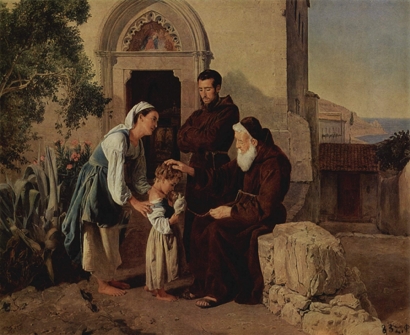
“At the Monastery Gate” by Ferdinand Georg Waldmüller, painted in 1846. The work and the reproduction thereof pictured are in the public domain worldwide. The reproduction is part of a collection of reproductions compiled by The Yorck Project. The compilation copyright is held by Zenodot Verlagsgesellschaft mbH and licensed under the GNU Free Documentation License.
There’s an old saying: “you can choose your friends, but you cant’ choose your family.” I was thinking about that this morning and it suddenly struck me that there was an interesting RPG-related question that could be founded on that premise – the very question that forms the title of this article.
The Arguments for ‘Yes’:
The GM knows the campaign background and the experiences that the family have lived through far better than the player does, especially at the start of the campaign. He knows the prevailing trends in attitude and opinion, the philosophies that were current at the time, and the way events were impacting ordinary people at the time. All these developmental influences then define the way the PC relates to the history – is he/she a product of his time, or is he/she in rebellion against it? Is the character defined by his childhood experiences, or has he become what the player has in mind despite them?
This has several profound benefits for the campaign.
First, the player, and hence the PC, have a far greater connection to the campaign background, enabling them to hit the ground running when actual play starts.
Second, the player has a far stronger idea of the personality of his character at the commencement of play as a result of this interaction between character and campaign; quite often in a new campaign, it takes several sessions before the personality of the individual to emerge. This period of “semi-play” shortcuts that process, again letting the campaign start at something close to full throttle.
Third, the GM has a far clearer idea of the character of the PC as the player wants it to be in play, and can craft his campaign and adventures to suit, from the very beginning. It’s normal for the first adventure or two in a campaign to be generic and relatively bland in terms of customization to the characters – both players and GM have to feel their way forwards, groping toward the shape that the campaign will ultimately take as a result of the collaboration between the participants. Again, this gives the campaign a headstart.
Fourth, by defining the relationship between the character and his family, it gives the GM a domestic scene in which to introduce the character within the campaign. That won’t always be relevant or useful, but any gain over a zero starting position can only be beneficial to the campaign.
So far, it all sounds pretty compelling. But there are always at least two sides to every story.
The Arguments for ‘No’:
The player knows the character that he is creating, and the GM doesn’t. If the player designs the family relationships, he can ensure that they are consistent with the character that he wants to play, either as a supporting force or as a contrast. What’s more, there is no certainty, if the GM designs/creates the family, that they will provide the foundations of personality that the player wants. Ultimately, the family unit is a part of the character concept, and that’s part of the creative space of the player, not the GM.
If the family background is all wrong for the character that the player wants to play, a GM-designed family unit might in fact start the character off with a disconnect from the campaign – nullifying benefit one. It might be a benefit or it might not – and if it goes wrong, it will go horribly wrong. That’s too big a risk to take.
Sometimes the player has no idea of the personality of the character, and pitching him or her in at the deep end only confuses them. As with the first benefit, this one might materialize or might not, and having the GM design the family background might even be counterproductive.
The third and fourth benefits are real, but the risks involved in persuing them are equally real. Sometimes, when the stars align, they will be manifested, but the chance of the opposite occuring is at least as likely. And, when you factor in the number of PCs, these risks are compounded to the point where they are almost certain to materialize in at least some cases.
What’s more, there is one additional downside to the proposal that can’t be ignored: the potential for bland similarity between the families of the PCs. That’s always the danger when one person is creating so many iterations of the same thing. And trying to overcome that difficulty can artificially exaggerate the differences, putting the connection between PC and campaign under additional pressure.
So is there a middle direction?
I think that it should be possible to chart a middle course, in which there is a dialogue between the player and the GM about the family background. The player tells the GM what they think would work for their character, the GM tells the player how that would sit in the context of the times, and the concept evolves from there. Are the family conformists to the times, or rebels? This not only achieves all the benefits listed, it undercuts all the risks, and adds one additional benefit: putting the family into context of the background, not just the PC who is the focus of the exercise.
It’s also a far truer reflection of the collaborative nature of the game, giving the players an early opportunity to add their ideas and concepts to the campaign, helping the GM to shape it to fit the players and PCs.
Often, a compromise brings the disadvantages of both extreme alternatives. This is one of the rare exceptions, in which the compromise maximises the opportunity for advantaging the campaign.

Discover more from Campaign Mastery
Subscribe to get the latest posts sent to your email.
Comments Off on Should GMs design a PC’s family?