Campaign Mastery helps tabletop RPG GMs knock their players' socks off through tips, how-to articles, and GMing tricks that build memorable campaigns from start to finish.

Designing A Game System (for the Zener Gate campaign)


This entry is part 2 of 4 in the series The Zener Gate System

I was spoilt for choice when it came to illustrating this article. The one that I’ve eventually chosen is “brick-1-1166510” by ilker, courtesy of freeimages.com. I’ve saved the others to use in illustrating an article series that will be rather trickier to accompany!

It’s still not certain which game system will be used for the Zener Gate campaign, but discussion with one of the players clarified many of the concepts of the original game system that was forming in the back of my mind as an option.

As I thought the process and ideas might be of interest to readers, I’ve decided to set them down – and my thoughts – for all to see.

This is not a finished game system – just a rough blueprint of the content that will be incorporated into the game system if I go ahead and write it. The goal is to be mechanically fast, with a flexibility that comes from being relatively abstract.

Stats

Not sure how many of these there will be yet, nor what they will all be named in the end, but some are fairly clear.

  • STR – Strength, i.e. physical force.
  • CON – Constitution, i.e. health.
  • END – Endurance. Starts equal to CON.
  • RES – Resistance to physical harm, assuming maximum defensive armor. Lighter armors will subtract from it.
  • NIM – Nimbleness. Heavier armors will subtract from it.
  • HP – Hit Points. Equal to 2 x CON + RES + NIM.
  • SHK – Shock Threshold. equal to 1/5th HP, round up. If an attack does this much damage or more in one round, the character must make a CON save or be rendered unconscious for d10 time on the universal scale (see below). For every point that the shock threshold is exceeded, there is a -1 penalty to the save and +1 modifier to the time roll.
  • ACC – Accuracy with aimed weapons.
  • MEL – effectiveness with Melee weapons & unarmed.
  • DEX – overall measure of manual dexterity, used for manipulating tools and keyboards. The stat rolled is averaged with NIM to get the actual stat value. Hand protection will subtract from it.
  • PRAC – the character’s aptitude for Practical skills.
  • THEO – the character’s aptitude for intellectual/analytic/Theory skills.
  • ENC – Encyclopedic Knowledge, the character’s knowledge bank of facts and processes.
  • LAN – the character’s capacity for quick-learning Languages. Discussed below.
  • INT – Intelligence. Equal to 1/4 of (PRAC + THEO + ENC + LAN), + 1d6, -1d6.
  • AWA – Awareness of the environment around the character, used for “spot” and “listen” checks.
  • PERS – Personality, a combination of Presence, Charisma, and Persuasiveness, the foundation of any interpersonal skills.
  • KARMA – The universe’s debt to the character’s good fortune. Initially 10, -1 for each stat with a score of 17 or better, +1 for each stat with a score of 8 or less. Karma can be sacrificed in-game to gain a lucky advantage or to buy off a restriction placed on the PCs by the campaign background, the latter at prices to be determined by the GM. Some penalties must be bought off collectively by all PCs contributing to a pool. The GM can also throw unlucky circumstances at the PCs which turn into a Karma boost if the PCs overcome the circumstance indirectly, i.e. without directly countering with PC Karma, effectively adding to the XP that the characters get for the adventure.

There may be more, but those 18 seem adequate for now.

Rolling Stats

Stats are populated in four steps.

1. Generation

To generate a character, the players roll 4d6, re-rolling sixes, until they have a list of results half again as long as the number of stats. Presently, there are 18 stats, but INT, HP, SHK, and Karma don’t count because they are handled as calculations, so currently 21 rolls would be needed; list the results on some scrap paper.

For the record, the potential results are 4 to 20, the average is 12, and the chance of each result (out of 625) are: 1-4-10-20-35-52-68-80-85-80-68-52-35-20-10-4-1.

2. Selection

Characters must select the single highest result AND the results immediately above and below that roll. Assume the list “wraps around”. If there’s a tie, the player can pick which one to use. Copy selected rolls to a separate list and cross them off.

Characters must select the single lowest result AND the .results immediately above and below that roll, pretending any results crossed out are not on the list. If there’s a tie, the player can pick which one to use. Copy selected rolls to a separate list and cross them off.

Characters must select one 13, 14, or 15 result AND the results immediately above and below that roll, pretending any results crossed out are not on the list. If there’s a tie, the player can pick which one to use. Copy selected rolls to a separate list and cross them off. NB: Ordinary NPCs must use 11-12-13 for this step.

The Character can pick any one remaining result. The rest of the original list are then discarded.

3. Allocation

The player should already have selected a profession for the character. The stat rolls are allocated to the different stats as the player sees fit, to reflect the proficiencies required for that profession.

4. Calculation

Finally, the INT and HP scores are calculated (round in the character’s favor).

An Example

Although the language I?ve used above is slightly different, and (I hope) somewhat clearer, one of my players had trouble understanding the process until I did a quick back-of-an-envelope example to illustrate the procedures. So let?s do a quick example for anyone who hasn?t quite followed.

I start by generating a list of 21 rolls of 4d6, re-rolling all sixes:
&nbsp:

    2, 3, 3, 5 2, 4, 5, 6 → 2 5, 5, 5, 6 → 2 2, 2, 3, 5 2, 3, 4, 6 → 4
    =13 =13 =17 =12 =13
    1, 3, 5, 5 3, 5, 5, 6 → 3 1, 1, 3, 6 → 6 → 2 1, 2, 4, 5 2, 2, 3, 4
    =14 =16 =7 =12 =11
    4, 6 → 3, 6 → 4, 6 → 2 3, 3, 4, 6 → 3 1, 3, 5, 5 5, 5, 5, 6 → 5 2, 3, 3, 4
    =13 =16 =14 =20 =12
    3, 3, 4, 5 1, 1, 4, 6 → 5 4, 4, 5, 6 → 6 → 3 2, 3, 5, 6 → 4 1, 3, 4, 5
    =15 =11 =16 =14 =13
    2, 4, 5, 6 → 2
    =13


(Practical Advice Note: I found it a lot easier to roll the dice in batches of 5 lots of 4 dice, exactly the way it?s shown in the table above).


    13, 13, 17, 12, 13, 14, 16, 7, 12, 11, 13, 16, 14, 20, 12, 15, 11, 16, 14, 13, 13.

 
(It’s necessary to imagine these in a column running down the page).

The single highest result is the single 20 result. Immediately ?above? that is a 14, and below that, a 12. So that?s our first trio of selected rolls, which are crossed off the original list:
 

    13, 13, 17, 12, 13, 14, 16, 7, 12, 11, 13, 16, 14, 20, 12, 15, 11, 16, 14, 13, 13.

    14, 20, 12.

 
The single lowest roll (by miles) is the 7. Above that is a 16 and below it is a 12. So we copy those three rolls into the selected rolls list and cross them off the working list:
 

    13, 13, 17, 12, 13, 14, 16, 7, 12, 11, 13, 16, 14, 20, 12, 15, 11, 16, 14, 13, 13.

    14, 20, 12, 16, 7, 12.

 
There are lots of 13, 14, and 15 results to choose from. The decision has to be based on the rolls above and below it.

  • The first result is a 13. Above that (wrapping around from the end of the list) is the last result, another 13, while below it is a third 13, for a group 13, 13, 13. Their total is 39, so that?s the score to beat.
  • The second result is a 13. Above that is the first result, another 13, while below it is a 17, for a group 13, 13, 17. This has a total of 43, so that?s the new best result.
  • The fifth result is a 13. Above that is a 12, and below it is a 14, for a group 12, 13, 14. This has a total of 39 ? as good as the first choice but not as good as the second.
  • The sixth result is a 14. Above that is 13, below that is an 11, because the 16, 7, and 12 have been crossed out. So that?s a group 13, 14, 11. They have a total of 38, which is a new low.
  • The eleventh is a 13. Above it is an 11, and below that is a 16, for a group 11, 13, 16. This is a total of 40, making it the second-best choice.
  • The thirteenth result was a 14, but it?s been crossed out and can?t be used.
  • The sixteenth result is a 15, Above it (ignoring the crossed-out numbers) is 16 and below that is 11, for a group 16, 15, 11. These add up to 42, becoming the new second-best choice.
  • The nineteenth result is a 14. Above it is a 16, and below it a 13, for a group 16, 14, 13. They total 43, matching the best choice on offer.
  • The twentieth result is a 13, but the numbers above and below it are 14 and 13, so the resulting group isn?t really in the running.
  • The twenty-first and last result is a 13. Above that is another 13, and below it (because the list is treated as wrapping around back to the beginning) is the first 13. But a 13, 13, 13 combination won?t cut it.

So the choice is between 13, 13, 17 and 16, 14, 13. Since the next step is to cherry-pick from the remaining answers, it?s best to pick the one that has more high scores, even if one of the scores is less than the best In the other group. So the choice is the 16, 14, 13 group. Add it to the chosen results and cross them off the list:
 

    13, 13, 17, 12, 13, 14, 16, 7, 12, 11, 13, 16, 14, 20, 12, 15, 11, 16, 14, 13, 13.

    14, 20, 12, 16, 7, 12, 16, 14, 13.

 
With nine of the 14 stat values now selected, there are two different philosophical approaches to consider for the remaining 5 scores. Some players like to add color to their characters by deliberately choosing one or two of the lowest remaining scores on the list ? the roleplayers. Power-gamers will simply pick the five best scores that aren?t crossed out. If I assume that I?m rolling up an NPC, I?ll usually tak the first approach except when designing a villain. For the sake of the example, let?s pick one low score and the four best, something of a compromise between the two philosophies.

There?s an 11. In fact, two of them ? those are the lowest scores. The four best are 17, 16, 15, and 14. Not used are an 11, a 12, and a bunch of 13s. So the final list of stat rolls are:
 

    13, 13, 17, 12, 13, 14, 16, 7, 12, 11, 13, 16, 14, 20, 12, 15, 11, 16, 14, 13, 13.

    14, 20, 12, 16, 7, 12, 16, 14, 13, 11, 17, 16, 15, 14.

 
Or, if I list them from low to high:
 

    13, 13, 17, 12, 13, 14, 16, 7, 12, 11, 13, 16, 14, 20, 12, 15, 11, 16, 14, 13, 13.

    7, 11, 12, 12, 13, 14, 14, 14, 15, 16, 16, 16, 17, 20.

 
Next comes allocating the scores. I would normally select which two were going to be my dump stats (the 7 and the 11) and then prioritize from the high roll down ? the 20, the 17, the three 16s, and then the 15. From the stats that are left, pick the ones that are to get the 12s and the ones that are to get the 14s, leaving the last one to get the 13. But how a player might choose to handle that is up to them.

Stat Checks

These will be relatively rare but not unheard-of, especially when the character doesn’t have an applicable skill. To make a stat check, the character rolls 3d6 plus a modifier from the GM that reflects any circumstantial modifiers and the inherent difficulty of the task. The total must be less than or equal to the character’s stat in order to succeed.

Skill Foundations

Divide each stat by 2, rounding up. Add 2. That is the base value of any skill that is used with the stat for the basis of skill checks. Since stats have a maximum value of 20 (as rolled), that gives a range for skill foundations of 4-12.

Skills

Characters start with skill points equal to their INT x 2.

Characters define their own skills. Their profession must be the first such skill listed. Skills are Holistic in nature, not precise.

Skills are classified by the GM as Specific, Narrow, or Broad, depending on how much is implied by the label applied by the player. Specific skills are only useful for one small, closely-related set of tasks; Narrow skills are useful for a somewhat wider variety of tasks; and Broad skills are useful in a wide variety of applications. These cost 1, 2, or 4 skill points, respectively.

For example, the first four skills listed by a character might be:

Homicide Detective
Boy Scout
Fisherman
Park Ranger

While ‘Homicide Detective’ is a Narrow skill-set, it implies experience as a general police officer, which is a broader skill-set. So it’s a 4-point purchase.

‘Boy Scout’ implies a lot of practical experience, so it is also a 4-point purchase.

‘Fisherman’ is very restricted in what it can be used for, so that’s a 1-point purchase.

‘Park Ranger’ is also fairly restricted, but clearly broader than ‘Fisherman’; it’s a 2-point purchase. So these four skills total 11 points.

Purchase gives the skill a base value of 5 ranks in that skill.

Skill Checks

When the PC attempts a task, he lists any skills he feels are relevant. The GM selects a stat basis that he thinks is most relevant. The player adds his ranks in the skill and the stat basis value to get the target value. He then rolls 4d6 and must get less than or equal to the target to succeed.

Secondary Bonuses

If a character has more than one skill that might be relevant, he must select the most relevant one, breaking ties in favor of narrowness. Each additional skill, if the GM agrees that it is relevant, adds 2 to the target value for the check.

For example, when Fishing, a character’s Fisherman skill and DEX are the logical foundations, but Boy Scout is potentially relevant as well. The GM agrees. “Fisherman” is a narrower skill than “Boy Scout”, so “Fisherman” is the primary skill for the check, and “Boy Scout” adds 2 to the target that must not be exceeded.

This means that it’s beneficial to list both a general skill and any more specialized skills in which the character wants to have additional expertise over and above his general proficiency. The idea is that the general skill provides a definitional ‘safety net’ for all the things that the character doesn’t have a specialist skill in.

Weapon Skills

Characters can take weapon skills. These are broadly defined, and cost 2 skill points each, or general category skills, costing 3 skill points each. “Gun” is a general category, and so is “Firearm”. “Handgun” or “Pistol” or “Rifle” are broadly defined weapons types. If characters want to waste their points, a specific skill in a specific model (1 point) can also be applied.

Unproficient

If a character attempts a task in which his only skill is incorrectly specialized and he doesn’t have a general catch-all – for example, using a 44 Magnum when his only firearms skill is “.33 special” – he is considered to have No ranks in the relevant skill and his chance of success is defined by the relevant Skill Foundation alone, +1 for each indirectly-related skill the GM deems appropriate.

Improving Skills

Characters can buy additional ranks in skills at the price of 1 skill point per rank. Because narrow-focus skills take usage preference over broader skills, the benefits of improving a broader-application skill are counterbalanced by the frequency of occasion when that improvement won’t actually apply to the skill, permitting the one-price-fits-all simplicity.

Improving Stats

During Character Generation, Stats can be improved at the rate of +1 to the stat for 3 skill points. Stats can also be reduced by 1 to obtain an extra 2 skill points.

Disadvantages

These are ranked in terms of applicability of circumstance by the GM and awarded values of 1, 2, or 4 points, (specific to general). Specific disadvantages cause a reduction in proficiency in one particular skill or similar area of activity. Two points affect a broader range of activities, while 4 point skills affect a very wide range of activities. For example, “Poor at Mathematics” is a 2-point disadvantage.

If the Disadvantage is one that isn’t readily/directly applicable to skill checks, the impact on the character’s life and freedom of choice should be assessed and a value chosen based on a skill penalty of similar impact.

Multiple ranks can be taken in a Disadvantage; each confers the equivalent of two negative ranks. Each additional rank reduces in value by 1 point to a minimum of one point.

So, for example, five ranks in a Disadvantage is worth:

  • 1+1+1+1+1=5 points for a specific disadvantage;
  • 2+1+1+1+1=6 points for a narrow disadvantage,
  • 4+3+2+1+1=11 points for a broad or general disadvantage.
Karma Limits

There is a limit to the total number of ranks that a character can have in a given disadvantage equal to his starting Karma.

There is a limit to the number of disadvantages that a character can earn points from that is equal to his current Karma.

Removing/Reducing Disadvantages

Before a Disadvantage can be removed, it must be reduced to a single rank. Normally, only one rank can be removed from a given disadvantage per adventure but this restriction can be varied by the GM if it seems appropriate.

To remove a rank in a disadvantage, the character expends 1 point of Karma, reducing his Karma total accordingly..

Karmic Debt

If a character’s Karma drops in the course of an adventure to the point that he is forced to reduce one or more disadvantages because they would exceed the Karmic Limit described above, he is forced to experience a Complication. This is a player-invoked setback that worsens one or more other disadvantages by one rank for each rank in the Disadvantage being nullified. If he can no longer do so because his disadvantages are at the maximum permitted level, another stat is semi-permanently reduced as a consequence of the setback. Note that this has to happen in-play. For example, a minor stroke might impair one of his intelligence-deriving stats, or a torn muscle or cracked bone might impair his Nimbleness, or he might contract a disease that impairs his CON. The nature of the setback offered by the player and the number of stat points lost determine the value of the Complication – minus one point in one stat is worth one rank in the setback. That means that the scale of the Complication should be set to match the total unpaid Karmic Debt accrued by the event. Another form of setback that is acceptable is for the player to deliberately blow a mission-critical roll for his character and refuse a re-roll.

Setbacks are treated as “negative-karma disadvantages” and can be paid off when the GM deems it appropriate by the expenditure of earned Karma, i,e, XP (see below).

Karmic Starvation

If a reduction in disadvantages means that a character has expended more on skills than his disadvantages can pay for, he experiences Karmic Starvation. This mandates a Complication, as above, but instead of reducing ranks in Disadvantages, it reduces the amount of skill points expended by two skill points per rank in the Complication.

Other uses for Karma

Karma can be used to re-roll a failed roll at the player’s discretion, or to give another character a +5 in a mission-critical roll. These applications consume one Karma.

Karma can be converted into additional Skill Points at the rate of 2 Skill points per point of Karma consumed.

Karma can be converted into a stat bonus at the rate of 2 Karma per +1. Once a stat exceeds 25, this cost doubles, and for every +5 to the limit, it doubles again. Note that this is far more expensive than adjusting stats during character construction.

Karma can be expended during character construction to modify rolled stats. Every point of Karma consumed permits one stat to be reduced by 1 and another to be increased by 2. Note that this also affects the character’s Starting Karma.

Karma can be expended to obtain a stroke of good fortune in the course of an adventure. The player tells the GM what “good luck” he would like to have and the GM counts the number of successful rolls that he would normally require in order to achieve the same outcome. That count is the cost of the stroke of good fortune in Karma. If the cost is more than the character can or is willing to pay, the GM may propose a lower-cost variation that gives the PCs some or even all of what they want; the GM is expected to work with the players in this respect.

Karma can be expended to reduce or remove a limitation placed on the characters by the campaign setup or background, for example to expand a character’s Meitner Field Radius, permitting them to carry more equipment through a Zener Transition. An explanation for this change will be incorporated into the next adventure by the GM, and the benefit will take effect from that time, NOT immediately.

Finally, Karma can be expended to delay the next Zener Transition long enough for the PCs to complete their current adventure.

Experience

Experience is earned for surviving an adventure. More experience is earned for helping the locals deal with whatever problem they are experiencing when the PCs arrive – +50% XP for a solution to be implemented by the locals following PC advice, double XP for a solution to the problem that is put in place by the PCs, and these are doubled again for a permanent solution to the problem. Example: Catching a killer might be worth 2 XP if the characters simply deduce who it is and let the locals apprehend him, 3 XP if the characters do some investigation, or 4 XP if the characters capture the killer themselves and hand him over to the authorities for judgment. Behaving in a selfish or amoral fashion normally reduces whatever the XP award is by 1 point, but this can be waived if the whole purpose of the plotline is to benefit the PCs in some way.

XP is paid in additional Karma, and based on the length of the adventure and the difficulties that had to be overcome.

If the GM chooses to, he can introduce an additional complication into the adventure, at the cost of immediately giving the directly-affected character or characters 2 Karma, or he can give an NPC +10 to a roll (GREATLY increasing their chances of success) and increasing the Karma of one or more PCs by 1. He can do this AFTER a roll is made, turning a failure into a success . These immediate payments are in addition to any Karma earned in the course of the adventure. Increasing the difficulty can also increase the Karmic Reward at the end of the adventure. However, setbacks and complications from Karmic Debt or Karmic Starvation do not affect the Karmic Payout.

If a PC chooses to, he can sacrifice Karma to nullify or redress this interference through a stroke of good fortune, as described earlier; doing so means that the complication introduced by the GM also doesn’t count toward the end-of-adventure bonus.

Unspent Karma is always a handy thing to have – but spending it improves the self-reliance of the PCs. Having too much unspent Karma effectively reduces the effectiveness of the PCs, having not enough can induce Karmic Debt or Karmic Starvation. The margin that a player considers safe is up to him!

As the PCs discover the situation that they are in, the GM may choose to symbolically reflect each piece of bad news for the players with a token representing an increased XP value for the adventure. The more impossible the situation seems to be, the more Karma he makes “up for grabs” – if the PCs are clever enough to earn it!.

Equipment

Equipment in general is defined in the same way as skills (broad, narrow, specific) but is never the basis of a check. They do count for the purposes of “other appropriate skills” or “indirectly-related skills” however, provided the equipment is actually being used for the task – actually having a “.33 special” doesn’t help in firing that 44 Magnum.

Unless noted otherwise as part of the circumstances, a skill implies having the appropriate terms and equipment; buying the equipment specifically in addition to the skill implies that the character has something that’s been customized or modified to suit them. So “Fisherman” implies having a rod and reel, or the needs to improvise something equivalent, actually buying a Fishing Rod in addition is unnecessary (but does provide a bonus to your fisherman skill checks).

If circumstances have left the character without those implied tools, that’s a factor that the GM takes into account with his circumstantial modifiers.

There are three exceptions: weapons, armor, and Campaign MacGuffins.

Armor

Armor is slightly different to other forms of equipment. It costs skill points in the same way as other equipment, but has multiple factors that have to be purchased.

  • Hardness (1-10 scale) – each step on the scale increases the protection provided by the armor in the form of bonus Resistance.
  • Coverage (1-4 scale) – each step on the scale increases the amount of protection provided by the armor by approximately 25%, so one-quarter coverage, half-coverage, three-quarters coverage, or whole-body coverage.
  • These are multiplied together, The penalty imposed to Nimbleness is then decided based
    on what the GM considers reasonable; the difference is three times the cost of the armor in Skill Points.

This cost is halved (round up) if the character takes an appropriate skill in the armor’s use.

Note that there are currently severe limitations on the armor that can be worn while experiencing a Zener Transition. Armor that is only available for the one adventure and has to be “obtained” by the PCs in the course of the adventure is free.

Weapons

Weapons are also handled slightly differently.

  • Base Damage: 1 point for 1/3 d6, 2 points for 1/2 d6, 3 points for 1d6, 4 points for 2d6, 5 points for 3d6, and so on. The base damage inflicted by a weapon is up to the GM. As a rule of thumb, most melee weapons will be 1d6 or smaller, most handguns will be 2d6, most rifles will be 3d6, most shotguns will be 4d6, most grenades will be 5d6, most anti-vehicle weapons will 6d6 or more.
  • Rate Of Fire: 1 point for 1 shot per round, 2 points for a short burst per round (conferring an extra d6 on the damage), 3 points for full auto (confers an extra 2 1/2 d6 per round).
  • Additional Damage: 1 point for each +1 to damage.
  • Maximum Range: The above costs are added together and compared to the universal index table (see below) to determine the base range. The GM can then restrict this to an “effective range”, reducing the cost of the weapon 1 point for every 2 steps up the table. Weapons defined as “Melee” automatically have zero range, but additional range can then be bought as “reach”.

This cost is halved (round up) if the character takes an appropriate skill in the weapon’s use.

Note that there are currently severe limitations on the armor that can be worn while experiencing a Zener Transition. Armor that is only available for the one adventure and has to be “obtained” by the PCs in the course of that adventure is free.

Campaign MacGuffins

Some of the campaign limitations are so “big” that they have to be bought off in stages, for example constructing a reliable communications link back to Zener Command. Less-reliable comms will become available as plot devices in the meanwhile. Each point of Karma expended for the purpose by ALL PCs adds to the total invested in “Campaign MacGuffins” and is translated into a component of the whole or a refinement of the design or construction that will be incorporated into the next adventure. These tangible Campaign MacGuffins will be given suitable names in-game, e.g. “crystal radio set”. When the GM feels that the characters have accumulated enough of them, an improvement will be made in one restriction. These amounts are being left flexible for now, but the rough scale is intended to be 4 points for a minor improvement, 10 points for a new capability, 20 points for the complete removal of a limitation..

The Universal Scale

This is an idea being lifted directly from TORG. It consists of a number of values arranged in a table in geometric sequence and given a unified common index. Look up a character’s STR on the index, and you get how much he can lift. Look up the distance to a target and you get the range modifier to hit that target with a ranged weapon. If a skill roll is “failed” but the PCs should be able to succeed, given time, looking up the amount by which they failed on the index and getting the corresponding time value tells the GM how long it will take for them to succeed. Similarly, looking up the difference between two indexed time amounts states the penalty for a character rushing, looking up the area gives the bonus to attacks for the size of the target, and so on.

Hit Location

A hit location system may or may not be used.

Outstanding Questions

There are a number of questions that I have not yet made decisions on.

  • Initiative is a big one.
  • Whether or not to roll attacks using a d20 is another.
  • Radiation Damage is a third, though I have some ideas that aren’t yet fully worked through.
  • Language Handling is a fourth, though the inclusion of the LAN stat hints at my still-incomplete thinking.
  • Critical Hits and Fumbles are a fifth.

In fact, I have vague ideas on all of these but have not yet had time to think them through – that’s why there’s no section on “Combat Resolution” yet. But, as you can see, an awful lot of the work is done already; it only took a couple of hours’ discussion and one evening of typing to set it all down. And, stripped of explanations and presented as concisely as possible, the in-play necessities should all fit on a page, maybe two – which is part of the design objective.

Comments Off on Designing A Game System (for the Zener Gate campaign)

Like Brains Melting In The Mirror: A Surrealist Buzzstorming Technique


Image courtesy PublicDomainPictures at Pixabay.com rights via CC0 (Public Domain)

I’ve seen all sorts of ways to ignite your creativity, nudging your mental capacities into a completely different orbit to their usual.

I’ve even offered a few, myself, here at Campaign Mastery, that work best when you have some idea of what it is that you’re trying to create. They don’t work that well, however, when you’re looking for something as abstract and flexible as a concept for an adventure.

I call this technique “Buzzstorming” because it has two purposes: to get your brain buzzing with ideas, and to filter those ideas through a literary filter that churns out raw “nuggets” of Surrealist Adventure. These can then be refined using my old standbys, Iteration and Domino Theory until they fit any style that you want or need.

I actually have two variations of this technique, “basic” and “advanced” (though there isn’t a great deal of difference between them, as you’ll soon see).

Basic Buzzstorming

Buzzstorming works best with good old pen-and-paper, making it something that you can use just about anywhere under almost any circumstance.

It has three simple steps (not counting the refinement process, which I will deal with after discussing Advanced Buzzstorming)::
 

  • Phrase,
  • Mutate, and
  • Curate
    Phrase

    Create a dozen simple phrases. The only restriction is the format: they must be structured,

    Noun – Verb – Noun

    …which means that they are all descriptions of activity. You can create these from looking around you at activity, from watching the TV, from reading a book, from ideas in music or songs, or from whole cloth and sheer imagination.

    Write these down.

    Mutate

    Starting with the first phrase, cross out the noun at the end of the phrase and write in the noun at the end of the second line. Keep going until you get to the end of the list; since there is no phrase under the last entry to steal a noun from, use the leftover one from the first phrase.

    Curate & Re-mutate

    Go through your list and note any that spark your imagination. Write these in a separate list, crossing them out as you do so. Re-mutate the rest, as above. If any phrase ends up with its original last noun, swap the first and last nouns in that phrase. Then curate the good ones again, and repeat.

    Eventually, you will end up with a list of as many ideas as you originally had phrases, or perhaps slightly less, with a couple of starting phrases that would not yield a good idea no matter how much you twisted them. That’s fine – throw them away.

That’s it. Easy, right?

A Quick step-by-step example

Let’s do a quick example with eight phrases – note that in reality, this would take up a lot less room:

Start

    The sausage fries in the pan.
    Two birds fly across the sky.
    The critic complains about irony.
    A dog wags its tail.
    A moving pen writes on the page.
    Sand falls through the hourglass.
    Rain collects in the bucket.
    Moon-rise banishes the dark.

First Pass

Mutated, these become:

    The sausage fries in the sky
    Two birds fly across the irony.
    The critic complains about its tail.
    A dog wags the page.
    A moving pen writes on the hourglass.
    Sand falls through the bucket.
    Rain collects in the dark.
    Moon-rise banishes the pan.

Curate: I like

    The critic complains about its tail, and
    Rain collects in the dark,

but the others leave me cold.

Second Pass

So, mutate the rest again:

    The sausage fries in the irony
    Two birds fly across the page.
    A dog wags the hourglass.
    A moving pen writes on the bucket.
    Sand falls through the pan
    Moon-rise banishes the sky.

I curate that last one, and mutate the rest again:

Third Pass

    The sausage fries in the page.
    Two birds fly across the hourglass.
    A dog wags the bucket.
    A moving pen writes on the pan.
    Sand falls through the irony

Nothing there, so go again:

Fourth Pass

    The sausage fries in the hourglass.
    Two birds fly across the bucket.
    A dog wags the pan.
    A moving pen writes on the irony.
    Sand falls through the page.

I can work with the last one, so I curate it, and then again mutate:

Fifth Pass

    The sausage fries in the bucket
    Two birds fly across the pan.
    A dog wags the irony.
    A moving pen writes on the hourglass.

Still nothing exciting. But observe that if I simply mutate again, the first phrase is back to where it started, while the third and fourth are variations that we’ve already tried. So it’s time to do the first-to-second swap in those three cases:

Sixth Pass

    The bucket fries in the sausage
    Two birds fly across the pan.
    The irony wags the dog.
    The hourglass writes on a moving pen.

Check those: no inspiration, so Mutate again:

Seventh Pass

    The bucket fries in the pan
    Two birds fly across the dog.
    The irony wags a moving pen.
    The hourglass writes on a sausage.

I like the third one, I can use it. So curate it and again mutate the other three:

Eighth Pass

    The bucket fries in the dog.
    Two birds fly across the sausage.
    The hourglass writes on a pan.

No joy, and the first two about to cycle back to something already rejected, so swap its nouns around:

Ninth Pass

    The dog fries in the bucket.
    The sausage flies across two birds.
    The hourglass writes on a pan.

and then mutate:

    The dog fries in two birds.
    The sausage flies across a pan.
    The hourglass writes on the bucket.

Nothing yet. Mutate once more:

Tenth Pass

    The dog fries in a pan.
    The sausage flies across the bucket.
    The hourglass writes on two birds.

Still nothing. My subconscious is teasing me that there’s an idea involving the hourglass there somewhere, but the combinations are few enough at this point that I can quickly dismiss all of the ones involving the hourglass in first or last position. So I scrap the other two and save the “The Hourglass writes on two birds” for the next Buzzstorming session.

Results

That means that my final list of ideas is:

    The critic complains about its tail.
    Rain collects in the dark.
    Moon-rise banishes the sky.
    Sand falls through the page.
    The irony wags a moving pen.

Advanced Buzzstorming

This works in almost exactly the same way, but there are three differences.
 

  1. The Phrase structure is different: use Noun – Verb – Adjective(s) – Noun.
  2. During each Mutation round, you take the adjective from the Phrase below and the noun from the Phrase below that.
  3. During the Curate and Re-mutate step, you have an extra option:
     

    • Move one or more of the adjectives to before the first Noun, crossing out the original appearance.
    • Insert a comma after the adjective and insert one of the words “On, In, To, At,” or “When” so that the resulting phrase is grammatically correct.

Because the process is so similar, I won’t put up an example. However, thinking about one, and the remaining phrase on the original (mutated) list gives me,

When soft, the hourglass falls through time,

which I happily add to the curated list.

Refinement

The refinement process is one of making sense of the statement in terms of the campaign and genre, then tossing basic questions – who, what, why, etc – at the result until it is transformed into a sensible plot outline.

Let’s at least make a start on the curated ideas so that you can see where I’m going with this. I’ll do so in a high-level D&D/Pathfinder context:

  • The critic complains about its tail: I had an immediate vision of a critic, one of those people who is never satisfied by anyone or anything, who happened to be a Dragon. With old-style glasses-on-a-stick. And a top hat. The personality and visual was so strong and unique, ripe with subtle implications (e.g. Humanophile) that I needed go no further. He needs only a name and a role in the adventure.
    • I get the first from thinking of Faust, and the love-hate relationship any non-human Humanophile must have for the human race as a Faustian Bargain, the source of equal parts pride, satisfaction, and frustration; so I choose a name that evokes that context without being too obvious about it: Thaust Draco Infernus.
    • What if our Draconic friend feels compelled to tell people what they are doing wrong – and, when sufficiently vexed, to instruct others to do something about a situation to which they should be paying attention, but aren’t (or not enough, anyway)? That means that he is the instigator of the adventure and the NPC giving the PCs the briefing. “Your mission, should I choose you to accept it…”
    • That last phrase, thrown in more to be cute than to be meant seriously, seems to fit so well that the nature of the Adventure immediately begins to take shape. An emergency situation of some kind that he has noticed, but no-one else has, in which he wants the PCs to intervene.
  • Rain collects in the dark: This also inspired a visual image. It rains, and the drops collect unnaturally into pools, which animate as Water Elementals or a sort of Water Elemental Golem.
    • “The Water Elemental Who Fell To Earth” then lept out at me as a phrase, and “A Hard Rain’s A-Gonna Fall”.
    • Ideas from that point began to fall like dominoes: A deity-level Water Elemental whose machinations threatened to destabilize the Elemental planes, and who was exiled from reality, who has found a way to launch his minions through the inter-dimensional barriers into the Prime Material Plane, where they can work his will, eventually to bring about his return from wherever he has been exiled.
    • So now I have the kernel of the adventure. Details remain to be filled in – how these minions will secure the release of the Water Elemental, his identity, how the PCs can
      interfere, and the signs that the Critic has spotted but that humanity has not. Before I turn to answering those, I’ll look at the remaining ideas to see if any of them hold nuggets of gold to inspire further answers. But that’s enough to demonstrate the principal.
  • Moon-rise banishes the sky: Again, a visual notion: the moon rising at night, and in it’s wake, no stars, no darkness, nothing but white or perhaps gray. But, that was before I had reflected on the two previous ideas; the new context inspired a new interpretation:
    • The moon rises, leading a solid band of clouds, internally lit somehow, that obscures the entire sky. When the moon sets, the clouds begin to reshape themselves, drifting this way and that, until they form a part of a mystic sygil of some sort, with nothingness in between.
    • That alone is enough to tell everyone that hears of it that this is an arcane effect if some kind. Mages who analyze the effect claim that it is clerical and not arcane in nature. Worryingly, the most powerful clerics and druids cannot dispel it, and claim that the Mages must be lying. Thus, petty squabbles distract humankind while the world continues to plunge headlong toward disaster.
    • A hexagon is the simplest shape that is reminiscent of a ring (a triangle’s corners are too acute, as are those of a square; a pentagon would work but is too closely associated with demons and devil-worship – it might be more accurate to say, “the simplest available shape”). So, over the next five nights, in widely-separated locations, this same pattern repeats itself. On the seventh night, the patterns converge, and the portal behind to open, either releasing the big bad himself, or a bigger, more powerful minion, or an avatar of the Big Bad.
  • Sand falls through the page:
  • When soft, the hourglass falls through time: These two go together, I realized. This is a visual for some sort of temporal spell – a sandstone rock is placed on the page bearing the spell, and erodes over a period of seconds into sand which falls through the page as though it were a sieve. This is visually reminiscent of the behavior of an hourglass, the seemingly solid aggregation of sand in the top become a thin stream of soft particles, which fall through time, opening a portal to the remote past, to a time before time itself.
    • This sounds like the perfect place to exile a godlike elemental creature. You could even be forgiven for thinking that the creature would be helpless, unable to affect the “modern world”. It fails to account for the divine nature of the proposed being; although greatly weakened, it is capable of generating it’s own temporal field. Not enough to permit it to break free on its own, but enough to create his minions and boost them into the future in an uncontrolled manner.
    • There is an obvious association between “soft sand falling” and falling rain. So that gives more information on what the minions are doing – and implies that the PCs have to recover a copy of the spell being used by the minions and ultimately use it to travel back in time to confront the imprisoned Big Bad. When they succeed, a rebound effect of the cessation of the Big Bad’s personal time field will permit them to ride its own spell back to their local time – each appearing within one of the minions, perhaps!
    • Bonus idea: What if it is the destruction of the Divine Elemental and releasing of his temporal field that kick-starts time in the universe? What if this is the D&D equivalent of the Big Bang?
    • In many mythos, Dragons have access to magics that are older and more powerful than those practiced by Human Mages. That suggests that maybe the Spell is Draconic in origin, and that instead of providing the hook, the Critic is the final step the PCs have to make before confronting the Big Bad, and that finding (and rescuing?) him is another of the preliminary quests that they have to complete on their way to solving the main problem.
    • This further suggests that it was the mythic dragons of the past who exiled the Water Elemental in the first place; this would not only be internally consistent, it would explain where the critic got the spell from in the first place, passed down through the generations of Draconian offspring. It also implies that modern Dragons don’t have the knowledge, power, or skill of the originals.
    • Which suggests another idea by free association: That it is the Draconic lust for Gold and other precious metals that has weakened them, poisoning their bloodlines through the generations, a form of addiction with an impact over multiple generations. Which is why the Critic needs the PCs. “It took you long enough. This is your world, now. You took it from us when you began to mine and refine Gold. Now, you must live up to that responsibility.”
  • The irony wags a moving pen: There’s a certain irony in that last idea, given the situation, which makes this idea relevant as well. The interpretation that came to mind when I read it was the exact phrase given above, minus the initial “the”: Irony wags a moving pen.
    • That gave me the idea of a God Of Irony, but until I had done the earlier refinement work, I had no idea of his role. Now it’s clear that he sets the quest to find the Critic and rescue the spell that the minions have captured.
    • There is also a certain Irony in the notion of the death of the Celestial Elemental being the D&D equivalent of the Big Bang.

The Adventure

The basic idea of the adventure has now taken shape. It still needs some details and polish, but here’s the outline:

Act I

  1. One night, it begins to rain. The rain pools unnaturally, forming dozens of Elemental Water Golems. The PCs encounter one, and (barely) manage to defeat it in a suitably-public confrontation. That marks the PCs out.
  2. Over the next few days, they hear that a lot more of these Elemental Golems appeared at the same time as their encounter, but others who confronted them were not as skilled or lucky, and the Golems escaped. Where they are now, and what they are doing, remain unknown.
  3. Given the seriousness of the situation, A King/ruling noble to whom at least one PC is obligated, summons the PCs to serve as his strong right arm during the crisis.
  4. The PCs barely managed to defeat one, they will have no hope of defeating a group- not unless they can obtain some sort of advantage.
  5. The night they arrive, the minions “steal the sky”.

Act II

  1. The next day, they are sent to find out what a particular Mage has been able to determine about the situation. He claims the magic involved is not Arcane, it’s Clerical, and directs the PCs (and the royal representative who has accompanied them) to the Temple Of (Athena?).
  2. The High Priest Of The Temple has attempted to dispel the strange clouds, and even begged his (Mistress?) to intercede directly, without success. Perhaps the Great Druid will have more success; weather magics are amongst his specialties, after all.
  3. The Great Druid reports a similar lack of effectiveness over the phenomenon. He suggests a summit between the Religious leaders, Mages, and himself – “Perhaps if we all put our heads together, we can make some progress….”
  4. The PCs & escort return to the city, and the King orders to convene the Summit the next day. He puts the PCs in charge of it.
  5. The next afternoon, the High Priest challenges the accuracy of the Mage’s findings and the Summit devolves into a mess of accusation and counter-accusation. An early dinner break is eventually called to let people cool off.
  6. During the meal, a breathless and exhausted messenger arrives from a neighboring city; he has ridden three mounts to death since midnight to bring word of a strange event in the skies over his city. The second part of the sygil has appeared, and if the pattern holds true, a third city will be visited by this phenomenon tonight.
  7. After the meal, the King issues direct instructions to each of the factions: they are to use every skill at their disposal to learn everything they can, overnight, and report back to the throne tomorrow morning.
  8. The next morning, the Summit reconvenes with grim news. The priests appear to have been cut off from all divine advice and interaction, and are in a deep Funk. Spells seem unaffected but have proven unable to learn anything more about the phenomenon, only that it appears to be incomplete. Any request for advice, guidance, or information from the Gods merely returns the phrase, “Tua quaestio est, leva planctum non sufficit ad respondendum irrisorie,” which is a language that none of the priests know. Even requests and spells to translate the message have failed. “The Gods have abandoned us.”
  9. The Druids have learned that that the Magic appears to have some sort of Temporal Component, that the animals and plants within their domain have all expressed fear, but that a few brave ones observed men of water working a ritual of some kind near a third city, which last night suffered a similar phenomenon.
  10. To the PCs, that should confirm paranoid suspicions about the Elemental Golems and their activities.
  11. The mages fared somewhat better, using Scrying to observe the pattern which materialized over (third city) last night, and over the second event which began the night before. Combining the three shows clear overlaps and connecting lines. By their estimation, the complete pattern is a magical sygil of some kind being erected in six
    parts, and that they have been able to identify one word clearly, written in Draconic. Loosely translated, it means “The inevitable consequence of yesterdays and yesterdays” – Draconic is a very concise but flowery language.
  12. That suggests to the King that the PCs should consult a Dragon. The nearest one would be the most convenient. “Does anyone know where to find one?” Once again, instructions are handed out by the throne. The Mages are to continue monitoring, compiling each new part of the magical construction and attempting to interpret it; perhaps more clues will be revealed. The Priests are to snap out of it and search through their archives for any previous occasion when the Gods fell silent – there may be a connection. In particular, they should search archives that were so old that their content is forgotten and anything deemed so incoherent that it was set aside – the smallest fragment might suddenly make sense in this new context and provide a valuable clue. The Druids are to send word out through their network of animal friends – where is the nearest dragon? The PCs are to accompany the Druids, and as soon as the nearest Dragon is found, they are to travel to it and bargain for its aid.

Act III

  1. The PC’s accompany the Druids back to their grove and watch as clouds of birds and fast-running creatures are summoned and tasked with discovering the whereabouts of the nearest Dragon and returning, as quickly as possible.
  2. That night, the Mages send word that a fourth city has been visited. They are working to assemble more of the completed message, but there appear to have been no great revelations.
  3. .

  4. The following afternoon, their winged agents begin reporting back to the Druids. Every Dragon in [name of Kingdom] appears to have gone to ground in hidden bolt-holes when the first sign appeared in the sky. Some abandoned half-eaten prey or turned aside from a raid. Their reactions indicate that they know something, that it’s not good news, and there are even suggestions that they were afraid. What could scare all the Dragons this way? The site where the nearest one was last known to live – all the local animals knew to avoid it – was not far away. The PCs could travel there and back again in less than a day, though it’s probably too late to set out now; if they leave immediately, they might reach it before sunset, but would not be able to return until tomorrow.
  5. If the PCs dare to brave the lair of a missing dragon, with the intent to linger overnight, they can travel to it and discover that the Dragon has abandoned its hoard, and is something of a poet, scratching verse into the walls of the cavern regarding its love-hate relationship with the precious metal; “it shines with such beauty but gets into the blood”. This will probably be misinterpreted to refer to the love of collecting such valuables, treating “gets in the blood” as a metaphor. This is also the PCs opportunity to power up for their next encounter with the Elemental Golems, three of which appear to be guarding the hoard. With the power-ups, they should be able to again eke out a narrow victory. If they choose to ignore the Dragon’s Lair or the Hoard, they will barely manage to escape with their lives when the trio attack.
  6. If they chose not to brave the lair, another opportunity for them to power-up will arise later.
  7. When they return to the Druids, they find a message waiting from the High Priest, which reads only, “A Miracle has occurred! Come immediately.”
  8. When they reach the Temple, they learn that in desperation, one of the acolytes undertook to ask the advice of each individual deity that he had ever heard of. This would normally be cause for severe disciplinary action, but the lapse will be forgiven and forgotten this time, because he got a response from one, an obscure deity named Momus, god of Irony, Satire, and Mockery. In fact, it seems that all the obscure responses received before they left were from him, it seeming amusing to him to communicate in a form that made communications impossible. It actually said, when he deigned to translate, “Your question is, ironically, not ironic enough to answer.” He won’t answer questions put to him by the Priests, because their task is to interface with the Gods, making his position ironic; he will, however, deign to speak to the people who have been charged with acting and not listening. That, in his opinion, is you.
  9. Roleplay the encounter with Momus, who dresses like a medieval fool or jester. His avatar is always capering about, and telling jokes (often with a wry observation at their heart) [these may need to be prepped in advance].
    • When asked about the other gods, the PCs will be told that they are in hiding, in fear for their lives, and so unable to guide those on whom their survival depends. Ironic, isn’t it?
    • When asked about Dragons, he will tell them that the one they seek is not far from them; he is the Critic, the Dissatisfied, the Poet Of Critique, and heir to the Draconic Legacy; but before he can rescue them from their situation, they will need to rescue him; he is guarded by six of the minions of the enemy. This is no coincidence; it was his presence that caused the first appearance of the Minions to occur in and around the city of [name], and that, ironically, is what caused you [the PCs] to become entwined in this situation.
    • When asked outright what the situation is, he will answer that he could answer, because it would be ironic to get the aid they need from The Guide so that they no longer needed him, only to find from the answers that they needed him anyway, but there is, ironically, a propriety involved that inhibits him. All that he can do is to give them directions to The Guide; he is the one who would die to protect the information that he holds, even though it is worthless if he cannot give it to them. Momus will then fade out except for a Cheshire-cat smile, vanishing with a final, “Ironic, that…”.

Act IV:

  1. The fifth night will come and go before the PCs can start their rescue mission.
  2. Following the directions given to them by Momus, the PCs can find and rescue the Critic, who is chained in chains of hardened ice that cause his limbs to lose mechanical control, because he is a creature of Fire (a Red Dragon). To rescue him, they need to break his chains and hold off the six Elemental Golems until more than 200′ away or the PCs destroy one of them.
  3. When one of the Golems is destroyed, or it becomes clear that they can’t recapture the Critic, they will merge into a larger Elemental Golem and attempt to kill him. Ironically, because the merged being is only about 3 times as powerful, though restored to triple the hit points no matter how damaged any or all of them were, and with some new abilities (stretchable reach, for example), the merged being is actually more vulnerable than the individuals were, and is slower-moving. The PCs may or may or may not be able to defeat it, that doesn’t matter; they will be able to (eventually) escape it.
  4. The Critic will then critique their performance while leading them to his nearby lair, and learn their story. He will invite the PCs to help themselves to anything that might be of assistance when they get there, because things are about to get a lot more difficult. He will also discuss the ironic tragedy of the Draconic condition, because it’s relevant. NB: This is the same lair that they were given the chance to visit/loot in scene 21.
  5. When the PCs get to the lair, they can power-up, and rest and recover overnight (night six; the spell’s parts will now be complete).
  6. That evening, they will then be briefed on the history of the Elemental God, and his exile by the Greater Dragons, and the danger that his escape poses to all existence, and informed that it is their duty as representatives of their race to deal with the menace.
  7. He will instruct them on how to use the unified spell being copied down by the Mages back in [city].(without their knowing that this is what they are doing) to launch themselves back into the Time Before There Was Time to confront the mad God while he is weakened and before he can escape.
  8. The next morning, the PCs return to the Capital and report to the King and the slowly-unifying Summit what they have learned. Each of the participating groups – will offer the PCs anything further that they have which might improve their chances of success. The mages present a rendering of the spell that has been constructed by the Elemental Golems, and preparations are made in to invoke it; the PCs need to wait until the Elemental Deity does the hard work, because the more that he does, the weaker he will be when confronted.
  9. That night, the six patterns are brought together and activated. The PCs activate their spell, and are sucked into the past…

Act V

  1. The PCs travel into Pre-time. Describe the journey. Describe the Destination.
  2. Meet the Mad God. He thinks it only appropriate that there are witnesses to his triumphant return, and will not initiate combat. However, he will be arrogant and condescending toward less life forces like the PCs.
  3. The PCs realize (if they haven’t already) that the Mad God can succeed simply by waiting; he has no need (in his mind) to initiate conflict. The first move belongs to the PCs.
  4. They attack, discovering that the Elemental God is like having one greater elemental wrapped in another, wrapped in another, wrapped in another, and so on – all kinds, not merely water. He is an undifferentiated elemental, just as the elemental planes
    were undifferentiated when he held sway. It was the creation of the Prime Material Plane that forced the elemental planes to differentiate, and that act is what he is intending to undo. Give the PCs the fight of their lives.
  5. With the defeat and destruction of the Mad God, time starts, and reveals that contrary to the claims of every religion since the start of time, the creation of the Prime Material Plane – and of the Gods, and the Greater Dragons, and the differentiation of the Elemental Planes – took place spontaneously, triggered by the shock-wave created by the death of the Elemental God. And that’s the last thing they see, as they are rendered unconscious by that same shock-wave.
  6. They awaken back in the Kingdom from which they departed, surrounded by the King, his advisers, and the newly-permanent Summit, which intends to meet weekly to discuss issues that may arise. End of Adventure.

So that’s it – an adventure in 39 scenes, somewhere close to being ready-to-play. From eight lines of direct observation:

    The sausage fries in the pan,
    Two birds fly across the sky,
    The critic complains about irony,
    A dog wags its tail,
    A moving pen writes on the page,
    Sand falls through the hourglass,
    Rain collects in the bucket,
    Moon-rise banishes the dark.

– and the power of Buzzstorming.

P.S. – A couple of final notes

That’s where this article was originally supposed to end. But while formatting it for publication, I was required to re-read sections of it multiple times, and had a pertinent afterthought or two.

First, even though the example is D&D-related, the process works with any genre. It’s all in the way in which the curated phrases are interpreted. You could start with the same phrases and end up with a completely different adventure, or with one that is more-or-less a direct translation.

Second, it’s easy to incorporate any metagame or big-picture campaign content by listing it in bullet-point form at the top of the curated list. For example, if one of the PCs – let’s name him Darvon – had announced that he wanted to get his armor repaired, cleaned, and polished at the end of the previous adventure, that’s easy enough to write into the opening scene, and gives some guidance as to where the PCs are and what they are doing at the start of the adventure. If there was some ongoing villain lurking in the shadows – one of the King’s advisers – it would be easy (once prompted to do so) for him to complicate various scenes that take place in the capital; all you need is the reminder of his presence as a complicating factor. Because there is none of that, this is a very standalone adventure.

Third, I wanted to call out the way the example incorporates big-picture campaign background and concepts. These may not make a whole lot of difference in terms of this adventure or any other, but if you can do that in virtually every adventure (even if it’s just a historical figure here or a famous landmark there), you keep expanding the game world in the eyes and minds of the players, keeping it and the campaign set within it, more fresh and exciting. The only trap to beware of in doing so is to make sure that you don’t introduce anything whose presence would (a) have made a difference to an earlier adventure; and (b) will contradict anything else already incorporated. For example, though no opportunity arose to bring it out in the plot outline, there was an implication in the adventure that the differentiation between the different types of magic – Clerical, Arcane, Druidic, and so on – is both profound and also a result of the “Big Bang” effect initiated by the PCs. This may yield insights that matter later in the campaign, but it seemed to be a distraction, one too many background elements for that part of the adventure to bear.

Another point to highlight: just because the tradition is for PCs to get most of their rewards for an adventure at the end, there can be advantages to handing them out in the middle. For one thing, where they represent a significant power-boost, they can bootstrap the PCs into a position where they are ready to face the challenges that were virtually impossible before that upgrade.

Fifth, it might seem like a lot of the adventure proposed is a railroad track. That’s because I always find it easier to draw a straight line between problem and solution through the story when planning; but just because that’s the optimum path to the solution, that doesn’t mean it’s the only one; it simply gives you a basis for comparing what the players want to do with that optimum so that you can assess the consequences of PC choices. Just because you’ve backstopped an idea into the mouth of an NPC, doesn’t mean that a player can’t make an intuitive leap and get the kudos for his insight. Where there’s one solution to a problem, there are usually several, and some may be even more effective than what you had thought of. Nothing wrong with that, in fact that’s half the fun for the GM. This sort of GM’s plan is nothing more than a series of best-guesses of how the adventure will turn out in the end. In fact, in a real campaign, I would have some idea of the capabilities and styles of both players and PCs and have incorporated that knowledge into the plan to “customize” it for that particular group, ensuring an even distribution of screen time.

And finally, I wanted to call attention to the most remarkable thing about Act II: that Act I sets the players up to expect a particular challenge and then completely subverts that into a completely different type of problem with completely different skills required. This is another way in which to enlarge the scale and interconnectedness of the game universe, showing that EVERY problem usually has multiple facets and approaches. This is the plan that assumes the least, leaving the maximum scope for player innovation and insight, nothing more.

Comments Off on Like Brains Melting In The Mirror: A Surrealist Buzzstorming Technique

Precision Vs Holistic Skill Interpretation


“He skulked down the alleyway, blending into the shadows and taking care to avoid the occasional patche of loose cobblestones…”

 
Sounds good, doesn’t it.

Sounds literary, the way you would read – or write – it in a novel or short story.

Let’s translate that into typical Game dialogue, and see how well it stacks up.

Image courtesy freeimages.com / Thomas Pate
Note that this image has been heavily modified by Mike for illustrative purposes.


Player: “I sneak down the alleyway.”
GM: “Give me a Stealth roll.”
Player: “I get a 17.”
GM: “You sneak soundlessly down the alleyway.”

 
Sounds lifeless, doesn’t it? Perhaps if we also incorporate the bit with the cobblestones, by continuing the scene:
 

GM (continued): “Give me a Spot check.”
Player: “My Spot skill is 8. I roll 12, plus 8, is 20.”
GM: “There are some sections where the cobblestones are loose. Make a DEX save to avoid them.”
Player: “My DEX MOD is +3. I roll a 12, plus 3, is 15.”
GM: “Okay, you skirt the danger zones.”

 
No, that’s just made the problem bigger by having more of it.

Juicier Narrative?

Perhaps if the GM takes some advice from my 2014 series, ‘The Secrets Of Stylish Narrative‘, and from the more recent article, Narratives Of Skill: How To ?Improv? Outcome Descriptions In Advance? Let’s try it.
 

Player: “I sneak down the alleyway.”
GM: “Give me a Stealth roll.”
Player: “I get a 17.”
GM: “You skulk soundlessly down the alleyway, flitting from shadow to shadow and avoiding the occasional pools of light where the moonbeams break through the clouds. Give me a Spot check.”
Player: “My Spot skill is 8. I roll 12, plus 8, is 20.”
GM: “There are sections where traffic and poor maintenance have left the cobblestones loose; stumbling or kicking one will make noise and defeat your efforts at stealth. Make a DEX save to avoid them.”
Player: “My DEX MOD is +3. I roll a 12, plus 3, is 15.”
GM: “Treading warily around or across the dangerous footing, you approach the mouth of the alley. Hugging the red-bricked wall, you cautiously look out in an attempt to spot your target…”

 
Well, that’s definitely better. More immersive, it paints a picture for the player and even sneaks in a lot of background information and setting description. The player now knows that it’s night (he probably did already), has a graphic sense of it being overcast with moody breaks in the clouds through which the moon occasionally shines, knows that the walls of the alley are made of red brick, has a bit of information on city maintenance practices, and has received a hint that this alley has seen unusually heavy traffic – perhaps from wagons making deliveries, perhaps from something else.

The word count is revealing: The GM’s dialogue in the initial example was 38 words; in the revised version, it has risen to 98 words. So 38 words conveyed the necessary instructions and basic information to the player, and 60 more have been used to convey both the added color and all that extra information.

Precision Skill Definitions

There is nothing technically incorrect in the dialogue. The GM is using the character’s skills and abilities to assess success or failure, in a way that’s appropriate for those skills and abilities. But do you really need to ask for three die rolls for such a simple sequence?

That necessity has arisen from the way the GM is interpreting the rules. He is assuming that each skill or ability does exactly what it says on the tin, or in the Player’s Handbook, to be more precise, and no more.

His way of thinking is, “Fishing is the skill of using a rod and reel, and/or a net, to catch fish. If you want to know how to clean and filet them for cooking, you need a cooking skill. If you want to make your own lures, that’s a craft skill. If you want to repair a broken fishing rod or torn net, and it’s not explicitly included in the fishing skill, that’s a couple of different craft skills.”

This is an example of Precision Skill Interpretation, and there are game systems that expect the GM to take this approach. There are even times when it’s advantageous to the simulation of reality; this is especially true in modern and futuristic times.

Take, for example, the rules system that I use for my superhero games.

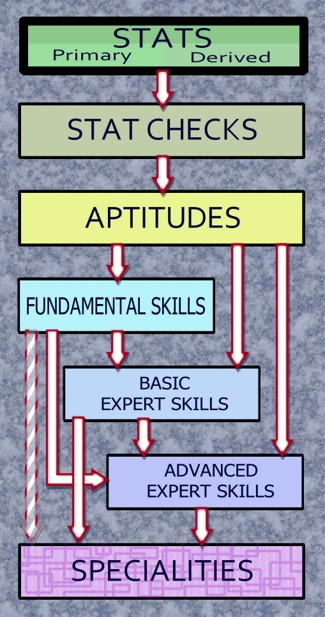
  • Stats come in two varieties: Primary, which are simply bought with character points, and Secondary, which have base values calculated from Primary stats. (There is a third category, “Tertiary”, which are calculated from both Primary and Secondary stats, but that isn’t relevant here).
  • Each of these generates a stat check value which the character rolls against to make, say, a STR check.
  • Stat Check values are also used to calculate base levels in Aptitudes, which represent a character’s innate ability in certain broad areas, e.g. “Linguistic Aptitude”, “Numeric Aptitude”.
  • Aptitudes are used to calculate base levels in 55 specific Fundamental Skills, place limits on how much those skills cost to improve, and determine how much such improvements cost. These are skills that everyone has to some degree, like “Digging” or “Running” or “Draw Weapon”.
  • Basic Expert Skills, also known as Common Expert Skills, are skills that not everyone gets. They have a base value, improvement limits, and costs, that are derived from a combination of Aptitudes and Fundamental Skills. In fact, what defines an Expert Skill is that it is based on a Fundamental Skill. They include things like Acting, Bureaucracy, Seduction, and Persuasion.
  • Advanced Expert Skills are just like Basic Expert Skills except that they derive, in part, from one or more Basic Expert Skills, in addition to Aptitudes and Fundamental Skills. Characters rarely have very many of these.
  • All expert skills also have the option for the character to buy a specialty, which is a bonus in a specific subtopic within the skill. A historian might buy a specialty in 19th century France, for example, or in the 19th century in general, or in France in general. All specialties cost the same price, but the definition (by the player constructing the character) dictates how big a bonus the specialty provides in answering specific questions or accomplishing specific tasks. In theory, it’s possible to buy specialties in Fundamental Skills as well, but we’ve never found a case where it wasn’t more useful to define such as new Expert skills.

The reason for the multiple layers is to firebreak each layer. In the past, every time a stat was improved, all the skills had to be recalculated; now, such improvements are restricted in impact to the immediate level below. It takes a far bigger change than ever occurs during normal stat improvement in the course of play to have an impact large enough to transmit further down, except in terms of increasing what the lower tier can be improved to.

All told, the system lists more than 1,000 skills, and is capable of distinguishing between a character with Applied Organic Chemistry specializing in Pheromones or Perfumes and an Industrial Applied Organic Chemist who designs chemical manufacturing plants and processes, defining how much knowledge they have in common, and how much knowledge and expertise is only possessed by one of them.

For campaigns where scientific specialties are important, such a system works very well, compartmentalizing and categorizing every task or field of knowledge (the details were actually derived from the course structures laid out in my University Degree Curriculum references).

For campaign settings where that is not the case, Precision Skill Interpretation is not the right answer.

Holistic Skill Interpretation

Let’s go back to the Fisherman example. What if skill in Fishing implied that you not only knew how to use rod and reel, but how to make your own lures, fix a broken rod, know how much fishing line should cost, and how to clean fish ready for cooking?

The skills are bucket lists that contain everything related to the subject that is not explicitly defined as being part of a seperate skill.

A Stealth Check includes things like awareness of the environment and any hazards to successfully achieving the goal of moving covertly from one place to another, especially if it is an environment and location that the character knows well.

Those three rolls in the Alleyway example described earlier become one, reducing the unnecessary verbiage and delays to play, heightening the experience and the immersion within it.
 

Player: “I sneak down the alleyway.”
GM: “Give me a Stealth roll.”
Player: “I get a 17.”
GM: “You skulk soundlessly down the alleyway, flitting from shadow to shadow and avoiding the occasional pools of light where the moonbeams break through the clouds. You nimbly cross several sections where traffic and poor maintenance have left the cobblestones loose and reach the mouth of the alley without attracting any attention. Hugging the red-bricked wall, you cautiously look out in an attempt to spot your target…”

 
A far more cinematic and engaging result. The player has time to digest what he’s being told without being distracted by additional die rolls, can focus more on what the character is trying to do, and look at the bigger picture being painted in words by the GM. The game will run more smoothly, more quickly, and be more satisfying to everyone involved.

In Case Of Emergency, Break Glass

We’ve all encountered situations in which a player has made a catastrophically bad roll. There are two ways to look at the original three-die-roll situation: either as inherently limiting the scope of one bad or good roll, so that overall performance more closely matches the overall capability levels of the character, or as increasing the opportunities for such extreme outcomes three-fold.

Both interpretations have a kernel of validity, but make assumptions that simply aren’t universally valid.

Let’s say that the player makes a catastrophically-bad roll for his initial “Sneak”. First question: will running with that result destroy/ruin the campaign? Second question: will running with that result destroy/ruin the adventure?

If neither answer is yes, run with the “comedy of errors” that results. And if the player complains, tell them to thank their lucky stars that the catastrophic roll didn’t happen on a more important occasion.

Even if the answer to one of the questions is yes, we’re still not at battle stations. Third question: can you think of a way to avoid these cataclysms while still permitting the player the full “catastrophically bad roll” experience?

If the answer to question three is yes, there’s no problem – simply put your contingency plans into effect (even if you’ve only just thought of them). But, if not, you still aren’t up the creek without a paddle.

You can always shift gears to a multiple-roll plan – in the case of the example, Spot + DEX save – in the event of a catastrophically bad (or good) result, limiting the impact only when you really need to do so.

The Lazy GM

It’s not often the case, but there is one interpretation in which the term “Lazy GM” can be a compliment. It can mean not doing anything more than you absolutely need to. Drop the PCs in an area that is adventure-potential rich and let the players write the adventure with their choices. Do a lot of broad outlines and bullet-point ideas, catalog and structure them so that you can quickly find the right one, and only develop the ones that you actually need just before you need them.

The less time you spend on irrelevancies, the more time you have to spend on polishing the things that really matter, or taking care of the real-world tasks that might otherwise get in the way of game prep to the point that you feel it necessary to give up the hobby (don’t tell me it will never happen, I’ve seen it more than 50 times, and can safely presume that it’s happened in at least another 40 cases – out of 102 gamers that were active in the hobby a couple of decades ago. Heck, I’ve been forced to ask the question myself a time or two in the last 40+ years of gaming).

For other ways to deal with emergencies and catastrophes like critically-bad or good die rolls at exactly the wrong time, check out A potpourri of quick solutions: Eight Lifeboats for GM Emergencies.

Big-Picture Memoranda

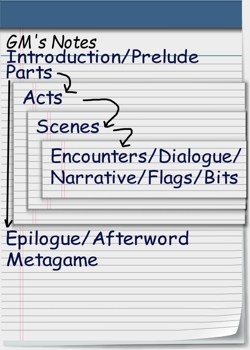
There’s one tool that can help answer those questions: Big Picture Memoranda. Look, I don’t know how you structure your adventures, in general terms; I use a structure like that shown to the left, at least most of the time.

For a long time, I’ve advocated and used the one-line synopsis as an adventure-development tool (and for just about everything else that I write – refer One Word At A Time: How I (usually) write a Blog Post. So I start with a one-line synopsis of the adventure, from which I produce one-line synopses of the introduction, each part or phase of the adventure, and any epilogue or afterword. I then use the one-line summaries of each part to write one-line summaries of each act of the main adventure. Then I use the one-line adventures of each act to break that act down into scenes, and finally, use those one-line summaries to write one-line summaries of the different elements of the content – who, where, and so on. The only things that might not be self-evident on the structure shown are “flags” and “bits”. “Flags” are content that only happens under certain circumstances, for example a PC asking a key question or making a skill roll, and “Bits” are instructions to the GM, for example to go directly to a scene if “X” happens. Oh yes, “GM’s Notes” deal with any setup (such as taking a specific book for a photographic reference) and “Metagame” is dealing with any rules questions that came up during play and handing out XP and things like that.

Once the entire adventure has been broken down in this fashion, it’s relatively easy to actually write, because you have detailed information on how each building block fits together to create the adventure.

Unfortunately, once you’ve finished, it can be hard to find the forest for the trees. If you’re like me, you’ll have preserved a copy of the one-line synopses, but trying to go through that to find what you’re looking for can take too long.

The solution is to preserve copies of some of these one-line synopses at the top of each building block. How does this adventure relate to the campaign big picture? How does this act relate to the adventure as a whole? How does the scene relate to either of these things? I don’t preserve them all – just the ones that are significant, as reminders. So that if any scene takes an unexpected turn, I know how that scene is supposed to fit into each of these bigger pictures, and can immediately assess the impact of the unexpected event. That’s a “big-picture memoranda” or “BigPic Memo” for short.

It means that if a scene is supposed to introduce an NPC who will become a significant enemy down the track, but who is a relative nobody right now, if the PCs do something significant with the potential to change their relationship to the NPC, I can adjust plans accordingly. It’s a cliche but not far from the truth: No plan survives contact with the PCs. Not theirs, and not yours!

A Holistic interpretation of the skills within the game permits a temporary retreat into precision when you need to use it to save your metaplot-bacon. Starting off from the precision interpretation removes that weapon from your arsenal; there are other benefits in some campaigns that justifies that cost, so a precision interpretation should not be ruled out, out-of-hand; but it should always be part of your GMing approach for a reason.

But too many GMs, and too many players, seem to think that it’s the only game in town. Well, now you know better – spread the word by making intelligently justified choices in your games!

Comments (4)

Lessons From The West Wing V: Bilateral Political Incorrectness for RPGs


This entry is part 9 of 9 in the series Lessons From The West Wing

Image Credit: via 3dman_eu at Pixabay.com, licenced as CC0 Public Domain

“Lessons From The West Wing” is a series of occasional articles inspired by the Television Series. I have several of these tucked away in development, and every now and then, prompted by watching the series for the umpteenth time or by relevant world events, I will dust one off and put it out there.

I doubt that the title of this article will mean anything to most readers at first glance, but once you’ve read it, I hope that it is a sufficiently memorable phrase that you will never forget it!

Let’s start, as usual, with some context. Bear with me, it’s relevant.

There’s been a major debate over energy policy taking place in Australia recently. I won’t bore you with the ins-and-outs, but the ideological stance being taken by the party in government, based on something called the Finkel Report, included the statement that electricity should be as cheap as possible for business, so that they can remain competitive, protecting the jobs that already exist as well as increasing the prospects for future expansion. Oh, and “by the way,” the recommended policies would also reduce electricity prices for ordinary consumers – if the report is truly the holy grail of energy policies that it claims to be.

And that got me to thinking, and to playing Devil’s Advocate. Why?

One of the problems that we face is that despite everything looking relatively rosy and prosperous, economically, wages growth and employment growth have stagnated, retail confidence remains poor, and standards of living are actually starting to fall. In such a climate, protecting the status quo is the defensive move of a government paranoid about the winds of economic fortune, a government that knows that it is in trouble, electorally.

They are right to be concerned. Their popularity is at an all-time low, the level of trust in the government similarly catastrophic, and the only thing offering hope right now is that the opposition party have, of late, fallen into the trap of playing partisan politics, of being an opposition first and true to their ideology second. Nevertheless, were an election to be held tomorrow, polling (usually pretty right in this country) says there would be a massive swing and a profound change of government – to an opposition that is looking less and less ready to function in that capacity.

So, what’s the alternative? What would happen if, as a former Prime Minister from the same party (and equally as unpopular as the current leadership, politically) has advocated, the primary focus should be about making domestic electricity prices as low as possible?

Well, consumers would have more money in their pockets, and a lot of that would then get spent, stimulating the retail economy. But higher electricity prices for industry would mean that products that are energy-dependent, especially manufactured goods, would rise in price, and some industries might even become unable to compete with overseas sources. Overall, though, wages would go up, and then – right after people got used to having more money to spend – prices would go up by the same amount. Cash flow through the economy would tick up, though, and that would enable wages growth claims to have some justification. On the whole, every area of the economy that is currently in trouble would be given a kick-start, with the big picture changing not all that much – the amount of money going into the energy providers would remain about the same, but instead of dividing the cash flow up into two separate strands – industrial and domestic consumption – the result is a longer but economically stronger single strand in which money flows to consumers, from consumers to retail, from retail to industry, and from industry to power supplier.

Our much-reviled former prime minister might just be right, this time – for all the wrong reasons, as usual – but because he’s the one espousing this position, no-one is listening seriously enough.

The problem is that everyone’s position has become ideologically entrenched – provided that you accept the notion that opposing the government, no matter what they do, is an acceptable opposition ideology.

The Bigger Picture

This is by no means a problem confined to the Australian shores. From the time of the rise of the Tea Party in the US, Republicans increasingly adopted that ideological premise, no matter how hard the Democrats tried to negotiate an acceptable compromise. Increasingly, they opposed and blocked almost everything simply because it was coming from a Democrat-held White House. I was quite astonished to read, during coverage of the recent budgetary discussion over HR 5235, how long it had been since the US had passed an actual budget instead of a continuing resolution.

Some readers might not know or understand the difference. In a nutshell, a budget spells out exactly how much the government can actually spend in the coming year, subdivided by purpose into different government departments. A continuing resolution is a watered down temporary emergency budget, with various departments often funded at a fraction of what they would expect to receive in a full budget. It provides money for a quarter, three short months. I understand (but don’t quote me) that most government departments got about 92 or 94% of their estimates from the last continuing resolution, the bill (HR5235) mentioned above. Continuing Resolutions are a political stopgap intended to keep the government functioning until a full budget can be passed – so there is an inherent assumption in the very concept that a budget will be passed.

The last budget that was fully passed by a US Government, so far as I can tell from this Wikipedia Page, was either in 2011 or 2013!

You actually see the hardening of ideological entrenchment in country after country as you become aware of their politics. I saw it in the Greek Government Debt Crisis, in the positioning over Brexit, and on and on.

In RPGs

I’ve seen something similar happen in RPGs when it comes to politics, as well. The PCs are confronted with a problem, but the politics are simplified to the point of being monochromatic black-and-white.

There’s an evil half-brother to the King, plotting to seize the throne, for example. Half-brother bad, King Good, end of story.

Real life is never so black and white.

If you’ve read and followed the advice from this blog (and others) over the years, you may have nuanced a little smudge of gray here and there – for example, making the King in question less able in some critical policy area or areas than the half-brother. This not only makes the half-brother more credible as a possible ruler, it provides an area of distinction that justifies his belief that he would make a better ruler than the incumbent. This leads into a deeper exploration of the limitations of the monarchist system and hereditary nobility, creating additional interest for the players, and enabling the NPCs to be involved in adventures in more than one way – the half-brother, usually an enemy of the PCs, who align with the King, can show up in one of the other four iconic roles of the AERO structure, making him more an element of the world at large, sometimes good, sometimes bad, but never something to be ignored, and enlarging the storytelling tapestry no end.

But even then, it’s easy for GMs to fall into the same trap of ideological entrenchment projected onto a situation or character within the game.

No Easy Answers

In politics, both in-game as in real life, there should be no black-and-white, no 100% right answers. That’s too easy, and makes things to simple – and too simplistic. Whether or not a given policy, response, position, or opinion is right or not should depend on how it impacts the individual voicing the opinion, the nation they govern or wish to govern, and the citizens that they represent. Every point of view should have at least a crumb of credibility, no matter how deeply buried.

But achieving that is often not easy, because the GM will always have his own personal opinions, and doing this properly inherently challenges the GM to justify those opinions to the themselves, and potentially to others.

I make no pretense about my personal inclination toward socially-progressive politics and policies, for example, though you would be reasonably hard-put-to-it to be able to determine that from most of my articles, which are as politically-agnostic as I can make them. In the US, I would probably vote Democrat 90% of the time or more.

You achieve that political agnosticism by continually asking, “what’s the price?,” “what’s the downside?,” “what are the assumptions?,” “how can they be tested?,” and “what’s the kernel of truth in positions in opposition?”

Every political position or policy espoused by a character in an RPG should have to run this gamut. These always represent a choice, from which some will benefit and others suffer. The question is always how to reconcile these divergent opinions.

It’s easy to suggest, for example, that free speech should be absolute. But with that position come a number of thorny questions that aren’t so easy to resolve. Religious opinions expressed in classrooms. Texts that promote violence, prejudice, and intolerance. The social media “echo chamber”. “Fake News” and the ability of commentators and editors to manipulate public opinion in the guise of reporting facts.

It’s also easy to suggest that as a defensive mechanism against such manipulation, one should operate from the perspective that every news report lies, or is (at best) slanted in this direction or that. Sometimes, there is such distortion – Fox News is notoriously perceived as pro-conservative, for example – but that doesn’t mean that they are .always right or always wrong. In Australia, we have Andrew Bolt, Alan Jones, and Steve Price, and our own version of Fox News. It’s rare for me to agree with Bolt, slightly less rare for me to agree with Jones, and more frequent for me to be forced to concede that Price has a good point to make on an issue. My opinions more frequently align with, or are shaped by, Waleed Aly, who represents the other side of the political debate. (If you haven’t seen his “What ISIS Wants”, I can’t urge you strongly enough to . It reshaped and developed many of my opinions on Terrorism and how we should respond to it, and in the world that we continue to live in, the insight it offers is something we can all use.

Each of these broadcasters has their ardent admirers, and for many, the balance of credibility falls in the other direction.

Lessons From The West Wing

As GM, you have an omniscient and omnipotent position with respect to your game world. You should not cheapen that power and authority by demonizing one perspective universally.

This is a lesson that I learned from watching The West Wing (Wikipedia Page, Complete Series on Amazon. Although the overall slant of the series was Progressive, the only Conservatives (and Democrats, for that matter) who were actually demonized within the series were those who ideologically entrenched themselves or placed themselves ahead of their offices in importance.

As one Republican notably said when reviewing the series, “I hate the politics but I love the show!” (or words to that effect).

No political faction held a monopoly on the truth. No political party was all bad, or all pristine. What mattered more was the individual – were they ethical, were the honest, were they trustworthy, were they honest representatives of their constituency, did they make an effort to see the big picture, were they willing to listen and give a fair hearing to opposition positions?

Issue-By-Issue Decisions

And it wasn’t just person-by-person. Everybody had their blind spots, everybody had their ideological foundations, everybody had positions on which they were right and positions on which they were wrong – and couldn’t necessarily see it.

That’s the sort of mindset that the GM needs to hold with respect to every NPC in a game when it comes to their politics.

But that is easier said than done.

The Real Challenge

It’s not really all that difficult to get this far. There may be a stretching of your mental muscles, a certain opening of your own political awareness that comes from deliberately exploring for the validity of the opposing position, but it’s not that big a step from what you are (hopefully) already doing.

The real challenge is creating this diversity of perspectives within a character while still keeping that character internally consistent as a character.

Characterization is the Key

My secret to doing so is to have the perspectives on an issue derive from the characterization of the character.

A character who is a strong believer in military preparedness and preemptive force – a ‘hawk,’ to use the 1970s vernacular – will be Conservative in orientation on military issues. If the rest of that character is more progressive in attitude, then that’s enough for him to stand out; if he is principally a conservative already, then this needs to go further to achieve the same distinctiveness, which opens the character up to having a blind spot on the issue, an inherent belief that the military can do no wrong and if an intervention fails or misfires it’s the fault of excessive restriction placed on them by a civilian authority.

In effect, consistency of characterization is an emergent property that results from viewing the character from a metagame perspective that incorporates more than is shown in any single appearance in the course of play.

Another Example

Here’s another example from just the last couple of days. One of the most divisive and populist Members of Parliament in Australian Politics is Pauline Hanson. Yesterday, while announcing that her party had done a deal to pass a divisive school funding bill, she called for Autistic Children to be removed from mainstream school classes, suggesting that teachers spend too much time caring for such children when they should be teaching at a pace the majority could cope with, while the children themselves should be classed seperately and given special attention.

As you can see from the randomly-selected page of twitter comments in response below, this did not go over well with a lot people.

Today, she commented that people were misinterpreting her statements because of biased newspaper headlines which employed selective quotation to distort her views. This prompted a further series of attacks, pointing out that most people got their information from television news, which showed her actual statements, and that others had obtained the full press release of her statements to form the basis of their opinions and that those opinions did not differ from those who had not. So this defense doesn’t stack up, and only damages her already tarnished credibility.

But that’s beside the point. Let’s look at this policy suggestion critically, as you need to do if you want an NPC to pronounce something similar, or even to have a government contraversially enact it within your game.

Do autistic children require additional attention? Yes, undoubtedly. Does this additional attention impact on the teacher’s ability to educate the other children? In terms of a curriculum, it has to – a teacher has only so much time to go around. A regular debate in politics in Australia (and elsewhere, I’m sure) is “what is an acceptable classroom size?” based on the premise that a teacher has only so much time for one-on-one attention to students. So there is some rational basis for the position, no matter how loathsome anyone might find it.

Pesumably, then, those opposing the proposal (and, for the record, I’m one of them) see some other educational value to integration. Like tolerance and social experience – and that totally ignores reports that I think I remember showing that such children learn more effectively and more quickly in such an environment, while placing them in “specia classes” slows their education to that of the least able student in that classroom. Nor are there any studies of which I’m aware proving significant reductions in educational breadth and quality from the inclusion of such students.

Anyone with an informed opinion on the subject is therefore prioritizing one outcome over another as “more desirable.” My personal opinion does so, too. Understanding that validity permits me to attack more robustly and to defend my position more effectively. It certainly enables me to GM an an NPC who advocates such views in spite of any contrary opinions I might personally have. Remember, too, that the NPC’s reasons don’t have to be sound ones; they might be misinformed, bigoted, corrupt, loathsome, or simply employing flawed reasoning or poor sources of information. But my presentation of such an NPC is more effective even if that’s the case if I’m aware of the nuggets of underlying truth.

Bilateral Political Incorrectness

Which brings me back to the title of this article, and my hopes that it will encapsulate these principles in a single mnemonic.

Bilateral – applies to both/all sides when it comes to any single issue or policy or political party or organization…

Political Incorrectness – …are equally capable of being right or wrong, depending on the circumstances, and from the point of view of someone who is personally affected, one way or the other.

An infusion of Bilateral Political Incorrectness into a campaign embellishes it with richness, depth, complexity, nuance, sensitivity, logic, issue awareness, and personal growth. It can be difficult at times when a character adopts a position that you personally have a fundamental disagreement with, but when that happens you have to “dig” until you discover the underlying truth, the kernel of “rightness” that makes that position rational, given the character’s experiences and how they have shaped him or her. But those rewards are worth a bit of effort.

Sorry to everyone for the delay in posting – I got so caught up in writing another article that this one completely slipped my mind!

Comments Off on Lessons From The West Wing V: Bilateral Political Incorrectness for RPGs

Improvising A Campaign: introducing the Zener Gate campaign!


This entry is part 1 of 4 in the series The Zener Gate System

Based on an Image by Hypnoart via www.Pixabay.com License CC0 Public Domain

This is being written a little under the deadline pump; I’m still playing catch-up from my week away at the Family Reunion / 40th Birthday party for my nephew. So it may not quite live up to my usual standards, but I’ll do my best.

Actually, I’m cheating for a lot of this article, which is clearly a sequel to last month’s “Improvising An Adventure,” which was very well received. As a result of the experience that was discussed in that article, I’m currently looking at doing a campaign that’s all improv. I’ve started work on it, and this article will walk both readers and the players though at least some of the thought processes involved.

Game System

I have to admit that I still haven’t decided what game system to use. In fact, I haven’t ruled out writing a 1-2 page original on which to base the campaign. But I have thought about the selection criteria.

I don’t want the game mechanics to intrude on the game play. That’s the big thing for me at this point. I want simplicity and elegance and a lot of flexibility.

The game system is to be a vehicle for implementing the campaign concept, nothing more.

Campaign Concept

The basic notion is something of a cross between “Sliders” (Wikipedia page, Box Set via Amazon) and “Quantum Leap” (Wikipedia Page, Complete Series Box Set via Amazon). Two, or possibly 4 PCs, two players. The essential idea is that the PCs will be part of the test program for a time machine that goes horribly wrong because temporal theory is all wrong, or at least mutually contradictory. As a result, the characters will find themselves “bouncing” from one time period to another, getting involved in whatever is going on, and then moving on to the next adventure, which will take place in a completely different setting.

Character Fundamentals

My first thought was that the PCs would represent members of a team something like that in “Stargate SG 1” (Wikipedia Page, Complete Box Set on Amazon), but quickly realized that the military foundation would confine the scope of the roles open to the players, so I discarded that concept.

My second thought was that at least one of the characters would be an expert in temporal science, either an engineer or scientist. I definitely didn’t want that. I don’t want the campaign to be about the technology, or about the physics of time travel – I want all of that to be a black box, PCs go in, adventures come out.

So a key part of the Campaign Background will be addressing that restriction, justifying it. My inspiration for handling the issue comes from a relatively unknown TV series that I quite enjoyed (having stumbled across it by accident), “Seven Days” (Wikipedia Page, Box Set – probably unofficial, it has never been released officially according to this thread at GateWorld Forum – , ).

Unfortunately, the restriction in question isn’t described by the Wikipedia article, so I’ll have to do it here for the benefit of anyone who hasn’t seen the show. In a nutshell, not everyone can survive the trauma of time traveling – there’s a complex navigational challenge, the equivalent of flying a jet aircraft on a precision course while being subjected to extreme buffeting, high levels of G-forces, and random electrical shocks causing convulsions and involuntary muscle contractions. Most people, even most test pilots, can’t do it – in fact, at the start of the series, only one person has ever successfully functioned as a Chrononaut. In the second season, a second, backup Chrononaut was identified and the concept was repeatedly eroded thereafter in the interests of heightening the melodrama.

Beyond that, the characters need to be highly self-reliant because they are going to be cut off from home base (at least part of the time, I haven’t decided on the big picture in full yet).

Setting

This is to be pretty contemporaneous with the world around us. I might set it in 2018 or 2019 just to give myself some flexibility, but a key figure in the background and campaign introduction is going to be President Trump – I couldn’t resist the notion of exploring what he might do with a top-secret research project that, if it works, could give him a mechanism to reshape the world as he sees fit (or as he sees it).

At the same time, I don’t want this campaign to be about politics or anything like that – this is to be an action-adventure campaign.

Game Prep

The whole concept of this campaign is that there isn’t going to be any. I want to come up with the day’s adventure and any NPCs on the day, off the cuff. Part of the campaign concept is designed to absolutely minimize continuity.

The Alien Concepts

There are so many concepts involved in this campaign that are completely unlike my usual style and practices, and that’s a large part of the excitement. I don’t have a big finish pre-planned, in fact I don’t have anything planned! Everything exists as a linking element that ties together whatever situation I think of.

Technology Limitations

One of the key concepts required was going to be that each adventure would start with a clean slate, or close to it. Whatever the local technology that was available would be what the PCs would have to use, and they would have to acquire it locally. Time Travel was going to involve several limitations on what they could take with them, and one of the key decisions the players would have to make early on would be what their basic equipment was going to be.

Initially, I was going to be even more extreme in this area than I now plan to be – I was going to have the PCs go through the time warp (or whatever the framing mechanism was called) practically naked. I have retreated slightly from that line – they can now carry anything that makes direct contact with their bare skin or a metallicized uniform provided that it does not rely on chemical reactions of any kind, which behave abnormally during the transition process. No guns, no explosives, not even a match, no batteries or advanced electrical devices, and nothing that protrudes more than half an inch from their persons.

All this restriction has a key impact on the game system, in that an awful lot of most of them won’t be needed.

PC Motivation

Why should the PCs get involved in whatever is going on? This was a key question in Quantum Leap and the answers in that series never satisfied me. In Seven Days the missions were all emergencies or matters of extreme national security, but that doesn’t work unless there’s some communications mechanism between the agents in the field and home base, and the base concept I was working from had no such communications possible.

Again, I have moderated that position slightly as the campaign has taken shape. And PC Motivation is the key. In the beginning of the campaign, it will be all about the PCs coming to terms with their situation. Once that becomes settled, over the course of the early part of the campaign, the PCs are going to gather what they need to restore very limited communications, and their ultimate goal is going to be building what they need in order to stabilize their situation, get them involved in attempts to ‘rewire’ history, and eventually, to get them home at the end of the campaign whenever the players get tired of it, or I run out of ideas.

Fantasy Elements? Sci-Fi elements?

At this moment, I haven’t completely ruled these out, but intend for them to be exceptions and oddities, not the norm.

Game System – again

The last major decision that will be made is the one that I started with – what game system will I use? No decision has yet been made. All my thinking along these lines has been more about what I don’t want.

The current options under consideration (and not all of them seriously) are:

  1. Triumphant
  2. OVA The Anime RPG
  3. Maid The RPG
  4. Star Trek TNG RPG
  5. d20 Modern / d20 Future
  6. Thrilling Tales 2nd ed
  7. Villains & Vigilantes 3
  8. An extremely stripped-down variant on Pulp Hero
  9. TORG (1st Edition)
  10. A custom-written Home System
  11. Something else…

These are all systems that I, or one of the players, have on-hand. I don’t intend to take very long over the decision – I’ll be skimming them looking for a reason to reject them. The last five are the most interesting, and have additional reasons to recommend them, so unless one of the others seems pretty perfect, that’s the most likely choice. So let’s look briefly at those relatively “hot” options.

  1. V&V 3rd Edition is the game system being recommended by one of the players based on what I’ve told him about the campaign. But I haven’t looked at it yet.
  2. A stripped-down Pulp Hero is an option because it’s a system that we’re all familiar with. But it’s likely to be too complex as it stands for my needs, and not quite cinematic enough in mechanics.
  3. TORG is a system that I like a lot. I’ve actually GM’d it before (years ago), and at least one of the players has played it. I also have lots of supplements for it – just about the complete bundle, in fact – but they are all in storage where they will be slightly inconvenient to access. I am also concerned that the whole “possibility energy” concept would be too
    integral to the rules system, but must also admit that renaming it appropriately would be a convenient reflection of why the PCs are able to succeed as “Chrononauts” (a term that I don’t intend to keep, but that is better than nothing for now). So there are pluses and minuses.
  4. An option to which I am giving serious consideration is a simple, custom, game system. This has the advantage that it will be a perfect match for what I want the game mechanics to represent, but the disadvantage that I haven’t written it yet, and it certainly won’t have been play-tested. If I decide to go down this route, I will almost certainly have to publish it here, as turning it into a post at Campaign Mastery is the only way that I will have time to write it. I have two months, so wait and see… if I do, it will probably involve a conceptual tip of the hat to some of the elements of TORG that I like.
  5. Heading the “Something Else” is another story-based system, such as FATE, about which I have heard good things – but the player who is recommending V&V doesn’t like it and has actually tried it, which I haven’t, and I don’t have a copy of it, both strong negatives to take into account.

Campaign Background & Player Briefing, second draft

I wrote this up on the train on the way back from the Family Reunion and offer it here in its final form, for use by whoever wants it.

Who are the PCs?

The Government attracted heavy criticism in the decades after the moon landings for such a heavy military involvement in the space program. As a result, when the Zener Gate was discovered, and a NASA-like project initiated to explore the phenomenon, it was decided that this would be primarily a civilian programme. However, as with the nascent days of the Space Programme, no-one knew exactly what would confront the first explorers to another time; while, in theory, they would be launched and “snap back” seconds later, as had been the case with every test animal sent through the Zener Gate, there were a dozen different competing theories as to how the Gate worked, and not all of them were so predictable. The result was a manhunt for the most able, most self-reliant individuals. They were then tested to within an inch of their lives for resilience in the face of stress, calmness in the face of danger, resourcefulness, trustworthiness (the Zener Gate was a very highly-classified project, after all), and any other quality that anyone thought might make the difference between survival and death, success and failure. Ninety-nine out of every hundred candidates washed out.

Then they began assigning them to groups, according to the best judgments of the behavioral psychologists, and testing the resulting three-man squads for stability, capability, and group functionality. 40% of the candidates who had made it through the first screenings washed out – they simply didn’t play well enough with others – and many of the teams were left incomplete, on stand-by until a complimentary third member could be located.

Twelve three-person “Go” teams were established, 36 men and women were stable and compatible and possessed of complimentary skill-sets, the best 36 that the United States had to offer, code-named Chronosquad Able, Chronosquad Baker, Chronosquad Charlie, Chronosquad Delta, Chronosquad Eagle, Chronosquad Foxtrot, Chronosquad Golf, Chronosquad Halo, Chronosquad Indigo, and Chronosquad Juliet.

Chronosquad Juliet were killed on a routine training mission when their transport aircraft crashed in bad weather off the coast of Florida.

Chronosquad Able were scratched from the programme following a security violation.

Chronosquad Baker were killed in the systems overload the first time an electronic device was sent through the Zener Gate. Investigation of the incident led to the discovery of the Meitner Field Radius.

Chronosquad Charlie were scrubbed when an inappropriate personal bond arose between the two male members of the team.

Chronosquad Delta focused on animal testing of the Zener Gate, and established the existence and parameters of the Meitner Field Radius.

Chronosquad Golf were scratched when one of the team members contracted Malaria.

Chronosquad Eagle were thus the first set of human subjects to transit the Zener Gate. President Trump himself spoke to them via sat-phone to tell them how great he was for ‘making it all happen’ before the gate was activated, enveloping them in it’s quantum-field-shredding energies. As predicted by theory, they were “elsewhen” for 12.3 seconds, verifiable because they drowned in salt water whose chemical makeup had not been seen on earth since the early Cretaceous period. This also verified another operational parameter that had been only theoretical previously – no-one drowns in 12.3 seconds; the duration experienced “elsewhen” by Chronosquad Eagle was hours or days (depending on how long they were able to remain afloat). Whether or not this value was completely independent of the event duration recorded at Zener Control was unknown and would remain so until far more data was collected.

Chronosquad Foxtrot followed; they were absent from local space-time for 13.12 seconds, returned to describe a tremendous ice-field as far as the eye could see and no signs of human activity. Whether the was some long-past ice-age or one yet to come, they could not say. Suffering from extreme frostbite, they stated that they had experienced more than 8 days in the other time, but that the days had seemed to last longer than normal.

Chronosquad Halo departed local space-time for 11.4 seconds, and returned having been mauled by some form of wild animal, dead of blood loss. The directive came from on high – each team was to devise their own personal weaponry, bearing in mind the Meitner Field Radius, and become proficient in its use prior to embarkation.

That directive was issued eight weeks ago; and now, it is the turn of Chronosquad Indigo!

The Meitner Field Radius

The one characteristic that all Temperanauts have in common is that they are possessed of unusually dense Meitner Fields, sufficiently intense that the fields rise about half-and-inch from the surface of their bodies. Meitner fields are something similar to Kirlean Fields, energy patterns created by intracellular electrical activity. Not much is known about them at this point, and much of that knowledge has been bought at the cost of human life.

If an organism does not have such a high-density Meitner Field, that organism suffers complete biochemical breakdown as the chemical processes that create and sustain life go awry, some running rampant, and others coming to an almost-complete halt.

Anything surrounded by an intense Meitner Field can be conveyed through the Zener Gate by a Temperanaut, but there are certain risks and shortcomings that Temperanauts must be aware of when selecting their equipment.

Anything which relies on a chemical reaction in order to function will tend to misbehave, the reactions either inhibited or dangerously accelerated. In a nutshell, they either become chemically inert or explode. It is believed that electron orbits have a Temporal Component through one of the 10 non-space dimensions postulated by Quantum Physicists, but the reasons are ultimately irrelevant – the phenomena happens.

Anything that projects outside the field is sheared off during Zener Transit. Atoms are literally cut in half, as are subatomic particles. This creates a field of radiation (mostly gamma) that surrounds the Temperanaut and can quickly reach lethal doses. Since protection against such radiation requires dense metals such as Lead and the thickness of such materials must be measured in feet or meters, not fractions of an inch, radiation exposure is a constant problem that the Temperanaut must be aware of. Air molecules represent a relatively negligible exposure, about equivalent to 24 hours of television viewing or six hours in space beyond the protection of the Van Allen belts; but the density of material is a factor. Air has an atomic density of 0.02504 x 10^27 atoms per meter cubed. A Meitner Field Surface has an area of approximately one square meter. Only at the edge of the Meitner Field is there atomic disruption, so effectively we’re talking about 85.6 x 10^16 atomic breakdowns. Half of these will be directly away from the organism and another 10% or more will be at an angle that does not intersect with the biological structure, e.g. near vertically. All this reduces the resulting exposure to relatively safe levels. Water has an atomic density 1332 times that of air, and produces a radiation field that is 121 times as intense. This is enough to substantially increase the risk of radiation poisoning with repeated exposure, equivalent to having 121 whole-body x-rays. Diamond (and most other solids) have an atomic density 5 times that of water, which doesn’t sound like much – but it produces a radiation field more than 6000 times that of air, the equivalent of having 605 whole-body x-rays per exposure. Accordingly, Temperanaut uniforms must be snugly fitted, suitable for all climates, completely free of loops and other projections, and anything thicker than 0.25 inches is unsafe.

Electrical Devices, unless hardened against EMP, are completely fried by the process of transition unless protected by a Meitner Field. Batteries and other such power sources are particularly affected because the electron flows are massively disrupted by transition. What’s more, the electron flows in such devices are known to disrupt Meitner Fields even when no current is flowing. Accordingly, no electronic devices of any kind are permitted to be in an actively-powered state and no Temperanaut may carry an electrical power supply of a chemical nature.

This does not preclude the use of solar cells, however some theories of time travel warn against introducing technology foreign to the era, and so these power sources are also prohibited. It follows that power supplies for any electronic devices must be sourced from the local environment without being witnessed by local inhabitants.

Temporal Dangers

Durations experienced on the far side of the Zener Gate are known to radically differ from those recorded at the Zener Control end. To date, no pattern has emerged, it is only known that seconds of absence may translate into hours or days on the far side. Zener Gate openings are uncontrolled, it is not yet known whether or not the degree of durational impact is in some way related to the temporal separation between times. Accordingly, Temperanauts should always remain in close proximity to each other, and local sources of food, clean water, and shelter must be obtained. You may have a long wait.

Paradoxes may be impossible to initiate, or impossible to undo. We don’t know. Interaction with the locals is considered high-risk, but may be necessary. The more important the individual, the greater the risk involved. It is also true that under at least one temporal theory, any attempt to create a paradox or alter history will result in the offender being excised from existence.

Environments may be harsh. Survival precautions should be taken when necessary.

There is much we simply don’t know. Hence selection focused on self-reliance and an ability to improvise.

Adventure Format

It is anticipated that adventures will come to fit a standard pattern or format.

Pre-game: Spend XP and update characters.

Arrival Recap: The PCs will emerge from a Zener Transition and be able to make an immediate assessment of the local conditions and time-frame.

Baseline Resources: The PCs will obtain or identify local resources – food, water, shelter. For the first few times, this will be roleplayed in full, thereafter it will be assumed to have happened and relevant details provided by the GM in between scenes unless a specific challenge is represented.

Engagement: Something will happen that will involve the PCs in whatever the local situation is in a rational and sensible way. Initially, these will involve avoiding situations forbidden by Zener Control Standing Orders; over time, these will evolve into specific objectives that require interaction with the local environment or indigenous personnel. It will become quickly apparent that not all is as it was presented to them in the briefing provided pre-transition by Zener Control.

Impending Transit: A means will quickly be developed of realizing how long a time-span is available for the adventure in game time. This will be an amount sufficient for the PCs to resolve the engagement but still place them under some time pressure.

Resolution: The adventure is completed or time runs out to do so.

Transit: When time runs out, the PCs will involuntarily make a new Zener Transit, departing the local timeline. Care will need to be taken to avoid long-term radiation damage by carrying items they shouldn’t. The decision of what to take and what to leave behind will be a critical one for the players, as they will be strictly limited in this capacity.

Teaser: It is anticipated that most of the time, the adventure will wrap up with a teaser for the next arrival sequence.

Experience/Post-adventure: XP will be awarded immediately based on the success or failure of the characters in achieving their objectives. XP may also be awarded in the course of play. Long-term damage will be tracked and will semi-permanently impair the characters thereafter. From time to time, in-adventure circumstances will permit medical treatment of long-term damage, restoring the characters to partial or complete health.

The ?pilot? adventure will differ from this somewhat as there will need to be some foundations laid. I anticipate starting the game as the PCs from Chronosquad Indigo are suiting up just prior to their expedition through the Zener Gate.

Adding New Players / Replacing Dead PCs

I have some ideas, not yet fully developed, to enable both of these to occur should they become necessary. It is anticipated that PC death with be a rare event and a Big Deal if and when it occurs, and it is not expected that other players will want to join the campaign, but I think it important to prepare for both contingencies.

So that’s the plan

…we shall see how closely the reality measures up! Everything except game system choice and creating the first adventure is now done…

Comments (6)

The Prohibition Disjunction: When Rules Go Bad


Disposing of illegal liquor By Unknown – Vintage periods, Public Domain, https://commons.wikimedia.org/w/index.php?curid=5119649

The Story Of Prohibition

When Prohibition became law in the US in 1920, it was expected that, albeit reluctantly, the citizenry would simply obey. This was no mere law, after all; it was an Amendment to the Constitution, the very document that defined the United States as a nation, and hence an attempt to willfully modify that definition.

This was the culmination of decades of effort by the so-called “dry” movement, combining social progressives in the Prohibition, Democrat, and Republican parties as well as a large number of Temperance groups, especially the Woman’s Christian Temperance Union, all coordinated by the Anti-Saloon League. The League was based in the Southern states and rural districts of the North, especially Methodists, Baptists, Disciples, and Congregationalists and other Protestant ministers and congregations.

The League’s ethos was to concentrate on the passage of legislation, not on whether or not it had the desired effect. After all, if the laws they passed were ignored or ineffective in a few cases, it was simply a matter of sufficiently draconian enforcement and perhaps some complimentary legislation.

In a consequence foreseen and publicly predicted by the leading medical examiners of the day, illegal alcohol consumption exploded in the face of the law. Not only did you have those who actually wanted to drink, but there was considerable opposition to the laws because the use of a Constitutional Amendment was seen as both excessive and social engineering.

It faced some strident opposition, too. Civil Libertarians, Brewers, those alarmed by the rise in criminal activity and organized crime, those distressed by the mounting death toll and number of emergency admissions resulting from the consumption of Methyl or ‘Wood’ alcohol, those unhappy over the tenfold increase in arrests for Drink-driving since Prohibition, and those discommoded by the loss of the tax revenues gained from alcohol sales, all pushed hard against the law. Since several of those movements were reactionary, they only grew in strength as the unwanted effects of the legislation mounted.

The reaction of those who backed Involuntary Temperance was to ‘spike’ the chemicals that were being used in industrial alcohol to make it even more poisonous, and if one then died as a result of drinking booze with deadly additives, having consumed it in full knowledge of the risks, that was the individual’s choice and tough luck. A chemical ‘arms race’ began, in the summer of 1926, between the chemists attempting to poison the ‘wells’ and those looking for industrial processes to at least minimize the dangers in a manner that was cheap enough that the Bootleggers would institute it.

Nicholas Murray Butler, the President of Columbia University became so disenchanted with Prohibition (and all the attendant social ills) that he decided to seek the nomination of the Republican Party on an anti-Prohibition platform. Already a strident opponent of the legislation – he didn’t oppose regulating saloons, but doing so by Constitutional Amendment, he said, was overkill – it was his contention that after seven years of the ‘social experiment’, “any idiot could see that Prohibition had been an enormous mistake”, one that could only be rectified by replacing the leadership that had brought the country to this position.

Ultimately, he failed to secure the nomination – in fact, he didn’t even come close, and doesn’t even rate mention as a candidate on Wikipedia’s page on the convention – and the nomination (and ultimately the Presidency) was claimed by Herbert Hoover, who promised economic prosperity and endorsed Prohibition as an “experiment noble in purpose”.

Hoover, despite this public endorsement of the policy, was not unlike the general public in his behavior, though he did not need to stoop to visiting a speakeasy; instead, he regularly paid social calls to the Belgian Embassy, which was technically on Belgian soil and not bound by US law; as a result, he could drink legally there and be guaranteed good-quality alcohol as well.

Did Prohibition succeed? Even today, that’s arguable. It did cut overall alcohol consumption in half, and did achieve a lasting reduction of 30-40% even after the repeal of the legislation. And yet, the increase in the number of fatalities and collaterally impacted people argued that while fewer people were drinking, those who were were consuming vastly greater quantities.

Every passing year saw support for the law eroded while opposition grew; it was inevitable that it would be repealed. Ultimately, the citizens of the United States told those in power that they would define the social and cultural nature of the country, and would resist any effort to have a definition foisted upon them, however well-meaning it may have been.

RPG Relevance I – The Official Rules

And that brings me to RPGs – which is what this blog is all about, after all.

A broken rule is like Prohibition: while it won’t be ignored by everyone, there will be enough people willing to do so that the rule will be largely recognized as a failure.

There will be an overwhelming temptation to ‘repeal’ the bad rule by creating and implementing a House Rule. And, a proactive GM is likely to be out in front of the players on the issue, possibly issuing his replacement rule(s) even before the official version has appeared in the course of play.

RPG Relevance II – House Rules

The institution of a House Rule is also not dissimilar to the imposition of the Volstead Act (which was the key legislation permitting the enforcement of Prohibition).

Each such rule has two inherent broad premises: that the affected rules need to be changed, and that this house rule is the change that needs to be made, or at least a step in the right direction.

If both premises are accepted by the constituency – the players and GM – then the rule will be accepted and will then stand or fall on its merits. If it fails, it will eventually be supplanted by something else, hopefully addressing the failures in the House Rule – but the option of falling back to the official rule is almost certainly a last resort.

If one or both premises are not accepted, then the House Rule is on shaky ground; the best that it can hope to achieve is a sort of armed neutrality, a grudging acknowledgment that however great a failure it may be, it at least is no worse than the original rule.

Responsibility

The responsibility for ensuring that the House Rule addresses a real problem, and that the House Rule represents a genuine improvement in the situation, belongs to the GM. And part of that responsibility comes down to public relations, to the GM selling the players both his definition of the problem and the solution.

It’s actually one of the tenets of modern advertising, especially of products like cosmetics and hair care, that a successful advertisement will create the problem in the minds of the audience and then ‘sell’ them the solution. This creates the desire for the product that translates into sales.

How should the GM address that responsibility?

The Ideal Case

Let’s start by looking at the ideal case, when you have time to prepare properly. In the perfect world, there are 11 steps to the process that I use:

  1. Structure
  2. Allow Time
  3. Justification
  4. Make Your Case
  5. Failure Criteria
  6. Player Copies
  7. First Draft
  8. Test-run (optional)
  9. Preserve Rules separately to Justification and Failure Criteria
  10. Schedule A Review (optional)
  11. Fall-back Plan
    1. Structure

    Always collect and document your House Rules in a structured way, to make it as easy as possible to (a) find something when you need to, and (b) explain them to a new player if you need to. I use the chapters of the core rulebook as my starting point, but I know other people who use the page numbers. If there are multiple core rulebooks it’s always Player’s book first, GM’s guide second, and supplements thereafter including an abbreviation of the name. All these serve as a prefix; the sequential rule number serves as a suffix. That all gets followed by the actual rule. In monster guides, such as the Monster Manual, each letter of the alphabet is considered a separate chapter for these purposes.

    That means that an entry might read “17-004”, which means “Chapter 17, Rule number 4.” If there are only 12 chapters in the PHB (or equivalent) for the game system, you know that this refers to the 5th chapter of the DMG. That tells you where the original rule being modified is, and follows it up with the changed rule.

    You don’t have to use this system. You might decide that an abbreviation of the rulebook name is always appropriate, for example, and the chapter number always refers to “within that rulebook” (that would make the same rule listed above, “DMG-05-004”). The important thing is to have an official repository for your house rules and to give it a structure that enhances its usefulness.

    2. Allow Time

    Never be afraid to end a game session early or start one late if that gives you time to discuss the House Rule with the players to their satisfaction. NEVER implement a permanent House Rule without such discussion if you have any other choice. The caveat is necessary because of the “non-ideal case” when a rules change is needed “on-the-fly”, which is a whole separate can of worms to be opened a little later.

    3. Justification

    House Rules are always justified in the mind of the author. The key lesson from Prohibition in this context is that this isn’t good enough. The ‘public’, i.e. the other players (and, if not the author, the GM) need to be convinced not only that there is a problem, but that this is the solution. And that justification will need to be reiterated and reviewed from time to time, so write it down.

    4. Make Your Case

    Then, once you have it in writing, make your case to the others. Discuss the problem and the proposed solution until everyone is satisfied.

    5. Failure Criteria

    It’s not always easy to do, but I always like to have some failure criteria based on the originally-defined problem that justifies the House Rule in the first place. Start with the reference number so that you always know which rule you’re talking about. For example: “DMG-05-004: This rule will be a failure if repeated Skill Checks take more than 10 seconds to resolve.” Or perhaps you’re a little more generous, and make it a 15- or 20-second limit. This example would be the appropriate sort of criteria if the original justification for the House Rule is “Skill Checks take too long to resolve” – though I would prefer a hard number rather than the somewhat vague “too long”. “Skill Checks take >1 min to resolve” is a serious justification because it enables a specific comparison, identifies a specific problem.

    It also means that if the author of the rule is incorrect in their analysis of the cause of the problem, and the house rule is misdirected as a result, it will quickly become apparent when the House Rule doesn’t improve the situation. It might be that the real problem is in the way character sheets are written, for example, and the time taken to resolve a skill check is merely a symptom.

    6. Player Copies

    Whenever possible, copies of the House Rules should always be provided to the players in their preferred format (electronic or hardcopy). In today’s digital age, drop-box can be the perfect solution, sharing a folder containing the House Rules with everyone and updating everyone’s copies instantaneously.

    7. First Draft

    House Rules should always be considered a first draft, subject to revision. It can be presumed that the official rules have undergone considerable play-testing to iron out any bugs – it doesn’t always happen, but it is to be hoped! House rules certainly don?t undergo that sort of vetting, so it’s always prudent to leave the door open to further revisions or even a complete repeal in the future.

    8. Test-run (optional)

    Where possible, it’s a good idea to schedule a test-run of the new rule for the players to try it out for themselves. This should be as simple and free of added complications as possible – the focus should be on getting players familiar with the changes to the process before they have to use the rule for real. At the very least, you want everyone to at least remember that there is a House Rule – a problem that occurs more often than people think.

    9. Preserve Rules separately to Justification and Failure Criteria

    The justification and failure criteria should always be recorded permanently for future reference, but you don’t want the rules themselves to be cluttered with that information. Nor is keeping them in a separate section of the same document a great idea, because it’s always a pain to go back-and-forth in a document; you want to be able to read them both at the same time. For me, that means that there should always be two separate documents: the rules themselves, and notes concerning the rules. Sometimes there will be a third document with one or more examples, again so that the rules and the examples can be viewed at the same time.

    It’s to permit cross-referencing between these separate documents that the structure is so important.

    10. Schedule A Review (optional)

    I always like to schedule a time for the House Rule to be reviewed, usually in 6 or 8 game sessions time – more if it’s an infrequently used rule, perhaps less if it is frequently used. This is a simple process of asking, “is the rule having the effect intended, and if not, what needs to change?”, and the follow-up question, “have there been any secondary consequences of the rules change noticed, and if so, are they beneficial or not?” The goal is to determine whether the House Rule should be confirmed as it now stands, needs further modification, or needs to be replaced completely.

    11. Fall-back Plan

    It only makes sense, when tinkering under the hood of something as complex as a set of RPG rules, that you have some sort of fallback plan in case it all goes horribly wrong. This can be as simple as “revert to the rules as written” or even “GM to make ad-hock rulings based on the procedures for resolving similar problems within the rules” – the latter being especially useful as a guideline when the problem is a game situation that the rules, as they currently stand, did not envisage.

    Another situation that needs to be covered as part of the fallback plan is how the GM intends to respond to suspected or verified cases of players rorting the rule. This doesn’t happen often, and quite often players knowing that such a contingency plan is in place is sufficient deterrent. Critical to how such situations are to be handled is that non-offending players should not be penalized for the actions of a single rogue; the easiest way to achieve this dispassion is by assuming that all such cases are actually failures of the rules and not a breach of trust by the player. It can be argued (and often is by min-maxers) that exploiting an opportunity given in the rules is only smart playing, after all, and that players are under no obligation to conform to the GM’s assumptions of the limitations of their characters’ abilities.

    In fact, it?s mostly to avoid knee-jerk overreactions that a plan should be made in advance.

    There is a broader principle here that also deserves to at least be mentioned: whenever a GM creates a House Rule, or (for that matter) reads an official rule, he should always ask himself “How can this be exploited or abused?” No GM will ever foresee every possible circumstance, but every such situation that is anticipated can be prepared for, making the GM that much better-equipped to run the game.

Rules On The Fly

A lot of the time, it will emerge in the course of play that a rule or even rules subsystem isn’t working the way it should. Assuming that this is a situation not anticipated by the contingency plans of a House Rule, it is necessary to implement an adjusted variation on the process spelt out above, incorporating some additional steps and altering others:

  1. On-The-Spot Innovation
  2. Write It Down Immediately
  3. Schedule Time
  4. Discussion – Quick Fix vs Substance
  5. Formalize
  6. Integrate
  7. Failure Criteria
  8. Introduce
  9. Player Copies
  10. First Draft
  11. Test-run (optional)
  12. Preserve Rules separate to Justification and Failure Criteria
  13. Schedule A Review
  14. Fall-back Plan
    1. On-The-Spot Innovation

    An ad-hock solution needs to be devised right now to keep the game moving.

    2. Write It Down Immediately

    You can have the best of intentions to deal with the rules problem in a more substantial way as soon as play is over for the day, but the reality is that there is always a lot to do after play. You have character intentions and actions to document, GM plans in response to those actions to record (and to mull over), and other elements of game prep for next time to plan and schedule. On top of that, it’s always easy to underestimate the degree of mental effort involved in GMing, and the exhaustion that can follow. I’ve been doing this for more than 30 years, and it’s still a shock to me after every game session just how much effort I have put into actually running the game.

    Writing the ad-hock solution down immediately serves multiple purposes. It documents the ad-hock solution for reference throughout the rest of the game session; functions as a reminder of the problem, and that the rules in question need to be revisited; and it can even signpost the ultimate rules solution, or at least, the foundations of one. Not doing so opens the door to misunderstandings and a recurrence of the problem. Should these consequences recur a number of times, the players may even lose faith in the ability of the GM to run the campaign. That’s an extreme outcome, but why risk it when there are so many benefits to not doing so?

    3. Schedule Time

    I don’t like to interrupt play to discuss the rules problem – hence the need for an immediate ad-hock solution – but am perfectly willing to end play early, or – if I need more time to consider the situation – to delay the start of the next game session, in order to do so. This signals to the players that an ad-hock solution is not considered good enough, that you want certainty both for them and for your campaign. This is one time when the GM needs to be a leader.

    4. Discussion – Quick Fix vs Substance

    During that discussion time, the key question to be answered is “In what way is the quick fix an inadequate solution to the longer-term problem.” It almost certainly won’t be substantive enough, but it may well prove a workable foundation to a longer-term solution. I also like to ask if anyone else has any suggestions for dealing with the issue, and it can be informative to glance at the contingency plans that have been devised for any similar problems, if there are any. Above all, since the need for a House Rule has become obvious, a decision has to be made regarding what the priority for that House Rule should be. Is it more comprehensiveness? A more subtle nuance of outcome? Giving players more control over the way their choices of action will be interpreted? Faster resolution?

    To some extent, this will be made clear by the nature of the problem identified in the course of play, but it’s important to try and look beyond the obvious and identify a root cause for the problem if you can – otherwise you can end up merely treating a symptom, without addressing the real issue.

    Take Notes.

    5. Formalize

    With this guidance, you are in a strong position to draft a House Rule that achieves the objective (and may achieve one or more of the other possible objectives as a side bonus), based on the ad-hock ruling or upon a rule proposal made in the course of the discussion. This may represent a modification to the existing rule, or a refinement of the ad-hock rule, or even be something completely original. Where it derives from doesn’t matter. The main activity in this step is to formalize the thrust of the discussion into a ‘formal’ rule, with all attendant tables and rolls defined. You even have the notes as a reminder to do so – because the odds are that it will be some days (possibly even weeks) after the game play-day that you can actually turn your attention to the problem. You may have needed to look up other game systems to see how they handle the problem, for example, if those rules are to form the template for your campaign’s solution.

    6. Integrate

    It is always easier to work on a rule in isolation, without the distraction of other rules. This facilitates simple editing and sharing processes and rapid evolution of the rule. There comes a time, however, when the modified rule has to be considered in a wider context, a bigger picture.

    In particular, I always try to keep unapproved and draft House Rules separate from the ones that have actually been accepted and implemented within the campaign. Integration is when all of these processes begin – it’s the act of incorporating the rule into the list of approved House Rules, but in a format that enables it to stand out from the rest. It might be in a different color, or be in boldface or italics, or both, but the rule needs to be seen and considered surrounded by the other House Rules.

    Is it longer? Is it more complex? Does it require more explanation? Are there any unwanted interactions with existing House Rules? And, in particular, are there any unwanted consequences that require management through separate House Rules?

    A rule changing the number of hit points that a character has seems straightforward. But there are inherent assumptions built into that number regarding the average amount of damage inflicted in a combat round, the number of combat rounds that a character can survive, the effectiveness of enchantment in weapons, and so on. Even if you take all of those into account, there are also questions about the relative effectiveness of attack spells vs physical combat. That’s why having a specific purpose to be achieved by the House Rule is so important. Without it, too many such decisions are made ‘in the dark.’

    7. Failure Criteria

    We are increasingly going to find ourselves on familiar ground from this point in the process onwards. The importance of failure criteria and the setting of such criteria are unchanged, for example.

    8. Introduce

    One stage that should be a lot easier is bringing players on-board and getting them up to speed (perhaps those should be the other way around?) The House Rule has already been Justified, and consensus reached on the basic “shape” of that rule. So, unless you have completely reinvented the wheel or otherwise gone “off-script,” all that remains of the Justification stage is introducing the new Rule to the players and selling them on the notion that this is the solution to all of their problems – at least, to the ones that interrupted your last gaming session.

    9. Player Copies

    Assuming that the rule gets approval, the next step has to be getting everyone a fresh copy of the compiled House Rules – one that incorporates the new rule – as usual.

    10. First Draft

    Also, as above, the House Rule should never be considered completely finalized. House Rules are always a work in progress.

    11. Test-run (optional)

    As usual, it’s also a good idea to walk each of your players through an example or two of the new rule at this time, for three reasons: first, to make a final check for bugs or kinks; second, to familiarize everyone with the practicalities of implementing the new House Rule; and third, to imprint the presence of the new rule onto everyone’s psyche. It’s very easy, in the heat of play, to fall into doing things the same old way that you have become used to. Avoiding the complication of needing to interrupt and back-up real play, or fumbling around with the mere presence of the new rule, is worth the investment of a few minutes at the start of the game session in which they are introduced.

    12. Preserve Rules separate to Justification and Failure Criteria

    This advice is unchanged.

    13. Schedule A Review

    And ditto this advice.

    14. Fall-back Plan

    And ditto once again.

Both processes should take about the same length of time to implement, usually somewhere between 10 and 45 minutes, all told – though exceptional cases may go faster or take more time.

Comments Off on The Prohibition Disjunction: When Rules Go Bad

Ally, Enemy, Resource, and Opportunist: The four major NPC Roles (Part 2)


Based on ‘paper stack 1241478’ courtesy freeimages.com / Sarah Williams

In part 1, I identified AERO, four roles that the majority of significant NPCs occupy in most adventures or encounters:

  • Ally
  • Enemy
  • Resource, and
  • Opportunist

…and then considered the combinations, demonstrating how rich the in-game plot functions of characters became when one of these roles adopted one of the other roles as a secondary function.

We had allies working at cross-purposes to the PCs, and mercenary resources, and, well it’s quite a lengthy list, so go and read Part 1 if you haven’t done so already.

Everybody all caught up? Good! Then let’s dive right in, there’s only a little more to be said…

Everybody gets 5 minutes of fame

The goal of defining these roles is to make the NPCs more vibrant, more interesting, more rich in characterization, and to give them greater depth so that they can sustain repeated appearances within the campaign.

It might seem, at first, that it’s a waste of the GMs time to think about this for characters that are intended to be disposable, or to have one-off appearances. But that’s not the case; by making such characters more interesting, it facilitates them being the right-shaped “peg” to fill a plot need at a future time, and adds to their credibility and verisimilitude right now,.in their only scheduled appearance.

Enriching them in this way has to be done in advance, and can be enough to turn a one-off character into a recurring part of the campaign. The four plot functions (and their secondary combinations) are a way of synopsizing the characterization, enabling you to hone in on ways to make the character more interesting with minimal effort.

It can also be argued that its these one-night-only characters who are most in need of additional depth. More significant characters have generally been the recipients of additional care and design efforts lavished on them by the GM, anyway, so this analytic tool is less useful for them – though it can help cut through the fog of confusion to identify the most significant plot functions of even those characters.

The upshot is that there should be no NPCs who are exempt from this process of characterization. The benefits may vary, but every character will benefit. In general, if you are going to refer to a character by name or title, he deserves his five minutes of fame, and these role combinations give the character enough depth to withstand that level of scrutiny.

Avoiding The Mud

It might seem that if combinations of two are good, combinations of three would be even better. To some extent, this is true; but it’s easy to mistake complication for complexity. The more you add, the more you turn the characterization into a muddy mess.

You can see this illustrated in the image to the left. Note that I have enhanced the images to exaggerate the differences in color! Or, to put it another way – there’s only one way to combine the letters A, B, C and D four at a time. The only nuance comes from the sequence. A+B+C+D = D + B + A + C and any other permutation of the sequence that you can name. How many people remember in art class mixing so many colors together that what ended up with was this slightly grayish brown that wasn’t much use for anything, because it turned every color that was added to it into a minor variation of the same muddy color?

The practical reality is that combinations of two always work, and since that leaves two other traits to work with, there is usually one acceptable three-part combination for each primary-secondary combination. And yet, there is a way to nuance and finesse more complex combinations.

Avoiding the mud with clear objectives and motivations

Characters can be thought of as patchwork quilts, combinations of many different aspects of the central personality. Which aspect assumes dominance in any given situation is actually independent of the combination that usually comes to forefront. I have discovered that if you give each character a clear objective or set of objectives and a clear motivation for pursuing them, that combination permits you to sort through the various roles. The closer the result is to the dominant combination, the more comfortable and satisfied with his position on the issue the character will be; the farther removed from that primary combination, the farther from his comfort zone.

Still, it’s better to keep things a little on the simple side so that you can spare the maximum number of brain cells for other aspects of GMing. So I recommend combinations or two, perhaps with a weak tertiary role, most of the time.

Defined Profile-spaces

The next refinement to the concept, at least in theory, is that of extremism, This defines a relative strength for each of the three functions – for the sake of simplicity, let’s say that it’s a score out of ten to indicate how strong each element of the personality is. The result is the start of a characterization profile.

For example, a character might be defined as “Ally 2, Enemy 8, Resource 4, Opportunist 0.” This describes a character of strong convictions and personal code of conduct, whose ambitions are usually in conflict with those of the PCs. Under certain very select circumstances, he might ally with the PCs on a short-term basis, but he is more likely to supply needed resources and indirect assistance when the goals of the PCs and his own proclivities align.

Such profiles are useful in any number of ways. Entered into a spreadsheet, they permit sorting of available NPCs by interaction mode, making it simpler to select the NPC who is the best fit for the GM’s plot needs at the time. You can even think of it as a character sheet for the metagame level. They help ensure that you explore the entire metagame characterization space, rather than having too many characters who are too similar.

An obvious concept is to map the three non-zero elements into a three-dimensional space, something similar to an alignment grid but 3-dimensional and not two, as shown to the right. However, while the numeric profile can be useful, I have strong doubts that such a three-dimensional charting will have any practical value. I could be wrong, and if you come up with a way to make practical value of the idea, more power to you!

Part of the reason that I don’t think it’s going to be especially useful is that there’s more to a useful character profile than just the metrics discussed so far.

The Fourth Dimension: Eagerness and Reluctance

I’ve already said that the numeric score assigned to each profile axiom should represent the relative dominance of each role within the character’s profile. However, each of them should also have a separate measurement to indicate the character’s eagerness or reluctance to engage that profile role.

But that’s unwieldy and not all that practical. Instead, I recommend that a fifth metric be defined to represent the character’s eagerness or reluctance to engage an interaction mode other than his usual combination. This should only be employed when the encounter is not pre-planned and should never take the place of assessments based on the objectives and motivations of the character; if they become relevant to the encounter, they override this fall-back measure.

The Fifth Dimension: Fear and Courage

Or perhaps you would prefer “Caution” and “Brazenness”, as I do. This defines how much of a risk-taker the character is, which clearly influences the character’s willingness to escalate support or opposition from the resources level to actively supporting either the PCs or their enemies, as well as the demand for remuneration and reward in cases of opportunism. Note that a high degree of caution doesn’t mean that a character will never take an active role, it simply means that he has to be convinced that the risks have been adequately controlled or managed and that the potential rewards justify those risks. (It also probably means that he has an escape clause or some other way to back out if things take a turn in a unsatisfactory direction. A high level of Brazenness, in comparison, tends to indicate someone who will stick to their guns even in the face of reverses).

The Sixth Dimension: Preparation

The final quality that should feature in such a profile is how the character will assess unknowns, and to what extent he will extend himself to resolve them before committing. This is a difficult criterion to adequately label – I’ve gone through half-a-dozen variations without finding any that I’m completely happy with. Ultimately, I’ve (reluctantly) gone with Preparation, even though Prep usually means something completely different in an RPG context, and hence is susceptible to misinterpretation.

Some characters consider unknowns to magnify risks, a relatively pessimistic “glass half empty” perspective, and dislike committing themselves to anything without adequate research; others consider an unknown to be a variable, some of which will go their way and some of which won’t, and hence not as great a factor in their decision-making.

Complimentary Attributes

These are all complimentary attributes. None of them supplant or even guide the normal characteristics on a character sheet; they are all about the character’s attitudes and philosophies and how he will utilize his abilities, especially intelligence, wisdom, charisma, wealth, and so on.

Take a step back and assess

Whenever you create or categorize a character, always take a step back and double-check that the character will perform the plot function that you want in a manner that fits the adventure you have in mind. It’s very easy when dealing with the metagame level to take your eyes off the ball, and it’s even easier for your metagame profiling to have a logical disconnect with the actual capabilities described by the character sheet. For the optimum result, everything needs to be in harmony.

The Complete Metaprofile

So let’s recap: in the course of the two parts of this article, a number of qualities have been identified that define the role of an NPC in an adventure, and an approach to life in general.

A complete profile should like like this:


Allies ___/10
Enemies ___/10
Resource ___/10
Opportunist ___/10
Interpretation: ___________________________________________________________________

________________________________________________________________________________

________________________________________________________________________________

Objectives: _____________________________________________________________________

________________________________________________________________________________

________________________________________________________________________________

Motivation: _____________________________________________________________________

________________________________________________________________________________

________________________________________________________________________________

Eagerness(+)/Reluctance(-): ___/10
Brazenness(+)/Caution(-): ___/10
Preparation Insistence(±): ___/10

Put these ten meta-criteria together and you profile the way the character will function within the adventure. If you can synopsize the three text fields sufficiently briefly, a spreadsheet is the ideal format for tracking your NPCs, one to a line, enabling you to sort them by the different criteria and pick exactly the one that you need.

Used properly, the four roles and supplementary qualities that I have outlined are a great tool for managing your NPCs with the added advantage of giving them additional depth and richness of characterization. Give it a go!

Comments Off on Ally, Enemy, Resource, and Opportunist: The four major NPC Roles (Part 2)

Ally, Enemy, Resource, and Opportunist: The four major NPC Roles (Part 1)


‘One Model Four Ways’ based on beautiful-18279 courtesy pixabay.com (CC0 public domain)

Most NPCs occupy one of four niches in terms of their impact within an adventure or an encounter: Ally, Enemy, Resource, and Opportunist. I use AERO as a mnemonic to remind me of them.

The four roles

These four roles define, in broad parameters, how an NPC will interact with the PCs and how that interaction relates to the plotline (and sometimes to the setting, in a broader context). If that’s not entirely clear, a closer examination of the roles should clarify my meaning.

Allies

Allies provide substantive support and assistance to the PCs. Some allies are of convenience, and the alliance persists only until the situation in which both parties have a mutual interest is resolved.

Some are formal, and these can sometimes be superficial or even largely false, these allies-in-name-only are actually mislabeled enemies, and the balance of this section does not apply to them..

Some alliances are limited to actions in furtherance of mutual agendas or beliefs.

Still others are more deeply-rooted and persist until one party to the alliance betrays the other, or betrays the principle or agenda that they have in common – the distinction is highly nuanced, and the affronted party is will often not make any distinction between the two forms of betrayal. Of course, if the two allies truly have deeply-rooted values in common, such betrayal is extremely unlikely; it is more likely that some action will be misconstrued as a betrayal than that a willful betrayal will take place.

In any event, allies have a very broad role in any adventure in which they are encountered. They provide assistance that goes beyond mere resources, fulfilling an active role in helping the PCs complete their mission or quest, whatever it might be, potentially placing themselves at risk in the process.

Enemies

Enemies try to hinder the PCs, to prevent them from achieving their goals. Some opposition arises because the PCs goal, or their actions in furtherance of it, would inconvenience the enemy. Some is due to misunderstandings, leaving the door open for an eventual alliance; the more baggage accumulated in the form of active opposition, though, the harder this becomes to overlook and the more entrenched the positions become.

Some opposition is formal – i.e. one party is required to oppose the other because of some other alliance they might have in good faith. “The friend of my enemy will act as my enemy.” It can be true that before a true target can be effectively engaged, a key ally must be neutralized or even persuaded to change sides.

Most opposition, however, is more deeply rooted. Fundamental goals or philosophies may be in opposition, and historical actions may be too divisive to permit a gap of antagonism to be bridged, and the enemy has to be defeated so thoroughly that a fundamental change in nature takes place, permitting a reappraisal of the established relationship.

Resources

Resources are enablers, permitting the PCs to carry out some task in furtherance of their goal, but not actively taking part in the quest or mission beyond providing the tools, equipment, or knowledge required. The PCs have to do the actual work, a Resource simply gives them what they need in order to do so.

One peculiar thing that I have noted about Resource NPCs, as they have appeared in various games in which I have played, modules that I have read, and articles that have been posted through the years: It always seems to be the case that they are highly over-developed or under-developed, relative to other NPCs. In some cases, they are viewed as a disposable “resource delivery system”; in others, they are the most complex and complicated characters within the adventure. Neither is best-practice, in my book; and both are undesirable.

Resources may be cooperative or compelled; providing the Resource that they posses willingly or because they are forced to do so. Some resources span both, unwilling to assist except in exchange for some service or payment.

Opportunists

Which brings us to Opportunists, who attempt to use the PCs and their efforts to benefit some cause or agenda of their own. Sometimes, these side quests are tasks the PCs are happy to undertake, at other times they can be the cause of considerable angst and reluctance. Sometimes – probably the most boring times – they simply want to be paid a fair remuneration.

Using opportunists properly is an art form. There are times when a side quest will merely increase the players’ frustration levels, and there are times when they will greatly intensify the anticipation. More than anything else, the way the GM treats Opportunists at any given moment should be a function of their emotional intensity planning, a subject that is beyond the scope of this article – if interested, or you don’t know what I’m talking about, check out Swell And Lull: Emotional Pacing in RPGs Part 1 and Part 2 and the Further Thoughts On Pacing four-part series which specifically deals with interruptions, including side quests and the other demands of Opportunists.

The Other Types: Nobodies & Motivators

Strictly speaking, there are two other types of NPC: Nobodies, who contribute nothing but color and verisimilitude (which includes no-name grunts to back up the enemies) by virtue of their presence, and Motivators, who provide motivation for the PCs to undertake the mission/quest/adventure and sometimes context. Since they make no contribution to the adventure itself beyond these extremely limited roles, they play no further part in terms of this article – but I thought I should at least mention them.

Adding Color Through a secondary role

It was strongly hinted at in the descriptions of the primary roles given above that characters become more interesting when you add a second function into the mix. Since like doesn’t add anything when partnered with like – allies and allies, for example – there are twelve combinations to consider. Some of these have already been touched on, but this is a more discrete and comprehensive list.

Allies

The first category are allies who are nominally something else.

1a. Enemies who ally

A perennial favorite, it’s possible to overuse this concept (but you have to try really hard). The question is always about motivation. Does the alliance further some agenda of the enemy? Does the primary enemy threaten the temporary ally? Is the enemy competing or contending with the temporary ally for a resource? Does the temporary ally have some moral or ethical common ground with the PCs? Is it simply a question of mutual survival? Is it simply a case of the temporary ally preferring a known enemy who has already been factored into his plans to an unknown threat? And these possibilities are far from the limit.

One of the favorite recurring NPCs in the Zenith-3 campaign is Voodoo Willy, named for the character in Predator 2, who explores the inherent contradictions in the concept of an “Ethical Drug-lord”. He sells to white collar workers, and is quite prepared to use violence to protect his turf, but he won’t sell to children, and there are certain drugs that he so vehemently opposes that he is perfectly willing to assist the PCs either directly as an ally or indirectly as a resource in wiping them out. He employs long-term planning, and is not afraid to take a short-term loss or reduction in profitability to support a long-term customer. He even helps his best customers get and keep good, well-paying employment – so that they can continue to fatten his wallet in the longer term. He survives by perpetually making himself the lesser of whatever evils are around at the time. He even recently (and temporarily) suspended his whole operation to try and assist the team in dealing with a problem that was affecting both of them. (If the players haven’t figured out that there is a long-term plan for this character’s role in the campaign, they’ve been sleeping through it!)

In fact, one of the themes of the whole Zenith-3 campaign is “shifting alliances”, as friends become enemies and enemies become friends, compelled by cosmic events reshaping the underlying ideologies of the entire multiverse in the lead-up to what is informally known as “The Apocalypse”, which is the planned epic conclusion to the entire campaign. The fun of combining such a theme with an ambiguous character like Willy is that he could go either way, becoming a reformed ex-enemy or a serious threat who has been able to build up his power base by never showing his full hand to the PCs.

Actually, calling Willy “ambiguous” is a disservice – he makes no bones about what he does and at all times exudes clarity of purpose and motivation. It’s just that the PCs can never tell what’s going to happen with him next…

1b. Resources who ally

Here, too, motivation is the essential that has to be rock-solid. It could be as simple as a mercenary action on the part of the Resource, or a response to a mutual threat, or signing on to the mission in order to protect carefully-curated resources that could be placed at risk if the PCs step over a line. Or it could be a mutually-beneficial alliance in which the NPC garners additional resources, some of which he has pledged to employ in supporting the primary mission objective of the PCs. Or, once again, a case of “the enemy of my enemy is my friend – at least for now.”

This actually turns an over-developed Resource character into an asset by providing a showcase for the depth of characterization,
a definite benefit if you are guilty of this commonplace error in time-management.

The converse is also interesting to contemplate – an NPC who would normally be considered an ally but who cannot support or be seen to support the current endeavor in any official capacity but who nevertheless makes vital information or other resources available to the PCs (usually by looking the other way momentarily). By placing implied limits on the alliance, you hint at the prospect of the alliance ending, adding an overtone of potential future enmity.

1c. Opportunists who ally

Mercenaries will sign on for monetary gain or other reward, but sometimes they can change their mind about the fee they are charging when confronted with the stakes, or when other priorities usurp the primacy of the profit motivation. Some opportunists may recognize the chance to gain (even if it’s only the PCs owing them a favor) and deem it valuable enough for the effort and the risk. Only very experienced and creative GMs should ever adopt this path without a clear understanding of what the Opportunist stands to gain and how they will employ whatever benefit they receive as a result. In particular, GMs should always have a clear idea of when any favors will be called in and what the PCs will be asked to do before implementing this NPC role.

Enemies

The second category are characters who function as enemies, even though they may nominally be something else.

2a. Allies who oppose

As the old saying goes, “with friends like these…” allies don’t always agree, and even when supposedly on the same side, there can often be good (or bad) reasons for them to oppose each other. In particular, allies will often be uncomfortable at the prospect of being relegated to the demeaning status of “junior partner”. Consequently, when the PCs are, or are perceived to be, representative of one of the partners in an alliance, they may find supposed allies getting in the way for reasons of their own.

If the antagonism that results is strong enough, lines may be crossed that can never be un-crossed, and the alliance itself placed at risk. This is especially likely to occur when short term ambitions and goals say one thing is beneficial, and long-term ambitions and principles advise something as “wise”. Inevitably, one partner in the alliance will consider the immediate problem or situation to be of paramount importance, even if it worsens the long-term outlook (no-one can predict the future with complete certainty so who knows what the long term will actually look like until you get there), while the other side is more willing to make short-term sacrifices for long-term gain. Such differences in perspective are sure to maroon the alliance on rocky ground, as the short-term / immediate-problem solvers behave in ways that are detrimental to what the long-term thinkers want to achieve.

In the worst-case scenario, party A can sacrifice the short-term for the long term, only to find that party B has performed actions or implemented decisions that make their short-term more secure at the price of completely undermining any hope of party A ever achieving whatever it is that they have sacrificed in order to achieve.

There are other variations. Two allies might agree completely on the long-term vision, but have completely different and mutually contradictory approaches to achieving it in the short term.

In fact, there are a host of reasons why one party to an alliance might perceive the actions of another as betraying that alliance for their own benefit.

All this is as much about the personalities and perspicacity of the strategic planners and key advisers on both sides as anything else. Even oxymorons can posses a political and strategic reality when viewed from the right perspective: “To make all men free, we must first conquer all men, liberating them from the oppression they now experience,” for example. Or, as Toby puts it at one point in the West Wing (when discussing the imposition of American Ideals and Values on the Middle East), “They’ll like us when we win.” Every revolution sets out to correct some social or political wrong, real or perceived – though the leaders of those revolutions may have less pure motivations.

2b. Resources who oppose

Just because you know, and are supposed to tell another, doesn’t mean that you necessarily want to do so. Just because you are willing to help may not mean that you are willing for it to be obvious or public that you are cooperating.

There’s already a question, when it comes to Resources – why are they not allies? There is almost always a danger, real or perceived, involved, and if that danger seems immediate enough, a resource may refuse to cooperate or even lie rather than embrace the danger.

Equally, some resources are beholden to others, and no matter how inclined to assist the Resource might be, the attitude of that superior may be markedly different.

Resources who are supposed to help, but instead hinder, are a fact of life.

2c. Opportunists who oppose

“I’ve received a better offer.” Opportunists have no loyalty to the cause of the PCs, and only their own personal morality to guide their behavior – and that can be very shaky ground upon which to erect any sort of trust.

The more ‘honest’ and ‘honorable’ may state their (bought and paid-for) loyalties or opposition up front; the less reputable may play along, a fifth column in the PCs’ ranks.

Resources

Resources can be, supposedly, something quite different. This never fails to add depth and complexity to a campaign, provided that the characters and characterizations are consistent (if you aren’t sure of the distinction, character is what a person does, and characterization is why they do it – motives and thought processes and fragilities of logic and so on. The latter is rendered more complex by the fact that someone can do something for one reason and think their motives are something completely different; we all have our blind spots!

3a. Allies with resources

If a supposed ally provides a resource and nothing more, there are clearly limits to the alliance. The question of why they are not participating more substantive in the adventure becomes a defining one for the relationship between the PCs (and/or whoever they represent) and the supposed ally and whoever or whatever they represent.

The various intelligence agencies of the US Government are all supposedly on the same side, i.e. allies. but that implies that they never keep secrets from each other (something that 9/11 proves not to be rue, never engage in turf wars, never compete with budgets, never oppose another agency even if it risks an asset of their own, and so on. It is self-evident, however, that none of these things are true.

An alliance is never a total commitment of support, even in operational terms. The limits placed on cooperation and depth of support always define the party to the alliance as much as they characterize the alliance itself..

3b. Enemies with resources

Time to dance with the devil… sometimes, only an enemy has the resources that the PCs need. Here, it’s always a question of the quid-pro-quo. It must be remembered that if the enemy had a genuine interest in the outcome, they would either actively oppose as enemies or actively support the PCs as allies, however temporary. So this inherently blends in a little of the Opportunist role as well, for a richly complex situation.

That, of course, assumes that the PCs don’t take the bull by the horns and simply treat the enemy as an enemy and go in after whatever it is that they need – and that makes for fun storytelling, too, but it pushes everyone further into intractably opposing ideological corners. Some groups are fine with that, while others will want to leave themselves some wriggle room. Even the debate over the correct course of action makes for fun roleplaying – though the GM should be wary of players over-identifying with their character’s positions, because that can sometimes become a problem in the heat of the moment.

3c. Opportunists with resources

In a way, this is the purest of definitions of the Opportunist, and of the Resource. This role says ‘I have what you need and these are my terms’. As is usually the case with the Opportunist, it really comes down to what they are demanding in return for the expenditure of their resources, and whether or not the players are willing for their characters to pay it.

It’s a favorite tactic to ask for something relatively benign, a price that the players are willing to pay or at least concede is reasonable, only for that deal to turn around in time and bite them because there is a consequence that they haven’t factored into their calculations, some assumption that they are making that the Opportunist can exploit. This very much depends on the GM knowing the players and their thinking, and in particular, what they may have overlooked, and it can lose a lot of its impact if the players think about the situation in-between game sessions; it’s just not as much fun if they work out the consequences for themselves instead of letting the GM swat them between the eyes with a plot twist.

Because players get smarter over time, and more used to this sort of deep thinking, this is the sort of thing that can be done only so often, so I tend to save it for the times when it really will make life more ‘interesting’ for the PCs; be careful not to waste the opportunity.

Opportunists

There are circumstances in which other roles can function as opportunists within the adventure. This is the last set of the two-fold combination patterns.

4a. Allies with agendas

The most obvious ones are allies with agendas of their own, who attempt to take advantage of whatever is going on in order to further that agenda. Every group, faction, or individual should always have an agenda of their own, even if it’s simply to keep things the way they are. This places allies in a particularly interesting situation since they are more likely than an enemy to learn about something that is going on through the alliance; if the actions being undertaken by the PCs are not in keeping with their agenda, they may act to “contain” the damage, rather than becoming enemies. This strains the alliance, and may require some fence-building afterwards. But it’s equally likely that they will simply take advantage of the actions of the PCs to push their agenda forward – for example, the PCs negotiate safe passage through the Orcish territories in order to deal with the Goblin Necromancer who is their real target, but one of the PCs allies learns of this and takes advantage of the distraction posed by the PCs to raid the Orcs. This furthers the agenda of the ally, who expands their territory at the expense of an enemy, but it also looks to the Orcs as though it is a betrayal of the truce between them and the PCs, so they send the PCs a warning – curb their ally, and punish him for his impudence, or be targeted. This puts the PCs in the difficult position of taking direct action against an ally, giving their real enemy the chance to better prepare to face them, or pressing on with the added complication of bands of Orcish Assassins dogging their every footstep, and potentially gatecrashing the most delicately-poised situations along the way. It may even open the door to negotiations between the Orcs and the Necromancer, doubling the PCs headaches.

All allies have agendas. Any agenda can complicate a situation. This should spell opportunity to the GM.

4b. Enemies who take opportunities

Enemies are even worse. An ally might at least restrain themselves because of the potential harm to their allies or to the principle of the alliance itself; an enemy usually has no such scruples. I’ve said it before, and I’ll say it again: the GM should keep track of who enemies are, how they gather intelligence, what they already know, and what they are desirous of achieving, then review every situation that arises (or can be perceived or even mispercieved as arising) to see if it creates an opportunity for them to do something to further their cause while the PCs are busy and/or distracted.

Every plan the PCs come up with should include contingencies for dealing with Opportunistic enemies, or they are asking for trouble. They cannot commit their whole resources, or should not be able to do so, needing to keep something in reserve; which is a problem when it’s going to take everything the PCs have to deal with their immediate problems and priorities.

That’s a major reason why the PCs need allies – to watch their back and keep an eye on things while they are busy elsewhere. But, as noted in 4a, there is a price to pay for every ally…

4c. Resources who take opportunities

The final category of compound characterization to be considered is the notion of people providing resources to the PCs who perceive an opportunity for themselves in the process. It’s entire reasonable for a character to be helping with one hand (perhaps because he’s obligated to do so) while reaching out for everything that isn’t nailed down on his own behalf, perhaps even functioning as an enemy resource. Imagine this scenario: The PCs go to a resource for assistance, which he supplies – for a price. He then turns around and sells information about the PCs to their enemy, perhaps using an alias to disguise himself (so that the enemy can’t spill the beans)..

No matter who wins, the mercenary Resource will do quite well out of the resulting situation.

Adding Nuance with flexibility

The more roles that any given NPC is providing as a function within the adventure, the greater the flexibility and nuance that he has available for future appearances, and the more interesting the players will find those future appearances.

I’ve got more to say on the subject, but I’m out of time for this article. So I’ll just have to pick this up again, in part 2!

Comments Off on Ally, Enemy, Resource, and Opportunist: The four major NPC Roles (Part 1)

The Influence Of Distance Part 2: Near (the other half)


San Francisco Skyline by freeimages.com / Gerd Marstedt

The examination of the consequences to a community being located close to the center of administrative, political, and economic power that is a national capital continues. To recap: So far, I have looked at:

  1. Proximity To Power
  2. Proximity To Authority
  3. Proximity To News
  4. Access To Communications
  5. Proximity To Trade
  6. Proximity To Opportunity
  7. Proximity To Fashion
  8. Proximity To Style
  9. Proximity To Expertise
  10. Proximity To Comfort
  11. Protection From The Outside (“Monsters”/Aliens in D&D terms)
  12. Protection From Foreigners

Twelve down, eleven to go….

13. Shelter From Disruption

Civil disruptions are always a headache for the authorities based in the primary population center. They, quite understandably, do everything they can to prevent or minimize these problems, but their reach is both limited and grows weaker with increasing distance from the seat of authority.

Such disruptions are also a problem for ordinary people because they are often accompanied by violence. People die in such human disasters. That means that the steps authorities take to prevent or stop these disruptions have the side effect of protecting those living near the authority center from the incidental consequences of the disruption.

14. Protection From Disaster

Note that this is true of every type of disruption that I can think of, from revolution to slave revolt to famine, with the possible exception (depending the actions of the authority) of plagues.

There are a couple of special cases that need to be considered.

Earthquakes can strike anywhere, though mountainous terrain is more likely to experience this type of distaste, mainly because the same forces that cause earthquakes also build mountains. However, it’s relatively rare for central governments to be located in such terrain. Because they are often amongst the oldest settlements within the nation, they tend to be located in places where civilizations get a leg up on survival – relatively flat land, good for crops, and with at least one and possibly two rivers in the vicinity. Coastal areas also gain access to the sea as a food source, providing a further advantage. While it’s possible to have a major settlement with one of these factors being absent, any more would place the community at such a competitive disadvantage that better-situated populations will soon outstrip the deficient one in terms of growth, preventing it from ever becoming the administrative center of a nation.

More mature cultures are a somewhat different story; as they become more adept at transport of goods and managing resources, defense comes to assume a more dominant role in the selection of a central point of authority; while defensibility might well have been an additional factor in early settlement locations (especially in a D&D-type world with lots of wild creatures posing extreme dangers to the populace), they are a remote consideration compared to the other necessities for life and growth.

So, both the central point of authority and the surrounding local communities are equally at risk from Earthquakes. However, if one does happen to strike, the expertise and manpower needed for a quick recovery from the event are more readily available in the primary population base than anywhere else in the nation. So the principle of Protection From Disaster still applies.

The other special case is that of a Flood. Remember the terrain description offered when discussing earthquakes – mostly flat, with one or more rivers (in fact, often where a fork in a river provides protection on multiple sides)? This is terrain that is acutely and regularly susceptible to Flooding.

Under some circumstances, that’s not a bad thing. Annual flooding by the Nile was what made the Ancient Egyptian civilization possible. If flooding can be contained and controlled, it poses little threat. When that’s not the case, floods can do a LOT of indiscriminate and widespread damage to infrastructure.

Flooding is one of those events that are vaguely cyclic in statistical intensity. Once a year, you will have a ‘typical’ flood, give or take a margin of error, and most years, that’s that. But the longer you make that time period, the more scope you have for a flood of greater destructive power to materialize. A ten-year flood is the average of the worst flood over multiple ten-year time-spans; once a decade, you can expect a flood of that power to eventuate and have to be dealt with. Once every 25 years, there will be a still-worse flood, because there’s more time for the long-odds to show up. Almost all cities will have protections in place sufficient to cope with a once-a-decade flood event; many will have invested the time, money, labor, and engineering expertise that will enable them to cope with a once-in-a-generation (i.e. 25 year) flood. But each time you extend the time period, the costs of the required engineering go up, and the return on investment grows proportionately smaller. Only key areas and buildings within a city will usually be engineered to survive a once-in-a-century event, if that. A once-in-a-millennium flood event? Not a chance.

There’s a simple mechanism by which the statistics of floods and similar recurring disasters (hurricanes, etc) can be examined – all you need is a die. The optimum choice is somewhere around the d12 mark. Each year, you roll for the intensity of the flooding, but if you roll an eleven or twelve, you roll again and add 10 to the result.

Using anydice, I rolled 200 of them, and here are the results (where a result exploded, the original result and the additional die roll results are shown bold in brackets before the actual result): 3, 3, 2, 4, 6, 10, 4, 4, 9, 3, 3, 4, 9, 2, 4, 2, 3, 4, 1, 2, 2, 3, (11. 2) 12, 6, 4, 3, 6, 4, (12, 4) 14, 7, 8, 4, 7, (12, 3) 13, (12, 8) 18, 3, 12, 4, 5, 7, 4, 4, (11, 10) 20, 4, 5, 5, 4, 3, 10, 5, 5, 5, 7, 8, 8, 6, 2, 7, 9, (12, 9) 19, 10, (11, 8) 18, 10, 10, (12, 10) 20, 8, 5, 2, 4, 4, 3, 2, (11, 10) 20, 12, 12, 9, 7, (11, 2) 12, 6, 9, (12, 7) 17, 9, 6, 5, 4, 7, 4, 5, 6, 6, 7, 9, 8, (12, 7) 17, 4, 2, 7, 1, 5, 10, 7, (12, 9) 19, 2, 6, 2, 4, 2, 10, 4, 12, 2, 10, (11, 6) 16, 4, 9, 2, 5, 6, 6, 5, 2, 1, (11, 1) 11, 5, 6, 10, 10, 9, 6, 1, (12, 4) 14, 8, 9, (11, 9) 19, (11, 3) 13, 3, 2, (12, 8) 18, 7, 6, 3, (12, 11, 9) 29, 1, 2, 8, 3, 2, 3, (12, 6) 16, (12, 5) 15, 2, 6, 8, 3, 1, 9, 7, 2, 5, 9, 7, 2, 6, 1, 9, 8, 8, 5, 4, 3, 2, 6, 8, 6, 1, 4, 1, 1, (12, 11, 4) 24, 4, (11, 6) 16, 4, 10, 1, (12, 12, 3) 23, 8, 1, 4, 5, 4, 10, 7, 5, 9, 9, (11, 1) 11, 2, 2, 5, 6.

Ignoring all those numbers that ‘exploded’, I get an average of 5.135 from 170 results. If I average all 200, I get an average of 6.825. Since 30 of the results exploded, that means that the average interval between these results is 200/30 = 6-and-2/3rds years. Call it seven years. So, once every 7 years (on average) flooding will be worse than usual. How much worse? Well, the average of those 30 results is 16.4, and 16.4 is .almost 3.2 × 5.135 – so about 320% of the average ‘good’ year.

This is all rather arbitrary, the real thing wouldn’t be so linear, it would be a dumbbell curve of some sort with one side distorted – the sort of thing that you get from divided and multiplied die rolls. Something like [1d6 + (2d6 × d12)] / d6, round down, for example – which gives a result of 1 to 150, so we would then apply a numerical factor to get a more convenient scale. Which scale you use would depend on the number of results that were acceptable over the defining threshold value (the threshold in the simpler experiment was 10, and it gave us a once-in-seven years cycle; by choosing the number of results above “statistical normal” relative to the total number that you roll, you can define whether or not you’re scaling to get once-in-a-decade results or whatever). (If you use the averages of the individual die rolls, you can work out the mean result – [3.5 + (7×6.5)] / 3.5 = 14. On which basis, I would suggest that 28 is a natural threshold value. (Another big advantage of this approach is that there are a lot of results that will yield the minimum, effectively “no floods this year” – which is a lot more realistic).

Proximity here is the enemy of the neighboring community. What affects the population center also affects it, but it’s far less likely to be as well-resourced for recovery. So flooding is one case in which the protection of proximity fails, and in fact the opposite is true. But it’s very much the exception.

15. Exposure To Crime

Cities are notorious for crime. When I was growing up, in a small country town, we only locked the front door if we were all going away for some period of time. Going out for the day, or for an evening? No chance. We usually locked the door only when we went to bed for the night. I’m told that things have degenerate somewhat since, but it’s still a very safe community relative to the city in which I now live.

Being close to the population center means that you are also close to its vices, and that unfortunately includes crime.

16. Sensitivity To Disruption

There’s been a gradual general shift in emphasis from the positive to the negative in terms of characterizing the impact of proximity. That’s not entirely an accident. Back in item 13, I argued that a community in close proximity to the central authority was largely protected against the disruptions of chaos and anarchy that all human societies experience from time to time by the same mechanisms that the central authority uses to protect itself. But there’s a flip side to that coin, a converse case: if, despite their best efforts, the central authority is convulsed with some form of civil disruption, the impact on their regional neighbors will be almost as great. In fact, if it weren’t for the fact that the central authority is the target of such unrest, and therefore a magnet for it, it would arguably be worse for the surrounding communities who don’t enjoy quite the same level of resources as the central authority. The only reason it’s worse for the central authority is because they are the natural target.

17. The Splash Effect

In fact, any measure aimed at the central authority is likely to hit the regional communities with a “splash effect”. This is to the benefit of the central authority, because it means that the neighboring regional communities have more in common with the central authority than they have differences, helping the central authority cement the loyalty of those from whom it would otherwise be in the greatest danger.

18. Conservatism

In modern times, it’s the populations farthest removed from central authority – “out in the sticks with the hicks” – that are notoriously conservative, while the relative luxury and leisure time afforded urban populations and exposure to foreign ideas permits the formulation of progressive, even radical, ideas. Things would not be so clear-cut in substantially different time periods. Protection and Shelter from so many potential dangers encourages support for the political power that provides that protection. The farther away you get, the looser the grip of that central authority, and the greater the self-reliance and likelihood of coming into contact with new ideas – so it is the areas closest to the major population bases that would be the most politically and ideologically conservative, and those remote that were the most progressive, independent of thought, and radical.

And yet, that’s not going to be true of all conservative values. Close to the central population bases, the economic pressured and opportunities are going to be disruptive to nuclear families to some extent. Those disruptive forces would also attenuate with distance, at least to some extent. That means that in terms of anything with a cause rooted in economics and opportunity, the neighboring communities are going to be more like the central urban population and less like the more remote rural communities.

19. Dependence

Another definite downside to derive from the close relationship between central authority and neighboring communities is also implied by the above section. More remote communities are generally accustomed to making what they need or doing without. But when any product you can afford is just a day or two away, the capacity to be self-reliant tends to be lost very quickly. It’s easier to go out and buy something than it is to learn how to do it yourself; and the work tends to be of a more professional standard.

All of which adds up to a growing dependence on the central authority. Farmers will start planting the crops that offer the greatest financial return, enabling them to trade their wares for goods and services, gradually becoming more of a suburban offshoot of the central population than an independent community.

The trend is for the residents to become, and to willfully aspire to become, more like their more urban neighbors.

20. Exposure To Inequality

There are a number of downsides to being closer to the main population base. One of them is that social and economic inequalities are going to be greater in frequency, in numbers affected, and in intensity, simply because the wealthy and connected can afford to gravitate toward that population base because they are amongst the few who can afford to do so. “Splash effect” then means that all the resulting social, political, and economic baggage that comes with such inequalities will spread out to affect the neighboring communities. Perhaps not to the same extent as the urban population, but to a nevertheless significant level.

The first consequence is that these inequalities will be replicated in smaller scale in the surrounding communities. Proximity to wealth and power always makes a lesser standard of wealth and power seem more inequitable. This only grows worse with increasing industrialization, because progress perpetually offers new pathways to wealth and power.

21. Exposure To Poverty

In particular, the gap between the richest members of the community and the poorest members of the community gets wider with every step toward the center of population. This, of course, is one of the reasons behind the increased exposure to crime (item 15 above) – you have a combination of inequity and a large amount of wealth in the form of the rich, the privileged, taxes, tithes, merchants and trade goods all funneling through these areas. It’s a combination that can’t help but attract criminals.

22. Exposure To Disease

With poverty typically comes disease, and disease is a great leveler in many societies. Anyone can become ill, and while the wealthy and privileged might be able to obtain better care, there are always limits to medical knowledge. In particular, many popular remedies are now recognized as having been worse than the disease. There have been times, for example, in which lead was in a great many products for the whitening properties of it’s compounds; there was a time when radium was in everything (including toothpaste!) because it’s glow was thought to symbolize vitality and energy; there was a time when arsenic compounds were all over the place because people liked the many hues of green that they contained (arsenic-colored wallpaper was especially popular and the rich green of Victorian times is still associated with that era)…. the list goes on and on.

And that’s before you even get to things like asbestos, considered a miracle material in its heyday. Then you throw in bloodletting, leeches, trepanning, electroshock, and prefrontal lobotomies, all accepted and recommended medical practices in their eras. So greater access to the medical profession is not necessarily a good thing! While many home remedies have been shown to be of dubious effectiveness, if not discredited entirely, for the most part, they at least did little or no harm….

23. Restriction Of Opportunity

I made a fuss in item 6 about residents having “access to opportunity”, and stand by it. But it is also true that opportunities are more easily lost or stifled, or appropriated by someone more wealthy or powerful. Many games are set in times and places where there was no protection of intellectual property, where you could come up with a good idea in the morning, develop it into profitability in the afternoon, and have better-resourced and opportunistic entrepreneurs move in on the idea in the evening.

The greater your proximity to those with the capacity to steal an innovation, the more likely someone of dubious morality will have the opportunity to do so.

The other form of opportunity is by way of discovery and exploration. In the capital, missions of exploration may be underwritten; in the fringes, one can go prospecting simply by keeping your eyes open and your wits about you as you go about your daily life. Opportunity is always somewhat stifled and restricted for those stuck in the middle.

The Reality Of Proximity

I can’t think of a single aspect of life that is not influenced, for good or ill (or both) by proximity to a major population center. It’s a factor that must be taken into account in assessing every creative decision you make. By shaping the external circumstances from which they derive, the effects on NPCs (and PCs) who were born or who reside in such locations are affected no less profoundly.

To some extent, both these truths reinforce each other; social circumstances are ultimately driven by people just as much as people are shaped by the environment around them.

And finally, any of these circumstances and effects can lie at the heart of an adventure, shaping it and the people encountered within it.

Part 3 of this series will follow in a week or two, in which the spotlight shifts to the remote fringes of a nation…

Comments Off on The Influence Of Distance Part 2: Near (the other half)

The Influence Of Distance Part 1: Near (the first half)


Brooklyn Bridge by freeimages.com / Piotr Bizior

When I started writing this article, it was expected to be another short one. I had only 3 or 4 impacts in mind… deeper analysis when I started detailed planning soon dispelled that expectation. Of necessity, I’ve had to break it into smaller pieces…

Being close to the population / administration / social center of a nation has great social impact. In the course of this article, I will list and analyze no less than 23 consequences, both for good and ill.

And when that’s done, I have a similar list of consequences of being remote from the center of power. There’s a lot to do, so let’s get busy…

1. Proximity To Power

Being located close to the central power base means that you are squarely in the gaze of that power base. This can be a good thing or a bad thing, or even both in different respects at the same time. Local problems come to the attention of power quickly, and they are predisposed to resolve those problems expeditiously because of the proximity to themselves. Which can be either good or bad, depending on the fastest way to solve the problem!

2. Proximity To Authority

The converse is that the local community are going to be amongst the first to experience the impact of any decisions made by the power-base, usually with no regard of that local community.

3. Proximity To News

One of the consequences of proximity to a central population base is that there is a steady stream of traffic both to the population center and from it, and travelers carry news. The local community will be amongst the first to learn of events within the population center and will often learn of events in the outlands even before the central bureaucracy.

4. Access To Communications

Clever people will always recognize the potential in the proximity to news to shape the narrative of events in a manner that they can exploit. Actually being located in the central power-base is often considered the ideal placement for such purposes, but being on the fringes of it can be almost as good if not better. That’s because, despite the proximity to it, the local community is not the central base, and no matter how closely scrutinized that local community might be, it is not going to be as closely analyzed as the residents and important visitors of the population center itself. If you want to operate from the shadows, it can be helpful to take a small step away from the light.

But there is also a legitimate impact: access to communications helps keep families and friends united despite any separation between them. The consequence is that key families will be distributed across key areas of the nation and nevertheless present a relatively unified family structure. That positions them as movers and shakers, able to wield considerable influence from behind the scenes while rarely being noticed. Once again, if you want to operate from the shadows….

5. Proximity To Trade

It’s incredibly rare for a central population base to be self-sufficient. Food and resources almost always have to be brought in from the outside. Where commodities are perishable, the source needs to nevertheless be as close as possible to the central population. That makes the local communities with physical proximity to the central population the primary suppliers, as well as funnel points for other commodities passing through en route to the capital. On top of that, the proximity means that exotic supplies from elsewhere are either continuously passing through (and accessible) or not far away. All this presents ready-made opportunities for trade.

What’s more, a central bureaucracy always carries an overhead cost. The hope is always that buying in bulk and creating favorable regulations counterbalance that cost and keeps trade with the central community attractive to merchants. Canny local traders can sometimes intercept products bound for the central market when demand is higher than the merchants expect, undercutting the central economy to make a profit. This is an example of employing the proximity to news and their physical position as a gate-keeper to the central authority to achieve a trade advantage – a scenario whose prospects are only enhanced by the second impact of the access to communications impact. This combination means that many of the financial and trade leaders of the nation, the equivalent of “the titans of industry”, will emerge from the local communities close to the central population base.

The faster and more secure bulk transport and communications are, the farther these entrepreneurs origin points can be from the central authority, because the liabilities of remoteness are minimized.

6. Proximity To Opportunity

There will always be more opportunities generated in a major population center than in any other single location in a nation. But life in the population center is often so much of a struggle that it can be difficult to take advantage of those opportunities. It is often the case that those best positioned to do so are on the fringes of that population center. At least, many of them will think so, anyway.

The reality is slightly different. While there are always some who are consumed with their existing lives in the population center, there are still many more people where they came from; the reality is that there is almost always someone in a position to recognize and take up the opportunity within the dominant population center.

This is sure to be the cause for extremely bitterness to those residents of the neighboring local populations of entrepreneurial bent, who would feel that at best, they got the dregs of what the main population center left behind, the crumbs from their tables. Still others would live in perpetual expectation that one day, the stars would align and they would be in the right place at the right time. And a few, fueled by jealousy, would be determined to make their mark and force their way into the prosperity that was “up for grabs if you wanted it badly enough”.

Proximity To Opportunity would be a key factor in shaping the hopes and aspirations of many of those living near the central community.

7. Proximity To Fashion

One of the deepest insults that can be offered to a local community is to describe the citizenry as “quaint”, because while this is a polite phraseology, it implies that the community are out-of-touch, behind-the-times, and – in a word – uncool, just as “queer” was analogous to “strange” until the mid-twentieth century came along.

The closer one gets to the center of power in a nation, the more deeply this insult bites, because they are in close proximity to the latest fashions and trends. Indeed, many will be prone to taking this aspect of their social lives far more seriously than those who actually set those trends in the urban capital itself, who can approach the subject far more casually, almost as a byproduct of life in a contemporary metropolis.

Those living near to the population center will be amongst the first to learn – and the first to actively seek to learn – of the latest trends and stylings. This is not a superficiality to them; it is a key element not in an appearance of sophistication so much as avoiding the appearance of a lack of sophistication and culture.

8. Proximity To Style

That goes for every other form of cultural expression, not just clothing styles and hairdos and the like. There is often a slight cultural arrogance that results, a sense that the surrounding communities are adopting and expressing the latest styles in their most pure sense, of taking the melange of cultural influences at work in the central population and distilling out the ones that matter, that are important.

To those outside the immediate proximity, and any of those in the urban center itself, these cultural elements are trivial and pretentious, the farthest thing from important that you could get, which only serves to underscore the impact that Proximity To Fashion has on those surrounding communities.

9. Proximity To Expertise

There are all sorts of reasons for expertise to gravitate to the central community. That’s where the patrons are who value the service that they provide to the community and can afford to underwrite it. That’s where the customers are for the goods and services that they have to offer. That’s where decisions are made that will affect them, and where they have the opportunity to shape those decisions, or at least have their voices heard.

One result is that the local communities closest to the central community will know that any expertise that they happen to need is only a day or two’s travel away. This tends to downplay any independent creativity and raw resourcefulness; there is less of a “make do” attitude. Instead, the local communities become accustomed to paying for things instead of making something that’s “close enough” for themselves.

10. Proximity To Comfort

Another impact on the local communities is that they have easy access to luxuries. Expectations of comfort will be higher as a base-line and exceptions to that base-line will tend to be in the direction of greater luxury, overall. As with several of these impacts, you can even get a rough indication of distance from the population nexus by charting the minimum standards of luxury expected across a consistent measure, for example in a prosperous home.

11. Protection From The Outside

While this effect is true for all nations regardless of genre, it is most clearly explained by translating it into it’s interpretation in one specific game/genre: D&D/Pathfinder, where it would be described as “Protection From Monsters”. Because the lands around the central authority are going to be the most “pacified” of the entire nation, the best-cleared, few monsters will trouble them in comparison to communities in the outlands. What’s more, this is where the nation is militarily strongest, and best able to respond to those incidents that do occur.

If Dragons were as fearsome as they are in a Tolkien novel, there would be times when that would not mean very much, but most such creatures, though both tough and dangerous, can be driven off by military force; enough archers pose a definite threat to such creatures.

12. Protection From Foreigners

The same principle applies to other nations (including armies of more socially-organized creatures like Orcs). Before they can pose a direct threat to the administrative center of the nation, they will have had to bypass or batter their way through layer after layer of defenses. The surrounding local communities will also lie within virtually all these layers of protection. From the point of view of external threats, the regional communities that lie just outside the central authority are almost as well protected as the central authority itself.

Twelve down, and so far, they have all been decidedly beneficial for the neighboring communities. That leaves eleven more to be covered in part 2, where it’s not all such good news…

Comments Off on The Influence Of Distance Part 1: Near (the first half)

The Impact Of Player Psychology


“Inside My Head” by Andrew Mason (cropped), CC BY 2.0, https://commons.wikimedia.org/w/index.php?curid=11977375

Have you ever tried to run a prison-break scenario? Was it as successful as you would have hoped?

I’m betting that most readers will have answered “no” to the first question and that virtually everyone else will have answered “no” to the second.

There’s good reason for this state of pessimism: no matter how essential it might be to the plot, no matter how reasonable or realistic it might be, no matter how strongly it accords with the PCs personality profile and circumstances, no matter how characteristic the development might be of the genre of game, players will resist letting their characters be captured unto their dying breath. Or reluctantly and begrudgingly accede because it is expected of them.

Yes, you can force the issue – wither by employing overwhelming force or declaring a fait accompli (“You wake up the next morning in the dungeons of the castle…”), but players are apt to resent either solution as manipulations and plot trains.

You have just run up – hard – against the reality of player psychology.

The Psychology Of Players

There are some things that players will do only reluctantly, if they will do them at all, and letting themselves be captured is right at the head of the list.

It doesn’t really matter what genre conventions say – there is always a genre convention about heroic struggles that the players can claim to be adhering to. It doesn’t matter what characterization should demand, either; there’s always enough fuzziness about such things that a character can claim to have been acting according to the dictates of another personality trait, or even struggling to overcome the personality trait in question.

Bottom line: players can almost always find some reason not to do anything that they really don’t want their characters to do.

The problems for the GM start when one of these things-players-don’t-want-to-do is a central premise of the planned adventure. Which brings us back to the prison-break plotline I mooted earlier: you can’t put the characters into an escape-from-the-prison plotline without first putting the characters into the prison, for example.

The secret to success in such cases is to make the decision to let themselves be captured, and thence to stage a prison break, one that comes from the players themselves.

If it’s their idea and not yours, the normal defenses and reluctance are circumvented.

In fact, you can convince the players that they are on the right track to demolish all your fiendish plans by playing hard-to-get – the normally prickly town guards have just been given a pay rise and are inclined to let minor offenders off with a warning; the attempt to fake a snatch-and-grab goes woefully wrong when a good Samaritan with sharp eyes steps in to give the accused an alibi; someone who wants to curry favor with the PCs bails them out prematurely the first time they actually manage to get themselves arrested…

The harder you struggle against letting the players do what you secretly wanted them to do all along, the more this will seem to be the right course of action to them. Confirmation Bias already has the players inclined to think that their plans are the best possible choice; by making yourself appear reluctant, you play into that confirmation bias. Do it right, and when they finally do get captured, you will have players high-fiving each other in celebration. Only when it becomes apparent, perhaps in hindsight, that you were way too prepared for this result will the truth begin to dawn on them – and by then, they won’t mind, because you’ll have made them ‘earn’ it.

The trick is always to know what actions the players will find objectionable. There is no real way to predict this; even putting yourself in their shoes can give only the broadest of hints. You can only test and tease and probe, every now and then, and extrapolate your results.

I have better luck assuming that every action the players want to attempt is the right solution until they decide otherwise, regardless of the undiscovered flaws and holes that they will eventually stumble upon, and making them earn their success no matter what they attempt. Make player psychology work for you, instead of holding you hostage, and the result will be a better game for everyone!

Maslow’s Hierarchy of Needs.svg By User:Factoryjoe, CC BY-SA 3.0, https://commons.wikimedia.org/w/index.php?curid=7964065

A needs hierarchy for players

For some time, I’ve been advocating Maslow’s Hierarchy Of Needs as a tool for the creation of Alien character archetypes and characters (see “Creating Alien Characters: Expanding the ?Create A Character Clinic? To Non-Humans“). Perhaps a similar solution can be employed with respect to players in game situations?

5. The Physiological Needs Analogue

While PCs in-game and players as human beings in an out-of-game context might have survival needs like food and shelter, players in an in-game context do not. The best analogue for this need is in fact the potential for survival of the PC.- without the character, the player can do nothing. Having a viable (I almost said ‘living’, but a PC might still be ‘viable’ after death) character in a campaign is the most fundamental need.

4. The Safety Analogue

Safety Needs are all about personal security and potential for prosperity. Those mean very different things to a player with a character. There are three needs that potentially fit this description: the first is a GM who is not only fair, he is seen to be fair by the player; and the second, a consequence of the first, is the opportunity to improve his character’s situation in in-game ‘life’. The third is an expectation that the game world makes rational sense, when all the factors behind character and GM decisions are known and taken into account.

3. The Social Belonging Analogue

These are interpersonal needs. Again, the context creates a fundamental shift in the meaning of these requirements! At first glance, you might think that this refers to other PCs, but one-player games are not only possible, they can be a lot of fun. Them you might think that it refers to NPCs with whom to interact, but while roleplaying character interactions is an important element of most games, no-one would ever pretend that this was a ubiquitous requirement – you can have a perfectly satisfactory session in which no-one says one word “in character”, so that’s not it, either.

No, I think this is something more subtle – the sense that the character is part of the world and not some superficial and meaningless afterthought. This isn’t a need that the character has, it’s a need that the player needs to feel is satisfied in the case of his character.

There’s a whole lot of baggage that comes with that requirement – things that are needed in order to create that sense of belonging, or things that exist as a consequence of that subset of general verisimilitude. Society, Politics, Economics & Trade, Geography, Ecology, and so on – all the things that the GM should spend most of his time developing when he is “creating the campaign”.

On top of all that, there is the requirement for the PC to have a unique personality that expresses both the formative events of the character’s past and plausible and consistent reactions to those events. Characterization is also part of this sense of belonging.

2. The Esteem Analogue

The esteem needs are about the need to feel both self-respect and the respect of others, to be able to make independent decisions for yourself in areas of life that matter and are not just trivial. A game is not just about the character experiencing the story that the GM has laid before them, though that might be sufficient for the character’s needs; the player needs to feel that he has the ability to make decisions that affect the outcome of a situation, that in fact change the game world in however small a way.

1. The Self-actualization Analogue

Self-actualization is all about personal growth, and achieving potential, about being more than a job and a socioeconomic label. The player needs to feel that the character has both the scope and opportunity to develop as a characterization.

Validating the hierarchy

Probably the hardest part of interpreting the Hierarchy Of Needs was not devising the list of ‘needs’, but making sure that they are in the logical sequence. No step can be dependent on a higher step; in a nutshell, and satisfaction of the lower levels is a prerequisite for achieving the next.

5-to-4 validation:

Can a player have confidence in the fairness of the GM is his character is not a viable part of the game? If a legitimately-created character who has been approved for participation by the GM is not viable, does that not bring into question the fairness and/or competence of the GM? Does it not call into question the rational foundation of the game world (assuming that the character archetype is one of the principle character types of the game?) GM fairness and a rational world cannot exist with an nonviable character, because the GM should have recognized and pointed out the problems with the character instead of approving it as fit for the purpose of being played in the campaign. Check.

4-to-3 validation:

If the game world is not rational and predictable, how can a rational character create a sense that the character belongs to that world? Even a superficially mad world needs an underlying rationale. The player needs to be able to appreciate the presence of that underlying rationality even if the character can’t. Satisfying the third-tier need is impossible if the second tier is not adequately satisfied, at least at the meta-game level. Check.

3-to-2 validation:

Chaos theory is often expressed as a butterfly in Beijing flapping it’s wings and altering the eventual weather experienced by America or Europe. Unspoken is the assumption of a connectedness of the environments in question, a medium of transmission for the consequences of those flapping wings. That butterfly has zero impact on the weather of Jupiter, say.

The connection between player decision and game-world impact is the rationality of the game-world; without it, the consequences of any action would be random and unpredictable, in which case there is no rational basis upon which to make a decision. The third tier of needs is the equivalent of the atmosphere that connects the “butterfly’s wings” to the “experienced-weather consequences”, i.e. that connects decision to game-world impact in such a way that a rational decision is even possible. Check.

2-to-1 validation:

The final link to be validated is the easiest of them all. How can a characterization be developed if it isn’t defined in the first place? In order to develop, the character needs to be able to make rational decisions that have a measurable outcome on a situation. Check. In fact, the whole hierarchy seems to be on solid ground.

Where’s the fun?

It may be noted that there is no mention of the word ‘fun’ as an outcome of any of the needs beyond ascertaining that certain things do not prohibit it. Nor is there any mention of the many things that different gamer personality profiles enjoy. Why? Because these are all fundamental requirements to be achieved before the possibility of ‘fun’ even arises, no matter what form that individual’s ‘fun’ might take.

Application by example

With that done, let’s re-examine the problem of player resistance to PC captivity unless it’s the player’s idea.

The whole notion of surrendering control to the circumstances violates the second ‘need’ because it actively takes control away from the character, potentially risking fundamental injury to the first tier of needs. Forcing the issue violates the second tier need for fairness. These are the same drives that would be violated by locking the player up in real life without a fair hearing and giving them no way to improve their situation. Small wonder that they instinctively resist as though fighting for their very survival; they might well be doing just that!

The caveat, too, makes perfect sense in this context. A player choosing to let his PC be captured is voluntarily yielding control over his circumstances with the implication that this is a temporary measure that will enhance either the characters prospects for survival or prosperity (tier 1 and 2) in the long run. This is the sort of decision that can only be countenanced if the player has unshakable faith that the GM is, and will be, fair. There is also the implication that doing so will lead to validation and an enhancement of the character’s self-esteem, another tier-2 phenomenon.

If the GM analyzes a planned prison-break adventure with a view to satisfying the needs of the hierarchy, an action plan quickly suggests itself. First, he must ensure that the player is properly aware of the circumstances and how they will be changed by the outcome of the player’s decisions. Secondly, he needs to reiterate his fairness by giving the character the opportunity to escape if he chooses to take it; third, he needs to make it clear that capture entails certain risks, but also inherently makes available a reward of equal or greater measure, the furthering of one or more of the PCs goals, to wit, an increased satisfaction of his needs for esteem; and then fourth, he needs to leave it to the player to come to the decision in such circumstances and with a plan in place to restore the character’s independence. If the player then chooses to voluntarily surrender his character on his own terms, there is no problem. If he chooses not to, the GM must be prepared with another path to success in the adventure, though the price of that success might be higher. The adventure needs to be robust enough to survive a “no” decision by the player.

In other words, he needs to enlist the player as a knowing ally in his quest to deliver the adventure. If you can do that, the world – well, the game-world and the campaign – are your oyster.

Comments Off on The Impact Of Player Psychology

Let’s Talk About Containers: 22 Wondrous Items


Image courtesy Pixabay.com

I’ve read a lot of RPG content and advice over the years, much of it D&D related. I’ve contributed my fair share to that total, it must be admitted.

Every D&D supplement (that’s not explicitly a collection of monsters) contains new magic items. Websites and magazines abound in them. AD&D creatures, at least came with a “Treasure Type” that informed the GM what loot an encounter with the creature should yields – sometimes with a context, more frequently with a context simply assumed.

And (almost?) every one of these sources and references overlook something significant – the containers that the loot, magical or otherwise, comes in.

Once again, the AD&D DMG fares slightly better than average. They at least had a table for loot containers – part of the random dungeon generator, as I recall – and with absolutely no certainty that the treasure in question would actually fit within the container – but it at least listed several different possibilities.

My attention was first called to this situation by an article in The Dragon which looked at the specific volume and stacking of coins, both loose and tightly packed. But beyond this side issue, there was little-to-no acknowledgment of the problem. Sometime after that, containers seemed to degenerate into a parking place for traps, an obstacle between the party and the loot that had to be overcome, one final hurdle to clear.

Things improved ever-so-slightly in the latter days of 3.x, when enchanted scabbards began making token appearances here and there in selected supplements. But this idea seems to have made little impact and quietly vanished again shortly thereafter, thrown under the bus driving to fixed-magic-slot heaven. Pathfinder lists only two forms of magic container: Handy Haversacks and Bags Of Holding.

This state of affairs is intolerable, a collective failure of imagination on the part of published GMs everywhere. So let’s get some remedial action started…

Potion Bottles

  • Lemarzixs’ Potion Bottles: A potion bottle that, when activated by the command word coupled with the removal of the stopper, flies through the air to an indicated target (friendly or otherwise) and pours its contents down the target’s throat. Range of 10′ per caster level, consumes a 1st level spell slot as though a 1st level spell had been cast. If the bottle is retrieved, it will be ready to be refilled with another potion from a standard potion bottle in 24 hours. Usually found in matching sets of 2-6, usually pre-filled. Minor Wondrous Item, 150 gp per bottle in the set.
  • Lemarzixs’ Rogue Bottle: When a bottle in a set of Lemarzixs’ Potion Bottles is not retrieved, it becomes a Rogue Bottle. If the user makes a Will Save at DC 20, it behaves as usual, but the effect of the potion it contains is reversed (GM’s call on effect interpretation if necessary). If the save fails, the potion behaves as intended but the bottle targets a random character within a 20′ range of the intended target (which does include the intended target). Minor Wondrous Item, 50 gp.

Oil Flasks

  • Kulkin’s Oil Of Inflammation: This magic item is a misnomer because it’s not the oil itself that is (necessarily) magical, it’s the flask. When the command word is uttered, loud enough to be heard at the location of the bottle, it shatters, and (if it contains ordinary lamp oil), 1-3 rounds later, ignites the oil. In addition to ordinary lantern oil, any potion with “oil” in the name can be used; when this oil is burned, through the magic of the flask, it becomes a cloud 10’x10′ which applies the magic of the oil to anyone passing through that space as though the oil had been splashed on the target via a thrown flask. 24 hours after use, the flask reforms and can be refilled. Minor Wondrous Item, 300 gp.

Pots

  • Mannorkan’s Watched Pot: When this pot is filled with water and placed in a fire or on a stove, the water inside will never boil – it won’t even get warm. However, any water in a metal container of any sort that is brought within 10′ of the Watched Pot will boil within seconds as though it had been placed in the same fire for as long as the Watched Pot has been exposed to the heat. Removing the Watched Pot from the heat ends the effect but does not cool any water already heated. Minor Wondrous Item, 500 gp.
  • Mannorkan’s Cooking Pot: Anything cooked in this pot is cooked perfectly; it will resist (STR 15) being removed from the heat until that is achieved. If a spice rack and a few handfuls of fresh or preserved herbs are placed within 10′ of the Cooking Pot, whatever is cooked will also be perfectly spiced and the flavor herbally enhanced. The result is a +8 to the results of the cooking check of the chef, enough to turn adequate ingredients into a royal feast, poor ingredients into a sumptuous meal, or an old boot into a deliciously tasty main course. What’s more, it can work this magic on up to three dishes at a time, magically separating each of the dishes into separate servings, simply by putting the ingredients for each into the pot in succession (but don’t get the order mixed up or the courses will also be muddled). Minor Wondrous Item, 500 gp.

Chests

In many ways, chests are the ultimate containers. They typically come in four sizes (the first of which is fairly rare):

  1. Ginormous
  2. Large
  3. Medium
  4. Small
    Ginormous Chests
    • The Many-fold Chest Of Things: This chest contains 6 layers of compartments. Any non-magical object or set of objects valued at less than 5 gp that is placed in one of the compartments of the bottom layer is magically replicated in similar compartments on the the other 5 layers. These objects must occupy a space of less than 2 x 3 x 3 inches in the case of 6 compartments, 4 x 3 x 3 inches in the case of a seventh, and 12 x 6 x 3 inches in the case of the eighth. Exception: For some reason, it doesn’t work with coins or gemstones, no-one knows why, and if such valuables are placed within the chest it will lock for eight hours, during which time the valuables simply vanish, seemingly into non-existence, though it’s possible that they are transferred into some extra-dimensional space that no-one has worked out how to access. The objects created by the Chest will last for eight hours before vanishing. Each time a duplicate is removed from the chest, the original object becomes more insubstantial; when the final copy is removed, the original vanishes. The chest is exotically decorated with inlaid woods and lined with soft velvet and a leather under-layer that makes each compartment waterproof. It weights 250 lb, which is considerably lighter than it looks like it should be from the size of the chest. It’s also notable that the volume of the compartments adds up to considerably less than the interior volume of the chest; what the “missing space” contains is another unknown. The scale of the difference varies from example to example, no two examples of this magic item are the same. Minor Wondrous Item, 500 gp.
    Large Chests
    • The Rummage Luggage: This is The Luggage from Terry Pratchett’s Discworld. It contains at least one of every mundane item listed in the Core Rules (unless an item has been ruled culturally inappropriate by the GM). Finding any given item requires d12-1 minutes of rummaging around – there is a chance that it will be right on top! But, on a result of 11 (i.e. 12-1), the item cannot be found at all for the next 24 hours. The luggage itself is self-mobile and will follow its owner almost anywhere – though it might take it a while if it has to work it’s way through a stone wall. The luggage has 200hp, AC 15, and heals at the rate of 1hp a day; experts are divided on whether or not it is alive. Medium Wondrous Item, 20,000 gp.
    Medium Chests
    • Wakasham’s Portable Bookshelf: This chest is packed full of copies of books and (non-magical) scrolls, all related to the one subject. Once a book is removed from the chest, it locks until that book is opened to the last page or (if in scroll form) unrolled all the way; a magical sigil at the end of the ‘book’ then unlocks the chest and causes the book to evaporate. No more than one can be removed per day. Whenever the last book is removed from the Portable Bookshelf, it magically refills with books on a random variety of subjects; the next book removed from amongst those present “seeds” the Portable Bookshelf, replacing the rest of the contents with books related to that subject. Note that the contents are magically populated and can include any book ever published (but not books that have yet to be published). Making the Library even more useful is another property of the Portable Bookshelf; if, when it opens for you to take another book, you instead place a book from the outside into the “bookshelf” and close it for 24 hours, it will use that book as it’s “subject guideline” and repopulate itself with related books. GMs, take note: Any given book can be interpreted as relating to multiple subjects, it’s up to you to determine how a book’s “subject” is to be interpreted. Use this as a way to put relevant backstory in the hands of the PCs, not as a shortcut to secrets that you want to keep. Major Wondrous Item, 45,000 gp.
    • Manusian’s Compartment: This is a flat box about 1 inch in depth and 12 inches x 8 inches in plan size. When placed inside a chest, it forms an extra-dimensional secret compartment that can only be accessed by utilizing the command word that was written on the lid of the box. The chest must be large enough to contain the box, which will ‘stretch’ to the same size. Anything that will fit inside the chest plan dimensions and the one-inch depth will take up no space within the chest and have no weight. If it won’t fit in that space, it won’t go into the hidden compartment. Minor Wondrous Item, 15,000 gp.
    Small Chests

    Small chests are most commonly used for containing valuables, and these two magic items are no exceptions.
     

    • The Currency Converter: This is a small chest with the capacity to hold 500 coins. If it is completely filled with coins of the same denomination and closed for 24 hours, it will replace those coins with the same value (less 5%) in the next larger denomination. If fewer coins than the 500 limit are placed in the chest, they will be converted into the next lower denomination (again less 5%), (but any coins beyond the 500 limit are then lost. (NB: Money-changers would typically charge 10-20% for the same service per step in denomination) – copper to silver to gold = 20-40% in fees). Minor Wondrous Item, 3,000 gp.
    • Laphalion’s Strongbox: If you wrote advertising for magic items, this would be the dream product – “the world’s strongest lock-box, all but unpickable, keeps your hard-earned money safe, safe, safe”! Laphalion’s Strongbox holds 300 coins. The strongbox has 500hp and ignores the first 10+d6 points of damage from any attack (roll for each attack as it happens). The lock is partially extra-dimensional in nature and has a DC of 30 to pick, i.e. only the best thieves in the world have even a small chance. Any failed attempt to break into the box (i.e. actually inflicting damage or attempting to pick the lock) triggers a Magic Mouth on the strongbox that screams “Stop Thief! I’m being robbed!” continuously at the top of “it’s lungs” until the command word etched on the inside of the lid is uttered. Minor Wondrous Item, 6,000 gp.

Coin Purses

  • Light-fingered Louie: This is a coin purse and matching pair of soft silken gloves (usually black in color but variations are known to exist). When the gloves are worn by a thief, he can make a pick pockets attempt on a target, and – if successful – the stolen item (be it coins, keys, jewelery, or whatever) will appear in the coin purse provided that the coin purse is within 25′ of the thief. While thieves who are confident in their abilities may choose to wear the coin purse themselves, most will entrust it to a confederate whose job is to stay within the 25′ range without getting too close to the thief. Minor Wondrous Item, 1200 gp.
  • Light-fingered Limwicke: Exactly the same as a Light-fingered Louie except that the coin purse can be within 75′ of the thief. Medium Wondrous Item, 6,000 gp.
  • Light-fingered Lusan: Exactly the same as a Light-fingered Louie except that the coin purse can be within 250′ of the thief. Medium Wondrous Item, 3,0000 gp.
  • The Purses Of Pashtachus: Reaching into the bottom of this coin-purse, a DEX roll against a DC of 15 enables the possessor to find a hidden seam. Pushing the fingers through this seam enables the hand to reach through an extra-dimensional space to another location and retrieve an object, or emplace an object. This location is usually a tabletop in a secure place, or something similar. A will save vs DC25 lets the owner alter the location to another place, but the owner must be physically present with the purse at the new location in order to do this. Note that anyone gaining physical access to the location has free access to anything stored through the coin purse, or may leave something for the owner to retrieve. Other limitations: the character must be physically able to touch/grasp the item to be retrieved as though they were physically present at the location, and objects must be able to physically fit through the Purse, whose opening is 1″ x 3″ in size. The Purses come in ten varieties, distinguishable by the color of the lining (see below). Category IV and above can also reach the location from another plane, the separation (number of intervening planes) being equal to the Category number minus 4 (so a Category VII purse could reach “through” 3 intervening planes). What this means in practice depends on the Cosmology decreed by the GM. Inter-dimensional access raises the DC of the DEX roll required by 5 per intervening plane, plus 15 (so a Category IV at maximum ‘range’ has a DC of 15+15=30, a Category V at maximum ‘range’ has a DC of 15+5+15=35, and so on).
    &nbsp:
    Limits:

    • White (Category I): Location must be within 10 miles of the purse.
    • Gray (Category II): Location must be within 20 miles of the purse.
    • Black (Category III): Location must be within 40 miles of the purse.
    • Violet (Category IV): Location must be within 100 miles of the purse (or in an adjacent plane at DC30).
    • Blue (Category V): Location must be within 200 miles of the purse (or through a maximum of 1 intervening plane at DC35).
    • Green (Category VI): Location must be within 400 miles of the purse (or through a maximum of 2 intervening planes at DC40).
    • Red (Category VII): Location must be within 750 miles of the purse (or through a maximum of 3 intervening planes at DC45).
    • Copper (Category VIII): Location must be within 1,000 miles of the purse (or through a maximum of 4 intervening planes at DC50).
    • Silver (Category IX): Location must be within 1,500 miles of the purse (or through a maximum of 5 intervening planes at DC55).
    • Gold (Category X): Location must be within 2000 miles of the purse )or through a maximum of 6 intervening planes at DC60).

    Values & Classifications:

    • White (Category I): Minor Wondrous Item, 1,000 gp.
    • Gray (Category II): Minor Wondrous Item, 2,000 gp.
    • Black (Category III): Minor Wondrous Item, 4,000 gp.
    • Violet (Category IV): Medium Wondrous Item, 8,000 gp.
    • Blue (Category V): Medium Wondrous Item, 12,000 gp.
    • Green (Category VI): Medium Wondrous Item, 16,000 gp.
    • Red (Category VII): Medium Wondrous Item, 3,0000 gp.
    • Copper (Category VIII): Major Wondrous Item, 45,000 gp.
    • Silver (Category IX): Major Wondrous Item, 60,000 gp.
    • Gold (Category X): Major Wondrous Item, 100,000 gp.

    (Inspired by the magic bag of Nakor in Raymond E. Feist’s novel, Prince Of The Blood).

Scabbards

  • Scabbard Of Linostas: This scabbard is richly decorated and alters its size to accommodate any weapon. It comes in five varieties (class 1-5), and has a value of 2,000 x class number x class number x class number in gp (so 250,000 for a class 5). For a number of melee rounds equal to the class number, the scabbard increases the magic plus of the weapon by an amount equal to the class number. Types 1 and 2 are considered Minor Wondrous Items, Types 3 and 4 are Medium Wondrous Items, and Type 5 is a Major Wondrous Item.
  • Scabbard Of Restoration: This scabbard restores a broken sword to pristine condition as though it were never damaged, provided that the owner of the broken weapon still lives. This process takes an hour, during which time the owner cannot do anything else (including rest). Minor Wondrous Item, 500 gp.
  • Scabbard Of Life: This scabbard links the life of the wielder with the ‘life’ of his sword. If the owner is ever ‘killed’, the blade shatters and the weapon is destroyed, restoring the wielder to 1/2 of his normal hit points. Major Wondrous Item, 50,000 gp.
  • Scabbard Of Nine Deaths: If any weapon drawn from this scabbard scores a critical hit, in addition to any critical multiplier, the base damage inflicted by the sword can be increased from +1 up to +9 dice. Each such increase consumes one “life” from the weapon (including a magical plus 1 from any enchantment within the weapon); when the ninth “life” is consumed, the sword shatters, doing 9d4 damage to anyone within 30′ range of it, including the wielder. Once a weapon so affected loses all of its magical pluses it becomes a cursed weapon; any other sword held by the character is instantly destroyed, he can wield no other. If the sword so destroyed is also enchanted, a “life” may be restored in the process, but each time this occurs it requires a sword of greater “plus” to be consumed – a +1 the first time, then a +2, then a +3, and so on.Medium Wondrous Item, 50,000 gp.

Money-belts

  • Nysterial’s Money-belt: This magic item is very desirable for merchants because it offers them two large advantages – one, it automatically exchanges coin denominations down one when a single coin is fed into the money-belt, and two, it limits the amount of currency a merchant needs to have on hand, minimizing his exposure to thievery. It is actually a two-part item, the Coin Box and the Money-belt. The coin box is left in a secure location of the merchant’s choosing within 1/2 a mile of the place of business and stocked with the merchant’s change supply. The money-belt consists of a series of bone tubes, one for each currency denomination; When a coin is placed into the money belt, it is transported to the coin box and replaced with the equivalent value in the next smaller denomination, if there is one, unless the coin tube for the appropriate denomination is already full, in which case the coin is simply transferred to the coin box. Placing a coin in a full tube transports all but one of the coins in the tube to the coin box. Coins can be retrieved from the bottom of each tube by actuating a catch. Using the money-belt takes a little practice, but can usually be picked up quickly – If the merchant is being paid one gp and needs 3 silvers and 4 coppers to make change, he places the gold coin in the money-belt, receiving 10 silvers back; he then withdraws 4 silvers, giving three to the customer and placing the fourth back into the money-belt, receiving 10 coppers back; he then extracts 4 of them and gives them to the customer. Once practiced, change can be made in seconds. This behavior means that at any given time, the belt contains just no platinum, 1-10 gp, 1-10 sp, and 1-10 cp, representing the entire “exposure” of the merchant. The third ability of the pair is less frequently invoked, but is very useful when it becomes necessary: the coin box can be used to track the money-belt if it is stolen to whoever has come into contact with it, in chronological sequence. Exactly how this function operates is up to the individual GM, every box-and-belt combination is different; this was the one aspect of the design of the belt that Nysterial was not completely happy with, and he kept trying different approaches in search of the “perfect” solution. Medium Wondrous Item, 10,000 gp.

Quivers

  • Quiver Of Three: A favorite enchanted quiver amongst the few archers who posses one; any time an archer scores a critical hit with an arrow drawn from this quiver, two more fly from the quiver to strike the same target. These additional arrows do not gain any additional damage or effects from class abilities, spells, or bow enchantments (unlike the actual arrow fired), but they do benefit from any magical enhancement incorporated into the arrows themselves. Minor Wondrous Item, 7,0000 gp.
  • Quiver of Capacity: This is a matched set of three quivers, two of which can be placed in the baggage of the wearer or carried by a second party. Provided the archer is within 100′ of these quivers when he fires an arrow drawn from the quiver, it is automatically replenished from the stored quivers, effectively tripling it’s capacity from 20 arrows to 60. Popular with archery corps because each of the quivers can be used by different members of the company and continue to supply another member of the corps even if an individual archer falls in battle. Minor Wondrous Item, 4,000 gp.
  • Quiver of Retrieval: After an arrow drawn from this quiver is fired, it is retrieved if intact when a command word is spoken. If the arrow shaft is broken but the arrow head is intact, the head is retrieved and placed in a compartment at the side of the quiver. If the head has been shattered but the shaft has survived, that is retrieved and placed in a compartment on the other side of the quiver. NB: most editions of D&D and Pathfinder don’t include rules on arrows breaking. I’ve placed the rules that I normally use in a sidebar below. Minor Wondrous Item, 2,000 gp.

Sidebar: Breaking arrows and bolts

Arrows normally break on a 1 on a d6 (if they hit the target) or 1 on d12 (if they miss). Bolts strike with greater force, so these break on a 2 (wooden shafts) (on d6 or d12, respectively) or 1 on a d20 (metal shaft).

Magical enchantment of the arrow or bolt reduces this chance by requiring the rolling of a second die at the same time, which must also come up with a 1 or 2. The die size depends on the enchantment: d4 for +1 or equivalent, d6 for +2, d8 for +3, d10 for +4, d12 for +5. If you have one (and you can get them from various specialty dice suppliers on the net), you can continue this progression with a d14, d16, and d18, but whenever you run out of by-two die sizes, the rest are rolled on a d20. So, if you have neither a d14 or d16, it’s “+6 or better: d20”. If you have a d14, it’s “+6: d14; +7 or better, d20”, and so on.

Magical enhancements of the bow or crossbow increase the risk. It is assumed that 1/2 of the magical enhancement takes the form of improved accuracy or target-seeking, and 1/2 takes the form of increased force of attack. Therefore, each +2 enhancement to the “delivery system” increases the risk of breakage by 1.

If the arrow or bolt has a non-metallic head (usually wood, bone, or stone), it will break/shatter in 25% of cases and remain intact the other 75% of the time. Metallic heads are blunted/bent (destroying them) in 10% of cases and remain intact the other 90% of the time. GMs can roll for each arrow/bolt (not recommended) or simply apply the percentages and round appropriately. Technically, the first approach is more accurate, but the second is much better for game-play.

Over To You….

These 22 Wondrous Items are just the beginning of what’s possible, created in just four hours or so to illustrate the point of this article – the utility of containers as magic items.

Nor are these all the possible sub-categories within this overarching category – I haven’t done jugs, urns, barrels, hip flasks…. heck, even clothes can be considered a container for the body that wears them!

The original intent was to list one item in each sub-category as example and inspiration, but when you get on a roll… Even now, I’m thinking up new ideas – a trapped coin pouch that entices would-be thieves to steal it (in preference to any other that the character might be wearing, for example….

But there’s still more! A Post-script Bonus

Every magic item has an original creator. Sometimes those are unknown, or simply not credited; in other cases, the creator’s name is announced right there in the spell title. Each and every spell in the game tells you something about its creator, especially if your interpretation of the spell mechanics is such that spells are very hard to tweak and play with other than through the use of metamagics. The alternative is to treat magic as a form of physics in which the input conditions can be varied in any number of ways (e.g. component substitution) and doing so can profoundly influence or shape the resulting spell. The more rigid the definitions of the process, the more a spell is like a “recipe” or “blueprint” that must be followed, the more the peculiarities of the spell speak to the character and abilities of the spellcrafter who created it. The more flexibility there is, the more a spell may have been tweaked this way and that, customized and modified and revised by multiple hands, and the more diluted the original contribution becomes.

You can even have it both ways – the spells that still bear their maker’s name are still (pretty much) “as they made them”, while those who no longer have a creators’ name attached have been optimized and tweaked until a consensus developed as to the most efficient variation – and that’s the one that everyone knows.

Every spell or magic item with a creator’s name therefore also creates an NPC, either past or present (or in the case of Temporal Magic, perhaps future?) and tells the world something about them – hints and teases, if nothing substantive.

And every act of creation has a story attached to it. Was the discovery a happy accident, a paid-for work-product, or the fulfillment of a need, real or anticipated? When you create a campaign, what are the unique needs that arose and the magic items that can only have been created in response to those challenges? The trials of yesterday are reflected in the capabilities of today – and that makes every spell list a distillation of campaign history. At least potentially. Furthermore, each tells you a little something about the society and culture of the time, when collated in aggregate and examined for trends.

And each is also potentially the gateway to an adventure, if you think about it. What back doors may have been secretly incorporated to keep spells out of the wrong hands? What else is a spell or magic item designed to do?

It cuts the other way, too. If you have a significant NPC Mage, what’s he done to earn his reputation?

It’s up to you to unify all these things. The door is there, if you want (and have the time and creativity) to step through it!

Comments Off on Let’s Talk About Containers: 22 Wondrous Items