Campaign Mastery helps tabletop RPG GMs knock their players' socks off through tips, how-to articles, and GMing tricks that build memorable campaigns from start to finish.

Fractional Pursuits To Focus Attention


For the last few weeks I’ve been (occasionally) reading a board-game development blog/newsletter – Brandon the Game Dev for anyone who might be interested – at the invitation of a relatively new twitter contact, @brandongamedev.

This week’s post was about playtesting; in it, Brandon wrote,

Since people can do unexpected and strange things with your games, they tend to become more chaotic as they grow in complexity. People will misunderstand your rules. Your game will break, no matter how simple it is. Your game is broken until you categorically prove that it is not.

It took me 17 versions to get War Co. where I wanted it. I’m already on version 16 of Highways & Byways, and it’s just this week gotten to a point where I’m ready to find play-testers out of my inner circle.

No-one knows these hard realities better than an RPG author or GM. “People doing unexpected things with your games” is straight out of the RPG playbook, as is things becoming “more chaotic as they grow in complexity”, and “Your game will break, no matter how simple it is” – and RPGs are NOT as simple as most board games – the core rules of something like D&D or Pathfinder are hundreds of pages long, never mind the thousands of pages of add-ons and supplements!

And yet, there is a very different mindset at work, one that makes the two experiences seem as different as Amoebas and Eiffel Towers. The board game rarely has a referee, meaning that the rules have to be sufficiently robust and comprehensive that they can cope without one, requiring hundreds or thousands of hours of playtesting and analysis. In comparison, RPGs can be incredibly sloppy – while there is a reasonable expectation that those core rules will have been playtested for the same hundreds or thousands of hours, that’s not always the case, and they are never comprehensive, because the world is too complex for every possibility to be adequately catered for within the rules, players have too much freedom.

To bridge the gap, GMs are not only expected, but required to make ad-hoc rulings and create house rules more-or-less on-the-fly as they go, rules with something close to zero playtesting time.

Which got me to thinking about some of the unwritten house rules that I use from time to time, and the shortcomings that they address and/or expose within most rules systems. There won’t be time or room to examine them all, so I’m instead going to focus on one specific one, and it’s corollary.

Failures of Rules

First, let’s look at a couple of problems that these solve.

    Complex Tasks Are dealt with too quickly

    I watch a lot of cooking shows, and three things stand out. First, cooking is a number of (mostly) simple tasks done well, especially if you are following a recipe; Second, it takes time to get it right, with multiple chances to get things right or wrong; and Third, you can recover from most errors if you spot them in time, and a systematic approach permits avoiding the ones that are not so easily recovered from. In fact, sometimes, it takes an expert to even notice that something did go wrong.

    Cooking – whether it’s a simple boxed cake mixture or a ten-course degustation – is a complex task. In the case of a complex recipe, it can be hours of work.

    Similarly, writing a computer program can take hours, days, weeks, or months of man-power. Building a car from a stack of parts can involve hundreds of man-hours. Driving from New York City to Los Angeles takes, according to Google, 41 hours. There are dozens of steps involved in getting an aircraft into the sky – never mind setting out for a destination and landing when you get there. These are all examples of complex tasks that most game systems would have us dispose of with a single skill check.

    Does that seem all that reasonable?

    Always-fail chances are too coarse

    If your attack skill is high enough, you can expect to hit a target almost very time in most game systems – unless you roll a ‘always fails’ result in a game system that has them.

    “I swing from the chandelier by my toes while catching the diamond in mid-air and drawing my bow with my teeth. I have an attack of 28, less any modifiers for all that, he has a defense of 1; I hit on anything but a one,” says character number 1.

    “The target is immobile, his foot wedged in the hole in the floor, he’s unconscious so he’s not dodging and he’s prone, I’m taking careful aim, being slow and deliberate, and firing at him from point-blank range. I have a base attack of 28, plus modifiers for all of the above, and he has a defense of 1; wait, my chance to miss is the same as character number one? How is that fair?” says character number 2.

    “Well,” says the GM while desperately trying to understand how it could come to this. Yes, you could talk about the character’s extreme skill compensating for all those difficulties, and the outside chance that a bowstring could break, or you could rule that despite those possible outcomes that character 2 should be presented with a fait accompli with no need for a die roll – but if you follow the rules strictly in some game systems, then yes, both characters have to roll and have exactly the same chance of failure, a 1 on d20, or a 3 on 3d6.

    Or you could have character number 1 make a roll for each of those activities – but, assuming that the character’s skills are commensurate with that attack value, the odds of success are still going to be 95% of 95% of 95%, or 85.7375%, according to the laws of mathematics.

    In both examples, the best solution is to split apart the task into sub-tasks or activities.

The Principle Of Task Subdivision

Any time the GM feels that a task is complex, or has too extreme a duration to complete, he is entitled to subdivide the task into stages and require rolls for each stage. Furthermore, attempting to complete multiple sub-tasks simultaneously not only attracts a penalty handicap, it attracts an additional penalty for each sub-task that is applied to all sub-tasks being attempted in this fashion.

    Discussion

    This permits a greater integration of events in the course of play. A character can be attempting one complex task while others are completing several smaller ones, and at the same time can have some progress to report at each point.

    It enables the GM to focus his attention on how the in-game circumstances affect different aspects of the broader task, resulting in more fairly-scaled modifiers.

    It can lend an epic quality to what would otherwise be a simple die roll by turning the process into a driver of narrative.

    It solves the problems of the “automatic fail” chance and “complex tasks” problem.

    Used injudiciously, it can become tedious, but used well, it can seriously enhance game-play – if the GM understands the ramifications and the process..

    An excessive example

    Obviously, this sort of thing can be taken too far. A skill check for every step in following a recipe, for example, is way over the top. Heck, even a roll for each course in a 10-course feast is too much.

    That means that how the GM subdivides the task is absolutely critical to the success of the technique. “Like” tasks should be bundled together to form logical ‘bundles’ of sub-tasks. In the cooking example, I would divide the task “cook a feast” into four sub-stages: ingredients, prep, flavoring, and presentation. A failure in one of these doesn’t indicate that every course suffers, just that at least one of them does. As always, it’s then up to the GM to apply sociological and situational awareness to interpret the results.

    If the key person who the feast is intended to satisfy comes from a culture in which food is heavily-spiced but the PC does not, he might have consistently under-spiced most of his dishes. Everyone else might agree the meal was delicious! Or, if there are no broader cultural distinctions, one course might be overcooked or under-seasoned or simply take longer than expected to cook. Or there might be a problem with some of the ingredients – due to the recent in-game weather.

    By focusing the task into more specific sub-tasks, the GM can tailor the resulting narrative to enhance the cultural and social background of the game while focusing on specific causes of error. This also permits the player who thinks about what his character is doing and the relative importance of each step to adjust his focus accordingly – if the character had been reminded of the cultural proclivities of his target “market”, to use the strongly-spiced example, he might have chosen to spend less time in preparing the ingredients and more time getting the spice mix just right – a case of taking a small penalty in the “preparation” sub-task for a small bonus in the “flavor” sub-task, which the GM then inflates to a big bonus because this is the critical phase from the cross-cultural perspective.

    This makes the process interactive, an ongoing dialogue between GM and player, not simply a “make a roll – do you succeed? – yes you succeed” display. A sufficiently good roll early in the process might confer a bonus to later sub-tasks, while a bad roll might be discovered and at least partially rectified in a later sub-task.

    In a word, the whole process is nuanced.

If it really can deliver all that (and it can, trust me), the Principle of Task Subdivision packs some serious juju. But no rule (or principle) exists in isolation, and its the trappings of structure, prep, interpretation, and narrative that make a lot of the magic happen. So it’s time to
put some limits and structure on the bare bones of the principle.

TORG and the rule of 4 – a realistic limit

I’m not the first to think of subdividing a task into smaller steps. TORG did it – to accomplish anything the GM decreed a “Dramatic Task”, the player had to achieve four sub-tasks, simply labeled “A, B, C,” and “D.” This was achieved by playing a card with the requisite code after a successful skill roll. If you didn’t have a card with the code you needed, there were ways of replenishing your hand until you did, though it might take several attempts. And each roll, each replenishment, took a character turn – such tasks were not (usually) achieved in the twinkling of an eye. Unless, of course, you had carefully built up a set of cards with the required codes in advance!

One of the first house rules that I implemented in my TORG campaign was that these codes had to actually “mean” something. It wasn’t simply being “one-quarter done”, each step had to have some logical or symbolic value, and did not have to be sequential.

I don’t want to wander off-point here, so suffice it to say that this house rule was very definitely formative in terms of the principle under discussion. Instead, I want to focus on a completely separate aspect of the TORG experience, because it also remains relevant today: sometimes, requiring four steps was too many, but requiring more always proved too much.

The maximum number of sub-tasks into which a particular activity can be broken is – or should be – four. If you need more than that, it’s either beyond the scope of a single activity, or a more “generous” definition of the sub-tasks is required.

With this limit in mind, let’s examine the mechanics that need to be understood. I’ll try to keep the maths to a minimum, but this is the stuff that needs to be understood.

    Dividing a task in two

    It can be argued that almost every action should be divided into two logical stages, planning and execution. Failure to plan what you are doing means that you are operating on pure instinct plus expertise/experience, and if you’re skilled enough, you might be able to get away with conflating the two stages and planning as you go.

    There’s an obvious analogy here for GMing style – Pre-planned vs Improv – but I think that might muddy the waters, and confuse the issue, so I’m not going to go into that in this article.

    Instead, let’s keep things as abstract as possible. When an actual example might be useful, I’m going to use a simple task that almost everyone has some experience of, no matter how long ago it was: painting a picture, it doesn’t matter of what.

    Chance Of Success

    If you have to make two rolls to complete a task, the chance of success in the overall task is the chance of success in each task, multiplied together.

    If you need twelve or less on d20 on each, that gives 12/20 x 12 = 7.2. So, requiring two rolls at 12/- is the equivalent of one roll at 7/-. It’s often more useful to state things as a percentage chance, because that avoids obvious nonsense like the “0.2” in the above calculation.

    12/- is 60%, and 60% of 60% is 36%.

    You can only work it the other way, with chances of failure, if the character only has to succeed on ONE of the die rolls in order to succeed in the overall task.

    Digging into the why of that is complicated and would take more time than it’s worth – it’s fairly basic probability, and most easily explored with a pair of d6. I’m only interested in the practical application of the maths in this article.

    The GM’s choice

    That gives the GM a choice: he can either require each roll to be made at the character’s skill level, as shown on the character sheet, or he can correct the chances of success so that the chance of succeeding in the overall task remains what the character sheet reads.

    The choice has a profound impact as chances of success, i.e. skill levels, rise. Two rolls at the same chance of success, assuming a d20, gives the following percentage chances of success: 1 = 0.25%, 2 = 1%, 3 = 2.25%, 4 = 4%, 5 = 6.25%, 6 = 9%, 7 = 12.25%, 8 = 16%, 9 = 20.25%, 10 = 25%, 11 = 30.25%, 12 = 36%, 13 = 42.25%, 14 = 49%, 15 = 56.25%, 16 = 64%, 17 = 72.25%, 18 = 81%, 19 = 90.25%, 20 = 100%.

    It’s every second value that tells the story: 1, 4, 9, 16, 25, 36, 49, 64, 81, 100. This is a simple squaring function. And it means that things get messy, because a y=x^2 function is not a nice neat straight line.

    graph generated using fooplot.

    It stays low and flat until the middle, at which point it begins to climb in value rapidly and appears to flatten out only at the very end – an appearance that is, in fact, an illusion, because it would continue to steepen if the graph were extended.

    What this means, in practical terms, is that it can be very hard to match a chance of success of “X” with two equal rolls of “Y” chance of success each. In fact, it’s impossible to exactly match a given chance of success with two unequal rolls, but you can come close (all on d20):

    5% = 2 and 10, or 4 and 5
    10% = 5 and 8, or 4 and 10
    15% = 6 and 10, or 5 and 12, or 4 and 15
    20% = 8 and 10, or 5 and 16
    25% = 10 and 10
    30% = 10 and 12 or 8 and 15
    35% = 10 and 14
    40% = 10 and 16
    45% = 10 and 18
    50% = approx. 11 and 18
    55% = approx. 13 and 17
    60% = 15 and 16
    65% = approx. 16 and 16
    70% = approx. 15 and 19
    75% = approx. 16 and 19
    80% = 18 and 18
    85% = approx. 18 and 19
    90% = approx. 19 and 19
    95% = 19 and 20 (unsatisfactory)
    100% = 20 and 20 (by definition)

    But who’s going to remember all that? I certainly don’t and won’t, I had to calculate it just for this article.

    Instead, I remember: Add six and subtract one-fifth (add five instead for values under 5). For results close to a 0.5 fraction, round one high and one low. Then apply the following adjustments to the lowest roll: -3 for 1/-, +2 for 4/- and 5/-, and -1 for 16-19/-.

    If I want a result of roughly 14/-, one fifth of that is roughly 3, and 14+6-3 is 17, so two rolls of 17/- give a rough result of 14/-. (In fact, they give 72.25% chance).

    If I want a result of roughly 10/-, one fifth of that is 2, and two rolls of 10+6-2 is 14, so two rolls of 14/- give a rough result of 10/- (in fact, they give 49%).

    If I want a result of roughly 7/-, one fifth of that is just over 1 and a half, and two rolls of 7+6-1.5 is 11.5 – and one roll of 12/- and another of 11/- give a rough result of 7/- (in fact, they give 33%).

    If I want a result of roughly 2/-, one fifth of that is just less than 0.5 – and two rolls pf 2+5-0.5 (not 6) gives one roll of 6 and one of 7, which is roughly the same as an overall roll of 2/- (in fact, they five 10.5%).

    As rules of thumb go, it works pretty darned well, with just a handful of corrections needed.

    Unequal Divisions – importance

    What if one sub-task seems more important to the outcome than all the others? That happens in computer programming, where it is more-or-less guaranteed (and assumed) that mistakes will be made in the design or coding stages, errors which have to be found and corrected in the testing phase.

    This situation describes a circumstance in which we want to adjust the chances success on one roll for flavor and accuracy while adjusting the other so that the overall chance of success is unchanged.

    Here’s another rule of thumb:

    for +2 to one roll, – 2 to another, reducing by 1 for every odd +after +2.

    If you have two rolls of 5/-, and you add +2 chance of success to one of them (making it easier and therefore less important to the overall result), you can balance that by subtracting 2 from the other – 5/- and 5/- are 6.25%, 7/- and 3/- are 5.25%.

    Two rolls of 14/- are a 49% chance of success, and a 16/- & 12/- combination is a 48% chance of success.

    Base Rolls 16/-, +3 on one, -(3-1) on the other gives 19/- and 14/-, or 66.5% vs 64%.

    Base Rolls 10/-, +5 on one, -(5-2) on the other gives 15/- and 7/- or 26.25% vs 25%.

    None of these shortcuts are completely accurate, but they are close enough for practical use.

    Unequal Divisions – phase bonuses and penalties

    The final thing that has to be understood before we can move on is the impact of an uncompensated modifier to one of the constituent die rolls, because that’s the key to understanding the unequal impact of circumstances to a particular activity.

    5/- and 6/- give 7.5%, up from 6.25%.
    8/- and 9/- give 18%, up from 16%.
    13/- and 14/- give 45.5%, up from 42.25%.
    17/- and 18/- give 76.5%, up from 72.25%.

    So the rule of thumb appears to be that below 6 on a sub-task roll, +1 is worth roughly 1.25%; from 6-10, it’s worth roughly 2%; from 11-15, it’s about 3.25%; and for rolls above 15, it’s roughly 4.25%.

    Since +1 on the overall roll should be +5% to the overall chance of success (on d20), that means that we achieve that with the following adjustments:

    sub-task roll 5/- or worse: +4
    sub-task roll 6-8 /-: +3
    sub-task roll 9-14 /-: +2
    sub-task roll 15/- or better: +1

    11/- overall = 55%. Adding 6 and subtracting 1/5 of 11 gives 11+6-2.2 = two rolls of roughly 15/-. 15/- and 15/- = 56.25%. So +1 to one of the sub-task rolls, giving 15/- and 16/-, is worth +1 on the overall result. 15/- and 16/- give a 60% chance of success, which is the exact equivalent of 12/- – perfect!

    8/- overall = 40%. Adding 6 and subtracting 1/5 of 8 gives 12.4, which is close to the 0.5 mark, so we use 12/- and 13/- to get 39%. +2 to one of the sub-task rolls should get us to roughly 45%. There are two
    to choose from; 12+2=14/- and 13/- gives 45.5% (close to perfect) while 12/- and 13+2=15/- gives 45% (perfect). Either works perfectly satisfactorily.

Dividing A Task In Three

At first, it might seem like this is an even trickier task than a two-way division. It’s not. All you need to remember is that 5 gives 1/4, 10 gives 1/2, and 15 gives 3/4 of whatever the 2-roll chance is, and work from there.

So if you need an overall chance of 5/- on three rolls, work out the 2-roll requirement for 4 times 5 or less, 2 times 5 or less, or 4/3 times 5/-. There will usually be one value that’s easy to work with. In this case, 2×5 or less is 10/-, so work out the two-roll for 10/- (=14/- x 14/-) and apply a 10/- on the third roll to halve it.

If you need an overall chance of 9/- on three rolls: 9×4=36 (not helpful), 9×2=18 (possible), or 9×4/3 = 12 (excellent). The 2-roll for 12/- is 15/- x 16/-, and the third roll is another 15/-, which reduces the 12/- to a 9/-..

If you need an overall chance of 17/- on three rolls, 17×4= who cares, 17×2=34 (too much), and 17×4/3 = 22 and 2/3. Ah, that’s rather more difficult, isn’t it? Well, just a little. You know that 17/- is 85%, so start by assuming that your third roll will be one higher (18/-, which equals 90%) and divide what you want as the end result (17) by 0.9 = 19/-. So the two-roll for 19/-, which is 19/- x 20/-, gives you a third roll of 18/-.

Hang on – what does a sub-task roll of 20/- even mean, anyway?

It simply means that there is one sub-task on which the character is guaranteed success. Which one is up to the GM, but preference should be given to a sub-task that does not ensure success on the overall task. Sometimes, there aren’t any – it doesn’t matter how you subdivide the task of painting a picture, success in one area doesn’t guarantees success overall – but in the case of writing a computer programme, with the sub-tasks of design, code, and test, automatic success in either of the latter two steps ensures automatic success in the overall task, but you can have a perfect design that is not executed perfectly, so that is the “automatic success” that should be chosen.

Artistic flourishes: An optional rule

An alternative interpretation is this: an artistic flourish in any sub-task can be considered a fixed modifier to that sub-task’s chance of success. Deliberately inserting some other programmer’s “signature” into your programming code code, or a backdoor into the software, for example. I tend to use a -2 for the purpose, increasing by -1 for each additional flourish (cumulative). So a 20/- simply means that the character is forced by his ability to insert at least one artistic flourish, reducing the 20/- to an 18/-.

one flourish: -2
two flourishes: -2-3=-5
three flourishes: -2-3-4=-9
four flourishes: -2-3-4-5=-14
five flourishes: -2-3-4-5-6=-20 (not possible in any given sub-task).

This also requires the GM to adjust his definitions of failure. Let’s say that a sub-task has a chance of 17/-, and the character decides to incorporate two artistic flourishes for a -5 penalty (a total of 12/-). If he then rolls a 14, say, one of two things happens: either the artistic flourish fails without impacting the overall success of the sub-task (because 14 is below 17/-) or the attempt causes the sub-task to fail.

The choice I make is usually dependent on the hubris being displayed by the character. If he is being cocky and arrogant (four flourishes on a base 17/- sub-task roll), I would be tempted to apply the worse of the two alternatives and have the whole sub-task fail as a result. If the character had a reasonable expectation of success, I would apply the lesser penalty.

Intermediate choices are also available – for example, in the case given above, the character could succeed in incorporating one artistic flourish (14 is less than 17-2=15/-) but fail as described to incorporate the second.

Oh, and one more side-note: most IT departments have a set of standard procedures to which they expect a coder to adhere. Being forced to “do it the official way” counts as a flourish. Similarly, executing a forged artwork in the distinctive style of a famous artist counts as a flourish that could apply to several sub-tasks. Giving the artwork some inherent artistic merit would be a second – as would hiding the forger’s true signature somewhere in the work. That sort of ‘artistic touch’ is often easier for the GM to assess when the task has been subdivided.

    Unequal Divisions – Importance

    This more or less describes the default situation. It will be so rare for all three of the die rolls to be the same value that it’s not worth worrying about. Nevertheless, using the two-roll system will work perfectly provided that you don’t alter the third roll. And, having done so, you can then apply a separate modifier and adjustment to that third roll, as necessary. The higher the base skill roll, the less room you have to maneuver, as shown by the “17/-” example above.

    Unequal Modifiers

    The same technique used to determine the “third roll” in the first section, when applied to a two-roll modifier, works perfectly. In other words, work out the two-roll modifier you need and divide by the percentage equivalent of the third roll. With a calculator app available for every PC and laptop and smartphone, this should be trivial.

Dividing a task in four

You do this in exactly the same way as dividing a task in three, you just do it twice – once to get the three-roll value, and the second time to translate the three-roll value into a four-roll value.

Remember the shape of the x-squared graph? A high fourth roll will have minimal impact on the effective total, a low fourth roll will have a big effect.

Almost by instinct

With a little practice, you can reach the point of dividing any task into logical constituent sub-tasks almost as quickly and easily as asking for a die roll, just as most GMs can interpret a single die roll as a likely success or failure without actually doing maths in their head.

Consummate Professionalism: an optional rule

If a sub-task succeeds by more than 10, you can rule that the “excess success” functions as a bonus to subsequent sub-task checks. You have three choices:

  1. allocate the whole bonus to the next sub-task;
  2. allocate enough bonus to the next sub-task to take it up to 19/- chance and any that’s left to the sub-task after that, and so on;
  3. divide the bonus as evenly as possible amongst the remaining sub-tasks.

This requires a little caution; it is not difficult to create a situation in which a “consummate professionalism” bonus from an early sub-task generates a second one in the next sub-task, rolling the benefits forward through the entire task.

For that reason, I never tell the player of a “consummate professionalism” bonus, I simply apply it mentally. If it makes the difference, I will tell the player that his character almost made a critical error, but spotted it (and corrected it) at the last possible moment.

This also means that one “consummate professionalism” bonus does not contribute to any others being generated, only good raw die rolls will do that.

This optional rule can also be married to the “artistic flourishes” sub-rule – so that a good roll early in the task makes it easier to succeed while incorporating artistic flourishes later in the process.

What is a Masterworked Item that you are mindful of it?

This combination also permits the GM to identify exactly what it is that distinguishes a Masterworked Item from any others.

You could decide that “Consummate Professionalism” bonuses accumulate, and every 5 points so accrued adds up to a +1 capacity in the item. You could, as an alternative, set thresholds for minor, medium, and high miscellaneous magic effects. Weaving a carpet (design, artistry, dying, weaving) with a cumulative professionalism bonus of 10 might enable it to fly at 20″, of 15, at 25″, and so on.

This also presents the GM with a further choice: some objects might be so inherently well-crafted that they become imbued with magical qualities without the need for enchantment. This was certainly something that the Ancient Romans held to be possible, and Tolkien was quite happy to imbue such creations with a kind of “pseudo-magic” as a virtue of the skill executed in their crafting. So there is plenty of precedent.

The Need For Narrative Differential

There is nothing worse than a player being told, “okay, you’ve succeeded in one-quarter (or 1/3rd, or 1/2) of the task. Now roll again.”

If you are not to make this an exercise in tedium, being able to distinguish between two different sub-tasks in terms of the logical activities being carried out is an essential, as is being able to convey that distinction to the players by way of narrative.

That means that it’s incumbent on the GM to either know something about everything, or be able to fake it – refer to The Expert In Everything? and Lightning Research: Maximum Answers in Minimum Time for techniques.

Going In The Other Direction: Many foes, One Enemy

When it comes to fighting swarms or hordes or just a bunch of meaningless nobodies, you can sometimes be better served by treating the whole group as a single monster, not as discrete individuals. 7th sea first introduced this concept to me in the form of “brute hordes”, and I expanded on it in the This Means War!: Making huge armies
practical
series.

If you are being confronted by a group of N identical enemies (it makes it much easier if they are identical), you don’t care which one you hit so long as you hit one of them. That makes this a case in which “any successful roll is a success” on N die rolls.

That means that the chances of failure get smaller with each additional foe. Let’s say that you have a 75% chance of hitting one, and there are 5 of them: your chance of missing all of them is 0.25 x 0.25 x 0.25 x 0.25 x 25% = 0.09765625%. Your chance of hitting any one of them is therefore 100-0.09765625=99.90234375% – call it 99.9%. That’s so close to 100% that I would assume automatic success.

When you get them down to only 4, the chance worsens, slowly trending towards the base 75% chance (which will happen when the second-last one falls). The chance of missing all of them increases to 0.3905025% – but that’s still so close to 100 that I would deem that to be another automatic hit. With three of them, the chance of missing becomes significant for the first time = 1.56201%. On a natural 20, that’s about a 1-in-3 chance. With two of them, the chance of missing one is up to 6.24804% – so, miss on a 20.

It works in the other direction, too, though not as neatly. Let’s say they have an 8/- chance of hitting, +2 because they are flanking – something that will last only until there’s only one of them. That’s a net 10/-, or a 50-50 chance.

The odds of all five missing you are 0.5 x 0.5 x 0.5 x 0.5 x 50 = 3.125%. Each time one of them falls, that chance doubles. The chances of any two of them hitting in a round are trickier to work out and involves factorials, which are maths too advanced for this article. Instead, I would use a cheat: If one hits, there’s a 3.125/0.5 % chance that a second one will also hit. and if two hit, there’s a 3.125/0.5/0.5 % chance of a third one hitting. In other words, the chance doubles each time provided that the previous group hit.

So, one hit: 50%
Two hits: 50% of 50% = 25%
Three hits: 50% of 25% = 12.5%.
Four hits: 50% of 12.5% = 6.25%.
Five hits: 50% of 6.25% = 3.125%.

This creates a table:
01-03: 5 hits (3.125%)
04-09: 4 hits (6.25%)
10-21: 3 hits (21.5%)
22-46: 2 hits (25%)
47-96: 1 hit (50%)

This greatly speeds up combat with meaningless flunkies, saving time for confronting named enemies.

Focusing Attention

Dividing a task up focuses the attention of both players and GM on the logical subdivision. This makes substantial or complex tasks feel bigger or more involved, respectively, and provides vectors for GM narrative beyond meaningless fluff – or, worse yet, non-narrative game mechanics.

It takes a little more effort, but – employed judiciously – the effort repays both players and GM handsomely.

Comments Off on Fractional Pursuits To Focus Attention

The Elephant In The Gray Room, Pt 3 of 5: Significant Repairs


This entry is part 3 of 4 in the series Elephant In The Gray Room

‘blue logo element’ from freeimages.com / A perfect1
has only abstract relevance to this article, it’s a leftover alternative Designing A Game System (for the Zener Gate campaign).
That said, it still seems somehow appropriate…

As long-time readers will know, I like to break up larger series, on the theory that any given subject will interest only part of the readership. On that basis, I’ve let this series lie fallow for a few weeks, but now it’s time to get back to it!

The Elephant In The Gray Room is a metaphor to represent Plot Holes.

These are matters of huge significance or importance that everyone is overlooking because they are not immediately obvious, but that once you see one, you can never forget that it’s there.

This is a series about methods of fixing plot holes so that even when they get noticed, it’s just a spur to your creativity and not a complete calamity.

Part one introduced the topic and offered a system for determining how critical the problem was, and the concept of matching the severity of the solution to that measure of criticality (you can read it here if you need to get up to speed).

Part two dealt with minor repairs, the sort of things you can do to handle small problems before they have time to metastasize into something nastier.

Part three – which you are about to read – deals with more serious repair techniques for plot holes of greater significance to the campaign in the medium term.

Part four – in a week or two – will deal with plot holes that lead to substantial structural problems. And part five, which will conclude the series, will deal with catastrophic problems and the critical repair techniques needed to correct them. And I hope you never need them – though, if you GM for long enough, the odds are that you will, eventually.

Significant Problems need significant solutions. Or do they?

There were three factors involved in assessing plot hole significance: the damage to adventure potential within the campaign, the interval until the damage becomes obvious to players, and the extent to which the damage will persist and cause ongoing harm to the campaign.

Clearly, if we’re talking about an assessment of “significant” then there are only a few combinations that fit the bill. Critical damage with a reasonably high persistence that is still some distance away, for example, or critical damage that won’t linger but that is on you right now.

In fact, it’s hard to think of any combination that falls into this category and doesn’t have one of those two factors – persistence or immediacy – at a high level, but not both.

Of course, these are relative measures; a less-damaging plot hole that has either of these extremely high is about the same as a more-damaging plot hole when you have a small window to correct before the world comes crashing down.

These are nevertheless important distinctions to make. The more time you have for a solution to take effect, the smaller the solution that you typically need to apply. Similarly, if the problem will only be important for a short period of time (no matter how significant the impact might be for that period), the less radical you are justified in being in terms of a solution.

Solutions from Part 2

Before you implement any of the significant solutions to be discussed later in this article, you really need to satisfy yourself that a lesser solution won’t do the job while inflicting less harm. So that’s my starting point: by revisiting the part 2 solutions and discussing them in this new context.

    Minor Repair Technique #1: Ignore the problem

    The simplest of solutions, but it’s probably not the best advice for more serious issues. Still, you can probably get away with this one for a while – so long as you don’t forget that there is a problem that needs to be resolved eventually – if the problem isn’t immediate.

    Minor Repair Technique #2: Acknowledge and ignore

    This is a technique that might be employed as a last resort in those cases where the damage is contained and not ongoing. Under any other circumstances, I would not even contemplate it.

    Minor Repair Technique #3: Depth Of Character

    This is a much better solution under most circumstances, but it only works when a character (probably an NPC) has done something for reasons that make no sense, or has suffered some critical failure of logic that was only recognized after the fact. In many respects, it’s the exact opposite of solution #2 – instead of paying minimal lip service to the anomaly, this really requires that you revel in it, flaunt it, and throw it in your players’ faces. And, if you can twist the reaction to reinforce the normal personality and modus operandi of the character, so much the better. Here’s a couple of quick examples:

    “Have you ever been consumed by one of those midsummer madnesses, fallen utterly head over heels for some stranger? It’s an insanity that sneaks up on you from behind, consumes your soul, chews it up, and spits it back out. For a brief moment, you will do anything in its service, no matter how ridiculous. You are quite literally not thinking straight. I hate it when that happens, and I told her never again – right before I threw her to the starving pit fiends.”

    “It must have been the CIA and their mind-control satellites, there’s no other rational explanation. They wormed their way into my thoughts when I wasn’t looking. Well, it will never happen again, I’ve had tinfoil surgically implanted to stop it!”

    As I said last time: Never be afraid to make your characters more interesting!

    Minor Repair Technique #4: NPCs are humanoid, too

    “I don’t know what I was thinking back then, to be honest. It still makes no sense to me, in hindsight. I must have been seduced by my own cleverness and forgotten what I was really striving for – a mistake that I will never make again, you may be sure.”

    As explained last time, this solution only works in a limited selection of circumstances – notably, where the PCs aren’t in a position to observe the appropriate reactions when the flaw in logic responsible becomes inescapably apparent to the NPC whose thinking was faulty.

    “I knew I should have paid more attention to lesson six in how to be a maniacal world-conqueror, but I wasn’t well that day. Don’t be so foolish as to expect a second lapse.”

    “For a brief moment, I couldn’t see the forest for the trees. Which is why, every morning since, I have recited my mantra of total dominion to remind myself of the bigger picture. You are the last and only witnesses to my failure, and it gives me just one more reason to see your existences snuffed out, erasing my humiliation forever!”

    Minor Repair Technique #5: Retroactive Explanation

    This solution is similar in scope to the primary solutions to be discussed today. The distinction is that in this case the explanation is simply dropped in as a sort of “sidebar” to the adventure, whereas something more substantial is made of the solutions that directly target more serious problems.

    When there is a trivial solution, this technique works – the caveats outlined last time remain very definitely in force: The Logic of the explanation has to hold up, and there has to be minimal domino effect, or some way of containing those ripples of continuity.

    Minor Repair Technique #6: The Wisdom Of Players

    GMs should never be afraid to confess their limitations – when you have a problem and can’t think of a solution, (1) crowdsource a solution, or (2) ask your players. There are two – no, three – big benefits that make this worthwhile.

    First, players will be that much more tolerant when they spot a flaw in your designs, and more willing to overlook them for the sake of the campaign. Second, they will often think of solutions that would never have occurred to you in a million years, enriching the campaign. And third, it provides another avenue for the players to invest in the campaign, making them value it that much more. Compare that to the effect of being perceived as stubborn and standoffish to the point of bloody-mindedness, unwilling to dilute your “vision” even when it’s obviously flawed, and unwilling to let the players participate in the campaign beyond their assigned roles, and the choice becomes rather obvious, doesn’t it?

    If I get to choose between being perceived as a flawed human being doing his best to entertain the players who have chosen to invest their time in me, or a broody, prickly, prima donna, I’ll take door number one, every time, and without hesitation.

    I described the technique very clearly last time out, so I’m just going to quote from that:

    During general chatter before play starts, simply mention that you’ve spotted a plot hole and are fishing for solutions, then describe the problem in terms of what the players already know (and not revealing anything that they don’t know from in-play). Then just sit back and listen.

    Of course, you are aware of constraints that the players aren’t; you know parts of the story that they aren’t. So you might not get anything usable. Or you might get a brilliant idea. I use those parts of the story that the players don’t yet know as filters for selecting the best answer.

    At the same time, anything that hasn’t been revealed in-game yet is subject to revision as necessary, and there have been one or two occasions when I have, on the basis of the discussion, completely junked the planned adventure in favor of something similar (i.e. cannibalizing whatever has been prepared) that incorporates their solution.

    I also offered an on-the-spot variation that is probably not appropriate to the scale of problem under discussion today, but just in case:

    If I become aware of a plot hole in the middle of play, I have even simply pointed it out in-game as something that doesn’t make sense to the PCs, sometimes after a die roll, to make it seem as though I was prepared for it to happen, even expected it and had done it all deliberately, improvising the rest of the day’s adventure before formalizing the plot developments between game sessions.

And so we come to the meat of today’s solutions. There are three of them, and once you’ve read them, you’ll understand why they are not to be utilized for more trivial problems of plot logic and continuity.

Significant Repair Technique #1: A New Plot Device

The least severe solution in many respects, this involves complicating everything in the campaign, which is a rabbit that can only be pulled out of your hat so many times before the campaign becomes unworkably tangled and falls over from being too top-heavy with complexity.

It involves introducing a new plot device that explains the anomaly. A new villain who has been lurking behind the scenes and using some form of mind control to distort his rivals’ thinking at key moments, for example. Or some tactical consideration that the PCs weren’t even aware of.

Such solutions always remind me of the metaphoric premise of the Belgariad: a child throws a stone which flies off in the wrong direction and is about to break someone’s window. If you move quickly enough, and can throw fast enough and accurately enough, you might be able to throw a second stone to deflect the first. The new plot device that you are introducing is just such a “second stone”, and its purpose is to make your plotline structurally robust. Another metaphor might be reinforcing the damaged foundations of a building before subsidence makes it uninhabitable.

Get it right, and all is well; get it wrong, and you may do more damage than the original problem would have caused, or accelerated the onset of critical damage.

Restricting the vast field of possibilities to the right ones is achieved by requiring the possible plot device to satisfy a number of constraints.

    Constraint One: Lack of at-the-time detection

    The place to start is always to assume that the players don’t know the whole story, and anyone who briefed them either suffers from the same shortcoming or deliberately lied or withheld the information, in such a way that the PCs could not detect the distortion of truth.

    Always remember that: if the PCs didn’t notice the “new plot device” at the time, or have it brought to their attention, there has to be a reason for that failure. Only plot devices whose lack of discovery at the time can be explained are suitable as solutions to the problem.

    Constraint Two: Intersections with subsequent events

    The second constraint is that there must have been no opportunity for the plot device to have affected in-game events since the initial manifestation being contemplated. Having a character who logically should have been able to act, logically would have acted, and whose action would have been noticeable, but who did not act, is just as big a plot hole. However, because less is established in-game about this new plot device, you have greater operational freedom, so this may replace one problem with another that is more easily patched or repaired.

    It’s all well and good to postulate some hitherto-unnoticed conspiracy to explain a past plot hole, but the question always then becomes, “what have they been up to, since then?”

    This can be an opportunity, however – are there other plot holes that can be resolved with the same plot device? Is it, in fact, ‘an elephant in the room’ that no-one has noticed? Sometimes, a GM can discover that he has subconsciously been building another plotline into his campaign that not even he was aware of!

    Constraint Three: Lack of subsequent detection

    Why has no-one noticed the existence/presence of the plot device since that original intervention? More specifically, why haven’t the PCs noticed? Did they make an assumption at the time that appeared correct, but is rendered inaccurate by the existence of this plot device? What other decisions have they made based on that assumption? Were these decisions incorrect, and if so, why didn’t they notice? Has someone been using the PCs for their own purposes?

    Constraint Four: Impeccable Logic

    Occam’s Razor states (in essence) that the explanation that requires the fewest assumptions and explains the whole of the observed phenomenon is more likely to be true than any alternative. Scientific history is full of explanations that were adequate for their time but that needed to be modified or even rejected completely when new phenomena were observed that were not explained adequately by the accepted explanation.

    In a way, that’s the sort of exercise that is being embarked upon with the introduction of a new plot device. The GM has noticed a phenomenon that was not adequately explained by existing explanations of the situation and is postulating a new assumption or theory to repair the explanation. It is therefore absolutely essential that the new interpretation of events does, in fact, adequately explain what happened at the time.

    There is a certain degree of fuzziness about the whole thing that can be used to the GM’s advantage: the “human error” factor applies here. The NPC who made the mistake for which the GM is seeking to provide a rational explanation may have noticed or acted in response to the new plot device but misinterpreted or misjudged the sensitivity of the phenomenon. Just because it might be possible for a “hidden rival” to take advantage of the NPCs actions, causing the NPC to altar his planning, doesn’t mean that the necessarily would have been able to convert that theoretical possibility into a real benefit. Or, if it offered an advantage that the NPC was hoping to take advantage of or acquire, he might not have been successful in obtaining that benefit – little pleases a player more than learning that his PC not only blocked the plans they were aware of, they also spoked the enemy’s wheel in the plans they weren’t aware of!

Any solution that satisfies those four constraints is suitable, but may not be desirable. If you’re lucky, there may be several possibilities to choose from. How you choose which one to implement is up to you, but questions relating to the long-term impact on the campaign of the new plot device, entertainment value, and personal preference should be your guides. In particular, you need to think about how the whole situation will come out “into the open”.

There are a number of options:

  • PC discovery (bespoke adventure): A PC “discovers” the plot hole following clues and breadcrumbs set before them by the GM. This works especially well if you have a new PC studying the past exploits of his compatriots. This leads into an adventure for the sole purpose of exposing/containing/eliminating the plot device, repairing the damage to the campaign.
  • PC discovery (drop-in scene): It might be that the PCs don’t need to take any such action; a dedicated scene or two may be added to another adventure and be sufficient. For example, if the plot device was a hidden ally to the PCs, having the NPC who was affected open his next appearance by smashing that hidden ally makes perfect sense. This would obviously have been the point at which the original plot hole would have become obvious, so applying the solution at that point works perfectly and has a certain elegance. Employing some metagame logic, It might be that if the PCs had spotted the plot hole sooner, they might have been able to save that ally – a nice way to up the ante while replacing a plausibility hole with a realism enhancement!
  • NPC revelation (drop-in scene): If you can write in an opportunity for the NPC affected by the plot hole to monologue as part of hid next appearance, you can have him gloating about ‘solving the problem’ or lamenting his failure to achieve his hidden side-goal – effectively casting the ‘solution’ in the past tense. This also enhances the realism of the campaign by implying that there are things going on behind the scenes that the PCs may not be aware of, again turning a liability into an asset.
  • NPC revelation (bespoke adventure): If the situation is dramatic enough, it can justify incorporating a new appearance/plot by the affected NPC purely as a vehicle to give him the opportunity to deliver a drop-in scene as described above. The only danger comes from the PCs being able to implement some sort of ‘permanent solution’ to the problem of the NPC – you want this to be a standalone episode that essentially restores the status quo to what the players already thought it was.
  • Plot Device Becomes A Factor (drop-in scene): So far, the implementation methods described all focus on writing out the plot device as completely as possible, it’s ‘work’ (in campaign terms) done. The alternative is for the GM to embrace it, and make it an ongoing background element within the campaign, and the best way to do that is for the plot device to make an overt difference in an already-planned adventure, thereafter being a factor that everyone has to take into account. The PCs can then realize, after the fact, that it’s been “playing a part” behind the scenes for some time. Obviously, this enriches the campaign – but its easy to have too much of a good thing, so this is not an approach to employ every time. In fact, I tend to reserve it for plot devices that can’t rationally be written out easily and naturally.
  • Out In The Open (bespoke adventure): The final method is to embrace the plot device so completely that a new adventure is required simply to bring it out into the open (from the PCs point of view). This is the most dramatic technique, and should be reserved for cases in which the plot device enhances the drama, or merits it. The extent to which the plot device then becomes an ongoing element within the campaign depends on the circumstances and the outcome of the adventure. Revealing that the PCs have had a hidden ally helping out behind the scenes all this time and then taking that ally away is a great way of upping the ante going forward!

Significant Repair Technique #2: Historical Event Narrative Revisit

I’ve only employed this solution once or twice, and only in the most extreme of circumstances – when a past adventure has been so totally corrupted by one or more plot holes that the only solution is to rewrite it completely, but in which there is limited exposure to future campaign events caused by domino ripples, or when those future ripple effects justify the correction immediately..The PCs, of course, get to keep any experience they earned the first time around, but this is a genuine retcon in which a part of their past is rewritten in the form of a short story.

It takes time to write, much longer than it does to play. It took me eight weeks, from memory, or maybe it was twelve, to write If I Should Die Before I Wake, which was supposed to be two or three double-sessions of play – call it about 24 hours worth of play. That was weeks of writing at least six hours a day. On top of the difficulties of characterization that were described in the “afterword” article section of that post, I had to work out how I thought the characters would function and interact based on the personalities of the players (I got a lot of kudos from them when they read it at getting most of that right).

I only pull this weapon out of my toolkit when there is some reason why it can’t be roleplayed effectively. It’s no fun for the players to sit and listen to the GM for hour after hour, for example – so the Orcs and Elves series content had to be in narrative form and presented outside the game itself (the original plan was to be a lot less comprehensive and deliver a much smaller block of information in-game, then let the players read the more substantial version for “the full story”) – a ‘full story’ that remains untold to this day; I got through the critical parts that the players needed to know and then took the decision, on reflection, to end the series, because it simply wasn’t as popular as the more usual standalone articles. Will I ever return to it? Maybe, but not at the expense of the usual posts.

That’s a factor that needs to be taken into account – how much time do you have, and how much time do you need? I discussed the sort of scheduling that you need to implement in Game Prep and the +N to Game Longevity, but that technique presupposes that you have some sort of reasonable baseline from which to estimate realistically how long things will take.

Writing prose is also a learned skill. It’s not quite the same as writing an RPG adventure – the players make a difference, and so do the things you need to do in order to accommodate player freedoms. Some of these differences can make the prose process faster, some make it slower. The more practice you have, the faster you can do it, and the less time you will usually need for revision and rewriting.

The bottom line is this: you may have enough time to do the job, or you may not, and you won’t know until the deadline begins to loom. That’s where the development process that I describe in One word at a time: How I (usually) write a Blog Post (and everything else) comes into it’s own. If you have the plot broken down into a bullet-point synopsis, you can at least present that; and, as you go, you get a clear measure of progress. It’s not perfect; three bullet-points became 20 chapters of the Orcs and Elves series, for example. But, if half-way through the time available, you aren’t at least 1/3 of the way through the task (allowing for a substantial increase in pace as you proceed), you can state fairly confidently that you aren’t going to get there in time and need a plan ‘B’.

You do have a ‘Plan B’, right? Because if you don’t, you can find that your crisis has escalated.

Significant Repair Technique #3: A Corrective Scene or Encounter

This solution down-sizes the concept of “a new plot device” to a retcon that can be dealt with in a single scene or encounter.

The restrictions, conditions, and caveats described earlier all still apply. The retcon scene can either be written as narrative or roleplayed, but it’s really hard for a player to recapture his frame of mind unless the problem and retcon take place immediately, i.e. the game session after the plot hole occurred at the latest. So, most of the time, you’re talking about a literary retcon, but one on a more manageable scale than rewriting the whole adventure.

Typically, you’ll need to frame the rewrite with a synopsis of what had happened up to the point of the retcon at the start and a synopsis of what happened afterwards and how it impacts the outcome through the rest of the adventure. The best choices of retcon are those that have no impact on the rest of the plot, they simply correct the sequence in which the NPC acted out of character or made a fundamental mistake in logic.

These solutions won’t solve every problem of this scale

While it’s true that you can sometimes solve a serious problem with a smaller-scale solution, there are also occasions when you have to unlimber more powerful tools. Those will be the subject of the next article in the series.

Comments (2)

Kickstarting the Story


Bomb image by freeimages.com / iamwahid
Your stories don’t have to begin with an explosion. A ticking bomb is just as effective…

There is a principle of script-writing and fiction writing that says that if you want to grab the audience’s attention, you should start the story in the middle. Perhaps the ultimate expression of this principle is the James Bond teaser. I’m not sure if it’s the case with the most recent movies – I’m not a huge fan of the Daniel Craig bond movies – but for a long time, more often than not, the teasers actually had a completely separate creative team behind them. Different writers, different directors, different cameramen.

Until the Craig movies came along, at least, the only time this wasn’t the case was when the teaser was an integral part of the main plot, such as was the case with Goldeneye.

But these movies are exceptions; most movies do not adopt this principle, because they have a sufficiently broad canvas and time-span. The Avengers and Guardians Of The Galaxy did not; they had relatively “quiet” plot-oriented beginnings. Avengers: Age Of Ultron, on the other hand, did utilize an action-beginning that saw the characters engaged in conflict with a Hydra facility. This essentially started the show in the middle of the plot, with the characters filling us in on the backstory through dialogue as the action progressed.

There have been a number of writers who have recommended the adoption of the principle by GMs, and there are occasions when that would be my advice, too – but as a blanket rule, I don’t recommend it.

In today’s article, I’m going to deal with why, and offer some alternatives for consideration.

The contra-indications

Let’s start with this: an RPG generally has even more scope to play around with than does a feature film. Most of the latter have a 2-hour running length to contend with (there have been a few exceptions, but in general, 2 hours or less provides maximum profitability for both the studios and cinemas), but an RPG can continue “next game session” from wherever it left off. Stories can take 5, 10, 20, 50, or more hours to run their course. So there is ample scope for a slow buildup as the players become aware of moves, one after another, by shadowy figures in the background.

And, starting slow and building up, it is usually possible to achieve a greater tension and excitement as the story heads for a conclusion than it would be “starting strong”.

What’s more, some of the literary constructs employed to make it possible to “start in the middle”, like the flashback, do not work as well in the case of an RPG. Players like to stay in control of their characters, but this forces the GM to either take some or all of that control away from the players, or forces them to play while pretending not to have the foreknowledge of the future that the “opening sequence” provides, while demanding that the GM lay down plot train-tracks to ensure that the ultimate outcome places the PCs back where the plot started. And, often, by the time the GM gets there, those events have lost their intensity. It’s not too bad if you can get there in one game session, but if it takes longer, you can be in trouble.

Starting in the middle often works more effectively if the action sequence is unrelated to the main plotline, but the challenge is then to make it relevant.

Again, no one rule of plot construction is a one-size-fits-all solution; there are exceptions to all of these contra-indicators. But, in aggregate, most plots will fall victim to one or more of them.

The other problem with “starting with an action sequence” is that these consume a disproportionate amount of screen time to resolve, using most game systems. It’s quite common for a fair fight to consume half of the day’s play – and, often, the only way to resolve that is to give one side or the other overwhelming power. If the PCs so totally overpower the enemy, the opening sequence loses the excitement that justifies its inclusion; if the PCs are blatantly overpowered, the GM can be accused of unfairness; and a fair fight takes too long.

Sometimes, you can get around that problem with a more cinematic approach to combat, and I wrote a three-part series on cinematic combat that explicitly shows how to do so.

The bottom line remains that in RPGs, action-oriented openings are usually harder than the alternative, or won’t work as well most of the time. Every plot is different, and each needs to be examined to see (a) if it falls prey to one of the problems described above, and (b), if so, can a way around that difficulty be found, and (c), if so, will the result be a better adventure from the point of view of the players?

The Other Side Of The Debate

There are almost as many good reasons to start with a bang as there are to hesitate.

When you have a lot of backstory to tell, you need to hook the players into the situation so strongly that they are compelled by their fascination to bear with the GM while that back story emerges. You have half-a-page to bait the hook, maximum.

Where the slow build-up is more tedious than a sense of the walls being thrown up around them as the PCs watch – when there is no tension, in other words – an action opening can provide the energy ‘lift’ necessary to get the players through the buildup.

If the campaign is such that the PCs regularly get involved in action, and the plot doesn’t have any for a period of time, an unrelated action sequence may be just what’s required to reflect that element of the PC’s lives – a random interjection of violence positioned so that it doesn’t distract, or detract, from the main plot.

If the planned adventure is complex and convoluted, it may help to balance things to have a simple action sequence to get things started.

And, some players are only there for the action. An exciting opening sequence may scratch that itch for long enough that the other players can get their own gaming needs satisfied.

So there are a lot of good reasons to have an exciting opening sequence of some sort. That’s why it is worth all the effort of trying to incorporate one if you possibly can.

Moments Of High Drama

Here’s a convenient fact: Any moment of high drama, passion, or intensity involving a PC will work as a high-voltage start. For example, it could be an accusation being leveled – if you give no clue as to the justification for the accusation, no hint as to whether or not the target deserves the accusation, then you can fit it in wherever. The more bereft of context the opening scene, the more places in the adventure it can fit.

Using this logic, here’s another plot structure that achieves the desire to start at an exciting point in the story, even if that isn’t the beginning:

  • We open with the description of a bloody battle, a shadowy figure raising his great-sword in victory over the blackened and bloody corpses of the PCs. No explanation of who the enemy is, or how things reached this point.
  • You continue with ” ‘….at least, that’s what will happen if [x] does [y]’, [z] announces grimly.” Z can be someone the PCs know – a known enemy, a known ally, or a complete stranger. The point is that the first scene turns out to be narrative on the part of this person, who is delivering a warning to the PCs. It could even be a complete fiction. The PCs don’t know, and don’t know how to respond, because this framing scene, too, is completely devoid of context. Though it can be useful if it’s taking place somewhere that the PCs wouldn’t expect such an encounter to occur – an enemy’s base, or the PC’s briefing room, if Z is normally hostile; a hospital bed, or via a recorded message if it’s an ally (implying vulnerability); a strangely-alien cemetery or improbable castle or whatever if a stranger. By making it somewhere unlikely, you further shear away at any context that the players might have been able to infer.
  • You then pose the rhetorical question of “How did this come to pass?” and that is where play actually starts.

Why does this work? Clearly, the first part of the plot is how Z came to be colluding with the PCs. But that’s the only fact that has to be established via railroading, and it’s not relevant in a campaign context, it’s so minor. It’s like the PCs saying, “we don’t need the adventure briefing, we’ll figure out what we are supposed to do along the way” (which can be fun, sometimes, too). Because an NPC is narrating the opening scene, it could be entirely improbably or implausible, and need not ever actually take place. All you need is for the players to think it might happen to associate the outcome with the threat it poses, creating exactly the same interest as would be present had it been a certainty.

By making what has to be “forced to occur” something small – an NPC warning the PCs of what they think might happen – you make the degree of manipulation required to achieve it equally small.

Here’s another example of the same thing:

  • “The man with the mustache grabs [PC name] by the lapels and pulls him close so that they are practically eyeball-to-eyeball. ‘Don’t make any silly mistakes, now,’ he warns….
  • At which point the GM starts the game properly, segueing with “Several days earlier….” and completely failing to offer any context or explanation for how events reached that point. Is the man with the mustache an enemy with which the PC has come face-to-face? Is he a potential ally who is deeply suspicious? Is he an actual ally playing out some game for the benefit of someone else watching the scene? These are all questions that the GM has left hanging, having started the day’s play with a moment of high drama without explanation.. And because the scene is capable of so many different interpretations,
    it’s relatively easy to find some way to slip it into the plotline.

Undirected Teasers

In fact, if the GM is sufficiently confident in his ability to improv, he might have no idea how the teaser will come to pass, just that when the opportunity strikes to do so, he needs to take advantage of it.

  • “Wildemere [a PC] slumps to his knees in the alley, concealed by some empty barrels from the nearby inn that are awaiting collection for refilling, and attempts to regain his breath. In the distance, he hears the barking of hounds as the search for him gets underway…” – is Wildermere on the run? From the Authorities? From an enemy? Or do the searchers want to help him? The only thing that this scene nails down is that the character will have been doing something that has left him momentarily short of breath.

A similar technique is to take an NPC statement out of context, but have they deliver the key line of dialogue with attention-getting force and passion.

Self-contained and Undermined Teasers

  • “Falcon [a PC] collapses, the blade protruding from his back, having slain the last of the accursed undead who had confronted him. As the curtain descends, blocking the actor from sight, the audience rises to applaud the latest “re-creation of real life” by the famous playwright, Ernest Quiverspeare. Only the real Falcon remains seated, grumbling to himself, “But that’s not the way it happened at all…”

The GM has clearly usurped control over one PC [Falcon}, possibly more, for the briefest of moments but under these circumstances, that will be forgiven, even overlooked. Once again, this scene has started without context and with more than enough dramatic impact to get the attention of everyone at the table – and then has filled in the missing context in such a way that makes the entire scene a matter of “artistic license” that will bear absolutely no resemblance to what is actually going to happen in the course of the day’s play. The only certainty is that somehow, this “famous playwright” will be involved, however peripherally, and will be inspired by events.

What might have been a prophetic sequence is now walled off from the “in-game reality” that is to transpire; the GM has no need to railroad anything – meaning that all the downsides of the dramatic opening go away.

Three commonalities

The observant may have noticed that there are three commonalities to all these examples. The first is that there is minimal input by the players, even if the scene revolves around the PC that they control. Instead, any involvement or interaction with the scene by a player has been deferred until this sequence rolls around ‘in continuity’.

The second is that there is a minimum of description of location. This has two effects: it focuses attention on the action, and it makes it easier to fit the scene in anywhere that it will fit.

The third is that they all create a mystery for the players to solve, however minor that mystery may be, while promising that the players won’t have to do any detective work to solve that mystery.

A couple of sci-fi -only methods

In one of the last handful of adventures in the previous incarnation of the Zenith-3 campaign, I started the adventure by describing the sun going nova and incinerating the planet, PCs and all. We then shifted to the PCs several days earlier as they lived through the events that led up to the event. And then the sun went nova again. And the PCs found themselves back at the start of the adventure for a second time (with the clear implication that this was at least the third such repetition, and possibly much more. In a nutshell, the event that caused the nova had created a paradox which trapped the PCs in a self-contained loop in time (the idea for which was stolen from a Star Trek: The Next Generation episode). Only by preventing the Nova could the PCs release themselves from the loop, thereby enabling them to inadvertently instigate the events that would create the loop in time in the first place. The whole point was to prevent the disaster described as the ‘teaser’ from happening in the first place.

The other trick that I once pulled was to have the players inadvertently (and quite unknowingly) playing parallel world versions of the PCs that they usually controlled as a crisis unfolded, having been warned of forthcoming events by a mysterious stranger. When they failed to prevent the crisis from occurring, the mysterious figure vanished – only to reappear in another parallel world and warn the PCs that lived there all over again. By defining the “real game world” as the one in which the PCs “got it right”, I was able to give them as many attempts at preventing the calamity as they needed. This completely liberated me from the usual considerations and self-imposed restrictions (e.g. “don’t kill a PC unless they’ve done something stupid or deliberate to deserve it”) and let me do my absolute worst.

Where does a story begin, anyway?

The ultimate truth is this: all campaign adventures start in the middle, whether you (or anyone else) realizes it, or not. Unless a PC was present to witness the birth of the idea, unless a PC was present at every step along the way, the first time that they become aware of events is when those events affect them. This is the inevitable result of “telling stories” from the point-of-view of the PCs.

The “beginning” of the story, so far as they are concerned, is actually the middle of the story from the point of view of someone else, including the perspective of the GM, who has had to determine what these unseen events were.

This gives rise to one final trick that I have to share with you:

The Omniscient Tease

This is when you start the adventure by “showing” the PCs a preliminary scene from the point of view of someone other than their characters, because their characters are not present to witness it.

This is the equivalent of a metaphoric “first shoe” dropping. For the rest of the adventure, until the event that they “witnessed” is placed into context within the events that their characters have experienced during play, they will be waiting for the “other shoe” to drop. They know it’s coming – and the longer you make them wait, the more the tension of the situation will build up.

The Inevitable Conclusion

One of the most common pieces of advice that used to be bandied about on Australian Idol (you all know what that show is all about from the name, even if you’ve never seen an episode) is for the performer to “tell the story” with their song or performance. “Sell” that story to the audience and the performer imbues the story with gravitas that sucks the audience into the performance, making them enjoy a vicarious participation in it whether they want to or not.

One really clear example of what they are talking about is “The Sound Of Silence” by Disturbed. If you haven’t seen the video or heard this incredibly powerful rendition of the Simon & Garfunkel classic, do yourself a massive failure and via YouTube.

The first time I heard it, I was sitting bolt upright in my chair going “what is that?” from about the 1:48 mark. Until then, I had been captivated by the apparent dichotomy between the performance style and the appearance of David Draiman, the lead singer, a lesson in never judging books by their covers. But that first minute-and-three-quarters is all foundation for what comes after. And every time you think the performance has hit peak intensity too soon, it steps it up another gear.

The success of the rendition is built on the knowledge of the song – we’ve all heard the original – and the anticipation that comes from knowing how much of it there is to come.

But the point is that it places, and interprets, the song through an entirely different context while never actually showing us that context. It places it in the back of our minds and just leaves it there, while the video explores still another context.

What “The Sounds Of Silence” does, musically, and the impact that it has, is exactly what you want the opening scenes of any day’s game-play to do. They suck you in and involve you totally in what is going on, building a foundation of investment in the plotline on the part of the players.

Regardless of your GMing style, we are all storytellers under the skin. That story may be an undirected ramble through a game setting or situation, it may be driven and directed by the characters, or there can be the elegant inevitability that results from a carefully planned and executed narrative that permits individuality of expression and decision by the players only within the broader context of the unfolding storyline.

At the same time, RPGs are a collaborative art-form in which the contributions of the players can and should never be underestimated or unwelcome. To make the most of those contributions, though, you need the players to be in the head-space defined by the story that the GM is shaping. That makes their contributions relevant and not sideshows, makes them participants and not mere observers.

And that makes the game a social activity that’s entertaining for all those participating.

Comments (4)

The Success Of DnD: A guide to the history and incarnations of the most popular RPG


This image combines two wonderful pieces of public-domain art that is vividly suggestive of the worlds that can be created by a good GM with D&D, and hence the appeal of the game, regardless of which flavor you prefer. Click on the image to view full-sized in a new tab.

This is going to be a really long article* unless I control my enthusiasms really tightly, so expect me to be a little more succinct than usual. Until I get carried away, that is….
* Actually, it was always going to be a really long article. I should have said, “incredibly long article”!

The Roots Of Gaming

D&D has four conceptual parents. Without each, the RPG as we know it would not exist.

And that, I think, is the right place to start.

    Dice Games

    Dice as a concept extend back into prehistory; the oldest known dice of any type were excavated as part of a backgammon-like game set at the Burnt City, an archaeological site in south-eastern Iran, estimated to be from between 2800-2500 BCE. The oldest known d20 is from Ptolmaic Egypt, part of a larger historical dice collection held by New York’s Metropolitan Museum Of Art, and the Ancient Egyptian game of Senet was played with dice.

    Most of the early dice games were gambling in orientation. That changed in the late 18th or early 19th century.

    Military Sims / Miniatures Combat / “Wargaming”

    The great grandaddy of all these ways of describing the same thing is Chess, created as Chatarunga in ancient India as a simulation of Indian Warfare with pieces representing the different types of units. Hellwig, the Master Of Pages to the Duke Of Brunswick in 1780, took inspiration from Chess to create a battle emulation game. Somewhere between 1803 and 1809, the Prussian General Staff took that concept and developed the tactical Wargame, Staff officers would move metal pieces around on a game table, use dice rolls to emulate chance events and outcomes, and with a referee who would score the results and adjudicate the rules of the simulation, frequently overruling the roll of the dice. The Prussian victory over the Second French Empire in the Franco-Prussian War of 1870-1871 is sometimes credited, at least in part, to the benefits of this tactical training.

    During the 19th century, increasingly realistic and detailed tactical simulations became a standard element of military officer training, coupled with real-life simulations and training scenarios involving all ranks. In the same period, the first non-military wargames club was started in Oxford, England; Naval enthusiast Fred T Jane came up with and published a set of rules for simulating naval encounters with model ships, around 1898 (these were reprinted in 2008), and the 1905-06 edition of Jane’s Fighting Ships included a revised edition of “The Naval War Game”.

    HG Wells wrote two rulebooks in 1911 and 1913, respectively, that attempted to codify similar rules for infantry encounters into simple rules, and which championed restoring the principle of random outcomes as the ultimate authority. While Wells’ rules were self-admittedly simple, he did discuss in the second book, Little Wars, the notion of expanding the system into a more rigorous rules set.

    In 1940 Fletcher Pratt’s Naval War Game was first published. Pratt’s game involved dozens of tiny wooden ships – built to a scale of about one inch to 50 feet – spread over the living room floor of his apartment. Their maneuvers and the results of their battles were calculated via a complex mathematical formula, with scale distances marked off with tape measures. Many of the grand masters of science fiction and fantasy participated, including Pratt himself, Robert A Heinlein, Isaac Asimov, and – if memory serves me correctly – Fritz Lieber and L. Sprague de Camp. There were many others, as well.

    These rules were respected by the US Naval War College and their popularity grew with clubs springing up all over the US. They soon evolved into grand tournements which used a ballroom for games with 60 or more players to a side.

    Although available to the general public, the expense of metal models hindered the commercial growth of public wargaming until the mid 1950s, when Jack Scruby started producing models using rubber molds, making the hobby commercially viable for the first time.

    Specialist book retailers dealing with Wargames were the precursors of the modern gaming store in many places, including here in Sydney – there was a time when Napoleon’s Historical Games was the only place to buy RPG materials. That’s certainly where I bought my copy of AD&D!

    Tabletop Board Games

    Senet, the previously-mentioned game from Ancient Egypt, is the oldest board game known to have existed. Board games were used in the early-to-mid-19th century to promote socially-virtuous behaviour, but by mid-century, Americans had begun to embrace materialism, and their games began to reflect this shift as daily life rather than eternal life became the focus of board games.

    In 1860, “The Checkered Game Of Life,” rewarded players for mundane activities such as attending college, marrying, and getting rich, was the first to focus on secular virtues rather than religious virtues, and sold 40,000 copies its first year, signalling that social values had changed. From the 1880s, the premise of most published games was further refined into Algeresque rags-to-riches games. One of the first, the “Game Of The District Messenger Boy” encouraged players in the belief that the lowliest messenger boy could ascend the corporate ladder to its highest rung. This movement culminated in the first publication of Monopoly in 1935, still the most commercially-successful board game in history.

    In 1952, the Wargame merged with the concept of the Tabletop Board Game with the release of “Tactics”, designed and published by Charles S. Roberts. The game was the first to use cardboard counters instead of miniatures, and even today some RPG terminogy can be traced back to that original game – “stacking limits” being the specific example that I have in mind. Nearly breaking even on Tactics despite the small-scale release, Roberts founded Avalon Hill to publish and promote games with similar structural elements, and is now known as “the father of board roleplaying”.

    The time came, in 1959, for board wargames to begin exploring beyond the boundaries of tactical simulation. The game that made this important first step away from the direct representation of individual units to a more conceptual approach that focussed on the rough-and-tumble of international diplomats was – unsurprisingly – Diplomacy.

    The first use of a hexagonal grid on a map board followed in 1961 with the publication of D-Day and Chancellorsville, both from Avalon Hill, as the popularity of the ‘intelligent games for grownups’ boomed. In the late 60s, a number of small magazines and new gaming companies appeared.

    These were followed in the the early 70s by a boom in the number of game publishers, including two that most readers will know; Game Designer’s Workshop (or GDW) and Tactical Studies Rules – better known as TSR.

    Fantasy Literature

    TSR took the wargame and infused it with fantasy literature, something else that had been around just about forever in terms of human society. Classical mythology is replete with fantastic stories and characters, the best known (and perhaps the most relevant to modern fantasy) being the works of Homer (Greek) and Virgil (Roman). So deep do these roots run that even today, it is not entirely clear how much of the classical Mythological tales were actually theological doctrine and how much was allegory, fable, or fiction. This is equally true of the other famous mythology used by RPGs, the Norse.

    Strangely, although fantasy literature was regularly created through subsequent eras to the Empires of ancient Greece and Rome, it was in the Renaiscance and Enlightenment that the seeds of popularity for the first great boom in fantasy literature were sown. Scientific discoveries and the age of exploration made it seem like the hitherto-impossible was just around the corner, the undreamed-of was just as possible as the commonplace. The victorian boom in fantastic fiction encompassed notable authors as diverse as Hans Christin Anderson, Mary Shelley (Frankenstein), Charles Dodgson aka Lewis Carroll (Alice In Wonderland), Edgar Allan Poe, Oscar Wilde (The Picture Of Dorian Gray), HP Lovecraft, H Rider Haggard (King Soloman’s Mines), L Frank Baum (The Wizard Of Oz), J M Barrie (Peter Pan), and, of course, H G Wells. So popular were these works that many of them, or their authors, are still household names today. 2015 marked the 150th anniversary of the first publication of Alice In Wonderland, for example, and similar landmark events will occur right up to 2050, even as some of the pivotal works of the early 20th century are marking their 100th year of publication; arguably the most inspirational books of modern fantasy, the works of J.R.R. Tolkien, included. The Hobbit was first published in 1937 and The Lord Of The Rings in 1954-55.

    Until those books came along, Fantasy was not even identified as a genre distinct from horror and speculative fiction (which evolved into Sci-Fi), and it can sometimes be hard to draw the dividing lines (hence the somewhere-in-between subgenre of Space Opera).

TSR

Gary Gygax and Dave Arnerson were developing what would become D&D and needed to publish in a hurry in order to beat a number of rival products to print, so they brought in first Don kaye and, shortly thereafter, Brian Blume, as partners in Tactical Studies Rules.

“First Edition” – OD&D

TSR’s medieval era miniatures game, Chainmail (1971) included a fantasy supplement in 1974 that led to a new phenomenon that would become much bigger than its parent hobby, role-playing games (RPGs). But no-one knew how large a phenomenon it would turn out to be. Gygax “expected to sell about 50,000 copies” of what he was marketing as a Niche Product. In the first year, 1000 copies were sold; in the second, it was 3000 (aproximately).

It’s fair to describe the three-booklet product as conceptually flawed. It was cheap and amateurish in production, short on details and explanations, and long on assumptions that the reader was already familiar with all the basic concepts.

But a strange thing happened: this new melange concept of embodying and representing a discrete individual in a simulated world created within the imagination caught on, especially on college and university campuses. Distribution far out-stripped the limited production and distribution capabilities of TSR. The game was first brought to Australia as a set of photocopies of those original rules – Blair Ramage, my co-GM and occasional collaborator was one of the first players recruited by the GM responsible – and this was far from an isolated case. Photocopies of photocopies of photocopies spread far and wide, so distribution of the rules set dwarfs the official publication numbers by more than enough to render those numbers meaningless. I’ve seen estimates that range from 10,000 copies (on top of the the 4,000 reported) to 250,000 copies – I personally expect that the truth would be somewhere around the 50,000 mark, but no-one knows.

In fact, to be brutally honest, we came close to losing D&D forever in those early years. The fledgling TSR couldn’t keep up, couldn’t produce enough copies or enough content, and there were no go-to guys that could be recruited to pinch-hit in the production of new content. They needed as much time as they could get to write, to recruit and train new contributors, to work out broader distribution plans. Their prime recruiting ground was the magazine, The Dragon, launched in 1976 as a successor to their previous periodical, The Strategic Review, and their policy of welcoming submissions from readers.

That financial year, 1975-76, was a pivotal one. At it’s start, RPGs were seen as a minor subgenre of the wargames industry; by the end of it, RPGs were a seperate industry, and within a further year, were completely dominant.

Basic Set

The in-house development of the time was completely focussed on what would become AD&D when TSR was approached by outside writer and D&D enthusiast John Eric Holmes, who offered to rewrite and re-edit the original rules into an introductory version of D&D.

This offer was promptly accepted and D&D seperated into two seperate strands – a relatively rules-light basic set and the more structured, comprehensive, and rules heavy Advanced Dungeons & Dragons. The basic set cleaned up the presentation of the essential rules, was designed to introduce the concepts to the general public and in particular to younger teens, and was sold as a package, ready-to-play (if you used a slightly-fuzzy definition of ‘play’ that included character and game world generation).

AD&D

But it was AD&D that was the “real” game to most people. It wasn’t percieved as an “advanced” set of rules; rather, the basic set was seen as a watered-down choice for those not yet ready for the “real thing”. It was AD&D that was the focus of 95%+ of the content within the Dragon, and this percentage would have been even higher if winning convention modules are excluded.

The first of three core books appeared in 1977, virtually simultaniously with the Basic Set. The others followed, one each, in 1978 and 79. These were the books that cemented the RPG industry with D&D as its cornerstone.

That’s not to say that the Basic sold badly; it did very well as a feeder category into the industry for players, GMs, and game writers. This two-pronged strategy would persist as the D&D publishing structure for close to twenty years; if it weren’t working, that wouldn’t be the case.

When players and old-time referees talk about old-school gaming, 90% of them are talking about the vast freedoms of the box set or the minutia-rich AD&D.

The Supplement Free-For-All

From the moment the core rulebooks were complete, work started on additional hardcovers and published adventures. LOTS of published adventures. But it wasn’t all smooth sailing; sufficient success to begin edging into the entertainment mainstream also brought with it attention from the self-imposed guardians of mainstream morality, especially certain religious figures and groups. At the same time, TSR was forced to fight legal disputes over the use of copyrighted creations without a licence, notably in 1980’s deities and demigods, which had chapters on the Cthulhu Mythos and Fritz Leiber’s “Nehwon Mythos” as well as traditional Mythological figures, new creations, and Michael Moorcock’s Melnibonéan Mythos, for which the company had obtained permission from the author.

The Cthulhu Mythos was believed to be in the public domain, so TSR assumed they could legally use it without any special permission. However, Arkham House, which claimed to hold the copyrights on a number of works by H.P. Lovecraft, had already licensed the Cthulhu property to the game company Chaosium, who had also licensed the Melnibonéan copyright from Moorcock. When Chaosium threatened legal action, the first printing was halted. Eventually, the two companies agreed on a compromise: TSR could continue to use the material but must provide a credit to Chaosium to do so. The second printing took place while the litigation was still pending, and so removed both of the disputed sections; after the deal was done, the material was restored with the agreed-upon credit.

From the fannish point of view, it’s uncertain whether or not TSR actually had a case to answer. One of the acceptable use provisions of US copyright law is the homage and arguably, that was what TSR had presented.

I have never heard anyone in a position of authority at the time suggest that this notion was part of their legal strategy, but if so, it would certainly explain the TSR position with respect to the plethora of third-party modules and supplements that were emerging though this period in time. Because these required ourchase of the core rulebooks if you didn’t have them already, each was – in effect – an advirtisment for the game, and this effect continued to boost sales of AD&D. From very early in the game’s history, TSR took no action against small publishers producing D&D-compatible material, and even licensed some (notably Judge’s Guild) to do so in a more official capacity.

But by then, the religious opposition was becoming more serious and more disruptive. For the 1985 printing of Deities and Demigods, the book was repackaged and the name changed to Legends and Lore. But the pressure was beginning to tell, and would have a substantial influence over the next editions of the game system.

On top of that, there were serious internal rifts. TSR Hobbies ran into financial problems in the spring of 1983, prompting the company to split into four independant businesses. After losing their executive positions due to the underperformance of the business, the two shareholders with the controlling numbers of shares sold their interests in TSR to TSR Vice-president Lorraine Williams, who in turn engineered the ousting of Gygax.

AD&D 2nd Ed

The mid-eighties under the Williams leadership saw a marked change in attitude by TSR, and a move toward being “commercially responsible” and away from the fan-oriented cottage-industry grown large. Williams was a financial planner who saw the potential to rebuild the debt-plagued TSR into a highly-profitable business, but was disdainful of the gaming field, viewing herself as superior to gamers. Gamers were, in other words, something to be exploited.

Under Williams, the flagship D&D titles were rewritten, removing the material that had been most heavily criticized by the religious community (Devils, Demons, and Assassins and Half-Orcs as character options) and any material that was potentially objectionable under copyright. At the same time, TSR began to actively prosecute unlicensed third party materials, another reflection of the corporate shift.

Williams diversified the company’s products, adding magazines, paperback fiction, and comic books. She continued the commercial tie-ins spearheaded before his departure by Gygax; in particular, she personally owned the licencing for Buck Rogers and encouraged TSR to produce games and novels under that licence.

I have to admit to not playing D&D in this time; I was busy with the Hero System and my interlocking superhero campaigns. Later, however, I returned to D&D with what had been intended to be an AD&D campaign, which I was persuaded to run using 2nd Ed rules. My impression was that a lot of streamlining had taken place, the rules were far more cohesive, and yet – somehow – lacking in soul. Corporately dispassionate. I never understood why until I started researching this article. But that was why, when it was released, and as soon as the opportunity presented itself, I was easily persuaded to shift my D&D campaigns into third edition.

The SSI Video Games

What I was playing during this time period were a great many of the SSI-licensed computer games, starting with Curse of the Azure Bonds, Pool Of Radiance, Secret Of The Silver Blades, and Eye Of The Beholder. These successful licenced-properties began an ongoing association between the computer and D&D that continues to this day with platforms like Roll20 and other online virtual tabletops. I’ll continue to touch on the “Computer RPG franchises” from time-t-time as this article progresses.

The Game Setting Explosion

TSR released the Forgotten Realms setting in 1987, the same year as a small number of staff members began working on the Second Edition of the rules. This campaign setting had first appeared as a series of articles in the pages of The Dragon during the early 1980s, written by its creator, Ed Greenwood. This game setting became one of the cornerstones of the D&D “universe” for much of the next decade.

In fact, over the course of the decade-plus in which 2nd Edition was “the” flavor of (A)D&D, the rules became relatively stable, and the major product lines were all game settings and adventures that took place within those settings.

Ravenloft followed in 1990; Dark Sun in 1991; Al-Qadim in 1992; and Planescape in 1994. Despite this diversity, But despite the popularity of several of these settings, TSR was again heading for rocky waters.

Player’s Option Rulebooks, Dragon Dice, and the end of TSR

By 1995, TSR had fallen behind both Games Workshop and Wizards Of The Coast in sales volume. They had become the industry heavyweight that embodied all the cliches that came with that position – sluggish, corporate, passionless, and crumbling. Sadly, the highly-dissapointing D&D movie was probably their high point of the era, just as AD&D had been the high-water mark of the Gygax-led era.

Collectible Card Games were beginning to eat into the RPG market, a sign of generational change; many of the teens who had been playing D&D gave up gaming as real life forced them to become “respectable” or imposed other priorities on their life. Only about one in ten would remain. The new generation of teenagers were into gameboys and CCGs and wanted their fantasy-gaming fix delivered in a faster-to-play, faster-to-finish format rather than the long-term slow burn that was an RPG campaign.

Seeing the writing on the wall, TSR attempted to move into the new market with Dragon Dice – expensive to produce, but initial sales were encouraging, so – despite knowing little-to-nothing about the new game industry – they went into it, boots and all, only for Dragon Dice to become an embarressing and financially disastrous flop. The various game settings were cannibalizing sales from each other in a shrinking marketplace.

In an attempt to revitalize interest in the line, TSR rewrote the core rulebooks for 2nd edition with new covers, art, layouts, and structure, full of optional rules with minimal regard for potential inconsistencies and holes in the resulting rules. On top of that, theer was a perception that the Player’s Option rules were produced cheaply (since they had softcovers instead of being hardcover books) while at the same time splitting what had been one book into three (interpreted as corporate greed). There was a sense of panic, and of throwing as many things as they could think of against the wall to see if any of them “stuck” and gave a new direction.

Despite sales in 1996 of $40 million, TSR ended the year with very little cash reserves; when Random House returned an unexpectedly high percentage of unsold stock, including the year’s inventory of unsold novels and sets of Dragon Dice, and charged a fee of several million dollars, leaving TSR unable to pay their printing and shipping bills, and the logistics company that handled TSR’s pre-press, printing, warehousing and shipping refused to do any more work. Since that company had the production plates for key products such as core D&D books, there was no means of printing or shipping core products to generate income or secure short-term financing. TSR imploded, dismissing 10% of their workforce, followed by other staff members who resigned in disagreement with the way the crisis was to be handled.

There was a certain amount of irony in that under Williams, TSR succumbed to essentially the same problems that had led her to take control of the business in the first place – the failure to recognize that diversification into multiple product lines exposed a business to the potential liabilities of each product line. While there were occasions when one good sector could prop up another that was less profitable, conditions were right for a “perfect storm” of adverse situations, and in late 1996, their number came up. In large part due to the need to refund Random House, TSR entered 1997 over $30 million in debt, and facing lawsuits over their inability to pay contributing freelancers and royalties, but survived the first half of the year on sales of existing stock even while Williams was negotiating the sale of the business to Wizards Of The Coast.

It’s fair to say that most of this was unknown to the population at large in a way that would be unthinkable in today’s era of social media and grassroots mass communications. The sale came as something of a bolt from the blue for most, and gamer speculation on the impact that it would have on both the D&D game itself and the broader industry was the hot-button issue for gamers over the next six months or so.

In retrospect, they – we – need not have worried. Wizards Of The Coast may have been making money hand-over-fist on it’s Magic CCG franchise, but it was (in essence) more akin to TSR pre-Williams – but a fan-based company that had gotten several aspects of its business model more right than TSR had done.

3rd Edition

In fact, with financial security and a business-as-usual approach moderated by the practical realities of the marketplace, there was barely a ripple. Even the TSR logo remained in place on the products. Certainly, some of the game settings were let go, including the popular Ravensloft setting, but to the fan at large, not much changed.

Behind the scenes, however, there was a great deal of activity.The two-pronged approach was abandoned during the takeover, and three writers – Monte Cook, Jonathon Tweet, and Skip Williams – were hard at work doing a complete rewrite that would unify game mechanics, shift almost everything onto a linear d20 resolution mechanic that was far simpler to handle than the 3d6 mechanic that had preceded it, and modernized the entire set of rules.

Most importantly, it also reinvented the business model so profoundly that the aftershocks are still being felt today.

The Balder’s Gate Series

But before I get into that story, let’s again step to one side and into the world of D&D and Computer-based gaming.Balder’s Gate was released in 1998, some two years before the first release of AD&D Third Edition, based on a simplified set of the AD&D Second Edition rules, and set in the Forgotten Realms setting, who many gamers had gotten to know through the SSI games discussed earlier.

Critically acclaimed, it sold by the pallet-load and was even credited with Revitalizing the computer RPG genre. Personally, I wasn’t that entranced by it; the Second edition foundations were a bit of a turn-off and the gameplay felt awkward and unpleasant to me, at least in comparison with the relative ease of gameplay of something like Diablo. It certainly had a stronger story-based interactive element than the latter, however – but that wasn’t saying much.

Part of the problem was that it was seen as signalling what WOTC were going to do with the AD&D franchise now that they had it, and in terms of signalling what was to come, it proved a particularly poor crystal ball. So strong was this response in my case that it came close to turning me off 3rd ed even before any such thing existed.

But the other part was more concerning. Characters in the game all sounded alike to me, with so little differentiation that the screen would flash up something that someone had said and I would respond “who?” Without that character identification, it was all but impossible to immerse myself in the plotline. Compared to other RPG game demos at the time, and in light of the gushing praise heaped on it by reviewers, it was a serious let-down.

Clearly, however, I was in the very small minority. And the success must have had a profound impact on the perceptions of D&D on the part of WOTC, signalling very clearly to them that there was nothing inherantly wrong with the franchise’s potential; it had simply been mismanaged. More than anything else, I credit Balder’s Gate with convincing WOTC to make 3rd Edition D&D a premium product, that it was worth investing in, and the RPG community was worth investing in.

The OGL Explosion

I consider that to be a strong contributing factor to the OGL business model that was the foundation of D&D 3rd Edition.

The official story is given by Wikipedia: “Frustrated that game supplements suffered far more diminished sales over time than the core books required to play the game, WotC’s Dungeons & Dragons brand manager Ryan Dancey introduced a policy whereby other companies could publish D&D-compatible materials under the Open Gaming License. This would spread the cost of supplementing the game and would increase sales of the core books, which could only be published by Wizards of the Coast.”

The 3rd edition core rules were a phenomenal success. As I recall, they made the New York Times best-seller list. And there was an explosion of OGL product that made D&D ubiquitous. Not only were there 3rd party supplements from dozens, if not hundreds, of game companies ranging from TSREsque in size to one-person operations, but there were many game systems based on the core mechanics – everything from Star Wars to d20 Modern to… in essence, the core D&D mechanics had transcended the genre to become a universal role-playing system.

The gaming community were the big winners, experiencing a boom the likes of which early TSR could only dream – or have nightmares about.

Forgotten Realms Revisited

It’s probably fair to say that the most popular campaign setting released for AD&D was Forgotten Realms. Many of the most popular adventure modules, most (if not all) of the SSI computer games, and Balder’s Gate, were all founded on that setting. So it was no great surprise that Forgotten Realms was one of the first campaign settings released under the new 3.0 rules set when it appeared on shelves in 2001.

Far more surprising was that supplements expanding the distinctiveness of the Forgotten Realms setting followed at what seemed like lightning speed. There were two in 2001, two in 2002, two more in 2003. When the game system updated to version 3.5, the Forgotten Realms expansions kept coming: Another one in 2003, three in 2004, four in 2005, three in 2006, and one in 2007, all in addition to the core setting book. For anyone keeping count, that’s 19 books, 150+ pages each, not counting adventure modules, and making the Forgotten Realms one of the most thoroughly-explored game settings ever published.

Version 3.5

July 2003 gave the D&D franchise another step into the marketing stratosphere with the release of the version 3.5 rules set. This revision incorporated all errata noted to date, clarified a number of confusing rules, and specifically addressed common complaints about certain areas of the game system. Nevertheless, as indicated by the version number, at it’s core this was the same game as had already been released – with additional spells and feats.

By 2004, consumers had spemt more than US$1 billion on D&D product and the rules were selling at the rate of about 750,000 copies per year. There were more than three million players spanning the globe in 1981, and that had more than doubled by 2007.

Eberron

A rival for the Forgotten Realms crown is the Eberron Campaign Setting. A competition winner in 2002 run to find the best new Game Setting for D&D, Eberron by Keith Baker was chosen from more than 11000 enties. In June 2004, this resulted in the publication of the first hard-cover in the campaign setting. Additional supplements were still being released for the 3.5 version of Eberron even after the D&D ruleset was revised into fourth edition. In total, and not counting adventures, some 16 books – again at the dizzying pace of three or four a year – were published between mid-2004 and March, 2008.

Edition Wars

At the same time as 3.0 and 3.5 were proving to be such a smash hit, exposing hundreds of thousands of people to RPGs that had never gamed before, a counter-culture started developing that lamented the seriousness of the latest iteration of the game and the loss of the sense of freedom and whimsy that had characterized earlier editions. Some pined for the quirky geekiness of AD&D, and others for the relative simplicity of the basic set. There were a number of vitriolic and passionate advocates on both sides of the debate, but for the most part, those feeling disenfranchised were seens as a vocal minority. That would soon change…

Hasbro

In September 1999, toy giant Hasbro bought Wizards Of The Coast for about US$325 million. Their primary goal was to get their hands on the enormously-successful Magic The Gathering and Pokemon CCGs, and on the patents that WOTC held over the very concept of a CCG, but they also obtained the premier RPG line, D&D. Interest in the acquisition had first been expressed as early as 1994.

At the time, Hasbro promised that nothing would change, then started changing everything. In retrospect, this was history repeating itself; the new owners were from the Williams school, caring nothing for the product or its users except as a way of making money.

But at the time, little of this was evident, and not much seemed to have changed on the surface, even though there had been a lot of personnel changes behind the scenes, and a new corporate culture was now driving the decisions. The first real indication of the new direction came just two months after the purchase, with the announcement that Gen Con would leave its traditional Milkwaukee venue after the 2002 convention.

Fourth Edition

In time, sales of D&D 3.5 began to slow, probably because everyone who wanted a copy, had a copy. It was announced in August 2007 that Fourth Edition would be released in December of that year in what was widely seen as a cynical profit-making exercise that ignored the investment that customers had made in the 3.x versions.

At first, though, there was curiosity and excitement about the prospect; there had been so many game supplements, both official and third-party released for the game that compatibility issues had arisen. While this was viewed as an acceptable and inevitable consequence when it came to third-party supplements, it was less forgivable when it came to official pubications; the one that always irritated me the most were the incompatabilities of the revised Deities and Demigods and the Epic Level Handbook. With so much material produced, there were a huge number of good ideas that could be incorporated and the whole product line “cleaned up”.

Then the bad news started coming. Minimal-to-no backwards compatibility. A far more restrictive licensing regime, massive licensing fees, and stronger enforcement. Rumors that some content would only be available to paying subscribers of a new online service Contraversial decisions about the broader philosophy underlying the game. There was a pervasive sense that the company wasnt thinking about its customers at all, just about how much cash could be gouged out of them.

And the Edition Wars really exploded.

One of the earliest decisions that we made when setting up Campain Mastery was that we weren’t going to buy into them. Our position would be that every game has its merits, that what was right for some did not have to be right for all, and that every gamer would be treated with respect. And that acknowledgment of the capacity for human error would always be a consideration. This site was to be a voice and a vehicle for everyone, no matter which edition you preferred. Johnn and I may have had our personal preferences, and reasons to back those up, but that did not undermine the validity of anyone else’s decision, even if it contradicted our own.

I gave my take on the whole situation in one early article at Campaign Mastery, “The more things change: ..”: An essay on the future of RPGs – I’ve quoted from parts of it in this section. But the biggest response to the changes was something that no-one really expected (though some of the content in the article foreshadows it).

But before that reaction, Fourth Edition would actually be published. To quote from Wikipedia, who have summed up the changes really well, “Mechanically, 4th edition saw a major overhaul of the game’s systems. Changes in spells and other per-encounter resourcing, giving all classes a similar number of at-will, per-encounter and per-day powers. Powers [had] a wide range of effects including inflicting status effects, creating zones, and forced movement, making combat very tactical for all classes but essentially requiring use of miniatures, reinforced by the use of squares to express distances. Attack rolls, skill checks and defense values all got a bonus equal to one-half level, rounded down, rather than increasing at different rates depending on class or skill point investment. [Skills are] either trained (providing a fixed bonus on skill checks, and sometimes allowing more exotic uses for the skills) or untrained, but in either case all characters also received a bonus to all skill rolls based on level. A system of ‘healing surges’ and short and long rests [were] introduced to act as resource management.

The system of prestige classes [was] replaced. Characters at 11th level choose a ‘paragon path’, a specialty based on their class, which defines some of their new powers through 20th level. At level 21, an ‘epic destiny’ is chosen in a similar manner., the paragon path and the epic destiny replace the prestige class system of 3rd edition. Core rules extend to level 30 rather than level 20, bringing ‘epic level’ play back into the core rules.”

In hindsight, there’s quite a lot to like about 4th edition. I know of at least one group still actively playing it. Sacrificing a certain level of flexibility in order to achieve a more balanced gaming environment without the character-class inequities remains a sticking-point for many, and a large amount of the angst surrounding the release can be attributed to mismanagement. There’s also a certain amount of truth to the statement that “Fourth Edition did for the Basic Set what 3.x did for AD&D”.

Fourth Edition is designed to offer more streamlined play, with reduced prep time and greater access for new players. The real mistakes that were made come down to the overly-rigid Game System License (and the huge fees demanded, and intrusive creative oversight entailed, in participating in it) and the decision to shut down the 3.x line rather than maintaining the two as seperate strands or options.

And the edition was certainly a success, if not one on the same scale as the heady days of 3.x. Even before the first rulebook was published, the first printing had sold out and a second was underway. To date, there have been 40 supplements (not counting campaign settings and adventure modules) released for this edition of D&D, and one thing is for certain: if they weren’t selling, they wouldn’t have kept producing them.

The Pathfinder Reaction

Fourth edition was never going to be as big a success as 3.x because of the reactions by those who had a massive investment in the older version, and who felt disenfranchised by the new policies and direction. In the article I linked to earlier, I wrote “Many – even most – of the third party publishers that were so much a part of the ongoing drive of 3.x have opted to take the old OGL material and published their own game systems, hewing individual paths away from a common point.”

By far the most successful of those is Pathfinder. At first glance, this system is a virtual clone of 3.x, and any supplement written for 3.x will generally translate into the newer game system fairly seamlessly and painlessly. When you dig under the hood, there are a few subtle differences, especially in terms of character power progression – Pathfinder seems geared slightly more strongly toward the power gamer – but until your character levels get into the double-digits, you would never notice these differences, and even then, most would be minor for most of a character’s gaming life.

This is the ultimate landing spot for all those who felt abandoned and betrayed by WOTC and their Hasbro masters. The proof of the strength of the public response lies in the simple fact that Pathfinder outsold D&D fourth edition.

So ubiquitous and obvuious is the association between Pathfinder and D&D that I have chosen to include it here as though it were another edition of D&D. And many of those gaming companies that were producing game supplements for 3.x have continued to produce Pathfinder-compatible products.

Fifth Edition

The growing success of Pathfinder and the ongoing rancor in parts of the gaming community toward WOTC and Fourth Edition forced the company into a serious mea culpa in January 2012 when they announced that a new edition of the game, referred to at the time by the title D&D Next.

To their credit, this wasn’t just a superficial gesture; serious efforts were made to engage the gaming community as active participants in the games mechanics and structure. WOTC wanted to try and lure the dissafected back, and undo the mistakes of the past, and were refreshingly candid about the nature of those mistakes.

It was never going to be 100% successful in that goal, but I was surprised by the vitriol used by various factions. I wrote about that in What Does ‘Old-School Gaming’ really mean, anyway? (hard to believe that it was almost five years ago!)

The article sparked a huge response, and seemed to crystalize a ‘sensible majority’ that were being lost or overwhelmed by the extremists, both pro- and anti- D&D Next.

Distance in time lends perspective; it is now possible to look back at 5th ed and give it a relatively dispassionate assessment. First, the name: it was pretentious and precious, and some marketing or management person somewhere should hang their heads in shame over it, and over the decision to back away from acknowledging it as 5th ed from day one.

In terms of the content, 5th ed unifies the things that people missed the most from 3.x with the best innovations of 4th edition, and a couple of new ideas to bind the two together, most notably the Advantage game mechanic, whih I analyzed here. From a game-mechanics perspective, that remains probably the hardest thing for GMs to get their heads around. It’s reasonably functional, but hard for GMs to judge, and is probably the least-successful element of the fifth edition game.

Did it work? The reports I’be heard are that it was partially successful, luring some gamers back, and doing better than 4th edition had – but all has been quiet for some years, so it seems to have been a qualified success. Attempt to put genies back into bottles rarely seem to come off. Pathfinder continues to sell well, and there is no longer anything that could be considered the premiere game in the RPG firmament. But at least all the shouting has died down.

If anybody’s counting…

OD&D, three editions of the basic set, two editions of AD&D, 3.0, 3.5, 4th ed, 5th ed, and Pathfinder as a ring-in – by my count, that’s 11 versions of the game. Taken collectively, D&D is the most successful RPG ever published, hands down.

Dungeons & Dragons Crystal Caverns

From the 1980s, D&D has had a flirtatious relationship with computer gaming. The latest entry into that canon is perhaps the most unlikely, attempting to fuse the RPG franchise with the world of online slot machine gaming.

When you look into it, it quickly becomes aparrant that this game is more accurately described as an attempt to infuse some of the D&D atmosphere into a slot machine simulation. That’s not necessarily a bad thing; there are so many slot machines out there that are totally lacking in atmosphere that anything done to improve them in that respect has to be commendable, and might just give the game an edge over its rivals.

What this game says, more than anything, is that D&D’s coat-tails are long enough that with sufficient creativity, anything is possible. As a first step into making slot machines more ambitious in their game-play, this hints at the possibilities to come. A plotline in which different targets become a higher priority as play progresses, with random elements that have an impact beyond a single spin, for example, ensuring that each game is different, might make an impact on a group not currently interested in electronic gambling, as well as leading a gambling afficionado into the more mainstream RPG community. So there’s a lot of potential in the concept.

Dungeons & Dragons Crystal Caverns barely taps into that well of possibilities, but if it proves popular, it will encourage progression down that creative path. If you are both a gamer and someone who plays slot machines, that’s something that’s worth encouraging. You can play Dungeons & Dragons Crystal Caverns for free at the link provided.

The (Supplement) Saga Continues

With 5th edition, a more open structure and attitude toward third party publishers prevailed, another example of WOTC learning from past mistakes. There has consequently been a slow increase in the number of game supplements available for 5th edition, mostly from small game companies publishing in PDFs. Pathfinder supplements also continue to appear, but the larger companies remain wary of being caught in the licencing wringer. Having diversified away from D&D, they see little value in boxing themselves back into a corner.

Were D&D-related game materials to once again start selling through the roof, that position would undoubtedly be revisited, but it’s more likely that new companies would spring up to fill the void.

So, if the world-beating days of 3.x are to be revisited, all that seems necessary is to reignite passions for the game. And there is one obvious mechanism by which that might be done.

Tomorrow, when the Edition Wars Begin (again), or, When Will 6th Ed happen? If Ever?

It’s been five years since the announcement of 5th edition. OD&D turns 43 this year. Lead time in the production of a new edition would be two years, at least. And everything has been conspicuously quiet lately.

Five years is a fair length of time in the RPG world. Pathfinder is that much longer in the tooth, and players may be more willing to jump ship if the product were right.

For all these confluent reasons, there are two time frames when it is reasonable to expect the announcement of a forthcoming 6th edition: this year, or two-to-three years from now in 2020.

A new release announced this year could target the 45th anniversary of the original, but that’s not a very exciting or landmark moment. And two years development for a project of this scale is cutting things fine. So, while an announcement this year is not out of the question, I rate it as a low probability.

Two-to-Three years from now is avery different story. First, the date – 2020 – is a symbolic date. It may be less than three years away, but it still feels like it symbolizes “the future”. 5th edition would be eight years old by then, and (assuming that it persisted throughout the development process), we would be talking about a once-a-decade generational update by the time a putative sixth edition was released. And, if the publishing schedule were similar to that of 5th edition, or stretched out just a little more, the first of the core rulebooks could be released to coincide with the 50th anniversary of the original game. In terms of marketing, of the potential to once again make D&D the RPG game of RPG games, the ducks all seem to line up in a row around that date: a 2020 announcement, a three-year development cycle, and a multivolume publishing schedule that culminates in 2024 and the 50th anniversary of the game.

The time to start planning for this is sometime in the next two years, and the sooner the better. Time allows WOTC to make sure that they get it right, and frame the 6th edition a celebration of the history of the game.

On top of that, the popularity and acceptance of “Nerd Culture” as exemplified and demonstrated by Big Bang Theory – which has been renewed for an 11th and 12th season through 2018-2019, respectively, and growing awareness of the social and personal benfits of RPGs makes the time right for a fresh explosion of popularity into the mainstream.

Will it happen? Will it happen that way? I don’t know – but I’ll be surprised if it doesn’t.

The Variation That’s Right For You

D&D was hardly ever the only fantasy RPG system out there to choose from. There have been many others, some of which rivalled it in popular acceptance. Tunnels and Trolls, Chivalry and Sorcery, The Dark Eye (reviewed here) , GURPS Fantasy, Fantasy Hero, Rolemaster, The Fantasy Trip, Hackmaster, Runequest, and many more – D&D has outsold (and, in many cases, outlasted) almost all of them.

In addition to those, there are a growing number of ‘retro-clones‘ from which to choose.

Every game system has its strengths and its weaknesses. The trick is always identifying those and determining whether the game that you want to run will be enhanced or hindered by a particular rules set, and which rules option will provide the maximum benefit for the minimum downside.

Often, the game system is chosen first, and the campaign developed around that choice. This inherently weakens the campaign concept much of the time, though sometimes a serendipitous combination occurs.

I advocate designing the campaign first, and choosing the best available game system second. The purpose of this review of the many editions of D&D is to introduce and remind readers of the distinctiveness that makes each different – so that you can make the right choices.


Comments (4)

Embrace, Flirt, Subvert, Reject: The GM’s Relationship With Cliche


‘Rainy Day 1’ by freeimages.com / Krisztián Hoffer

There are two different visions of a typical winter’s day. If altitude and latitude permit, you have your snowy day with bitter winds and flurries and whiteouts and snow getting down your back; if not, then cold and wet with howling winds and driving rain that sheets horizontally and in which the only cover is being fully enclosed in four solid walls and a ceiling.

These are cliches of weather, and today is the latter kind of winter’s day in Sydney. The strange thing is that I was only thinking as I went to bed how it had been quite a while since we had experienced that sort of “cliched winter’s day”.

Historically, I know that in Sydney, those cliche days are relatively rare. Spring and Summer are actually wetter seasons than Winter, and it rains overnight twice as often as during the day. Nevertheless, when you think of winter, it’s the iconic cliche that comes immediately to mind as being “typical”.

Nor is this the only phenomenon where this pattern holds true. Runs of luck, Patterns of personalities, corporate practices – whenever there’s a cliche, you will tend to find that they are actually relatively rare in real-life occurrence.

That begs the question, then, of why these occupy the roles they enjoy in the zeitgeist? It can only be the result of one of two phenomena: an echo chamber reinforcement, a sort of verbal shorthand that encapsulates a broader pattern, or some form of appropriateness to the cliche that makes it a quintessential representation.

The weather example is a case of the first. If you describe that sort of day – cold, windy, and wet – the actual label of “winter” becomes a redundancy, even a tautology.

Examples of the second would include “greedy taxman” or “greedy banker”. Because “greed” is seen as reflective of the qualities that make such people more effective in those positions, the quality enters into a cliched relationship with the popular perception of the role.

Cliches are critical to RPGs whenever the GM goes into improv mode, because they leap so readily to mind. When that happens, the GM always has four choices: to Embrace, Flirt with, Subvert, or Reject the Cliche.

Embrace

Embracing the cliche is often done without thinking. And that’s a real problem, because cliches are rarely the most interesting of choices. This can be the right choice in only three circumstances, to my way of thinking:
  1. The cliche avoids distracting from something more interesting that the GM wants to focus on;
  2. The cliche will provide a moment of levity and otherwise be unimportant in terms of the plot; or
  3. The GM thinks of a way for the cliche to manifest in an unusual or non-cliched situation.

The first is easier and more common. Being able to put the NPC in a box like that permits the GM’s creativity, and the players’ attentions, to focus elsewhere. This is using a cliche as a cardboard cutout and being fully aware that you are doing so. Unfortunately, so many people resort to cliches when they run out of creativity that this can still undermine the quality of the adventure or campaign. For that reason, however legitimate this approach might be in theory, I find it better to avoid the baggage that comes with it, and so will refuse to embrace a cliche when that’s all I get out of it.

The second therefore becomes the most common reason for me to embrace a cliche. It doesn’t happen very often, but when the circumstances are right and the introduction of a cliche will provide a brief and insignificant diversion from the prevailing trend, I will occasionally use one for humorous purposes. This is the cliche in the service of the principles of emotional pacing ? refer

But the third is my favorite reason to embrace a cliche – because you’ve thought of something new to do with it.

The city is locked in the heart of a bitter winter, snow falling with monotonous regularity for much of the past week. Only those with the most urgent of business vacate the warmth of fireplace and hearth to venture outside. You hole up in the inn, delaying devotions and business to the point of rushing to complete these tasks, but also growing more bored by the situation day after day. Surely, the weather can’t maintain this monotony for much longer? Surely, something will come along to fill these empty hours? You are often reduced to idly watching through the windows as children play, chased out from underfoot by exasperated parents, tired of them being perpetually underfoot. Makeshift toboggans slide down snowdrifts into the street, displaying a variety of levels of skill on the part of the pilots; snowmen adorn several corners; several children have combined forces to construct a pair of snow forts, from which they emerge to pelt the opposition with snowballs from time to time, and one young girl has clearly just been told that all snowflakes have absolutely unique patterns, and is catching them to peer closely at this strange phenomenon. Suddenly, she screams in fear and drops the flake from her hand before fleeing toward the nearest cover – as chance would have it, the very inn in which you are ensconced. “The face, it bit me,” she explains after the cleric calms her hysteria. The face? What face is she talking about? “The face in the snowflake,” she explains, looking around warily.

Before too long, the PCs will discover that many of the snowflakes are in fact teeny-tiny ice Elementals, capable of joining together to become larger representatives of their kind, of animating ordinary snow as they see fit, and of turning ice into something more akin to hardened steel. Suddenly, the significance of all those snowmen changes abruptly – this isn’t just a snowstorm, it’s an invasion from the elemental plane of water….

Such inspirations don’t come along every day, but when they do, it’s worth embracing the cliche that spawned them! In fact, every time a cliche comes to mind, the first question I ask myself is whether or not I can do something original with it…

Flirt

Flirting with a cliche is giving the impression that the cliche is present, when the reality is quite different. There are, it is often said, two sides to every story (and yes, I know that the quote is another cliche!) – one of those sides, the one initially presented to the PCs either through direct experience of the consequences or indirectly through the testimony of a third party, casts a protagonist in the cliched role, inviting the PCs to act accordingly – only to discover that as a result they have completely misjudged the situation.

For example, the PCs come to a small village nestled at the base of a mountain range. Planning to stop overnight, they are surprised to find that a ruinous tax-collection regime is in place. Ten percent of any ready cash and three percent of the worth of any valuables are payable upon entry to the town, and there are inspections at the gates. A thirty percent tax surcharge has been placed on absolutely everything – whether it’s a nail, a meal, or a service like lodgings. There are spot-fines for the most trivial errors of behavior, custom, or propriety.

That’s all right – the PCs can afford all that, even though it depletes much of their ready cash. But it prepares the ground for the tales of hardship that they will brush up against – the poor boiling old bones and boots for soup (cliche alert!), the child complaining that the cold gets through the holes in their clothing only to be told that the family can’t afford the tax on new clothes, the tenant being evicted even though his rent has been paid because he can’t afford the tax on the rent, and so on.

At the inn, over watered-down mugs of cut-price ale that cost way too much, the PCs learn that all this started when a new exchequer took the reigns of taxation authority some six months earlier. The only positive thing that he’s done, according to the locals, is that he has abolished the Debtor’s Prison; instead, unpaid taxes result in the citizen being forced to perform public works that save the expenditure of cash from the exchequer’s books. All sorts of dark rumors circulate about the Exchequer, Danevan Scrimp – everything from being in the pocket of organized crime to plans to extort as much as he can before disappearing with the cash. But all discussion paths inevitably lead to reminiscing about the good old days.

Clearly, this situation flirts outrageously with the “greedy taxman” cliche, and the fact that they’ve been extorted as shamelessly as everyone else will persuade the PCs to do something about this greedy villain.

When they do, they will discover that he’s not at all what they would have expected. He is old, and tired, and losing sleep over the harsh measures. It seems that former exchequer coddled the townspeople and reduced taxes to the bare minimum and beyond – small wonder that they they remember it as a golden age – but this forced him to skimp on essential maintenance of the dams and water-management services high up in the mountains that protect the village during the summer thaw. He’s hired the best, and been forced to pay top dollar to get them, but to pay for them he’s had to be draconian, and even so it’s a race against time that might not be won. Of course, he could tell the villagers none of this, or they would have left in a panic, and the village would never have recovered. He only prays that the terrible price everyone is paying is only temporary, and will not need to be extended to pay for expensive reconstruction if his gamble doesn’t pay off!

And now that they know, the fate of the village is in their hands – they can reveal the secret and destroy it, or they can join the desperate struggle to save it…

This is essentially a plot twist built on the foundations of the cliche. For more on plot twists in RPGs, see

Subvert

Subverting a cliche means to deliberately go against expectations, doing the exact opposite of whatever the cliche suggests. This can be interesting at times, but it’s done so routinely these days that it can often be considered embracing an alternative cliche!

While I will always look at the possibility of subverting the cliche whenever one comes to mind, the choice to do so has to meet the same standards as embracing the cliche would do – either it advances an existing plotline, or it avoids distracting the PCs with side issues, or it provides relief from prevailing moods, or I think of something new and interesting to do with the resulting “square peg in a round hole” or “fish out of water” cliches that subverting the main cliche embraces.

That said, there is more creative potential here to be exploited than there is in blindly embracing the cliche; in particular, if you can find a way to turn the break from “tradition” into an advantage for the character in performing the functions of the job that create the expectations if cliche suitability

The PCs are shortly to travel through a town they’ve never visited before. They stop to ask directions at one of the neighboring towns, and uncover a swarm of stories and legends, always starting with the question, “Why in the world would you want to go there?” or variations on that theme. From that beginning, each time they will get another cautionary tale about the place – the suggestion that it has the lowest crime rate of any town in the Kingdom of similar size; .the sheriff must have eyes everywhere; and so on.

From this foundation, build up an impression of the town as a totalitarian extreme – but never from anyone’s personal knowledge, they all avoid the place because of its reputation, and NPC after NPC will tell the PCs that they should do the same. “They really make travelers feel unwelcome!” is the only piece of first-hand information they can pick up.

But – for whatever reason – the PCs have no choice; to this particular town, they must go.

Upon arrival, they find the behavior of the locals to bear out these fore-warnings. None will willingly have any dealings with the PCs, and all eyes are perpetually turned in their direction. They can’t go anywhere without at least one of the locals following and trying to look unobtrusive and disinterested, and failing miserably. And several times, they see the Sheriff – there needs to be some way they can visually identify him established before they arrive, perhaps description during that advance “briefing”.

The cliche is of the “ruthless cop”. You’ve built it up in the minds of the players, and seem to have backed it up with actual experiences.

But the reality, that the GM has been keeping in the back of his mind the entire time (having decided to subvert that cliche), is quite different. The sheriff succeeds in keeping the crime rates low because he’s everybody’s best friend, knows everyone by their first name, is always fully aware of everyone’s business and what they are up to, and “How’s the lumbago today, Miss Dawshamp?” Because of this relationship, everyone shares all the town gossip with him; this is a town in which the sheriff is the keeper of everyone’s secrets, and he uses that knowledge to always be there to intercede before anyone does anything they shouldn’t. And the locals have grown to like it; to them, it feels like the sheriff is always watching over them, keeping them out of trouble, and they are all anxious to return the favor whenever they can. Obviously, the only people he doesn’t know like the back of his hand are outsiders, and so the most certain source of trouble is always those outsiders, and everyone knows it. This turns the entire population into informers and spies and amateur sleuths aimed squarely at the PCs (and any other outsiders who happen to come to town).

Having milked the groundwork for all it’s worth, the GM now needs a way to bring the PCs into the secret. The best answer: some NPC outsiders who will adopt a particularly poor attitude to this treatment at the hands of the locals, who will do all the things that the PCs may have been tempted to do (but thought better of), who are up to no good and who try to frame the PCs for their misdeeds. Perhaps they are criminals, who – from the town description – figured that they would have no competition, and that perhaps the locals were lax in locking things up because they had been too comfortable for too long. This naturally divides the community into “us” and “them” – with the PCs on the side of “us”, whereas until now, they had been treated as “them”.

.

I was only going to offer the one example, but another one suggested itself at the last minute that was too good to ignore. Take the cliche of the happy little community, ignoring the world and content to have the world ignore them, and subvert it – everyone in town is a wanted criminal, and over the last hundred or so years, this has become the retirement community of choice for thieves, murderers, and rogues of all descriptions. The biggest criminal of the lot is the Count who rules the town (whose great-grandfather blackmailed his way into a patent of nobility way back when), and he maintains the peace with an iron fist and the declaration that all feuds, enmities, and rivalries stop at the town borders. As a result, this town has gained a reputation for being the politest, quietest, most peaceful town in the world. Exactly the sort of town that a cleric might prescribe for a PC whose nerves have become stretched too taut….

Reject

The fourth choice is to reject the cliche. That means not only not embracing it it any way (including to subvert it), but also not embracing its opposing counterpart. It means avoiding the cliche entirely. This is often the hardest choice – but can also be the most rewarding. And, if you make a habit of this choice, the rare exceptions when you do choose to embrace, refute, or subvert a cliche because the plotline is irresistible, always tend to be surprises to the PCs – making those plotlines all the more effective.

Shortcuts to Creation

A cliche is a shortcut to creation. They should never be embraced likely, but knowing when not to reject them can be just as useful to the GM. Never ignore them – the fact that they have come to mind is your subconscious telling you something about the current in-game situation. Instead, use them to your advantage!

Comments Off on Embrace, Flirt, Subvert, Reject: The GM’s Relationship With Cliche

Progressive Modifiers In The Zener Gate system


This entry is part 3 of 4 in the series The Zener Gate System

This illustration is a composite of ‘Hexagon Structure 1c’ by freeimages.com / deafstar
and ‘Vector Gears’ by freeimages.com / Andrew Javorsky.

Prelude I:

Someone asked why readers might want to read a diary of rules creation.

The Answer is simple: it helps you understand rules and rules processes, making it easier for a GM to interpret other game mechanics as they encounter them.

That’s always the value of a glimpse behind-the-scenes!
 

Prelude II:

Well, that was an adventure! Sorry for the delay in posting folks – it wasn’t my fault! There was a security tangle between my ISP’s backbone provider and my hosting service, with the bottom line being that I was ejected and locked out as a hacker. It was supposed to be only for 10 minutes, but didn’t unlock properly because I was already logged onto the site and in the process of uploading this article. But Bryan from TCH Hosting has done a great job of helping me sort it out – thanks, Bryan! :)

Usually, when you develop rules structures, you edit and write over the top of your draft in progress until satisfied. Because I want this to be as much about my thought processes during rules development, that’s not the approach that this article will take. Instead, I’ll be transcribing my thoughts in chronological sequence as they happen with a minimum of editing for clarity, and showing all my intermediate stages – even if they lead me down a blind alley for a time.

In the last article dealing with the Zener Gate rules, I made mention of a table that was to be at the heart of the system, and a few dangling unresolved questions. Today’s article is intended to complete the picture.

What needs to be in this table of comparative values? Range, Size of target (large), delicacy of precision, time, weight. Maybe speed.

The parts of the system worked out so far indicate that +1 is a significant advantage, -1 a significant liability, and anything up to plus-or-minus-6 can be tolerated – as an extreme modifier. Since some modifiers can counter others, that means that the most useful range on the table will be -12 to +12. I could run it up to plus-or-minus 15, or I could go 20, or even 25 – but whatever I choose, the number of entries on the table will be double that number, and that has me inclined to go smaller rather than larger in terms of range.

But that also makes a big assumption: that minus values will need to extend to the same distance as positive ones. And I don’t think that is likely to be the case. For every 5 values I remove from the low end of the scale, I gain 5 more that I can use at the high end. If I can, I’d like to get away with a low of -5, leaving me 10 more to play with at the high end on a thirty-entry table. But that will all depend on the progressions that I choose and which seem reasonable. And those will be different for each attribute that is indexed.

Weight

The Hero system bases it’s LIFT value – the real-world index of STR – on a geometric progression in which each +5 to STR is a doubling of Lifting capacity. The base value is 100kg at STR 10.

That works well for a superhero game, moderately well for a pulp game, not all that well for a game populated by normal people. LIFT goes up too fast – a STR of 25 permits a lift of 800kg, or a small trailer.

A key question has always been whether or not this “Lift” included the character’s body weight. Part of the table (the low part, in which a grenade requires a STR of -25 to lift) argues no, but the base value makes a heck of a lot more sense (given that STR 10 is supposed to be the Strength of “the average person”) if 100 lb – about 45 kg – or so – is already used up getting the character upright.

I don’t consider my personal Strength to be that far removed from average, but I doubt that I could lift 100kg. Even 50kg would be a struggle – if lifting meant being able to hoist it overhead without assistance.

So instead, I’m going to look at the question of weight in a different way – as “Load”.

Load

A character’s total load capacity is determined by looking up their STR on the index and finding the corresponding weight value.

A Distributed Load counts for 1/3 of it’s actual weight. So 6kg of uniform, boots, etc uses only 2 kg of the capacity. 60kg of body armor would only use 20kg of the load capacity. Medieval armor, at it’s heaviest, came in at about 50kg, because the heaviest load that could be carried by Warhorses of the era was the limiting factor. Note, too, that if you were expected to fight while wearing it, you would not want this load to be anywhere near the wearer’s capacity!

A Balanced Load counts for 1/2 of it’s actual weight. So 20 kg of backpack would use 10kg of capacity.

Unbalanced Loads are the least desirable, counting fully.

Shared Loads

If multiple characters work together to lift or move something heavy, how should loads be assessed? Dividing the load by the number of participants gives each individual load, and the group can only move as fast, and as far, as it’s most heavily-burdened character.

That means that the base value can be set quite a bit lower, and the progression can be quite a bit slower, and reasonable results can still come out the other end.

I was momentarily inclined toward the elegance of a base of 10kg at STR 10, but that seems too low. Something closer to 25 or 30 kg seems more reasonable.

To work out the progression, The simplest way is to look at the top end of the scale. If the top STR value to be indexed for humans is 25, what’s the world record clean-and-jerk?

263.5 kg, lifted by Hossein Rezazadeh, according to Wikipedia.

Let’s plug that in and see where we get:

Balanced Load

So, if every +1 represents ×X on the scale, with STR 10 being 25 or 30 and STR 11 being 25 times × or 30 times ×, respectively, then STR 25 is 25 or 30 times × to the 15th power:

    263.5 = approx 25 x^15. Take the log of both sides:
    Log(263.5) = log(25) + 15×log(x)
    Log(263.5) ? log(25) = 15×log(x) = 2.42078 – 1.39794 = 1.02284
    log(x) = 1.02284 / 15 = 0.06819
    x = 1.17001

Now, that’s not all that convenient a number. Trying it with 30 as the basis won’t make a huge amount of difference, either; x would still likely end up being 1.1-something.

So let’s go with a progression of 1.2, and round the progression off every now and then – downwards.

    (STR 10) 25;
    (STR 11) 25×1.2=30;
    (STR 12) 30×1.2=36;
    (STR 13) 36×1.2= 43.2, round down to 43;
    (STR 14) 43×1.2=51.6, round down to 50.

That’s a doubling every +4 STR, much to my surprise! So +15 STR would be ×2 ×2 ×2 ×43/25 of 25 STR, or 43 ×2 ×2 ×2 = 86 ×2 ×2 = 172 ×2 = 344kg.

We can quickly work out the actual record: 263.5 / 8 = 32.9375, which is a smidgen more than STR 11 above, which means the record is 11-point-something, +12, = 23-point-something. That’s close enough to be workable.

What if the progression is fine, but the base value is a bit too high? What does it need to be for the record to come in at exactly STR 25?

263.5 / 8 = 32.9375; 32.9375×25 / 43 = 19.149, or 19.15kg.

So the best compromise would probably be to define STR 10 as permitting a 20kg load, and a x1.2 progression from there:

    (STR 10) 20;
    (STR 11) 20×1.2=24;
    (STR 12) 24×1.2=28.8, round down to 28;
    (STR 13) 28×1.2= 33.6, round up to 34;
    (STR 14) 34×1.2=40.8, round down to 40.
    (STR 18) 40×2=80.
    (STR 22) 80×2=160.
    (STR 23) 160×1.2=192.
    (STR 24) 192×1.2=230.4, round down to 230.
    (STR 25) 230×1.2=276.

Still not quite there – the world record would be somewhere in the vicinity of STR 24.5.

Hold the phone – what if we consider the load to be balanced, instead of unbalanced?

Balanced Load

In this case, the static load was 263.5, but the balanced load is half that, or 131.75.

We now have three possible bases for consideration: 20, 25, and 30.

Base 20:

    131.75 = approx 20 x^15. Take the log of both sides:
    Log(131.75) = log (20) + 15×log(x)
    Log(131.75)-log(20) = 15×log(x) = 2.11975 – 1.30103 = 0.81872
    log(x) = 0.81872 / 15 = 0.05458
    x = 1.134

….not especially nice. It’s too far away from 1.1 to round down and from 1.2 to round up.

Base 25:

    131.75 = approx 25 x^15. Take the log of both sides:
    Log(131.75) = log (25) + 15×log(x)
    Log(131.75)-log(25) = 15×log(x) = 2.11975 – 1.39794 = 0.72181
    log(x) = 0.72181 / 15 = 0.04812
    x = 1.117

….better, not far removed from 1.1.

Base 30:

    131.75 = approx 30 x^15. Take the log of both sides:
    Log(131.75) = log (30)+ 15×log(x)
    Log(131.75)-log(30) = 15×log(x) = 2.11975 – 1.47712 = 0.64263
    log(x) = 0.64263 / 15 = 0.042842
    x = 1.10367

…which is really close to 1.1. Rounding errors would soon swamp any difference that small. So base 30 gets the nod, and the progression is now x1.1:

    (STR 10) 30;
    (STR 11) 30×1.1=33;
    (STR 12) 33×1.1=36.3, round down to 36;
    (STR 13) 36×1.1= 39.6, round up to 40;
    (STR 14) 40×1.1=44.
    (STR 15) 44×1.1=48.4, round down to 48.
    (STR 16) 48×1.1=52.8, round up to 53.
    (STR 17) 53×1.1=58.3, round down to 58.

… looks like we aren’t going to get a nice neat “doubles in this many steps”. Maybe if we round up at STR 15?

    (STR 15) 44×1.1=48.4, round up to 49.
    (STR 16) 49×1.1=53.9, round up to 54.
    (STR 17) 54×1.1=59.4, round up 60.

It took another “round up, not off” in the last step, but this progression gets us there – load capacity doubles every +7 STR.

Of course, this list isn’t used just for people. Vehicles have a STR, too, that defines their carrying capacity. A sports car has room for 2 people (240kg-250kg, maximum), plus at best 50kg of baggage. Plus itself, of course, but that doesn’t count. This is a distributed load (over all four tires), so the actual static load equivalent would be 4×300=1200kg.

    (STR 17) 60.
    (STR 24) 120.
    (STR 31) 240.
    (STR 38) 480.
    (STR 45) 960.
    (STR 46) 960×1.1=1056.
    (STR 47) 1056×1.1=1161.6, round down to 1161..
    (STR 48) 1161×1.1= 1277.1, round down to 1277.

So a sports car would have a STR of about 47.2 or something like that.

A four-passenger saloon can carry four people and easily 300kg of luggage. 4×120=480, +300 = 780. But this is a distributed load, so the static load equivalent is 4×780 (four tires) = 3120.

    (STR 49) 1277×1.1 = 1404.7, round up to 1405.
    (STR 50) 1405×1.1 = 1545.5, round down to 1545.
    (STR 51) 1545×1.1 = 1699.5, round up to 1700.
    (STR 52) 1700×1.1 = 1870.
    (STR 53) 1870×1.1 = 2057.
    (STR 54) 2057×1.1 = 2262.7, round up to 2263.
    (STR 55) 2263×1.1 = 2489.3, round down to 2489. Except that it should also be 2×1277, which is 2554. So split the difference and call it 2500.
    (STR 56) 2500×1.1 = 2750.
    (STR 57) 2750×1.1 = 3025.
    (STR 58) 3025×1.1 = 3327. So a family saloon would have a STR of about 57.3.

Note that this isn’t the only way to calculate the table. I could take as gospel the principle of double every +7 STR. Which means that STR 18 will be double STR 11, and STR 19 will be double STR 12, and so on. This preserves the rounding errors in the original progression, and enlarges them, but it preserves the shortcut perfectly.

And that makes it easy to find any load on the table, even if the table doesn’t go up that high. Simply keep halving the load (and counting the number of times you have to do so) until you get to a value within the range of the table. Count +7 for each doubling, and add the STR indicated by the table.

A freighter carrying 100,000 tonnes? That’s a classic distributed load, so x3 (there are no legs or tires to distribute the load, so we fall back in the standard).

    300,000 -> 150,000.
    150,000 -> 75,000.
    75,000 -> 37,500.
    37,500 -> 18750.
    18750 -> 9375.
    9375 -> 4687.5.
    4687.5 -> 2343.75. Which is a smidgen under halfway between STR 54 and STR 55, according to our calculations above. So (7×7)+54.5 = 49+54.5 = 103.5.

A third approach is hinted at by what I did at STR 55, above. I rounded off to a convenient number. Which might not be mathematically accurate, but which is a heck of a lot easier to use. And that’s a winning argument in my book.

At this point, constructing the “weight” part of the table is a simple exercise.

Length/Distance

Whenever I think of this value, I think of modifiers to an attack roll, or to a perception or “spot” roll – however the PC wants to define it. Something along those lines is ubiquitous in RPG game mechanics.

But here I don’t have a base value to start from. I could define one – “-1 at 5m” or “-1 at 10m” or something along those lines. I also have no real idea of the desired progression rate. So this is going to be a great deal harder.

I think the way to get a handle on this is to look at the sporting events of some sort of international competition. I didn’t find a list of Olympic events at Wikipedia (I’m sure it’s there somewhere) but did find one for the Commonwealth Games – 10m air pistol, 25m sport pistol, 25m standard pistol, 50m small-bore rifle – so these are important values that need to be embedded within the table.

The longest confirmed sniper kill in combat was achieved by an undisclosed member of the Canadian JTF2 special forces in June 2017 at a distance of 3,540m. So that gives some sort of upper range to the table. I presume that a specialized weapon and expert training are both required, and those would presumably be worth something like +5 each, maybe more – let’s say +10-20 between them. Aiming could achieve as much as +10, also maybe more. Skill checks are to be made using 3d6, and low is better than high. So a 3/- has to result from difficulty – modifiers. Or, to put it another way, difficulty = 3+modifiers.

That pegs this value as roughly index points 23-33 on the table. That more or less fits with the notion of a total number of entries of about 30 – and means that there will be some close ranges at which characters receive a bonus to hit for proximity instead of a penalty for distance.

So 3500m is going to be roughly 30 on the table, and 1m=+0 seems reasonable.

    3500/1 = x^30.
    log 3500 = 30 log x.
    3.544 / 30 = log x = 0.11813333
    x = 1.3126.

That’s not at all a convenient number. Increasing this reduces the number at which 3500m falls on the range, and so reduces the modifiers against success at that range. But we haven’t even done aiming time yet, which is one of the factors being taken into account – so it might be +10 (as speculated) or it might be +7 or something like that. Adjusting the aiming time bonus compensates for any reduction in difficulty.

Reducing it blows the difficulty out, making this even more of a difficult shot to make. And, realistically, a 3 on 3d6 comes up one in 216 times, which is not all that remarkable. Getting six dice to snake eyes would make this a one-in-46,656 shot – which is closer to the mark. Nine dice to snake eyes would make this a one in 10,077,696 shot – that’s noteworthy!

Six Dice? Nine Dice? Where did that come from?

Since writing the previous article, I’ve decided to incorporate an additional game mechanic. If the chance of success is impossible (i.e. 2 or less or below are required), a character can try for a miracle success. For every extra dice they roll and count toward the total, they increase the target by +2, up to the point where a possible roll is achieved. So 2/- on 3 dice becomes 4/- on 4 dice.

Similarly, if a character can’t fail – the chance is 18/- on 3d6 or better – the character can choose to add “extra benefits” to their attempt. The GM evaluates what benefit or trick the player wants to add as an increase in the difficulty. For every 2 over 18/-, the difficulty target gets reduced by 2 for every extra dice that the character gets to roll, while ignoring all but the lowest 3. So a 19/- becomes a 17/- on 4dice, keep the lowest three, with a +2 gimmick, benefit, or advantage. A 20/- becomes a 16/- on 5 dice, keep the lowest three, with a +4 gimmick, benefit, or advantage. A 22/- becomes 16/- on six dice, keep the lowest three, with a +6 gimmick, benefit, or advantage.

These are intended to (1) give PCs a chance at achieving a hail-Mary pass; and (2) offer them a benefit if they increase the chance of failing when success would otherwise be automatic, both as optional rules that the player (not the GM) can invoke.

So, 3/- on 9 dice (six more than the usual 3d6) is worth +12 modifier, meaning that the original chance could be as low as 3-12=-9. Which in turn means that I can put the range entry for 3500m as much as 9 places higher up the table.

That gives me some wriggle room in constructing this progression. I can pick a convenient value, and so long as 3500 comes out meaning something between 23 and 42, everything else can be tweaked to fit the scale.

The pivot point is a progression of 1.3126 – higher than that, and the difficulty is lower; lower than that, and it becomes higher.

Rather than trying to match that with an exact result of convenience, though, a far better approach is to work out how quickly the range index doubles. Is it every step? Every 2nd step? Every 3rd? 4th? 5th? more?

Or, indexing to a ×5 or a ×10 might make more sense.

When you have so many options to choose from, the best answer is to try them all out for size, and see which one looks prettiest.
 

    ×2 every +1 = ×2; 3500m = 12. Too low, our window is 23-42.
    ×2 every +2 = ×1.414; 3500m = 23.55. At the very low end of what’s permitted.
    ×2 every +3 = ×1.26; 3500m = 35.31. Nicely in the middle of the range of permitted values.
    ×2 every +4 = ×1.19. 3500m = 46.91. A little more than the highest acceptable value.
     
    ×5 every +2 = ×2.236. 3500m = 10. 23-42 is acceptable, this is too low
    ×5 every +3 = ×1.71. 3500m = 15. Still too low.
    ×5 every +4 = ×1.5. 3500m = 20.12. A little too low.
    ×5 every +5 = ×1.38. 3500m = 25.34. Acceptable, but on the low side.
    ×5 every +6 = ×1.308. 3500m = 30.393. Close to perfect.
    ×5 every +7 = ×1.2585. 3500m = 35.493. Still acceptable.
    ×5 every +8 = ×1.223. 3500m = 40.5377. Acceptable, but on the high side.
    ×5 every +9 = ×1.1958. 3500m = 45.6366. Too high.
     
    ×10 every +4 = ×1.778. 3500m = 14.18. Too low.
    ×10 every +5 = ×1.585. 3500m = 17.718. Too low.
    ×10 every +6 = ×1.4678. 3500m = 21.264. A little too low.
    ×10 every +7 = ×1.3895. 3500m = 24.808.The low end of acceptable.
    ×10 every +8 = ×1.3335. 3500m = 28.354. Acceptable, but still a little low.
    ×10 every +9 = ×1.29155. 3500m = 31.8966. Acceptable.
    ×10 every +10 = ×1.26. 3500m = 35.43156. Acceptable.
    ×10 every +11 = ×1.233. 3500m = 38.9616. Acceptable.
    ×10 every +12 = ×1.2115. 3500m = 42.5339. Just barely outside the acceptable range.

 
So, the choices are:

  • ×2 every +2
  • ×2 every +3
  • ×5 every +5
  • ×5 every +6
  • ×5 every +7
  • ×5 every +8
  • ×10 every +7
  • ×10 every +8
  • ×10 every +9
  • ×10 every +10
  • ×10 every +11

 
Scoring big for elegance are “×2 every +2”, “×5 every +5” and “×10 every +10”. Scoring big for accuracy to the desired result of about 30 “×5 every +6” and “×10 every +9”, but neither of those make the elegance cut, so at best they are on an equal standing with the first three choices shortlisted. Scoring big in terms of a multiplication factor that’s easy to work with are “×5 every +4” and “×10 every +10”, with “×5 every +5” close behind. That means that we have one clear winner with a score of 2 out of 3 – “×10 every +10”, or ×1.26.

That wasn’t the result that I was expecting – I was sure that a ×2 or ×5 would be more likely to get the nod – but mathematics doesn’t bend to suit our expectations.

The resulting progression is:

    0 = 1m
    1 = 1.3m
    2 = 1.6m
    3 = 2m
    4 = 2.5m
    5 = 3.2m
    6 = 4m
    7 = 5m
    8 = 6.4m
    9 = 8m
    10 = 10m
    11 = 13m
    12 = 16m
    13 = 20m

…and so on. And 3500m is a modifier of 5 (from 3.5) +10 (to 35) +10 (to 350) +10 (to 3500)=35.

Size

I once did an experiment to get a better handle on how target size should work. I drew a number of squares on a sheet of graph paper – 5cm×5cm, 10cm×10cm, 2cm×2cm, 4cm×4cm, and 8cm×8cm, all arranged concentrically. From a height of about 10cm, I dropped 1cm×1cm×1cm d6 and made a mark where they landed. I then repeated the experiment from a height of about 20cm, about 40cm, and about 80cm.

The purpose was to see whether doubling the area also doubled the number of “hits” using the 5cm×5cm score and the 10cm×10cm score. These results would either largely track with the 4cm×4cm vs 8cm×8cm results or they wouldn’t, but the 2cm×2cm vs 4cm×4cm results would give some indication of how the accuracy changed with target area. Comparing all of these with the matching results from the different heights would permit an estimation of the effect of range on the accuracy relative to target size..

So, did doubling the target size double the accuracy?

In fact, it did everything but, depending on the range (height above the graph paper). At close ranges, the majority of dice landed inside the 5×5 area – something like 80% of them. Virtually all of them landed inside the 10×10 area – close to a 125% accuracy increase from doubling the area.

This finding was reinforced by the 2-vs-4-vs-8 results. About 35% landed inside the 2×2 area, another 30% in the 4×4 area, and about 20% more inside the 8×8 area.

As the range increased, so did my inaccuracy (no surprise there!), and the accuracy counts began to approach the sort of ratios that you would expect from the different areas, but even at the greatest range, they never quite got there. I could only conclude that my attempts to aim for the center of the target – no matter how good or how bad – biased even the misses closer to the target than area alone would suggest. At close ranges, this effect overwhelmed the randomness.

So the size of the target, as a modifier, is dependent on the range. Which is extremely difficult to model using simple mechanics of the sort being contemplated for this game system.

Up to a certain point, doubling the size of the target more than doubles the accuracy. Which is another way of saying that the modifiers should not reflect a doubling of the size for a doubling of the modifier, a smaller increase in the area will do that.

That stops when the range is more than the target. The easiest way to build this behavior into the table is a “shift” up the table based on the range if the range modifier is greater than the size value, and a shift down the table if the range modifier is smaller than the size value – in terms of determining the size increase represented by a particular modifier.

But in practical usage, we will want to determine a modifier based on the size of the target, so these adjustments have to go in the other direction – a “shift down” if the range value is greater than the target, a “shift up” if the range modifier is smaller than the target modifier.

For various reasons that I won’t go into here (too long and complicated), these shifts should have non-linear intervals – 1,2,3,4,5,6, and so on.

So,

    +1 = diff 1
    +2 = diff 2 to 1+2=3
    +3 = diff 4 to 3+4=7
    +4 = diff 8 to 7+5=12
    +5 = diff 13 to 12+6=18
    +6 = diff 19 to 18+7=25
    +7 = diff 26 to 25+8=33
    +8 = diff 34 to 33+9=42
    +9 = diff 43 to 42+10=52.
    +10=diff 52 to 52+11=63.

…which is more than we are ever likely to need, but the table can be extended from there.

To accommodate this effect, I need to extend the table seven extra entries in either direction for size only. But that means that I can then use a simple doubling of area for a given modifier.

Next, we need to define a base standard. I keep coming back to 1m × 1m at 2m, If you do the math, that means a target that occupies 53 degrees of a possible 180 degrees (360 if you had eyes in the back of your head), or 29.4% of the visible space.

Why 1m × 1m? Well, the typical human is roughly 2m high × 0.5m wide, which just happens to come to the same area as a 1m × 1m target.

Torso plus head is roughly half that size – leaving an amount of about the same if the goal is to avoid hitting a vital area, conveniently! Head and neck alone are roughly 1/4 the size of torso+head. A hand and wrist is about half that, if open, or about 1/4 of it if wrapped around a grip – so, to attempt to shoot the weapon out of someone’s hand, we’re talking about the same area as the open hand, consisting of half weapon and half gripping hand. Eye sockets are about 1/3 of the width of the head, each, and about 1/6th the length – so that’s 1/18th the head – but a glancing blow to the eyebrow ridge has a 50-50 chance of deflecting towards the eye socket, so we can justify making them just a little larger – a nice convenient 1/16th of the head size is a nice working value. And a ring, or a darts bulls-eye, is about half that area. So 1m × 1m gives a whole range of useful values!

I want these to all be listed on the table. They are all things that a PC might want to target, depending on the situation.

    +0 = 1m² at 2m, human
    -1 = head + torso or flesh wound
    -2 = head + neck
    -3 = open hand or weapon in hand
    -4 = fist
    -5 = finger
    -6 = eye socket
    -7 = ring, darts bulls eye, marble, button
    -8 = keyhole

With the main table, I’m going to take a couple of “rounding error” liberties to keep the values useful.

    1 = 2 m² (large motorcycle, doorway)
    2 = 4 m² (small car side view)
    3 = 10 m² (truck side view)
    4 = 15 m² (aircraft control cabin)
    5 = 30 m² (fishing trawler, barn door)
    6 = 60 m² (locomotive, barn side view)
    7 = 120 m² (small train)
    8 = 250 m² (large train, freighter side view, small house)
    9 = 500 m² (large house)
    10 = 1000 m² (small mansion, lighthouse)
    11 = 2000 m² (large mansion, Eiffel tower)
    12 = 4000 m² (the pentagon, top view)
    13 = 8000 m² (small skyscraper, side view)
    14 = 12,000 m²
    15 = 25,000 m²
    16 = 50,000 m²
    17 = 1 km²
    18 = 2 km²
    19 = 4 km²
    20 = 8 km²
    21 = 15 km²
    22 = 30 km²
    23 = 60 km²
    24 = 120 km²
    25 = 250 km²
    26 = 500 km²
    27 = 1000 km²
    28 = 2000 km²
    29 = 4000 km²
    30 = 8000 km²
    31 = 15,000 km²
    32 = 30,000 km²
    33 = 60,000 km²
    34 = 120,000 km²
    35 = 250,000 km²
    36 = 500,000 km²
    37 = 1,000,000 km²
    38 = 2,000,000 km²
    39 = 4,000,000 km²
    40 = 8,000,000 km²

That probably goes further than necessary. 8,000,000 square km is slightly smaller than the USA – including Alaska and Hawaii. It’s slightly larger than Australia, which is roughly the same size as the continental US.

It’s important to bear in mind the “at 2m”). At 1m, the target is twice the size – a +1 modifier. At 0.5m – effectively point-blank – it’s twice that, or a +2 modifier.

So how about at 200m?

That’s a range modifier of 23. The size at 2m is +0. So you might expect that we’re talking a modifier of 23. But the range modifier is definitely more than the size modifier, by 23 – so we effectively shift 6 rows down the size table, effectively increasing the size of the target. So the modifier is actually 17.

Time

Time as a modifier has multiple functions. It can be used to determine the penalty for rushing through a task (i.e. taking less time than is required to do the job with care, accuracy, and precision, in the GM’s opinion), or a bonus for taking extra time over and above the minimum requirement, or it can be used to define the modifier for aiming based on how long you aim – and capped by the type of weapon.

That last is critical, because none of the others give us any clue as to the base or the scale.

Most people point at the target and shoot. Taking a second or two to aim with a pistol greatly increases the accuracy, but more time after that has a negligible effect. Taking five or ten seconds to aim a rifle will markedly improve the accuracy, but not much more. A sniper can take five or ten minutes or more to aim, and then spends time waiting for the target to get into the optimum position to make the hit when it happens as effective as possible. He might also spend as much as half-an-hour letting his eyes adjust to the natural light, but that’s not time spent aiming.

The Sniper Record Revisited

That brings us back to that record kill-shot by a sniper, which is a key metric for determining what the time modifier for “5 to 10 minutes” is. We want our hypothetical sniper to have a -9 on 3d6 chance.

There’s a 3500m range, which gives a 35 range modifier.

For a kill shot, we could be talking chest, but head/neck seems more likely. So there’s a base size modifier of -2. So that’s a difference of 37. And that’s an adjustment of +7 to the target size, so the total modifier so far is 30. Let’s assume that the telescopic sights are worth another -5, and that the sniper has a +3 from stats and +4 from skill – that’s quite a high score.

    Roll required = skill + modifiers, or less.

    -9 = 3 (stat) +4 (skill) -30 (range and size) + 5 (sights) + Aim, which is the one modifier that we don’t know.

    3+4+5-30=-18. So Aim-18 = -9, or Aim = 18-9 = 9.

If we can identify one other value on the table, we can work out a progression. And we have one – spending 0 time aiming has to be the lowest entry on the table, because you can’t spend less than that. So “0 time” = -5.

But “0 time” is meaningless, because 0 multiplied by a number is always zero. What that actually means is “less than 1 second” has a value of -5 – and therefore, “1 second” has a value of -4.

The difference between -4 and 9 is 13. That means that whatever the progression is, 12 lots of it turns 1 second into 5-10 minutes, i.e. 300-600 seconds.

That’s a big difference. But let’s work out those values and then pick something convenient in between.

    1 times x^12 = 300
    log (x^12) = log (300)
    12 log (x) = log (300)
    log (x) = log(300) / 12 = 2.477 / 12 = 0.2064.
    x = 10^0.2064 = 1.6085.

    1 times x^12 = 600
    log (x^12) = log (600)
    12 log (x) = log (600)
    log (x) = log(600) / 12 = 2.77815 / 12 = 0.2315
    x = 10^0.2315 = 1.7041.

Anything in between those values will work just fine. Given that this was a record, we can assume that the value is closer to the high end, requiring more time to take the shot.

    +1: 1.7×1 = 1.7.
    +2: 1.7×1.7 = 2.89
    +3: 2.89×1.7 = 4.93
    +4: 4.93×1.7 = 8.35
    +5: 8.35×1.7 = 14.19.

That’s not looking too neat, but there are a couple of alternatives there that leap out. x5 for every +3, or x10 every +4.

    x^3 = 5
    3 log (x) = log (5) = 0.69897
    log (x) = 0.69897 / 3 = 0.23299
    x = 1.71 – a fraction outside our acceptable range.

    x^4 = 10
    4 log (x) = log (10) = 1
    log (x) = 1 / 4 = 0.25
    x = 1.7782

…which is even more outside the acceptable range. Obviously, adjusting any of the factor results upwards gets us in trouble. The third-best choice is x8 ever +4:

    x^4 = 8
    4 log (x) = log (8) = 0.90309
    log (x) = 0.90309 / 4 = 0.22577
    x = 1.6818

that’s not an especially pretty number, either. Perhaps this approach should be scrapped, keeping only the identified value of, say, ×500 at +9, and fill in the rest through some other function of the table.

Spending Extra Time on a task

One of the applications of this list is to determine a bonus for spending extra time on something, and a penalty for rushing a task. Base time required is always +0.

It strikes me as appropriate that +1 should result from spending an extra 50% of the time required, and +2 from spending twice the base time. +3 could result from spending 4× the base time required, +4 from spending 8 times the base time. That gives us a number that’s very close to the 1.7-factor we were looking for. And base time ×15 at +5 sets up a neat progression. So the table would be:

    +0 = ×1
    +1 = ×1.5
    +2 = ×2
    +3 = ×4
    +4 = ×8
    +5 = ×15
    +6 = ×20
    +7 = ×40
    +8 = ×80
    +9 = ×150
    +10= ×200
    +11 = ×400
    +12 = ×800

…but that’s not going up fast enough to give us ×500 at +9.

So, keeping the lower values, let’s try again:

    +0 = ×1
    +1 = ×1.5
    +2 = ×2
    +3 = ×4
    +4 = ×10
    +5 = ×15
    +6 = ×25
    +7 = ×50
    +8 = ×100
    +9 = ×200

… still not enough.

    +0 = ×1
    +1 = ×1.5
    +2 = ×2
    +3 = ×5
    +4 = ×10
    +5 = ×20
    +6 = ×50
    +7 = ×100
    +8 = ×200
    +9 = ×500

…bingo!

    +10 = ×1000
    +11 = ×2000
    +12 = ×5000
    +13 = ×10,000

… which is probably as far as I need to take the table.

And what of going the other way?

    +0 = x1
    -1 = 1×5 / 10 = 0.5
    -2 = 0.5 × 2 / 5 = 0.2
    -3 = 0.2 × 1.5 / 2 = 0.15
    -4 = 1 × 1 / 10 = 0.1
    -5 = < 0.1

That defines “the time it takes to point at the target and pull the trigger” as 0.1 seconds, and “the time it takes to pull the trigger indiscriminately” as something less than 0.1 seconds.

These have the opposite problem – they seem to decline too quickly. According to Wikipedia,

Mean Reaction Time for college-age individuals is about 160 milliseconds to detect an auditory stimulus, and approximately 190 milliseconds to detect visual stimulus. The mean reaction times for sprinters at the Beijing Olympics were 166 ms for males and 189 ms for females, but in one out of 1,000 starts they can achieve 109 ms and 121 ms, respectively.

109 ms is 109 thousandths of a second, or 0.109 seconds. Close enough to the 0.1 already in place, but with a -5 modifier. That gives me room for an extra entry.

    +0 = ×1
    -1 = ×0.75
    -2 = ×0.6
    -3 = ×0.4
    -4 = ×0.2
    -5 = ×0.1 or less

That works for me, time to move on.

Precision

Doing delicate, precise work can be just as difficulty as a physically challenging task requiring great strength or agility. Some people can never do such work, others are capable only by spending a great amount of time on the task. The ability to perform time-critical precision tasks, on a very small scale, under pressure, is pretty rare. Some electronics techs might have it; some surgeons have it, especially neurosurgeons; watchmakers have it to some degree; bomb disposal techs often have it in some measure; artists often have some capacity in this direction.

In practical terms, this is a two-fold issue: the delicacy of the task (based on the size of the target) vs the visual amplification or zoom factor and any tools that scale movement down. Zoom factor makes it easier to see exactly what you are doing, movement scaling means that a large movement in the real world becomes a small movement in dealing with the target.

In game system terms, this is all about setting the difficulty of a task. Some of these factors are under the control of the PCs insofar as they can increase the magnification of whatever microscope technology they are using, or acquire better technology if it’s available. Both of those factors have limits according to the technology of the era, and those limits define the limits of what is possible – with skill, natural talent, training, and innate artistry (i.e. skill level) having to bridge the gap.

That means that this will actually be three columns in the finished table. Assuming that zoom factor and movement scaling can use the same column, that can be simplified to two: Delicacy and Scaling.

Delicacy

This is similar to the range target but moving in the other direction – smaller gives a higher difficulty.

So the place to start is with the range column that I worked out earlier. The first few entries will match the negative values on that column; from there, it should be possible to take the reciprocal of entries from the range table.

So my starting point is:

    RANGE:
    0 = 1m
    1 = 1.3m
    2 = 1.6m
    3 = 2m
    4 = 2.5m
    5 = 3.2m
    6 = 4m
    7 = 5m
    8 = 6.4m
    9 = 8m
    10 = 10m
    11 = 13m
    12 = 16m
    13 = 20m

… and so on.

Two observations strike me immediately: first, that I didn’t work out any negative modifier entries earlier, and second, that this progression rate is very small. Too small to be useful in this way, in fact; most modifiers would be so large that mental arithmetic would be hard-put to cope (that’s another reason why I’ve been trying to keep the number of entries in the table small).

So plan “A” is a washout. Back to square one.

Carpenters etc have to be accurate to within a mm in most tasks. Many amateur mistakes come from not being sufficiently precise – my dad has a setup on his workbench that allows for the thickness of his pencil, because that’s between 1 and 0.5mm thick – and if you cut on the wrong side of that line, you’re in trouble. He also has to allow for the thickness of the cutting blade, especially when using a disk cutter. That can be about 1.5mm thick. Again, it’s all about making sure that whatever is left when you finish cutting is exactly what you want.

So I want 1mm to have a small modifier, enough to distinguish between those with some experience or skill in carpentry and those who don’t – between him and me, in other words!

I think that a modifier of 2 would be about right.

At the same time, I remember some of the very rough-and-ready “furniture” that we knocked up at our field camp when I worked for the NSW Dept of Agriculture, essentially using a chainsaw and wire. Okay, there might have been a drill and some bolts on some of it, too. Anything within about 5mm was good enough. Instead of chairs with four legs, we used three-legged designs, because they won’t rock if one of the legs is a little short – it just means that the table or chair slopes a little. For chairs, in fact, we simply sliced a section out of a tree and left it to air-dry – a ‘one leg’ solution!

At the same time, though, I’ve known people who couldn’t do that, more because they had never thought about the practicalities involved. So that’s a modifier of 1.

I’m something of an artist, and have been for decades. I have done my best to adapt those skills to a digital medium, but have in fact ended up developing a whole new set of skills – at least to the point where ten or 15 minutes of effort produced the “dropping dice” illustration above. But there are a huge number of things that I can do with pencil and ink that I would have extreme difficulty replicating in an electronic format.

‘Ink Of The Squid’ illustration from Assassin’s Amulet, with enlargements.

When I was doing the artwork for Assassin’s Amulet, for example this piece, I did pencil sketches at double-size in pencil, went over them (correcting) with 0.5mm marker, scanned them, and then “painted” over the top of them. Finally, the scanned “underlying image” was deleted when I was satisfied.

With such manual tools, I have a resolution of about 1/10th of a mm – which is to say, if a pencil stroke is 0.1mm away from where I want it to be, I can see the error. Well, I used to be able to – I haven’t done anything like this for 6 years, now!

That didn’t mean that the pencil or pen went where I wanted it to go, every time – just that I could detect it when it didn’t.

When doing the digital work, I also worked much larger than the final scale – the “raw image” of this work was about 2400×2400 pixels, as I recall. The image shown here is about 450 pixels wide, the one that actually appears in Assassin’s Amulet is more like 600 pixels wide – so that’s a 4x zoom. But to do some of the detail work – the ribs on the end of the bottle, the suckers and so on – I would have zoomed in perhaps another 500%. So 2400×5=12000, or about 20x zoom.

It meant that small errors – that might not have even been visible to others – became vanishingly small, enabling me to work at absolutely top speed. I was doing 3-5 of these illustrations a night while working on the text and maintaining Campaign Mastery during the day – giving some idea of the speed that was possible from these working practices.
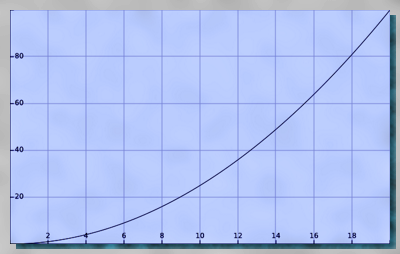
Would I have liked more time? Absolutely. I would love to have been able to linger over one of these for a whole day or two – a week in some cases. But time and financial pressures meant that I had to churn them out at top speed. (I did the best I could – deliberately pairing complex pictures like “Ink Of The Squid” with a couple of simpler ones, so that I could lavish some more attention on it. But it was all compromised to some extent by practicalities.)

So, this illustrates both the zoom effect, the mechanical scaling effect (both of which are to be dealt with shortly) and gives another data point on the scale: 0.1mm. I don’t think the modifier that goes with that scale should be much more than the 0.5mm I’ve already allocated to a 2 modifier, so let’s make it a 3.

But that brings me to the question of progression. There is a clear pattern beginning to emerge, but I’m concerned that it won’t progress fast enough to give workable modifiers for really small operations. At the same time, I want to be sure that these are only possible if you have both the skill and the right equipment. Choosing a non-linear progression should solve these problems.

So let’s start with what we’ve got and extend the table from there, and see how it looks:

    -2 = 1m (FM radio wavelength – included for completeness)
    +0 = 1cm (microwave wavelength)
    +1 = 5mm (ants, seeds, rice grains)
    +2 = 1mm (pixels, grains of sand or salt, furniture tolerance)
    +3 = 0.1 mm = 100µm (width, human hair, limit unaided vision)
    +4 = 0.05mm = 50µm (thickness 1 sheet of paper, human skin cell = 35µm)
    +5 = 0.01mm = 10µm (width of a silk fiber, white blood cell, 1971 Transistors, infrared wavelength)
    +6 = 0.005mm = 5µm (cell nucleus, x chromosome, red blood cell)
    +7 = 1µm (1 micron) (y chromosome, clay particle, e.coli)
    +8 = 0.5µm = 500 nm (largest virus, red wavelength = 750)
    +9 = 0.1µm = 100 nm (limit optical microscopes, HIV, violet wavelength = 400)
    +10 = 0.05µm = 50nm (Hep B virus, infrared wavelength)
    +11 = 0.01µm = 10nm (2017 Transistors = 25nm)
    +12 = 0.005µm = 5nm (cell membrane, DNA)
    +13 = 1 nm = 100 Angstroms (buckyball)
    +14 = 0.5 nm = 50 Angstroms (glucose molecule, cesium atom, x-ray wavelength)
    +15 = 0.1 nm = 10 Angstroms = 100 picometers (carbon atom = 340, water molecule = 280)
    +16 = 0.05 nm = 5 Angstroms = 50 picometers (limit electron microscopes)
    +17 = 0.01 nm = 1 Angstrom = 10 picometers (Hydrogen atom = 31, Helium = 25)
    +18 = 0.005nm = 0.5 Angstrom = 5 picometers
    +19 = 1 picometer (gamma ray wavelength)
    +20 = 0.5 picometer
    +21 = 0.01 picometer (uranium nucleus = 0.015 picometers)
    +22 = 5 femtometers
    +23 = 1 femtometer (proton, neutron, helium nucleus = 3)
    +24 = 500 attometers
    +25 = 100 attometers (smallest confirmed objects in existence)

That’s not bad!

Credit where it’s due: the examples are from The Scale Of The Universe 2 by Cary & Michael Huang. Have a play around with their interactive app, then get their email link from this page to thank them!

Scaling

The above also makes the scaling pretty clear. Because scaling modifiers are to be half the delicacy scale (leaving the other half for movement scaling technology), we get:

    +0 = ×1
    +1 = ×10 (magnifying glass, jeweler’s loupe)
    +2 = ×100
    +3 = ×1000
    +4 = ×10k
    +5 = ×100k (limit optical microscopes)
    +6 = ×1M
    +7 = ×10M
    +8 = ×100M
    +9 = ×1000M (limit, electron microscopes)
    +10 = ×10G or more (sci-fi only)

Movement scaling is relatively new technology, though it was always possible to a limited extent mechanically. In fact, a lot of tools are intended to scale movement in a very limited way – teeny-tiny screws and screwdrivers, for example. These days, robotized tools controlled through a computer let us manipulate objects as small as 50nm or so, and we have processes that let us design and manufacture tangible objects as small as 10nm (the component parts of a 25nm transistor, for example).

Nanotechnology machines are the obvious next stage of development, the cutting edge. Again, we haven’t devised tools to scale our own movement that small, instead we have designed processes that create the components. We are only just getting to the point of being able to assemble these components – that will involve more processes. Fraser Stoddart, Bernard Feringa and Jean-Pierre Sauvage shared the 2016 Nobel prize for their work in the field, especially the creation of a “nanocar”. But tracking down a size for these devices has proven incredibly hard – the best that I’ve been able to manage quotes “a few billionths of a meter”, which is around the +7 or +8 mark on the scale given above. It was just as difficult trying to find a freely-licensed image to illustrate it – the best image I was able to find is shown in an article on The Verge but the terms of usage don’t leave me any the wiser as to who the copyright owner is. So the best I can do is provide the link and let you check it out for yourselves.

So, what we have is the following:

    +0 = ×1 precision tools
    +1 = ×10 high-quality precision manual tools
    +2 = ×100 limit precision manual tools
    +3 = ×1000 primitive process-based designer tools, computerized scaling tools
    +4 = ×10k generation-2 process-based tools, computerized scaling tools
    +5 = ×100k generation-3 process-based tools, light/laser-based scaling tools
    +6 = ×1M generation-4 process-based tools, energy-beam based scaling tools
    +7 = ×10M virus-based nanotechnology, generation-5 process-based tools
    +8 = ×100M true nanomachines, the nanocar
    +9 = ×1000M process-based chemical tools (buckyballs)
    +10 = ×10G or more (sci-fi only)

Each scale of tools permits – in theory – the construction of parts of roughly the size of the tool, and the assembly of those parts into a “machine” one scale larger. So tools the scale of the nanocar would permit the construction of virus-based nanotechnology.

Before I wrap up this section, let’s run a realism check: Designing and creating a custom computer chip at the limits of known precision manufacture in 2017:

    Precision Modifier +11, – Optical Tools +5, – Energy-beam based scaling tools +5 + design difficulty gives an overall difficulty of 1 more than the design difficulty.

    So, if the GM sets a design difficulty of 3, the manufacturing difficulty will be 4. If the character has a skill of 3 and +3 from stats – both reasonable for an expert in the field – he will have to roll 6 or less on 3d6+3. Which is, impossible. So we add a d6 to improve the roll required: 8 or less on 4d6+3. Which is the same as 5 or less on 4d6. That’s a 0.39% chance of success, or about 1 in 256. And the manufacture will be even harder – 4 or less on 4d6, or 0.08% chance, or about 1 in 1250. But manufacturers will typically put 1000 or more chips on a single manufacturing batch – so, if they can get 1250 on a sheet, they are likely to get 1 fully-functional chip from the process.

    Compare that with a genius in the field with skill 5 and stats +4: that’s 9 or less on 3d6+3 for the design, and 3d6+4 for the manufacture: 9.26% chance of success for the design and 4.63% chance of success in the manufacture.

    And both of those test-cases ignore the potential for spending extra time to get the design and manufacturing right. But the results I did get all sound reasonable!

Assistance

It also brings up another point that I don’t think I’ve addressed previously. How to handle multiple people working in teams. Going it along might work for geniuses and mavericks, but most R&D is done by teams of experts.

This is to be based on the non-linear size adjustment, enabling me to re-use the same table entry.

Number of assistants or skill 1 lower than the lead operator required for a given bonus

    +1 = 1
    +2 = 2-3
    +3 = 4-7
    +4 = 8-12
    +5 = 13-18
    +6 = 19-25
    +7 = 26-33
    +8 = 34-42
    +9 = 43-52
    +10 = 53-63
    +11 = 64-75
    +12 = 76-88
    +13 = 89-104

For assistants of skill 2 lower, drop down one count. So 2-3 such assistants give +1, and so on.

Even unskilled assistants can be useful, taking care of the daily routine, for example. If we use “+3 skill” to signify “expert”, then laymen (by definition, those with +0 in the skill) have three ranks less, so 8-12 such assistants are still worth +1.

One expert, leading a team of half a dozen skilled technicians and another half-dozen trainees, and supported by a dozen unskilled people doing mundane tasks, is a reasonable small engineering firm in this sort of industry.

+3 from the expert, +3 from his stats, +2 from extra time, +3 from skilled assistants, +1 from the trainees, and +1 from the support staff, gives 14/- on 3d6+3 – a 62.5% chance of success. If the normal design process takes 1 month, that means that a first attempt will be ready in 3 months, and a second (if necessary) three months after that, increasing the chance of success in design to almost 86%. A third attempt is close to 95% certainty of success; a fourth gets that up to about 98%. A year spent in design and another in manufacture gives you that cutting-edge computer chip almost every time. Most experts would be secure enough in their ability to deliver taking a 2-year contract of this sort.

And all of those calculations assume that nothing is learned from the failures, that’s its all trial-and-error until you get it right; most design/engineering firms wouldn’t work that way. As a GM, investing a month in analyzing each failure would reasonably be worth another +1. So you could have four attempts totaling a 98% chance of success, or three of them – the first at 14/-, the second at 15/-, and the third at 16/-. Those are 37.5% chance of failure, 25.93% chance of failure, and 16.2% chance of failure, respectively – 98.4% chance of success, all told. And, if a fourth attempt was still needed, that would be at 9.26% chance of failure – a 99.9985% chance of success, delivering the design 3 months behind schedule, time that you might well be able to make up on the manufacturing side.

All of which sounds like it works to me.

To be continued…

So, the core table has now been designed, but I’m out of time for compiling it, and for looking at the other unanswered questions, like how combat will work. That means there will need to be on more in these posts, probably in a few weeks’ time.

Comments Off on Progressive Modifiers In The Zener Gate system

A Proliferation Of Lesser Masterminds


‘Gothic Building At Sunset” courtesy freeimages.com / Beverly Lloyd-Roberts

It’s easy to fall into the trap of having a singular arch-enemy in a campaign. If anything happens to that enemy, it can leave the GM casting around for a direction. What’s more, having one central villain who is responsible for all that ails the world (and his flunkies, of course) is inherently a harder ‘sell’ in terms of credibility, especially if that villain is to be a string-puller behind the scenes – which always makes more sense for that kind of character.

It’s very easy to take the plans of one master villain and diversify the activities attributable to him or her amongst two or more “lesser” masterminds, with no diminution of the impact of the plans or the villain.

If you follow my advice on running a mastermind – which remains one of the most popular articles here at Campaign Mastery – you will find that one of the key pieces of advice is to perpetually ask questions along the lines of “what is the best thing that the villain could have set up to take advantage of (whatever the current situation is)”, then to assume that the villain has in fact done exactly that.

That advice, compounded with a point made a week or two ago – that when a story is about villain development, effects should precede causes in the awareness of the PCs – actually gives you all the tools that you need in order to have your masterminds proliferate.

One becomes two

The technique is simple; determine what the best possible change of circumstance is (in the villain’s favor) at some critical point in the adventure that is about to take place or is currently underway, then have a second mastermind manipulate events to create that circumstance.

This effectively splits what was one mastermind into two – one who is relatively overt and obvious, and one lurking behind the scenes and using the first as a stalking horse.

The Underlying Logic

The second, absolutely critical, step is to determine why. How does it advantage the second mastermind for the villain to benefit? Fortunately, creating villains in this way gives the GM a huge advantage: as of right now, the mastermind has no assigned motivation or objective.

That means that you can work backwards from their actions to assign the traits and characteristics to justify those actions, which is a lot easier than giving an objective and then scanning everything that happens looking for a way for them to benefit. That can be tricky when you have a completely open slate in terms of motivation and objective. The sheer variety of choice can lead to a sort of creeping paralysis and paroxysms of second-guessing. This technique totally bypasses that problem.

And it’s not a problem that you carry into future “appearances” of the mastermind, because the decisions of motivation and primary objective have now been made, reducing the vast field of opportunities to a very straightforward strategic decision.

Another weapon that you have is the relative simplicity of the questions being posed. The mastermind is doing something to advantage the “overt” villain but it’s not out of the goodness of his flabby black heart – it’s because he will benefit in some fashion even more significantly than the “overt” villain will do.

Benefits are relatively simple to characterize. They are either:

  1. Direct;
  2. Indirect, resulting from something the overt villain is or will do;
  3. Indirect, resulting from something the PCs will do in response to the actions of the overt villain; or
  4. Indirect, resulting from something that a third party will do in response to the actions of either the overt villain or the PCs.

Furthermore, benefits are either:

  1. Gaining access to a resource that was previously unavailable;
  2. Gaining information that could not be acquired in any other way;
  3. Gaining a change in circumstances that will provide future opportunities for gain that were not previously available;
  4. Gaining an alliance that would not be possible otherwise; or
  5. Denying one of the above to someone who is functionally in opposition.

The term “resources” is applied very broadly in the above statement, ranging from something material to something quite intangible – it can be anything from a political advantage to an elevation in social position.

There are a lot of possible permutations, but they are relatively quick and easy to assess, and one particular combination usually leaps off the page according to the circumstances in the campaign at the time.

The Modus Operandi Restriction

Of course, there’s always a caveat, a sting in the tail, whenever things are so straightforward. In this case, it’s the fundamental similarity of the modus operandi of the masterminds that result.

That problem brings us to an utterly essential third step: redefining the problem, or in this case, the modus operandi into something that is absolutely unique in the campaign to the mastermind (and preferable unique to all your campaigns).

In order to distinguish this character from the similar ones that will result from the repeated application of these principles, you need a modus operandi that is succinct, distinctive, and that restricts the mastermind from doing anything similar except under extremely restricted circumstances – that just happened to occur during the first occurrence.

What’s more, that modus operandi has to be rooted in the background and characterization of the mastermind, to the point of being the equivalent of a fingerprint – sometimes to the point where that modus operandi can (eventually, when it is sufficiently well-known to the PCs) identify the mastermind’s true identity.

For example, one villain in the Zenith-3 campaign specializes in identifying the weakest link in a process, the point where minimal exertion and exposure will achieve his objective. Through a stationery tracking-and-reordering system, he gained access to the sealed computer systems of the courts, then used that influence to manipulate trial outcomes – for a fee – and always within the bounds of what might have happened by chance. This practice was 15 years old before a piece of truly rotten luck led to his exposure.

This is a villain who is quite capable of meddling to benefit someone else if they benefit even more significantly in the process. But most of the time,, he wouldn’t – he is restricted completely by that modus operandi. His “fingerprint” is not that he manipulates situations from behind the scenes, it’s that he does so in a way that preserves both his anonymity and even the very secret of his existence as his first priority.

This is critical because it defines the restrictions under which the mastermind will operate henceforth. It defines – to the GM – his signature, a signature that the PCs will eventually discover.

Two becomes three

The first mastermind should get away with making life hard for the PCs long enough for them to become suspicious that there is someone working against them from the shadows, and to start speculating on who it might be.

It’s quite likely that they will come to the conclusion that the ‘overt villain’ is a subordinate of the mastermind, especially if you’ve done nothing to obstruct that conclusion. Your game has just acquired a fourth layer of plot:

  • The superficial layer contains the day-to-day events that the PCs experience;
  • The immediate layer contains self-contained adventures that are unrelated to the larger plotline.
  • The Overt Villain layer contains the ongoing conflict between the PCs and the Overt Villain.
  • The Subterfuge layer contains the shadow-war between the PCs and the mastermind.

Now, that’s quite a tasty recipe, but a fully rounded dish requires more. This is a little too pat, a touch unrealistic. And there is usually a little nagging inhibition against the GM really going to town and doing his worst, because without PCs, he doesn’t have a campaign.

There is a simple solution. Once the existence of the mastermind has been detected and progressed beyond a vague suspicion in the minds of the players, once he or she has become established in the manner described in the opening paragraph of this section, it’s time to complicate the situation.

One mastermind gaining an advantage in this way almost certainly means that he will be interfering in the plans of some other furtive manipulator. On the principle that the enemy of my enemy should be my pawn, the PCs should become enmeshed in the crossfire.

(For a fun variation, don’t reveal this second string-puller as an enemy right away, make that a plot twist for much later in the campaign – have them appear to be someone who is overtly on the PC’s side, a bona-fide ally).

Using this figure as a safety blanket and occasional escape clause for the PCs takes away any pressure to hold back, and lets the other villains revel in their villainy.

Of course, this third mastermind adds still another layer of plot and needs to have his or her own modus operandi that is just as binding, just as identifiable, and just as solidly founded on and justified by his background experiences and personality.

The Lieutenant Distinction

There are still a few i’s to dot and t’s to cross. It’s important to distinguish between things that the masterminds will not do and things that the masterminds are unable to do. Those distinctions are defining in terms of the relationship and attributes that the masterminds will seek in their lieutenants.

A smart mastermind will seek
out a Lieutenant who compliments there own abilities and who can be trusted not to cross any “lines” that the mastermind lays down. (That doesn’t mean that the Lieutenant has to agree with his boss, and won’t get frustrated with those restrictions, and certainly doesn’t mean that the lieutenant won’t cut the occasional corner if he feels it necessary.

It might seem that this relationship isn’t something that the GM needs to pay a lot of attention to, leaving it to evolve naturally. I disagree with any such analysis. First, the relationship will color every instruction that the mastermind gives the Lieutenant, and second, the restrictions placed upon the Lieutenant, and the relationship he has with his superior, will – over time – shine an additional light on the mastermind’s signature.

And that makes this critically important. The Lieutenant is a window onto his boss. There may be other relationships that the GM needs to think about, but few are this important. (A related and equally-vital set of questions: Does the Lieutenant know who the mastermind really is? Do they ever meet, and if so, where and under what circumstances? How does he receive his instructions, and how does he authenticate them? How does he report back to the mastermind?)

The Modus Operandi Integral

It can pay dividends to think of the ‘mastermind-plus-Lieutenant(s)’ combination as a unit. Is the whole greater than the sum of its’ parts? Because it not only should be, that is a great way of enhancing the adventure experience.

To put it bluntly, every combination where that wasn’t the case always seems to fall a little flat in comparison to those in which there is a dynamic that yields this sort of coalition.

It also means that losing that Lieutenant will seriously cramp the mastermind’s plans, which can be a useful plot card to have up your sleeve!

The Flunky Factor

Another point that I want to pay specific attention to is the difference between a Lieutenant and a Flunky. A good mastermind will have two or more of both.

A flunky can be just muscle, or it can be an extension of the mastermind. Flunkies should also never be completely interchangeable parts; there should be a difference between the flunkies favored by the mastermind and those who back up the Lieutenant – not to mention differences between this mastermind and that.

The Organizational Structure

I find it useful, from time to time, to look at these coalitions as a single organization. The mastermind is the CEO and thinker; the Lieutenants are the department heads; and the flunkies are the senior staff.

(As an aside, it can also be useful from time to time to characterize an organization as an individual. Internal culture becomes uncertainty and internal conflict within the mind of that individual, and you can often discern paths ‘forward’ for the organization while looking at how the ‘corporate individual’ would resolve his doubts and uncertainties).

Getting back to the point, identifying a ‘corporate culture’ helps characterize those who work for the mastermind, It can also help the GM understand how the presence of the mastermind influences the rest of society, and what will happen when the mastermind is gone. It might not be the prescription of universal peace that the PCs expect it to be!

And that’s how one Uber-villain becomes three

There are a whole host of benefits from this approach, as readers can see. Richness of plot and characterization, internal consistency, enhanced believability, It may not be the solution to every problem, but it’s definitely deserving of a place in the GM’s toolkit.

Comments Off on A Proliferation Of Lesser Masterminds

Countering The Rise Of Third-Person Roleplaying


‘Florentine Street Artists’ courtesy of freeimages.com / Jenny Rollo

This is a somewhat unusual article for Campaign Mastery in that it is pitched as much, or even more strongly, at players than at GMs…

While planning the next adventure in the Adventurer’s Club campaign yesterday with my co-GM, I made an observation regarding the changing style of roleplaying.

Both my co-GM, Blair, and I, are old-school. We speak in character when roleplaying except when describing an action the character is making or attempting – and even then, we’re just as likely to say “I” instead of referring to the character in the third person.

When our characters have a conversation, we have a conversation.

Many newer players don’t seem to handle their roleplaying in the same way, or at least. not as often. Quite often, instead of speaking in character, they will describe what they want their character to say using the third person. And instead of using a character’s skills as a guide to how “clumsily” they should make their efforts, they rely on a roll against that skill to determine success or failure.

My observation was that we were having to accommodate this “modern” approach more and more often when writing adventures.

Is this a sign of player laziness? Absolutely not. One of the players in whom we have most noticed a tenancy in this direction (no names) works harder than just about anyone else at being a player.

No, we attribute the change to a desire to be sure the character gets the full measure of value from their investment in skills, and a reliance on the rules to interpret the meaning of a skill level of X rather than the player doing the interpretation based on guidelines.

I don’t think the change is an improvement. It makes some things easier – in particular, it takes the competence difference between player and character out of the equation almost entirely – but the price seems too high, because what is being sacrificed is immersion. Immersion of player into character. immersion of character into story, and even immersion of story into world.

Resorting to third-person roleplaying should be reserved only for the most difficult of conversational tasks. But, in order for that to become the case, players who have never been shown how will have to be educated in the techniques and processes of first-person roleplaying.

Modern games provide all the tools necessary. All it takes is understanding the systems sufficiently well to interpret a given skill level into playable expressions of capability. You, as the GM, will need to be the source of that education – a tough assignment if you haven’t been educated in the techniques of skill interpretation. And that’s the purpose of this article.

In order to make the article as universally-accessible as possible, I’m going to use Pathfinder as my example game system. But the same basic techniques, properly adjusted, work for any game system, and to demonstrate that, I’ll use the hero system as my secondary example. Why? Because Pathfinder is based around a linear die roll (a d20) while the Hero System is non-linear (based around 3d6). Between them, they cover the fundamentals of most game mechanics.

Finally, to ensure common ground, I need some skill that’s functionally similar in both game systems. Pathfinder has a skill, Diplomacy, which can be used to persuade others. The Hero System has a skill, Persuasion, which is specific to that function. And these are exactly the sort of in-game function that this article is talking about, making these perfect for the purpose. So, with everything organized, let’s get started.

The Pathfinder Example

Skills in Pathfinder work by adding the bonus from a stat to the number of ranks in the skill. The character then rolls a d20 and adds the result to this total, needing to roll a target number or better – the DC – in order to succeed. In addition, the GM may add bonuses or penalties to adjust the DC for specific circumstances.

So let’s assume a stat bonus of +2 and a skill level of 4 ranks, which is a total of +6.

The average roll of a d20 is 10.5 – call it 10. the minimum is 1, and the maximum is 20.

So the lowest result total is 7, the average is 16, and the maximum is 26.

In Pathfinder, the DC is initially set according to the attitude of the target:

  • Hostile = 25 + target’s CHA modifier
  • Unfriendly = 20 + target’s CHA modifier
  • Indifferent = 15 + target’s CHA modifier
  • Friendly = 10 + target’s CHA modifier
  • Helpful = 5 + target’s CHA modifier

You need to succeed in a Diplomacy check to shift the attitude of the target on a temporary basis. Succeed and you get a one-step improvement; for every 5 more than the DC you get, the attitude can be shifted one more step, but there. is usually a limit of two steps of improvement that the GM can waive.

At the moment, you don’t know what the target’s charisma modifier is. It could reasonably be anything from -2 to +5 or even more. So let’s start with a CHA modifier of zero and see where those adjustments take us a little later.

The formula is: Roll + 6 >eq; DC. We can subtract 6 from both sides to get Roll >eq; DC – 6.

That lets me analyze the significance of the character’s skill in Diplomacy, which is the object of the exercise.

  • Hostile = 19 + target’s CHA modifier, and the chance of getting 19 or better on a d20 is 2×5=10%. If the target has below-average charisma, that chance goes up by 5% for each -1 CHAR modifier, to a realistic chance of 20%. However, it doesn’t take a very high CHA modifier to make the roll impossible to achieve successfully. A CHA modifier of +2 and there is no hope of success – unless the GM can be persuaded to incorporate a bonus for circumstances that favor the character – warning of some imminent threat to the NPC, for example, or otherwise engaging his self-interest. Even then, the odds of success are going to be slim if you target anyone who deals in popularity – leaders, religious figures, entertainers, even a well-spoken educator might be out of the question.
  • Unfriendly = 14 + target’s CHA modifier. The chance of rolling 14 or better is 35%. If the target has high charisma, that could drop by as much as 25% (from a +5 CHA modifier) to 10%. If the target has low charisma, the chance improves to almost 50%. Further adjustments are possible if there are circumstantial modifiers in the character’s favor, but declines equally quickly if circumstances oppose. So this is right on the cusp of success.
    • If the target has high charisma, the chances get pretty slim, so I would focus on achieving as many positive circumstantial modifiers as I could think of – gifts, flattery, the self-interest of the target – while doing as much as possible to undermine the relevance of anything that might give a negative modifier.
    • If the target has moderately high charisma, the same approach could make success almost a 50/50 proposition – enough that I would be confident of at least being heard.
    • If the target has average or less charisma, the odds are already fairly good. Rather than employing the “butter him up” approach, I would make a virtue of not doing so, focusing on his self-interest and being direct and matter-of-fact, with a prefatory comment about not wasting his time on hollow flattery. My focus would be on appearing honest and trustworthy. This approach is more effective because empty flattery turns people off when it’s recognized.
  • Indifferent = 9 + target’s CHA modifier. The odds of rolling 9 or better are already over 50%. More importantly, there is a 35% chance – roughly one-in-three – of success even if the target has a substantial CHA modifier (+5). Success still can’t be taken for granted, but it is certainly within reach. Employing the gifts-and-flattery approach, and engaging the target’s self-interests, to hopefully get a +5 modifier effectively nullifies the CHA modifier, letting what you have to say stand or fail on its own merits. But unless I was dealing with a prominent leader or other high-charisma figure, I would focus on the direct approach described above.
  • Friendly = 4 + target’s CHA modifier. The odds of success even with a high-CHA target are 50-50 or better even without flattery and circumstantial modifiers. If there was a pressing self-interest for the target or some mutual interest that we have in common, I would focus on those, otherwise politeness and making satisfying the request as painless as possible would be my focus.
  • Helpful = target’s CHA modifier – 1. Any reasonable request is likely to be successful, so my focus shifts completely to establishing a longer-term relationship of trust and mutual advantage with the target.

The more leaning towards ‘helpful’ the target’s attitude is, the more I shift my approach from one in which the target may have to be ‘bribed’ with a service or the satisfaction of a very clear self-interest to one in which I offer a service that I hope to be of value to them, not so much to get approval of whatever request I have at the time, but to ensure that the attitude is protected and encouraged as much as possible.

A shortcut

Of course, in play, you don’t have time to perform this sort of intensive analysis. Fortunately, there’s a shortcut, made possible by thinking of everything in terms of shifts to the target needed for success. If you have a skill of +6 ranks (including stat bonus), that is how much operating room you have to overcome any reluctance due to attitude to get you back to a 50-50 chance. If that’s not enough, you need to work on improving the perceived circumstances to counterbalance the shortfall. All you need do is pay attention to who you’re “talking” to and it becomes
easy to assess (roughly) their initial attitude and charisma bonus. It only takes a second or so to select how much flattery and goodwill you need to muster to overcome a negative attitude, and to select an approach accordingly. Since there are practical limits to what you can achieve in that respect, any shortfall gets “paid for” in diminished chance of success.

In other words, I set a personal target for what modifier I need to get from the GM with my approach to the target and then roleplay accordingly. The goal is to make a die roll irrelevant, or more precisely, to enable the GM to interpret your actions and dialogue as a result rolled on the die and hence determine the outcome. It becomes a sign of failed or inadequate roleplaying for the GM to say, “make a Diplomacy check”.

The Realism Side-Benefit

It’s always possible to misjudge your target. Sometimes, you put a lot of effort into trying to force open a door, only to find that it was already ajar; sometimes there’s a cause for reluctance that you either didn’t know about or didn’t factor in, and what seems like a slam-dunk turns out to be dead in the water before you even opened your mouth. The variety of unexpected outcomes that emerge naturally make the game world seem more realistic, populated with real people.

That’s a potent benefit, but it’s not the primary reason for this approach – the reason is immersion, because that makes every aspect of the game more fun and less an intellectual exercise.

The Non-linear roll

The Hero system works by building a stat’s contribution directly into a roll required. GM modifiers are applied to the die roll, and not to the target. The formula is 9 +(stat / 5). To that, the character can add additional “skill levels” by improving their basic skill.

Unlike Pathfinder / D&D, the target’s characteristics don’t matter; instead, the predisposition and stats are just another factor that the GM takes into account when choosing modifiers.

For our D&D example, we gave the character a stat bonus of +2. That corresponds to a stat of about 15. While the stats in the hero system are different at higher values, below about 20 they are fairly directly comparable. The equivalent of that 15 would probably be a Hero Games stat of 13 or 14. Which one doesn’t matter – dividing by five still gives 2-point-something, which rounds in the character’s favor to 3. So the equivalent of stat bonus alone gives a base roll of 9+3=12.

On top of that, we gave the character 4 ranks in the skill, the equivalent of +20% chance. That’s harder to assess in terms of picking an equivalent, but a rough rule of thumb that works at lower values – up to, say, 8 ranks – is to halve the number of ranks to get the equivalent number of ‘extra levels’ in a skill that the character has, rounding up if necessary. So 4 ranks is roughly the equivalent of +2, giving the equivalent character a total skill of 14 or less.

Because 3d6 is a non-linear roll, the game system makes it easier to interpret a skill level in relation to a result.

Graph of X or less on 3d6

Above is a graph of the chances of getting x or less on 3d6, which I sourced back in April from Anydice for the thematically-related article, Narratives Of Skill: How To ‘Improv’ Outcome Descriptions In Advance.

If you pick some key target numbers – 10% chance of success, 25%, 50%, 75%, and 90%, – and analyze the graph, you get some very interesting results, as you can see from the modified graph below:

As you can see, the 10% chance happens with an adjusted result of 6 or less, the 25% at 8/-, the 50% at 10/-, the 75% at 12/-, and the 90% at 14/-! That’s such a simple progression that it’s easy to remember.

It also puts that 14/- into perspective: if there are no modifiers, or if the balance of modifiers is at least neutral or even in favor of the character, he has a 90% chance of success.

Every +2 to the die roll from modifiers drops his chances of success another bracket. So +2 to the die roll makes success 75% likely, +4 makes it 50%, +6 makes it 25%, and +8 drops the chances to a mere 10%.

It’s not going too far to equate each of those +2’s to a shift up the ‘initial attitude’ table – from Helpful to Friendly to Indifferent to Unfriendly to Hostile.

It follows that if you can estimate how the GM will interpret the circumstances, you can make the corresponding interpretation and choose your approach accordingly, exactly as described earlier. What you are actually doing, in Hero Games’ game mechanics, is trying to load in additional modifiers in your favor to neutralize or counter these modifiers.

Certainly, when I’m GMing the Adventurer’s Club, and I want to adjudicate something along these lines, I would use the margin of success over requirements to assess the shift in attitude on a +2-to-a-step basis.

How First-Person Roleplaying Fits In

The key here is to “sell” the notion of a circumstantial modifier in your favor to the GM. Simply announcing what you are doing, or trying to do, third-person style, lacks the impact of actually “doing” it through dialogue. As a player, you are far more likely to succeed in getting the bonus you are seeking if you can immerse the GM in what you are doing.

Getting the GM on-side in this way is far more likely to enable you to get the NPC you are speaking to on-side, because you are making the game more fun for the GM in the process. So many GM decisions are subjective and nuanced, getting the vision of the world slanted in your favor is always worthwhile!

And everyone has more fun at the game table! Now, I ask you – isn’t that worth a little fuzziness when it comes to exact numbers?

Comments (3)

The Bluff and the Tell – how not to give the game away


Public Domain Image CC0 provided by pixabay.com / PIRO4D

These two poker terms should have special relevance to RPGs. I’ll explain why in a moment – first, let’s make sure that everyone is on the same page as to meaning.

Bluffing

Bluffs are a rather broad subject. The traditional bluff in poker and other types of gambling is an attempt to make a weak hand look stronger than it really is, usually through a combination of a false tell and a betting strategy that would be appropriate if the hand was indeed stronger than it is, and the player is trying to conceal that fact.

But use of the term has broadened in recent years, to include any attempt at perpetrating a falsehood in a card game – from making strong hands look weak (to encourage rival players to bet more than they should, given the relative strengths of their hands) to mind games in general at the gaming table, which include the traditional usage of the term.

Tells

“A tell in poker is a change in a player’s behavior or demeanor that is claimed by some to give clues to that player’s assessment of their hand. A player gains an advantage if they observe and understand the meaning of another player’s tell, particularly if the tell is unconscious and reliable. Sometimes a player may fake a tell, hoping to induce their opponents to make poor judgments in response to the false tell. More often, people try to avoid giving out a tell, by maintaining a poker face regardless of how strong or weak their hand is.”
– text from https://en.wikipedia.org/wiki/Tell_(poker).

The term literally means “inadvertently telling the truth” through behavior, betting strategy, body language, expression, or whatever.

There is even a branch of study within the gambling world that looks at tells for online poker games, such as those found at an online or a mobile casino, which includes things like inconsistent speed of bet placement, size of bets, responses to batting counter-strategies, and so on. Testing has shown that these can improve the chances of winning a game by as much as 8-10%.

More traditional tells – and these will be relevant, shortly – include:
 

  • Acting uninterested in a hand while still in it – Feigning disinterest while continuing active involvement in a hand is usually a sign of a strong hand.
  • Shaking hands – This is often an involuntary response to a surge of adrenalin which indicates that the player has something to be excited about.
  • Rapid Breathing – same cause, different physiological response. If the change in breathing pattern is sudden and mid-hand, it may also be a sign of panic, indicating that a hand is much weaker than the player is suggesting, and that they may be trying to bluff.
  • Overacting – Making a big production of sighs and shrugs while offering weak statements such as “I guess I’ll call” are really bad attempts at feigning disinterest (see above), but some players simply become louder and more exuberant when attempting to “sell” a bluff. They are “trying hard” and unable to hide that fact.
  • Looking away from the table immediately after placing a bet or checking one’s hand – often, the very fact that you are trying not to engage interpersonally signals very loudly that you are trying to hide something.
  • Playing with one’s cards – rearranging them or repeatedly re-checking them – tends to be a signal that your hand is much weaker than you have otherwise indicated.
  • There are those who would add Trash-talking and boasting to the list.
  • Of course, the cliche tells come to us from Hollywood – trying to scope out the other players from the corners of your eye, raising eyebrows the first time you look at your cards, playing nervously with your chips, whistling, or humming.

(partially based on a list at www.Thoughtco.com).

I want to call out a couple of specific items that aren’t on the list above:

The double-bluff

Of course, sometimes players will fake a tell while pretending to bluff in an attempt to double-bluff the opposition. Most professionals consider this too prone to error to attempt it, and an amateur move. Most amateurs will do it anyway.

The deliberate poker face

Some players work a lot harder at assuming an expressionless “poker face” when they have a good hand, while being relaxed and sociable the rest of the time.

Better tactics

Ideally, as a player, you want to behave in exactly the same way regardless of the strength of your hand. Make the same small talk, express the same measure of interest in what others are doing, and so on. Almost as effective is picturing some other hand in your mind’s eye and playing, betting, and so on, as though that imaginary hand were really what you have.

The Tell and The Bluff

Clearly, a tell is the natural enemy of the bluff, undercutting attempts to provide false information with a direct line to the truth.

The GM’s Bluff

GMs have to bluff all the time in RPGs. We’re playing characters who know things they may be trying to hide – and we may or may not want the players to pick up on that. WE know things that we’re trying to hide so as not to influence the player’s choice of action. Or perhaps the players have discovered a major flaw in our plans and we don’t want them to know it.

A previous article that I wrote touches on the subject, and even offers some techniques. The Hierarchy Of Deceit: How and when to lie to your players. But that was more concerned with plot developments and how to hide the GM’s superior knowledge in that respect of the game.



But a GM needs to bluff on a lot more occasions than are discussed in that article. That’s not particularly difficult – what’s harder is doing it well, and what’s even harder is not giving the game away with a tell.

GM ‘Tells’

Most of the poker ‘tells’ have RPG/GM equivalents (told you I’d get back to that list). Let’s walk through the entries.

  • Acting uninterested in what the players are doing – pretending to be disinterested only makes the players suspicious because the players know better – and would expect more from a good GM. So if you’re a good GM this won’t work, and if you’re not, you couldn’t pull it off anyway.
  • Shaking hands – The stress of running a game is high, but not that high. It’s the stakes involved that cause adrenalin rushes when gambling. So this is an obvious fake, one that few GMs would even think of trying. But there is an equivalent that most GM’s will recognize: we get a little clumsier with our die rolls at critical moments or when we’re concentrating hard because what’s happening is important. Dropping dice off the table is an occupational hazard, and a lot of GMs use a tray or some equivalent to prevent it. But I would bet that few ever recognized the association – we roll so many dice that we consider it inevitable that some will go overboard, and so think nothing more of it when it happens.
  • Rapid Breathing – this is one poker tell for which there is no obvious equivalent. But I have experienced a couple of GMs who spoke more quickly when important points came up in an adventure, which is a reasonable if inobvious point of equivalence.
  • Overacting – While the outward behavior may be different, the same cause – “trying hard” and unable to hide the fact – still leads to the same umbrella behavior. But it’s not overacting a pose as ourselves, it’s over-enthusiasm in descriptions and overacting as NPCs.
  • Looking away from the table immediately after placing a bet or checking one’s hand – there are two GM equivalents of this one. The first is pretending to be too busy with your adventure notes or with the rulebook to pay close attention immediately after delivering your misleading statement. The second is deliberately trying to distract yourself by demanding that a player make some sort of die roll for reasons that may be valid but flimsy in justification. In both cases, as with the poker ‘tell’, the very fact that you are trying not to engage interpersonally signals that you are trying to hide something, though neither signal is as clear or obvious as the poker equivalent. It’s still a way of focusing on something other than interpersonal interaction with the players, though.
  • Playing with one’s cards – It’s not common, but I have seen GMs and players who could not stop playing around with their dice – sorting them by color, by size, in groups of 3, or 5, or 10, or whatever. Is that the equivalent? I suspect so, but I’m not certain.
  • There are no equivalents that I can think of to the remaining examples of alleged ‘tells’, which is why I was more hesitant about listing them.

In the article I linked to earlier, I listed a number of techniques for deceiving the players when it was necessary or desirable. None of them are worth very much if you are sabotaging your own efforts with a tell.

Avoiding Tells

Finding good advice on how to avoid poker tells is surprisingly hard. Finding such advice that can translate into an RPG setting is very much harder.

For example, some of the best advice for in-person poker players is to be consistent and follow the same routine whether you have a good hand or bad. That’s something that GMs can work with.

Another piece of advice that translates is to relax your face into a neutral expression, or better yet (when playing an NPC), into an imitation of the emotion that you want that NPC to be expressing (it really does help your “acting” performance).

Take at least one, and preferably two, breaths before speaking. In poker, the actual recommendation is to take deep breaths, but that isn’t appropriate for a game that’s based on communications. Nor is advice about not speaking to others at the gaming table.

At the poker table, the advice is to sit up straight and move steadily and purposefully, so as to avoid body language tells. That won’t work for an RPG DM, either. In fact, given the nature of the role, advice would have to be predicated on doing the exact opposite in many respects – being casual and relaxed.

The best solution that I have found is to decide in advance what the story is that you are trying to ‘sell’ as the truth, then concentrate on that as completely as possible. This works because both stories are essentially works of fiction of equal veracity so far as the players are concerned. Neither is a “true” story – not even in-game, until we decide to make it so.

Musing

That’s the ultimate difference between an RPG and a game of real-life poker, with real stakes. What we do is an entertainment, done for mutual fun. They play for sheep stations. If you’re feeling inclined to stretch your imagination, contemplate the way our game would change if the GM had to pay XP to players in real currency from our own pockets, with the players fronting the money to participate. I can’t think of a faster way to kill the fun, substituting a sense of competition. And there would always be a suspicion that the ‘house’ – the GM – was shortchanging the players to their own profit. Trust would quickly vanish, replaced by competition – a completely different form of excitement.

And that yields a (speculative) key insight into the competitive gaming that takes place at conventions, where there are prizes on offer. I’ve always been aware that there is a subtle but profound difference between convention gaming and the more common at-home gaming, but I was never able to quite put my finger on it. Now, though, the truth seems to be laid bare. And it posits the question: are the best convention games the ones in which the story is so compelling that the competitive aspects are forgotten by the participants? I tend to think so, but I’ve never run a convention game. Still, it sounds right to me. Can anyone who has done both confirm or comment?

Comments (2)

The Elephant In The Gray Room, Pt 2 of 5: Minor Repairs


This entry is part 2 of 4 in the series Elephant In The Gray Room

‘Puzzle World’ from freeimages.com / B S K
has only marginal relevance to this article, it’s a leftover alternative illustration from Designing A Game System (for the Zener Gate campaign).

The Elephant In The Gray Room is a metaphor that I have created to represent Plot Holes.

These are matters of huge significance or importance that everyone is overlooking because they are not immediately obvious, but that once you see one, you can never forget that it’s there.

This is a series about methods of fix plot holes so that even when they get noticed, it’s just a spur to your creativity and not a complete calamity.

In this part of the series, I offer six basic ways of handling minor continuity problems. Between them, they should resolve up to one half the plot holes that GMs will encounter..

Minor Repair Technique #1: Ignore the problem

If plot holes can result from failures of memory, fixing them can be compared with plugging holes in a hull made from steel mesh – the ship is still going to sink. Or, to put it more appropriately, why bother making the campaign history pristinely perfect when it won’t be remembered correctly, anyway.

Minor Repair Technique #2: Acknowledge and ignore

At least, that’s the argument that would be employed to justify this approach, and – like all good arguments – it contains more than a little grain of truth. But it overlooks three very important considerations.

First, the fact that human memory has always been fallible, and so we have developed a whole range of devices and techniques for correcting those fallible memories – with the written word still at the top of that list. And second, the fact that future events will be planned around that past, using it as foundation.

That’s actually a more useful metaphor that it seems at first glance. The justification for repairing any plot hole should always be grounded in the damage to the campaign that is being experienced right now, or that will be experienced in the future. If the plot hole is underneath a hollow space in the plot infrastructure that is yet to be built, put some warning tape around it and forget it; but if a load-bearing structural member happens to get it’s support from that particular point, it needs repairs.

The third point is that plans change. While the plan might not be to pin the entire campaign on a plot development that is undermined by the plot hole, you also need to consider the likelihood that such a plot development might become necessary or desirable in the future.

If the hole is in the backstory of a character who is never intended or expected to reappear in the campaign, it’s probably safe to gloss over it and move on. The more likely it is that this is the case, even if it’s not completely certain, the less urgent repairs seem. So this may be a viable short-term or medium-term solution to the problem, even if it might not stay that way forever.

What’s more, if the repaired plot hole is never revisited in the future, any effort expended in repairing it is completely wasted. I don’t know about anyone else, but I don’t have the time to waste.

At the same time, though, the domino effect means that repairing the hole – depending on the technique chosen – can take an unpredictable amount of time to complete. You may not be able to afford to wait until you need the solution.

Which brings me to the second solution, which is not to ignore the problem, simply to ignore the need to solve it – until it becomes necessary not to, bearing in mind the limitations that come with the notion.

It’s my preference, as a safety net, not to implement this solution until I have identified the nature of the ultimate solution that will be required. That’s “relatively” simple after a proper assessment of the scale and impact of the problem. But, since memory is fallible (as already noted), I also prefer to make some quick notes as to the “shape” of that ultimate solution – what is clear and obvious now might not be so clear when the time comes..

Minor Repair Technique #3: Depth Of Character

People are full of contradictions. One of my favorite solutions to the problem of a character’s past actions being inconsistent with the conceptualization of the character is to make the character more complex and hence more human. A great many discrepancies in action and choice can be explained by giving the character who made the “mistake” a solid motivation for the choice they made, even though it didn’t make sense in light of what had been revealed about the character prior to that event.

Never be afraid to make your characters more interesting!

Minor Repair Technique #4: NPCs are humanoid, too

It’s a very rare human being who doesn’t make the occasional mistake. Some of these are so egregious that we are left saying “I don’t know what I was thinking!” afterward.

And yet, it’s quite common to hold NPCs to a different standard, especially if they are mastermind types. Why?

Or, to put it another way, why not state that whenever possible, a mistake by the GM is actually a case of the NPC making a human mistake?

It isn’t always possible. Logically, when a plan falls apart because of a mistake, that’s the point at which the character should realize what has happened, and should react accordingly. If no such reaction was evidenced, it might be because the character has successfully hidden his inner self-fury – but that needs to be consistent with the rest of the displayed personality, and strains credibility if it happens too often.

Still, this solution is so useful that I am very careful when conceptualizing non-human characters and races to examine the ways in which I can justify some analogue of human fallibility. I don’t care if I’m talking about artificial organisms, aliens, or ancient dragons with Intelligence and Wisdom in the 30s.

Using this technique does require that bit of advance prep by the GM. Some mistakes can’t be characterized appropriately, and so as soon as a mistake is discovered, I need to be able to judge whether or not this repair technique is appropriate so that I can have the NPC react appropriately.

Of course, if a mistake is not discovered in-play and at-the-time, you have more flexibility.

Minor Repair Technique #5: Retroactive Explanation

I only use this technique when it’s effortless. There are times when the moment of identification of a plot hole also yields a spontaneous retroactive explanation. When that happens, I generally go with my instinct and look to implement that solution – assuming that it holds up.

There are two litmus tests that such explanations have to pass. The first is that the logic has to hold up – there is no point in patching a plot hole with another one! The second is that the domino effect has to be minimal – within practical limits, let us say.

It is sometimes possible to add additional content to the “patch” that constrains or limits the domino effect, and whenever the second of those litmus tests is failed, I actively look for some way of doing so. If I don’t find one, then I reluctantly rule out the “obvious” solution.

But usually, that’s either not a problem or it is a manageable one. There are then three ways of delivering the “patch”: as a drop-in; as part of a planned adventure; or as part of a specially-written mini-adventure created for this explicit purpose.

Assuming that the guidelines presented on earlier solutions are being followed, a patch only becomes necessary when a plot point intended to be significant in the campaign’s future – near or far – is directly affected. That justifies the use of a mini-adventure if necessary. It also makes it far more likely that the “patch” can be delivered as part of the adventure in which the plot hole becomes significant – if it is scheduled to occur soon enough.

That last point is a critical consideration. It is always better to deliver the explanation as soon as possible after the plot hole comes to light; with every passing hour of play, the status quo becomes more firmly embedded within the collective memories of the players. If it’s going to be a while before the patch becomes critically necessary, it makes a drop-in more attractive.

So, what is a drop-in, for the benefit of those who don’t recognize the term? It’s not unlike the information that I often package in a blue text-box at the top of an article here at Campaign Mastery, containing side-notes, glimpses behind the curtain, contextual explanations, mea culpas… well, you get the idea. So, a drop-in is literally an inserted package of text, usually only a paragraph or two, delivered out-of-continuity at the start of a day’s play.

Minor Repair Technique #6: The Wisdom Of Players

I’ve spoken of this last technique on a number of occasions, in a variety of contexts and problems. During general chatter before play starts, simply mention that you’ve spotted a plot hole and are fishing for solutions, then describe the problem in terms of what the players already know (and not revealing anything that they don’t know from in-play). Then just sit back and listen.

Of course, you are aware of constraints that the players aren’t; you know parts of the story that they aren’t. So you might not get anything usable. Or you might get a brilliant idea. I use those parts of the story that the players don’t yet know as filters for selecting the best answer.

At the same time, anything that hasn’t been revealed in-game yet is subject to revision as necessary, and there have been one or two occasions when I have, on the basis of the discussion, completely junked the planned adventure in favor of something similar (i.e. cannibalizing whatever has been prepared) that incorporates their solution.

If I become aware of a plot hole in the middle of play, I have even simply pointed it out in-game as something that doesn’t make sense to the PCs, sometimes after a die roll, to make it seem as though I was prepared for it to happen, even expected it and had done it all deliberately, improvising the rest of the day’s adventure before formalizing the plot developments between game sessions.

I’m often so adept at this that the players often never realize that I have deliberately let them steer me off-script in order to solve a plot problem that had been overlooked until it was too late. The last time it happened, for example, was in the conclusion to the Mictlan-tecuhtli adventure (the link is to the Jan 2016 article in which I described the villain for others to use).

But it’s fair to say that I’m well-practiced in all these techniques. They won’t solve every plot hole problem – but they will deal with an awful lot of them, very successfully.

In the next part of this series: Structurally significant repair techniques!

Comments Off on The Elephant In The Gray Room, Pt 2 of 5: Minor Repairs

The Character Story: The art of selling important NPCs


Image courtesy freeimages.com / Meredith B

So you’ve come up with a great character for your game and want to gain maximum value for your creativity? No problem. TV has been doing that in one-hour dramas for decades.

There are two paths to follow: the Good Guy path, and the Bad Guy Path.

The ‘Good Guy Path’ is all about establishing a connection between the character and the PCs, cementing the character into a long-term role within the campaign. The ‘bad Guy Path’ establishes a character as an antagonist of significance, though not necessarily one that will stick around for a long time.

Good mileage can sometimes be extracted by inverting the roles. Using the ‘bad guy’ path to introduce a new allied NPC sells the character as someone not to be fully trusted by the PCs and turns the revelation that the character is in fact an ally, possibly a hidden one, into a major plot twist. That can be tricky to handle properly – oversell or undersell that revelation and you damage the credibility of the character or the plot twist, which also damages the credibility of the character. But get it right, and you cement the NPC as a key element in the campaign.

Things are a little easier when using the good guy path to slowly build up and then reveal a hidden enemy. The sense of outrage and betrayal that accompanies the plot twist is almost impossible to deny, making both undersell and oversell virtual impossibilities, Play it down and the players will make up the difference; over-hype the significance and the players will simply assume that you are matching your rhetoric to the way they feel (assuming that you’ve done the job right so that they do in fact feel that way).

General Advice

Before I dig into the specifics, there are couple of points of general advice that I think need emphasizing.

    Don’t Go Too Fast

    At the very least, each stage in the character stories needs to be in a separate scene. If the character is to be important enough – a recurring character in at least one full “season” of adventures – one per adventure is a better choice. You want time for each encounter with the character’s story to sink and build up a cumulative effect that serves as a foundation for the relationship between the PCs and NPCs.

    Don’t Go Too Slow

    At the same time, you can’t go too long in between touching on the character’s story, and – ideally – expanding on it or reinforcing it. Certainly, no more than a single unrelated adventure in between each stage of the Character Story. However, as the number of past stages in the character’s story increases, the more the character becomes established within the campaign, and the more flexibility you have to violate this rule-of-thumb.

    You can always defer a stage in the character’s story by an adventure if you incorporate some passing mention or reminder of the character into that adventure.

    For example, if the next part of the character’s story is theoretically supposed to coincide with a plotline in which time is frozen for the character (amongst perhaps many others), it’s unreasonable to grant and justify an exemption from the time-freeze to the NPC. You have enough on your hands finding a plausible justification for the PCs being unaffected. Under such circumstances, or simply when an adventure is so busy that there’s no time to sneak the next phase in as a subplot, it makes sense to defer the next appearance of the NPC’s story. So drop in a plot sequence in passing in which a PC notices a gift from the NPC and realizes that the NPC is frozen like everybody else, or something of the sort.

    You can always find some excuse to mention an established NPC in passing in this way. The less established they are, the less flexibility you have.

    If an NPC’s last appearance was a more total involvement in the adventure than a mere subplot, you can usually add 1 to the permitted interval if necessary.

    Keep the personality firmly in mind

    Whenever part of the NPC’s story appears, keep the character’s personality firmly in mind. Consistency is utterly essential, especially early on.

    Don’t confuse the two faces

    Everyone has two faces – the one that they present to the outside world, and the more exposed one that people can see once the person grows sufficiently comfortable around someone that they can relax. As soon as a stranger enters the scene, the public persona with it’s barriers and self-protections reasserts itself.

    Even though it may not be on display, and may not have been fully revealed to a PC, always keep both “faces” in mind. When a character acts on instinct, without time to think, it’s the private “face” that dictates the nature of those actions; when a character has time to think things through and respond intellectually to a situation, the “public” face calls the shots.

    Contemplate a signature

    A lot of GM advice advocates some sort of signature that becomes a mnemonic to the players of the character being played by the GM. It could be a turn of phrase, a way of speaking, a prop of some kind that is held or worn.

    A lot of GMs use signatures of this sort, especially for important characters. What I’ve found, however, is that too many signatures become a confusing mish-mash that actually impedes the purpose of the signature.

    So, while I will always contemplate a signature when preparing to introduce a character, I will rarely implement one. This is a decision that has to be made before a character first appears and that has to be maintained with scrupulous consistency thereafter.

    … But don’t be too cheesy

    What’s worse, a poorly thought-out signature, or a GM overestimating his ability to deliver the signature in a credible way every time, can transform that signature into a caricature of what the GM is trying to achieve, undermining the importance of the character.

    For that reason, don’t think once about a signature – if you decide to go ahead with one, think twice about it. Save it for the most important characters only, and then underplay it. GMs frequently overact, so aiming for subtlety usually makes the signature have just the right level of presence.

    Three Interaction Modes

    Before I get into discussing the Good Guy Path that I have identified, I need to briefly discuss the three modes of interaction that are relevant. This is another key concept that the reader needs to understand before those discussions make sense.

    Professional Mode

    In professional mode, the characters (PC and NPC) interact because of the profession of one or both of them. This tends to be the easiest interaction mode to plan/write.

    Personal Mode

    In personal mode interactions, the characters interact through their personal or social lives. This is slightly more challenging to plan/write, but still easily manageable by a competent GM.

    Casual Mode

    Casual mode interactions have the characters coming together by accident. Which works fine once, but thereafter requires the GM to sell the players on the plausibility of coincidence – something that I discussed at length in ‘The Conundrum Of Coincidence. This is really hard to do successfully; coincidences happen far more in real life than seems credible in any sort of story.

    One additional technique that works well for a limited number of interactions is to base the interaction on a personality trait of the PC.

    For example, in a season 1 episode of NCIS, Tony Denozzo has an interaction with a jogger based on his personality trait of being a ladies’ man and her being physically attractive. When he later encounters her again, he is instrumental in bringing about a second interaction, attempting to move from the Casual Mode into the Personal Mode by scoring a date with the girl.

    As a rule of thumb, one interaction in the Casual Mode is easy. Two is more difficult but quite possible based on the techniques discussed in the article linked to and the additional technique offered above. Three is really difficult to do credibly, but can be extremely successful at selling the NPC as “part of the furniture” of the campaign if you can pull it off. Note that doing three in succession is much harder than doing three with some other interaction mode in between.

The interaction modes are important in defining the nature of the relationship between the PC or PCs and the NPC. But the most successful interactions blend two of the modes – characters may come together professionally, but share a personal interaction in the process, for example. This imparts a depth to the interaction that adds significantly to the role of the NPC.

This becomes a problem when the NPC has attributes such as being “all business”, but it isn’t impossible. It simply redefines the non-professional interaction as being one-sided with a rebuff from the NPC – and then offering a subtle hint that the NPC was not quite as unaffected as they made out at the time.

This effectively amounts to a subtle redefinition of the restrictive trait “all business” to “all business when on the job” – but while the distinction may be small, it makes all the difference.

Each stage of the path that I’m about to discuss utilizes at least one of the modes, but which one or ones is entirely up to the GM and the individual circumstances.

The Good Guy Path

The usual structure of a story is to reduce it to three or four simple sections or acts. The pathways of plot that I am discussing are broader, more detailed, and more sophisticated, and lines can be drawn grouping the sections into the broader structure in various places.

These
stages or plot milestones in the character’s story may be small scenes, subplots, or integral elements of adventures. If the stages occur in isolated scenes, then all the comments about timing should be read as applying to the number of scenes before the next development;

It’s also possible to condense two stages into a single milestone event, or even to occasionally omit one. In some cases, the sequence can be reversed, for example swapping the “vulnerability” and “assist” stages. And some stages may require multiple interactions. So there is a great deal of flexibility available to the GM.

Something else that the reader will notice when they examine the list of stages is the degree of repetition. This is a process, not a plot outline per se, and the difference has to be clearly understood.

In an nutshell, the process involves introducing the character, establishing the character, exposing more information about the character, rounding out the character, getting the PC or PCs to care about the character, entangling the PC or PCs in the character’s life, and then… well, where the story goes from there is up to the GM, really. The steps that I’ve outlined do nothing but maintain the status quo that the preceding steps establish in a progressive manner, giving the relationships the opportunity to evolve over time.

This is the result of analyzing the development paths of a number of long-term supporting cast members in a great many TV series and comic books – too many to list individually. Everything from Gwen Stacy in The Amazing Spider man (#31 – #121) to Owen Granger in NCIS Los Angeles, from Max Klinger in M*A*S*H to several of the companions in recent seasons of Doctor Who, have gone into compiling this structure. The challenge has been integrating all these disparate sources without generalizing too far.

Here is the list that I’ve come up with:

  1. Introduce.
  2. First Impression.
  3. Second Impression.
  4. Appearance.
  5. Vulnerability.
  6. Appearance.
  7. Assist.
  8. Repeat the 4-7 cycle until character completely established.
  9. Establish pattern.
  10. Violate pattern.
  11. Appearance within pattern (repeat until ready for 12).
  12. Revelation.
  13. Progression.
  14. Repeat 11/13 cycle with occasional 12 recurrence until ready for 15.
  15. Conclusion.

You’ll notice that 4 and 6 are the same thing, while 9 and 11 are also essentially the same thing, and three stages are essentially repetitions of multiple earlier stages.

Let’s walk through them briefly.

    1. Introduce.

    Introduce the character. This may precede their actual appearance, as in this sequence, or it may follow the first impression.

    2. First Impression.

    Tell the players just enough about the character for them to form first impressions. Pay particular attention to PC character traits and opinions, and key as much of the description of the person and their words and actions off those traits and opinions to kick-start character interactions at an individual level.

    3. Second Impression.

    A second impression can result from a change in opinions in the course of the first encounter with the NPC or from a different context in the second encounter. It can reinforce the first impression, or expose a completely different aspect of the character without contradicting the first impression, or even confine the first impression to describing only a limited aspect of the character. Whichever you choose, it is important for the NPC to reference and remind the player of the first impression, rather than the GM doing it via voiceover. That propels the personal engagement between the characters, whereas the latter undermines it by making the relationship seem artificial.

    4. Appearance.

    Appearance has nothing to do with what the NPC looks like; it has everything to do with the character making an appearance, i.e. appearing in an adventure as something more than window dressing. That doesn’t mean that their role has to be major, or even pivotal, but it does have to be important. For example, the NPC might give a PC a tip-off about something, or provide vital information – regardless of whether or not the PCs could get that information elsewhere, the fact that it brings the NPC into the plotline and gives them the opportunity to again showcase their personality and cement the relationship.

    An appearance can also be simply an interaction of some sort – a phone call, a card, flowers, a gift, an invitation, sharing a piece of gossip. As a general rule of thumb, half of the character’s “appearances” should be of this type.

    5. Vulnerability.

    Someone needs to get into trouble in a way that prompts an interaction between the PC or PCs and the NPC. That could be the NPC, it could be a third party connected to either an PC or the NPC in some way, it could even be another PC. The purpose is, respectively, to make the NPC more fallibly human; to obligate one of the two parties in the relationship; and/or to show the NPC in a different context or light.

    “Getting into trouble” can mean multiple things, and each offers something different to the development of the relationship. Being accused of something, for example, with the PC attempting to clear the NPC, is a great way for the PC to get behind the public face and see the private face, warts and all. Over-committing to helping someone else and getting in over your head is a great way to highlight the NPC’s humanity. Helping the PC get out of trouble means that the PC owes the NPC a favor, which can be either called in at some future point, or dismissed as “that’s what friends do for each other”. There are lots of variations – but what they all do is deepen the relationship between the PC(s) and NPC.

    6. Appearance.

    This is exactly the same as stage 4, but the significance has changed completely. In stage 4, it was an intensification and deepening of the relationship; Here, it’s more of a confirmation of the relationship, a place-marker and reminder.

    Connections between characters are like whiskey, or wine – they take time to mature. But while they are maturing, you can’t let them become dated or forgotten.

    7. Assist.

    There’s a big difference between the NPC helping the PC or vice-versa, and one of the two needing the other’s help. This is the “give” to stage 5’s “take”. Or it might be both of them helping a third party.

    Nor does the type of assistance need to be something earth-shaking. Conspiring to throw a surprise party for someone who has something to celebrate, for example.

    8. Repeat the 4-7 cycle until character completely established.

    The other purpose behind each and every one of these events is to give more information about the NPC, in small, digestible chunks, or to reveal to the NPC more information about the PCs with whom they have a developing relationship.

    It’s a tricky decision to know when to close out the repeated instances of the 4-7 cycle. There are plenty of variations to employ, but the mere fact that they are all variations on a theme becomes fairly quickly apparent. You can never reveal everything there is to know about a character before that time runs out; so you need to prioritize and deliver the essentials within the limited window.

    9. Establish pattern.

    As soon as the essentials have been conveyed, it’s time to move into phase two of the process. That means putting the relationship onto the back-burner while keeping it ticking over until the players find it as comfortable as an old pair of shoes. Once you’ve achieved that status – and it won’t take as long as you might think – it’s time to plan the rest of phase two. This is very much a transition – the first time around.

    10. Violate pattern.

    When the opportunity is right, it’s time to break the pattern with an “unconventional” appearance – one that shakes up the status quo and evolves the relationship in some way.

    11. Appearance within pattern (repeat until ready for 12).

    This is simply repeating 9 to establish the new status quo.

    12. Revelation.

    Once everything becomes settled again, its’ time to shake things up, as one of those bits of background that you didn’t get to reveal (or that you deliberately saved for the purpose) becomes critically important. This could turn into a Vulnerability or an Assist.

    13. Progression.

    After every revelation, the relationship should progress. Sometimes that will be in the direction that the GM wants to be its ultimate shape, sometimes it will be away. Think of this part of the process as a romance – sometimes there are rough spots, but they get overcome in time.

    14. Repeat 11/13 cycle with occasional 12 recurrence until ready for 15.

    The notes on 13 make it clear that it is part of another repeating cycle. You might be wondering how to have a progression without having the revelation that causes it; the answer is that some events have delayed impacts, or domino effects. Some changes to a character’s life need time for the character to reassess their priorities; they might need to find a new job that reflects that change of priority, for example.

    Progression doesn’t happen all at once; it’s about ripples. The character changes internally, and that then manifests in external changes to their priorities, which then manifest piece by piece in changes to their circumstances, all of which make changes in their relationships, which exposes them to new stimuli, which prompts a fresh evolution.

    Although the ultimate outcome might seem inevitable in hindsight, life should never be so predictable looking ahead.

    15. Conclusion.

    All character stories come to an end, a conclusion. This pays off everything that has happened in getting to that point. It can either launch the characters involved into a whole new story or signal the departure of that character from the plotline – until the GM decides to bring them back, of course!

    So we’re talking about NPCs becoming friends for life, or embittered enemies, or husbands and wives, or ex-partners, or rivals, or staunch allies, or something equally fundamental, But, in every case, looking back, there should be clearly identifiable turning points where the story could have moved in a different direction – opportunities lost, opportunities taken, mistakes made.

Some character stories are even more complicated – characters who are enemies on some occasions, allies at others. You can have characters who are required by politics to be enemies while maintaining a personal respect or friendship, or nominal allies who can’t be trusted – most of the time. You can have characters whose personal obsessions sometimes shift the relationship this way or that.

But the building blocks, turning points, and milestones of all these relationships bear a certain resemblance to each other, and that is what the pathway profile has set out to capture.

The Bad Guy Path

The “Bad Guy” path is similar to the good guy path already described, but there are some distinctive differences. The “bad guy” path is all about a character who is normally antagonistic toward the PCs. He may be a mastermind, making chess moves to advance his cause; he may be a character-driven enemy, obsessed with, well, his obsessions; he may be a bureaucrat or a personal enemy, or he might even be a good guy who believes that the ends justify the means, or who thinks that the PCs cut too close to that ethical shortcut.

One of the major differences is that with the “good guy” path, cause is seen in-game preceding effect and consequence, while the “bad guy” path usually presents effects before the PCs discover the cause, even though the cause took place earlier in chronological time. Only one side of the ‘consequences’ is usually presented – the consequences for the PCs and their allies; it’s normal for consequences affecting the NPC antagonist to happen behind the scenes, only to be discovered in the ’causes’ phase of the next encounter.

There are stages in the pathway at which the GM can have a lot of fun. The “vulnerability” phase, in which the PCs need the Antagonist’s help, or vice-versa, is subject to all sorts of permutations – this could mean anything from the antagonist manipulating the PCs into doing his dirty work for him, or clearing the way for him to advance his cause, for example. It could mean discovering an area of common ground with the PCs that yields a temporary truce. There are endless possibilities.

Equally, there is great variety in the ultimate outcome. The enemy could be reformed, or destroyed, or might even destroy one or more PCs before being brought down in a Pyrrhic victory. He might fail after personal changes alter his priorities to something more socially or personally acceptable.

It can also be fun to run an enemy down the “good guys” path (making him seem to be an ally or even a friend, only for the PCs to be betrayed), or to run an ally down the “Bad Guys” path, making them seem to be an enemy.

Structurally, there isn’t a lot of difference between the two pathways. Events usually occur in clumps of two, three, or even four, all within the one adventure, so they are more compressed; that can make the Bad Guys path more rapid than the good guys.

A typical substructure is effect – cause – confrontation – consequence. Mapping one or more of the stages of the path to that substructure relates it back to the main structure already described.

For example, the mapping might look like this:

  1. Appearance: effect, cause
  2. Vulnerability: confrontation
  3. Appearance: consequence (PC)

or it might be:

  1. Appearance: previous consequence (NPC)
  2. Vulnerability: effect, cause
  3. Appearance: confrontation, consequence

or even,

  1. Appearance: effect, cause, confrontation, consequence (PC)
  2. Vulnerability: effect, cause, revelation of consequence (NPC), confrontation, consequence (PC)

or any of a great many other possibilities. All the permutations of Vulnerability and Assist are in play, though often inverted or twisted in meaning.

That usually means that multiple stages of the development path occur within a single adventure. That usually indicates a more active engagement between the two factions (PCs and NPCs), but slower, lower-key antagonism is also possible, which spreads a single development stage over one or even two adventures.

Take, for example, the role of the Crown Prince in the Zenith-3 campaign. Nominally an ally, he certainly smooths the waters for them and (mostly) enables them to go about their business with a minimum of external difficulties. He has been a generous benefactor to the team on more than one occasion. But he always exacts a quid-pro-quo, often without asking, and is prone to announcing policy positions that antagonize his enemies into thinking that the PCs are also their enemies. He uses the PCs to bolster his own political position, embedding them and sometimes pushing them into corners when they would far prefer to remain apolitical. Officially, he is a self-declared ally, but in reality he sometimes provides a short-term benefit for the team while incurring a long-term disadvantage for them. Every interaction that they have ever had with him has ended well – for him – and most have ended uncomfortably for the PCs. At the moment, they can’t even be certain whether or not he’s on the “good guy” or “bad guy” path, let alone whether or not he is intended to ultimately be an ally or an enemy. They would prefer the first, but the price might ultimately be too high.

Or take Voodoo Willy from the same campaign, who I described in Ally, Enemy, Resource, and Opportunist: The four major NPC Roles (Part 1) not too long ago. He’s nominally an enemy, but he often behaves as an ally – extracting a quid-pro-quo that is advantageous for him. He is far more clearly on the bad-guy path – but right now his ultimate destiny within the campaign, and the final relationship with the PCs as either an enemy or an ally, hangs evenly in the balance. They agree on a lot more than they disagree on, but the few areas of disagreement are subjects that matter a lot to the PCs.

Both these are characters who are likely to phone the team’s leader (a PC) out of the blue – and which usually evoke a metaphoric palm to the face and the rhetorical question, “what now?”

The long and the short of it

The pathways can, in theory, construct a permanent relationship with the PCs in as little as two or three adventures that are centered around the development of that relationship, or it can be a road map to years of complex interplay between PCs and the NPC. Use it as a planning tool, part of a process of ongoing NPC character and relationship development within your campaigns an you will enrich the game of your players,their characters, and yourself.

Comments (4)

The Elephant In The Gray Room, Pt 1 of 5: Introduction


This entry is part 1 of 4 in the series Elephant In The Gray Room

This image combines a number of public-domain textures and illustrations. Compositing by Mike.

There are a couple of expressions that I frequently use as metaphors, simply because they express a concept in a really compact space and in a way that everyone can understand. One is ‘The Iceberg’ to indicate something that is a lot bigger or more important than it seems on the surface. Another is ‘The spotlight’, for things or characters that are highlighted relative to their peers. And a third is ‘The Elephant In The Room’, to describe something that is obvious but that everyone seems to be ignoring or overlooking.

The last metaphor works because an elephant is a big animal. But what if the elephant blended into the room unnaturally well? What if it was, literally, an elephant in a gray room? Something of huge significance or importance that everyone is overlooking because it’s not immediately obvious – but that once you see it, you will never forget that it’s there.

I’m talking about Plot Holes. Everyone can sail right over the top of them without noticing them – until you do, and once you do, you can never escape that awareness.

This is a series about plot holes and ways to fix them so that even when they get noticed, it’s just a spur to your creativity and not a complete calamity…

You may have noticed the “Part 1 of 5”. So, what’s the plan?

  • Part 1, Introduction (the article that you are reading) will talk about plot holes – where they come from, how they are discovered (and why it makes a difference), how catastrophic they really are, how they can grow like a cancer if not fixed, how to correctly select a solution to thew problem, and how to shift your mindset when encountering one.
  • Part 2, Minor Repairs offers six basic ways of handling minor problems, ranging from Ignoring the problem to dropping in a retroactive explanation.
  • Part 3: Significant Repairs deals with plot holes of greater significance in the medium term, and offers appropriately medium-term and medium-sized solutions. There are only three of them on my list so far, but there will be occasions when one of the solutions from part 2 will also solve your problem.
  • Part 4: Major Structural RepairsDeals with even more significant plot holes, ones that can only be solved by performing major surgery on the campaign itself behind the scenes. In addition to solutions from earlier parts of the series, this article deals with three even more substantial repair techniques.
  • Part 5: Critical Repairs deals with the most catastrophic plot holes. Structural repairs (part 4) are like fixing a hole in the roof, replacing the guttering, or even repainting – some cosmetic details may change but the significant work is beneath the skin and the look-and-feel of the campaign are not significantly altered. That’s not the case with Critical Repairs – these are reserved for situations so cataclysmic that the campaign will never be the same again afterwards (though it may be very similar). I have four solutions to offer in this category, plus the usual smattering of solutions from earlier in the series. It will also wrap the whole thing up in a nice neat (metaphoric) blue ribbon.

For those wondering – yes, I probably could have made this series smaller. But I’m anticipating having quite a bit to say about some of those more serious solutions, so I’m leaving room, just in case. I’d rather post a short article than find myself too squeezed for time to look at things in the detail that they deserve.

Some of what follows in the course of this series will undoubtedly be familiar advice to readers. I make no apologies for that – good advice deserves to be repeated. But hopefully there will be something new for everyone to chew on in the course of the series.

That’s a fairly full bill of work, so let’s get started….

Sources Of Plot Holes

It’s too easy simply to state that a plot hole represents a mistake by the GM. In fact, there are 9 ways in which a plot hole can creep into a GM’s plans, and the cause can materially affect how difficult it is to repair and how big a problem the GM has created for himself – and what methods of repair are most effective are definitely dependent on the specifics. So let’s dig a little deeper.

The causes that I have identified (and there may be more) are,
 

  1. Characterization-Event Incompatibility
  2. GM Logic Error
  3. A Failure To Simulate
  4. Player Theory & Confirmation Bias
  5. Factual Error
  6. Flawed NPC Scheduling
  7. A Failure Of Memory
  8. Contradictory Considerations
  9. Player Confusion

Each of these merits specific discussion.

    1. Characterization-Event Incompatibility

    This arises when an NPC has done something that is out of character. The ‘something’ can either be in a past appearance (more serious) or in their character history (less serious). The other factor that dictates the seriousness of the problem is the importance of that break in character, taking into account domino theory, in shaping the current (and recent) world as experienced by the PCs.

    The consequences of this type of plot hole range from trivial to a combination of both these factors being in the worst-case condition, which can potentially rate this problem all the way up in the Critical range, undermining the foundations of the entire campaign, though the more usual extreme result would be class-3, structural.

    This is a trap to which GMs who do their job more off-the-cuff and less planned-in-advance are especially prone, and usually result from the characterization being formulated after the historical role played by the NPC, though it can sometimes result from the GM falling in love with a characterization that explains most of their past actions (overlooking the critical one or ones) and which is particularly fun to play, either for him or for the PCs to play against.

    2. GM Logic Error

    Of course, GMs are human too, and prone to the occasional mistake. A lot of game prep is – or should be – about giving the GM the chance to spot such errors before they enter game canon, presenting the opportunity to do something about them. The more a GM relies on improv basing adventures on a seed and knowing the characters involved, both player and non-player, the less they are prone to this particularly fallacy – in theory.

    In practice, because this means that decisions are made off-the-cuff, it can be argued that GMs employing this style are even more prone to such errors, though when they occur, they are more easily dismissed as human error on the part of the NPC. The real problem that results is that these error rates are not always accurately reflective of the theoretical capabilities of the character, being more of a reflection of the GM’s personal limitations. The bottom line, then, is that improv doesn’t make you less prone to making these mistakes, it merely changes them in interpretation from a strict failure logic to a characterization failure. But when it comes to selecting the best remedial action, it’s better to call a spade a spade, which is why these causes of plot holes are being presented in the sequence shown.

    Logic errors span the entire gamut of possible degrees of severity. If anything, they tend to be top-heavy on the scale, more likely to be more critical than less.

    3. A Failure To Simulate

    Which brings me to actual cases where a character says or does something in play – either pre-planned or unplanned – that contradicts what would be appropriate for that personality in that situation, or where the GM makes an error in adjudicating the complexities of cause-and-effect when there are multiple factors influencing events.

    In fantasy campaigns, the latter don’t matter too much, because physics is subjected to such simplification that superficial accuracy is all that’s required. Inaccuracies in the interpretation of game physics within this genre are less important than other forms of failure.

    More modern styles and genres, including pulp, can have a somewhat more demanding requirement of accuracy in simulating classical physics, simply because the fantasy wallpaper-over-the-cracks excuse holds less sway. Still, it’s generally enough for the physics to sound plausible, no matter how rubbery it might be in comparison to the real world.

    Science Fiction campaigns come in three basic varieties – the post-apocalyptic, the Space Operatic, and the hard sci-fi. Post-apocalyptic campaigns generally regress technology while presenting fantasy as pseudo-science; so far as this subject is concerned, the constraints are somewhere between those of a typical fantasy campaign and a modern campaign. Space Opera campaigns are deliberately distortive of physics but in a very controlled and purposeful manner; sometimes, they need to achieve modern-campaign-setting standards, and at other times, they need only fantasy-level physics.

    That leaves only the really serious sci-fi, which I have labeled as “hard” – though, in truth, it may deserve that label only in comparison to the other sub-genres discussed (certainly, literary purists will have a far more strict interpretation of the term). This is a realm in which the physics is so intractable that plots have to yield to it, and not vice-versa. Failure to accurately model the physics can be catastrophic to such campaigns, which is one reason why they are relatively rare. The reality is that most hard sci-fi campaigns are really dressed-up space-opera which pay greater lip service to physics – but that is enough to escalate this failure mode in seriousness.

    These plot holes also span the gamut of possibilities, but tend to cluster more toward the middle of the range.

    4. Player Theory & Confirmation Bias

    I’ve been bitten by this one a time or two, myself, as I mentioned when first discussing the problem in “I know what’s happening?: Confirmation Bias and RPGs. What happens is that the players come up with a theory to explain current events, and then forget that it was just a theory, while the GM – who knows what is really happening, and so has paid little attention to the theory tossed out by the players beyond any immediate consequences of their mistake, forgets that the players ever had such a theory. As a result, when the subject becomes relevant once again in the campaign, months or years later, the players react in a way that accords with their theory and for which the GM has failed to prepare, or an NPC does something that makes sense in light of the “real” situation but which the players can’t understand because their theory has been blessed as campaign canon within their memories. It’s even been the case where a theory persisted at the game table for so long that it is misremembered as ‘fact’ even after it has been disproved.

    Even worse, sometimes the players get “clever” and decide not to share their theory with the GM, or even the other players.

    Ultimately, and at it’s worst, the players and GM are playing in two different campaigns with a superficial similarity – and, from time to time, the disparity catches one or both off-guard.

    This, once again, is a more of a problem for the strict-planning school of GMs. It ultimately comes down to the PCs making an invalid assumption (from the point of view of the GM) and haring off down a rabbit hole in pursuit of the consequences of that assumption, or the GM making an invalid assumption about what the PCs will do in an in-game time-critical situation (from the point-of-view of the players), or – worse yet – reinventing history to get the PCs caught in a wringer and undo one of their past successes.

    The net result is that even though there isn’t actually a plot hole there, a “virtual” plot hole comes into existence that can be even more pernicious and difficult to manage than a real plot hole would have been. The solutions tend to have to be in the upper-middle range, and sometimes, even higher up the scale. That’s because the problem itself might be amenable to a smaller solution, because you have to reset the campaign in the player’s minds – or reset it in the GM’s plans – you need to amp up the drama and impact of the solution.

    5. Factual Error

    In ‘Lessons from the Literary Process‘, I described an event from early in what was to become the Zenith-3 campaign, when I had a mental blank and forgot when the Communist Revolution in China took place. So, in answer to a question to which I didn’t know the answer, I mentioned the Emperor Of China.

    Of course, I was immediately pulled up on that, but was fast enough on my mental feet to resolve the resulting plot hole at the time, using one of the many techniques to be discussed in later parts of this series. As I said in the article cited above, Factual Errors don’t have to be fatal; in fact, this one turned into the foundations of a major structural element of the campaign, an incident that was inspirational in devising this entire series.

    If you commit a factual error, it produces a plot hole, but they tend to be relatively easy to resolve.

    6. Flawed NPC Scheduling

    If you don’t maintain a very clear timeline, and refer to it often, you can find that you have the same NPC in two places at once. This is especially easy in fantasy and modern and space opera campaigns because it’s easy to underestimate – or completely forget to allow for – travel time.

    This can be a lot harder to fix than it sounds because there aren’t very many solutions and its easy to overuse them. It’s not impossible, but expect to be seriously stretched if you can’t employ one of those obvious solutions – for example, I had to once insert a public holiday into the calendar that didn’t get counted in the days of the month to give a villainous nobleman the necessary travel time to get from A to B.

    The obvious solutions are doppelgangers, faster travel modes, time travel and proxies and magical simulacra or android doubles. Introducing any of them after the fact can turn one plot hole into several, because you may invalidate handicaps that the character respected on those occasions.

    I’m actually going to highlight one in-obvious solution that I implemented in the early days of my TORG campaign (before the reality invasion when a common timeline became possible using modern technology): propagating dates.

    Let’s say that an event happens in the capital on the 131st day of the fourth year of the reign of Pella Ardinay. What’s the date in Zesther, 200 leagues (about 690 miles) away? Using my usual scales (refer What Size Is A Kingdom?, that’s a minimum overland distance of 19 days travel. It could be more, but when I was drawing my maps for that campaign I made the conscious decision that things would be depicted not as they would have been geophysically, but by overland travel time. Distances on the map were described not as a measure of length, but as a measure of time, and locations in mountainous terrain were often depicted as further apart than they would have been on a more traditional map. so let’s assume that there’s as much downhill as there is up, and that the 19 days is a fair estimate.

    So, if an event takes place in the capital on 131-4-PA, the date when word of that event reaches Zesther is also 131-4-PA. If an event took place simultaneously in both Zesther and in the capital, Zesther would record and report the event as occurring on 121-4-PA. The seasons change on different dates. Taxes are due on the same date everywhere, which is the date the taxes all arrive at the Capital.

    So let’s say that I’ve made a mistake in my timing and to fix it, I need an extra two days of travel time for the Dwarven Horde. Let’s further suppose that the season is Summer. All it takes is a river swollen with flood waters from heavy rain in the mountains to move the date of arrival out by those two days, because the trip took two days longer If I needed him to get there two days sooner, unseasonably good weather can do that.

    What it meant was that I could date an event and have that date be relatively meaningless with respect to any other date relating to events in any other location.

    It’s not something to do with every campaign – it’s too noteworthy and too contrary to the way we’re used to things working – but when the campaign setting is sufficiently isolated from historical Earth, it’s another trick to have up your sleeve. But it does need to be implemented during campaign design, it can’t be imposed after the fact.

    In terms of the seriousness of these plot holes, they span the entire range. As indicated, the obvious solutions can often have knock-on effects that are more disruptive than the original problem was, so these problems tend to cluster toward the extreme ends of the spectrum – either trivial to resolve, or really major, as a result.

    7. A Failure Of Memory

    I’ve been caught by this source of plot holes more than once, too. That’s why there have been two articles on the subject – ‘The failure of …urmmmm… Memory‘ and ‘In The Footsteps Of Footprints: how to document game events.

    Well, that advice may mitigate the frequency of the problem’s occurrence, but it doesn’t obviate it completely; there will always be things that didn’t seem important enough, or that seemed memorable enough (at the time) that a note didn’t have to be made.

    It’s like putting something in a safe place – which is another of those expressions that my social circle all use; you can never find it when you want it. Quite often, whenever we can’t find something, we will say that we obviously “put it in a safe place”.

    Solutions to this type of plot hole tend to span the lower three categories fairly evenly. It’s relatively rare for them to escalate into the most severe category, though it does happen from time to time.

    It’s always important to consider multiple solutions to this problem when it does arise; it can often be the case that a more substantial ‘fix’ has less future complications than a smaller solution that starts a chain of falling dominoes. While small solutions are generally to be preferred, that principle can be violated in this case.

    8. Contradictory Considerations

    There are lots of factors that go into most decisions made by the GM when it comes to plot. Sometimes, priorities change between designing the plot and actually implementing it, and sometimes they change on the fly. These contradictory considerations can create a change in direction in the plot as actually executed, resulting in a plot hole.

    This can often happen when the PCs do something brilliant about a problem that the GM hadn’t considered – either he shuts them down despite that brilliance (risking allegations of plot trains that may or may not be justified) or he adjudicates fairly, bypassing some of the key stepping stones to later plots that the entire adventure was intended to justify.

    These can be amongst the most catastrophic plot holes to resolve, certainly amongst the top categories of severity, or they can be relatively trivial. They demonstrate that
    there can be times when no-one does anything wrong, but the campaign still ends up needing remedial action, and sometimes drastic remedial action.

    9. Player Confusion

    It’s one of the core truths of plot holes that GMs aren’t perfect. Sometimes, we have trouble communicating clearly to the players what’s going on in our heads; when players grow confused, they can roar off in strange directions.

    When that happens, you have a choice – give them their heads, and try to make it work, or bring them back into line, even letting them backtrack on key decisions made on the basis of the misunderstanding.

    It’s not too extreme to suggest that the decisive consideration in the GM’s mind when making a decision in such matters should be the scale and difficulty of the remedial action that will be required – if it’s minor or trivial, let the PCs have their heads. If it’s more substantial, but easily incorporated into the existing plans, let the PCs have their heads. If it’s a little more serious than that, then you might or might not choose to live with it – depending on the circumstances, and how soon the confusion becomes apparent – but it’s time to start seriously considering a backtrack. Certainly, anything more severe and the backtrack becomes far more enticing.

    But sometimes, it’s not clear that the players are confused, at the time – that discovery only comes out later, and the GM can find himself presented with a fait accompli, and needing to right the ship.

    So there are two pathways by which player confusion can lead to a plot hole. And those plot holes can cover the entire range of severity.

Discovering A Plot Hole and why the ‘how’ matters

There are lots of uncommon ways to discover a plot hole, and one or two really common ways.

Thinking about the game in between sessions? An uncommon way.

Doing game prep, and planning the day’s play? Those are uncommon ways.

Just before the plot hole gets read into campaign continuity? Another uncommon way.

Immediately the players assess what you’ve told them, and it’s too late? All too common.

Days, weeks, months, or even years later? Also all too common.

It makes a difference. Those uncommon ways offer a chance – however brief, however slim – to fix things before the GM is committed to a plot hole that needs repairs. Sometimes, that’s all you need, but it’s important not to implement a half-baked solution. If you’re sure that you aren’t actually digging yourself in deeper with a quick fix, go for it – but if there is any hesitation or doubt, you may be better off taking the time over a proper fix after the fact.

Sometimes, the awareness that there’s a problem can lead you to tinker with the pacing, deferring the problem point for a game session, giving you more time to implement a fix while never committing to the plot hole.

These rare opportunities when the stars align are priceless gifts; embrace them. Most of the time, though, you will find yourself in plot repair, usually because the players have just told you something doesn’t make sense – or because you’ve stumbled across an inconvenient truth long after the fact..

Scale Of Plot Holes

Before you can think about a solution, you need to identify the scale of this particular plot hole, in terms of how much damage it will do to the campaign. Small problems – as a rule of thumb – need small solutions.

Problem scale comes from three factors:
 

  • the Damage done;
  • Interval until the damage becomes apparent; and
  • the Persistence of that damage.
    The Damage Done

    Plot damage comes in three types. There’s damage to the credibility of the campaign, damage to the credibility of the GM, and damage to the adventure potential of the campaign.

      Damage to Campaign Credibility

      When you expose an adventure to the willful exuberance of the players, you need them to invest in the plot as totally as possible, and not spend time second-guessing you. But guess what? They will do both, anyway, whether the occasional plot hole gives them reason to do so. So I discount this type of damage, and recommend that you do likewise.

      Damage to GM Credibility

      If you want to project an image of GM infallibility, this is important to you. I don’t; I know that I’m human and can make mistakes, and don’t care if the players know that, too. I would rather that they know that I care about the campaign and the entertainment that it gives them, and that’s enhanced by fixing the problem, not hiding it. So I recommend that you ignore this damage category.

      Damage to Campaign Adventure Potential

      Ah, now here’s the rub. This is why plot holes matter. Any campaign is a house of cards; it can collapse at any time. Its internal coherence, the credibility of its characters and plotlines, these are the glue that binds those cards together. The stories, interest, intrigue, personality, and – above all – the fun, are what the cards are made from. Take away some of that coherence, and you can still have a pretty good campaign – but take away too much of it, and the whole thing falls in a heap.

      Everyone’s tolerance level is different. Mine is very low – I work hard on my plots because I’m not satisfied unless they are great (fortunately, I think I also have the plotting skills to be able to meet those standards). Other GMs are more easygoing. But it’s not just the GM who needs to be satisfied; each player will also have a credibility threshold, and its something that can vary over different aspects of the game. Some players will let the GM get away with plot murder if the combat tactics and personalities shine. Others are content with fairly bland combat, but demand strong and interesting personalities amongst the NPCs and solid, solid, stories. Everyone’s different.

      It’s critical that you know where you have some leeway to play with and where you need to adhere to the highest standards. Until you do, it’s best to simply aim to be the best that you can be in every area, to play to your strengths, and to do your best to satisfy the only person who can give you instant and totally honest feedback without asking – yourself.

      Plot holes undermine the story. They undermine character reactions to events within that story. Only if your players and yourself are totally zoned in on the personal combat aspects of an RPG can you afford not to deal with the inevitable plot holes we all experience.

    The Interval until the damage manifests

    The second factor deals with the urgency of finding a solution. Plot holes can exist (so long as no-one notices them) for years before they assume significance within the campaign, and even if they do get noticed, you can get away with it through sheer chutzpah by promising that there is an explanation that will emerge in due course.

    That, however, commits you to actually finding and presenting a solution, so you are a lot better off if you already have some inkling of what it will be and what it will require.

    The shorter the interval before you need to have an answer, the more justified you are in being as drastic as necessary, and hence the more severe the damage from the plot hole will potentially be.

    At the same time, though, it can be a bad thing to have too great an interval, because it permits you to perpetually delay actually committing to a solution.

    Damage Persistence

    Some characters are hotel guests, here today and gone tomorrow. Plot holes related to those character’s actions or history can be ignored without ongoing damage for long periods of time.

    Some characters are lodgers, present for a substantial period of time before shuffling off to the plot graveyard, their stories told – at least for now. Plot holes related to these characters often can’t be ignored, but can be deferred if the plot hole in question never influences current events/actions.

    And some characters are furniture, present and involved frequently or even continuously. Plot holes related to these characters have to be resolved ASAP because the characters are so pivotal to the campaign.

    (As an aside, before I continue, I should point out that resolving a plot hole is the GM finding and documenting a solution to the incongruity; it doesn’t actually have to be presented to the players right away. Until that takes place, however, it will continue to cause structural damage to the campaign).

    Plots are like characters, as described above. Some are fireflies, there briefly and then gone; sometimes, a plot exists purely as a vehicle for some key revelation or character development. Holes in that plotline that don’t affect that lingering content don’t matter much, and can be resolved with a trivial solution. Others have a more substantial impact, serving as foundation or foreshadowing for future events within the campaign. The deadline for resolving those problems is the next development within that plotline. And some have an immediate and ongoing impact within the campaign, constraining PC choices from that time forward; these need to be resolved strongly, compellingly, convincingly, and as soon as possible.

    Of course, those four criteria are often incompatible; but it is better to wait until all four can be delivered, provided that the damage will not be catastrophic in the meantime. So you can’t wait forever, but can invest time in finding the most effective solution and implementing it properly.

Plot Hole Escalation

Even if the preceding section indicates that a deadline has been reached, it doesn’t necessarily force your hand if your solution isn’t yet ready to go. So long as you are aware that the unresolved plot hole undermines the adventure you are about to run, and that the damage won’t cause the whole plot to sink into the hole, you can cope with a little temporary subsidence.

Every event in a campaign has an ongoing persistence, becomes part of the campaign’s history, and becomes the foundations for the next level of plot structure, just as the ceiling of the second floor of a building is also the foundation that supports the third floor.

Every time the flawed event or plot development is referenced within the campaign, it does damage to the campaign. Every time a damaged event is referenced, it does secondary damage. And that causes tertiary damage, and so on.

What does “referencing” an event look like? It means that it influences or shapes the decisions or actions of a character, either PC or NPC, or that a consequence of the event does so.

Below is a graphic representation of a typical strong-continuity campaign for four players. Each has their own colored mesh of plots and subplots that occasionally link into the main plot that’s driving the campaign, but the campaign is still 75-80% character driven. And beneath that, a depiction of the worst-case scenario of the corruption caused by a single plot hole – the dots show where the corruption jumps from one plotline into another. It also shows the GM doing his best to treat the problem, but he is dealing with symptoms and not with the real problem. click on the image to open a larger one in a separate tab (1024 across)

The damage spreads through the campaign like a cancer, eating away at its credibility, a little at first – a sort of nagging afterthought – but slowly becoming all-consuming. I doubt if such a campaign would ever run to it’s conclusion – by the time the corruption is half-way through its growth cycle, it has become a dominant feature of the campaign, by the time it’s 1/3 of the way, half the campaign content has been tainted. Somewhere between those two points is where I would expect the campaign to begin to collapse.

I repeat, this depicts the worst-case scenario. It shows just how bad the problem can be.

Matching Solution Scale to Problem Scale

Obviously, if you were faced with such a situation, you would be justified in drastic action to correct the problem. Most are nowhere near this severe, and can be defeated with a correspondingly mild treatment.

The sooner you detect and remedy the problem, the milder the treatment that is necessary – most of the time. Worst-case cataclysms are rare.

The scale of the ‘treatment’ should match how significant the problem is about to become – not how serious it is now, though that’s a constant temptation, and not how chronic it might eventually become.

An untreated plot hole is like a cancer spreading through your campaign. If you’re lucky, it will be benign; but the most serious cases are malignant, and require drastic surgery if the campaign is to be saved..

If, for example, the villain of the campaign is a mastermind who makes a series of silly, out-of-character choices, driven by a poorly-thought-out character trait that doesn’t make sense in light of his background; had it been part of his makeup, that background would be entirely different, and he would never have become the threat that is supposed to drive the campaign forward. Every silly choice that he makes spreads the taint until every character’s plotline is infected. Those silly choices include ignoring obvious direct paths to achieving his ambitions before the PCs can get into a position to stop him, and wasting time and resources pursuing irrelevancies and illogical side projects.

If the character had been designed from the start to be driven by passions, the GM might have gotten away with this behavior; but you can’t be a part-time mastermind and a part-time egomaniac obsessed with trivia, the melange is completely unpalatable.

This situation is not unsolvable. It would entail drastic surgery on the NPC mastermind and his story, turning him into a victim of the real villain of the piece who has been mentally destabilizing him, perhaps in the belief that the end justifies the means. The entire campaign going forward would be reshaped accordingly, split into two dominant threads (one per villain); whichever one the PCs chose to deal with first emerging as an even greater threat than he already was. If one of the PCs had the appropriate mind-set and could gain the abilities, the second enemy might even be his future self from a world in which the PCs failed to stop the unfettered, undamaged, mastermind.

But discussion of actual treatments is premature – consider the above a preview of the fifth part in this series!

Opportunities in Adversity

It’s not all doom-and-gloom. Plot Holes may be a challenge to creativity, but it’s entirely possible for the solutions to strengthen a campaign. Every challenge, after all, is also an opportunity. You can strengthen weak elements within the campaign, reinforce the structural integrity of your house of cards, and ramping up the enjoyment that all concerned derive from their participation.

Those are side-benefits, but they also paint a vivid illustration of the way to differentiate between the different solutions that are to be offered.

The minimum requirement is to contain the damage, stop it from spreading. Solutions that do that in the least disruptive manner are obviously to be preferred – you don’t nuke a gnat. And the very best solutions will offer such side-benefits on top of these achievements, providing new opportunities for adventure and a richer, more interesting, and more fun gaming experience.

Counterbalancing those considerations is this: some solutions are a lot more work than others. Some require a higher standard of applied creativity, others require more time and/or more effort. And time, as I’ve shown, is definitely a factor. So there are multiple criteria to be satisfied when choosing a solution to the problem – enough that in every case, I would expect a single best solution to present itself. The one right answer that does the most for the campaign as quickly and painlessly as possible.

Every GM , every campaign, every plot hole, and every circumstance will be different. There are too many possibilities for any series of articles to make the decision for you. But this series can put the tools in your hands; what use you make of them is then up to you.

The next part of this series will look at techniques for fixing minor plot holes.

Comments Off on The Elephant In The Gray Room, Pt 1 of 5: Introduction