Fractional Pursuits To Focus Attention
For the last few weeks I’ve been (occasionally) reading a board-game development blog/newsletter – Brandon the Game Dev for anyone who might be interested – at the invitation of a relatively new twitter contact, @brandongamedev.
This week’s post was about playtesting; in it, Brandon wrote,
Since people can do unexpected and strange things with your games, they tend to become more chaotic as they grow in complexity. People will misunderstand your rules. Your game will break, no matter how simple it is. Your game is broken until you categorically prove that it is not.
It took me 17 versions to get War Co. where I wanted it. I’m already on version 16 of Highways & Byways, and it’s just this week gotten to a point where I’m ready to find play-testers out of my inner circle.
No-one knows these hard realities better than an RPG author or GM. “People doing unexpected things with your games” is straight out of the RPG playbook, as is things becoming “more chaotic as they grow in complexity”, and “Your game will break, no matter how simple it is” – and RPGs are NOT as simple as most board games – the core rules of something like D&D or Pathfinder are hundreds of pages long, never mind the thousands of pages of add-ons and supplements!
And yet, there is a very different mindset at work, one that makes the two experiences seem as different as Amoebas and Eiffel Towers. The board game rarely has a referee, meaning that the rules have to be sufficiently robust and comprehensive that they can cope without one, requiring hundreds or thousands of hours of playtesting and analysis. In comparison, RPGs can be incredibly sloppy – while there is a reasonable expectation that those core rules will have been playtested for the same hundreds or thousands of hours, that’s not always the case, and they are never comprehensive, because the world is too complex for every possibility to be adequately catered for within the rules, players have too much freedom.
To bridge the gap, GMs are not only expected, but required to make ad-hoc rulings and create house rules more-or-less on-the-fly as they go, rules with something close to zero playtesting time.
Which got me to thinking about some of the unwritten house rules that I use from time to time, and the shortcomings that they address and/or expose within most rules systems. There won’t be time or room to examine them all, so I’m instead going to focus on one specific one, and it’s corollary.
Failures of Rules
First, let’s look at a couple of problems that these solve.
Complex Tasks Are dealt with too quickly
I watch a lot of cooking shows, and three things stand out. First, cooking is a number of (mostly) simple tasks done well, especially if you are following a recipe; Second, it takes time to get it right, with multiple chances to get things right or wrong; and Third, you can recover from most errors if you spot them in time, and a systematic approach permits avoiding the ones that are not so easily recovered from. In fact, sometimes, it takes an expert to even notice that something did go wrong.
Cooking – whether it’s a simple boxed cake mixture or a ten-course degustation – is a complex task. In the case of a complex recipe, it can be hours of work.
Similarly, writing a computer program can take hours, days, weeks, or months of man-power. Building a car from a stack of parts can involve hundreds of man-hours. Driving from New York City to Los Angeles takes, according to Google, 41 hours. There are dozens of steps involved in getting an aircraft into the sky – never mind setting out for a destination and landing when you get there. These are all examples of complex tasks that most game systems would have us dispose of with a single skill check.
Does that seem all that reasonable?
Always-fail chances are too coarse
If your attack skill is high enough, you can expect to hit a target almost very time in most game systems – unless you roll a ‘always fails’ result in a game system that has them.
“I swing from the chandelier by my toes while catching the diamond in mid-air and drawing my bow with my teeth. I have an attack of 28, less any modifiers for all that, he has a defense of 1; I hit on anything but a one,” says character number 1.
“The target is immobile, his foot wedged in the hole in the floor, he’s unconscious so he’s not dodging and he’s prone, I’m taking careful aim, being slow and deliberate, and firing at him from point-blank range. I have a base attack of 28, plus modifiers for all of the above, and he has a defense of 1; wait, my chance to miss is the same as character number one? How is that fair?” says character number 2.
“Well,” says the GM while desperately trying to understand how it could come to this. Yes, you could talk about the character’s extreme skill compensating for all those difficulties, and the outside chance that a bowstring could break, or you could rule that despite those possible outcomes that character 2 should be presented with a fait accompli with no need for a die roll – but if you follow the rules strictly in some game systems, then yes, both characters have to roll and have exactly the same chance of failure, a 1 on d20, or a 3 on 3d6.
Or you could have character number 1 make a roll for each of those activities – but, assuming that the character’s skills are commensurate with that attack value, the odds of success are still going to be 95% of 95% of 95%, or 85.7375%, according to the laws of mathematics.
In both examples, the best solution is to split apart the task into sub-tasks or activities.
The Principle Of Task Subdivision
Any time the GM feels that a task is complex, or has too extreme a duration to complete, he is entitled to subdivide the task into stages and require rolls for each stage. Furthermore, attempting to complete multiple sub-tasks simultaneously not only attracts a penalty handicap, it attracts an additional penalty for each sub-task that is applied to all sub-tasks being attempted in this fashion.
Discussion
This permits a greater integration of events in the course of play. A character can be attempting one complex task while others are completing several smaller ones, and at the same time can have some progress to report at each point.
It enables the GM to focus his attention on how the in-game circumstances affect different aspects of the broader task, resulting in more fairly-scaled modifiers.
It can lend an epic quality to what would otherwise be a simple die roll by turning the process into a driver of narrative.
It solves the problems of the “automatic fail” chance and “complex tasks” problem.
Used injudiciously, it can become tedious, but used well, it can seriously enhance game-play – if the GM understands the ramifications and the process..
An excessive example
Obviously, this sort of thing can be taken too far. A skill check for every step in following a recipe, for example, is way over the top. Heck, even a roll for each course in a 10-course feast is too much.
That means that how the GM subdivides the task is absolutely critical to the success of the technique. “Like” tasks should be bundled together to form logical ‘bundles’ of sub-tasks. In the cooking example, I would divide the task “cook a feast” into four sub-stages: ingredients, prep, flavoring, and presentation. A failure in one of these doesn’t indicate that every course suffers, just that at least one of them does. As always, it’s then up to the GM to apply sociological and situational awareness to interpret the results.
If the key person who the feast is intended to satisfy comes from a culture in which food is heavily-spiced but the PC does not, he might have consistently under-spiced most of his dishes. Everyone else might agree the meal was delicious! Or, if there are no broader cultural distinctions, one course might be overcooked or under-seasoned or simply take longer than expected to cook. Or there might be a problem with some of the ingredients – due to the recent in-game weather.
By focusing the task into more specific sub-tasks, the GM can tailor the resulting narrative to enhance the cultural and social background of the game while focusing on specific causes of error. This also permits the player who thinks about what his character is doing and the relative importance of each step to adjust his focus accordingly – if the character had been reminded of the cultural proclivities of his target “market”, to use the strongly-spiced example, he might have chosen to spend less time in preparing the ingredients and more time getting the spice mix just right – a case of taking a small penalty in the “preparation” sub-task for a small bonus in the “flavor” sub-task, which the GM then inflates to a big bonus because this is the critical phase from the cross-cultural perspective.
This makes the process interactive, an ongoing dialogue between GM and player, not simply a “make a roll – do you succeed? – yes you succeed” display. A sufficiently good roll early in the process might confer a bonus to later sub-tasks, while a bad roll might be discovered and at least partially rectified in a later sub-task.
In a word, the whole process is nuanced.
If it really can deliver all that (and it can, trust me), the Principle of Task Subdivision packs some serious juju. But no rule (or principle) exists in isolation, and its the trappings of structure, prep, interpretation, and narrative that make a lot of the magic happen. So it’s time to
put some limits and structure on the bare bones of the principle.
TORG and the rule of 4 – a realistic limit
I’m not the first to think of subdividing a task into smaller steps. TORG did it – to accomplish anything the GM decreed a “Dramatic Task”, the player had to achieve four sub-tasks, simply labeled “A, B, C,” and “D.” This was achieved by playing a card with the requisite code after a successful skill roll. If you didn’t have a card with the code you needed, there were ways of replenishing your hand until you did, though it might take several attempts. And each roll, each replenishment, took a character turn – such tasks were not (usually) achieved in the twinkling of an eye. Unless, of course, you had carefully built up a set of cards with the required codes in advance!
One of the first house rules that I implemented in my TORG campaign was that these codes had to actually “mean” something. It wasn’t simply being “one-quarter done”, each step had to have some logical or symbolic value, and did not have to be sequential.
I don’t want to wander off-point here, so suffice it to say that this house rule was very definitely formative in terms of the principle under discussion. Instead, I want to focus on a completely separate aspect of the TORG experience, because it also remains relevant today: sometimes, requiring four steps was too many, but requiring more always proved too much.
The maximum number of sub-tasks into which a particular activity can be broken is – or should be – four. If you need more than that, it’s either beyond the scope of a single activity, or a more “generous” definition of the sub-tasks is required.
With this limit in mind, let’s examine the mechanics that need to be understood. I’ll try to keep the maths to a minimum, but this is the stuff that needs to be understood.
Dividing a task in two
It can be argued that almost every action should be divided into two logical stages, planning and execution. Failure to plan what you are doing means that you are operating on pure instinct plus expertise/experience, and if you’re skilled enough, you might be able to get away with conflating the two stages and planning as you go.
There’s an obvious analogy here for GMing style – Pre-planned vs Improv – but I think that might muddy the waters, and confuse the issue, so I’m not going to go into that in this article.
Instead, let’s keep things as abstract as possible. When an actual example might be useful, I’m going to use a simple task that almost everyone has some experience of, no matter how long ago it was: painting a picture, it doesn’t matter of what.
Chance Of Success
If you have to make two rolls to complete a task, the chance of success in the overall task is the chance of success in each task, multiplied together.
If you need twelve or less on d20 on each, that gives 12/20 x 12 = 7.2. So, requiring two rolls at 12/- is the equivalent of one roll at 7/-. It’s often more useful to state things as a percentage chance, because that avoids obvious nonsense like the “0.2” in the above calculation.
12/- is 60%, and 60% of 60% is 36%.
You can only work it the other way, with chances of failure, if the character only has to succeed on ONE of the die rolls in order to succeed in the overall task.
Digging into the why of that is complicated and would take more time than it’s worth – it’s fairly basic probability, and most easily explored with a pair of d6. I’m only interested in the practical application of the maths in this article.
The GM’s choice
That gives the GM a choice: he can either require each roll to be made at the character’s skill level, as shown on the character sheet, or he can correct the chances of success so that the chance of succeeding in the overall task remains what the character sheet reads.
The choice has a profound impact as chances of success, i.e. skill levels, rise. Two rolls at the same chance of success, assuming a d20, gives the following percentage chances of success: 1 = 0.25%, 2 = 1%, 3 = 2.25%, 4 = 4%, 5 = 6.25%, 6 = 9%, 7 = 12.25%, 8 = 16%, 9 = 20.25%, 10 = 25%, 11 = 30.25%, 12 = 36%, 13 = 42.25%, 14 = 49%, 15 = 56.25%, 16 = 64%, 17 = 72.25%, 18 = 81%, 19 = 90.25%, 20 = 100%.
It’s every second value that tells the story: 1, 4, 9, 16, 25, 36, 49, 64, 81, 100. This is a simple squaring function. And it means that things get messy, because a y=x^2 function is not a nice neat straight line.
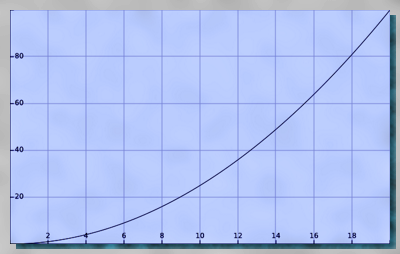
graph generated using fooplot.
It stays low and flat until the middle, at which point it begins to climb in value rapidly and appears to flatten out only at the very end – an appearance that is, in fact, an illusion, because it would continue to steepen if the graph were extended.
What this means, in practical terms, is that it can be very hard to match a chance of success of “X” with two equal rolls of “Y” chance of success each. In fact, it’s impossible to exactly match a given chance of success with two unequal rolls, but you can come close (all on d20):
5% = 2 and 10, or 4 and 5
10% = 5 and 8, or 4 and 10
15% = 6 and 10, or 5 and 12, or 4 and 15
20% = 8 and 10, or 5 and 16
25% = 10 and 10
30% = 10 and 12 or 8 and 15
35% = 10 and 14
40% = 10 and 16
45% = 10 and 18
50% = approx. 11 and 18
55% = approx. 13 and 17
60% = 15 and 16
65% = approx. 16 and 16
70% = approx. 15 and 19
75% = approx. 16 and 19
80% = 18 and 18
85% = approx. 18 and 19
90% = approx. 19 and 19
95% = 19 and 20 (unsatisfactory)
100% = 20 and 20 (by definition)
But who’s going to remember all that? I certainly don’t and won’t, I had to calculate it just for this article.
Instead, I remember: Add six and subtract one-fifth (add five instead for values under 5). For results close to a 0.5 fraction, round one high and one low. Then apply the following adjustments to the lowest roll: -3 for 1/-, +2 for 4/- and 5/-, and -1 for 16-19/-.
If I want a result of roughly 14/-, one fifth of that is roughly 3, and 14+6-3 is 17, so two rolls of 17/- give a rough result of 14/-. (In fact, they give 72.25% chance).
If I want a result of roughly 10/-, one fifth of that is 2, and two rolls of 10+6-2 is 14, so two rolls of 14/- give a rough result of 10/- (in fact, they give 49%).
If I want a result of roughly 7/-, one fifth of that is just over 1 and a half, and two rolls of 7+6-1.5 is 11.5 – and one roll of 12/- and another of 11/- give a rough result of 7/- (in fact, they give 33%).
If I want a result of roughly 2/-, one fifth of that is just less than 0.5 – and two rolls pf 2+5-0.5 (not 6) gives one roll of 6 and one of 7, which is roughly the same as an overall roll of 2/- (in fact, they five 10.5%).
As rules of thumb go, it works pretty darned well, with just a handful of corrections needed.
Unequal Divisions – importance
What if one sub-task seems more important to the outcome than all the others? That happens in computer programming, where it is more-or-less guaranteed (and assumed) that mistakes will be made in the design or coding stages, errors which have to be found and corrected in the testing phase.
This situation describes a circumstance in which we want to adjust the chances success on one roll for flavor and accuracy while adjusting the other so that the overall chance of success is unchanged.
Here’s another rule of thumb:
for +2 to one roll, – 2 to another, reducing by 1 for every odd +after +2.
If you have two rolls of 5/-, and you add +2 chance of success to one of them (making it easier and therefore less important to the overall result), you can balance that by subtracting 2 from the other – 5/- and 5/- are 6.25%, 7/- and 3/- are 5.25%.
Two rolls of 14/- are a 49% chance of success, and a 16/- & 12/- combination is a 48% chance of success.
Base Rolls 16/-, +3 on one, -(3-1) on the other gives 19/- and 14/-, or 66.5% vs 64%.
Base Rolls 10/-, +5 on one, -(5-2) on the other gives 15/- and 7/- or 26.25% vs 25%.
None of these shortcuts are completely accurate, but they are close enough for practical use.
Unequal Divisions – phase bonuses and penalties
The final thing that has to be understood before we can move on is the impact of an uncompensated modifier to one of the constituent die rolls, because that’s the key to understanding the unequal impact of circumstances to a particular activity.
5/- and 6/- give 7.5%, up from 6.25%.
8/- and 9/- give 18%, up from 16%.
13/- and 14/- give 45.5%, up from 42.25%.
17/- and 18/- give 76.5%, up from 72.25%.
So the rule of thumb appears to be that below 6 on a sub-task roll, +1 is worth roughly 1.25%; from 6-10, it’s worth roughly 2%; from 11-15, it’s about 3.25%; and for rolls above 15, it’s roughly 4.25%.
Since +1 on the overall roll should be +5% to the overall chance of success (on d20), that means that we achieve that with the following adjustments:
sub-task roll 5/- or worse: +4
sub-task roll 6-8 /-: +3
sub-task roll 9-14 /-: +2
sub-task roll 15/- or better: +1
11/- overall = 55%. Adding 6 and subtracting 1/5 of 11 gives 11+6-2.2 = two rolls of roughly 15/-. 15/- and 15/- = 56.25%. So +1 to one of the sub-task rolls, giving 15/- and 16/-, is worth +1 on the overall result. 15/- and 16/- give a 60% chance of success, which is the exact equivalent of 12/- – perfect!
8/- overall = 40%. Adding 6 and subtracting 1/5 of 8 gives 12.4, which is close to the 0.5 mark, so we use 12/- and 13/- to get 39%. +2 to one of the sub-task rolls should get us to roughly 45%. There are two
to choose from; 12+2=14/- and 13/- gives 45.5% (close to perfect) while 12/- and 13+2=15/- gives 45% (perfect). Either works perfectly satisfactorily.
Dividing A Task In Three
At first, it might seem like this is an even trickier task than a two-way division. It’s not. All you need to remember is that 5 gives 1/4, 10 gives 1/2, and 15 gives 3/4 of whatever the 2-roll chance is, and work from there.
So if you need an overall chance of 5/- on three rolls, work out the 2-roll requirement for 4 times 5 or less, 2 times 5 or less, or 4/3 times 5/-. There will usually be one value that’s easy to work with. In this case, 2×5 or less is 10/-, so work out the two-roll for 10/- (=14/- x 14/-) and apply a 10/- on the third roll to halve it.
If you need an overall chance of 9/- on three rolls: 9×4=36 (not helpful), 9×2=18 (possible), or 9×4/3 = 12 (excellent). The 2-roll for 12/- is 15/- x 16/-, and the third roll is another 15/-, which reduces the 12/- to a 9/-..
If you need an overall chance of 17/- on three rolls, 17×4= who cares, 17×2=34 (too much), and 17×4/3 = 22 and 2/3. Ah, that’s rather more difficult, isn’t it? Well, just a little. You know that 17/- is 85%, so start by assuming that your third roll will be one higher (18/-, which equals 90%) and divide what you want as the end result (17) by 0.9 = 19/-. So the two-roll for 19/-, which is 19/- x 20/-, gives you a third roll of 18/-.
Hang on – what does a sub-task roll of 20/- even mean, anyway?
It simply means that there is one sub-task on which the character is guaranteed success. Which one is up to the GM, but preference should be given to a sub-task that does not ensure success on the overall task. Sometimes, there aren’t any – it doesn’t matter how you subdivide the task of painting a picture, success in one area doesn’t guarantees success overall – but in the case of writing a computer programme, with the sub-tasks of design, code, and test, automatic success in either of the latter two steps ensures automatic success in the overall task, but you can have a perfect design that is not executed perfectly, so that is the “automatic success” that should be chosen.
Artistic flourishes: An optional rule
An alternative interpretation is this: an artistic flourish in any sub-task can be considered a fixed modifier to that sub-task’s chance of success. Deliberately inserting some other programmer’s “signature” into your programming code code, or a backdoor into the software, for example. I tend to use a -2 for the purpose, increasing by -1 for each additional flourish (cumulative). So a 20/- simply means that the character is forced by his ability to insert at least one artistic flourish, reducing the 20/- to an 18/-.
one flourish: -2
two flourishes: -2-3=-5
three flourishes: -2-3-4=-9
four flourishes: -2-3-4-5=-14
five flourishes: -2-3-4-5-6=-20 (not possible in any given sub-task).This also requires the GM to adjust his definitions of failure. Let’s say that a sub-task has a chance of 17/-, and the character decides to incorporate two artistic flourishes for a -5 penalty (a total of 12/-). If he then rolls a 14, say, one of two things happens: either the artistic flourish fails without impacting the overall success of the sub-task (because 14 is below 17/-) or the attempt causes the sub-task to fail.
The choice I make is usually dependent on the hubris being displayed by the character. If he is being cocky and arrogant (four flourishes on a base 17/- sub-task roll), I would be tempted to apply the worse of the two alternatives and have the whole sub-task fail as a result. If the character had a reasonable expectation of success, I would apply the lesser penalty.
Intermediate choices are also available – for example, in the case given above, the character could succeed in incorporating one artistic flourish (14 is less than 17-2=15/-) but fail as described to incorporate the second.
Oh, and one more side-note: most IT departments have a set of standard procedures to which they expect a coder to adhere. Being forced to “do it the official way” counts as a flourish. Similarly, executing a forged artwork in the distinctive style of a famous artist counts as a flourish that could apply to several sub-tasks. Giving the artwork some inherent artistic merit would be a second – as would hiding the forger’s true signature somewhere in the work. That sort of ‘artistic touch’ is often easier for the GM to assess when the task has been subdivided.
Unequal Divisions – Importance
This more or less describes the default situation. It will be so rare for all three of the die rolls to be the same value that it’s not worth worrying about. Nevertheless, using the two-roll system will work perfectly provided that you don’t alter the third roll. And, having done so, you can then apply a separate modifier and adjustment to that third roll, as necessary. The higher the base skill roll, the less room you have to maneuver, as shown by the “17/-” example above.
Unequal Modifiers
The same technique used to determine the “third roll” in the first section, when applied to a two-roll modifier, works perfectly. In other words, work out the two-roll modifier you need and divide by the percentage equivalent of the third roll. With a calculator app available for every PC and laptop and smartphone, this should be trivial.
Dividing a task in four
You do this in exactly the same way as dividing a task in three, you just do it twice – once to get the three-roll value, and the second time to translate the three-roll value into a four-roll value.
Remember the shape of the x-squared graph? A high fourth roll will have minimal impact on the effective total, a low fourth roll will have a big effect.
Almost by instinct
With a little practice, you can reach the point of dividing any task into logical constituent sub-tasks almost as quickly and easily as asking for a die roll, just as most GMs can interpret a single die roll as a likely success or failure without actually doing maths in their head.
Consummate Professionalism: an optional rule
If a sub-task succeeds by more than 10, you can rule that the “excess success” functions as a bonus to subsequent sub-task checks. You have three choices:
- allocate the whole bonus to the next sub-task;
- allocate enough bonus to the next sub-task to take it up to 19/- chance and any that’s left to the sub-task after that, and so on;
- divide the bonus as evenly as possible amongst the remaining sub-tasks.
This requires a little caution; it is not difficult to create a situation in which a “consummate professionalism” bonus from an early sub-task generates a second one in the next sub-task, rolling the benefits forward through the entire task.
For that reason, I never tell the player of a “consummate professionalism” bonus, I simply apply it mentally. If it makes the difference, I will tell the player that his character almost made a critical error, but spotted it (and corrected it) at the last possible moment.
This also means that one “consummate professionalism” bonus does not contribute to any others being generated, only good raw die rolls will do that.
This optional rule can also be married to the “artistic flourishes” sub-rule – so that a good roll early in the task makes it easier to succeed while incorporating artistic flourishes later in the process.
What is a Masterworked Item that you are mindful of it?
This combination also permits the GM to identify exactly what it is that distinguishes a Masterworked Item from any others.
You could decide that “Consummate Professionalism” bonuses accumulate, and every 5 points so accrued adds up to a +1 capacity in the item. You could, as an alternative, set thresholds for minor, medium, and high miscellaneous magic effects. Weaving a carpet (design, artistry, dying, weaving) with a cumulative professionalism bonus of 10 might enable it to fly at 20″, of 15, at 25″, and so on.
This also presents the GM with a further choice: some objects might be so inherently well-crafted that they become imbued with magical qualities without the need for enchantment. This was certainly something that the Ancient Romans held to be possible, and Tolkien was quite happy to imbue such creations with a kind of “pseudo-magic” as a virtue of the skill executed in their crafting. So there is plenty of precedent.
The Need For Narrative Differential
There is nothing worse than a player being told, “okay, you’ve succeeded in one-quarter (or 1/3rd, or 1/2) of the task. Now roll again.”
If you are not to make this an exercise in tedium, being able to distinguish between two different sub-tasks in terms of the logical activities being carried out is an essential, as is being able to convey that distinction to the players by way of narrative.
That means that it’s incumbent on the GM to either know something about everything, or be able to fake it – refer to The Expert In Everything? and Lightning Research: Maximum Answers in Minimum Time for techniques.
Going In The Other Direction: Many foes, One Enemy
When it comes to fighting swarms or hordes or just a bunch of meaningless nobodies, you can sometimes be better served by treating the whole group as a single monster, not as discrete individuals. 7th sea first introduced this concept to me in the form of “brute hordes”, and I expanded on it in the This Means War!: Making huge armies
practical series.
If you are being confronted by a group of N identical enemies (it makes it much easier if they are identical), you don’t care which one you hit so long as you hit one of them. That makes this a case in which “any successful roll is a success” on N die rolls.
That means that the chances of failure get smaller with each additional foe. Let’s say that you have a 75% chance of hitting one, and there are 5 of them: your chance of missing all of them is 0.25 x 0.25 x 0.25 x 0.25 x 25% = 0.09765625%. Your chance of hitting any one of them is therefore 100-0.09765625=99.90234375% – call it 99.9%. That’s so close to 100% that I would assume automatic success.
When you get them down to only 4, the chance worsens, slowly trending towards the base 75% chance (which will happen when the second-last one falls). The chance of missing all of them increases to 0.3905025% – but that’s still so close to 100 that I would deem that to be another automatic hit. With three of them, the chance of missing becomes significant for the first time = 1.56201%. On a natural 20, that’s about a 1-in-3 chance. With two of them, the chance of missing one is up to 6.24804% – so, miss on a 20.
It works in the other direction, too, though not as neatly. Let’s say they have an 8/- chance of hitting, +2 because they are flanking – something that will last only until there’s only one of them. That’s a net 10/-, or a 50-50 chance.
The odds of all five missing you are 0.5 x 0.5 x 0.5 x 0.5 x 50 = 3.125%. Each time one of them falls, that chance doubles. The chances of any two of them hitting in a round are trickier to work out and involves factorials, which are maths too advanced for this article. Instead, I would use a cheat: If one hits, there’s a 3.125/0.5 % chance that a second one will also hit. and if two hit, there’s a 3.125/0.5/0.5 % chance of a third one hitting. In other words, the chance doubles each time provided that the previous group hit.
So, one hit: 50%
Two hits: 50% of 50% = 25%
Three hits: 50% of 25% = 12.5%.
Four hits: 50% of 12.5% = 6.25%.
Five hits: 50% of 6.25% = 3.125%.
This creates a table:
01-03: 5 hits (3.125%)
04-09: 4 hits (6.25%)
10-21: 3 hits (21.5%)
22-46: 2 hits (25%)
47-96: 1 hit (50%)
This greatly speeds up combat with meaningless flunkies, saving time for confronting named enemies.
Focusing Attention
Dividing a task up focuses the attention of both players and GM on the logical subdivision. This makes substantial or complex tasks feel bigger or more involved, respectively, and provides vectors for GM narrative beyond meaningless fluff – or, worse yet, non-narrative game mechanics.
It takes a little more effort, but – employed judiciously – the effort repays both players and GM handsomely.

Discover more from Campaign Mastery
Subscribe to get the latest posts sent to your email.
Comments Off on Fractional Pursuits To Focus Attention