High-Fives and other in-Game Rewards
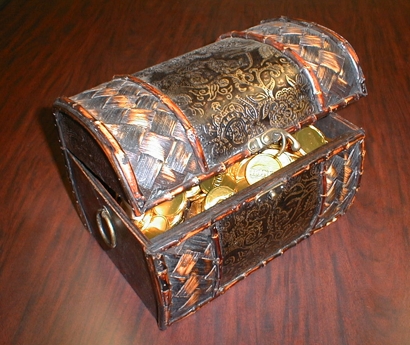
Image courtesy freeimages.com / Janine Chance
With this item, I continue the practice of offering shorter articles to start the week. Usually, this is to make room for a longer article later (and from time to time, the sequence has been temporarily inverted), but for much of the next year, that’s the plan. This week, though, it’s not for that reason – I have an optometrist’s appointment mid-week that will eat into the time that would normally be dedicated to producing that longer article. Prudence dictates that I make this a “light” week. Whether or not my writer’s instincts will tell Prudence to go fly a kite remains to be seen…
For a long time, I’ve been a supporter of the carrot-and-stick approach to encouraging good play. I tolerate a certain amount of side chatter and the occasional excursion into out-of-game conversation, and I tolerate absence or lateness when the player has a good reason.
When such behavior reaches the point of becoming a problem, rewards are likely to be reduced as a punishment – I favor XP awards for this as they can directly target the character of the player responsible without others being unduly affected by “splash”, but if there’s a magic item or equivalent that’s been placed to specifically target and benefit the character whose player is involved, it might instead be reduced in effectiveness, either temporarily (requiring the player to inconvenience the character to lift the ‘penalty’) or permanently.
By the same token, however, for more than 30 years I’ve been handing out bonus XP for good play – be it good role-play, or clever tactics, or for the player doing something that helps me run a good game. My players know all this and have come to expect it – especially since rewards are far more frequent than punishments.
This weekend’s table side-chatter carried with it a new idea. It’s not my idea (not completely), but I’m stealing it and filing off the serial numbers! That notion: an in-game reward for doing a good job as a player instead of extra XP.
What’s Wrong With Extra XP?
Extra XP make a great reward because they are something that the player cares about. They are quick and easy to hand out, and they can make a real difference to the character. They encourage consistent patterns of good behavior because they accumulate. So, what’s wrong with them?
Players care about them – and not getting them when you think they are justified can arouse ill-will. They are easy to hand out, which encourages the GM to hand them out frivolously, rather than being earned by achieving a consistent standard of good behavior. They can make a real difference to the character, and they can accumulate – which means that, over time, the benefits obtained will tend to grow exponentially.
So what’s the alternative?
Three things come to mind:
- In-game kudos and high-fives from NPCs whose opinions matter to the PC.
- Recognition from the PC’s NPC-peers. In-game popular support from “ordinary people”.
- Tokens that are redeemable for in-game advantages but that must be used by a certain date or they get converted to XP.
Of these, the last of the three is more powerful, and more flexible. You can either hand out different tokens that offer specific benefits, or you can establish a “price list” and use the tokens as a form of metagame currency. The first permits greater control, but is more work, the latter is easier on the GM’s workload.
An Expiry Date?
The notion of an expiry date is an important point to note. A physical token made of cardboard is easily lost, but also easy to write a date on, and easily replaced after use. A physical token made of plastic can be marked with a permanent marker, though such markings can still wear off (it depends on the combination of markers and the plastic the tokens are made of). Both these options also require the player to spend time sorting and counting his accumulated “rewards” at the start of each game session. Getting a character to write something on their character sheet means that the character sheet will eventually wear out (this section is likely to see a lot of “traffic”) but is also more flexible.
These are all problems that can be solved. I recommend using a choice that has a low financial impact on the GM, minimizes the chances of tokens getting lost, and that has a low overhead in terms of additional work for all involved.
Why have one at all? I have seen (and used) similar systems in the past, and what happens is that players tend to hoard them until they have a whole lot – enough to give them an overwhelming advantage. A use-by date forces players to expend them regularly, keeping them manageable as rewards.
I have a suggested solution: instead of a calendar date, use a relative date – “expiry in N game sessions”. The more you want to reward a character, the longer the time frame you attach – instead of increasing the size of the reward. Use tokens that will pack flat.
You know those plastic sheets that are designed to hold cards from CCGs? They tend to be cheap per sheet. There are usually nine pockets per sheet, sometimes there might be 12. Those are more than big enough for this purpose. Here’s how it might work:
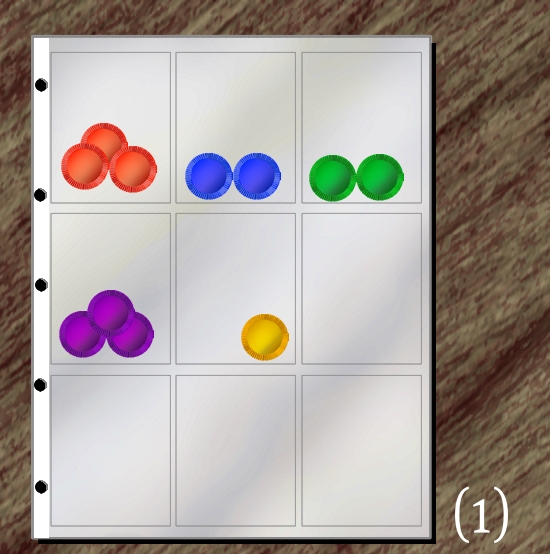
Before play, this player has tokens in five groups: 3, 2, 2, 3, and 1. Note that this GM is color coding his tokens to help everyone keep it straight (the fact that it makes it easier to explain to readers is a bonus – at least, that’s my story, and I’m sticking with it).
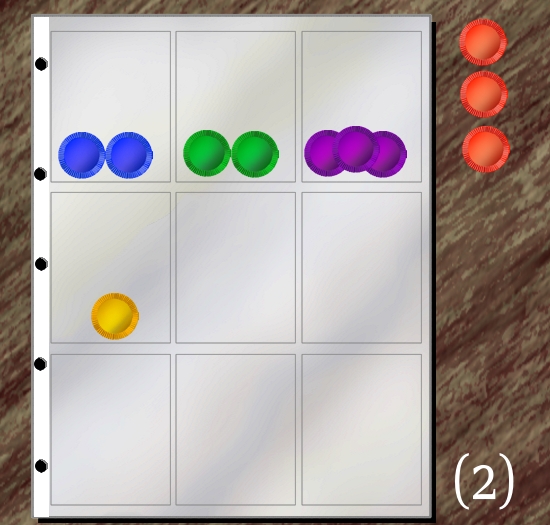
When setting up for play, the player takes the tokens out of the first pocket and puts them in front of him as a reminder that they have to be used today or they will covert to a token amount of additional XP at the end of the game session. He takes the tokens from pocket 2 and moves them into pocket 1, from pocket 3 into pocket 2, from 4 into 3, and from 5 into 4. Because of the color-coding, the GM can see at a glance if anyone’s failed to convert tokens to xp at the end of the last session because their colors will be different to everyone else’s – perhaps they had to leave in a hurry to catch the bus (it happens) or forgotten (it happens) or missed the session.
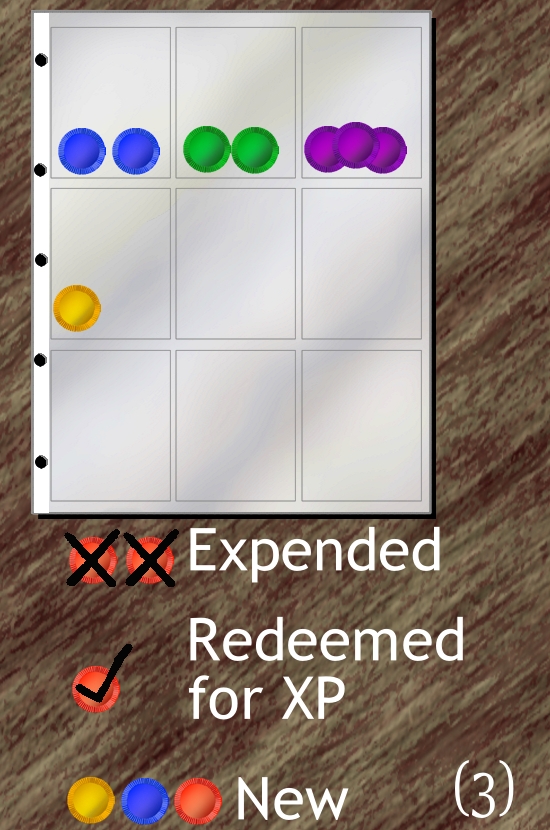
At the end of play, this player has expended two of the three that had to be consumed, leaving one to be redeemed for XP. He had a good day, earning a new blue token (must be redeemed next session, indicating a short-term reward), a new yellow token (must be redeemed in 4 sessions time) indicating a long-term reward, and a new red token (must be redeemed in 5 game sessions).
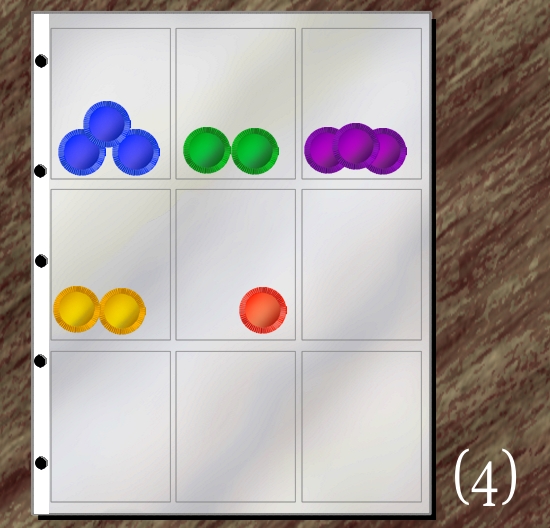
As part of his process for packing up at the end of play, he puts the new tokens he has received into their respective pockets – which match the colors of the tokens already in those pockets. The evenness with which his resulting token reserve is distributed is too even to be a coincidence (3, 2, 3, 2, 1) and indicates that the GM has his eye on what players have already received when he chooses what reward to hand out.
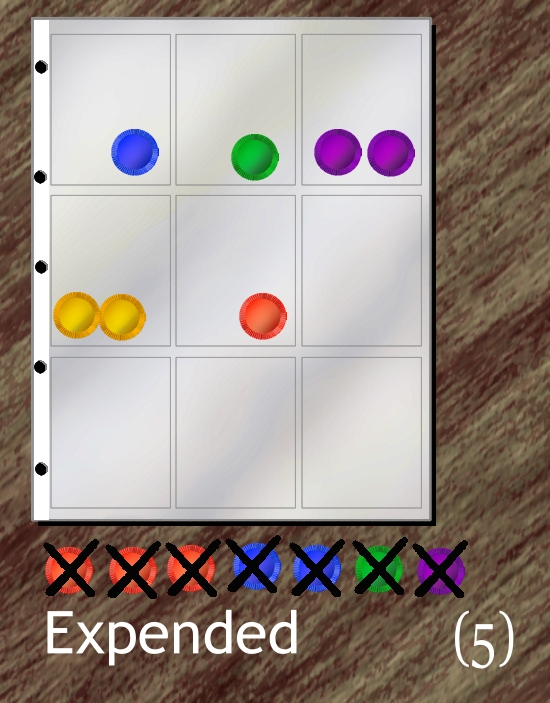
Of course, if the player experienced a very bad day, or chose to buy a bigger reward, his token collection might have been decimated as shown in the illustration above. In addition to the three tokens that had to be used on this particular day, he has used two of the tokens that did not expire until next game session (leaving him just the one that he earned in the course of the day’s play), one of the tokens that had a lifespan of 2 game sessions remaining (leaving one), and one of the tokens with a remaining lifespan of 3 game sessions. That’s a total of 7 tokens expended, leaving him 1, 1, 2, 2, and 1, respectively.
How long should a cycle be? I’ve used 5 as an illustration, but you could choose three, or four, or six – it’s all a question of how many different tokens you have. This solution means that there’s no need to mark or replace the tokens at all – they are constantly being recycled.
Types Of In-Game Reward
What could you spend tokens on? Well, that’s up to the GM. For the rest of this article, I’ve listed (and discussed) as many types of in-game reward as I can think of, and a suggested price in tokens.
Here’s the list of rewards I’ve come up with:
- Partial Map (with potential inaccuracies) or equivalent
- Partial Map or equivalent without inaccuracies
- A Clue
- +5 to a roll (before you roll)
- +1 to a roll (after you roll)
- -5 to a roll (before the GM rolls)
- -1 to a roll (after the GM rolls)
- Re-roll a failed non-combat roll
- Re-roll a failed combat roll
- +1 step to the common attitude towards the PC, specifically, for one encounter
- +1 step to the common attitude towards the PC, specifically, for one full game session
- +1 step to the common attitude towards the PC’s class orrace for one full game session
- +1 step to the common attitude towards the PCs (as a group) for one encounter
- Kudos from and a lasting improvement in attitude towards the PC on the part of one specific NPC
- 10% off the purchase price of one mundane item one-time-only, for this particular PC only
- 10% off the prices of one particular merchant, one-time-only, for this particular PC only
- A more generous valuation of one particular item being sold by this PC (amount up to the GM, but average should be +10%)
- A more generous valuation of all items being sold by this PC (amount up to the GM, but average should be +10%), one-time-only
- Placement
of a specifically-desired magic item in a place and location that the PC can obtain it - XP (the default)
That’s a solid list of 20 possible rewards, by my count. None of them are particularly game-breaking unless the price is too low or the GM is too generous in his distribution of reward tokens. I’ll discuss that a little later.
1. Partial Map (with potential inaccuracies) or equivalent
The PC gets a map (as described) or a verbal description of one particular room in a dungeon. The closer to the entrance that room is, the more likely the description or map is to be accurate, but the GM doesn’t have to tell the player how close the room in question is – the player still has to recognize it. I suggest a hierarchy, such as 1. completely accurate – 2. a few minor inaccuracies – 3. an important detail wrong – 4. an important detail and a couple of unimportant details incorrect – 5. information is mostly close to the truth but nothing is quite right – 6. not even close to accurate. Count one door or length of passage as “1”.
This information (or mis-information!) may be from personal experience, or it may be from Scrying or some other similar technique, or from a friend of a friend, or myth/legend/rumor or whatever. It might have been totally accurate at one time. Those are all up to the GM depending on the context of the situation.
Recommended Price: 1 token.
2. Partial Map or equivalent without inaccuracies
As above, but without inaccuracies – anything actually said is correct. This simply strips out the inaccuracies from the above and only reports the factually-correct information. This can be difficult for the GM to explain, in-game, so it is harder to earn.
Recommended Price: 3 tokens.
3. A Clue
If the PCs are stumped, it is expected that the GM will help them out in order to keep the game moving, because sitting around doing nothing is boring.
Making this option available changes the paradigm. Instead of a clue to keep the game moving (for free), the GM is free to use some other action to keep action happening when the game starts to get boring – a wandering monster, for example, or a PC “hears something” (sparking paranoia) or whatever. ANYTHING except actually helping the PCs do something that the players should be capable of doing on their own.
But, if one of the players chooses to expend reward tokens, an appropriate PC gets a clue or a hint. Which PC is appropriate depends on the problem that has the PCs stumped – it might be the cleric, if it’s a religious puzzle, or the fighter if it’s a physical challenge, or the smartest person in the party if it’s logic puzzle.
This also guarantees that the GM won’t make the clue too cryptic – it should be possible to get from the clue to the solution reasonably – though it doesn’t and shouldn’t make it too easy, either.
I’ve had a reasonable amount of success promising to answer 5 yes-or-no questions truthfully as a ‘clue’.
Recommended Price: 1 token.
4. +5 to a roll (before you roll)
Some game systems permit you to “take a ten” or “take a twenty” under certain circumstances, but force you to roll the hard way the rest of the time. This option falls somewhere in between – in effect, the player is cashing in his reward to get a better shot at a successful roll. Note that whether or not the +5 is actually needed doesn’t matter – the token still gets expended. The GM may permit multiple tokens to be played or may cap this at one, or anything in between, as he sees fit.
Nor does the player paying the token have to be the owner of the PC making the roll.
What this does is ensure that when one of those rolls comes up that the PCs absolutely have to succeed in, they have the means to shade their chances in their favor. And that this potential can be frittered away taking the lazy option when failure is not going to be the end of the world!
Recommended Price: 1 token.
5. +1 to a roll (immediately after you roll)
On the other hand, once a roll is made, the GM should be much harder to convince, because the player already knows whether or not they have succeeded.
This has three applications, from the players’ perspective: they can avoid a fumble or critical miss (i.e. turn a natural 1 into a 2); they can ameliorate the frustration of just missing a failed roll; or they can turn a 19 into a 20 (or system equivalents, of course).
I often feel that the PCs need to have an edge that enables them to win most fair fights; it’s only a question of the degree of difficulty involved (no-one ever promised that it should be easy!) This option provides the PCs with just such an edge while still keeping it constrained and controlled within reasonable limits.
Recommended Price: 1 token.
6. -5 to a roll (before the GM rolls)
This is a more defensive option. The player who is buying this reward is betting that the modifier will make the difference, or is desperate enough that it’s worth any price to improve the odds. I strongly recommend that GMs cap the number of tokens that can be expended in this way on any single roll to one, or at most, 2. But if you do want to make it more open-ended, reduce the size of this reward to +4 or +3 (and the size of 4 above, to match).
Recommended Price: 1 token.
7. -1 to a roll (immediately after the GM rolls)
The obvious alternative or variation on 5, above. I have to admit that I thought long and hard about making this a -2 instead of a -1, and am STILL of two minds on the question. A minus 1 will avoid a critical success (a 20 becomes a 19), and turn an only-just success into a failure or a near-fumble into a fumble, but those are very limited circumstances. Doubling the scope for this to make a difference is a substantial improvement in utility.
If your objective is to keep the ‘economy’ of tokens turning over, don’t cap this; if you trust yourself not to be excessively generous, I suggest a cap of 1 or 2 tokens.
Recommended Price: 1 token.
8. Re-roll a failed non-combat roll
“Psst, Hey kid, want to buy yourself a second bite of the cherry?” The lower the level of the PCs, the more comfortable I would be having this choice on the table. That’s because the greater the chance of success, the greater the value of a re-roll.
If you only succeed on eighteen or better (on d20) (or three or less on d20, it’s the same thing), a second roll doesn’t improve your chances very much – 3/20ths of 17/20ths, or 12.75%. Overall, your chance is only 27.75%, or slightly less than one in four. I’d be completely comfortable with that sort of improvement.
If your chances are 50-50, you get twice as much gain – 10/20ths of 10/20ths, or 25%, which takes your overall chance of success to 75%. Look at it the other way – your chances of failing have just halved. That’s starting to get to my squeal point.
Every improvement from there only ramps things up. If you succeed on 14 or less, the improvement is 14/20ths of 6/20ths – which is only 21% – but that becomes significant when added to the base 70% chance, taking your overall likelihood of success to 91%. From a roughly one-in-three chance of failing, it’s become one in 10, or better than three times as unlikely. By now, we’re well past my squeal point.
So I would limit the heck out of this option. ONE re-roll, only, and only when most of the rolls by the party are 50-50 or less (in D&D/Pathfinder terms, until about 5th-8th level). This option may NOT be combined with any of the other ones on offer – specifically, the +5 or +1 to the die roll. And even then, to accurately reflect the utility, I would up the price, as shown below.
Recommended Price: 2 tokens.
9. Re-roll a failed combat roll
Everything that I’ve just said counts double or triple when we’re talking about combat rolls, because these can literally be the difference between life-and-death. The price should reflect that innate value, and be high enough that you would only contemplate this if you were absolutely desperate..
Recommended Price: 3 tokens.
10. +1 step to the common attitude towards the PC, specifically, for one encounter
From “burn him at the stake” to “lock him up”; from “lock him up” to “fox touring the hen-house”; from “extreme paranoia” to “grudging tolerance”, to “polite acceptance” to “warm welcome” to “long-lost brother”. Or whatever other gradated structure you use.
As a general rule of thumb, such shifts in attitude resulting from the expenditure of multiple tokens decline back to the base at the rate of 1 step per encounter, or per game day, whichever comes first. So spending four tokens might take a hostile reception to a polite if cool welcome for one encounter, to deep suspicion and second thoughts on a second encounter, to feeling manipulated and betrayed on the third, and back to the base “extreme prejudice” level on the fourth.
This is a foot in the door – but unless the PC works hard to take advantage of the opportunity to better his relations, it’s a fleeting advantage. Rewards should never take the place of good roleplay.
Recommended Price: 1 token per step.
11. +1 step to the common attitude towards the PC, specifically, for one full game session
As above, but the decay rate is weekly or by game session, whichever comes first.
Recommended Price: 2 tokens per step.
12. +1 step to the common attitude towards the PC’s class orrace for one full game session
This is about creating a local exception to a generalized attitude. Decay assumes that the PC is unable to live up to the expectations of the locals. I keep thinking about the attitudes toward the Dwarves in Lake-town in “The Hobbit” as the perfect example.
Recommended Price: 3 tokens per step.
13. +1 step to the common attitude towards the PCs (as a group) for one encounter
The locals have heard good things about the Party (whether they are true or not is another matter). This overrides any prejudices they may have – for a while – as per 10, above. “Most [fill-in-the-blanks] are uncouth scum who would do [something horrible] to us if they could, but we’ve heard that you’re different.” Again, if the PCs fail to do something significant to cement relations, the goodwill quickly evaporates, and even those who the locals might get along with (or have no prejudice toward) will suffer, tarred with the same brush.
Recommended Price: 2 tokens per step.
14. Kudos from and a lasting improvement in attitude towards the PC on the part of one specific NPC
This can only be accessed after performing a deed of which the NPC approves, and is a means by which the player can enhance/leverage the resulting goodwill.
Recommended Price: 3 tokens per step.
15. 10% off the purchase price of one mundane item one-time-only, for this particular PC only
The GM should have a reasonably liberal interpretation of “one item” – if something is usually bought in sets, or in quantities, the discount applies to one set or one transaction. The discount may not show up immediately; this commits the GM to “arranging” circumstances under which the discount will be offered. The scale if circumstantial change depends on the scale of the transaction and the size of the discount that has to be justified.
Recommended Price: 1 token, plus 1 token each 2nd additional step. So 10% costs one, 20% costs 1 plus 1 equals 2, 30% costs 2 plus one, plus one, or 4, and so on,
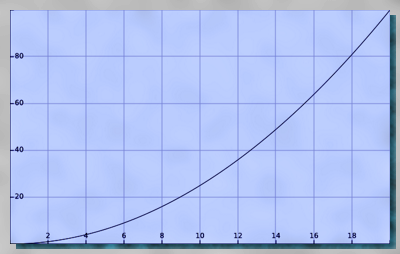
The sequence is: 1 (10%), 2 (20%), 4 (30%), 6 (40%), 10 (50%), 14 (60%), 20 (70%), 26 (80%), 34 (90%), 42 (100%, i.e. free).
These somewhat brutal increases at high level are intended to keep these benefits within reasonable (and rational) bounds. The GM is perfectly entitled to interpret circumstances that emerge during play as providing one or more additional “steps” of discounting.
16. 10% off the prices of one particular merchant, one-time-only, for this particular PC only
As above regarding in-game interpretation.
Recommended Price: 2 tokens, plus 1 token each additional step.
The sequence is: 2 (10%), 5 (20%), 9 (30%), 14 (40%), 20 (50%), 27 (60%), 35 (70%), 44 (80%), 54 (90%), 65 (100%, i.e. “take whatever you need”).
17. A more generous valuation of one particular item being sold by this PC (amount up to the GM, but average should be +10%)
Only one level of this benefit per item. This is justified as the buyer already having a customer in mind who will pay him a premium for the item, or something similar. When dealing in a more mundane item, something has put him in a good mood.
Recommended Price: 1 token per significant digit of base valuation in gp. So a 5,000gp item needs 4 tokens to get the +10% benefit.
0-9gp: 1 token for 10%
10-99 gp: 2 tokens for 10%
100-999 gp: 3 tokens for 10%
1000-9999 gp: 4 tokens for 10%
10,000 – 99,999 gp: 5 tokens for 10%
and so on, but I doubt more will be needed. Which is convenient because these are all reasonably workable with mental arithmetic.
18. A more generous valuation of all items being sold by this PC (amount up to the GM, see below), one-time-only
This should usually be interpreted as an attempt to forge a lasting trading relationship with the PC. The NPC might do so out of avarice (expecting to do a lot more business with the PC in the future) or might have some ulterior motive (“you owe me a favor”). The GM is free to place any other interpretation on the situation that seems appropriate, but something is motivating the NPC to deal with the PC on more generous terms than most would get.
Recommended Price: 1 token, plus 1 token per significant digit of base valuation in gp of the total. So 5,000gp worth of items needs 5 tokens to get the +10% benefit (see above for what I mean by significant digits).
However, the player should not be told the total number of tokens required; instead, divide the number offered by the PC by the required amount and multiply by 10%. So if the player only expends three reward tokens when four are required to get the full 10%, he gets 3/4 of 10% or +7.5% overall. If the player had expended five tokens when only three were required, that’s one-and-two-thirds of 10%, or about 16.7%.
19. Placement of a specifically-desired magic item in a place and location that the PC can obtain it
This isn’t meant to guarantee that the PC will obtain the item, but does guarantee the opportunity to acquire the item. The GM should add it to whatever treasure he has emplaced and add additional defenses appropriate to the increase in value of the total. It certainly does not guarantee that the item won’t be used against the PC!
Recommended Price: 2 tokens plus 1 token per significant digit of the valuation, -2 for one-use items, -1 for a charged item with 5+d10% of the base charges.
So, Potions & Scrolls:
0-9gp: 2+1-2=1 token
10-99 gp: 2+2-2= 2 tokens
100-999 gp: 2+3-2= 3 tokens
1000-9999 gp: 4 tokens
10,000 – 99,999 gp: 5 tokens
Wands (5-15% charged [round up]):
0-9gp: 2 tokens
10-99 gp: 3 tokens
100-999 gp: 4 tokens
1000-9999 gp: 5 tokens
10,000 – 99,999 gp: 6 tokens
100k – 999k gp: 7 tokens
Armors, Weapons, etc:
0-9gp: 3 tokens*
10-99 gp: 4 tokens**
100-999 gp: 5 tokens***
1000-9999 gp: 6 tokens****
10,000 – 99,999 gp: 7 tokens*****
100k – 999k gp: 8 tokens*****
* few if any items will be this cheap, this entry is only for the sake of completeness
** you might get some mundane/masterworked items in this price range
*** too cheap for magic, but most mundane items will be in this range
**** the realistic minimum for low-level magic items
***** most magic items will be in the 7-8 token range.
20. XP (the default)
Some players respond particularly poorly to falling just short of acquiring their next level. Aside from ensuring that tokens keep circulating, this offers such players a way past the hump. The actual value per token goes up with the number of tokens being redeemed for XP:
1 token: 100XP
2 tokens: 150XP
3 tokens: 200XP
4 tokens: 250XP
5 tokens: 300XP
6+ tokens: 400XP + 20XP per token over 5
Unlike most of the other rewards, the PC doesn’t have to do anything to receive this XP. He is considered to have done whatever-it-is that justifies the extra back when he received the token.
So, a character who cashes in three tokens would get 3×200=600XP extra.
A character who cashes in five tokens would get 5×300=1500 XP extra.
A character who cashes in ten tokens would get 10x(400+100)= 5000 XP extra.
If your game system doesn’t use the D&D scale or similar for XP, you may need to adapt this.
Sidebar
Assuming characters earn up to 3 tokens per game session on average – and I’ll get into reward levels in a moment – this sets up an interesting dynamic in which a character may choose to tap into his non-expiring reserve to obtain a bigger XP payout, and hence an additional level sooner – but in the process, sacrifices the benefits / security blanket of having those untapped rewards on hand. This may actually handicap the character for a while, relative to another, more patient, character. This effectively simulates a situation in which the character has to take a little time to fully assimilate the things he’s just learned how to do (the level increase and any level abilities that go with it). Suggest to the player that he roleplay it that way :)
Earning Rewards
The number of reward tokens you hand out is critical. A brilliant idea or making the whole table laugh might be worth 1 token. Roleplaying especially well in a single encounter might be worth 2 tokens, and so on, but my recommendation is to vary the lifespan rather than the payout. The longer a token will survive, the more tokens the character can accumulate in total.
Or you can do what I did in the pictured example, and blend the two strategies for even more flexibility – one short-lived token for something small, a long-lived token for something more significant, a very long-lived token and a short-lived token for something even more substantial.
Or, option number four, you could state that the first reward in a game session has a 1-session expiry date, the second has a two, the third has a three, and so on.
What this system, in its variations, is all about is rewarding and encouraging certain behavior at the gaming table, and especially in in-game terms. The scale of the reward should reflect how much you want to encourage that behavior.
What is your minimum standard – the level that gives you no rewards beyond those mandated within the rules? Is it being polite and engaged? Is it being so in-character that when the personality dictates it, you will put your PC at a disadvantage? Is it deliberately failing at a task (because the character is almost hopeless at it) rather than rolling? Is it having a brilliant insight into the in-game situation? Is it getting the GM out of tight spot or a plot hole that he didn’t see coming?
I would argue that everything listed above after the “polite and engaged” should be actively encouraged by the GM.
And hey, if you’re concerned about game balance, this system gives you the perfect excuse to skimp a little in other areas. Don’t dole out magic items like candy; provide them at a rate that is reasonable in terms of the campaign that you are running, and let characters earn ‘extras’ through rewards. Anticipate that a character will get 100xp or more per game session from roleplaying and reduce the other awards that you dole out, accordingly.
I’m not saying that I recommend you do so, just that this is an option that is on the table for you to consider.
One final piece of
advice (or two)
Avoid playing favorites. Every player/PC combination is different, and requires judging by its own standards; some characters are more robust or complex than others. Some players are natural or skilled min-maxers who should be held to a higher standard than others.
It’s even more important, though, to avoid giving the appearance of playing favorites, because that’s more easily done (even by a good and fair GM) than actually playing favorites. If you take control over the rewards system into your own hands, even to this limited degree, you expose yourself to allegations of bias, even if they are unwarranted, unless you are scrupulous in your approach.
The benefits of providing rewards that can be meta-gamed in the ways that I have described for an in-game benefit are that you give the player flexibility in the form that their reward takes – it’s whatever they need most at the time. That gives players a greater sense of control over the campaign, even as it protects from the unexpectedly good (or bad) roll or decision. This system protects the players from bad GM decisions as much as it protects the GM from excessive generosity (i.e. Monty Haulism) and other errors. It grants great rewards to those who earn them, but the GM retains control over the awards, and it can even make the GM’s job easier because he has more flexibility in his ability to challenge the players.
The notions described have clear merit. Is that merit sufficient justification for house rules that alter your game in the fairly fundamental ways described? It’s certainly worth considering!
Comments Off on High-Fives and other in-Game Rewards