Directed Association Plot Seeds

Image by congerdesign from Pixabay
There are times when you need to change things up, and give yourself a break from the routine.
There can be lots of reasons for this need, so its something that most GMs encounter sooner or later.
I have known one GM who took this as a sign that his campaign was played out, and junked it completely – whether his players were still enjoying it, or not. In a span of two years, he had six campaigns, and was losing players who were tired of their games being scrapped without notice.
I was reflecting on that the other day and came up with a novel solution. Well, actually, “novel” is probably too strong a word…
The Theory
The idea was that if you got to flex your creative muscles a bit with something that you wouldn’t usually run, but placed it in your ongoing campaign, then you might succeed in staving off the “this is getting to feel too much like work” reaction that is fueling your state of the Blahs.
Stimulation – that’s the ticket.
A lot of people respond well to the generation of a new plot idea using free association – that’s where you find a source of inspiration and simply work with the first idea that comes into your head.
I’ve tried that, and find that it’s a bit too random.
What’s needed is to restrain and direct that unbridled creativity.
The Mechanics
So let’s get the meat of the proposition – the mechanics – and then I can talk about how and why it works.
I’ve done up a quick infographic to encapsulate the process.
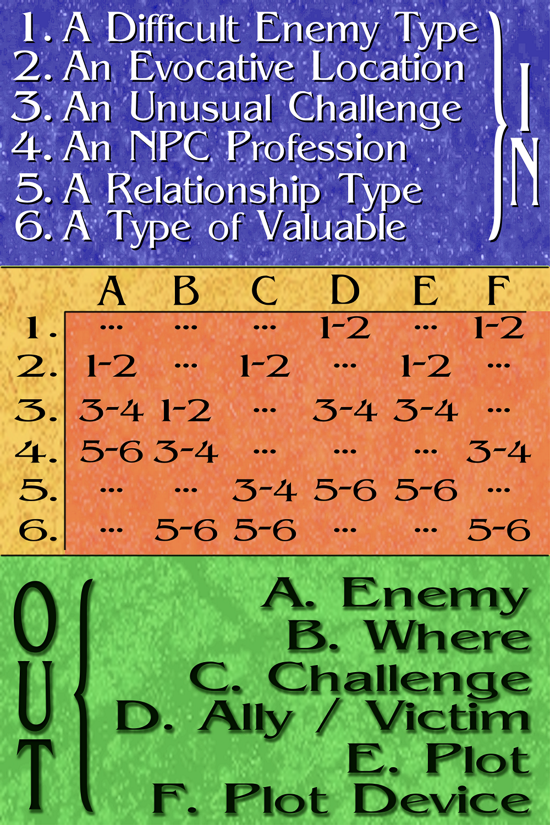
You’ll need a sheet of paper, a pencil or pen, and a d6.
Start by numbering lines at the top of the page from one to six.
- On the first line, list a difficult enemy type – that is, some sort of enemy that the PC or PCs to be targeted will have difficulty dealing with.
- On the second line, list an evocative location, somewhere that is going to be inherently interesting as a place.
- On the third line, list an unusual challenge – something a little difficult to handle but that doesn’t come up very often.
- On the fourth line, list an NPC profession that’s appropriate to your campaign setting.
- Line five should contain a one or two-word description of a type of relationship.
- The last line should list a type of valuable that’s appropriate to the campaign setting and that you don’t mind the PCs getting their hands on.
Sounds easy enough so far, right?
Next up, on the following six lines, list the letters A through F. After each, write the “out description” that applies to that code:
- A. Enemy:
- B. Where:
- C: Challenge
- D: Ally / Victim:
- E: Plot
- Plot Device
Now for the tricky part: In the middle of the infographic, there’s a table.
- For A, roll a d6. If you get 1 or 2, whatever you wrote next to ‘2’ in the first step goes into slot ‘A’. A 3 or 4 and its whatever you wrote next to ‘3’. A five or six, and it’s whatever you wrote next to ‘4’.
- Roll again. Column B shows 1-2 = 3, 3-4 = 4, and 5-6 = 6. You can’t use the same answer twice, so roll again if the indicated choice has already been used – but draw a line connecting A and B indicating that you can swap the two answers if you have to.
- Roll again for Column C: 1-2 = 2, 3-4 = 5, and 5-6 = 6. Again, you can’t repeat an answer already selected, so you may have to roll again – but take note of any permitted swaps.
- You know the drill by now. Column D has results 1-2 = 1, 3-4 = 3, and 5-6 = 5.
- Column E: 1-2=2, 3-4=3, 5-6=5.
- Column F: 1-2=1, 3-4=4, 5-6=6.
At the end of this process, all six of your original answers should have been reallocated into the six ‘slots’ listed in the middle of your page, and now mean something completely different.
The Plot Seed
You now know six things about the plotline, so it’s time to make sense of it. If you can’t find a meaningful interpretation, no matter how abstract, use free association to revise the category content; if you still can’t get anywhere, use any swap that’s permitted, and try again.
The key to this arrangement is the unpredictability, but it’s only semi-random unpredictability; it’s been constrained by the process to give reasonable new combinations.
Scope
You can use this process to create an encounter for a single PC who otherwise has nothing to do for a while, or to create a mini-adventure / encounter for the whole party, or even to create something more substantial for everyone. But it’s important to decide on the scope before you start, because it could potentially impact on question one – an opponent who is difficult for one specific character might pose no challenge at all for the whole party.
An example
That’s really all there is to it. But that’s not enough for a Campaign Mastery article, so let’s add in an example. I give readers my word that I had no idea how these would come out…
Campaign: Superhero
- Hacker Cartel
- Haunted House
- Dance-off
- Auto Mechanic
- Rival
- Motorcycle
Rolls:
- 4 so A=3
- 1 so B=3 so re-roll; 4 so B=4, and B can swap with A.
- 1 so C=2.
- 6 so D=5.
- All three possible options for E (2, 3, and 5) are already taken, so randomly choose one of two unallocated answers (1 or 6) and note that you can swap with A, C, or D. I rolled low, so E=1.
- 6 so F=6.
Put all this together, and you get:
A. Enemy: Dance-Off
B. Where: Auto Mechanic
C. Challenge: Haunted House
D. Ally / Victim: Rival
E. Plot: Hacker Cartel
F: Plot Device: Motorcycle
A and B can swap.
E can swap with A, C, or D.
A & B make more sense if exchanged.
C & E make more sense if exchanged.
So, the final listing is:
A. Enemy: Auto Mechanic
B. Where: Dance-Off
C. Challenge: Hacker Cartel
D. Ally / Victim: Rival
E. Plot: Haunted House
F: Plot Device: Motorcycle
Now to use creativity to turn these into a coherent plotline. An Auto Mechanic defeats a PC’s Rival at a Dance-off and claims the prize – a motorcycle with a cybernetic control link built in. The Rival attacks the Auto Mechanic, who flees into a house with a reputation for being haunted. The Rival, a superstitious type, contacts the PC and blackmails him into going into the Haunted House with him to claim his prize with photos of the PC from junior high school. In reality, the house uses holograms and hidden mechanical devices to seem Haunted (like Disney’s Haunted Mansion) so that a Hacker Cartel can do their thing without unwanted attention.
I don’t care what anyone says, no plotline so unlikely is likely to be exactly like their regular campaign. This reads like it came out of a Saturday Morning cartoon – a somewhat light-heated romp that will suddenly turn serious when the Hacker Cartel is revealed.
The rival immediately reminds me of a recurring character in the original series of MacGyver, a guy whose greed continually got him in over his head, but who was basically a good guy, named Jack Dalton. Wikipedia describes the character, played by Bruce McGill, as “MacGyver’s comical best friend. He is a soldier of fortune/bush pilot who periodically gets everyone into a heap of trouble with various get rich quick schemes out of which only MacGyver can rescue them. His left eye twitches when he’s lying. Dalton often attempts to romance the women he is introduced to.”
So I have my featured NPC, and the outline of a Romp centering around the character, and a hook into a PC’s past, with potentially serious consequences when the plot accidentally brings the PC and his NPC ally to the attention of a Hacker Cartel.
Presumably, given the superhero genre, the PC is just such a hero. What might the Cartel do when he busts them? Letting all his old enemies out of prison comes to mind. Erasing all his positive press. Erasing his identity would be hard, he’s such a well-known figure, but starting rumors about secret nefarious activities and letting the press go hog wild sounds good. Emptying his bank accounts is a given, but he probably doesn’t have any in his Superhero ID’s name; but if the designated target has a Publicly-known identity…
A second example
Let’s do a fantasy campaign example.
Campaign: D&D
- Criosphinx
- Temple of a Dark God
- Lock Of Twisted Souls
- Money-changer
- Romance
- Treasure Map
Rolls:
- 1 so A=2
- 3 so B=4
- 2 so C=2; re-roll needed: 3 so C=5, and can swap with A;
- 3 so D=3.
- 6 so E=5.
- 2 so F=1.
Put all this together, and you get:
A. Enemy: Temple Of A Dark God
B. Where: Money-changer’s
C. Challenge: Romance
D. Ally / Victim: Lock Of Twisted Souls
E. Plot: Hacker Romance
F: Plot Device: Criosphinx
A and C can swap.
Looking over the results, I don’t think the prospects for a reasonable plotline are enhanced by swapping A and C, so let’s leave everything the way it is and get to work.
A Criosphinx flies into the central marketplace and pays to have the town’s criers spread word of an employment opportunity for a team skilled at covert investigation. Prospective applicants should meet the Sphinx at a nominated Tavern.
The unusual nature of the employer ensures that word spreads far and wide, and reaches the PCs in plenty of time for them to attend the recruiting session at the Tavern. Several other adventuring bands have also heard of the offer and shown up. The Sphinx arrives, having used a spell to shrink themselves into a size suitable to an interior location. Several groups are interviewed and rejected for various reasons. Then it’s the PCs turn.
The Sphinx interrogates them about their past, and their stealth and problem-solving abilities, and then offers a thousand GP if they will take the assignment. He then outlines the job: His girlfriend, a Gynosphinx, was entreated by a wealthy Money-changer to guard his vault. She agreed, and – using a similar shrink spell – entered his premises, and has not been heard from since. The Criosphinx wants the PCs to sneak into the Money-changer’s rooms and make sure that she is safe and well, and rescue her if she is not. Attempts to use more overt inquiries have been rebuffed by the Money-changer’s staff, so his only recourse is the slightly-criminal, but it’s in a good cause… As proof of her well-being, he wants the PCs to get a riddle from Moira (an anglicization of her name) that only he can answer.
When they break in, they will discover the vault protected by a lock which radiates magic. Attempting to pick it sucks the entire party into its workings – this is a Lock Of Twisted Souls. Should anyone save the owner (who has the control phrase) attempt to breach the lock, they will be sucked into the micro-plane contained within the workings, where they will have to overcome a number of hostile entities; if successful, they will escape the lock, but still not gain entrance to the vault. The other way to escape the lock is to enter into its service as one of those hostile entities; five victories, and the creature is released and free to go its own way.
Of course, the PCs don’t know all this at first; they have a couple of relatively easy encounters (a lone troll, a bugbear, a goblin) and then find the Gynosphinx they seek. “Marion” gives them the skinny on the Lock. She has dispatched one would-be thief, but has four more before her contract is complete. This other-worldly prison was not something she expected, however, and certainly not mentioned by her employer. The PCs have a choice: let the Gynosphinx best them, completing her service (but trapping them in the lock until they find some more guards to beat up), or get a riddle from her and leave her locked up.
Before they decide, she describes a glimpse of the vault’s contents, which are NOT a stack of wealth and valuables; instead, the vault appears to lead to the antechamber of a Dark Temple. She fears that her services have been co-opted by the forces of evil, which are gathering strength in their hidden lair. This ups the ante on the whole assignment.
How the PCs proceed is up to them. They can challenge the Gynosphinx to a riddle game, and one more victory will secure their release; the Sphinx is willing to help them escape if they will seek to release her and put a stop to whatever the Dark Priests are up to. If not, she will challenge them individually in order to secure her own release, and leave them to their own devices.
Where the adventure goes from this point is up to the players. The lock can be defeated by feeding it bursts of positive energy of sufficient magnitude that it mistakes them for new victims, but they will have to consult a very learned sage to get that info. And as for what the Dark Temple are up to, I have no idea – maybe they’re trying to summon some nameless horror from another plane, that’s my usual fallback!
As you can see, this time the technique has yielded a quite serviceable adventure with no trace of the lightheartedness of the first. On the contrary, this starts off moderately seriously and only grows more intense as it proceeds. It definitely plays games with a few stereotypes, but at it’s heart, it’s a story of love (the sphinxes) and hate (the Dark Priests) – and, just maybe, the lengths to which one will go in the name of the first, and how much one is willing to sacrifice to stop the second. Deep, emotional themes, and what sounds like a great adventure – but, once again, one that’s been seemingly manufactured from thin air.
Changing it up
Now that you’ve got a handle on the basic principle, it’s time to talk about changing it up. Any tool will grow blunt with repeated use, and after a while you have to either resharpen it or replace the blade (or the handle, or whatever – you can only stretch the metaphor so far!)
The way you do that is to change one or both of the top or bottom of the infographic. Ask different questions, or assign different meanings to the answers.
Why does it work?
By asking questions, the first section directs your free association to come up with specific types of idea. The table then allocates these answers to questions that can fundamentally match a basic type – who, what, where, why and how. The idea is to spark your creativity while channeling it toward creating an adventure that is just a bit different to what you would have come up with on your own.
It’s a simple tool to add to your kit – you never know when you’ll find what you’re doing to be a bit of a grind, or that you need a quick fill-in adventure because your prep is taking too long.
988… 989…I’m still looking for ideas on how to commemorate my 1000th post at Campaign Mastery. Eleven to go!

Discover more from Campaign Mastery
Subscribe to get the latest posts sent to your email.
Comments Off on Directed Association Plot Seeds