Campaign Mastery helps tabletop RPG GMs knock their players' socks off through tips, how-to articles, and GMing tricks that build memorable campaigns from start to finish.

Eureka! – Some inspiring notions


There is a cooking show in Australia (it actually started in the UK, and a US version was recently announced) called Masterchef Australia. The goal of the series is to identify and winnow through the best amateur cooks in the country until they are left with the one best cook of the bunch, who gets $100,000 and a book deal. Along the way, they are expected to go toe-to-toe and head-to-head with the best chefs in the world. For the last two seasons, this show has been slaying everything programmed up against it, to the point where one of the hosts – an internationally-famous food critic, Matt Preston – was recently awarded as the best new talent in the Australian TV industry.

One of the regular challenges on the show is called the mystery box, in which the contestants are presented with a number of ingredients covered by a wooden box until The Big Reveal, and have to create the best dish they can using one or all of the ingredients.

Eureka! is reminiscent of the Mystery Box challenge of Masterchef. It represents a pantry full of ingredients, from which you are to create the best dish – or, in this case, adventure – that you possibly can.

Eureka 501 Plots book

Eureka 501 Plots

A reader, looking at the subtitle of the e-book, or simply glancing through the contents, might be forgiven for thinking that the heart of the product are the adventure hooks. It’s not. If you look a little deeper, you find that the heart of the content is the framework and structure surrounding those hooks, which has the capacity to transform your game prep, and that’s what Johnn focused on in his review of the product, Plot Stat Block For The Organized Game Master, a couple of weeks ago.

But there are some other innovative notions in there as well, and they merit some attention, suggesting the possibility of a deeper revolution. These are the ligaments and sinews that connect the plot structures of Eureka! together – the advice on how to customize the adventure hooks, and the indices that organize and connect the ideas.

So here’s what’s on tonight’s menu, here at Campaign Mastery. As an appetizer, I’m taking a look at that GM advice, and how it is applicable beyond the confines of the product itself. For a side dish, I’m going to compare the handling of plot ideas in Eureka as compared to simple plot hooks, and how you can take Johnn’s Plot Stat Blocks and use them in a way that goes beyond what he proposed. The main course will then look at using Blog Technology to refine ideas from anywhere you find them (including your own imagination), using The Eureka System and the refinement of Johnn’s Stat Blocks, to push your plot structures even further while reducing your workload as a GM. And for dessert, I present yet another way of using Eureka ideas to give characters in your campaigns depth.

The GM Advice

Eureka!’s GM Advice starts off by looking at the structure of the plot stat block they’ve used, and more specifically what they haven’t done and have left up to the GM to complete.

Casting

First up, there’s characters, in which they discuss the fact that as far as possible, they’ve left character names and details out of the plot descriptions. While that means that there’s more work for the GM to do in getting a plot from Eureka ready-to-run, it also makes the plots more broadly compatible. Instead of talking about NPCs within the plots as individual characters, it treats them as ciphers fulfilling a specific role within the adventure, and then poses three questions for the GM to consider in casting those roles. The three questions – Would the NPC be involved in a plot like this? Does the NPC have the abilities/powers/skills to do what’s required? and Am I comfortable with what might happen to the NPC as a result of how this adventure plays out? – represent the casting process for filling these empty roles within the scenarios.

What’s missing from Eureka: some categorization scheme for these unfilled roles, and an index of them. Some of the tags cover this territory very generally, but don’t go far enough.

When you cast your adventures, do you normally look at the plot and ask how a given NPC might fit into a given role in the adventure? Or do you look at the NPC and ask how they can be fitted into the adventure? In practice, you should do both: first cast the key roles within the adventure, and then look at all the other NPCs associated with the campaign and try to integrate them. A casting syntax and associated index would make both parts of the equation simpler, by enabling the GM to pick out an NPC and locate plots that can use that character.

Re-Skinning, Remaking, and Replacing Plot Elements

This section is absolute gold as a summation of how to adapt any existing plot from anywhere else into your specific campaign. Along the way, it defines the three terms given above for specific aspects of the process.

Those sections are followed by one on adapting plots to other genres, which gives you the key techniques for determining exactly which plot elements need to be reskinned, remade, or replaced. After giving the how, they give you the when. But the advice can be applied far more broadly and generously than Gnome Stew themselves have done, simply by treating your own campaign as a genre unto itself.

Approaching the advice in this way permits this whole section to become solid advice on how to make each plot a key element of your specific campaign.

Modern Elements for a Modern Age

And then there’s a subsection on Modern Elements, which starts off talking about the fact that there will be modern elements in the plots because they are being written by modern people. Once again, the advice can and should be applied beyond the text, because it misses the point that every game has to be played by modern people – which means that if a modern element is inappropriate to a specific campaign, the difference becomes a keynote of that campaign’s uniqueness that needs to be propagated through every scenario and the players specifically educated in the difference. This hearkens back to my first Lesson From The West Wing, about finding the uniqueness of your specific campaign and making it a key element to be emphasized throughout, giving your campaign a unique flavor that is distinct from each of your other campaigns, and even more distinct from the campaigns of your neighbor down the street.

Think, for example, of the relatively care-free 50’s (though they didn’t seem that way at the time, I’m sure) to the political cynicism post-Watergate and post-Vietnam, twenty years and a generation later. Those two contrasting eras alone offer four unique flavors: a politically cynical perspective on 1950s culture, a care-free and optimistic antidote set in the 1970s, and the two eras as they are generally perceived by a modern audience. Looking beyond that – what happened in, say Brazil – who never had a Watergate, but had events of their own? Australia didn’t have a Watergate either, but we did have the events of The Dismissal, and our own share of Vietnam; both of which occurred in the 1970s. As a result, many aspects of 1960s Australia are more like the US of the 1950s than they resemble the US that was contemporary – but with cultural elements from the more modern era thrown into the pot for good measure, such as the Beatles.

Every GM’s past experience and national history filters through into their campaign assumptions, whether they recognize those influences or not. Learning to recognize that influence, and manipulate it at need, would represent a major advance in most GM’s techniques.

Themes

This whole section, once again, is ostensibly about the organisation of material within the game supplement, but has an applicability that ranges beyond that limited context. The concept of their being a limited number of thematic plot structures is not a new one, but using Eureka as a guideline to taking those plot structures and manipulating them to form your own variations makes the whole supplement a masterclass in advanced plot creation. If anything, more details on how they performed this in generating the plots contained in Eureka, with one or two specific examples, would have been welcome for this very reason; but Gnome Press don’t seem to have fully grasped how valuable that would have been, so we are left in the position of inferring the curriculum from the teaching aides.

Summary

It’s often enlightening to observe the differences in reaction to the same material of two different people, with different perspectives. Johnn commented in an email to me about the GM Advice in Eureka that it seemed to be all about the product itself and not to represent general advice to GMs; he felt it misrepresented “About This Product” and “How To Use This Product” as general GM advice. However, he was also wise enough to add, “from you on other books I disliked in the past (I like Eureka, just not the advice portion) made me consider those books in a new light, and sometimes I’ve been able to get fresh new value or interest out of them,” which is why he raised the question in the first place.

My psychology means that every time I read something, I’m looking at how the underlying mechanics work, and how to extend what’s there to cover situations or content or context that the original author never dreamed of. In this case, what might seem at face value to be fairly vapid ‘GM Advice’ immediately presented to me as being extremely useful, if fundamental and occasionally elementary, advice. So, my conclusions to Johnn, and to anyone else who reads this product (or even just the free preview of the GM Advice chapter), is to look beyond the immediate context of the advice and you will find a wealth of material that can be a springboard to a better understanding of the craft of being a GM, and can specifically improve the structure and content of your adventures, and beyond that, to the campaigns that are comprised of those adventures. And that makes the GM advice seem pretty solid to me – if overlaid with a veneer that submerges its true value somewhat.

That said, the content of these sections in its current form also does the job of making what was perceived by Gnome Stew as the central content – the plots themselves – more useful, so there is an avoidance of redundancy. What’s there is great, but it could have been (and maybe will be in future) so much more.

Plot Hooks to Plot Blocks

I’m going to avoid simply echoing Johnn’s excellent take on this subject a couple of weeks ago (which I referenced at the start of this article) and look at a way of taking it further.

I’m in the habit of jotting down ideas, including adventure ideas, as a simple list in a dedicated RTF file. These are frequently barren of details, and can come from any source. It’s been a long-standing joke in my campaigns that I can get a scenario out of anything if I look at it hard enough.

For example, I might be inspired by a Coke advert on the TV. Lots of bikini-clad girls playing with a ball on the beach. In the context of my superhero campaign, I might come up with a list of ideas (not all of which are to be used) like this:

  1. St Barbara (one of the PCs) is invited to participate in a Coke Commercial. A villain disrupts the shoot.
  2. A beach party is threatened when the sun suddenly seems to grow hotter, but nowhere else is affected; an extra-dimensional (alien?) is spying on earth, and his invisible portal is acting as a gravitational lens, a magnifying glass focusing the sun’s heat on this particular spot.

These ideas could be combined into one, or they could be entirely separate. It’s a quick way of getting ideas down in some lasting format, and cut, copy, and paste makes the ideas quick to import into separate documents for fuller development, so it’s convenient.

I employ a ratings-and-classification system that I’ve blogged about before (Scenario Sequencing: Structuring Campaign Flow) to put these ideas into a coherent order with contrasts and variety.

But there’s an intermediate step that has to take place somewhere along the way, in which ideas are matched to slots in the campaign flow, and it’s a bit of a mess – a long list of scenarios that have to be visually inspected. I’ve thought in the past of importing the list into a table and sorting by different columns to ease things, but the variable length of the text has made that a bit of a nightmare to contemplate – it’s really a job for relational database software and that tends to be very complicated and frequently expensive, and I’ve never had the money to get into it seriously. (If I had free choice, I would choose a programming language called FOCUS, which I used professionally for many years. But it’s not available for Windows-based systems any more, and was WAY out of my price range even when it was available).

Sure, there are free RDB systems and programming languages out there, and I’ve even downloaded a few – but I’ve never had time to study them, let alone to master them, a new programming language is just too big a time investment. Heck, I’ve never had the time just to master more than the absolute basics of Excel, and how long has that been around!?

All that means that there is a hole in my processes, and one that I’ve never found an efficient way to fill. The combination of Eureka and Johnn’s Plot Stat Blocks have given me an answer.

Plot Blocks for unfinished plot ideas

That answer arrived in the form of a question: If you were to employ a plot ‘stat block’ approach to your unfinished, unpolished, and incomplete plot ideas, what could you do with the results?

A standard format structures the information, so that holes can be discovered and filled. For example, you could have a cell for each PC, to ensure that each has a connection with the plot. You could have a slot for each of the major NPCs that are with the PCs, to ensure that no plot holes appear because you’ve forgotten a resource that the PCs have available to them. You could connect scenarios by means of NPCs who don’t stay the same but evolve from one appearance to the next, by deducing the transition required in-between one appearance and the next and integrating news of that transition (if necessary) as a subplot in an intermediate adventure. You can into your campaign small touches like planned rewards for success followed by scenarios in which those rewards make a difference, just by looking at the requirements for future scenarios and making sure that the characters get those as booty.

And those are just my first thoughts on the subject!

Once you’ve finished plugging the holes, and have decided where in your campaign continuity you want the adventure to take place, you can simply transfer the information into one of Johnn’s plot stat blocks.

In short, instead of storing your rough and unfinished ideas in a layout that is optimized for game prep, you store them in a format optimized for campaign plotting until the time actually comes for game prep, then cut-and-paste as necessary.

Taking It Further: Blog Software

Assuming that you start by cherry-picking plots from Eureka! that sound like fun and placing them into such a plotting structure, you soon start encountering more advanced applications for the concept. And they all stem from taking something from Eureka that, at first glance, I didn’t think very much of: the tags.

You see, the problem is that there aren’t enough of them provided in Eureka to discriminate between the different plots that have been provided, and those that are provided are not specific enough. The tags for the first plot offered, for example, are “(MR) Investigative, politics, stealth, villain” – where (MR) refers to the author of this particular plot idea. So, what’s the plot all about? One of the PC’s friends is arrested and charged with a crime for which he has been framed, and he will be executed if the PCs don’t clear him. The plot is revolves around a group of bandits. There are local complications like a centaur tribe, and the bandits themselves. And the whole thing takes place in a heavily-forested region, where timber – woodcutting – is the dominant industry (I’m trying to avoid giving too much of the plot away to any players who may happen to read this, it’s devilishly tricky). There are some good ideas there, and also a fairly obvious plot hole, but I can’t talk about that without revealing too much; there’s obviously a lot more in the half-page of text dedicated to this plot than my summation!

If I were to synopsize the plot into key words, those tags would be “Investigative, frame, bandits, forest, centaurs,” and – again for reasons that I can’t go into without giving too much away – “smart antagonist, politics”.

It’s only a short step from wanting to change or add to the tags, to realizing that if you post your plot summary to a private blog, you can do so with ease.

And then you start to think about the ability to change or edit tags as you need to, and the fact that there are also categories to use as a means of grouping related plots together, and suddenly the simple premise of posting each plot idea on a blog completely eliminates the need for expensive – and time-consuming to learn – database software.

Blogger or WordPress or blog-dot-com or thoughts.com or ClockingIT or many many others are available to choose from. The big trick will be picking one that will last as long as your campaign, and whose features suggest refinements and extensions in technique!

The first three are probably the pick of the bunch at first glance, but it would be worth your effort to look more closely at just what you get from each.

Immediately, refinements start suggesting themselves. Using abbreviations and hyphens in a standardized tag format to form compound tags, for example. Or using categories to define the different stages of a plot development lifestyle – taking advantage of the fact that you can nest categories into a hierarchy, and simply tick and untick the relevant category entries.

That, in a nutshell, is the huge advantage of this approach: you can, with just a click or two, take a posted plot idea out of one category and into another, or remove any existing tag. It takes only a little more work to add a new tag or a new category.

You can even boilerplate a dummy entry to copy-and-paste into each post to ensure a consistent format – that’s the way Johnn and I do Ask-The-GMs, and there is no reason why you couldn’t do the same thing to replicate something like Johnn’s Plot Blocks.

Finally, with a minimal amount of editing, you could take a “private” blog entry and make it a public record of the events that actually transpired within the game – an ideal forum for players to ask questions, post ideas, etc as comments. You can even change the tags and categories completely when you do so.

Picture the utility to your players of using the names of every NPC who has ever appeared in the game as a tag in such a blog. In effect, one click would give them a complete history of their interactions with that NPC – a seriously useful reference tool during play!

And it all starts with blogging – in a way and in a location not accessible by the players – your ideas for the campaign, and using the standard blogging tools to manipulate and sort that information. That’s a “Eureka!” moment if ever I’ve heard one!

Eureka! as a background seed

The final thought that I want to throw out there is a different way of using Eureka. If you’re the type of GM who always has plenty of plots on hand, or have players who also GM and might have copies of Eureka for their own campaign usage, consider using it as a foundation for players to develop incidents from a PCs background.

You might specify, for example, that all characters start out with three “adventures” in their past. Let each player pick a plot each from the e-book, and flesh it out appropriately. The GM can then revise and edit these “adventures” to reflect any campaign background that’s different to that assumed by the characters, and can even estimate how much experience the events are worth to give players an incentive. The result is that from the first minute of scenario one, the players have a taste of the world, and there is a cast of NPCs with whom the PCs are connected. The GM can even get creative and crosslink one player’s background adventure with that of another!

Using Eureka! in this way, it doesn’t matter if your players have read it. Or if you’ve already used it up for every plot that you can get out of it. And, through the power of Re-skinning, Re-making, and Replacing plot elements, it’s extremely unlikely that even if two players chose the same adventure, the details would match up. One might have replaced the forest in the first plot, for example, with a swamp, and the bandits with Orcs, while the other does not. The result would be two superficially similar backgrounds with quite different details, and it would be easy to carry those differences through to a different means of resolving the plot. Those differences, in turn, give different perspectives and personalities to the PCs.

That alone makes Eureka! worth having.

Comments (6)

Celebrating 100,000 Hits!


Johnn and I would like to thank each and every one of the visitors to this site, especially the more than 10,000 visitors who come back here every month! We hope that you have gotten as much fun out of reading what we’ve had to say as we’ve had sharing it with you!

A special thank-you to everyone who’s taken the time to comment on one of our articles. We appreciate it!

Roll on, the 200,000! Wah-HAAAY!!! “Cel-e-brate Good Times, Come On!”…

Comments (2)

Blog Carnival Wrap-Up – What Inspires Your Games?


rpg blog carnival logoThanks to all the bloggers and commentators who participated in June’s carnival about what non-game media have most inspired your games and how. I was surprised by the variety of answers. I think there’s an idea or three here for any GM’s tastes. Good job everyone!

Lizard Games was inspired by the clone wars, which were not explained in the first series and offered a tantalizing link to a whole world behind the story. This and Jack Kirby spurred him to become an insatiable world-maker. In a second post, Mr. Lizard also talks about being inspired by Kipling and Larry Niven.

Fame & Fortune lists the top five books and comics that shaped his gaming. It’s quite a range too, from a serial killer to a famous playwright’s tragedies to an ancient Sanskrit epic.

Allgeektout quotes Doctor Who’s plotting technique as teaching him about episodic storytelling, which links episodes into a seasonal story arc that culminates into an annual grand finale.

In his comment James S says video games inspire him because of the challenge of bringing the flavour of a video game into the tabletop realm.

The Seven-Sided Die reveals that pictures speak to him. Images communicate what he’s got in his noggin to his players, plus they accomplish ye old story advice of show, don’t tell. Lots of interesting images and sources sprinkled through this post – good job.

Held Action cites paranormal podcasts among other suggestions that include Doctor Who and Kenneth Hite’s Suppressed Transmission columns. Podcasts? Super idea!

Late to the Party lists obscure 70s horror films and Appendix N (sweet sweet ref there my friend), along with advice about lifting story from other sources.

The Resurrectionist plumbs our own world’s history as having the most depth and shocking events to inspire your GMing. Quote of the day: “History is nuts.”

Creatively Anomalous riffs off movie trailers. This is a super idea, for all the reasons Will lists. He also reveals several soundtracks that have inspired him.

Apathy Games says TV Tropes and blog posts from sites like Lifehacker and Mashable provide Tyson his ideas.

Cody at Kingdom of Geeks narrows his wide array of inspiration to several intellectual properties. I like the anime references, which I have seen few others mention.

Worlds in a Handful of Dice offers Babylon 5 (Mike @ Campaign Mastery will agree with you, Jukka), the Lovecraftian One and an interesting Finnish movie, Raja 1918, which he says inspires world building.

Exchange of Realities gives us a trilogy of posts involving the novel idea of military reading lists, anime and anime soundtracks, and advice on how to let music inspire you.

Mythopoeia offers advice on assessing your game requirements first, then drawing from inspirational sources.

Tower of the Archmage quotes Greek myths, Conan, Narnia, Saturday afternoon movies (nice!) and art as his sources.

Finally, Mike Bourke of this blog offers a wide variety of sources ranging from reference books to TV series to comics and more. Lots of interesting ideas there.

What a great list. Thanks again to all the RPG bloggers who participated.

Comments (2)

Like Sand through the Klein Bottle: Time Travel in RPGs, Part 3


This entry is part 3 of 3 in the series Time Travel In RPGs


Hopefully, this will wrap up the article on Time Travel! Part 1 looked at the problems of Time Travel in RPGs, and reached the conclusion that the GM had to have some understanding of the nature of time in his campaign before he could adjudicate the complexities that could result.

Part Two comprised excerpts relating to the Nature of Time from the Campaign Physics I employ in my Superhero campaign, and produced some very interesting feedback.

Now comes the fun part: looking at the implications and applications and complications that derive from this system, posing a couple of questions for consideration, and generally playing around with Time Travel as a viable plot vehicle in RPGs…

The ‘Key Event’ Principle of Alternate History

Whenever you assess the impact on history of a time-traveller, you’re talking about generating an Alternate History. I use two principles in forming Alternate histories in my campaign, regardless of the cause of the divergance. The first of these is the “Key Event” principle, which states,

The greater the element of chance in determing the outcome of an event, the more susceptable that event’s outcome is to variation.

That means that if an outcome is a near-certainty, there won’t be many significant branches on the timeline from that point, and it would be very hard to change that outcome. But it also means the converse: where outcomes are equally balanced in likelyhood, minor changes can be amplified to the point of making a big difference.

An implication of this is that the results of natural forces are more likely to remain fixed, while the works of man are far more susceptable to alteration. It’s very hard to stop Mount St Helens from erupting, for example. The continents will tend to have the same shape, because the forces that created that shape won’t change very much.

But a more subtle implication is that there are key moments in history where things can be radically changed with comparatively little effort, but once they have passed, events will tend to remain the same overall. Once Adolf Hitler comes to power, World War II is a near-certainty; it might be possible to change the shape of that conflict by killing him at that point, but some sort of conflict is more or less inevitable, due to the social, political, and economic forces of the time. You might be able to change some detail outcome within the broader context, such as whether or not a particular soldier lived or died, but most of the time, that won’t even change the outcome of the battle in which he was killed.

Key Events tend to be decisions and moments of inspiration. Churchill’s knowledge of the bombing of Coventry, thanks to the breaking of the Enigma code by the British, led to a decision not to forewarn and evacuate the city – so that the German High Command would not suspect that their code had been compromised. That decision could easily have changed the entire outcome of the War.

Another implication is that the greater the number of people involved in an event, the smaller any individual’s role is, and the less susceptable to change the outcome. It’s very hard to change the outcome of a popular election, for example; while you might alter one person’s vote, that won’t often change the overall outcome.

The Big Bang: An interesting Key Event

It is generally believed that much of the physical properties of the universe were not fixed for the first 10 exp -30th of a second following the big bang. When you think about the state of chaos that was unfolding in the instants prior to that moment, it MUST qualify as a “Key Event”. While the forces are probably the same, their relative strengths could easily vary.

The first phases of the superhero campaign for which this physics was derived took place in a world much like our own, at least so far as the physics was concerned. The most recent phases, which have occupied the last nine years or so of play, have taken place primarily in an alternate dimension in which the Weak nuclear force was just a little weaker, making fusion reactions more likely, and making stars a little hotter and a fraction more short-lived. This in turn had effects on the climate and geography of the Earth, and that influanced the sociology, and that influanced the history. And yet, despite a variant history and politics and even an additional habitable landmass, and sentient dinosaurs running around South America, it was still very recognisably an alternate earth with recognisable elements. In terms of technology, they were ahead of the standard in some areas, and behind in others (for reasons that I’ll go into in the next section).

Far stranger worlds become possible. It’s simply a matter of deciding what change you want, identifying what might cause that change, and backtracking, as described in Part 2 of the Pursuit Of Perfection series, then working forwards to discover the other ramifications of that change.

The next phase of the campaign is set in “Dimension Regency”, in which the British Empire is the Dominant Superpower, far moreso than the US is in ours. It has conquered most of the western world, and has never fallen; only the Far East and parts of the Middle East are not part of the Empire. When I set about analyzing the changes that I wanted to make in the sociology and history of the world, I eventually backtracked my way to the signing of the Magna Carta and the circumstances of the time. A minor change there, making the King a little more inspired in his perceptions and approach to the problems, and the outcome became subtly different. And that subtle difference became a significant difference, and then a major difference, and then a sweeping global change. And yet, for all the changes, some things remained constant; there was still a World War II, there was still a Napoleon Boneparte and a French Revolution, there was still a Michael Jackson and a Princess Diana and a Live Aid.

Why is this so important? Why is it such an advantage? Because, it creates a recognisable world for the PCs to live in while preserving the mystery and allure of the unknown. The shape of history may be unchanged, but the all-important context and detail are radically different. The Players can easily grasp the changes and their consequences, but at the same time things are similar enough in many ways for them to just play.

The ‘Key Man’ Principle of Alternate History

I operate on the principle that a genius is always a genius, and will make whatever the next breakthroughs are in their chosen field of study. If Isaac Newton doesn’t invent calculus because the algebraic tools are not in existance for him to do so, he will come up with those tools so that the genius who made the next mathematical breakthrough in our world can do so. Similarly, in any world in which he is born, Napolean Boneparte will play a key role in history – whether it be as the leader of a failed revoltion or as a great General in the service of the British Empire, or whatever.

Key Men (and women) remain Key Men (and women).

If someone has the drive and charisma to become a leading political figure, they will still become a leading political figure in some way. In Dimension-Halo, where the recent superhero campaign has been set, that led to President Joseph McCarthy and a specialised law-enforcement division, the S.I.D., whose mandate was to seek out and eliminate unamerican activities.

Again, this serves to make the alternate world accessable to the players. They know from our own history who to look at.

Free Will

These two principles, in turn, dictate how free will relates to the force labelled “Will” in the previous part of this article. In fact, Will can be defined as the sum of individuals’ intents multiplied by the opportunities to express those intents. Which means what exactly? Well, it means that one person with enough intent, and the opportunity to act on that intent, can change history, or a lot of people with intent but less opportunity can have the same effect.

The Key Man principle is an expression of the first part of that statement, and the Key Event principle is an implication of the second.

Uncertainty & Randomness

Chaos Theory came along after the original draft of this physics was written, but did not violate it, because there was always a mechanism by which random chance operated to create uncertainty.

Edwin Hubble was the first to derive , which states that galactic objects are receding from earth at a speed proportionate to the distance from the Earth. When combined with the theory of relativity, which forbids objects with mass from travelling faster than the speed of light, Hubbles’ Law defines a volume of space around a point beyond which no information is observable – so far as physics is concerned, nothing can exist outside of the .

Now, as it happens, I have a couple of serious bones to pick with both of these theories. First, Hubble’s law is just plain WRONG, as quoted, because it takes time for the information concerning these objects to reach us. To be accurate, it should read, “Galactic objects appear to be receding from earth at a speed proportionate to their distance from the Earth”. In fact, the closer to the edge of the hubble sphere you look, the closer to the big bang you are looking. In effect, the hubble volume appears to define the wave front of the big bang – which in turn means that there can be nothing physically beyond it, because that wave front defines the edge, in physical space, of the universe. And therefore, nothing from beyond the hubble limit can affect anything within it – because there IS nothing beyond it.

But there CAN be something beyond the hubble limit – it’s just that whatever IS beyond it can’t be directly physically percieved, because it lies OUTSIDE THIS UNIVERSE. Consider the diagram:

It’s clear that there is an overlap. Certainly, anything within that overlap can be physically affected by an object or force that is both within the Extreme Point’s Hubble Volume but outside our Hubble Volume. And certainly, something from outside our Hubble Volume can enter it, aparrantly created spontaniously at the edge of our observable universe and moving inwards.

So the hubble volume does NOT define the totality of the universe – just the part that can be observed directly by means of anything that is limited to the speed of light in a vacuum.

Changing The Speed Of Light?

Prior to the big bang, the universe was a lot smaller than it is now. For the sake of convenience, let’s say it was one light-minute across. Then the big bang takes place, and the wave-front of that explosion expands outwards at the speed of light. So, one second after the big bang, the universe is 62 light-seconds in diameter. If the hubble volume were what it has been popularly assumed to be, that would mean that the observable limit of the universe at that instant was 62 light-seconds away from the centre-point of the explosion. But that immediatly contradicts the basic premise of the hubble law, which would put the hubble volume as the volume defined by a radius of 1 light-second. Once again, the universe is a lot bigger than previously supposed; nothing else makes sense. The only alternative is for the speed of light to be sixty-two times what it is now – but that also increases the expansion rate of the wave-front, so the universe is STILL larger than the observable limit.

It just doesn’t add up. The only conclusion to be reached is that the speed of light is not as meaningful a limit as popular perception would have it – something that I’ll come back to in a little while.

The Size Of The Universe

So, defining the universe as the volume contained within the wave-front of the big bang leads to it being bigger than we can possibly observe. But it IS finite. And any event within its totality can affect the whole – gravitation, charge, etc. So, how precise is that wave front? Can anything affect it? What if the surrounding ‘other-space’ isn’t empty?

If a particle is within a quantum black hole, and quantum uncertainty states that the location of that particle can only be expressed as a probability until we interact with it to measure it’s actual location (collapsing the probability into a discrete value for that instant of time), then there must be a percentage of locations for that particle that lie outside the event horizon of that black hole. The particle is both within and outside the black hole at the same time. And that, in turn, alters the mass and size of the Black Hole in question, ie alters the gravitational slope of the shape of space in that region. Which means that past a certain limit, a quantum limit, gravitation is also fuzzy – it might be this or it might be that.

And that it turn means that quantum uncertainty demands a fuzzyness on the size of the universe – because otherwise there would need to be some sort of mechanism operating to ensure that a plus-quiver at this point is exactly balanced by a minus-quiver somewhere else. The only alternative to this improbable arrangement is for the dimensional boundary – the limits of space itself – to be quivering like a very stiff jelly. And that in turn yeilds Heisenburg’s uncertainty limit as a true universal constant.

If the universe gets bigger, it contains more space, and vice-versa. Another way for this to occur would be for discrete ‘packets’ of space to spontaniously enter our universe from the outside and for other discrete ‘packets’ to spontaniously dissappear into the outside. To and from where? What lies outside the universe?

Anything that is not on our temporal vector, that’s what.

Heisenburg Uncertainty, under the space-time model described in the second part of this series, derives from the expansion and shrinkage of space as individual quanta enter or pass through our time-line’s temporal vector. And if quanta can arrive from outside, then quanta in a particular arrangement can arrive from outside, and that means that travel from one time-line to another, or to a different point on that time-line, is possible. The structure of the 3-time-dimension 3-space-dimension model inherantly contains the potential for time travel. (And you wondered where I was going with this, didn’t you?)

Many Butterflies

The arrival of a time-traveller would increase quantum uncertainty by the ratio of the mass of the universe plus him over the mass of the universe without him. An increase that small is virtually undetectable, but it would be there.

But all sorts of quantum effects can cascade into macro-scale events – the butterfly effect, in other words. The probability of any given quantum event escelating to the point where it has larger, more noticeable, effects is very small – but there are so MANY quantum events poised right on the edge of falling one way or another that some of them will inevitably be changed in outcome by the arrival of a time-traveller.

The mere departure or arrival of a time-traveller at a sufficiently delicate critical event can be enough to change the outcome of that event.

Advanced electronic equipment frequently has to take into account Heisenburg Uncertainty and other quantum effects, eg in the design of the powerful CPUs in modern computers. That means that hi-tech electronics might be susceptable to interferance as a result of time-travel; the more time-travellers present, the more likely this is to occur, and the more severe the disruption. In theory, it would be possible to design a system of multiple processors constantly generating checksums or other complex numbers; from time to time, one of them will hiccough and give a wrong answer; in extremely rare cases, or in the case of poor design or outside interferance, it might even be possible for two or more to give wrong answers. But the more of them that go wrong at once, the more likely it is that a time-traveller has just arrived or departed from the local vicinity in space and time. The better you can shield this equipment from other sources of disruption, the more sensitive it can be made.

Relative Time Rates

Two timelines will never be in synch; time will always be flowing at a faster or slower rate in one relative to the other. Below is a simplified 2-D diagram illustrating the reasons:

The first diagram shows two timelines with different relative vectors, of equal internal time, ie the same length. Because of the relative angle, time actually passes faster in the green timeline than it does in the red, as shown in the second timeline, where the frame of referance has been rotated to set the red timeline on a baseline. Simple trigonometry can calculate the difference based on the relative angle – it comes to 1 / cos (a).

But wait a moment: if we again rotate the axes of our diagram, so that the green timeline is now the baseline, we would find that time was now passing faster in the red timeline than in the green! In fact, the rule of thumb is that everywhere is moving faster than you are! How can we make sense of this?

The answer is that in order to percieve the differences in time rates, you have to transit between the two, and that also takes percieved time within your base timeline- in effect, travelling along the timeline angled relative to the baseline AND THEN around the arc to the equivalent point in time.

That means that you can’t cheat time that easily. If you want to turn tonight’s last-minute cram session into two weeks of intensive srudy on a near-vertical timeline, you can – but by the time you have come and gone from the divergent time-vector, between two and four weeks will have passed on the base timeline, and you have missed the exam.

Sure, you could compensate for that by aiming for an arrival point after your field trip in time that was earlier on the base timeline – in effect, travelling from up and right to down and left on the second diagram – but that gets complicated too, because you are then spending even more time in transit, requiring a target time even earlier on the base timeline.

Of course, this is a vastly simplified diagram – real timelines would not be straight lines, they would twist and bend in three dimensions like snakes, and may even run in opposite directions for periods of time. So the actual relative time rate would very much be an average, and a short-term one at that.

Then throw in the fact that uncertainty means that the actual targets are just a little fuzzy around the edges, and it becomes impossible to precisely target a jump through time. There are ways around that, using the temporal equivalent of homing beacons – but there is still an element of unpredictability.

The more similar two timelines are, the closer together their relative angles will be, and the closer their time rates will match, and the more precisely a transition can be targetted; the more different they are, the greater the relative temporal vectors, and the harder it is. Think of a spear being hurled; would it be easier to hit a spot a precise distance behind the head if it were travelling at right angles to you, across your field of vision, or almost straight at you? The second spear is easier to hit but harder to be precise about where on it’s length the hit will occur.

In other words, the harder you try to exploit the system, the harder it is to succeed.

Relativity & Motion

A really good question to contemplate is whether or not there is a relativistic limit to the transmission of consequences down a timeline. I’ve seen – and employed, in different campaigns – both the no and yes cases, and have yet to see any reasonably convincing arguement either way. The difference between the two cases becomes interesting when a time traveller introduces a divergance from the recorded outcome of an event. Let’s look at each case seperately and see where the consequences take us:

Instantanious Development Of Consequences

This relies on all changes in temporal vector (ie outcome of events) starting small and accumulating with Development, ie with internal time. Taking a simple case as an example for our thought experiment, let’s say that our time traveller goes back in time one year and starts an object moving at half the speed of light – so that it is half a light-year away from where it was at the time of his departure. That all makes perfect sense, but now consider what an observer within that timeline would see: one instant, the object would be in it’s expected position, and the next, it would be half a light-year away, and the observer would have no memory of it NOT travelling away from its starting position over the last year. So far as the conditions within the timeline are concerned, the object has to instantly move half a light-year and acquire a velocity of half the speed of light – violating relativity in the process. An instant of discontinuity transforms the old timeline into the new.

And yet, there is uncertainty involved here. and the fuzzyness of quantum limits. That fuzzyness also aplies to the propogation of change down the timeline, and it means that the transition would NOT be instantanious – it would take a measureable interval of time within the timeline being altered, proportionate to the uncertainty limit multiplied by the period of time since the change. Using the reccommended value for the Planck constant (0.00000005) and the number of seconds in a year (aprox 3,1557,600) gives a 1.577 second transition effect – just long enough to percieve something happening before the universe settled into it’s new timeline. At ten years after the change, we’re talking 15.77 seconds, a seriously noticeable time – that is (of course) instantly forgotten as soon as the transition is complete. 100 years after the change, and the transition interval is 157.7 seconds – more than 2-and-a-half minutes.

And, here again is where things get interesting: If an individual were to decouple himself from his native time vector, ie start travelling in time, during that interval state, he would not be subject to the revision. He would remember the way things were, and remember the period of transformation.

This is the specific model that my superhero campaign uses. There are technological developments to delay or even isolate the characters from temporal divergance, but before these were developed by the characters, they had these sort of time-scales in which to react to the change in history.

Relativistic Limit to the Development of Consequences

But this is not the only possibility. What if there is a measurable propogation rate? What if it is faster, or slower? Or even non-linear? Well, for a start, if the propogation rate requires objects in 3D space to travel faster than the speed of light, there will still be a transition experience, just as there is in the instantanious model. This transition may be faster or slower than the instantanious model, but will usually be percieved for less time, making it less useful for warning that someone is manipulating the past. This is because some or all of the process will take place concurrent with the Development of the consequences – you don’t see the whole process, just the final crescendo.

Fortunately, there are alternatives if you can monitor the fixed location of a point from within the Time dimensions; when someone triggers a change, a wave of discontinuity will sweep down the Development event stream from the point of interferance. Usually, if you were to map the changes, it would look like this:
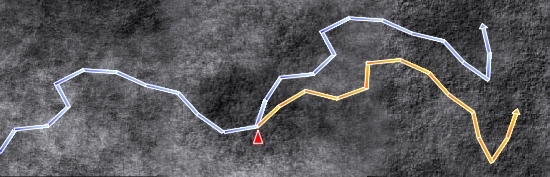
The point where our time-traveller has skewed the timeline is obvious; the orange timeline represents the outcome of his manipulations. It is also fairly clear that instead of doing something, he has prevented someone from doing something; the new timeline does not have as great a change in temporal vector. Nevertheless, the differences are subtle and not easy to spot; the change appears to have had minimal repercussions. It is only when looking at the second last points of divergance, where a radical outcome takes place, that the difference between the two timelines begins to look significant; the shape of the timeline at that point is somewhat different. Further ahead in time, both of those differences are accumulating development, and compounding apon each other, so there will be more changes as a consequence, until the shape of the timeline is completely different.

But, while this illustration is best for showing the actual change that has taken place, comprising a ‘before’ and ‘after’ superimposed, it does not really show the process very clearly. For that, a series of images showing the progression of the change is best:
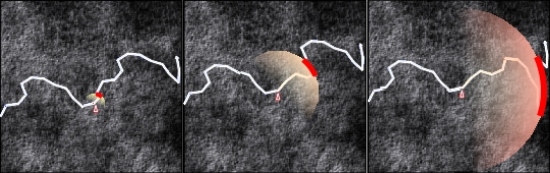
Close to the point of divergance, the wave-front is small and the difference minor. In the second image, the wave-front of the change in history is larger and more substantial; and in the third, it is much larger and quite radical. But in each, there is a period of discontinuity, lasting zero time within the confines of the timeline – which experiences duration parallel to the timeline at that point – but which is quite obvious when viewed from the outside – and yet, if you weren’t monitoring that specific timeline for change, it would be very hard to spot it at all because of all the other timelines in the way.

Yes, believe it or not, the same basic timeline is depicted within this illustration. But it’s not in the foreground, it’s buried under 120,000 other timelines. I KNOW it’s there, because I put it into the picture, but even I would be hard-pressed to tell you exactly WHERE.

The consequences of this submodel are that within a timeline, you cannot do anything to undo a change in history, because it is effectively instantanious; to protect yourself, you have to actually posess an independant frame of referance, insulating you from the change to history.

But, of course, your absence will cause other changes to history – so the only safe agents to recruit would be those who are about to die. I actually designed a campaign called The Timekeepers based on this premise, some years back.

Relativity Is Not Sacrosanct

Of course, Relativity is something that can be ignored within a game at need. But I actually have a couple of doubts about relativity being interpreted correctly in the real world that bear mentioning at this point.

One of the cornerstones of Einsteinian relativity is that “there are no priviliged frames of referance”. You can’t look at a situation without interacting with that situation, you can’t be on the outside looking in. This theory of time enlarges the scope of where a frame of referance can be located, but the bottom line remains.

So, let’s postulate a quick thought experiment to reveal the flaws in the interpretation of the General Relativity of Relativity, using one of the most famous implications, Time Dilation.

A spacecraft leaves earth and accellerates to a speed not far short of the speed of light, travels at that speed for a while, then decelerates to a stop relative to the Earth. Time compresses for the pilot, so that where ten or a hundred or a thousand years may have passed on earth, perhaps only a year or two have passed for the pilot. So says the conventional interpretation.

How does the universe know who is accellerating?

Surely it is just as valid to say that the spacecraft is standing still relative to the earth, and that it’s the rest of the universe that is accellerating away from it, then maintaining a speed relative to the spacecraft of just under the speed of light, and then decelerating to a rest state relative to the spacecraft?

In which case, it is the Earth which experiences compressed time, and whose clocks run more slowly, and in which only a year or two passes, and the spacecraft which experiences decades or more!

But hold on a moment – how do we Know how much time the other party experiences? Answer we don’t – we only know what the other part of the mind experiment appears to experience, while it is happening.

If time is aparrantly shortened for one, it is aparrantly shortened for both – and if you divide the distance travelled by the aparrant time taken according to both sides you end up with a velocity faster than the speed of light.

It is my contention that all the aparrant paradoxes that emerge from General Relativity derive from the false assumption that nothing can travel faster than the speed of light in a vacuum, and that it is those paradoxes that demonstrate that the assumption is false.

Einstein himself said that he came up with that limit because anything else led him into paradox. But you get similar answers if you take the analagy of mail being carried across the ocean by ship as being the limiting speed of communications – if nothing can travel faster than the ship, then any method of conveying information faster than that produces paradoxes of the same type that Einstein described as justifying the absolute limit to speed.

And yet, testing seems to show that the time and mass effects of travelling at high speed are real – these equations have to work or particle accellerators would not function. This conundrum seems like a paradox until you realise that, once again, the equations aren’t telling us anything about how the world looks from the point of view of the particle being accellerated.

The Lorentz transformations are all about the apparant effects on one of the parties as percieved by the other – not about what really happens. If this were not true, it would be easy to accellerate subatomic particles to the point where there apparant mass would crush them into black holes – and even if these decayed almost immediatly through pair production, what emerged would bear no resemblance to what was there before, which would be obvious when examining the artifacts that result from firing these accellerated particles – and it just doesn’t happen.

So the reality would seem to be that the “light barrier” is no barrier at all – if we just knew how to get there.

Transfers of Energy

The ability to forge ‘connections’ between two different timelines is implicit in the concept of a time-traveller leaving his timeline and entering another one. The likelyhood that these two timelines would be at exactly the same energy potential is extraordinary low; almost certainly, one will be at a higher entropy level than the other.

In our space-time, at the current moment, there are compact clumps of energy surrounded by a relative desert. If one end of the ‘time-tunnel’ were placed in space – a suitable location for travel along it – then energy would tend to flow from the higher potential to the lower. Stick the other end in a timeline that has reached heat death, and you can start pumping energy out of that timeline. This would lower the energy potential in the region immediatly around the far end of this ‘energy tap’; in effect, entropy has been reversed in that world, however briefly.

On the other hand, if a world that was facing imminant heat-death were to stick the far end of such an energy tap into the core of a star in our timeline, the local energy levels in the star would be far higher than that of the heat-death-world; energy would flow into the heat-dead world that was not there previously. Of course, this might well have adverse affects on the star in question!

The fact that thermodynamically, these concepts mean that the universe is no longer a closed system makes many things possible that would otherwise be unimaginable.

What Lies Between

If time consists of 1-dimensional strings vibrating in three dimensions of time and fraying into an infinite number of other 1-dimensional strings, the question has to be asked: what lies in between?

It would be a strange realm, where motion exists without time. And yet, any interruption to the biochemical and bioelectric processes of life would be lethal, and without time, there would be no opportunity for perception, let alone for reaction or interaction.

But can matter exist without time? Matter without motion is matter at absolute zero, and that is not possible according to the best theory going. The only solution that makes sense – aside from the whole thing being impossible – is for any matter removed from a particular space to retain the temporal vector that the space of origin had at the moment of departure from it. Carrying your own internal frame of referance, you can percieve what’s out there, you can react and interact.

So what can someone do without motion that takes time? Because “taking time” is the equivalent of moving, within this strange realm.

The answer is that you can think. The same forces that were indentified in the previous part of this series are in play; and that means that Development tries to wash you downstream, while Will permits you to ‘swim’ across, or even against, the current.

Adopting A Popular Model

The model of time travel that has been presented here glosses over a lot of nuts and bolts, in the interest of making the concepts more universally accesable, but there is enough meat there that it can be adapted to any system.

But there are other models out there that can be used, or to which these concepts can be adapted. These are works that have been formative in my thinking about time travel, and about how to use it in RPG plots, and I commend them to anyone who’s interested in doing so.

And in presenting this list, this series comes full circle; it started off as intended for the June 2010 Blog Carnival, about which media had proven inspirational, and so it ends. It’s especially appropriate that be the case when we’re talking about time travel…!

Print Referance & Inspiration

Three books stand out for me as especially valuable. There are others that could also be mentioned, but these are the cream of the crop.

Movie Referance & Inspiration

Some of these are better than others, but they can all serve as the springboards for ideas. As with books, there are others that could be mentioned, but these are the pick of the litter.

TV Referance & Inspiration

Most of these are available in one form or another on DVD, but you may need to buy multiple sets.

  • Dr Who
  • The Time Tunnel
  • Catweazle
  • Quantum Leap
  • Seven Days
  • Star Trek (selected episodes)
  • Star Trek: The Next Generation (selected episodes)
Referance & Links to more

Finally, a couple of stops that should be useful to anyone interested in this topic:

Comments (6)

New Contest to Celebrate 500 Issues


Book Cover - Left Hand of God

New prize added - copies of the Left Hand of God

To celebrate upcoming Issue #500 for Roleplaying Tips we’re holding a contest.

RPT reader Daniel at www.steamcrow.com said we should do 500 of something, such as 500 random city encounters. That’s pretty ambitious, but it sounds like a great idea. Let’s do it.

I’ve got some prizes lined up, as well, to further celebrate.

How We’ll Get to 500

Send in city encounters 1-3 sentences long. Any genre is welcome, no game rules required. Each encounter should contain some conflict to make it interesting to play.

For example:

  • A poisonous animal has slipped into a potter’s store and the owner hires the PCs to kill or capture it without breaking any of his wares that line walls and shelves.
  • A shadow demon is summoned to assassinate a bard during a performance. The bard sings of the mistakes, ineptness and evil deeds of the PCs. Do they intervene when the attack happens?
  • A nervous merchant hires the PCs to escort him and a wagon load of goods to the port where his customer waits. Thieves wait until mid-way through the exchange to take advantage of the chaos of port crowds and potential argument of whose gold was just stolen – did the exchange take place before the attack or not?

Prizes

The theme for prizes this time is “take your pick.”

  • NBOS software. Winners pick which product they receive.
  • Kobold Guide to Game Design. Winners decide if they want volume 1, 2, or the just released volume 3. (PDF)
  • GM Mastery books. Take your pick of Inn Essentials, Holiday Essentials or NPC Essentials. (PDF)
  • Penguin Books has also contacted me and are offering copies of the new fantasy novel, Left Hand of God. How cool is that?

The contest closes July 20. Multiple entries give you more chances to be randomly drawn for a prize. Plus, if 100 RPT fans submit just 5 entries each, 500 entries should be a snap! Let’s try to hit 500 random city encounters to celebrate RPT #500.

Email your entries now.

Comments (3)

Plot Stat Block For The Organized Game Master


Eureka 501 Plots book

Eureka 501 Plots

How do you organize your plot notes so you are on top of the details? In my Riddleport campaign, I have several plots hatching, and I would find tracking them difficult without using my plot stat block. It does not matter if you use Obsidian Portal, another wiki, a notebook or Post-Its; you must find a way to outline your plots to keep yourself sane. A short stat block is my recipe for sanity.

I have recently updated my plot stat block. Engine Publishing sent me a copy of Eureka 501 Adventure Plots to Inspire Game Masters. The book has plots for fantasy, sci-fi and horror. It is a great book. Each plot listing follows a template. This consistency lets you scan, compare and assess plots for your games nicely. Using a plot stat block for yourself gives you the same benefits.

Eureka adds a Tag feature to plots. These are keywords that describe properties of the plots so you can quickly find the type of plot you need, as all tags are indexed at the back of the 300+ page book. For example, dungeon crawl, city, intrigue. I did not have a keyword feature in my plot stat block before I read Eureka, but I do now. Thanks to the digital tools I use to help me GM, tagging is a natural and valuable add-on.

I am happy to change the stat block to accommodate more useful properties. So I look forward to your comments about what might be missing from the stat block, or what could be improved.

The plot stat block

  • Plot name
  • Synopsis
  • Why is this plot fun?
  • Truths and lies
  • Adversaries
    • Adversary name
    • Adversary goals
    • Adversary resources
  • Notable NPCs
  • Notable locations
  • Notable items
    • PC wish list
  • Critical path
    • End conditions
    • Grand finale
  • Plot twists
  • Detailed description
  • Plot hooks
  • Keywords
  • Plot log

Overview

The stat block makes some assumptions to keep it focused on managing your plots. Your game system, campaign and global setting already exist. Each plot works within these pre-established game elements. It also assumes you have more than one plot, be it character-based plots, side quests, back-up plots or what have you. If you have just a single plot, it then becomes your campaign, but the stat block is missing some items that I would add for campaign level planning. The block pays off most when multiple plots work beside each other at different stages.

Block elements are ordered based on best ongoing reference. You can fill elements out in any order as you plan and design and play. Too often tools of this nature get optimized for the design stage instead of the operating stage when you need to use it in-game or during planning time. For example, plot hooks are near the bottom because once the players are hooked, you will not need those again.

The block also does not go into design detail for each element. Read the archives here for help on designing specific game elements, and our other website, roleplayingtips.com, has more even tutorials and tips. Plus, stay tuned for future posts that delve into more help on fleshing out specific items within the plot block.

Plot stat block details

Plot name: Give it a compelling name you can use publicly so your group gets excited about it as well.

Synopsis: 1-2 sentences describing what the plot is about. When juggling multiple threads, this will remind you what the plot is about. If you make the synopsis inpsirational, it will also put you in the right frame of mind when GMing or planning it.

For example: “Three-way drow civil war gives topside an opportunity to vaquish their ancient foe once and for all. But Lloth is merely thinning the herd and will wield the victorious side against Riddleport once its wounds have been licked.”

Why is this plot fun? It is easy to get lost in the details and planning and execution, and to forget the big purpose of the plot, which is to entertain you and your players. Write a note here about why this plot thread will be fun to play so you can refer back to it often and remind yourself of what’s most important.

Truths and lies: This can be a fun and simple random rumours table (with T and F noted per entry) or a more complex listing of facts followed up by washed information and disinformation.

Adversaries: I prefer the term adversary over villain because opponents in your plots can break out of the typical villain mould. For example, the PCs might learn their opponent the whole time has been the paladin PC’s parents who were (over) protecting their beloved son. Another example is a volcano; just a non-intelligent force the PCs must contain in a man-against-nature plot.

Where applicable, provide basic information about each foe:

Adversary name

Adversary goals

Adversary resources: What does the foe have at his disposal to achieve his aims? Money, gangs, sensitive information?

The stat block assumes you have full write-ups about key NPCs elsewhere. Listing who they are, what they want and how they can get it here gives you a nice overview of options at any given time.

Notable NPCs: Other than PCs and adversaries. Name + Role is sufficient. For example, Early – neighbourhood blacksmith, potential ally, has exotic item contacts.

Notable locations: Some regions are mandatory adventure areas, such as a villain’s home base. Other locations are notable because they make awesome potential encounter areas or are related to important plot details.

Notable items: Magic items, relics, exotic items, and anything that has a name. For example, the first time the PCs fought sahuagin, which launched that plot, they took several of their tridents as loot and then flashed them around town. Word of the Sea Devil Forks spread and these became a notable item I added to my stat block.

PC wish list: I ask players what treasure and rewards they would love to get their hands on. Answers are usually types of magic items, but I occasionally get requests for rare spell components, exotic equipment, pets and followers. If a player ever requests you deliver a feeling, emotion, certain scene or character personality-based encounter, praise them heartily. Normally everyone is all about the bling.

Critical path: Before you unleash your plot, you at least need to know if the PCs can solve it or resolve it. Lay out the steps, phases, acts, chapters or whatever method you use to plan plots here. For example, if using the three act structure, list the acts and their scenes. The path should not straightjacket you or the PCs. Use it to ensure a great finish is possible, but expect to react to gameplay and change plans as you go.

Also use the critical path for a sanity check when too many details float in your head and you cannot think how to keep the plot moving forward or cannot keep the plot straight.

How many campaigns have you run? How many have reached a conclusion? Your critical path should have two sub-items to help you improve your chances of finishing more campaigns – end conditions and grand finale. You can hang your hat on completed campaigns, they give you more GM confidence and they increase player interest in gaming long-term.

End conditions: How can the plot end? Include successes and failures.

Grand finale: Use this just to store ideas for awesome climactic encounters. Avoid scripting the final encounter until it becomes a for sure thing, then do extra planning to make it powerful and memorable. Until that time though, note potential ways the plot could end in epic fashion. Use these ideas to gently steer things to increase the odds of one of your cool ideas triggering.

Plot twists: Put surprises here whether they are a for sure thing or just an idea. Also good to note: red herrings and misdirections.

Detailed description: List out all the gory details here including background and story so far. Use this to help you with consistency. I GM myself into a corner by add-libbing details then realize between sessions I have logic errors with the game played to date, or I have created a knot of details that have to be reconciled somehow. Figuring out the facts and truth ahead of time gives you more power when GMing.

Plot hooks: At least three ways the PCs will get attracted to this plot and then actively engaged with it.

Keywords: Tags that let you reference plots for filtering, sorting, triggering and re-use. More useful if you put your stat blocks in software with a keyword or tagging feature.

Plot log: Notable facts and events that relate to the plot. I list session # and in-game date, then describe the event. Often this covers faction actions in response to PC activities. I did not log much in the past, but since reading Mike’s posts I have come to see the value in tracking factions and plot-related details. Plus Riddleport has many plots and factions, so the logs help me refresh what is going on. Updating the logs also help me plan for the future in a lightweight way.

Download the plot stat block as a template

PDF RTF

Comments (21)

A Journey Of 1,000 Years: Time Travel in RPGs, Part 2


This entry is part 2 of 3 in the series Time Travel In RPGs

.| Spiral |. by Clix

The first part of this article looked at two simplistic solutions to the question of how to handle time travel in RPGs, and found that as they stood, neither was satisfactory. A number of readers were kind enough to write in, suggesting additions that could be made to these two solutions to make them more practical for game purposes. This second part will start to examine the metaphysics that I developed for use in my superhero campaign back in the early 1980s, extracting the general requirements of a good solution to the initial problem; when collected, these can be used as a road map to take the work out of creating an interpretation of time travel that is unique to each campaign.

We start by looking at what Time actually IS.

Physical Forces Equivalents

I started out by thinking of time as ‘the fourth dimension,’ and of events as points in motion within that fourth dimension. That let me think about time by way of a more familiar analagy, that of the forces and phenomenta that operate on objects in the physical world – momentum, inertia, accelleration, velocity, etc.

This approach proved very useful as a starting point, so much so that I went further and postulated that time was actually a three-dimensional environment with changes taking place along a given axis of space. This made the analagy even more one-to-one. I named these dimensions Time, Duration, and Extent, though I was never completely satisfied with those names.

What we, in the normal dimensions of space, experience as the passage of time is simply motion along a vector within this three-dimensional time. In the physical universe, energy maifests primarily as matter; in the temporal realm, energy manifests as ‘Events’.

This also made describing the temporal realm far easier – a timeline wasn’t just a convenient graphic device, it was a literal cartoonist’s-sketch of the reality, a diagram representation of what would actually be “percieved” by an observer.

So, that leads to the first requirement: a good time-travel system will make it easy for the GM to visualise and describe the environment, and especially the relationship between events. And to the second: it will provide a metaphor for changes in the succession of events that can be easily understood.

The list of equivalent forces that I derived are:

  • Development is analagous to Entropy
  • Pull is analagous to Gravity
  • Will is analagous to Charge
  • Selection is analagous to the Strong Nuclear Force
  • Affinity is analagous to the Weak Nuclear Force
  • Persistance is analagous to Inertia
  • Option is analagous to Polarity
Development

This ‘force’ parallels Entropy; it is the temporal force that leads to the occurance of all events that can possibly occur at a given instant. As an event is influanced by increasing Development, it becomes possible to alter the configuration of the outcome of the event with greater control and precision, but it becomes harder to make broad, sweeping changes. This is the force that gives different timelines their different histories, and like the Heat-death that is associated with Entropy, eventually, the scope of possible change will become so small that even at a quantum level, nothing is uncertain.

Another way of looking at development is to see it as analagous to time in a physical description of events – you’ll see what I mean a little later.

Pull

Gravity holds large chunks of matter together; this force holds clusters of events together. The more closely-related two timelines are, the more Pull holds them together, eventually reaching the point where it becomes more or less meaningless to divide them – for example two timelines in one of which a specific radioactive atom decayed at a given instant and in the other, another within the same chunk of matter. To all intents and purposes, they are identical.

Will

Will provides an uncertainty about the outcome of an event experienced by any specific timeline. Just as Heisenburg’s Uncertainty shows that we can never be sure of exactly where any given subatomic particle actually is – just where it is most likely to be – so we can never be sure of the outcome of any event that is small enough to be subject to Will. And, just as the charge of a single electron is miniscule in the macroscopic world around us, but a lot of them can add up, so Will can accumulate. There’s be more to say later on this subject, under the heading of Free Will.

Selection

Selection is a sorting mechanism. Like the strong nuclear force, which arranges subatomic particles into atomic structures, this force sorts small events into chains of compound events, linking outcomes to preceeding events. It is Selection that permits minor events, which are subject to will, to accumulate into larger changes.

Affinity

Just as selection links changes in the probable outcomes of events, affinity links conditional events. Affinity manifests as Destiny – so, once again, there will be a lot more to say on the subject, later.

Will causes an unlikely outcome to manifest. Affinity forces that cause to have the appropriate effect. Selection links that effect with several others to form a macroscopic event, a Decision. Pull connects that Decision with many other outcomes to make timeline X distinct from timeline Y, in which a Different Decision was made. These will diverge in temporal dimension, ie have different temporal vectors, from the Event as an origin point – in other words, they will slowly spread out with increasing Development of the ramifications and consequences.

Persistance

While Will defies probability, occasionally selecting for a low-probability result, one small change doesn’t make a very big difference close to the initial event influanced by will. It takes Development for the ripples caused by that event to compound into a more significant change. The tendancy for a timeline to resist change is its Persistance.

Option

Like its equivalent, polarity, this phenomena has little effect except in extremes. Unless a great deal of Option is exerted, the effects are hard to detect. Also like its equivalent, it is probably the hardest to explain.

At its simplest, option is the force that rejects events from outside the space-time continuum, the safeguard of natural law. While that has multiple manifestations in a psuedo-science environment like a superhero campaign, or even in a ‘hard fantasy’ campaign, for the purposes of our discussion, another of its manifestations is more important: it is the force that resists time travel, trying to keep everything in its naturally-allotted temporal place.

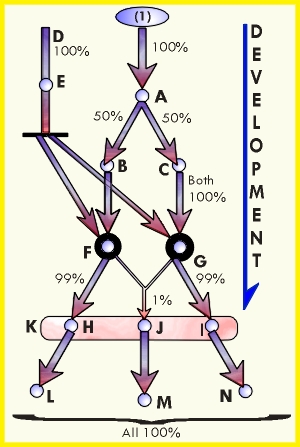
This diagram illustrates everything. From condition (1), event A is 100% likely to happen. At event A, there are two possible outcomes, B and C, and both are equally likely. Outcome B inevitably leads to event F, while there is an analagous event, G on the C timeline, because the cause of those events lies before decision A. At event F/G, another cause-and-effect chain, DE interacts with the outcome of decision A to produce three possible outcomes; H and I are the most likely, respectively, but there is a slim chance in both cases that the interaction will result in outcome J. With further development, H becomes L, J becomes M, and I becomes N.

To take a more concrete example, F/G is a meeting, and A is a decision about who will attend to represent one faction.

K represents some external manipulation of the outcomes – enough that J might suddenly become the most likely result. If J represents the possibility of a spontanious explosion during the meeting, killing the participants, K might represent the planting of a bomb by a time-traveller – so that what was a 1% or less chance is suddenly a 99.9% near-certainty.

This diagram also depicts the temporal forces that have been discussed earlier. At A, a condition is set up by Will, that condition being the choice between options B and C. Affinity links events B/C to cause A. Selection keeps them apart. Pull combines cause-effect chain DE with events B & C to produce outcomes F and G, respectively. Persistance keeps the differences between F & G minimal; but those small differences interact with DE to expand those differences, widening the rift in outcomes as events are subject to Development. Exterior influance K can make the unlikely outcome J the most probable outcome, but only by overcoming the force of Option which states that without outside intervention, F will almost certainly become H, which in turn will almost certainly become L, and G will almost certainly become I, which in turn will almost certainly become N.

This model of time permits a rational discussion of time-travel by defining the “landscape” and the way events combine and interact.

The propagation of Consequences

A key question is how consequences progress down the timeline. There are a number of models that can be used as the basis of your description of time, and this criterion is one of the great distinguishing differences between them.

The many-worlds theory of time, in which every possible outcome is equally real, and those outcomes not experienced in a particular world are experienced in a parallel world, is one of the most popular, and it’s the one that I used back in the 80s. There are others – the serial model, which I have to admit I’ve never quite been able to wrap my head around, for example, or the “threaded” one-timeline model of Thrice Apon A Time by James P. Hogan.

When you introduce a change in history, the timeline bends in a new direction. The bigger the change, the bigger the change in direction. It’s simple impact mechanics, the transfer of momentum. You can even see it at work in the diagram above – F&G are virtually indistinguishable because the Decision at A has not yet made any real impact. As soon as it does, the timelines start to diverge.

The same mechanisms also exists within the timeline, and be responsible for the propagation of consequences to events. Think of a timeline as a whole bunch of smaller timelines bouncing around inside a larger hollow tube; most of them will have no effect, but every now and then a whole bunch of them will be pushing in more or less the same direction at the same time, and the direction of the timeline will shift in response. This is the same mechanism that in the physical world translates quantum effects into large-scale effects.

The supposed ‘unified path of history’ is, on closer examination, a large number of possible paths, held together by the force of Persistance, which overcomes the weaker force of Selection which tries to push them apart, just as matter is held together despite atomic structure being basically a set of positively-charged clumps floating in a sea of negatively-charged electrons. You would expect the charges to prevent atoms from forming molecules, but it turns out that molecules are formed by relationships between electrons. You would expect molecules to repel each other (and they do) but gravity is enough to hold a bunch of them together.

So each supposed “Timeline” actually consists of a virtually-infinite number of virtually-identical timelines, distinguished by differences at the quantum level.

Application To Time Travel

So, with our model in place, let’s postulate a theoretical time-traveller from point L. He goes back in time and changes the outcome of event A, so that instead of it being a 50/50 proposition between choices B and C, a third option, D, suddenly results. As soon as he arrives prior to A, his existance creates a new set of alternatives – he’s either there, or he’s not. There can’t be as many time-travellers as there are timelines, because not all timelines will result in his discovery of a mechanism for time-travel.

Immediatly, the timeline at the point of his arrival will do a B/C-style division, between those timelines in which he arrives back in time and those in which he does not. From that point on, he can make any change he likes in the outcome of events and there will be No Paradox that results because his origins will always lie apon the set of otherwise-identical timelines in which he did NOT travel back in time. There is no grandfather paradox because the consequences of killing your own grandfather lie in an alternate world.

That’s not to say that some Other time-traveller can’t go back and change the outcome of events that are experienced by a particular world – the one in which the PCs lie. It does not prevent the PCs from travelling back in time in an attempt to undo that change. And each of these creates a new set of timelines – worlds in which the villain did not change history, worlds in which he did but was stopped by time-travelling PCs, worlds in which he did and the PCs failed to stop him, worlds in which the PCs never found an opportunity to stop him, worlds in which they didn’t try. You can have total ignorance of the outcome of events and still have a deterministic history.

The key to maintaining player satisfaction with the outcome of such time-travel is to ensure that a parallel-world version of the PCs is always at work in the PCs timeline, undoing any change. You pick and choose between these possible worlds as suits the needs of the campaign, and as provides the emotional fulfillment of the PCs. While you could have them go back in time, succeed in their mission to correct history, and return to find that nothing had changed because they weren’t operating in their timeline but in a parallel world, this would be unsatisfying to the players, so we don’t choose that world – it’s fully populated by NPCs. Choose The World That Works for your campaign.

Whenever the PCs attempt to rort the system using time travel, simply have them return not to the world they left, but to one in which the details of their situation are different, possibly worse.

What’s more, since you can switch between parallel worlds at the drop of a hat, this permits any retconning necessary within the campaign – you simply switch the timeline from the pre-retcon background to the post-retcon background.

Next Time: the next (and final) part of this article will expand on some of the implications of this model of time, and on a couple of variations that can be useful as tools for the GM.

Comments (5)

How To Be A Confident GM, Part 2


Treasure your confidence

Treasure your confidence

Confidence is key to having fun long term as a game master. Last week we covered several tips on how to become a confident GM, and this week we deliver more.

Collaborate

Say yes whenever possible. Get into the habit of building on player input and ideas instead of overwriting them. Pass ideas around so others can add to them. Be open minded, which means give ideas the benefit of the doubt, be objective, and do not let an initial negative emotional reaction stomp on the contributions of others.

That last one is most important. You are always allowed your emotions. Do not suppress them. We all have biases. Our brains are designed to assess, compartmentalize and categorize. “I like this. I do not like this.”

But do not let an initial emotional reaction rule you, either. “Is he challenging my authority? What a jerk. I’ll show him.” That is a legitimate reaction, but experience it and then let it pass. Get objective. Probe deeper. Your assumption is likely wrong. (If it is not, you have discovered an opportunity to work with that player to improve relations and get a better game out of it.)

Player feedback

Opinions are a double-edged sword. Great feedback buoys you. Negative feedback can be devastating as it gnaws away. Long term, your best bet is to acknowledge all feedback, consider all opinions as constructive criticism, but distance yourself from feeling one way or another about it. Be a scientist, and do not let others dictate your emotions.

There is a notable exception. Your players often have fun even during those sessions you think bombed. It is funny how that works, but consider how each of us lives in our own heads and imaginations. While you fret over logistics, balance, pacing, rules and a dozen other things, your players are roleplaying their characters (often with each other, do not forget), taking actions, exploring the unknown. They evaluate games differently than you. They have no knowledge of what is ahead, like you do. This sense of mystery and the unknown, without a feeling of responsibility for the game overall, completely re-frames the game’s experience for them. So do not superimpose your impression of session quality onto them.

For this reason, go ahead and get feedback when you think a session bombed. If your players do not surprise you by saying the session was great, they will at least never feel a session was as bad as it seemed behind the screen. In this case, getting feedback and feeling better about yourself is a great lift and confidence boost.

Fairness

Be fair with players, the game and yourself. A fair GM earns respect. Being fair and handling situations fairly gives you confidence about getting through tricky situations again in the future.

It is easy to say, be fair. But what does that mean? In my mind, it means:

  • Manage expectations. Unrealistic expectations are unfair because they can never be met. It is an always-fail.For example, even the simple mistake of over-scheduling erodes confidence. You plot out a weekly or bi-weekly game that ends up happening monthly due to group schedules. It seems like there are more canceled games than played ones. A simple reset to a monthly schedule removes all the guilt and feelings of failure.
  • Listen. You always learn more by listening instead of talking. Being fair means understanding all sides of an issue, and you need to learn from your players what their perspectives are before making judgment calls. Do not make assumptions. If the players are talking, listen, do not talk over them. If players are not talking then ask questions to get them talking.
  • Be objective and avoid personal agendas. Not only do we all have biases as people and GMs, but those biases shift depending on if we are fresh or tired, alert or sugar crashed, neutral or parsing feedback. Catch yourself being selfish so you can stop. Put your players’ needs first, then serve your own. Be a referee.If you ever find yourself in a punishment mindset, stop immediately. Pinch yourself. Getting revenge, abusing authority and being petty kill fairness and confidence. When has punishment created a fun, happy, collaborative game environment?
  • Do not favor one player or character over the others. I love wizards and barbarians, but I cannot neglect other PC types in planning or gameplay. New players should not be given less attention because I am not as familiar or comfortable with them.

Consistency

Another type of fairness, this item deserves its own tip. If you do something one way one time, keep doing it that way until you have good reason to change. If you change, communicate what is new to players before the situation comes up again, lest it feel arbitrary and unfair (in cases of bad news).

GM a lot so you develop your own style. Then stick with and hone that style as you enter a new phase of GMing. Similar to how a writer learns to find his own voice, which consequently draws readers to him who demand ever more wonderful content, GMs with a personal style conducive to fun gaming are popular and celebrated. The power of this comes in part from the consistent experience a style provides.

Admit mistakes, fix mistakes

If you cannot admit to making mistakes, you fear making them. Then a mistake becomes something to hide, a secret, a potential shame.

Instead, adopt an attitude of being an ever-improving game master who constantly tries and learns new things. Your art lies in the process, not the final result. You can admit to a mistake easily if you know it will get you closer to your goal. It stops becoming about you and instead is just a part of the process of great GMing. The mistake becomes a thing out in the middle of the table for everyone to ponder, talk about and benefit from instead of making it all about you.

When players know their GM makes mistakes gracefully, they in turn relax about their own foibles. Being on guard often means being on the attack or on the defensive to deflect all those bad feelings that come with blame and embarrassment. Graceful errors that are learning opportunities bring down everyone’s guard and the bad behaviours that come with it.

Use player input. For significant mistakes, put them out there for everybody to chew on and ask for comments. The scientist will learn from shared input. The student will learn from collective wisdom. The storyteller will get new ideas.

Have a rules plan

How will you approach game rules during the session? Figure this out, perhaps with player feedback, and communicate to the whole group to set their expectations – and your own. You will get confidence from knowing how this tricky aspect of the game will get handled.

You have several options you can mix and match:

  • Be an expert. Option one: set expectations that everybody should look to you for rulings, first and final. Explain your thought processes to gain player understanding and trust. Being the expert offers faster gameplay due to fewer discussions, but when arguments do occur they tend to be polarized. Transparency in decision-making should help work things out amicably, though.
  • Seek an expert. Option two: enlist one or more players knowledgeable with the rules to be your consultants. You can defer to them but reserve final ruling for yourself, like a benevolent dictator. A little slower because of the feedback gathering, I prefer this option. It engages those players with rules knowledge, rewards them and encourages them to stay on top of new rules and errata, and makes the process feel collaborative.
  • Decide now, look up later. Option three: make a decision fast and verify or correct rulings between sessions to improve future gameplay. I also employ this one to keep the game moving instead bogging it down with research.For rulings with high stakes, we pause briefly, get opinions and give experts a chance to find the needed rules fast. If we cannot get a reference within thirty seconds or so, I make a ruling and ask for objections. Minor objections are either allowed to modify my ruling or are declined with an explanation of how I reached my decision. Last, we note this ruling in the session log and agree to rule future situations similarly until an official ruling becomes available.

    Whew. It sounds like a tricky process, but it takes us just moments now. Thanks to my ongoing attempts at fairness and consistency, even players who disagree with a ruling are not upset because they know rulings are not a science, that I aim to be fair, it is not personal, and they can research between sessions to fix things, if possible.

  • Reference now, get it right. Option four: put in the time to learn the right decision for more consistent gaming. Landing on a ruling by personal decision or group consensus represents a new house rule. This opens up the possibility of rule conflicts and further discussions. It requires documenting the new rules as well, which for some groups is an issue.Avoid all this with due diligence during games. Play stops until you find the ruling or piece all the factors together to get to an official rule (i.e. figuring out a final bonus taking into account all the numbers, stacking rules, errata and exceptions). Rulings are generally solid, and there is no need to create a corpus of house rules to also factor into future rulings.

Create a small number of specific goals

My final bit of advice on how to be a confident GM. Many game masters sabotage themselves by pursuing an unachievable objective. “Be a great storyteller.” That is a common one. The mistake lies in not knowing when you finally achieve that goal. You never feel like you arrive, so you grow frustrated, then despair, then give up.

Create several small objectives for yourself. Then pick one or two to work on each session. This makes improvement manageable. You cannot focus on more than a couple improvement items at a time, so pick two and work on them, perhaps for several sessions or even a whole campaign.

Make each of these objectives specific. You need to know when you have achieved success. This means figuring out what success looks like before you even decide to tackle the goal. Envision what GMing will be like with your goal achieved. What will be different? Make notes on what will change and how.

Use SMART as a simple planning template

Specific – What exactly will success look like?

Measurable – Try to quantify the goal. Count a certain type of error, time an event or process, or personally rate how something went. For example, run a whole combat without forgetting to use any planned foe tactics.

Actionable – You need to be able to take specific actions to reach your objectives. If you cannot do anything about the goal, it does not make sense to place your hopes and confidence on luck. For example, make a player less tired. You cannot control their rest and health, though perhaps you can affect this with snack choice in sessions.

Realistic – The goal must be within the realm of possibility. Be realistic about constraints. GMing every day might be compelling, but unrealistic for you. :)

Time – Give yourself a deadline. Goals without an end date tend to dissipate. Worthwhile goals will have a period I call The Grind in them. The excitement of starting has worn off and the light at the end of the tunnel has yet to appear. A deadline helps you get through this period by motivating you to keep at it, even though it does not feel like you are making progress.

Start with a couple of small, easy goals. Complete them quick to build momentum. This gives you confidence to try more ambitious wishes (always try to break big goals down into small and achievable ones, for these reasons).

Perhaps goal one is to create an encounter hook the actually PCs grab onto. Goal two is an encounter with a successful hook and where the PCs choose to parley, at least for a round. Goal three is an encounter with a successful hook and that resolves entirely through parley, as designed.

Becoming a confident GM is a SMART goal, but a tricky one because the achievement is a feeling. It is hard to measure. I can see the deadline day arriving for you and you ask, am I confident yet? How about now? Now?

Instead, I would pick and choose from the tips in this article and turns those into SMART goals. Focus on the steps of the process and let the ultimate objective take care of itself.

Confidence is a strange beast. You see professional athletes lose their confidence all the time. Confidence comes and goes. Enjoy it while it is here. Hang onto for as long as possible. And when it goes, return to this article and do the basics again. Confidence will come back.

Comments (3)

When Inspiration Is Not Enough: Time Travel in RPGs, Part 1


This entry is part 1 of 3 in the series Time Travel In RPGs

Extract from 'The Persistence Of Memory' by Salvadore Dali

When writing my submission to the June 2010 Blog Carnival, A Medley Of Inspiring Media, I said that Time Travel was a special case. This article started off as just another section of that Blog Post, but quickly showed signs of growing into another of those monster subjects requiring a multiple-part post to completely contain the discussion. Rather than obscure the message of the first post, I have chosen to excerpt the subject completely. The subject title I’ve chosen anticipates that, in fact, this discussion is going to grow beyond any reasonable limits.

We don’t usually tell players, but we GMs know that a lot of the time we can decide the basics of a subject and fill in the blanks as we go along without it making a lot of difference. Combat, plot, characterisation, politics – this is true of all of them to at least some extent. The more experience we have, the more easily we can create a lot of soup from some fairly bare bones. Naturally, it’s not the best way to go about our craft, just as a great cook will do even better with some top-quality ingredients – but if we were able to take as much time as we wanted/needed in game prep, we might only play once or twice a year! Possibly less often.

Inherantly, game prep is a compromise between the ideal preperation and no preperation at all, usually dictated by external factors (which dictate how much time we have available to use) and the remorseless approach of a deadline. Something has to give, in such a situation; the artistry of Gming comes in making sure the cracks don’t become evident to the players.

Time Travel is not like that – at all. There are so many questions of a critical nature that the subject raises immediatly to which the GM needs answers – so much so that the temptation is always to fall back on a prepared set of stock answers and fudge around with the inevitable compatability issues some other time, unless Time Travel is central to the game itself.

Questions like: Can you travel into the past? Can you travel into the future? Can you come back again? Can you change the outcome of events? Can you come back again? Will you remember anything that you learned? How does random chance operate at a cosmic level? How does free will work? Is there any such thing as destiny? What does it feel like when someone changes the past? How can you be protected from the event? Can you undo the change? Can you use time-travel to evade inconvenient facts of real-world physics like the speed-of-light limit? How can your answers provide challenge and plot for the PCs? And how can they avoid the PCs rorting the system ahem exploiting time travel to gain a game-wrecking advantage?

If you are going to rely on stock answers, having a broad repetoire of them at hand is always a good thing – and that’s where the connection to the Blog Carnival comes in. But having those answers on-hand also provides a short-cut to creating your own unique set of answers, and that can be invaluable.

Why Do It?

Why would you do it? Why permit time travel in the first place?

There are a lot of good reasons. First, it gives the GM another source of interesting challenges for the PCs to overcome, and permits a different type of scenario, always good for breaking up a monotony. It gives a repetoire of interesting characters for the PCs to interact with. It’s frequently a staple ingredient of a genre. It permits a ‘holiday’ in a different environment, enabling the GM to utilise plotlines that simply don’t fit the mood of the contemporary game. By providing a contrast, it can enable the GM to shed expository light on key aspects of that contemporary game without a lot of exposition. And, lastly, it’s just plain fun a lot of the time!

Simplistic Answers: The Superman Solution

This stock answer stems from DC Comic’s Superman in the Golden and Silver Age. It states that the past is immutable, and a time-traveller is essentially a disembodied spirit who can only observe events and never interact with them. On the face of it, this is a solution that marks a lot of those difficult questions as ‘out of bounds’ and hence makes the GM’s life easier. If the past can never be changed, the GM never has to work out the consequences of those changes, there can never be any paradoxes for him to unravel, and he can just get on with the main plot.

It won’t take long for the shortcomings of the solution to manifest themeselves. There’s no drama, no conflict, no story. That’s a massive negative all on its own. But wait – it gets worse. It provides an easy way for the PCs to gather information at no risk to themselves, undermining one of the central sources of adventure in the PCs contemporary era.

Adopting this answer brings other unwanted baggage. It implies that it is possible to go into the future and interact with events, and DC had Superboy doing just that, by becoming a member of the Legion Of Superheros – even learning the outcome of events in the future of the contemporary era. But no member of that future era can ever come back and change events, according to the basic answer – and that means that the PCs can never go home again.

Unless the PCs are somehow priviliged – perhaps they carry their own temporal framework with them. But that logic, in effect, undoes the entire premise of the basic solution because every time traveller is coming from their contemporary era.

The longer you think about this particular solution, the more holes and problems become aparrant with it; this is not a simple answer, it’s a simplistic answer that will eventually leave the GM up a creek without a paddle. For example, think about the free-will-vs-destiny debate in this context for a moment. Since the past is always past for someone, there can be no such thing as free will, and everything is predestined. Nothing sucks the life out of a game faster than making the whole thing an immutable plot train. Even stating that everything that happens is predestined to happen, and neither you nor the PCs know what is predestined – which avoids the plot train problems – is less than satisfactory.

In fact, every possible permutation of exceptions to the basic restriction ends up raising the question of why this person or these persons gets an exception.

Ultimately, in the interests of taking all the hard work out of Time Travel for the GM, this saddles him with all the problems of time travel and none of the benefits. It’s not just a Simplistic solution, it’s a Bad Solution.

Simplistic Answers: The Marvel Answer

The first refuge of GMs who confront the shortcomings of the early DC solution is to go to the opposite extreme, and adopt the Marvel Answer – which (in essence) states that History is fluid, the past can be changed by anyone with both the ability and the will to do so, but which provides no physics to describe the capability.

That works to some extent in a comic book, because the writers can simply not have the primary characters exploit the advantages that time travel offers, filing it under ‘things man was not meant to know’, ‘knowledge too dangerous to use’, or ‘didn’t think of it at the time’. In fact, it works so well that DC have virtually adopted a variation of it themselves, in more modern times. This was also used, in a slightly more sophisticated way, in the Back To The Future trilogy.

Can you really picture PCs exercising such self-restraint? I can’t.

Before you know it, you will have PCs dropping off to some other point in the time stream to put in a few extra days/weeks/months/years of study and planning. This answer completely negates the tension of the game; any PC who is caught unprepared for anything has not been doing enough time travel! The moment a PC feels a need to know how to do something, he putters off to some past era and a safe location to put in a few day’s hard study – and then expects this to be reflected in his character’s skill levels.

If the GM doesn’t meet that expectation, the ability of the players to suspend disbelief is massively undermined. If the GM does, it sucks the challenge out of the campaign.

And it still leaves the GM with those hard questions to consider. In virtually any modern-day campaign that enables time travel, one of the first questions is ‘Why don’t we go kill Hitler before WWII’?

How about the introduction of modern technology into the past? This issue has been at the heart of many time-travel stories, starting with A Connecticut Yankee In King Arthur’s Court, to such an extent that the time travel capability itself is just a vehicle to enable the story to take place!

What happens if the PCs change their personal histories? Do their abilities instantly change as a result? Can you see PCs – heck anyone – not taking advantage of that?

Unfettered time travel is just as big a curse as the first Simplistic Solution. It evades the questions by not asking them, not by providing solutions.

Wanted: A Game Metaphysics

Clearly, what’s needed is something in between. Time travel needs inherant consequences that limit its usefulness and its impact on the campaign. We need some sort of metaphysics that is at least rigorous enough to answer some of those tricky questions, because it will ultimately be more work not having one.

In part 2 of this article, I’ll start to discuss – in detail – the game metaphysics that I came up with for my superhero campaign, Zenith-3, back in the early 80’s, and which has been robust enough that it’s still in use today. As I do so, I will extract the requirements of any good solution to the general problem, and suggest some alternatives. Ultimately, the goal will be to develop a ‘road map’ for GMs to follow that will take most of the work out of creating their own solutions to the questions of time travel, unique to their campaigns.

Comments (14)

How To Be A Confident GM, Part 1


Treasure your confidence

Treasure your confidence

Gnome Stew recently posted an article about running on minimal prep game. One of the points was to GM with confidence, and that got me wondering about how exactly do you be a confident GM? Following are a few ingredients to that recipe. I look forward to your comments about what you do to bolster your confidence.

GMing is 80% confidence. Once you get through your first handful of sessions so you learn the mechanics of running encounters and handling a group of players and characters, it becomes about your ability to:

  • Thrive in the spotlight because you have more spotlight than everyone else combined each session)
  • Make decisions because you will make more decisions than everyone else added up, plus your decisions have more consequences, and so more responsibility
  • Think in multiple dimensions because you need to handle the meta-game too
  • Argue, or perhaps a better word is persuade, which means backing your opinions and decisions up when players push back a bit
  • Be creative, because that is ultimately what separates you from an MMO server

Doing those things well stems from confidence. Mastering the mechanics of GMing is critical, but having confidence lets you execute those mechanics with panache.

Shore up your weaknesses

First thing I would do is get my worst fears under control. Knowing the worst that can happen, and preparing for that, gives you a strong base you know you can rely on and can push forward from.

Define your fears

Take a moment to write out what your worst GMing fears are.

My top three:

  • Complete mind blank. I am like a deer in the headlights, with no ideas or answers and I just sit there and struggle to be creative while squirming as my players watch.
  • Making a critical logical error that derails a major game element, like a plot thread, villain or encounter. “But the villain could not have cast that spell three rounds ago, Johnn. He used that spell against us in the first round. We have to redo the whole combat. And now we know the villain’s powers!”
  • Being boring. Players yawn as turns take forever, the content sinks like a rock, and people start preparing excuses to leave early.

Stop reading and write out your fears. In a rush? Then just note your biggest fear, or the first fear that comes to mind. Go back when you do have time and write your other GMing fears.

Analyse your fears

Now that you have your top fears on paper, check them out. Distance yourself from them. Pretend your friend has just told you those were his fears. De-personalize and be objective about them.

They are not so bad, are they? It is not life and death. It is just a game. Never aim for perfection. Just try to be better and have more fun than last game. Some sessions will rock, others will not.

For each fear, note the worst things that could happen. What could realistically result? For example, your players all quit, someone flips the table, you get embarrassed, you feel ashamed because of mistakes, gameplay rewinds, secrets are mistakenly revealed, you have a bad night.

If this is the worst stuff, you are doing great. It is all temporary. If you game with friends, this stuff becomes water under the bridge. Usually pretty fast, too. If you game with strangers, such as at a game convention, situations and emotions are even more transient.

I had two readers write in with truly serious situations. One GMed her boss, and the boss was a disruptive and selfish player. Another GMed her landlord, who was also a terrible egomaniac. Ok, if it is a real possibility you could lose your job or get evicted over RPG, you win this post. Those are serious stakes. Run!

But the rest of us – are our fears, whether realistic or not, going to mean we lose our friends, family, life savings, health, job or home? Put in this perspective, while I do not mean to say you cannot fear or should not have GM fears, they cannot let you stop playing because they grow so out of proportion that they become weaknesses. Do not let small fears with small and temporary consequences grow into real weaknesses and loss of confidence.

If you can adopt this attitude, then mitigating your fears is possible.

Crit your fears

Think up a solution for each fear. If a solution cannot be “solved,” come up with a mitigation strategy so potential consequences are reduced to as close to nothing as possible. Create a GM aid or Plan B so you have a safety net going into each session. Just knowing a net is there to catch you seems to magically give you confidence, which is the main benefit of this exercise. Once in awhile I need my safety net, but the irony is creating the net makes it unlikely I will need it.

Here are my safety nets:

Complete mind blank – For this I prepare cheat sheets in my GM binder.

  • Charts
  • Generators
  • Hooks
  • Seeds

You might only need this support for certain game elements. For example, you might want to bookmark links to NPC generators and create a list of 10 random encounter seeds. Treasure, conflicts, locations and other game elements give you no problems. You only worry about NPCs and encounters, and now you are covered.

What is great about this approach is you can carry this bit of preparation forward from session to session, adventure to adventure, and even campaign to campaign.

Going through my GM binder recently for a new campaign, I realized some of the emergency materials I keep handy were created in the 1990s!

Logic errors. I have a plan should this happen. I blogged about retcon rightly. Just having options available and knowing what they are gives me confidence to forge ahead regardless of potential problems.

Being boring. I have a list of five encounter seeds I categorize as “break down the door.” If things get dull, the game bogs down, the party seems lost, I am ready to immediately trigger a fun action encounter.

If you can find peace with backup plans and solutions, go for it. Who cares if the plans are never needed? Their purpose is to give you confidence.

Give and get respect

With mutual respect, you realize your players are your safety net. When I royally screw up, and I do something embarrassing, I feel confident about admitting my mistake and talking about it in the open with my group. We pause the game, I reveal the situation if it is not already obvious, and we talk it out. I might wait until between sessions to do this, instead, if it keeps the game flowing better. Either way, we chat.

Having respect gives you extra leeway, too. You build up a bit of credit with your group, who will give you the benefit of the doubt or stretch their sense of disbelief to accommodate you.

Trust your players, and give them the benefit of the doubt as well. Assume they always mean well. Assume they want you succeed. Assume they want everyone to have fun. Nothing erases respect faster than suspicion, ego and assuming the worst in others.

To earn respect you also need to put your time in as GM. It is a catch-22, but know that as you strive the become a great GM and you get more gaming in you, the respect will come as part of the doing.

Next week, I discuss more solutions for how you can become a confident GM. Stay tuned.

Comments (8)

The Critical Threshold: A brief debate on the Merits of Extreme Results


This is not the post that I expected to make this week. I simply ran out of time and could not finish either the article I had intended to post this week [about time travel] or the one for next week [the long-awaited followup to last year’s Pillars of Architecture article], in time. Instead, I have had to reach into my list of possible future blog topics to extract one for which I had already done most of the hard work. Normal service will be resumed as soon as possible!

Most roleplaying games rely on the concept of rolling one or more dice to generate a random result. Die rolls imply extreme results; on a d20, those are ‘1’ and ’20’, but every roll has (by definition) a minimum and a maximum. The question under consideration is whether or not those rolls should have an interpretation beyond the literal one of the result, ie a ‘1’ being 1 removed from a ‘2’ and a ’19’ being 1 removed from a ’20’.

Let’s start by looking at some of the ways that these extremes might be interpreted in a game context.

Simple Failure/Success

This is the most obvious interpretation of them all – it says there are no such things as critical hits or misses. At the GMs discretion, he might allow a minor enhancement of effect or severity of failure on a maximum/minimum result, but a result of three on 3d6 has, officially, no significance beyond being one worse than a result of four.

We use this approach in the The Adventurer’s Club Campaign, where the characters may be exceptional but they are still, essentially, human, for all the reasons listed in the ‘No’ arguement below.

Success/Failure that would otherwise not be permitted

This is the interpretation built into the standard d20 system. By stating that a “20 always succeeds” and a “1 always fails”, the system ensures that eventually characters can succeed at anything, no matter how ridiculously impossible it seems, and will eventually fail at any task (no matter how simple it appears to be) – provided that repeated rolls are either permitted or manditory.

A first-level dweeb will eventually hit the Invulnerably Exquisite Muckamuck, Most Skilled Swordsman In All The Universe – and the Muckamuck will eventually fail to snot that first-level dweeb between the eyes.

Of course, these possibilities do not rule out the likelyhood of consequences in the interrim – the Muchamuck will react to the dweeb’s feeble attempts (by striking back, or by rolling on the floor, laughing, or whatever else seems appropriate), and the dweeb is unlikely to survive long enough for his lucky number to come up.

In theory, the GM can apply these facts to his own advantage by employing mass attacks, knowing that about 5% of them will succeed, no matter how lop-sided a one-on-one contest would be (I say “in theory” because I remember attacking two PCs with 630 giant phasing fire ants, each needing an 18 or better to hit, but with the PCs unlikely to survive more than two or three such hits; rolling all 630 attacks; and missing with each and every one. The PCs were able to use area-effect spells to take the ants out before they got another shot at the brass ring. Nor is this the most extreme ‘improbable roll set’ that I have witnessed – I’ll tell the story of two Ians in Seventh Sea some other time).

This system has a couple of drawbacks. It provides a disincentive to improve chances of success beyond a certain margin, because you can never get better than a 95% chance of success (using a d20). It marginalises the effects of setting high difficulty numbers – because there is never less than a 5% chance of failure. It should, in theory, have an impact on the psychology of combatants.

Levels of Success/Failure beyond the normal

This is the interpretation that features in my superhero campaign, Zenith-3, and the spin-off Warcry campaign, and which used to feature in my AD&D campaigns. It is also the system utilised in Rolemaster. Instead of saying that there is always a chance of success or failure, this approach states that the results will be more effective IF the action succeeds.

Like the previous system, this has a couple of drawbacks. It demands that the GM be a little less casual about setting difficulty levels (or difficulty modifiers, or whatever the mechanism is), because they can have genuine effects on the outcome of the game. It encourages players to become rules lawyers, seeking to obtain every last bonus that they can wring from the system – which in turn mandates that the GM be equally pedantic. This, in turn, can slow the resolution of game actions down, especially in critical situations – exactly when the GM wants to keep the tension level high. And it can encourage players to to obsessively persue improvements in skills that they deem as system-critical rather than developing more rounded, broadly-capable characters.

Standard d20 also uses this system, by means of the critical hit multiplier, making some extreme results even more valuable – but there is no equivalent ‘critical miss’ threshold. The system is only fair because the opposition gets the same capability.

Cascading/Imploding Rolls

Once again, I can draw apon one of my existing campaigns as illustration – this is the interpretation that is utilised with non-combat rolls in my Fumanor campaigns (for reasons I can no longer recall, I was persuaded to keep the standard system for combat). If you roll a 20, you roll again and add twenty to the result – and keep going for as long as you keep rolling 20s. Equally, if you roll a 1, you subtract 20 from the result and (again) keep going for as long as you roll ‘1’s.

eg1: roll 20. roll 20. roll 14. 20+20+14 = a result of 54.
eg2: roll 1. roll 1. roll 14. 14-20-20 = -26.

This system has one big advantage over the standard system: it means that even if a dweeb attempting an almost-impossible task rolls a 20, he still has to get phenomenally lucky to succeed – it preserves the relative difficulty, while still giving a chance of achieving the impossible. Similarly, at the low end, the extremely skilled character has to roll phenomenally poorly to fail at a simple task.

It’s not perfect – in fact, it effectively replaces the drawbacks of the standard system with the drawbacks of the ‘success/failure beyond the normal’ alternative.

Cascading/Imploding Rolls Version 2

A variation on the concept is to add or subtract the next smaller die size on a critical result.

For example, on a ‘critical success’ skill check made on a d20, you would roll a d12 and add the result to the critical result; on a combat check where the effects are d6’s of damage, you would add 1d4 extra damage; if the effects are a d8, you would add a d6; and so on. On a ‘critical failure’, you would roll 1d12 and subtract it from the result, and if the character’s skill was still high enough to succeed, if the effect dice were d6s then you would subtract 1d4 from the result, and so on.

Cascading/Imploding Rolls Version 3

A further variation on the effects side would be to roll a number of extra dice (1 size smaller) equal to the number of maximum/minimum results on the effect rolls – so, for a critical hit, rolling 4d6 damage and getting two sixes amongst the results would add 2d4 to the damage total. On a critical failure that succeeds despite the low result, if the effect was rolled on 4d8, and the result roll included two ones, the total effect would be reduced by 2d6.

That can be quite significant in terms of impact: 4d8s, two of them coming up ones, give a range of results of 6-18 [average 11], while 2d6 have a result range of 2-12 [average 7] – so the total after subtracting one from the other ranges from is -6 to 16, with an average of 4. Compare that with the results of a standard 4d8 roll: 4-32, average 18. The normal minimum result is the typical result of the modified roll in the example.

This raises the question of how effect results of less than 0 are handled, which offers two further sub-variations for consideration.

Version 3a

This quite straightforward approach simply sets a minimum effect level of 0. If the effect total is less than zero, it is treated as having no effect.

Version 3b

But, given that we’re talking about combat effects, why can’t the attacker injure themselves instead of the target on a negative? Surely it’s possible to strike someone awkwardly and sprain a wrist, or stumble and twist an ankle?

Version 4

And here’s yet another variation to consider: basing the number of additional dice on a critical success on the number of minimum results on individual dice, and vice-versa. That means that a critical failure tends to transform good effect results into mediocre-to-poor ones, and vice-versa. This waters down the extremes of impact on the effect totals by the system, and eliminates the risk of a ‘less than zero’ total.

Overall analysis of Variations 2, 3a, 3b, and 4

The variations offer a number of beneficial effects over the base version. The severity of impact that comes with a critical is moderated, because there is only a single ‘cascade level’ on success/failure rolls.

Both forms of Variation 3 and Variation 4 permit success or failure results to have an impact on effect results, potentially significantly, but to varying degrees. Because they apply a modifier to effect results based on the success/failure result, levels of effect are at least partly commensurate with that success/failure result instead of being completely independant. A great hit will have more effect than the average dictates, and a poor one will make a blow less effective than the average. These adjustments can be minor or can be extreme, depending on the variation chosen.

I have never seen these ideas used in a game system – but I like them so much that I am going to ask the players in my Fumanor campaign to try them out!

Free Actions

This is an option that I’ve never seen utilised, possibly because it can lead to one character getting a disproportionate share of the ‘air time’ in a game, but in theory it should work. Most game systems have some sort of limitation placed on what the character can do in a given slice of game time, especially in combat – D&D uses the “free” and “move” action types for the purposes. What this option suggests is that on a ‘critical success’, that action is downgraded in time requirement 1 step, while on a critical failure, it is upgraded one step.

In other words, in D&D: on a ’20’, a ‘move’ action would be considered a ‘free’ action, permitting the character to make a second move action in the combat round, or a ‘free’ action would be considered a trivial action.

On a ‘1’, a ‘move’ action would be considered a ‘whole turn’ action, a ‘free’ action would be considered a ‘move’ action, and so on.

The biggest downfall of this system that I can see – not having actually tried it – is that it would encourage the DM to make players roll for everything.

Reroll minimum/maximum results

Another option that I haven’t actually seen employed, this will only work for combat and other situations where there is a seperate die roll for ‘level of effect’ to the roll for success or failure. On a critical success, you would get to reroll (once) any effect result die that came up the minimum, making it more likely that your success would actually have an impact on the outcome; on a critical failure, you would be forced to reroll (once) any effect dice showing a maximum result, making it less likely that your roll would achieve anything worthwhile.

I don’t think this option is one that will ever be utilised in a real game, simply because a ‘critical failure’ is still a failure, and therefore has no effect dice attached to the result that has to be rolled. But, in theory, it would still work.

The downside is that it doesn’t make a huge degree of difference, and therefore reduces the impact of critical successes and failures – so much so that they simply become “better successer” and “worse failures”. They aren’t criticals any more. And I’m not entirely convinced, given that fact, that the results would justify the extra time consumed by the system.

Skill Improvement On A Critical

This was the approach taken by a friend of mine in his Traveller campaign back in the 80s and 90s (was it really that long ago?). The basic idea is that on a critical success, you are presumed to have learned something, and can increase the relevant skill; on a critical failure, you are also presumed to have learned something, and so can increase the relevant skill. Over time, you will get better at the skills that you actually use, and remain static in those you don’t.

A variation requires the character to make a second (successful) roll against the same skill after a critical success in order to gain the improvement, while it remains automatic on a critical failure. This weights the benefits according to the premise that you learn more from a failure than you do from a success – sometimes you succeed because you ‘get lucky’ and learn nothing because it was accidental.

A further variation requires the character to make a second (successful) roll against the same skill after a critical failure in order to gain a second improvement.

Limits can be placed on the number of skills that the character can upgrade in a given game session if they still seem to progress too fast.

The same GM also takes the attitude that a critical success or failure always produces especially spectacular consequences, without necessarily impacting the level of effect that results from the game mechanics.

Taking Longer To Succeed

I came up with a new take on the notion of critical failures for my Shards Of Divinity campaign which also replaces the ‘take 10’ and ‘take 20’ system in the standard d&d 3.5 rules. The assumption is that with many tasks, the character can and will keep trying until they either succeed (and know they have succeeded) or give up. Since eventual success is therefore inevitable in a situation in which a 20 always succeeds – it’s merely a question of how many rolls it takes – it seemed to be more efficient to combine all these rolls into a single one, and to use the result to determine how much more time than normal the task takes.

Once the system was in place, further reflection showed that even with skill checks that are normally ‘success or failure’, ‘all or nothing’, most rolls could be interpreted using this paradigm. Searching an area for traps or secret doors? Normally a ‘you find it or you don’t’ roll, there’s no reason not to say ‘it’s been 1/2/3/whatever minutes and you havn’t found anything yet’. Certainty and confidence are suddenly replaced with uncertainty and doubt. Even when something has been found, the characters can often be left unsure that this was all there was to find! Instead of racing through challenges, the players feel under far more pressure, and are generally a touch more cautious.

Further, by not announcing the DC for success, the players can make openly all the rolls that the GM would normally make in secret, so they feel even more in command of their characters. And the GM can inspire paranoia simply by asking for a check on a whim.

It works for Spot, too. Eventually, a character will succeed in spotting whatever is in front of their nose – but will it be in time? It only requires a single spot roll, at whatever DC the GM considers appropriate, and a determination of how long it takes the characters to become aware of the potential danger or object of interest. All the GM then has to do is keep track of what the characters do until that time is reached for someone. IF the item to be spotted is still there, AND if the PCs havn’t been attacked by it, the first to succeed will then spot the painfully obvious.

Here’s the table that I use:

+1 = +10 sec, +2=+30 sec, +3=+1 min, +4=+5 mins, +5=+10 mins, +6=+15 mins, +7=+20 mins, +8=+30 mins, +9=+45 mins, +10=+1 hour, +11=+1½ hrs, +12=+2 hrs, +13=+4 hrs, +14=+5 hrs, +15=+8 hrs, +16=+12 hrs, +17=+24 hrs, +18=+1 week, +19=+2 weeks, +20=+1 month

the “+1” and so on is the difference needed to turn a failure into a success. For each failure above +20, double the number of months.

The table assumes a 1-round action – if the GM thinks the basic task will take longer, simply multiply the extra time accordingly.

Arguements for the ‘Yes’ case:

Okay, so there are a whole gamut of alternatives, and the fact that I use so many of them in my campaigns suggests that I’m predisposed towards the ‘yes’ case. So why?

Added colour

One of the big reasons to say yes: spectacular achievements give a campaign a more epic, sweeping, and dramatic flavour. It’s going too far to suggest that this is the only difference between high and low fantasy, but criticals of some sort are an essential componant of the first. The four-colour antics of superheros practically demand a criticals system (which only makes it more surprising that the official Hero system doesn’t have one). Catastrophic failures and Cataclysmic successes come with the territory, so why shouldn’t they be inherantly built into the game rules?

Nothing is impossible, no-one is invulnerable

And yet, at the same time, criticals can be viewed as “the great equalizer”. This too, is a staple ingredient of epic campaigns and stories, whether it’s Smaug being layed low by a single well-placed arrow or Spider-man taking down Juggernaut after a truly epic battle in Amazing Spider-man Issue #230.

Conveys a sense of the fantastic being possible

While it’s possible to add colour through narrative alone, there is a deeper effect when the potential for achieving the fantastic is built right into the game rules, a sense of the fantastic being the reality of the characters. This can sometimes be hard for GMs to wrap their heads around, because it means that every plot, and every encounter, carries an inherant risk that it will escape the laboritory and run amuck.

Because the potential for extraordinary results is built into the rules, there is an added weight of verisimilute that is almost impossible to attach to the fantastic any other way – at least without sucking all the life and vibrancy from the scene with tiresome justifications! A critical hits system tells the players, and hence their characters, “the incredible is reality – deal with it.”

Permits a more relaxed attitude

Because there is always a chance, referees have to stress a lot less about whether this DC is too high, or that task is too difficult, or that AC is too extreme, and so on. The same thing is also true of the players – they also relax a bit, and take greater risks. Sometimes that can get out of hand, leading to players taking foolhardy risks – which is generally a signal to amp up the opposition a little, or spend more time preparing them and their tactics.

Arguements for the ‘No’ case:

Equally, there are some compelling reasons to consider the ‘no’ case. And, in many cases, these are the flip sides of the ‘yes’ arguements already presented.

Added realism

Perhaps the most obvious justification for not having a system for criticals is the added realism that results. Adding colour and making the fantastic inherantly more plausible is all well and good, but you should never lose sight of the fact that all games are an imperfect suimulation, already replete with compromises for the sake of playability. The grittier you want the campaign to feel, the more plausible you want it to be, the more you have to control the element of the fantastic; added realism is a clear advantage that can be achieved by junking the notion of a criticals subsystem.

Results are always merited

Then, too, if there are no wild-card successes built into the system, it forces characters to earn every success. If that means taking the extra time to stack conditions in your favour, or to evade the most significant negatives to your chances, that’s what it means. Results are always merited according to the expertise of the character making the attempt if there are no criticals, and that has knock-on effects that emphasise the tactical aspects of the game, which in turn can further add to the realism of the campaign.

Forces GMs to keep tighter control of challenge difficulties

It’s easy for GMs to get lazy, adopting a ‘near enough is good enough’ attitude, when the potential for criticals can always get them out of trouble. When there are no escape clauses, the GM has to look at the actual chances of success and failure far more critically. “+1 to the difficulty” can become significantly important, making it impossible for character A to hit target B. The downside of increased realism is that the GM has to work that much harder at getting the challenge levels exactly right. That also spins off into a need for greater control of rewards and treasure, as “+1” becomes more significant on that side of the ledger as well.

Better for maintaining tension

Greater uncertainty means greater tension. The players will never be sure that they aren’t in over their heads, that the enemy they are about to confront doesn’t have something up his sleeve. This can make players a little overcautious, especially when it comes to making plans for their characters, but if not taken to extremes, this provides yet another layer of interaction between the characters. Start by insisting that all such planning be done in character!

Conclusions

It’s clear that in this debate, there is no clear winner! Both arguemnts present advantages and potential drawbacks in equal measure. Overall, both options have more advantages than liabilities, which is a good thing; it means that there is ample scope for benefits to compensate for quirks and penalties that are associated with the different systems of interpretation for criticals.

If no general conclusion can be reached, then the next obvious thing is to consider the question seperately for each campaign. What is the tone of the campaign to be? Where is it lacking, and what could use shoring up – the fantasty or the realism? The gung-ho or the cautious planning? And further, with their varying subtexts and implications, if you do choose to have extreme rolls make a difference, which is the best system for this particular campaign?

My personal preferances vary amongst my different campaigns. The choices have been made to compliment the unique flavour that I wanted to endow to each campaign, exactly as I reccomended in the five-part first Lesson From The West Wing. There is no One Right Answer, and no One Wrong Answer. Each choice has consequences, and those can add to, or detract from, the flavour of the campaign you happen to be running.

So instead of blindly following the rules in this respect, think carefully of which approach most enhances your campaign, and don’t be afraid to mix-and-match as necessary. One system for skill checks and another for attack rolls? Fine. One system for critical hits in combat and a different one for critical misses? No problem. A different system in the Palace Of Dreams to the one in use everywhere else in the world? Why not?

Have you given any thought as to the critical success/failure choice you use, its suitability to and impact on your campaign, its pro’s and con’s? Do you know of any other interpretations that I’ve missed? Then I’d like to hear from you! The broader the palette of choices, the greater the chance we all have of finding the perfect fit!

Comments (10)

Google Calendar As An Awesome Campaign Calendar


Google Calendar as Campaign Calendar

I’m using Google Calendar as the in-game calendar for my Riddleport Pathfinder campaign. It started as an experiment, but it’s worked so well I’m making it a permanent addition to how I run the campaign. Perhaps you can do this too.

Riddleport is set in Paizo’s world of Golarion, and the calendar in that world is so close to Earth’s Gregorian calendar that I opted to change a few bits of the Golarion calendar. That lets me use modern calendaring tools without any conversion headaches. I also switched my campaign year to 4710 AR and declared that it synched to our 2010 calendar for even easier tracking.

In Google Calendar I just created a new calendar and called it Riddleport. Done.

Use the calendar to track sessions

I make a new event entry on the in-game day each session starts and ends. This lets me know the current date, how much game time has passed for any given session and for the whole campaign, and gives me a place to put session notes (in Event Details) if I choose.

Track events

It’s easy now managing future events. I make an entry in Google Calendar and it’s there, waiting to show up as the campaign date progresses.

Calendar - full month
With this system, you can track:

  • Crafting and future deliveries of goods and services (players in my game tend to commission magic items, special services like taxidermy of cool critters killed, and specialized equipment).
  • Meetings. We book a lot of future meetings with NPCs and factions.
  • PC birthdays. I’ll explain a little birthday boon system I cooked up in a future blog post. Whether you give birthday bonuses or not, it’s fun tracking these special days for the characters.
  • Holidays and festivals. Golarion has its fair share of holidays. Riddleport does too. Plotting these into the calendar as annual repeating events makes tracking these a snap. Write up descriptions in the Event Details section to save time in-game.
  • Events. Do you have things that will happen regardless of PC actions? Place those in your calendar. Even events whose timelines are contingent on other events are easy to move via drag and drop in the calendar. Don’t want that event to trigger today? Drag it forward a week.

Customising for Golarion

I do not have the month and day names memorized yet. To help me out, I created repeat events so the names would be displayed for easy reference.

Months:Custom month

  • Create a new event
  • Name it as your Golarion month name
  • Set the range for the start and end days of the equivalent Earth month
  • Check the All day box if you prefer, as I do, to have the months appear as solid bars in your calendar
  • Set the event to repeat annually
  • Do this 12 times, once for each month

Days:Custom months

  • Create a new event
  • Name it as your Golarion weekday name
  • Set the date as the same Earth weekday
  • Check the All day box to have the days appear as solid bars in your calendar
  • Set the event to repeat weekly
  • Do this 7 times, once for each day

That’s it. A couple other perks, like custom background and sharing make Google Calendar a sweet tool.

We also use PBWiki for tracking the players’ side of the campaign. Google Calendar can be embedded in PBWiki, so we have the campaign calendar right there, in our notes and campaign wiki.

If you are using Golarion, or if you can mirror your game calendar to Earth’s Gregorian structure, then I highly recommend Google Calendar and its features.

Comments (5)