Campaign Mastery helps tabletop RPG GMs knock their players' socks off through tips, how-to articles, and GMing tricks that build memorable campaigns from start to finish.

The Tactical Masterclass – Preparing a player to lead on the battlefield


In any modern-day team environment, there is usually one member of the team who focuses on the tactical situation. Characters that each go their own way tend, sooner or later to get in each other’s way, or make the mistake of two going for the same target while another target is left uncovered; the team tactician is charged with the responsibility of making sure that doesn’t happen – that priority targets get achieved, even if it means passing up opportunities to take advantage of moments of vulnerability on the part of lower-priority targets. Going for the quick score can be gratifying, but can lose the overall battle.

The tactician’s job is to assess risk, reward (probable outcomes), capabilities, opportunities, and priorities, and to assemble a series of individual moves into an overall successful strategy. But there is a big difference between a character having the skills to accomplish this task and the player who operates that character being able to do so. This article describes a series of “training exercises” and game aids – everything from chess to online gambling – that are intended to teach a player what he needs to know in order to fulfill that role within an RPG.

Boardgames & Wargames

When the enemy combatants are more-or-less interchangeable parts, the tactical considerations tend to be fairly elementary. One goon or soldier is much the same as another on the battlefield. Things get more complicated when the tactical considerations grow more complex and the risk-vs-reward analysis of tactical moves is more difficult to assess. Giving soldiers different types of equipment, for example. Each now tactical element increases the number of combinations, and only one of them will be the best choice (though several more may be close). The number of combinations quickly exceeds the capacities of even an expert tactician. That’s what makes wargames and boardgames such as Axis & Allies and Fortress America
interesting and successful.

Like a game of chess – which has relatively simplistic rules compared to those of more modern games – iteration of moves produce so many tactical combinations that it soon becomes impossible to consider a single “grand plan” covering an entire game; instead, one is forced to redefine the tactical objectives into something more achievable, notably the accumulation of tactical advantages and the forcible accumulation by one’s opponent(s) of tactical disadvantages. Eventually, as smaller skirmishes and battles are resolved, those advantages and disadvantages add up until one side or the other can no longer achieve victory.

Still, the actions of any given unit are constrained to a relatively number of pre-set options, and – theoretically – an optimum strategy can be determined by a mathematical analysis of each possible battle or conflict. While this approach has its limitations, as exemplified by many years of chess-playing computer games, it’s still a good place to start.

Tactical Roleplaying

A further increase in complexity arrives when we step up from boardgames to roleplaying games. Characters in an RPG have almost unlimited freedom of action, with only the consequences (including likely success or failure) to confine those choices. Furthermore, each character is a discrete individual with a relatively unique combination of abilities, skills, and powers.

Once again, the simplest problem such characters can face (in terms of tactics) is identical, interchangeable foes. This is also by far the simplest conflict for the GM to prep for and to referee.

More complex are encounters in which the characters are confronted by a variety of creatures. A Drow, its giant spider-mount, and its matched pair of pet trolls would be typical of the level of complexity – there is a rationale, however specious, for these diverse creatures being elements of the one encounter. Each will have strengths, weaknesses, and different combat capabilities. Fortunately for the GM, that rationale also usually provides some pointers as to the tactics that the group will employ in combat – in this case, the trolls would engage the PCs while the giant spider gives the Drow mobility and the ability to use his ranged combat capabilities, initially against others with ranged combat abilities. Still, even at this level, an overall strategy on the part of the PCs is relatively straightforward.

A further increase in complexity can be found in a combat involving a similar group of adventurers, complete with class levels. The diversity of the combinations at this point becomes truly staggering. No longer can the PCs be sure of just what their opponents are capable of, and nasty surprises are sure to occur from time to time. In fact, the only real restraint a GM has on his fiendishness and creativity (since he is permitted to create his own character classes) is to remember that any magic items he bestows apon his “team” have a fair chance of ending up in the possession of the PCs. At this point, the unknowns loom so large over each encounter that tactical decisions must be tentative and subject to revision.

To be fair, my default assumption is that if I use a character class for an NPC, that class is also available for any PC that wants it – and can qualify for it. But that’s a side-issue.

Progressing one step further is the standard barroom brawl, because of the greater number of combatants and the greater diversity that they will contain. Many of the gamers with whom I have been associated employ this encounter type as a litmus test for the effectiveness of a game design’s combat mechanics – if the action (best described as “restrained anarchy with intent to commit mayhem”) flows freely and naturally, it’s a good design; if it stutters and limps and is more number-crunching than theatre-of-the-dramatic, it’s a poor one. This is a situation in which the number of unknowns and combinations are so over-the-top that any sort of overall strategy is impossible – one simply deals with the action, seizing opportunities as they come to hand, one combat round after another, until someone wins.

Which brings me to the ultimate complexity: superhero team battles, team “A” vs team “B”. Each combatant is as unique as its creator can make it. Each side is (theoretically) used to working together, and has devised tactics that enhance their strengths while covering or concealing their weaknesses. The action is deliberately over-the-top big-budget-effects-movie stuff, laden with gosh-wowery, and – theoretically – as individualized as a fingerprint. There may be parity in numbers or one side may outnumber the other. Any semblance of parity of power is usually a polite fiction at best. Each member of each group has a variety of tactical modes covering different combat ranges, though they will also have an optimum range from which thery operate. The number of variables is staggering – but at the same time, there is less anarchy than in a bar-room brawl.

The Tactical Genius

The PCs will usually put one of their number – whoever seems best-suited for the task – in charge of their overall tactics on the battlefield; the higher up the ladder of complexity the game exists, the more essential this becomes. And if the player is himself at least passably good with tactics, the result is a happy PC camp.

Things get trickier when the character charged with the responsibility for orchestrating team tactics – and who supposedly has the skills to pull it off – is being run by a player who can barely spell the word.

The usual cover doesn’t work

With most skills, if the player doesn’t have the skill but the character does, the GM can simply have the player make his skill roll and handwave the details into a narrative of the results. “All right, you’ve persuaded the chancellor to make the proclamation,” or “The crushed leaves of the bilo-boa fernwood stand speak volumes about the creature who was hiding there and spying on the party. From the vantage point it occupied, it could see everything the party did and hear everything that was said. It should have been obvious to the party that it was there, as the fernwood offers little cover, but none of you saw a thing until the noise drew your attention to the spot. But the area of crushed fernwood indicates something very large and very heavy – at least 140 tons in weight and with feet a full twelve inches in length. Three-toed, with curved claws from each toe that have dug deeply into the earth – and a barbed heel with matching spur…”

That doesn’t work when it comes to tactics in combat – such hand-waving would amount to the GM moving the PCs characters and telling them what to do. It goes over like a lead balloon.

Alternatives, such as permitting another player to advise the one responsible for tactics, might seem to be the solution – but this almost inevitably creates frustration on the part of the player who is supposed to be handling things, especially if there is a tactical failure of some sort. Furthermore, introducing a player-level conversational element to the situation always implies a potential for mis-communications – in which a plan that would have worked is never implemented because the “tactition character”‘s player misunderstands what the advisor is telling him to do, and why.

The only solution

There’s only one real solution, and it comes in two parts: the first is to simplify the complexity of the job, and the second is to train the player in tactical thinking.

Such a process is currently getting underway in respect to my Zenith-3 campaign. The current tactical ‘field commander’ is Runeweaver who is played by Nick. Now, Nick is a lot of things, including a nice guy, but one thing he is not is a natural tactician. He views this as an opportunity to expand his personal skills, and his character was chosen for the position because the character has commanded a small unit in the past and hence has – in theory – all the skills required to do the job.

This article is about some of the techniques that are currently being – or eventually will be – employed in order to bring Nick up to a tactical standard commensurate with being able to at least fake it plausibly on the battlefield.

Simplifying the job

This consists of preparing predigested general plans for the player to choose between, and feeding the player some “inside insights” or crib notes to digest – after a successful suitable skill roll of course.

The Tactical Options Chart

The theory behind this approach is that the character would have worked out these options and basic plans in advance, so there is nothing wrong with someone else doing so and simply handing him the results. They certainly won’t cover everything, and there are still going to be enough variables that this “crib sheet” won’t contain all the answers.

One afternoon, before we got down to the serious business of working on the next adventure for the Adventurer’s Club campaign, Blair Ramage and I started preparing just such a crib sheet for Nick. The page we worked up was intended to deal with one-target situations; you can see what we came up with (in miniature form) to the right. The plan is to produce additional such pages for duos and multiple targets at some point in the near-future.

Above is a close-up – still reduced in size – of the top row of the options chart. As you can see, it depicts 5 reasonably common scenarios based around a common tactical model, imposed by character capabilities. Vala (code V), for example, is comparatively frail and incapable of direct superhero combat – she has to hang back and manipulate events from a distance. Defender – code De – usually has the job of defending her (hence the code name) with his martial arts, but as a Kzin, he sometimes loses his head. The goal is, in general, to have either two front-line attackers or one front-line fighter and one mobile force.

The first option is the one the team expects to employ most frequently, and it’s the only one they have practiced so far. Defender covers Runeweaver and Vala, Blackwing engages the enemy, and St Barbara flies around taking potshots and opportunities, and reacting to unexpected developments in general. The second option shows St Barbara and Defender swapping roles – if Defender loses his head, it can be employed to keep the more vulnerable team members protected while he gets back into position, or if his martial arts are deemed a more effective attack mode (under the circumstances of a given battle), it can be deliberately employed. Attack Mode three is one of the most flexible against a single opponent – St Barbara flies above Blackwing, enabling her to attack at the same time he does, to boost his protection, or to aid Defender’s protection of Runeweaver and Vala. And so on.

To use these, all Nick has to do is decide which character or characters will take the front-line position, whether or not he needs a mobility option, and who is going to provide it – then selecting the plan that corresponds to those parameters. The whole approach is necessary abstract and oversimplified – but once you have the basic plan of attack sorted, you can easily add in other tactical considerations like terrain, specific objectives, etc.

Tactical Training

At least, you can, once you have some tactical grounding. Fortunately, there are some tools out there that we can employ to provide that grounding.

Tactical Considerations

The place to start Nick’s education in tactics will be with board games – simple ones at first, then more complex ones. A game or two of chess will round out this phase of the educational programme.

What will make these more than mere diversions are that I will make concerted efforts to draw appropriate tactical analogies between what is going on in the boardgame and some equivalent tactical situation.

The study of intentions

No matter how many games we play, though, there will be one factor that this approach won’t fully replicate: the impact of the unknown. The reasons are simple: Nick knows me, and the other people he will be playing against – and (at least to some extent) knows how we think. To fully indoctrinate him in the essentials of tactical thinking, something more will be needed.

For a long time, I was at a loss as to what could work. Then I had a moment of revelation.

The Role of Poker

Poker is analogous to combat in an RPG. Individual hands are analogous to individual rounds of combat. But at any given moment, a player is in ignorance concerning at least part of what his rival is holding. This approach offers some additional benefits since it covers behavior that is relevant to an RPG combat that the other solutions mentioned don’t, such as betting strategies and bluffing. Poker could be the answer. To quote Kenny Rogers, “You’ve got to know when to hold ’em, know when to fold ’em, know when to walk away, know when to run.”

Of course, to fully answer the issue concerning Nick’s knowledge of his opponents, he would have to play against machines or strangers. That means, essentially, playing online.

There are a plethora of poker and other gambling sites out there, and not all of them are run to the highest standards. Nevertheless, this remains an option, especially if there are games on offer that don’t require a real-cash investment – look on Facebook and other web-game sites.

The Inside Track

The final element of the process to transform a player from a tactical novice to an expert is to feed him additional information in-game to help him make tactical decisions. At first, these hints should be fairly broad and easy to interpret; with greater experience, they can first be made more obscure and then eliminated altogether. The phrasing of such hints will also be important; they should not spell out the solution, but should focus on potential tactical considerations, things that you, as GM, are bringing to the player’s attention because his character’s expertise should make him aware of them.

I would also expect to employ the “are you sure?” warning against tactical mistakes and misjudgments, at least at first.

The Passing Grade

It’s relatively easy to measure success in this education. If the tactical player reaches the right answers (or an acceptable answer with no major oversights), he has passed this test. When he can reasonably be expected to do so without hand-holding by the GM, he will have graduated from the masterclass in basic tactics. The key is not to take over the character, but to interpose a safety net of competence.

Comments (3)

Inventing and Reinventing Races in DnD: An Introduction to the Orcs and Elves series part 1


This entry is part 1 of 31 in the series Orcs & Elves

I’ve got a lot of campaign prep to get done over the next few months. In fact, I’ve got so much to do that if I don’t do it here, in public, I’ll either never get it done in time – or be so distracted that Campaign Mastery will suffer. I’ve chosen the former course…

This Article

If this approach is going to generate any value for my readers here at Campaign Mastery, I need to start with a little – no make that a lot – of preexisting background material that can put the new content into context. In fact, there was so much material that I’ve had to split the original article into three parts.

  • Part 1 looks at the general question of why I do this sort of thing.
  • Part 2 continues by discussing Elves, Drow, and Ogres in Fumanor.
  • Part 3 will deal with Orcs, Dwarflings, The Verdonne, and the history of the campaign. If I can, I’ll sneak in a few words about Halflings and Dwarves as well, even though those aren’t needed. With all that out of the way, I’ll conclude by quickly describing how I have written and am going to continue to write the rest of the series.

That’s when the real article can start! Most of the information is aimed at enlightening the readership of who and what the key participants in the story that is to unfold are.

In other words, this article trilogy is a primer. It just happens to give away a lot of material that other GMs should find useful.

I think some of the content has appeared at Roleplaying Tips in the past, but I couldn’t find it when I went looking there. But Johnn was kind enough, years ago, to give me explicit permission to republish the relevant materials, so there’s no problem. Some of the material dates back to before the turn of the century, some of it dates from 2005, and some of it is more recent. Campaign Background material is like that – small increments of capital improvement adding up over a period of years into something massive.

Yo be honest, if I weren’t under the gun, timewise, I would probably split this up into seven or eight separate articles. But even with what promises to be one of the largest articles ever posted here at Campaign Mastery, there’s still more than enough to make this a very long series…

So let’s dive right in!

Why reinvent races?

I think the first question that needs to be answered is why do it at all? Why reinvent the races for each different campaign? It’s a lot of work, and you can’t really expect to get rich doing it – which generally means that you would be better off, at least financially, by spending your time elsewhere – and it’s only indirectly valuable to the campaign. In terms of return-on-time-invested, as measured by the amount of playable material it provides, it’s not all that attractive. The one-word answer: Context, as in “This is the material that puts everything else in the campaign into context”.

One word is never enough to get to the heart of the matter, though, so let’s go into the question in somewhat more detail.

Building Blocks

The races, especially the PC races, are the building blocks of your campaign. They specify the common foundations that apply to a range of characters, relationships with other races, and lay the groundwork for adventures within the campaign that are more than just a dungeon-bash. But, like a set of Lego, there’s not a huge variety to the buildings you can create with only the standard bricks. To get creative, you need some additional pieces – and to get really creative, they should be original in design, if you’re good enough at it to pull that off.

Original thoughts and ideas

Customizing the races therefore permits the inclusion and exploration within the campaign of original thoughts and ideas. Right away, there’s that context that was referred to; changing the character archetypes and common standards can’t help but create a new perspective on even evergreen plotlines. This extends the vitality of the campaign and the level of interest for all concerned, and it’s one of the big secrets to campaign longevity.

Track me on this: If you only expected your campaign to last a few months, you wouldn’t invest months of work into customizing the races (or anything much else, as a matter of fact). Since the resulting campaign has only generic appeal, it almost certainly has a relatively limited lifespan. If, on the other hand, you assume that the campaign (and its sequels) could last for years or even decades, could even outlive the involvement of the original players, then it doesn’t seem such a burden to invest a few additional months in development, resulting in the generation of enough material of interest that the campaign will probably last for years or longer.

Original Adventures

Beyond reinventing the generic adventures, each change that you make opens up the potential for new adventures, because the heart of an adventure is an interaction between characters. Change the nature of those characters and you change the ways in which they can interact, replacing old and tired tropes with something new and different.

Unto each Campaign its own flavor

To be fair, when I first adopted this approach, the preceding reasons had not occurred to me – they were unexpected dividends. All I really wanted was to give each campaign its own flavor, its own sense of atmosphere. My theory was that this would make the campaign more immersive – after a few minutes of play each game session, both players and GM would find themselves slipping into “Campaign X Mode”. This would not only make roleplaying easier, it would create inherent interest in the campaign.

I likened it to a TV series – the general type of show might be generic (“A detective/crime show” or whatever) and if that’s all that it’s got going for it, it is not going to last. To succeed, and keep the players (“the audience”) coming back week after week, it would need something more than a generic appeal. What’s more, I had seen enough of these uninspired “filler” TV shows to realize that even good actors became wooden in their roles – to really deliver of their best, they needed something to play off of. Creativity breeds creativity.

Player Investment

In other words, your investment in creativity encourages the players to invest greater creativity into their characters and hence become more attached to the game. The result is that you don’t have to do it all alone – you start the ball rolling downhill, and watch it grow as layers – contributions – from others get added. The result is that the potential for interest and originality within the campaign is returned many-fold for every hour invested in creativity. This element also increases player interest within the campaign, as they feel that they are contributing to something special. This is a positive-feedback loop of the best kind.

Player Uncertainty to match that of the characters

So far, these have all been reasons to custom create almost anything within the campaign – and much of what is desirable can be achieved by the creation of original political structures and situations. Why focus specifically on the races of the world?

Because every player has read the PHB, and many of them have read the Monster Manual or its equivalent, and even if this player-knowledge is not supposed to inform their roleplaying decisions, it seeps through. The choices are to be draconian in enforcing the distinction, to tolerate blatant and repeated violations of the “player knowledge principle” (because it’s hard to know where to draw the line), or to assume that the players have this knowledge and make it at least semi-irrelevant.

The Official sources

Picture a scholar compiling a great reference work on all the varieties of creature in the world. The ones that he and the people around him dealt with, every day, would be reasonably accurate in description. Inevitably, the further away from that objective reality his gaze went, the more fantastic and mythological the creatures listed would become. How do I know? Because that’s what really happened. Refer to the Wikipedia Page for The Book of Imaginary Beings by Jorge Luis Borges, for confirmation. While some of the creatures listed derive from works of fiction, most of them were tales of the fantastic from explorers, scholarly surmises, mistakes, or mythological creatures. It was quite common in the middle ages for someone’s imaginary or legendary creatures to end up being listed as real in someone else’s comparative zoology.

I treat the official sources as being exactly the same sort of book, supplemented where necessary by original game material, usually written by humans (because we tend to like to do that sort of thing) or sometimes Halflings (if they are more like Hobbits in this particular campaign) – again because such scholarly works and a lack of first-hand knowledge tends to fit that species fairly well. That means that everything in the Monster Manual has been contaminated with erroneous information:

Contaminated by myth
Some entries are mythological, and there’s nothing like those creatures actually in existence. Loch Ness Monsters, anyone?

Contaminated by imagination
Some entries describe abilities or characteristics that the author or his sources have invented to explain natural phenomena or theorized to fill some gap in their understanding.

Contaminated by humor
Elves (and some other races) are known to have strange and possibly perverse senses of humor. I wouldn’t put it past them to invent a few creatures or abilities as jokes on the oh-so-earnest human who can’t go and look for himself.

Contaminated by assumption
There are always assumptions made – and not all of those assumptions are correct. If the understanding of the nature of the world is limited, some of those assumptions are vast. Inheritance of characteristics is a big one from the era pre-genetics. Trying to recreate animals based on their skeletons is fraught with contamination by assumption that is only slowly being weeded out.

Contaminated by error
Mistakes happen. Get over it.

Contaminated by prejudice
Snakes and serpents are assumed to be evil in many mythologies and religious works because people have had a prejudice against the species for ages. Spiders catch a little of that, as well. In fantasy terms, people generally don’t like Orcs and Drow and so on; prejudice and fear lead them to attribute all sorts of abilities and natures to such creatures that may or may not actually exist.

Contaminated by defense
If you’re a sentient race and you have a racial weakness, are you more likely to tell the truth about it or invent a superior ability to camouflage the weakness? If you later find that the subterfuge is unnecessary, it’s too late – the myth has entered the popular zeitgeist and rationalizing people will forever more be inventing things to explain the differences.

Contaminated by hoax
Kids play tricks. So do some adults. Some hoaxes have a more serious purpose – diverting an enemy army, for example.

Contaminated by boasting
“I once saw a creature with a neck twelve feet long.” “That’s nothing, I once saw one with a neck twenty feet long.” “Mine had cloven hooves with savage claws.” “Ah, but mine was covered in scales and breathed fire.” You get the idea.

Or, picture a hunter describing one of the strange beasts that he hunted in some remote corner of the world in almost any pre-1950s era. With each retelling, the size, strength, and strangeness of the creature is likely to grow – if the hunter is the boastful type.

Contaminated by theology
Modern mythology has fairies as friendly little people with wings. Historical mythology has them as cruel and often evil and frequently deceptive. If a humanoid creature showed up with bat-wings, how do you think people would be likely to respond to it, even in modern times? Or a man with a halo?

Contaminated by truth
Between all these sources of contamination, there will scarcely be an entry anywhere in any published source that is infallibly correct – in a fantasy game, at least. It’s probably closer to the mark to describe these sources as a collection of falsehoods, fantasies, and mistakes, contaminated by the occasional truth.

But I have an advantage over most Americans and Canadians – I was born in Australia. This continental landmass has been separated from the rest of the world for so long that unique forms of life like the Kangaroo, the Koala (Note: They are not bears), and the Platypus have evolved – creatures that seemed fantastic, even fictitious, to explorers. I grew up with the awareness that the real world is not only stranger than people imagined, it was stranger than most people could imagine.

And if all that is true, then what of the player races and their descriptions in the PHB and other sources? How reliable is that information going to be, and how contaminated?

Two maxims

I am always guided in campaign creation, in terms of the creatures that inhabit the world, by five maxims.

  1. Be inspired by the published content in creating the campaign
  2. Be creative and inventive but be internally consistent
  3. Races should always reflect the general theme provided if not the specific details
  4. Change game mechanics only if you absolutely have to
  5. The published content must bend to accommodate the campaign, not vice-versa
The Fantasy Novel Analogy

I always look at each new campaign as being a fantasy novel, perhaps the first in a series of such novels in the same setting. I consider the players to be collaborators, and the game mechanics are a plotting device used to ground the action at some common standard of objective reality. It is absolutely essential to the success of such a project that the world and everything in it be as original and interesting as possible – just to void copyright problems, if nothing else. Because my style is more high fantasy than anything else, there are all sorts of weird creatures to be discovered, but others have gone the low-fantasy road in which only creatures listed in the Encyclopedia Britannica as real actually exist – and all races are actually human – and everything else is myth and PR. I once played in a game in which the Elves were Frenchmen, Humans were British, Dwarves were German, and I forget the rest – but the GM carefully didn’t tell any player this, he left it for them to figure out.

The campaign background

I’m not going to give the entire campaign background here – for one thing, it would run to about 55,000 words, and for another, it was different depending on which race and profession you chose, and for a third reason, it would be somewhat out-of-date, since it describes the campaign world prior to 12 or so years of play. Instead, I’ve cherry-picked descriptive passages from other articles that mention the campaign, and I’ll fill in any blanks as we go along.

The Theology Of Fumanor

You can get most of what you need to know – stripped of the in-game theological mystification – from my recent article, Theology In Fumanor: The collapse of Infinite No-Space-No-Time and other tales of existence. Starting with the creation of this universe (all good mythologies should start with a creation myth) and describing the situation that led to the first campaign and the outcome from it.

Fumanor Campaign I: The Last Deity

The first Fumanor Campaign was all about recovering from the apocalypse that took place a century earlier in the campaign background and discovering the true cause of the collapse of the old Empire. The “Fumanor” part of the title is the name of the Kingdom in which most of the action takes place because the central plotline was the destiny of that Kingdom.

To quote from Grokking The Message: Naming Places & Campaigns,

The players adventured in this campaign for two years before I revealed more than the first part of the name. As a result, they still refer to the Campaign simply as “Fumanor”. I didn’t like withholding the name, but it gave away altogether too much; that said, it took the PCs a lot longer than I expected to reach a point where they could be told the name, by a good couple of years. Initially, the title referred to the quest to name the last Deity of the Pantheon (described in more detail in “The Absence Of Plot Direction” section of my article, A Potpourri Of Quick Solutions: Eight Lifeboats For GM Emergencies)…

Fumanor Campaign II: The Last Deity

To quote again from Grokking The Message: Naming Places & Campaigns,

[The first Fumanor Campaign] had been designed to have a potential sequel campaign with the same characters and with exactly the same name. In this second phase of the campaign, the title referred to the last Deity not to have joined the Pantheon assembled by the PCs, or to the rise of Lolth from lesser being to a Demigod (or better), or both – and implied that it had done so throughout the campaign, since the seeds and clues to both developments had been carefully planted in the course of the first campaign.

Some additional information can be quoted from Been There, Done That, Doing It Again – The Sequel Campaign Part Two of Two: Sprouts and Saplings:

In the course of the second, the Kingdom of Fumanor (for which the campaigns are named) had grown too large for effective administration from a central position; it was being held together by baling wire and good intentions and not much more. On their estates, the Nobility was more or less independent and the situation was ripe for civil war. That war was the big finish to that campaign, and its outcome dramatically increased the size of the Kingdom beyond any hope of central administration; it is falling apart at the seams in the [current] campaigns.

***************************************************************************************************

That’s it, I’m out of space for this post! This article will continue next Monday!!

Comments (1)

Making a Great Villain Part 3 of 3 – the Character Villain


This entry is part 4 of 5 in the series Making A Great Villain

Self-portrait by RavenMedia

A hero is only as good as the villains they fight – but what makes a Villain great? It’s not exactly an easy question to answer, is it? I have three basic answers, for three different kinds of villain – the Mastermind, the Combat Monster, and the Character Villain. the final part of the article trilogy examines possibly the most dangerous villains of all (and one of my favorites) – the Character Villain.

So what is a Character Villain?

A “Character Villain” is a PC-standard personality who happens to be opposed to the PCs for his own reasons. “People of good conscience can have an honest disagreement”. That makes them more of an antagonist than an out-and-out villain.

These characters make great villains for a campaign because they are internally complex, with meaningful motives and intentions. The range of behavior open to them is far broader than that of other villain types, and that means there can be more variety in adventures that involve this villain. Temporary Truces can be called to deal with a mutual threat, or the villain can show up to ask the PCs for help, favors can be done for each other.

The archetypes that I always think of when considering this type of villain are characters like Doctor Doom and Magneto – no-one doubts that they are villains, but at the same time, they are ambiguous enough in their morality that one can never be entirely sure how they will react in a confrontation.

The PCs in my Seeds Of Empire campaign just resolved their conflict with just such a villain – at least for now. The villain had an intractable and fundamental ideological dispute with the party; had pretended to be swayed by their arguements and joined the party only to betray their trust both covertly and (eventually) overtly – but, except when actively engaged in an act of betrayal, the Character served as a totally loyal member of the party. While the betrayal wasn’t a total surprise to the players – his “conversion” always seemed to come a little too easily for their liking – they thought it would be a case of divided loyalties when matters began to approach a climax, not that the character had always been a mole within their group. They then destroyed him, or so they thought – but he survived by virtue of the power of his faith in his ideology and possessed one of their most trusted team members. All unsuspected by the PCs, he immediately resumed his acts of betrayal and sabotage, though a little more covertly; it was only when they began to approach the ultimate success of their almost-impossible mission that desperation forced the villain to act more overtly and tip his hand. In the end, they were able to once again “kill” him – but fully expect that he will return once more to plague them, somehow! (And yes, I do still have a plot twist in the back of my mind for this character’s return. In fact, I have two, but they may well be mutually incompatible. Oh well, it’s better than having no ideas.).

The keys to this character are directly relevant to the subject of this article. Consistency of motivation which implacably led to his opposition to the party, this was nevertheless a Lawful Good character, a genuine patriot, doing what he sincerely believed was right. His perspective cast the party as the villains, from his point of view. His situation was one in which he could serve both sides with a completely clear conscience. He could even regret the necessity of opposing the characters even as he did his best to destroy them and sabotage their mission.

Profile of a Character Villain

So, how should a Character Villain present himself in-game? What characteristics are common to virtually all examples of this villain type?

A Hero on the Other side

The Character Villain should always be convinced that he is doing the right thing. He should always be treated as though he were the hero of the plotline and the PCs were the villains. That means that he must be working for a cause of some sort, that he absolutely believes in. Whether or not this difference of perspective means that the character’s opposition to the PCs is obvious from word one of his encountering the party, or if his agenda is more covert, is a completely separate issue, but one that should be decided by the consequences and ramifications of what the character believes.

Remember too, if he’s a good guy (in his own mind, at least – objective reality may be a completely different story, or may be ambiguous), he should act like it. There may be lines that he will be reluctant to cross, and there will be acts that he will only resort to if forced to do so. The more successful his enemies (the PCs) are, the more desperate he will become. “If the world was different, we could be friends – but we are who we are, and so I must destroy you”.

The Character Villain should have a consistent personality – all else may be Inconsistent

What the character does with this tragedy of circumstance should be a reflection of the character’s personality. If the character has moral limits to his actions, he should respect them until left with no other choice. If he’s the type to try persuasion, he should try to convert the PCs to his point of view, or at least sow doubts in their minds about their own perspective. He may or may not be open-minded about the validity of his beliefs and assumptions – something that I discuss under the heading “Resolution Modes” towards the end of this article.

You may have noticed the second part of the statement. Protected by the purity of his purpose, explanations can be woven into the plotline for almost any other inconsistency. Deals with the devil, risky power-ups, bone-headed mistakes and clever tactics – anything goes.

There is an expression that appears in my games from time to time – “Moving with the speed of plot”. The Character Villain can be anything that the plot requires, from timid subversive to ideologue rabble-rouser, from comic relief to reluctant ally to cosmic threat. He can be uber-strong in this appearance and a shade of his former glory in the next.

I’ve even run a plotline in which the party restored a depleted Character Villain to full power after a mistake in judgment left him weak and threatened. The key to having such a plotline succeed is making sure that the Character Villain’s motives are respected by the PCs beforehand, and that restoring him to full power (or more) is the lesser of two evils. There is also the truth of “The Devil You Know” to take into account.

If you do your job right in creating and running the Character Villain, the PCs themselves will fight to maintain the status quo and sandboxing of the campaign. Which makes your job as GM so much easier :)

The Character Villain should usually be intelligent/educated

This is not quite so obvious a trait. Characters of any intelligence level can be intractably stubborn, after all, and cliché usually associates such characterization as the prerogative of the more intellectually challenged.

While it’s okay for a Character Villain cast in the role of a flunky to another villain type (more commonly the Mastermind but not necessarily so) to be as thick as two planks, if the Character Villain is genuinely to pose an independent challenge to the PCs, pathos demands that the Villain be able to justify his actions. Without this capability, a key “Greek Tragedy” element that adds depth to the character is missing, and the character lacks the appeal to recur in plot after plot.

If you don’t want to make the character a super-genius, simply make him a slower thinker, not a less capable one.

The Character Villain should be Shrewd

Where the Mastermind is typically smart and intellectually gifted, and the Combat Monster is Cunning and instinctive, the Character Villain’s great strength should be Shrewdness – the ability to assess people and motivations quickly. The character should be more reactive and less pro-active. Unlike the Mastermind, he won’t have backup plans – instead, he will commit to one plan and then start over if it doesn’t work.

The touchstone for this villain type is that he is adept at searching out opportunities to advance his cause, and assesses every situation with which he is confronted in terms of furthering or hindering that goal. Unlike the Mastermind, who carefully assesses risks and rewards (and is usually conservative on the risk side of the ledger), the Character Villain can take absurd risks if the prospect of reward is high enough.

It’s when his shrewdness fails him – or he grows desperate enough to ignore it – that the Character Villain finds himself on a collision course with destiny. A character villain is quite capable of doing a deal with the devil in order to do God’s work. The Ends may appear to justify the Means, and he will be quite willing to sacrifice his own soul if it saves the souls of others when that happens. That’s what makes him scary.

The Character Villain may be wise and/or enlightened

If it sounds like I am a little more uncertain about the validity of this attribute, I’m not. This is one of the big differences between the Character Villain and the other types we have looked at: the Mastermind blocks any wisdom or enlightenment with arrogance, placing himself at the pinnacle of existence; the Combat Monster places power ahead of wisdom in importance, inherently subverting any enlightenment. What makes the Character Villain interesting is that they may just be right in their beliefs.

However, there is a second subtype of Character Villain, who is not especially wise or enlightened. This type acts from an unshakeable belief in an ideology without necessarily understanding it, or understanding how they are subverting it with their actions.

Take McCarthy’s Senate Anti-Americanism hearings. Either McCarthy was insincere in his beliefs, simply grasping for political advantage – which would make him a Mastermind-type villain – or he was utterly sincere in his beliefs, making him a Character Villain. The former is more evil, the latter makes him more scary.

This variant on the Character Villain is rendered even more sharply by being the target satirized by the characters of Frank Burns and Colonel Flag in the TV series M.A.S.H.

The Character Villain should have an ideology or faith

I’ve made this point several times already in this article, but it is so important that it needs to be repeated. And then emphasized.

The Character Villain should be zealous and driven

Of course, a lot of people have a belief in something without becoming Character Villains; an essential ingredient is a propensity for turning belief into action – and not just any action, but Action with a capital A. There’s a hierarchy to such things:

  • At low levels, a character is not even sufficiently zealous to obey the dictates of their faith. At best they will pay them lip service.
  • Slightly more zealous are those who strive to lead by example.
  • Next, we have those who try to convince others, or to serve the community of believers.
  • More zealous still are those who actively speak out in support of the doctrines of their faith while earnestly believing in those doctrines. In more naive times, it was popularly accepted that the majority of Television Evangelists fell into this category. Even now, it is respectful to give such individuals the benefit of the doubt until their sincerity is shown to be lacking.
  • Next come the legislators – those who want to reform people’s lives by authority while working within the system of government or theology that surrounds them. This is the absolute minimum zeal level for a Character Villain, and should be exceptional.
  • Above the legislators are the Long-Suffering – those who will endure personal pain or depravation as an act of faith.
  • Getting close to the top of the hierarchy of zeal, we find those who are willing to use force to reform others, whether they want it or not. The Crusades and Inquisition – if we treat those historical phenomena with the utmost benefit of the doubt and in the most charitable light – are examples of action carried out at this extreme. So are the actions of a number of Terrorists, again putting the most favorable face on their acts. Most Character Villains will be at this level of zeal.
  • Finally, we have that level of zeal that demands that those who will not convert must be wiped out. Nothing in-between is acceptable. Repent, or Die. This is the true extreme of the Character Villain.

While a number of the examples offered above are couched in religious terms, it should also be emphasized that any belief or ideology can be the foundation of a Character Villain – from the belief in unrestrained Capitalism to the most rigid of Socialist Ideology, from a belief in Big Government to the members of the TEA Party. An absolute belief in Science as the solution to everything is just as bad as an absolute belief in racial superiority. ANY belief, carried to extremes, can be the foundation of a Character Villain.

The Character Villain should do whatever needs to be done

It follows that, in general, a Character Villain will feel that “The End Justifies The Means”, at least when put under pressure to protect that end.

The Character Villain should subordinate his morality when necessary

There’s a delightful line in Foundation by Isaac Asimov about never letting your sense of morals prevent you from doing what is right. It fits the Character Villain to a “T” with only slight rephrasing. However, a character should never violate his sense of morals lightly – this is an extreme to which they have to be driven.

The Character Villain should have an array of believers

Sincerity can be awfully convincing. It follows that a Character Villain should attract a number of believers in the ideology that he espouses. Whether he wants it or not, he will almost certainly become the centre of a cult of personality.

These believers can force a Character Villain to adhere even more stringently to his ideology than would be the case. This occurs in two ways: reinforcement of belief and peer pressure. Reinforcement can be both positive, as described in this Wikipedia article or can be negative, such as a fear of the reactions of other zealots should the individual depart from “the true beliefs”. Nor is it necessary, as the Wikipedia article imples, for the character to seek out individuals who reinforce their own beliefs; simply by meeting others and speaking of or demonstrating his beliefs, the Character Villain will “pick up” any around him who subscribe to his philosophies, like iron filings being drawn to a magnet.

The Character Villain should reject any information that does not conform

Certain religious radicals would prefer to accept a God who plays tricks with the Geological Record (perhaps as a test of faith) than accept that the earth is Billions of years old. Similarly, any improvement in the economy as a result of Big Government Spending is either despite such spending or robbing Peter to pay Paul in the eyes of an economic minimalist. Ideologues and Zealots of all stripes have always been good at rejecting the validity of any information that conflicts with their beliefs.

In fact, some have simplified the philosophy of science into a bald statement that Science encourages fact-checking and continual testing of predictions from the best understanding of natural phenomena against reality, with the premise that experimental results trumps theory, always and every time, while Faith filters all reported facts through a doctrinal sieve, rejecting anything that is not in accordance with those doctrines.

For the record, I consider both those statements to be oversimplifications. The definition of Science ignores several key attributes of the philosophy, such as the need for repeatability and the exclusion of all other possible solutions and all irrelevant factors from an experiment. The problem I have with the definition of Religious Faith stems from the fact that hierarchies are inherently conservative, especially when promotion to senior positions is slow, and hence doctrinal rigidity is a function of bureaucracy and not inherent within the faith – most Churches are going to be 40-50 years behind the times (sometimes more and sometimes less, depending on their internal structures) simply because it takes 40-50 to achieve a senior position of authority within the Church. I think that is why the Catholic Church is only now coming to terms with Women’s Liberation (and the implication that Women can be Ministers of the faith) and is struggling with the issues of social responsibility that began to come into vogue in the 1970s. When the world moved at a glacially slow pace, this wasn’t a problem; but modern times move far too quickly for this type of multi-generational gap to be acceptable, resulting in a perceived lack of relevance. (Your views may differ).

I’ve wandered off the point quite badly – don’t let me stray like that again, or we’ll never be done!

The point is that if a Character Villain believes he is right, then any information to the contrary must be misinformation, misinterpretation, misjudgment, or outright falsehood. It doesn’t matter which of these it is, they all demand the immediate rejection of the information.

The Character Villain may be oblivious to the consequences

Here, once again, we have two subtypes of Character Villain: those who are oblivious to the negative consequences of their actions, and those who believe that any negative consequences are a small price to pay for achievement of whatever they think needs doing.

This variable is entirely independent of the others offered thus far, increasing still further the variety available to Character Villains.

The Character Villain should take insane risks – by proxy

Most rational judgments would seat the great Character Villains in the “Crazy, not Stupid” sections, to borrow one of my favorite lines from Speed. That means that it’s better to get a flunky to take the insane risks – voluntarily, if possible. It certainly doesn’t mean that the Character Villain will shrink from taking those insane risks – and that, again, can distinguish the character villain from the Masterminds and Combat Monsters; the mastermind won’t take those risks (unless they have misjudged the danger involved) and the Combat Monster would take those risks himself if anyone is going to, rather than risk elevating a rival to a position of being able to challenge him.

The Character Villain should be subtle

The more obsessed a character is, the more predictable they can be, and a predictable enemy is dull. To combat this propensity, a Character Villain should always be capable of great subtlety. In fact, in many ways, it is easier to think of the Character Villain as a PC run by the GM and not as a traditional NPC, with all the subtlety, shading, and depth that a PC would have – and a commensurate level of deviousness.

The Character Villain should be subversive

This maxim doesn’t refer to the Character Villain’s actions (though he can be subversive in that manner as well), but to the character’s very presence within the world. By virtue of that nature, he should occasionally raise doubts in the minds of all those who oppose his “vision”, especially if there are any morally ambiguous acts carried out in opposition to the Character Villain – and it’s easy for someone to get carried away (becoming a low-grade Character Villain in their own right), leading them to commit such acts.

Furthermore, the presence of the Character Villain should be a polarizing force. Sitting on the fence on the issues that his credo raises should arouse suspicion at the very least, and – probably – unfounded accusations of being a sympathizer. If a mob ever takes matters into their own hands (as mobs are wont to do), fence-sitters are the first targets – neither side trusts them.

The Character Villain should be surprising

I can’t emphasize this enough. Every major plotline with a Character Villain should involve some surprise for the PCs, whether those surprises are part of the plot itself, or a revelation about the Character Villain, or stem from the relationship between the Character Villain and the plot.

The Character Villain should be epic – in a low-key kind of way

The one thing a Character Villain should never ever be is safe to ignore. Ignoring one even just a little bit only gives them time to get into mischief that will eventually come back to haunt the PCs. That’s another way of saying that the Character Villain should cast a very long shadow within the Campaign. Whenever something important takes place, he should either be present, be represented, or be somewhere else stirring up a subsequent adventure at the time. Every major decision of the PCs should be scrutinized (however briefly) by the players to analyze how the Character Villain might react to it.

Even his absence – when his presence would be expected – should be enough to worry the PCs. Assuming they know about the Character Villain in the first place, of course.

Strengths, Flaws, and Characterization

Those are the attributes of the generic Character Villain at a game level. How should the GM play such a Villain? What should his strengths and flaws be, at a metagame level? In other words, how should those traits defined above manifest themselves in the choices that the GM permits the Character Villain to make?

The Character Villain May Be vulnerable to assumptions

Because the Character Villain is not deeply analytical like the Mastermind, and doesn’t live by his wits like the Combat Monster, the Character Villain may be more capable of self-deception than either of the other primary villain types. However, this can also leave the Character Villain open to unwanted Resolution Modes, i.e. ways to resolve their opposition that have an undesirable lack of dramatic impact. When this is part of a larger plotline by the GM and done deliberately, it’s fine to have the Character Villain be flat-out wrong.

Under all other circumstances, it’s infinitely better if there is some credibility to the Character Villain’s perspective – at the very least, there should be an ambiguity attached to the question of validity.

It’s probably worth noting that while it can make the GM’s life easier if he decides from word one how accurate or flawed the Character Villain’s ideology is, it can be far more inspiring and creative to leave the question unresolved even in his own mind. I’ve even treated some Character Villains as philosophically correct, at least in the essentials, one Mondays, Wednesdays, Fridays, and alternated Weekends.

This works because it results in hints that the Character Villain may be correct alternating with clues that he’s way wild of the mark – suggesting that the truth is stranger and more complex (and hence more realistic) than either PCs or Villain think.

It also helps no end if the GM has already given some thought to his own moral, ethical, and existential philosophy. This is not the sort of thing that can be easily picked out of textbooks and reference books, and it can be deep wading at the best of times – but is ultimately rewarding for the GM as a person, so it is well worth the effort.

The Character Villain should be temporarily weakened by surprises

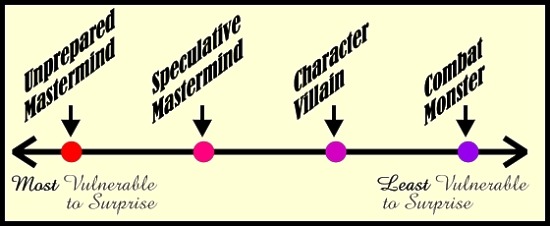
The Mastermind is the most vulnerable to surprises, unless the Villain has done some planning on spec in the region of “What If….”. The Combat Monster is the least susceptible to surprise because he reacts instinctively (for good or ill). The Character Villain lands somewhere in the middle – more susceptible than the Mastermind who’s done some speculating, but less susceptible than an unprepared Mastermind (never mind the Combat Monster).

This is because, when he has a plan, only a Combat Monster at the top of his game can reasonably expect to be better at coping with the unexpected.

This illustrates relative susceptibility to surprise

This illustrates relative susceptibility to surprise

The Character Villain has a relatively straightforward set of questions to answer about any unexpected development. Does this take me closer to my goal or farther away? Does this create an opportunity for me to advance my cause? Does it empower my opposition or create new opposition of significance who may be – possibly temporarily – vulnerable? As a result, it won’t take them very long to come to grips with a surprise. They may be hindered for a while, but this won’t persist. The more unexpected the development, i.e. the bigger the surprise, the longer it will take (as a general rule) for them to get their feet back under them.

Worse still, there’s a fair likelyhood that the Character Villain will have a Combat Monster or two on staff, with the authority to take charge if necessary, completely eliminating his own susceptibility to surprise.

The Character Villain May Be temporarily vulnerable to forced pacing

This same analysis shows why the Character Villain might be temporarily inconvenienced by forced pacing. The big problem is that I have defined this type of villain as Shrewd – and that implies that he gets to the central consequences of a situation fairly quickly. This enables him to take action without waiting for a full understanding of what’s going on. It follows that the first actions in a chain of forced-pacing events, which come as a surprise, can leave the character temporarily vulnerable, but he will quickly adjust and catch up. He may even be able to predict the “next step” for whichever enemy he judges to be responsible and prepare accordingly. It follows that one surprise is never enough – to really bring the Character Villain undone, what’s necessary is a series of surprises, or an orchestrated campaign over the long-term.

The comments about having Combat Monsters at the ready also apply to this vulnerability.

The Character Villain May Be temporarily vulnerable to brute force

The reasoning behind this maxim should therefore be fairly obvious. It doesn’t take long to realize that you’re under attack – and the Character Villain is perfectly prepared to cut his losses, go to ground, and begin to rebuild as soon as he realizes that his position is possibly untenable. Remember – crazy, not stupid. He may not be as quick to react as a Combat Monster (who generally won’t have to think about this situation at all, but will react immediately) – but he won’t be far behind his more instinctive compatriots, and that completely disregards (once again) the potential of Combat Monster underlings, who completely overcome this weakness.

The Character Villain may not be vulnerable to strategy

An orchestrated campaign against a Character Villain is aimed at depriving the villain of resources and authority, one step at a time. The villain’s vulnerability to strategy is therefore a function of his degree of dependence on those resources and authority; the more personal power the Character Villain has, the more closely they come to resemble a Combat Monster – without the vulnerabilities and blind spots.

When a Character Villain has been reduced as far as is possible using strategy, the greatest remaining vulnerability they have is a radical transformation of the environment (i.e. a big surprise) followed by a brute force attack while they are (relatively) vulnerable. Above all, the goal of the strategy is to remove any Combat Monsters whose presence shields the Character Villain from surprise, forced pacing, and direct attack while reducing or limiting the personal power of the Character Villain.

The Character Villain should rarely see through quality deception

When it comes to deceptions, a Character Villain is like a light switch – they are apt to uncover the slightest flaw in the deception and recognize it for what it is. They don’t have the capacity for self-deception that leaves the Mastermind vulnerable to subterfuge and betrayal, and are better at reading people than the Combat Monster (who tends to be better at reacting to circumstances).

Only when a deception deliberately panders and plays apon the central beliefs of the Character Villain does it stand a chance of success if it is less than perfectly planned and executed. It is fortunate indeed for the PCs that this villain type tends to advertise those beliefs, or they would be in real trouble.

It follows that a Character Villain who is also a bit of a mastermind poses the absolute greatest challenge to a party – because the Mastermind can be manipulative and deceptive, with a hidden agenda cloaked behind a more overtly displayed face.

The Character Villain should not be fixated on the mundane

No matter how astute and pragmatic a Character Villain might be, no matter how zealous and obsessive, their greatest blind spot is nevertheless a focus on the abstract and on general principles at the expense of more practical perspectives. This may translate as a fixation on the theoretical or ideal situations and not on real-world practicality. In a nutshell, they tend to be idealists.

While they aren’t susceptible in general to flawed assumptions, when it comes to these idealized philosophies, they very definitely can be blinkered – and an astute opponent may find a way to exploit the resulting blind spots.

Even without malicious exploitation, this blind spot may create enemies where none existed before, or result in the removal of potential allies, or in failing to observe the flaws in allies, or other forms of short-sightedness. That means that it is very important for the GM to consider how this blinkering will manifest itself in the case of an individual. This is one aspect of the Character Villain that is essential to a consistent perception of the villain, so make sure you get it right.

The Character Villain will always deceive when necessary

One aspect of the principle that “the end justifies the means the Character Villain has chosen to employ” is that the Character Villain will regretfully deceive others when he feels it is necessary. That conditional modifier is critical, though – unless there is more than a little Mastermind within the villain’s makeup, he usually won’t decide deception is necessary until it is far too late.

There are also lines the Character Villain will not cross. He or she may be willing to deceive about his immediate focus, or his long term goals, or about how far he will go to achieve those goals – but there is almost always at least one of these about which the villain will be candidly honest. The trick is always to know which one.

The Character Villain should possess character virtues and should be given the opportunity to express them

Character Villains are interesting because they aren’t completely dark in character. If anything, they are more white-hat than black-hat. The more morally-gray the PCs are – and some of them can be pretty shadowy – the harder it is to distinguish the Hero from the Villain – that’s why they are called “Character Villains”.

That doesn’t mean that they can’t be as out-and-out-evil as you want them to be – only that if you accept the fundamental premise of their ideology, they are heroes. To anyone who doesn’t, they can be utterly and completely malevolent.

Above All: the Character Villain Matters Ideologically & Philosophically

Creating a Character Villain inevitably means that the ideology and philosophies held by individuals and groups within your campaign will be explored in the course of adventures. There will be adventures which reveal feet of clay on the part of otherwise good and noble institutions and citizens, adventures in which value judgments will be called into question, adventures in which the differences and similarities of the Character Villain and the PCs will be scrutinized, adventures in which the topics of faith, dogma, idealism, obsession, and compromise are held up for inspection. There will be a heavier focus on roleplaying and a slighter focus on meaningless fights. There will be a lot of meaning and introspection, and your players will be directly challenged to define, understand, and work with not only what their characters believe but what they believe. Used insensitively, a Character Villain can offend someone so strongly that they will have difficulty continuing within the campaign, as it is much easier for in-game philosophical challenges to strongly-held views to spill out into the real world. Sensible GMs will strongly distinguish between the views that may be held by a Character Villain and their own – usually by prominently placing an advocate for the other side within the campaign.

Consider the potential for offense with a Villain who so strongly believes that abortion is wrong that he is prepared to incinerate any city containing an abortion clinic with weapons of mass destruction. Or who so strongly supports the right to choose that he targets any right-to-life believer or potential believer for Assassination.

If you, as GM are not ready to cope with the potential for disagreement on a subject within the confines of your game – and the possible severing of friendships that can result – DON’T use that subject as the central tenet of a Character Villain. Either avoid the subject entirely, or use something else as a metaphor for the forbidden subject – tattooing or body piercing, for example. Take some of the emotional heat out of the conflict as expressed within the game, and resist any temptation to lecture or preach. An arguement over someone’s real-world personal beliefs only ruins everyone’s fun.

Scratch the Surface Of A Hero

Which brings me to the construction of a Character Villain – not mechanically, but conceptually. The most important facet and starting point from which everything else should flow is what the character believes. Whatever it is, the character should believe themselves the hero and champion of what may be an unpopular cause – they have to believe that they are right and that extreme measures are necessary.

Almost by definition, this demands a twist of some sort – either blatant or hidden. Unless the beliefs the villain holds are unusual in some respect, the villain himself risks falling flat – when there are so many interesting choices that can be made, why take that risk?

The Winners write the History

With few extremely rare exceptions, no-one ever thinks of themselves as the villain. An individual may sometimes believe that they have the right to satisfy some desire, or that no-one is really hurt, or that they are entitled to carry out their actions. Even a contract killer will justify his murders in terms of loyalty to his “extended family”, or a sense of entitlement. Throughout human history, conflicts have had people on both sides that thought they were right. Usually, the winners of the conflict dictate who is seen as the good guys and who wore the black hats; only with long hindsight (and not even always then) can a more balanced perspective be seen. Even the Nazis thought they were right.

The second key ingredient in creating a credible Character Villain is therefore his motivation. What is it that he believes empowers and authorizes him to “right this wrong” or whatever it is that he is trying to achieve? What implications does that source of authority contain for lines the character will not cross, lines that he will cross only reluctantly, lines that he will only cross with respect to certain groups? What questions of morality and ethics and philosophy does the character pose?

This is occasionally a chance to build an additional twist into the character. Consider the zealot who believes that an enemy is needed to espouse a certain perspective that is considered anathema by common society and lose, martyring himself for the greater good? Motivations can be a very subtle and complex thing, and can impart serious depth to the character. Be careful not to overdo this approach; save it for when it really adds a new layer of complexity and impact to the character and the campaign.

Birthplace of an extremist

The next step is to decide where the Character Villain comes from, and what impact this birthplace has on his personality and beliefs. To some extent, this should be an informed decision, founded on the choices already made.

Once again, there is a limited capacity for the occasional twist in the character at this point, by selecting a birthplace that people would not normally expect, marrying an extreme viewpoint on one subject with an unexpected cultural twist.

Explore the Philosophy

The fourth stage in developing the Character Villain is to thoroughly explore the philosophy or ideology of the character. What actions does it mandate and what does it prohibit? What otherwise unacceptable actions become possible to the character’s conscience as a result? What will his ‘blind spots’ be? And, in particular, where are the flaws and how can they be protected from undermining the character?

Touches Of Mastermind, Touches Of Combat Monster

Examples of the Character Villain usually have one or more secondary aspects which may fall into the other villain categories. This step of the character design is concerned with determining how and why this particular Character Villain is going to be effective, and determining just how effective he is going to be. What is it about this character that is going to make him a credible threat?

Preserve the Mystery

You should now have everything you need to complete delineating the personality of the Character Villain. While doing so, you should carefully assess how obvious the various aspects of the character are going to be – remembering that for every aspect that you choose to conceal, an adventure plotline will be needed to reveal the hidden truth. If you can’t think of one, at least in general terms, you might be better off making that aspect of the character more obvious. Above all, you want to ensure that at least some aspects of the character remains a mystery throughout the early encounters. You might choose to conceal the character’s true objectives, or the reasons for his fanaticism, or the true extremes that he is prepared to countenance, or his motives, or his origins, or his allies. You will usually want to conceal at least some of his capabilities and resources.

The Character Villain As Pawn

Masterminds have a love/hate relationship with the concept of Character Villains as lieutenants and pawns. Because of their ideology, they can often use the Character Villain to conceal what the Mastermind is up to – but there is the constant risk that the manipulation will be exposed. Combat Monsters are more suspicious of Character Villains because of their unpredictability, but will also consider the possibility of using one as a smokescreen for their own activities.

Character Villains will rarely have a Mastermind as a subordinate, though they may accept subordinate Character Villains who have a strong Mastermind capacity. They will quite often have Combat Monsters as subordinates, because the two compliment each other so strongly.

Making the Character Villain Great

With the basic recipe perfected, it’s time to conclude this article with a few thoughts on how to make the Character Villain exceptional.

A Noble Cause? Justifiable Arrogance? The Power Of The Dark Side? Or None Of The Above?

Here are a couple of Character Villains that are accepted as exceptional.

Magneto wins allies because his cause is noble, enabling him to cross the line between hero and villain as necessary. There are clear analogies between the plight of Mutants in his environment and racial prejudice in general; but his standpoint also touches on positive discrimination and “equal opportunity” and several other social issues. What’s more, he and his followers are usually fighting for their lives – if you accept his basic tenet that the Human Race and Mutants are at war, and his World-War-II opinions on the subject of War Crimes and the justifiability of such extremes, his regular excursions into villainy are completely understandable. The character would probably be more consistent if he unconditionally opposed acts of Genocide, but a delicious irony would be lost, and the character’s effectiveness as a villain would be substantially reduced. There is also an element of tit-for-tat about his approach – what was done to him and his people justifies, in his mind, the use of the same tactics on his new enemies.

Doctor Doom is a European Noble from an essentially middle-ages political environment, in which the monarch has absolute power and authority. He may demand total loyalty and obedience from his subjects, but he also shelters and protects them from stronger neighbors; with a population so unprepared, every attempt at democratization is doomed to failure. Furthermore, their economic survival and competitiveness is inherently bound to his presence and technological sophistication. Doom is very definitely the lesser of two evils so far as his people are concerned. He also has a streak of nobility in his makeup; if approached with what he considers appropriate respect, he is quite capable of working in collaboration with heroes to protect the entire globe because his own little patch is part of it – though (in general) he leaves such menial work to commoners like the Avengers. Most of his hostile moves are personal, directed at the Fantastic Four and Reed Richards in particular.

Darth Vader initially appears to be the ultimate in extreme evil. But even in the first Star Wars there are hints that there is more to him than meets the eye. His relationship with his former teacher, Obi-Wan, acknowledges that his mentor was once stronger than he, implying a vestigial lingering of respect. Vader may have been “seduced by the Dark Side of the force”, but he is clearly doing what he thinks is right – a characterization that remains consistent throughout all six movies. Indeed, compared to the villainy of the Mastermind who is pulling his strings – the Emperor – Vader is clearly a dark shade of gray and not complete black, as shown in the course of Return Of The Jedi. After the fact, it is even possible to see a hint of “the good within him” when he is confronting Lando Calrissian – “I am altering the terms of our agreement. Pray I do not alter them further.” There are clearly advantages to the Empire in taking over the station completely, but Vader stops short of doing so. In the third of the prequels, Revenge Of The Sith, it is clearly shown that the pre-Vader Annakin Skywalker has an absolute belief that he is doing exactly what he believes to be right. From his point-of-view, then, Vader is a Character Villain – one with a large serving of Combat Monster and relatively little of the Mastermind about him.

These are exceptional villains because they are strong characters first and villains second. In many ways, it’s that simple.

Character Villainy is all about Consequences

The GM should frame his design of the Character Villain in terms of the consequences – those that the Character Villain himself expects to result, those that the PCs can expect to result, and those that really will eventuate. The Character Villain is a villain because he cannot see the harm that will result from his actions, or because he excuses or justifies them as acceptable. This consequences triangle should always be borne in mind by the GM.

I have never seen this demonstrated more clearly than in the extremely-readable ‘Dreadnought!’ by Diane Carey and its sequel, ‘Battlestations!’ (NB: These web pages might not display correctly with Internet Explorer).

Primary Motivation

Give a Character Villain a simplistic or weak primary motivation, and no matter how interesting the rest of the character might be, that villain will fall flat.

One of the more memorable creations that I unleashed in my previous Zenith-3 campaign was a gentleman named Torquemada by the PCs. It was his belief that planetary civilizations should be tested to the point of destruction according to an arbitrary standard of Piousness and Moral Purity – those that succeeded in driving him away earned the right to survive (until his eventual return), while those that failed to do so were eliminated, leaving room within the Galaxy for a better, purer race to expand. So far, of course, none had met this impossible standard of purity. In the course of the second encounter with the PCs (the first was not resolved definitively, from Torquemada’s point of view), it was discovered that his own society had doomed themselves to environmental destruction through corruption; Torquemada (under whatever name he was using at the time) created a device to restore the planet’s health, but an unplanned side-effect had destroyed the planet – and imbued Torquemada with his power and virtual immortality. He became obsessed with the notion of cleansing the universe of the impure because the thought that any other species could be more worthy than his own dead race was impossible to tolerate. In other words, he sets an impossibly-high standard out of guilt for the destruction of his own race, blaming them for what transpired and not himself. Since nothing can bring his race back, he is an absolutely implacable foe – yet, at the same time, he is deeply religious and peace-loving. This sensitivity is what makes him feel so guilty over his error, and makes him the Character Villain that he is. (That rematch was also not concluded to his satisfaction; he sees the PCs as the equivalent in his faith of the Antichrist, preventing him from properly testing the planet they happened to be living on at the time out of evil, villainous, corrupt motives. Everyone knows that there will be a return visit sometime….)

Resolution Modes

When creating a Character Villain, the GM should give thought to how he wants the conflict between the Character Villain and the PCs to be resolved, in general. Can the Character be reformed? Can the conflict be resolved without resorting to extreme measures? Or is the Character Villain implacable? What is the payoff with this character in terms of the campaign?

If the character is not to be reformed, the GM needs to ensure that the root motive of the Character Villain’s actions can never be resolved, deflected, or mitigated. Torquemada’s burden of guilt cannot be assuaged without bringing his people back from the dead – itself an action that he would find vile and corrupt. Since he cannot be reasoned with, cannot be bargained with, cannot be stopped in any other way, the only solution is a violent end for him or the PCs. It’s him or them, and that’s all there is to it. And yet, by his own lights, he is a moral reformer, a crusader for good.

Conclusion

Character Villains have a richness of characterization and a depth that neither the Mastermind nor the Combat Monster can touch. That generally means that they will form a larger part of the campaign in which they occur, simply because more time is required to fully plumb their depths. They can be more work to set up – but because they last longer, the return on investment of the GMs time is usually higher than with any other type of Villain.

A Great Villain is a fantastic character first and a villain second. Nowhere is that more true than in the case of the Character Villain; hopefully, this article (and this series) has given the GM reading it the tools they need to populate their campaigns with exceptional and memorable villains.

Comments (12)

A year in retrospect, Another in prospect


The vagarities of the calander and the publishing schedule here at Campaign Mastery have resulted in the need for an article to be posted at-or-about Midnight on New Year’s Eve – Australian time. the subject matter that this post should deal with seemed fairly obvious to me, as a result of that coincidence of timing.

It’s been a year of Highs and Lows, (in general terms) the same as any other. But when the specifics are examined, 2012 was both far better and far worse than it could have been.

On the plus side of the ledger there was the incredible ENnie nomination, and a number of articles of which I can be both proud and satisfied. One the negative, Johnn called stumps on his involvement here at Campaign Mastery, and there was the passing of my long-time friend, player, and supporter, Stephen Tunnicliffe.

2012 in Site Statistics

the statistics for the year make for some startling reading. (Not counting this post) there have been 101 published in the course of the year – that’s a couple more than there might have been because I chose to upload extras In July regarding the ENnie nomination. those 101 articles total 440,447 words – if I ignore the extras and focus on the content-driven articles alone, an average of about 4487 words each.

Johnn provided a half-dozen, Michael Beck 4, and other contributors 3 of those articles – leaving me with the lion’s share of the writing, some 88 articles. the shortest article – excluding the ENnie announcements – was my article speculating on the future of the hobby (The Future Is Bright – The coming boom in RPGs) weighing in at only 925 words in January. the longest (by a slender margin) came in April – 11,524 words in part ten of the history of the alternate-earth (The Imperial History of Earth-Regency, Part 10: the Crumbling Of Icons – 1980-1997 continued) which serves as the setting of my superhero campaign. Every one of them worth reading, I assure you!

In response to those 101 articles, there have been 594 comments and pingbacks – an extremely gratifying average of over four per article. these have resulted from the visits of 104,005 visitors – of whom 33.5% were from repeat visitors.

Unsurprisingly, 57.5% of those visitors come from the US. 7.15% from Canada, 6.2% from the UK, 4.04% from Australia, 3.58% from Germany, and 1.61% from – wait for it – Brazil! Hello to all my Brazilian readers!! Also in the 1% range are France, Italy, Sweden, the Netherlands, and Spain. We also had more than 500 visits from Denmark, Poland, Russia, Finland, the Phillipines, and New Zealand.

But when I look at the traffic statistics, it’s the other end of the scale that stands out the most to me. the oddities, the places where I would not have expected to generate any traffic at all. 121 visitors from China. 62 from the United Arab Emirates. 54 from Lithuania and the same from Slovakia. 52 from Puerto Rico, and 34 from Saudi Arabia. 22 from Bangladesh! 15 from Ethiopia, and from Nigeria, and Sri Lanka, and Trinidad & Tobago! NINE from Mongolia, 7 from Zimbabwe, 5 from Cambodia – three from Nepal, of all places!

It only goes to show how universal Gaming is, as a hobby. It’s everywhere!

Milestones

In July, we hit a couple of milestones.

  • 300,000 visitors,
  • 550,000 page views
  • 37% returning visitors
  • 3300+ comments
  • and 386 posts.

August 16th brought our 400th blog post, a milestone in anyone’s language.

Currently, those totals read:

  • 355,912 visitors,
  • 645,275 page views,
  • 36.9% returning visitors,
  • 3,585 comments,
  • and 438 posts (not counting this one).
  • Oh, and 509,683 spam comments zapped.

Extrapolating from the 2012 average of 4487 words that comes to a massive 1,965,000-plus words – but earlier posts were much smaller, about half the current average – so I would expect the grand total to be closer to one-and-a-half million words.

1.5 million words. I can’t get over that number.

this is the result of just over 4 years of solid effort – but the rewards are obvious!

Looking Ahead

So, what can I expect – and therefore, what can you expect – in our fifth year here at Campaign Mastery?

In the next twelve months, I am looking forward to:

  • our 500th post
  • our 4000th comment
  • our 400,000th visitor
  • close to 750,000 page views
  • our 2,000,000th word in an article.
  • We’re also about to hit a monthly average of 10,000 visitors (now at about 9,300 and growing about 6% per annum)!

All of which is incredibly satisfying, and I can’t thank our readership enough!

Enough Stalling – talk about the content to come!

Change is good for the soul, or so they say. Well, good or not, it is inevitable, and there are going to be some small tweaks to the material that I’m going to present in the course of 2013.

the Sequel To Assassin’s Amulet and other e-books

the current schedule of publishing here at Campaign Mastery has left me with minimal time for Game Prep (fortunately I don’t usually need a lot) and none at all for working on these publications – and they are what is supposed to be funding all of this. Heck, I haven’t even had time to look after Site Admin properly! Clearly, something has had to give.

That something is the appearance of a new article on Mondays.

The original intent was for at least half the Monday articles to be guest posts from other GMs of my acquantance – but that simply hasn’t happened. The second solution tried was limiting the size of the monday posts to small articles that I could knock out relatively quickly – the 11,000 word monsters that have appeared over the last couple of months show quite clearly that THAT hasn’t worked. So it’s time to try a different solution.

Orcs and Elves

But I don’t intend to go to a once-a-week publishing schedule – instead, I’m going to be taking the brave step of doing my game prep (and campaign background development) in public. this is something that I’ve been keeping in reserve as a measure to be enacted if necessary for quite some time. So, now, I’ve decided that the only way to get everything done is to do two things at once – and this plan does just that.

I’ve been dipping my toe into the waters in this respect for a while now, with the “On Alien Languages” series and the “Imperial History of Earth Regency” series – but they have significantly more original writing involved than the content that will be on offer under the new monday banner, at least for quite a while.

What I’m going to be starting with is a background document for my Fumanor Campaign which reveals to the players for the first time, the true origins of Elves, and Drow, and the true relationship that Elves have with Orcs, and a great deal other such things. the first part of this series will start a week from now, with some context and background material to help readers interpret what’s to come – because I don’t intend to stop and explain anything unless I absolutely have to.

So why might Campaign Mastery’s readers be interested? Well, it’s full of interesting plot twists and ideas that can be parachuted into other campaigns, for a start. then there’s the value in seeing how I go about such things – a real-life example. Hopefully it will also make interesting reading in and of itself. And finally, I would like it to set for each GM who reads it a standard to aim for – an indicator of the degree of conceptual prep that I consider necessary in a major campaign.

Thursdays are the new Mondays – sometimes

Everything that has, until now, been appearing on a Monday will now slot into the schedule of articles to appear on Thursdays – starting this week with the third installment of the series on Villains. there are also articles on Language, on Video Games, and on Strategy and Tactics. And that’s just the start of the year!

the More things Change

Some things aren’t going to change – like my dedication to using this website to improve the games of others. the primary purpose of Campaign Mastery isn’t going to change. So bring on 2013 – and let’s see how much fun we can have!

Comments (6)

Making a Great Villain Part 2 of 3 – The Combat Monster


This entry is part 3 of 5 in the series Making A Great Villain

A hero is only as good as the villains they fight – but what makes a Villain great? It’s not exactly an easy question to answer, is it? I have three basic answers, for three different kinds of villain – the Mastermind, the Combat Monster, and the Character Villain. In this part of the article trilogy, I focus on the Combat Monster.

It’s easy to make a combat monster. Just throw critical combat values at a character sheet until you have something unstoppable. It’s also easy to make a combat monster boring.

Heck, all that’s required to qualify as a combat monster is:

  • The ability to damage any opponent; and
  • Enough resistance to damage to outlast his opponents, or somewhere close to it.

    Think about that for a minute. It’s a recipe for round after round of “Roll to hit. You do damage. Roll Damage. It’s not enough. He rolls to hit. He hits. He rolls damage. It’s not enough. Next Round.” Repeat endlessly.

    Talk about Dull.

    The mechanics of a Combat Monster

    Divide the total hit points of the PCs by the number of rounds you want the combat to last.

    Identify the highest Defense (AC in D&D, DCV in Hero System, etc) amongst the PCs. Decide what chance to hit this character you want the combat monster to have. Applying the basic “To Hit” math for your combat system tells you what attack value – with every bonus etc added in – you want the Combat Monster to have.

    Divide the party-HP-/-Rounds value by this percentage, shown as a decimal. That’s how much damage the combat monster should do in a round, maximum.

    Identify the highest attack value amongst the PCs. Decide how often you want the combat monster to BE hit, as a percentage. Work the basic “To Hit” math for your combat system to identify what defensive total you want the combat monster to have.

    Multiply the total hit points (if they all hit and do maximum damage) that the PCs can inflict in a round by the number of rounds you want the combat to last, then multiply by the percentage (expressed as a decimal) of that maximum chance to hit. That’s how many hit points the Combat Monster should have.

    Now, the tricky bit: Decide how much of the combat monster’s attack bonus is magical/tech enhancement and how much is raw combat ability. Give the Combat Monster items that confer that magical bonus.

    Then, using the raw combat ability result as a guide, determine how much of the Combat Monster’s defense is magical enhancement, armor, etc, and give the Combat Monster the required items.

    Make sure that the PCs can’t take the villain out with Death Spells, a Surprise Round, or any other all-or-nothing tricks, and turn him loose. This blueprint is both elegant and simple. It is not designed to be consistent with best practice in terms of game mechanics, but rather to be functional from a game-play point of view. Depending on the values chosen, it can give one side or the other a clear advantage, but leaves both operating ‘in the ballpark’ by tailoring the requirements to the real world story requirements of the GM.

    Everything else is style. And it’s style that’s desperately needed, because at it stands, the Combat Monster is also as dull as mud. This article’s function is intended to make your combat monsters interesting again.

    Profile Of A Combat Monster

    Let’s start by thinking a little about the style a Combat Monster should display, both on the battlefield and beyond it.

    The Combat Monster should seek an immediate advantage

    In battle, the Combat Monster should look for tactical advantages. His first priority should be to improve his own position; his second should be to deny advantages to his opponents. Since his abilities have been measured against those of the opposition and values determined accordingly, this can make or break the encounter’s success from his point of view.

    The same principle should carry over into any non-combat situations. The Combat Monster should always be looking for an immediate edge in whatever situation he faces. His philosophy is that “the long term” is simply an accumulated series of “short terms”, and it’s a philosophy that can carry him a long way. It’s also a major flaw in the villain archetype, for obvious reasons.

    The Combat Monster should have an ambition

    It’s important for the GM to recognize the distinction between an Ambition (Combat Monster) and a Goal (Mastermind). The ambition is something that the character wants to achieve but which he may not see a clear path to achieving; a Goal is an end-point with a definite road to successful completion. The Combat Monster is the type who is content to advance one step at a time and then look around for the next step. If he paints himself into a corner where there is no next step available, his response will be to shake things up somehow and reassess the situation. Instability is his friend and the mastermind’s enemy; he doesn’t care about being able to predict what will happen in a few weeks or months or even years – he cares about today, tomorrow, and – at most – next week. The mastermind prefers stability because it makes situations more predictable – and that works to his advantage.

    The Combat Monster should be cunning, not smart – and not dumb

    When you live by your wits, they had better be sharp. A Combat Monster may be simple, but should never be mistaken for stupid.

    With the Mastermind, we could use a retroactive INT roll to assess whether or not he had thought of something, and fudge the combat/tactical situation accordingly. Unfortunately, there is no stat for “Cunning”. It’s a little bit INT and a little bit WIS and a lot neither of these. This is where a technique that I proposed in Look beyond the box: a looser concept for NPCs shows its power. Instead of fuffing around trying to decide how much of an INT score represents cunning and how much of a WIS score, we can simply designate a new characteristic – “Cunning” – and set it to whatever we want.

    When confronted with a situation in which we, as GMs, don’t see an immediate advantage to be had, simply pick one off a list of such and roll a “Cunning” check to see if the Combat Monster can think of a way to achieve it. Pull strings, retcon, and employ narrative as necessary to deliver (and justify) the end result if he makes the roll.

    This is an extremely low fudging that simulates the ability that we want this character to have. We can even apply modifiers to his chance of success based on the degree to which his options have been closed off and the difficulty of achieving the advantage that he’s after. Every player I’ve ever encountered has been fine with this approach, especially if I am willing in principle to extend the benefit to their characters if they come up with something outside the system.

    The Combat Monster should be obvious, not subtle

    The more complicated a plan is, the more things can go wrong with it. Simplicity and Elegance should be the watchwords for this type of character. Hiding whatever it is that you are trying to do takes time, effort, and resources – all of which can be better used in achieving something else. Everyone’s going to know what you were up to when it’s all over, anyway, so why waste time trying to hide it?

    That’s not to say that Combat Monsters won’t try to surprise their foes – surprise is a legitimate tactical advantage, and so is misdirection. The Combat Monster won’t bother trying to hide the fact that he’s preparing to do something, it simply won’t necessarily be clear what that something is and who it is directed against.

    Another aspect of seeking the advantage is being good at assessing people. The Combat Monster should know who amongst his servants, supporters, and lackeys is best at deception, and will use their talents. He won’t trust them, because they are good at deception – but he’ll use them – and have someone else watching from the shadows in case they betray him.

    The Combat Monster should be direct, not manipulative

    You should always have a fair idea of where you stand when dealing with a Combat Monster. That said, they can sometimes be inconstant – if they see a short-term advantage in removing you from the picture, you’re in trouble. With them it’s always “What have you done for me lately?” – and you’d better have a good answer at the ready.

    The same principle applies to every activity controlled by the Combat Monster. “Buy”, “Sell”, “Take” – these are about as complicated as their trade agreements get, for example. None of this complicated stuff of selling something before you’ve actually bought it, or holding options on future purchases – if they want it, they will buy it or take it, at the time. They put their trust in solid reality, bricks and mortar – not complicated contracts and instruments.

    If it can’t be summed up in one word of two syllables or less, it’s too complicated an arrangement for a Combat Monster’s tastes.

    The Combat Monster should have an array of flunkies

    This is a fairly obvious one, but there’s a sting in the tail – why do these “trusty lieutenants” work for the Combat Monster? With a Mastermind, it’s easy to justify anyone working for them because they have been manipulated or deceived or made promises that sounded good at the time – so much so that the question never arises. Combat Monsters are different, and the answer to this question is one of the key parameters that distinguishes one from another. This guy’s servants work for him because he’s generous with the booty. That One’s servants work for him because they are intimidated by him. The Other One’s servants work for him because so far he’s never lost. And those are just a few of the possible answers. Deciding why his troops are loyal to any given Combat Monster is a fast-track into the personality of the Villain.

    The Combat Monster should be wary of unusual sources of information but willing to use them – so long as he controls them

    Combat monsters like things to be straightforward. If a situation is too complicated, they will seek to simplify it – brutally, if necessary. It follows that they will mistrust the exotic and unusual, because there are always complications involved; however, it goes against their nature to turn away from ANY tactical advantage, no matter where it comes from.

    The caveat is also significant. If the Combat Monster doesn’t control the exotic information source, someone else does, and that means that the information is being fed to him in service of someone else’s agenda. Combat Monsters generally refuse to be cat’s paws for anyone – except another, stronger, Combat Monster. Does that mean that a Combat Monster will never work for a Mastermind? Of course not. A Combat Monster can have the deepest respect and admiration for the abilities of a Mastermind, can even be in awe of their ability to deal with complex situations and tug on just the right string to make things happen. It’s quite easy for a Combat Monster to see such an arrangement in terms of “I just have to make sure that I get my part right” while the Scheming Plotter handles the complicated stuff – so long as the Combat Monster gets whatever rewards have been promised him (and they WILL want specifics)..

    The Combat Monster should have a consistent personality

    One of the biggest mistakes that I see people make when they construct a Combat Monster is focusing so much on what they can do that they neglect to individualize them as a character. If the Combat Monster is never to do anything other than face the PCs in battle, and has never done anything more than that in the past, that’s all you need; but as soon as you involve questions of reputation or personal style, the shortcomings of this approach become felt in the most painful way possible.

    If you ever want the Combat Monster to be more than a stock villain who exists to do nothing but fight, they should have a personality and that personality should impact everything they do, from the way they treat underlings to their style in battle.

    The Combat Monster should be shortsighted most of the time

    I’ve already suggested that the Combat Monster should focus more on the short term than on the long term, and suggested that this is as much a flaw as an advantage. This is the other side of that coin – most Combat Monsters are the “one day at a time” types who consider long-term planning to be waste of time. Circumstances are sure to change between now and then, making the plans irrelevant, in any event.

    The Combat Monster should take bold risks

    The one thing few Combat Monsters can be accused of is timidity – and they are likely to treat any such accusation as justifying an immediate and violent response. I make the exception because a combat monster who is – by preference – peaceful and who doesn’t like to fight (but who is naturally gifted in that direction) can be an interesting personality profile.

    There is, once again, an important distinction that must be made and emphasized. A Combat Monster will take a Bold risk, not a Stupid risk. When they make a bold choice, they will have a clear idea of the benefits of doing so, and the potential dangers. They will also have a strong notion of the best ways to minimize the risk and the best ways of maximizing the likelihood of success.

    Audacity may be the stock in trade of most Combat Monsters, but that Audacity will be controlled and directed, focused toward achieving their Goals.

    The Combat Monster should be Legendary

    Once again, I have left the most difficult-to-explain entry until last. This entry describes how others should relate to the Combat Monster, in other words what the PCs can learn of him in advance of a confrontation.

    In the first article of this trilogy, I stated that the Mastermind should have a mythic quality when he is spoken of. The Combat Monster should be Legendary, and the distinction should be clear in the mind of the GM. Where the Mastermind reeks of mystery, the Combat Monster should have a long history of fantastic campaigns, epic struggles, and mighty victories. These should swell in the retelling until they describe a larger-than-life figure – an Epic Hero in magnitude of accomplishments, if not in personality or drive.

    Strengths, Flaws, and Characterization

    The standard profile of a combat monster should apply to most examples, and exceptions should be crafted very carefully by the GM, as any variation on these common elements will have significant repercussions in other aspects of the character. Having considered that profile, let’s now consider the ramifications for the Combat Monster in terms of personal Strengths, Flaws, and Character.

    The Combat Monster should not be vulnerable to assumptions

    The Combat Monster should make very few assumptions, relying on his ability to improvise a solution. His directness should compel him to “find out for himself” rather than making guesses, however informed they might be. He is generally quite willing to throw a flunky to the wolves just to see how they will react, and will often have a number of servants recruited (though they don’t know it) for just this purpose. This can earn the Combat Monster a reputation for ruthlessness, though some may offer great rewards for success in these “impossible” missions.

    The Combat Monster should not be vulnerable to surprises

    As a general rule, Combat Monsters deal with the situation as it presents itself, moment to moment. That makes them very hard to surprise on the battlefield (I’m talking about characters using unusual tactics or being unexpectedly tough here, not about them being immune to surprise rounds if those are a feature of the combat system that you are using). They tend to take such “surprises” in their stride, adapting their combat techniques and targets accordingly.

    That doesn’t mean that they won’t gather and employ intelligence about a foe they know they will be confronting – just that they will adapt quickly should the encounter not follow the script.

    The Combat Monster should not be vulnerable to forced pacing

    Masterminds are vulnerable to third parties trying to force the pace of events. They need time to mull things over and integrate changes in circumstance and environment into their thinking. Combat Monsters live from moment to moment, adapting quickly to any changes that may take place; forcing the pace tends to be playing to their strengths. They are more vulnerable to careful planning from the other side, a planned counteraction ready for whatever move the Combat Monster should make.

    The Combat Monster should not be vulnerable to brute force

    Again, brute force – even seemingly overwhelming force – is playing to the strengths of the Combat Monster. Sufficient force can overcome one, but the level of force required is almost always higher than expected.

    The Combat Monster should be vulnerable to strategy

    Because they live by their wits, they are more predictable (and hence a plan can be more easily formulated to deal with them). This also makes them more likely to come up with the one move that has not been anticipated, especially if they recognize that they are up against a carefully-orchestrated plan!

    The Combat Monster should rarely see through deception

    A fine distinction should be made here. The Combat Monster should be quite capable of recognizing an obvious deception, and should often recognize the fact that they are being deceived the rest of the time – but they are not so adept at penetrating a more subtle deception to the real motivations and plans behind that curtain of deception.

    Furthermore, unless the deception is very carefully planned, it may fall flat; the tactical nouse of a Combat Monster should enable him to focus his attention quickly on any weak points or incongruities in a facade, and while the Mastermind may invent spurious or complex explanations for the discrepancy, the Combat Monster is more likely to treat it as a signpost to the truth.

    The Combat Monster may be fixated

    Being strongly goal-oriented, it is actually often easier for a Combat Monster to become fixated not only on their overall goal but on what they perceive as ‘the essential next step’, or upon an individual, organization, or circumstance that they see as obstructing them in the attainment of their goal. Nor are they averse to targeting something or someone who may eventually become such an obstruction, removing them ahead of time at a moment of (possibly induced) vulnerability, and before the target has any notion of why they are being targeted.

    The Combat Monster will not bother to deceive

    It takes a lot of effort to deceive someone effectively, and a deception might not be all that effective, anyway. Combat Monsters generally consider most such efforts to be a waste of time and energy that can be better spent focusing on and dealing with the next problem on their plates.

    The Combat Monster may possess character virtues

    Another common mistake is making Combat Monsters cartoonish in their monomanias – almost every character should have some virtue or they could not have survived long enough to achieve their current status. However, such virtues will usually be secondary to the attainment of their goals – the Combat Monster should be willing to do whatever is necessary to get the job done, including sacrificing their principles. Their primary role is that of a villain, after all.

    When confronted with a superior force, the Combat Monster may well cooperate with past and future enemies. Once again, a short-term alliance under such circumstances is a better tactical choice than both sides falling before a common enemy. Combat Monsters tend to be far more pragmatic than Masterminds.

    Above All: The Combat Monster Matters Indirectly

    The Combat Monster should make a difference in the world simply by existing. His reputation as a combatant, a leader, and an object of terror should stalk the world, casting a deeper and broader shadow than the combat monster him-, her-, or itself. Armies should change course based on rumors of the Combat Monster’s position and intentions. Think of the reputation and influence of Baron Von Richthoffen in World War I and model your treatment of the Combat Monster accordingly.

    Combat Monsters – trickier than they seem

    And so we return to the question of making the Combat Monster interesting. I’ve already looked at the basic ingredients, mechanically, of setting up a combat monster, but those issues were all related to ensuring that the Combat Monster was both effective and did not outlast its welcome in Combat; now it’s time to delve a little deeper.

    Vulnerabilities & Protection

    One of the best ways of creating interest around the Combat Monster is to give him a greater vulnerability to one particular uncommon type of attack, or to attacks in a particular environment or setting, and increase his protection from, or resistance to, most other types of attack. This can mean that the most effective combatant is not the usual front-line fighter, so adopting this approach works best when the Combat Monster is supported by numbers of additional combatants upon whom that usual front-line fighter can vent his frustration.

    Of course, there should be clues known to the PCs, or becoming apparent as the combat proceeds, as to the nature of the vulnerability, and the origin and existence of these characteristics should be key contributors to the development of Combat Monster’s personality and perhaps to his reputation. The latter can be deceptive, however – if I were a Combat Monster with a vulnerability to Kryptonite, I would make sure that there were plenty of stories circulating out there about a glorious victory while bathed in the stuff!

    As a general rule of thumb, I find that the best approach – and one that makes an immediate impression on the players – is not a numeric adjustment or cap to the results, but an increase or decrease in the normal damage die size. There are few game systems in which this approach is canonical, but it works better than anything else I’ve tried.

    Because it doesn’t increase the overall damage done by very much, this approach means that no other adjustments are needed to the characteristics we’ve already worked out; but the relative improvement in the effectiveness of attacks that exploit the vulnerability is extremely noteworthy and dramatic.

    For example, if the normal attacks of the normal combat leader do d8 damage, reducing them to d4 is a major change. At the same time, if the normal attacks that exploit the vulnerability are d4 and they suddenly do d8, players will definitely sit up and take notice.

    A related alternative
    Another approach is to make the target relatively invulnerable to anything until something specific takes place – burning a portrait, smashing a statue, forcing an alien back to its native dimension, or whatever. Again, there should be clues given to the players ahead of time; it feels too contrived if these clues are discovered in the course of the combat. Leave revelations at that time to the subject of interpreting the clues that have been offered.

    The Metered Response

    Another approach that definitely gets a player’s attention is the Metered Response, also known as “Tit For Tat”. Under this proposal, the damage the NPC inflicts is divided into two unequal portions – the Combat Monster is subjected to the smaller portion, and the remainder is inflicted by his next attack. On a combat round in which the Combat Monster suffers no damage because the PC attacking him misses, and he only inflicts a trivial level of damage, the relationship between the effects – only suspected until that point, at best – becomes relatively obvious.

    Why these approaches work

    All three of these options work because they completely alter the usual tactical paradigm. They pose an original challenge to the PCs, and to the players, in which the stock responses are ineffective. This always makes the encounter more interesting.

    Customizing Responses

    Functioning in the abstract is all well and good, but for maximum impact, the Combat Monster should be customized specifically for the party they are to face in battle. I generally start by looking at the party’s usual combat routine, their default choices; I then consider each party member’s most powerful attack, the options they exercise when their normal choices are thwarted and they are feeling in serious jeopardy. Ensuring that the Combat Monster is protected from these choices ensures that there are no easy answers.

    Threading The Needle

    It’s also very easy to go too far. GMs should always be aware that the balancing act of constructing the perfect Combat Monster is akin to threading a needle at a distance of thirty paces!

    There is a failsafe option that I employ whenever it becomes clear that my latest frankensteinian creation has gone too far – the ‘Combat Balloon’ principle. Rather than making the customized defenses a permanent capability of the creature, I retroactively adjust the concept to mimic that of a balloon that can only contain so much before bursting – taking the defense with it, in whole or in part. Additional control can be achieved using the “in part” solution with multiple “balloons” but this is not recommended – it smacks too much of the GM being over-defensive of his creation, and increases the frustration levels of the players disproportionately. Better to bite the bullet and give the players the satisfaction of having overcome the defenses.

    Nor sure this be done all the time – these are exceptional strategies for use in the creation of exceptional foes.

    The Combat Monster as Guideline

    Elements of this article are of utility with greater frequency, however. I will often run through the calculations described under “The Mechanics Of A Combat Monster”, above, then use the results as an approximate guideline in choosing an encounter from the Monster Manual or whatever other source is appropriate to the campaign. This has the great advantage of tailoring a combat to fit the combatants, instead of matching some abstract and arbitrary standard.

    Making The Combat Monster Great

    And so I come to the final section of this article – how to make the Combat Monster Great, how to make the encounter not just memorable but unforgettable. There are four essential principles that when applied, will achieve this very desirable objective.

    Make the Combat Monster unique

    Step one is always to ensure that the Combat Monster is something original, something unique, something unlike anything else you have ever used in this campaign or any other. Unlimber your creativity and give it full vent!

    Make the Combat Monster Matter

    Make sure that the existence of the Combat Monster has a purpose and a relevance beyond just the encounter, and that the encounter will have repercussions and ramifications that extend beyond the party. The Combat Monster should be a central pillar of at least part of the campaign, and the themes of the campaign should be reflected in the concepts and history of the Combat Monster.

    Create the Legend, then create the Combat Monster to live up to that legend

    This can seem counter-intuitive, but it actually steps outside the restrictions imposed by the game mechanics and encourages greater creativity, at least in comparison with the alternative. Creating the Combat Monster first stifles the scope of the Legend – so create the Legend first, then choose selected elements of that legend to lie at the heart of the core concepts of the Combat Monster behind the legends. Anything in the legend that doesn’t quite match up can be explained as metaphor, exaggeration, or fabrication, or even reworked until it does fit.

    Look for a twist

    Finally, always look for a twist, for something unexpected that you can throw into the mix. To make sure that the twist is consistent throughout the character’s creation and history, you have to decide what it is in advance.

    Some GMs find their creativity is impaired by doing so; for those who experience this problem, I have a simple solution: Create three (or more) different plot twists that are completely different, none of which requires the other to be true – then decide between them at the time that it becomes potentially relevant by a die roll. It’s very hard to box yourself in when you don’t know what the answer is going to be until the last minute!

Comments (11)

Parable and Play: Fables and Morality Plays as the basis for adventures


Season's Greetings from Campaign Mastery

‘Tis the season for Perennials

Every year, around this time, the TV networks seem to trot out the same old stories, year after year. I can pretty much guarantee that there will be at least one if not two or more variations on Dickens’ A Christmas Carol for example. There are good reasons for this – they are eternally popular, are relatively safe family viewing, and show that the network is getting into the spirit of the season. The same thing happens at Easter, for the same reasons.

Other entertainment & literary genres do it too

Nor are they alone. Christmas stories both original and derivative usually also manage to make their way into cinemas and comic books and, well, you name it. I haven’t seen that many big-budget Christmas computer games, though it wouldn’t surprise me to hear of some – and I know there are some relatively low-budget flash games out there that celebrate this time of year.

So Why not RPGs?

So that got me to thinking – why isn’t the same true of RPGs? Why are there so few Christmas Adventures out there? Why not more one-off games with simple rules systems intended to bring the spirit of the season to roleplaying gamers? I came up with several answers. And beyond this particular season, why aren’t classic fables used as the foundation for adventures more often?

The protagonist

Firstly, there’s the problem of the protagonist. Many of these stories are tales of victimization (Hansel & Gretel) or redemption (A Christmas carol) – and neither case would be welcome for an established character. That makes Christmas and Fable-based adventures far more difficult. Still, other media seem to be able to get around this, so this can’t be the whole answer.

The radical transformation

Second, many of these stories depict their protagonists going through a radical transformation of personality or circumstances – Jack and The Beanstalk, for example – and of course this is fundamentally true of any redemption plotline.

Stop and think about that for a moment in a roleplaying context: a PC is to go through a radical transformation instigated and controlled by the GM, quite possibly against its’ player’s wishes. These plots require the GM to quite literally usurp the prerogatives that should be exclusively in the player’s domain.

That is never a good idea, and it undermines the entire concept of RPGs based on fables and seasonal plots.

Incongruity in setting

Many of these stories feature elements that simply don’t make sense in most games. The classic example would have to be the gingerbread house or the three talking bears, but there are others. Take “A Christmas Carol” – it’s quite one thing to have a character like Ebenezer Scrooge in an industrial setting and quite another to create a fantasy/medieval analogue. Scrooge works because in an industrial era, behavior such as his is considered antisocial and undesirable; in a medieval world, Nobles are expected and entitled to behave that way. Consequently, such transplants are never quite satisfying.

The Lecture Failure

Another failing of these types of stories is that they often seem to lecture or preach to the reader/viewer. It’s very hard to do a Christmas- or fable- themed adventure without this becoming a factor – and while it can be tolerated for the sake of a good story, it’s far more acceptable to watch this happen to someone else than to have it directed at you. While not a death-blow for such RPG adventures, it’s yet another hurdle that they have to clear.

Unlike behavior

Further problems quickly arise from unlikely behavior on the part of the protagonist that is central to the plot. Take the story of Androcles and the Lion – If a PC encountered a dangerous beast that was handicapped by a thorn in it’s paw (or equivalent), I sincerely doubt that many of them would have the first reaction of removing that claw. A Druid might – but such a character would violate the central tenet of the story because he would never be in any danger from such a beast (unless it was unnatural, I suppose). A naturalist would, and would place himself in considerable danger as a consequence – but because that is the sort of behavior one would expect of such a character, another of the central points of the plot falls flat.

Sure, the GM could force the character to behave in an unlikely way because its central to the plot – but I don’t think his game would get very far or be very popular. Once again, we’re back at the GM usurping the player’s prerogatives with respect to his character, which is railroading of the worst – and most unpopular – sort.

The Lame Factor

Finally, we come to perhaps the most decisive problem of them all. I’ve read a number of the comic ‘adaptions’ of these classic tales and other seasonal issues – they used to appear in Superman with great regularity, for example, and I can remember one or two Justice Leagues, a Green Lantern, and so on – and almost universally, the stories were incredibly and undeniably LAME. No matter what age you were, they seemed to be talking to someone five years younger than you were (or more). (For some reason, all the examples that are coming to mind were published by DC Comics. I’m sure Marvel did some, too, but I don’t remember them.)

Only those stories that take the time of year as just another circumstance – like the classic “Merry Xmas X-men” in which the Sentinels returned, ultimately leading Marvel Girl to become Phoenix, or the even better plotline in which Kitty Pride is at the mansion alone on Christmas (the others are at the airport picking someone up, I think) when a demon comes stirring – avoid this problem. But they are beside the point – we’re talking about the use of fables and seasonals as the basis of adventures, and these succeed by not deriving from these sources.

The Solution is at hand

For all these reasons, crafting a satisfying plotline from these classic stories is very hard to do. But it’s not impossible, and I’m about to show you how it’s done…

Supporting Roles

If the protagonist role is not going to work for a PC, make the protagonist an NPC and put the PCs into the supporting cast. Imagine a version of “A Christmas Carol” in which the PCs get recruited to play the part of the Spirits Of Christmas – with additional roles as needed. If you simply give some firm direction at the start and then the PCs decide on the details of “the plot” it can work spectacularly well.

The Kiddy Version

The second secret is to treat these classic sources as children’s versions of the story or of part of it – and reimagine them for a more adult contemporary audience. Instead of three bears, use three trolls – and rearrange the setting to a troll’s den. Instead of a gingerbread house, contemplate a leviathan which is inhabited by a sentient parasitic race who tear living flesh from the ‘walls’ for food.

The Fable as Metaphor

Use the source material as a metaphor for the real plotline, in other words. Take Androcles and the Lion – instead of Lion, let’s have a Goblin King, and instead of a thorn, let’s have a metaphoric “thorn in his side” – it could be an ambitious Shaman or a treaty that is compelling him to send his tribe on a suicide mission. Suddenly, the PCs can come up with the notion of “removing the thorn” as a realistic solution to their immediate problem (whatever it might be) and winning the King’s gratitude and aid.

The Meaning Of Christmas

Above all, Christmas – regardless of one’s philosophy or faith – is a celebration of family unity and of the continual rebirth of hope. Those are themes that can be worked into the plotline of any campaign – can be seasonal without being lame or derivative. So, next December, why not run an adventure that commemorates the season?

I wish all of Campaign Mastery’s readers and contributors a happy, safe, and enjoyable holiday season. Season’s Greetings to everyone!

Comments Off on Parable and Play: Fables and Morality Plays as the basis for adventures

Making a Great Villain Part 1 of 3 – The Mastermind


This entry is part 2 of 5 in the series Making A Great Villain

A hero is only as good as the villains they fight – but what makes a Villain great? It’s not exactly an easy question to answer, is it? I have three basic answers, for three different kinds of villain – the Mastermind, the Combat Monster, and the Character Villain. The first part of this article trilogy will focus on the first of these.

What is a Mastermind?

So what is a Mastermind? Why do they appeal?

Ben Bova

Ben Bova recommends to authors that their works not contain villains. He states, in his Tips for writers: “In the real world there are no villains. No one actually sets out to do evil. Fiction mirrors life. Or, more accurately, fiction serves as a lens to focus what we know of life and bring its realities into sharper, clearer understanding for us. There are no villains cackling and rubbing their hands in glee as they contemplate their evil deeds. There are only people with problems, struggling to solve them.”

David Lubar

David Lubar adds, in reference to Bova’s comment, (quoted in Villains Don’t Always Wear Black): “This is a brilliant observation that has served me well in all my writing. (The bad guy isn’t doing bad stuff so he can rub his hands together and snarl.) He may be driven by greed, neuroses, or the conviction that his cause is just, but he’s driven by something not unlike the things that drive a hero.”

Changing Minds.org

At Changing Minds.org, a site dedicated to persuasion run by David Straker (M.Sc. psychology, M.Sc. management, Postgraduate Certificate in Education, and Diploma in Marketing), we can find this description: “The Mastermind does not commit the crime, but is the brains behind the big event, whether it is a stealing, a scam or some other crime. They are typically brilliantly clever and master planners, allowing for every eventuality including being caught in the act.

“They may also leave a deliberate signature, such as a rose or some other symbol, to taunt the police and show that they cannot be caught.

“The hero who captures the mastermind must outwit them at every turn, including avoiding the snares and false trails that the mastermind leaves behind. Moriarty, for example, is the mastermind that is the nemesis of the brilliant Sherlock Holmes.”

Richard Lee Byers

Richard Lee Byers in ‘On Writing Mastermind Villains’ (quoted and excerpted at Wizards.Com) describes an encounter with a Mastermind as: “…like being caught in a deadly chess game in which you can only see your own pieces. If you survive, it will feel like it’s just the mastermind toying with you. And despite working as hard as you can, what limited successes you achieve will feel like they are due only to the amusement of your opponent. Even in losing, a mastermind often achieves their esoteric goal.”

He continues, “The archetypal mastermind villain is a brilliant, patient schemer pursuing an intricate strategy intended to achieve some nefarious end. He has underlings to carry out his plans, and his goals appear grandiose if not impossible. For example, he’s not content simply to steal a valuable painting from a private collector. He’d rather steal the Mona Lisa, or better still, every piece of artwork in the Louvre.”

The Appeal in an RPG

Because a Mastermind’s plans are so vast and long-reaching, a single Mastermind can underpin an entire Campaign, or can add a layer of complexity throughout a Campaign, or they can be contained within one or more single adventures (of somewhat epic scope). This flexibility makes the Mastermind inherently appealing to GMs.

A second source of appeal is that the Mastermind usually requires more than mere physicality to overcome. Blundering around in a whirl of successive combats does nothing more than making the PCs dizzy. In order to overcome the Mastermind, some original thinking is required; he challenges the players directly and it requires more than simply rolling dice to achieve victory.

But there’s a big difference between a really excellent Mastermind and a character who inhabits the trappings of a Mastermind without really fitting the part. Some Masterminds are – for lack of a better term – lame. The purpose of this article is to advise GMs on how to elevate their Masterminds out of mediocrity and into a characterization that will keep the PCs coming back for more – and the players feeling like they have genuinely achieved something significant when they take one down.

Profile Of A Mastermind

Let’s start by talking about the characteristics that most if not all good masterminds will exhibit.

1. The Mastermind should always have a plan

No mastermind should ever be static; he should always be doing something, even if it is simply gathering resources and materials i.e. “improving his position” while he waits for his next ‘stroke of genius’. As soon as a plan fails, he will shift to a plan B, then C, and so on through the entire alphabet. If a plan succeeds, he will immediately have a plan alpha ready to go to utilize the fruits of victory. Within hours (if not minutes or seconds) of an unexpected development – whether it is a setback or an advantage – it has been fully integrated into his existing plans. He keeps these plans in his head for the most part, where he can continually refine them – and so that there are no inconvenient records to dispute his claims of “I expected that, everything is falling into place exactly as my plans predicted”.

The GM is NOT a mastermind, and doesn’t have to be. To confer these levels of planning apon an NPC,. he has a couple of tools at his disposal:

  • Time between sessions – Prep time can be invested in devising plans for the Mastermind based not only on what has happened but on what the GM expects to happen.
  • NPC Control – the GM controls the other NPCs, who can act in a way that supports the Mastermind’s plan – supposedly because the mastermind predicted their actions in advance. Just ask yourself what the Mastermind would like to see happen next, then do it.
  • Event Control – the same is true for other events. If there is an army that’s located inconveniently for the Mastermind, have it start raining, so that storm water bursts a dam or levee. You can either choose to wipe out/scatter the army, or have them assigned to disaster relief – either way, they are too busy to interfere in the Master Plan. When the PCs later discover sketches, blueprints, and a report on the condition of various dams, levees, and river banks in the Mastermind’s papers, what seemed like a fantastic stroke of luck at the time is suddenly transformed into the Mastermind doing what he does best.
  • Do something now, justify it later – when a surprise happens (and it will), don’t act surprised, and don’t fret about immediately adjusting the Mastermind’s Plans – simply have him instruct his men to do something specific (even if it appears completely unrelated to events) – then work out why he did that in between sessions. Occasionally, you may need to take a 10-30 minute break to think about it midsession, but 95% of the time, this will get you through.
2. The Mastermind should have a Goal

While Masterminds change their plans like the weather, their long-term Goals should always be relatively fixed (with more lined up for use in the event that they succeed in achieving them), their medium-term goals should be to acquire the resources that may or will be needed to achieve the long-term goal(s), and the short-term goals should be to gather intelligence and manipulate events to the Mastermind’s advantage in acquiring those resources.

It’s actually relatively easy to use a set of computer programming concepts – Iteration, Top-Down design, and Stepwise Refinement – in conjunction with Domino Theory to develop a master plan for your villains once you have a goal in mind for them. Going into that is too far removed from the subject at hand, but I will go into it in detail in a later article.

For the moment, though, I want to talk about the Goal itself. This is an essential defining element of the Mastermind – a shallow goal produces a shallow character. The Goal or Goals should derive from the character’s background, his psychology, and his motivations. It should shape his personality, and be rooted in deep philosophical territory. Ullar-as-villain – something I’ve been using a lot as an example lately, most recently discussed in detail as part of Splitting Hairs: Exploring nuance as a source of game ideas had the goal of overthrowing three beings (one of them an alternate-timeline version of himself) who he saw as cosmic manipulators because he felt their very existence to be anathema to his free will – and he was prepared to make any sacrifice, to slaughter billions if necessary, to achieve that goal. Free will versus determinism in a world in which the Gods (or God-like beings) can rearrange reality as they see fit, with only their rivalry to constrain them.

A few more examples, starting in a similar vein: Is arcane magic the ultimate expression of free will – or does its existence deny free will to all those who don’t have it? Are Clerics the tools by which the Gods enslave mortals – or are the Gods enslaved by Mortal demands and expectations? Does the use of arcane magic destabilize reality? Is Arcane Magic a finite resource? If Clerical magic is the gift of the Gods, what is Arcane Magic? Can a God become suicidal – and what happens to reality if one does? In D&D Cosmology, what keeps the elemental planes apart? What is Life and what is Death, and are they really two sides of the same coin or two entirely distinct forces within the Universe – and can they be manipulated directly?

Compare these questions, and the obvious Goals deriving from them, with the Goal of owning the biggest collection of stamps in the world – or the goal of owning all the gold in existence – or the goal of being King of the Marshes. These relatively shallow goals can’t hold a candle to the Big Ambitions that come from the Big Issues.

3. The Mastermind should be smart – not cunning

This is a subtle distinction. A cunning character can turn any situation to his advantage, or find his way out of any mess almost by instinct. With the mastermind comes a spiderweb of intricately interwoven plans, which he will follow to the bitter end. The reason he has plans B, C, D, and so on, is because he thinks about everything that he can foresee in advance, and never, ever, makes it up as he goes along.

In fact, a Mastermind can be a very slow, plodding thinker – which simply means that it takes him longer to devise and polish his master plans. Anyone with enough intelligence to cobble together a conspiracy theory is capable of being a Mastermind. Make the Mastermind the Janitor, or the Barman at the PCs favorite Inn, or the Postman – someone who can watch critical events unfold but who is otherwise part of the furniture. One GM that I know once made his Mastermind a tree that only awakened to sentience once a month under a full moon – the rest of the time, it was just a tree, literally as dumb as a stump – and another once devised a conspiracy theory centered around the propagation of a species of white picket fence capable of mentally influencing those who dwelt within their confines…

4. The Mastermind should never be obvious

I had originally written “The Mastermind should never be Predictable” – but after a little thought, I realized that the one thing a Mastermind should be was Predictable. There can only be one perfect plan to achieve a specific goal with the minimum opportunities for things to go wrong – identify the Goal and assume the competence of the Mastermind, and out pops the scripted play-by-play of what the Mastermind will do.

No, the mastermind should be subtle and devious and should never to reveal his true goals until he has them in the palm of his hand. Recognizing the possibility of potential interference, he should always appear to be pursuing a goal that his opponents can waste their time, energy, and resources shadowboxing and missing the things that are really significant. Heck, any real mastermind worth his salt would come up with such a plan just to identify and analyze any possible sources of such interference!

5. The Mastermind should be manipulative

While a mastermind should not care about public opinion per se, he should nevertheless be conscious of appearances and of the social climate around him, and should manipulate perceptions in order to give himself the maximum freedom to go about his business. Having a source of potential defenders to rally to his cause never goes astray, either.

If his plans will be facilitated by a weakening Yen, he should investigate the vulnerabilities of the Japanese economy – and put in place a short or medium-term plan to exploit them, not necessarily for his own direct gain. Little is more helpful than allies working on your behalf without knowing it because they think they are doing the right thing, the things that need to be done.

6. The Mastermind should have a network of informants and lackeys

Good information is essential to good planning. There’s a reason they call it “Intelligence Gathering”.

At the same time, the Mastermind should stick to the shadows as much as possible – let flunkies carry the risks, preferably disposable ones who know nothing more than they need to. Being manipulative, as per the previous point, is a way to get flunkies to do what you want and think it was all their own idea, so that they need to know absolutely nothing.

Sidebar: What Makes a Good Flunky for a Mastermind
There’s a quote. I’m not sure where it’s from, and Google was no help in tracking it down – maybe a reader can refresh my recollection. I’ll probably get the phrasing wrong, just a little, but it goes something like this: “Just follow your instructions to the letter. Get creative on your own time.” This is an essential for a mastermind, because the real purpose of what the flunky is doing is almost certainly not what they think it is. Obedience, loyalty, reliability, competence, and a minimum of creativity are the ideal attributes of the Mastermind’s henchmen. Intelligence both makes it more likely that the flunky will understand the instructions properly and more likely that they will get ideas of their own, possibly even becoming a rival – so it is a trait that would be both encouraged and very closely watched. Dumb Muscle is more likely to make a mistake – unless closely supervised by someone with a little more wit. The Mastermind should recruit accordingly.

7. The Mastermind should have extensive resources at their disposal

A mastermind who finds that he needs something he doesn’t have is the victim of poor planning – and he’s the one responsible for the plan. Resources are puzzle pieces from potentially several different jigsaws – having them available, categorized, and catalogued, indexed, tabulated, and cross-indexed means that the mastermind has everything he needs in order to pursue plan A, or B, or C – with one possible and notable exception: Plan B presupposes the failure of plan A in some specific manner or at some specific point, and that failure in itself may provide a resource that is essential to the new Plan.

At the same time, the Mastermind should be efficient. He is not interested in acquiring resources for their own sake, he doesn’t have any intrinsic desire for them – they are tools for the achievement of his goals. Anything not required for that end is surplus, to be used as a bargaining chip to gain possession of something more useful.

Some Masterminds presuppose that if Plan A fails, all resources employed in the pursuit of that plan will be consumed in the process. Should anything survive, that’s a bonus – but assume the worst and prepare Plan B accordingly. Blofeld is very much this type of Mastermind – expose him, destroy his entire operation, even supposedly kill him – and a few days, weeks, months, or years later, it emerges that he simply stepped into a prepared second operation completely distinct from the first that was ready and waiting. This impression is reinforced if you watch a number of Bond movies in a short space of time :)

8. The Mastermind should have unusual sources of information – and sources of unusual information

In a nutshell, the Mastermind should know things that no-one else knows, or can know. Exploring and exposing these can be some of the most fascinating plotlines for both players and GM because the relationship with the main plot is secondary to something with the term “unusual” in it. Which is usually a code-word for “original” and even more often a code-word for the word “interesting”. Saruman was this sort of Mastermind, and so was Denethor.

In terms of mundane sources, it can be assumed that it will be unusual for things to happen that the Mastermind doesn’t know about – so those are the only things that the GM needs to keep track of; beyond that he can assume that if it happens, the Mastermind knows about it (he may need to dispatch a flunky to acquire more details). When I’m creating a Mastermind, I like to always include at least one subject he can’t get information on (at least directly) – (usually because the risk is too great) – and compensate by giving him at least one source of unusual information and one unusual source of information. These add color to the character. However, I also always remember the maxim – don’t give anything to an NPC that you don’t want a PC to get.

9. The Mastermind should have a consistent personality

There are many things to dislike about “Diamonds Are Forever” as a Bond Movie – though it is still entertaining enough in other ways – but the most notable thing about that movie for me was the performance of Charles Gray as Blofeld, which I often find myself referring to as the definitive incarnation. Donald Pleasance, Telly Savalas, and Max von Sydow all came close and did sterling work in their portrayals of the role, but this is the one that I remember when I think of the character.

That said, they are all recognizable as Blofeld because the personalities are so similar. Urbane, even Charming, with a vicious and cold-hearted interior, and a genuine mastermind of no little genius. In other words, the personality was consistent from appearance to appearance – you didn’t have to hear the character named, as soon as you saw him stroking the cat you knew.

That’s one aspect of a consistent personality. The other is a personality that makes sense in terms of the character background, that fits with the character’s Goals and Ambitions, that fits the character’s role.

10. The Mastermind should have a trademark

Quite obviously, the Cat is Blofeld’s trademark. You only have to sit at a table stoking an imaginary cat in a game and everything you say will be assumed to have come from a generic Blofeld (or similar Mastermind). It doesn’t matter what the game is. I’ve even seen a game of Toon in which a mother cat NPC was stroking one of it’s kittens in that manner and everyone got the culture reference immediately. I once gave the same attribute to an ally of the PCs who I wanted them to mistrust – it worked perfectly.

Other masterminds should have their own signature phrasing or voice or gimmick, but whatever it is, it should be unique to that character.

11. The Mastermind should make few foolish mistakes

Masterminds are rarely if ever foolish. Humiliating one in this respect is a sure way to get one’s attention. It follows that if you are ever running a Mastermind character who does make a foolish mistake, you should always try to think of a way for it later to emerge that the “mistake” was a necessary part of the master plan. That may involve retconning resources and circumstances if necessary.

12. The Mastermind should take risks commensurate with the rewards

There is a difference between taking a risk and making a foolish mistake, however. Risk assessment should be part of the villainous Mastermind’s stock in trade. He should never risk more than the rewards are worth in terms of achieving his goal – and taking risks are what flunkies are for. If a Mastermind ever takes what is revealed in retrospect to be a risk that is not commensurate with the reward they should have achieved, there are only five possible explanations:

  • The potential gains were greater than they appeared – retcon as necessary
  • The potential risk was smaller than it appeared – retcon as necessary
  • The failure was actually part of the realmaster plan – retcon as necessary
  • The failure was the result of a personality flaw, a blind spot that should recur time and time again
  • The mastermind got it wrong – only if you can’t think of a way to explain the lapse in judgment by one of the previous explanations.
13. The Mastermind should be surprising

Whenever the PCs encounter the mastermind (directly or indirectly) it should come as a surprise. They should always ask themselves “What is [X] up to now?” – figuratively if not literally.

I often ask myself “What’s the most unlikely thing for [X] to do next?” – and then try to come up with a plan to justify that action. I had one supervillain Mastermind in the campaign that predated the Zenith-3 campaign who always sent the PCs a Christmas card – sometimes with a minor trap or inconvenience built in, sometimes not – just to be unpredictable. It doesn’t matter where they find themselves on Christmas Day, he always found a way to get a card to them on the day. Even after he was dead, with identity confirmed by post-mortem forensic analysis (it turned out that he had prearranged the delivery). Since these have now ceased, they came to the conclusion that he really was dead. Which may have been what he wanted all along…. [Insert villainous laugh here!]

14. The Mastermind should be anonymous and/or mythic

The final element to the jigsaw, and one of the hardest to explain. Until the PCs identify the Mastermind, he should always be a shadowy figure, of uncertain identity. If there are rumors of his existence, they should be of an alliance – The Necromancer did this, Black Tattoo did that, The Legitimacy is rumored to have been behind the other. Any ‘real names’ associated with these identities should be revealed as fictitious before the villain’s real identity is revealed (if it ever is).

Strengths, Flaws, and Characterization

Having identified the traits that should accompany any Mastermind, it’s time to look at the strengths, vulnerabilities, and personalities of the villain type.

A. The Mastermind should be vulnerable to assumptions

Every plan is a statement of logical chains of cause and effect – but effects are only predictable if the right assumptions are made, and even then only within certain tolerances. Get the assumptions wrong, and people will react to situational stimuli in an unexpected manner, and events will follow an unpredictable course. Since the plan is supposedly a straight line from zero to objective, every deviation only carries the mastermind away from achieving his goals. A really competent Mastermind will attempt to validate his assumptions with mini-plots before committing to a grand plan – but sometimes that is not possible. Again, a really competent mastermind will have alternative strategies in place in case one or more of his assumptions prove flawed – but not everything can be planned for in this manner. No plan survives implementation completely intact.

This is actually a blessing in disguise for the GM; it means that he doesn’t need more than general plans for latter stages of a scheme until they arrive. In effect, the “Master Plan” is naturally sandboxed. You don’t have to detail the whole thing in advance!

B. The Mastermind should be vulnerable to surprises – temporarily

Rigourous planning takes time. Where a cunning adversary might not consider the long-term consequences and simply seek the quickest means of gaining an advantage, the planner – the Mastermind – will therefore be vulnerable for a short time to being surprised, caught on the back foot and unsure of how best to proceed. Give him time to revise his plans, however, and his recovery from the surprise will be virtually total, while the merely cunning adversary may achieve only a partial recovery – or may spot an opportunity for an even greater gain. In the long run, the two approaches have roughly the same utility. The mastermind may be more plodding, more deliberate – but he doesn’t suffer as many setbacks, and is generally more likely to get to where he wants to go.

C. The Mastermind should be vulnerable to forced pacing

It follows that the Mastermind can be overwhelmed when someone else is forcing the pace, changing a situation faster than he can integrate the changes into his planning. The biggest threat to a Mastermind is therefore a cunning character who can smash his preparations faster than he can rebuild them.

D. The Mastermind may be vulnerable to brute force

For similar reasons, amass enough brute force and you may overwhelm the delicacy of the Mastermind’s plans – if you can direct that force at the right place. But that can usually only happen when the brute force is being directed by a rival – otherwise, the Mastermind would have detected the buildup of the forces opposing him and done something about it before things reached this extreme.

E. The Mastermind should see through deception

It should be very hard to lie to a Mastermind, or even to withhold pertinent facts from a report to one. A deliberate deception is almost certain to be identified – and his flunkies will usually consider it too dangerous to do so, as no-one can ever be sure just how much the Mastermind really knows. Of course, the Mastermind may choose not to reveal his awareness of the deception so that his betrayer can lead the Mastermind back to his real opposition…

F. The Mastermind may be fixated

Obsessive-compulsive behavior is not uncommon amongst Masterminds. This can occasionally distract them at critical moments, leading to errors in their planning. They will often refuse to abandon a plan that is going wrong until it is beyond any hope of success – an attitude that can cost them resources and even expose the Mastermind himself to danger. It’s at the latter point that the Mastermind usually comes to his senses.

G. The Mastermind may possess character virtues

The key word in the above sentence is “May”. I always like to be able to raise doubts in the minds of the players – whether that is by making a villain look like a good guy, or making the villain’s goals seem more reasonable than perhaps they are. I’ll also have some good guys act like villains just to blur the lines a little more.

A Mastermind who is kind to strangers and orphans, donates to charity, and treats his flunkies with affection and respect, but who has a minor obsession with becoming the master of space and time, or wiping out every Elf in existence, or whatever, can be exceedingly dangerous…

H. The Mastermind may appear to be someone or something he is not

Which of course leads to the point spelled out above. Anyone might secretly be the Scarlet Hood – from the newsboy on the corner, to the State Governor, and all points in between.

I. Above All: The Mastermind Matters – Invisibly

A mastermind should be most noticeable by the fallout from his schemes. When seemingly straightforward events yield unexpected outcomes, when unlikely individuals rise to prominence, when events always seem to inexplicably benefit one party, and when suspicious individuals always seem to emerge from situations smelling like a rose, look for a mastermind pulling the strings. Coincidences happen with remarkable frequency when a Mastermind is behind the scenes!

The Secrets Of The Mastermind

While there has been some advice on how to manage a Mastermind scattered throughout the above text, there are a couple of additional techniques that I wanted to bring to the attention of GMs who have such a character within their game.

The Retroactive INT check

One of the most powerful tools the GM has at his disposal for simulating a Mastermind’s unique attributes is the Retroactive INT check or equivalent. Whenever something unexpected happens (usually because the PCs have gotten involved in some way), have the mastermind make an INT check – if they succeed, then they have foreseen this development (or something similar) and prepared accordingly. When an opportunity opens up, do likewise. When a PC threatens, roll to see if the Mastermind has put a loved one under threat as Insurance.

As a general rule of thumb, I’ll apply a modifier of N to such rolls, where 0.5 x 2^N equals the time in hours by which the Mastermind needs to have anticipated the event in question – ie -1 for 30 mins, -2 for 1 hr, -3 for 2 hrs, -4 for 4 hrs, -5 for 8 hrs, -6 for 16 hrs, -7 for 32 hrs, -8 for 64 hrs, etc. I will also apply a similar modifier in the other direction for every half-day the Mastermind has been planning – so +1 for half-a-day, +2 for a full day, +3 for 2 days, +4 for 4 days, +5 for 8 days, +6 for 16 days, +7 for 32 days, and so on.. As a general rule, that means that for every day the Mastermind has been planning, he will get one hour’s warning of untoward developments – how much he can get done in that time is another question. These are not official rules anywhere in any of my House Rules – they are just a guideline. I ignore them whenever it seems appropriate.

The Mutating Goal

Some GMs are awful at keeping a secret. I’m passably bad at it myself. One of the developments that can take all the steam and interest out of a Mastermind character occurs when the PCs penetrate the web of deceit that has been woven about the Mastermind and figure out what the character is trying to achieve before events are ready to come to a climax. It might happen that way in real life, but for adventure purposes we need something a little more dramatic in the way of resolutions; so, whenever this occurs (or I simply suspect that it has occurred), I apply the Mutating Goal rule: Whenever a goal is prematurely understood, something even more devious will take its place. This has gotten me out of trouble on several occasions!

The Mastermind’s Goal should always be a plot twist

If a Mastermind should always be surprising, and the big reveal is his spotlight moment, surely it should be the most surprising development of all? Only a plot twist will do – unless the players have grown used to plot twists at such moments, in which case the twist might be that the Goal is exactly what it seemed to be (but the motivations may be different). It should never be clear what the Mastermind’s true goals are until the very last minute – and they should be unexpected.

The Mastermind’s Identity should always be a plot twist

The same thing goes for the Mastermind’s identity. I once rigged up a complicated set of magic mirrors in a dungeon to create a duplicate of a PC with an opposite alignment and transport him elsewhere, where he became a Mastermind working against the party. Not only was the identity of the Twilight King a great surprise to the party, explaining how he knew so much about them and their abilities and vulnerabilities, they were really gobsmacked when it turned out that the “Mastermind” was himself just a pawn created purely to keep the party busy while the real plot unfolded behind their backs. They thought they were so clever when they realized just how unlikely it was that such an improbable trap would be devised and left in the first place….

It’s also worth considering not revealing the Mastermind’s identity. Preserving this mystery even after the defeat of the villain also preserves part of his mystique – and leaves the door open for a return bout.

The Fallout should always be significant

Masterminds, by virtue of what they do, should leave the world a changed place when they are done with it. Their plans may be long-smashed and forgotten before the consequences and fallout are layed to rest.

Making the Mastermind Great

Finally, much of the advice offered on how to make a PC a player’s favorite character can also be applied to the Mastermind. They should be part of the campaign, and should change the world with their presence. They should have a mystique to them, and have a cool gimmick or two up their sleeves. They should have a strong personality, the force of which can be experienced even without them turning up in a plotline. The only reason they don’t steal the spotlight is because they prefer to stay in the shadows.

Make your masterminds memorable and they will add to the depth and complexity of your world almost as an incidental. And they can be an awful lot of fun for a GM to play, to boot.

Comments (15)

Splitting Hairs: Exploring nuance as a source of game ideas


I’ve always found that I can get a lot of mileage out of exploring nuances, fine shades of differentiation between synonyms, when I’m looking for adventure ideas and character concepts. Sometimes I will introduce a character to do nothing but that, especially when the PCs are in the other camp – even if they don’t realize it at the time.

Logic vs Rationalism

For example, ponder the difference between Logic and Rationalism. The dictionary definitions of these terms are almost interchangeable:

  • Logic –The science of reasoning, a scheme or treatise [on the subject], conformity to its laws, the way one argues, argumentative ability, the power of convincing
  • Rationalism –The treating of reason as the ultimate authority [esp. in Religion], the rejection of doctrine not consonant with reason.

…but these don’t really get to the heart of the difference. Logic is about exploring the inevitable consequences if a set of axioms or assumptions hold true, with no axiom being set in stone as truth. Rationalism proceeds from relatively fixed doctrinal axioms (sometimes referred to as an article of faith) and proceeds from that starting point.

Before you can explore these differences in greater length, you have to determine where the PCs stand on these issues – preferably without tipping them off. In this case, that’s not a difficult question: because the Gods in an RPG are not “real”, any expression of “faith” in them is simulated by the players. That means that there is a dichotomy between the players and their characters – the characters are employing rationalism (if not absolute faith), the players are employing logic as an intellectual exercise in determining what their characters think. As the dominant authority over their characters, the players are perfectly willing to question an article of the faith and have their characters employ logic instead of rationalism at the drop of a hat.

That gives me three options in terms of an encountered character or situation that will explore these differences:

  • A character who employs absolute logic – In order to employ absolute logic, it is necessary to reject any non-logical causes of behavior. Such a character would be utterly ruthless, with no trace of compassion, no empathy, and no humanity. Given the time of year, the archetype that comes to mind is Ebenezer Scrooge. In the course of dealing with such a character, the PCs would be driven to connect more strongly with the own humanity, establishing a closer bond with their characters in the process.
  • A character who employs rationalism to reach distasteful solutions to problems – A religious zealot or terrorist who believes implicitly in the articles of the faith of the PCs. Explores the question of how you react when you learn that your faith condones and encourages acts that you find morally repugnant. There are so many examples apon which to draw, from the modern Middle East to Northern Ireland to the conflict which led to the creation of the Church Of England and how the religious faithful of the time had to come to terms with the issues raised. I like the latter best, simply because it exposes another conflict – a monarch who rules by “Divine Right” and is therefore always empowered to do as he wills, a social necessity (an heir to the throne), and religious authority which forbids the act which appears necessary. Any GM who can’t find a rich and interesting plotline in that situation isn’t trying hard enough.
  • A character who rejects both – a sensualist, or a humanitarian. Again, I like the latter, because there seems more fertile ground for a plotline there – exploring the cruelties that the faith of the PCs demands be inflicted. It’s probably worth commenting that my players are very cosmopolitan and multicultural in personal philosophy and actually find it hard to comprehend intolerance or prejudice on any grounds. I’m from a slightly older era – I understand while disapproving of such things. (I like to think that the attitudes and philosophies of people like me created people like them – a conceit, I admit. In fact, I dedicated an entire campaign – The Rings Of Time – to exploring fundamental prejudices between Elves and Dwarves, which is how I know that my players simply can’t grasp the concept. It makes them better people but not necessarily better players.)
  • A situation in which Logic gives the wrong answers, with consequences – A trickier and much more challenging alternative from the point of view of the GM. Creating such a plotline would rest on determining why Logic might give the wrong answers, finding a way to manifest that without a plot train (probably using a prophecy of some sort), and making sure the logic was both simple and compelling to be sure that the players – and PCs – get it. The consequence would be that the players start out on the wrong side of a situation in the first act, discover that they are on the wrong side in the second or third act, and have to overcome an enemy they had previously strengthened in the final act – then deal with the fallout and consequences, personal, professional, and global.

The Good Of The Many

(I’ve mentioned this example before, and will probably do so again, because it is one of the acts of creation of which I am most proud.)

I’ve always had trouble with the concept of the greatest good for the greatest number, which is the fundamental tenet of Utilitarianism because to me that always implied a disenfranchised minority who did not receive the greatest good – in fact, may not receive any good whatsoever. When I was teaching myself the Hero System, I created a character, Ullar, whose tenet was “The Greatest Good For All” as a means of directly contrasting with this philosophy and exploring the consequences in terms of personal responsibility, ethics, professionalism, society, etc. I discovered that analyzing social trends and decisions in this context revealed contrasts and exposed the flaws in many of the contemporary social trends and patterns of government.

Because I wanted the character’s involvement to create the background of the game and lay the foundations for one or more campaigns, which were to be set in recent historical eras, I chose to have him become an active participant in “historical events” in the late 1940s and early 1950s, the era preceding those. This was an era of black-and-white morality, of reducing complex questions of government to simple answers more appropriate for wartime than peacetime. It was an era in which Republicanism / Democracy / Free Enterprise and Communism clashed in an ideological struggle which would shape the world for decades. And into the mix, as a spur to such explorations, I placed a villain for this hero to battle against – a villain with a personal philosophy and goals which were as diametrically opposed to those of Ullar as possible. The Mandarin’s goals were to reestablish a totalitarianistic imperial government in China (and then the world) with himself at its head – to seek the greatest good for just one (him), in other words.

At the end of the campaign background, I wrote Ullar out, giving him a death scene in which he seemingly overcame his arch-enemy and achieved a final victory.

Ramifications in the 60s

The first real campaign (i.e. one with real players) set in this game world was the story of the Ultras, set in the 1960s, a time of counter-cultures in conflict with that black-and-white morality and in which the consequences of the “us-versus-them” mentality, carried to its logical extreme, played out. The “white hats” were shown to be capable of dark deeds – Watergate being perhaps the ultimate example – and allied involvement in the Vietnam War was being openly questioned by youth culture. At the same time, it was an era of great idealism and optimism. Since I was a child of the 60s, surrounded by these events, this was a natural era for me to explore. I brought the same villain back from the dead (again – he had a habit of doing that) and set the PCs within the counterculture movement – something they were ideologically content with, being mostly reprobate hippies themselves. As an added layer to give the whole thing depth, these were escapees from an Imperialistic culture in which they had been enslaved – so, once again, there was an immediate conflict between them and the villain of the piece. What I had not expected at the time – I was still learning my craft as a GM – was that the legacy of Ullar and his philosophies would underpin the entire campaign. The gulf between the ideology espoused by this (to the players) shadowy figure and what was now being done by the authorities that he had supported created a four-way conflict and exposed the flaws in the player’s own personal philosophies. One of them later told me that he had felt directly challenged to examine the foundations of his own beliefs by the game and stepping out of his personal “shoes”, making him a better person – something to which I was quite proud of having contributed. That campaign ended with the PCs defeating the villain – again, apparently for good – and the PCs returning to deep space on a life-long quest for exploration, having come to the decision that earth society held no place for them – a bittersweet moment for them, and a poignant moment for certain NPCs who realized that the PCs had done more good than harm.

Ramifications in the 70s

At almost the same time, and running concurrently with it, I started the “third” campaign set in the 1970s of this game world, and it is this campaign and its immediate successors that has lasted to the present day. Once again I brought back the great villain to oppose the new PCs, and once again that villain brought the full weight of the legacy of Ullar with him. This time the contrast was between Free trade and Socialism, between big business and the welfare of the ordinary citizen – and once again, the flaws in both these ideologies was exposed by the spotlight of the Mandarin-Ullar contrast. Ultimately, the team defeated Mandarin by thinking outside the box, and finding a world in which his Imperial Rule was the lesser of two evils. This turned him from an implacable foe into a neutral party, even a sometime ally. At the same time, Mandarin was being softened by a personal relationship that had developed between himself and the sister of one of the PCs – a sister who was ardently women’s lib and a full convert to Ullar’s philosophies, and who therefore challenged Mandarin’s thinking on almost every level. The combination made Mandy an enlightened monarch – still capable of total ruthlessness, but a monarch who had the best interests of his subjects at heart.

Even then, the exploration of the difference between “The greatest good for the greatest number” and “The greatest good for all” wasn’t done. One of the PCs – who had fallen out with the other members of the team and split off into a concurrent solo campaign – decided that the world (and the team in particular) was losing its way. An exponent of the philosophy that wealth was the enabler of personal liberty, and that government best served by creating universal opportunities for wealth amongst its citizens – a very 1970s Commercialism viewpoint – the character found a way to bring Ullar back from the dead, assuming that he would agree with her implicitly, take control of the team, and steer the world back onto the right course.

If Ullar had been any other character, that’s what might have happened – but I knew the character like the back of my hand. He pointed out the flaws in her philosophy (there are some harms that cannot be recompensed by wealth and that these harms curtail any prospect for personal liberty, and that a functional definition of “all” must include future generations yet-unborn – in about as long as it took you to read that statement – and then went his own way. Sometimes he agreed with her, more frequently he opposed everything she did as “shortsighted”. Eventually, he – along with his arch-enemy, The Mandarin, and the Mandarin’s daughter – Ascended to become the new Lords Of Creation in the course of Ragnerok.

Ramifications in the 50s – redux

But the exploration of this particular nuance was STILL not concluded. With the Zenith-3 campaign, set in an alternate-world 1950s, a single event changed the entire paradigm of the character. There is an absolute ruthlessness implicit in the phrase “The greatest good for all” – the unspoken, “whether they like it or not”. A single seminal event in the campaign background had pushed Ullar into becoming a publicly-known figure rather than a behind-the-scenes manipulator of events; and another – the reawakening of Mandarin from several centuries of amnesia – then pushed him into becoming a hero. That reawakening could, in turn, be traced back to the shockwave of Ullar’s extragalactic FTL craft first materializing in the local space-time. Delaying both by a single day meant that Ullar became a villain, not a hero. The entire first Zenith-3 campaign was the story of his exposure and ultimate defeat – and (in a sharp turnaround) exposing the flaws in his personal philosophy.

In a nutshell, I got thirty years worth of gaming out of this one Nuance, this one character. Which is why I consider him one of my greatest creations, of course!

In search of Nuance

Roget’s Thesaurus is full of nuances that can be explored, and more are being added all the time as words evolve in their meaning. Nothing so shallow as the obvious changes in meaning for the term “Gay” in the course of the last century, but beefy subjects for introspection and fascination such as the difference between Faith and Belief.

But I have learned, through the “Ullar Experience”, that context also matters a great deal, setting the framework within which the differences are to be explored. Change the context, and the answers may well come out differently. For that reason, I have found the media to be a better source than the thesaurus.

How often have you watched a news report or TV show and someone has used a term that doesn’t sound quite right? if you are sufficiently attuned to the nuances of language – and you should be, they are amongst your primary tools as a GM – you will notice them all the time. Each such is the revelation of a Nuance that may make fertile ground for a character or an adventure. What is the difference between Liberty and Freedom? Between Dogma and Doctrine? Between a promise, an oath, and a commitment?

Finding the answers is sometimes not easy. You will need to get inside your own head and understand your own beliefs and philosophies – and will sometimes confront gaps in them. You will often challenge your players to understand themselves better. But these potential real-world benefits are secondary to the real objective – the shadings of nuance, amplified and exemplified, make for great stories, adventures, encounters, and characters. And every game benefits from those.

Comments (3)

The Arcane Implications of Seating at the Game Table


A few weeks ago, I was contacted by Benoit, a regular reader and occasional commentator here at CM, who has translated a couple of my articles into French for a wider audience. He had noticed an unusual phenomenon during a recent game and was wondering if… well, why don’t I simply quote his email?

Hi Mike,

In a recent session, I noticed that the place of the gamers around the table was very important. For example, when two players disagree about what to do, the discussion is harder if they speak face to face (as if it was a kind of confrontation) whereas, if they are just on the same side of the table, it is softer.

In another group, I saw I had to put the shyer players next to me so that they can whisper their wishes and not be overwhelmed by more charismatic players who take a broad part of the time of play.

Therefore, I was wondering if, in all your posts, you dealt with that topic of how the place of gamers around the table has an influence on the pace of gaming.

Sincerely,
Benoit Huot

(No, that’s neither myself nor Benoit in the illustration, at least as far as I know. But it’s a scene that would not look out of place at any tabletop game.)

Today’s article will be an expansion of the reply that I sent, because this is a subject of potential interest to a great many GMs, and because I’ve had one or two (hopefully) original thoughts on the subject. Johnn and I had actually discussed this issue with the intent of doing an article on the subject, though I’ll be darned if I can find that discussion despite having email archives that run all the way back to 1993 – so I’ll be starting from scratch. If some of the initial thoughts seem a little elementary, it’s because I’m doing my thinking out loud…

The Significance Of Seating

Where people sit can have an influence over game play that is both profound and subtle. An array of subtle consequences and minor influences battle for supremacy and some cascade into a substantial impact on the emotional states and even the attitudes of the players concerned. This article is going to attempt to take a comprehensive look at the different factors that go into deciding where people sit at the gaming table and how those positions both reinforce existing personality traits and trends and mitigate them – and at least give the GM a greater awareness of the influence these factors can have. I hope I can get through it all in a single article, as I think the discussion will be weakened if I have to split it up! In an attempt to do so, this will be a relatively shallow analysis – I’m striving to be comprehensive, not deep, this time around.

Considerations of Seating Position

The place to start is by asking the question “why do players sit where they do at the gaming table?”

I’m sure that every GM who games with the same players for multiple game sessions will have noticed the phenomenon – and in some cases, may have noticed subtle differences depending on the game that is being played, and the in-game roles of the characters portrayed by the players.

There are more than 19 factors that combine to give an order of preference to the choice of seating location. The most dominant and assertive personality amongst the players will take his preferred seating position, the next most assertive will then take his most-preferred from amongst those that remain, and so on.

1. Shy/Quiet Players

It follows that the player who is quietest and most shy, most introverted, will tend to get shuffled into the least desirable seating location on a regular basis. Since these players tend to be relatively soft-spoken, sometimes having difficulty raising their voice above a whisper, that can make them hard for the GM to hear, and they can often get sidelined within the game – which sometimes means that players and GM don’t get to hear valuable contributions to the discussion. There is a natural temptation for the GM to move such players closer to themselves to encourage communications with that player. This can sometimes work, but it is fraught with potential difficulties.

Firstly, by elevating the shy character out of his position in the pecking order, you can make the player uncomfortable – sometimes to the point where they will leave the game, and frequently to the point of reducing whatever enjoyment they get from the game. Second, by accommodating their personality handicap, you encourage it. Third, by permitting the player to speak softly and still be heard by the GM, you are effectively saying that it’s OK if the other players don’t hear what he has to say, so long as you do.

A better solution is to permit the player his preferred seating, but shine the spotlight in his direction early and often – and insist that he speak up, repeating himself if necessary. Get the player to state his actions before giving the more dominant players any opportunity to make the choice for him – and if it’s an uncustomary direct and responsive action choice (it often won’t be) you can even shade you rulings just a little in his favor to encourage him.

I was an extremely introverted child, and emerging from that took several years and a number of experiences both painful and exhilarating. RPGs completed the transition from shy kid to occasional extravert in far less than a year, thanks to GMs who followed this exact prescription.

2. Noise

A lot of gaming environments are noisy, and very often this factor is not taken into consideration. Some players are more sensitive to noisy environments than others and will tend to place themselves as far from the source of the noise as possible.

Practicality states that the GM should attempt to locate himself in the quietest position at the table. Not only do all the players have to hear more of what he has to say, more often, but he also (generally) has more that has to be said than anyone else – and talking over a lot of noise requires him to raise his voice, which can result in a sore throat and even full-blown laryngitis at the end of a game session. (Hit tip: some of the sports drinks out there, especially the ones designed for tissue rehydration, can MASSIVELY mitigate this effect. I could not GM for more than about 5 hours without a Powerade Blue to preserve my voice – the other flavors don’t seem to work as well, and neither do several of the other leading brands. The flavor name is technically “Mountain Blast” or something like that. It’s way better than a throat lozenge.)

A related question – especially if your player population is aging – is the acuity of their sense of hearing. I have tinnitus in one ear, the legacy of a nasty cold. I don’t want a quiet player to sit on that side. Similarly, some players will have better hearing than others – they should sit further away.

Usually other factors take precedence over this one – which means that you’re stuck with these issues, however they manifest at your table. This effect can easily compound with a tendency to speak quietly – sometimes the “introvert” doesn’t speak up because he can’t hear you properly.

3. Traffic

If you game in a public place such as a game store, library, or convention, you will almost certainly have to content with traffic. So long as the accessways are not so narrow that someone has to stand up to let such traffic past, it’s simply another source of noise, and everything that needs to be said was covered in the previous section. As soon as traffic flow reaches the point of disrupting the game, however, it becomes a consideration in its own right.

Practicality, at first blush, suggests that the GM be in the position that is most removed from the traffic; he is the central figure of the game, the person who is involved in every PC conversation, every character action, while quite often this interaction is one-on-one with an individual player – meaning that the game will be disrupted less frequently that way. But there are other considerations, in particular mobility. I have to use a cane, and cannot take the physical stress of repeatedly standing up; the same could be true of anyone at the table. Heck, there is no reason why one of your players can’t be in a wheelchair, or have a leg in a cast! Anyone so affected should NOT be placed in a position near heavy traffic – at least in theory.

But there’s a contradictory factor here – quite frequently, these spaces are the ones with the most empty space around them, and that can make it easier to get up when you have to. In fact, there are so many permutations under this heading that every situation will be different – and moving a table a couple of inches this way or that can make a huge difference. So all I can really do regarding this category is to raise awareness of the issue and leave each individual to prioritize and accommodate the circumstances under which they game.

4. Interactive Space

Players whose characters interact with each other should sit together to facilitate that interaction – but this is rarely a high priority when choosing seating at the table, often to a game’s detriment, as the alternative is speak across the table, making communications more difficult. It means that a player can either face the other player that he is interacting with or the GM – not both.

5. Handedness

Why are people left- or right-handed? I don’t know – but its a fact that people usually are, and that this has a lot of influence over their lives in a miriad of subtle ways. For example, when you write, you need space for your elbow; in a confined space, that makes it necessary to twist the body somewhat; and that can force a player who is incorrectly seated to turn away from the GM when doing so. A player’s “work space” will tend to favor their handedness as well, while their “storage space” will favor their off-hand – so a right-handed player will usually place their character sheet to their left and leave space for die rolling, making notes, drawing maps, or consulting rulebooks, in front and slightly to the right. The player occupies an asymmetric space.

People more often look to their hand side than their off-hand side. Correct positioning means that they will be looking at the battlemap or the GM when they do so; incorrect positioning means they will be looking at the walls, the bookcase, the TV, or whatever.

People naturally interact more casually with a person placed at their on-hand side than their off-hand side. They also tend to pay more attention to people placed at that side when they are speaking.

In addition to these direct effects, handedness can therefore interact with the notion of interactive space and other influences in very complex ways. Placing the more dominant player to the off-hand of a less-dominant player when the pair share an interactive space can equalize their respective influences within the interactive space – but can also elevate one player’s degree of interaction with the GM over that of the other, by virtue of Proximity. (Are readers starting to glimpse the complexities of the subject?).

6. GM-Player Interaction

That, of course, brings up the question of GM-Player interactions. If it were possible, the perfect place for the GM to be is in the middle of the table – not the middle of one side, but the exact centre – at least some of the time. That placement doesn’t work (even in theory) when the GM needs to address the entire group. It follows that the perfect table shape for gaming is a horseshoe or Omega symbol. The players sit around the circle (on the outside) and the GM has both the wings for his stuff – he can sit behind them to address the group or move to the centre to deal with one or two players individually.

Now that I’ve dispensed with that particular flight of fancy (though I’ll come back to it later), let’s get practical. There are three considerations concerning proximity to the GM that may play a part in seating arrangements:

  • Players who interact more frequently with the GM may need to be closer to the GM;
  • Players who are more interested in the game should be closer to the GM;
  • Players who need to pass frequent notes to the GM may need to be closer to the GM, especially if the fact that a note has been passed is also to remain a secret.

It’s entirely possible that absolutely none of these factors produce a preferred seating arrangement that agrees with any other.

7. Electrical Constraints

These days, I use a laptop as a GM. So does one and occasionally a second of my players. Unless the table is to be festooned with electrical cables running in every direction and through the mapspace or the personal space being used by all the other players, we need to sit more-or-less adjacent to each other, and close to the outlet.

8. Physical Constraints

Physical constraints can also play a big role in where players sit. You don’t have to give the photo of my deceased friend Stephen (Remembering Stephen Tunnicliff, June 4 2012) to realize that he was a very large man. If a table was large enough for two to a side, he generally needed the end of the table all to himself.

Nor is that the only possible physical constraint – as was suggested under “traffic,” above, anything from wheelchairs to broken legs may have to be accommodated at different times.

I once gamed with a guy with a broken arm and couldn’t pass this point without mentioning that it takes more table space to do things with your off hand when you aren’t used to it – make appropriate allowances when necessary!

9. Practicality

Here’s another practical consideration: some players need more space simply because they have more “stuff”. Quite often, only one or two players will be providing rulebooks for the table, for example. And even if you don’t need to run a laptop from an electrical outlet, it still takes up a significant amount of table space.

These considerations alone can dictate how many people can fit along one side of a table.

10. Ease Of Extraction

I also hinted briefly at this consideration when discussing Traffic. Quite simply, some players need to get up from the table more often than others – because of medical conditions, for example. In addition, some GMs prefer to take players aside for private discussions away from the rest of the group – something that is a lot easier if they are in a position with greater ease of extraction. Some characters may require this treatment more frequently than others, or more predictably. If the GM can anticipate it, he will usually want to factor it into the seating arrangements at the table.

11. Access to storage

The GM will generally have greater need to be able to access storage than any of the players, but storage space is generally not evenly distributed around the table – which means that this is a factor in determining the preferred seating position for the GM. And, since a player cannot occupy the same table space as the GM, this inevitably denies a particular table position to the other players.

12. Natural Preference

Some people are uncomfortable with their backs to a doorway or open space, while others prefer it. While those with severe Agoraphobia and Claustrophobia will undoubtedly be receiving treatment and probably not able to attend a game regularly, these – like most conditions – can exist in a range of degrees from extreme to discomfit. Problems of this sort, even in mild form, are very real and may need to be taken into account in determining who sits where.

Another point to consider under this heading is that some players simply like to be able to look the GM in the eye.

13. Positive Game Interaction

Characters who interact with each other or as a team should have their players closer together. This consideration is an outgrowth of “interactive space”, above – but where that item concerned itself with a player interacting with another player, this is all about players being able to interact as a group with the GM and vice-versa. In the Pulp campaign at the moment, the players have divided into two teams – putting the members of those teams side-by-side means that the GMs can more readily speak to both. As I said under “ease of extraction,” if the GM can anticipate it, he will usually want to factor it in.

Another factor that should be taken into consideration is team leadership – if this matters to the internal logic of the campaign (it does in a superhero team, for example, or in an AD&D game where one or two of the characters are nobles), these character’s owners might be better placed right next to the GM.

14. Negative Game Interaction

Sometimes a GM wants to alter the table arrangements to impede “negative interactions”. This can be anything from breaking up cliques, to making it more difficult for two players to conduct side conversations, to simply separating two players with a dispute (for example, a case where one keeps intruding on the “other’s” space).

The problem with this goal is that it sometimes makes matters worse. Side conversations that were quiet murmurs between two players seated side-by-side can become a louder conversation across the table – or (perhaps worse) two side conversations at once, distracting not only the players originally affected but two players who were previously able to pay attention to the GM.

If you’re having a serious problem with negative game/player interactions, rearranging the seating can be a worthwhile experiment – but don’t be afraid to validate the results of that experiment after an hour or two, and further reshuffle things as necessary. Once (back when we had plenty of room), I was even forced to exile one player to a completely separate table to deal with this sort of thing – but I’m not going to name names or go into details of that just at the moment.

15. A caveat

While we’re on the subject, any alteration in seating intended to achieve a positive effect can have the reverse effect under the wrong circumstances – you’re dealing with people, and people are not always predictable. A change intended to reinforce good behavior or mitigate bad behavior can simply place the offender in a position to teach a good player some bad habits.

For that reason, seating positions should never be altered capriciously. Instead, changes should be made with a clear purpose in mind, and GMs should be ready to change the arrangements immediately it becomes clear that this purpose is not being achieved by the change. It can be better to call a ten minute break and rearrange the seating (inducing a temporary disruption within the game) than to have several hours of mid-level continuous disruption while you’re trying to play.

16. Characteristic Sequence

If you’re running an adventure with a lot of combat, you could do worse than to rearrange seating into initiative sequence. If you’re running a detective/analytic adventure, it’s at least worth contemplating putting the players into the sequence of Intelligence score. The advantages should be obvious; with all else being equal, this would be a no-brainer. Unfortunately, as this article has shown quite clearly, all else is definitely not equal.

17. Psychology

Through all of this discussion, I’ve been focusing on reasons why people might be seated elsewhere than their “natural” locations – while never addressing the question of why people choose the default seating position they normally occupy. The closest I’ve come was in talking about the most dominant character having first choice, and so on.

Preferred seating positions tend to reflect a blend of player and character psychology. It was the difficulty in trying to assess this element that has delayed the appearance of this article for so long, but at last I think I’ve gotten a handle on it. Consider the diagram to the right.

  • Position A is the GM, as the person with the greatest level of authority at the table.
  • Position B1, adjacent to the GM, is “The Cooperative Position” – it is conducive to friendly conversation, cooperation, and negotiation.
  • Position B2, opposite the GM, is “The Competitive-Defensive Position” – it can either reflect a defensive mindset on the part of the player or a desire to control the game; it reduces the chances of cooperation & collaboration and increases the chances of formality and rivalry. It also promotes an attitude of independence. Proximity to the GM enables direct confrontation or an aura of shared authority if the GM agrees with the player seated here. Don’t be surprised if your most problematic player or rules lawyer chooses this seating position.
  • Position B3, beside B2 and as far removed from the GM as possible, is “The Independent Position”. The most extremely independent position, it is more aloof and less confrontational than position B2, though it emphasizes and aggressive level of independence and sense of competition. This is also sometimes described as the “Competitive-Aggressive” position, and if the rules lawyer doesn’t take B2, this is where he will prefer to sit. The difference is that at position B2, the urge is to get the GM to agree, at B3 the urge is to overrule the GM when the player thinks the GM is wrong. However, it is also sometimes chosen by those who would prefer to avoid confrontations of any sort because it is the most removed position from the firing line. I prefer the term “Independent Position” because how the player chooses to exercise that independence is an individual thing.
  • Position B4 can be either beside the GM (as shown) or at the opposite end of the table to position B1, and is the “Ally Position”. It enhances agreement between the GM and the player, cooperation, and a united front against positions B2 and B3. However, any tension or disagreement between the GM and this player has an increased propensity to escalate beyond the game and turn nasty.

Reflection and rotation of seating positions

This behavior is conserved with rotation and reflection – B2 is always opposite the GM, B1 is always at the corner to the GM, B3 is always alongside B2 or at the opposite corner to B1, B4 is whatever’s left. However, there is a bias resulting from handedness – the GM will usually have B1 on his off-side, which means that if both are right-handed, B1 will have the GM to his handed side.

Note that these are preferences based on the existing psychology and attitude of the players concerned – these are the positions they will gravitate toward if left alone to make their own choices, and usually without even thinking about it.

There are a couple of other aspects of seating psychology that are worth mentioning: Sharing a side of the table represents sharing power, and diminishes individual authority, while having one table-side to oneself conveys a subconsciously-perceived air of authority and command.

And yes, there are specialists and consultants who are experts at this kind of thing who work out the seating arrangements for major political functions, White House dinners, etc. This was (deliciously) spoofed in a Yes, Prime Minister episode where someone arranged the seating for dignitaries at an official function alphabetically – “Iran, Israel and Jordan all in the same row – we’ll be in danger of starting World War III” (or something along those lines, I don’t have the exact quote to hand).

18. Behavior Induction

Placing players in specific seating positions can induce a shift towards the psychological traits associated with the position. GMs can seek to reduce the intensity of confrontations with a rules lawyer by placing them in position B1, for example, or can acknowledge his mastery of the game mechanics by placing him at B4 and assuming that he is almost always right in his calls. A shyer character can be placed in positions B2 or B3 and deliberately spotlighted by the GM early and often (B2 is probably preferable, since the player is unlikely to speak up and the GM may forget to engage him within the game if he is not directly in the GMs eye line to act as a reminder).

There are a vast number of possible seating configurations possible. But playing around with seating in an attempt to induce or modify behavior is chancy and often has undesired consequences; it’s better to analyze the existing seating positions after all the other factors listed in this article are accommodated as a guide to the possible psychological impact of the seating position – then making allowances and modifying your tone, and behavior as a GM, accordingly.

Some possible seating configurations

The illustration to the right depicts just a few of the possibilities – there are two four-player examples and two five-player examples.

Option 4-1 places the GM at the head of the table and the four players down each side of it. This places both B1 and B3 in Cooperative positions and permits them to ally against B2 and B4 – both of whom are divided by the table.

Option 4-2 gives one entire side of the table to the GM, placing B1 and B2 in weakened Cooperative Positions (proximity to the GM matters). B3 and B4 are both in Competitive-Defensive positions, and the GM can move from one end of the table to the other temporarily to place one in the more negotiation-friendly position (at the price of temporarily emphasizing the independence of the other).

Option 5-1 is essentially the same as 4-1 but with an extra player seated at the end of the table. This creates two “independent” positions but with the right players can work very well, since it encourages alliance between B1 and B2 on one side of the table, B3 and B4 on the other, and inclines B1 and B3 to cooperate/collaborate with the GM while encouraging B2 and B4 to cooperate/collaborate with B5. This is the natural seating arrangement for collaborative meetings, though a power struggle can emerge between the GM and B5 at the far end of the table.

Option 5-2 again gives an entire side of the table to the GM, especially if B1 is right-handed and B5 is left-handed. It places B2, B3, and B4 in clearly subordinate positions to the GM, and virtually eliminates the fully-independent seating position in favor of an additional pair of Competitive-Defensive positions.

19. Size matters

Table size may leave you with little option. I use arrangement 4-1 a lot when gaming at the Games Store because that’s the amount of table space available there. At home I have a much bigger table, and generally use the end of it for storage of game materials, while I adopt a lopsided 4-2 or 5-2 configuration (eliminating the B5 position).

If the table is too large, it is better to reduce the amount of space available than to permit isolationism to occur. To explain what I mean by that, I have to start with a couple of extracts quoted from the Wikipedia Page on Personal Space:

Personal space is the region surrounding a person which they regard as psychologically theirs. Most people value their personal space and feel discomfort, anger, or anxiety when their personal space is encroached. A person’s personal space (and corresponding comfort zone) is highly variable and difficult to measure accurately.

  • Intimate distance ranges from touching to about 18 inches (46 cm) apart, and is reserved for lovers, children, as well as close family members and friends, and also pet animals.
  • Personal distance begins about an arm’s length away; starting around 18 inches (46 cm) from the person and ending about 4 feet (122 cm) away. This space is used in conversations with friends, to chat with associates, and in group discussions.
  • Social distance ranges from 4 to 8 feet (1.2 m – 2.4 m) away from the person and is reserved for strangers, newly formed groups, and new acquaintances.
  • Public distance includes anything more than 8 feet (2.4 m) away, and is used for speeches, lectures, and theater. Public distance is essentially that range reserved for larger audiences.

Personal space is highly variable. Those living in densely populated places tend to have a smaller personal space. People make exceptions to, and modify their space requirements. A number of relationships may allow for personal space to be modified and these include familial ties, romantic partners, friendships and close acquaintances where a greater degree of trust and knowledge of a person allows personal space to be modified.

Isolationism occurs when an activity is carried out at a distance greater than that at which it would normally occur. When we see this take place, we often place an imaginary wall between the participants; it is as though they are going through the motions of pretending to have one level of intimacy with each other while actually having the more removed relationship.

The same thing happens in terms of roleplaying collaboration and cooperation when players are seated too far apart – as though the characters were pretending to be a party while they are nothing but chance-met travelling companions. Gaming is a social activity, and that social factor is strained or lost entirely if participants are at Social distances or more removed from each other.

The other extreme is better, but just barely. While it is principally carried on in the imagination, Roleplaying is a Table-top activity, and does require some table space – at the very least, enough to have a rulebook open, a notepad at the ready, and space to roll dice. If that’s all there is, though, players will feel claustrophobic even if not normally so inclined. Continually-bumping elbows will fray even the most even of tempers. If the table – such as a card table – is too small, it is actually better for the players to sit on the floor or on a couch and leave the table exclusively for GM use.


Round Tables – a new headache

People often have the strange notion that the area of control of someone sitting at a table is semicircular. Certainly, the focus of attention is a semicircular area – but books are rectangular and project outward from that focus-of-attention area, as shown by the diagram above. This can cause problems at a round table (or even a shape that is only more or less round, as shown to the right – the areas of each player overlap, which means they are getting in each other’s way, as shown to the right.

A large enough table can avoid this problem, though such tables are rare. A slightly larger table than the one illustrated could satisfactorily seat half the number of players shown (i.e. three); a more rounded table of that size could just about cope with four players and a GM.

How were the areas of attention set in the example?
The right-hand side, inner corner, is as far as the lefthand can reach while seated; the left-hand side, far corner, is as far as the right hand can reach. It’s that simple, really.

New Players – a special case

A lot of the undesirable behavior described above becomes not only acceptable but encouraged when introducing a new player, especially a player who is new to the game system or to roleplaying in general.

It’s often a good idea to partner such players with a more experienced player who can explain the rules as necessary and advise against actions that might be newbie mistakes, for example. This side conversation is not only understandable, it’s desirable – when the alternative is the GM interrupting the game to make those explanations.

It follows that the placement of new players at the table of an existing game requires very careful consideration. You want them close enough to be able to interact with the GM, and with the Mentor chosen – but at the same time, sufficiently distant that quiet side-conversation will not disrupt play. They will probably need to access rule books more often than an experienced player, possibly even more often than the GM. For every scene, location, or individual that the GM mentions or name-checks, there will be a backstory that the new player won’t know – once again, either the GM interrupts the game to explain the context, or relies on another player to do so. At the same time, at least initially, everything the new player does will need to be monitored while he is learning the system – everything from rolling the right dice to applying the right modifiers to finding the right numbers on the character sheet. Correct player seating can make all of this easier and less disruptive, or it can impede both the learning process and gameplay.

Conclusion

There are so many factors to take into account in determining the best seating arrangement that any attempt to preplan a configuration are almost certain to fail. Change one seating position to address one of these factors and you also alter half-a-dozen others, making it practically impossible to predict the outcome.

Prioritizing one factor of special significance can yield an operational plan that will at least enhance the game in that respect. Recognizing that nothing comes without a price tag, at least this article can permit the GM who is willing to experiment (or who has no choice) to analyze the consequences and refine his choices. At least we won’t be working in a state of ignorance!

Comments (3)

What do you give the Gamer who has everything?


Christmas Shopping for a gamer should be easy…

With the Christmas season apon us, I thought it an appropriate time to talk about Christmas gifts suitable for tabletop gamers, some obvious, and some not-so-obvious. My family often complain that I’m hard to shop for; I disagree, and this list is the reason why…

Rulebooks

The most obvious thing to give another player is a rulebook from their favorite game, or from a game that you think they might like to play. This is especially true if they are on a financially-constrained budget and you know they can’t afford to buy these books for themselves. If you aren’t a gamer yourself, this may require the covert assistance of someone they game with.

Gaming Paraphernalia

Gaming Paraphernalia comes in many varieties and some of it makes for good gifts – while some of it doesn’t. I’m going to hit a couple of high points:

Dice

Most players are very well equipped with dice. That means that if you are to give something of this sort, it needs to be something exotic. There are stores out there that specialize in dice – explore them, with advice from other gamers if necessary. I once gave one of my players a d3, a d5, a d7, a d14, and a d16 for Christmas.

But there is a downside to this choice of gift: they will have limited utility (otherwise they would have reached common circulation long since). Of those dice mentioned above, only the d7 saw even occasional use (for random assignment of the day of the week). Now a d24 and a d60 – those would have seen a LOT of use for random generation of the time-of-day.

Character Sheets

These might seem like a good gift, but they don’t tend to go over all that well, for a variety of reasons. For one, they look relatively cheap in an age where photocopiers are commonplace; for another, their utility may be limited or even non-existent; and for a third, the player will almost certainly have something worked out – some system or character sheet – that they already use. One of my players likes to use an A4 hardcover notebook for each character, so that he has room in the book for notes, etc, for example. So avoid these.

Character Portraits

I’ve been commissioned to produce character portraits for other gamers a couple of times. Properly framed, and especially if the character is a favorite of the player, these make an excellent gift. Leave the artist plenty of lead time, though – commission at least 3 months before the gift is to be handed out – and be sure to work with them on the question of mounting and framing. And expect to pay a fair price – a good portrait may take 20 hours or more to create, and at $20 an hour (a fairly minimal rate for this sort of thing) that runs you to $400. The better the artist, the more lead time and money will be needed – but the more satisfying the end result is likely to be. WORK those twitter and facebook connections!

Miniatures & Figure Sets

If you give someone miniatures, make sure they are relevant – and properly painted by someone who knows what they are doing. This can cost as much as a character portrait.

Figure Sets that are genre-relevant can be a suitable alternative to give a GM. We use a lot of Cardboard Heroes and Marvel Heroclix for figures in the Zenith-3 game (with the occasional Fantasy figure for something exotic). However, once the GM has enough for his needs, these go over like a lead balloon – so definitely consult others in the gaming group first.

Other

There are a few items that count as “Other” Gaming paraphernalia. Ian Gray has provided our group with a set of magnetic initiative trackers – use a whiteboard marker to label one with the character’s name, and you can move them around as necessary, then slide them to one side when they have acted – or to the other if they are holding an action, or casting a spell, or otherwise haven’t completed their action yet. The rule of thumb for these and similar gaming bits is that they generally make excellent gifts – if the group doesn’t have them.

Dice Bags and shoulder bags and the like also fall into this category, but these can be chancy as gifts – the recipient often has enough of them already.

Fiction

Fiction seems like another obvious choice – but you quickly run into the problem of personal taste. Sometimes you’ll hit a winner, and sometimes not. Another caveat is being sure of what the intended recipient already has.

If it’s a new book by their favorite author, you’re on relatively safe ground. If it’s a new anthology within a genre they like, you’re probably reasonably OK as well. Beyond those two circumstances, things get a little trickier.

Non-Fiction

It’s often easier and safer to buy a work of non-fiction. Personal tastes tend to be less of a factor, and there are always new books being published in virtually every field – and since gaming covers such a wide terrain, it’s impossible to keep up with it all.

I’ve broken this category down into no less than 19 sub-items (and I’m sure I’ve left something out!) Some of these may require some detective work.

Psychology & Characterization

We all, as players, want to get inside our character’s heads. Books on characterization help us do that, so anything new on that subject is always a good gift for a gamer. To a lesser extent, the same is true of books from the related field of Psychology.

How-to-write

Most gamers tend to write – or, at the very least, to fictionalize. We write character backgrounds, and adventures, and magic items, and campaign histories, and so on and on almost endlessly. As a group, we are probably the most literate subculture, excluding those who make a living from reading or writing. Anything that makes our writing better, or more accessible, or easier, is definitely suitable as a gift.

World Almanacs

For players or GMs of any campaign set in a modern era, a World Almanac is an especially good gift. I have three – 1996, 1998, and 2012 – and use them all the time. Also the CIA world factbook. The occasional copy of the Guinness Book Of World Records probably fits somewhere in or around this category as well.

Cartography & Atlases

One of the most entertaining books that I read this year was about how the US states got their shapes. I have 5 atlases that I use constantly, including one from the 1970s and another from the 1950s. I’d love to add one for pre-WWII to the collection for use with the Pulp campaign.

The thing with atlases is that they all present the same basic information to different levels of detail and clarity. One of my atlases gives almost no information about smaller settlements, nothing on roads, etc. But it’s excellent about mineral deposits and land use and vegetation. Another is very detailed – so much so that it can be hard to find what you are looking for. And another is in between these two extremes. I’ll frequently generate maps for my modern-day games using Google Maps and screen captures – but we’ll always use an atlas to decide where we want to be looking.

Writer’s Guides

As a GM, we’re always looking to bring the game era to life around the players. As players, we want to make our characters feel authentic. Writer’s guides help us do both. If only they were better indexed (sigh).

Science

The single best, most readable, most comprehensive compendium of scientific history and knowledge that I have ever read is Asimov’s New Guide To Science. It was published and last updated in 1984 – making it almost 30 years out of date! Nevertheless, as a starting point for understanding more recent developments and discoveries, as a foundation, it is excellent and irreplaceable. I have a number of other books on science in my collection – but science never stands still. Books on the subject – especially those targeted at a non-specialist market – are therefore always good gifts for anyone who games in the modern or sci-fi genres.

Histories

Games always happen in some period of history (except for the sci-fi genre). Books on history are therefore a good choice of gift for a gamer, especially those devoted to a period related to the one they game in. Perhaps the second most interesting book I’ve read this year was about the confrontation between FDR and the US Supreme Court – and while nothing in its contents has yet impacted on the Pulp Campaign, sooner or later it will.

Books on mythology

For a fantasy gamer, and a superhero gamer, these are good choices, for obvious reasons.

Travel Guides

Remember what I said about Writer’s Guides? Travel Guides can be just as useful, especially ones that contain more than a list of hotels and hotel reviews. The more literate the description of a place, the more useful these are. It’s the next best thing to going there in person – something that is often beyond the means of most gamers.

Political Analyses

Ahh, Politics. EVERY campaign has politics in it. The more you understand about politics and political shenanigans, the better. Books about politics are always good gifts – provided they are reasonably unbiased.

Sociology

If every society has politics, it can only be helpful to understand more about that society. So books on sociology – again, aimed at the general public – are also useful ideas for gifts.

Books on language

These fall into two sub-sub-categories. Books about English should really be lumped into the How-to-write category; that leaves books on other languages. These can be anything from translation dictionaries (though these days the free translators on the internet are a reasonable substitute) through to full courses in speaking an appropriate language, through to the most useful and hard-to-find books of all: how the language impacted on and reflects the society in question. Again, every culture communicates amongst its constituents – the more you know about the limits and impacts of the modes of communication used, the better you can play in or GM that culture. And lessons learned about, say, ancient Rome can always be transferred to some other fantasy or sci-fi Kingdom or Realm.

Books About Names

Baby books that offer the meaning of names are a dime-a-dozen. Once you have one, you are pretty much set.

Or are you? How about one that divides its content by nation, and by era? What were the most common names of 14th century Portugal? What can a surname tell about a family background? How are places named? The utility of such books depends on their structure. Read the reviews carefully and you can uncover a hidden gem or two.

Books About Things

These tend to be genre-specific, but there’s a wealth of choice within each genre. For sci-fi gamers, a book on spaceships. Or planets. For pulp gamers, a book on classic cars, or early aviation. For fantasy gamers, a book on armor, or weapons, or castles. For the modern-day gamer, consider how-it-works books.

Books about Genre

There are always books about Genre. Books about science fiction for the sci-fi gamer. Books about fantasy for the fantasy gamer. Books about swashbuckling for the swashbuckler. Books about comics for the superhero gamer. You get the idea! The tricks here are making sure you get something the intended recipient doesn’t already have, and making sure you get the genre right – there’s a big difference between modern sci-fi and space opera, for example.

For-Dummies Books (and similar) on crafts and skills their characters possess but the player does not

This is definitely something a lot of people don’t think of. Give a gamer a copy of the boy scout manual, or a survivalist guide, or a primer on how to paint. What you are really giving them is a reference book for their character. Just make sure to include the inscription for use with (character name) on the card, or they will never know why they’ve got a book on fishing.

This is definitely an option that few people think of, and an endless source of new gift ideas. It requires a consultation of the player’s peers, however.

References & TV/Movie Guides

These tend to be fairly obvious. Give a sci-fi player a book on the 100 best sci-fi movies, or the making of Stargate, or whatever. These should really be in the “Books about genre” category, but I wanted to single them out in order to sound a word of warning: if the recipient is not a fan of the specific series, your gift will go over like a lead balloon – and if they are a fan, they may well already have the item in question. So this sub-category is very definitely a double-edged sword of Damocles.

Books on software that they use

I don’t use Photoshop very much – I’m more a CorelPaint person (not that they’ve made that particular software for years). I have Photoshop, I just don’t use it much. I have collected a number of books on how to use this software – and would have been happy to receive them as gifts before I bought them.

This option requires more detective work than most, but it can pay off big-time if you get it right.

Gift Certificates

And, if your imagination – or your ability to do the detective work – fails you, there is always the rather flavorless and unimaginative option of a gift certificate for a bookstore. Which at least ensures that the recipient will get something that they want.

DVDs

Another popular gift idea, but one that is a little more fraught with peril of duplication than books.

Movies & TV

The key to this type of gift is choosing something that the recipient both wants and doesn’t have – and that can be a tricky proposition. The more they like a series or a movie, the more likely they are to already have a copy. Conversely, the fact that they don’t have it can mean that they don’t want it.

Science Documentary

Safer ground can often be found in the area of documentaries. I’ve singled out two specific types, of which Science Documentaries are the first. But if you know someone is into documentaries, these can quickly encounter the same problems as those listed for generic Movies & TV DVDs.

Historical Documentary

Documentaries about history, especially history relevant to the genre of gaming, are another choice worth keeping in mind. I’m a big fan of the BBC series, Time Team, for example, but until recently, there have been very few DVDs for the series. Everything that was said above about Genre-related Books applies here.

CDs

Soundtracks and Special Effects CDs can be an unusual choice – but an interesting and different one – where the intended recipient is a GM.

Storage containers

Gamers always need more space to put things. Bookshelves, storage cubes, DVD/CD cases – they can all make excellent choices for gifts.

Stationery

Another category few people seem to think of, but one in which there are a couple of quality choices available.

Parchment & Other fancy papers

Most people have a printer of some sort for their computers. These can render something that looks vaguely like parchment as a background to text. But have you ever considered the possibility of giving a GM a number of pages of ‘simulated’ parchment cut to an appropriate size for their printer to use for maps and game props? Silver-colored heavy paper is often used for Weddings and the like – but can make a wonderful game prop for anything sci-fi or superhero. Drop by your local printer and ask about fancy papers…

Whiteboards, overhead projectors

If they don’t have one, consider one of these options for a GM. The utility should be obvious.

Software

Software as a gift seems to be declining in popularity. It’s always hard because it needs to run under the right operating system AND be useful to the player/GM – and, at the end of the day, there might not be anything much to show for it. This gift these days is often relatively intangible.

Gaming Software

There are, nevertheless, examples of gaming software out there. If you can find the right one, it can be useful. A star atlas for the sci-fi player, for example.

Character Generators

GMs love character generators and similar tools that take the pain and effort out of generating encounters. If the results are editable and customizable, so much the better. But giving a fantasy gamer a Call-Of-Cthulhu character generator won’t get you far – consult the other gamers with whom the recipient plays.

Art Software and Add-ons

Some people will love this as a gift, others… let’s just say, not so much. There are all sorts of plugins for art software, some of them quite pricey, others quite affordable or even free. Compatibility and making sure the art software the recipient has can run the add-on can be the stumbling blocks – but you can get around that if you include compatible software and maybe a novice’s user-guide as part of the bundle.

Text Editors

Have I already mentioned that gamers write – a lot? Oh, Good. Then the gift of the latest version of the software they use – provided it will run on their computer – should be an obvious choice, but one that people never seem to think of.

Fonts & Clipart

This one’s a little more technical. There are some excellent free fonts out there – and there are a lot of even-better not-for-free fonts. At the cheap end, giving someone a cheap font collection (or a clipart collection) can be a great choice for a bargain-basement gift. At the more expert end, look for a font seller online and a gift certificate, or buy a commercial font / clipart collection.

Mapping Software

A perennial favorite software choice for gamers, there are some excellent choices out there – and some not-so-great ones. Some are free, some are not. Again, some detective work (especially using twitter or other social media) can reap big dividends.

Computer Games

This is the no-brainer gift in the software category – provided you buy for the right operating system and hardware. Suddenly, the usual detective work and due diligence are back in vogue.

T-Shirts

A gift of a t-shirt is as much work as you want to make it. The more effort you put into matching the shirt with the recipient’s tastes, the better recieved it will be. Nevertheless, at the end of the day, a T-shirt is just something that you wear, and these are given as gifts way more often by the unimaginative than perhaps they should be.

Geekdom

There are always geeky items, which most gamers will love. A phone shaped like a Dalek? – why not? A cake mould shaped like the Millennium Falcon? – why not?

Gift-giving should be about more than a commercial transaction in which you buy something for someone else. It should be symbolic of affection and the best aspects of a relationship between giver and recipient. The more imagination and thought and care that goes into the selection of an appropriate gift, the more likely you are to hit a winner – the more you are saying to the recipient with your gift, “I value you enough to have put some effort into this.” Of course, allowances for circumstances should always be made – but there are bargains enough out there that thought and diligence will usually get you something appropriate and within your price range; it’s just a question of looking hard enough and being creative enough with your choices.

Comments (3)

What matters to your character: the value of the shameful secret


We’ve all made mistakes, done things that we regret, mourn missed opportunities. We all have shameful little secrets that we would not want to have exposed, usually deriving from our childhood or youth – but sometimes from later in life. This is actually a sign of maturity and moral growth in the individual by virtue of the regret and shame associated with the secret.

Quite often, what we regret can therefore be a signpost to the values and morals of the individual. It can profile the character in several key respects.

One of the first questions I ask when I’m constructing a PC or an important NPC is, therefore, “What does this character regret? What’s his ‘Shameful little secret’?”

The Deed Itself

First of all, consider the deed itself. It could be an opportunity missed (leading to the logical question of why it was missed – was the character hesitant or untrusting or miserly? Did they simply make a misjudgment?) or it could be a case of opportunism, a yielding to temptation – or it could be a personal failure of some kind, or even something completely out of their control.

Examples

Here are just a few of the many possible examples of shameful secrets:

  • Stole food from a hungry family
  • Lied about a misdeed and saw another punished
  • Was tempted by his brother’s wife
  • Envied the success of another to the point of sabotaging them
  • Could not save his parents from a violent death (shades of Batman!)
  • Inadvertently caused the death of a sibling
  • Took more than his share
  • Never got to say goodbye to a parent, sibling or child
  • Never got to ask forgiveness of a wife
  • Cheated on an exam they could have passed with a little more effort
  • Gave up an opportunity offered to them for what seemed like good reasons at the time
  • Made a mistake under the influence of alcohol
  • Was deceived by a con-man
  • Took a violent revenge – on the wrong person

Means, Motive, and Opportunity = Personal Circumstances = Key Backstory

The circumstances surrounding the event will define an important element of the character’s personal backstory, touching on the economic and social parameters of their formative years – as well as those of the time surrounding the event. These will then have ramifications and knock-on effects into other aspects of the character. They are defining aspects of the character’s life.

Consider the first example listed above.

There are several possible reasons to steal food that come to mind:

  • The character was starving/hungry
  • Someone depending on the character was starving/hungry
  • The character wasn’t hungry but got a thrill from the crime
  • An immature attempt to make the character look cool or manly
  • A dare
  • An act of rebellion

Take only the first of these, and consider the following possible circumstances (Means + Opportunity) and what the consequently mean for the character:

  • The character was a peasant who stole from another peasant family
  • The character’s family was wealthy/noble who took from a peasant because his family had power and it was his right to satisfy his whim
  • The character was a child in the great depression
  • The character was a survivor of Hurricane Katrina (or some other natural disaster, especially one that was mismanaged in some way)
  • The character was in a concentration camp
  • The character was a German Jew and it was the early 1940s
  • The character is Ethiopian and it was the 1980s
  • The character was from a broken home and living with a parent who couldn’t make ends meet

Regrettably, there are some people in any era who went hungry, and the circumstances always leave their marks on those who experience it.

The Discovery Of Shame/Regret

Some acts become seen as shameful simply because the character grows up, or something that they thought was necessary is found not to be. Others are simply causes for regret that become subconscious drives for the character.

Some combinations, however, require an external trigger before the character comes to view the past misdeed as cause for shame/regret. Since I have been focusing so much on the “stealing food” regret as an example, perhaps the character encounters a hungry child later in life who mentions a sibling who starved to death after their food was stolen, or perhaps he falls in love with someone who went hungry at one point, or who works for UNICEF or some other aid organization.

Moral Compasses & Psychological Impacts

The regret or shame can speak about the character’s personality in two distinct ways. Firstly, there is the temptation or judgmental issue or trauma of the event itself, and its moral & psychological impact, and second there are the consequences of the regret.

A key part of Bruce Wayne’s life as Batman is trying to live up to what he perceives his parents would have expected of him. He desperately wants the approval of his Mother and Father (and of course, can never get it). He became one of the foremost detectives and fighters of his era (if not THE foremost) because of the shame he felt at not being able to protect his family – never mind that he was just a child; his entire life since has been a reaction to the helplessness that he felt, and that also plays into the way he treats the helpless that he encounters as an adult (like Dick Grayson). And of course, there is the need for revenge. All these are consequences of the event and his reaction to it. The fact that Batman is such an iconic character speaks to the power of this approach to characterization – the Dark Knight strikes a chord in everyone who’s ever felt helpless.

Another iconic example would be Spiderman, whose regret is that he failed to stop the criminal who killed his Uncle Ben when he had the chance, due solely to his own ego. That’s the trigger that turned a nerd into an obsessed hero – who masks that obsession, and the fear that he feels while acting as a superhero, with wisecracks and flippancy. He will never be able to give up being Spiderman (or not for very long), as a result. Someone once tried to describe Spidey to me as a “thrill-junkie” who gets his buzz from living dangerously, but I don’t find that proposal plausible. While he has found, from time to time, that he loves being Spiderman, he is also acutely aware of the price that he and his friends and family and relationships (both personal and professional) have had to pay. If the “thrillseeker” concept was even close to correct, it would be boredom that led to his returning to the role after giving it up for a while; it’s not, it’s innocent lives.

Hyperzeal

It is sometimes said that there is no-one more zealous than a convert. I’ve used the principle in characterizations myself. But I think that it’s an exaggeration and that this is an appropriate place to go into the subject briefly.

I can think of only four types of behavior that warrant what I am calling “HyperZeal”. The first is that of the addict who lacks confidence in his ability to withstand temptation if surrounded by others still partaking of the substance to which he is addicted – whether that be alcohol or nicotine or anything else real or imagined. The second is an individual who is already prone to obsessive behavior. The third is someone who receives some benefit from grinding his new axe; and the fourth is someone who has been brainwashed. Only if one or more of these circumstances apply would someone become an extreme fanatic in consequence of a reforming experience.

Less extreme, but still a radical change of behavior, is someone who objects to being around those who do as he once did, or is prone to lecture them when they are encountered – a reformer, or true believer. A reformed smoker might be uncomfortable around other smokers, might lecture them on the evils of cigarette smoke, might even go out of their way to avoid smokers (and complain when he is not given the opportunity to do so at, say, a restaurant) – but he won’t go around plucking cigarettes out of people’s hands and crushing them underfoot (without good cause, of course).

Most people will stay exactly the same people they were before – but with a temptation that they continually or occasionally have to fight. The reformed thief will still habitually assess each room he walks into for security and valuables worth stealing. The reformed hacker will still habitually assess computer security vulnerabilities. The reformed member of a congregation will believe in the tenets of his newly-chosen faith, will ensure that he attends services as frequently as is required or more, and will resist temptation to do anything he used to do that is now forbidden – but will usually not think of the religious limitations imposed on his behavior as his first thought. In fact, he will usually go about his daily routine without a second thought – until something acts to remind him of his newly-held beliefs.

I don’t (normally) think about my philosophy regarding personal responsibility when watching an episode of Undercover Boss or whatever – not unless it comes up in the course of the episode. I don’t think about my religious beliefs when ordering a hamburger unless the act itself is a religious prompt within that faith. I have a mild lactose intolerance – I don’t think about it when ordering food, only after the fact when I experience the symptoms that tells me I’ve consumed more milk products than my system can handle. I have friends who are diabetic – they act when necessary in response to the symptoms that they have consumed too much or too little sugar, give it passing thought before purchasing a product that is extremely high in Sugar content – and ignore it the rest of the time, except when running their regular blood sugar test.

It’s a truism of screenwriting, scriptwriting, and fiction writing: characters in conflict are more interesting than those who are not. Hyperzeal makes the character internally unconflicted to an extreme, but tends to place that character in conflict with everyone else around them; while all lesser approaches internalize conflict (making the character less predictable) but better able to relate to others. Or, to put it another way: Hyperzeal restricts the plot manifestation of the conflict to those occasions when the subject of the hyperzeal is present; less narrow characterization can apply more frequently and more broadly – which makes the character interesting more of the time.

Disproportionate Shame or Remorse

The degree of shame – from personal embarrassment to abject humiliation to (literally) die-before-admitting – normally depends on the severity of the act relative to what is permitted by the individual’s moral standards, and the severity of those moral standards in the first place. Note that this says nothing about society’s standards of accepted behavior; this is all about the character.

If the character’s normal moral standard is extremely straight-laced and morally conservative, even a slight deviation from that acceptability is a Big Deal to that character; most people, if the source of the shame were to be revealed, would wonder what all the fuss was about, because it doesn’t seem all that serious from an outside perspective. A character whose moral code was less rigid might reply, “That’s nothing, I once….” – to which the only correct response from the morally rigid is “How can you live with yourself?”

That’s normal. What sets these defining moments apart from a more routine existence is that there is usually a disproportionate degree of shame, humiliation, or remorse involved. It’s character-defining by definition because the event is defined as one that, more than any other, has shaped the personality of the individual.

Denial and other reactions

Having considered how the event has impacted the character’s motivations and thought processes, and how the guilt, remorse, or shame that character feels has further shaped the personality, the next aspect of the event to consider is how the character consciously or publicly reacts to similar events or to mention of his ‘dirty little secret’. It’s not uncommon for people to deny that such watershed events in their lives have had any impact on them whatsoever. It’s also not uncommon for them to embrace the change in themselves as being effect, rather than cause – “I didn’t change because of the way it made me feel, I felt the way I do about it because I changed.”

Most people will be happy to talk about the encounter that triggered the change of perspective as a turning point in their lives while never mentioning the reasons why it had such an impact on them, i.e. their “shameful secret”. Sometimes you can infer the nature of that secret from the consequences, but usually it’s not possible to do so. The bright, shiny cylinder heads of the refurbished engine get all the credit, but the power of the engine comes from it’s hidden depths, to push forward another analogy. In fact, it’s not uncommon for people to deny that the “secret” event ever took place at all, or that they were involved in it if it did.

Particularly extreme reactions can include a guilt complex in which – in order to avoid accepting blame for what they have really done – people subconsciously camouflage their guilty feelings by becoming harshly self-judgmental about other, unrelated issues. When others perceive the pattern of blaming yourself for everything that goes wrong (whether it’s rational to do so or not), they will often overlook the singular case in which the guilt is warranted, preserving the secret at the cost of the character’s mental health.

To use a character’s fictional “dirty little secret” as the driving force behind their characterization, it is necessary to identify as many ways as possible for the event and the reactions associated with it to influence the character’s personality. There will be both positive and negative reactions to any event, and sometimes these can be hard to pin down. As a general rule of thumb, the consequences and the event come as matched pairs; if you don’t like the way the personality shakes out as a consequence of the guilty secret you’ve chosen, pick a different one, being guided by the part of the consequences that you don’t like.

The Current Context

Something else to bear in mind when assessing the impact of a given secret shame is how that secret has driven the character’s subsequent life choices, and the context that this places on his current status. That context can have quite different effects if the character is a priest or a con-man, a cop or burglar (reformed or otherwise).

That “or otherwise” demands further discussion. Consider the personality potential for a D&D thief who feels guilty about stealing from people – but doesn’t stop, instead “making up for it” in some other fashion – donating to charity, or religious devotion, or simply getting blind drunk after each “big haul”. Any of those makes an immediately plausible and interesting character, with subtlety, depth, and nuance. It might take a brilliant psychoanalyst and many, many couch sessions before the character even knows – consciously – why these feelings of guilt follow a successful crime.

Nor does the uncovering of that cause automatically reform the character – it simply grants him understanding. Coming to terms with the sense of shame or guilt might simply enable them to steal without remorse thereafter.

No Regrets?

Which brings me to that singular group of people who can honestly say they have “no regrets”. There aren’t many of these; to have no regrets either makes one a dangerously unbalanced sociopath without conscience, a worm with absolutely no sense of ambition at all, or someone who has come to terms with the events of their life – or someone who has abdicated personal responsibility for those events and decisions to some “higher power”, a desperately fatalistic perspective restricted to the true religious zealot.

Let’s think about it for a moment. It’s become fashionable over the last fifty years or so to regard someone who says they have “no regrets” as being wise, gentle, at peace with himself and the world – a saint. It ain’t necessarily so. If a character has no regrets, they have no reason NOT to do anything that leaps into their heads. On physical incapacity can stop them from attempting the impossible, or the near-impossible – depending on how practical they are. Such characters can be heroes, or villains of the first order. Even in comparison to a maniacal dictator who regrets his occasional failure to inflict pain on others, a villain who genuinely has “no regrets” can be a scary proposition.

Food for thought, and yet another example of how powerful a technique this approach can be in defining a character. When the one descriptive label can include saints, devils, and the meekest of the meek, and make all of them more interesting as characters, it’s got something going for it.

Keeping Secrets

I rarely divulge a character’s “dark secret”. I find that to do so generally defines the character as “the secret”, reducing them to caricatures of the rounded personalities that they could have been. Instead, I’ll write the secret at the top of a sheet of paper labeled “How to roleplay (character name)” and never show it to anyone – except possibly the GM.

But there are exceptions. When we were redesigning Blackwing for my superhero campaign (refer items 25 and 27 in my recent article The Acceptable Favoritism: 34 Rules to make your player’s PCs their favorites and the section “Example: The Blackwing Evolution” in The Moral Of The Story: The Morality and Ethics of playing an RPG), it was decided that we should clear the air a bit concerning the integrated character background we had developed between us. Blackwing’s dark secret was that he had been unable to protect his younger sister from the abuse of his father, a policeman – a memory so traumatic that he not only denied it, he suppressed it. When he himself became a cop, he entered a self-destructive behavior spiral – becoming a corrupt cop who hated corrupt cops (and himself most of all). While this cycle leveled off from time to time, even showed brief reversals, ultimately it dragged the character down almost to the point of thrill-killing enemies in combat. He made Wolverine seem positively new-age enlightened in comparison, and came that close to crossing the line into supervillainy! Only the fact that they were enemies engaged in the service of a villain making a deliberate attempt to subvert the rightful government of the country saved his bacon as a team member. In order to start the rehabilitation of the character, it was necessary for the shameful secret to come to light, which occurred in a crossover adventure with the Warcry campaign. With this revelation and the understanding that came with it, the other players suddenly realized that their characters had unwittingly become enablers, feeding the character almost enough rope for him to hang himself. Prior to these developments, Blackwing had been a contender for second-in-command of the team; he is now close to the bottom of the pile. But he has regained his self-respect and is working through his issues – some of which were worsened by outside sources, to be fair.

We were able to hang almost every aspect of the character’s personality – including many things that were otherwise mutually incompatible and almost incomprehensible – off this central “dark secret” and its impact on the character. And, while the character is now recovering nicely, he will be dealing with the scars for a long time to come – especially when it comes to relations with women.

(If you want to know what his player and I have planned, and you aren’t a player in the Zenith-3 campaign, check out the “Big Example” from The Echo Of Events To Come: foreshadowing in a campaign structure (roughly the second-half of the article). You might want to start with the first of the comments, though, to put events in context – or you could read the plotline first and discover what it’s all about the same way the (other) players will.)

The Value Of The Shameful Secret

Most people have a shameful secret. Therefore, the same should be true of most characters. Deciding on the nature and circumstances of that secret can be a fast-track to rich and unique characterization – and what GM doesn’t like a shortcut in their repertoire?

Comments (4)

Theology In Fumanor: The collapse of Infinite No-Space-No-Time and other tales of existence


In Deus Ex Machinas And The Plot Implications Of Divinity I talked about the relationship between divine beings and a campaign’s structure and narrative, and how a big-picture perspective on the role divine power plays within a campaign can make or break the plausibility of the campaign. At the end of that article, I suggested that at some future point I would examine the ‘big picture’ answers to some thorny questions from the standpoint of my different campaigns.

With this article, I begin the process of making good on that promise by examining the Theology of Fumanor and how it has influenced and shaped the campaigns that I have run in that game world, those that. I am still running, and the ‘big finish’ epic campaign that is still in the formative stages for after the current campaigns reach their conclusions.

Since the first campaign began, twelve years ago, the Players have learned a lot about the Theology of Fumanor, finding that it was both simpler and vastly more complicated than they originally expected. I can’t give you the full story here – there is nowhere near enough time – so I’m just going to hit the high points.

The Campaign Background Pack

To start with, I did something original with the campaign background – I built an offline website, breaking the narrative up into smaller sections, some just a single line or paragraph long. These were then threaded to present the narrative as “The Campaign Background As Known To” – One thread was for ordinary people, one for Elves, one for Mages and Priests, one for Historians and Sages, and one for the GM only. Each of those four groups had parts of the history missing, or misinterpreted, or had even invented as an explanation for real world events that bore little or no resemblance to the truth. Prejudices and Racial myopia were also factored in. The story was then rendered in a “Holy Book” style – similar to the style that I used recently in presenting the tale of the Loss Of Paradise (The Shared Kingdoms: A Premise from the Shards Of Divinity campaign).

As in our history, there was a time when the only group keeping written records was the clergy, and their version of the origin story therefore became canonical. If you looked at it too closely, there were a number of things not said and some internal contradictions – subtle ones – but, superficially, each of the named threads told a story that held together and explained the origins and history of the universe as that group understands it.

The Metaphysics Of Creation

So what’s the real story, stripped of all the pseudo-religious trappings (and wrapped in pseudo-scientific trappings instead)? What is the origin story of this game universe?

The players don’t know. They’ve received hints of it, again viewed from a pseudo-religious perspective, but since their characters lack the scientific grounding to understand it, I’ve never bothered to tell them the ‘real story’. I’m presenting it here for the first time:

The Chaos Powers

Before the world existed, there was only “The Void” and the Chaos Powers. There was nothing of permanence, no structures or reality. According to doctrine, the Void cast out the Chaos Powers; the reality was something more complicated, and is still barely understood by the players. The problem with this beginning of the origin story is that it doesn’t explain where the Chaos Powers came from.

The solution lies in Chaos Theory. “The Void” was something akin to the universe before the big bang, an infinitely-concentrated energy field occupying a single point of infinite size, a singularity. When everything is random, anything becomes possible, and inevitably – sooner or later – random chance will produce a coherent, stable, structure of space-time. Like a crystal forming about a seed in a supersaturated solution, entropy condenses into space-time around that stable coherence. Anything within the singularity that can exist within the resulting space becomes part of it; and anything that can’t, by definition, must be outside of the resulting universe. In effect, the act of becoming a structured universe with space and time censors the contents of the universe to only those things that belong there.

The circuitry within a television set isn’t necessary to receive a picture on that set; all the circuitry does is manipulate the energy carried by the circuits in the appropriate ways to translate a coded signal (the transmission) into a visual image on the screen. If you could manipulate the energy fields directly, the circuitry is completely unnecessary. By analogy, the biological structures of the brain are no more necessary for sentience than are a pincushion or a piñata; they simply make it easier for the property of sentience to arise and to create more of itself. If anything is possible within the infinite singularity, then random chance also permits – mandates? – that parts of it will be sentient by pure chance. A peculiarly anarchic and disordered sentience, with no particular means of interacting with or even perceiving its environment, perhaps – disembodied minds with no frame of reference for ‘reality’. These minds could be considered analogous to an infant within the womb, and that’s what the singularity was to them.

Quantum Mechanics tells us that nothing can be observed without the act of observance changing that which is observed, however minutely. Generalizing “observed” to the (more accurate) term, “interacted with” and it becomes clear that the creation of space-time not only gives form and structure to “the void”, the interaction of that space-time rejecting that which cannot exist within it because it does not observe the same natural laws as the resulting universe must change that with which it has interacted. The creation of the universe gives those sentiences within the Void something to become aware of, and those parts of the nature of the universe that were not contradicted by the natural laws of the sentience would be imprinted on that sentience. The analogous situation is that childbirth – a painful and traumatic experience for the child, however necessary and natural it might be.

And that’s the Chaos Powers. Sentiences who were self-aware but aware of nothing else but their own existence in an environment perfectly suited to their existence (by definition) suddenly being subjected to a change in themselves and their environment. Since the only direction of change possible from perfection is in the direction of imperfection, the creation of the universe is a traumatic event experienced by the chaos powers, a rejection, if you will, an expulsion into a less-than-perfect (and hence – by comparison – infinitely torturous) existence. They would want nothing more than to restore the universe to the condition they once enjoyed.

It would take time for them to evolve in accordance with those elements of natural law that were consistent with their natures, developing sensory awarenesses and discovering that they were not alone. They would naturally both band together for their mutual advantage and at the same time hate each other’s very existence. In time, they might find that they can project their awareness into the space-time that had rejected them because they are only partially incompatible with it; and might even find ways to draw on the incompatibility to disrupt the natural laws within the universe. But they would not stand unopposed.

The Gods

Returning to the principle of quantum mechanics cited above, it should also become clear that the distinctiveness of the chaos powers – their property of sentience – would also change the universe in the process of interaction. Since such interaction, by necessity, can only occur at the interface boundary between finite space-time and infinite no-space-no-time, where reality itself is ‘crystallizing’ out of chaos, the property of sentience would become imprinted on parts of the newly-formed universe. Since these, by definition, are part of the universe and wholly within the scope of the natural laws it contains, they are fully at home here. But there is also a connection to the chaotic, again by virtue of the ‘imprint’ of the chaos powers left on the dimensional boundary between what is-and-can-be and what-is-and-cannot-be. The resulting beings can learn, in time, to transition a portion of the reality around them into another stable configuration that is consistent with the natural laws of the universe. They can learn, in other words, to manipulate reality by breaking natural laws – so long as they put them back together again when they are finished.

The very act of ‘rejecting’ the chaos powers created the Gods. Again, at this point in their existences, they are only potentially self-aware, and only potentially capable of awareness of the universe around them. Both attributes will come to them in time, even as the universe develops structured realities through the interaction of energy and its collapse into matter over time.

The Titans?

Another element of this origin story that deserves a mention, because it was definitely part of my thought process, is that of the Titans of Greek Mythology. The Greeks had come up with various Deities, but needed an origin for them. To answer the question “Where did the Gods come from?”, the Titans entered Greek theology. The ancient Greeks didn’t seem to realize at first that this only moved the problem without answering it – the question then became “Where did the titans come from?”. To answer this, they created “Gaia”, “Uranus”, and “Pontus” – (Earth, Heaven, and the Sea, respectively) as the progenitors of the Titans – but that’s where they seemed to run out of answers. So Pontus’ origin was attributed to a spontaneous pregnancy by Gaia with no father involved. Uranus was also supposedly the son of Gaia, with some sources suggesting that this was another spontaneous pregnancy while others name Aether (“Light”) as the father. Both origins are unsatisfactory, as neither Aether nor Gaia have origins, and spontaneous pregnancies are question-begging at best.

Certainly, at the time, an unwed mother-to-be might have claimed union with a God or even a completely spontaneous pregnancy (resulting in a virgin birth) to avoid social stigma, so the Greeks may have found these origins satisfactory, even though they seem to be at odds with the fundamental Greek philosophy. But Gaia was also known as “The mother of all” and the personification of everything that existed before the Titans, who in turn gave rise to both other generations of Titan and to the Gods. So, in a way, the entire origin story of the Greek Mythos can be viewed as a metaphor for the origin story described in preceding sections of this article – with the Chaos Powers as the Titans, the Gods as the Gods, and Gaia as the entirety of the universe, or even the ‘seed’ of space-time, and that’s because I had the Greek mythology in mind when creating this origin story.

Nihilistic Chaos vs. Life-affirming Order

So, ultimately, here’s the situation we end up with: The Chaos Powers, who oppose the sterility and predictability of the universe, and want to see it destroyed utterly, reduced to the state of infinite possibility that it once possessed, and the Gods, who being a part of the (super-)natural order, oppose the Chaos Powers. The fundamental divide of reality is not good vs evil but order vs chaos.

It’s worth spending a few moments at this point in contemplation of the psychology of the Chaos Powers. They were complete and self-sufficient, their every need met by the chaos around them; they had no higher awareness because they had no need for one. All that was traumatically taken away from them, leaving them with an unquenchable need to make themselves whole again. Their nature is not an ideological difference of opinion with the Gods of Fumanor, its a fundamental difference of realities. They do not particularly value their intellects, rather they seem them as tools at best and symptoms at worst. They don’t employ strategy, they use cunning. “It seemed like a good idea at the time,” is always a valid defense.

Imperfection

If the Gods were omnipotent, there would be no contest; it would only be a matter of time before they devised a plan without flaws, and executed that plan to perfection.

If the Chaos powers could just be patient, eventually entropy will iron out completely, and the universe will dissolve back into the infinite no-space no-time that spawned it.

Fortunately, from the perspective of a GM creating a framework within which interesting adventures can take place, neither the Gods nor the Chaos Powers are omnipotent. The Gods are imperfect and have executed imperfect strategies in the past, the consequences of which they continue to struggle against. The Chaos Powers are quick to discover and exploit any flaw, loophole, or opportunity. But at the same time, the Chaos Powers are driven by this need which is utterly insatiable by anything but total victory (and possibly not even then, but that’s getting ahead of myself); eternal patience is not possible for them, they have to continually attempt to upset the status quo. The history of the world is a continual struggle between these two antagonistic forces.

Mortals & The Chaotic Diaspora

The story goes that the Gods created Men, Elves, Goblins, etc etc etc. The story also goes that the Chaos Powers “inspired” this act of creation as a means of formenting anarchy amongst the Gods. No-one knows which version of the story is correct, or even if both are, or neither, not even the protagonists concerned. Both are human mythology; the Elves have a different take on the whole question, which has yet to be revealed to and explored by the Players, so I’m not going to go into it here.

However it happened, the Gods discovered that Mortals, while individually weak, could collectively decide the conflict between the two primal antagonists, and so sought to indoctrinate these mortals into an army of supporters. They also found that the power of this belief could be harnessed by them in various ways.

The Chaos Powers also saw mortals as tools that could be used to undermine the Gods, and some of the Chaos Powers transformed themselves into the evils that tempt mortals into foolish acts – Greed, Envy, Sloth, and so on. Anything that spreads anarchy or uncertainty empowers the Chaos Powers. Asking who began to spread their influence over mortals first is an unanswerable question; both sides saw an opportunity and sought to exploit it. The official human theology states that the Gods created mortals because the act of creation itself promotes Order, that the Chaos Powers corrupted them, and the Gods created the institutions of worship and religion and government to combat these corruptive influences.

Again, according to human theology, other Chaos powers transformed themselves into Devils and Demons, while some sought to send extensions of themselves into the world – extensions to which mortals gave names such as Cthulhu and Yog-Soggoth and He Who Must Not Be Named. And still others became the creatures who infest the outer planes like Beholders and Efreet and Illithid. And lastly, a few became the sources of Wild Magic, the originators of all that is arcane. The greatest of the Gods then sacrificed himself to create an orderly structure to confine the practice of Magic.

The Role Of Alignment

In part 3 of my series on Alignment back in 2009 (An Unnecessary Evil? – Focusing On Alignment Part 3 of 5), I showed how redefining the labels used to identify axes of morality within the alignment system could transform it from a characterization straightjacket enforcing PC and NPC behavior into a tool for greater and more subtle characterization. A lot of my thinking on that subject stemmed from the way Alignment is used within the Fumanor Campaign.

Alignment and morality are largely humanoid concepts. The Gods represent extremes of Order, and the Chaos Powers extremes of Chaos. The more strongly one supports the Gods in this ongoing war, who operate from a ‘struggle now, reward later’ perspective in which anything that brings victory closer is not only moral, it is mandated, the more strongly aligned with Order the character is. Piety, in other words, is a direct reflection of the strength of the alignment of Order. Chaos, in comparison, denies that the Gods are doing anything constructive for the world. By opposing Dogma and supporting innovation and originality, one is aligning his or her moral compass more closely with the “Anarchy” of chaos. From a metaphysical perspective, the laws of chance favor Chaos and an eternal, unreachable perfection with no room for individualism is the ultimate goal of the Gods. There is even a neutral perspective in the centre which holds that neither of these are the driving force between societal and social growth, but rather the betterment of human existence stems from the tension and interplay between the two.

That leaves the “Good vs Evil” axis. “Evil” is defined as the desire for immediate self-gratification and the rights of the individual over those of any collective society; “Good” means placing the general welfare of society over the personal needs and desires of the individual. Various “Neutral” philosophies are possible, such as the view that society collectively is made up of discrete individuals and the concept of a “collective good” is a fiction.

And that produces an interesting dichotomy: The Chaos Powers, by definition, are various shades of Chaotic Evil. At best, they can be Chaotic Neutral, working to achieve the overall goals of the “Race” because of what it will gain them as individuals. The Gods, in comparison, are Lawful-to-neutral by definition, but can occupy any position on the Good vs. Evil axis. This diversity produces friction and occasional disunity amongst the Gods, and that is a vulnerability that the Chaos Powers have been able to exploit time after time.

The Limitations Of Divinity

Of course, Gods form “familial groups” as implied by the Greek Gods. In fact, to one tribe or another, each of the pantheons in the original Deities & Demigods was “their” Pantheon. Now, humans are an inventive lot, and prone to making stuff up because it sounds like a good story. Unbeknownst to the Gods, the “connection to chaos” that enabled them to work their miracles – a key component of what made them Deities in the first place – responded not just to their wills but to the beliefs of aligned beings. This was the unexpected price that had to be paid for their accessing the greater power of Worship: whatever their subjects believed about them became part of their makeup. Zeus found himself unexpectedly eyeing attractive geese, and the occasional cow, not to mention anything in a skirt that happened to pass by. Hodur found his eyesight fading. Balder became invulnerable – except for his heel. It didn’t matter whether or not they wanted to express their divine abilities in this fashion – the priests had said this was the way it was, and so it came to be.

In an attempt to recapture some of their independence, the Gods started spreading different stories of their own to distant tribes. If there were three different interpretations out there of who and what they were, they could pick and choose between them as necessary. The Chaos Powers also muddied the waters with their own stories, seeking to undermine the sense of purpose of the Gods..

This was just one of several conflicts between them in the game history. The revolt of the Shadow Gods for example, when Loki, Coyote, and several other “Evil” Gods were tempted into revolt. But in terms of a deeper understanding of the Theology, they are unimportant.

The United Pantheon

I’ve described in past blogs the story of that first Campaign, Fumanor: The Last Deity. Probably the most succinct summary is in Grokking The Message: Naming Places & Campaigns about 80% of the way through the article, in the section on Naming Campaigns.

So, just who is in the united Pantheon that the PCs put together?

Athena and the Wild Hunt

Greater Goddess “The Hunter”, (more correctly “The Huntress”)

  • Predator animals
  • Rangers, trackers and bounty hunters
  • Hunting and tracking
  • Wisdom
  • Judgment & Insight
  • Judge of the dead

Athena was goddess of wisdom and battle in the Zues Pantheon prior to the Godwar. She blamed herself for not seeing it coming and has lost the few soft edges that she had previously. She would have engaged in an orgy of self-destructive recrimination and angst, but as most senior of the surviving deities, she found herself too busy rebuilding from the ashes and planning to grant herself the luxury. Once her tasks are complete and the replacement for Olympus secured, she can take the time to grieve; until then, her personality is somewhat on the erratic side, but characterized by a ruthless determination to overcome the difficulties set before her. She now stalks the Planes like a predator, seeking absolution that no-one else can grant her. Her wits and insights have not deserted her; it was Athena who decided that the only way to unify the survivors into a new pantheon was to place the entire issue into mortal hands; without direction from one who could truly Believe in the new pantheon as a whole, the disparate origins of the Gods would have produced at best an empty shell which could never have withstood the next onslaught of the Chaos Powers. Only a True Believer could mould and shape the perceptions of the mortal population.

The Wild Hunt were part of the pantheon worshipped by the Celtic Men, whose homelands were lost during the Godwar. They enter the material plane at a random location once a night, seek out the greatest evil in the vicinity, and attempt to destroy it. When their master fell in the Godwar, Athena proved the only deity able to subdue them, and certainly the only one willing to make the attempt. The pack now gather only rarely, and only when great evil is perceived; instead they roam the planes and serve as Athena’s eyes and Ears. It is rumored that like most of the Gods, the new divisions within the Celestial Sphere have bequeathed them with even more fearsome powers, and with a new mission – to seek and destroy the worshippers of the Chaos Powers, the pawns who give them eyes and ears and hands with which to further their vile ambitions.

One of Athena’s responsibilities is to judge the spirits of the dead who are brought before her. Many are sentenced to an existence of pain and torture, until given a new opportunity to prove themselves worthy by Yama; a few are found worthy of a place in Elysium; and a handful are recruited to act as the agents of the Gods, foreswearing the heaven for the glory and honor of being chosen to serve the gods.

Freya

Greater Goddess “Beloved Lady Of Life”

  • Birth and fertility
  • Domesticated animals
  • Patron Deity of Gnomes, Pixies and Halflings
  • Agriculture and the harvest
  • Love and friendship
  • Protection and preservation
  • Family
  • Peace
  • Mercy

Freya was the goddess of Love and Fertility and leader of the Valkyries in Odin’s Pantheon. Although a powerful deity in times of peace, her power tended to wane in more turbulent periods, and was never as strong as many others when it came to direct confrontation. She was sorely wounded in the early stages of the Godwar, and was close to death, as was Loviatar. In desperation, Frey merged the two together, binding them into a single being with his own life. But three into one won’t go, and eventually Freya and Loviatar healed sufficiently to divide themselves from their joined existence. They had, in the meantime, experienced life as a unique and distinct being, partaking of the attributes of both, and when the Goddesses re-divided, those experiences remained, producing a new being – Freya-Loviatar – given life through the self-sacrifice of Frey.

Freya was changed by the experience; her horizons broadened to include many aspects and attributes of domestic tranquility. She is now the mother-figure of the pantheon, the matriarch who rules behind the scenes. Kind hearted, generous, and merciful, she is beloved by all and is the unifying figure of the new Pantheon.

Half of Freya’s original body is buried within the rubble of Mount Olympus.

Loviatar

Greater Goddess

  • Storms
  • Snow, ice and cold
  • Patron Deity of Storm & Snow Giants
  • Fear
  • Malice
  • Pain & the alleviation of pain
  • Deceit
  • Despair
  • Obsession, Determination & Implacability
  • Vengeance
  • Concentration & Focus
  • Leadership & Inspiration
  • Sacrifice
  • Bailiff Of The Dead

Loviatar was a minor member of the Kalevatha Pantheon, a mortal woman who became a Demigod, whose portfolio was pain, desire, cruelty, and cold. Almost killed during the Godwar, she was markedly changed by her survival (the tale of which is given in the entry for Freya, above). She was one deity who displayed extraordinary personal growth through the experience, going from a minor entity to one of the most powerful of the Gods, and seeking to rise beyond her natural inclinations to meet the challenges before her. When the battle looked lost, it was the combined Freya-Loviatar who gave the Gods renewed focus, inspiration, and determination, and afterwards, she selflessly attempted any task that needed doing, no matter how unlike her inclinations she saw them – from healing the injured to granting peace to the desolate and courage to the fearful. When the combined being, Freya-Loviatar, re-divided, Loviatar retained many of the attributes that the combined being had displayed. She transcended mere beauty to achieve Charisma and Leadership, and many Warriors believe that she protects and strengthens them in battle.

Nevertheless, she is as much feared as revered; Mercurial of temperament, she is capable of following gestures of great kindness and sympathy with acts of total fury and violence, particularly when baulked. Loviatar has a strong ruthless streak and very much practices what she preaches. Armed and fortified by her weapon, Mjolnir, formerly the weapon of the Thunder God, Thor, and the repository of remnants of both his power and that of Zeus. She also retains her icicle dagger which grants her immunity to magic. Loviatar is now the next best thing to unstoppable.

Just as Loviatar can inspire the single-mindedness and obsessive behavior that can be needed to extract revenge, she can also withhold the emotional fire, leaving the victim in the grip of fear or despair; despite her more terrifying aspects, she remains a deity whose goodwill is to be cultivated. Note that she is not interested in Justice, and issues of good vs. evil, and other lofty philosophies; Loviatar is all about Retribution, her philosophy is “us vs. them” – which clears away all the baggage and gets right to the heart of the matter. Her power waxes and wanes through the course of a year; in hotter climes, she as at her strongest in Summer, while in cooler climates, Winter is her time. In moderate climatic areas, she is consistently stronger in Winter, but is capable of sudden peaks of power in Summer that surpass this level of power – for a short time (a few hours, no more). It is said that ducks fear her, which is why they fly south for the winter – and north for the summer. This is considered sensible of the ducks.

Loviatar is an extremely beautiful woman of refined features and seductive red lips save when in a vengeful rage, when her features reflect the pain of the acts for which she is pursuing vengeance. She rarely takes the lead in planning, preferring the simplicity of simply doing, but when she does she commands the respect of the other Gods, all of whom would willingly follow her into battle. At the same time, it is far from unusual for Loviatar to be conducting some specific mission on behalf of one of her fellow Gods when encountered.

Loviatar is untrusting when it comes to Drow, always ready to believe the worst of them. This produces a strange love-hate relationship amongst the Drow, whose stiff-necked nature lends them to committing acts of revenge as casually as breathing. It takes a lot of effort for a Drow to gain her assistance (though she will rarely oppose them without cause), but it is when she does choose to act on their behalf that Drow are to be most feared.

One of Loviatar’s more noteworthy tasks is Bailiff Of The Dead, who actively conveys the souls judged by Athena to their punishment or reward. The Dead half of Loviatar’s original body is buried at the Crossroads of heaven, where the fields of Elysium contact the Underworld, preventing the passage of souls from one afterlife to the other.

Freya-Loviatar

Lesser Goddess

  • Moon and the night
  • Darkness
  • The dead, Ruler Of The Afterlife
  • Beauty
  • Duty and loyalty
  • Law
  • Order
  • Nightmares & Conscience
  • Patron of Legal Advocates and any who labor through the sunset hours

When Freya and Loviatar were strong enough to withdraw from the composite being they had become to save their lives, a spark remained (see Freya, above). There were those aspects of their former lives that they chose to leave behind, and other aspects of the shared existence which had arisen. With the life-force bequeathed to the combination by Frey, that remnant became a new being, Freya-Loviatar. Her personality is a blending of those of her “sisters”, both stern and compassionate, ruthless but honorable, and loyal. As her own identity grows and becomes more unique, it is anticipated that she will choose a new name.

Timid and diffident when confronted by her more experienced Brethren, F-L has tremendous power at her disposal when she brings it to bear. It is her task to reward the good and punish the evil, as directed by Athena, until Yama grants the latter a parole to attempt to better their lot. Although she keenly feels her relative youth, which is reflected in her chosen appearance, F-L retains the experience and memories of both Freya and Loviatar, and as such her mood and appearance waxes and wanes like the phases of the moon; at times she is shy and withdrawn, at other times she is bright and forthright. She can be, by turns, kindly and cruel. In other words, a typical teenage girl with an overblown sense of responsibility.

Duty is paramount to F-L, and she is rarely encountered outside of her Castle, which sits astride the boundary of Elysium and the Underworld. The only occurrences that regularly bring her out into the world is the breaking of an oath made in her name, something she takes very personally. However, she can frequently be found in places of great beauty. Rarely worshipped on the worshipper’s behalf, prayers to F-L are a part of any marriage, and any funeral; and she is often invoked when an oath of great seriousness is sworn. Although she can currently be characterized as a Lesser Goddess, that is more because F-L rarely displays her full powers, which are by no means inferior.

F-L is of a serious demeanor; flightiness and trivialities and disobedience irritate her. She often punishes those she deems disrespectful to the attributes she embodies with visitations by nightmares and poor sleep; and all aspects of conscience are given over to her. Undead, and those who traffic in their creation, are abhorrent to her, and she reserves the very worst punishments she can dream up for Necromancers. It is only at such times that her legacy from Loviatar achieves full expression, and her full power revealed. To some extent, this is due to necessity; F-L knows that those who have escaped from her realm once are bound less-strongly to it’s embrace even when returned to it, and require constant vigilance. To endure the suffering and pain of the Underworld is a duty, and those who refuse to abide it are hurtful and shameful to F-L; it is her responsibility to keep the dead in their place, and every Undead represents a failure on her part. However, undead – when risen from their graves – are no longer subject to her power and authority, and hence she must appeal to others to return them to her domain. There is a tentative relationship evolving between F-L and Ushas, who cannot bear to see her upset; she has only to quiver her chin and assume a mournful and teary expression, and she goes up in flames. She thus spends a great deal of time and effort opposing Necromancy on F-L’s behalf.

Nepthys

Lesser Goddess

  • Trade and bargaining
  • Production, productivity and entrepreneurs
  • Wealth
  • Cities, construction and civilization
  • Patron Deity of Orcs and Goblins (as they become more civilized), Mercenaries, and of all Women betrayed by Men
  • Generosity and Charity
  • Diplomacy

Nephthys served as the protector of good souls after the death of their mortal bodies in the Pantheon of Ra. The burial practices of the Ra pantheon’s clergy required her to guard also the wealth of the departed, for their use in the Pantheon’s afterlife, as well as the physical tombs used as their resting places. Following the Godwar, it was a natural extension for Nepthys to add the wealth of the living and the construction of their residences and dwellings and communities. She soon found that this kept her so busy that her traditional portfolio was being serviced inadequately, and so she gave up the protection of the dead to Freya-Loviatar when that merged deity became divided from its constituent deities. With Trade, Wealth, Cities and Construction all within her purview, bargaining was a natural addition; and from that came Diplomacy and Civilization in general. Nephthys often serves as an intermediary between mortals and the other deities; any donation to a temple or church is assessed by her in respect to the givers ability to give. She thus gained Generosity and Charity, rounding out a balanced portfolio. Businessmen will often seek to invoke Nepthys’ favor before entering into a bargain or a negotiation, often with a donation to charity or to the needy. She takes a wry amusement from the irony that her favor is sought by the giving away of the object of her powers.

Once married to Set, Nephthys left him when that deity turned to evil. With his destruction during the Godwar, she is a Widow reveling in her new-found freedom. She is one of the more demanding gods, whose favor can never be taken for granted. Something of a power-broker and a matchmaker, she is often perceived as subordinate to the more confrontational deities; but behind the scenes, it is her favor that often dictates the outcomes of struggles for supremacy, for it is her gifts that enable one side to better equip themselves than their enemies.

Nephthys is still fascinated by the details of her new authority and considers no point of an agreement to small. She favors both the bold and the painstaking, though the bold soon lose her favor if they take her for granted. She is remarkable for her capacity for gossip, rumor-mongering, and idle chatter, but is all business when its called for.

Pan

Lesser God

  • Untamed animals
  • Patron Deity of Sylvan creatures & most Giants (see also Ushas and Loviatar), musicians, composers, poets, playwrights, dancers, jesters, vintners and barmen
  • Passion and lust
  • Celebration
  • Music, song, dance, and creative performance
  • Charisma
  • Rebellion
  • Instinct and impulse
  • Wine
  • Optimism
  • Seduction & Flattery

Pan is the deity whose portfolio has changed the least, but he is not unhappy – even if it was his nature to be morose. On the contrary, he has held several wild celebrations to commemorate his victory over his brother Apollo about who was the “real” God of Music.

This is not to say that there have been no changes. Pan’s natural animal magnetism, his sheer charisma, have both gone through the roof, and he has also acquired much of the responsibilities of his deceased brother Dionysius. All passion is now within his province, as are the responsibilities of instinct and impulse. But, in exchange, he has foregone his weather attributes and much of his control over nature. Only those creatures which live by instinct, or try to, are still within his sphere of influence.

Pan is, at best, a capricious deity – not to say, irresponsible – incapable of keeping his mind on any given track for any length of time, to whom seriousness, solemnity, and reflection are anathema. He becomes frustrated beyond measure by the angst-ridden meditations and recriminations of Athena; his philosophy is to live for the moment, for once passed, it is gone forever. What’s more, he delights in the fruits of creativity applied to entertainment, which he considers to be a party whose positive aspects endure beyond the celebration. (He also believes that if one is enough, two is better!) Pan prides himself on being the archetypical Party Animal. At the same time, his lack of regard for the consequences makes him brutally honest.

Pan is, however, the god of Silver Linings. Not of hope, but of Optimism. No matter how dim the circumstances, he can always find something to celebrate, and his simple joy de vieve can penetrate even the blackest of moods – even Athena’s.

It’s not entirely unfair to accuse Pan of intermittent and interminable affairs with all the goddess’ of the Pantheon. (Most of them feel that life with Pan is too much for anyone to take for very long, anyway, and they are happier to take him in small doses!) As a result, Pan’s relationships with the other deities are more complex than is usually the case between members of the same Pantheon. In general, he finds them too stuffy to put up with for very long – but great fun for the occasional dalliance or diversion. It is commonly perceived that Pan shows up in disguise at all the best parties; and often suggested that he thinks his presence is what makes them the best parties.

Ushas

Greater Goddess “The Holy Crusader”, “Bane Of The Undead”, “Dawn’s Mother”, “Goddess Of The Dawn”

  • The sun and day
  • Patron Deity of Ogres, Fire Giants, Paladins, Knights, Explorers and Pathfinders, and Judges
  • Light
  • Life and healing
  • Creation and new beginnings
  • Hope
  • Justice
  • Honor
  • Exploration
  • Holy Crusader

The Dawn Goddess of the Hindu Pantheon continues her war against darkness in the new Pantheon, now responsible not only for the more overt phenomena associated with the Dawn but with many of the more symbolic aspects as well. Other attributes have fallen to Ushas because of her crusading attitude, and still others because she ranges beyond the bounds of the known world. At the same time, Ushas is one of the more spiritual of the deities. Ushas is rarely incarnated in tangible form, splitting herself and her attentions into the spirit of discovery and adventure; while rarely participating directly, she frequently embodies the chance encounter who advises travelers where trouble, and treasure, may be found, the expert who appears out of nowhere with timely advice. Although not strictly the patron of adventurers, it is a rare party who will set forth into the wilderness without seeking the blessings and guidance of Ushas.

Ushas has been affected the least by the Godwar in terms of outlook, emotions, and personality. She is a little more responsible, and a little more willing to act as a team player instead of a lone crusader – when its necessary – but in general, her attitude is, “it’s past – move on”.

However, Ushas tends to be very “right now” – direct and not all that interested in the long term. “Day always ends, but the Dawn always comes again” is central to her philosophy. “Never put off until tomorrow what you can do today” might well be a direct quote. Hair-triggered and hot-tempered, she can be extremely prickly, and even her worshippers grow nervous when she is nearby.

Ushas has one final responsibility; when Yama decrees that a soul has expiated the sins of their last life, it is Ushas who brings the spirit before him to be born into a new body for another attempt at life. It has been said that Ushas and Freya are Godmothers to all mortal races – and disputing it within Ushas’ hearing is not conducive to a long and happy life. When Freya blesses a woman with the conception of a child, it is Ushas who watches over that child at the moment of Birth, acting as spiritual midwife.

Much Necromancy involves perversions of the rituals of Ushas, one reason why she hates it so; but see also the entry for Freya-Loviatar, above.

Yama

Greater God

  • Death & Dying
  • Rebirth and reincarnation
  • Philosophy & Self-Discovery
  • Time and the seasons
  • Balance
  • Inevitability and Destiny
  • Prophecy
  • Intellectual Curiosity

Yama is a deity who likes to keep busy. Before the Godwar, he acted as Judge and Executioner of mortals within the Hindu Pantheon, moonlighting as a Buddhist philosopher and the King of the Seventh Hell of the Chinese. His responsibilities in the latter department may have been foregone with the destruction of the Chinese Hells in the Godwar, but his other areas of interest have expanded, if anything. He not only personally captures the souls of every dead sentient and conveys them to judgment, he is death itself, separating spirit and flesh at the instant of ultimate mortality. He is also involved in the release of souls from the afterlife when it is time for them to be reborn into a new body for another turn of the cycle of mortal existence. Only with his direct antecedence with Athena is resurrection possible.

Such a broad involvement in key moments of existence could not help but turn a thinking being to a philosophical bent. Yama is the most cerebral of the Gods, a trait the Gods find useful in preparing newly-deceased souls to judgment in the proper frame of mind.

Yama is the very definition of impartiality and equality. When it is time, it’s time. This makes him the ideal instrument for the protection of balance – of all varieties – including the stately and inevitable progression of the seasons. Other deities may handle the weather, Yama looks after the climate. He is also intimately connected with the passage of time and with the concepts of inevitability and destiny, by his very nature.

Yama is the most powerful of the Deities; it is he who decides between life and death, for only he knows when a mortal’s time has come. He considers himself above emotional considerations and is dispassionate to the extreme. He is also the deity who uses his power the least – largely because he is so busy in so many places at once. It is extremely rare to encounter him unless one is dying, though from time to time he will put in an appearance if it is called for by one of his other responsibilities. Yama never needs to sleep, and millennia of sleep deprivation might explain some of his peculiarities – an issue Yama is more than willing to debate at length.

Yama’s blessing is usually sought through other deities rather than directly, especially Freya in her capacity as Goddess of Mercy and Ushas, as Goddess of Healing and Life – either to end suffering by granting a quick and easy death, or in seeking to avoid the inevitable for a time. Less commonly but hardly rare is seeking the intervention of Kos on behalf of the frail, elderly, wounded, or maimed, that they might be granted a glorious end, a death in battle, one last Big Deal, or whatever.

Yama and Athena are slowly edging toward a relationship, but Athena is too wrapped up in her current duties to consider such a thing and Yama is incapable of an emotional attachment in any event.

Kos

Greater God “God Of Dooms”, “The Doomsayer”

  • Patron Deity of Dwarves and Dragons, Loremasters, historians, scribes, linguists, teachers, Generals and Warriors
  • Battle & War
  • Planning
  • Languages
  • Knowledge
  • Teaching
  • Fate
  • Courage
  • Chivalry & Courtesy

The last survivor of the Nehwon Pantheon, Kos is another to whom the aftermath of the Godwar was a chance for personal growth – one which he has capitalized on. In his former role, he was the Barbarian God who destroyed cowards in battle. The reward for courage was survival, and hence his existence encouraged bravery and discouraged cowardice. Fairly simply as honor codes go, but it was a start. Kos’ own honor code was far more delicate, and designed to educate those of wavering courage, giving them an opportunity to grow and change their ways.

From this fairly specious justification, he has claimed all aspects of Battle and War, from the training of warriors through to the conduct of the battle; he then extended that to teaching, languages, & Knowledge in general, claiming Chivalry and Courtesy along the way. Although strictly speaking a Barbarian God still, he always tries to assess his situation and behave accordingly.

The last of his portfolios, Fate, requires a little explanation, in particular the difference between Fate and Destiny, which belongs to Yama. Destiny is about inevitability due to the natural order of events. Fate is about what happens in between, and is about circumstances more than outcomes. A man can be destined to die, but fated to live in poverty. But more than that, Fate is not inevitable, it can be turned from it’s course with sufficient effort. As the God of Fate, Kos is all about the intelligent assessment of circumstances and the divining from them what the fate of an individual is. Of course, the “poverty” example is fairly trivial; as ability to read fate increases, the determinations can grow more subtle, and the probable future of some extraordinary individuals can be discerned to a fine degree.

Kos is not simply about predicting fate – in fact, that is within Yama’s purview, though Kos shares much of his ability in this regard – it is about the attempt to change or make the best of, one’s fate, about the individual rising above his circumstances and trappings to be better than he was forced to be. Which brings us back to his lessons of courage to the meek….

Bes

Lesser God

  • Patron Deity of Gamblers & Thieves
  • Greed
  • Sea travel
  • Strangers
  • Chance, fortune and fickleness

Bes hasn’t changed much as a result of the Godwar. His portfolio was luck before and it’s still luck. He has added a couple of minor second strings to his responsibilities, but which still reflect the capricious nature of a fickle fortune – the mood and nature of a chance encounter, for example. It is said that fortune favors the brave – but that is more the result of other deities reducing the scope for differences in outcome. Bas considers the foolhardy as arrogant and presumptuous, and in general spurns those who do not assess the odds. No, it is those with foresight, who do what they can to maximize their chances, who do not presume apon his favor but who respect him as he is, who generally win his favor. “Luck favors the prepared” is far more accurate.

Thus it is those who count the cards, who know the odds, who load the dice, that receive the good fortune that he can bestow – for a while. His patience is short-lived – he is fickle – and considers that those who push their luck, by continuing to gamble beyond a reasonable point, are thumbing their noses at him, an impiety of the first order. There is more to luck than simply the turn of the cards or roll of the dice, after all; and while he may hold little sway over those matters if the cards are marked, or the dice weighted, he can control the luck of the other players in discovering the cheating, or of an old enemy arriving unexpectedly.

No matter how grand the gesture, Bes will not remain favorable for long. Smaller gestures in greater frequency appeal to him more. At the same time, he delights in visiting reverses on those who refuse to gamble at all; he is a little vain and insists on the respect and obesience which he considers his due.

In terms of his relationships with the other deities, they are prickly at best. A cordial atmosphere can become heated arguement in the wink of an eye – and his mood can return to sunshine and flowers just as quickly. His closest friendship, and deepest angers, are reserved for Nephthys; though he stands in awe of Loviatar’s achievements in bettering herself. He has become fascinated by the concept of Karma, to which he was introduced by Ushas, and is exploring the implications at the current time; prior to his discovery of the notion, Bes had little understanding of his own nature, but through it he is beginning to perceive a bigger picture, and one which promises to expand his responsibilities and perspective in coming years.

Corellon

Lesser God

  • Patron Deity of Drow
  • The fine arts
  • Plants
  • Survival and physical endurance
  • Land travel & Wanderlust

Of all the survivors of the Godwar, the race hardest hit was that of the Elves. All but wiped out, and all but one of their deities lost to them, Elvish society was slowly reconstituting itself from what little remained as the original campaign began. But the toll of their insular practices and inward focus had also been accumulating, and they stood at a crossroads; either they would choose to forego much of what was once Elvishness, accepting that the mortal blood which flows through their veins had condemned them to fall short of what was, and that they must be a part of the world around them, or they would recede and vanish.

At such a vital time, and with his powers at low ebb due to his loss of worshippers in any event, Corellon was forced to focus much of his attention on his existing subjects. At the same time, he needed to accept some non-elven responsibilities, and worshippers, in order to educate his charges, to broaden his power base, and to ensure his own survival. Corellon’s responsibilities are thus less than that of any other deity in the pantheon, and he has been reduced to the role of a Lesser Deity.

Just as his people had one foot on the threshold of greatness and one over the abyss, so too did Corellon in many ways. He had invested much of his passion and love in his people, and should they fall, so will Corellon, at least for a time. The stress of the situation weighed heavily apon him, making him gloomy and unhappy company. While Pan has managed to raise the occasional smile and the recollection of better times (after much effort), Correllon’s bleak, brooding mood soon returned.

Corellon had staked the entire future of his people on the education of Serenity (one of the PCs) in the new principles which he wanted her to bring back to his people. For a time, it seemed she had learned the required lessons, but in the end a lifetime of mental ruts and prejudice proved too much. In desperation, he persuaded his fellow Deities to attempt the salvage of the plan by bestowing apon Auralla (another of the PCs) the task of Serenity, even knowing that the sorceress could not be as effective as an acknowledged Elf would have been. The result is that one elf has seen the light, and given hope to Corellon, but that hope is yet fragile and could easily be crushed by events.

Elvenkind as a group are responding to Corellon’s dark moods by becoming darker in tone themselves, their society evolving in ways that bring them ever closer to their estranged kindred, the Drow. It is Corellon’s hope and plan that this will make reunification easier; but he is no longer the noble spirit that was once the epitome of Elvish Culture. Athena worries that should his desperate bid fail, Corellan will become as Llolth, at best a reluctant ally to the other Gods, and that the current unity in the Celestial Sphere will fail, possibly even sparking to one last Act in the Godwar saga – for should the Drow not turn from their current path, they too will fall.

Ultimately, Aurella achieved a partial success in her mission, revealing that Lolth had not been killed in the Godswar as the Drow Priestesses thought, she had in fact abandoned her worshippers in an all-or-nothing bid to finally achieve Divinity; of all the contenders for the final Divine vacancy, she was convinced that she was the only viable choice. Exposing the subterfuge of the City Mothers (who had been using Arcane Magic to simulate Lolth’s continued presence amongst “her people”), Aurella triggered a revolution amongst the Drow that returned them to the worship of Corellon. But Lolth was a schemer, and always had a backup plan, which she put into effect apon being denied Divinity, subverting the already wavering Elves of the forest. As a result, Elvish culture has experienced a total inversion; the Drow are slowly learning civilized modes of behavior and reforming their society, even while the Elves are being corrupted. One of the primary plot threads of the current Fumanor campaign, The Seeds Of Empire will be the resolution of this situation.

Arioch

Greater God, former Chaos Power

  • The Elements: Fire, Earth, Wind and Air, and Water
  • Destruction
  • Technology and artifice
  • Secrets
  • Truth
  • Alchemy
  • Chaos
  • The Individual

Chosen by Aurella’s Chorus to complete the Pantheon and immediately ranked amongst the most powerful of their number.

Arioch was the first (and so far, the only) Chaos Power to recognize that even if his fellows achieved their goal, they could not undo the changes within themselves; victory would not bring the satisfaction and peace they sought, would not fill the need that burned within. The only real solution was to sublimate that need into some other goal that was more achievable. It was this change in philosophy that ultimately persuaded the PCs of the first Fumanor Campaign that he was the right choice from amongst the contenders for the vacant divine position.

Anything that any mortal wants to keep secret is known to Arioch, and while he is bound by the “laws” of Divinity to protect that secret, he can act on his knowledge, or have others do so without explanation. That has made him one of the Prime Movers of subsequent campaigns, and what has emerged is a personality of surprising depth, a sly sense of humor and absolute integrity. The (new campaign) PCs, initially suspicious because of his personal history, have come to see him as good company and the closest thing they have to a friend and ally within the pantheon. The elf in the party worships Corellon, but he is friends with Arioch.

This good relationship has been strained on occasion, because – like any chaos power – Arioch will not let friendship (or anything else) get in the way of accomplishing his mission. He is friendly with the PCs because that serves his purposes. Both sides know it.

Looking to the future

This primer has only scratched the surface. Already within the campaigns, moves and countermoves by the Gods and Chaos Powers have been made, and the PCs are coming to realize that mortals hold the balance of power between the two forces. Lolth is the wild card; she can swing things either way. The players were quite amused by the fact that – having achieved her objective of becoming a Deity, or at the very least, a Demigoddess, she has less freedom of choice and ability to act than she did before; she has traded power for the freedom to use it as she will. They stopped laughing when it transpired that Lolth had been aware of the trade-off and had a plot in hand to remove those constraints – and probably a backup plan should that fail, knowing her. At the same time, they are becoming increasingly aware that the time is coming for another major confrontation between the Gods and the Chaos Powers – one in which the potential exists for an ultimate winner and an ultimate loser. The Chaos Powers have had a couple of major plots fall apart on them and are now on the back foot, with the Gods able to take the offensive for the first time in an Age – but the Chaos Powers are at their most dangerous when painted into a corner. So far, the forces of universal destruction have been able to counter each move by the Gods through some fast thinking and opportunistic craftiness, but there are hints all around that the Gods are preparing some all-or-nothing gamble – and their mortal “supporters” aren’t all that sure they like the odds, or the prospect of being caught between Hammer and Anvil…

The Theology of Fumanor is a central pillar of the campaigns and the plots that are unwinding within them. More than merely a list of deities, the Theology is at the heart of the campaign, and always has been.

Comments (1)