Campaign Mastery helps tabletop RPG GMs knock their players' socks off through tips, how-to articles, and GMing tricks that build memorable campaigns from start to finish.

I Got A Plot Device and I know how to use it: Bluffing in the Hero System


   “It has to be an effective deterrent, Prime Minister.”
   “But it’s a bluff. I probably wouldn’t use it.”
   “They don’t know that you probably wouldn’t use it.”
   “They probably do.”
   “Yes… they probably know that you probably wouldn’t use it. But they can’t certainly know.”
   “They probably certainly know that I probably wouldn’t.”
   “Yes, but even though they probably know that you probably wouldn’t, they don’t certainly know that although you probably wouldn’t, there is no probability that you certainly would.”
      – Sir Humphrey Appleby, Cabinet Secretary, in conversation with James Hacker, Prime Minister, Yes, Prime Minister

While there are a lot of things the Hero System does well, there are a few things that it does exceedingly poorly, and one of those is the Bluff.

There are two skills that seem to cover Bluffing in the game: Persuasion and Acting. Neither is adequate to all the applications that Bluff may be put to in actual play. Blair and I recently reached the point in planning a future adventure in which it seemed inevitable that the PCs would need to Bluff their way into a situation and back out of it, and a quick review of those existing solutions showed that they were completely insufficient. So we set aside working on the adventure and spent the afternoon crafting a solution to the problem – a new subsystem for handling Bluffs within the Hero System. I am so happy with the results that it is also being integrated into my superhero campaign.

But I don’t expect our readers to simply take my word for it. Before I detail our solution (which I am also making available as a standalone free download), it’s only fair that I review those solutions already present and discuss the shortcomings that drove us to create a new game subsystem. Of course, never one to leave well enough alone, I have also had a number of thoughts about taking the system further; our goal when crafting this subsystem was to make it as similar in operation to existing subsystems within the Hero System as we could, so we were deliberately conservative. I’ll conclude this article by discussing the most promising of those further expansions that seemed to me to be a step too far for the Adventurer’s Club campaign, so that if other GMs want to tinker with the ideas, they can do so.

The Existing Rules

The two areas of the existing rules that might be considered to cover bluffing are Persuasion and Acting. The other interpersonal/interaction skills (Seduction, Bribery, Conversation, Interrogation, and so on) and Concealment are obviously not applicable to the problem (concealment is about hiding things on your person or elsewhere).

Persuasion

Champions 5th Ed: “Characters with this interaction skill can convince, persuade, or influence individuals, or tell believable lies.”
Pocket Oxford Dictionary: [Persuade:] Convince (person, oneself) of fact; impel by arguement.

To both Blair and I, that last part of the dictionary definition is the all-important hallmark of what Persuasion, as a Hero Systems skill, is all about. It covers making a thin arguement sound reasonable, or a good line of arguement seem inescapable. A poor Persuasion result can make a reasonable arguement sound ridiculous, and a good one sound “not quite right”. Persuasion is what an Army Recruiter might use to get an enlistment; what a Politician might use to get a vote or to lobby for support for or against a measure; what a used-car salesman might use to get you to buy.

Yes, this includes the art of lying convincingly. But that is not a bluff, though it may add to the apparent veracity of a bluff.

Further, toward the end of the description of Persuasion, the rules state,

“Persuasion is normally only used on NPCs. PCs are usually allowed more latitude with their decisions. However, a successful Persuasion roll should make a PC much more inclined to believe the speaker or do as he requests.”

Bluffing is emphatically not something that can be constrained in this matter.

Acting

Champions 5th Ed: “This interaction skill enables a character to alter his physical mannerisms and speech patterns to seem to be another person, to fool someone, or to fake moods and emotions. Characters can use it to hide their true identity or to impersonate another individual.”

In other words, it’s about adopting a specific identity or role and being convincing, about conveying the impression of a specific personality, or about falsely manifesting opinions, moods, or emotions. But that’s not quite a bluff, either – though it, too, may add to the evident plausibility of a bluff.

Some Bluffing examples

The Cambridge English Dictionary: Bluff: “To impose on by a show of boldness or strength” (ignoring the meanings related to personality or geography).

Bluffing is all about bravura, bravado, and chutzpah.

Bluffing is:

  • James Bond wandering around the Villain’s Lab with nothing but a lab coat and clipboard to support his attitude of having every right to be there.
  • At the core of the villainous plots of, well, just about all the Die Hard movies.
  • James T. Kirk trying to convince a seemingly hostile and far stronger opponent that the enterprise has a mutually-annihilative substance built into its hull that will destroy any vessel that destroys it in The Corbomite Maneuver.
  • “Don’t come any closer or I kill a hostage” – when you have no intention of doing so.
  • Using non-verbal arguement and misdirection and maybe even a convincing line of patter to convince a third party of your intentions.
  • “I’ve got a bomb” when all you have is some painted pieces of dowel and some wires.
  • “I know what you’re thinking – did he fire six shots or only five? Do I feel lucky? Well, do you feel lucky, punk?” – when you know full well that you’ve emptied your magazine.

And yes, it’s seeming to have a better hand in poker than you really do. (The opposite situation, pretending to have a worse hand than you really do, or simply being unreadable, is acting).

The whole arena of projecting a false impression can be divided into three overlapping areas: a convincing lie, a good acting job, and bluffing. Acting can suggest that you have the personality or the emotional capacity to do something; a convincing lie can persuade that you think you have good reason to do something; a bluff convinces that you intend to do something (or perhaps, not do something, or that you belong where you are).

The shortcomings

It’s clear that some bluffs can be covered by stretching “Acting” a little further, while others can perhaps be covered by considering “Persuasion” a little more broadly, and some can be covered by a combination of the two. If you stretch them far enough, perhaps these will meet in the middle and obviate the need for a new subsystem dealing specifically with Bluffs. And perhaps a Presence Attack can be used to cover whatever is left over.

That’s what we have been doing for several years. I’m sure it’s what the designers of Hero Games thought – that there is no need for “Bluff” because it’s already covered. Unfortunately, on any number of occasions when we have stretched the rules to cover bluffs in this way, it has felt like we were stretching. You never want the game mechanics to so completely intrude into your awareness that it takes you out of character, and the suspension of disbelief was strained to the breaking point by that awareness of stretching the rules.

The interaction factor

A further problem is that there is not a lot of interactivity to the approach. Skill checks are excellent for moment-by-moment resolutions, they don’t work so well over a sustained period – the best you can do is have the results of the last roll stand or persist until the situation changes and a new roll is required. Things get even worse when you’re talking about opposed die rolls and more than a few individuals, all of whom can be dealt with at once.

The obvious approach to a bluff is some sort of skill roll – acting or persuasion – with the other person making some sort of die roll – probably perception – to penetrate the bluff. So how do you handle it when there are ten or twenty people to be bluffed at the same time? Do you have the character doing the bluffing make a separate opposed check for each – so that sometimes he gets a good result (a success) and sometimes a bad one, for exactly the same words and actions? That hardly seems fair. Or do you have them make a single roll that is opposed, one by one, by the targets of the bluff – so that the results tend to be all-or-nothing? That hardly seems fair, either. Or all that realistic. Or very much fun. Or do you assume that their rolls will average out and not have them roll at all, assuming an overall average result? While the most consistent approach, and perhaps the most realistic one, taking all the randomness out of the system denies a fundamental aspect of the fun of the game, the vicarious thrill of rolling the dice, never knowing if the results will be good, great, or disastrous. It drains the game of all tension and excitement. Not to mention all these solutions being incredibly, undeniably, cumbersome and tedious.

And if the bluffing character moves from one room to another, to another, to another, do you really want to repeat all of this multiple times, reducing the game to nothing but a series of interactions not with the characters, events, and circumstances present, but to a never-ending set of game mechanics?

The Shades of Gray factor

Finally, the results of such checks are all black-and-white yes-or-no outcomes. There’s no scope for someone gradually becoming suspicious, or having their doubts allayed, or for degrees of suspicion. It’s too absolute.

There can be no doubt: the existing mechanics can be stretched all out of shape to cover bluffing – and doing so is not a satisfactory answer to the problem.

Design Constraints for the new solution

One of my core philosophies (these days) is that you should always identify and review the shortcomings of the existing solution before devising any new House Rules. This analysis not only serves to provide design constraints for the new rules, and to enable a comparison to ensure that the new proposals are actually an improvement over the current state of affairs, they ensure that there really is a problem that needs addressing by a change to the rules. Never include House Rules for their own sake – a house rule always has to be able to justify its existence by doing something that the existing rules don’t, or don’t do well enough. That ‘something’ might be in the way characters interact with the game mechanics, or the way the rules reflect the campaign, but that justification always needs to be there. And if a house rule is needed but the proposed solution is not an improvement, you need to junk it and start again – or find a way to live without it.

House rules can look great on paper, but they need to function in the real world, as I explained in My Biggest Mistakes: The Woes of Piety & Magic (in particular, the discussion of the Piety system). Over time, I’ve learned the hard way that this approach can save you from at least some of the headaches.

So, what are the results if we apply this principle to determine what is needed from a Bluff system that does not have the shortcomings of the built-in solution?

1. One set of Rolls

The new rules absolutely have to do away with the multitude of die rolls. It has to be persistent in some way without making the game all about the interaction between player and game mechanics.

2. Flexibility of results

The outcome of the rules has to be more varied than a black-and-white yes-or-no.

3. Simplicity of result

At the same time, the results need to quick and easy to interpret.

4. True to the system core

It’s always preferable for a house rule to recognizably resemble other rules within the game, ensuring a consistency of game interface. This is best achieved by ensuring that the new rules are “true to the core of the system” and to the general principles and philosophies that underpin the game mechanics. This can be tricky because they are often not written down anywhere, and need to be derived by backwards-engineering the existing rules – but there is a shortcut that can sometimes be used: modifying the details but not the fundamental mechanics of an existing rules substructure.

5. Flexibility of application

In discussing Persuasion, the 5th Ed Hero System rules have this to say:

“Modifiers are very important for Persuasion.” – and then some vague and (quite honestly) inadequate guidelines are provided as to what modifiers are appropriate and how large an impact they should have.

Flexibility and adjustability are going to be even more important in Bluffing. What’s more, since bluffs usually take place in dangerous situations, while Persuasion attempts only occasionally occur in such situations, the consequences are going to be far more profound to the narrative of the game. It follows that, like combat, there should be less scope for GM interpretation and more precise guidelines provided – in other words, more reliability and definition.

6. Learning to bluff

Characters can learn to bluff. It’s not a stat that all characters have equal access to, it’s more like a skill that can be learned – and improved.

7. The impact of roleplay

Ideally, far from disrupting roleplay, the bluff mechanism should compliment it, contributing to and shaping the narrative events, enhancing the gameplay.

The model of the solution

The key to the solution was suggested by another passage within the description of Persuasion:

“…Use the modifiers listed under Presence Attacks as a modifier to the Persuasion roll (for example, a +2d6 modifier would equal a +2 skill roll modifier).”

A presence attack is very close to what we want the new system to be, provided we add the principles of persistence and depletion to it, and somehow integrate it to operate off a bluff skill check instead of a character’s Presence stat.

The features of this subsystem are a base number of d6, with more dice being added or subtracted according to circumstances and roleplay; these dice are then rolled and compared to the target’s Presence or Ego (whichever is lower). There is no effect if the total is below this target, and several escalating degrees of success for achieving 10, 20, or 30 more than the minimum target. So, right away, we can tick off items 2, 3, 4, 5, and 7 from the list of criterion, and have identified the changes that are needed to add items 1 and 6 to that list.

From that point, it’s all a question of details, and a bit of tweaking to how the system integrates with the existing system and gameplay.

Persistence

We want the one roll to persist throughout the bluff. That eliminates that ever-repeating cycle of rolling dice, moving on, rolling dice again, etc. The randomness is preserved, but the more dice you roll, the greater the probability of a result approaching the average – so all the problems that came with earlier attempts to employ persistent results (described in “The interaction factor” above) go away, leaving only the benefits.

Depletion

Having the results deplete or wear off or erode with each encounter adds the drama and tension that should be present during a bluff. Will it last long enough? When will the bluff be exposed?

Skill integration

A character succeeds in using a skill by rolling their skill total, as modified by the GM, or less, on 3d6. Increasing the skill total represents learning how to be better at using that skill. Presence attack works on the principle of 1d6 to the base number of dice for every 5 points of Presence. Success magnitudes in skills are smaller, but they exist – so simply adding dice to the Bluff based on how well the character rolls his bluff skill is enough to integrate the two systems.

3d6 probability curve

Skill modifier

Circumstantial modifiers to the initial bluff roll have a twin effect: they adjust the average point of the roll relative to success or failure, and the increase or decrease the potential magnitude of a success or failure.

The average of 3d6 is 10.5, so rolls of 10 and 11 are equally the most probable results (13% each), and that 10/- is exactly a 50% chance. A skill level of 11/- means that either of these, or anything less, succeeds, so it is better than a 50% chance of success (it’s actually 62.5%). If there’s a modifier of -2 applied by the GMs, then the roll required for success shifts to 9/- from 11/-, and the two most probable results become failures. Understanding what modifiers do to the chance of success is fundamental to successfully GMing the Hero System.

If the most probable result is 10 or 11, and the mark of success is 11 or less, then the most probable outcome of the roll is a success by 0 or 1. In practice, the probability curve is relatively flat at the peak, so there is only a slightly reduced chance of getting a success by 2 – or a failure by 1.

The greater the distance from the average result, the less probable – and more significant – the margin of success becomes. A modifier of +2, for example, would mean that on a base roll of 11/-, success is achieved by rolling anything below 14 – better than 83% chance. The most probable rolls are still 10 and 11, so the most probable result is a success by 2 or 3. And the maximum margin of success (resulting from rolling a 3) shifts from 9 to 11.

All that means that modifiers of +1 or +2 (or -1 or -2) are far more significant to the outcome than adding an extra +1d6 or +2d6 to the pool of dice to be rolled for the bluff because they can not only increase the chance of success, they increase the chance of a good success, which adds those +1 or +2 dice on top of the increased chance of success. These must be carefully controlled by the GM. But what should they signify?

The significance of skill modifiers

The things that add or subtract dice to the target pool, in addition to the degree of success in the skill roll, are all external factors to the character, or consequences of roleplayed behavior and actions – the environment, the target(s), supporting actions or statements by the character, and so on. It follows that the basis of skill roll modifiers should be only that which is internal to the character – the skill at bluffing, any overall competencies they might have, and the magnitude of the bluff they are trying to pull off.

Target Roll

Presence attacks are measured against the lower of a target’s Ego (representing their stubbornness) or Presence. They are an attempt to awe or intimidate the target into doing what the character wants the target to do – which must be explicitly or implicitly stated as part of the presence attack. Bluff should not be measured against either of these – well, maybe stubbornness – they should be measured against the target’s credulity, i.e. their Intelligence. Or possibly their Perception.

Click to download the Bluff Rules 1.0

The Bluff Subsystem 1.1

(The following is also available as a standalone download. Just click on the icon to the right)

Bluff: Interaction Skill, 11/- for 2 pts, 8/- for 1 pt; BASE VALUE 9+(PRE/5) for 3 pts, +1 for +2 pts.

Bluff is a presence attack which is intended to give a false impression to the target. It is based on the Presence stat. It is distinct from persuasion which is about convincing a target to act in a certain specific way and distinct from acting which is designed to convince the target of a character’s identity and may last a period of time. Bluff is immediate is aims to convince the target that the character is about to do something or is capable of doing something without any regard to specifying how that target should react to that potential action. Bluff is all about chutzpah and brazening your way out of or through a situation.

To Bluff a target, roll against your skill at a modifier assigned by the referees according to the difficulty and plausibility of the bluff. If you succeed, you then make a presence-style attack with a base of 1d6 for every point of success. Additional dice may be added or subtracted by the referees as follows:

General Modifiers

  • -1d6 character is in combat
  • -1d6 character is at at a disadvantage
  • -3d6 character is covered
  • +1d6 target is surprised to encounter the character (lasts for 1-2 rounds only)
  • +1d6 target is at a disadvantage
  • +3d6 target is covered
  • +1d6 Target is surprised
  • +1d6 Character appears to have a power or technology that increases the bluff’s plausibility
  • +2d6 Character is exhibiting or has just demonstrated that technology
  • -1d6 Target has a power or technology that might protect them against the threat
  • ±1d6 Target is idealistic (+1 if bluff appeals to idealism, -1 if contrary)
  • +1d6 Target is naive or inexperienced
  • +1d6 Target is in an unfamiliar environment and character looks like they belong in that environment
  • -2d6 Target is a zealot or fanatic

Target has a disadvantage (usually a psych lim, berserk or enraged if active) that conflicts with acceptance of the bluff

  • -1d6 Moderate
  • -2d6 Strong or enraged
  • -3d6 Total or Berserk

Target has a disadvantage (usually a psych lim, berserk or enraged if active) that accords with acceptance of the bluff

  • +1d6 Moderate
  • +2d6 Strong
  • +3d6 Total

Character has a disadvantage (known psych lim, berserk or enraged) that accords with the bluff

  • +1d6 psych lim
  • +2d6 enraged
  • +3d6 berserk

Target has a responsibility or duty that conflicts with acceptance of the bluff

  • -1d6 slight conflict
  • -2d6 strong conflict
  • -3d6 extreme conflict
  • +3d6 slight commitment to duty
  • +2d6 strong commitment to duty
  • +1d6 extreme commitment to duty

Character’s Reputation is contrary to attempted bluff*

  • -1d6 8/-
  • -2d6 11/-
  • -3d6 14/-
  • -4d6 extreme

      * if acting/disguise is in use, reputation is that of the character being impersonated

Character’s Reputation is in accord with attempted bluff*

  • +1d6 8/-
  • +2d6 11/-
  • +3d6 14/-
  • +4d6 extreme

      * if acting/disguise is in use, reputation is that of the character being impersonated

If the bluff is a threat and the character has just performed

  • +1d6 violent action (includes shoving, shots in the air)
  • +2d6 extremely violent action (includes physical attack, shooting weapon from target’s hand but not shooting at the target themselves)
  • +3d6 incredibly violent action (includes determined physical attack, wounding the target)
  • -1d6 has just hesitated
  • -2d6 has just exhibited fear or tenderness
  • -3d6 has just attempted to hide or flee
  • -2d6 if bluff repeated against this target without further demonstration of intent

Character’s demands of target are

  • +1d6 reasonable
  • +1d6 sensible
  • -1d6 unreasonable
  • -2d6 ridiculous
  • -3d6 dangerous to the target of the bluff

Target is:

  • +1d6 already nervous
  • +2d6 fearful
  • +3d6 backing away
  • +4d6 in retreat

Character is:

  • -1d6 obviously nervous
  • -2d6 fearful
  • -3d6 backing away
  • -4d6 in retreat

Roll these dice and compare the total with the Presence attack table on page 288 of the Champions 5th Edition rules.

Attempting to bluff a crowd:
Attempting to bluff 2 people at once:

  • Divide the number of dice as evenly as possible between the two.

Attempting to bluff more than 2 people at once:

  • for every doubling of the crowd after the first two people subtract 2 dice i.e. 4 people = -2 dice, 8=-4 dice, 16=-6 dice, 32=-8 dice, 64=-10 dice, 128=-12 dice, 250=-14 dice, 500=-16 dice, 1000=-18 dice, 2000=-20 dice, 4000=-22 dice, 8000=-24 dice, 16000=-26 dice, 32000=-28 dice, 64000=-30 dice, 125000=-32 dice, 250000=-34 dice, 500K=-36dice, 1M=-38dice, 2M=-40dice, 4M=-42dice, 8M=-44 dice, 16M=-46dice, 32M+=-48dice (ie zero or fewer d6 of bluff). This assumes that in any crowd, leaders will naturally emerge and that the character is actually only attempting to bluff those leaders. Mass communications are required to reach more than 250 people at one time.
  • If the results are <1d6 per person, there is a minimum result on a successful bluff of 2d6 per person.

The Depletion Options

As you can see, we chose to take a mixed option of splitting the bluff between two targets and then eroding the number of dice to be rolled. We very deliberately wanted to be able to accommodate a politician attempting to bluff an entire population.

What happens with the version of the system described above, and in the PDF, is this: Let’s say that the character is attempting to bluff two people. He gets 17d6 when all the modifiers and adjustments are taken into account. These are split as evenly as possible between the two, giving 9 dice for one target and 8 dice for the other. The player rolls the 8 dice to get a total against the first target and then one extra die to add for the second, getting 33 and 5, respectively, or 33 and 38. These totals are compared with the lower of the target’s INT or Perception Skill (9+INT/5). The targets are both above-average individuals with an INT of say, 12, which also gives them a perception of 12.

33-12=21; 38-12=26. So both are affected in the “target number +20” bracket, which reads,

“Target is awed. He will not act for 1 full Phase, is at 1/2 DCV, and possibly will do as the attacker commands. If he is friendly, he is inspired and may follow the character into danger; he will comply with most requests and obey most orders. He receives +10 PRE only for the purpose of resisting contrary Presence Attacks made that Turn.”

I would translate that, under these circumstances, as: “Target is convinced by the bluff and will react accordingly. He will obey most orders and comply with most requests and is convinced that the character is supposed to be where he is and doing what he is doing. He will resist attempts by others to convince him otherwise with +10 INT for the purpose. He will almost completely lower his guard (1/2 DCV) and will not question or act to investigate the bluff for a full Phase.”

If, in that time, the bluffing character has moved away from the target (say into another room), the target’s convictions will not be changed.

And what if there are two more people in the next room, to be taken in by the same bluff? Then the character loses two dice of bluff. There are four ways this can be done: removing the two highest-value dice from the roll already made; removing the two lowest-value dice from the roll already made; a proportionate reduction; or rolling two dice and subtracting them from the existing totals. We have not specified a method because (a) we didn’t think of the question, and (b) it permits us to choose which method seems most appropriate to the situation.

In this case, the two were fairly thoroughly convinced, so I would choose the two lowest dice, probably both showing 1’s.

The pool of dice in front of the player thus becomes a visual aide to the erosion of his bluff. With each new person encountered, it shrinks. If the character does something to reinforce the bluff, and we decide that it works, we can add a couple of dice to the total. If the character does something inappropriate to the bluff, like getting a name wrong, or poking around at controls that should not be altered in a manner that suggests he doesn’t know what he’s doing, we can subtract a couple of extra dice. We just have to let the character roll additional dice or remove existing dice as necessary. As the dice pool shrinks, the player should feel the rising tension in the air as his bluff begins to wear thin.

Eventually, if the character keeps encountering new people, the total on the dice will drop the 8-dice target to below the target-plus-twenty range. At that point, the target who was in that range begins to question himself about what he saw, but he’s still in the target-plus-ten range so he will be only very slightly suspicious. When the results range drop to less than target-plus-ten, the character will become even more suspicious, perhaps even enough to ask his colleague – but the colleague was even more convinced and is probably still in that target-plus-ten range. Eventually, the character that was more weakly affected will become suspicious enough (ie the total will drop below a success) that he may report his suspicions to his superiors; the bluff has worn off, but the character is presumably long-gone from the vicinity.

Depletion option #1: High to Low

Take away the highest die results first, and the Bluff will wear thin and fail far more quickly. This approach is most appropriate if the character does something suspicious – asking questions, claiming to be from personnel and then examining the reactor settings, monkeying with the controls, whatever.

Depletion option #2: Low to High

Take away the low numbers first, and the Bluff will persist for a lot longer. This approach is most appropriate when the character committing the bluff does something to allay suspicions, or simply does nothing suspicious.

Depletion option #3: Middle-ground first, rising; and option #4, proportionate reduction

Both of these remove an intermediate amount from the total. The first removes threes and fours as matched pairs; when you run out of one of these, start removing fives, when you run out of the other, start removing sixes. The second is useful if you have recorded the total but not the actual rolls that comprised it, simply dividing by the number of dice that there were and multiplying by the number of dice that there are now. This is appropriate for low-suspicion activities if those being bluffed are already suspicious (a warning sounds over the intercom about an intruder somewhere in the facility, for example) or for asking low-suspicion questions.

Depletion option #5: Roll two dice and subtract the result

This is my favorite option because it is unpredictable compared to the other two. Will the character roll a 12 and lose a lot of their bluff’s effectiveness? or a two, and lose very little? The law of averages still gives a rough idea of how long the bluff will last (without reinforcement), but when you get down to only a few dice in hand over the target, individual results and the vagarity of actual rolls begins to outweigh that law of averages. This can be the appropriate option any time, under any circumstances. And you don’t need to keep the pool of dice in front of the PC, just have a record of the total. The GMs can even roll secretly for the amount of depletion so that the player doesn’t know how weak or how strong his bluff still is – just that the GM keeps rolling dice and doing sums on his scratch pad.

A Direct-Depletion Alternative

That’s the way the present version of the system works. But I’ve been thinking about it subsequently, and have realized that there are a couple of alternatives.

How about if, instead of reducing by a fixed two dice for each doubling of targets, we simply subtracted 1 point from the total for crowds of more than 1 at the time of the initial bluff, and instead depleted the dice pool based on the perceptiveness/INT of each target? 1 dice for every 5 points of whichever one was used as the basis of the comparison for that target?

Erosion by numbers alone would eventually expose the deception, but this means that it’s harder to bluff smarter characters for long periods of time. And easier to bluff characters who aren’t so smart for long periods of time.

The Erosion variant

A further approach might be to erode the totals by 1 per minute, or 1 per hour, or even one per day, depending on the nature of the bluff and how often the bluffer and the bluffed interact. If the daily newspaper is the only source of interaction, one per day would be appropriate. In a real high-security setup, you might even go with 1 per turn.

The Slow-depletion variant

You could also state that the character committing the bluff gets his first turn in someone’s presence free, but that they suffer depletion/erosion for every turn thereafter. That means that asking detailed questions, or inspecting something closely, or being interrogated by a couple of self-important guards, can bring the bluff undone, or at least burn through it more quickly, but if the character simply keeps moving without interacting with anyone or anything, they can last for quite a long time.

Wrapping up

While there are a couple of decisions that have not been made regarding these rules, and a few variations on them to consider, the overall system is sound, definitely Hero System in style, and very definitely needed.

Comments (4)

The Dark Secrets of Hacking Interface Zero 2.0


A Guest Article by Dave Viars, line developer for Interface Zero

I’m so pleased with the way this graphic came out that I couldn’t resist uploading the full-sized image for everyone to drool over. Click this thumbnail to see it in all its glory :)

These week I’m interrupting the Orcs & Elves series to give readers wgho aren’t into it a break, and to bring you a guest article advance sneak-peek at a new Game Setting that’s on the way, in a genre that hasn’t yet received a lot of love here at Campaign Mastery…

Introduction

What’s up, amigo? How’s things going for you and yours? Not that I really wanna know, but it pays to play along with social niceties in this business, ya dig me? So you’ve come here to learn the straight skinny on how the Mediaweb works, what the hell a TAP is, how a Hyper-glove functions, and just how you can go swimming through the Deep and hack everything you come across…

Hi there! Forgive the hammy dramatics at the top! I’m Dave Viars, line developer for Interface Zero and the head rules guy for the game. Today I’m going to talk about how the internet functions of our game setting and how you, the potential player, can go about hacking it! I’m going to mostly do this In Character, so forgive me for hamming it up again, it’s all in good fun!

The Hacking Environment

Before I can really get you educated on how to Hack, we need to talk about fundamentals. I’m going to walk you through this as if you were a n00b, no offense omae, but we gotta take this one step at a time. You gotta learn to doggy paddle, before you can swim like a fish through the Deep, my friend.

The old world internet was only the start of the information revolution, here in 2090, it’s matured and reached its pinnacle. Well the pinnacle for all of us still walkin’ around in meat bodies, the Church Of The Upload would have you believe we should all be dubbing ourselves into data beings, but I’m rather attached to my own flesh, you hear me? Sure I could eat a virtual nutra-dog, but you don’t get the same real satisfaction of being full, or the heartburn later. Anyway I’m gettin’ off topic.

The Mediaweb & The TAP

The Mediaweb, as we call it today, connects everything and everyone in away you wouldn’t even believe. Ya see, the way everyone is connected to one another? It’s an implant 95% of the human, and post-human races have within their grey matter called the Tendril Access Processer, or TAP for short. The TAP was the biggest revolution to hit humanity since, well damn near electricity, ya feel me? The TAP gives us constant connection to the Mediaweb 24/7, you don’t have to worry about your service provider crapping out on you, because your head is the service provider. It doesn’t disconnect you unless you willing decide to turn it off. Whenever we want, we can look up websites, open em up in Hyper Reality (don’t worry I’ll get to HR in a moment), project our consciousness into completely Virtual Realms, keep our personal information stored away, and pretty much do more than any smart phone back at the turn of the Millennium was capable of. All of this and it’s in your head so you won’t lose it!

Most importantly, the TAP let’s you interact with Hyper Reality, the old world’s Augmented Reality, only taken to 11. Hyper Reality is friggan everywhere in 2090! Virtual Icons and control panels, objects and entertainment, directions and advertisements all just floating there, over laying the real world. Thanks to your TAP you can touch, taste, feel, see, and hear HR all around you. Now of course we got spam filters to take care of most of the garbage and viruses out there you can’t be too careful in avoiding, but the benefits seem to outweigh the drawbacks. Also while capable of transmitting “feeling” of a sort HR isn’t a replacement for the real deal, so that HR girlfriend or boyfriend program is only going to assuage you for so long. The majority of objects out there have HR controls, it’s how you’ll open most doors, tell most machinery what to do, and of course order things online by looking through HR menus.

The Hyperglove

But let’s get to what you’re really interested in now, how the hell do you make this Hyper reality filled playground do what you want? Let’s talk about Hacking. The first thing you’re gonna need, is a hyper-glove. Thanks to having what is pretty much a computer already implanted in your head, you don’t need to carry around a laptop like the real old days, but you’re also gonna need something with more power to it than a smart phone, too. That’s where the hyper glove comes in. The hyper glove is a tool used by programmers and engineers through out the world, and of course, information pirates like us. The Hyper glove is a symbol that says you’re someone who knows what the hell their doing when it comes to the Deep (which if you haven’t figured it out yet, is the mediaweb’s nickname!).

The Hyper glove works with your TAP, boosting it’s processing power and giving you the ability to access the underlying code of every hyper object and computer controlled object you run across… if you can break past its firewall of course. That’s another thing the Hyperglove lets you do. Think of it as a sort of big ass digital crowbar that lets you rip open the casing of these objects and play around with the guts, or code inside. If you can hack past the Firewall, you’re free to make some quick alterations to the code of the object on the fly.

Hyperglove Mode

Course, what you want to do to the object you’re hacking largely depends on what mode you have the Hyper-glove in. Standard hypergloves used by engineers have control and edit mode… Hackers, Law enforcement, and soldiers have the third mode, Destruction, added to their Hyper glove as well.

What do those modes do? Well, let’s say you’re breaking into some place you’re not supposed to be, and you spy a security camera down the hall. Point your Hyper glove at it, hack past the camera’s firewall, and the mode you’re currently selected in will determine what you can do! Control will let you turn the damn thing on and off or even make it point in the opposite direction for a short time while you hustle past. Edit will let you feed it new information, wiping you and your friends out from what it’s currently seeing, or make it look like a whole gang is running down the halls! Destruction? Well, that bad boy causes each system it hacks to fall into an electric feedback cycle which can cause some damage, do it well enough and the camera will end up crispy.

Defenses

Of course I’m making it sound much easier than it really is. Each item you run across either has its own internal firewall, or is hooked up as part of a larger network. Hacking the vending machine you run across outside isn’t going to cause you too much trouble usually, but the same vending machine inside of a corporate, government, or military facility is going to be hooked into that facility’s network, and have some nasty surprises for you! Fail your hack and you might get lucky, nothing might happen. Or you might just trigger an alarm. But if your luck is sour, you might trigger an Intrusion counter measure which sends a nasty bio-feedback signal up through your Hyper glove and into your brain! The Deep is full of nasty surprises in the end amigo, so watch yourself out there!

The mechanics beneath the surface

Hi again! Dave V here, stepping out from behind the curtain once more to talk system and mechanics with you. I hope you enjoyed the In character discussion of how things in our setting work, but let’s talk nuts and bolts about how that system actually runs while you’re playing the game!

Design Objectives

Savage Worlds is known to be a wonderful system which allows for excellent levels of detail and intricacy, all without giving the GM and the players a headache being bogged down by unnecessary rules. The standard philosophy of “Fast, Furious, Fun!” which is in all Savage worlds products is the same thing that we followed creating the rules for Interface Zero.

Too often in most other cyberpunk offerings the Hacker is removed from the action. They’re outside, not involved, and typically waiting on the rest of the party to do the “real” work. Other times the hacker engages in an entire mini-game involving the GM and player looking up rules just to figure out how things work while the rest of the group goes about twiddling their thumbs.

In interface Zero, we did our best to minimize that when it came to our hacking. The process is simply the player pointing their Hyper glove at the object they want to hack, deciding what mode their hyper glove is in, and then making a hacking roll to bypass the system’s firewall. Success grants one turn of effect, a raise usually grants a bigger effect. The Firewall of an object is determined by the network the player is hacking. The core book provides a range of Firewall difficulty suggestions depending on what type of network your players are running up against. It also provides a list of suggested consequences, depending on the type of network as well. In practice it means you only have to write down a single number for any building or area the players are running around in, and create or consult a simple chart when the player fails a hack! It’s fast, it’s easy, and it keeps the Hacker running right along side the rest of the group as well!

Deeper Hacking

Of course we also give more than just this quick and easy type of Hacking for those who want to get more complex in their games! You want the Hacker to go completely virtual, scout out the place ahead of time and leave in some backdoors for the group? We have a system for that built on the Savage world’s deluxe rulebook’s “Dramatic Task” rules, you can get it done quick and easy and get on with the campaign! You want to Hack someone’s brain, and turn them into your puppet? We got you covered there too. Along with a system for going completely virtual for those who want to really play in the Deep!

The TAP opens up a world of possibilities in game play, from fully uploaded digital consciousnesses called “Dubs” which can offer a form of “eternal life” to those with the cash, to viruses which turn people into stark raving lunatics with Hyper Reality inlaid red eyes that want to kill everyone around them!

Cyber-enhancement

Cool hacking rules aren’t the only thing we have going for us in Interface Zero 2.0 though, we also have a deep and varied “Enhancement” system covering a large breadth of cyberware and bioware to kit out your character’s. We also have an engaging system for what happens when you change to much of your meat. Go too far and maybe it’ll be something biological, your health will be affected… You might have to end up having to take a weekly immuno booster to keep yourself from getting sick too often, or the presence of so much ware in your body is limiting your control of it… your systems end up firing when you least expect it. You might end up going the mental route though, and find yourself with Pinocchio Syndrome; you’ll end up engaging in destructive behavior just to prove you’re a real boy (or girl) underneath all that chrome!

Beyond that, we have Drone rules made easy following the savage worlds rules for minions, Golem-mech creation rules, Solar colonies, vat grown simulacrum, android characters, brain bending psychics, and lots of other cool stuff in our setting. Interface Zero is the cyberpunk setting that will let you play and tell any kind of cyberpunk story you want too, psychics on the run from the North American Coalition’s “Psi group”, Investigative reporters digging into the heart of a mega corporations illegal experiments, mercenaries trying to earn a buck playing all sides against one another, or Corporate moguls aggressively taking out their rivals!

We really hope our setting sounds interesting to you, and welcome you to come take a look. This project is a labor of love, and is about giving everyone the best cyberpunk setting and set of rules we can give you! Thanks for taking the time to read this, and we hope you’ll check us out!

Okay, this is Mike, your regularly-scheduled author, here to wrap up this guest post.

As you can see to the left, Interface Zero 2.0 is going to be a cyberpunk tabletop RPG using the Savage Worlds Deluxe system. It is being crowdfunded through Kickstarter. At the time of this writing, it had 11 days to go and had attracted $51.231 of it’s $10,000 goal – those numbers will be updated automatically in the box to the left, so don’t be surprised if they are out of date as you read this. The funding project closes on March 2 of 2013. That means its fully-funded (several times over) and in the process of reaching for stretch goals. 797 Backers (at the time of writing) have found something of interest in the proposal – which has to increase the chances that you will, too.

I love this phase of a kickstarter project because it means that the risks are almost completely gone – the project is funded, and the only question is how much bang you are going to get for your bucks by climbing onto the bandwagon. Hopefully, the organizers have their sums right and the additional products they have included are also properly funded by the Kickstarter.

There are some really nice and potentially useful add-ons included in the stretch goals, products that would seriously increase the overall value of the package to GMs who invest in the kickstarter fundraising. The closer they get to achieving those stretch goals, the more value the total bundle represents – successful funding makes it easier to attract more funding. Tell ’em that Campaign Mastery sent you, and let’s see if we can get this project all the way to the $85K stretch for the biggest bang of all!

NB: Clicking on the link in the box will take you away from this site. If you don’t want to leave us (bless you!), you can use the text link above, which will open the kickstarter page in a new tab/window.

PS: I should probably add that I have no vested interest in this product, I’m not secretly one of the authors or anything like that. I’m not even a backer yet – though I hope to be by the time the funding window closes. I’m promoting this because it looks like an interesting project and a potentially valuable resource.

Comments (1)

Creating the Orcs And Elves Series Titles


I’ve received a lot of compliments for the titles and logos that I’ve done over the years. You can see several of them in the illustrations for this article about my gaming schedule and the need to juggle campaigns to match player commitments when you have half-a-dozen GMs and a pool of perhaps a dozen players, including those GMs.

I’ve just been generating chapter headings for the Orcs and Elves series and thought that the readers might be interested in seeing exactly what’s involved – and who knows, there might even be a technique or two that you can pick up along the way.

The Tools

I use CorelDRAW and CorelPAINT (aka Corel Photo-Paint), both version 7, because I bought both the software and the license second-hand from a friend who was moving to a non-windows environment. I know there are more recent tools out there that may be more powerful – I even have a few of them – but these suit me. So Photoshop and GIMP users will have to adapt the techniques that I use to their own software environments.

Phase I: The Text

1. Start CorelDRAW. Open one of the previously-completed results. It will consist of text and a ballooned form of the text, overlapping in transparent and semi-transparent layers, looking something like this:

2. Save the file as the new document name. This prevents accidental overwriting of the source.

3. Ungroup and separate the layers into their constituent parts.

4. Put temporary outlines around the components without them. I use a dark orange because it’s handy to me in the RHS color swatch selector.

As you can see, there are 6 layers. They are shown in order from uppermost to the eye in the finished graphic to lowermost. I’m going to create a new one from these elements.

5. Remove all but one of the original letters.

6. Select Each of the layered elements and break them apart into separate curves, then weld these into one big curve. Move them to one side as they are done, until only the text remains in the “page”.

This shows the structure of each element more clearly, so I’ll run through them. Next to each are a pair of swatches: the first shows the fill with transparency turned off, the second shows a monochrome blue fill with the transparency still on.

  • The uppermost layer is individual letters of the text, rendered as curves, with a variation on a shiny gold fill that I created many years ago and still use regularly. No transparency.
  • The text shadow layer is the word in the actual font that I am using – in this case, Bradley Gratis, 294.188 pts (I work big because flaws become invisible when you shrink the image to usable proportions – if you work at a reasonable size, you’re stuck with any problems). Because I have used a hairline around the individual letters (a slightly golden yellow) I also have a hairline in black around these to make the text exactly the same size; normally, when rendering a font, it has no outline, just a fill. The effect makes the shadows look slightly rough around the edges, but it’s less fuss than the alternatives.
  • Shadow Layer 2 is a subtle yellow-grey-to-golden-yellow fill, rendered almost completely transparent but with a slight conical transparency oriented vertically.
  • Shadow Layer 1 is a solid yellow-brown fill, with a more acute conical transparency angled toward the top left at about 45 degrees.
  • Gold Layer 2 is a yellow-to-orange conical custom fill, brightest in the top left, with a conical transparency that is most transparent at the bottom right. Note that the transparencies all have approximately the same centre while the conical fill of this layer is offset slightly down and right.
  • Gold Layer 1 is another variation on the same Gold fill used for the text. The darkest tones have been muted to a paler yellow. There is no transparency.

These layers all have different purposes. The uppermost text layer is the communications. The text shadow is there to make it stand out. The two shadow layers give the ballooned text a sense of solidity, of being a 3D object. The Upper Gold Layer tweaks the colors of the primary layer to match this, while the bottom-most layer imparts a subtle metallic nuance to the ballooned text while connecting the whole thing visually with the uppermost layer, making it all feel like one object. It might seem almost invisible at the bottom of all the other layers, but its absence is very obvious.

7. Change the text layer to whatever I need the new layer to be. Create a duplicate and place it next to the rendered topmost layer. Create a second duplicate and place it next to the first ballooned layer, as shown.

8. Combine the first duplicate with the rendered letter, then break it apart into individual curves. The “D”, “e”, and “o” all contain hollows within, so recombine these to get the original letter-shapes back. Get rid of the original rendered letter (the leftover “C” of Chapter), it’s no longer needed. Group the rendered text.

It already looks good, doesn’t it?

9. Align the rendered text with the original shadow text, then manually move it up and left until it looks right, and then group them together so that they will stay put:

Phase 2: The Ballooning

10. Now it’s time to work on the ballooning. Take the copy of the shadow text and give it a white fill.

11. Generate a contour around the outside of the text at a radius of 30 pixels. CorelDRAW automatically fills this with black so that it’s hard to see (unless you tell it otherwise). Here I have replaced the black fill with white:

Notice how all the letters except the “o” join together? Sometimes that means that letters need a little bit of manual kerning adjustment instead of the default positioning, but the original “o” looked right. So I’m going to need to manually edit the shape slightly.

12. Extract the original text, leaving only the contoured shape.

13. construct a “patch” over the top of the offending area. Weld the patch to the original. Here’s a pic before and after the weld. The patch is shaded blue:

Although it might not be obvious, I carefully gave the patch curved edges that matched the shape of the letters, as you can see in this close-up:

Sometimes, other edits are needed. j, i, t, and g give me trouble regularly, and I don’t like the regulation capital-I that comes with the font, so I often have other editing to perform at this stage.

14. Make three duplicates of the resulting shape. Note that CorelDRAW positions duplicates on top of the original – being able to see which one is naturally on top is very helpful at this point and is the real reason for the white fill.

15. Just as the original “Chapter” layers are in order, top to bottom, so I want one of these to be placed alongside each of those layers in order from top to bottom. Once they get separated, there’s no visual way to tell which one’s on top, so I make sure I get this right.

16. Combine each with the layered, transparent object beside it.

17. Break each object apart.

18. Get rid of the original “Chapter” text, it’s no longer needed.

19. Recombine curves as necessary to create the layers needed for the new title text.

Here’s the result:

These all look fine except for the bottom one. The original fill has darkened corners, which are sometimes useful and sometimes a problem – this occasion definitely falls into the latter category. So I select the object and open up the fill dialogue box, and edit the fill. Here’s a before-and-after, note the top-left corners:

If the bottom-right had projected down – if the word ended in a backslash ( \ ) for example – that side would have needed a quick tweak as well.

20. Now it’s time to put the whole thing together. I line up each layer roughly correctly with the layer above it, then align the two.

Gold layer 2 plus Gold layer 1:

Plus Shadow layer 1:

Plus Shadow layer 2:

Group them all together and send them to the back – just in case the relative layer order has been sustained but the overall order relative to the parts that are to go on top has gotten mucked up. It happens :(

21. The final step in this phase of the operation is to align the two objects to their respective centers, then tweak as needed until it looks right:

22. Save the file, then export it as a bitmap, 1:1, ready for use by CorelPAINT.

Variations

The chapter numbers that I use are actually modifications of the numbers designed to go on the shield graphics at the start of each article. What’s the difference? And how do I convert them?

The differences are four-fold: the uppermost transparency layer is missing, and the fills and transparencies have been slightly tweaked (actually, since I did these first, it’s the other way around); there is no shadow text layer (and that causes more trouble than you might think, as you will see), the colors are much stronger and more vibrant, and they are of a different size. The difference is really stark when you put one of them next to our “Demo”:

Phase 3: Working The Numbers

So far, I have been working in CorelDRAW, but now it’s time to shift gears. CorelDRAW is a vector-based drawing program, meaning that it understands lines defined by complex formulas (that you never see or directly interact with) and fills within those lines. Everything is calculated mathematically. CorelPAINT is a bitmap editing program; it assigns color values to individual pixels, and a “line” is an optical illusion.

The next phase starts by extracting the numbers. Because I created these in batches in CorelDRAW and exported the result to jpgs, they are all lumped together in a single document:

So the first step is to extract the numbers we want.

23. Use a rectangular mask to select an area containing one pair of numbers. On the Edit menu, copy the masked area to a file, named for the number, and saved in the native .cpt format. So what you see to the left would be “30.cpt”.

I will normally process the entire set at once, so I would end up with 30.cpt, 31.cpt, 32.cpt, and so on, all the way through to 39.cpt.

24. When you open that document, the entire masked area is an object*, floating above the document. So merge it with the background with control-down arrow.

Dispelling the confusion
The things that you work with in CorelDRAW are called “CorelDRAW objects”, which are abbreviated to “objects” on the menus and dialogues. The pixels that you work with in CorelPAINT can either be part of the background or can be turned into a “CorelPAINT” object, enabling it to be moved independently around the page, rotated, distorted, resized, etc. These are also abbreviated simply as “objects” in the menus and dialogues – which is understandable because as an discrete ‘object’ you can do more or less the same things to both. Plus some specialized extras in specific programs, like playing around with the transparency of the object and the way it gets “merged” with the background, both of which I’ll be using later. CorelPAINT lets you alter the whole image at once, just an area that has been masked off (like covering the rest with tape when painting part of a car), or one individual “object” at a time. So they aren’t the same, but they are called the same thing – and can have similar things done with them. The big advantage of the native CorelPAINT file format is that it preserves the layers and individual objects as separately-manipulable items. Only when you save as a jpg, bitmap, gif, or png do some or all of these items get lost – producing a smaller image that can be seen in a web browser, but having few other advantages. All clear? I hope so!

25. This next part is a bit tricky: I want to select, with a mask, the inner part of the gold number so that I can turn it into an object, which I can then use to create the missing drop shadow. The key is the black rendered number at the top. I select a rectangular mask that completely covers the black number, then use the magic wand at a setting of 48% to de-select the white areas. I then move that mask over the top of the relevant part of the gold image, using zoom to position it precisely where I need it to be.

26. Object > Create Object from Mask turns the central portion of the rendered image into a separate image, floating on top of the rest. After carefully noting the precise position, I’ll move it out of the way, leaving a hole in the rendered image where it was located. In this case, a “virtual” rectangular coordinate of 51 across and 595 down permits me to position it precisely where it was. So, what I have now is what you can see to the right:

27. Next, I want to deal with the color-correction of the outside layer of the numbers so that they will more-or-less match the text of the word “Demo”. So, rectangular mask around what’s left of the gold number, then magic wand to deselect the parts I don’t care about. I can ignore the part in the middle, where the newly-created object used to be.

28. Image > Adjust > Color Tone to bring up my tone controls. Desaturate 25 to 30%, increase contrast 10%, desaturate 10%, increase contrast 10%, lighter 10%. The result is still brighter than the “Demo” text, but the demo text was getting brighter in that direction, so – allowing for a space between “Demo” and the number – it looks about right. Compare the result to the left with the uncorrected image I showed you earlier.

29. Next, I need to convert this masked area into another object, then move the first object back to where it was. Of course, since the larger object was created first, I will also need to bring it to the front. I then group the two together so that I can work with them as a unit and crop the image to get rid of the black version of the number, as I don’t need it any more. That leaves me with the image shown to the right:

Phase 4: Document Merge

30. I still can’t put the black shadow in – because I know the precise size and position that it needs to be, relative to the FULL size of the number, not this rough approximation. Before I can do that, I need to transform my rendered “Demo” text into an object, and enlarge the paper space enough for the steps to come. Too much white space is a temporary problem, too little can be a nightmare. I’ve put a black border around this one to show how much space I leave:

31. Next, I copy and paste the number object group from its original file into the working file. As you can see, it’s still nowhere near the right size.

If I had created the shadow in the previous stage, It would get resized when I enlarged the object and would have looked horrendous:

Phase 5: Resizing & Positioning

32. So the next step is to get the size right. Where the number has a flat element, like the bottom of the two, I’ll get the bottom of that in line with a flat element from the text – the r in “Chapter” or the m in “Demo”, in this case. Bear in mind that I’m talking about the brighter, inner part of the number. Where it has an angled part, such as the three, i’ll use that relative to the o of “Demo”. If there is a descender – and there are some – I will use the bottom of the “p” in chapter – and if there is no descender in the word (there’s none in “Demo” then I will deliberately include one for this purpose, with the intention of slicing it off afterwards – “p Demo” – if I expect to need it.

33. Once I have thr bottom of the number lined up more or less correctly, I’ll slide it across to the capital letter of the word, holding the CTRL key to constrain the movement:

34. …and then enlarge it. I want the top to be the same height as the capitol or just a little larger:

35. But that moves the bottom of the interior, which is why it wasn’t necessary to be super-accurate in step 32. So I move the numbers back and fine-tune. Then I’ll move the numbers into the final position, estimating the spacing by eye to roughly the same as an ‘e’. I may find that I need even more space beside the “Demo”.

36. Before I go any further, I need to convert the word “Demo” into an object if I haven’t already.

37. I’m finally ready to create the inner shadow. I start by ungrouping the numbers and selecting the top layer. I then create a drop shadow (Object > Drop Shadow) oriented bottom right with the following parameters: 100% Black,0 feather, offset 20 horizontally and 10 vertically, Direction: outside, curved edges. Drop shadows are automatically grouped with their parent object, so I then ungroup the two and combine them into a single object (Object > Combine > Objects Together), or Control-Shift-L.


38. One final tweak of the position, and I’m ready to move on to the next phase.

Phase 6: Final 3-D rendering

39. I combine all the objects into one. It makes following steps easier.

40. We start with another drop shadow: 100% black, offset 20 and 20 to bottom left, feather 50%, outside, curved edges:

41. Ungroup those and select only the text, not the shadow. Now, a third drop shadow: RGB 6,27,111, 75% opacity, 0, 0 offsets, pointed top right, and feather 30.

42. But if you look closely, it doesn’t quite look right. The blue over the top of the black just looks odd. Consider this close-up:

To fix this, I need to ungroup the blue drop shadow, deselect the main lettering. I can tell I’ve done this because of the 75% opacity, which is reflected in the object opacity slider. The pair of objects when both are selected have a total transparency of 100% opaque; only when only the blue shadow is selected will the slider show 75%, and that only because that was the opacity value that I selected in the drop-shadow dialogue that created it.

The key control to fix the problem is the merge-mode drop-down next to the opacity slider. All I have to do is change the blue drop shadow merge mode to “if darker”. Here’s a similar close-up afterwards:

And here’s how the whole image now looks:

Final Processing

The final steps are fairly straightforward.

43. Select all the objects and combine them together into one.

44. Mask > Create Mask from object.

45. Image > Crop > To Mask. This gets rid of any excess white space.

46. If necessary, invert the mask.

47. SAVE THE FILE. That’s the final step at full size – in the case of “Demo 30”, 3549 pixels wide and 1202 tall.

48. Resample the file to the “correct” size for use on the website – 7% of the original. Specifying the same % value instead of a numeric value means that all the results will be at the correct size relative to each other. If I wanted to use this graphic in a work designed for printing, I would keep it at 300dpi and only reduce it to 29% of its original size – that would give the correct image dimensions at full resolution. If I wanted to use it in a high-resolution display, like a map for download, I would only reduce it to 58% of its current size (600dpi) or even enlarge and sharpen it slightly (116% for 1200dpi). But, for use on the web, 72dpi does the job, and that means 7%.

Where did these numbers come from?
The largest single word to be rendered in this way was “Introduction”. I decided what size, in pixels, I wanted it to be, and noted the percentage value that resulted from the resampling.

49. Save the file as either a .jpg or a .png. The first can be reduced in file size by manipulating the quality, the second has a higher inherent quality.

Here’s the finished product:

Economies

It sounds like a lot of work – and it is. But by processing the numbers 10 at a time, I can get a batch done to completion in 2 or 3 hours. How many will I need? I’m not entirely sure. The original outline of Orcs & Elves called for about 35 chapters. The current outline requires 72 chapters – but “Dwarfwar III” was just one chapter and now it’s eight. That doesn’t happen often, but even one chapter in ten exploding like that amongst the 52 that aren’t completely finished could potentially run the total up to 107 chapters. Well, I’m both an optimist and a realist – speaking optimistically, I don’t see that happening that often, and speaking realistically, it will happen but I’ll be trying hard to minimize it because it means more work.

I’ve generated chapter numbers through to chapter 89, and can use them to make more if I have to – but I’m hopeful that it will be enough. With Chapter Titles for chapters 1-29 already done, that leaves 50 to go or about 10 hours work. That sounds reasonable to me, given the value that the chapter titles brings to the finished product. And, since there will be at least 20 articles before the Orcs & Elves series is done, the investment – when spread amongst them all – is small.

And, of course, if I’m ever minded to publish the whole thing as an eBook, I still have all those finished titles ready to be resized and dropped into place, so the work is an investment in future productivity. And, as a bonus, I got this article out of it! I hope it helps others.

Comments Off on Creating the Orcs And Elves Series Titles

On The Origins Of Orcs, Chapters 1-4


This entry is part 6 of 31 in the series Orcs & Elves

I’ve got so much campaign prep to get done that if I don’t do it here, in public, I’ll either never get it done in time…

But First, One more piece of context:

In preparing this article, and the series as a whole, it’s suddenly occurred to me that I’ve never explained just why this particular campaign prep is so important. Yes, a history of the campaign world from the Elven perspective was always going to be interesting to the players, and conceivably to a broader audience as well, but interest alone doesn’t justify the amount of effort involved in preparing it.

There are some sweeping themes that have always underpinned the Seeds Of Empire campaign, and this series is going to expose some of them for the first time. The contents will quite literally reshape the rest of the campaign.

When I was preparing the plan for this campaign, I broke it into four phases:

  • Phase I: The Golden Empire
  • Phase II: The Caverns Of Zhin Tarn
  • Phase III: Imperial Sunset
  • Phase IV: A Minor Matter Of Elves

For Phase I, I came up with seven adventure ideas, synopsized into a single paragraph each, and then further broken down into individual components. Phase II consisted of nine adventure seeds, which were similarly outlined. Phase III was made up of 11 adventure outlines, once again all ready for development into full adventures within the Campaign. Phase IV: Zero, Nil, Nix, Nada.

Why? Because Phase IV is all about the resolution of those inbuilt grand themes and I needed to have the history finished before I could work out what the adventures were that are to constitute that resolution. I had notes on the relevant history, and some very vague and unfinished ideas about how to pay off the various campaign themes and plot threads that I had incorporated from the first.

That’s not my preferred approach – I like to have the path to the big finish mapped out, at least generally, before starting, because once something is established within the campaign it’s too late to change it later if you have to.

So I need to finish writing what is now going to constitute the Orcs & Elves series – at least to a usable standard – before I can plot the rest of the campaign. I already know what the big finish is going to be, because it was spelled out as part of the other Fumanor Campaign that is running simultaneous with Seeds Of Empire. I know that the other campaign consists of a total of 22 adventures (most larger than those of the Seeds of Empire campaign), and that we are currently at the end of Adventure 9, about to head into Adventure 10, of those 22. So that means that I need roughly 22, minus 9 completed, minus 1 grand finish already specified, = 12 big adventures to get the timing to match up. Right now, I have 28 half-sized adventures, minus 19-and-a-half adventures already played, = eight-and-a-half half-sized adventures, or about 4 of those 12 adventures. That means that I need 8 big adventures, or 16 smaller ones. And how many of those do I have planned out at this point again? Zero, Nil, Nada, Zip.

Before the campaign gets through those eight-and-a-half remaining adventures, I have to have finished the Orcs & Elves series, planned out the rest of the campaign, broken that into the required number of adventures, and outlined the contents of those adventures.

Although it’s hard to predict exactly, my instincts are telling me that if I don’t start NOW, it won’t be done in time. Those Eight-and-a-half adventures could take anywhere from eight-and-a-half sessions of play through to about 25 sessions of play, averaging ten-to-15 sessions a year. So that’s between nine months and a year-and-a-half to get it all done. But, in theory, and if everything comes together, we could get 22 sessions a year in – so I need it done in six months at the latest, sooner if possible. And there’s an awful lot still to do…

So what are these underpinning themes?

Destiny. Understanding. Self-discovery. Responsibility. Redemption. Acceptance. Unification. And the resolution of the conflict between Elves and Drow, set against the backdrop of a larger conflict between two vast Empires that at least partially overlap.

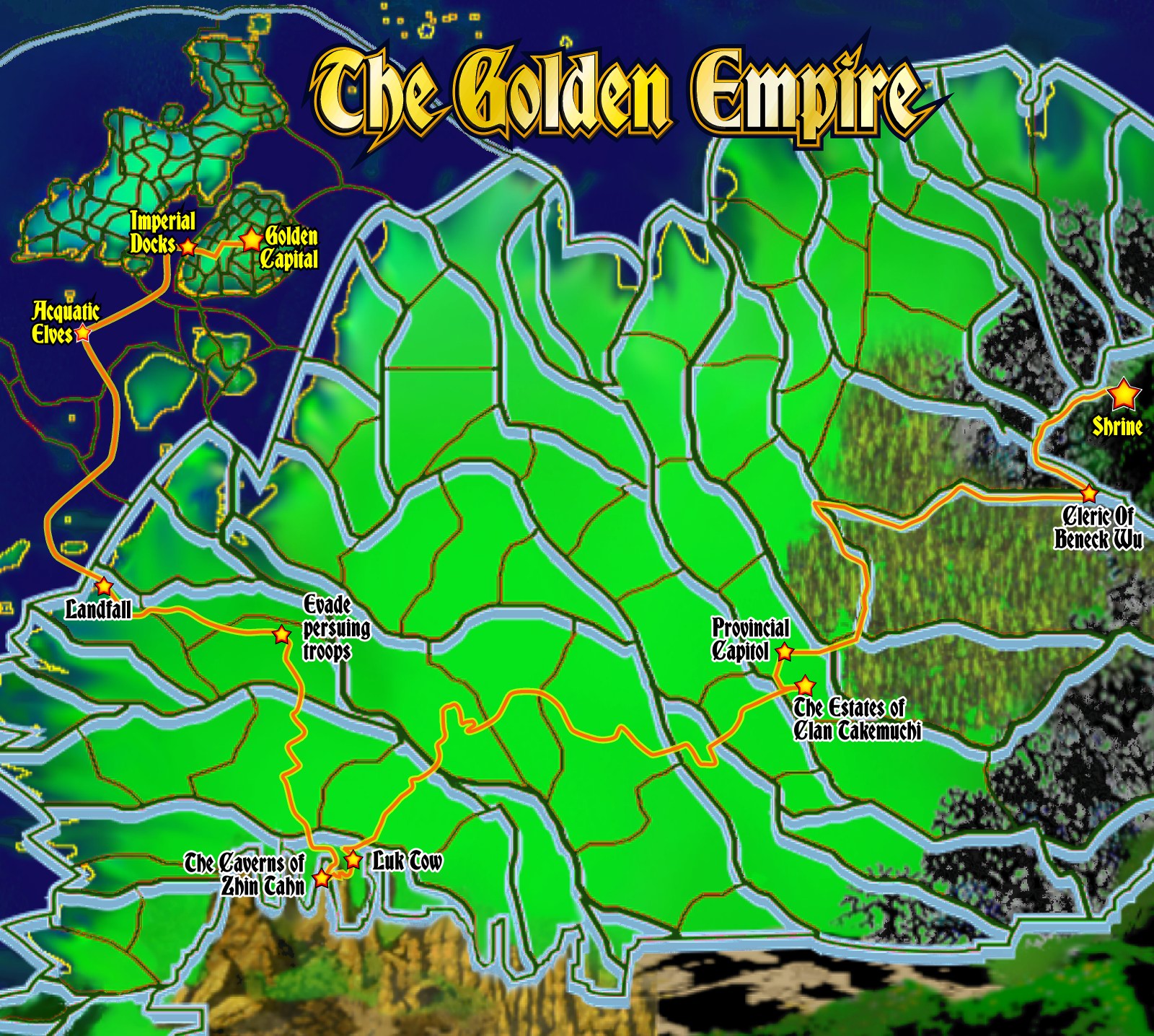
The Golden Empire has been a stalking horse and a motivating force within the Campaigns, a spur to move events and create interesting conflicts while dealing with a couple of leftovers from the first campaign. Those leftovers were things the PCs of the time assumed the Gods would take care of, and which the Gods considered to be part of the burden accepted by Mortals in that Campaign. The Golden Empire is not really necessary any more, so that part of the campaign is meandering to a conclusion. Its real purpose has been to distract the key figures within the campaign long enough for the real problems to develop, and to educate the characters about various facets of the world. The heart of the Seeds Of Empire campaign has always been intended to be what happens in Part IV of that campaign, and possibly in Parts V and possibly Part VI if I am to keep them all of consistent length.

I’ve got half-a-campaign to create, and it all starts with getting the relevant background nailed down. That’s the task at hand.

The list of themes may seem vague, but if you’ve been reading the preliminaries, you will have seen how they connect with the adventures that have taken place, time after time. They are also the underpinnings of the story of the Elves throughout their existence. And that makes this a very good place to start.

These chapters are all in final form. I don’t change “speaker” in mid-paragraph, but the speaker does change from one paragraph to the next. So if it seems like the tone changes direction suddenly – sometimes it does. I didn’t keep records of who is saying what, or I’d be tempted to run a competition to see who could identify the most speakers correctly. Oh well, never mind.

On The Origins Of Orcs & other pieces of Elven Lore - a compilation of the knowledge of: Tajik the Orc, Eubani the Elf, Ziorbe the Drow, Arron the Ogre, Verde the Verdonne, and Thalazar of the Huyundaltha

Introduction


The Tale of the creation of the Elves is well-known, even in these degenerate times – how Corallan formed the first Elves from the branches of trees to be the nurturers of nature, and prompted spirits from nature to guide and shape them; how Lolth, the spider-totem, led those who looked to her astray; and how the true race of Elves closed ranks against her, driving out those who would subvert the decisions of the Elven Council. But many of the details have been lost: the cause of the schism between spider-totem and the Elven Council; the significance of membership in the Council and its origins; the true nature of the Spirit Totems; the creation of the Orcs; and their relationship with the Elves.

The Orcs know little more than the Elves of these matters, though they do at least remember through myth and legend that there was a relationship; but what little has survived the centuries in their lore has been distorted through accumulated misunderstandings and contamination by others.

Those are the stories that everyone thinks they know. And they’re all wrong.

This is the real story.

It is not a coincidence that so many fundamental pieces of truth have been lost. All these lost truths are interrelated, and the rediscovery of even a single piece would set an enquiring mind apon the path to the whole lost tale, and a paradigm shift in the self-understanding of both races. The time has come for these truths to be rediscovered; for now, for the first time in millennia, the two affected races are not estranged by war and blood.

Chapter 1:

Corallan – The First

One of the great unanswered questions is “Where did Corallan come from”? He seems to exist outside the established pantheons of the past, and his origins have never been explained, even in legend. There is speculation that he is but a guise for another deity, but every such proposal has ended in internal contradiction, even disregarding the self-evident truth that a God cannot but be true to his nature. Whatever the answer, he is undeniably a Deity the equal of any other in skill, knowledge, and ability. Elvish Lore holds that he created the first Elves from the branches of trees to be the nurturers of Nature.

Chapter 2:

Nature’s Guides

Corallan had done so in fulfillment of a compact with the Spirit Of Nature; the other half of the bargain required Nature to provide Guiding Spirits, or Elthrinasts, to the young elves. These guides would be drawn to Elves of similar personality and temperament, would Bond with the young Elf in a spiritual union, and thereafter would appear to guide the Elf from time to time, either in dreams, metaphysical visions, or actual encounters. The guidance would be, by turns, symbolic or practical, intended to encourage or discourage a given line of personal development, to educate the Elf, to help the Elf understand his own mind, or to reveal options that he had not previously contemplated. Through the link with their Guiding Spirit-totem, the Elf would learn to perceive the natural energies of the world around them directly, with no need of other senses; this ability has become known as the Elven Sight and is central to the lives and society of modern Elves.

Chapter 3:

The Sundering

As they grew learned and wise, the Elves began to master the natural world, developing the art of Spellweaving. Unlike the gross magics of other species, Spellweaving is a slow and delicate shaping of patterns of nature; a single Spell might take years or even decades to weave. This is an art that only Elves, with their long lifespans and persistence of worldview and Elven Sight, could master. While some rare Humans might live long enough to learn the basics of Spellweaving, their attitudes are too inconstant, their attention spans too brief, and their faculties too limited, to permit true understanding. The delicacy of touch and deftness of control is necessary; Elvish Spellweaving controls and shapes the most powerful of forces over vast areas. (As a side note, The Elves believe that the powers of the Gods are also Spellweaving, but that the Gods have the ability to compress time so that what might take an Elf decades takes only fractions of a second for the Deity. Certainly, this would explain some of the more incredible divine capabilities. They also hold that one of the major differences between a Deity and his avatar is that the avatar does not have this capability).

It was at this time that the Elves began to subdivide into different subgroups. The followers of the Spider-Totems were the first to leave; a representative sampling of all three land-dwelling subtypes of Elves, the day came when the other Elves looked around to find them simply Gone. Always they had stood a little apart from the others of their kinds; but this spoke of a greater unity of opinion and purpose than had been suspected. Whole communities of Elves were torn asunder, children had vanished from their families without trace or warning. Accordingly, hundreds of search parties were formed to investigate this strange occurrence.

Some of the Elves searched the High Passes and Mountain Peaks; and of these, some – especially those guided by the raptors and other more solitary totems – came to enjoy the isolation and tranquility. These became the Calquessir, or High Elves. Others remained within the Forest that had nurtured them, especially those guided by the more gentle and herd-oriented Herbivore totems, where they searched for their lost kin by Arcane means and began forming ever-more-complex community bonds; these became the Taurquessir, or Forest Elves. And some found the rolling plains of the grasslands to their liking, dividing into smaller and more subtly distinct sub-groupings led by the Hunting Totems and the Building Totems. These became the Amrunquessor, the Plains Elves.

But none of them could find the vanished Spider-totem Elves.

Then Corallan summoned representatives of all four branches of the Elves to a summit. The other elves were overjoyed to be reunited with their lost kin, to know that they had not perished, had even prospered in many ways; for the Spider-representative was garbed in robes of finest silk, and bore weapons of power, and wore devices of great beauty crafted from gold and the finest gems. Yet, his pallid features decreed that wherever they had hidden themselves, it had begun to mark them; and the cruel expression of his face was most unElven and disturbing. Even as they rejoiced, they felt apprehension, and questioned him closely as to the whereabouts and circumstances of those who had been long-vanished from their company. Although the answers were evasive, those assembled learned the basics of Drow society and their purposes in setting themselves apart from the dwellers of the surface, and their history since dividing from their Kin. They answered,

“We believed that the surface world, with its myriad distractions for the senses, interfered with the development of the awareness of the weave. By living an ascetic existence within caverns deep underground, these distractions could be avoided, producing a manyfold increase in the powers of elvish perception and Spellweaving.” The elves who had accepted this concept had then been joined by members of the other subcastes, and in particular by large numbers of High Elves, who were always ready to follow their research wherever it led. The spider-clan began to utilize their Spellweaving abilities in the diverse manners of all the other subcultures, from the environmental manipulations of the Forest Elves to the raw Spellcraft of the High Elves. To protect themselves from “contamination” by Sunlight, they erected barriers and isolated themselves from the surface populace. In time, a schism erupted amongst the members of the newly-emerging subculture when the Spider-clan, closest to the Spider Elthrinast, began to expect that they would command, as they were the ones who had led the others underground; but the malicious Elthrinast spun webs of deceit and ambition amongst the High Elves and Civil War ensued. When finally the bloodletting ended, the former high elves had formed a mage-dominated ruling caste; the former plains elves, a religious caste; and the former Forest Elves, who had been caught in the crossfire, a servant caste.

And then Corallan appeared before those assembled, ending the interrogation. “Nature hath decreed that some of each of your peoples must be stood aside from the majority,” he instructed. “These few shall have as their homes the rivers and oceans of the world, gaining far more than is lost; and I shall, in furtherance of our bond with Nature, alter them that they may be at home in the places they will hereafter dwell. These should be drawn from those of your peoples whose Totems are already familiar with, even contented by, the waters: the Watersnake, the Waterspider, The Seagull, and yea, even the Beaver and Otter.”

“This is an abomination,” replied the representative of the Spider-totems, “and our people refuse to take part. Long have we dwelt apart from these surface-dwelling simpletons, and by choice so would we remain. I have been permitted to come forth from our hidden retreats for the sole reason of giving you this message: Our totems have learned to join, becoming one mind, one being, the Queen of the Spiderwebs, she who we have named Lolth in our Adoration; and we shall not permit Her to be lessened by the loss of the Waterspiders. She is our Goddess, our Mistress and our Guardian. Do not summon us again, Corallan; we look to you no longer.” And with that, he spun on his heel and stalked from the gathering.

“As my Children are ye, not my subjects;” announced Corallan in sad tones, cutting through the angry shouts of the others gathered, “and if the children of the Spider Totem have chosen to live apart, then so be it. So long as they impose their will apon no others, they shall be permitted to find their own paths to Wisdom; for who can foretell with certitude the shape of Futures still remote in their unlikelihood? Drow, I name them, Those Who Dwell Apart; and yet, the time may come when they discover that they have a role to play. We must proceed without the Spiders Of The Water; Nature, our Mistress, will brook no delay in her needs.”

And so it was that the Elven people were twice-sundered on the same day; as the followers of the Spider-queen, Lolth, declared themselves a race apart, and one-quarter of those whose totems were at home in the Water were forever transformed into the Isallithin, the Aquatic Elves. In but a short time, these became the glue that held what remained of Elven unity together. Their aquatic environs reached from the realms of the High Elves all the way to the sea, passing through all the other lands occupied by their Elven Kin. They became natural couriers and message-bearers, and while forever estranged from their Kin by physical transformation, they remained Elven in spirit. Over the ensuing generations, those lost to the aquatic totems were replenished in numbers, while the descendants of the chosen few found themselves guided by new totems – the languid Octopus, the savage Shark, the docile Shrimp, and the determined Salmon amongst many. And slowly, their communities scattered well beyond the realms of the other Elvenkind. It was the Aquatic Elves who first met Humans, though the humans recognized them not, avoiding the Seafolk from a fear inspired by the other Aquatic species, about whom all manner of wild tales had become the stuff of myth and legend.

Chapter 4:

“The Other”

It was when the Calquissir turned their attentions to the Fundamental Natures of Elves themselves that they discovered a truth which would ultimately shatter the disjointed unity of the Elves, perhaps for all time. The creatures initially created by Corallan were not dissimilar in attributes to the Humans they were modeled after; in order to achieve the attributes he desired, he was forced to create a second being to contain those attributes that were not desired. In all ways, these would be the opposite of the Elvish people. Nevertheless, they would forever be Kin to the Elves in subtle and convoluted ways. The Elves named these creatures the Illvaryssor, “The Other”, and began to search for these lost parts of their lives.

They were unsure of exactly what they would find, but logic yielded a formidable array of characteristics. Where Elves were slow to mature and long-lived, the Other would be quick. Where Elves were subtle of sensibility and thought, the Other would be rude and simple. Where Elves were wise and learned, the Other would be primitive and savage. Where Elves were born as blank slates, and needed to learn everything from their elders, the Other would have strong, even dominating instincts inborn , perhaps even an instinct strong enough to be termed a race memory. And where Elves were fair of feature, sheltered from the harshness of nature by their Spellwoven environments, the Other would be scarred, even disturbingly ugly.

At first, the Elves searched from a sense of lost kinship and curiosity; the estrangement with the Drow and physical separation from the Aquatic Elves having left a sore spot in the psyche, an itch that could not be scratched. And the chance of being able to consult a Race Memory of their early years, however dimly recalled, promised revelations of self-discovery that were beyond price. Even as the Elves searched, their Spellweavers were learning more of the Elven nature, and coming to a new appreciation of the genius of Corallan. The first Elves had not been created in adult form, as myth had long suggested; this had always seemed dubious because Elves have so little in the way of inborn instinct. The presumption had been that Corallan had somehow been aware of exactly what the fundamental knowledge required by his creations would be, and had created them with that knowledge in place. And, as much as they revered their creator, this had always seemed a little too much to ask. in fact, they now realized, the first Elves had been created as newborn babes, reared and sheltered by Nature itself. To protect these young Elves from the dangers of the wild for the quarter century until they reached sufficient maturity to care for themselves, a more aggressively-developing counterpart was needed; one ready and able to defend the community against any threat from an early age. In a sense, everything that the Elves now had was a gift from The Other, and a profound sense of gratitude and debt suffused the Elvish people of the time.

And yet the mystery remained – why were there no records of the Other? Why did they not appear anywhere in Elvish legend? Where had they gone – and why?

*************************************************************************************************

Some Notes on Language:
The only language that is even close to universal in Fumanor is “Arnost”, also known as “The Common Tongue”. Many Elves speak Arnost as their first language. “Elvish” is actually three languages:

  • Hithâinduil, vulgarly known as “High Elvish”. Attempts to preserve this language have largely failed. Not even the elves can read more than 1 in 4 words at best. The written language could be learned as a dead tongue provided that a suitable “Rosetta Stone” could be located, and provided that the character was proficient in Nuthânorl (below). To learn the spoken version would require finding someone who could already speak it – there are few candidates and less who have the time required.
  • Nuthânorl, vulgarly known as “Low Elvish” or “Common Elvish”. Almost all elves speak this tongue and many can write it. Those who can do neither will have it as a potential language and were human in recent memory. This is the most common second language, though it has also been corrupted and is now a pidgin language containing a mixture of true Nuthânorl and Arnost. Elves from Elessarune are more likely to speak this language than they are Arnost. The pure form of the language can be learned from the Drow.
  • Zamiel, commonly known as Drow. This can only be learned from the Drow themselves. The written variety of the language is especially difficult.

It’s probably worth noting that these langauges, and “Arnost” for that matter, were named by the elves of long ago, and are amongst the few surviving fragments of Hithâinduil. As this series proceeds, I will maintain and extend an ongoing glossary of terms at the end of each post, in alphabetic order.

The Ongoing Elvish Glossary

  • Arnost: Simple Speech (Modern “Common”, a human tongue)
  • Arrunquessor: Plains Elves
  • Calquissir: High Elves
  • Corallan: The First
  • Drow: “Those Who Dwell Apart”
  • Eltrhinast: “Guiding Spirit”
  • Hithainduil: High Elven Language
  • Illvayssor: “The Other”, a mythical race
  • Isallithin: “The Sundered”, a name applied to Aquatic Elves
  • Nuthanorl: Low Elven Language, Common Elven
  • Tarquessir: Forest Elves
  • Zamiel: Drow Language

*************************************************************************************************

Next time: Men, Dwarves, and The Prince Of Lies – all in Chapters 5 through 9! (And yes, despite a continual effort at concision, the chapters do get longer)…

Comments Off on On The Origins Of Orcs, Chapters 1-4

Stop me if you’ve heard this one: An RPG, A Videogame, and a Bingo Game sit down in a bar…


Photo courtesy of stokfoto (Jeroen Thoolen).

Video Games and RPGs have shared a parallel evolution throughout their histories, going all the way back to the original such games (Colossal Cave Adventure in 1967 and [Original] D&D in 1974, which was based on 1971’s Chainmail rules for miniatures wargaming).

Throughout their histories, they have fed on each other, sometimes in a fairly conventional fashion (the various D&D computer games ranging from the D&D Computer Labyrinth Game of 1980 through to the better known Baldur’s Gate and more recent Daggerdale and the Legend Of Zelda RPG which took the complimentary evolutionary path, from computer game to tabletop), and sometimes in more indirect fashion.

The two have a lot in common insofar as the game mechanics of any RPG translate readily into computer code, they both have fundamentally similar storytelling techniques, and they both involve interaction with a narrator or GM who describes the action – in a computer RPG, that narrator is controlled by the machine, that’s all. They will often share fantasy elements and have other common elements. This commonality has existed throughout their history, but it is about to enter a new phase of development that merits a little scrutiny.

Initial Developments

Early developments in both types of gaming explored improvements in game play. The fundamentals of storytelling were being explored in both environments, while the human-game interfaces underwent considerable development. In the case of Tabletop RPGs this focused on exploration of the rules systems and examination of meta-issues and underlying design philosophies. Meanwhile, computer games developed from purely text-based to simple graphical games like Space Invaders, Asteroids, and later, more sophisticated games like Defender.

Unfortunately, these games were unable to hide the basic inability of players to interact with the game plot and narrative, reducing the plot to a basic script. More sophisticated programming techniques would be required before game play could further advance.

Glossy & Verbose

The development paths of the two game styles then appeared to diverge for a period. Programmers concentrated on the things that computer games were inherently good at, like fancy graphics and basic gameplay. Increased memory, processing power, and graphics capabilities meant that the visuals of games were increasingly sophisticated. At the same time, random selection of a number of scenarios began to be integrated into a number of games of the era, restoring an at least superficial resemblance to a truly interactive game.

Roleplaying games also worked on the aspects of their games that they were inherently good at – interaction with plot, character development, and uniqueness of setting and narrative. Character development in particular was liberated from the tyranny of randomness with the advent of point-based construction systems. New approaches to interactivity with the passage of in-game time, new methods to the simulation of skill systems, and new techniques for simulating the learning and growth of individuals as experience was gained by characters, all extended the veracity of gaming systems.

Simulation meets Interaction

Eventually, the simulation techniques inherent to computer games grew sufficiently sophisticated that they could even mimic interaction with the narrative. The results were a series of landmark efforts in the sub-field of computer-based RPGs, as TSR released their AD&D games. While the choices available to players were still confined to those inherently coded into the system and plotline, it was not always easy to tell that the plots were pre-scripted, even when you knew better.

At much the same time, computer-based tools for pencil-and-paper RPGS were developing beyond basic character generators. Everything from simple map generators to combat simulators achieved new standards of performance over the next few years.

The 32-bit era

Home computers evolved from 16 to 32-bit technology, operating systems advanced, and what we now think of as the internet became more than isolated bulletin boards. RPG aids became more sophisticated, and many applications nominally intended for other purposes such as spreadsheets, databases, appointment calendars, and more, were adapted to assist GMs. At the same time, RPGs entered a phase in their development in which two simultaneous paths were being explored: simplicity and refinement on one branch, and increasing sophistication and complexity of options on the other. All these movements culminated in a number of computer-based RPGs that set new standards for interactivity, such as games like Baldur’s Gate; but there were a number of other games in this period that blurred the lines between simulated rpg and traditional computer game with complex branching narrative structures that furnished a sophisticated illusion of choice on the part of the player. But game development then got side-tracked into the 3D and Real-time movements and away from the turn-based elements that they had shared in common with RPGs.

Gaming aids appeared to hit a peak in their development in this period. Sophisticated tools such as the official D&D character generator and Redblade made the tedium of GMing far less strenuous. Increasingly, however, this aspect of computer software development would also be diverted into the portability of documentation and tools of collaboration, as wikis and blogs began to evolve.

It was not long after these trends commenced that RPG development also became sidetracked by the d20/OGL explosion. For several years, it seemed that no other core gamesystem could survive, so ubiquitous was the d20 approach, fuelled by the runaway success of D&D 3.0 and 3.5.

In their own ways, all three strands of this narrative found themselves exploring seductive cul-de-sacs. In time, each would escape these traps, but it would not be immediate.

The MMORPG

MUDs, or multi-user dungeons, evolved from the same text-based origins as other computer games, but took a branching path instead of focusing on the graphical development of their more famous brethren. From time-to-time, the two strands of game software development converged, usually in the form of a multiplayer option attached to a traditional game. Beginning in 1997, the MUD assimilated a number of utility technologies such as chat software, added a reasonable standard of graphics similar to that of other computer games, perhaps five years behind those of the cutting-edge games of the time, and – beginning with Ultimata Online – emerged as the MMORPG. This, in effect, integrated and then supersized at least one traditional element of table-top RPGs, simultaneous multiplayer involvement. In 2004, the MMORPG exploded into popular consciousness with the massively successful World Of Warcraft. Some people were so alarmed by the success of this development that they prophesied the imminent death of RPGs as we knew them.

In part, this doomsaying was fueled by the edition war between D&D 3.x and 4e, which is still a divisive issue amongst the table-top gaming community. Guess what? It’s almost a decade later, and Tabletop RPGs are still around, and even looking more vigorous than they have in many years. The huge fanbase brought into the hobby by the success of 3.x fractured into support for a multitude of systems, harnessed the power of nostalgia to reinvent a number of classic games from the past, and hooked up with the online environment to fuel a massive wave of roleplaying blogs that continues to this day.

At the same time, computer gaming shifted from the personal computer to gaming consoles. The result was that the most interactive capability was lost – a hand controller simply doesn’t have the sophistication of a keyboard or the depth of the written word. Not being into console gaming myself, I could not even tell you whether or not these games have even achieved the limited interactivity of Baldur’s Gate, where your choices of action were limited to combinations of preselected options, and an overall fixed narrative.

The problem with WoW and other MMORPGs is that they are centralized, with a centralized structure, and the narrative is best described as “emergent” – it grows out of the actions and interactions of hundreds or thousands of players, each doing something “fun” – with that being defined largely in terms of older, more traditional computer games. It means that the game environment is constantly evolving, but in terms of an adventure with pacing and plot, it doesn’t go anywhere. Ultimately, I think it will be another in a long line of very successful evolutionary cul-de-sacs for computer gaming – though I might be wrong, and this wouldn’t be the first time, so don’t get upset if you disagree.

Online RPGs & The Modern Day

Recent years have seen genuine progress in the integration of computers and the tabletop RPG. It is now possible for players from many different geographic locations to play, across the internet, in a game with a genuine old-style GM. The first such software that I became aware of was Roll20, but I have since learned of others. The general classification of the software is “Virtual Tabletop” and it is so new than Wikipedia don’t even have a page for it yet! But that doesn’t mean that there aren’t resources and alternatives out there. Here’s just a handful:

  • Virtual Tabletop – a Wiki dedicated to telling you all you need to know about Virtual Tabletops, including a visual comparison chart. The number-one resource for the subject.
  • Guide to choosing a virtual tabletop program – a page from the above Wiki.
  • This page from Battlegrounds Links to Virtual Tabletop (VT) Programs suitable specifically for RPGs – a comprehensive list. As a bonus, if you scroll up to the top of the page, you’ll find an equally comprehensive list of Mapping Software, Sources of Free Art for RPGs, Roleplaying Aids, and Music & Sound Effects for RPGs.

An unusual engine for development

The big question is this: how to fund the future development of this software. If it takes off in popularity, becomes as big as DnD 3.x or WoW, there will be no problem – but I can’t see that happening. What we need is some well-funded sugar daddy to pay for the primary R&D for something we can adapt to become improvements in tabletop gaming software.

Believe it or not, there is such a creature.

Kids and teens have always been in the forefront of online gaming. Households are crammed with Xbox’s, Playstations, and Wii’s. But over the last half-decade, online gaming has taken off in a new direction for adults; everything from Online Poker Tournaments through to online Bingo, as offered by sites such as Costa Bingo, with innovative free-to-play games.

There’s money behind these games, money for R&D, and at the same time, they are closer in their software requirements to those of tabletop RPGs than might be expected. There is considerable overlap in the areas of the selective broadcasting to particular individuals of live transmissions, interactions between the central game and each player, and interactions and communications between players. How can you look for a “Tell” if your webcam view only updates once a second, and not in real time?

Gaming sites such as these will develop the necessary tools for their own use, tools which can be licensed and adapted to service other genres of gaming. In the years to come, simply because they can afford to fund the R&D, such sites will become a driving force for the advancement of Tabletop Gaming into the 21st century – the best friends we never knew we had. And that’s food for thought.

Update 9 Feb 2013: Play-by-Post gaming

Yesterday, Twitter user @StarArmy quite rightly took me to task for omitting a major subgenre of gaming from this article. He/She wrote,

“In your Campaign Mastery article about RPG evolution, why is there no mention of online text based RPGs such as forum RPGs? Since the mid 90s, hundreds of roleplaying games have been started on the web, played by forums and email lists. Check out Wikipedia’s article on Play-by-post gaming. I have spent much of my life GMing Star Army, [Sci-fi] a PbP community. Forum RPGs aren’t tabletop and we’re not video games, we’re roleplayers writing back and forth. Some have GMs, some not.”

The reason PbP gaming doesn’t get a mention in this article is because I’ve never played that way, and would rather send out an incomplete article than an inaccurate one. We then went on to compare the roles of the moderator of such a game (when there was not a GM) and a GM. StarArmy wrote, “A GM describes the setting and controls NPCs. A moderator is mainly there to enforce behavior guidelines.”

I have to admit that I found all this very interesting. What StarArmy was describing was, to my mind, very similar to an MMORPG, in which the story is an emergent property of the interaction of players. Strip an MMORPG of its graphical inheritance from traditional computer games, and what you are left with is a live action RPG operating in real time. An archive or transcript of such a game would look remarkably similar to the archive or transcript of a PbP game, though it would be sliced up into much smaller components due to the real-time interactivity of the MMORPG.

“Although text-based roleplaying has exploded in popularity on the web, in theory it could be played by snail mail too,” according to StarArmy. Twitter user @Canageek then added, “Keep in mind, that is also only one type of PbP. The other is just a traditional RPG played via typing on forum” – which, of course, would be a direct descendant of the PBEM (Play by E-mail) games of yesteryear.

PbP gaming would appear to be a crossover point, or perhaps an intersection point, between MMORPGs and traditional RPGs which evolved from PBEM origins. They may or may not have a directed narrative under the control of a GM; where they do, they resemble a traditional tabletop RPG played by some form of correspondence, and sped up via the speed of the modern internet. Where they don’t have a GM, the narrative is an emergent property of the chaotic system of individual actions within a common game world – all the players act simultaneously, and then react simultaneously to each other’s actions.

David Ball – Twitter user @ongoingworlds – pointed out that PbP games “are more like collaborative writing than tabletop [RPGs}”. That similarity, and in particular the resemblance to a shared-world anthology being crafted in parallel by each participant rather than sequentially, episode by episode, had also not escaped me. I had deliberately avoided clouding the subject by including the evolutionary interactions between various forms of gaming and “traditional” literary fantasy in my article – lack of time, if nothing else – but if I had done so, the resemblance to a PbP archive and a series like Thieves’ World would also have merited mention.

Text-based RPGs aren’t just a strange offshoot or hybrid of computer games, mass communications, forum technologies, and tabletop RPG elements. They are their own evolutionary path, which may have emerged from the same cultural niche as tabletop RPGs but have forged their own path. As someone who writes – both in the literary sense, and the RPG sense – the attraction of PbP gaming seems very obvious to me. I wish I had the time to investigate it more fully. But at the very least I’m glad to be able to acknowledge the gaming format of PbP here and rectify an obvious-in-hindsight deficiency. Thanks to @StarArmy, @Canageek, and @ongoingworlds for taking the time to talk to me about it – and for making the effort of bringing the oversight to my attention.

Comments (12)

Inventing and Reinventing Races in DnD: An Introduction to the Orcs and Elves series part 5


This entry is part 5 of 31 in the series Orcs & Elves

I’ve got a lot of campaign prep to get done. In fact, I’ve got so much to do that if I don’t do it here, I’ll either never get it done in time. But first, I have to paint a picture of the background for this to be useful to the rest of Campaign Mastery’s readership.

This Article

This article concludes (finally!) the pre-existing background material needed for the casual reader to understand the new content that is to follow. In case you’ve forgotten or are new in these parts, here’s a summary of what we’ve covered so far:

  • Part 1 of the trio examined the general question of why I customize races in the campaigns that I create.
  • Part 2 got specific, discussing Elves, Drow, Ogres, Halflings, and Dwarves.
  • Part 3 concerned Orcs, Dwarflings, The Verdonne, and Humans.
  • Part 4 was the first half of an update to the history of the campaign.
  • Part 5 will finish bringing the history of the campaign up-to-date and finally finish these preamble articles by quickly describing the rest of the series.

In other words, most of this five-part trilogy is about who’s who in the adventuring party at the heart of the content to come.

Some of the content may have appeared at Roleplaying Tips in the past, but I couldn’t find it when I went looking there. Johnn was kind enough, years ago, to give me explicit permission to republish the relevant materials, so there’s no problem. Some of the material dates back to the turn of the century, some of it dates from 2005, and some of it is more recent. Campaign Background material is like that – small increments of capital improvement adding up over a period of years into something massive. To be honest, if I weren’t under the gun, timewise, I would probably split this up into seven or eight separate articles. But even bundling this up into a few larger articles, there’s still more than enough to make this a very substantial series – once it actually starts, next Monday!

My players love it when I do this stuff. Not only do they get a glimpse behind the curtain, but because I have to explain things more fully to a general audiance, they frequently learn details they weren’t aware of at the time. They get reminded of details they may have forgotten long ago, and get explanations for things that may consequently have made no sense to them at the time. At least they generally trust that if I say things are a certain way, in-game, that it will eventually make sense.

Adventure 19: One A Larger Scale (cont)

After a lot of hand-wringing, the party decided to disguise themselves as undead servants to Hisago Takamuchi, and persuaded him to go along with that. Hisogi made it clear that he was still a loyal citizen of the Golden Empire, and would do nothing to undermine it, but was sufficiently convinced by recent events (and Ziorbe’s timely accusation) that the Queen OF The Elves was proposing this alliance for her own purposes and that her agenda and the best interests of the Empire might not coincide. The party very wisely kept secret their true intentions toward the Empire.

It was important to me to establish the Golden Empire as more than simply a hostile realm opposed to the PCs. I wanted it to be an environment, a place where Adventures happened that had nothing to do with its position as an enemy nation, and a place populated by all stripes of characters – good people as well as evil menaces. They were a society that didn’t understand what had happened to it, and had coped as best they could. They didn’t enjoy the protection of the Gods nor the manipulations of Thoth during the critical century following the Godswar, the way the Kingdom of Fumanor had. There was a definite and deliberate element of “the road not taken” about the place. At the same time, they were an Empire, with all the internal complexities that this entailed, and not simply an overlarge Kingdom. Different groups and localities had different agendas and styles. Parts of it were Asian in flavor, parts Indian, parts Middle Eastern, and parts more traditional fantasy Kingdom. The Kingdom of the Aquatic Elves was a more traditional monarchy. This was not only to imbue the place with its own flavor, but to highlight the administrative problems that come with the expansion of a realm to this size, and a set of working solutions – problems that the PCs native Kingdoms were beginning to experience when the campaign began.

Infiltrating the negotiations, they provided Hisogi a clear advantage in that most of the party spoke the Elven Language and were able to synopsize the side comments of the Ambassador, Gathador Enclystida, his escort, Feniel Straightarm, and the escort’s companion/pet, a miniature (hatchling) black dragon named Kalazh. Representing the Golden Empire (in addition to Hisogi) were Matugi Nashtorish, Latiko Diribatik, and Karuthi Duto-shimo.

Enclystida began by reading a message from his Queen: “Your Empire stretches from the heavens to the seas, but it nevertheless stands at a crossroads. Ally with me, and it shall blossom into an institution of scope beyond your imaginations, masters of all who live mortal lives wherever situated; fail to do so and your empire faces ruin, utter and complete. For you face enemies incomprehensibly more capable than any against whom you have measured yourself thus far. We know this because they are also our enemies, unless we are driven by the larger threat posed by your Empire to unite with them against you. Your scouting missions thus far have been in the hinterlands of your enemy; you have yet to encounter their true strength. For your enemies number legends amongst them. So says our Queen.”

The ambassador then began calling up images in the air, as he described their mutual enemies:

  • Gallas & Sebastian – systematically destroying Chaos Powers and looting them of their powers.
  • Licheam – a being of unparalleled tactical ability, able to enter the fray confident of victory when outnumbered ten to one.
  • Aurella, a mistress of the dark arts of no small ability;
  • and, worst of all, Rockerand, who dissembles as a being so innocuous you would pay him no mind, seducing the minds of all who hear him into believing his perverted view of reality.

The players found these descriptions amusing, since they were all current or former PCs in the Fumanor Campaign. Some of the abilities cited were clearly overstated, while others were – if anything – underestimates of what the characters had actually achieved. Lolth was already manipulating the truth.

The ambassador continued, “They have aroused the population with a fanatical belief in their infallibility, a belief that they are able to draw apon in order to work counterfeight miracles that to the untrained appear as the power of the Gods, and who will fight to the last woman and child in their name. Half a million religious fanatics, who even now permit themselves to be enslaved to the production of war material to raise against you. And in back of them, the thirteen false Gods who demand the servitude of the populace, and who grant their followers the power to destroy your warriors with but a word, as could any follower of a true God.”

The ambassador then demonstrated this ability by destroying one of the undead bodyguards in a spectacular explosion that rained body parts throughout the conference chamber. “To match these enemies, we too have substantial might. Our Queen knows as much of the old lore as your mightiest mages, if not more. Our army is small but implacable, and protected by arcane forces millennia in the forging. We have an alliance with the Dragons, who number fully one thousand, and with whom we are training to form a highly mobile aerial combat force, able to reach the farthest corners of your conquests in less than a day and strike far behind your lines at your capital. (He pauses to feed his pet). We have undertaken to enhance Goblins in size and strength to a measure in excess of that of humans; 100,000 of these lie hidden in camps, their numbers unknown to our enemies, awaiting the day they are told to march. Each of them contain users of magic of elementary skill. And lastly, our Queen, who has stolen many of the enemy’s secrets, including that of false divinity, as you saw demonstrated a moment ago, and given a lesser such ability to many of the Goblin Horde we have forged.

“Individually, both our Elvish Kingdom and the Fumanorian Kingdoms are almost a match for the almost-endless might of the Golden Empire. Should we unite against you, be assured that you would fall. Yet there is no love between us, and we would ally with them most reluctantly. As the enemies of our enemy, we are more stimulated by the potential of an alliance between the Elven Kingdom and Golden Empire. It is to propose such an alliance that we have journeyed hither, to the heart of your Empire.”

This presentation clearly impressed the other negotiators, but so did Hisago, who had been forewarned by the party that Lolth was likely to open with an attempt to overawe her audience. He started by challenging the veracity of the claims made concerning the effectiveness of the opposition; after all, the Empire had been overwhelmingly victorious in every encounter with Kingdom forces thus far, and it didn’t matter whether these were pitched battles or merely skirmishes. Suggesting that the Ambassador was exaggerating the effectiveness of Kingdom forces in order to rush the Empire into a treaty without fully considering the implications and terms, he pretended to be unimpressed. Nevertheless, he is prepared to listen to the Ambassador’s proposed terms of alliance.

The ambassador announced, “That which is mortal shall be subject to the faith of Beneck Wu, with which the Elvish Queen is most impressed. That which is not shall be subject to the Elven Queen, who shall adopt the title Empress. Command of the Goblin Horde and DragonRiders shall remain with the Elves, in the name of the Golden Emperor. Command of those Eternals who do not live within the Elven Forests shall remain with the Golden Empire, in the name of the Empress of Elves. All lands now and once the domain of the Elves, and the skies above and earth below, to be ceded to them. Taxes to be paid to the Golden Empire accordingly. All other lands shall be the domain of the Golden Empire.”

These were scarily fair-sounding terms to the party. Lolth was sure to have a hidden booby-trap in it, but they couldn’t spot the joker in the deck. Using a prearranged signal, they advised Hisago to stall for time and more information. He replied to the Ambassador that those terms were Agreeable in principle, but many specifics remained to be worked out before it would be known if the proposal is practicable, and something that the Empire can agree to. The Golden Emperor would require the Empress to acknowledge the overall sovereignty of the Golden Throne, and it should be understood that it was only the impressiveness of the mode of travel reportedly used by the Elvish Diplomats they has persuaded the Golden Empire to even listen. No even hypothetical agreement is possible until agreement is reached on the terms.

The Elvish Ambassador then fell back to a previously established position, i.e. the degree of threat posed by Fumanor to the Empire. To prove his point, he discussed (and dismissed) each of the members of Tajik’s Misfits as significant; they were “nobodies” from Fumanor, rogues and vagabonds and rebellious servants; “And yet,” he invited the Imperial Diplomat, “consider the trouble that they have caused within the Empire.” He then gives a very jaundiced review of the adventures of Tajik and company, blending fact with supposition and rumor, and in effect blaming everything that had gone wrong within the Empire over the past few months (however minor) on the Adventurers.

This, without the Ambassador realizing it, was the most effective thing he could possibly have done, undermining Hisago’s trust in the party. He could not help but recognize them from the Ambassador’s descriptions. Hisago was now the one who needed to stall for time; he needed to reconcile the view of the PCs that had just been offered with his own experience. All he could do was raise a side-issue as distraction to fill up the morning’s negotiations and then call a recess when that discussion wound down. “You seem remarkably well-informed,” he replied; “perhaps you have been spying on us, even sabotaging us, and now seek to deflect blame for these incidents? I find it difficult to believe that a band of ‘rogues, vagabonds, and rebellious servants’ could be capable of all that they have been accused of. Either you are lying about their true status to further your allegations of imminent threat, or you exaggerate their achievements. Either way, you attempt to perpetrate a falsehood apon the Empire – unless you have proof of your claims?”

With the negotiating positions established, the various parties withdrew. All told, it was a very satisfactory first day’s effort – from the point of view of Lolth.

On a larger scale, part 2: Acts of sincerity and deception

Immediately they were alone with Hisago, the PCs went to work trying to convince him of their sincerity, but achieved nothing more than a state of uncertainty on the part of the Diplomat. In the course of the afternoon, occasionally interrupted by other members of the Diplomatic Party gathering to discuss the proposal and Hisago’s issues with the potential treaty, several party members made further individual attempts, even while the party attempted to figure out what Lolth really wanted, where the booby-trap in the proposal might be located, and how they might derail the proposed alliance. Hisago played Devil’s Advocate, having been included in the discussion as a gesture of sincerity on the part of the party, at Leif’s suggestion, a choice fully endorsed by Tajik. “I don’t know what you think, but if I were allied to someone – even temporarily – and came to have doubts about them, being aware of secret discussions between those someones from which I was excluded wouldn’t do much to reassure me.”

Tajik explained the characterizations of the party offered by the Elven ambassador, one by one, pointing out what validity (if any) that they had, and how Lolth’s biases had colored the descriptions. He then explained that their mission is to stop the war – not to cause trouble, or destroy the Golden Empire, but simply to prevent it from posing a threat to their homelands. Along the way, they had met many of its citizens and learned a lot from them about the Empire, and its faith, and found much about it that was admirable, but they had become convinced that it had lost its way, and that it was this misdirection that was the reason the Golden Empire was threatening Fumanor. Their mission was to reform Beneck Wu and make it possible for the Golden Empire and Kingdoms of Fumanor to reach a peaceful accord where each simply left the other alone; but if it came down to a forced choice, the Kingdoms would far prefer being subjects to even a misguided Beneck Wu than subjects of Lolth, Queen of the Spiders. Eubani then spoke of the Elves, and what was happening to them under Lolth. Ziorbe related tales of life under Lolth’s authority from his youth. Of them all, it was Arron who was most effective at calming the perturbed Diplomat, describing the “alliance” his people had once had with Lolth’s former subjects. Several times, he took Hisago aside and spoke to him privately; always, the diplomat returned with refreshed trust in the party afterwards, often with a startled expression.

Mid-afternoon, as their discussions continued, Verde was reciting some of the attributes and capabilities of the Golden Empire, working to the theme “you don’t really need this alliance”, he happened to mention that the Golden Empire, through Beneck Wu, had preserved many of the lost arts of the old Empire, the common origin shared by both the Golden Empire and the Kingdoms. Ziorbe suddenly seized on the remark, and on many half-understood things that he had learned in the past, and through interrogation, was able to draw answers out of Tajik that confirmed his suspicions of Lolth’s true objectives within the Golden Empire.

What Lolth really wants is to learn the secrets of Beneck Wu, Because it permits the casting of clerical magics without the support of either Gods or Chaos powers, and therefore without being subject to the strictures and restrictions imposed by the nature of divinity, it is possible for it to be used to modify the effects of the Gate Of Goraldton. She believes that the combination of the two will permit her totally free will as a deity – and she might be right. Lolth, as a full deity without restriction, was a nightmarish scenario – the closest thing to total omnipotence that the PCs could conceive of. She would be able to directly overpower and control Gods and Chaos Powers alike – and In the process, she would obviously become the most powerful and learned practitioner of Beneck Wu, which – under the laws of the Golden Empire – would make her head of the Faith, the only person permitted to give instruction to the Golden Emperor. Furthermore, Elves once layed claim to all lands which were forested, or ever had been. How much farmland has been cleared from forests? This treaty splinters the Empire so that it can offer no resistance and reduces them to vassals under Lolth’s control – no, her Absolute Domination.

The plans proposed for preventing the alliance had started vague – “play for time until Lolth reveals her true agenda” – but were now running wild in all directions with a sense of both necessity and urgency. Simply killing the ambassadors would only delay the inevitable, unless they made it appear that the Golden Empire was responsible – something that Hisago would not support. An attempt to kill them that made it appear that Lolth was responsible seemed their best approach, but even as the party made final preparations, Eubani cast doubt on the plan that he had helped formulate. The circumstances were aligning to make this all a little too easy. The ambassador’s request to have a private meal served in his tent (the negotiations were being conducted in a temporary structure so that neither side could claim an unwarranted advantage) and his dismissal of the undead soldiers of the Empire set to guard him was practically an invitation for an assassination attempt. What’s more, by now the Ambassador would have to know that the bridge that had connected Elvarheim to the Golden Empire had been disrupted, but nothing was said – despite the obvious suspicion that the Golden Empire was responsible.

Lolth obviously knew who the party were, at least in broad; what if the Ambassador had penetrated their disguises from the first? If the party attacked, and were revealed, it would bolster Lolth’s claims of Kingdom abilities and intentions. Hisago would be branded a traitor, and removed from the negotiations at the very least; and the proposed treaty would become almost inevitable. Even if it succeeded, and the party were not exposed, it would not be difficult for a fresh negotiating team to reveal who had committed the crime, using magic, with exactly the same effect.

On the other hand, if Hisogi stayed put and simply delayed the negotiations, imposing ceremonial requirements and quibbling about conditions and terms, language and syntax, for long enough, the party could complete its original mission of reforming Beneck Wu. By seeking out, enlightening, and empowering a potential prophet of the faith, it would remove what Lolth really wanted. As soon as that forced her into a failure to comply with her promises to the Empire, any treaty would be declared null and void, if nothing more. The best solution to the problem was to do – nothing. It was also probably the hardest thing that the party had ever had to do; they were convinced of and even alarmed by the threat, and all felt the imperative urge to do something, anything, about it; and on top of that, they had a celestial cheering section of Deities encouraging them to act, and insisting that they do so.

The more closely the party looked at their original plan, and realized that “chance” had assembled the perfect force to achieve it, the more convinced they became that someone was pulling strings behind the scenes. That “someone” was almost certainly Arioch, based on what the Gods had told them – and various knowing half-smiles that Corallen had exhibited probably meant that he knew Arioch was using the secret knowledge, even if Arioch didn’t know that he knew. Except that this would make it a secret, and therefore Arioch would know about it immediately – which would certainly explain a number of the overtones in their exchanges when the Gods were addressing the party.

With that, the party “officially” abandoned their planned assassination and resumed their original mission, trusting Hisago – now an entrenched opponent of the proposed treaty – to delay events long enough for them to succeed.

In case it’s not clear – I don’t think it was to my players at the time – this adventure was all about preventing Lolth from doing to the rest of the world (i.e. doing ‘on a larger scale’) what she was already doing to the Elves.

Adventure 20: The Spy Within

The PCs again made their way cross-country, proceeding by whatever seemed to be the fastest route. They were acutely aware of the press of time, and safety was eschewed in favor of speed. Apon reaching a rive (the PCs never learned its name), they stole a boat and headed first downstream, and then turned at a fork in the river and sailed upriver into the mountains, heading for Sing Tahn Wu. Leif, as the only character with experience in sailing – the ship that the PCs had used to escape the Golden Capital had been crewed by Undead who obeyed Chrin’s instructions – took command, despite his warnings that while he had sailed, he had never commanded a ship – and sailing was different where he came from (as explained in The Flói Af Loft & The Ryk Bolti). Gravity was not a function of temperature here! Nevertheless, he was the closest thing they had to an expert, so he was given the job.

As the journey proceeded, Leif seemed to suffer a relapse of the crisis of confidence he had experienced in Luk Tow. As before, the PCs tried to reassure him, without a lot of success. Arron in particular seemed to go out of his way to be helpful, pointing out dangers that Leif may have missed and offering helpful suggestions, but – one by one – the other party members began to notice a slight difference from Arron’s usual behavior, or in Leif’s responses – instead of reassuring the young Dwarfling, Arron’s helpful suggestions seemed to undercut the confidence of the insecure Captain. It was not so much what he was saying as the manner in which he was saying it, perpetually raising doubts about the chosen course of action. Both Eubani and Tajik made a mental note to speak to the Ogre about it, without realizing the other’s concerns.

During the course of the travel, Verde became aware of something drawing him deeper into the mountains. Eubani was the next to feel it, a compulsion, an itch that could not be scratched and for which moving in the right direction brought only partial relief. Ziorbe and Tajik became aware of it more slowly, but were nevertheless also drawn in the same direction, as was Julia. Only Leif and Arron seemed spared this nagging distraction.

On their third day of river travel, they reached a point where several dangerous-looking rocks projected from the centre of the river. Passage to the left was easier to reach, but appeared shallower than the more difficult-to-navigate passage on the right. That was the point at which Leif’s confidence suffered an almost-complete collapse, delaying a decision and hindered by Arron’s “helpful” suggestions until it was almost too late. When he finally made a decision – to turn right – Arron grabbed the tiller, exclaiming, “It’s too late, we’ll have to chance the shallower passage!”. A brief struggle ensued as Arron tried to turn one way and Leif the other, until it was too late and their bow struck the jagged rocks, staving in the front. Pinned against the rocks by their forward momentum and the power of their sails only momentarily, their vessel quickly broke free and immediately began taking on water. Verde had to employ his fated abilities to the utmost just to prevent the vessel from sinking before it reached shore, something he had been reluctant to do sooner lest it worsen Leif’s problems.

With the sun setting, it was decided to set up camp and assess the damage at first light; given their natural engineering skills, and the fact that he had constructed small boats and river-craft in his youth, the party were confident that Arron would be able to make repairs, but he seemed suddenly uncertain of his abilities, bemoaning – for the first time – a lack of the proper tools, uncertainty as to the suitability of the available timber, and so on. That night, while Ziorbe kept watch on the exhausted/distraught Leif and the sleeping Arron, Eubani, Julia, Verde, and Tajik held a secret council of war. Something was very wrong – in fact, Arron had seemed quite himself for a long time. Not, in fact, since they had fought and seemingly destroyed their traitorous party member, Chrin. That comment by Eubani was the moment when things began to fall into place for the duo, when Tajik mused, “Can a Mummy become a Ghost?” to which the inevitable reply was, “You tell me, you’re the god-botherer.”

Julia provided more insightful answers, if no more conclusive ones. Normally, the answer would be no, Mummies are creatures of positive energy while Ghosts are creatures of negative energy – but that fails to take into account three factors: the mastery over undeath that the Golden Empire and its priests have, of whom Chrin was one; the circumstances and location of his death, in a place filled with streamers of ambient positive and negative energies left over from the then-ongoing creation of the new prime material plane and the collapse of the artificial elemental sub-planes created by the mad Ilithid; and Chrin’s sheer determination to succeed in his mission. A ghost is a spirit who for some reason refuses to let go of its material existence – either there is something it has left unfinished or something it feels it must achieve before they can move on to the afterlife. Contrary to popular opinion, not all ghosts are evil, or chaotic – so there is no objection in that respect either. So… maybe.

As repairs proceeded the next morning, Arron seemed unable to recognize one tool from another. Instead of directing the repairs, he placed Leif in charge and continued to do everything in his power to undermine the operation. He seemed to grow increasingly desperate to prevent the success of the mission, and his behavior became more and more suspicious, until finally Tajik’s patience began to reach its limits. As they worked on the ship, footsteps were heard approaching through the forest, which proved to belong to a young priest of Beneck Wu in elaborate silk robes.
He attempted to use Turn Undead on the assumption that since none of the party were undead, no-one would be affected if they were wrong, but if Arron really was possessed, it might force the Ghost – presumably Chrin – to reveal himself.

The tactic was more successful than could have been expected, but less successful than they might have wished, in an ideal world. Tajik succeeded in driving out a hostile spirit, but it was far too powerful to be destroyed by his turning. Dropping a Protection from Good spell over the rather confused Arron denied it the safe refuge it had been utilizing to infiltrate the party. That was when the priest of Beneck Wu, his expression deeply contemplative, surrounded the spirit in a bubble of ectoplasmic force before turning to the rest of the party. One by one he touched the minds of each of the party members briefly, taking nothing that they would not have said openly, before turning to the hostile spirit and announcing, “You may have had good intentions but you are badly misguided and have inadvertently caused great harm to the Empire. Regardless of the danger you thought they posed, you are but a Temple Guard and it is not your place to make decisions of that magnitude. I abjure you for a year and a day. Convey yourself without delay and by the most direct route to the mother temple to contemplate your sins and failings and remain there until this instruction is complete, communicating and interacting with no-one, as penance.” He then brought the full force of his belief in Beneck Wu to bear; the party were not even sure a God could have resisted that urging. Chrin certainly couldn’t, and fled in silence, his ghostly countenance indicating that he wished to speak but was held mute against his will. Abruptly the party realized that they had each heard the priest’s words in their native tongues…

What’s still to come in this Adventure

There’s still quite a lot of juice left in this adventure to be played out. While they have met a priest who might well be the Shisoteki Shidosha-No that they were seeking, they have yet to establish relations with him – he might be just as hostile toward the party as Chrin had been. There’s the unexplained compulsion to deal with. Then there is the minor matter of the imminent invasion of their homelands by hostile numbers with both power and numbers firmly in their favor, the danger of an accord between Lolth and the Golden Kingdom (which, having seen a real cleric of Beneck Wu in action and not merely conducting a ceremonial raising of undead, seems more dangerous than ever), and a couple of twists and turns that the party can’t yet see coming.

Sidebar: Why is the Golden Empire such a threat?
Contemplate a society in which Undead serve as willing slave labor. Think about the economics and agriculture. As a general rule of thumb, in the middle ages, it took the labor of ten people to generate enough food for themselves and one other person – and not at a luxury level, either. It took the labor of about 100 people for one person to live in luxury, plus about ten servants and workmen who also needed to be supported to free them to care for the Noble they serve. So that’s 10×10+100, or 200 people per Noble. But Nobles rarely live such pampered lives alone. A Nobleman’s extended family could easily comprise a dozen people who live at the same level of luxury as he does, or close to it. And he’ll need an army of at least a hundred men to defend his estates, and every ten or so of those will need a smith or fletcher or leatherworker producing armor and weapons. So 200 x 12 = 2400 to support the noble and his extended family; 100×10 = 1000 to support the soldiers; 100×10/10=100 to support the craftsmen. 2400 + 1000 + 100 = 3500 people, minimum, to support and protect 122.

Compare that with the Golden Empire. Let’s assume that an Undead worker is as productive as a Living worker, because these aren’t ordinary undead – they have full access to all the training and skill that they received while living, and higher types can continue to learn. But they don’t need to eat, and they don’t need to sleep – though they should be washed in clean water and preservative oils once a week for an hour or two or they grow smelly. Even so, that means that each undead worker is as productive as 2 ordinary peasants (12-hour working day) or 3 peasants (8-hour working day), plus they don’t need to produce food for themselves. So the product of ten peasants is enough to support ten others at a minimal standard (if the peasants don’t eat) – now divide that by 2. Five undead workers are enough to feed 10 people. To feed those 122 – even assuming that none of them are undead – therefore requires a minimum of 122/5 = 25 undead workers. Or, to phrase it another way, 3500 undead workers can support an upper class of 17,500 people.

But they don’t have just 3500 workers. All 17,500 of those people will become undead in due course – that’s the way their society works. Perhaps 5,000 of them will serve in the mines or as general laborers. Another 10,000 into the military. And 2500 into clerical occupations, the priesthood, the civil service – everything else. What the living call “work” in the Golden Empire is making decisions, taking responsibilities, and supervising the undead who actually do the work – and developing useful skills for when their turn comes to enter the labor pool. The additional security would also relieve population pressures on the living, so the birthrate would tend to fall.

Normally, adding another 10,000 soldiers to an army for every 17,500 or so citizens would be a recipe for social collapse. Even equipping that many new soldiers at once would break most societies. But these soldiers don’t need to be fed, don’t need to sleep, and other undead can produce the arms for them, and obtain the raw materials, and more safety-related corners can be cut because they are undead – so the Golden Empire can keep up. These guys are the fantasy equivalent of Terminators – they’ll never stop, they are immune to most things and resistant to everything they aren’t immune to, and the Golden Empire, in effect, mass-produces them.

Do the math: it’s been roughly 5 generations since the Golden Empire came into being. In each generation, a healthy population at a medieval standard would increase in size by about 100% (to allow for high mortality rates), wars notwithstanding. But I’ve suggested that the population increase in this case would be smaller – +80%, +60%, +40%, +30%, and perhaps +25% from now. So, if we start with 1,000 citizens, we get a first generation of +800 citizens, a second generation of +480, a third of +192, a fourth of +58, and a fifth of +15. But that’s the growth in overall population – the difference between birth rate and death rate. If the average life expectancy was, say, 50 years – given that the citizens lead a relatively secure and pampered but relatively sedentary existence – then 50xN typical citizens must equal the total of the ages at the time of death of all those N typical citizens, and if N2 citizens die in a generation then N2+Births must equal the increase in total population from generation to generation. Assuming that the risk of death is the same, regardless of age – it never is, but it makes the math easier to make that assumption – and that the population is evenly divided (initially) amongst the different age brackets then the number of deaths works out to 0.3 x N x death rate, and average life expectancy works out to 2.2 x death rate %. So for a life expectancy of 50 years, we get 50 = 2.2 x d, or d = 22.7%. Number of deaths = N x 0.3 x 22.7/100 = 68.1 per 1000 per year. At 20 years to the generation, that’s 1362 dead per 1000 alive.
      Generation 0: 1,000 + 0 undead
      Generation 1: 1,800 + 2452 undead
      Generation 2: 2,280 + 3105 + 2452 = 5557 undead
      Generation 3: 2,392 + 3258 + 5557 = 8815 undead
      Generation 4: 2,450 + 3337 + 8815 = 12152 undead
      Generation 5: 2,465 + 3357 + 12152 = 15509 undead
These numbers scale – so if there were 20,000 people to start with, the Golden Empire now has 49,300 living and 310,180 undead citizens; if 200,000, then it’s 493,000 and 3.1 million; and if 2 million, then 4.93 million living and 31 million undead.

The population of fuedal Japan, on which the Golden Empire was based, according to at least one source on the internet, was 126,475,664. I don’t consider that number particularly credible since the current population is reportedly 127,463,611. So let’s divide it by 100 to be on the safe side – that’s 1.265 million, which gives current values for the Golden Empire of 3,118,225 living and 19,618,885 undead – of which 11,210,791 are in military service. Call it 3 million, 20 million, and 11 million, for convenience.

Conquest would come easily to such a nation, especially when one considers that the priesthood are capable of raising the dead of the enemy to serve as shock troops. Their loyalties change, and they lose their independence of will, but retain all the skill and knowledge and character levels and abilities and feats they used to possess – so officers provide up-to-date intelligence, withholding nothing. Because they do not risk live troops in battle, they have no need to show mercy; throw in a religious component, in that they believe that they are saving the souls of those they kill and resurrect, and their conquests tend to be both brutal and remorseless. Only children are spared and integrated into the Empire and then watched very closely. The consequence is that they conquer a lot of land with few survivors to share it amongst; this encourages the development of large estates.

Another race with whom they could be compared are the Borg – the slain enemies become part of the enemy. Borg Terminators…. a cheery thought.

So they have overwhelming military force and a religious obsession, and tactics that are a literal nightmare for their enemies. Throw in clerical powers that are not confined within a controlling structure of spells and are far more ad-hoc in capability. Then add the fact that they have preserved and even advanced a lot of the arcane knowledge and ability of the old Empire; in comparison, Fumanor spent the intervening century suppressing Arcane Magic. So advanced is the Golden Empire that they can utilize high levels of arcane magic routinely on the battlefield; most military units of 1000 zombies have a mage attached to teleport them around the battlefield, cast protective and enhancement magics, and so on.

Put all that together and it forms a very potent package – to seriously understate it. The Empire is slow and patient, and it’s a good thing they are, or they would have crushed the Kingdom of Fumanor, with its population of 5 million or so, like a bug.

Click on this thumbnail to see the map of the Golden Empire as a high-resolution 1600×3200 image (1105K) in a new tab/window.Not ethat I have deliberately left out captions and a scale so that other GMs can use the map as they see fit.

The Long Journey

Some time ago I generated a map of the Golden Empire, in part employing the Map Generator from Heroes Of Might And Magic II (plus a whole bunch of different techniques, some of them experimental. Not all of those experiments were successful, I’m sorry to say. I am attaching a freshly-cleaned-up hi-resolution version of that map – what’s above is just a thumbnail. It is oriented with Sunrise to the left, Sunset to the right, Sinister at the top, and Dexter at the bottom of the map – approximately. That means that the orientation is upside-down with what we normally expect when we look at a map (‘south’ is at the top) and at 90 degrees relative to what Fumanorians expect of a map. This was done deliberately to emphasize how different are the assumptions apon which maps are constructed in the Golden Empire.

It has no key. That’s also deliberate; the same line may serve many purposes. The largest red lines are Provincial Borders, and usually follow major roads, rivers, or other natural features. These were rendered in a way that was supposed to look like isometric walls rising up from the map – one of those experiments that doesn’t work that well (though it is a lot more successful in black and white). The smaller red lines are major roads and Regional Borders within the Province, though (more rarely) they may also be rivers, lakes, or other natural features. Each region has approximately the same population as a rough rule of thumb, so it can be seen that the population is far more dense on a couple of islands at the top left. These appear to bear the same relationship to the continental landmass as England does, but the truer analogy would be that of Japan and the Asian mainland. Fumanor, the origin point of the PCs and most of the NPCs, lies many miles to the Sunset and mostly in the lower third of the map, so slightly toward the Dexter. Which, of course, makes the Golden Empire to the Sinister relative to Fumanor, perpetuating their superstition.

The essential story is that the Old Empire (from whence Julia derives) was just reaching those islands at the time of its collapse. The people of the islands were newly conquered, and neither completely pacified nor integrated into mainstream Imperial Society at the time. Everything that you can see on the map was one part of the old Empire, and at least as much besides. Most of it became petty Kingdoms or suffered total social collapse during the Godswar (which was general), the Magewar (which was only in the region around Fumanor) and the Kingsway (likewise). When the Gods stopped answering people’s prayers, and the dead began rising from their graves, people panicked. The priests, not wholly converted to the faith of the Empire, found both their new religions and their old inadequate to the times, and cobbled together a strange blend of the old religion of the Islands (a little bit Taoism and bit of Buddhism and a bit of Hinduism with admixtures of Voodoo) with that of the Empire, and named the resulting faith Beneck Wu (“The Debt Of Life”).

Since the souls of the dead were no longer being carried to heaven, to await judgment and rebirth into a new life or ascension, or doom, if earned, the Golden Kingdom had spent much of its resources trying to bring peace to their newly-risen loved ones. Beneck Wu offered a different solution: rather than laboring for the Gods while awaiting their rebirth into new lives, the Gods – knowing that they were doomed – had arranged matters so that the Dead earned their place in heaven, or their new life if they deserved a second chance, through service to the mortal world. Over the centuries, these basic principles would be expanded into the complex theology of the modern Golden Empire. Every conquest brought a province or region of the old Empire from barbarism and lawlessness into Civilization. The Golden Empire grew in the course of a century to the colossus indicated on the map. It also brings with it new heretical writings which may contain a speck of truth when analyzed by the high priests of the Empire.

One correspondent who I chatted to about the concepts of Beneck Wu and its influence on the Golden Empire back in 2005 described it as a “Palimpsest mélange of intertwining & contradictory philosophies and theologies which approximates consistency by throwing away any doctrinal proposals if they do not fit the accepted model – but embraces those parts that plug holes and bridge gaps in their own romanticized superstructure of beliefs.” (I’d name-check him but that correspondence appears to be long-gone, and only a concordance of our conversations remains in my notes folder).

As the PCs have travelled, I have marked their journey on a physical copy of that map. Now, for the first time, I have generated a cropped version of the original map that shows the path taken by the PCs in their wanderings. I am providing for both them and my other readers, a high-resolution copy of the resulting map. Just click on the thumbnail below.

Click on this thumbnail to see a high-resolution 1436×1600 map of the PC’s travels (666K) in a new tab/window.

The Personal Quests

All seven members of the Misfits are looking for something. In some cases, they aren’t completely sure of what that something might be, but they all have a personal quest to fulfill, and that is a key element in binding the group together.

  • Tajik – his Orcish racial imperative to protect the tribe has been triggered by the Golden Empire, since his Race’s tribal lands are going to serve as the front lines in the ensuing war. At the same time, Beneck Wu is an affront to everything that he believes in, Theologically and Spiritually. His quest is to protect his people and reconcile the tribal faith with his modern theology.
  • Eubani – more than anything else, he now wants to understand himself, and especially those parts of his nature which were not his choice.
  • Ziorbe – after rejection more acute than anything most humans ever know, and an ensuing adulthood that was as uncomfortable as he could possibly have imagined, he wants to be completely comfortable (ie wealthy), and respected, and – most important of all – to feel like there is somewhere that he belongs. The Drow tunnels aren’t Home any more.
  • Julia – as a fatalist, Julia is sure that she has survived to become this mythic historical figure for a reason. As a human being, she needs there to be such a reason, or everything she has ever supported will be left empty, corrupted, meaningless, and – ultimately – forgotten. She simply has to hang on until she finds her place in this new world and can begin fulfilling the purpose that comes with it – whatever that is.
  • Leif – By virtue of his adoption of Eubani as a role-model, he has been instrumental in saving those people from a terrible cataclysm – at the price of being separated from his homeland in the ways of both Ziobe AND Julia. And now that his role-model is repudiating the ideals that led to that hero-worship in the first place, he doesn’t know what he should believe in, or who he should try to become. (Yes, his story is a lot like Frodo’s).
  • Arron – wants to understand it – all of it. Why his people were so cruelly enslaved by the Drow. Why his tribe were the ones to break free of that enslavement. Why people have done the things that they have done. And why he is so different even from the other members of his tribe.
  • Verde – more than any of the others, he knows he has a destiny, and that the members of Tajik’s Misfits will aid him in achieving it. His quest is for an understanding of that destiny, and whether he should embrace it – or flee it.
  • Chrin – wants more than anything to defend his faith and his homeland from the enemies that it has made and is making. The most patriotic of them all – and that’s what made him their irreconcilable enemy.
  • The reputed Priest of Beneck Wu – at least according to reports – is on a personal quest, unable to hide from the gaping cracks in his theology any more.

Heck, if it comes to that, Even Lolth and the Golden Empire and the Kingdoms of Fumanor and Corellan have agendas. None of them can go on with things the way they are for much longer. The Seeds Of Empire campaign is the story of the fulfillment or failure of all these quests, both personal and impersonal.

The Orcs and Elves series

I’m not going to detail exactly what’s going to happen, beyond a couple of generalities that the players already know about (even if their characters don’t) plus one or two essential details. They know that somewhere in this part of the world they will meet a member of the Huyondaltha, one of the legendary Bladedancers, the heirs to Elvish Culture. These are the legendary warriors Eubani has travelled to the Golden Empire to meet, though he is no longer sure that he wants to study under them; he is finding his own life as an individual and the relationship he has with his race is diminished in importance to him as a result. The circumstances of that meeting are not something that I am going to go into in these pages – at least until it happens in-game. But, as a consequence of that encounter, and the fact that the different members of the party (save Leif) all know parts of the story that comprises the full history of the Elves, the Huyondaltha – Thalazar – is going to seize the opportunity to reveal all.

Even the Huyondaltha don’t know it all; knowledge had been lost prior to their departure from the Elven Lands which they could not preserve, and of course they know nothing of events after that departure. So the full story will be as exciting and revelatory to him as will be to the PCs and NPCs involved. (In other words, he also has a quest!)

The main series, of which this and the preceding four parts are context and preamble, is the story that the Huyondaltha will draw out from the participants. Unfortunately, it’s a story that is only partly written – and that’s where this series will fit in. Essentially, I can post the early parts (the ones that are finished) as a series of articles here at Campaign Mastery. That not only frees me from the burdensome aspects of writing one article a week, it gives me the time to work on the next parts of the story – until the whole thing is finished. It will be a blend of society, theology, culture, and history in a heavily narrative style – essentially, a historical novel of sorts. There will be surprises for both the players and the characters as the story unfolds. And readers of Campaign Mastery will get to read it as a serial, at the same time that the players do. Quite frankly, it’s the only way that it will be finished in time for play – but it also has the additional benefit of breaking the story down into digestible chunks. Some chapters will be long, some will be so short that there will be four or five in a single article. So that’s the grand plan.

The Writing Of Orcs & Elves

In writing the original Orcs and Elves narrative, I started with a long list of key events. Those events were the logical succession of dominos to result in the Elves being in the condition they are today. Many of them lay hidden in unpublished notes from prior to the start of play in the original campaign – only their consequences were included in the material provided to the PCs as racial notes. A few came from integrating adventures by third parties into the timeline because they seemed to fit – and I’ll be giving credit where it’s due when the appropriate time comes.

Each event was noted as succinctly as possible. An example might be:
   “Dwarfwar III – notes page [X]”.

Skeletal Outline

I then mapped those events to the Chronology of The Ages of Mankind – all the information the PCs had received on this subject was filtered through religious doctrine and more or less ignored the accounts of petty kings and great empires in favor of “more important things”. This will be the first time that any reports of what was happening to “ordinary people” during these times has been documented. I also wanted to include any consequences of the central plotline – if Human society was altered or affected by events, I wanted a subsequent event for no other purpose than showing those alterations and effects.

With this chronology as a basis, I was able to break the whole story down into 72 chapters (actually, it was only going to be 39, but a few got added to keep sizes more consistent) and place them all in a logical sequence to form a skeletal outline of the overall narrative. That’s one or more chapters to each of my original timeline events. Along the way, I was able to add specific notes for key historical events, such as “Elves discover Mithral”. To ensure that these were noticed whenever I looked for them, they were in blue text; a second pass gave me a bunch more in red. The color-coding let me see at a glance where I was up to.

Outline Breakdown

Each of those big events was then broken down into essentially a bullet list of the actual major events, a step-by-step account of each of the major events. These were still in highly abbreviated form. An example reads “Drow in the age of heresies – Llolth and the Gnomish Genocide”. This is the only entry for that particular chapter, but others had up to a dozen. By continually striving to connect cause in the past with effect in the more recent past, I add more such items every time I added more text. These notes are all in purple (Fuchsia if you want to get technical).

Narrative Transformation

Each such note then became a list of paragraphs and the subject matter of each paragraph. I then wrote a paragraph or more describing the events in full narrative form, from a general third-person perspective. Some paragraphs expanded to become full chapters in their own right. This version of the text was also colored blue – its easy to distinguish a couple of words in blue from paragraph after paragraph in that text color.

A Question Of Style

Finally, I went through the resulting text and determined which sentence would stem from the lore of which of the participating characters – Tajik, Ziorbe, Eubani, Arron, Verde, or Thalazar, and rewrote that sentence as though it were being contributed to the narrative by the individual in question. Sometimes, it’s very easy to identify who the speaker is, allowing the perspectives and attitudes and personalities of both the individual and their race to come through.

At least in theory…

The hard truth is that there are some sections that are nothing but the big event summary, with no details yet decided; there are some sections that are in rough note form; there are whole chapters that are nothing but outline breakdown; and, while a few chapters have been given the full treatment, most of the ones that have actually been written in full narrative form are still using a general third-person format. Nineteen of the currently-planned planned seventy-nine chapters have been written to at least a publishable standard. After the first few, I gave up on the stylistic rewriting and just concentrated on getting the story down on paper, even in outline form, and that’s the only reason things have gotten as far as they have. The longest chapter is about three pages long, the rest are smaller. In terms of the time management techniques I described in Game Prep and the +N to Game Longevity, I gave up on the artistic standard and retreated from the professional standard to concentrate on the Base Standard – but the whole thing still isn’t done even to that standard.

The Plan

What’s done to a professional (ie full narrative) standard takes up 15 pages of text. I figure that I’ll break that into five articles of about three pages each, or roughly 1500-word slices. That will give me time to finish the event breakdowns and get chapter 20 (the Dwarvish invasion of Elvarheim, the Elvish homeland, part of the second great war between Elves and Dwarves) finished – there’s only 4 or so paragraphs to go – and get started on the next one. Each week here at Campaign Mastery, I’ll get as much of it done as I can – aiming to maintain that 1500 word average – and just keep going, staying one or two or hopefully three articles ahead of the published material. Even if I run out of time, and don’t get it all finished, I’ll have a lot more of it done by the time it comes up in-game. And, as a bonus, all you lovely readers out there will get, in effect, a new sourcebook on Elves and Drow and Orcs and others consisting of episodic events that you can integrate into your own campaigns, and hopefully a rousing good read into the bargain. (Sorry – for some reason I seem to be channeling Jamie Oliver at the moment).

You might think that – given the size of this article, or of most of the others here at Campaign Mastery, which average well over 4000 words each, that this will be easy to achieve. And maybe it will be, but my experience is that fictional narrative of any sort involves an entirely different creative process, and entirely different mental processes, to writing a non-fiction article. Frankly, I don’t know how long it will take to write, so I’m trying to play it safe.

And, of course, if I have to (or if I just feel like throwing in a bit of variety), I can always take a break for a week or two and throw in a “normal” article for a change.

Revelations To Come

So that’s the recipe and the plan of attack. The plot twists are about to begin, so fasten your seat belts…

Comments (3)

The Poetry Of Meaning: 16 words to synopsize a national identity


There are certain words whose literal translation can be considered telling when defining the mindset of a nation or culture. Most of these are identified after the fact, when a scholar matches a literal translation with a key insight into the profile of a particular group, but for roleplaying purposes we can define and redefine as necessary to employ selected terms as key indicators and giveaways to the psychology of a group or race.

There are 15 words that I use more often than any other for this purpose, choosing only a few and providing a literal translation that matches something I want to convey about the personalities, cultures, or attitudes of a particular group within a campaign. This is not a technique that I employ all the time, but it remains one of my favorites because it provides me with a touchstone and a central pillar for my thinking about a society.

In other words, by choosing an appropriate literal translation of a selected key word, I gain:

  • a tool to assist in the development of other aspects of the source culture, race, or group;
  • a tool to facilitate a better understanding of the source culture, race, or group for my own use;
  • a tool for the determination of prejudices and race relations of the source culture, race, or group;
  • a tool to assist in the roleplaying of generic members of the source culture, race, or group;
  • a tool to assist in the development of NPC representatives of the source culture, race, or group;
  • a tool for the generation of the history of the source culture, race or group;
  • a tool for political analysis of the reactions to a given event of the majority of members of the source culture, race, or group;
  • a tool for social analysis of the opinions of a given event or person of the majority of members of the source culture, race, or group;
  • a tool for the in-a-nutshell communication of a foundation element of the source culture, race, or group to the players;
  • and sometimes, even more.

i.e. what makes the race tick, what makes them distinctive, how they will instinctively react to various things that may occur, and a shorthand summary of the race that makes them easier to roleplay. That’s a lot of value for a relatively small investment in creative effort.

The sixteen words that I use predominantly (and I don’t use all of them for every culture, race, or group, just selected ones that are especially telling/informative) are: Home, Stranger, Friend, Neighbor, Enemy, Promise, Wealth, Leader, Evil, Magic, War, Safety, Horizon, Mine (possessive), Gift, and Politics.

Of course, there can be others, and sometimes I’ll pick one of them, but these sixteen are the most heavily-used for this purpose in my toolkit. If talking about a desert people, I might add Water to the list, or Green:

Example
The Iximital word that is generally used to refer to the color “Green” literally translates as the word “Life”.

From this I could then derive all sorts of relevant facts about this invented population, “Iximital”:

  • Green is a sacred color to this desert tribe because it is the color associated with plant growth and hence sources of water, i.e. food and oases.
  • Only priestesses are permitted to wear clothes died green. It is sacrilege for any male.
  • Copper is the most highly-prized metal because of the green patina (verdigris) that it acquires, and because its malleability permits it to be easily reshaped into whatever is required.
  • Adaptability is a national trait and many of the cultural maxims could be summed up “be like copper”.
  • Impermanence is a cultural and social trait. What is good and useful today may be useless tomorrow, to be reshaped to answer new needs. Change is a way of life.

… and so on.

Another key term to be applied in this fashion is always the name a group uses to identify itself collectively. The name “Iximital” might be the rendering of the word that the natives use for this purpose, or it may be derived from the name applied to them by another culture; either way, a literal translation from the appropriate language carries significance. If the Iximital don’t use that word to describe themselves (except perhaps to strangers), indicating that this identity has been foisted on the race or group by a third party, whatever name they DO use internally will also be significant, especially in terms of the contrast in literal meaning between the two terms.

  • Who decided that elves should be called “Elves” in your world?
  • What does the word “Elf” mean?
  • If the words “Elf” or “Elves” is not what they call themselves, what word do they use?
  • What does that word mean?

In my Shards Of Divinity campaign, for example, “Elf” in elvish means “focus, intensity, or concentration”. But the term itself is similar to a Draconic word meaning “student” or “pupil”. In modern times, this is considered nothing more than a coincidence, and that’s all that it might be – but if a past connection between the two species were to be established, suddenly the name would assume a whole new relevance. The term is also synonymous in Common with “single-mindedness” and “obsession” and “distraction” – does this indicate that humans learned the term from Elves, or from Dragons, and then applied the perceived qualities of Elves to the meaning of the term?

Having established and demonstrated the value and utility of the approach in various ways, I’m going to spend the rest of this article examining the 16 terms and why these are so ubiquitous in my repertoire.

Home

“Home” can symbolize a raft of different things, from patriotism to comfort to the relaxation of cultural restrictions from the standards that apply when one is a guest. Some of the significant literal meanings that can be applied to “home” are terrains (the forest, the desert, the ice-sheet, the mountaintops, riverfolk), locations (the emerald isle, the roof of the world), or cultural attitudes (temporary residence, chosen land, promised land). It can be about the race’s self-perceived place in the universe, their history, the kind of places they feel comfortable, their territorial ambitions, or the type of activities that they only conduct when truly comfortable and secure in their surroundings. “Home” can identify a race as seeing itself as a part of nature, or as rising above it, as part of a wider society, or as a persecuted minority. A literal meaning for home as “place of toil” or “place of the masters” can indicate a slavery deep in the race’s past whose influence is still felt today – even if the events themselves have long been forgotten.

Above all, “Home” is about the identity of the group as perceived by the group, and what location, type of location, or circumstance is/was perceived by that group as its natural habitat or environment. It digs into the self-image of the group – and that’s what makes this a particularly useful term.

Stranger

If “Home” speaks to the self-image of a group, “Stranger” speaks to how they see others. Probably the term that I use in this respect most often, this was the origin point for this entire concept, derived from a section of Spock’s World by Diane Duane.

“Stranger” might translate from Halfling to “New Friend” (speaking to their gregarious natures) or to “cake thief” or “pantry raider”. To an Orc, “Stranger” might be “threat” or “prey” or “danger”. A plains-living race might translate “stranger” to “neighbor” or “Cattle-rustler” or “horse-thief” or “possible future relative”. Other possible meanings include “shadow”, “guest”, “trader” or “gift of understanding”. In any polycultural reality, how a member of a given group or culture sees newcomers who are not part of that group or culture is so fundamental to the overall perceptions of and relations with that group or culture within the whole that this is almost always a key concept in defining them.

Friend

One of the least-used examples, and possibly one that I underuse, “Friend” goes to how the race or group perceives and treats its allies. In Abyssal, I almost always have “Friend” translate to “opportunity”, “mark”, or “sucker”, for example, but on at least one occasion I specified the translation as “trusted confidant” – which not only implies that the term is not used very often (other than sardonically or sarcastically), but packs a huge meaning when it is employed. Other choices for this term include “brother/sister”, “parasite”, or “weakness”.

Neighbor

You can choose your friends, but you can’t choose your neighbors. How they view the people who live alongside you, day after day, week after week, can be fundamental in defining a culture. It’s often the case that strangers may be welcome (because they came from somewhere else and will probably go back there after a while) but neighbors will be unwelcome (because you’re competing for the same resources). It is also often the case that neighbors are viewed as allies against strangers. The combination of this term with any of several others describing relationships with others is more effective than those items on their own.

Enemy

Which brings me to the term “Enemy”. Aside from all the obvious choices relating to who the enemy is perceived to be, this term can be used to define how a race sees itself and it’s ability to ally with others by contrasting the definition of the “Enemy”. If the elvish translation for “enemy” is “Orc” (or “Yrrch” for the purists) it doesn’t really tell us very much; if the translation is “blight”, “tree-feller”, or “underhanded”, we learn a lot more about Elves than we knew before – though “tree-feller” is also pretty lame and obvious. But how about “Enemy” meaning “maverick” or “unpredictable” or “philistine” or “cultist” or “rebel”?

Promise

“Promise” is usually intended in terms of a commitment, but occasionally I will also use the literal translation of the term for “potential”. Only in English would two such different meanings be encompassed by a single term, making it symbolic of this entire concept, and probably worth keeping in the list for that reason alone. Think about that for a minute: in the English language, “potential” implies a “commitment” to explore, develop, and harness that potential. This equality is buried deeply within the heart of modern western culture and the society that has been built up around it. Much of our scholastic approach is rooted not in preparing the students to live productive if generic and bland lives, but in identifying the few with vast potentials and identifying pathways for them to pursue that potential. English classes don’t teach how to comprehend agreements that people are likely to have to sign – if we were intent on truly preparing students for adult life, at least a year would be devoted to such things. Mathematics doesn’t look at the practical applications, but at the concepts of proof and the abstract manipulations of a symbolic reality. In fact, most classes are geared toward those with a talent in those areas and not at the general student.

I like to employ “promise” as a translated term in one of its two meanings firstly because it’s a useful exploration of part of the mindset of the group being explored, but secondly as an acknowledgement of the principle of symbolic meaning itself – but I’ll talk some more about that in the conclusion.

In the meantime, let’s consider this specific term. “Promise” in terms of commitment relates to the inherent honesty of a culture, both promises made to its own members, and how they perceive promises made to others. This is a subject that is key to understanding Orcs in Fumanor, as the download offered two weeks ago in Inventing and Reinventing Races in DnD: An Introduction to the Orcs and Elves series part 3 (Part 3 of the “Orcs and Elves” series) makes clear. Protection of the tribe is a cultural and psychological imperative for that race in that particular campaign, overriding anything else including commitments, promises, oaths, external loyalties, and friendships. A Fumanorian Orc can absolutely be taken at his word – provided that this commitment never threatens the tribe, or not to the same extent that breaking it would threaten the tribe. One could say that a literal translation of “Promise” is “Commitment of convenience” or “Agreement in principle” or “bargaining position” or “proposition”. Other meanings that might be applied to other races include “resolution”, “perspective”, “custom”, “inconvenience”, “investment”, “opportunity”, “blood oath”, “commitment”, “concession”, “voluntary enslavement to principle”, and many others – and that’s before we get into the more abstract possibilities!

“Promise”, in the sense of having potential, is similarly useful for exploring how a group views the future. ‘Potential,’ after all, is about what might be, and how the roots of that possible future extend backwards in time to the here-and-now. In order for this term to have any concrete meaning at all, the race/society/culture/group must have a sense of temporal continuity. Since there is the implication that promise can go unfulfilled, there may also be times when “Destiny” is the more appropriate term, but that can be achieved simply by using “Destiny” as the literal translation of “Potential” or “Promise”.

I find that when I employ this version of “Promise” as one of the terms that the best translations are always fairly abstract and require some explanation. “Soul” implies that the definition of an individual is what they can become. “Value” implies that the worth of an individual to society is not what they can do now, but what they might be able to do in the future. Both of those are at considerable variance to what we are used to in modern Western society. “Not-yet” is a clumsy translation that implies the exact opposite – that what matters is not some pie-in-the-sky potential for tomorrow, but what the individual can do right now. “Fantasy” or “Imaginary” suggest that the culture believes that “all [X] are created equal” in terms of potential, and that the only difference between someone with obvious ‘Potential’ is how hard they will have to work to achieve the same level of capability. There are many others; they all encapsulate a key philosophy or attitude of the group, society, or culture.

Wealth

“Wealth” is more mundane in many respects, but is capable of just as much philosophical subtlety – because it is all about what the race or culture values. In our society, wealth normally means money, to such an extent that we have to qualify it in order to have it mean anything else – “a wealth of memories”, “a wealth of anecdotes”, “a wealth of opportunities”, “a wealth of the spirit”, “a wealth of wisdom”. If the most valued attribute or commodity is something other than accessible financial resources, it completely alters what the group will choose to do, which opportunities they will seek out and which they will ignore, what they will sacrifice, and what efforts they will view in other financial terms like “investment”, “dividend”, “savings”, “debt”, and so on.

Side-note: “Debt” should probably be on this list as well. But it’s long enough as it is – so I’ll leave it as an exercise in the technique for readers to apply.

“Wealth” is most often and most easily translated into whatever the basis of currency happens to be – whether that’s camels, or water, or gold. But currencies are usually readily exchanged and hence interchangeable; unless a particular type of economic wealth has implications far beyond the norm, I would pass on using this term-translation for these purposes if that was all that it meant. It’s when intangibles and social attitudes are the meaning of the translation that things get more interesting. If “Wealthy” translates as “Criminal”, for example, it speaks volumes about the attitude to material wealth. If “Wealth” translates to “peace” we get “peace at any price” and a people that will always yield to aggression – a race that was born to be subject to somebody. If “Wealth” translates literally to “Peer respect”, Arcane Power”, “Children”, “Education”, “Wisdom”, “Family Unity”, “Self-Sacrifice”, “Opportunity”, “Passion”, “Rationality”, or “Liberty”, we get entirely different cultures and races developing from these roots.

That last one brings up a key point that’s worth mentioning: sometimes, these meanings can change with circumstance. “Give me liberty or give me death” – which can also be interpreted as “agree with me or I’ll kill us both” – subordinates every other value and principle to the cause of victory. I find it astonishing that the Western World was able to transition from “Peace at any price” to this position in only a decade or so during the lead-up to World War II, a severity of attitude readjustment that really indicates how threatened the rest of the world felt by Nazi Germany. The Cold War – and the Korean and Vietnam conflicts – redirected this paranoia (perhaps justifiably, perhaps not) to the “Communist Menace”, to such an extent that it was permissible to sacrifice principles, values, and ideals in order to achieve security. The result was the Anti-communist hysteria and consequent witch-hunts of Senator McCarthy. The inevitable counterculture was the exact opposite – the Hippie movement was a new expression of “liberty at any price”, and demonstrates how far from their original values the rest of society had been driven at that point. Then values changed again, with commercialism and the profit motive becoming top dog – until the tragic and reprehensible attacks on 9/11 brought a new climate of “victory at any price”. But while various international leaders then transitioned into a new “Security at any price” campaign with the Second Gulf War, the rest of the world weren’t entirely convinced that their security was at stake – and hence that conflict and those that followed were less popular than other conflicts had been. In essence it was the same pattern repeated. Which means that we should emerge from the current economic instability with a renewed focus on domestic economics – unless someone pokes the sleeping bears with another stick.

Which wanders slightly off the point, but still makes the central principle clear – the value placed at the top of the list of desirables changes with circumstances. Did the definition, the meaning, of the term “wealth” change as a result? No. Instead, these values were simply ranked as more desirable than wealth. Throughout, the goal of prosperity continued to exist under this changing superficial ambition as a core principle of the societies in question. THAT is what is revealed by the literal translation of “Wealth” – not the short-term changes, but the long-term secondary objective that persists despite these short-term changes. Only when seriously threatened will the fundamental be set aside, as it was in World War II, and then only temporarily.

Leader

“Leader” is one of the more obvious ones, and offers a means of redefining how the society or group deals with issues like responsibility and authority. Because of the various flavors of democratic government that the western world enjoys, our politicians like to contend that the term means “chosen humble representative” or “public servant”, and to suggest that what they do involves a personal sacrifice. Sure, they may give up the potential for personal income, but they all had to be nominated, and that requires the key attribute of ambition – whether that be a noble ambition to achieve something or a less-noble personal ambition to authority over others. Leadership of a winning team always feels good. But there are other systems of government, both that have been in actual existence or that have been mooted as theoretical constructs, and they would all have a different interpretation of the meaning of Leader. In a theology, it might be “Chosen By God” or by “The Gods”, or it might be “Voice Of God” (or of “The Gods”). But those are only the most obvious choices.

The more interesting options all tend to sound like grandiose titles. “Most Noble” is the example that springs most readily to mind, followed closely by “Most Holy”. “Most Able” is the meritocratic equivalent. Often, the meaning of this term may actually be a grandiose title, such as “Your Wisdom” or “All-conquering”.

But all of these still do little more than reflect the system of government. The most interesting choices go beyond the political structures and speak to the preferred qualities of leadership, responsibility, and authority in a more abstract way. “Greatest Hunter” implies all sorts of things about the profession most valued in the society, or at least most valued in the past. “First Warrior” gives quite different implications. “Landowner” gets right to the point. “Thought Guide” is an interesting choice. “Shepherd”, “Guide”, and other such translations offer insights. “Speaker to outsiders” (or simply “First Speaker”) can spark some interesting ideas.

The generation of more abstract translations for this term is more difficult than it has been for many of the others. I only employ it when it makes a reasonably profound contribution to the identity of the group; if it’s obvious, it can be better stated bluntly (“this country is a theocracy”) and left at that. Only when a suitable abstract term does suggest itself, or where the translated meaning is at odds with the system of government, is this worth including – and those are the times when this translated term is most useful and insightful.

Evil

If, as gamers, we can spend as much time as we do (or, at least, have done) debating what “Evil” means in an RPG, how can it not be relevant what the populations within the game view as “Evil”?

There are so many interesting possible literal translations of this term that I’m afraid that I won’t be able to stop once I get started. Here are just a few: “Meek”, “Corrupt”, “Fallen”, “Stranger”, “Meddler”, “Sinner”, “Irreverent”, “Thief” (and variations), “Deceiver”, “Parasite”, “Impious”, “Pious”, “Disloyal”, “Traitor”, “Unclean”, “Devilspawn”, “Fiend”, “Ambitious”, “Magician”, “Wizard”, “Frenchman”, “Englishman”, “American”, “Middle-Eastern”, “Terrorist”, “Libertine”, “Hedonist”, “Pomegranate” (okay, I slipped that one in to see if you were still paying attention), “Seducer”, “Pond Scum”, “Flea”, “Vampire”, “Bloodsucker”, “Shark”, “Monstrosity”, “Imperial”, “Emperor”, “Artificial”, “Polluter”, “Apologist”, “Master”, “Owner”, “Capitalist”, “Communist”, “Socialist”, “Liberal”, “Fascist”, “Monarchist”, “Revolutionary”, “Dalek”, “Stranger”, “Viking”…

Defining what a culture thinks of as “Evil” defines what the culture thinks that it is not, and at the same time speaks to past oppressors or betrayers, its theology, and/or its philosophy. Remember, this goes beyond what they see as criminal – this is what they consider the ultimate wickedness, the very definition of evil, to be.

While interesting in and of itself, it’s the implications that hold the most value. What behavior is outlawed, what is suspect, what is customary? How are rituals impacted? How is everyday life impacted? How is society in general impacted?

This is so ubiquitously valuable that its’ almost always one of my choices.

Magic

This term, on the other hand, is rarely a chosen one because it often doesn’t yield a lot of insight. Only when I know that magic is going to prominently be displayed or involved will I consider it – those are the times when it can be most useful.

“Trickery”, “Deceit”, “Unnatural”, “Satanic” – negative translations are relatively easy to come by. Positive ones are a lot harder, which usually means that if you can think of one that applies it is probably going to be extremely useful. “Wonder”, “Gift”, “Revered Ability”, “Holiness”, “Genius”, “Weapon”, “Tool”, “Craft”… not much else is occurring to me off the top of my head, but that’s enough. In a fantasy world, any one of those could be synonymous with “Magic” to a given race or society and would profoundly alter that society and it’s relationship to the Arcane. In a non-fantasy world, magic is more often going to equate to a negative (Horror) or simply be another type of ability (Supers). In a sci-fi campaign, all magic is either trickery and deceit, or you apply Clarke’s third Law: “Any sufficiently advanced technology is indistinguishable from Magic” – in which case the subject is ignorance and industrialization, and the potential for a cultural cringe.

War

“War” is a term whose literal translation seems like it would be useful more often than it actually is. The problem is that no-one thinks of themselves as “the bad guys” – at best, they will acknowledge that others might perceive them that way. That means that a translation of “War” doesn’t usually tell you very much. There are exceptions, which when applicable, provide genuine insights: “Purification”, “Liberation”, a “Revolution” of some type (Cultural, Social, Popular, whatever). It’s when the term War can be rendered equivalent to some other activity that it begins to really tell you things about the culture from which the literal translation derives: “The Hunt”, “Weeding”, “The Art Of Violence”, “The Final Solution”, “The ultimate measure of diplomacy”, “The regrettable necessity”.

Safety

When “Home” doesn’t speak to the attitude of the culture to Security, this term can sometimes fill in the blanks. There isn’t a lot to add to what was discussed in that entry.

Horizon

“Horizon” is one of those lovely terms that can often carry more meaning than might be initially apparent. Distance, Remoteness, the Future, Mysticism, and The Unknown are all topics that can be touched on by this seemingly literal term, especially in reference to what might lie beyond the observable world, i.e. Beyond the Horizon. It is not often that one of these won’t be relevant to a particular world-view. An occasional variant that I use is “Beyond”.

Possible meanings for the literal translation of “Horizon” include “boundary”, “limit”, “unknowable”, “irrelevant”, “the extreme”, “outside”, “unreachable”, “world beyond”, “gateway”, and “mystery”.

One campaign element I once considered but never found a use for was a world in which the horizon was literally the boarder to the Astral Plane – but, of course, if you simply travel across ground, the horizon keeps moving. Only by moving in a completely different way could you ever actually reach it. However, the converse was not going to be literally true – strange beasties and abominations and what-have-you could emerge from the horizon to trouble residents. Accordingly, high places (mountain tops, etc) which moved the apparent horizon farther away were preferable to living on plains or in depressions/valleys, which had quite close horizons. The campaign concept was to be very existential with the lands beyond a visible horizon (a mountain ridge or other physical phenomena that formed a ‘permanent boundary’) potentially being an entirely different world with different “rules” (i.e. different natural laws, different planes of reality, etc). I never finished work on the concept, though parts of it have turned up from time to time in other campaigns that I’ve run, including the concept in Shards Of Divinity that if you climb high enough, you can and will reach Heaven (Elysium), and if you dig deep enough you will emerge onto one of the layers of Hell, which is essentially the same concept oriented vertically.

Mine (possessive)

Possessiveness is a subtle but powerful concept to vary. The literal translation of “Mine” (in the possessive sense) is the key to formulating and expressing those variations. Like “Promise (potential)”, these often need additional expansion to be understood. “Custodian of the [object]” suggests that ownership is considered temporary and comes with an inherent responsibility to care for the possession. “I belong to the [object]” reverses the usual ownership relationship and suggests that the species sees the world in an animistic or anthropomorphic way in which a given tool “chooses” who may wield it – some tools just “feel natural” or “feel right”, others seem to fight the wielder at every turn.

Applied less globally, to specific construction materials or types of objects, generates exceptions to the normal human concept of possessiveness which can be equally profound. “Piece of wood” might translate from Elvish as “belonging to the tree” – again, the custodial relationship, but restricted in application. A very different view of Dwarves can result if they consider the minerals and gems they extract as “the flesh of the world” – suggesting that they see the world itself as a living thing (and not merely its surface as environmentalists do). Expansion through volcanic action might literally indicate the world ‘breathing’, earthquakes are literally the world moving, and so on – once again, an example of animism but one that is restricted to a specific topic of relevance.

An alternative is to employ a global term as the literal translation when usage would normally suggest a specific or singular one. “The Sword” might translate to “Weapon in the service of [x]”, implying that all swords (and other weapons) are seen as being in the service of [x], who might be a leader, a philosophy, or a deity – the latter choices providing still more contextual information. “Weapon in the service of Peace” or “Weapon in the service of Trade” or “Weapon in the service of Justice” all have very different implications.

Gift

This touches on similar ground to “Mine (possessive)”, above, but can sometimes be enlightening when nothing in that entry is helpful. “Gift” might mean “debt”, “obligation”, “loan”, “trust”, “donation”, “favor”, “treasure” or “bond”. Additional subtleties are possible by narrowing the field to specific types of object – a gift of water might have exceptional meaning, or it might be the gift of a weapon. This meaning might be symbolic or literal.

But “Gift” itself can have other meanings, just like “Promise” – and the other meaning refers to capability, both current and potential, and to opportunity. I find that I get the most interesting results when I translate “Gift” as used in the material sense and then interpret that for other meanings of the word. If a “Gift” is a “Loan” then a “Gift (ability)” implies that someone has given the skilled individual that capability – and can take it back. Having a “gift” would then require the individual to continually justify the worthiness to hold it, prompting a very socialist society, and a very civic-minded one, in which the possessor of a skill could never refuse any reasonable request to utilize that skill. “Donation” carries a similar implied meaning but the responsibility is to use the gift to improve the world as perceived by the source of the donation. Both these also suggest that there is a limited amount of talent to go around, and that for every individual who receives such a “gift”, someone else has missed out – implying the responsibility to be worthy of their sacrifice.

Politics

The final category is one of the most obvious – and therefore, like War, it is one that I only use when it has something unique to contribute. Literal translations of Politics might be “force”, “trade”, “exchange”, “ransom”, “conflict”, “deception”, “violence by covert means”, “idealism”, “fanaticism”, “obligations”, “respect”, or “faith” – or many other things. Politics is how different groups get along and relate to each other – and that’s never relevant to a racial, ethnic, or social grouping, is it?

The poetry of meaning

Much of my high school English classes, especially in the senior years, focused on “poetry appreciation”, which usually involved dissecting poetry to understand the meaning. Too much of that part of the course seemed to focus on contrivance and triviality, to such an extent that it detracted from appreciating the artistry of language. There can be a poetry of meaning, in which layers of attitude and philosophy and description are condensed into a few artfully-chosen words. This technique can be used as a blunt instrument, a blunt summation of key attributes; or it can be used with symbolism, nuance, subtlety, and artistry to encapsulate depths of description and serve as a guiding light into those depths. The more abstract and symbolic the terms that are chosen for the literal translation, the less opaque to ready understanding, but the lower the value that they contain. Striking the right balance can leave you with enough material that years can be spent exploring the profound subtleties of a race while retaining the quality of accessibility. Each GM must find his own balance on this continuity of expressionism and abstraction, but is well served by doing so. By enhancing your command and employment of language, it can make you a better writer, a better communicator, a more insightful person, and a better GM. That makes any investment in this area time well spent. Why not give it some thought?

Where to from here?

I couldn’t conclude this article without pointing the reader at one of the first series here at Campaign Mastery that is full of techniques for taking these starting points and progressing from them to the creation of a full culture. The series is Distilled Cultural Essence and it’s still one of our most popular – check it out if you haven’t done so before.

Comments (5)

Inventing and Reinventing Races in DnD: An Introduction to the Orcs and Elves series part 4


This entry is part 4 of 31 in the series Orcs & Elves

I’ve got a lot of campaign prep to get done. In fact, I’ve got so much to do that if I don’t do it here, I’ll either never get it done in time. But first, I have to paint a picture of the background for this to be useful to the rest of Campaign Mastery’s readership.

This Article

This article continues the preamble/primer of preexisting background material that is needed for the casual reader to understand the new content. Along the way, it just happens to give away a lot of material that other GMs might find useful.

  • Part 1 of the trio examined the general question of why I customize races in the campaigns that I create.
  • Part 2 got specific, discussing Elves, Drow, Ogres, Halflings, and Dwarves.
  • Part 3 concerned Orcs, Dwarflings, The Verdonne, and Humans.
  • Part 4 – this part – is the first half of an update to the history of the campaign.
  • Part 5 will finish bringing the history of the campaign up-to-date. With all that out of the way, I’ll conclude these preamble articles by quickly describing how I have written and am going to continue to write the rest of the series.

In other words, most of this five-part trilogy is about who’s who in the adventuring party at the heart of the work to come.

The observant may have noted that what was Part 4 (which was originally going to be included in Part 3) has now been split in two – again. When the proposed Part 4 reached 20,000 words I decided that it was going to be just too much for our readers to digest in one sitting. The other half has been written, it’s just waiting it’s turn to be made public. So this is about 11000 of those words, with another 9000-odd to go.

Some of the content may have appeared at Roleplaying Tips in the past, but I couldn’t find it when I went looking there. Johnn was kind enough, years ago, to give me explicit permission to republish the relevant materials, so there’s no problem. Some of the material dates back to the turn of the century, some of it dates from 2005, and some of it is more recent. Campaign Background material is like that – small increments of capital improvement adding up over a period of years into something massive. To be honest, if I weren’t under the gun, timewise, I would probably split this up into seven or eight separate articles. But even bundling this up into a few larger articles, there’s still more than enough to make this a very substantial series – once it actually starts, next Monday!

Tajik’s Misfits & The Seeds Of Empire Campaign

Founding members Tajik, Eubani, Ziorbe, and Arron; Recruits and temporary allies Leif, Verde, and Julia: Together, these seven are Tajik’s Misfits.

Initially, their mission was a simple scouting operation. Ab Orcish tribe had called for Moot and then vanished utterly. Several other tribes in the region had been decimated. Walled townships defended by seasoned and trained Warriors had been wiped out to the last citizen. While the Orcish first instinct was to mount a military expedition, survival instincts forced the Orcs to consider a more prudent approach. The Chief of Tajik’s tribe had been persuaded by three other Chiefs to send a scouting party instead. Duke Licheam, Regent of the Outer Kingdom, had concurred, and decided that the flexibility and resourcefulness of an adventuring party was needed – and, furthermore, since the Orcs were part of the Three Kingdoms now, the Kingdom should provide the bulk of the membership of that party. The Chief, thinking the entire notion a probable waste of time, decided to assign the most useless Orc under his command – the bothersome, irritating, always-asking-questions nosy-beak, Tajik, who needed a quest to earn his name.

That was more-or-less how it began – though Tajik wasn’t aware of all the behind-the-scenes maneuvering, and has had to read between the lines to figure out the above.

The Story So Far

Fortunately for the length of this post, I’ve already talked quite a bit about the Seeds Of Empire campaign and the events within it. The foundation is discussed in A Quality Of Spirit – Big Questions in RPGs, and in July 2009 I brought the story of the campaign more-or-less up to date in Campaign Update: Fumanor: Seeds Of Empire. So I can save several thousand words by assuming that you’ve all read those posts, and picking up the story from where I left off.

That’s the good news. The bad news is that I was too busy for a while back then to keep notes, so some of what follows will be a little rough. This phase of the campaign has (perhaps optimistically) been given the title of Imperial Sunset.

Adventure 17: Broken Bonds & Lost Worlds

The first challenge was restoring Ziorbe to life. Verde came to the rescue, reluctantly but knowingly employing the most extreme Fated ability, History’s Rebound, to alter time so that he had given Ziorbe a ring of Resist Electricity that he had manifested using Fortune’s Preparation in advance of the attack by the Beholder Liches. He then pumped the consequently only almost-dead Ziorbe full of healing potions also manifested using Fortune’s Preparation. All told, it cost him a significant portion of the Fated Points that he had accumulated during his long wait in the New Prime Material Plane.

(Unbeknownst to the party, the delay while healing Ziorbe gave the spirit of the Undead Mummy Priest and former party member, Chrin, time to possess Arron, though he was still too weak to seize control of the Ogre).

Once the party was together again, and safe, the time came for a serious mission review. Was there any longer any point in continuing? Chrin had delayed them for months, misleading them at every turn. On top of that, Ziorbe was struggling to cope with his near-death experience; as the subject of the time-altering power of the Fated, he was aware of both the impending calm of death and the unnatural twisting of reality that forced him to survive, and he was not very comfortable with the awareness of how helpless he was to prevent the Fated twisting his destiny. Leif was also struggling with the loss – permanently, so far as he knows – of his family, friends, and entire world.

After a short period of mutual angst, Arron cut to the heart of the question, using his direct simplicity as always. He pointed out that there were never any guarantees of success, but that had not stopped them from trying anyway – so nothing had changed. The betrayal of Chrin may have stocked those odds a little more strongly against them, but in the process the party had recruited new allies – Leif, Julia, and Verde – the last of whom was notorious for changing the odds whenever he felt like it. Their plan was always a long shot but it was also the best one that they had been able to come up with, and that hadn’t changed either.

Ziorbe, the member for whom lying and deception came most naturally, was then moved to chime in with an important point: It’s very hard to keep lies consistent, and the bigger they are, the harder it is. Chrin could not risk being exposed before he learned what he wanted to know – in order to win the party’s trust, he had to genuinely aid them, at least early on. That means that everything in general that he had told them would be true – up to a point. What they had to decide now was how far to trust the information that he had provided.

Eubani and Tajik then remembered a meeting with a Temple Priest when they first made contact on the main landmass. Chrin had told them that the Empire exiled its mavericks and undesirable from within the faith to the hinterlands, believing that this practice – suitably re-dressed for public consumption – was preferable to the generation of secret plots and cabals that would have resulted from more overt and extreme measures. Many Priests of the Empire, he said, looked back with pride on their “years in the wilderness”. The visit was to determine the location to which one particular cleric, unnamed at the time, had been exiled – since he (Chrin had decided) was likely to be the most receptive.

Although reticent to share information about this supposed potential recruit, there had been many conversations around campfires in the weeks and months since that time, and little by little information about their “target” had leaked out. His name was Kashiwaza, his title was Shisoteki Shidosha-No, and he was to be found in the town of Sing Tahn Wu. He was the youngest priest ever to rise to that rank, which roughly translated to Second Rank Thought Leader, responsible for codifying Church Doctrine within the faith of Beneck Wu. In this position he had access to much of the lore and spiritual arguements deemed unreliable, sensitive, restricted, and dangerous by the leaders of the faith, the Dai-ichi-Dasashi. These had misled the idealistic young Priest into formulating some foolish, erroneous, and politically dangerous notions of his own, and his attempts to convince the Dai-ichi-Dasashi had led to his current period of exile. Paramount amongst his contentions was that Beneck Wu was founded apon the assumption that the conditions then extant would remain permanent forever, and that by denying the potential for change in the metaphysical reality of the universe, Beneck Wu served to freeze the Empire into a state of spiritual paralysis and dogma. This, of course, cast doubts on the policies and wisdom of the Dai-Ichi-Dasashi and undermined the entire foundation of Beneck Wu, which in turn was the foundation of the totality of the Empire. Since such dangerous notions could not be permitted to be heard anywhere that mattered, the Shisoteki Shidosha-No had to go – but past experience had taught the wisdom of the policy of exile and not destruction. Once they had reconciled their doctrinal misconceptions with reality, many past such radicals had returned to advance the state of enlightenment and social structure of the entire Empire.

Actually, most of this information hadn’t been worked out at the time, so its content was simply handwaved. Those players reading this article are now learning it for the first time.

How much of this information was reliable was an unknown, but Ziorbe’s point was that it should be taken at face value until proven false. The party decided to accept all of this, for the sake of arguement, but – as Eubani pointed out – if it was true, the location of the Shisoteki Shidosha-No they sought would be the last place Chrin would have led them. What the party needed, first and foremost, was a map; if the town of Sing Tahn Wu was nearby, or even on the route they had been travelling, then they could assume that the location of the Priest was somewhere else, and further intelligence would need to be gathered; if not, then the location was probably genuine.

Finally, the roads were certain to be heavily patrolled, at least in this region – Chrin had led them here for a reason, after all. While they needed to follow the road until they reached a township where a map could be obtained, they should not travel on it; and, once they knew where they were going, they should strike out cross-country and avoid concentrations of people as much as possible.

Sidebar: Directions In Fumanor
Fumanor doesn’t use North, South, etc, as cardinal points on their maps. Instead, they use Sunrise, Sunset, Dexter and Sinister. Dexter is to the right when facing Sunset (i.e. looking back at the day that has been), Sinister is to the left likewise. Most maps in Fumanor orient with Sunrise at the top.

In other words:

  • Top of map = Sunrise = East
  • Left of map = Dexter = North.
  • Bottom of map = Sunset = West.
  • Right of map = Sinister = South.

Traditionally, most of the world’s problems have come from Elves, Drow, Orcs, Golden Empires, Dwarves, Ogres, Trolls, Giant Spiders, etc etc etc – all of them located to the Sinister of Fumanor. To the Sunrise and Sunset, Fumanor is bounded by impassible mountains, and to the Dexter are mountains only a little less inaccessible and terrible deserts beyond. This tradition conveniently ignores all the problems that have arisen internally, or to the Sunset and Dexter before the Kingdom expanded to its present size.

Broken Bonds & Lost Worlds Part 2: Abdul & Luk Tow

Three days of cautious travel later, and the party approached a small village. They were still on the extreme Dexter outskirts of the Empire. The area was crawling with patrols, presumably searching for them. Eubani, Ziorbe, and Tajik adopted some relatively crude disguises and entered the village, where they met a merchant named Abdul (a traditional family name dating to an era before his parents’ homeland was conquered by the Golden Empire).

Long-time readers of Campaign Mastery may remember Abdul – he was created here as an example for the article The Characterization Puzzle: The Inversion Principle. (I have to say I was at my improvisational best in creating knick-knacks for his store – I had completely run out of prep time. I don’t think the players suspected at the time that I was inventing the store’s contents and activities off the top of my head – of course, now they know. Sadly, none of them were documented at the time, so they are now lost. Oh. well.

After obtaining the map – and realizing that while they had all learned to speak Golden Tongue (the name they had given to the Language of the Golden Empire), only Ziorbe had bothered to start the difficult task of learning the written language – they returned to the rest of the party with the news that they were at the town of Luk Tow in Sha Hong province, down here and the place they were looking for – Sing Tahn Wu – was in Ho Shan Mien province, all the way over here.

Broken Bonds & Lost Worlds Part 3: A crisis of confidence

But events had moved on in their absence. Leif had apparently suffered from a sudden loss of confidence as a result of being left out of the mission, even though he would have stuck out like a sore thumb (being several feet shorter but only a little less wide at the shoulder than most citizens of the Golden Empire). Tajik and Eubani each tried to talk to the Dwarfling, without much success. He was still, ultimately, the equivalent of a 16-year-old displaced person who in one singular stroke of fate had been orphaned, lost his homeland, his birthright, and – seemingly – his reason for being. From Leif’s point of view, Eubani had been his mentor and role model, and Eubani’s recent questioning of his convictions and personal goals had effectively been a repudiation of everything that Leif aspired to. With that, he ran off into the darkness.

Eubani was about to follow, but Arron volunteered, suggesting that he might be better able to get through to him. As was routine when Arron spoke up, Eubani deferred to him. After searching around for a while, Arron found the troubled young Dwarfling and spoke to him for a time, while the others broke camp and prepared to move out under cover of darkness.

Arron and Leif took hasty cover as a patrol approached (undead work all hours) but somehow were detected and captured. Ziorbe, who had gone to warn them that the party were ready to move out, barely hid in time, and was able to return to enlighten the others as to what had transpired.

That was how the party came to discover that the tolerance shown toward their heretical priests was not extended to the common citizen. Undead not being known for their intellectual capabilities (not even the ‘upgraded’ undead of the Golden Empire), they had mistaken Leif and Arron for members of a socially-unacceptable movement located in the district; an object lesson had been ordered. This would only last until someone of genuine intelligence arrived in a day or so to pass sentence on the captured rebels (there were about a dozen of them, including the ‘ringers’). The crime of which they had been accused: agitating in favor of a participatory democratization in the selection of local representatives to the Capital of the province, since the appointed representative was corrupt, lazy, and acting in his own self-interest and not in the interest of the citizens of the province.

Broken Bonds & Lost Worlds Part 4: Rebellion, Betrayal, and Angst

Eventually, the party were able to identify Abdul as a leader of this ‘rebel faction’, enlist the aid of himself and a half-dozen or so other malcontents in a rescue, and so release the prisoners while various individuals provided a distraction. In the process, Leif seemed to regain his self-confidence, having reached the decision that Eubani and he could walk separate paths without harming Eubani’s role as a teacher. His role model may have acquired touchy-feely ‘feet of clay’, but that simply proved that he was mortal, and not a romanticized ideal that Leif could never live up to.

However, Abdul had been playing both sides, and was also the person responsible for reporting the ‘crime’ to the authorities. Untangling this web of deceit and drawing on the civics lessons they had received in the way the Golden Empire worked from Chrin, the party persuaded he – and the other rebels – that what should have been done was to report the corruption of the representative, and the way in which he was being shielded by the provincial government, to the Imperial Capital. With the thanks of the locals, the party were then on their way – cross-country, as planned.

The decision to help the townspeople solve their problem from within the system surprised me, as GM. I thought that the PCs would encourage the rebellion as a possible distraction for the Golden Empire, but Tajik and Eubani felt that these were ordinary citizens of the Empire and not their enemies – and that by calming the region down, they would convince the Imperial authorities that they were nowhere near the place. If they had encouraged the rebellion, sooner or later, word of their involvement would have leaked out; instead, they were able to pose as anonymous operatives of the empire in disguise preparatory to a scouting mission to the lands about to be invaded and vanish into obscurity.

Adventure 18: The Garden Of Shimono

I had lots of lovely illustrations for this adventure. Images of the Gardens and estate grounds, images of the demons, images of just about everything. But little if any of it is copyright-free, so while I felt free to use it privately, I can’t share any of it with you. Sorry.

The Teaser

I deliberately described this scene and then broke for lunch just to hook the players’ attention. It worked.

We rejoined the party crossing an Estate, ignored by the undead workers who diligently work the farms and tend the hedges virtually continuously. The estates themselves are things of beauty, crops are arranged like gardens; the architecture is like nothing they had ever imagined, with curving roofs rising to peaks on either side of a dwelling, immaculately presented. It has been a week since they left the village of Luk Tow. and in that time they have learned that the undead will leave them unmolested provided that they light no fires within eyeshot. The undead immediately smother such blazes, with their bodies if necessary. At first, the party over-reacted to this, but in their travels they have found that the undead workers are so simple-minded that they do not recognize a human agency as responsible; they are simply caring for the estates according to their basic instructions.

Only when an overseer is present do the party need to exercise more caution, and they have learned that such only normally tour an estate (on horseback) in the hours immediately after sunrise and before sunset, to assess the labors of the undead force and issue fresh instructions.

Feeling keenly the press of time, they had taken to proceeding for as long as their was light enough to do so, and have several times decided to press on at night using torches provided by Verde, if the surroundings did not offer sufficient concealment for the night.

Despite the gentle rise in elevation – the party are now in gently wooded rolling foothills – this has enabled the crossing of an estimated 20 miles a day; enough that the party are now more than 150 miles from Luk Tow. According to the map that was obtained from that town, the nearest settlement is 30 miles down the river that they were about to cross, the sixth or seventh that they had crossed in the week, some small, some wide.

This particular river was bridged by a wooden structure of considerable length, and that had proven to be the most difficult obstacle all week for the party to overcome, as it was going to take a good ten minutes to cross and was in plain view of the nearby mansion. Ultimately, unwilling to wait for nightfall and lose half the day, they decided to resort to a similar tactic to that used to escape the soldiers who had been waiting in ambush when you emerged from the caverns of Zhin Tarn – invisibility potions, small groups, and a rendezvous point under cover near the entrance to the next estate.

Immediately they started across the bridge, each party member started to see and experience strange things. There was a strange skull mounted on a pole at the far side of the bridge – twisted horns and four eye sockets, and a facial structure more akin to that of a horse than a human. The bridge’s far side showed evidence of having been hacked with axes and battered with something heavy like a mace or hammer. It was also singed and charred in places, and was the first thing they had seen on any estate that was in such disrepair. Immediately they set foot onto the estate on the far side, each party member become aware of a storm brewing, looming threateningly in the sky overhead. It appeared to have been boiling up for some hours, but when they set out to cross the bridge, there had been only bright sunshine and blue skies. Using Elven sight – which two of the party possess – revealed something unnatural about the storm, which appeared to be more like looking down into a campfire when the observer was actually looking up.

The Garden Of Shimono Part 1: A dire estate to be in

There was noticeable undergrowth which had not been cleared, and the fields showed no signs of having been tended for some weeks, and several of the trees showed signs of damage similar to that of the bridge. A crunching sound underfoot drew attention to a massive number of bones littering the estate, hidden in all that undergrowth. A quick estimate revealed enough partial skeletons in a 10′ square for 6 undead workers. The bones showed signs of damage similar to that of the trees and bridge. Some of them were quivering, still undead, but unable to reform. Whatever holds the bones of Undead Skeletons together, replacing sinew and ligament, had vanished or been dispelled or suppressed, without affecting the reanimation of the undead themselves. And finally, attempts to re-cross the bridge failed, there was a seemingly-solid boundary of force blocking the way which gave “Visions of hell” when touched. The party were trapped.

Bolts of “lightning” that were more like streams of burning oil began leaping from cloud to cloud, and a fiery rain began to fall. With no choice but to run for cover, something that could only be described as Demons erupted from the ground, ignoring the fires, and begin advancing toward the party, their invisibility having been disrupted by the burning droplets of “rain”. The party engaged the demons in battle, all the while falling back toward the estate house, but replacements kept erupting from the earth as each one fell – and they weren’t all that easy to kill in the first place, and of course, the party were taking continuous damage from the deadly rain. A voice from the house was then heard to exclaim (in Golden Tongue) “Spirits Preserve Us, there are people out there! THIS WAY!! QUICKLY!!! QUICKLY!!! Unbar the door, Hisagi! Let them in!”

The Garden Of Shimono Part 2: The Takamuchi Nightmare

That was the party’s welcome to the estate of Hisagi Takamuchi, his wife Lapisa, and their baby daughter Shimono. Hisagi was a minor bureaucrat within the Empire, a nobody of no great significance, and with no great authority, and became entwined in their story. The Takamuchi family had been trapped for weeks, ever since a mysterious hole was discovered in the ground over the hill, surrounded by strange markings.

Lapisa inspected the hole when it was discovered by the overseer, and directed that it be filled in immediately and the turf replaced. When the overseer led a work detail to do so, the demons erupted from the ground and tore them to pieces before crumbling to dust, destroyed by the protective magics of the ancestors.

But that night, the Demons came again, and destroyed all the workers as they continued their labors. They then assaulted the house, but failed to break through. The next morning, Hisagi and his family attempted to escape, only to find the bridges barred by “a wall of nightmares”. As they attempted to cross, one of the unholy storms began to brew overhead. Hisagi erected a warning using the skulls of one of the demons, finishing just before the flames began to fall from the sky. They barely made it back to the house alive.

Every night, the nightmare creatures came again, in a never-ending wave. The family had been besieged here ever since, sleeping by day as best they could, being awoken at odd hours by strange chanting coming from the direction of the hole. They were exhausted from lack of sleep (and the party weren’t in much better condition) and were almost out of food. They had almost become desperate enough to try and swim the river despite it being populated by underwater flesh-eaters – succulent to eat, but lethal – when the party arrived.

The Garden Of Shimono Part 2: It’s not a nightmare unless it’s scary

It took the PCs a while to figure out what had gone wrong, and it ultimately took the talents and expertise of several members to do so.

Shimono had been ill for some time, and there had come a day when Lapisa could not wake her. Realizing that the child had died during the night, she had instructed the Overseer of the Grounds to prepare a burial plot. Because the child had not been old enough to incur any responsibilities toward the empire, she would also not be required to serve as an Undead after her passing; her spirit was considered unformed by the standards of Beneck Wu, incomplete and undefined, and to have returned to the central reservoir from which souls issue to await a more perfect union between spirit and flesh, and the opportunity to grow into a whole being. Lapisa could not bring herself to send word of the passing to her husband, then away on duties at the Capitol of the Province. She took to spending her mornings sitting in the sun by the gravesite, chatting to her daughter’s grave about the management of the Estate, and the news sent by Hisagi, and so on.

One morning, she discovered that a ring of stones placed around the grave site, apon each of which was a rune or mark in glowing green light in a language that Lapisa did not recognize. Tracks were found of two humanoids of unusually light step leading from the hole. The overseer, apon interrogation, reported seeing two men with a bird walking across the bridge that morning, but because they had left the estate, they were no longer of concern to the Overseer; he simply instructed the Soldier’s Overseer to step up patrols of the grounds. Lapisa’s attention was then drawn back to the circle of stones. As she watched, the markings erupted into flames, and the grave site seemed to collapse in on itself as though it were being dug from underneath. The earth fell away to reveal her daughter, miraculously returned to life. Taking her daughter back to the house, she examined the child carefully and found that she was in perfect health.

With Hisagi due back from his labors at any moment, she instructed the overseer to wait until this evening, then fill in the hole and carefully landscape and plant shrubs around the stone circle to conceal it. With any luck, her husband would never know anything had been amiss.

To anyone with experience, this tale would have been filled with ominous foreboding; but Lapisa had received no education in such matters, and knew only that her faith in Beneck Wu had been rewarded.

The stones in question revealed a tangled tale of their own, when examined by the light of day (when the Demons absented themselves – though the barrier around the estate remained in full effect). Some were Elvish, and some Infernal. Examined by Elven Sight, and interpreted using what they had learned on past pan-dimensional jaunts, they revealed something no less frightening and forbidding.

The boundaries between dimensions had been weakened by the near-breakdown of the walls of the pocket realities within the Caverns of Zhin Tahn, but Lolth always assumes that she can do whatever she wants and worry about the consequences later. Elves, working under her directions, and ignorant of the weakening, had crafted a semi-permanent magic circle connecting Elvarheim with the Golden Empire, and centered a one-way barrier of force to protect it until they returned.

Demons had been able to crash through the barrier between worlds at the point weakened by the Elvish Circle, shifting the Elvarheim end of the link to The Abyss, and were now attempting to pervert the spellweaving of the elves – some of the chanting is in Elvish and some in Infernal – to make the connection permanent and to enlarge it. They want to make their plane and the material realm one and the same. Once they do so, they can conquer with ease.

There was more to the plan but I can’t recall the specifics or find the reference that I used. It was full of Infernal Politics and was revealed through some epic Swashbuckling through the Abyss that was great fun, but the details don’t matter – the preliminary stages (given accurately above) were bad enough. The really important developments of this adventure are still to come!

The Garden Of Shimono Part 3: From Bad to Worse

Some significant high points that bear mention:

The Demonic invasion was an unnatural development, and while it persisted, Verde’s Destiny – the fact that gave him his Fated powers – was undone, and he was reduced to a normal, classless, Verdonne in capabilities. The party blamed this effect on something the Demons had done, in which they were only indirectly accurate.

Similarly, Tajik discovered that his Clerical magic was severely limited in capability, as though he were attempting to cast in something even more extreme than Unhallowed ground. The party speculated that while the bridge binding the two planes together remained active, the Estates were nominally part of the Abyss, and Clerical Magic failed unless the Demon Lord who was master of this new Layer of Hell chose to permit them to succeed.

Eubani was somehow Blinded, though he found that he could still use his Elven Sight, which revealed that the Demon Prince was no mere avatar, this was the real thing, in its home plane. Every soul that the Demon had consumed still lived within, in eternal torment, struggling to escape its confinement, and fueling the dark powers of their Captor. He has since been struggling to integrate everything that he perceived in one singular moment of (literally) blinding revelation into a coherent narrative but is finding that he lacks the terminology.

In other words, the party’s three heavy-hitters were reduced to a mere shadow of their usual prowess at the same time as they were confronting a Demon Lord within the domain of which he was absolute Lord and Master.

The PCs also deduced that there were actually only half-a-dozen or so demons involved – five attacking the house and one of which had taken the place of Omechi. No matter how many times the demons outside are seemingly killed, the demon inside would restore them. Each demon outside seemed to be an army because its timeline had been sliced into a number of 12-hour intervals which were all occurring simultaneously from the point of view of the party.

The Garden Of Shimono Part 4: The Price of Victory

I can quote directly from the conclusion, however, because it was very carefully synopsized for the introduction to the next adventure.

Ziorbe attempted to slay the demonic changeling with a surprise strike through the body of the putative mother, who was attempting to shield the “infant” from the party, before pouring a healing potion down the woman’s throat in a futile event to spare her the consequences of the wound he had inflicted. The changeling skittered away on all fours after evading it’s grief-stricken ‘father’ who was seeking to strangle it, the cruel deception it had practiced on the couple exposed to his eyes by Tajik’s Break Enchantment.

Arron moved forward to intercept and strike at the creature as it revealed its hideous true form and began to resume its true size, but his strike was ineffectual by his standards, a mere 18 points. Verde, underpowered due to the Demonic restriction on his Fated powers which was even more restrictive than that of Tajik, also did his best, and also underperformed by his standards, doing only 16 points, and failing to score a critical strike.

From the front door came the crash of a double-headed axe, as the demonic underlings of the changeling responded to its silent call for protection. Leif immediately began to reinforce the door with the furniture that was at hand in hopes of keeping the army of temporally di-synchronous demons at bay. Julia began to move to stand ready should the reinforcement prove inadequate, as it inevitably, eventually, would, as the changeling tore through the roof, so immense had he become.

And then Tajik swung his sword, doing more than 300 points of damage – as surprising to him as it was to everyone else. With a shriek, the Demon seemed to explode, the disgusting skin flayed from it’s hide as the energies coursing through it were unbound from the patterns that had confined them. Sinews frayed and whipped back and forth, tearing themselves from the bone beneath, as every creature whose corpse it had assimilated into itself is released from their seemingly-endless tortured existences, leaving only a shapeless ooze no longer capable of manifesting a solid form, reduced to the essence of decay that was its original form before millennia of cruelty and evil transformed it into the vileness that had confronted the party.

Stunned from this transformation, the party could only stand and watch as, defeated, it seemed to seep into the foundations of the once-grand manor house, only to recoil back to the surface, denied passage by the protective wards against evil imbued within the structure by the ancestors of the owners. Moaning with anger and frustration and almost pitiful desperation, it crashed against the doors that Leif had been struggling to reinforce and smashed through them as though they were so much kindling. The minions outside fell back, wailing an unholy chorus of despair. Flowing out of the protected dwelling like a boiling black cloud, it began to seep into the ground outside, already thinning and dissipating from the effects of the sunlight against which it was no longer protected. And at that moment, Julia unleashed the spell which she had been preparing to use against the minions assaulting the doorway, and from the ground into which the Demon is seeking to escape shines forth intense Daylight. With one final wail, it faded from existence, denied its escape back to the plane from whence it had escaped.

Abruptly, there was silence, as the demons it had summoned from time were reduced to piles of ash in momentarily demi-human form, and all that remained was the sobbing of the once-proud owner of the house and the estate apon which it stood, as he held the still and lifeless form of his wife. Arron gently knelt beside him, putting a great hand apon his shoulder, and gently turning him away. “I’m sorry this had to happen,” he says gently, “but it was a demon, a Bad Thing. It was never a baby.” As though reawakened from the shock, Hisago looked at Tajik intently through grief-stricken eyes. “I don’t understand. Who did this? Who is responsible? Who is to blame?”

Before Tajik could answer, Ziorbe replied with icy calm, completely unrepentant and without remorse, “The envoys of Lolth, Queen Of Spiders, are the ones who made this possible, on her orders, and in her arrogant presumption. It is she who you should blame.” This was the first time the party had ever seen the Dark Elf in this particular frame of mind. He hates Lolth with the sort of passion only possible to a Drow; not even Eubani could claim to be so intractably merciless in his loathing for what has been done to his people. Everything that the Elves are now suffering, the Drow endured for centuries, and will always bear those emotional scars. As a race, the Drow may have been redeemed, but they will not be reformed for generations to come. Nevertheless, there was an inescapable sense of Justice in that the hatred towards others that Lolth had cultivated in her subjects was now turned against her.

Julia interrupted these philosophic musings and snapped the party back to reality. “What about the Gateway to Hell? Has it closed, now that the Demon is destroyed? We must inspect the area – and quickly; the sun is setting, and if it remains open, a new wave of foes cannot be far behind.”

“And what about Eubani’s sight?” asked Leif.

“Tajik! Look at your sword!” exclaimed Verde, as the blade slowly melts like a wax candle, consumed by the infernal fire to which it was exposed. An original magic item: The Spirit Blade Of Clan Takamuchi (LT & A4 sizes) 381K

The Garden Of Shimono: Epilogue

Eubani was still blind. It took the appropriate cure spell to restore his sight. But what he saw of the Demon’s demise with his Elven Sight has him still preoccupied. It seemed to him as though the demon had somehow blended itself with the spellweaving of the Elves, like coating a spiderweb in dew. Somehow, this left it vulnerable to Tajik’s stroke, which severed not the infernal energies that rode the spellweave, but the spellweaving itself. The damage inflicted was not related to the Demonic nature of the target, or to Tajik’s class as a Priest; it was the unbinding of an Epic-standard spell, which released the energies contained in that spell. With one blow, Tajik had gone from an ally it would be “nice to have” in his eventual confrontation with his people’s problems, to a must-have asset in that battle.

Nothing in Elven lore explained how or why this might have happened. It suggested that the passage forged by the Elven Negotiators and usurped by the Demon was almost certainly also undone by that colossal blow, and so it proved.

Tajik’s sword was ruined. In its place, in thanks for their aid – bittersweet though it was – Hisago offered as a replacement an heirloom of the house, imbued with the same magics of protection that were woven into the estate. His honor demanded that Tajik accept it, he would not permit a refusal. As another freebie, I’m providing it as a downloadable PDF.

Adventure 19: On A Larger Scale

An adventure in two very different parts – but all roleplay for a change. The players kept looking around, waiting for the other shoe to drop, for something to leap out of the shadows, for… well, you get the idea. The absence of combat made them very nervous… which was exactly the way their characters were supposed to feel.

On A Larger Scale Prologue: Bathed in beauty

Actually, technically, this was also part of the epilogue to Adventure 18, but time ran out on us in the middle of that Epilogue. It ends on a serious cliffhanger, as you’ll see when you read the synopsis, that leads directly into Adventure 19. But at the time, this was where we started play for the day, and we just kept going when we got to the end of the Encounter below, so it makes more sense to repackage it.

Although the battle was short, it had left all who participated, emotionally spent. The manor was severely damaged, but there was now little to threaten the party, and Tajik needed to reestablish his spell list. As he settled down to pray, a deep gong sounded throughout what remained of the house. The Gong was to alert the residents of a message from the Court of the Emperor Of Gold, containing instructions for Hisago. A few minutes after it sounded, a scroll – bound by black silk ribbon with gilded edges – appears, floating in mid-air. Hisago was ordered to immediately travel to a conference between Imperial Representatives and a delegation from the Elven Lands who have come to negotiate an alliance with the Empire. Ziorbe’s quick-wittedness now bore fruit; at that conference, there was certain to be one voice bitterly opposed to any such alliance.

When Tajik resumed his prayers, he was abruptly surrounded by a soft pearlescent light, and a voice issued from his lips which was not his. Tajik could hear what it said quite clearly, but had no control over his mouth. “Summon your fellows, faithful Tajik, and have them join you in prayer. Secrets which have never been revealed must now become known unto you all, and reward given for your success in a most distressing incident.” When the party were all gathered in prayer, the Pearlescent glow spread to encompass them all. Their vision swam momentarily, and they found themselves somewhere else:

A perfect sunset behind snow-capped purple mountains gave way to a sunny blue sky overhead, and thence to a star-filled night sky within which the moon shines forth full and bright. Rolling hills led toward the mountains, lush and green; the more distant hills were covered in deep forest. Standing before the hills was a plain of rich grassland, populated here and there by scattered bushes, fields of flowers, and great trees standing in magnificent isolation. All this was visible between tall marble columns of impossible perfection, arranged in a circle; between the fluted column were magnificent thrones, of varying materials: twelve of them. Seated in these thrones, forming a circle around you, are the twelve Gods: Athena, Freya, Freya-Loviatar, Loviatar, Nepthys, Pan, Ushas, Yama, Kos, Bes, Corellan, and Arioch. Freya broke the silence: “Welcome, mortals, to the fabled fields of Elysium. In this place, you are as safe as you can ever be, anywhere; relax and enjoy a brief respite from your travails.” Pan continued, “Hot Baths have been prepared for you, and a feast of resplendid magnificence will be ready at the sound of the gong. Ushas then concluded, “When the gong sounds a second time, hie ye nigh, for then will you take council of our wisdom. We will return at that time.”

This was a quick pencil sketch that I did to illustrate the council chambers (minus the Gods), the better to help the players picture the scene.

With a blinding flash of lightning and a crash of thunder, the thrones were suddenly empty. Servants of flawless beauty, wearing simple robes of white silk clasped by golden chains, ascended the marble stairs from the fields. Each wore a headband of gold, delicately carved – this one in the shape of leaves, that in the shape of vines, another in golden chains – each surmounted by a precious gem of different colour or nature. There were two girls for each member of the party, save Julia, who has two strapping young men. One of the girls stepped forward, curtsied before the party, and announced, “We are those who find pleasure in the satisfaction of others,” she announces. “We are here to cleanse and restore you in body, mind, and spirit, for the Gods have pronounced you deserving of such. We perform this service by our choice and for our own enjoyment. Baths have been prepared for each of you, according to your nature and preferences. If you will accompany us?” Two servants then took each party member by the arms and led them off in different directions, until they were lost to each other’s sight, but not so far removed that they couldn’t hear each other. Flowers, bushes, and vines formed natural screens that protected their privacy. From the sounds, they could even picture the scenes of each other’s experiences.

At this point, I’ll draw a G-rated curtain over the bathing. This was an opportunity for the players to express the PCs personalities in a setting of comfort. Each of the NPCs also displayed their own personality – Ziorbe playing logic games while he bathed, Julia receiving a massage from one young man while the other polished her armor and weapon, Arron speaking to the girls in gentle words of the wonders that he had seen and putting the horrors that he had experienced to one side, listening as much as speaking, and generally reminding himself of the things in life that are worth fighting for, and that make it worthwhile to endure those horrors. The Gods, of course, had an agenda. The Gods always have an agenda.

On A Larger Scale Prologue: A feast fit for a God

After what seemed like a half-hour or so of gently relaxing bathing, a gong sounded, clearly audible. The servants used soft toweling to dry the bathers, and the party dressed in clothes that had been washed, mended, and polished where necessary, and which were now miraculously dry. The servants then led each member of the party back to the centre of the fields, overlooking the marble chamber where you were met by the Gods. There they could see that a long table has been set up and covered with a white silken cloth, apon which was placed a feast beyond any that they had experienced before. The servants escorted each to a place that had been set for them. The change that was evident in the companions was astonishing. It wasn’t just that they were really clean for the first time since they left the Dwarvling Kingdom in the new Material Plane; for the first time ever, they were all completely relaxed and comfortable ‘in their own skins’, at peace with their place in the world, the aches and stresses of the world left behind.

It was important to emphasize the effect that spending time in Elysium had on even casual visitors, the implication being that other planes would similarly ‘infect’ a visitor with their natures.

Ambrosia, the girl who stepped forward to introduce the servants when the party first met them, and who had offered to sing for Eubani, informed the characters that there were those who loved to cook, and for whom heaven is the preparation of food for those who reside here. Hero’s Feast, one of the divine magics made available to the followers of the Gods and to those who fall within Pan’s realm as entertainers, summons forth the handiwork of those who cook.

Here’s the menu for the feast:

  • Served Throughout: Roasted Nuts, Toasted Wafers & Cheese, Red Wine, White Wine, Elderberry Wine, and Apple Beer;
  • Entree: Fresh Apricots & Grapes, Pea and bacon broth, Cucumber Salad, Vegetable Stew
  • First Main Course: Pottage Royal (A Rich Beef Stew), Trenchours made from Maslin Bread, Manchet Bread, Fresh Mackerel, Roast Haunch Of Honey Glazed Venison In Comfit, Cured Ham, Frumenty, Roast Goose, Chykonys In Bruette, Whole Baked Salmon with White Sauce, Game Pie Flampoints, Whole Salmon poached in a light bouillon served on a bed of crisp lettuce and dressed with lemon and cucumber, and Lampreys in Galayne;
  • Second Entree: Bruet Of Almonds & Fruyter Sayge, Artichoke Hearts, Drinks as per first entree;
  • Second Main Course: Coney (Rabbit) Pottage, Pheasants & Partridge (Roasted), Alows de Motoun, Whole hog roasted on a wood burning spit, served with apple sauce and crackling, Salt Cod with Parsnips, Bream In Harblet, Vyaund de Cyprys Bastarde, Henne In Bokanade, Whole Chicken roasted with a selection of herbs, Slices of cold roast turkey served with a cranberry jelly, Served with baked potatoes and roasted root vegetables, Blackmanger Chicken, and Venison en Frumenty with Mushroom Gravy;
  • Third Entree: Ginger in Syrupe & Chestnuts Royal, Fresh-baked Bread and Plum Jam, Hot Herbal Tea
  • The ‘Golden’ Course (everything is gilded and / or golden): Rastons (Egg and Butter Enriched Loaf Pudding), Comfits – Gilded Sugar Animal Sculptures, Boars Head Enarmed with marzipan and gold leaf with real tusks, Apple Fritters, Poached Eggs in Golden Sauce, Roast Grouse, and Grilled Duck
  • Fourth Entree: Gingerbreads, Cinnamon-spiced hot meade, Tea with Lemon & Ginger
  • Desserts: Honey-Glazed Baked Pears, Apple Pie with Cream, Baked Custard, Castelettes (A large Castle structure from pastry, with fruit fillings), Fruit & Almond Milk Cakes, Seed Cake, Raison Pudding, Lemon Sorbet, and Peaches in Spiced Wine.

It was important to include a few items that had the players asking “what the heck is that?” so that I could get the characters talking about the food and the dining experience. In particular, I wanted them to recognize that the same place could serve as Heaven for members of any race; this was, at least in part, all about selling the concept of “this is heaven” to the PCs. More to the point, I wanted them to be able to describe heaven to an NPC who they had not yet met, because this is what the Golden Empire is denying to its citizens.

As they ate, the servants sang for the party, a complex blend of popular Human and Orcish songs rendered in Elven multipart harmonies; the combination took the subject of the song and expressed it from the perspective of a natural element. A song of battle triumph became the mountain’s pride in its majestic appearance, a victory over the forces that would erode it; a song of love became an expression of passion for a flower by a butterfly, or for the sky by a cloud, or a moonbeam for the darkness. A Dwarven drinking song became the tale of the relationship between a tree and the babbling brook that runs beside it. By the time the PCs were sated, unable to eat another bite, they had all gained a fresh appreciation for the natural world and all the things that are good to be found within it.

This was more of the same. But it also spoke to the nature of the Gods in Fumanor: In the course of the discussion that followed, the PCs realized that the Gods were aware at all times of the things sung about during the meal; they felt every loss personally. In their world, every creature had a place in the scheme of creation and a role, and is happiest when in that place and performing that role. They are not merely powerful, the universe they guard is ordered and orderly.

The entire experience, in fact, seemed to have been designed to impart some measure of a divine perspective of what they were fighting for, a reminder of what is at stake. Motivation was refreshed, and “internal batteries” recharged. At the same time, the party still felt frustration over what they were forced to do at the Takamuchi estate; to a certain extent, they could all empathize with Lapisa Takamuchi’s love for what she thought was a miracle child, and will be living with that for a long time to come. It also served as a reminder that no matter how abstract the conflicts may seem at times, real people with real feelings get hurt. As they were finishing up their sumptuous meal, the gong again sounded, summoning the party to the conference with the Gods.

While they found the whole experience humbling, enlightening, and extremely pleasant, the PCs were also smart enough to recognize that the Gods had been softening the party up for something. And since they usually tell and don’t ask, with the bare minimum of niceties, the party also knew that this was going to be something awkward. There were thanks exchanged for the meal and then comments that added up to, “but you aren’t fooling anyone; let’s get on with whatever the real reason for all this is.”

What followed was also, in part, an attempt to express to the players the personalities of the Gods. Kos was headstrong and impatient, Pan was the charming host with a sense of humor and loved teasing Kos, Freya was the leader who steered the conversation and kept it from wandering too far off track, Corallon displayed an Elvish (and impish) sense of humor, and so on. Rather than recite what was said, verbatim, what follows is a (detailed) synopsis.

On A Larger Scale Prologue: A Secret Revealed

Problems in the past had arisen because the Gods didn’t talk to one another enough. To address that problem, each of the Gods created a location within their domains to serve as a meeting place where they could gather to make plans, celebrate victories, etc. The PCs are currently enjoying his version of the meeting place. The PCs were brought here in part to give them a chance to recover spiritually from recent events, impart a little divine perspective, The cost of their victory was higher than the PCs realized; “Because Lapisa Takamuchi died in thrall to the worship of Beneck Wu, she was lost to the Gods; but because she had died in a manner removed from the apparatus of that worship, no Priest of Beneck Wu was on hand to preserve her spirit in their way, either. With no-one to shepherd and guide it to safety, her soul was lost, and in growing madness and despair will eventually fall victim to one or other of the Lords Of Chaos, recruited to strengthen their enemies. While not the smashing victory sought by the Demon Horde, recent events remain a small victory for the Artisans Of Despair. This was followed by a pep talk, in the course of which the origin of Life throughout the planes of existence (including the demonic hordes of the Abyss) was revealed.

In the first age, there were the Gods, and they gave form and structure to all existence. With the achievement of their greatest act of creation, that of a separate sentience able to appreciate what they had wrought, the first age ended, and the second began, the age of Paradise. And the subjects created by the Gods were known as Angels. To all that lives, there is a balance between potential and power. The greater the inherent power, the less flexible and less malleable their natures. It was the nature of the Angels to choose where on that scale they and their descendants would stand. And the Angels spread throughout the planes of existence, changing their bodily forms to be at home in the places they had settled, and choosing where apon the scale of potential they chose to consign themselves and their descendants. All sentient species are their progeny, from the most bestial Bugbear to the most ascended Celestial. But all were fair of form, an expression of perfection. This was the second age of existence, the Age Of Paradise.

When the Chaos Powers returned, it ended the second age and began the third era of existence. Of all the Angels, the fairest of all were those who resided in the Nine Paradises. Arioch took their form, and went amongst them, and corrupted them utterly, to the point where they irrevocably despoiled their paradise and became what you know as Demons. So monstrous were the deeds that they committed that they were utterly and eternally ruined and despoiled by their acts, and became the perversions and monstrosities that they remain to this day. Only Chaos, by virtue of being unbound to the Natural Order, could inflict change apon those that cannot change. Unless another Chaos Power, for reasons unknowable, chooses to undo what which was done to the Demons at Arioch’s hands, they are once again trapped by their place in the natural order, unable to change that which they are, and unwilling to do so even if they could. This was the true power of Chaos in the Third Age: since those who where changed were perfect already, the changes made rendered the subjects inherently less perfect than they were, and those changes were both permanent and cumulative by the nature of the reality created by the Gods. So corrupting were the machinations of Arioch in what is now the Nine Hells that many of those who resided nearby were also tainted, though to a lesser extent. Thus the Devils retain much of their former nature, but were also ruined; and the Rakshasa and Illithid retain still more, and were merely corrupted; and so on. The war with the Lords Of Chaos would have been lost utterly in the Third Age were it not for the greatest tactical blunder made by the Chaos Powers since the commencement of hostilities: they attempted to make the creations of the Gods mortal. In the God’s ignorance, they resisted; but only the strongest could be saved, and then, only partially. This stratagem, intended to weaken their supporters, introduced the slightest taint of corruption, of venality, to all it touched, even the Gods; but it also meant that each generation starts anew, without inheriting the corruptions of their progenitors, only the consequences of past acts.

At the moment that mortality was bestowed, in whatever degree, a new baseline was established for each species, a defined position within The Great Order and a defined inherent nature, from which each new generation would begin. Whatever they were at that moment is the nature and potential that each child would henceforth inherit. Nor was it solely a mistake by the Chaos Powers that produced this result; the Fertility Goddesses shared a unity of purpose even then that the rest of the Gods are still struggling to achieve, and they combined their powers and authority to turn the attack of the Chaos Lords against them. Demons were once just like mortals, but still fairer of form, thought and deed. As subjects of the Chaos Powers to be used against the Gods, they were of course exempted from the curse of mortality that was bestowed on other races, so they remain eternally unchanging and unchangeable, forever corrupted. That’s what the Chaos Powers would decree for all creatures in existence, because without its guardians, they are free to destroy the reality that vexes them.

This information is in complete contradiction to church doctrine, which blames the creation of Demons far more directly on the Chaos Powers, even suggesting that they might be minor Chaos Powers.

It was at this point that Arioch and Pan confirmed the party’s suspicions. Arioch: “Until now there has been no reason to correct the misconception.” and Pan: “But if that was the only matter that we needed to discuss, there would have been no need to bring you ALL here. We try very hard not to do anything by accident.

Oh yeah. They definitely have an agenda.

On A Larger Scale Prologue: Knowledge Confined

The Gods then turned the discussion to the second of the three “Great Secrets” that they now had to reveal: They are not omniscient, but when they grant a mortal priest Divine Power, they open a conduit between that mortal’s mind and their own, a conduit through which information, experience, and knowledge flows even as the cleric is refreshing his spells each day. As their followers gain in sophistication and awareness, so do the Gods. Things that are but a little understood by the mortal subjects may be clearer to the Gods, when the knowledge of many is compiled and integrated, but this is not infallible. If their followers don’t know anything about a subject, the Gods don’t know of that subject. All they knew of Beneck Wu, for example, they had learned from the party. This is why they were ignorant of the demiplanes and their inhabitants, such as Leif, created by the mad Illithid. While there are times when the Gods ourselves don’t have a full understanding of a situation, they do have millennia of past experience to draw apon, and lore long-forgotten. It would be more accurate to state that ‘If all their followers have never known of a thing, they do not know that thing’.

That is why the loss of Thoth, the God Of Knowledge, was so devastating to the cause of Order; his gift was the summation of all mortal learning, whether it was known to the Followers of the Gods or not. Knowledge from beyond the contemporary was harder for him to access, but key facts could always be discerned, and used as guidance for the discovery of more. Arioch has limited abilities along those lines: any knowledge that is intended to be kept secret by any of our followers is an open book to him, and he also provides experience and insight from his past affiliation with the Chaos Powers.

For a time, the gods also have the partial benefits of both, because Thoth had shared a lot of hidden lore with them before he was killed, and there is still more that he has left behind in secret and hidden archives awaiting rediscovery at such times as he deemed the knowledge would be of greatest benefit. Eventually, that advantage will run out, and they will be on their own, but they have a temporary advantage. Of course, each such cache of knowledge may also be a deception, planted while he was under the sway of the Lords Of Nihilism, so they can never rely on them unconditionally.

There is an inherent reverence for the past in the nature of all mortal life. It invariably seems happier, more golden, and more satisfying than daily existence, because it has been stripped of mundanity and tedium by memory. There are those who believe that ages past were more learned in the ways of spellcraft, for example. Sometimes, this is a true perception; but more often it is not. Overall, every Age saw improvements in skill and knowledge, an evolution of subtlety and comprehension. The gods may be neither all-seeing or all-knowing – but they know a lot, and see a lot, through their followers, and they have much experience to draw apon. There are times, as a result, when they are presented with an instinctive reaction to a situation which they do not understand themselves. But they have learned that it is better to act apon those instincts and risk error than to do nothing and risk being taken unawares.

The party, the Gods then stated, now journey toward an encounter with a truth that is profound beyond the Gods’ experience or understanding. They suspect that the reserve of Elven Lore the party is seeking is one of Thoth’s carefully-prepared caches of knowledge. They are as eager for the outcome and the resulting growth of understanding as eagerly and breathlessly as any of the party members. Corallan has some inkling of what it might portend, but even he is vague and unsure of the details; much knowledge was lost to him when his subjects were corrupted, and there are parts of his memory which would provide Lolth with a conduit into his inner self should he access them. In effect, this would make him like her, and like Thoth after he Fell, a dark God in the service of the Powers Of Chaos.

Raising the stakes for the overall mission!

To avoid this, he has deliberately locked away the knowledge which is dangerous for him to access. Even the hints and forebodings he can feel at the periphery of his awareness portend great revelations, sufficient to reshape all that you – and we – know. Because it is a secret, Arioch is also privy to it in part, but is bound by the same restrictions as he us. The Gods may not know of this truth until they learn it from the PCs, so that they can know it without trespassing on the dangerous knowledge.

They have explained this to emphasize how eagerly they are looking forward to the completion of the party’s current plans. It is maddening for them to know that there was a vital flaw in their understanding of reality, to know that the information is tactically and strategically vital, and to know that they could recall it in an instant, and yet don’t dare to to do so.

Ziorbe commented dryly, “Here it comes…”

On A Larger Scale Prologue: A dire threat?

Which only made it more significant when they instructed the PCs to delay, or even set aside their quest if they had to, because the Gods’ instinct is warning them that the greatest danger in the world right now is any sort of alliance, however temporary, between the Golden Empire and the minions of Lolth. At any price, such an alliance had to be not only stopped, but made impossible, for as close to all time as possible. They worried that the consequences of doing so could be extreme, even victory by the Golden Empire and the destruction of civilization by Lolth in a petulant rage – but that would be less damaging than an alliance between the two.

Corallen added three more factors for the Party to contemplate. The first was to remind them that once a spellweaving pattern has been established, it can be quickly replicated if needed. While they have disrupted the original bridge between Elven Lands and Golden Empire, it would only that a few days or weeks to craft another, even though the original may have taken years. This would be greatly aided by the negotiators bearing some sort of beacon or arcane device around which the weaving could grow.

The second was that through a similar device, they are undoubtedly aware that the bridge has been severed; though they will almost certainly blame the Golden Empire for this event, and will know nothing of the Demonic perversion of their design. At least they didn’t have to worry about the next bridge connecting to a layer of the Abyss. The original bridge was a corridor through the outer planes that happened by mischance to intersect with the Demon you battled, which is how he was able to follow the Elven ambassadors. The likelyhood of a new bridge both passing through a demonic plane and intersecting another being of such power at the instant of completion is extremely low.

The third wass that Corellen was extremely proud of Eubani and Ziorbe, ans another in whom he had taken special interest, a Cleric named Gallas – who, Arron exclaimed, was the person who had sent him to meet Tajik in the first place.

*************************************************************************************************

That’s it, I’m out of space for this post! This article really will conclude next Monday!!

Comments (2)

Game Prep and the +N to Game Longevity


I have a list of the topics that I intend to cover here at Campaign Mastery that I simply add to whenever I have an article idea. Sometimes when I look at the list, though, I don’t feel sufficiently inspired to write about any of them – then what should I do? I have a choice – I can either indulge myself by writing about something else, or I can be a professional, suck it up, and write about whatever topic is next on the list.

The first choice is nothing but sheerest self-indulgence, but I am the boss and sole employee here, so I have that prerogative. But the second choice has more interesting ramifications.

For a start, you can make the professional choice in an amateurish way. That means, to put it in the Australian vernacular, doing a half-assed job just because you didn’t feel like doing the job at all. But let’s assume that if you are professional enough to choose the “responsible” course, that you are also professionally skilled enough and proud enough that you will do your best with the subject, whether you feel like writing it or not – and certainly well enough that the lack of motivation is not apparent to the reader.

That then leads to the more difficult question – will the article nevertheless be negatively impacted simply because it will be missing the passion and spark of inspiration that elevates it from the routine to the exceptional? That’s a thornier question, isn’t it? But its a question, like the initial one posed, that impacts RPGs in many different ways, and that makes it worth looking at.

Inspiration vs. Perspiration

There are a lot of ways to look at the question, but ultimately they will all boil down to the difference between Inspiration and Perspiration. I find that half the battle can be won by applying the principles of top-down design, which I discussed last week, to the task. Breaking a task down into its constituent smaller tasks may be perspiration, but it gives inspiration a chance to find a foothold and then spread to the entire task. When I’m writing an article, or a book, I’ll start by taking the subject and listing the subjects to be covered in each section, as I described in One word at a time: How I (usually) write a Blog Post. That not only makes it less likely that I will miss something, enabling a comprehensive examination of the subject, but it provides me with a road map, a path from A to B that – hopefully – makes some sort of narrative sense. I employ the same approach when I’m creating adventures for my campaigns, or – for that matter – when creating the campaigns themselves. I employ it when creating characters, especially to decide how extensive an act of creation is required. I employ it when shopping. In fact, I use it all the time, translating it by means of a Priorities Checklist. But that’s getting ahead of myself.

Hobby vs. Industry

The opposite of professional isn’t artist, as implied by the discussion so far – it’s amateur.

Players and GMs of my acquaintance used to be astonished at the level of prep time that I would invest in my campaigns, often going without sleep in order to be ready for the next game session. In fact, on a few rare occasions, I was so tired from the game prep that I wasn’t in a fit condition to run the game. Fortunately I’ve always been a night owl, and able to go long periods without sleep – though that capacity has waned as I have grown older. Probably the most extreme example was in 1982, when a week without sleep created the fundamentals of the Campaign Background for my superheroes campaigns – game elements that are still in use today. On the 8th day of that week, I ran the first session of the new campaign for about 18 hours (plus breaks) – three or four adventures, back-to-back. And then slept for 32 hours straight. You can get a lot done in 170-odd hours, especially with inspiration on your side! Of course, these days it would take me a fraction of the time – back then I had to hand-write everything.

What they didn’t seem to realize at the time was that I had set myself a standard that matched or exceeded the standard of published game materials that I had seen for other games, and was doing what was necessary to live up to that standard. I never viewed this as “just a hobby”. Over the years, I’ve learned to compromise those standards just a little bit, that you don’t have to do it all at once or in advance. But the fact is that five out of six of the people that I knew back then, most of whom saw gaming as “just a hobby” are no longer gamers – they have set gaming aside in favor of other activities. I’m still here. That either means that I never grew up, or that I turned at least semi-pro – arrogant enough, in other words, that I think that people will pay to buy something that I have produced, and therefore that I can make/supplement my standard of living with my gaming activities.

Do you see yourself, and therefore your activities, as being part of a Hobby or as part of an Industry?

A hobbyist studies things because they are of interest, and won’t study something if it’s too hard, or too dull. A hobbyist may grow excited over their web-page’s ranking in a search engine, or the amount of traffic that their blog is getting, but their primary purpose with that webpage or blog is self-indulgence, so they won’t dig deeply into subjects like marketing and SEO and site security, they will just pick around the edges at the interesting bits. They won’t establish firm policies.

A Professional is part of an Industry, sets policies and establishes business practices and does their best to live up to them, tracks rankings and traffic regularly, studies subjects that are relevant to their business as intensively as possible even if they are difficult or dull, and applies a professional standard to what they are doing. They may enjoy what they are doing (I certainly do) but they take it seriously, just the same.

There is, of course, a middle ground in which a lot of us find ourselves – the semi-pro or published amateur. They may contribute to a professional work, or self-publish something they think is worthwhile, but they don’t see a way to make a living from doing this full-time. That opens the door to other lifestyle choices – there remains enough of the atmosphere of “hobby” that gaming, and writing about gaming, can be set aside if an opportunity or need arises. And there are always exceptions to general rules like these.

The danger of becoming too professional is that the passion for the activity can be lost, and once that enthusiasm is gone, you are reduced to a mere craftsman, or a hack writer, churning out product for the sake of churning out product. The danger of becoming too much the hobbyist is that self-indulgence and artistry can overwhelm any standard of completeness. Spend all week creating one fantastic setting or one NPC and invent the rest as you go along, for example. No matter how gifted you are at Improv, sooner or later that approach will lead to a crash-and-burn. And the hobbyist can too easily set the subject of their hobby aside. Neither extreme is all that conducive to longevity.

So, the very fact that there is a choice to be contemplated – getting back to the original question – is an indication of intended (if not actual) longevity within the gaming industry/blogosphere. The professional will pick the next item off the list of scheduled subjects and write about it, no matter what – and the amateur (or hobbyist, if you prefer) will automatically turn away from that list of no entry on it is singing to them at the time, and write about something else.

Craftsman vs. Artist

Equally, but less obviously, the opposite of artist isn’t professional – it’s craftsman.

A craftsman improves his skill and ability by a study of technique and by learning from their mistakes and failures – if they learn anything at all. There is no shame in being a skilled craftsman. An artist, on the other hand, is driven by innovation and creativity; they may never be as skilled as a top-line craftsman, but they will redefine what is possible and what is not, expanding the landscape of creativity for the less-innovative that follow.

It’s tempting to equate craftsmanship with professionalism and therefore artistry with the hobbyist or amateur. Certainly, the respective answers to the initial question posed would suggest such an association. But there is a fundamental difference: whilst professionalism and hobbyist occupy different extremes on a spectrum, with a middle ground, craftsmanship and artistry are not mutually exclusive. The greatest artists are also craftsmen within their profession, and vice-versa.

Nor are these distinctions to be made in isolation. Professionalism leads the craftsman to a more rigorous, comprehensive, and studious enhancement of their skillset than is possible to the hobbyist, while lending the artist a discipline that might otherwise be lacking. The hobbyist approach permits the craftsman to focus proficiency on a limited range of their craft, where the sheer enthusiasm of the hobbyist can transcend the limits of what has been done before and achieve artistry, while it provides the freedom from a sense of obligation and responsibility that can stifle artistry.

To function at their best, any creative occupation – including being a GM – needs to occupy the semi-pro middle ground, employing artistry where it comes naturally and craftsmanship in everything they do.

All of which seems to only muddy the ground in terms of the original question, and its subsequent corollary – how much should the writer, or artist, or GM, focus on a dogmatic plodding by schedule and how much should they ignore the schedule and embrace the potential for inspiration? The solution should embrace the discipline of the professional and still leave room for the artist to come out and play.

Its all about choices

Variations on this question have been around in RPG circles for many years. The question of how to be a better player is an example.

Is a better player someone who works at the craft of roleplaying, who studies the game materials and rulebooks and spends long hours refining the character, characterization, and modes of expression of their PC, but who is rigorously mechanical and dogmatic in their approach, never really bringing the character to life at the game table? Or is the better player a consummate actor who brings the character to life with regularity, if necessary limiting the scope of their characters to fit within their range, while never really embracing the craft, the mechanics, of the game? The temptation is to give the nod to the latter, simply because we tend to respect inspiration and genius more than competence – but I think that is selling the craftsman short, and not giving him the respect that he is due. I’d put them both up on the same pedestal and have them hang off each other to stay balanced. In other words, a poorly-executed brilliant idea is not inherently better than a well-executed workable idea. The brilliant idea has more potential – but it squanders that potential.

Which takes me back to the original question. Is it better to do a workmanlike job on the next article in the queue or to bring a spark of inspiration to something else, setting aside the scheduled article for another day? Assuming no other factors, and that both will be executed to the same degree of skill, the choice has to be the more inspired one – but it is a choice, and lets not hide from that fact.

Choices are nothing new. There have been choices made in the design, execution, and in the course of using, everything from novels to gamebooks to computer games – and to roleplaying games.

Either/Or or Not?

But there are still hidden assumptions to explore. The first is that it’s a black-and-white either/or choice. The second is that this choice has to be uniformly applied over the whole of a task. Both are false.

If there are relative degrees of artistry, and relative degrees of skill, then it’s no longer a question of one choice over another, it’s a question of doing the best job possible in the time available. It may be possible to do a competent but uninspired job as a first draft and save the real artistry for a second draft – if there’s time. And if a task can be broken into subtasks – and any task can – then the levels of artistry and skill required for a satisfactory result can be different from one element of the finished product to the next.

For any task, there will be essentials that must be completed to a minimum standard, and non-essentials that can be deferred or improvised as necessary. Making the right choices about how to go about a task – in this example, writing an entry to this blog and the choice of subject matter – is a Management Skill.

The Implications Of Limited Time

If it is accepted that there is not enough time to do everything to a standard of perfection, or as close to it as the individual can possibly achieve, then the choice of how well to execute each element of what lies before the author or GM or artist is also a management skill. In fact, if the task is properly defined, it’s the same management skill. It’s called Time Management and its something that a lot of people seem to struggle with. Especially GMs in terms of Game Prep.

The process that I use to manage my time, and especially to manage my Game Prep Time is a complex one. There’s an art to doing it well without spending a lot of time on monitoring and analysis – which may well be useful but it is unproductive dead time in terms of actually having what you need to run the game ready to go each week. And it’s a process that occasionally needs to be reviewed, especially if time starts pressing hard – which (if anyone has read the introduction to my Monday Articles for the last few weeks) it obviously is, at least in my case.

Since I have both the need and the inclination to carry out such a review, I thought I would kill two birds with one stone and talk about the basic process that I use, in the hope that other GMs out there will find it useful. This is my contribution to the art and science of Time Management.

Priorities Checklists: A Guide Through The Maze

Some people have likened the process of planning the use of one’s time to navigating a maze. While it may seem simple at first, there are all sorts of hidden traps and complications that must be avoided. I use a priorities checklist as my guide through this maze of choices. I then map those priorities to the available time.

So far, there isn’t a lot that’s new or original in that summation. That’s the basic approach to time management that has been used since Adam began playing with agriculture. Trust me – there are some innovations to come, buried in the detail.

1. Establish Definitions

The first step is to establish definitions for the different standards of work required. I use Summary, Minimum, Base Standard, Professional, and Artistry as the four standards that I work to.

  • Summaryis an idea in isolation.
  • Minimumis the bare minimum required to use the idea.
  • Base Standardis a normal execution of the idea. The minimum with a bit of polish and expansion, meeting an acceptable standard for personal use.
  • Professionalis the idea executed to a publishable standard so that someone else could use it. That requires considerable expansion over the Standard, which is for strictly personal use.
  • Artistryis the idea expanded, polished, illustrated and amplified, with frills and time spend applying whatever genius or inspiration one can produce. Deliberately looking for a spark of originality in the execution of the idea, and not being satisfied until you have it.

Let’s see how these apply to various facets of game prep:

  • Adventure Design
    Summary: A one sentence outline of the plot.
    Minimum: a breakdown of that one sentence into a step-by-step guide to what is supposed to happen.
    Base Standard: Add selected content to at least a minimum standard – flavor text, technical explanations, encounters, NPCs, Maps, Props, Research and Reference.
    Professional: Add all content to at least a normal standard and preferably a full pro standard.
    Artistry: Enhance all content with originality in every subitem. Include commentary, analysis, and thought-provoking concepts. The goal is to awe the players with genius, innovation, and creativity.
  • Flavor TextSummary: One or two key words.
    Minimum: A one-sentence description.
    Base Standard: A one-paragraph description.
    Professional: A more refined paragraph, with alternative perspectives as necessary. Everything needed to bring the description to life.
    Artistry: Poetic, lyrical, and literary embellishments embedded into the text without taking significantly more page space, and/or illustrations and/or props.
  • TechnicalitiesSummary: Mention the operating principle and fake it from that.
    Minimum: One-sentence description of the operating principles with any technobabble keywords.
    Base Standard: One paragraph description of the operating principles incorporating all needed technobabble. A note or two concerning any possible ramifications or consequences, especially if applied in general as technology.
    Professional: A page describing the operating principles, with technobabble, a one-paragraph history of how the operating principle was discovered, a paragraph explaining how it is employed and has affected various relevant social practices, industries, and management. Cross-checking to ensure that there are no inherent contradictions with the plot.
    Artistry: All of the above plus plausibility: graphs, pictures, formulae, etc.
  • EncountersSummary: Who/What and how many.
    Minimum: Add a page reference number to the relevant source material. Note any variations or differences.
    Base Standard: Where the encounter will take place, likely circumstances, flavor text to a minimum standard, notes for at least a minimum map and possibly even a standard map. Notes on which dungeon tiles etc to use and how to arrange them.
    Professional: Full stats, full flavor text, tactics, outcomes, variations, a map if necessary to at least a basic standard, how to vary the encounter based on party strength, a paragraph on any substantial campaign impact that the GM should be aware of.
    Artistry: All of the above plus professional standard map, and a discussion of any hidden layers of meaning/significance that can be exploited. Ways to enhance the encounter – suggested music, sound effects, props, staging, dialogue recorded by a voice actor or actress with appropriate accents (i.e. a third party). Ensuring that the encounter has relevance to the plot and discussion of how the different potential outcomes will alter that plot. Possibly Flowcharts. Oh, and everything to a higher standard. Plus ways to recycle/re-skin the encounter for use elsewhere. This is the standard I tried to achieve in the Lair descriptions in Assassin’s Amulet.
  • NPCsSummary: A name and a plot function. In a pinch, just one of the these.
    Minimum: Name, plot function, and a 1-line summary of personality. At least one point of uniqueness or distinctiveness.
    Base Standard: A paragraph of description, personality profile, objectives, any important stats or skills, any significant equipment, and how these are supposed to integrate into the plot. At least one point of uniqueness. Lately I’ve been including a character photograph or illustration most of the time, at least in the more modern games. At least a minimal character history.
    Professional: Standard, plus full stats and character history. Names of associated NPCs and the nature of the relationship. Ditto significant places or locations, with descriptions if not given elsewhere in the adventure. Usually, a photograph or illustration – absent that, a larger descriptive passage. Some notes on how to roleplay the character. Significant dialogue in text form.
    Artistry: All of the above. Professional artwork. Significant dialogue rendered by an appropriate voice actor. Notes on how to make the NPC memorable.

I could continue, but I think the point has been made.

2. List Tasks

If we’re talking about game prep, it’s usually necessary to at least outline the adventure to the minimum standard before a proper breakdown of the tasks can be made. Most of these will be of the who/where variety. If we’re talking about blog posts, a list of ideas is needed. A typical 1-line entry might read “Travel to the city Mint-Julep. City Guards at gates searching for AlphaThistle smugglers. Street Encounter. Watch Lieutenant. Accommodations. Innkeeper, barmaid, patrons. Show necromantic crystals to Temple Priest. Learn significance. Attack by Demons. Directed to Temple of Golgoth in Blubber for expert consultation.” This would synopsize the expected full day’s play. Each entry on this list generates a sublist of tasks:

  • Travel – Synopsis, Terrain, Weather, map.
  • Mint-Julep – Location, Description (distant), known facts, significant locations, significant inhabitants, rumors, main streets, districts, defenses, internal organization, Description (internal), politics & relationships, history, map.
  • City Guards – Organization, rank, commander, function, relationships, rumors, two specific NPCs – descriptions, stats, personalities, relationships, dialogue.
  • Gates at Mint-Julep – description, map.
  • AlphaThistle, AlphaThistle smuggling – Technical: description, source, effects, consequences/abuse, price, availability, restrictions, (in)famous smugglers, (in)famous users, rumors.
  • Street Encounter – Specific NPC – description, stats, personality, relationships, dialogue. Specific Location – description, locale, tactical considerations, map. Encounter specifics, tactics, objectives, significance.
  • Watch Lieutenant – Specific NPC – description, stats, personality, relationships, dialogue. Underlings – names, descriptions. Reaction to PCs.
  • Accommodations – Specific Location – description, locale, tactical considerations, map(s).
  • Innkeeper – Specific NPC – description, stats, personality, relationships, dialogue.
  • Barmaid – Specific NPC – description, stats, personality, relationships, dialogue.
  • Bar Patrons – Specific NPCs – descriptions, stats, personalities, relationships, dialogue.
  • Necromantic crystals – Technical: description, source, effects, consequences/abuse, price, availability, restrictions, rumors, Plot Significance.
  • Temple – Specific Location – description, locale, tactical considerations, map, significance residents.
  • Priest – Deity? Specific NPC – description, stats, personality, relationships, dialogue.
  • Demons – Type? Numbers? Leader? Purpose? Encounter specifics, tactics, objectives.
  • Golgoth – Deity NPC – description, portfolio, forms of worship, ceremonial role, reputation, personality, relationships, rumors, legends, dialogue. Stats? Plot Significance.
  • Blubber – Location, Description (distant), known facts, significant locations, significant inhabitants, rumors, main streets, districts, defenses, internal organization, Description (internal), politics & relationships, history, map.
  • Expert – Specific NPC – description, rumors, relationships. More next session.

A week? You would be lucky to get through all of that in six months! I count 138 paragraphs and at least 6 maps – and that’s counting the Bar Patrons as a single entity. It could easily be 150 or 160 paragraphs. At ten minutes each, that would take around 27 hours to get through – a 3- or 4-day week of full-time effort, on top of any regular job, TV, etc. And the maps.

Not likely to happen. And ten minutes is very much a moderate estimate – you could easily spend several hours on just one item listed. Creating a fully-fleshed out city in a day? Even that seems faster than is likely. On the other hand, some of those items could take only a minute or so – at least to do to a minimum standard.

That’s why time management is such an essential, and why GMs sometimes have trouble with it.

3. Prioritize Tasks – essentials, foundations, infrastructure, and superstructure

So it’s time to make sense of that long, long, list. I categorize tasks into the four types listed in the title of this subsection.

  • Essentials are things that are necessary, that I have to have in at least some form. I can improv my way around most things, so there aren’t many things that go into this category, but there are also a few items that I know are much, much better if I don’t improvise them, so they also go into this category.
  • Foundations are things that may not be necessary, but that I will get a lot of mileage out of. Places that I expect the PCs to return to, or NPCs that they will encounter again in the future.
  • The Infrastructure category is reserved for things that are neither immediately essential nor a foundation piece of the campaign, but that will have recurring significance. Organizations and Politics, Unique ideas such as “AlphaThistle” and “Necromantic Crystals” and the deity Golgoth. These are things that would normally be low priority but that will repay any time invested into them time and time again. These are items that it is important to get right the first time.
  • Superstructure is everything else. It’s material that might be nice to have, but that can be improvised around, especially if I find the time to craft a little stage direction.
4. Format of Four

Take a sheet of paper and turn it sideways. Divide it into 4 equal columns and head each with the 4 categories. Work through the list of adventure elements – not the longer sublist of tasks, placing each item in its appropriate category. These entries all refer to work to be done to the Minimum Standard.

5. The Essentials

You may notice that I have made no attempt to schedule or control my time expenditure at this point. Nor is that about to change – not yet, anyway. Before I even think about worrying about scheduling, I do every Essential item to a minimum-standard, crossing them off the list as I do so. On a big adventure, like the example shown (which has two cities in it), that might take an hour; most of the time, it will take under half that. Remember what Minimum Standard is – the barest minimum needed to be able to use the item in play. It’s something better than Summary, but it’s strictly limited. Using the improv techniques that I’ve outlined from time to time under the heading “By the seat of your pants”, that’s a very low standard to meet; nevertheless, once it has been achieved then I have also achieved the absolute minimum needed for play. Only then do I worry about time and the management of it.

The equivalent in terms of Blog postings is, “Have I given someone a commitment that article X will be published on this date? Are there promotional campaigns or subsequent articles that relying on it? Is there a deadline that has to be met?” If the answer to any of those three questions is yes, then I have to turn professional and do the best job I can at the time. Only if the answer is no to all three can I set the schedule aside and choose the topic that I’m finding more interesting on the date concerned.

And it’s the same thing when I go shopping. Buy the bare minimum essentials first – then I can think about luxuries.

6. Extend the Checklist

The next step is to reappraise the Essentials that have just been crossed off the list. Draw a horizontal line across the page beneath the last item on the list. This divides the page into 8 areas, at least four of which are blank and at least one of which has been completed (the one in the top left). For each of those essentials, how high a priority should a refined version – to Base standard – be?

This is where the power of the system begins to show itself. It’s fairly probable that some of the Essentials to be upgraded will fall into the first, second, or fourth categories, and some may even fall into the third. Instead of being all concentrated together, in other words, they have now become distributed across all four categories. What’s more, there is a somewhat inobvious order of priority – it’s 1,3,2,4 across, and do each row before starting a new one. (Strictly speaking, it should be 1,2,3,4, but because items in the “Infrastructure” category yield game benefits for even longer than the items in the “Foundations” category, they get a bump up the priority ladder.

7. The Process

That, then is the process: Do each item in each box, in the order specified by priority, to the required standard. Cross them off, then reappraise and relist each one at a new priority for the next highest standard.

Extending the table to its full size gives something like the example shown.

  • Do box 1. Relist items in boxes 2, 12, 7, or 17.
  • Do box 5. Relist items in boxes 1, 11, 6, or 16.
  • Do anything added to box 1. Relist items in 2, 12, 7, or 17.
  • Do box 10. Relist items in boxes 1, 11, 6, or 16.
  • Do anything added to box 1. Relist items in 2, 12, 7, or 17.
  • Do box 15. Relist items in boxes 1, 11, 6, or 16. That completes the entire top row.
  • Do anything added to box 1. Relist items in 2, 12, 7, or 17. That completes that box, once and for all.
  • Do box 6. Relist items in boxes 2, 12, 7, or 17.
  • Do box 11. Relist items in boxes 2, 12, 7, or 17.
  • Do box 16. Relist items in boxes 2, 12, 7, or 17.
  • Do box 2. Relist items in boxes 3, 13, 8, or 18.
  • Do box 7. Relist items in boxes 3, 13, 8, or 18.
  • Do box 12. Relist items in boxes 3, 13, 8, or 18.
  • Do box 17. Relist items in boxes 3, 13, 8, or 18.

… and so on.

This sorts items into priority sequence as you go, prioritizes essentials, then long-term assets, then reusable assets, and lastly nice-to-haves.

Note that you don’t HAVE to relist an item if you don’t think you’re going to need it to the next standard up the hierarchy.

Sooner or later, you will either run out of time, or run out of things that need doing. Any remaining time is yours to expend as you see fit.

The 40:40:20:10 rule

This is more commonly known as the 80:20 rule, which states as a general principle of time management that 80% of the work requires 20% of the total time required, with the other 20% of the work requiring the remaining 80%. I’ve also heard it expressed as 75:25, 70:30 and 90:10. My corollary to this rule is that half of the 80% of work is not actually needed, anyway, at least not when it comes to RPG prep, and this half only takes half as long as the other half of the 80%, or 10% of the time.

The system of task allocation I have described above completes a flat 40% of the total work to a summary standard or minimum standard, then selectively targets the remaining time – however much it might actually be – in taking items up to Base Standard. It gets maximum return for the initial 10% of the total time required to do everything and then pinpoints the most productive way to expend whatever is left.

8. Budgeted Time

Sometimes, I know that a task is going to take longer than normal. Sometimes I know it will be much faster than most. It’s relatively easy to make allowances, shuffling slow items down the priority list for greater net productivity, and fast-tracking items that will take substantially less time.

To find out how much time we’re allowing for a standard task, count up the number of tasks. Divide the total time available by that task-count, and multiply by 60% (I’ll explain that in a minute). Then round down. That’s how long you have to complete the average task on the list. (If I have 6 hours prep time, that works out over 18 items to be 12 minutes each).

The average task has 160 (total subtasks) / 18 (total tasks) = roughly 9 tasks. So anything with 18 or more is significantly longer, and anything with 4 or less is significantly shorter. But what if a subtask is a map, illustration or prop that is going to take substantially longer than the 90 seconds or so per subtask that is the average available? Take it out and list it as a separate item. That means that you’ll at least get most of that task done before time runs out.

If a task is going to take substantially less time than average, move it up a row, but leave it in the same column. indicate the difference in target standard with an abbreviation appended to the title. In the case of our example, several of the tasks fall into the faster-than-most category, including – once the map is excluded – the gatehouse at Mint-Julep. “Travel” and “Expert” are others. So “Travel” might be listed as “Expert (Min)” and listed in the Summary row instead of where we would expect to find it.

If a task is going to take substantially longer than average, it becomes important to estimate HOW much longer it is going to take. Every second doubling moves it down a row, every odd doubling moves it into one column lower in priority. So, if a map is going to take 90 minutes, and our task standard is 12 minutes, that’s 12×2=24 (1 doubling); 24×2=48 (two doublings); 48×2=96 (three doublings). So up across two columns (1 and 3) and down 1 row (even doubling).

The exception is when that task is initially listed as an Essential. It doesn’t budge from box 1 in this instance.

  • If the task was originally in box 1, the extracted subtask moves to box 6 and then to box 11, then down one to box 12. Except that it doesn’t move from box 1, because that tags its priority as an essential.
  • If the task was originally in box 5, the extracted subtask moves to box 10 and then 15, and then down a row to box 16.
  • If the task was originally in box 10, the subtask moves to box 15 and then to box 1 (lowest number of the next row), and then down a row to box 2.

…and so on. The net effect is to lower the priority of the subtask to a row that is more commensurate with the time that it is going to take, but to prioritize it within the box in question to at least some extent, because it will be amongst the first things listed there.

9. Allowance for Inspiration

I said that I would explain that 60%. Well, half of the remainder (roughly 20% of the total time available) is set aside as Inspiration Allowance. If you’re working on a minimal description and get a really cool idea for the personality, or the appearance, or a magic item, or whatever, this affords a limited amount of time to at least make some notes on the idea. It probably won’t be enough to fully develop it, unless you want to risk shooting your whole allowance in your first breath.

If I’ve got 6 hours allocated for game prep, 20% of that is 72 minutes. I’ll normally take notes on the idea (probably only using up a couple of minutes of that time) and list further development of the item as an Infrastructure item in the appropriate row. Which means I’ll get to it If I get time.

10. Contingency Time

The remaining 20% is contingency time – an allowance for delays, mistakes, distractions, or foolish optimism. It’s probably not enough to fully protect from any of these, but its better than nothing. At the end of the development, if there’s enough time, I can come back to it.

The press of time

Knowing that you only have X minutes – in the case of the example, 12 – to get em>something down on paper has a salutary impact on time wastage. you don’t let yourself get sucked into wasting time on detailed non-essentials; instead, you’ll hit the high points and keep going. As a result, working in this fashion is usually a lot more efficient than simply carrying out the task through to standard Y – whatever that happens to be set as – would actually be. So you are more likely to find the time in prep to make those little touches that elevate an adventure than you would otherwise be.

“I’ve got an hour to work on game prep, I can afford 5 minutes on this” is a far easier sales pitch to oneself than “I’ve got 7 minutes to get this part of game prep done, I can afford 5 minutes on a side-issue”.

Subdivided tasks

When relisting a task, I will often subdivide it into subtasks and list those as having different priorities. Knowing that the poor quarter starts at Falchion Street (main thoroughfares) is probably less useful than knowing that the population are prejudiced against Elves following a misunderstanding in a war 20 years ago (History).

11. Dependencies

Another benefit of this approach is that when one task is dependant on the completion of another, at least some work has been done on the dependency. This is usually enough to get on with the dependant task, making additional notes as necessary regarding the parent task. The focus is on doing just enough to get on with things and not using up all the available time polishing one item.

But all this takes time

Yes it does. It took a good 30 minutes or more to break the task list in the example down into subtasks, and it will take time prioritizing and relisting tasks. Just a few seconds per item, but these can add up. This has been allowed for in various ways within the process:

  • Available prep time is not measured until AFTER the list of subtasks is generated and the initial set-up of the table, AND the minimum-level prep on the essentials is done. It’s not so much how much time you have available for game prep, it’s how much you have left after doing what absolutely has to be done.
  • In allocating time units for tasks, the time is rounded down. This leaves a few seconds here and there to consume in management tasks.
  • Managed time is far more efficiently used than unmanaged time. Trust me – you will get more done in less time than it would have taken to achieve satisfactory prep if your time was unmanaged.
  • Finally, whatever management overheads remain can be soaked up by the contingency allowance.

So don’t be scared of the time aspect of actually managing your time.

On A wing and a prayer

I also want to emphasize that it’s a lot easier to improv if you have at least some basic notes to work from. I’ve been able to run entire adventures based on nothing but the task list. Again, I commend the By The Seat Of Your Pants series to your attention if you want some hints on how to cope with this lack of prep:

The Accumulation of Capital Improvements: +N to Longevity

Think about this for a moment. Ten minutes a day spent on developing campaign resources and reference material for 2 years equals 7300 minutes which is over 121 hours or 5 days straight. Or more than three weeks of nine-to-five effort.

Two hours a week for five years equals about 3,650 hours, or 152 days straight, 24/7 – or about three months of 9-to-5 work.

An hour a day for 20 years – about the average I’ve put in on my Fumanor campaigns – is about 7305 hours, or getting close to a year of continuous 24/7 effort, or about three and a half years working on it as a nine-to-five job.

Some people have privately expressed awe at the depth and sheer quantity of material and background that I have been making available in the Monday series on Orcs and Elves. Including downloads, but not counting the different versions of the downloads, it now totals about 76,000 words or 152 pages of text – with more than 16000 additional words to go out next week. It’s analyses like those offered above that explain how it’s possible to accumulate such totals. If I were to add up all the material done for my Superhero Campaign, it would easily top 3000 pages, or one and a half million words – not counting the articles here at Campaign Mastery.

Time spent working on your campaign’s concepts and deep background is like investing in capital improvements for your campaign. They not only add up to ridiculous totals in a surprisingly short span of time, they cross-pollinate. It gets easier to do more because you have more original material to draw apon, and because you’ve gotten into the habit.

I want to make this point in another way, before I move on: You have two months to prepare a new campaign. How many hours a day do you have to expend to get to a total equivalent to one full working week – 40 hours (for convenience)? Two months is a smidgen below 9 weeks of 7 days each, or 63 days. Call it 60 days. The answer: just 40 minutes a day gets you a working week every two months. Or six working weeks a year. Or more than a year’s worth in a decade. People tell me they don’t have time to do campaign prep, and I have trouble accepting it.

Of course, if you want truly obscene numbers, apply the minimum wage wherever you are to those numbers of hours, and you will gain some appreciation of just how valuable your campaign prep is. Here in Australia, the minimum is a bit over $20 and hour. So 7305 hours invested puts the value of the Campaign at approaching A$150,000. Given the current exchange rates, it would top the US$150K mark easily. And that’s without spending one cent on it.

Application

I use a similar prioritization approach to everything that I do. Game Prep. Writing. Shopping. TV viewing. Holiday Planning. Why? Because it works, and helps keep me organized. So if game prep is a problem for you – or you simply want more time to spend on it – try applying some basic Time Management to your prep activities. The results can be breathtaking.

Choices. We all make them. One of the keys to success is not to make them blindly.

Comments (10)

Inventing and Reinventing Races in DnD: An Introduction to the Orcs and Elves series part 3


This entry is part 3 of 31 in the series Orcs & Elves

I’ve got a lot of campaign prep to get done over the next few months. In fact, I’ve got so much to do that if I don’t do it here, in public, I’ll either never get it done in time – or be so distracted that Campaign Mastery will suffer. I’ve chosen to do the former. But first, I have to paint a picture of the background for this to be useful to the rest of Campaign Mastery’s readership.

This Article

This article concludes the preamble/primer of preexisting background material that is needed for the reader unfamiliar with it all to understand the new content, and hopefully along the way, it just happens to give away a lot of material that other GMs should find useful. It’s also the largest article ever published here at Campaign Bastery, by a considerable margin!

  • Part 1 of the trio examined the general question of why I customize races in the campaigns that I create.
  • Part 2 got specific, discussing Elves, Drow, Ogres, Halflings, and Dwarves.
  • Part 3 is going to deal with Orcs, Dwarflings, and The Verdonne.
  • Part 4 will bring the history of the campaign up-to-date. With all that out of the way, I’ll conclude these preamble articles by quickly describing how I have written and am going to continue to write the rest of the series.

In other words, most of this trilogy is about who’s who in the adventuring party at the heart of the work to come.

The observant may have noted that what was Part 3 has now been split in two. When the proposed Part 3 reached 22,000 words and a length roughly the same as Parts 1 and 2 together (despite part 2 being the longest article ever published here at Campaign Mastery) I decided that it was time to split them.

Some of the content may have appeared at Roleplaying Tips in the past, but I couldn’t find it when I went looking there. Johnn was kind enough, years ago, to give me explicit permission to republish the relevant materials, so there’s no problem. Some of the material dates back to the turn of the century, some of it dates from 2005, and some of it is more recent. Campaign Background material is like that – small increments of capital improvement adding up over a period of years into something massive. To be honest, if I weren’t under the gun, timewise, I would probably split this up into seven or eight separate articles. But even bundling this up into a few larger articles, there’s still more than enough to make this a very substantial series – once it actually starts, next Monday!

Orcs In Fumanor

Orcs in Fumanor are primitive and simple folk – but maturing fast, especially since Drow started teaching magic to some of the smartest Orcs. They can’t cast anything better than 3rd level spells (at least, they couldn’t the last time the PCs checked on them), but they’re learning. It probably won’t have hurt that the finale to Campaign I gave every sentience in existance +2 INT, either, to a maximum total of 20. The Orcs weren’t all that happy with the Drow when they were hung out to dry in the course of that campaign, and were persuaded to enter into a treaty with the Kingdom of Fumanor. Unfortunately, the Elves now block easy Kingdom access to the Orcs; it’s a difficult and dangerous journey through Giant Spiders (hostile), Black Trolls (hostile), Dwarves (hostile), Kobolds & Minotaurs (hostile), Wild Tunnels (very hostile), Drow (friendly – mostly), back out the other side through Gnolls, Ogres, and more Giant Spiders (all hostile) and into Orcish tribal lands (some hostile, some not), who are being invaded by Undead from the Golden Empire (extremely hostile).

Click the icon to download Tooth & Dagger – Rationalising Orcs (LT & A4 sizes) 179K
Tooth & Dagger: Rationalizing Orcs

Back in 1990 I started working on some new ideas for a variation on Orcs. This is an iconic race in both Tolkien and D&D but I thought those two iconic interpretations were too similar. I wanted to take some of the elements hinted at in Tolkien and expand on them to give a new interpretation. A decade-and-half later, I had finally finished. Written in a somewhat whimsical style in parts, and with modern referances that doesn’t really fit the other material contained here, this is nevertheless the basis of Orcs in Fumanor – it just so happens that most of it was written before anything else in the campaign.

It is worth noting that “Tooth & Dagger” has been generalized. It talks of mankind keeping Orcs as slaves – other races in Fumanor may have done so, but there’s no record that the PCs know of that says Humans did. Other races, yes, but Orcs were too troublesome.

There are several noteworthy aspects to the document. It is entirely written from an Orcish perspective and perpetuates the Orcish self-image (NB: they think of themselves as the Good Guys and the saviors of the world – after all the other species have polluted it so much that they can’t live in it). It is laced with Orcish mythology, such as the beLeif that Elves were a failed early attempt at creating Orcs. And it shows The Gods (well, most of them) to be unruly schoolchildren. But for all the distortions, there is a spark of harsh nobility – even raw, unpalatable honesty – in the Orcish perspective. Orcs call a spade a spade (or, perhaps, a tool-for-digging) without pretension or sugarcoating, and look unpleasant truths directly in the eye without discomfort.

As usual, I have provided Tooth & Dagger in both Letter and A4 page sizes.

From an outside perspective

In writing “Tooth and Dagger” I took the perspective that there had to be a good reason for the typical and expected Orcish behaviour. To outsiders, Orcs are exactly what they have always been – dirty, smelly, crude, untrustworthy, and uncivilized.

In terms of appearance, I’ve always thought of Orcs as looking like the Sontarans from mid-period Dr Who. More recent versions have faces that are more human and don’t look quite right to me. I’ve linked to an image of the first Sontaran to be shown on-screen (it might not display properly with IE, I had some problems). Just make the armor more medieval and made of cast-offs and other bits of reclaimed rubbish to get the mental image I have for them.

Recent Developments

The discerning reader may have noted that there is no mention of Gruumsh in the article Theology In Fumanor: The collapse of Infinite No-Space-No-Time and other tales of existence. The question of whether or not Gruumsh was ever real is one that is occasionally debated in the campaign – or was beLeif in what he represents enough? It works for the Druids. The Gods have kept completely silent on the subject.

This puts Orcish PCs, especially priests, in a somewhat awkward situation, especially when dealing with the Deities that are known to exist within the campaign.

Thankfully for the sake of Tajik (see below), Ziorbe (described in part 2 of this trilogy) was able to employ some incisive logic to the question which has resolved practical doubts – at least for now.

  • Either Gruumsh was never real or he was a member of the pre-Godswar pantheons, no matter how isolated or outcast from the other Deities.
  • If he was never real, then what he represents is enough for beLeif in him to invoked for Divine Spellcasting. Which makes him as real as he needs to be.
  • If he was real, and there was a brawl on the scale of the Godswar happening, he would have involved himself, whether invited or not.
  • Therefore, if he was real, he probably gave his life in the Godswar, since he is not listed amongst the survivors by the other Deities.
  • However, the survivors banded together into a united Pantheon and set about fulfilling the Divine Spellcasting obligations of all their deceased brethren, which would therefore have included Gruumsh.
  • They are, however, no longer doing so. If a Divine request made to Gruumsh now fails, it is evidence that he was real and did die.
  • Making such a Divine request without real need could only be percieved as a lack of faith on the part of the Priest, which alone may be enough to cause the spell to fail, and therefore this test is not conclusive.
  • It is also possible that Gruumsh survived the Godswar but was once again made outcast, or stole away assuming that he was unwelcome, which may or may not have been true.
  • If Gruumsh survived, then he was and is real, and will respond to Divine Requests if he is able.
  • He may be unable to so respond depending on his condition following the Godswar. So failure to respond is not conclusive evidence, once again.
  • In which event, treating Gruumsh as a surviving Deity should – theoretically – aid in his recovery from whatever injuries he recieved.
  • It follows that – provided the other Gods do not take offense – nothing is lost, and potentially much can be gained, by treating Gruumsh as a real Deity who fought with the others against the Chaos Powers. Call on him when it is appropriate to do so, and ignore the question until it becomes relevant. If he can’t answer, for whatever reason, call on one of the other Gods to act in his name.

What Ziorbe did not mention to Tajik in providing this analysis as a bolster to his faith, are a few further lines of thought:

  • It is possible that Gruumsh was in fact a Chaos Power masquarading as a Deity for the purpose of keeping the Orcs as a weapon agaunst Civilization.
  • If this is the case, since the identities of the few Chaos Powers who have been destroyed or imprisoned are well known to the Gods, he is currently alive – and not happy that his worshippers have allied themselves with Civilization.
  • Inevitably, within this scenario, he will attempt to reclaim his subjects and turn them against Civilization at some point where the opportunity to do so manifests.
  • This will inevitably lead to a religious civil war amongst the Orcs, which can easily spill over into the rest of the Civilized peoples.
  • The Chaos Powers being what and who they are, will undoubtedly ensure that this will occur at a time and place that best serves their purposes.
  • All of which leads to the conclusion that Divine Prayers to Gruumsh are, in fact, an invitation to the Chaos Powers to use the Orcs as Pawns in some future attempt at destroying all existance.
  • The Gods currently have their hands full without any additional distractions, hence they would not want to create additional problems for themselves by exposing this situation – and the Orcs wouldn’t believe them, anyway.
  • Arioch, the God Of Secrets, would know – but has already demonstrated both the ability and willingness to lock certain knowledge into his subconscious so that he doesn’t know that he knows, as an alternative to being forced to act on or take into account, that knowledge.

And,

  • Another remote possibility is that Gruumsh is a false identity created by one of the Gods during the time of the Age Of Heresies.
  • In which case, the Gods themselves might not know who he really was.
  • The true deity behind Gruumsh may or may not be amongst the survivors.
  • If he is amongst the survivors, then Gruumsh is as real as he ever was.
  • If not, then he is still as real as he ever was – not at all.
  • Either way, the results are exactly the same as if Gruumsh was real and died in the course of the Godswar.
  • In which case, prayers to him will now go unanswered, unless one of the survivors decides to take on such a fictitious identity for their own purposes.
  • Which would now make Gruumsh more real now than he ever was before.
  • This would suit Arioch’s M.O. perfectly. He is the former Chaos Power who instructed his worshippers to become a Church dedicated to Charitable Works within Civilization in order to sow doubts about the established religious doctrine of the other Churches.
  • He and the other Gods would certainly not want this new deception to become known. Therefore, since most of the Gods are incapable of lying, they would again keep silent on the subject.
  • If this possibility is correct, it still does no harm and potentially great good to Worship Gruumsh as a Deity, even if he did not and potentially does not exist.

All of which adds up to a lot of soup out of not a lot of anything but ignorance! But it bolstered Tajik’s faith when that was necessary to the Party’s survival, and that was all Ziobe wanted at the time. Serious questions of Existential Reality and Religious Doctrine are somebody else’s problem.

Tajik – An unexpected Leader

The remaining PC in the campaign is Tajik the Orc. Tajik was the runt of the litter and he liked to ask questions – neither works in your favor as an Orc. He was always the last to be fed, getting the scraps and leftovers after the rest of the tribe had eaten their fill. His name actually means “Boy who asks impertinant questions” – Orcish boys don’t get named until its sure they will live long enough to make naming them worthwhile. Names aren’t cheap in Orcish society – they mean something to them. In time, he was apprenticed to the tribal Shaman, since he wasn’t fitted to a real job within the tribe, and the Shaman was the only one who could usually answer his questions. This upbringing made Tajik timid abd diffident (at least by Orcish standards). In time, Tajik was ready for the ritual that elevates an Orc to adulthood – the Chief basically gives them a task and banishes the prospective adult from the tribe until they succeed in that task, unassisted by other Orcs. Since Tajik wasn’t liked by the Chief (not Orcish enough), he expected to be given a dirty and difficult task; he was right. That task led directly to him becoming the leader of an Adventuring Party, “Tajik’s Misfits” and facing an invading army of Undead from the Golden Empire (more details below).

For the first time, Tajik found other people relying on him, and despite his initial discomfort and nerves, has proven to be a natural leader for the strange party of adventurers that have come together around him. He’s still growing as both a person and as a Priest, and prides himself on knowing and understanding things that not even the Archprelate has discovered. He may have left his village a cub; he will be returning as a leader, an enlightened theologian, and a seasoned warrior, with the confidence and ability to stand before any other Orc as an equal.

Dwarvlings In Fumanor

I don’t have to tell you very much about these because they are already described in a post here at Campaign Mastery, from the time when I adapted one of the adventures into a standalone module as part of that month’s Blog Carnival. You can get everything you need from The Flói Af Loft & The Ryk Bolti (the module was published in three parts, the link is to the first).

Leif – An Ambassador Alone

Leif was a Dwarvling approaching adulthood and a Prince Of The Realm Of Earth within the Cavern Realms of Zhin Tahn (don’t worry about it). He was so impressed with Eubani’s prowess as a warrior that he took the Elven Rebel as a role model and attempted to do everything the way Eubani would do it – without having the skills or natural ability. More than once, Eubani cringed as Leif did something boneheadedly stupid and risky to try and emulate his hero. As a result, Eubani began to teach Leif self-discipline and restraint – subjects he had never given even lip service to, in the past. Inch by inch, he is succeeding.

In the finale of the Zhin Tahn phase of the Seeds Of Empire campaign, Leif’s homeland and the other microworlds was forged into a new, stable, Prime Material Plane. With divine protection, his race survived. Unknown to the party at the time was that Time was somewhat unstable in the first days of existance of the new material plane – in about 3 days from the PCs point of view, 120 years passed within the Realm. Leif returned home to discover that he was generations out of date, and that his sister had been forced to usurp his inheritance of the throne. Now an anachronism, an embarressment, and source of political instability by his very presence, it was quickly decided that Leif would become the Realm’s Ambassador to the outside world – with the passage connecting the two sealed behind him. The title is hollow; Leif is an exile, having sacrificed virtually his every connection with his home in order to safeguard its continued existance (shades of Frodo in The Lord Of The Rings)! The only difference is that Leif is still out there, adventuring, and trying to come to terms with events.

As a result of this episode, for the first time, he feels his life directions moving in a different direction to those of Eubani. Where he will end up, what he will become, he doesn’t yet know – but he is slowly starting to outgrow his Hero Worship and forge his own path.

Leif was originally a PC, played by a handicapped guy named Peter E (surname withheld for privacy reasons) who tried out for the campaign. Unfortunately, he simply couldn’t keep up, and the problem was impacting the other players enjoyment of the campaign; although I wasn’t happy about it, I was forced to make the choice between him and the campaign. I’m still sure that I could have handled the whole situation better, and I wish we could have found a way to keep him as aa player, he had so much enthusiasm for the game and the campaign. I don’t have many regrets in life, but that’s definitely one of them – and I sincerely hope that he has found another group with whom to play. In the meantime, Leif is not only still an active reminder and commemoration of his involvement in the campaign, he’s the closest thing I have to a “protected favorite NPC” in one of my campaigns. The other players may not remember Peter, but I do, and I’ll continue to do with his character what I think he would have wanted. (It might surprise the other players to know that everything that Leif has experienced was discussed with Peter – in general terms – and his reactions planned out by the pair of us, in advance). Leif is still Peter’s character, so far as I’m concerned – he just can’t play him. (If I’d had time in my schedule, I’d have run a seperate game just for Peter).

Click the icon to download the Original 3.x Class: The Fated(LT & A4 sizes) 134K

The Fated – A Fumanor Class

I know I’m talking about races, but this character class is so much a part of the identity of the next character to be discussed that this material has to be understood. The Fated drew inspiration from a character class in the Planar Handbook which promised so much and delivered so much less than it promised – it simply wasn’t worth the expenditure of levels that it cost, as a prestige class. The abilities weren’t good enough, and the class wasn’t interesting enough for any player I approached to be interested in playing it. I commented in my Bio here at Campaign Mastery that I’ve never raed a game supplement without finding something that I thought could be improved. In the case of the Planar Handbook, “The Fated” was it. So I took the name and jetissoned the rest.

After experiencing the character class in play, I can state that the character class works perfectly, and is balanced just fine – unless you permit the character to accumulate too many unused Fate Points through inactivity. Verde, the prototype within the Seeds Of Empire campaign, was marooned for a long time (120 years) in the New Material Plane that now coexists alongside the original, in which time he was able to accumulate entirely too many Fate Points – he’s now a ealking wooden Dues Ex Machina. Any GMs out there who use the Fated should do one of two things: cap the total accumulation of Fate Points more stringently than these rules provide, or ensure that the Fated never lead a comfortable, quiet, existance. Or Both.

The Verdonne In Fumanor

I found the concepts of Huorn and Ents in Tolkien fascinating. Some of my favorite scenes in the Books revolve around the Ents, and some different scenes revolving around the Ents are amongst my favorites in the Movies (especially the extended versions). And I love the idea of the early Elves going around waking up the trees for no better reason than to have a good gossip session. In contrast the Treants in D&D seemed rather empty and lifeless. So I created the Verdonne as the pinnacle of a heirarchy of awareness and activity.

  • At the bottom rung are unawakened trees. They have no volition so they do nothing of their own volition.
  • Above this are sleeping trees. They don’t move from place to place and don’t engage in conversation, they just want the world to leave them in peace. These are essentially awakened trees that have rejected the “gift” of the elves.
  • One step above Sleeping Trees are Leafy Grove Citizens. The trees in a Druid’s Grove have a measure of awareness but not a lot of higher sentience. They can move from place to place, under direction, and will defend the Grove from intruders. A few have even learned to speak Common.
  • Fourth from the bottom are Awakened Trees. They may not move around much – though they can do so, under direction – but they are active conversationalists with those who understand them (Elves, Druids, etc) and can readily undertake other activities of their own volition. They just don’t do so very often. They have no real perception of time or urgency, and can waffle on for hours before getting to the point – if they are in a hurry. Virtually all trees in an Elven Forest are awakened to at least some extent. They have also been known to pretend not to know the difference from one day to another, just because it annoys impertinant people.
  • Second from the top of this leafy hierarchy are the Huorns, also known as Treants, the tenders and caretakers of trees. Like a building’s Super, they deal with plumbing and irrigation problems (streams getting dammed, etc), shepherd trees around to ensure that each gets a fair share of the sunlight and don’t hog the fertile earth, etc. They are quite capable of being mobile as necessary, but that usually means there’s trouble, so they would rather not. They are slow to anger and even slower to calm down once roused. Decades are often not long enough. Fortunately, it takes a lot to rile them. To the unitiated or unobservant, they look just like trees – though quite often they will be an out-of-place variety of tree. They tend to work in Packs or Groups. Occasionally, one will go off and do something on their own, but it doesn’t happen very often. Huorns are notorious for disliking conversation with anyone except a tree or a Verdonne – they are even standoffish with Elves, who they regard as meddling busybodies. Humans, Orcs, etc, are nothing more than Vandals and Murderers, of course, and Dwarves are worse. Regarding other vegetable matter as distant kin of their subjects, they are exclusively carnivorous.
  • The most mobile and independant leafy folk are the Verdonne. Shorter, more active, more alert, and more intelligent than other varieties of leafy people, these are the Guardians Of The Forest. No-one knows where they came from (except in general terms) or who appointed them to this role.

Verdonne look less like trees and more like wooden people wearing clothing and a cloak of leaves. They are evergreen except in times of acute starvation. Their limbs and features tend to be longer, thinner, and more angular than those of other creatures. They can be almost invisible in a forest. They are omnivorous and draw sustenance from the soil beneath their feet and from anything that dies on or in that soil; their feet can extrude thin vine-like stalks that slowly consume the remains, bones and all.

Verde – Puppet Of Destiny

There have been only a few Verdonne of significance within the Campaigns, collectively. There were the Verdonne who the original PCs saw in a vision explaining the history of Sovol Keep, a former dungeon that has been restored as a training ground by the Fumanorian Government. There are the Verdonne who were recruited from the Wilderness by Ceriseth to protect his Grove and fight on the front lines of the Fumanorian Civil War in the second Campaign. There’s Brightoak and a few of his cronies who now lead the Druids’ Council as Ceriseth’s hand-picked successor and who wears the Helm Of Oak, an artifact that was key to victory in that Civil War. (If you want to know more about the internal politics of the Druids, consult Flavours Of Neutral – Focussing On Alignment, Part 4 of 5, posted a few years ago. And then there’s Verde.

Rescued from the demi-plane of Earth (refer The Flói Af Loft & The Ryk Bolti), where he had been waiting for the Party to arrive, Verde has a Destiny. He knows what is and what it looks like, but doesn’t know when it will happen or what its significance is. Like all Fated, there are times when he has attempted to evade or avoid it, and times when he has embraced it. He has refused to tell the party what he knows of that destiny beyond the fact that it exists, and that it is going to happen. For a time, his path lies alongside that of the party – how long that will remain true is something else that he either doesn’t know or isn’t sharing.

When first rescued by the Party, he was a bit of a runt, little more than a sapling, but he’s squeezed over 120 years into his few short weeks with them and is now physically one of the more impressive members of the party at 10′ tall, STR 28 and CON 30 – his full growth as a Verdonne. As a result of his temporary joining with the party, he also now has 6 ranks or more in virtually every known skill – the result of 120 years of study, and typically wields a Greatsword or Composite Longbow with devestating effect – though his Slam-and-stomp-underfoot attack is not to be ignored, either (3d8+13, automatic grapple, does 9 pts of dmg a round if grapple is successful, does not take an attack to pin & damage a grappled foe). And, if he has to, he can always spend a Fate point or two to guarantee a potential critical hit and maximum possible damage.

I made the point earlier that Verde now has so many Fate Points that he is a walking Deus-Ex-Machina in many ways. Since the cause of this was entirely scripted by me as GM, correctly anticipating most of the Party’s choices, it can’t be described as in any way accidental – and it should not surprise the party to learn that Verde’s journey with them is going to come to a conclusion sometime very soon.

But first, he has one more role to play within the continuity of the campaign – the one that I’ll be writing about in this series. Nor am I promising that he will never be seen again – there’s still the question of Verde’s ultimate destiny. I know what it is – and how it will play into the planned Epic Campaign to follow the current ones.

In the meantime, Verde is usually a well-stocked library but not often a decision-maker. He is usually content to follow the lead of the others within the Party, and will rarely voice a personal opinion (unlike Ziorbe, who’s full of them). He’s a mouthpiece for factual information, gives the party a boost in combat that they don’t really need and won’t really miss, and stays out from underfoot.

On the rare occasions when he does take charge, he gives orders without explanations in a tone of voice that does not encourage debate (he’d make an excellent drill seargent) – and always has a good reason afterwards, though he was often not aware of that reason at the time. He makes it up as he goes along and that leaves the party very uncomfortable. When he starts issuing instructions, though, they obey without question – he’s been right every time, at least so far.

Humans In Fumanor

“Tajik’s Misfits,” as the adventuring party have named themselves, were lacking a human member for a long time. This made them very unusual as adventuring parties go.

Humans are the glue that binds most parties together. “Adventuring Parties” and “Adventurers” are a human social invention. It is unusual for a party to have more than one non-human member, though this is becoming more common of late.

Humans are the most diverse, forming segregated societies, and the most multicultural, integrating other cultures into those societies. The only other group that comes close to the human propensities in this respect – as far as is known within the campaign – are the Elves/Drow. But all the Elves are still part of a single homogenous society and all the Drow are still part of the one single homogenous society, so the exception to the general rule is very limited.

Few other societies do more than differentiate themselves from others of their kind at more than the clan or tribal level. Again, this is slowly changing – partly at the hands of the Verdonne-led Druids, and partly at the hands of the Lolth-led Elves.

Humans are also the de-facto common standard against which the diversities and individualities of the other races are measured – though there are ome races that refuse to subscribe to that standard, especially the Dwarves.

It is only appropriate, though, given the nature of the party’s other members, that when the Misfits acquired a human member, that individual would be every bit as unusual and outcast from the norm of society as the rest of the group. To understand what makes Julia unusual, you first need to know a little history….

Click the icon to download The Ages Of Existence, complete (LT & A4 sizes) 68K
The Ages Of Existance

I really wanted to be able to quote this completely. I can’t – I can only quote a version that’s been redacted to hide some crucial information from my players. The difference is only 139 words in seven passage – but those are seven potentially vital facts to future developments.

That doesn’t mean I have to leave Campaign Mastery’s readers in the dark, though! Accepting my players’ promises that they won’t look at anything I tag as “off-limits”, you can read the redacted version – and then download a full, unredacted version with the differences highlighted for easy consumption.

And, just be completist about this, I have also provided my players with a downloadable version of the redacted form for their reference and general use within the campaign. Thank me later :)

Click the icon to download The Ages Of Existence – Player Redacted version (A4 only) 35K
  1. The Age Of Divinity – Chaos Powers are expelled by/from the Void. Their willful resistance creates the Gods. The Gods create everything else. Magic does not exist, hence no god of Magic exists. The Gods form a single, united, pantheon.
  2. The Age Of Paradise – Golden Age with plenty for everyone, no conflict. Magic does not exist. The Gods form a single, united, Pantheon.
  3. The Age Of Theophany – Chaos Powers begin attempting to destroy existence, create elemental subplanes in which to reside. They release Evil into the world, create aberrations and dragons and other creatures of inherent evil. Chaos Powers corrupt the worship practices of the mortals of the world, dividing the Pantheon into smaller, weaker, Pantheons, and establishing conflicts between them. The Greatest Goods become the Noble principles. Gods elevate favorite followers to create Demigods. “Fallen Races” begin to worship the Chaos Powers.

    Gods discover that the power of Worship, directed by the Priests, reshapes the Gods to match the mortal perceptions. Divine personalities become an imperfect reflection of their original natures. Gods have trouble coping with this. Worship practices fracture and splinter and diversify. The nature of the Shadow Gods emerges.

  4. The Age Of Isolation – The Gods establish Pantheon-based bodies of Canonical Lore to reinforce and solidify their natures and lay down Church laws to restrict interaction with other faiths to prevent corruption of the Laws and Lore. Higher Truth is sacrificed on the altar of expediency and Divine Survival. Worshippers are essentially tools, subservient to Divine Will and Purposes. Clerical Powers are granted to selected Priests. Mortal culture is still essentially tribal.

    Illithid Researchers begin creating experiments, some of which become Dungeons, and some which release still more bizarre life forms into the ecology.

  5. The Age Of Bronze – Mortals discover the principles of working with Bronze, and of domesticating animals. Fundamentals of Agriculture are discovered. City-states arise as individual nations coalesce and prosper despite the occasional disaster caused by this or that Chaos Power. Coinage is invented.
  6. The Age Of Iron – Mortals discover the principles of working with Iron. Advances in Agriculture permit larger and more compact populations. Guild economics introduced.
  7. The Age Of Heresies – Chaos Powers (and their followers) impersonate legitimate priests and foster Schisms, iconoclasm, and heresy. Cults of various sorts emerge throughout civilized populations. Nations are split by Civil Wars. Bloodbaths and Pogroms leave the Gods virtually helpless to act and powerless to intervene.
  8. The Age Of Empires – Militant nations begin wars of aggression and religious conversion. Slavery and torture become acceptable and common practices. Cultures become Kingdoms become Empires, and war with each other even as they are being corrupted from within by the Chaos Powers.
  9. The Age Of Genocide – The Congress Of Shadow Gods is formed as an inter-pantheon alliance to counter the Free Reign of the Chaos Powers. They form coalitions of Empires aimed at destroying or neutralizing Shadow Gods who could not be trusted to participate, or who were unwilling to do so, or who were generally unwanted. Acts of Genocide are committed purely to prevent interference by Deities outside the coalition by wiping out their worshippers. Halflings are scattered and Gnomes left almost extinct.

    Heresies begin to afflict the Gods of the Fallen Peoples who begin descending into the same state of anarchy as the more ‘civilized’ nations. Chaos Powers discover that they are just as vulnerable to the power of Worship as the Gods. They retreat into hiding.

    The deities who were not part of the Congress Of Shadow enforce sweeping reforms and cerate Church Warriors to scourge the church of heresies. This is the origin of the more martial cleric that is the ubiquitous adventuring class in more modern times. They prohibit the worship at shrines within the home as had been the general custom previously and insist that all worship take place in an organized setting, resulting in the creation of Churches and Temples in all major population centers. (A temple was dedicated to one particular deity, and spread the Gospel according to that Deity; a church is dedicated to a pantheon generally, and even though the priest in residence is a follower of a specific deity, and his sermons are colored by the attitude and nature of that deity, his services are also more generic).

    Political stability is forced on the populace by clerics who themselves are united only in lip service at first, through the direct intervention of the deities of the pantheon to whom the cleric’s favored deity is devoted.

  10. The Age Of Enlightenment – A new golden age, even more prosperous than the legendary Age Of Paradise. Trade prospers, Empires subdivide and fracture into individual Kingdoms, and it becomes common practice to take a new advance from another Kingdom and immediately seek to better it. The concept of Public Works evolves from the previous concept of Common Use; instead of an individual sponsoring a work for common use, for a fee, some common areas are paid for by the crown and are free for all to use. Inns and Hotels are established for travelers.

    The Gods encourage each Kingdom to develop slightly divergent variants of the core mythos, enabling them to choose the elements that they most desire, resulting in the emergence of more rounded and distinctive personalities beyond those characteristics attributed to them by Divine Portfolio, and protecting the Gods from further manipulation of their natures by Mortals and Chaos Powers alike, or so they think. Open worship of the Shadow God of a pantheon is permitted, and even encouraged in some cases.

    The Nobility of the age were enlightened, but ambitious; each Kingdom dreaming of forming the seeds of a new Empire. Frequently, each subdivision into an independent Kingdom was “earned” by the conquest or conversion or annexing of a new protectorate or province. Exploration was encouraged, and resulted in domains scattered far and wide, and an ever-greater entanglement of loyalties and trading agreements. In time, a coalition of Ruling Kings assembled and declared an Empire loyal not to one individual, but to the ruling council.

  11. The Age Of Armageddon – The Shadow Gods succumb to the temptations of the most powerful Chaos Powers – Greed, Arrogance, Envy, Pride, and Lust. They reunite to plot their ascension to the head of their respective pantheons. The Shadow Gods begin spreading coordinated subversive “reinterpretations” of the Divine Messages of the Temples and to the Gods it seems that the Chaos Powers are trying the same tricks again. As the Shadow Gods expect, the Gods treat this as a ‘solved problem’ and see no need to coordinate their efforts with the other Pantheons. Each affected Pantheon cedes full authority to the Shadow Gods.

    It is eventually discovered that the plagues and disruption in one Pantheon’s Kingdom are the acts of the neighboring Kingdom’s Pantheon. Word spreads quickly through the trade routes, and each Pantheon finds itself at war with a former Ally, and their Kingdoms along with them. The Godswar has begun.

    Cities are annihilated, pastures become deserts, climates are in upheaval. Seas boiled, mountains rose and fell in hours. Many lose their lives, and strange and desolate wastelands arise, containing pockets of wild magic, Previously-civilized creatures turn wild and become enemies to the nations which had harbored them. Deities who would have preferred neutrality were swept into the conflict, many Gods were destroyed utterly. Old grudges surfaced and the original cause of the conflict no longer mattered to the participants.

    The Chaos Powers strike at the height of the conflict, sending the Fallen Races into a blood-lust berserker fury and directing them to invade the distracted and distraught Kingdoms loyal to the Gods, while manipulating the Earth Wizard D’Gaath, who they had corrupted over a number of years and who they now ‘inspired’ to create a superweapon against the Gods.

    The invasion by the Fallen Races succeeded in restoring the diverse Pantheons to their senses, and the survivors banded together. But the Chaos Powers, sensing an opportunity, succeeded in inhibiting the appropriate sense of prudence in the deity Thoth, god of knowledge.

    Thoth, at the right moment, was ‘inspired’ to realize the nature of the Creation of D’Gaath, and to ‘perceive’ an opportunity to study the minds of the Chaos Powers. Overconfidence was his undoing, as he activated the Earthstone created by D’Gaath, and the surviving Gods were imprisoned within it, while his rapport with the Chaos Powers overwhelmed him. Thereafter, he would be an unwilling servant of the Dark Powers.

  12. The Age Of Ambitions – While D’Gaath had been the primary target of the corruptions of the Chaos Powers, others had fallen to their blandishments and temptations, purely to create the social climate needed for an agent such as D’Gaath to have the confidence and ambition to overrule his rationality. With the Gods no longer fulfilling their divine ‘obligations,’ and the churches in disarray as a result, ambitious Wizards realized that they were the most powerful of mortals, as capable of creating miracles as the Gods had been, and as deserving of worship and authority over others. Many unleashed new horrors as acts of ‘creation’, others sought to impose their will directly on the temporal authorities, while some simply demanded the populace worship them or be destroyed. In so doing, they gave the churches – always jealous and suspicious of the independence of the Wizards – someone to blame for events, and a unifying target around which to rally their support. A crusade against Spellcasters followed, and even those who were loyal and true were executed in a wave of anti-arcane violence.
  13. The Age Of Apotheosis – The Chaos Powers had realized that the Gods incarceration was only temporary, designed to be nothing more than a passing annoyance, as had any number of prior minor skirmishes between the two. At best, they hoped to achieve a long-term tactical advantage by nullifying their own shortcomings. Indeed, most of what had occurred to them was not through their doing; they took full advantage of every opportunistic event, but they knew that subtle and intricate planning was not their forte. For that, they required a cat’s-paw of Lawful alignment; in Thoth, they found what they sought. Their first action was consistent with the high cunning they had displayed throughout the Age Of Armageddon; they had Thoth ‘rescue’ his fellow Deities, masking their achievement, and they returned to laying low save for the usual opportunistic work of corruption, and merely watched the consequences of their past actions create upheaval and unrest. While Thoth planned and plotted on their behalf, the Chaos Powers sought to take advantage of the temporarily overwhelmed Gods to press home their temporary advantages and revel in their positions of dominance. In so doing, they created the impression amongst their divine enemies that they had been responsible for all that had befallen the civilized world.

    With the churches rousing the peasant population into taking part in the crusade against magic, the Ruling Nobles of the era were forced to find other sources of manpower to work the fields, build their walls, and maintain their privileged existences. Most of the Kings of the Imperial Council had long dreamt of becoming sole ruler, the one “true” Emperor, with martial forces so great that even the Churches would be subservient to them. It was not the Independence of the Wizards that rankled them, it was the disdain with which the Church overrode and usurped their powers and authority. The obvious source of labor was the forcible subjugation of a neighboring Kingdom and the enslavement of it’s population.

    The Churches, of course, were not going to willingly relinquish their authority; and so the peasant armies were turned from the persecution of Wizards to armed uprisings against the Nobility. The few surviving Wizards took the opportunity to go underground, assuming prosaic public identities while preserving what little knowledge they could.

    The climax of the Age of Apotheosis came when the Gods were released by a hardy band of Adventurers. Ironically, because the Earthstone inherently corrupted those who entered its vicinity, the Gods did their best to drive their eventual rescuers away, fearful in their own vulnerability that the Adventurers would be swayed to the cause of the Chaos Powers.

  14. The Age Of Recovery – The last 100 years or so, up to the founding of the United Pantheon by Aurella’s Chorus, the Destruction of Thoth through a plan of his own devising, and the Ascension of Lolth.
  15. The Age Of Kingdoms? – Some scholars feel that the division of the Kingdom into three separate Kingdoms with a common ruler, the existence of a united Pantheon, the addition of Orcs, Drow, and (more recently, the Desert-Dwelling Jal-Pur), all mark the beginning of a new age. Certainly, many of the old rules changed fundamentally when Arioch underwent Conversion to Lawful Neutral and became the thirteenth Deity of the United Pantheon. The exponents of this position also contend that given the change in the nature of the problems being faced by Civilization – Old Magic, the Golden Empire, the Green Horde, the Elvish Dragonriders, the Leafy Rebellion, etc, are all different in nature to those that were being experienced prior to this Event.

    The contrary view is that these problems and manifestations are all the final stages of Recovery from what was to what used to be – that the Kingdom of Fumanor is finally achieving the dream of the latter parts of the Age Of Enlightenment, and becoming a unified Empire. Inevitably, this means problems with growing pains, Political representation, Equality and Equity, a more multicultural and global perspective, and – inevitably – a confrontation with the remnants of the past Empire – the Golden Empire.

    No resolution of this debate is expected for some time to come. The general consensus amongst the learned is that the changes in the role of the Divine marks a new age as Impending, but not yet necessarily arrived; exactly where to put the dividing line will be unclear for some time to come. This is a period of transition from one Age to the next.

    NOW.

Click the icon to download the variant Core Class: Paladin of Thumâin (LT & A4 sizes) 249K
The Paladins Of Thumâin – A Fumanor Class

Character classes are defined by and represent a great many things – professions and professional relationships, opinions and culture, skills and knowledge, focus and intent, and collective understanding and the integration of that class with society. It follows, at least to me, that the specifics of any given character class will change, ever so slightly, when one looks at an example from a different era.

That means that a Paladin from, oh, say, 150 years ago, would not have the same abilities as one from the rulebook. To say nothing of one from 100 years ealier than that. Some training and abilities would be prioritized; other training and abilities might be delayed, stunted, or even non-existant. You can’t have Divination spells before Divination is discovered! It’s the equivalent of a man from 1763 vs a man of today (or, even more extreme, a woman or non-caucasion of that era in comparison to today. Some facets of life would be unchanged, at least in general; but almost everything would be changed in some detail, and some things would be changed a great deal more – even if the professions were called the same thing.

So I constructed a group of variant Orders of Paladins, the Paladins Of Thumâin. The Order of the Rose, the Order of the Thistle, The Order of the Holy, the Order of the Flame, and the Order of the Talisman. These are all splinters of the original Order of Paladins Of Thumâin, one way or another.

And one of those primitives, from a time when all Chaos was percieved as Evil and vice-versa was discovered by Tajik’s Misfits locked in a ripple of time, a tear in reality.

As usual, I have provided PDFs in both Letter and A4 size describing the class, and the recent history that spawned it. A little of that history is also quoted below.

I have been drawing heavily on this work as the basis for the sequel to Assassin’s Amulet – so you can consider Paladin of Thumâin a very, very early sneak peek, if you like.

Julia Sureblade – Exile from Yesterday

How would you feel if you were engaged in a noble and desperate task, with the fate of the world on your shoulders, only to find yourself suddenly in a world where that life’s work had been completed, giving rise to a great empire, which in turn had become corrupt and the enemy of everything that you believed in?

In Julia’s era, her Order (and others) was struggling with the age of Heresies, Half of recorded human history ago. Arioch was the leading enemy of everything, and in defiance of him, an Empire was being created. The Paladins of the era were completely convinced of the rightness of their cause, and some of them were also convinced that the ends justified any means – extremism walks hand in hand with being a Paladin.

She now lives in a time in which the Paladins of her world are held responsible for many of the worst atrocities in recorded existence, in which the empire that her fellows created gave painful and eventual birth to a new Golden Age, which in turn withered and died and almost brought about the annihilation of everything, and in which Arioch is the foremost defender of reality, honor, and fidelity.

It’s not just her world that had been turned upside-down, every guiding principle that she has ever believed in has been revealed as capable of deeds she considers wholly and unalterably monstrous and unforgivable.

She has spent her time quietly brooding, for the most part, trying to come to terms with the magnitude of the changes and with her self-percieved responsibility for those atrocities; only when called to action does she come to life. At the same time, the people with whom she is adventuring – most of whom she would have regarded as inherant enemies not long ago – are seeking to defend and maintain a faint and vanishing hope of a better tomorrow. That’s something she can both understand, relate to, and approve. Their cause is now her cause – and at least it’s a distraction from the turmoil within her soul. For now.

Her companions – especially Arron – have recognized that Julia is a prime candidate for self-inlficted martyrdom, and inbtend to prevent it, if they can – they feel that she holds too much knowledge of the past, and is in a better position to tell the world what to avoid in the future, to throw it away.

****************************************************************************************************

That’s it, I’m out of space for this post! This article will conclude next Monday!!

Comments (5)

Top-Down Design, Domino Theory, and Iteration: The Magic Bullets of Creation


There are three tricks that I use all the time when designing adventures, characters, races, campaigns, cultures, NPCs and Villainous Plans for RPGs, and for rebooting tired old characters. I call them the magic bullets of design, and I’ve written about most of them several times before – but there is always something new to say about such universal techniques, and there’s always someone new who hasn’t read the older articles – and not all those older articles are still available, for that matter. So it’s a subject that I thought I would revisit, as promised in my recent article on making a great Mastermind (Making A Great Villain Part 1 of 3 – The Mastermind).

This article is going to hit the high points of each of these tools, and then I’m going to offer an example of using them to develop a Mastermind’s criminal plans. And, since I don’t have a real-campaign example that I’m willing to offer publicly at the moment (and think some of the value will be lost if I simply recycle the logic behind a plan that I have employed in the past), along the way we’ll grow a new campaign, or the start of one. That sounds like enough for one post. And I’ll get some practice using some software that’s new to me, yEd, to generate diagrams and examples, like the one below.

Top-Down Design

This technique is something I was taught as a programmer and systems analyst decades ago, and it has proven useful in so many ways, since, that I can scarcely count them. The essential notion is that you start with the overall objective, break it down into the broadest possible steps required to achieve that objective, then break each of those down into more detailed steps, and so on, until you end up with the design for an entire purpose-drivencomputer system – or adventure, or whatever. You can read a more technical summary of the approach, and it’s alternative, bottom-up design, in this Wikipedia article on the subject. Each of the broad elements is treated as a black box, whole unto itself. This permits the same black box to be used to solve the same problem, over and over, rather than continually reinventing the wheel – the program design becomes a daisy chain of these black boxes put together like Lego bricks to form the particular shape required.

Domino Theory

I don’t use this term in the traditional/historical military sense. Rather, I use it in the sense of a cause-and-effect chain, which quite simply means that if something is too big or entrenched to deal with directly, instead of trying to knock down the “impossible domino” you can start small and let consequences accumulate until they become an overwhelming force against which that “impossible domino” can’t stand. Or, to phrase it a different way, if circumstances are preventing you from achieving something, you first have to change the circumstances. Domino theory becomes especially important when you don’t want it to be obvious who is or has done something; it’s hard to lurk in the shadows and pull strings if you have a neon sign reading “villain” floating over your head.

Iteration

Iteration is perhaps the most powerful tool of them all. It means repeating, in this case, repeating the same simple set of actions over and over again. Even in the course of this article, I have already demonstrated the power of iteration – “…then break each of those down into more detailed steps, and so on…” is a prime example.

One of the simplest examples is to ask the same questions (as omniscient GM) over and over – who, what, when, where, why, and how – about each event that you plan to have in place. A one-line answer defines not only that event, but also the needs of preceding events. If the master plan requires a pawn to be in position X within the government, putting a pawn into position X becomes an earlier stage of the plan.

Combining the magic bullets

These three tools combine naturally in various ways. The most basic approach is to have each “domino” consist of a consistent series of steps that are common to all of them, while top-down design links the right dominos in the sequence to achieve the overall objective.

Each mastermind should have his own unique set of such “routine sub-dominos” that is a reflection of his style and personality. This ensures that the master plan derives from his personality, and is inextricably linked to that particular author.

An example might be:

  1. Assess potential interference
  2. Put distractions in place
  3. Put pawn in place
  4. Put monitor in place
  5. Put security in place
  6. Give pawn instructions
  7. Distract interference
  8. Instruct Pawn to act
  9. Monitor observes actions and results
  10. Receive report from monitor
  11. Review report from monitor
  12. Verify desired outcomes
  13. If unsuccessful, institute a new sub-plan
  14. If discovered, let Pawn take the fall
  15. If betrayed, instruct security to contain the betrayal and institute a new sub-plan
  16. If successful, assess unexpected consequences and revise remainder of master plan
  17. Move on to next phase of the Master Plan

Couched in general terms like this it’s easy to see that only key variables – who the pawn is, who the monitor is, who is going to provide security, where the “places” are that they are to be put, what the instructions are to be, and so on – will change; the overall plan remains consistent for step after step after step, varied only as necessary.

This describes a fairly cautious mastermind – he has an independent observer monitoring outcomes, he has a dedicated and ready-to-go security force to deal with betrayal, he has independent lines of communication between these, and none of them know anything more than they need to in order to do their job. He’s also a realist, since he’s allowed for potential interference, he’s methodolical, he’s cold-blooded, he keeps authority close to his chest, and he likes his plans to be self-contained. He would definitely prefer obedience to creativity. And he’s definitely scary.

But that’s working backwards from this skeletal plan to the traits it embodies. Usually, you have the mastermind first, and devise his “planning routine” to match.

GMing considerations

Before we get into an example of actually using these magic bullets, there are a couple of things that I wanted to mention.

From a Villain Perspective

The results are going to be a plan from the Villain’s perspective, not a plan from the GM’s perspective. The difference is enormous, and can be spelled out in one abbreviated word: PCs. Once the villain’s-perspective plan is layed out in timetable “do this, then do that” format, it needs to be gone over in detail from a GMing point-of-view. How will events appear to the outside world? What will the incidental consequences be? How will the PCs be affected? How will they get involved in the plot, and what adventures and subplots will result from each stage of the plan?

Phases of interaction

Any plan, from the GMing perspective, breaks down into six stages:

  • Under the radar preliminaries – background events that not noteworthy in terms of subplots or adventures.
  • Distant rumblings – background events that are more interesting and may have an impact in terms of a subplot or encounter. Often slightly ominous in tone.
  • Ominous developments – events or encounters that are definitely ominous and likely to be noteworthy in terms of a subplot or encounter.
  • Immediate Impact – one or more events that directly translate into subplots or whole adventures.
  • Aftermath – subplots or encounters that deal with the immediate consequences of events in an earlier stage. May follow any of the preceding stages.
  • Consequences – long term side-effects of the plot that may have any level of noteworthiness from Background event to subplot or encounter to full adventure.

Taking each “domino” of the master plan and assessing it in terms of these phases of interaction specifies how the PCs are expected to interact with those events. In other words, the GM’s-perspective analysis permits a translation of the plan from the point of view of the Villain to the point of view of the PCs.

Obstacles

Ultimately, these should include – at the very top of the list – the PCs. But earlier obstacles, before the PCs achieve the “Immediate Impact” stage of interacting with this plotline, should be carefully put in place by the GM as necessary to make the plotline more interesting for the PCs. The closer to the “Immediate Impact” stage, the more noteworthy that opposition or obstacle should be. If you are designing the plotline prior to the commencement of the campaign, it’s easy enough to create whatever opposition you require out of whole cloth; but if the campaign is already underway, with the significant organizations, political infrastructure, etc, already defined and in-place, the GM may well need to complicate the plan with a whole NEW plan that maneuvers one of these pre-established organizations to where he needs them to go in order to fulfill the desired impact on the main plotline.

These mastermind types don’t generally tell each other what they have planned. It’s very easy for two of them to trip over one another. Remember, as a GM, your ultimate goal is to provide the players and yourself with mutual entertainment; it can be easy to lose sight of that and become entranced by your own cleverness. So make sure the opposition at each point of the plan is as interesting and difficult to overcome as you need it to be.

Click to view full-sized (legible) version in a new tab/window

The Phasing Ideal

Ideally, you want one plotline to be about to enter the Immediate Impact stage while the preceding one is entering the aftermath or consequences stage following its Immediate Impact stage. Consider the diagram to the left:

This lists the phases of interaction listed previously as steps in a flowchart, then places several copies of that flowchart side-by-side, offset so that one plotline is in the “Distant Rumblings” phase while the next is in the “Under The Radar” phase and the preceding one is in the “Ominous Developments” stage. One villain’s plan might have several of these plotlines, one after another.

Of course, this is an idealized and simplified version. It has everything starting in nice, neat succession, plotlines all maturing in the order in which they start, and so on. Reality is a bit more anarchic; arranging your plotlines so that the aftermath of one enhances the development of another and the immediate impact of a third is one of the areas where the real artistry of GMing takes place.

Resets To Zero

At this point, some of my readers may be jumping up and down and saying “what about campaigns that reset to zero at the end of each adventure? Don’t try to peddle your continuity-heavy ideas to me, I know better!” or words to that effect. And they have a point – a very small one.

No campaign ever resets to zero. The players are always learning how better to roleplay. The players are learning about the campaign world with every encounter. The characters are learning with every encounter, and gradually rising in capabilities. Blissful ignorance can never be recaptured, once lost. That’s my first counterpoint. My second is this: strictly-reset campaigns get very boring after a while. How many times do you want Superman to be able to beat Lex Luthor because Luthor makes the same mistake over and over again? If Luthor learns from his mistakes and tries something new next time out, then once again we’re back at no campaign ever really resetting to zero.

What you can have is a strictly episodic structure in which the campaign resets to an evolving timeline after each adventure. That means that each adventure is strictly contained within its own little bubble, and at the start of the next adventure all the damage has been fixed, all the characters are back at their day jobs, and so on. The point to which the campaign resets may evolve, but only in a strictly controlled manner, and in small, manageable steps.

Everything I’ve said applies more-or-less intact to such campaigns. It’s just that the entire villainous plot takes place in one adventure – which means that the GM needs something else to keep the PCs occupied during the boring preliminaries, which are necessarily heavily compacted and often hand-waved. “No-one noticed it at the time, but Luthor has been busy buying up South American real estate, and now owns half of Brazil. He has just announced that he is changing his citizenship and running for El Presidente.” Ultimately, what fills and overlaps those preliminary stages are likely to be more character-driven subplots and less villain-driven plot developments, but whether or not you have a subplot featuring a bet between Clark Kent and Jimmy Olsen or a subplot involving a rain of flying monkeys is irrelevant. Each adventure is still going to consist of the same six phases.

Using the magic bullets

Okay, so let’s look at how you might go about using the magic bullets in a more-or-less “real-life” situation in a game. For that, we need a villain, and an overall objective. I’m going to use Lolth (because she is always such fun) and have her come up with a plan to use a Halfling sub-community to wipe out the Elves of a particular city. Why Halflings? They already have a semi-underground lifestyle not all that far removed from that of the Drow with whom she is familiar, and they are the last race people would expect. And, as a bonus, they are a friendly folk, good gentle souls who will be corrupted by the process.

The overall plan

At its simplest possible level, the plan would have five steps:

  1. Turn Halflings against Elves
  2. Gain Control Of Halfling Community
  3. Empower Halfling Community
  4. Wipe out Elves

Steps 1, 2, and 3 might need to be carried out in a different sequence; it might be easier to turn the Halflings against the Elves after gaining control of them, for example, or they might become more pliable after being “empowered”. That “empowerment” is the key step, its requirements will dictate the order of the preceding steps.

Empower Halfling Community

Lolth’s idea is to take the natural abilities of the Halflings – nimbleness and robust health – and add supernatural, demonic powers to the mix, sufficient to make each Halfling exposed to “the treatment” (whatever it might be) a super-assassin. Natural weapons enhanced to penetrate Elven armor, enhanced movement capabilities, enhanced ability to hide in shadows, assassin/rogue backstab, natural resistance to elvish weaponry, enhanced strength. Since the goal is to affect an entire community at the same time, that sounds rather like a magical device of some kind, and one of considerable power. Because Lolth has an affinity for spiders and like creatures, turning the Halflings into something akin to Driders, but make them humanoid only from the neck up. Give them natural weapons at the end of each foot as well as a poisoned sting. The capacity to spin webs and use them as bridges from rooftop to rooftop, climb walls, etc, works nicely for the enhanced mobility, and means that the favorite Elven hiding place – up a tree – won’t work very well. Make the webbing able to phase, so that it is there for the creature but incorporeal and almost invisible to anyone else. Throw in invisibility in shadows, a natural ability to backstab, natural armor against elvish weapons, and enhanced attack abilities and strength, and there you have it.

From a 3.x mechanics perspective, +2 Strength and +2 Dex are 4 stat enhancements, which would normally take an advancement of 16HD, in the course of which a creature would gain access to roughly five feats or abilities. Counting each of Lolth’s “improvements” as equivalent to one of these, we find that we have eight listed, possibly nine:

  1. Natural weapons
  2. Sting
  3. Poisoned Sting
  4. Spin Webs
  5. Phased webbing
  6. Invisibility in shadows*
  7. Backstab
  8. Natural Armor
  9. * “Hide In Shadows” may be a prerequisite.

However, we have also taken away the ability to wear normal armors, because of the shape of the resulting creature. Trading in access to those three abilities (Light, Medium, Heavy) for three of those on our list gives us six remaining, which exceeds by one the number of slots available. However, we have also taken away the ability to use weapons, which characters also get as standard – trading that in would give us one more slot, which we could use to add the last part of the design to the list. However, it might be better to forego the poisoned sting and add Multiattack to the list. With eight limbs – four being enough to support the creature – that would give them 5 attacks a round, several of which – given the 16HD level adjustment – would be capable of three or four attempted blows each. Even if the individual natural weapons only do a small amount of damage d6+1, or d6+2, including STR bonus – that’s up to 16d6 plus 16-32 points plus sting, per round, an average of roughly 80+ points. These things are scary.

One final ingredient is necessary: A name. “Halflingder” doesn’t cut it, and neither does “Halflingnid”. “Half-Arach” is better, but only barely – it doesn’t really have an overtone that matches the nightmarish and sinister qualities of the creatures. “Arachling” is the best I can come up with, at least on the fly and off the top of my head, but it sounds too much like “Crackling”, as in roast pigskin. So, I’ve resorted to the internet. The Drow word for Halfling Spider, according to the House Maerdyn website’s free English-to-Drow Translator is Sakphul Orbb – and I don’t regard that as a step in the right direction. But that suggests “Orbb-ling” which is not bad at all.

This resulting-HD-enhancement-required approach and feats-for-abilities approach isn’t canonical within the rules structure of the game. But I find that it’s a quick-and-easy way to get a handle on how big a creature I’m talking about from a game-balance perspective. At 1HD (base) +16HD (enhancement), we’re talking about a 14th-18th level adventure, possibly higher. A single Orbbling would probably be a tough fight for a party of 14th-level characters.

It would be hard enough creating an item that conferred 16HD worth of enhancements on a single individual, never mind doing so to a whole community at the same time. Even assuming that the change is not involuntary, and only affects those who volunteer for the “treatment”, and perhaps a limited number of such individuals at that, we’re still talking about something fairly mondo – especially if we want the change to be anything close to permanent. Construction of any such item is going to be a major undertaking – so much so that researching the design, designing the item, gathering the required resources and constructing the item, and probably the creation and testing of a prototype, will all be separate major stages of the plan.

So we’ve broken this part of the plan into five smaller logical steps, to which we could probably add “Deployment” and “Activation”. “Empower Halfling Community” becomes a seven-stage plan:

Phase 3: Empower Halfling Community
   3.1 Research
   3.2 Design & Development
   3.3 Gather Resources
   3.4 Create & test Prototype
   3.5 Construct Item
   3.6 Deploy Item
   3.7 Activate Item

We still don’t have any clues as to the relationship between this stage and the others. That’s because, while we have defined the function of Lolth’s whatzit, we haven’t really defined what it is or how it is going to work, or what’s required to construct it. heck, we havn’t even given it a name, yet. How’s “Orbb Weaver” sound? (Doesn’t translate. But “Spider Maker” is “Orbb Mortath” in Drow, and that has a nice sinister ring to it.

Because this device is going to be so central to the overall Master Plan, it becomes clear that the stages of the adventure that follow the Activation of the device are going to be, from the GM’s/player’s point of view: an encounter with one or more Orbblings, discovering the nature of the Orbblings, penetrating the Nest, destroying the Orbb Mortath – and hoping like heck that this will reverse the transformations. That’s 3-4 adventures in the “Immediate Impact” zone, right there. Throw in a possible confrontation with Lolth herself (assuming she has a Pawn defending the item) for a Fifth. That to me makes this sound like the central plotline of an entire campaign. But that’s just me.

So we next need to either design the item, or to break these steps down and accumulate design ideas as we do so.

The Hybrid Approach

As a general rule of thumb, it’s much harder to design something in one huge lump, and much easier to design something using a process of small incremental steps that are repeated as often as necessary. That’s Iteration, one of the magic bullets. But there’s another approach, and it’s the one that I would almost-instinctively employ in this situation: the Hybrid approach.

This entails coming up with a list of ideas concerning the object of the design – in this case, the “Orbb Mortath” – and using them as inspiration. None of these ideas would be set in stone; but this enables devoting the full power of one’s imagination to the problem which retaining the logic and detail of the iteration and top-down approach. This is also a point where I would employ the GM’s perspective that I discussed earlier, specifically looking for ways to involve the PCs in the periphery of events, and deliberately emplacing obstacles that Lolth would have to overcome in order to achieve the desired outcome. If I was completely stuck for ideas (something that doesn’t happen often) or the ideas that I had seemed stale (which doesn’t happen often either, but more frequently than having no ideas at all), I might employ The Thumbnail Method which I described in Part 2 of my series, The Characterization Puzzle back in 2010. While it was employed and described in that article as a means of generating ideas for an NPC, it can be adapted to connect the subconscious mind with the conscious on any act of creation. These techniques enable me to create a campaign that is steadily and progressively evolving in the background, but doing so in a strictly-controlled and sandboxed fashion.

Let’s say that the PCs pay a return visit to some community that they haven’t been to in a while. I only have to look at the list of what developments there have been in Lolth’s plan, and in any other plans that happen to be running, since the last time that they were present in order to be able to assess how that community has changed since their last visit. It may not have changed at all, or their may have been substantial and obvious changes – but I don’t have to worry about them until the game specifically revisits that location, and I can do it on-the-fly in a minute or less if I have to.

It is also worth noting that any organization or group that is required by the main plotline is usually something that I will try to establish within the campaign during the “Under The Radar” or “Distant Rumblings” phase. And, once created, that I have to continue to check on what this group is doing and how they will react to subsequent events. Sometimes it is easier and more interesting to employ Domino Theory to evolve a group from their incarnation in one part of the plan to fit the needs of a future part of the plan than it is to come up with a whole new group and have to explain what the old one is doing at the same time. Just something to bear in mind.

A quick brainstorming session yielded the following ideas:

  • An artificer. The Best artificer, given how difficult the Orbb Mortath would be. If the legendary Dwarven Smiths of the Norse realm were around, they would be perfect – but let’s assume they aren’t. One of the deities who specialize in this sort of thing, like Hephaestus, would be good – but most of their creations tend to be more mechanical than arcane. No artificers of the required caliber are springing to mind, so I’ll invent one out of whole cloth. And, because I want to put a few interesting obstacles in the way for Lolth to overcome, let’s say that he died millennia ago. To recruit his aid, Lolth will have to travel back in time – which she doesn’t know how to do, and which will be costly and difficult in its own right, and which could cause all sorts of interesting Temporal Disturbances for the PCs to encounter without explanation.
  • A Chronomancer. A Good one. If she is to travel in time, she’ll need a Chronomancer. It might be necessary to sponsor a promising human to develop the expertise, conduct the research, etc. Of course, a Chronomancer would be dangerous to her, too – so he would be food for her spiders immediately she got back from her expedition into the past. While there may not be a direct plot connection to the PCs, and any opposing organization or force sounds too much like science fiction and risks sending the campaign down an unwanted path, an indirect involvement might be possible by using the Chronomancer as an important NPC in some other (early) adventure.
  • Demonic Power. The Orbb Mortath is going to be something of the order of The Wand Of Orcus. If we accept the Origin story quoted on Wikipedia as Canon for this particular campaign, the Lolth could theoretically create the item she wants by sacrificing a portion of her own power. That’s good, but Lolth is not the type to sacrifice any power once she has it. Better by far to steal it from someone else, or manipulate them into creating it for her. Demogorgon would make the perfect patsy – if she approaches one head while the other is sleeping, she could persuade it that it is the weakening influence of the other that has cost it victory in its war against Orcus, and that it could sacrifice some of the other head’s power to create this item. The now-awake head would then be dominant. Naturally, to hide the stolen power from the other head, she would have to conceal it where neither aspect of Demogorgon would know where to find it.

    Selling this line of hokum to Demogorgon would not be easy, but it would play on the Demon’s own insecurities and paranoia. She might have to commit some assistance to Demogorgon but she can easily spare some Drow and some Spiders, or better yet, can persuade someone else to fulfill that end of the bargain for her – Graz’zt could be seduced into doing so if it promised him the opportunity to claim the title of The Prince Of Demons by weakening Demogorgon, and putting his forces in a position to betray the two-headed Demon Prince.

    She would definitely want to have the unpowered Orbb Mortath ready to go before approaching Demogorgon – she doesn’t want him to have a lot of time to think it over. So this would all happen after the prototype is tested.

  • Phase Spider Venom. Lots of it. Hard to obtain for anyone else, but Lolth has certain advantages when it comes to spiders. This would enable an encounter between the (temporarily venomless) Phase Spiders and the PCs long before the PCs think they are of a high enough level for such an encounter. So this could happen fairly early in the campaign, as a subplot/encounter to some other adventure.
  • Doppelganger Blood – from a living Doppelganger in it’s native state. There is a change of shape involved, after all. Another hard-to-come-by item, and one that will probably require the capacity to force a doppelganger back into its native form. This could involve the PCs in two ways: first, the obtaining of the techniques needed to force a Doppelganger to revert; and second, by having the Doppelganger be someone important who they know and trust. The first might give a clue that Lolth is involved somehow, if she set her Drow the task of discovering the secret, or not; deciding that would depend on the nature and ecology of a Doppelganger. The second would obviously be an adventure for the PCs.
  • An expert on the anatomy of spiders and on Halflings. The first is easy – a Drow can handle that, no problem. To get the second, he would need to proceed just as the early anatomists did: digging up corpses (the fresher the better) and dissecting them, then moving on to freshly-killed victims, then still-living victims. That would provide an opportunity for another PC adventure in which they have to deal with a “Jack The Ripper”-style villain (the Drow expert and his lackeys) stalking Halflings somewhere. At the end of the adventure, they can even get their killer – and find evidence of what he has been doing (but not why), and not find the journal in which he recorded his findings, only notes on scraps of paper. (Once Lolth has the journal, she can throw the Drow who wrote it, and his servants, to the wolves). Note that this makes it fairly clear that Lolth is up to something involving Halflings, and so should be fairly late in the campaign. Lolth might be arrogant enough to think she knows enough not to require this expertise in the construction of the prototype, and could learn better in the course of that testing; that makes this adventure fall just before she gets involved in Demonic Politics.
  • Wealth. It’s a truism of D&D that the more valuable something is, the potent the magical forces it can contain. Perhaps the Orbb Mortath needs to be made of spun platinum strands, woven like spiderweb, with Diamonds where the strands connect to each other. Having it shaped like a spider’s egg would also be a nice visual device. That would cost a LOT of money – think of a Faberge Egg large enough to contain a Halfling. It would also be inherently beautiful, worth far more than the mere value of its materials – tempting greedier party members not to destroy it, when the time comes.

    Gathering that much Platinum and that many cut and faceted diamonds would be noticeable. It would require Drow everywhere to turn their attention to the task. A Drow invasion of Dwarven Mines might be just the ticket to kick-start things when the plotline starts to get serious – and can happily involve several adventures for the PCs, since the Drow don’t have to be told why their mistress wants this stuff, just that she does. Less troublesome would be a deal between a Thief’s Guild and the Drow – a commission to obtain the cut gemstones – leading to a crime wave. Again, the PCs can be happily permitted to capture the Thief’s Guild afterwards, since they don’t really know anything. So that’s another PC adventure taken care of.

  • Mithral. This could be needed for either of two reasons – one, it’s inherently valuable (more so than platinum, if truth be told) and might need to be alloyed with the platinum; two, most Mithral is in the form of Elvish armor and weapons, and might be needed to confer the immunity to those as part of the act of creation. Obtaining a set is not something the PCs can be permitted to prevent, so this should be a background event, just a bit of random news that comes to them.
  • A jeweler of extremely high skill. If this NPC were to escape or get captured afterwards, it would tell the PCs entirely too much – so this needs to be the kidnapping of someone who can be intimidated into doing the work, followed by another execution. Lolth might even handle this personally. It should be a background item to the PCs, since they can’t be permitted to solve it – and even if it were written so that Drow commit the act on Lolth’s behalf, then kill the Jeweler, the fact that it can’t be resolved and the Jeweler rescued alive, and is very similar to an adventure that’s already part of this plotline (the diamond robberies), and that the GM can’t afford to let a PC start asking questions of the dead body with appropriate Divination spells, all points to this being a solo outing by Lolth or a trusted lieutenant and a noteworthy disappearance for the PCs to hear of as background.
  • We’ve got most aspects of the end result represented at the moment, but nothing yet on the Invisibility In Shadows ability. Perhaps a liquefied Shadow? A blending of a Shadow and an Invisible Stalker? Not a particularly satisfactory answer, but that’s about as far as this particular brainstorming session carried me.
Reviewing the objective

The final step is always reviewing the objective. That’s an awful lot of trouble for Lolth to go to – too much, perhaps, for the goal she wants to achieve. Maybe, if this scheme were guaranteed to wipe out 99% of all Elves, is would be justified – but it isn’t. There needs to be something more to motivate her sufficiently. So, what else can she get out of it?

Converting the Halflings into “Near-surface Drow” – that’s always a nice reward, but probably not enough in and of itself. Establishing enclaves in a vast number of Human, Elven, and Dwarven habitations (eventually) – that’s not bad, either. But what really motivates people enough to do desperate things is survival.

According Hordes of The Abyss, which I have relied apon heavily in writing this article, Lolth is a Demon who became a Goddess. Few details are provided. But what was once done can – perhaps – be undone. What if the real target wasn’t a whole bunch of Elves – most are just another bonus on the side – but one particular Elf who is on the verge of figuring out how to defrock Lolth? Someone who was so well-protected that it would require the use of Orbblings to get to them? Perhaps someone who doesn’t know – yet – what they have stumbled apon?

THAT raises the stakes high enough to justify everything. And it would be just like Lolth to try and turn a necessity into a set of potent advantages. Manipulation, betrayal, murder, spiders – it all seems to fit her personality to a T.

Summing Up

If I were really developing this for my own use, there would be several such sessions, and a lot more research. But that’s not a bad start.

Note the use of Domino theory – artificer to time travel to chronomancer, for example – to link events together.

I now have some idea of what the Orbb Mortath will look like – a giant-sized spider’s egg of Platinum, Mithral, and Diamonds, with platinum needles injecting a mixture of Phase Spider venom, Doppelganger blood, and other substances into the subject, surrounded by sigils and runes in Abyssal, all contained within a complex magic circle of some sort to contain the Demonic Power of the device.

I have a lot of information about its construction, and a lot of adventures, encounters, subplots, and background happenings that are consequences of that construction. I know who, and in some cases, where, why and how.

What’s Missing

I still don’t have an answer to the questions regarding the other phases of the operation, which are essentially aimed at making the Halflings willing to undergo this experience and bringing their community into Lolth’s domain. So that at least would require a second brainstorming session. But for the investment of perhaps 6 hours prep time (possibly less – that’s how long it’s taken me to write the entire article), that’s a lot to have done. Another session of the same size and we would have ourselves a campaign – plus perhaps a third to organize all these ideas into a single coherent structure, they are a little all over the place at the moment. And, of course, some unrelated adventures to take place while the background events are occurring – another 6 or 7 hours.

Twenty-five hours to create a unique and interesting campaign. That’s an hour a day for about three weeks. That’s the power of the Magic Bullets.

Comments (11)

Inventing and Reinventing Races in DnD: An Introduction to the Orcs and Elves series part 2


This entry is part 2 of 31 in the series Orcs & Elves

I’ve got a lot of campaign prep to get done over the next few months. In fact, I’ve got so much to do that if I don’t do it here, in public, I’ll either never get it done in time – or be so distracted that Campaign Mastery will suffer. I’ve chosen to do the former.

This Article

This article continues the preamble/primer of preexisting background material that is needed for the reader unfamiliar with it all to understand the new content, and hopefully along the way, it just happens to give away a lot of material that other GMs should find useful.

  • Part 1 of the trio examined the general question of why I customize races in the campaigns that I create.
  • Part 2 is going to get specific, discussing Elves, Drow, and Ogres in Fumanor. If I can, I’ll also sneak in a few words about Halflings and Dwarves as well, even though that’s not really necessary to understanding what’s to follow. Well, the Dwarvish bit might be useful. It’s also going to be the longest article published here at Campaign Mastery at 13K words, plus downloads offering almost another 27K words!
  • Part 3 will deal with Orcs, Dwarflings, The Verdonne, and the history of the campaign. With all that out of the way, I’ll conclude these preamble articles by quickly describing how I have written and am going to continue to write the rest of the series.

In other words, most of this trilogy is about who’s who in the adventuring party at the heart of the work to come.

I think some of the content has appeared at Roleplaying Tips in the past, but I couldn’t find it when I went looking there. But Johnn was kind enough, years ago, to give me explicit permission to republish the relevant materials, so there’s no problem. Some of the material dates back to the turn of the century, some of it dates from 2005, and some of it is more recent. Campaign Background material is like that – small increments of capital improvement adding up over a period of years into something massive.

To be honest, if I weren’t under the gun, timewise, I would probably split this up into seven or eight separate articles. But even with what promises to be one of the largest articles ever posted here at Campaign Mastery, there’s still more than enough to make this a very long series…

Explaining The Iconography

It’s a terrible thing to spend hours preparing an illustration for a series only to discover that some people don’t understand the Iconography. To the left is a small version of the illustration for part 1 – compare it with the one above that accompanies this post. Both contain:

  • The overall series title;
  • The part number of the overall series in the centre of the shield in colors that will vary as needed for contrast and diversity – this preamble is ALL part zero;
  • A varying and somewhat scenic background image which will reflect the content of the article in some fashion;
  • An icon in the top right corner of the shield that may or may not symbolize a different aspect of the content, depending on what I can find or create, in some contrasting color.

Clear now? Okay, let’s get underway…

Elves In Fumanor

In the course of the Godswar, Elves – as a race (and excluding Drow) – were wiped out, or so it was believed. All that was left was a bunch of half-elf wannabes.

The Half-elf Wannabes

They became fanatically obsessed with “breeding out” the human strain and reclaiming their “elven heritage” – perhaps understandable because they had always been the subjects of scorn and derision by the trueblooded elves. Unfortunately, a lot of information on this phase of “Elven” History appears to have been deleted and not archived when the PCs brought about racial purity in the conclusion to the first Fumanor campaign. But the key points are:

  • Elvish history in general is poorly known, even to them, except in the most general terms. For example, it was known that Dark Elves (before becoming Drow) were exiled after slaughtering the entire sub-race of Aquatic Elves.
  • Public Rituals had been witnessed but their significance was not explained.
  • Private Rituals had not been witnessed at all.
  • Imperfectly remembered and misunderstood ceremonies and rituals form the heart of the society, which is therefore superficial and unsatisfying. Their culture is fragmented but what remains is obsessively catered to without question.
  • It was generally believed that Corellan and the other Elvish Deities had been killed during the Godswar, and hence were no longer being actively worshipped. Though the “elves” still paid lip service to the old faith, or else.
  • Many former allies of the Elves have deserted them, and many past allies are shrouded in myth and mystery. Similarly, enmities remain without explanation.
  • The Elves were agressively exploring ruins and the like in search of lost pieces of Elvish Lore.
  • Elvish abilities had been weakened or lost altogether, and many of those that remained were misunderstood or not understood at all.
  • Elves had lost the ability to Spellweave, which is how they crafted the environment of their forests to their liking. They are attempting to regain the knowledge, but it’s like teaching yourself brain surgery – with you also serving as the patient/experimental subject. Progress is slow, to say the least.
  • Elves had lost the art of manufacturing Elven Chain and Elven Thin Blades and so on, which were also the products of spellweaving. For economic reasons (if nothing else) they would like to regain this craft.
  • They all had chips on their shoulders the sise of the Grand Canyon. Especially regarding any suggestion that they were less than Elves used to be.
  • Elves now had more in common with WW-II era Nazis than they do with Tolkien. With infusions of the Hippy Movement. Fanatically Militant Fascist Hippies – with pointed ears.
Racial Purity – at a Price

In the climax of the epic conclusion to Campaign I, every creature of mixed heritage became a pure-blooded example of the dominant race within their makeup as individuals. So some of the less elf-like half-elves (who may still have been in a position of authority within Elvish Society, depending on their ability, drive, and level of fanaticism) became human. Many of the lost abilities were restored at full force – with no explanation for how to use them – and the potential for the others was restored to full strength. Rituals which were carried out as a matter of rote and ritual suddenly invoked powers that the Elves didn’t know they had, and certainly didn’t know how to control. The driving ambition that had held their makeshift society together was suddenly realized – with nothing to take its place.

The consequences are left to the imagination of the reader. Suffice it to say that wild celebrations gave way to a purging of those social members found wanting in Elven Purity which was followed by a period of total anarchy and near-complete social collapse.

Fortunately, “help” was soon at hand – but I’ll come back to that, later.
Elves for the Educated Human (LT & A4 sizes) 120KbThe Truth about Elves & Elvishness (LT & A4 sizes) 140K

Elves For The Educated Human

To educate noble humans, an enterprising Scholar (whose name has been lost to history) wrote a Book, “Elves for the Educated Human”, collecting everything Humans knew about Elves – including misunderstandings, wild imaginings, and deliberate falsehoods on the part of the somewhat secretive Elves, and others. The contents, in abbreviated form, represent everything that humans post-Godswar know about the race. Some of it was even correct, but even the hopelessly ill-informed Half-Elves (who called themselves Elves) knew better about the rest.

In the course of the first Campaign, the PCs discovered most of the truth behind the stories, thanks to a member of their party who WAS an “Elf”. Rather than spend a lot of web space on redundant, incomplete, and erronious information, I have converted that abbreviated synopsis into a PDF for GMs to compare with the true version below, which was provided to that PC only.

The PC Elf version (in-line)

In the space below, I have quoted the PC Elf version, which (by now) all the players know – even if most humans don’t. I’ve also made this available as a download for GMs to use in their own campaigns – the link is above, labelled “Elves & Elvishness”.

I would normally have simply provided the PDF but this is essential content to understand future parts of this series.

1. Elvish characteristics and The Faerlan
Among every elf’s most valued personal possessions is a small piece of leather carved with a number of different textures. Elves view the energies of the universe as a tapestry woven from “threads” of energy, and possess the ability to feel the shape of the weave of the resulting tapestry. This is the basis of their unusual sensory abilities, and is the basis for most tests of “Elvishness” – the more pure is the bloodline, the greater is the elf’s sensitivity to the weave. The leather carving, known as a “Faerlan”, is a tutoring tool and mnemonic device each elf begins carving as part of The Nilvahanin, “the ritual of childhood’s passage”, the ceremony which marks the passage from childhood to adolescence.

At that time, the young elf enters a meditative trance, aided if necessary by certain herbs and natural substances, a state in which the young elf remains until he has isolated the pattern which uniquely identifies himself to himself. This pattern is then carved into the center of the blank Faerlan, making it unique to that individual; An elf identifies with his Faerlan so intently that it can be considered an extension of himself, a part of his very being.

In part, this deep awareness of self is a fundamental constituent of the elvish “arrogance” noted by other races; with such a deep awareness of the fundamental aspects of their souls comes a deep and abiding sense of their place within the world, a self-confidence so intense that it is often mistaken for an extreme level of arrogance. In part, the perceived arrogance also stems from the awareness that they and their way of life produces such self-knowledge, and that other societies do not; the elves genuinely consider their society and way of life to be inherently superior to that of other cultures (and they might even be right about that).

Just because they can sense a pattern in the weave, however, does not grant instantly the ability to interpret these perceptions. To achieve even the limited reliability formerly associated with the purebloods required years of training and practice.

Each time the elf observes and identifies a new pattern within the weaving of life energies, he chooses that part of the pattern that they find most distinctive and carves a symbolic representation into the surface of the leather, so that when encountering a disturbance within the weave it can be compared with the carved patterns, and hopefully recognized.

Elves train frequently and regularly to be able to distinguish the different patterns by touch, even through heavy leather gloves. They are assisted in this by the weave of the Faerlan itself. Over time, the elves learn so many patterns and subpatterns that the original Faerlan is outgrown; added patches are sewn into the growing piece of leather. In the most sensitive of cases, the patchwork becomes a full suit of softened leather.

Such sensitives could not only tell, from a distance, in the dark, that there was a living creature in the darkness ahead, but could identify the type of creature and even it’s intentions. “A Gnoll and three Humans, led by Patrolivus the traitor, lie in ambush around the next corner. They have an elven prisoner,” is not beyond their abilities. Such a reading of the weave requires recognition of 7 separate interwoven patterns: The generic pattern for “living creatures” must be known, but this is elementary; recognizing how the weave changes with numbers gives a count to those who wait. The subpatterns within those generic patterns that distinguish Human from Gnoll from Elf must be separately identified to give type to each individual; the emotional state of “Ambush” – which is a fairly subtle one, simple “Hostile/Non-hostile” is more fundamental – must be recognized; and the unique pattern of ‘Patrolivus The Traitor’ as an individual must also be identified, perhaps the easiest task of all, save only the “Living Creature” pattern. Nevertheless, masters as adept as that in the example are very rare indeed.

Indeed, the elves use such “patterns of weave” to recognize individuals as much as they use faces and voices. This is one reason for the elvish indifference to the passage of years; they simply do not perceive the changes wrought by age, even amongst the more short-lived species, so long as the personality remains intact.

It would seem that the use of standard “Training Patterns” would arise fairly rapidly, with the young being schooled in a standard method of recognition of at least the major elements of the world around them. Such a proposal fails because what each elf perceives is different from every other elf; he does not sense the world around him so much as the interaction between that elf’s personality and the world around him. Given the uniqueness of each individual’s perspective, only technique can be taught; one elf’s Faerlan is meaningless to another when interpreting the weave of the tapestry.

One possible misinterpretation of the facts as laid out above should be laid to rest at this point. Simply because an elf has touched the fundamentals of his soul, it does not mean that he has identified, let alone come to terms with, every aspect of his personality. Life is as much a struggle for personal growth and awareness for the elves as for any other species. Through experience, they inevitably become aware of hitherto-hidden facets of their spirits, and through effort and growth they can seek to master those facets they find unwelcome, unappealing, or undesirable.

These perceptions have other implications for the elves. Because they are literally aware of things most people cannot see, they often appear distracted or aloof. They also have a tendency to consider themselves superior creatures to those who cannot share their perceptions, though this is most often expressed as a combination of condescending pity and outright arrogance – traits which their superior life-spans only reinforce.

It is normal for elves to grow in their abilities to work with this weave over time, eventually entering into “The Song Of Life” more directly than other species can. Most elves retire from adventuring eventually purely because they become overwhelmed with the “other world”. Eventually, some elves learn to reshape the patterns they are perceiving, becoming what the elves term a “Spellweaver”. These are both more powerful and more subtle than most human magics, and quite literally enable the elves to shape their preferred environment, manipulating it in many ways. It is said that the Verdonne were the creation over centuries of elves, that the forests in which many make their homes could have stalwart guardians.

As is only to be expected of those raised by such adults, there are a number of other cultural and psychological oddities which manifest themselves. The most notable are obscure senses of humour (frequently expressed as a love of cryptic answers to questions – purely as a form of ongoing teasing of non-elves); a marked level of curiosity; and a tendency to avoid hasty actions or decisions. This is not to suggest that elves are incapable of decisive action – merely that they might spend a week or two debating the need for decisive action first. These dichotomies have been known to drive diplomats from other cultures to profound despair and frustration.

2. Elvish Subcultures, Family Structures, and Personal Relations
There are a number of subvarieties of elf. By far the most common are the Forest Elves, and more than any others, the above personality description applies to that breed of elf. The next most common are the so-called “Dark Elves” (who are discussed in more detail below). A remote third in numbers are the Plains Elves, also commonly known as Wood elves; these are more gregarious than Forest Elves but are also far more frivolous, tending to abandon pursuits, tasks, even careers, on a whim. As a result they make good visitors but untrustworthy allies and neighbours. Rarest of all are the “High Elves”.

Descent is reckoned in three distinct and different relationships: Social, Environmental, and Genetic. The Genetic is the most significant; Elves, like most cultures, form family groups. Unlike most human societies, these are neither Paternal or Maternal in nature; authority is strictly through age, the most senior surviving member of the family being the Patriarch or Matriarch. Lineage, however, always descends through the Father. Thus, even if a Forest Elven male marries (“Joins With”) a High-Elven Female, any resulting children are considered to be Forest Elves.

However, Elven society promotes an extreme form of Exogamy – the concept that a child should marry outside of his village. There is limited but continual exchange between most of the subcultures (see separate subculture notes), through the bonding of Ealvorkin to one another.

It is not uncommon for a child of the High Elves to feel more at home in the forests, while a Plains Elf might welcome the isolation and introspection of the Mountain Heights. Between the Nilvahanin and the Ealvahanin (the ceremonies of passage between adolescence and adulthood, respectively) it is expected that young elves will explore the various environments available to them and determine where their places are henceforth to be.

If an elf determines that he is better suited to an environment other than his native subculture, he is required to locate an individual within the new subculture for whom his native lands are the preferred choice. He then exchanges places with that elf, through a ceremony called “The Ealvorinnikin”. He is adopted by the parents of the elf with whom he is exchanging places, renouncing any rights of inheritance associated with his former life, as does his exchangee. All property other than the most personal of belongings is given up, to become the property of his parent’s new son or daughter.

This adds new complexities to social and familial relationships. While the renounced kinships are considered more distant ties than those adopted, they nevertheless hold considerable value, in a fashion similar to “Mother-in-law” in comparison to “Mother”. There are terms for such relationships that simply have no cultural equivalent in human society. Some of the most common are:

  • Ealvorkin – the elf with whom one has exchanged places, a kinship similar to that of “Blood Brother”. Through his sacrifice, an elf’s Ealvorkin has made a place in his subculture specifically for the elf in question.
  • Fosterkin – “my child of another parent” – similar to “My Child” in usage and meaning, but referring to a child who has departed the family though exchange.
  • Kinsson, Kinndaught – the equivalents of “Son” and “Daughter” applied to a child who has departed the family through exchange.
  • Fathorkin – the male parent lost through exchange.
  • Mathorkin – the female parent lost through exchange.
  • Kinbrother – a brother lost through exchange.
  • Kinssister – a sister lost through exchange.
  • “Father”, “Mother”, “Son”, “Daughter”, “Brother”, and “Sister” – are all applied to the new relationships that exist following the ceremony, and thus do not necessarily refer to blood relations.

At first glance, these are relatively straightforward, but consider the complications for a family of 5 elves – Mother, Father, and three children – two of whom have been exchanged in this fashion. Where there were 5 members of the family, there are now 8 plus any birth-siblings of the original parents. And if one of those siblings should also have been exchanged? The number of “family members” grows very rapidly. These additions are considered part of the extended family, but not part of the immediate family.

This usually results over a period of a few generations* in an extended family comprising members from each of the socially-acceptable subcultures. Take 2 simple families – mother, father, and 2 children each – and then link the two by exchanging two of the children (one from each). Family #1. Plains Elves, now contains one member who is genetically a Forest Elf, and vice versa for Family #2

The exchangees do not have to be of the same gender. If either exchangee is male, his children are nonetheless considered to indigenous to the subculture of his new parents; if female, they are considered to be indigenous to the subculture of their mate. It is therefore posssible to have a family unit in which the father is a Plains Elf, The Mother a Forest Elf, and (after an appropriate exchange), the child is GENETICALLY a High Elf but Socially a Plains Elf. The Descendants of such a child are also considered plains elves.

In this way, elves from any one of the socially-acceptable community types contain the genetic material to repropagate all three subcultures.

This unusual social bonding, coupled with the long lives of the elves (see note on “Generations” below) has produced a number of important differences in Elvish culture. Since the usual reasons for forbidding incestuous relationships in society relate to the problems of Inbreeding, and there is frequently no genetic relationship between members of the same family, there is no prohibition on such Joinings amongst the elves. They have learned that few humans are capable of comprehending this, however, and that most hold arbitrary prejudices against such relationships whose roots have been long-buried in custom and tradition; and so Elves tend to avoid the subject with non-elves.

Since the Godwar, when the “pure” elvish population was virtually wiped out, inbreeding to produce a more-closely elven child is considered a positive virtue, and over the last century, what little force any such prohibitions held is now a fading memory.

* “Generations” are a human concept that finds little favour amongst elves, simply because the time period between birth and adulthood differs significantly from an adult’s fertile period; in humans they are approximately the same, 20 years. Furthermore, in humans, it is rare for an individual to see his or her 40th summer. The gap from birth to adulthood is 25 years, similar to that for humans, but this is followed by an unlimited adult lifespan – though few elves live more than 350 years, the oldest recorded elf died at the age of 768 (while she was hunting a were-elephant terrorizing her family). “True” elves used to live longer, and the shortened lifespans are considered a consequence of the human impurities in the bloodlines of modern elves. For convenience in speaking to humans, Elves deal in arbitrary “Generations” of 50 years length while ignoring the concept the rest of the time.

2.1 High Elves (Elvish Subculture)
Popular lore holds that these are the Elvish Nobility, but in this case, popular lore is incorrect. High Elves are those who prefer to live atop mountain peaks and snow and ice, where the isolation makes awareness of the weave more accessible. They are far more solitary than even the Forest Elves, and abide visitations of any sort unwillingly. While the most given to formality and approved codes of conduct, these are (as often as not) simply polite ways of being insulting. Nevertheless, by virtue of their greater mastery of the weave, the High Elves are normally amongst the highest authorities of Elven Society; and it is this that leads to the popular misconception. Most high elves are carnivorous in diet, and frequently have herds of goats and sheep.

As has been commented, the High Elves are more solitary and isolationist than most of their kin. This attitude is present in varying interpretations and degrees within the subculture however, as implied by the varieties of residence of the High Elves. There are two types of dwelling utilized by High Elves, Towers and Fillwaer.

The Towers are small structures in floorplan, frequently comprising many separate levels housed within spires that are connected by bridges of seeming delicacy and fragility, usually in multicolored pastel tones. Until quite close to these structures, it is almost impossible to gauge their size – they could be fairy castles or huge constructs housing an entire clan. This confusion is made possible because the High Elves and Fairies share a common architectural origin – no-one knows whether the elves expanded on Fairy Architecture or the Fairies miniaturised an Elven design.

The variations in size within this category of dwelling reflect other differences within the subculture. If the residence is home to but a single High Elf or a small family, they will have little presence in terms of cultivation and herds, and this is a sure sign that the resident is a mage of some ability or a spellweaver. Most of the dwellings used by the former group were, of course, destroyed during the Magewar. The residents of such isolated structures tend to focus very narrowly apon their own interests and to be insular and stiff-necked. Nevertheless, by virtue of their eccentricities, they are frequently more progressive in attitudes than other High Elves. It is not uncommon for such dwellings to have a number of areas set aside for the use of various pursuits; if such an area is not relevant to the interests of the current residents, it will simply fall into disuse until such time as a family member grows interest in the subject. There are often chambers in such towers that have lain disused for centuries, until none of the current residents knows of their purpose; this is especially true of some of the more esoteric subjects that capture the fancy of eccentrics.

If the residence is home to a typical family, they will typically have a reasonable area under their sway. There will be a couple of small farm plots in surrounding valleys, located some distance (perhaps 3 hours walk) from the residence itself, and there will be several herds which graze in different valleys. Such residences frequently block or occupy peaks overlooking navigable passes and there is an elaborate system of signal fires which keep the Towers in simple communications with their neighbours, able to convey warnings of fire, flood, enemies, or other emergencies. Unsurprisingly, with such isolated groups of individuals, family traditions assume a greater emphasis which makes each such family distinct. These groups are more stable than their more eccentric and solitary kin, and with space often at a premium, they cannot afford the luxury of leaving chambers disused for such lengthy periods of time. At the same time, they remain provincial in attitudes compared with many of their kin, further distinguishing one family from another. While naturally isolated and conservative, these groups are the most commonly contacted by the other subcultures, and hence there is a continual progressive influence which results from exchanged children, and this influence at least keeps these families willing to listen to new ideas and social movements – if hard to convince.

When the tower is home to an entire extended family or clan of 70-240, that group will typically control quite large areas. An entire valley might be given over to the cultivation of crops, and most of the surrounding mountaintops and valleys will be home to migratory herds. The clan might well hold areas two or three days ride from the central towers. As the most self-sufficient socially of the differing groups of high elves, these are usually the most conservative of the groups within the High Eleven subculture. Children are carefully reared in the disciplines that the household requires, and it is not uncommon for a clan to go for years with no communications with the outside world. The fact that the majority of High Elves are found in such communities further reduces the contact with this Subculture, by reducing the numbers available for interaction with the other subcultures.

The fact that members of such clans must spend time outside the Clan Tower has given rise to the other form of dwelling used by the High Elves, the Fillwaer. These are teepee-like structures constructed of thin timbers and furs, quick to erect and disassemble, enabling the shepherds to migrate with their herds. With a large herd, there might be up to a half-dozen such dwellings, each home to a single Elf or a single family group.

High elves, in general, number the most powerful and sophisticated spellweavers, using their powers to construct towers otherwise impossible, influencing the natures of the herds and farms, and shaping the raw beauty of the mountain wilderness. Beyond these simple purposes, they tend toward more esoteric and theoretical studies of the weave and less toward practical applications. Indeed, many of the greatest craftings are centuries old, and require only a little maintenance, further reducing the scope for practical applications of their knowledge. A High Elf might not be able to persuade a tree to grow into a shape suitable for a dwelling, but he could outline the peaks with eldritch fires, craft elaborate illusions to lead unwelcome strangers away from their homes and herds, and create subtle and sophisticated magic devices. Many High Elves specialize in air, earth, divinitory, and weather magics of great power, frequently cast only at need. More than any other elves, High Elves are interested more in what the weave and its properties are, and less with exploiting this knowledge in their everyday lives. Paradoxically, this makes their lifestyles the most akin to humans.

2.2 Forest Elves (Elvish Subculture)
These are the most populous of the elvish subcultures. They abide in forests which teem with life, much of it modified through Spellweaving. Trees grow in ways that suit the Elves, forming an impenetrable barrier about their forests, dwellings for elvish families that are green and grow with the family, community and common buildings, etc. Forest elves have a diet not dissimilar to that of humans, incorporating both meat and vegetable matter. However, they consume little food, as each such act is considered an arbitrary disruption of the natural environment they have crafted. The trend is towards berries, fruits, etc. – self-replenishing resources – with the occasional leavening of wild foul, boar, or fish.

As the most commonly-encountered varieties of elf, much of the human perceptions and misperceptions derive from this subculture. Those misperceptions (annotated with the truth of the matter) include:

  • Elves are natural bowmen (true only of forest elves, though most high elves receive extensive training with the bow to enable them to drive off predators stalking their herds at range).
  • Elves are invisible in the forest (untrue, though Forest elves are naturally skilled at camouflage and stealth in such an environment).
  • Elves live in trees by preference (true only of Forest Elves).
  • Elves live until killed (untrue of all subtypes, though they have life spans of such length that no known elf has ever died of old age in a reliably-chronicled manner).
  • Elves love nature over all else (untrue. The Forest elves are, however, acutely aware that they have crafted the Nature around them to suit their needs and preferences, and of the place that has been moulded into that natural order for themselves; they then often extend those principles in general to other natural environments).
  • Elves are pacifists (untrue, though they are rarely given to actions which cannot be undone later, for example any killing not absolutely necessary according to their world-views).
  • Elves refuse to use wooden furniture and other things crafted of “dead trees” (untrue, though elves have very limited supplies for such because of their perception of Nature – they will not cut down a living tree to make such, save in most dire emergencies).
  • Elves worship their meals (untrue, though Forest Elves behave in an almost-reverent way towards their meals, acknowledging the sacrifice made by Nature on their behalf)
  • Elves never sleep (although superficial encounters with elves dispel this perception, it is technically accurate, after a fashion. Elves DON’T sleep, but they do need to rest in order to recover from their exertions just as do humans, albeight humans with superior constitutions.
    Furthermore, Elves are continually inundated by their awareness of the weave, even without undertaking the concentration required to interpret it, and need to meditate regularly in order to rest – otherwise it’s like trying to sleep with a bright light being shone in one’s eyes. In order to focus oneself sufficiently to overcome this distraction, many elves find it necessary to meditate so deeply that they might as well be in a very heavy sleep, so isolated from the outside world are their senses. As the awareness of the weave rises, so does this need – reaching the point where the most powerful elven spellweavers require 14 hours ‘rest’ out of every 24 – because it takes them longer to shut off their more-sensitive awareness. However, because it is simply meditation, at need an elf can rest lightly – the equivalent of lying down, rather than “sleeping” – and can thus come awake immediately. They do so only when necessary, for they pay a penalty similar to that of a human who foregoes sleep in an adrenaline-charged situation – exhaustion and sharp tempers the next day).
  • All Elves are Thieves (untrue, though most are unusually nimble of fingers and could learn that ‘profession’ at will. This misperception results from the combination of this unusual degree of manual dexterity and the Elvish attitude towards property ownership, which is detailed above).
  • Elves are arrogant, indecisive, flighty, and continually laugh at humans behind the latter’s backs (largely untrue; the truth of this matter is dealt with substantially in section 1 of this text).

There are many other such misconceptions. In general, human perceptions of Elves have only a passing acquaintance with the truth of even the Forest Elves, let alone the other subspecies.

The forest elves lead, in fact, the least comprehensible lifestyle in comparison to human societies. They do not gather in population centres, and think nothing of a community dwelling that is located so far from the home that it is several days travel to reach it. So dispersed throughout their forests are they that it is possible that the equivalent community structure for another population centre might lie closer to a family dwelling than the one to which that family looks.

Forest elvish dwellings are crafted by the growth of trees; forming large hollows within the tree trunks, frequently 50 feet or more above the forest floor. Elvish trees can be anything up to 60′ in diameter, so these “rooms” can be quite substantial in size. A single dwelling for a moderate-to-large family might well consist of ten or twenty such trees, each containing five to ten “rooms”, which may be individually subdivided into smaller compartments. Such a dwelling “cluster” could be home to up to 150 Elves. These trees are connected by branches which form ramps and “broad” avenues (perhaps 2 inches across), which elves use to travel from tree to tree and room to room. It is considered possible for an Elf to go anywhere within an elven Forest while never touching the ground – though that is something of an exaggeration.

Much of the plant and animal life within the forests have been modified through spellweaving to serve the purposes of the elves. Certain trees grow with their roots rising completely above the surface of the ground, forming shaded hollows beneath the trees that are large enough to walk through. In these places, a particular lichen grows which, when mature, glows in the dark, producing sufficient light to read by. There is a particular moss which grows along the tops of the avenues and ramps of the forest dwellings which provides a more certain footing when wet by rain. These are but two examples among many.

In the forests below the lowest levels of the Elven “buildings” there are other trees, whose tops form a thick carpet that rises no higher than the lowest avenues. These form mazes which do not bar forest wildlife below 3′ in height, with many hidden passageways through which the elves themselves can pass. These mazes are sure death for any invader, however, leading through many traps and dangers crafted through Spellweaving. Vines that grow at ground level across deep pits, naturally disguised as leaves and virtually undetectable, trees bearing seemingly-edible fruits of extreme toxicity, and many other such dangers await any who force their way through the protected outer barriers. Regularly-spaced glades are used as the locations where spellweavers work their arts, where weddings and other ceremonies are conducted, where large social gatherings take place, and so on. These glades are strong in the weave and are amongst those parts of the forest most manipulated by the Elves. Those uninvited to enter will frequently not even perceive the glades, or will be attacked by the trees themselves apon entry, or will find that anything of once-living matter about the invaders’ person – wood, leather, etc. – will immediately decay and rot, or will turn on the wearer. Each such glade is different in nature, but all are natural defensive formations and strongholds within the forests. Whole armies can be destroyed apon entry to the forests without an Elf coming into sight.

The greatest dangers to the Elven buildings from an enemy who has penetrated the forest are the ramps that lead from ground levels up to the heights, and the Forest Elves realized this long ago, and crafted traps accordingly. Perhaps 1 in 20 such is genuine; the others are vines with burning sap, weakened (hollow) limbs which are home to stinging insects – wasps, scorpions, and other such – or snakes which kill by constriction.

Perhaps the greatest enemy to these Elves and their Forests is Fire. The Elves have strenuously sought to craft alternatives, such as the Glows described above, which make torches unnecessary. Fires naturally occur within forests as a means of clearing undergrowth, permitting other species of plant to mature. Some plants require fires to become fertile. None of these holds true in an Elven Forest, where the spellweavers perform these tasks; and hence at best, small campfires are cautiously tolerated. Standing guard against larger conflagrations are other plants which grow, vine-like, amongst the branches of every tree. These store vast quantities of a watery liquid which is released when a fire beneath grows too hot, inundating and extinguishing any blaze.

All this makes Elven Forests a haven for wildlife, especially smaller creatures. Squirrels, Birds, and many more species abide there, as do some more substantial creatures of diminished stature – boars, grenedraken, bears, and the like. All have been modified somewhat through elven spellweaving to some extent, to the point where none will attack a Forest Elf, and many will obey the commands of senior elves. They remain wild creatures, however, and will rarely leave their sheltered forests.

As should be clear from the above, Forest Elves utilize spellweaving routinely in their daily lives, and are the best-versed in using it for practical ends. They tend to have little interest in the theoretical extremes of the High Elves and are far more skilled than the Plains Elves.

2.3 Plains Elves (aka Wood Elves) (Elvish Subculture)
These prefer to dwell on well-grassed plains with at best scattered scrub. However, most such lands are overrun by Goblins and other Fallen Peoples, and as a result the Plains Elves have been forced into residences in more heavily-wooded regions, hence the alternative name for these peoples. Wood Elves – the more accurate description in modern times – are the glue that unites Elves as a people. They are the intermediaries who interact with both Forest Elves and High Elves, frequently occupying the intermediate terrain between the two. Within the subculture are two distinct social structures in place – nomadic tribes and simple villages. The population is roughly balanced between these two groups, which shows the amount of terrain which the Wood Elves claim.

Because they move around, and are dispersed over vast areas, the Nomadic group is the more likely to be encountered by any who do not know precisely where to look for a village. The villages in question are generally located on or near rivers and bodies of water and are generally simple adobe affairs. The two groups are very different in society, attitudes, and traditions, and amongst the elves it is considered that the nomads favor the Plains while the villagers look to the Woods. Over many long centuries, much time has passed in ceaseless philosophical debate within the various subcultures over whether or not the two should actually be considered separate Elvish Subcultures. Most elves candidly admit that the matter will never be resolved, because if it were, what would they debate through the long winter evenings?

As a consequence, one must always be cautious in. interpreting any statement made concerning the “Plains” or “Wood” Elves; the comments might apply generally to the entire subculture, or only to one faction, depending on the speaker’s stance on the issue. This must be taken into account before the truth of such statements can even be contemplated. Nor can it be inferred that simply because a given statement is true in reference to one subgroup and not the other that the speaker considers the two to be separate subcultures; he or she might be mistaken, or in error, or simply overgeneralising.

Despite the differences in the social structures (discussed in more detail below), there are certain things that both subcultures have in common even over and above those attributes which apply to all elves. In particular, their religious observances and interpretations are united; and they share a common ground in their approach to, and use of, spellweaving. Simply put, while High Elves study the weave itself and manipulate the unliving environment, and Forest Elves weave patterns in the nature around them, Wood Elves weave subtleties into their own natures; through the exchanges of children, traits thus developed slowly spread through the general elvish population. Most of the physical characteristics associated with Elves originated with the Wood Elves. Despite this, there has been sufficient separation that Wood Elves posses identifiable genetic characteristics, standing shorter than their kin, being darker of skin, lighter hair, and having a preponderance of light-coloured eyes – golds and yellows and light greens and blues, as compared with human eyes.

These common characteristics are the essence of the arguments in favor of treating them as a unified subculture. Arrayed against these arguments are the differences, which are discussed below. Adding confusion to the debate is the fact that there is continual migration between the two. It is not uncommon for a group of nomadic Plains Elves to sell their entire herd and possessions to another group living in a village, in exchange for that village; the villagers depart and become nomads for a decade or two, while the former nomads become villagers. What’s still more exasperating is that almost immediately, the former nomads take on the social conventions and characteristics of the village, while the former villages adopt those of the wanderers. When it is said that Plains Elves are flightier and more inconsistent than other elves, it is to this behaviour that the speaker refers for the most part.

Elvish trackers and pathfinders are legendary in their abilities; it sometimes seems that they can read the passage of their prey by the bending of a single blade of grass. All such abilities are the province of nomadic Plains Elves; as villages, Plains Elves are typically a little less sharp-eyed than their kin from the other Subcultures. Like their forest kin, the nomads are frequently expert with the bow; but villagers are singularly inept with the weapons. Villagers, on the other hand, are adept with the sword, a characteristic that is mysteriously lost when they “go bush”. Often, skills that are appropriate only to a rural/urban setting are lost and new skills acquired in their places when an elf goes nomad. A master baker can become as fumblefingered in the kitchen as the rawest apprentice, but a master horseman. Such inconsistencies drive the other Elvish subcultures to exasperation, perpetually promising new educational methods that would advance Elvish society by millennia, without ever delivering. The Plains Elves either cannot or will not explain the process, and it does not hold for the other Elvish Subcultures. Still more exasperating is that when a Plains Elf is exchanged for a a child from another subculture, the former Plains Elf ceases to display such behaviour, acquiring a subset of both sets of skills, while the newly-adopted child from a different Subculture begins exhibiting the new traits, retaining his skills in the abilities appropriate to his new environment and losing others.

It has been commented that Plains Elves share a common theology, but the details of that theology are another issue left clouded by this Subculture. This has often been raised in the interminable debates, with the implications that there is some connection between the two subjects, but always the issue has failed to reach any conclusion of value. Some details of these religious observances are known; Plains Elves have a substantially larger collection of divine beings than are acknowledged by the other subcultures, acknowledging a number of “helpful spirits” or “Tornwraights”, which they content hold an intermediate level between the Common Gods and the Elvish Peoples. These helpful spirits have both a physical and a spiritual reality; into each generation of animal is born a perfect specimen of that variety of creature, which becomes the physical avatar of the helpful spirit. These physical avatars act as guides in the physical world, appearing unbidden to help or hinder as appropriate to their nature. Just as real are the spiritual aspects of the Tornwraights, which embody the spiritual equivalents of the physical traits. Thus the spiritual avatar of the Bear Tornwraight has the spiritual strength that is equivalent to the physical strength of a bear. These spiritual avatars also appear unbidden, to teach, to advise, and to mislead (like the Plains Elves themselves, the avatars are inconsistent and capricious, a ‘coincidence’ that has not escaped the other subcultures). Only one Tornwraight is forbidden – that of the spider. Any who profess allegiance with the spider totem are put to death, and it is commonly held that the spider Tornwraight appears only to sow dissension and evil – sometimes by lies, and sometimes by giving fair and good advice in the knowledge that it will be scorned and rejected, to the individual’s detriment.

It is normal for one tribe of nomads or villagers to believe that one particular Tornwraight is uniquely associated with that group, and is the “totem animal” for that tribe. In social terms, they tend to model their behaviour on perceived characteristics of that Tornwraight; thus followers of the Fox Totem would emphasize craftiness and cleverness in their behaviour, and would be careful planners and strategists, while those who follow the wyvern totem would be more heavily armed and armoured, and would emphasize strength and combat abilities.

In a similar way, it is said that shortly after the birth of a child, a manifestation of a Tornwraight would make itself known in the child’s presence, that the Tornwraight would tell each child it’s true name, never to be revealed to another, and that by this sign might it be known which tribal totem the child would hereafter follow. Depending on the individual tribe, this might require that the child be sent to join that tribe, or he might be permitted to remain as a member of a more cosmopolitan society. Individuals who are marked by the totem of their birth tribe are considered favoured children of the Gods and Spirits and are groomed for positions of leadership.

At first glance it might appear that the Plains Elves are more primitive than the other subcultures – adobe huts, totemistic tribal beliefs and social groups – but these factors are misleading. Plains elves are in fact in many ways cleverer and more advanced than the members of the other subcultures. It is the province of villager diplomats to settle disputes between the differing socially-acceptable subcultures, and they are more adept artificers than either of the other groups. “Elvish Mail” is always of Plains Elf construction, being crafted of equal parts metal and spellweaving. Weapons from the Plains Elves are more commonly enchanted or of superior workmanship. In watercraft, none can match them since the Fall of the Aquatic Elves (see below). Where other subcultures either manipulate their environment or the animals themselves to their ends, Plains elves tend to take both as they are found in nature. Unlike the other subcultures, all plains elves are excellent natural riders, and all tribes retain herds of horses, while all villagers communicate by rider. The Plains elves are credited with the creation of a postal service, a craft which seeks to construct a network of messengers who can carry messages from anyone to another, relaying the messages from one to another as necessary, an idea which has been adopted enthusiastically by Humans. And Plains Elves always seem to have the knack of seeing through to the central issues of a dispute, of being aware of “the heart of the matter”. Again, dichotomies within a consistent framework, a paradox to exasperate others.

2.4 Aquatic Elves (Lost Subculture)
Aquatic Elves were closely related in many ways to the Plains Elves, and used their powers of spellweaving in similar ways. They preferred to live on coasts and in shallow waters, and modified themselves accordingly. They were sailors and shipwrights of uncanny ability, according to legend. Their totems were the different varieties of sea life. Although the details have been lost in the mists of time, it is known that for some reason, long ago, the Dark Elves began a war of extermination against their aquatic brethren, razing their villages and slaughtering whole populations. It is believed that in desperation, the Aquatic Spellweavers transformed the survivors into a new variety of sea-borne mammals that they could survive the oceans; but that interference in the weaving perpetrated by the Dark Elves and errors which were the product of haste caused this change to be irrevocable. With the Fall of Civilization during the Godwar and the resulting upheavals, the elves lost all contact with the seas and the ruins of the Aquatic Elves, and the very existence of the Aquatic Elves is now beginning to fade into legend, though it might well take another 400 years before this process is complete.

2.5 Dark Elves (Elvish Subculture)
The spider-clan of the Plains Elves long ago settled into a new environment. They believed that the surface world, with its myriad distractions for the senses, interfered with the development of the abilities to sense the weave, and that by living an ascetic existence within caverns deep underground, these distractions could be avoided, producing a manyfold increase in the powers of elvish perception and spellweaving. Those elves who accepted this concept were then joined by members of the other subcastes, and in particular by large numbers of High Elves (one reason why they are so much less prevalent today). The spider-clan thus began to utilize their spellweaving abilities in all the diverse manners of all the other subcultures, from the environmental manipulations of the Forest Elves to the raw Spellcraft of the High Elves. In order to protect themselves from “contamination” by the Sunlight, they erected barriers and isolated themselves from the surface population.

A schism then erupted amongst the members of the newly-emerging subcultures. The Spider-clan, closest to the Spider Tornwraight, did expect that they would command, as the ones who had led the others underground; but the malicious Tornwraight spun webs of deceit and ambition amongst the High Elves and Civil War ensued. When finally the bloodletting ended, the former high elves had formed a mage-dominated ruling caste; the former plains elves, a religious caste; and the former Forest and Aquatic Elves, who had been caught in the crossfire, a servant caste. Over the centuries that followed, the combination of the worst aspects of Elvish Arrogance, the lies and deceptions of the Spider-Tornwaight, and the consequences of inbreeding and an isolation even more acute than that of the High Elves led to the fundamental principles of Dark Elven society being adopted – that they were inherently superior than all surface dwellers, that they had been driven from the surface in a bitter dispute by the other Elves and their Gods, and so on. The spider-Tornwraight slowly became more Elven in characteristics and became the Spider-God Llolth, also known as the Demon Queen and by many similar names.

Then the Dark Elven tunnels were reached by some industrious dwarves, who little suspected the evil toward which they had tunneled, and the natural antipathy between the two creatures provided all the Dark Elves needed by way of confirmation. They slaughtered most of the Dwarves and took the remainder as slaves, they encouraged the creatures of the dark (modified in the way of the Forest Elves) to occupy the tunnels, and they stole forth from those tunnels to exact vengeance and conquest apon the surface world. They first turned to the weakest of their kin, the Aquatic Elves, with results described above; and then began to bedevil their other Kin, forming alliances with the Fallen Races and committing wholesale atrocities in the name of the Queen of the Spiders.

Over the years, in some respects, their attitudes softened, and it became accepted that skilled slaves were more useful than unskilled, but in the fundamental respects, they are unchanged – a xenophobic, cruel, and evil subspecies, mighty in the arts of sorcery, religion, battle, and spellweaving, with abilities built into their modified forms that vastly enhance the dangers that they bring when they appear. Although many of these abilities eventually weaken and vanish apon the surface world, this serves only to prove to the Dark Elves that they were right all along, reinforcing their natural egotism and Arrogance. Most Elves believe that this is the result of a twisting of the nomad/villager dichotomy of the Plains Elves.

It has been implied that exchanges only take place between the socially-acceptable subcastes, and in general, this is true. However, there are many exceptions. The spider-Tornwraight still seeks recruits amongst the surface population of the Plains Elves, and while all such followers of Llolth are put to death apon discovery, it is a clear and known fact that often Lloth succeeds in deceiving the Elves as to the totem to be followed by the child. In this way, some surface Elves are recruited as intermediaries and traitors and turncoats and spies and assassins for the Dark Elves. Some migrate to the world below; enough that any elvish abilities crafted into the Surface Elves eventually makes it’s way to those belowground. Similarly, rebellious and corrupted members of the High Elves are occasionally also recruited. Only the Forest Elves, for whom a life of servitude holds no appeal, are immune to the call, and as a result, they are the most stalwart opposition against the Dark Elves. It has been suggested that the concept of a skilled slave class is designed to permit the elevation of the Dark Forest Elves into a Warrior Caste, in an attempt to overcome this limitation. The extent of the validity of these surmises is unknown. It can be assumed that on occasion, a Dark Elf mating produces a child more akin to the surface; it is presumed that all such are routinely executed, sacrificed, or enslaved.

Reluctantly, the surface Elves have been forced to begrudge limited redeeming characteristics within the Dark Elven society; the strict moral and legal code, the sense of personal honour (twisted though it might be) and the raw abilities of the Dark Elves have all come to command both a grudging respect and an abiding Hatred. Against this is set the cruelty, the ambition, the traffic with fell creatures and Fallen Peoples, the ruthlessness, the acts of Evil, the Slave Markets, the corruption of the young and foolish, and the slaughter of whole populations. Much as the Dark Elves might be respected, they are hated more strongly.

Lolth Awakens

The PCs had learned a lot about the Drow during the tumultuous conclusion to the first campaign, inlcuding the fact that Lolth had seemingly abandoned her subjects before the Godswar – something that the Clan Mothers had been desperately trying to keep secret in order to preserve their own authority. By the time the PCs had arrived, the deception was beginning to wear very thin, despite their best efforts, and it did not take much effort to convert most of the Drow to the worship of Corallen after exposing the deception and provoking a bloody revolution amongst the Dark Elves. From the last of the Clan Mothers, they learned that while she came close to being Divine, she wasn’t quite there – and desperately sought to bridge the final gap. After centuries? Millennia? of being worshipped as a Goddess by the Drow in hopes that the power of Belief alone could complete the transition, she began searching for an alternative. She had always been wary of her dependance on her subjects, in any event, and was not one to leave a potential vulnerability unguarded.

One of the Drow had discovered a strange type of Crystalline Golem, ones that were far more advanced than any ever seen on Fumanor before. Where they had come from, nobody knew, but they were programmable automatons, not independant entities. Lolth had always suspected that knowledge of her true origins as a Tornwraight was blocking her people from truly believing in her ascendancy to Godhood, but here was a race that could be programmed to believe in her divinity utterly and without reservation, and who had no prior conceptions concerning her existance. Accordingly, she killed the Drow who had made the discovery in order to preserve her Secrecy and began her takeover of the hidden Crystal Golems. When the first developments that led to the Godswar occurred, she felt that her subjects were in grave danger, and might be wiped out. She could choose to protect them, placing herself at risk, or she could abandon them to their fates (since they were worthless to her in terms of obtaining her true goal) and abide amongst her new worshippers.

Being pragmatic and utterly ruthless, she chose the latter course – not realizing that the Crystal Golems she had subverted were powered by Geothermal Energy (they lived in the heart of a Volcano) and that their power source was entering dormancy. It was all she could do to maintain her own existance while her new subjects slumbered. Because of her proximity to the declining Golems and their complete dedication to the beliefs she had indoctrinated into their programming, their belief overpowered the slightly less-dedicated beliefs of her Dark Elven subjects and she was locked in slumber until the volcano – and her subjects – reawakened.

During the second campaign, as ill-fortune would have it, the PCs were being attacked by something (I forget what) and chose to employ a magma spell against this relatively inconsequential (though still very dangerous) enemy. This inadventantly awoke Lolth herself, who promptly reached out for the power from her Dark Elven worshippers, planning to escape from this trap while she still could, only to discover that they had abandoned her just as she had abandoned them (the players thought this all terribly just, appropriate, and ironic). They also took the opportunity, while Lolth was still weak, to destroy the Crystal Golems, believing that to be the path to ending Lolth once and for all.

Oh, and it should hardly bear mentioning that Corellan had been so quiet because his Elves no longer worshipped him – they didn’t know how – and it was all he could do just to survive, in a story that very neatly parallels that of Lolth.

The Gates Of Goraldon

The Town Gates of Goraldon are an Artifact – of the Old School. For some GMs, that says just about everything that needs to be said, for others it may not mean a thing. They transformed illusion – ANY and ALL illusion – into reality.

The PCs had been led, step by step, to knowledge of what had really triggered the Godswar by Thoth, God Of Knowledge – who had been overconfident in his mastery of his Divine Portfolio, had sought out the Forbidden Knowledge (intending to just tap into it for a second to spy on what the Chaos Powers were up to) and who had been subverted to the cause of Chaos by the power of the Dark Side. Forced to construct a plan to defeat the Gods once and for all and destroy all of existance, he had done just that – but carefully built into the plan the potential for his own destruction and the defeat of the plan he had created, starting with giving selected individuals advantages that no others could obtain (the difference between an NPC and a PC, in other words). A key part of that plan was the rescinding of the Immortality of the Gods, and for that, he had found The Gates Of Goraldon – but naturally, the Chaos Powers had forced him to leave both himself and them immune to this effect. The PCs were able to use the Gates to make Thoth mortal (though that was about the limit of their capabilities, even using the artifact) and to defeat him and destroy him, exactly as he had planned from the very beginning, in the climax to the second campaign.

The Conquest Of Lolth

But there was a sting in the tail: Lolth still had a few of her faithful, in particular, the last surviving Clan Mother, who was quite happy to return to worship of the almost-Goddess if it meant an end to her humiliation and restoration of her power. In fact, since she would be the eldest of the new Clan Mothers, she would gain considerably in power as compensation for the suffering and humilation that she had endured. This permitted Lolth to survive long enough to make her move in a postscript to the second campaign – she snatched the Gates from the hands of the PCs and fled with them. The PCs immediately assumed that she was going to forcibly reclaim her Drow (misleading hints by Lolth implying just that) and were preparing marshmallows and BBQ ribs to enjoy while sitting back and watching the show when she confronted Corellan. Instead, she appeared in Elvarheim, the Elven Capital and used the power of the Gates to subvert them since they now lacked the protection of Corellan. Why assume dominance over a fallen, broken shadow when she could rule over the real thing? What’s more, she was able to employ the Gates to remove ANY doubt as to her Divinity from her new Subjects, and then employ the Gates to complete her ascension. Only those few elves who had not fallen into dissipation and who had left their homeland to wander were spared (purely because she did not think of them).

Once again, though, irony was the Spider-Queen’s enemy. The Gods in this campaign are total hostages to the beliefs of their subjects, as explained (briefly) in the Theology Of Fumanor. Her subjects believe that she is a Goddess – but only by virtue of the power of the Gates. Should anything ever happen to them, her divinity fails her. And, in the meantime, because she was not a Goddess already, and hence somewhat more limited than they would be, she was so busy embedding belief in her Divinity into the Elves that she failed to correct and control how they saw her – as a lurking, brooding, stay-at-home mother who must work through others. As a result, she has even less freedom and mobility than she had before the ascension.

The PCs in the Seeds Of Empire campaign have recently – and unsurprisingly – learned that her focus ever since has been on ovcercoming those handicaps. She – and they – believe that she has found a way to do it – and they are engaged in a desperate bid to stop her. More on that a little later.

Eubani – The Rebel Philosopher

One of those PCs is one of the few Elves not to have been converted to Lolth. Eubani started life with a simple goal – to become the greatest warrior ever within the history of his people. He wanted to seek out the legendary Huyondaltha, amongst other things, the Guardians of the Elvish Legacy, and his head was full of visions of Glory and Renown for returning to his people the Knowledge that they had lost, and which would enable them to become True Elves once more..

His experiences since setting forth on this journey at the prompting of Corallen, whom he still worships as best he can, have broadened his horizons and his ambitions. He has found himself a surrogate father to Leif (described below) who seeks to emulate what he and his people percieve as the perfect warrior; holding this mirror up to Eubani’s gaze has revealed the flaws in his ambitions. Finding common ground with Ziorbe (see below) and being exposed to his intellect has further awoken Eubani to the limitations of his childish ambitions. He is not sure of what he wants, anymore, but is dimly groping his way to a new course for his life to take. The closest he can come to what he wants is to become a Warrior-Philosopher, a description that he knows is not quite right. His quest remains one of personal fulfilment, but the needs to be fulfilled have grown ever more complicated as he has travelled and matured.

Drow In Fumanor

A lot of what there is to say about the Drow has already been said, making this a much shorter section than it might otherwise have been.

Narbeth

Narbeth started life as a PC in the original campaign but quickly became an NPC when the player dropped out of the campaign for personal reasons. He was a slave who had been given relatively pampered treatment within the Drow Caves, a sign that they expected something big from him. He had eventually taken advantage of that pampered treatment to escape, only to find himself acting as Guide to a bunch of PCs heading back to the Drow. In the Dwarven Tunnels that lead to the Drow Caves, his humanoid form was revealed to be part of the Draconic Life-cycle that all Dragons undergo; because his instincts were to treat his former comrades as meat on the hoof, he then left the party. Narbeth’s introduction was the first indicator to the PCs that the Drow had survived the Godswar.

Baron Winthor

The next encounter within the game between the PCs and a Drow was when one Baron Winthor, who had been opposing the party at every turn for reasons of aparrant prejudice and general dislike, was revealed to be a Drow Spy. Putting what they learned about Baron Winthor together with some overheard conversation that Narbeth had not understood at the time told the PCs that the Clan Mothers had spies in place in all the major human communities. This turned out to be in preperation for a Drow-backed Orcish Invasion – which (according to the Gods) was itself just a preamble and a distraction from something even more severe. Conditions were right for the ascension of a thirteenth deity, and the PCs were the ones who would have to make the choice – in the heart of the Drow City, in front of every single member of the Drow Ruling Families.

Gallas – Introducing an Overachiever

The first Drow to leave the Underdark following the conversion of the Drow to the worship of Corellan was Gallas, the undisputed star of the current One Faith campaign. From birth, he had been raised and prepared to be a sacrifice to Lolth, something he considered to be an honor (though one that he would have preferred to do without), because he was one of those throwbacks to the surface world (the he didn’t appreciate that at the time). As a result, he was up there on-stage when the first-campaign PCs blew up the Clan Mother’s schemes and revealed the Lolth that everyone had worshipped for the last century to be a fraud perpetrated by the Clan Mothers. With his illusions shattered, he was the first to embrace Corallen as his new Deity. After five years of training under Corallan, he achieved adulthood, and was directed to the personal tutelage and service of former first-campaign PC Rockerand, now the Archprelate of the United Pantheon. Rocky, in turn, saw somebody with unlimited potential and a dark streak within his personality who was utterly devoted to the Gods. That made him the perfect man for his prototypical Inquisitor, a profession aimed at reforming the Church, which had become extremely corrupt by the time the PCs unified the Pantheon. Since then, he has served not only in his primary role, but as a slayer of minor Chaos Powers, a Spy, a detective, and (most recently) a somewhat uncomfortable Ambassador. He dreads the day that Rocky decides he can retire, because it is completely obvious to him that he is being groomed as the Archprelate’s successor.

Ziorbe – Struggling to find his way

The final Drow of note within the Campaign is Ziorbe, who was always intended to be an NPC. Ziorbe is somewhat older than Eubani, and was more firmly settled in his worship of Lolth. As a result, he struggled to find a place in Drow Society after its reformation, before coming up with a plan – he would integrate himself with the rest of Fumanorian society by becoming incredibly wealthy – wealthy enough to buy acceptance. Never bothered by the finer points of property ownership, Ziorbe is perhaps best described as the prototypical Russian Mafia Don following Glasnost. Pragmastic, Ruthless, Evil, and very Intelligent, he is still a Drow at heart.

Ziorbe was sent to join the PCs by the Gods – he refuses to say which, but has hinted that Corellan was at least present at the time. What he did not see coming was the development of a genuine friendship with Eubani (an Elf, which he was reared to hate), an Ogre (who were enslaved by the Drow), and an Orc (who the Drow used as cannon-fodder all the time). He has also slowly been discovering, under Eubani’s tutelage, what it means to be an Elf instead of a Drow, and coming to the slow realization that he is in fact a Dark Elf and cannot wall his Elvishness off as his people have tried to do for centuries or more. This process has also made Eubani far more aware of his own Elvishness, and was the initial trigger for his growth in character.

Ziorbe’s primary contribution to the party is logical analysis. He may be a rogue but he is also an excellent scholar and thinker. He lacks arcane talent; if he did not, he would have been an accomplished mage.

There’s a lot more to Ziorbe than this brief introduction reveals – but the PCs don’t know about the rest, at least not yet. What can be said is that, much to his own surprise, Ziorbe has come to genuinely enjoy the company of the people with whom he is adventuring. Here’s what he thinks of the others:

  • He finds it impossible to stay angry at the Aaron the Ogre, who he regards as a big, affectionate puppy.
  • He has learned respect for Tajik, the Orcish leader of the party, whose people have been undergoing many of the same problems as his own.
  • He has reached a surprising level of accord with Eubani, a rogue elf, who exemplifies many of the worst characteristics of his own upbringing – and by acting as a mirror to his own failings and shortcomings, has secretly shamed him now and then. He is slowly beginning to admire Eubani’s sense of purpose and conviction and finding himself inspired to do better himself, something that he will never publicly admit.
  • The other members of the party are travelling companions of no particular value to Ziorbe at this time, to be used and discarded when necessary. They include Leif, Eubani’s protégé. Ziorbe is somewhat jealous of the attention that the Dwarvling (an unnatural blending of Halfling and Dwarf) receives from Eubani, but is in denial about those feelings, because they would imply that he values Eubani more than he thinks he should.
  • Verde the Verdonne, a species that predates Treants and are a little more humanoid. Verde is a Fated, a character touched by Destiny in ways he still doesn’t understand, but who has class abilities that enable him to meet – or avoid – his destiny no matter how improbable the circumstances need to be. Like everyone else, Ziorbe is a little wary of the Fated; much of the time, he seems useless, even incompetent, but when the chips are down he can be devastatingly effective. And no-one is sure what he is capable of – making him an impossible-to-ignore x-factor in all Ziorbe’s plans.
  • Julia Sureblade, a human Paladin of Thumâin, from the Fortress Of Odinskragg, part of an Order dedicated to the gathering of Knowledge of the Gods, founded at the height of the Age Of Heresies. This is a variant version of the standard Paladin, one of Eight that existed at the time. Julia is temporally displaced from the era prior to the Godswar, and is suffering badly from culture shock at the moment. Her presence worries Ziorbe no end – Paladins are notoriously straight-laced – but she has nevertheless managed to get her head around the concept of a Tree, an Elf, a Drow, an Ogre, and a Dwarf/Halfling Hybrid being allies. Which is almost as surprising as the fact that Ziorbe has also managed to get his head around the concept.

Ziorbe is slowly beginning to grow out of the naive expectations and plans that he held when he first joined the party and beginning to reassess his moral convictions. He has recently undertaken a metaphysical experience that has shaken his world-view to the core (described in “The Story So Far”, below) and is finding that in order to put that experience behind him, he has had to embrace subjects that previously held only intellectual value to him. The character knows he is at or approaching a crossroads within his life, but cannot yet see the directions open to him.

The Ogres of Ghurarghahome & Ogre Notes 140K

Ogres In Fumanor

Ogres have this image of being big and dumb. I hate cliches. Put those two facts together and you can see that Ogres in Fumanor are not going to be like any others. After all, Ogre Magi are hardly slow-witted, and are both smaller and physically weaker than other Ogres – by rather more than their semi-sedentary dispositions would allow; it’s not like they are Human mages who spend all their time locked in musty rooms, Ogre Magi get out and do things. On top of that, there is the unresolved question of who taught the Ogre Magi to cast spells, and the inspiration behind Ogres in Fumanor is pretty clearly explained. An episode of Deep Space Nine (the one that introduced the Jem’Hadar, with their addiction to Ketracel White, if anyone’s keeping track) provided the final piece of the puzzle. The solution was a naturally-occurring steroid called Bluevein that also increased Skeletal size and strength and acted a little like PCP to boot. This drug keeps Ogres big and stupid and pliable – and it was given to the Ogre Magi by the Drow (when they were just Dark Elves) in return for the loyalty of the tribe.

Even under the influance of the drug, Ogres are instinctive engineers, especially when it comes to seige weapons and other big things – they don’t have as much success dealing with the small scale. Without it, they are even better – but are still not rocket scientists by any means.

The Ogres of Ghurarghahome

The story of this particular tribe, and how they escaped from the addiction to Bluevein is contained in the attached PDF, The Ogres Of Ghurarghahome. Unfortunately, this is an incomplete document – I had several alternate races in development for the campaign at the same time, and only finished the ones that were required for PCs. The red in the contents serves as a reminder of the work that remained unfinished. This is one of the downsides of a sandboxed campaign! One of these days I’ll finish it, Generalize it, and put it on sale as a $1 PDF at Drive-thru RPG – but for now, you guys get the unfinished one for free. Unfortunately, the Letter-sized versions seem to have gone missing, so you’ll have to make do with the A4 ones only. Sorry :(

The unfinished Ogre Notes

I also have some unfinished notes on Ogres to offer. In due course, these would have been transplanted into the appropriate section of the main pdf if I had kept working on this aspect of the Campaign. I’ve included these notes in the zip file above.

“Ogre” by Mike Bourke © Mike Bourke 2004 (1:48) 1.66Mb
Ogre

Because I knew that the PCs would be paying a diplomatic visit to the Ogres in the course of the second campaign, I wanted something that would capture the feeling of their society – so I crafted a piece of music for the purpose. Here’s an MP3 of the result as an extra bonus for reading this far!

Arron – The Gentle Wisdom

One of the NPC members of the party in Seeds Of Empire is an Ogre from Ghurarghahome. Technically, he’s a Fighter, but appearances are decieving – he’s the last person to want to fight, and more often serves as a peacemaker whenever the opportunity presents itself. Although not the smartest character in the party by any means, he has an uncanny instinct for getting to the heart of a matter, ignoring the complications that confuse the issue. As a result, he wins most of the arguements that he enters.

Dwarves In Fumanor

I’ll keep this as short as I can. Dwarves have a very martial culture which is fanatically violent, a cross between Star-Trek-The-Next-Generation Klingons and the Taliban. During the Godswar, the Dwarves had retreated to the lowermost part of their mineshafts, sealing off the passages behind them. Other groups had taken refuge in these upper levels and a number of power struggles were (and are) underway as a result. From the Dwarvish perspective, they’ve been betrayed and picked on by every other race in existance and they have had enough; from the time they sealed their tunnels behind them, they were determined to live their lives on their own terms, and anyone who wanted anything from them had to earn it on those terms. Adding an extremely sense of honor and a propensity to get drunk, roudy, and rough, and you’ve more-or-less got them nailed. If it’s a Dwarf, it’s respected and trusted; if it’s not a Dwarf, it has to prove itself as good as a Dwarf or it’s considered subhuman – and the challenges are deliberately noteasy. How the Dwarves became this spectre of extremism is unknown.

Halflings In Fumanor

In the 9th Age of existance, The Age Of Genocide, one of the major skirmishes between the Chaos Powers and the Gods took place. In the course of this conflict, the Halflings as a society were all but wiped out and the survivors scattered here and there. The Chaos Powers had corrupted the holy scriptures of various peoples and persuaded them to undertake Crusades in the name their particular faiths; those encountered would convert, or die. Their intent was to so splinter and fragment the practices and beliefs of the civilized societies, to so enmesh them in contradiction, that the Gods would lose connection with the worshippers that empowered and shaped them. Except for a few kept as slaves by various Fallen Races (Drow, Goblins, etc), the remainder intermarried into human society and slowly faded away.

Then came the big finish to the first Fumanor campaign, and a few examples of those with relatively high concentrations of Halfling blood found themselves transformed into full-blooded Halflings. There are perhaps 50-100 representatives of the race now extant within the world. A few dozen have gathered as a seperate community, choosing to abandon existing family ties; others have reaffirmed their existing relationships despite the changes in size, appearance, etc. These relationships have been placed under additional strain, and several have ended, as a result, leaving these neo-Halflings embittered and angry. The Royal family have done their best to shelter the Halfling Enclaves (it helps that Rockerand, the Archprelate, is himself a transformed Halfling) but their capacity to do so in the current time of troubles is limited. Unless something happens to dramatically alter the outcome, the remaining numbers are insufficient to rebuild a stable population, and the Halflings are – once again – a dying race.

But this is Fumanor, where strange things – and the occasional miracle – have been known to happen…

********************************************************************************************

That’s it, I’m out of space for this post! This article will conclude next Monday!!

Comments (3)