Structural Concepts Of Genre

background-1909992 by Pixabay.com/KreativeHexenkueche
It’s not often that I start one of these article with no certainty about where it’s headed, and with no intention of even attempting to be comprehensive, but that’s the situation in which I find myself this week.
Last week, I participated in an extended conversation through Twitter with Daniel Lonson and several other GMs about the need for a definitive lexicon for use in defining the intended Genres of an RPG Campaign.
You can read Daniel’s original post on the subject at this link. But the upshot is that there are certain labels that get thrown around by GMs and players with little or no agreement as to what they actually mean, a situation that can lead to expectations that aren’t met and all the negative effects that can flow on from there.
This strikes me as something of greater relevance to convention gaming than to regular campaigns, simply because the former is a gathering of strangers while in the latter case, the players presumably already know each other.
But I can also see the relevance when it comes to third-party products – if you buy a module labeled as “high fantasy”, and the editors/publishers have a completely different interpretation of that term to the one you use, you can feel ripped off by false advertising. That’s a situation that’s bad for the consumer, bad for the producer, and bad for the industry in general.
To some extent, this is not a new problem, nor one that is exclusive to RPGs, as I pointed out to Daniel. Sci-Fi fans have been arguing over the dividing line between Science Fiction and Science Fantasy for decades, and into which category specific works (such as Star Wars) fall.
Then there’s the question of all those works that were written in good faith, only to be invalidated by more recent scientific discoveries, should be placed – are they still Science Fiction, or are they something else? Can Hard Science Fiction still be placed in that category even when the foundations are invalidated?
These questions have never been answered definitively to the point of universal acceptance. Not even close, in something close to a century of debate on some issues.
I was also concerned that defining the genre of a campaign risked painting the GM into a corner in which he was afraid, or unable, to go beyond the stated definitions, where they thought that the only way to satisfy everyone was to stick as closely to the narrowest definition of their selected genre. This could be stultifying and even counter-productive.
Nevertheless, the longer the extended conversation continued, the more I began to dimly grasp the foundations and principles of a possible solution. This article is intended to formalize and structure my thoughts on the matter, providing a foundation and structure for future discussions – before other thoughts crowd them out of my head.
The problem, of course, is that it’s really hard to definitively describe what you can only grasp in nebulous half-formed concepts. As I wrote to Daniel, “I feel like we’re still groping in the dark a little, trying to comprehend the shape and structure of what we’ve stumbled into. But at least we’ve groping in a useful direction.” – a sentiment with which he readily agreed, saying, That’s pretty much where I am too! I’m happy to do nothing but to let this topic simmer in the back of my mind.”
The initial concept
My first thought was built around the example of distinguishing high fantasy from low fantasy as a “test case”, deriving a system of thought from the process, and then extending that system of thought into a more comprehensive set of genres and sub-genres, to provide the sought-after universal lexicon.
The problem is that there are no universal hard-and-fast standards. Examining this sub-genre in any depth brings that very firmly to your attention. But I thought I saw a way around this – if you could list half-a-dozen genre elements that everyone could agree were usually, or even just often, associated with high fantasy while not being common in other forms of fantasy, then we would be on our way.
If we were to define a continuity from low fantasy to high fantasy, then simply by stating that “X of the Y high-fantasy elements will frequently feature in this RPG/Campaign/Adventure”, you could assign a score on a scale of 0 to whatever, where whatever was the number of defined high-fantasy elements.
This avoided the binding of hands that initially concerned me, while still enabling a definitive lexicon; where individuals placed the dividing line between what they labeled “high fantasy” and what they did not no longer mattered. This bypassed completely the need for language.
What’s more, by being more expansive on the list of defining traits, I could foresee the construction of a genre “fingerprint” that conclusively identified where a campaign or adventure was going to sit, on average or most of the time.
Traits such as “realism of violence”, “level of pseudo-science assumed to be canon”, “degree of historical foundation”, “presence of ‘alien’ races”, “scale of magic”, “presence of magic”, “PC impact on history/world”, and many, many, more.
Collectivization and Simplification
What’s more, it was my hope that most of these could be subordinated to a more general rating. If we could pin things down to four or five general criteria that could be numerically derived from the subordinates on a universal 0-to-10 scale, it would become practical to define the exact genre of a work in a manner that was readily comprehensible.
Maybe “High Fantasy”, “Science Fiction”, “Adventure Scope”, “Historical Foundations” and “Soap Opera” would work for those general criteria. For example, a typical D&D fantasy campaign set in the Forgotten Realms might read:
High Fantasy: 6/10
Science Fiction: 1/10
Adventure Scope: 4/10
Historical Foundations: 2/10
Soap Opera: 3/10
If you were to examine those scores, not knowing anything about the system or setting or planned campaign, you would conclude that most adventures will tend to be localized, with relatively low PC ‘personal life’ content, that high fantasy elements will be present from time to time but not overwhelming, and that while specific elements might be inspired by history, the game setting itself was an invented one.
If you compare that with my Zenith-3 campaign, you get an entirely different ‘fingerprint’:
High Fantasy: 6-9/10
Science Fiction: 7-9/10
Adventure Scope: 4-10/10
Historical Foundations: 4-6/10
Soap Opera: 7/10
From these scores, you can determine that the fantastic will be routine, whether science-fiction or high fantasy in nature, but that there would be a large pseudo-science foundation to the latter, that adventures can vary from the local to national to international to interplanetary to inter-dimensional multi-reality in scope, sometimes without notice, that the game world is more strongly rooted in historical foundations, but twists or distorts that reality, and that PCs “personal lives” are a very strong element within the campaign.
Bringing the discussion back to the original point, however, the usefulness of these fingerprints is directly related to the value of the definitions of the lexicon employed. If we can’t agree on what “High Fantasy” is, for example, a rating for its involvement is making a promise that might well be misunderstood through vocabulary differences – we’re right back where we started.
This is about the shape of the answer, not about the content of the answer.
Complicating the picture: Intensity and Frequency
In terms of any of the specific topics, there are two criteria that are being boiled down into a single numeric scale, or worse yet, into a binary yes/no. Those criteria are Intensity and Frequency.
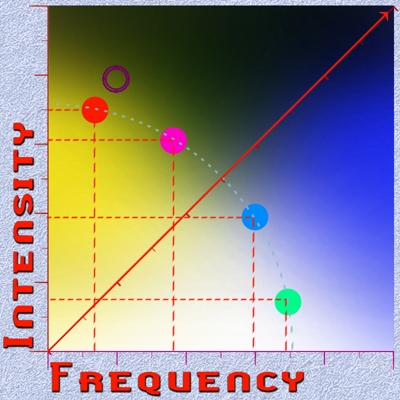
This diagram illustrates the problem. It shows four very different campaigns that all have the same overall rating in one topic – let’s say the scope of magic within the campaign, for the sake of argument – if the overall rating is simply measured as the linear distance from the 0,0 point, which is the most obvious way of approaching it. That rating is a perfectly average 5.
The Red campaign gets there with infrequent highly-cosmic events. The purple, more than twice as frequent, but slightly diminished in intensity. The blue shows the same increase again in frequency, but the intensity is down to 4/10. And the green? The intensity barely nudges the scale at about 1.5/10, but it happens almost all the time.
This also gives an impression of just how difficult it is to assign meaningful values to these attributes without a lexicon to define them. Is intensity 7 continental cataclysm? Or national disaster? The threatened destruction of one plane of existence, or merely of triggering the Big One in San Francisco? Or, perhaps, in Washington, DC?
A lexicon is essential to providing context. And that’s a wholly separate discussion for each of the specific criteria.
The second problem illustrated is exactly how to take the two scores – Intensity and Frequency – and combine them into a single overall score, distill them down. There are lots of ways of doing so. We could multiply them together and divide by 10, or take the square root of the multiple, or average them, or take the square root of the sum of the squares, just to name a few.
Let’s take Intensity 8 and frequency 2 as a test case, shown by the purple double-ring above and to the right of the red campaign on the diagram above. The average is 10/2=5, which undersells the intensity fairly dramatically. The product over ten is 1.6, which totally misstates the situation. The square root of the product is 4, somewhere in between these two, but closer to the simple average. And the square root of the sum of the squares? 64+4=68, the square root of which is going to be 8-point-something. That somewhat oversells the intensity while underselling the relative infrequency of the event.
You can’t really decide on the basis of a single test result. Is four more representative than 5? Perhaps you might want to bias intensity as the more important factor, or to bias the more extreme of the two results. Which factor is more important – or do you want to weight results toward a high outcome only if BOTH are high (that’s what XY/10 does).
To properly evaluate this, you need at least three values – low intensity high frequency, high intensity low-frequency, and one that’s somewhere in the middle. And maybe a high-high and a low-low combination as well. And referees who have run campaigns with those characteristics, who can then assess the different ways of combining the scores and rank them in realism of description of the campaign. And be prepared to discuss their reasoning.
Once one has been solved, you can introduce a new question into every subsequent discussion: is the “standard model” that was just derived appropriate? In a lot of cases, the answer will be yes – and in some cases, it might be no, requiring a new appraisal.
Complicating the picture: Chronal Morphology of Campaign Criteria
Morphology is shape, and Chronal Morphology is how that shape changes over time.
You see, over time, the PCs grow more powerful, and that means that the threats become more dire, and that can mean that the entire “fingerprint” of the campaign can change.
There are three patterns to that change, and they are mutually exclusive (though they can nevertheless be combined). Campaigns are generally either Discontinuous in this respect, or they are Continuous, or they are Fixed.
I am using the term Continuous to describe a campaign in which the criteria – it might scale of magic once again – gradually increases as the power level goes up. Discontinuous refers to a campaign which increases the criteria only at certain checkpoints – be they after certain adventures, or in certain phases of the campaign, or whatever. A shape of Fixed obviously indicates that the fingerprint criteria doesn’t change.
Combinations are possible – a campaign might be fixed with respect to one of the criteria and continuous thereafter, or two fixed levels might be ‘joined’ by a Discontinuity, and might – once a certain level is reached – plateau off at a new ‘fixed’ level.
To be meaningful at a campaign scale, trends are important. Whatever model is eventually accepted needs to take into account the potential for Chronal Morphology in its criteria.
Just a beginning
So that’s an outline of what I envisage. It’s more of a work order than a body of work, at the moment – a summary of what I think needs to be done in order to achieve the overall goal of a common, definitive, lexicon for describing campaigns, genres, and adventures.
Those involved need to:
- Agree to the plan below, or devise some satisfactory variant, with convincing reasoning for the variance;
- Define a list of general criteria that is sufficiently diverse as to collectively describe all the possibilities;
- Define a list of characteristic traits that collectively assess a campaign’s position within one of those general criteria (and a single trait may manifest in multiple general possibilities;
- Define, for each trait, what different numeric standards of Intensity and Frequency represent, and which of the two (if either) should be considered the dominant or defining characteristic of that trait;
- Determine, for each trait, how intensity and frequency are to be reconciled, in accordance with the decisions made in (3);
- Define a methodology for combining the different traits that make up each of the general criteria;
- Define a simple linguistic or graphic representation of the general criteria – the genre “fingerprint” of the product, be it campaign background, game supplement, module, or game system;
- Demonstrate, through the application of the results to multiple test cases, the efficiency and accuracy of the resulting genre fingerprint, and – in particular – identify any “weak spots” in the lexicon;
- Establish a mechanism by which revisions and improvements to the standard definitions can be made.
That’s years worth of work for a team of GMs. But it’s a beginning – a blueprint for a process. That in itself represents a step forward.

Discover more from Campaign Mastery
Subscribe to get the latest posts sent to your email.
Comments Off on Structural Concepts Of Genre