Patterns Of -archy: Family Units in RPGs
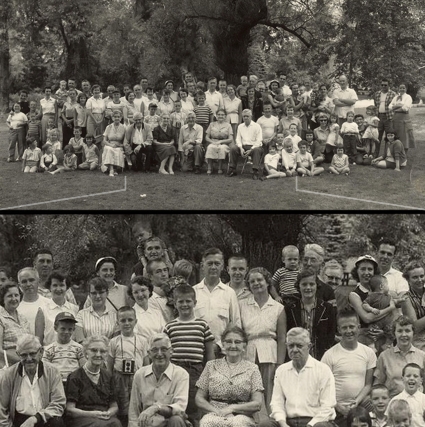
Image courtesy Pixabay.com/narsuine
(No, this is not my family)
Although I’ve lived in the state capital for more than half my life, and am a creature of thoroughly urbanized habits and propensities, at my core, I come from a small town almost 600km away named Nyngan, as explained in Location, Location, Location: Nyngan, in which I describe the township and how to adapt it as a template for various genres of RPG.
This article will draw a number of general conclusions from my family experiences.
As foundation, I need to describe those family experiences – in a fairly abstract way, no family secrets revealed!
But, while those family experiences relate to a family orbiting around a Matriarch, I want to make it clear before we begin that the central figure can just as easily be a Patriarch.
Of course, I’m sure some will have misread the title of this article as “Patterns Of Anarchy”, but that’s all right – there’s some of that in every family, too!
When I was growing up, my paternal grandmother was the Matriarch of the clan, the hub around which the entire family seemed to revolve, keeper of the social calendar, organizer and chief caterer of almost every social occasion and especially festive occasions like Birthdays, Christmases, and New Years. (I’ve starred myself, not out of vanity, but simply to provide a reference to the perspective from which changes should be viewed. Distance on the diagram roughly correlates with distance in real life).
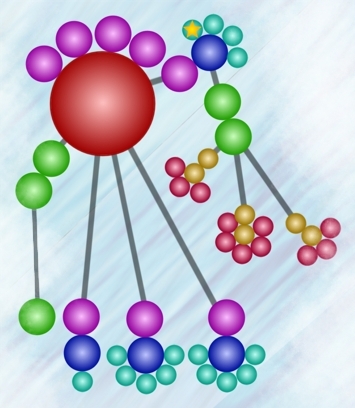
There were a few branches of the family living in the remoteness of Sydney but it was from Nanna that all family news was disseminated.
It didn’t seem to matter too much when someone moved away – the Matriarch remained the point of central connection, and eventually, most absentees returned.
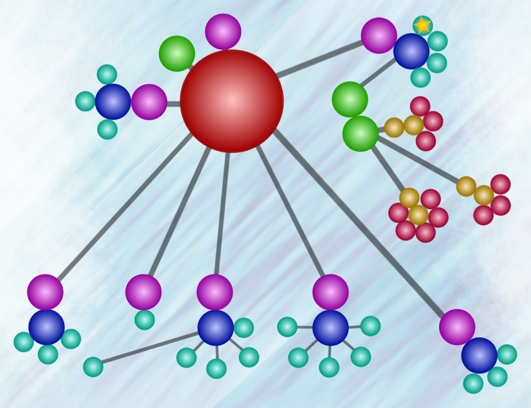
For example, the diagram above illustrates the time my family relocated to Peak Hill in an attempt to save my Parent’s marriage. When that attempt failed, everyone but my father relocated – back to Nyngan.
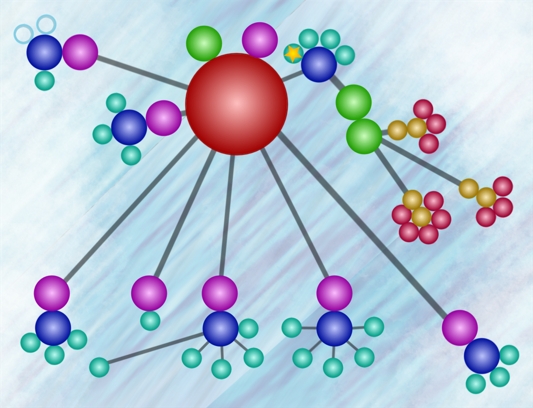
Some family members made more permanent migrations, of course. You can see that process beginning in the diagram above. And, of course, there was also the inevitable passing away of family members. But always, the Matriarch was the central point of the family.
And then she wasn’t. Everyone passes away eventually, but it’s fair to say that the passing of some comes as a bigger blow than others.
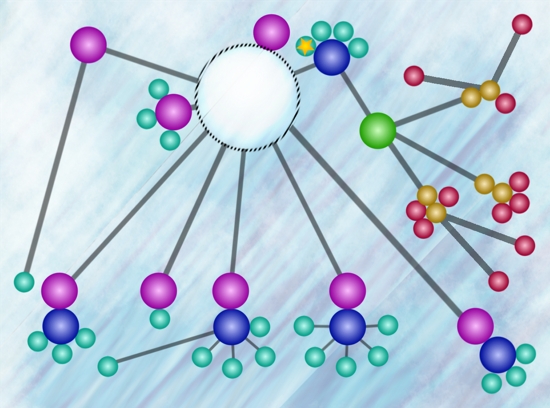
The loss of an “-arch” creates a vacuum, an empty space at the heart of the family. For a while, old habits will persist, and the family will be drawn together in grief. But that doesn’t last. When this period of transition is complete, either someone else has stepped into the role, at least temporarily, or the family begins to drift apart, its cohesion shattered.
But being the patriarch or matriarch of a family is a pretty-much full-time job. You can’t do it and do anything else requiring a substantial time commitment, like holding down a job.
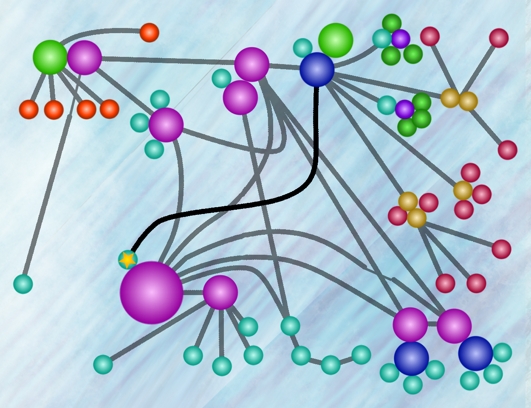
In the case of my family, one of my Aunts became the social and communications hub, even though she lived in Sydney and hence was remote to most of the family, as shown above. I know – I was boarding with her at the time, while I went to University. It was always a case of “who was going to be visiting next”, and when.
When she also passed away, it spelled the end of the family matriarchy.
In modern times, there are multiple family hubs, all interconnecting to some limited extent. There remains one nexus in Nyngan, revolving around three aunts (of two generations) and some nieces and nephews and their families. My mother forms a hub for her side of the family. My father has become something of a hub, especially since my sister and her family are located relatively close by, and he is a primary gateway to news from the Nyngan hub. There are two separate hubs in the national capital, one focusing on an Aunt and the other on my Brother and his large family.
I wanted to create a diagram for this stage in order to complete the sequence, but found that I simply no longer knew enough about the family. Whole branches had drifted away – there were cousins whose marital status and children I simply didn’t know – my cousins Cherie and Michael, for example. Is my Aunt Vera still alive? I don’t think so, but I’m not sure. Even some of the elements in the diagram above are merely “best-guess” and some are mere assumptions made in ignorance.
There are still occasions when a substantial percentage of the family get together, as we used to – at the last such, about 40 members were present, and at least one or two guests who aren’t yet officially part of the family. And smaller gatherings also occur – in fact, you can graph it, there’s a simple linear relationship between the number of family members involved and the frequency of gathering. I think, too, that it is significant that gatherings for weddings and significant birthdays continue to outnumber those for funerals; it shows that the family continues to grow.
In fact, it’s fair to state that a number of these ‘nexii’ are in the process of becoming the center of family ‘-archs’ for their branch of the family, though I doubt that any of the people at the heart of them consciously realized that this would occur. Dynamic processes and individual stories have just combined with circumstances to mold relationships that way.
Dynamic Processes
It’s important to recognize that the apparent stability of these diagrams is largely a fiction. Each family member has his or her own story to tell, and the above diagrams are simply a snapshot of the aggregate total of these dynamic processes. If I were to compile any sort of “recent” family history in the form of these diagrams, I doubt that any of them would be valid for more than a year or two at most.
This apparent stability is what makes the diagrams a useful tool for analyzing the changes from one period to the next, as each is recognizably an evolution of the previous one (I could have produced fewer diagrams, but then this visible connection between the contents would have been lost).
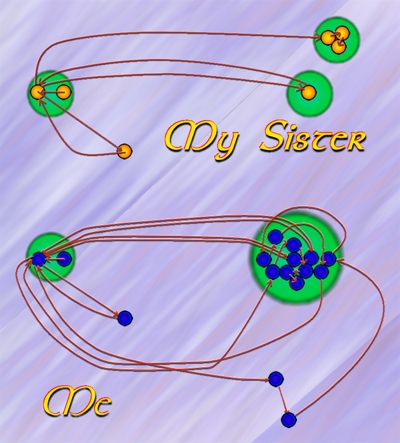
The diagram shown illustrates this fact by tracking the histories of my sister and myself, respectively. Like me, she lived on a property (a ‘ranch’ or ‘sheep farm’, for the benefit of non-Australians) outside of Nyngan for a while, then moved into town with the rest of the family. Then we moved to Peak Hill for a while, and then we moved back to Nyngan. Some time later, she moved to Sydney to study Nursing, but eventually she moved back to Nyngan. Again. And then she and her family moved to the Hunter Valley region, where for a while they seemed to move every few months before settling.
You’ll notice that I’m mostly omitting the reasons for these migrations; some were good and some bad. That’s because the reasons aren’t as important in this context as the fact that they occurred at all.
As for my personal travels, let me simply rattle off a list, in sequence, of the places that I’ve lived: Nyngan (bush), Nyngan (town), Peak Hill, Nyngan, Haberfield (Sydney), Nyngan, Circular Quay (Sydney), Nyngan, Crookwell, Cooma, Bondi Beach (Sydney), Lidcombe (Sydney), Top Ryde (Sydney), Petersham (Sydney), Nyngan, Wiley Park (Sydney), Burwood (Sydney), Lewisham (Sydney), Lakemba (Sydney), and now, Belmore (Sydney). You don’t need to know where these places are; in the general overview, only two broad locations matter: Nyngan and Sydney.
Adding to the picture generated by the sheer number of entries is the fact that the last two locations of the list comprise the last 25-26 years of my habitation. All the rest deal with the first 29-30 years.
Every time I moved, there was a reason. Some of the moves were voluntary, some weren’t; some were hasty scrambles as what appeared to be stable long-term situations collapsed (metaphorically) out from under me.
Yet, if I were to state – truthfully – that most of my life has been spent living in Sydney, and most of the rest in Nyngan, none of this complexity is apparent.
RPG Relevance
So it is with families in an RPG.
There was a time when I asked every player for their PC’s family background and a list of members. What I learned fairly quickly was that any such listing is just a frozen snapshot of an aggregate of personal stories, and that keeping up with them was a full-time job.
I still think it’s important for PCs to have a narrative that contains their life story to date, even if its only for their reference. But it only impacts me as GM when one of those family-member NPCs matters to the in-play game – in other words, when one of those personal narratives intersects with the personal narrative of the PC.
And, when that happens, I don’t need to update the whole family – just the part of it that the PC is going to be interacting with and any gossip that the interacter might have to share. In effect, the family dynamic gets scaled down to manageable proportions.
Things change a bit when there’s an “-arch” in the picture, regardless of whether it’s a Patriarch or Matriarch. Suddenly there’s a clearing house into which all family information flows, ready to be regurgitated whenever an out-of-touch family member gets in touch. This means that the whole “picture” needs updating from time-to-time, but the need for doing so is usually going to be fairly infrequent. Once again, in effect, the problem is scaled down to manageable proportions.
Patterns Of Individualism
This can be made even easier for the GM simply by allocating traits or patterns to the different family members – not ones that necessarily have anything to do with anything else being tracked by the GM, mind you, but ones that specifically relate to their position vis-a-vis the family collectively.
One relative might change girlfriends like the weather. Another might be involved in a scandalous relationship. A third might be unable to hold down a regular job, while a fourth is a jailbird. There will probably be a relative who is getting some form of promotion or lucky break every time they turn around, and there will be several who are held up as examples of virtuous behavior within the context of the family, and so on.
There will be branches of the family that are rarely heard from, branches that are sometimes in favor and sometimes on the outs with the rest, branches that have been estranged or simply distant for so long that the family has almost completely lost track of them.
You can even categorize family branches or sub-units by how close they are to the conduit through which news normally flows to the PC, a far more useful arrangement than a simple chronological sequence of birth (which is how players usually list family members).
Over time, these patterns can change, but they tend to be relatively fixed for long stretches of time. And that means that they can be used to shortcut the process of updating the whole-family picture when that’s necessary.
Families can be daunting
Quite a lot of the time, I find that GMs find the amount of work involved to be so daunting that they ignore the family members of the PCs except when they serve some vital purpose, or can have such a purpose forced upon them.
This isn’t all that surprising, because families are a LOT of work if you try keeping up with all the dynamic changes within on a real-time basis. But they can also be a great source of adventure hooks, occasional resources, and ongoing complications for a PC – too useful a resource to waste.
What the above section shows is that families can be made practical, from the GM’s perspective, and that this valuable resource doesn’t have to be left on the shelf.
Types of “-arch”
I’m going to conclude this article by looking at the different types of bond that can unite a family. It’s possible for the family “-arch” to fill multiple functions simultaneously, or their role can be singular in nature, that’s up to you.
Below, I’ve given eight nine ten eleven different types of “-arch” a cursory examination. Some of these, depending on society and culture, can favor Patriarchs, while others favor Matriarchs. It’s also possible for a couple to share the role, though this can grow complicated if they are ever separated.
There are definite impacts in terms of the replacement of the “-arch” when one becomes deceased. In some cases, dispersal of their role might not be an option, meaning that someone will inherit the role. The family may have little or no choice in who that is; it could be a hand-picked successor, an external appointee, or the only viable candidate due to geographic positioning. Some roles will demand a carefully-crafted succession plan; others will be more spontaneous, a reflection of individual personalities than anything else.
And, with each new occupant of the position, relationships with various family branches will begin to change. There will some who become estranged, while others draw closer to the family heart. Familial duties may be reallocated, redefined, and/or redistributed – usually without the consent of the person being “volunteered” by the new “-arch”, but always with some ulterior motive in terms of family unity or cohesion.
1. Social Hub
This is the type of “-arch” with which I am most familiar. I described it earlier as the person who sets the social agenda, makes the arrangements, is often the host and central accommodation for those in attendance, decides how lavish an event will be, who will be invited and whose attendance will be required, will structure transport plans, etc.
2. Communications Hub
The communications hub gathers the latest “news” of all branches of the family and disseminates it, perpetually reminding members in the process that they are part of a greater whole. Once it was done with mail, then by telephone, and these days it might be by social media or other electronic means.
3. The Caterer
The caterer likes to cook, and is usually good at it, and as a result, is the natural host for family gatherings and celebrations and feasts of all types. They are often the sort of person who interprets “don’t bring anything” as “only bring one or two dishes”. Waistlines in families with such a member are often expanding. There was a time when this would predominantly suit a Matriarch but these days that’s not necessarily the case, and there has always been a male equivalent (“the family barbecue”).
If the prospective caterer is not a good cook, family members won’t be enticed to gather. If they don’t like to cook, they won’t do enough of it, often enough, for their position to become central to the family. Only if their cooking is too good to resist and occurs at regular, perhaps even pre-arranged, intervals, can an individual become The Caterer.
4. Financial Hub
When one family member controls the purse-strings, they are usually the focus of the family. It takes an individual of noteworthy drive and independence to forge their own path against the wishes of this individual.
What’s more, the qualities needed to acquire or sustain the fortune that makes the individual the Financial Hub of their family usually make them equally strong-willed and determined not to let anyone escape their familial authority. To the casual observer, they can even appear petty and petulant.
Of course, the mere existence of this role means that it is also possible to view corporate entities as families, perhaps dysfunctional ones. This can be a beneficial perspective because it enables those same shortcuts used for managing family structures to be applied to this type of game entity.
5. Power Hub
Some families have a history of being involved in the wielding of authority. Sometimes called political Dynasties, probably the best-known example are the Kennedies, though there are others – the Bushes, for example.
Simply by virtue of having the ear of someone in Authority, the family members of the Power Hub receive a certain level of indirect Authority and political Protection.
But this only works if the majority of the family present a united political front, usually one dictated by the Power Hub. That means that all the usual apparatus of Authority needs to be brought to bear on the family as though they were a political party or similar body. Stray too far from the politics of the Power Hub and they will no longer support your position, which immediately compromises the power imbued by their authority; and if too many stray too far, the ability to be “one perspective in many places at once acting in unison” is dissipated.
Political parties have Party Whips to keep members in line, serve as the ears of the leader within his party, maintain the schedule of events, and so on. Families that revolve around a Power Hub will usually have a member who serves a similar function, keeping tabs on members and manipulating things behind the scenes to protect the authority of the Power Hub (doing the dirty work so that the Power Hub himself always has clean hands, in other words).
6. The Matchmaker
The role of the matchmaker is not restricted to selection of new family members; they orchestrate connections between family members with needs or problems to other family members with the knowledge and resources to satisfy or solve those needs or problems; and no union is ever ‘sanctioned’ until it is blessed by the Matchmaker.
I once saw a somewhat poetic description of this role as the “choreographer of family assets”. In some cases, the Matchmaker can micro-manage virtually every substantial decision of the family. Get on the wrong side of the Matchmaker and you my as well be disowned by the family; they simply will be busy elsewhere when you need them.
More vindictive personalities may then take the extra step of making sure that disaffected members come to need the services for which the Matchmaker is the gatekeeper. Others simply subscribe to the concept of the whole (family) being stronger than the sum of its parts.
7. The Enabler
The Enabler is, strictly speaking, a variant on the Matchmaker – one who expressly does not dictate who will or won’t be members of the family, but simply plays “matchmaker” between needs and family “assets”. Of course, in order to know what individuals can contribute, they need to get to know all members of the extended family very well.
8. The Expert/The Maker
Also described sometimes as “The Builder”. Sometimes the Patriarch, sometimes the wife of the actual Builder, this role holds the family together by providing a specific practical function to the family at cost prices or even less. Imagine a family in which every branch’s home was constructed by the one family member; the members come to him because he is cheaper than commercial rates, and he gets ongoing employment in his trade and family unity out of the bargain. How difficult would it be to refuse that family member just about anything?
The greater the differential between commercial costs and the “family rate,” the more beholden the family becomes.
What if the family member doesn’t gift in whole or part the dwellings, but retains partial or full ownership over them and rents them to family members at a pittance, transforming themselves into a property magnate in the process?
Turn this person against you, and your rent may suddenly rise dramatically – an implied threat that would rarely, if ever, need to be actually carried out.
Of course, part of the quid-pro-quo would be the return of ‘the favor’ – a lawyer would be expected to represent the family, a doctor to give free consultations, and so on.
Equally, of course, rather than a builder, the central figure might be one of these other professions who provides free or discounted services to family members “in good standing” – and makes it worth their while to do so through the acquisition of similar benefits from other family members.
Let’s be clear – every family with any internal cohesion does a few such favors, one member to another. the role of “The Expert” goes beyond that to transform the family into a semi-structured collective, binding the family together with the power of mutual self-interest.
9. The Great Protector
Some families have a figure who does nothing but solve problems, or tell the affected member how to solve their problem by the most expedient route. Over years of doing so, such individuals become the Great Protectors of their families, sheltering them from harm, caring for them, and even (occasionally) inflicting painful lessons (the “cruel to be kind” principle).
Traditionally, when this is a Maternal role, the Great Protector focuses on social issues, while a Paternal role is more likely to have a more liberal role within the family. But these roles are less likely in modern times to be constrained in this way.
10. The Spiritual Guide
This type of “-arch” is less common these days and more likely to be held by a Patriarch than a Matriarch – though that could vary in different cultures. A family controlled by a Spiritual Guide is, by definition, one in which religion is the supreme force within the family. That religious belief is the binding agent of the family, and the Spiritual Guide is its spokesman and absolute ruler.
Of course, the paternal nature of most modern religions organizations shows that the same “short cut” techniques described can also be used to simulate internal relations within a religious order or body.
11. The Noble
Probably the least-likely type of “-arch” to occur to the casual reader, but in a feudal structure the serfs who live on it are considered to be part of the land, and the Noble granted that land (and accompanying titles) is the protector of those serfs and the liaison between them and his superiors. In effect, they can be considered his extended “family”, and – to whatever extent they overlap with his own self-interest – he represents their interests within society.
The Noble obviously fills many of the roles described above – he grants or denies leave for marriages, he controls the economy of his domain, and so on. He is clearly a Power Hub, to boot (consider the authority of his children derived by virtue of their relationship with him), and is often the Social Hub as well. When he celebrates, everyone celebrates; when he does not, individual celebrations are, at the very least, disrespectful (at least in his eyes).
Of course, he has his own family, who occupy a wholly different tier within his society, and that might be why this perspective frequently escapes notice. Or it might be because too few of them took the responsibilities of this position toward the serfs within their domains seriously.
Families don’t have to be scary, but they do have to be managed, and central to the definition of each (and to how that management is best achieved by the harried GM) is an understanding of the type of “-arch” at the familial center, if any.
In fact, I would define this fact before I started considering siblings and parentage. That’s how important it is. And the one inescapable fact is that every PC will have a family of some kind; you can’t escape them. They might be dead, or lost, or estranged, but they are there nevertheless. Ignore that fact at your peril.
Well, if you can’t ignore it in safely, the only thing left to do is to manage it!

Discover more from Campaign Mastery
Subscribe to get the latest posts sent to your email.
Comments Off on Patterns Of -archy: Family Units in RPGs