Campaign Mastery helps tabletop RPG GMs knock their players' socks off through tips, how-to articles, and GMing tricks that build memorable campaigns from start to finish.

Game Prep and the +N to Game Longevity


I have a list of the topics that I intend to cover here at Campaign Mastery that I simply add to whenever I have an article idea. Sometimes when I look at the list, though, I don’t feel sufficiently inspired to write about any of them – then what should I do? I have a choice – I can either indulge myself by writing about something else, or I can be a professional, suck it up, and write about whatever topic is next on the list.

The first choice is nothing but sheerest self-indulgence, but I am the boss and sole employee here, so I have that prerogative. But the second choice has more interesting ramifications.

For a start, you can make the professional choice in an amateurish way. That means, to put it in the Australian vernacular, doing a half-assed job just because you didn’t feel like doing the job at all. But let’s assume that if you are professional enough to choose the “responsible” course, that you are also professionally skilled enough and proud enough that you will do your best with the subject, whether you feel like writing it or not – and certainly well enough that the lack of motivation is not apparent to the reader.

That then leads to the more difficult question – will the article nevertheless be negatively impacted simply because it will be missing the passion and spark of inspiration that elevates it from the routine to the exceptional? That’s a thornier question, isn’t it? But its a question, like the initial one posed, that impacts RPGs in many different ways, and that makes it worth looking at.

Inspiration vs. Perspiration

There are a lot of ways to look at the question, but ultimately they will all boil down to the difference between Inspiration and Perspiration. I find that half the battle can be won by applying the principles of top-down design, which I discussed last week, to the task. Breaking a task down into its constituent smaller tasks may be perspiration, but it gives inspiration a chance to find a foothold and then spread to the entire task. When I’m writing an article, or a book, I’ll start by taking the subject and listing the subjects to be covered in each section, as I described in One word at a time: How I (usually) write a Blog Post. That not only makes it less likely that I will miss something, enabling a comprehensive examination of the subject, but it provides me with a road map, a path from A to B that – hopefully – makes some sort of narrative sense. I employ the same approach when I’m creating adventures for my campaigns, or – for that matter – when creating the campaigns themselves. I employ it when creating characters, especially to decide how extensive an act of creation is required. I employ it when shopping. In fact, I use it all the time, translating it by means of a Priorities Checklist. But that’s getting ahead of myself.

Hobby vs. Industry

The opposite of professional isn’t artist, as implied by the discussion so far – it’s amateur.

Players and GMs of my acquaintance used to be astonished at the level of prep time that I would invest in my campaigns, often going without sleep in order to be ready for the next game session. In fact, on a few rare occasions, I was so tired from the game prep that I wasn’t in a fit condition to run the game. Fortunately I’ve always been a night owl, and able to go long periods without sleep – though that capacity has waned as I have grown older. Probably the most extreme example was in 1982, when a week without sleep created the fundamentals of the Campaign Background for my superheroes campaigns – game elements that are still in use today. On the 8th day of that week, I ran the first session of the new campaign for about 18 hours (plus breaks) – three or four adventures, back-to-back. And then slept for 32 hours straight. You can get a lot done in 170-odd hours, especially with inspiration on your side! Of course, these days it would take me a fraction of the time – back then I had to hand-write everything.

What they didn’t seem to realize at the time was that I had set myself a standard that matched or exceeded the standard of published game materials that I had seen for other games, and was doing what was necessary to live up to that standard. I never viewed this as “just a hobby”. Over the years, I’ve learned to compromise those standards just a little bit, that you don’t have to do it all at once or in advance. But the fact is that five out of six of the people that I knew back then, most of whom saw gaming as “just a hobby” are no longer gamers – they have set gaming aside in favor of other activities. I’m still here. That either means that I never grew up, or that I turned at least semi-pro – arrogant enough, in other words, that I think that people will pay to buy something that I have produced, and therefore that I can make/supplement my standard of living with my gaming activities.

Do you see yourself, and therefore your activities, as being part of a Hobby or as part of an Industry?

A hobbyist studies things because they are of interest, and won’t study something if it’s too hard, or too dull. A hobbyist may grow excited over their web-page’s ranking in a search engine, or the amount of traffic that their blog is getting, but their primary purpose with that webpage or blog is self-indulgence, so they won’t dig deeply into subjects like marketing and SEO and site security, they will just pick around the edges at the interesting bits. They won’t establish firm policies.

A Professional is part of an Industry, sets policies and establishes business practices and does their best to live up to them, tracks rankings and traffic regularly, studies subjects that are relevant to their business as intensively as possible even if they are difficult or dull, and applies a professional standard to what they are doing. They may enjoy what they are doing (I certainly do) but they take it seriously, just the same.

There is, of course, a middle ground in which a lot of us find ourselves – the semi-pro or published amateur. They may contribute to a professional work, or self-publish something they think is worthwhile, but they don’t see a way to make a living from doing this full-time. That opens the door to other lifestyle choices – there remains enough of the atmosphere of “hobby” that gaming, and writing about gaming, can be set aside if an opportunity or need arises. And there are always exceptions to general rules like these.

The danger of becoming too professional is that the passion for the activity can be lost, and once that enthusiasm is gone, you are reduced to a mere craftsman, or a hack writer, churning out product for the sake of churning out product. The danger of becoming too much the hobbyist is that self-indulgence and artistry can overwhelm any standard of completeness. Spend all week creating one fantastic setting or one NPC and invent the rest as you go along, for example. No matter how gifted you are at Improv, sooner or later that approach will lead to a crash-and-burn. And the hobbyist can too easily set the subject of their hobby aside. Neither extreme is all that conducive to longevity.

So, the very fact that there is a choice to be contemplated – getting back to the original question – is an indication of intended (if not actual) longevity within the gaming industry/blogosphere. The professional will pick the next item off the list of scheduled subjects and write about it, no matter what – and the amateur (or hobbyist, if you prefer) will automatically turn away from that list of no entry on it is singing to them at the time, and write about something else.

Craftsman vs. Artist

Equally, but less obviously, the opposite of artist isn’t professional – it’s craftsman.

A craftsman improves his skill and ability by a study of technique and by learning from their mistakes and failures – if they learn anything at all. There is no shame in being a skilled craftsman. An artist, on the other hand, is driven by innovation and creativity; they may never be as skilled as a top-line craftsman, but they will redefine what is possible and what is not, expanding the landscape of creativity for the less-innovative that follow.

It’s tempting to equate craftsmanship with professionalism and therefore artistry with the hobbyist or amateur. Certainly, the respective answers to the initial question posed would suggest such an association. But there is a fundamental difference: whilst professionalism and hobbyist occupy different extremes on a spectrum, with a middle ground, craftsmanship and artistry are not mutually exclusive. The greatest artists are also craftsmen within their profession, and vice-versa.

Nor are these distinctions to be made in isolation. Professionalism leads the craftsman to a more rigorous, comprehensive, and studious enhancement of their skillset than is possible to the hobbyist, while lending the artist a discipline that might otherwise be lacking. The hobbyist approach permits the craftsman to focus proficiency on a limited range of their craft, where the sheer enthusiasm of the hobbyist can transcend the limits of what has been done before and achieve artistry, while it provides the freedom from a sense of obligation and responsibility that can stifle artistry.

To function at their best, any creative occupation – including being a GM – needs to occupy the semi-pro middle ground, employing artistry where it comes naturally and craftsmanship in everything they do.

All of which seems to only muddy the ground in terms of the original question, and its subsequent corollary – how much should the writer, or artist, or GM, focus on a dogmatic plodding by schedule and how much should they ignore the schedule and embrace the potential for inspiration? The solution should embrace the discipline of the professional and still leave room for the artist to come out and play.

Its all about choices

Variations on this question have been around in RPG circles for many years. The question of how to be a better player is an example.

Is a better player someone who works at the craft of roleplaying, who studies the game materials and rulebooks and spends long hours refining the character, characterization, and modes of expression of their PC, but who is rigorously mechanical and dogmatic in their approach, never really bringing the character to life at the game table? Or is the better player a consummate actor who brings the character to life with regularity, if necessary limiting the scope of their characters to fit within their range, while never really embracing the craft, the mechanics, of the game? The temptation is to give the nod to the latter, simply because we tend to respect inspiration and genius more than competence – but I think that is selling the craftsman short, and not giving him the respect that he is due. I’d put them both up on the same pedestal and have them hang off each other to stay balanced. In other words, a poorly-executed brilliant idea is not inherently better than a well-executed workable idea. The brilliant idea has more potential – but it squanders that potential.

Which takes me back to the original question. Is it better to do a workmanlike job on the next article in the queue or to bring a spark of inspiration to something else, setting aside the scheduled article for another day? Assuming no other factors, and that both will be executed to the same degree of skill, the choice has to be the more inspired one – but it is a choice, and lets not hide from that fact.

Choices are nothing new. There have been choices made in the design, execution, and in the course of using, everything from novels to gamebooks to computer games – and to roleplaying games.

Either/Or or Not?

But there are still hidden assumptions to explore. The first is that it’s a black-and-white either/or choice. The second is that this choice has to be uniformly applied over the whole of a task. Both are false.

If there are relative degrees of artistry, and relative degrees of skill, then it’s no longer a question of one choice over another, it’s a question of doing the best job possible in the time available. It may be possible to do a competent but uninspired job as a first draft and save the real artistry for a second draft – if there’s time. And if a task can be broken into subtasks – and any task can – then the levels of artistry and skill required for a satisfactory result can be different from one element of the finished product to the next.

For any task, there will be essentials that must be completed to a minimum standard, and non-essentials that can be deferred or improvised as necessary. Making the right choices about how to go about a task – in this example, writing an entry to this blog and the choice of subject matter – is a Management Skill.

The Implications Of Limited Time

If it is accepted that there is not enough time to do everything to a standard of perfection, or as close to it as the individual can possibly achieve, then the choice of how well to execute each element of what lies before the author or GM or artist is also a management skill. In fact, if the task is properly defined, it’s the same management skill. It’s called Time Management and its something that a lot of people seem to struggle with. Especially GMs in terms of Game Prep.

The process that I use to manage my time, and especially to manage my Game Prep Time is a complex one. There’s an art to doing it well without spending a lot of time on monitoring and analysis – which may well be useful but it is unproductive dead time in terms of actually having what you need to run the game ready to go each week. And it’s a process that occasionally needs to be reviewed, especially if time starts pressing hard – which (if anyone has read the introduction to my Monday Articles for the last few weeks) it obviously is, at least in my case.

Since I have both the need and the inclination to carry out such a review, I thought I would kill two birds with one stone and talk about the basic process that I use, in the hope that other GMs out there will find it useful. This is my contribution to the art and science of Time Management.

Priorities Checklists: A Guide Through The Maze

Some people have likened the process of planning the use of one’s time to navigating a maze. While it may seem simple at first, there are all sorts of hidden traps and complications that must be avoided. I use a priorities checklist as my guide through this maze of choices. I then map those priorities to the available time.

So far, there isn’t a lot that’s new or original in that summation. That’s the basic approach to time management that has been used since Adam began playing with agriculture. Trust me – there are some innovations to come, buried in the detail.

1. Establish Definitions

The first step is to establish definitions for the different standards of work required. I use Summary, Minimum, Base Standard, Professional, and Artistry as the four standards that I work to.

  • Summaryis an idea in isolation.
  • Minimumis the bare minimum required to use the idea.
  • Base Standardis a normal execution of the idea. The minimum with a bit of polish and expansion, meeting an acceptable standard for personal use.
  • Professionalis the idea executed to a publishable standard so that someone else could use it. That requires considerable expansion over the Standard, which is for strictly personal use.
  • Artistryis the idea expanded, polished, illustrated and amplified, with frills and time spend applying whatever genius or inspiration one can produce. Deliberately looking for a spark of originality in the execution of the idea, and not being satisfied until you have it.

Let’s see how these apply to various facets of game prep:

  • Adventure Design
    Summary: A one sentence outline of the plot.
    Minimum: a breakdown of that one sentence into a step-by-step guide to what is supposed to happen.
    Base Standard: Add selected content to at least a minimum standard – flavor text, technical explanations, encounters, NPCs, Maps, Props, Research and Reference.
    Professional: Add all content to at least a normal standard and preferably a full pro standard.
    Artistry: Enhance all content with originality in every subitem. Include commentary, analysis, and thought-provoking concepts. The goal is to awe the players with genius, innovation, and creativity.
  • Flavor TextSummary: One or two key words.
    Minimum: A one-sentence description.
    Base Standard: A one-paragraph description.
    Professional: A more refined paragraph, with alternative perspectives as necessary. Everything needed to bring the description to life.
    Artistry: Poetic, lyrical, and literary embellishments embedded into the text without taking significantly more page space, and/or illustrations and/or props.
  • TechnicalitiesSummary: Mention the operating principle and fake it from that.
    Minimum: One-sentence description of the operating principles with any technobabble keywords.
    Base Standard: One paragraph description of the operating principles incorporating all needed technobabble. A note or two concerning any possible ramifications or consequences, especially if applied in general as technology.
    Professional: A page describing the operating principles, with technobabble, a one-paragraph history of how the operating principle was discovered, a paragraph explaining how it is employed and has affected various relevant social practices, industries, and management. Cross-checking to ensure that there are no inherent contradictions with the plot.
    Artistry: All of the above plus plausibility: graphs, pictures, formulae, etc.
  • EncountersSummary: Who/What and how many.
    Minimum: Add a page reference number to the relevant source material. Note any variations or differences.
    Base Standard: Where the encounter will take place, likely circumstances, flavor text to a minimum standard, notes for at least a minimum map and possibly even a standard map. Notes on which dungeon tiles etc to use and how to arrange them.
    Professional: Full stats, full flavor text, tactics, outcomes, variations, a map if necessary to at least a basic standard, how to vary the encounter based on party strength, a paragraph on any substantial campaign impact that the GM should be aware of.
    Artistry: All of the above plus professional standard map, and a discussion of any hidden layers of meaning/significance that can be exploited. Ways to enhance the encounter – suggested music, sound effects, props, staging, dialogue recorded by a voice actor or actress with appropriate accents (i.e. a third party). Ensuring that the encounter has relevance to the plot and discussion of how the different potential outcomes will alter that plot. Possibly Flowcharts. Oh, and everything to a higher standard. Plus ways to recycle/re-skin the encounter for use elsewhere. This is the standard I tried to achieve in the Lair descriptions in Assassin’s Amulet.
  • NPCsSummary: A name and a plot function. In a pinch, just one of the these.
    Minimum: Name, plot function, and a 1-line summary of personality. At least one point of uniqueness or distinctiveness.
    Base Standard: A paragraph of description, personality profile, objectives, any important stats or skills, any significant equipment, and how these are supposed to integrate into the plot. At least one point of uniqueness. Lately I’ve been including a character photograph or illustration most of the time, at least in the more modern games. At least a minimal character history.
    Professional: Standard, plus full stats and character history. Names of associated NPCs and the nature of the relationship. Ditto significant places or locations, with descriptions if not given elsewhere in the adventure. Usually, a photograph or illustration – absent that, a larger descriptive passage. Some notes on how to roleplay the character. Significant dialogue in text form.
    Artistry: All of the above. Professional artwork. Significant dialogue rendered by an appropriate voice actor. Notes on how to make the NPC memorable.

I could continue, but I think the point has been made.

2. List Tasks

If we’re talking about game prep, it’s usually necessary to at least outline the adventure to the minimum standard before a proper breakdown of the tasks can be made. Most of these will be of the who/where variety. If we’re talking about blog posts, a list of ideas is needed. A typical 1-line entry might read “Travel to the city Mint-Julep. City Guards at gates searching for AlphaThistle smugglers. Street Encounter. Watch Lieutenant. Accommodations. Innkeeper, barmaid, patrons. Show necromantic crystals to Temple Priest. Learn significance. Attack by Demons. Directed to Temple of Golgoth in Blubber for expert consultation.” This would synopsize the expected full day’s play. Each entry on this list generates a sublist of tasks:

  • Travel – Synopsis, Terrain, Weather, map.
  • Mint-Julep – Location, Description (distant), known facts, significant locations, significant inhabitants, rumors, main streets, districts, defenses, internal organization, Description (internal), politics & relationships, history, map.
  • City Guards – Organization, rank, commander, function, relationships, rumors, two specific NPCs – descriptions, stats, personalities, relationships, dialogue.
  • Gates at Mint-Julep – description, map.
  • AlphaThistle, AlphaThistle smuggling – Technical: description, source, effects, consequences/abuse, price, availability, restrictions, (in)famous smugglers, (in)famous users, rumors.
  • Street Encounter – Specific NPC – description, stats, personality, relationships, dialogue. Specific Location – description, locale, tactical considerations, map. Encounter specifics, tactics, objectives, significance.
  • Watch Lieutenant – Specific NPC – description, stats, personality, relationships, dialogue. Underlings – names, descriptions. Reaction to PCs.
  • Accommodations – Specific Location – description, locale, tactical considerations, map(s).
  • Innkeeper – Specific NPC – description, stats, personality, relationships, dialogue.
  • Barmaid – Specific NPC – description, stats, personality, relationships, dialogue.
  • Bar Patrons – Specific NPCs – descriptions, stats, personalities, relationships, dialogue.
  • Necromantic crystals – Technical: description, source, effects, consequences/abuse, price, availability, restrictions, rumors, Plot Significance.
  • Temple – Specific Location – description, locale, tactical considerations, map, significance residents.
  • Priest – Deity? Specific NPC – description, stats, personality, relationships, dialogue.
  • Demons – Type? Numbers? Leader? Purpose? Encounter specifics, tactics, objectives.
  • Golgoth – Deity NPC – description, portfolio, forms of worship, ceremonial role, reputation, personality, relationships, rumors, legends, dialogue. Stats? Plot Significance.
  • Blubber – Location, Description (distant), known facts, significant locations, significant inhabitants, rumors, main streets, districts, defenses, internal organization, Description (internal), politics & relationships, history, map.
  • Expert – Specific NPC – description, rumors, relationships. More next session.

A week? You would be lucky to get through all of that in six months! I count 138 paragraphs and at least 6 maps – and that’s counting the Bar Patrons as a single entity. It could easily be 150 or 160 paragraphs. At ten minutes each, that would take around 27 hours to get through – a 3- or 4-day week of full-time effort, on top of any regular job, TV, etc. And the maps.

Not likely to happen. And ten minutes is very much a moderate estimate – you could easily spend several hours on just one item listed. Creating a fully-fleshed out city in a day? Even that seems faster than is likely. On the other hand, some of those items could take only a minute or so – at least to do to a minimum standard.

That’s why time management is such an essential, and why GMs sometimes have trouble with it.

3. Prioritize Tasks – essentials, foundations, infrastructure, and superstructure

So it’s time to make sense of that long, long, list. I categorize tasks into the four types listed in the title of this subsection.

  • Essentials are things that are necessary, that I have to have in at least some form. I can improv my way around most things, so there aren’t many things that go into this category, but there are also a few items that I know are much, much better if I don’t improvise them, so they also go into this category.
  • Foundations are things that may not be necessary, but that I will get a lot of mileage out of. Places that I expect the PCs to return to, or NPCs that they will encounter again in the future.
  • The Infrastructure category is reserved for things that are neither immediately essential nor a foundation piece of the campaign, but that will have recurring significance. Organizations and Politics, Unique ideas such as “AlphaThistle” and “Necromantic Crystals” and the deity Golgoth. These are things that would normally be low priority but that will repay any time invested into them time and time again. These are items that it is important to get right the first time.
  • Superstructure is everything else. It’s material that might be nice to have, but that can be improvised around, especially if I find the time to craft a little stage direction.
4. Format of Four

Take a sheet of paper and turn it sideways. Divide it into 4 equal columns and head each with the 4 categories. Work through the list of adventure elements – not the longer sublist of tasks, placing each item in its appropriate category. These entries all refer to work to be done to the Minimum Standard.

5. The Essentials

You may notice that I have made no attempt to schedule or control my time expenditure at this point. Nor is that about to change – not yet, anyway. Before I even think about worrying about scheduling, I do every Essential item to a minimum-standard, crossing them off the list as I do so. On a big adventure, like the example shown (which has two cities in it), that might take an hour; most of the time, it will take under half that. Remember what Minimum Standard is – the barest minimum needed to be able to use the item in play. It’s something better than Summary, but it’s strictly limited. Using the improv techniques that I’ve outlined from time to time under the heading “By the seat of your pants”, that’s a very low standard to meet; nevertheless, once it has been achieved then I have also achieved the absolute minimum needed for play. Only then do I worry about time and the management of it.

The equivalent in terms of Blog postings is, “Have I given someone a commitment that article X will be published on this date? Are there promotional campaigns or subsequent articles that relying on it? Is there a deadline that has to be met?” If the answer to any of those three questions is yes, then I have to turn professional and do the best job I can at the time. Only if the answer is no to all three can I set the schedule aside and choose the topic that I’m finding more interesting on the date concerned.

And it’s the same thing when I go shopping. Buy the bare minimum essentials first – then I can think about luxuries.

6. Extend the Checklist

The next step is to reappraise the Essentials that have just been crossed off the list. Draw a horizontal line across the page beneath the last item on the list. This divides the page into 8 areas, at least four of which are blank and at least one of which has been completed (the one in the top left). For each of those essentials, how high a priority should a refined version – to Base standard – be?

This is where the power of the system begins to show itself. It’s fairly probable that some of the Essentials to be upgraded will fall into the first, second, or fourth categories, and some may even fall into the third. Instead of being all concentrated together, in other words, they have now become distributed across all four categories. What’s more, there is a somewhat inobvious order of priority – it’s 1,3,2,4 across, and do each row before starting a new one. (Strictly speaking, it should be 1,2,3,4, but because items in the “Infrastructure” category yield game benefits for even longer than the items in the “Foundations” category, they get a bump up the priority ladder.

7. The Process

That, then is the process: Do each item in each box, in the order specified by priority, to the required standard. Cross them off, then reappraise and relist each one at a new priority for the next highest standard.

Extending the table to its full size gives something like the example shown.

  • Do box 1. Relist items in boxes 2, 12, 7, or 17.
  • Do box 5. Relist items in boxes 1, 11, 6, or 16.
  • Do anything added to box 1. Relist items in 2, 12, 7, or 17.
  • Do box 10. Relist items in boxes 1, 11, 6, or 16.
  • Do anything added to box 1. Relist items in 2, 12, 7, or 17.
  • Do box 15. Relist items in boxes 1, 11, 6, or 16. That completes the entire top row.
  • Do anything added to box 1. Relist items in 2, 12, 7, or 17. That completes that box, once and for all.
  • Do box 6. Relist items in boxes 2, 12, 7, or 17.
  • Do box 11. Relist items in boxes 2, 12, 7, or 17.
  • Do box 16. Relist items in boxes 2, 12, 7, or 17.
  • Do box 2. Relist items in boxes 3, 13, 8, or 18.
  • Do box 7. Relist items in boxes 3, 13, 8, or 18.
  • Do box 12. Relist items in boxes 3, 13, 8, or 18.
  • Do box 17. Relist items in boxes 3, 13, 8, or 18.

… and so on.

This sorts items into priority sequence as you go, prioritizes essentials, then long-term assets, then reusable assets, and lastly nice-to-haves.

Note that you don’t HAVE to relist an item if you don’t think you’re going to need it to the next standard up the hierarchy.

Sooner or later, you will either run out of time, or run out of things that need doing. Any remaining time is yours to expend as you see fit.

The 40:40:20:10 rule

This is more commonly known as the 80:20 rule, which states as a general principle of time management that 80% of the work requires 20% of the total time required, with the other 20% of the work requiring the remaining 80%. I’ve also heard it expressed as 75:25, 70:30 and 90:10. My corollary to this rule is that half of the 80% of work is not actually needed, anyway, at least not when it comes to RPG prep, and this half only takes half as long as the other half of the 80%, or 10% of the time.

The system of task allocation I have described above completes a flat 40% of the total work to a summary standard or minimum standard, then selectively targets the remaining time – however much it might actually be – in taking items up to Base Standard. It gets maximum return for the initial 10% of the total time required to do everything and then pinpoints the most productive way to expend whatever is left.

8. Budgeted Time

Sometimes, I know that a task is going to take longer than normal. Sometimes I know it will be much faster than most. It’s relatively easy to make allowances, shuffling slow items down the priority list for greater net productivity, and fast-tracking items that will take substantially less time.

To find out how much time we’re allowing for a standard task, count up the number of tasks. Divide the total time available by that task-count, and multiply by 60% (I’ll explain that in a minute). Then round down. That’s how long you have to complete the average task on the list. (If I have 6 hours prep time, that works out over 18 items to be 12 minutes each).

The average task has 160 (total subtasks) / 18 (total tasks) = roughly 9 tasks. So anything with 18 or more is significantly longer, and anything with 4 or less is significantly shorter. But what if a subtask is a map, illustration or prop that is going to take substantially longer than the 90 seconds or so per subtask that is the average available? Take it out and list it as a separate item. That means that you’ll at least get most of that task done before time runs out.

If a task is going to take substantially less time than average, move it up a row, but leave it in the same column. indicate the difference in target standard with an abbreviation appended to the title. In the case of our example, several of the tasks fall into the faster-than-most category, including – once the map is excluded – the gatehouse at Mint-Julep. “Travel” and “Expert” are others. So “Travel” might be listed as “Expert (Min)” and listed in the Summary row instead of where we would expect to find it.

If a task is going to take substantially longer than average, it becomes important to estimate HOW much longer it is going to take. Every second doubling moves it down a row, every odd doubling moves it into one column lower in priority. So, if a map is going to take 90 minutes, and our task standard is 12 minutes, that’s 12×2=24 (1 doubling); 24×2=48 (two doublings); 48×2=96 (three doublings). So up across two columns (1 and 3) and down 1 row (even doubling).

The exception is when that task is initially listed as an Essential. It doesn’t budge from box 1 in this instance.

  • If the task was originally in box 1, the extracted subtask moves to box 6 and then to box 11, then down one to box 12. Except that it doesn’t move from box 1, because that tags its priority as an essential.
  • If the task was originally in box 5, the extracted subtask moves to box 10 and then 15, and then down a row to box 16.
  • If the task was originally in box 10, the subtask moves to box 15 and then to box 1 (lowest number of the next row), and then down a row to box 2.

…and so on. The net effect is to lower the priority of the subtask to a row that is more commensurate with the time that it is going to take, but to prioritize it within the box in question to at least some extent, because it will be amongst the first things listed there.

9. Allowance for Inspiration

I said that I would explain that 60%. Well, half of the remainder (roughly 20% of the total time available) is set aside as Inspiration Allowance. If you’re working on a minimal description and get a really cool idea for the personality, or the appearance, or a magic item, or whatever, this affords a limited amount of time to at least make some notes on the idea. It probably won’t be enough to fully develop it, unless you want to risk shooting your whole allowance in your first breath.

If I’ve got 6 hours allocated for game prep, 20% of that is 72 minutes. I’ll normally take notes on the idea (probably only using up a couple of minutes of that time) and list further development of the item as an Infrastructure item in the appropriate row. Which means I’ll get to it If I get time.

10. Contingency Time

The remaining 20% is contingency time – an allowance for delays, mistakes, distractions, or foolish optimism. It’s probably not enough to fully protect from any of these, but its better than nothing. At the end of the development, if there’s enough time, I can come back to it.

The press of time

Knowing that you only have X minutes – in the case of the example, 12 – to get em>something down on paper has a salutary impact on time wastage. you don’t let yourself get sucked into wasting time on detailed non-essentials; instead, you’ll hit the high points and keep going. As a result, working in this fashion is usually a lot more efficient than simply carrying out the task through to standard Y – whatever that happens to be set as – would actually be. So you are more likely to find the time in prep to make those little touches that elevate an adventure than you would otherwise be.

“I’ve got an hour to work on game prep, I can afford 5 minutes on this” is a far easier sales pitch to oneself than “I’ve got 7 minutes to get this part of game prep done, I can afford 5 minutes on a side-issue”.

Subdivided tasks

When relisting a task, I will often subdivide it into subtasks and list those as having different priorities. Knowing that the poor quarter starts at Falchion Street (main thoroughfares) is probably less useful than knowing that the population are prejudiced against Elves following a misunderstanding in a war 20 years ago (History).

11. Dependencies

Another benefit of this approach is that when one task is dependant on the completion of another, at least some work has been done on the dependency. This is usually enough to get on with the dependant task, making additional notes as necessary regarding the parent task. The focus is on doing just enough to get on with things and not using up all the available time polishing one item.

But all this takes time

Yes it does. It took a good 30 minutes or more to break the task list in the example down into subtasks, and it will take time prioritizing and relisting tasks. Just a few seconds per item, but these can add up. This has been allowed for in various ways within the process:

  • Available prep time is not measured until AFTER the list of subtasks is generated and the initial set-up of the table, AND the minimum-level prep on the essentials is done. It’s not so much how much time you have available for game prep, it’s how much you have left after doing what absolutely has to be done.
  • In allocating time units for tasks, the time is rounded down. This leaves a few seconds here and there to consume in management tasks.
  • Managed time is far more efficiently used than unmanaged time. Trust me – you will get more done in less time than it would have taken to achieve satisfactory prep if your time was unmanaged.
  • Finally, whatever management overheads remain can be soaked up by the contingency allowance.

So don’t be scared of the time aspect of actually managing your time.

On A wing and a prayer

I also want to emphasize that it’s a lot easier to improv if you have at least some basic notes to work from. I’ve been able to run entire adventures based on nothing but the task list. Again, I commend the By The Seat Of Your Pants series to your attention if you want some hints on how to cope with this lack of prep:

The Accumulation of Capital Improvements: +N to Longevity

Think about this for a moment. Ten minutes a day spent on developing campaign resources and reference material for 2 years equals 7300 minutes which is over 121 hours or 5 days straight. Or more than three weeks of nine-to-five effort.

Two hours a week for five years equals about 3,650 hours, or 152 days straight, 24/7 – or about three months of 9-to-5 work.

An hour a day for 20 years – about the average I’ve put in on my Fumanor campaigns – is about 7305 hours, or getting close to a year of continuous 24/7 effort, or about three and a half years working on it as a nine-to-five job.

Some people have privately expressed awe at the depth and sheer quantity of material and background that I have been making available in the Monday series on Orcs and Elves. Including downloads, but not counting the different versions of the downloads, it now totals about 76,000 words or 152 pages of text – with more than 16000 additional words to go out next week. It’s analyses like those offered above that explain how it’s possible to accumulate such totals. If I were to add up all the material done for my Superhero Campaign, it would easily top 3000 pages, or one and a half million words – not counting the articles here at Campaign Mastery.

Time spent working on your campaign’s concepts and deep background is like investing in capital improvements for your campaign. They not only add up to ridiculous totals in a surprisingly short span of time, they cross-pollinate. It gets easier to do more because you have more original material to draw apon, and because you’ve gotten into the habit.

I want to make this point in another way, before I move on: You have two months to prepare a new campaign. How many hours a day do you have to expend to get to a total equivalent to one full working week – 40 hours (for convenience)? Two months is a smidgen below 9 weeks of 7 days each, or 63 days. Call it 60 days. The answer: just 40 minutes a day gets you a working week every two months. Or six working weeks a year. Or more than a year’s worth in a decade. People tell me they don’t have time to do campaign prep, and I have trouble accepting it.

Of course, if you want truly obscene numbers, apply the minimum wage wherever you are to those numbers of hours, and you will gain some appreciation of just how valuable your campaign prep is. Here in Australia, the minimum is a bit over $20 and hour. So 7305 hours invested puts the value of the Campaign at approaching A$150,000. Given the current exchange rates, it would top the US$150K mark easily. And that’s without spending one cent on it.

Application

I use a similar prioritization approach to everything that I do. Game Prep. Writing. Shopping. TV viewing. Holiday Planning. Why? Because it works, and helps keep me organized. So if game prep is a problem for you – or you simply want more time to spend on it – try applying some basic Time Management to your prep activities. The results can be breathtaking.

Choices. We all make them. One of the keys to success is not to make them blindly.

Comments (10)

Inventing and Reinventing Races in DnD: An Introduction to the Orcs and Elves series part 3


This entry is part 3 of 31 in the series Orcs & Elves

I’ve got a lot of campaign prep to get done over the next few months. In fact, I’ve got so much to do that if I don’t do it here, in public, I’ll either never get it done in time – or be so distracted that Campaign Mastery will suffer. I’ve chosen to do the former. But first, I have to paint a picture of the background for this to be useful to the rest of Campaign Mastery’s readership.

This Article

This article concludes the preamble/primer of preexisting background material that is needed for the reader unfamiliar with it all to understand the new content, and hopefully along the way, it just happens to give away a lot of material that other GMs should find useful. It’s also the largest article ever published here at Campaign Bastery, by a considerable margin!

  • Part 1 of the trio examined the general question of why I customize races in the campaigns that I create.
  • Part 2 got specific, discussing Elves, Drow, Ogres, Halflings, and Dwarves.
  • Part 3 is going to deal with Orcs, Dwarflings, and The Verdonne.
  • Part 4 will bring the history of the campaign up-to-date. With all that out of the way, I’ll conclude these preamble articles by quickly describing how I have written and am going to continue to write the rest of the series.

In other words, most of this trilogy is about who’s who in the adventuring party at the heart of the work to come.

The observant may have noted that what was Part 3 has now been split in two. When the proposed Part 3 reached 22,000 words and a length roughly the same as Parts 1 and 2 together (despite part 2 being the longest article ever published here at Campaign Mastery) I decided that it was time to split them.

Some of the content may have appeared at Roleplaying Tips in the past, but I couldn’t find it when I went looking there. Johnn was kind enough, years ago, to give me explicit permission to republish the relevant materials, so there’s no problem. Some of the material dates back to the turn of the century, some of it dates from 2005, and some of it is more recent. Campaign Background material is like that – small increments of capital improvement adding up over a period of years into something massive. To be honest, if I weren’t under the gun, timewise, I would probably split this up into seven or eight separate articles. But even bundling this up into a few larger articles, there’s still more than enough to make this a very substantial series – once it actually starts, next Monday!

Orcs In Fumanor

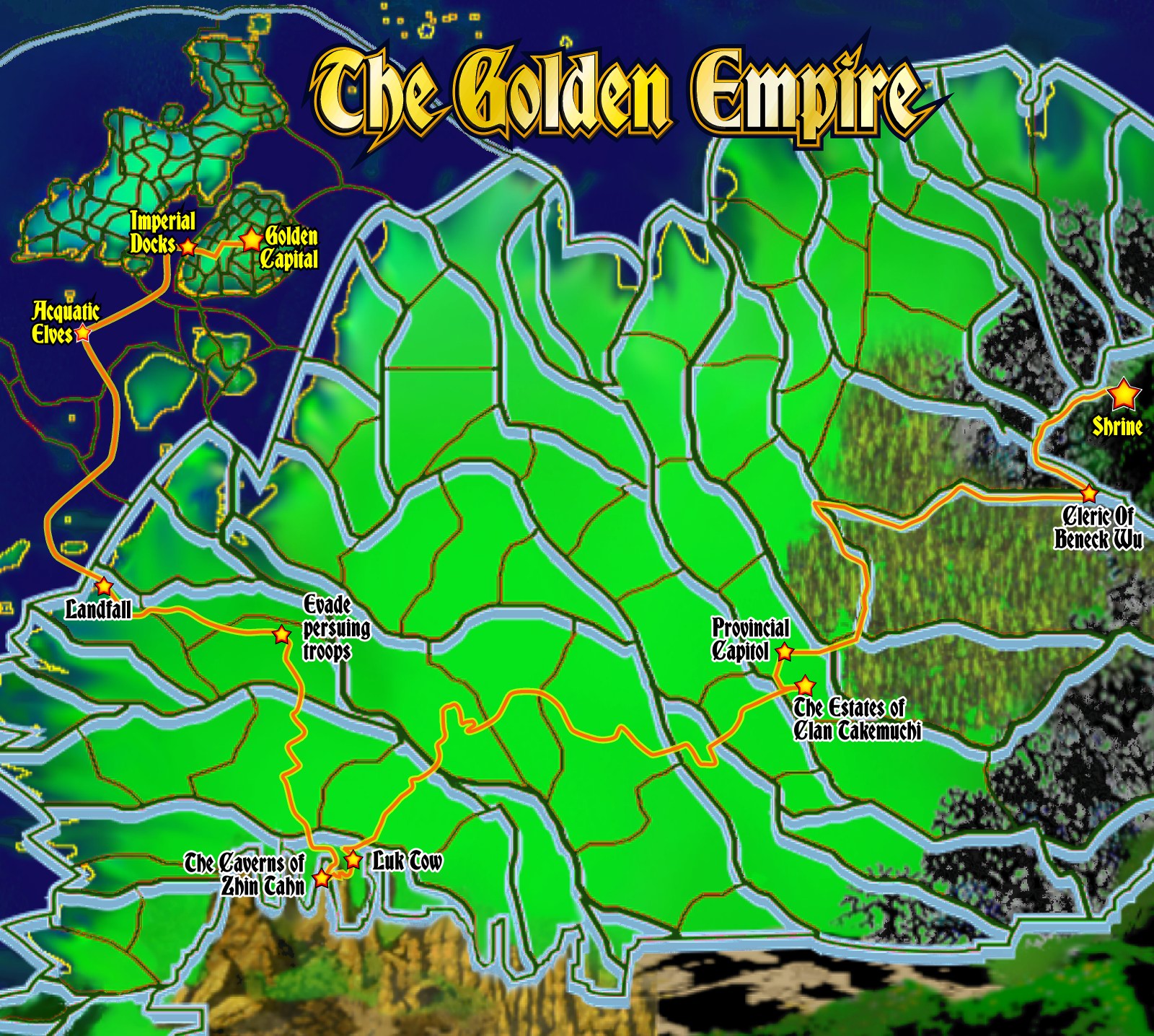
Orcs in Fumanor are primitive and simple folk – but maturing fast, especially since Drow started teaching magic to some of the smartest Orcs. They can’t cast anything better than 3rd level spells (at least, they couldn’t the last time the PCs checked on them), but they’re learning. It probably won’t have hurt that the finale to Campaign I gave every sentience in existance +2 INT, either, to a maximum total of 20. The Orcs weren’t all that happy with the Drow when they were hung out to dry in the course of that campaign, and were persuaded to enter into a treaty with the Kingdom of Fumanor. Unfortunately, the Elves now block easy Kingdom access to the Orcs; it’s a difficult and dangerous journey through Giant Spiders (hostile), Black Trolls (hostile), Dwarves (hostile), Kobolds & Minotaurs (hostile), Wild Tunnels (very hostile), Drow (friendly – mostly), back out the other side through Gnolls, Ogres, and more Giant Spiders (all hostile) and into Orcish tribal lands (some hostile, some not), who are being invaded by Undead from the Golden Empire (extremely hostile).

Click the icon to download Tooth & Dagger – Rationalising Orcs (LT & A4 sizes) 179K
Tooth & Dagger: Rationalizing Orcs

Back in 1990 I started working on some new ideas for a variation on Orcs. This is an iconic race in both Tolkien and D&D but I thought those two iconic interpretations were too similar. I wanted to take some of the elements hinted at in Tolkien and expand on them to give a new interpretation. A decade-and-half later, I had finally finished. Written in a somewhat whimsical style in parts, and with modern referances that doesn’t really fit the other material contained here, this is nevertheless the basis of Orcs in Fumanor – it just so happens that most of it was written before anything else in the campaign.

It is worth noting that “Tooth & Dagger” has been generalized. It talks of mankind keeping Orcs as slaves – other races in Fumanor may have done so, but there’s no record that the PCs know of that says Humans did. Other races, yes, but Orcs were too troublesome.

There are several noteworthy aspects to the document. It is entirely written from an Orcish perspective and perpetuates the Orcish self-image (NB: they think of themselves as the Good Guys and the saviors of the world – after all the other species have polluted it so much that they can’t live in it). It is laced with Orcish mythology, such as the beLeif that Elves were a failed early attempt at creating Orcs. And it shows The Gods (well, most of them) to be unruly schoolchildren. But for all the distortions, there is a spark of harsh nobility – even raw, unpalatable honesty – in the Orcish perspective. Orcs call a spade a spade (or, perhaps, a tool-for-digging) without pretension or sugarcoating, and look unpleasant truths directly in the eye without discomfort.

As usual, I have provided Tooth & Dagger in both Letter and A4 page sizes.

From an outside perspective

In writing “Tooth and Dagger” I took the perspective that there had to be a good reason for the typical and expected Orcish behaviour. To outsiders, Orcs are exactly what they have always been – dirty, smelly, crude, untrustworthy, and uncivilized.

In terms of appearance, I’ve always thought of Orcs as looking like the Sontarans from mid-period Dr Who. More recent versions have faces that are more human and don’t look quite right to me. I’ve linked to an image of the first Sontaran to be shown on-screen (it might not display properly with IE, I had some problems). Just make the armor more medieval and made of cast-offs and other bits of reclaimed rubbish to get the mental image I have for them.

Recent Developments

The discerning reader may have noted that there is no mention of Gruumsh in the article Theology In Fumanor: The collapse of Infinite No-Space-No-Time and other tales of existence. The question of whether or not Gruumsh was ever real is one that is occasionally debated in the campaign – or was beLeif in what he represents enough? It works for the Druids. The Gods have kept completely silent on the subject.

This puts Orcish PCs, especially priests, in a somewhat awkward situation, especially when dealing with the Deities that are known to exist within the campaign.

Thankfully for the sake of Tajik (see below), Ziorbe (described in part 2 of this trilogy) was able to employ some incisive logic to the question which has resolved practical doubts – at least for now.

  • Either Gruumsh was never real or he was a member of the pre-Godswar pantheons, no matter how isolated or outcast from the other Deities.
  • If he was never real, then what he represents is enough for beLeif in him to invoked for Divine Spellcasting. Which makes him as real as he needs to be.
  • If he was real, and there was a brawl on the scale of the Godswar happening, he would have involved himself, whether invited or not.
  • Therefore, if he was real, he probably gave his life in the Godswar, since he is not listed amongst the survivors by the other Deities.
  • However, the survivors banded together into a united Pantheon and set about fulfilling the Divine Spellcasting obligations of all their deceased brethren, which would therefore have included Gruumsh.
  • They are, however, no longer doing so. If a Divine request made to Gruumsh now fails, it is evidence that he was real and did die.
  • Making such a Divine request without real need could only be percieved as a lack of faith on the part of the Priest, which alone may be enough to cause the spell to fail, and therefore this test is not conclusive.
  • It is also possible that Gruumsh survived the Godswar but was once again made outcast, or stole away assuming that he was unwelcome, which may or may not have been true.
  • If Gruumsh survived, then he was and is real, and will respond to Divine Requests if he is able.
  • He may be unable to so respond depending on his condition following the Godswar. So failure to respond is not conclusive evidence, once again.
  • In which event, treating Gruumsh as a surviving Deity should – theoretically – aid in his recovery from whatever injuries he recieved.
  • It follows that – provided the other Gods do not take offense – nothing is lost, and potentially much can be gained, by treating Gruumsh as a real Deity who fought with the others against the Chaos Powers. Call on him when it is appropriate to do so, and ignore the question until it becomes relevant. If he can’t answer, for whatever reason, call on one of the other Gods to act in his name.

What Ziorbe did not mention to Tajik in providing this analysis as a bolster to his faith, are a few further lines of thought:

  • It is possible that Gruumsh was in fact a Chaos Power masquarading as a Deity for the purpose of keeping the Orcs as a weapon agaunst Civilization.
  • If this is the case, since the identities of the few Chaos Powers who have been destroyed or imprisoned are well known to the Gods, he is currently alive – and not happy that his worshippers have allied themselves with Civilization.
  • Inevitably, within this scenario, he will attempt to reclaim his subjects and turn them against Civilization at some point where the opportunity to do so manifests.
  • This will inevitably lead to a religious civil war amongst the Orcs, which can easily spill over into the rest of the Civilized peoples.
  • The Chaos Powers being what and who they are, will undoubtedly ensure that this will occur at a time and place that best serves their purposes.
  • All of which leads to the conclusion that Divine Prayers to Gruumsh are, in fact, an invitation to the Chaos Powers to use the Orcs as Pawns in some future attempt at destroying all existance.
  • The Gods currently have their hands full without any additional distractions, hence they would not want to create additional problems for themselves by exposing this situation – and the Orcs wouldn’t believe them, anyway.
  • Arioch, the God Of Secrets, would know – but has already demonstrated both the ability and willingness to lock certain knowledge into his subconscious so that he doesn’t know that he knows, as an alternative to being forced to act on or take into account, that knowledge.

And,

  • Another remote possibility is that Gruumsh is a false identity created by one of the Gods during the time of the Age Of Heresies.
  • In which case, the Gods themselves might not know who he really was.
  • The true deity behind Gruumsh may or may not be amongst the survivors.
  • If he is amongst the survivors, then Gruumsh is as real as he ever was.
  • If not, then he is still as real as he ever was – not at all.
  • Either way, the results are exactly the same as if Gruumsh was real and died in the course of the Godswar.
  • In which case, prayers to him will now go unanswered, unless one of the survivors decides to take on such a fictitious identity for their own purposes.
  • Which would now make Gruumsh more real now than he ever was before.
  • This would suit Arioch’s M.O. perfectly. He is the former Chaos Power who instructed his worshippers to become a Church dedicated to Charitable Works within Civilization in order to sow doubts about the established religious doctrine of the other Churches.
  • He and the other Gods would certainly not want this new deception to become known. Therefore, since most of the Gods are incapable of lying, they would again keep silent on the subject.
  • If this possibility is correct, it still does no harm and potentially great good to Worship Gruumsh as a Deity, even if he did not and potentially does not exist.

All of which adds up to a lot of soup out of not a lot of anything but ignorance! But it bolstered Tajik’s faith when that was necessary to the Party’s survival, and that was all Ziobe wanted at the time. Serious questions of Existential Reality and Religious Doctrine are somebody else’s problem.

Tajik – An unexpected Leader

The remaining PC in the campaign is Tajik the Orc. Tajik was the runt of the litter and he liked to ask questions – neither works in your favor as an Orc. He was always the last to be fed, getting the scraps and leftovers after the rest of the tribe had eaten their fill. His name actually means “Boy who asks impertinant questions” – Orcish boys don’t get named until its sure they will live long enough to make naming them worthwhile. Names aren’t cheap in Orcish society – they mean something to them. In time, he was apprenticed to the tribal Shaman, since he wasn’t fitted to a real job within the tribe, and the Shaman was the only one who could usually answer his questions. This upbringing made Tajik timid abd diffident (at least by Orcish standards). In time, Tajik was ready for the ritual that elevates an Orc to adulthood – the Chief basically gives them a task and banishes the prospective adult from the tribe until they succeed in that task, unassisted by other Orcs. Since Tajik wasn’t liked by the Chief (not Orcish enough), he expected to be given a dirty and difficult task; he was right. That task led directly to him becoming the leader of an Adventuring Party, “Tajik’s Misfits” and facing an invading army of Undead from the Golden Empire (more details below).

For the first time, Tajik found other people relying on him, and despite his initial discomfort and nerves, has proven to be a natural leader for the strange party of adventurers that have come together around him. He’s still growing as both a person and as a Priest, and prides himself on knowing and understanding things that not even the Archprelate has discovered. He may have left his village a cub; he will be returning as a leader, an enlightened theologian, and a seasoned warrior, with the confidence and ability to stand before any other Orc as an equal.

Dwarvlings In Fumanor

I don’t have to tell you very much about these because they are already described in a post here at Campaign Mastery, from the time when I adapted one of the adventures into a standalone module as part of that month’s Blog Carnival. You can get everything you need from The Flói Af Loft & The Ryk Bolti (the module was published in three parts, the link is to the first).

Leif – An Ambassador Alone

Leif was a Dwarvling approaching adulthood and a Prince Of The Realm Of Earth within the Cavern Realms of Zhin Tahn (don’t worry about it). He was so impressed with Eubani’s prowess as a warrior that he took the Elven Rebel as a role model and attempted to do everything the way Eubani would do it – without having the skills or natural ability. More than once, Eubani cringed as Leif did something boneheadedly stupid and risky to try and emulate his hero. As a result, Eubani began to teach Leif self-discipline and restraint – subjects he had never given even lip service to, in the past. Inch by inch, he is succeeding.

In the finale of the Zhin Tahn phase of the Seeds Of Empire campaign, Leif’s homeland and the other microworlds was forged into a new, stable, Prime Material Plane. With divine protection, his race survived. Unknown to the party at the time was that Time was somewhat unstable in the first days of existance of the new material plane – in about 3 days from the PCs point of view, 120 years passed within the Realm. Leif returned home to discover that he was generations out of date, and that his sister had been forced to usurp his inheritance of the throne. Now an anachronism, an embarressment, and source of political instability by his very presence, it was quickly decided that Leif would become the Realm’s Ambassador to the outside world – with the passage connecting the two sealed behind him. The title is hollow; Leif is an exile, having sacrificed virtually his every connection with his home in order to safeguard its continued existance (shades of Frodo in The Lord Of The Rings)! The only difference is that Leif is still out there, adventuring, and trying to come to terms with events.

As a result of this episode, for the first time, he feels his life directions moving in a different direction to those of Eubani. Where he will end up, what he will become, he doesn’t yet know – but he is slowly starting to outgrow his Hero Worship and forge his own path.

Leif was originally a PC, played by a handicapped guy named Peter E (surname withheld for privacy reasons) who tried out for the campaign. Unfortunately, he simply couldn’t keep up, and the problem was impacting the other players enjoyment of the campaign; although I wasn’t happy about it, I was forced to make the choice between him and the campaign. I’m still sure that I could have handled the whole situation better, and I wish we could have found a way to keep him as aa player, he had so much enthusiasm for the game and the campaign. I don’t have many regrets in life, but that’s definitely one of them – and I sincerely hope that he has found another group with whom to play. In the meantime, Leif is not only still an active reminder and commemoration of his involvement in the campaign, he’s the closest thing I have to a “protected favorite NPC” in one of my campaigns. The other players may not remember Peter, but I do, and I’ll continue to do with his character what I think he would have wanted. (It might surprise the other players to know that everything that Leif has experienced was discussed with Peter – in general terms – and his reactions planned out by the pair of us, in advance). Leif is still Peter’s character, so far as I’m concerned – he just can’t play him. (If I’d had time in my schedule, I’d have run a seperate game just for Peter).

Click the icon to download the Original 3.x Class: The Fated(LT & A4 sizes) 134K

The Fated – A Fumanor Class

I know I’m talking about races, but this character class is so much a part of the identity of the next character to be discussed that this material has to be understood. The Fated drew inspiration from a character class in the Planar Handbook which promised so much and delivered so much less than it promised – it simply wasn’t worth the expenditure of levels that it cost, as a prestige class. The abilities weren’t good enough, and the class wasn’t interesting enough for any player I approached to be interested in playing it. I commented in my Bio here at Campaign Mastery that I’ve never raed a game supplement without finding something that I thought could be improved. In the case of the Planar Handbook, “The Fated” was it. So I took the name and jetissoned the rest.

After experiencing the character class in play, I can state that the character class works perfectly, and is balanced just fine – unless you permit the character to accumulate too many unused Fate Points through inactivity. Verde, the prototype within the Seeds Of Empire campaign, was marooned for a long time (120 years) in the New Material Plane that now coexists alongside the original, in which time he was able to accumulate entirely too many Fate Points – he’s now a ealking wooden Dues Ex Machina. Any GMs out there who use the Fated should do one of two things: cap the total accumulation of Fate Points more stringently than these rules provide, or ensure that the Fated never lead a comfortable, quiet, existance. Or Both.

The Verdonne In Fumanor

I found the concepts of Huorn and Ents in Tolkien fascinating. Some of my favorite scenes in the Books revolve around the Ents, and some different scenes revolving around the Ents are amongst my favorites in the Movies (especially the extended versions). And I love the idea of the early Elves going around waking up the trees for no better reason than to have a good gossip session. In contrast the Treants in D&D seemed rather empty and lifeless. So I created the Verdonne as the pinnacle of a heirarchy of awareness and activity.

  • At the bottom rung are unawakened trees. They have no volition so they do nothing of their own volition.
  • Above this are sleeping trees. They don’t move from place to place and don’t engage in conversation, they just want the world to leave them in peace. These are essentially awakened trees that have rejected the “gift” of the elves.
  • One step above Sleeping Trees are Leafy Grove Citizens. The trees in a Druid’s Grove have a measure of awareness but not a lot of higher sentience. They can move from place to place, under direction, and will defend the Grove from intruders. A few have even learned to speak Common.
  • Fourth from the bottom are Awakened Trees. They may not move around much – though they can do so, under direction – but they are active conversationalists with those who understand them (Elves, Druids, etc) and can readily undertake other activities of their own volition. They just don’t do so very often. They have no real perception of time or urgency, and can waffle on for hours before getting to the point – if they are in a hurry. Virtually all trees in an Elven Forest are awakened to at least some extent. They have also been known to pretend not to know the difference from one day to another, just because it annoys impertinant people.
  • Second from the top of this leafy hierarchy are the Huorns, also known as Treants, the tenders and caretakers of trees. Like a building’s Super, they deal with plumbing and irrigation problems (streams getting dammed, etc), shepherd trees around to ensure that each gets a fair share of the sunlight and don’t hog the fertile earth, etc. They are quite capable of being mobile as necessary, but that usually means there’s trouble, so they would rather not. They are slow to anger and even slower to calm down once roused. Decades are often not long enough. Fortunately, it takes a lot to rile them. To the unitiated or unobservant, they look just like trees – though quite often they will be an out-of-place variety of tree. They tend to work in Packs or Groups. Occasionally, one will go off and do something on their own, but it doesn’t happen very often. Huorns are notorious for disliking conversation with anyone except a tree or a Verdonne – they are even standoffish with Elves, who they regard as meddling busybodies. Humans, Orcs, etc, are nothing more than Vandals and Murderers, of course, and Dwarves are worse. Regarding other vegetable matter as distant kin of their subjects, they are exclusively carnivorous.
  • The most mobile and independant leafy folk are the Verdonne. Shorter, more active, more alert, and more intelligent than other varieties of leafy people, these are the Guardians Of The Forest. No-one knows where they came from (except in general terms) or who appointed them to this role.

Verdonne look less like trees and more like wooden people wearing clothing and a cloak of leaves. They are evergreen except in times of acute starvation. Their limbs and features tend to be longer, thinner, and more angular than those of other creatures. They can be almost invisible in a forest. They are omnivorous and draw sustenance from the soil beneath their feet and from anything that dies on or in that soil; their feet can extrude thin vine-like stalks that slowly consume the remains, bones and all.

Verde – Puppet Of Destiny

There have been only a few Verdonne of significance within the Campaigns, collectively. There were the Verdonne who the original PCs saw in a vision explaining the history of Sovol Keep, a former dungeon that has been restored as a training ground by the Fumanorian Government. There are the Verdonne who were recruited from the Wilderness by Ceriseth to protect his Grove and fight on the front lines of the Fumanorian Civil War in the second Campaign. There’s Brightoak and a few of his cronies who now lead the Druids’ Council as Ceriseth’s hand-picked successor and who wears the Helm Of Oak, an artifact that was key to victory in that Civil War. (If you want to know more about the internal politics of the Druids, consult Flavours Of Neutral – Focussing On Alignment, Part 4 of 5, posted a few years ago. And then there’s Verde.

Rescued from the demi-plane of Earth (refer The Flói Af Loft & The Ryk Bolti), where he had been waiting for the Party to arrive, Verde has a Destiny. He knows what is and what it looks like, but doesn’t know when it will happen or what its significance is. Like all Fated, there are times when he has attempted to evade or avoid it, and times when he has embraced it. He has refused to tell the party what he knows of that destiny beyond the fact that it exists, and that it is going to happen. For a time, his path lies alongside that of the party – how long that will remain true is something else that he either doesn’t know or isn’t sharing.

When first rescued by the Party, he was a bit of a runt, little more than a sapling, but he’s squeezed over 120 years into his few short weeks with them and is now physically one of the more impressive members of the party at 10′ tall, STR 28 and CON 30 – his full growth as a Verdonne. As a result of his temporary joining with the party, he also now has 6 ranks or more in virtually every known skill – the result of 120 years of study, and typically wields a Greatsword or Composite Longbow with devestating effect – though his Slam-and-stomp-underfoot attack is not to be ignored, either (3d8+13, automatic grapple, does 9 pts of dmg a round if grapple is successful, does not take an attack to pin & damage a grappled foe). And, if he has to, he can always spend a Fate point or two to guarantee a potential critical hit and maximum possible damage.

I made the point earlier that Verde now has so many Fate Points that he is a walking Deus-Ex-Machina in many ways. Since the cause of this was entirely scripted by me as GM, correctly anticipating most of the Party’s choices, it can’t be described as in any way accidental – and it should not surprise the party to learn that Verde’s journey with them is going to come to a conclusion sometime very soon.

But first, he has one more role to play within the continuity of the campaign – the one that I’ll be writing about in this series. Nor am I promising that he will never be seen again – there’s still the question of Verde’s ultimate destiny. I know what it is – and how it will play into the planned Epic Campaign to follow the current ones.

In the meantime, Verde is usually a well-stocked library but not often a decision-maker. He is usually content to follow the lead of the others within the Party, and will rarely voice a personal opinion (unlike Ziorbe, who’s full of them). He’s a mouthpiece for factual information, gives the party a boost in combat that they don’t really need and won’t really miss, and stays out from underfoot.

On the rare occasions when he does take charge, he gives orders without explanations in a tone of voice that does not encourage debate (he’d make an excellent drill seargent) – and always has a good reason afterwards, though he was often not aware of that reason at the time. He makes it up as he goes along and that leaves the party very uncomfortable. When he starts issuing instructions, though, they obey without question – he’s been right every time, at least so far.

Humans In Fumanor

“Tajik’s Misfits,” as the adventuring party have named themselves, were lacking a human member for a long time. This made them very unusual as adventuring parties go.

Humans are the glue that binds most parties together. “Adventuring Parties” and “Adventurers” are a human social invention. It is unusual for a party to have more than one non-human member, though this is becoming more common of late.

Humans are the most diverse, forming segregated societies, and the most multicultural, integrating other cultures into those societies. The only other group that comes close to the human propensities in this respect – as far as is known within the campaign – are the Elves/Drow. But all the Elves are still part of a single homogenous society and all the Drow are still part of the one single homogenous society, so the exception to the general rule is very limited.

Few other societies do more than differentiate themselves from others of their kind at more than the clan or tribal level. Again, this is slowly changing – partly at the hands of the Verdonne-led Druids, and partly at the hands of the Lolth-led Elves.

Humans are also the de-facto common standard against which the diversities and individualities of the other races are measured – though there are ome races that refuse to subscribe to that standard, especially the Dwarves.

It is only appropriate, though, given the nature of the party’s other members, that when the Misfits acquired a human member, that individual would be every bit as unusual and outcast from the norm of society as the rest of the group. To understand what makes Julia unusual, you first need to know a little history….

Click the icon to download The Ages Of Existence, complete (LT & A4 sizes) 68K
The Ages Of Existance

I really wanted to be able to quote this completely. I can’t – I can only quote a version that’s been redacted to hide some crucial information from my players. The difference is only 139 words in seven passage – but those are seven potentially vital facts to future developments.

That doesn’t mean I have to leave Campaign Mastery’s readers in the dark, though! Accepting my players’ promises that they won’t look at anything I tag as “off-limits”, you can read the redacted version – and then download a full, unredacted version with the differences highlighted for easy consumption.

And, just be completist about this, I have also provided my players with a downloadable version of the redacted form for their reference and general use within the campaign. Thank me later :)

Click the icon to download The Ages Of Existence – Player Redacted version (A4 only) 35K
  1. The Age Of Divinity – Chaos Powers are expelled by/from the Void. Their willful resistance creates the Gods. The Gods create everything else. Magic does not exist, hence no god of Magic exists. The Gods form a single, united, pantheon.
  2. The Age Of Paradise – Golden Age with plenty for everyone, no conflict. Magic does not exist. The Gods form a single, united, Pantheon.
  3. The Age Of Theophany – Chaos Powers begin attempting to destroy existence, create elemental subplanes in which to reside. They release Evil into the world, create aberrations and dragons and other creatures of inherent evil. Chaos Powers corrupt the worship practices of the mortals of the world, dividing the Pantheon into smaller, weaker, Pantheons, and establishing conflicts between them. The Greatest Goods become the Noble principles. Gods elevate favorite followers to create Demigods. “Fallen Races” begin to worship the Chaos Powers.

    Gods discover that the power of Worship, directed by the Priests, reshapes the Gods to match the mortal perceptions. Divine personalities become an imperfect reflection of their original natures. Gods have trouble coping with this. Worship practices fracture and splinter and diversify. The nature of the Shadow Gods emerges.

  4. The Age Of Isolation – The Gods establish Pantheon-based bodies of Canonical Lore to reinforce and solidify their natures and lay down Church laws to restrict interaction with other faiths to prevent corruption of the Laws and Lore. Higher Truth is sacrificed on the altar of expediency and Divine Survival. Worshippers are essentially tools, subservient to Divine Will and Purposes. Clerical Powers are granted to selected Priests. Mortal culture is still essentially tribal.

    Illithid Researchers begin creating experiments, some of which become Dungeons, and some which release still more bizarre life forms into the ecology.

  5. The Age Of Bronze – Mortals discover the principles of working with Bronze, and of domesticating animals. Fundamentals of Agriculture are discovered. City-states arise as individual nations coalesce and prosper despite the occasional disaster caused by this or that Chaos Power. Coinage is invented.
  6. The Age Of Iron – Mortals discover the principles of working with Iron. Advances in Agriculture permit larger and more compact populations. Guild economics introduced.
  7. The Age Of Heresies – Chaos Powers (and their followers) impersonate legitimate priests and foster Schisms, iconoclasm, and heresy. Cults of various sorts emerge throughout civilized populations. Nations are split by Civil Wars. Bloodbaths and Pogroms leave the Gods virtually helpless to act and powerless to intervene.
  8. The Age Of Empires – Militant nations begin wars of aggression and religious conversion. Slavery and torture become acceptable and common practices. Cultures become Kingdoms become Empires, and war with each other even as they are being corrupted from within by the Chaos Powers.
  9. The Age Of Genocide – The Congress Of Shadow Gods is formed as an inter-pantheon alliance to counter the Free Reign of the Chaos Powers. They form coalitions of Empires aimed at destroying or neutralizing Shadow Gods who could not be trusted to participate, or who were unwilling to do so, or who were generally unwanted. Acts of Genocide are committed purely to prevent interference by Deities outside the coalition by wiping out their worshippers. Halflings are scattered and Gnomes left almost extinct.

    Heresies begin to afflict the Gods of the Fallen Peoples who begin descending into the same state of anarchy as the more ‘civilized’ nations. Chaos Powers discover that they are just as vulnerable to the power of Worship as the Gods. They retreat into hiding.

    The deities who were not part of the Congress Of Shadow enforce sweeping reforms and cerate Church Warriors to scourge the church of heresies. This is the origin of the more martial cleric that is the ubiquitous adventuring class in more modern times. They prohibit the worship at shrines within the home as had been the general custom previously and insist that all worship take place in an organized setting, resulting in the creation of Churches and Temples in all major population centers. (A temple was dedicated to one particular deity, and spread the Gospel according to that Deity; a church is dedicated to a pantheon generally, and even though the priest in residence is a follower of a specific deity, and his sermons are colored by the attitude and nature of that deity, his services are also more generic).

    Political stability is forced on the populace by clerics who themselves are united only in lip service at first, through the direct intervention of the deities of the pantheon to whom the cleric’s favored deity is devoted.

  10. The Age Of Enlightenment – A new golden age, even more prosperous than the legendary Age Of Paradise. Trade prospers, Empires subdivide and fracture into individual Kingdoms, and it becomes common practice to take a new advance from another Kingdom and immediately seek to better it. The concept of Public Works evolves from the previous concept of Common Use; instead of an individual sponsoring a work for common use, for a fee, some common areas are paid for by the crown and are free for all to use. Inns and Hotels are established for travelers.

    The Gods encourage each Kingdom to develop slightly divergent variants of the core mythos, enabling them to choose the elements that they most desire, resulting in the emergence of more rounded and distinctive personalities beyond those characteristics attributed to them by Divine Portfolio, and protecting the Gods from further manipulation of their natures by Mortals and Chaos Powers alike, or so they think. Open worship of the Shadow God of a pantheon is permitted, and even encouraged in some cases.

    The Nobility of the age were enlightened, but ambitious; each Kingdom dreaming of forming the seeds of a new Empire. Frequently, each subdivision into an independent Kingdom was “earned” by the conquest or conversion or annexing of a new protectorate or province. Exploration was encouraged, and resulted in domains scattered far and wide, and an ever-greater entanglement of loyalties and trading agreements. In time, a coalition of Ruling Kings assembled and declared an Empire loyal not to one individual, but to the ruling council.

  11. The Age Of Armageddon – The Shadow Gods succumb to the temptations of the most powerful Chaos Powers – Greed, Arrogance, Envy, Pride, and Lust. They reunite to plot their ascension to the head of their respective pantheons. The Shadow Gods begin spreading coordinated subversive “reinterpretations” of the Divine Messages of the Temples and to the Gods it seems that the Chaos Powers are trying the same tricks again. As the Shadow Gods expect, the Gods treat this as a ‘solved problem’ and see no need to coordinate their efforts with the other Pantheons. Each affected Pantheon cedes full authority to the Shadow Gods.

    It is eventually discovered that the plagues and disruption in one Pantheon’s Kingdom are the acts of the neighboring Kingdom’s Pantheon. Word spreads quickly through the trade routes, and each Pantheon finds itself at war with a former Ally, and their Kingdoms along with them. The Godswar has begun.

    Cities are annihilated, pastures become deserts, climates are in upheaval. Seas boiled, mountains rose and fell in hours. Many lose their lives, and strange and desolate wastelands arise, containing pockets of wild magic, Previously-civilized creatures turn wild and become enemies to the nations which had harbored them. Deities who would have preferred neutrality were swept into the conflict, many Gods were destroyed utterly. Old grudges surfaced and the original cause of the conflict no longer mattered to the participants.

    The Chaos Powers strike at the height of the conflict, sending the Fallen Races into a blood-lust berserker fury and directing them to invade the distracted and distraught Kingdoms loyal to the Gods, while manipulating the Earth Wizard D’Gaath, who they had corrupted over a number of years and who they now ‘inspired’ to create a superweapon against the Gods.

    The invasion by the Fallen Races succeeded in restoring the diverse Pantheons to their senses, and the survivors banded together. But the Chaos Powers, sensing an opportunity, succeeded in inhibiting the appropriate sense of prudence in the deity Thoth, god of knowledge.

    Thoth, at the right moment, was ‘inspired’ to realize the nature of the Creation of D’Gaath, and to ‘perceive’ an opportunity to study the minds of the Chaos Powers. Overconfidence was his undoing, as he activated the Earthstone created by D’Gaath, and the surviving Gods were imprisoned within it, while his rapport with the Chaos Powers overwhelmed him. Thereafter, he would be an unwilling servant of the Dark Powers.

  12. The Age Of Ambitions – While D’Gaath had been the primary target of the corruptions of the Chaos Powers, others had fallen to their blandishments and temptations, purely to create the social climate needed for an agent such as D’Gaath to have the confidence and ambition to overrule his rationality. With the Gods no longer fulfilling their divine ‘obligations,’ and the churches in disarray as a result, ambitious Wizards realized that they were the most powerful of mortals, as capable of creating miracles as the Gods had been, and as deserving of worship and authority over others. Many unleashed new horrors as acts of ‘creation’, others sought to impose their will directly on the temporal authorities, while some simply demanded the populace worship them or be destroyed. In so doing, they gave the churches – always jealous and suspicious of the independence of the Wizards – someone to blame for events, and a unifying target around which to rally their support. A crusade against Spellcasters followed, and even those who were loyal and true were executed in a wave of anti-arcane violence.
  13. The Age Of Apotheosis – The Chaos Powers had realized that the Gods incarceration was only temporary, designed to be nothing more than a passing annoyance, as had any number of prior minor skirmishes between the two. At best, they hoped to achieve a long-term tactical advantage by nullifying their own shortcomings. Indeed, most of what had occurred to them was not through their doing; they took full advantage of every opportunistic event, but they knew that subtle and intricate planning was not their forte. For that, they required a cat’s-paw of Lawful alignment; in Thoth, they found what they sought. Their first action was consistent with the high cunning they had displayed throughout the Age Of Armageddon; they had Thoth ‘rescue’ his fellow Deities, masking their achievement, and they returned to laying low save for the usual opportunistic work of corruption, and merely watched the consequences of their past actions create upheaval and unrest. While Thoth planned and plotted on their behalf, the Chaos Powers sought to take advantage of the temporarily overwhelmed Gods to press home their temporary advantages and revel in their positions of dominance. In so doing, they created the impression amongst their divine enemies that they had been responsible for all that had befallen the civilized world.

    With the churches rousing the peasant population into taking part in the crusade against magic, the Ruling Nobles of the era were forced to find other sources of manpower to work the fields, build their walls, and maintain their privileged existences. Most of the Kings of the Imperial Council had long dreamt of becoming sole ruler, the one “true” Emperor, with martial forces so great that even the Churches would be subservient to them. It was not the Independence of the Wizards that rankled them, it was the disdain with which the Church overrode and usurped their powers and authority. The obvious source of labor was the forcible subjugation of a neighboring Kingdom and the enslavement of it’s population.

    The Churches, of course, were not going to willingly relinquish their authority; and so the peasant armies were turned from the persecution of Wizards to armed uprisings against the Nobility. The few surviving Wizards took the opportunity to go underground, assuming prosaic public identities while preserving what little knowledge they could.

    The climax of the Age of Apotheosis came when the Gods were released by a hardy band of Adventurers. Ironically, because the Earthstone inherently corrupted those who entered its vicinity, the Gods did their best to drive their eventual rescuers away, fearful in their own vulnerability that the Adventurers would be swayed to the cause of the Chaos Powers.

  14. The Age Of Recovery – The last 100 years or so, up to the founding of the United Pantheon by Aurella’s Chorus, the Destruction of Thoth through a plan of his own devising, and the Ascension of Lolth.
  15. The Age Of Kingdoms? – Some scholars feel that the division of the Kingdom into three separate Kingdoms with a common ruler, the existence of a united Pantheon, the addition of Orcs, Drow, and (more recently, the Desert-Dwelling Jal-Pur), all mark the beginning of a new age. Certainly, many of the old rules changed fundamentally when Arioch underwent Conversion to Lawful Neutral and became the thirteenth Deity of the United Pantheon. The exponents of this position also contend that given the change in the nature of the problems being faced by Civilization – Old Magic, the Golden Empire, the Green Horde, the Elvish Dragonriders, the Leafy Rebellion, etc, are all different in nature to those that were being experienced prior to this Event.

    The contrary view is that these problems and manifestations are all the final stages of Recovery from what was to what used to be – that the Kingdom of Fumanor is finally achieving the dream of the latter parts of the Age Of Enlightenment, and becoming a unified Empire. Inevitably, this means problems with growing pains, Political representation, Equality and Equity, a more multicultural and global perspective, and – inevitably – a confrontation with the remnants of the past Empire – the Golden Empire.

    No resolution of this debate is expected for some time to come. The general consensus amongst the learned is that the changes in the role of the Divine marks a new age as Impending, but not yet necessarily arrived; exactly where to put the dividing line will be unclear for some time to come. This is a period of transition from one Age to the next.

    NOW.

Click the icon to download the variant Core Class: Paladin of Thumâin (LT & A4 sizes) 249K
The Paladins Of Thumâin – A Fumanor Class

Character classes are defined by and represent a great many things – professions and professional relationships, opinions and culture, skills and knowledge, focus and intent, and collective understanding and the integration of that class with society. It follows, at least to me, that the specifics of any given character class will change, ever so slightly, when one looks at an example from a different era.

That means that a Paladin from, oh, say, 150 years ago, would not have the same abilities as one from the rulebook. To say nothing of one from 100 years ealier than that. Some training and abilities would be prioritized; other training and abilities might be delayed, stunted, or even non-existant. You can’t have Divination spells before Divination is discovered! It’s the equivalent of a man from 1763 vs a man of today (or, even more extreme, a woman or non-caucasion of that era in comparison to today. Some facets of life would be unchanged, at least in general; but almost everything would be changed in some detail, and some things would be changed a great deal more – even if the professions were called the same thing.

So I constructed a group of variant Orders of Paladins, the Paladins Of Thumâin. The Order of the Rose, the Order of the Thistle, The Order of the Holy, the Order of the Flame, and the Order of the Talisman. These are all splinters of the original Order of Paladins Of Thumâin, one way or another.

And one of those primitives, from a time when all Chaos was percieved as Evil and vice-versa was discovered by Tajik’s Misfits locked in a ripple of time, a tear in reality.

As usual, I have provided PDFs in both Letter and A4 size describing the class, and the recent history that spawned it. A little of that history is also quoted below.

I have been drawing heavily on this work as the basis for the sequel to Assassin’s Amulet – so you can consider Paladin of Thumâin a very, very early sneak peek, if you like.

Julia Sureblade – Exile from Yesterday

How would you feel if you were engaged in a noble and desperate task, with the fate of the world on your shoulders, only to find yourself suddenly in a world where that life’s work had been completed, giving rise to a great empire, which in turn had become corrupt and the enemy of everything that you believed in?

In Julia’s era, her Order (and others) was struggling with the age of Heresies, Half of recorded human history ago. Arioch was the leading enemy of everything, and in defiance of him, an Empire was being created. The Paladins of the era were completely convinced of the rightness of their cause, and some of them were also convinced that the ends justified any means – extremism walks hand in hand with being a Paladin.

She now lives in a time in which the Paladins of her world are held responsible for many of the worst atrocities in recorded existence, in which the empire that her fellows created gave painful and eventual birth to a new Golden Age, which in turn withered and died and almost brought about the annihilation of everything, and in which Arioch is the foremost defender of reality, honor, and fidelity.

It’s not just her world that had been turned upside-down, every guiding principle that she has ever believed in has been revealed as capable of deeds she considers wholly and unalterably monstrous and unforgivable.

She has spent her time quietly brooding, for the most part, trying to come to terms with the magnitude of the changes and with her self-percieved responsibility for those atrocities; only when called to action does she come to life. At the same time, the people with whom she is adventuring – most of whom she would have regarded as inherant enemies not long ago – are seeking to defend and maintain a faint and vanishing hope of a better tomorrow. That’s something she can both understand, relate to, and approve. Their cause is now her cause – and at least it’s a distraction from the turmoil within her soul. For now.

Her companions – especially Arron – have recognized that Julia is a prime candidate for self-inlficted martyrdom, and inbtend to prevent it, if they can – they feel that she holds too much knowledge of the past, and is in a better position to tell the world what to avoid in the future, to throw it away.

****************************************************************************************************

That’s it, I’m out of space for this post! This article will conclude next Monday!!

Comments (5)

Top-Down Design, Domino Theory, and Iteration: The Magic Bullets of Creation


There are three tricks that I use all the time when designing adventures, characters, races, campaigns, cultures, NPCs and Villainous Plans for RPGs, and for rebooting tired old characters. I call them the magic bullets of design, and I’ve written about most of them several times before – but there is always something new to say about such universal techniques, and there’s always someone new who hasn’t read the older articles – and not all those older articles are still available, for that matter. So it’s a subject that I thought I would revisit, as promised in my recent article on making a great Mastermind (Making A Great Villain Part 1 of 3 – The Mastermind).

This article is going to hit the high points of each of these tools, and then I’m going to offer an example of using them to develop a Mastermind’s criminal plans. And, since I don’t have a real-campaign example that I’m willing to offer publicly at the moment (and think some of the value will be lost if I simply recycle the logic behind a plan that I have employed in the past), along the way we’ll grow a new campaign, or the start of one. That sounds like enough for one post. And I’ll get some practice using some software that’s new to me, yEd, to generate diagrams and examples, like the one below.

Top-Down Design

This technique is something I was taught as a programmer and systems analyst decades ago, and it has proven useful in so many ways, since, that I can scarcely count them. The essential notion is that you start with the overall objective, break it down into the broadest possible steps required to achieve that objective, then break each of those down into more detailed steps, and so on, until you end up with the design for an entire purpose-drivencomputer system – or adventure, or whatever. You can read a more technical summary of the approach, and it’s alternative, bottom-up design, in this Wikipedia article on the subject. Each of the broad elements is treated as a black box, whole unto itself. This permits the same black box to be used to solve the same problem, over and over, rather than continually reinventing the wheel – the program design becomes a daisy chain of these black boxes put together like Lego bricks to form the particular shape required.

Domino Theory

I don’t use this term in the traditional/historical military sense. Rather, I use it in the sense of a cause-and-effect chain, which quite simply means that if something is too big or entrenched to deal with directly, instead of trying to knock down the “impossible domino” you can start small and let consequences accumulate until they become an overwhelming force against which that “impossible domino” can’t stand. Or, to phrase it a different way, if circumstances are preventing you from achieving something, you first have to change the circumstances. Domino theory becomes especially important when you don’t want it to be obvious who is or has done something; it’s hard to lurk in the shadows and pull strings if you have a neon sign reading “villain” floating over your head.

Iteration

Iteration is perhaps the most powerful tool of them all. It means repeating, in this case, repeating the same simple set of actions over and over again. Even in the course of this article, I have already demonstrated the power of iteration – “…then break each of those down into more detailed steps, and so on…” is a prime example.

One of the simplest examples is to ask the same questions (as omniscient GM) over and over – who, what, when, where, why, and how – about each event that you plan to have in place. A one-line answer defines not only that event, but also the needs of preceding events. If the master plan requires a pawn to be in position X within the government, putting a pawn into position X becomes an earlier stage of the plan.

Combining the magic bullets

These three tools combine naturally in various ways. The most basic approach is to have each “domino” consist of a consistent series of steps that are common to all of them, while top-down design links the right dominos in the sequence to achieve the overall objective.

Each mastermind should have his own unique set of such “routine sub-dominos” that is a reflection of his style and personality. This ensures that the master plan derives from his personality, and is inextricably linked to that particular author.

An example might be:

  1. Assess potential interference
  2. Put distractions in place
  3. Put pawn in place
  4. Put monitor in place
  5. Put security in place
  6. Give pawn instructions
  7. Distract interference
  8. Instruct Pawn to act
  9. Monitor observes actions and results
  10. Receive report from monitor
  11. Review report from monitor
  12. Verify desired outcomes
  13. If unsuccessful, institute a new sub-plan
  14. If discovered, let Pawn take the fall
  15. If betrayed, instruct security to contain the betrayal and institute a new sub-plan
  16. If successful, assess unexpected consequences and revise remainder of master plan
  17. Move on to next phase of the Master Plan

Couched in general terms like this it’s easy to see that only key variables – who the pawn is, who the monitor is, who is going to provide security, where the “places” are that they are to be put, what the instructions are to be, and so on – will change; the overall plan remains consistent for step after step after step, varied only as necessary.

This describes a fairly cautious mastermind – he has an independent observer monitoring outcomes, he has a dedicated and ready-to-go security force to deal with betrayal, he has independent lines of communication between these, and none of them know anything more than they need to in order to do their job. He’s also a realist, since he’s allowed for potential interference, he’s methodolical, he’s cold-blooded, he keeps authority close to his chest, and he likes his plans to be self-contained. He would definitely prefer obedience to creativity. And he’s definitely scary.

But that’s working backwards from this skeletal plan to the traits it embodies. Usually, you have the mastermind first, and devise his “planning routine” to match.

GMing considerations

Before we get into an example of actually using these magic bullets, there are a couple of things that I wanted to mention.

From a Villain Perspective

The results are going to be a plan from the Villain’s perspective, not a plan from the GM’s perspective. The difference is enormous, and can be spelled out in one abbreviated word: PCs. Once the villain’s-perspective plan is layed out in timetable “do this, then do that” format, it needs to be gone over in detail from a GMing point-of-view. How will events appear to the outside world? What will the incidental consequences be? How will the PCs be affected? How will they get involved in the plot, and what adventures and subplots will result from each stage of the plan?

Phases of interaction

Any plan, from the GMing perspective, breaks down into six stages:

  • Under the radar preliminaries – background events that not noteworthy in terms of subplots or adventures.
  • Distant rumblings – background events that are more interesting and may have an impact in terms of a subplot or encounter. Often slightly ominous in tone.
  • Ominous developments – events or encounters that are definitely ominous and likely to be noteworthy in terms of a subplot or encounter.
  • Immediate Impact – one or more events that directly translate into subplots or whole adventures.
  • Aftermath – subplots or encounters that deal with the immediate consequences of events in an earlier stage. May follow any of the preceding stages.
  • Consequences – long term side-effects of the plot that may have any level of noteworthiness from Background event to subplot or encounter to full adventure.

Taking each “domino” of the master plan and assessing it in terms of these phases of interaction specifies how the PCs are expected to interact with those events. In other words, the GM’s-perspective analysis permits a translation of the plan from the point of view of the Villain to the point of view of the PCs.

Obstacles

Ultimately, these should include – at the very top of the list – the PCs. But earlier obstacles, before the PCs achieve the “Immediate Impact” stage of interacting with this plotline, should be carefully put in place by the GM as necessary to make the plotline more interesting for the PCs. The closer to the “Immediate Impact” stage, the more noteworthy that opposition or obstacle should be. If you are designing the plotline prior to the commencement of the campaign, it’s easy enough to create whatever opposition you require out of whole cloth; but if the campaign is already underway, with the significant organizations, political infrastructure, etc, already defined and in-place, the GM may well need to complicate the plan with a whole NEW plan that maneuvers one of these pre-established organizations to where he needs them to go in order to fulfill the desired impact on the main plotline.

These mastermind types don’t generally tell each other what they have planned. It’s very easy for two of them to trip over one another. Remember, as a GM, your ultimate goal is to provide the players and yourself with mutual entertainment; it can be easy to lose sight of that and become entranced by your own cleverness. So make sure the opposition at each point of the plan is as interesting and difficult to overcome as you need it to be.

Click to view full-sized (legible) version in a new tab/window

The Phasing Ideal

Ideally, you want one plotline to be about to enter the Immediate Impact stage while the preceding one is entering the aftermath or consequences stage following its Immediate Impact stage. Consider the diagram to the left:

This lists the phases of interaction listed previously as steps in a flowchart, then places several copies of that flowchart side-by-side, offset so that one plotline is in the “Distant Rumblings” phase while the next is in the “Under The Radar” phase and the preceding one is in the “Ominous Developments” stage. One villain’s plan might have several of these plotlines, one after another.

Of course, this is an idealized and simplified version. It has everything starting in nice, neat succession, plotlines all maturing in the order in which they start, and so on. Reality is a bit more anarchic; arranging your plotlines so that the aftermath of one enhances the development of another and the immediate impact of a third is one of the areas where the real artistry of GMing takes place.

Resets To Zero

At this point, some of my readers may be jumping up and down and saying “what about campaigns that reset to zero at the end of each adventure? Don’t try to peddle your continuity-heavy ideas to me, I know better!” or words to that effect. And they have a point – a very small one.

No campaign ever resets to zero. The players are always learning how better to roleplay. The players are learning about the campaign world with every encounter. The characters are learning with every encounter, and gradually rising in capabilities. Blissful ignorance can never be recaptured, once lost. That’s my first counterpoint. My second is this: strictly-reset campaigns get very boring after a while. How many times do you want Superman to be able to beat Lex Luthor because Luthor makes the same mistake over and over again? If Luthor learns from his mistakes and tries something new next time out, then once again we’re back at no campaign ever really resetting to zero.

What you can have is a strictly episodic structure in which the campaign resets to an evolving timeline after each adventure. That means that each adventure is strictly contained within its own little bubble, and at the start of the next adventure all the damage has been fixed, all the characters are back at their day jobs, and so on. The point to which the campaign resets may evolve, but only in a strictly controlled manner, and in small, manageable steps.

Everything I’ve said applies more-or-less intact to such campaigns. It’s just that the entire villainous plot takes place in one adventure – which means that the GM needs something else to keep the PCs occupied during the boring preliminaries, which are necessarily heavily compacted and often hand-waved. “No-one noticed it at the time, but Luthor has been busy buying up South American real estate, and now owns half of Brazil. He has just announced that he is changing his citizenship and running for El Presidente.” Ultimately, what fills and overlaps those preliminary stages are likely to be more character-driven subplots and less villain-driven plot developments, but whether or not you have a subplot featuring a bet between Clark Kent and Jimmy Olsen or a subplot involving a rain of flying monkeys is irrelevant. Each adventure is still going to consist of the same six phases.

Using the magic bullets

Okay, so let’s look at how you might go about using the magic bullets in a more-or-less “real-life” situation in a game. For that, we need a villain, and an overall objective. I’m going to use Lolth (because she is always such fun) and have her come up with a plan to use a Halfling sub-community to wipe out the Elves of a particular city. Why Halflings? They already have a semi-underground lifestyle not all that far removed from that of the Drow with whom she is familiar, and they are the last race people would expect. And, as a bonus, they are a friendly folk, good gentle souls who will be corrupted by the process.

The overall plan

At its simplest possible level, the plan would have five steps:

  1. Turn Halflings against Elves
  2. Gain Control Of Halfling Community
  3. Empower Halfling Community
  4. Wipe out Elves

Steps 1, 2, and 3 might need to be carried out in a different sequence; it might be easier to turn the Halflings against the Elves after gaining control of them, for example, or they might become more pliable after being “empowered”. That “empowerment” is the key step, its requirements will dictate the order of the preceding steps.

Empower Halfling Community

Lolth’s idea is to take the natural abilities of the Halflings – nimbleness and robust health – and add supernatural, demonic powers to the mix, sufficient to make each Halfling exposed to “the treatment” (whatever it might be) a super-assassin. Natural weapons enhanced to penetrate Elven armor, enhanced movement capabilities, enhanced ability to hide in shadows, assassin/rogue backstab, natural resistance to elvish weaponry, enhanced strength. Since the goal is to affect an entire community at the same time, that sounds rather like a magical device of some kind, and one of considerable power. Because Lolth has an affinity for spiders and like creatures, turning the Halflings into something akin to Driders, but make them humanoid only from the neck up. Give them natural weapons at the end of each foot as well as a poisoned sting. The capacity to spin webs and use them as bridges from rooftop to rooftop, climb walls, etc, works nicely for the enhanced mobility, and means that the favorite Elven hiding place – up a tree – won’t work very well. Make the webbing able to phase, so that it is there for the creature but incorporeal and almost invisible to anyone else. Throw in invisibility in shadows, a natural ability to backstab, natural armor against elvish weapons, and enhanced attack abilities and strength, and there you have it.

From a 3.x mechanics perspective, +2 Strength and +2 Dex are 4 stat enhancements, which would normally take an advancement of 16HD, in the course of which a creature would gain access to roughly five feats or abilities. Counting each of Lolth’s “improvements” as equivalent to one of these, we find that we have eight listed, possibly nine:

  1. Natural weapons
  2. Sting
  3. Poisoned Sting
  4. Spin Webs
  5. Phased webbing
  6. Invisibility in shadows*
  7. Backstab
  8. Natural Armor
  9. * “Hide In Shadows” may be a prerequisite.

However, we have also taken away the ability to wear normal armors, because of the shape of the resulting creature. Trading in access to those three abilities (Light, Medium, Heavy) for three of those on our list gives us six remaining, which exceeds by one the number of slots available. However, we have also taken away the ability to use weapons, which characters also get as standard – trading that in would give us one more slot, which we could use to add the last part of the design to the list. However, it might be better to forego the poisoned sting and add Multiattack to the list. With eight limbs – four being enough to support the creature – that would give them 5 attacks a round, several of which – given the 16HD level adjustment – would be capable of three or four attempted blows each. Even if the individual natural weapons only do a small amount of damage d6+1, or d6+2, including STR bonus – that’s up to 16d6 plus 16-32 points plus sting, per round, an average of roughly 80+ points. These things are scary.

One final ingredient is necessary: A name. “Halflingder” doesn’t cut it, and neither does “Halflingnid”. “Half-Arach” is better, but only barely – it doesn’t really have an overtone that matches the nightmarish and sinister qualities of the creatures. “Arachling” is the best I can come up with, at least on the fly and off the top of my head, but it sounds too much like “Crackling”, as in roast pigskin. So, I’ve resorted to the internet. The Drow word for Halfling Spider, according to the House Maerdyn website’s free English-to-Drow Translator is Sakphul Orbb – and I don’t regard that as a step in the right direction. But that suggests “Orbb-ling” which is not bad at all.

This resulting-HD-enhancement-required approach and feats-for-abilities approach isn’t canonical within the rules structure of the game. But I find that it’s a quick-and-easy way to get a handle on how big a creature I’m talking about from a game-balance perspective. At 1HD (base) +16HD (enhancement), we’re talking about a 14th-18th level adventure, possibly higher. A single Orbbling would probably be a tough fight for a party of 14th-level characters.

It would be hard enough creating an item that conferred 16HD worth of enhancements on a single individual, never mind doing so to a whole community at the same time. Even assuming that the change is not involuntary, and only affects those who volunteer for the “treatment”, and perhaps a limited number of such individuals at that, we’re still talking about something fairly mondo – especially if we want the change to be anything close to permanent. Construction of any such item is going to be a major undertaking – so much so that researching the design, designing the item, gathering the required resources and constructing the item, and probably the creation and testing of a prototype, will all be separate major stages of the plan.

So we’ve broken this part of the plan into five smaller logical steps, to which we could probably add “Deployment” and “Activation”. “Empower Halfling Community” becomes a seven-stage plan:

Phase 3: Empower Halfling Community
   3.1 Research
   3.2 Design & Development
   3.3 Gather Resources
   3.4 Create & test Prototype
   3.5 Construct Item
   3.6 Deploy Item
   3.7 Activate Item

We still don’t have any clues as to the relationship between this stage and the others. That’s because, while we have defined the function of Lolth’s whatzit, we haven’t really defined what it is or how it is going to work, or what’s required to construct it. heck, we havn’t even given it a name, yet. How’s “Orbb Weaver” sound? (Doesn’t translate. But “Spider Maker” is “Orbb Mortath” in Drow, and that has a nice sinister ring to it.

Because this device is going to be so central to the overall Master Plan, it becomes clear that the stages of the adventure that follow the Activation of the device are going to be, from the GM’s/player’s point of view: an encounter with one or more Orbblings, discovering the nature of the Orbblings, penetrating the Nest, destroying the Orbb Mortath – and hoping like heck that this will reverse the transformations. That’s 3-4 adventures in the “Immediate Impact” zone, right there. Throw in a possible confrontation with Lolth herself (assuming she has a Pawn defending the item) for a Fifth. That to me makes this sound like the central plotline of an entire campaign. But that’s just me.

So we next need to either design the item, or to break these steps down and accumulate design ideas as we do so.

The Hybrid Approach

As a general rule of thumb, it’s much harder to design something in one huge lump, and much easier to design something using a process of small incremental steps that are repeated as often as necessary. That’s Iteration, one of the magic bullets. But there’s another approach, and it’s the one that I would almost-instinctively employ in this situation: the Hybrid approach.

This entails coming up with a list of ideas concerning the object of the design – in this case, the “Orbb Mortath” – and using them as inspiration. None of these ideas would be set in stone; but this enables devoting the full power of one’s imagination to the problem which retaining the logic and detail of the iteration and top-down approach. This is also a point where I would employ the GM’s perspective that I discussed earlier, specifically looking for ways to involve the PCs in the periphery of events, and deliberately emplacing obstacles that Lolth would have to overcome in order to achieve the desired outcome. If I was completely stuck for ideas (something that doesn’t happen often) or the ideas that I had seemed stale (which doesn’t happen often either, but more frequently than having no ideas at all), I might employ The Thumbnail Method which I described in Part 2 of my series, The Characterization Puzzle back in 2010. While it was employed and described in that article as a means of generating ideas for an NPC, it can be adapted to connect the subconscious mind with the conscious on any act of creation. These techniques enable me to create a campaign that is steadily and progressively evolving in the background, but doing so in a strictly-controlled and sandboxed fashion.

Let’s say that the PCs pay a return visit to some community that they haven’t been to in a while. I only have to look at the list of what developments there have been in Lolth’s plan, and in any other plans that happen to be running, since the last time that they were present in order to be able to assess how that community has changed since their last visit. It may not have changed at all, or their may have been substantial and obvious changes – but I don’t have to worry about them until the game specifically revisits that location, and I can do it on-the-fly in a minute or less if I have to.

It is also worth noting that any organization or group that is required by the main plotline is usually something that I will try to establish within the campaign during the “Under The Radar” or “Distant Rumblings” phase. And, once created, that I have to continue to check on what this group is doing and how they will react to subsequent events. Sometimes it is easier and more interesting to employ Domino Theory to evolve a group from their incarnation in one part of the plan to fit the needs of a future part of the plan than it is to come up with a whole new group and have to explain what the old one is doing at the same time. Just something to bear in mind.

A quick brainstorming session yielded the following ideas:

  • An artificer. The Best artificer, given how difficult the Orbb Mortath would be. If the legendary Dwarven Smiths of the Norse realm were around, they would be perfect – but let’s assume they aren’t. One of the deities who specialize in this sort of thing, like Hephaestus, would be good – but most of their creations tend to be more mechanical than arcane. No artificers of the required caliber are springing to mind, so I’ll invent one out of whole cloth. And, because I want to put a few interesting obstacles in the way for Lolth to overcome, let’s say that he died millennia ago. To recruit his aid, Lolth will have to travel back in time – which she doesn’t know how to do, and which will be costly and difficult in its own right, and which could cause all sorts of interesting Temporal Disturbances for the PCs to encounter without explanation.
  • A Chronomancer. A Good one. If she is to travel in time, she’ll need a Chronomancer. It might be necessary to sponsor a promising human to develop the expertise, conduct the research, etc. Of course, a Chronomancer would be dangerous to her, too – so he would be food for her spiders immediately she got back from her expedition into the past. While there may not be a direct plot connection to the PCs, and any opposing organization or force sounds too much like science fiction and risks sending the campaign down an unwanted path, an indirect involvement might be possible by using the Chronomancer as an important NPC in some other (early) adventure.
  • Demonic Power. The Orbb Mortath is going to be something of the order of The Wand Of Orcus. If we accept the Origin story quoted on Wikipedia as Canon for this particular campaign, the Lolth could theoretically create the item she wants by sacrificing a portion of her own power. That’s good, but Lolth is not the type to sacrifice any power once she has it. Better by far to steal it from someone else, or manipulate them into creating it for her. Demogorgon would make the perfect patsy – if she approaches one head while the other is sleeping, she could persuade it that it is the weakening influence of the other that has cost it victory in its war against Orcus, and that it could sacrifice some of the other head’s power to create this item. The now-awake head would then be dominant. Naturally, to hide the stolen power from the other head, she would have to conceal it where neither aspect of Demogorgon would know where to find it.

    Selling this line of hokum to Demogorgon would not be easy, but it would play on the Demon’s own insecurities and paranoia. She might have to commit some assistance to Demogorgon but she can easily spare some Drow and some Spiders, or better yet, can persuade someone else to fulfill that end of the bargain for her – Graz’zt could be seduced into doing so if it promised him the opportunity to claim the title of The Prince Of Demons by weakening Demogorgon, and putting his forces in a position to betray the two-headed Demon Prince.

    She would definitely want to have the unpowered Orbb Mortath ready to go before approaching Demogorgon – she doesn’t want him to have a lot of time to think it over. So this would all happen after the prototype is tested.

  • Phase Spider Venom. Lots of it. Hard to obtain for anyone else, but Lolth has certain advantages when it comes to spiders. This would enable an encounter between the (temporarily venomless) Phase Spiders and the PCs long before the PCs think they are of a high enough level for such an encounter. So this could happen fairly early in the campaign, as a subplot/encounter to some other adventure.
  • Doppelganger Blood – from a living Doppelganger in it’s native state. There is a change of shape involved, after all. Another hard-to-come-by item, and one that will probably require the capacity to force a doppelganger back into its native form. This could involve the PCs in two ways: first, the obtaining of the techniques needed to force a Doppelganger to revert; and second, by having the Doppelganger be someone important who they know and trust. The first might give a clue that Lolth is involved somehow, if she set her Drow the task of discovering the secret, or not; deciding that would depend on the nature and ecology of a Doppelganger. The second would obviously be an adventure for the PCs.
  • An expert on the anatomy of spiders and on Halflings. The first is easy – a Drow can handle that, no problem. To get the second, he would need to proceed just as the early anatomists did: digging up corpses (the fresher the better) and dissecting them, then moving on to freshly-killed victims, then still-living victims. That would provide an opportunity for another PC adventure in which they have to deal with a “Jack The Ripper”-style villain (the Drow expert and his lackeys) stalking Halflings somewhere. At the end of the adventure, they can even get their killer – and find evidence of what he has been doing (but not why), and not find the journal in which he recorded his findings, only notes on scraps of paper. (Once Lolth has the journal, she can throw the Drow who wrote it, and his servants, to the wolves). Note that this makes it fairly clear that Lolth is up to something involving Halflings, and so should be fairly late in the campaign. Lolth might be arrogant enough to think she knows enough not to require this expertise in the construction of the prototype, and could learn better in the course of that testing; that makes this adventure fall just before she gets involved in Demonic Politics.
  • Wealth. It’s a truism of D&D that the more valuable something is, the potent the magical forces it can contain. Perhaps the Orbb Mortath needs to be made of spun platinum strands, woven like spiderweb, with Diamonds where the strands connect to each other. Having it shaped like a spider’s egg would also be a nice visual device. That would cost a LOT of money – think of a Faberge Egg large enough to contain a Halfling. It would also be inherently beautiful, worth far more than the mere value of its materials – tempting greedier party members not to destroy it, when the time comes.

    Gathering that much Platinum and that many cut and faceted diamonds would be noticeable. It would require Drow everywhere to turn their attention to the task. A Drow invasion of Dwarven Mines might be just the ticket to kick-start things when the plotline starts to get serious – and can happily involve several adventures for the PCs, since the Drow don’t have to be told why their mistress wants this stuff, just that she does. Less troublesome would be a deal between a Thief’s Guild and the Drow – a commission to obtain the cut gemstones – leading to a crime wave. Again, the PCs can be happily permitted to capture the Thief’s Guild afterwards, since they don’t really know anything. So that’s another PC adventure taken care of.

  • Mithral. This could be needed for either of two reasons – one, it’s inherently valuable (more so than platinum, if truth be told) and might need to be alloyed with the platinum; two, most Mithral is in the form of Elvish armor and weapons, and might be needed to confer the immunity to those as part of the act of creation. Obtaining a set is not something the PCs can be permitted to prevent, so this should be a background event, just a bit of random news that comes to them.
  • A jeweler of extremely high skill. If this NPC were to escape or get captured afterwards, it would tell the PCs entirely too much – so this needs to be the kidnapping of someone who can be intimidated into doing the work, followed by another execution. Lolth might even handle this personally. It should be a background item to the PCs, since they can’t be permitted to solve it – and even if it were written so that Drow commit the act on Lolth’s behalf, then kill the Jeweler, the fact that it can’t be resolved and the Jeweler rescued alive, and is very similar to an adventure that’s already part of this plotline (the diamond robberies), and that the GM can’t afford to let a PC start asking questions of the dead body with appropriate Divination spells, all points to this being a solo outing by Lolth or a trusted lieutenant and a noteworthy disappearance for the PCs to hear of as background.
  • We’ve got most aspects of the end result represented at the moment, but nothing yet on the Invisibility In Shadows ability. Perhaps a liquefied Shadow? A blending of a Shadow and an Invisible Stalker? Not a particularly satisfactory answer, but that’s about as far as this particular brainstorming session carried me.
Reviewing the objective

The final step is always reviewing the objective. That’s an awful lot of trouble for Lolth to go to – too much, perhaps, for the goal she wants to achieve. Maybe, if this scheme were guaranteed to wipe out 99% of all Elves, is would be justified – but it isn’t. There needs to be something more to motivate her sufficiently. So, what else can she get out of it?

Converting the Halflings into “Near-surface Drow” – that’s always a nice reward, but probably not enough in and of itself. Establishing enclaves in a vast number of Human, Elven, and Dwarven habitations (eventually) – that’s not bad, either. But what really motivates people enough to do desperate things is survival.

According Hordes of The Abyss, which I have relied apon heavily in writing this article, Lolth is a Demon who became a Goddess. Few details are provided. But what was once done can – perhaps – be undone. What if the real target wasn’t a whole bunch of Elves – most are just another bonus on the side – but one particular Elf who is on the verge of figuring out how to defrock Lolth? Someone who was so well-protected that it would require the use of Orbblings to get to them? Perhaps someone who doesn’t know – yet – what they have stumbled apon?

THAT raises the stakes high enough to justify everything. And it would be just like Lolth to try and turn a necessity into a set of potent advantages. Manipulation, betrayal, murder, spiders – it all seems to fit her personality to a T.

Summing Up

If I were really developing this for my own use, there would be several such sessions, and a lot more research. But that’s not a bad start.

Note the use of Domino theory – artificer to time travel to chronomancer, for example – to link events together.

I now have some idea of what the Orbb Mortath will look like – a giant-sized spider’s egg of Platinum, Mithral, and Diamonds, with platinum needles injecting a mixture of Phase Spider venom, Doppelganger blood, and other substances into the subject, surrounded by sigils and runes in Abyssal, all contained within a complex magic circle of some sort to contain the Demonic Power of the device.

I have a lot of information about its construction, and a lot of adventures, encounters, subplots, and background happenings that are consequences of that construction. I know who, and in some cases, where, why and how.

What’s Missing

I still don’t have an answer to the questions regarding the other phases of the operation, which are essentially aimed at making the Halflings willing to undergo this experience and bringing their community into Lolth’s domain. So that at least would require a second brainstorming session. But for the investment of perhaps 6 hours prep time (possibly less – that’s how long it’s taken me to write the entire article), that’s a lot to have done. Another session of the same size and we would have ourselves a campaign – plus perhaps a third to organize all these ideas into a single coherent structure, they are a little all over the place at the moment. And, of course, some unrelated adventures to take place while the background events are occurring – another 6 or 7 hours.

Twenty-five hours to create a unique and interesting campaign. That’s an hour a day for about three weeks. That’s the power of the Magic Bullets.

Comments (11)

Inventing and Reinventing Races in DnD: An Introduction to the Orcs and Elves series part 2


This entry is part 2 of 31 in the series Orcs & Elves

I’ve got a lot of campaign prep to get done over the next few months. In fact, I’ve got so much to do that if I don’t do it here, in public, I’ll either never get it done in time – or be so distracted that Campaign Mastery will suffer. I’ve chosen to do the former.

This Article

This article continues the preamble/primer of preexisting background material that is needed for the reader unfamiliar with it all to understand the new content, and hopefully along the way, it just happens to give away a lot of material that other GMs should find useful.

  • Part 1 of the trio examined the general question of why I customize races in the campaigns that I create.
  • Part 2 is going to get specific, discussing Elves, Drow, and Ogres in Fumanor. If I can, I’ll also sneak in a few words about Halflings and Dwarves as well, even though that’s not really necessary to understanding what’s to follow. Well, the Dwarvish bit might be useful. It’s also going to be the longest article published here at Campaign Mastery at 13K words, plus downloads offering almost another 27K words!
  • Part 3 will deal with Orcs, Dwarflings, The Verdonne, and the history of the campaign. With all that out of the way, I’ll conclude these preamble articles by quickly describing how I have written and am going to continue to write the rest of the series.

In other words, most of this trilogy is about who’s who in the adventuring party at the heart of the work to come.

I think some of the content has appeared at Roleplaying Tips in the past, but I couldn’t find it when I went looking there. But Johnn was kind enough, years ago, to give me explicit permission to republish the relevant materials, so there’s no problem. Some of the material dates back to the turn of the century, some of it dates from 2005, and some of it is more recent. Campaign Background material is like that – small increments of capital improvement adding up over a period of years into something massive.

To be honest, if I weren’t under the gun, timewise, I would probably split this up into seven or eight separate articles. But even with what promises to be one of the largest articles ever posted here at Campaign Mastery, there’s still more than enough to make this a very long series…

Explaining The Iconography

It’s a terrible thing to spend hours preparing an illustration for a series only to discover that some people don’t understand the Iconography. To the left is a small version of the illustration for part 1 – compare it with the one above that accompanies this post. Both contain:

  • The overall series title;
  • The part number of the overall series in the centre of the shield in colors that will vary as needed for contrast and diversity – this preamble is ALL part zero;
  • A varying and somewhat scenic background image which will reflect the content of the article in some fashion;
  • An icon in the top right corner of the shield that may or may not symbolize a different aspect of the content, depending on what I can find or create, in some contrasting color.

Clear now? Okay, let’s get underway…

Elves In Fumanor

In the course of the Godswar, Elves – as a race (and excluding Drow) – were wiped out, or so it was believed. All that was left was a bunch of half-elf wannabes.

The Half-elf Wannabes

They became fanatically obsessed with “breeding out” the human strain and reclaiming their “elven heritage” – perhaps understandable because they had always been the subjects of scorn and derision by the trueblooded elves. Unfortunately, a lot of information on this phase of “Elven” History appears to have been deleted and not archived when the PCs brought about racial purity in the conclusion to the first Fumanor campaign. But the key points are:

  • Elvish history in general is poorly known, even to them, except in the most general terms. For example, it was known that Dark Elves (before becoming Drow) were exiled after slaughtering the entire sub-race of Aquatic Elves.
  • Public Rituals had been witnessed but their significance was not explained.
  • Private Rituals had not been witnessed at all.
  • Imperfectly remembered and misunderstood ceremonies and rituals form the heart of the society, which is therefore superficial and unsatisfying. Their culture is fragmented but what remains is obsessively catered to without question.
  • It was generally believed that Corellan and the other Elvish Deities had been killed during the Godswar, and hence were no longer being actively worshipped. Though the “elves” still paid lip service to the old faith, or else.
  • Many former allies of the Elves have deserted them, and many past allies are shrouded in myth and mystery. Similarly, enmities remain without explanation.
  • The Elves were agressively exploring ruins and the like in search of lost pieces of Elvish Lore.
  • Elvish abilities had been weakened or lost altogether, and many of those that remained were misunderstood or not understood at all.
  • Elves had lost the ability to Spellweave, which is how they crafted the environment of their forests to their liking. They are attempting to regain the knowledge, but it’s like teaching yourself brain surgery – with you also serving as the patient/experimental subject. Progress is slow, to say the least.
  • Elves had lost the art of manufacturing Elven Chain and Elven Thin Blades and so on, which were also the products of spellweaving. For economic reasons (if nothing else) they would like to regain this craft.
  • They all had chips on their shoulders the sise of the Grand Canyon. Especially regarding any suggestion that they were less than Elves used to be.
  • Elves now had more in common with WW-II era Nazis than they do with Tolkien. With infusions of the Hippy Movement. Fanatically Militant Fascist Hippies – with pointed ears.
Racial Purity – at a Price

In the climax of the epic conclusion to Campaign I, every creature of mixed heritage became a pure-blooded example of the dominant race within their makeup as individuals. So some of the less elf-like half-elves (who may still have been in a position of authority within Elvish Society, depending on their ability, drive, and level of fanaticism) became human. Many of the lost abilities were restored at full force – with no explanation for how to use them – and the potential for the others was restored to full strength. Rituals which were carried out as a matter of rote and ritual suddenly invoked powers that the Elves didn’t know they had, and certainly didn’t know how to control. The driving ambition that had held their makeshift society together was suddenly realized – with nothing to take its place.

The consequences are left to the imagination of the reader. Suffice it to say that wild celebrations gave way to a purging of those social members found wanting in Elven Purity which was followed by a period of total anarchy and near-complete social collapse.

Fortunately, “help” was soon at hand – but I’ll come back to that, later.
Elves for the Educated Human (LT & A4 sizes) 120KbThe Truth about Elves & Elvishness (LT & A4 sizes) 140K

Elves For The Educated Human

To educate noble humans, an enterprising Scholar (whose name has been lost to history) wrote a Book, “Elves for the Educated Human”, collecting everything Humans knew about Elves – including misunderstandings, wild imaginings, and deliberate falsehoods on the part of the somewhat secretive Elves, and others. The contents, in abbreviated form, represent everything that humans post-Godswar know about the race. Some of it was even correct, but even the hopelessly ill-informed Half-Elves (who called themselves Elves) knew better about the rest.

In the course of the first Campaign, the PCs discovered most of the truth behind the stories, thanks to a member of their party who WAS an “Elf”. Rather than spend a lot of web space on redundant, incomplete, and erronious information, I have converted that abbreviated synopsis into a PDF for GMs to compare with the true version below, which was provided to that PC only.

The PC Elf version (in-line)

In the space below, I have quoted the PC Elf version, which (by now) all the players know – even if most humans don’t. I’ve also made this available as a download for GMs to use in their own campaigns – the link is above, labelled “Elves & Elvishness”.

I would normally have simply provided the PDF but this is essential content to understand future parts of this series.

1. Elvish characteristics and The Faerlan
Among every elf’s most valued personal possessions is a small piece of leather carved with a number of different textures. Elves view the energies of the universe as a tapestry woven from “threads” of energy, and possess the ability to feel the shape of the weave of the resulting tapestry. This is the basis of their unusual sensory abilities, and is the basis for most tests of “Elvishness” – the more pure is the bloodline, the greater is the elf’s sensitivity to the weave. The leather carving, known as a “Faerlan”, is a tutoring tool and mnemonic device each elf begins carving as part of The Nilvahanin, “the ritual of childhood’s passage”, the ceremony which marks the passage from childhood to adolescence.

At that time, the young elf enters a meditative trance, aided if necessary by certain herbs and natural substances, a state in which the young elf remains until he has isolated the pattern which uniquely identifies himself to himself. This pattern is then carved into the center of the blank Faerlan, making it unique to that individual; An elf identifies with his Faerlan so intently that it can be considered an extension of himself, a part of his very being.

In part, this deep awareness of self is a fundamental constituent of the elvish “arrogance” noted by other races; with such a deep awareness of the fundamental aspects of their souls comes a deep and abiding sense of their place within the world, a self-confidence so intense that it is often mistaken for an extreme level of arrogance. In part, the perceived arrogance also stems from the awareness that they and their way of life produces such self-knowledge, and that other societies do not; the elves genuinely consider their society and way of life to be inherently superior to that of other cultures (and they might even be right about that).

Just because they can sense a pattern in the weave, however, does not grant instantly the ability to interpret these perceptions. To achieve even the limited reliability formerly associated with the purebloods required years of training and practice.

Each time the elf observes and identifies a new pattern within the weaving of life energies, he chooses that part of the pattern that they find most distinctive and carves a symbolic representation into the surface of the leather, so that when encountering a disturbance within the weave it can be compared with the carved patterns, and hopefully recognized.

Elves train frequently and regularly to be able to distinguish the different patterns by touch, even through heavy leather gloves. They are assisted in this by the weave of the Faerlan itself. Over time, the elves learn so many patterns and subpatterns that the original Faerlan is outgrown; added patches are sewn into the growing piece of leather. In the most sensitive of cases, the patchwork becomes a full suit of softened leather.

Such sensitives could not only tell, from a distance, in the dark, that there was a living creature in the darkness ahead, but could identify the type of creature and even it’s intentions. “A Gnoll and three Humans, led by Patrolivus the traitor, lie in ambush around the next corner. They have an elven prisoner,” is not beyond their abilities. Such a reading of the weave requires recognition of 7 separate interwoven patterns: The generic pattern for “living creatures” must be known, but this is elementary; recognizing how the weave changes with numbers gives a count to those who wait. The subpatterns within those generic patterns that distinguish Human from Gnoll from Elf must be separately identified to give type to each individual; the emotional state of “Ambush” – which is a fairly subtle one, simple “Hostile/Non-hostile” is more fundamental – must be recognized; and the unique pattern of ‘Patrolivus The Traitor’ as an individual must also be identified, perhaps the easiest task of all, save only the “Living Creature” pattern. Nevertheless, masters as adept as that in the example are very rare indeed.

Indeed, the elves use such “patterns of weave” to recognize individuals as much as they use faces and voices. This is one reason for the elvish indifference to the passage of years; they simply do not perceive the changes wrought by age, even amongst the more short-lived species, so long as the personality remains intact.

It would seem that the use of standard “Training Patterns” would arise fairly rapidly, with the young being schooled in a standard method of recognition of at least the major elements of the world around them. Such a proposal fails because what each elf perceives is different from every other elf; he does not sense the world around him so much as the interaction between that elf’s personality and the world around him. Given the uniqueness of each individual’s perspective, only technique can be taught; one elf’s Faerlan is meaningless to another when interpreting the weave of the tapestry.

One possible misinterpretation of the facts as laid out above should be laid to rest at this point. Simply because an elf has touched the fundamentals of his soul, it does not mean that he has identified, let alone come to terms with, every aspect of his personality. Life is as much a struggle for personal growth and awareness for the elves as for any other species. Through experience, they inevitably become aware of hitherto-hidden facets of their spirits, and through effort and growth they can seek to master those facets they find unwelcome, unappealing, or undesirable.

These perceptions have other implications for the elves. Because they are literally aware of things most people cannot see, they often appear distracted or aloof. They also have a tendency to consider themselves superior creatures to those who cannot share their perceptions, though this is most often expressed as a combination of condescending pity and outright arrogance – traits which their superior life-spans only reinforce.

It is normal for elves to grow in their abilities to work with this weave over time, eventually entering into “The Song Of Life” more directly than other species can. Most elves retire from adventuring eventually purely because they become overwhelmed with the “other world”. Eventually, some elves learn to reshape the patterns they are perceiving, becoming what the elves term a “Spellweaver”. These are both more powerful and more subtle than most human magics, and quite literally enable the elves to shape their preferred environment, manipulating it in many ways. It is said that the Verdonne were the creation over centuries of elves, that the forests in which many make their homes could have stalwart guardians.

As is only to be expected of those raised by such adults, there are a number of other cultural and psychological oddities which manifest themselves. The most notable are obscure senses of humour (frequently expressed as a love of cryptic answers to questions – purely as a form of ongoing teasing of non-elves); a marked level of curiosity; and a tendency to avoid hasty actions or decisions. This is not to suggest that elves are incapable of decisive action – merely that they might spend a week or two debating the need for decisive action first. These dichotomies have been known to drive diplomats from other cultures to profound despair and frustration.

2. Elvish Subcultures, Family Structures, and Personal Relations
There are a number of subvarieties of elf. By far the most common are the Forest Elves, and more than any others, the above personality description applies to that breed of elf. The next most common are the so-called “Dark Elves” (who are discussed in more detail below). A remote third in numbers are the Plains Elves, also commonly known as Wood elves; these are more gregarious than Forest Elves but are also far more frivolous, tending to abandon pursuits, tasks, even careers, on a whim. As a result they make good visitors but untrustworthy allies and neighbours. Rarest of all are the “High Elves”.

Descent is reckoned in three distinct and different relationships: Social, Environmental, and Genetic. The Genetic is the most significant; Elves, like most cultures, form family groups. Unlike most human societies, these are neither Paternal or Maternal in nature; authority is strictly through age, the most senior surviving member of the family being the Patriarch or Matriarch. Lineage, however, always descends through the Father. Thus, even if a Forest Elven male marries (“Joins With”) a High-Elven Female, any resulting children are considered to be Forest Elves.

However, Elven society promotes an extreme form of Exogamy – the concept that a child should marry outside of his village. There is limited but continual exchange between most of the subcultures (see separate subculture notes), through the bonding of Ealvorkin to one another.

It is not uncommon for a child of the High Elves to feel more at home in the forests, while a Plains Elf might welcome the isolation and introspection of the Mountain Heights. Between the Nilvahanin and the Ealvahanin (the ceremonies of passage between adolescence and adulthood, respectively) it is expected that young elves will explore the various environments available to them and determine where their places are henceforth to be.

If an elf determines that he is better suited to an environment other than his native subculture, he is required to locate an individual within the new subculture for whom his native lands are the preferred choice. He then exchanges places with that elf, through a ceremony called “The Ealvorinnikin”. He is adopted by the parents of the elf with whom he is exchanging places, renouncing any rights of inheritance associated with his former life, as does his exchangee. All property other than the most personal of belongings is given up, to become the property of his parent’s new son or daughter.

This adds new complexities to social and familial relationships. While the renounced kinships are considered more distant ties than those adopted, they nevertheless hold considerable value, in a fashion similar to “Mother-in-law” in comparison to “Mother”. There are terms for such relationships that simply have no cultural equivalent in human society. Some of the most common are:

  • Ealvorkin – the elf with whom one has exchanged places, a kinship similar to that of “Blood Brother”. Through his sacrifice, an elf’s Ealvorkin has made a place in his subculture specifically for the elf in question.
  • Fosterkin – “my child of another parent” – similar to “My Child” in usage and meaning, but referring to a child who has departed the family though exchange.
  • Kinsson, Kinndaught – the equivalents of “Son” and “Daughter” applied to a child who has departed the family through exchange.
  • Fathorkin – the male parent lost through exchange.
  • Mathorkin – the female parent lost through exchange.
  • Kinbrother – a brother lost through exchange.
  • Kinssister – a sister lost through exchange.
  • “Father”, “Mother”, “Son”, “Daughter”, “Brother”, and “Sister” – are all applied to the new relationships that exist following the ceremony, and thus do not necessarily refer to blood relations.

At first glance, these are relatively straightforward, but consider the complications for a family of 5 elves – Mother, Father, and three children – two of whom have been exchanged in this fashion. Where there were 5 members of the family, there are now 8 plus any birth-siblings of the original parents. And if one of those siblings should also have been exchanged? The number of “family members” grows very rapidly. These additions are considered part of the extended family, but not part of the immediate family.

This usually results over a period of a few generations* in an extended family comprising members from each of the socially-acceptable subcultures. Take 2 simple families – mother, father, and 2 children each – and then link the two by exchanging two of the children (one from each). Family #1. Plains Elves, now contains one member who is genetically a Forest Elf, and vice versa for Family #2

The exchangees do not have to be of the same gender. If either exchangee is male, his children are nonetheless considered to indigenous to the subculture of his new parents; if female, they are considered to be indigenous to the subculture of their mate. It is therefore posssible to have a family unit in which the father is a Plains Elf, The Mother a Forest Elf, and (after an appropriate exchange), the child is GENETICALLY a High Elf but Socially a Plains Elf. The Descendants of such a child are also considered plains elves.

In this way, elves from any one of the socially-acceptable community types contain the genetic material to repropagate all three subcultures.

This unusual social bonding, coupled with the long lives of the elves (see note on “Generations” below) has produced a number of important differences in Elvish culture. Since the usual reasons for forbidding incestuous relationships in society relate to the problems of Inbreeding, and there is frequently no genetic relationship between members of the same family, there is no prohibition on such Joinings amongst the elves. They have learned that few humans are capable of comprehending this, however, and that most hold arbitrary prejudices against such relationships whose roots have been long-buried in custom and tradition; and so Elves tend to avoid the subject with non-elves.

Since the Godwar, when the “pure” elvish population was virtually wiped out, inbreeding to produce a more-closely elven child is considered a positive virtue, and over the last century, what little force any such prohibitions held is now a fading memory.

* “Generations” are a human concept that finds little favour amongst elves, simply because the time period between birth and adulthood differs significantly from an adult’s fertile period; in humans they are approximately the same, 20 years. Furthermore, in humans, it is rare for an individual to see his or her 40th summer. The gap from birth to adulthood is 25 years, similar to that for humans, but this is followed by an unlimited adult lifespan – though few elves live more than 350 years, the oldest recorded elf died at the age of 768 (while she was hunting a were-elephant terrorizing her family). “True” elves used to live longer, and the shortened lifespans are considered a consequence of the human impurities in the bloodlines of modern elves. For convenience in speaking to humans, Elves deal in arbitrary “Generations” of 50 years length while ignoring the concept the rest of the time.

2.1 High Elves (Elvish Subculture)
Popular lore holds that these are the Elvish Nobility, but in this case, popular lore is incorrect. High Elves are those who prefer to live atop mountain peaks and snow and ice, where the isolation makes awareness of the weave more accessible. They are far more solitary than even the Forest Elves, and abide visitations of any sort unwillingly. While the most given to formality and approved codes of conduct, these are (as often as not) simply polite ways of being insulting. Nevertheless, by virtue of their greater mastery of the weave, the High Elves are normally amongst the highest authorities of Elven Society; and it is this that leads to the popular misconception. Most high elves are carnivorous in diet, and frequently have herds of goats and sheep.

As has been commented, the High Elves are more solitary and isolationist than most of their kin. This attitude is present in varying interpretations and degrees within the subculture however, as implied by the varieties of residence of the High Elves. There are two types of dwelling utilized by High Elves, Towers and Fillwaer.

The Towers are small structures in floorplan, frequently comprising many separate levels housed within spires that are connected by bridges of seeming delicacy and fragility, usually in multicolored pastel tones. Until quite close to these structures, it is almost impossible to gauge their size – they could be fairy castles or huge constructs housing an entire clan. This confusion is made possible because the High Elves and Fairies share a common architectural origin – no-one knows whether the elves expanded on Fairy Architecture or the Fairies miniaturised an Elven design.

The variations in size within this category of dwelling reflect other differences within the subculture. If the residence is home to but a single High Elf or a small family, they will have little presence in terms of cultivation and herds, and this is a sure sign that the resident is a mage of some ability or a spellweaver. Most of the dwellings used by the former group were, of course, destroyed during the Magewar. The residents of such isolated structures tend to focus very narrowly apon their own interests and to be insular and stiff-necked. Nevertheless, by virtue of their eccentricities, they are frequently more progressive in attitudes than other High Elves. It is not uncommon for such dwellings to have a number of areas set aside for the use of various pursuits; if such an area is not relevant to the interests of the current residents, it will simply fall into disuse until such time as a family member grows interest in the subject. There are often chambers in such towers that have lain disused for centuries, until none of the current residents knows of their purpose; this is especially true of some of the more esoteric subjects that capture the fancy of eccentrics.

If the residence is home to a typical family, they will typically have a reasonable area under their sway. There will be a couple of small farm plots in surrounding valleys, located some distance (perhaps 3 hours walk) from the residence itself, and there will be several herds which graze in different valleys. Such residences frequently block or occupy peaks overlooking navigable passes and there is an elaborate system of signal fires which keep the Towers in simple communications with their neighbours, able to convey warnings of fire, flood, enemies, or other emergencies. Unsurprisingly, with such isolated groups of individuals, family traditions assume a greater emphasis which makes each such family distinct. These groups are more stable than their more eccentric and solitary kin, and with space often at a premium, they cannot afford the luxury of leaving chambers disused for such lengthy periods of time. At the same time, they remain provincial in attitudes compared with many of their kin, further distinguishing one family from another. While naturally isolated and conservative, these groups are the most commonly contacted by the other subcultures, and hence there is a continual progressive influence which results from exchanged children, and this influence at least keeps these families willing to listen to new ideas and social movements – if hard to convince.

When the tower is home to an entire extended family or clan of 70-240, that group will typically control quite large areas. An entire valley might be given over to the cultivation of crops, and most of the surrounding mountaintops and valleys will be home to migratory herds. The clan might well hold areas two or three days ride from the central towers. As the most self-sufficient socially of the differing groups of high elves, these are usually the most conservative of the groups within the High Eleven subculture. Children are carefully reared in the disciplines that the household requires, and it is not uncommon for a clan to go for years with no communications with the outside world. The fact that the majority of High Elves are found in such communities further reduces the contact with this Subculture, by reducing the numbers available for interaction with the other subcultures.

The fact that members of such clans must spend time outside the Clan Tower has given rise to the other form of dwelling used by the High Elves, the Fillwaer. These are teepee-like structures constructed of thin timbers and furs, quick to erect and disassemble, enabling the shepherds to migrate with their herds. With a large herd, there might be up to a half-dozen such dwellings, each home to a single Elf or a single family group.

High elves, in general, number the most powerful and sophisticated spellweavers, using their powers to construct towers otherwise impossible, influencing the natures of the herds and farms, and shaping the raw beauty of the mountain wilderness. Beyond these simple purposes, they tend toward more esoteric and theoretical studies of the weave and less toward practical applications. Indeed, many of the greatest craftings are centuries old, and require only a little maintenance, further reducing the scope for practical applications of their knowledge. A High Elf might not be able to persuade a tree to grow into a shape suitable for a dwelling, but he could outline the peaks with eldritch fires, craft elaborate illusions to lead unwelcome strangers away from their homes and herds, and create subtle and sophisticated magic devices. Many High Elves specialize in air, earth, divinitory, and weather magics of great power, frequently cast only at need. More than any other elves, High Elves are interested more in what the weave and its properties are, and less with exploiting this knowledge in their everyday lives. Paradoxically, this makes their lifestyles the most akin to humans.

2.2 Forest Elves (Elvish Subculture)
These are the most populous of the elvish subcultures. They abide in forests which teem with life, much of it modified through Spellweaving. Trees grow in ways that suit the Elves, forming an impenetrable barrier about their forests, dwellings for elvish families that are green and grow with the family, community and common buildings, etc. Forest elves have a diet not dissimilar to that of humans, incorporating both meat and vegetable matter. However, they consume little food, as each such act is considered an arbitrary disruption of the natural environment they have crafted. The trend is towards berries, fruits, etc. – self-replenishing resources – with the occasional leavening of wild foul, boar, or fish.

As the most commonly-encountered varieties of elf, much of the human perceptions and misperceptions derive from this subculture. Those misperceptions (annotated with the truth of the matter) include:

  • Elves are natural bowmen (true only of forest elves, though most high elves receive extensive training with the bow to enable them to drive off predators stalking their herds at range).
  • Elves are invisible in the forest (untrue, though Forest elves are naturally skilled at camouflage and stealth in such an environment).
  • Elves live in trees by preference (true only of Forest Elves).
  • Elves live until killed (untrue of all subtypes, though they have life spans of such length that no known elf has ever died of old age in a reliably-chronicled manner).
  • Elves love nature over all else (untrue. The Forest elves are, however, acutely aware that they have crafted the Nature around them to suit their needs and preferences, and of the place that has been moulded into that natural order for themselves; they then often extend those principles in general to other natural environments).
  • Elves are pacifists (untrue, though they are rarely given to actions which cannot be undone later, for example any killing not absolutely necessary according to their world-views).
  • Elves refuse to use wooden furniture and other things crafted of “dead trees” (untrue, though elves have very limited supplies for such because of their perception of Nature – they will not cut down a living tree to make such, save in most dire emergencies).
  • Elves worship their meals (untrue, though Forest Elves behave in an almost-reverent way towards their meals, acknowledging the sacrifice made by Nature on their behalf)
  • Elves never sleep (although superficial encounters with elves dispel this perception, it is technically accurate, after a fashion. Elves DON’T sleep, but they do need to rest in order to recover from their exertions just as do humans, albeight humans with superior constitutions.
    Furthermore, Elves are continually inundated by their awareness of the weave, even without undertaking the concentration required to interpret it, and need to meditate regularly in order to rest – otherwise it’s like trying to sleep with a bright light being shone in one’s eyes. In order to focus oneself sufficiently to overcome this distraction, many elves find it necessary to meditate so deeply that they might as well be in a very heavy sleep, so isolated from the outside world are their senses. As the awareness of the weave rises, so does this need – reaching the point where the most powerful elven spellweavers require 14 hours ‘rest’ out of every 24 – because it takes them longer to shut off their more-sensitive awareness. However, because it is simply meditation, at need an elf can rest lightly – the equivalent of lying down, rather than “sleeping” – and can thus come awake immediately. They do so only when necessary, for they pay a penalty similar to that of a human who foregoes sleep in an adrenaline-charged situation – exhaustion and sharp tempers the next day).
  • All Elves are Thieves (untrue, though most are unusually nimble of fingers and could learn that ‘profession’ at will. This misperception results from the combination of this unusual degree of manual dexterity and the Elvish attitude towards property ownership, which is detailed above).
  • Elves are arrogant, indecisive, flighty, and continually laugh at humans behind the latter’s backs (largely untrue; the truth of this matter is dealt with substantially in section 1 of this text).

There are many other such misconceptions. In general, human perceptions of Elves have only a passing acquaintance with the truth of even the Forest Elves, let alone the other subspecies.

The forest elves lead, in fact, the least comprehensible lifestyle in comparison to human societies. They do not gather in population centres, and think nothing of a community dwelling that is located so far from the home that it is several days travel to reach it. So dispersed throughout their forests are they that it is possible that the equivalent community structure for another population centre might lie closer to a family dwelling than the one to which that family looks.

Forest elvish dwellings are crafted by the growth of trees; forming large hollows within the tree trunks, frequently 50 feet or more above the forest floor. Elvish trees can be anything up to 60′ in diameter, so these “rooms” can be quite substantial in size. A single dwelling for a moderate-to-large family might well consist of ten or twenty such trees, each containing five to ten “rooms”, which may be individually subdivided into smaller compartments. Such a dwelling “cluster” could be home to up to 150 Elves. These trees are connected by branches which form ramps and “broad” avenues (perhaps 2 inches across), which elves use to travel from tree to tree and room to room. It is considered possible for an Elf to go anywhere within an elven Forest while never touching the ground – though that is something of an exaggeration.

Much of the plant and animal life within the forests have been modified through spellweaving to serve the purposes of the elves. Certain trees grow with their roots rising completely above the surface of the ground, forming shaded hollows beneath the trees that are large enough to walk through. In these places, a particular lichen grows which, when mature, glows in the dark, producing sufficient light to read by. There is a particular moss which grows along the tops of the avenues and ramps of the forest dwellings which provides a more certain footing when wet by rain. These are but two examples among many.

In the forests below the lowest levels of the Elven “buildings” there are other trees, whose tops form a thick carpet that rises no higher than the lowest avenues. These form mazes which do not bar forest wildlife below 3′ in height, with many hidden passageways through which the elves themselves can pass. These mazes are sure death for any invader, however, leading through many traps and dangers crafted through Spellweaving. Vines that grow at ground level across deep pits, naturally disguised as leaves and virtually undetectable, trees bearing seemingly-edible fruits of extreme toxicity, and many other such dangers await any who force their way through the protected outer barriers. Regularly-spaced glades are used as the locations where spellweavers work their arts, where weddings and other ceremonies are conducted, where large social gatherings take place, and so on. These glades are strong in the weave and are amongst those parts of the forest most manipulated by the Elves. Those uninvited to enter will frequently not even perceive the glades, or will be attacked by the trees themselves apon entry, or will find that anything of once-living matter about the invaders’ person – wood, leather, etc. – will immediately decay and rot, or will turn on the wearer. Each such glade is different in nature, but all are natural defensive formations and strongholds within the forests. Whole armies can be destroyed apon entry to the forests without an Elf coming into sight.

The greatest dangers to the Elven buildings from an enemy who has penetrated the forest are the ramps that lead from ground levels up to the heights, and the Forest Elves realized this long ago, and crafted traps accordingly. Perhaps 1 in 20 such is genuine; the others are vines with burning sap, weakened (hollow) limbs which are home to stinging insects – wasps, scorpions, and other such – or snakes which kill by constriction.

Perhaps the greatest enemy to these Elves and their Forests is Fire. The Elves have strenuously sought to craft alternatives, such as the Glows described above, which make torches unnecessary. Fires naturally occur within forests as a means of clearing undergrowth, permitting other species of plant to mature. Some plants require fires to become fertile. None of these holds true in an Elven Forest, where the spellweavers perform these tasks; and hence at best, small campfires are cautiously tolerated. Standing guard against larger conflagrations are other plants which grow, vine-like, amongst the branches of every tree. These store vast quantities of a watery liquid which is released when a fire beneath grows too hot, inundating and extinguishing any blaze.

All this makes Elven Forests a haven for wildlife, especially smaller creatures. Squirrels, Birds, and many more species abide there, as do some more substantial creatures of diminished stature – boars, grenedraken, bears, and the like. All have been modified somewhat through elven spellweaving to some extent, to the point where none will attack a Forest Elf, and many will obey the commands of senior elves. They remain wild creatures, however, and will rarely leave their sheltered forests.

As should be clear from the above, Forest Elves utilize spellweaving routinely in their daily lives, and are the best-versed in using it for practical ends. They tend to have little interest in the theoretical extremes of the High Elves and are far more skilled than the Plains Elves.

2.3 Plains Elves (aka Wood Elves) (Elvish Subculture)
These prefer to dwell on well-grassed plains with at best scattered scrub. However, most such lands are overrun by Goblins and other Fallen Peoples, and as a result the Plains Elves have been forced into residences in more heavily-wooded regions, hence the alternative name for these peoples. Wood Elves – the more accurate description in modern times – are the glue that unites Elves as a people. They are the intermediaries who interact with both Forest Elves and High Elves, frequently occupying the intermediate terrain between the two. Within the subculture are two distinct social structures in place – nomadic tribes and simple villages. The population is roughly balanced between these two groups, which shows the amount of terrain which the Wood Elves claim.

Because they move around, and are dispersed over vast areas, the Nomadic group is the more likely to be encountered by any who do not know precisely where to look for a village. The villages in question are generally located on or near rivers and bodies of water and are generally simple adobe affairs. The two groups are very different in society, attitudes, and traditions, and amongst the elves it is considered that the nomads favor the Plains while the villagers look to the Woods. Over many long centuries, much time has passed in ceaseless philosophical debate within the various subcultures over whether or not the two should actually be considered separate Elvish Subcultures. Most elves candidly admit that the matter will never be resolved, because if it were, what would they debate through the long winter evenings?

As a consequence, one must always be cautious in. interpreting any statement made concerning the “Plains” or “Wood” Elves; the comments might apply generally to the entire subculture, or only to one faction, depending on the speaker’s stance on the issue. This must be taken into account before the truth of such statements can even be contemplated. Nor can it be inferred that simply because a given statement is true in reference to one subgroup and not the other that the speaker considers the two to be separate subcultures; he or she might be mistaken, or in error, or simply overgeneralising.

Despite the differences in the social structures (discussed in more detail below), there are certain things that both subcultures have in common even over and above those attributes which apply to all elves. In particular, their religious observances and interpretations are united; and they share a common ground in their approach to, and use of, spellweaving. Simply put, while High Elves study the weave itself and manipulate the unliving environment, and Forest Elves weave patterns in the nature around them, Wood Elves weave subtleties into their own natures; through the exchanges of children, traits thus developed slowly spread through the general elvish population. Most of the physical characteristics associated with Elves originated with the Wood Elves. Despite this, there has been sufficient separation that Wood Elves posses identifiable genetic characteristics, standing shorter than their kin, being darker of skin, lighter hair, and having a preponderance of light-coloured eyes – golds and yellows and light greens and blues, as compared with human eyes.

These common characteristics are the essence of the arguments in favor of treating them as a unified subculture. Arrayed against these arguments are the differences, which are discussed below. Adding confusion to the debate is the fact that there is continual migration between the two. It is not uncommon for a group of nomadic Plains Elves to sell their entire herd and possessions to another group living in a village, in exchange for that village; the villagers depart and become nomads for a decade or two, while the former nomads become villagers. What’s still more exasperating is that almost immediately, the former nomads take on the social conventions and characteristics of the village, while the former villages adopt those of the wanderers. When it is said that Plains Elves are flightier and more inconsistent than other elves, it is to this behaviour that the speaker refers for the most part.

Elvish trackers and pathfinders are legendary in their abilities; it sometimes seems that they can read the passage of their prey by the bending of a single blade of grass. All such abilities are the province of nomadic Plains Elves; as villages, Plains Elves are typically a little less sharp-eyed than their kin from the other Subcultures. Like their forest kin, the nomads are frequently expert with the bow; but villagers are singularly inept with the weapons. Villagers, on the other hand, are adept with the sword, a characteristic that is mysteriously lost when they “go bush”. Often, skills that are appropriate only to a rural/urban setting are lost and new skills acquired in their places when an elf goes nomad. A master baker can become as fumblefingered in the kitchen as the rawest apprentice, but a master horseman. Such inconsistencies drive the other Elvish subcultures to exasperation, perpetually promising new educational methods that would advance Elvish society by millennia, without ever delivering. The Plains Elves either cannot or will not explain the process, and it does not hold for the other Elvish Subcultures. Still more exasperating is that when a Plains Elf is exchanged for a a child from another subculture, the former Plains Elf ceases to display such behaviour, acquiring a subset of both sets of skills, while the newly-adopted child from a different Subculture begins exhibiting the new traits, retaining his skills in the abilities appropriate to his new environment and losing others.

It has been commented that Plains Elves share a common theology, but the details of that theology are another issue left clouded by this Subculture. This has often been raised in the interminable debates, with the implications that there is some connection between the two subjects, but always the issue has failed to reach any conclusion of value. Some details of these religious observances are known; Plains Elves have a substantially larger collection of divine beings than are acknowledged by the other subcultures, acknowledging a number of “helpful spirits” or “Tornwraights”, which they content hold an intermediate level between the Common Gods and the Elvish Peoples. These helpful spirits have both a physical and a spiritual reality; into each generation of animal is born a perfect specimen of that variety of creature, which becomes the physical avatar of the helpful spirit. These physical avatars act as guides in the physical world, appearing unbidden to help or hinder as appropriate to their nature. Just as real are the spiritual aspects of the Tornwraights, which embody the spiritual equivalents of the physical traits. Thus the spiritual avatar of the Bear Tornwraight has the spiritual strength that is equivalent to the physical strength of a bear. These spiritual avatars also appear unbidden, to teach, to advise, and to mislead (like the Plains Elves themselves, the avatars are inconsistent and capricious, a ‘coincidence’ that has not escaped the other subcultures). Only one Tornwraight is forbidden – that of the spider. Any who profess allegiance with the spider totem are put to death, and it is commonly held that the spider Tornwraight appears only to sow dissension and evil – sometimes by lies, and sometimes by giving fair and good advice in the knowledge that it will be scorned and rejected, to the individual’s detriment.

It is normal for one tribe of nomads or villagers to believe that one particular Tornwraight is uniquely associated with that group, and is the “totem animal” for that tribe. In social terms, they tend to model their behaviour on perceived characteristics of that Tornwraight; thus followers of the Fox Totem would emphasize craftiness and cleverness in their behaviour, and would be careful planners and strategists, while those who follow the wyvern totem would be more heavily armed and armoured, and would emphasize strength and combat abilities.

In a similar way, it is said that shortly after the birth of a child, a manifestation of a Tornwraight would make itself known in the child’s presence, that the Tornwraight would tell each child it’s true name, never to be revealed to another, and that by this sign might it be known which tribal totem the child would hereafter follow. Depending on the individual tribe, this might require that the child be sent to join that tribe, or he might be permitted to remain as a member of a more cosmopolitan society. Individuals who are marked by the totem of their birth tribe are considered favoured children of the Gods and Spirits and are groomed for positions of leadership.

At first glance it might appear that the Plains Elves are more primitive than the other subcultures – adobe huts, totemistic tribal beliefs and social groups – but these factors are misleading. Plains elves are in fact in many ways cleverer and more advanced than the members of the other subcultures. It is the province of villager diplomats to settle disputes between the differing socially-acceptable subcultures, and they are more adept artificers than either of the other groups. “Elvish Mail” is always of Plains Elf construction, being crafted of equal parts metal and spellweaving. Weapons from the Plains Elves are more commonly enchanted or of superior workmanship. In watercraft, none can match them since the Fall of the Aquatic Elves (see below). Where other subcultures either manipulate their environment or the animals themselves to their ends, Plains elves tend to take both as they are found in nature. Unlike the other subcultures, all plains elves are excellent natural riders, and all tribes retain herds of horses, while all villagers communicate by rider. The Plains elves are credited with the creation of a postal service, a craft which seeks to construct a network of messengers who can carry messages from anyone to another, relaying the messages from one to another as necessary, an idea which has been adopted enthusiastically by Humans. And Plains Elves always seem to have the knack of seeing through to the central issues of a dispute, of being aware of “the heart of the matter”. Again, dichotomies within a consistent framework, a paradox to exasperate others.

2.4 Aquatic Elves (Lost Subculture)
Aquatic Elves were closely related in many ways to the Plains Elves, and used their powers of spellweaving in similar ways. They preferred to live on coasts and in shallow waters, and modified themselves accordingly. They were sailors and shipwrights of uncanny ability, according to legend. Their totems were the different varieties of sea life. Although the details have been lost in the mists of time, it is known that for some reason, long ago, the Dark Elves began a war of extermination against their aquatic brethren, razing their villages and slaughtering whole populations. It is believed that in desperation, the Aquatic Spellweavers transformed the survivors into a new variety of sea-borne mammals that they could survive the oceans; but that interference in the weaving perpetrated by the Dark Elves and errors which were the product of haste caused this change to be irrevocable. With the Fall of Civilization during the Godwar and the resulting upheavals, the elves lost all contact with the seas and the ruins of the Aquatic Elves, and the very existence of the Aquatic Elves is now beginning to fade into legend, though it might well take another 400 years before this process is complete.

2.5 Dark Elves (Elvish Subculture)
The spider-clan of the Plains Elves long ago settled into a new environment. They believed that the surface world, with its myriad distractions for the senses, interfered with the development of the abilities to sense the weave, and that by living an ascetic existence within caverns deep underground, these distractions could be avoided, producing a manyfold increase in the powers of elvish perception and spellweaving. Those elves who accepted this concept were then joined by members of the other subcastes, and in particular by large numbers of High Elves (one reason why they are so much less prevalent today). The spider-clan thus began to utilize their spellweaving abilities in all the diverse manners of all the other subcultures, from the environmental manipulations of the Forest Elves to the raw Spellcraft of the High Elves. In order to protect themselves from “contamination” by the Sunlight, they erected barriers and isolated themselves from the surface population.

A schism then erupted amongst the members of the newly-emerging subcultures. The Spider-clan, closest to the Spider Tornwraight, did expect that they would command, as the ones who had led the others underground; but the malicious Tornwraight spun webs of deceit and ambition amongst the High Elves and Civil War ensued. When finally the bloodletting ended, the former high elves had formed a mage-dominated ruling caste; the former plains elves, a religious caste; and the former Forest and Aquatic Elves, who had been caught in the crossfire, a servant caste. Over the centuries that followed, the combination of the worst aspects of Elvish Arrogance, the lies and deceptions of the Spider-Tornwaight, and the consequences of inbreeding and an isolation even more acute than that of the High Elves led to the fundamental principles of Dark Elven society being adopted – that they were inherently superior than all surface dwellers, that they had been driven from the surface in a bitter dispute by the other Elves and their Gods, and so on. The spider-Tornwraight slowly became more Elven in characteristics and became the Spider-God Llolth, also known as the Demon Queen and by many similar names.

Then the Dark Elven tunnels were reached by some industrious dwarves, who little suspected the evil toward which they had tunneled, and the natural antipathy between the two creatures provided all the Dark Elves needed by way of confirmation. They slaughtered most of the Dwarves and took the remainder as slaves, they encouraged the creatures of the dark (modified in the way of the Forest Elves) to occupy the tunnels, and they stole forth from those tunnels to exact vengeance and conquest apon the surface world. They first turned to the weakest of their kin, the Aquatic Elves, with results described above; and then began to bedevil their other Kin, forming alliances with the Fallen Races and committing wholesale atrocities in the name of the Queen of the Spiders.

Over the years, in some respects, their attitudes softened, and it became accepted that skilled slaves were more useful than unskilled, but in the fundamental respects, they are unchanged – a xenophobic, cruel, and evil subspecies, mighty in the arts of sorcery, religion, battle, and spellweaving, with abilities built into their modified forms that vastly enhance the dangers that they bring when they appear. Although many of these abilities eventually weaken and vanish apon the surface world, this serves only to prove to the Dark Elves that they were right all along, reinforcing their natural egotism and Arrogance. Most Elves believe that this is the result of a twisting of the nomad/villager dichotomy of the Plains Elves.

It has been implied that exchanges only take place between the socially-acceptable subcastes, and in general, this is true. However, there are many exceptions. The spider-Tornwraight still seeks recruits amongst the surface population of the Plains Elves, and while all such followers of Llolth are put to death apon discovery, it is a clear and known fact that often Lloth succeeds in deceiving the Elves as to the totem to be followed by the child. In this way, some surface Elves are recruited as intermediaries and traitors and turncoats and spies and assassins for the Dark Elves. Some migrate to the world below; enough that any elvish abilities crafted into the Surface Elves eventually makes it’s way to those belowground. Similarly, rebellious and corrupted members of the High Elves are occasionally also recruited. Only the Forest Elves, for whom a life of servitude holds no appeal, are immune to the call, and as a result, they are the most stalwart opposition against the Dark Elves. It has been suggested that the concept of a skilled slave class is designed to permit the elevation of the Dark Forest Elves into a Warrior Caste, in an attempt to overcome this limitation. The extent of the validity of these surmises is unknown. It can be assumed that on occasion, a Dark Elf mating produces a child more akin to the surface; it is presumed that all such are routinely executed, sacrificed, or enslaved.

Reluctantly, the surface Elves have been forced to begrudge limited redeeming characteristics within the Dark Elven society; the strict moral and legal code, the sense of personal honour (twisted though it might be) and the raw abilities of the Dark Elves have all come to command both a grudging respect and an abiding Hatred. Against this is set the cruelty, the ambition, the traffic with fell creatures and Fallen Peoples, the ruthlessness, the acts of Evil, the Slave Markets, the corruption of the young and foolish, and the slaughter of whole populations. Much as the Dark Elves might be respected, they are hated more strongly.

Lolth Awakens

The PCs had learned a lot about the Drow during the tumultuous conclusion to the first campaign, inlcuding the fact that Lolth had seemingly abandoned her subjects before the Godswar – something that the Clan Mothers had been desperately trying to keep secret in order to preserve their own authority. By the time the PCs had arrived, the deception was beginning to wear very thin, despite their best efforts, and it did not take much effort to convert most of the Drow to the worship of Corallen after exposing the deception and provoking a bloody revolution amongst the Dark Elves. From the last of the Clan Mothers, they learned that while she came close to being Divine, she wasn’t quite there – and desperately sought to bridge the final gap. After centuries? Millennia? of being worshipped as a Goddess by the Drow in hopes that the power of Belief alone could complete the transition, she began searching for an alternative. She had always been wary of her dependance on her subjects, in any event, and was not one to leave a potential vulnerability unguarded.

One of the Drow had discovered a strange type of Crystalline Golem, ones that were far more advanced than any ever seen on Fumanor before. Where they had come from, nobody knew, but they were programmable automatons, not independant entities. Lolth had always suspected that knowledge of her true origins as a Tornwraight was blocking her people from truly believing in her ascendancy to Godhood, but here was a race that could be programmed to believe in her divinity utterly and without reservation, and who had no prior conceptions concerning her existance. Accordingly, she killed the Drow who had made the discovery in order to preserve her Secrecy and began her takeover of the hidden Crystal Golems. When the first developments that led to the Godswar occurred, she felt that her subjects were in grave danger, and might be wiped out. She could choose to protect them, placing herself at risk, or she could abandon them to their fates (since they were worthless to her in terms of obtaining her true goal) and abide amongst her new worshippers.

Being pragmatic and utterly ruthless, she chose the latter course – not realizing that the Crystal Golems she had subverted were powered by Geothermal Energy (they lived in the heart of a Volcano) and that their power source was entering dormancy. It was all she could do to maintain her own existance while her new subjects slumbered. Because of her proximity to the declining Golems and their complete dedication to the beliefs she had indoctrinated into their programming, their belief overpowered the slightly less-dedicated beliefs of her Dark Elven subjects and she was locked in slumber until the volcano – and her subjects – reawakened.

During the second campaign, as ill-fortune would have it, the PCs were being attacked by something (I forget what) and chose to employ a magma spell against this relatively inconsequential (though still very dangerous) enemy. This inadventantly awoke Lolth herself, who promptly reached out for the power from her Dark Elven worshippers, planning to escape from this trap while she still could, only to discover that they had abandoned her just as she had abandoned them (the players thought this all terribly just, appropriate, and ironic). They also took the opportunity, while Lolth was still weak, to destroy the Crystal Golems, believing that to be the path to ending Lolth once and for all.

Oh, and it should hardly bear mentioning that Corellan had been so quiet because his Elves no longer worshipped him – they didn’t know how – and it was all he could do just to survive, in a story that very neatly parallels that of Lolth.

The Gates Of Goraldon

The Town Gates of Goraldon are an Artifact – of the Old School. For some GMs, that says just about everything that needs to be said, for others it may not mean a thing. They transformed illusion – ANY and ALL illusion – into reality.

The PCs had been led, step by step, to knowledge of what had really triggered the Godswar by Thoth, God Of Knowledge – who had been overconfident in his mastery of his Divine Portfolio, had sought out the Forbidden Knowledge (intending to just tap into it for a second to spy on what the Chaos Powers were up to) and who had been subverted to the cause of Chaos by the power of the Dark Side. Forced to construct a plan to defeat the Gods once and for all and destroy all of existance, he had done just that – but carefully built into the plan the potential for his own destruction and the defeat of the plan he had created, starting with giving selected individuals advantages that no others could obtain (the difference between an NPC and a PC, in other words). A key part of that plan was the rescinding of the Immortality of the Gods, and for that, he had found The Gates Of Goraldon – but naturally, the Chaos Powers had forced him to leave both himself and them immune to this effect. The PCs were able to use the Gates to make Thoth mortal (though that was about the limit of their capabilities, even using the artifact) and to defeat him and destroy him, exactly as he had planned from the very beginning, in the climax to the second campaign.

The Conquest Of Lolth

But there was a sting in the tail: Lolth still had a few of her faithful, in particular, the last surviving Clan Mother, who was quite happy to return to worship of the almost-Goddess if it meant an end to her humiliation and restoration of her power. In fact, since she would be the eldest of the new Clan Mothers, she would gain considerably in power as compensation for the suffering and humilation that she had endured. This permitted Lolth to survive long enough to make her move in a postscript to the second campaign – she snatched the Gates from the hands of the PCs and fled with them. The PCs immediately assumed that she was going to forcibly reclaim her Drow (misleading hints by Lolth implying just that) and were preparing marshmallows and BBQ ribs to enjoy while sitting back and watching the show when she confronted Corellan. Instead, she appeared in Elvarheim, the Elven Capital and used the power of the Gates to subvert them since they now lacked the protection of Corellan. Why assume dominance over a fallen, broken shadow when she could rule over the real thing? What’s more, she was able to employ the Gates to remove ANY doubt as to her Divinity from her new Subjects, and then employ the Gates to complete her ascension. Only those few elves who had not fallen into dissipation and who had left their homeland to wander were spared (purely because she did not think of them).

Once again, though, irony was the Spider-Queen’s enemy. The Gods in this campaign are total hostages to the beliefs of their subjects, as explained (briefly) in the Theology Of Fumanor. Her subjects believe that she is a Goddess – but only by virtue of the power of the Gates. Should anything ever happen to them, her divinity fails her. And, in the meantime, because she was not a Goddess already, and hence somewhat more limited than they would be, she was so busy embedding belief in her Divinity into the Elves that she failed to correct and control how they saw her – as a lurking, brooding, stay-at-home mother who must work through others. As a result, she has even less freedom and mobility than she had before the ascension.

The PCs in the Seeds Of Empire campaign have recently – and unsurprisingly – learned that her focus ever since has been on ovcercoming those handicaps. She – and they – believe that she has found a way to do it – and they are engaged in a desperate bid to stop her. More on that a little later.

Eubani – The Rebel Philosopher

One of those PCs is one of the few Elves not to have been converted to Lolth. Eubani started life with a simple goal – to become the greatest warrior ever within the history of his people. He wanted to seek out the legendary Huyondaltha, amongst other things, the Guardians of the Elvish Legacy, and his head was full of visions of Glory and Renown for returning to his people the Knowledge that they had lost, and which would enable them to become True Elves once more..

His experiences since setting forth on this journey at the prompting of Corallen, whom he still worships as best he can, have broadened his horizons and his ambitions. He has found himself a surrogate father to Leif (described below) who seeks to emulate what he and his people percieve as the perfect warrior; holding this mirror up to Eubani’s gaze has revealed the flaws in his ambitions. Finding common ground with Ziorbe (see below) and being exposed to his intellect has further awoken Eubani to the limitations of his childish ambitions. He is not sure of what he wants, anymore, but is dimly groping his way to a new course for his life to take. The closest he can come to what he wants is to become a Warrior-Philosopher, a description that he knows is not quite right. His quest remains one of personal fulfilment, but the needs to be fulfilled have grown ever more complicated as he has travelled and matured.

Drow In Fumanor

A lot of what there is to say about the Drow has already been said, making this a much shorter section than it might otherwise have been.

Narbeth

Narbeth started life as a PC in the original campaign but quickly became an NPC when the player dropped out of the campaign for personal reasons. He was a slave who had been given relatively pampered treatment within the Drow Caves, a sign that they expected something big from him. He had eventually taken advantage of that pampered treatment to escape, only to find himself acting as Guide to a bunch of PCs heading back to the Drow. In the Dwarven Tunnels that lead to the Drow Caves, his humanoid form was revealed to be part of the Draconic Life-cycle that all Dragons undergo; because his instincts were to treat his former comrades as meat on the hoof, he then left the party. Narbeth’s introduction was the first indicator to the PCs that the Drow had survived the Godswar.

Baron Winthor

The next encounter within the game between the PCs and a Drow was when one Baron Winthor, who had been opposing the party at every turn for reasons of aparrant prejudice and general dislike, was revealed to be a Drow Spy. Putting what they learned about Baron Winthor together with some overheard conversation that Narbeth had not understood at the time told the PCs that the Clan Mothers had spies in place in all the major human communities. This turned out to be in preperation for a Drow-backed Orcish Invasion – which (according to the Gods) was itself just a preamble and a distraction from something even more severe. Conditions were right for the ascension of a thirteenth deity, and the PCs were the ones who would have to make the choice – in the heart of the Drow City, in front of every single member of the Drow Ruling Families.

Gallas – Introducing an Overachiever

The first Drow to leave the Underdark following the conversion of the Drow to the worship of Corellan was Gallas, the undisputed star of the current One Faith campaign. From birth, he had been raised and prepared to be a sacrifice to Lolth, something he considered to be an honor (though one that he would have preferred to do without), because he was one of those throwbacks to the surface world (the he didn’t appreciate that at the time). As a result, he was up there on-stage when the first-campaign PCs blew up the Clan Mother’s schemes and revealed the Lolth that everyone had worshipped for the last century to be a fraud perpetrated by the Clan Mothers. With his illusions shattered, he was the first to embrace Corallen as his new Deity. After five years of training under Corallan, he achieved adulthood, and was directed to the personal tutelage and service of former first-campaign PC Rockerand, now the Archprelate of the United Pantheon. Rocky, in turn, saw somebody with unlimited potential and a dark streak within his personality who was utterly devoted to the Gods. That made him the perfect man for his prototypical Inquisitor, a profession aimed at reforming the Church, which had become extremely corrupt by the time the PCs unified the Pantheon. Since then, he has served not only in his primary role, but as a slayer of minor Chaos Powers, a Spy, a detective, and (most recently) a somewhat uncomfortable Ambassador. He dreads the day that Rocky decides he can retire, because it is completely obvious to him that he is being groomed as the Archprelate’s successor.

Ziorbe – Struggling to find his way

The final Drow of note within the Campaign is Ziorbe, who was always intended to be an NPC. Ziorbe is somewhat older than Eubani, and was more firmly settled in his worship of Lolth. As a result, he struggled to find a place in Drow Society after its reformation, before coming up with a plan – he would integrate himself with the rest of Fumanorian society by becoming incredibly wealthy – wealthy enough to buy acceptance. Never bothered by the finer points of property ownership, Ziorbe is perhaps best described as the prototypical Russian Mafia Don following Glasnost. Pragmastic, Ruthless, Evil, and very Intelligent, he is still a Drow at heart.

Ziorbe was sent to join the PCs by the Gods – he refuses to say which, but has hinted that Corellan was at least present at the time. What he did not see coming was the development of a genuine friendship with Eubani (an Elf, which he was reared to hate), an Ogre (who were enslaved by the Drow), and an Orc (who the Drow used as cannon-fodder all the time). He has also slowly been discovering, under Eubani’s tutelage, what it means to be an Elf instead of a Drow, and coming to the slow realization that he is in fact a Dark Elf and cannot wall his Elvishness off as his people have tried to do for centuries or more. This process has also made Eubani far more aware of his own Elvishness, and was the initial trigger for his growth in character.

Ziorbe’s primary contribution to the party is logical analysis. He may be a rogue but he is also an excellent scholar and thinker. He lacks arcane talent; if he did not, he would have been an accomplished mage.

There’s a lot more to Ziorbe than this brief introduction reveals – but the PCs don’t know about the rest, at least not yet. What can be said is that, much to his own surprise, Ziorbe has come to genuinely enjoy the company of the people with whom he is adventuring. Here’s what he thinks of the others:

  • He finds it impossible to stay angry at the Aaron the Ogre, who he regards as a big, affectionate puppy.
  • He has learned respect for Tajik, the Orcish leader of the party, whose people have been undergoing many of the same problems as his own.
  • He has reached a surprising level of accord with Eubani, a rogue elf, who exemplifies many of the worst characteristics of his own upbringing – and by acting as a mirror to his own failings and shortcomings, has secretly shamed him now and then. He is slowly beginning to admire Eubani’s sense of purpose and conviction and finding himself inspired to do better himself, something that he will never publicly admit.
  • The other members of the party are travelling companions of no particular value to Ziorbe at this time, to be used and discarded when necessary. They include Leif, Eubani’s protégé. Ziorbe is somewhat jealous of the attention that the Dwarvling (an unnatural blending of Halfling and Dwarf) receives from Eubani, but is in denial about those feelings, because they would imply that he values Eubani more than he thinks he should.
  • Verde the Verdonne, a species that predates Treants and are a little more humanoid. Verde is a Fated, a character touched by Destiny in ways he still doesn’t understand, but who has class abilities that enable him to meet – or avoid – his destiny no matter how improbable the circumstances need to be. Like everyone else, Ziorbe is a little wary of the Fated; much of the time, he seems useless, even incompetent, but when the chips are down he can be devastatingly effective. And no-one is sure what he is capable of – making him an impossible-to-ignore x-factor in all Ziorbe’s plans.
  • Julia Sureblade, a human Paladin of Thumâin, from the Fortress Of Odinskragg, part of an Order dedicated to the gathering of Knowledge of the Gods, founded at the height of the Age Of Heresies. This is a variant version of the standard Paladin, one of Eight that existed at the time. Julia is temporally displaced from the era prior to the Godswar, and is suffering badly from culture shock at the moment. Her presence worries Ziorbe no end – Paladins are notoriously straight-laced – but she has nevertheless managed to get her head around the concept of a Tree, an Elf, a Drow, an Ogre, and a Dwarf/Halfling Hybrid being allies. Which is almost as surprising as the fact that Ziorbe has also managed to get his head around the concept.

Ziorbe is slowly beginning to grow out of the naive expectations and plans that he held when he first joined the party and beginning to reassess his moral convictions. He has recently undertaken a metaphysical experience that has shaken his world-view to the core (described in “The Story So Far”, below) and is finding that in order to put that experience behind him, he has had to embrace subjects that previously held only intellectual value to him. The character knows he is at or approaching a crossroads within his life, but cannot yet see the directions open to him.

The Ogres of Ghurarghahome & Ogre Notes 140K

Ogres In Fumanor

Ogres have this image of being big and dumb. I hate cliches. Put those two facts together and you can see that Ogres in Fumanor are not going to be like any others. After all, Ogre Magi are hardly slow-witted, and are both smaller and physically weaker than other Ogres – by rather more than their semi-sedentary dispositions would allow; it’s not like they are Human mages who spend all their time locked in musty rooms, Ogre Magi get out and do things. On top of that, there is the unresolved question of who taught the Ogre Magi to cast spells, and the inspiration behind Ogres in Fumanor is pretty clearly explained. An episode of Deep Space Nine (the one that introduced the Jem’Hadar, with their addiction to Ketracel White, if anyone’s keeping track) provided the final piece of the puzzle. The solution was a naturally-occurring steroid called Bluevein that also increased Skeletal size and strength and acted a little like PCP to boot. This drug keeps Ogres big and stupid and pliable – and it was given to the Ogre Magi by the Drow (when they were just Dark Elves) in return for the loyalty of the tribe.

Even under the influance of the drug, Ogres are instinctive engineers, especially when it comes to seige weapons and other big things – they don’t have as much success dealing with the small scale. Without it, they are even better – but are still not rocket scientists by any means.

The Ogres of Ghurarghahome

The story of this particular tribe, and how they escaped from the addiction to Bluevein is contained in the attached PDF, The Ogres Of Ghurarghahome. Unfortunately, this is an incomplete document – I had several alternate races in development for the campaign at the same time, and only finished the ones that were required for PCs. The red in the contents serves as a reminder of the work that remained unfinished. This is one of the downsides of a sandboxed campaign! One of these days I’ll finish it, Generalize it, and put it on sale as a $1 PDF at Drive-thru RPG – but for now, you guys get the unfinished one for free. Unfortunately, the Letter-sized versions seem to have gone missing, so you’ll have to make do with the A4 ones only. Sorry :(

The unfinished Ogre Notes

I also have some unfinished notes on Ogres to offer. In due course, these would have been transplanted into the appropriate section of the main pdf if I had kept working on this aspect of the Campaign. I’ve included these notes in the zip file above.

“Ogre” by Mike Bourke © Mike Bourke 2004 (1:48) 1.66Mb
Ogre

Because I knew that the PCs would be paying a diplomatic visit to the Ogres in the course of the second campaign, I wanted something that would capture the feeling of their society – so I crafted a piece of music for the purpose. Here’s an MP3 of the result as an extra bonus for reading this far!

Arron – The Gentle Wisdom

One of the NPC members of the party in Seeds Of Empire is an Ogre from Ghurarghahome. Technically, he’s a Fighter, but appearances are decieving – he’s the last person to want to fight, and more often serves as a peacemaker whenever the opportunity presents itself. Although not the smartest character in the party by any means, he has an uncanny instinct for getting to the heart of a matter, ignoring the complications that confuse the issue. As a result, he wins most of the arguements that he enters.

Dwarves In Fumanor

I’ll keep this as short as I can. Dwarves have a very martial culture which is fanatically violent, a cross between Star-Trek-The-Next-Generation Klingons and the Taliban. During the Godswar, the Dwarves had retreated to the lowermost part of their mineshafts, sealing off the passages behind them. Other groups had taken refuge in these upper levels and a number of power struggles were (and are) underway as a result. From the Dwarvish perspective, they’ve been betrayed and picked on by every other race in existance and they have had enough; from the time they sealed their tunnels behind them, they were determined to live their lives on their own terms, and anyone who wanted anything from them had to earn it on those terms. Adding an extremely sense of honor and a propensity to get drunk, roudy, and rough, and you’ve more-or-less got them nailed. If it’s a Dwarf, it’s respected and trusted; if it’s not a Dwarf, it has to prove itself as good as a Dwarf or it’s considered subhuman – and the challenges are deliberately noteasy. How the Dwarves became this spectre of extremism is unknown.

Halflings In Fumanor

In the 9th Age of existance, The Age Of Genocide, one of the major skirmishes between the Chaos Powers and the Gods took place. In the course of this conflict, the Halflings as a society were all but wiped out and the survivors scattered here and there. The Chaos Powers had corrupted the holy scriptures of various peoples and persuaded them to undertake Crusades in the name their particular faiths; those encountered would convert, or die. Their intent was to so splinter and fragment the practices and beliefs of the civilized societies, to so enmesh them in contradiction, that the Gods would lose connection with the worshippers that empowered and shaped them. Except for a few kept as slaves by various Fallen Races (Drow, Goblins, etc), the remainder intermarried into human society and slowly faded away.

Then came the big finish to the first Fumanor campaign, and a few examples of those with relatively high concentrations of Halfling blood found themselves transformed into full-blooded Halflings. There are perhaps 50-100 representatives of the race now extant within the world. A few dozen have gathered as a seperate community, choosing to abandon existing family ties; others have reaffirmed their existing relationships despite the changes in size, appearance, etc. These relationships have been placed under additional strain, and several have ended, as a result, leaving these neo-Halflings embittered and angry. The Royal family have done their best to shelter the Halfling Enclaves (it helps that Rockerand, the Archprelate, is himself a transformed Halfling) but their capacity to do so in the current time of troubles is limited. Unless something happens to dramatically alter the outcome, the remaining numbers are insufficient to rebuild a stable population, and the Halflings are – once again – a dying race.

But this is Fumanor, where strange things – and the occasional miracle – have been known to happen…

********************************************************************************************

That’s it, I’m out of space for this post! This article will conclude next Monday!!

Comments (3)

The Tactical Masterclass – Preparing a player to lead on the battlefield


In any modern-day team environment, there is usually one member of the team who focuses on the tactical situation. Characters that each go their own way tend, sooner or later to get in each other’s way, or make the mistake of two going for the same target while another target is left uncovered; the team tactician is charged with the responsibility of making sure that doesn’t happen – that priority targets get achieved, even if it means passing up opportunities to take advantage of moments of vulnerability on the part of lower-priority targets. Going for the quick score can be gratifying, but can lose the overall battle.

The tactician’s job is to assess risk, reward (probable outcomes), capabilities, opportunities, and priorities, and to assemble a series of individual moves into an overall successful strategy. But there is a big difference between a character having the skills to accomplish this task and the player who operates that character being able to do so. This article describes a series of “training exercises” and game aids – everything from chess to online gambling – that are intended to teach a player what he needs to know in order to fulfill that role within an RPG.

Boardgames & Wargames

When the enemy combatants are more-or-less interchangeable parts, the tactical considerations tend to be fairly elementary. One goon or soldier is much the same as another on the battlefield. Things get more complicated when the tactical considerations grow more complex and the risk-vs-reward analysis of tactical moves is more difficult to assess. Giving soldiers different types of equipment, for example. Each now tactical element increases the number of combinations, and only one of them will be the best choice (though several more may be close). The number of combinations quickly exceeds the capacities of even an expert tactician. That’s what makes wargames and boardgames such as Axis & Allies and Fortress America
interesting and successful.

Like a game of chess – which has relatively simplistic rules compared to those of more modern games – iteration of moves produce so many tactical combinations that it soon becomes impossible to consider a single “grand plan” covering an entire game; instead, one is forced to redefine the tactical objectives into something more achievable, notably the accumulation of tactical advantages and the forcible accumulation by one’s opponent(s) of tactical disadvantages. Eventually, as smaller skirmishes and battles are resolved, those advantages and disadvantages add up until one side or the other can no longer achieve victory.

Still, the actions of any given unit are constrained to a relatively number of pre-set options, and – theoretically – an optimum strategy can be determined by a mathematical analysis of each possible battle or conflict. While this approach has its limitations, as exemplified by many years of chess-playing computer games, it’s still a good place to start.

Tactical Roleplaying

A further increase in complexity arrives when we step up from boardgames to roleplaying games. Characters in an RPG have almost unlimited freedom of action, with only the consequences (including likely success or failure) to confine those choices. Furthermore, each character is a discrete individual with a relatively unique combination of abilities, skills, and powers.

Once again, the simplest problem such characters can face (in terms of tactics) is identical, interchangeable foes. This is also by far the simplest conflict for the GM to prep for and to referee.

More complex are encounters in which the characters are confronted by a variety of creatures. A Drow, its giant spider-mount, and its matched pair of pet trolls would be typical of the level of complexity – there is a rationale, however specious, for these diverse creatures being elements of the one encounter. Each will have strengths, weaknesses, and different combat capabilities. Fortunately for the GM, that rationale also usually provides some pointers as to the tactics that the group will employ in combat – in this case, the trolls would engage the PCs while the giant spider gives the Drow mobility and the ability to use his ranged combat capabilities, initially against others with ranged combat abilities. Still, even at this level, an overall strategy on the part of the PCs is relatively straightforward.

A further increase in complexity can be found in a combat involving a similar group of adventurers, complete with class levels. The diversity of the combinations at this point becomes truly staggering. No longer can the PCs be sure of just what their opponents are capable of, and nasty surprises are sure to occur from time to time. In fact, the only real restraint a GM has on his fiendishness and creativity (since he is permitted to create his own character classes) is to remember that any magic items he bestows apon his “team” have a fair chance of ending up in the possession of the PCs. At this point, the unknowns loom so large over each encounter that tactical decisions must be tentative and subject to revision.

To be fair, my default assumption is that if I use a character class for an NPC, that class is also available for any PC that wants it – and can qualify for it. But that’s a side-issue.

Progressing one step further is the standard barroom brawl, because of the greater number of combatants and the greater diversity that they will contain. Many of the gamers with whom I have been associated employ this encounter type as a litmus test for the effectiveness of a game design’s combat mechanics – if the action (best described as “restrained anarchy with intent to commit mayhem”) flows freely and naturally, it’s a good design; if it stutters and limps and is more number-crunching than theatre-of-the-dramatic, it’s a poor one. This is a situation in which the number of unknowns and combinations are so over-the-top that any sort of overall strategy is impossible – one simply deals with the action, seizing opportunities as they come to hand, one combat round after another, until someone wins.

Which brings me to the ultimate complexity: superhero team battles, team “A” vs team “B”. Each combatant is as unique as its creator can make it. Each side is (theoretically) used to working together, and has devised tactics that enhance their strengths while covering or concealing their weaknesses. The action is deliberately over-the-top big-budget-effects-movie stuff, laden with gosh-wowery, and – theoretically – as individualized as a fingerprint. There may be parity in numbers or one side may outnumber the other. Any semblance of parity of power is usually a polite fiction at best. Each member of each group has a variety of tactical modes covering different combat ranges, though they will also have an optimum range from which thery operate. The number of variables is staggering – but at the same time, there is less anarchy than in a bar-room brawl.

The Tactical Genius

The PCs will usually put one of their number – whoever seems best-suited for the task – in charge of their overall tactics on the battlefield; the higher up the ladder of complexity the game exists, the more essential this becomes. And if the player is himself at least passably good with tactics, the result is a happy PC camp.

Things get trickier when the character charged with the responsibility for orchestrating team tactics – and who supposedly has the skills to pull it off – is being run by a player who can barely spell the word.

The usual cover doesn’t work

With most skills, if the player doesn’t have the skill but the character does, the GM can simply have the player make his skill roll and handwave the details into a narrative of the results. “All right, you’ve persuaded the chancellor to make the proclamation,” or “The crushed leaves of the bilo-boa fernwood stand speak volumes about the creature who was hiding there and spying on the party. From the vantage point it occupied, it could see everything the party did and hear everything that was said. It should have been obvious to the party that it was there, as the fernwood offers little cover, but none of you saw a thing until the noise drew your attention to the spot. But the area of crushed fernwood indicates something very large and very heavy – at least 140 tons in weight and with feet a full twelve inches in length. Three-toed, with curved claws from each toe that have dug deeply into the earth – and a barbed heel with matching spur…”

That doesn’t work when it comes to tactics in combat – such hand-waving would amount to the GM moving the PCs characters and telling them what to do. It goes over like a lead balloon.

Alternatives, such as permitting another player to advise the one responsible for tactics, might seem to be the solution – but this almost inevitably creates frustration on the part of the player who is supposed to be handling things, especially if there is a tactical failure of some sort. Furthermore, introducing a player-level conversational element to the situation always implies a potential for mis-communications – in which a plan that would have worked is never implemented because the “tactition character”‘s player misunderstands what the advisor is telling him to do, and why.

The only solution

There’s only one real solution, and it comes in two parts: the first is to simplify the complexity of the job, and the second is to train the player in tactical thinking.

Such a process is currently getting underway in respect to my Zenith-3 campaign. The current tactical ‘field commander’ is Runeweaver who is played by Nick. Now, Nick is a lot of things, including a nice guy, but one thing he is not is a natural tactician. He views this as an opportunity to expand his personal skills, and his character was chosen for the position because the character has commanded a small unit in the past and hence has – in theory – all the skills required to do the job.

This article is about some of the techniques that are currently being – or eventually will be – employed in order to bring Nick up to a tactical standard commensurate with being able to at least fake it plausibly on the battlefield.

Simplifying the job

This consists of preparing predigested general plans for the player to choose between, and feeding the player some “inside insights” or crib notes to digest – after a successful suitable skill roll of course.

The Tactical Options Chart

The theory behind this approach is that the character would have worked out these options and basic plans in advance, so there is nothing wrong with someone else doing so and simply handing him the results. They certainly won’t cover everything, and there are still going to be enough variables that this “crib sheet” won’t contain all the answers.

One afternoon, before we got down to the serious business of working on the next adventure for the Adventurer’s Club campaign, Blair Ramage and I started preparing just such a crib sheet for Nick. The page we worked up was intended to deal with one-target situations; you can see what we came up with (in miniature form) to the right. The plan is to produce additional such pages for duos and multiple targets at some point in the near-future.

Above is a close-up – still reduced in size – of the top row of the options chart. As you can see, it depicts 5 reasonably common scenarios based around a common tactical model, imposed by character capabilities. Vala (code V), for example, is comparatively frail and incapable of direct superhero combat – she has to hang back and manipulate events from a distance. Defender – code De – usually has the job of defending her (hence the code name) with his martial arts, but as a Kzin, he sometimes loses his head. The goal is, in general, to have either two front-line attackers or one front-line fighter and one mobile force.

The first option is the one the team expects to employ most frequently, and it’s the only one they have practiced so far. Defender covers Runeweaver and Vala, Blackwing engages the enemy, and St Barbara flies around taking potshots and opportunities, and reacting to unexpected developments in general. The second option shows St Barbara and Defender swapping roles – if Defender loses his head, it can be employed to keep the more vulnerable team members protected while he gets back into position, or if his martial arts are deemed a more effective attack mode (under the circumstances of a given battle), it can be deliberately employed. Attack Mode three is one of the most flexible against a single opponent – St Barbara flies above Blackwing, enabling her to attack at the same time he does, to boost his protection, or to aid Defender’s protection of Runeweaver and Vala. And so on.

To use these, all Nick has to do is decide which character or characters will take the front-line position, whether or not he needs a mobility option, and who is going to provide it – then selecting the plan that corresponds to those parameters. The whole approach is necessary abstract and oversimplified – but once you have the basic plan of attack sorted, you can easily add in other tactical considerations like terrain, specific objectives, etc.

Tactical Training

At least, you can, once you have some tactical grounding. Fortunately, there are some tools out there that we can employ to provide that grounding.

Tactical Considerations

The place to start Nick’s education in tactics will be with board games – simple ones at first, then more complex ones. A game or two of chess will round out this phase of the educational programme.

What will make these more than mere diversions are that I will make concerted efforts to draw appropriate tactical analogies between what is going on in the boardgame and some equivalent tactical situation.

The study of intentions

No matter how many games we play, though, there will be one factor that this approach won’t fully replicate: the impact of the unknown. The reasons are simple: Nick knows me, and the other people he will be playing against – and (at least to some extent) knows how we think. To fully indoctrinate him in the essentials of tactical thinking, something more will be needed.

For a long time, I was at a loss as to what could work. Then I had a moment of revelation.

The Role of Poker

Poker is analogous to combat in an RPG. Individual hands are analogous to individual rounds of combat. But at any given moment, a player is in ignorance concerning at least part of what his rival is holding. This approach offers some additional benefits since it covers behavior that is relevant to an RPG combat that the other solutions mentioned don’t, such as betting strategies and bluffing. Poker could be the answer. To quote Kenny Rogers, “You’ve got to know when to hold ’em, know when to fold ’em, know when to walk away, know when to run.”

Of course, to fully answer the issue concerning Nick’s knowledge of his opponents, he would have to play against machines or strangers. That means, essentially, playing online.

There are a plethora of poker and other gambling sites out there, and not all of them are run to the highest standards. Nevertheless, this remains an option, especially if there are games on offer that don’t require a real-cash investment – look on Facebook and other web-game sites.

The Inside Track

The final element of the process to transform a player from a tactical novice to an expert is to feed him additional information in-game to help him make tactical decisions. At first, these hints should be fairly broad and easy to interpret; with greater experience, they can first be made more obscure and then eliminated altogether. The phrasing of such hints will also be important; they should not spell out the solution, but should focus on potential tactical considerations, things that you, as GM, are bringing to the player’s attention because his character’s expertise should make him aware of them.

I would also expect to employ the “are you sure?” warning against tactical mistakes and misjudgments, at least at first.

The Passing Grade

It’s relatively easy to measure success in this education. If the tactical player reaches the right answers (or an acceptable answer with no major oversights), he has passed this test. When he can reasonably be expected to do so without hand-holding by the GM, he will have graduated from the masterclass in basic tactics. The key is not to take over the character, but to interpose a safety net of competence.

Comments (3)

Inventing and Reinventing Races in DnD: An Introduction to the Orcs and Elves series part 1


This entry is part 1 of 31 in the series Orcs & Elves

I’ve got a lot of campaign prep to get done over the next few months. In fact, I’ve got so much to do that if I don’t do it here, in public, I’ll either never get it done in time – or be so distracted that Campaign Mastery will suffer. I’ve chosen the former course…

This Article

If this approach is going to generate any value for my readers here at Campaign Mastery, I need to start with a little – no make that a lot – of preexisting background material that can put the new content into context. In fact, there was so much material that I’ve had to split the original article into three parts.

  • Part 1 looks at the general question of why I do this sort of thing.
  • Part 2 continues by discussing Elves, Drow, and Ogres in Fumanor.
  • Part 3 will deal with Orcs, Dwarflings, The Verdonne, and the history of the campaign. If I can, I’ll sneak in a few words about Halflings and Dwarves as well, even though those aren’t needed. With all that out of the way, I’ll conclude by quickly describing how I have written and am going to continue to write the rest of the series.

That’s when the real article can start! Most of the information is aimed at enlightening the readership of who and what the key participants in the story that is to unfold are.

In other words, this article trilogy is a primer. It just happens to give away a lot of material that other GMs should find useful.

I think some of the content has appeared at Roleplaying Tips in the past, but I couldn’t find it when I went looking there. But Johnn was kind enough, years ago, to give me explicit permission to republish the relevant materials, so there’s no problem. Some of the material dates back to before the turn of the century, some of it dates from 2005, and some of it is more recent. Campaign Background material is like that – small increments of capital improvement adding up over a period of years into something massive.

Yo be honest, if I weren’t under the gun, timewise, I would probably split this up into seven or eight separate articles. But even with what promises to be one of the largest articles ever posted here at Campaign Mastery, there’s still more than enough to make this a very long series…

So let’s dive right in!

Why reinvent races?

I think the first question that needs to be answered is why do it at all? Why reinvent the races for each different campaign? It’s a lot of work, and you can’t really expect to get rich doing it – which generally means that you would be better off, at least financially, by spending your time elsewhere – and it’s only indirectly valuable to the campaign. In terms of return-on-time-invested, as measured by the amount of playable material it provides, it’s not all that attractive. The one-word answer: Context, as in “This is the material that puts everything else in the campaign into context”.

One word is never enough to get to the heart of the matter, though, so let’s go into the question in somewhat more detail.

Building Blocks

The races, especially the PC races, are the building blocks of your campaign. They specify the common foundations that apply to a range of characters, relationships with other races, and lay the groundwork for adventures within the campaign that are more than just a dungeon-bash. But, like a set of Lego, there’s not a huge variety to the buildings you can create with only the standard bricks. To get creative, you need some additional pieces – and to get really creative, they should be original in design, if you’re good enough at it to pull that off.

Original thoughts and ideas

Customizing the races therefore permits the inclusion and exploration within the campaign of original thoughts and ideas. Right away, there’s that context that was referred to; changing the character archetypes and common standards can’t help but create a new perspective on even evergreen plotlines. This extends the vitality of the campaign and the level of interest for all concerned, and it’s one of the big secrets to campaign longevity.

Track me on this: If you only expected your campaign to last a few months, you wouldn’t invest months of work into customizing the races (or anything much else, as a matter of fact). Since the resulting campaign has only generic appeal, it almost certainly has a relatively limited lifespan. If, on the other hand, you assume that the campaign (and its sequels) could last for years or even decades, could even outlive the involvement of the original players, then it doesn’t seem such a burden to invest a few additional months in development, resulting in the generation of enough material of interest that the campaign will probably last for years or longer.

Original Adventures

Beyond reinventing the generic adventures, each change that you make opens up the potential for new adventures, because the heart of an adventure is an interaction between characters. Change the nature of those characters and you change the ways in which they can interact, replacing old and tired tropes with something new and different.

Unto each Campaign its own flavor

To be fair, when I first adopted this approach, the preceding reasons had not occurred to me – they were unexpected dividends. All I really wanted was to give each campaign its own flavor, its own sense of atmosphere. My theory was that this would make the campaign more immersive – after a few minutes of play each game session, both players and GM would find themselves slipping into “Campaign X Mode”. This would not only make roleplaying easier, it would create inherent interest in the campaign.

I likened it to a TV series – the general type of show might be generic (“A detective/crime show” or whatever) and if that’s all that it’s got going for it, it is not going to last. To succeed, and keep the players (“the audience”) coming back week after week, it would need something more than a generic appeal. What’s more, I had seen enough of these uninspired “filler” TV shows to realize that even good actors became wooden in their roles – to really deliver of their best, they needed something to play off of. Creativity breeds creativity.

Player Investment

In other words, your investment in creativity encourages the players to invest greater creativity into their characters and hence become more attached to the game. The result is that you don’t have to do it all alone – you start the ball rolling downhill, and watch it grow as layers – contributions – from others get added. The result is that the potential for interest and originality within the campaign is returned many-fold for every hour invested in creativity. This element also increases player interest within the campaign, as they feel that they are contributing to something special. This is a positive-feedback loop of the best kind.

Player Uncertainty to match that of the characters

So far, these have all been reasons to custom create almost anything within the campaign – and much of what is desirable can be achieved by the creation of original political structures and situations. Why focus specifically on the races of the world?

Because every player has read the PHB, and many of them have read the Monster Manual or its equivalent, and even if this player-knowledge is not supposed to inform their roleplaying decisions, it seeps through. The choices are to be draconian in enforcing the distinction, to tolerate blatant and repeated violations of the “player knowledge principle” (because it’s hard to know where to draw the line), or to assume that the players have this knowledge and make it at least semi-irrelevant.

The Official sources

Picture a scholar compiling a great reference work on all the varieties of creature in the world. The ones that he and the people around him dealt with, every day, would be reasonably accurate in description. Inevitably, the further away from that objective reality his gaze went, the more fantastic and mythological the creatures listed would become. How do I know? Because that’s what really happened. Refer to the Wikipedia Page for The Book of Imaginary Beings by Jorge Luis Borges, for confirmation. While some of the creatures listed derive from works of fiction, most of them were tales of the fantastic from explorers, scholarly surmises, mistakes, or mythological creatures. It was quite common in the middle ages for someone’s imaginary or legendary creatures to end up being listed as real in someone else’s comparative zoology.

I treat the official sources as being exactly the same sort of book, supplemented where necessary by original game material, usually written by humans (because we tend to like to do that sort of thing) or sometimes Halflings (if they are more like Hobbits in this particular campaign) – again because such scholarly works and a lack of first-hand knowledge tends to fit that species fairly well. That means that everything in the Monster Manual has been contaminated with erroneous information:

Contaminated by myth
Some entries are mythological, and there’s nothing like those creatures actually in existence. Loch Ness Monsters, anyone?

Contaminated by imagination
Some entries describe abilities or characteristics that the author or his sources have invented to explain natural phenomena or theorized to fill some gap in their understanding.

Contaminated by humor
Elves (and some other races) are known to have strange and possibly perverse senses of humor. I wouldn’t put it past them to invent a few creatures or abilities as jokes on the oh-so-earnest human who can’t go and look for himself.

Contaminated by assumption
There are always assumptions made – and not all of those assumptions are correct. If the understanding of the nature of the world is limited, some of those assumptions are vast. Inheritance of characteristics is a big one from the era pre-genetics. Trying to recreate animals based on their skeletons is fraught with contamination by assumption that is only slowly being weeded out.

Contaminated by error
Mistakes happen. Get over it.

Contaminated by prejudice
Snakes and serpents are assumed to be evil in many mythologies and religious works because people have had a prejudice against the species for ages. Spiders catch a little of that, as well. In fantasy terms, people generally don’t like Orcs and Drow and so on; prejudice and fear lead them to attribute all sorts of abilities and natures to such creatures that may or may not actually exist.

Contaminated by defense
If you’re a sentient race and you have a racial weakness, are you more likely to tell the truth about it or invent a superior ability to camouflage the weakness? If you later find that the subterfuge is unnecessary, it’s too late – the myth has entered the popular zeitgeist and rationalizing people will forever more be inventing things to explain the differences.

Contaminated by hoax
Kids play tricks. So do some adults. Some hoaxes have a more serious purpose – diverting an enemy army, for example.

Contaminated by boasting
“I once saw a creature with a neck twelve feet long.” “That’s nothing, I once saw one with a neck twenty feet long.” “Mine had cloven hooves with savage claws.” “Ah, but mine was covered in scales and breathed fire.” You get the idea.

Or, picture a hunter describing one of the strange beasts that he hunted in some remote corner of the world in almost any pre-1950s era. With each retelling, the size, strength, and strangeness of the creature is likely to grow – if the hunter is the boastful type.

Contaminated by theology
Modern mythology has fairies as friendly little people with wings. Historical mythology has them as cruel and often evil and frequently deceptive. If a humanoid creature showed up with bat-wings, how do you think people would be likely to respond to it, even in modern times? Or a man with a halo?

Contaminated by truth
Between all these sources of contamination, there will scarcely be an entry anywhere in any published source that is infallibly correct – in a fantasy game, at least. It’s probably closer to the mark to describe these sources as a collection of falsehoods, fantasies, and mistakes, contaminated by the occasional truth.

But I have an advantage over most Americans and Canadians – I was born in Australia. This continental landmass has been separated from the rest of the world for so long that unique forms of life like the Kangaroo, the Koala (Note: They are not bears), and the Platypus have evolved – creatures that seemed fantastic, even fictitious, to explorers. I grew up with the awareness that the real world is not only stranger than people imagined, it was stranger than most people could imagine.

And if all that is true, then what of the player races and their descriptions in the PHB and other sources? How reliable is that information going to be, and how contaminated?

Two maxims

I am always guided in campaign creation, in terms of the creatures that inhabit the world, by five maxims.

  1. Be inspired by the published content in creating the campaign
  2. Be creative and inventive but be internally consistent
  3. Races should always reflect the general theme provided if not the specific details
  4. Change game mechanics only if you absolutely have to
  5. The published content must bend to accommodate the campaign, not vice-versa
The Fantasy Novel Analogy

I always look at each new campaign as being a fantasy novel, perhaps the first in a series of such novels in the same setting. I consider the players to be collaborators, and the game mechanics are a plotting device used to ground the action at some common standard of objective reality. It is absolutely essential to the success of such a project that the world and everything in it be as original and interesting as possible – just to void copyright problems, if nothing else. Because my style is more high fantasy than anything else, there are all sorts of weird creatures to be discovered, but others have gone the low-fantasy road in which only creatures listed in the Encyclopedia Britannica as real actually exist – and all races are actually human – and everything else is myth and PR. I once played in a game in which the Elves were Frenchmen, Humans were British, Dwarves were German, and I forget the rest – but the GM carefully didn’t tell any player this, he left it for them to figure out.

The campaign background

I’m not going to give the entire campaign background here – for one thing, it would run to about 55,000 words, and for another, it was different depending on which race and profession you chose, and for a third reason, it would be somewhat out-of-date, since it describes the campaign world prior to 12 or so years of play. Instead, I’ve cherry-picked descriptive passages from other articles that mention the campaign, and I’ll fill in any blanks as we go along.

The Theology Of Fumanor

You can get most of what you need to know – stripped of the in-game theological mystification – from my recent article, Theology In Fumanor: The collapse of Infinite No-Space-No-Time and other tales of existence. Starting with the creation of this universe (all good mythologies should start with a creation myth) and describing the situation that led to the first campaign and the outcome from it.

Fumanor Campaign I: The Last Deity

The first Fumanor Campaign was all about recovering from the apocalypse that took place a century earlier in the campaign background and discovering the true cause of the collapse of the old Empire. The “Fumanor” part of the title is the name of the Kingdom in which most of the action takes place because the central plotline was the destiny of that Kingdom.

To quote from Grokking The Message: Naming Places & Campaigns,

The players adventured in this campaign for two years before I revealed more than the first part of the name. As a result, they still refer to the Campaign simply as “Fumanor”. I didn’t like withholding the name, but it gave away altogether too much; that said, it took the PCs a lot longer than I expected to reach a point where they could be told the name, by a good couple of years. Initially, the title referred to the quest to name the last Deity of the Pantheon (described in more detail in “The Absence Of Plot Direction” section of my article, A Potpourri Of Quick Solutions: Eight Lifeboats For GM Emergencies)…

Fumanor Campaign II: The Last Deity

To quote again from Grokking The Message: Naming Places & Campaigns,

[The first Fumanor Campaign] had been designed to have a potential sequel campaign with the same characters and with exactly the same name. In this second phase of the campaign, the title referred to the last Deity not to have joined the Pantheon assembled by the PCs, or to the rise of Lolth from lesser being to a Demigod (or better), or both – and implied that it had done so throughout the campaign, since the seeds and clues to both developments had been carefully planted in the course of the first campaign.

Some additional information can be quoted from Been There, Done That, Doing It Again – The Sequel Campaign Part Two of Two: Sprouts and Saplings:

In the course of the second, the Kingdom of Fumanor (for which the campaigns are named) had grown too large for effective administration from a central position; it was being held together by baling wire and good intentions and not much more. On their estates, the Nobility was more or less independent and the situation was ripe for civil war. That war was the big finish to that campaign, and its outcome dramatically increased the size of the Kingdom beyond any hope of central administration; it is falling apart at the seams in the [current] campaigns.

***************************************************************************************************

That’s it, I’m out of space for this post! This article will continue next Monday!!

Comments (1)

Making a Great Villain Part 3 of 3 – the Character Villain


This entry is part 4 of 5 in the series Making A Great Villain

Self-portrait by RavenMedia

A hero is only as good as the villains they fight – but what makes a Villain great? It’s not exactly an easy question to answer, is it? I have three basic answers, for three different kinds of villain – the Mastermind, the Combat Monster, and the Character Villain. the final part of the article trilogy examines possibly the most dangerous villains of all (and one of my favorites) – the Character Villain.

So what is a Character Villain?

A “Character Villain” is a PC-standard personality who happens to be opposed to the PCs for his own reasons. “People of good conscience can have an honest disagreement”. That makes them more of an antagonist than an out-and-out villain.

These characters make great villains for a campaign because they are internally complex, with meaningful motives and intentions. The range of behavior open to them is far broader than that of other villain types, and that means there can be more variety in adventures that involve this villain. Temporary Truces can be called to deal with a mutual threat, or the villain can show up to ask the PCs for help, favors can be done for each other.

The archetypes that I always think of when considering this type of villain are characters like Doctor Doom and Magneto – no-one doubts that they are villains, but at the same time, they are ambiguous enough in their morality that one can never be entirely sure how they will react in a confrontation.

The PCs in my Seeds Of Empire campaign just resolved their conflict with just such a villain – at least for now. The villain had an intractable and fundamental ideological dispute with the party; had pretended to be swayed by their arguements and joined the party only to betray their trust both covertly and (eventually) overtly – but, except when actively engaged in an act of betrayal, the Character served as a totally loyal member of the party. While the betrayal wasn’t a total surprise to the players – his “conversion” always seemed to come a little too easily for their liking – they thought it would be a case of divided loyalties when matters began to approach a climax, not that the character had always been a mole within their group. They then destroyed him, or so they thought – but he survived by virtue of the power of his faith in his ideology and possessed one of their most trusted team members. All unsuspected by the PCs, he immediately resumed his acts of betrayal and sabotage, though a little more covertly; it was only when they began to approach the ultimate success of their almost-impossible mission that desperation forced the villain to act more overtly and tip his hand. In the end, they were able to once again “kill” him – but fully expect that he will return once more to plague them, somehow! (And yes, I do still have a plot twist in the back of my mind for this character’s return. In fact, I have two, but they may well be mutually incompatible. Oh well, it’s better than having no ideas.).

The keys to this character are directly relevant to the subject of this article. Consistency of motivation which implacably led to his opposition to the party, this was nevertheless a Lawful Good character, a genuine patriot, doing what he sincerely believed was right. His perspective cast the party as the villains, from his point of view. His situation was one in which he could serve both sides with a completely clear conscience. He could even regret the necessity of opposing the characters even as he did his best to destroy them and sabotage their mission.

Profile of a Character Villain

So, how should a Character Villain present himself in-game? What characteristics are common to virtually all examples of this villain type?

A Hero on the Other side

The Character Villain should always be convinced that he is doing the right thing. He should always be treated as though he were the hero of the plotline and the PCs were the villains. That means that he must be working for a cause of some sort, that he absolutely believes in. Whether or not this difference of perspective means that the character’s opposition to the PCs is obvious from word one of his encountering the party, or if his agenda is more covert, is a completely separate issue, but one that should be decided by the consequences and ramifications of what the character believes.

Remember too, if he’s a good guy (in his own mind, at least – objective reality may be a completely different story, or may be ambiguous), he should act like it. There may be lines that he will be reluctant to cross, and there will be acts that he will only resort to if forced to do so. The more successful his enemies (the PCs) are, the more desperate he will become. “If the world was different, we could be friends – but we are who we are, and so I must destroy you”.

The Character Villain should have a consistent personality – all else may be Inconsistent

What the character does with this tragedy of circumstance should be a reflection of the character’s personality. If the character has moral limits to his actions, he should respect them until left with no other choice. If he’s the type to try persuasion, he should try to convert the PCs to his point of view, or at least sow doubts in their minds about their own perspective. He may or may not be open-minded about the validity of his beliefs and assumptions – something that I discuss under the heading “Resolution Modes” towards the end of this article.

You may have noticed the second part of the statement. Protected by the purity of his purpose, explanations can be woven into the plotline for almost any other inconsistency. Deals with the devil, risky power-ups, bone-headed mistakes and clever tactics – anything goes.

There is an expression that appears in my games from time to time – “Moving with the speed of plot”. The Character Villain can be anything that the plot requires, from timid subversive to ideologue rabble-rouser, from comic relief to reluctant ally to cosmic threat. He can be uber-strong in this appearance and a shade of his former glory in the next.

I’ve even run a plotline in which the party restored a depleted Character Villain to full power after a mistake in judgment left him weak and threatened. The key to having such a plotline succeed is making sure that the Character Villain’s motives are respected by the PCs beforehand, and that restoring him to full power (or more) is the lesser of two evils. There is also the truth of “The Devil You Know” to take into account.

If you do your job right in creating and running the Character Villain, the PCs themselves will fight to maintain the status quo and sandboxing of the campaign. Which makes your job as GM so much easier :)

The Character Villain should usually be intelligent/educated

This is not quite so obvious a trait. Characters of any intelligence level can be intractably stubborn, after all, and cliché usually associates such characterization as the prerogative of the more intellectually challenged.

While it’s okay for a Character Villain cast in the role of a flunky to another villain type (more commonly the Mastermind but not necessarily so) to be as thick as two planks, if the Character Villain is genuinely to pose an independent challenge to the PCs, pathos demands that the Villain be able to justify his actions. Without this capability, a key “Greek Tragedy” element that adds depth to the character is missing, and the character lacks the appeal to recur in plot after plot.

If you don’t want to make the character a super-genius, simply make him a slower thinker, not a less capable one.

The Character Villain should be Shrewd

Where the Mastermind is typically smart and intellectually gifted, and the Combat Monster is Cunning and instinctive, the Character Villain’s great strength should be Shrewdness – the ability to assess people and motivations quickly. The character should be more reactive and less pro-active. Unlike the Mastermind, he won’t have backup plans – instead, he will commit to one plan and then start over if it doesn’t work.

The touchstone for this villain type is that he is adept at searching out opportunities to advance his cause, and assesses every situation with which he is confronted in terms of furthering or hindering that goal. Unlike the Mastermind, who carefully assesses risks and rewards (and is usually conservative on the risk side of the ledger), the Character Villain can take absurd risks if the prospect of reward is high enough.

It’s when his shrewdness fails him – or he grows desperate enough to ignore it – that the Character Villain finds himself on a collision course with destiny. A character villain is quite capable of doing a deal with the devil in order to do God’s work. The Ends may appear to justify the Means, and he will be quite willing to sacrifice his own soul if it saves the souls of others when that happens. That’s what makes him scary.

The Character Villain may be wise and/or enlightened

If it sounds like I am a little more uncertain about the validity of this attribute, I’m not. This is one of the big differences between the Character Villain and the other types we have looked at: the Mastermind blocks any wisdom or enlightenment with arrogance, placing himself at the pinnacle of existence; the Combat Monster places power ahead of wisdom in importance, inherently subverting any enlightenment. What makes the Character Villain interesting is that they may just be right in their beliefs.

However, there is a second subtype of Character Villain, who is not especially wise or enlightened. This type acts from an unshakeable belief in an ideology without necessarily understanding it, or understanding how they are subverting it with their actions.

Take McCarthy’s Senate Anti-Americanism hearings. Either McCarthy was insincere in his beliefs, simply grasping for political advantage – which would make him a Mastermind-type villain – or he was utterly sincere in his beliefs, making him a Character Villain. The former is more evil, the latter makes him more scary.

This variant on the Character Villain is rendered even more sharply by being the target satirized by the characters of Frank Burns and Colonel Flag in the TV series M.A.S.H.

The Character Villain should have an ideology or faith

I’ve made this point several times already in this article, but it is so important that it needs to be repeated. And then emphasized.

The Character Villain should be zealous and driven

Of course, a lot of people have a belief in something without becoming Character Villains; an essential ingredient is a propensity for turning belief into action – and not just any action, but Action with a capital A. There’s a hierarchy to such things:

  • At low levels, a character is not even sufficiently zealous to obey the dictates of their faith. At best they will pay them lip service.
  • Slightly more zealous are those who strive to lead by example.
  • Next, we have those who try to convince others, or to serve the community of believers.
  • More zealous still are those who actively speak out in support of the doctrines of their faith while earnestly believing in those doctrines. In more naive times, it was popularly accepted that the majority of Television Evangelists fell into this category. Even now, it is respectful to give such individuals the benefit of the doubt until their sincerity is shown to be lacking.
  • Next come the legislators – those who want to reform people’s lives by authority while working within the system of government or theology that surrounds them. This is the absolute minimum zeal level for a Character Villain, and should be exceptional.
  • Above the legislators are the Long-Suffering – those who will endure personal pain or depravation as an act of faith.
  • Getting close to the top of the hierarchy of zeal, we find those who are willing to use force to reform others, whether they want it or not. The Crusades and Inquisition – if we treat those historical phenomena with the utmost benefit of the doubt and in the most charitable light – are examples of action carried out at this extreme. So are the actions of a number of Terrorists, again putting the most favorable face on their acts. Most Character Villains will be at this level of zeal.
  • Finally, we have that level of zeal that demands that those who will not convert must be wiped out. Nothing in-between is acceptable. Repent, or Die. This is the true extreme of the Character Villain.

While a number of the examples offered above are couched in religious terms, it should also be emphasized that any belief or ideology can be the foundation of a Character Villain – from the belief in unrestrained Capitalism to the most rigid of Socialist Ideology, from a belief in Big Government to the members of the TEA Party. An absolute belief in Science as the solution to everything is just as bad as an absolute belief in racial superiority. ANY belief, carried to extremes, can be the foundation of a Character Villain.

The Character Villain should do whatever needs to be done

It follows that, in general, a Character Villain will feel that “The End Justifies The Means”, at least when put under pressure to protect that end.

The Character Villain should subordinate his morality when necessary

There’s a delightful line in Foundation by Isaac Asimov about never letting your sense of morals prevent you from doing what is right. It fits the Character Villain to a “T” with only slight rephrasing. However, a character should never violate his sense of morals lightly – this is an extreme to which they have to be driven.

The Character Villain should have an array of believers

Sincerity can be awfully convincing. It follows that a Character Villain should attract a number of believers in the ideology that he espouses. Whether he wants it or not, he will almost certainly become the centre of a cult of personality.

These believers can force a Character Villain to adhere even more stringently to his ideology than would be the case. This occurs in two ways: reinforcement of belief and peer pressure. Reinforcement can be both positive, as described in this Wikipedia article or can be negative, such as a fear of the reactions of other zealots should the individual depart from “the true beliefs”. Nor is it necessary, as the Wikipedia article imples, for the character to seek out individuals who reinforce their own beliefs; simply by meeting others and speaking of or demonstrating his beliefs, the Character Villain will “pick up” any around him who subscribe to his philosophies, like iron filings being drawn to a magnet.

The Character Villain should reject any information that does not conform

Certain religious radicals would prefer to accept a God who plays tricks with the Geological Record (perhaps as a test of faith) than accept that the earth is Billions of years old. Similarly, any improvement in the economy as a result of Big Government Spending is either despite such spending or robbing Peter to pay Paul in the eyes of an economic minimalist. Ideologues and Zealots of all stripes have always been good at rejecting the validity of any information that conflicts with their beliefs.

In fact, some have simplified the philosophy of science into a bald statement that Science encourages fact-checking and continual testing of predictions from the best understanding of natural phenomena against reality, with the premise that experimental results trumps theory, always and every time, while Faith filters all reported facts through a doctrinal sieve, rejecting anything that is not in accordance with those doctrines.

For the record, I consider both those statements to be oversimplifications. The definition of Science ignores several key attributes of the philosophy, such as the need for repeatability and the exclusion of all other possible solutions and all irrelevant factors from an experiment. The problem I have with the definition of Religious Faith stems from the fact that hierarchies are inherently conservative, especially when promotion to senior positions is slow, and hence doctrinal rigidity is a function of bureaucracy and not inherent within the faith – most Churches are going to be 40-50 years behind the times (sometimes more and sometimes less, depending on their internal structures) simply because it takes 40-50 to achieve a senior position of authority within the Church. I think that is why the Catholic Church is only now coming to terms with Women’s Liberation (and the implication that Women can be Ministers of the faith) and is struggling with the issues of social responsibility that began to come into vogue in the 1970s. When the world moved at a glacially slow pace, this wasn’t a problem; but modern times move far too quickly for this type of multi-generational gap to be acceptable, resulting in a perceived lack of relevance. (Your views may differ).

I’ve wandered off the point quite badly – don’t let me stray like that again, or we’ll never be done!

The point is that if a Character Villain believes he is right, then any information to the contrary must be misinformation, misinterpretation, misjudgment, or outright falsehood. It doesn’t matter which of these it is, they all demand the immediate rejection of the information.

The Character Villain may be oblivious to the consequences

Here, once again, we have two subtypes of Character Villain: those who are oblivious to the negative consequences of their actions, and those who believe that any negative consequences are a small price to pay for achievement of whatever they think needs doing.

This variable is entirely independent of the others offered thus far, increasing still further the variety available to Character Villains.

The Character Villain should take insane risks – by proxy

Most rational judgments would seat the great Character Villains in the “Crazy, not Stupid” sections, to borrow one of my favorite lines from Speed. That means that it’s better to get a flunky to take the insane risks – voluntarily, if possible. It certainly doesn’t mean that the Character Villain will shrink from taking those insane risks – and that, again, can distinguish the character villain from the Masterminds and Combat Monsters; the mastermind won’t take those risks (unless they have misjudged the danger involved) and the Combat Monster would take those risks himself if anyone is going to, rather than risk elevating a rival to a position of being able to challenge him.

The Character Villain should be subtle

The more obsessed a character is, the more predictable they can be, and a predictable enemy is dull. To combat this propensity, a Character Villain should always be capable of great subtlety. In fact, in many ways, it is easier to think of the Character Villain as a PC run by the GM and not as a traditional NPC, with all the subtlety, shading, and depth that a PC would have – and a commensurate level of deviousness.

The Character Villain should be subversive

This maxim doesn’t refer to the Character Villain’s actions (though he can be subversive in that manner as well), but to the character’s very presence within the world. By virtue of that nature, he should occasionally raise doubts in the minds of all those who oppose his “vision”, especially if there are any morally ambiguous acts carried out in opposition to the Character Villain – and it’s easy for someone to get carried away (becoming a low-grade Character Villain in their own right), leading them to commit such acts.

Furthermore, the presence of the Character Villain should be a polarizing force. Sitting on the fence on the issues that his credo raises should arouse suspicion at the very least, and – probably – unfounded accusations of being a sympathizer. If a mob ever takes matters into their own hands (as mobs are wont to do), fence-sitters are the first targets – neither side trusts them.

The Character Villain should be surprising

I can’t emphasize this enough. Every major plotline with a Character Villain should involve some surprise for the PCs, whether those surprises are part of the plot itself, or a revelation about the Character Villain, or stem from the relationship between the Character Villain and the plot.

The Character Villain should be epic – in a low-key kind of way

The one thing a Character Villain should never ever be is safe to ignore. Ignoring one even just a little bit only gives them time to get into mischief that will eventually come back to haunt the PCs. That’s another way of saying that the Character Villain should cast a very long shadow within the Campaign. Whenever something important takes place, he should either be present, be represented, or be somewhere else stirring up a subsequent adventure at the time. Every major decision of the PCs should be scrutinized (however briefly) by the players to analyze how the Character Villain might react to it.

Even his absence – when his presence would be expected – should be enough to worry the PCs. Assuming they know about the Character Villain in the first place, of course.

Strengths, Flaws, and Characterization

Those are the attributes of the generic Character Villain at a game level. How should the GM play such a Villain? What should his strengths and flaws be, at a metagame level? In other words, how should those traits defined above manifest themselves in the choices that the GM permits the Character Villain to make?

The Character Villain May Be vulnerable to assumptions

Because the Character Villain is not deeply analytical like the Mastermind, and doesn’t live by his wits like the Combat Monster, the Character Villain may be more capable of self-deception than either of the other primary villain types. However, this can also leave the Character Villain open to unwanted Resolution Modes, i.e. ways to resolve their opposition that have an undesirable lack of dramatic impact. When this is part of a larger plotline by the GM and done deliberately, it’s fine to have the Character Villain be flat-out wrong.

Under all other circumstances, it’s infinitely better if there is some credibility to the Character Villain’s perspective – at the very least, there should be an ambiguity attached to the question of validity.

It’s probably worth noting that while it can make the GM’s life easier if he decides from word one how accurate or flawed the Character Villain’s ideology is, it can be far more inspiring and creative to leave the question unresolved even in his own mind. I’ve even treated some Character Villains as philosophically correct, at least in the essentials, one Mondays, Wednesdays, Fridays, and alternated Weekends.

This works because it results in hints that the Character Villain may be correct alternating with clues that he’s way wild of the mark – suggesting that the truth is stranger and more complex (and hence more realistic) than either PCs or Villain think.

It also helps no end if the GM has already given some thought to his own moral, ethical, and existential philosophy. This is not the sort of thing that can be easily picked out of textbooks and reference books, and it can be deep wading at the best of times – but is ultimately rewarding for the GM as a person, so it is well worth the effort.

The Character Villain should be temporarily weakened by surprises

The Mastermind is the most vulnerable to surprises, unless the Villain has done some planning on spec in the region of “What If….”. The Combat Monster is the least susceptible to surprise because he reacts instinctively (for good or ill). The Character Villain lands somewhere in the middle – more susceptible than the Mastermind who’s done some speculating, but less susceptible than an unprepared Mastermind (never mind the Combat Monster).

This is because, when he has a plan, only a Combat Monster at the top of his game can reasonably expect to be better at coping with the unexpected.

This illustrates relative susceptibility to surprise

This illustrates relative susceptibility to surprise

The Character Villain has a relatively straightforward set of questions to answer about any unexpected development. Does this take me closer to my goal or farther away? Does this create an opportunity for me to advance my cause? Does it empower my opposition or create new opposition of significance who may be – possibly temporarily – vulnerable? As a result, it won’t take them very long to come to grips with a surprise. They may be hindered for a while, but this won’t persist. The more unexpected the development, i.e. the bigger the surprise, the longer it will take (as a general rule) for them to get their feet back under them.

Worse still, there’s a fair likelyhood that the Character Villain will have a Combat Monster or two on staff, with the authority to take charge if necessary, completely eliminating his own susceptibility to surprise.

The Character Villain May Be temporarily vulnerable to forced pacing

This same analysis shows why the Character Villain might be temporarily inconvenienced by forced pacing. The big problem is that I have defined this type of villain as Shrewd – and that implies that he gets to the central consequences of a situation fairly quickly. This enables him to take action without waiting for a full understanding of what’s going on. It follows that the first actions in a chain of forced-pacing events, which come as a surprise, can leave the character temporarily vulnerable, but he will quickly adjust and catch up. He may even be able to predict the “next step” for whichever enemy he judges to be responsible and prepare accordingly. It follows that one surprise is never enough – to really bring the Character Villain undone, what’s necessary is a series of surprises, or an orchestrated campaign over the long-term.

The comments about having Combat Monsters at the ready also apply to this vulnerability.

The Character Villain May Be temporarily vulnerable to brute force

The reasoning behind this maxim should therefore be fairly obvious. It doesn’t take long to realize that you’re under attack – and the Character Villain is perfectly prepared to cut his losses, go to ground, and begin to rebuild as soon as he realizes that his position is possibly untenable. Remember – crazy, not stupid. He may not be as quick to react as a Combat Monster (who generally won’t have to think about this situation at all, but will react immediately) – but he won’t be far behind his more instinctive compatriots, and that completely disregards (once again) the potential of Combat Monster underlings, who completely overcome this weakness.

The Character Villain may not be vulnerable to strategy

An orchestrated campaign against a Character Villain is aimed at depriving the villain of resources and authority, one step at a time. The villain’s vulnerability to strategy is therefore a function of his degree of dependence on those resources and authority; the more personal power the Character Villain has, the more closely they come to resemble a Combat Monster – without the vulnerabilities and blind spots.

When a Character Villain has been reduced as far as is possible using strategy, the greatest remaining vulnerability they have is a radical transformation of the environment (i.e. a big surprise) followed by a brute force attack while they are (relatively) vulnerable. Above all, the goal of the strategy is to remove any Combat Monsters whose presence shields the Character Villain from surprise, forced pacing, and direct attack while reducing or limiting the personal power of the Character Villain.

The Character Villain should rarely see through quality deception

When it comes to deceptions, a Character Villain is like a light switch – they are apt to uncover the slightest flaw in the deception and recognize it for what it is. They don’t have the capacity for self-deception that leaves the Mastermind vulnerable to subterfuge and betrayal, and are better at reading people than the Combat Monster (who tends to be better at reacting to circumstances).

Only when a deception deliberately panders and plays apon the central beliefs of the Character Villain does it stand a chance of success if it is less than perfectly planned and executed. It is fortunate indeed for the PCs that this villain type tends to advertise those beliefs, or they would be in real trouble.

It follows that a Character Villain who is also a bit of a mastermind poses the absolute greatest challenge to a party – because the Mastermind can be manipulative and deceptive, with a hidden agenda cloaked behind a more overtly displayed face.

The Character Villain should not be fixated on the mundane

No matter how astute and pragmatic a Character Villain might be, no matter how zealous and obsessive, their greatest blind spot is nevertheless a focus on the abstract and on general principles at the expense of more practical perspectives. This may translate as a fixation on the theoretical or ideal situations and not on real-world practicality. In a nutshell, they tend to be idealists.

While they aren’t susceptible in general to flawed assumptions, when it comes to these idealized philosophies, they very definitely can be blinkered – and an astute opponent may find a way to exploit the resulting blind spots.

Even without malicious exploitation, this blind spot may create enemies where none existed before, or result in the removal of potential allies, or in failing to observe the flaws in allies, or other forms of short-sightedness. That means that it is very important for the GM to consider how this blinkering will manifest itself in the case of an individual. This is one aspect of the Character Villain that is essential to a consistent perception of the villain, so make sure you get it right.

The Character Villain will always deceive when necessary

One aspect of the principle that “the end justifies the means the Character Villain has chosen to employ” is that the Character Villain will regretfully deceive others when he feels it is necessary. That conditional modifier is critical, though – unless there is more than a little Mastermind within the villain’s makeup, he usually won’t decide deception is necessary until it is far too late.

There are also lines the Character Villain will not cross. He or she may be willing to deceive about his immediate focus, or his long term goals, or about how far he will go to achieve those goals – but there is almost always at least one of these about which the villain will be candidly honest. The trick is always to know which one.

The Character Villain should possess character virtues and should be given the opportunity to express them

Character Villains are interesting because they aren’t completely dark in character. If anything, they are more white-hat than black-hat. The more morally-gray the PCs are – and some of them can be pretty shadowy – the harder it is to distinguish the Hero from the Villain – that’s why they are called “Character Villains”.

That doesn’t mean that they can’t be as out-and-out-evil as you want them to be – only that if you accept the fundamental premise of their ideology, they are heroes. To anyone who doesn’t, they can be utterly and completely malevolent.

Above All: the Character Villain Matters Ideologically & Philosophically

Creating a Character Villain inevitably means that the ideology and philosophies held by individuals and groups within your campaign will be explored in the course of adventures. There will be adventures which reveal feet of clay on the part of otherwise good and noble institutions and citizens, adventures in which value judgments will be called into question, adventures in which the differences and similarities of the Character Villain and the PCs will be scrutinized, adventures in which the topics of faith, dogma, idealism, obsession, and compromise are held up for inspection. There will be a heavier focus on roleplaying and a slighter focus on meaningless fights. There will be a lot of meaning and introspection, and your players will be directly challenged to define, understand, and work with not only what their characters believe but what they believe. Used insensitively, a Character Villain can offend someone so strongly that they will have difficulty continuing within the campaign, as it is much easier for in-game philosophical challenges to strongly-held views to spill out into the real world. Sensible GMs will strongly distinguish between the views that may be held by a Character Villain and their own – usually by prominently placing an advocate for the other side within the campaign.

Consider the potential for offense with a Villain who so strongly believes that abortion is wrong that he is prepared to incinerate any city containing an abortion clinic with weapons of mass destruction. Or who so strongly supports the right to choose that he targets any right-to-life believer or potential believer for Assassination.

If you, as GM are not ready to cope with the potential for disagreement on a subject within the confines of your game – and the possible severing of friendships that can result – DON’T use that subject as the central tenet of a Character Villain. Either avoid the subject entirely, or use something else as a metaphor for the forbidden subject – tattooing or body piercing, for example. Take some of the emotional heat out of the conflict as expressed within the game, and resist any temptation to lecture or preach. An arguement over someone’s real-world personal beliefs only ruins everyone’s fun.

Scratch the Surface Of A Hero

Which brings me to the construction of a Character Villain – not mechanically, but conceptually. The most important facet and starting point from which everything else should flow is what the character believes. Whatever it is, the character should believe themselves the hero and champion of what may be an unpopular cause – they have to believe that they are right and that extreme measures are necessary.

Almost by definition, this demands a twist of some sort – either blatant or hidden. Unless the beliefs the villain holds are unusual in some respect, the villain himself risks falling flat – when there are so many interesting choices that can be made, why take that risk?

The Winners write the History

With few extremely rare exceptions, no-one ever thinks of themselves as the villain. An individual may sometimes believe that they have the right to satisfy some desire, or that no-one is really hurt, or that they are entitled to carry out their actions. Even a contract killer will justify his murders in terms of loyalty to his “extended family”, or a sense of entitlement. Throughout human history, conflicts have had people on both sides that thought they were right. Usually, the winners of the conflict dictate who is seen as the good guys and who wore the black hats; only with long hindsight (and not even always then) can a more balanced perspective be seen. Even the Nazis thought they were right.

The second key ingredient in creating a credible Character Villain is therefore his motivation. What is it that he believes empowers and authorizes him to “right this wrong” or whatever it is that he is trying to achieve? What implications does that source of authority contain for lines the character will not cross, lines that he will cross only reluctantly, lines that he will only cross with respect to certain groups? What questions of morality and ethics and philosophy does the character pose?

This is occasionally a chance to build an additional twist into the character. Consider the zealot who believes that an enemy is needed to espouse a certain perspective that is considered anathema by common society and lose, martyring himself for the greater good? Motivations can be a very subtle and complex thing, and can impart serious depth to the character. Be careful not to overdo this approach; save it for when it really adds a new layer of complexity and impact to the character and the campaign.

Birthplace of an extremist

The next step is to decide where the Character Villain comes from, and what impact this birthplace has on his personality and beliefs. To some extent, this should be an informed decision, founded on the choices already made.

Once again, there is a limited capacity for the occasional twist in the character at this point, by selecting a birthplace that people would not normally expect, marrying an extreme viewpoint on one subject with an unexpected cultural twist.

Explore the Philosophy

The fourth stage in developing the Character Villain is to thoroughly explore the philosophy or ideology of the character. What actions does it mandate and what does it prohibit? What otherwise unacceptable actions become possible to the character’s conscience as a result? What will his ‘blind spots’ be? And, in particular, where are the flaws and how can they be protected from undermining the character?

Touches Of Mastermind, Touches Of Combat Monster

Examples of the Character Villain usually have one or more secondary aspects which may fall into the other villain categories. This step of the character design is concerned with determining how and why this particular Character Villain is going to be effective, and determining just how effective he is going to be. What is it about this character that is going to make him a credible threat?

Preserve the Mystery

You should now have everything you need to complete delineating the personality of the Character Villain. While doing so, you should carefully assess how obvious the various aspects of the character are going to be – remembering that for every aspect that you choose to conceal, an adventure plotline will be needed to reveal the hidden truth. If you can’t think of one, at least in general terms, you might be better off making that aspect of the character more obvious. Above all, you want to ensure that at least some aspects of the character remains a mystery throughout the early encounters. You might choose to conceal the character’s true objectives, or the reasons for his fanaticism, or the true extremes that he is prepared to countenance, or his motives, or his origins, or his allies. You will usually want to conceal at least some of his capabilities and resources.

The Character Villain As Pawn

Masterminds have a love/hate relationship with the concept of Character Villains as lieutenants and pawns. Because of their ideology, they can often use the Character Villain to conceal what the Mastermind is up to – but there is the constant risk that the manipulation will be exposed. Combat Monsters are more suspicious of Character Villains because of their unpredictability, but will also consider the possibility of using one as a smokescreen for their own activities.

Character Villains will rarely have a Mastermind as a subordinate, though they may accept subordinate Character Villains who have a strong Mastermind capacity. They will quite often have Combat Monsters as subordinates, because the two compliment each other so strongly.

Making the Character Villain Great

With the basic recipe perfected, it’s time to conclude this article with a few thoughts on how to make the Character Villain exceptional.

A Noble Cause? Justifiable Arrogance? The Power Of The Dark Side? Or None Of The Above?

Here are a couple of Character Villains that are accepted as exceptional.

Magneto wins allies because his cause is noble, enabling him to cross the line between hero and villain as necessary. There are clear analogies between the plight of Mutants in his environment and racial prejudice in general; but his standpoint also touches on positive discrimination and “equal opportunity” and several other social issues. What’s more, he and his followers are usually fighting for their lives – if you accept his basic tenet that the Human Race and Mutants are at war, and his World-War-II opinions on the subject of War Crimes and the justifiability of such extremes, his regular excursions into villainy are completely understandable. The character would probably be more consistent if he unconditionally opposed acts of Genocide, but a delicious irony would be lost, and the character’s effectiveness as a villain would be substantially reduced. There is also an element of tit-for-tat about his approach – what was done to him and his people justifies, in his mind, the use of the same tactics on his new enemies.

Doctor Doom is a European Noble from an essentially middle-ages political environment, in which the monarch has absolute power and authority. He may demand total loyalty and obedience from his subjects, but he also shelters and protects them from stronger neighbors; with a population so unprepared, every attempt at democratization is doomed to failure. Furthermore, their economic survival and competitiveness is inherently bound to his presence and technological sophistication. Doom is very definitely the lesser of two evils so far as his people are concerned. He also has a streak of nobility in his makeup; if approached with what he considers appropriate respect, he is quite capable of working in collaboration with heroes to protect the entire globe because his own little patch is part of it – though (in general) he leaves such menial work to commoners like the Avengers. Most of his hostile moves are personal, directed at the Fantastic Four and Reed Richards in particular.

Darth Vader initially appears to be the ultimate in extreme evil. But even in the first Star Wars there are hints that there is more to him than meets the eye. His relationship with his former teacher, Obi-Wan, acknowledges that his mentor was once stronger than he, implying a vestigial lingering of respect. Vader may have been “seduced by the Dark Side of the force”, but he is clearly doing what he thinks is right – a characterization that remains consistent throughout all six movies. Indeed, compared to the villainy of the Mastermind who is pulling his strings – the Emperor – Vader is clearly a dark shade of gray and not complete black, as shown in the course of Return Of The Jedi. After the fact, it is even possible to see a hint of “the good within him” when he is confronting Lando Calrissian – “I am altering the terms of our agreement. Pray I do not alter them further.” There are clearly advantages to the Empire in taking over the station completely, but Vader stops short of doing so. In the third of the prequels, Revenge Of The Sith, it is clearly shown that the pre-Vader Annakin Skywalker has an absolute belief that he is doing exactly what he believes to be right. From his point-of-view, then, Vader is a Character Villain – one with a large serving of Combat Monster and relatively little of the Mastermind about him.

These are exceptional villains because they are strong characters first and villains second. In many ways, it’s that simple.

Character Villainy is all about Consequences

The GM should frame his design of the Character Villain in terms of the consequences – those that the Character Villain himself expects to result, those that the PCs can expect to result, and those that really will eventuate. The Character Villain is a villain because he cannot see the harm that will result from his actions, or because he excuses or justifies them as acceptable. This consequences triangle should always be borne in mind by the GM.

I have never seen this demonstrated more clearly than in the extremely-readable ‘Dreadnought!’ by Diane Carey and its sequel, ‘Battlestations!’ (NB: These web pages might not display correctly with Internet Explorer).

Primary Motivation

Give a Character Villain a simplistic or weak primary motivation, and no matter how interesting the rest of the character might be, that villain will fall flat.

One of the more memorable creations that I unleashed in my previous Zenith-3 campaign was a gentleman named Torquemada by the PCs. It was his belief that planetary civilizations should be tested to the point of destruction according to an arbitrary standard of Piousness and Moral Purity – those that succeeded in driving him away earned the right to survive (until his eventual return), while those that failed to do so were eliminated, leaving room within the Galaxy for a better, purer race to expand. So far, of course, none had met this impossible standard of purity. In the course of the second encounter with the PCs (the first was not resolved definitively, from Torquemada’s point of view), it was discovered that his own society had doomed themselves to environmental destruction through corruption; Torquemada (under whatever name he was using at the time) created a device to restore the planet’s health, but an unplanned side-effect had destroyed the planet – and imbued Torquemada with his power and virtual immortality. He became obsessed with the notion of cleansing the universe of the impure because the thought that any other species could be more worthy than his own dead race was impossible to tolerate. In other words, he sets an impossibly-high standard out of guilt for the destruction of his own race, blaming them for what transpired and not himself. Since nothing can bring his race back, he is an absolutely implacable foe – yet, at the same time, he is deeply religious and peace-loving. This sensitivity is what makes him feel so guilty over his error, and makes him the Character Villain that he is. (That rematch was also not concluded to his satisfaction; he sees the PCs as the equivalent in his faith of the Antichrist, preventing him from properly testing the planet they happened to be living on at the time out of evil, villainous, corrupt motives. Everyone knows that there will be a return visit sometime….)

Resolution Modes

When creating a Character Villain, the GM should give thought to how he wants the conflict between the Character Villain and the PCs to be resolved, in general. Can the Character be reformed? Can the conflict be resolved without resorting to extreme measures? Or is the Character Villain implacable? What is the payoff with this character in terms of the campaign?

If the character is not to be reformed, the GM needs to ensure that the root motive of the Character Villain’s actions can never be resolved, deflected, or mitigated. Torquemada’s burden of guilt cannot be assuaged without bringing his people back from the dead – itself an action that he would find vile and corrupt. Since he cannot be reasoned with, cannot be bargained with, cannot be stopped in any other way, the only solution is a violent end for him or the PCs. It’s him or them, and that’s all there is to it. And yet, by his own lights, he is a moral reformer, a crusader for good.

Conclusion

Character Villains have a richness of characterization and a depth that neither the Mastermind nor the Combat Monster can touch. That generally means that they will form a larger part of the campaign in which they occur, simply because more time is required to fully plumb their depths. They can be more work to set up – but because they last longer, the return on investment of the GMs time is usually higher than with any other type of Villain.

A Great Villain is a fantastic character first and a villain second. Nowhere is that more true than in the case of the Character Villain; hopefully, this article (and this series) has given the GM reading it the tools they need to populate their campaigns with exceptional and memorable villains.

Comments (12)

A year in retrospect, Another in prospect


The vagarities of the calander and the publishing schedule here at Campaign Mastery have resulted in the need for an article to be posted at-or-about Midnight on New Year’s Eve – Australian time. the subject matter that this post should deal with seemed fairly obvious to me, as a result of that coincidence of timing.

It’s been a year of Highs and Lows, (in general terms) the same as any other. But when the specifics are examined, 2012 was both far better and far worse than it could have been.

On the plus side of the ledger there was the incredible ENnie nomination, and a number of articles of which I can be both proud and satisfied. One the negative, Johnn called stumps on his involvement here at Campaign Mastery, and there was the passing of my long-time friend, player, and supporter, Stephen Tunnicliffe.

2012 in Site Statistics

the statistics for the year make for some startling reading. (Not counting this post) there have been 101 published in the course of the year – that’s a couple more than there might have been because I chose to upload extras In July regarding the ENnie nomination. those 101 articles total 440,447 words – if I ignore the extras and focus on the content-driven articles alone, an average of about 4487 words each.

Johnn provided a half-dozen, Michael Beck 4, and other contributors 3 of those articles – leaving me with the lion’s share of the writing, some 88 articles. the shortest article – excluding the ENnie announcements – was my article speculating on the future of the hobby (The Future Is Bright – The coming boom in RPGs) weighing in at only 925 words in January. the longest (by a slender margin) came in April – 11,524 words in part ten of the history of the alternate-earth (The Imperial History of Earth-Regency, Part 10: the Crumbling Of Icons – 1980-1997 continued) which serves as the setting of my superhero campaign. Every one of them worth reading, I assure you!

In response to those 101 articles, there have been 594 comments and pingbacks – an extremely gratifying average of over four per article. these have resulted from the visits of 104,005 visitors – of whom 33.5% were from repeat visitors.

Unsurprisingly, 57.5% of those visitors come from the US. 7.15% from Canada, 6.2% from the UK, 4.04% from Australia, 3.58% from Germany, and 1.61% from – wait for it – Brazil! Hello to all my Brazilian readers!! Also in the 1% range are France, Italy, Sweden, the Netherlands, and Spain. We also had more than 500 visits from Denmark, Poland, Russia, Finland, the Phillipines, and New Zealand.

But when I look at the traffic statistics, it’s the other end of the scale that stands out the most to me. the oddities, the places where I would not have expected to generate any traffic at all. 121 visitors from China. 62 from the United Arab Emirates. 54 from Lithuania and the same from Slovakia. 52 from Puerto Rico, and 34 from Saudi Arabia. 22 from Bangladesh! 15 from Ethiopia, and from Nigeria, and Sri Lanka, and Trinidad & Tobago! NINE from Mongolia, 7 from Zimbabwe, 5 from Cambodia – three from Nepal, of all places!

It only goes to show how universal Gaming is, as a hobby. It’s everywhere!

Milestones

In July, we hit a couple of milestones.

  • 300,000 visitors,
  • 550,000 page views
  • 37% returning visitors
  • 3300+ comments
  • and 386 posts.

August 16th brought our 400th blog post, a milestone in anyone’s language.

Currently, those totals read:

  • 355,912 visitors,
  • 645,275 page views,
  • 36.9% returning visitors,
  • 3,585 comments,
  • and 438 posts (not counting this one).
  • Oh, and 509,683 spam comments zapped.

Extrapolating from the 2012 average of 4487 words that comes to a massive 1,965,000-plus words – but earlier posts were much smaller, about half the current average – so I would expect the grand total to be closer to one-and-a-half million words.

1.5 million words. I can’t get over that number.

this is the result of just over 4 years of solid effort – but the rewards are obvious!

Looking Ahead

So, what can I expect – and therefore, what can you expect – in our fifth year here at Campaign Mastery?

In the next twelve months, I am looking forward to:

  • our 500th post
  • our 4000th comment
  • our 400,000th visitor
  • close to 750,000 page views
  • our 2,000,000th word in an article.
  • We’re also about to hit a monthly average of 10,000 visitors (now at about 9,300 and growing about 6% per annum)!

All of which is incredibly satisfying, and I can’t thank our readership enough!

Enough Stalling – talk about the content to come!

Change is good for the soul, or so they say. Well, good or not, it is inevitable, and there are going to be some small tweaks to the material that I’m going to present in the course of 2013.

the Sequel To Assassin’s Amulet and other e-books

the current schedule of publishing here at Campaign Mastery has left me with minimal time for Game Prep (fortunately I don’t usually need a lot) and none at all for working on these publications – and they are what is supposed to be funding all of this. Heck, I haven’t even had time to look after Site Admin properly! Clearly, something has had to give.

That something is the appearance of a new article on Mondays.

The original intent was for at least half the Monday articles to be guest posts from other GMs of my acquantance – but that simply hasn’t happened. The second solution tried was limiting the size of the monday posts to small articles that I could knock out relatively quickly – the 11,000 word monsters that have appeared over the last couple of months show quite clearly that THAT hasn’t worked. So it’s time to try a different solution.

Orcs and Elves

But I don’t intend to go to a once-a-week publishing schedule – instead, I’m going to be taking the brave step of doing my game prep (and campaign background development) in public. this is something that I’ve been keeping in reserve as a measure to be enacted if necessary for quite some time. So, now, I’ve decided that the only way to get everything done is to do two things at once – and this plan does just that.

I’ve been dipping my toe into the waters in this respect for a while now, with the “On Alien Languages” series and the “Imperial History of Earth Regency” series – but they have significantly more original writing involved than the content that will be on offer under the new monday banner, at least for quite a while.

What I’m going to be starting with is a background document for my Fumanor Campaign which reveals to the players for the first time, the true origins of Elves, and Drow, and the true relationship that Elves have with Orcs, and a great deal other such things. the first part of this series will start a week from now, with some context and background material to help readers interpret what’s to come – because I don’t intend to stop and explain anything unless I absolutely have to.

So why might Campaign Mastery’s readers be interested? Well, it’s full of interesting plot twists and ideas that can be parachuted into other campaigns, for a start. then there’s the value in seeing how I go about such things – a real-life example. Hopefully it will also make interesting reading in and of itself. And finally, I would like it to set for each GM who reads it a standard to aim for – an indicator of the degree of conceptual prep that I consider necessary in a major campaign.

Thursdays are the new Mondays – sometimes

Everything that has, until now, been appearing on a Monday will now slot into the schedule of articles to appear on Thursdays – starting this week with the third installment of the series on Villains. there are also articles on Language, on Video Games, and on Strategy and Tactics. And that’s just the start of the year!

the More things Change

Some things aren’t going to change – like my dedication to using this website to improve the games of others. the primary purpose of Campaign Mastery isn’t going to change. So bring on 2013 – and let’s see how much fun we can have!

Comments (6)

Making a Great Villain Part 2 of 3 – The Combat Monster


This entry is part 3 of 5 in the series Making A Great Villain

A hero is only as good as the villains they fight – but what makes a Villain great? It’s not exactly an easy question to answer, is it? I have three basic answers, for three different kinds of villain – the Mastermind, the Combat Monster, and the Character Villain. In this part of the article trilogy, I focus on the Combat Monster.

It’s easy to make a combat monster. Just throw critical combat values at a character sheet until you have something unstoppable. It’s also easy to make a combat monster boring.

Heck, all that’s required to qualify as a combat monster is:

  • The ability to damage any opponent; and
  • Enough resistance to damage to outlast his opponents, or somewhere close to it.

    Think about that for a minute. It’s a recipe for round after round of “Roll to hit. You do damage. Roll Damage. It’s not enough. He rolls to hit. He hits. He rolls damage. It’s not enough. Next Round.” Repeat endlessly.

    Talk about Dull.

    The mechanics of a Combat Monster

    Divide the total hit points of the PCs by the number of rounds you want the combat to last.

    Identify the highest Defense (AC in D&D, DCV in Hero System, etc) amongst the PCs. Decide what chance to hit this character you want the combat monster to have. Applying the basic “To Hit” math for your combat system tells you what attack value – with every bonus etc added in – you want the Combat Monster to have.

    Divide the party-HP-/-Rounds value by this percentage, shown as a decimal. That’s how much damage the combat monster should do in a round, maximum.

    Identify the highest attack value amongst the PCs. Decide how often you want the combat monster to BE hit, as a percentage. Work the basic “To Hit” math for your combat system to identify what defensive total you want the combat monster to have.

    Multiply the total hit points (if they all hit and do maximum damage) that the PCs can inflict in a round by the number of rounds you want the combat to last, then multiply by the percentage (expressed as a decimal) of that maximum chance to hit. That’s how many hit points the Combat Monster should have.

    Now, the tricky bit: Decide how much of the combat monster’s attack bonus is magical/tech enhancement and how much is raw combat ability. Give the Combat Monster items that confer that magical bonus.

    Then, using the raw combat ability result as a guide, determine how much of the Combat Monster’s defense is magical enhancement, armor, etc, and give the Combat Monster the required items.

    Make sure that the PCs can’t take the villain out with Death Spells, a Surprise Round, or any other all-or-nothing tricks, and turn him loose. This blueprint is both elegant and simple. It is not designed to be consistent with best practice in terms of game mechanics, but rather to be functional from a game-play point of view. Depending on the values chosen, it can give one side or the other a clear advantage, but leaves both operating ‘in the ballpark’ by tailoring the requirements to the real world story requirements of the GM.

    Everything else is style. And it’s style that’s desperately needed, because at it stands, the Combat Monster is also as dull as mud. This article’s function is intended to make your combat monsters interesting again.

    Profile Of A Combat Monster

    Let’s start by thinking a little about the style a Combat Monster should display, both on the battlefield and beyond it.

    The Combat Monster should seek an immediate advantage

    In battle, the Combat Monster should look for tactical advantages. His first priority should be to improve his own position; his second should be to deny advantages to his opponents. Since his abilities have been measured against those of the opposition and values determined accordingly, this can make or break the encounter’s success from his point of view.

    The same principle should carry over into any non-combat situations. The Combat Monster should always be looking for an immediate edge in whatever situation he faces. His philosophy is that “the long term” is simply an accumulated series of “short terms”, and it’s a philosophy that can carry him a long way. It’s also a major flaw in the villain archetype, for obvious reasons.

    The Combat Monster should have an ambition

    It’s important for the GM to recognize the distinction between an Ambition (Combat Monster) and a Goal (Mastermind). The ambition is something that the character wants to achieve but which he may not see a clear path to achieving; a Goal is an end-point with a definite road to successful completion. The Combat Monster is the type who is content to advance one step at a time and then look around for the next step. If he paints himself into a corner where there is no next step available, his response will be to shake things up somehow and reassess the situation. Instability is his friend and the mastermind’s enemy; he doesn’t care about being able to predict what will happen in a few weeks or months or even years – he cares about today, tomorrow, and – at most – next week. The mastermind prefers stability because it makes situations more predictable – and that works to his advantage.

    The Combat Monster should be cunning, not smart – and not dumb

    When you live by your wits, they had better be sharp. A Combat Monster may be simple, but should never be mistaken for stupid.

    With the Mastermind, we could use a retroactive INT roll to assess whether or not he had thought of something, and fudge the combat/tactical situation accordingly. Unfortunately, there is no stat for “Cunning”. It’s a little bit INT and a little bit WIS and a lot neither of these. This is where a technique that I proposed in Look beyond the box: a looser concept for NPCs shows its power. Instead of fuffing around trying to decide how much of an INT score represents cunning and how much of a WIS score, we can simply designate a new characteristic – “Cunning” – and set it to whatever we want.

    When confronted with a situation in which we, as GMs, don’t see an immediate advantage to be had, simply pick one off a list of such and roll a “Cunning” check to see if the Combat Monster can think of a way to achieve it. Pull strings, retcon, and employ narrative as necessary to deliver (and justify) the end result if he makes the roll.

    This is an extremely low fudging that simulates the ability that we want this character to have. We can even apply modifiers to his chance of success based on the degree to which his options have been closed off and the difficulty of achieving the advantage that he’s after. Every player I’ve ever encountered has been fine with this approach, especially if I am willing in principle to extend the benefit to their characters if they come up with something outside the system.

    The Combat Monster should be obvious, not subtle

    The more complicated a plan is, the more things can go wrong with it. Simplicity and Elegance should be the watchwords for this type of character. Hiding whatever it is that you are trying to do takes time, effort, and resources – all of which can be better used in achieving something else. Everyone’s going to know what you were up to when it’s all over, anyway, so why waste time trying to hide it?

    That’s not to say that Combat Monsters won’t try to surprise their foes – surprise is a legitimate tactical advantage, and so is misdirection. The Combat Monster won’t bother trying to hide the fact that he’s preparing to do something, it simply won’t necessarily be clear what that something is and who it is directed against.

    Another aspect of seeking the advantage is being good at assessing people. The Combat Monster should know who amongst his servants, supporters, and lackeys is best at deception, and will use their talents. He won’t trust them, because they are good at deception – but he’ll use them – and have someone else watching from the shadows in case they betray him.

    The Combat Monster should be direct, not manipulative

    You should always have a fair idea of where you stand when dealing with a Combat Monster. That said, they can sometimes be inconstant – if they see a short-term advantage in removing you from the picture, you’re in trouble. With them it’s always “What have you done for me lately?” – and you’d better have a good answer at the ready.

    The same principle applies to every activity controlled by the Combat Monster. “Buy”, “Sell”, “Take” – these are about as complicated as their trade agreements get, for example. None of this complicated stuff of selling something before you’ve actually bought it, or holding options on future purchases – if they want it, they will buy it or take it, at the time. They put their trust in solid reality, bricks and mortar – not complicated contracts and instruments.

    If it can’t be summed up in one word of two syllables or less, it’s too complicated an arrangement for a Combat Monster’s tastes.

    The Combat Monster should have an array of flunkies

    This is a fairly obvious one, but there’s a sting in the tail – why do these “trusty lieutenants” work for the Combat Monster? With a Mastermind, it’s easy to justify anyone working for them because they have been manipulated or deceived or made promises that sounded good at the time – so much so that the question never arises. Combat Monsters are different, and the answer to this question is one of the key parameters that distinguishes one from another. This guy’s servants work for him because he’s generous with the booty. That One’s servants work for him because they are intimidated by him. The Other One’s servants work for him because so far he’s never lost. And those are just a few of the possible answers. Deciding why his troops are loyal to any given Combat Monster is a fast-track into the personality of the Villain.

    The Combat Monster should be wary of unusual sources of information but willing to use them – so long as he controls them

    Combat monsters like things to be straightforward. If a situation is too complicated, they will seek to simplify it – brutally, if necessary. It follows that they will mistrust the exotic and unusual, because there are always complications involved; however, it goes against their nature to turn away from ANY tactical advantage, no matter where it comes from.

    The caveat is also significant. If the Combat Monster doesn’t control the exotic information source, someone else does, and that means that the information is being fed to him in service of someone else’s agenda. Combat Monsters generally refuse to be cat’s paws for anyone – except another, stronger, Combat Monster. Does that mean that a Combat Monster will never work for a Mastermind? Of course not. A Combat Monster can have the deepest respect and admiration for the abilities of a Mastermind, can even be in awe of their ability to deal with complex situations and tug on just the right string to make things happen. It’s quite easy for a Combat Monster to see such an arrangement in terms of “I just have to make sure that I get my part right” while the Scheming Plotter handles the complicated stuff – so long as the Combat Monster gets whatever rewards have been promised him (and they WILL want specifics)..

    The Combat Monster should have a consistent personality

    One of the biggest mistakes that I see people make when they construct a Combat Monster is focusing so much on what they can do that they neglect to individualize them as a character. If the Combat Monster is never to do anything other than face the PCs in battle, and has never done anything more than that in the past, that’s all you need; but as soon as you involve questions of reputation or personal style, the shortcomings of this approach become felt in the most painful way possible.

    If you ever want the Combat Monster to be more than a stock villain who exists to do nothing but fight, they should have a personality and that personality should impact everything they do, from the way they treat underlings to their style in battle.

    The Combat Monster should be shortsighted most of the time

    I’ve already suggested that the Combat Monster should focus more on the short term than on the long term, and suggested that this is as much a flaw as an advantage. This is the other side of that coin – most Combat Monsters are the “one day at a time” types who consider long-term planning to be waste of time. Circumstances are sure to change between now and then, making the plans irrelevant, in any event.

    The Combat Monster should take bold risks

    The one thing few Combat Monsters can be accused of is timidity – and they are likely to treat any such accusation as justifying an immediate and violent response. I make the exception because a combat monster who is – by preference – peaceful and who doesn’t like to fight (but who is naturally gifted in that direction) can be an interesting personality profile.

    There is, once again, an important distinction that must be made and emphasized. A Combat Monster will take a Bold risk, not a Stupid risk. When they make a bold choice, they will have a clear idea of the benefits of doing so, and the potential dangers. They will also have a strong notion of the best ways to minimize the risk and the best ways of maximizing the likelihood of success.

    Audacity may be the stock in trade of most Combat Monsters, but that Audacity will be controlled and directed, focused toward achieving their Goals.

    The Combat Monster should be Legendary

    Once again, I have left the most difficult-to-explain entry until last. This entry describes how others should relate to the Combat Monster, in other words what the PCs can learn of him in advance of a confrontation.

    In the first article of this trilogy, I stated that the Mastermind should have a mythic quality when he is spoken of. The Combat Monster should be Legendary, and the distinction should be clear in the mind of the GM. Where the Mastermind reeks of mystery, the Combat Monster should have a long history of fantastic campaigns, epic struggles, and mighty victories. These should swell in the retelling until they describe a larger-than-life figure – an Epic Hero in magnitude of accomplishments, if not in personality or drive.

    Strengths, Flaws, and Characterization

    The standard profile of a combat monster should apply to most examples, and exceptions should be crafted very carefully by the GM, as any variation on these common elements will have significant repercussions in other aspects of the character. Having considered that profile, let’s now consider the ramifications for the Combat Monster in terms of personal Strengths, Flaws, and Character.

    The Combat Monster should not be vulnerable to assumptions

    The Combat Monster should make very few assumptions, relying on his ability to improvise a solution. His directness should compel him to “find out for himself” rather than making guesses, however informed they might be. He is generally quite willing to throw a flunky to the wolves just to see how they will react, and will often have a number of servants recruited (though they don’t know it) for just this purpose. This can earn the Combat Monster a reputation for ruthlessness, though some may offer great rewards for success in these “impossible” missions.

    The Combat Monster should not be vulnerable to surprises

    As a general rule, Combat Monsters deal with the situation as it presents itself, moment to moment. That makes them very hard to surprise on the battlefield (I’m talking about characters using unusual tactics or being unexpectedly tough here, not about them being immune to surprise rounds if those are a feature of the combat system that you are using). They tend to take such “surprises” in their stride, adapting their combat techniques and targets accordingly.

    That doesn’t mean that they won’t gather and employ intelligence about a foe they know they will be confronting – just that they will adapt quickly should the encounter not follow the script.

    The Combat Monster should not be vulnerable to forced pacing

    Masterminds are vulnerable to third parties trying to force the pace of events. They need time to mull things over and integrate changes in circumstance and environment into their thinking. Combat Monsters live from moment to moment, adapting quickly to any changes that may take place; forcing the pace tends to be playing to their strengths. They are more vulnerable to careful planning from the other side, a planned counteraction ready for whatever move the Combat Monster should make.

    The Combat Monster should not be vulnerable to brute force

    Again, brute force – even seemingly overwhelming force – is playing to the strengths of the Combat Monster. Sufficient force can overcome one, but the level of force required is almost always higher than expected.

    The Combat Monster should be vulnerable to strategy

    Because they live by their wits, they are more predictable (and hence a plan can be more easily formulated to deal with them). This also makes them more likely to come up with the one move that has not been anticipated, especially if they recognize that they are up against a carefully-orchestrated plan!

    The Combat Monster should rarely see through deception

    A fine distinction should be made here. The Combat Monster should be quite capable of recognizing an obvious deception, and should often recognize the fact that they are being deceived the rest of the time – but they are not so adept at penetrating a more subtle deception to the real motivations and plans behind that curtain of deception.

    Furthermore, unless the deception is very carefully planned, it may fall flat; the tactical nouse of a Combat Monster should enable him to focus his attention quickly on any weak points or incongruities in a facade, and while the Mastermind may invent spurious or complex explanations for the discrepancy, the Combat Monster is more likely to treat it as a signpost to the truth.

    The Combat Monster may be fixated

    Being strongly goal-oriented, it is actually often easier for a Combat Monster to become fixated not only on their overall goal but on what they perceive as ‘the essential next step’, or upon an individual, organization, or circumstance that they see as obstructing them in the attainment of their goal. Nor are they averse to targeting something or someone who may eventually become such an obstruction, removing them ahead of time at a moment of (possibly induced) vulnerability, and before the target has any notion of why they are being targeted.

    The Combat Monster will not bother to deceive

    It takes a lot of effort to deceive someone effectively, and a deception might not be all that effective, anyway. Combat Monsters generally consider most such efforts to be a waste of time and energy that can be better spent focusing on and dealing with the next problem on their plates.

    The Combat Monster may possess character virtues

    Another common mistake is making Combat Monsters cartoonish in their monomanias – almost every character should have some virtue or they could not have survived long enough to achieve their current status. However, such virtues will usually be secondary to the attainment of their goals – the Combat Monster should be willing to do whatever is necessary to get the job done, including sacrificing their principles. Their primary role is that of a villain, after all.

    When confronted with a superior force, the Combat Monster may well cooperate with past and future enemies. Once again, a short-term alliance under such circumstances is a better tactical choice than both sides falling before a common enemy. Combat Monsters tend to be far more pragmatic than Masterminds.

    Above All: The Combat Monster Matters Indirectly

    The Combat Monster should make a difference in the world simply by existing. His reputation as a combatant, a leader, and an object of terror should stalk the world, casting a deeper and broader shadow than the combat monster him-, her-, or itself. Armies should change course based on rumors of the Combat Monster’s position and intentions. Think of the reputation and influence of Baron Von Richthoffen in World War I and model your treatment of the Combat Monster accordingly.

    Combat Monsters – trickier than they seem

    And so we return to the question of making the Combat Monster interesting. I’ve already looked at the basic ingredients, mechanically, of setting up a combat monster, but those issues were all related to ensuring that the Combat Monster was both effective and did not outlast its welcome in Combat; now it’s time to delve a little deeper.

    Vulnerabilities & Protection

    One of the best ways of creating interest around the Combat Monster is to give him a greater vulnerability to one particular uncommon type of attack, or to attacks in a particular environment or setting, and increase his protection from, or resistance to, most other types of attack. This can mean that the most effective combatant is not the usual front-line fighter, so adopting this approach works best when the Combat Monster is supported by numbers of additional combatants upon whom that usual front-line fighter can vent his frustration.

    Of course, there should be clues known to the PCs, or becoming apparent as the combat proceeds, as to the nature of the vulnerability, and the origin and existence of these characteristics should be key contributors to the development of Combat Monster’s personality and perhaps to his reputation. The latter can be deceptive, however – if I were a Combat Monster with a vulnerability to Kryptonite, I would make sure that there were plenty of stories circulating out there about a glorious victory while bathed in the stuff!

    As a general rule of thumb, I find that the best approach – and one that makes an immediate impression on the players – is not a numeric adjustment or cap to the results, but an increase or decrease in the normal damage die size. There are few game systems in which this approach is canonical, but it works better than anything else I’ve tried.

    Because it doesn’t increase the overall damage done by very much, this approach means that no other adjustments are needed to the characteristics we’ve already worked out; but the relative improvement in the effectiveness of attacks that exploit the vulnerability is extremely noteworthy and dramatic.

    For example, if the normal attacks of the normal combat leader do d8 damage, reducing them to d4 is a major change. At the same time, if the normal attacks that exploit the vulnerability are d4 and they suddenly do d8, players will definitely sit up and take notice.

    A related alternative
    Another approach is to make the target relatively invulnerable to anything until something specific takes place – burning a portrait, smashing a statue, forcing an alien back to its native dimension, or whatever. Again, there should be clues given to the players ahead of time; it feels too contrived if these clues are discovered in the course of the combat. Leave revelations at that time to the subject of interpreting the clues that have been offered.

    The Metered Response

    Another approach that definitely gets a player’s attention is the Metered Response, also known as “Tit For Tat”. Under this proposal, the damage the NPC inflicts is divided into two unequal portions – the Combat Monster is subjected to the smaller portion, and the remainder is inflicted by his next attack. On a combat round in which the Combat Monster suffers no damage because the PC attacking him misses, and he only inflicts a trivial level of damage, the relationship between the effects – only suspected until that point, at best – becomes relatively obvious.

    Why these approaches work

    All three of these options work because they completely alter the usual tactical paradigm. They pose an original challenge to the PCs, and to the players, in which the stock responses are ineffective. This always makes the encounter more interesting.

    Customizing Responses

    Functioning in the abstract is all well and good, but for maximum impact, the Combat Monster should be customized specifically for the party they are to face in battle. I generally start by looking at the party’s usual combat routine, their default choices; I then consider each party member’s most powerful attack, the options they exercise when their normal choices are thwarted and they are feeling in serious jeopardy. Ensuring that the Combat Monster is protected from these choices ensures that there are no easy answers.

    Threading The Needle

    It’s also very easy to go too far. GMs should always be aware that the balancing act of constructing the perfect Combat Monster is akin to threading a needle at a distance of thirty paces!

    There is a failsafe option that I employ whenever it becomes clear that my latest frankensteinian creation has gone too far – the ‘Combat Balloon’ principle. Rather than making the customized defenses a permanent capability of the creature, I retroactively adjust the concept to mimic that of a balloon that can only contain so much before bursting – taking the defense with it, in whole or in part. Additional control can be achieved using the “in part” solution with multiple “balloons” but this is not recommended – it smacks too much of the GM being over-defensive of his creation, and increases the frustration levels of the players disproportionately. Better to bite the bullet and give the players the satisfaction of having overcome the defenses.

    Nor sure this be done all the time – these are exceptional strategies for use in the creation of exceptional foes.

    The Combat Monster as Guideline

    Elements of this article are of utility with greater frequency, however. I will often run through the calculations described under “The Mechanics Of A Combat Monster”, above, then use the results as an approximate guideline in choosing an encounter from the Monster Manual or whatever other source is appropriate to the campaign. This has the great advantage of tailoring a combat to fit the combatants, instead of matching some abstract and arbitrary standard.

    Making The Combat Monster Great

    And so I come to the final section of this article – how to make the Combat Monster Great, how to make the encounter not just memorable but unforgettable. There are four essential principles that when applied, will achieve this very desirable objective.

    Make the Combat Monster unique

    Step one is always to ensure that the Combat Monster is something original, something unique, something unlike anything else you have ever used in this campaign or any other. Unlimber your creativity and give it full vent!

    Make the Combat Monster Matter

    Make sure that the existence of the Combat Monster has a purpose and a relevance beyond just the encounter, and that the encounter will have repercussions and ramifications that extend beyond the party. The Combat Monster should be a central pillar of at least part of the campaign, and the themes of the campaign should be reflected in the concepts and history of the Combat Monster.

    Create the Legend, then create the Combat Monster to live up to that legend

    This can seem counter-intuitive, but it actually steps outside the restrictions imposed by the game mechanics and encourages greater creativity, at least in comparison with the alternative. Creating the Combat Monster first stifles the scope of the Legend – so create the Legend first, then choose selected elements of that legend to lie at the heart of the core concepts of the Combat Monster behind the legends. Anything in the legend that doesn’t quite match up can be explained as metaphor, exaggeration, or fabrication, or even reworked until it does fit.

    Look for a twist

    Finally, always look for a twist, for something unexpected that you can throw into the mix. To make sure that the twist is consistent throughout the character’s creation and history, you have to decide what it is in advance.

    Some GMs find their creativity is impaired by doing so; for those who experience this problem, I have a simple solution: Create three (or more) different plot twists that are completely different, none of which requires the other to be true – then decide between them at the time that it becomes potentially relevant by a die roll. It’s very hard to box yourself in when you don’t know what the answer is going to be until the last minute!

Comments (11)

Parable and Play: Fables and Morality Plays as the basis for adventures


Season's Greetings from Campaign Mastery

‘Tis the season for Perennials

Every year, around this time, the TV networks seem to trot out the same old stories, year after year. I can pretty much guarantee that there will be at least one if not two or more variations on Dickens’ A Christmas Carol for example. There are good reasons for this – they are eternally popular, are relatively safe family viewing, and show that the network is getting into the spirit of the season. The same thing happens at Easter, for the same reasons.

Other entertainment & literary genres do it too

Nor are they alone. Christmas stories both original and derivative usually also manage to make their way into cinemas and comic books and, well, you name it. I haven’t seen that many big-budget Christmas computer games, though it wouldn’t surprise me to hear of some – and I know there are some relatively low-budget flash games out there that celebrate this time of year.

So Why not RPGs?

So that got me to thinking – why isn’t the same true of RPGs? Why are there so few Christmas Adventures out there? Why not more one-off games with simple rules systems intended to bring the spirit of the season to roleplaying gamers? I came up with several answers. And beyond this particular season, why aren’t classic fables used as the foundation for adventures more often?

The protagonist

Firstly, there’s the problem of the protagonist. Many of these stories are tales of victimization (Hansel & Gretel) or redemption (A Christmas carol) – and neither case would be welcome for an established character. That makes Christmas and Fable-based adventures far more difficult. Still, other media seem to be able to get around this, so this can’t be the whole answer.

The radical transformation

Second, many of these stories depict their protagonists going through a radical transformation of personality or circumstances – Jack and The Beanstalk, for example – and of course this is fundamentally true of any redemption plotline.

Stop and think about that for a moment in a roleplaying context: a PC is to go through a radical transformation instigated and controlled by the GM, quite possibly against its’ player’s wishes. These plots require the GM to quite literally usurp the prerogatives that should be exclusively in the player’s domain.

That is never a good idea, and it undermines the entire concept of RPGs based on fables and seasonal plots.

Incongruity in setting

Many of these stories feature elements that simply don’t make sense in most games. The classic example would have to be the gingerbread house or the three talking bears, but there are others. Take “A Christmas Carol” – it’s quite one thing to have a character like Ebenezer Scrooge in an industrial setting and quite another to create a fantasy/medieval analogue. Scrooge works because in an industrial era, behavior such as his is considered antisocial and undesirable; in a medieval world, Nobles are expected and entitled to behave that way. Consequently, such transplants are never quite satisfying.

The Lecture Failure

Another failing of these types of stories is that they often seem to lecture or preach to the reader/viewer. It’s very hard to do a Christmas- or fable- themed adventure without this becoming a factor – and while it can be tolerated for the sake of a good story, it’s far more acceptable to watch this happen to someone else than to have it directed at you. While not a death-blow for such RPG adventures, it’s yet another hurdle that they have to clear.

Unlike behavior

Further problems quickly arise from unlikely behavior on the part of the protagonist that is central to the plot. Take the story of Androcles and the Lion – If a PC encountered a dangerous beast that was handicapped by a thorn in it’s paw (or equivalent), I sincerely doubt that many of them would have the first reaction of removing that claw. A Druid might – but such a character would violate the central tenet of the story because he would never be in any danger from such a beast (unless it was unnatural, I suppose). A naturalist would, and would place himself in considerable danger as a consequence – but because that is the sort of behavior one would expect of such a character, another of the central points of the plot falls flat.

Sure, the GM could force the character to behave in an unlikely way because its central to the plot – but I don’t think his game would get very far or be very popular. Once again, we’re back at the GM usurping the player’s prerogatives with respect to his character, which is railroading of the worst – and most unpopular – sort.

The Lame Factor

Finally, we come to perhaps the most decisive problem of them all. I’ve read a number of the comic ‘adaptions’ of these classic tales and other seasonal issues – they used to appear in Superman with great regularity, for example, and I can remember one or two Justice Leagues, a Green Lantern, and so on – and almost universally, the stories were incredibly and undeniably LAME. No matter what age you were, they seemed to be talking to someone five years younger than you were (or more). (For some reason, all the examples that are coming to mind were published by DC Comics. I’m sure Marvel did some, too, but I don’t remember them.)

Only those stories that take the time of year as just another circumstance – like the classic “Merry Xmas X-men” in which the Sentinels returned, ultimately leading Marvel Girl to become Phoenix, or the even better plotline in which Kitty Pride is at the mansion alone on Christmas (the others are at the airport picking someone up, I think) when a demon comes stirring – avoid this problem. But they are beside the point – we’re talking about the use of fables and seasonals as the basis of adventures, and these succeed by not deriving from these sources.

The Solution is at hand

For all these reasons, crafting a satisfying plotline from these classic stories is very hard to do. But it’s not impossible, and I’m about to show you how it’s done…

Supporting Roles

If the protagonist role is not going to work for a PC, make the protagonist an NPC and put the PCs into the supporting cast. Imagine a version of “A Christmas Carol” in which the PCs get recruited to play the part of the Spirits Of Christmas – with additional roles as needed. If you simply give some firm direction at the start and then the PCs decide on the details of “the plot” it can work spectacularly well.

The Kiddy Version

The second secret is to treat these classic sources as children’s versions of the story or of part of it – and reimagine them for a more adult contemporary audience. Instead of three bears, use three trolls – and rearrange the setting to a troll’s den. Instead of a gingerbread house, contemplate a leviathan which is inhabited by a sentient parasitic race who tear living flesh from the ‘walls’ for food.

The Fable as Metaphor

Use the source material as a metaphor for the real plotline, in other words. Take Androcles and the Lion – instead of Lion, let’s have a Goblin King, and instead of a thorn, let’s have a metaphoric “thorn in his side” – it could be an ambitious Shaman or a treaty that is compelling him to send his tribe on a suicide mission. Suddenly, the PCs can come up with the notion of “removing the thorn” as a realistic solution to their immediate problem (whatever it might be) and winning the King’s gratitude and aid.

The Meaning Of Christmas

Above all, Christmas – regardless of one’s philosophy or faith – is a celebration of family unity and of the continual rebirth of hope. Those are themes that can be worked into the plotline of any campaign – can be seasonal without being lame or derivative. So, next December, why not run an adventure that commemorates the season?

I wish all of Campaign Mastery’s readers and contributors a happy, safe, and enjoyable holiday season. Season’s Greetings to everyone!

Comments Off on Parable and Play: Fables and Morality Plays as the basis for adventures

Making a Great Villain Part 1 of 3 – The Mastermind


This entry is part 2 of 5 in the series Making A Great Villain

A hero is only as good as the villains they fight – but what makes a Villain great? It’s not exactly an easy question to answer, is it? I have three basic answers, for three different kinds of villain – the Mastermind, the Combat Monster, and the Character Villain. The first part of this article trilogy will focus on the first of these.

What is a Mastermind?

So what is a Mastermind? Why do they appeal?

Ben Bova

Ben Bova recommends to authors that their works not contain villains. He states, in his Tips for writers: “In the real world there are no villains. No one actually sets out to do evil. Fiction mirrors life. Or, more accurately, fiction serves as a lens to focus what we know of life and bring its realities into sharper, clearer understanding for us. There are no villains cackling and rubbing their hands in glee as they contemplate their evil deeds. There are only people with problems, struggling to solve them.”

David Lubar

David Lubar adds, in reference to Bova’s comment, (quoted in Villains Don’t Always Wear Black): “This is a brilliant observation that has served me well in all my writing. (The bad guy isn’t doing bad stuff so he can rub his hands together and snarl.) He may be driven by greed, neuroses, or the conviction that his cause is just, but he’s driven by something not unlike the things that drive a hero.”

Changing Minds.org

At Changing Minds.org, a site dedicated to persuasion run by David Straker (M.Sc. psychology, M.Sc. management, Postgraduate Certificate in Education, and Diploma in Marketing), we can find this description: “The Mastermind does not commit the crime, but is the brains behind the big event, whether it is a stealing, a scam or some other crime. They are typically brilliantly clever and master planners, allowing for every eventuality including being caught in the act.

“They may also leave a deliberate signature, such as a rose or some other symbol, to taunt the police and show that they cannot be caught.

“The hero who captures the mastermind must outwit them at every turn, including avoiding the snares and false trails that the mastermind leaves behind. Moriarty, for example, is the mastermind that is the nemesis of the brilliant Sherlock Holmes.”

Richard Lee Byers

Richard Lee Byers in ‘On Writing Mastermind Villains’ (quoted and excerpted at Wizards.Com) describes an encounter with a Mastermind as: “…like being caught in a deadly chess game in which you can only see your own pieces. If you survive, it will feel like it’s just the mastermind toying with you. And despite working as hard as you can, what limited successes you achieve will feel like they are due only to the amusement of your opponent. Even in losing, a mastermind often achieves their esoteric goal.”

He continues, “The archetypal mastermind villain is a brilliant, patient schemer pursuing an intricate strategy intended to achieve some nefarious end. He has underlings to carry out his plans, and his goals appear grandiose if not impossible. For example, he’s not content simply to steal a valuable painting from a private collector. He’d rather steal the Mona Lisa, or better still, every piece of artwork in the Louvre.”

The Appeal in an RPG

Because a Mastermind’s plans are so vast and long-reaching, a single Mastermind can underpin an entire Campaign, or can add a layer of complexity throughout a Campaign, or they can be contained within one or more single adventures (of somewhat epic scope). This flexibility makes the Mastermind inherently appealing to GMs.

A second source of appeal is that the Mastermind usually requires more than mere physicality to overcome. Blundering around in a whirl of successive combats does nothing more than making the PCs dizzy. In order to overcome the Mastermind, some original thinking is required; he challenges the players directly and it requires more than simply rolling dice to achieve victory.

But there’s a big difference between a really excellent Mastermind and a character who inhabits the trappings of a Mastermind without really fitting the part. Some Masterminds are – for lack of a better term – lame. The purpose of this article is to advise GMs on how to elevate their Masterminds out of mediocrity and into a characterization that will keep the PCs coming back for more – and the players feeling like they have genuinely achieved something significant when they take one down.

Profile Of A Mastermind

Let’s start by talking about the characteristics that most if not all good masterminds will exhibit.

1. The Mastermind should always have a plan

No mastermind should ever be static; he should always be doing something, even if it is simply gathering resources and materials i.e. “improving his position” while he waits for his next ‘stroke of genius’. As soon as a plan fails, he will shift to a plan B, then C, and so on through the entire alphabet. If a plan succeeds, he will immediately have a plan alpha ready to go to utilize the fruits of victory. Within hours (if not minutes or seconds) of an unexpected development – whether it is a setback or an advantage – it has been fully integrated into his existing plans. He keeps these plans in his head for the most part, where he can continually refine them – and so that there are no inconvenient records to dispute his claims of “I expected that, everything is falling into place exactly as my plans predicted”.

The GM is NOT a mastermind, and doesn’t have to be. To confer these levels of planning apon an NPC,. he has a couple of tools at his disposal:

  • Time between sessions – Prep time can be invested in devising plans for the Mastermind based not only on what has happened but on what the GM expects to happen.
  • NPC Control – the GM controls the other NPCs, who can act in a way that supports the Mastermind’s plan – supposedly because the mastermind predicted their actions in advance. Just ask yourself what the Mastermind would like to see happen next, then do it.
  • Event Control – the same is true for other events. If there is an army that’s located inconveniently for the Mastermind, have it start raining, so that storm water bursts a dam or levee. You can either choose to wipe out/scatter the army, or have them assigned to disaster relief – either way, they are too busy to interfere in the Master Plan. When the PCs later discover sketches, blueprints, and a report on the condition of various dams, levees, and river banks in the Mastermind’s papers, what seemed like a fantastic stroke of luck at the time is suddenly transformed into the Mastermind doing what he does best.
  • Do something now, justify it later – when a surprise happens (and it will), don’t act surprised, and don’t fret about immediately adjusting the Mastermind’s Plans – simply have him instruct his men to do something specific (even if it appears completely unrelated to events) – then work out why he did that in between sessions. Occasionally, you may need to take a 10-30 minute break to think about it midsession, but 95% of the time, this will get you through.
2. The Mastermind should have a Goal

While Masterminds change their plans like the weather, their long-term Goals should always be relatively fixed (with more lined up for use in the event that they succeed in achieving them), their medium-term goals should be to acquire the resources that may or will be needed to achieve the long-term goal(s), and the short-term goals should be to gather intelligence and manipulate events to the Mastermind’s advantage in acquiring those resources.

It’s actually relatively easy to use a set of computer programming concepts – Iteration, Top-Down design, and Stepwise Refinement – in conjunction with Domino Theory to develop a master plan for your villains once you have a goal in mind for them. Going into that is too far removed from the subject at hand, but I will go into it in detail in a later article.

For the moment, though, I want to talk about the Goal itself. This is an essential defining element of the Mastermind – a shallow goal produces a shallow character. The Goal or Goals should derive from the character’s background, his psychology, and his motivations. It should shape his personality, and be rooted in deep philosophical territory. Ullar-as-villain – something I’ve been using a lot as an example lately, most recently discussed in detail as part of Splitting Hairs: Exploring nuance as a source of game ideas had the goal of overthrowing three beings (one of them an alternate-timeline version of himself) who he saw as cosmic manipulators because he felt their very existence to be anathema to his free will – and he was prepared to make any sacrifice, to slaughter billions if necessary, to achieve that goal. Free will versus determinism in a world in which the Gods (or God-like beings) can rearrange reality as they see fit, with only their rivalry to constrain them.

A few more examples, starting in a similar vein: Is arcane magic the ultimate expression of free will – or does its existence deny free will to all those who don’t have it? Are Clerics the tools by which the Gods enslave mortals – or are the Gods enslaved by Mortal demands and expectations? Does the use of arcane magic destabilize reality? Is Arcane Magic a finite resource? If Clerical magic is the gift of the Gods, what is Arcane Magic? Can a God become suicidal – and what happens to reality if one does? In D&D Cosmology, what keeps the elemental planes apart? What is Life and what is Death, and are they really two sides of the same coin or two entirely distinct forces within the Universe – and can they be manipulated directly?

Compare these questions, and the obvious Goals deriving from them, with the Goal of owning the biggest collection of stamps in the world – or the goal of owning all the gold in existence – or the goal of being King of the Marshes. These relatively shallow goals can’t hold a candle to the Big Ambitions that come from the Big Issues.

3. The Mastermind should be smart – not cunning

This is a subtle distinction. A cunning character can turn any situation to his advantage, or find his way out of any mess almost by instinct. With the mastermind comes a spiderweb of intricately interwoven plans, which he will follow to the bitter end. The reason he has plans B, C, D, and so on, is because he thinks about everything that he can foresee in advance, and never, ever, makes it up as he goes along.

In fact, a Mastermind can be a very slow, plodding thinker – which simply means that it takes him longer to devise and polish his master plans. Anyone with enough intelligence to cobble together a conspiracy theory is capable of being a Mastermind. Make the Mastermind the Janitor, or the Barman at the PCs favorite Inn, or the Postman – someone who can watch critical events unfold but who is otherwise part of the furniture. One GM that I know once made his Mastermind a tree that only awakened to sentience once a month under a full moon – the rest of the time, it was just a tree, literally as dumb as a stump – and another once devised a conspiracy theory centered around the propagation of a species of white picket fence capable of mentally influencing those who dwelt within their confines…

4. The Mastermind should never be obvious

I had originally written “The Mastermind should never be Predictable” – but after a little thought, I realized that the one thing a Mastermind should be was Predictable. There can only be one perfect plan to achieve a specific goal with the minimum opportunities for things to go wrong – identify the Goal and assume the competence of the Mastermind, and out pops the scripted play-by-play of what the Mastermind will do.

No, the mastermind should be subtle and devious and should never to reveal his true goals until he has them in the palm of his hand. Recognizing the possibility of potential interference, he should always appear to be pursuing a goal that his opponents can waste their time, energy, and resources shadowboxing and missing the things that are really significant. Heck, any real mastermind worth his salt would come up with such a plan just to identify and analyze any possible sources of such interference!

5. The Mastermind should be manipulative

While a mastermind should not care about public opinion per se, he should nevertheless be conscious of appearances and of the social climate around him, and should manipulate perceptions in order to give himself the maximum freedom to go about his business. Having a source of potential defenders to rally to his cause never goes astray, either.

If his plans will be facilitated by a weakening Yen, he should investigate the vulnerabilities of the Japanese economy – and put in place a short or medium-term plan to exploit them, not necessarily for his own direct gain. Little is more helpful than allies working on your behalf without knowing it because they think they are doing the right thing, the things that need to be done.

6. The Mastermind should have a network of informants and lackeys

Good information is essential to good planning. There’s a reason they call it “Intelligence Gathering”.

At the same time, the Mastermind should stick to the shadows as much as possible – let flunkies carry the risks, preferably disposable ones who know nothing more than they need to. Being manipulative, as per the previous point, is a way to get flunkies to do what you want and think it was all their own idea, so that they need to know absolutely nothing.

Sidebar: What Makes a Good Flunky for a Mastermind
There’s a quote. I’m not sure where it’s from, and Google was no help in tracking it down – maybe a reader can refresh my recollection. I’ll probably get the phrasing wrong, just a little, but it goes something like this: “Just follow your instructions to the letter. Get creative on your own time.” This is an essential for a mastermind, because the real purpose of what the flunky is doing is almost certainly not what they think it is. Obedience, loyalty, reliability, competence, and a minimum of creativity are the ideal attributes of the Mastermind’s henchmen. Intelligence both makes it more likely that the flunky will understand the instructions properly and more likely that they will get ideas of their own, possibly even becoming a rival – so it is a trait that would be both encouraged and very closely watched. Dumb Muscle is more likely to make a mistake – unless closely supervised by someone with a little more wit. The Mastermind should recruit accordingly.

7. The Mastermind should have extensive resources at their disposal

A mastermind who finds that he needs something he doesn’t have is the victim of poor planning – and he’s the one responsible for the plan. Resources are puzzle pieces from potentially several different jigsaws – having them available, categorized, and catalogued, indexed, tabulated, and cross-indexed means that the mastermind has everything he needs in order to pursue plan A, or B, or C – with one possible and notable exception: Plan B presupposes the failure of plan A in some specific manner or at some specific point, and that failure in itself may provide a resource that is essential to the new Plan.

At the same time, the Mastermind should be efficient. He is not interested in acquiring resources for their own sake, he doesn’t have any intrinsic desire for them – they are tools for the achievement of his goals. Anything not required for that end is surplus, to be used as a bargaining chip to gain possession of something more useful.

Some Masterminds presuppose that if Plan A fails, all resources employed in the pursuit of that plan will be consumed in the process. Should anything survive, that’s a bonus – but assume the worst and prepare Plan B accordingly. Blofeld is very much this type of Mastermind – expose him, destroy his entire operation, even supposedly kill him – and a few days, weeks, months, or years later, it emerges that he simply stepped into a prepared second operation completely distinct from the first that was ready and waiting. This impression is reinforced if you watch a number of Bond movies in a short space of time :)

8. The Mastermind should have unusual sources of information – and sources of unusual information

In a nutshell, the Mastermind should know things that no-one else knows, or can know. Exploring and exposing these can be some of the most fascinating plotlines for both players and GM because the relationship with the main plot is secondary to something with the term “unusual” in it. Which is usually a code-word for “original” and even more often a code-word for the word “interesting”. Saruman was this sort of Mastermind, and so was Denethor.

In terms of mundane sources, it can be assumed that it will be unusual for things to happen that the Mastermind doesn’t know about – so those are the only things that the GM needs to keep track of; beyond that he can assume that if it happens, the Mastermind knows about it (he may need to dispatch a flunky to acquire more details). When I’m creating a Mastermind, I like to always include at least one subject he can’t get information on (at least directly) – (usually because the risk is too great) – and compensate by giving him at least one source of unusual information and one unusual source of information. These add color to the character. However, I also always remember the maxim – don’t give anything to an NPC that you don’t want a PC to get.

9. The Mastermind should have a consistent personality

There are many things to dislike about “Diamonds Are Forever” as a Bond Movie – though it is still entertaining enough in other ways – but the most notable thing about that movie for me was the performance of Charles Gray as Blofeld, which I often find myself referring to as the definitive incarnation. Donald Pleasance, Telly Savalas, and Max von Sydow all came close and did sterling work in their portrayals of the role, but this is the one that I remember when I think of the character.

That said, they are all recognizable as Blofeld because the personalities are so similar. Urbane, even Charming, with a vicious and cold-hearted interior, and a genuine mastermind of no little genius. In other words, the personality was consistent from appearance to appearance – you didn’t have to hear the character named, as soon as you saw him stroking the cat you knew.

That’s one aspect of a consistent personality. The other is a personality that makes sense in terms of the character background, that fits with the character’s Goals and Ambitions, that fits the character’s role.

10. The Mastermind should have a trademark

Quite obviously, the Cat is Blofeld’s trademark. You only have to sit at a table stoking an imaginary cat in a game and everything you say will be assumed to have come from a generic Blofeld (or similar Mastermind). It doesn’t matter what the game is. I’ve even seen a game of Toon in which a mother cat NPC was stroking one of it’s kittens in that manner and everyone got the culture reference immediately. I once gave the same attribute to an ally of the PCs who I wanted them to mistrust – it worked perfectly.

Other masterminds should have their own signature phrasing or voice or gimmick, but whatever it is, it should be unique to that character.

11. The Mastermind should make few foolish mistakes

Masterminds are rarely if ever foolish. Humiliating one in this respect is a sure way to get one’s attention. It follows that if you are ever running a Mastermind character who does make a foolish mistake, you should always try to think of a way for it later to emerge that the “mistake” was a necessary part of the master plan. That may involve retconning resources and circumstances if necessary.

12. The Mastermind should take risks commensurate with the rewards

There is a difference between taking a risk and making a foolish mistake, however. Risk assessment should be part of the villainous Mastermind’s stock in trade. He should never risk more than the rewards are worth in terms of achieving his goal – and taking risks are what flunkies are for. If a Mastermind ever takes what is revealed in retrospect to be a risk that is not commensurate with the reward they should have achieved, there are only five possible explanations:

  • The potential gains were greater than they appeared – retcon as necessary
  • The potential risk was smaller than it appeared – retcon as necessary
  • The failure was actually part of the realmaster plan – retcon as necessary
  • The failure was the result of a personality flaw, a blind spot that should recur time and time again
  • The mastermind got it wrong – only if you can’t think of a way to explain the lapse in judgment by one of the previous explanations.
13. The Mastermind should be surprising

Whenever the PCs encounter the mastermind (directly or indirectly) it should come as a surprise. They should always ask themselves “What is [X] up to now?” – figuratively if not literally.

I often ask myself “What’s the most unlikely thing for [X] to do next?” – and then try to come up with a plan to justify that action. I had one supervillain Mastermind in the campaign that predated the Zenith-3 campaign who always sent the PCs a Christmas card – sometimes with a minor trap or inconvenience built in, sometimes not – just to be unpredictable. It doesn’t matter where they find themselves on Christmas Day, he always found a way to get a card to them on the day. Even after he was dead, with identity confirmed by post-mortem forensic analysis (it turned out that he had prearranged the delivery). Since these have now ceased, they came to the conclusion that he really was dead. Which may have been what he wanted all along…. [Insert villainous laugh here!]

14. The Mastermind should be anonymous and/or mythic

The final element to the jigsaw, and one of the hardest to explain. Until the PCs identify the Mastermind, he should always be a shadowy figure, of uncertain identity. If there are rumors of his existence, they should be of an alliance – The Necromancer did this, Black Tattoo did that, The Legitimacy is rumored to have been behind the other. Any ‘real names’ associated with these identities should be revealed as fictitious before the villain’s real identity is revealed (if it ever is).

Strengths, Flaws, and Characterization

Having identified the traits that should accompany any Mastermind, it’s time to look at the strengths, vulnerabilities, and personalities of the villain type.

A. The Mastermind should be vulnerable to assumptions

Every plan is a statement of logical chains of cause and effect – but effects are only predictable if the right assumptions are made, and even then only within certain tolerances. Get the assumptions wrong, and people will react to situational stimuli in an unexpected manner, and events will follow an unpredictable course. Since the plan is supposedly a straight line from zero to objective, every deviation only carries the mastermind away from achieving his goals. A really competent Mastermind will attempt to validate his assumptions with mini-plots before committing to a grand plan – but sometimes that is not possible. Again, a really competent mastermind will have alternative strategies in place in case one or more of his assumptions prove flawed – but not everything can be planned for in this manner. No plan survives implementation completely intact.

This is actually a blessing in disguise for the GM; it means that he doesn’t need more than general plans for latter stages of a scheme until they arrive. In effect, the “Master Plan” is naturally sandboxed. You don’t have to detail the whole thing in advance!

B. The Mastermind should be vulnerable to surprises – temporarily

Rigourous planning takes time. Where a cunning adversary might not consider the long-term consequences and simply seek the quickest means of gaining an advantage, the planner – the Mastermind – will therefore be vulnerable for a short time to being surprised, caught on the back foot and unsure of how best to proceed. Give him time to revise his plans, however, and his recovery from the surprise will be virtually total, while the merely cunning adversary may achieve only a partial recovery – or may spot an opportunity for an even greater gain. In the long run, the two approaches have roughly the same utility. The mastermind may be more plodding, more deliberate – but he doesn’t suffer as many setbacks, and is generally more likely to get to where he wants to go.

C. The Mastermind should be vulnerable to forced pacing

It follows that the Mastermind can be overwhelmed when someone else is forcing the pace, changing a situation faster than he can integrate the changes into his planning. The biggest threat to a Mastermind is therefore a cunning character who can smash his preparations faster than he can rebuild them.

D. The Mastermind may be vulnerable to brute force

For similar reasons, amass enough brute force and you may overwhelm the delicacy of the Mastermind’s plans – if you can direct that force at the right place. But that can usually only happen when the brute force is being directed by a rival – otherwise, the Mastermind would have detected the buildup of the forces opposing him and done something about it before things reached this extreme.

E. The Mastermind should see through deception

It should be very hard to lie to a Mastermind, or even to withhold pertinent facts from a report to one. A deliberate deception is almost certain to be identified – and his flunkies will usually consider it too dangerous to do so, as no-one can ever be sure just how much the Mastermind really knows. Of course, the Mastermind may choose not to reveal his awareness of the deception so that his betrayer can lead the Mastermind back to his real opposition…

F. The Mastermind may be fixated

Obsessive-compulsive behavior is not uncommon amongst Masterminds. This can occasionally distract them at critical moments, leading to errors in their planning. They will often refuse to abandon a plan that is going wrong until it is beyond any hope of success – an attitude that can cost them resources and even expose the Mastermind himself to danger. It’s at the latter point that the Mastermind usually comes to his senses.

G. The Mastermind may possess character virtues

The key word in the above sentence is “May”. I always like to be able to raise doubts in the minds of the players – whether that is by making a villain look like a good guy, or making the villain’s goals seem more reasonable than perhaps they are. I’ll also have some good guys act like villains just to blur the lines a little more.

A Mastermind who is kind to strangers and orphans, donates to charity, and treats his flunkies with affection and respect, but who has a minor obsession with becoming the master of space and time, or wiping out every Elf in existence, or whatever, can be exceedingly dangerous…

H. The Mastermind may appear to be someone or something he is not

Which of course leads to the point spelled out above. Anyone might secretly be the Scarlet Hood – from the newsboy on the corner, to the State Governor, and all points in between.

I. Above All: The Mastermind Matters – Invisibly

A mastermind should be most noticeable by the fallout from his schemes. When seemingly straightforward events yield unexpected outcomes, when unlikely individuals rise to prominence, when events always seem to inexplicably benefit one party, and when suspicious individuals always seem to emerge from situations smelling like a rose, look for a mastermind pulling the strings. Coincidences happen with remarkable frequency when a Mastermind is behind the scenes!

The Secrets Of The Mastermind

While there has been some advice on how to manage a Mastermind scattered throughout the above text, there are a couple of additional techniques that I wanted to bring to the attention of GMs who have such a character within their game.

The Retroactive INT check

One of the most powerful tools the GM has at his disposal for simulating a Mastermind’s unique attributes is the Retroactive INT check or equivalent. Whenever something unexpected happens (usually because the PCs have gotten involved in some way), have the mastermind make an INT check – if they succeed, then they have foreseen this development (or something similar) and prepared accordingly. When an opportunity opens up, do likewise. When a PC threatens, roll to see if the Mastermind has put a loved one under threat as Insurance.

As a general rule of thumb, I’ll apply a modifier of N to such rolls, where 0.5 x 2^N equals the time in hours by which the Mastermind needs to have anticipated the event in question – ie -1 for 30 mins, -2 for 1 hr, -3 for 2 hrs, -4 for 4 hrs, -5 for 8 hrs, -6 for 16 hrs, -7 for 32 hrs, -8 for 64 hrs, etc. I will also apply a similar modifier in the other direction for every half-day the Mastermind has been planning – so +1 for half-a-day, +2 for a full day, +3 for 2 days, +4 for 4 days, +5 for 8 days, +6 for 16 days, +7 for 32 days, and so on.. As a general rule, that means that for every day the Mastermind has been planning, he will get one hour’s warning of untoward developments – how much he can get done in that time is another question. These are not official rules anywhere in any of my House Rules – they are just a guideline. I ignore them whenever it seems appropriate.

The Mutating Goal

Some GMs are awful at keeping a secret. I’m passably bad at it myself. One of the developments that can take all the steam and interest out of a Mastermind character occurs when the PCs penetrate the web of deceit that has been woven about the Mastermind and figure out what the character is trying to achieve before events are ready to come to a climax. It might happen that way in real life, but for adventure purposes we need something a little more dramatic in the way of resolutions; so, whenever this occurs (or I simply suspect that it has occurred), I apply the Mutating Goal rule: Whenever a goal is prematurely understood, something even more devious will take its place. This has gotten me out of trouble on several occasions!

The Mastermind’s Goal should always be a plot twist

If a Mastermind should always be surprising, and the big reveal is his spotlight moment, surely it should be the most surprising development of all? Only a plot twist will do – unless the players have grown used to plot twists at such moments, in which case the twist might be that the Goal is exactly what it seemed to be (but the motivations may be different). It should never be clear what the Mastermind’s true goals are until the very last minute – and they should be unexpected.

The Mastermind’s Identity should always be a plot twist

The same thing goes for the Mastermind’s identity. I once rigged up a complicated set of magic mirrors in a dungeon to create a duplicate of a PC with an opposite alignment and transport him elsewhere, where he became a Mastermind working against the party. Not only was the identity of the Twilight King a great surprise to the party, explaining how he knew so much about them and their abilities and vulnerabilities, they were really gobsmacked when it turned out that the “Mastermind” was himself just a pawn created purely to keep the party busy while the real plot unfolded behind their backs. They thought they were so clever when they realized just how unlikely it was that such an improbable trap would be devised and left in the first place….

It’s also worth considering not revealing the Mastermind’s identity. Preserving this mystery even after the defeat of the villain also preserves part of his mystique – and leaves the door open for a return bout.

The Fallout should always be significant

Masterminds, by virtue of what they do, should leave the world a changed place when they are done with it. Their plans may be long-smashed and forgotten before the consequences and fallout are layed to rest.

Making the Mastermind Great

Finally, much of the advice offered on how to make a PC a player’s favorite character can also be applied to the Mastermind. They should be part of the campaign, and should change the world with their presence. They should have a mystique to them, and have a cool gimmick or two up their sleeves. They should have a strong personality, the force of which can be experienced even without them turning up in a plotline. The only reason they don’t steal the spotlight is because they prefer to stay in the shadows.

Make your masterminds memorable and they will add to the depth and complexity of your world almost as an incidental. And they can be an awful lot of fun for a GM to play, to boot.

Comments (15)

Splitting Hairs: Exploring nuance as a source of game ideas


I’ve always found that I can get a lot of mileage out of exploring nuances, fine shades of differentiation between synonyms, when I’m looking for adventure ideas and character concepts. Sometimes I will introduce a character to do nothing but that, especially when the PCs are in the other camp – even if they don’t realize it at the time.

Logic vs Rationalism

For example, ponder the difference between Logic and Rationalism. The dictionary definitions of these terms are almost interchangeable:

  • Logic –The science of reasoning, a scheme or treatise [on the subject], conformity to its laws, the way one argues, argumentative ability, the power of convincing
  • Rationalism –The treating of reason as the ultimate authority [esp. in Religion], the rejection of doctrine not consonant with reason.

…but these don’t really get to the heart of the difference. Logic is about exploring the inevitable consequences if a set of axioms or assumptions hold true, with no axiom being set in stone as truth. Rationalism proceeds from relatively fixed doctrinal axioms (sometimes referred to as an article of faith) and proceeds from that starting point.

Before you can explore these differences in greater length, you have to determine where the PCs stand on these issues – preferably without tipping them off. In this case, that’s not a difficult question: because the Gods in an RPG are not “real”, any expression of “faith” in them is simulated by the players. That means that there is a dichotomy between the players and their characters – the characters are employing rationalism (if not absolute faith), the players are employing logic as an intellectual exercise in determining what their characters think. As the dominant authority over their characters, the players are perfectly willing to question an article of the faith and have their characters employ logic instead of rationalism at the drop of a hat.

That gives me three options in terms of an encountered character or situation that will explore these differences:

  • A character who employs absolute logic – In order to employ absolute logic, it is necessary to reject any non-logical causes of behavior. Such a character would be utterly ruthless, with no trace of compassion, no empathy, and no humanity. Given the time of year, the archetype that comes to mind is Ebenezer Scrooge. In the course of dealing with such a character, the PCs would be driven to connect more strongly with the own humanity, establishing a closer bond with their characters in the process.
  • A character who employs rationalism to reach distasteful solutions to problems – A religious zealot or terrorist who believes implicitly in the articles of the faith of the PCs. Explores the question of how you react when you learn that your faith condones and encourages acts that you find morally repugnant. There are so many examples apon which to draw, from the modern Middle East to Northern Ireland to the conflict which led to the creation of the Church Of England and how the religious faithful of the time had to come to terms with the issues raised. I like the latter best, simply because it exposes another conflict – a monarch who rules by “Divine Right” and is therefore always empowered to do as he wills, a social necessity (an heir to the throne), and religious authority which forbids the act which appears necessary. Any GM who can’t find a rich and interesting plotline in that situation isn’t trying hard enough.
  • A character who rejects both – a sensualist, or a humanitarian. Again, I like the latter, because there seems more fertile ground for a plotline there – exploring the cruelties that the faith of the PCs demands be inflicted. It’s probably worth commenting that my players are very cosmopolitan and multicultural in personal philosophy and actually find it hard to comprehend intolerance or prejudice on any grounds. I’m from a slightly older era – I understand while disapproving of such things. (I like to think that the attitudes and philosophies of people like me created people like them – a conceit, I admit. In fact, I dedicated an entire campaign – The Rings Of Time – to exploring fundamental prejudices between Elves and Dwarves, which is how I know that my players simply can’t grasp the concept. It makes them better people but not necessarily better players.)
  • A situation in which Logic gives the wrong answers, with consequences – A trickier and much more challenging alternative from the point of view of the GM. Creating such a plotline would rest on determining why Logic might give the wrong answers, finding a way to manifest that without a plot train (probably using a prophecy of some sort), and making sure the logic was both simple and compelling to be sure that the players – and PCs – get it. The consequence would be that the players start out on the wrong side of a situation in the first act, discover that they are on the wrong side in the second or third act, and have to overcome an enemy they had previously strengthened in the final act – then deal with the fallout and consequences, personal, professional, and global.

The Good Of The Many

(I’ve mentioned this example before, and will probably do so again, because it is one of the acts of creation of which I am most proud.)

I’ve always had trouble with the concept of the greatest good for the greatest number, which is the fundamental tenet of Utilitarianism because to me that always implied a disenfranchised minority who did not receive the greatest good – in fact, may not receive any good whatsoever. When I was teaching myself the Hero System, I created a character, Ullar, whose tenet was “The Greatest Good For All” as a means of directly contrasting with this philosophy and exploring the consequences in terms of personal responsibility, ethics, professionalism, society, etc. I discovered that analyzing social trends and decisions in this context revealed contrasts and exposed the flaws in many of the contemporary social trends and patterns of government.

Because I wanted the character’s involvement to create the background of the game and lay the foundations for one or more campaigns, which were to be set in recent historical eras, I chose to have him become an active participant in “historical events” in the late 1940s and early 1950s, the era preceding those. This was an era of black-and-white morality, of reducing complex questions of government to simple answers more appropriate for wartime than peacetime. It was an era in which Republicanism / Democracy / Free Enterprise and Communism clashed in an ideological struggle which would shape the world for decades. And into the mix, as a spur to such explorations, I placed a villain for this hero to battle against – a villain with a personal philosophy and goals which were as diametrically opposed to those of Ullar as possible. The Mandarin’s goals were to reestablish a totalitarianistic imperial government in China (and then the world) with himself at its head – to seek the greatest good for just one (him), in other words.

At the end of the campaign background, I wrote Ullar out, giving him a death scene in which he seemingly overcame his arch-enemy and achieved a final victory.

Ramifications in the 60s

The first real campaign (i.e. one with real players) set in this game world was the story of the Ultras, set in the 1960s, a time of counter-cultures in conflict with that black-and-white morality and in which the consequences of the “us-versus-them” mentality, carried to its logical extreme, played out. The “white hats” were shown to be capable of dark deeds – Watergate being perhaps the ultimate example – and allied involvement in the Vietnam War was being openly questioned by youth culture. At the same time, it was an era of great idealism and optimism. Since I was a child of the 60s, surrounded by these events, this was a natural era for me to explore. I brought the same villain back from the dead (again – he had a habit of doing that) and set the PCs within the counterculture movement – something they were ideologically content with, being mostly reprobate hippies themselves. As an added layer to give the whole thing depth, these were escapees from an Imperialistic culture in which they had been enslaved – so, once again, there was an immediate conflict between them and the villain of the piece. What I had not expected at the time – I was still learning my craft as a GM – was that the legacy of Ullar and his philosophies would underpin the entire campaign. The gulf between the ideology espoused by this (to the players) shadowy figure and what was now being done by the authorities that he had supported created a four-way conflict and exposed the flaws in the player’s own personal philosophies. One of them later told me that he had felt directly challenged to examine the foundations of his own beliefs by the game and stepping out of his personal “shoes”, making him a better person – something to which I was quite proud of having contributed. That campaign ended with the PCs defeating the villain – again, apparently for good – and the PCs returning to deep space on a life-long quest for exploration, having come to the decision that earth society held no place for them – a bittersweet moment for them, and a poignant moment for certain NPCs who realized that the PCs had done more good than harm.

Ramifications in the 70s

At almost the same time, and running concurrently with it, I started the “third” campaign set in the 1970s of this game world, and it is this campaign and its immediate successors that has lasted to the present day. Once again I brought back the great villain to oppose the new PCs, and once again that villain brought the full weight of the legacy of Ullar with him. This time the contrast was between Free trade and Socialism, between big business and the welfare of the ordinary citizen – and once again, the flaws in both these ideologies was exposed by the spotlight of the Mandarin-Ullar contrast. Ultimately, the team defeated Mandarin by thinking outside the box, and finding a world in which his Imperial Rule was the lesser of two evils. This turned him from an implacable foe into a neutral party, even a sometime ally. At the same time, Mandarin was being softened by a personal relationship that had developed between himself and the sister of one of the PCs – a sister who was ardently women’s lib and a full convert to Ullar’s philosophies, and who therefore challenged Mandarin’s thinking on almost every level. The combination made Mandy an enlightened monarch – still capable of total ruthlessness, but a monarch who had the best interests of his subjects at heart.

Even then, the exploration of the difference between “The greatest good for the greatest number” and “The greatest good for all” wasn’t done. One of the PCs – who had fallen out with the other members of the team and split off into a concurrent solo campaign – decided that the world (and the team in particular) was losing its way. An exponent of the philosophy that wealth was the enabler of personal liberty, and that government best served by creating universal opportunities for wealth amongst its citizens – a very 1970s Commercialism viewpoint – the character found a way to bring Ullar back from the dead, assuming that he would agree with her implicitly, take control of the team, and steer the world back onto the right course.

If Ullar had been any other character, that’s what might have happened – but I knew the character like the back of my hand. He pointed out the flaws in her philosophy (there are some harms that cannot be recompensed by wealth and that these harms curtail any prospect for personal liberty, and that a functional definition of “all” must include future generations yet-unborn – in about as long as it took you to read that statement – and then went his own way. Sometimes he agreed with her, more frequently he opposed everything she did as “shortsighted”. Eventually, he – along with his arch-enemy, The Mandarin, and the Mandarin’s daughter – Ascended to become the new Lords Of Creation in the course of Ragnerok.

Ramifications in the 50s – redux

But the exploration of this particular nuance was STILL not concluded. With the Zenith-3 campaign, set in an alternate-world 1950s, a single event changed the entire paradigm of the character. There is an absolute ruthlessness implicit in the phrase “The greatest good for all” – the unspoken, “whether they like it or not”. A single seminal event in the campaign background had pushed Ullar into becoming a publicly-known figure rather than a behind-the-scenes manipulator of events; and another – the reawakening of Mandarin from several centuries of amnesia – then pushed him into becoming a hero. That reawakening could, in turn, be traced back to the shockwave of Ullar’s extragalactic FTL craft first materializing in the local space-time. Delaying both by a single day meant that Ullar became a villain, not a hero. The entire first Zenith-3 campaign was the story of his exposure and ultimate defeat – and (in a sharp turnaround) exposing the flaws in his personal philosophy.

In a nutshell, I got thirty years worth of gaming out of this one Nuance, this one character. Which is why I consider him one of my greatest creations, of course!

In search of Nuance

Roget’s Thesaurus is full of nuances that can be explored, and more are being added all the time as words evolve in their meaning. Nothing so shallow as the obvious changes in meaning for the term “Gay” in the course of the last century, but beefy subjects for introspection and fascination such as the difference between Faith and Belief.

But I have learned, through the “Ullar Experience”, that context also matters a great deal, setting the framework within which the differences are to be explored. Change the context, and the answers may well come out differently. For that reason, I have found the media to be a better source than the thesaurus.

How often have you watched a news report or TV show and someone has used a term that doesn’t sound quite right? if you are sufficiently attuned to the nuances of language – and you should be, they are amongst your primary tools as a GM – you will notice them all the time. Each such is the revelation of a Nuance that may make fertile ground for a character or an adventure. What is the difference between Liberty and Freedom? Between Dogma and Doctrine? Between a promise, an oath, and a commitment?

Finding the answers is sometimes not easy. You will need to get inside your own head and understand your own beliefs and philosophies – and will sometimes confront gaps in them. You will often challenge your players to understand themselves better. But these potential real-world benefits are secondary to the real objective – the shadings of nuance, amplified and exemplified, make for great stories, adventures, encounters, and characters. And every game benefits from those.

Comments (3)