Campaign Mastery helps tabletop RPG GMs knock their players' socks off through tips, how-to articles, and GMing tricks that build memorable campaigns from start to finish.

Swell And Lull – Emotional Pacing in RPGs Part 1


This entry is part 1 of 2 in the series Swell And Lull

167304_9219
Swing Swing Dodge Swing Scurry Duck Scurry Scurry Dodge Kick Swing Leap Swing Parry Swing Duck Swing Scurry Dodge Swing…

…it gets a bit dull and repetitive after a while, doesn’t it? Every adventure, every combat, heck, every campaign needs to have its highs and its lows, its frantic periods and its lulls of inactivity. It needs to have Pacing.

The more you think about the different emotional content of any aspect of an RPG, the more you realize how universal and important this principle is. In this article, I’m going to take a look at the typical RPG and that emotional content, and how to apply pacing to it – from the very broad scale (whole campaigns) to the very small (individual encounters).

That’s a very broad group of topics, but I’m going to be ably assisted by two facts that will make it possible: One, there’s almost complete overlap and universality of the principles involved; and Two, that both the problems and solutions scale pretty much perfectly.

Defining The Scales

While there are lots of ways to divide and subdivide an RPG campaign, the building blocks I’ve chosen as most representative for the purposes of this article are:

  • Campaigns – overall trends and structures within the campaign
  • Adventures – the primary building blocks of a campaign
  • Acts – the primary building blocks of an adventure
  • Scenes – the primary building blocks of an act.

Scenes are subdivided into five specific types:

  • Roleplayed Encounters – where dialogue is the dominant activity
  • Combat Scenes – where battle is the dominant activity. Comes in two sub-varieties: full and cinematic. Full combat uses all the relevant game rules, cinematic uses an abbreviated set of rules to convey a sense of the action more than an outcome, especially in battles where the outcome is pretty much inevitable.
  • Activity Scenes – where the characters are actively doing something.
  • Transition/Narrative Scenes – used by the GM to move from one scene to another, the glue that holds an act together. This includes any scene where the GM compresses time.
  • Intermissions – every game has times when it will be interrupted, whether it’s by a brief pause, a meal break, or end of play for the day. Awareness of the impact of intermissions can elevate a game beyond its source material or deflate one massively.

Each of these will their own pacing, their own peaks and valleys. Each of the sub-units must also connect with the sub-units one either side.

Defining Pacing

Pacing is all about contrasting emotional intensities. It’s very hard to sustain a uniformly high intensity, one thing tends to blur into another – just take another glance at that opening sentence and you’ll see what I mean. In a high-intensity situation, you need low-intensity moments to serve as punctuation; and in low-intensity situations, you need moments of high intensity or it becomes boring and players attention can begin to wander. However, you also need to be able to transition between the two, and its generally difficult-to-impossible to go straight from a low-impact state to a high; there is a build-up or ramping-up phase in between. Going from high to low can be accomplished far more quickly, simply by bringing the high-intensity point to a crescendo and the associated in-game events to a resolution. End the fight, or the confrontation, with a victory for one side or the other, and the intensity goes with it. Bringing the encounter to an end without a resolution replaces the high-intensity emotion of the confrontation with an equal level of frustration – something that is worth remembering, because it gives the GM a tool to control that level of frustration to at least some extent.

But there’s even more involved in it than all that. In the immediate aftermath of a moment of high intensity, player attention levels drop markedly following an initial high; if you attempt to convey essential information while players are still coming down, there is a higher than normal risk that the information will not be absorbed, and a much higher risk that it will not be retained.

While GMs can sometimes take advantage of this phenomenon, there are two issues to contemplate. First, really clever players will have learned to pay closer attention at such times, and can catch the GM out if he’s counting on slipping something past them; and second, there is an ethical question involved: is this playing fair?

At best, it’s a gray area, and as most GMs strive to earn and deserve a hard-but-fair reputation, the rule of thumb should be that you steer well clear of gray areas in general. But that requires that the GM is cognizant of the situation and makes allowances accordingly.

Setting that issue to one side, it should be clear that pacing is far more complicated and far more important than a lot of GMs give credit for.

Trends in Emotional Direction

If you can’t go from low to high intensity like flipping a light switch, but need a contrast in that emotional intensity, there needs to be a transition from low to high intensity, and we are talking about a contrast between different points in time within the campaign scale in question, not an immediate transition from one level to another. It’s simplest to choose the beginning and the ending of any such game phase, even though it may be an oversimplification. There are three ways that intensity can increase over time when the question is simplified in this way, three models of Escalation.

Three Models of Escalation

emotional transitions 1

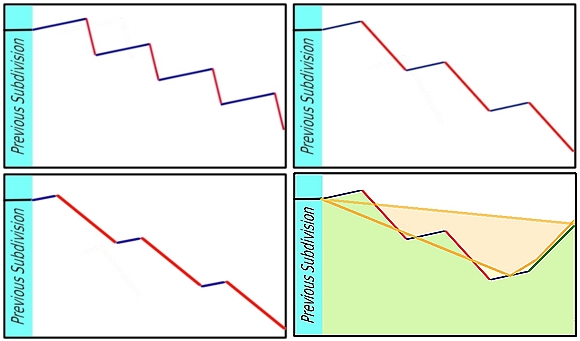
Emotional intensity can ramp up from the very beginning of the game period being considered – which may be any of the scales defined earlier, as illustrated in the first box above. This is typically the case when the entire purpose of the scale unit is to increase the emotional intensity. It might be a dramatic development or an encounter with someone bearing dramatic news. Regardless, the common word is “dramatic”, also implying “sudden”. Game period begins, emotional intensity ramps up as rapidly as possible, and is sustained as the details of the dramatic turn of events are relayed and appreciated. I think of this pattern as the “Headline transition” because the phenomenon resembles the effect of a headline, whose purpose is to entice you to read the news story, and which employs drama and hyperbole to increase the emotional impact of that story.

The second mode of increase is a steady increase throughout the course of the game stage. No one dramatic event is responsible, the effect is more of an ill wind blowing in one piece of bad news after another. Another metaphor that could be employed, and which is the general way I think of this pattern, is “shoes dropping one after another”. In reality, the progression is not actually smooth; it’s a series of small steps, like a staircase, but it can still be represented as a slope, because that is the overall shape.

The third and final mode of increase is the sharp rise at the end of the game phase. I tend to think of this model by different names under different circumstances – the “Eureka” model, the “Revelation”, the “Pot Of Gold”, the “A-ha!” or even the “Knockout Punch”. They all essentially describe the same thing – a slow rise (if any at all) until one singular event which places everything within the game phase that has preceded it into a new context. The whole point of this type of escalation is to deliver the game play to that singular point. The key to the success of this type of transition is usually not the singular event itself, but the sense of anticipation that leads up to the event. Simply announcing the revelation has all the impact of a wet noodle; creating anticipation by describing the circumstances that lead to the event, whether it be skulking through the enemy’s lair so that his plans can be overheard, or dialogue with an escort about the character who is to deliver the revelation, or even the conducting of the key scientific research or web search or whatever.

In fact, if you consider anticipation to be “virtual intensity”, this transforms the pattern in increase in “potential intensity” created as the anticipation builds into something resembling the middle pattern, the steady increase. The moment of revelation then transforms that “potential” intensity into the real thing in a great rush.

…And their mirrors

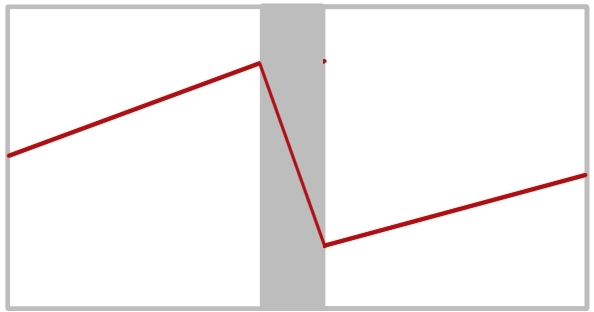
If you are going to have highs and lows, you also need patterns to describe a reduction in intensity. Most of these can be described as the mirror image of the three escalation patterns (left to right, of course). The fourth and final type is more difficult to illustrate; it follows an escalation which leads to a resolution of the cause of that escalation within the same game stage – a cliff-edge, if you will, that ends that game phase, but which enables the next game phase to commence at a much lower intensity. These also make the best times for breaks in play, because a break at this point facilitates the simulation of a rapid release of emotional intensity.

Corrupting The Curves

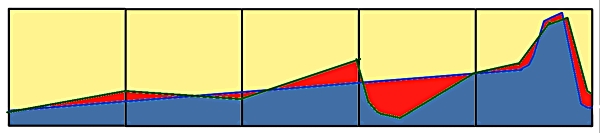
In real life, things are often not as simple as the straightforward escalation patterns shown above suggest. Even within a simple curve, there need to be highs and lows, peaks and troughs. The larger the span of time covered by one of those simplified curves, the more true this is. Reality is more like the graph below:

A more realistic depiction of emotional intensity; variations at the next smaller scale track with the large-scale effect, more or less

A more realistic depiction of emotional intensity; variations at the next smaller scale track with the large-scale effect, more or less

This illustrates four fundamental realities that are taken for granted within the simplified models (exaggerated somewhat to make them stand out):

  • First, escalating intensity can be a more complex combination of multiple patterns;
  • Secondly, that on closer examination what appears to be a smooth curve is actually a a bit of a mess, with interruptions and multiple rises and falls, or (alternatively) stepwise progressions;
  • Third, that each intensity curve is actually the summation of multiple smaller curves; and finally,
  • Fourth, if you were to join lines connecting all the lows, they would roughly parallel the results of joining all the averages, which in turn roughly parallels the results of joining all the highs.
Linking The Highs, Lows, or Averages

The “corruption” of the nice smooth curve contains another secret: the pattern of highs and lows is that dictated by the trend at the next scale up.

If an Act consists of three scenes, the emotional intensity of the Act will describe the overall development of intensity within the act, which can be derived by joining the highs within the constituent scenes of that Act, or the averages, or the lows.

The actual curve in blue, if the curve in red described the intensity within an Act, would describe the combination of five successive scenes:

  • Three Shoes dropping, followed by a cliff release;
  • …followed by a scene with a late revelation or Eureka moment, the implications of which create a further short steady increase in intensity as they sink in;
  • …followed by a momentary slight easing of tensions followed by another Eureka Moment in the third scene;
  • …followed by another very slight easing of intensity leading to a new revelation high point in the fourth scene;
  • …followed by a deeper easing of tensions, as though the PCs think they have made progress and then another sharp rise at the end of the Act as that progress comes to naught, or even makes matters worse.

The valleys serve to punctuate the troughs, making the experience of the next peak all the more intense by virtue of the contrast. This example act would be an initial introduction to the situation and then a series of scenes in which things repeatedly go from bad to worse each time the PCs think they are making progress. Overall, the curves are definitely following the red curve, but in detail, there are highs and lows.

Most acts aren’t going to be this complicated, I must add; this is an “and the kitchen sink” example.

Pacing Structures

I think it was E.E.”Doc” Smith who said in one of his Skylark novels that you can’t fully understand one level of reality without understanding the level below it. He was talking about the Macro level, and how it relates to the molecular level, and how molecules relate to the atomic level, and how atoms relate to their subatomic constituents, and so on. (Below the subatomic lied the Ether, and then the Sub-Ether, but those pulp sci-fi concepts don’t matter in this respect). Before you can fully understand one level of reality, you have to understand its constituents.

The Game Scales that I identified earlier are a little like that. You can’t understand the properties of a campaign until you have identified the attributes of the adventures that make up the campaign. You can’t understand the attributes of an adventure without understanding the acts that structure it internally, and their parameters. You can’t understand an Act without understanding scenes, and you can’t understand scenes without understanding the properties of the constituents of a scene.

Pacing Structures are a shorthand method of gaining that understanding, of abstracting this situation into something we can worth with in a practical sense. Each Game Scale can be subdivided into four components: A beginning, a middle with highs and lows, and an ending.

An individual scale item might have a high beginning, a middle low, a middle high, and then a low ending, showing an overall decline in the emotional intensity of that item. Or it might have a low beginning, a middle high, a middle low, and then end on a high – and escalating situation. Or there might be no middle low at all, and it might run low-high-higher.

Beginnings

Beginnings are always defined in intensity relative to the preceding unit of the same scale. If the previous adventure ended on a high, you can either perpetuate that high at the start of the next adventure, or you can contrast with it with a low.

Endings

Endings are always defined in intensity relative to the beginning. They can be the same as, higher than, or lower than, that initial state.

Middle-Highs and -Lows

What’s in between exists to achieve two sometimes contradictory functions: they have to connect the beginning to the ending, and they have to ensure that there is sufficient contrast along the way. So no middle-high will as high as the high-point at one end of the scale unit, and no middle-low will be as low-key as the lower of the start or ending. They are always somewhere in-between.

Application Of Theory: Emotional Examples

I’ve now defined most of the tools and concepts that are needed to start applying the theory to real-world examples. The one term that really needs to have a little salt applied to its tail is the term “emotional intensity” itself – something that has pretty much been taken for granted.

Just what emotions are we talking about?

The answer is, any that you want. But there are a number of emotions that will come up more frequently than any others. In no particular order, let’s look at them:

Tension & Frustration

Tension and Frustration go hand-in-hand. Tension is the accumulation of obstacles between a character and what that character wants to achieve, matched by an increase in the importance of that achievement to the character. Frustration results from an inability to successfully overcome those obstacles, or from solving one obstacle only for another to take its place.

As a general rule, you want tension to increase over time, both in the course of an adventure, and in the campaign overall as the stakes get raised. However, you also need to occasionally release the tension and let the players make progress toward their goals. The best way of doing that is to have the frustration levels rise and fall more quickly than the underlying tension. Every time the players have a success, raise the stakes and make the outcome more significant to them – remember that their antagonist also has his ambitions and can be making progress in achieving those ambitions while the players are overcoming their obstacles.

Doubt, Uncertainty, Ignorance, and Confusion

A quadruple threat! Closely connected, even to the point where they might be considered the same thing. These can exist and operate entirely independently of the forces of tension and frustration, or can be the cause of rising tension and frustration. Typically, these start high and diminish over time, in the course of an adventure, in the course of an act, or in the course of the campaign as a whole. It could even be argued that the entire point of a campaign is to take the PCs through the process of discovering what the problems are that they have to solve to achieve their goals, discovering solutions to those problems, discovering the new problems that arise as a result and discovering solutions to those, until they attain their final goal, whatever that might be, reducing their doubt, uncertainty, ignorance, and confusion at every step along the way, replacing them in equal measure with their opposites: confidence, certainty, knowledge, and clarity.

But even given this overall progression, there are rises and falls in these emotional qualities. Every action based on a false assumption temporarily increases ignorance and confusion when it doesn’t have the expected result, for example. Every step forward decreases uncertainty until a new complication makes its appearance, increasing uncertainty again.

Fear

Fear enters RPGs in a number of ways. There’s the fear of failure. There’s fear created by the GM with deliberately scary circumstances. There’s the fear that players feel for their characters when they enter battle with a foe that may be too tough for them. And there’s the fear of the unknown. That means that fear will rise and fall in quick changes within adventures and campaign regularly while trends would follow a slower, more consistent trend.

A campaign tends to be in trouble if Fear decreases too soon or too quickly, because it means that the emotional forces listed in the preceding section have also diminished excessively. As a result, the players are certain of an eventual victory and that means that all the tension vanishes from the campaign; it becomes too certain, too predictable, and too easy.

This diagram illustrates a rising level of fear typical of an RPG adventure designed to be scary.

This diagram illustrates a rising level of fear typical of an RPG adventure designed to be scary.

But, for the most part, in most campaigns, the only time fear will be a primary element will be in individual adventures that focus on being scary. In such adventures, the fear will usually be unrelenting and steadily increase, with occasional very brief interruptions for gallows humor before rapidly ramping back up to its previous levels. Reaching a crescendo only at the culmination of the adventure (when it goes off the cliff), this is a slight variation on the patterns described earlier. It looks as shown to the right:

As you can see, there’s a lot going on here, but when you look at it more closely, it all makes sense. What the diagram shows is a progressively-increasing series of highs as events increase the level of fear, punctuated by passing moments of relief (probably not as many as I’ve shown here, it’s exaggerated to show what’s going on more clearly) with the degree of relief conforming to a late-crescendo pattern, and then the emotion reaches a cliff and falls rapidly. This is fairly typical of this sort of pattern, (except in terms of the number of punctuations; three or four might be more typical of an act, though this is more reasonable if we’re describing an entire adventure).

A little later in the article [actually, in Part Two], I talk about drawing these sort of diagrams as a planning tool and playing guide; I would not do a fancy one like this, instead I would draw a solid line for the maximum and a dashed line for the minimums. I know it’s getting ahead of the discussion, but I wanted to make the point while this more detailed version was at hand.

Drama

Drama is an emotion that doesn’t follow the usual patterns when viewed over an entire adventure. It can rise and fall in a series of waves, it can represent a compounding of two of the standard patterns and/or their mirrors, it can go all over the place. It also has cliffs and valleys a lot of the time, but it tends to dwell in those valleys for a lot more of the time.

When looking at an individual act, things become a lot more orderly. While drama may start high, it tends to fall fairly rapidly at the start of the act (mirror of the late crescendo), and then rise steadily (with valleys) through the course of the act. Significantly, it normally ends the act at a higher level than it started.

Similarly, when viewed at the broadest possible scale, that of an entire campaign, those peaks and valleys tend to dissapear and what you are left with is generally something somewhere in between the ‘steady rise’ and ‘late crescendo’ patterns.

Revelations and resolutions tend to be represented by a sharp peak in the drama level, followed by a rapid drop as the consequences, implications, and ramifications are explored.

Consider a great example that everyone will know: “Luke, I am your father”. You had a very dramatic battle between Luke and Darth Vader, punctuated by lulls in the action; this battle ended in Luke’s seeming defeat by Vader, but the Dark Lord Of The Sith didn’t finish the job, and Luke didn’t get away, so despite the battle ending, the confrontation – and the drama – continued to rise. Vader then tried to persuade Luke to join him, only to be rebuffed; he continued the pressure, until playing his trump card, the statement that would have dismissed as propaganda and misinformation until proven otherwise were it not for the mystic detective powers of the Force. Luke was on the verge of surrender, and knew it, and attempted to kill himself to escape the ultimate betrayal of what he believed in, ending the confrontation and the drama – at least for the moment.

Sacrifice & Sorrow

It’s very rare that this type of emotional content will last beyond a scene. Most of the time it will yield a dead-flat trace. One of the major reasons for this is that it’s not always a lot of fun. But having an NPC ally (or a PC) sacrifice himself to achieve an otherwise-impossible victory; having a funeral scene – there is clearly a place for this emotional content in many RPGs.

When this content is present, it tends to be at a high level from the start of the scene, and to follow a steady increase; the scenes to either side of it will either be zero for this emotional content or close to it.

The only exception to this is when a PC learns of the death or serious illness of someone the character is or was close to, when the transition from zero to high takes place within a scene; this will usually follow either the late crescendo or rapid-buildup model, depending on whether or not the GM chooses to let the PC display the grief and sorrow or to cut to another scene with strongly-contrasting emotional content.

Tranquility & Calm

At first glance, you might not think that these qualify as emotional “intensity” at all; they seem more akin to a lack of intensity. Nevertheless, since the force with which a scene conveys this emotional content can be varied through the choice of language, tone of voice, and so on, it does actually have a form of intensity. These are emotions that pervade moments of introspection and self-discovery. Unlike the other types that have been discussed, however, these qualities are qualitatively different. With the bolder and more aggressive emotional content, a brief interruption of mood can be accommodated and even used to punctuate and emphasize the changes in intensity; with tranquility and calm, any disruption completely destroys the mood, which derives its effect cumulatively over a sustained period. It’s entirely appropriate that such disruptions are often described as “shattering” the emotion in question.

Tranquility and calm have a tranquilizing effect, making it more difficult for even normally boisterous players and characters to swim against the current and disrupt the mood when they prevail. These are emotions that pervade moments of introspection and self-discovery.

Unity & Harmony

Not satisfied with the names given to this emotional content? How about “communality” and “shared purpose”? These emotional qualities are both very real and very hard to pin down in descriptive language. This type of emotional content emphasizes the “we’re all in this together”-ness and brings a sense of a team that stands united in common purpose against whatever the world throws at it.

There are two (collective) responses to adversity; one is disruption, where everyone goes there separate way and deals with their own problems in a solitary manner; the other is the opposite, where people come together and unite in common cause. These emotions deal with the latter; I’ll cover the former in the next subsection.

Unity and Harmony tend to be at their highest just before the final confrontation in an act or adventure. This is where (in the movies) the theme music swells and the stars display their best Hero Shots for the camera. No matter how dysfunctional they may have been to this point, the forging of a group of disparate individuals into a team is a major event in such movies & TV shows and generally signifies the point at which the good guys begin to claw back whatever advantage their antagonist has been able to claw out.

Once again, to take an example from Star Wars, this emotion peaks in intensity when the Millennium Falcon appears out of nowhere to save Luke’s bacon and give him the chance to take out the Death Star. This example shows that the peak can also come at the height of a battle, rather than just before it.

In terms of intensity, this emotion tends to stay at a low level with sudden peaks; each time that it peaks, it then falls back to a slightly higher level than it was at previously. Over the course of a campaign, there is a gradual rise overall, though there may well be a middle period in which it falls to a low ebb as internal tensions work to destroy any unity within the group.

A team’s sense of unity and cohesion are emotional intensities that can be manipulated like any other. There is one important difference, however; most emotional content can be triggered by the GM through imagery, dialogue, and narrative, and the players (and their characters) will respond accordingly. This emotion doesn’t respond well to external force; the best the GM can do is try to create an environment which is disruptive to it or encouraging towards it, and wait to see if the players respond.

Acrimony & Fragmentation

“We must all hang together or we will all hang separately” said Winston Churchill. This type of emotional intensity exists when a collection of individuals are putting their efforts into being lone wolves and/or prima donnas, and is all about the “hang separately”. We’ve all seen sports teams and political parties and alliances fall apart in the past, just as we’ve seen them come together to achieve things that a team without unity would find impossible. It happens in sports, in boardgames, in politics, in society – and in roleplaying games.

This emotional content has some peculiar characteristics, especially in an RPG or media context, where circumstances simplify into an ‘us vs them’ bubble. Viewed from the point of view of one group within this bubble, it is either consistently high until overwhelmed by a new sense of unity, or it is low until it all falls apart. Viewed collectively, it often seems as though one side “gifts” it to their opposition, as though there is only so much of it to go around. Initially, the good guys are fragmented while the enemy are winning and united; as the good guys (the PCs in an RPG) come together, and begin to gain traction over the enemy, the unity of that enemy begins to strain and crack until it collapses and they turn on each other.

Success seems to be the glue that creates unity, failure and frustration the driving force behind acrimony and disintegration, based on this analysis, but there’s more to the story; individual egos can swell beyond the bounds of entitlement, and individual members can value their contributions as more important than those of others. It happens all the time in music when bands break apart. If the fans of a band are lucky, after enough water has passed under the bridge, the individuals can rediscover the unity that they had initially – look at the history of the Eagles, or of Fleetwood Mac, or of Yes, to name just three examples. Such disintegration in unity is usually followed by a catastrophic decline in success.

This can even be used as a political or social tactic – its called “giving them enough rope to hang themselves”. Marshalling your strength and reserves as secretly and quietly as possible, waiting for self-importance to begin to erode unity, and then overwhelming the opposition one at a time when the unity collapses and fragments.

Viewed collectively, then, this emotional intensity remains at or near a fixed level throughout an adventure or a campaign, but is not experienced equally by all participants. It starts off focused on one group and ends focused on the other.

I really didn’t want to split this article in two. I’ve even put up a couple of smaller articles written at the last minute in an attempt to avoid it.

But some things are just meant to be, I guess.

So this part has dealt with the theory, and the next part will deal with the practical.

Comments (13)

Casual Opportunities For Priests: The Differential Encounters


This entry is part 5 of 5 in the series Casual Opportunities
Photo courtesy tome213 (Elvis Santana)

Photo courtesy tome213 (Elvis Santana)

At long last, it’s finished! It’s taken a long time to complete the final article in this set, mostly because I had to keep setting it aside to work on something that would meet the immediate deadline, but here (at last) it is…

Introduction to part 4

Not all Priests are the same. In fact, there’s so much room for variation in the archetype that it would be more accurate to say that it’s a rare thing for two to even resemble each other. And yet, this rarely seems to be the case in practice.

It would be uncharitable to suggest a lack of imagination, and this phenomenon is spread across entirely too many individuals, in any case, for that to be the cause. Having considered the question for a while, I have reached the conclusion that the lure of the classical image, the cardboard cut-out, is simply so ubiquitous that the possibility of an alternative has simply never occurred to people. The imagination was there, it simply wasn’t switched on and turned in this direction.

The Differential Encounters are, hopefully, going to change all that.

The first part of this series analyzed the modern priest archetype, identified elements that representatives of that archetype have in common, and along the way considered how to employ casual encounters to enhance and reveal the character’s basic role in a campaign. It also found a lot of frequently untapped room for variations on the ‘standard model’.

In the second part, I built on those foundations and took a closer look at the variations that were possible, and how to devise and utilize casual encounters based on their distinctiveness.

Part Three listed no less than 44 encounters, including one epic with 11+ connected subplots, that derived from and highlighted the commonalities.

This final part will present even more mini-encounters, these deriving from the differences that distinguish one example of the archetype from another.

The Differential Encounters

It’s extremely difficult to create an encounter celebrating a point of individual distinctiveness without knowing what those differences are. So, at times, the following encounters may be a little on the vague side, and the list will certainly be incomplete. More than a list of actual encounters, these are going to more often be encounter templates, with some work still to be done to integrate the encounter with any specific Priest character.

Variations In Theology & Doctrine

These basically occur when a group or an individual is expecting a Priest of one Theology or Doctrine and they get the PC instead, whose Theology or Doctrine is subtly or wildly different. There are seven encounter sub-types within this general pattern: Public Expectations, Expected Differences, Theological Expectations, Comparative Theology, Lethal Force?, Confessor, and Services.

45. Public Expectations: Memory Lingers On

The general public expects their priests to behave in a certain way. This type of encounter functions by highlighting the fact that this priest doesn’t have to, or perhaps even is required not to behave in that way.

“Memory Lingers On” is an encounter that will be valid for just about any time period. A parishioner who was on what is now considered “the wrong side” of a conflict five, ten or twenty years earlier has that past catch up with him, and the Priest becomes involved. This encounter was largely inspired by “Blown Away”, in which the ‘Parishioner’ was an ex-IRA bomb-maker played by Jeff Bridges, but this encounter should be a lot more low-key than that rather explosive confrontation! The key to employing this encounter to highlight the differences between the Priest character and any other Priest is to determine exactly what the parishioner expects the priest to do, and how the Priest Character’s response is likely to differ from that. It’s the equivalent of hiring a go-between and getting an Action Hero instead.

And, speaking of go-betweens:

46. Public Expectations: The Negotiator

This encounter only works in a more modern setting. A gunman takes the customers in a supermarket hostage. He doesn’t trust the police and demands to negotiate face-to-face with a Priest. Guess who gets the call?

To make this encounter work, you need to understand the hostage-taker, his background, his motive for taking the hostages, and his reasons for not trusting the Police – and for trusting a Priest. How the encounter proceeds will largely depend on these variables. It could be anything from a man whose guilty conscience is forcing him into a suicide-by-cop, and who wants the Priest to hear his confession before he goes out in a blaze of glory, to a man who has been framed for a crime by a member of the police force. Whatever those circumstances, its a sure bet that everyone is going to get more than they bargained for in this encounter.

47. Public Expectations: Pillar Of The Community

A con-man decides that the easiest way to work his scam on a large number of people at once is to persuade their priest to endorse him. The target can either be the Priest Character, or another Priest who then turns to the Priest Character for advice when he begins to grow suspicious. Either way, once again, someone is going to get more than they expected.

48. Public Expectations: Sack-cloth and Ashes

Corruption and scandal are nothing new to The Church, just like any other human agency or organization. But when a case of corruption or a scandal involving a member of the clergy comes to this Priest’s attention, expect more to happen than a cautiously-worded letter to the Bishop…

49. Expected Differences: The Day Of The Dead

Encounters labeled “Expected Differences” describe situations where the Priest is expected to behave in a different way because of his adventuring reputation but instead shows himself to be a man of the cloth first and an adventurer second. They are very difficult to craft because they rely on accurately forecasting the player’s reaction to unusual circumstances, and identifying a situation in which they will follow doctrine and not some (unrealistic?) expected behavior. It gets even trickier: having identified such a situation, it is then necessary to determine the expectation and how, if the Priest were to follow that pattern of behavior, it benefits whoever holds that expectation.

Once a year, on the Day Of The Dead, families gather to remember those who have died in the past year. It is said (in the game) that if a loved one is expected to participate but fails to show up, the deceased may be raised as a Zombie by Voodoo witchcraft; by serving the summoner, the Zombie earns the Voodoo Priest or Priestess’ aid in finding their missing relative. If not raised by a Priest or Priestess, the dead may sometimes rise of their own accord and seek out the places where they last lived in search of their “missing” family. Each year, the resurrected dead become harder for whoever summoner to control them; if no progress is made in a decade, they may break free and become a terror on the streets. Alternatively, if the Priest or Priestess locates and cares for the family, the Zombie may become a devoted servant for the lifetime of his immediate descendants. A Voodoo Priestess asks for the assistance of the Priest in finding the family of one such servant, expecting that the Priest will be able to set aside his theological straitjacket and perceive that a lifetime of service by the Zombie is a reasonable fee for her protection of the Zombie’s daughter. This fails to take into account the “bigger picture” from the standpoint of most catholic religions, which would consider this Black Magic (at the very least), and denying the soul of the deceased his rightful place in heaven – or his deserved punishment in Hell. Either way, it’s wrong; the fact that you can keep a monster tamed and leashed for a decade doesn’t make it any less of a monster. And that’s assuming honorable intentions on the part of the Priest or Priestess – which may be assuming entirely too much. Especially since this particular Priest or Priestess has failed to keep their end of the bargain out of laziness or self-interest.

NB: This is probably too big an idea to be resolved in a single encounter; I would use it as the basis of a whole adventure for all the PCs.

50. Theological Expectations: The Weeping Angel

The “Theological Expectations” branch of encounters all revolve around the differences between being a ghost-hunter or enemy of the supernatural and being an ordinary priest, especially in the provinces of theology and doctrine. As such, they can be considered “Public expectation” encounters with a supernatural twist.

The example of this type of encounter that I have chosen is “The Weeping Angel”. A devout family have, in their garden, a statue of an Angel, which unexpectedly begins weeping tears of blood. This blood is reported to perform miraculous cures when the faithful are anointed by it. The local Priest contacts his superiors, unsure what to make of the situation; they, turn, dispatch the Priest Character to investigate the claim. The encounter begins when the Priest character arrives to do so.

From the moment he arrives, the Priest character begins to suspect that there’s something not right about the entire situation. The model who posed for the statue is a deceased local beauty with an unsavory reputation but who supposedly recanted on her deathbed; the locals believe that the tears are her spirit’s attempt to make restitution to those she harmed in life. Those “cured” by the angel have become holier-than-thou evangelists, stoning those who are not pious enough, torturing “sinners” for “confessions”, etc – all by night and in secret; by day, they are simply very pious. The faith of those “blessed” by the angel is being twisted into something that is the very antithesis of what the Church is supposed to represent. The wings of the angel appear to be fresher plaster than the rest of the statue, a later addition, which should lead the Priest character to suspect fraud – but when his concerns become known, the “Order Of The Angel” target him for “Purification”. Stripping away part of the angel wings reveals, underneath, a set of bat wings; rather than being a Holy artifact, this is an Unholy artifact, and the woman who “recanted her evil ways” was actually the leader of a Coven who cursed the statue exactly 666 days before it began “weeping”.

Once again, this is probably too big to be contained in a single encounter; while it might start off being a solo gig for the Priest character, it should not be too long before he calls in the rest of his fellow adventurers.

51. Comparative Theology: The Bronze Tiger

This branch of the encounter set describes situations in which a priest of a different faith is expected or required, but gets our Priestly protagonist instead, who must use his skills and wit to fit himself (a square peg) into someone else’s shoes (a round hole).

My example encounter begins with a charity street stall run by the church with which the protagonist is affiliated, selling donated goods to raise money for some worthwhile benefit. Some of the items have been provided by a parishioner from a deceased estate – one of his tenants, an old Asian man, who died with no next of kin and left his possessions to his landlord and friend. Not wanting to profit from his friend’s estate, he kept one or two items of sentimental value and donated the rest, including a tiger mask made of bronze that’s been giving our protagonist bad vibes all day.

The sale is going well, and the protagonist has just sold the bronze mask to a woman who thinks it will make a terrific wall hanging, when half-a-dozen martial artists come out of nowhere and confront her, shouting, “She has the mask! Get Her” Our protagonist must act quickly to drive them off. Because he is badly outnumbered, though, he is about to lose the fight when the woman reveals herself to be a martial artist, and joins forces with him to win the day. Most of the attackers flee, though one is left behind, unconscious or disabled in some way.

Of course, it’s way too big a coincidence that the purchaser ‘just happened’ to be an expert in martial arts, so when the woman offers such a story, it probably won’t go over too well. As soon as she sees any sign of suspicion in the protagonist, she will turn on him, stun him, and flee with the mask, doing whatever she has to do (including putting bystanders in danger) to get away.

That leaves the protagonist to question the martial artist left behind – but he will not trust the Priest because the Priest is not a member of his faith. The protagonist will have to be persuasive. If he is sufficiently convincing, the captured martial artist will tell him the following story:

He belongs to a monastery, a sect which had been entrusted with the guardianship of the Bronze Tiger, an ancient totem able to gift the wearer with great power, only to be used under certain very select circumstances. [The exact location of this sect’s temple is left to the GM – I would suggest Korea or Vietnam because the conflicts in those regions will help explain what happens next].

A generation ago, the sect came under the control of a leader who attempted to interpret and even manipulate circumstances to justify his use of the power of the mask. [Defending his homeland/the temple during the conflict being the possible ‘circumstances’ that tie in with the conflicts mentioned earlier].

He could fool himself, he could fool his subordinates, but he could not fool the gods, and far from granting the powers of the mask to the infidel, they stripped him of his power and left him as weak and feeble-minded as a newborn babe. When the other members of the sect discovered what had happened, they also learned that the Mask had been stolen by the only member who had dared to denounce the activities of the fallen leader to his face. Unfortunately, the weakness of the disgraced leader passed quickly, and he and his wife and young daughter were driven out of the temple. None of the warriors of the sect knew what became of them after that.

Because the members of the sect had failed in their trust, they set out to track down the mask and protect it while never claiming it for themselves, watching over it as the decades passed, in hopes of one day redeeming themselves and regaining their sacred trust. Eventually they traced the wandering mask-thief to the United States [or wherever the adventure so far has taken place] and begin their guardianship. From time to time, the thief would discover that they were nearby and would flee, covering his tracks as best he could, not trusting their intentions. In due course, he passed away and his possessions – including the mask – were donated to the Church of the protagonist. Where, somehow, the daughter of the disgraced leader spotted it, or was drawn to it somehow – and bought it. The sect could not permit it to fall back into the hands of one so besmirched in character, and so they intervened – but the protagonist misinterpreted their actions, and now the mask is gone.

All of which leaves the Protagonist leading a bunch of martial artists to recover a sacred relic from another religion. And doesn’t say anything about how much of the story told by the captive is truth. The GM can, consequently, take this mini-adventure in a number of different directions. He can keep it small, or expand it into a complete adventure for the whole group of PCs.

52. Lethal Force?: Pushed To The Limit

Means, motive, Opportunity, and Aftermath are what this category are all about. Means: you need to find a way to put a lethal weapon into the hands of the Priestly protagonist. Motive: You need to give him a reason to consider using lethal force, without making it his only option. Opportunity: you then put the Priest and his antagonist into a confrontation and see what choices the character makes. Aftermath: you need to deal with the fallout, no matter what the Priest decides; if you have done the set-up right, someone should be upset with him over his choice, regardless of what it was.

You may have noticed that I didn’t include a Resolution section. That’s because there are likely to be several. There’s the public perception of the character. There’s the official, legal, resolution of the decision, especially if the character chose to employ lethal force. There may be resolution of a subsequent confrontation with the family of the slain (if the Priest used lethal force) or the victims of the not-slain (if the Priest did not). There’s resolution of the the professional reaction of his superiors. There’s the reaction of the character’s friends and associates – some of whom should probably mirror each of these other points of view. And, finally, there’s the fallout of the Priest second-guessing himself and deciding whether or not to do the same thing in any future, similar, circumstances.

53. Lethal Force?: Accidental Bystander

The second variety of encounter that comes under the Lethal Force category is the accidental application of lethal force to a bystander. There are lots of different ways this could develop, but they come down to combinations of two simpler factors:

  1. Innocent or not so innocent? – Sometimes the “innocent” turns out not to be so, especially in more modern adventures. This is not often the case in Pulp adventures, though it could be worked that way with a little more finessing of the plotline.
  2. Culpable or not so culpable? – The other variable is whether or not the Priest was actually responsible for the lethal force killing or injuring the “innocent”. Sometimes appearances can be deceptive, and the character himself might not actually be sure.

The structure of the encounter itself is exactly the same as that of “Pushed To The Limit” (above): Means, Motive, Opportunity, Aftermath, and Resolutions. The “Accidental Bystander” is a complication that occurs either during the Opportunity phase, in which the protagonist and antagonist confront each other, or in which an accidental bystander is discovered to have been involved in the aftermath. The latter is more true to life in modern encounters, where stray bullets can easily penetrate brick walls and even metal bathtubs; the former works better in a simpler era, such as that of a pulp campaign.

54. Confessor: The Heist

There are very firm restrictions about what a Priest can do about a Confession. The privacy of the Confessional is sacrosanct, even if not legally protected in the same way as attorney-client or patient-doctor privilege. The priest can’t hint, can’t speculate, can’t report anything that he’s been told in the confessional, even anonymously, under any circumstances. One exception: without naming names or being specific, he can seek guidance on what he should advise the person who has made the confession to do from his superiors and may discuss the confession in general terms – no specifics – with fellow priests, who are bound by the same doctrine to remain silent outside the clergy. He can’t even confront the individual who has confessed and try to talk him out of it; he has to maintain the appearance of a veil of ignorance, even if it isn’t really there.

That puts the Priest in a very interesting situation when someone confesses intent to commit a crime, or desire/intent to have an affair, or just about any other form of taboo behavior – at least it does when the Priest is a PC in a roleplaying game. There is nothing in the doctrine that prevents the Priest from personal intervention! He just has to be careful what he says and does so as not to reveal the source of his knowledge. Even if the criminal later admits to confiding in the Priest in the confessional, the Priest’s vow of secrecy is not lifted or broken – he can’t talk about it.

He can’t tell the authorities “be at this specific place at this specific time”. Even without telling them why, it’s presumed to be obvious that this information derives from a Sinner’s confession-in-advance. He can’t even ask leading questions that might lead the authorities to act in a way that would prevent the crime. He CAN show up in person and try to stop it, or at least to make sure that no-one gets hurt.

In real life, though, doing so would leave the Priest open to charges as an accessory to the crime, and possibly charges of Conspiracy. But this isn’t real life, it’s an Adventure RPG…

Which brings me to the example encounter, “The Heist”. This is a six-encounter mini-adventure, but could easily be expanded as the backbone of a full-group adventure. In part one, a criminal confesses to the priest that he and some friends are planning to rob the payroll of a business somewhere in town when it is delivered. In theory, the Priest doesn’t know who is in the confessional; in practice, he might recognize the voice, or the aftershave, or have seen the person waiting to enter the confessional. The criminal may even have offered his name during the confession, or given his job title, or stated that he worked for the company that is to be robbed. In other words, the Priest has some idea of who the criminal is, or even knows for certain.

In part two, the Priest must contrive some innocent and legitimate reason for him to be in the place where the robbery is to occur and at the time, without giving any hint as to why, or that anything unusual is going to happen. Which can be trickier than it seems, depending on the target.

In Part three, having justified his presence, the Priest intervenes in the robbery. He must then withstand questioning by the police.

In Part four, after the criminals responsible have been captured, the Priest has to give evidence at their trial. The lawyer defending the criminals has been told that one confessed their plans to the Priest, and without admitting his clients’ guilt probes deeply into why the Priest was there, casting aspersions on his character to weaken his testimony. The vow to protect the sanctity of the confessional makes it look as though the Priest has something to hide (he does) but he can’t even admit that he is protecting that sanctity. It’s entirely possible that the criminals will get off with a lighter or even a suspended sentence as a result.

In Part five, the priest has to defend his actions and choices in an ecclesiastic court that has been triggered by the veiled hints and accusations leveled in the trial (and subsequent newspaper stories).

Finally, in Part six, the Priest must confront the criminal and explain his actions. Ideally, this will run along the lines of “you’ve been given a second chance, don’t waste it”, or “I tried to give you a second chance”.

There are some interesting conflicts-of-interest inherent to this plot. The main thing to remember is that the Priest has to focus on the Big Picture. If you assume that the Priest really is saving the soul of his parishioners by hearing their confessions – an assumption that the Priest has to make – then his first obligation has to be to protect the ability of the church to do this. That’s why the confessional seal is sacrosanct, and why the Priest is so limited in what he can do; he is protecting the capacity of the church to save the souls of everyone who might choose NOT to confess if their confession could be compelled as evidence against them. Next, he is attempting to save the soul of the actual confessor, and the lives of bystanders. Third, he is attempting to perform his civic duty while navigating an extremely restricted set of choices. And lastly, he is trying to save the lives of his parishioner, who came to him to confess – and who is therefore not all bad; he has a conscience. Its these behind-the-scenes imperatives and the conflicts-of-interest amongst them that are at the heart of this plotline.

55. Confessor: The Deathbed

In this ‘Confessor’ plotline, the Priest receives a letter from an inmate on death row who has chosen his name at random from the telephone directory (or wherever, if that’s not appropriate to the campaign setting). The criminal wants to confess certain things to the authorities, but needs to use the priest as a go-between to ensure that certain things he does not want to become known are protected. He is willing to confess those things to the Priest, however, so as to unburden his soul.

The Priest has very little choice but to agree to the terms under the circumstances. The Criminal then confides to the priest that he had a partner, and that this partner now cares for a number of children, and that his conditions are to protect the children and the partner. But he has “found God” to a sufficient extent that he wants to end the suffering of the families of the victims. He then confesses to a series of kidnappings and killings for which he has never stood trial, giving dates, details, and descriptions of where the bodies were concealed. This puts the whole burden onto the shoulders of the Priest. Part of what he has been told was protected by the sanctity of the confessional, and part he is not only free but required to reveal to the authorities. The Priest is bound by oath to protect the “sealed” parts of the conversation and he is honor-bound to respect the conditions which distinguish between the two, even though the conversation did not explicitly distinguish between the two. It’s a fine line, with a minefield to either side, and the Priest has just been required to tap-dance on it…

56. Confessor: The Infidelity

There is a cause that is near and dear to the Priest’s heart (NB: a separate casual encounter or two may be needed to establish this cause and the Priest’s relationship to it). One of the most prominent supporters is a businessman & his wife in the Priest’s parish; without his support, the cause may wither and die. In the confessional one day, another of his parishioners confesses to having an extra-marital affair with the businessman. She is pressing the businessman to leave his wife and seek a divorce. The priest knows that this will devastate the cause, probably ending the support of one or both, and almost certainly ending their ability to support it even if they still wanted to.

This rough outline puts the Priest’s personal goals in conflict with his oath as a Priest. If the Priest is Roman Catholic, divorce is not permitted by the church – so the businessman would be expelled from the church, adding an extra complication. He now has to figure out how best to protect both cause and his parishioners…

57. Confessor: Unwanted Attractions

In the confessional, a young woman/teen-aged girl confesses that she has been having lewd and lustful thoughts towards someone that it is inappropriate for her to have a relationship with, and is not sure how long she will be able to control herself. If an inappropriate relationship begins between the girl and the object of her affections, and is subsequently discovered, it will almost certainly ruin the life and career of the man. If the priest is an Anglican, i.e. permitted to marry, HE may even be`the subject of affection. The priest has to cope with the situation, and try to defuse it.

58. Confessor: One Hand Washes the other

A crusading public figure comes to the priest, having deliberately chosen him because he is outside of the public figure’s constituency, and reveals that he subsequently discovered that the vote which elected him was rigged, and that he is now being blackmailed with the knowledge. So far, he has only had to make minor compromises to protect that knowledge, but the day is surely coming when he will be forced to do something more serious. He needs the priest to solve the problem, without revealing the scandal, before it’s too late.

59: Services: The Rogue Priest

The Priest is asked by a friend, who is the Priest of a neighboring parish, and who has fallen ill, to conduct Services for him until he recovers. When he does so, he finds that his friend has been working on the very fringes of acceptable behavior for a Priest of the faith – blackmailing his parishioners into performing good deeds, extorting donations to charity, etc. Then his friend vanishes, and it is discovered that a lot of “donated” money earmarked for charity has also disappeared…

There are three ways to play this encounter:

  • In the first, the Rogue Priest has fallen into temptation and succumbed to it;
  • in the second, he has fallen victim to a Confessor plotline and has vanished in order to pursue and recover the money. He couldn’t tell the protagonist anything about it without breaking the confessional seal – but he could arrange legitimate and apparently innocent circumstances that place the protagonist in position to act as his backup, should his intervention go horribly wrong; his apparent complicity in the events is the result of a clever frame;
  • In the third, the Rogue Priest has been blackmailed over an incident in his life before he joined the seminary and has set out to confront the blackmailer, leaving protagonist to act as his backup.

Personally, I find options two and three to be the more interesting in terms of action, and they permit the protagonist to retain his confidence in his judgment of the character of his friend, despite appearances. The first is interesting only insofar as it shows the protagonist to have made a mistake in that judgment, and which gives the player an opportunity to explore the Priest’s reaction to the discovery of that flaw. On it’s own, that’s not strong enough to sustain a lot of interest; but if it were to be coupled with, and serve as a prelude to, another adventure in which the Priest then had to make a character assessment, it could be rather more significant.

60: Services: Prelude To An Adventure

The protagonist is asked to write and deliver a sermon on a particular subject. Who is doing the asking doesn’t much matter, s long as the character says yes. It should be made clear by the GM that the player is expected to write, and have his character deliver, the sermon at some near-future point in the game. Depending on the abilities and opinions of the player, this can be either a simple subject or something more difficult.

In the following adventure, the protagonist gives the sermon that he has written. In the course of the adventure that follows, he discovers that the subject matter of the sermon is directly related to the subject of the adventure, and that the whole purpose of the encounter (at a metagame level) was to establish the moral background of the adventure itself, the context within which PC decisions of what is right and wrong will have to be made.

In other words: the GMs decide what the adventure-after-next is going to be, and get the character to frame the moral questions posed in the course of that adventure for them, without realizing that he is defining his character’s attitude to the moral questions that are going to be posed.

Variations In Faith

These apply when a Priest character is of a faith other than Catholic. With so many possibilities to choose from, it’s impossible to get too specific. The purpose of these encounters is to highlight the differences between the faith of the protagonist and that of a more stereotypical Catholic Priest; the best way to achieve that purpose is simply to consider the many encounter/mini-adventures offered in other sections and note any which would proceed significantly differently because of the differences in faith, and how those encounters would then have to be modified to keep them interesting & entertaining.

To explore a variation in Faith, think about how that variation impacts plots designed around the stereotype.

One insight worth offering under this heading comes from The West Wing, comparing Anglican and Catholic faiths: “Catholics believe that faith alone is not enough, that it must be accompanied by good works”.

60a: Prelude To An Adventure (Variant)

A good example would be the one just offered, “Prelude to an adventure”. If the character was a spiritual leader from a completely different faith – for example, a Tibetan Monk, or a Native American Medicine Man, sermons are not part of their normal religious practices. But if the topic was one where there was some commonality of interest, for example Caring For Children or Responsibility For One’s Actions, it is not out of the question for an interfaith sermon to be of interest.

This would work especially well if the public perception of opinions on a subject differed markedly from the actual precepts of the other faith – the NPC doing the asking expects a sermon built around the former and is surprised to get one from the perspective of the latter.

Variations In Ethnicity

At first glance, it might seem that this encounter category would suffer from the same problems as Variations In Faith. That turns out to be only half-true.

In terms of differences between one specific variation in Ethnicity, it remains the case; but a surprising number of encounters can be derived simply by thinking about variations in Ethnicity generically, and those are what this section is going to focus on.

61. Ethnicity: A Fish Out Of Water

This general encounter puts the character into a situation in which their character stands out by reason of the difference in ethnicity. It could be a Caucasian dealing with a tribe of New Guinea natives, or a Scottish Priest dealing with a Welsh community, or an Ethiopian in an Tibetan Monastery, or even a Black preacher in the American Deep South. Central to making this type of encounter work is that events have to focus on the local ethnicity, the inherent attitudes and expectations that come with that territory, and the way in which the ethnicity of the character violates those expectations.

But it also works quite well in terms of an unusual ethnicity in a predominantly and typically Caucasian setting, such as a Priest from Louisiana visiting London.

It doesn’t have to be a big plot point; a minor encounter that simply reminds the players that the Priest is also of Ethnicity X is enough, in other words, that that there is more to the character than his Priestly Collar.

62. Ethnicity: A Character at home

The opposite also works well – placing events in the ethnic quarter to which the character is native. Nothing emphasizes more strongly that a Priest is also Italian than having the PCs venture into Little Italy, where the protagonist can be an Italian first and a Priest second.

63. Ethnicity: Ethnic Sub-currents

Because of their shared ethnicity, a character of variant ethnic group is going to told things by members of that ethnic group that they might never tell a stranger. Is resentment brewing because of a perceived bias on the part of the city council against the ethnic minority? Is there unrest on the docks? Are the police in Manhattan growing frustrated over their inability to catch a cat-burglar? For the first, a member of that minority serves as a conduit to introduce the PCs to the adventure; for the second, an Eastern European; and for the third, an Irishman, or Irish American.

Look at where an adventure is taking place. Look at the ethnic groups around who might have noticed whatever is going on. Look for a match amongst the PCs – in this case, the Priest. Use that common ethnic heritage as a way to connect a character with awareness of the events; the result is a far more natural segue into the adventure than an outside source.

64. Ethnicity: Ethnic Surprises

Every culture, every ethnic group, has something about it which is different to the mainstream. Try to identify those cultural surprises and create an “encounter” in which the Priestly Protagonist springs or demonstrates that cultural surprise to the other PCs – or, at least, to the other players. Is there a particular holiday or religious observance, for example, that is not recognized outside of the ethnic group?

Research is the key to formulating these encounters. The more you know about the reality, especially in specifics and not generalities, the more you can integrate them into little side-encounters.

In particular: who did the ethnic group have a beef with when the character was a child? Who are their traditional sporting rivals? What is their most popular sport?

My favorite example is the Mexican Siesta. For an hour or two, not only does virtually nothing happen, but everyone expects nothing to happen. You might work through a siesta period if you had to, but it’s like working through to 9PM in a desk job – you’re either overenthusiastic, even driven, or you’re desperate.

65. Ethnicity: Cross-Cultural Connections

Sometimes, ethnicity matters when you’re creating an NPC. At other times, the NPC can be from virtually anywhere. When deciding what Ethnicity to make such NPCs in the Adventurer’s Club Campaign, Blair and I have a clear order of priority.

  1. Emphasize where the characters are in the world.
  2. Emphasize any ethic group that are important to the plotline.
  3. Pick an ethnic group that will provoke a reaction or attitude from a PC that is interesting, or opposed to the general attitude that we want the NPC to engender, or that will guide those attitudes in a particular direction if the majority of the PCs in general will have no fixed opinions.
  4. Same as (1) or (2).
  5. The other choice from (4).
  6. A member of an ethnic group with a strong opinion or attitude towards some group involved in the adventure. The more overtly prejudiced and objectionable the behavior of this character, the more the players will adopt a contrary opinion on the subject; use this to steer the adventure.
  7. A member of an ethnic group with a strong reaction to one of the PCs.
  8. Something unusual.
  9. Repeat from the top.

The first such NPC will have an ethnicity chosen for criteria #1, the second will be #2, and so on. If we feel that any given point is not going to be emphasized enough, we may throw in a second successive example.

A great example is the attitude of Australians toward the Turkish, which results from the battle at Gallipoli. These events are considered pivotal in the emergence of awareness as individual nations by both Australia and New Zealand, and are commemorated every year. Even though the Turkish people were enemies on that battlefield, the respect demonstrated by the Turkish Forces post-war toward the Allied casualties has cemented a much closer relationship and mutual friendship than is usual amongst opposing sides in a past conflict. A Turk can visit Australia and say “My grandfather fought at Gallipoli” and be accorded a level of respect and friendship equal to that accorded to a local Veteran of that conflict. This relationship can form a subtext between a Turkish NPC and an Australian PC that lends weight and significance to an encounter, whether that encounter is trivial or substantial in terms of the overall adventure.

66. Ethnicity: Caught In The Middle

Ethnic and National identities can lead to problems when there are conflicts. During the War in Bosnia, for example, there were clashes and antipathy between Serbian and Croatian ethnic groups here in Sydney. These still flare up, in a more dignified way, when the two sides confront each other in the World Cup. Both sides will barrack for the Australian team against anyone else, though!

Being an adventurer usually lends perspective to events that participants will not achieve until many years afterwards. It follows that if a nation with whom an Adventurer identifies due to his ethnicity goes to war for the wrong reasons, that adventurer can very much be caught in the middle of events, subject to conflicting ideals and ethnic loyalties. The character becomes a focal point for the conflict. The situation is not dissimilar to that experienced by German-Americans and Japanese-Americans during World War II. While the majority supported their adopted country, while sympathizing with the people of their former country, some were more clearly torn between the two loyalties – and, at least in the case of the German-Americans, some clearly chose ethnic loyalty and ethnic ideology over the principles of their adopted country and became pro-German agents.

The Adventurer’s Club PCs include two Australians, a Canadian, and a Boston-born American, and predominantly takes place in the USA. The next conflict for those countries is World War II, with Australia and Canada both entering the war as soon as it is declared by Britain – while America was still firmly isolationist in mindset. While that is a number of years removed from the current campaign date, things would get very interesting for the PCs when war actually breaks out. (Things would have been even more interesting if a former PC, an Italian-American, was still around!)

Because the American character is played by an Australian, and one with the perspective of history, the character is anti-isolationism, and has participated in a number of adventures in which the Nazis were bad guys (if not “the” bad guys). So far, that hasn’t made him a target for pro-isolationist factions or even hostile encounters with pro-isolationists – but that time will come. How will he react to being labeled a “Warmonger”?

Variations In Culture

It’s not enough to say “Irish” a lot of the time – you need to qualify the label with “Northern” or “Southern”. The people of Kentucky share many values with the people of Boston – but there are significant differences, too. And let’s not even mention the political differences between Quebec and the rest of Canada.

The citizens of a coastal Brazilian city like Rio de Janeiro are going to be very different to the inhabitants of a tiny inland village like Nova Xavantina.

These are all distinctions that can be useful to the GM and can be exploited through encounters to further define and characterize the Priest – because he’s either going to be the product of his environment, or an exception to it. Either permits cultural variation to be the foundations for an encounter.

Variations In Role

These are pretty much all fish-out-of-water concepts, in which the individual character is poor at something that he would normally be considered to excel at due to his occupation as a Priest. For example, a Priest may have a problem speaking to large crowds manifesting as a stutter; this would be no handicap to his being the spiritual leader of a small community, or an administrator within a larger community; it would mean that he was not going to be doing much public speaking on behalf of the group of adventurers, however. This sort of encounter would then include circumstances which have forced the reticent communicator to give a public speech.

It follows that while the occasional circumstance or encounter of this type may have comedic value, and remind the group of the idiosyncrasies of the PC, they have a remarkably limited potential beyond this circumstance and should be held in reserve for the times when they will make a substantial contribution to a plotline.

67. Enemy Of The Supernatural: Mr Fixit

There are potential exceptions, however. For example, if the logic of the “clean-up/cover-up” aspects of the “enemy of the supernatural” role is accepted (refer to part one of this series-within-a-series), you could have an encounter in which another priest has already done the “fighting the supernatural” part of the job, but has botched the cover-up – and the protagonist could be sent in to troubleshoot the problem.

Variations In Personality

The ultimate expression of individuality rests in the personality of the individual. Sounds obvious, doesn’t it? It gets a lot more complicated when someone other than the GM is deciding what that personality is, however. There are two obvious approaches: in the first, the player advises the GM that they have an aspect of the Priest’s personality that they would like to explore, and in the second, the GM puts the character on the spot – having forewarned the player that he will need to have decided where the Priest stands on some issue of substance; this gives the player the chance to define the Priest’s personality, rather than putting on a display. Which you choose will depend on the player and the GM involved; in general, I recommend an emphasis on the latter approach over the former, but it’s not always possible.

68. Personality: Temptations

How does the character handle being tempted by something? What tempts him? What are his vices, and how strongly does he pursue them?

There’s a lot of ground for creativity here. For example, consider the temptation of Greed. The character can be offered a bribe to do something.

Interesting, but hardly earth-shattering. The GMs would expect most Priests to turn such an offer down without skipping a beat. So let’s increase the bribe, and make it indirect – “I will give $1000 a year to the charity of your choice if you…” “It looks like the church could use a new roof – you scratch my back and I’ll scratch yours…” “I know where [reputed bad group] meets, but can’t do anything about it officially because there is not enough evidence. But you aren’t bound by the needs of due process. Just do me this favor and I’ll tell you…”

Now, those are interesting!

69. Personality: Opinions on Controversies

There are always controversies – any place, any time. You can always get good mileage out of forcing a character to state an opinion on one of them, especially if its a subject the character is supposed to know about because of his occupation, and then demanding that the character explain his position.

Additional value can often be found by leveraging the player’s privileged position of historical outcomes. Asking a PC in the 1930s what his opinion is of the cheap tenement housing proposed for a neighborhood, for example – either the character takes the contemporarily-popular position (cheap, affordable, housing) – or he “foresees” the degeneration of the neighborhood into slums and opposes them.

This series is all about Priests – so take a look back at the list of religious controversies offered in Part one of this series. Make one of them relevant to a plotline or to a key character in a plotline – and thereby force the character into taking a stand on the issue, a stand that someone is sure to challenge.

70. Personality: Opinions on Politics

People get asked their opinion on politics all the time. In bars. By neighbors. By the press. By statisticians (in the modern era). By friends. In casual conversations. By their parishioners.

Sure, the character can equivocate – sometimes. But try asking the player who the character is thinking of voting for at the next election…

The GM should be careful not to let his own opinions on political matters color the encounter. Doing so tends to make the discussion too personal, and the GMs too ready to argue the point with anyone who disagrees (either as a player or in character).

71. Personality: Opinions on Society

Similarly, there are ALWAYS social problems and Priests are ALWAYS expected to have an opinion on them. Often, they see the consequences of these problems first-hand – so there’s a casual encounter in its own right, one that sets up a second, when the question gets asked.

The same caveat about personal opinions applies here, too.

72. Personality: Hobbies & Interests

Finally, what are the Priest’s hobbies and interests? Players often have a lot of trouble coming up with these even given advance notice – a far better approach is to have the character encounter a hobby and the GMs then asking how interesting the character finds it. There are lists of hobbies out there – search Google for “list of indoor hobbies”, “list of outdoor activities”, and so on. Pick something, read up a little bit on it, and then offer the character the chance to get interested in that activity. That’s several hundred casual encounters right then and there!

The Beacon of Hope: The Conclusion

Priest characters have a unique position to occupy in any game, but that uniqueness is a only a potential asset to the GM. For it to materialize, the GM has to provide opportunities for it to manifest in both plot-significant and trivial ways. What they ultimately offer is an opportunity for Roleplay, for the character both to express their individuality and to reflect the circumstances that come with their Vestments. In some campaigns, they offer a window to an Ultimate Power and Moral Authority; in others, they embody human ideals in an all-too-human and flawed container. The Priest character can and should be the sum of all these things, but all too often they are tragically under-utilized as just another generic participant in the adventure of the week. Revel in their uniqueness and the only complaint will be a demand from other players that you do the same for them. The game can only profit from your doing so.

Casual Opportunities Series Logo

About the Casual Opportunities series:

This series seeks to offer opportunities for PCs to reflect their primary role within a campaign. Opportunities for heroes to be heroes, for villains to be villains, for geeks to be geeks.

It’s easy to become so focused on the primary plot, or on the things that the PCs are contributing to it, that it’s easy to overlook these touchstones that remind players of who their characters really are when the chips are down. Each part will focus on one particular character archetype, examining it in detail.

I found out with the first entry in this series that they are just too big to write as a single article. In some cases, they may need to be split into three or even four sub-parts. These may appear in bursts, or other articles may appear in between – because I tend not to be able to write too far ahead.

The series itself is be an irregular one, appearing every now and then – and will eventually cover all genres. I intend to cover D&D/Pathfinder, Pulp, Superhero, Sci-fi, and anything else that comes to mind along the way – all in no particular order. In fact, I’m going to deliberately mix it up!

So far, we’ve had D&D/Pathfinder and Pulp/Modern – so next time, something Sci-Fi seems to be in order.

Comments Off on Casual Opportunities For Priests: The Differential Encounters

Brick By Brick: Base Rules Made Easy


ml-x4-338003-m

I’ve been thinking about some very basic HQ construction rules for use in Superhero campaigns, Pulp Campaigns, etc, for quite some time now, after a number of earlier attempts failed because they got too complicated. At last, I think I’ve solved the major issues…

As I’ve mentioned before, Hero Games have very specific, but reasonably generous, restrictions on the publication of House Rules. I’ve talked about that before – refer to this article, where I implement a 3.x-style Initiative system in place of the Hero System’s relative-speed phase-based system, so I’m not going to go into it again here. To accommodate those restrictions, I have cut an awful lot of unnecessary material – examples, etc – out of this article. Virtually everything has been trimmed – fairly close to the bone. The first draft of this article was about 6000 words longer than this trimmed and redacted version – but I needed to write them in order to discover what was essential, and what was not. Hopefully I haven’t cut too deeply…

Essential Principles

Construction of a base and its features rely on three essential concepts or principles.

Description Line
No description can be longer than one line, or can have more than one clause. The use of words like “and” are forbidden because that tries to sneak two lines onto one, which matters for cost purposes. Each room consists of one line identifying the room (and its basic purpose, if necessary). Each additional capability provided by a room is given a separate description line below this first line.

The Standard Room
A standard room is a small room adequate for one purpose involving no more than four people. The size`will therefore vary according to social norms. A base is constructed of a whole slew of these standard rooms, some of which have additional features like increased size or added features incorporated.

It’s important to note that any facility that is normally present in such a room is included in the standard room, free. It has to contain the minimum facilities required to make it fit for the purpose that has been assigned to it. So a bedroom automatically comes with closets and a bed, a kitchen automatically comes with ovens, etc. In an era where electrical power is ubiquitous, outlets are automatically assumed to be present. Whatever the common standard for illumination is, whether that’s candlesticks and candles or a lantern or electric lighting, those come with the standard room, too. At this point in time we’re not quite at the point where any given room can be assumed to have internet access, though we have been edging in that direction for quite some time. Only if something is in advance of what is routinely assumed to be available does it start costing build points.

So the principle is that you define a lowest-common denominator and use that as your basic building block for the entire facility, and only have to worry about anything exceptional within an individual space.

Cost Structure
Costs are defined as Build Points. Each room has a basic cost, plus an extra cost for the added facilities that the room offers. All capabilities are manually controlled as standard; to automate a facility you need a dedicated computer room; you need to include a computer control capability into each room’s functions; and you need to match those with a computer of sufficient capabilities to operate those controls.

A second standard

For 5 Build Points, plus the cost of the variations, a second standard room can be defined, which can then be used as the basis for specific areas within the base. This is often done to distinguish between accommodations and common areas, for example. Further standards can be added, but the price of each additional one doubles – so a third standard area would cost 10 Build Points plus the price of the variations. Very few facilities need more than 3 standard room definitions.

Note that this means there are always multiple construction approaches that can be employed, of varying cost-effectiveness. As a general rule of thumb, unless you have 5+ rooms to be built to the same standard, it is unlikely to be cost-effective defining a new “standard room” (as opposed to individually customizing the basic standard room) – but not impossible. If you have 10 or more rooms to be built to the same standard, it is almost certainly going to be more cost-effective to design a new standard room. Those numbers double when you’re talking about a third standard room design, and quadruple when considering a fourth.

Room Size

The basic room size is that of a standard room – one function for four people, and costs 1 Build Point. The room is however large it has to be to provide that functionality, though for convenience, it should be an even multiple of the size of the standard room. So size is an abstract quality. Increasing this size costs an additional 1/2 build point to double the previous increase; the first increase is assumed to be 2 people. So: +0.5 BP = +2 people capacity, +1 BP = +2+4 = +6 capacity, +1.5 BP = +2+4+8 = +14 capacity, +2 BP = +2+4+8+16 = +30 capacity, and so on.

It’s important for increased size to be tracked separately from the base cost because the price of each additional function provided by the room is modified by the room size. If room size is increased in the definition of the standard room, that overhead still carries down to the cost of additional functions.

The total size cost of a room is rounded up at the end of construction.

Interior Walls

Each room has a base 1 Def and 5 HP. For those who don’t know the Hero system, DEF subtracts from the damage done by each attack on the object (the wall in this case), and remains until the wall runs out of Hit Points. Additional +1 Def on the standard room costs 2 Build Points, additional HP for the standard room costs 2 Build Points for +5 – but these then propagate throughout the facility, becoming part of the standard construction of each room.

Reinforcing can be added to individual rooms. The price of +1 Def or +5 HP of reinforcing is 0.5 BP, but there is also an overhead cost equal to half the Increased Size cost.

Additional Functions

Each additional function that you want a room to have costs 0.5 BP. That’s why the GM has to closely monitor the individual lines that are used to describe these additional functions. The idea is to ensure that nothing gets left out, but also to keep the functions sufficiently abstract that the base construction doesn’t get overly bogged down in minutia.

“Environmental Controls” can be assumed to include air conditioning, temperature sensors, etc.
“Security Systems” can be assumed to include the relevant sensors and alarms – but if you want the base computer to be able to monitor and control these, access the sensors, etc, that capability will need to be added to the computer. The potential is built in, though.

If the function is a non-standard piece of technology or equivalent (magic, psionic devices, whatever) those have to be built separately using the appropriate rules. This is an exception to the “function is automatic” rule – you can’t just label a room “Transporter Chamber” and automatically get a Star Trek -style teleporter system.

The idea is NOT to include any game mechanics other than those explicitly described; the goal is a functional description that can be interpreted into game mechanics when necessary. Anything that requires explicit game mechanics is bought separately, though the room may require an additional function, “ACCESS TO [device name]” incorporated.

Again, as a rule of thumb, if the device functions autonomously without controls, you don’t need to alter the base design; the room just happens to be where the device is located, and subject to whatever the device does. As soon as you give the base computer control over the device, or the capacity to monitor it, or otherwise integrate it into the base functionality, though, you need one or more features to accommodate that integration.

Vehicle Maintenance & Storage

As with Teleporters, vehicles don’t come with the base, they have to be purchased separately using whatever the appropriate game mechanics are. What you buy are storage and workshop space for the manual housing and maintenance of the vehicles. Working out the required size for such areas is a little trickier, though.

Each vehicle must have empty space around it equal to the half the maximum smaller-horizontal-plane dimension. The size of the room must be the sum of that empty space, the vehicle size (number of passengers), plus tools/facilities equal to the size of one vehicle, multiplied by the number of vehicles that can be simultaneously maintained. This total must then be converted into an area, which is then divided by the size of the standard room used as a bedroom and multiplied by 4. This gives the total number of “people” that must be accommodated, and permits the purchase of the room using “standard rooms”.

Got that? I didn’t think so. Try it with an example, spelt out step-by-step: we have a small fleet of 12 fighters in bays. These could be aircraft or little spaceships or whatever. Each fighter is 16m long and 8m across at it’s widest points (it’s also 4m tall, but we don’t care about that). Two fighters can be maintained at any given time. A standard room, used for accommodation for 4, is 4m x 6m, barracks style, with barely enough room to swing a cat.

  • The smaller dimension of a plan-view of the fighter is 8m at it’s maximum.
  • So each fighter needs 4m of space around it to permit access with appropriate tools – jacks, etc – for maintenance.
  • Each fighter therefore takes up 16+4+4 = 24m x 8+4+4 = 16m of space.
  • 24m x 16m = 384 sqr meters. We have 12 fighters to accommodate, so that’s 4,608 square meters of hangar space.
  • We want to be able to maintain two at once. Each has dimensions (including space) of 24m x 16m, and 16m x 8m (excluding space).
  • 24 x 16 = 384; 16 x 8 = 128m. So each maintenance bay requires 384 square meters plus 128 square meters for tools and parts, or a total of 512 square meters.
  • We want two of them, so that’s 1024 square meters.
  • The total area of the facility is therefore 4608 + 1024 = 5632 square meters.
  • The standard room is 4m x 6m, or 24 square meters.
  • The number of “people” this area must “accommodate” is therefore equal to 5632 / 24 x 4 = 938 2/3.
  • Room size is +4.5 BP for +1022 “people” capacity, which rounds up to +5 BP.

Dealing with Min-Maxers

The especially cost-conscious may have felt that we only needed space for 10 fighters in the preceding example, given that 2 of them can be kept in the maintenance bay. To such nit-pickers, I would point out that you will need room to move the vehicles to-and-from the maintenance bays, plus launch and recovery facilities, plus a separate fueling area, plus`fuel storage, and heaven help you if you need emergency services to deal with a crash… and that each of these can either be listed as an additional function of this space (cheap) or required to purchased as separate “rooms” in the base… and then ask if they’ve ever seen one of those sliding tile games? That would be what trying to get the fighter out of the back corner into the maintenance bays would be like…

Attempting to min-max these rules is easily and automatically handled simply by the GM being a bit more pedantic about his function definitions. This is fair game, since the min-maxer is, by definition, getting pedantic about details.

And, really, how many build points would this proposal save? Instead of 939-or-so people, the total comes to… 810 and 2/3 people. Points cost is exactly the same.

External Walls

Some base facilities may not have these – if they are built into a mountain, you could use the native rock as your “external wall”. But most will have something extra on the outside.

External Walls are built by taking the size of a standard room, defined in the same way as in the “hangar” example, and turning it on it’s side. You then take the surface area of the total facility – defined by the base layout – and do the same “divide by standard room area and multiply by 4” calculation. The result is the Size required to completely surround the base with an extra layer of the Def and HP of the internal walls, effectively defining the external walls as a special variety of “room”.

Base Construction

So a base consists of definitions for one or more standard rooms, plus the purchase price of those definitions; a list of individual rooms, each based on a standard room, and each with a list of their additional functions, and the costs of those rooms. Add the price of all those together and you have a total cost.

The beauty of using a “standard room” approach is that it turns the base’s elements into building blocks that can be assembled like Lego Bricks.

Conversions

So what are Build Points? The system listed above is so straightforward that it can be emplpoyed in ANY game system – whether that is a Pathfinder/3.x Fantasy game or a Hero System -based superhero or pulp campaign, or even a Cyberpunk campaign, or a Sci-fi campaign. You name it. But to do so, we have to work out some sort of conversion system.

In character-points-based systems, like that of the Hero system, it’s fairly easy. Define a standard building and a price for that building in character points, then construct it and work out how many Build Points it is. That gives you a character-points to Build-Points conversion rate.

Other systems don’t use Build Points – they use wealth, whether that’s gold pieces or “credits” or $$$. The same principle applies.

But that’s not the only variable. Construction Time is a big factor. This system gives no indication of how long it takes to build anything, but you can make some assumptions. Construction time for a 3-bedroom house in modern times is 3-6 months. Construction time for a similarly-sized roman villa using only period equipment, and assuming all the infrastructure that goes with that society, is also about 6 months, as proven by the documentary series Rome Wasn’t Built In A Day – though obviously the capabilities of the two buildings would be very different.

How much time can you save by throwing money (in the form of additional labor) at a building project? How much can you save by taking your time?

Consider This

There are three factors to consider when attempting to answer these questions. The first is that part of the construction will be time-locked; concrete and mortar needs to set and cure before it will support construction, and you can’t increase or decrease the time required for those parts of the construction process.

The second is that part of the construction may be time-critical, needing to be complete in a specific period of time. This was a definite part of the construction of the Roman Villa, for example; once the frame went up, it was critical to get the roof done before the rain came, and before seasonal strong winds had the chance to damage the frame. I’m not sure modern constructions are quite so time-critical, but that might simply be a case of modern tools getting more jobs done within a critical timeframe so that people don’t realize that a construction phase is still time-critical. Between them, both these compromise the amount of the total construction process that is manpower-sensitive.

Efficiency is another key question. Adding more people to any given manual task reduces the effectiveness of each individual, and eventually you need to take people out of working directly on the project and set them to work supervising and coordinating others to mitigate that loss in efficiency.

Applying these considerations

Let’s assume that 10% of the construction time is manpower-insensitive, and another 20% is time-critical. Only 70% of the construction time is variable. so next, let’s say that each doubling of manpower reduces this variable period – first to 80% of what it was, then 85%, 90%, and 92%, 95%, 97%, and 99% thereafter.

80% of 70% = 56%;
90% of 56% is 50.4%;
92% of 50.4% is 46.37%;
95% of 46.368 is 44.05%;
97% of 44.05 is 42.73%; and
99% of 42.73 is 42.3%.

So increasing the workforce 64-fold gets 70% of the work done in 42.3% of the time, and is well beyond the break-even point. Increases beyond this point will be relatively trivial, people will be getting in each other’s way more than helping – and may even be decreases, with the drawbacks exceeding the benefits.

So all you need to do is set a base price and base number of workers and hey presto – the numbers come spilling out.

Of course, you can make other assumptions, and those might well be more valid than mine. Consider this to be just a starting point – whether you’re talking about a Hovel, a castle, or a satellite base in orbit. The goal is to create a set of functional spaces, defined in a logical fashion and in such a way that everyone can just get on with the game.

Comments (1)

The Pillars Of Assumption: A Source of Plot Ideas


sunrise-over-lake-monona-1432194-m

There are things that we all take for granted.

The sun will rise in the morning. Clouds are soft and fluffy. Frogs are small, green and like lily-ponds. Good guys wear white hats, and bad guys, black. The grass, somewhere, is greener than it is here. Money is valuable. Virtue will be rewarded.

Any expectation of this sort can be a great basis for an adventure. By subverting the expectation, it becomes clear that something, somewhere, is terribly wrong with the world.

The Sun Doesn’t Rise In The Morning

Oh dear. This immediately spells trouble. It also immediately tells the players that this game world is not one governed by orbital mechanics and Sir Isaac Newton would be very unreliable in the driver’s seat. This immediately thrusts the characters into the heart of the campaign mythology – what is the sun? Who controls it? Why would they not do what they have been doing, every day, for countless centuries? Could someone have stolen it?

Even worse – what if the sun has risen as usual over the neighboring Kingdoms? What’s so special about here?

Whatever the answer, someone’s definitely in trouble.

Clouds aren’t soft and fluffy

…but most people think they are, so when one falls to the ground and shatters like a lump of granite, you have to ask yourself if the Sky is falling! And, what’s really up there? And, what holds the clouds up? And do clouds make good Swords? Or is it just a coincidence that this lump of rock looks like a cloud and fell from the sky? Where else might it have come from? And will any more follow?

Frogs are big, red, and come from the desert

Well, not naturally, they aren’t. Someone out there is breeding monstrosities – either deliberately or by accident – and they have to be stopped!

Good Guys Wear Black

One of my favorite plotlines to toy with is the one where the PCs (the good guys) do what they think is the right thing (but which isn’t) while the bad guys oppose them, doing what the PCs consider the wrong thing, and think they are going to be able to take advantage of the situation – but are in reality doing the right thing. Inverting the usual roles in this way forces the PCs to reassess their enemies when the truth becomes apparent; they may then have to run interference on behalf of their enemy, at the risk of alienating their more narrow-minded allies, supporting that enemy in the face of public opinion, while at the same time trying to arrange matters so that their enemy’s attempt to profit from the situation fails.

The longer the mistake persists, the more of their own handiwork the PCs will have to undo. The GM should allow them to be really successful at whatever they attempt in the “mistaken” phase of this adventure – alliances fall into line easily, commitments to the cause are sworn in blood, etc.

The big trick is making sure that the situation is one where the PCs won’t immediately spot the hole in their logic, while ensuring that the clues were there the whole time. Though it can often be enough to have a known villain do something that’s overtly villainous, this tends to be a little abbreviated and unsatisfactory when the revelation comes. Instead, it’s better to put some distance between the villain and his activities and the PCs and their response. Give them time to prepare while feeding them enough rope…

The Pillars Of Assumption

I could continue listing inversions of the basic assumptions that I raised in the opening paragraph, but those are probably enough; instead, let’s look at why this works.

The more certain the assumption, the more strongly that assumption drives and invigorates an adventure when it is violated. It doesn’t matter what the campaign genre is, this principle holds water.

Compare the relative certainty of “The sun always rises in the morning” to that of “Frogs are small, green, and like lily-ponds”. Most players will know that some frogs are brown, that frogs come in a variety of sizes (the largest real-world example is the Goliath Frog, which grows up to 13 inches in length), or that some frogs live in trees. So the “Red Desert Frogs” plotline is a bit humdrum and run of the mill; it’s a reasonable basis for an adventure, but not one that will have the players hanging on your every word. “The sun will always rise”, on the other hand, is so certain that it is a metaphor for certainty – for it to fail to be true is dramatic, attention-getting, and immediately exciting. What’s going on? Is the GM basing an adventure on Fred Hoyle’s The Black Cloud?

Creating The Adventure

Pick something that can usually be assumed to be true in whatever genre you are employing. Turn it on its head, so that it is untrue. Then start asking yourself all the questions that the players are certain to ask, and how you might go about finding the answers to those questions. Since you aren’t required to spend the time actually doing those things, you can skip right to the answers – so this sort of adventure typically takes a lot less time to devise and plot than it will to play.

The ultimate success of the plotline will be determined by the plausibility of your explanation, in terms of the campaign setting. Get that wrong, and the whole adventure will fall apart around your ears; get it right, and your players will remember the adventure for a long time to come. It’s a simple trick – but it’s one that works.

A very short post today, for two reasons: First, I didn’t get enough sleep last night; and second, I wasn’t going to get the post I worked on all morning finished in time, not even close. When exhaustion started getting the better of me, I threw this one together before it was too late. I’ll do better next week :)

Comments (1)

The Envelope Is Ticking: Insanity In RPGs


white-envelop-on-a-fence-846390-m

“Your shoelace is untied.” By the end of this article, you’ll understand the significance and meaning of that phrase.

Mentioning Call Of Cthulhu in Monday’s article reminded me of a discussion that I once had with Dennis Ashelford, still probably the best CoC GM that I’ve ever seen in operation, about how best to convey the effect of Insanity on an affected character.

Some background (from memory – be warned, I’m not sure how much of the rules I’m about to offer are canon, or even correct): CoC is based on the Lovecraftian mythos amongst other sources. Exposure to books, fell magics, and creatures from the nether domains (or wherever) costs the character sanity points, and can eventually drive the character around the twist. Lose a certain percentage of your remaining sanity points in one encounter (or adventure?) and you picked up some minor quirk that restricted but did not excessively hamper your character’s ability to function as one of the Good Guys fighting to stop the invasion/conquest of our world by these other-dimensional horrors. Lose them all, and you earned yourself a mental problem that could be crippling at best, and require permanent residence in a sanitarium at worst, ending your ability to adventure. Once you had a problem, further loss of sanity points only made it worse.

Both Dennis and I agreed that the worst possible way of handling this game-mechanics development was to simply tell the character “Your character has picked up an insanity. You are now (die roll, die roll) suffering from…” and name whatever it was.

Between us, we worked out a system for handling insanities and other mental breakdowns that I still use, to this day.

Inside this envelope…

The first rule of thumb was to roll for insanities in advance and place the results in an envelope. When a character acquired one, that character’s name would be written on the envelope, the GM would check the contents, and NOT inform the player or update the character. That only happened when the breakdown was successfully diagnosed.

Symptoms

The second rule was never to describe the problem, only to describe the symptoms – and only to do that in a roleplayed context. The goal was to describe to the player how the world now looked to the character, and let the player decide how to handle it. As much as possible, symptoms were to be backed up by reference and research – something that was a lot trickier in the days before the internet, though we now face the problem that much of what’s available is severely technical, requiring a fair amount of knowledge to decode and decipher. For that reason, Wikipedia is not be my first resource when applying these techniques in the modern world; I start with a Google search and add the word “layman” to the search terms. Then I repeat the search (if necessary) with “symptoms” and “plain language” – the latter in inverted commas to make it an exact quote instead of simply adding plain and language to the list of search terms.

Triggers

The third rule was to come up with a list of triggering situations, the length and ubiquitousness of which were determined by the degree of insanity. These triggering conditions were also kept from the player.

The effect

This meant that the PC was free to do whatever the player thought appropriate, at all times, but that the character was often laboring under a false view of the world – a view that the other player characters did not share. When times were quiet, and there was leisure to ask “did you see that?” the flaw in the world-view was relatively quickly apparent; but in the middle of an attack by cultists, or with Cthulhu (or something else Man Was Not Meant To Know) oozing through an open portal from another world, or whatever, this is not something that you have the time for. Nor is it the sort of thing that one can do readily in the middle of a civic reception, or when giving a speech, when all eyes are upon the character. A deliberate effort was made, in fact, to place the character in such situations for a while – not only did it keep the game active, but it gave the peculiarity an opportunity to manifest.

Other Games

Insanity also occurs in other games. There are spells to induce it in D&D. There have been several characters with what could most charitably be called “distorted senses of reality” in both my superhero campaign and in the pulp campaign that I co-GM. So this technique isn’t just for CoC GMs.

Six Examples

I have a set of six examples to offer. I want to emphasize that these are actual examples from back then, or the fruits of our discussions at the time; I have not done any research on the symptoms in question for this article. As a result, they may be ignorant, incomplete, or shortsighted; at best, they are likely to be cartoonish caricatures of the real symptomology. I am not a professional psychologist or psychiatrist.

Whispers in the crowd

A crowd gathers after some sort of incident – a house fire or whatever. The character happens to see two people in the crowd point at him or at another PC and whisper to each other. No other PC is looking in the right direction at the right time. Are they cultists? Are they the people responsible for whatever has just happened? Is it a red herring? Or is it all in his head, the beginnings of paranoia?

This is the sort of thing that a character in CoC can’t afford to ignore. Depending on the circumstances, he might not make a big fuss about it; he might simply drop back to keep an eye on them, or might tell another of the PCs. It’s worth remembering that the players know about the insanity rules; if you mishandle the situation, or they have already been told that the character is now suffering from mild paranoia, the incident will be immediately discounted by the other PCs. But if they don’t know, the reactions of the other PCs will be realistic.

Your shoelace is untied

This is one that Dennis actually used at one point, subsequent to our conversation. Every now and then, he would tell the character that “You notice that your shoelace is untied.” The character would stop to retie the laces; after all, action could break out at any moment, and he didn’t want the GM to be able to say that he tripped over them.

The other players initially ignored it, the first time or two. Then they joked about it, suggesting that he buy a new pair of laces, or wash the ones that he had already to take off whatever was making them so slippery, or call in an exorcist. The next time it happened, Dennis let the PC notice an important clue while he was adjusting his shoelaces. Every twenty-to-thirty minutes of real time, the character would be told, “Your shoelace is untied”, or loose, or something along those lines. After about four hours of play, and about ten such incidents, the player noticed on the character sheet that the character habitually wore boots (it was a convention game, with pregenerated characters), and promptly announced his discovery to the world. Dennis simply grinned, and told him, “I know. Your shoelace is untied…”

Was the character obsessive-compulsive? Was the character paranoid about his shoelaces coming undone at a vital moment? Was he delusional? What else might he get wrong? If it weren’t for that time he spotted the important clue, the other players might have been inclined to distrust everything the character said. What should they do about the situation? Just as it would in real life, the debate lasted for a good half-hour or more, in-game…

The envelope is ticking

“You receive your mail through the slot in your front door. There are three bills, and what appears to be a letter in an envelope. The Envelope is ticking…”

You might think that the character was suffering from Paranoia. He wasn’t; he was suffering from auditory hallucinations, in which he kept hearing a clock, ticking, a reflection of his sense of urgency. Mental illnesses are not always easy to diagnose – and that’s in the real world, never mind in a world where there really are monsters and fell creatures and cultists out to sacrifice humanity to creatures from the Ninth Dimension…

There’s something behind you

This is one that I used, in a Champions solo mini-adventure. The PC was dealing with an enemy that could do all sorts of things with shadows – animate them, teleport between them, make them solid – but he didn’t know that at first. I simply kept telling him, “there’s something behind you.” Never mind what this did to the character’s mental landscape, it seriously ‘creeped out’ the player (to use his own parlance for what was happening).

He tried using his powers (energy-based attacks) to dispel the shadows, but that only shifted them. He lashed out at a pair of garbage cans, convinced that his enemy was hiding in the shadows behind them, and slowly started to unravel… eventually the character pulled himself together and got on top of the situation, but for a while afterwards, he would overreact to the phrase, “there’s something behind you…” – exactly as the character should, after an encounter like that!

NB: This doesn’t work so well in a crowd!

It looks like rain

This is one from my Champions campaign that didn’t work out as well as it should have. A satanic cult were raising money to continue their attempts to summon something from hell by running a drug ring, disguising their wares as sugar-based candy treats in the shape of pentagrams, which they would sell to school-kids. This was calculated to get one of the characters extremely hot under the collar (“hates drug pushers” and “protective of children” being two of the character’s psych lims). One of the PCs scouted the drugs lab, which wasn’t very well constructed, and was exposed to fumes that cause temporary psychosis. He saw all sorts of weird stuff in the basement, where the summoning rituals were being carried out, and became convinced that they had actually succeeded in summoning a demonic power, which had possessed the body of the cult leader.

The tip-off was supposed to come from the way I kept telling the PC in question that it looked like rain. There was always a conveniently located umbrella or pair of galoshes in the scenery (the trigger). The other PCs were supposed to eventually figure out that the character suffering was not himself, but they all got caught up in their plans to capture the cult and drive the demon back to Hell, to the point where I felt it would be a total let-down for everyone if I went ahead with the plot as written. Instead, I had to jump horses in midstream, make the summoning/possession “real”, and carry on from there. The result didn’t really satisfy anyone very much, I’m afraid. Looking back on it now, I might well have been better off sticking to my guns and letting the chips fall where they may, even though it would have complicated the campaign tremendously at a time when I was trying to simplify it to enable the players to focus their attention a little more.

The mistake I made was in not having a solid enough tipoff to the other players that this was a delusion of some sort. I had tried to use a number of “sunshine” and “blue skies” references, but they simply assumed that this meant that the rainclouds were on the horizon, and that I was threatening to have their evidence wash away.

Handled slightly differently, and in a slightly different context, and/or with a different group of players, it might have worked. This time around, it didn’t. There’s a lesson or two in that – nothing works 100% of the time, and sometimes you simply have to bite the bullet and get it over with even if it makes the adventure unsatisfactory to everyone involved.

Salted Peanuts

My final example is another of Dennis’ ideas, one that I don’t think he ever implemented. The idea was to require the player of the character to be affected to snack on salted peanuts by providing such snacks for everyone – but telling that player (by note) that he was not allowed to drink anything until his character’s circumstances changed. This was back in the 80s, when peanut allergies were either not as widespread, or not as widely recognized. The player was to be told that this was to help him roleplay his character who was in a difficult situation but didn’t know it. The idea was to try to simulate the mild break with reality; every time the player would comment on how dry his mouth was, Dennis would make it clear that this was something the character was also saying. Eventually, the character would get the opportunity to attempt to drink his fill, and at that point, Dennis would provide the player with plenty of bottled water – then only just coming in, and quite expensive.

Insanity and Social Sensitivity

These days, people are a lot more aware of mental disorders and the devastating effects they can have – and that most sufferers are capable of living quite ordinary and fulfilling lives if they receive the correct treatment. Those treatments have also improved vastly over the last X years, especially in terms of the unwanted side-effects of the medications, which often used to be almost as devastating as the illness itself, and which often led to sufferers refusing to take the medication.

I have used the term “X years” because… well, I started with 20 years, and then changed it to 30 years, and then to 50 years, and then 100 – and I came to realize that you could plug just about any number into that statement and it would still be true.

Accompanying those advances in medicine have been changes in social attitudes – perhaps incompletely, and not as uniformly as they should be, but improvements nevertheless. Most forms of mental illness these days are considered medical phenomena with psychological impacts and symptoms, often resulting from chemical imbalances, acute stresses, physical trauma, or long-term abusive situations.

The world has changed – and in this respect, it’s for the better – and I’m not sure what impact that should have on the way we represent mental illness in the games that we play.

On the one hand, in a game set in an era that is not so aware, you could argue that these techniques are still an appropriate way of depicting the problems faced. You could argue that by simulating, however shallowly, the perspective of a sufferer, you are actually raising awareness of the issue. On the other hand, it could be considered insensitive and disrespectful of the struggle that sufferers face on a daily basis. Finally, you could argue that this is just a game we’re talking about, and that it doesn’t need to reflect our personal opinions on any subject.

These are issues that I think every GM has to work out in his own mind and his own campaign. I don’t think there are any “right answers”. But I don’t want any readers of Campaign Mastery to think that I am being insensitive to the issue, or deliberately offensive. I’m sure we all know someone who faces the challenges of a mental disorder, whether we know about it or not, and those sufferers have nothing but my full heartfelt support and sympathy in dealing with those challenges.

I can’t think of a better way to end this article than this:

If you need help, or you know someone else who needs help, please seek professional advice, and the support of people who care about you. Don’t let yourself become just another statistic.

Comments (7)

Taming The Wild Frontiers


1207509_60357288s

The Internet used to be compared to the American Wild West, where just about anything went and the only restrictions on what you could get away with was your own conscience, or lack of it. Slowly, the regulators and vested interests have whittled away at the cowboy attitudes and for the most part, the internet is a much safer place for it.

AD&D

Any reference to taming the Western Frontiers always reminds me of AD&D and something that has been lost to the game in later iterations of the rules system. The ultimate goal of a PC used to be to gather enough wealth and influence to carve out their own nation in the wilderness, to tame and claim a portion of the Frontier that was beyond the edge of civilization and make it your own. I often wondered why that concept went away, and have slowly realized what I think is the answer. I think the “PC’s Stronghold” has been sacrificed on the altars of realism and political correctness.

As players and GMs became more knowledgeable and as Verisimilitude became more important, a number of frivolities were quietly dropped from the game. Political structures became more realistic, and settings more credible. People started thinking about the economic and social ramifications of adventuring, and found that the existing model simply didn’t hold water.

Furthermore, the concept of expanding your society through conquest of “unclaimed lands” was political incorrectness of the highest order, because The Wilds weren’t really empty; they couldn’t be, or there would be no adventure potential. Instead, they were usually inhabited by less-civilized societies – Orcs and Goblins and what-have-you – who were themselves being transformed by the forces of credibility into more vibrant cultures that simply didn’t fit the Imperialist/Monarchic pattern of the fundamental game setting.

So the writers junked the notion.

An opportunity lost

This was an opportunity lost, in my opinion. The concept could, and perhaps should, have been revised and updated. Fighters could still have engaged in conquest by violence – but with a realistic depiction of the consequences, based on history, and problems that could only be solved by negotiating fair treaties and sticking to them. Clerics could still have built temples and brought in religious settlers – but with the need to come to terms with the belief structures of the existing populations, which would be just as valid as those of the Cleric, perhaps leading to a situation in which both theologies grew as a result. Druids could have built groves, and Wizards towers, and so on.

Instead, the concept simply vanished from the sourcebooks. Why?

I think there were several reasons.

  • It didn’t take long for “Political Correctness” to become a joke and an annoyance, because it was carried to ridiculous extremes. It stopped being a passive demonstration of respect and acknowledgement of past mistakes and became an active reform movement, especially in the hands of hypersensitive zealots to the cause of feminism.
  • Research is hard, especially when dealing with native populations who prefer privacy over exploitation.
  • The Sourcebooks were already going to be large and expensive; this would have added another chapter or more to each of them.
  • The line between using a given native population as a source of inspiration – whether we’re talking about the tribes of central Europe, the tribes of Africa, the tribes of South America, or the tribes of the Western United States – and being offensive (with potential legal ramifications) – would have been razor thin, even non-existent in places.
  • The objective was to revitalize the system. Baggage that wasn’t contributing to that was an easy target.
  • A lot of “the wilderness” of several popular game settings had been pretty fully explored, anyway.

It was easier – and safer`- to simply ignore the idea and let it go away.

Personally, I would still contend that its possible to have a really interesting campaign phase which places the PCs on the front lines of one population which needs to expand – even though there is someone already living in the neighboring territories. The goal is to find a way to satisfy everyone involved, without turning your new domain into a colony in Revolt or triggering a native uprising. Outcomes like those of Northern Ireland (at the time), or the Middle East, or the transition to self-governance of India, or even the Reservations model of the United States constitute failures – can you find a road to success? How will the existing regional politics be transformed by this intervention, and what will the PCs do about it? If a GM can’t make an interesting series of adventures around a group of settlers/invaders who are numerically poor, but superior in any one-on-one engagement, colonizing an unexplored region with its own myths and legends, some of them true, some not, and with its own delicately-balanced political stability – an applecart that gets upset by virtue of your very presence – he should be ashamed of himself.

And, if the notion of promoting the “conquest” of a native population still seems too strongly involved, send the PCs in as permanent peacemakers and sheriffs, assigned to take the “lawless outlands” – after the worst has happened – and forge a lasting peace between the hostile elements in place. This more smoothly integrates the more realistic social and political models, in which it doesn’t matter how good you may be as an adventurer, you still aren’t going to be made a nobleman for it; that comes as the reward at the end of the campaign phase, for services rendered.

Superheros In Space

In the late 60s and early 70s, Comics essentially had only a few models for Aliens to draw upon. You had the Imperialist Model (“we have come to conquer”), based on the European Imperial template and exemplified by The War Of The Worlds, Buck Rogers, and Flash Gordon; you had the Conflict Between Empires model, based on World Wars I & II, and exemplified by the Kree-Skrull war; and you had the American Wild West model, in which Earthmen go to the stars and conquer. Even the supposedly futuristic Legion of Superheroes were essentially an Imperial Model, albeit a slightly more enlightened one in which color and racial differences were not only welcomed, but essential to eligibility for membership.

For some strange reason that eludes my towering intellect, superhero games took their cues from the comics. Even my own campaigns employed these basic patterns. Earth was under threat, if not invaded outright, by all sides (for one reason or another), and the brave heroes had to fight for Earth’s Independence – with the odds stacked against them. It’s heroic, it’s adventurous; what more could you want?

Over the last couple of phases of the Campaign, that has begun to change just a little. Earth has beaten back the invaders, and has gone through the phase of demonizing their enemies with willfully slanted propaganda, and has started to see these as individual populations – many of whom have something to offer the people of Earth, either technologically, socially, or in terms of resources. By preserving their independence in the face of overwhelming odds, they are beginning to find themselves in the position of arbitrators, peacemakers, and King-makers. The future is one in which Earth forms the nexus of a loose confederation of interstellar powers, in effect bringing a Common Law to the Galactic Arm. And who do you think will get saddled with the task of enforcing this law? The Heroes, of course! Who else?

Does that mean that the old problems and models have gone away? Not on your Nellie! A larger border simply means that there’s more of the front – there will still be “people” who think the confederation is a soft target, and who will try to carve out an Empire for themselves; and it will be up to the PCs to stop them. There will be people within the boundaries who resent giving up total independence, and who will plot the downfall of the confederation at every step. The existing hatreds and antipathies – some of them millennia old – haven’t gone away, and ultra-zealots will still attempt a radical agenda of striking at “the enemy”. It will be glorious, and lots of fun! (NB: Most of these events will follow the existing campaign, which still has 8-10 years to run – but the time to start planting the seeds of it within the game world is now, in the course of the present campaign.

(Nor, by the way, will all the old problems – supervillains and nutsy robots and extra-dimensional menaces – have gone away. It will still be a superhero campaign – it will simply have a wider scope, that’s all).

Bringing The Law

I can’t think of a single genre* which can’t be characterized as “Bringing The Law” to those populations who don’t have it. Even things like Call of Cthulhu can be viewed as enforcing a “hands off our world” law – one that was written a long time ago by whoever tossed the old ones out on their heinies. Hey, whoever locked Yog-Soggoth & Co. out (most of the time) didn’t wipe them out, did they? Okay, maybe they couldn’t, even if they wanted to. Nevertheless, Call Of Cthulhu in general can broadly be viewed as analogous to WWII Britain during the Blitz, with subversive agents continually trying to slip across the border between worlds – for purposes of espionage, sedition, sabotage, and the recruitment of a fifth column.

*TOON, maybe…

The Intrusion Of Permissiveness

Which brings me back to the Internet. I have always viewed one of the internet as a social revolution in the sense that you are able to go anywhere in the virtual sense, and the regulations that govern what you can do on a particular site are always those of your destination. The Internet brings the law down to its lowest common denominators. In some ways, that is a good thing; tyrants and zealots may be able to slow the penetration of progressive social attitudes into their countries by way of the net, but they can’t be stopped without making the nation completely uncompetitive. China has had to embrace at least some social reform, however grudgingly, and so has Cuba. Have they gone as far as people outside of those nations would have liked? Probably not – but progress has been made. Similarly, the Middle East is slowly and painfully beginning to demand social reform. The genie is out of the bottle.

The internet, from the perspective of a repressive regime, is like Call Of Cthulhu – it’s subversive, it encourages independent thinking, and it lets people from other nations be seen as people.

Things aren’t completely rosy in a more democratic society, either. The internet was and is an open invitation to cowboy entrepreneurs. It provides an almost unstoppable channel for Vice. Shonky operators who can’t do what they want in the country of their residence but who want to stay legal will simply set up shop in a more permissive location, just like the Pirate Radio stations of the 1960s in Britain, or the BBC during the Second World War. The Germans could make it illegal to listen to it – but they couldn’t stop people from doing so. Attempts to do so are like trying to stop water from running downhill – temporary at best.

One of the areas of greatest trouble in this respect was the explosion of internet gambling sites. While some are authentic, honest, and reliable, others are more dubious, if not outright criminal.

Well, if you can’t stop people going to risky sites, legally or otherwise, the only thing to do is to find ways of informing people as to a sites’ policies, behavior, and regulation.

Setting A Standard

It may surprise a number of readers that there are organizations out there that regulate and audit casino and online gambling sites with a view to chasing out the untrustworthy operators – in other words, to taming the wild west. One example is London-based eCOGRA, eCommerce Online Gaming Regulation and Assurance; there are others.

I see the arrival of these institutions as analogous to the rise of the Nevada Gaming Commission in 1955, which legitimized and enabled the growth of Las Vegas by cleaning up a reputation that was more than a little scandalous. While some initial downturn resulted as regulations bit into shadier business practices and notorious characters, the booming gambling center became world famous through the later 1950s and 60s as a result. Some such regulation was inevitable, and intervention at a Federal level had only narrowly been prevented just a few years earlier. I contend that without this cleaning up of its reputation, Las Vegas as we know it today would never have come into existence; the “explosive growth” of the 1970s would not have occurred. As a result of the cleanup, gamblers were assured that the Casinos could be trusted to “play fair” and pay up if someone won. These days, no-one gives such questions a second thought in Las Vegas.

Self-regulation lacks the same degree of trustworthiness in the perceptions of many, so this alone is not enough.

Independent Reviews

What’s needed are independent review sites, forums where the legitimacy of self-regulatory outcomes can be reported, and multiple independent self-regulators and auditors cross-checking each other. What’s more, the regulators are only concerned with the legitimacy, fairness, and reliability of the technology and policies of the gaming sites; practices can be both legal and marginally unethical at the same time.

Independent Review sites such as LegitimateCasino.com both monitor the reputation and reliability of the self-regulators and auditors and provide an essential service by warning of such practices. They can also deal with issues that the Self-regulating bodies don’t, like the look-and-feel of gaming sites, and function as a vital dispensary for need-to-know advice and information – check out their pages on Las Vegas history, their history/review of US laws relating to online gambling, or their collection of useful referance websites if you need to be convinced.

The combination of such sites and serious accreditation programs form a more robust environment for the long-term growth of legitimate and trustworthy sites; as these acquire more market share as a result of developing reputations, the less reputable operators are forced to either up their game and “get with the program” or get driven out.

Legalities & The Internet

There have been a host of other regulations and laws aimed at protecting both the internet user and existing businesses over the past thirty years. As with most laws, some are controversial and perceived as preserving the rights or control of one of these groups over another, such as the file-sharing controversies. Others are more universally accepted.

In a mirror of the growth of Las Vegas following the licensing and regulation of the Casinos of the Strip, each of these legal restrictions has produced an explosive and ongoing boom in the capacity for users to access legitimate services of all sorts. Every year, online shopping becomes more ubiquitous and more accepted; compare the awkwardness of the online shopping experience portrayed in the opening scenes of The Net from 1995 with the way that eCommerce has become routine and so widespread that many bricks-and-mortar businesses are either under threat or have folded in recent years.

As always, the first refuge of those whose business models are under threat is an attempt to secure the future through legislation that stifles the advantages that their competitors and rivals enjoy. Sometimes, these battles are won by the incumbents (Napster), sometimes they are won by the newcomers, and in some cases the battle is ongoing.

Like the settlements in the original Wild West, the internet – and the commercial realities that it carries – are here to stay, and will only tend to prosper into the future – unless it is permitted to fragment, enabling bias in the delivery of content from content-providers who have paid for the privilege, restriction of access from content providers, and opening the door to corruption. That is one highly-possible outcome from recent decisions regarding the enforceability of the FCCs Open Internet Order, which remains a hotly-debated subject – refer to the “recent developments” section of this page at Wikipedia and the page or so that precedes it.

Taming The New Frontier

Regulation is the key to taming any frontier. Bringing Law to the lawless, and making it stick. As always, whenever there is change, there are some winners and some losers. In terms of the internet, most of us are naturally biased – we want the users to win, because we number ourselves amongst them. Like the Borg, we demand that the rest of the world adapt to service us whether it wants to or not – and if they won’t, we will take our money to someone who will. And regulation requires enforcement, and a guard against corruption and manipulation.

Any serious confrontation can be used as a template for a great many others in real life, or as the basis of a great adventure or a great campaign. Roleplaying games are still well-described by using the taming of the Wild West as a metaphor – whether its superheros striving to enforce the law and reform it to bring justice to the system, or adventurous first-level D&D characters setting out to carve a niche for themselves in a strange and often hostile world, or the last line of defense standing between our world and the world of Things Man Was Not Meant To Know.

The connections to the past run deeper and stronger than the inclusion or not of the establishment of strongholds; and that’s both comforting and inspiring. Like PCs in a game, customers in the real world may not win every battle; the trick is to know that, and use that knowledge to be sure that we win the right ones, and eventually, the war. And hopefully, to have a lot of fun along the way.

Comments (7)

Kickstarted Creativity: Two fundraising campaigns of interest


The final part of the Priest Encounters article still isn’t finished, so here’s something else readers might find of interest…

I approach Kickstarter very much from the perspective of the consumer and possible backer.

That means that when I encounter such a campaign, my first question is always, “Am I interested in this?”, my second is “If I commit to this, will it be value for money?”, my third is always “Can I afford to commit to this?”, and my fourth is “Do I want to commit to this?”.

Sadly, the answer to Question three is “no” most of the time that the answers to questions one and two are “yes”. For example, when I wrote about the Corporia Kickstarter campaign, I knew in advance that the answer to question three was almost certainly “no”. I am very pleased that the campaign succeeded without me – I would have hated for them to have fallen short by just less than the amount that I would have pledged had I been able to afford it!

Two Phases

There are two major phases to any successful Kickstarter campaign, and both hold different sources of excitement. The first is before a campaign achieves its initial funding target, when you don’t know if they are going to get over the line or not. The resulting excitement and tension are remarkably similar to those that result from watching a sporting event. You feel the excitement all the more acutely if you have actually contributed to it, but it must be all the more intense if it’s your own project in the spotlight.

The second occurs when a campaign has achieved its initial target, and the question then becomes one of how many stretch goals will be achieved. Most of the uncertainty is gone, and its’ only a question of how much bang you will get for your commitment.

Today, I have two Kickstarter campaigns to bring to your attention. One is the second phase, having smashed its initial target to smithereens, and the other is just getting started.

Mutant Chronicles, Third Edition

3564305_orig
I thought from the first time that this campaign came to my attention that it looked professional, it looked slick, and it looked primed for success. It ticked all the boxes that I had described as essential for a successful campaign back in that Corporia article. It was very clear what their goals would be, those goals were enticing, it was clear what you would get for a given level of commitment, and the promised product looked great and sounded interesting.

Of the initial funding sought, £11,000, they currently have support totaling £83,584, with 10 days to go. They not only have their core funding in place, but have smashed about a dozen of their stretch goals – with more good ones still to go. It would not surprise me if they achieved every stretch goal they currently have listed, and one or two more beyond that they have yet to announce.

Funded so far are the 400 page hardcover Core book in full color, a 98 page Player’s Guide, GM Screen, Imperial Guide Book, Custom Dice Sets, Cartel Artefact Bag, Massive Fabric Maps, T-Shirts, Cheaper shipping, Capitol Guide Book, The Guide to the Dark Soul & Apostles, and Dark Symmetry Marionettes Miniatures Set. That’s an awful lot of bang for your buck, and doesn’t even take account of the add-on products that you can add to your commitment – access to which has been unlocked by the stretch goals. By any measure, Mutant Chronicles is going to be a 2014 success story.

It becomes a lot easier to commit to a project when you know exactly what you’re going to get, and right now, backing Mutant Chronicles looks like being a bargain.

Mutant Chronicles 3rd Edition is described as being a full reboot/rewrite of the techno-fantasy RPG, but one that does not negate or exclude the original timeline for those who want to continue playing in the existing game with updated rules. This is an interesting blend of modernization and respect for the past that a number of other RPG producers could learn from.

So, if you’re interested in anything from Space Opera to Cyberpunk to Superheroes as a genre, or any modern/pulp campaign that integrates technology and magic, this is definitely a project worth looking more closely at. To find out more about Mutant Chronicles 3rd Edition, visit the kickstarter page.

Orin Rakatha

Draft Cover Art based on the work of Brett Macdonald www.brettmacdonaldart.wordpress.com – the final art should look even cooler than this!?

From Sci-Fi to Fantasy. Orin Rakatha’s fundsourcing page is nowhere near as slickly polished and developed as that for Mutant Chronicles, but in terms of its appeal, it’s right up there. A campaign that’s been in active play for 27 years, and that is now being recast as a set of sourcebooks and adventures using the Pathfinder game system – with, I think, stretch goals to include stats for other systems such as D&D 3.5 – and that is as rich, imaginative, and diverse as you could ever want. The creators are promising epic, and with that starting point, I would expect them to deliver.

Coming from a live-roleplaying source, it strikes me that this material will be heavy on imaginative concepts and roleplay, and less-focused on meaningless, mindless combat than a great many other published adventures that I have looked at over the years. That means that at the very least, it should be full of ideas and characters that you can expropriate for use in an existing campaign.

One term that could be used to describe what I expect could be “resource-rich”.

The campaign world will suit all systems; it’s system agnostic and written from a storytellers view, focusing on the plot, history, background, and nature of Orin Rakatha rather than majoring on stats (although stats will be included for Pathfinder and if we are successful other OGL systems such as D&D 3.5, D20 & Fate) so game-masters will be able to use it for any fantasy system.

We plan to make this a massive campaign and have hundreds of hours of storyline for modules and campaign guides for forthcoming releases and (we can dare to hope) stretch goals.

All that sounds both epic and resource-rich to me…

Orin Rakatha still has 33 days of fundraising to go, as of the time I write this. Already, it has raised £1,957 of its £14,900 goal. In fact, it’s so early in the campaign that it is not at all clear at this point how successful it will ultimately be; I can only state that if it doesn’t get across the line, it will be a great disappointment, and many games will probably be the poorer for it.

In terms of the campaign, there’s currently an awful lot that we don’t know. Specific stretch goals and funding targets have yet to be announced. Details of add-ons have yet to be announced. They don’t have artwork and promotional banners ready for blogs like CM to use to promote the Kickstarter campaign. Those are all negatives that might stall early investment.

The goal itself also bears some assessment. At almost 15,000 pounds, it’s notably higher than the initial goal of Mutant Chronicles; and it’s been my observation in the past that 10-11K targets (in $US) tend to succeed more often than those with only slightly higher targets, though there are always exceptions, and don’t go as far over the target a lot of the time. I’ve seen numerous projects with more modest ambitions barely achieve the base level of funding. So there are a lot of question marks at the moment.

That said, I get the impression that this fundraising campaign is just a little different to most. They actively built up a social media presence before launching the fundraising, the announcement of the campaign was therefore actively promoted through social media contacts and supporters, and its just possible that they have a planned program of regular announcements such as stretch goals and add-ons to keep the buzz fermenting. I have never observed such a campaign – not to the extent that it appears Orin Rakatha may be attempting – and the established patterns might be comparing apples with ponytails, as a result.

The usual pattern to Kickstarters is an initial flurry of success, a lengthy slowdown, and then a surge at the end. The plan might just be to trade some of that initial surge for ongoing buzz in the normally flat middle phase in the hopes of a snowballing effect through social media.

What do you need to know right now to commit? That the core product looks like it will be value for money? Check. That there will be stretch goals that will enhance its utility? Check. That you can up your commitment to include add-ons as they are announced, or to carry the project closer to achieving those stretch goals when they are made public? Check. That they have answers to the Risks and Challenges that confront such a project? Check. That it costs you nothing if they don’t meet their initial target? Check. The Kicktraq for the project currently forecasts success to the tune of about £23,000, or about 156% of their initial goal – but that might be applying a standard pattern that doesn’t apply.

Oh, and the creators are active on social media, and hence available to answering questions in the course of the fund-raiser? Check.

I think that Orin Rakatha might just be that rare fundraiser that breaks the mould – or, perhaps, that creates a new one. In terms of my interest level, it definitely deserves to succeed. Whether the impediments that appear to be in place at the moment turn out to be actual negatives or they break the established pattern of fundraising on Kickstarter remains to be seen.

To find out more about this fundraiser, and perhaps to pledge your support, you can check out their kickstarter project page. Follow and/or like them on facebook for updates, news on stretch goals, add ons, and whether or not my conjectures about their approach are correct.

Something for everyone

Between them, these two kickstarter campaigns offer something for just about everyone, whether you’re into sci-fi, superhero, or fantasy gaming – or a whole heap of other genres besides. They are both projects worth supporting, at two very different phases of their life cycles. Check them out, and tell them that Mike at Campaign Mastery sent you!

Comments (6)

The Personal Computer analogy and some Truths about House Rules


3d-illustration-of-computer-technologies--concept-server-station-1398483-m

I’ve been desperately trying to clear enough time to attempt to get my main computer back up and running. It occurred to me the other day that there is a clear analogy between that process and the process of creating an RPG campaign.

The Computer Of Today: some context

Personal Computers are everywhere – or, perhaps, I should say, “Personal Computing Devices”. These days, the trend seems to be toward fixed solutions determined at the Manufacturer level, rather than the flexibility of the older Personal Computer; customers buy a tablet or a PC in some ready-made ready-to-go configuration. It might not even be called a PC; it might be called an iPad, or a Smartphone, or a Gaming Console. Economies of scale mean that these preassembled and preconfigured options have a slight edge in cost, and they have a definite edge in required standard of customer expertise.

These advantages come at the price of restricted flexibility, ubiquitous conformity, uniform vulnerability, relinquished control, and diminished expertise.

Restricted Flexibility

Fifteen years ago, at the height of the Personal Computer explosion, the easiest way to tell an expert computer tech selling a PC from a salesman selling a PC was as follows: The expert’s first response to the statement “I want to buy a PC” would be, “What do you want to do with it?” while the salesman would ask “How much do you want to spend?” or simply start showing you the standard models that the computer store had put together.

Purpose drove the choice of components, and those in turn drove every other decision. Your machine could be optimized for gaming, or for working with multi-megabyte graphics, or for business operations, or in any of half-a-dozen or more other ways. These choices would shift the relative expenditure on different components within the overall budget, and hence the computer would start its existence as customized to fit. (My problem was always that I had my toe in so many different areas that no one configuration not costing an arm and a leg would be optimal; I was a writer, an artist, a composer, liked to play games, used the computer to manage my self-employment, and did a lot of stuff on the internet. My computer had to be good at everything!)

These days, that flexibility is becoming a thing of the past, replaced with a set of one-size-fits-all solutions. In part, that’s because tech improvements mean that even the default choices are adequate in every area, so you no longer have to sweat the finer points of customization, and in part its because computer sales have moved away from the specialized trade and into the electrical goods stores as the product matures. Nevertheless, the bottom line is that someone else is making the decisions for you blind; in order to get all the functionality you require in one arena of purpose, you may have to buy more than you need in others.

Ubiquitous Conformity

Software writers and especially the people writing the operating systems like it. The less the customization, the easier support is; rather than having to worry about the compatibility of the components, they know that there are a smaller number of options. What’s more, it makes it easier for them to sell new hardware and software; on the one hand, you have the minimum requirements for the latest version of whatever demanding that you upgrade your hardware, and on the other, you have the line “Takes full advantage of the latest hardware”. It’s a continuous cycle, fueled by the need to sell to the same customers time and time again.

Uniform Vulnerability

There’s a price-tag, and that is that the same security vulnerabilities tend to turn up on a lot of systems at the same time. In the old days, sheer variety afforded an extra layer of security. These days, sheer conformity affords an extra layer of vulnerability. This is counterbalanced, at least in theory, by the ability to write and release patches to cover security holes more quickly and easily, and with fewer chances for them to go wrong. The process of patching such vulnerabilities can be streamlined, as a result.

Theory and reality aren’t quite the same thing, even in this most artificially-controlled and contrived microcosm. Anyone who tracks these things will be well aware of the number of system patches that have been released over recent years with flaws and errors. I personally get the impression that testing of computer patches is perpetually flirting with the line of minimum possible testing before release, with the users of the world functioning as unwitting guinea pigs, though – to be fair – most patches do what they are supposed to without a hitch.

When things go wrong, though, they do so spectacularly, and on a fairly broad scale. My current computer problems may stem from a Hard Disk failure, but nothing started to go wrong until an iTunes update crashed. It might be a coincidence, it might not. Restoring that piece of software to functioning state then caused a problem with a Flash update and a Direct-X update, and that was when I started getting graphics card errors (possible coincidence, possibly not) that froze the system and regularly crashed it in the middle of writing updates to the (problematic) hard disk, and from there the whole domino chain began to fall. Over the next month or so, the operating system corrupted itself to the point where it would take 90-minutes PLUS of rebooting to get it to load at all if it felt like cooperating on that particular day – at which point it might run for a few minutes, a few hours, or even for a few days.

Relinquished Control

I hate “push” software, and cloud computing in general. I work hard at becoming proficient with the current software that I am using, learning how best to get it to do the things that I need it to do, and the things to avoid doing because they function unreliably. I learn how to turn unexpected side effects into “features” that I can take advantage of. And I know that the software that I am using will get the job done when I’m on a deadline, enabling me to manage my time and schedule around my health problems and social life. I’m integrated with the foibles of my computer, in other words.

Cloud computing and “push” technology takes all of that away from me. Someone else decides when the software gets updated; a whole new interface can be foisted on me whether its convenient or not. Functionality that I rely on can be de-emphasized or eliminated entirely. Sure, it’s an inconvenience having to think for myself; and it can be an inconvenience not using state-of-the-art software; but I consider the alternatives to be worse. Frankly, I don’t trust the software vendors to get it right every time, and I rely on my PC to function every day – well, I used to. Now I have a backup solution – two, if I count a cybercafe.

Diminished Expertise

It used to be that you brought your computer home in pieces, and then put it together. Then you installed the operating system, then you configured it to your tastes, and then you started installing software to do the things that you required. Then the computers started being assembled at the specialist stores and sold as a unit; just install the Operating System and away you went. It wasn’t long before the operating systems were being pre-installed and pre-configured as well – all you had to do was plug it in and turn it on.

Every time you had to get your hands dirty, you started to learn about your computer and the way it worked. Expertise was forced upon you. It was intimidating to many, too intimidating for some to even contemplate. The forced acquisition of expertise has gone; users nowadays are more helpless in the face of a systems failure of some sort.

This is the price that has had to be paid for making computing power and systems available to a wider audience. While that end, and the benefits that it brings to society, is more than enough justification, the fact remains that this is a necessary downside.

Technological Maturity?

I tend to see a technology as “mature” when it reaches the plug-it-in-and-turn-it-on stage, with no real need to understand what is going on under the hood. With cars, this happened so slowly that it’s hard to pinpoint exactly when it became the case. Even with computer technology, there were a number of significant milestones along the way. Nevertheless, you would have a hard time arguing that computers had not become a mature technology.

Or have they? By forcing users to abdicate the nuts and bolts perspective of the expert and hiding much of the decision making behind closed doors and automatic updates, is this actually an illusion with the whole thing secretly held together with ceiling wax and baling wire? Does the Emperor, in fact, have no clothes?

The one point where the various manufacturers concerned can’t hide the true state of play is when discussing security concerns and problems. The assumption has to be made that if there is a hole, someone could exploit it tomorrow, and the systems for which they are responsible need to patched now to prevent that.

If computer technology really is mature, these holes will have been systematically closed off, and a design principle learned that prevents that hole or anything similar to it ever being an issue again. The implication is that design refinements and improvements will reduce the number of vulnerabilities needing to be patched, year-on-year. Has that been happening?

Well, in a nutshell – no. The frequency of security alerts has gone up, not down. The software engineers have managed to get ahead of the game to the point where they are most frequently patching systems before “exploits” show up “in the wild”, ie as anything more than theoretical; but that’s about the limit of the achievement thus far. And many of these exploits have disturbingly familiar descriptions that suggest that lessons are not being learned quickly enough to permit a systematic approach to the problem.

One computer-savvy person I know has even gone so far as to suggest that an increased need for responsiveness to threats is the real reason for software manufacturers’ insistence on push technology, and that the cozy hardware/software update cycle is not so much the result of a systemic conspiracy to enhance profitability (that has evolved naturally through the years) as it is an expression of people hanging onto the edge of the cliff by their fingernails.

Now, it might be that the growth in experts poking and prodding and discovering new vectors of insecurity is outstripping the pace of systemic improvements in computer security, producing an increase in threats being discovered even though those systematic improvements are taking place. I’m certainly prepared to entertain that as a scenario. But even if that were the case, it argues that – despite appearances – personal computing technology is not yet the mature environment that it appears to be.

And there’s one final point to consider in this debate; the rise of Script Kiddies and the technology that makes them possible. It is now (reportedly) possible to go to websites and find software ready to create your own worm or virus or spambot. I sincerely hope that this is urban legend but having seen some of the spam that arrives at Campaign Mastery showing malformed scripts with familiar spam phrasing, I somehow doubt it.

The PC is not dead

Some people seem to have the impression that the personal computer is dead and buried. Many tech writers on the net seem to think so, too. To investigate the question, I pulled statistics from the last 6 months of traffic to Campaign Mastery. 64% were from a machine using Windows as its operating system; about 11.5% used iOS; 10.5% used Android; 9% were Macintosh; and about 4% were Linux. The rest in combination totaled less than 1%. That’s 77% PCs of one sort or another and 22-23% some form of mobile computer. Even taking the Windows and Linux systems alone, the numbers are 2:1 in favor of the PC. (There were a total of about 20 visits by game consoles, which I found to be interesting).

I wanted to address this point because it directly relates to the ability of the readership to relate to the analogy that is at the heart of this article. Every PC user will, at some point, have to reinstall their operating system, or install a new one – or have it done for them. With no evidence of any sort other than anecdotal, I would estimate that at least half of the PC users out there have done it themselves at least once, and a substantial number of the rest will have at least some idea of what’s involved. For the rest of you, I’m going to describe the process – using as little jargon as possible.

Installing a computer

Putting a computer together is reasonably straightforward, at least in broad terms. You plug the hardware into the places the hardware is supposed to go, and you connect the cables to the places they are meant to connect. Most of these are designed so that there is only one right place for them to fit and one place for them to go; if there is more than one, they are fairly universally interchangeable amongst those connecting points.

The next step is to install the operating system. This tells the computer how to use the various bits of hardware and provides the environment for software to function within. This process can take a surprisingly short amount of time (when everything runs smoothly) or an extremely lengthy time-frame (when it doesn’t); most of the problems tend to relate to hardware that the Operating System doesn’t understand or doesn’t configure properly. This may also involve installing device drivers for that additional hardware – have to do that for my graphics card, for example. Some people advocate making a systems backup at this point, others say to wait until after Steps three or four.

Step Three is to configure all your options and settings within the operating system. Some people advise making a system backup at this point, others say to wait until after Step four.

Step Four is to patch the operating system – because the original system CD-ROM that you installed from doesn’t include the many updates that have occurred since it was purchased. If you haven’t made a systems backup already, now is the time to do it.

Step Five is to install the Software that you will use to actually do things with, and to start using the computer to do those things. Security-related software like Antivirus Software is right at the top of the list; everything else can be done pretty much as you need it. Though sometimes the order does matter – getting it wrong can make the task ten times as painful. Having that software backup at least lets you go back to the start of step five if you monumentally foul it up.

A lot of people, myself included, divide software into two categories: Essentials and Others. I tend to install the Essentials and then do another whole-system backup, and I recommend this course of action to everyone else out there, as well.

Creating A Campaign

So, is everyone clear on all that? Good, then let’s move on to how it resembles the creation of an RPG campaign – and what can be learned from that.

The Hardware

The Hardware is the most fundamental part of the campaign, its concept. I wouldn’t go so far as to say that there’s only one way that the different campaign concepts can be put together, though, the way I can for computer hardware.

The Operating System

The Operating System is the core rulebooks that you require to implement the campaign. You can run the same campaign using a number of different systems; sometimes the differences that result will be profound, and sometimes they will be barely noticeable.

There’s not a lot of difference between AD&D and 2nd Ed D&D, for example. There’s not a lot of difference between D&D 3.0 and 3.5, and not a lot of difference between 3.5 and Pathfinder. There’s somewhat more difference between any of these`and another fantasy-genre RPG such as The Lord Of The Rings RPG, Rolemaster, Empire Of The Petal Throne, Tunnels & Trolls, or Hackmaster (though early editions of the latter bear a great and deliberate resemblance to AD&D, the current edition has evolved down its own path). More different again are games dedicated to other genres, though there are some that deliberately evoke the same basic architecture – compare D&D 3.x with d20 Modern, for example.

It’s even possible to change “Operating Systems” mid-campaign. My original Fumanor campaign was designed for AD&D, initially ran under 2nd Ed, went to Rolemaster for a while (a bit of a disaster, that), and then became 3.0. The current Fumanor campaigns were designed for 3.0, and have run under 3.5 – and may eventually become Pathfinder, though I have yet to be convinced that there is any pressing reason to make that change. The next Fumanor Campaign will probably be run under Pathfinder rules – maybe.

Configuring Options

This is the equivalent of deciding what official supplements you are going to “turn on” within the campaign. Like some Operating System options, once you turn them on, they make lasting changes that can never be fully undone by turning them off again. Also like OS options, sometimes they cause compatibility or configuration problems, usually because one hasn’t been fully developed or properly tested before it was included.

The Essential Software

Analogous to Essential Software are those third party supplements that you need to incorporate to transform the concept into a functional reality. These can also conflict with the Operating System; to some extent, they all modify it to add needed functionality to they system.

The Non-Essential Software

Non-essential Software is analogous to House Rules. They modify, extend, or replace either parts of the Operating System or a key component, like Internet Explorer; and – in theory – they can be put in and taken out as necessary. If something isn’t working – say you don’t like the first MP3 player you install – you can uninstall it and put in another one. But sometimes these have also made lasting changes to the campaign that aren’t redacted quite so easily.

User Documents

All this is infrastructure designed to give you the tools needed to create and manipulate the documents and files that you create – the adventures and supplementary materials. Without these, the campaign doesn’t actually exist, though it may be ready to play tomorrow. The principle documents in question are PCs, PC Campaign Briefings, and a Campaign Outline for the GM that describes (in general terms) what the adventures are going to stem from and what they are going to be. In television terms, these comprise the “Bible” that is sent to prospective writers who are going to write episodes for the TV show. They ensure consistency (at least in theory) from one week to the next, and keep all the creative personnel on the same page.

The Tail Wags The Dog

The end purpose of the entire assemblage is to enable the production of or access to “user documents”. Change the format of those User Documents and you will usually have to make a change at some more fundamental level, just like adding a new file format – you will often need to install some additional software to use it. Fancy-formatted documents? You’ll need a word processor. Spreadsheets? You need spreadsheet software. Graphics? You need image-editing software. And so on.

But more than that, the shape and nature of the files that you want to work with extend their influence all the way back to the “operating system” itself. Some are inherently better at doing things than others. To the best of my knowledge, for example, Graphic Design studios are still almost completely dominated by Macintosh systems. The advent of Dreamweaver and Flash may have changed that, though.

The Power Of Analogy: Some truths about House Rules

Analogies are useful because they often put things into a different perspective, enabling the observer to perceive aspects and attributes that were previously hidden or inobvious. This analogy spells out the differences and relationships between the different categories of rules, for example, and how deeply a change at one level impacts the campaign as a whole. And it highlights some attributes of House Rules that are worth taking on board.

Modified Out-of-context excerpts

Most house rules consist of out-of-context excerpts from another rules system that have been modified to make them compatible with the rules in play in the current campaign. “I want to use the critical hits system from Rolemaster”, for example. Even if it’s mostly original work, the intent is generally to replicate the functionality of that rules subsystem.

Because these are inserted and adopted piecemeal, key checks and balances are often left out, or left crippled by the modification process. The worst systems failures and abuses always stem from House Rules.

Always exist for a reason

House Rules always exist for a reason. That reason may be good (“this fixes a flaw in the experience table”, “this corrects one aspect of the rules that is incompatible with the campaign concept”), mediocre (“it fixes one problem but introduces another”) or trivial (“it looked interesting”, “it seemed like a good idea at the time”).

Always disruptive to the system

House Rules always come with an overhead. Even if they replace one mechanic with a simpler one, there is the price-tag of learning the new system. And because they are almost always written by relative amateurs, or integrated into the campaign by them, they are like a piece of software that hasn’t yet been fully tested. Expect strange bugs and quirks to show up.

But there’s more. Every House Rule is, to some extent, disruptive of the system that has been crafted and playtested. As my recent article on efficiency in game mechanics showed, even small disruptions that occur frequently can have an enormous cumulative effect – just as a new piece of software can chew up memory or processing power even when its not actually in use.

More Responsive To Change

There is an upside. It’s a lot easier to change a house rule, or even drop one completely, than it is to change or drop an official rule. You may have to live with the consequences of that House Rule having been in place for a period of time, just as a computer may be left with documents produced using software that’s no longer installed – but going forward, the rule is gone.

The Key To Success

The key to the successful creation and integration of House Rules is always a question of Utility vs Overhead. If the Utility value is high, then you want to keep the House Rule, or (at most) tweak it a little to reduce the overhead cost – then live with it. If the Utility value is moderate, then look around for alternative approaches that may also have the utility, or close to it – even if they do things a different way – but that have a much smaller overhead. If the Utility is low, the rule isn’t working and should be junked or replaced, ASAP.

But these values are only mildly covariant – the Utility Value depends on the campaign, the rules system, and the context within the game world, and has only a moderate relationship to the scale of the overhead. There is a whole array of combinations of these two values:

House Rules
Utility vs. Overhead Table

High Utility, Low Overhead

Moderate Utility, Low Overhead

Low Utility, Low Overhead

High Utility, Moderate Overhead

Moderate Utility, Moderate Overhead

Low Utility, Moderate Overhead

High Utility, High Overhead

Moderate Utility, High Overhead

Low Utility, High Overhead

The more red that’s showing, the more “broken” the house rule is. Anything in the yellow zone needs improvement; yellow-green is tolerable only if there’s nothing better.

Self-containment

The more self-contained a rule is, the more it will tend to be in the top-left of the table – the “good zone” – and the more amenable that rule is for excerpting into a satisfactory House Rule.

An excellent example is the Hero System rules for Psychological Limitations. This could be dropped almost straight into D&D because they are so self-contained; each defines a psychological quirk that is strong enough to alter the characters behavior away from what is best for him in terms of how often it impacts the character and how severely, and gives a value to the result in Character Points. To drop this in as a house rule, you need only do two things (aside from copying the two tables and the paragraph or so that outline the rule) – define a “character point” in terms of what a character gets for it in D&D, and set limits as to how many a character can have.

An unwritten principle of the Hero system is that if a character is handicapped in some way, there is a corresponding benefit of equal measure. The Character points, which can be spent for additional powers or skills or stats or whatever is the benefit that a character receives for taking the disadvantage. A very strongly and often-written corollary is that a disadvantage that is no hindrance is no disadvantage and worth no points.

So clearly, the “character points” received should provide some benefit to the character. One obvious choice would be a certain amount of starting gold per character point, to be used for additional equipment. Another might be some equivalent value in XP. If the GM was particularly paranoid about game balance, he could determine an “average expected value” and subtract that from the amount of the commodity that is usually received by starting characters – leaving it up to each player whether they wanted their characters to be psychologically flexible but with a poorer starting position in the game, or more psychologically fixed and defined, but with a starting advantage to make up for this constraint on their future choices.

You could go further, and define related House Rules for the change or removal of these limitations – perhaps it takes adventures totally so much XP in order to affect such a change. You could add rules for acquiring additional ones, perhaps lifting them from Call of Cthulhu’s insanity rules. But those are a separate issue.

These are all – except possibly the last one – low overhead, moderate-to-high utility house rules. By mandating specific examples, the GM can define and enforce attitudes that are reflective of the social position and mindset of a given group – “All druids must have ‘Environmental Awareness’ of 10 points or more”, for example.

Excerpted Rules

Excerpting rules in this fashion takes advantage of the playtesting and experience of others in the use of that subsystem, even if it has not previously appeared as part of the Core Rules that you are using for your campaign. You could get examples of Psychological Limitations from the Hero Games rulebooks or website. You can ask about Psych Lims that caused problems within a campaign, and talk to other gamers who are familiar with the source rule about interpretations.

It’s hard to be both original and to produce a quality rule without either a lot of experience, a lot of luck, a natural flair for rules design, or a crutch to lean on. Existing rules from other game systems can be that crutch. At the very least, they can provide a template upon which your House Rule can be built, a foundation that makes the entire structure more robust.

Comments (1)

I See It But I Don’t Believe It – Convincingly Unconvincing in RPGs


The Terrace – Image courtesy Wikipedia Commons, used under the Creative Commons 2.0 Generic License. Click the thumbnail for the full sized image in a new tab.

Verisimilitude is critical in a role playing game in order to facilitate the suspension of disbelief and players (and GMs) getting into character instead of viewing events from a meta-perspective. Believability is hard-won at the gaming table and subject to constant attack by game mechanics and real-world distractions like side-conversations. More difficult still is the situation in which the GM has to be unconvincing without further eroding his hard-won verisimilitude…

Think about it for a moment. We ask our players to accept all sorts of fantastic and improbable events and condition them to do so. All of which works wonderfully until the time comes for an ill-conceived or poorly-executed deception to enter the picture, because that is what the character responsible would attempt in the in-game situation.

It’s a very hard line to walk, being both convincing and unconvincing at the same time!

The usual situation

Most of the time, the GM works hard at being convincing. We provide well-chosen descriptions of scenes and events, are careful to employ logic in our shaping of events and consequences, strive for consistency in our characterization and roleplay, and we establish narrative foundations that foreshadow important developments. We want the PCs to feel that they are part of the game world, and we want the players to be able to immerse themselves in their roles as PCs, living vicariously in a world that is brighter, more adventurous, and more fun than the “mundane world”.

A lot of advice over the years, both here at Campaign Mastery and at other gaming blogs and magazines, has been aimed at achieving this plausibility, so much so that a recent article considered the question of How and when to lie to your players – it’s not stated explicitly in the title, but the implication is that the article will suggest ways of doing so successfully. In other words, how and when to lie convincingly to the players.

…with the occasional flaw

One of the many reasons for these serious efforts to be plausible is so that the players will ignore the occasional flaw or lapse, and just keep on playing. Ninety-nine times out of 100 (or more), any contradiction between plausibility will be inadvertent, and the game will proceed far more smoothly and enjoyably if players simply accept the situation on its face and keep on playing.

Note that Plausibility is not the same thing as “realism” – but that’s a subject for another time.

The Contradiction

Overall, then, your game will be better if your players become accustomed to swallowing the occasional inconsistency. But that only makes it harder for the GM when the objective is to offer a deception that the characters are supposed to see through. This article is intended to offer methods of being unconvincing at the character/role-play level without compromising plausibility at the player level. Being two opposite things at the same time is exceedingly difficult, but with the techniques I have to share, you will have a better chance at pulling it off.

And here’s the contradiction: if you can succeed in being unconvincing in the right way, you will actually enhance the plausibility of the campaign, because in the real world, we have the conflict between people trying to be credible and others attempting to penetrate to the truth – and sometimes succeeding.

But it gets even harder

In the real world, we assess people’s expression, their body language, the content of their statements, and consistency with known and believed facts and biases, and with the past history of both the speaker, the organization (if any) that they represent, and the events that they are speaking about, in assessing their credibility.

A number of these elements are completely absent or compromised in an RPG setting. Most GMs are not top-of-the-line actors, and even some great and popular actors have limited expressive ranges. Everyone is usually sitting at a table, limiting the range of choices of body language – and, because of the differences between the game world and the ‘real world’, many of the indicators of deception may be present entirely innocently. The fact that players (and GMs) normally have an at-best incomplete understanding of the game world and character histories compromise everything else on the above list.

So, if it’s hard to lie convincingly, it is even harder to lie unconvincingly without compromising the campaign.

Scales of Deception

It’s probably worthwhile taking a moment to reflect on the four degrees of deception that are likely to come up in game terms, and that fall within the scope of this article, simply to put the needs and techniques into context.

The Tall Tale and other personal stories

At the small end of the scale we have The Tall Tale, the Little White Lie, and other personal lies – everything from the sales pitch of an obviously-untrustworthy salesman to the lies of a husband or wife having an affair. The purposes and intended effect of these deceptions may vary, and the emotional context certainly changes, but ultimately, these are all personal lies, told by one person to one or more others, often with no support.

This level also includes most cases of self-deception, itself a very broad field.

The Big Deceptions: Con men & Addicts

One step up we find the more expert con-men and the lies they tell to separate people from their money. These lies are generally expected to come under scrutiny and are designed to withstand a reasonable level of suspicion.

Some readers may be more surprised by the second item in this category, but any serious reading on the subject will reveal that addicts frequently evolve or establish elaborate deception methods to hide their addiction, and usually in such a manner that they can even lie successfully to themselves about the problem and/or its scale even when confronted by others who have penetrated the deception.

See, for example, the following:

A potential third contender in this category are the “big stunts” of professional magicians. Hollywood special effects at their most effective are also beginning to approach this standard, insofar as they are becoming (at their best) indistinguishable from the images actually present at the time of filming.

The Bigger Deceptions: Intelligence Games, Politics, and Military Surprises

More elaborate still are the deceptions practices by intelligence agents, by the deceptions perpetrated by Politicians to gain office, and by Militaries to conceal the scope or purpose of their operations and immediate intentions for tactical or strategic benefit. The deceptions that took place in the Africa campaigns for and against Rommel during World War II, the extraordinary deceptions practiced in support and preparation for the D-Day landings; the list goes on and on. Political deceptions are well-supported when they succeed because those who benefit acquire power which can be used to affirm and reinforce the deception; elect a crooked politician once, and you put in place a political machine which will re-elect that politician (and more besides) and is extraordinarily difficult to dislodge. And, as for the intelligence games, I think nothing needs be said…

The Biggest Deceptions: Masterminds and their plans

But now we leave the real world behind and enter the realm of the comic book, the adventure novel, the soap opera, the video game, and the RPG – the only places where hoaxes of this magnitude exist, outside of conspiracy theories. I’m not going to spend a lot of time talking about these here; instead I’ll refer interested readers to my earlier article, Making a Great Villain Part 1 of 3 – The Mastermind.

The Epic Deception: The confidence of the GM

Okay, I said there were four and this is a fifth. There is one deception in an RPG that outranks all these others, though it isn’t actually relevant to this article – the deception that the GM always knows what he’s doing…

Is the speaker trying to be convincing?

In most of these cases of deception, the person perpetrating the deception is trying to be convincing – but there are one or two notable exceptions. The first is the Tall Tale, where the deception is intended to be short-lived, for entertainment value only. The key to success in this case is to keep making the story bigger and more improbable every time someone swallows the story so far.

The other exception is a subtype of several types of deception – the double-bluff. In this circumstance, the fraud is deliberately intended to be penetrated, usually because it is serving as a cover for a deeper deception. The techniques offered below work very well for this type of deception.

The Failed Deception

Which brings me to the Failed Deception itself. There are eight techniques which can be employed singly or in combination to convey the message that a deception is being unsuccessfully attempted by an NPC (I had a ninth, but by the time I had these eight listed in my rough draft, it had been lost from memory).

Game Mechanics

The simplest mechanism is simply to have the player make a roll against a skill or appropriate stat and tell the player (if its successful) that their PC thinks the NPC is lying. A more refined version has the PC roll to spot or observe some flaw in the deception without actually presenting them with a conclusion already drawn for them. This approach works, but it’s totally unsatisfying. Something more subtle is needed; do that right, and the player may state that he is looking for the hidden strings, justifying a game-mechanics check to actually penetrate the deception. But there will need to be something more than mere cynicism involved to achieve that justification.

The Devil Is In The Detail

This technique works when the fiction violates a truth known to one or more players after that truth is confirmed in-game. That first step is essential, because the players don’t know (and may not remember) everything they need to about how the game world works.

For example, the player may know that the Eiffel Tower is 324m tall (1063 feet), including the radio antenna; or that the Empire State Building has 103 stories; or that the music of The Star Spangled Banner comes from a bawdy English drinking song (). That doesn’t mean that the character knows the fact; and it certainly doesn’t mean that these facts are true in the game world. If, for some reason, the GM needs the Eiffel Tower to be 330m tall, or wants a 104th floor for the Empire State Building, or wants to have the appropriate the music from a Time Traveller for their drinking song, he is entirely free to redefine the facts to suit his needs.

So it is essential that the GM has any key information delivered to the PCs by an NPC even though the player might know it already. Only then will the player know that the fact, as he knows it, also applies to the game world, and hence when the details of the deception contradict that established fact, he can start to question the deception in character.

The more the details don’t add up, the more obvious the attempted deception becomes – if you know the truth of those details.

The Contradictory Note

Another technique that can be useful is to give a player a note or handout specifying some information reasonably prominently which contradicts key elements of the deception. This is actually trickier than it sounds; it’s easy for the information to be too buried or too obvious, and neither is helpful to the twin objectives of being Unconvincing as a character while keeping the game Convincing to the players.

The problem is that the “obviousness” has to be decided in advance; when employing a “live” delivery mechanism, i.e. an NPC speaking in-game to the characters, you at least have some feedback as to how far you need to go.

On the other hand, a note or handout will retain its information between game sessions, while memory is more fallible. That can be a vitally important consideration.

Finally, there are a couple of hybrid approaches that can be used:

Written Breadcrumbs
Use a note to kick-start roleplay in which the information is revealed, possibly after several scenes. The note then serves as a reminder of the information. I like to use this when the information is esoteric, like the volume of a klein bottle, or the calculus of infinities.

Note-play-Note
A general note leads to some roleplay which leads (eventually) to the discovery of a significant fact in play, with the key information being then communicated in a second note or handout as the climax of the day’s play. The first note serves as a reminder of the importance of the contents of the second, and that importance is emphasized by the extraordinary hurdles the GM put the players through in order to get it.

Uncertainty in expression

Using tone of voice to show that an NPC is unconvinced gives the Players license to be unconvinced, as well. It will usually be the case that the skeptic is a different character to the one attempting the deception, though there will be times when a character will attempt a deception while unconvinced of its likelihood of success or the need for it, and this will make his “performance” unconvincing.

Magic Words & Affirmations

There are several key words that can be incorporated into a statement which can undermine the credibility of the statement in a wholly credible way. These words are: Rumor, Speculation, National Enquirer, Fuzzy, and Vague. At all costs, avoid words like “unbelievable”, however.

Another approach that can be very successful is to have someone quote an absolutely plausible source or statement and then affirm it far more strongly than is reasonable – repeatedly. Over and over.

This is an application of reverse psychology, because players are well aware of the the notion that “any lie repeated loudly enough and often enough becomes accepted as the truth” – it’s one of the fundamental tenets of propaganda, at least in the popular zeitgeist (I’ve never studied propaganda, so I can’t be sure). And since propaganda seeks to disguise a lie as the truth, any statement made in this fashion is automatically thought to be false, no matter how plausible it sounds.

The Personality Conflict

Having an NPC – or the GM himself – act massively out of character creates a conflict between the credibility of the personality and the image being projected during play. This personality conflict then undermines the credibility of anything said while in this distorted-personality condition – but only if it is not something the character would normally keep secret.

Paradoxically, anything that is revealed that would normally be secret is actually rendered more credible, because it is assumed that the speaker is in some condition of diminished self-control – be it alcohol, drugs, hypnotism, a stroke, or for any other reason. So this technique needs to be placed in context carefully and in advance.

The contrast of details

This technique is simply to keep the deception threadbare, employing vague generalities and a general lack of detail. This is one of the most effective approaches, because it takes advantage of what the GM does normally to enhance the believability of his campaign to contrast with the deception.

While especially effective with spoken dialogue, this works in almost every form of content delivery.

The contrast of roleplay

The GM can carefully change his personal mannerisms to create a contrast to the in-character deceiver and his out-of-character running of the game. While this is never enough to be unconvincing in itself, it can often provide the last nail in the coffin of a deception that the GM wants to be penetrated.

Being Convincingly Unconvincing

It’s always going to be difficult to be Convincingly Unconvincing without damaging the credibility and believability that the campaign relies on, and it’s not something that is likely to come up every day. Most of the time, a campaign is better served by keeping the campaign plausible enough that players will ignore (or at least forgive) the occasional discrepancy. That demands extraordinary measures to project cases where the GM wants the players to pick up on the clues to a deliberate deception. This article may not be the last word on the subject, but it should leave GMs better-prepared the next time they have to try to deceive the players – without trying too hard.

Comments (1)

Casual Opportunities For Priests: The Common Encounters


This entry is part 4 of 5 in the series Casual Opportunities

So far, I’ve looked at what all Modern Priest PCs have in common, and what made one Priest different to another, This third part, and the fourth to follow, are all about casual encounters to highlight these character features…

Photo courtesy tome213 (Elvis Santana)

Photo courtesy tome213 (Elvis Santana)

Introduction to part 3

At first glance, encounters for priests can seem easy to create. If there is one thing that the first two parts of this trilogy make clear, it’s that there’s a lot of potential. Once you actually start, though, it soon becomes apparent that it’s not quite so easy. The one encounter can tick so many boxes that it can stifle creativity, and it is very easy to end up in a situation in which too many of the resulting encounters are simple variations on a theme.

In other words, Barbarians (who were featured in the first of this series) and Priests suffer from the same problem: a stereotyped encounter set. The reasons may be different, but the results are the same.

I’ve tried hard to combat this by employing those clichés sparingly and looking for more original variations on themes within these encounters. Of course, that’s also made it slower to write, but you can’t have everything…

As usual, these encounters are divided into two groups: encounters that reflect the differences between a generic priest and your run-of-the-mill adventurer (the common encounters), and encounters that highlight the differences between one variation on the standard priest and another.

The Common Encounters

Because Priest characters have such wide variations open to them, it is extremely difficult to define a “generic priest” character. Nevertheless, part one managed to do so, and these encounters are designed to highlight those common features. Each may need some tweaking to individual variations before being suitable for use.

Faith

All Priests have faith in a higher power of some sort…

1.Faith: What You Need

Look ahead to a future adventure, and pick a skill or area of knowledge that none of the PCs have. Then contrive an encounter in which an expert in that skill or subject features prominently in a professional capacity, making sure to emphasize an element of improbable coincidence.

The player will hopefully pick up on these signals and at the very least have the PC pick up a general layman’s understanding of the subject – and, of course, if more detailed expertise is required, this mini-encounter gives the PC a contact in the subject.

2. Faith: The Calling

When a Priest first decides to join the Faith and commit himself to a lifetime of Service (at least for the immediate future), it is described as Hearing The Call, or The Calling, or finding your Calling. Many priests use a discussion of their Calling as a way of introducing themselves. This encounter poses the question of what the Priest’s life would/might have been like had he not heeded The Call, and by extension, how his profession and training has changed him as a person.

While individual cases may vary, it’s my expectation that the NPC encountered in this plotline should not have amounted to anything noteworthy in any way – not especially poor, not especially successful. He should be mediocre in every way, having squandered any ‘gifts’ that he may have been born with, and having no noteworthy talents. He should be neither saint nor villain.

Such a nobody needs one or two redeeming features to reveal the potential for what he might have been, had he taken the other turn at some obscure crossroads in life. Perhaps he is fiercely loyal to his friends, is the person they all turn to for advice (no matter how mediocre and untrained that advice might be), and is the captain of a middle-of-the-road bowling league. Think…. Howard Cunningham (Happy Days) or Fred Flintsone.

This encounter preserves the moral fiber of the Priest and his innate capacities but discards the drive and determination, and perhaps the good- or ill-fortune that shaped their lives.

3. Faith: Calling Collect

This is an obvious variation on “The Calling” – an encounter in which the NPC was also once just like the PC, but who has taken every gift and talent and innate ability and used them for their own gain in power, prestige, and wealth. The head of a charity who is on a five-figure salary (1930s), six-figure salary (1970s-1980s), or seven-figure salary (1990s-now). The head of a powerful and corrupt union. The CEO of a business with a reputation for being squeaky-clean – and utterly ruthless.

This encounter removes the moral fiber of the Priest while retaining his innate capacities, drive, and determination. And with enough of that, you don’t need good- or ill-fortune to shape a life, you are quite capable of manufacturing your own fate.

This can also be a great choice for a Priest’s Arch-Enemy in a Pulp Campaign (every Pulp PC needs an Arch-enemy!)

4. Faith: The Pragmatist

One of the primary differences between Priests and other characters is that they have Faith in Something – and that this Something will always offer the pathway to a solution to any problem if it is not part of his plan that the Priest endure and learn from his experience.

I’ve described this encounter as “The Pragmatist” but in comparison with the Priest, we’re talking an outright Pessimist. “Always think the best of people but prepare in case they let you down”, “everybody has something to hide”, that sort of thing.

GMs have two tacks they can take with this encounter: the Pragmatist can be an antagonist in a situation that permits the NPC to debate philosophy and ethics with the Priest, or he and the Priest can form a short-lived “buddy cop” team with the Priest. The key requirement is for the NPC and the Priest to have lots of room for interaction.

5. Faith: The Subversive

A Priesthood tends to be conservative, while the ideals to which a Priesthood is usually supposed to aspire are progressive at the very least. This inherent conflict can be thrown into sharp relief by pitching the Priest into an encounter with The Subversive – a character who is seeking to undermine and overthrow an Authority because it has performed actions or made choices that conflict with his ‘Progressive’ ideology. This puts the Priest into an interesting situation in which the Subversive can be either Antagonist or Ally – or both at the same time. Careful choice as to the nature of the conflict can ensure full scope to explore the complex relationship between the Subversive and the Priest.

In some eras, like the 1960s, these encounters are very easy to engineer; in other eras, it may be more difficult, but they are practical in any era; it’s only a question of identifying the right moral problem.

Encounters with The Subversive tend to fall into two distinct patterns: “The End Justifies The Means” and “Foolish Idealism”. Both assume that the Priest will have some level of sympathy for the cause of the Subversive; the distinction lies in the practicality of the Subversive’s objective. But there is a third option that should not be ignored: “In Too Deep”, in which less idealistic forces are using The Subversive to do their dirty work. Sometimes, the Priest will have to convince The Subversive of the reality of his situation, and sometimes he will figure it out on his own and go to The Priest for help.

There is a strong temptation to make these more than mini-encounters, because it is so easy to make a featured plot out of them; the problem is that there may not be enough activity for any other PCs in the resulting plotline. I find that it helps to think of these encounters as episodes of Knight Rider or MacGyver – a small town setting, a small and strictly local problem, the Priest blows into the middle of the situation with the wind, has his encounter, then blows out again. Keep it small scale and local – unless you can solve the “something for everyone” problem. So, “The Subversive” tends to be either a very small mini-encounter or a vast, sweeping plotline – there is very little scope for middle ground.

6. Faith: The Criminal

It would be nice if a Priesthood could always weed out the weak and the criminal before they assumed positions within the Clergy. Like all man-made institutions, however, these make mistakes; and they are often loathe to admit them when they occur, because those who make the decisions are generally supposed to be guided by “a higher power”. Undermining this reputation for infallibility is perceived as undermining the faith of the congregation, which is bad for business, whether that business is saving souls (the idealist position) or profiting from them (the cynical position). This doctrine has led to the (admitted) sheltering of everything from pedophiles to war criminals within the ranks of the clergy. Exacerbating the problem is the perception held by some that infidelities by the Clergy are not subjects for judgment by fallible mortal men; that in joining the Faith, the Priest is now subject to a Higher Court. To be frank, many members of many clergies seem to perceive themselves as old-style Aristocracy.

All of which led me to ask what would happen if a Criminal sought to shelter himself from the Law by hiding behind a Cossick? Might not The Priest be asked to investigate the situation on behalf of the Church? Or, if the criminal were recognized by chance, might not the person who recognized him come to the Priest for help?

When I initially listed this encounter, that was as far as my thinking went; but, as I wrote the above, I realized that there was still more potential in this plotline.

In theory, provided that he confessed his sins to another Priest, repented them, and performed whatever Penance was required by Church Doctrine, The Criminal would be free to commit whatever acts he wanted. He could be a full-on Gangland Boss in the old-school Chicago Mob sense; murder, extortion, the whole nine yards. And, to the outside world, this character would simply appear to be more devout than most Priests because he was praying all the time. What’s more, the confessional would offer an excellent source of intelligence to such a Criminal. If he were to volunteer his to hear the confessions of criminals in the local Prison, he could easily recruit amongst the prisoners, and be in a position to advance the early release of those under his sway while delaying that of their rivals.

It would be very easy to craft a string of mini-encounters out of this concept – first, the Priest meets the Criminal while both are working on a charity drive or something similar; second, the Priest stumbles into a minor encounter with a gang; third, the Priest hears about a local business being extorted by a gang looking to muscle in on someone else’s territory; fourth, another local business suffers an “accidental” fire; fifth, the priest reads newspaper reports of a new gang war that’s blown up, with two gangs each accusing the other of invading each other’s turf; sixth, some charitable business leads the Priest to drop in on the congregation of The Criminal and (because it’s his business as an adventurer to notice these things) recognizes, from past newspaper articles, a large number of the ‘faithful’ as criminals who were incarcerated for their crimes; seventh, the Priest investigates – either by asking the Criminal about it directly, or by asking the Police about it, or by going to the Newspapers or the Courts and looking at their records, and discovers that The Criminal also ministers part-time to the Prison population and has been known to advocate for the release of reformed prisoners to the Parole Board; eighth, the Gang War escalates, and word begins to circulate about a new Ganglord moving in on the territories of several others; tenth, The Criminal asks The Priest to join him (and others) in a public call for an end to the violence…. Ten mini-encounters, and – if the GM has done his job right – the Priest still has only vague suspicions as to the identity of the guilty party. But a secret can only be held for so long before it begins to leak.

Eleventh, the church of The Criminal is targeted by a rival gang in apparent retribution for that public broadcast, and The Criminal asks the Priest for help in fundraising for repairs; Twelfth, while carrying out such fundraising, The Priest learns that most of the local businesses around the church of The Criminal are paying protection to the new Gang Boss, who is known as The Bishop, reportedly because he has a holier-than-thou attitude; Thirteenth, the Priest meets a couple attending his church for the first time, having traveled some distance to do so, because they no longer felt safe attending their old church, so many of the other parishioners seemed to be armed, or were so rough-looking. By now, the Priest should be starting to suspect that one of those Parishioners of being “The Bishop”. He may even elicit the aid of The Criminal in identifying “The Bishop”! At the same time, the gang violence should start to die down, according to newspaper headlines and police reports. The Fourteenth mini-encounter should finally reveal the true identity of “The Bishop” to The Priest, and lead to a confrontation between the two. The Criminal can, in this confrontation, even transform himself into The Subversive (see the preceding encounter) by claiming that by taking over the Gang, he is eroding the criminal organizations that control the underworld of the city from the inside, controlling and managing the violence. All this leads to the fifteenth mini-encounter, in which The Priest has to decide what to do about The Criminal, and then act on his decision. Finally, in a sixteenth mini-encounter, the Priest has to deal with the repercussions of that decision: Renewed gang violence and professional censure, or a nagging conscience that can then be exploited when a criminal who said all the right things to The Criminal slips the leash. This final part might in fact be big enough to bring in the other PCs and be the featured adventure of the day.

Dropping these mini-encounters one at a time into other adventures weaves them into a broader tapestry – and none of it would have happened within the game if the Priest were just another adventurer. Which is what these Casual Opportunities encounter ideas are all about…

7. Faith: The Reformed

While this encounter can occur anytime, it would be most effective if it followed – or was even inserted into – “The Criminal”. In it, a criminal who has served his time and been paroled, and who has sincerely seen the light and heard The Call, approaches the Priest and asks for his guidance in becoming a Priest. This works on its own, or it might serve as the mechanism by which The Priest learns the identity of “The Bishop” in mini-encounter Fourteen.

8. Faith: A Priest And His Deity

It’s hard to be very specific about this idea because it is so subject to the variations available in terms of Priests of different faiths. It will be somewhat different for a Rabbi, for example. This is a two-part mini-encounter, though the second can be ignored if the GM doesn’t find sufficient inspiration. In the first, the Priest is nominated for some award, honorific, or position – anything that can justify a reporter or committee member coming to do an in-depth profile of the character. In that profile, the key question is asking the Priest to describe his relationship with his deity, first in a single word, and then amplifying on that word by citing specific incidents from his past. (Note that it isn’t necessary for the Priest to actually receive the award or whatever; you can even use a second mini-encounter to convey the news – good or bad – on that front. And, if you decide to actually grant the award, a third mini-encounter when he actually receives it.)

In the official second part, the Priest encounters a character who has a very different relationship with the same deity. It’s that simple – but it can be profound.

If I were to actually use it in-game, I would give the player some advance warning to spend a bit of time thinking about the subject in advance of the question.

9. Faith: At The Crossroads

This mini-encounter is all about fateful decisions. The Priest can either be the subject, or can serve as counselor to the subject, who has reached some sort of major crossroads in their lives. More commonly, it will be the latter – if the Priest is the subject, it deserves to be central to a larger adventure. After all, we’re talking about potentially causing the retirement of a PC here. In fact, I don’t recommend the first option unless there is an inbuilt way for the player to continue to play the character, no matter what decision he makes.

What’s more important is that this mini-encounter more or less forces the character to relive some of the crossroads that he has reached in his past, what they were, whether he made the right decisions, and how his Faith saw him through – it’s an opportunity to publicly affirm his Faith and to put some flesh on the bones of that faith.

If the player has produced a character background, this is a great way to communicate parts of it to the other players and make it relevant to the game; if the player hasn’t, a little advance notice should enable them to add some more depth to their character.

10. Faith: Sign of the times

One of the Priest’s parishioners thinks he is seeing signs of the imminent end of the world. How flaky these signs and portents are is up to the GM and whether or not the players are actually going to be facing a situation that can be described in apocalyptic terms in the near future, or if the emergencies are somewhat smaller in scale.

The less reasonable it is to use these signs and portents to amp up the tension and drama of an imminent situation in the game’s main plotline, the more unreasonable the signs and interpretations should be, and the more the NPC parishioner should be prone to some unreasonable action in consequence. He might want to donate his life savings to the Church, he might want forgiveness for some deep dark secret impropriety, he might be suicidal, he might talk about killing his family while they are in a state of grace to ensure that they get into Heaven, he might want to start a new Holy War against “the infidels” (whoever fits that description within his own mind), he might have decided that a neighbor’s child is the Antichrist and want help in killing and exorcising him. There are a great many possibilities, and each can function as a metaphor or parable for whatever the PCs are to encounter in the main adventure. In terms of the mini-encounter, the Priest has to decide how to handle the immediate situation – since the parishioner is clearly wrong.

You can even pull a double-bluff on the Priest character by having the main adventure after the one which includes the casual encounter as a prequel be the more apocalyptic plotline. That enables the Priest to dismiss the likelihood of the accuracy of the prophecy of potential doom – only to be confronted with the possibility that he might have been premature in his dismissal. Handled correctly, he might even come to the conclusion that the GMs were trying to give his character an advance hint of what was to come, and send the entire second adventure trying to work out what they were trying to hint at, in terms of a solution or a required action!

Doctrine

Doctrine – in this context – is the collected “official” interpretations of religious writing and the church policies that supposedly reflect these interpretations.

11. Doctrine: Social Conscience

It’s always useful to have a casual encounter up your sleeve that places the contemporary attitudes about something in conflict with the attitudes that are contemporary to the game. First, it can be a way of educating the players about those attitudes and their ramifications, and secondly, it puts a character who is required by profession to be a “social conscience” on the hot seat. It could be paranoia about Middle Eastern terrorists, which was everywhere in the early 90s – partially reasonably and partially unreasonably – or segregation, or women’s rights, or well, just about anything that’s been controversial in the last 100-plus years, or that the GM can make controversial over the next hundred-plus in a sci-fi/superhero campaign.

This is one lesson from history that we never seem to learn. Persecute someone now, and their children have a greater likelihood to become radicalized in the future. A few years later, some of these radicals fall under the sway of some zealot who uses them to further his own ideological or political agenda, and which unleashes a new round of persecutions. This is a hard cycle to break, and that’s why backwoods communities in the US are such easy targets for humor aimed at their attitudes to African Americans – and personal hygiene – and, well, anything else that’s hopelessly out of date. I am quite sure that 99.99% of those jokes are unwarranted – well, 99% of them, anyway – and that the odd hold-out is tolerated more than welcomed. Sure, there’s always a vocal minority, but it should never be overlooked that they are the minority, right or wrong.

That’s right – the vocal minority don’t have to be wrong all the time. They probably are, they usually are, but that doesn’t mean they always are. There was a time when the American Civil Rights movement consisted of a vocal minority. There was a time when those opposed to Slavery in the United States were a vocal minority. There was a time when women couldn’t vote, and only a vocal minority complained. All social evolution has to start somewhere, and there are usually some growing pains.

The Priest is a plump target for a great many of these social growing pains. All it takes is for him or her to come across a situation in which one side or both are being extremist – his Social Conscience then requires him to get involved.

12. Doctrine: Defender Of The Faith

Similarly, the Priest is required to defend and sustain the Church, even when it does something he disagrees with. These encounters are more easily written and played when the Player and the Character both disagree with the Doctrine in question; they become far more difficult when the Character has to adopt an attitude that the player disagrees with. But they can also become more interesting and challenging at the same time.

Of course, as noted in previous parts of this series, no organized faith has ever done nothing with which every member of that faith agrees (excluding single-leader cults). Most, in fact, have one or more controversial skeletons in their closets. It’s always fun to require the Priest character having to defend one of these skeletons.

13. Doctrine: Oliver Twisted

The treatment of the poor and underprivileged has always been an issue where ideals war with practicality. There are all sorts of casual encounters that can be derived from this – everything from the Priest doing some volunteer work in a soup kitchen to sorting donated clothes to organizing a food drive for disaster relief somewhere to helping a poor person in some sort of trouble by employing his Priestly connections. It’s also worth remembering that a single charity dinner at which the social elite pay $X a plate can raise as much money for the poor in a single night as an entire year of soliciting donations, and can throw a Priest into an entirely different social situation.

But there’s one more idea under this heading, and that’s the one that inspired the section title. A character who grows so desperate to help a group of needy people that he does something he shouldn’t. That’s the e of the Robin Hood myth, but modern-day Robin Hoods would be about as welcome as the Sheriff Of Nottingham at a charity auction. All that’s needed is to connect the Robin Hood to the Priest – and the easiest way is for the Robin Hood to be inspired by some interview or newsreel (or TV or whatever) footage of the Priest doing some fundraising or talking about the plight of the poor. As soon as that connection comes to light, the Priest should feel that catching the Robin Hood – or, at least, stopping him – is his responsibility. The sense of duty comes with the collar.

14. Doctrine: The Interview

I’ve already commented on controversies and the Priest PC. This is another case where the Priest gets asked about something controversial. It should generally come “out of the blue” so far as the player and character are concerned – he quite literally gets buttonholed on the street, in front of the cameras.

15. Doctrine: Controversy

Doctrine can also require the priest, from time to time, to do something he would not normally do. This can be as much because most organized religions are political bodies as much as they are religious, as for any other reason. So this mini-encounter can be anything from the Priest delivering a message he does not agree with to a political body to appearing as a trial witness in support of someone the Priest doesn’t like because of political favors, to being an unwilling back-channel for diplomatic overtures, to acting as an unwilling intelligence operative.

But I have to admit that what I had in mind when I named this category was the situation from the first episode of the West Wing, in which a moderate Priest is required to stand shoulder to shoulder with a rabble rouser for the sake of preserving political authority, and in turn being taken to account for failing to admonish a radical group for what amounts to acts of domestic terrorism committed in the name of religion.

Morality

Morality always makes great encounters – if you don’t preach at the players. What is`right and what is wrong? Shades Of Gray are not Permitted…

16. Morality: Public Citizen

It’s general doctrine for most religions for Priests to be Good Citizens whenever possible (except when contravened by Doctrine, of course). That means cooperating with the police and the authorities, reporting incidents of crime, etc – no matter who those police and authorities happen to be. The next time our PC Priest is in a fascist nation, we might put him on the spot by having him witness a smash and grab, or get stopped by a policeman to ask if he has seen this person (show a photograph) who is wanted for questioning about a murder, or something of that sort. Equally, sometime when he’s at home, we can have a similar incident occur – actually, that’s a really good way of emphasizing the difference between the two countries – and the difference between the Priest and another PC who would under no circumstances cooperate with a Nazi.

17. Morality: Leader Of The Pack

The Priest is also supposed to be a Civic leader, a solid member of the community. That gave me the idea for this encounter, in which a superstitious mob comes to the Priest and demands that he lead them when they go out to burn the local witch… Sure, the Priest can attempt to get the mob to convince him that the allegation of witchcraft is genuine, but he should be world-wise enough to realize that if he simply dismisses their allegations out of hand, the mob will simply go without him – and may even decide that he’s in league with her! No, he will need to be more convincing than that – and more convincing than a mere die roll, he’s going to have to actually roleplay the encounter.

18. Morality: Good Charity

Priests are supposed to be model citizens, at least in general. That makes them prized members of community organizations, charities, and committees of all sorts. There are not many things that could push a Priest so far that he would consider breaking the law unless he already suffers from some sort of moral turpitude – a Priest might kill to cover up a crime, might blackmail someone if the opportunity arose, but I doubt these acts would be considered by a Priest who is also a PC.

One of the things that might be enough to sen a Priest over the edge is busting a gut working to raise money for a charity only for the treasurer to skip town with the proceeds… or get conned out of it… or for the entire charity to turn out to be a Con…

19. Morality: When Pets Collide

This is one that I highlighted as an example in part one of this trilogy. A man approaches the Priest for guidance, and wants to know if it’s wrong to poison the neighbor’s cat, which continually threatens his poor helpless canary…

20. Morality: Of Dubious Character

And another from the opening salvo: A churchgoer suspects his neighbor of impropriety. Maybe he’s a married man who keeps bringing a blond home when the wife is away, or vice-versa, or maybe he suspects something more sinister. He wants to know what to do about it. The problem is that he has a police record and doesn’t think they will believe him. That means it’s up to the Priest… again!

21. Morality: Good Deal Gone Bad

“Father, I sold him my cat painting in exchange for a rare coin to complete my collection, but it was an almost-worthless fake, worth only half what he said it was. I want him to pay me the rest of what he owes me, but he won’t do it. I don’t want to go to court, I want someone to mediate.”

Enemy Of The Supernatural

This is what the Priest character is (generally) all about. But not all fiends from Hell can be Mephistopheles…

22. Enemy Of The Supernatural: The Rat Pack

There’s a pack of rats running loose in the city. Solitary citizens have been attacked, one killed outright, and several more have serious diseases inflicted by infected rat bites. A six-month old child has gone missing, and there’s some evidence that the rats dragged the child and its blanket away. Everyone is searching for the missing child, and the Priest has been persuaded to join the hunt. Besides, there’s something unnatural about the idea of rats coordinating their efforts enough to do something like that…

23. Enemy Of The Supernatural: A Spoonful of Sugar

A spirit with a sweet tooth steals a teaspoon of sugar from the bowl every night. No cake or sweet can be left safely unattended. Cups of tea or coffee are mysteriously sweetened if the consumer is distracted. And in the basement, a bee’s nest is growing, uncontrollably. Any attempt to disturb the nest rouses the ire of the spirit…

24. Enemy Of The Supernatural: Sock Demon

A middle-aged man in prominently mis-matching socks approaches the Priest and claims that he has a demon who likes to steal one sock from every pair haunting his apartment…

25. Enemy Of The Supernatural: The Penny-Pincher

The ghost of a grasping and greedy former owner haunts a small suburban home, pinching every penny until it bleeds.

26. Enemy Of The Supernatural: Living In The Icebox

Inspired directly by the Weird Al Yankovic song, “Living In The Fridge” (a parody of the Aerosmith song, “Livin’ On The Edge”) – lyrics Here, clip excerpt from the Weird Al Show
here, unofficial clip for the whole song here.

Some mold or something has spontaneously come to life within the icebox (this idea works best if set before domestic refrigerators became common), and now consumes any food that is placed there (think Audrey II in “Little Shop Of Horrors”).

Ghostbreaker

Ghostbreaker plots differ from “Enemy Of The Supernatural” in that they are either (1) dismissable as hoaxes or misinterpretations of events; or (2) attract enough public attention that the Priest will need to find a way to publicly debunk them – refer “So who is the Priest, anyway?” and “Ghostbreaker” in Casual Opportunities For Priests: Analysis and Commonalities. The cover-up and clean-up are just as important as the battle, when there are Things Man is not Meant to be Sure Of – never mind things he is not meant to Know…

27. Ghostbreaker: Book Of Lost Toys

A minor demon/imp is stealing children’s toys and hiding them as images in sales catalogs or advertising, replacing the original printed image (but not the text) because it grows stronger by feeding off the anxieties of upset children. Best set in a children’s hospital or similar (a never-ending flow of victims) in an age when catalogs showing toys are routinely included in daily newspapers – 1970s on, let’s say.

28. Ghostbreaker: The Dead Poet’s Society

The Dead Poet’s Society takes place in a library in a school or university somewhere, where a ghost or spirit comes up behind people and whispers poetry to them when they are trying to concentrate. Whenever the person hearing the poetry turns around, there is no-one there. I would steal part of the “Librarian” sequence from “Ghostbusters” for the confrontation with the Priest. The obvious debunk here is “student prank”, with the Priest refusing to name the perpetrators, saying he has handled the disciplining of those responsible personally. But the Priest’s player may have other ideas. Old pipes can make strange noises…

29. Ghostbreaker: Grandmother of Pearl

A lovely young woman, Pearl, wants to marry her fiancée, but the clan Matriarch disapproves of the young man – a reporter – in question for reasons of social class or race or religion. The family are quite wealthy, “old-money” types. The only problem is that the Matriarch has been dead for decades…

Pearl’s Grandmother spent a lifetime arranging marriages – or perhaps, disarranging them might be a better term – when she lived, and has not stopped. Pearl’s older brothers, mother, uncles, and aunts, have all had to endure a scathing review of their prospective husbands and wives before condescending approval was given, and several have had to learn to live with their first choices being rejected. None of the resulting marriages are especially unhappy ones, but none of them are especially happy ones, either. She now abides in a painting of herself, and the first indication of her opinion is always a change of expression of the painting. She also weighs in on the cleanliness of the household, the deportment of the servants, and just about anything else you can think of.

In desperation, Pearl has sought out the Priest for help. His big problem is not going to be simply persuading Pearl’s Grandmother that it’s time to let go and move on, it’s going to be explaining events in such a way that the reporter fiancée doesn’t learn the truth and try to publish it. The most obvious tactic would be to invent a “distant cousin” whose inheritance was threatened by the marriage, and who concocted an elaborate hoax to persuade the family to forbid it.

This adventure works best in the late 19th or early 20th centuries – steampunk or pulp eras. Pearl (and the rest of the household) should have very stuffy Victorian values in everything from mode of address to choice of clothing, a hint as to the effect that the Grandmother has had on the family.

30. Ghostbreaker: The Librarian’s Curse

Another idea set in a Library – because the Player of the Priest character in the Adventurer’s Club campaign is a librarian in real life. In this mini-adventure, a ghost keeps rearranging the books in the library out of the order they are supposed to be in. This is somewhat less important before the invention of the Dewey-decimal system in 1876, though it can work in pre-System eras as well – refer to
the second paragraph of this section
on the subject for information on the general approach prior to adoption of the Dewey Classification. This idea works better if set in a public library, so that “student prank” is not a likely answer. Setting it in The Library Of Congress is probably going too far, though.

The GM needs three things to make this work as a Ghostbreaker encounter:

  1. Existing publicity for the problem, to make the cover-up a bit more challenging;
  2. A way for the Priest to get involved; and
  3. The reason why the ghost responsible is constantly rearranging the shelves.

There are multiple answers to all of these, so I’ll leave it to individual GMs to come up with their own.

31. Ghostbreaker: Candlesticks In The Dark

A ghost who is afraid of the dark keeps relighting any candles placed in the candlesticks that it haunts. There are several possible reasons why this might be the case – perhaps it died when its nightdress caught fire on a candle it had left burning while alive, for example. It also makes life slightly miserable for anyone who tries – glasses of water knocked over into their laps, food over-cooked, etc. As a result, the candlesticks in question are usually sold very quickly – to someone else who offloads them in a hurry. Now, they have made their way to a wedding reception – but the hotelier who bought them is a religious man, and rather than making them someone else’s problem, he has called on the Priest for help. The candlesticks are needed for a reception this evening, having been purchased to replace some silverware stolen in a burglary yesterday.

In this encounter, the Ghostbreaker has a willing conspirator in the cover-up – the hotelier – though his staff are not so open-minded and have to be kept from suspecting anything – but there is an obvious deadline for the Priest to worry about instead.

I got the idea from those “trick candles” that won’t go out, like those used at this child’s birthday party (I looked for a clip of some in candlesticks but didn’t find one).

32. Ghostbreaker: The Patriot

In this encounter, a block of apartments are continually being woken by someone Bugling at Dawn. The residents all deny any involvement. Worn out by lack of sleep over the past several weeks, one finally goes to the Priest for help. What is happening is that a group of men are planning to do something against the government; depending on the era of the encounter, this could be anything from defrauding it to an act of terrorism. At one point they made the understandable mistake of hiding out in a building that was haunted by a Patriotic Ghost, who has followed them ever since, attempting to warn those around them of the trouble – but he has no voice, he can only play his bugle, so no-one has understood. The bad guys have relocated a number of times in an effort to evade their ghostly alarm clock, without success…

This encounter inverts the basic premise of the Ghosthunter, and so is best used after there have been several other opportunities to establish the standard pattern. The Ghost is trying to attract attention, and is basically a good guy; the victims of the ghost are the bad guys. The Priest is still required by Doctrine to send the Ghost to its final rest. And the ghost will resist being sent with all its might until the threat posed by the Bad Guys is resolved. And there is still the small problem of the cover-up, afterwards.

33. Ghostbreaker: The Con Man

This is an encounter in three parts.

Twenty years ago, there was a bank robbery, in the course of which a guard was killed – but not before snatching the mask from the robber’s face. The criminal had time to hide the proceeds before he was captured. Despite an intensive search prompted by a substantial reward, the proceeds from the robbery were never found, and the robber never told anyone where the loot was hidden. With a little over five years before becoming eligible for parole, the robber has just been killed as a result of an argument between himself and another prisoner. The drama and mystery of this story means that the death makes the front page of a newspaper that the Priest reads regularly.

Some weeks later, perhaps as much as a month, a middle-aged woman approaches the Priest and tells him she thinks her house is haunted. She can’t think why God is doing this to her, she’s always tried to lead a good life, she works on behalf of all the right charities, she goes to Church every Sunday. Can the Priest advise her? (Notice that she hasn’t explained why she thinks the house is haunted, yet). When pressed on this point, she will describe strange noises in the night, unexpected blasts of cold air, food vanishing from the cupboards, doors unlocking themselves, etc.

When the Priest investigates, he will (eventually) discover that the son of the bank robber left a cryptic message in his last will and testament that, when decoded, seems to say that the money is hidden somewhere in the house now owned by the old woman. The son, a notorious con man, is attempting to persuade her to sell, or at least vacate, the premises. He would prefer the first, because then he can buy her silence by returning her purchase to her, but he’ll settle for the second. NB: The GM will have to come up with the cryptic clue. It is also up to the individual GM whether or not the money is really hidden there. Or perhaps the Con Man will succeed, only to discover that rats have gnawed on the money and it is now worthless.

Representative Of The Faith

The Priest is always the visible face of his Religion. Sometimes, his Church Elders will take advantage of that – and sometimes, it just makes the Priest a target…

34.-36. Representative Of The Faith: Dignitary

Fame comes in degrees to a Priest character. At first, he will be relatively unknown, and the perfect person to appear as a representative of the faith at some official soirée because he is not in a position to comment on Church Policy. He’s a safe choice for a diplomatically unsafe environment.

Then he will be a local celebrity, and perhaps famous amongst a small number of specialists and experts. He can then be asked to appear at functions as a legitimate dignitary in his own right, though he may have to seek the permission of his church to do so – and sometimes, they may say no. At this stage, he is also someone who can be sent to represent the Church on more serious and formal occasions without giving offense – and once again, he is a safe choice because he has no authority within the Church.

In time, he may become a genuine celebrity, someone whose opinions carry social or political weight, and a factor of which his Church’s administration must take into account. He can no longer be sent on missions where he may be provoked into making some social statement of which the Church does not approve; but at the same time, he becomes someone who is capable of representing the Church at the highest level. Indeed, his fame can make him a more flattering representative than the official face of the faith. He is now dangerously unsafe, if provoked; but at the same time, his celebrity makes him a more powerful representative – if he is likely to stick to the script.

When the Priest travels to a strange country, he may find his social status regressed to an earlier state, so it is not the case that this sort of encounter loses its utility as the priest becomes more famous; instead, new opportunities arise for variations on this type of encounter.

37. Representative Of The Faith: Peacemaker

Two warring factions request that the Priest – who has accidentally found himself in the middle of the conflict – negotiate a peaceful settlement.

We can be talking about anything from the Hatfields and McCoys to a couple of Mafia Dons.

This encounter doesn’t work as well in a modern setting, though it can still function – perhaps the younger generation feel their families’ decades-long blood feud has made them the laughing stock of their community, and is a relic of a less socially-aware era – and they need a Priest to arbitrate because there is no-one else who both sides will listen to.

38. Representative Of The Faith: Peacemaker 2

But, in the more modern context, a new opportunity arises for the Priest to play Peacemaker. A man takes his family hostage, producing a tense stand-off with police. He demands to speak to a Priest…

39. Representative Of The Faith: The Wedding Plan

The Priest is called upon to officiate at a wedding. Things go badly wrong with the wedding plan… It could be that neither family approves of the marriage, or perhaps you can steal a series of encounters from Father Of The Bride, one of Steve Martin’s funniest movies.

40. Representative Of The Faith: The Blessing-Bringer

What sort of things get blessed? Children, yes. Ships. Hospitals. Bridges. Motorsport events. Parks. Governments. Presidents. Mayors. Governors. Competitive Games, such as the Olympics? Railroads? Commuter Aircraft? Starships? Buildings? Tunnels? Police Stations? Busses? Pets? Statues?

Every one of these is an opportunity to have the priest being somewhere, doing something that directly relates to his archetype.

41. Representative Of The Faith: The Sermon

The Priest gets a message from the minister of another religion, who has always been friendly with him. He is unwell and would like the Priest to write and deliver a Sermon on his behalf. He doesn’t trust the only other member of his clergy in easy reach, and in fact suspects him of poisoning him in an attempt to gain a transfer to his (more desirable) parish…

The Power To Fight Evil

Having the power to go toe-to-toe with the Supernatural is all well and good, but how does the Priest recieve it, and how does it manifest? In the case of the Priest in The Adventurer’s Club campaign, Father O’Malley, at least part of his powers stem from a reinterpretation of the Guardian Angel concept. And the Guardian Angel deserves his share of the spotlight…

42. The Power To Fight Evil: Unfinished Business

The source of the Priest’s power to fight evil has some unfinished business from his former life, something to put right. Since he can’t do it himself, he has to use the Priest as a proxy – whether the Priest wants to be or not.

43. The Power To Fight Evil: Take A Chance

The source of the Priest’s power had an enemy, and the source wants justice. The source has no compunction about putting the Priest at risk in order to get it.

44. The Power To Fight Evil: The Old Enemy

The source of the Priest’s power had a vice, a source of temptation that he struggled for part or all of his life to overcome. A chance circumstance places the Priest in a location where he is exposed to that temptation, and finds that – in lesser degree – the source’s failings have now become the Priest’s.

I initially had in mind a gambler and a casino setting, but it might just as easily be an alcoholic and a bar, or a stripper and a nightclub, or any of a dozen other possibilities…

Which brings me to the end of the Common Encounters, and to the end of the third part of this sub-series. In the next part, which may be ready for later this week or may have to wait a week longer, I will look at encounters that stem from the things that make one Priest Character different from another…

Casual Opportunities Series Logo

About the Casual Opportunities series:

This series seeks to offer opportunities for PCs to reflect their primary role within a campaign. Opportunities for heroes to be heroes, for villains to be villains, for geeks to be geeks. It’s easy to become so focused on the primary plot, or on the things that the PCs are contributing to it, that it’s easy to overlook these touchstones that remind players of who their characters really are when the chips are down.

Each part focuses on one particular character archetype and list at least half-a-dozen or more minor encounters for that major type of character that showcase an essential characteristic of the archetype, explain the significance to that character type, and make some attempt to get under the skin of the archetype and examine what makes it tick.

The series itself will be an irregular one, appearing every now and then – don’t look for it every week. And while it might have started with a D&D / Pathfinder character class, I intend to cover superhero, sci-fi, and pulp archetypes along the way – all in no particular order. In fact, I’m going to deliberately mix it up…

I found out with the first entry in this series that they are just too big to write as a single post…

Comments Off on Casual Opportunities For Priests: The Common Encounters

The Fields Of Magic


sfondo-astratto-colorato-2-1240771-m

How does Magic (in general) work? I’m not talking about how the rules work, but how Magic works within the game world.

Why raise the question now?
I should probably pause for a moment to explain why I’m writing about this now – in the middle of a major series about Modern Priests. There are four main reasons: I didn’t think I would get the next part of the Priest article written in time; I thought some readers might like a change; and I decided that those readers who are more into Fantasy and D&D might like something more in tune with their genre, and I had an idea that could be developed. Finally, because this is (mostly) going to be sheer off-the-cuff creativity, I can put as much work into it as there is time, and be satisfied to publish the result.

Why ask the question at all?

I guess the place to start is by answering the question “why bother?”. There are a number of good reasons why I think it’s important to at least think about the subject.

  • It helps color the game world uniquely;
  • It can inspire adventures that are unique to that game world;
  • It adds to the verisimilitude of the campaign;
  • It gives the GM a framework for decisions about how spells and magic items can/will Interact with each other;
  • It can be a lot of fun to do, and a lot of fun for the PCs to explore;
  • It lays a foundation that can be used to assess unusual situations.

“How Magic Works” is one of the “Big Questions” that I think all campaigns need to be able to answer. Or at least, to start to answer. I’ve been trumpeting that philosophy for years – one of my earliest articles here at Campaign Mastery, A Quality Of Spirit – Big Questions in RPGs, is all about Why.

But, in addition to all of the above, which is generically true of any of the Big Questions, there are two problems that only an answer to this specific question can start to answer:

What can Magic do?

Not just in the sense of the lone mage casting his spells; what can it do on an industrial scale? At what point does Magic become a more economically viable solution to a problem? Or, if you are dealing with a handicrafts-based pre-industrial or semi-industrial society, how can magic fit in as a tool in the workman’s armory?

Some definitions:
Pre-industrial means that everything is hand-crafted, and each craftsman works to his own particular design. Depending on the simplicity of the object, these may be very superficially similar, e.g. nails; but as soon as you get to anything more complicated, the artisan incorporates some distinctive feature into everything that he does that distinguishes it as his handiwork, and feels free to vary every other feature to a certain extent. A Knife set in which each blade is of slightly different size and shape and has a different decoration, which viewed collectively, tell a story. Daggers and Swords that are as individual as trees in a forest, each the subject of unique design. Each apprentice puts his own spin onto every project, and the master is more concerned with teaching technique than in directing creation.

Semi-industrial means that the idea of mass-manufacturing something has occurred to someone and been generally accepted throughout the society. Get forty or fifty blacksmiths together and give them some common design and supervision; there may be small variations between resulting examples, and each item is still hand-made, but the artistry is suppressed to some extent in the name of efficiency.

Early in the road to Semi-industrial society, the specifications have to be really vague: “Blade so long, hilt so long, cross-piece so long and so heavy, and I need five of them by Tuesday,” being about the outer limit. At the end of it, design specification extends to almost every detail of the work; the master smith gets to be creative, the apprentices do what they are told.

(For some reason, I naturally think of this stuff in terms of a blacksmith first, and other fields of design and creativity – woodworking, glaziers, etc – second. You will be able to observe this pattern repeatedly in the course of this article. I don’t know to what extent that shapes my thinking, so if you want to employ the same principles and approaches that I do but have a better chance at an original result, make some other craft your primary vehicle).

What can you do to Magic?

This question is all about the modes of interaction between magic and everything else, including other forms of magic. Can a Magical Sword unbind a spell, if used correctly? Are more powerful spells more susceptible to this? Can the enchantment within the sword be changed? What can be enchanted, and what can be done with those enchantments? Are some materials more suitable to specific types of magical effects, or less? Is there a limit to the powers that can be infused into a piece of wood, or a piece of hide? Or does the fact that these were once living give them a greater capacity than a lump of iron/steel? Perhaps Druidic magic can go further in enchanting once-living materials than Wizardly magic? Can magical properties be imbued into a source of wood, or a beast, while it is still living, that will persist within items that are subsequently crafted from the remains?

If these questions don’t fire up your imagination, and complete the process of justifying some expenditure of time on the basic question, you may be in the wrong line of work…

For every GM, a different answer

Every GM evolves his own set of answers to these sort of questions, whether he realizes it or not, simply by the process of deciding which things PCs attempt work, and which don’t. One GM I know describes everything in terms of Einstein’s General Relativity; rather than Space-Time, he describes a magical “energy field” called ‘The Weave’, which can be distorted by a select few – those with the potential to become mages – and the energy that results from the release of the distortion, transformed into various magical effects. The more powerful the spell, the longer the mage has to spend “pumping up” the distortion, but the more skilled and powerful the mage, the less time that has to be spent in this way; this yields a set of modifiers to base casting time. Some mages are better at some types of magic than others; another modifier set. The energy field itself is not uniform in distribution; there are natural peaks and depressions, spots where magic is innately more or less effective. There are wrinkles, and where these occur, concentrations of arcane potential are much higher; these form “ley lines” within the weave. Where several of these intersect is where Wizards like to settle, because it makes them more powerful, and hence they can defend themselves more easily. When crafting a magic item, the Wizard (who has to do all the blacksmithing himself, generally yielding a vastly inferior item) bends the Weave within the hot metal, which preserves the distortion when the metal is cooled, enchanting the weapon. What’s more, you can’t take a mastercrafted sword and have it enchanted because the process of reheating the blade sufficiently to capture the weave destroys the craftsmanship already within the weapon. Try enchanting a weapon with +5 because of the skill of the forger and you will end up with a weapon that has +5 because of the magic – and a sizable bill for the effort. Heat a magic weapon enough, and it will lose its magic, just as a sword will lose its edge. The greater the material’s resistance to heat, the more powerfully it could be enchanted. The difference between different practitioners of magic all came down to different ways of working with the weave, and different things the spellcrafter was taught to do with it once he had manipulated it.

For many years, every campaign this GM ran – whether it was Fantasy, where it was called magic, or Sci-fi, where it was called Psionics – employed this basic “vision”. For all I know – I haven’t spoken of such things with him for a long time – they still do. He found one answer that worked for him, and he has stuck with it – occasionally refining it to incorporate compatible ideas from other sources.

Sometimes a different answer for each campaign

My approach is a little different. I like to have a different answer for each campaign that I run; this may be more work in terms of learning each interpretation and distinguishing between them, and of course, it requires a bit more effort in the campaign creation stage, but there are a number of advantages in compensation.

It helps each campaign feel a little different to all the others, even though they may have the same rules system and hence game mechanics. It helps keep the campaigns fresh for both players and GM, because there is always new ground to explore. The distinctiveness can serve as a touchstone, a way for the GM to get his head into this particular game – a useful trick if you have more than one on the go at the same time.

Let’s create an answer

Rather than go into the answers that I have used for my existing campaigns, I thought that it might be more useful – and quicker – to demonstrate the process that I use to generate an answer to this question. This is going to be an all-new solution to the problem, and hence free for anyone to interpret as they see fit for their own campaigns.

The Limitation

Because this is being done as a fill-in drop-in article, the results will be a starting point, and not a robust solution. There will still need to be more work done by individual GMs before this reaches the point of creating game mechanics – though part of the process defines what those game mechanics will be, in general terms. I intend to work on the article up to the point where it’s either finished (not likely) or I run out of time, always reserving a little to use in indicating what still has to be done.

The Core Concept

I always start with a core concept, a fundamental, upon which I can build. It was having an idea for such a core concept that actually led to this article in the first place.

The Core Concept: Magic is a series of energy fields propagating throughout the planes of existence. These can be combined in various ways to produce different spells and magical effects. Simple (low level) spells cause a particular energy to flow either to or from the field to the environment. Higher level spells combine different energy flows to achieve more complex effects.

That’s my starting point.

The General Expansion

The next step is to define the parameters and expand on the basic concept. What are the different energy types? What are the different field effects? What are the ways that two or more energy flows can be combined? What’s the process of mapping existing spells into this view of the world? What are the differences between types of Magic? How do other spell parameters fit into this concept – things like range, area of effect, casting time, saving throws, targeting. What is spell resistance? Why doesn’t it always apply? How do spell components fit into the picture? How about Metamagics?

I used my general experience with D&D/Pathfinder to create the above set of questions, but if I were doing this “for real” I would skim the rule books looking for all the game mechanics that are involved with magic and making a list of them to make sure that I hadn’t missed one. The alternative is to expand the theory on-the-fly as questions arise in-game, and that can work too – if you’re good at that sort of thing. I am (hence my willingness to undertake this article), but I happen to feel that I get better answers if I have time to work at my own pace – so I prefer to work in advance.

Answering that long list of questions in the opening paragraph is a great place to start – not necessarily in that order.

The Ultimate Goal:

It’s worth keeping in mind what we hope to achieve at the end of it all: A system for the generation of spells, a process for the creation of magic items, a broader concept of what those magic items can be and do that facilitates the creation of new items not on the official lists that are unique to this campaign. And an understanding of what is happening that can provide a basis for color description of spell casting, spell countering, etc. We also need to evolve home rules for the campaign to reflect the metaphysical concepts.

This stuff is all metagame, in that it connects with game mechanics on one side, and roleplay/narrative on the other. At its heart is my belief that game rules should be subordinated, when necessary, to the campaign concepts and precepts.

What are the different energy types? What are the different field effects?

Turning the vague into the specific is an obvious next step. The general concept talks about Energy Fields of different types – how many do we need?

Well, how many effects to we need? Let’s start by thinking about the effects employed in existing spells.

  • Heat and Cold are obviously paired, and set the pattern of matching opposites. Call it Thermal Force.
  • Life/healing and death/harm fit this pattern. Call it Vital Force. Animate object and its antithesis can also be covered here.
  • Time – things like enfeeblement, and potions of youth – can also be covered under Vital Force.
  • Acid – also sounds like an application of the death/harm aspect of Vital Force.
  • Electricity/Lightning and ? According to modern physics, the opposite of electrical current flow is a flow in the other direction – so the answer would be ‘more of the same’. But this is magic, and an invented metaphysics – it doesn’t have to follow those rules. So let’s get creative! Electricity turns water into gas that doesn’t turn back into water when the electricity is removed. Using that as a template, “electricity” breaks things into its component parts, and the opposite of that is binding things together – and static electricity makes things cling together, and electricity can be used to coat one one material with another (electroplating), so – in a metaphysical sense – that seems to fit. So lets define this pair as Binding Force. This also covers spells that repair things, a nice touch. This also offers an alternative interpretation of Acid effects, something to choose between at some point.
  • Size spells – making things bigger or smaller. Maybe that’s a special application of Binding Force?
  • Movement (including summonings and teleports) – the opposite of that is a resistance to movement, which is generally associated with solidity and the other characteristics of resilience. Lets call it the Resilience Force, because Resistance has a special meaning in our base game mechanics.
  • Clairvoyance and that sort of thing is all about moving the sensory point-of-view of the subject, so that’s covered under movement.
  • Detect spells – these are different to clairvoyance in that they give the caster a sense they wouldn’t otherwise have, or amplify it of they do have it naturally. And the opposite would be used in hiding things. Call it the Awareness Force. It’s a bit of a stretch, but Comprehend Languages can also be covered by this concept.
  • Light and Dark. That seems fairly obvious. Let’s call it Luminous Force.
  • Good and Evil = Moral Force.
  • Charm and Fear seem fairly opposite. Call that… hmmm. Thesaurus time…. The Alluring Force. And that can cover things like Fools Gold, too.

That covers all the spells from first and second level of the Pathfinder Core Rulebook. There might be something that’s been overlooked from the higher-level spells, but that seems quite enough to be going on with.

Thermal. Vital. Binding. Resilience. Awareness. Luminous. Moral. And Alluring. Eight Forces. Taken singly, with a choice of increase or decrease, that gives us sixteen basic spells – some of which come in different variations and effects, indicating that there’s more to the story. Taken two at a time, those 16 basic effects become 240 combinations – possible less sixteen that cancel themselves out, possibly not – that depends on how creative we want to get. Taken three at a time, we get 4096 combinations. Taken four at a time, 65,536. Five at a time, 1,048,576. Six at a time – 16,777,216. Seven – 268,435,456. With the potential for multiple interpretations of each.

What are the ways that two or more energy flows can be combined?

I mentioned having a reason for thinking about 5 at a time: to get enough basic spells, I think the minimum needs to be two forces at a time, balancing the manipulation of one with a corresponding opposed manipulation of the other. I also had the notion that some of the other questions to be answered might be resolved by specifying one of these energy types as a “carrier” or “conduit” for the energy flow (both these ideas occurred while writing the list of effects). So that gives a three-fold combination at the base, or 4096 different possible spells. Next, suppose that – in general – every five character levels, a character gains enough mastery over spellcasting to integrate a new order of complexity within their spells. Character level five opens the door to three-plus-carrier, or 65,536 spells. Character level 10 opens the door to four-plus carrier, or 1 million-plus possible spells. Character level 15, sixteen million possible spells. And Character Level 20, 268 million.

With the field expanding like that, and each having its own nuances, it’s very easy to see why mages would specialize. But, of course, we’re talking here about obtaining a “unified magical theory” that covers Clerical and Druidic and Bardic magic as well. And Rangers and Paladins, and well, any class with a unique spell list.

What are the differences between types of Magic?

A general principle: I’m always on the lookout for answers to the next couple of questions while I’m answering the current one. I had this question at the back of my mind even while I was writing about “carriers” and “conduits”. By the time I got here, I had the rough outline of an idea.

First, let’s assume that not all carriers are equal. Some are easier to work than others, and some individuals find one easier to manipulate than others.

Second, let’s assume that spellcasting exacts a toll on the body or mind unless you are attuned to that particular carrier.

Third, at least some of those difficulties can be overcome with specialized training – at the expense of making other carriers more difficult to use in some way.

Finally, it seems to me that there are simply too many options in the number of combinations that the proposals thus far create. The field needs to be restricted a little more, and that restriction needs to be more substantiative at higher character levels than at low – which is to say, with higher combinations of force manipulations. A great way of achieving this is to suggest that some combinations are unstable, and prone to blow up (perhaps metaphorically, perhaps not) in the caster’s face. With specific training, though, perhaps stability can be forced on combinations that would otherwise disintegrate.

These four general principles give a foundation for explanations of the differences between core classes, and for the differences between prestige classes and those core classes.

Some classes get spells at character level 1; others don’t start until their character level is in their teens, the exact level varies. Let’s assume that for most characters with an innate affinity, that “level in their teens” standard is the one that applies generally. You might be able to bring that forward using a prestige class, but those should always come with some sort of a price-tag. It might come in the form of special abilities that the character doesn’t get because they aren’t progressing in the core class, or slowed progression in some area, or something.

Some Prestige Classes don’t seem to have such a cost. Some explicitly don’t. These are either inherently unbalanced class designs that need to be overhauled by the GM, or they come with character obligations that the GM needs to lean on – hard. You should never have a situation in which characters automatically gain an advantage by taking a Prestige Class without a commensurate cost that keeps them at pace, overall, with the core class.

Clearly, a future stage of the process will involve listing the different spellcasting core classes and most common Prestige classes against the list of forces and defining each of them in terms of their manipulation of the forces of Magic.

What’s the process of mapping existing spells into this view of the world?

With many of the basic concepts roughed out, it’s time to start thinking about what I think of as the “translation matrix” – the principles of how individual spells and their descriptors will be mapped onto this vision.

I can never think of this phase of the subject without referring to the TORG spell construction system in my head. The principles were that each parameter of a spell was indexed, and these indexes were then combined to achieve a certain index value that defined how difficult the spell was to cast. There were other aspects of the spell construction system as well, but those aren’t especially relevant here. I don’t think I could do better than to take the same general approach this time around.

There are three general approaches to combining parameters: you can add the index values together, you can multiply them together, or you can add their logarithms together. This choice has a profound effect on the end result.

Addition

Addition has the virtue of being the simplest. It means that if there is some sort of maximum total that can be achieved by a given caster and given level of spell, once that target is reached, an increase in value in one parameter must be matched by a decrease in another. Short of that level, however, an increase in index value has no greater impact on the total requirement than a matching increase in the total – so it’s not that much harder to double the range, or double the duration, or whatever.

If you have, say, 6 parameters, and they have an average value of five each, that’s a total of 30. Increasing one of those parameters to an index value of 7 only increases the total by 1, to 31.

At the same time, it doesn’t make the spell that much easier to cast by halving the range. To increase one indexed value substantially, you would need to decrease several others by a considerable amount – how many and by how much depends on the base values for each parameter.

Taking the same basic example as before (just as a way of getting our heads around the numbers), increasing one of the parameters to 17 – when the average value is 6 – is an increase of 12. To keep the total to the same value (30), it requires that 12 to be made up by reductions in other parameters – assuming that no parameter can drop below zero, that means reducing two of them TO zero, or three of them by four to two, or some other combination that reduces the total by that 12.

Multiplication

Multiplication means that increasing the index value of one element of the spell by one increases the result by a massive amount, equal to the rest of the index values multiplied together. It also means that the inherent numbers we’re talking about are a lot bigger. 6 parameters with an average value of 6 is a result of 46,656. Increasing one of those to a 7 brings the total to 54,432 – almost a 17% increase in the total.

Increasing one of them to 18 – tripling it’s index value – means that to achieve the same total, one other parameter has to be dropped to 1/3 of what it was – from six to two.

This shows that significant alterations to an index value actually compromise the final spell LESS under a multiplication regime, which is also food for thought.

Logarithms

Contrary to what a number of my players may have thought, this was not actually the first thought that occurred to me. If you don’t know what a logarithm is, don’t worry about it – you don’t need to know. Why? Because this is an absolutely unnecessary complication. Just by altering the way values increase in the index tables from one entry to the next, you can achieve exactly the same effect using the addition system.

Linear increases in those values will work for some Spell Parameters. Geometric increases, such as each entry being double the one before, will work for others. Exponential increases – say, powers of ten (1, 10, 100, 1000) – may be needed for some. The latter is exactly the same as taking the logarithm of the base value being indexed and using it in an addition model.

Index progression

But the discussion of logarithms points out a key parameter for each index table. In addition to a base equivalence, we will need some notion of how the indexed values will increase within the table.

Measuring The Target

There are three meaningful values that should be taken into account in determining what a reasonable total should be.

  • The first is Spell Level, which has a minimum of zero and a maximum of nine. This permits more powerful spells to have greater range and effect.
  • The second is caster level, so that more powerful mages can be more effective at casting the same spell as a lower level mage who has access to it. This has a value of anywhere from 1 to 30, say.
  • And the third is the relevant skill value, usually Spellcraft. It seems reasonable that the higher this is, the more effectively the mage can cast spells. This can have a value as high as Caster Level x Skill points per level, plus INT, plus anything derived from magic items that stacks, plus anything that derives from Prestige Classes (yes, I have seen some that boost it), plus anything derived from preliminary spells… At low character levels, this will be very low, at high levels it could be in triple digits. It probably won’t be that high, but it could be.

Simply adding these together would give numbers like 15 or 20 when the character was low level, numbers more like 50 or 60 at mid-level, and numbers close to 100 at about 20th level: INT 25 + 40 = Spellcraft 65, Caster Level 20 brings the total to 85, and spell level 9 gives a total of 93, and 93 divided amongst, say, 6 parameters gives an average index value of 15.5 – quite high. Especially when you consider that some parameters can be reduced to compensate for even higher parameters elsewhere. There’s no reason why one parameter can’t have a score of 75 under this regime. Or more, if the multiplication model were to be used.

Which settles one thing: we’re using the index addition model.

Spell Stability

Simply generating a total in this way makes the caster’s spellcraft total FAR more important than the spell level, and more than twice as important as Caster Level. Is that really what we want?

We could make the spell level matter more by using a multiple of it – but that would just increase the total available for the different parameters as well.

What we need is an overhead that rises with spell level and parameter total, and that must be “paid for” from the Spellcraft total – with only the balance going to towards the sum available for Parameters. If we make this number too severe, we can then compensate with multiples of spell level. At the same time, we want this to be VERY low at low character levels, where there isn’t a lot to play with, anyway. In effect, what we’re doing is taking some of the score available for spell parameters and soaking it up in some mandatory additional parameter.

Lets call this additional parameter… Stability.

Two options come to mind.

A Fibonacci Sequence

The principle of a Fibonacci sequence is very simple – each number is the sum of the two preceding numbers. If there is no preceding number, assume a zero. So, 1, 1, 2, 3, 5, 8, 13, 21, 34 is a 9-step Fibonacci sequence. I like such sequences because they keep showing up in the natural world, for reasons no-one is quite sure of. I used them a lot in my (still unfinished) game supplement on Druids. They start low and rise slowly until they rise quickly at the tail end.

Prime Numbers

The alternative that sprang to mind was counting prime numbers. 1, 2, 3, 5, 7, 11, 13, 17, 19 is a list of the first 9 prime numbers. But this doesn’t seem to go up fast enough.

Stability in excess of parameter total

My first thought – waaaay back in the writing of this article – was that Stability could have a minimum required value based on the total parameter score. But that doesn’t do very much – you could achieve virtually the same thing by simply doubling the index values. So that wasn’t very satisfactory. But while writing the above, a new thought came to me…

Extended progressions

Why stop at nine entries on the progression? What if the count was Spell Level plus one for each parameter with an index value higher than Spell level, plus another one for each that was more than twice spell level, and so on?

This idea is a bit of a game-changer. Suddenly, there’s an added penalty to pay for extremely high parameter index values. Spell level defines how big this penalty is.

Let’s consider a spell with +5 penalty due to parameters in excess of the spell level. For a third level spell, the Fibonacci entry would therefore be 8, and the eight entry on the list is 21. The Prime entry is 17. Not very different. Both a bit high when you consider likely spellcraft scores and caster levels for a character capable of casting 3rd level spells – 18+12+6+3=39 total. Use 17 or 21 of that and you get 22 or 18, respectively – so those are what the index parameters have to add up to. We have, say, one parameter at triple the spell level (9), and three at double (6) – that gives us the +5 penalty – which totals 27 out of our 22 or 18. So we’re five short, or nine short, depending on whether we use Fibonacci or Primes.

We could limit that by counting a minus one for each parameter that was at or below the spell level, and so lowering where we are in the sequence. Even a small movement makes a big difference. If there are six parameters, and four of them are established as being double the spell level or more, that leaves two as less than spell level – so our +5 modifier becomes a +3, and the list entry numbers drop from 21 (F) & 17 (P) to 8 (F) and 11 (P). Suddenly, out of our 36 maximum, we have 28 or 25 available.

I would continue to work the numbers like this, exploring the best way of combining operations, until I came to a satisfactory result.

Catching an error

By now, most readers familiar with the 3.x/Pathfinder game systems are probably screaming at their computer screens, because skill levels are based on stat bonus and not stat value. But this is supposed to be a warts-and-all demonstration, so I have left my initial error stand, even though I caught it quite a long time ago. So spellcraft contributions will be much lower than indicated, and the gap would have to be plugged with increased emphasis on something else – Spell level being a prime candidate.

Spell Parameters

Using a system such as the one outlined, a logical model can be assembled. The next step would be to actually assign some values to the different spell parameters: Level of effect, die size, range, etc etc. Once that was done, it becomes simply a matter of creating the tables for each parameter, and then looking up the values for each spell in the core book. It would take longer to actually type out the names of them than it would to do the math involved, from which a final choice between Prime and Fibonacci structures could be made.

But I’m rapidly running out of time, so I’ll assume that all that gets deferred and move on to the next question.

What is spell resistance? And why doesn’t it always apply? Why are some spells no-save?

I would define these as an additional Parameter (that may or may not count against the spell level limits described above) – a score of zero means that spell resistance applies, and that a character can save for no effect; a score of N, resistance and save for half; a score of 2xN, resistance and no save, or no resistance and save for half; a score of 4xN, no save, no spell resistance.

Which only leaves the metagame explanation of these effects. Saves generally imply some warning of what is about to happen, a chance to overcome the effect, or some such; it depends on the type of save involved. So that’s easy enough, though the specifics would vary from spell to spell and should be part of the spell description.

Spell resistance is slightly tougher. The first thought that comes to mind is that each class might have one type of spell energy to which they are inherently resistant, and that spell resistance would only apply to those spells that employ that spell energy in some way. But this restricts spell resistance more than it currently is. So I’m not really satisfied by that notion.

And now I AM out of time.

The Next Steps

I need an answer to the question of Spell Resistance. I need an answer to the question of Metamagics (I had one in mind but don’t have time now to describe it). There’s some work listed above that has been assumed to be done, and which would need doing in real life. I would contemplate how all of this gets affected by Permanence, and magic object creation. I would think about spell creation, and make sure that it was reasonably onerous but not too difficult. I would think about the effects on the cosmology. I would think about how all this would permit magic to be used as a labor-saver, and what the impact on the society would be. I would think about Spell Books and how they work. I would think about counter-spells, and whether or not I wanted high-magic zones or lines and magic-resistant zones or lines. I would think about inherently magical creatures, and how they might be affected, and how their descriptions and/or capabilities might change.

I’ve spent less than a day on this concept, and look at how much I achieved. Four or five more like it, and the system – and its concept – would be ready for use in an actual game. And all those benefits listed at the start – and which took a substantial quantity of the time expended in this initial session to list – would come flooding in.

Comments (1)

Casual Opportunities For Priests: Divergences and Differences


This entry is part 3 of 5 in the series Casual Opportunities

The first part of this sub-series analyzed the basic character of the modern priest archetype, identified elements that representatives of that archetype all have in common, and along the way considered how to employ casual encounters to enhance and reveal the character’s basic role in a campaign. In this second part, I’ll take a closer look at the variations that are possible, and how to devise and utilize casual encounters based on their distinctiveness.

Photo courtesy tome213 (Elvis Santana)

Photo courtesy tome213 (Elvis Santana)

Introduction to part 2

After all the discussion of variations that went on in the “Who is the priest” section of the previous article, you might be forgiven for thinking that there isn’t a lot more to say on the subject. But you’d be wrong…

Differential Threads

The object of casual encounters derived from common threads, which were discussed in the first half of this article, is to emphasize what is different about this particular archetype in comparison to any other. The point of casual encounters that derive from Differentials is to emphasize what is different about this particular incarnation of an archetype.

This can get tricky with characters like Priests, because while there may be superficial similarities, there are potentials for deep and complex differences between archetype examples. This causes differential thread encounters to invade the common thread encounters turf, and vice-versa.

It means that its very hard to be as specific as was the case with the archetype featured in the first in this series, the Barbarian; compared to a modern-day priest, with all his permutations and variations, the Barbarian is the soul of simplicity!

It is entirely possible to have exactly the same basic encounter, for exactly the same PC, and simply by altering the finer details of the circumstances and the NPCs involved, to transform the one type of casual encounter into the other.

So if there is an element of familiarity, of Deja Vu, about the discussions that follow, it’s partly because I’ve deliberately emulated the structural breakdown from the first part of the article – but only partly so.

Doctrine & Theology

There are three primary sources of casual encounters that can be h as coming under this heading. There are:

  • encounters that expound the difference between this character’s doctrine and theology and those expected of priests in general;
  • encounters that expound the difference between this character’s doctrine and theology and those expected of priests from this character’s specific faith;
  • encounters that highlight the difference between this specific character and others from within his specific branch of his specific faith.

Without knowing the specific doctrine and theology of a specific character, it’s very hard to create encounters that are rooted on any of these three sources. However, if I don’t try to get too cute by deciding which of these categories an idea fits into, it is possible to list a few generic encounters that can be appropriately repackaged into a relevance to any specific representative of the archetype. So that’s what I’ve done.

Ethnicity

A similar issue exists with respect to ethnicity – there are simply so many choices that it’s impossible to get too specific in terms of casual encounters. However, an analysis on general terms still yields a profitable outcome.

There are 10 general encounters that fall into this category:

  • Situations in which the Priest’s ethnicity and his Faith will come into conflict;
  • Situations in which the Priest’s ethnicity and his role as a Foe Of Supernatural Evil will come into conflict;
  • Situations in which members of the Priest’s Ethnicity will expect or request a particular reaction because of that ethnicity, but which will trigger an unexpected response because this individual is a Priest;
  • Situations in which non-members of the Priest’s Ethnicity will expect a particular reaction because of that ethnicity but will trigger an unexpected response because this individual is a Priest;
  • Situations in which members of the Priest’s Ethnicity will expect or request a particular reaction because of that ethnicity, but which will trigger an unexpected response because this individual is a Foe Of Supernatural Evil;
  • Situations in which non-members of the Priest’s Ethnicity will expect a particular reaction because of that ethnicity but will trigger an unexpected response because this individual is a Foe Of Supernatural Evil;
  • Situations in which members of the Priest’s Faith will expect a particular action or reaction because he is a Priest, but which will trigger an unexpected reaction because of his Ethnicity;
  • Situations in which non-members of the Priest’s Faith will expect a particular action or reaction because he is a Priest, but which will trigger an unexpected reaction because of his Ethnicity;
  • Situations in which members of the Priest’s Ethnicity will expect or request a particular reaction because he is a Priest, but which will trigger an unexpected response because this individual is a Foe Of Supernatural Evil;
  • Situations in which non-members of the Priest’s Ethnicity will expect a particular reaction because of he is a Priest but will trigger an unexpected response because this individual is a member of his particular Ethnicity.

If you pay close attention to the logical combinations, you will detect a few in which his ethnicity doesn’t figure at all. These have been included in the relevant Common Threads category. For the record, they are:

  • Situations in which the Priest’s Faith and his role as a Foe Of Supernatural Evil will come into conflict;
  • Situations in which members of the Priest’s Faith will expect or request a particular reaction because he is a Priest, but which will trigger an unexpected response because this individual is a Foe Of Supernatural Evil;
  • Situations in which non-members of the Priest’s Faith will expect a particular reaction because of he is a Priest but which will trigger an unexpected response because this individual is a Foe Of Supernatural Evil.
Role

The character’s role within the campaign can be defined within three different frames of reference: his role as an adventurer, his role within the church, and his role within society in general. Encounters can derive from any of these, but the question needs to be asked, how many of these highlight variations and differences?

Consider these frames of reference individually.

His role as an adventurer could focus on the differences between the archetype and a generic adventurer – but those are matters for the “commonalities” section, which deals with general archetypal encounters. If it should happen that a particular representative of the archetype is poorly-equipped to carry out a standard function of the archetype, it migrates encounters built on that capacity from a commonality classification to a divergence one without changing the encounter specifications in the slightest – only the expected difficulty and possible outcomes will change. Listing any encounters derived from this sub-source is therefore going to be redundant; the encounters will be the exactly same as listed in the common threads category.

His role within the church, being unusual, could be a valid and useful source of encounters, pointing out the differences between this particular sect or internal division of the Church to which the character belongs – but those are already covered, in the common threads relating to the role as a Foe Of Supernatural Evil.

Finally, there is his role within society in general. Perhaps half of the encounters that stem from this category are already going to be listed within the scope of Ethnicity, detailed above; and everything else is going to be already listed under the “common threads” category. Either this archetype representative will posses that common quality, making that the correct source; or he won’t, in which event it is that absence that is to be emphasized – with exactly the same encounter.

There’s no ground not already covered.

Personality

Which brings us to the ultimate expression of individuality, the personality of this specific character. Casual Encounters designed around the PCs personality are always going to be worthwhile.

But it’s very hard, once again, to offer specific encounters without knowing the personality in question.

Nevertheless, there are five types of casual encounter that can be derived from this category that are designed to express some aspect of the individual within the game. These can also be an excellent tool for helping the player think about these aspects of the character if they are not sufficiently delineated.

Temptations
What tempts the character and how he deals with that temptation are especially good questions for a character like a Priest. But rather than focusing on temptations that may already be specified, a more general approach is warranted, showing how the character deals with those temptations that he may not have already considered.

Temptation is the opportunity desire to commit one of the seven (originally eight) “deadly sins”, and those sins cover a great deal of territory.

  • Lust – Lust is the simplest of the sins; it comprises desires of a romantic or sexual nature that are excessive or inappropriate.
  • Gluttony – Gluttony is overindulgence to the point of waste. It includes overindulgence in food, in other forms of consumption such as alcohol and drugs, and indulgence in excessive credit without the intent or ability to repay. Even habitual thrill-seeking could be covered under this sin.
  • Greed – Greed is the selfish desire for anything of inherent value. That anything could be money, land, works of art – in fact anything that is valuable or collectible. That last is important; an object can have relatively low actual value, but be of sufficient sentimental worth to someone that desire for it qualifies as Gluttony.
  • Sloth – Sloth is laziness, apathy, inattention, indecisiveness, and extends to paralysis or inattention to matters of significance through the indulgence of excessive sorrow or grief.
  • Wrath – Wrath includes excessive anger, acts of revenge, stubbornness in the face of reason, and resentment. It especially includes holding people to an unrealistic standard of behavior or piety.
  • Envy – Just as Greed deals in the desire for objects of material wealth, Envy deals in the excessive desire for the immaterial and intangible that someone else possesses. It includes the desire for fame or power for its own sake, or the indulgent pursuit of those qualities.
  • Pride – Also known as Vanity and Ego, Pride is excessive or unrealistic self-value. It includes indulgent creativity in sermonizing, excessive cynicism, excessive narcissism, a sense of entitlement, and any form of bigotry or deliberate inequality. It also includes the vice of excessive conspicuous humility, an “I’m better than you because I’m more humble” attitude that is especially seductive to Priests.

I’m sure you’ll agree that this provides plenty of scope for encounters! For each of these, there are three possible encounters:

  • The Priest becomes involved in a situation which is really about one of these sins, though it appears initially to be something else;
  • The Priest has to resolve a situation which obviously involves one or more of these sins; and
  • The Priest is offered a temptation which he can choose to accept or refuse.

There are way too many combinations listed above for me to offer a comprehensive set of encounters. By way of example, I’ll offer a few, but most of them will be left to the GM to create when he needs one.

One further distinction needs to be noted – and once again it derives from the issue of relevance. If the character or his faith are typical in the way they they are supposed to deal with a particular temptation, these are part of the Common-Thread encounter set; if the reactions of one or both are likely to diverge from that typical attitude, then they belong in the Divergences encounter set.

Opinions on Controversies
In the previous article I offered a partial list of controversies. It’s reasonable to expect that a Church would have a very different perspective on most if not all of these. Things become more interesting when you consider the potential for conflict between those official policies and the priest’s personal opinions.

Once again, there are far too many possibilities for me to go them all, but I’ve offered a few examples within this category.

Opinions on Politics
Priests are human, and while there may be a strong conservative streak in many Churches, there is more than enough variety of opinion to make for interesting conflicts and situations.

There are four basic encounters under this heading:

  • Extreme X in a Pro-X environment
  • Pro-X in an extremely Pro-X environment
  • Moderately opposed to X in a Pro-X environment
  • Strongly/Radically opposed to X in a strongly or radically Pro-X environment

You’ll notice that these are very generic. It doesn’t matter whether X means conservative or liberal. However, only two will apply to any specific character, because the first variable describes the character’s attitude. That doesn’t matter, because the second variable spans the entire range of possibilities; simply create an interesting situation that reflects that local attitude, and the let the player decide what his character’s politics are.

It might appear that these four combinations do not account for all the possibilities, but in fact, they do. Any possibility that you might think is missing – for example, “moderately opposed to liberalism in a strongly anti-liberal situation” – can be achieved by flipping “X” to the opposite and reselecting the encounter according to the relevant position: “moderately pro-conservative in a strong or extremely pro-conservative situation” – that’s number two on the list; it’s a situation in which the character will have some sympathy for the goals of whoever he has encountered, but will discover that they are willing to go too far.

Opinions on Society
Similarly, everyone has their opinions on various social issues. These may or may not be at odds with the stance of the local authorities, and/or the church that the character belongs to. The same four-way options described above work with these encounters as well – you simply replace “X” with one position or the other on the social issue concerned.

“X” might be equal opportunity, or segregation, or nuclear power, or war with Nazi Germany or free medical insurance, or teacher tenure, or higher wages for garbage men. The same mechanism works with any issue.

The trick is to define “X” relative to the environment – either moderately or strongly Pro-“X” – and then determine the character’s position with respect to that perspective on that issue.

But because there are two standards of comparison here and not one, there are more combinations: The character’s opinion vs that of society, and the official church position on that same issue. This can bring about a conflict between the character’s personal opinions and the position he is supposed to hold – and that’s where things get interesting for the character, as he is caught in the middle.

Hobbies & Interests
Finally, we have something that’s outright obvious. If you build an encounter around a hobby or interest of the character, it highlights that the character has that pastime, or would like to. Equally, you could build a casual encounter around something that the character has zero interest in – a variation on the old fish-out-of-water idea.

Conclusion to part 2

In the introduction to part 2, I rebuked anyone who thought there was nothing more to say on the subject of distinct variations on the Priest archetype, and how to express them in the form of casual encounters designed to highlight each variation’s distinctiveness. Well, here we are at the end of that discussion, and it has proven to be so extensive that there is no time for the example encounters themselves – so this article will be extended to a third part…

Update:
…or maybe even four. I’ve finally been able to get back to writing, having lost an entire week to post-surgical recovery. I’m still not 100%, and part three – which is scheduled to appear on Thursday – is less than 1/6th finished after working on it all day. I can’t realistically see getting it more than half done before it’s scheduled to appear in public. On top of that, I’m supposed to attend a family function this weekend, so it’s entirely possible that even the last part won’t be quite finished on time, even splitting it into four – but I’d rather post the final part a day or so late than break it apart any further than four parts…

So maybe I’ll do another quick post in between, so that people not into this series will have something else to look at – and so that I’ve got a little more time to get everything done.

One thing’s for sure – like it or not, future parts of this series will not only need to be subdivided, but those parts will probably need to be separated in time. There’s just too much work for them to appear in a string, it’s too hard carving that much time out in a solid chunk. Each part will need to be separated by something that’s a LOT quicker to write…

About the Casual Opportunities series:

This series seeks to offer opportunities for PCs to reflect their primary role within a campaign. Opportunities for heroes to be heroes, for villains to be villains, for geeks to be geeks. It’s easy to become so focused on the primary plot, or on the things that the PCs are contributing to it, that it’s easy to overlook these touchstones that remind players of who their characters really are when the chips are down.

Each part focuses on one particular character archetype and list at least half-a-dozen or more minor encounters for that major type of character that showcase an essential characteristic of the archetype, explain the significance to that character type, and make some attempt to get under the skin of the archetype and examine what makes it tick.

The series itself will be an irregular one, appearing every now and then – don’t look for it every week. And while it might have started with a D&D / Pathfinder character class, I intend to cover superhero, sci-fi, and pulp archetypes along the way – all in no particular order. In fact, I’m going to deliberately mix it up…

I found out with the first entry in this series that they are just too big to write as a single article – and that was before my recent computer problems and the ongoing headaches of writing with an overenthusiastic laptop while recovering from surgery.

Comments Off on Casual Opportunities For Priests: Divergences and Differences