The Impact Of Player Psychology

“Inside My Head” by Andrew Mason (cropped), CC BY 2.0, https://commons.wikimedia.org/w/index.php?curid=11977375
Have you ever tried to run a prison-break scenario? Was it as successful as you would have hoped?
I’m betting that most readers will have answered “no” to the first question and that virtually everyone else will have answered “no” to the second.
There’s good reason for this state of pessimism: no matter how essential it might be to the plot, no matter how reasonable or realistic it might be, no matter how strongly it accords with the PCs personality profile and circumstances, no matter how characteristic the development might be of the genre of game, players will resist letting their characters be captured unto their dying breath. Or reluctantly and begrudgingly accede because it is expected of them.
Yes, you can force the issue – wither by employing overwhelming force or declaring a fait accompli (“You wake up the next morning in the dungeons of the castle…”), but players are apt to resent either solution as manipulations and plot trains.
You have just run up – hard – against the reality of player psychology.
The Psychology Of Players
There are some things that players will do only reluctantly, if they will do them at all, and letting themselves be captured is right at the head of the list.
It doesn’t really matter what genre conventions say – there is always a genre convention about heroic struggles that the players can claim to be adhering to. It doesn’t matter what characterization should demand, either; there’s always enough fuzziness about such things that a character can claim to have been acting according to the dictates of another personality trait, or even struggling to overcome the personality trait in question.
Bottom line: players can almost always find some reason not to do anything that they really don’t want their characters to do.
The problems for the GM start when one of these things-players-don’t-want-to-do is a central premise of the planned adventure. Which brings us back to the prison-break plotline I mooted earlier: you can’t put the characters into an escape-from-the-prison plotline without first putting the characters into the prison, for example.
The secret to success in such cases is to make the decision to let themselves be captured, and thence to stage a prison break, one that comes from the players themselves.
If it’s their idea and not yours, the normal defenses and reluctance are circumvented.
In fact, you can convince the players that they are on the right track to demolish all your fiendish plans by playing hard-to-get – the normally prickly town guards have just been given a pay rise and are inclined to let minor offenders off with a warning; the attempt to fake a snatch-and-grab goes woefully wrong when a good Samaritan with sharp eyes steps in to give the accused an alibi; someone who wants to curry favor with the PCs bails them out prematurely the first time they actually manage to get themselves arrested…
The harder you struggle against letting the players do what you secretly wanted them to do all along, the more this will seem to be the right course of action to them. Confirmation Bias already has the players inclined to think that their plans are the best possible choice; by making yourself appear reluctant, you play into that confirmation bias. Do it right, and when they finally do get captured, you will have players high-fiving each other in celebration. Only when it becomes apparent, perhaps in hindsight, that you were way too prepared for this result will the truth begin to dawn on them – and by then, they won’t mind, because you’ll have made them ‘earn’ it.
The trick is always to know what actions the players will find objectionable. There is no real way to predict this; even putting yourself in their shoes can give only the broadest of hints. You can only test and tease and probe, every now and then, and extrapolate your results.
I have better luck assuming that every action the players want to attempt is the right solution until they decide otherwise, regardless of the undiscovered flaws and holes that they will eventually stumble upon, and making them earn their success no matter what they attempt. Make player psychology work for you, instead of holding you hostage, and the result will be a better game for everyone!
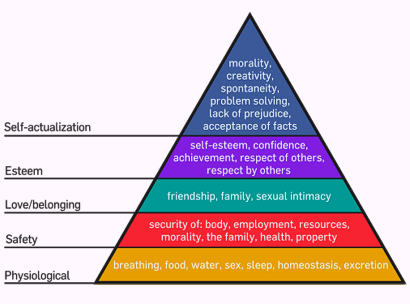
Maslow’s Hierarchy of Needs.svg By User:Factoryjoe, CC BY-SA 3.0, https://commons.wikimedia.org/w/index.php?curid=7964065
A needs hierarchy for players
For some time, I’ve been advocating Maslow’s Hierarchy Of Needs as a tool for the creation of Alien character archetypes and characters (see “Creating Alien Characters: Expanding the ?Create A Character Clinic? To Non-Humans“). Perhaps a similar solution can be employed with respect to players in game situations?
5. The Physiological Needs Analogue
While PCs in-game and players as human beings in an out-of-game context might have survival needs like food and shelter, players in an in-game context do not. The best analogue for this need is in fact the potential for survival of the PC.- without the character, the player can do nothing. Having a viable (I almost said ‘living’, but a PC might still be ‘viable’ after death) character in a campaign is the most fundamental need.
4. The Safety Analogue
Safety Needs are all about personal security and potential for prosperity. Those mean very different things to a player with a character. There are three needs that potentially fit this description: the first is a GM who is not only fair, he is seen to be fair by the player; and the second, a consequence of the first, is the opportunity to improve his character’s situation in in-game ‘life’. The third is an expectation that the game world makes rational sense, when all the factors behind character and GM decisions are known and taken into account.
3. The Social Belonging Analogue
These are interpersonal needs. Again, the context creates a fundamental shift in the meaning of these requirements! At first glance, you might think that this refers to other PCs, but one-player games are not only possible, they can be a lot of fun. Them you might think that it refers to NPCs with whom to interact, but while roleplaying character interactions is an important element of most games, no-one would ever pretend that this was a ubiquitous requirement – you can have a perfectly satisfactory session in which no-one says one word “in character”, so that’s not it, either.
No, I think this is something more subtle – the sense that the character is part of the world and not some superficial and meaningless afterthought. This isn’t a need that the character has, it’s a need that the player needs to feel is satisfied in the case of his character.
There’s a whole lot of baggage that comes with that requirement – things that are needed in order to create that sense of belonging, or things that exist as a consequence of that subset of general verisimilitude. Society, Politics, Economics & Trade, Geography, Ecology, and so on – all the things that the GM should spend most of his time developing when he is “creating the campaign”.
On top of all that, there is the requirement for the PC to have a unique personality that expresses both the formative events of the character’s past and plausible and consistent reactions to those events. Characterization is also part of this sense of belonging.
2. The Esteem Analogue
The esteem needs are about the need to feel both self-respect and the respect of others, to be able to make independent decisions for yourself in areas of life that matter and are not just trivial. A game is not just about the character experiencing the story that the GM has laid before them, though that might be sufficient for the character’s needs; the player needs to feel that he has the ability to make decisions that affect the outcome of a situation, that in fact change the game world in however small a way.
1. The Self-actualization Analogue
Self-actualization is all about personal growth, and achieving potential, about being more than a job and a socioeconomic label. The player needs to feel that the character has both the scope and opportunity to develop as a characterization.
Validating the hierarchy
Probably the hardest part of interpreting the Hierarchy Of Needs was not devising the list of ‘needs’, but making sure that they are in the logical sequence. No step can be dependent on a higher step; in a nutshell, and satisfaction of the lower levels is a prerequisite for achieving the next.
5-to-4 validation:
Can a player have confidence in the fairness of the GM is his character is not a viable part of the game? If a legitimately-created character who has been approved for participation by the GM is not viable, does that not bring into question the fairness and/or competence of the GM? Does it not call into question the rational foundation of the game world (assuming that the character archetype is one of the principle character types of the game?) GM fairness and a rational world cannot exist with an nonviable character, because the GM should have recognized and pointed out the problems with the character instead of approving it as fit for the purpose of being played in the campaign. Check.
4-to-3 validation:
If the game world is not rational and predictable, how can a rational character create a sense that the character belongs to that world? Even a superficially mad world needs an underlying rationale. The player needs to be able to appreciate the presence of that underlying rationality even if the character can’t. Satisfying the third-tier need is impossible if the second tier is not adequately satisfied, at least at the meta-game level. Check.
3-to-2 validation:
Chaos theory is often expressed as a butterfly in Beijing flapping it’s wings and altering the eventual weather experienced by America or Europe. Unspoken is the assumption of a connectedness of the environments in question, a medium of transmission for the consequences of those flapping wings. That butterfly has zero impact on the weather of Jupiter, say.
The connection between player decision and game-world impact is the rationality of the game-world; without it, the consequences of any action would be random and unpredictable, in which case there is no rational basis upon which to make a decision. The third tier of needs is the equivalent of the atmosphere that connects the “butterfly’s wings” to the “experienced-weather consequences”, i.e. that connects decision to game-world impact in such a way that a rational decision is even possible. Check.
2-to-1 validation:
The final link to be validated is the easiest of them all. How can a characterization be developed if it isn’t defined in the first place? In order to develop, the character needs to be able to make rational decisions that have a measurable outcome on a situation. Check. In fact, the whole hierarchy seems to be on solid ground.
Where’s the fun?
It may be noted that there is no mention of the word ‘fun’ as an outcome of any of the needs beyond ascertaining that certain things do not prohibit it. Nor is there any mention of the many things that different gamer personality profiles enjoy. Why? Because these are all fundamental requirements to be achieved before the possibility of ‘fun’ even arises, no matter what form that individual’s ‘fun’ might take.
Application by example
With that done, let’s re-examine the problem of player resistance to PC captivity unless it’s the player’s idea.
The whole notion of surrendering control to the circumstances violates the second ‘need’ because it actively takes control away from the character, potentially risking fundamental injury to the first tier of needs. Forcing the issue violates the second tier need for fairness. These are the same drives that would be violated by locking the player up in real life without a fair hearing and giving them no way to improve their situation. Small wonder that they instinctively resist as though fighting for their very survival; they might well be doing just that!
The caveat, too, makes perfect sense in this context. A player choosing to let his PC be captured is voluntarily yielding control over his circumstances with the implication that this is a temporary measure that will enhance either the characters prospects for survival or prosperity (tier 1 and 2) in the long run. This is the sort of decision that can only be countenanced if the player has unshakable faith that the GM is, and will be, fair. There is also the implication that doing so will lead to validation and an enhancement of the character’s self-esteem, another tier-2 phenomenon.
If the GM analyzes a planned prison-break adventure with a view to satisfying the needs of the hierarchy, an action plan quickly suggests itself. First, he must ensure that the player is properly aware of the circumstances and how they will be changed by the outcome of the player’s decisions. Secondly, he needs to reiterate his fairness by giving the character the opportunity to escape if he chooses to take it; third, he needs to make it clear that capture entails certain risks, but also inherently makes available a reward of equal or greater measure, the furthering of one or more of the PCs goals, to wit, an increased satisfaction of his needs for esteem; and then fourth, he needs to leave it to the player to come to the decision in such circumstances and with a plan in place to restore the character’s independence. If the player then chooses to voluntarily surrender his character on his own terms, there is no problem. If he chooses not to, the GM must be prepared with another path to success in the adventure, though the price of that success might be higher. The adventure needs to be robust enough to survive a “no” decision by the player.
In other words, he needs to enlist the player as a knowing ally in his quest to deliver the adventure. If you can do that, the world – well, the game-world and the campaign – are your oyster.

Discover more from Campaign Mastery
Subscribe to get the latest posts sent to your email.
Comments Off on The Impact Of Player Psychology