Campaign Mastery helps tabletop RPG GMs knock their players' socks off through tips, how-to articles, and GMing tricks that build memorable campaigns from start to finish.

Blog Carnival June 2010: A Medley Of Inspiring Media


rpg blog carnival logoThis month’s RPG Carnival, which Campaign Mastery is delighted to host, poses the question:

What non-game media have most inspired your games and how?

A doozy of a topic, this. Sure, there are the obvious genre-related materials – you can’t talk about Fantasy in this context without mentioning The Lord Of The Rings, first the book, and then the movie, but beyond the obvious, it gets rather murkier.

GMing

Through Dungeons Deep

‘Through Dungeons Deep” by Robert Plamondon

I’ve previously written of the friend who introduced me to RPGs as a player, Chris, in Player Peers and how he taught me the basics of how to GM when the time came in Gamemaster Mentors. I credit Through Dungeons Deep, and especially what it had to say on the personalities of AD&D Dragons, with starting me down the road to being a good GM. It taught me how to infuse depth into my games beyond the basic dungeon-bash and characterisation, how to bring rationality to the gears that were working below the surface.

I was persuaded, many years later, to lend someone my copy. I never saw it, or them, again. Unfortunately, it was out of print for a long time, but a couple of years ago, it was republished. I still havn’t gotten around to replacing the lost copy, but one of these days I’ll have enough coin of the realm to do so.

The Right Word At The Right Time

The Right Word At The Right Time

A friend gave me a copy of Right Word at the Right Time: A Guide to the English Language and How to Use it (Readers Digest) for Christmas many years back and it immediatly became an invaluable referance – not for spelling and grammar, the purposes for which it was ostensibly provided, but for the sections detailing the differences in writing styles of various usages of English – speeches vs newspaper reports vs articles vs… well, you get the idea.

Writer'sGuideToCharacterTraits

Other ‘How To Write’ Books

…too many to list here. Writing rules systems is like writing a textbook, so any guide to the latter is useful referance for achieving clarity in the former. Writing adventures is a lot like writing a play, so any guide to doing that is useful referance for creating better scenarios. It’s also a bit like writing a novel or a screenplay. And of course, characterisation is common to all of them – I’ve recommended The Writer’s Guide To Character Traits by Dr Linda N Edelstein many times in these pages and will continue to do so at any and every opportunity.

Some of these are brilliant, some of them are not. None of them have been completely devoid of merit.

Storytelling

Much of my storytelling style has developed from massive exposure to comics in my youth.

The Silver Age DC Comics of Gardner Fox

These were pivotal. There was a reason for the way everything happened, and it was rooted in the physics and chemistry of the real world, no matter how stretched out of shape and distorted it might have been to accommodate super-powers. Most of these were presented in Australia in the form of cheap black-and-white reprints, years after the originals had been published in the US.

Silver Age Marvel Comics

These did for character behaviour what Fox’s writing did for the world around the characters. Everyone was different in personality, and their choices and actions stemmed from those characterisations. The DC characters with which I was acquanted were far more interchangeable in terms of personality; it was Marvel who taught me the basics of characterisation.

But they had one other element that has formed part of my storytelling makeup ever since, and that’s worth commenting on: They had a flow of narrative from one issue to the next. Individual plotlines would come and go, but there was a tapestry in the background of threads that spanned from one plot to the next. Foreshadowing, Subplots, Flashbacks – Continuity.

This not only provided a motivation to read the next issue, they helped make the world feel more real. Each issue was like a day of school – the main action was self-contained but outside of that there was an ongoing reality that lasted all week, and outside of those discrete time-intervals there were school terms and years. These are lessons and techniques that I have integrated into my GMing style ever since – not only in terms of deepening the verasimilitude of my campaigns, but of making the players want to come back for the next session.

Babylon 5 Box Sets

Babylon-5

Babylon 5 was remarkable for the way it translated these same elements into a television medium, but even more, it added a new layer of sophistication to my thinking on the subject. Look at just about any of the major characters (Dr Franklin being the notable exception) – each underwent massive change in the course of the series. Follow Garabaldi’s story through the five years – or Londo’s – or Vir’s – or Sheridan’s – or… well, the point is made.

Prior to B5, character development in my campaigns was achieved by asking ‘what can I do to make life interesting for character X’? There was no overall plan, no direction. As a result, sometimes these worked and sometimes they didn’t. The scenario sequencing technique that I now use, and which I blogged about in Structuring Campaign Flow was, in part, the end result of what I learned from B5.

The Amazing Spider-Man (Issue #97?)

I’m singling this out (and diverging from the subject at hand slightly) because I taught myself to read at the age of 2-and-a-half using a Spider-man comic! My Uncle had bought them shortly before shipping out to the Vietnam War, and they had been left behind at my Great-Grandmother’s unit. When I visited, there was no-one available to read them to me, so I started sounding out the syllables for myself, putting them together into words, putting the words together into sentences. I’m not sure now which issue it was, but I think it may have been issue #97 – it was a double-digit number, for certain, and John Romita did the artwork. There were a couple of others as well, but that’s the one that I remember.

And, by reading, I don’t mean at a kindergarten level – I skipped over that and went straight to a teenage level, because that’s the market for which the stories were pitched. Two years later, and I was reading at a High School level, and pushing myself further; I was the first person to borrow a non-fiction book from the new Munical Library when opened (a book on Nuclear Physics) and by 3rd Grade was tested as having college-level comprehension skills, so I certainly didn’t squander that early lead.

I relate these events not to big-note myself but because there is a clear line of development from that starting point through to today: simply put, I had time to read all sorts of things years before I was supposed to, and that in turn gave me the raw information that I drew apon to become a GM. Most good GMs have had years of experience as a player before they first get behind the screen; I’d had three or four sessions. The only reason I was able to achieve that transition so quickly and with any level of success was the wide range of books that I had read – and that was only possible because of the head start that Marvel had given me.

Understanding a world and communicating that understanding

If you don’t understand the way your world works, how can you explain it to your players?

The New Intelligent Man's Guide To Science

The New Intelligent Man’s Guide To Science by Isaac Asimov

The obvious starting point for understanding how your game world works is by understanding the real world. And for that, I have never found a better referance than this massive volume by Asimov. The New Intelligent Man’s Guide to Science explains things in a clear and succinct and above all, readable style, building from one topic to the next. This volume has directly influanced my superhero campaign and its underlying game physics, and has indirectly influanced every other game universe that I have created.

The short stories of Robert Heinlein

Heinlein was a master at integrating background information into narrative flow without the need for huge blocks of exposition. I’ve never read anyone better at it than he was. While it’s impossible to completely avoid exposition in an RPG because the players need an understanding of the circumstances and surrounding world apon which to base their choices, Heinlein’s techniques – which I have yet to completely assimilate, I have to admit, despite years of trying – helps keep it to a minimum.

Party Structure

When I first started GMing, I was quite happy to let each player have whatever they wanted in the way of character class or – in a classless system – character niche. I felt it was my job to work around what the players wanted – and if that meant that there were four point-and-shoot types and no front-line fighters, that was the party’s bad luck.

The Avengers (Marvel Comics)

This structure was very directly influanced by one of my favorite comic books, The Avengers, which I had initially discovered in the midst of the Kree-Skrull War (this comic, together with the Foundation Trilogy by Isaac Asimov, also developed a love for epic, sweeping dramas that have been part of my style ever since I started as a GM). The notion was that anyone was able to fill any position, however imperfectly, and it was not my job to hand-hold, manage, or coordinate the players – that was up to them to figure out.

UNSUB

It was the TV series UNSUB – an abbreviation of “unknown subject” – that started changing my thinking on the subject. This show, starring David Soul post-Starsky & Hutch lasted only a single season, and was shown late at night on Australian TV, but it was very much a forerunner for later successes, anticipating things like the CSI franchise by more than a decade. Alas, it’s never been released on DVD, but it was well-written, very entertaining, and is still fondly remembered. This was a team of specialist forensic investigators, each of whom brought a different skill-set to the problems; the combination was far more potent than any of them could possibly have been on their own. When I re-booted my superhero campaign, I very deliberately listed a number of specific character archetypes and permitted the players to choose one for their characters on a first-come-first-served basis. I also deliberately restricted the number of characters to one LESS than the total number of archetypes available, so that there would always be an area of vulnerability that the team would have to work around.

This approach worked so well that it was subsequently adopted in my D&D campaigns, though a little less rigorously enforced; the rule is that no character should step on another’s feet.

The Law

While I enjoyed the occasional cop show on TV like Ironside and Perry Mason, it wasn’t until much later that I came to appreciate the role that the law has in shaping the society around it (better late than never I suppose). The law regulates and controls who can do what, and what the consequences are for stepping outside those boundaries. It is also an imperfect reflection of the ideals and cultural values of the society that makes the laws – imperfect because at it’s heart it is a human enterprise and therefore vulnerable to all the frailties of the human condition – it can be swayed by wealth, political interest, or inherant corruption; and even when it gets it ‘right’, it requires a compromise between many differing opinions, very few of whom can be satisfied by compromise.

The inadequacies of law when it comes to dealing with the pace of technological and social development were aparrant to me long before issues such as Napster brought them to public attention, and the television programme that opened my eyes to all this was LA Law.

LA Law

With LA Law, what always impressed me was the ability of both sides to articulate their arguement so convincingly. While I had a sense of morals prior to encountering the programme, it was only afterwards that I became socially and politically aware in any mature sense. More, it taught me to question my assumptions and think logically concerning social phenomena. Articles like the Distilled Cultural Essence series would have been quite impossible without exposure to this TV series. Courtroom Drama has been a favorite genre ever since.

Perry Mason

I started with the TV series and then discovered the books. While the former has not dated all that well, and was only marginally interesting at the time, the books by Earle Stanley Gardner – which are increasingly difficult to find – are as fresh and interesting today as they were back when they were published. What I didn’t appreciate until I started reading them was that Gardner was very much the forerunner of forensics and the law, without which series such as UNSUB and CSI and Crossing Jordan and NCIS would have been impossible.

Government

You can’t get interested in anything of much substance without getting involved in some aspect of government. If you’re a collector of fiction, copyright and publishing law becomes relevant. If you’re interested in the law, the manner in which those laws are created becomes of interest. If you’re interested in civil rights, government is a central concern. If you’re interested in Archeology, the governments of the eras of concern are vital subjects to understand. If you’re interested in particle physics, government patronage and grants become subjects of which you should at least have some understanding.

Government touches everything.

Applying that premise to an RPG is a very interesting exercise in the completeness of your understanding of your game world. Unless you can look at any given character class and describe how government impacts that specific class, with no preperation, your understanding is incomplete.

That’s not to say that this level of understanding is necessary; it’s not. But it does point out the importance of having clear understanding of both sides of political issues (regardless of your personal opinions) so that you can identify an analagous situation to any circumstance to which you might be confronted, in-game, enabling an extrapolation of that topical knowledge to the in-game situation sufficient to roleplay the adherants of each possible perspective convincingly.

The West Wing

As long-time readers of this blog know, I have a series of occasional articles underway describing the RPG lessons that I have learned from The West Wing (and yes, there’ll be another one sometime soon. I just needed to take a break after the first one turned into a five-part monster!) What’s interesting is that NONE of the planned posts in that series talk about Government or Politics other than indirectly!

The discussion of government above could almost be framed as a “Lesson From The West Wing”: If you don’t understand both sides of an issue, you don’t understand the issue, and can’t debate that issue intelligently; all you can do is recite or rephrase your position, dogmatically.

The West Wing remains one of the most influental series on my gaming, simply because it makes me think.

Yes, Minister

‘Yes, Minister’ and ‘Yes, Prime Minister’ (BBC TV Series)

I can’t talk about politics for any length of time – in character or in seriousness – without referancing these series, at least mentally. Outstanding dry british humour at its best. Yes Minister tells the story of a rather naive and idealistic Minister, Jim Hacker, and his confrontations and catastrophes as head of the Department Of Administrative Affairs.

Yes, Prime Minister
The sequel, Yes, Prime Minister, tells the story of how Hacker fails upwards to become the Prime Minister of Britain. While it is utterly hilarious as a TV series, there is a lot of meat under the surface.

I can never do a bureaucrat without contemplating how much like Sir Humphry Appleby to make that character. Even if the goal is to make an efficient and functional administration, I always need to ask how this differs from the ‘administration’ in the YM/YPM series, and how it came to be that way.

History

Only two items really stand out in this area. The first is a book, and the second a TV series.

The Writer's Guide To Everyday Life In The Middle Ages

The Writer’s Guide To Everyday Life In The Middle Ages by Sherrilyn Kenyon

Subtitled “The British Isles from 500 to 1500”, The Writer’s Guide to Everyday Life in the Middle Ages is an invaluable referance for gamers tired of the “all eras into the melting pot” approach of D&D, or who simply want to capture a little more of a medieval flavour in their games.

We’re so used to thinking of past eras like “The Middle Ages” as all being the same, each year lumped together with all the others, a static and unchanging picture. That’s not the way it was at all; fashion still changed, year on year, and technology developed, and society evolved. History is a dynamic process; if this book does nothing more than get people thinking about their game settings as a snapshot of an evolving society (and one that’s not necessarily all that accurate), this book is worth having.

Time Team

Time Team is a BBC-TV series that started in 1994 (!) and is still running. Although there have been a few “best of” collections and specials released on DVD, there has never been a season box set from the show, and the BBC evades any enquiries about the possible release of such – I know, I’ve tried!! Like the American knock-off series (“Time Team America”), the series basically takes a crack archeological team somewhere and performs an archeological dig, normally in three days. This is no made-for-TV psuedo-science, these are genuine professionals (with the exception of the host, who brings a layman’s perspective to each investigation).

You cannot watch this show for very long without gaining a new appreciation for the different societies and cultures apon which our game environments are based. While individual episodes have inspired a number of adventures in my campaigns, still more valuable are the general insights that the show engenders, from the architecture and lifestyles of different eras to the re-creations that are part of most episodes, this is a must-see for any GM if it’s available.

In General

Earlier I made the point that crafting an adventure is not dissimilar to plotting a movie. But, in fact, whole rafts of information about TV and movie production are relevant to gaming; from the tricks that writers use to be able to deliver a new episode on a regular time-crunching back-breaking schedule to the nuances of costuming to the use of lighting to convey mood, to the structuring of story. I ALWAYS listen to any commentary track and watch any DVD-extras and have a genuine fondness for “making of” shows, because they are so darned useful to me as a GM.

The best craftsmen in the business are taking the time to tell you how they do their jobs, and whether the information is directly or indirectly relevant is moot. Take the time to listen and watch and keep a notepad handy; you will be astonished at how much you can glean.

Obviously, genre films/series are the most directly useful. D&D players and GMs should start with the 4-disk versions of The Lord Of The Rings trilogy; Superhero GMs should start with the mountain of extras on The Incredibles, Spiderman 1, 2 & 3, the X-men movies, and so on. But look beyond the genre and you will discover a wealth of tips and tricks to help your campaigns – I have!

Time Travel: A Special Case

I was going to include this discussion within this post, but it started growing and sprouting some unexpected branches. So I’ve excerpted it completely from this discussion; look for it to appear in a week or two as a seperate article. If it will fit in just one….

Comments (3)

What inspires your games?


rpg blog carnival logoThis month’s RPG Carnival, which Campaign Mastery is delighted to host, poses the question:

What non-game media have most inspired your games and how?

The answer for me is Saturday morning cartoons, which I grew up on and still watch today.

Anything is possible in a cartoon. It’s pure imagination at work in every genre.

  • Plots tend to be simple and suitable to gaming. Easy to study, easy to emulate.
  • Characters tend to be iconic, two dimensional, fun, simple and easy to model. They are also memorable. I’d gladly take a memorable NPC over a muddy and complex one in my games anytime.
  • Environments are easy to visualize, recall and describe.

I think cartoons are awesome GM inspiration.

Here are some of my favourite cartoons growing up that I still watch today either on DVD or YouTube:

Scooby Doo is great for GM inspiration. Simple plots, lots of action, great fun.

  • Scooby Doo. The first series is my favourite, but I’ll watch any of the dozen other variations. Great villains and foes. Always interesting NPCs. A variety of settings and memorable locations, such as an aircraft graveyard, theme park, ski resort, Scottish castle, and dozens more.
  • The Smurfs. In a world where everybody is blue and three apples high, how do you stand out? A fantastic (dare I say smurfy?) example of how to make NPCs distinct.
  • Super Friends. Great villains and super action! (Pun mightily intended.) I especially liked the epic scope of some of the episodes. Save the planet, rescue the galaxy, repair the dimension.
  • Thundarr the Barbarian. Post-apocalyptic fantasy. This was just a fun show. I remember looking at all the old artifacts of our age in the introduction and episodes and thinking, perhaps for the first time, how nothing is permanent, not even the mighty New York.
  • Spider Man. Awesome bad guys, small scope plots in general, a seedy city. The funky animation was a bonus, as was the theme song. The variety of creatures, villains and hazards is always inspiring.
  • Looney Tunes. Is there any plot variation left untouched with this epic run of slapstick cartoons? Even opera was covered. Opera. I think I liked the political aspect of many of the cartoons best. Seeing leaders parodied gave me a bit of insight into that realm. I remember asking nearly everyone where my hossenfeffer was. Still do.

So, old school 80s cartoons have inspired much of my gaming (and my personality, if you ask my wife). How about you? What non-game media inspires your games?

If you are an RPG blogger participating in the carnival, add your links below as well.

Comments (29)

It’s Not Like Shooting Sushi In A Barrel: A Personalised Productivity Focus For Game Prep


While watching the special features from Numb3rs season 3 on DVD, I got to thinking about one of the phenomena of TV shows – that some episodes you really like, and some you don’t, and some episodes are really popular and some are not (and these categories never completely coincide. This is true even of my favorite TV series.

At the same time, I was turning over in my head various ideas for blog posts, and one of them was about the efficiencies of improvement, and how they could be taken into account in planning your game prep to give the greatest bang (ie overall improvement) for your buck (in this case, for your development effort).

I’m not an expert in time-and-motion studies, I should state that up-front. In fact, I firmly believe that people are different enough that such studies (however appliccable in general) are not always 100% on the mark in individual cases. That’s why real elections never perfectly follow the predictions of polls, and why no-one ever agrees completely with the ratings of anything – be they TV shows, movies, or whatever. Statistics are great at overall situations, not so hot in dealing with individual situations. So everything I’m about to write should be taken with not a grain of salt, but a pillar. On the other hand, sometimes an amateur who’s not afraid to experiment can see the forest more clearly than the expert who starts by focussing on the species of tree!

Another ‘fair warning’ while I’m giving caveats: I don’t really know exactly where this blog is going to go, this is very much a case of thinking out loud. I have some ideas as to approach, but what conclusions I will reach – if any – are a complete mystery at this point. That’s the exciting thing about this particular post!

The Objective

The Goal of the process that I’m hoping to develop is to increase the amount of fun that everyone has at the game table. The methodology of achieving that goal is what this blog post aims to develop, by determining some means of specifying which areas of game prep can benefit most from a little extra attention on the part of the GM, and which areas should be shortchanged to get the time required. But at the same time, I want to increase the GM’s fun as well, to make game prep less of a chore and more of a hobby.

That means that two seperate qualitative factors will have to be taken into account: how much the GM enjoys doing it (or, more specifically, how much work it is for the GM), and how big a benefit the campaign will recieve from extra attention. The first is analagous to the rating you as an individual would give to the various elements of game prep, if you were measuring how much you enjoy doing them. The second is analagous to the ratings your players would give at the end of a day’s play – how much fun everyone collectively has at the table.

A Working Taxonomy

Everyone divides up their tasks into subtasks, and everyone does it differently. As Johnn and I have found while working on another project, creating a unified and comprehensive taxonomy for everything that goes into a roleplaying game is incredibly difficult and full of hard choices.

To try and keep this post on-topic, I’m going to simplify the stages of game prep into a small number of substages which are necessarily less detailed and less comprehensive than would be used in a real life situation. Those substages are:

  1. Story – what is going to happen in the course of the day’s play, or the adventure overall
  2. Metaplot – how things fit into the big picture, any external limitations or complications that the PCs will have to take into account, and the long-term significance of the adventure
  3. Background – the origins of the current situation, anything needed to make the plot more challenging by limiting or restricting the PCs scope for choices, and anything else that is needed to justify the in-story events.
  4. Locations – maps, blueprints, and location descriptions
  5. Encounters – who or what gets encountered (in generic terms), and what that encounter adds to the developing awareness of the plot by the PCs
  6. Personalities – the roleplaying elements necessary to take that generic encounter and make it unique and individual
  7. Character Mechanics – the game mechanics used to describe the character in-play
  8. Script – snatches of prewritten dialogue, bullet points of information that NPCs are to relate to the PCs, and any narrative that the GM is to provide ex-cathedra
  9. Support – props, miniatures, any game supplements that should be on-hand, and anything else that can add to the playability of the adventure but that might not be strictly necessary

Okay, the list is longer than I originally thought it was going to be – I kept thinking of ‘one more thing’ to add. It has holes: where do rewards fit into it? Should they be their own category, or under Character Mechanics, or Encounters? But it’s sufficiently functional for today’s purposes, it just means that any examples might need to be bigger than I was expecting.

Developing Your Own Taxonomy

I should emphasise that each GM should develop their own taxonomy to describe what they do in game prep – because not every GM will do all these things, and certainly not every time. Some GMs might not sperate Personalities from Character Mechanics, or Metaplot from Story, or Metaplot and Background. The next time you’re doing game prep, you should generate your own, unique, taxonomy – the discriminating factor being whether or not you think of it as a seperate task, something you can do at another time.

Dependancies

Quite often, a GM will consider one of these tasks to be dependant apon the outcome of another. Some GMs will define the personality of an NPC first, and use them to derive the game mechanics; some will generate the NPC’s stats first and build the personality as a reflection of those characteristics. Still other GMs won’t seperate the two into seperate tasks at all – they might start with a general idea of personality, develop the character stats, refine the personality to accommodate the game mechanics, then tweak the character. Or it might be as simple as getting the personality down on paper while the game mechanics are fresh in the GMs mind or vice-versa – this is another way of linking the two into a single task.

A similar relationship exists between Metagame and Story, and between Metagame and Background, and between Story and Background. How much does the location influance the nature of the encounter that is to occur there – and which comes first?

The rule of thumb to use in developing your own taxonomy is that if a step is completely dependant on the results of another step, those two should be combined into a single step in the GM’s thinking.

How Much Fun?

Having established the categories, the next step is for the GM to rate how much fun he has actually doing them. A one-to-five scale is fine, where zero = ‘I have to be forced to do this at gunpoint’, and five = ‘I would do this every day if I could’. We’ll label this “R” and use it to determine how much the GM tries to avoid doing the task. The illustration is a rough indicator of how I would rate the elements of the taxonomy I derived as an example.

How Easy?

The next step is to determine how easy the task is for the GM. Every one of us has strengths and weaknesses. This value will also be used to rate how much return the GM gets on his efforts. I could have the GMs rate it, but it should be more enlightening to determine it by comparing the time spent on the task with the number of pages of output. This method also takes into account the actual tools that the GM uses, whether it be a fractal mapper or character generation software.

Data Capture

The first step is to gather the data. For two, four, or five prep sessions, track how long you spend on a task, and the number of pages of information that you produce. Don’t worry about filtering out diversions and time lost to things like phone calls – those represent the inevitable overhead that will come from interruptions with any longer-duration effort. All we care about is the start time and end time and the difference in minutes.

Becoming more aware of how you work is a by-product of this information that can yield it’s own benefits. For example, you might find that you had clear ideas of the NPCs that you had to create, but that by the time you had finished doing the maps for an encounter, that information had become vague and hard to remember – meaning that you can make an immediate gain in efficiency by generating the NPCs before you start work on the maps.

The example above shows some fictitious results based very loosely on my own work practices, spread over four different game sessions. The first session totals exactly 4 hours of prep time, the second totals 5 minutes more than that, and the other two total less. All told, exactly 900 minutes of prep time have been divided up – an average of exactly three-and-three-quarters hours per game session. It can instantly be seen that I spend most of my time on the story, on the metaplot, and on scripting narrative and dialogue – over 60% in fact – leaving less time for anything else.

Data Conversion

Once you have a reasonable basis for your calculations – the work done over several game sessions – you can get the totals in each category of your taxonomy and perform a simple division to get the number of pages per minute. Don’t be surprised if the results seem alarmingly low – it can take an hour or more to write a page of text, and that would translate to 0.016 pages per minute. The next step is to adjust these to fit the same 1-to-5 scale that we used for fun, and will also use in later steps.

To make the conversion, subtract the lowest value result from the total of each step. Multiply the result by 4 and divide by the highest of the individual results. Then just add 1. The example to the right shows this being done in two stages: the subtraction and then the rest of the calculation. The result rates the efficiency of the GM’s work on the 1-5 scale that we need.

The first thing to notice is that all the activities that the GM has rated as enjoyable are in fact his least efficient – if the R is 4 or 5, the efficiency is ranked as 1, 1.2, or 1.3. The area in which I show the greatest efficiency is the one on which I spend the least time, and the one that I enjoy the least (and so would tend to avoid), character mechanics. So that’s already really interesting information. Even though the page count for the things I enjoy doing is high, so is the amount of time that I’m investing in them – probably because I enjoy it!

The question we can now begin to examine, having been armed with this information, is whether or not that degree of effort is really justified, or should I improvise more plot and spend more time on the things that I enjoy less? How much could I improve the game – and how much would I detract from it?

Extreme Session Post-Mortems

The next step is to do some session post-mortems. Pick two sessions that stand out in your mind – one for being more successful than most, and one for being as close to an absolute disaster as you can remember. In each, attempt to categorise how effective each prep element was at contributing to the enjoyment, based on comments at the table, your own observations, and any feedback that you remember.

What we are really interested in here are the totals, and the differences, between the two. Presumably, in the one that everyone enjoyed, everything would rate high – but there can be surprises.

I have two particular sessions in mind – one where I lost track of where we were in the plot, which limped a bit to begin with, and in which I got the abilities of a couple of characters confused. Even in this absolute disaster, there were a couple of things that people enjoyed, and a few areas that were complete messess. I can also remember a session in which everyone had a LOT of fun, everyone was laughing at the table and participating – but there were a few moments when things faltered, when things didn’t work as well as they should, and in which I had to scramble to keep things on some sort of sensible track.

The totals rank the strengths of the campaign in the perception of the players – the things that you are doing right. The higher the total out of ten, the better. The differences rank the differences between the two sessions – in other words, the reasons why one was a disaster and the other was not.

Above are the ratings I have assigned to the two sessions I have in mind, together with their totals and differences. And right away, a number of conclusions leap out at me. Metaplot is my strong point, that’s no surprise; but second most important is story, and that was also one of the big differences between the two. Ranking only marginally behind story in importance are background and scripted elements, the first of them being ranked the same between the two sessions, but the second being only just a little bit less critical than story in letting the second scenario down. Only less important again are Personalities and Character Mechanics, and here is where things really start getting interesting: Personalities ranked as the equal biggest difference, while character mechanics actually ranked higher in the disaster than it did in the success. Right away that tells me that less time spent on the game mechanics of the NPCs and more time spent working up their personalities or story might have made the difference between a mediocre session (at worst) and the disaster that it proved in hindsight to be.

Putting The Picture Together

In a perfect world, the last set of results would be all that mattered, because a GM could spend as much time on each element as it needed; it would only be a question of establishing a minimum standard in each for play, and you would have a winner every time.

Unfortunately, we all live in the real world, where time is limited and we absolutely have to take efficiency into consideration. (And now we get into the section of the article where I’m not really sure of my technique. But let’s dive in, anyway).

To start with, the activities that I enjoy doing are obviously a part of my GMing style, and so these will obviously bias both the rating of importance, and the priority that I should give to additional efforts. We need to take that bias out of the importance to get an true picture of the priority that should be placed on changes, and we need to take that bias into consideration in determining how much value the overall game could achieve from more attention to a given area. In effect, we need to take the bias out of the sum column and add it to the difference column.

That means we’re calculating Sum – R and Diff + R, and the results come out as shown. The higher the Sum-R, the more valuable the activity is to my GMing style, regardless of how much I do or don’t enjoy it; this is a road map to how my priorities should be adjusted, in an ideal world, to play to my personal strengths and GMing style. While the heavy focus on metaplot is not a surprise, the next highest score is assigned to Character Mechanics, which is a bit of a surprise, then background and encounters – both of which are only mediocre on my radar.

The higher Diff+R, the more benefit will be achieved overall by more pages of work, again in an ideal world. Here, story is king, followed by personality development and script, then metaplot – and then a number of items of comparatively low value. Again, none of these are universally applicable, these are values specific to my style of campaigns.

Clearly, we need to put these two values together. Simply adding them won’t do it: some values will cancel out. While a more complicated operation might be needed, my intuition says to multiply the two together and take the square root. The result should by a priority weighted by benefit. Finally, we need to adjust for efficiency, by multiplying by the value derived earlier.

The ideal game prep

So what does it all mean? Well, ultimately, there are three groups of values in the final column above: A couple that are 9’s, or close enough to it; a number that are between 4 and 5, near enough; and a couple that are ranked 0. But those are my results, and are unlikely to corrospond to anyone else’s.

What the results add up to is a priority table for dividing up extra prep time. So, to get the ideal prep time, let’s divide the standard prep into two componants: the fundamental and the extra. According to the statistics gathered early on, the average prep time I use is about 4 hours. So let’s reduce that in half-hour increments and allocate the time thus made available according to this priority.

That sort of allocation is easy, it’s something that most GMs learn how to do from compiling tables: you simply convert the results to a percentage of the total and split the allocated resource – be it a die roll range of results, or, as in this case, a quantity of time – into that percentage of the total.


So here are the results (I’ve only shown the calculations for the first couple of coulns). Four plans, each progressively shifting the balance from the current time spent (on average) to a 50:50 balance with the new scheme. Which one is best? Well, my gut instinct tells me that Plan 3 is the way to go. There really isn’t all that much change between plans 1 and 2 and the current balance – we’re talking 7 minutes less spent on the story, 2 minutes less on the metaplot, and so on. The differences are actually fairly negligable.

But that’s the point: these numbers are reflective of an already-successful ongoing campaign, which means that it has to have more hits than misses. If the campaign were in trouble, I might be tempted to make more radical changes, and that’s what the results would indicate. I would round off the odd values – the 33 minutes would go up to 35, and the 29 minutes to 30. If you can find 4 hours, you can find 4 hours and ten minutes – even if the last ten minutes are at the gaming table; if there is a discernable improvement in the adventures, the players won’t begrudge an extra couple of minutes.

Any of these plans would retain the elements of my GM style that work; the differences are in those parts that I occasionally struggle with, and how high a priority they should be. And, of course, having made the recommended changes to my usage of prep time, I can always repeat the calculations using new values to assess the results. Improvement should be an ongoing process, not a one-time event.

Conclusions

One thing that struck me while I was playing around with numbers here was that there were relatively few surprises. In most cases, these were trends that I had already detected in my game prep. I was going to say that this was perhaps the most surprising outcome of the lot – but then I realised that it makes sense. As a GM, you tend to pick up on things that don’t work quite as well as you had hoped or expected, and tend to perform session post-mortems in your head anyway (especially when preparing for the next session). The more experience you have, the more adept you will usually become at detecting these hints and signs. None of us ever gets perfect at it, but we make corrections to our approach all the time, based on experience of what works and what doesn’t.

But there have been a few genuine surprises along the way. Some of the relative efficiencies were unexpected, and the emergance of more work on the NPCs as the most useful thing to prioritise for overall gain was a surprise. That’s useful information.

Postscript: Where to from here?

Okay, I’ll reiterate that I don’t really know what I’m doing here. The ideas seem sound to me, and the results appear sensible, but that’s not necessarily any indication, and I have absolutely zero evidence that this works. But, assuming that it’s all correct (by some miracle), the next step would be to rate individual sessions and link them with the actual prep time done. Get some hard statistical data for what works and whether there is a consistant pattern to the failures. Lose the assumption that the differences between a mediocre game session and a flop are the same as the differences between a success and mediocrity – or at least get some hard data. I would like to compare an average session with a failure with a success, instead of a success with a failure, and develop two different plans – one to avoid the clunkers and one to excel more frequently – because they might prioritise different activities.

I’ve done all I can (and more) – I guess it’s now over to someone with greater expertise in statistics and time-and-motion studies…

Comments (5)

Ask The GMs: An Inconsistency of Play


How do you fix it when inconsistent roleplay or interpersonal conflicts are killing the campaign? The more restrictions on gameplay you have, and the more expectations on play style you have, the more you need to talk about this with everyone in the group and reach consensus. Assumptions kill groups faster than monsters.

Ask the gamemasters

Campaign Mastery was asked,

Hi GMs!

I’ve had an issue lately with my regular gaming session being regularly canceled. Needless to say, I’m a bit antsy about it. I spoke to my GM about why he hasn’t held a gaming session in the past few months and got an answer that had me feeling angry.

While my trusty GM has had some issues at work (heck, he’s a doctor so it follows that work is hectic), he pointed out that one player in particular has been getting on his bad side with her character’s mutable persona. This player has done a few things that have been very much out of character, and as such, caused a few of us to wonder if she is trying too hard to be viewed as ‘fun’ or ‘cool’ in character and maybe even outside her role-playing character.

The ironic thing I have noticed is that Miss Wishy-Washy Cleric has created more exasperated sighs and grievances with her efforts to ‘fit in’ with a more chaotic good aligned party than sticking to her assigned neutral good ways. The issue now is, until our GM finds a way to resolve his annoyance with this problem player, I doubt we’ll be gaming again soon.

So, I ask, how can we encourage Miss Inconsistent Personality to play a cleric with a more consistent personality and still satisfy a need for fun role-playing?

Thanks!
Angii

Ask the Game Masters - Johnn

Johnn’s Answer:

Hi Angii, thanks for the question. I once told a former boss that a project was delayed because a programmer was doing things all wrong. My boss asked me if I had given the person our coding style guide and gone through it with him. Oh. Shoot. Not only did I feel foolish, squirming around in my chair while the company’s co-owner pinned me with that question, but it was at that point in my career I learned people are not mind-readers. I’m a slow learner, heh.

I carried this lesson to the game table. I try to not assume anything about expectations. From what you have explained, I think your gaming group has a communication problem. I encourage you to have a group coffee meeting, make a phone conference, or send a group email (in order of preference) to get a conversation started about everyone’s thoughts on the game.

In my mind, the cleric player is being subjected to, and judged by, expectations that have never been communicated to her. And she’s not a mind-reader either. At least, not out of character.

In the back of my brain, I knew I had not given my team member the style guide and gone through it with them. The guide contained more than just our indenting and commenting rules. It also covered our code libraries, variable naming conventions, and preferred solutions to certain programmatical problems. Guide was a poor choice of words – it was actually our how-to manual for the shop at the time.

However, the programmer and I did not get along. So, while I subconsciously knew I needed to go through the guide with the guy, I was avoiding meeting with him for personal reasons. As they say though, the difficult conversations are the ones most worth having. By working things out with my boss, I had committed to a meeting. Perhaps that was my sneaky brain at work putting me in a position to overcome my fears.

The meeting ended up poorly. The guy worked hard at pushing my buttons. He was angry at me, or the company, or something, but there was no middle-ground to find peace. I believe it takes two to tango, so I felt partially responsible for the hostility, but I could not mend the ill-will. We both left frustrated. But the project continued on with compliance to the guide.

I feel you need a conversation with your GM. And with the player. Preferably with the whole group to start. It might be a difficult situation, but from a gaming perspective, it cannot get worse because the group has stopped gaming.

First, validate all your assumptions. Why has the GM stopped calling games? What is it about the cleric’s play style that frustrates him. What play style is he expecting? Get specific. Generalities are horrible feedback because you cannot act on them. The player – and the group – needs specifics so everything is laid out and crystal clear – especially alignment, play style and personal style expectations as those seem to be hot buttons.

It will be a tricky conversation. But one worth having.

Some tips to help facilitate the healing process via communication within your group:

  • Do not state what others’ feelings should be. State things from your point of view about your feelings and expectations. Ask others to do the same.
  • Do not tolerate personal attacks, personal assessments of others, pejorative words about others. As soon as the conversation gets personal you dig yourself into a hole you might not get out of. People will get emotional, defensive, upset. As soon as someone goes on the attack, interrupt and remind them not to make things personal about others. It’s no different than being in-game and not taking control of another’s PC or attacking another’s PC.
  • Instead of focusing on what one player might be doing wrong, work instead on reaching group consensus about what the game is expected to be, alignment and behaviour expectations, play style expectations and GM style expectations. Work towards common agreement on how everyone can enjoy the game instead of finding fault in others.
  • Remind everyone it’s a game. It’s supposed to be fun. Use this to break up fights. It’s non-judgmental, allowing aggressors to back-off gracefully, and helps everyone focus on the true purpose of gaming, which gets lost sometimes when emotions bubble up.

During the conversation, take notes. Afterward, draw up a document listing the things the group agreed on and the items that were left unresolved. This document will become your group’s social contract. It should lay out clearly what the expectations are.

For unresolved items, keep at it. Hold another meeting or do one-on-ones until you get to the heart of the issues. Your group can only mend itself once these issues have been resolved. Else, you will play again, people will leave more frustrated, and the desire to resume play dwindles further, and possibly even the desire and ability to talk things out dwindles as well.

Ask the GMs - Mike

Mike’s Answer:

I have to admit that I’ve struggled to find the right answer this question. This will be the eighth or ninth time that I’ve wiped the slate clean and started over. So, if I’m having so much trouble despite all my years of experience, perhaps it’s not so surprising that the GM in question is also frustrated to the point of avoiding sessions.

Part of the difficulty has been that the question hasn’t been raised by one of the parties who are having the problem – perhaps if we had heard from the others, things might have been more straightforward. Another complicating factor is that we have to make so many assumptions to get to an answer. And a third hurdle has been that Johnn’s answer is right on the money, absolutely perfect – IF his interpretations and assumptions as to the cause of the problem are correct.

Nine-tenths of Wisdom is asking the right question

I have seen it suggested, many times and in many places, that if you have a problem that seems too big and complicated, you should do any part of the problem that you DO understand and then reexamine the remainder of the problem. I don’t necessarily ascribe to that philosophy; if you don’t fully understand the problem, then you can miss contextual elements and make assumptions that may mean that much of the work done in answering the part of the question that you thought you understood actually leads down a blind alley. This particular question is a great example of that problem, which is further complicated by the writer’s belief as to the cause of the problems, and the ‘magic bullet’ that will solve them.

I prefer to dismember the analysis of the situation and identify all the assumptions – break a big problem into smaller problems, then each can be addressed.

So, with that in mind, let’s take a fresh look at the narrative and problem at hand, tearing it apart into assumptions and smaller questions.

  • Game Sessions are being canceled by the GM.
  • The GM has had some issues at work.
  • He also states that he’s been having a problem with one particular character being inconsistently roleplayed, which has been damaging his enjoyment of the game.
  • Angii suggests that the other players have also noticed this inconsistency of roleplaying, and have speculated as to the reasons.
  • Angii then gives her own assessment of the problem, which is subtly different to that described in the previous paragraph.
  • Angii states that until the problem is resolved, the GM will continue to cancel sessions.
  • She concludes by asking our advice on how to encourage a more consistent personality for the character whose player is being blamed for the situation.

Working through this summary, let’s analyze the situation, looking at the assumptions and questions that arise.

  1. Suggestion: The inconsistency is arising because the player wants to be viewed as “fun” or “cool”.
  2. Question: Is inexperience the problem?
  3. Question: Is the player stepping out of character to have fun?
  4. Assumption: The right way to play is to stick to an arbitrary alignment standard.
  5. Question: Is this assumption correct?
  6. Observation: The character in question has a different alignment to that of the rest of the party.
  7. Suggestion: The inconsistency is arising because the player is trying to “fit in”.
  8. Suggestion: The inconsistency, when it occurs, is excessive in the direction of the overall party alignment.
  9. Suggestion: This excess is creating grievances amongst the other players.
  10. Question: Is the GM’s problem with the player’s roleplay, or with the reactions of the other players?
  11. Question: Will answering the question of how to roleplay more consistently actually solve the problem?

Johnn’s answer has focused on the theory that the real problem is the expectation of adherence to the arbitrary alignment standard – items 4 and 5. on the above list. If he’s correct, then his answer is the right answer. But the accuracy of this focus is very much an assumption on Johnn’s part, no doubt backed by his personal experience.

So I’m going to start by assuming that his assumption is wrong, and that one of the other interpretations suggested by the analysis is the problem that needs to be solved.

Inexperience

Whenever I read that a player steps out of character to do something that they perceive as being “fun” or “cool”, I am reminded of a number of young teen players that I’ve encountered. And of one or two profoundly juvenile older players that I’ve gamed with. They eventually grew out of the habit – even (with peer pressure) the older players.

I was able to encourage such maturing by taking the player aside each time he stepped out of character and asking him to justify the character’s actions. We usually found that putting a slightly different spin on the actions or justification enabled the character to do most of what the player wanted to do, without breaking character. As their experience grew, they became more adept at this and the game was interrupted less and less frequently.

If you think that inexperience or immaturity might be a factor, Angii,, I suggest that everyone at the table read a copy of one of my previous blog posts, “Player Peers”. Johnn’s answer is partially applicable to this interpretation, as well.

A Fish Out Of Water

This section arises from the question, “Is the player stepping out of character to have fun?”

Players can be left feeling left out of the fun when everyone else has a different code of conduct to that of their character. Even if the GM is fair, and gives each player equal attention when it comes to roleplaying encounters, the rest of the table will usually be able to share in the fun due to the similarity of their character’s world-view, while the ‘exception’ is viewed as a wet blanket. This is a problem that can arise – and is usually worse – with experienced roleplayers. This engenders frustration on the part of the ‘exception’ which can build up until it explodes in something quite uncharacteristic.

The solution to this particular problem is two-fold; first, the personality of the ‘exception’ character has to be tweaked slightly to give them leanings in the direction of the majority; and the second is for the GM to recognise that because of the ‘shared participation’ of the other characters in encounters fitting the majority perspective, he needs to overcompensate slightly and give the exception a slightly bigger share of the roleplaying action. Giving all the characters equal playing time can actually be unfair.

An Arbitrary Standard

Forcing characters to stick to a given “alignment”, or expecting them to do so, is always a mistake, in any event. Characters should be created as individuals, with individual motivations and quirks and beliefs and behaviours, and not as cookie-cutter products wearing different classes like you might wear a different suit of clothes.

Since I’ve had rather a lot to say on the subject, rather than trying to synopsise it here, I suggest you point your GM and fellow players at the series of “Focusing On Alignment” articles. If you need assistance in taking the generic guidelines for alignment and creating an individual and unique personality within them, one which both permits and allows for the occasional excursion into the moderately crazy, check out my series “The Characterisation Puzzle”.

Between these two series – both 5 parts long I’m afraid, which is why I haven’t tried to synopsise them – you should find the answers you need, if this is where the problem lies.

A more consistent characterisation

These articles are also the solution to the question you actually asked. The problem is that the personality of the character has been confined to a narrow “alignment box”, and the player is struggling to break out of those restraints. By giving the character a better-defined personality, the player achieves a greater level of ownership of the character, is better able to roleplay it, and will build in ways of having fun or being cool or fitting in with the party – regardless of which of these is the problem.

The only problem to which this is not the solution is the question of expectations on the part of the GM and other players. And that brings us back to Johnn’s excellent answer, which crystallised my own thinking on this question; regardless of which of my solutions (if any) that you employ, they should be utilised in harmony with Johnn’s advice.

The attitude to take is not one of “this is the problem and this is the solution and it’s all your fault”, it is “this might be the problem and this is something that we can try that might solve it – but we’ll all have to take part.”

Ultimately, as the very fact that Angii asked for our advice proves, the problem (“No Game”) affects everyone at the table, and hence everyone has a stake in the solution and should participate in the solution. You’ve all shared in the pain of the problem, you’ve all shared in the pain of the consequences, you should all share in the solution, just as you would all expect to share in the rewards that will follow.

Best wishes to all involved – and may all your crits be successes.

Ask The GMs is a service to you offered by Campaign Mastery. Check out what’s coming next, or ask us a question you have about GMing. Ask The GMs >

Comments (5)

Sophisticated Links: Degrees Of Seperation in RPGs


.| Network |. by Clix

Introduction

This is not the post I was originally going to write for today, but a paragraph in one of the books I am reading brought to mind the game that seemed to be everywhere just a few years ago, “Six Degrees From Kevin Bacon”, and social networking in general, and I suddenly saw applicability to RPGs. It won’t come as a surprise to long-time readers of Campaign Mastery that I like to relate to complex phenomena through Analagies; it lets me get an overall ‘take’ on the phenomenon and its relevance that otherwise awaits a “Eureka!” flash of insight.

The “Six Degrees” game is a manifestation of a theory of social networking, and states that Person A will know someone (designated person B) who knows someone (person C) who knows someone (person D) who knows someone (person E), and that one of these five people will know Kevin Bacon. The broader theory suggests that this is true of any two individuals – no matter how far apart they seem to be, a finite and remarkably small number of links can connect them. Several experiments have confirmed the hypothesis and a number of social networking sites have found ways to take advantage of it; you can find more information on the subject at this Wikipedia page.

The thought that intrigued me, the “Eureka! moment” that changed the subject of today’s discussion, is this: How does this concept manifest itself in terms of the relationships between characters in RPGs, and how can the GM take advantage of it?

One Degree Of Seperation

This is obviously a situtation in which everyone that the characters meet is directly relevant to the campaign. It doesn’t take players long to recognise it, either, which is why this is a common characteristic of new-GM campaigns – though, to be fair, experienced GMs often fall into this trap as well (and I include myself in that number). Immediately a new NPC is encountered, under this model, the players begin trying to fit them into a pigeonhole – “this character is here for this reason”.

Prior to this realisation, all my thinking had been about ways to obfuscate the relevance of an NPC character from the PCs – making them seem important to situation “A” instead of “B” – and of finding ways to connect characters (especially PCs) more immediately to the scenario’s action – in effect, shortening the degrees of seperation between PCs and the events of the Campaign, so that it feels more personal, and more important, to the characters.

While that work is not invalidated by this new perspective, it now becomes a relatively small componant of a much larger vista of possibilities.

Two Degrees Of Seperation

The first of these is possibilities emerges through the use of two degrees of seperation. Instead of everyone the PCs meet being directly relevant to events in the campaign, we’re now talking about the majority of them merely knowing someone who is directly relevant. Social networking and character interaction immediately become more important as the communications channels for reaching those relevant individuals. Suddenly, there is a new depth and sophistication to the campaign, and a far greater complexity – mathematically, the campiagn is expanded geometrically in all social respects.

I had briefly touched on this concept, without recognising it, while working on the “Contacts” rules for my superhero campaign, whose rules derive from the Hero System. The notion was implicit that who an NPC could call apon for information or action was directly relevant to the value they offered when that NPC was taken as a contact, and some efforts were made to quantify these secondary values.

More Degrees Of Seperation

In the real world, the sophistication of social networks extend many layers deeper than this, but, in an RPG, I would suggest that the best way of counting degrees of seperation should be one, two, three, many. Consider the situation in which a PC calls apon one of the contacts that I described above and asks him to use his influance over others to cause a certain action to take place; what the character is actually asking the NPC to do is to direct a third party to act apon a fourth, establishing a three-degrees-of-seperation relationship between the PC and the target of the action, regardless of how many degrees of seperation had previously seperated that third party and the target, as shown by the illustration below.


The PCs contact A, who arranges for B to act against H, a target they have virtually no relationship with, otherwise. For the sake of the example, I have deliberately placed six degrees of seperation between B and H.

This is obvously intended to achieve some goal of the PCs, indicating that there must be a relationship between them and H of no more than three degrees – either he is their enemy, or he is the enemy of someone they are directly connected with, or the consequence of the action against H will impact their real target, J (not shown) in some way.

  • If H is the PCs’ enemy, that’s one degree of seperation.
  • If H is the enemy of someone the PCs know, that’s two degrees of seperation.
  • If J is the PC’s enemy, that’s also two degrees of seperation – PCs to J to H.
  • If J is the enemy of someone the PCs know, that’s three degrees of seperation (or less, if H is that someone).

One, Two, Three, Many. That’s all that a Campaign needs.

RPG Usage with Information Dynamics

Of course, I couldn’t leave the general concept there. What if the degrees of seperation referred not to characters, but to pieces of information and the relationship between them? Could it be possible to catalogue all known information using some system of N links between them? Would this permit a faster method of indexing them, and of searching that index?

Or fields of knowledge – is this a way to map out the way they connect and relate to each other, and might such a map reveal the degree to which one contributes to an understanding of another?

Multistep Problems

In RPG terms, the first can be likened to performing an internet search to locate a website that’s relevant to the enquiry, then searching that website’s pages for mention of the subject, determining that the website doesn’t hold the answer directly (or doesn’t have the whole answer), but does have a link to a different web page either on the same site or on a different site – in other words, to good old-fashioned internet browsing? One relatively complicated task – finding a piece of needed obscure information – has been broken into smaller tasks which have a relatively quantifiable degree of difficulty. Each task must be successful in order for the next to become possible.

TORG used just such a mechanism for resolving difficult tasks (like defusing a bomb) that would otherwise be anticlimactic. Sure, there are often occasions when this would be overkill – but there are times when a straight die roll takes all the excitement out of the task – just one of several concepts in that game system that I considered brilliant ideas, and that have shaped my thinking ever since.

Skill Synergies

The second idea has also been used in RPGs before. The first example that comes to mind is the Language Chart from the Hero System, which uses the degree of relatedness between a known language and an unknown language to determine how many points it costs to learn the unknown language. It is also used, in the first degree of seperation only, by D&D 3.x, in the form of synergy bonuses. I’ve used another variation on the concept for determining the costs of “driving” certain kinds of vehicles – because while it’s trivial learning to use an automatic gearbox vehicle if you learned to drive a manual, the opposite is very definitly not true.

The concept of the relatedness of information keeps recurring in RPG systems; it is even (to stretch the applicability almost to breaking point) analagous to Roleplaying Tips’ famous “Five Room Dungeons” – five challenges to be overcome to complete the mini-scenario.

Why not use this as a tool to think about how to structure your scenarios? Clue number 1 leads to clues 2 and 3; clue 2 leads to action, but ends in a dead end; clue 3 leads to action, which yields clue 4; clue 4 leads to action, which leads to identifying the specific target or objective; and that leads to the action needed to complete the scenario. Or perhaps the chain is 1 to 2 to 3 and 4, with 3 being a dead end, and 4 leading to 5, which leads to resolution of the original problem. This sort of breakdown: introduction, progress, setback, resolution – is used in dramatic writing all the time – try analysing any self-contained episodic TV show or movie, and you will find that most of them have a basic structure modelled along these lines.

RPG Usage with Repetitious Tasks

The same principles can also be extended to cover tasks that are repetitious to the point of tedium. For example, the number of climb rolls needed to climb a cliff (either up or down) can be truly stultifying – I once had a situation in which each PC had to make thirty rolls. How much better would it be to break the total task into 3 or 4 rolls, each dealing with the descent to, and resolution of, a specific sub-problem. The reduction in the number of rolls can easily be allowed for by increasing the difficulty target to be overcome, using the product rule.

For those that don’t know it: If a character has to make three rolls with a 60% chance of success at each, then the chance of his making all three rolls is 60/100 x 60/100 x 60/100, or 21.6%. You get that number by multiplying the three chances (as decimels or fractions) together, and then multiplying by 100 to convert the result to a percentage. 0.6 x 0.6 = 0.36; 0.36 x 0.6 = 0.216; so that’s 21.6%.

All you have to do is work out what the chance of success for each PC is for ONE step, and then multiply it by itself the right number of times. As a general rule, I don’t reccomend combining more than 5 rolls at a time in this way – so those 30 rolls could have been combined quite reasonably into 6 specific tasks.

You can even build additional difficulty into one or more steps along the way, just by converting the additional difficulty into a reduced chance of success on that roll.

RPG Usage with Authority Networks & Politics

Having gotten this far, I asked myself what else can be described meaningfully in terms of degrees of seperation? The first thought that came to mind was the heirarchy of power, from the very top to the very bottom of the rung. This is a complex issue, because people can have different levels of power in different spheres of authority, and some people have leverage that permits hidden power to be exerted indirectly. There are reasons why “the halls of power” are often described as a web, or as a labyrinth!

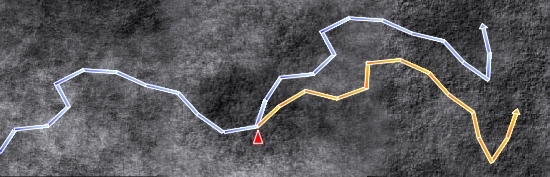
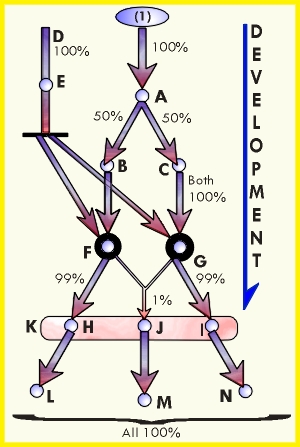
And yet, with further musings, it became clear to me that by expanding the simple linear model of degrees of seperation to incorporate a spacial axis – in effect, taking a linear chart and making it two-dimensional – quite complex relationships of authority could be expressed graphically by two numbers: one, the distance to the ultimate authority figure (ie the degrees of seperation from the ultimate authority) and two, a number designating the nature of the power.

The more I contemplated this particular model, the more it became aparrant that complexities could be rendered quite clear using this format that other forms of representation would struggle with. Consider, for example, the example below:


This shows the lines of authority for a particular character – let’s call him Bud. It’s been simplified to only have 4 degrees of seperation, ie 5 levels of authority from top to bottom. Bud is the most powerful man in industry, a position which gives him clout at the mid-level in politics, at a junior level in religion, at a low level in Legal circles, an intermediate level in Finance, and a senior level in the civil service. However, he also has “back-door” access to a senior level of both politics and finance, and has a second route to the religion junior level through his legal connections.

It has sometimes been said that policy made at the highest level becomes instructions at the senior level, strong suggestions at the intermediate level, suggestions at the the supervisory level, and a passing consideration at the most junior level. (It has also been said in the reverse direction!).

So, if each degree of seperation represents a reduction in direct authority, and that cross-field traffic only occurs perfectly horizontally except when otherwise noted, the level of direct authority over any other individual can be determined from the chart. In his own field, Bud is number 1, with a clear line of authority all the way down to the rank and file. He is (officially) three degrees of seperation removed from the top authority he holds in the political area, six removed from his authority in religious affairs, five from the legal field, four from finances, and two from a senior level of the civil service. Each step up or down from these represents an additional degree of seperation. However, he also has a backchannel that makes him only two degrees from the top political power, and another that makes him only two removed from the top financial power. Budd is the head of the civil service union – someone who can tell even senior politicians what to do, even though he is not supposed to be able to do so.

Why is such a chart useful? Because whenever Budd wants to exert his authority, the GM can count the layers of bureacracy through which Budds power must travel; the total gives some estimate of the authority carried by the instructions Budd gives, and the length of time it takes for his influance to be felt.

The example is not necessarily the most useful means of representing the lines of authority (in fact, it almost certainly isn’t, simply because it was the first one that I thought of), but it’s enough to demonstrate the validity of the concept. By changing the labels at the bottom of the chart, more specific and useful results can be obtained; for example, what if the labels had read “Arts department”, “Physics Department”, “Gym Team”, “Medical School”, “Administration”, and “Maths Department”? Then the same diagram might represent the lines of authority posessed by the Dean of the Physics department at a university.

It is the back-door paths that are most significant. Each represents a relationship that is beyond the boundaries that come with the position itself. Perhaps the Dean is married to one of the Arts Professors, and is a drinking buddy of the Dean Of Admissions, for example, while the junior professor of the Medical School also acts as the assistant coach of the Swim Team. It doesn’t take much more effort to completely map the lines of authority within the university.

RPG Usage with Social Networks

Of course, the real power of the concept lies in Social Networking, just as it does in the real world. Who knows who?

It’s not necessary for the GM to map out the entire social network in advance; but, with the assistance of the players concerned, he should map out the degrees of seperation that interconnect the PCs. Each time an NPC enters the campaign for the first time, he can add that NPC to the social network, determining who knows who, who is allied with who, and so on.


Consider this example. The Six PCs are at the centre of the network, and the links that connect each of them to the others are shown in blue. Links between the people on the network and the Crown are shown in Red. Links between NPCs are in black. Right away, the primary villain stands revealed to the GM (at the far right), and the fact that many of his lieutenants have associations, direct or indirect, with people connected socially to half the party, as well as to the King and the King’s #2 man. It is also clear that thus far, the PCs have only had one direct contact with the enemy.

The nature of that contact suggests that they will probably assume that the villain is the King’s #2 man, and will deal with the upper 3 NPC enemies and think the problem solved. At a later point, they will come into contact with one of the other NPCs, and assume that what they face is a seperate situation to the first, and will only discover otherwise quite late in the piece.

Conclusion

I’ve only spent an hour or two thinking about this, and I’m quite sure that I have only scratched the surface. How else might these ideas be useful? What other complex situations can this simplify through analogy? What else can we DO with this idea? What else can we abbreviate?

Comments (7)

Book of Dead Characters to Celebrate Your Gaming


Book of Dead Characters

My Book of Dead Characters from 1985

A friend I once gamed with was awesome at celebrating gaming. He made sessions into special events. He had props. He talked about games in a special way, like a sports fan does about when their team won the championship that year. He celebrated the details and told stories about special session moments. It was infectious and made gaming special.

I need to do a better job at this. Today, I’m wiping the dust off my Book of Dead Characters (BoDC) and am adding to it once again. This little game prop had huge value back in the day for me, and helped PCs seem special, even after they’d fallen to never rise again.

I’m not going to use the same BoDC though, as my tastes have changed a bit. I think you need a BoDC for your gaming as well. In this blog post, I’m going reveal my original BoDC, and then show you what my new BoDC will entail. I hope you get inspired to create your own, and also I hope you add your ideas about what a BoDC should contain and could look like in the comments section at the end.

My original BoDC is filled with PCs fallen in the line of duty. I started it May 25, 1985. This was during my high school years, and characters were falling in huge numbers to my solo gaming via the random dungeon tables in the 1st Edition Dungeon Master’s Guide, and to the daily gaming my friend Chris and I got up to. (We sometimes played three times a day! Lunch, after school and in the evening.)

Index of dead PCs

A long list of character kills

It has an index of dead PCs at the front. Each time I opened the binder to add another PC to the graveyard, I’d record his vital statistics like some crazy fantasy memorial. Name, class, level, hit points, armor class, ability scores, notable magic items and possessions, and cause of death.

On the first page of the index, I see nine PCs whacked by basilisk gaze. Names include Frashen Barake, Thundarr, Awry and Sly. I don’t remember these PCs, but likely I rolled up a basilisk encounter, the initial group of PCs got whacked, a survivor recruited new fellows and came back, and those PCs lost too. The first group was level one, and the second were levels 5-9. So it seems a group of experienced adventurers heard about the deadly monster killings and decided to try it on themselves. A third wave of level 1s perished after that to the foul beast. I imagine the lizard ate large that month.

Eventually I had so many entries in the BoDC I added tabs and sorted dead PCs by level, lol!

Dead PC ceremonies

Flipping through the binder, I see the process was the write dead in big letters across the character sheet. Kinda like a void cheque. Just in case I ever tried to cheat and un-deadify a character, I guess.

A dead PC

Then I’d enter his key features in the index and file the character under the correct tab.

Look at this poor bastard. Not only did he die, but when his friends tried to resurrect him, he rolled so poorly that he failed his resurrect saving throw. You know it’s a tough game when the afterlife can make an attack on you.

Before the BoDC, I remember we would have special BBQ ceremonies. We’d get a lighter, have three seconds of silence, and then torch the character sheet in my dad’s BBQ. It was probably more a fascination with fire than a ceremony of remembrance, but maybe a bit of both.

Other character death ceremonies I’ve witnessed:

This poor bastard never had a chance

This poor bastard never had a chance

  • Crumpled paper ball
  • Crumpled paper ball thrown at the GM
  • Death of a thousand dice: character sheet pinned to a dart board and dice are thrown at it until it’s shredded
  • Silently filed in the back of a player’s binder
  • Fist slammed down on it and player storms away from the table
  • Ripped up and tossed in the garbage
  • Standing around a garbage can as a group and floating the sheet into it as we waved goodbye
  • Erased and refilled
  • Ye old paper airplane

Good times.

Re-use and recycle

I used the BoDC for fast PC creation. I’d look at favourite dead PCs and copy their character sheet onto a new one for fast play. I’d roll new stats and give him a new name, but otherwise equipment, spells, and other things were the same.

In later years, before D&D 3E, I’d go back and crib dead PCs for fast NPC creation. A nice tool because I had a lot of dead PCs from levels 1-15 to choose from.

The New Book of Dead Characters

Sideview

Dead PCs piled 2d30 high

I’m going to create a new BoDC as a fun way to celebrate a unique part of RPG. When we lose at a board game, the game ends and a new one starts with a clean slate. Computer games churn away with new lives. Card games just get reshuffled. RPGs, though, are different. You likely spent a lot of hours in that character’s shoes, so the impact of his death is much greater than losing a life in another type of game.

If you are campaigning, then you will roll up a new PC, but the dead one can have lasting story impact. The new PC might be a relative of the old one. The dead PC might be used for evil purposes by a villain. The dead PC might have a legacy, such as bard songs sung about him, a string of great deeds performed, or a list of enemies disappointed they did not deliver the killing blow.

Characters do not fall often anymore in my campaigns. Certainly not enough to fill a binder. But for the PCs that have fallen in the past decade, I regret not having them stored in a book or binder. It would be great to leaf through them to recall old campaigns, players who have moved on, and even old encounters and plots for inspiration.

Hopefully I will not look back 10 years from now with the same regret. So, it’s time to craft a new Book of Dead Characters.

This time, I’m making some improvements over my old blue binder.

  • Plastic sleeves. We don’t use 3 hole punched lined school paper anymore. Putting dead PCs in some cheap plastic sleeves keeps them intact.
  • His story. I’ll ask the player of the dead PC to write a paragraph or two about the character. His best and worst moments in the game. A bit about his personality. His most prized possession, perhaps.
  • Summary sheet. I’ll include a separate page to record the date of death, campaign name, player name, GM name, how the character died, and his legacy, if any. On this sheet is where the player-written story will go as well.
  • Group condolences. I’ll pass around another sheet of paper and have players record a sentence or two of their thoughts about the PC. Jokes, fond memories, or just a quick goodbye – whatever each player wishes. I’ll ask players to sign with their name and their character’s name, and comments can be in character or out of character.
  • Picture. I’ll take a digital pic and either print it out or save it to my Campaigns folder and make a reference note on the Summary sheet. The pics will be anything that helps recall the PC. It could be a picture of the battlemat that depicts the scene of his death, or just a snapshot of the group of us, perhaps holding the character sheet up.

This time it’s for NPCs too

The biggest difference this time around is my BoDC will include notable NPCs. These would be recurring NPCs who made an impact on the campaign, or NPCs who left a significant impression on the players or myself as DM.

The NPCs can be allies or enemies.

This will help NPCs live larger. As the players write their condolences for the NPC, the importance, uniqueness and presence of living NPCs will be valued more. In theory, at least.

It will also motivate me to bring my A game when playing NPCs. Player comments in the dead book will serve as a grade of sorts. Villains should hopefully get hateful and vengeful comments. Allies should be mourned. Ambivalence means I’ve failed to bring the non-player character to life through roleplaying or tactics.

Those are my plans for my new Book of Dead Characters. What do you think? Anything I can add to make it a treasured campaign and group enhancement?

Comments (7)

Ask The GMs: How to GM solo PCs (especially in combat)


Ask the gamemasters

Campaign Mastery was asked,

GM Brian: “I’m trying to run a D&D 3.5 Eberron campaign that will mostly be a solo campaign for my friend. I’m just looking for tips on how I can run a well balanced solo campaign that can still have a good amount of combat.”

Ask the Game Masters - Johnn

Johnn’s Answer:

This is a great question, because not all of us can fill an entire table up with gaming friends. Some of my best gaming was done with just one friend over the course of five years (hi Chris, if you’re reading this).

You asked about combat. There are non-combat challenges and opportunities when GMing a single character, but here are a few tips specifically about GMing fights.

Be generous with healing

Methods I’ve used are:

  • Lots of healing potions with treasure.
  • Cheap healing potions (due to alliance with a faction).
  • Common mundane healing (blood honey was a favourite – if the PC could bring back the honey from a certain type of giant wasp, an alchemist would create blood honey for him for free if he could keep half of each batch).
  • Membership to a religious order gave low rates on 1st to 3rd level divine spells.
  • Cleric NPC tags along.
  • Healing rods and wondrous items usable by the PC. I broke the rules on class usage (we were playing D&D 1E at the time) but explained it in-game with a story, and it worked out quite well.
Create a cast of companions

I almost always have one or more NPCs accompany solo PCs. This not only reduces risk of inadvertent PC death, but it gives me an ever-present voice in-game to give feedback, act as a foil, drop clues, and give ideas.

I play to each NPC’s personality and motives (sorry about the assassin “guide”, that time, Chris, but you did insult the King) so these characters are not cardboard cutouts there to serve the PC hand and foot.

Companions are often healers, but not always. A favourite companion type of mine is a barbarian. Loads of hit points and combat skills to believably save the game if TPK looms, but also great fun when the NPC rages on NPCs and gets the player character in all kinds of trouble. I play dumb barbarian companions, so the PC doesn’t come to rely on the NPC for clues, solutions and things the PC should do for himself.

Example of companions:

  • Employer. The NPC is hands-on and wants a piece of the action, or perhaps he just doesn’t trust the PCs.
  • Apprentice. Even non-magic users can attract followers. The leadership feat in D&D 3.5 especially makes this plausible and accessible.
  • Bumbler. Can aid in combat, but like the raging barbarian, sometimes he seems like more trouble then he’s worth.
  • Traitor. Avoid over-use, else you make the player so paranoid he refuses the company of all future companions.
  • Master. Typically, I just make a mentor two levels or so higher than the PC. This keeps ability levels close so the NPC doesn’t steal the spotlight much.
  • Dependant. Perhaps the PC is a single parent, has a slave or has been assigned to protect an NPC for the duration of several encounters, an adventure, or a whole campaign.
Start with weak foes

Until you master the dynamics of DMing a single PC, create several encounters with foes a lot weaker than the PC. Commoners are a great way to start out. So are diseased, venerable or wounded monsters who are low on hit points or do not have a full range of abilities to bring to a fight.

Strike to subdue

Create opponents whose motives are not to kill. City guards, for example, will just want to bring an unruly citizen back in line and be well-behaved, not put him in the graveyard.

Monstrous foes might want to keep food fresh.

Others might be equipped with non-lethal weapons. In a thieves guild style campaign I ran for Chris, the rogues mostly used saps. They always wanted to interrogate beaten foes, plus they were under orders to bring prisoners back to the bosses. Beaten foes sometimes make the best recruits, or at the latest, are more controllable.

Avoid out-numbering

Even weak foes can bring down solo PCs quick. Surrounded, a PC can’t escape easily (not without so many attacks of opportunity that the PC is a dead man), plus any movement abilities get nerfed, which isn’t fun if it happens often.

Add personality

Get some roleplaying done during battles. Trade insults, add flair and style to NPC manoeuvres, avoid going toe-to-toe and experiment with grapplers, bull rushers, and other interesting types. Watch Princess Bride for inspiration.

Get a pet

A pet could be considered a companion, but I wanted to call it out as a special case. Even if the PC is an arcane caster with a familiar, a pet is a boon.

Pets are cheap. You can get a nasty fighting dog without much burden.

Pets don’t speak. Unless the PC has speak with animals, or you conjure a situation so pet and master can communicate (1 hoof means yes, two means no), then you won’t have to carry on a conversation while managing the other aspects of the game, including other NPC companions.

Pets are disposable. While a PC can get quite attached to a pet, especially if they start kitting it out, you can often target the animal in combat without much drama. The more attacks you can spread around instead of focusing on the PC, the longer and healthier life the PC will have.

Get a mount

This gives the PC fast movement, a source of defense (sounding the alarm, for example) and a potential ally in combat.

Though it wasn’t in a solo PC game, a horse ended up saving an unconscious PC to prevent a TPK. It was a trained animal, so not too far-fetched.

Play up monster intelligence

This applies to groups with several PCs as well. Dumb foes will make mistakes in combat. This adds realism and fun to the game. Do not consider it a loss of face, poor game mastering, or being easy on the PC. Roleplay the monster.

Most critters will have natural cunning and basic combat tactics and reactions. They’ve survived this long as an individual and as a species.

However, encourage the player to use his PC’s intelligence and try to trick foes or induce them into making mistakes. This is where great gaming can take place.

Be generous with equipment

Give the PC more options by offering up generous amounts of mundane and magical equipment. Not all of it needs to be treasure, if that starts getting repetitive. You can have the PC befriend merchants, learn of black markets, become a crafter. A smith or bowyer might help upgrade weapons. Wizards could be paid to upgrade magic items or enchant items.

Encourage intelligence gathering

A character operating alone should learn quick not to charge headlong into the darkness.

Encourage the PC to do investigation, scouting and intelligence gathering at every opportunity.

Let him discover foe weaknesses. This doesn’t mean he throw kryptonite and the fight is over in one round. It doesn’t create wimpy adversaries, either. Instead, it gives the PC advantages that he’ll need to press during the combat. This closes the gap a little, but there will still be a lot of drama.

For example, a PC might learn about a foe’s resistance to one particular type of energy. Or a foe might take the same path to head quarters all the time, giving the character an opportunity to lay a trap or stage an ambush.

Use hirelings

NPCs for hire are often under-utilized by larger groups who don’t want the complications of more bodies to track and govern.

For the single PC, though, hirelings are a boon. Be sure to give the character enough cash flow so paying others to help is an option.

Potential hirelings are:

  • Guards. Guard home base, camp or valuables.
  • Mercenaries. The PC leads a band of red shirts into adventure.
  • Sages. To help with intel.
  • Haulers. Somebody’s gotta carry those 10,000 copper pieces back to town.
  • Demolitions.
  • A cook. True story – the cook saved a TPK during an Ars Magica game, once.

Ask the GMs - Mike

Mike’s Answer:

Johnn’s answer does a brilliant job of handling the combat side of solo adventuring, so I thought that I would quickly cover a range of twenty other points to be especially mindful of when it comes to solo games – though some of them can be useful tips for any GM.

Reduced Skill Set

With only one PC, your adventuring “party” will generally lack the variety of skill that you would normally expect. This can be compensated for with a reduction in ability and a more liberal spreading-around of skill points, but that in turn means that the character will be less capable within it’s niche than would be the case. To compensate for this, it can be worth considering releasing some “custom” magic items into the game that give the posessor extra skill points each character level.

Reduced Resources

The character will generally have reduced resources to draw apon in comparison to the standard party – fewer healing potions, less carrying capacity, less money in general, and so on. While only the one character will be drawing apon these resources, the rate of reduction in resource availability is greater than this offset factor. Be more generous with the salting of hoards with potions and other low-level items, and be prepared to be a little more generous in your GM calls than you might otherwise be – holy water might be an effective weapon against undead in a solo campaign where you would rule it less effective or even ineffective in a more typical camapaign, for example.

Restricted Spacial Capability

It’s a lot easier for a group to be in several places at once. While a group taking advantage of this ability can be a real pain for the GM, the absence of that capability can really hinder a solo adventurer. Consider setting up a network of street urchins for hire (Baker street irregulars) that you can give the character access to – for a fee – to help get around these difficulties.

Purity Of Allegiance

With multiple characters, the potential exists for individuals to make the acquantance of members of several rival factions. This provides the group with greater Intelligence (in the military sense) than can be achieved by a lone wolf. Expect the character to know only one side of any given debate within the campaign; this can often require greater exposition by NPCs to “fill in the blanks”.

Reduced Variety Of Ability

Magic, Nimbleness, Healing, Battle Prowess – at least one of these will be shortchanged because the character has access to only one class level per character level. That generally means that for any given character level, three of these will be reduced relative to the capabilities of the typical party. This can severly impact the variety of adventures that you offer – you can’t have one that focusses on magic and then another on the issue of faith vs religion and then a gladatorial combat and then a jewel heist, because the character simply won’t be good at all these things.

It can be tempting to pad the character out with NPC companions to restore some of these imbalances – but doing so can generate as many problems as it solves, as it inevitably moves the campaign closer to duex-ex-machinas and plot trains by taking self-determination away from the character on which the game should be focussed. There’s a fine line between NPCs who can support the PC and NPCs who take over 3/4 of the campaign.

Prestige Class assessment

A consequence of that last point is that character requests for a given prestige class should be assessed a little less stringently than would be the case in a normal campaign, especially if it brings a whole new area of expertise into the character’s grasp. There are Mage prestige classes that confer clerical magics apon a character, for example; I tend to discourage the taking of these in a normal campaign, especially if there is already a cleric in the party, so that each character continues to have a unique niche to occupy. In a solo campaign, I would reverse this policy 180° and even commend the prestige class to the player’s attention. Similarly, there are classes that I consider just plain broken, inherantly unbalanced, available on the net and in sourcebooks; I would be less concerned about these in a solo campaign. Always keep the bigger picture in mind when assessing these player requests.

Variety not intensity

Another consequence of the reduced variety of intensity and the need to focus on prestige classes that broaden a character’s horizons is that the character will tend to be less focussed on their primary schtickh than they would be as a member of a party in a typical campaign. This is worth bearing in mind. As a rule of thumb, I would assess a cleric in a solo campaign to be effectively two levels down on a cleric of the same class level in an adventuring party.

Magic Items should be valued on a different scale

Some magic items give broader capabilites to the character, others make them better at one specific thing. Fighters like Ogre Strength and the like, for example, Rogues like Gloves of Dexterity, and so on. In a solo campaign, these “focussed” items are a little less desireable than items which broaden capabilities. A Dancing Sword, for example, is far more valuable in a solo campaign (where it doubles the number of combatants on the PC’s side) than it is in a 4-character party (a 20% increase in the number of combatants). Summon spells become far more useful in the solo game. These are things that should be borne in mind when placing treasures.

Greater scope for experimentation

A solo campaign typically offers both player and GM greater opportunities to experiment, to try things that they would not otherwise consider. That’s because the necessary preperation and infrastructure requirements are so much less when you only have one PC to worry about, so there is less time and effort involved, and hence a smaller downside if the experiment goes pear-shaped. You don’t necessarily have to experiment if you don’t want to – but you should be aware of the opportunity, at least.

Puzzles & Mysteries are harder to solve

Quite often, in order to solve a puzzle or mystery, a character will need to bounce ideas off someone else. Discussion and different perspectives can often yield clues and insights that set the character on the path to unravelling the challenge before them. In a solo campaign, this “outside source of ideas” is absent, and as a result, any puzzle or mystery becomes harder to solve. The temptations are either to drop hints (which cheapens the whole experience for the player), to have an NPC solve it (in which case why bother putting it into the game in the first place?) or to permit the character to solve it by die roll instead of having the player do so – which is really unsatisfying to all concerned. The better answer is to take the absence of this resource into consideration when designing the puzzle in the first place – and be prepared to let the character take longer to solve it.

CR rises faster than character level

The temptation is always there to simply crack open the monster manual and create an encounter with the same CR as the character has levels. Avoid succumbing to this temptation. One character alone is effectively a party with a CR of 4 less than the character levels (that’s how the math works out) – so the right scale encounter for a character of level 10 is one with an EL of 6. That’s one creature of CR 6 in opposition, or two of CR 4, or four of CR 2, or eight of CR 1. An encounter with the same EL as a solo character has levels is one where they have a fair chance of being killed – even if they start the fight in pristine condition. Bear this in mind.

Be more XP-Generous

Another way of restating the last couple of points is that the character has done better than normal when they succeed in dealing with problems appropriate for a party of equivalent level. You can’t even compare apples with apples, because the solo character is required to spread themselves more thinly over a broader range of abilities, as discussed earlier. In a solo campaign, I would increase the XP rewards given out for success by 10%, 20%, or even 25%.

Assumptions and mistakes

This is a similar point to that made regarding mysteries and puzzles. Because the solo character has no-one to challenge his assumptions (other than the GM), assumptions and mistakes of logic are more likely to be regarded as certainties. That means that the character will make mistakes more often in a solo campaign. Cut the player some slack.

Faster Pacing

With every extra player in a group, the number of interactions between members of the group incease exponentially, while the amount of attention the GM can give to any one player or PC is reduced. The number of combinations taken 2 at a time is the math of the interaction, but in practical terms it means that the fewer the players, the faster the pacing will inevitably be in the campaign. There’s less discussion of plans and alternatives (no-one to discuss them with), there’s less side-chatter (ditto) and the GM is exclusively dedicated to the one player and his character. Expect the game to run at between five and ten times the pace that would be normal, on average. Sometimes it will be even more, sometimes less. One solo game that I ran disposed of three MONTHS of game-time activities in a single afternoon, when the regular campaign (four players) would have trouble getting through three DAYS of game time in a similar real-time window – a 30-to-1 pacing increase. You should prepare accordingly – you will need more material ready to go. (As a rule of thumb, each additional player halves the rate of progress of a campaign, or more – which gives a figure of 8 times faster pacing).

Greater Focus

An additional consequence is that there is much greater focus on the desires, ambitions, and actions of the one PC. The campaign will focus more on the playing style of that lone player, and of the GM – both good and bad will be amplified by this greater focus. In effect, both will be put under the microscope. Be prepared for this effect, and check your egos at the door.

Greater Flexibility

It’s not all downside. The campaign can have far greater flexibility, changing directions more quickly; each additional player also brings the plot equivalent of inertia to the campaign, because they all need to get their share of the attention. With no need to compromise, the campaign can change gears far more quickly. In addition, the more intimate association can often permit the participants to explore themes and social areas that they would be uncomfortable discussing in a more public forum. If your usual games are PG-13, don’t be surprised if you discover the solo campaign treading R-rated territory.

Take more frequent breaks

A more frantic pace, at a higher level of intensity – by now, this hint should be pretty self-evident. Because there’s a lower stress level involved, I would suggest breaking twice as frequently as you would with a four-player group, just to give you time to catch your breath and clear your head.

More can be hand-waved

Because there are fewer PCs to interact with the world, you will find that more can be hand-waved than is the case in the typical campaign. This is another of the factors that leads to faster pacing described previously. More frequently than usual, you will find yourself skipping straight from announcement of action to execution, where in a typical campaign there might have been side encounters and discussions and other plot threads to deal with.

Tactics will change

This is just about the only specifically combat-oriented tip that I’m including, but the principle also applies more generally. Because the character will more frequently be outnumbered, certain tactics become inaccessable to the character and more routine for the opposition to employ. And because there is no-one else to sit in moral judgement of the player, the temptation to employ more… dubious… tactics is ever-present. In a nutshell, as stated under the “Greater Flexibility” heading, approaches that would not normally be considered reasonable will be employed more frequently, even if the PC is a “good guy”. Be prepared for more left-field and/or morally ambiguous approaches to problems, and the accompanying need to think more quickly on your feet in response.

Less need to compromise

The last is an outgrowth of something that I discussed in part 2 of my series on “The Pursuit Of Perfection”: the more players there are in a campaign, the more it needs to compromise in the direction of a common denomenator. With just one player, there will never be less need to compromise your campaign ideas. While this can be a good thing, it is also possible for a GM to get a little silly, effectively drunk on the freedom. I cringe at the memory of some of the things that I pulled off the top of my head the first time I GM’d a solo campaign. (The transvestite bunny in the darth vader costume selling used lightsabres for outrageous prices, for example – it seemed funny at the time). Enjoy the freedom, but keep a stronger grip on your wilder ideas than normal – with so much less time between concept and execution, you can find yourself through the looking-glass faster than you would dream possible.

In conclusion, I would offer the following:

Have fun! Take advantage of the opportunities presented by a solo game, and work hard to minimise the weaknesses that come with such a campaign, and it can become something that you will both remember fondly for many years to come.

An Update Of Sorts

Readers of this article should be aware that Mike has recently revisited the subject of single-player games in a four-part series,
‘One Player Is Enough’
, allowing him a lot more room to explore the subject.

Ask The GMs is a service to you offered by Campaign Mastery. Check out what’s coming next, or ask us a question you have about GMing. Ask The GMs >

Comments (10)

Architecture of Riddleport Inspires Plots


Via Rosa Vecchia by ~Nurkhular

Via Rosa Vecchia by ~Nurkhular

Architecture is often an afterthought in campaigns, so it under performs as a GM tool. I’ve set about to fix that for my Riddleport campaign. Here are a few of the ways I’m using building architecture to enhance the campaign, and I describe my thought processes so you can do the same for yours.

The PCs start off as new owners of an inn. They are a mercenary group who will use the inn as a home base. A couple PCs want to start side businesses that can be administered between sessions, as well. Put everything together and the sandbox style campaign is a hook generating machine.

My first action was to surf around for inspirational pictures or art. After a few minutes I eventually came across something great by ~Nurkhular in the landscapes section of the DeviantArt website as pictured in this post.

I thought ~Nurkhular’s picture was perfect for the PCs’ inn. With that in place as a cornerstone (pun!), many ideas started to come together:

(If you are a player in my campaign, please stop reading. :)

  • As a city of crime lords constantly vying for power, stone architecture would be preferred due to its strength and durability.
  • Salt water from the sea deteriorates everything. Add in a deficiency in rock from the local quarry and we have constantly crumbling buildings and architecture. This offers several gaming options:
    • Combat hazards: as difficult terrain, falling bricks, and collapsing structures
    • Skill hazard: climbing is dangerous as are rooftop excursions
    • A new faction: masons can be a significant faction due to demand for their services and expertise
  • A wet city with predominantly stone buildings protects me from fireballs. Just as I dislike urban campaigns where chaotic characters constantly run afoul of the law, I also worried about magic users torching my plans. Now I have a good defense against pyrotechnics ruining the campaign with a single spark.
  • At first glance the art looked dark and misty to me, so I decided the climate in winter, spring and fall is mostly wet, cold, and foggy. Perfect for pirates, perfect for encounters and perfect for a stealth-based party of PCs (which I’ve been warned the group is creating).
  • Mapping became a bit easier. Square stone corners except for expensive buildings. Easy to map, if desired.

Consistent style

Now that I have one picture or vision of the building style in the city, I can search for more online to help inspire various locations. The key was finding the first pic to help me decide the base architecture.

Location and plot hooks: where does the source material come from?

With architectural themes picked, I next considered where all the building materials come from. Using great advice from Dragon’s old Dungeoncraft column, I tried to add in many secrets and hooks to the trivia I created:

  • A nearby quarry is the source of 90% of building materials. It is owned by the Mason’s Guild and guarded well because the stone is valuable and crime lords in the past have tried bullying their own crews into the place.
  • For protection, the mason’s dug two secret passages from the quarry to the guildhall so workers can safely travel to and from work.
  • Workers camp at the quarry for 26 days and receive four days off. Off-duty crews then descend upon Riddleport to blow their month’s earnings on vices and get into all sorts of trouble, such as bar brawls, gambling debts, lover spats and the occasional murder. Standard fantasy fare here, and lots of possibilities why mercenary PCs might be hired to fix a situation.
  • The stone from this quarry is flawed and deteriorates quickly. Constant repairs, rebuilding and new building goes on in the city. A special mason, known as an Assayer, is responsible for quality control of every batch sold to a customer. This person has a lot of political clout as he can hold up shipments, and therefore construction projects, as well as assign better or poor quality stone to various clients. There are three Assayers; one is a member of a dark cult, one is corrupt, and one is a spy for another crime lord.
  • In truth, the stone from the quarry is perfectly fine. As per instructions, the Assayers add a special alchemical concoction prior to shipment from the quarry that results in the stone crumbling after only a few years.
  • The alchemical mixture is sold to the masons in secret by agents of the Cypher Guild. A resupply occurs monthly, as required by the Cypher Guild. The masons have rogue mages currently researching the mixture in the hopes of unlocking the recipe. One of those mages secretly reports to Syzzinar, head of the Cypher Guild.
  • The rich can import superior stone and exotic building materials from other parts of the world. The masons have their own secret gangs and pirates that try to disrupt this trade and its supply lines.

All this started with a single picture. If you seek inspiration for your game, head over to DeviantArt and find a cool piece of art and let the ideas flow.

Comments (3)

With An Evil Gleam: Giving Treasure a Personality


All too often, treasures in a game – be they gadgets in a high-tech setting, high-powered sports cars in a modern campaign, or arcane thingies in a fantasy campaign – are about as interesting as the cardboard cut-outs sometimes used to represent them in play or on a battlemap.

While it’s always possible to overdo such things, I want to propose that you consider putting as much care into giving a personality to some of the inanimate objects that surround your PCs as you would in defining an NPC.

It’s not all that difficult.

Coins

What do the coins have stamped on them? Do the faces seem to be frowning, or smiling, or winking rogueishly, or smirking? Are they a little off-center, or stained and dirty? Take some of the terminology that you would otherwise have used to describe the surroundings where the coins were found, and apply them instead to the coins themselves.

Transport

This is one of the easiest types of equipment to give a personality. The horse that’s always willing, or always throwing a shoe; the car which develops a squeek anytime a repairman is more than 100 feet away; the wagon whose wheels behave like those of a shopping trolley as soon as they have to carry a light load. Loose floorboards, carpets that like to move, gearboxes that like to jump out of gear, cars that are always whispering “just a little faster” in your ear…

Chests & Furniture

Probably something of an anticlimax after that last section, but nevertheless, here we go. While this section will discuss Chests specifically, many of the options can be applied to furniture in general.

Chests are often considered less interesting than their contents. Why not do something sneaky the next time the PCs find a treasure map – put a false map in the chest and the real one hidden amongst the fancy scrollwork of the chest itself? Then let the PCs recieve a slightly-too-generous offer on the chest en route to their wild-goose chase and ride out into the sunset congratulating each other!

Hinges that squeek no matter how often they’re oiled. Doors and Lids whose latches catch, or with a splinter that always catches a sleeve when someone puts something in or takes something out. Chests that never quite hold as much as they look like they should (and let the PCs have fun looking for non-existant false bottoms). Chests or Mirrors with rude or disturbing motifs carved into them.

Chests that always make anything stored in them dusty or impart a musty odour, that wobble on their feet as though drunk, that groan and creak alarmingly. Chests that are greedy, always fitting in slightly more than will permit the lid to close. Chests that like to share with the world, popping open at the slightest bump when in the back of a wagon or cart, but which lock tight at all other times.

Food

Food creates strong links with people’s pasts. The right flavours and odours can transport you back to your childhood with greater immediacy than any photograph, can create a mood more tangibly than the most florid poetry. Consider the paranoia that can be wrought by an innkeeper who always happens to have a serving or two of a character’s favorite food on hand – even if he’s never met them.

Food can be a weapon to the GM – use it!

Weapons & Hilts

And, speaking of weapons – hilts that are more reassuring than usual in the grip they offer, or get slippery when a character sweats, or that are vain and demand constant polishing.

Clothing

The clothes maketh the man, according to an old saw. But what of the personality of the clothing itself? Brash, or always riding up in the back, or can never seem to keep the rain out. Buttons that will NOT stay sewn on, zippers that always catch, boots that are too worn on one heel to be quite stable, shoes that tend to trip, or that have excessively slippery soles, or that pinch the toes. We’ve all worn lots of clothing and have experienced all of these or something very much like them. I have one shirt that refuses to stay buttoned up, and another that will not permit itself to stay tucked in, and a pair of jeans that seems to change size at will, and a jacket that makes me sweat no matter how cold the room – or I – am.

Art

One mistake that I frequently make is making the artworks too fancy, too poetic if you will. Surely, some art by brilliant painters is of puppies, or the breakfast table, or his mistress. Some will be lewd, some will deliberately provoke, some will be intentionally anti-social. Some will be gauche, and some cliched, and some will simply look cheap. Just because it’s by a famous artist, and incredibly valuable, it doesn’t have to be beautiful!

Quills & Pens

Quills and pens that are miserly, holding onto their ink for far longer than they should, or that are practical jokers who like to drip or leak, or that somehow twist to make a word look like something it shouldn’t. I’ve had pens that liked soft surfaces, and others that liked firm surfaces, or that refused to work unless the surface was perfectly flat, or refused to write on the bottom of pages, or at the start of a page, or that always managed to rip or mark or scratch the paper. And I’ve had pens that kept on and on and on, long after the ink was seemingly exhausted.

Jewellery

The brooch that is always getting lost, or that has a pin that likes to stab the owner when it is being put on. The chain that is always getting itself tangled and knotted, or that always seems just a little too short. The ring that is firm on the finger until we’re not looking and then likes to make a wild bid for freedom – Gollum would sympathise!

The most rewarding experience

There are so many of these everyday ordinary experiences that are ubiquitously part of the shared human experience, that we will all recognise. It’s hard enough, making a campaign feel realistic, without taking advantage of a touchstone that we can all identify with.

When you mention a small and dingy alleyway in a modern city, you don’t have to mention the dumpsters and garbage cans – these can pretty much be taken for granted. So take the sights and smells, the grime and mildew, and apply it to the treasures and any NPCs that are present. You’ll not only find yourself running out of adjectives less frequently, you’ll make everything else more colourful and more tangible.

Make your objects seem more real, and the characters will seem more real as well. And that’s the best reward you can give your players, and your campaign, and yourself.

Comments (9)

Former PCs as NPCs


Bryan Howard recently submitted this tip to Roleplaying Tips:

Former PCs as NPCs

The best and easiest way to have great NPCs is to inject your old characters. The fighter who settled down and opened
a tavern, school or guild. The cleric who built his own temple.

Another way is to use former player characters who have parted ways and left the group for whatever reason. This way you already have a history and a personality for the NPC.

This is a classic tip because it’s a good one. Do you do it? If not, start.

Another past tip from the ezine advised GMs to get a copy of each PC at every level or each stage of significant improvement. By the time a D&D PC is level 20, you’ve got 20 NPCs. If the player was an optimizer, you’ve got 20 killer NPCs.

Archive both aspects of a PC: crunch and fluff = 3

Ask your players for a copy of their PCs each level. Do this also to handle absentee players so you have a recent version of their character on hand for rulings.

Reuse PCs to build your library of NPCs

With copy in hand or on disc, annotate it with personality details if the player has not already.

Note everything you can think of that defines the PC’s unique presence in the group:

  • Character demeanor
  • Behaviours
  • Quirks
  • Motives
  • Favourite sayings

Combined with the stats, you have a wonderful NPC that you not only have details for, but fond memories of to draw upon when roleplaying him.

But wait, there’s more. As a sneaky GM, you will also want to record the character’s best tactics. This is where the crunch (statistics) meet an aspect of fluff (tactics) to give you dangerous NPCs. Note his:

  • Positioning and movement
  • Preferred attack types
  • Ability and feat combos
  • Tactical equipment use
  • Spell picks and uses
  • Skill usage

Add flaws

One thing NPCs can do well that many PCs cannot is show weakness. Nobody is perfect. Players want to be heroes, and unless your game has a flaws system, chances are the PCs show no weaknesses.

You will want to round out PCs converted to NPCs by adding a weakness or two.

Make your favourite a villain

Like parents, game masters do not want to admit they have a favourite character in their campaigns. But we do. Good GMs will ensure no preferential treatment is given. Great GMs will try to bring out the best in the other PCs. However, that one PC makes you laugh that little bit extra, or cause you to lean forward a couple inches more when he acts.

Pay homage to these PCs by turning them into villains in your future campaigns. There are many ways to turn a good PC into a menace:

  • Make them evil
  • Change their philosophy to “the end justifies the means”
  • Give them a dilemma that forces them to make horrible choices
  • Bite them with a vampire
  • Give them an alignment changing or cursed magic item

Submit PCs to community sites

Pay it forward by adding these pre-built great characters to community sites to share with other GMs and help them populate their campaigns. I know of a couple sites where you can do this. If you know of others, drop us a comment:

Comments (9)

A Slippery Slope: Level Adjustments Under The Microscope


There are times when an Ask-The-GM’s question doesn’t inspire one of us, or is too attached to the mechanics of one specific game system, or doesn’t have enough depth to justify a full blog post, or has already been answered by one of our articles, or for some other reason simply doesn’t suit the approach that we’ve developed for responding to enquiries put to us. When that happens, we usually simply drop an email to the person who asked the question to offer a quick answer. Sometimes, by broadening the question or generalising the specific situation described in the enquiry, we can make our replies more generally useful. And sometimes, one of us will simply grab the ball and run with it.

Recently, Johnn and I were asked,

Ask the gamemastersHow do you go about leveling up a character that has a level adjustment of +1, when it comes to feats? Meaning, if a character his level 2 but has an ECL of 3, does he get his level 3 feat or does he have to wait till his levels equal 3?

This is obviously in relation to a d20 system of some kind, probably D&D 3.x. It’s a very specific question about a specific game system mechanic, which is something that we try to avoid in ATGM questions. Johnn and I both agreed that it fell outside the scope of ATGMs, but I felt that there was enough to be said on the broader subject that it would make a suitable blog post. So, with Johnn politely egging me on from behind the scenes (because he wants to hear what I have to say on the subject), let’s dig in.

This question relates to three different areas of game mechanics. One is levelling up, the second is the usage of a level adjustment, and the last is relative power levels and level adjustments in general. I intend to spend most of this blog post talking about the last of these, but let’s tackle them in order:

On Levelling Up

The first question I’ve already examined, at least so far as Prestige Classes is concerned, giving the best answer that I’ve found to date in an article entitled Shadow Levels. So let’s exclude them from the subject, at least for the moment, and talk about standard class levels, and the general process of levelling up.

I’ve run a number of different D&D games over the years, and each one has had a different approach to this question.

  1. My first campaign was a fairly straightforward AD&D dungeon-bash. Characters levelled up immediatly they got enough xp. This made the addition of a level seem trivial. This procedure was also used in most of the games I had played in prior to my assumption of the GM’s “hat”.
  2. My second campaign was another straightforward AD&D dungeon-bash. Characters had to level up by returning to town. This proved inconvenient during play. The few campaigns I had played in that didn’t follow the instant-power-up approach had used this method.
  3. My third AD&D campaign was so short-lived that no-one got to level up.
  4. My fourth AD&D campaign started off as a dungeon-bash but quickly grew to embrace a larger realm. It attempted to compromise between the two standard approaches by defining critical points in each character classes’ progression, when the character gained significant new capabilities; at such times, the character had to be trained appropriately by someone who already had mastered such abilities (defined as having had them for at least ten character levels) in order to acquire them for themselves. In the meantime, they got all the upgrades of the new level except those for which they specifically needed to be trained (you can see the first glimmerings of the Shadow Levels concept emerging here). This meant that at regular intervals, the party would have to locate suitable individuals for training, but most of the time gaining a level did not interrupt the adventure in progress. This worked well in general, but some characters were affected with a disproportionately high frequency.
  5. My fifth D&D campaign was the first Fumanor campaign. It was designed as an AD&D campaign, then became 2nd Ed before the start of play, and ultimately became D&D 3.0 after a brief interlude as Rolemaster. With spells from D&D 3.5. (And if that sounds complicated, it was!) Levels were acquired using the instant-power-up approach to enable the campaign plotline to proceed without interruption, but this was a source of constant aggravation to me because I later realised that the halt to acquisition of levels when a character maxes out his experience is supposed to be a game-levelling feature within the system*.
  6. My sixth D&D campaign took the system I had used in the fourth campaign and updated it to accommodate D&D 3.0 and 3.5. This system worked reasonably well.
  7. My seventh and eighth D&D campaigns are sequels to the first Fumanor campaign, and I’ve written about them many times before here at Campaign Mastery. They inherited the instant-power-up of the preceeding campaign, but with a modified system of dispensing XP, which I discussed in A Different Experience. The result has been a more reasonable rate of progression in levels, which has avoided the problems of the first campaign.
  8. My ninth campaign also uses the instant-power-up model coupled with the shadow levels idea and the amended XP procedure. Before the modified method of xp award calculations was introduced, it was suffering from the same problems as the first Fumanor campaign, but since this tweak was brought in, things have proceeded in a far more satisfactory and moderate manner.
  9. My next campaign is expected to to be primarily interdimensional in scope and will be an Epic-levels campaign. It will also be a sequel to the current Fumanor campaigns. For all of these reasons, it will follow the same methodology as seven and eight.
  10. The 11th campaign is still nothing more than a distant one-day-maybe. I have only vague notions of what might be in it. If it ever happens, it will take the model used for my sixth campaign and update it to incorporate the shadow levels and modified xp tables – in other words, all of the above tricks will be brought together to form what is hopefully my definitive approach to the problem.

*: A game-levelling feature is a rule or rules that are designed to keep character power levels from exploding too quickly. In this case, either you interrupt the scenario for characters to train, or they forego experience once they max out until they can break away from the scenario to do so. The problem is that players get unhappy if they can’t earn xp any more, and even more unhappy if they can’t get what they have ‘earned’ for umpteen weeks play, ie the Level. So you either push verisimilitude to the breaking point, or you give in and go for the computer-game-style “instant level gain”.

The Mechanics Of Level Adjustments

This is where I actually address the question that prompted this article in the first place – so heads up, Enquiring GM!

Level Adjustments are defined very poorly in the DMG (page 173). Instead, it dives straight into how to use them, and even then, it isn’t terribly clear. Hence, the question arises in the first place! Wizards Of The Coast do a little better (but only a little better) in their . The easiest way to handle level adjustments without confusion is to treat the level adjustment plus the number of hit dice as levels in “monster”, ie treat the character as multiclassing without penalty. For example, A Bugbear (3HD) has a level adjustement of +1, so a 1st-level Bugbear Cleric has levels “Bugbear 3+1 / Cleric 1” and is a fifth-level character. Note that I indicate the level adjustment seperately after the “+” sign for clarity.

For his three hit dice, plus 1 level adjustment, the character gets everything listed in the monster manual entry under “Bugbear”, plus the ability to take class levels. The first character level that he takes – “Cleric 1” in my example – shifts all his numbers on table 3-2 of the PHB, “Experience and Level-dependant Benefits” from 4th to 5th level – meaning that he has a maximum of 8 ranks in his class skills, 4 ranks in his cross-class skills, gets no feats or ability increases, and needs another 5,000 XP to progress to Cleric level 2.

When the character does so, he will become a 6th level character, and will gain an additional feat.

Skill Points: The unanswered question

Note that the character HAS no class skills until he takes the character class level, all his skill purchases are cross-classed. For his first three character levels he gets no skill points – or, more properly, his skill points are pre-allocated to the skills given in the monster manual.

A more troublesome question is whether or not the character should be given a set of skill points for the level adjustment. The DMG ignores the question, and even the Rules Compendium, which is so good at clarifying various aspects of the rules, is silent on the issue. This can be debated either way without coming to a satisfactory answer, subtly changing the meaning of a level adjustment within a campaign. (I tried to define the difference for this post but ended up tied in linguistic knots and using up more discussion space than the question warrants).

I resolve this question by looking at it from a metagame perspective: Is it possible that a player would feel hard done by if they were not to recieve the skill points? Yes. In the long run, will one level’s worth of skill points make that big a difference? No. Decision made.

In effect, this principle states that before the character takes his first class level, he has “Bugbear 3+1 / Cleric 0”, and that the “extra” skill points can be used to give the character a start in appropriate class skills for a cleric. This makes so much sense that (to me at least) it fully justifies the decision made.

The meaning of level adjustments

Having clarified exactly how level adjustments can be made to work sensibly, we can start to look behind the curtain and get a glimpse of just what they are intended to symbolise.

CR vs. Level Adjustments

In theory, you could backtrack from any creature in the Monster Manual as though each hit dice was a class level, determining how many feats the creature has, how many “psuedo-class abilities” they should have, what skill points they should have, and so on.

But, in practice, some creatures have more abilities or more effective combinations of abilities than others, which is why CR is not the same as Hit Dice. And when you backtrack through, you find that you need some extra “psuedo-levels” to contain these additional capabilties. The CR is set according to game balance and has been tweaked according to play-testing experience.

So why can’t you use the difference between CR and HD to determine the level adjustment? Or simply use the CR directly for the monster levels? Because it doesn’t work, that’s why (I know – it surprised me, too – before working up this post, I had been doing exactly that and assuming it was the right answer).

As I explained in A Different Experience, each +1 CR theoretically increases a creature’s power level by a factor of 1.414, the square root of 2. A Bugbear is light on special abilities, so it only has a CR of 2 – they’re tough creatures, but not as tough as a typical 3HD creature. A Coatl, by comparison, has 9 HD and a CR of 10 – but has a level adjustment of +7.

The numbers can’t be easily reconciled – they vary independantly of each other because they are measuring different aspects of the monster construction. The Coatl is a great example to look at more closely; it isn’t that much tougher than a ‘standard’ 9 HD creature, as shown by the CR of 10, but the abilities that it has make it comparable to a 16th-level character – hence the +7 level adjustment. Except that if you probe a few other entries, you soon find that this method doesn’t work consistantly either.

The bottom line is this: I don’t know HOW the authors came up with their level adjustment values – they might have been plucked from thin air, as a “this sounds about right,” for all I know. Perhaps the technique is correct but not all abilities are created equal – I suspect this is the right answer, but just don’t know (which irritates the heck out of me).

The same can’t be said for CR by Fantasy Flight Games has a very detailed and cogent explanation of how to determine CR – and how to adjust it for additional abilities. Would that there was a similarly cogent analysis of how to determine a creature’s level adjustement somewhere!

So the key point is that the two are NOT the same thing. Not even close.

Working With Savage Species

Savage Species cover

Savage Species is a sourcebook from Wizards Of The Coast that at first glance is absolutely brilliant – and at second glance is totally redundant – and at third glance is abysmally confusing. If you look at the reviews at Amazon, you’ll find opinion similarly divided.

Here’s the basic premise: take a creature’s hit dice plus level adjustment, ie ECL, and divide everything about the creature – size, HD, abilities – up into proportional slices. So that if you looked up “Bugbear” in the book, you would find that a “4th level Bugbear” had everything that our 3+1 version using the core rulebooks have.

Then you extend those tables all the way up through the advancements shown in the Monster Manual for bigger, stronger creatures.

Sounds great, right? Except that the tables are all messed up. They didn’t stop there; they didn’t get the equity level right; and they inserted rules that require that you to advance all the way in a “monster class” before you can take a character level, and stuck absolutely no requirement for age onto things.

To make Savage Species the brilliant supplement that it should be, and a viable alternative to the method from the core rulebooks, you need to employ some house rules and a bit of research.

Start by relating the creature to a real-world creature. What you want is the growth and aging pattern of the creature. These can be radically different from one creature to another.

The next thing you need to do is decide on the typical lifespan of the D&D creature, and label the growth curve of the real-world creature appropriately. What this does is permit the determination of a required “age” (in game years) for the achievement of another level of monster “growth”.

Once you have that, you put in place a house rule that says that monster-characters must always take a character level except for the first level gained after crossing an age threshold, when they must take a monster level. Furthermore, you designate some of the growth levels as ‘optional’ so that you can have a variation in size for age. If you’re feeling generous, you might add additional rules permitting some monster levels to be brought forward or delayed, but that’s the general principle.

Typical Growth Charts

Here are eight typical growth charts. All of these have some foundation in the real world, but these were all drawn quickly using a vector graphics program, so don’t consider them gospel! These are a representative sample, not an exhaustive list – there are thousands of variations.

  1. shows a straightfoward linear growth.
  2. shows a species that grows quickly in its early years and then slows, having achieved 90% or so of its ultimate size.
  3. shows a species that grows very slowly for a long time before suddenly rocketing up in size.
  4. shows a more complex growth pattern in which an initial burst starts slow but gathers pace before the creature size stabalises for a period of time before resuming steady growth.
  5. shows a stepped growth pattern, where sudden spurts are seperated by regular periods of size stability.
  6. shows a slow growth followed by a spurt followed by more slow growth – this is not far off the typical human model.
  7. shows an early quick growth that slows before accellerating again.
  8. shows a steady, rapid growth, that abruptly slows to a different steady growth rate.

As stated above, there are many other patterns possible. The important thing is to get a reasonable graph and then relate it to the entries in a Savage Species table.

An example

Let’s look at an example (I’ll be making this up, as I don’t have a copy of this particular rulebook). Let’s say that we have a monster, the Kreetu, whose table is broken up into ten ‘monster levels’. The Kreetu will use chart F from the examples above:

The first step is to relate the growth pattern to information on the “Kreetu” table (if there were actually such a thing). This is charted on the vertical axis, assuming that the horizontal is used for age. It might be height**, or length**, or creature size**, or weight, but the simplest answer is simply to call it “monster levels”. Assuming an 18-year maturation, since the ‘Kreetu’ are supposed to have ten of them, we get this:

The next step is to drop vertical lines down the chart to determine the age at which the ‘Kreetu’ achieve each stage of their growth:

(This is a little overcomplicated, I’m afraid I got carried away). Anyway, from this, you can determine the following:

Lvl 1 = 1.8 years
Lvl 2 = 2.8 years
Lvl 3 = 3.5 years
Lvl 4 = 4 years
Lvl 5 = 4.2 years
Lvl 6 = 5 years
Lvl 7 = 6.2 years
Lvl 8 = 7.9 years
Lvl 9 = 13 years
Lvl 10 = 18 years

From this information, you can customise as necessary.

  • You could specify that a Kreetu is not mature enough to take a class skill until it reaches level 3 – that’s 3.5 years, and mandates that the character’s first three levels are in ‘Kreetu’.
  • Or you could look at these results and decide that the growth rate is much faster than it should be, and multiply the numbers by three – so that 3.5 years would become almost 10 years – which is roughly the age when humans were apprenticed in medieval society.
  • You could make the 3.5 year growth ‘optional’ so that at the 3.5 year mark, the character could choose to be a typical level 3 Kreetu or could take a class level and be smaller than the typical Kreetu – foregoing Kreetu levels 9 and 10. At the 4.2 year mark, this runt must take his third level of Kreetu, at age five he must take his 5th level, and so on. At the age of 13, he would achieve his full growth as an 8th-level Kreetu.
  • Or you could permit the Kreetu to take Level 6 at 4.5 years instead of 5 years to get one that matures early and is bigger than the average Kreetu.
  • Or you could simply give a Kreetu a six-month window, game time, in which to take the next monster level. That won’t make much difference to a youngster, but you can get a lot of adventuring done in six months of game time.
  • Or simply make all Kreetu levels optional after some minimum number.

You have a wealth of options that you can make available to the player regarding his character’s physical growth. But more importantly, you aren’t forcing 20 or 50 or 200 years of growth into 2 or 3 or 5 game years, and so are getting sensible answers.

That last point is the reason why I came up with these rules. I had a player in one of my campaigns who wanted to play a treant – actually a treant variation from the campaign called a Verdonne (smaller, faster, smarter). At the rate the party were earning levels at the time, I could see that he would become a 200′ tall 20-level creature in about 6 months of game time – something that should have taken a century or two. Applying this system made the character a sapling, just short of Medium height, with total levels equivalent to those of the party. He earned 2 character levels at the same rate that they did before achieving the right age to have the option of taking a monster level. He deferred for another character level before taking an additional level of Verdonne (he wanted the Medium size, having tired of the size penalty in combat), and the d10 hit die was not to be sneered at, either (his class levels were all d4 HP).

Some additional notes:

**: Height and length are amongst the most obvious choices, and the most difficult to use. This is because height/length doubles with every size category – so a straight line would actually represent explosive growth.

: The density of organic matter is pretty much constant, and presumably the same would be true of an elemental or a golem or whatever – only the amount would change. Therefore this is the same as the volume. To get a rough calculation of the volume of a humanoid body, it’s pi × s × s × h/4 where s is the distance from shoulder to shoulder and h is the height at the shoulders. Pi, of course, is 3.1415927.

With these changes in place, Savage Species represents a sensible extension to the method in the Core Rulebooks.

Conclusion

Once you wrap your head around what’s involved, the combination of character levels and non-humans expand your repetoire as a GM almost infinitely. There’s nothing to prevent our Bugbear Cleric from taking a prestige class to go with his Cleric levels, for example. GMs get far more use out of the potentials than any single player can, because species can be chosen that deliberately enhance the character class abilities, or which evade many or all of the vulnerabilities of the class, or that are just plain interesting.

However, the potentials are so vast that if the GM permits a PC to take such an option, he is practically mandated to take advantage of it himself, or he can find his opposition overwhelmed by a savvy combination.

Which reminds me – one of these days, I’ll have to tell you about the flaws in Dragons, and what I do about them… but that’s a subject for another Blog.

Comments (28)

3 Ways Game Masters Show, Don’t Tell


parade

If you catch yourself telling a non-interactive game, throw a parade in the PCs' way.

“Show, don’t tell is an admonition to fiction writers to write in a manner that allows the reader to experience the story through a character’s action, words, thoughts, senses, and feelings rather than through the narrator’s exposition, summarization, and description.”
Wikipedia

Great advice for writers. And the third dimension – interactivity – makes this even trickier to follow for game masters. Avoid falling into the trap where nothing is happening because you are telling the players what’s going on instead of them taking action themselves.

Here are three ways to avoid telling instead of showing, in the game sense:

1. Let them explore

Provide descriptions so interesting they compel players to get involved and interact.

Put things in an active state. Instead of a dresser, it’s a dresser with one drawer open and something glinting from it. Instead of a small clearing, it’s a clearing of wet grass with fresh tracks cutting through it. Instead of a drunken NPC in the alley, it’s a semi-conscious gnome mumbling something about a treasure map.

A problem arises when so many hooks are unleashed with great description you scramble to design or improvise gameplay. The solution is to end all the possibilities with quick interaction except the one or two things you want to lead on to more gameplay.

For example, the dresser drawer contains a tin handled hairbrush lovingly cared for. It’s tin, so worthless. No clues, move along. The clearing with tracks? They’re animal tracks. And the mumbling gnome – he’s dreaming in his sleep: “I wish I had a treasure map, I wish I had a treasure map.”

Think of how exciting it is on Christmas morning with all those presents that have your name on them. You know most of the presents will be dental floss and socks. But it’s still an exciting day. It will be the same with your players who get offered many tantalizing possibilities when they enter any encounter. The inviting details will get them doing things and interacting. Even the false leads will be interesting. And over time, it’s amazing how all these minor details that don’t lead anywhere build and amazingly immersive setting.

Next time a character tries to initiate play, don’t say no. Don’t say yes. Say detail. :)

2. NPCs react with realism

NPCs should take action. Dialogue is great, keep up the good work. But also make your NPCs take actions during scenes in line with their mood and personality, the situation, and what the PCs do.

If the PCs deliver bad news, the non-player character gets agitated and paces. If the news is disastrous, the NPC takes one of his potions from his belt and chucks it against the wall.

If a character mistreats an NPC, have that NPC call out for a gang of friends carrying big sticks.

When a PC gets rude, have the NPC end the conversation and sulk or hold a grudge. Either way, the character will need to make a peace offering else they get nothing else from the NPC.

When a character does something strange or breaks a social custom, have non-player characters not only cease dealing with the PC, but spread the word so future social interactions are harder for awhile.

Conversely, if a character does something altruistic, have an NPC come out of the blue in the future with a service, helpful offering or boon. If an NPC gets respect from the party, have him make it easier to deal with his friends.

It’s difficult for some players to roleplay well or seriously. If you let NPCs react like real people, without judgement or belittling the player, you show consistency and provide constant reminders and support to play the game well.

3. Villains and factions act

Make the bad guys and major players in the setting do stuff. If PCs do nothing to interfere with the plans of others, then have the setting change anyway. Create casualties, burning buildings, changing leadership, incursions, fights on the bridges, kidnappings, equipment shortages, and anything else you can think of.

The Chinese curse goes, “May you live in interesting times.” The game master’s curse goes, “May your setting be dull even if the PCs do something.”

Hopefully the characters get caught up in the action. If not, keep putting parades, drive-by attacks, riots, new construction, and mage duels in their way.

Bonus tip: rolling dice drive action

Um, this is part of the game rules, isn’t it? Unless you play diceless, dice rolls decide outcomes. Good point, but here’s the rub: if nobody’s rolling dice, then nobody’s doing anything.

There are exceptions here, especially if your GMing style is to make a lot of judgement calls. Overall though, this is a great in-game diagnostic tool. No dice rolls = no one is doing anything requiring an outcome. Chances are, you’re telling, not showing.

How do you do it?

How do you show, not tell, in games?

Comments (14)