Campaign Mastery helps tabletop RPG GMs knock their players' socks off through tips, how-to articles, and GMing tricks that build memorable campaigns from start to finish.

On The Origins Of Orcs, Chapters 52-54


This entry is part 21 of 31 in the series Orcs & Elves

1392243_79005187s

I’ve so much prep to get done for the Fumanor Campaign that if I don’t do it here, I’ll never get it done in time…

With this post, the regular Orcs and Elves series resumes. This content didn’t exist in the original draft, but I felt it necessary to show the Orcish events during the Third Dwarfwar. With the next part, the narrative streams merge…

*************************************************************************************************

Chapter 52

Clan Wars I: Tribal Loyalties

In modern times, there is an almost-universal common structure that is fundamentally replicated across all tribes of the Orcish Clans. Each tribe has a chieftain, selected in a manner traditional to that tribe and clan. He may be the strongest warrior, the best tactician, the son of the previous chief, the most skilled hunter, or even the most-feared member of the tribe, or something even more exotic – a few are even selected democratically! Beneath that chieftain is his strongest rival, the Warblade; in some cases, this is the head of a rival faction within the tribe, in others it is the second-best achiever in the same field as the chief. He is positioned close to the chieftain both so that the chief can monitor his strongest challenger, and so that the rival is in position to take immediate command if the chief falls. As the expected heir, the relationship between this leader and the chief is always a defining characteristic of the tribe’s traditions and character. Beneath this warrior and held still more distantly from the reigns of power is the number three, and he is the complimentary choice to the chief’s primary successor; where that successor is second within the chief’s faction, the number three is the head of the strongest rival faction, where the successor is the head of the strongest rival faction, the number three is the second strongest member of the chief’s faction. This position’s title translates as Conservator or Preserver, and it is his role to ensure the loyalty of the tribe to the Chief, and the loyalty of the Warblade to the tribe. If both Warblade and Conservator challenge the fitness of the Chief, he is considered overthrown unless he preserves his rule through single combat with the Conservator – normally to the death, though some tribes permit this contest to end at first blood. Surrounding this trio are the chief’s counselors; the most senior of the Axeblades (warriors), the most senior Huntsman, the most senior of the Craftsmen, one tribal member chosen for their wisdom and steady judgment, and the most senior Priest. Some tribes add a further position, the Custodian of tribal memory and tradition, others consider this part of the Priestly responsibility. In addition, the chief may appoint up to three ad-hoc positions on the council; some choose yes-men, some choose those with differing viewpoints to their own, some choose these on whim or on favors. Always, the goal is to have an uneven number of members of the council, so that the Chief may hear all sides of an arguement before deciding.

Beneath this leadership, Orcish society is strictly stratified. Sharing primacy – sometimes equally, sometimes with one dominant over the other – are the Axeblades and Hunters. These are followed by the Axemakers, who make weapons for the tribe; the Shieldmakers, who make the armor; the Wallmakers, who make the huts for the tribe to reside in; the Leathermakers; the Metalsmiths; the Netmakers; the Potmakers; the Scribes (not all tribes have these); and the Cooks. All other crafts are beneath the Cooks. Somewhere within this hierarchy – the position varies from tribe to tribe – are the Tribal Memory and the Theocracy. Sometimes, these last are stratified into subgroups of different rank in an independent hierarchy. Within each of these groups is a sub-hierarchy, and it is considering those that the unified structure breaks down completely. In some tribes, an experienced Axeblade or Hunter may rank superior to one or more other crafts, in others, he ranks only ahead of those of equivalent rank and experience within the other fields of the tribal hierarchy.

In the years immediately following the diaspora that resulted from the rebellion against the Ogres, there was no such tribal unity of structure. Tribal structures varied dramatically, and the only common ground was found in relative terms along clan lines. Within Orcish Theology, there were three primary schools of thought, and these were reflected in clan primacies.

The Red Eye clan favored the philosophies of Gruumsh and his mate Shargaas; they were hunters first and foremost, ill-tempered and willing to go to war over an impertinent glance. The Red Eyes were migratory, building only temporary structures; every season, they would move from one hunting ground to another, with a new tribe of the Red Eye clan settling into the vacated territory. This summer, one tribe might hunt wild cattle; in autumn, they would hunt deer; in winter, Elk; and in spring, game birds and fish. A complex series of interlocking migratory patterns resulted. The most common conflict was caused when one tribe lingered in a given hunting ground longer than the incoming tribe were prepared to wait. In the Red Eye clan, the Hunters were considered superior to the Axeblades save in times of war. Aided by troglodyte “allies” and with captured Minotaur slave labor, the Red Eyes held dominance over the Orcish conquests in the direction of the Sunrise. One of their most defining characteristics was the belief that permanent structures were disrespectful of the Gods, to be destroyed at every opportunity. The Red Eyes are a strictly honorable clan – so long as the treaties they honor favor the Red Eyes. The moment this changes, or appears to change in the eyes of the Red Eyes, they adjudge the other parties to have nullified the treaty and will act in what they perceive to be their best interests. Perhaps the most redeeming feature of the Red Eyes is that they are incapable of holding a grudge; once past their immediate fit of pique at the betrayal of a treaty, they are quite happy to negotiate a new one – from a position of strength, of course.

One race to whom the Red Eye trolls relate with genuine pleasure are the Trolls, who they consider to be Lieutenants and scouts in Gruumsh’s army. Isolationists even to their own kind, and each the equal in battle of a gross of trained Orcish Axeblades, despite using only the weapons afforded them by nature in the case of the Green and Horned Trolls, they are treated as chance-met royalty and welcome guests by the Red Eyes.

Sidebar: Trollkinds

Trolls are at best a quasi-stable race in terms of their biology. From whence they originated, none know. There are four primary kinds of Troll: Green, Spiked, Stony, and Black, to name them in descending order of size. Green are the most common, strongest, largest, and have tough leathery skin and sharp nails to augment their regenerative abilities. Spiked Trolls add sharp horns, but are smaller and slightly weaker, with thinner hides; they are nevertheless more dangerous, having greater regenerative capabilities than the Green. Adept at climbing and at living on seemingly nothing in snowbound mountaintop regions, the Stony Trolls are the rarest, and are rarely encountered in more temperate altitudes save in winter; their hides are thickened and toughened to the point of being like rock, but they have less endurance and can be active for only short periods of explosive activity, and are weaker and smaller than the Spiked (even disregarding the extra height of the latter’s horns). The fourth kind are the Black, whose hides are thinnest, but whose regenerative powers are the most substantial of all; while they have lost the natural weapons of the first two Trollkinds and the thickness of the Stony Trolls, they are also the most dextrous and nimble, and by far the most intelligent, and their hides have a dark black-green patina. Only a matched pair may mate, and one in four such matings will result in a Troll of some other Kind than its parents. For a pairing of Green Trolls, these abnormal offspring are Spiked Trolls three times in four, and Black or Stony in equal frequency the remainder of the time. For the other kinds, the most frequent “sport” is a Green Troll, also by a ratio of three-to-one, with the other kinds equally represented amongst the remainder. Why it should be so is another mystery; it does not appear to have an environmental trigger, though this may simply be the result of inadequate data from which to draw conclusions.

When a Red Eye tribe grows too numerous to be supported by the available hunting grounds, it will divide into two tribes, at the direction of the chief. Depending on his personal attitudes, he may choose to expel the weakest members of his tribe, or may strive to expel political troublemakers, or may attempt to equalize strengths between old and new; much depends on his own insecurities and how close to the end of his reign he is. The new tribe must seek out a new hunting ground for itself and insinuate itself into the complex dance of migrating tribes; rarely, they will come across a tribe which for whatever reason is under-strength and overrun it, but more often they will need to migrate to the edge of Red Eye territory and attempt to seize a place for themselves by force.

The Bleeding Sword clan favored the teachings of Ilneval and his mate Luthic; while they hunted and raided, they also maintained herds of meat animals. They would settle in a region for several years, until their herds had depleted the immediate region of preferred foodstuffs, then move on. Usually, when a tribe vacated a region, another would replace them, one with herds accustomed to a different dietary requirement. These transitions were times of high ceremony; formal introductions were made to the new arrival’s bugbear neighbors, feasts were held, and a general air of celebration accompanied the move. While they lacked the violent tendencies and bloodlust of the warlike Red Eyes, they made up for this deficit with numbers, cunning, and unified tactics. They also possessed a rudimentary sense of honor, treating their bugbear neighbors as true allies; when they went to war (usually against this or that tribe of the Red Eye Clan), they frequently invited their Bugbear neighbors to join in, employing them as shock troops in exchange for first choice of the spoils looted. This arrangement was quite agreeable to the simple and belligerent Bugbears. In the Bleeding Sword clan, the Axeblades received primacy of position, and were as close as Orcs came to a professional military class. One of the few things they had in common with the Red Eyes were the use of captive Minotaurs as slave labor. The Bleeding Swords dominated the regions to the sunset; while their dwellings were temporary structures akin to those of the Red Eyes, they tended to be more elaborate and better constructed, and often they would carry semi-portable domestic improvements with them to their new home ranges when the migrated, while leaving the essential core of their dwellings for the incoming tribe to occupy or destroy as befitted their needs. This infuriated any neighboring Red Eye tribes, who would often raid for the express purpose of tearing down the semi-permanent structures (and to express their unhappiness at not being invited to the migratory parties). The Bleeding Swords hold grudges against individuals, and are reluctant to trust an oathbreaker, often demanding surety in the guise of the firstborn son of the treacherous leader. They educate these hostages to good behavior in their own philosophies and treat him as a mis-educated but otherwise respectable individual; they will happily return such a hostage when the old leader dies, together with any mates and servants that he has acquired while a member of their tribe. While such returnees might succeed in taking their father’s place as tribal leader only one time in ten or twenty, each such success converts another Red Eye to the cause of the Bleeding Swords. Just as frequently, the returnee will be subjugated to a new leader, and will pass on information on defensive vulnerabilities that the Bleeding Sword tribe have overlooked, resulting in the Bleeding Swords being overrun and their leadership being replaced with a Red Eye; overall, the relative populations remain balanced, but there is a constant migration back-and-forth between the two populations of technologies and fresh genes as a result.

The Bleeding Swords have similar practices to those of the Red Eyes when population pressures grow too great. However, their veneration for the promises of their leaders means that they cannot expand in the direction of those lands held by their allies; while occasionally, they can join an understrength Bleeding Swords tribe, it is more common that they will need to expand into the lands currently held by an enemy – whether that be Elves, Humans, or (more likely) the Red Eyes. Population pressure thus gradually pushes the Red Eyes further to the Sunrise over the generations.

The third major Orcish Clan at this time in history are the Mailed Fists. Devotees of Baghtru and Yurtrus, they hold the enlightened philosophy that the other races have reasons for everything that they do, and while those reasons might not apply to their tribes, if the Orcs copy the practices, they might find other ways to benefit from the practices. In particular, the human practices of architecture, fortification and agriculture found resonance with the Mailed Fists. They remain as predominantly carnivorous as the other Orcish tribes, but agricultural practices permit them to maintain large herds of food animals. Since these techniques are incompatible with a migratory lifestyle, the Mailed Fists surround their crops and herds with fortified walls, and centralize their populations in simple cities of stone and earth. The most enlightened and culturally advanced Orcs, they elevate the Priesthood and the Keepers Of Memory to positions of superiority within their clan, and value cleverness and education more than either of the other clans. To the other Orc Clans, they are considered stupid, like their patron deity; by attaching themselves to one piece of dirt, they trap themselves; by elevating the weak (scholars) over the strong, they make themselves so weak that they need walls to make up the difference. Hated by both the other clans, the Mailed Fists are content to reside within their walled cities and fortifications while the tides of an impermanent world come and go outside. An almost ritualistic pattern quickly evolved in relations between the Mailed Fists and Bleeding Swords; when a Bleeding swords tribe migrates into a location neighboring a Mailed Fist settlement, it is almost certainly for the first time in a generation that those particular tribes have been in contact. As soon as the migratory celebrations have concluded (and the participants recovered), the Bleeding Sword tribe will attack to test the defenses of their Mailed Fist neighbor. If the attack succeeds, the settlement is deemed unworthy of survival and is torn down, the crops flattened, and the herds and survivors seized. Almost a hundred more times more often, the settlement, having anticipated the attack, will repel it with ease, and will then be able to negotiate peaceful cohabitation between the tribes for as long as the Bleeding Swords remain in the vicinity. The terms will vary with the personalities of the leaders concerned, and could be anything from a simple live-and-let-live to a full mutual-defense accord. Most commonly, an accord somewhere between these two extremes results, which regulates limited trade between the two. There are two factors which steer negotiations toward this middle ground: The fact that each treaty is considered a fresh start by the Bleeding Swords tribe, and the fact that the Mailed Fists have long memories, hold grudges, and talk to each other, which brings the established reputation of the Bleeding Swords tribe into play. Of course, the Mailed Fists are more likely to strike trouble with any nearby Red Eye clans, who regard the Mailed Fist tribes as weak and blasphemous. Nevertheless, if the fortified township holds firm, it can win a grudging respect from the Red Eyes, who will then use the opportunity to have their own scholars educations’ broadened, and who will trade crafts, ores, and other commodities with the townships – until the Red Eyes next grow irritable, of course.

The Mailed Fists were the first subculture within Orcish society to contemplate the race as a whole, and most of the unity within Orcish Theology and society is due to their influence. The other Orcish clans have long forgotten that the Minotaurs they use as slave labor originate as captives of the Mailed Fists, who established an alliance between themselves and the underground Zazhashum following raids from the settlements against the fortified positions of their former masters, the Ogres. For that matter, the other clans refuse to acknowledge that the race was ever humbled by service to the Ogres; selective recollection serving the pride of their leadership at the expense of historical accuracy. Captured Ogres can earn their release from The Mailed Fists with ten years slave labor, enabling the Mailed Fists to take advantage of the natural capabilities of the Ogres. Such conflicts always begin when an Ogre Magi begins growing too ambitious, and leads a strike into Orcish lands with the intent of reestablishing their empire; the Ogres, schooled by the Drow, cannot bring themselves to ignore the fortified settlements, and instead besiege them, normally resulting in the defeat and capture of the Ogres. A punitive expedition against the Ogrish positions in the mountains then follows, which ultimately pushes the Ogres into violating their promises to the Minotaurs with sheer weight of numbers (Ogre Magi being even less trustworthy than Drow or Red Eye Clans), resulting in the Ogres facing a two-front war. The Minotaurs, having even shorter memories than the Ogre Magi (but being inherently honorable within the bounds of their ritualized agreements), and finding common cause with the Mailed Fists, ally with them. Caught in an impossible situation, it isn’t long before the Ogres are forced to accede to terms, which they will honor (for about as long as it takes the sun to set, though lip service may last considerably longer). This arrangement is actually to the benefit of all three races; The Orcs receive the labor of the Ogres, which strengthens their defenses against other Orcish tribes and against the next Ogre raid; the Ogres are able to expand their numbers, and also receive an Orc-oriented education and training, because the Orcs are sustaining part of their total population through agriculture; the Minotaurs receive the benefits of trade with the Orcs, and their protection and assistance should an Ogre Magi cast covetous eyes in the direction of their tunnels, which happens at least as often as a raid into Orcish lands. By bleeding off the most aggressive of the Ogres and diluting their propensities through age and hard labor, the Mailed Fists actually stabilize all three populations.

Chapter 53

Clan Wars II: The Gods Move Amongst Us

It was in the 12th year of rule of the Red Eye Clan leader Zalgan that Gruumsh descended from his Palace In The Sky to inspect his people. The tribe threw themselves to the ground in supplication when he pronounced his displeasure at the Red Eye’s tolerance of the fortified cities and townships of the Mailed Fists; “These are not the way a true Orc should live,” he declared. After inflaming the populace of the tribe to an extreme beyond any they had felt previously within their memory, and instructing them to rouse others of their clan and march on these “sites of corruption and purity of evil”, he returned to his Throne warning that if he had to return again before this “monstrosity was abated” he would be angry beyond measure.

Approximately one moon later, Ilneval emerged from the Caverns in which he dwelled and went amongst the Bleeding Swords, who had begun to wonder if it was possible to treat with the Elves, whose nature seemed akin to the sensibilities of the Mailed Fists to them. They received him with deep bows and adoration, and he basked in the warmth of their unquestioned fealty, praising them for their perceptiveness in accommodating both consistent reality and the constancy of changing circumstance. He then warned them that his father had begun to slip into his dotage, and had determined to exact punishment apon his worshippers as a means of punishing Him for his role in past disputes between them, particularly in regard to the fidelity of the Mother Of All – for Gruumsh had confused him with his Brother, Baghtru. Gruumsh had gone to the Red Eyes and told them to pretend to make war against the Mailed Fists in order to move their forces into position for a general strike against the Bleeding Swords. They might even come to the leaders of the Bleeding Swords and demand that they join in an alliance against Mailed Fists, the better to lure them into position to be betrayed; the Red Eyes could not be trusted, after all. Morbag, the clan-chief of the Bleeding Swords, then revealed that he had received just such a demand from Zalgan, his peer amongst the Red Eyes, and had been wondering what it meant, and how best to respond. Together with Ilneval, he and his council of advisors – Clan government reflected that of each tribe, though the council members were drawn from different tribes – mapped out a strategy. Without actually promising to join with the Red Eyes, they would begin to march into the positions that they would occupy if they were doing so; when the Red Eyes began their misleading attack on the Mailed Fists, the Bleeding Swords would strike into the vulnerable rear of the Red Eyes and seize their territories. With luck, the entire Red Eye “infection” would be excised from the body of Orcdom like a pustulent limb, for this time they had gone too far. When Ilneval was satisfied with the plans for turning the deception of the Red Eyes against them, he returned to his caverns to continue watching for other betrayals of his principles and children by Gruumsh.

By season’s end, the townships of the Mailed Fists had begun noting unusual behavior on the part of the Bleeding Swords. They appeared to be migrating with unprecedented frequency, and apon arrival near a settlement of the Mailed Fists, the new tribe (no matter what their past reputation) they forewent the usual token assault apon their defenses – but also forewent the usual negotiating of treaties and migratory celebrations. This puzzled them so greatly that Clan-Chief Agronak and his Warblade Goral joined with the Clan Shaman Kudja to beseech Baghtru to enlighten them. Baghtru, normally one to keep a low profile, deigned to emerge from his citadel in the Frozen Wastes and go to his children, who greeted him as they would a father-figure and sage advisor, with profound respect but little show of fealty. This pleased Baghtru, who was not as ostentatious or insecure as his father or sibling, and he advised them that both Gruumsh and Ilneval were engaged in a complicated web of deceit woven by Luthic, the Mistress Of Betrayal. The object of this plan was to humble both of them and leave her in supreme command of the Sky, Matriarch over all she perceived, for her personal hunger for power was no less than that of her first husband. In this she was like Lolth, Queen Of Spiders, whose Drow had manipulated the Ogres into using the Orcs as pawns in the past. In fact, he whispered, he had suspicions that Lolth was another daughter of the All-mother. He was not the strategist that his younger brother was, but the tactics seemed clear enough to him. The Red Eyes would attack the Mailed Fists, seemingly in alliance with the Bleeding Swords, but this alliance would then be apparently betrayed by the Bleeding Swords, who would rush to occupy the Home Ranges of the Red Eyes. They would then approach the Mailed Fists with promises of treaties made in good faith; together the two Greater Clans of the Orcs could expel the Red Eyes from the Orclands, driving them against the Elves, and renewing the war that had been instigated by the Ogres when they were under the control of the Drow. With the destruction of most of the warriors of all three Clans, the women would step forward and form a matriarchy, subjecting all Orcs to spiritual emasculation, and leaving her own primacy amongst the Gods unquestioned. The Bleeding Swords might even suggest diplomatic overtures to the Drow from the Mailed Fists, seemingly out of common interest, for the Elves were the enemies of All due to their arrogance and smug assumption of superiority, but in reality to accustom the Orcs to the notion of a Matriarchy. The only possible escape from this web of deception was to occupy a position of strength. Their townships must be remade, with stronger defenses than ever before, forming an anvil against which the assaulting forces could only break and falter; and an outside force must be recruited and assembled to serve as hammer, crushing both Red Eyes and Bleeding Swords against that Anvil. The Mailed Fists had been tolerant of the other clan’s shortcomings and imperfections for long enough; now it was time to bring them to heel, or be subjugated from within.

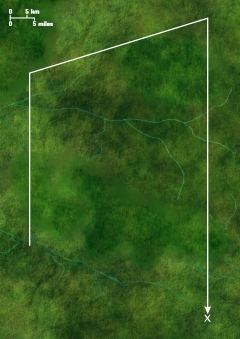
Previously provided in part 10, this map may make the considerations of possible allies clearer. Click on the thumbnail for a large version in a new tab.

Much thought and debate was then expended on the consideration of who those possible allies might be. The Gnolls were too few in number and too remote, and were blocked by the Goblins; Humans had the numbers, but were also blocked by Goblins to the Sunset and Elves to the Sunrise; Dwarves were warriors to respect, but were themselves embroiled in a conflict with the Elves and had no forces to spare; Ogres and Minotaurs were already allies, but too few in number to sway the outcome; Bugbears had the ferocity but were already allied to the Bleeding Swords; an approach might yield allies but might also tip their hands; the Troglodytes were poor warriors and already enmeshed in the Red Eyes clan; that left only the Goblins themselves and the Drow as possible allies. The Drow were untrustworthy and too manipulative, and the Clans had nothing the Goblins desired. Where, then could they find the hammer to their anvil?

Chapter 54

Clan Wars III: Fueds Of Blood

The Mailed Fists had little time to consider. From our priviliged position, it should be clear that the puzzling movements of the Bleeding Swords were the final positioning of rival forces before the initial strike of the Red Eyes against the townships one spring Dawn.

The roles of the allies should not be neglected by anyone seeking to understand the course of this conflict, for these were instrumental in the tactics employed. The Red Eyes were allied to the Troglodytes; standoffish, warlike, subterranean creatures of lizardish disposition. Their instincts are stillness and striking without warning, preferably from a position of concealment. They make ideal sappers. While the Orcs maintained ranged fire apon the forces manning the walls of the fortified townships, their allies threw up breastworks for defense and concealment, and then began to dig pairs of tunnels. Breakthroughs to the surface were timed to coincide as nearly simultaneously as possible. A third of the Red Eyes forces followed down one of each pair of tunnels. The Troglodytes emerged, killed the nearest defender, then dove down the second tunnel, clearing the way for the Orcish forces following behind them. The defenders fell back from the Red Eye onslaught in places and repelled it in others; several defenders, in an excess of zeal or desperation, pursued the Troglodytes down the return tunnel, only to find the Troglodytes and the bulk of the Red Eye forces waiting for them behind the breastworks. Far from being a defensive structure, their sole purpose was to serve as a trap for the defenders. In any attack in a fortified position, casualties of six to one are not unexpected; so successful were these tactics that the Red Eyes initial assault achieved a kill ratio of three-to-one; but it was a tactic of surprise that would be far less effective a second time, and which had failed to overrun the defenders. The casualties were nevertheless horrific; of the 220,000 Red Eye clan forces, 31,000 were killed on the first day; of the 200,000 defenders, 90,000 were obliterated. That only left the attackers a two-to-one advantage – not enough to ensure a victory, but enough to ensure a protracted conflict. The Burning Swords, 480,000 strong, would have made the difference between a costly success and eventual failure, bringing the ratio of attackers-to-defenders to over 5 to 1.

It came as a considerable surprise to the attacking clan when, at sunset of the first day of battle, the Burning Swords, led by their Bugbear strike forces, abruptly charged away from the locations in which they had been carefully positioned by the Red Eyes. The strategy formulated by them was simple – they were to bottle the defenders up and prevent any flanking moves by the defenders while the Red Eyes led the assault. As they had been led to expect, just beyond the range of vision of the defenders, the Red Eyes had a hidden second wave waiting, another 250,000 strong. While this force might ensured victory if the battle against the Mailed Fists were genuine, if they were to fall apon the Burning Swords from behind and with surprise, they would have decimated the followers of Ilneval – which is what those followers had been warned was their true purpose on the battlefield, while the Red Eye forces already engaged prevented the Burning Swords from escaping to the flanks. The Herders would have been shoved up against the walls of the fortified town and slaughtered, even if the inhabitants stayed out of the battle.

It was twilight when the Burning Swords unleashed their bugbear allies on the unsuspecting Red Eye reserves. With surprise on their side, and superiority of numbers approaching 2 to 1, Victory for the Burning Swords force was practically a foregone conclusion. If they had chosen to do so, they could have engulfed and annihilated the Red Eye reserves, but their strategy was more long-term; so they concentrated on simply punching a hole through the reserve’s lines and then flooding through the gap to seize the territories and non-combatants in the rear lines. It cost the Burning Sword clan 10,000 of their best and 500 of their bugbear allies, but they inflicted 25,000 casualties on the Red Eye reserves, slaughtering a full ten percent of the waiting forces at minimal cost. The bloodiest day in Orcish History was followed by the bloodiest night of battle in that History.

The Red Eyes were infuriated by the betrayal of the Burning Swords, but were mindful that the destruction of the Cities was a Holy Commandment. They didn’t have the forces to pursue both objectives; just as had the Mailed Fists, they began to run through the litany of potential allies, and like the Mailed Fists, they soon realized that there was no-one. They could perhaps call apon their friendship with individual Trolls, but even that would not be enough to claim victory in both battles. It might be just enough for them contain the forces within the walled towns while the bulk of the army pursued the treacherous Burning Sword clan, but defeating them would cost so many lives that they could not hope to overrun the towns and safeguard their tribal lands.

To the Mailed Fist clan, the treachery of the Burning Swords was like a gift from the Gods. It transformed their situation from one of total desperation to one with a slender hope of a ruinous victory. The Burning Swords had turned out to be the allies that they needed so desperately, to their total surprise. Perhaps their long relationship with the Burning Sword clan had borne unexpected fruit after all; but until they had a clan-wide peace agreement, and no Red Eyes at their city gates, they would remain wary. The war was but one day old, and already two of the combatants had been on the receiving end of deadly surprises; who could tell how events might proceed from this point? While they awaited developments, they would continue to reinforce their walls as best they could, and would work to devise a defense against the sapper tactics of the Troglodytes which had proven so costly. And then they would pray that the next surprise would not disadvantage them as much as had the first of that blood-soaked day.

*************************************************************************************************

The Ongoing Elvish Glossary

I’m going to forego this while our attention is focussed on the Orcish side of the story, as the Elvish Language has no relevance to that part of the narrative.

*************************************************************************************************

Next time: Nightmares are given flesh, the Orcish Gods join the brouhaha, the Huyundaltha find themselves in the middle of a powder-keg, and the unlikeliest of all possible alliances – all in Chapters 55-58!

Comments Off on On The Origins Of Orcs, Chapters 52-54

Creating The World Of Tomorrow: Putting the SF into Sci-Fi pt 3


This entry is part 3 of 4 in the series Putting The SF Into Sci-Fi

1160073_20107643s

In part one, I looked at techniques for extrapolating from the world of today into a future world where technology has changed. These techniques have served me well in both fiction writing and developing sci-fi oriented game settings. In the second part, I examined some core technologies that everyone engaged in anything sci-fi really needs to make uniquely their own. In this third and final part of the series, I’m going to study the ways in which the technologies developed in the previous parts would actually shape the world around the characters, whether they be protagonists in a fictional work or PCs in a roleplaying game. Which is rather tricky to do in the abstract, but let’s get started and see how we get on…

The Human impact

The most immediate type of effect to look for and document – especially given that we started from a domestic technology foundation in part 1 – is on the day-to-day lives of the ordinary citizen. What does it enable people to do that they couldn’t do before? How does it impact the daily routine? What irritations and annoyances does the technology do away with?

Sometimes, where a new technology makes a daily event more efficient – faster and/or cheaper – the old technology forms the basis of a luxury or recreational activity. The less-efficient technology becomes associated with leisure. This possibility has to be assessed in terms of the societal imperatives of the culture; modern Australian society, for example, seems built around the philosophy of “work hard, play harder”, which means that if Star Trek’s Sonic Showers were invented today, “old-time” water showers would not necessarily become routinely associated with bathing in luxury and at leisure. On the other hand, the current bathing style – luxury bathtubs – might well be supplanted, the pace of a water shower updating the concept of what luxury consists of to something more appropriate to that “work hard, play harder” philosophy.

But the first flush of human impacts are only going to be the beginning of this story, the most direct impacts. The more profound consequences at the human level will be reflections of more substantial effects.

The Social impact

What are the impacts on society? What will be the impact on employment? What types of job will be made redundant, what new types of job will be created, and what existing jobs will be transformed? What will happen to pay scales?

For example, viewed in the broadest sense, the work of a clerk hasn’t changed since the 18th century. It’s still about creating, checking, maintaining, and filing documents. But when you look at the details, the job has changed several times over the last 160 years or so. Typewriters and biros replaced quills and fountain pens, the secretarial functions were split off into their own profession. That didn’t mean they could take it easy, though; changes to society resulted in a substantial increase in the amount of paperwork, and paperwork that was once done by other clerks shifted from service providers to customers. There was a time, for example, when bank clerks took care of money-counting and filling out of records; it was somewhere in the mid-20th century that standard account numbers and deposit slips that bank customers were expected to fill out were introduced. The early 20th century brought in faster, mechanized transportation systems and the telephone, enabling tasks that would once have been handled by letter or by an extended trip to be handled immediately and remotely. Fax technology came and went. Electronic document production and exchange, and scanning, and email; modems and internet banking. One of my duties at a job that I held in the 90s was to fire up the state-of-the-art 16 baud modem and query the bank account balances every morning to track the clearance of checks and verify that payments had been received. It took 10-15 minutes – just to get four account balances. Now throw in mobile phones with cameras, and the ability to edit and retouch images, and the job of some clerks, in fine detail, has changed again.

Vice

Does the new technology lend itself to any existing vices? Does its proper use lend itself to the creation of new vices? What are the symptoms of indulging, and overindulging, in those vices? Are there any social strata restrictions on the capacity to employ the technology as a vice? How does society react to this new vice, and what are the consequences of those reactions?

Abuse & Legal

So far we have only considered the social impacts of the technology when it is used properly. If there is one thing that’s for certain, it is that if there is a way to abuse the technology for a profit, people will find it. But there’s more to think about: Does the use of the technology open up new avenues for fraud or deception? Does it facilitate any existing criminal behavior? Are there consequences for the detection, investigation, or prosecution of crime? Humans are fallible – what happens when the technology is misused through ignorance?

Medical

Are there any new diseases that arrive as a consequence of the technology? Are there any impacts on the treatment of existing diseases? Is there anything that goes from the incurable to the curable or at least treatable as a consequence?

Secondary Flow-on effects

What are the flow-on effects from these primary social effects? The more connected society becomes, the greater the spillover impact on other occupations. Again speaking of clerks, every other occupation in modern society has dealings with them. Builders order materials, dealing with clerks; who dispatch deliveries, dealing with the clerks at the delivery company or arm of the company. The builder deals with bank clerks, council clerks, architects and their clerks, and on and on and on. Change the way those clerks deal with the paperwork that comes with their jobs and you change the way all these other occupations interact with the clerks and therefore with each other.

Consider another technology from Star Trek: they hardly ever put things in writing, they voice-record them. That requires an efficient means of storing them (or massive increases in storage capacity), for one thing. One means of achieving that is to take a leaf from an older technology, MIDI-based music. With Midi, the sounds of each instrument are pre-recorded note by note, and the music consists of a series of instructions to turn a particular note from a particular instrument on and off at the right time, just like a piano player roll. If you could find a standard way of “recording” the voice and pronunciation patterns of an individual with recording every word, you could then employ speech-to-text software to compress lots of speech into quite a small package. Instead of recording the voice speaking the entire log entry, you gather and encode a sample of the voice and use that to render the text.

The advantage of this approach is that text is searchable and can be cross-referenced quickly and automatically, so that you can find an entry that is relevant to a particular subject quickly and easily. The alternative – having the computer system actually understand the language and what it is communicating – requires a fully-functional artificial intelligence, and that’s a lot harder to get right. It’s quite clear from their interactions with their shipboard computers that the systems of The Next Generation are not AIs, and yet they can search log entries as required. This sort of encoding technique mandates the way the people in Star Trek actually use their technology.

If people are more used to having to organize their thoughts and speech in order to communicate with the strictly-logical machines that they use, that should also be reflected in greater efficiency in their communications with each other. Casual conversations aside, dialogue should become more purposeful and directed at communicating quickly and concisely. In modern times, we tend to associate those characteristics with militaristic communications – minimal superfluity, with precision and purpose to every statement.

Is there a difference in the affordability of the technology? Is there a difference in the way that large businesses and small businesses employ it? Are there any benefits or consequences that only manifest when considering economies of scale?

Tertiary Flow-On Effects

Having identified any direct social impacts as a consequence of the technology, and then pursued and identified the consequences of those impacts, it’s time to think a little about the effect that those consequences and the reactions to them will have. Some of these will be immediate, others will manifest as new social trends that will accumulate over time and reshape the society, sometimes in unexpected ways.

It used to be considered that technology would reduce the size of the working week, and for a while, that seemed to be true. Many jobs are far easier, physically, than they used to be. But technology has now begun to connect the worker with the workplace with far greater facility and ease, and the emerging consequence of that has been a blurring of the dividing lines between work and non-work time frames. More and more, people are expected to be on-call.

We’re only starting to see the impacts that this is going to have on 21st-century society. Rising stress levels and attendant health issues, the beginnings of efforts by employers to aid the employee in dealing with these issues, and a greater need to get completely away from it all when on vacations – these are just the tip of the iceberg. The more people are required to subordinate the private lives to the demands of their occupation, the more people will demand that their occupation make room for those private lives, and the more people will demand that their occupation will be something that they genuinely enjoy doing. The farther removed from those ideals that a job becomes, the greater the compensatory factors that employers will have to employ in order to recruit good staff. Stock options, workplace gymnasiums, recreational facilities, and childcare places – these are just the beginning. Some of the family-oriented activities that were a hallmark of the mid-20th century are almost certain to make a comeback – employee picnics and the like, employee sporting leagues, etc. The workplace will need to become a little more like a home, and will need to become a little more flexible than the clock-in, clock-out structures of the past. It seems only a matter of time before employers begin using their financial resources to underwrite insurance and home loans (or at least contributions to such), perhaps pegging the interest rate to on-the-job employee performance evaluations.

The implication is that it will become harder and harder to recruit people for the jobs that no-one wants. As early as the 1970s, it began to become more difficult to hire sanitation officers, for example. Being a garbage-man is a difficult, dirty, and increasingly undesirable job – but it’s also an increasingly complex and essential one. The only solution: to improve conditions enough to counterbalance the negative impacts. We have not yet reached the point of garbage men receiving fully-funded subsidized higher education through their employers (at least to the best of my knowledge), but that may eventually have to happen – work for 8 years as a Garbo and receive a fully-funded Master’s at the end of it that qualifies you for a mid-level position elsewhere. This is a strategy that the military have had to employ to an increasing degree in order to recruit the best, and I suspect that they are simply leading the way where others will follow. Labor shortages in specific fields will be ongoing and recurring problem for most of the 21st century. Conditions will be improved in one, only to drain recruits from another; five or ten years later, there will be a new crisis in employment.

At the same time, we have an expectation of increased staff turnover being built into the social system. There are very few places indeed where it can be considered normal to have the same employer throughout one’s working life. Most employees no longer progress through vertical promotion within a company, instead taking a sideways-and-upwards step to another employer, and only staying there until the next opportunity comes along. There was a time when each company had its own way of doing things, and this diversity left some better-placed than others to cope with any change in economic or social circumstances, either positive or negative. This cross-migration of employees means that techniques are passed from corporate entity to corporate entity, the good ones becoming general and standardized, while the bad ones get replaced. As a result, economic cycles can tend to be deeper and sharper, and affecting a broader segment of the economy. Boom-to-bust cycles used to take decades; these days, they seem to take months. Two or three poor recoveries in succession can have a compound effect. There’s still a bust for every boom, but sometimes the two are disproportionate.

Society In A Nutshell

Ultimately, society is about human interactions and the regulation of those interactions. It comprises everything from social graces to employment opportunities. Ideally, one would be able to summarize the society that is being postulated as a consequence of the march of progress and technology. The better you can generalize the patterns of the society that results from your postulated technological changes, the better you are able to apply that generality to other areas and situations within that society that you may not have considered at the time. This subtracts from the need to have everything worked out in advance and shifts the effort to an as-needed case-by-case basis.

The Economic impact

You can’t have social impacts without these being reflected in an economic impact, so we’ve already touched lightly on this subject in a number of ways. Now it’s time to look more deeply.

Does the technology rely on some key piece of infrastructure? Does it rely on some exotic material? Does it produce anything as a by-product for which a use can be found? Are there hidden costs to the technology, such as environmental factors? Does the technology impact on personal transportation, centralizing or decentralizing populations? Does it make certain types of land more valuable by overcoming one of the existing negative factors associated with that terrain? Does the technology reduce the need for high-density accommodations, or does it encourage denser population clusters?

The more fundamental the technology, the greater the economic impact of the valuation of the commodities apon which the technology is based. We may one day do away with the internal combustion petroleum engine, either through necessity, evolving social patterns, or technological advance – but that doesn’t mean that some new commodity won’t immediately become the critical economic factor in place of oil.

Which sectors of the economy gain from the technology? Which shrink? What are the requirements? What are the consequences? Which existing businesses will oppose the technology, and what will the reactions be? How will the laws change, and what will be the unanticipated consequences?

Consider, for example, file sharing technology and all the kerfuffle that this has caused over the last 15 years or so. This technology led to redefinitions of what you legally could “own” and what you could do with what you “owned”. It reshaped the music industry in ways that are still being explored and analyzed. Apple are now one of, if not THE, biggest consumer electronics companies on the planet. Would the iPhone and everything that’s come with it exist if iTunes had not been such a rousing success? The company was reportedly in serious financial trouble just before then. ITunes was followed by the iPod and then the iPad and then the iPhone – and here we are.

Or we might turn a speculative eye apon the rich resources of our solar system. There are enough hydrocarbons in the atmosphere of Jupiter to fuel society at current usage rates of petroleum for millions of years. What would be involved in creating the technological infrastructure to solve the oil shortage forever, or close to it? We would need some means of obtaining the raw fuel against the steep gravity well of a gas giant. We would need some means of converting that raw fuel into concentrated form on an industrial scale. We would need some means of transporting the resulting fuel to earth on a routine, reliable, and (once again) industrial scale. We would need a way to get it down from earth orbit and distributing the concentrated fuel to the refineries that complete the refining process. Skyhook technology holds the promise of solving both the orbital problems, though the proximity of the asteroid belt and the relatively close-to-the-surface orbit of Jupiter’s Moons pose additional complications. The concentration problem requires at least one significant increase in industrial petro-chemistry and another one because we are talking about microgravity or “zero-G” industrialization. We would need the wherewithal to construct enough ships to establish a daily shipping cycle, with redundancies because accidents will happen when you have to cross the asteroid belt every day with a BIG spacecraft. A breakthrough in space travel is needed in order to ensure that the transportation of large masses of concentrated fuel is economical. New maintenance and repair technologies will probably be needed, and these also have to work in zero-G. We need the capacity to manage about 400 spacecraft in flight at a time – a “space traffic control system” analogous to existing air traffic control systems. We need breakthroughs in crew psychology and entertainment formats and health related to sustained zero-G, though we have a fair start on these. Of course, it’s one thing to build a skyhook that’s capable of getting a spacecraft weighing perhaps 100 tons into orbit and quite another to build one capable of handling a billion tons of explosive cargo on a daily basis. There are at least half-a-dozen major breakthroughs on that list – but none of them are completely out of reach. Perhaps, 50 years from now, such technology might be possible, and the price of petroleum will have risen enough to make the plan economically viable.

Fifty years of trending toward alternate fuels probably means that the problem will no longer be relevant by the time it can be solved. Or will it? A huge part of our chemicals industry, which produces everything from plastics to lipstick to pharmaceuticals, derives raw components from the petroleum industry – and at the moment, there is no substitute. We might not need the oil for petroleum, but we might still need it. But even if we assume that we don’t, simply having solved all those problems will have dramatic consequences – can anyone seriously suggest otherwise? The ability to reliably orbit satellites for a hundredth the current cost of doing so alone will reshape the world we live in. Cheaper, faster, more reliable drive systems will have made space flight routine, and potentially have paved the way for a manned mission to a neighboring star. Such a drive system might entail new ways of shifting energy around – which would have its own flow-one effects for a modern society.

Once you have a theory about what makes your future-tech go, you can start to assess the infrastructure needs that are required to make that technology widespread and commonplace. Those requirements cannot come into existence without economic impact.

Let me paint one more hypothetical scenario for your consideration before moving on. Biogenetic research in the western world is largely hamstrung by ethical and safety considerations, and – to my mind – rightfully so. It follows that in some countries where research is not constrained in this manner will probably produce results faster. The result is likely to pose a new ethical dilemma for the rest of the world: is it ethical to utilize a safe and practical treatment for a disease that has been developed by unethical means? We have faced this problem before, in considering what to do with the vast amount of experimental data obtained by the Nazi “Scientists” of the third Reich in the course of barbaric experimentation on unwilling subjects, but for the most part were able to set it to one side because no new medical treatments of value resulted from the perversions of science that were practiced. The problem could safely be ignored until it went away, in other words. In the course of doing so, we squandered the opportunity to establish ethical principles that could guide us when this more difficult problem manifests itself. It will happen, almost certainly. If we, as a society, stick to our moral high ground, the treatment will become a black market commodity available only to those with wealth and/or power. If we do not, are we not condoning the research because of its benefits? Could it not be rationalized that we are ensuring that some good came out of the unethical research? Is it ethical to withhold a viable treatment because of the process of its discovery and development? I would expect this issue to be at least as socially and politically divisive as the development and legalization of safe birth control in the 20th century – something that we are still arguing about, 40 years after the Roe v. Wade decision. What if the effect is not a cure for disease, but an anagathic or Longevity Treatment? More horrifying still, what if the treatment cannot be produced artificially, but requires that another person’s life be sacrificed to produce the serum – or worse yet, what if the process of extracting the serum doesn’t kill the subject but simply leaves them mindless or insane? We’re well and truly into a modern take on the vampiric theme here – would we view the prolonged life as being “stolen” from the victims?

The Political impact

When you’re talking social effects and economic effects, they can’t fail but to manifest as a political impact. But there are all sorts of other technologies that could have direct political impact as well as these secondary ones. If minds can be preserved by downloading them into a computer, do those minds still have the right to vote? If someone develops a soft drink that makes a hard life seem more tolerable, but which instills a level of suggestibility, does that impact the right to vote? Can nanotechnology rewire a specific portion of the brain to make one less empathic (and hence, less prone to liberalism) – and if so, what would be done about it?

Can technology change the way we vote? Can it change When? Might we end up in a future in which computerized voting makes it possible to vote for or against specific policies, making the people we elect closer to general managers – free to use their own judgment when an emergency or a new situation crops up, but in general elected to implement the specific will of the people? Perhaps political parties might offer a choice – “If you elect us, you can either have (a) a tax reduction or (b) increased spending on “X” – please indicate your demand below”. Perhaps elections would become more like internet shopping: “I’ll pay for policy A costing $B for the next three years, but I don’t think we can afford policy C” with the funding pie split amongst the different policies according to the popular vote?

Politics is about decision-making, and contentious social issues, and the services provided by the government, and about the definition of citizenship. A lot of technologies can impact on one or more of those issues.

The Politics of Technology

There is also the other side of the coin: Decision Making and Social Issues can decide questions about what technological advances are distributed to the population and how, and hence can themselves shape the impact of those technologies. Politics is supposed to be about enacting the will of the people, but all too often it is actually about imposing the will of a vested interest in opposition to the best interests of the people. If enough people get burned by those decisions, there may be a change of government, and hence a change of policy. If the people are uncertain whether a change of government will actually result in what they regard as a desirable policy shift, you get frustration and rebellion and counter-cultures, some of which are likely to turn violent – domestic terrorism is the ultimate consequence of a government that is viewed (rightly or wrongly) by extremists as being nonresponsive to the demands of the populace. Regulation drives and produces additional social impacts that also have to be counted amongst the consequences of a technology.

The Military impact

Can a new technology be used as a weapon? Can it be used to improve an existing weapon, for example making it more mobile? Can it be used to create an improved defense against existing weapons? Can it be used to gather intelligence, or improve the analysis of the technology?

Whenever I consider this subject, I am reminded of a subplot within Red Storm Rising by Tom Clancy. The Russians are using camouflaged positions to conceal where their units are. Satellites and recon flights show convoys when they are on the road but not where they are going to or from, and its vital for the Americans to locate the targets they need to strike. Someone gets the bright idea of recording the recon results on their VCR and playing it back at 2x or maybe 5x speed, which enables patterns to be discerned that were occurring too slowly to be visible. The VCR thus became an essential tool of military intelligence and analysis.

Militaries generally have the funding to pump into any research with the potential to yield a military dividend. Sometimes that dividend fails to materialize but the research turns out to have non-military applications. Sometimes, technology developed for non-military applications will transform the military. Human beings have the same basic physical needs whether the individual is part of the military or not; it follows that developments in food technology or water purification may have spin-off impacts on military capabilities. Even something as simple as a more efficient engine may yield military applications in the distribution of supplies.

Consider the impact of a Star Trek -style teleporter on the capacity to lay a minefield or bomb a target from a remote location – without exposing a delivery vehicle (minelayer or bomber) to the enemy forces, never mind the obvious capabilities for insertion of combatants into a forward area without having to fight your way to it.

Heck, even a more efficient technology for administration and clerical work can have military applications and implications.

Targets

Another subject to consider: does the technology bring about a reassessment of military targets? Does it decentralize something that used to present the military with a nice, juicy, central target? Does it create a new category of military target? Does the technology create a new cause for war?

The more closely-related a technology is to the creation of raw materials, the broader the impact, and the greater the significance in a military targets sense. Consider for example all the technologies that aluminum has been involved in – from aircraft on – since the Hall process made it affordable in 1886, or all the things that Carbon Fibre is used for, which I used as an example in Part 1 of this series. In any serious modern war, carbon-fibre manufacturing facilities would be key aerospace industrial facilities and therefore military targets.

The Global impact

There aren’t many technologies that will have a direct global impact; most often, these effects will be secondary in nature, the consequences of a change in some other field of assessment. But there are a few that potentially could have direct impacts. Weather control comes to mind. New manufacturing processes. Green technologies, and technologies that permit industries to run ‘cleaner’. Global infrared imaging by satellite as a means of monitoring global warming.

But there would also be global impacts from Political and Military considerations. Consider the global impact of the oil industry, or the space race. Or the impact of global satellite imaging. Or of modern communications technologies. ’nuff said.

This Begets That

Wars seem to trigger massive strides forward in technology, for three reasons:

  • Funding becomes available that would otherwise not be forthcoming. Scientists that might otherwise be engaged in non-military research tend to get recruited into high-priority military projects. Victory is priceless, and governments spend whatever is necessary to achieve it, because defeat is a worse fate. Every other consideration is regarded as secondary. In peacetime, this enabling desperation does not apply to anything approaching the same standard; peacetime governments have other priorities. The same is also true to some extent of aggressors in military encounters; they lack the desperation to throw absolutely everything into the quest for survival. Does that mean that the aggressors will always lose a protracted modern war? Not necessarily, but given parity in resources and initial capabilities, it begins to look a lot more likely.
  • Restrictions on research are relaxed. Red tape tends to get bulldozed out of the way. The greater the desperation, the greater this effect.
  • Research in wartime tends to be focused into areas that seem most promising of short-term success. Actually, I must correct myself; the priority is the probability of success in a given timeframe multiplied by the magnitude of the military advantage that will be achieved by such a success. Research that will take longer, or be less likely to succeed quickly, may still get accelerated funding and regulatory assistance if the eventual benefits are promising enough, while even research that seems certain to be of short-term benefit may be ignored if the scale of those benefits is trivial enough.

The combination of these three factors – focus, regulatory concessions, and resources – produces a dramatic rate of progress.

And yet, this is a relatively inefficient approach to research. It succeeds by throwing resources at the problem, but the priority is to get answers quickly regardless of any increase in cost that might result. What’s more, the results tend to focus on one or two applications of immediate military value; significant outcomes that do not contribute to the military objectives tend to get shunted aside. The research may be more focused, but it is also more narrow-minded.

In terms of overall impact and technological change, peacetime research usually yields more substantial change for a fraction of the cost; it just takes longer. There is a greater willingness on the part of scientists to spend time on pure research and to follow interesting sidelines. The biggest impacts are frequently felt immediately after a conflict, when all those sidelines that were ignored in favor of the military objectives begin to be explored; there is a flow-on effect from the kick-start given by the military research; the military applications don’t change the world half as much as the subsequent non-military applications of the technology developed for military purposes.

Ironically, the more R&D becomes commercialized, the more it comes to resemble the militaristic model, with the substitution of profitable technology replacing the victory imperative. Arguably, the most radical advances in modern times have not derived from this type of research, but have instead resulted from outside research being harnessed by corporate entities. The focus on the profit factor yields improvements in existing products, but rarely results in completely unexpected products. To their credit, many of the largest corporations are well aware of this and sponsor at least some pure research.

Closer analysis of the history of the last 120 or so years of technological development prompts me to offer the statement: Nothing begets technological advance like technological advance. To justify that conclusion, I draw the reader’s attention to three principles:

  • The Bootstrap Effect;
  • Tech Serendipity; and
  • Tech Cascade.

These are my terms for the phenomena; I would be surprised if these were wholly original thoughts, but I am unaware of any other terms for them. Let’s take a look at what each one has to say:

The Bootstrap Effect

Technological develop proceeds in cycles. One such cycle may be summed up:

  • A new Technology is developed;
  • The new technology is packaged into a new Product;
  • The new product creates a Demand;
  • The demand produces a Profit for the producers of the product;
  • Some of that profit is reinvested into further Research into the applications and fundamental theories behind the original Technology;
  • The Research results in the application of the principles of the technology into another New technology, restarting the cycle.

This loop means that a successful technological development tends to bootstrap further developments in that general field.

The clearest example is the computer chip – from Shockley’s first development of the transistor through to early integrated circuits through, step by step, to the modern Processors.

Tech Serendipity

Robert A Heinlein, in one of his novels, defined serendipity as “digging for worms and discovering gold”. I don’t quite mean the term in that sense of the word. What I am attempting to describe with the phrase “Tech Serendipity” is the situation in which an advance made in pursuit of one objective solves a problem with another piece of emerging technology.

Consider the great strides that have been made in engine efficiency within motor vehicles; without the development of electronic engine management systems, these would be quite impossible. By the year 2000, auto engines had processors that were more powerful than those used in the Apollo space capsules. These days, the typical pocket calculator or mobile phone has more computer power than all the computers that mission control used for those same missions. Think about that for a minute.

NASA Mission Control during the Apollo 16 mission to the moon

NASA Mission Control during the Apollo 16 mission to the moon

A lot of people are under the impression that the screens visible in mission control were computer terminals. The truth is somewhat more startling, as revealed in Apollo 11: The Untold Story (unfortunately not available on DVD so far as I could tell); computers ran the status display lights beside those panels, the “monitor screens” simply displayed pre-prepared slides of what the status display should show at the current stage of the mission. The technology was incredibly primitive, which only makes the feats achieved by the Apollo program all the more astonishing.

In short, without Technology “A”, Technology “B” is impossible or hopelessly inefficient. The more the state of the scientific/engineering art is advanced, the more likely it is that a solution has been found to any merely technical problem; it’s just a matter of finding it and adapting it. Quite often, Technology “A” has nothing to do with the reasons technology “B” was invented. As a result, the faster progress is made, the faster progress can be made – provided that it is not constrained into one or two narrowly-targeted focal points.

Tech Cascade

The final principle that leads me to the stated conclusion is something I call “Tech Cascade”. Fundamentally, it states that all technological developments can be viewed as tools and/or as components which have vastly greater potential application than the original purpose. Again, the microchip is the perfect example. These are present in everything from computers to Christmas cards in the modern day. The purpose of the original integrated circuit (patented in 1949) was as an amplifier; these days, the switching capabilities are considerably more important than this function.

In other words, if you invent something new, it will have applications far beyond the original purpose, and many of these will tend to be developed simultaneously as a “second wave” of technological advance; each of which may yield a “tertiary wave”, and so on.

The Implications

Putting those three functions together justifies (to me) the conclusion offered: Nothing begets technological advance like technological advance. That’s why it is so important to identify the operating principles apon which any new technology that you introduce – so that you can look for all the other ways that discovery would impact the world around the characters.

The Human impact revisited

It may not have escaped the attention of the reader that there was an underlying order to the series of impacts that were discussed – from the personal to the social (local to national), to the economic, military and political (national to international) to the global and to technology itself. The final step in translating the technology that you have devised into game-ready campaign background is to look at how all these non-personal impacts are reflected in the personal lives of the people who live within the affected societies. Ultimately, the core meaning of any technological advance is in how it alters the lives of the people who experience it; the core value in gaming or literary terms of a sci-fi technological postulate is how the characters interact with it and its consequences. Describing such effects to the reader or the players gives you the opening you need to discuss the wider implications – and that’s what sci-fi is all about.

Comments (8)

Inventing and Reinventing Races in DnD: An Orcish Mythology


This entry is part 20 of 31 in the series Orcs & Elves


   While there is nothing graphic in the content below, it definitely warrants a PG-13 rating for    adult concepts. Children should obtain parental permission before reading.


We interrupt our regularly-scheduled programme for this late-breaking development: I spent so much time developing the infrastructure and notes apon which the next chapters of the Orcs and Elves series were to be based that I ran out of time to write the chapters themselves. Which left only one choice: To spend this blog post describing (and making available) the fruits of my labors, and describing the thought processes that went into them.

The Foundations

At the time their theology was forming, Orcs were tribal and primitive (the two do not necessarily go together). That generally implies that the strongest leader or the strongest warrior wins the mates, and that would be reflected in their theology, just as was the case with the early Greeks and Romans. So the decision was made early on that the relationships between the Orcish gods would be as tangled as those in any long-running soap opera, and that in turn was a factor in many other decisions about the pantheon.

Three Clans

I knew that I was going to have three clans that were central to the forthcoming chapters, each reflective of a different way of life within Orcish society; the Herders, the Hunters, and the Builders, and I wanted the theology to reflect that, so to some extent I was working my way backwards from the desired end result. There’ll be a lot more on these clans, their societies, and the relationships between them, in future chapters of the Orcs and Elves series.

Gender Indistinction

Another element that I wanted to incorporate was the concept that more than many other races, it is hard to discern the difference between males and females when they are in full armor. I particularly wanted gender confusion concerning the Orcish Deities on the part of humans, whose genders do dress in differing fashions and whose biological distinctions are more overt and obvious.

Monkey See, Monkey Do

Orcish society in Fumanor is somewhat similar to a cross between the early Welsh and the Norse, with elements of other cultures sneaking in here and there, and I wanted some of that to leak over into their theology as well. They practice raiding for mates, for example. And of course, there was all the established material that I had included in the precursor articles to the Orcs and Elves series, especially “Tooth And Dagger – Rationalizing Orcs”. But much of their culture has evolved by mimicking the achievements of others, sometimes without knowing the reasons for those activities, and finding their own social reasons for perpetuating those elements of the behavior that worked for them, and discarding those that did not. Still more was derived from the Ogres who conquered them, who in turn derived social and technological elements from the Drow. There is very little of their technological development that is original.

“Official” Sources

I then did a Google search for Orcish Deities but what I found was inadequate, to say the least. Only one Female deity? Only half-a-dozen deities? To a race as fecund as Orcs, that seemed improbable to the point of absurdity. I decided that there should be a dozen or more, and roughly as many females as males. The six “established” deities were most senior, that was all.

Relationships

Given the state of the society and their immunity factors (as described in “Tooth And Dagger”), it also seemed to me that there would be no incest taboo amongst the early Orcs. There certainly did not seem to be one amongst the early Greek and Roman deities, after all. (This should not be taken as condoning such behavior by anyone in real life).

The Mystery

I definitely wanted to preserve some of the mystery of the Orcish Deities (I need to keep some cards up my sleeve for later adventures/campaigns, after all). As I stated in Inventing and Reinventing Races in DnD: An Introduction to the Orcs and Elves series, part 3, it isn’t clear whether or not the Orcish Gods are, or ever were, real. The fact that Molgoth claimed to have been treated as Gruumsh by the Orcs is no proof of anything. He might have been lying. The Orcs may have been deceived by him. If so, he may or may not have been exposed. Either way, Gruumsh and the others may or may not exist, or have ever existed except as figures of mythology. Filling in some of that missing story is what the next few chapters of the Orcs and Elves series is all about, especially…. but that would be telling :)

The final foundation

Finally, I wanted to reflect some of the inversions of logic that the Orcs are built apon, and the crude sense of humor that bubbles beneath surface of “Tooth and Dagger”, simply because they are part of the unique character of Orcs in Fumanor.

Those were the foundations that this Orcish Mythology has been built on.

The Orcish Deities

I ended up with a list of 14 Orcish Deities. I have done very little work on their natures, symbols, etc. These are worshipped as a pantheon by the Orcs, though particular clans may have particular deities they look to as patrons, and selected tribes may have a deity who they favor over others (usually because they feel this favoritism is reciprocated), and individual Orcs may have a favorite or patron, they are all considered equally valid and are each worshipped at certain times and on certain occasions.

The fourteen are:

  • Gruumsh: (War, Sky) Father/Creator of the world
  • Luthic: (Fertility, Healing, Betrayal) Mother of the world, estranged wife of Gruumsh.
  • Baghtru: (Strength) Eldest son of Gruumsh & Luthic, considered not very bright by the Orcs.
  • Shargaas: (Night, Stealth, The Moon) Daughter of Gruumsh and Luthic. Her father’s favorite, and his current mate.
  • Ilneval: (Hunting, Strategy) Gruumsh’s favorite Lieutenant; he thinks Ilneval is his son.
  • Yurtrus: (Decay, Disease, Destruction) Ilneval won Luthic as mate by defeating Gruumsh at dice.
  • Krassig: (Walls, Defense) Son of Baghtru and Yurtrus, the first lasting relationship amongst the Orcish Gods.
  • Garsh: (Sun, Fire) When Gruumsh lost Luthic (the two were already estranged), he fathered Garsh apon his daughter Shargaas.
  • Nessai: (Wind, Rain) First “official” child from Baghtru and Luthic, second actual child.
  • Ghorrid: (Storms, Lightning) Gruumsh thinks he is the father of Ghorrid, but the actual father is Gruumsh’s son Baghtru. Gruumsh dotes on the hot-tempered Master Of Tempests.
  • Ishlee: (Winter, Cold, Ice, & Snow) First of two daughters born of Ghorrid and Nessai.
  • Pharn: (Sea, Fish) Second of two daughters born of Ghorrid and Nessai.
  • Darshus: (Food, Crops) Ghorrid thinks he is the father of Nassai’s third child. He isn’t.
  • Braath: (Law, Justice, Judgment) Some people simply cannot be faithful. Braath is the youngest of the Orcish Gods. Ilneval thinks he is the father of Luthic’s fifth child, but in reality the child is the product of a relationship between Luthic and Krassig.

The Relationships

This tangle of relationships may become clearer on inspection of this chart of the actual genealogy:
Click to view/download a larger image

The Tales Of The Sky: The First Story

Gruumsh made the world and claimed the Sky as his domain and War as his Domain (note the capitalization). Other Gods contaminated his creation with their own creatures, who despoiled perfection with their wastes. Gruumsh created the Orcs from Clay and breathed life into them to thrive on the wastes of these creatures, to inherit the world when the others chocked on their own filth and restore it to perfection. The most perfect of the females he took to be his mate, and named her Luthic.

In due course, Luthic bore a son to Gruumsh, a tower of strength and muscle. On the day that Baghtru first defeated his father at Arm-wrestling, Gruumsh left the Orcs in his charge and became entangled in a number of conflicts with beings from beyond the skies who wished to claim his domain for themselves. Baghtru was stern, brutal, and progressive, always getting strange ideas into his head about making the Orcs more human.

With Gruumsh frequently away fighting these wars in the place beyond, Luthic grew lonely, and began to admire the physical qualities of her son, the only piece of her husband available to satisfy her needs. The two began a clandestine affair, which resulted in the birth of a son, Ilneval. Fortunately, Gruumsh was always a little vague on dates and Luthic was able to convince him that he was the father without difficulty.

Where Baghtru was able to outmatch his father in physical strength, Ilneval was his superior in tactical acumen and quickness of wit, but without the strange notions about civilization that Baghtru seem to love. So pleased was Gruumsh with this ‘son’ that he mated with Luthic again as soon as she permitted it, and Shargaas was conceived.

Gruumsh delighted in the precocious young cub, and began to return more frequently. on one of those visits, he decided to sneak in to surprise young Shargaas rather than lighting up the sky with his sword of light. As it happened, he was the one surprised, as he caught his firstborn in the act of courting his mate. Gruumsh was furious, and banished Baghtru from the household immediately. He would have similarly banished Luthic, but the obligations of fidelity that he himself had decreed forced him to stay his hand.

Ilneval disliked seeing his mother miserable, so even though he was more sympathetic to his father’s position, he engaged Gruumsh in a contest with dice for the right and responsibility of taking Luthic as mate. Gruumsh was legitimately relieved when Ilneval won the contest. The precocious Shargaas was immediately installed as Gruumsh’s new mate, and life in the household returned to something akin to normal.

Gruumsh never did remember that it was Ilneval who had suggested the idea of surprising Shargaas to him. Tbe crafty Lieutenant had been very wary of the potential for Luthic to support Baghtru over himself as Fist Lieutenant to his father, and wanted to break the coupling up to protect his own position.

Of course, Baghtru was now a potential threat of a different sort, and that needed to be eliminated, too. He thus found an excuse to visit his exiled brother and promised to speak in his behalf to their father when the time was right, eventually convincing his brother that Ilneval had always been on his side. Ilneval even made him a sub-lieutenant in The Army Of The Eye.

In time, Gruumsh was successful in his wars, conquering that part of the world beyond the sky that he demanded as his own, to prepare a place of paradise for those Orcs deemed worthy. Along the way, he encountered Baghtru serving in his army and was sio pleased that he forgave him – at least a little. Thereafter he intended to divide his time between the realm of the sky and the realm beyond the sky, but it was not long before inactivity began to chafe, and he was soon off in search of new conquests.

It was after the reconciliation between Gruumsh and Baghtru that Luthic revealed the truth about his parentage to Ilneval, and by then it had ceased to matter. Ilneval was now happy with Luthic, and Gruumsh with Shargaas. Baghtru had no mate, but was content – for now.

The Tales Of The Sky: The Second Story

In time, Ilneval and Luthic conceived a cub, who was named Yurtrus. From the beginning, Yurtrus was utterly unlike all the other Orcs that had ever been – thin, almost to the point of emaciation; tall, and with a somewhat pinched expression. Her parents were not especially taken with her, and ignored her as much as possible.

Her uncle Baghtru was a different story. In Yurtrus, Baghtru found a kindred spirit; the two were inseparable, and it was no surprise to any of the family when Baghtru announced his intention to mate with the young Yurtrus. The offspring of this union was Krassig, and he carried the romantic urban notions of his parents to extremes with which even they were uncomfortable.

Not long after, Gruumsh fathered Garsh with his second mate, Shargaas. From the very beginning, Garsh was hot-tempered and impatient, and Shargaas in particular could not tolerate his presence. To keep the peace, Gruumsh gave Garsh control of part of his sky-domain at an early age and left him to play with it as much as he wanted. On rare occasions, Shargaas would interrupt his play to check on him, but this was a duty and not a happy occasion; she would leave as quickly as she came. More frequently, Garsh would tire of his toy and visit his mother, bringing her Lunar aspect out into the daylight she hated.

Baghtru, in the meantime, had decided to pay back his brother, satisfy his own urges, and gather intelligence on exactly what Ilneval was scheming this time (he was always plotting something, sometimes for no better reason than to stay in practice) by renewing his clandestine affair with Luthic. In due course, this manifested in a sister for Ilneval, but the pair kept the God of Hunting and Strategy in the dark and permitted Luthic to pretend that Ilneval was the father of Nessai.

To deflect attention from his relationship with Nessai, Baghtru connived to seduce Shargaas with Luthic’s aid. The covert nature of this secret dalliance appealed to Shargaas, who was also beginning to tire of Gruumsh’s perpetual absences. Fully matured and no longer the precocious youngster who had captured her father’s eye and heart, their relationship was beginning to stagnate; it was her hope that a daughter might rekindle his interest.

The best-layed plans can founder when the gender of an unborn child is of critical importance, however, and the fruit of this clandestine union was another son, which Shargaas named Ghorrid. Once again, Gruumsh had been cuckolded in blithe and total ignorance due to his infatuation with the violence of conquest. Like his older brother Garsh, Ghorrid was a neglected child, unlike his brother, he did not respond by being continually obnoxious until he got his own way, but remained meek and mild and barely noticeable until enough frustration built up to produce an explosion of extremely impressive vehemence.

Only one person was ever able to calm Ghorrid’s fury, and that was Nessai – unbeknownst to either, his older half-sister. This was clearly another of those predestined matches that crop up from time to time in any family history. In short order, the couple were gifted with twin girls, Ishlee and Pharn.

Ishlee was the most ruthless and unfeeling of the entire Divine Orc brood. She cared about no-one and nothing except her own gratification. Pharn was almost as frigid save when roused by her father, when she proved to have a temper to match his own; most of the time, though, she simply hid from him, and from anyone else she didn’t care to interact with.

Nessai was convinced that Ishlee and Garsh would work as a couple if she could only match-make the pair onto some common ground. She would be able to dampen his fiery disposition, and he would be able to rouse her deeply-buried passion. Taking a leaf from the exploits of her Mother, legends of which alternated between titillating and scandalizing the rest of the family, she determined that the first step would be to interest Garsh in taking a mate, any mate. Knowing that a wrong match would, in time, dissolve itself, she began an orchestrated programme designed to impassion Garsh about something beyond his toys. She would tease him with gentle winds that inflamed and aroused him, then dampen his spirits with drenching rains. When she reckoned he had reached the correct pitch of desperation for relief, she would suggest a coupling with Ishlee, then sit back and await the results.

She made only one mistake; she judged Garsh by the standards of his brother, Ghorrid. Garsh was far less restrained, more willful, and more inclined to rash action; his passion overpowered him and he satisfied the passion roused by Nessai’s teasing with force. When his head cleared, he returned to his solitary games in the sky as though nothing had changed.

In due course, as a result of that joining, Nessai delivered a daughter, Darshus. Following the pattern learned from her mother, she deceived Ghorrid as to the paternity, and decided to pretend that the whole misadventure had never taken place; and yet, at the same time, she found herself strangely excited by the memory. Her breath would catch, her pulse would race; the violence was at once thrilling and yet abhorrent to her usually placid nature. Time and again she would yield to the need for that thrill, exciting Garsh to the point that he lost what little self-control he possessed; following each such incident with bouts of deep remorse and self-promises of renewed fidelity to her unsuspecting husband.

By this time, Gruumsh was finally beginning to slow down, as was Luthic. Both were growing old, and tired, and ready to pass on the mantle of disjointed rulership to another. But while Ilneval was the perfect choice to succeed his supposed father on the battlefield, just as Garsh and Ghorrid would make passable Lieutenants to Ilneval with more experience, none of the females of the family were really suitable to succeed to the position of All-mother, save Darshus, and she was too young and inexperienced. Nor were any of the members ready to become the patriarch of the family and ultimate responsibility for the Orcs.

It was Luthic who realized that something was missing from the family, something that would bring structure to the family. There was no successor to the leadership of the family because he had not yet been born yet; only now, that her eventual successor, Darshus, had been born was the time right for the birth of the child who would eventually become Darshus’ mate, the bedrock apon which the family would rest when she and Gruumsh had left to make room for future generations.

The qualities that the child would need left only one possible father – the only male family member who had never taken a mate. Unknown to the rest of the family, her role as Goddess of Fertility made her aware of the true parentage of every member and child within it; indeed, it was her responsibility to choose those couplings which were fruitful, and those not, in response to some inner wisdom that she could never explain. The missing element must come from the shy, withdrawn, and yet radical Krassig, who would rather hide behind a fence than stride across one into someone else’s domain. The blending of that sense of orderliness with an appropriate sense of adventure would complete the family.

With equal care, she considered the available female progeny, and came to the conclusion that none were quite right. Yurtrus was too contrary to her son’s nature; Nessai was too placid, Ishlee too unfeeling, and Pharn too prone to distancing herself. Shargaas was too manipulative and subtle; sometimes, one needed to use a club just to get the attention of a male at the right time.

As she had done twice before, when it was needful, she realized that she would have to perform this task, this final birthing, herself, though she was unsure she was not too old to do so. But there was no other choice; and so the elderly matriarch set about the seduction of her grandson when next she came into season. Baghtru could raise one more cub believing it to be his own.

It took longer than she expected before the circumstances aligned; but eventually the time was right, and three months later, Luthic whelped for the last time, and passed into the world beyond the sky to her eternal rest in the process. In that instant, though she knew it not, young Darshus became the new All-mother and Goddess of Fertility and Fecundity; these traits would only emerge when she herself became of whelping age. She was a wise girl, if a simple one, much as the young Luthic had been; she would figure it out. Until then, there would be no more children amongst the Orc-Gods.

The child was named Braath, and in many ways, he blended the best of his true father, his supposed father, and his true grandfathers. For he believed in rules, and laws; and yet was wise enough to set those laws and rules aside when they were imperfect, and do what was needful. He was indeed exactly what one would wish in a patriarch. Or at least, he would be; he remains but an infant, awaiting the time to blossom into his full growth. Until that should transpire, his aged grandfather would continue his ever-weakening rule by the principles of Custom and Instinct.

Will the advent of Darshus and Braath signal the emergence of the Orcs as inheritors of the World and the ultimate fulfillment of the destiny promised by Gruumsh? Or simply the beginning of another chapter in the history of the Sky? Must the younger children of the Gods – Krassig, Garsh, Ghorrid, Nessai, Ishlee, Pharn, and, of course, Darshus and Braath themselves, await the passing of their forebears? Must they drive them out to assume command of the World? None know, for the ages of the Gods are not as the Ages of mortals.

The Tales Of The Sky

These are but two of the Tales Of The Sky, the mythology that frames Orcish Theology. There are many others that remain untold, held secret by a single tribe of the Faithful; it is said that the full tale will be told only when all the Orcish Clans gather as equals under one banner with a single purpose, a day that has not yet, and may never, dawn. Until then, scholars can merely speculate…

Comments Off on Inventing and Reinventing Races in DnD: An Orcish Mythology

Creating The World Of Tomorrow: Putting the SF into Sci-Fi Pt 2


This entry is part 2 of 4 in the series Putting The SF Into Sci-Fi


In part one, I looked at techniques for extrapolating from the world of today into a future world where technology has changed. These techniques have served me well in both fiction writing and developing sci-fi oriented game settings. In this second part, I will be examining some core technologies that everyone engaged in anything sci-fi needs to make uniquely their own. Finally, next week, Part 3 will study the ways in which the technologies developed in the first part would actually shape the world around the characters, whether they be protagonists in a fictional work or PCs in a roleplaying game.

Originally, both parts 2 and 3 were going to be in the one article, but the more I wrote, the more the topical disconnect seemed too great to be accommodated. It felt like one of the two parts was continually threatening to overshadow the other – so I decided at the last minute that it was better to split them up.

Customizing The Standards

There are certain technologies that are so ubiquitous that one or more will be present in virtually every sci-fi setting. Every author, regardless of the medium for which they are writing, needs to consider these and find some point of uniqueness to their description of the experience. To some extent, the science behind the technology will shape these points of differentiation, but to some extent the author’s creativity needs to come to the fore and the pseudo-science needs to be reshaped to accommodate that uniqueness.

I have eight different core technologies in mind, each of which fits the general description offered above. Not all will be recognizably different, depending on the setting, but I am confident that one would be hard-put to identify any sci-fi setting which did not incorporate at least one of them. The eight are:

  • FTL
  • AI/Computers/The Internet/Virtual Reality
  • Entertainment
  • Medical Tech
  • Communications
  • Local Transport / Teleporters
  • Food Distribution Tech
  • Convenience Tech

While it isn’t strictly necessary to understand how any of these changed technologies might actually work, it helps greatly in the verisimilitude of the setting if you have a clear theory. What is more important is that the experience of using these technologies, where they do exist, is something unique in order to distinguish your version of the ubiquitous technology from everyone else’s. You have the same three choices that I outlined in part one:

  • Copy it from somewhere else and customize
  • Get it from the source materials
  • Do it yourself

and they still have the same strengths and liabilities that were previously discussed.

FTL

If FTL travel is part of your setting’s lexicon, it will be a substantial element in plots set within that setting. It might be worth pointing readers toward a few past articles at this point (the links will open in a new window/tab):

While I’m sharing links, indirectly related and of possible interest is a series I wrote on time-travel:

The first of these examines FTL from all angles, and considers a variety of in-game approaches to the problem, so I won’t go over old ground.

Instead, let’s concentrate on aspects of the subject that I didn’t really go into at the time: What do you see when something enters/exits FTL near you? And what do you experience when you are onboard a ship – during entry to FTL, while in FTL, and when exiting FTL? These five questions define the look-and-feel of FTL in your game. Make these original, and you’re half-way to the goal; what remains is inventing a plausible explanation and examining the repercussions and consequences, in terms of engineering and technology, for the ships that can so travel. Or you might start with a plausible “theory” and look to extrapolate back to a look-and-feel.

For example, let’s say that the speed of light limits only apply to objects with one or more spatial dimensions, and that by “rotating” the existing spatial dimensions occupied by the object into some other dimensions, the FTL limits cease to apply. That’s our basic explanation. So what might the answers be to our five “look and feel” questions?

  • What do you see when something enters FTL nearby? The object appears to fold in on itself like a sheet of paper being folded apon multiple axes in rapid succession, rotating in three dimensions apon a different axis with each fold, until it becomes too small to see.
  • What do you see when something exits FTL nearby? The object appears to unfold from a point like a sheet of paper being unfolded apon multiple axes in rapid succession. rotating in three dimensions apon a different axis with each “unfold”. Direction of travel on exit would be completely random and unpredictable relative to the local surroundings, as would relative speed.
  • What do you experience when entering FTL onboard a ship? Picture a seat in a carnival ride that spins horizontally. Now imagine that seat bouncing up and down at the same time, suspended by a tether of some kind. Now imagine that tether swinging in a great circle from it’s point of anchorage, giving a corkscrewing sensation as you spiral forwards in a straight line. Now picture the tether following a roller-coaster-like track instead of a straight line. The technology would almost certainly be nicknamed “The Corkscrew Drive”. Seasickness and spatial disorientation would build up over a short period of time from nothing to overwhelming.
  • What do you experience while travelling at FTL speeds? Here’s where we can have fun. Topology in the existing physical dimensions probably isn’t anything like the topology of “Corkscrew space”. Physical connections would be preserved, though. Now apply that notion to the topology of the brain… any stimulus could easily “leak” from one neural centre to another. In mild form, this would be the ultimate hallucinogenic “trip”: you would “taste” colors, “smell” sounds, “feel” flavors. Attempting to raise an arm might also twist your head to one side, or open your mouth. In a more extreme form, this would be something akin to an epileptic fit whenever you attempted to perform an action, mandating that everything be automated – but electronics would suffer even more severely. The only solution would be something mechanical, that operated purely by means of a physical interaction between components – a clockwork mechanism. In milder form, though, a pilot could learn to control his body and interpret his experiences, which – while somewhat different from one pilot to the next – would be basically consistent for that pilot from trip to trip. The best pilots might be gourmet cooks with finer discrimination over their senses of taste and smell! Navigation might be like designing a meal, this combination of flavors followed by that, and going off-course might give a disagreeable flavor to the navigational checkpoint. Perhaps different “standard courses” have a single dominant flavor for which they are named?
  • What do you experience when exiting FTL onboard a ship? This would obviously be somewhat similar to the experience of entering “Corkscrew space” in reverse, with the sensations of “strange motion” declining in intensity. But there might well also be an “aftertaste” from the trip, with the best pilots able to ensure that this is palatable.

This example shows how a standard concept (entering some sort of hyperspace) could be made singular and unique. Keeping the effects mild permits the crew to operate in space. Passengers would have to be strapped down and possibly sedated, to prevent them injuring themselves; and would probably continually monitored for medical complications. There might well be some kind of “jump shock” to overcome at the end of a trip – quick recovery from any such would be another attribute that a successful pilot would have to have. Part of the pre-jump sequence would involve shutting down all non-essential electronics so that power didn’t go where it wasn’t supposed to – though it might be possible for simple, specially designed and configured circuits to continue to “function”, once the topological transformations involved were understood. In fact, a clear pattern of technological improvement seems quite obvious to me – from simple ships with no electronics and marginal control through to sophisticated ships designed by a “topologist”. This example might be a little extreme for use in a game, but it’s certainly one of the more unique and unusual possibilities. Used as part of a campaign or fictional background, it would bind the stories together in a way that left no doubt that they were part of the same world. And that’s the objective here.

AI/Computers/The Internet/Virtual Reality

The second of the ubiquitous technologies. Here we are concerned with three key questions: What can you do with it, How do you perceive interaction with it, How do you control it, and what is the Hacking experience like?

In the Zenith-3 campaign, they call the internet “The Dreamtime” in reference to the Australian Aboriginal Mythology. Interface is described as “dreaming” because you are surrounded in a virtual reality in which a fog of related information surrounds you, displacing the normal reality that would normally be perceived. Within that fog, it is possible to create “dream constructs”, virtual sub-environments which present a unified thematic artificial experience, something like a flash-based website taken to the nth degree.

The technology available in a different (lower tech) part of that campaign also distinguishes between what is termed an “Artificial Intelligence” (which has self-awareness, self-control, and is fully independent) and an “Artificial Personality” which mimics these things to provide a more humanistic interface to interaction with a computer system. The difference is largely one of having human-like judgment – an Artificial Personality will accept whatever directives it is given and find the most expeditious and efficient means of achieving that within the restraints and parameters it has been given – regardless of the costs outside of those restraints and parameters.

What can you do with it? Or more to the point, how many problems can be handled simultaneously? What different avenues of technological development might have been followed?

Modern PCs operate using something called ‘execution threading‘ which simulates the capacity to do multiple things at once by switching processing attention between different tasks so quickly that the gaps can’t be perceived. As I write this, I have various pieces of software on standby, I have a web browser displaying a couple of web pages, I have antivirus software protecting me from any surprises coming through those web pages, I have an MP3 player running, I have software monitoring the health of the PC and adjusting its system parameters for increased efficiency in response to dynamic workload changes (switching off monitoring of unused USB interfaces to permit greater responsiveness to the USB interfaces which have devices connected to them) and I have the text editor running. These seem to function simultaneously, but that is an illusion conjured up by the speed and power of the processor. If I open a heavily-dynamic web page, the demand for resources it entails will cause stuttering playback of the mp3s. The quality of the MP3s also has an impact – the higher the bitrate, the more samples have to be processed in a given second of playback, leaving less capacity for other tasks.

But, in the future, instead of all this processing power being co-located in the one central PC, perhaps a smaller, decentralized, less powerful, and much cheaper computing device will be the standard. This assigns individual new tasks to one of the internet provider’s network of small computers, which dedicates its entire existence to processing that one task in real time and feeding the results back to my home device. The ISP might have thousands or tens of thousands of these small devices available as a pool apon which their customers draw. Some software on such a home computing device might be cleverer than others, breaking a task into many smaller ones and handling them all simultaneously.

Anyone in the know regarding computing technology will have been saying to themselves “we have such a thing” or “that sounds like” X or Y. “Decentralized Parallel Processing On Demand” is how I would describe it, and it is well within our technical grasp at the moment – it simply requires a different mindset and technological evolutionary path than the one we have followed. Nor is there any reason why we can’t or won’t go down this path at some future point; the current generation of smart-phones are already taking the first steps in this direction. The key to having this be the standard model of home computing is for improvements in data communications technology to have occurred sooner than developments in processor technology. Superficially, this would not have changed the look and feel of our existing technology very much – individual high-intensity tasks like image rendering and the like might take longer to achieve a result, but a home computer could do more things at once. There would be similarities to the “batch processing” of mainframes back in the 70s and 80s – less real-time and more putting tasks into a queue and awaiting your turn.

When a hacker came sniffing around, the difference would become extremely noticeable. You could try and intercept the results being feed to the home processor unit. Or you could try and find the individual processing unit that was handling the task. That could be done by following the progress update reports being sent to the home processing unit, or it could be done by hacking into the task scheduler – or you could poke and prod at each of the 1000+ processing units and hope to get lucky. Security would be a very different arrangement than we have in place, and expectations would also be different.

Let’s pause for a minute to contemplate gameplay considerations. Much of the time, you will simply want to give the players the results of any internet search they care to set up, because the effect otherwise would be to give the character attempting to search / hack the system a disproportionate share of screen time. But every now and then, and especially when a character unfamiliar with the technology you have devised is using it, you will want to focus a little more sharply on the experience. It follows that whatever you come up with should be non-intrusive into the game (except when you want it to be). This matters more with this branch of technology because it’s essentially the activity of one individual. The more interactive your technology is, the more you need to find a way to make it a shared experience so that all the players can participate. This was not an essential consideration with FTL because that is something that they can all experience at the same time. It’s just something to bear in mind.

Entertainment

This should be considered after you have thought about the computer technology because that will have a big impact on what is possible. I won’t go into too much detail on this particular branch of technology because there was extensive coverage of it in the previous article. The one certainty is that entertainment technology will be somewhat different to what is currently familiar, and that entertainment technology will be about as ubiquitous as it gets – and let’s leave it at that.

Medical Tech

One of the major fumbles committed by Star Trek The Next Generation was a failure of imagination when it came to the medical technology of the 24th century, in particular the uses to which the Holodeck could have been applied in this area. Severed spinal column? Let’s blow it up to 10,000 times size so that individual nerves are the size of strings or ropes or electrical cables. Let’s have nanotechnology perform the surgery, matching what the surgeon does to this enlargement in miniature, connecting artificial nerve structures to bridge the damaged tissue.

Medical technology is advancing all the time. Artificial organs, transplants, remote sensing and diagnosis. Even the delivery systems for medications have advanced – time delay capsules and the like.

Things to think about: What can be cured in this world/era that we can’t, and how is it done? What can be diagnosed more quickly and simply, and how? What diseases have been wiped out and which have not? What can be immunized against? Do children experience gene therapy for specific diseases just as we immunize children? What new diseases have arisen? What diseases are no longer lethal or incapacitating but can be managed with medication and/or treatments? What new advances have there been in medical scanning and imaging? How has patient care changed?

Now, turn the question on it’s head: What is the state of play in terms of Biological Warfare? What can’t be cured? What is the current “scary disease”? How has the problem of antibiotic resistance been addressed – or have we inadvertently bred a set of Superbugs to plague us, reducing aspects of medical treatments to the standards of the 1930s?

Thirdly, what is the state of the art when it comes to voluntary medical procedures and cosmetic surgery? Is plastic surgery ubiquitous? Do people change faces with their moods – and what has this done to their sense of identity? Do people look like they are in their twenties until they drop dead of old age?

And the final stop on this medical review: Psychology. What is understood that wasn’t? What treatments are in vogue? What can be treated more effectively then than now? Is it a criminal offence not to take your medication, such as it is in Larry Niven’s “The Ethics Of Madness“? What new psychological conditions have arisen as a result of technology and how are they treated?

Communications

People talk to one another at a distance.

  • The “tap your shirt” signal for opening a comm channel used in Star Trek The Next Generation has become almost a default standard.
  • In an earlier era, it was the flip-phone, thanks to original Trek.
  • Before that, talking to your wrist, thanks to Dick Tracy’s wrist-phone.
  • And of course, shaping your hand like a cup and holding it just in front of your face has signaled radio communications for decades.

These are all instantly recognizable physical code to most people. And that poses two problems.

First, it discourages the attempt to create a new symbolic gesture, because the existing ones are so effective. That’s a problem because of the baggage they carry in the form of assumptions about how they work and what the limitations are.

Secondly, few people stop to think about the infrastructure requirements. Mobile phones don’t work without GPS*. The rotary-dial telephone (never mind the pushbutton phone) requires sophisticated switching technology to be built into the telephone exchange.

* Actually, it’s technically possible to have cellphones without GPS – each transmission tower sending out a unique identifying code and the phone choosing the first tower that meets a minimum signal strength or choosing the one with the strongest signal. But this chews up bandwidth that would reduce the number of simultaneous conversations that were possible.

How do people communicate? Are videophones ubiquitous? Do phones identify the user by genetic code to prevent false identification? Can phones route this code to the police at the push of a button?

At the moment, we’re just starting to come to terms with some of the consequences of our telephone systems knowing a specific individual is at a specific location. Consider advertising that is tailored not only to the location but to the tastes of the individual. Consider the social impact of having your every move known and cross-referenced. Never mind what a system was designed for – what can it actually be used (or abused) to do?

Local Transport / Teleporters

People will still need to travel, to go places. It’s one thing to postulate flying cars, quite another to think about the infrastructure and safety requirements involved. Piloting in three dimensions is a LOT harder than driving in two. Of course, if VR becomes advanced enough, telecommuting suggests that it’s possible for the place to come to the person. What are the health implications of that? Fewer traffic accidents, less pollution, less use of fossil fuels, lower absenteeism, less time wasted in travel – lots of good things. Even less exercise, more intrusion of work into everyday life, less ability to escape stress, perhaps longer working hours, greater dependence on technology – there are some potential downfalls.

Teleporters, like those used in Star Trek, or The Fly? How much do they cost to operate? What are the risks, the dangers?

Teleporters are used in my superhero campaign. I once wrote a very lengthy description of the processes and systems used, especially those designed to provide safeguards against things going wrong (I’d make it available, but it was written back when I was using a commodore-128. Somewhere I have a hard copy, but would have to type the whole thing in again).

Food Distribution Tech

Star Trek has its replicators. How do they work? Do you dematerialize something with the transporters and copy the data into a library? Why can’t you do the same with replacement organs? Are the replicated meals only imperfect reproductions – and what does that do to the safety and purity of the product?

I used to go out to do my grocery shopping. These days, I order groceries over the internet.

There used to be no such thing as a prepared meal. ‘TV dinners‘ were revolutionary when they appeared. These days you can get Gourmet Meals frozen, ready-to-eat.

People still need to eat, normally three or four times a day. That means they will be interacting with this technology – a lot.

Convenience Tech

The last category is something you might not have thought of. I call it “convenience tech” and it’s all about eliminating inconvenience from our lives. Shaving. Brushing teeth. Looking for a taxi. Having the correct fare ready on the bus. Tracking credit and personal finances. Remembering to take your pills. Annoying phone calls at awkward times. Being bound to the clock. Losing your keys. Needing Keys. TV shows that start early, or late, or that run overtime. Web sites that are down when you need them. Misleading advertising. Things that break unexpectedly. Light bulbs that burn out. Clothes that fade or wear out, and that need periodic washing. If you can think of an inconvenience, assume that someone has invented something to alleviate the problem – then drop it into your future world (or decide the solution is too advanced).

To brush your teeth, you crush a pill on the roof of your mouth with your tongue, releasing a swarm of nanobots that seem to “foam” within the mouth. These scrub the teeth, cleanse the breath, repair any cracks or potential cavities, change color if they detect something that needs greater attention like a mouth ulcer or cold sore – and are then rinsed out. Repeat as necessary.

Bathroom scales that communicate with your menu planning software, which checks your scheduler and estimates the number of calories you are going to burn, and then orders the requirements for an appropriate meal from the supermarket from amongst your favorites.

Light bulbs that automatically switch to a spare filament (or LED, as the case might be) – then order a replacement and schedule the installation in your day planner.

This is technology that, in story terms, is mostly throwaway. Its sole function is to make you feel like you are in the world of tomorrow; but there are so many possibilities. Address just a few of them, track the ramifications into other areas of technology, throw in some effort on the staples of the genre, and bring your world to high-tech life.

Comments (3)

On The Origins Of Orcs, Chapters 47-51


This entry is part 19 of 31 in the series Orcs & Elves

I’ve got so much campaign prep to get done that if I don’t do it here, I’ll never get it done in time…

Chapters 47 to 51 were in outline note form when I started. Oh, and for those wondering how I’m tracking with my rough outline, and the estimates made at the start of the series, these were originally listed as Chapters 38 to 42 – so, in order to keep the narrative reasonably grouped into subjects, I’ve had to add an extra 9 chapters. There’s a lesson in that for GMs working on adventures – add scenes as necessary to clarify or preserve a logical flow. Nor am I finished adding chapters yet – the nine chapters that will follow this quintet in the coming weeks were three chapters in the draft outline, changed just before I started writing the series.

But this post is significant for another set of reasons. When I add the six additional chapters that are forthcoming to the original allocation of chapters, I get a total of 85 – which means that this serving’s conclusion marks the half-way point in the totality. At least when viewed from the perspective of number of chapters in the draft, that is. If I assume no more chapters need to be added beyond the nine already published and the six to come, I get a total of 94 (and yes, I’m very well aware that 6 more chapters snuck in would carry the whole thing to a nice neat 100 chapters, and don’t think I’m not tempted). Half of 94 is 47 – and that makes this lot the start of the second half.

Most of the remaining chapters are a single line outline. So in terms of work required, I’m probably much less than half-way – maybe 1/3. To compensate for that, though, the chapters will probably get shorter, closer to the length of those in this article, making this a turning point of a different kind – and potentially shortening the whole series in terms of numbers of posts – so this could be as much as the 2/3 point, depending on how easily the magic words flow. But that also means that I’m more likely to encounter writer’s block from this point on, necessitating a last-minute article that’s not part of the series, making this a turning point of a completely different kind. My first order of business in what little spare time I have over the next few weeks will be to throw together some quick reserve posts, just to make sure I don’t miss a deadline along the way. Maybe I’ll start with an article on coping with writer’s block…

So there’s no shortage of significance to this particular post…

*************************************************************************************************

Chapter 47

The Dwarfwar Legacies I: The Dwarves

With the banishment of Molgoth, the Dwarves lost much of the irrational bloodlust that he had instilled in them, but many aspects of Molgoth’s taint remained. They had been twisted into a violent, bloodthirsty race, with only their especially-prickly sense of honor acting as a counterbalance to this natural trend to violence. In their minds, Molgoth was an Elvish creation, a misinterpretation that led them to foreswear all contact with the surface world. They had tired of the humiliation that comes with such interaction, and were more than tired of being used. They released many of the slaves they have taken, having inadvertently instilled in them the dream of conquering the Underdark; while none would overcome the Dwarves, many would test the bearded warrior’s defenses in the years that followed, further reinforcing the martial tendency that Molgoth had instilled in them.

One thing that the Dwarvish mentality could not accept was defeat and humiliation; in time, they rationalized their withdrawal from the surface as occurring because they needed no-one else. This assuaged their warrior’s pride, and slowly a complex society of obligations and honor and blood-debts grew from what had once been a simple shift-worker / foreman structure. Even now, they cling to their isolationist ways.

Chapter 48

The Dwarfwar Legacies 2: Halflings

When the Dwarves released their slaves, they had a special problem with the Halflings. They could not understand what had driven them to such terrible deeds, and the presence of the few survivors was a constant reminder of their humiliations at the hands of first Molgoth and then the Elves. At the same time, the Halflings were helpless, weak, and pathetic little creatures (from the Dwarven perspective), and the killing of such would be an admission of weakness.

Nor could the Dwarves simply release them, as they had done their other slaves; they could not tolerate the thought of encountering them wandering the Underdark, and the tunnels to the surface had been sealed and would not be reopened. In the end, they gave the Halfling survivors a choice: those who were willing to live as slaves would be traded to another race; those who would not serve could kill themselves, or could starve.

Their spirits broken by months of confinement and torture, most Halflings took the third option; a few with more fire remaining but no hope took the second; and a few, the last survivors of the Halflings, chose to be enslaved. These were the Halflings most without hope, and those few with the spark still to dream of freedom.

Chapter 49

The Dwarfwar Legacies 3: Drow

If the Dwarves were to be confined to the Underdark forever, as they intended, they decided that they needed to reach an accord with the other races who shared their environment. With one exception, this had been achieved – more or less – when they freed their slaves; that exception being their neighbors below: The Drow.

Tentatively, the Dwarves reopened diplomatic relations with the Drow. It helped that they had a firm grasp of what they wanted – to be left alone – and knew what price they would deem acceptable to achieve it. Over the course of the next three months, the Dwarves negotiated a straightforward treaty with the Drow to respect each other’s borders. As an inducement to the negotiations, they gifted the Dark Elves with the remaining Halfling Slaves. Since Dwarves have no longer had or wanted any contact with the outside world, by their own choice, the rest of the world believed for centuries that the Dwarves wiped out the entire Halfling population while under the influence of the Chaos Power, Molgoth.

The act of accepting the Halflings began a subtle transformation in Drow society. Possession of Halfling slaves became a status symbol, the first that was not directly tied to Lolth. Members of many great houses came to dote on these forced manservants, and especially the young of those house, who found them to be ideal playmates. The ignorance of the Halflings toward Drow ways was not unlike the ignorance of a child, but where children would accept over-simplified or even nonsensical explanations, the Halflings were adults. While they could be forced to accept a status quo without explanation, flaws in social logic became apparent to many Drow after seeing them reflected in Halfling eyes. This engendered a rebellious undercurrent within Drow society that would eventually find fertile ground.

Lolth was aware of this, of course, but was caught on the horns of a dilemma: while She could order the destruction of the slaves, she could not do so without confirming the seditious rumors and doubts that had arisen within her society. She could have ordered them released, on some pretext – but that would constitute an intolerable security risk. In fact, all she could do was institute ever more restrictive controls over her people, bottling up any trend towards independence. The situation was ultimately unstable, and if she had been dependant solely apon the Drow for worshippers, would have been intolerable. Fortunately, many of the fallen races still looked to Her in various guises; but none of these were a match for her Drow, and so were nothing more than a stopgap reserve to Lolth. To be truly independent of the fate of her subjects, She needed to find another race of superior gifts to Convert. But she had thought the same thoughts many times before, and her repeated searches had failed to find an acceptable alternative which would meet her own high standards. Once again, she determined to prioritize a search for another suitable subject race, and demanded her followers to repeatedly describe the characteristics of those they had encountered during the various missions she had set for them; but none were suitable, and a compromise could be worse than no alternative at all. Dissatisfied with their reports, and feeling an increased desperation, she determined that she would have to search more out-of-the-way locations in person, and trust that the enforcement and reinforcement mechanisms that she had built into the society of her followers would prevent them from straying too far in the meantime.

Before she could do so, she would be swept up in another series of critical events that would transform the world; but that’s getting ahead of our story…

Chapter 50

The Dwarfwar Legacies 4: The Elves

Much of the heart went out of the Elves in the aftermath of the Third Great War with the Dwarves. They lacked the drive to see any task accomplished, and became extremely conservative, unwilling to risk any great project because they were unsure of the extent to which it derived from the Taint Of Molgoth. They lacked in confidence, and became insular and ineffective. Much of the joy departed from their lives, which became grey and barren. Only the Huyundaltha retained the memories of Elven culture as it once was.

Thus was every race touched by the machinations of Molgoth left broken by the experience, lessened in stature and power.

Chapter 51

The Dwarfwar Legacies 5: The Legacy Gate

The elves lacked the power to destroy the Circle Of Harmony; it had been wrought too well by the most powerful and skilled amongst their Spellweavers, and none of that caliber had survived. They knew they had to do something, for Molgoth and his kind would never stop seeking it’s power; since the Circle could not be ended, and there was no-one with the power to protect it, the only solution was to conceal it somehow.

They used its power against itself, transforming its shape so that it would not be easily recognized. Where once it had been a circle of standing stones surmounted by Gems, now those stones were reshaped to form a great arched gate, the size of six elves in height, and two elves thick, with the black gems hidden within it’s carefully-sculpted heart. Once this was achieved, they used its powers to remove what they had renamed The Legacy Gate from their Kingdom to a remote location, where it was hoped it would never be found, and then wove one last great spell through it, to remove all memory or knowledge of its origins and location from their minds. Molgoth (if he survived) and his kind must never be permitted to find it.

Unknown to the Elvish Spellweavers, Corellan sheltered the Huyundaltha from the effects of this particular Spellweaving. As the Guardians Of Elvishness, it was necessary for them to know the truth as a safeguard should the Gate be rediscovered in the future. It was a measure of the lessening of the capabilities of the Spellweavers that they were completely unaware of this interference in their designs.

Lolth, who had been watching the progress of the Elvish Spellweavers intently, also knew the truth, but even she did not know where the Gate had been sent. She issued commandments to her people containing just enough of the true story that they would recognize the gate if they learned of it, and set them to search the world by stealth until it was found. This was a task that would occupy the race fruitlessly for centuries.

*************************************************************************************************

The Ongoing Elvish Glossary

  • Alkaith: Curved 14-inch dagger favored as a weapon and general cutting tool by Elvish Spellcasters and some High Elves.
  • Arnost: Simple Speech (Modern “Common”, a human tongue)
  • Arrunquessor: Plains Elves
  • Ayer: Nuthanori word meaning “Squat”. Mont Ayer is the name of one of the two peaks that define the traditional elvish lands.
  • Calquissir: High Elves
  • Ciltherosa: A variety of tree which grows very tall before erupting into successive crowns of branches of diminishing size which arch and curve horizontally.
  • Comesdhail Osfadara­ Litrithe Congress Of Spellweavers
  • Corellan: The First
  • Drow: “Those Who Dwell Apart” (in Nuthanorl). Added to Ogre by the Drow with the meaning of “Smart”.
  • Ellessarune: The “Shining City” of the Tarquessir, home of the Elvish King and capital of the Elven Lands to this day.
  • Eltrhinast: “Guiding Spirit”
  • Elvarheim: “Blessed Leafy Home”: The Elven Forest, homeland of the Tarquessir and the centre of Elven Power in modern times
  • Gilandthor: “The Gathering”, the formal title of the Elvish Council.
  • Hithainduil: High Elven Language
  • Huyundaltha: “Masters Of The Ondaltha” (literal), “Bladedancers” (colloquial). Formerly Noletinechor, now Guardians Of Elvish Society.
  • Illvayssor: “The Other”, a mythical race
  • Infelstreta: “Demon” in Hithainduil.
  • Isallithin: “The Sundered”, a name applied to Aquatic Elves
  • King: A human title interpreted by Elves as “speaker to others” and defined as such within their language.
  • Lesiatrame: “Bright Ego”, a deprecating term used to describe Human Gods, rendered suspect during the commencement of the third Great Dwarfwar.
  • Magi: A corruption of the Zamiel word “Machus”, which means “of the wise.”
  • Magfelstreta: “Devil” in Hithainduil.
  • Mithryl: the Elvish name of an extremely fragile metal given in trade by the Dwarves to the Elves. The word is imported from Dwarven, who in turn obtained it from the Zamiel Tongue name of the metal, “Mithral”. “Mithryl” means “Moonsilver” in Elven. The word also enjoys popular usage as a metaphor for a treasure found which appeared initially worthless.
  • Mithral: the Drow name for Mithryl. A literal translation from Zamiel is “Shadowsilver”.
  • Mont: Nuthanori word meaning “High Place”. Used human-style in the naming of Mountains.
  • Noletinechor: “Lore Shields”, an elvish historical vocation
  • Nuthanorl: Low Elven Language, Common Elven
  • Ondaltha: A two-weapon combat style based apon Elvish Dance, practiced exclusively by Huyundaltha.
  • Osfadara­ Litrithe Spellweaver, literally ‘Weaver of Harmony’.
  • Sarner: A human abbreviation of the Hithainduil word “Saranariuthenal” which means, literally, “Swift and Wide”. The River Sarner runs through the central valley of Elvarheim.
  • Siurthua: Tainted
  • Tarquessir: Forest Elves
  • Thonsutriane: “Dark Egos”, a deprecating term used to describe Chaos Powers, rendered suspect during the commencement of the third Great Dwarfwar.
  • Thuyon: Nuthanori word meaning “Tall Spires”. Mont Thuyon is the name of the taller of the two peaks that define the traditional elvish lands; Modern Elvarheim lies between the foothills of Mont Thuyon and the River Sarner.
  • Verdonne: “Quickbranch”, an artificial race created by Elves to be “The Guardians Of The Forest”.
  • Zamiel: Drow Language

*************************************************************************************************

Next time: Orcish Clan Wars, Divine Visitations, and more in Chapters 52-54!

Comments Off on On The Origins Of Orcs, Chapters 47-51

Creating The World Of Tomorrow: Putting the SF into Sci-Fi games pt 1


This entry is part 1 of 4 in the series Putting The SF Into Sci-Fi

When you get right down to it, there are only three sources you can use when creating the world of tomorrow in a game:

  • Copy something you’ve seen elsewhere, filing off serial numbers as necessary;
  • Get it from the game setting; or
  • Create it yourself.

The Problems:

All three of these solutions have their place when we’re talking about a home RPG, but if you ever hope to publish your adventures, the deficiencies inherent in the first two solutions – over which you have little or no control – can suddenly rise up and smack your credibility around, especially if your serial-filing isn’t as complete as you might wish. Scientific advance is proceeding so quickly these days that anything in print is almost certainly out-of-date.

There’s also a bigger problem: comprehensiveness. With either of the first two solutions you are putting full faith and trust in the hands of the authors and the completeness of their understanding of science. You also need to trust that the source you are using has thought of every possible application and impact of whatever scientific speculation they have based their material apon.

And a third, still bigger problem: integration. You need to see the implications of not just the new development that you are importing into your game setting, but how that development will interact with those technologies that are already present. This again leaves you relying on the thoroughness of the description provided by your original sources, but with an even more complicated maze to unravel.

The Motives:

So why do it at all? Why look beyond the official source?

Once again, there are three primary reasons:

  • Plot – you can derive original stories and plotlines from the consequences of technologies interacting;
  • Uniqueness – Making your world different from anyone else’s enhances its fascination for the players and GM; and
  • Verisimilitude – the more thoroughly understanding the technological foundations and ramifications apon which your gaming environment is founded, the more real and convincing you can make your world and your game.

So there’s good reason to do it, and only one really good way of going about the task. Yet, several people I have spoken to over the years have an inordinate fear of the sci-fi genre because they don’t think they can do it well enough (if at all), and those who have tackled the genre despite this fear have either stuck like glue to the standard information provided by the game system, have minimized the impact of the technology to the occasional detriment of their game, or have charged ahead regardless – and occasionally come unstuck. Even for those who haven’t, they can always do it better.

In this article, I’m going to let you in on my secrets for putting the sci-fi into my SF games and settings. Well, seven or so of them, anyway – and next week, in part 2, I have another seven or so more to share.

Let’s start at the beginning – where do you get your ideas?

Extrapolate an Idea

In 1995, I was between jobs and started getting semi-serious as a writer. I began writing short SF stories. I would write a new story each morning, edit & revise yesterday’s story in the early afternoon, and then review, revise, and polish the story from a week earlier in late afternoon.

My starting point was usually the same: I would look at a piece of everyday, ordinary technology and try to extrapolate how it might change in the future. Was there a key operating principle that could be replaced with something else? Why might such a change occur? Would the change increase functionality, or make manufacture cheaper? Might the product apon which the technology was supposed to operate have changed? I kept going until I had a plausible change in the tech and an equally plausible reason for that change. Eventually, I would build a story around that change. If I couldn’t come up with one, I would start over, and use the first change in the background of the resulting story as an incidental element, or save it, if it didn’t fit that story.

But that’s getting a little ahead of ourselves.

Extrapolate a trend

When I didn’t start from a piece of everyday technology, I started by identifying some trend and extrapolated that into the future, then “invented” the technology to support that extrapolation.

I used the same approach recently in my Superhero campaign, which is currently set in an alternate 2050 – one in which certain technologies are even more advanced than that date might indicate (and others are less advanced, but that’s a whole different subject) by combining the interactivity of modern computer games with the trend towards 3D movies. I speculated that once holographic techniques had advanced sufficiently, the art form of film would evolve to permit the viewer to choose whose characters’ point of view that he experienced. After a few only somewhat successful experiments which simply put the viewer in the heart of the action, there would be one breakthrough movie that did an “Avatar”, popularizing the technology. It would be entirely likely that this advance would immediately revolutionize the pornographic industry – but that’s enough said about that! It would then become the standard approach to entertainment. This would be followed by a wave of “conversion” of the classics. Imagine being “Sam Spade” in The Maltese Falcon, “Luke Skywalker” in Star Wars, or “Scarlett O’Hara” in Gone With The Wind. Cult movies that are already subject to immersive participation, like The Rocky Horror Picture Show would almost certainly be at the forefront. The next step would be for couples and groups to take roles in the same movie at the same time, bringing a tactile element. This is the equivalent of taking movies into the first person. Of course, it’s only a short step from this to the full-blown Holodramas of Star Trek Voyager (e.g. Bride Of Chaotica!), in which the participants don’t just view the action, they direct their character’s behavior (even if restricted to a few key branch points and menu choices, at least at first). Where a studio wasn’t quick enough with an official version, there would be a black market ready to supply what the audience wanted. Hackers would also get involved, introducing behavioral and customization options for the characters that the designers never envisaged. There would be an underground market which provided the tools to fulfill any fantasy, no matter how depraved. Suffice it to say that there would be a few new vices for society to deal with, and some new wrinkles on the old ones. Once again, I’m not going to go any further with that line of thought!

Instead, I’ll call your attention to the marketing benefits of this technology in terms of product placement – you could market Coke so that when your “character” was required by the script to have a drink, you really sipped a serving. You could convey what your new vehicle was really like to drive – when driven by a professional – and perhaps persuade people to buy.

Another technological seed leading to this development path currently exists in Formula 1 coverage (and possibly other forms of motorsport), in which viewers can choose to view the race from the onboard camera of one of a selected group of drivers by pressing a button on their remote controls.

Movies become, in effect, roleplaying games. And all it needs is an improvement in 3D technologies.

Consider the impact on “Reality TV” – “it’s someone else’s life with the boring bits cut out”. Consider the impact on education.

This path has not been fully followed yet in the campaign world – they are still at the “Menu” stage, which have not yet reached the point of being a fully-immersive “gamebook”, but that’s a good thing – if you know where a technological advance could lead, you can show that change taking place in the background.

How does it work?

Believability comes from understanding how the technology works, at least superficially. Once I have decided on a target appliance or technology, gaining that understanding is an essential first step to figuring out how the technology might advance.

For example, you might look at the modern-day toaster, which partially re-cooks bread to change its surface texture and flavor with a Maillard Reaction. It does this by forcing electricity through electrically-resistant coils of wire, which grow hot as a result. As anyone who uses a bar heater knows, this is a fundamentally inefficient approach, but it works, and it results in a reasonably-sized completely portable device. Using any of the alternative heating technologies that have replaced bar heaters as the preferred heating technology within our homes doesn’t work for one of two reasons: either they fail to deliver the same concentration of heat (reverse-cycle heating, oil-column heaters), or they require a more permanent installation for safety reasons which eliminates the portability and intrudes on the user-friendliness of the appliance. Microwave ovens don’t have the same effect on bread because they generate the heat in the object in a different way, by exciting the water molecules (and probably other electrically-biased molecules) within the substance being microwaved.

Most of the advances in toasters over the last 50 years have been directed at redirecting waste heat to offset somewhat the inherent inefficiency of the electric-coil heating system; using thermal sensors to ensure that no matter what thickness of bread slice is placed in the appliance, or whether it is frozen or semi-frozen, the result is bread toasted to the same degree; and modifications to enable the toasting of other foods like teacakes, pop tarts, waffles, and crumpets.

There’s not a whole lot there that’s susceptible to radical technological change, save the product itself. Possibly infrared lasers could replace the heating elements, but that’s reaching and could be dangerous. There’s a reason why there hasn’t been much fundamental change to toasters since the 1925 invention of the pop-up mechanism!

What’s changed in the meantime is the advent of a greater understanding of the chemical processes involved, and the culinary development of Molecular Gastronomy (which I find absolutely fascinating). While we have not yet seen any new products designed to use the radiant heat of a toaster and the principles of Molecular Gastronomy to deliver an unusual or different flavor, it seems inevitable to me that there will eventually be several such products. Self-jamming toast, anyone?

This is a great example of the sort of sci-fi near-future development that doesn’t readily lend itself to a plotline, but which could be part of the background of any breakfast scene in another story, or perhaps a product advertisement that could appear in the background of such a story.

Another possibility is using the waste heat to boil water for a small coffee percolator, combining these two appliances into one – but that seems impractical unless you always have toast with your coffee. Or maybe using some of the waste heat to drive a miniscule turbine in the toaster, reclaiming some of the losses.

The latter could be at the core of a MacGyver-esque solution to the problem of generating electricity in an emergency – using some non-electrical means of heating the water – though it seems either impossible for players to figure out unless you make sure they know there’s a turbine in the toaster, in which case it seems altogether too obvious. But perhaps there’s a way for a prisoner to use the electricity generated to escape from some sort of electrically-operated confinement – the prison authorities not realizing that there was a generator in the toaster either.

I could produce a workable near-future short story from this train of thought, starting at the Warden’s breakfast table, interrupting the breakfast with the news of the escape, then leading to his inspection of the escape scene. Okay, the concept needs more development – a prisoner wouldn’t have a personal toaster. So make it a safe house, and a witness who is being held – but who secretly has some other agenda. The plot still needs an ending, but as a beginning, this isn’t too bad.

What else can be done with the core tech?

Back when I was first starting my superhero campaign, I needed to come up with some explanation for the superhero costumes being more resilient than ordinary cloth. How could they stand up to the rigors of a superhero battle?

One of my players came up with the concept of encasing the threads of the costumes in a precision molecularly-deposited crystal of sapphire. The crystal structure of Sapphire is essentially that of a d8 which shares each of its vertices (corners) with another crystal, forming a 3-dimensional lattice. This idea essentially had threads passing through the flat face of each crystal which locked them together. The layer of crystal would give a shiny, glossy appearance to the cloth, and would make it incredibly resilient, but would not be thick enough to noticeably distort the color of the threads.

From my interest in Formula 1, and awareness of the emerging technologies within that sport, I was able to embellish this concept, replacing the threads with carbon fiber (which has a superior strength-for-weight performance over other materials) in one direction and an elastic fiber in another to ensure a snug fit and hold the color. We called this hypothetical material Saphlar (sometimes spelt with a double p).

A nice piece of throw-away background technology to explain a phenomenon that I wanted to exist within the campaign. No practical value.

Yeah, right.

Look at all the things that carbon fiber gets used for these days – everything from air bags to aircraft and aeronautical components to brakes to bows and arrows to canoes. It seems as if anything that can be made from fiberglass can made in a stronger, more durable, form, using carbon fiber. And many things besides.

Then there’s the fact that Sapphire can be used as the substrate layer of a semiconductor circuit because it has a low conductivity for electricity and a high one for heat, using a process invented in 1963 called Silicone-On-Sapphire.

That means that you could build a computer interface or comms system directly into a costume or uniform – if necessary, sandwiching the circuits between two layers of Saphlar, and the latest generation of superhero costumes are going to take advantage of that technology (It’s worth remembering that the core superhero campaign is set in 1987, having started in 1973 (game time), some 22 years ago (real time). That lets me use modern tech as ‘future tech’ within the campaign, the results of super-scientists).

I find it amusing that a fairly similar process of sapphire-coating to that “invented” in 1981 for my game seems to be currently used in the Flavorstone brand of non-stick cookware :)

All this points to one massively-important question that should be asked of every sci-fi tech development you come up with: What Else Can You Do With It?

To answer this, get creative. Think about the qualities that make this tech suitable for the purpose for which you invented it in the first place – and where else those qualities might be important.

Old products

The sources of ideas that I have advocated can be tremendously helpful in this respect, because they start with a practical real-world object or process and advance it into future-tech terms. Since you already have at least one application for the technology as a starting point, you can look for other appliances and technologies that resemble the initial starting point or are associated with it. The practical starting point makes it easier to identify other industries and products that would be impacted. The one chain of thought can yield dozens of practical differences to describe to the players – and because you took the time to understand the basic principles apon which your “future tech” was based, these will be utterly convincing to both you and your players. The nuts and bolts fit together.

New Tools

So much for the direct consequences of the new technology. Now it’s time to look deeper again, this time at the potential indirect consequences.

These essentially come in two varieties: New Tools and Processes, and New Products. I’ll deal with the latter in the following section.

Any new technology tends to require new tools and processes. Once you have worked out what the new tech is, and how it works, you’re in a position to work out how they build it in the first place. How is manufacture affected? Are there software updates to consider, and how are these accomplished?

A related set of questions involve reliability and safety. How are the products tested? Are there any problems resulting from the application of out-of-date industrial or environmental standards to the new processes? What can happen to these products when they fail? Can any of them fail in particularly interesting ways, from a plot point of view? How many of them will fail testing, and can these, or parts of these, be used for anything else? In modern times and post-modern, recycling potential may be another major issue to consider. What are the business and economic implications of the new technology?

These can all be useful ways of limiting the impact of a technology, or of deriving plotlines and locations from your invented future-tech.

The question then becomes, “What else can be done with those new tools and processes?” What other technologies may evolve or vanish? Which will become more efficient? What common, ordinary appliances and tools will change, becoming cheaper, or more powerful, or more sophisticated, or smaller?

Changing the size of an object can have a major impact on what can be done with it, how easily and frequently it can be integrated with another tech, and so on. If mobile telephones had not reduced in size from the “bricks” way they used to be, they would never have become as popular as they have. Reducing the size of the circuitry involved made room for other circuits within the same, portable case – leading to the smartphones of modern times. When computers became small enough to be put into cars, someone asked if there was anything that a computer could do when placed into a car – and the result is the sophisticated engine electronics of the modern world. Many people don’t realize that mobile phones as we know them would not be possible without a GPS system; the same advances that produce the cell phone lead to GPS Navigation units. My father’s unit automatically updates every couple of minutes to show changing road conditions as he travels – essentially, using mobile phone technology, because the mobile phone tech is now small enough to put into other appliances. Size matters.

New products

This is the trickiest part of the lot. What new products and new ideas become possible? It’s tempting to say none, but we all know that’s not very likely. Fortunately, most products – new and old – fall into distinct categories, and everything around us also falls into those same categories. That gives us a tool for getting inspired.

For a couple of days after you reach this point in the development process (which should not have taken very long), consider everything that you see and interact with, and ask how it and objects and activities like it might be affected by this new technology. As I look around me, right now, I see a fan, a computer, a desk, a TV, a DVD player/recorder, a sound system, music CDs, storage units, a door, bookshelves, books, games, DVDs, some toys, collectables, and decorative items, a table, a chair, a heater, a rubbish bin, a dustpan and brush, a feather duster, pens, medication bottles, a candle, torches, a telephone, a white pages, a yellow pages, notepads, a wallet, keys, and a remote control bay.

Each of these not only represents itself, but also its general class of object, and its function. This one trip around the room wouldn’t get every possible application, but it would give a healthy start to a comprehensive listing of the applications for any new technological advance. Keep this up for only a short period of time and it won’t take long to have covered more than enough.

You don’t need the results to be complete. So long as they are reasonably comprehensive, you can always maintain that any other application that comes to mind later (or in the minds of your players) hasn’t been thought of yet.

Compiling a cornucopia

It doesn’t take too many future tech developments, handled this way, to completely “futurize” a society, while keeping it familiar enough that your players will have no trouble interacting with that future world.

Of course, the real world of tomorrow will have far more than just those few advances, but that doesn’t matter; you aren’t looking to predict the future, you’re looking to plausibly predict the interaction of future technology with the everyday activities that your characters will perform. You don’t have to load your players down with all this information; simply have it on tap so that you can provide it when it becomes necessary, or when it becomes useful color in setting a scene.

Sidebar: The Fantasy Relevance

The maxim, “any sufficiently advanced technology is indistinguishable from magic” cuts both ways. If you imagine the various forms of magic that you have in a fantasy game as a form of futuristic advanced “technology,” you can integrate the consequences of having that magic available into your society using these same techniques. Moreover, since there is no “science” behind the magic to explain how it works in the real world, you can make up whatever seems appropriate. It’s your world, and there’s no-one to contradict you; all you have to do is make sure that the end results include any information provided in the relevant sourcebooks.

Which brings me to the end of part 1 of this two-part article. Join me next week for part 2!

Comments (4)

On The Origins Of Orcs, Chapters 44-46


This entry is part 18 of 31 in the series Orcs & Elves

I’ve got so much campaign prep to get done that if I don’t do it here, I’ll never get it done in time…

*************************************************************************************************

Chapter 44 was already in first-draft form, but Chapters 45 and 46 were only a very rough outline and needed considerable expansion to achieve first-draft status.

I feel it necessary to warn that some of the violence in Chapter 45 is graphic, and draws apon the post-event analysis of several modern-day tragedies such as the events at Columbine and Australia’s Port Arthur Massacre. As such, it may be distressing to some readers.

While it is part of the writer’s job to get inside the heads of their characters, I condemn such thoughts and actions in any real-life setting, and urge anyone suffering from depression, intense feelings of isolation, or self-hatred to seek professional assistance – NOW.

I fervently wish that the emotional states that I describe in chapter 45 remain forevermore existent only in works of fiction. I don’t expect it to be so; the potential to enter dark places within a psyche is present in all of us. But I wish it, nevertheless, and reserve my sympathy, first and foremost, for the victims of such tragedies and their families and friends left behind.
 

*************************************************************************************************

Chapter 44

Dwarfwar III: A Suspicion

There was one elf, named Ulassor Fairstep, who was both privy to and greatly troubled by what he overheard at the council. He was the elf who had slipped through Dwarvish Lines to consult the human genius, Dejua Carnassian, who had taken the time to instruct him in the fundamentals of logical thinking, so that he might more correctly relate his findings to the Elven Council. After giving his report, he was dismissed, but chose to stay close to answer any further questions the council might require. He had heard the testimony of his fellow, relaying the wisdom of the human Archprelate, and he had heard the report of the Huyundaltha, and the subsequent debate in the council.

How, he wondered, would Molgoth have twisted the spell being woven against the Dwarves? For if the Dwarves had captured the Circle Of Harmony, there would have been no Spellweaving against them to complete; and if they had not, Molgoth could not, from within the Dwarven realm, have reached it in order to influence the shaping of the spell. Logically, therefore, Molgoth could not have achieved his ends from the location in which he was encountered; he could only have done so from within the Elven Lands, indeed, from amongst the ranks of the Spellweavers themselves.

Further, the rhetoric of the council debate had been suggestive. A proposal to continue working the great spell against the Dwarves even after the signing of peace terms, and the mere suggestion that it would be better to strike without warning and without good cause, these were not normal for an Elf. They more closely resembled the actions of a Drow; but no Drow could penetrate Elvarheim undetected. Elven sight would reveal their allegiance to the Spider Queen immediately. However, if it could be stated that the corruption of the Drow were reflective of the influence of Molgoth without being symptomatic, the pattern could be termed diagnostic, an indication that Molgoth had indeed corrupted one or more members of the Elven Race. Two different sets of evidence alleged then that Molgoth had manipulated the Elvish Council. in the absence of evidence (as opposed to wishful thinking) to the contrary, he therefore had to assume that it was so.

How could that have been done from beyond the Elven borders? it could not, he concluded. It would have be performed within close proximity, and subtly, and slowly, or it would have been detected. That indicated that not only had Molgoth or his agents been lurking within Elvarheim uninvited, they had been doing so for a very long time, undetected. Again, a Drow could not do this; only one with the skill and power of a God could deceive so many Elves so completely. And if Molgoth was here, then he was, logically, not within the chamber of the Dwarves; what had been defeated there was an Avatar, a representation, nothing more. It must be so, for how else could it be explained that they had all returned, sustaining no casualties in that final battle? The Huyundaltha were skilled and wise, but that seemed improbable under the circumstances, to the point of total absurdity.

How would matters have proceeded without the bravery, sacrifice, and success of the Huyundaltha? The Dwarves would have slowly but surely devoured the ranks of those sent to defend the Circle, until the council became desperate enough to authorize the use of the Spellweaver’s final solution. Molgoth would then have twisted the spell, probably revealing himself in arrogance in the process, redirecting it to achieve his goal.

And if he was here at that time, then he must logically still be here! Waiting, while the council deliberated; waiting while work continued on the weaving of a spell so despicable that no Elf would escape the spiritual taint of responsibility; waiting until the spell was ready. And, once it was prepared, then what? Either he would be in a position to launch it without council approval, or he would once again issue forth an avatar, and cause an immediate and unexpected resumption of hostility by the Dwarves, persuading the council to invoke this dreadful ending, or perhaps he was continuing to twist the hearts and minds of the Council in order to persuade them to use the spell once that horrific device was complete. Perhaps this had been his plan all along, for some obscure reason.

Could he discern the identity of the infiltrator through sheer logic? No, for he had clearly influenced many, and extremely subtly. Molgoth might be concealed as any of those who still pressed for the use of the Genocide Spell, or even – if his corruption were sufficiently strong – one of those who had changed their vote, so as to maintain his hiding place. Well Ulassor remembered the words relayed from the human Archprelate when speaking of the Chaos Powers: “They are masters of Deception”, and while Molgoth had claimed to be only an Infelstrata, the plans he had revealed were too broad, too enduring, and his actions too subtle and profound.

Even supposing that at each step he had simply taken advantage of whatever opportunities were presented to him, in the way of a child of chaos, with the apparent depth of planning something overlaid apon events by hindsight, it was too much for a mere Infelstrata. His powers were clearly greater than the common Demon, and there was nothing in any human Canon that he knew of to prevent a Chaos Power impersonating a lesser threat. Could a true Infelstrata have manipulated both Lolth and mighty Corellan – without their knowledge? Could he have done so and been completely confident that he would remain undetected? Only the might of a full Chaos Lord would suffice, and even then only if the Humans were more right than the Elves had ever credited.

And finally – if this logic were truth, how might the lurking Chaos Power be unmasked and undone? Without knowing who to target, all must be considered suspect – only a danger that threatened the lives of all Elven Spellweavers would suffice to drive the true Molgoth from hiding. Perhaps in binding himself to a mortal form in the fashion of the Infelstrata, he had himself become mortal; perhaps not, but the inflicting of a mortal blow without discernable effect would also expose the infiltrator for who and what he truly was. But it was not going to be that simple; it was forbidden for one Elf to strike against another to kill, it was for that monstrous act writ large that the Drow had been banished. No matter the provocation, Ulassor simply could not pursue such a course; his hands trembled, his grip became palsied and weak, and his legs grew rubbery at the mere thought of assaulting another Elf with harmful intent. What could he do when the act that needed commission was one forgiven to him?

Even as he agonized over this painful conundrum, Ulassor remembered that the Council had given reluctant leave to the tainted members of the Huyundaltha to exile themselves, which reminded him of the reasons for the Huyundaltha demand. In a flash of insight, Ulassor realized the answer: only by turning Molgoth’s corruption against itself could catastrophe be averted. Swiftly, he moved to intercept those who were intent on denying themselves the home they loved out of love for that home, and he told them “Abide a moment, honored Huyundaltha; for your people still have need of you, and more especially, of what you have become.”

Chapter 45

Dwarfwar III: The Revenge Of The Huyundaltha

Swiftly, Ulassor summed up his arguements to those who had sacrificed everything they held dear in defending their Homes. To suggest that they were outraged does not do justice to the towering anger and sense of outrage they experienced. Unlike most Elves, these were trained Huyundaltha, accustomed to swift and decisive action. There were only three exits from the clearing beneath the branches of the Ciltherosa where the Council gathered to debate, and by tradition only one was used by the representatives of the Comesdhail Osfadara­ Litrithe. They could not count on the hidden Molgoth using this exit, however, nor were the Huyundaltha entirely convinced that the hidden Chaos Power lurked amongst the spellcasters; any within the Elvish Council, the Gilandthor, might be the hidden viper.

The only solution: strike with deadly intent at all who attempted to depart that gathering until no more sought to do so; then move inward to the Council Glade to attack any who quailed within. Most would fall, killed or wounded at the first stroke; others would seek to defend themselves in natural Elvish ways, either by Spellcraft, by invoking the power of the glade, or by personal ability at arms; but the Huyundaltha were specifically trained to penetrate those defenses, and all would thus fall, until the one was threatened who would be forced to reveal himself or fall in the manner of an Elf.

Splitting their numbers into three, they concealed themselves at the entrances to the Ciltherosa Glade, concealed by their Elven Cloaks behind the many bushes that surrounded the Glade and gave the Gilandthor privacy while in session, all-but-invisible to even their fellow elves – if the latter did not search for them most intently.

As with meetings everywhere, some participants lingered to discuss issues, and others to exchange pleasantries and gossip, while some waited to add one final contribution before departure and others left the meeting area immediately. As the Siurthua (“Tainted”) Huyundaltha observed these initial departures, they struck from their places of concealment without warning, killing swiftly and silently, and covering the mouths of their victims to prevent giving warning to those who remained within. With the first such blow, repugnance for these acts filled their spirits, but at the same time the maddening lusts for blood, violence, revenge and domination rose once again, fueled by the hatred they felt for the being who had inflicted this necessity apon them. To avoid being overwhelmed by remorse and self-loathing, they yielded fully to the madness. They hated what they were doing, hated being forced into exile by that hatred, hated Molgoth for bringing this defilement apon them, hated the council for their naivety in permitting the Evil of Molgoth to dwell unnoticed in their midst, hated Corellan for unknowingly singling them out to bear this burden, hated Lolth for her Hatred of the Elves which had led to the necessity of Huyundaltha in the first place, and above all else hated themselves for feeling this way; and into each blow they invested the full force of each of these hatreds.

Knowing that each successful killing of a council member only confirmed the innocence of the deceased, each further fueled the fury of the Siurthua, and added to their determination that those who fell would not have been sacrificed in vain. Inevitably, driven by such intense malevolence that conscious awareness of their actions withered and was consumed by it, the violence became an end unto itself, and the attackers stopped caring whether or not they remained undetected. Almost half the council members had fallen, struck down with little or no warning, before one managed a startled exclamation. Another member of the Council, hearing this, went to investigate as the remainder watched; when he was struck down, his severed head bouncing and rolling back into the glade, those present became fully aware that they were under attack.

They shouted for help, and several other Elves came to investigate, and then, to intervene. These, too, were struck down indiscriminately, but in the process the alarm spread. Only a handful of minutes had passed since the initial killings, but Elvarheim was already buzzing with the news, conveyed from tree to tree. The entire Elvish race became simultaneously aware of the acts of despicable villainy being committed by the Siurthua, including many of the lesser Huyundaltha who had not been selected for the mission into the Dwarven Tunnels. Abandoning whatever they had been doing, thought and deed synonymous, these raced toward the scene of the ongoing slaughter.

As they approached, Ulassor attempted to persuade them not to interfere, knowing before breath was taken that this was in vain. Nevertheless, it hinted to the Huyundaltha that there was a reason – be it good or bad – behind the actions of the Siurthua. Rather than attacking, they attempted to seek an explanation from those whose exile had been pronounced by the Council, and even managed to draw one or two out of their monomaniac focus on destruction. To the Huyundaltha, though, their allegations sounded like deranged and paranoid ravings; the popular belief amongst those witnessing this brutal clash was that the thought of abandoning their homes had driven them into a despair so great that they had gone insane, a malady to which Elves are not normally susceptible.

Even as some of the Siurthua fought to keep their former friends and allies back, the balance began advancing into the glade, killing any who stood in their path. Finally, only Therasalle, one of the Spellweavers on the Council remained, backed into a corner by one of the Tainted while the others hold off their brethren. After a murderous stroke had been deflected by the Spellweaver’s Alkaith, and a second dodged by the narrowest of margins, Therasalle gave desperate voice to one final utterance: “How dare you? Do you know who I am?” The only response was another flurry of blows by the approaching Siurthua.

Chapter 46

Dwarfwar III: Corruption Incarnate

By now, there were several Huyundaltha dueling with the Siurthua in the clearing. None had seen anything that might indicate that matters were not as they seemed; on the contrary, the elderly Therasalle had said and done nothing that seemed inappropriate to his station and expertise. No special skill with the blade had been evidenced, his defensive moves had just the right amount of desperation and nimbleness to be plausible in an Elf of his years and condition. Even that slightly arrogant expression of disbelief had exactly the right tone of desperation to be believed.

His reaction when the Siurthua pressed their attack was a different story. Abruptly, the aged Spellweaver gripped his curved dagger with a new and unsuspected skill, and it moved with impossible speed to deflect each stroke of the incoming flurry of blows. In a multitude of voices too large to be contained within the slight form of the aged Elf, Therasalle exclaimed, “Pathetic Eflling, you have ruined everything!”

Black sparks began to erupt from beneath the skin of the Spellweaver, streaming from his body like a horrible dark smoke and gathering into a swirling black cloud overhead; as each was added to the totality, the counselor shrunk inwardly, withering into a desiccated husk. The edges of the cloud roiled and pulsated in a sickening manner as lightning as black as night played across its surface. With Elven Sight, those in the glade began to perceive, dimly, other forms within the still-growing cloud – Human, Halfling, Verdonne, Dwarf, Spider, Dragon, Bugbear, Troll – and none doubted who or what they were witnessing. Molgoth stood revealed, and instantly the Huyundaltha and Siurthua were reunited, and turned their hostility against him in full measure.

Flocks of arrows were unleashed, but these passed through the cloud without harm. Swords sliced naught but empty air. Clerics began prayers for Corellan for guidance and intervention, but as each began to chant or gesture, they were transfixed by the bolts of black lightning, exploding into fragments which rained down.

Suddenly, without quite understanding how, the Elves knew that the cloud was smiling at them – a smile of infinite hatred and malice. “Perhaps you would enjoy confronting me in this form,” the unholy chorus of voices in pain wailed, and the cloud began to coalesce into a humanoid figure standing thirty feet tall. “You beloved Other thought me a God when first I moved amongst them in this guise,” it added, as the form began to reveal details. Muscle rippled beneath the surface of the dark leathery skin wearing gleaming black mail and armed with an impossibly large curved sword. The face was improbably square-jawed, clean-shaven (save for a pock-marked stubble) and broad; the features included puffed lips, scarred cheeks, upturned nostrils flaring with an expression of permanent disgust, two fan-shaped ears protruding from either side of the monstrous head, and beneath a single heavy brow, a single central eye, pink and red-veined. Greasy hair swept back into a rude knot at the creature’s waist level. “They named me Gruumsh, and in this form they empower me with their prayers and sacrifices. Do you not appreciate the irony? Joke about this, if you can.”

With savage blows, even while his form was still indistinct, the immense Orc-God swung his sword, and with every stroke, one or two of the Elves in the glade was cleaved in twain. The creature threw its head back and roared in exultation. “I had forgotten how good the taste of destruction was within my mouth! For centuries I have been imprisoned within the weak and effeminate confines of Therasalle. No More! I AM AGAIN MOLGOTH, and you are as much my creations as those of Corellan the Usurper, to destroy or to remake as I see fit! On your knees! Prostrate yourselves before me, or face utter ruin!”

Most of the surviving Elves within the glade were already blown down, bowled over by the hurricane force of these exultations, which could be heard throughout the forest. Only one, pinned to a tree at his back which had supported him, was still on his feet. Even as several of the surviving Huyundaltha dragged themselves to their feet and – through moans of pain from the sheer presence of the nihilistic spirit – announced “Never!” in a single ringing tone, that lone Elf, last survivor of the Siurthua, fell to his knees in seeming supplication, his head bowed as he cowered before the revealed Chaos Incarnate. And then, as his fellows gaped in disbelief, he raised his head to look Gruumsh square in it’s lone eye, and with a wicked grin, gave his answer in a spiteful, hate-filled whisper: “Never.”

Suddenly, the entire forest began to sing. Trees and birds and squirrels and insects and deer and sheep and bears and all manner of other creatures joined in. Each may have been able to contribute only a single note, or may have contributed many; and they sung not to Gruumsh but to the Circle Of Harmony. And to this song, the circle responded, singing counterpoints and harmonies, extending the melody in richness and in depth, and the song they sang was one of confinement. Suddenly, and clearly against his will, Molgoth’s huge Orc-God form collapsed in apon itself, and shrunk and shriveled, until all that remained was the shape of a Halfling. “While it is confined in mortal form, it is mortal,” sang the last of the Siurthua, echoed by the entire Elvish Forest, completing the Spellweaving, the ultimate rejection of Chaos by Life itself.

Having completed this secret spellweaving, only possible because Molgoth had forgotten what made Elvarheim different from any other stand of trees, the last of the Siurthua collapsed. only now revealing the broken-off branches of the Ciltherosa that had pieced his vitals when he had been slammed against the tree by the force of the Chaos Power’s eruption. Even as the surviving Huyundaltha fell apon the squealing Halfling shell which contained and constrained the vital essence of Molgoth and hacked it to pieces, the ultimate winner of the third great Dwarfwar rolled over and looked up at the branches of the Ciltherosa. With his final breath, he announced, “In this place I renounce the name I have born, for it represents what I was. To this place, I bequeath my spirit and the curse it carries. I will not sully the blessed isle with the taint of my shadow; I entrust it to this sacred tree to guard forever, that others may feel the shadow of that shadow, and learn from it the truths of this conflict.”

He gave a gasp and lay still. “He always was long-winded,” commented one of the surviving Huyundaltha, “and always did have to have the last word.”

As if to prove his former companion right, the dying Siurthua roused himself once more. “Never again must the Children of Corellan ignore the threat of Corruption Incarnate, the Chaos Powers.”

“Has he finished yet?” asked another Elf.

“Not yet. He was a bard, once, and would never be able to resist holding on for one more dénouement,” came the reply. “He has earned that right.”

Again, as if to prove this statement correct, the dying elf rallied once more to croak out, “I surrender my spirit to serve as a reminder of this… for all… time.”

For several minutes, the elves waited respectfully, waiting to see if there was any more to come, but the Siurthua had finally entered the great silence.

Then, several Elves entered the glade cautiously. With the interference of the would-be destroyer-of-all removed, Clerics were able to heal the wounded Huyundaltha; none of the Tainted had survived the battle. They also reported that several council members had survived long enough to receive curative magics, and would eventually recover. Porters arrived with litters and began to remove the bodies of the fallen, all save that of last of the Siurthua, which the Huyundaltha directed be left in state until the Forest reclaimed it. With these instructions, the Elves lifted the litters of wounded and dead, and turned, and left the glade.

*************************************************************************************************

The Ongoing Elvish Glossary

  • Alkaith: Curved 14-inch dagger favored as a weapon and general cutting tool by Elvish Spellcasters and some High Elves.
  • Arnost: Simple Speech (Modern “Common”, a human tongue)
  • Arrunquessor: Plains Elves
  • Ayer: Nuthanori word meaning “Squat”. Mont Ayer is the name of one of the two peaks that define the traditional elvish lands.
  • Calquissir: High Elves
  • Ciltherosa: A variety of tree which grows very tall before erupting into successive crowns of branches of diminishing size which arch and curve horizontally.
  • Comesdhail Osfadara­ Litrithe Congress Of Spellweavers
  • Corellan: The First
  • Drow: “Those Who Dwell Apart” (in Nuthanorl). Added to Ogre by the Drow with the meaning of “Smart”.
  • Ellessarune: The “Shining City” of the Tarquessir, home of the Elvish King and capital of the Elven Lands to this day.
  • Eltrhinast: “Guiding Spirit”
  • Elvarheim: “Blessed Leafy Home”: The Elven Forest, homeland of the Tarquessir and the centre of Elven Power in modern times
  • Gilandthor: “The Gathering”, the formal title of the Elvish Council.
  • Hithainduil: High Elven Language
  • Huyundaltha: “Masters Of The Ondaltha” (literal), “Bladedancers” (colloquial). Formerly Noletinechor, now Guardians Of Elvish Society.
  • Illvayssor: “The Other”, a mythical race
  • Infelstreta: “Demon” in Hithainduil.
  • Isallithin: “The Sundered”, a name applied to Aquatic Elves
  • King: A human title interpreted by Elves as “speaker to others” and defined as such within their language.
  • Lesiatrame: “Bright Ego”, a deprecating term used to describe Human Gods, rendered suspect during the commencement of the third Great Dwarfwar.
  • Magi: A corruption of the Zamiel word “Machus”, which means “of the wise.”
  • Magfelstreta: “Devil” in Hithainduil.
  • Mithryl: the Elvish name of an extremely fragile metal given in trade by the Dwarves to the Elves. The word is imported from Dwarven, who in turn obtained it from the Zamiel Tongue name of the metal, “Mithral”. “Mithryl” means “Moonsilver” in Elven. The word also enjoys popular usage as a metaphor for a treasure found which appeared initially worthless.
  • Mithral: the Drow name for Mithryl. A literal translation from Zamiel is “Shadowsilver”.
  • Mont: Nuthanori word meaning “High Place”. Used human-style in the naming of Mountains.
  • Noletinechor: “Lore Shields”, an elvish historical vocation
  • Nuthanorl: Low Elven Language, Common Elven
  • Ondaltha: A two-weapon combat style based apon Elvish Dance, practiced exclusively by Huyundaltha.
  • Osfadara­ Litrithe Spellweaver, literally ‘Weaver of Harmony’.
  • Sarner: A human abbreviation of the Hithainduil word “Saranariuthenal” which means, literally, “Swift and Wide”. The River Sarner runs through the central valley of Elvarheim.
  • Siurthua: Tainted
  • Tarquessir: Forest Elves
  • Thonsutriane: “Dark Egos”, a deprecating term used to describe Chaos Powers, rendered suspect during the commencement of the third Great Dwarfwar.
  • Thuyon: Nuthanori word meaning “Tall Spires”. Mont Thuyon is the name of the taller of the two peaks that define the traditional elvish lands; Modern Elvarheim lies between the foothills of Mont Thuyon and the River Sarner.
  • Verdonne: “Quickbranch”, an artificial race created by Elves to be “The Guardians Of The Forest”.
  • Zamiel: Drow Language

*************************************************************************************************

Next time: Final victory in the Third Great Dwarfwar has been achieved, but not without exacting a toll on everyone involved. Chapters 47 to 51 examine the Dwarfwar Legacies…

Comments Off on On The Origins Of Orcs, Chapters 44-46

The Gap In Reality: Immersion in an RPG Environment


Our special effects gurus get better all the time, and at the same time, their product becomes more affordable with improving technology, making it more ubiquitous in entertainments. I first wrote about the impact of this phenomenon back in 2009, when I asked Are Special Effects Killing Hollywood?, a question which shed a new light on the then-rampant edition wars of D&D.

Four years on from that, it’s fair to ask if I have any new thoughts on the subject. As it happens, I do, and this article is my vehicle for sharing them with you.

The Hollywood State Of Play: An Update

First, let’s update the state of play. Four years ago, Avatar had not yet happened, and neither had Iron Man 2 (never mind Captain America and The Avengers). The Harry Potter movies had not yet reached their finale. Twilight was not yet a franchise, and Star Trek had not been reinvented. “Sherlock Holmes” had not yet popularized the trope of the brilliant assistant using the star as cover (thought this trope HAD been used before, notably within another Holmes movie for comic effect, “Without A Clue” from 1988). And 3D was still a short-lived 1950s marketing gimmick.

It seems no-one in Hollywood recognized the dangers that I described in the article four years ago, or if they did, they were already committed to the course. Personally, I think “Avatar” and 3D were the final nails in the coffin. The studios are now geared entirely around the need to have at least one blockbuster movie every year to pay for all the attempted-but-failed blockbusters and keep the studio afloat for another year.

Visual effects have become even more seamless and even cheaper. The GFC has happened, but it’s not going to be until mid-2015 that we start to see the impact that this has had on the finances of movies that have been entirely in development post-crisis; we’re still in a transition phase between movies that may have been impacted in the course of their production but that had not borne the full brunt of the impact on budgets.

Is the “new” 3-D craze beginning to wear off? The newest entrant in the Star Trek Franchise is the first movie that I’ve ever seen that found it necessary to promote the fact that it would also be in 2D cinemas on the movie posters. Audiences have hit a high mark with Avatar, and started waning since – with some notable exceptions.

The Silver-screen Age Of Superheroes

The 1960s have become known as “The Silver Age Of Comics”, the period when they were at their most popular. Right now, the magic tickets for a successful movie is either an established franchise (declining in benefit), a lucky shot by a wild card from out of left field (The Life Of Pi) or superheroes. Spiderman 3 wasn’t a success on the same scale as 1 and 2, but was by no means catastrophic. Iron Man 2 was even more successful at the box office than Iron Man 1 had been. Captain America wasn’t a huge financial success, but didn’t do badly; Thor was a bigger movie, but also a bigger success. The Avengers was a bonafide success, eclipsed only by the recently-released Iron Man 3 – which, in its first ten days of release, made more money than its two predecessors plus Thor plus Captain America plus the Avengers plus the Hulk movies, combined. With the actors happy to keep going with the franchise if the studio want to do so, you can bet that new contracts will be exchanged sooner rather than later. At least another 15 superhero movies are in production, or shortly will be. Cast your eyes over this list:

  • Man Of Steel – June 2013 release
  • The Wolverine – July 2013 release
  • Thor: The Dark World – Nov 2013 release
  • Robocop* – Feb 2014 release
  • Captain America: The Winter Soldier – Apr 2014 release
  • The Amazing Spiderman 2 – May 2014 release
  • Teenage Mutant Ninja Turtles* – June 2014 release
  • Transformers 4* – June 2014 release
  • X-Men: Days Of Future Past – June 2014 release
  • Guardians Of The Galaxy – Aug 2014 release
  • The Fantastic Four – Mar 2015 release
  • Avengers 2 – May 2015 release
  • Ant-Man – Nov 2015 release
  • X-men Origins: Deadpoolin development
  • The Flashin development
  • Green Lantern 2in development
  • Masters Of The Universein development
  • Voltron*in development
  • Robocop*in development

Sources:
   Movie Insider’s 2014 announcements page
   2013 in film at Wikipedia
   2014 in film at Wikipedia
   2015 in film at Wikipedia

Okay, so there are a couple of movies people might consider spurious on that list (marked with an asterisk). You might also want to check out Box Office Mojo’s slightly-out-of-date list of the top-grossing superhero movies since 1978. To reach my 15, I assumed that there would be no new movies announced over the next year from Marvel Studios (hah!) and that only 2 of the six movies currently in development will actually get made – which in the current box-office climate seems rather conservative.

There’s a strong arguement to be made that the post-avatar period could be considered “The Silver-screen Age Of Superheroes”, when you put all this together. (Actually, I would argue that it was the success of the first X-Men movie that really started that age, but then someone would point to the Dark Knight and the credibility it received for Heath Ledger in “Formal” Hollywood circles, and someone else would point to Superman: The Movie (1978) or Batman (1989) or Men In Black (1997), and then someone else would point out that superheroes had been successful in movies long before that, going back to the movie serials of the 1940s (refer Wikipedia’s page on Superheroes in Film). Heck, even Top Gun and Terminator had obvious superheroic influences in their plots and looks. But Avatar marked a turning point – there’s very little in sci-fi in movies since then that aren’t superheroic in nature, and when you’re talking Visual Effects -heavy, you’re mostly talking superheroes or sci-fi or fantasy, let’s be honest.

Marvel Heroic RPG

And yet, despite this boom, Margaret Weis Productions announced a few weeks ago that due to lagging sales, it had released the Franchise rights back to Marvel and was about to cease all publication of materials created under that license. And the big question was “Why”? If, in the current climate of success for superheroes in the media, you could not make a go of a Marvel Superheroic gaming franchise, you never would – or so it seemed to me. There was quite a discussion about the issue in at least one linked-in group that I’m part of, and a number of reasons developed as to why this particular franchise was too restricted, and at the same time, too ambitious, to succeed even in the current climate, and speculation that the release of the franchise rights would very quickly lead to a new spin-off RPG license to take advantage of the marketing ‘boom’ (and to help drive it further at the same time), probably by the end of the year.

None of the mooted reasons that were mentioned was the impact of the phenomenon that I described in 2009, the inherent difficulty that gaming faced in a seamless special-effects media environment – not even by me, because I was of the opinion (and still am) that the current wave of success of superheroes in media would permit a successful franchise license to operate if any ever could.

Hyperreality

There’s even been a new term coined – or, more properly, appropriated – for use in describing the degree of immersion that the modern generation of cinematic and visual-effect techniques creates: Hyperreality, a state in which the viewer becomes so embedded in the artificial reality that he accepts whatever he sees within that artificial reality as genuine. In other words, the dividing line between effects and reality has become so blurred that audiences can no longer tell where one ends and another begins – which has always been a key ambition of special visual effects, going all the way back to the best sci-fi of the 1950s and 60s (The Incredible Shrinking Man (1957) comes to mind, for example. We’ve certainly come a long way from Ray Harryhousen‘s stop-motion effects and those of the original 1933 King Kong.

The term originally described the state of mind of the subject of hypnosis, and the suggestibility that resulted. It then developed through association with psychology to refer to the state caused by some mental disorders in which the victim can no longer distinguish between reality and an environment they have fabricated around them. Personally, I would characterize conspiracy theorists as suffering from a dose of that problem, but that’s neither here nor there.

Hyperreality & RPGs

As I mooted in my article 4 years ago, all this places additional demands on the GM when it comes to an RPG. At the time (and I was hardly the first to do so), I compared the Imagination to a muscle. Before the computerized special visual effects revolution (T2 and Babylon 5), the imagination had to work harder, and people were better at using their imaginations to conjure up a scene from a few lines of descriptive narrative by the GM as a result; they were used to it. The theme of my 2004 article was the impact of the developing hyperreality within the media apon that mental “muscle” and the consequent difficulties that would be faced by GMs, and hence by Gaming, in general.

To be honest, at the time, I saw this as something that might take place over a decade or more to become really significant, but musing about the Margaret Weis Productions announcement led me to awaken the next morning with a line of text in my mind: “The gap between hyperreality and reality has never been so small.” I don’t know if this is a line that I have read somewhere, or if my subconscious mind fabricated it completely independently. Heck, I wasn’t even sure “Hyperreality” was a real word. So I plugged it into Google and got 1.6 million results, including the Wikipedia page referenced above. What was most interesting to me was a single line towards the end of the Wikipedia article that used the term to refer to the immersive reality of movies like “300”, because of the special visual effects. That brought to mind my old article, and that in turn led to this follow-up.

I realized that almost without noticing it, I had seen over that four-year span, a concrete difference in the ability of my players to use their mental “muscles” to generate a simulated reality within a game, and that my GMing techniques had evolved to help bridge that gap. I’ll describe those changes in due course, but first I want to take a closer look at the phenomenon of hyperreality itself, and how it impacts on gaming.

Is hyperreality inevitable?

Everything is becoming more immersive, and the dividing lines between reality and simulation are blurring ever more. The more we pave over them, the more those gaps between reality and hyperreality become nonexistent. MMORPGs, Virtual Economies, Virtual currencies such as the BitCoin (Wikipedia article and a timely primer on the new virtual economy that was published 8 hours ago, as I write this, on the New York Times’ Website, Reality TV, the Visual Effects impact, even product placement blurring the lines between advertising and entertainment – the genie is well and truly out of the bottle, along with a whole host of his kinfolk.

Since this is the new reality in which we operate – a world with hyperreality embedded within it – gaming has to evolve if it going to survive within this changed environment.

Hyperreality vs verisimilitude

Gaming has generally striven for verisimilitude, occasionally going so far in this quest that it oversteps the mark and begins to impact on playability. Complicating this balancing act is the fact that the “line” in question is different for everybody; some people can cope or even thrive with a game balance that is more extreme in one direction or another. Complicating the question still further is the fact that what has been summed up in a nice neat label, verisimilitude, is actually a whole bunch of different phenomena. Some GMs are better at improvising narrative within a combat sequence than others (I’m in the latter camp). Others excel at constructing societies and making them feel real. Still others are better at constructing plots that are plausible, and that lead to plausible resolutions, within a given framework. Yet another group may excel at pursuing the ramifications of plots and having them influence future developments within the game. The list goes on and on, and they are all talking about one aspect or another of Verisimilitude. In general, we can all agree on the broad statement that “It is desirable to have as much verisimilitude as can be accommodated within the bounds of playability and the need to entertain”.

Hyperreality is not the ultimate expression of Verisimilitude, though it may look like it; hyperreality is a condition in which the mind thinks to itself (subconsciously), “everything else has so much verisimilitude that I will accept this incongruous element as having equal believability even if it doesn’t actually make sense”.

The impact of becoming accustomed to Hyperreality is to add a substantial weight to one side of the verisimilitude-vs-playability balancing act, by demanding a higher standard of verisimilitude within the game. This has the effect of making games harder to play, and more demanding GM, and less playable.

This begins to suggest the strategies that RPGs and GMs need to employ to survive in an entertainment environment that has grown accustomed to heightened artificial realities. There appear to be two choices open to the hobby or to individual games: Embrace and come to terms with the new reality or fight it, kicking and screaming. Or, perhaps, there is a third choice, a way to do both.

The employment of Hyperreality Elements within a gaming environment

Okay, we’re now getting down to the nitty-gritty. These are techniques that I, and others, have developed in order to make our gaming a more immersive experience. They all require a greater investment in prep time for the GM (and sometimes in financial outlay as well). Some may be rendered impossible to access by the physical environment in which you play.

Props

I use a lot more physical props than I used to. Where once I might have been content to state that Character “X” received a letter, I’ll often now generate that letter, complete with a fake letterhead and signature – something that I demonstrated in passing in Shades Of Blue: Variations On U.N.T.I.L. last November.

I’m forever searching for ways to make props that are more interactive for the players. In my Zenith-3 (superhero) campaign, we are currently approaching Christmas. For several sessions, Christmas planning has been a recurring subplot. I’ve had each of the PCs think of a list of gifts. I’ve had them write each gift on an index card which was placed inside an envelope with a “From” and “To” label. On the outside of that envelope, I had them describe the shape and attributes of the contents as they appear before being unwrapped. The idea was that each player would receive gifts, get the (roleplayed) entertainment of trying to figure out what was inside from the description, get the visceral experience of tearing open the envelope (symbolically unwrapping the ‘gift’) and then the entertainment of receiving the gift itself (more roleplay). (Unfortunately, I got the wrong sort of envelopes – and then made the mistake of sealing some of them. These will have to be cut open, while those which were left unsealed may be more accessible but lose that ‘opening’ experience to at least some extent. Oh, well).

Miniatures

In a way, I hate miniatures. They’re heavy (when you have a bad back), take up a lot of room, and are always a compromise. At the same time, they help massively at the task of creating immersion, especially in a rules-heavy part of the game like Combat. I do my best to live without them but they are becoming more and more essential to my games.

Maps

I generate and use a lot of maps these days – a lot more than I used to. They provide context to any travelling that occurs simply by showing what’s around it. Some maps I make by hand; some maps I screen-capture from Google Maps; some maps I download from various internet sources; and so on. For the current Pulp adventure, there are no less than 14 maps (plus 11 variations tonally shifted to print more clearly) – but it’s exceptional. The adventure before: 11 (total). The one before that: 9, total. For the next adventure, we have 15 already – and more to come – but that is once again going to be exceptional.

In comparison, for the Zenith-3 campaign, I have relatively low map usage. The sheer speed with which the characters can travel using teleporter technology or spells means that there isn’t a lot of need for them. Most of what I might once have used maps for is now depicted with dungeon tiles that will accommodate miniatures. The same is true, to a greater or lesser extent, of my Fantasy Campaigns – I’ll put a lot of effort into something that is likely to get reused multiple times, like the “suburban locality” map of the capital of the Shared Kingdoms, Capitas Duodiem (made available to the public in The Shared Kingdoms: A Premise from the Shards Of Divinity campaign) – and almost no effort at all into other maps.

Visual Media

Photographs. Especially for the Pulp campaign, and to a lesser extent the Zenith-3 campaign, we/I will use a LOT of photographs. People. Places. Key objects.

I maintain a file of free clipart and stock photo resources, from which I source the illustrations that accompany the articles here at Campaign Mastery. For private use, though, I’m less concerned with respecting the copyright of others (while remaining grateful that a photograph has been made available at all), and employ the power of Google Images – a lot. However, I will not make these images public in any way, shape, or form. To supplement these, whenever I spot an image that might eventually prove useful, I save it – at the moment, I have over 27,000 such images, totaling more than 2.85Gb – and that’s not counting the ones that have already been used. Since I rarely find the time to sort these, however, it’s usually faster to go hunting for a fresh image than search through my archives. (I’ve gotten reasonably adept at photoshopping out various modern artifacts that would be incongruous).

I normally put all the pre-specified pics in a folder and name and number them appropriately, then display them on a laptop. I suppose the next step might be some sort of presentation software, but that might be less responsive and flexible and unnecessary work, even setting aside operating system compatibility problems (my laptop is running Ubuntu, my PC runs Windows).

Portraits on T-Shirts

Something I’ve never done, but would love to do, would be to source some photographic or artistic illustration of each PC and have these printed on a T-Shirt for each player – so that when the players look at each other, they can immediately see the character that the player is representing. As an aid to immersion, the value would be incredible, and always on – in Combat, in Roleplay, while performing everyday tasks.

Soundtracks

Something I’ve used very sparingly (for environmental reasons) are Soundtracks, both original and purchased. I offered a sample, “Ogre”, in Inventing and Reinventing Races in DnD: An Introduction to the Orcs and Elves series part 2. For the original Fumanor campaign, I created an entire 9-track suite. Because it’s in MIDI format and relies on a soundcard that has not been in production for years, it won’t sound quite right to anyone playing it on more modern equipment – MIDI means that each soundcard provides its own version of the instruments and the “song” contains on-off and other control information for handling those instruments. So what I heard as a particular guitar sound or percussion sound when creating the music would not be what anyone else hears (or what I hear, for that matter). (For the record, to hear them properly, you’ll need a SoundBlaster Awe-32 Soundcard, though you could get away with an Awe-64 – I could hear the difference even if a lot of my friends couldn’t). These pre-date the Soundblaster Live!, which came out in 1998, a full fifteen years ago!

Nevertheless, because I can, I’m including a zip file of the Fumanor soundtrack. Just don’t expect too much from it!

Click the Icon to download the zip file (29Kb)

I’ve also done title themes for the Zenith-3 campaign and the Shards Of Divinity Campaign. The latter’s been done as MP3, the former I was never completely happy with – and it was also done with the old AWE soundcard Which is why I started redoing it last year – but I haven’t had time to finish the project.

Sound Effects

Sound Effects are an idea that sounds great, but that come with some genuine practical difficulties in organization and administration. My hat’s off to anyone who uses them extensively in their campaigns, because organizing them and finding the next one to play is really a full-time job in itself. I once thought about using some of the mixing software out there to keep a continuous loop of combat sounds going, with background environmental effects, and death sounds that could be kept muted in the mix until a combatant went down, but it began to seem more effort than I could sustain. I’d still like to give it a try some time.

Game Rules and Hyperreality

Game rules will have to be profoundly affected by the needs of a hyperreal game. There are two approaches: they can ease the GMs prep workload with simpler game mechanics so that he has more time to focus on hyperreality preparations, or they can become even more detailed in outcomes of actions while more abstract in paths to those outcomes – which is a more complicated approach than that currently employed by most games. We’re talking about separate combat tables and effects for each different weapon type, something similar to that employed by Arms Law way back when. In general, though, I think the first approach will be more popular and will continue existing trends.

In many ways, D&D 4E can be characterized as the first attempt at a game system that incorporates a response to the needs of hyperreality – but it compromises plot and narrative flexibility to achieve this, and that’s the major reason I don’t like it. From what I have seen, DnDNext is trying to restore flexibility in those areas by making different compromises in game mechanics, seeking an intermediate solution that is an acceptable compromise between 3.x and 4e – but that’s a superficial review at best, and no attempt is guaranteed of success.

The Compound Effect

Movies are essentially pictures and sounds. To make RPGs more immersive, pictures and sounds will do the job of making the game world and events more immersive to the players. New developments in tech may also get added to the mix – combat simulators, for example.

Combating the trend to hyperreality with Gaming

The alternative is not to surrender the high ground without a fight.

Clearer, more descriptive narratives will carry part of the burden. Greater understanding of the psychology, both on the part of the GM (for application to both Players and Characters) and by Players (for application to their characters. Game mechanics that can be expressed more readily as character actions and which aid the GM in creating that better, more concise and descriptive narrative. Games that build visual and visceral interactions into the rules. Rulebooks that include information on how to write effectively for an RPG. Games that build exercises to boost the imagination into their game mechanics.

Yes, there are exercises to boost creativity and imagination. They rarely yield improvements overnight, but they do work. In fact, a Google Search I just ran for “Exercises to improve imagination” yielded 15 MILLION results.

It’s ironic, but the same two broad rules trends are required to achieve this – simplification to free the GM to work on those better narratives and greater sophistication and complexity to generate more detailed narratives. Incorporating narrative and descriptive elements within the rules themselves, just as ICE used to describe critical hits (no matter how little sense they sometimes made).

I can conceive of a system where a GM’s helper is fed the results of a die roll (having already been told the AC of the target and the weapons armor etc in use) and offers from a table and the degree of success a narrative description of the round’s action for the GM to use as a basis for describing the action.

One of the keys to success in this respect is maintaining literacy and the reading of fiction – and not just a well-known favorite, but a new book, something you haven’t read before.

Just as some people feel that a literary counter-culture fringe has or will evolve in which people read books instead of watching movies, gaming could go down this path to become an anti-hyperreality counterculture.

Having your cake, and eating it too

If there’s one lesson to take away from the duality of the two gaming solutions being largely parallel, it’s that it could very well be possible for us to have our cake and eat it too. Why not employ hyperreality tools as a jumping-off point for better, more concise, more descriptive narrative? Why not employ a better understanding of the characters and their motivations to craft more enticing and interesting interactions between plot, character, and player? Why not simplify core mechanics so that more detailed and specific sub-mechanics can be accommodated?

There’s very little in the two solutions offered above that is mutually exclusionary. The choice between developing better narrative and developing more/better audio/visual aides is just another realm for each GM to seek his own compromise, a balance that works best for his style, his players, and his campaign.

It is possible to marry the strengths of both solutions to achieve a better game. The only path to disaster lies in doing nothing. Have you thought about your campaign’s potential use of multimedia lately?

Comments (1)

On The Origins Of Orcs, Chapters 41-43


This entry is part 17 of 31 in the series Orcs & Elves

I’ve got so much campaign prep to get done that if I don’t do it here, I’ll never get it done in time…

*************************************************************************************************

I got asked the other day why I don’t take a break from this series to post something else. It’s a valid question, and deserves an answer. There are two reasons; first, the time pressure – since the campaign is on hold until this work gets done, both the players and myself are naturally eager to complete the story and get back to the game! Second, and equally importantly, writing this sort of article takes an entirely separate set of mental and literary “Muscles” as I suggested when the series started. I’ve learned from hard experience that if I drop it for more than a week, it will take me twice as long to get back into stride when I resume it. (Actually, I find this to be true of interrupting almost any project, though most are usually not as sensitive to interruption, and you can get away with a slightly longer delay. But the principle stands).

Chapters 42 and 43 were partially unfinished when I started this series, and needed some expansion to achieve full first-draft status. Chapter 41 existed only as three lines of extremely rough notes – and those were contradictory.

*************************************************************************************************

Chapter 41

Branches Of Lore: Demonkind & Devilry

Human theology states that in the beginning, there was only the Dark Powers (later to become known as the Chaos Powers) and the void, and that the Dark Powers could not be contained within the Void, which expelled them. But in their wake, debris and detritus remained from the violence of that passage, and amongst it were the Gods, who created everything else. The Dark Powers, resenting the perversion of the Void into reality, tried to undo it by force, each in their own way; some became the Dark Impulses that corrupt Mortals, others became Devils and Demons, and some became the Chaos Powers.

Elvish theology holds that all begins with the rise to self-awareness of Nature herself, and that she had begun the acts of creation, numbering amongst the first fruits of that effort Corellan and those who would become known as Chaos Powers; and that while Corellan saw himself as Guardian and Assistant to Nature, the Chaos Powers sought to dominate it. Acting in concert, the two cast the rebellious Dark Powers out and created lesser Godlings to take their places. Some of these protested this treatment of the Elders, which had cost Corellan much of his magnificence and power; he was unable to dispense with them as he was the Dark Powers, and these became bastions of evil in their hatred of all that lived, the Infelstreta and Magfelstreta, named in Common ‘Demons’ and ‘Devils’ respectively.

Dwarven theology contends that the world was made of stone, but stone cracks and breaks as it grows, and so the acts of creation that structured the world divided it into first the void that was not material and the void that was material, and then subdivided those. From the void came forth air, water, and fire, and when these met the material they became life. “Dust to Dust, but Deeds are Eternal” is central to the Dwarven ethos. Life spread throughout existence, but everywhere it went it encountered the Void, which hungered for the destruction of the things that had been taken from it that it could be made complete once again; in time, this desire gave rise to intelligence, and the Dark Powers were born to the Void even as the Elder Races emerged apon the material. And these Elder Races numbered amongst them Gods, who created the structure that separates the void from the planes of existence, binding them together with the sinew of the Ethereal and the structure of the Astral, each incomplete without the other, in the process driving out the Void and the Dark Powers it contained. This effort cost the Gods much of their power, for the infinite cannot exist within a place defined as finite; they had to either lessen themselves or be cast out, as were the Dark Powers. Mortals were created to replace the lost powers of the Gods. And there were those of the Gods who resented this choice being made for them without their consultation, and these became Hrazzt (Devils and Demons).

Events within the Third Great Dwarfwar forced the Huyundaltha to reexamine their beliefs and attempt to reconcile their mythology with that of the other races, for Elvish Lore had proven wanting. In the centuries that followed that conflict, they undertook this difficult task, despite being (of all the Elves) perhaps the least-suited to the task. Both before and after the absorption of their place of refuge into what became known as The Golden Empire, they were afforded opportunities to learn much, and indeed, to learn more of the truth behind these matters than any other living beings. Although those discoveries lie centuries into the future relative to this point in our narrative, this is an opportune time to step outside a strict continuity, for what they learned would provide a context, perspective, and explanation to that conflict that is indispensible in understanding the course of the Dwarfwar.

The Humans got part of it right. The Elves got part of it right. The Dwarves got part of it right. None achieved a full understanding; nor would the Huyundaltha claim to understand completely what they divined through logic and their own experience of the world.

Chaos powers came into existence at a time of anarchy throughout existence. Pure anarchy leads to chance arrangements that are ordered, and order cannot abide chaos, it structures it into more order. From these seeds of chance order, the chaos collapsed into one of an infinite number of possible orderly states. Even as the chaos powers were awakening, the entirety of existence was becoming intolerable to their kind. They were driven out as much by an instinctive revulsion for what was occurring around them as by anything else.

The act of that expulsion left behind them voids into which the excess order, made paramount over nature by the loss of Chaos, flowed and gathered, and became the Celestials, who would one day become the Gods; but these were not the only beings so created. Sentient creatures emerged with coalescing of chaos into order throughout the newly-emerging planes of existence, from the Elementals to the Illithid to the Tana’ari.

When the Chaos Powers returned, they initially corrupted some of the Celestials, fomenting rebellion and disunity amongst them, who had not yet grown to civilization and their full birthrights of power. This gave rise to a civil war in the heavens, and capabilities always grow more rapidly in times of conflict. Both sides had inherently equal potential for intelligence and metaphysical abilities, but the differences between them ensured that these developments proceeded along different lines. Eventually, though broken and scattered into different clans and groups, and having even forgotten that the other groups even existed, the Gods nevertheless managed to unite sufficiently to drive their estranged kinfolk out, who found a new home in the multitudinous layers of the abyss and became Magfelstreta (Devils) to plague all other races.

While these events played themselves out, the Chaos Powers were corrupting many within the other elder races and rousing them into a howling mob with which to assault the true antithesis of their natures, the Celestials. These were now unleashed, leading the Celestials to assume that the rest of existence was now arrayed against them. Once again they engaged in a desperate battle for survival, which gave the Devils the breathing space to establish their new homes through the conquest of those elder races already present, and to reshape the layers of the Abyss to reflect their nature. This conflict also gave the Chaos Powers the opportunity to educate and instruct their natural successors, the Tana’ari. Some of the Chaos Powers were so bewitched by these prize pupils that they broke themselves apart in an orgy of sheer anarchic violence and infused a part of their very being into those Tana’ari that they found most pleasing, elevating them in power and potential to make them true heirs to the Chaos Powers.

The Celestials, recognizing that they could never inflict a final defeat apon the assembled hordes of the Chaos Powers alone, outnumbered as they were by millions to one, undertook to liberate members of one of the races corrupted by the Chaos Powers. These became the first Metallic Dragons, and with the aid of these assistants, they created the various Mortal Species within the Prime Material plane, the most orderly point within the planes of existence, to transform it into a stronghold to stand against the Chaos Powers. But this act of creation, when opposed and corrupted by the Chaos Powers, triggered others. Nature itself, catalyzed into awareness by these acts of creation, gave rise to the ultimate being of perfection, Corellan.

There is still more that is not clearly understood about the Gods’ reasons for the creation of mortals, and about the relationship between the Gods and their creations. In some manner not yet understood by any, this act of creation elevated those Celestials who had undertaken this activity into Gods by a reordering of reality into a still more structured form. Some Huyundaltha have speculated that this merely accelerated the growth in power of the Gods to a standard that they would have achieved eventually anyway; others believe that the mortals were intended to be a weapon that the Gods would hurl against the Chaos Powers when the time was right, while still others consider the mortal races to be the Gods’ answer to the perceived corruption of the other Elder races, intended to free the Gods to focus their attention on the Chaos Powers without distraction. None of these speculations can be proven by logic alone.

In the process of elevating themselves to Divine Beings, they inadvertently elevated Corellan in kind, and completed the imbuing of awareness to the symbolic spirit of Nature, who would serve as his Queen and Mistress. With his assistance, Nature created the Elves to combat the destructive intent of the Chaos Powers as though the Lords Of Anarchy were a disease against which Nature needed to protect itself.

The mortal species were then discovered by the Tana’ari and by the Devils, who learned that they were able to partake of the same bond between Gods and Mortals if they redirected the faith of the Mortals in question. It is generally believed, but not proven, that one of the Chaos Powers saw to it that the information came to hand to these beings of Evil so as to undermine the powers of their natural enemies, the Gods. A minority opinion contends that the Chaos Powers learned to corrupt and entice Mortal Worship from the Devils, and passed the knowledge on to the Tana’ari. This truth, also, might never be known.

On occasions throughout their history, Devils and Demons had attempted to corrupt the Elves, but the gifts of Corellan enabled them to see to the hidden truth beneath their camouflages and deceptions, and the Elves had come to think of these forces of evil as inherently inferior to themselves in most respects. They considered that the trouble that various mortal species experienced from time to time with Infelstreta were proof of the inferiority of those mortal species, making them doubly-inferior to the Elves, who were the pinnacle of creation. The Third Great Dwarfwar brought them face to face with the unpleasant truth of just how corruptive the Infelstreta could be, and the dangers to which this corruptive influence could expose the society that had considered itself to be all-but-immune to such depravities.

Click the icon to download Tooth & Dagger – Rationalizing Orcs (LT & A4 sizes) 179K
Editor’s note

To an outside observer, it seems obvious how much this Eleven creation mythology parallels their own history. The Gods have Rebellious Kinfolk who corrupt the weak-minded, but to whose influence Elves are naturally immune? The Gods are always attacked by surprise, and are never (or nearly so) in the wrong – always the innocent victims, and never at fault? The real truth lies buried in the mists of antiquity, and may bear very little resemblance to this formulation by the Huyundaltha.

Candor also compels the scholar to note on trait all four origin stories have in common: they place their respective races at the pinnacle and centre of creation, the closest to being ‘pure’ of all the races. So, for that matter, does the theology of the Orcs, which the Huyundaltha did not know, but which was described in “Tooth & Dagger” which I made available as a download in the introductory parts of this series. Grab it now if you missed it back then :).

Chapter 42

Dwarfwar III: Revelations

Arrogantly certain of his victory, Molgoth was in a boastful mood. He sought to humiliate the Elves who had trespassed into his domain, and claimed that it was their destiny to create the this weapon (referring to the Circle Of Harmony) against all existence. He had witnessed their creation, and even then dimly sensed their potential to create an artifact of unknowable destructive force; to give them the capacity to fulfill this promise, he subtly meddled in their creation, sowing their still-inchoate forms with the strands of arcane energy that permit spellweaving, and whose resonances granted Elves the ability they now know as Elven Sight. He also sang a soft dissonance into their subconscious minds at the time, a subtle corruption which in time would sow the seeds of their self-destruction. Much to his chagrin, most of that dissonance was drawn off in the final act of creation into that which the elves term “The Other” but a seed remained, a flaw that in time manifested itself as The Drow.

In fact, according to his boasting, that flaw was responsible for the creation of one of the greatest non-divine powers, and an unwitting ally to the Chaos Powers; for the Totem spirits of nature are shaped by their blending with the Elves as much as the Elves are shaped by the Totem Spirits, and it was this dissonance that became the central focus, the point of union, between the Spider-Totems, enabling them to coalesce into a single being, Lolth. In a way, she could be thought of as the bastard half-sister of Corellan and Molgoth himself.

Since time began, He claimed to have meddled with the Elves for His own amusement, encouraging them to grow in the nature and direction He desired. He whispered in the mind of the Spider-Queen, Lolth, who He always found receptive to His suggestions because of the Kinship about which even she was ignorant. He had encouraged the independence of the Verdonne to grow to the point of overriding their sense of duty in order to strip His playthings of their defenders. When the Dwarves discovered the Black Gems of Harmony, he knew that the time toward which he had been guiding the Elves had come.

He had encouraged the Drow to begin a pointless war between Dwarves and Elves, all for the explicit purpose of placing those Gems in the hands of the Elven Spellweavers, that they would do what he always knew they were capable of doing. He had fed and nurtured the arrogant self-confidence and curiosity of the Elven Spellweavers, blinding them to any need to emplace safeguards and limits apon the power of their creation, and ensuring that it was as powerful as they could make it, without restraint. All that he needs now to achieve total victory over the self-proclaimed Gods was to twist the Spellweaving Of Destruction that the Elves were even now preparing for use through the Circle as a fallback counterstrike against the Dwarves; this would alter the dissonances within the circle so that it targeted the Gods instead, and creation would be left defenseless against He and His brothers.

Naturally, he would see to it that the Elvish Spellweavers would find it necessary to employ that final desperate last-resort, and in the process would corrupt the oh-so-sanctimonious Elves far more thoroughly than the petty defilements that had set the Drow apart. More, since so vast an act of corruption and destruction would liberate energies of Necromancy so vast as to be virtually incalculable for his consumption, he would be instantly elevated to become the most powerful single being in existence, easily the equal of the puffed-up Deities, the whining & petulant Chaos Powers, and the scheming perfectionists the elves knew as Magfelstreta. As the Supreme Being over all, he would rule over all, sacrificing entire races to his greatness and grinding the survivors beneath his heel. And he owed it all to his “most beloved creation”, the Elves, he roared through his crazed laughter.

Chapter 43

Dwarfwar III: A Costly Victory

These revelations staggered the Huyundaltha. No matter how much Molgoth twisted his retelling, filtering this skewed version of history through the warped perspective of an Elder Tana’ari and the essence of Chaos Power within, their ability to discern truth and penetrate deception told them that ultimately his tale was unvarnished truth, no doubt because the Perverse Defilement knew that it would be more painful than any deception.

Within their souls, a great fury grew at the humiliation and shattering of illusions, the compounding of resentment over every act of abuse that they and their people had endured. The memory of every Elf whose life had been spilled in the Dwarfwars was a part of it. Their abhorrence for the perversion of the Drow was another part of the noxious emotions, as was the humiliation that they felt every time they were forced to acknowledge kinship and hence partial responsibility for their actions. And, at its heart, lay the potential for nihilistic love of destruction that Molgoth himself had placed within the first Elves. And, rather than fight it, the Huyundaltha reveled in this rising tide of blind fury, and lashed out with all the force at their disposal against the architect of their racial shaming, venting the full force of the capacity for brutality that lay within them against the manipulative and wily Magfelstreta, knowing even as they did so that they were drawing apon that part of their nature that droves the Drow and made them what they were. Knowing that with this act the Chaos-Kin was corrupting them no less surely than he had the Dwarves and Drow, and embracing that corruption as a tool, a weapon, against its architect. Knowing that once tapped, that vein of madness could never be entirely suppressed; that forever after, they would lust for the orgiastic release of sheer destructiveness and malevolence.

Invoking in unison the power of both Corellan and Lolth to exact their respective revenges for all the wrong done to them and to their subjects by Molgoth, the succeeded in dispelling the boastful and arrogant Molgoth, and layed waste to the Temple of the Cult Of Stone, ceasing only when rubble was all that remained, despoiling willfully all beauty therein. Angry, humiliated, and grief-stricken, they then returned to Elvarheim where they learned that the desperate defense had been successful, but has cost the lives of many elves. Three in five Elves were dead. The Halfling survivors had attacked like rabid dogs and had fallen to the last member of their race, as had nine in ten of the Dwarven attackers, who had seemed to care not whether they lived or died if it brought their remaining armies but one step closer to the Circle Of Harmony. To the returning Huyundaltha, that name was the bitterest and most ironic term possible for this weapon of mass slaughter; if there was one thing that it had wrought, it was dis-harmony.

At the height of the battle, even as the suicidal attackers threatened to overrun the defenders and the Spellweavers prepared to release their final solution, the Dwarves had hesitated, and the suicidal mania had gone out of their attack. This could only have been the result of the hold of Molgoth being broken by the desperate raid into the Dwarven Tunnels. At the last, they had quailed and fallen back, and Elvarheim had survived.

An armistice had been decreed to discuss each side’s grievances, but was already fraying; the Dwarves remembered everything that they had done, and still thought it their own idea and a justified response to the Elvish Belligerence, dismissing as nonsense any suggestion that they could be manipulated by a “Chaos Being”, even if such a thing truly existed, which it didn’t. The Elves were demanding reparations, and the dissolution of the Cult Of Stone, both of which the Dwarves were refusing to countenance. The atmosphere remained tense, verging on hostile; both forces were taking advantage of the lull to regroup and battle could break out anew at any time. Many on the council continued to push for a ‘final solution’ through the use of the Circle Of Harmony.

Into this atmosphere of tension and mistrust, the victorious Huyundaltha made their report to the Gilandthor, who were rocked to the core by the revelations carried by the Huyundaltha. The knowledge was immediately made a state secret, to be preserved by the Huyundaltha only as a safeguard against further acts of manipulation; many on the Gilandthor felt such overwhelming despair and humiliation that they were uncertain how they could live with the knowledge, as did the returning Huyundaltha. In fact, death by act of suicide would eventually claim nine in ten of those who made, or received, this unhappy news.

In light of this report, many of those who had been demanding reparations lost passion for the arguement, and a swell of sentiment grew for a return to a negotiated peace. Those pressing for a final ending of the Dwarves also lost much of their backing, but they remained in favor of letting the Dwarves think the hostilities were at an end whether it was to be so or not. “Let the final stroke, if and when it comes, be mercifully without warning,” they argued.

A revised peace proposal was duly offered to the Dwarves; while it barred them entrance to Elvarheim for all eternity, for any reason, listed a number of other restrictions whose violation would be regarded as an act of War, and insisted that the Dwarves free any Halflings who still survived, it was (in most respects) a return to the status quo prior to the commencement of War. Perhaps by oversight, the Elves neglected to inform the Dwarves of the destruction of the Temple Of Stone.

The Dwarves grumbled, but acceded to the new accord, and returned to their tunnels beneath the mountain, sealing the passages behind them. When the last Dwarven foot crossed that threshold, the Huyundaltha who had participated in the raid (and survived) attended a reconvened Gilandthor, and announced their stated intention of exiling themselves forever. In their own minds, they had become Drow, and while they would never bend the knee to Lolth against their own kind, they knew that they had to abandon their forest homes and Kin or eventually turn against them. The council, feeling the strain quite as strongly as these emotionally-wounded war veterans, were reluctant to agree. “In times of war, acts of barbarity that would in other times be unthinkable become desirable, and even necessary,” argued one member, but the Huyundaltha were resolute. They would take a month or two to wrap up their worldly affairs and say their farewells, and would then take their leave of Elven Society.

The Huyundaltha survivors, remnants of the hand-chosen elite within that group, then withdrew from the Council, who began to consider the deferred question of a final destruction of the Dwarves. Three times, they had been used as cats-paws in plots of destruction aimed at the Elven people; and that was twice too-many. It was intolerable, a threat that needed to be ended once and for all, argued one council member.

*************************************************************************************************

The Ongoing Elvish Glossary

  • Alkaith: Curved 14-inch dagger favored as a weapon and general cutting tool by Elvish Spellcasters and some High Elves.
  • Arnost: Simple Speech (Modern “Common”, a human tongue)
  • Arrunquessor: Plains Elves
  • Ayer: Nuthanori word meaning “Squat”. Mont Ayer is the name of one of the two peaks that define the traditional elvish lands.
  • Calquissir: High Elves
  • Comesdhail Osfadara­ Litrithe Congress Of Spellweavers
  • Corellan: The First
  • Drow: “Those Who Dwell Apart” (in Nuthanorl). Added to Ogre by the Drow with the meaning of “Smart”.
  • Ellessarune: The “Shining City” of the Tarquessir, home of the Elvish King and capital of the Elven Lands to this day.
  • Eltrhinast: “Guiding Spirit”
  • Elvarheim: “Blessed Leafy Home”: The Elven Forest, homeland of the Tarquessir and the centre of Elven Power in modern times
  • Gilandthor: “The Gathering”, the formal title of the Elvish Council.
  • Hithainduil: High Elven Language
  • Huyundaltha: “Masters Of The Ondaltha” (literal), “Bladedancers” (colloquial). Formerly Noletinechor, now Guardians Of Elvish Society.
  • Illvayssor: “The Other”, a mythical race
  • Infelstreta: “Demon” in Hithainduil.
  • Isallithin: “The Sundered”, a name applied to Aquatic Elves
  • King: A human title interpreted by Elves as “speaker to others” and defined as such within their language.
  • Lesiatrame: “Bright Ego”, a deprecating term used to describe Human Gods, rendered suspect during the commencement of the third Great Dwarfwar.
  • Magi: A corruption of the Zamiel word “Machus”, which means “of the wise.”
  • Magfelstreta: “Devil” in Hithainduil.
  • Mithryl: the Elvish name of an extremely fragile metal given in trade by the Dwarves to the Elves. The word is imported from Dwarven, who in turn obtained it from the Zamiel Tongue name of the metal, “Mithral”. “Mithryl” means “Moonsilver” in Elven. The word also enjoys popular usage as a metaphor for a treasure found which appeared initially worthless.
  • Mithral: the Drow name for Mithryl. A literal translation from Zamiel is “Shadowsilver”.
  • Mont: Nuthanori word meaning “High Place”. Used human-style in the naming of Mountains.
  • Noletinechor: “Lore Shields”, an elvish historical vocation
  • Nuthanorl: Low Elven Language, Common Elven
  • Ondaltha: A two-weapon combat style based apon Elvish Dance, practiced exclusively by Huyundaltha.
  • Osfadara­ Litrithe Spellweaver, literally ‘Weaver of Harmony’.
  • Sarner: A human abbreviation of the Hithainduil word “Saranariuthenal” which means, literally, “Swift and Wide”. The River Sarner runs through the central valley of Elvarheim.
  • Tarquessir: Forest Elves
  • Thonsutriane: “Dark Egos”, a deprecating term used to describe Chaos Powers, rendered suspect during the commencement of the third Great Dwarfwar.
  • Thuyon: Nuthanori word meaning “Tall Spires”. Mont Thuyon is the name of the taller of the two peaks that define the traditional elvish lands; Modern Elvarheim lies between the foothills of Mont Thuyon and the River Sarner.
  • Verdonne: “Quickbranch”, an artificial race created by Elves to be “The Guardians Of The Forest”.
  • Zamiel: Drow Language

*************************************************************************************************

Next time: The Elves have won a costly victory, but will that be enough – or will they engage in their own act of Genocide? Chapters 44-45!

Comments Off on On The Origins Of Orcs, Chapters 41-43

Amazon Nazis On The Moon: Campaign Planning Revisited


I’ve written a number of articles on the subject of Campaign Planning & Structuring which have been very well received, notably (oldest to newest):

The thing about running multiple campaigns is that any given problem recurs time and time again. Because each of my campaigns is very different in tone, content, and background, as I discussed in my articles on Naming Adventures, they each respond slightly differently to the same essential techniques and are best served by a tailored variation on those techniques.

Sidebar: The Campaign Phases Explained

  • Phase 0 of the campaign was before the co-GMing arrangement came into being. I’ve talked a bit about that, and how I came to co-GM the campaign, in An Adventure Into Writing: The Co-GMing Difference.
  • Phase 1 was a series of isolated adventures designed to enable us to find our feet.
  • Phase 2 took place against the backdrop of a larger subplot involving FBI control of the Adventurer’s Club. It’s now wrapping up.
  • Phase 3 will essentially take us back to Phase-1 style adventures.

The big campaign plot arc that my co-GM and I have been running in the Adventurer’s Club campaign for several years is, as we speak, coming to a head, in the largest and most complex adventure we’ve ever created for that campaign, something we’ve entitled Five Star. (I might do a future article describing that adventure, the way it has been structured, and the hurdles that we faced along the way, once the adventure itself has been run. Some of the challenges and solutions were unique).

More importantly, once we had finished crafting it, we were faced with the question, “What happens next?”

The Starting Point: Adventure Seeds

I had a whole bunch of adventure ideas compiled that we had built up since the last campaign planning session, back in late 2008 – Thirty-one in total. Some of these were a single line synopsis of an idea, some were a full paragraph, and a couple were substantially fleshed out.

Sidebar: The Requirements Of A Campaign Structure

A Campaign Structure must achieve three things. It has to organize the campaign, ensuring that each PC receives his share of the overall adventure focus (as distinct from his share of the attention focus within a given adventure); it has to be responsive to changes within the participants and within the campaign; and it has to spread out the workload of adventure development as much as possible.

Sidebar: Adventure Structure

The normal structure of adventures within a structured campaign is both a tool for campaign construction and a consideration in designing the campaign structure itself. The two have to integrate into a seamless whole.

This is achieved (whether GMs realize it or not) by the Adventure Structure defining how the elements of a campaign structure connect with each other.

Campaign Planning then becomes the process of determining what is linked to what using these connecting links. Not clear? Bear with me, it will all make sense in a moment.

The Adventurer’s Club Campaign Adventure Structure

The standard structure that we use for Adventurers Club adventures is one particularly suited to Pulp adventuring:

   Framing Subplot(s) or Cliffhanger Prologue
   Core Adventure
      Introduction (if no Cliffhanger Prologue)
      Plot Part 1
         PC Action Resolution
         NPC-Driven plot development
         Scope for roleplay
         Scope for PC decisions
         Impact notes for key decisions
      Cliffhanger 1
      Plot Part 2
      Cliffhanger 2
      …etc…
      Plot Part N (usually 4, sometimes 5+, sometimes 3)
      Resolution
      Epilog (optional)
   Character Development
   Cliffhanger Prologue (optional)

The key points here are that we have two types of connection: PC continuity in the form of framing subplots or cliffhanger prologues.

The first essentially mean that we check in on our PCs and what they are doing, based on the decisions that they made in prior adventures, and who they are. We have some development within each of their individual personal lives, some evolution of their circumstances. One or more of those developments will then connect the PCs to the introduction of the adventure.

The second occurs when events were set in motion in the course of a previous adventure that place this adventure’s beginning on a strict timetable, or where we are taking advantage of where we expect the PCs to be, geographically, at the end of the previous adventure. There won’t be room for character subplots in between the two, so we tease the players with a cliffhanger prologue and then dive straight into the main plot. We don’t use this approach very often, and usually, when we do, we end the previous adventure with the same cliffhanger, as verbatim as we can get it.

In other words, the core adventures are strongly episodic and self-contained, while the framing around those adventures provides continuity within the campaign. This approach is very different to the structure of most of my other campaigns (the one that most strongly resembles it is, perhaps surprisingly, the Warcry campaign).

Because these framing and connecting elements are developed concurrently with playing the preceding adventure or the one before it, the resulting campaign structure is both organized by the sequence of the main plots and flexible because we can insert a new main plot if one is made necessary by player decisions.

In terms of campaign planning, these connective elements cannot be pre-specified or they lose that vital flexibility. So campaign planning for this campaign is the organization of highly episodic, largely self-contained, adventures. This is markedly different from my superhero campaign, for example, which has adventures comprised of overlapping layers of larger plot threads and loops. It produces a much simpler campaign structure.

Step One: Indexing The Ideas

The first step is to index the ideas. This was done on three-inch-by-five-inch index cards, in a standard format:

  • Number
  • Title (if decided)
  • Synopsis
  • Campaign Notes
  • Features
  • Finished
  • Complexity
  • Jade Involved?
  • Like

I haven’t defined them in the list, because I’m going to take a closer look at each.

Number

Each time we added an idea to the pile, we numbered it. This number is recorded so that we can refer to that adventure idea within other adventure ideas – prequels and sequels. Also, given that most of the ideas didn’t have a title, we needed something to use when referring to them.

Title (if decided)

Adventure titles are important and useful tools. That’s why I dedicated a two-part article to the subject as part of the A Good Name Is Hard To Find series: Hints, Metaphors, and Mindgames: Naming Adventures (Part 1) and Hints, Metaphors, and Mindgames: Naming Adventures (Part 2). Most of the adventure ideas didn’t have names when we started organizing them, as I said, but space was left to write in the names when they were determined.

Synopsis

A thumbnail description of the adventure. Hopefully it will all fit on one card. Use the back if necessary. Because talking about the adventures sparked further ideas, there was some development of the plots even while the synopsis of the idea was being generated.

Campaign Notes

Some adventures have possible campaign repercussions that get noted at the end of the synopsis. Other adventures rely on information provided in a previous adventure, or are sequels or prequels. This section contains notes on all such connections.

Features

Which PCs, if any, have a starring role in the adventure? For use in spreading out the spotlight. Also useful if a character gets killed or retired.

Finished

How finished is the adventure, on a scale of 1-5? A five is still not quite ready-to-run, but the internal structure of the adventure is pretty solidly laid out. A one still has key conceptual elements to be decided and incorporated, key decisions to be made.

Complexity

How complicated is the adventure? Some are very complex, others simple and linear. A rating out of 5 (1=simple) means that we can bracket a complex scenario with a couple of smaller, lighter ones to allow more development time of the complex plot and provide contrast and relief.

Jade Involved?

This is how we handle recurring subplots. The current adventure actually closes off all but one ongoing subplot within the campaign. Adventure idea #22 will wrap that subplot up, and has to take place reasonably soon in the campaign for reasons that I can’t go into just now. That means that we need to make sure that any adventures that could involve or extend or be complicated by this subplot need to be identified. There are three possible answers: Yes, No, and Maybe.

Like

With two GMs, we each rated how much we liked the idea on a scale of zero to 5, then combined those scores to get a score from 0 to 10. For a one-GM campaign, you could stick with the 0-5 scale. It goes without saying that the more original and less “it’s been done too many times before” an idea was, the more we liked it, but this also took into account campaign continuity and building on events in the past, and the sheer fun that it looked like being when we played it.

There is a temptation to front-load all the ideas that you really like when you are campaign-planning in the expectation that you will have better ideas than the ones you don’t, by the time you get there. There is also an equally-valid arguement for spreading those good ideas out so that the GMs sustain interest in the campaign. Acting on the assumption that if the GMs think it sounds like fun, the players will find it to be fun to play, spreading them out also helps to sustain player interest in the campaign.

And, of course, any idea that scored a zero would have been culled, any that scored a One would have been re-invented. Any that scored a 2 or 3 would be earmarked for further conceptual development with the aim of increasing those scores.

So the Like score is very important. When assessing these, we were careful to articulate as clearly as possible the reasons why we liked or disliked it as much as we did. Sometimes those reasons influenced the other person’s thinking, putting the adventure idea into a completely different context.

Ultimately, only one idea got culled (#4).

An Actual Example

I wanted to be able to offer a genuine example, but (for obvious reasons) didn’t want to use any of the ideas scheduled for the campaign. So I invented one out of whole cloth just for the readers of this article: Amazon Nazis On The Moon. Since the number was available, I pretended that this was idea #4.

Below are scans of the actual index card for the adventure, in my own sloppy handwriting:


Here’s what the cards say (spell-corrected into American), for those who can’t decipher them (or who are vision-impaired, like at least one of our readers that I know of):
 

  • 4 AMAZON NAZIS ON THE MOON
  • Statuesque Woman is chased down the street by Nazis with SMGs. PCs must fight them off.
  • Woman is covered with bruises & scrapes on closer inspection. She tells the PCs that her people live in a hidden valley in Germany, that the Germans recently discovered them by aerial reconnaissance, and made contact.
  • Their “Racial Superiority” story resonated with the Amazon’s own beliefs and an alliance was formed, but not all of them were convinced. The Nazis are going to use the Amazon’s advanced Tech to set up a Secret Base on the Moon. Loreleina has made her way to the US seeking help to stop this before it is too late.
  • NB: At plot end, Amazons must isolate themselves from the outside world.
  • Features: None
  • Finished: 2/5
  • Complexity: 2/5
  • Jade Involved: No
  • Like: 3/5

Postscript: I showed the card to my co-GM and he agreed with my ratings. Discussion of how the plot might evolve followed. My idea, not recorded here, was that the Nazis intended to use the lunar base to threaten the rest of the world with bombardment from space if they did not capitulate; that it had taken Loreleina some time to reach America (she did not stay in Europe because she could not tell who was Nazi and who was not); by the time the PCs sneak into Germany and reach the launch site in the Amazons hidden valley, the base would already be established, and a number of bombs shipped up in parts. The PCs were going to have to capture the rocket that was about to take off (fortunately Loreleina can fly it), travel to the Moon Base, and use the Nazi’s own weapons to blow it up, escaping in the nick of time. The US could not keep the tech to use against the Nazis because the valley is in the middle of Germany; all the Amazons could do was conceal themselves. We suggested that there might be some consequences such as accelerated aging for any who left the valley. While the Nazis were not able to copy the Amazon designs, their engineers had been able to get a head start on rocketry as a result, hence the V1 and V2 programmes later in the war years.

The Initial Extractions

The first step in organizing the plot cards is to extract all those cards with an overriding consideration concerning their timing. Blair and I had already agreed on what our next adventure was going to be, a decision made while writing out the cards (and a plotline that had not existed at all just two weeks earlier). We had also selected one as being the big finish to the whole campaign. That meant that we were able to set those adventures aside from the deck, placing them at different ends of the long table.

The Subplot Filter

We then went through the deck, reviewing each of the plots for which we had answered “yes” or “maybe” to a connection with the ongoing subplot. In our case, this is the “Jade Involved?” flag. If the answer is a “yes” then we set the plotline aside for the moment. If “maybe” then we ask the question, “Could connecting this plot to the Jade plotline enhance or improve either?” If the answer is “yes”, we change the “Jade Involved” flag to a yes as well, and set it aside.

In theory, our layout now looked like that illustrated above. In reality, we ended up with a situation in which one “Jade Maybe” plotline was converted to a yes and all the others converted to a “No”.

Hand Grenades & Wrecking Balls

The third step was to go through each of these stacks looking for plots that were potentially campaign-wrecking, usually by introducing a level of technology that could radically alter the status quo or “look and feel” of the campaign. In the case of those plots without jade involvement, these were called “wrecking balls” and placed to one side just under the final scenario; in the case of plots with Jade involvement, we revisited the question of whether or not the Jade Involvement was really necessary to the plot. If we answered no to that question, the plot card was placed with the other “wrecking balls” and the jade involvement crossed out; if “yes”, then we had isolated a “hand grenade” that (a) had to appear soon in the campaign (because the jade subplot is due to wrap up soon), and (b) that could be catastrophic if not especially carefully planned. We made a note on the card, accordingly.

Our layout now theoretically looked like this:

As it turned out, we had only one Wrecking Ball and no Hand Grenades amongst our plotlines, so not all our careful planning was needed. The real layout at this point looked like this:

Since one of the two remaining “Jade Involvement” plots was the resolution of the entire Jade subplot, we had, in effect, determined what our next three adventures were going to be, and what the last two adventures were going to be. That left only the middle, so we set the plots we had allocated to one side and turned our attention to what remained.

Lay Out The Cards

We dealt out the remaining plot cards into smaller stacks across the table by decreasing Like score. Each of these stacks was then sorted into a column down the table by Finished score, more finished at the top, less finished down. Ties are broken by increasing complexity. Columns run from the top of the table down. It looks something like this:

It’s still possible for there to be ties. Decide these by random shuffle.

The Initial Sort

Okay, now this is the tricky bit. Pick up the cards following an angled path, down and left.

  • Start with the top left card.
  • Then the top card of the next column to the right, and then the card that is now at the top of the first column.
  • Then the top card of the third column, followed by the newly-on-top card of the second column, followed by the newly-on-top-but-used-to-be-third card of the first column.

… and so on.

When you exhaust a column (no more cards left in it, collapse the columns together to eliminate the space, and carry on.

This is a pattern that’s easy to see visually but hard to describe.

1   2   4   7…
3   5   8…
6   9…
10…

If you count these up on the example layout, you will find that the tenth plot exhausts the “Like 10” column. The layout now looks like this:

So, the next set of pickups would be:

  • 11, The top card from Like 6, then 12, the top remaining card from Like 7, then 13, the top remaining card from Like 8, and finally 14, the top remaining card from Like 9.

This exhausts the Like 8 column. The others are then redistributed to remove the gap thus created:

Once that’s been done, continue taking cards off the table:

  • 15, The top card from Like 5; 16, the top remaining card from Like 6; 17, the top remaining card from Like 7; 18, the top remaining card from Like 9;
  • 19, the top card from Like 4; 20, the top remaining card from Like 5; 21, the last card from Like 6; 22, the top remaining card from Like 7; 23, the last card from Like 9.

You can see this illustrated below:

Again, collapse the columns to eliminate the gaps and continue on. Eventually, you will have picked up all the cards, completing the initial sorting procedure.

The Second Sort

From this point on, we’re sorting through the deck in a linear fashion, one plot at a time. The second sort looks for those plot relationship notes and makes sure that if plot 14 is a sequel to plot 5, plot 14 occurs AFTER plot 5.

Go through the intermediate adventures one at a time until you find one with a dependency. If another plot is a sequel to that one, this is fine; keep going. If this plot is a sequel to another, remove this plot card for a moment; look through the deck until you find the parent plot; then swap their places.

The original order might run 21, 12, 14, 3, 9, 6, 15, 24, 5, and onwards. If plot 14 is a sequel to plot 5, we remove plot 14 for a moment, sort through until we find plot 5, insert plot 14 and pull out plot 5, then place plot 5 where plot 14 used to be. That gives a new order of 21, 12, 5, 3, 9, 6, 15, 24, 14, and onwards.

Then resume from where you left off, the position now occupied by plot 5.

Note that some plots may say they immediately follow a parent plot – in which case, they stay together and are both inserted at the later point in the list.

Assuming that most of your plots aren’t sequels, in which case you would be looking at a more “Plot Arc” structure, this won’t take too long.

Plot Couples

Next, we go through the deck again, looking for plots that end in a particular geographic region and that are followed by plots that take place in the same geographic region.

The term Geographic Region is subject to some interpretation. If half your plotlines take place in the US, for example, then that would be too large a region and you would consider localities within the US. If only one or two plots take place in the Pacific Islands, then those might form a couple, if – by chance – they have happened to fall in sequence. Within the one campaign, you might have “The Rocky Mountains” and one region and “South America” as another, even though the two are in no way comparable in size and population.

To decide whether or not to form a couple, look at who the adventure features. If the dominant PCs for the adventure are completely different, they form a couple, and should now be paper-clipped together (or a note to the coupling be made on their respective cards), and thereafter treated as a single card. If the features list is identical, they are not a couple. If the lists are not the same but there is an overlap, make a decision for how well the two would follow each other.

If they are not a couple, they need to be broken up, either by moving the first of the two to earlier in the sequence, or by moving the second of the two to later in the sequence. The rule of thumb is to move plotlines in the direction of the centre, and roughly halfway through that part of the deck. If the broken couple are more or less in the centre, move both plots – one forward and one back.

These adjustments are all shown in the diagram below:

When moving a plotline in this fashion, you have to be careful not to create a new potential couple in the process, and not to break any parent-sequel plot relationships. The easiest way to avoid the latter is not to use the whole group of plot cards for the range within which you will move the plot, but only the ones that lie between the current position of the adventure in the sequence and the preceding parent plot. If that is not possible without creating a new potential couple, use the full range and move the parent plot as many positions forward as you do the child.

The idea is to preserve the essentials of what you have already done through each subsequent step in the process.

Adventure Style and Features

The final step in the sorting procedure is to look at the succession of plot types and featured PCs. Having a run that goes “Sci-Fi – Supernatural – Action/Adventure – Lost World – Mystery” is fine, but you don’t want three sci-fi oriented plots in a row. Variety is the spice of life, after all. Since one adventure type may well feature a particular PC simply because of who and what that PC is, these two factors should be considered in conjunction with each other.

If an adventure is too similar to the one that follows it, treat the pair as you would a broken couple – but this time there is the added need to ensure that you don’t create another “too similar” pairing, so be prepared to give yourself more latitude in looking around the midpoint for a suitable location. You may have to move an adventure further towards the front of the cue or leave it closer to where it already is.

If an adventure has something for everyone, and was therefore marked “features: all”, we looked at the boundaries within the adventure. An adventure that “Features: A” followed by one that “Features All” means that we considered the opening sequence of the second adventure and who that featured. If there was a difference, that was fine, and the card could stay where it was. Similarly, a “Features: All” followed by a “Features: B” would be fine if the big finish to the first adventure did not feature B in particular.

Adventure Length

Something we didn’t do, but probably should have looked at, was an estimated adventure length – though that tends to be reflected in the complexity score. Again, short adventures and long adventures should tend to be evenly distributed, and one long adventure shouldn’t follow another. When you are utilizing this system for your own campaigns, it might be worth doing a sequence check right after the plot couples stage for complexity. In which event, i would add the two values for each member of a couple to get a unified value for the “single card”.

If there had been a lot of subplot-connected adventures

Then we would have run this entire sort sequence twice, once for the subplot-connected adventures and once for those not. But because in this particular case we knew that the subplot was to be resolved fairly soon, we would have then revisited the question of whether or not the subplot benefited the adventure or was benefited by the adventure and been much more stringent, reducing the number of subplot-connected adventures to a much smaller number.

The overall distribution effect

The initial sort produces a sequence that distributes adventures by the amount of “bang for effort” roughly evenly but with a bias toward the top end at the start and towards the low end at the bottom – because we’re always mindful that at any point a campaign can fold because the players have had enough, or because the GMs are tired of running it. This semi-random sequence is then reordered as necessary to reflect logical connections, pushing mid-to-high-likes down the order and mid-to-low upwards. The even-less-random sequence is then examined for more potential logical connections, grouping adventures together into couples, and then is reordered again to distribute the plot spotlight more consistently throughout. The end result is a logical sequence of adventures which ensures maximum variety and a fair shake for everyone.

Making Space for new ideas

There’s a lot of potential left for the insertion of new plot ideas. Aside from being able to add a plotline in anywhere it doesn’t violate style and features considerations, any new plot can be inserted after a “Features: None” without difficulty, and there is a logical gap between the last of the middle group and the first of any potential wrecking balls. In fact, we intend to repeat the entire process when we get to the last pre-wrecking-ball adventure to include any ideas we’ve had in the meantime before we get into the adventures that could wreak irreversible harm on the campaign – only then deciding whether or not to call it a day on this campaign. If we’ve had a bunch of new adventure ideas and both we and the players are still happy to continue – probably about 6-8 years from now (remember, at best we play about 11 times a year) – we might kick off a phase 4 in the campaign, possibly moving it from “sometime in the 1930s” into the 1940s and a far more calendar-synchronized plot schedule. Those are decisions for the future.

For The Record

The last thing we did was to go through and give each of the adventures a title, if they didn’t already have one, in order from first to last, employing all the techniques that I described in my “Naming Adventures” articles. Here, for the record (and because we’re darned sure they won’t tell the players anything we don’t want them to know) are the planned adventures for the rest of the Adventurer’s Club Campaign – as it currently stands. The first adventure on the list will be the 19th adventure in the campaign; and the number in brackets after each adventure is the idea number.
 

  1. Worse Than The Disease (25)
  2. Heir To The Throne (23, plus subplot 24)
  3. The Prison Of Jade (22)
  4. The Hidden City (2)
  5. Lord Of The Flies (6)
  6. Weapon X (1)
  7. The Curse Of The Golden King (16)
  8. Back To Your Roots, Dr Hawke (29)
  9. The Secret Of The Kahoolawi Diamond (3)
  10. Payback’s A Bitch (31)
  11. Land Of The Lost (18)
  12. The Devil’s Triangle (12)
  13. Zombies Over Manhattan (10)
  14. Back To Your Roots, Captain Ferguson (27)
  15. The Locked Door (13)
  16. Back To Your Roots, Father O’Malley (30)
  17. The Tomb Of Nitocris (32)
  18. Pass The Parcel (19)
  19. Dr Isaac’s Marvelous Electric Salubrigraph (26)
  20. The Tunguska Event (21)
  21. The Treasure of New Schwabenland (14)
  22. The Petticoats Of William Withey Gull (5)
  23. On The Waterfront (7)
  24. A Good Christian Man (20)
  25. The Secret Highway (15)
  26. Watery Graves (17)
  27. Back To Your Roots, Eliza Black (28)

The campaign review – do we commit to the ending, or do we have a phase 4?
 

  1. DuQuesne’s Revenge (11) – The One Wrecking Ball
  2. A Day In The Life Of [x] (8) – The Campaign Big-finish, a 2-year plotline

Readers are free to speculate on what these might contain but discussions on that particular subject will not be entered into and I will confirm or deny nothing…

Comments (2)

On The Origins Of Orcs, Chapters 37-40


This entry is part 16 of 31 in the series Orcs & Elves

I’ve got so much campaign prep to get done that if I don’t do it here, I’ll never get it done in time…

*************************************************************************************************

Ooops. While preparing this post I discovered that in my urgency to get content produced that a couple of editorial errors have crept in recently. I’d love to say they were only minor, but that would be too great an understatement.

Errors like having two Chapter 23s, which threw off the chapter count for every other article in the series that was published in April. And copying an old version of the ongoing Elvish Glossary which left out several key terms. And having some of those entries be out of Alphabetical Order (suggesting that I had gotten part way through preparing the last one that was anywhere near complete). These errors have now been corrected, and hopefully won’t have detracted from anyone’s enjoyment of the series. The fact that no-one else seemed to have noticed is a promising start!

A consequence of these errors are that the post URLs will have changed, breaking any bookmarks that people may have made to the affected chapters. And that’s why I’m telling you about it here, even though this article was not directly affected. Mea Culpa. It’s all my fault. I humbly beg forgiveness; but I wanted people to know.

*************************************************************************************************

Chapters 38 and 39 were already in first-draft form when I started the series, because these were adaptions of material already generated for other purposes within the campaign. I’ve made minimal editorial updates, so they may also be of interest to show how my writing style has evolved over the last decade or so. Chapter 37 was outlined as a mixture of detailed notes and simple notes, but has had to be expanded to achieve the standard of a full first-draft. Chapter 40 was nothing more than a line at the end of the existing Chapter 39 and required considerable development to achieve the same standard as the other chapters.

*************************************************************************************************

Chapter 37

Dwarfwar III: Priceless Intelligence

While their investigators sought answers to the pressing question of what could have induced two different populations – the Elves and the Dwarves – to behave in such uncharacteristic ways, the Elves steeled themselves to a purely defensive readiness, and sent out scouts to rescue as many surviving Halflings as might be found. A camp was erected for them deep within the heart of Elvarheim, as secure within the defenses of the Elven Realm as possible. Genocide was a tool and policy acceptable to the Drow; it was not something an Elf would tolerate.

One by one, the investigators crept back to Elvarheim. Most had no insights of value to return, but two brought findings of greater value.

The first had consulted with Dejua Carnassian, perhaps the most intelligent human ever to live, who had no answers to offer, but did proffer a compelling series of deductions: When an opponent does something unexpected and radically at odds with their past nature, it is indicative of a changed circumstance, which brings with it new agendas and priorities. ‘It follows,’ wrote the Sage, ‘that the objectives in any given field of endeavor will also be new and unrelated to the objectives that might be assumed by their opposition, as will their tactics in achieving these objectives.

‘There is also the question of the uncharacteristic nature of the Halfling response, which I consider most singularly indicative. While one change of nature is possible, it is extremely improbable for two such alterations to coincide in time without some direct connection. It follows that whatever caused the change in Dwarvish orientation is almost certainly also responsible for the uncharacteristic Halfling response, which was the pretext and justification for all that ensued. This premeditated action must be considered diagnostic of the character of the responsible party.

‘I conclude that some outside force made a deliberate decision to annihilate Halfling Society. Considering the possible motivations for such an action, there seem to be but four possibilities: first, that the Halflings possessed some strategic value to the responsible party; Second, that the objective was the transfer of wealth from the Dwarven Kingdom to the Human Empire; Third, that the acts of violence were themselves of value to the responsible party; and Fourth, that the ultimate objective was and is the objective that is currently being pursued.

‘The first seems unlikely in the extreme, due to the nature of the Halflings themselves. The second also seems improbable; gaining sufficient control over the Dwarves to persuade them to commit such heinous acts would enable the attainment of this goal with no need for an intermediate slaughter. Thus, we are left with two possible objectives as motivation for the Dwarvish actions. These two alternatives present clear distinctions which may, I think, reliably be used to discern and evaluate tactical options and targets. If the first of the two is correct, the Dwarvish objective will trend towards wholesale slaughter of civilian populations; if the latter, civilians will be ignored unless they stand between the invaders and their ultimate objective. On balance, the tangibility of objective leads me to favor slightly the latter, but not with any confidence.

‘If the destruction of the Halflings was a premeditated act, and the same outside force was responsible for both that act and the change in nature of the Dwarves, further deductions become possible. It follows, for example, that the Cult of Stone must also be attributable to this force; while this deduction would seem of little direct value, it may yield insights when appraised in conjunction with other information. In particular, this should be borne in mind when assessing military options; those facing you across the battlefield are, in all probability, not responsible for their actions, and a victory on the battlefield will not ultimately succeed in ending the threat, which lurks hidden from view. Some alternative stratagem must be identified and put into operation.

‘One must also question the likelyhood of such a change of nature occurring at this precise moment in history. Nothing occurs without a causal factor; it follows that something caused this change of nature. While it may simply be coincidence that the change in nature occurred at the time it did, it is equally likely that some external force was responsible; such a force could be associated with any of the subsequent developments, or with several. The greatest probability, for the same reasons as given earlier, is a connection to a development within your own society that coincided with the commencement of the chain of events in question. Thus, some self-reflection on your parts may yield the nature of the target that I deduce is the tangible objective of these hostilities.

‘Last, consider that these deductions require a concerted and systematic plan that has been underway for the last century. Few races are capable of such single-minded activities; this must also be considered diagnostic as to the responsible party.’

Apon digesting this, the Elves revisited their own conclusion that the Drow were not responsible for the Dwarven actions; it was in the Elvish nature to consider them the first cause of any mishap relating to their race, until it was proven that they were not responsible. Even with the logic of Carnassian undermining part of their reasoning, it still seemed solid, but however like the Drow character the new scheme might appear, the differences were significant, and the Elvish Council resolved that they had to look elsewhere for the culprit.

The Elvish Council had learned the hard way that motives matter in determining how best to combat an enemy, and were not at all convinced that the Dwarves were willing enemies. The sage advice of Carnassian only echoed and reinforced the doubts they already held. Once again, the Dwarves were tools in someone else’s campaign. Until this true enemy could be identified, the Elves could not commit themselves to a strategy; the last thing that they wanted to do was exhaust their strength fighting Dwarves while the real enemy lay unseen, untargeted, and free to take advantage while Elves were distracted. Intelligence was required that would tell the Elves how to take this war to their true enemy, for it beggared the imagination that some outside agency was not at work.

The second investigator had consulted Archprelate Aristophales, the leading human theologian of his era. His response was far more succinct: ‘When a population radically changes behavior, look for a Chaos Power. The Architects of Destruction can corrupt any foolish enough to listen to them, and are masters of Deception. They seek the power to destroy all that exists. Their trademarks are perversion of nature, corruption of authority, and wholesale slaughter and destruction. I am astonished that this pattern was not detected in reference to the Halfling matter earlier.

‘The Chaos Power will have a hidden lair close to the seat of his power. He must be confronted there by Servants Of The Gods. Chaos Powers cannot be destroyed by any power we possess, but can be driven away or even dispersed, at least for a time. Even this requires intervention in person, it cannot be achieved remotely.

‘I would advise further, but I doubt that it would provide any benefit to you; our techniques and modes of faith are too dissimilar.’

This was a troubling suggestion to the Elves. Chaos Powers and Deities were part of the Human Theology, entirely separate to that of the Elves. In the past, they had dismissingly scorned the human faiths as hopelessly flawed, inaccurate, and irrelevant, at least so far as they were concerned. Nature had created Corellan to be her Champion and Servant, and he had created the Elves to be her protectors and guardians, and she had sent forth the Guiding Totem Spirits to instruct and shape those protectors and Guardians. They owed love, and duty, and respect to their ultimate parents; not piety and worship. At best, the petty godlings of the Humans were as one with Corellan, but there was no indication to the Elves that they deserved even that lofty status. They were too insecure, too concerned with the need for reassurance from the followers that they really were worthy of their status, to be truly so ascendant. At worst, from the Elvish perspective, the Chaos Powers were also of Corellan’s stature, but with even less credibility on offer for that position. It seemed more likely to the Elves that the Chaos Powers were wayward spirits of nature, created as assistants and servants of Corellan, as was the Spider-Queen of the Drow; that they had rebelled against that calling; that the Gods their even more wayward children; and that all of them were subordinate to Nature, the all-mother.

Even the names – Gods, Chaos Powers – seemed overblown and pretentious, deliberately foreboding and obsequious. To the Elves, they were Lesiatrame and Thonsutriane, Bright Egos and Dark Egos, self-importance first and substance second.

Humans, seeing themselves as the centre of all existence, likewise placed their Theology as the fundamental truth. They saw the handiwork of Chaos Powers in every shadow. But not even Corellan could so transform the nature of a people; it was Nature herself who had metamorphosed their kin into aquatic form. Whatever had done so was at least, then, her equal – in at least some respects. And too many of the patterns described by the fairly doctrinal ethos of the Archprelate matched the change in behavior of the Dwarves. In laying the blame at the feet of a Chaos Power, this time, they might just be right. And if they were right about that, and the Chaos Powers were therefore at least of equally-divine stature with Nature herself, then the entire foundations of Elvish Theology collapsed, and would need to be rebuilt apon new foundations. Had they been misleading themselves by allowing the Human terms for these beings to color their own perceptions? Given the usual state of affairs between Humans and Elves, that would be irony indeed.

But that was a consideration for pursuit after the immediate crisis had been dealt with. With relief, the Elves turned their attention back to the words of Carnassian, and the implications that something the Elves had done or achieved or changed was the trigger for events. There was only one development that could explain the target of the Dwarves: the Circle Of Harmony itself. For if it is powerful in the possession of a human, epic in the possession of a true Spellweaver, then how much more powerful might it be in the hands of a Chaos Power, feeding deliberate dissonances into it? Powerful enough, perhaps, to destroy existence itself?

Chapter 38

Dwarfwar III: History Redux

Having reluctantly accepted the premise that one or more Chaos Powers lay at the heart of the current emergency, the Elves reviewed recent history and rewrote it based on this new assumption. While it would never be certain how accurate their reconstruction of events was, it was internally consistent and fitted all the known facts; it could not have been too far removed from the truth. This is the tale of that age, as the Elves reconstructed it:

Immediately after the conclusion of the Second Great Dwarfwar a century earlier, an unnamed Chaos Power had recognized the potential of the Black Gems. Whispering in the dark to a naive Kamen Rukozh, the foolish Dwarf was easily convinced that it was the stone roots of the earth itself that was speaking to him. Step by step over the next 50 years, it guided him in the creation of the Cult Of Stone, and member by member, grew that cult by appealing to the ego, vanity, and baser instincts of its audience, until it became the dominant faith amongst the formerly atheistic Dwarves.

The antedivine Power then drove its subjects on a campaign to destroy or enslave all who could recognize the falsehood of its claims, first amongst the Dwarves, then the remaining subterranean populations. Only the Drow, who were both too formidable and irrelevant to the plans of the Chaos Lord, were spared. With its power base secured and its authority absolute, it turned its servants’ attentions to its ultimate objective, the capture of the Circle Of Harmony.

It had began preparations for this campaign from the moment it had gained ascendancy over the Dwarves, by instructing the Dwarven trade representatives to spy out the defenses of Elvarheim. It now began a war of annihilation of the Halflings, manipulating both sides to provide a pretext to permit a buildup of troops on all sides of the Elven Kingdom without arousing undue alarm.

When preparations were complete, a lone survivor was permitted to find a passage to Elvarheim, the further to deceive the Elves and confuse them as to the objective of the war. Were it not for this distraction, the long-lived Children of Corellan would have looked elsewhere for the objective and causes of the conflict, and organized their defenses accordingly, transforming a sure victory into an uncertain one. Further, by “forewarning” the Elves of the coming conflict in this manner, he caused them to took refuge in the tactical positions dictated by their defensive works, leaving safe passages into the Forest heartland exposed. This misleading information ensured that the Elvish defenders would be repeatedly caught out of position.

Much of this tactical acumen was obviously provided by the Dwarves; while capable of intuitive strokes of genius – and madness – Chaos Powers are not known for strategic intellect. The Chaos Lord decreed, and his subjects exercised their abilities to the utmost in crafting plans to achieve the demand of that anarchic tyrant. Nevertheless, even twice removed – once by the layer of Dwarven interpretation and a second time by means of the masquerade it was perpetrating – those directives exhibited the taint of its nature, for everywhere its subjects went, they bestowed chaos and bloodshed, leaving a signature pattern for any with the wit to perceive it.

So successful had been this campaign of violence and deceit that its followers now stood poised apon the brink of total victory; for while the bulk of the Elven population, and the Halfling refugees, were housed within the central heart of the forest, still some distance removed from the invaders, the Spellweavers, and the Circle Of Harmony, were located nearer the outer edge of that domain, far closer to the invaders.

More, those refugees were not what they appeared; they were in fact both bait and trap, a fifth column that had been insinuated through all the Elven Defenses.

Chapter 39

Dwarfwar III: The Desperate Needs Of Survival

Conventional tactics would divide the Elvish forces into three groups: A thin perimeter would protect the forest itself, consisting of a Spellweaver to guard the trees against fire and a soldier to protect the Spellweaver from physical assaults. The bulk of their forces would protect the civilian population, with a small elite guard detailed to defend the Circle Of Harmony. If the speculations were correct, the resulting battle would be an unmitigated disaster; the primary attacking force would head toward the civilian populations along several lines of attack until they were emplaced between the civilians and the Circle, setting fires at the forest edge as they passed. They would then erect defensive breastworks, with the sole purpose of preventing the Elvish defenders from reinforcing the Circle. With such preparations complete, they would separate, with one-third to one-half their number attacking the relatively poorly-manned defenses around the circle. When those defenders were fully engaged, the Halflings could slip between the zones of conflict and claim the prize on behalf of the hidden enemy. Or perhaps the Halflings would remain as spies, only; the attacking force would easily outnumber the defenders around the Circle by ten- or fifteen- to one; and no matter how good each of those ones might be, weight of numbers would eventually result in total victory for the invaders, who needed only to reach the Circle and Sing to it. A single Halfling would do.

It would have to be a Halfling, they realized; while Dwarves have many gifts, one that is denied almost their entire population is the inability to carry any tune beyond the most basic chant. Halflings, on the other hand, were the most musically-gifted race after the Elves, and the occasional rare Halfling approached or even surpassed the vocal capabilities of even an Elvish Master-Bard.

In other words, conventional tactics would inadequately protect everything and the price of denying adequate protection to anything. Their Spellweavers would be distracted and out of position, their defenders spread too thin to be effective, and the enemy placed in a position where he did not have to achieve victory on the battlefield in order to claim victory overall; a stalemate, or even a slow defeat that bought sufficient time, would be enough.

The natural response, also according to conventional tactical wisdom, would be to create civilian enclaves in a ring around the Circle Of Harmony, with safe passages like the spokes of a wheel radiating outward from that centre. These would provide archery corridors and facilitate an onion-skin of defenses; each time one was breached, the defenders could fall back to another, under cover of the retreating archers. This was the essential concept of the human castle. It would result in a protracted siege, which their enemies would eventually win; relative to Elves, Dwarves bred like rabbits. Ten, twenty, even a hundred Dwarves could fall in battle for the loss of a single Elvish defender and it would still be a net victory for the attackers; though the Elves could hope that there was some limit to the number of Dwarves their enemy could control at once. But this failed to take into account the hidden fifth column of Halflings, which would be swept into ever-closer proximity to the enemy’s ultimate objective. Even though logic had exposed that deception, the Elves were unable to forget that these were innocents to whom they had given sanctuary; they could not attack them or even imprison them without becoming, in their own eyes, no better than the Drow. There was enough kinship with the Black Elves to consider the tactic, and enough racial integrity to reject it. Even without the eventual crushing defeat by sheer weight of numbers over a decade or more, traditional siege tactics led inevitably to defeat.

The truth of their situation laid bare by the discerning logic of a Genius and the perceptive monomania of a renowned Theologian, the Elves were forced into enacting a plan of sheer desperation, one which risked the very survival of Elvarheim.

They commenced the construction of several civilian enclaves and one archery corridor, located close by the Halfling Refuge, in case the enemy could spy through their eyes; this would reassure their Dwarven foes and their ultimate controller that the coming battle was to be fought on conventional – losing – lines, and ensure that the Halfling Deception appeared intact. In reality, most of these enclaves were nothing more than traps designed to capture and contain the invading forces. The defenders that were supposed to protect those strongholds would instead be deployed in hidden positions surrounding the Circle Of Harmony, there to make the Elves first, and last, stand in the undeclared war. Most importantly, those defenders would stand between the Circle and the Halfling Refugees, who would be warned off if they approached – and then treated as a hostile force if they continued to approach.

Elvarheim itself was stripped of all but a select few defenders. Half of these exceptions would play the part of the outer defensive ring only to fall back immediately they were observed by the enemy, using the forest itself as a weapon against the invaders even as it burned. The Elvish heartland would be protected, and Elvarheim re-grown, as it had been on previous occasions. The civilians would hide in their homes, without defenders; if the Elves’ tactical assessment was correct, they would be bypassed by the invading forces; if not, well, while it was true that all elves have some ability with bow and blade, the groups of mostly elderly and children would be decimated.

The balance of this select few were to be a desperate band of hand-picked Huyundaltha, the greatest and best amongst their company. Exerting to the maximum their subterfuge ands stealth, augmented by Mithryl and other Constructs of Spellweaving, their mission was to creep through the Dwarven Tunnels into the Holiest Shrine of the Cult Of Stone, where the Elves believed their true enemy had established itself, and to defeat that enemy – at any cost!

But, even as this brave band departed, with the earnest well-wishes of the Council still ringing in their ears, the Council began contemplating an even more desperate and drastic fallback stratagem, the secret of which has been locked in the hearts of the Huyundaltha alone for all the long centuries since that time.

Even experienced travellers can become lost in the Dwarvish Tunnels, as this isometric rendering illustrates…


Chapter 40

Dwarfwar III: The Lair Of Evil

It is fortunate that there was a survivor of that daring raid who returned to the Forest with word of what transpired in tunnels of the Dwarven Realm or, at the very least, this narrative would have been forever incomplete. At worst, the consequences might have been still more catastrophic, as will become evident.

A century of trading caravans through the Dwarven Tunnels had taught the Elves much about underground architecture, but such trade was beneath the Huyundaltha. The expedition leaders had consulted those traders who had dealt with Dwarves regularly, and had the benefits of their previous experiences within the tunnels to guide them, but were nevertheless being guided by – at best – second-hand expertise. Further, those trading endeavors had stayed within the wider, better-trafficked corridors, whereas the intent of this mission was to avoid those corridors whenever they could. The less-used a passage was, the better, provided that it led in the direction they wished to go – or might connect with one that did, eventually.

Of course, there is usually a reason for a tunnel to be disused.

Two were lost in a rock fall when an unstable ceiling collapsed. A Shadowbear mauled another. One drowned while they hid beneath the surface of an underground river waiting for a Dwarven Patrol to pass. Two more fell down a chasm as the group crept across a narrow ledge and the ground shook, cutting themselves free from the group rather than pulling all to their doom, and another was killed by bad air. Hazards, both natural and unnatural, claimed more than half the band while they crept ever closer to their destination. Finally, some thousands of feet beneath the surface, they reached the temple carved out to surround the holiest shrine of the Cult Of Stone, known amongst the Dwarves as the Heart Of Stone.

Standing before them was a door of stone bound with steel bands that had been riveted together, much like many others in the Dwarven Realm, but this one bore the sacred mark of the Cult of Stone. Even without that symbol – a relief of an abstract depiction of a gemstone whose faces were marbled gray stone – they would still have known this was the place; the closer they had come to it, the greater the sense of unease, of disturbance, of something fundamentally wrong had assailed their senses. Indeed, for the last mile of their journey, they had used that sense of wrongness as a beacon, dodging numerous small groups of Dwarves with expressions of utmost adoration apon their features; each member of the band had silently marveled that the Dwarves had not felt it (It was later established that this was a gift of their Huyundaltha training under Corellan).

Carving a structure out of solid rock can do peculiar things to the architecture, because there is no need to create an exterior, only an interior. There was no other way in. The corridor outside was a shaft dug through solid rock. The Temple had no use for windows, as there was no outside through which light could shine. There were undoubtedly air shafts, but these had no need to connect with any accessible tunnel. With no other option, the band arrayed itself to charge through the confined entrance and scatter within, having no idea of how many Dwarves might be within, or what they might find. After a brief count to three – a coordinating tactic learned from Humans – the leader pulled open the door by its great steel handle.

The temple interior managed to be both spartan and opulent at the same time. Rough-hewn pews of stone were magnificently decorated with gold and gems along the ends facing a central aisle. The vaulted and carved ceiling arched almost 60’overhead at its pinnacle. Columns as thick as an elf was tall were spaced at regular intervals down that wide central feature, one every four pews, each shrouded in magnificent white marble laced with shades of pink and blue and gold. Between each column, the floor descended in steps just prior to each pew, forming an semicircular arena in which all could see the ceremonies clearly. Torches in ruby-encrusted brass conches burned at regular intervals along the walls, interrupted twice for huge tapestries of spun gold, silver, and iron, each depicting the same symbol as had been present apon the door. In the centre of the arena was a dais, with a raised podium to one side where the priests could exhort their congregation. At the front of the dais was an altar, half a Dwarf-height tall, covered in a golden cloth, which also spilled over the edge both forward and back, also bearing the woven form of the symbol of the Cult. And, on a golden stand some three feet tall and opulent silken cushion, in the center of the altar, was what – to Dwarven Eyes – would have appeared the model apon which that symbol had been placed. A Magnificent polished midnight-blue-marble gem-shape a full two foot tall, both translucent like the finest stained glass and yet with an incredibly fine-grained marble beneath the surface; from it, every second or two, there issued forth the slow Lub-Dub sounds of a great heart, beating, and with each beat, the gem swelled and then shrunk, as would a beating heart; and from it, too, there came a continuous whispering, just beyond the edge of comprehension, that was nonetheless clearly audible throughout the Temple.

But Elven Sight reveals many truths to which others are blind, and while they could see the seeming of the great gem, the Elvish raiders could also see beyond its lustrous appearance to the reality beneath, and that reality was a thing of Nightmares. Perpetually unstable, changing form even while the previous shaping was still unfolding, the being disguised as a crystal seemed to embody the absolute corruption and defilement of every species of sentient life known to the Elves. The Elves recognized it immediately as an Infelstreta, that which the humans term a Demon, that which presents a different seeming to every race that beholds it – unless it exerts itself to assume a different guise. Only those gifted with Elven sight can perceive all these faces, each within its own separate sub-layer of the reality of the defiled being – so the Band of Huyundaltha now discovered. Finally, it began to stabilize into a gruesome thing that was part spider and part elf.

And then, as though it were arousing from a great torpor, the Band became aware that the Infelstreta was also regarding them closely, and the whispers suddenly coalesced into a thousand voices moaning in whispers, “Who dares gaze apon the true face of Molgoth without his leave in his Realm?”

The unmistakeable emblam of the Cult Of Stone

*************************************************************************************************

The Ongoing Elvish Glossary

  • Alkaith: Curved 14-inch dagger favored as a weapon and general cutting tool by Elvish Spellcasters and some High Elves.
  • Arnost: Simple Speech (Modern “Common”, a human tongue)
  • Arrunquessor: Plains Elves
  • Ayer: Nuthanori word meaning “Squat”. Mont Ayer is the name of one of the two peaks that define the traditional elvish lands.
  • Calquissir: High Elves
  • Comesdhail Osfadara­ Litrithe Congress Of Spellweavers
  • Corellan: The First
  • Drow: “Those Who Dwell Apart” (in Nuthanorl). Added to Ogre by the Drow with the meaning of “Smart”.
  • Ellessarune: The “Shining City” of the Tarquessir, home of the Elvish King and capital of the Elven Lands to this day.
  • Eltrhinast: “Guiding Spirit”
  • Elvarheim: “Blessed Leafy Home”: The Elven Forest, homeland of the Tarquessir and the centre of Elven Power in modern times
  • Gilandthor: “The Gathering”, the formal title of the Elvish Council.
  • Hithainduil: High Elven Language
  • Huyundaltha: “Masters Of The Ondaltha” (literal), “Bladedancers” (colloquial). Formerly Noletinechor, now Guardians Of Elvish Society.
  • Illvayssor: “The Other”, a mythical race
  • Infelstreta: “Demon” in Hithainduil.
  • Isallithin: “The Sundered”, a name applied to Aquatic Elves
  • King: A human title interpreted by Elves as “speaker to others” and defined as such within their language.
  • Lesiatrame: “Bright Ego”, a deprecating term used to describe Human Gods, rendered suspect during the commencement of the third Great Dwarfwar.
  • Magi: A corruption of the Zamiel word “Machus”, which means “of the wise.”
  • Mithryl: the Elvish name of an extremely fragile metal given in trade by the Dwarves to the Elves. The word is imported from Dwarven, who in turn obtained it from the Zamiel Tongue name of the metal, “Mithral”. “Mithryl” means “Moonsilver” in Elven. The word also enjoys popular usage as a metaphor for a treasure found which appeared initially worthless.
  • Mithral: the Drow name for Mithryl. A literal translation from Zamiel is “Shadowsilver”.
  • Mont: Nuthanori word meaning “High Place”. Used human-style in the naming of Mountains.
  • Noletinechor: “Lore Shields”, an elvish historical vocation
  • Nuthanorl: Low Elven Language, Common Elven
  • Ondaltha: A two-weapon combat style based apon Elvish Dance, practiced exclusively by Huyundaltha.
  • Osfadara­ Litrithe Spellweaver, literally ‘Weaver of Harmony’.
  • Sarner: A human abbreviation of the Hithainduil word “Saranariuthenal” which means, literally, “Swift and Wide”. The River Sarner runs through the central valley of Elvarheim.
  • Tarquessir: Forest Elves
  • Thonsutriane: “Dark Egos”, a deprecating term used to describe Chaos Powers, rendered suspect during the commencement of the third Great Dwarfwar.
  • Thuyon: Nuthanori word meaning “Tall Spires”. Mont Thuyon is the name of the taller of the two peaks that define the traditional elvish lands; Modern Elvarheim lies between the foothills of Mont Thuyon and the River Sarner.
  • Verdonne: “Quickbranch”, an artificial race created by Elves to be “The Guardians Of The Forest”.
  • Zamiel: Drow Language

*************************************************************************************************

Next time: With a Demon on the loose and their existence in the balance, how far will the Elves dare to go to achieve victory? Join me for Chapters 40, 41 and 42!

Comments Off on On The Origins Of Orcs, Chapters 37-40

Refloating The Shipwreck: When Players Make A Mistake


rpg blog carnival logo

Preamble

This Month’s Blog Carnival was proposed more or less as follows:

People love it when player characters do great heroic deeds and win fame and fortune in a campaign. But how about when things horribly wrong go… and it’s all the fault of some foolhardy decision by some Player Character? Those can be either tragic-fun or Fun-Fun, or even just plain old un-fun, depending on the circumstances.

What is the most memorable experience you have had GMing your Ship Of Fools?

This proved to be a rather more difficult topic than anyone really expected. There were a number of problems and discussions about them, but for me, the biggest hurdle was that I had already used much of my most appropriate material in other articles and blog posts. Even when expanded to include mistakes by NPCs, the results barely trickled in. I suggested further broadening to the topic to include how GMs dealt with the situation when the players made a mistake, and that is the subject of today’s article.

Introduction

Mistakes. We all make them. GMs have something akin to unlimited power at their fingertips to use in covering over their mistakes – at least some of the time; at other times, more drastic action may be required. I covered the occasions of my biggest mistakes in the series appropriately entitled My Biggest Mistakes back in September 2009 as part of an earlier blog carnival, and I’ve written many articles on how GMs can correct smaller mistakes or even turn them to their advantage – for example, see By The Seat Of Your Pants: Adventures On The Fly. None of those articles specifically cover Player mistakes, though some of the principles can still apply. This article will fill that gap.

Types Of Mistake

As usual when considering a new topic, I’ve tried to be systematic about it. What I realized when I was initially considering a list of the types of errors a player might make for his PC was that the type of mistake made a serious difference to the way I handled the situation within the game. There were two basic criteria used to distinguish the different types of mistake: seriousness and cause (actually, ‘seriousness’ tends to underplay the significance of that criterion, but you get the idea).

I ended up deriving a list of 10 types of mistake, each of which comes in different grades of severity:

  • Characterization Demands
  • Technical Errors
  • Misinterpretations
  • Misunderstandings
  • Misjudgments
  • Flawed Reasoning
  • Unreasonable Choices
  • Tactical Errors
  • Mistakes of Genius
  • Deliberate Mistakes
The Decision Tree

Even a cursory examination of each of these, and the coping mechanisms that I employed, enabled my to generalize a checklist of questions that I asked myself each time a mistake was made. The first questions were designed to identify corrective mechanisms that could be applied to prevent or minimize the error and whether or not that was the appropriate response; the rest assessed the severity of the error, with a view to answering the general question, How Far was I justified in going in order to cope with the error?

  1. Is it a mistake?
  2. Is the mistake mandatory?
  3. Should the character know better?
  4. Should I have known better?
  5. Was I expecting the Player to know better?
  6. Will the consequences be Campaign-Lethal?
  7. Will the consequences be Character-Lethal? And what are the consequences of that, if so?
  8. Will the consequences be Plot-Lethal?
  9. IS A SOLUTION REQUIRED?
The Hierarchy Of Cataclysm

In the worst-case scenario, you have worked your way down the decision tree and been unable to take successfully advantage of any of the get-out-of-jail free mechanisms at the top of the list, and found yourself facing a cataclysm, disaster, or a catastrophe, mandating a “yes” answer to that ultimate question, it’s time to consider a suite of possible solutions to see which is most appropriate to the problem. In order of increasing severity, these are:

  • One Bad Mistake Deserves Another
  • The Temporary Aberration
  • The Backstep
  • Change The Plot
  • Change An NPC
  • A Dues-ex-machina (including Divine Intervention)
  • Change A PC
  • Live with the consequences

Before implementing any of these, I will take a few moments to clear my head. Now is NOT the time to panic. And, unless I can solve the problem with one of the first two solutions on the list (and sometimes even then), I will start with a Mea Culpa.

Because even if the mistake is not of the GMs making, it is still his mistake for failing to anticipate that the PC might make a critical error. If the players know that you’re scrambling to salvage their entertainment, they will be less inclined to knock down any house of cards that you may erect, and may have some suggestions that will help solve the problem.

A General Principle

There’s no such thing as a free lunch. For every one of these solutions (except the last one) there will be a Quid-Pro-Quo – an occasion when the PC must pay the piper, and discharge their Karmic debt. This serves three purposes: it prevents the PCs from being lazy and relying on the GM to pull their fat out of the fire; it encourages them to consider their actions and learn from their mistakes; and it maintains game balance, preventing them from gaining an advantage by making a mistake.

Types Of Mistake In Detail

That outlines the scope of the discussion, and in fact, synopsizes the entire article. I would not be surprised if you found it rather larger than you might have been expecting: I certainly did. My initial thought was that there would be perhaps 4 types of mistake to consider, and I had not fully appreciated how comprehensive the decision tree was that I was employing almost instinctively; in actuality, the only question I would ask myself was the last one, and the others would be fleeting thoughts used to frame the answer. Nor had I realized how many different solutions to the problem I have employed in the past (and make no mistake, I have used each and every one of these in real life).

So let’s get down to cases and look at these types of mistakes in detail.

Characterization Demands

Some mistakes are made by players, knowing that they are mistakes, because those are mistakes that the character would have made. It’s my job as GM to anticipate these and make sure that they don’t permanently screw the character over. Complicating his life, that’s fine – that’s what these flaws are there to do. One of the big strengths of the Hero system is that these are codified as disadvantages.

In fact, rather than punishing the character for these mistakes, I tend to reward them (eventually) for good roleplay. These are therefore the easiest “mistakes” to cope with.

The real trouble only occurs when I have failed to anticipate such characterization demands – and that’s my mistake, not the player’s. Nevertheless, the same process should be applied when I make that mistake.

Technical Errors

Mistakes in this category can occur because the player doesn’t have the technological, scientific, or technical knowledge that there character is supposed to have. When I am sure that this is the case, I tell the player what I think is going on, and provide the relevant technical information so that the character’s incorrect decision can be corrected. If it’s a particularly critical question, and not something that is fairly obvious, I might require the player to make a skill roll to get the correct answers.

The other way this type of mistake can occur is where the character doesn’t have the technical expertise to make the correct choice (even if the player does). This is definitely time to require an appropriate skill roll, if there is a relevant skill.

Once again, it’s part of the GMs job to anticipate these situations and plan accordingly. If there is knowledge that the character would have and the player might not, I will make sure that I provide that information to the player ahead of time. If the character is unlikely to have the required technical knowledge, I need to plan for the possibility that the character will make the mistake – and also for the possibility that he will fluke the right answer.

That means that, once again, only in the event of a failure by the GM to correctly plan that I need to put the crisis management process into operation.

Misinterpretations

This category of mistake has two subtypes: they can be caused by the player misinterpreting something the GM has said, or by the GM misinterpreting what the player wanted to do, and hence incorrectly determining the consequences of the action. These problems are especially true when gaming in a noisy environment, like a convention, a party, or a games store where there are other events occurring, but even in an enclosed and private space, a side conversation can cause this to occur. Alcohol can also increase the likelyhood.

Regardless, the correct solution is to clarify the situation before the mistake is irretrievable. Both player and GM need to remain aware of the possibility, and speak up immediately. “I think you may have misunderstood [the situation]”, “You’ve misunderstood what I want to do,” “You didn’t let me finish explaining,” or whatever. Establish that there has been a miscommunication, rewind to the critical moment, correct the misinterpretation, and permit the player to reconsider.

The trickier aspects of this type of error only occur when the misinterpretation occurred some time back and wasn’t noticed at the time. That’s when a more drastic correction may be needed – in which case, the process is the same as usual.

Misunderstandings

Closely akin to the misinterpretation of circumstances or situation is the case where one of the two parties misunderstands what is occurring. One of the most frequent causes of this type of mistake is human fallibility of memory – if the key events transpired in a prior game session, the player’s memory of them (or the GM’s) may be incomplete. This type of mistake most frequently shows itself in the form of the character’s actions being unresponsive to the actual situation. “The countdown resumes at 8.” “All right, I stroke the cat.”

Okay, that’s a rather unlikely example, and a particularly blunt one, but its valid in all its essentials – the GM describes a situation in which the character should have to respond (usually with some urgency) and the character does nothing, or does something completely irrelevant.

When this occurs, it is first essential to verify that the character is not behaving this way out of characterization necessity. It is also necessary to rule out “Mistakes through Genius”, discussed below. Once these concerns have been addressed, I proceed as described in Misinterpretations.

Misjudgments

This, once again, is closely related to the previous types. This type of error is one of degree, and not of kind – the character over- or under- reacting to a situation because the GMs description understates or overinflates the situation. Once again, it’s a communications failure between GM and player, and the correct solution is usually to back up, clarify the situation, and give the player the opportunity to revise his action. Only when the player insists that the stated action is what he wants his character to do is there a real problem.

Often, the cause is a flawed theory as to what is going on that the players have formulated.

The first thing to do, in such circumstances, is to rule out “Mistakes by Genius”. Assuming that’s not the case, I proceed as usual with the general solution.

Flawed Reasoning

“If I do A then that will result in B” – which is all well and good except when the player has overlooked some element of the circumstances that instead results in “C”, or “B and C”. If I suspect a case of flawed reasoning, I will usually give the character a skill or stat roll to be reminded of whatever it is that they may have overlooked – and permit a revised action choice if that happens. If the character archetype is one that sets a high priority on their logic and reasoning abilities, I may also offer a roll to discover and correct the flaw in their reasoning at the last possible moment (giving the player every chance to discover the problem, and fix it, themselves).

This type of error most frequently manifests when the players are making plans, and it occurs so frequently that a standard refrain when a plan of action is described by a player is “Tell us where this goes wrong.”

In general, aside from the corrective checks listed above, I will do my best to allow players to make this type of mistake without overt correction; only in the most catastrophic of cases will I normally intervene. That stems from my usual approach to adventure writing: put the PCs into a situation in which I know there is at least one solution, and then let them find their own answer to the problem. Only when a choice of action is all-or-nothing, or when the player is completely out of ideas and left with only a desperate choice, will I intervene at any other time. Though there will often be hints that a plan isn’t working long before the Rubicon is crossed!

The more plot-train your adventures are – which is considered bad GMing in general – the more critical, and prevalent, this type of mistake becomes. Some introspection on the GMs part is appropriate if this sort of problem is a recurring situation.

Unreasonable Choices

What can you do when a player insists on doing something profoundly unreasonable? Well, you can either have it succeed because his character is a PC – inviting other unreasonable actions in the future – or you can have it fail, and cope with the consequences – always assuming that any attempt to dissuade the player responsible have fallen on deaf ears. I have once had a player walk out of a campaign because I did not permit an action that I considered unreasonable to succeed.

Not every GM will agree with me in my handling of this situation, or any similar ones that might come up; my former partner in this website, Johnn Four, advocated something quite different in one article posted here (Say Yes, But Get There Quick). Actually, as I said in my comments, I agree 99.5% with his article, but reserved a small margin for a “No, because…” answer, with just this sort of situation in mind. Or, perhaps, a “You can try, but…”.

Tactical Errors

Tactical errors are the most pure – the character expects to be able to do A, or expects their opponent to be able to do B – and, for whatever reason, they are wrong. This type of mistake can also be the most catastrophic. I do my best to permit combat decisions, however mistaken they may be, to stand; but, having said that, these require intervention of some sort far more frequently than is the case with Flawed Reasoning errors.

There have been times where I have permitted these sort mistakes to play out far further than the PCs expect, once it becomes clear to them that a tactical error has indeed been made. An example might be the death of a character who is critical to the plot, or at least seems that way to the players – if I can think of a way to have another character shoulder the burden of the plot, no intervention is necessary. If I can’t, there may be a way to bring the dead back to life – it happens all the time in comics and soap operas. These solutions are derivations of one of the key solution types, “The Temporary Aberration”.

Mistakes of Genius

Sometimes, what the GM perceives as a mistake is actually a masterstroke on the part of a player – because a failure to do what the GM is expecting you to do is not necessarily a mistake. Every time the player surprises the GM with a choice of action, the GM has to double-check that the player doesn’t know exactly what they are doing.

Sometimes this type of “mistake” will occur because the GM will think that the circumstances will rule out that particular choice of action – only for him to realize subsequently that the PCs weren’t given the information regarding that circumstance. If they don’t know about it, they can’t factor it into their plans. That’s when the GM suddenly finds that he has a full-blown emergency on his hands; the PCs have done something that will have catastrophic repercussions, but weren’t in a position to know any better – and it’s all down to sloppy planning on his part. So, even this type of mistake sometimes requires intervention on the part of the GM – but it is essential that the GM realize that whatever else, the player’s “mistake” has to be allowed to stand, and the GM has to find a way to accommodate it. Fortunately, the solutions matrix contains several techniques that can be used to achieve that accommodation.

Nor is it acceptable that the GM punish the players in any way for their brilliance. On the contrary, they should be both rewarded and commended – often at the same time as the GM is eating his humble pie.

Deliberate Mistakes

I have had players make deliberate mistakes in a fit of pique. I have had players make deliberate mistakes in a cold-blooded attempt to destroy the campaign for ulterior motives. I have had players make deliberate mistakes out of sheer curiosity as to the outcome. And I have had players make deliberate mistakes because they so disliked another player, or another character, that they were willing to suicide their own character to take out the subject of their dislike.

Motives and intentions are all-important when deciding how to handle Deliberate Mistakes. In only one of the above can it be said that the campaign is not in Deep, deep, trouble. Before tackling any of these, take a deep breath and calm yourself down – you will almost certainly be angry, in some cases, justifiably.

I’ll dispose of the easy one, first: If a deliberate mistake is made “to see what would happen”, promise the player to run an out-of-continuity “what if” conclusion to the adventure, assuming that the answer isn’t, or can’t be, incorporated into the narrative of the existing plot – on condition that he withdraw the spurious decision and play properly. Then keep your word.

The other versions of this problem are more catastrophic. Before you can begin to solve the resulting game problems, you have to get the real-world human problem out of the way. Sometimes this can be resolved simply with an earnest conversation; at other times you may have to immediately eject the player responsible from the campaign, then turn your attention to cleaning up the mess. One way or another, you have to deal with their grievance immediately.

You may then be able to salvage the game situation by making the offending character an NPC, writing them out of the campaign as quickly as possible; or by persuading another player to take over the character. You may need to abandon that adventure completely. Where the adventure was continuity-critical, you may have to write it as a short story. Once again, I’ve employed all these solutions in the past. The choice of which solution is best depends very much on the circumstances of your campaign, but it’s clearly an exercise in damage limitation.

The Decision Tree, in detail

Having expanded on the different types of mistake that can be made, and on any variations on the general mistake-handling process, it’s time to take a closer look at the decision tree that places the possible solutions in context.

Is it a mistake?

There are several circumstances described above in which the mistake is something that is reasonable for the character to make, given what they know, or because the player has a “brilliant idea”. If it’s not actually a mistake, don’t treat it as one.

The only way to confirm that it is a mistake is by determining what type of mistake it is from the ten listed categories. Some of these have their own recommended remedial actions; some specify skipping this entire assessment process and standing by the character’s decision, meaning that you have to move directly to assessing the different mechanisms offered for coping with the consequences in the next major section.

Is the mistake mandatory?

Similarly, if the mistake is something that the character has to make, by virtue of characterization, it’s a case of “move directly to coping mechanisms, do not pass Go, do not collect $200”.

Should the character know better?

I’ve covered this question in several specific error types where it is obviously relevant, but it’s always a good idea to ask it of all mistakes in general. If the character shou8ld know better, you can always give them a skill or stat roll to pry that guidance out of the GM before they are committed to the action in question. If they go ahead with the action despite receiving this information, or fail the “should know better” roll, it becomes too late to deal with the mistake by the player taking back his announced action and reconsidering. Instead, you find yourself in a situation in which the player is committed to his action choice, right or wrong, and you have to cope with it. Which means it’s time to start assessing the severity of the problem you are facing, because that gives an indication of how far you should feel entitled to go in dealing with the mistake.

Should I have known better?

A number of the mistakes listed are actually the GM’s fault, or at least, the only reason it’s a problem is because the GM has been inadequate in his prep. When this is the case, it’s incumbent on the GM not to make the players suffer for his mistake. All the solutions are on the table, and should be considered.

Was I expecting the Player to know better?

This is a dangerous trap to fall into that we’ve all been guilty of at times. The player might be quite correctly distinguishing between player-knowledge and character-knowledge, while the GM has confused the two. Once again, that means that this is a problem of the GM’s own making, and while all solutions are on the table, he cannot reasonably punish the PC for the mistake.

Will the consequences be Campaign-Lethal?

Okay, now we’re getting down to the serious questions. Will the mistake blow up the world, or kill all the PCs, or do something as catastrophic for the campaign? If so, drastic action is justified.

Will the consequences be Character-Lethal? And what are the consequences of that, if so?

Slightly less cataclysmic is the disastrous mistake that will be lethal to one or more characters. These might not be the character that is making the mistake. It’s one thing for a character to get himself killed making a mistake, and quite a different thing for that mistake to cost another PC his life. In this circumstance, drastic action is warranted to save the life of the innocent party, while it is the character making the mistake who incurs the Karmic Debt.

Even if the character who will be affected is the one making the mistake, the GM’s problems don’t end there. How central is the affected character to future plans for the campaign? How attached to the character is the player – might he choose to walk away from the campaign if his character goes up in smoke? The answers to these corollary questions will dictate how extreme the GM’s response should be.

However, the death of any individual character will probably not derail the entire campaign, so the most drastic solutions may not be an appropriate response.

Will the consequences be Plot-Lethal?

Will the mistake derail the entire adventure? While it would be nice to salvage the adventure, if at all possible, there are times when the GM simply has to abandon his brainchild. Because both characters and campaign can survive an aborted adventure, the most extreme remedies are probably not warranted.

Is a solution required?

If a mistake is not campaign-toxic, character-killing, or lethal to the adventure, a solution is probably not all that necessary. The mistake happens, and the action moves on from there. This is especially the case where a character has been given all reasonable opportunities to retract his choice in favor of something more reasonable or rational.

The Solutions In Detail

As noted in the summary, the solutions are listed in order of increasing severity. That means that it’s easy to select the least drastic solution that will do the job simply by ruling out all those above it on the list.

One Bad Mistake Deserves Another

Why should the PCs be the only ones who make mistakes? When a PC makes a mistake, it’s often easy to restore the status quo by having the NPC make a mistake of his own. Not necessarily right away, but whenever seems most appropriate. I once had to deal with a character who misjudged the amount of movement he had left in his turn (estimating distances by eye), leaving him exposed and out in the open under threat of the villain’s weapons. But the character had a reputation for successfully employing unorthodox tactics, and the villain decided that no-one with that much experience could make so fundamental a mistake – and therefore it must be a trick, a distraction to keep his attention from someone sneaking up behind him. As a result, he leaped out from behind a sheltered position and engaged the PC in hand-to-hand combat, snarling, “You can’t trick me that easily!” One mistake nullified another.

The Temporary Aberration

So long as the worst is not permanent – which is to say, so long as you can devise a subsequent sequel adventure to undo the damage – go ahead, do your worst. Let the coup succeed because of the PCs mistake. Let the villain get his hands on the megawhatzit. Let the PCs be exiled to Hell. Let the villain disintegrate the good guys (so far as he knows) – it’s not his fault if he doesn’t really understand what his weapon really does. And you get the benefits of a jaw-dropping moment for the players.

The Backstep

Even if you can’t justify it by way of a skill roll or a stat check, sometimes the easiest solution is to permit a retcon anyway.

The ultimate expression of this solution (combining it with “The Temporary Aberration”) is a Groundhog Day-style adventure, which is a trick that I used for an adventure in my Superhero Campaign entitled Force 13, which I synopsized in my article Hints, Metaphors, and Mindgames: Naming Adventures (Part 2), which in turn was based on a Star Trek The Next Generation episode, Cause And Effect. In a nutshell, the PCs inadvertently involved themselves in a Dalek Invasion, accidently trapping themselves in a temporal loop in which the force of the creation of that temporal loop destroyed the world. They had to figure out what was going on, and how it had all started, before it was too late to stop it. Doing so ultimately prevented the Dalek Invasion in question but resulted in the destruction of a Dalek Ship outside the temporal loop – which attracted the attention of the Dalek Empire, leading to a Dalek Invasion of Korea (in place of a Korean War).

Change The Plot

If what the PC has done is entirely reasonable, given what he or she knew of the situation at the time, then its time to throw away most if not all of the plot you had planned and substitute a new one in which the PC action was NOT a mistake. This can be a minor variation on the original or completely and radically different. Do it well enough (the “By The Seat Of Your Pants” article cited earlier will show you how) and the PCs will never know. In fact, I got so adept at this that I got accused of plot railroads!

Change An NPC

If what the PC has done is only a mistake because of a misunderstanding about an NPCs motives or abilities, sometimes the easiest answer is to change that NPC. If necessary, institute a hidden power behind this villain, or give him a servant with the capabilities that you have just removed from him. The most critical consideration here is to make sure that the reformulated NPC is still consistent with what he has achieved in the past.

In another GMs game, there was a legendarily clumsy (NPC) character who amassed a huge reputation as the most dangerous man alive because he was as lucky as he was clumsy. In fact, the character was no luckier than anyone else, the GM simply rolled an improbable series of successes. The PCs came to trust his luck implicitly to get them out of fights more dangerous than they were really good enough to win with a victory. Which left them all caught very short when his luck finally ran out.

In more practical terms, reducing, removing, increasing, or adding a skill to an NPC can often produce a plausible way of mitigating the worst consequences of a mistake. The trick is being able to do so in such a way that it is plausible for the NPC to have always have had, or not had, the skill in question.

A Dues-ex-machina (including Divine Intervention)

Sometimes a silly mistake can be solved with a bit of silliness. If the players realize that your objective is to keep the campaign intact, they will generally go along with the gag and not ask too many difficult questions.

Behemoth, one of the primary characters early in my superhero campaign, once spent six months researching magic in a parallel world. He then set his teleporter to return him to approximately where and when he had departed with a relative velocity of zero relative to the surface of the world he was standing on. I gave the character the appropriate skill and INT checks to realize his mistake, but he blew them – spectacularly. When he teleported, a margin of error factor had him arrive 20,000 km above the surface. The earth had its orbital velocity around the sun, and the character had an equal orbital velocity in the other direction – the two were on a collision course at roughly 60 km/sec (216,000 km/hr). I dutifully did the math: 180,000,000 dice of damage. There was no way that the character could survive (actually, there were several, the simplest of which was to teleport away again). He had about 3 minutes before reentry to think about it, after all. Instead, the player elected to try for Divine Intervention (a 1% chance of success) – I figured, let him try and fail and then he can turn his mind to trying to find the obvious solution. Much to everyone’s surprise, he succeeded. But I decided that God was too busy with other matters; instead he got God’s third left-hand undersecretary, who gave him a pretty pink plastic parasol with floral print pattern to use as a heat shield. The character punched straight through the Andes and 30km deep, excavating a crater 120km across and creating the largest volcano on earth – but both he and the parasol survived. It was dutifully placed in the team’s trophy room and never used again (and a good thing, too, because its magic was all used up). Much later (years), another PC found that their history had changed because the parasol didn’t appear, and the critical team member Behemoth, was killed during a fiery reentry from orbit. That character, a mage, travelled back in time after imbuing the object in the trophy room with a one-shot force-field spell powerful enough to survive reentry, impersonated Gods Third Left-Hand Undersecretary, and handed over the life-saving umbrella.

The second half of that little subplot was just me dotting i’s and crossing t’s; the players had never questioned where the legendary “pretty pink parasol” had come from. But Behemoth’s player never made that particular mistake again.

Change A PC

Sometimes, the easiest way to correct a mistake is to give the PC in question a skill they don’t currently have but intend to obtain in the future. In many ways, this might seem less drastic than previous solutions, but I regard the GM monkeying with a PC to be an extremely serious matter, no matter how beneficial to the campaign the results might be. I never do anything permanent to a PC without their express permission (other than what various enemy NPCs might try and do, of course). If a character has paid character points for something in the Hero System, if I take that item away from them, they will get a replacement before too long, if not the original. It’s a bit trickier in non-points-based systems like D&D but I follow the same principle – things are either expendable or they get replaced.

So it is only with some hesitation that I will change a PC to get the campaign out of trouble, even if the change is only temporary, especially if that trouble is self-inflicted. In fact, this is just about a last resort. I have done so before, and will do it again if the circumstances warrant – but never without careful consideration – and to a far greater extent than simply giving a PC a free skill. But that story is in fact a sequel to another story that illustrates the next solution, which in turn is a sequel to the pink parasol story – so, rather than telling them out of continuity-order, I’ll reserve that particular story for a moment.

Live with the consequences

Finally, there is the ultimate bottom line: what happens, happens.

I mentioned, in relation to the Pink Parasol escapade, that the then-team-leader, Behemoth, had undertaken a scientific study of the principles of magic, in the process violating a very sensitive agreement between the team and its greatest enemy. In the course of that study, he learned how to cast summoning spells – but not how to control either the spell or the creatures summoned, many of whom were immediately hostile. If the specimens were unique or interesting, he developed the habit of stuffing them in a stasis tube and hiding them in the team headquarters until he could get around to a full dissection/study – he couldn’t leave them in the dimension in which he had cast the summoning or they would go back where they came from when the spell wore off. There was a Storm Beetle, a couple of Beholders, a Shadow Dragon, and a few other beasties. The character had deliberately ignored a number of hints concerning the ethical treatment of sentient life-forms.

Eventual discovery was inevitable, and eventually, the team’s second-in-command (another PC) made that discovery and hit the roof. Accidentally releasing it didn’t help matters. Almost getting trapped in a security device intended specifically to keep him away from the critters was not exactly beneficial to his sunny outlook, either. Suspending the character from team duties for 30 days, and instituting court-martial proceedings against him, was the mildest possible reaction under the circumstances.

Everything that Behemoth had done was the player’s choice. They were serious mistakes of judgment for a supposedly super-smart superhero. While there were various things that I could have done, plot-wise, to excuse or justify the conduct, protecting the campaign from the player’s mistakes – each of which was reasonable on its own and shorn of context – the cumulative total was abhorrently unheroic. I chose to let the character suffer the full consequences of the player’s choices. Unfortunately, the player expected that his character would be protected from the consequences of his actions simply because he was a critical PC to the campaign – and he learned nothing at all from the incident.

The delayed change-a-PC example

This started a long downhill slide in the fortunes of the character. He decided – for no really good reason – to try and corner the world’s coffee production, using wealth obtained from off-dimension, earned by introducing Smurfs (and all the entertainment trappings (suitably altered in format to suit the local technology. He set up a Smurf factory and began to import them back into his home dimension, taking advantage of different temporal rates to manufacture them 1,000 times faster than an equivalent terrestrial factory – and completely ignoring the licensing and copyright implications – but more sloppiness in the teleport process resulted in these slowly transmuting into Antimatter. Undeterred, he sold them as a nuclear fuel supply to UNTIL, while never investigating the whys and wherefores of the transformation, or ensuring adequate containment safeguards. These were also stored at the team headquarters in crates labeled “rubber mice”. He started corresponding with Magneto, making several suggestions and refinements to the villain’s plans for world conquest. He did his best to build in inobvious flaws, but never considered what might happen if Magneto spotted and corrected those flaws. Oh, and he started monkeying in the elections in certain banana republics and Central American countries, and cloned himself a few times to permit him to be in multiple places at once.

Again, in isolation, most of these decisions were not unreasonable, but cumulatively, and in context, they were very poor decisions. Another PC, now in a side-campaign, got wind of some of these developments and decided that Behemoth could no longer be trusted. A business rival, she set out to achieve a hostile takeover of Behemoth’s company, which was financing all of these misdeeds. At the same time, the 2iC of the team, conducting a thorough auditing of Behemoth’s activities preparatory to the court-martial, came across some of the misdeeds. It all came to a head at the court-martial, which stripped Behemoth of his chairmanship and placed his membership in the team on a probationary status. Immediately afterward, he learned of the hostile takeover – and found that there was nothing he could do to block it.

Now, because the character had paid points for the corporation, I was duty-bound to replace it in due course, if not engineer circumstances in which he got the original company back. But the player wasn’t in a fit emotional state to realize this; to him, it seemed like everyone in the game had decided to dump on him at the same time. He made the decision to have his character go on a nationally-syndicated TV talk show (Johnny Carson) and willfully reveal the other PCs secret identities (that’s the deliberate mistake out of pique that I mentioned earlier).

This might not have been campaign-wrecking, but the degree of animosity that had arisen between the players as a result of all this certainly would have been. If the character hadn’t crossed the line into supervillainy, he had come to the very brink of doing so, and in the process had created a major problem for the campaign.

So: Step 1: calm myself down. Step 2: Calm the player down. Step 3: Give a dispassionate review of the character’s activities, and ask how he would have reacted if he had discovered an NPC doing these things. Step 4: Convince the player that if he had left well-enough alone and gone with the flow, his character’s corporation would have been replaced or returned to him. This was (so far as I was concerned) a challenge for the player, and if he gave it a serious go, I would not block it out of hand. Step 5: Ask the player if he wanted to continue in the campaign, if this damage could be undone. Warn that there would be consequences of doing so, that he would still face a penalty for the actions he had willfully perpetrated, and a stiff one.

With the player deciding to accept the challenge of reforming his reputation and rebuilding his company, and giving me carte blanche to deal with the emergency that he had created, I instituted a combination of “The Temporary Aberration” and “Change A PC”.

  • The Carson Show’s producers had decided that national – heck, Global – security was at stake, and had bleeped out the names of the secret identities.
  • UNTIL began the process of making it illegal to publicly reveal a superhero’s secret identity against his will, or to broadcast that identity if it were illegally revealed.
  • A supervillain attacked Behemoth’s factory, causing an unnatural disaster over Sydney’s Darling Harbor and CBD, in the course of which, Behemoth was seemingly killed.
  • The team then received a request from Behemoth to teleport up to the base – he had awoken in a stasis chamber in his Blue Mountains (just outside of Sydney) private Lab and had no idea of what was going on. This surprised everyone, including his player.
  • In the team’s third adventure, Behemoth had started researching cloning techniques, with the goal of being able to replace any team member who was killed in the line of duty. The player had completely forgotten this fact, and at the time had not revealed it to the rest of the team. He also started collecting cell samples from the rest of the team without their knowledge.
  • Those cell samples had subsequently formed the central point of a plotline in which genetically-engineered “children” of the various members (both PCs and NPCs) had come back in time to prevent an alliance between Magneto and an invading alien fleet.
  • In the team’s 5th adventure, Behemoth had invented an electronic memory transfer/recording device, which he had used to boost his intellect dramatically (+100 INT). This device was based on the Mechanical Educator from The Skylark In Space by EE ‘Doc’ Smith, and the description of the process by which it was used to boost Behemoth’s intelligence was based on the description of Clarissa Kinnison’s advancement to Second-Stage Lensman in Children Of The Lens by the same author, but no details had ever been decided on how the device worked.
  • Aside from permitting the redevelopment of selected brains, and the quick transfer of specific skills from one character to another without relevant context and practical experience, Behemoth had intended to use the device to enable the clones to possess the full memories of the original, up to the point of recording. But the device scared the other players (and their PCs) and they didn’t trust it, so they avoided using it at all costs (Behemoth had a rep for creating brilliant gadgets that had unexpected side effects).
  • I now created a theory for how the device worked. I won’t go into details, which are lengthy and involved. The key essential is that the explanation had the side-effect, when a recorded mental scan was played back into a blank mind (i.e. a clone), of inverting the personality – subconscious or suppressed personality traits became dominant, while dominant personality traits became subconscious or suppressed.
  • At some point, Behemoth had given his cloning process a trial run, producing a version of Behemoth with supervillainous trends. The clone had attacked the original by surprise, locked him in the stasis chamber, and taken his place. Everything that “Behemoth” had done since was the work of the clone. Oh, and the clone had figured out what had happened, had corrected the flaw in the Electro-mechanical Educator, so that the clones he had recently created were in his image and not a restoration of the original. Unfortunately, the clone had overlooked that the stasis chamber was set up to release it’s occupant on the death of “Behemoth”, as per Behemoth’s originally-intended purpose.

In effect, then, I had stripped Behemoth of everything that he had achieved in the last year-and-a-half of game play – experience, character upgrades, etc – but given the character replacements for the Hunteds and Supervillains who the team had dealt with in the meantime.

As it happened, the player quite liked this resolution (under the circumstances). It absolved the character of guilt in relation to all the things that (on reflection) were unwise. It gave him the opportunity to develop the character in different directions, presented a roleplaying challenge, and restored the character to it’s roots. He liked the way it built apon forgotten campaign canon. He was eagerly looking forward to the challenge of rebuilding his fortune – and of repaying the PC who stolen his old one from him. And, of course, it left a number of questions in the minds of the other players – How much had the player known of this plotline? How much of what he had done was with GM connivance? This effectively defused much of the animosity felt by the other players.

Crisis averted. It was years before we came clean and revealed the answers, and by then it was all water under the bridge. The owner of the PC in the side-campaign was quite put out when UNTIL accepted Behemoth’s bid for a new, unbreakable communications system based on Ballybran Crystals (as described in The Crystal Singer by Anne McCaffery) instead of his own proposed system, which was technically superior in some respects but which suffered from one insurmountable flaw: UNTIL didn’t trust the character not to have built in ways to tap the comm systems (with good reason, because the character had, in fact, done so).

There is a postscript to this story. The reason Behemoth had chosen the extradimensional world he had used for his arcane research was not as straightforward as it seemed. He had built a large number of extradimensional probes and sent them out looking for a spacetime that had certain very specific criterion; unknown to him, the ruler of the world he eventually chosen (and one of the team’s enemies) had cast a spell to inhibit the finding of anywhere else that matched ALL the parameters, so as to manipulate the team into breaking the agreement with him. That put them in a position of having to come to him and accepting his revised terms for a peaceful settlement; whereas if he had simply approached them, they would have been altogether more suspicious and disinclined to accept his proposals. He had begun experiencing prophetic visions, thanks to a spell he had crafted to reveal the future, and he foresaw the eventual destruction of his world. He didn’t know what could be done about it, yet – but this was a first step in gathering the expertise and resources to save his subjects (and, perhaps, himself). I had known this all along; that was the plot development/revelation that I had in my back pocket, and could have used to “to excuse or justify the conduct”, as I said back in the example of “Live With The Consequences”.

Conclusion

PC mistakes range from the comedic to the catastrophic. The key to coping with them is to have a variety of corrective mechanisms on tap, and to use them to intervene as little as possible. And always to remember the Karmic Debt incurred when you have to save the PCs from their own folly.

The goal of every game is for both players and GM to enjoy themselves. No one enjoys seeing the game destroyed by a silly mistake; but any outcome short of this is fair game. The GM has to get his prep right, know the PCs, prepare his game circumstances properly, and make sure that the players know everything they need to know to make the best decisions they can under the circumstances. If, despite all this effort, they insist on stuffing things up, they are not entitled to any expectation of salvation; the GM may choose to do so, but if he does so, it should be for reasons that are bigger than any one character.

You can check out other posts in this month’s Blog Carnival (there are a few) by visiting the Host Blog, Elthos RPG. And if you have a blog (or perhaps a podcast?) and want to join in, the RPG Blog Alliance Wiki will tell you how – you’ve got until the end of April to do so!

Comments (1)