Campaign Mastery helps tabletop RPG GMs knock their players' socks off through tips, how-to articles, and GMing tricks that build memorable campaigns from start to finish.

Fastest Pathfinder Combat Ever – How We Did It


Tsojcanth

Lost Caverns of Tsojcanth

Two weeks ago I reported on my combat timing and discovered I was taking the longest turns at the table. I vowed the fix this, and Friday’s session bore great results. Here’s the lowdown on how we did so well.

Fight To The Death To Lift A Paladin’s Curse

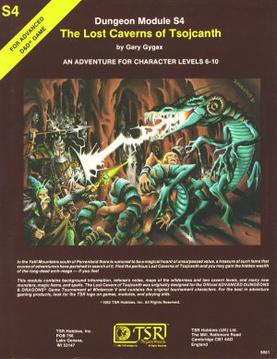
The PCs had just finished exploring parts of a mission dungeon. (A mission dungeon is one where the PCs are meant to visit from time to time to perform various interesting missions, as opposed to an “explore until complete, rich, or dead” type of dungeon. I’m repurposing the AD&D module Lost Caverns of Tsojcanth.)

We then roleplayed several encounters involving the usual Riddleport intrigue and politics. Sessions ago, the paladin won a cursed silver sword from a githyanki captain. To lift the curse, he must slay 30 evil creatures and four named evil creatures. He also incurred a negative level, and to repair his status he had to slay a Riddleport villain known as Kakiku, a godslayer dragonspawn.

The group decided to flush out Kakiku to help the paladin’s quest. They did a lot of investigation, and then enlisted the help of their crime lord patron.

A few days before, they humiliated the dragonspawn in an impromptu arena duel. The PCs aimed to challenge the dragonspawn faction to a rematch in the arena.

Rictus, the PCs’ vampiric patron, would personally invite Kakiku to watch from his private observation box. As Rictus is the owner of the arena, it is an honour to be invited, and it’s a sweet spot to watch the gladiatorial fights.

The PCs would ambush Kakiku en route to the arena match and turn the streets of Riddleport red (or, in this case, blue).

The Set Up

The characters picked the ambush spot. One player drew the map while the others strategized. This saved me time drawing up the map, and gave me time to study the bluespawn stat blocks.

Then I brought out the monster minis. A pair of mediums, a pair of larges, and a huge one. The huge was Kakiku. The others were his bodyguards.

I set out the minis in my desired formation. Then I asked the players to place the formation wherever they wanted on their map.

Next, the players placed their PCs. Several picked roof tops. A couple picked side alleys.

The ambush was set.

Giving players choice of map configuration, enemy placement, and PC location after enemy placement gave the players significant tactical advantage.

However, I had two reasons for doing this.

First, the group spent time beforehand gathering intelligence on the bluespawn. They knew the creatures’ abilities and temperaments. They knew enough that a challenge of honour and an opportunity for revenge would draw Kakiku out, with the invite from Rictus lending the whole affair legitimacy.

So, the PCs deserved the high ground for due diligence.

Second, I wanted a fast combat. Giving advantage to the PCs gave this goal a better chance.

The setup was no guarantee the PCs would win. Their placement and tactics could still have been poor. However, they worked as a group, and the fight was more enjoyable because of the strategy, planning, teamwork, and build-up.

I Pre-Rolled Initiative

I use a Google Spreadsheet to manage initiative in a fast, simple, and orderly way. After last session, I added several new columns and filled them with initiative rolls.

I had asked the players if I could roll init for them, and everybody agreed.

So I did. When we were ready to fight, I made the foes’ perception checks. And those who weren’t surprised got in on the PCs’ surprise round.

With initiative pre-rolled and already slotted in my spreadsheet (which is always visible to players via a second monitor that faces them) we then simply started combat. “Fane, you’re up. You’ve surprised the bluespawn, what is your action?”

Armor Class Posted

When players ask me the armor class of opponents, I have to look them up in the stat block. Everybody waits, then the player lets me know if he hit. There are moments of hesitation on both sides while the rolls, calculations, and situation freeze frame during the look up.

Knowing foes’ AC ahead of time is not much of a spoiler. Though, I will poll the players after I do this a few more times to see how they feel about it. Could be, the anticipation of hitting or not is too much fun, and that delay is part of the glee of combat. So, perhaps I only reveal ACs once the PCs’ hits pinpoint them.

For this battle, though, revealing them up front worked beautifully. Half the back-and-forth during a player’s turn instantly disappeared. They saw their foe’s AC on the spreadsheet, made their rolls, and announced hits and misses. Very fast!

Damage Posted

We were already doing this, but it added more punch because the PCs were focusing fire on Kakiku. I count up with damage, and post it in red on the spreadsheet for all to see.

Players can see who’s hurt and who isn’t this way without going through the mini roll call on the battlemat each round.

In this battle, they saw damage mount and adjusted tactics accordingly.

So, kudos to my players who used focus fire to bring down foes faster.

That had the added benefit of giving me fewer foes to manage as the battle went on, which reduced my time a lot.

Foes Fled

The PCs focused fire on the leader. He went down in three rounds (including surprise round).

As soon as the bodyguards saw their leader fall they raged. However, two of them went down fast. So, the other two buggered off to report to high command.

The fight ended early because the foes fled. However, the fight was a foregone conclusion, so it would have just been a grind to finish the remaining two.

Story was at stake, though. The PCs did not want any survivors reporting back to HQ. However, with a fight in the middle of the street, there would be enough witnesses for some semblance of the truth to come out anyway.

The point was moot, as the bodyguards had burrowing ability, and escaped through the ground, making chase near impossible.

Our fight ended early, at its peak, instead of getting drawn out and sucking all our table energy with it.

A Sixth PC

One of our players drives three hours (one way) to make the game. He can only make a few games each year. With a city campaign, it is easy bringing his PC in and out of the action. Fortunately, he made our game last Friday.

In this battle, he added more firepower to the PCs’ side, which made combat faster because foes died faster.

Xan’s player is fast too, which made his contribution so much more valuable to the combat.

The Final Results

The combat lasted one surprise round and two full rounds.

Here are the times:

DM: 9:45
Vigor: 9:11
Crixus & Cohort: 5:58
Velare & Cohort: 5:47
Xan: 2:27
Fane: 2:13
Hrolf: 1:37

Total time: 36 minutes, 58 seconds.

Last time, I ran eight critters and this time three. That is offset by two types last time versus three types this time.

Summary

I cannot let the players set battles up for optimal foe crushing too often, but it is another tool in the GMing toolbox I can pull out when appropriate.

  • Pre-rolling initiative worked well
  • Studying the foes a bit while the players strategized shaved time off my turns
  • Posting defenses allowed faster player calculations
  • Focused fire brought down the toughest threat early, and had a domino effect on the other foes
  • Foes ran away for tactical reasons and to prevent grind

Overall, a great success.

Comments (5)

Speed Up Combat By Building Your Own Combat GM Screen


Game Master Screen

Photo courtesy of sdobie

What is the number one way to make combat go faster?

For D&D type games, it is mastering the rules.

When you can make decisions based on accurate rules knowledge, not only do you have more options available, but you play with more effectiveness and confidence.

You also need to make fewer rules references on or between turns. You help other players make their moves faster, as well.

You no longer hesitate on your turn due to lack of rules knowledge. Calculations speed up.

And the biggest reason rules mastery makes you faster in combat? Decision and execution speed dramatically increase. You know what to do and how to do it, and you get on with it.

In Boxes, And Out

As a bonus, once you have internalized your game’s rules, your entire thinking changes. Thus, the game changes for you – and it’s wonderful.

First, you can think in terms of game rules and all the options they present. Pathfinder, for example, offers a lot of maneuver options. Sometimes using a maneuver or skill gives you a better result than just piling on more damage.

Second, you can think outside the box. With rules mastery, you know when you are leaving the security blanket of procedure and into the realm of imagination – and you will know how to translate that back into game mechanics terms fast.

Get that lateral thinking into play. Try roleplaying to end the fight a different way. Look up from your toes and beyond the tip of your axe and scan the battlefield for opportunities.

Reluctant Game Masters Take Note

I have been doing research recently on how to run combat faster. My group is already pretty efficient from various things we’ve tried over the years, but I want even more speed.

Turns out I am by far the slowest player at the game table.

As GM, I have a lot to do, as pointed out by Campaign Mastery readers: several critters to run, meta game issues to manage, and little time between turns to think about my own moves because I am refereeing character actions.

However, one thing I can do immediately to take a big chunk out of my turn speed is to master the rules. I asked Mike for his advice on that recently, and he’s got an excellent series on the topic.

If you find combat slow, look to your own turn speed first. Could be you can make the biggest difference to faster combat by learning the game rules a bit better.

Create Your Own GM Combat Screen

An easy trick to learn your game’s rules better is to create your own game master combat screen.

This specialized GM aid not only gets you reading, studying, and writing your rules, but it gives you a great GM aid in the end to make future combats faster.

Most commercial screens waste space. A lot of space. For example, my current pro screen offers only one side of information! The other side has art on it. What a massive waste. While the art is inspiring for players, I’m sure, the effect wears off. Groups get banner blindness due to familiarity. Useful information never goes stale.

Further, the information on my screen includes non-combat stuff. For a general purpose screen, that is great. But when you are in combat, all other matters pause. You do not need any other information at the moment.

So, give me only reference to what will help combat go faster or easier.

Creating your own GM screen gives you a focused GM aid such as this.

What To Put On Your Screen?

This is a custom screen. Make it suit your specific needs.

If you have already mastered some rules, there is no need to add them to your screen even though it might seem odd.

For example, if you have memorized the effects of several conditions, don’t list those. Just write out the conditions you need to learn better.

Before creating your screen, play a combat or three and observe where the pain points are. Using Mike’s tip, log what rules give your group hiccups. Then note those rules on your screen.

For example, I can never remember the tiers of Detect Evil. That should go on my screen.

Again, it might seem weird to put the rules of Detect Evil on your screen and no other spells, but that’s just your left brain of retentiveness looking for completeness and order.

Can’t remember the AC of full plate? Note it on your screen, but exclude the ACs of armour you do know.

Take Advantage of the Player Side

When creating your screen, put useful stuff on the other side to help your group fight faster and better.

What would help players during fights? Action types and costs? Attacks of opportunity explained? Certain spell charts?

What about offering a space for players to write stuff they keep forgetting, such as certain spells, feats, and bonus damages?

Start a list and pass your screen around so each player can add oft-forgotten tactics and opportunities.

Add Flavour

While getting faster is one goal, getting better is always my mission, too. So enlist your GM screen to help you add flavour to combat.

A simple reminder to roleplay during fights could help.

A table of simple combat descriptions could help you a lot too.

Some random name charts and a traits table might help you develop foe roleplaying on the fly.

Perhaps a description cheat sheet would remind you to set the scene better at the start of each combat.

Make A Simple Screen

Do not feel like you have to fill every inch of space with 9 point font.

Get a cereal box, cut it to size, and dot your new screen with Post-It Notes. Five minutes and you are done! Add notes as problem rules and reminder ideas come up.

Once your screen stabilizes, when you stop adding so many notes, you can get serious about crafting a fancier screen if desired.

Digital Screens Rock

I use a Google Spreadsheet instead of a cardboard screen at the table. You might find PDFs, desktop wallpapers, and other digital methods better.

Use whatever works for you.

However, while one part of this exercise is about creating a useful GM aid, but the other part is about mastering the rules by researching them and writing them out. Downloading a screen made by someone else only gets you a small win.

In this case, the building of your own screen is of the greatest benefit to you.

What Do You Think?

How do you master your game rules?

What tables do you find most useful on your commercial screen?

What information would you put on your custom GM combat screen?

Comments (6)

How To Fall In Love With GMing Again + iPad App Review of Daily Notes


daily notes ipadWrite down your ideas when they come to you. This core GM tip gets repeated often in the Roleplaying Tips newsletter for good reason.

If you do not record your ideas, they could get lost or fuddled, and I find nothing more frustrating when my brain pumps out a super idea only to ignore or forget it.

How To GM More Often

Writing out your ideas is the equivalent of mental exercise. It makes you smarter. No lie.

The biggest benefit, however, is not a bigger brain. It’s more engagement.

Busy GMs who have no time to prep for games tend to become distant from gaming over time. The zeal fades as they dream about old days with less responsibility and big blocks of time free for gaming.


As zeal fades, so does time spent gaming. However, writing down ideas gives you more ideas. It is a positive feedback loop. It keeps you thinking about gaming. It keeps you excited about it.

Writing down one idea at a time lets you sneak in session prep a few seconds at a time. It has no impact on your schedule. In almost every situation, you can pause for a few seconds to make a note.

Keep making notes, and the session plan starts to take form. By the time you get that small chunk of time to do game planning, most of it is done for you.

In this way, writing down your ideas keeps your gaming alive and thriving, even with kids, job, other hobbies, and a million of distractions.

I Tried Several Notes Apps Before Picking Daily Notes

Whether I’m in bed, on the street, at work, watching TV, or planning my next gaming session, I use my iPad to capture my ideas. About the only places I can’t use my iPad is in the sun, while driving, or in the shower.

The essential app I use every day to capture and organize my ideas is Daily Notes. This app is so important I put it in my dock.

Daily Notes recently released an upgrade, with many great new tweaks and features, so this is one of those great apps that is always improving.

Daily Notes was about my fifth idea capture app attempt. I tried the default Notes app that comes with the iPad, and found it did not suit my needs. Then I tried NotesHD, which I still use, but does not have the features I need. I tried a couple of other forgettable apps. I tried Evernote, which is awesome, but it does not do the trick for me.

Features I Like

The quest ended with Daily Notes because it met nearly all my needs:

  • Sections. Different areas for work, RPG, my websites, my projects.
  • Dated entries. I have always used a diary entry style for my ideas.
  • Tags. The big one. I need a more granular way of cataloguing my thoughts.
  • Export. I need a way to get my thoughts out of my notebook into the relevant software (email, doc, or spreadsheet, usually)

How I Use It To Capture My Ideas

Daily Notes Options Screen

Daily Notes Options Screen

I created sections – called tabs – for important areas or projects.

When a thought or idea comes to me, I open the app, which defaults to the current date, select the tab I want, and start writing. I tag the entry and am done.

The app itself takes about one second to manage in this process, which is the way it should be. I do not need to boot a PC, wait seconds while I launch software, find the proper file to open, find the right location within the file, then start writing.

This is a bit of an exaggeration, actually, because most of the time when at a computer I just crack open Notepad, which is in my launch bar, and I am writing within a couple seconds. However, even after that I still need to file that idea away somewhere. I email it to myself, or save the file, or, once my head is emptied (which my wife says is often) I find the permanent location I store my information and slot it, which does take time.

With the iPad, I flip open the lid, enter my password, open the app, select the tab, and start writing – about one second.

Weekly Ideas Scan

Most of my ideas are crap. The goal is to generate so many ideas some are brilliant. Then you just select the good ideas and run with them.

The more often you write your ideas down, the more often ideas come to you. It’s a skill you develop over time. Brainstorming, some call it.

But there are also times you chase a sequence of thinking down to a conclusion and you want to note that chain and the end thought. That is real work being done. I call it perfect beer-on-the-deck moments. It’s also how I do my best game session planning.

So, I fill this bucket full of crap and some gems. Each week, when I do my GTD reviews, I scan my Daily Notes entries. The good ones, if there are any, I transfer to my project lists and documents.

It’s that easy. Record everything. Sift through it regularly. Take the best stuff and leave the rest behind.

Daily Notes

Landscape view gives you easy calendar access

RPG Planning

I still use my Loopy Session Planning method for organizing my current Riddleport campaign.

I keep a list of all open threads and review them GTD-style before each session. I update accordingly.

Most often, I pick a thread and think it through. I do this while driving, during TV commercials, or when otherwise free to think. Exercise is an especially effective time for me to think while my body is distracted.

When ideas and thoughts come to me about game situations and plot threads, I record them in Daily Notes. Then I review them and transfer the good stuff to my loopy session plan.

This year my thread notes have grown beyond what a plain text file can keep organized and accessible. So I have transferred my loopy system to MyInfo. I’ll write about this awesome piece of GMing software another day, but suffice to say I still loop and still keep things simple for agile GMing of a sandbox fantasy city campaign.

Record Your Ideas Daily

Regardless of system or software, create a sleek system for yourself that lets you write down your ideas as soon as they come to you. Pen and pocket notebook did me good throughout the 1990s. So did the Hipster PDA in the mid-2000s.

Today I use Daily Notes and an iPad, but the principle is the same: get it out on paper. And do something with the good ideas. Act.

Get some gaming done this week.

– Johnn

Comments (3)

Taming The Time Bandits: Some time-saving combat techniques


Synopsis Of The Problem

In Johnn’s last blog post, “My Group’s Time Thief Revealed,” he described his discovery that the chief drag on the pace of his combat was the GM, despite his expectations to the contrary. While he did not track the components of his activity, he was able to dismiss a couple of factors out of hand – it wasn’t initiative tracking, and it wasn’t looking up rules. It wasn’t the initial combat set-up, either – that’s an overhead that would be incurred anyway, sometimes taking longer and sometimes not.

As he became aware of the trend, he started paying attention to the clock app he was using to analyze the time expenditure while GMing in an effort to identify what he was doing that was taking so long.

I’ll quote his findings directly:

…it was a combo of lack of preparation and lack of knowledge of the game rules. Boo.

The demons had a number of spell and supernatural ability options. I did not research these before the game. So I caught myself hitting d20pfsrd.com and researching my options before deciding each demon’s actions.

Further, I had no familiarity with the swarm rules. Those critters have a lot of specific rules pertaining to them, so I looked those up several times during the combat.

Another factor, but a minor one, was not knowing what mini belonged to each PC. That caused me to hesitate several times. I’d figure out a demon’s action, then realize I had mistaken a mini for another PC, and go back to the drawing board.

That’s three separate issues, but Johnn’s post doesn’t include any solutions, and neither do most of the comments, as I pointed out in response to the article – though a number of commentators said “I have the same problem”. There were a couple of other minor problems and potential problems revealed by the analysis, but Johnn included plans to deal with those in his blog post, so those don’t count.

This brings me to the purpose of this blog post: to suggest one or more solutions that I employ to get around these problems in my games.

The Assumptions

Several of the comments on the Blog suggested things that Johnn could do to prevent these problems in the form of game prep. I’m going to assume that, for whatever reason, no game prep has taken place.

I’m further going to assume that the goal is to reduce the overall time required to complete the combat – which went for 6 rounds. If one minute invested in additional set-up saves half a minute or more per round once the battle actually commences, it’s a valid solution to the problem.

Without a more specific breakdown of the time delays associated with each of the problems Johnn listed, it’s hard to offer a relative weighting. My own experience is that a short battle (3 rounds or less) emphasizes the Rules Knowledge problem (#2) while longer battles emphasize the Enemy Abilities problem (#1). That’s because the GM is learning as he goes, so any delays caused by the Rules Knowledge problem tend to be amortized (spread over) all the combat rounds involved.

In other words, the first couple of rounds contain a disproportionate share of any Rules Knowledge problems; as the GM comes to grips with how the subsystem concerned works, he needs to consult the reference material less frequently, and the delay that results is comparatively smaller as a result.

Ability problems, on the other hand, tend to recur more frequently from round to round, and are slower to decline. So the larger the combat, both in terms of number of participants and number of rounds, the greater the proportion of the overall time loss that can be attributed to this cause – and hence the greater the scope for time savings in the long run.

Spell and Supernatural Abilities

That makes this the problem in greatest need of a solution. It’s also the problem that – in my experience – occurs most frequently.

Whenever an encounter occurs, I spend a minute or so glancing over the abilities of the creature in question. I mentally categorize each ability into one of four types:

  • Defensive Abilities
  • Offensive Abilities
  • Tactical Abilities
  • Other Abilities

I don’t read the entries describing these in detail, just skim over them as quickly as I can.

As I do so, I am looking for the answers to a set of five specific questions:

  • What is the creature’s basic vulnerability? Some creatures are especially vulnerable to magic, some to good, some to evil, some to ranged combat, some to melee, some to fire… the list goes on. This question is a guide to the creature’s nature, but more importantly, to its tactics: if threatened with this type of attack, the creature will either make the wielder a priority target or will seek to avoid battle with that individual. Early in the battle, the first reaction will be more common, later in the battle it will be the second. I’ll spend 10-20 seconds deciding this.
  • What is the creature’s preferred attack mode? Some creatures will prefer to attack from a distance, others have touch attacks, some swallow, and so on. Again, this is a guide to behavior – once the creature’s preferred attack method is known, all the other attack methods it has at it’s disposal become ‘exceptional cases’ to be called apon only under appropriate circumstances. Again, I’ll spend 10-20 seconds deciding this – perhaps longer in the case of something with a lot of abilities, like a spellcaster or a Beholder or a Demon/Devil.
  • For each other attack mode, what circumstance would make the creature want to use it? I don’t try and remember the details of each ability, I simply decide when they will use it. If those circumstances don’t come up, I never have to look at the ability in detail. Once again, the focus is not on “what can this creature do” but “how will it behave?”. I’ll spend about 5 seconds on each. With a ‘typical’ creature, that comes to 10-30 seconds.
  • How can the creature best manage its tactical situation? This question sounds a little waffley, but that’s because it covers a lot of ground. It relates to how the creature moves, and whether or not it has certain feats, and so on. Will the creature hit-and-run, foregoing multiple attacks and enduring attacks of opportunity? Will it attempt to attack from a distance? Will it focus on a single foe, or engage multiple enemies at once? Is it faster-moving than any of the PCs? Are any of the PCs faster than it? With the earlier analysis complete, this step is usually fairly quick – another 10-20 seconds.
  • Finally, What’s its objective/motivation/psychology? With intelligent creatures, this actually tends to be the first question I attempt to answer, before I even skim the ability descriptions; with non-sentient creatures, or especially stupid ones, it’s the last question. Either way, this question attempts to sum up all the other ones in a single statement. I’ll spend 20-30 seconds determining this answer.

That’s a total of between 60 and 120 seconds in most cases, and it yields two distinct advantages: It focuses my attention on the abilities that the creature is most likely to use (largely ignoring the rest), and it makes it much quicker and easier to select a reaction to any developments on the battlefield. Both save time each and every round in the battle – so much so that I can often reach decisions on behalf of the creatures more quickly than the players can do so concerning their PCs.

The only time that this solution doesn’t work very well is when there are many different types of creatures in a single encounter. Even in an extreme case, though, it is still helpful – just not as much as it would otherwise be.

Swarm Rules Familiarity

This problem – and its kindred – are more difficult to solve, simply because while there are a number of solutions, there are no one-size-fits-all answers.

Enlightened Players

One of the key questions is how much the GM is willing to let the players know in advance of the combat beginning. There will be times when an enemy’s nature must be concealed, and times when he can be more open. In Johnn’s case, he might or might not have been willing to let the players know in advance that he needed the Swarm rules.

When secrecy is not an issue, get your rules expert – every table has one, it sometimes seems – to summarize the relevant rules for you. Get another player to locate the relevant rules for you. Johnn himself said: “Players are responsible for the rules – I almost never look them up.” When you can, put that expertise to work for you.

Ignorant Players

If it is necessary that you conceal the rules issue from the players, the problem becomes much harder to solve. When this happens to me, I guesstimate how much damage the PCs are likely to do, and roughly divide the total hit points of the encountered creatures by that amount to get some idea of how many rounds the battle is likely to take. I halve that to determine how many minutes I’m justified in expending on skimming the relevant rules. I try to reserve about 1/3 of this amount for use during the battle.

My objective here isn’t to know the rules backwards and forwards; it’s to know the rules enough to comprehend and choose amongst the options made available by the rules subsystem in question. The secondary objective is to know anything that is an “all the time modifier” to the standard rules, such “take no critical hits”.

During the battle

Each time the rules subsystem comes into effect, I jot down a summary of the relevant rule, unless its already on the list from an earlier round. “Many creatures treated as one larger creature – HD, HP INIT, Spd, AC” would be the first notation I would make concerning a Swarm, for example. “Half Damage from slashing and piercing weapons” and “Automatically do damage, no attack roll needed” are others. Until someone actually fired a spell at the swarm, I would completely ignore any rules regarding spell effects or immunities. [these rules excerpts were taken from the Pathfinder SRD “Swarm” creature subtype.] The more compactly I can summarize these, the better – they are a mnemonic device, not a complete summary.

The governing principle is “need to know” – as in, “What do I need to know right now?” If I don’t Need To Know It, I don’t want to know it. When I find that I do need to know it, it goes onto my behavior summary, so that I don’t need to go searching for it again.

After the battle

One of the techniques that I recommended in the still-ongoing “Rules Mastery” series was to keep a logbook, indexed, in which you summarize any rules information that you’ve had to refer to in the course of the day’s play – again, the objective is not to have to do it a second time. As soon as the battle is concluded, I would spend a couple of seconds transferring the rough notes gathered During The Battle (above) into the Logbook while the rules in question are still clear.

While this represents a small delay to play at the time, this delay is actually an investment in speedier combat the next time around.

One Creature

One final note while I’m somewhere close to the subject: I commented in the section on “Spell and Supernatural Abilities” that the solution posed there would not work as effectively when the combatants were of many different varieties. One way of overcoming that problem – at least in those cases where sentience and experience/expertise permits cooperative tactics – is to treat the group of enemy creatures as one big creature with multiple attacks, multiple hit point reservoirs, and so on. Instead of assessing the tactical options of individual creatures, this perspective enables the GM to use the groups’ overall objective to restrict the tactical variables for the individuals.

Identifying Minis

The final problem Johnn reports is that of correctly identifying who a mini represented, with time being lost redoing tactics because he thought he was dealing with one PC and it was, in fact, another.

This is described as a minor problem, and so it deserves a minor – i.e. quick and easy – solution. It just so happens that I have one.

I don’t use Johnn’s Initiative system, I write a list of all combat participants and their init totals, then rewrite the list into init order. In large or confusing battles, I sometimes have trouble remembering which mini is which character – the exact same problem that Johnn had. After a couple of errors of the same variety that Johnn describes, I started to list the minis next to the names. There is usually a one-word characteristic that is unique to each mini that’s in use, or perhaps two, and that’s all that’s needed.

Examples that I might very well use are “Luke Skywalker”, “Blue Robe”, “Curved Sword”, “Yellow Beard”, or “Dr Strange”. So long as it’s unique to the mini in question, it’s a good enough to identify the Mini.

So the solution is either for Johnn to make a list of which mini represents which character, or to write that 1-2 word description on the card with the initiative of the character. The first is probably less work and leaves the whole list accessible whenever it’s needed, so that’s what I would do.

Once such a list is compiled, it won’t change for the rest of the day’s play, and may remain valid over many game sessions.

It’s as simple as that – a list which shows “Player Name – Character Name – Mini Description” for each PC and NPC. Some people might also choose to include “Class” and “Level” but these change more frequently, and hence need more frequent updates.

The Ultimate Answer?

None of these will solve Johnn’s problems completely, and none of them will offer even a partial solution 100% of the time – but they should cut the administrative problems he encountered by one half, perhaps as much as 2/3. Instead of a total of 34 minutes 14 seconds (including 5 minutes overhead for set-up), it should be easy to reduce that total to 19½ minutes or less – a saving of almost 15 minutes – by employing these techniques. With a total time for the battle of 77 minutes 17 seconds, that would become about 62 minutes. If the circumstances are right, it might even be possible to cut another 5 minutes off the total.

But wait, there’s more! The better the GM understands what the NPCs/monsters are doing/capable of doing, the more quickly he can adjudicate player actions. The amount of time saved here is unknowable – it might even be zero, but with more time expended on producing a quality game experience by re-tasking the saved time. Either way, it’s a sure bet that this will also be an improvement in the game play. And that makes these techniques a win-win for both players and GM.

Comments (20)

My Group’s Time Thief Revealed – Chronology iPad App Review


Chronology for iPad

Chronology for iPad helps me time combats

I was curious to see how long combat encounters last in my Riddleport campaign, and how long my group takes on each turn to do our actions. I surfed around for a long time, looking for the right timer software, and then I finally found it, for the iPad.

This is a review of how long we took to play out our last combat, through the eyes of Chronology for the iPad.

Who’s taking so damn long?

Combat in our group runs at a pretty good clip. But I want it to go faster. I would like one more combat squeezed into our sessions without sacrificing any other encounter types or making sessions longer. That means making combat faster.

But first I wanted to learn where time spent in combat was going. I wanted to see who the culprits are. You know, the slow decision makers, the inattentive, and the dreaded rules lawyers. How much time were they leeching out of the fun?

I hunted down the Chronology iPad app. At the time of purchase it was $5. It had the features I needed:

  • Multiple timers
  • At least 7 timers (one for each player plus myself)
  • Count up (most just count down)
  • Each stop and start (one touch, any player, anytime)
iPad Chronology

All timers set up and ready

iPad Chronology

Timers after the combat

As a bonus, Chronology has other great features, too. It has countdown timers for when I put time limits on turns or for special encounter setups. “You have 25 minutes to stop the ritual. Go!”

You can also save the timers you set up as a set, and load that set anytime. That is awesome, because I can just load the D&D set of 7 times at game time and start using it. I also have a set saved for my internet business, so I can see exactly where my time is going each day. Saved sets let me swap my D&D and business timesheet sets out in two click.

Resetting a single timer or all is a single click.

You can disable sleep, which I found handy during the session. It would have been a pain logging in again after sleep mode kicked in, or disabling sleep mode each time I want to use this app.

For countdown timers, there are alerts and background alerts. You can even set what chime each timer makes when it reaches zero.

Another great feature: simultaneous timers. Last session I only had one timer running at a time, because it was only one person’s turn at a time. However, I was frequently involved in player turns, making players wait while I decided or researched something. So, next session I will turn my timer on while a player’s timer is running when I am spending session time during their turn too.

You can also cascade timers, wrap timers, and auto reset timers. I do not plan on using those for RPG, but they are there if you need them.

Oh, and you can adjust the current count of any timer. A couple times I forgot to start a timer or I left one running when it should have been stopped. It was easy editing a timer and changing its current time.

Screenshot

Timer options

Screenshot

Chronology options


Was it disruptive?

Players immediately noticed I was timing them. Nobody complained. I mentioned I was also timing myself. That seemed fair.

My Information Overkill system when GMing looks like this:

  • iPad to my left
  • Paper notebook and pen in front of me
  • Laptop to my right
  • Second monitor raised on a side table beside the laptop, for players

It’s a vice. Move along, nothing guilty to see here.

With the iPad right on my left (?), managing timers took no time at all (punny!). Earlier this year I had considered other options, including PC timers, stopwatch, and sand timers. They all had drawbacks that were too much for my tastes. I like to GM fast without props and devices getting in the way.

Fortunately, operating Chronology was a two tap operation each time. Current player stop, new player start. Round and round we went.

What did I expect?

I made a theory before the game about who the biggest time culprits were in combats. It is always good to check your own perception of reality against some facts. Real objective like.

I fingered two players for different reasons, and expected the total time spent on their turns to be equal to the total of everyone else’s combined.

For this experiment, I only tallied total time per player for the combat. Getting into round-by-round times is possible, but trickier and I wanted the timing of my first timed combat kept simple.

I also did not tally the type of actions. For example, how much time was spent making decisions versus calculating results versus rules checks versus chit chat and inattentiveness.

When it was each player’s turn, I said to the table, “It’s now your turn, [character name].” I tried to catch the player’s eye while saying this, but regardless, once my announcement was over the timer began. If a player was distracted, it would just add to their time used.

Two players had to leave the table for the call of nature. I decided not to keep their timers going in these cases. I wanted to be human about it, and this is still supposed to be just a fun game, after all. My players have excellent table etiquette, and everybody respects each other, so my goal with the timers was just to capture player turn length while at the table, playing.

The stats reveal the group’s time thief

What I found was unexpected. My theory was torn to shreds. Here are the results.

  • Number of foes: 8 (a CR 10 demon who summoned a friend, so 2 CR10s, plus six bat swarms)
  • Number of PCs: 7 – 5 (level 7) + 2 cohorts (level 5)
  • Location: Large cavern with pillars for cover and poison spore fungus patches in certain areas
  • Total time of combat: 77 minutes, 17 seconds
  • Number of rounds: 6 until the foes were dead
  • Crixus and his cohort: 12:59
  • Velare and his cohort: 11:42
  • Vigor: 9:19
  • Fane: 6:25
  • Hrolf: 3:03
  • The demons and swarms: 34:14

Wow! The GM is the slowest player. Here I was thinking a couple players might be the culprits, when I should have been looking in the mirror the whole time.

I did not record how I spent my time. I just recorded my total time spent on my turn, or between player turns when I had to do something for the combat.

I manage all the initiative, but my system is so sleek it only takes seconds per round to operate, so that was not part of the slowdown.

Players are responsible for the rules – I almost never look them up. So I normally cannot blame that.

I included the initial combat setup in my time. Drawing the map, laying out the monster minis, and kicking off initiative. If memory serves, that took about five minutes. I expect that to be a new timer next game so I know for sure.

So what’s my excuse?

As the combat clock ticked upward I spotted the trend pretty fast. My turns were the longest. So I started paying attention while GMing to what I was doing that was taking so long.

It turns out (punny!) that it was a combo of lack of preparation and lack of knowledge of the game rules. Boo.

The demons had a number of spell and supernatural ability options. I did not research these before the game. So I caught myself hitting d20pfsrd.com and researching my options before deciding each demon’s actions.

Further, I had no familiarity with the swarm rules. Those critters have a lot of specific rules pertaining to them, so I looked those up several times during the combat.

Another factor, but a minor one, was not knowing what mini belonged to each PC. That caused me to hesitate several times. I’d figure out a demon’s action, then realize I had mistaken a mini for another PC, and go back to the drawing board.

The stats revealed many other golden nuggets

First, player times were actually great. The slowest player only took 13 minutes, or 17% of total combat time.

With five players at the session, plus GM, if everybody received equal spotlight time, each person should receive 17% of the spotlight.

That will be my goal moving forward. Getting everybody 17% or equal share of the spotlight. At the same time, if each person’s turn is not wasteful, but not high-pressured either, we’d have fair and fun combats.

Next, the players with cohorts took longest. For one player, this is session #2 with a cohort in combat. For another player, it was his first combat with a cohort. I am not ready to draw conclusions here yet, especially because their time ratios were within my goal range.

Could be the cohorts caused extra time expense. However, the two player characters themselves are complex. One is a wizard, so lots of options to consider each round. The other is a min/maxed fighter who usually gets multiple attacks per round and needs to maneuver in place to get them.

So, it could be just the PCs causing more time needs, not the cohorts so much. We’ll see.

Another interesting tid bit is the times for Hrolf and Fane. The times are low, so I am worried about how much fun those players are having. Fane’s player records session notes on our wiki, so he is keeping himself busy, at least. Whether that is because his turns are so quick or whether he enjoys session logging, I’ll find out.

Hrolf was a brand new PC that session. The player retired his previous PC because he wanted to play a different type of character. Could be Hrolf was just figuring things out in his first combat, and will have more involvement in future fights.

However, it could also be the character is simple and has no other options.

A third possibility is the player p0wns the rules, is super efficient, or plans his turns in advance so there’s no delay when the timer starts for him.

I will follow up with Hrolf’s player between session to get his thoughts and reactions. If the player is super efficient, we will find out why and share the tips (and expectation) with the whole group. If the PC is just simple, then I have a couple ideas on how to make his combats more interesting.

Last, the whole combat took about an hour and twenty minutes. That was a combat with 7 combatants on the players’ side, and 8 on the GM’s. A 15 foe fight with sides being roughly equal in ability in 1:20 is good time in my books.

If that lazy GM would sharpen his pencil a bit, combat could go even faster!

Great news

Overall, this is the best possible news I could have received from the experiment. I cannot control the players. I can only control myself. If the opportunity for faster combats lies mostly within myself, then I have all kinds of options and ideas, and I can try them all because it’s all on me, within my control.

If it had turned out those one or two players I had initially fingered were at fault, I’d need to have some conversations, do some analysis with them, and work ongoing to shave time off their turns.

Instead, I just need to work on becoming a better GM. I also get a chance to try to get certain PCs more involved in combats so that we do an awesome trade of my time for theirs, keeping combat the same length or less.

For my group, with the current data at least, our challenge is not shorter combats as a whole, but shorter GM turns and longer PC turns.

I will let you know how it goes.

Comments (24)

Perfect Skin: Some Musing On The Design Of Monsters


Monsters generally come in three parts: Stat Blocks, Descriptive passages (which some people refer to as Fluff), and Templates, enabling you to add the “monster description” to an existing race – sort of an ersatz Class. Lately, I’ve been thinking about the differing values and usefulness of books on the subject. NB: This is an unabashedly d20/3.x article. YMMV with other game systems.

Reskinning

A year or three ago, Roleplaying Tips and my co-writer here at Campaign Mastery, Johnn, introduced me to the concept of “Reskinning”. The notion itself is simple: come up with an idea for a new monster, write the appropriate Fluff, then select an existing creature from your preferred source (The Monster Manual in the case of 3.x D&D) that most closely matches your fluff and use it’s stat block. You may need to swap out one or two of the source creature’s abilities with more appropriate ones, but in most cases creating the new monster becomes the work of minutes or seconds, not hours, days, or weeks.

This is a powerful tool, there is no doubt about that, but it is not without its flaws. It requires considerable knowledge of the sourcebook you are using – especially the dull and dry stat blocks – to choose the best creature to reskin. There are inherant assumptions about the usefulness and effectiveness of various abilities. And there is absolutely no guarantee of consistency.

The Monster’s Handbook

In my 2009 series, “The Gold Standard”, I recommended from Fantasy Flight Games. This book describes ways to upgrade creature types to make them more challenging, more unusual, or just plain different, and offers a well-thought-out system for adjusting the CR of creatures after you’ve tinkered with them. It looks at the strengths (and how to maximise them) of the different types of creatures, and the vulnerabilities / weaknesses / shortcomings of the creature types, and how to minimise them. It continues to be an invaluable resource.

It’s when you put these two ingredients together that you start coming up with some interesting new ideas.

Instead of treating The Monster’s Handbook as a set of blueprints for tweaking existing monster designs, consider it a bible for reskinning. All that is required is the insertion of an unwritten assumption: that the contents of the book are examples of how to reskin, and (by sheer coincidence) the skins chosen just happen to match the creatures that are normally associated with the fluff and base stat blocks.

Thus, the section on Giants ceases to be about Giants, but instead describes creatures that have been re-skinned as giants, whose core just happens to match the preexisting Giant.

A new type of Monster Compendium

Originally, that was as far as I intended this article to go. Subject complete, time to sign off with no danger of overstaying my welcome. But then another thought or two intruded. Sepcifically, I asked myself:

What is the ideal format for a Monster Manual that has been optimised for use in this way? It would be an extraordinary coincidence if the traditional arrangement were the best choice.

In order to reach an answer to this question, we first have to deconstruct the standard model, seperating it into its constituants, and then looking for the most effective way of putting humpty-dumpty back together for its new purpose.

Description

The description of the creature, in theory, contains the central theme around which all the other elements are arranged. The description justifies and explains the powers, the behaviour, the culture (where necessary), the psychology, the stat block contents – everything.

Stat Block

The Stat Block is the connection between the description and the standard game mechanics. The central concept of reskinning is that these stat blocks are – within limits of CR and other categorization considerations like creature type – interchangeable.

Feats

Feats, in this context, represent customisation elements of the stat blocks. The number of feats a creature receives is roughly determined by the number of hit dice it has.

Powers & Abilities

Spanning the gap between these three componants are the power descriptions. Changing, upgrading, or enhancing these is at the heart of reskinning. Sometimes, this is achieved by altering the feats list.

Template Information

Finally, some creatures contain information about using the creatures as the foundation for other characters and encounters, acting more as a preset group of alterations or a “standardized” reskinning operation. Want an Owlbear Ghost? Take the Owlbear writeup and add the Ghost Template – then get to work explaining it, or simply give the resulting compound a new name and decide “that’s the way it is”.

Universal Foundations

The concept of reskinning revolves around the use of the Stat Block as the central hub. The Description, suitably modified, is the wrapped around the stat block, and Feats, Powers, and Abilities all hang off that.

That means that the correct starting point is with a careful collection of stat blocks. These should represent all the permutations of CR and creature type.

Feat Slots, Power Slots

Each such “universal stat block” should also include a couple of new elements: a tally of the number of (empty) feat slots, and an entry listing the number of “power slots” for extraordinary attacks, defences, and abilities.

Standard Powers & Feats Lists

The next section of our hypothetical “master monster cookbook” would be a list of items to occupy those empty slots, with descriptions. Each extraordinary ability should be rated in terms of the number of slots that it consumes – most will only be one, but there may be a few – or perhaps a few combinations – that are adjudged to be more powerful, and hence consume an extra slot.

Employing slot requirements as a variable makes it easier achieve universality in the stat blocks; the number of slots available represents a fixed power level, making it more practical to associate them with a given CR.

‘Skin’ Descriptions

These three componants – standard stat blocks, by creature type, with a menu of powers and feats – form a universal foundation which individual ‘skin’ descriptions can draw apon. An entry consists of the usual descriptive text, plus a statement as to which elements from this foundation, plus any comments on how these choices should interact.

In addition, something that I would like to see as a standard element of all monster descriptions is “tactical advice for the busy GM” – how best to employ the creatures in battle. The current information in that respect often seems to be an afterthought thrown out by someone who has never played a game – I once read a ‘battle strategy’ involving the casting of no less than six spells before the creature entered battle in an official supplement (I’m not sure which one it was, now, so I can’t name names). I’m sure that the intent was for these to be cast prior to battle commencing, but the circumstances of the encounter were such that the chance that the creature could cast even a single spell prior to battle was vanishingly small, since they were almost certainly going to be taken by surprise. (Come to think of it, that might have been in a module – but the principle remains).

Available from RPG-Now, Just click on the image

Later Monster Supplements

The “Universal Foundation” forms the “core rulebook” for each creature supplement that is to be released. Third parties can add their own powers to the available repetoire, and their own ‘skins’.

That is what is needed to have a monster-creation system that is built for skinning. What do you think?

Disclaimer: This article was inspired by the receipt of a free review copy of “Tome Of Monsters” by 4 Winds Fantasy Gaming.

Comments (4)

City Government Power Bases – Land


This entry is part 9 of 9 in the series City Government Power Bases
What forces govern your city?

What forces govern your city?

In many societies, landowners have great power.

With all the economic, defensive, military, and strategic benefits land provides, most governments use this as a starting power base for their regimes.

For high fantasy games, consider land as an abstract concept that encompasses many possible dimensions. Land can be the ground, the clouds of sky realms, the flames of an elemental universe, or any material of the planes of alternate dimensions.

In essence, a government dictates that a certain area of “land” is under its control, and if one wants to live within that realm one must obey the government.

Strengths

Land is often taken for granted, but it is an essential ingredient for life. The basic needs of a populace are water, food, and shelter. Water can be obtained from weather, but that is often fickle. Instead, one needs access to a steady source, such as a lake, or river, and land always surrounds these geographic features.

Food has the same dependency: crops and animals require land to grow.

Shelter requires ground of some kind. Extreme, high-fantasy situations might create exceptions to these rules, in which case the value of land might drop somewhat, but these truths should encompass most societies. A government needs a populace, therefore control of a parcel of land is requisite for that populace to survive, live, and grow.

Another core strength is land’s physical nature. It’s a tangible thing. Ideology, money, affiliation, and other power bases are intangible and can be whisked away by a change of thought. However, land is physical and durable, and it can only be removed as a power base by other physical (or magical) means.

Think of the children’s game, King of the Hill. As long as the King can push away all other challengers, no amount of name-calling, pleading, or cajoling changes the situation. Where governments are concerned, no amount of legal wrangling, threats from other countries, economic sanctions, and so on can deprive a city of its land until a force moves in to physically take control.

Land is a reliable, stable, long-term, valuable. It is a necessary power base.

Weaknesses

Land is finite in most worlds. Hence, competition over it is fierce. Governments rarely cede land to its citizens – it always reserves ultimate control of it, even if laws and customs might lead people to think otherwise. Therefore, land needs constant defense and vigilance – things that incur costs in terms of building and maintaining defensive structures and a military.

In some cases, a government must defend the land against its own citizens, for as stated previously, anyone can technically claim a piece of land as theirs, and until they’re physically beaten, it’s a truth.

This brings about another key weakness: land has no allegiances. Certain groups in your campaign might gain benefits from occupying certain lands, but this is a one-way relationship only. The land itself has no allegiance to its occupants. For example, in your game elves might be attuned to wild lands, but the wild lands don’t care about the elves.

Remove the elves and the land is still there. You might grant blood rights, rulership bonuses, or domain powers to various land dwellers, but the land doesn’t require those dwellers to exist.

Under the watchful eye of a druidic society, the land might flourish with plants and animals, but the land itself isn’t dependant on the druids in any way – the dirt will still be there when the society passes on.

This lack of allegiance is a weakness, because it generally provides a government’s foes the same benefits and another reason for conflict.

Land is often immutable, except under exceptional circumstances of great magic, monumental effort, or extreme situations. If a chunk of land has physical drawbacks, there’s not much a government can do about it.

For example, a city sits between two great, war-like nations. The city cannot move its piece of land to a better, safer place. Most terrain cannot be easily changed either. It’s difficult moving mountains to create more cropland. There are many things a government can do to try to make its parcel of land more fertile, more defensible, or better strategically, but these efforts are often costly and last only as long as maintenance continues.

Flavor

Try to make your city’s land unique and distinguishable in some way. Develop the land so that its use as a power base requires ongoing effort. Perhaps an unruly climate causes seasonal havoc. Maybe natural cave formations allow monsters, rebels, and factions to hide, survive, and thrive.

Think of land as a finite, valuable resource and make a list of competitors: races, gods, rival cities and governments, critters, and so on. Picture how this competition could affect your government’s make-up and actions.

Individual land ownership usually conveys great privilege. What kinds of lands do various powerful politicians control and how does this impact their position?

For example, land often enables other power bases, such as through wealth formation (crops, minerals), affiliation (neighbors), or social class (neighborhood).

A politician’s land can be a facet of their personality as well. Where an official is from is often how they’re judged, and the conflicts their land presents (foul weather, rivals, type of land-use such as mining or farming) moulds what skills and experiences they have.

Comments (2)

Top-Down Plug-in Game Design: The Perfect Recipe?


Click on the image to see a larger version

As someone who writes about RPGs a lot, I am naturally interested in game design techniques and philosophy. As a former I.T. professional, I have discovered that a lot of the principles of sound program design practice also apply to rules design. With those as my starting point, I thought I would have a stab at defining an approach to the perfect game design – without actually getting too bogged down in actually designing a game.

Iterative Function

By far, the most powerful technique that I have ever found for handling complex systems is the Iterative Function. Applying a set of simple steps, repeatedly, compounds their effects to staggering levels, while keeping any given step manageable.

I’ve used this approach a number of times in different articles over the years, for example:

  • , which appeared in issue #308 of Roleplaying Tips to general approval,
  • (written as an article called “Chinese Whispers” after the schoolyard game), which was published as a reader’s tip in Roleplaying Tips issue #322, and
  • , a popular series here at campaign Mastery.

These are just a few of the more overt examples; the principle has been implicit in many of the articles that I have written here at campaign mastery.

The actual concept comes from Chess: each piece has only a few simple moves open to it, but the compound produces a game of staggering complexity. It also underpins computer software, where everything that occurs is the result of simple instructions executed sequentially, the power of which I learned when I first analyzed a (illustrated by the animation).

In mathematics, the concept is fundamental to what are called “Iterative Functions”, which are at the heart of Fractals and Chaos Theory, and can be used to produce Mandelbrot sets, like the one illustrated at the top of this article. The reasoning in terms of game design is elegant: Simple steps tend to be quick to execute, and if the interaction of those steps is a complex behavior, you get addictive gameplay with unobtrusive game mechanics.

Top-Down Modular Design

The perfect game system would have a very simple design philosophy and be built around the concept of .

Top-Down design means that you start with a summary of an overall function and subdivide the design into a series of logical sub-functions. Each of these is then further subdivided, this process continuing until your design achieves functional instructions, in this case, game mechanics, that are complete and self-contained.

An example of top-down design applied to the topmost level of RPG design might be:

  • character creation
  • adventure creation
  • character operation

It’s only when each of these is broken up into sub-steps and sub-substeps that the power of the approach begins to show itself. Starting with character operation the designer can list all the things that a player might want a character to do.

Defining a simple resolution system for each – and varying it only when necessary – also defines the key parameters that distinguish one character from another. Each of those, logically, must be generated in a sub-step of the character creation process.

The resolution system also defines the parameters describing the game world with which the character is interacting, which are the fundamental building blocks of the adventure creation item. At the top level of each of these actions, the description would be extremely broad: “move”, “explore”, “talk”, “fight”, “manipulate object”, and “learn” would be common to most RPGs. Some might have “cast spell” as well.

The Rules Core

The core system should contain the simplest rules possible to achieve the required functionality, and nothing more. The entirety of these game mechanics should fit on one page, two at the most, in a reasonable font size.

Standardized Subroutines

One of the ways in which this should be possible is the use of “standardized subroutines” – methods which are used over and over, in different systems. “Attempt an action” is would be one such standard. “d20 + modifiers >= target” is an example; this same technique should be employed throughout the game whenever any sort of check is called for.

Plug-and-play optional subsystems

The simplified game mechanics described so far are different from the approach of just about every RPG game out there, but are hardly different enough to be considered groundbreaking. The problem is that any sort of reasonably comprehensive game design can get you to this point even without employing the top-down approach; it is only by extending the technique one step further in game design that anything radically new is achieved.

Each system and subsystem can be viewed as a “black box,” with a defined set of inputs and outputs and a specified function. Explicitly stating the parameters of those black boxes permits the adoption of Plug-and-play optional subsystems.

Instead of the basic combat resolution system, for example, this approach enables the GM to choose to plug in a chapter describing a more detailed and complex system. So long as the basic inputs are the same and the basic outputs are the same and the summary of the functional purpose of the subsystem is unchanged, the bottom line remains unchanged. That means that the internals of the black box can be as complicated as you like, with as many bangs and whistles as are desirable, without altering the basic operation of the system.

What’s more, you can offer a choice of plug-and-play subsystems, each fully self-contained. This one has more complicated rules for ranged attacks. That one takes different combinations of armor and weapon into account in determining damage. A third might have a hit location system, or a critical hit system. And if each of these systems and subsystems is also designed as a black box using top-down design, then combinations are possible. In effect, each GM can customize the game system to the tastes of his players and himself.

Third-Party plugins – the Game Licence

This system is also optimized for the production of third-party plugins – contributions from other game companies. It needs a licensing system that encourages such participation by the broader game community. Something akin to the OGL system, operating in a similar manner to an affiliate scheme, would be ideal.

Instead of paying a license fee to use the logos and trademarks and the like, funneling a fixed percentage of the sales from third party producers back to the publishers of the original source material not only sustains the original publisher but encourages cooperative marketing. It would enable the original producer of the game system to sell copies of third-party “plugin” rules modules through their own storefront, and vice-versa – everyone benefits as a result.

Making it a percentage means that the rules are “open” for home users – people can publish house rules freely. Obviously, there would need to be policy restrictions in place to prevent abuse – and the “black box” approach to defining systems and subsystems enables this to be controlled to a fine degree, by restricting how much of the official rules any single third-party supplement can quote, modify, or refer to. These would be very tight for a free product or sample, and moderately restricted for for-sale publications. Similar restrictions – perhaps broader, perhaps not – would apply to home-users publishing rules on websites and forums, and the like.

The net effect of this policy would be to control the amount of system that can be replaced, encouraging sales of both the optional supplement and the original game system.

I would also include in the OGL the option for a publisher to purchase the rights to any “free” content, no matter where it’s published, for inclusion in “official” sources, at the discretion of those sources, at a fixed fee. If Joe Blogger posts a really killer subsystem that the game designers absolutely love, and want to incorporate officially, they can pay him to use it at a rate fixed in the OGL. It can be bundled with some of the publisher’s own ideas, and (in general) use the fan-base as a freelance R&D department for the betterment of the game. Another term of the agreement would mandate the assignment of credit where it’s due.

By keeping everything packaged in discrete black boxes, such rights purchases can be made on a per-use basis, so that the rights would devolve to the author – so that he has a foundation if he wishes to start his own self-publishing operation, or a different module publisher wants to use the same black-box.

Of course, this might all be pie-in-the-sky pipe dreams. But it seems clear that the OGL was a great success, but didn’t give WOTC sufficient control over the content for their satisfaction, while its replacement has been a comparative failure. It was annoying for game users as well – one publisher’s book on Clerics didn’t interface cleanly with another publisher’s book on deities, and so on. (I’m still peeved at the lack of integration between the 3.x Deities & Demigods and The Epic Level Handbook – if WOTC themselves can’t spare a page or two to integrate their products, what hope do the rest of us have?

Expanding Scales

A key requirement for me is that the design employs an expanding scale for physical phenomena. The Hero system does this for Strength, and I have seen attempts to employ the same approach to determining IQ: An INT of X is equivalent to an IQ of Y.

But by far the best use of this was in TORG by West End Games, still available through Amazon, which used a universal scale for time, distance, weight, and more. This enables game mechanics to work with relatively small and manageable numbers even when dealing with large objects. A value of “32” could be a month, a six-apartment building, or the distance from Paris to Moscow, or 2½ million of anything.

This gave the game a huge flexibility that was exploited mechanically in various ways. at Wikipedia has more information for those who may be interested, and Kansas Jim still has goodies at which unfortunately hasn’t been updated for some time.

The same system works for the vanishingly small, as well. But the TORG system didn’t really handle area and volume very well, and the category of “energy” was a missed opportunity (or perhaps an avoided argument). There was so much more that could have been built on the foundations of a very clever game mechanic, which continues to set the standard for me long after the publisher has gone belly-up.

Confining Maxima

The other area where games have traditionally not done well – and I can’t point at an example of best practice, there isn’t one – is that of Confining Maxima. This is a reflection of as it applies to humanoid abilities.

Essentially, if it takes a certain amount of effort to improve some ability by a certain amount, it should require more effort to then improve that ability by the same amount again. This essentially establishes a limit which is increasingly difficult to approach. For example, it might require STR 20 to lift 100kg. It might require STR 30 to lift 200kg. It might require STR 40 to lift 250kg, STR 50 to lift 275kg, STR 60 to add another 12.5kg to that total, STR 70 for a further 6.25kg, STR 80 for an additional 3.125kg, STR 90 for an additional 1.6125kg, STR 100 for an increase over that of 806.25g, and so on. In the example, the limit of ability, requiring infinite strength, is 300kg (which is not very realistic, but is a fair start). To move the limit, or shift the scale, something exceptional is required.

I have never seen a properly-developed game system of this kind, yet it is something that is reflected in real-life sporting prowess all the time. I once heard it expressed about formula 1 thus: “For $100K you should be able to get within a couple of seconds of the leading teams, per lap. For $500K you should be able to get to about a second off the pace. For the next 9-tenths of a second, it will cost about $0.5M per tenth – per year. For each hundredth of a second after that, you are looking at $100K each. In Formula One, you travel at the speed of budget. But cleverness and ability can find priceless shortcuts.” (I’ve probably misquoted the original, but that’s the gist of the comment as I remember it from the later 1990s).

The perfect game system would not only incorporate this phenomenon, it would somehow integrate it with the expanding scales system described in the previous section. The obvious techniques for doing so are scaling and offsets: a race can be stronger than humans by offsetting the scale with a racial modifier. +25k would be a small increase. +100kg would be more substantial, indicating that the race has STR 30 on the human scale (average) and can go 100kg beyond the human maximum. +200kg is extremely substantial, because it means that a member of that race with 20 STR is as powerful as a human with an infinitely high STR score.

Muscle amplification technology – levers and so on – could work on the same principle, and so could high-tech, machines, and magic.

Scope for Extremes

These offsets also fulfill another criterion that I consider essential: the ability to have characters – PCs and NPCs alike – go beyond the extreme limits of what is doable.

Would anyone doubt that a Bull Elephant, or a T-Rex, would be stronger than the absolute limit of human potential? Or that a Cheetah could run faster than the fastest human who has or will ever live?

The game needs scope for Superman as well as Clark Kent.

Controlled Failure Modes

One of the key responsibilities when designing software is ensuring that the program is equipped to cope with every manner in which it can possibly fail.

These vary from the fairly obvious (typing ‘a’ when asked for a number) to the extraordinarily subtle (overflows in data registers which are then parsed as executable instructions to the computer). Subtle ‘division by zero’ errors can cause all sorts of strange results – just ask a maths teacher or professor what “zero divided by zero” equals. If he knows his stuff, you’ll probably get a dirty look.

There has been little in the way of analogous effort put into the failure modes of RPG rules systems. Ideally, you want the system to ‘fail’ in a meaningful way, that is, a way that informs the user that something is wrong and gives some indication of what the problem is. Most rules systems are still at the “it’s an answer but it feels wrong” stage.

It might be that this is a problem with no solution, due inherently to the table-top nature of the game. Certainly it would take a genius far beyond my abilities to devise an answer. But in a perfect game system, there would be some means of verifying the answers a GM gets when he is forced to use his own judgment – at the very least, something that clearly indicates when a subsystem has been pushed too far, some sort of reasonable limit.

Optimization: Addition Of Whole Numbers and other trimmings

Beyond these elements, there are only minor items on my wish list for the perfect game system. One is the use of addition of whole numbers instead of subtraction – it’s easier, faster and less prone to errors. There are a number of other such minor items but they really would be just frosting on the cake.

Without getting into genre-specifics or look-and-feel, that’s my recipe for the perfect game system. What’s yours? What would you like to see?

The images used in this article were sourced from Wikipedia Commons.

Comments (5)

It’s Reality, Jim, but not As We Know It: St Barbara


Two of the most important skills that I added to the Hero System when I was writing my House Rules for my Champions campaign were Paranormal Physics and Paranormal Biology.

The first explains how powers work using game physics – and therefore can also be used to determine potentials that the character had not thought of, and training methods to bring them out. It can also be used to determine how powers will interact, and what unexpected weaknesses and vulnerabilities the character might have. It explains everything about the character that is not personality-related.

It can be used to make assumptions about how a villain’s displayed powers might work, and hence assess what else they might be capable of. Villains can use it to devise deathtraps that will be effective against the PCs.

The second examines the biological adaptions that are necessary or consequential to the operation of super powers.

For example, consider super-strength. It might result from the transmutation of the muscles into something else, or the ability to generate kinetic energy in the target, or the bending of space-time around the target, or the partial neutralization of inertia, or any of a dozen other explanations.

It is entirely possible for a GM to implement these skills without being able to utilize them himself, even in a game context; he simply has to decide that the use of the skill will reveal a vulnerability to hard radiation, or magnetic fields, or carrots, as desired. But verisimilitude is vastly enhanced when the GM understands the physics of his world and can actually provide plausible-sounding explanations instead of blanket pronouncements.

What’s more, the process of determining these outcomes can be just as interesting as any other roleplay, provided the GM has more than jargon to offer in reply to players’ questions.

Which leads me to the true substance of this blog post: to illustrate these points by quoting the research results from actual play in my superhero campaign. I have three of these to offer, but they won’t all fit in a single post; so this will be the first of three, with the others to follow at indeterminate intervals – basically, whenever I run short of time to prepare a full blog post, I’ll sneak in another one.

Some Preamble

To start with, it should be stated that the foundations of these descriptions was not my creation. The player decided what he wanted the character’s core powers to be, and what the visual effects of using them were. He decided that for some reason they wouldn’t work as well underwater (adding a limitation to make them affordable within the game system). He left it to me to explain Why all of these things should be so, and was astonished to find that there was a single theoretical “super-power” that could manifest in all these different ways – and more. The character is still exploring the limits of what she can do.

Nor did I decide how the investigation, which was carried out by another PC in-game, would proceed. That was left to the player of the investigating PC to decide, and the research was carried out in play over the course of a couple of game sessions as a subplot. Part of the results was conveyed to the player doing the investigation and fresh decisions on how to proceed were then made by that player. When all was complete, I compiled the notes and partial information that had accumulated and compiled them into a single report.

All this took place some time ago, in terms of real time – in 2001, actually. It’s now almost a decade old, and the secrets have long since been revealed to the player and discovered by the character. From time to time, I’ll interrupt with updates and side comments.

Some Context

In part, the choice to use this material, which was prepared as a game prop for “internal” use within the Zenith-3 campaign, has been prompted by an article by Fitz at Game Knight Reviews entitled , which referenced an article of mine from about a month ago here at Campaign Mastery, .

The central question of both posts is “how much should be game mechanics and how much should be roleplay?”. I believe that the two are not mutually exclusive, that game mechanics can inform and direct the roleplay, and vice-versa. And that’s what this article – and its sequels – hopes to illustrate.

And so, without further ado:

Power Investigations Journal Of Results

Subjects: The members of Team Zenith-3
Investigating Researcher: Warcry
Theoretical Consultant: Behemoth
Psychological Consultant: Ichigo

Warcry is the name of the PC doing the investigating. Behemoth and Ichigo are former PCs from the previous campaign, existing as NPCs in the Zenith-3 campaign.

Subject 1: St Barbara

Phenomena to be explained:

  • Force Fields;
  • Energy Projection;
  • Flight;
  • Electromagnetic Displays of some complexity are an observed and consistent side-effect, resembling “sparks”;
  • Increase in power levels in Dimension-Halo relative to Dimension Prime.

Assumption: St Barbara has one ability which she has learned to manifest in various ways.

“St Barbara” is named for the now-defrocked patron saint of explosives and pyrotechnics. Her powers were all bought with “extra visible” and “extra loud” modifiers which have always been explained as being similar to the discharge of sparklers or fireworks.

When she fires her energy blast, the discharge starts at her hands and flies rapidly toward the target, where it explodes; when she flies, there are sparks all along the energy trail that she leaves behind, fading out with distance; when she erects her force-field, it’s invisible until struck, when it gives off a shower of sparks; and so on.

Known Paranormal Physics

“Force Fields” come in two categories, Magneto-Gravitic Radiation effects and Physical phenomena created through Psionics, esp. Telekinetics. A Third theoretical category involves altering the perceptions of the attacker through mental or optical illusions, but these can be discounted in this instance, and is not properly speaking a true force field, anyway. Energy Projections can be Electro-Magnetic, Electro-Gravitic, or Magneto-Gravitic in nature.

A fundamental part of the game physics derives from “The Day After Tomorrow” by Robert Heinlein. This novel postulates that there are “additional spectra” whose effects are as different as red and green are different from each other – conveniently ignoring the fact that these are just two colors, and the only reason they are treated differently is because of meanings and value associations that we humans have placed apon them. This part of the physics is unrealistic but entrenched within the campaign, and a good-enough science-fantasy vehicle for the in-game physics.

Preliminary Analysis

None of these account for the observed phenomena. Therefore, St Barbara’s abilities are something new to the study of Paranormal Physics. The increase in power levels in Dimension-Halo clearly implies that the phenomenon is physics-based, and is linked in some respect to the variations in universal constants, especially the speed of light, which are somewhat different in Dimension Halo in comparison to the accustomed values in Dimension Prime.

Preliminary Investigations:

Q1: was there any increase or decrease in the levels of electromagnetic side-effects proportionate to the increase in power levels – i.e., are the visual effects brighter or dimmer in dimension-Halo?

  • “No Change” would indicate that the side effects are an outcome independent of the changes in Natural Law in Dimension-Halo, and are merely TRIGGERED by St Barbara’s use of powers, not CAUSED by them.
  • “Increased Intensity” would indicate that the same changes in Natural Law that have increased St Barbara’s power levels in Dimension-Halo also impact the side effect, and therefore that St Barbara’s powers have two different consequences – the action performed and the electromagnetic discharge.
  • “Reduced Intensity” could indicate that some form of energy conversion is taking place and that energies unused in generating the primary action are discharged as electromagnetic effects. The differences in Natural Law thus produce an increased efficiency of conversion in Dimension-Halo.

Q2: Is there any change in intensity in the electromagnetic side-effects proportionate with increases in Dynamic Intensity of Power Usage – i.e. do the visual effects get brighter if St Barbara generates a stronger energy blast?

  • “No Change” would imply a causal, not mechanical, relationship, i.e. would have the same meaning as an answer of “No Change” to Q1.
  • “Increased Intensity” would indicate that St Barbara is manipulation an external energy supply rather than generating the power internally. In theory, this would give her access to far greater power levels than she has thus manifested, but the existence of a psychological “defense” mechanism preventing individuals manifesting uncontrollable power levels is well documented in Paranormal Psychology, as is the impact on power levels of other psychological factors such as self-confidence, etc. Either of these mechanisms are adequate to explain why St Barbara is not more powerful.
  • “Reduced Intensity” would indicate that there is some internal process supplying the energy involved. The mechanisms of such a power would be far more problematic than either of the alternative solutions; at peak intensity, St Barbara’s energy blast releases the equivalent of the detonation of 30kg of TNT in approximately 6 milliseconds. Allowing for typical energy-conversion losses, this means that her biology must absorb the equivalent of 37kg of explosives detonating internally without measurable internal consequences, and must then dispose of at least 7 of those, again without measurable physical distress. While not unheard of in the annals of Paranormal Physics, this usually requires substantial alterations in biological construction with extremely visual differences relative to normal anatomy. As St Barbara does not exhibit any of these physical adaptions, it must be assumed that this is an unlikely result, and if found, would indicate the risk of severe consequences to her long-term health, e.g. Radiation Poisoning, Cancer, Infertility, etc.
Results Of Preliminary Investigation:

Q1: St Barbara reports no change of visible intensity of visual display in Dimension Halo.

Q2: Increased Intensity Of Discharge measured with rising power releases. Also noted was an increased complexity of visual byproducts, suggesting that a more substantial investigation of the by-products might be useful. A significant percentage of the discharge (aprox 85%) lies outside the visible spectrum, however, which negates the answer-through-experience provided in response to Q1; an approximately 20% increase, 85% of which is invisible, is a VISIBLE increase of only 3% – easily unnoticed.

Theorizing: The results of the testing of Q2 imply that St Barbara can be far more powerful than she currently is. Her powers are either inhibited by a defense mechanism or through psychology.

If the need arises, it should be possible to artificially and temporarily boost her powers, either by overriding the defense mechanism (risk of both physical and mental damage) or by constructing an impressive-looking doodad that actually DOES nothing beyond convincing her that her powers have been boosted. To be effective in this respect, the device should be bulky, visually dramatic, and should provide some sort of feedback.

This does pose some risks however; in addition to possible psychological damage, there is the risk that the feedback will cause physical injuries because of a power-boost beyond anticipated levels.

To minimize the latter risk, careful indoctrination in the anticipated levels of power increase should be carried out before “activating” the device; and to buffer somewhat against psychological damage, indoctrination should imply some loss of control at the higher power levels, and the potential for side-effects. The latter suggests a “safe” mechanism for such psychological changes to take, and offers the potential of classifying the results as psychological Development, not Damage.

There are two further psychological risks: a psychological dependency on the device, and an inhibition against further increases in power level without outside “interference”. To help protect against the first, emphasis must be placed on the potential for injury, and the device should have a limited life-span. To prevent the second, it should also be emphasized that the “device” will only increase power levels to a point that they will eventually achieve independently. However, the risks, combined with the potential for no useful increase in power levels if the theory is incorrect, does mean that this action should only be carried out at a juncture of extreme need.

Physical Analysis Of Electromagnetic Discharge:

Analysis of the side effects of St Barbara’s powers indicated a changed atmospheric composition following the discharge of St Barbara’s Energy Blast. Elevated levels of Nitrous Oxide (NO2), Ozone (O3), Carbon Monoxide (CO), Carbon Dioxide (CO2), Free Radicals (O-, H+), Diminished levels of Oxygen (O2), Nitrogen (N2) were the primary results. While these are all byproducts of petrochemical combustion, relative proportions of the constituents are inconsistent with such an energy supply. Therefore, some other mechanism is required to explain these effects.

Initial spectrographic analysis of the discharge produced results consistent with superheating of the atmosphere, but no measurable temperature increase was detected in testing, and there were none of the audible phenomena (thunderclaps) associated with such an action. Nor does St Barbara’s energy blast resemble a lightning bolt – it is a defined beam of some sort which detonates in an explosive action at the point of impact.

There is also a measurable increase in Pion Reactions during such a discharge, in proportions and of a nature which are not consistent with any phenomena other than a gas-based laser beam, and then only within the path of the laser beam through the ionized gas chamber. While a laser effect would be consistent with the beam-like nature of the energy blast, it is incompatible with the observed results.

Researcher’s Notes:

Investigation of St Barbara’s energy blasts would appear to have led to a dead-end; hence I will now proceed to investigate one of the other manifestations of her powers in the hopes that the change of direction can shed further light on the overall mechanism. There are two primary abilities to investigate, both with visual side effects – Flight and a Personal Force Field.

As flight is, by definition, a mobile activity, it can only be investigated under laboratory conditions by restraining St Barbara’s freedom of movement. As this is likely to cause injury except at low levels, the results are likely to be less susceptible of analysis.

Therefore, an investigation of St Barbara’s personal force field is going to be my next step. However, this must be set aside for a more urgent inquiry into the physical transformation of Knight and into the Relationship between Knight’s Armor, DC’s Sword, and Mist’s Magic.

These questions will be explained, and answered in the last of these articles. For now, suffice it that Warcry is trying to explain and analyze “Magic” with science…

Field Observations:

Analysis of data automatically collected by my battlesuit during a series of encounters has shed further light on the operation of St Barbara’s powers, warranting an update of this research project.

A number of significant phenomena were detected:

  1. St Barbara’s power level increases with emotional state, i.e. she is stronger when agitated or angry than she is when calm and controlled. This represented further evidence that the limits on St Barbara’s powers are currently psychological, not physical.
  2. The character of the electromagnetic discharge varies according to the levels of atmospheric constituents. This suggests a new direction for testing of the energy blast, to wit, immersion in various “pure” atmospheres. For obvious reasons, Hydrogen is not suitable; but Helium, Nitrogen, Oxygen, Carbon Dioxide, etc, should all be tested, as should more exotic atmospheres such as Neon, Methane, etc.
  3. In flight, St Barbara’s immediate environment exhibits a notable temperature drop of aprox 0.5 degrees centigrade, rising over time.
Power-Boosting:

Before analysis of the above was possible, it became necessary to implement the “Power Boosting” mechanism discussed above.

The device functioned as theory suggested, confirming the suspected psychological nature of the limits on St Barbara’s powers. Unexpectedly, there were a number of byproducts in the shape of new powers emerging subsequent to use of the psychological reinforcement. Principally, these include:

  • the ability to shape force fields into simple constructs (no moving parts); and,
  • a hypnotic ability.

Increases in other power levels have also manifested, and there appears to be no permanent psychological damage resulting. Interestingly, these powers are keyed to different colors of discharge, raising the question of combining them.

There came an occasion when I wanted several of the characters to experience “Radiation Accidents” that temporarily increased and/or altered their powers – without doing anything to their control over their abilities – as part of a number of plotlines that were operating at the time. These upgrades were all based on these power investigations, even though the players had not yet received the final results; in each case, the players decided they liked the package and paid character points to retain the new powers.

Analysis Of Electromagnetic Discharge in relation to newly-manifested abilities

Found time to test the “colour theory” of St Barbara’s powers. Results: they don’t mix to produce new effects. Within a given band of the optic spectrum, there is just one power; and when the threshold into the new “range” takes place, there is an abrupt shift into the appropriate colour.

In conjunction with Field observation 1, it has been pointed out that colors influence mood and personality, and has a number of personal associations e.g. “red” = “fiery, angry”, etc, in addition to the spectral consequences associated with physical phenomena. This explains the clear demarcation of powers – like the other limits of St Barbara’s powers, this is primarily a psychological effect.

With several promising new lines of enquiry, I hope to resume testing and analysis of St Barbara’s powers in the near future, and will further extend this report with the results.

Analysis of St Barbara’s Personal Force Field

Although the electromagnetic discharges for all St Barbara’s powers are visually similar, simply shifted spectrally one way or another, analysis shows that there are significant differences in terms of the byproducts.

The personal force field, while in operation, produces a marked decrease in carbon-dioxide levels and an equally prominent elevation in ozone and oxygen levels, on both sides of the field.

What’s more, the force-field exhibits several of the more peculiar aspects of superfluid behavior, in effect behaving as a room-temperature superconductor made of energy (this phenomena promises to lead to a whole new field of technological development!).

It’s easy to see what gets Warcry excited!

There are clearly two distinct aspects to the force-field, the physical and the energetic.

A limited superconductivity effect explains the latter; energy discharged into the field at any given point is immediately distributed throughout the field, conferring limited immunity to thermal and electrical energies.

The behavior of magnetic fields on the force field is also consistent with a superconductive “shell”, in that magnetism simply does not exist in a superfluid environment. However, the magnetic effects generated in adjacent atomic structures by electrical energy circulating throughout the field persist; so while St Barbara would not be susceptible to the more exotic aspects of Magneto’s powers, for example, she would take damage from such powers as though it were an electrical attack.

The force field is transparent to gravitic effects, and confers no protection against them. Similarly, the field provides no protection to electromagnetic radiation, which is consistent with it’s transparent nature. Analysis shows that the “colour” of the force-field is actually attributable entirely to the electromagnetic discharge side effect, and that the field itself is colorless.

The physical protections conferred by the force field remain uncertain. The field appears to be approximately 1 micron thick at most, and has no detectable internal bracing. However, the level of protection from physical harm conferred is far greater than can be explained by any material known or theorized at such thickness levels. Even collapsed matter would be insufficiently strong. In any case, there is no measurable increase in mass resulting from the erection of the force field.

Therefore there is some other mechanism at work in providing physical protection.

Consequences of the personal force field

It is fortunate that Gravitic effects are not blocked by the force field or St Barbara would find herself in free fall every time she erected it. She would also lose all communications with the team through the Champions Communicator, due to the electro-magneto-gravitic nature of the device; instead of merely having the systems locator systems unable to find her.

It should be noted that the Champions Transporter cannot lock on to St Barbara while her force-field is raised, however, and any attempt to transport her under those circumstances would entail complete molecular dispersion within the force-field – in effect, a disintegration effect.

Fortunately, there are other teleportation paradigms, and that used by Mist is one such; greater flexibility at the expense of reliability and precision. The tactical implications should be a subject of serious consideration. Also fortuitously, Ullar has not had the opportunity for extensive study of St Barbara’s powers, and is unaware of the effect of an attempt to teleport her while her force-field is in operation.

Ullar was the chief Villain (and, on occasion, a semi-trusted ally, but that was much later in the campaign). He was an obsessive, paranoid, brilliant, former hero (by his own standards) refugee from a distant world – from long, long ago and far, far, away; with centuries of scientific know-how at his disposal, but only the resources of the 1950s.

Analysis of similarities between Shaped Force Fields and Personal Force Field

Testing of the discharge and atmospheric patterns shows quite clearly that the two force field powers are identical in nature, and that the obvious differences between them are psychological in nature, i.e. that St Barbara thinks of her personal force field as a “second skin”, and that this is why it behaves in that fashion.

The primary differences are that the personal force-field is dynamic in form, moving with St Barbara’s movements, following her form (consequently, any protrusions from the most form-fitting of costuming will lie outside the force-field and will be vulnerable; costume accessories such as capes etc should be avoided).

Because she is thinking of it in a discrete fashion rather than trying to consciously shape it, she is able to generate a field of considerably more complex shape than is otherwise possible.

This phenomenon suggests that finding similarly simplistic patterns of perception should enable St Barbara to greatly extend what she can do with her force-fields. For example, a simple airfoil shape would be difficult to learn but would greatly enhance both speed and control of flight; throwing her personal force field around someone else is similarly merely a matter of training and practice.

The stumbling block in this respect appears to be St Barbara’s perception that she would have to consciously shape the field simultaneously to an individual performing actions of presumably some complexity; overcoming this limitation is purely a matter of adjusting the St Barbara thinks about the task.

Clearly, two educational directives would enable St Barbara to greatly enhance the usage she can make with these powers: (1) a clay-modeling course, to enable her to grasp 3-dimensional forms more readily and more flexibly; and (2) some sort of creative-arts course which would give her more experience in using her imagination in a conceptual format. For personality reasons, however, it seems unlikely that either would appeal to her.

Analysis Of St Barbara’s Flight Powers

Despite the difficulties spelled out previously, some simple testing has been conducted under field conditions, enabling some additional clues to be derived in terms of St Barbara’s overall powers.

Firstly, her flight clearly indicates that her powers are in some fashion kinetic in nature, involving movement of SOMETHING. Furthermore, field observations indicate that her flight acts uniformly on her body and anything else she is carrying, and that there is therefore no sensation of acceleration or of the overcoming of inertia.

This implies that she has somehow manifested some form of that old bugbear of science fiction, the inertialess drive. However, gravitic effects and existing motions remain in full operation, explaining why she does not immediately fly off the surface of the world uncontrollably, thrown off by the rotation of the planet about it’s axis, and about it’s star, and of the star around the galaxy, etc.

Over time, there would nevertheless be increasing errors in vector if flight were to persist for extended periods of time. Estimates currently set this error as approximately 100 km/hr/hr. That is to say, if St Barbara were to fly in a “straight line” for an hour, she would have an error of velocity in both velocity and location – up, down, and sideways – of approximately 100km/hr, and 100km. After 2 hours, it would be 100+200=300 km/hr, and 100+300=400km; after 3 hours, 100+200+300=600km/hr, and 100+300+600=1000km; after 4 hours 100+200+300+400=1000km/hr and 100+300+600+1000=2000km; and so on.

That this phenomenon has not been observed to date is irrelevant, because no such experiment has ever taken place. All her flight has been of a point-to-point nature with respect to one or more locations on the surface of the globe, has been relatively short in duration, and the experiment further assumes that no course-corrections take place; the lack of such behavior clearly indicating that such course correction IS taking place, possibly subconsciously.

The error factor introduced therefore only assumes significance under one of two conditions: extremely protracted flight (such that the accumulated error velocity exceeds her maximum speed and hence her ability to correct it); and/or flight at altitudes or under conditions that prevent course corrections through lack of visual referents.

In practice, St Barbara should seek to land after every 3 hours of flight, even if she immediately takes off again.

The “hyperflight” mode of her abilities permits a substantial safety margin, however; even for some hours after she begins to notice an uncontrollable drift upwards, downwards, or sideways, she can still force her velocity and error-correction to conform by engaging this flight mode.

This extends her flight-time limits to approximately 5 hours by calculation (assuming that uncontrollable downward drift does not result in a surface impact long before this limit is reached).

However, this limitation contains one additional false assumption – that St Barbara can fly no faster than her current top speed.

Furthermore, as has been the case in earlier discussions of St Barbara’s powers, the psychological factor is paramount. In theory, she should be capable of velocities of hundreds of thousands of miles per second (assuming that no injuries are sustained through friction, and that such friction does not inhibit her progress). As usual, the limitations on her powers are primarily psychological in nature, and if she is convinced that she is able to fly level relative to the planetary surface, her powers are quite sufficient to enable her to do so for close to 9 years continuous flight-time, without incident.

Instead of the uncontrollable drift conventional theory would demand, what would actually be observed is that the side effects – the visual display, the atmospheric transformations, etc – would grow more intense over time, exhibiting a geometric increase in intensity. This behavior is supported by field observations.

Working Theory Of Paranormal Physics, as applied to St Barbara – General

Compiling the results of the testing carried out has enabled a preliminary theory to be developed. That theory: St Barbara’s powers are, after all, electrical in nature, but are a new applications of this broad area of Paranormal Physics, specifically that electron shell structures are susceptible to some form of control, possibly of a Psionic nature. She is able to force electron “shells” lower or higher than they normally exist; when this influence is released, the shells revert to their natural configurations, but the electrons themselves must either rise or fall with respect to the nucleus of the atom, and this motion causes the behavior of the observed powers.

Impacts on St Barbara’s Powers of the working theory

This theory fully accounts for the exhibited powers, their characteristics, and their side effects:

  1. Energy Blast: St Barbara raises the electron shells (and accompanying electrons) within atoms in a linear path to the target, then permits the electrons to fall back to their natural positions, starting with those closest to her, in effect behaving in exactly the same way as an electron pump is used in generating a laser beam. The electrons closest to her then fall back to their original configurations, releasing photonic energy. While much of this radiates away as optical byproduct, part of it is absorbed by the next atom in line, further raising its energy levels, and it therefore discharges more energy when it is released, part of which cascades to the next atom in line, and so on. When the beam is sufficiently broad to entirely encompass one or more atoms, of course, the likelyhood of another excited atom in the chain acquiring the additional energy grows toward the 100% mark. Eventually, a huge cascade of energy reaches the unexcited atoms at the target. Normally, these would simply become excited as the energy is absorbed and then released by them, but by inhibiting the usual mechanism for doing so (excitation of electrons), St Barbara forces the atoms in question to act as a unit – and there is therefore an explosion in the fashion of a container whose contents are heated until they exert more pressure than the container can withstand. During this process, affected molecular bonds are stressed, and some break, giving rise to the chemical byproducts.
  2. Flash: This is a similar effect, without that final “containment”, so that instead of an explosion, there is a burst of light. For psychological reasons, in generating a “flash”, St Barbara “curves” the path of cascade into a self-linked loop, similar to a particle accelerator, and ends the cascade sequence at her hands, so that the burst of light is seemingly produced at her physical location. With effort and practice, in theory, she should be able to manifest this effect at a distance, just as she can her energy blasts.
  3. Force Fields (2 subtypes): Compressing the radius of the atomic shells inwards breaks the molecular bonds of the atmospheric components, producing Ions. Suddenly expanding the shells of the electrons thus freed from their molecular bonds results in a free-floating electron “pool” distributed over the surface of the force field. Once removed from the surface of this phenomenon, the atoms tend to recombine randomly, but many are at a heightened energy state at the same time. Thus atmospheric components recombine to form the variety of substances detected as byproducts. Normal molecular agitation is perpetually releasing disrupted atoms from the “force field” and replacing them with new ones, one both sides of the field. The electron “pool” that results cannot be absorbed into existing atomic structures because the empty electron shells are forced by part one of the effect below what is normally an inner, filled shell. Hence, the surfaces of the phenomenon are superconductive by definition, and hence the superfluidic behavior and the protections against energy discharges.
  4. Force Field effectiveness: The physical protection provided by the force-fields can also be explained by the working theory, as follows: Carbon Atoms have a known form that is extremely strong due to it’s molecular construction: Diamond. While St Barbara’s force field is much stronger than a layer of diamond as thin as the one postulated, the normal strength of the molecular bonds fails to take into account St Barbara “reinforcing” these bonds by inhibiting alternative atomic arrangements. That the molecular arrangement is forced and unnatural is shown by the residue of the effects, an equal mixture of graphite and diamond in molecular clumps of only a few molecules at a time.
  5. Flight (2 subtypes): St Barbara’s Flight is electrostatic in nature, simultaneously repelling the ground and attracting her in the specific direction she wishes to travel. Seemingly the most prosaic of her abilities, this is actually the most awesome, once the underlying mechanism is appreciated; as it requires St Barbara to (effectively) ionize her entire molecular structure, seemingly without ill-effect, as well as manipulating in a sophisticated and cyclic fashion the arrangements of the electrons in the path she wishes to follow, while inhibiting the atmospheric atoms ability to physically move. (Since they are inherently more kinetically active than a solid object, such as St Barbara herself, and weigh far less, if this were not the case, her “flight” would only raise the atmospheric pressure around her without moving her anywhere). St Barbara therefore flies by means of an electrostatic “capillary” motion, continually dragged in the direction she wishes to travel. Of course, once she has passed a particular point, the electrostatic charge must be reversed to thrust her forward, and when the resulting electron shell disturbances collapse, they produce a photoelectric discharge – so she always leaves a trail of light to mark her path across the sky.
  6. Hypnotic Ray:This is a variation on flash, which is itself a variation on St Barbara’s energy projection. Physiological testing of the effect has been minimal to date, but that testing appears to indicate a successive string of low-intensity light bursts synchronized with dilation responses in the pupils of the target. The result is a state of heightened suggestibility in the target, at the risk of epileptic fits and psychological damage.

Testing the theory – Implications for St Barbara’s powers

While this theory has the virtue of answering all the unresolved questions over St Barbara’s Powers, it remains unproven. It is fortunate that it was developed before the planned atmospheric testing could be carried out, as there are clear implications for St Barbara’s powers.

1. Predicted Effects: Pure Carbon Dioxide atmospheres:
  • Force Field: While initially there would be toxic levels of CO2, erection of the personal force field would rapidly reduce these levels and release carbon monoxide and pure oxygen, in proportions of 1:3. Within only a few minutes, the atmosphere would become breathable, if unpleasant. Equilibrium of atmospheric should be achieved at proportions of 12% CO2, 18% CO, and 70% pure oxygen. The force field will be unchanged in resilience.
  • Flight: Efficiency reduced aprox 95%. as the atomic structures are particularly weak in electrostatic attraction. Slight contamination of CO2 atmosphere with Carbon Monoxide and Oxygen, totaling aprox 4% of the atmosphere.
  • Energy Blast: Will produce pure oxygen in a similar fashion to the force field but at under 1/2 the conversion rate, leaving an atmosphere that is still toxic.
2. Predicted Effects: Pure NO2 atmospheres:
  • Force Field: Aprox 70% effectiveness loss. Pure Oxygen produced in ratio of 3:2. Atmosphere produced will be contaminated by “laughing gas”, which is toxic at sufficient concentrations.
  • Flight: Normal efficiency levels. Atmospheric byproducts as per force field.
  • Energy Blast: Aprox 15% stronger. Byproducts produced in ratio 3:2 as per Force field.
3. Predicted Effects: Pure Methane and Methane-dominated atmospheres:
  • Force Field: This would generate dangerous concentrations of Hydrogen Gas on both sides of the force field.
  • Flight: Aprox 7% stronger. However, the power would both generate and ignite a trail of Hydrogen gas. As Methane atmospheres normally contain substantial quantities of free Hydrogen, potentially the entire atmosphere would ignite/explode.
  • Energy Blast: As per flight.
4. Predicted Effects: Pure Oxygen atmospheres:
  • Force Field: Aprox 70% efficiency loss. Carbon Dioxide exhalations recycled into oxygen atmosphere.
  • Flight: +7% efficiency, some minimal carbon dioxide contamination.
  • Energy Blast: +15% efficiency, otherwise as per flight.
5. Predicted Effects: Underwater
  • Force Field: Aprox 15% direct efficiency loss. A further 60% efficiency loss would occur through electrification of the surrounding area. This will hazard both St Barbara and those around her. Liquid water will be separated into bubbles of Hydrogen and Water in proportions 2:1, a known explosive ratio; furthermore, these gasses will immediately react in this fashion due to the electrification of the water.
  • Flight: Aprox 60% efficiency gain, plus a further 60% efficiency gain expressed as electrification of the wake. Note that resistance will be much higher, and that at top speed injury is possible. This should not affect St Barbara, but may harm others in the vicinity. Note that currents and eddies will cause the wake to drift, possibly rapidly. There will be Hydrogen explosions as per Force fields.
  • Energy Blast: Aprox 250% efficiency gain. Note that effects will be observable throughout the path of the blast. There will be Hydrogen explosions throughout the effect path as per Force fields. Unlike the primary effects, these explosions will drift with the currents and eddies.
6. Predicted Effects: Space
  • Force Field: In space, the large quantities of charged particles (the ‘solar wind’) will compress the force field slightly on the sunward side and expand it greatly on the shadow side. The field itself will be considerably weaker but it will be substantially more difficult to target St Barbara. Shaped force fields will undergo considerable distortion; St Barbara should be able to overcome this problem with additional time and concentration.
  • Flight: The same phenomena that affect St Barbara’s Force Fields will make it far harder to accelerate, by a factor of approximately 10, however St Barbara’s top speed will be raised by a similar proportion.
  • Energy Blast: Essentially unchanged in intensity, but with range multiplied 100-fold (with attendant targeting difficulties).

To date, none of these effects has come into play. So far as I am concerned, when the player bought the powers, she was buying the ability to cause certain effects under normal conditions; under unusual conditions, all bets are off. Some conditions will enhance powers, others diminish them. This means that all abilities must be considered within the context of the environment, just as though they were a real physical effect in the real world. The difference between employing a game physics to decide these context-based variations is that the players know the decisions are neither arbitrary nor capricious; if they are clever enough, they can anticipate problems and take advantage of opportunities.

Conclusions

St Barbara’s powers are both simpler and more complex than they appear on the surface. Simpler in fundamental principle, more complex in that there are a multitude of potential manifestations, which St Barbara has only begun to explore. Amongst the many possible powers she could learn to manifest are:

  • Energy Drains and Blocks of electrical currents and circuits, and short-circuiting of the same;
  • Direct attacks on mental and autonomic functions;
  • Energy blasts which twist around obstacles;
  • Molecular Disruption attacks;
  • The ability to disrupt atmospheric pollution, oil slicks, etc.

Her potential power levels are easily 20-50 times those currently achieved. The most serious obstacles to realizing these potentials are psychological in nature, and are largely related to self-image and self-confidence issues.

For the record, the player really liked the idea that the only real limits to the characters’ power was what was going on in the character’s head, and more, that because of who the character was as a personality, that this was unlikely to ever change. He has since bought some of the additional abilities specified above.

There are a number of probable side effects to St Barbara’s powers of which she should maintain awareness. Under normal circumstances, the most significant of these is the hazard posed by the Champions Transporter System, who’s molecular scanning, encoding, and reconstruction data are corrupted by locking on to materials contained within one of her unique force-fields.

No experimentation has been carried out to confirm this effect; in theory, enough energy is released by a 50kg weight exposed to this combination of effects to replicate the explosion at Hiroshima. Even testing with a pin would be sufficient, if the theory is in any way correct, to completely destroy the transporter chamber and mechanism and to significantly damage the rest of the Base.

Further Research

Certain tests can and should be undertaken to verify the theory postulated. Those atmospheric tests considered safe to conduct should be undertaken. Under careful supervision, cautious underwater and space experience should be sought. Training and Education designed to enhance self-confidence, assertiveness, creativity, and 3-dimensional visualization should be investigated.

That said, the team has far more pressing investigations which need to be conducted. St Barbara’s abilities are sufficient to contribute to the team, and this research can be conducted at a future point in time when she recognizes on her own behalf that she is not achieving her potentials.

Having a detailed and operational game physics is by no means necessary, but as this article, and the series on that I posted last year clearly show, it can be very useful. Whether the ‘report’ is pitched too pseudo-scientifically “high” for you to understand, or not, it certainly sounds more “plausible” than a total absence of explanation. It enhances the understanding of the game world for both GM and any players willing to take the time to learn the lessons it offers. It enables the GM to shortcut the adjudication process by permitting the application of his knowledge of the underlying physics; and it can provide an additional source of important plots and subplots, stories that are based on the characters being who they are. That’s a lot of reward for not a lot of effort, given that you can crib most of the answers from existing science and science-fiction reference!

Comments (10)

City Government Power Bases – Religion


This entry is part 8 of 9 in the series City Government Power Bases
What forces govern your city?

What forces govern your city?

Religion, spirituality, and ideology make excellent government power bases because they are powerful sources of influence, prestige, and affiliation.

Religion and cosmology varies from campaign to campaign, but it’s likely gods do exist in your world and they imbue certain, devout followers with spells and special powers every day.

Even if your current campaign has no divine entities or magic, consider how powerful and influential various religions have become in Earth’s mundane history.

Governments can follow several different paths when employing a religious power base:

  • Religious official. Religions have their own governments, and officials within it are often granted various rights, privileges, freedoms, or powers. If a religious official were given civilian government official status, that person could have an edge over his less pious peers.
  • Theocracy. If the city’s government is religious, then any level of affiliation with the religion(s) involved would be a boon.
  • Membership. Governments and politicians can gain influence and popularity when appealing to fellow members of their religion.
  • Cleric powers. A devout follower might take on one or more cleric class levels. See the section on magic above for information about spell power bases.
  • Affiliation. A government or official might ally with a particular religion to receive support, capital, and other benefits.

Strengths

Belief can stir up powerful emotions and convictions amongst part or all of a city’s populace. A government that shares beliefs with those it governs can establish a healthy and productive relationship with its constituents for the benefit of all.

A government can also wield belief, for good or evil, for its own purposes to get things done and to pursue its various initiatives. Belief is a hard thing to break, so religious power bases are often long-lasting and robust, as they can survive scandals, bankruptcy, war, and other short-lived conflicts.

Having a church or religious movement as an ally can supply much-needed support, votes, capital, political infrastructure, and wisdom. As long as the alliance continues, resources are available up to the limits of the relationship and the depth of the religious institution’s power.

Governments who gain the approval or possibly even the active support of the gods are powerful indeed. This approval might be public knowledge or a secret within the upper echelons of power. Gods have their own needs, goals, and agendas, so it’s entirely possible a government can politic with divinity.

Weaknesses

Religious organizations have their own needs and struggles and will expect something to come back its way from the government in exchange for its power base services. In some societies, religious organizations might have power and influence greater than the civic government’s, and such a government runs the risk of becoming a puppet. Consequently, a city government might have to continually resist religious influence on policy and governance.

Belief is something the government cannot control either, so its affiliation options are often dictated to them, either by the citizenship’s preferences or the regime’s, and if no favorable candidates are present, then the government must compromise or choose another power base.

Religions sometimes attract or create fanatics. These people can be dangerous to a government if there is an affiliation. They might create a scandal, go rogue, have diverse agendas, use questionable methods, and ally with other parties anathema to the administration.

In addition, religious organizations have their own enemies and detractors, and any strong affiliation usually makes these parties enemies of the government as well.

In the case of a theocracy, where government and religion are one, the power base might be limited by the dictates of the god(s), religious ceremony, and various restrictive procedures and religious laws.

Flavor

Aside from creating a theocracy, you can introduce religious flavor into your government a few different ways:

  • The will of the religion conflicts with the will of the government. While the government uses a religion as a power base, it tries to resist the dictates of religious leaders who might want opposing churches disbanded, other religions weakened or made illegal, land concessions, tax concessions, or other privileges. A church versus state plot thread can spice up any campaign.
  • The will of a religious official conflicts with the will of a government official. Consider bringing a church versus state conflict to a personal level between a politician and a religious leader. While the government and the religion might have a harmonious or workable relationship, one or more individuals within the organizations might be at each other’s throats.
  • The face and form of the government reflect a religion. Perhaps your city is in the early stages of forming a theocracy, or perhaps the religion is just subtly influencing the government. Regardless, the holy symbolism, trapping, and rites of a religion are slowly being integrated by the government. Perhaps the officials start to wear symbols of the religion as part of their official uniforms, or special prayers are said before various government functions.
  • Religious power bases are great for conspiracies. Does a god really control the strings? Is a religion behind the government’s recent unusual actions? Has a key government official or government group been subverted by a religion? Who is controlling whom, and what effects is this having on the populace?

Religion offers a rich area of city design. Pantheons, divine magic and miracles, politics, and worldly aspirations make religion a colourful city government power base.

Comments (3)

The Nth Level Of Abstraction


During the last week, the RPG Bloggers Network brought an interesting post to my attention: “Discussion: Time Gaps” at Reality Refracted.

This got me to thinking about the hierarchy of abstraction, and how often we (GMs) move from one level to another in the course of a typical game session, and how we can use a seemingly inappropriate level of abstraction to manipulate time and mood and pacing and other aspects of the game, often without realizing exactly what it is that we are doing.

It occurs to me that if we, as GMs, actually understand the techniques that we are employing to achieve different impacts apon the game, then we can do so with more polish, finesse, and deliberation.

And that’s a train of thought that leads inevitably to this article.

The Six levels of Abstraction

There are six levels of abstraction:

  • the mechanical layer
  • the activity layer
  • the conversational layer
  • the abstract layer
  • the metagame layer
  • the reality layer

This article will look at each of them in turn.

0. The Mechanical Layer

This is the level of abstraction at which combat and other game-mechanics effects take place. Time is strictly regulated and events occur in a precise sequence with a precisely defined duration. It’s not abstract at all, in other words.

1. The Activity Layer

Operating at a slightly more abstract layer are skill rolls and other game mechanical effects that require interpretation by the GM and description of the results or outcome. While the content is more mechanical than abstract, these analyses by the GM are more abstract than mechanical. Activities in this layer bridge both mechanical and abstract.

GMs can also run combats at this level, in what I think of as a more cinematic style than that of the full game mechanics. How that works is generally different from system to system, but in general, each player gets a turn, describes what they are trying to do and rolls a die or set of dice to determine how well they achieve whatever they are attempting. As GM, I then adjust the result for what I know of the PC, what I know of the NPC, what I know of the circumstances, and interpret the result as a narrative.

Time in this layer is highly subjective most of the time – a single die roll may reflect or describe seconds, minutes, days, weeks, or even months of activity.

2. The Conversational Layer

This layer comprises all communications that take place “in character”. This might be conversations between PCs, between NPCs, or between both. Like the activity layer, these activities can bridge both mechanical and abstract layers, but they occupy three distinct loci of abstraction along this bridge: words accompanying a die roll against an interpersonal skill clearly exist at the edge of the activity layer; words spoken “in character” occupy an intermediate position within the layer; and a character describing what his character is going to say in the 3rd person is relatively abstract.

Combat can also occur at this level of abstraction, employing a shared narrative technique with no dice at all. This operates in a round-robin approach in which one player narrates part of the action, up to a point at which the GM is required to respond to the action; he then narrates the next part of the action, before handing the symbolic baton to either a new player or back to the first.

Once again, time ranges from the very specific to the very abstract; it takes no more time for words spoken in character to be uttered in game than it does for the player to speak them, while an entire 30-minute speech may be summarized and synopsized into just a few seconds at the abstract end of the conversational layer.

3. The Abstract Layer

The third level of abstraction is the most abstract of all those that contain in-game events. This is reserved for players describing character actions with no game mechanics required, and GMs doing the same for NPCs. “Lubo pours half his flask of scotch into the coffee” occurs at the abstract layer.

It should come as no surprise that there is a form of combat at this layer of abstraction as with all the preceding ones. The combat at this level is “abstract simulation”, and it can be a difficult one to describe in hypothetical terms, so I won’t try. Instead, here are a couple of examples that should make the concept crystal-clear: To simulate aerial combat between superheroes in my Zenith-3 campaign, I use “Blue Max”. I have a simple system to equate the aerial characteristics of each participating character to a particular model of aircraft, and mark off damage to a level that’s appropriate to their relative physical characteristics.

In the past, I have also used Chess, Orbit War, Starship Troopers, Hacker, Naval War, and Poker to simulate various aspects of combat and pseudo-combat. I’m forever on the lookout for a WWII-period naval wargame that’s not too complex for use in simulating fleet actions in space.

Using another game’s mechanics to simulate an abstracted form of combat in your game opens a world of possibilities. Consider using Poker to simulate a trade or diplomatic summit, where each player represents a particular faction, each hand a particular issue, each faction has a maximum amount of funds they are permitted to risk in getting their way in that issue, and the relative value of the hands indicates how closely the outcome fits with that faction’s desired outcome. It takes a little prep work to set up, but weeks of grinding negotiations can be simulated in a few minutes of interesting play.

These examples should make it clear that time is exceptionally fluid in the abstract layer. This is the layer that the original article at Reality Refracted addresses in its discussion of great passages of game time between periods of less abstract play.

4. The Metagame Layer

This is the layer at which Reality Refracted’s 6-month “jumps” take place. In essence, at this level of abstraction, the player is no longer interacting directly with the game world as it is; he is looking abstractly at the entire campaign and his role within it. Much the same device is frequently used in Novels, where some time may have passed between one chapter or section and the next.

In some ways, this is equivalent to the player telling the GM, “Wake my character when something interesting happens”.

When interacting at this level, players are no longer concerned with game mechanics at all; instead they provide some abstract goal for their characters and wait for the GM to respond. This response is usually in the form of a narrative, which the players or GM can interrupt at any time to move to a less abstract layer if warranted.

I’ve found (as a rule of thumb) that the fewer the players the campaign has, the more time can be spent at this level. I once ran a solo campaign (a spinoff from my primary superhero game) that rarely left this level, and there are some substantial benefits to it.

Time becomes a well-tailored suit instead of a straightjacket; you can skip over the boring bits with a narrative summary and move straight to the interesting bits. Because you are beyond any substantial game mechanics and working directly with character concepts and ambitions, you also shed most of the opportunities for cheating. Game play becomes a shared narrative experience between player(s) and GM, a co-plotting session that has as its ultimate objective, moving the campaign from point A to point B (sometimes by way of points C, D, and E).

Combat is possible at this level by the same mechanism, and there are times when this is the best option – for example, when describing the events of a war. When there are simply too many characters involved, even the abstract level can be too detailed; instead a general description of recent events should be employed when the characters are in a position to “catch up”, and the game should otherwise focus on smaller, isolated scenes within the overall battle. Very rarely does a field unit in combat have the opportunity to see the big picture; usually it has a very specific objective and limited opposition to overcome, and no idea how their little piece of the war relates to the overall flow of events.

In fact, much of the material in “This Means War!”, the article series that I wrote on how to conduct wars and large-scale battles in RPGs in 2009 is designed and intended to take place at the metagame level (parts of it are intended for the abstract and the activity layers but the principle remains). Most of the article is about translating the mechanical layer of the game upwards into a different abstraction than the usual.

Another type of activity that occurs at this level of abstraction is players planning how their characters are going to evolve in the future. In class-based systems, this can be “what class level are you going to take next?” or “what is the next feat you intend to take?”; in classless systems, the equivalent is a shopping list of future improvements in abilities. These are useful to the GM because he can work in small references to the character acting to achieve these goals, whether it be studying a tome of knowledge, attending a class, or whatever.

Three Types Of Campaign

Most people are aware of the concepts of Serial and Episodic campaign types, though perhaps by other names. In the serial campaign, there is strong continuity from adventure to adventure, while in the episodic campaign, each adventure comes to a full stop with a noticeable time interval before the next one starts.

Employing the Metagame Level as a framing device permits the characters and their circumstances to evolve “in between adventures”. The adventures themselves are still standalone events, each isolated from the next and with concrete start, middle, and end; but there is an evolution of the background and relationships. The result is a third campaign style, the “Semi-serial” or “Semi-episodic” (depending on which way individual adventures trend).

4b. The Temporal Compression Sublayer

There are a couple of sublayers within the metagame layer that are worth separate discussion. The first of these is the temporal compression sublayer. “It’s going to take your letter to the King at least three weeks to arrive, what do you want to do in the meantime?” is an example of this.

When I was first starting the Zenith-3 campaign, I permitted the players to ask me written questions that their characters were researching the answers to at the end of each game session. I would then evaluate the depth of research required to answer the question, and frame a (written) response at a level of abstraction that was consistent with the character and the complexity of the answer. The responses were categorized as “preliminary”, “incomplete”, or “final”.

An example might be “How is South America different in this alternate reality?”. A preliminary answer would simply state that the Aztec and Mayan civilizations fought off the European invaders. An incomplete answer would describe the process of the individual campaigns and devote a paragraph or two to the failed wars of conquest and how they were lost. Only when the “final” answer was received would rare photographs of the natives make it obvious that these civilizations were populated by Intelligent Dinosaurs who didn’t like to have their pictures taken – a piece of information so fundamental that it was taken for granted by the easily-accessible sources referenced for the earlier two answers.

Of course, a character can declare himself satisfied at any point and move on to fresh research – which is how it came as a rude shock to the players when they were captured by a hunting party of Saurians!

Most GMs compress time regularly, in other words make brief excursions into the metagame level. Whenever the GM skips over making camp, cooking a meal, setting a night watch, standing watches, cooking another meal, and breaking camp, he is compressing time.

At low levels in my D&D campaigns, I tend not to do this, making the players feel every step that their characters take, because it gives me the opportunity to sneak in bits of campaign background and flavor before it has substantial impact. As the characters go up in level, I will first time-compress overnight watches when nothing of significance happens, and then whole legs of journeys from one town to another, and then entire journeys: “It takes 3 weeks. You are there.”

4c. The Temporal Expansion Layer

It is equally possible for the GM to stretch time, describing a complex series of events in far more time than these events supposedly take place. This is frequently done to provide descriptions (narrative = abstract layer) of places, people, and events.

4c. The Campaign Briefing Sublayer

Another vital sublayer is the Campaign Briefing, which is necessarily couched at the metagame level, unless it is to be a full or partial novel in scope. Like the other metagame levels, this is devoid of game mechanics, but at the same time, inextricably linked to them in the form of house rules.

Every House Rule should not only be justified by the Campaign Briefing, but the overt consequences of the House Rule should be incorporated into the Briefing so that the players know what to expect, and how those rules emerge from the world concept, and shape the game world.

Some of this material can be excised and built into early adventures which exist for no other reason than to educate the players in this respect, and this is often a preferable arrangement – it avoids overload. When that approach is adopted, it’s fair to consider the opening adventures in question to be an interactive component of the campaign briefing.

This signposting of House Rules and shaping of the metagame experience should be characteristic of all activities conducted within the metagame layer. The campaign briefing not only establishes the important concepts and circumstances that will surround the PCs when play begins, it sets the tone and style for future metagame interactions.

4d. The Character Metalayer

The final metagame level to be considered is the interaction between characters and players. This interaction is where the player decides how his character will react to the totality of what he has experienced in the course of the game, and what he anticipates needing in the future.

This is the level at which the character’s hopes, dreams, aspirations, and ambitions are decided, together with a development and activity strategy designed to achieve them.

5. The Reality Layer

It is, of course, only a theoretical ideal that the character’s direction is shaped purely by the personality, circumstances, and experiences of that character. In the real world, everyone should know better; the personality and skills of the GM shape the game world, and the personality, ambitions, and skills of the player shape the PC. The reality of gaming is that there is a fifth layer, the reality layer, and there are some interesting aspects to it.

For example, one could ponder the relationship between real time and game time. The first is clearly a function of the reality layer, and the second relates to the other four layers. They operate independently, in theory, but the two are nevertheless connected. The more often a campaign is played, the lower down the scale of abstraction layers it will tend to be. When a campaign is played less frequently, the relatively mundane and trivial encounters that do nothing but add flavor are often sidestepped or ignored in favor of progressing the plot. There is greater pressure to make screen time count.

There is the relationship between a player’s mood and the actions of his character within the game. PCs can be used to vent frustrations, or to provide an escapist relief from real-world burdens.

And yet, strangely enough, combat at this level (ignoring fisticuffs between players, or players and GM) is identical to combat at the Mechanical layer – it is the rolling of dice and the consultation of character sheets. The layers of abstraction form a closed circle.

Every character is a bridge between the Metagame Layer and the Mechanical Layer through the Reality layer.

Using The Layers Of Abstraction

Some of the most powerful weapons in the arsenal of any good GM are the players themselves. By manipulating the players, the GM can influence the behavior of the PCs under their control, altering the shape of the game as a result.

If you make the PLAYERS nervous, you will make the CHARACTERS more timid. If you make the PLAYERS uncertain, the CHARACTERS will become hesitant. If the players are overconfident, it’s the characters who will rush in where an angel might fear to tread.

One of the most powerful tools the GM has for manipulating players is the layer of abstraction at which events take place. Incursions into the narrative (metagame) layer, perhaps accompanied by illustrations or other mood-setting surroundings, can induce everything from an air of romance to fear or horror. Staying away from the metagame layer, or using the metagame layer to compress time instead of expanding it, increases the sense of distance between players and PCs, permitting a more impersonal approach to the problems faced by the characters.

Used properly, compressing time can make the players feel rushed or excited, while expanding time can build tension.

The Mechanical layer is anathema to mood and tone; by definition, it is completely impersonal. It follows that once a mood is created, some other combat mode is required to permit battle while sustaining that mood.

There have been past occasions where, in the course of a single encounter, I have employed all five layers of abstraction, zooming back and forth from one to another in order to build and release tension, expand on a complex situation and a fateful decision, or focus on a piece of gritty minutia.

There is a natural flow to how we as GMs move from one layer of abstraction to another in a game, something that each GM learns both from observing others as a player and from experience and experimentation. The timing dynamics of motion pictures, and novels, and TV episodes, are both similar and not completely analogous. We operate as much by instinct as by artistic design or highbrow theory.

Recognizing when it is natural to move from one layer to another, and then deliberately moving (even if only briefly) to a different layer again can have a profound impact on the game because it violates player expectations. If the object of the encounter at that moment is emotional, the emotions can be heightened; if intellectual, the time required for deduction and reasoning can be provided (you can even have a question-and-answer session between GM and player); if philosophical, you can induce a feeling of involvement, or an Olympian perspective, shifting player awareness completely away from the mundane battle to the wider implications of events.

The more often a GM makes a deliberate choice about the level of abstraction for a particular scene or sub-scene or encounter – or even a line of dialogue or exposition from on high – the better their game will be (assuming they get their choices right). Like the Wizard Of Oz, you have to work your magic from behind the curtain, where awareness of what you are doing will not distract from the effect of it. Afterwards, few of the players will be able to put their fingers on just why that game session seemed more vibrant, more exciting, and/or more real than others; they will simply know the GM was in fine form that day.

And isn’t that what we’re striving for?

Comments (7)

8 Easy Ways to Organize Your Dungeon Tiles


rpg blog carnival logoThis month’s RPG blog carnival is about cartography and mapping. So, I thought I’d talk about D&D tiles, of which I have several sets, and I like them a lot.

If you own more than a couple sets of D&D tiles you understand the challenge in organizing them. The tiles are double-sided, so you want to see both faces when sorting through your sets. You also have a lot of tiles to choose from, so you need a way to sort through them all without taking forever picking through the pieces. And many tiles have specific functions, such as doors and stairs, and you need to keep those handy to flesh out your floorplans.

Here are a few ways to keep your dungeon tiles organized. No one solution is perfect for the reasons stated above, but hopefully you find a method that works most of the time for you.

1. Put them in binders

Get plastic sleeves used to hold paper, CDs, cards, and coins. Put them into a large binder, and then slot your tiles into the sleeves. This lets you sort your tiles however you want.

The key benefit to this method is you can see both sides of your tiles this way. You can flip through your binder, pick out desired tiles, and you are done.

dungeon tiles stored in binders

My binders of dungeon tiles

Dungeon tiles binder

Easy to find and grab tiles when stored in plastic binder sleeves

2. Photograph your dungeon tiles layout

From Dave Chalker

I love WotC’s Dungeon Tiles. However, I kept running into the problem of how to lay out the tiles when making a dungeon during my planning. The online generator they provide is nice, but I prefer to actually play with the real tiles and rearrange them to taste.

Plus, I wanted to have a way to place the monsters and traps in each room in the diagram. For awhile, I was setting up the dungeon, copying it all down in a notebook, then packing it back up.

Finally, I hit upon inspiration. I laid out the tiles where I wanted them, placed the minis for the monsters in the room they’d be on, and arranged any other features I wanted. Then, I took a digital picture of the whole thing.

I loaded the picture back onto my computer, and printed it out sized to a regular sheet of paper. Voila. I had my dungeon.

Then, I placed all the tiles and monsters in a box, so I knew I’d have everything I needed right there, and wouldn’t be fishing them out during play from among extraneous minis and tiles.

I also scribbled notes in each room for features that would be less obvious, like what was a secret door, where there was hidden treasure, which way the doors swing out, and so on. I’m definitely going to use this method for every dungeon I design from now on.

My example is here.

3. Pymapper software

Pymapper is a dungeon tile mapping program available for Windows, Mac, and Linux.

Features of the software include:

  • Drag and drop tiles inside the software to arrange your maps
  • Print maps to scale for use with minis, or resize to a single page
  • Create your own custom tilesets
  • View both sides of a tile at the same time for easier selection
  • Overlay a grid that you can turn on or off
  • Use layers you can turn on or off to help organize tiers of tiles
  • Save maps as jpg or png
  • Generate random dungeons
  • Add in your own background images
  • Add text labels and simple notes to maps
  • Add longer notes and descriptions through linked icon and a rich text editor

There are tilesets available for download so you can mirror your tile collection in the software for layouts and tile selection. Just make your maps fast in Pymapper, and then duplicate the layout at the game table following your recipe.

4. Organize tiles by type

When reaching for a tile while designing a dungeon or laying one out ad hoc during a game, you most often need functionality most.

For example, you need a room, corridor, door, or special effect tile.

While you can keep tiles organized by set or colour, it probably helps you most to sort your tiles by function.

So, put all your door tiles in one container, then put your corridors in another, and your special tiles in a third. Have a stack for your big rooms, and so on.

5. Use baggies

Lots of tile owners put their tiles into Ziplock or other plastic bags. You can see both sides of the tiles this way.

In addition, you can group tiles however you want:

  • Keep your sets together
  • Put specific layouts in bags ready for game time
  • Group tiles by function – doors, corridors, and so on
  • Keep layouts together for repeat locations

6. Drawer units and storage systems

Go to a department store’s storage section to find lots of container configurations for tile organization.

  • You can get stacked drawer units, with or without wheels.
  • You can get craft and toolboxes, with or without configurable row and slot sizes.

Again, group tiles how you want, and then just file them in your storage bin of choice.

7. Put them in their original frames

Keep the die-cut frames that tiles come in. Replace tiles into the frames after you have finished using them.

This method not only keeps sets together for easier dungeon theming, but it helps you find specific tiles mentioned in products that use tiles for their maps. It is a pain trying to locate specific tiles after you’ve mixed them up with other sets.

8. Lay tiles on cardboard

This method only lets you see one side of a tile, but if you use a system like Pymapper software or photos, then it becomes easy to find tiles as you need them.

Cut cardboard sheets to size, get a non-skid material like shelf lining, and lay out your tiles as you like on both. The non-skid surface is key, and you should be able to get the shelf lining for cheap at dollar stores.

You can store tile sets intact this way, or create dungeon designs that you can easily pull out during games.

The cardboard stacks well and efficiently.

Do you use tiles? If so, you will find my dungeon tiles tips over a Roleplaying Tips useful as well: Dungeon Tile Mastery: 9 Ways To Get The Most Out Of Your Tile Collection.

If you don’t use tiles, check out a few sets I recommend at Amazon.

Comments (9)